
THE VOLVO GROUP FINANCIAL REPORT 2004
|
|
|
- Sherilyn Patterson
- 9 years ago
- Views:
Transcription
1 THE VOLVO GROUP FINANCIAL REPORT 2004
2 2 CEO comment 4 The Volvo share 6 Board of Directors report 6 The year Financial performance 12 Financial position 14 Cash-flow statement 16 Financial targets 17 Risk management 20 Trucks 24 Buses 26 Construction Equipment 28 Volvo Penta 30 Volvo Aero 32 Financial Services 34 Sustainable development 35 Corporate Governance 38 Corporate values 38 Quality 40 Safety 42 Environmental care 45 Employees 47 Volvo in society 48 Group Management 50 Board of Directors and Auditors Financial information 52 Consolidated income statements 53 Consolidated balance sheets 54 Changes in consolidated Shareholders equity 55 Consolidated cash-flow statements 56 Notes to consolidated financial statements 93 Parent Company AB Volvo 106 Proposed disposition of unappropriated earnings 107 Audit report for AB Volvo 108 IFRS 116 Eleven-year summary 124 Definitions 125 Annual General Meeting Volvo s Nomination Committee Publication dates Cover: Emina Bajič, Volvo Powertrain, Skövde, Sweden. This report contains forward-looking statements. Such statements reflect management s current expectations with respect to certain future events and potential financial performance. Although the Company believes that the expectations reflected in such forward looking statements are reasonable, no assurance can be given that such expectations will prove to have been correct. Such statements are subject to risk and uncertainties and such future events and financial performance could differ materially from those set out in the forward looking statements as a result of, among other factors, (i) changes in economic, market and competitive conditions, (ii) success of business and operating initiatives, (iii) changes in the regulatory environment and other government actions, (iv) fluctuations in exchange rates and (v) business risk management. This report does not imply that the company has undertaken to revise these forward-looking statements, beyond what is required under the company's registration contract with the Stockholm Stock Exchange if and when circumstances arise that will lead to changes compared to the date when these statements were provided.
3 1

4 2 CEO comment CEO COMMENT The year 2004 was one of the best years in the Volvo Group s history, with strong growth, improved profitability, strong cash flow and continued rapid product renewal. Sales increased successively during the year. The fourth quarter s sales of slightly more than SEK 57 billion brought net sales for the full year to SEK 201 billion. This is an increase of 15 percent compared with Sales growth was driven by successful products launched in recent years as well as the high level of demand in our traditionally strong markets in Europe, North and South America. The new distribution systems in Eastern Europe and Asia that we established in recent years contributed to a rapid sales increase in these regions. Volvo CE, Volvo Penta and Trucks achieved sales records. Trucks increased sales from 156,000 vehicles in 2003 to a record 193,000 vehicles and nearly SEK 137 billion in sales. Volvo CE approached SEK 30 billion in sales and Penta achieved slightly more than SEK 9 billion. Volvo Aero reported a decline in sales in Large parts of the Group had to handle significant increases in the pace of production and large development projects, some of which entered their final phases towards the end of the year. These included the Renault Magnum and Volvo Trucks VT880, which is aimed at the most exclusive segment in North America. Further, the launch of Volvo Penta s new IPS propulsion system has generated a positive response from boat builders. The investment level was high for structural and product-driven reasons. We succeeded, however, in limiting investments in capacity, despite production increases of more than 20 percent in some areas. It is also pleasing that it was possible to generate strong cash flow with this high level of activity. For the full year, the Group achieved an operating margin of 7 percent and a return on equity of 13.2 percent, both of which are well within the framework set for our financial goals. The higher margins are not only attributable to higher capacity utilization, but also largely to rationalization measures, more cost-efficient work methods and correct pricing of more efficient products. In Trucks, all brands reported improved earnings, particularly in North America where Mack Trucks and Volvo Trucks increased profitability considerably. Volvo CE also posted higher earnings, but was affected adversely by the USD decline and by rising raw materials prices, particularly for steel. As a result of fine efforts in many areas, Volvo Buses reversed heavy losses into profit in Progress was made particularly in Europe during 2004, but much work remains to achieve satisfactory profitability. In addition to delivering highly favorable earnings, Volvo Penta also successfully launched a large number of products that further strengthened its position and which were well received by boat builders and customers. Volvo Aero continued to develop strongly in components, while overhaul operations faced difficulties in a market characterized by intense competition and price pressures. Positive aspects in the industry are that passenger traffic is rising sharply, and that orders for new aircraft are increasing.

5 3 Volvo Financial Services reports continued profitability without compromising its strict credit policy, which is pleasing. Overall, it is clear that the Group s intensive product-renewal efforts and the integration of new units have resulted in structurally higher margins. Many excellent efforts have been made during 2004, not least in our business units, which strive to integrate activities, such as engine manufacturing, product development, parts distribution and IT systems for the whole Group in order to strengthen the competitiveness of our product offering. This will also be noticeable through upgraded product ranges, strengthened distribution and customer service, as well as enhanced economies of scale throughout the value chain. The Board of Directors has proposed that the dividend is increased from SEK 8 to SEK for We also note that, since the new strategy was implemented in 1998, the Volvo Group has distributed approximately SEK 41 billion to the shareholders in the form of dividends and share repurchase. During this period, the Group has grown and has now achieved similar sales levels as it had before the divestment of Volvo Cars. The Group has entered 2005 at a high pace. We expect continued high demand in Europe, in which the market for heavy trucks, boosted by favorable growth in Eastern Europe, could increase up to 5 percent. In North America, we anticipate that the heavy trucks market will grow by percent. The Volvo Group s level of capacity utilization is expected to remain high and over time we can increase capacity further to meet demand. In many instances, it is the suppliers capacity that prevents an increase in production rather than the Group s own capacity. Cost increases are also being noticed and, accordingly, the Group adjusts its pricing to offset such increases. At the same time, we are in an intensive phase for the launch of new products. This will give us the opportunity to further strengthen our product offering but also encompasses the challenges associated with all kinds of launches. I feel, however, that the overall situation is positive. We look forward to a challenging and interesting continuation of 2005, with major opportunities to further strengthen our positions in the markets. Leif Johansson President and CEO
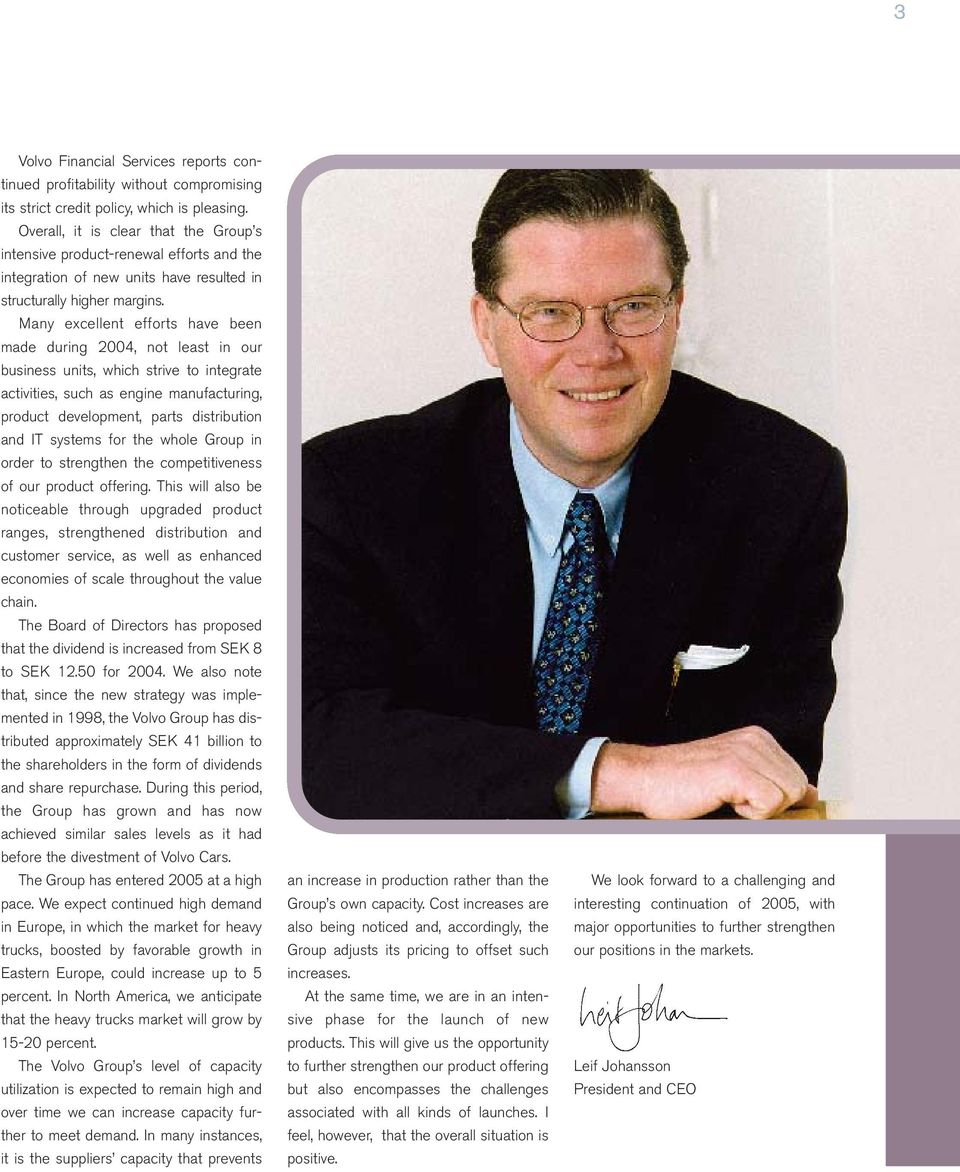
6 4 The Volvo share Net income* and cash dividend per share Net income*, SEK per share Dividend, SEK per share * Excluding restructuring costs and revaluation of shares THE VOLVO SHARE Direct return* and effective return**, % * Dividend as percentage of share price ** Share price at year-end, including dividend proposed during the year, divided by share price atthe beginning of the year Direct return* Effective return** (23) 17.6 (14.8) Ownership by country*, % Sweden (48) France (21) US (13) UK (9) Luxemburg (2) Others (7) * of capital, registered shares Ownership categories*, % Non-Swedish owners (52) Saving funds (10) Pension funds and insurance companies (13) Private shareholdings (11) Others (14) * of capital, registered shares 0 The Volvo share in 2004 The year was characterized by a continued positive development for equity on markets globally. On the Stockholm Stock Exchange, the All-Share Index increased by more than 17%. In the US, the Dow Jones Industrial Average gained 3% and the NASDAQ Composite closed up 9%. The Volvo B share gained 23% in 2004, compared with an increase of 26% for the MSCI Europe Machinery Index. Market capitalization At the end of 2004, the market capitalization of Volvo was SEK 106,754 M, which corresponds to 4.0% of the total market value of the companies listed on the Stockholm Stock Exchange. Trading The majority of trading in Volvo shares takes place via the Stockholm Stock Exchange. In 2004, a total of 540 (436) million shares were traded in Stockholm, which equals an average of 2.1 (1.8) million shares traded per day. The deregulation of the international capital markets and the increased foreign ownership of shares listed on the Stockholm Stock Exchange have led to secondary listings becoming less important. Against this background, Volvo delisted its share from the London Stock Exchange and from the German stock exchanges in The NASDAQ listing in the United States is the only remaining secondary listing for Volvo. ADR program in the United States Since 1985, a program for American Depositary Receipts (ADRs) has existed in the United States. Each ADR represents one Volvo B share and the Volvo ADR is traded with the ticker VOLVY on NASDAQ. In 2004, the average daily volumes of ADRs traded were 94,695 (40,729) and the total number of outstanding ADRs at year-end was about 20 million (10 million), which equalled approximately 5% of the outstanding shares. Dividend policy The objective is that the effective return to the shareholders, the dividend combined with the change in the share price, should exceed the average for the industry. Distribution of Ainax At the Annual General Meeting of AB Volvo on April 16, 2004, the Board s proposal to transfer all A shares in Scania AB to Ainax and then distribute Ainax to Volvo s shareholders was approved. On June 8, 2004, AB Volvo distributed the shares in Ainax to AB Volvo's share-
7 5 Price Trend, Volvo series B SEK Credit rating Short term Long term Moody s P-2 stable A3 stable (unsolicited) Standard A2 stable Not rated & Poor Unsolicited = No agreement with Volvo to publish the rating Volvo B AFSX MSCI Europe Machinery Index The largest shareholders in AB Volvo, December 31, Share capital, % 2 Renault SA 20.0 Robur fonder (savings funds) 2.6 Svenska Handelsbanken Second Swedish National Pension Fund (AP2) 1.8 Svenska Handelsbanken/SPP fonder Following the repurchase of its own shares, AB Volvo held 7.1% of the Company s shares on Dec. 31, Based on all registered shares. 3 Svenska Handelsbanken comprises shares held by Svenska Handelsbanken, Svenska Handelsbanken Pension Fund and Oktogonen. 4 Savings and pension funds. holders. The value of the distribution was SEK 6,310 M or SEK per share. Repurchase of shares On June 17, 2004, the Board of AB Volvo decided to acquire, through purchase on the Stockholm Stock Exchange, a maximum of 22,076,045 Series A and/or B shares, not exceeding a total purchase amount of SEK 4,300 M. By year-end 2004, a total of 9,315,000 Volvo A and Bshares were repurchased equivalent to SEK 2,532 M. The total number of shares held by Volvo as treasury stock at year-end was 31,391,043 or 7.1% of the registered shares. Dividend For fiscal year 2004, the Board of Directors proposes that the shareholders at the Annual General Meeting approve a cash dividend of SEK per share, a total of approximately SEK 5,127 M. This corresponds to a direct return of 4.7% calculated at the year-end rate of SEK for the Volvo B share. Share capital, December 31, 2004 Registered number of shares 1 441,520,885 of which, Series A shares 2 138,604,945 of which, Series B shares 3 302,915,940 Par value, SEK 6 Share capital, SEK M 2,649 Number of shareholders 202,349 Private persons 194,108 Legal entities 8,241 1 Following the repurchase of the Group s own shares, the number of outstanding shares was 410,129, Series A shares carry one vote each. 3 Series B shares carry one tenth of a vote each. More details on the Volvo share can be found on page 120.

8 6 Board of Directors Report 2004 THE YEAR VOLVO ANNUAL GENERAL MEETING APPROVED AINAX At the Annual General Meeting of AB Volvo on April 16, 2004, the Board s proposal to transfer all A shares in Scania AB to the wholly owned subsidiary Ainax and thereafter to distribute the shares in Ainax to Volvo s shareholders was approved. The value of the distribution of Ainax was SEK 6,310 M. NEW BOAT DRIVE SYSTEM INTRODUCED Volvo Penta has introduced an entirely new drive system for boats the Volvo Penta IPS (Inboard Performance System). The IPS system is based on forward-facing, pulling propellers and steerable driving units, which make the boats faster, more powerful, cleaner, quieter and sub- Volvo s holding of Scania B shares was sold to Deutsche Bank on March 4, 2004 for an amount of about SEK 14.9 billion. As a consequence of the divestment, the Scania holding was written down in the stantially easier to maneuver. It is thought that the Volvo Penta IPS could gain the same significance in the boating world as another Volvo Penta innovation the Aquamatic drive from the end of the 1950s. SCANIA B SHARES SOLD fourth quarter of The transaction was carried out as part of Volvo s commitment to the European Commission to divest the Scania shares not later than April 23, MOODY S CONFIRMED CREDIT RATING Moody s confirmed AB Volvo s short-term credit rating of P-2 and long-term A3 and concurrently raised the outlook to stable. Moody s expects that Volvo will continue to increase efficiency, strengthen competitiveness and improve financial strength. INDUSTRIAL RELOCATION WITHIN RENAULT TRUCKS The Volvo Group is carrying out an industrial relocation in Europe as a result of which manufacture of crankshafts for medium-heavy truck engines is being increased at Villaverde, Spain, while the production of Renault heavy trucks is being concentrated to the plant in Bourgen-Bresse, France. A total of about 450 employees will be affected by the decision. As a result a cost of approximately SEK 470 M was charged to operating income.

9 7 MACK INTRODUCES NEW ADVANTAGE HIGHWAY CHASSIS At the Truck Show in Las Vegas, Mack presented the new Advantage chassis, to better serve the needs of highway customers. The new chassis will be used in all Mack Vision and CH models. STRATEGIC ALLIANCE WITH ARVINMERITOR In accordance with a Memorandum of Understanding signed earlier, Volvo and ArvinMeritor entered into a Strategic Alliance Agreement for the supply of axles, which includes ArvinMeritor taking over Volvo s axle manufacturing activities in Lyon, France. The European Commission approved the transaction on October 1, ArvinMeritor will be responsible for the manufacturing and supply of driven and non-driven axles for the Volvo Group s European truck and bus products. NORTH AMERICAN ENGINE REMANUFACTURING BUSINESS ESTABLISHED Volvo Construction Equipment acquired the assets related to the engine remanufacturing of ECHO Industries, Inc, Charlotte, North Carolina; the primary supplier of remanufactured engines to Volvo CE in North America. The market for Volvo CE s remanufactured engines has become quite substantial since they are updated to the latest version with the latest technical improvements. The acquisition secures a strong platform from which to develop the North American engine remanufacturing business. NEW COMPACT EXCAVATORS LAUNCHED Volvo CE launced its ECR range of short swing radius compact excavators from 2.5 to 8 tons, designed to meet the needs of operators working in confined areas. The four models in the launch, designated as ECR28, ECR38, ECR58 and ECR88, offer high maneuverability, improved safety and expanded job opportunities without compromising operator comfort.

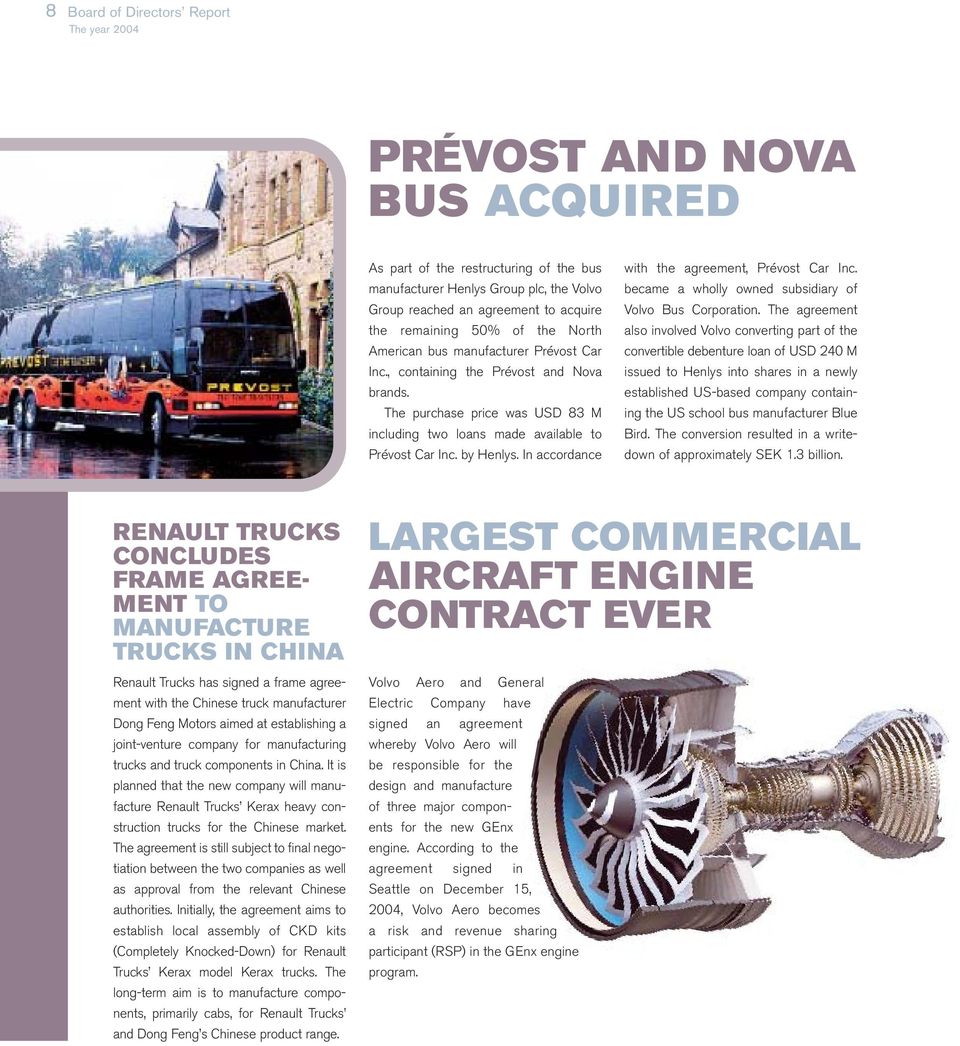
10 8 Board of Directors Report The year 2004 PRÉVOST AND NOVA BUS ACQUIRED As part of the restructuring of the bus manufacturer Henlys Group plc, the Volvo Group reached an agreement to acquire the remaining 50% of the North American bus manufacturer Prévost Car Inc., containing the Prévost and Nova brands. The purchase price was USD 83 M including two loans made available to Prévost Car Inc. by Henlys. In accordance with the agreement, Prévost Car Inc. became a wholly owned subsidiary of Volvo Bus Corporation. The agreement also involved Volvo converting part of the convertible debenture loan of USD 240 M issued to Henlys into shares in a newly established US-based company containing the US school bus manufacturer Blue Bird. The conversion resulted in a writedown of approximately SEK 1.3 billion. RENAULT TRUCKS CONCLUDES FRAME AGREE- MENT TO MANUFACTURE TRUCKS IN CHINA Renault Trucks has signed a frame agreement with the Chinese truck manufacturer Dong Feng Motors aimed at establishing a joint-venture company for manufacturing trucks and truck components in China. It is planned that the new company will manufacture Renault Trucks Kerax heavy construction trucks for the Chinese market. The agreement is still subject to final negotiation between the two companies as well as approval from the relevant Chinese authorities. Initially, the agreement aims to establish local assembly of CKD kits (Completely Knocked-Down) for Renault Trucks Kerax model Kerax trucks. The long-term aim is to manufacture components, primarily cabs, for Renault Trucks and Dong Feng s Chinese product range. LARGEST COMMERCIAL AIRCRAFT ENGINE CONTRACT EVER Volvo Aero and General Electric Company have signed an agreement whereby Volvo Aero will be responsible for the design and manufacture of three major components for the new GEnx engine. According to the agreement signed in Seattle on December 15, 2004, Volvo Aero becomes a risk and revenue sharing participant (RSP) in the GEnx engine program.
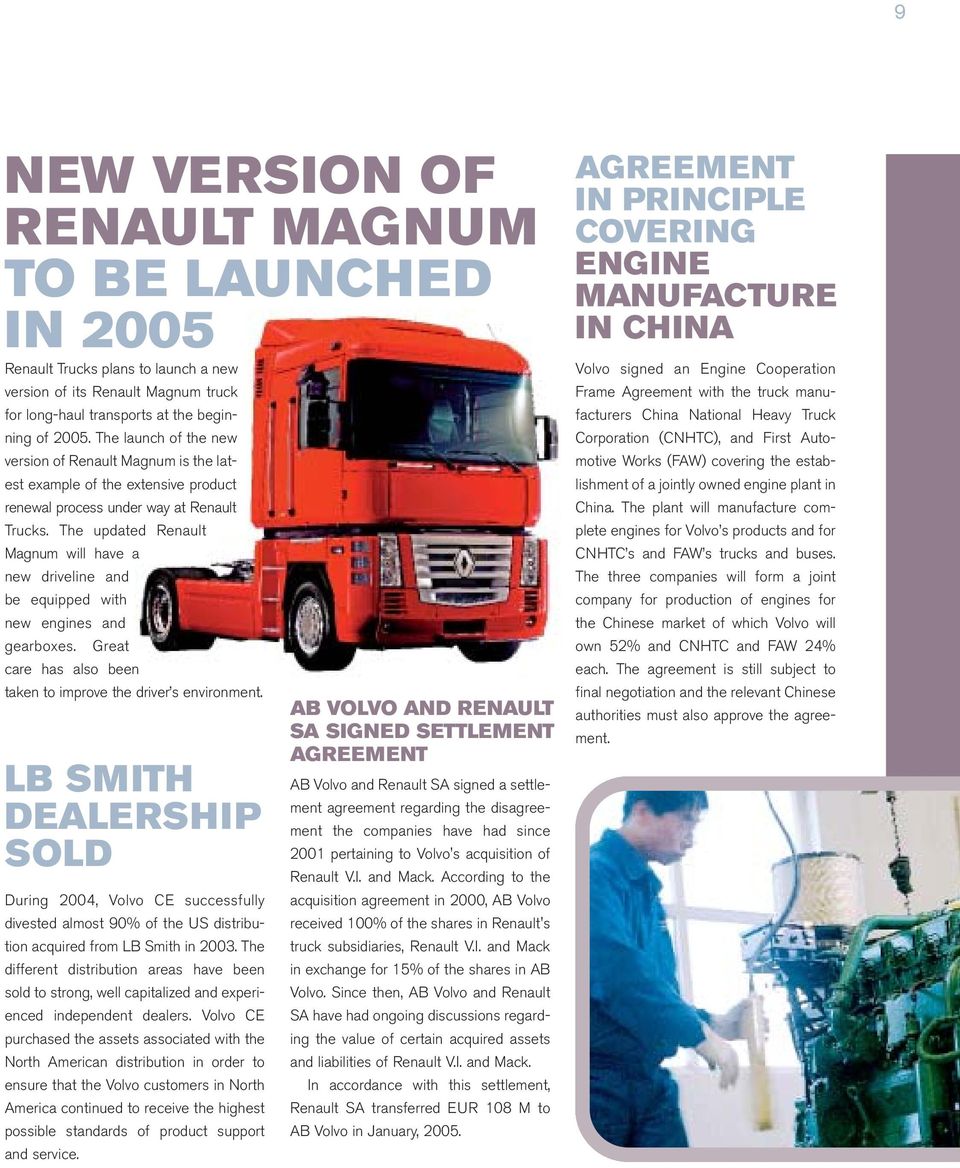
11 9 NEW VERSION OF RENAULT MAGNUM TO BE LAUNCHED IN 2005 Renault Trucks plans to launch a new version of its Renault Magnum truck for long-haul transports at the beginning of The launch of the new version of Renault Magnum is the latest example of the extensive product renewal process under way at Renault Trucks. The updated Renault Magnum will have a new driveline and be equipped with new engines and gearboxes. Great care has also been taken to improve the driver s environment. LB SMITH DEALERSHIP SOLD During 2004, Volvo CE successfully divested almost 90% of the US distribution acquired from LB Smith in The different distribution areas have been sold to strong, well capitalized and experienced independent dealers. Volvo CE purchased the assets associated with the North American distribution in order to ensure that the Volvo customers in North America continued to receive the highest possible standards of product support and service. AB VOLVO AND RENAULT SA SIGNED SETTLEMENT AGREEMENT AB Volvo and Renault SA signed a settlement agreement regarding the disagreement the companies have had since 2001 pertaining to Volvo's acquisition of Renault V.I. and Mack. According to the acquisition agreement in 2000, AB Volvo received 100% of the shares in Renault's truck subsidiaries, Renault V.I. and Mack in exchange for 15% of the shares in AB Volvo. Since then, AB Volvo and Renault SA have had ongoing discussions regarding the value of certain acquired assets and liabilities of Renault V.I. and Mack. In accordance with this settlement, Renault SA transferred EUR 108 M to AB Volvo in January, AGREEMENT IN PRINCIPLE COVERING ENGINE MANUFACTURE IN CHINA Volvo signed an Engine Cooperation Frame Agreement with the truck manufacturers China National Heavy Truck Corporation (CNHTC), and First Automotive Works (FAW) covering the establishment of a jointly owned engine plant in China. The plant will manufacture complete engines for Volvo s products and for CNHTC s and FAW s trucks and buses. The three companies will form a joint company for production of engines for the Chinese market of which Volvo will own 52% and CNHTC and FAW 24% each. The agreement is still subject to final negotiation and the relevant Chinese authorities must also approve the agreement.
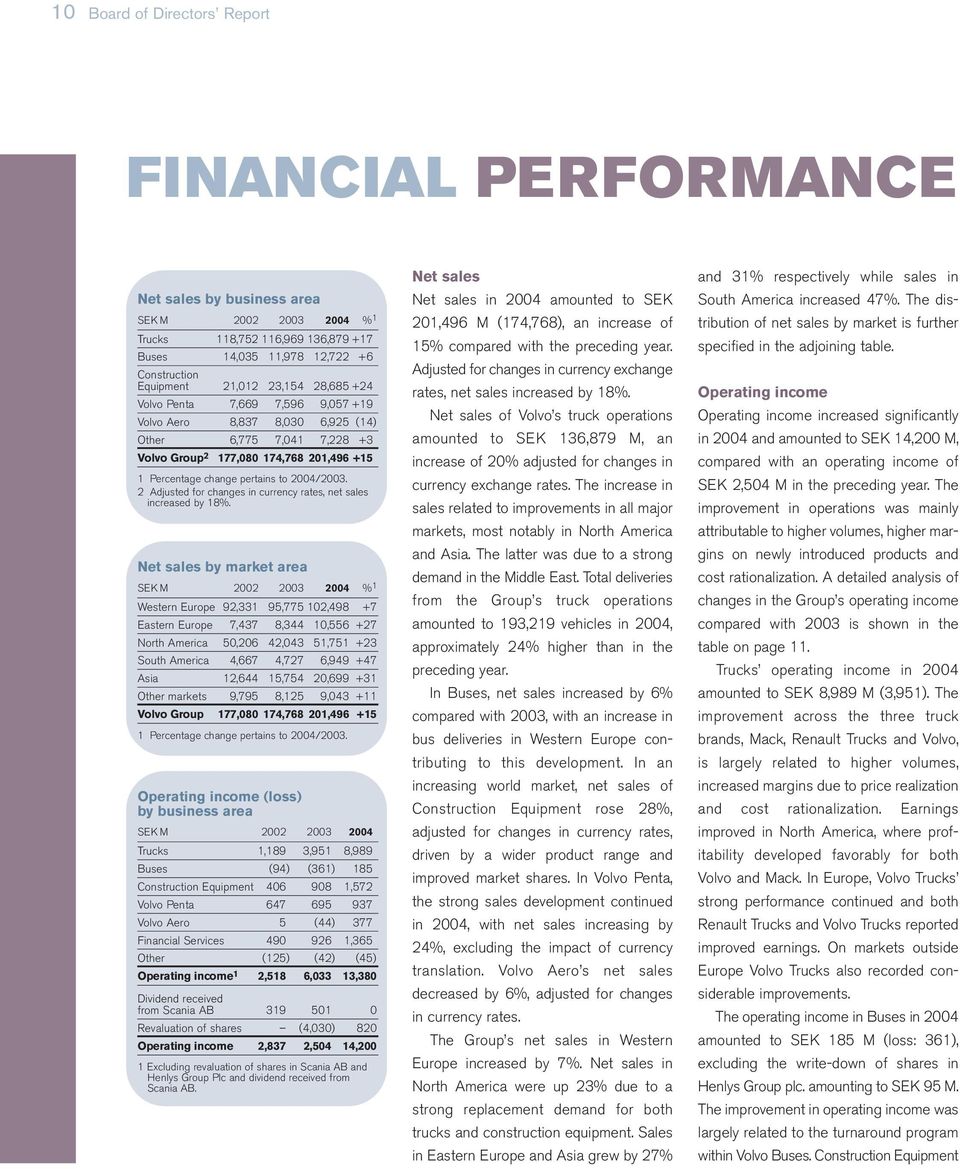
12 10 Board of Directors Report FINANCIAL PERFORMANCE Net sales by business area SEKM % 1 Trucks 118, , , Buses 14,035 11,978 12, Construction Equipment 21,012 23,154 28, Volvo Penta 7,669 7,596 9, Volvo Aero 8,837 8,030 6,925 (14) Other 6,775 7,041 7, Volvo Group 2 177, , , Percentage change pertains to 2004/ Adjusted for changes in currency rates, net sales increased by 18%. Net sales by market area SEKM % 1 Western Europe 92,331 95, , Eastern Europe 7,437 8,344 10, North America 50,206 42,043 51, South America 4,667 4,727 6, Asia 12,644 15,754 20, Other markets 9,795 8,125 9, Volvo Group 177, , , Percentage change pertains to 2004/2003. Operating income (loss) by business area SEKM Trucks 1,189 3,951 8,989 Buses (94) (361) 185 Construction Equipment ,572 Volvo Penta Volvo Aero 5 (44) 377 Financial Services ,365 Other (125) (42) (45) Operating income 1 2,518 6,033 13,380 Dividend received from Scania AB Revaluation of shares (4,030) 820 Operating income 2,837 2,504 14,200 1 Excluding revaluation of shares in Scania AB and Henlys Group Plc and dividend received from Scania AB. Net sales Net sales in 2004 amounted to SEK 201,496 M (174,768), an increase of 15% compared with the preceding year. Adjusted for changes in currency exchange rates, net sales increased by 18%. Net sales of Volvo s truck operations amounted to SEK 136,879 M, an increase of 20% adjusted for changes in currency exchange rates. The increase in sales related to improvements in all major markets, most notably in North America and Asia. The latter was due to a strong demand in the Middle East. Total deliveries from the Group s truck operations amounted to 193,219 vehicles in 2004, approximately 24% higher than in the preceding year. In Buses, net sales increased by 6% compared with 2003, with an increase in bus deliveries in Western Europe contributing to this development. In an increasing world market, net sales of Construction Equipment rose 28%, adjusted for changes in currency rates, driven by a wider product range and improved market shares. In Volvo Penta, the strong sales development continued in 2004, with net sales increasing by 24%, excluding the impact of currency translation. Volvo Aero s net sales decreased by 6%, adjusted for changes in currency rates. The Group s net sales in Western Europe increased by 7%. Net sales in North America were up 23% due to a strong replacement demand for both trucks and construction equipment. Sales in Eastern Europe and Asia grew by 27% and 31% respectively while sales in South America increased 47%. The distribution of net sales by market is further specified in the adjoining table. Operating income Operating income increased significantly in 2004 and amounted to SEK 14,200 M, compared with an operating income of SEK 2,504 M in the preceding year. The improvement in operations was mainly attributable to higher volumes, higher margins on newly introduced products and cost rationalization. A detailed analysis of changes in the Group s operating income compared with 2003 is shown in the table on page 11. Trucks operating income in 2004 amounted to SEK 8,989 M (3,951). The improvement across the three truck brands, Mack, Renault Trucks and Volvo, is largely related to higher volumes, increased margins due to price realization and cost rationalization. Earnings improved in North America, where profitability developed favorably for both Volvo and Mack. In Europe, Volvo Trucks strong performance continued and both Renault Trucks and Volvo Trucks reported improved earnings. On markets outside Europe Volvo Trucks also recorded considerable improvements. The operating income in Buses in 2004 amounted to SEK 185 M (loss: 361), excluding the write-down of shares in Henlys Group plc. amounting to SEK 95 M. The improvement in operating income was largely related to the turnaround program within Volvo Buses. Construction Equipment
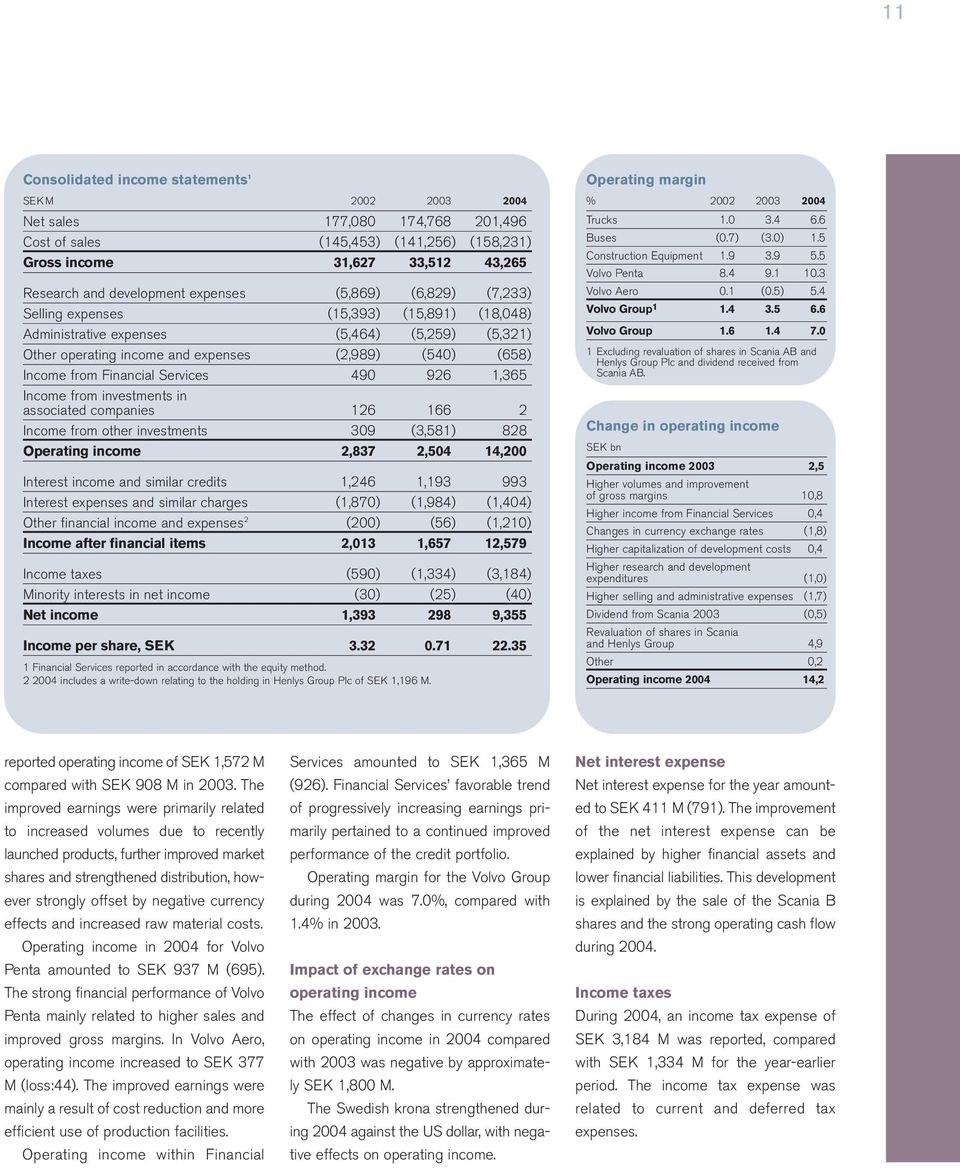
13 11 Consolidated income statements 1 SEKM Net sales 177, , ,496 Cost of sales (145,453) (141,256) (158,231) Gross income 31,627 33,512 43,265 Research and development expenses (5,869) (6,829) (7,233) Selling expenses (15,393) (15,891) (18,048) Administrative expenses (5,464) (5,259) (5,321) Other operating income and expenses (2,989) (540) (658) Income from Financial Services ,365 Income from investments in associated companies Income from other investments 309 (3,581) 828 Operating income 2,837 2,504 14,200 Interest income and similar credits 1,246 1, Interest expenses and similar charges (1,870) (1,984) (1,404) Other financial income and expenses 2 (200) (56) (1,210) Income after financial items 2,013 1,657 12,579 Income taxes (590) (1,334) (3,184) Minority interests in net income (30) (25) (40) Net income 1, ,355 Income per share, SEK Financial Services reported in accordance with the equity method includes a write-down relating to the holding in Henlys Group Plc of SEK 1,196 M. Operating margin % Trucks Buses (0.7) (3.0) 1.5 Construction Equipment Volvo Penta Volvo Aero 0.1 (0.5) 5.4 Volvo Group Volvo Group Excluding revaluation of shares in Scania AB and Henlys Group Plc and dividend received from Scania AB. Change in operating income SEK bn Operating income ,5 Higher volumes and improvement of gross margins 10,8 Higher income from Financial Services 0,4 Changes in currency exchange rates (1,8) Higher capitalization of development costs 0,4 Higher research and development expenditures (1,0) Higher selling and administrative expenses (1,7) Dividend from Scania 2003 (0,5) Revaluation of shares in Scania and Henlys Group 4,9 Other 0,2 Operating income ,2 reported operating income of SEK 1,572 M compared with SEK 908 M in The improved earnings were primarily related to increased volumes due to recently launched products, further improved market shares and strengthened distribution, however strongly offset by negative currency effects and increased raw material costs. Operating income in 2004 for Volvo Penta amounted to SEK 937 M (695). The strong financial performance of Volvo Penta mainly related to higher sales and improved gross margins. In Volvo Aero, operating income increased to SEK 377 M (loss:44). The improved earnings were mainly a result of cost reduction and more efficient use of production facilities. Operating income within Financial Services amounted to SEK 1,365 M (926). Financial Services favorable trend of progressively increasing earnings primarily pertained to a continued improved performance of the credit portfolio. Operating margin for the Volvo Group during 2004 was 7.0%, compared with 1.4% in Impact of exchange rates on operating income The effect of changes in currency rates on operating income in 2004 compared with 2003 was negative by approximately SEK 1,800 M. The Swedish krona strengthened during 2004 against the US dollar, with negative effects on operating income. Net interest expense Net interest expense for the year amounted to SEK 411 M (791). The improvement of the net interest expense can be explained by higher financial assets and lower financial liabilities. This development is explained by the sale of the Scania B shares and the strong operating cash flow during Income taxes During 2004, an income tax expense of SEK 3,184 M was reported, compared with SEK 1,334 M for the year-earlier period. The income tax expense was related to current and deferred tax expenses.
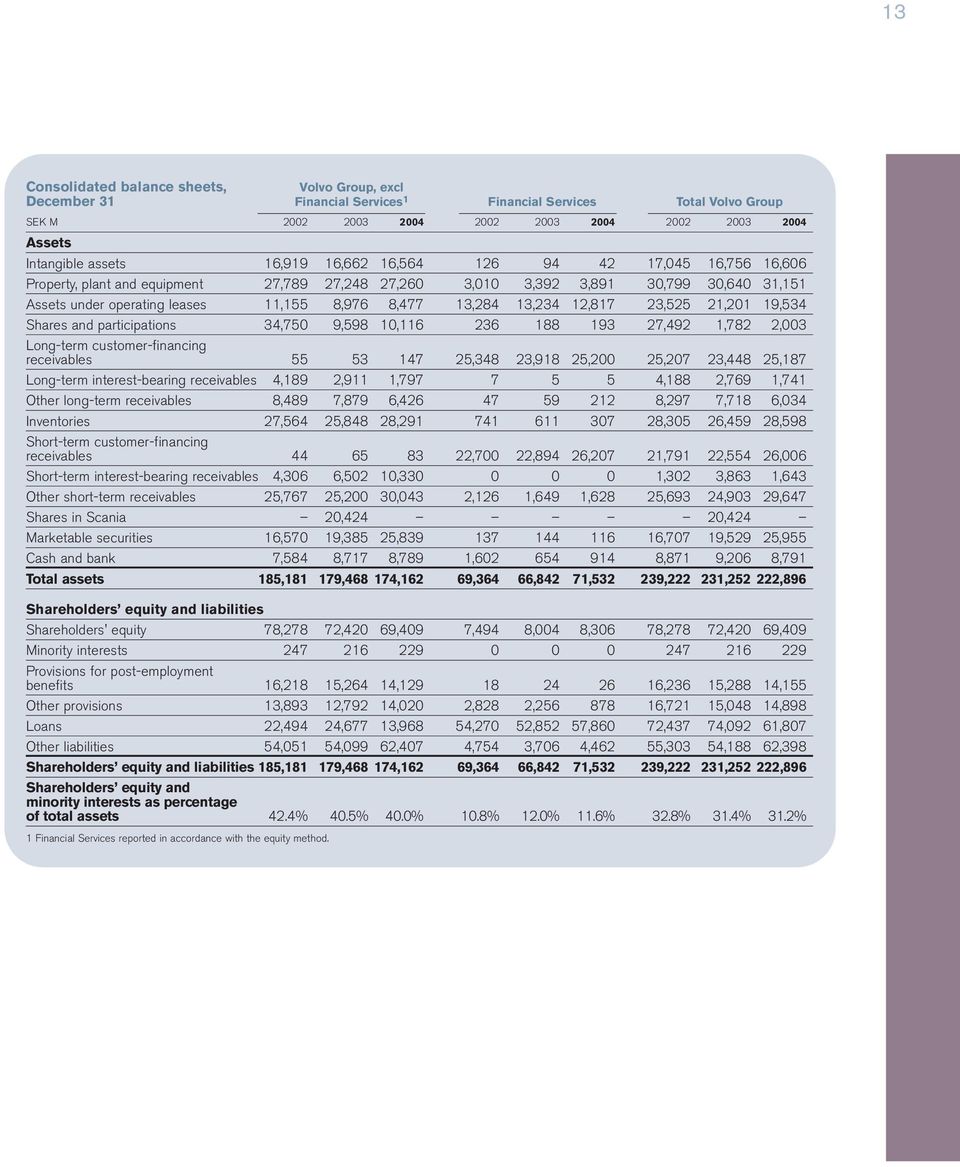
14 12 Board of Directors Report Impact of exchange rates on operating income Compared with preceding year, SEK bn Net sales 1 (5.7) Cost of sales 3,7 Research and development expenses 0.1 Selling and administrative expenses 0.5 Other operating income and expenses (0.4) Income from investments in shares 0.0 Total effect of changes in exchange rates on operating income (1.8) 1 Group sales are reported at average spot rates and the effects of currency hedges are reported among Other operating income and expenses. Operating net flow per currency SEKM USD 7,100 7,500 13,100 EUR 5,100 7,300 6,700 GBP 5,400 3,400 4,200 CAD 1,600 1,600 2,800 Other currencies 5,000 5,200 9,300 Total 24,200 25,000 36,100 Preparations for adoption of International Financial Reporting Standards For a description of Volvo s preparations for adoption of International Financial Reporting Standards (IFRS) in 2005, see further in Note 1 on page 56 and pages Minority interests Minority interests in the Volvo Group were mainly attributable to Volvo Aero Norge AS (22%), Volvo Aero Services LP (5%) and Wuxi da Hao Power Co, Ltd (30%). Net income Net income amounted to SEK 9,355 M (298) corresponding to an income per share of SEK (0.71). The return on shareholders equity was 13.2% (0.4). FINANCIAL POSITION Balance sheet The Volvo Group s total assets at December 31, 2004 amounted to SEK billion, corresponding to a decline of SEK 8.4 billion compared to year-end Total assets were reduced since year-end, mainly as a result of divestment and distribution of Scania shares as well as changes in currency rates. This effect was partially offset by growth in the credit portfolio of Financial Services and higher inventories and receivables as a consequence of the significant sales increase. In addition, liquid funds increased by SEK 6.0 billion, mainly due to the proceeds received on the divestment of Scania B shares and a positive operating cashflow. Shareholders equity and minority interests amounted to SEK 69.6 billion, corresponding to an equity ratio of 40.0%, excluding Financial Services. Changes in shareholders equity during the period are specified on page 54. The Group s net financial assets on December 31, 2004, amounted to SEK 18.7 billion, which corresponded to 26.8% of Shareholders equity and minority interests. Changes in net financial position are specified in the adjoining table. Change in net financial position SEK bn December 31, Cash flow from operating activities 18.1 Investments in fixed assets and leasing assets, net (6.8) Customer financie receivables, net 0.1 Investments in shares, net 15.1 Acquired and divested operations (0.1) Cash flow after net investments, excluding Financial Services 26.4 Contribution to US pension plans 1.1 Write-down of convertible debenture loan to Henlys (1.2) Debt in acquired and divested operations (0.7) Repurchase of own shares (2.5) Dividend paid to AB Volvo's shareholders (3.4) Currency effect 0.8 Other 0.6 Total change 21.1 December 31,

15 13 Consolidated balance sheets, Volvo Group, excl December 31 Financial Services 1 Financial Services Total Volvo Group SEK M Assets Intangible assets 16,919 16,662 16, ,045 16,756 16,606 Property, plant and equipment 27,789 27,248 27,260 3,010 3,392 3,891 30,799 30,640 31,151 Assets under operating leases 11,155 8,976 8,477 13,284 13,234 12,817 23,525 21,201 19,534 Shares and participations 34,750 9,598 10, ,492 1,782 2,003 Long-term customer-financing receivables ,348 23,918 25,200 25,207 23,448 25,187 Long-term interest-bearing receivables 4,189 2,911 1, ,188 2,769 1,741 Other long-term receivables 8,489 7,879 6, ,297 7,718 6,034 Inventories 27,564 25,848 28, ,305 26,459 28,598 Short-term customer-financing receivables ,700 22,894 26,207 21,791 22,554 26,006 Short-term interest-bearing receivables 4,306 6,502 10, ,302 3,863 1,643 Other short-term receivables 25,767 25,200 30,043 2,126 1,649 1,628 25,693 24,903 29,647 Shares in Scania 20,424 20,424 Marketable securities 16,570 19,385 25, ,707 19,529 25,955 Cash and bank 7,584 8,717 8,789 1, ,871 9,206 8,791 Total assets 185, , ,162 69,364 66,842 71, , , ,896 Shareholders equity and liabilities Shareholders' equity 78,278 72,420 69,409 7,494 8,004 8,306 78,278 72,420 69,409 Minority interests Provisions for post-employment benefits 16,218 15,264 14, ,236 15,288 14,155 Other provisions 13,893 12,792 14,020 2,828 2, ,721 15,048 14,898 Loans 22,494 24,677 13,968 54,270 52,852 57,860 72,437 74,092 61,807 Other liabilities 54,051 54,099 62,407 4,754 3,706 4,462 55,303 54,188 62,398 Shareholders equity and liabilities 185, , ,162 69,364 66,842 71, , , ,896 Shareholders equity and minority interests as percentage of total assets 42.4% 40.5% 40.0% 10.8% 12.0% 11.6% 32.8% 31.4% 31.2% 1 Financial Services reported in accordance with the equity method.
16 14 Board of Directors Report CASH-FLOW STATEMENT Self-financing ratio*, excluding Financial Services, % * Cash flow from operating activities divided by net investments in fixed and leasing assets Capital expenditures excluding Financial Services Capital expenditures, SEK bn Capital expenditures, % of net sales Research and development costs Research and development costs, SEK bn Research and development costs, % of net sales Cash flow Cash flow after net investments, excluding Financial Services, amounted to SEK 26.4 billion. Operating cash flow (excluding the effects of acquisitions and divestments) was SEK 11.4 billion. The positive development during 2004 was mostly related to an increase in profitability. Working capital increased somewhat compared to last year due to strong sales growth. However, the negative effects of the growth were reduced by increased working capital turnover. The successful capital rationalization project within the Volvo Group, that was concluded during 2004, was the main factor for this development. All business areas have reported significant improvements in capital efficiency as a result of the program and focus on operating capital will continue. Cash flow after net investments within Financial Services was negative SEK 5.5 billion in 2004 (neg. 3.2), as a result of continued growth in the credit portfolio. Investments Investments in fixed assets in 2004, excluding Financial Services, amounted to SEK 7.2 billion (5.8). Capital expenditures in Trucks, which amounted to SEK 4.7 billion (3.9), were made in tools and equipment for the production of new truck models. Investments were also made to increase the number of workshops for the dealer network in Europe, for a modification of the Hagerstown plant in North America for manufacturing of engines and transmissions and for the move of the assembly line for the MD9 and MD11 engines from Skövde, Sweden, to Lyon, France. The level of capital expenditures remained at the same level as last year in Buses at SEK 0.2 billion, decreased in Volvo Penta from SEK 0.4 billion to SEK 0.3 billion and increased in Volvo Aero from SEK 0.3 billion to SEK 0.5 billion and in Construction Equipment from SEK 0.5 billion to SEK 0.7 billion. Approved future capital expenditures amounting to SEK 8.2 billion (6.4) relate mainly to investments for the next generation of trucks. Investments in leasing assets amounted to SEK 0.3 billion (0.1). In Financial Services investments in leasing assets amounted to SEK 4.6 billion (5.2) and pertained mainly to the operations in North America and Western Europe. Acquisitions and divestments Net divestments in shares during 2004 amounted to a negative SEK 15.1 billion (investment: 0.1). The divestment of the Scania B shares amounted to SEK 14.9 billion and had a significant effect on the cash flow. Acquired and divested companies had an insignificant effect on cash flow negative 0.1 (0.0). Financing and dividend Net borrowings decreased during 2004 by SEK 8.8 billion, of which new borrowing during the year, mainly through the issue of bonds, contributed SEK 19.1 billion. In 2003, net borrowings increased by SEK 1.9 billion.
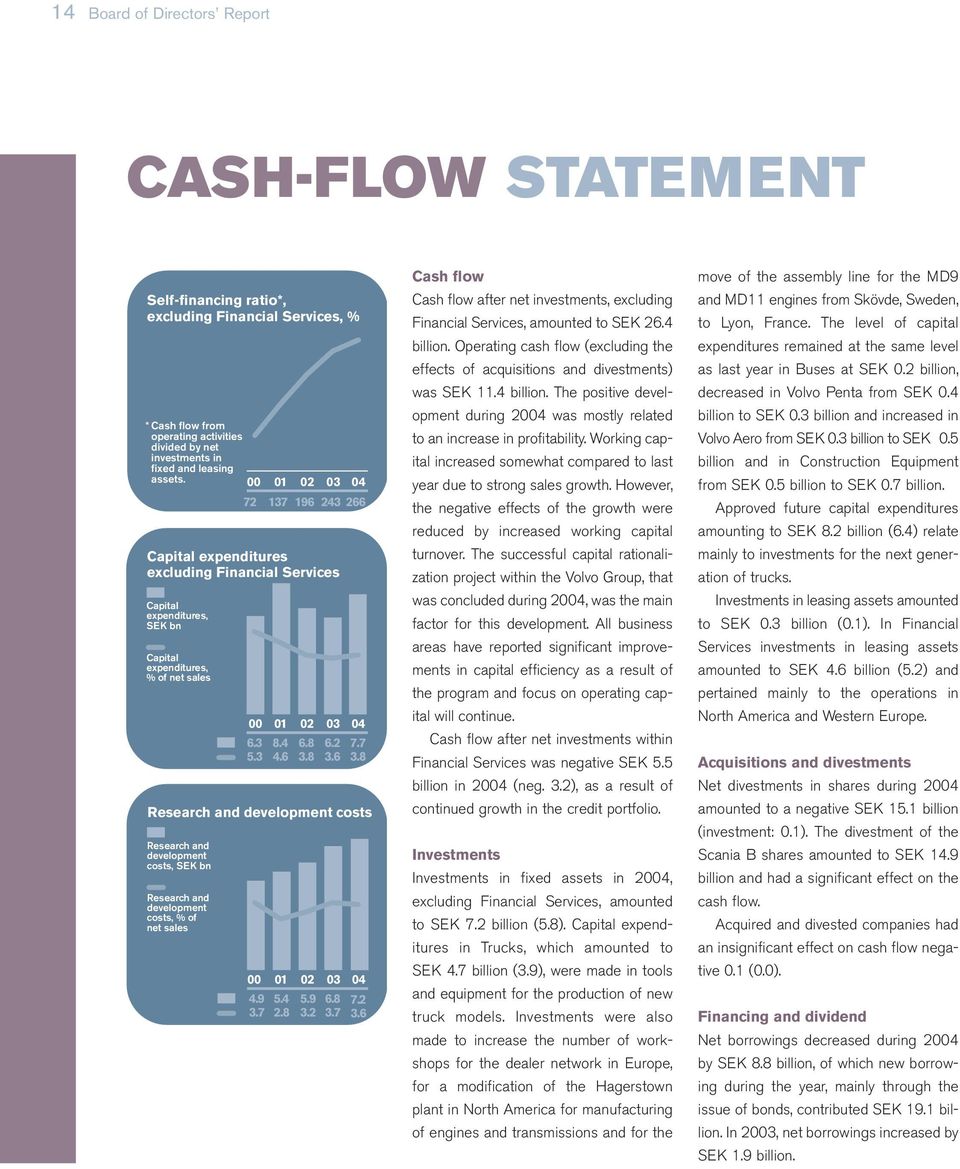
17 15 Consolidated cash-flow statements SEKbn Operating income Add depreciation and amortization Other non-cash items (0.4) Change in working capital (1.5) Financial items and income taxes paid (1.1) (0.7) (0.2) Cash flow from operating activities Investing activities Investments in fixed assets (6.3) (5.8) (7.2) Investment in leasing assets (0.1) (0.1) (0.3) Disposals of fixed assets and leasing assets Customer Finance receivables, net Investments in shares, net (0.1) (0.1) 15.1 Acquired and divested operations (0.1) 0.0 (0.1) Cash flow after net investments excl Financial Services Cash flow after net investments, Financial Services (4.3) (3.2) (5.5) Cash flow after net investments, Volvo Group total Financing activities Change in other loans, net (0.1) 1.9 (8.8) Loans to external parties, net Repurchase of own shares (2.5) Dividend to AB Volvo's shareholders (3.4) (3.4) (3.4) Other Change in liquid funds excl translation differences (1.1) Translation differences on liquid funds (0.7) (0.6) (0.2) Change in liquid funds (1.8) Operating cash flow, excluding Financial Services SEKbn Operating income Depreciation and amortization Other (2.1) Cash flow from operating activities Net investments in fixed assets and leasing assets (5.3) (5.3) (6.8) Customer finance receivables, net Operating cash flow Future capital expenditures, approved 1 SEK bn Trucks 6.3 Buses 0.2 Construction Equipment 0.6 Volvo Penta 0.1 Volvo Aero 0.4 Other 0.6 Total In property, plant and equipment. Condensed cash-flow statements, Financial Services SEKbn Cash flow from operating activities Net investments in credit portfolio, etc (9.2) (7.3) (10.6) Cash flow after net investments, Financial Services (4.3) (3.2) (5.5) An ordinary dividend amounting to SEK 3.4 billion, corresponding to SEK 8.00 per share, was paid to AB Volvo's shareholders during the year. During 2004 AB Volvo repurchased own shares to the amount of SEK 2.5 billion. Change in liquid funds The Group s liquid funds increased by SEK 6.0 billion during the year amounting to SEK 34.7 billion at December 31, 2004.

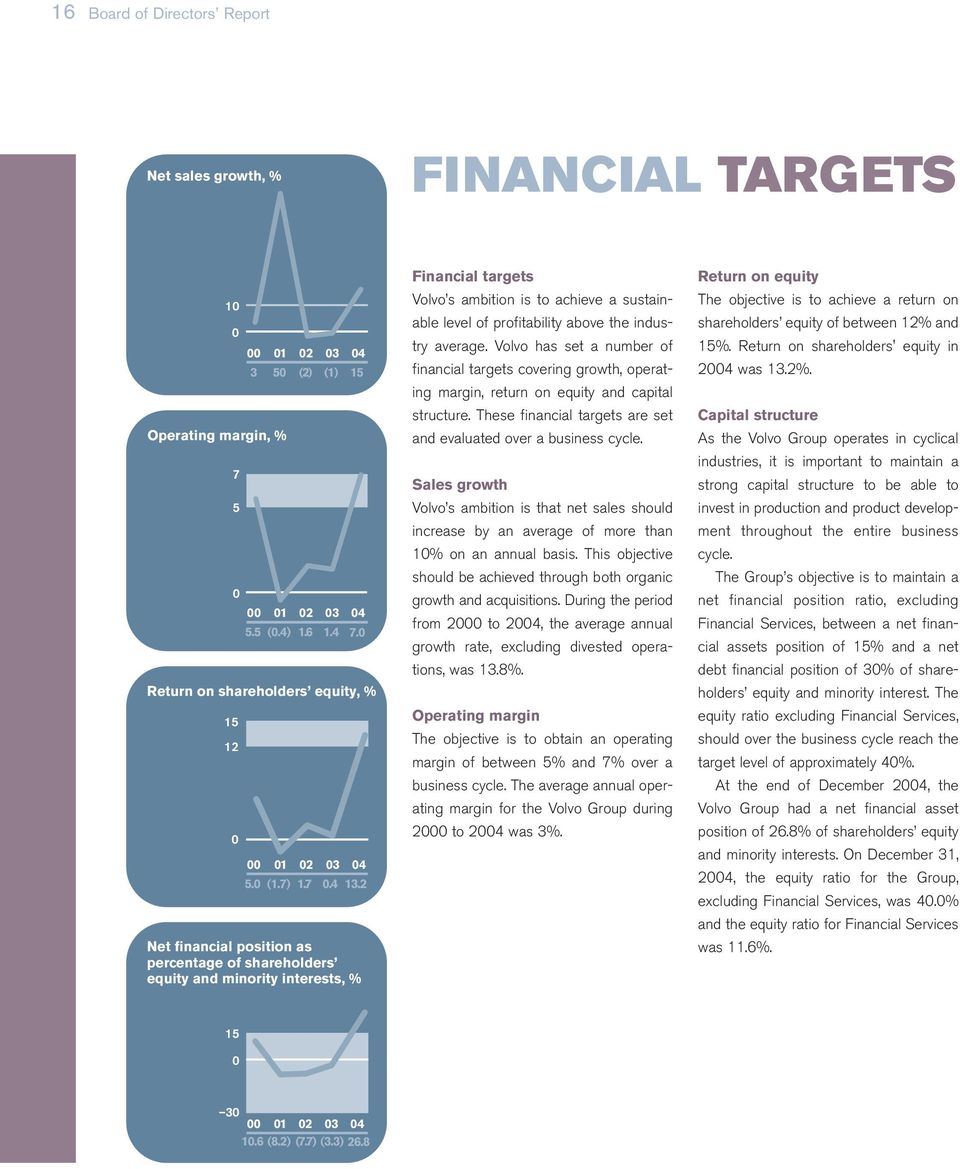
18 16 Board of Directors Report Net sales growth, % FINANCIAL TARGETS 10 0 Operating margin, % (2) (1) (0.4) Return on shareholders equity, % (1.7) Net financial position as percentage of shareholders equity and minority interests, % Financial targets Volvo s ambition is to achieve a sustainable level of profitability above the industry average. Volvo has set a number of financial targets covering growth, operating margin, return on equity and capital structure. These financial targets are set and evaluated over a business cycle. Sales growth Volvo s ambition is that net sales should increase by an average of more than 10% on an annual basis. This objective should be achieved through both organic growth and acquisitions. During the period from 2000 to 2004, the average annual growth rate, excluding divested operations, was 13.8%. Operating margin The objective is to obtain an operating margin of between 5% and 7% over a business cycle. The average annual operating margin for the Volvo Group during 2000 to 2004 was 3%. Return on equity The objective is to achieve a return on shareholders equity of between 12% and 15%. Return on shareholders' equity in 2004 was 13.2%. Capital structure As the Volvo Group operates in cyclical industries, it is important to maintain a strong capital structure to be able to invest in production and product development throughout the entire business cycle. The Group s objective is to maintain a net financial position ratio, excluding Financial Services, between a net financial assets position of 15% and a net debt financial position of 30% of shareholders equity and minority interest. The equity ratio excluding Financial Services, should over the business cycle reach the target level of approximately 40%. At the end of December 2004, the Volvo Group had a net financial asset position of 26.8% of shareholders equity and minority interests. On December 31, 2004, the equity ratio for the Group, excluding Financial Services, was 40.0% and the equity ratio for Financial Services was 11.6% (8.2) (7.7) (3.3) 26.8
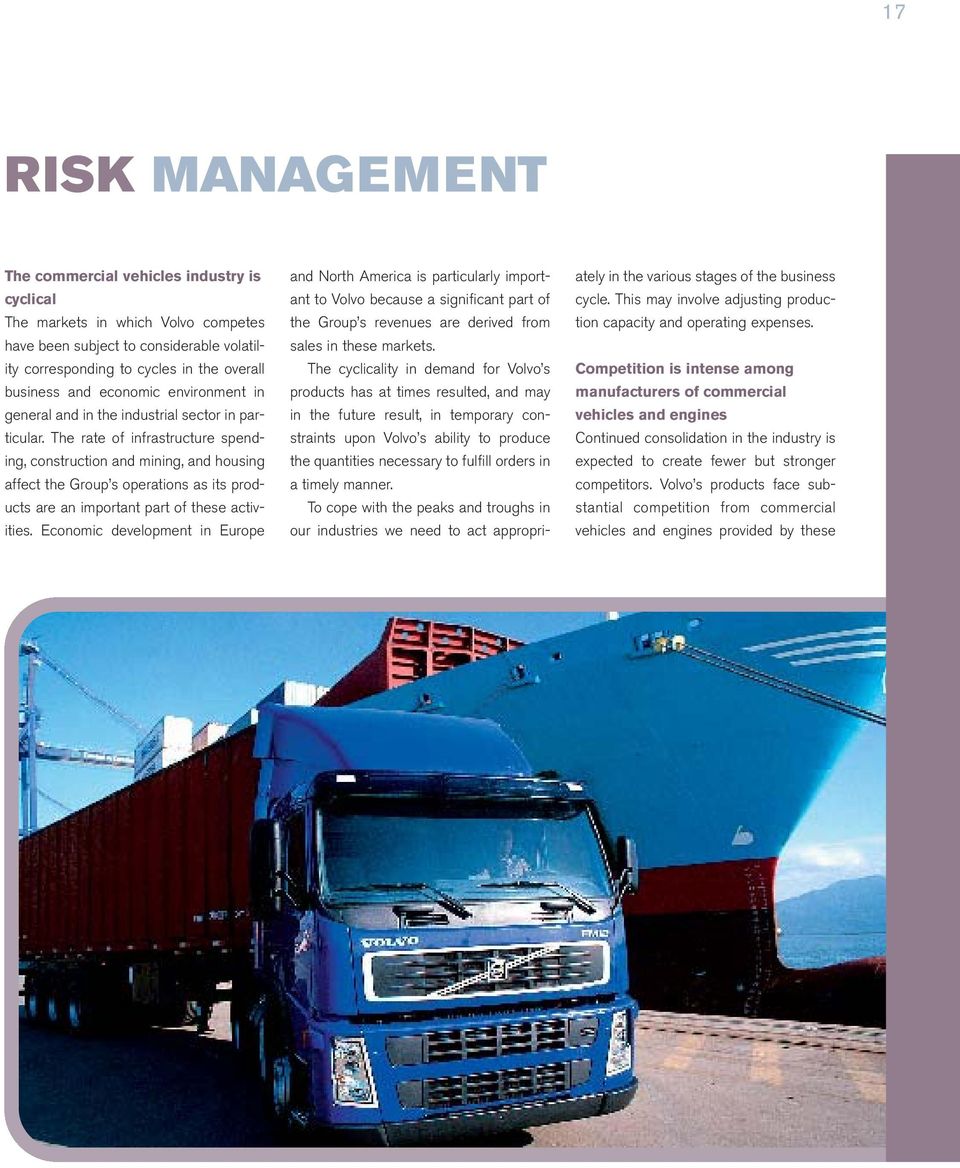
19 17 RISK MANAGEMENT The commercial vehicles industry is cyclical The markets in which Volvo competes have been subject to considerable volatility corresponding to cycles in the overall business and economic environment in general and in the industrial sector in particular. The rate of infrastructure spending, construction and mining, and housing affect the Group s operations as its products are an important part of these activities. Economic development in Europe and North America is particularly important to Volvo because a significant part of the Group s revenues are derived from sales in these markets. The cyclicality in demand for Volvo s products has at times resulted, and may in the future result, in temporary constraints upon Volvo s ability to produce the quantities necessary to fulfill orders in a timely manner. To cope with the peaks and troughs in our industries we need to act appropriately in the various stages of the business cycle. This may involve adjusting production capacity and operating expenses. Competition is intense among manufacturers of commercial vehicles and engines Continued consolidation in the industry is expected to create fewer but stronger competitors. Volvo s products face substantial competition from commercial vehicles and engines provided by these
20 18 Board of Directors Report and other manufacturers, and such competition may have a significant impact on the prices Volvo receives for its products and on the Group s future sales volume. Our major competitors are Daimler- Chrysler, Paccar, Navistar, MAN, Scania, Caterpillar, Komatsu, Cummins and Brunswick. Our brands are well-known and strong in many parts of the world. For the Volvo Group, it is important that all brands in the Group are developed and supported. Strong brands together with an attractive product portfolio make it possible for Volvo to be competitive. Prices for commercial vehicles can be volatile Prices for commercial vehicles in certain markets have, at times, experienced sharp changes over short periods of time. This volatility is caused by many factors, including short-term fluctuations in demand, shortages of certain supplies, volatility in underlying economic conditions, changes in import regulations, excess inventory and increased competition. Overcapacity within the industry will likely occur if there is an economic downturn in Volvo s major markets or worldwide, leading, potentially, to further increased price pressure. The overall result of the business depends on our ability to quickly react to changes in demand and particularly to adapt production levels, to reduce product and operational costs as well as deliver new competitive products and services. The Group s operations are exposed to currency fluctuations Approximately 90% of Volvo s sales are in countries other than Sweden. Changes in exchange rates have a direct effect on Volvo s results of operations, balance sheet and cash flow and an indirect effect on Volvo s competitiveness, which will over time affect the Group s results. Volvo s income statement is affected primarily by the translation of revenue and expenses in foreign currencies, and its balance sheet is affected primarily by the translation of net assets of foreign subsidiaries into Swedish kronor at rates different from those used to translate earlier periods. In addition, currency movements may affect Volvo s pricing of products sold and materials purchased in foreign currencies as well as those of its competitors, which may be affected differently by such movements. Since Volvo has substantial manufacturing operations in Sweden and generates a substantial portion of its revenues in currencies other than the Swedish krona, Volvo s results of operations would be materially adversely affected by a considerable appreciation of the Swedish krona against other currencies. The objective of Volvo s management of currency risks is to minimize short-term negative impact on Volvo s income and financial position. Volvo uses forward contracts and currency options to hedge the value of future payments in foreign currencies. Volvo has entered into, and expects to continue to enter into, such hedging arrangements with counterparties that are carefully selected and approved. Please see note 33 Financial risks and Instruments on page 84 for detailed information. Volvo s profitability is dependent upon the successful introduction of new products Volvo s long-term profitability depends upon its ability to introduce and market its new products successfully. Product life cycles continue to shorten, putting increased focus on the success of Volvo s product development. It is crucial to meet and exceed customer expectations in order to be competitive in established markets and to be able to expand into additional markets and/or product segments. Many of our products take a long time to develop from initial idea to finished product. It is crucial that we can offer the right products in the right place and at the right time. It is important to involve customers in the early phases of the development process as a means of safeguarding successful products in the marketplace. Volvo relies on suppliers for the provision of certain raw materials and components Volvo purchases raw materials, parts and components from numerous outside suppliers. A majority of the Group s requirements for raw materials and supplies is filled by single-source suppliers. The impact of an interruption in supply will vary by commodity and components. Some parts are generic to the industry while others are of a proprietary design requiring unique tooling, which would

21 19 take time to recreate. The inability of a supplier to deliver could have an adverse effect on production at certain of Volvo s manufacturing locations. The cost for raw material and components can vary significantly over the business cycle. These variations can occur due to changes in the commodity market or our suppliers ability to deliver. Volvo is working closely with the suppliers to manage these aspects, including reviewing suppliers financial stability, quality systems and their production flexibilty. well tuned to the introduction of new regulations. The new regulations regarding product emissions are extensive, but our current assessment is that they are manageable for the Volvo Group and within our estimates. Volvo has had production facilities in numerous countries worldwide for many years. A worldwide production standard for environmental performance has been introduced, enabling production plants to achieve best industry standard wherever we operate in the world. Volvo is reliant on the protection and preservation of its intellectual property Volvo products are sold primarily under the brands Volvo, Volvo Penta, "Volvo Aero", Renault Trucks and Mack. Volvo owns or otherwise has rights to a number of patents and trademarks, relating to the products it manufactures, which have been obtained over a period of years. These patents and trademarks have been of value in the growth of Volvo s business and may continue to be of value in the future. Volvo does not regard any of its businesses as being dependent upon any single patent or group of patents. Through Volvo Trademark Holding AB, AB Volvo and Volvo Car Corporation jointly own all trademarks containing Volvo globally. AB Volvo has an exclusive right to use the Volvo name and trademark in relation to its products and services. Similarly, Volvo Car Corporation has an exclusive right to use the brand in relation to their products and services. To secure these rights and avoid having the trademark eroded, AB Volvo and Volvo Car Corporation have jointly adopted mechanisms to control their respective use of the trademark and to prevent others from taking undue advantage of it. With regard to the Mack trademark, which is owned within the Volvo Group, similar control mechanisms apply. Volvo s rights to use the Renault trademark are limited to the truck sector only and are governed by a licence agreement with the French company Renault SA, the owner of the Renault trademark. The commercial vehicles industry is subject to extensive government regulation Regulations regarding exhaust emission levels, noise, safety and levels of pollutants from production plants are extensive within the industry. These regulations are subject to change, often making them more restrictive. The costs to comply with these regulations can be significant to the commercial vehicle industry. Most of the regulatory challenges regarding products relates to engine emissions. The Volvo Group is a large player in the commercial vehicle industry and is one of the top three high-volume world producers of heavy duty diesel engines. The product development capacity, within the Volvo Group, is well consolidated and the Volvo Group has a unique opportunity, compared to competitors, to focus development resources to meet these challenges. Future product regulations are well known, provided that they are not changed, to the Volvo Group and the product development strategy is Complaints or litigation from customers and other third parties Volvo can be subject to complaints and litigation from customers, employees or other third parties, alleging health, environmental, safety or operational concerns or failure to comply with applicable laws and regulations. These claims, even if successfully solved without direct adverse financial effect, could have a material adverse effect on Volvo s reputation and divert financial and management resources from more beneficial uses. Volvo continuously reviews its manufacturing and administrative processes with the aim of ensuring that Volvo products and operations meet applicable legal and other regulatory requirements.
22 20 Board of Directors Report Net sales*, SEK bn TRUCKS * pro forma , Operating income*, SEK bn * pro forma 2000, excluding restructuring costs Operating margin*, % * pro forma 2000, excluding restructuring costs Net sales as percentage of Volvo Group sales, % 68% 9.0 The Volvo Group is one of the leading manufacturers of heavy trucks in the world. The foundation has been established for aggressive development of new trucks and services. The three truck brands Mack, Renault Trucks and Volvo have highly competitive products and worldwide market coverage. Total deliveries from the Group s truck operations amounted to 193,219 trucks in 2004, an increase of 24% compared with the year-earlier period. In Europe, 102,666 trucks were delivered, compared with 92,083 trucks in Deliveries in North America were up 42% compared with the year-earlier period and totaled 49,273 trucks. Deliveries in Asia continued to develop favorably, in particular in the Middle East. Mack Trucks Mack Trucks is one of the largest manufacturers of heavy-duty trucks and major product components in North America. Since its founding in 1900, Mack has built on its reputation of strength and durability to become one of the leading heavy-duty truck brands in the North American market. In the US, Mack is the undisputed leader in the vocational segments of the heavy-duty truck market. A clear majority of Mack vehicles employ drivelines manufactured in-house a unique feature in the North American truck industry. In addition, Mack trucks are sold and serviced in more than 45 countries. Mack launched an ambitious program of product renewal in 2004 with the introduction of its Advantage chassis for highway applications. The new chassis delivers a variety of benefits to enhance efficiency and profitability of customers operations and also allows for Mack to expand into a broader range of highway applications. Mack deliveries rose in 2004 to 25,469 trucks, compared with 18,991 trucks a year earlier. The gains were the result of strengthening in the overall truck market, tied to improved U.S. economic conditions. Renault Trucks Renault Trucks traces its origin to the Berliet and Renault companies founded in 1895 and With a product program that ranges from light trucks for city distribution to heavy long-haul trucks and military vehicles, Renault Trucks is a true multispecialist with the ability to meet the specific requirements of all types of road transport. Renault Trucks has a strong presence in Europe with 1,350 dealers and service centers, which on a global basis extends to 2,000. In May 2004, Renault Trucks introduced a new generation of the light truck, Renault Mascott, spanning the 3.5 to 6.5 ton segment. The Renault Mascott features a new exterior and interior design, new engines and improved performance. In June, a whole new range of all-wheeldrive military rigid trucks, Sherpa, was
23 21 Number of vehicles delivered Western Europe 82,672 90,746 Eastern Europe 9,411 11,920 North America 34,756 49,273 South America 5,976 9,190 Asia 16,286 24,881 Other markets 6,888 7,209 Total 155, ,219 Largest markets Registered Market Registered Market heavy trucks share % heavy trucks share % Volvo Trucks US 13, , Iran 5,463 n/a 9,979 n/a Brazil 4, , Great Britain 5, , France 4, , Germany 4, , Spain 3, , Canada 2, , Renault Trucks France 13, , Spain 4, , Great Britain 1,389 4,1 1, Germany Mack Trucks US 15, , Canada 1, , launched and at the same time, the product portfolio was extended with the new Renault Puncher, a low entry truck targeted for applications like refuse collection, powered by diesel, GNV (Vehicular Natural Gas) or electric mode. In the beginning of 2005, Renault Trucks plans to lauch a new version of its Renault Magnum truck with new engine and gearbox and extensive driver environment improvements. Renault Trucks deliveries during 2004 amounted to 70,486 vehicles, an increase of 14%. Deliveries to Eastern Europe rose by 24%. In Western Europe deliveries of Renault trucks increased by 9%, while deliveries in other parts of the world rose by 43%. Volvo Trucks Volvo began manufacturing trucks in 1928 and specializes in heavy trucks, with gross vehicle weight above 16 tons. Volvo Trucks products are marketed in more than 130 countries. The greater part of the sales takes place in Europe, North and South America and Asia. In the beginning of 2005, Volvo Trucks presented the new truck model Volvo VT880 in Phoenix, Arizona. Volvo VT880 is developed for the North American market and is built in the New River Valley plant in Virginia, USA. The New Volvo VT880 is the first Volvo truck on the North American continent equipped with Volvo s new 16-liter engine, the same engine that was launched in 2003 in Europe and other markets. During the year, Volvo Trucks continued to implement its European retail strategy.
24 22 Board of Directors Report Net sales per market SEKM Western Europe 61,406 63,097 68,664 Eastern Europe 6,424 7,004 8,767 North America 33,721 28,151 35,154 South America 3,277 3,464 5,223 Asia 5,919 9,206 12,378 Other markets 8,005 6,047 6,693 Total 118, , ,879 Number of trucks produced Volvo Volvo FH 31,880 33,720 45,010 Volvo VN and VHD 14,300 17,080 25,640 Volvo FM9, 10, and 12 15,300 17,480 18,900 Volvo FL 5,640 4,820 4,980 Volvo NL and NH 1,490 1,940 1,170 Volvo VM 400 1,600 Total 68,610 75,440 97,300 Mack Mack CH / CHN 7,540 1,744 2,006 Mack CL Mack Vision 2,523 4,811 7,283 Mack Granite 4,592 6,217 10,935 Mack DM Mack DMM 47 Mack LE 1, Mack MR 1,668 2,034 2,603 Mack RB Mack RD6 2, Mack RD Other 1,122 1,121 Total 20,706 18,519 25,637 Renault Renault Mascott 11,446 9,797 11,574 Renault Kerax 7,677 6,674 7,063 Renault Midlum 12,545 12,801 16,018 Renault Premium 16,150 15,567 17,250 Renault Magnum 7,848 7,516 8,801 SISU Total 55,666 52,400 60,755 During 2004, Volvo Trucks delivered a total of 97,264 trucks, an increase of 29% compared with a year earlier. Deliveries increased by 52% in North America, by 45% in Asia and by 43% in South America. The strong development in Asia was mainly based on high deliveries to the Middle East. Total market The total market for heavy trucks in Europe 27 (Members of the European Union plus Norway and Switzerland) increased by 12% during 2004, compared with the preceding year. The market in Germany increased by 17% and the UK market decreased by 1%, while the markets in Italy and France increased by 18% and 5%, respectively. Eastern Europe continues to show a positive trend. The total market for heavy trucks in North America (Class 8) increased by 43% in 2004 compared with the yearearlier period. The market for heavy trucks in Brazil rose by 34% compared with a year earlier. Business environment There were no significant changes to the structure of the truck industry during 2004 in terms of mergers or acquisitions. The year was characterized by a synchronized global recovery in demand, which was particularly strong in North America and the Middle East. The increased demand led to a significant increase of truck production, with only moderate investments in new production capacity among OEMs and suppliers. During 2004 the truck industry encountered sporadic supply bottlenecks of components and parts, as the suppliers had to accelerate their production systems very quickly to respond to significant increases in production rates. One factor putting pressure on the industry was the increased costs on raw materials, to which the industry responded by increasing efficiency and adjusting prices. Market share development The Group s combined market share for heavy trucks in Europe 27 was 26.5% in
25 compared with the year-earlier period at a level of 27.1%. Volvo Trucks share of the market decreased to 15.2% (15.7) and Renault Trucks share of the market declined to 11.3% (11.4) in the heavy-duty segment. In North America, the Group s combined market share for heavy trucks declined to 19.4% (19.8). Volvo Trucks market share amounted to 9.7% (9.4). This increase was due to a high demand for the new Volvo VN. Despite adding to its leadership position in its core vocational segments of construction and refuse applications, Mack s share of the overall US retail market fell to 9.7% (10.4) in This decline was due to the fact that growth was disproportionately dominated by the U.S. truck market s longhaul highway segment, which is not one of Mack s core segments. In Brazil, Volvo s market share was unchanged at 13.1% (13.1). Financial performance Net sales for Volvo s combined truck operations amounted to SEK 136,879 M in Adjusted for currency effects, sales increased by 19.9% compared with Operating income in 2004 amounted to SEK 8,989 M (3,951). In Europe, Volvo Trucks strong performance was further enhanced and a considerable improvement was recorded in markets outside Europe. In North America both Mack Trucks and Volvo Trucks showed significant earnings improvements. Renault Trucks also reported higher earnings. The improvement in the truck operations was largely attributable to higher sales volumes and increased margins. Production and investments Production of trucks in 2004 amounted to 97,300 Volvo Trucks (75,440), 60,755 Renault Trucks (52,400) and 25,637 Mack Trucks (18,519). In 2004, the decision was taken to optimize the industrial system within Renault Trucks. Assembly of the Renault Kerax will be relocated from Villaverde, Spain to Bourg-en-Bresse, France, during The remaining activities in Villaverde will be the manufacture of crankshafts. A frame agreement was signed in January 2004 between the Chinese company, Dong Feng Motors and Renault Trucks that lays the foundation for a joint venture. In April 2004, Volvo Trucks opened the assembly plant in Jinan, China together with China National Heavy Truck Corporation. In September, the Group inaugurated a new engine factory in Vénissieux, France, for the assembly of 9 and 11 liter engines and in October the Group announced a comprehensive investment plan to upgrade its existing engine and transmission plant in Hagerstown, USA, to supply all business areas in the US with heavy duty engines in the future. Ambitions for 2005 The main focus in the truck sector will be to manage the introduction and production start of several new trucks within all three truck brands. The high level of activity, in research and development on the engine side, will also continue to prepare for the launch of a new range that will comply with the new emission standards coming into force in Europe and North America in 2006/2007. The focus on developing stronger distribution networks in Europe, North America and Asia will continue. In production and purchasing, the focus is on mitigating cost increases on raw materials, balancing the effect of currency fluctuation and on managing a tight supply of certain parts and components.
26 24 Board of Directors Report Net sales, SEK bn BUSES Operating income (loss)*, SEK M * excluding restructuring costs and write-down of shares Operating margin*, % * excluding restructuring costs and write-down of shares (524)(94) (361) (3.1) (0.7)(3.0) 1.5 Net sales as percentage of Volvo Group sales, % 6% 0 0 Volvo Buses has a broad range of modern buses that offer efficient transport solutions. The product offering includes complete buses and chassis for city and intercity traffic as well as coaches. In 2004, new versions of Volvo s coaches, the Volvo 9700 and 9900, and Volvo s global bus chassis, B7R, were launched. In Mexico, two new models for intercity and tourist traffic, the Volvo 9300 and 8300, were introduced. The company also continued its broadening of a complete offering to customers, including such actions as opening new Bus Service Centers and introducing new variations of service contracts. As part of the restructuring of the bus manufacturer Henlys Group plc, Volvo Group reached an agreement to acquire the remaining 50% of the North American bus manufacturer Prévost Car Inc., containing the Prévost and Nova brands. Total market The total bus market rose in most parts of the world during 2004, except in Mexico. However, price pressure remained strong in many markets. The total volume in Europe and North America increased moderately, with the largest percentage increase occurring in South America. Economic growth in Asia remained strong and bus sales continued to rise in many countries. Business environment The consolidation trend toward large bus operators continues, however there is still potential for small companies in the coach segment. The large operators dominate the market and they focus on reliability and life-cycle cost. They want to cooperate with a few suppliers who can offer complete solutions: vehicles, financing, after-market and various forms of software solutions. Regional authorities and large cities are placing heavy demands on bus safety and minimal environmental impact. They are considering and demanding vehicles that operate on alternative fuels. Market share development Volvo invoiced 8,232 (7,817) buses and bus chassis during Increased sales were reported from many markets, including Europe, North America, South America and parts of Asia. However, volumes were lower in Mexico and China. Volvo s market shares in Europe remained at about the same level as in Volvo remains the market leader in the Nordic region and the UK. Prévost reported higher market shares for its coaches, while Volvo lost market share in China and in Mexico for coaches. Financial performance Net sales during 2004 rose to SEK
27 25 Number of vehicles delivered Western Europe 3,076 2,782 3,073 Eastern Europe North America 1,945 1,553 1,388 South America Asia 2,639 2,227 2,341 Other markets Total 9,059 7,817 8,232 Net sales per market SEKM Western Europe 6,695 6,153 6,422 Eastern Europe North America 3,838 2,984 2,960 South America Asia 2,022 1,447 1,632 Other markets Total 14,035 11,978 12,722 12,722 M (11,978). The increase was attributable largely to higher volumes as well as to improved price management. During the year, the company reversed an operating loss of SEK 361 M in 2003 to an operating income of SEK 185 M, excluding write-down of shares in Henlys Group plc. amounting to SEK 95 M (429). The improved earnings were due to increased volumes, higher prices, benefits from restructuring in Europe, including the plant in Aabenraa, Denmark, as well as the general cost reductions carried out by the company. Tied-up capital was reduced, due in part to shorter lead times from order to delivery. Production and investments During the year Volvo produced 8,089 buses (7,223) and bus chassis, of which 34% were complete buses and coaches. Capacity utilization in the production system in Europe and North America increased, partly as a result of the upturn in the market and partly because the body plant in Aabenraa, Denmark, was closed during the year. Ambitions for 2005 Volvo Buses ambition for 2005 is to continue implementing the program that contributed to the improved earnings performance of Buses, with the long-term goal of reaching the Group's profitability targets. After the successful restructuring of the industrial and commercial operations in Europe, a similar program will be started in Mexico and China. The company is continuing to standardize the global product program to secure economies of scale. Among other measures, this will be accomplished through continued increased component commonality between the buses and trucks within the Volvo Group.
28 26 Board of Directors Report Net sales, SEK bn CONSTRUCTION EQUIPMENT Operating income*, SEK bn * excluding restructuring costs Operating margin*, % * excluding restructuring costs Net sales as percentage of Volvo Group sales, % 14% 5.5 Volvo CE s products, spare parts and services are offered worldwide in more than 125 markets. Customers are using the products in a number of different applications including general construction, road construction and maintenance, forestry, demolition, waste handling, material handling and extraction. Volvo CE has launched more than 50 new products onto the market over the last three years. The comprehensive product portfolio includes a range of wheeled and crawler excavators, articulated haulers, wheel loaders, motor graders and a range of compact equipment such as compact wheel loaders, compact excavators, backhoe loaders and skid steer loaders. The customer offering also includes services such as financing, leasing and used equipment sales. The rental initiative, launched in 2001, continues to develop favorably and on December 31, 2004, Volvo CE Rents had 77 stores established in North America and Europe. In the course of 2004, almost 90% of the US distribution network, acquired from L.B Smith Inc in 2003, was divested. The different distribution areas have been sold to strong, well capitalized and experienced independent dealers. In Europe, the construction equipment dealerships arising from the Bilia acquisition have been fully integrated with Volvo CE s organization. Total market The total world market for heavy and compact construction equipment, within Volvo CE s product range, increased by 20% during In North America the market increased by 27%, Western Europe was up 12%, while other markets were up 20%, primarily driven by strong development in Eastern Europe, up 46%. South America rose 54% and East Asia was up 55%. The increase in the total market was driven by both heavy and compact construction equipment. The North American market for heavy equipment was up 41% and the market in Europe was up 12%. Other markets rose by 14%. The world market for compact equipment increased in 2004, up 20% compared with the preceding year. The market in North America was up 21%, and markets in Europe were up 12%. Other markets rose by 27%. Business environment No major structural changes in the industry were reported during The consolidation among small and medium competitors continued. Overall business environment remained positive in most markets, with the exception of a significant slow down in China during the second half of the year, due to governmental measures taken to slow the economy.
29 27 These actions had a considerable impact on the total market for excavators. Other areas impacting general business conditions for the industry in 2004 were currency development, with a weakening US dollar, and cost increases and supply shortages of raw material such as steel and rubber. Market share development Volvo CE continued to gain market shares during In most geographical and product areas the market shares were higher compared with a year earlier. This was mainly due to recently launched products equipped with new fuel-efficient and more environmentally adapted Volvo engines and improved distribution. Financial performance Volvo CE s net sales amounted to SEK 28,685 M (23,154), up 28% adjusted for currency effects. The increase was mainly attributable to all-time-high volumes as a result of the expanded product range, improved distribution and dealer development, improved market shares and generally favorable market conditions. Operating income in 2004 increased 73% to SEK 1,572 M (908) and the operating margin was 5.5% (3.9). The improved earnings were primarily related to increased volumes, which were strongly offset by negative currency effects and increased costs for raw materials. means that Volvo CE will produce crawler excavators in Korea, China and Germany. Measures were also taken to increase capacity in the existing articulated hauler factory in Braås, Sweden. Ambitions for 2005 Volvo CE s ambitions for 2005 is to continue to capitalize on the investments in the new products launched over the last couple of years and to continue to grow and develop the aftermarket and service business. The dealer development program will continue on a global basis. The rental initiative is planned to expand further, and additional stores are to be opened in most geographical areas where Volvo CE operates. On the sales and marketing side, Volvo CE expects to participate in the business growth in Russia and India, to further capitalize on the integrated Bilia Net sales per market SEKM Western Europe 10,383 11,576 12,443 Eastern Europe ,010 North America 5,667 5,428 7,926 South America Asia 3,048 3,707 4,961 Other markets 751 1,035 1,423 Total 21,012 23,154 28,685 distribution network and to benefit from the significant progress made in the development of the North American distribution structure. The new Tier-3 engines that will be required for certain products in the US in 2005 will be equipped with V-ACT, Volvo Advanced Combustion Technology. New products, targeting new segments and customers in the construction equipment market, will also be launched during Production and investments During 2004, the decision was taken to add capacity and start production of crawler excavators, mainly for Europe, in Volvo CE s factory in Konz, Germany. This
30 28 Board of Directors Report Net sales, SEK bn PENTA VOLVO Operating income, SEK M Operating margin, % Net sales as percentage of Volvo Group sales, % 4% Volvo Penta offers complete power systems and service for leisure boats, workboats and industrial applications such as power-generating equipment. Volvo Penta operates within three areas of activity: Marine Leisure, Marine Commercial and Industrial. By supplying technologically superior products focused on performance and operational reliability, and being sensitive to customer demands for effective service solutions, Volvo Penta has developed a global leadership and one of the industry s strongest brands. With more than 5,000 dealers in some 130 countries, Volvo Penta has a strong global presence. In recent years, Volvo Penta has carried out a number of notable product introductions. These were followed, at the end of 2004, by the launch of the revolutionizing drive system for boats Volvo Penta IPS (Inboard Performance System). This new system is an alternative to traditional shaft installations for boats in the 35- to 50-foot class. Volvo Penta IPS replaces propellers and rudders with controllable drive units and forward-facing, counter-rotating pulling propellers. Compared with traditional shaft installations, this solution provides improvements in top speed, acceleration and comfort, while reducing fuel consumption. Noise and vibration levels are also reduced substantially. Volvo Penta IPS has been very well received by boat builders and the trade press. The new system is expected to initiate the same extensive change in boating life as Volvo Penta s launch of the Aquamatic drive at the end of the 1950s. In addition to IPS, a new 9-liter engine for leisure boats was launched as well as the D4-260 and D6-350, which are highperformance versions of Volvo Penta s new generation of marine diesel engines. Volvo Penta is also continuing to maintain a high pace of development in other segments, including the introduction of a new 16-liter industrial engine and a new 9-liter engine. The 9-liter diesel engine is now being offered to customers within all of Volvo Penta s business segments. Total market The total world market for marine and industrial engines continued to improve, although the trend varied in different parts of the world. A strong gain for industrial engines was noted in the early part of the year, primarily due to sharply increased demand in China. This increase slackened toward year-end when the Chinese authorities instituted a number of restrictions in order to cool the economy. In North America, the total market rose for gasoline and diesel engines. Continued stable demand for marine diesel engines was noted in Europe.
31 29 Net sales per market SEKM Western Europe 3,846 4,081 4,723 Eastern Europe North America 2,261 2,109 2,500 South America Asia 1, ,324 Other markets Total 7,669 7,596 9,057 operating income were all-time-highs for Volvo Penta. Business environment In the marine leisure business, Volvo Penta is an independent supplier of drive systems. This means that Volvo Penta does not manufacture boats and, accordingly, does not compete with its customers. Volvo Penta builds long-term partnerships with boat builders worldwide and focuses its resources on development, sales and services of engines and drive systems. The same strategy applies in the Industrial business segment. Business in this segment is dominated by sales of engines for diesel-powered generators, usually referred to as gensets. Volvo Penta does not manufacture complete gensets, but delivers the engines to companies specializing in such production. In this manner, Volvo Penta has partnered successfully with genset producers around the world. The position as an independent engine supplier is one of the cornerstones in the strategy that has contributed to Volvo Penta s successes in recent years. This is also a key element in future growth ambitions, within Marine Leisure as well as the Industrial business segment. Market share development The positive reception by the market of Volvo Penta s new generation of diesel engines has contributed to continued strong positions among the world s major boat builders. This trend was particularly notable in North America, where Volvo Penta has strengthened its position continuously for a number of years. This trend applies to diesel as well as gasoline engines. The global industrial engine business continued to develop positively, primarily with regard to engines for diesel-powered gensets, particularly as a result of continued growth in the Chinese market. China was Volvo Penta s single largest market for industrial engines in Financial performance Sales rose 19% to SEK 9,057 M, compared with SEK 7,596 M in the preceding year, due to strong growth in all of Volvo Penta s business segments. Operating income increased from SEK 695 M to SEK 937 M, an increase of 35% compared with a year earlier. The operating margin was 10.3% (9.1). Both sales and Production and investments Volvo Penta s plants operated at full capacity during the year and capacity increases were successively implemented in all plants, including the diesel engine plants in Vara, Sweden, and Wuxi, China, as well as the gasoline engine plant in Lexington, Tennessee, USA. The plant in Vara has conducted parallel production of the existing engine series as well as the new-generation D4/D6. Volvo Penta has also contributed to the high capacity utilization in Volvo s joint engine plant Skövde, Sweden, primarily as a result of the strong sales of industrial engines. Ambitions for 2005 Volvo Penta has implemented extensive product introductions in recent years. In 2005, major resources will be applied to securing continued success for these new products in the market, particularly the Volvo Penta IPS drive system. The strong focus in recent years on cost control and cash flow as well as on aligning the production and logistics systems to prevailing market positions will be sustained.
32 30 Board of Directors Report Net sales, SEK bn AERO VOLVO Operating income/loss, SEK M Operating margin, % (44) (0.5) 5.4 Net sales as percentage of Volvo Group sales, % 3% 0 Volvo Aero offers a wide range of services and products for the commercial, aerospace and military aircraft industries, including high-technology components for engines, sale of parts for engines and aircrafts and overhaul and repair of aircraft engines and gas turbine engines. In addition, Volvo Aero provides aftermarket services for gas turbine engines and systems. The company operates in close cooperation with partners. In 2004, important contracts on engine programs, such as the new engine GEnx and the industrial gas turbine LM2500, were signed with General Electric. Total market 2004 is likely to show one of the strongest air traffic rebounds in history. Preliminary figures indicate a double-digit rate of traffic growth for the year. Air traffic in 2005 is expected to increase in line with historical industry trends. However, high traffic volumes do not necessarily mean strong airline profits and the fortunes of airlines differ substantially. While the low-cost sector continued to perform well in 2004, many traditional airlines, primarily in the US, continue to face severe pressure from declining ticket prices and high fuel prices. Business environment Aircraft deliveries increased to 605 aircraft in 2004, compared to 586 in The order intake for large commercial aircraft was quite modest at 434 in the first eleven months of the year, but there were about 213 order announcements in December. The aircraft manufacturers have announced plans to increase production rates in Financial performance Volvo Aero s net sales declined 14% to SEK 6,925 M (8,030). The decline in sales was primarily attributable to a combination of lower volumes, mainly within engine overhaul, in combination with strong price pressure and the weakening US dollar. During the same period, operating income was SEK 377 M (loss: 44). The improved result was mainly attributable to cost reduction and more efficient utilization of production facilities in Trollhättan, Sweden, and Kongsberg, Norway. A better mix of products and higher demand for new spare parts also contributed positively to the income. The operating margin was 5.4% (negative: 0.5). The most profitable areas continue to be production of components and spare parts for commercial aircraft engines. Profitability remains unsatisfactory in the aftermarket business.
33 31 Production and investments In 2004, Volvo Aero extended its cooperation with General Electric, as Volvo Aero became a partner in the new GEnx engine for the future Boeing 787 and Airbus A350. GE and Volvo Aero also signed agreements whereby Volvo Aero increased its stake in the LM2500 industrial gas turbine. Volvo Aero also acquired the company Aero-Craft outside Hartford, Connecticut, USA. The acquisition was part of forming a strategic alliance with the forged components manufacturer Carlton and will allow Volvo Aero to expand its range of specialized parts with fan cases. Aero- Craft primarily manufactures components for large industrial gas turbines and for aircraft engines. During 2004, Volvo Aero Services (VAS) and British Airways signed a multiyear agreement, whereby VAS will sell designated surplus spare parts from British Airways. VAS also signed agreements with, among others, Air Pacific, which will be provided with spare parts from the Boeing Company. Overhaul contracts were signed with Continental Airlines, whereby Volvo Aero will inspect, repair and overhaul Continental s fleet of 30 aircraft with PW121 engines. Volvo Aero and Harrods Aviation also signed an agreement, whereby Volvo Aero will give full support for heavy maintenance and overhaul of the Honeywell TFE 731 engine. In June, Sweden and the Czech Republic signed a leasing agreement for 14 Gripen fighter aircraft for 10 years. Volvo Aero is responsible for service and product support of the RM12 engine for the Gripen fighter. Ambitions for 2005 Volvo Aero will work hard to meet the sharp increase in demand for new engine components, with a continuous focus on cost. For 2005, the ambition is also to make sure the development of the GEnx engine runs smoothly and meets the time schedule. The ambition is also to integrate Aero-Craft and to start building up the extension into fan cases as a specialization. Volvo Aero also aims to improve the aftermarket businesses by increased volumes and reducing costs. Net sales per market SEKM Western Europe 3,422 3,951 3,130 Eastern Europe North America 4,573 3,301 3,127 South America Asia Other markets Total 8,837 8,030 6,925
34 32 Board of Directors Report Credit portfolio, net, SEK bn Operating income, SEK M Return on shareholders equity, % Market penetration*, % * Share financed by VFS in markets where VFS offers financial services , , FINANCIAL SERVICES Volvo Financial Services (VFS) provides services in four main areas: customer finance and insurance, treasury operations, real estate management and related services. These services enable Volvo to take a Group-wide approach to financial risk. They also play a significant role in Volvo s strategy for becoming the world s leading provider of commercial transport solutions. The customer in focus Volvo s expanding customer finance operations cover Europe, North America, Australia, and parts of South America and Asia. VFS conducts customer financing directly or through cross-border activities in over 50 countries. Finance programs support the dealers and end-customers of Volvo s business areas. The range of financial services includes instalment contracts, financial and operational leasing, and dealer financing. In many markets, insurance, service and maintenance contracts are also offered separately or in combination with financing services. At the end of 2004, VFS marked its 14th quarter of increasing operating income. Driving these results were the reorganization which VFS began in 2001 (focusing on portfolio control and risk management) as well as the improved global business climate. Throughout 2004 VFS successfully achieved a healthy balance in terms of credit risk, volume, sales penetration and profession- al pricing. All customer finance regions performed better than the previous year: Region International showed strong profitability and growth; Region Americas benefited from higher income and lower delinquencies and Region Europe showed strong profitable growth and continued low delinquencies. VFS took a conservative approach as it steadily moved into selected emerging markets in Challenges remain in increasing financing of trucks from Mack Trucks and Renault Trucks. Volvo Treasury coordinates the Group s global funding strategy and manages all of its interest-bearing assets and liabilities. Operating from Gothenburg, Greensboro, Singapore and Curitiba, the international presence supports the growth strategy of the Volvo Group. The funding strategy kept the Group s borrowing cost at low levels and gave support to the customer finance activities. In 2004, Volvo Treasury obtained favorable loans for funding research and development, managed an increase in assets resulting from the sale of the Scania shares, and refinanced debt resulting in funding cost savings. Volvo Treasury s role as an in-house bank also includes advisory services to the Group companies. Danafjord, VFS s real estate unit, expanded further in The operation covers the renting and development of commercial real estate in Sweden and increasingly in other countries. In the Spring of 2004, Danafjord acquired Volvo Trucks real estate in Lundby, Gothenburg and began building a 15,000 sqm new office building there. The occupancy rate at the end of the year was 99.8% (99.8),
35 33 and 52% (61) of the total leasing was for tenants outside the Volvo Group. 84% (76) of the leases run for five years or more. Volume and assets The total volume of new retail financing in 2004 amounted to SEK 29.5 billion, which was SEK 2.6 billion higher than For the year, Volvo Trucks accounted for 51% (54) of the volume, Construction Equipment for 20% (17), Renault Trucks for 17% (15), Buses for 4% (5) and Mack Trucks for 7% (8). The remaining 1% (1) is mainly related to Volvo Aero and Volvo Penta. Total assets as of December 31, 2004 amounted to SEK 71.5 billion (67), of which SEK 64 billion (60) was in the net credit portfolio. Adjusted for the effects of foreign exchange movements, the credit portfolio grew by 10.8% during the year, compared with growth of 7% during The credit portfolio consists of 50% Volvo Trucks, 18% Construction Equipment, 16% Renault Trucks and 7% Mack Trucks and 7% Buses. The remaining 2% is mainly related to Volvo Aero and Volvo Penta. From a currency perspective, 41.5% of the portfolio was denominated in EUR, 30.4% in USD, 11.2% in GBP and 5.2% CAD. The remaining 11.7% is a mix of other European and Latin American currencies. In the markets where financial services are offered, the average penetration during the year was 28% for Volvo Trucks, 35% for Construction Equipment, 14% for Buses, 17% for Renault Trucks and 11% for Mack Trucks. Expressed as an average, Volvo Financial Services financed 22% of the Group s products sold in the markets where financing is offered, a decrease of 1.2 percentage points from Financial performance In 2004 VFS strengthened its foundation of controlled growth and improving profitability. This was accomplished through prudent credit granting and pricing in the face of stiffening competition from banks and other lenders. VFS earned SEK 1,365 M in operating income, up 47% from SEK 926 M reported in Return on equity was 11.1% (9.8) with a year-end equity ratio of 11.6% (12.0). Write-offs in 2004 totalled SEK 429 M, resulting in an annualized write-off ratio for the year of 0.66% (1.37). Total credit reserves amounted to SEK 1.3 billion at the end of December, and the credit reserve ratio at year-end was 2.08%. Ambitions for 2005 The improving business climate and rebound in capital spending gives VFS optimism going into As competition increases, VFS will pursue growth opportunities while maintaining the quality of its pricing and credit decisions. Conservatively managing a healthy customer finance portfolio remains the top priority. VFS will also monitor the capital markets to help ensure its funding costs remain best in class. In 2005 and beyond, VFS has plans to increase its commercial focus and play an increasing role in why new and retained customers decide to acquire Volvo Group products. With the know-how of its 1,100 employees, VFS has the ambition to Condensed income statement SEKM Net sales 9,925 9,153 9,598 Income after financial items ,365 Income taxes (134) (170) (430) Net income Distribution of credit portfolio, net % Operational leasing Financial leasing Installment contracts Dealer financing Other customer credits become a benchmark in the finance industry. In the meanwhile, VFS is a solid and dependable contributor to the Volvo Group s earnings.
36 34 Sustainable development SUSTAINABLE DEVELOPMENT Transport is a fundamental condition of economic growth, competitiveness and social development. It is a prerequisite for trade and town planning as well as people s work and living choices. We also know that transport brings negative effects on society in terms of traffic accidents, emissions and other environmental impact. About 40,000 people lose their lives in traffic accidents every year within the EU. Climate change, caused by carbon dioxide, is recognized as the most serious threat to the environment of our time. Volvo supports UN s Global Compact Since 2001, Volvo has supported the UN s Global Compact, a treaty based on the UN s Declaration of Human Rights, UN convention against corruption, the conventions of the International Labor Organization (ILO) governing basic principles and workplace rights, the OECD s Guidelines for Multinational Enterprises and the Rio Declaration on the Environment and Development. The Global Compact has been introduced to promote responsible enterprise worldwide. By supporting the Global Compact, Volvo pledges to realize and integrate ten principles regarding human rights, work conditions and environment into its operations. Volvo will also be involved in disseminating the principles in a bid to encourage other companies to support the Global Compact. More information is available at Our ambition to take responsibility, as an employer and producer, encompasses all these aspects. By developing more efficient vehicles and transport solutions, advanced safety features and by continuously adapting our products to environmental demands, we aim to contribute to the decrease of the negative impact described above. Our commitment to contribute to a positive development of society is reflected in our Code of Conduct and in our corporate values: quality, safety and environmental care. They form the platform for all operations within the Group. We have also established a wide range of activities, policies and control systems to support a sustainable development within our sphere of interest. Volvo s Code of Conduct On June 17, 2003, AB Volvo s Board of Directors adopted the Code of Conduct. It is mandatory to all members of the Board of Directors and all employees of the Volvo Group. The Code of Conduct details important principles concerning ethics in Volvo s business operations, environmental work and its view on human rights and working conditions. Our Code of Conduct is based on parts of the UN convention against corruption, the Rio Declaration on Environment and Development, parts of the OECD s Guidelines for Multinational Enterprises, as well as recommendations from the financial market and the Volvo Group s core values. The Code of Conduct underscores the principles which govern the Group's relations with employees, business partners and other stakeholders in matters of business principles, environment and workplace practices. We also encourage suppliers, dealers, consultants and other business partners to adopt the principles. The principles in the Code of Conduct are to be used in assessing current and future suppliers. All Group managers are responsible for communicating the contents and spirit of the Code of Conduct and for encouraging all employees to disclose behavior that may be non-compliant with the Code s principles. Employees may anonymously report any violations to the Chairman of AB Volvo s Audit Committee. The head of Corporate Communications and Public Affairs, Per Löjdquist, is responsible for Corporate Social Responsibility within Group Management. The complete Code of Conduct is available for downloading from Volvo s website: Active stakeholder dialogue The Volvo Group has a broad interface with society. This is important since we are a large employer in many communities and operate in industries of great public interest. We actively exchange information with stakeholders at many levels and contexts, and strive to attain a frank communication. This include customers, employees, potential employees, suppliers, investors, analysts, public authorities, voluntary organizations and the media. We are represented in networks and participate in conferences to facilitate the communication process.
37 Corporate Governance 35 CORPORATE GOVERNANCE Corporate bodies in corporate governance The governance and control of the Volvo Group is carried out through a number of corporate bodies. At the General Meeting, the shareholders exercise their voting rights with regard to i.a. the composition of the Board of Directors of AB Volvo and election of external auditors. A Nomination Committee proposes candidates to serve as Board members and external auditors. The Board appoints the President and Chief Executive Officer of AB Volvo (CEO). The duties of the Board are partly exercised through its Audit Committee and its Remuneration Committee. The CEO is charged with the day-to-day management for the Group in accordance with guidelines and instructions provided by the Board. The presidents of the Group s eight business areas report to him. The Board In 2004, Volvo s Board of Directors consisted of 10 members elected by the Annual General Meeting until February 2, nine until September 1 and eight thereafter. In addition, the Board had three members and two deputy members appointed by employee organizations. The CEO, Leif Johansson, was a member of the Board. During 2004, the Board held six regular meetings and seven extraordinary meetings. One Board member was excused from two of the ordinary meetings. One board member was excused from three extraordinary meetings and six board members were excused from one extraordinary meeting each. The Board has adopted work procedures for its internal activities that contain rules pertaining to the number of Board meetings, matters to be handled at regular meetings of the Board and duties incumbent on the Chairman. The Board has also issued written instructions specifying when and how information required to enable the Board Volvo included in the Dow Jones Sustainability Index Since 2002, Volvo has been included in the Dow Jones Sustainability World Index (DJSI World). DJSI World is the first worldwide index based on the work of global companies regarding sustainable development. The companies are evaluated annually in line with a model that covers financial, environment and social factors. DJSI World covers the best 10% of the 2,500 companies included in the Dow Jones Global Index. Volvo is also one of the approximately 170 companies included in the Dow Jones STOXX Sustainability Index, which encompasses the leading companies in Europe. More information is available at Chairman of the Board, Finn Johnsson and Executive Vice President, Lennart Jeansson at a plant visit in Poland.
38 36 Corporate Governance to evaluate the company s and Group s financial position should be reported to the Board, as well as the distribution of duties between the Board and the CEO and in what circumstances the deputy CEOs are to substitute for the CEO. The Annual General Meeting decides on the fees paid to the Board members elected by the shareholders. The Annual General Meeting held on April 16, 2004 approved a total fee to the Board, for the time until the end of the next Annual General Meeting, of SEK 4,800,000. The fee was to be distributed among the Board Members according to the Board's decision. The Chairman of the Board Resignations from the Volvo Board of Directors Neelie Kroes resigned from the Volvo Board of Directors as of September, 2004, following her nomination as EU Commissioner. The Chairman of the Board, Lars Ramqvist, resigned from the Board on February 2, Changes in Volvo s Group Management The former President of Volvo Trucks, Jorma Halonen, 55, assumed the position of Executive Vice President and Deputy CEO of the Volvo Group as of November 1, He will work parallel with Lennart Jeansson who currently holds this position until mid-year 2005 when Lennart Jeansson, 63, will retire. Effective November 1, the new President of Volvo Trucks is Staffan Jufors, 52, former President of Volvo Penta. Göran Gummeson was appointed new President of Volvo Penta. Göran Gummeson, who assumed his new duties on November 1, 2004, is also a member of the Volvo Group Executive Committee. receives a fee of SEK 1,200,000. During the year, the Board reviewed the financial positions of AB Volvo and the Volvo Group on a regular basis. The Board also dealt regularly with matters involving divestments, acquisitions, the establishment of new operations, and matters related to investments in product renewal and product development in the Group s business areas. During 2004 the Board of Directors has reviewed the Group s strategies and visited the Volvo Group s operations in Poland. Lars Ramqvist resigned from the Board on February 2, Finn Johnsson replaced him as Chairman of the Board. Neelie Kroes resigned from the Board as of September 1, 2004, following her nomination as EU Commissioner. An account of each Board member s age, education, main professional experience, other board memberships, ownership of shares in Volvo and the years of memberships can be found on pages Audit Committee In December 2002, the Board established an Audit Committee primarily for the purpose of overseeing the accounting and financial reporting processes and the audit of the financial statements. As assigned by the Board, the Committee s duties include reviews of the financial reporting, the performance, qualifications and independence of external auditors and the performance of the internal audit function. Finn Johnsson was elected Chairman of the Committee and Per-Olof Eriksson and Ken Whipple were appointed members. In March 2004, Finn Johnsson resigned from the Committee. Haruko Fukuda was appointed member and Per- Olof Eriksson was appointed Chairman of the Committee. On April 16, the Board appointed Haruko Fukuda, Ken Whipple and Per-Olof Eriksson, Chairman, to comprise the Audit Committee until the end of the next Annual General Meeting of the shareholders. In 2004 the Audit Committee held three ordinary meetings and two extraordinary meetings. All members of the Committee were present at all meetings. The Audit Committee met with the external auditors at the ordinary meetings. Remuneration Committee In April 2003, the Board established a Remuneration Committee. The duties of the Committee include the review and recommendation for resolution by the Board regarding terms of employment and remuneration for the CEO and deputy CEOs, principles for remuneration, including pensions and severance payment, for the Group Executive Comittee, principles for variable salary systems, share-based incentive programs, pensions and severance payment for other senior executives. In addition the Remuneration Committee decides the remuneration for the members of the Group Executive Committee, other than the CEO and deputy CEOs. Until February 2, 2004, the Remuneration Committee consisted of Lars Ramqvist, Chairman, Tom Hedelius and Louis Schweitzer. Lars Ramqvist resigned from the Committee on February 2, 2004 and was replaced by Finn Johnsson as Chairman. On April 16, 2004, Tom Hedelius, Louis Schweitzer and Finn Johnsson, Chairman, were appointed to the Remuneration Committee until the end of the next Annual General Meeting.
39 37 In 2004, the Remuneration Committee held five meetings. One member was excused from two of the meetings. CEO and management For the CEO and each member of the Group Executive Committee an account of their respective age, education, board memberships, ownership of shares in Volvo, and year of joining Volvo can be found on pages Nomination Committee The Nomination Committee is the shareholders body responsible for submitting to the Annual General Meeting the names of candidates to serve as members of the Board and as external auditors. The Committee also proposes the fees to be paid to the members of the Board. On April 16, 2004, the Annual General Meeting resolved to authorize the Chairman of the Board to appoint a Nomination Committee comprising, in addition to the Chairman of the Board, three members from among the representatives of the company s three largest owners in terms of voting rights, plus one member representing shareholders with smaller holdings in the company. The Nomination Committee, which was appointed during the third quarter of 2004 and for the period until the next Annual General Meeting, comprises the Chairman of the Board Finn Johnsson, Lars Idermark, Chairman of the Nomination Committee, Second Swedish National Pension Fund (AP 2), Thierry Moulonguet, Renault, Marianne Nilsson, Robur, and Bengt Hane representing shareholders with smaller holdings. External auditing Volvo s auditors are elected by the Annual General Meeting, for a period of four years. The current auditors were elected at the 2003 Annual General Meeting and the next election of auditors will be at the 2007 Annual General Meeting. Volvo s auditor is PricewaterhouseCoopers AB ( PwC ). Two PwC partners, Olof Herolf and Olov Karlsson, are responsible for the audit of Volvo. Olof Herolf has primary responsibility. The Auditors report their findings to the shareholders through the audit report, which they present to the Annual General Meeting of the shareholders. In addition, the auditors report detailed findings to the Audit Committee at each of the ordinary meetings of the Audit Committee and to the full Board once a year. PwC provides certain services to Volvo in addition to the audit. In 2004 such services comprised i.a. advice on preparation and implementation of testing and reporting of internal controls, which is mandatory under the provisions of the US Sarbanes Oxley Act. PwC also advised on the transition to International Financial Reporting Standards, which will take place during In addition PwC provides tax advice and other audit related services to Volvo. When PwC is retained to provide services other than the audit, it is done in accordance with rules established by the Audit Committee pertaining to preapproval of the nature of the services and the fees. Hence, Volvo believes that the provision of the additional services does not jeopardize PwC s independence. For more detailed information concerning auditors fees see note 32 of the notes to the consolidated financial statements. The Board of Directors at a plant visit in Poland. Remuneration Policy The guiding principle is that remuneration in the form of fixed and variable salaries for Volvo Group employees is prepared and decided by the employee s superior, in consultation with his or her superior and in accordance with guidelines adopted within the Group. Leif Johansson and a number of senior executives receive variable salaries in addition to fixed salaries. Variable salaries are, in most cases, based on operating income and cash flow for the Volvo Group and/or for the executive s company, in accordance with a system established by the Volvo Board. A variable salary may amount to a maximum of 50% of the fixed annual salary. A more detailed account of remuneration to the CEO and principles for the remuneration to other senior executives can be found in note 31 to the consolidated financial statements.
40 38 Corporate values CORPORATE VALUES Quality, Safety and Environmental care express the Volvo Group s ambition to create value for our customers and to contribute to sustainable development. Volvo s operations have been, to a large extent, value-driven since the very beginning. The founders declared at an early stage that Volvo s business would be based on concern for people. Safety, quality, reliability and responsibility became key elements in operations and products. Environmental care was added in the early seventies. Powered by this long tradition, the corporate values have become an integral part of all activities in the Group, through the whole value chain. They are expressed and defined by Groupwide policies and in the Volvo Group s overarching guidelines for corporate culture, The Volvo Way. QUALITY Quality expresses our mindset, that we related products. provide products and services that can be trusted. In all aspects of our business, This commitment is based on customer from product development and manufacturing focus, to delivery and customer support, the focus is on the customers needs and expectations. Being able to offer products with everincreasing quality require considerable commitment from all employees and thus involvement from leaders at all levels, participation of all employees, and quality issues have the highest priority at a processoriented all levels in the organization. cul- ture focused Quality policy The quality goal, expressed in the Group s quality policy, is to be ranked as a leading force in quality issues among the global manufacturers of vehicles and transport- on continuous improvements. All units within the Group have action plans for improvements.
41 39 uct development projects are permitted to continue. Safety and environmental requirements are included in the same process. At Group level, a Quality Council coordinates the Volvo Group s quality activities. The members consist of the quality managers from each business area. Chairman of the Quality Council, Michel Gigou is responsible for quality issues within the Group Executive Committee. The Quality Council supports the Group Executive Committee and the Board of Directors in the review of quality agendas. It serves as the advisory body for quality issues of a Groupwide nature. All employees within the Volvo Group s production work in certified quality management systems in accordance with ISO 9001:2000. Operational development Several quality initiatives are underway within the Group. Operational Development (OD) is the process in use in most units, currently involving more than 15,000 employees in Europe and North America. With leaders improved ability to communicate, all employees are made aware of business conditions and each individual can contribute to the development of the operation. Quality organization All units have quality managers and work with a shared method for process improvement and product development. Gates and milestones specify requirements that must be fulfilled before prod- Quality management system Everyone in the organization is responsible for daily quality work. Key concepts are total quality and participation through open dialog and distinct goals. Our leadership guidelines emphasize that all employees should be given all means needed to understand the objectives and their role in achieving them. Good insight into our customers operations is a key factor in maintaining the requisite level of quality in products and services. QUALITY MEANS THAT WE OFFER RELIABLE PRODUCTS AND SERVICES
42 40 Corporate values SAFETY Safety relates to the use of our products in society. We strive to minimize the risks and consequences of accidents, and to improve the safety and work conditions for vehicle operators. The Volvo Group has a strong commitment to provide customers with products that meet high demands on safety and we shall thereby be recognized as a leading producer of safe products, components and systems. Our safety programs have two points of departure: to prevent accidents and to prevent injuries in the event of accidents. Safe use Safety aspects have a prominent role in all our product development and are based on an awareness of the user s expected behaviour. The basis for good safety is reliable and efficiently functioning products that respond in the anticipated manner. The user must be offered optimal conditions for handling the vehicle, even in complex situations. The Volvo Group cooperates with other automotive manufacturers, researchers and authorities in various joint projects in the safety area. Intelligent Vehicle Safety Systems, IVSS, is one example. IVSS is a Swedish cooperative venture between authorities and other manufacturers. It commenced in 2003 and covers seven research areas relating to future traffic safety. The program runs until Accident prevention The fact that the human factor is a decisive or major contributing cause of nearly 95% of all traffic accidents reflects the importance of preventive safety characteristics such as good visibility, driving qualities, road holding and brakes. The driver s workplace is a key area. The Volvo Group has made considerable progress in developing systems that help drivers to drive safely. For example, our trucks and buses have electrically controlled disc brakes. These can be used in a stabilization system, Electronic Stability Program, ESP. Another example is the Adaptive Cruise Control, ACC, an electronic system that automatically adjusts the vehicle speed and distance in relation to the vehicle ahead. Injury prevention The Volvo Group is a leader in designing vehicles that protect the driver and passengers in the event of a collision. Safety solutions include overturn-tested chassis, frontal collision protection, deformation zones, safety belts and deformable fittings and airbags. At an early stage, Volvo focused on improving safety for other traffic users. We introduced the Front Under Run Protection System to prevent passenger cars being wedged in under a truck in a
43 41 frontal collision, as early as Front Under Run Protection System became a legal requirement in the EU in As of 2001, Volvo trucks are fitted with Front Under Run Protection System as standard. Own crash investigation team Since 1969, Volvo has had its own crash investigation team, which conducts detailed inquiries of traffic accidents involving vehicles from the Volvo Group. The team s findings contribute significantly to our safety work and have led to a large share of Volvo s safety solutions historically. Information is compiled in a database with data from 1,500 accidents. The team s findings are also available to public authorities and researchers. TO PREVENT ACCIDENTS AND INJURIES
44 42 Corporate values CARE FOR THE ENVIRONMENT Environmental care expresses our commitment to improve energy and resource efficiency and to reduce emissions in all aspects of our business, with a special focus on the use of our products. The increasing demand for transport sets focus on the transport-related contribution to global environmental problems. The Volvo Group and the industry as a whole are aware of this state of affairs. The challenge for Volvo is to develop solutions that fulfil society s needs and limit impact on the environment. We have a good track record in the environmental area. Our efforts have resulted in products that are increasingly environmentally adapted. We have significantly reduced the impact from our production facilities and internal transports. These efforts are ongoing. Our environmental agenda focuses on energy efficiency, lower emissions and alternative fuels. Environmental policy with a holistic approach The Group s environmental policy is the primary and guiding instrument for our environmental efforts. The policy makes it clear that Volvo s environmental program shall be characterized by a holistic view, continuous improvement, technical development and increased resource efficiency. The policy is broken down into strategies and goals in the organization. Since 1996, we have also imposed demands on the environmental efforts of our suppliers and dealers. Environmental requirements form part of our evaluation of suppliers and our subsequent purchases. Decentralized environmental organization Responsibility for the environmental efforts at production facilities is a regular aspect of operational responsibility. All of our production facilities have a dedicated environmental coordinator. When it comes to emission levels, fuel consumption and choice of material, for the products, those questions are dealt with by the development units at the respective business areas and the Groupwide development units. Each unit has an environmental manager. The Volvo Group also has internal consultants, with specialist competences in chemicals, life cycle assessments, environmental audits and environmental protection. At the Group level, coordinating responsibility lies with the Environmental Affairs function. There is also a Groupwide Environmental Council, which comprises the environmental managers of the various business areas and business units. Karl-Erling Trogen, member of the Group Executive Committee, is the Chairman of the Volvo Group Environmental Council. Environmental management systems in place 96% of all employees within Volvo Group production are working in accordance with certified environmental management systems. The objective is that all employees should be encompassed by the environmental management systems. Other areas within the Group, such as product development and the marketing organizations, are also covered by environmental management systems. Education plays an important role and all employees must complete a basic environmental training program. Specialists within the Volvo Group are trained to deal with specific environmental issues related to their areas. Product development with a holistic view Up to 90% of a product s total environmental impact occurs during its use, through the release of carbon dioxide and other emissions. This makes it necessary for us to adopt a total view when it comes
45 43 to the environmental impact of products and operations. We do this by using lifecycle analysis with a focus on a product s complete life cycle, from raw materials to waste products. Since the fundamental principle is that every new product should have a lower environmental impact than the one it is replacing, environmental demands are placed on the development of new products. Engineers test various materials, designs and manufacturing processes in order to determine what has the least impact on the environment. Environmental improvement and utilization Improved fuel efficiency results in lower costs for our customers and is an effective way to reduce emissions of carbon dioxide. In order to improve air quality, regulators in many countries are placing even more stringent requirements on reducing emissions, especially of nitrogen oxides and particulates In order to meet these demands, we are continuously developing new engine technologies that reduce fuel consumption and emissions. The harmful substances in emissions have been reduced by up to 85% over the past twenty years. Fuel consumption and carbon dioxide emissions have been cut by 30% over the same period. Our products use primarily diesel engines, due to their energy efficiency and their potential for extremely low emissions. While the primary focus is on developing diesel engines, Volvo has also made significant strides in the areas of alternative engine types and fuels. In the long term, we regard dimethylether as a possible fuel alternative. It can be used in the diesel process, has a high level of efficiency and can be produced from renewable raw materials. Our products are largely recyclable. For example, as much as 96% of a truck can be recycled. Volvo s Environment Prize goes to urbanization experts The 2004 Volvo Environment Prize was awarded to four of the world s foremost experts on urbanization issues: David Satterthwaite from the UK, Jaime Lerner from Brazil, and the husband and wife team Mario and Luisa Molina from the US. The year 2004 marked the first time in the history of the world when more people lived in cities than in rural areas. Nevertheless, researchers believe that the growing problem of overpopulation and its associated ills, air pollution and transportation problems, is solvable. While not overlooking their environmental impact, the prizewinners consider roads, railways and air transportation to be important prerequisites for economic development and social harmony. Volvo s Environment Prize was founded in 1989 as a way to emphasize Volvo s involvement in issues relating to environmental research and sustainable development. The prize amount is SEK 1.5 M. More information about Volvo s Environment Prize is available at INCREASED ENERGY EFFICIENCY AND LOWER EMISSIONS
46 44 Corporate values Energy consumption Energy, TWh Energy/net sales MWh/SEK M Energy consumption/net sales has been reduced 10% in Water consumption Water, Mm 3 Water/net sales m 3 /SEK M Water consumption/net sales has been reduced 14% in Hazardous waste k ton kg/sek M Hazardous waste/net sales has been reduced 1% in Solvent emission Environmentally adapted production Environmental protection and responsible utilization of our shared natural resources are obvious aspects of Volvo s production. The Volvo Group places environmental requirements on all facilities. These requirements include guidelines for the utilization of chemicals, energy use, emissions into the air and water, waste management, environmental organization and improvement efforts. Since 1989, routine audits are conducted in order to monitor environmental efforts. Auditors identify environmental risks and any necessary measures that must be taken. Follow-up is conducted to ensure that work is completed. We have insurance coverage for environmentally related damages to the immediate surroundings, for example in the event of a sudden emission. All of Volvo s production facilities have the requisite environmental permits. In Sweden, there are 16 facilities that require permits. Those permits encompass waste, noise and emissions into the air, ground and water. Three Swedish environmental permits are subject to renewal in Detailed environmental data from all Volvo Group plants is available on page 123. Emission standards for trucks and buses Particles g/kwh US 02 Euro 3 Current Euro Euro 5 Euro US NOx g/kwh Within the EU, emission requirements for heavy diesel vehicles are regulated through the so-called Euro classes. Vehicles registered after October 1, 2006 will have to fulfill the Euro 4 emissions standard, while the Euro 5 standard will come into effect on October 1, The EU standards are designed to harmonize with standards that will come into effect in the US. Volvo welcomes a more rapid harmonization of European standards with American ones. More information about Volvo s environmental efforts is available at including policies, environmental information about products and production, emissions requirements and educational materials. Emissions, k ton Emission/net sales kg/sek M Solvent emission/net sales has been reduced 8% in
47 Employees 45 EXECUTION, ACCOUNTABILITY AND RESPECT FOR THE INDIVIDUAL Aina Nilsson, Design Director, Volvo Trucks. The SNS project and more women in leading positions within the Volvo Group There is a need for both greater diversity and more women in leading positions in trade and industry for competitiveness and renewal within companies and the workplace. Since 2001, the Volvo Group s President and CEO, Leif Johansson, has been a member of a working committee with the task of ensuring that more women are given leading positions in Swedish trade and industry. The committee has been working with a project initiated by the SNS, the Swedish Center for Business and Policy Studies; a project that is now being implemented within Volvo to further increase equality The SNS project and more women in leading positions within the Volvo Group in Sweden. By creating value for our customers we create value for our shareholders. In order to make the mission a reality, we need to continually develop our expertise within key areas and we must succeed in attracting new, talented employees. The Volvo Way Our values and culture are outlined in The Volvo Way, which forms a central guide for the Volvo Group. Its principles set the direction for leaders and employees in their daily work. The Volvo Way is based on the conviction that each employee has the capability and desire to improve our operations and, by so doing, also develop professionally. By moving from word to action, focusing on execution and realizing changes faster than competitors, we strive to secure sustainable success. Individual responsibility Leaders throughout the Volvo Group Key figures Average number of employees 73,156 78,196 Share of women, % Share of women in leading positions, % * Comprises positions held by board members and senior officers. organization are expected to focus on execution and involve their teams in the decision-making process. Customer focus, open dialog, feedback and individual commitment are key principles in The Volvo Way, to align Group strategies and objectives with daily teamwork. Objectives and goals are established for each unit, department, work team, and to a large extent each individual. By working towards an open decisionmaking process, we strive to attain personal commitment to common objectives. We believe that individuals who feel that their competence, experience and perspectives contribute to developing the Group, will also assume responsibility. Competence development Recognition and feedback are key to promoting team and individual development. Each manager is expected to conduct regular performance appraisals and involve employees in planning their competence development. Leaders and employees also review these plans. It is the mutual responsibility of leaders and employees to ensure that each team has the necessary skills, expertise and resources to become successful.
48 46 Employees Diversity Improving diversity throughout the global organization is a key strategic objective. By taking advantages of differences in knowledge, experiences and perspectives, the Volvo Group continues to build success. It is the responsibility of management to leverage the strengths of diversity. Several units have appointed diversity managers to ensure focus and continual improvements in this area. We also measure and monitor key performance indicators, including the percentage of women in leading positions within the Volvo Group companies. Geographic distribution of employees Sweden (35) Europe, excl. Sweden (36) North America (18) South America (4) Asia (5) Other (2) Volvo European Dialog The Volvo European Works Council was formed in 1996 with the purpose of creating a forum for dialog between employer and employees. Volvo European Dialog is a meeting where representatives of the the employer and employees meet once a year. The Chairman is Volvo Group s President Leif Johansson. Volvo Group Attitude Survey A yearly employee survey contributes to capturing attitudes and behavioral changes throughout the Volvo Group. Results of the survey are compiled and discussed within each team to identify key improvement areas. The attitude survey results are also included in the appraisal of each manager s performance. The percentage of satisfied employees throughout the Volvo Group has steadily improved to 81% in March 2004, compared to 77% the previous year, 74% in 2002 and 67% in Other key indicators monitor how well each manager involves and communicates with his or her team members, gives feedback on performance and contributes to resolving negative conflicts.
49 Volvo in the society 47 VOLVO IS AN IMPORTANT PART OF SOCIETY The Volvo Group is a major employer in many of the communities in which our production and development sites are located and is therefore an important part of society. Together with local authorities, voluntary organizations and private citizens, we try in various ways to contribute to a positive development. As a global company with operations connected to transport, we participate in a large number of forums around the world, dealing with transport-related issues. We believe that new technologies and systems have the ability to make transports serve society in a more efficient way, with less negative effects on people and environment. Thus, we strive to maintain a positive and open dialog about these opportunities with authorities and other stakeholders to support a sustainable development. Sharing knowledge with other stakeholders is one of the major strategies for our projects and partnerships. One example of such activities is our Future Urban Transport foundation, in which we exchange knowledge with universities and research institutes. The Group collaborates also extensively with universities and colleges in a large number of countries and has initiated several projects of social interest. Volvo Traffic Safety Program in Brazil In Brazil, Volvo do Brazil has been operating a comprehensive program for the past 15 years to improve traffic safety in the country. Among other activities, Volvo works to educate young people about traffic safety. One project, Transitando, involves students from 355 schools and has received numerous awards. Share the Road In the US, Mack has sponsored the American Trucking Association s highway safety program Share the Road for the past five years. The goal of this initiative is to increase traffic safety by educating motorists on how to safely share the road with trucks.. Volvo Adventure In partnership with the UN s environmental program, UNEP, the Volvo Group runs an educational program in environmental issues. The program, called Volvo Adventure, targets young people aged between 10 and 16. Each team works on a project aimed at involving and improving the environment in their school or local community. Young Enterprise Volvo supports the non-profit organization Young Enterprise (UF), which has been working since 1980 to introduce the spirit of enterprise and involve the business community in the Swedish educational system. Young people are given an opportunity to develop creativity, enterprise and entrepreneurship. In consultation with 1,000 instructors and 2,500 advisors from industry, 10,000 young people operate their own UF businesses each year. The Green Car The Green Car is a major automotive engineering collaboration between the Swedish government and Swedish vehicle manufacturers. The goal is to meet the increasing environmental demands and more intense international competition by strengthening national abilities for innovation in the technology sector. The emphasis is on the development of new engines and alternative fuels. Sponsorship Sport and culture have been the focus of Volvo s sponsorship activities since the 1970s. The activities that Volvo chooses to sponsor have commonalities with our customer groups. The goal of sponsorship is to create deeper relationships with our customers and to reinforce the Volvo brand. Volvo currently has five long-term sponsorship commitments: Volvo Ocean Race, the golf tournaments Volvo Masters in Europe and Asia and Volvo China Open, the Gothenburg Symphony Orchestra, the Gothenburg Opera and the Nobel Museum in Stockholm. In addition, Renault Trucks sponsors the Olympique Lyonnais soccer team. Volvo also sponsors about 45 individual sport and cultural events each year nobelmuseum
50 48 Group Management GROUP MANAGEMENT Leif Johansson President and CEO Born Master of Engineering. President of AB Volvo and Chief Executive Officer of the Volvo Group since With Volvo since Board member: Bristol-Myers Squibb Company, Confederation of Swedish Enterprise and The Association of Swedish Engineering Industries. Member of the Royal Swedish Academy of Engineering Sciences. Member of Volvo Board since Holdings: 42,262 Volvo shares, including 35,538 Series B shares. 8,821 call options and 50,000 employee stock options. Paul Vikner President of Mack Trucks, Inc. Born Bachelor of Arts. President of Mack Trucks, Inc. since Executive Vice President of Sales and Marketing, Mack Trucks, Inc Previously at Iveco Trucks North America and Isuzu Trucks North America Member of Group Executive Committee since January 1, With Volvo since Holdings: 25,000 employee stock options. Håkan Karlsson President of Volvo Bus Corporation Born Master of Engineering. President of Volvo Bus Corporation and Member of Group Executive Committee since June 1, President of Volvo Logistics With Volvo since Holdings: 352 Volvo shares, including 85 Series B shares. Lennart Jeansson Executive Vice President and Deputy CEO Born Master of Business Administration. Executive Vice President of AB Volvo since 1990 and Deputy CEO since President of Volvo Car Corporation Member of Group Executive Committee since With Volvo since Board Chairman: Stena AB. Board member: Stena Metall AB and Skandia Insurance Company Ltd. Deputy Board Chairman: Sixth Swedish National Pension Fund and Chalmers University of Technology Foundation. Holdings: 31,368 Volvo shares, including 30,431 Series B shares. 5,952 call options and 25,000 employee stock options. Stefano Chmielewski President of Renault Trucks Born MA Master of Science Electronics/ Automation. President of Renault Trucks since May 1, Member of Volvo Group Executive Committee since May, With Volvo since Holdings: None. Tony Helsham President of Volvo Construction Equipment Born Bachelor of Engineering. President of Volvo Construction Equipment since President and CEO of Euclid Hitachi Heavy Equipment President of Volvo Construction Equipment Korea, Member of Group Executive Committee since With Volvo since Holdings: 25,000 employee stock options. Jorma Halonen Executive Vice President and Deputy CEO Born Bachelor of Science in Economics. Executive Vice President of AB Volvo and Deputy CEO of the Volvo Group since November 1, President of Volvo Truck Corporation Prior to that various positions at Scania Member of Group Executive Committee since January With Volvo since Holdings: 25,000 employee stock options. Staffan Jufors President of Volvo Truck Corporation Born Master of Business Administration. President of Volvo Truck Corporation since November 1, President of AB Volvo Penta Member of Group Executive Committee since With Volvo since Board member: EBP AB. Holdings: 1,154 Volvo shares, including 194 Series B shares. 2,293 call options and 25,000 employee stock options. Göran Gummeson President of Volvo Penta Born President of Volvo Penta since November 1, Has held various positions at Volvo Penta since 1991, head of Volvo Penta s European operations Member of Group Executive Committee since November 1, With Volvo since Holdings: None
51 49 Fred Bodin President of Volvo Aero Corporation Born Bachelor of Laws. President of Volvo Aero Corporation since General Counsel of Volvo Group, Member of Group Executive Committee since With Volvo since Holdings: 25,000 employee stock options. Lars-Göran Moberg President of Volvo Powertrain Born 1943, Master of Engineering. President of Volvo Powertrain since January Member of Group Executive Committee since May With Volvo since Holdings: 5,858 Volvo shares, including 5,652 Series B and 25,000 employee stock options. Eva Persson Senior Vice President Born Master of Laws. Senior Vice President of AB Volvo and General Counsel of the Volvo Group. Member of Group Executive Committee since 1997, responsible for legal, tax and security matters. With Volvo since Secretary to the Board of Volvo since Board member: Handelsbanken Region Väst, Second Swedish National Pension Fund. Member of the Swedish Industry and Commerce Stock Exchange Committee. Holdings: 500 Volvo shares, including 248 Series B shares and 25,000 employee stock options. Salvatore L Mauro President of Volvo Financial Services Born Bachelor of Science in Accounting. President of Volvo Financial Services since President of Volvo Car Finance Europe Member of Group Executive Committee since With Volvo since Holdings: 1,003 American Depositary Receipts (ADRs) of AB Volvo and 25,000 employee stock options. Stefan Johnsson Senior Vice President Born Master of Business Administration. Senior Vice President of AB Volvo and CFO of the Volvo Group. Member of Group Executive Committee since 1998, responsible for economy, finance, strategic matters and business development. President of Volvo Group Finance Sweden With Volvo since Holdings: 75 Volvo Series A shares call options and 25,000 employee stock options. Karl-Erling Trogen Senior Vice President Born Master of Engineering. Senior Vice President of AB Volvo. President of Volvo Truck Corporation President of Volvo Trucks North America Member of Group Executive Committee since With Volvo since Holdings: 14,251 Volvo Series B shares, 5,084 call options and 25,000 employee stock options. Michel Gigou Senior Vice President Born Bachelor of Engineering and Master of Business Administration. Senior Vice President of AB Volvo. President of Volvo Trucks North America and Chairman of Mack Trucks, Inc President of Mack Trucks, Inc Previously at Renault S.A, with various positions in Europe. Member of Group Executive Committee since January With Volvo since Holdings: 25,000 employee stock options. Per Löjdquist Senior Vice President Born Senior Vice President of AB Volvo. Member of Group Executive Committee since 1997, responsible for Corporate Communications and Public Affairs. With Volvo since Board member: West Sweden Chamber of Commerce and Industry, and Nilörngruppen AB. Holdings: 5,398 Volvo shares, including 3,174 Series A shares; call options and 25,000 employee stock options.
52 50 Board of Directors and Auditors BOARD OF DIRECTORS AND AUDITORS Board members elected by Annual General Meeting Finn Johnsson Chairman of the Board, Chairman of the Remuneration Committee Born 1946, Master of Business Administration. President of Mölnlycke Health Care AB. Board Chairman: Thomas Concrete Group AB, Unomedical A/S and KappAhl. Board member: Skanska AB and AB Industrivärden. Member of Volvo Board since Chairman since February Holdings: 2,000 Volvo Series B shares. Principal work experience: Machine Division at Swedish Match; President Arenco Machine Co., USA; President Tarkett AB; Executive Vice President Stora AB; President Industri AB Euroc; President United Destillers, UK. Per-Olof Eriksson Chairman of the Audit Committee Born 1938, Master of Engineering, Hon. Dr. of Technology. Board Chairman: Consolis Oy, Callans Trä AB and Odlander, Fredriksson & Co. Board member: Investment AB Öresund, SSAB Svenskt Stål AB, Assa Abloy, Senea AB and Elkem ASA. Member of the Royal Swedish Academy of Engineering Sciences. Member of Volvo Board since Holdings: 6,200 Volvo Series A shares. Principal work experience: Engineer Uddeholms AB; numerous positions with Sandvik Group (in Sweden, Germany and the UK), President and CEO Seco Tools AB; President and CEO Sandvik AB. Patrick Faure Born Bachelor of Laws. Chairman and Chief Executive Officer of Renault F1 Team. Board member: VINCI, ERTICO. Member of Volvo Board since Holdings: 2,000 Volvo Series B shares. Principal work experience: Secretary General Précision Mécanque Labinal; numerous positions with Renault Group (among others Secretary General, Executive Vice President Marketing and Sales and Chairman and CEO Renault V.I.). Haruko Fukuda Member of the Audit Committee Born OBE, MA (Cantab), DSc. Board member: The Foreign & Colonial Investment Trust plc, Investec plc, Aberdeen Asian Smaller Companies Investement Trust plc, Business Advisory Council of the United Nations Office for Project Service (UNOPS). Senior Advisor at Lazard, Advisor at METRO AG. Honorary Fellow of New Hall Cambridge, Chairman of the Advisory Board of New Hall Cambridge, Honorary Vice President of the Japan Society, Trustee of Mitsubishi Trust Oxford Foundation, Freeman of the City of London. Member of Volvo Board since Holdings: None. Principal work experience: Economics Department at IBRD (the World Bank), USA; Economist on Japan, Vickers, da Costa & Co Ltd.; Partner, James Capel & Co; Vice Chairman and Board Director, Nikko Europe Plc; Chief Executive and Board Director World Gold Council.
53 51 Tom Hedelius Member of the Remuneration Committee Born 1939, Master of Business Administration, Hon. Dr. of Economics. Board Chairman: AB Industrivärden, Bergman & Beving AB and Sandrews. Honorary Chairman: Svenska Handelsbanken. Vice Chairman: Addtech AB and Lagercrantz Group AB. Board member: Svenska Cellulosa Aktiebolaget SCA and Lundbergs AB. Member of Volvo Board since Holdings: 2,000 Volvo Series A shares. Principal work experience: AB Industrikredit; numerous positions with Svenska Handelsbanken (Credit Director, Executive Vice President, President, Chairman). Leif Johansson Born 1951, Master of Engineering. President of AB Volvo and Chief Executive Officer of the Volvo Group. Member of Volvo Board since Board member: Bristol- Myers Squibb Company, Confederation of Swedish Enterprise and The Association of Swedish Engineering Industries. Member of the Royal Swedish Academy of Engineering Sciences. Holdings: 42,262 Volvo shares, including 35,538 Series B shares. 8,821 call options and 50,000 employee stock options. Principal work experience: Project consultant Indevo; Assistant to President Centro Maskin Morgårdshammar; President Husqvarna Motorcyklar; Division Manager Office Machines Facit Sweden; President Facit; Division Manager AB Electrolux Major Appliances; Division President AB Electrolux Major Appliances; Executive Vice President AB Electrolux; President AB Electrolux; CEO Electrolux Group. Neelie Kroes Member of Volvo Board Neelie Kroes resigned from the Volvo Board of Directors as of September, 2004, following her nomination as EU Commissioner. Board members and deputies appointed by employee organizations Martin Linder Born Employee representative. With Volvo since Member of Volvo Board since Holdings: None. Olle Ludvigsson Born Employee representative. With Volvo since Deputy member of Volvo Board ; member since Holdings: 155 Volvo shares, including 105 Series B shares. Stellan Rosengren Born Employee representative. With Volvo since Deputy member of Volvo Board since Holdings: 250 Volvo Series B shares. Louis Schweitzer Member of the Remuneration Committee Born Bachelor of Laws. Chairman and CEO of Renault. Board Chairman: Renault Nissan BV and AstraZeneca plc. Board member: R.C.I. Banque, Philips, Electricité de France, BNP-Paribas, and VEOLIA. Member of Volvo Board since Holdings: 2,000 Volvo Series B shares. Johnny Rönnkvist Born Employee representative. With Volvo since Member of Volvo Board since Holdings: 285 Volvo shares, including 50 Series B shares. Principal work experience: Official at French Budget Department; Chief of Staff of Mr Lawrence Fabius (Minister of Budget, then Minister for Industry and Research, and Prime Minister), Professor Institut d Etudes Politiques de Paris; numerous positions with Renault SA (Chief Financial Officer and Executive Vice President Finance and Planning, President and Chief Operating Officer). Berth Thulin Born Employee representative. With Volvo since Deputy member of Volvo Board since Holdings: 100 Volvo Series B shares. Ken Whipple Member of the Audit Committee Born Bachelor of Business and Engineering. Board Chairman of CMS Energy Corporation and Consumers Energy. Board member: 14 JP Morgan Fleming Mutual Funds and Korn-Ferry International AB. Member of Volvo Board since Holdings: None. Eva Persson Secretary of the Board Born Master of Laws. Senior Vice President of AB Volvo and General Counsel of the Volvo Group. Secretary to Volvo Board since Holdings: 500 Volvo shares, including 248 Series B shares and 25,000 employee stock options. Principal work experience: Numerous positions with Ford Motor Company mainly within finance and marketing, President Ford Credit, Chairman and CEO Ford Europe, President Ford Financial Services Group, Chairman and CEO Ford Motor Credit Company. Auditors PricewaterhouseCoopers AB Olof Herolf Authorized Public Accountant Lead Partner Olov Karlsson Authorized Public Accountant Partner
54 52 The Volvo Group Financial Information Consolidated income statements SEK M Net sales Note 4 186, , ,401 Cost of sales (151,569) (146,879) (163,947) Gross income 34,629 36,412 46,454 Research and development expenses Note 4 (5,869) (6,829) (7,233) Selling expenses (16,604) (16,866) (19,099) Administrative expenses (5,658) (5,467) (5,494) Other operating income and expenses Note 5 (4,152) (1,367) (1,285) Income from investments in associated companies Note 4, Income from other investments Note (3,579) 830 Operating income Note 4 2,837 2,504 14,200 Interest income and similar credits 1,217 1, Interest expenses and similar charges (1,840) (1,888) (1,231) Other financial income and expenses Note 8 (201) (55) (1,210) Income after financial items 2,013 1,657 12,579 Income taxes Note 9 (590) (1,334) (3,184) Minority interests in net income Note 10 (30) (25) (40) Net income 1, ,355 Net income per share, SEK Diluted earnings per share, SEK
55 53 Consolidated balance sheets SEK M December 31, 2002 December 31, 2003 December 31, 2004 Assets Non-current assets Intangible assets Note 11 17,045 16,756 16,606 Tangible assets Note 11 Property, plant and equipment 30,799 30,640 31,151 Assets under operating leases 23,525 54,324 21,201 51,841 19,534 50,685 Financial assets Shares and participations Note 12 27,492 1,782 2,003 Long-term customer-financing receivables Note 13 25,207 23,448 25,187 Other long-term receivables Note 14 12,485 65,184 10,487 35,717 7,775 34,965 Total non-current assets 136, , ,256 Current assets Inventories Note 15 28,305 26,459 28,598 Short-term receivables Customer-financing receivables Note 16 21,791 22,554 26,006 Other receivables Note 17 26,995 48,786 28,766 51,320 31,290 57,296 Shares in Scania AB Note 12 20,424 Marketable securities Note 18 16,707 19,529 25,955 Cash and bank accounts Note 19 8,871 9,206 8,791 Total current assets 102, , ,640 Total assets 239, , ,896 Shareholders equity and liabilities Shareholders equity Note 20 Restricted equity Share capital 2,649 2,649 2,649 Restricted reserves 14,093 16,742 12,769 15,418 10,726 13,375 Unrestricted equity Unrestricted reserves 60,143 56,704 46,679 Net income 1,393 61, ,002 9,355 56,034 Total shareholders equity 78,278 72,420 69,409 Minority interests Note Provisions Provisions for post-employment benefits Note 21 16,236 15,288 14,155 Provisions for deferred taxes Other provisions Note 22 15,809 32,957 14,479 30,336 14,478 29,053 Non-current liabilities Note 23 Bond loans 33,870 33,090 27,612 Other loans 12,549 13,584 12,799 Other long-term liabilities 6,704 53,123 4,627 51,301 4,653 45,064 Current liabilities Note 24 Loans 26,018 27,418 21,396 Trade payables 22,214 24,528 30,813 Other current liabilities 26,385 74,617 25,033 76,979 26,932 79,141 Total shareholders equity and liabilities 239, , ,896 Assets pledged Note 25 3,610 3,809 3,046 Contingent liabilities Note 26 9,334 9,611 9,189
56 54 The Volvo Group Changes in consolidated Shareholders equity SEK M Restricted Unrestricted Total share- Share capital reserves reserves holders equity Balance at December 31, ,649 12,297 70,239 85,185 Cash dividend (3,356) (3,356) Net income 1,393 1,393 Effect of equity method of accounting 1 45 (45) Transfer between unrestricted and restricted equity 4,219 (4,219) Translation difference (2,468) 238 (2,230) Minimum liability adjustment for post-employment benefits 2 (2,542) (2,542) Other changes (172) (172) Balance at December 31, ,649 14,093 61,536 78,278 Cash dividend (3,356) (3,356) Net income Effect of equity method of accounting 1 17 (17) Transfer between unrestricted and restricted equity 1,246 (1,246) Translation difference (2,587) 2,061 (526) Transition impact of new accounting standards for post-employment benefits 3 (2,278) (2,278) Other changes 4 4 Balance at December 31, ,649 12,769 57,002 72,420 Cash dividend (3,356) (3,356) Distribution of shares in Ainax AB to shareholders (6,310) (6,310) Net income 9,355 9,355 Effect of equity method of accounting 1 33 (33) Transfer between unrestricted and restricted equity (1,440) 1,440 Translation difference (636) 469 (167) Repurchase of own shares (2,532) (2,532) Other changes (1) (1) Balance at December 31, ,649 10,726 56,034 69,409 1 Mainly associated companies effect on Group net income, reduced by dividends received. 2 Up to 2002, defined benefit plans for pensions in Volvo s subsidiaries in the United States were accounted for in accordance with US GAAP (SFAS 87). In accordance with these rules, a minimum liability adjustment should be charged to shareholders equity with an amount that corresponds to the unfunded part of accrued benefit obligations less unrecognized prior service costs. See further in Note Effective in 2003, Volvo adopted RR 29 Employee Benefits. See further in Note 1.
57 55 Consolidated cash-flow statements SEK M Operating activities Operating income 2,837 2,504 14,200 Depreciation and amortization Note 11 10,844 10,169 10,305 Other items not affecting cash Note 27 1,955 4, Changes in working capital: (Increase)/decrease in receivables 3, (4,017) (Increase)/decrease in inventories 53 1,433 (2,243) Increase/(decrease) in liabilities and provisions (2,692) (1,507) 4,797 Interest and similar items received 942 1,437 1,047 Interest and similar items paid (1,047) (1,160) (335) Other financial items (170) (62) (25) Income taxes paid (1,069) (1,165) (1,194) Cash flow from operating activities 15,302 17,095 22,682 Investing activities Investments in fixed assets (6,665) (6,005) (7,405) Investments in leasing assets (5,179) (5,333) (4,360) Disposals of fixed assets and leasing assets 3,162 2,935 2,444 Customer-financing receivables, net Note 27 (5,739) (4,316) (7,382) Shares and participations, net Note 27 (88) (61) 15,064 Acquired and divested subsidiaries and other business units, net Note 2, 27 (159) (14,668) (39) (12,819) (141) (1,780) Cash flow after net investments 634 4,276 20,902 Financing activities Increase (decrease) in bond loans and other loans Note 27 (111) 1,868 (8,840) Loans to external parties, net Note 27 1, Cash dividend to AB Volvo shareholders (3,356) (3,356) (3,356) Repurchase of own shares (2,532) Dividends to minority shareholders (13) (9) (9) Other 12 (1,776) 63 (501) 38 (14,686) Change in liquid funds, excluding translation differences (1,142) 3,775 6,216 Translation difference on liquid funds (663) (618) (205) Change in liquid funds (1,805) 3,157 6,011 Liquid funds, January 1 27,383 25,578 28,735 Liquid funds, December 31 25,578 28,735 34,746 The effects of major acquisitions and divestments of subsidiaries in each year have been excluded from other changes from the balance sheet items in the cash-flow statement. The effects of currency movements in translation of foreign Group companies have also been excluded since these effects do not affect cash flow. Liquid funds include cash and bank balances and marketable securities.
58 56 The Volvo Group Notes to consolidated financial statements General information Amounts in SEK M unless otherwise specified. The amounts within parentheses refer to the two preceding years; the first figure is for 2003 and the second for Note 1 Accounting principles The consolidated financial statements for AB Volvo (the Parent Company) and its subsidiaries have been prepared in accordance with generally accepted accounting principles in Sweden (Swedish GAAP). Accounting standards and interpretations issued by the Swedish Financial Accounting Standards Council have thereby been applied. Swedish GAAP differs in significant respects from US GAAP, see further in Note 34. In the preparation of these financial statements, the company management has made certain estimates and assumptions that affect the value of assets and liabilities as well as contingent liabilities at the balance sheet date. Reported amounts for income and expenses in the reporting period are also affected. The actual future outcome of certain transactions may differ from the estimated outcome when these financial statements were issued. Any such differences will affect the financial statements for future fiscal periods. Changes of accounting principles Effective in 2005 Volvo will adopt International Financial Reporting Standards (IFRS) in its financial reporting. The transition from Swedish GAAP to IFRS is being made according to a regulation applicable to all listed companies within the European Union as of A more detailed overview of the transition to IFRS is presented on pages No changes of accounting principles have been made during As of 2003, Volvo has adopted RR 29 Employee Benefits in its financial reporting. RR 29 Employee Benefits conforms in all significant respects with IAS 19 Employee Benefits issued earlier by the International Accounting Standards Committee (IASC). Effective in 2003, Volvo has adopted RR 27 Financial Instruments: Disclosure and Presentation, which conforms to a large extent with IAS 32 issued by the IASC. The adoption of RR 27 has affected the balance sheet presentation of certain derivative instruments that are used to manage financial risks related to financial assets and liabilities. As of 2003, Volvo has also adopted RR 22 Presentation of Financial Statements, RR 24 Investment Property, RR 25 Segment Reporting Sectors and Geographical Areas, RR 26 Events after the Balance Sheet Date and RR 28 Government Grants. Certain changes have been made in the structure and content of the financial information as from 2003, as a result of these new standards. However, the standards listed above have not resulted in any changes of the measurement of the Group s financial performance or position. Consolidated financial statements The consolidated financial statements comprise the Parent Company, subsidiaries, joint ventures and associated companies. Subsidiaries are defined as companies in which Volvo holds more than 50% of the voting rights or in which Volvo otherwise has a controlling influence. However, subsidiaries in which Volvo s holding is temporary are not consolidated. Joint ventures are companies over which Volvo has joint control together with one or more external parties. Associated companies are companies in which Volvo has a significant influence, which is normally when Volvo s holding equals to at least 20% but less than 50% of the voting rights. The consolidated financial statement have been prepared in accordance with the principles set forth in the Recommendation of the Swedish Financial Accounting Standards Council, RR 1:00, Consolidated Financial Statements and Business Combinations. All business combinations are accounted for in accordance with the purchase method. Companies that have been divested are included in the consolidated financial statements up to and including the date of divestment. Companies acquired during the year are consolidated as of the date of acquisition. Joint ventures are preferably reported by use of the proportionate method of consolidation. A few joint ventures are reported by use of the equity method due to practical reasons. Holdings in associated companies are reported in accordance with the equity method. The Group s share of reported income after financial items in such companies, adjusted for minority interests, is included in the consolidated income statement in Income from investments in associated companies, reduced in appropriate cases by amortization of goodwill. The Group s share of reported taxes in associated companies, is included in Group income tax expense. For practical reasons, most of the associated companies are included in the consolidated accounts with a certain time lag, normally one quarter. Dividends from associated companies are not included in consolidated income. In the consolidated balance sheet, the book value of shareholdings in associated companies is affected by Volvo s share of the company s net income, reduced by the amortization of goodwill and by the amount of dividends received. Accounting for hedges Loans and other financial instruments used to hedge an underlying position are reported as hedges. In order to apply hedge accounting, the following criteria must be met: the position being hedged is identified and exposed to exchange-rate or interest-rate movements, the purpose of the loan/instrument is to serve as a hedge and the hedging effectively protects the underlying position against changes in the market rates. Financial instruments used for the purpose of hedging future currency flows are accounted for as hedges if the currency flows are considered probable to occur. Foreign currencies In preparing the consolidated financial statements, all items in the income statements of foreign subsidiaries and joint ventures (except subsidiaries in highly inflationary economies) are translated to Swedish kronor at the average exchange rates during the year (average rate). All balance sheet items except net income are translated at exchange rates at the respective year-ends (year-end rate). The differences in consolidated shareholders equity arising as a result of variations between year-end exchange rates are charged or credited directly to shareholders equity and classified as restricted or unrestricted reserves. The difference arising in the consolidated balance sheet as a result of the translation of net income, in the income statements, in foreign subsidiaries to Swedish kronor at average rates, and in the balance sheets at year-end rate, is charged or credited to unrestricted reserves. Movements in exchange rates change
59 57 Exchange rates Average rate Year-end rate Country Currency Denmark DKK Japan JPY Norway NOK Great Britain GBP United States USD Canada CAD Euro EUR the book value of foreign associated companies. This difference affects restricted reserves directly. When foreign subsidiaries, joint ventures and associated companies are divested, the accumulated translation difference is reported as a realized gain/loss and, accordingly, affects the capital gain. Financial statements of subsidiaries operating in highly inflationary economies are translated to Swedish kronor using the monetary method. Monetary items in the balance sheet are translated at yearend rates and nonmonetary balance sheet items and corresponding income statement items are translated at rates in effect at the time of acquisition (historical rates). Other income statement items are translated at average rates. Translation differences are credited to, or charged against, income in the year in which they arise. In the individual Group companies as well as in the consolidated accounts, receivables and liabilities in foreign currency are valued at period-end exchange rates. Gains and losses pertaining to hedges are reported at the same time as gains and losses of the items hedged. Received premiums or payments for currency options, which hedge currency flows in business transactions, are reported as income/expense during the contract period. Gains/losses on outstanding currency futures at year-end, which were entered into to hedge future commercial currency flows, are reported at the same time as the commercial flow is realized. For other currency futures that do not fullfil the criteria for hedge accounting a full market valuation is made on a portfolio basis and are credited to, or charged, against income. In valuing financial assets and liabilities whose original currency denomination has been changed as a result of currency swap contracts, the loan amount is accounted for translated to Swedish kronor at the period-end exchange rate. Unrealized exchange rate gains relating to swap contracts are reported among short-term receivables and unrealized exchange rate losses relating to swap contracts are reported among current liabilities. Exchange rate differences on loans and other financial instruments in foreign currency, which are used to hedge net assets in foreign subsidiaries and associated companies, are offset against translation differences in the shareholders equity of the respective companies. Exchange rate gains and losses on payments during the year and on the valuation of assets and liabilities in foreign currencies at yearend are credited to, or charged against, income in the year they arise. The more important exchange rates employed are shown above. Other financial instruments Effective in 2003, Volvo has adopted RR 27 Financial Instruments: Disclosure and Presentation, which conforms to a large extent with IAS 32 issued by the IASC. The adoption of RR 27 has affected the balance sheet presentation of certain derivative instruments that are used to manage financial risks related to financial assets and liabilities. In accordance with RR 27, derivative instruments with unrealized gains are to be presented as assets and derivative instruments with unrealized losses are to be presented as liabilities. In accordance with Volvo s earlier accounting principles, derivative instruments used for management of financial assets were reported as assets and derivative instruments used for management of financial liabilities were reported as liabilities. As a consquence of adoption of the presentation principles in RR 27, the Volvo Group s assets at December 31, 2003, increased by SEK 3.6 billion and the Group s liabilities increased by the corresponding amount. In accordance with the transition rules of RR 27, no restatement has been made of figures for prior years. Interest-rate contracts and forward exchange rate contracts are used to change the underlying financial asset and debt structure and are reported as hedges against such assets and debts. Interest-rate contracts used as part of the management of the Group s short-term investments are valued together with these investments in accordance with the portfolio method. Provisions are made for unrealized losses in excess of the unrealized gains within the portfolio. Interest-rate contracts that do not fullfil the criteria of hedge accounting are valued at the balance sheet date at which time provisions for unrealized losses are made. Net sales The Group s reported net sales pertain mainly to revenues from sales of goods and services. Net sales are reduced by the value of discounts granted and by returns. Income from the sale of goods is recognized when significant risks and rewards of ownership have been transferred to external parties, normally when the goods are delivered to the customers. If, however, the sale of goods is combined with a buy-back agreement or a residual value guarantee, the sale is accounted for as an operating lease transaction if significant risks of the goods are retained in Volvo. Income from the sale of workshop services is recognized when the service is provided. Rental revenues and interest income in conjunction with financial leasing or installment contracts are recognized over the contract period. Research and development expenses Effective in 2001, Volvo adopted RR 15 Intangible Assets. In accordance with the new accounting standard, expenditures for development of new products, production systems and software shall be reported as intangible assets if such expenditures with a high degree of certainty will result in future financial benefits for the company. The acquisition value for such intangible assets shall be amortized over the estimated useful life of the assets. Volvo s application of the new rules means that high demands are established in order for these development expenditures to be reported as assets. For example, it must be possible to prove the technical functionality of a new product or software prior to this development being reported as an asset. In normal cases, this means that expenditures are capitalized only during the industrialization phase of a product development project. Other research and development expenses are charged to income as incurred. Expenditures for development of new products,
60 58 The Volvo Group Notes to consolidated financial statements production systems and software before 2001 was expensed as incurred and in accordance with the transition rules no retroactive application of RR 15 was made. Warranty expenses Estimated costs for product warranties are charged to operating expenses when the products are sold. Estimated costs include both expected contractual warranty obligations as well as expected goodwill warranty obligations. Estimated costs are determined based upon historical statistics with consideration of known changes in product quality, repair costs or similar. Costs for campaigns in connection with specific quality problems are charged to operating expenses when the campaign is decided and announced. Restructuring costs Restructuring costs are reported as a separate line item in the income statement if they relate to a considerable change of the Group structure. Other restructuring costs are included in Other operating income and expenses. A provision for decided restructuring measures is reported when a detailed plan for the implementation of the measures is complete and when this plan is communicated to those who are affected. Depreciation, amortization and impairments of tangible and intangible non-current assets Depreciation is based on the historical cost of the assets, adjusted in appropriate cases by write-downs, and estimated useful lives. Capitalized type-specific tools are generally depreciated over 2 to 8 years. The depreciation period for assets under operating leases is normally 3 to 5 years. Machinery is generally depreciated over 5 to 20 years, and buildings over 25 to 50 years, while the greater part of land improvements are depreciated over 20 years. In connection with its participation in aircraft engine projects with other companies, Volvo Aero in certain cases pays an entrance fee. These entrance fees are capitalized and amortized over 5 to 10 years. Product and software development is normally amortized over 3 to 8 years. The difference between depreciation noted above and depreciation allowable for tax purposes is reported by the parent company and in the individual Group companies as accumulated accelerated depreciation, which is included in untaxed reserves. Consolidated reporting of these items is described below under the heading Deferred taxes, allocations and untaxed reserves. Goodwill is included in intangible assets and amortized over its estimated useful life. The amortization period is 5 to 20 years. The goodwill amounts pertaining to Renault Trucks, Mack Trucks, Volvo Construction Equipment, Champion Road Machinery, Volvo Aero Services, Prévost, Nova BUS, Volvo Bus de Mexico, Volvo Construction Equipment Korea, Volvo Aero Norge and Kommersiella Fordon Europa are being amortized over 20 years due to the holdings long-term and strategic importance. If, at a balance sheet date, there is an indication that a tangible or intangible non-current asset has been impaired, the recoverable amount of the asset is estimated. If the recoverable amount is less than the carrying amount, an impairment loss is recognized and the carrying amount of the asset is reduced to the recoverable amount. Inventories Inventories are stated at the lower of cost, in accordance with the first-in, first-out method (FIFO), or net realizable value. Liquid funds Liquid funds include cash and bank balances and marketable securities. Marketable securities are stated at the lower of cost or market value in accordance with the portfolio method. Marketable securities consist of interest-bearing securities, to some extent with maturities exceeding three months. However, these securities have high liquidity and can easily be converted to cash. Post-employment benefits Effective in 2003, Volvo has adopted RR 29 Employee benefits in accounting for post-employment benefits. In accordance with RR 29, actuarial calculations under the projected unit credit method should be made for all defined benefit plans in order to determine the present value of obligations for benefits vested by its current and former employees. The actuarial calculations are being prepared annually and are based upon actuarial assumptions that are determined close to the balance sheet date each year. Changes in the present value of obligations due to revised actuarial assumptions are treated as actuarial gains or losses which are amortized over the employees average remaining service period to the extent these exceed the corridor value for each plan. Deviations between expected return on plan assets and actual return are treated as actuarial gains or losses. Provisions for post-employment benefits in Volvo s balance sheet correspond to the present value of obligations at year-end, less fair value of plan assets, unrecognized actuarial gains or losses and unrecognized unvested past service costs. Up to and including 2002, defined benefit plans were accounted for in accordance with local rules and directives in the respective country of Volvo s subsidiaries. For post-employment benefits that are financed through defined contribution plans, Volvo s annual contributions to such plans are expensed as incurred. The accounting for defined contribution plans has not been affected by the adoption of RR 29 in By applying RR 29 all defined-benefit pension plans and healthcare benefit plans are accounted for by use of consistent principles, in all the Group s subsidiaries. In accordance with the transition rules of the new standard, a transitional liability was established as at January 1, 2003, determined in accordance with RR 29. This transitional liability exceeded the liability recognized as per December 31, 2002, in accordance with earlier principles by approximately SEK 2.3 billion. The excess liability consequently was recognized as at January 1, 2003, as an increase in provisions for pensions and other post-employment benefits and a corresponding decrease in shareholders equity. No additional deferred tax asset was recognized in the Group s balance sheet as at January 1, 2003, attributable to the transition liability. In accordance with the transition rules of the new standard, Volvo has not restated figures for earlier years in accordance with the new accounting standard. Because the Group s subsidiaries up to 2002 have been applying local rules in each country, the impact of adopting RR 29 as of 2003 differs for different countries of operations. Compared with earlier accounting principles in Sweden, the adoption of RR 29 has mainly had the effect that plan assets invested in Volvo s Swedish pension foundation as from 2003 are accounted for at a long-term expected return instead of being revalued each closing date to fair value. For Volvo s subsidiaries in the US, differences relate to accounting for past service costs and the fact that RR 29 does not include rules about minimum liability adjustments. Provisions for residual value risks Residual value risks are attributable to operational lease contracts and sales transactions combined with buy-back agreements or residual value guarantees. Residual value risks are the risks that Volvo in the future would have to dispose used products at a loss if the price development of these products is worse than what was expected when the contracts were entered. Provisions for residual value risks are made on a continuing basis based upon estimations of the used products future net realizable values. The estimations of future net realizable values are made with consideration of current prices,
61 59 expected future price development, expected inventory turnover period and expected variable and fixed selling expenses. If the residual value risks are pertaining to products that are reported as tangible assets in Volvo s balance sheet, these risks are reflected by depreciation or write-down of the carrying value of these assets. If the residual value risks are pertaining to products which are not reported as assets in Volvo s balance sheet, these risks are reflected under the line item provisions. Deferred taxes, allocations and untaxed reserves Tax legislation in Sweden and other countries sometimes contains rules other than those identified with generally accepted accounting principles, and which pertain to the timing of taxation and measurement of certain commercial transactions. Deferred taxes are provided for on differences which arise between the taxable value and reported value of assets and liabilities (temporary differences) as well as on tax-loss carryforwards. However, with regards to the valuation of deferred tax assets, these items are recognized provided that it is probable that the amounts can be utilized against future taxable income. Tax laws in Sweden and certain other countries allow companies to defer payment of taxes through allocations to untaxed reserves. These items are treated as temporary differences in the consolidated balance sheet, that is, a split is made between deferred tax liability and equity capital (restricted reserves). In the consolidated income statement an allocation to, or withdrawal from, untaxed reserves is divided between deferred taxes and net income for the year. Note 2 Acquisitions and divestments of shares in subsidiaries AB Volvo s holding of shares in subsidiaries as of December 31, 2004 is shown on pages Significant acquisitions, formations and divestments within the Group are listed below. L.B. Smith (SABA Holding Inc.) On May 2, 2003 Volvo Construction Equipment purchased the assets amounting to USD 189 M associated with the Volvo distribution business of L.B. Smith Inc. in the US. No goodwill or real estate was included in the deal. Because the intention was to spin off the acquired operations, the L.B. Smith distribution business was not consolidated in the Volvo Group s financial statements during The major part of the dealerships was divested during The remaining part of the operation has been consolidated in the Volvo Group s financial statements during Renault V.I. and Mack During the fourth quarter 2004 AB Volvo and Renault signed a settlement agreement regarding the disagreement the companies have had since 2001 pertaining to Volvo s acquisition of Renault V.I./Mack and the value of certain of the acquired assets and certain warranty claims. The settlement, EUR 108 M has reduced the goodwill amount pertaining to the acquisition of Renault V.I. Prévost Car Inc. During the third quarter 2004 the North american bus manufacturer Prévost Car Inc became a wholly owned subsidiary of Volvo Bus Corporation. As part of the restructuring of the bus manufacturer Henlys Group plc, Volvo Group reached an agreement to acquire the remaining 50% of the shares. Prévost Car Inc. was a former 50/50 joint venture between Volvo and Henlys, reported in the Volvo Group accounts in accordance with the proportionate consolidation method. The purchase price was USD 83 M including two loans made avail- able to Prévost Car Inc. by Henlys. Prévost Car Inc. contain the Prévost and Nova brands. Prévost manufactures coaches and bus shells for luxury mobile homes. Nova Bus manufactures city buses mainly for the Canadian market. Axle manufacturing During the third quarter 2004 Volvo and ArvinMeritor signed a Strategic Alliance Agreement for the supply of axels. As a consequence of the strategic alliance ArvinMeritor acquired the Volvo s axle plant and foundry in Lyon, France. Bilia s truck and construction equipment business ( Kommersiella Fordon Europa AB ) In the third quarter 2003, the acquisition of the truck and construction equipments operations of Bilia was completed. Volvo exchanged 41% of the shares in Bilia AB for 98% of the shares in Kommersiella Fordon Europa AB. Volvo has required compulsory acquisition of the remaining shares. The acquired operations include dealers and service suppliers for trucks and construction equipment in the Nordic region and ten other european countries. The acquisition cost of the shares was determined to SEK 0.9 billion. The goodwill arising from this transaction amounted to SEK 0.6 billion. Volvo Baumaschinen Deutschland GmbH In February 2003 Volvo Construction Equipment sold the German dealer Volvo Baumashinen Deutschland GmbH to the Swedish dealer partner Swecon Anläggningsmaskiner AB. Volvo Aero Services LP During 2002 VNA Holding Inc acquired an additional 9% of the shares in Volvo Aero Services LP (previously The AGES Group ALP). Thereafter, Volvo owns 95% of Volvo Aero Services LP.
62 60 The Volvo Group Notes to consolidated financial statements The effects during 2004, 2003 and 2002 on the Volvo Group s balance sheet and cash flow statement in connection with the acquisition of subsidiaries and other business units are specified in the following table: Intangible assets (599) Property, plant and equipment 95 1, Assets under operating lease Shares and participations (214) (1,303) (260) Inventories 234 1, Current receivables 382 1, Liquid funds Other assets Minority interests 119 (20) Provisions (33) (225) (63) Loans (247) (2,144) (347) Liabilities (582) (1,469) (448) Acquired net assets The effects during 2004, 2003 and 2002 on the Volvo Group s balance sheet and cash flow statement in connection with the divestment of subsidiaries and other business units are specified in the following table: Intangible assets (1) Property, plant and equipment (5) (23) (440) Inventories (23) (170) (4) Other receivables (43) (112) 181 Liquid funds (13) (1) Provisions Other liabilities Divested net assets (32) (113) (119) Liquid funds received Liquid funds, divested companies (13) (1) Effect on Group liquid funds Liquid funds paid (283) (203) (508) Liquid funds according to acquisition analysis Effect on Group liquid funds (178) (172) (328) The effects during 2004, 2003 and 2002 includes wholly owned subsidiaries that previously were accounted for according to the equity method. Note 3 Joint ventures Dec 31, 2004 Holding Holding Shares in Joint ventures 1 percentage no of shares Shanghai Sunwin Bus Corp., China 2 50 Xian Silver Bus Corp., China Jinan Hua Wo Truck Corp. and Prevóst Car Inc., owned to 100 per cent, are fully consolidated from Reported according to the equity method up to Volvo s share of joint ventures income statements Net sales 2,724 1, Operating income (27) Income after financial items (32) Net income (21) 3 (34) Joint ventures are companies over which Volvo has joint control together with one or more external parties. Joint ventures are reported by applying the proportionate consolidation method, in accordance with RR 14 Joint ventures. Group holdings of shares in joint ventures are listed below. Volvo s share of joint ventures balance sheets Non-current assets Current assets 1,484 1, Total assets 2,266 1, Shareholders equity Provisions Long-term liablities Current liabilities 1, Total shareholders equity and liabilities 2,266 1, At the end of 2004 no guarantees were issued for the benefit of joint ventures, neither by Volvo alone or jointly with other venturers. At the same date Volvo s share of contingent liabilities issued by its joint ventures amounted to 6 (96; 109).
63 Number of of which Number of of which Number of of which Average number of employees employees women, % employees women, % employees women, % Shanghai Sunwin Bus Corp Xian Silver Bus Corp Jinan Hua Wo Truck Corp Prévost Holding BV Total number of employees 1, , Note 4 Segment reporting Reporting by business segment The Volvo Group s operations are organized in eight business areas: Volvo Trucks, Renault Trucks, Mack Trucks, Buses, Construction Equipment, Volvo Penta, Volvo Aero and Financial Services. In addition to the eight business areas, there are other operations consisting mainly of business units that are designed to support the business areas operations. The business units include Powertrain, 3P, Volvo IT, Logistics and Parts. Each business area, except for Financial Services, has total responsibility for its operating income, operating capital and operating cash flow. The Financial Services business area has responsibility for its net income and total balance sheet within certain restrictions and principles that are established centrally. The supervision and coordination of treasury and tax matters is organized centrally to obtain the benefits of a Group-wide approach. The legal structure of the Volvo Group is based on optimal handling of treasury, tax and administrative matters and, accordingly, differs from the operating structure. The business units are designated to support the business areas and are therefore not reportable business segments. In Volvo s external financial reporting, the financial results within the business units Powertrain and Parts are distributed to the respective business segments. As the three truck brands share product development, production and other activities in business units such as 3P and Powertrain and also share certain infrastructure in distribution such as dealers, the truck brands are reported as one business segment. Net sales Trucks 118, , ,879 Buses 14,035 11,978 12,722 Construction Equipment 21,012 23,154 28,685 Volvo Penta 7,669 7,596 9,057 Volvo Aero 8,837 8,030 6,925 Other and eliminations 6,775 7,041 7,228 Volvo Group excl Financial Services 177, , ,496 Financial Services 9,925 9,153 9,598 Eliminations (807) (630) (693) Volvo Group total 186, , ,401 The above sales figures include internal sales with the following amounts: Trucks 690 (719; 400), Buses 377 (166; 0), Construction Equipment 162 (313; 318), Volvo Penta 27 (31; 27), Volvo Aero 43 (87; 74) and Financial Services 693 (630; 807). Other and eliminations include internal sales of 9,853 (8,014; 7,638) and eliminations amounting to 11,152 (9,330; 8,457). Internal sales between business areas are generally made at standard cost of sales, including calculated interest and product improvement expenses. Internal sales from service companies are generally at market prices. Operating income (loss) Trucks 1,189 3,951 8,989 Buses (94) (790) 90 Construction Equipment ,572 Volvo Penta Volvo Aero 5 (44) 377 Financial Services ,365 Other 194 (3,142) 870 Volvo Group total 2,837 2,504 14,200 Operating income in 2004 included reversal of write-down of shares in Scania AB of 915, which was reported in Other and write-down of shares in Henlys Group plc of 95, which was reported in Buses. Operating income in 2003 included write-down of shares in Scania AB and Henlys Group plc amounting to 4,030, of which 429 was reported in Buses (Henlys Group) and 3,601 was reported in Other (Scania AB).
64 62 The Volvo Group Notes to consolidated financial statements Depreciation and amortization Trucks 5,766 4,933 5,330 Buses Construction Equipment Volvo Penta Volvo Aero Other Total excl Financial Services 7,764 7,223 7,176 Financial Services 3,080 2,946 3,129 Volvo Group total 10,844 10,169 10,305 Research and development expenses Trucks 4,175 4,874 5,145 Buses Construction Equipment ,007 Volvo Penta Volvo Aero Other Volvo Group total 5,869 6,829 7,233 Income from investments in associated companies Trucks 15 (55) 13 Buses Construction Equipment Volvo Penta Volvo Aero (70) (77) (1) Other (11) Volvo Group excl Financial Services Financial Services Volvo Group total Total assets Operating assets, excluding Financial Services: 1 Trucks 68,988 68,307 70,772 Buses 8,913 6,855 7,911 Construction Equipment 14,409 14,476 16,673 Volvo Penta 3,340 2,604 3,242 Volvo Aero 11,631 8,982 8,670 Other 2 28,166 23,664 3,858 Total operating assets excluding Financial Services 135, , ,126 Interest-bearing financial assets 32,648 37,516 46,312 Tax receivables 8,113 7,220 6,193 Total assets in Financial Services 69,364 66,842 71,532 Other and eliminations (6,350) (5,214) (12,267) Volvo Group total 239, , ,896 1 Defined as Total assets less Interest-bearing financial assets and Tax receivables. 2 Investment in Scania included with 0 (20,424; 24,026).
65 63 Total shareholders equity and liabilities Operating liabilities, excluding Financial Services: 1 Trucks 50,481 49,261 55,129 Buses 3,006 2,600 3,327 Construction Equipment 4,079 4,822 6,613 Volvo Penta 1,450 1,460 1,621 Volvo Aero 4,629 3,265 3,707 Other 2,330 3,291 2,825 Total operating liabilities excluding Financial Services 65,975 64,699 73,222 Financial liabilities 38,714 39,940 27,854 Tax liabilities ,513 Total liabilities in Financial Services 61,870 58,838 63,226 Other and eliminations (6,632) (5,511) (12,557) Total liabilities 160, , ,258 Shareholders equity 78,278 72,420 69,409 Minority interests Volvo Group total 239, , ,896 1 Defined as Total liabilities less financial liabilities and tax liabilities. Investments in associated companies Trucks Buses Construction Equipment Volvo Penta Volvo Aero Financial Services Other Volvo Group total 1, Capital expenditures Trucks 4,797 4,384 5,030 Buses Construction Equipment ,158 Volvo Penta Volvo Aero Other Volvo Group excl Financial Services 6,776 6,222 7,699 Financial Services 5,461 5,459 4,784 Volvo Group total 12,237 11,681 12,483 Reporting by geographical segment Net sales Europe 105, , ,077 North America 53,438 44,502 54,094 South America 5,070 5,080 7,338 Asia 12,693 15,819 20,789 Other markets 9,928 8,222 9,103 Volvo Group total* 186, , ,401 *of which: Sweden 12,923 14,801 14,606 United States 44,652 36,406 45,251 France 26,387 25,679 26,900
66 64 The Volvo Group Notes to consolidated financial statements Total assets Sweden 91,558 89,747 79,163 Europe excluding Sweden 71,078 75,612 77,616 North America 61,266 50,234 47,854 South America 4,966 4,996 6,496 Asia 7,006 7,236 7,734 Other markets 3,348 3,427 4,033 Volvo Group total 239, , ,896 Capital expenditures Sweden 3,701 2,629 3,690 Europe excluding Sweden 5,793 6,042 6,305 North America 2,261 2,442 1,835 South America Asia Other markets Volvo Group total 12,237 11,681 12,483 Note 5 Other operating income and expenses Gains/losses on forward and options contracts (195) 1, Exchange rate differences on trade receivables and payables (266) (199) (86) Amortization of goodwill (1,094) (873) (684) Change in allowances for doubtful receivables, customer financing (1,018) (812) (545) Change in allowances for doubtful receivables, other (362) (294) 37 Expenses for industrial relocation of Renault Trucks Villaverde plant in Spain (470) Volvo profit sharing program (200) Other income and expenses (1,217) (432) (165) Total (4,152) (1,367) (1,285) Note 6 Income from investments in associated companies Income from investments in associated companies and dividends received from associated companies are specified below: Income (loss) Dividends received Aviation Lease Finance Petro Stopping Centers Holding LP (57) (73) 0 Other companies Holdings no longer reported as equity method investments Bilia AB Turbec AB 2 (67) (77) Xian Silver Bus Corp 4 29 Shanghai Sunwin Bus Corp 4 (23) Other companies 4 Subtotal 138 (41)
67 65 Income (loss) Gains (losses) on sale of shares in associated companies Bilia AB Effero AB 2 59 Eddo Restauranger AB 1 32 Other companies 12 (6) Subtotal Total income from investments in associated companies Divested in Divested in Main part of holding divested in 2003, remaining part divested in As from 2003 reported in accordance with the proportionate method of consolidation. Note 7 Income from other investments Dividends received Scania AB Henlys Group Plc 7 7 Diamond Finance, Ltd 5 Holdings of Volvo Technology Transfer 1 4 Other Subtotal Revaluation and write downs of shares Scania AB (3,601) 915 Henlys Group Plc (429) (95) Holdings of Volvo Technology Transfer 1 (7) (39) (13) Smith Land & Improvement (SABA Holding) (22) Other (4) (8) Subtotal (7) (4,073) 777 Gain (loss) on divestment of shares Holdings of Volvo Technology Transfer 1 (16) (36) 1 Bilia AB 24 Other Subtotal (13) (26) 42 Total 309 (3,579) A Volvo venture-capital company.
68 66 The Volvo Group Notes to consolidated financial statements Note 8 Other financial income and expenses Other financial income and expenses in 2004 include a write-down of 1,196, pertaining to the restructuring of Henlys Group plc. The net amount of exchange losses were 1 (gain 31; losses 55). Note 9 Income taxes Income taxes were distributed as follows: Current taxes relating to the period (802) (984) (1,854) Adjustment of current taxes for prior periods 156 (291) 288 Deferred taxes originated or reversed during the period (121) (831) (1,712) Recognition and derecognition of deferred tax assets Income taxes relating to associated companies (65) (30) (5) Total income taxes (590) (1,334) (3,184) Provisions have been made for estimated tax charges that may arise as a result of prior tax audits in the Volvo Group. Tax claims for which no provision has been deemed necessary of approximately 1,433 (1,098; 982) were reported as contingent liabilities. Deferred taxes relate to income taxes payable or recoverable in future periods in respect of taxable temporary differences, deductible temporary differences, unused tax loss carryforwards or unused tax credit carryforwards. Deferred tax assets are recognized to the extent that it is probable that the amount can be utilized against future taxable income. At December 31, 2004, the valuation allowance attributable to deductible temporary differences, unused tax loss carryforwards and unused tax credit carryforwards for which no deferred tax asset was recognized amounted to 2,592 (2,718; 3,063). At year-end 2004, the Group had unused tax loss carryforwards of about 10,100, of which approximately 1,900 will expire within 5 years. The Swedish corporate income tax rate is 28%. The table below shows the principal reasons for the difference between this rate and the Group s tax rate, based on income after financial items. 2002, % 2003, % 2004, % Swedish corporate income tax rates Difference in tax rate in various countries Capital gains (2) (2) (3) Other non-taxable income (15) (23) (3) Amortization of goodwill Other non-deductible expenses Adjustment of current taxes for prior years (8) 18 (2) Recognition and derecognition of deferred tax assets (12) (48) (1) Other, net Income tax rate for the Group
69 67 Specification of deferred tax assets and tax liabilities Deferred tax assets: Unused tax loss carryforwards 5,725 5,370 3,223 Other unused tax credits Intercompany profit in inventories Valuation allowance for doubtful receivables Provisions for warranties Provisions for post-employment benefits 4,971 4,687 4,300 Provisions for restructuring measures Other deductible temporary differences 2,950 2,756 2,891 16,424 15,246 12,740 Valuation allowance (3,063) (2,718) (2,592) Deferred tax assets after deduction for valuation allowance 13,361 12,528 10,148 Deferred tax liabilities: Accelerated depreciation on property, plant and equipment 2,059 1,979 2,047 Accelerated depreciation on leasing assets 684 1, LIFO valuation of inventories 1, Capitalized product and software development 951 1,071 1,350 Untaxed reserves Other taxable temporary differences 1,329 1,119 1,058 6,662 6,269 5,556 Deferred tax assets, net 1 6,699 6,259 4,592 1 Deferred taxes are partially recognized in the balance sheet on a net basis after taking into account offsetting possibilities. Note 10 Minority interests Minority interests in net income (loss) and in shareholders equity consisted mainly of the minority interests in Volvo Aero Norge AS (22%), in Volvo Aero Services LP (5%) and Wuxi da Hao Power Co, Ltd (30%). Note 11 Intangible and tangible assets Value in Value in Value in balance balance Acquired and Reclassi- balance sheet sheet Capital Sales/ divested Translation fications sheet Acquisition costs expenditures scrapping operations 4 differences and other 2004 Goodwill 14,787 14,977 (17) (473) (239) (64) 14,184 Entrance fees, aircraft engine programs 2,116 2, ,758 Product and software development 3,949 4,892 1,714 (38) 1 6,569 Other intangible assets 2,122 1, (27) 35 (15) 55 1,734 Total intangible assets 22,974 23,686 2,287 (44) (438) (292) 46 25,245 Buildings 16,688 16, (297) 188 (261) (505) 16,928 Land and land improvements 4,169 4, (113) 23 (27) (56) 3,988 Machinery and equipment 1 38,425 40,107 3,370 (1,608) (256) (679) (1,404) 39,530 Construction in progress including advance payments 2,111 1,811 1,400 (6) (53) (717) 2,435 Total property, plant and equipment 61,393 62,862 5,790 (2,024) (45) (1,020) (2,682) 62,881 Assets under operating leases 39,367 34,354 4,406 (3,893) 144 (948) (3,064) 30,999 Total tangible assets 100,760 97,216 10,196 (5,917) 99 (1,968) (5,746) 93,880 1 Machinery and equipment pertains mainly to production equipment.
70 68 The Volvo Group Notes to consolidated financial statements Value in Value in Deprecia- Acquired Trans- Value in Net carrying Accumulated balance balance tion and and lation Reclassi- balance value in baldepreciation and sheet sheet amortiza- Sales/ divested differ- fications sheet ance sheet amortization tion 2 scrapping operations 4 ences and other Goodwill 3,490 3, (17) 161 (90) (54) 4,528 9,656 Entrance fees, aircraft engine programs 1,201 1, ,386 1,372 Product and software development (8) (2) 1,738 4,831 Other intangible assets (26) (16) Total intangible assets 5,929 6,930 1,698 (43) 161 (114) 7 8,639 16,606 Buildings 6,445 6, (128) 47 (117) (557) 6,732 10,196 Land and land improvements (21) 2 (10) (63) 441 3,547 Machinery and equipment 1 23,695 24,976 3,408 (1,493) 46 (378) (2,002) 24,557 14,973 Construction in progress, including advance payments 2,435 Total property, plant and equipment 30,594 32,222 4,182 (1,642) 95 (505) (2,622) 31,730 31,151 Assets under operating leases 15,842 13,153 4,425 (1,851) 29 (334) (3,957) 11,465 19,534 Total tangible assets 46,436 45,375 8,607 (3,493) 124 (839) (6,579) 43,195 50,685 1 Machinery and equipment pertains mainly to production equipment. 2 Includes write-downs, Acquisition costs less accumulated depreciation and amortization. 4 Includes subsidiaries and joint ventures that previously were accounted for according to the equity method. The disagreement between AB Volvo and Renault SA regarding the acquisition of Renault V.I was settled during The settlement amount, EUR 108 M, has reduced the goodwill pertaining to the aquisition. Depreciation and amortization by type of asset Intangible assets 1,586 1,633 1,698 Property, plant and equipment 4,134 4,009 4,182 Assets under operating leases 5,124 4,527 4,425 Total 10,844 10,169 10,305 Capital expenditures by type of asset Intangible assets 2,011 1,176 2,287 Property, plant and equipment 4,802 4,939 5,790 Assets under operating leases 5,424 5,566 4,406 Total 12,237 11,681 12,483 Capital expenditures for property, plant and equipment approved but not yet implemented at December 31, 2004, amounted to SEK 8.2 billion (6.4; 5.5). Investment property Investment property is property owned for the purpose of obtaining rental income and/or appreciation in value. The acquisition cost of investment property was 1,859 at year-end. Capital expenditures during 2004 amounted to 20. Accumulated depreciation was 472 at year-end, whereof 68 during The estimated fair value of investment property was SEK 2.2 billion at year-end, based on discounted cash flow projections. The required return is based on current property market conditions for comparable properties in comparable locations. All investment properties were leased during the year. Net income for the year was affected by 332 in rental income from investment properties and 66 in direct costs. Note 12 Shares and participations The market values of Volvo s holdings of shares and participations in listed companies as of December 31, 2004 are shown in the table below. When the carrying value of an investment exceeds its market value, it has been assessed that the fair value of the investment is higher than the quoted market price of this investment. Peach County Holdings Inc In 2004, as a part of the restructuring of Henlys Group plc, the convertible debenture loan issued to Henlys was partly converted into shares in Peach County Holdings (owner of school bus manufacturer Blue Bird). Volvo s holding in Peach County Holdings Inc is 42,5%. Carrying value Market value Deutz AG Total holdings in listed companies Holdings in nonlisted companies 1,333 Total shares and participations 2,003
71 69 Dec 31, 2002 Dec 31, 2003 Dec 31, 2004 Group holdings of shares and participations in Registration Percentage Carrying value Carrying value Carrying value non-group companies number holding SEK M 1 SEK M 1 SEK M 1 Shares in associated companies, equity method of accounting Peach County Holdings Inc, USA Aviation Lease Finance USA Blue Chip Jet HB, Sweden Arbustum Invest AB, Sweden Merakvim Metal Works Ltd, Israel Thomas Hardie Commercials Ltd, Great Britain Fonderie Venissieus, France Euromation AB, Sweden Petro Stopping Centers Holding LP, USA Bilia AB, Sweden Shanghai Sunwin Bus Corp, China Xian Silver Bus Corp, China Other holdings Total shares and participations in associated companies 4 1, Shares and participations in other companies Scania AB, Sweden ,026 20,424 Deutz AG, Germany Henlys Group Plc, Great Britain Bilia AB, Sweden Other holdings Total shares and participations in other companies 25,835 21,843 1,090 Carrying value in accordance with Group balance sheet 27,492 22,206 2,003 1 Associated companies are reported in accordance with the equity method. Other companies are reported at cost. 2 From 2004 consolidated in the Volvo Group. 3 From 2003 reported according to the proportionate method of consolidation. 4 Volvo s share of shareholders equity in associated companies (incl. equity in untaxed reserves) amounted to 913 (363; 1,629). Excess values amounted to 0 (0; 28). Scania AB Volvo s holding of Scania B shares was sold to Deutsche Bank on March 4, 2004 for an amount of SEK 14.9 billion. As a consequence of the divestment, the Scania holding was written down as of the fourth quarter of The transaction was carried out as part of Volvo s commitment to the European Commission to divest the Scania shares not later than April 23, After the sale of the Scania B shares to Deutsche Bank, Volvo owned 27.3 million A shares in Scania AB, corresponding to 24.8% of the votes and 13.7% of the capital. At the Annual General Meeting of AB Volvo on April 16, 2004, the Board s proposal to transfer all A shares in Scania to Ainax and thereafter to distribute the shares in Ainax to Volvo s shareholders was approved. The value of the distribution of Ainax was set at 6,310. The shares in Ainax were distributed to Volvo s shareholders on June 8, As of June 8, 2004 Volvo no longer holds any shares in Scania AB. On June 9, 2004 Volvo sold the remaining 0.9% holding in Ainax. Henlys Group Plc During 1998 and 1999, Volvo acquired 9.9% of the capital and voting rights in Henlys Group plc at a total acquisition cost of 524. Henlys Group is a British company involved in manufacturing and distribution of buses and bus bodies in Great Britain and North America. In February and March 2004, Henlys announced that its earnings for 2004 was expected to be significantly lower than previously anticipated. As a consequence of receiving this information, it was determined that Volvo s share holding in Henlys Group plc was permanently impaired at December 31, 2003, and a write-down of SEK 429 M was charged to income for the year. After this write-down, the carrying value of Volvo's shares in Henlys Group amounted to SEK 95 M, corresponding to the market value of these shares at year-end During 2004 Volvo s share holding in Henlys Group has been fully written down and a write-down of SEK 95 M was thereby charged to the income statement. Bilia AB In 2004, Volvo sold all of its remaining holding in Bilia. The sale resulted in a capital gain for Volvo of SEK 24 M. In 2003, Volvo exchanged 41% of the shares in Bilia for 98% of the shares in Kommersiella Fordon Europa AB. The capital gain was 188. Effero AB In 2003, Volvo divested its entire holding in Effero with a capital gain of 59. Shanghai Sunwin Bus Corp As of 2003, Shanghai Sunwin Bus is reported in the Volvo Group according to the proportionate method of consolidation. Xian Silver Bus Corp As of 2003, Xian Silver Bus is reported in the Volvo Group according to the proportionate method of consolidation. Eddo Restauranger AB In 2002, Volvo divested its entire holding in Eddo with a capital gain of 32.
72 70 The Volvo Group Notes to consolidated financial statements Changes in the Volvo Group s holdings of shares and participations: Balance sheet, December 31, preceding year 27,798 27,492 22,206 Acquisitions and divestments, net 97 (720) (20,740) New issue of shares and shareholders contributions Share of income in associated companies, before income taxes 138 (41) 27 Income taxes related to associated companies (65) (30) (5) Dividends (64) (51) 0 Net of write-downs/revaluations (7) (4,073) 774 Change in Group structure (210) (470) (280) Translation differences (203) (118) (29) Other (81) (63) 5 Balance sheet, December 31 27,492 22,206 2,003 Note 13 Long-term customer-financing receivables Installment credits 14,239 13,011 14,726 Financial leasing 10,341 9,975 10,334 Other receivables Total 25,207 23,448 25,187 Note 14 Other long-term receivables Convertible debenture loan in Henlys Group plc 1 2,118 1,746 Other loans to external parties 2 1, ,377 Prepaid pensions Deferred tax assets 7,611 6,828 5,012 Other receivables ,022 Total 12,485 10,487 7,775 1 In October 1999, Volvo issued a convertible debenture loan to Henlys Group plc of USD 240 M in connection with Henlys Group s acquisition of the US school bus manufacturer Bluebird. In October 2004 Volvo acquired the remaining 50 percent of Prévost Car Inc. In conjunction with this agreement the debenture loan was converted into shares in a the new US based company, Peach, which holds 100 percent of Bluebird. 2 Effective in 2003, Volvo has adopted RR27, Financial instruments; Disclosure and presentation. See further in Note 1. As a result of the application, loans increased by 657 ( ) and other receivables increased by 15 ( ) at December 31, Note 15 Inventories Finished products 17,987 17,425 17,861 Production materials, etc. 10,318 9,034 10,737 Total 1 28,305 26,459 28,598 1 Of which inventories valued to net realisable value amounting to 7,500. Increase (decrease) in allowance for inventory obsolescence Balance sheet, December 31, preceding year 3,017 2,710 2,246 Increase in allowance for inventory obsolescence charged to income Scrapping (348) (338) (226) Acquired and divested operations (1) (15) 14 Translation differences (262) (160) (85) Reclassifications, etc. 56 (154) (69) Balance sheet, December 31 2,710 2,246 2,124
73 71 Note 16 Short-term customer-financing receivables Installment credits 8,306 8,947 10,382 Financial leasing 5,269 5,737 5,488 Retailer financing 7,356 6,555 8,850 Other receivables 860 1,315 1,286 Total 21,791 22,554 26,006 Note 17 Other short-term receivables Accounts receivable 17,155 16,924 20,137 Prepaid expenses and accrued income 1 2,846 3,036 3,203 VAT receivables 1,333 1,181 1,561 Loans to external parties 1 1,300 3,863 1,642 Current income tax receivables ,426 Other receivables 1 3,727 3,232 3,321 Total, after deduction of valuation allowances for doubtful accounts receivable 837 (932; 1,079) 26,995 28,766 31,290 1 Effective in 2003, Volvo has adopted RR 27, Financial instrument; Disclosure and presentation. See further in Note 1. As a result of the application, accrued interest income increased by 818 (600) and loans increased by 292 (3,000) and other receivables decreased by 77 ( ). Change of valuation allowances for doubtful accounts receivable Balance sheet, December 31, preceding year 1,393 1, Change of valuation allowance charged to income (30) Utilization of valuation allowance related to actual losses (290) (239) (174) Acquired and divested operations (5) 68 1 Translation differences (266) (81) 17 Reclassifications, etc. 23 (96) 91 Balance sheet, December 31 1, Note 18 Marketable securities Marketable securities consist mainly of interest-bearing securities, distributed as shown below: Government securities ,354 Banks and financial institutions Corporate institutions 1, Real estate financial institutions 14,841 19,023 19,220 Other Total 1 16,707 19,529 25,955 1 Effective in 2003, Volvo has adopted RR27, Financial instruments; Disclosure and presentation. See further in Note 1. As a result of the application, marketable securities increased by 66 ( ) at December 31, Note 19 Cash and bank accounts Cash in banks 4,157 5,782 5,787 Time deposits in banks 4,714 3,424 3,004 Total 8,871 9,206 8,791
74 72 The Volvo Group Notes to consolidated financial statements Note 20 Shareholders equity The share capital of the Parent Company is divided into two series of shares: A and B. Both series carry the same rights, except that each Series A share carries the right to one vote and each Series B share carries the right to one tenth of a vote. The total number of registered shares by year end 2004 amounted to 441,520,885. After repurchase of additionally 2% of the registered shares during 2004, Volvo held 7% of the registered shares at year end The total number of outstanding Volvo shares by year end 2004 amounted to 410,129,842 whereof Series A shares 131,529,699 and Series B shares 278,600,143. Par value per share is SEK Total par value was 2,649 and is based on 441,520,885 registered shares. The average number of outstanding shares was 418,528,078 in In accordance with the Swedish Companies Act, distribution of dividends is limited to the lesser of the unrestricted equity shown in the consolidated or Parent Company balance sheets after proposed appropriations to restricted equity. Unrestricted equity in the Parent Company at December 31, 2004 amounted to 43,778. As of December 31, 2004, Volvo-related foundations holdings in Volvo were 0.05% of the share capital and 0.12% of the voting rights. As shown in the consolidated balance sheet as of December 31, 2004, unrestricted equity amounted to 56,034 (57,002; 61,536). It is estimated that 0 of this amount will be allocated to restricted reserves. Note 21 Provisions for post-employment benefits Post-employment benefits, such as pensions, healthcare and other benefits are mainly settled by means of regular payments to independent authorities or bodies that assume pension obligations and administer pensions through defined contribution plans. The remaining post-employment benefits are defined benefit plans; that is, the obligations remain within the Volvo Group or are secured by own pension foundations. Costs and the obligations at the end of period for defined benefit plans are calculated based on actuarial assumptions and measured on a discounted basis. The Volvo group defined benefits plans relate mainly to subsidiaries in the US and comprise both pensions and other benefits, such as healthcare. Other largescale defined benefit plans apply for salaried employees in Sweden (mainly through the Swedish ITP pension plan) and employees in France and Great Britain. As of 2003 Volvo has adopted RR 29 Employee Benefits in its financial reporting. In accordance with the new standard, defined benefit plans in all the Group s subsidiaries are accounted for by use of consistent principles. In Volvo s financial reporting up to 2002, such plans have been accounted for by applying the local rules and directives in each country. In accordance with the transition rules, a transitional liability was established as at January 1, 2003, determined in accordance with RR 29. This transitional liability exceeded the liability recognized as at December 31, 2002, in accordance with earlier principles by SEK 2.3 billion. The excess liability was consequently recognized as at January 1, 2003, as an increase in provisions for post-employment benefits and a corresponding decrease in shareholders equity. Comparable figures for 2002 have not been restated. See note 1 for further information about the accounting principles. The following tables disclose information about defined benefit plans in the Volvo Group. The information refers to assumptions applied for actuarial calculations, periodical costs and the value of obligations and plan assets at year-end. The tables also include reconciliation of obligations and plan assets during the year and the difference between fair values and carrying amounts reported on the balance sheet date. Assumptions applied for actuarial calculations January 1 December 31 December 31 Sweden Discount rate Expected return on plan assets Expected salary increases United States Discount rate Expected return on plan assets Expected salary increases France Discount rate Expected salary increases Great Britain Discount rate Expected return on plan assets Expected salary increases Applicable for the following accounting period. These assumptions reflect the expected long-term return rate on plan assets, based upon historical yield rates for different categories of investments and weighted in accordance with the foundation s investment policy. The expected return has been calculated net of administrative expenses and applicable taxes.
75 73 Pension costs Current service costs Interest costs 1,377 1,306 Expected return on plan assets (828) (931) Actuarial gains and losses 1 (4) Past service costs Unvested 7 Vested Curtailments and settlements 3 (28) Termination benefits Pension costs for defined benefit plans 1,413 1,733 Pension costs for defined contribution plans 2,461 2,681 Total pension costs 4,472 3,874 4,414 1 For each plan, actuarial gains and losses are reported as income or expenses, when the accumulated amount exceeds the so called corridor. The income or expenses are then recognized over the expected average remaining service period of the employees. Costs for post-employment benefits other than pensions Current service costs Interest costs Expected return on plan assets 0 (12) Actuarial gains and losses 1 6 Past service costs Unvested (1) Vested 5 Curtailments and settlements (4) Termination benefits Total costs for post-employment benefits other than pensions Actuarial gains and losses are for each plan reported as income or expenses, when the accumulated amount exceed the so called corridor. The income or expenses are then recognized over the expected average remaining service period of the employees. An increase of one percentage point per year in healthcare costs would change the accumulated post-employment benefit obligation as of December 31, 2004 by approximately 170, and the postemployment benefit expense by approximately 15. A decrease of 1% would decrease the accumulated value of obligations by about 145 and reduce costs by approximately 12. Calculations made as of December 31, 2004 show an annual increase of 10.0% in the weighted average per capita costs of covered healthcare benefits; it is assumed that the percentage will decline gradually to 5% and then remain at that level.
76 74 The Volvo Group Notes to consolidated financial statements United Great US Sweden States France Britain Other Other Obligations in defined benefit plans Pensions Pensions Pensions Pensions benefits plans Total Obligations at January 1, ,053 11,748 2,479 3,059 6,917 1,551 30,807 Acquisitions and divestments, net Service costs Interest costs ,792 Unvested past service costs Vested past service costs Termination benefits Curtailments 2 (5) (3) Employee contributions Actuarial gains ( ) and losses (+) (156) ,540 Exchange rate translation (2,175) (26) (271) (1,279) (51) (3,802) Benefits paid (222) (767) (404) (92) (564) (201) (2,250) Obligations at December 31, ,332 10,707 2,333 2,986 6,278 1,595 29,231 Acquisitions, divestments and other changes 140 (85) Service costs Interest costs ,655 Unvested past service costs 3 (66) (63) Vested past service costs (46) Termination benefits Curtailments (35) (5) - 35 (5) Employee contributions Actuarial gains ( ) and losses (+) ,948 Exchange rate translation (1,103) (19) (76) (576) 29 (1,745) Benefits paid (271) (704) (497) (101) (532) (124) (2,229) Obligations at December 31, ,237 10,521 2,079 3,446 6,075 2,288 30,646 of which Funded defined benefit plans 5,366 10,287 3,434 3,279 1,174 23,540 United Great US Sweden States France Britain Other Other Fair value of plan assets in funded plans Pensions Pensions Pensions Pensions benefits plans Total Plan assets at January 1, ,255 6,752 2, ,004 13,303 Acquisitions and divestments, net Actual return on plan assets 337 1, ,832 Employer contributions ,102 Employee contributions Exchange rate translation (1,314) (199) (18) (21) (1,552) Benefits paid (755) (92) (24) (94) (965) Plan assets at December 31, ,592 6,727 2, ,062 13,746 Acquisitions, divestments and other changes Actual return on plan assets ,326 Employer contributions 1, ,447 Employee contributions Exchange rate translation (730) (55) (20) 1 (804) Benefits paid (693) (98) (92) (883) Plan assets at December 31, ,079 7,163 2, ,146 15,139
77 75 United Great US Sweden States France Britain Other Other Net provisions for post-employment benefits Pensions Pensions Pensions Pensions benefits plans Total Funded status at December 31, 2003 (1,740) (3,980) (2,333) (732) (6,167) (533) (15,485) Unrecognized actuarial (gains) and losses (307) (76) Unrecognized past service costs 8 (3) 2 (14) (2) (9) Net provisions for post-employment benefits at December 31, 2003 (2,047) (3,815) (2,332) (806) (5,562) (532) (15,094) whereof reported as Prepaid pensions and other assets Provisions for post-employment benefits (2,050) (3,947) (2,335) (806) (5,563) (587) (15,288) Net provisions post-employment benefits Funded status at December 31, 2004 (2,158) (3,358) (2,079) (894) (5,876) (1,142) (15,507) Unrecognized actuarial (gains) and losses ,806 Unrecognized past service costs 2 (66) (3) (9) (7) (83) Net provisions for post-employment benefits at December 31, 2004 (2,013) (2,683) (2,072) (824) (5,100) (1,092) (13,784) whereof reported as Prepaid pensions and other assets Provisions for post-employment benefits (2,015) (2,849) (2,072) (824) (5,233) (1,162) (14,155) Volvo s pension foundation in Sweden was formed in 1996 to secure obligations relating to retirement pensions for salaried employees in Sweden in accordance with the ITP plan (a Swedish individual pension plan). Plan assets amounting to 2,456 was contributed to the foundation at its formation, corresponding to the value of the pension obligations at that time. Since its formation, net contributions of 232 have been made to the foundation. The plan assets in Volvo s Swedish pension foundation are invested in Swedish and foreign shares and mutual funds, and in interest-bearing securities, in accordance with a distribution that is determined by the foundation s Board of Directors. During 2002, the fair value of the foundation s plan assets decreased as a result of the downturn on the stock market and provisions to cover pensions obligations in excess of the fair value of plan assets was made with an amount of 807 among the Group s pension costs. According to RR 29, Employee Benefits, which has been applied as from 2003, Group pension costs are affected by an expected return on the plan assets, and discrepancies between the expected return and the actual return are treated as actuarial gains or losses. At December 31, 2004, the fair value of the foundation s plan assets amounted to 4,079 (3,592), of which 55% (47%) was invested in shares or mutual funds. At the same date, retirement pension obligations attributable to the ITP plan amounted to 5,366 (4,422). Swedish companies can secure new pension obligations through balance sheet provisions or pension fund contributions. Furthermore, a credit insurance must be taken out for the value of the obligations. In addition to benefits relating to retirement pensions, the ITP plan also includes, for example, a collective family pension, which Volvo finances through insurance with the Alecta insurance company. According to an interpretation from the Swedish Financial Accounting Standards Council s interpretations committee, this is a multi-employer defined benefit plan. For fiscal year 2004, Volvo did not have access to information from Alecta that would have enabled this plan to be reported as a defined benefit plan. Accordingly, the plan has been reported as a defined contribution plan. Volvo s subsidiaries in the United States mainly secure their pension obligations through transfer of funds to pension plans. At the end of 2004, the total value of pension obligations secured by pension plans of this type amounted to 10,287 (10,433). At the same point in time, the total value of the plan assets in these plans amounted to 7,163 (6,727), of which 64% (63%) was invested in shares or mutual funds. The regulations for securing pension obligations stipulate certain minimum levels concerning the ratio between the value of the plan assets and the value of the obligations. During 2004, Volvo contributed 1,153 (843) to the pension plans in order to comply with these regulations.
78 76 The Volvo Group Notes to consolidated financial statements Note 22 Other provisions Value in Value in Provisions Acquired and Trans- Value in Whereof Whereof balance balance and divested lation Reclassi- balance due within due after sheet 2002 sheet 2003 reversals Utilization companies differences fications sheet months 12 months Warranties 5,977 6,175 5,922 (5,659) 145 (195) 354 6,742 3,572 3,170 Provisions in insurance operations (74) Restructuring measures 1, (7) (297) 19 (23) (62) Provisions for residual value risks 1,698 1, (336) 3 (43) (46) Provisions for service contracts 1,478 1, (288) 25 (20) 20 1, ,082 Other provisions 4,820 4,289 1,272 (1,580) 27 (172) 518 4,354 2,501 1,853 Total 15,809 14,479 7,609 (8,160) 219 (453) ,478 7,182 7,296 Note 23 Non-current liabilities The listing below shows the Group s non-current liabilities in which the largest loans are distributed by currency. Most are issued by Volvo Treasury AB and Volvo Group Finance Europe BV. Information on loan terms is as of December 31, Volvo hedges foreign-exchange and interest-rate risks using derivative instruments. See Note 33. Bond loans GBP 2004/2006, 5.18% 1,905 DKK 1998/2005, 4.0% SEK / , % 5,950 6,372 4,798 JPY / , % 888 1, HKD 1999/2006, 7.99% CZK 2001/ /2010, % USD / , % 2,154 1,274 2,150 EUR / , % 24,120 23,047 17,546 Other bond loans Total 33,870 33,090 27,612 Other loans USD / , % 7,280 5,634 5,360 EUR / , % 1,841 3,245 2,596 GBP / , % 1,028 1,786 1,269 SEK / , % BRL / , % CAD / , % 972 1,527 1,557 AUD , 5.89% Other loans Total other long-term loans 12,549 13,584 12,799 Deferred leasing income 1,481 1,186 1,377 Residual value liability 5,121 3,249 3,122 Other long-term liabilities Total 53,123 51,301 45,064 Of the above long-term loans, 1,422 (1,777; 1,358) was secured. 1 Effective in 2003, Volvo has adopted RR27, Financial instruments; Disclosure and presentation. See further in Note 1. As a result of the application, other loans increased by 241 ( ) and other long-term liabilities increased by 15 ( ) at December 31, 2004.
79 77 Long-term loans mature as follows: , , , , or later 6,636 Total 40,411 Of other long-term liabilities the majority will mature within five years. At year-end 2004, credit facilities granted but not utilized and which can be used without restrictions amounted to approximately SEK 19 billion (15; 18). Approximately SEK 18 billion of these facilities consisted of stand-by facilities for loans with varying maturities through the year A fee normally not exceeding 0.25% of the unused portion is charged for credit facilities. Note 24 Current liabilities Balance sheet amounts for loans were as follows: Bank loans 5,442 3,430 4,267 Other loans 1 20,576 23,988 17,129 Total 26,018 27,418 21,396 13,324 (14,470; 11,138), and commercial paper, 2,667 (5,836; 8,762). Non-interest-bearing liabilities accounted for 57,745 (49,561; 48,599), or 73% (64; 65) of the Group s total current liabilities. Balance sheet amounts for Other current liabilities were as follows: Bank loans include current maturities, 2,259 (1,659; 1,046), of longterm loans. Other loans include current maturities of long-term loans, Advances from customers 2,589 1,821 2,298 Current income tax liabilities ,753 Wages, salaries and withholding taxes 4,335 4,630 4,987 VAT liabilities 1, ,193 Accrued expenses and prepaid income 1 7,315 8,113 9,811 Deferred leasing income 1,652 1,230 1,141 Residual value liability 3,985 3,201 1,873 Other liabilities 1 4,832 4,591 3,876 Total 26,385 25,033 26,932 Secured bank loans at year-end 2004 amounted to 194 (96; 588). The corresponding amount for other current liabilities was 1,578 (1,987; 1,775). 1 Effective in 2003, Volvo has adopted RR 27, Financial instrument; Disclosure and presentation. See further in Note 1. As a result of the adoption, other loans increased by 612 (3,000) and accrued interest expenses increased by 981 (600) and other liabilities decreased by 77 ( ) at December 31, Note 25 Assets pledged Property, plant and equipment mortgages Assets under operating leases 964 2,031 1,665 Chattel mortgages Receivables 1, Inventories Cash, marketable securities Total 3,610 3,809 3,046 The liabilities for which the above assets were pledged amounted at year-end to 3,194 (3,860; 3,721).
80 78 The Volvo Group Notes to consolidated financial statements Note 26 Contingent liabilities Credit guarantees issued for associated companies issued for customers and others 3,337 3,508 2,471 Tax claims 982 1,098 1,433 Other contingent liabilities 4,796 4,851 5,175 Total 9,334 9,611 9,189 The reported amounts for contingent liabilities reflect the Volvo Group s risk exposure on a gross basis. The reported amounts have thus not been reduced because of counter guarantees received or other collaterals in cases where a legal offsetting right does not exist. At December 31, 2004, the estimated value of counter guarantees received and other collaterals, for example the estimated net selling price of used products, amounted to 5,135. Recourse obligations pertain to receivables that have been transferred, less reduction for recognized credit risks. Tax claims pertain to charges against the Volvo Group for which provisions are not considered necessary. Legal proceedings In March 1999, an FH 12 Volvo truck was involved in a fire in the Mont Blanc tunnel. The tunnel suffered considerable damage from the fire, which continued for 50 hours. 39 people lost their lives in the fire, and 34 vehicles were trapped in the tunnel. The Mont Blanc tunnel was re-opened for traffic in An expert group was appointed by the Commercial Court in Nanterre, France, to investigate the cause of the fire and the losses it caused. At present, it is not possible to anticipate the result of this on-going investigation or the result of other French legal actions in progress regarding the fire. Following the closure in October 2003 of an investigation for potential criminal liability for the fire, the trial for unintentional manslaughter started in Bonneville (France) on January 31, 2005 and is expected to last until late April Volvo Truck Corporation is one of 16 parties tried for unintentional manslaughter. A claim was filed with the Commercial Court in Nanterre by the insurance company employed by the French tunnel operating company against certain Volvo Group companies and the trailer manufacturer in which compensation for the losses claimed to have been incurred by the tunnel operating company was demanded. The claimant requested that the Court postpone its decision until the expert group has submitted its report. The Court of Nanterre has since then declined jurisdiction in favour of the civil Court of Bonneville before which several other claims had been filed in connection with this matter. As a result, the Court of Bonneville is likely ultimately to rule on all civil liability claims filed in France against Volvo Group companies in connection with the Mont-Blanc tunnel fire. Volvo Group companies are also involved in proceedings regarding this matter before courts in Aosta, Italy and Brussels, Belgium. Although the total sums claimed are substantial, Volvo is unable to determine the ultimate outcome of the litigation referred to above. AB Volvo and Renault SA have signed a settlement agreement regarding the disagreement the companies have had since 2001 pertaining to Volvo s acquisition of Renault VI/Mack. According to this settlement, Renault SA transferred EUR 108 M to AB Volvo. The receivable was reported as a reduction of the goodwill amount pertaining to the acquisition of Renault VI/Mack. Volvo is involved in a number of other legal proceedings incidental to the normal conduct of its businesses. Volvo does not believe that any liabilities related to such proceedings are likely to be, in the aggregate, material to the financial condition of the Group. Note 27 Cash flow Other items not affecting cash pertain to risk provisions and losses related to doubtful receivables and customer-financing receivables 551 (1,079; 1,306), capital gains on the sale of subsidiaries and other business units 95 (85; ), revaluation of shares in Scania AB and Henlys Group Plc amounting to negative 820 (positive 4,030; ), provision for industrial relocation and contractual pension 530 ( ; ), deficit in the Swedish pension fund ( ; 807), and other negative 19 (negative 95; negative 158). Net investments in customer-financing receivables resulted in 2004 in a negative cash flow of SEK 7.4 billion (4.3; 5.7). In this respect, liquid funds were reduced by SEK 19.4 billion (15.6; 14.9) pertaining to new investments in financial leasing contracts and installment contracts. Divestments of shares and participations, net in 2004 amounted to SEK 15.1 billion, mainly related to the divestment of the Scania B- shares. Investments in shares and participations, net in 2003 and in 2002 amounted to SEK 0.1 billion. Acquired and divested subsidiaries and other business units, net in 2004 amounted to negative SEK 0.1 billion and in 2003 to SEK 0.0 billion and in 2002 to a negative SEK 0.1 billion. During 2004, 2003 and 2002 net installments of loans to external parties contributed SEK 0.0 billion, SEK 0.9 billion, SEK 1.7 billion, respectively to liquid funds. The change during the year in bonds and other loans increased liquid funds by SEK 8.8 billion (1.9; decrease 0.1). New borrowing during the year, mainly the issue of bond loans, provided SEK 19.1 billion (25.4; 33.1). Amortization during the year amounted to SEK 28.9 billion (23.5; 33.2).
81 79 Note 28 Leasing At December 31, 2004, future rental income from noncancellable financial and operating leases (minimum leasing fees) amounted to 25,181 (27,586; 28,327), of which 23,092 (25,548; 25,737) pertains to customer-financing companies. Future rental income is distributed as follows: Financial leases Operating leases ,174 3, ,227 5, or later Total 17,527 9,359 Allowance for uncollectible future rental income (246) Unearned rental income (1,459) Present value of future rental income related to noncancellable leases 15,822 At December 31, 2004, future rental payments (minimum leasing fees) related to noncancellable leases amounted to 4,142 (5,009; 4,335). Future rental payments are distributed as follows: Financial leases Operating leases , or later Total 1,334 2,808 Rental expenses amounted to: Financial leases: Contingent rents (11) (29) (30) Operating leases: Contingent rents (46) (58) (27) Rental payments (1,238) (1,187) (910) Sublease payments Total (1,279) (1,205) (939) Book value of assets subject to finance lease: Acquisition costs: Buildings Land and land improvements Machinery and equipment Assets under operating lease 1,129 1,065 Total 1,407 1,893 Accumulated depreciation: Buildings (27) (56) Land and land improvements Machinery and equipment (3) (46) Assets under operating lease (561) (518) Total (591) (620) Book value: Buildings Land and land improvements Machinery and equipment Assets under operating lease Total 816 1,273 Note 29 Related parties The Volvo Group has transactions with some of its associated companies. The transactions consist mainly of sales of vehicles to dealers. Commercial terms and market prices apply for the supply of goods and services to/from associated companies. Bilia AB was reported as an associated company until June 30, Sales to associated companies 2,813 1, Purchase from associated companies Receivables from associated companies, Dec Liabilities to associated companies, Dec Group holdings of shares in associated companies are shown in Note 12, Shares and participations. The Volvo Group also has transactions with Renault S.A. and its subsidiaries. Sales to and purchases from Renault S.A. amounted to 277 (310; 1,523) and 3,242 (2,756; 3,608). Amounts due from and due to Renault S.A. amounted to 81 (93; 426) and 554 (537; 642) respectively, at December 31, The sales were mainly from Renault Trucks to Renault S.A. and consisted of components and spare parts. The decrease in sales is due to the sales to Irisbus that was a subsidiary to Renault S.A until the beginning of The purchases were mainly made by Renault Trucks from Renault S.A. and consisted mainly of light trucks. AB Volvo had a receivable on Renault S.A. regarding the settlement agreement amounting to 979 at December 31, 2004 (not included above). In addition Renault Trucks has a license from Renault SA for the use of the trademark Renault. On May , Volvo CE North America acquired assets associated with the distribution business of L.B. Smith Inc., which is not consolidated since the holding is intended to be temporary. During 2004 Volvo CE divested almost 90% of these dealerships. The sales from Volvo CE to the operations divested during 2004 amounted to 1,411 (1,301). The receivables at year-end 2003 amounted to 15.
82 80 The Volvo Group Notes to consolidated financial statements Note 30 Government grants During 2004, government grants amounting to 165 (121) have been received, of which 137 (77) has been accounted for in the income statement. The grants were mainly received from the European Commission and the Swedish government. Note 31 Personnel In accordance with a resolution adopted at the Annual General Meeting 2004, the fee paid to the Board of Directors is a fixed amount of SEK 4,800,000, to be distributed as decided by the Board. The Chairman of the Board, Finn Johnsson, received a fee of SEK 1,200,000. Fixed and variable salaries and other benefits for the Chief Executive Officer and Executive Vice Presidents are decided by the Board of Directors after recommendation by the Remuneration Committee of the Board. The Remuneration Committee furthermore reviews and recommends for resolution by the Board principles for remuneration, including pensions and severance payment for the Group Executive Committee as well as principles for variable salary systems, share-based incentive programmes, pension schemes and severance payment for senior executives. In addition, the Remuneration Committee approves remuneration of the members of the Group Executive Committee. Fixed and variable salaries for other senior executives are prepared and decided by the executive's superior, in consultation with his or her superior, and in accordande with the principles decided by the Board. Fixed Variable Other Pension Remuneration to senior executives, SEK salary salary benefits costs 3 Total Board Chairman 1,200,000 1,200,000 CEO 2 10,511,781 5,280,000 2,037, GEC 1 49,034,000 22,481,000 7,119, Total 60,745,781 27,761,000 9,156, Group Executive Committee, consists of 16 members, in addition to Leif Johansson, at the end of the year. 2 Other benefits (1,485,800) relates to excercised options during Pension costs are calculated according to FAR s Recommendation 4, Accounting of pensions liabilities and pension cost which is the accounting principle used in the Parent Company and includes social cost. The Volvo Group principle RR 29 Employee Benefits, is not suitable for calculations on an individual basis, due to the handling of actuarial gains and losses and certain amortizations rules. Terms of employment of the CEO The President and Chief Executive Officer, Leif Johansson, is entitled to a fixed annual salary. In addition, he may receive a variable salary based on operating income and cash flow up to a maximum of 50% of his fixed annual salary. In 2004, the variable salary corresponded to 50% of the fixed annual salary. Leif Johansson is also participating in the Volvo Group long-term incentive program. There was however no allotment in 2004, as the financial targets for year 2003 were not met. Leif Johansson s pension benefits has been renegotiated during the fourth quarter 2004, resulting in him no longer being eligible to take retirement with pension at age 55. Instead, only a twelve-month notice of termination is applicable from AB Volvo and six months on his own initiative. At the same time, the possibility of 2 years of severance pay was removed. Leif Johansson will from now on receive a defined contribution based pension, meaning that Leif Johansson s pension will equal the sum of all paid premiums with the addition of possible yields instead of the former system with a guaranteed percentage of the pensionable salary. The pensionable salary consists of the current monthly salary times twelve, Volvo's internal value for company car, together with the average of the outcome of the variable salary for the previous five years. The corresponding agreement has been offered to all senior executives currently participating in the defined benefits pension plan. In conjunction with the transition to a defined-contribution pension plan for Leif Johansson, AB Volvo pays 34 MSEK to an insurance policy in the first quarter At the same time, Volvo transfers to this insurance policy 76 MSEK already reserved in the definedbenefit system. If Leif Johansson leaves his position before the age of 55 he has an obligation to repay part of the pension premiums. Variable salaries In addition to Leif Johansson, the members of the Group Executive Committee and a number of senior executives in Group Companies receive variable salaries in addition to fixed salaries. Variable salaries are in most cases based on operating income and cash flow of the Volvo Group and/or the senior executive's company. A variable salary may amount to a maximum of 50% of the fixed annual salary. Severance payments The employment contracts of the Group Executive Committee and certain other senior executives contain rules governing severance payments when the Company terminates employment. The rules provide that, when the Company terminates employment, an employee is entitled to severance pay equal to the employee s monthly salary for a period of 12 or 24 month, depending on age at date of severance. In agreements concluded after the spring of 1993, severance pay is reduced, in the event the employee gains employment during the severance period, in an amount equal to 75% of income from new employment. In agreements concluded after the spring of 2004, severance pay is reduced by the full income from new employment. Furthermore, age limit at date of notice of termination has been removed and an employee is, with few exceptions, entitled to severance pay for a period of twelve months.
83 81 Pensions Previous pension agreements for certain senior executives stipulated that early retirement can be obtained from the age of 60. The defined pension benefits are vested and earned gradually over the years up to the employee s retirement age and are fully earned at age 60. During the period between ages of 60 and 65 the employee receives a pension equal to 70% of the pensionable salary. Agreements of retirement at an age of 60 are no longer signed, and are instead replaced by a defined contribution plan without a definite time for retirement. The premium constitutes 10% of the pensionable salary. The previous agreement, which entitled the employee 50% of the pensionable salary after normal retirement age, has also been replaced by a defined contribution plan. The premium constitutes of 30,000 SEK plus 20% of the pensionable salary over 30 income base amounts. Renegotiation, on a voluntary basis, is in progress with those executives currently covered by the defined-benefit pension plan. Incentive programs Volvo currently has two different types of option programs for certain senior executives outstanding, one call option program (expires during 2005) and one program for employee stock options (expires 2006/2008). The employee stock options may only be exercised if the holder is employed by Volvo at the end of the vesting period. However, if the holder s employment with Volvo is terminated for any reason other than dismissal or the holder s resignation, the options may be exercised in part, in relation to how large part of the vesting period the holder has been employed. If the holder retires during the vesting period, he or she may exercise the full number of options. Stock-based incentive program In 2004 the Annual General Meeting approved a stock based incentive program for certain senior executives within the Volvo Group. Allotment in the program will be executed in April 2005, and is based on the fulfilment of certain financial goals for The Annual General Meeting decided that Volvo's own shares may be used for allotment in the stock-based incentive program. The Board of directors has proposed to the Annual General Meeting to approve a new stock-based incentive programme similar to the program approved in Under the new program, a total of maximum 185,000 (110,000; ) Volvo shares can be allotted to approximately 165 (165; ) senior executives. The number of shares to be allotted is proposed to depend upon the fulfilment of certain financial goals for Assuming that the financial goals are fulfilled in full and that the Volvo share price is SEK 300 at grant date, Volvo s cost for the program including social fees will be approximately SEK 70 M. The Board has furthermore proposed to the Annual General Meeting that Volvo s own shares may be used for allotment in the stock-based incentive program. Programs from prior years 2003/ /2005, employee call options stock options Financial instruments number number Board Chairman CEO 8,821 50,000 GEC and other senior executives 93, ,000 Total 101, ,000 Total number of outstanding options Summary of Dec 31, Dec 31, Excercise Term of the Value/ Vesting, option programs Allotment date price options option years May 18, , call options 1 May 5, , May 4, n/a Apr 28, , call options 2 April 28, , , Apr 27, n/a May 4, , employee stock options 3 May 4, , May 3, May 2, , employee stock options 3 May 2, ,050, , May1, The call options gave the holder the right to acquire 1.03 Series B Volvo shares for each option held from a third party. The price of the options is based on a market valuation by Trygg-Hansa Livförsäkrings AB. The number of options corresponds to a part of the executive s variable salary earned. The options were financed 50% by the Company and 50% from the option-holder s variable salary. 2 The options gives the holder the right to acquire one Series B Volvo share for each option held from a third party. The price of the options is based on market valuation by UBS Warburg. The number of options corresponds to a part of the executive s variable salary earned. The options were financed 50% by the Company and 50% from the option holder s variable salary. 3 In January 2000, a decision was made to implement a new incentive program for senior executives within the Volvo Group in the form of so-called employee stock options. The decision covers allotment of options for 2000, 2001 and The executives have not made any payment for the options. The employee stock options gives the holders the right to exercise their options or alternatively receive the difference between the actual price at that time and the exercise price determined at allotment. The theoretical value of the options at allotment was set using the Black & Scholes pricing model for options. For the options allotted in 2001, the committements related to a future increase in share price (including social costs) were hedged through a Total Return Swap. The Annual General Meeting has decided that Volvo s own shares may be used as a hedge for the options allotted in 2003.
84 82 The Volvo Group Notes to consolidated financial statements Employee stock option program 2003 with allotment in 2004 The Board of AB Volvo decided to renew the employee stock option programs established in 2000, and renewed in 2001 and 2002, through which senior executives in the Volvo Group are allotted options on B shares in AB Volvo. The size of the allotment was determined by how well certain financial goals for 2003 were fulfilled. No options were however allotted in this program as the financial targets were not achieved. Cost for incentive programs All obligations related to the employee stock option programs, including the Total Return Swap, and share based compensation program are marked to market on a continuing basis and any change in the obligation is recorded in the income statement. In 2004, the cost for the employee stock option programs and share based compensation program amounted to SEK 66 M (65; 36). At December 31, 2004, provision related to the employee stock option program and share based incentive program amounted to SEK 142 M. Change in number of options per program Program Number of options Dec 31, ,109 Alloted Cancelled Exercised Dec 31, ,109 Alloted 1,125,000 Cancelled 9,792 75,000 Exercised 57,072 Dec 31, ,245 1,050,000 Alloted Cancelled 105,000 Exercised 96,245 Dec 31, , Number of of which Number of of which Number of of which Average number of employees employees women, % employees women, % employees women, % AB Volvo Sweden Subsidiaries Sweden 24, , , Western Europe 24, , , Eastern Europe 2, , , North America 12, , , South America 2, , , Asia 2, , , Other countries 1, , , Group total 70, , , Number at of which Number at of which Board members and chief officers year-end women, % year-end women, % AB Volvo Board members CEO and GEC Volvo Group Board members 1, , Presidents and other senior executives 1, ,276 16
85 83 Wages, salaries and other of which of which of which remunerations, Board and variable Other Board and variable Other Board and variable Other SEK M Presidents 1 salaries employees Presidents 1 salaries employees Presidents 1 salaries employees AB Volvo Sweden Subsidiaries Sweden , , ,041.7 Western Europe , , ,905.3 Eastern Europe North America , , ,292.7 South America Asia Other countries Group total , , ,157.9 Wages, salaries, other remunerations Wages, of which Wages, of which Wages, of which and social salaries, Social pension salaries, re- Social pension salaries, re- Social pension costs, SEK M remunerations costs costs munerations costs costs munerations costs costs AB Volvo Subsidiaries 23, , , , , , , , ,365.2 Group total 3 23, , , , , , , , , Including current and former Board members, Presidents and Executive Vice Presidents. 2 The Parent Company s pension costs, pertaining to Board members and Presidents are disclosed in Note 22 in the Parent Company. The Parent Company s outstanding pension obligations according to RR29 for these individuals amount to (290.8; 334.7). 3 Of the Group s pension costs, (170.7; 135.9) pertain to Board members and Presidents. The Group s outstanding pension obligations to these individuals amount to (732.7; 670.3). Note 32 Fees to the auditors Audit fees Audit fees to PricewaterhouseCoopers Audit fees to other audit firms Total Other fees to PricewaterhouseCoopers Fees for audit related services Fees for tax services Fees for other services Total Fees and other remuneration to external auditors total Auditing assignments involve examination of the annual report and financial accounting and the administration by the Board and the President, other tasks related to the duties of a company auditor and consultation or other services that may result from observations noted during such examination or implementation of such other tasks. All other tasks are defined as other assignments.
86 84 The Volvo Group Notes to consolidated financial statements Note 33 Financial risks and instruments In its operations, the Volvo Group is exposed to various types of financial risks. Groupwide policies, which are updated and decided upon annually, form the basis of each Group company s management of these risks. The objectives of the Group s policies for management of financial risks are to optimize the Group s capital costs by utilizing economies of scale, to minimize negative effects on income as result of changes in currency or interest rates, to optimize risk exposure and to clarify areas of responsibilities within the Group s finance and treasury activities. Monitoring and control of that established policies are adhered to is conducted continuously centrally and at each group company. Most of the Volvo Group s financial transactions are carried out through Volvo s inhouse bank, Volvo Treasury, which conducts its operations within established risk mandates and limits. Credit risks are mainly managed by the different business areas. The nature of the various financial risks and objectives and policies for the management of these risks are described in the sections below. When applicable, information is also presented about the carrying values and fair values of Volvo s holdings of financial instruments at the balance sheet date. Volvo s accounting policies for financial instruments are described in Note 1. In calculating the fair values of financial instruments, Volvo has primarily used official rates or prices quoted on the capital markets. In their absence, the valuation has been made by discounting future cash flows at the market interest rate for each maturity. In the case of instruments with maturities shorter than three months, the carrying value has been assumed to closely approximate the fair value. All reported fair values are calculated values that will not necessarily be realized. Currency risks Currency risks in Volvo s operations are related to changes in the value of contracted and projected future flows of payments (commercial currency risks), to changes in the value of loans and financial investments (financial currency risks) and to changes in the value of assets and liabilities in foreign subsidiaries (equity currency risks). The objective of Volvo s management of currency risks is to minimize short-term negative impact on Volvo s income and financial position as a consequence of changes in currency exchange rates. Commercial currency risks Volvo uses forward contracts and currency options to hedge the value of future payments in foreign currencies. According to the Group s currency policy, between 50% and 80% of the projected net flow in each currency is hedged for the coming 6 months, 30% to 60% for months 7 through 12 and firm flows beyond 12 months should normally be fully hedged. The notional amount of all forward and option contracts outstanding as of December 31, 2004 was SEK 19.9 billion (16.5; 20.9). The fair value of these contracts amounted on the same date to 1,371. If assuming an instantaneous 10% strengthening of the SEK versus all other currencies, the fair value would amount to 3,377. If assuming an instantaneous 10% weakening of the SEK versus all other currencies the fair value would be negative of 635. Actual foreign currency rates rarely move instantaneously in the same direction and the actual impact of exchange rate changes may thus differ from the above sensitivity analyses. Further specifications of outstanding contracts are included in the tables below. Currencies, average contract rates and maturities of outstanding forward contracts and option contracts as of December 31, 2004 for hedging of commercial currency risks Other Fair Currencies currencies value 2 Net flow Net flow Net flow Million USD GBP EUR Net SEK Due date 2005 amount 1, ,005 rate Due date 2006 amount (158) rate Due date 2007 amount 78 (131) rate Total 1, ,716 of which, option contracts (838) Fair value of forward and option contracts, SEK M 2 1, (3) 1,371 1 Average forward contract rate. 2 Outstanding forward contracts valued at market rates. Net flows per currency 2004 Other Currencies Currencies Total Million USD GBP EUR Net SEK Net flows 2004 amount 1, rate Net flows SEK M, 3 13,100 4,200 6,700 12,100 36,100 Hedged portion, % Average exchange rate during the financial year. 4 Outstanding currency contracts, regarding commercial exposure due in 2005, percentage of net flows 2004.
87 85 Outstanding forward contracts and option contracts for hedging of commercial currency risks December 31, 2002 December 31, 2003 December 31, 2004 Notional Carrying Notional Carrying Notional Carrying amount 1 value Fair value amount 1 value Fair value amount 1 value Fair value Foreign exchange forward contracts receivable position 25, ,017 19, ,449 26, ,775 payable position 10,210 (5) (202) 6,104 (208) 9,982 (88) (511) Options purchased receivable position 4, , , payable position 117 (1) 110 Options written receivable position payable position 3,458 (53) 7,082 (54) 2,729 (5) Subtotal , ,371 Commodity forward contracts receivable position (10) 7 payable position 88 (113) 119 (14) 243 (32) Total 144 1, , ,346 1 The notional amount of the derivative contracts represents the gross contract amount outstanding. To determine the estimated fair value, the major part of the outstanding contracts have been marked to market. Discounted cash flows have been used in some cases. Financial currency risks Loans and deposits in the Group companies are mainly made through Volvo Treasury in local currencies and financial currency exposure in the individual entities are thereby being minimized. Volvo Treasury uses various derivative instruments in order to provide deposits and lending in different currencies without increasing the company s own risk. The Volvo Group s net financial position is being affected by changes in currency rates because financial assets and liabilities are allocated between Group companies operating in different currencies. Carrying amounts, fair values and additional specifications of derivative instruments used to manage currency and interest rate risks related to financial assets and liabilities are shown in the table on page 86. Equity currency risks The Group value of assets and liabilities in foreign subsidiaries is affected by currency exchange rates in connection with the translation to SEK. Equity currency risks are being minimized by ongoing optimization of the amount of equity in foreign subsidiaries with consideration of commercial and legal prerequisites. Equity hedging could be made if the equity level of a foreign subsidiary is considered as too high. At year-end 2004, net assets in subsidiaries and in associated companies outside Sweden amounted to SEK 24.6 billion. Of this amount, SEK 0.7 billion was hedged by loans in foreign currencies. Hedging of investments in associated companies and other companies will be executed on a case-by-case basis. Interest rate risks Interest rate risks include the risks that changes in interest rates affects the Group s income and cash-flow (cash-flow risks) or the fair value of financial assets and liabilities (price risks). By matching fixed interest periods of financial assets and liabilities the exposure for interest rate risks is reduced. Interest rate swaps are used to change the fixed interest rate periods of the Group s financial assets and liabilities. Exchange rate swaps make it possible to borrow in foreign currencies in different markets without incurring currency risks. Volvo also holds standardized futures and forward rate agreements. The majority of these contracts are used to secure interest levels for short-term borrowing or deposits. Carrying amounts, fair values and additional specifications of derivative instruments used to manage currency and interest rate risks related to financial assets and liabilities are shown in the adjoining table. Cash-flow risks The exposure for cash-flow risks related to changes in interest rates pertains mainly to the Group s customer financing operations and interest net. According to the Group policy, matching of interest rate terms between lending and funding should exceed 80% in the customer financing operations. At the end of 2004, this matching was 100%. Volvo s interest-bearing assets, apart from the customer financing portfolio, consisted at the end of 2004 mainly of liquid funds that were invested in interest bearing securities with shortterm maturities. By use of derivative instruments, the target is to achieve a fixed interest period of six months for the Group s liquid funds. At December 31, 2004, the average interest rate on liquid funds was 2.3%. Volvo s interest bearing liabilities, apart from loans designated to funding of the customer financing portfolio, consisted on the same date mainly of provisions for post-employment benefits and loans. For the outstanding loans, the interest rate terms with consideration of derivative instruments were corresponding to a fixed interest period of six months. The average interest rate at year-end was 3.7%. If assuming an instantaneous one percentage (100 basis points) increase in interest rates of all currencies from their levels at December 31, 2004, with all other variables held constant, Volvo s income after financial items over a 12-month period would increase by 246. If assuming a corresponding one percentage (100 basis points) decrease in interest rates, Volvo s income after financial items would decrease by the same amount. It should be noted that the assumptions on which this sensitivity analysis is based upon rarely occur in reality. Actual interest rates rarely move instantaneously. Also, the sensitivity analysis assumes a parallel shift of the yield curve and that both assets and liabilities react correspondingly to changes in market interest rates. The impact from actual interest rate movements may thus differ from the above analysis.
88 86 The Volvo Group Notes to consolidated financial statements Outstanding derivate instruments for hedging of financial currency risks and interest rate risks December 31, 2002 December 31, 2003 December 31, 2004 Notional Carrying Notional Carrying Notional Carrying amount value Fair value amount value Fair value amount value Fair value Interest-rate swaps receivable position 78,571 2,822 4,404 90,428 3,253 4,662 76,667 1,659 2,919 payable position 73,257 (1,568) (2,536) 93,400 (1,431) (2,266) 68,018 (1,585) (2,144) Forwards and futures receivable position 260, , , payable position 255,503 (217) (220) 437,570 (193) (198) 499,512 (182) (182) Foreign exchange derivative contracts receivable position 15, , , payable position 5,443 (70) (72) 1,774 (67) (39) 8,273 (82) (107) Options purchased, caps and floors receivable position payable position 200 (7) 200 (5) 200 (4) Options written, caps and floors receivable position payable position 1,946 (12) (12) Total 1,394 1,987 1,961 2, Price risks The exposure for price risks as a result of changes in interest rates is attributable to financial assets and liabilities with extended fixed interest rate terms. A comparison between carrying values and fair values of Volvo s all financial assets, liabilities and derivative instruments is presented in the table on page 87. Market risks attributable to investments in shares or other equity instruments The Volvo Group is exposed to market risks attributable to investments in shares or other equity instruments because funds that have been transferred to Volvo s pension plans partially are invested in instruments of this nature. Additional information regarding plan assets and obligations of Volvo s pension plans is presented in Note 21. Apart from Volvo s pension plans, investments in shares are only made if motivated by operational purposes. A comparison between carrying values and market values of Volvo s holdings in listed companies is included in Note 12. Credit risks Volvo s granting of credits is governed by common policies and rules for classification of customers. The credit portfolio should include a proper distribution among different categories of customers and industries. Credit risks are managed through active monitoring, followup routines and in appropriate cases repossession of products. Furthermore, it is continuously monitored that appropriate allowances are made for doubtful receivables. At December 31, 2004, the credit portfolio within Volvo s customer financing operations amounted to approximately SEK 64 billion. The credit risks within this portfolio are distributed among a large number of individual customers and dealers. Collaterals exist in the form of the products being financed. When granting credits, an effort is made to balance risk exposure and expected yield. The Volvo Group s financial assets are primarily managed by Volvo Treasury and invested in the money and capital markets. All investments must meet criteria for low credit risk and high liquidity. In accordance with Volvo s credit policy, counterparties for both investments and transactions in derivatives must in general have received a rating of A or better from one of the well established credit-rating agencies. At the use of derivative instruments a counterparty risk will arise, i.e. the risk that a counterparty will not fulfill its part of a contract and that a potential gain will not be realized. Where appropriate, master netting agreements are signed with the respective counterparties to reduce exposure. The credit risk in futures contracts is limited through daily or monthly cash settlements of the net change in value of open contracts. The estimated gross exposure for counterparty risks related to forward exchange contracts, interest rate swaps and futures, options and commodity forward contracts amounted to 2,061; 3,087; 112 and 7 as of December 31, Liquidity risks Volvo maintains a strong financial position by continuously keeping a certain percentage of sales in liquid assets. A proper balance between short-term and long-term borrowing, as well as the ability to borrow in the form of credit facilities, are designed to ensure longterm financing.
89 87 Fair value of Volvo s financial instruments 1 December 31, 2002 December 31, 2003 December 31, 2004 Carrying Fair Carrying Fair Carrying Fair value value value value value value Assets Investments in shares and participations fair value determinable 2 25,220 15,537 21,217 18, fair value not determinable Customer-financing receivables 46,998 47,508 46,002 46,244 51,193 51,948 Other loans to external parties and other interest-bearing receivables 4,807 4,735 6,483 6,623 3,047 3,075 Marketable securities 16,707 16,659 19,529 19,518 25,955 25,955 Total 94,347 84,439 93,857 91,183 81,285 81,147 Liabilities Long-term bond loans and other loans 46,419 48,282 46,674 48,175 40,411 41,684 Short-term bank loans and other loans 26,018 26,083 27,418 27,655 21,396 21,584 Total 72,437 74,365 74,092 75,830 61,807 63,268 Derivative instruments Outstanding derivative contracts for hedging of commercial currency risks , ,371 Outstanding commodity contracts (25) Outstanding derivative contracts for hedging of financial currency risks and interest rate risks 1,394 1,987 1,961 2, This table only includes a comparison between carrying values and fair values for interest bearing balance sheet items and derivative instruments. For non interest bearing financial instruments, such as accounts receivable and trade payables, the carrying values are considered to be equal to the fair values. 2 Pertains mainly to Volvo s investments in Scania AB, Deutz AG and Henlys Group plc and in Deutz AG For the purpose of these disclosures, fair values of listed shares are based upon quoted market prices at the end of the period. 3 No single investment represents any significant amount. Note 34 Net income and shareholders equity in accordance with US GAAP A summary of the Volvo Group s net income and shareholders equity determined in accordance with US GAAP, is presented in the accompanying tables. Application of US GAAP would have the following effect on consolidated net income and shareholders equity: Net income Net income in accordance with Swedish accounting principles 1, ,355 Items increasing (decreasing) reported net income Derivative instruments and hedging activities (A) 1, Business combinations (B) 1, Investments in debt and equity securities (C) (9,616) 4,007 5,157 Restructuring costs (D) 311 Post-employment benefits (E) 669 (651) (273) Software development (F) (212) (211) (119) Product development (G) (1,236) (352) (828) Entrance fees, aircraft engine programs (H) (219) (20) (392) Other (I) (60) Income taxes on above US GAAP adjustments (J) (357) (532) 211 Net increase (decrease) in net income (7,658) 3,681 5,061 Net income (loss) in accordance with US GAAP (6,265) 3,979 14,416 Net income (loss) per share, SEK in accordance with US GAAP (14.90) Weighted average number of shares outstanding (in thousands) 419, , ,529
90 88 The Volvo Group Notes to consolidated financial statements Shareholders equity Shareholders equity in accordance with Swedish accounting principles 78,278 72,420 69,409 Items increasing (decreasing) reported shareholders equity Derivative instruments and hedging activities (A) 188 1,054 1,300 Business combinations (B) 5,219 5,788 6,597 Investments in debt and equity securities (C) (9,813) (2,326) (494) Restructuring costs (D) 311 Post-employment benefits (E) (20) 1, Software development (F) Product development (G) (3,263) (3,568) (4,368) Entrance fees, aircraft engine programs (H) (855) (874) (1,320) Other (I) Income taxes on above US GAAP adjustments (J) 1, Net increase (decrease) in shareholders equity (7,096) 2,370 3,670 Shareholders equity in accordance with US GAAP 71,182 74,790 73,079 Significant differences between Swedish and US accounting principles A. Derivative instruments and hedging activities. Volvo uses forward exchange contracts and currency options to hedge the value of future commercial flows of payments in foreign currency and commodity purchases. Under Swedish GAAP outstanding contracts that are highly certain to be covered by forecasted transactions are not assigned a value in the consolidated financial statements. Under US GAAP Volvo does not apply hedge accounting for commercial derivatives. Outstanding forward contracts and options are valued at market rates, and unrealized gains or losses that thereby arise are included when calculating income. Unrealized net gains for 2004 pertaining to forwards and options contracts are estimated at 1,170 (1,287; 870). Volvo uses derivative instruments to hedge the value of the Group s financial position. In accordance with US GAAP, all outstanding derivative instruments are valued at fair value. The unrealized gains or losses that thereby arise are included when calculating income. Only part of the Group s hedges of financial exposure qualifies for hedge accounting under US GAAP and are accounted for as such. During 2004 Volvo has ceased to apply hedge accounting for hedging of interest rate risks in fair value hedges. The basis adjustment on previously hedged items will be amortized over the remaining time to maturity. In cash flow hedges only the derivatives are valued at fair value and unrealised gains or losses are included in shareholders equity (other comprehensive income), and affect net income when the hedged transactions occur. Net income Shareholders equity Accounting for derivative instruments and hedging activities Derivatives Commercial exposure 1, (117) 870 1,287 1,170 Derivatives Financial exposure (642) Derivatives in fair value hedges 426 (36) 1, Fair value adjustment hedged items (511) 36 (1,274) (138) Basis adjustment on derecognised fair value hedges (725) (542) Derivative instruments and hedging activities in accordance with US GAAP 1, ,054 1,300 B. Business combinations. Acquisitions of certain subsidiaries are reported differently in accordance with Volvo s accounting principles and US GAAP. The differences are primarily attributable to reporting and amortization of goodwill. Effective in 2002, Volvo adopted SFAS 141 Business Combinations and SFAS 142 Goodwill and Other Intangible Assets in its determination of Net income and Shareholders equity in accordance with US GAAP. In accordance with the transition rules of SFAS 142, Volvo has identified its reporting units and determined the carrying value and fair value of each reporting unit as of January 1, No impairment loss was recognized as a result of the transitional goodwill evaluation. In Volvo s income statement for 2004 prepared in accordance with Swedish GAAP, amortization of goodwill charged to income amounted to 684 (873; 1,094). In accordance with SFAS 142, goodwill and other intangible assets with indefinite useful lives should not be amortized but rather evaluated for impairment annually. Accordingly, the amortization of goodwill reported under Swedish GAAP has been reversed in the determination of Net income and Shareholders equity under US GAAP. Furthermore, impairment tests have been performed for existing goodwill as of December 31, No impairment loss has been recognized as a result of these tests. In 2003, Volvo Construction Equipment acquired assets associated with the L.B. Smith distribution business in the United States. Under Swedish GAAP, this operation was classified as a temporary investment and therefore not consolidated in the Volvo Group. Under
91 89 Net income Shareholders equity Goodwill Goodwill in accordance with Swedish GAAP (1,094) (873) (684) 11,297 11,151 9,655 Items affecting reporting of goodwill: Acquisition of Renault V.I. and Mack Trucks Inc ,329 3,744 3,967 Acquisition of Volvo Construction Equipment Corporation ,277 1,328 1,379 Other acquisitions ,251 Net change in accordance with US GAAP 1, ,219 5,913 6,597 Goodwill in accordance with US GAAP ,516 17,064 16,252 1 Lower amortization due to adjusted goodwill value resulting from the settlement of dispute between AB Volvo and Renault SA. US GAAP, the acquired operations have been consolidated and accruals were made for intercompany profits in the year-end 2003 inventory of the L.B. Smith business. During 2004 the major part of L.B. Smith has been divested and there are no GAAP difference regarding L.B Smith, due to that the remaining part has been consolidated under Swedish GAAP in the year end closing of Consolidation of the L.B. Smith distribution business under US GAAP affected Volvo's income after financial items with 142 (negatively 138). The Group's total assets are no longer effected (SEK 1.1 billion). In 2003, Volvo exchanged the main part of its shareholding in Bilia AB versus 98% of the shares in Kommersiella Fordon Europa AB (KFAB). In accordance with Swedish GAAP, the acquisition cost of the shares in KFAB was determined to SEK 0.9 billion and the goodwill attributable to this transaction amounted to SEK 0.6 billion. In accordance with US GAAP, the acquisition cost of the shares amounted to SEK 0.7 billion and the goodwill was determined to SEK 0.5 billion. As a consequence, Volvo s capital gain on the divestment of Bilia shares was 179 lower under US GAAP than under Swedish GAAP. In 2001, AB Volvo acquired 100% of the shares in Renault V.I. and Mack Trucks Inc. from Renault SA in exchange for 15% of the shares in AB Volvo. Under Swedish GAAP, the goodwill attributable to this acquisition was set at SEK 8.4 billion while under US GAAP the corresponding goodwill was set at SEK 11.5 billion. The difference was mainly attributable to determination of the purchase consideration. In accordance with Swedish GAAP, when a subsidiary is acquired through the issue of own shares, the purchase consideration is determined to be based on the market price of the issued shares at the time of the transaction is completed. In accordance with US GAAP, such a purchase consideration is determined to be based on the market price of the underlying shares for a reasonable period before and after the terms of the transaction are agreed and publicly announced. The goodwill has been reduced with EUR 108 M due to the settlement of the dispute between AB Volvo and Renault SA regarding the final value of acquired assets and liabilities in Renault V.I. and Mack Trucks. In 1995, AB Volvo acquired the outstanding 50% of the shares in Volvo Construction Equipment Corporation (formerly VME) from Clark Equipment Company, in the US. In conjunction with the acquisition, goodwill of SEK 2.8 billion was reported. The shareholding was written down by SEK 1.8 billion, which was estimated to correspond to the portion of the goodwill that was attributable at the time of acquisition to the Volvo trademark. In accordance with US GAAP, the goodwill of SEK 2.8 billion was amortized over its estimated useful life (20 years) until 2002 when Volvo adopted SFAS 142 (see above). C. Investments in debt and equity securities. In accordance with US GAAP, Volvo applies SFAS 115: Accounting for Certain Investments in Debt and Equity Securities. SFAS 115 addresses the accounting and reporting for investments in equity securities that have readily determinable fair market values, and for all debt securities. These investments are to be classified as either held-to-maturity securities that are reported at amortized cost, trading securities that are reported at quoted market prices with unrealized gains or losses included in earnings, or available-for-sale securities, reported at quoted market prices, with unrealized gains or losses being credited or debited to Other comprehensive income and thereby included in shareholders equity. As of December 31, 2004, unrealized losses after deduction of unrealized gains in available-for-sale securities amounted to 494 (2,315; 9,763). Sale of available-for-sale shares in 2004 provided SEK 21.4 bilion ( ; ) and the capital gain, before income tax, on sales of these shares amounted to SEK 24 ( ; ). As set out above, all available-for-sale securities are valued at quoted market price at the end of each fiscal year with the change in value being credited or debited to Other comprehensive income. However, if a security s quoted market price has been below the carrying value for an extended period of time, US GAAP include a presumption that the decline in value is other than temporary. Under such circumstances, US GAAP require that the value adjustment must be recorded in Net income with a corresponding credit to Other comprehensive income. Accordingly, value adjustments amounting to 0 (62; 9,683), have been charged to Volvo s net income under US GAAP. During 2004 Volvo has divested the investment in Scania AB and a restructuring of Henlys Group plc has been made. Henlys Group Plc. Earlier recorded value adjustments in the income statement under US GAAP have been reversed with corresponding adjustment in Other comprehensive income. After these reversals, the remaining value of unrealized gains before tax credited to Other comprehensive income amounted to 72 as of December 31, 2004.
92 90 The Volvo Group Notes to consolidated financial statements SFAS 115- SFAS 115- Summary of debt and equity securities adjustment, Income adjustment, available for sale and trading Carrying value 1 Fair value 2 gross taxes net Trading, December 31, ,400 25, Trading, January 1, ,083 19,072 (11) 3 (8) Change (3) 8 Available for sale Marketable securities Shares and convertible debenture loan (494) 0 0 Available for sale December 31, , (494) 0 (494) January 1, ,409 21,094 (2,315) (29) (2,344) Change , ,850 1 In accordance with Swedish GAAP. 2 For the purpose of these disclosures, fair values have been based upon quoted market prices for listed securities. 3 Of the net SFAS 115 adjustment during 2004, 5,157 has been reported as an increase of net income in accordance with US GAAP and (3,299) has been reported in Other comprehensive income. The carrying values and fair values for these securities were distributed as follows: January 1, 2004 December 31, 2004 Carrying value 1 Fair value 2 Carrying value 1 Fair value 2 Available for sale Marketable securities Shares and convertible debenture loan 22,963 20, Trading 19,083 19,072 25,400 25,400 1 In accordance with Swedish GAAP. 2 For the purpose of these disclosures, fair values have been based upon quoted market prices for listed securities. D. Restructuring costs. Up to and including 2000, restructuring costs were in the Volvo Group s year-end accounts reported in the year that implementation of these measures was approved by each company s Board of Directors. In accordance with US GAAP, costs were reported for restructuring measures only under the condition that a sufficiently detailed plan for implementation of the measures is prepared at the end of the accounting period. Effective in 2001, Volvo adopted a new Swedish accounting standard, RR 16 Provisions, contingent liabilities and contingent assets, which was substantially equivalent to US GAAP at that time. As from 2003, when SFAS 146 Accounting for Costs Associated with Exit or Disposal Activities became effective under US GAAP, there are again differences compared to Swedish GAAP regarding the timing of when restructuring costs should be recognized in the income statement. However, no differences was identified in relation to busi- ness transactions during During 2004 the Renault Truck industrial relocation in Spain will be treated differently under US-GAAP and the restructuring charge will be accounted for during E. Provisions for post-employment benefits. Effective in 2003, provisions for post-employment benefits in Volvo s consolidated financial statements are accounted for in accordance with RR 29 Employee benefits, which conforms in all significant respects with IAS 19 Employee Benefits. See further in Note 1 and 21. In accordance with US GAAP, post-employment benefits should be accounted for in accordance with SFAS 87, Employers Accounting for Pensions and SFAS 106, Employers Accounting for Post-retirement Benefits Other than Pensions. The differences between Volvo s accounting principles and US GAAP pertain to different transition dates, recognition of past service costs and minimum liability adjustments.
93 91 Net periodical costs for post-employment benefits Net periodical costs in accordance with Swedish accounting principles 5,087 4,424 4,414 Net periodical costs in accordance with US GAAP 4,418 5,075 4,687 Adjustment of this year s income in accordance with US GAAP, before income taxes 669 (651) (273) Net provisions for post-employment benefits Dec 31, 2002 Dec 31, 2003 Dec 31, 2004 Net provisions for post-employment benefits in accordance with Swedish accounting principles (15,528) (15,094) (13,784) Difference in actuarial methods 170 Unrecognized actuarial (gains) and losses 1,350 5,296 4,733 Unrecognized transition (assets) and obligations according to SFAS 87, net (33) (29) (15) Unrecognized past service costs Minimum liability adjustments (1,507) (4,268) (4,542) Net provisions for post-employment benefits in accordance with US GAAP (15,548) (13,436) (13,006) The projected benefit obligation, accumulated benefit obligation and fair value of plan assets for the pension plans with an accumulated benefit obligation in excess of plan assets were 20,157; 19,472 and 14,722 at December 31, F. Software development. In accordance with US GAAP (SOP 98 1 Accounting for the Costs of Computer Software Developed or Obtained for Internal Use ) expenditures for software development should be capitalized and amortized over the useful lives of the projects. In Volvo s accounting in accordance with US GAAP, SOP 98 1 is applied as of January In Volvo s accounts prepared under Swedish GAAP up to and including 2000, expenditures for software development were expensed as incurred. Effective in 2001, Volvo adopted a new Swedish accounting standard, RR 15 Intangible assets. With regard to software development, the new standard is substantially equivalent to US GAAP and consequently the difference between Swedish and US GAAP is pertaining only to expenditures for software development during 1999 and G. Product development. Effective in 2001, Volvo adopted a new Swedish accounting standard, RR15 Intangible assets. In accordance with the new standard, which conforms in all significant respects to the corresponding standard issued by the International Accounting Standards Committee (IASC), expenditures for development of new and existing products should be recognized as intangible assets if such expenditures with a high degree of certainty will result in future financial benefits for the company. The acquisition value of such intangible assets should be amortized over the useful lives of the assets. In accordance with the new standard, no retroactive application is allowed. Under US GAAP, all expenditures for development of new and existing products should be expensed as incurred. H. Entrance fees, aircraft engine programs. In connection with its participation in aircraft engine programs, Volvo Aero in certain cases pays an entrance fee. In Volvo s accounting these entrance fees are capitalized and amortized over 5 to 10 years. In accordance with US GAAP, these entrance fees are expensed as incurred. I. Other. Other include accounting differences regarding interest costs, leasing, stock option plans, guarantees, Alecta surplus funds, revenue recognition and consolidation of Variable Interest Entities. In accordance with US GAAP, interest expense incurred in connection with the financing of the construction of property and other qualifying assets is capitalized and amortized over the useful life of the related assets. In Volvo s consolidated accounts, interest expenses are reported in the year in which they arise. The differences regarding leasing transactions pertain to saleleaseback transactions. In accordance with Swedish GAAP, accruals are made for employee stock option programs to the extent that the exercise price of the options is lower than the actual market price of the shares at the end of the period. In accordance with US GAAP, such accruals should be allocated over the vesting period of the employee stock option program. In accordance with FIN 45 Guarantor s Accounting and Disclosure Requirement for Guarantees, Including indirect Guarantees of indebtness for Others, a liability should be recognized at the time a company issues a guarantee for the fair value of the obligations assumed under certain guarantee agreements. In accordance with Swedish accounting principles, a liability should be recognized to the extent a company expects that a loss will be incurred as result of the guarantee commitment. At December 31, 2004, the gross value of credit guarantees issued for external parties amounted to 2,869 (3,879). The fair value of these guarantees recognized under US GAAP amounted to 92 (244), whereof 82 (217) provided for under Swedish GAAP. Counterguarantees received in respect of these commitments amounted to 56 (167). Alecta surplus funds. In the mid-1990s and later years surpluses arose in the Alecta insurance company (previously SPP) since the return on the management of ITP pension plan assets exceeded the growth in pension obligations. As a result of decisions in December 1998, Alecta distributed, company by company, the surpluses that had arisen up to and including In accordance with a statement issued by a special committee of the Swedish Financial Accounting Standards Council, surplus funds that were accumulated in Alecta should be reported in companies when their present value can be calculated in a reliable manner. The rules governing how the refund was to be made were established in the spring of 2000 and an income amounting to 683 was included in the Group s income statement under Swedish GAAP during In accordance with US GAAP, the surplus funds have been recognized in the income statement when settled. Revenue recognition. When determining timing for recognition of revenue, US GAAP focuses more on the formal contract terms while Swedish GAAP focuses more on actual risk that the residual value guarantee will be exercised. This means in certain cases that sales recognised under Swedish GAAP cannot be recognised under US GAAP.
94 92 The Volvo Group Notes to consolidated financial statements Under Swedish GAAP all sales not qualifying for revenue recognition are treated in the same way as deferred income. Under US GAAP sales that are made to companies who in turn lease out the equipment under operating leases are accounted for as financing transactions rather than as deferred income. The total impact of revenue recognition is an additional 433 as assets under operating leases, 270 reduced residual value liability and 783 as interest bearing liablilities. The net income effect is negative 73. Variable Interest Entities, In accordance with US GAAP FIN -46 certain entities should be consolidated where the Group is the Primary Beneficiary of the Variable Interest Entity. Volvo adopted FIN 46 as per January 1, In Volvo this has had a limited impact and a minor number of entities have been consolidated. The majority of the consolidated entities have been so called Franchisees to Volvo Rents. The balance sheet impact is 42 and the additional turnover 112. J. Income taxes on U.S. GAAP adjustments. Deferred taxes are generally reported for temporary differences arising from differences between US GAAP and Swedish accounting principles. During 2002, a new tax legislation was enacted in Sweden which removed the possibility to offset capital losses on investments in shares held for operating purposes against income from operations. As a result of the new legislation, a tax expense of 2,123 was charged to Volvo s net income under US GAAP to reduce the carrying value of deferred tax assets relating to investments in shares classified as availablefor-sale. Comprehensive income (loss) Net income (loss) in accordance with US GAAP (6,265) 3,979 14,416 Other comprehensive income (loss), net of income taxes Translation differences (2,222) (606) (172) Unrealized gains and (losses) on securities (SFAS 115): Unrealized gains (losses) arising during the year (2,425) 3,366 (14) Less: Reclassification adjustment for (gains) and losses included in net income 7, (3,285) Additional minimum liability for pension obligations (SFAS 87) (3,234) 186 (471) Fair value of cash-flow hedges (SFAS 133) (11) 13 Other (165) (12) (1) Other comprehensive income (loss), subtotal (488) 2,985 (3,930) Comprehensive income (loss) in accordance with US GAAP (6,753) 6,964 10,486 Supplementary US GAAP information Classification. In accordance with SFAS 95, cash and cash equivalents comprise only funds with a maturity of three months or less from the date of purchase. Some of Volvo s liquid funds (see Notes 19 and 20) do not meet this requirement. Consequently, in accordance with SFAS 95, changes in this portion of liquid funds should be reported as investing activities. Income from investments in associated companies is reported before income taxes in accordance with Swedish accounting principles, and after income taxes in accordance with US GAAP. Income taxes attributable to associated companies amounted 5 (30: 65).
95 Parent Company AB Volvo 93 Parent Company AB Volvo Corporate registration number Board of Directors report in 2004 Volvo s holding of Scania B shares was sold to Deutsche Bank on March 4, 2004 for an amount of SEK 14.9 billion. As a consequence of the divestment, the Scania holding was written down in the fourth quarter of At the Annual General Meeting on April 16, the Board s proposal to transfer all A shares in Scania to Ainax and thereafter to distribute 99% of the shares in Ainax to Volvos shareholders was approved. The value of the distribution of Ainax was SEK 6.3 bn. Further information regarding the holding in Scania is provided in Note 10. The Annual General Meeting also authorized the Board of Directors to decide on the acquisition of own shares. During the year 145,000 Series A and 9,170,000 Series B shares have been repurchased with a total purchase value of SEK 2,532 M or 2% of the registered shares. Continued repurchases may be carried out during the period until the Annual General Meeting in AB Volvo and Renault SA signed a settlement agreement regarding the disagreement the companies have had since 2001 pertaining to Volvo s acquisition of Renault V.I. and Mack. According to this settlement, Renault SA has transferred EUR 108 M to AB Volvo. The amount has then been transferred to Volvo Holding France SA as the owner of the shares in Renault V.I. and Mack. Income from investments in Group companies includes dividends in the amount of 101 (4,368; 770), write-down of shares of 1,364 (1,579; 531) and group contributions and transfer pricing adjustments received totaling a net amount of 5,673 (delivered 406; delivered 3,835). Income from other shares and participations includes a revaluation of shares in Scania AB of 915 and a write-down of shares in Henlys Group plc amounting to 95. The carrying value of shares and participations in Group companies amounted to 40,393 (41,329; 38,950), of which 39,878 (40,060; 38,537) pertained to shares in wholly owned subsidiaries. The corresponding shareholders equity in the subsidiaries (including equity in untaxed reserves but excluding minority interests) amounted to 55,831 (51,395; 49,657). Shares and participations in non-group companies included 0 (1; 628) in associated companies that are reported in accordance with the equity method in the consolidated accounts. The portion of shareholders equity in associated companies accruing to AB Volvo totaled 90 (98; 861). Shares and participations in non-group companies included listed shares in Deutz AG with a carrying value of 670. The market value of this holding amounted to 169 at year-end. No write-down has been made of the holding in Deutz since the fair value of the investment is considered to be higher than the quoted market price of this investment. Financial net assets amounted to 5,149 (debt 3,606; assets 3,281). AB Volvo s risk capital (shareholders equity plus untaxed reserves) amounted to 53,673 corresponding to 94% of total assets. The comparable figure at year-end 2003 was 89%. Income statements SEK M Net sales Cost of sales (441) (458) (531) Gross income Administrative expenses Note 1 (560) (498) (471) Other operating income and expenses Income from investments in Group companies Note 2 (3,599) 1,812 4,409 Income from investments in associated companies Note (1) Income from other investments Note (3,822) 851 Operating income (loss) (3,763) (2,173) 4,793 Interest income and similar credits Note Interest expenses and similar charges Note 5 (261) (196) (238) Other financial income and expenses Note 6 (34) (117) 45 Income (loss) after financial items (3,555) (2,347) 4,894 Allocations Note 7 0 1,524 Income taxes Note 8 1, (1,320) Net income (loss) (2,485) (2,189) 5,098
96 94 Parent Company AB Volvo Balance sheets SEK M Dec 31, 2002 Dec 31, 2003 Dec 31, 2004 Assets Non-current assets Rights Note Property, plant and equipment Note Financial assets Shares and participations in Group companies Note 10 38,950 41,329 40,393 Other shares and participations Note 10 26, Other long-term receivables Note 11 2,362 67,480 2,520 44,662 1,109 42,193 Total non-current assets 67,511 44,685 42,214 Current assets Short-term receivables from Group companies 2,543 3,729 7,274 Other short-term receivables Note ,143 Shares in Scania AB Note 10 20,424 Short-term investments in Group companies Note 13 9, ,558 Cash and bank accounts Total current assets 11,838 25,162 15,025 Total assets 79,349 69,847 57,239 Shareholders equity and liabilities Shareholders equity Restricted equity Share capital (441,520,885 shares, par value SEK 6) 2,649 2,649 2,649 Legal reserve 7,241 9,890 7,241 9,890 7,241 9,890 Unrestricted equity Unrestricted reserves 58,908 53,067 38,680 Net income (loss) (2,485) 56,423 (2,189) 50,878 5,098 43,778 Total shareholders equity 66,313 60,768 53,668 Untaxed reserves Note 14 1,528 1,528 4 Provisions Provisions for pensions Note Other provisions Note Non-current liabilities Note 17 Liabilities to Group companies 4,330 3,252 6 Current liabilities Loans from Group companies 1,081 1,054 2,020 Trade payables Other liabilities to Group companies 5,312 2, Other current liabilities Note , , ,140 Total shareholders equity and liabilities 79,349 69,847 57,239 Assets pledged Contingent liabilities Note , , ,738
97 95 Changes in Shareholders equity SEK M Restricted equity Unrestricted Total share- Share capital Legal reserves equity holders equity Balance at December 31, ,649 7,241 62,264 72,154 Cash dividend (3,356) (3,356) Net income 2002 (2,485) (2,485) Balance at December 31, ,649 7,241 56,423 66,313 Cash dividend (3,356) (3,356) Net income 2003 (2,189) (2,189) Balance at December 31, ,649 7,241 50,878 60,768 Cash dividend (3,356) (3,356) Distribution of shares in Ainax AB to shareholders (6,310) (6,310) Repurchase of own shares (2,532) (2,532) Net income ,098 5,098 Balance at December 31, ,649 7,241 43,778 53,668 The distribution of share capital by class of shares is shown in Note 20 to the consolidated financial statements. Cash-flow statements SEK M Operating activities Operating income (3,763) (2,173) 4,793 Depreciation and amortization Other items not affecting cash Note 20 (815) 288 (4,726) Changes in working capital: Increase ( )/decrease (+) in receivables Increase (+)/decrease ( ) in liabilities and provisions (36) (29) (20) Interest and similar items received Interest and similar items paid (263) (175) (210) Other financial items (8) (124) 32 Income taxes paid/received 210 (6) 75 Cash flow from operating activities (4,119) (2,069) 338 Investing activities Investments in fixed assets (1) 0 (2) Disposals of fixed assets Shares and participations in Group companies, net Note 20 (1,544) (1,033) (670) Shares and participations in non-group companies, net Note (1) 15,082 Cash flow after net investments (5,595) (3,096) 14,752 Financing activities Increase (+)/ decrease ( ) in loans Note 20 (775) (1,078) (3,180) Loans granted, net Note (591) 0 Dividend to AB Volvo shareholders (3,356) (3,356) (3,356) Repurchase of own shares (2,532) Change in liquid funds (8,835) (8,121) (5,684) Liquid funds at January 1 17,880 9, Liquid funds at December 31 9, ,608 Liquid funds Liquid funds include cash and bank balances and deposits at Volvo Treasury.
98 96 Parent Company AB Volvo Notes to financial statements General information Amounts in SEK M unless otherwise specified. The amounts within parentheses refer to the two preceding years; the first figure is for 2003 and the second for The accounting principles applied by Volvo are described in Note 1 to the consolidated financial statements. Reporting of Group contributions is in accordance with a statement issued by a special committee of the Swedish Financial Accounting Standards Council. Group contributions are reported among Income from investments in Group companies. As of 2003, the Volvo Group has adopted RR 29 Employee Benefits in its financial reporting. The parent company is still applying the principles of FAR s Recommendation No. 4 Accounting of pensions liabilities and pension costs as in previous years. Consequently there are differences between the Volvo Group and the Parent Company in the accounting for defined-benefit pension plans as well as in valuation of plan assets invested in the Volvo Pension Foundation. Effective in 2002, all Income from investments are included as a part of the operating income rather than as earlier among financial items. Intra-Group transactions Of the Parent Company s sales, 426 (372; 320) were to Group companies and purchases from Group companies amounted to 126 (173; 191). Fees to auditors Fees and other remunerations paid to external auditors for the fiscal year 2004 totaled 26 (25; 23), of which 13 (5; 2) for auditing, distributed between PricewaterhouseCoopers, 13 (5; 2) and others, 0 (0; 0), and 13 (20; 21) related to non-audit services from PricewaterhouseCoopers. Note 1 Administrative expenses Administrative expenses include depreciation of 1 (1; 2) of which 1 (1; 2) pertain to machinery and equipment and 0 (0; 0) to buildings. Note 2 Income from investments in Group companies Of the income reported, 101 (4,368; 770) pertained to dividends from Group companies. Transfer pricing adjustments and Group contributions total a net of 5,673 ( 406; 3,835). Divestments of shares resulted in capital loss of 1 (gains 60, loss 3). Write-downs of shareholdings amounted to 1,364 (1,579; 531). In 2003 a long-term receivable was written-down by 631. Note 3 Income from investments in associated companies Dividends from associated companies that are reported in the Group accounts in accordance with the equity method amounted to (47; 44). The participation in Blue Chip Jet HB amounted to a loss of 1 (14; 25). Of the income reported in 2003, 250 pertained to a capital gain from the exchange of shares in Bilia AB for shares in Kommersiella Fordon Europa AB. Income in 2002 included a capital gain of 35 pertaining to sale of shares in Eddo Restauranger AB. Note 4 Income from other investments Of the income reported, 3 (508; 326) pertained to dividends from other companies. The dividend from Bilia AB was 3 ( ; ), from Scania AB (501; 319) and from Henlys Group Plc (7; 7). Revaluation of shareholdings amounted to 820 ( 4,330; ), whereof reversal of previous year s write-down of Scania AB, 915 ( 3,901; ) and write-down of Henlys Group Plc, 95 (429; ). Divestment of total shares in Bilia AB resulted in a capital gain of 28. Note 5 Interest income and expenses Interest income and similar credits amounting to 294 (139; 503) included interest in the amount of 289 (139; 503) from subsidiaries and interest expenses and similar charges totaling 238 (196; 261), included interest of 213 (155; 221) to subsidiaries.
99 97 Note 6 Other financial income and expenses Other financial income and expenses include exchange rate differences on loans, guarantee commissions from subsidiaries, costs for confirmed credit facilities as well as costs of having Volvo shares registered on various stock exchanges. In 2004 expenses for distribution of the shares in Ainax AB to Volvo's shareholders and repayment of interest and residual taxes regarding a judgement in the Administrative court of appeal are included. Previous years unrealized gains (losses) pertaining to a hedge for a program of employee stock options also are included. Note 7 Allocations Allocation to additional depreciation 0 0 (1) Utilization of tax allocation reserves 1,525 Total 0 0 1,524 Note 8 Income taxes Current taxes (51) 92 Deferred taxes 1, (1,412) Total income taxes 1, (1,320) Current taxes were distributed as follows: Current taxes Current taxes for the period Adjustment of current taxes for prior periods (51) 92 Total income taxes (51) 92 Claims as a consequence of tax audit carried out previously for which provisions are not deemed necessary amount to 135 ( ; ). The amount is included in contingent liabilities. Deferred taxes relate to estimated tax on the change in tax-loss carryforwards and temporary differences. Deferred tax assets are reported to the extent that it is probable that the amount can be utilized against future taxable income. Deferred taxes related to change in tax-loss carryforwards amount to 1,427 (148; 1,111) and to changes in other temporary differences to 15 (10; 10). No income taxes have been debited or credited directly to equity. The table below shows the principal reasons for the difference between the corporate income tax (28%) and the tax for the period Income before taxes (3,555) (2,347) 6,418 Income tax according to applicable tax rate (28%) (1,797) Capital gains Non-taxable dividends 350 1, Recognition of deferred tax assets (70) Non-taxable revaluations of shareholdings (150) (1,831) (153) Other non-deductible expenses (11) (120) 26 Other non-taxable income Adjustment of current taxes for prior periods (51) 92 Total income taxes 1, (1,320) Specification of deferred tax assets Tax-loss carryforwards 2,221 2, Valuation allowance for doubtful receivables Provision for post-employment benefits Other deductible temporary differences Deferred tax assets 2,351 2,509 1,097
100 98 Parent Company AB Volvo Notes to financial statements Note 9 Intangible and tangible assets Value in Value in Value in balance sheet balance sheet Capital Sales/ balance sheet Acquisition cost expenditures scrapping 2004 Rights Total intangible assets Buildings (2) 9 Land and land improvements 7 5 (1) 4 Machinery and equipment Construction in progress 1 Total tangible assets (3) 62 Value in Value in Value in Net carrying balance sheet balance sheet Sales/ balance sheet value in balance Accumulated depreciation Depreciation 1 scrapping sheet Rights Total intangible assets Buildings Land and land improvements 0 4 Machinery and equipment Construction in progress Total tangible assets The assessed value of buildings was 5 (7; 7) and of land 2 (3; 4). Capital expenditures in tangible assets amounted to 2 (0; 1). Capital expenditures approved but not yet implemented at year-end 2004 amounted to 0 (1; 2). 1 Including write-downs. 2 Including accumulated write-downs. 3 Acquisition value, less depreciation. Note 10 Investments in shares and participations Holdings of shares and participations are specified in AB Volvo s holding of shares, pages Changes in holdings of shares and participations are shown below. Group companies Non-Group companies Balance December 31, previous year 38,140 38,950 41,329 26,224 26, Acquisitions/New issue of shares 1,055 2, (25) 0 Divestments (3) (1,998) (81) (6) (587) (25) Shareholder contributions 289 3, Write-downs (531) (1,579) (1,364) (25) (4,344) (97) Reclassification, Scania AB (20,424) Balance, December 31 38,950 41,329 40,393 26,
101 99 Shares and participations in Group companies In 2004 the remaining 2% of the shares in Kommersiella Fordon Europa AB has been acquired for 28 by compulsory acquisition. The acquisition costs of the stockholding increased with 4 and at year-end the holding was written-down with % of the shares in VFS Servizi Financiari Spa has been acquired inter-company for 101. The holdings in seven dormant Group companies with a total book value of 82 have been transferred Group internal. Shareholder contributions were made to Alviva AB, 2 and to Celero Support AB, 10, whereupon the shareholdings were written down by the corresponding amounts. Shareholder contributions were also made to Volvo Bussar AB, 18, Volvo Global Trucks AB, 1 and Volvo Financial Services AB, 345. Write-downs were carried out at year-end on holdings in Sotrof AB, 600, Volvo China Investment Co Ltd, 99 and Volvo Penta UK, : Acquisition of the truck and construction equipment operations of Bilia was completed through the exchange of Volvo s 41% holding in Bilia for 98% of the shares in the acquired operations, Kommersiella Fordon Europa AB. The acquisition cost of the shares in Kommersiella Fordon Europa AB was 855. Total shares in Volvo do Brasil Veiculos Ltda and Comercio é Participacao Volvo Ltda, with a total value of 1,941 were received as dividend from Volvo Global Trucks AB. The shares were then given to Volvo Holding Sverige AB as a shareholder contribution. Shareholder contributions were also made to Volvo Financial Services AB, 400, Volvo China Investment Pty Ltd, 347, Volvo Powertrain AB, 182, Volvo Holding Mexico, 110, Volvo Technology Transfer AB, 75, Volvo Business Services AB, 85 and Celero Support AB, 20. Volvo Bus de Mexico with a book value of 50, was liquidated. Write-downs were carried out during the year on holdings in Volvo Bussar AB, 1,054, Sotrof AB, 500 and Celero Support AB, : An investment of 1,054 was made in newly issued preference shares in VNA Holding Inc. A shareholder contribution was made to Volvo China Investment Co Ltd of 107, whereupon the shareholdings were written down by the corresponding amount. Shareholder contributions were also made to Volvo Holding Mexico, 89, Volvo Technology Transfer AB, 50, Volvo Bussar AB, 28 and to Celero Support AB, 15. Write-down was carried out at the end of the year on the holding in Sotrof AB, 400. Shares and participations in non-group companies Volvo s holding of Scania B shares was sold to Deutsche Bank on March 4, 2004 for an amount of 14,905. As a consequence of the divestment, the Scania holding was written down in the fourth quarter of The transaction was carried out as part of Volvo s commitment to the European Commission to divest the Scania shares not later than April 23, After the sale of the Scania B shares, Volvo owned 27.3 million A shares in Scania AB, corresponding to 24.8% of the votes and 13.7% of the capital. The holding of the Scania A shares was revaluated to market value on April 15, meaning an income of 915 in At the Annual General Meeting on April 16, 2004, the Board s proposal to transfer all A shares in Scania to Ainax and thereafter to distribute the shares in Ainax to Volvo s shareholders was approved. The value of the distribution of Ainax was 6,310. The shares in Ainax were distributed to Volvo's shareholders on June 8, As of June 8, 2004 Volvo no longer holds any shares in Scania AB. On June 9, 2004 Volvo sold the remaining 0.9% holding in Ainax. During 2004 Volvo s holding in Henlys Group plc has been fully written down and a write-down of 95 was thereby charged to the income statement. The holding in Bilia AB with a book value of 25 was sold. The participations in Blue Chip Jet HB were written down by : At year-end 2003, the carrying value of AB Volvo s holding in Scania AB was determined to 20,424, and a write-down of 3,901 was thereby charged to operating income for the year. The carrying value of the holding of the 63.8 million Scania B shares was determined based upon the consideration received when AB Volvo divested those shares to Deutsche Bank on March 4, The carrying value of the holding of 27.3 million Scania A shares was determined based upon the closing share price of SEK 202 on December 31, During 1998 and 1999, AB Volvo acquired 9.9% of the capital and voting rights in Henlys Group plc at a total acquisition cost of 524. In February and March 2004, Henlys announced that its earnings for 2004 was expected to be significantly lower than previously anticipated. As a consequence of receiving this information, it was determined that AB Volvo s share holding in Henlys Group plc was permanently impaired at December 31, 2003, and a write-down of 429 was charged to income for the year. After this write-down, the carrying value of AB Volvo s shares in Henlys Group amounted to 95, corresponding to the market value of these shares at year-end In the beginning of March 2004, the market value of AB Volvo s shares amounted to 24. The participations in Blue Chip Jet were written down by 14, corresponding to the share of the year s income. In 2003, Volvo exchanged 41% of the shares in Bilia AB for 98% of the shares in Kommersiella Fordon Europa AB. The capital gain was : The acquisition costs for Scania shares, acquired in prior years, decreased by 25. The participations in Blue Chip Jet HB were written down by 25, corresponding to the share of the year s income. The remaining shares in Eddo Restauranger AB were divested to Amica AB.
102 100 Parent Company AB Volvo Notes to financial statements Note 11 Other long-term receivables Deferred tax assets 2,351 2,509 1,097 Other receivables Total 2,362 2,520 1,109 Note 12 Other short-term receivables Accounts receivable Prepaid expenses and accrued income Other receivables Total ,143 The valuation allowance for doubtful receivables amounted to 5 (7; 5) at the end of the year. Of other receivables 979 pertained to a receivable from Renault SA. AB Volvo and Renault SA signed a settlement agreement regarding the disagreement the companies have had since 2001 pertaining to Volvo's acqusition of Renault V.I. According to this settlement Renault SA transferred EUR 108 M to AB Volvo on January 26, Note 13 Short-term investments in Group companies Short-term investments in Group companies comprise deposits of 6,558 (924; 9,045) in Volvo Treasury. Note 14 Untaxed reserves Value in Value in Value in The composition of, and changes in, balance sheet Allocations balance sheet Allocations balance sheet untaxed reserves: Tax allocation reserve 1,525 1,525 (1,525) Accumulated additional depreciation Land Machinery and equipment Total 1, ,528 (1,524) 4 Note 15 Provisions for pensions Provisions for pensions and similar benefits correspond to the actuarially calculated value of obligations not insured with third parties or secured through transfers of funds to pension foundations. The amount of pensions falling due within one year is included. AB Volvo has insured the pension obligations with third parties. Of the amount reported, 26 (42; 60) pertains to contractual obligations within the framework of the PRI (Pension Registration Institute) system. In 1996, two Groupwide pension foundations for employees were formed to secure commitments in accordance with the ITP plan. The Volvo 1995 Pension Foundation pertained to pension funds earned through 1995 and the Volvo 1996 Pension Foundation pertained to funds earned beginning in During 2000 these two foundations merged into one foundation. No pension funds have been transferred from AB Volvo to the Volvo Pension Foundation and no withdrawals have been made. AB Volvo s pension costs in 2004 amounted to 79 (85; 168). The accumulated benefit obligation of all AB Volvo s pension obligations at year-end 2004 amounted to 823, which has been secured in part through provisions for pensions and in part through funds in pension foundations. Net asset value in the Pension Foundation, marked to market, accruing to AB Volvo was 26 lower than corresponding pension obligations. A provision was recorded to cover this deficit. Note 16 Other provisions Other provisions comprise provisions for taxes in the amount of (21; 21).
103 101 Note 17 Non-current liabilities Long-term debt matures as follows: 2008 or later 6 Total 6 Long-term liabilities to Group companies include loans of (3,180; 3,204) from Renault V.I. Note 18 Other current liabilities Income tax liabilities 6 Wages, salaries and withholding taxes Other liabilities Accrued expenses and prepaid income Total No collateral is provided for current liabilities. Note 19 Contingent liabilities Of the contingent liabilities amounting to 120,738 (128,411; 133,330), 120,591 (128,399; 133,298) pertained to Group companies. Guarantees for various credit programs are included in amounts corresponding to the credit limits. These guarantees amount to 115,266 (123,503; 129,471), of which guarantees on behalf of Group companies totaled 115,261 (123,498; 129,446). At the end of each year, the utilized portion amounted to 53,142 (67,603; 69,672) including 53,130 (67,591; 69,640) pertaining to Group companies. Note 20 Cash flow Other items not affecting cash Revaluation of shareholdings and long-term receivables 557 6, Dividends, transfer pricing adjustments and Group contributions (1,408) (6,017) (5,273) Gain on sale of shares (32) (310) (27) Other Total (815) 288 (4,726) Further information is provided in Notes 2, 3 and 4. Shares and participations in Group companies, net Investments (1,616) (1,151) (703) Disposals Net investments in shares and participations in Group companies (1,544) (1,033) (670) Investments and sales of shares in Group companies are shown in Note 10. Shares and participations in non-group companies, net Investments 25 (1) Disposals 41 15,082 Net investments in shares and participations in non-group companies 66 (1) 15,082 Sales of shares in Scania AB resulted in a positive cash flow of 15,029. Other investments and sales of shares in non-group companies are presented in Note 10. Increase/decrease in loans New loans 1,054 Amortization (1,829) (1,078) (3,180) Change in loans, net (775) (1,078) (3,180) Loans granted, net New loans granted (631) 0 Amortization received Change in loans granted, net 891 (591) 0
104 102 Parent Company AB Volvo Notes to financial statements Note 21 Financial risks and instruments Volvo's accounting policies for financial instruments are described in Note 1 and Note 33 to the consolidated financial statements. Hedging transactions in AB Volvo are carried out through Volvo Treasury AB. The Parent Company has used interest-rate swaps to hedge financial liabilities of Group companies. Maturities of these swaps are between 2006 and During the year AB Volvo has used forward exchange contracts for hedging of short-term receivable and liability regarding the amount of the settlement agreement between AB Volvo and Renault SA (See Note 12). Maturities of theses contracts are on January 26, Volvo had in 2003 forward exchange contracts for hedging of a long-term liability to Renault V.I. These contracts were renewed every sixth month. Outstanding derivative instruments for hedging of financial currency risks and interest rate risks December 31, 2003 December 31, 2004 Notional amount Carrying value Fair value Notional amount Carrying value Fair value Interest-rate swaps payable position 2,874 (14) (50) 4,563 (17) (17) Foreign exchange contracts receivable position 3, , Note 22 Personnel Wages, salaries and other remunerations amounted to 140 (115; 117). Social costs amounted to 111 (110; 193) of which pension costs, 79 (85; 168). Of these 53 (59; 47) pertained to Board members and Presidents. The Company s outstanding pension obligations to these individuals amounted to 400 (366; 335). The number of employees at year-end was 144 (132; 124). Information on the average number of employees, wages, salaries and other remunerations including option programs as well as Board members and senior executives by gender is shown in Note 31 to the consolidated financial statements. Absence due to illness July 1 Dec 31, 2003 Jan 1 Dec 31, 2004 Total absence due to illness as percentage of regular working hours 2.6% 2.2% of which, continuous sick leave for 60 days or more 46.8% 70.9% Absence due to illness (as percentage of regular working hours) by gender: Men 1.4% 0.8% Women 3.7% 3.6% Absence due to illness (as percentage of regular working hours) distributed by age group: 29 years or younger 0.5% 0.9% years 2.2% 1.2% 50 years or older 3.4% 3.6%
105 103 AB Volvo s holding of shares Dec 31, 2003 Dec 31, 2004 AB Volvo s holding of shares and Registration Percentage Carrying value, Carrying value, participations in non-group companies number holding 1 SEK M SEK M Scania AB, Sweden ,424 Deutz AG, Germany Bilia AB, Sweden Henlys Group Plc, Great Britain Blue Chip Jet HB, Sweden Other investments Total carrying value, non-group companies 21, Percentage figures refer to share capital as well as voting rights. 2 The market value of the holdings is shown in Note 12 to the consolidated financial statements. Dec 31, 2003 Dec 31, 2004 AB Volvo s holding of shares and Registration Percentage Carrying value, Carrying value, participations in Group companies number holding SEK M SEK M Volvo Global Trucks AB, Sweden ,420 8,420 Volvo Lastvagnar AB, Sweden Volvo Finland AB, Finland 100 Volvo Trucks (Deutschland) GmbH, Germany 100 Volvo Europa Truck NV, Belgium 100 Volvo Trucks (Schweiz) AG, Switzerland 100 Volvo Truck Espana, SA, Spain 100 Volvo Truck and Bus Limited, Great Britain Volvo Truck Latvia Sia, Latvia 100 Volvo Truck Czech S R O, Czech Republic 100 Volvo Truck Slovak, Slovakia 100 Volvo Ukraine LLC, Ukraine 100 Volvo do o Beograd, Yugoslavia 100 Volvo Macedonia, Ltd, Macedonia 100 Volvo Romania SRL, Romania 100 Volvo Bulgaria EOOD, Bulgaria 100 Volvo Otomotiv Turk Ltd STI, Turkey 100 Volvo Trucks Canada Inc, Canada 100 Volvo Trucks de Mexico, Mexico 100 Volvo Peru Sociedad Anonima, Peru 100 Volvo Truck Korea Ltd, South Korea 100 Volvo Truck Australia Pty Ltd, Australia 100 Volvo India Ltd., India 100 Renault Trucks, France Renault Trucks Commercial SA, France 100 Renault Trucks UK Ltd, Great Britain 100 Renault Trucks Nederland BV, The Netherlands 100 Renault VI Belgique, Belgium 100 Renault Trucks Deutschland GmbH, Germany 100 Renault Trucks Danmark A/S, Denmark 100 Renault Vehicules Industriels Suisse, Switzerland 100
106 104 Parent Company AB Volvo Notes to financial statements Dec 31, 2003 Dec 31, 2004 AB Volvo s holding of shares and Registration Percentage Carrying value, Carrying value, participations in Group companies (cont.) number holding SEK M SEK M Renault V I España SA, Spain 100 Renault Trucks, España, Spain 100 Renault Trucks Italia Spa, Italy 100 Renault Trucks Osterreich GmbH, Austria 100 Renault Trucks Polska SP Z.OO, Poland 100 Renault Trucks Hungaria KFT, Hungaria 100 Renault Trucks CR, SRO, Czech Republic 100 Renault Trucks Argentina, Argentina 100 SARL Renault Trucks Algerie, Algeria 100 Mack Trucks Inc, USA 100 3,225 3,225 Mack Canada, Canada 100 North American Truck Leasing Group, Inc, USA 100 Mack de Venezuela, C.A., Venezuela 100 Mack Vehiculos Industriales, C.A., Venezuela 100 Mack Vehucolos Industriales de Mexico SA de CV, Mexico 100 Mack Trucks Australia Pty Ltd, Australia 100 Volvo Bussar AB, Sweden ,859 1,877 Volvo Bussar Säffle AB, Sweden Acrivia AB, Sweden Volvo Bus Finland Oy, Finland 100 Volvo Busse Deutschland GmbH, Germany 100 Volvo Busse Industries (Detuschland) GmbH, Germany 100 Volvo Austria, GmbH, Austria 100 Prévost Holding BV, Canada 100 Shanghai Sunwin Bus Co, China 2 50 XIAN Silver Bus Co, China 2 50 Volvo Construction Equipment NV, Beesd, The Netherlands 100 2,582 2,582 Volvo Wheel Loaders AB, Sweden Volvo Construction Equipment Components AB, Sweden Volvo Articulated Haulers AB, Sweden Volvo Construction Equipment Customer Support AB, Sweden Volvo Construction Equipment International AB, Sweden Volvo Construction Equipment Cabs AB, Sweden Volvo Construction Equipment SA, Belgium 100 Volvo Construction Equipment Europe Ltd, Great Britain 100 Volvo Construction Equipment Europe Holding GmbH, Germany 100 Volvo Motor Graders, Ltd, Canada 100 AB Volvo Penta, Sweden Volvo Penta Norden AB, Sweden Volvo Penta Europe AB, Sweden Wuxi da Hao Power, Co Ltd, China 70 Volvo Aero AB, Sweden ,885 2,885 Volvo Aero Engine Services AB, Sweden Volvo Aero Support AB, Sweden Volvo Aero Norge AS, Norway 78
107 105 Dec 31, 2003 Dec 31, 2004 AB Volvo s holding of shares and Registration Percentage Carrying value, Carrying value, participations in Group companies (cont.) number holding SEK M SEK M VNA Holding Inc, USA 100 3,510 3,510 Volvo Trucks North America, Inc, USA 100 Arrow Truck Sales, Inc, USA 100 Volvo Construction Equipment North America Inc., USA 100 Volvo Penta of The Americas, Inc, USA 100 Volvo Aero North America Inc, USA 100 Volvo Aero Services LP, USA 95 Volvo Treasury North America Inc, USA 100 Volvo Commercial Finance LLC The Americas, USA 100 Volvo Holding Sverige AB, Sweden ,634 7,634 Volvo Holding France SA, France 100 VFS Finance France, SA, France 100 Volvo Polska Sp. O.O., Poland 100 Volvo do Brasil, Veiculos Ltda, Brasil 100 Banco Volvo (Brasil) SA 100 Comercio e Participacao Volvo Ltda, Brasil 100 Volvo Treasury AB, Sweden ,044 3,044 Sotrof AB, Sweden ,988 1,388 Danafjord AB, Sweden Volvo Group Finance Europe BV, The Netherlands 100 1,003 1,003 Volvo Construction Equipment Korea Co Ltd, South Korea 100 Volvo Financial Services AB, Sweden ,231 Kommersiella Fordon Europa AB, Sweden Volvo China Investment Co Ltd, China Volvo Truck & Bus Ltd, Great Britain Volvo Holding Mexico, Mexico Volvo Technology Transfer AB, Sweden Volvo Powertrain AB, Sweden Volvo Parts AB, Sweden Volvo Group Insurance Försäkrings AB, Sweden Volvo Business Services, Sweden Volvo Danmark Holding AS, Denmark Volvo Italia Spa, Italy VFS Servizi Financiari Spa, Italy Volvo Norge AS, Norway Volvo Malaysia Sdn, Malaysia Celero Support AB, Sweden Rossareds Fastighets AB, Sweden Volvo Penta UK Ltd, Great Britain ZAO Volvo Vostok, Russia Volvo East Asia (Pte) Ltd, Singapore Volvo Information Technology AB, Sweden Other holdings Total carrying value Group companies 4 41,329 40,393 1Total holding by Volvo Global Trucks and AB Volvo is 100%. 2 Joint ventures, reported in accordance with the proportionate consolidation method in Volvo s consolidated accounts. 3Total holdings by Volvo Italia and AB Volvo is 100%. 4 AB Volvo s share of shareholders equity in subsidiaries (including equity in untaxed reserves) was 55,831 (51,395).
108 106 Proposed disposition of unappropriated earnings Proposed disposition of unappropriated earnings Group As shown in the consolidated balance sheet at December 31, 2004, unrestricted equity amounted to SEK 56,034 M (57,002). Of this amount, SEK 0 M is estimated to be appropriated to restricted equity. AB Volvo SEK M Retained earnings 38,680 Net income ,098 Total 43,778 The Board of Directors and the President propose that the above sum be disposed of as follows: SEK M To the shareholders, a dividend of SEK per share 1 5,126 To be carried forward 1 38,652 Total 43,778 1 As per February 9, 2005, the amount of outstanding shares amounted to 410,129,842. If further repurchase of own shares is carried out before the Annual General Meeting held April 12, 2005, the total dividend according to the proposal of the Board of Directors will be reduced with an amount corresponding to SEK multiplied with the amount additional repurchased shares. Correspondingly the amount to be carried forward will be increased with the equivalent amount. Göteborg, February 9, 2005 Finn Johnsson Per-Olof Eriksson Patrick Faure Haruko Fukuda Tom Hedelius Leif Johansson Louis Schweitzer Ken Whipple Martin Linder Olle Ludvigsson Johnny Rönnkvist Our audit report was issued on February 9, 2005 PricewaterhouseCoopers AB Olof Herolf Authorized Public Accountant Lead Partner Olov Karlsson Authorized Public Accountant Partner
109 Auditors report 107 Audit report for AB Volvo We have audited the annual accounts, the consolidated accounts, the accounting records and the administration of the Board of Directors and the President of AB Volvo for the year These accounts and the administration of the Company and the application of the Annual Accounts Act when preparing the annual accounts and the consolidated accounts are the responsibility of the Board of Directors and the President. Our responsibility is to express an opinion on the annual accounts, the consolidated accounts and the administration, based on our audit. We conducted our audit in accordance with generally accepted auditing standards in Sweden. Those standards require that we plan and perform the audit to obtain reasonable assurance that the annual accounts and the consolidated accounts are free of material misstatement. An audit includes examining, on a test basis, evidence supporting the amounts and disclosures in the accounts. An audit also includes evaluating the accounting principles used and their application by the Board of Directors and the President, and significant estimates made by the Board of Directors and the President when preparing the annual accounts and consolidated accounts, as well as evaluating the overall presentation of information in the annual accounts and consolidated accounts. As a basis for our opinion concerning discharge from liability, we examined significant decisions, actions taken and circumstances of the Company in order to be able to determine the liability, if any, to the Company of any Board member, or the President. We also examined whether any Board member or the President has, in any other way, acted in contravention of the Companies Act, the Annual Accounts Act, or the Company s Articles of Association. We believe that our audit provides a reasonable basis for our opinion set out below. The annual accounts and consolidated accounts have been prepared in accordance with the Annual Accounts Act and, thereby, give a true and fair view of the Company s and the Group s financial position and results of operations in accordance with generally accepted accounting principles in Sweden. The Board of Directors Report is consistent with the other parts of the annual accounts and the consolidated accounts. We recommend to the general meeting of shareholders that the income statements and balance sheets of the Parent Company and the Group be adopted, that the profit of the Parent Company be dealt with in accordance with the proposal in the Board of Directors Report, and that the members of the Board of Directors and the President be discharged from liability for the financial year. Göteborg, February 9, 2005 PricewaterhouseCoopers AB Olof Herolf Authorized Public Accountant Lead Partner Olov Karlsson Authorized Public Accountant Partner
110 108 Expected impact of IFRS Expected impact of IFRS Reporting in accordance with IFRS as from 2005 The Volvo Group s financial reporting is up to 2004 prepared in accordance with generally accepted accounting principles in Sweden ( Swedish GAAP ). Effective from 2005, all listed companies within the European Union ( the EU ) are required to prepare their consolidated financial reporting in accordance with International Financial Reporting Standards ( IFRS ), as endorsed by the EU. The EU carve outs, rules not approved by EU, have no impact for Volvo. The purpose of the presentations on the following pages is to describe and explain the expected impact on Volvo s financial reporting as a consequence of adopting IFRS. Volvo Group s accounting principles are described in note 1. The below presentation is focused on the areas where Volvo s present accounting principles will be effected by the implementation of IFRS. Restatements and transition effects In accordance with the IFRS transition rules (IFRS 1), Volvo will adopt IFRS on January 1, 2005, with retroactive application from the IFRS transition date at January 1, The general rule is that restatement of financial reporting for periods after the transition date should be made as if IFRS has been applied historically. There are however certain exceptions from the general rule of which the most significant are: IAS 39 Financial instruments: Recognition and measurement is adopted from January 1, Non-amortization of intangible assets with indefinite useful lives (e.g. goodwill) in accordance with revised version of IAS 38 should be applied retroactively only from the transition date January 1, The enclosed income statements and other specifications prepared in accordance with IFRS therefore include restatements and transition effects as follows: Financial position January 1, 2004: Affected by differences between Swedish GAAP and IFRS for which retroactive application prior to the transition date is required. Financial performance 2004 and financial position December 31, 2004: Affected by all differences between Swedish GAAP and IFRS except IAS 39 and IFRS 5, Non-Current Assets Held for Sale and Discontinued Operations. Financial position January 1, 2005: Affected by all differences between Swedish GAAP and IFRS including IAS 39 and IFRS 5. Impact of adopting IAS 39 will be charged to Equity according to IFRS 1. The defined transition effects and presented reconciliations are made according to the present issued IFRS standards. New standards or interpretations could be issued during The transition effects could be affected by such development until the year-end release for Significant differences between Swedish GAAP and IFRS The most significant differences between Swedish GAAP and IFRS for Volvo are further explained below in the Equity- and net income reconciliation:
111 109 Summarized reconciliation of shareholders' equity, SEKM Equity under Swedish GAAP 72,420 69,409 69,409 IFRS adjustments: Capitalization and amortization of development costs and software Minority interest Non-amortization of goodwill Post employee benefits (580) (473) (473) Investments in listed companies (494) Fair value gains and losses on derivatives for hedge of: Commercial cash flow 1,195 Electricity contracts (25) Consolidation of temporary investments (152) Share based payments Deferred taxes on IFRS adjustments (96) (29) (358) Total adjustments to IFRS ,094 Equity under IFRS 72,532 70,155 70,503 Summarized reconciliation of net income, SEKM 2004 Net income under Swedish GAAP 9,355 IFRS adjustments: Capitalization and amortization of development costs and software (382) Minority interest 40 Non-amortization of goodwill 684 Post employee benefits 13 Consolidation of temporary investments 142 Deferred taxes on IFRS adjustments 55 Total adjustments to IFRS 552 Net income under IFRS 9,907 Summarized reconciliation of net financial position, SEK bn 2004 Volvo Group excl VFS Net financial position at December 31, 2004 under Swedish GAAP 18.7 IFRS adjustments: Post Employee benefits (0.5) Financial assets not qualified for derecognition (3.4) Total adjustments to IFRS (3.9) Net financial position at January 1, 2005 under IFRS 14.8
112 110 Expected impact of IFRS Capitalization and amortization of development costs: Effective on January 1, 2001, Volvo adopted the accounting standard RR 15 Intangible Assets under Swedish GAAP. According to this accounting standard, expenditures relating to development of new and existing products and software should be capitalized and amortized over their estimated useful life. According to the transition rules of RR 15, no retroactive application was permitted. According to the transition rules of IFRS, the accounting standard IAS 38, Intangible Assets, which is similar to RR 15 regarding the accounting for development costs, should be applied retroactively for development costs incurred prior to The restatements and transition effects attributable to this accounting change therefore pertains to retroactive capitalization and amortization of development costs incurred prior to Minority interests: In accordance with IFRS, minority interests are presented as a separate component of Shareholders equity and is included in the net income of the year in the income statement. Non-amortization of intangible assets with indefinite useful lives: According to Swedish GAAP, all intangible assets have been amortized over their estimated useful lives. In accordance with IFRS, intangible assets considered to have indefinite useful lives should not be amortized. Such assets should rather be subject to an annual impairment test. Volvo has chosen not to apply IFRS 3 Business Combinations retrospectively according to the IFRS transition rules. On the date of the IFRS adoption, Volvo has determined that intangible assets with indefinite useful lives include only goodwill. The restatements and transition effects attributable to this accounting change therefore pertain to reversal of goodwill amortization charged to the income statement under Swedish GAAP for 2004 and a corresponding increase of the carrying value of goodwill at December 31, 2004, adjusted for currency translation differences. Post Employee benefits: Effective on January 1, 2003, Volvo adopted RR 29 Employee benefits under Swedish GAAP. RR 29 is similar to the IFRS accounting standard IAS 19. The only difference between Swedish GAAP and IFRS relates to the date of transition. In accordance with the transition rules of RR 29, actuarial gains and losses arising prior to January 1, 2003, were set to zero and charged to equity as of the transition date. In accordance with the IFRS transition rules, actuarial gains and losses arising prior to January 1, 2004, could be set to zero and charged to equity as of the transition date. The transition effects attributable to the accounting change therefore pertain to recognizing actuarial gains and losses that have arisen between January 1, 2003 and January 1, Volvo has applied URA43 according to the statement from The Association for the Development of Generally Accepted Accounting Principles in Sweden when calculating the Swedish pension liabilities, in addition to IAS 19. Investments in companies: In accordance with IAS 39, which is adopted by Volvo under IFRS on January 1, 2005, all investments in companies, except if these investments are classified as associated companies, should be reported in the balance sheet at fair value. Under Swedish GAAP such investments have been carried at their cost of acquisition unless there has been a permanent decrease in value. Under IAS 39, unrealized gains and losses attributable to the fair value of investments are reported against a separate component of shareholders equity except when an impairment is other than temporary. The transition effect on January 1, 2005, attributable to this accounting change is mainly related to Volvo s investment in Deutz AG. Fair value of derivative instruments: In accordance with IAS 39, which is adopted by Volvo under IFRS on January 1, 2005, all derivative financial instruments should be reported in the balance sheet at fair value. The difference between IAS 39 and accounting principles applied for derivative financial instruments under Swedish GAAP is dependent on the use of the derivative instruments: Derivative financial instruments used for hedging of forecasted commercial cash-flows and forecasted electricity consumption: Under Swedish GAAP Volvo has applied hedge accounting for the main part of these derivatives and these instruments have consequently not been reported in the balance sheet ( Off-balance sheet instruments ). Gains and losses on these contracts have been charged to the income statement at the time of maturity of the specific contracts. Under IFRS, the fair value of outstanding derivative instruments is debited or credited to a separate component of equity to the extent the requirements for cash-flow hedge accounting are fulfilled. To the extent that the requirements are not met, the unrealised gain or loss will be charged to income statement. Derivative financial instruments used for hedging of interest rate risks and currency rate risks on loans: Under Swedish GAAP Volvo has applied hedge accounting for these derivatives and the carrying value of such derivatives has therefore been corresponding to currency rate and interest rate gains and losses accruable up to the reporting date. Under the more complex rules in IAS 39 Volvo will not attain hedge accounting for many interest rate contracts. The difference between carrying values reported under Swedish GAAP and fair values to be reported under IFRS pertains to unrealized interest rate gains and losses attributable to the period between the reporting date and maturity dates of the derivatives. The unrealized gains and losses will be charged to the financial net in the income statement. Derecognition of financial assets: In accordance with IAS 39 which is adopted by Volvo under IFRS on January 1, 2005, financial assets should be derecognized from the balance sheet when substantially all risks and rewards have been transferred to an external party. Under Swedish GAAP, financial assets should be derecognized at settlement or if the ownership of
113 111 the financial assets has been transferred to an external party. The transition effect on January 1, 2005, attributable to this accounting change is mainly related to certain dealer financing arrangements for which Volvo has retained components of credit risk. Such credit risk commitments have under Swedish GAAP been reported as contingent liabilities. This will mainly affect the segment reporting and to a less extent Volvo s consolidated balance sheet. Consolidation of temporary investments: Under Swedish GAAP, temporary investments in subsidiaries should not be consolidated. Under IFRS, all subsidiaries should be consolidated. Restatements and transition effects relating to this accounting change pertains mainly to Volvo s investment in the LB Smith distribution business. This operation was acquired in May 2003 and at December 31, 2004, the major part of this operation had been divested year s income statement is restated with the parts of LB Smith that have been divested during the year. The remaining part, still owned by Volvo, has in full been consolidated according to Swedish GAAP in the fourth quarter. IFRS 2 Share-based Payments Volvo has defined the new stock-based incentive program decided on the Annual General Meeting 2004 as a program that will be accounted for according to IFRS 2 Share-based payments. The impact however will be limited. The IFRS 2 separates so-called cashsettled and equity-settled parts of share-based payments. The Volvo program includes both a cash-settled and an equity-settled part. The equity-settled part was earlier accounted for at fair value and provided for as an accrued expense over the vesting period with a true up each reporting date. According to IFRS 2 the fair value is determined at the grant-date, recognised as an expense during the vesting period and credited to equity. IFRS 5 Non-Current Asset Held for Sale and Discontinued Operations: Volvo has not identified any non-current assets that could have a material impact on the balance sheet and no effect has been identified in the income statement. IFRS 5 is adopted prospectively as from January 1, 2005, according to IFRS 1. plant and equipment at historical cost less accumulated depreciations. The same treatment will be used for investment real estate properties. IFRS 1 gives an option how to treat the effects of Changes in Foreign Exchange Rates, according to IAS 21. A first time adopter to IFRS could set the cumulative translation difference to zero for foreign operations. Volvo has chosen to use this possibility and will set the translation difference to zero as per January 1, Estimates done under previous GAAP should not be changed under the transition to IFRS unless there is objective evidence that those were in error. Volvo has made no changes in estimates in the preparation of comparative information prepared in accordance with IFRS. Special Purpose Entities should be consolidated as from January 1, Volvo has not indentified any such Special Purpose Entities. Definition of liquid funds in presentation of cash-flow statements: Under Swedish GAAP, all investments in marketable debt securities have been included in the definition of liquid funds for the purpose of the cash-flow statement. In accordance with Volvo s financial risk policy, all such securities should fulfil requirements regarding low risk and high liquidity. Under IFRS, investments in marketable debt securities are excluded from the definition of liquid funds for the purpose of the cash-flow statement if these instruments have maturity dates beyond 3 months from the date of investment. In the 2004 closing no marketable securities are defined as cash equivalents according to IFRS. However, all these assets will still be included in the net financial position. Classification of leasing contracts in segment reporting of Volvo Financial Services: Under IFRS, operating lease contracts with end customers are in segment reporting for Volvo Financial Services reported as financial leasing contracts if the residual value in these contracts is guaranteed to Volvo Financial Services by another Volvo business area. In the Volvo Group s consolidated balance sheet, these leasing agreements are still reported as operating leases. In comparison with the 2004 closing approximately 13 billion SEK will be reclassified to financial leases from operating leases in the VFS segment reporting. Other transition rules according to IFRS 1 and IFRS standards On the adoption of IFRS Volvo had the possibility to elect to measure property, plant and equipment at fair value. Volvo has chosen not to use this possibility but continue the present valuation of property,
114 112 Expected impact of IFRS Consolidated balance sheets Volvo Group, excl December 31 Financial Services 1 Financial Services Total Volvo Group Dec 31 IFRS Dec 31 Dec 31 IFRS Dec 31 Dec 31 IFRS Dec 31 SEK M 2004 adjustm adjustm adjustm Assets Intangible assets 16,564 1,006 17, ,606 1,006 17,612 Property, plant and equipment 27,260 27,260 3,891 3,891 31,151 31,151 Assets under operating leases 8,477 8,477 12,817 (12,044) ,534 19,534 Shares and participations 10,116 10, ,003 2,003 Long-term customer finance receivables ,200 8,687 33,887 25,187 25,187 Long-term interest-bearing receivables 1,797 1, ,741 1,741 Other long-term receivables 6, , , ,100 Inventories 28,291 28, ,598 28,598 Short-term customer finance receivables ,207 3,324 29,531 26,006 26,006 Short-term interest bearing receivables 10,330 10, ,643 1,643 Other short-term receivables 30,043 30,043 1,628 1,628 29,647 29,647 Marketable securities 25,839 25, ,955 25,955 Cash and bank 8,789 8, ,791 8,791 Total assets 174,162 1, ,234 71,532 (33) 71, ,896 1, ,968 Shareholders equity and liabilities Shareholders equity 69, ,155 8,306 8,306 69, ,155 Minority interests 229 (229) 229 (229) Provisions for post-employment benefits 14, , , ,703 Other provisions 14, , (33) , ,993 Loans 13,968 13,968 57,860 57,860 61,807 61,807 Other liabilities 62,407 (88) 62,319 4,462 4,462 62,398 (88) 62,310 Shareholders equity and liabilities 174,162 1, ,234 71,532 (33) 71, ,896 1, ,968 1 Financial Services reported in accordance with the equity method. The Expected impact of IFRS on the balance sheet is shown above. The first column is the closing balance per December 31, 2004 according to Swedish GAAP. The expected impact of IFRS is shown as IFRS adjustment and the third column shows the adjusted closing balance December 31, 2004, according to IFRS. This balance will be the expected opening balance for the 2005 reporting.
115 113 Consolidated balance sheets Volvo Group, excl January 1 Financial Services 1 Financial Services Total Volvo Group Dec 31 IAS 39 Jan 1 Dec 31 IAS 39 Jan 1 Dec 31 IAS 39 Jan 1 SEK M 2004 adjustm adjustm adjustm Assets Intangible assets 17,570 17, ,612 17,612 Property, plant and equipment 27,260 27,260 3,891 3,891 31,151 31,151 Assets under operating leases 8,477 8, ,534 19,534 Shares and participations 10,116 (494) 9, ,003 (494) 1,509 Long-term customer finance receivables , ,498 25,187 1,035 26,222 Long-term interest-bearing receivables 1,797 1, ,741 1,741 Other long-term receivables 6, , , ,088 Inventories 28,291 28, ,598 28,598 Short-term customer finance receivables , ,829 26, ,733 Short-term interest bearing receivables 10,330 10, ,643 1,643 Other short-term receivables 30,043 4,040 34,083 1,628 1,628 29,647 1,690 31,337 Marketable securities 25,839 25, ,955 25,955 Cash and bank 8,789 8, ,791 8,791 Total assets 175,234 5, ,619 71, , ,968 3, ,914 Shareholders equity and liabilities Shareholders equity 70, ,503 8,306 8,306 70, ,503 Minority interests Provisions for post-employment benefits 14,677 14, ,703 14,703 Other provisions 14, , (6) , ,425 Loans 13,968 3,340 17,308 57, ,775 61,807 1,908 63,715 Other liabilities 62,319 1,258 63,577 4,462 4,462 62,310 1,258 63,568 Shareholders equity and liabilities 175,234 5, ,619 71, , ,968 3, ,914 1 Financial Services reported in accordance with the equity method. This table shows the expected impact of the adoption of IAS 39 that should be prospectively applied from January 1, The IFRS balance including IAS 39 effects will be used as opening balance for cash flow calculation during 2005.
116 114 Expected impact of IFRS Consolidated income statements IFRS comparison Volvo Group (VFS reported according to the equity method) SEK M unless otherwise specified IFRS Sw GAAP Net sales 202, ,496 Cost of sales (158,453) (158,231) Gross income 43,718 43,265 Research and development expenses (7,614) (7,233) Selling expenses (18,317) (18,048) Administrative expenses (5,310) (5,321) Other operating income and expenses 7 (658) Income from Financial Services 1,365 1,365 Income from investments in associated companies 2 2 Income from other investments Operating income (loss) 14,679 14,200 Interest income and similar credits Interest expenses and similar charges (1,426) (1,404) Other financial income and expenses (1,210) (1,210) Income after financial items 13,036 12,579 Minority (40) Income taxes (3,129) (3,184) Net income 1 9,907 9,355 1 Attributable to: Equity holders 9,867 Minority 40 9,907 Depreciation and amortization included above Depreciation Industrial and Commercial (5,542) (5,540) Financial Services (3,064) (3,066) Total Depreciation (8,606) (8,606) Amortization Industrial and Commercial (951) (1,635) Financial Services (63) (63) Total Amortization (1,014) (1,698) Income per share, SEK Average number of shares, million
117 115 Key operating ratios % of sales IFRS Sw GAAP Gross margin Research and development expenses Selling expenses Administrative expenses Operating margin Net sales SEK M IFRS Sw GAAP Trucks 136, ,879 Buses 12,722 12,722 Construction Equipment 1 29,360 28,685 Volvo Penta 9,057 9,057 Volvo Aero 6,925 6,925 Other 7,228 7,228 Net sales 202, ,496 1 Consolidation temporary investments, LB Smith, January November. Operating income SEK M IFRS Sw GAAP Trucks 8,992 8,989 Buses Construction Equipment 1,898 1,572 Volvo Penta Volvo Aero Volvo Financial Services 1,365 1,365 Other units 8 (45) Operating income 1 13,859 13,380 Revaluation of shares Operating income (loss) 14,679 14,200 1 Excluding revaluation of shares in Scania AB and Henlys Group Plc. Operating margins % IFRS Sw GAAP Trucks Buses Construction Equipment Volvo Penta Volvo Aero Operating margin Operating margin Excluding revaluation of shares in Scania AB and Henlys Group Plc.
118 116 Eleven-year summary Eleven-year summary Consolidated income statements SEKM Net sales 155, , , , , , , , , , ,401 Cost of sales (115,092) (128,529) (121,249) (138,990) (163,876) (99,501) (104,548) (155,592) (151,569) (146,879) (163,947) Gross income 40,774 42,982 34,811 44,635 49,060 25,518 25,522 33,688 34,629 36,412 46,454 Research and development expenses (4,652) (7,343) (8,271) (8,659) (10,104) (4,525) (4,876) (5,391) (5,869) (6,829) (7,233) Selling expenses (15,737) (17,418) (14,895) (17,160) (19,042) (8,865) (10,140) (15,766) (16,604) (16,866) (19,099) Administrative expenses (7,711) (7,399) (6,685) (7,018) (8,091) (4,791) (4,974) (6,709) (5,658) (5,467) (5,494) Other operating income and expenses (3,262) (1,657) (1,087) (3,141) (2,634) (611) 622 (4,096) (4,152) (1,367) (1,285) Income (loss) from investments in associated companies 5,861 2, , Income from other investments 1, ,007 1,168 4, , (3,579) 830 Income from divestment of subsidiaries 3,032 26,695 Restructuring costs (1,817) (2,331) (3,862) Operating income (loss) 16,940 13,287 13,194 12,754 11,828 34,158 6,668 (676) 2,837 2,504 14,200 Interest income and similar credits 2,927 3,801 4,530 3,197 1,268 1,812 1,588 1,275 1,217 1, Interest expenses and similar charges (3,572) (3,686) (3,114) (2,699) (1,315) (1,505) (1,845) (2,274) (1,840) (1,888) (1,231) Other financial income and expenses 83 (354) (407) (76) (162) 131 (165) (191) (201) (55) (1,210) Income (loss) after financial items 16,378 13,048 14,203 13,176 11,619 34,596 6,246 (1,866) 2,013 1,657 12,579 Income taxes (2,783) (3,741) (1,825) (2,583) (3,140) (2,270) (1,510) 326 (590) (1,334) (3,184) Minority interests in net income (loss) (365) (45) 99 (112) (42) (104) (27) 73 (30) (25) (40) Net income (loss) 13,230 9,262 12,477 10,481 8,437 32,222 4,709 (1,467) 1, ,355 Consolidated income statements with Financial Services reported in accordance with the equity method SEKM Net sales 154, , , , , , , , , , ,496 Cost of sales (135,027) (158,077) (92,772) (97,131) (149,477) (145,453) (141,256) (158,231) Gross income 43,504 47,635 23,610 23,261 31,138 31,627 33,512 43,265 Research and development expenses (8,659) (10,104) (4,525) (4,876) (5,391) (5,869) (6,829) (7,233) Selling expenses (16,763) (18,468) (8,117) (9,285) (14,663) (15,393) (15,891) (18,048) Administrative expenses (6,889) (7,950) (4,632) (4,651) (6,474) (5,464) (5,259) (5,321) Other operating income and expenses (3,015) (2,515) (587) 309 (3,071) (2,989) (540) (658) Income from Financial Services ,066 1, ,365 Income (loss) from investments in associated companies 3, (86) Income from other investments 1,168 4, , (3,581) 828 Income from divestment of subsidiaries 26,695 Restructuring costs (2,331) (3,862) Operating income (loss) 16,940 13,287 13,194 12,754 11,828 34,158 6,668 (676) 2,837 2,504 14,200
119 117 Consolidated balance sheets SEKM Intangible assets 4,545 5,626 2,277 3,284 5,778 6,618 6,925 17,525 17,045 16,756 16,606 Property, plant and equipment 25,991 25,094 26,458 30,793 36,207 19,788 22,231 33,234 30,799 30,640 31,151 Assets under operating leases 2,205 2,847 4,968 13,501 22,285 12,337 14,216 27,101 23,525 21,201 19,534 Shares and participations 18,548 18,087 12,412 4,583 3,393 29,213 30,481 27,798 27,492 22,206 2,003 Inventories 23,380 23,929 23,148 27,993 32,128 21,438 23,551 31,075 28,305 26,459 28,598 Customer financing receivables 9,351 10,336 15,552 32,304 46,798 34,313 41,791 48,784 46,998 46,002 51,193 Interest-bearing receivables 1,516 2,766 4,080 4,667 4,735 18,617 19,228 8,079 5,490 6,632 3,384 Other receivables 28,597 26,708 25,603 27,087 34,197 24,019 26,352 39,946 33,990 32,621 35,681 Liquid funds 24,449 23,306 26,661 20,603 20,224 29,269 15,968 27,383 25,578 28,735 34,746 Assets 138, , , , , , , , , , ,896 Shareholders equity 43,332 51,200 57,876 61,951 69,375 97,692 88,338 85,185 78,278 72,420 69,409 Minority interests Provision for post employment benefits 6,097 6,890 3,150 3,296 2,936 2,130 2,632 14,647 16,236 15,288 14,155 Other provisions 13,914 14,602 14,988 19,657 25,187 14,832 14,941 18,427 16,721 15,048 14,898 Loans 33,551 28,166 31,886 41,217 64,230 53,345 66,233 81,568 72,437 74,092 61,807 Other liabilities 40,850 37,236 32,755 37,795 43,157 27,069 28,006 60,707 55,303 54,188 62,398 Shareholders equity and liabilities 138, , , , , , , , , , ,896 Assets pledged 6,527 5,434 6,503 6,743 5,388 3,930 2,990 3,737 3,610 3,809 3,046 Contingent liabilities 7,581 7,450 6,188 5,406 6,737 6,666 6,789 10,441 9,334 9,611 9,189 Consolidated balance sheets with Financial Services reported in accordance with the equity method SEKM Intangible assets 4,544 5,623 2,258 3,262 5,692 6,518 6,781 17,366 16,919 16,662 16,564 Property, plant and equipment 25,246 23,430 24,720 28,755 33,944 17,318 19,652 30,370 27,789 27,248 27,260 Assets under operating leases ,366 1,817 1,611 4,245 15,020 11,155 8,976 8,477 Shares and participations 20,782 20,699 16,359 9,894 11,744 35,296 37,366 35,145 34,750 30,022 10,116 Inventories 23,047 23,813 23,042 27,756 31,883 21,053 22,998 30,557 27,564 25,848 28,291 Customer financing receivables Interest bearing receivables 1,516 2,720 4,060 4,664 4,715 18,617 19,286 12,426 8,495 9,413 12,127 Other receivables 28,596 26,110 24,312 25,802 31,398 21,075 24,882 38,815 34,256 33,079 36,469 Liquid funds 21,811 20,637 23,170 16,605 15,439 24,465 10,958 24,874 24,154 28,102 34,628 Assets 125, , , , , , , , , , ,162 Shareholders equity 43,332 51,200 57,876 61,951 69,375 97,692 88,338 85,185 78,278 72,420 69,409 Minority interests Provision for post-employment benefits 6,060 6,855 3,126 3,266 2,904 2,118 2,619 14,632 16,218 15,264 14,129 Other provisions 11,806 12,525 12,618 15,962 19,435 9,861 8,277 14,085 13,893 12,792 14,020 Loans 24,266 16,301 13,432 1,047 5,018 12,206 18,233 29,710 22,494 24,677 13,968 Other liabilities 39,375 35,800 30,470 35,246 39,480 23,541 28,123 60,684 54,051 54,099 62,407 Shareholders equity and liabilities 125, , , , , , , , , , ,162
120 118 Eleven-year summary Consolidated cash-flow statements SEKbn Operating income (0.7) Depreciation and amortization Other items not affecting cash 2 (3.5) (4.9) (0.3) (0.4) Change in working capital 2 (8.9) (7.3) (11.2) (1.0) (3.3) (1.5) Financial items and income tax 2 (0.4) (2.0) (1.7) (1.3) (2.1) (1.3) (0.9) (0.5) Cash flow from operating activities Investments in fixed assets (4.3) (6.5) (8.2) (9.9) (10.5) (4.9) (5.4) (8.1) (6.7) (6.0) (7.4) Investments in leasing assets (2.5) (2.6) (3.9) (9.8) (12.7) (5.6) (5.7) (5.8) (5.2) (5.3) (4.4) Disposals of fixed assets and leasing assets Customer financing receivables, net (1.5) (1.6) (4.8) (15.5) (12.8) (7.1) (4.5) (3.7) (5.7) (4.3) (7.4) Shares and participations, net (25.9) (1.6) 3.9 (0.1) (0.1) 15.1 Acquired and divested subsidiaries and other business units, net (4.4) (0.9) (1.3) (5.6) (0.2) 0.0 (0,1) Cash flow after net investments 14.4 (0.2) 5.7 (3.6) (17.5) (1.2) (7.1) Increase (decrease) in loans (8.3) (0.1) 1.9 (8.8) Loans to external parties, net (0.9) (0.9) (1.9) (0.4) (0.3) (3.2) Repurchase of own shares (11.8) (8.3) (2.5) Cash dividend to AB Volvo s shareholders (0.6) (1.5) (1.9) (2.0) (2.2) (2.6) (3.1) (3.4) (3.4) (3.4) (3.4) Other (1.3) 0.7 (5.0) (5.9) (0.2) (0.1) Change in liquid funds, excluding translation differences 3.3 (0.4) 3.7 (6.3) (0.7) 9.2 (13.6) 10.8 (1.1) Translation differences on liquid funds (0.3) (0.7) (0.3) (0.2) (0.7) (0.6) (0.2) Change in liquid funds 3.0 (1.1) 3.4 (6.0) (0.4) 9.0 (13.3) 11.4 (1.8) , excluding gain on sale of Volvo Cars of SEK 26.7 billion. 2 Reported on a single line in Operating cash flow excluding Financial Services SEKbn Operating income (1.0) Depreciation and amortization Other items not affecting cash (4.0) (5.5) (0.5) (1.6) (0.4) Change in working capital (6.3) (11.1) (1.7) (3.0) (1.5) Financial items and income taxes (0.5) (2.3) (1.7) (0.8) (2.3) (1.1) (0.7) (0.2) Cash flow from operating activities Investments in fixed assets (6.4) (8.0) (9.5) (10.2) (4.7) (5.1) (7.7) (6.3) (5.8) (7.2) Investments in leasing assets (0.8) (0.8) (0.5) (0.9) (0.5) (0.6) (0.5) (0.1) (0.1) (0.3) Disposals of fixed assets and leasing assets Customer-financing receivables, net 0.3 (0.3) Operating cash flow 5.4 (0.9) (1.4)
121 119 Exports from Sweden SEKM Volvo Group, total 43,330 56,059 54,589 58,569 64,401 52,719 46,251 50,394 52,730 49,300 62,653 Key ratios Gross margin, % 1, Research and development expenses as percentage of net sales 1, Selling expenses as percent of net sales 1, Administration expenses as percentage of net sales 1, Return on shareholders equity, % neg Interest coverage, times neg Self-financing ratio, % Self-financing ratio excluding Financial Services, % Net financial position, SEK M (6,999) ,672 16,956 12,232 28,758 9,392 (7,042) (6,063) (2,426) 18,667 Net financial position as percentage of shareholders equity and minority interests (15.9) (8.2) (7.7) (3.3) 26.8 Shareholders equity and minority interests as percentage of total assets Shareholders equity and minority interests as percentage of total assets, excluding Financial Services Shareholders equity as percentage of total assets Key ratios are stated in accordance with the new 1997 Annual Accounts Act. Figures for the years 1994 through 1996 have been adjusted to conform with the new principle including Financial Services. As from 1997 Financial Services is accounted by the equity method. 3 As of 1999, Volvo s cash-flow statement is presented in accordance with the Swedish Financial Accounting Standards Council's recommendation, Reporting of Cash Flow, RR 7. Values in prior years are adjusted in accordance with the new presentation form.
122 120 Eleven-year summary VOLVO SHARE STATISTICS Data per share (adjusted for issues and splits) Income, SEK (3.50) Cash dividend, SEK Share price at year-end, SEK (B share) Direct return, % (B share) Effective return, % (B share) (10) 22 (23) 17.6 (14.8) Price/earnings ratio (B share) neg EBIT multiple Payout ratio, % neg 242 1, Shareholders equity, SEK Return on shareholders equity neg Other share data Number of shareholders at year-end 182, , , , , , , , , , ,300 Number of Series A shares outstanding at year-end, millions Number of Series B shares outstanding at year-end, millions Average number of outstanding shares, millions Number of Series A shares traded in Stockholm during the year, millions Number of Series B shares traded in Stockholm during the year, millions Number of shares traded in ADR, NASDAQ during the year, millions Effective in 1997, adjustment was made to conform with the Swedish Financial Accounting Standard Council s recommendation, RR9, Income Taxes. Income per share is calculated as net income divided by average number of shares outstanding. 2 Proposed dividend in SEK per share divided by share price at year-end, including distribution of shares in Ainax equal to SEK per Volvo share in Share price at year-end, including proposed dividend during the year, divided by share price at beginning of the year, including redemption in 1997 and distribution of one share of Swedish Match 1996 and proposed distribution of shares in Ainax in Share price at year-end divided by income per share. 5 Market value at year-end minus net financial position and minority interests divided by operating income excluding restructuring costs and revaluation of shares. 6 Cash dividend divided by income per share. 7 Shareholders equity divided by number of shares outstanding at year-end. 8 Plus one share of Swedish Match per Volvo share, price of SEK (weighted average first ten trading days following listing). 9 Proposed by the Board of Directors. The largest shareholders in AB Volvo, December 31, Number % of Share of shares total votes 2 capital, % 2 Renault 88,304, Robur fonder (savings funds) 11,663, Svenska Handelsbanken 3 8,265, Second Swedish National Pension Fund (AP2) 8,070, Svenska Handelsbanken/ SPP fonder 4 7,943, AMF Pension 7,286, Alecta (pension funds) 7,245, SEB fonder (savings funds) 7,073, Fourth Swedish National Pension Fund (AP4) 6,683, Nordea fonder (savings funds) 5,607, Total 158,141, Distribution of shares, December 31, 2004 Number of % of Share of Volvo shareholders 1 holding shareholders total votes 2 capital, % 2 1 1,000 shares 191, ,001 10,000 shares 9, , ,000 shares , Total 202, Following the repurchase of own shares, AB Volvo held 7.1% of the Company s shares on Dec 31, Based on all registered shares. 3 Svenska Handelsbanken comprises shares held by Svenska Handelsbanken, Svenska Handelsbanken Pension Fund and Oktogonen. 4 Savings and pension funds.
123 121 B USINESS AREA STATISTICS Net sales SEKM Trucks 1 Western Europe 21,121 22,548 21,244 22,280 27,837 30,006 30,415 60,841 61,406 63,097 68,664 Eastern Europe 948 1,299 1,721 2,274 3,089 2,265 3,158 5,526 6,424 7,004 8,767 North America 13,951 13,069 8,510 12,206 17,659 22,303 17,048 33,630 33,721 28,151 35,154 South America 4,780 4,641 2,759 3,832 3,777 2,190 3,111 3,993 3,277 3,464 5,223 Asia 2,474 2,863 2,577 2,410 2,047 2,010 3,432 4,659 5,919 9,206 12,378 Other markets 1,379 1,330 1,443 1,503 1,267 1,492 1,911 7,919 8,005 6,047 6,693 Total 44,653 45,750 38,254 44,505 55,676 60,266 59, , , , ,879 Buses Western Europe 3,838 4,709 4,660 5,082 5,528 5,735 6,767 6,263 6,695 6,153 6,422 Eastern Europe North America ,575 2,314 5,574 6,871 7,723 6,847 3,838 2,984 2,960 South America 1,005 1, , Asia ,112 1,562 1, ,269 1,839 2,022 1,447 1,632 Other markets Total 6,136 7,695 8,527 10,582 14,286 14,713 17,187 16,675 14,035 11,978 12,722 Construction Western Europe 4,199 7,163 7,836 9,557 9,901 10,029 10,326 10,383 11,576 12,443 Equipment 2 Eastern Europe ,010 North America 1,403 3,385 5,680 6,548 5,725 5,823 6,145 5,667 5,428 7,926 South America Asia ,036 1,092 1,903 2,484 2,773 3,048 3,707 4,961 Other markets ,035 1,423 Total 6,916 12,804 16,653 19,372 18,882 19,993 21,135 21,012 23,154 28,685 Volvo Penta Western Europe 1,753 2,065 2,048 2,219 2,725 2,986 3,204 3,789 3,846 4,081 4,723 Eastern Europe North America 1,326 1,139 1,142 1,332 1,412 1,770 2,257 2,175 2,261 2,109 2,500 South America Asia , ,324 Other markets Total 3,742 3,878 3,885 4,466 4,931 5,761 6,599 7,380 7,669 7,596 9,057 Volvo Aero Western Europe 2,400 2,590 2,950 3,682 4,231 4,560 4,651 4,788 3,422 3,951 3,130 Eastern Europe North America 1,104 1,100 1,071 3,066 3,502 4,557 5,040 5,841 4,573 3,301 3,127 South America Asia Other markets Total 3,588 3,790 4,143 7,476 8,584 9,953 10,713 11,784 8,837 8,030 6,925 Other and eliminations 1 10,636 4,321 2,669 3,436 4,781 6,807 6,825 7,073 6,775 7,041 7,228 Net sales excl Financial Services 68,755 72,350 70,282 87, , , , , , , ,496 Financial Western Europe 1,198 4,758 5,384 4,461 5,465 6,300 6,240 5,314 5,573 5,604 6,114 Services Eastern Europe North America ,152 1,620 2,626 3,216 3,344 2,542 2,432 South America Asia Other markets Total 1,198 4,970 5,635 5,094 7,224 8,637 9,678 9,495 9,925 9,153 9,598 Eliminations (830) (807) (630) (693) Volvo Group excluding divested operations 69,953 77,320 75,917 92, , , , , , , ,401 Cars 73,598 83,340 83,589 96, ,798 Other divested operations and eliminations 12,315 10,851 (3,446) (5,040) (5,716) Volvo Group total 155, , , , , , , , , , ,401 Effective in 1997, the Volvo Group s accounting per market area reflects geographical definitions, based on an ISO standard. The figures for have been adjusted to conform with the new principle. 1 Net sales have been restated in accordance with new organization effective from Subsidiary in the Volvo Group as of July Net sales for the Construction Equipment business area in the years 1994 and 1995, calculated using the average exchange rate for the US dollar in each year, amounted to 12,084 and 13,684.
124 122 Eleven-year summary Operating income SEKM Trucks 10 4,051 5, ,707 2,769 3,247 1,414 (2,066) 1,189 3,951 8,989 Buses (37) (916) (94) (790) 90 Construction Equipment 717 1,162 1, ,709 1, ,572 Volvo Penta (27) 181 (63) Volvo Aero (44) 377 Financial Services ,066 1, ,365 Other 7,533 1,422 9,377 3,624 3, (3,142) 870 Volvo Group excluding divested operations 12,456 8,234 12,023 8,345 8,453 7,463 6,668 (676) 2,837 2,504 14,200 Cars 2, ,080 4,409 3,375 26,695 Other divested operations 1,885 4, Operating income (loss) Volvo Group 16,940 13,287 13,194 12,754 11,828 34,158 6,668 (676) 2,837 2,504 14,200 1 Operating income in 2004 included reversal of write-down of shares in Scania AB of 915, reported in Other, and write-down of shares in Henlys Group Plc of 95, reported in Buses. 2 Operating income in 2003 included write-down of shares in Scania AB and Henlys Group Plc amounting to 4,030, of which 429 was reported in Buses (Henlys Group) and 3,601 was reported in Other (Scania AB). 3 Operating income in 2001 included restructuring costs mainly related to the integration of Mack and Renault of SEK 3,862 M of which 3,106 in Trucks, 392 in Buses and 364 in Construction Equipment. 4 Effective January 1, 1999, Volvo Cars was reported as a divested operation. The capital gain from the divestment was SEK 26,695 M. 5 Restructuring costs in 1998 amounted to SEK 1,650 M of which 46 in Trucks, 422 in Buses, 910 in Construction Equipment and 158 in Volvo Penta. In addition operating income included a capital gain from the sale of shares in Pharmacia UpJohn amounting to SEK 4,452 M. 6 Operating income in 1997 included a capital gain from the sale of shares in Pripps Ringnes amounting to SEK 3,027 M. 7 Operating income in 1996 included a capital gain from the sale of shares in Pharmacia UpJohn amounting to SEK 7,766 M. 8 Operating income in 1995 included write-down of goodwill pertaining to Volvo Construction Equipment, consolidated as from July 1, 1995, amounting to SEK 1,817 M. 9 Operating income in 1994 included a capital gain from the sale of shares in Investment AB Cardo amounting to SEK 2,597 M and AB Custos amounting to SEK 916 M. 10 Refers to Volvo Trucks for Operating margin % Trucks (1.8) Buses (0.3) (5.5) (0.7) (6.6) 0.7 Construction Equipment Volvo Penta (0.7) 4.1 (1.3) Volvo Aero (0.5) 5.4 Volvo Group excluding divested operations (0.4) Operating margin, total (0.4) Included in the Volvo Group as of mid-year Operating margin for Volvo Construction Equipment for the years 1994 to 1995 amounted to 13.4 and Number of employees at year-end Number Trucks 19,790 21,450 20,860 22,090 22,560 23,330 24,320 44,180 43,470 46,900 49,450 Buses 2,600 3,620 3,750 4,220 8,690 8,860 9,060 6,230 6,660 6,680 7,700 Construction Equipment 7,610 7,300 8,550 9,680 8,900 8,830 7,780 8,410 9,280 9,930 Volvo Penta 1,540 1,570 1,420 1,400 1,490 1,400 1,480 1,370 1,410 1,440 1,580 Volvo Aero 3,770 3,890 3,740 4,170 3,990 4,550 4,240 4,040 3,660 3,440 3,350 Financial Services ,160 1,220 1,080 1,060 1,060 1,100 Other 2,120 2,370 3,090 3,840 5,190 5,270 5,120 6,240 6,490 6,940 7,970 Volvo Group, excluding divested operations 30,050 40,960 40,720 44,980 52,460 53,470 54,270 70,920 71,160 75,740 81,080 Cars 29,080 31,050 29,600 27,920 27,360 Other divested operations 16,420 7, Volvo Group, total 75,550 79,050 70,330 72,900 79,820 53,470 54,270 70,920 71,160 75,740 81,080
125 123 Employees Number Sweden 44,880 47,000 43,330 43,650 43,900 24,840 25,030 24,350 25,420 26,380 28,530 Europe, excluding Sweden 18,040 16,930 15,290 16,100 17,880 11,900 12,320 27,800 27,130 29,120 28,930 North America 6,100 7,860 6,900 8,450 12,100 11,880 11,410 12,670 12,440 12,270 14,620 South America 3,400 3,620 2,130 2,000 1,980 1,930 2,100 2,090 2,020 2,640 3,110 Asia 2,380 2,830 2,260 1,720 3,340 2,480 2,570 2,550 2,590 3,710 4,130 Other markets ,460 1,560 1,620 1,760 Volvo Group total 75,550 79,050 70,330 72,900 79,820 53,470 54,270 70,920 71,160 75,740 81,080 Vehicles invoiced Number Heavy trucks (>16 tons) 63,560 71,360 59,100 63,930 78,690 81,240 76, , , , ,300 Medium-heavy trucks ( tons) 4,940 5,130 4,580 5,050 4,590 3,850 5,360 17,310 16,220 15,870 18,800 Light trucks (<7 tons) 20,820 20,710 19,200 22,120 Total trucks 68,500 76,490 63,680 68,980 83,280 85,090 81, , , , ,220 Buses and bus chassis 5,770 6,830 7,410 8,730 10,200 9,500 11,015 9,953 9,059 7,817 8, Trucks Total Europe 27,000 34,160 34,970 34,470 42,350 42,530 46,140 98,040 96,290 92, ,670 Western Europe 25,450 32,330 32,310 31,040 37,810 39,630 42,050 90,460 87,490 82,670 90,750 Eastern Europe 1,550 1,830 2,660 3,430 4,540 2,900 4,090 7,580 8,800 9,410 11,920 North America 26,460 27,090 16,850 20,900 29,310 34,300 23,610 34,650 36,510 34,760 49,270 South America 8,320 7,800 4,980 6,970 6,020 3,900 4,530 5,790 5,360 5,980 9,190 Asia 4,830 5,270 4,850 4,710 3,760 2,720 5,560 6,600 9,140 16,290 24,880 Other markets 1,890 2,170 2,030 1,930 1,840 1,640 1,990 10,230 9,830 6,880 7,210 Total 68,500 76,490 63,680 68,980 83,280 85,090 81, , , , ,220 Buses Total Europe 3,040 3,570 3,840 4,190 3,860 3,630 3,994 3,115 3,413 3,087 3,417 Western Europe 2,900 3,510 3,770 4,030 3,580 3,430 3,870 2,899 3,076 2,782 3,073 Eastern Europe North America ,110 2,730 3,640 3,869 3,128 1,945 1,553 1,388 South America 1,630 1,510 1,460 1,350 1, , Asia ,060 1,410 1,650 1,000 1,659 2,209 2,639 2,227 2,341 Other markets Total 5,770 6,830 7,410 8,730 10,200 9,500 11,015 9,953 9,059 7,817 8,232 Effective in 1997, The Volvo Group s accounting per market area reflects geographical definitions based on an ISO standard. The accounting for the years has been adjusted to conform with the new principle. Environmental performance of Volvo production plants Absolute values related to net sales Energy consumption (GWh; MWh/SEK M) 1,656; ,586;14.3 2,564; ,607; ,695; 13.4 CO 2 emissions (1,000 tons; tons/sek M) 172; ; ; ; ; 1.5 Water consumption (1,000 m 3 ; m 3 /SEK M) 6,138; ,187; ,202; ,587; ,495; 42.2 NOx emissions (tons; kilos/sek M) 464; ; ; ; ; 3.2 Solvent emissions (tons; kilos/sek M) 1,422; ,816; ,896; ,965; ,085; 10.3 Sulphur dioxide emissions (tons; kilos/sek M) 59; ; ; ; ; 0.9 Hazardous waste (tons; kg/sek M) 17,170; ,306; ,531; ,613; ,675; Net sales, SEK bn
126 124 Definitions Definitions Definitions of key ratios Capital expenditures Capital expenditures include investments in property, plant and equipment, intangible assets and assets under operating leases. Investments in fixed assets included in the Group s cash flow statement include only capital expenditures that have reduced the Group s liquid funds during the year. Equity ratio Shareholders equity divided by total assets. Income per share Net income divided by the weighted average number of shares outstanding during the period. Interest coverage Income divided by interest expense and similar charges. Income includes operating income and interest income and similar credits. Net financial position Cash and bank accounts, marketable securities and interest-bearing short- and long-term receivables reduced by short- and long-term interest-bearing loans and provisions for post-employment benefits. Net debt in Financial Services is not included since the interest expense on these liabilities is charged against operating income and does not affect consolidated interest net. Operating cash flow, excluding Financial Services Cash flow from operating activities with deductions for net investments in fixed assets and leasing assets. Operating margin Operating income divided by net sales. Return on operating capital Operating income divided by average operating capital. Operating capital consists of operating assets (tangible and intangible assets, receivables and inventories) reduced by non interest-bearing liabilities and other provisions. Return on shareholders equity Net income divided by average shareholders equity. Self-financing ratio Cash flow from operating activities (see Cash flow statement) divided by net investments in fixed assets and leasing assets.
127 Annual General Meeting 125 Annual General Meeting, April 12 The Annual General Meeting of AB Volvo will be held in Göteborg in Eriksbergshallen, with address Maskingatan 11, Eriksberg, on Tuesday April 12, 2005, at 4:00 p.m. Notice Shareholders who wish to participate must: be recorded in the share register maintained by VPC AB (Swedish Central Securities Depository) not later than April 1, 2005, give notice of intention to attend not later than 12:00, Wednesday, April 6, 2005 by telephone, beginning March 7 by mail addressed to AB Volvo (publ), Legal Department, SE Göteborg, Sweden by [email protected] at Volvo s website When giving notice, shareholders should state their: name personal number (registration number) address and telephone number name and personal number (registration number) of the proxy, if any name(s) of any accompaning assistant(s) Shareholders whose shares are held in the trust department of a bank or by a brokerage firm should request that the shares be temporarily reregistered in the shareholder s name several banking days prior to April 1, April 15, 2005 has been proposed as the record date for dividends, which are expected to be distributed on April 20, Volvo s Nomination Committee The following persons are members of Volvo s Nomination Committee: Lars Idermark Finn Johnsson Thierry Moulonguet Marianne Nilsson Bengt Hane Chairman of the Nomination Committee Second Swedish National Pension Fund, Chairman of the Board Renault SA Robur Representative for shareholders with smaller holdings The Nomination Committee is responsible for submitting to the Annual General Meeting the names of candidates to serve as members of the Board of Directors and as auditors. The Committee also proposes the amount of the fees to be paid to the holders of these positions. Publication dates Volvo Annual Report 2004 March 11, 2005 Form 20-F US GAAP 2004 May, 2005 Three months ended March 31, 2005 April 25, 2005 Six months ended June 30, 2005 July 25, 2005 Nine months ended September 30, 2005 October 25, 2005 Report on 2005 operations February, 2006 Annual Report 2005 March, 2006 The reports are available on on date of publication and are also sent directly to all shareholders who have advised Volvo that they wish to receive Group financial information. Historical and current time series reflecting the Volvo Group s financial development, market information and share data are published regularly on
128 AB Volvo (publ) SE Göteborg, Sweden Telephone AB Volvo, Investor Relations,
Order bookings 48,719 55,565-12 12,835 14,845 Sales 48,331 56,492-14 13,166 17,076
 28 January, 2002 SCANIA YEAR-END REPORT JANUARY - DECEMBER 2001 After the unsatisfactory 2001, our measures to adjust production to lower global demand, structural changes related to cab production and
VOLVO GROUP REPORT ON THE FOURTH QUARTER 2014
 VOLVO GROUP REPORT ON THE FOURTH QUARTER In the fourth quarter net sales amounted to SEK 77.5 billion (76.6). Adjusted for currency movements and acquired and divested units sales decreased by 4%. Operating
Interim Report 1 January 31 March Volvofinans Bank AB
 Interim Report 1 January 31 March Volvofinans Bank AB Message from the President January March highlights Pre-tax profit SEK 75.7 million (58.7) Return on equity 7.5% (5.8) Lending at 31 March of SEK 23.9
Interim Report. Interim Report. 1 January 30 June 2005
 Interim Report SVENSKA CELLULOSA AKTIEBOLAGET SCA (publ) Communications and Investor Relations Box 7827, 103 97 Stockholm, Sweden Tel +46 8 788 51 00, Fax +46 8 660 74 30 www.sca.com Reg.No. 556012-6293
Q2 and Half-Year 2010 Results
 Q2 and Half-Year 2010 Results July 27, 2010 27.07.2010 1 Key financials in billions of Q2 2009 Q2 2010 Revenue 19.6 25.1 EBIT Net profit (loss) Earnings (loss) per share (in ) (1.0) (1.1) (0.99) 2.1 1.3
Carnegie Investment Bank AB (publ) Year-end report
 Carnegie Investment Bank AB (publ) (Corp. reg. no. 516406-0138) Year-end report 1 January 31 December 2009 Carnegie Investment Bank AB (publ) is a leading independent investment bank with Nordic focus.
RESULTS OF OPERATIONS
 Management s Discussion and Analysis of Financial Conditions and Results of Operations («MD & A») should be read in conjunction with the unaudited interim consolidated financial statements for the six
Management s Discussion and Analysis
 Management s Discussion and Analysis of Financial Conditions and Results of Operations For the quarter and six months ended June 30, 2012 All figures in US dollars This Interim Management s Discussion
Ford Credit Earns Full-Year 2014 Pre-Tax Profit of $1.9 Billion; Net Income of $1.7 Billion*
 Ford Credit Earns Full-Year Pre-Tax Profit of $1.9 Billion; Net Income of $1.7 Billion* DEARBORN, Mich., Jan. 29, 2015 Ford Motor Credit Company reported a pre-tax profit of $1.9 billion in, its highest
Interim report January March 2009
 14 May, 2009 Interim report January March 2009 STRONG FIRST QUARTER EBIT INCREASED BY 20 PER CENT Revenues increased by 19 per cent to SEK 744 M (626). EBIT increased by 20 per cent to SEK 57 M (48) and
GrandVision reports Revenue growth of 13.8% and EPS growth of 31.7%
 GrandVision reports Revenue of 13.8% and EPS of 31.7% Schiphol, the Netherlands 16 March 2015. GrandVision NV (EURONEXT: GVNV) publishes Full Year and Fourth Quarter 2015 results. 2015 Highlights Revenue
Makita Corporation. Consolidated Financial Results for the nine months ended December 31, 2007 (U.S. GAAP Financial Information)
 Makita Corporation Consolidated Financial Results for the nine months ended (U.S. GAAP Financial Information) (English translation of "ZAIMU/GYOSEKI NO GAIKYO" originally issued in Japanese language) CONSOLIDATED
Go Further 1Q 2015 FIXED INCOME REVIEW APRIL 28, 2015
 Go Further 1Q 2015 FIXED INCOME REVIEW APRIL 28, 2015 FORD CREDIT 1Q 2015 OPERATING HIGHLIGHTS* Another strong performance with pre-tax profit of $483 million and net income of $306 million Managed receivables
FINANCIAL SUMMARY. (All financial information has been prepared in accordance with U.S. generally accepted accounting principles)
 FINANCIAL SUMMARY FY2015 First Quarter (April 1, 2014 through June 30, 2014) English translation from the original Japanese-language document TOYOTA MOTOR CORPORATION FY2015 First Quarter Consolidated
Scania Interim Report, January-September 2011
 21 October 2011 Scania Interim Report, January-September 2011 Summary of the first nine months of 2011 Operating income rose to SEK 9,657 m. (9,021), and earnings per share rose to SEK 9.11 (7.63) Net
Interim Report January 1 st March 31 st, 2003
 Interim Report January 1 st March 31 st, 2003 First Quarter 2003 Earnings before taxes increased by 23 per cent to 70 MSEK. Earnings after taxes increased by 36 per cent to 45 MSEK. Earnings per share
Consolidated Financial Report 2009
 Consolidated Financial Report 2009 Fiscal year ended March 31, 2009 Management's Discussion and Analysis Forward-looking statements in this document represent the best judgment of the Kagome Group as of
Consolidated sales of 6,347 million euros, up 10% on a like-for-like basis (7% as reported)
 14.18 Order intake surged 25% to 9.1 billion euros Sales came in at 6.3 billion euros, up 10% like for like (7% as reported) Operating margin (1) up 15% to 442 million euros, or 7.0% of sales Net income
Composition of net asset value SEK billion SEK per share 2003 2003 2002 2003 2003 2002 Parent company Aug. 4 June 30 Dec. 31 Aug. 4 June 30 Dec.
 Interim Report January 1 - June 30, 2003 Industrivärden s net asset value was SEK 27,682 M on August 4, an increase of SEK 3,267 M since year-end 2002. On June 30 the net asset value was SEK 25,642 M (29,645).
Interim report for the period April 1 December 31, 2001 (9 months)
 Addtech Group Interim report for the period April 1 December 31, (9 months) Net revenues amounted to MSEK 1 793 (1 784). Operating income, not including items affecting comparability, amounted to MSEK
ELEKTA AB (publ) Interim report for the three months ended July 31, 2001
 ELEKTA AB (publ) Interim report for the three months ended July 31, 21 Operating profit was improved by SEK 5 M to SEK 33 M (loss: 17) and the operating margin increased to 6 percent (neg: 4). Strong order
Consolidated Earnings Report for the Second Quarter of Fiscal 2011 [Japanese GAAP]
![Consolidated Earnings Report for the Second Quarter of Fiscal 2011 [Japanese GAAP]](/thumbs/39/20260573.jpg "Consolidated Earnings Report for the Second Quarter of Fiscal 2011 [Japanese GAAP]") Consolidated Earnings Report for the Second Quarter of Fiscal 2011 [Japanese GAAP] October 27, 2010 Company Name: KOITO MANUFACTURING CO., LTD. Stock Listing: First Section, Tokyo Stock Exchange Code Number:
Consolidated Earnings Report for the Second Quarter of Fiscal 2011 [Japanese GAAP] October 27, 2010 Company Name: KOITO MANUFACTURING CO., LTD. Stock Listing: First Section, Tokyo Stock Exchange Code Number:
INTERIM REPORT JANUARY 1 SEPTEMBER 30, 2011
 Q3 INTERIM REPORT JANUARY 1 SEPTEMBER 30, 2011 Helsinki, October 27, 2011 Fiskars Corporation Interim Report January 1 - September 30, 2011 October 27, 2011 Third quarter: Net sales and operating profit
July September 2013. July September 2014
 Interim Report Interim Report Sales in the quarter increased to SEK 225.1 (216.9) million. In local currencies the decrease was 1.1 per cent. Operating profit for the quarter was SEK 12.9 (5.7) million.
BlackBerry Reports Software and Services Growth of 106 Percent for Q4 and 113 Percent for Fiscal 2016
 April 1, FOR IMMEDIATE RELEASE BlackBerry Reports Software and Services Growth of 106 Percent for Q4 and 113 Percent for Fiscal Company reports positive free cash flow for eighth consecutive quarter and
ASM INTERNATIONAL N.V. REPORTS THIRD QUARTER 2015 RESULTS
 Almere, The Netherlands October 28, 2015 ASM INTERNATIONAL N.V. REPORTS THIRD QUARTER 2015 RESULTS ASM International N.V. (Euronext Amsterdam: ASM) today reports its third quarter 2015 operating results
GrandVision reports 2.8 billion Revenue and 449 million EBITDA for 2014
 GrandVision reports 2.8 billion Revenue and 449 million EBITDA for 2014 Schiphol, the Netherlands 18 March 2015. GrandVision N.V. publishes Full Year and Quarter 2014 results. 2014 Highlights Revenue grew
Intel Reports Second-Quarter Results
 Intel Corporation 2200 Mission College Blvd. Santa Clara, CA 95054-1549 CONTACTS: Mark Henninger Amy Kircos Investor Relations Media Relations 408-653-9944 480-552-8803 [email protected] [email protected]
HSBC BANK CANADA FIRST QUARTER 2014 RESULTS
 7 May 2014 HSBC BANK CANADA FIRST QUARTER 2014 RESULTS Profit before income tax expense for the quarter ended 2014 was C$233m, a decrease of 13.4% compared with the same period in and broadly unchanged
Interim report April-June 2003
 Interim report April-June 2003 Pre-tax profit for the second quarter amounted to SEK -34m, which is a SEK 30m improvement compared to last year (SEK -64m). Software revenue grew by 5% during the second
How To Profit From A Strong Dollar
 For Immediate Release MERCER INTERNATIONAL INC. REPORTS STRONG 2015 THIRD QUARTER RESULTS ANNOUNCES QUARTERLY CASH DIVIDEND OF $0.115 NEW YORK, NY, October 29, 2015 - Mercer International Inc. (Nasdaq:
PRESS RELEASE FROM SCRIBONA AB (publ), corp. reg. no. 556079-1419. Interim report January September 2004 for the Scribona Group
 PRESS RELEASE FROM SCRIBONA AB (publ), corp. reg. no. 556079-1419 October 20, 2004 Interim report January September 2004 for the Scribona Group Third quarter sales reached MSEK 2,308 (2,357). Sales for
Year-end report. President s comments. The fourth quarter. January - December
 Year-end report The fourth quarter > > Net sales increased by 17 percent during the fourth quarter to SEK 1,758 M (1,504). In local currencies, net sales increased by 7 percent > > Operating profit increased
Consolidated Settlement of Accounts for the First 3 Quarters Ended December 31, 2011 [Japanese Standards]
![Consolidated Settlement of Accounts for the First 3 Quarters Ended December 31, 2011 [Japanese Standards]](/thumbs/37/17704792.jpg "Consolidated Settlement of Accounts for the First 3 Quarters Ended December 31, 2011 [Japanese Standards]") The figures for these Financial Statements are prepared in accordance with the accounting principles based on Japanese law. Accordingly, they do not necessarily match the figures in the Annual Report issued
The figures for these Financial Statements are prepared in accordance with the accounting principles based on Japanese law. Accordingly, they do not necessarily match the figures in the Annual Report issued
Earnings Release Q3 FY 2015 April 1 to June 30, 2015
 Munich, Germany, July 30, 2015 Earnings Release FY 2015 April 1 to June 30, 2015 Solid performance, softening market environment»overall our businesses delivered solid underlying profitability despite
Telesat Reports Results for the Quarter and Year Ended December 31, 2014
 Telesat Reports Results for the Quarter and Year Ended December 31, 2014 OTTAWA, CANADA, February 26, 2015. Telesat Holdings Inc. ( Telesat ) today announced its financial results for the three month and
Interim Report for the period 1 January 31 March 2015
 Interim Report for the period 1 January 31 March 2015 ALL FIGURES IN THIS REPORT ARE EXPRESSED IN SEK, UNLESS STATED OTHERWISE. FIGURES IN PARENTHESES REFER TO THE CORRESPONDING FIGURES FOR THE PREVIOUS
Overview of Business Results for the 2nd Quarter of Fiscal Year Ending March 31, 2012 (2Q FY2011)
 November 8, 2011 Overview of Business Results for the 2nd Quarter of Fiscal Year Ending March 31, 2012 () Name of the company: Iwatani Corporation Share traded: TSE, OSE, and NSE first sections Company
Consolidated financial statements
 Summary of significant accounting policies Basis of preparation DSM s consolidated financial statements have been prepared in accordance with International Financial Reporting Standards (IFRS) as adopted
Download Full Financial Release (PDF) Download Slides (PDF)
 Oct 30, 2012 Ford Earns Record Third Quarter 2012 Pre-Tax Operating Profit of $2.2 Billion, Net Income of $1.6 Billion+ Download Full Financial Release (PDF) Download Slides (PDF) Best-ever third quarter
Increasing market share in a receding market
 Interim report for the first quarter of the financial year 2008/2009 Increasing market share in a receding market First quarter (September November 2008) KappAhl s net sales (excluding VAT) for the period
Ternium Announces First Quarter 2015 Results
 Sebastián Martí Ternium - Investor Relations +1 (866) 890 0443 +54 (11) 4018 2389 www.ternium.com Ternium Announces First Quarter 2015 Results Luxembourg, April 29, 2015 Ternium S.A. (NYSE: TX) today announced
Investment AB Kinnevik
 Investment AB Kinnevik Skeppsbron 18 P.O. Box 2094 SE-103 13 Stockholm Sweden www.kinnevik.se (Publ) Reg no 556047-9742 Phone +46 8 562 000 00 Fax +46 8 20 37 74 INTERIM REPORT 1 JANUARY-31 MARCH Highlights
Information regarding share split and redemption of shares in AB Volvo 2007
 Information regarding share split and redemption of shares in AB Volvo 2007 The share split and redemption procedure in summary Table of contents 2 The share split and redemption procedure in summary 3
Howellust
 Year-end report 1 January 31 December 2013 Net sales rose to SEK 479.4 M (433.8), up approximately 12%.* Order bookings totalled SEK 460.5 M (447.6), up about 4%.* Operating profit amounted to SEK 48.0
Notes to the Consolidated Financial Statements for the 92nd Fiscal Term. Notes to the Non-Consolidated Financial Statements for the 92nd Fiscal Term
 To Those Shareholders with Voting Rights Notes to the Consolidated Financial Statements for the 92nd Fiscal Term Notes to the Non-Consolidated Financial Statements for the 92nd Fiscal Term The above documents
INTERIM REPORT for the period January 1 June 30, 2006
 ICA AB, corporate identity number 556582-1559 INTERIM REPORT for the period January 1 June 30, 2006 Strong development for ICA Group during first half year Stockholm, August 15, 2006 Net sales during the
Note 24 Financial Risk Management
 Note Financial Risk Management Risk management principles and process Stora Enso is exposed to several financial market risks that the Group is responsible for managing under policies approved by the Board
FOR IMMEDIATE RELEASE
 FOR IMMEDIATE RELEASE O-I REPORTS FULL YEAR AND FOURTH QUARTER 2014 RESULTS O-I generates second highest free cash flow in the Company s history PERRYSBURG, Ohio (February 2, 2015) Owens-Illinois, Inc.
Staples, Inc. Announces First Quarter 2016 Performance
 Media Contact: Mark Cautela 508-253-3832 Investor Contact: Chris Powers/Scott Tilghman 508-253-4632/1487 Staples, Inc. Announces First Quarter 2016 Performance FRAMINGHAM, Mass., May 18, 2016 Staples,
Consolidated financial statements 2011
 Consolidated financial statements 2011 Page 1 4.2 Consolidated financial statements 4.2.1 Consolidated income statement ( million) 2011 2010 Sales of goods and services 41,192 37,654 Sales financing revenues
Q4 2003. Outlook. Getinge Group Financial Statement 2003
 Getinge Group Financial Statement 2003 Orders received totalled SEK 9,153.8 million (8,772.9) Net sales rose to SEK 9,160.2 million (8,640.1) Profit before tax climbed by 25 % to SEK 1,095.4 million (875.6)
Sierra Wireless Reports Second Quarter 2015 Results
 Sierra Wireless Reports Second Quarter 2015 Results Q2 2015 revenue of $158 million; 17% year-over-year growth Record revenue of $158.0 million, an increase of 17.0% compared to Q2 2014 Non-GAAP earnings
FORD UNIVERSITY. Stuart Rowley Vice President and Controller
 FORD UNIVERSITY Stuart Rowley Vice President and Controller March 13, 2015 FORD UNIVERSITY Agenda for today s discussion: Warranty Reserves China JV Equity Earnings Venezuela Accounting Change Cash Drivers
INTERIM REPORT for the period January 1 March 31, 2007
 Interim report for ICA AB January 1 - March 31, 2007 INTERIM REPORT for the period January 1 March 31, 2007 Stockholm, May 15, 2007 Strong sales growth but lower operating income during first quarter Net
CENTURY ENERGY LTD. FORM 51-102F1 MANAGEMENT DISCUSSION AND ANALYSIS FOR THE YEAR ENDED AUGUST 31, 2014
 CENTURY ENERGY LTD. FORM 51-102F1 MANAGEMENT DISCUSSION AND ANALYSIS FOR THE YEAR ENDED AUGUST 31, 2014 The following management s discussion and analysis ( MD&A ), prepared as of December 11, 2014, should
Howelliott.Com Is A Major Supplier Of Aeroceo
 Almere, The Netherlands March 4, 2015 ASM INTERNATIONAL N.V. REPORTS FOURTH QUARTER 2014 RESULTS ASM International N.V. (NASDAQ: ASMI and Euronext Amsterdam: ASM) reports today its fourth quarter 2014
Consolidated financial statements 2012
 Consolidated financial statements 2012 Page 1 4.2 Consolidated financial statements 4.2.1 Consolidated income statement ( million) 2012 2011 Revenues (note 4) 41,270 42,628 Cost of goods and services sold
of Fiscal 2006 (Consolidated)
 Outline of Financial Results for the 3rd Quarter of Fiscal 2006 (Consolidated) Feb.3, 2006 For Immediate Release Company Name (URL http://www.fhi.co./jp/fina/index.html ) : Fuji Heavy Industries Ltd. (Code
BlackBerry Reports 2015 Fiscal First Quarter GAAP Profitability
 NEWS RELEASE FOR IMMEDIATE RELEASE June 19, BlackBerry Reports 2015 Fiscal First Quarter GAAP Profitability Waterloo, ON BlackBerry Limited (NASDAQ: BBRY; TSX: BB), a global leader in mobile communications,
Third Quarter 2015 Financial Highlights:
 DISCOVERY COMMUNICATIONS REPORTS THIRD QUARTER 2015 RESULTS, INCREASES BUYBACK AUTHORIZATION BY $2 BILLION AND ANNOUNCES RESUMPTION OF SHARE REPURCHASES BEGINNING IN FOURTH QUARTER 2015 Third Quarter 2015
 3 4 5 6 FINANCIAL SECTION Five-Year Summary (Consolidated) TSUKISHIMA KIKAI CO., LTD. and its consolidated subsidiaries Years ended March 31 (Note 1) 2005 2004 2003 2002 2001 2005 For the year: Net sales...
Brookfield financial Review q2 2010
 Brookfield financial Review q2 2010 Overview Operating cash flow and gains totalled $327 million in the second quarter or $0.53 per share compared to $294 million in the prior year. This brings operating
VOLVO FINANCIAL SERVICES. company presentation
 VOLVO FINANCIAL SERVICES company presentation FINANCIAL SERVICES FOR TOMORROW S TRANSPORT MARKET IIn 2001, Volvo joined several of its existing business units and created Volvo Financial Services (VFS),
Media Contact: Mike Conway Director, Corporate Communications Sherwin-Williams Direct: 216.515.4393 Pager: 216.422.3751 mike.conway@sherwin.
 The Sherwin-Williams Company Reports First Quarter 2012 Financial Results Consolidated net sales increased 15.1% to a record $2.14 billion Diluted net income per common share increased 50.8% to a record
YEAR-END REPORT for the period January 1 December 31, 2006
 Year-end report for ICA AB January 1 - December 31, 2006 YEAR-END REPORT for the period January 1 December 31, 2006 Stockholm, February 21, 2007 Strong net income for ICA Group in 2006 despite weak fourth
*See note 4 to our Summary Financial Information table below concerning our current operational and reporting structure
 INTERIM REPORT 1(39) Nokia Corporation Interim Report for Q1 2014 FINANCIAL AND OPERATING HIGHLIGHTS First quarter 2014 highlights for continuing operations*: Nokia s non-ifrs diluted EPS in Q1 2014 of
Management Discussion and Analysis of Financial Position and Operating Results
 Management Discussion and Analysis of Financial Position and Operating Results The purpose of this analysis is to provide the reader with an overview of how the financial position of Héroux-Devtek Inc.
Closing Announcement of First Quarter of the Fiscal Year Ending March 31, 2009
 Member of Financial Accounting Standards Foundation Closing Announcement of First Quarter of the Fiscal Year Ending March 31, 2009 Name of Listed Company: Arisawa Mfg. Co., Ltd. Listed on the 1st Section
VIII. Parent company financial statements Credit Suisse (Bank) 339 Report of the Statutory Auditors. 340 Financial review. 341 Statements of income
 VIII Parent company financial statements Credit Suisse (Bank) 339 Report of the Statutory Auditors 340 Financial review 341 Statements of income 342 Balance sheets 343 Off-balance sheet business 344 Notes
Accounts Payable are the total amounts your business owes its suppliers for goods and services purchased.
 Accounts Payable are the total amounts your business owes its suppliers for goods and services purchased. Accounts Receivable are the total amounts customers owe your business for goods or services sold
First quarter ended March 31, 2013 Sales at $422 million and adjusted earnings at $7 million
 170 INDUSTRIEL BLVD. BOUCHERVILLE (QUÉBEC) CANADA, J4B 2X3 TEL: (450) 641-2440 FAX: (450) 449-4908 PRESS RELEASE First quarter ended March 31, 2013 Sales at $422 million and adjusted earnings at $7 million
BlackBerry Reports Strong Software Revenue and Positive Cash Flow for the Fiscal 2016 First Quarter
 FOR IMMEDIATE RELEASE June 23, BlackBerry Reports Strong Software Revenue and Positive Cash Flow for the Fiscal 2016 First Quarter Waterloo, ON BlackBerry Limited (NASDAQ: BBRY; TSX: BB), a global leader
INDUSTRIAL-ALLIANCE LIFE INSURANCE COMPANY. FIRST QUARTER 2000 Consolidated Financial Statements (Non audited)
 INDUSTRIAL-ALLIANCE LIFE INSURANCE COMPANY FIRST QUARTER 2000 Consolidated Financial Statements (Non audited) March 31,2000 TABLE OF CONTENTS CONSOLIDATED INCOME 2 CONSOLIDATED CONTINUITY OF EQUITY 3 CONSOLIDATED
Sumio Marukawa +81(3)6852-7102
 Contact; TDK Corporation (Tokyo) TDK Corporation January 29, 2016 Corporate Communications Department Sumio Marukawa +81(3)6852-7102 Consolidated results (U.S. GAAP) for the 3rd quarter of FY March 2016
Kurita Water Industries Reports Earnings for the First Half Ended September, 2004
 FOR IMMEDIATE RELEASE Kurita Water Industries Reports Earnings for the First Half Ended September, Tokyo Japan November 4, Kurita Water Industries Ltd. (TSE Security Code 6370) announced revenue for the
Check against delivery. Hans Dieter Pötsch Speech at the Annual Media Conference and Investor Conference on March 13, 2014.
 Check against delivery Hans Dieter Pötsch Speech at the Annual Media Conference and Investor Conference on March 13, 2014 Part II Good morning, Ladies and Gentlemen, I, too, would like to wish you a very
Greif Reports Fourth Quarter 2014 Results
 Contacts Analyst: Robert Lentz Media: Scott Griffin 614-876-2000 740-657-6516 Greif Reports Fourth Quarter 2014 Results Net sales for the fourth quarter 2014 were flat compared to the fourth quarter 2013
Summary of Financial Statements (J-GAAP) (Consolidated)
 Summary of Financial Statements (J-GAAP) (Consolidated) February 10, 2016 Company Name: Sodick Co., Ltd. Stock Exchange: Tokyo Stock Exchange, 1st Section Code Number: 6143 URL: http://www.sodick.co.jp
Intel Reports Fourth-Quarter and Annual Results
 Intel Corporation 2200 Mission College Blvd. P.O. Box 58119 Santa Clara, CA 95052-8119 CONTACTS: Reuben Gallegos Amy Kircos Investor Relations Media Relations 408-765-5374 480-552-8803 [email protected]
ANNOUNCEMENT OF FINANCIAL RESULTS. PANASONIC REPORTS THIRD QUARTER AND NINE-MONTH RESULTS - Sales downturn led to a decrease in earnings -
 FOR IMMEDIATE RELEASE Media Contacts: February 4, 2009 Investor Relations Contacts: Akira Kadota (Japan) Kazuo Sasaki (Japan) International PR Investor Relations (Tel: +81-3-3578-1237) (Tel: +81-6-6908-1121)
Scania Interim Report January-June 2011
 21 July Scania Interim Report January-June Operating income rose to SEK 6,652 m. (5,632), and earnings per share rose to SEK 6.18 (4.75) Net sales increased by 18 percent to SEK 43,665 m. (37,105) Cash
Total Capital International Period from January 1 to March 31, 2014
 KPMG Audit ERNST & YOUNG Audit This is a free translation into English of a report issued in French and it is provided solely for the convenience of English-speaking users. This report should be read in
BROSTRÖM AB (publ) Reg No 556005-1467
 Broström is one of the leading logistics companies for the oil and chemical industry, focusing on industrial product and chemical tanker shipping and marine services. Broström is based all over the world
INTERIM REPORT 1.1.-30.9.2004
 INTERIM REPORT 1.1.-30.9.2004 RAUTE OYJ 1 (9) RAUTE OYJ S INTERIM REPORT FOR JANUARY 1 - SEPTEMBER 30, 2004 Net sales MEUR 60.6 (MEUR 55.1) and operating profit MEUR 4.8 (MEUR -7.6) grew markedly. Net
UTi Worldwide Inc. FISCAL 2002 SECOND QUARTER RESULTS WITH COMMENTARY. September 14, 2001 - 1 -
 UTi Worldwide Inc. FISCAL 2002 SECOND QUARTER RESULTS WITH COMMENTARY September 14, 2001 UTi is pleased to present herein its results for the three and six months ended 2001 along with management s commentary
Interim report ICA AB. January 1 June 30, 2009
 Interim report ICA AB January 1 June 30, 2009 Interim report Stockholm, Sweden, August 19, 2009 Increased sales and improved operating income excluding capital gains and impairments Second quarter Net
ADP REPORTS FOURTH QUARTER AND FISCAL 2011 RESULTS; PROVIDES FISCAL 2012 GUIDANCE
 FOR IMMEDIATE RELEASE ADP REPORTS FOURTH QUARTER AND FISCAL 2011 RESULTS; PROVIDES FISCAL 2012 GUIDANCE For the Year, Revenues Rise 11%, 6% Organic; EPS from Continuing Operations up 6% (excluding certain
Financial Results for the First Quarter Ended June 30, 2014
 July 28, 2014 Company name : Nissan Motor Co., Ltd. Code no : 7201 (URL http://www.nissan-global.com/en/ir/) Representative : Carlos Ghosn, President Contact person : Joji
Contacts: Media: Margaret Kirch Cohen, +1 312-696-6383 or [email protected] Investors may submit questions to [email protected].
 Contacts: Media: Margaret Kirch Cohen, +1 312-696-6383 or [email protected] Investors may submit questions to [email protected]. FOR IMMEDIATE RELEASE Morningstar, Inc. Reports First-Quarter
Reed Elsevier Results 2013 Erik Engstrom, CEO Duncan Palmer, CFO
 Reed Elsevier Results Erik Engstrom, CEO Duncan Palmer, CFO FORWARD-LOOKING STATEMENTS This presentation contains forward-looking statements within the meaning of Section 27A of the US Securities Act of