
Installation and Operation Manual
|
|
|
- Roderick Stewart
- 9 years ago
- Views:
Transcription
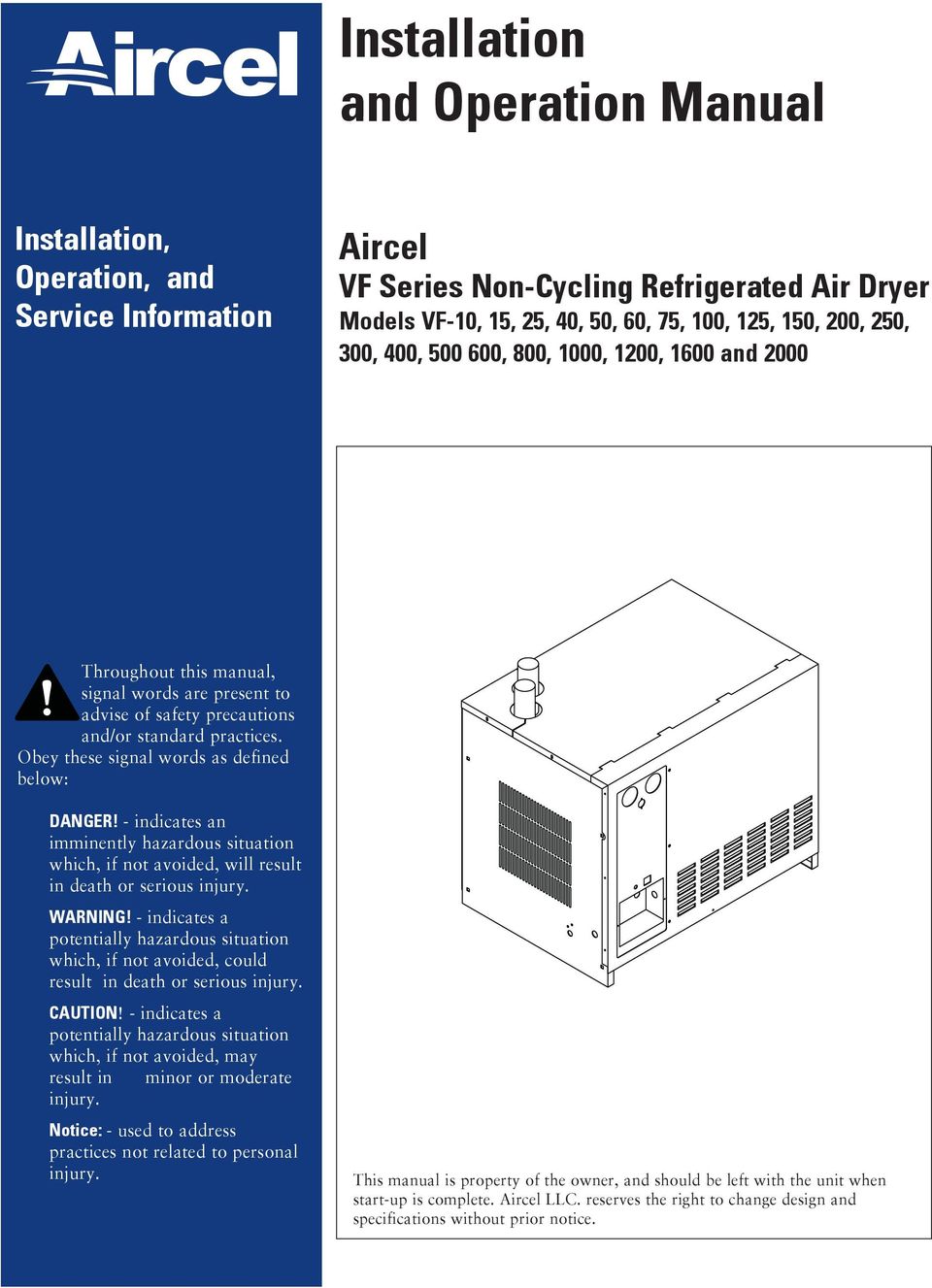
1 Installation and Operation Manual Installation, Operation, and Service Information Aircel VF Series Non-Cycling Refrigerated Air Dryer Models VF-10, 15, 25, 40, 50, 60, 75, 100, 125, 150, 200, 250, 300, 400, , 800, 1000, 1200, 1600 and 2000 Throughout this manual, signal words are present to advise of safety precautions and/or standard practices. Obey these signal words as defined below: DANGER! - indicates an imminently hazardous situation which, if not avoided, will result in death or serious injury. WARNING! - indicates a potentially hazardous situation which, if not avoided, could result in death or serious injury. CAUTION! - indicates a potentially hazardous situation which, if not avoided, may result in minor or moderate injury. Notice: - used to address practices not related to personal injury. This manual is property of the owner, and should be left with the unit when start-up is complete. Aircel LLC. reserves the right to change design and specifications without prior notice.
2 Aircel VF Series - Models WARNING! General Safety Procedures Improper installation, operation, or maintenance may contribute to conditions in the work area or facility that could result in personal injury and product or property damage. Check that all equipment is properly selected and sized for the intended use. Consult and comply with national and local codes relating to fire or explosion and all other appropriate codes when determining the location and operation of this equipment. Safe and efficient operation of the unit depends on proper installation. Authorities with jurisdiction should be consulted before installing to verify local codes and installation procedures. In the absence of such codes, install unit according to the National Electric Code, NFPA No. 70-latest edition. A qualified installation and service agent must complete installation and service of this equipment. DO NOT weld on / to pressure vessel or modify it in any way. DO NOT remove, modify, or adjust protective or safety devices. Lock out power supply and depressurize system before performing maintenance or service work. DO NOT operate the equipment with the control panel door open. Notice: For optimum performance, use only Aircel replacement parts. Notice: For optimum performance, use only original equipment replacement parts. Notice: For information and notes specific to a custom designed and built dryer, reference the drawing package provided with the unit. See warranty on manual back cover for custom engineered products. 2
3 Non-Cycling Refrigerated Air Dryer Contents Safety Statements... 2 Data Sheet... 4 Refrigerant Safety Precautions... 5 Design Parameters... 6 Description... 6 System... 6 Refrigeration Circuit... 7 Compressed Air Circuit... 7 Purpose and Intended Use... 9 Inspection on Arrival... 9 Lifting Information Installation Codes and Procedures Installation Typical Installation Preliminary Start-Up Checklist Automatic Drain Valve Adjustments Operating Procedure Air Cooled Condenser Requirements Cooling Water Requirements Water Cooled Condenser Table Shut-Down Procedures Shut-Down Emergency Short-Term Shut-Down Service Information Maintenance Troubleshooting Electrical Refrigeration Condensate Removal Other Troubleshooting Table Appendix R-134A Refrigerant MSDS R-404A Refrigerant MSDS Wiring Diagram Service Notes Warranty This manual contains specific precautionary statements relative to worker safety. Read thoroughly and comply as directed. Discuss the use and application of this equipment with a representative. Instruct all personnel on safe use and maintenance procedures. Understand and obey the following signal words used in this manual. DANGER! - indicates an imminently hazardous situation which, if not avoided, will result in death or serious injury. WARNING! - indicates a potentially hazardous situation which, if not avoided, could result in death or serious injury. CAUTION! - indicates a potentially hazardous situation which, if not avoided, may result in minor or moderate injury. Notice: - used to address practices not related to personal injury. 3
4 Aircel VF Series - Models Data Sheet Model Number Serial Number Date of Manufacture Ship Date Installation Date Customer Name Address Accessories Other 4
5 Non-Cycling Refrigerated Air Dryer Refrigerant Safety Precautions Refrigerant First Aid Recommendations CAUTION! Inhalation, Skin, & Eye Irritant Use proper safety and protective equipment, including chemical safety goggles or face shield and impervious gloves when handling refrigerants. Exercise care to ensure that liquid refrigerant does not come in contact with your skin or eyes. DO NOT SMOKE. Ventilation in work area must be adequate to keep the concentration of refrigerant below 1,000 ppm. System must be free of all refrigerant before any welding or brazing can be performed and must be done in a well ventilated area. Decomposition of refrigerants is hazardous! This material can be decomposed by high temperatures caused by an open flame. Hydrofluoric acid and possibly carbonyl fluoride can form in a liquid or gaseous state. Avoid exposure to these toxic fumes and irritating materials. Leave the work area immediately if you experience any of the following: smell something unusual, feel lightheaded, experience shortness of breath, feel a tingling sensation in your fingers or toes, suddenly feel warm or a rapid heartbeat. Inhalation If high concentrations are inhaled, immediately remove individual from affected area to an area with a fresh air supply. Keep individual calm. If not breathing, give artificial respiration or if having difficulty breathing, give oxygen and call for emergency services. Skin Contact In case of contact with the skin, immediately flush skin with clean water for at least 15 minutes. Treat for frostbite if necessary by gently warming affected areas and call for emergency services. Remove any contaminated clothing or shoes. Eye Contact In case of contact with the eyes, immediately flush eye(s) with clean water for at least 15 minutes and call for emergency services. 5

6 Aircel VF Series - Models Design Parameters Type of dryer: Refrigerated Power supply: 115, 230, 460 Volt / single or three phase / 60Hz Refrigerant type: R-134A (VF-10 - VF-1200 only) R-404A (VF VF-2000 only) All Models VF-10 - VF-2000 VF-10 - VF-1200 R-134A VF VF-2000 R-404A Chemical Composition: HFC Parameter Description Optimum Maximum Minimum Air Pressure (psig) Air Inlet Temperature ( F) Ambient Temperature ( F) Evaporation Temperature ( F) Suction Gauge Reading (psig) Discharge Gauge Reading (psig) Suction Gauge Reading (psig) Discharge Gauge Reading (psig) Description System The non-cycling refrigerated air dryer product covers the flow range listed on the manual front cover and provides reliable dew point performance in most flow conditions. Through optimization of critical dryer components heat exchanger, separator, and condensate removal the system ensures the highest performance at full- and partialload conditions. R-134a refrigerant is used in dryer models VF-10 through VF-1200 while R-404A is used in the VF-1600 and higher models. R-134a is a pure refrigerant providing consistent performance (zero temperature glide) and easy service (no mixture of different refrigerants). R-404A is a blend of three pure refrigerants: 52% R-143A, 44% R-125, and 4% R134A (by mass). This blend is nearly azeotropic meaning it has a negligible temperature glide. R404A is well suited to larger equipment as the higher operating pressures and improved heat transfer properties allow for smaller condensers, which leads to air dryers with smaller footprints. Hot saturated air enters the air-to-air heat exchanger of the Non-Cycling Refrigerated Air Dryer and is precooled by the outgoing dry air. Precooling saves energy by reducing the heat load on the dryer s compressor. The cool saturated air enters the air-to-refrigerant heat exchanger where air temperature is lowered to the 38 to 42 F range. This dramatic temperature drop condenses water and oil. The mixture of cold air and condensation then flows into the two-stage separator filter where liquids and contaminants are removed by centrifugal action, directional flow change, and velocity reduction. Once bulk liquids have been removed, the compressed air goes through a stainless steel mist eliminating filter that coalesces oil aerosols and oil vapors within the 50-micron range, and then separates and removes them. At this point, the compressed air is dry and virtually oil-free. Cold, dry air exits through the precooler heat exchanger and is reheated by incoming hot air. Reheating restores energy and also prevents condensation from forming on the outside of air distribution piping. In the refrigeration unit, the compressor pumps hot, high-pressure gaseous refrigerant to the condenser where it is cooled and liquefied by ambient air. From the condenser, liquid refrigerant first flows through the receiver, then through a filter/dryer, and finally through the expansion valve where pressure and temperature are reduced. This reduction in pressure causes the liquid refrigerant to boil until it reaches the saturation temperature that corresponds to its pressure. As the low-pressure refrigerant passes through the evaporator, heat flows from the compressed air to the refrigerant, causing the boiling to continue until all refrigerant is vaporized. Refrigerant gas is returned to the compressor and the cycle is repeated. A hot gas by-pass valve is used to control temperature in the evaporator. 6
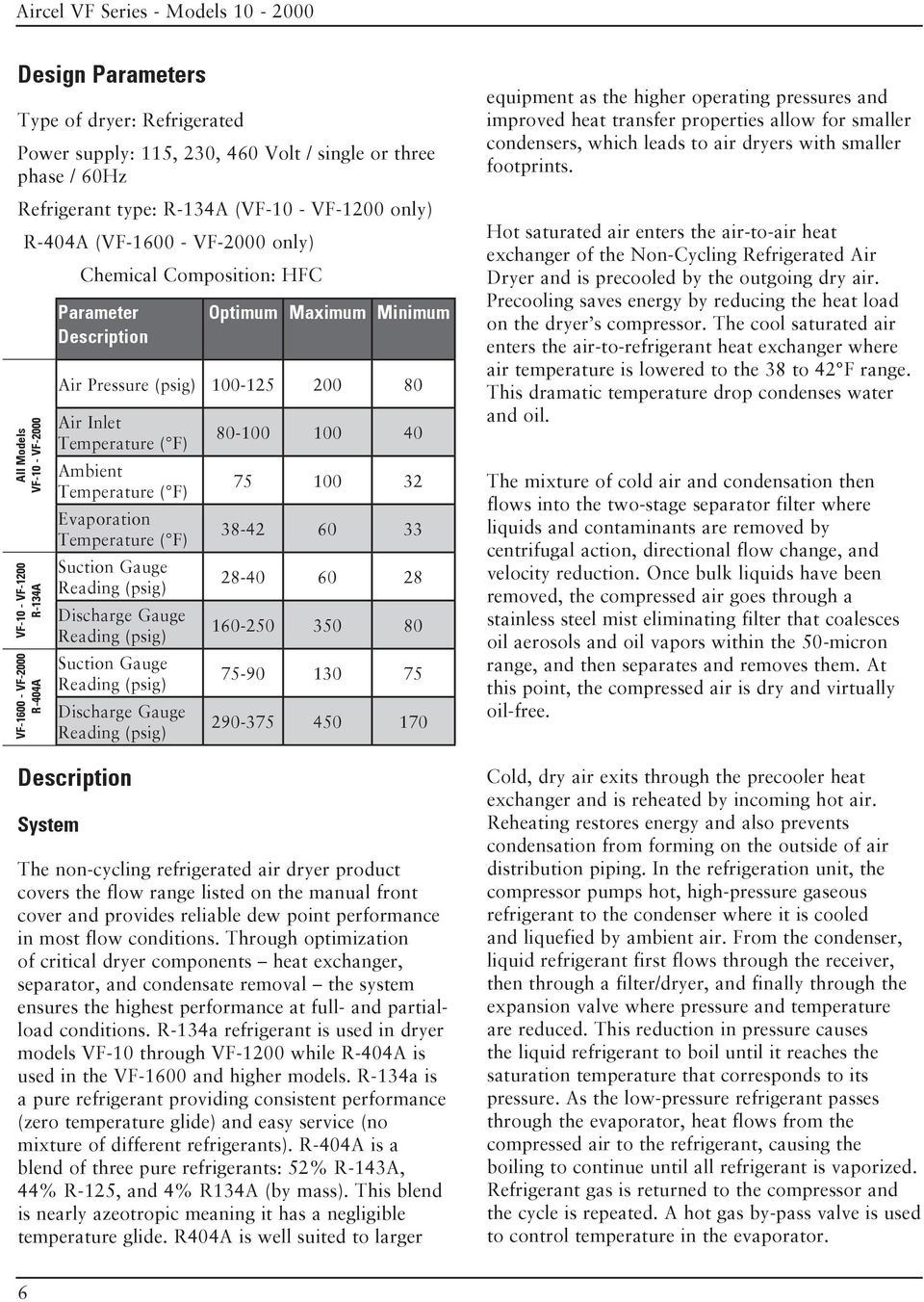
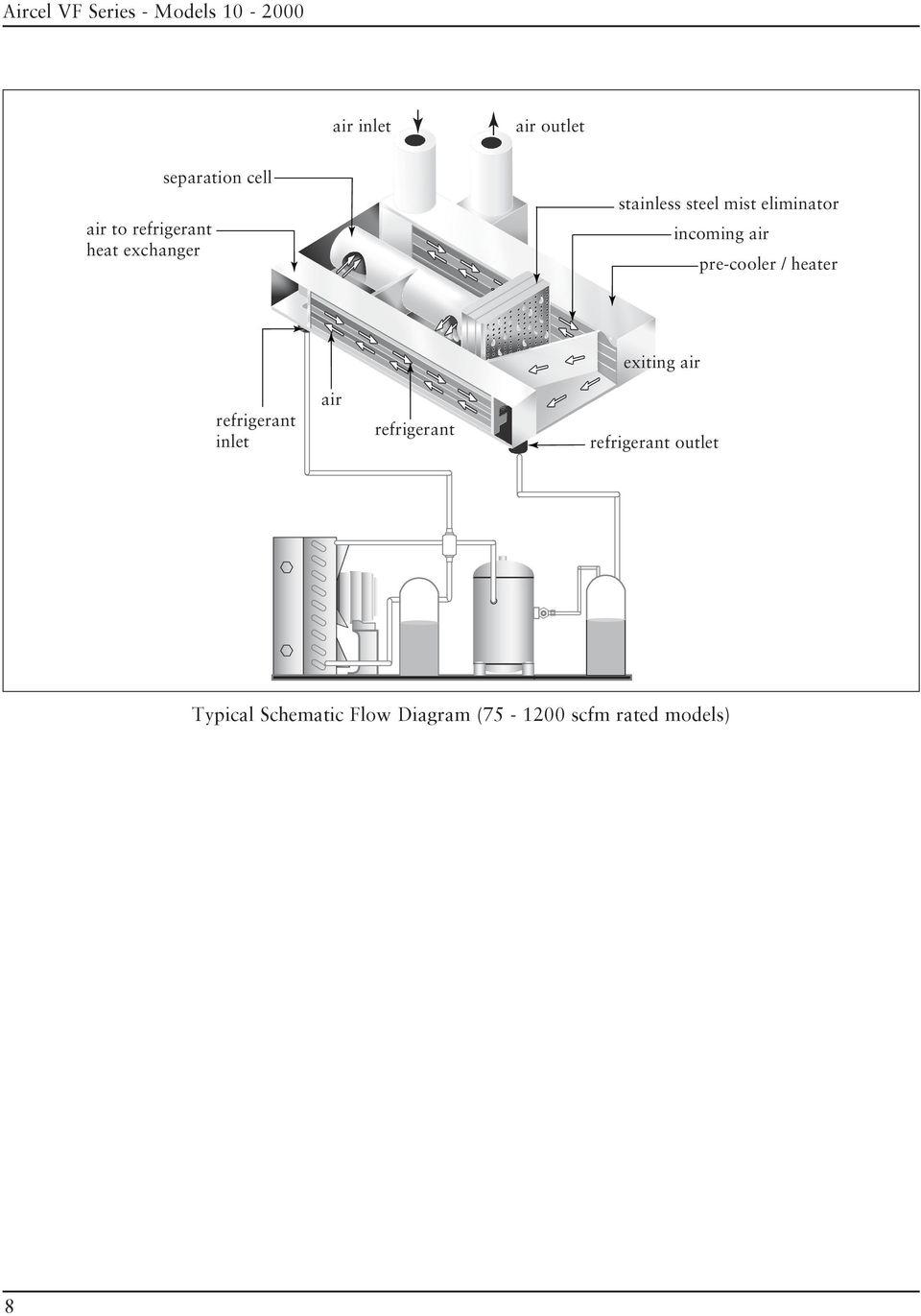
7 Non-Cycling Refrigerated Air Dryer Refrigeration Circuit Refrigerant is compressed by the compressor to a gas with high temperature and high pressure, which then travels to the condenser (air or water cooled) to condense the gas into a liquid. Liquid travels to the evaporator (refrigerant-to-air part of the heat exchanger) and back to the compressor suction side. The process then repeats. A thermal expansion hot gas by-pass valve is used on the non-cycling dryers as a freeze protector in low load conditions (200 scfm rated models [1 HP] and up). Compressed Air Circuit The compressed air dryer circuit uses a patented air-to-air heat exchanger, which acts as a precooler/ reheater (scfm rated models 75 and up). Hot, saturated, compressed air first enters the air-to-air heat exchanger, where it is pre-cooled by outgoing air from the air-to-refrigerant heat exchanger. This energy saving heat exchanger provides several advantages, such as a reduction of the heat load imposed on the refrigerant compressor and condenser, providing more energy to the outlet air, and preventing condensation of moisture on the outside of the plant distribution air line piping. From the air-to-air heat exchanger, air will enter into the evaporator further reducing its temperature to a desired pressure dew point. As the air is cooled, moisture is condensed, separated, and discharged through the condensate drain. The cooled air then reenters the air-to-air heat exchanger, in a direction opposite to the flow of the warm, saturated incoming air. This counter flow action assures high temperature differential throughout the heat exchanger, resulting in a more effective heat transfer. refrigerant outlet air out air in refrigerant inlet Air to Refrigerant Heat Exchanger Refrigerant Circuit suction accumulator compressor liquid receiver air cooled condensor Typical Schematic Flow Diagram (10-60 and scfm rated models) 7
![A thermal expansion hot gas by-pass valve is used on the non-cycling dryers as a freeze protector in low load conditions (200 scfm rated models [1 HP] and up).](/docs-images/46/21586262/images/page_7.jpg "Compressed Air Circuit The compressed air dryer circuit uses a patented air-to-air heat exchanger, which acts as a precooler/ reheater (scfm rated models 75 and up).")
8 Aircel VF Series - Models air inlet air outlet air to refrigerant heat exchanger separation cell stainless steel mist eliminator incoming air pre-cooler / heater exiting air refrigerant inlet air refrigerant refrigerant outlet Typical Schematic Flow Diagram ( scfm rated models) 8
9 Non-Cycling Refrigerated Air Dryer Purpose and Intended Use Non-cycling refrigerated air dryers are designed to remove moisture from compressed air by use of mechanical refrigeration. They can provide pressure dew points as low as (38 F- 42 F). Referigerated dryers are used to protect industrial compressed air systems, machinery, and tools. To ensure maximum performance and safe operation of this dryer, everyone associated with its installation, operation, and maintenance must read, understand, and follow the instructions of this manual. CAUTION! Do not misuse or modify under any conditions. Misuse or modification of this equipment may result in personal injury. Inspection on Arrival All non-cycling refrigerated air dryers are tested and operated before shipment. However, shipping stresses have the potential to cause damage to the unit. To ensure smooth installation, it is recommended that immediately upon receipt of the unit, the system is checked for the following: 1. Report any damage to the delivery carrier. 2. Request a written inspection report from the Claims Inspector to substantiate the claim. 3. File claims with the delivery carrier. 4. Compare unit received with description of product ordered. Check the serial plate label and make sure that it is the correct Model was ordered. Note the equipment Capacity and Power Supply requirements and ensure that they are in accordance with your specifications. The rated conditions of the dryer are indicated on the serial plate label. If there is any discrepancy, contact your representative listed on the manual back cover. 5. Shipping stresses can loosen connections. All pipe and tubing connections should be inspected. 6. Observe pressure of refrigerant suctions gauge to determine if refrigerant has leaked during transit. If the gauge reading does not match that mentioned on the serial plate label, immediately contact Technical Support listed on the manual back cover. 7. Report incomplete shipments to the delivery carrier and your service representative. 9

10 Aircel VF Series - Models Lifting Information 1. Use all lifting points provided. Special care must be used when lifting the dryer to prevent tipover. 2. Use clevis connectors, not hooks, on lifting slings. 3. Only lift unit under support frame/base by using the fork lift openings provided. Do not lift by piping. 4. Check the approximate weight provided on the specification control drawing to ensure adequate lift truck capacity. 5. Allow only qualified operators to lift the equipment. 6. Refer to applicable OSHA regulations and local codes when using cranes, forklifts, and other lifting equipment. WARNING! Failure to lift the unit correctly can result in severe personal injury or property damage. Use appropriate lifting equipment and adopt all safety precautions needed for moving and handling the equipment. A hand cart, forklift or crane is recommended for unloading and installation. Lift unit by lifting lugs and frame only. Do not lift by piping. Installation Codes and Procedures WARNING! Follow proper lock out/tag out procedures before performing service or maintenance work. Electrical installation must be performed by a qualified electrician and comply with all applicable national and local codes. 1. Safe and efficient operation of the unit depends on proper installation. 2. Authorities with jurisdiction should be consulted before installing to verify local codes and installation procedures. In the absence of such codes, install unit according to the National Electric Code and NFPA No. 70-latest edition. 3. A qualified installation and service agent versed in all regulatory codes must complete installation of this unit. CAUTION! A copy of the Operation Manual must be made available to all personnel involved with the installation, operation and maintenance of the equipment, to avoid injury to personnel or property damage. Appropriate tools must be used for all installation and maintenance work, to avoid injury to personnel or property damage. 10
11 Non-Cycling Refrigerated Air Dryer Installation 1. Locate unit on a level foundation. Dryer should be mounted on a suitably structured flat and level floor or base that is free from vibration. 2. Install unit to provide adequate clearance for maintenance services. Dryer and accompanying filters should be installed with at least 2 to 5 feet clearance from the adjoining walls to provide easy access for routine maintenance and adequate air flow across the condensing coil. 3. The frame or cabinet must be securely bolted to the foundation to prevent movement resulting from earth tremors and induced piping vibration. 4. Install unit using the correct pipe size and pressure rating. See drawing package provided with the unit. Connect the inlet of the dryer to the moist gas from the inlet filter. Install the inlet piping and the inlet shutoff valve. Install the outlet piping and the outlet shutoff valve (a union with a valve by-pass can be installed at the inlet and outlet valves to accommodate isolation of the dryer for maintenance). Compressed air piping has to be at least the same size as that of the inlet and outlet connections of the dryer. Larger pipe sizes can be used with appropriately rated reducers. Operation at elevated pressure or temperature may cause damage to the dryer or serious injury to personnel. Each dryer is checked at the factory for proper operation at the conditions noted on the serial plate label. 5. Provide adequate power supply. See Design Parameters section. Make all electrical connections to the dryer as shown on the wiring diagram. Special care must be taken in connecting the proper voltage as indicated on the specification sheet and wiring schematic. It is mandatory that the dryer be grounded. Use of your plant s frame as a ground may cause problems with the controls. A fused disconnect is not supplied with this equipment; therefore, one must be supplied by customer. All electrical fuses, breakers, etc. should be sized by a qualified electrician and comply with all applicable national and local codes. Our company is not liable for any code violations, component damage, downtime or consequential damage related to customer supplied electrical components and connections. 6. The ambient temperature should be between 45 F and 100 F. Low temperature could affect the dryer process and result in high outlet dew point. In conditions where the ambient drops below freezing, it is recommended that a heat trace be used for the equipment. This will ensure trouble-free operation during the winter months (the dew point of the outlet air will be consistent). *In some cases, a head pressure control valve may be needed. (optional) 7. Do not place the system in service until the above steps have been completed and that all ratings and specifications have been verified to match the requirements in the drawing package supplied with the unit. 8. If there are any changes in the operating conditions of the system from those published in this manual, contact Technical Support. 11

12 Aircel VF Series - Models Typical Installation Typical Installation Preliminary Start-Up Checklist Notice: For scfm rated models , wait at least 6 hours after transporting or moving of dryer system before starting the dryers. Turn the main power switch to the dryer on, but do not turn the dryer on/off switch to the on position until 6 hours have passed. For scfm rated models 300 and larger, ensure that the power switch is in the off position, but the electrical service to the dryer is energized. This dryer must be in this mode for at least twelve (12) hours to allow the compressor crankcase heater to energize and evaporate any liquid refrigerant from the compressor. After twelve (12) hours, turn ON the power switch of the dryer. The power indicating light should turn ON. 1. Check that the inlet and outlet connections are the correct size and pressure rating, and tightened securely. 2. Check that the correct power supply is connected to the non-cycling refrigerated air dryer system with an adequate disconnect switch. 3. Check that all compressed air line service valves are open and that compressed air is available to be supplied to the non-cycling refrigerated air dryer system. 4. Check that all liquid drain service valves are open. This is to ensure that any residual bulk condensate that may have accumulated in the compressed air lines is discharged immediately upon start up. These drains must be closed once system is brought on line for use. The drain valve on the refrigerated air dryer can be opened by pushing the test button located on the drain body. 12

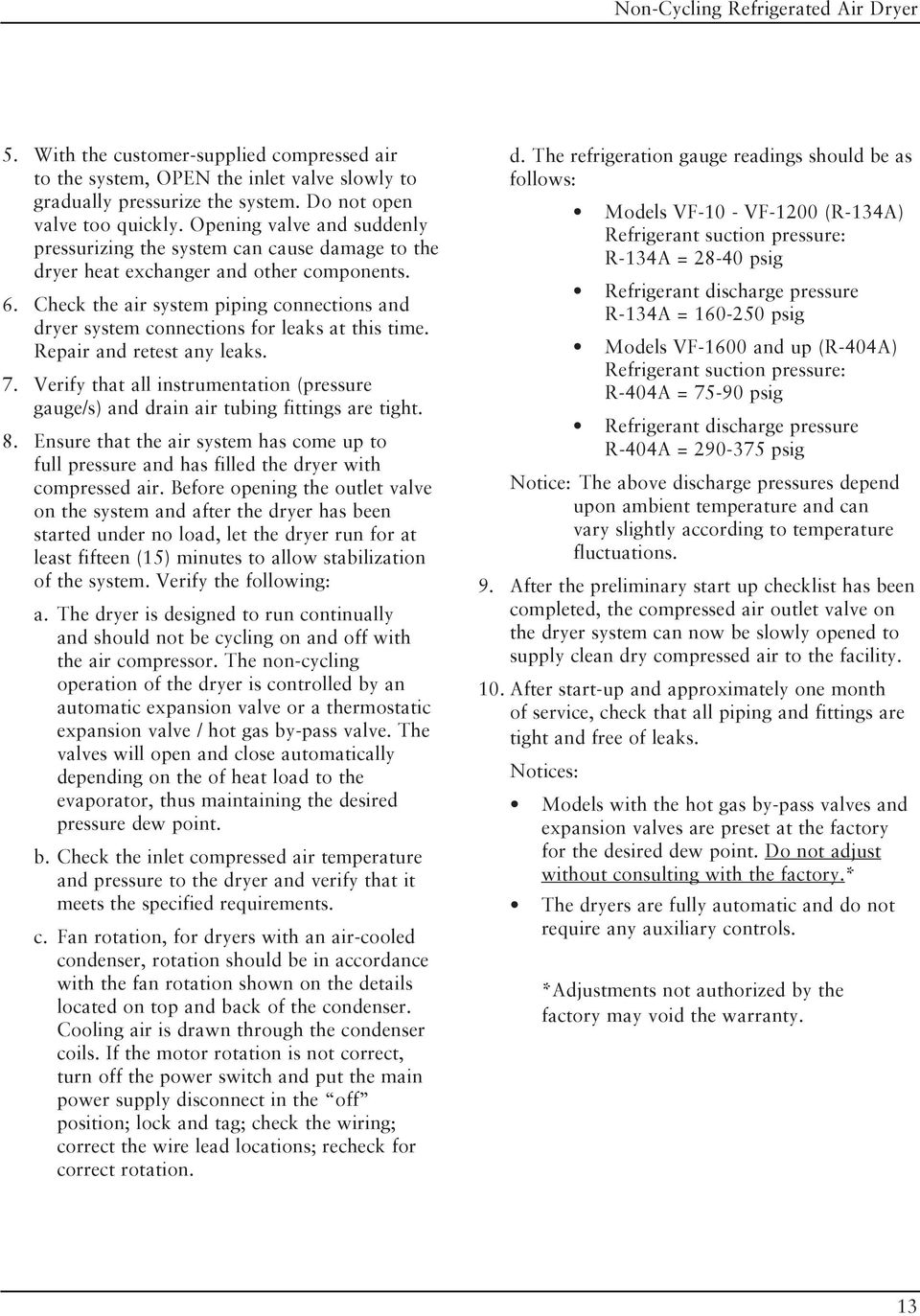
13 Non-Cycling Refrigerated Air Dryer 5. With the customer-supplied compressed air to the system, OPEN the inlet valve slowly to gradually pressurize the system. Do not open valve too quickly. Opening valve and suddenly pressurizing the system can cause damage to the dryer heat exchanger and other components. 6. Check the air system piping connections and dryer system connections for leaks at this time. Repair and retest any leaks. 7. Verify that all instrumentation (pressure gauge/s) and drain air tubing fittings are tight. 8. Ensure that the air system has come up to full pressure and has filled the dryer with compressed air. Before opening the outlet valve on the system and after the dryer has been started under no load, let the dryer run for at least fifteen (15) minutes to allow stabilization of the system. Verify the following: a. The dryer is designed to run continually and should not be cycling on and off with the air compressor. The non-cycling operation of the dryer is controlled by an automatic expansion valve or a thermostatic expansion valve / hot gas by-pass valve. The valves will open and close automatically depending on the of heat load to the evaporator, thus maintaining the desired pressure dew point. b. Check the inlet compressed air temperature and pressure to the dryer and verify that it meets the specified requirements. c. Fan rotation, for dryers with an air-cooled condenser, rotation should be in accordance with the fan rotation shown on the details located on top and back of the condenser. Cooling air is drawn through the condenser coils. If the motor rotation is not correct, turn off the power switch and put the main power supply disconnect in the off position; lock and tag; check the wiring; correct the wire lead locations; recheck for correct rotation. d. The refrigeration gauge readings should be as follows: Models VF-10 - VF-1200 (R-134A) Refrigerant suction pressure: R-134A = psig Refrigerant discharge pressure R-134A = psig Models VF-1600 and up (R-404A) Refrigerant suction pressure: R-404A = psig Refrigerant discharge pressure R-404A = psig Notice: The above discharge pressures depend upon ambient temperature and can vary slightly according to temperature fluctuations. 9. After the preliminary start up checklist has been completed, the compressed air outlet valve on the dryer system can now be slowly opened to supply clean dry compressed air to the facility. 10. After start-up and approximately one month of service, check that all piping and fittings are tight and free of leaks. Notices: Models with the hot gas by-pass valves and expansion valves are preset at the factory for the desired dew point. Do not adjust without consulting with the factory.* The dryers are fully automatic and do not require any auxiliary controls. *Adjustments not authorized by the factory may void the warranty. 13
14 Aircel VF Series - Models Automatic Drain Valve Adjustments The automatic drain valve supplied is standard on the separator and should open regularly and discharge any accumulated water into the drain line. The period between openings varies with the dryer and operating conditions (electronic type). To minimize air losses, the timer should be adjusted to open the drain solenoid just long enough to discharge the accumulated condensate. The factory sets the automatic drains to open for 7 seconds about every 7 minutes. If more than two seconds of dry air comes out at the end of every discharge cycle, reduce the open time (seconds) or increase the interval of the discharge (minutes) to minimize air loss. If liquid is still being discharged when the discharge cycle stops, increase the open time (seconds) or shorten the interval of discharges (minutes) so it discharges more often. Operating Procedure After the initial startup, the dryer operation is completely automatic. To understand the details of the operation, see the flow diagram on pages 7 and 8. Air Cooled Condenser Requirements Cooling air must be drawn from a clean source to reduce dust and dirt accumulation on the condenser coils. Air temperature should not exceed 100 F (38 C). Model by SCFM Rating Refrigeration Hp Cooling air flow (cfm) 10, 15, 25 1/ , 50 1/ , 75 1/ / , 150 3/ , / , / ,

15 Non-Cycling Refrigerated Air Dryer Cooling Water Requirements (water cooled condensing units) Cooling water is required for water-cooled refrigerant condensers. The user is responsible for piping the water to and from the condenser. The required water flow rate depends on the water temperature. A water-regulating valve (supplied with the dryer) automatically adjusts the flow to compensate for variation in water temperature, water pressure, and dryer air load. The table below indicates the amount of cooling water required in gallons per minute (gpm) at given incoming temperatures for the condenser Hp size in each model. The refrigerant discharge pressure control will shut down the refrigerant compressor if cooling is inadequate. Water Cooled Condenser Requirements Table Incoming Water Flow Rate Requirements (in gpm at different inlet water temperatures) Model by SCFM Rating Condenser Hp 70 F 80 F 85 F 90 F 100 1/ CF 125, 150 3/ CF CF 250, / CF CF 500, / CF CF 1000, CF CF CF (CF) - Consult Factory Notices: Water cooled condensers are pre-set at the factory for city water usage. Water regulating valve may need to be adjusted to other water supply conditions. Contact technical support for assistance. Minimum water pressure is 25 psig for city water and 35 psig for tower water. Cooling water pressures less than these minimums may reduce dryer drying capacity. Maximum water pressure is psig. 15

16 Aircel VF Series - Models Shut-Down Procedures WARNING! To avoid possible hazard or injury, the operator should be fully familiar with the refrigerated air dryer system and its operation. When the system is shutdown and power removed, lock out power supply and depressurize system before performing maintenance or service work to avoid injury to personnel or property damage. Shut-Down Emergency The non-cycling refrigerated air dryer system can be shut down under any conditions and at any time by turning the unit off at the dryer or at the main disconnect switch. Once power is removed from the dryer system, the dryer must be isolated from the compressed air stream to avoid a refrigeration circuit over pressure situation. Short-Term Shut-Down (over night or weekends) The refrigerated air dryer system can be shut down at any time by turning the unit off at the dryer by using the on/off switch or at the main disconnect switch. 16
17 Non-Cycling Refrigerated Air Dryer Service Information To reach a field service technician or for technical support, please call the number on the manual back cover. Maintenance Refrigerated air dryers require very little maintenance for satisfactory operation. Optimum performance can be expected if the following routine maintenance steps are taken. WARNING! Before any service or maintenance work is performed on the refrigerated air dryer system, disconnect power supply and lock out power supply and depressurize system before performing maintenance or service work. Follow proper lock out/tag out procedures before performing service or maintenance work. Prior to performing any maintenance on the dryer, all personnel are strongly advised to familiarize themselves with the equipment by reading the entire contents of this operation manual. Follow all safety procedures prior to performing any maintenance activity on the dryer. Daily With the dryer on-line: Verify the operating pressure, temperature, and flow rate are correct and conform to those listed in the Design Parameters section. Adjust system if required. Always check refrigerant gauges to insure refrigeration system is working properly. Check condensate drain separator for proper condensate discharge. If no discharge is evident then depressurize the unit, dismantle and clean separator and/or drain line. Proper drain trap maintenance is the owner s responsibility. It is not covered by warranty. Make certain airflow is directed through dryer only. Observe by-pass valves proper positions. Weekly Repeat all daily inspections and record data in the maintenance log. Clean the condenser coils of accumulated dust and dirt with a soft brush and/or with air pressure from a compressed air nozzle (maximum 100 psig). Check the gauge readings for optimum system operation. Check oil removal filter (coalescer) indicator (if applicable); if it is red, replace the filter. 17

18 Aircel VF Series - Models Filter Element Replacement 1. Depressurize the air system to release the compressed air from the air dryer. Notice: Shutting down the air compressor will not depressurize the air dryer unit. Close air line valves before and after dryer and then depressurize unit. Depressurize dryer by pushing the test button on the dryer system drain until there is no more pressure in the dryer system. 2. Remove the filter bowl by turning the bowl 1/4 turn counter clockwise, be sure the O-ring is in place on the top half of the oil filter housing and that the O-ring seats properly. Air leaks may occur if the O-ring is not secured (important). 3. The same procedure applies when removing the filter separator for changing the element (if applicable). 18
19 Non-Cycling Refrigerated Air Dryer Troubleshooting Electrical WARNING! Before any service or maintenance work is performed on the refrigerated air dryer system, disconnect power supply and lock out power supply and depressurize system. Follow proper lock out/tag out procedures before performing service or maintenance work. Prior to performing any maintenance on the dryer, all personnel are strongly advised to familiarize themselves with the equipment by reading the entire contents of this operation manual. Follow all safety procedures prior to performing any maintenance activity on the dryer. If there is a problem with the refrigerated air dryer or contamination down stream is present, the problem may be identified from one or more of the following sources: Electrical Refrigeration Condensate removal (drains) Other Make certain that the dryer is connected to proper power supply in accordance with electrical diagram provided. Check electrical breaker, fuse, or disconnect to determine if there is electrical power to the unit. A quick check should determine if the power switch is turned on and the unit is running. After determining that power is supplied to the unit, go to the next step. Refrigeration WARNING! Follow proper lock out/tag out procedures before performing service or maintenance work. Electrical installation or maintence must be performed by a qualified electrician and comply with all applicable national and local codes. WARNING! Refrigerant handling must be performed by a qualified technician and all applicable national and local codes must be followed. Notice: Always observe refrigerant pressure gauge(s) to determine if and how refrigeration circuit is operating. Non-cycling refrigerated air dryers with R-134a refrigerant should have a suction gauge pressure reading of psig and a discharge gauge pressure reading of psig with the unit in the on position under full or partial load. If the refrigerant gauge(s) reads more or less than the above specified pressures, troubleshoot items on the following page. 19

20 Aircel VF Series - Models High refrigerant readings generally indicate: Dirty condenser - Clean immediately! Dryer not turned on. Overloading - Airflow or conditions in excess of dryer capacity. High ambient temperature (> 100 F) Provide adequate ventilation for proper cooling, or reduce ambient temperature. Condenser fan(s) not running - Call Technical Support. Refrigerant control too high - Contact technical support for assistance. 2. Low refrigerant readings generally indicate: Low ambient temperature - Temperatures below 40 F. Increase ambient temperatures or install head pressure control valve. Contact technical support for more information. Refrigerant control setting too low - Contact technical support for assistance. Loss of refrigerant - Call Technical Support or qualified refrigeration service. Condensate Removal The non-cycling refrigerated air dryer uses a refrigeration circuit to cool the compressed air which causes moisture to condense. The condensed moisture is separated from the dry air and purged through an automatic drain. 1. Condensate downstream of dryer: If the unit is equipped with automatic drain override switch, push manual override button to test drain flow. Ensure automatic electronic timer (if applicable) is functioning properly. Ensure moisture separator (and coalescer) drain lines are free from blockage. Other If the unit is equipped with y-strainer, disassemble and clean. If oil is downstream from the dryer: - Oil coalescer element is saturated. - Dryer not turned on during air usage. WARNING! Before any service or maintenance work is performed on the refrigerated air dryer system, disconnect power supply and lock out power supply and depressurize system before performing maintenance or service work. Sometimes a water or oil problem downstream from the dryer can be identified by an inadvertent action or inaction by the operator. Dryer not turned on before air usage. By-pass valves in wrong position. Air usage exceeding dryer capacity. Oil coalescer element dirty. Automatic drains not maintained. 20

21 Non-Cycling Refrigerated Air Dryer Troubleshooting Table Problem Probable Cause Remedy Water downstream of dryer system or no discharge from separator/ filter. Failed or short circuited timer on drain. Failed drain solenoid. Bulk liquid entering the dryer from upstream. Inlet compressed air temperature to dryer exceeds dryer capacity air. Replace timer drain. Replace timer drain. Check drains on after cooler or air compressor. Check inlet air temperature and adjust as required to meet specifications. Inlet compressed air CFM flow rate exceeds dryer capacity. Check in inlet air cfm flow rate and adjust as required to meet specifications. Water downstream and dryer system not working properly. Leak in the air to air side of the heat exchanger. Refrigeration compressor stopped due to plugged or dirty condenser coil. (High Pressure) Refrigeration compressor cycles on/off and cannot maintain suction pressure. Low refrigerant. Low refrigerant, possible leak in air to refrigerant side of heat exchanger. Replace heat exchanger. Clean condensing coil and ensure adequate ventilation of unit. Check condensing coil for dirt or debris that could prohibit adequate ventilation of the refrigerant circuit. If it is clean, check refrigerant pressure gauge(s) to determine if the unit is low on refrigerant. Check for leak in refrigeration circuit, repair and recharge according to specifications. Repair or replace heat exchanger and recharge according to specifications. Refrigeration compressor is overheated. Refrigeration compressor has burned out or windings have gone to ground. Turn off dryer and wait minutes, restart dryer. Refrigerant control settings may need adjustment, contact technical support. Replace compressor, check for leak in refrigeration circuit, repair and recharge according to specifications, contact technical support. 21
22 Aircel VF Series - Models Troubleshooting Table, continued Problem Probable Cause Remedy Water downstream and dryer system not working properly or not working (Cont). Refrigeration compressor cycles on/off and cannot maintain suction pressure, dryer undersized. Shorted fan motor winding. Fan motor overload or unit short cycling. Defective overload protectors (fuses or breakers). Check airflow (cfm) and dryer capacity. Reduce airflow through dryer or replace with a larger rated cfm dryer. Check fan motor with ohmmeter and refer to motor specifications for correct value. Check wiring schematic to ensure proper wiring of fan motor. Replace motor if required. Check circuitry against electrical schematic (wiring diagram). Check for high refrigerant pressure or for high ambient temperature. Check overload protectors and replace if necessary. Low air pressure downstream or high pressure drop across the dryer system. *Notice: To confirm freeze-up, shut system off for 20 min and allow to thaw. Air pressure in line should come back to normal pressure. Low voltage or 3-phase imbalance. Low water flow or pressure to water-cooled condenser. Defective fan control cycling switch. Optional pre-filter element dirty or plugged. Suction pressure below set point which causes freezing in the dryer heat exchanger. Suction pressure below set point which causes freezing in the dryer heat exchanger.* Incorrect sizing or restriction in compressed air line piping. Check incoming power supply, voltage must be within 8-12% of rating on the serial plate label. Check water flow and/or pressure and adjust according to specifications. Contact technical support for assistance Replace fan control cycling switch. Replace filter element. Refrigeration controls may require adjustment, contact technical support for assistance. Refrigeration circuit low on refrigerant, locate leak in refrigeration circuit, repair and recharge according to specifications. Check compressed air piping for restrictions. Check piping size to verify if it has the capacity to handle the rated scfm at present working pressure of compressed air system. 22
23 Non-Cycling Refrigerated Air Dryer Problem Probable Cause Remedy Low air pressure downstream due to continuous air flow through the moisture drain line. Failed or short circuited timer on drain. Replace timer drain. Failed drain solenoid. Replace timer drain. Noise or vibration coming from refrigerated air dryer system. Solenoid valve stuck open. Shipping damage has caused compressor mounting to loosen. If power is off and the air stops leaking, replace the timer drain. If power is off and air continues leaking, clean the timer drain. Check all mounting bolts on compressor and tighten. Cabinet panels or support beams loosened during shipping. Check all screws and bolts on dryer system and tighten. Loose mounting bolts, bent fan blade or worn bearings on condenser fan motor. Tighten bolts, straighten or replace fan blade or replace motor. Noise coming from refrigeration compressor due to liquid refrigerant in compressor - caused by shipping or moving of dryer. Let dryer system sit for six hours to allow refrigerant to settle out of compressor and to allow crankcase heater to warm compressor. Timer drain stuck open. Failed or dirty timer drain. If power is off and the air stops leaking, replace the timer drain. If power is off and air continues leaking, clean the timer drain. 23
24 Aircel VF Series - Models Troubleshooting Table, continued Problem Probable Cause Remedy High Refrigeration Circuit Head Pressure (compressor is overloaded and gauge is reading out of recommended pressure range). Refrigeration condenser coil fouled or dirty or air flow blocked. Condenser fan motor not working properly. Defective fan control switch. Clean / blow off condensing coil of dirt or debris from the inside out. Clear area in front of condensing coil of any items blocking airflow to coil. Check fan motor for proper voltage and amp draw, repair or replace fan motor. Repair switch or replace. Low Refrigeration Circuit Head Pressure (gauge is reading out of recommended pressure range). 24 Ambient temperature too high at refrigeration dryer location. Compressed air temperature entering the refrigeration dryer is too high. Faulty heat exchanger, compressed air leaking into refrigeration circuit. Ambient temperature too low at refrigeration dryer location. Refrigeration dryer circuit low on refrigerant. Refrigeration compressor not working properly or faulty. Compressed air temperature to refrigeration dryer too low. Cool ambient temperature around location of refrigeration dryer down to a maximum of 100 F or relocate dryer to a different area with lower ambient temperature. Check compressed air inlet temperature to ensure it is within the operating parameters listed in the Design Parameter section. Check air compressor after cooler for proper operation. Repair or replace evaporator or heat exchanger and recharge with refrigerant. Increase ambient temperature at refrigeration dryer location or relocate dryer. Head pressure control valve may be required for low ambient use. Contact technical support for assistance. Refrigeration circuit low on refrigerant, locate leak in refrigeration circuit, repair and recharge according to specifications. Check refrigeration compressor for proper voltage and amp draw, repair or replace refrigeration compressor. The inlet compressed air temperature must be higher than 40 F. If compressed air temperature is lower than 40 F, turn refrigerated air dryer off. Air may pass through the dryer under this condition, once the compressed air temperature has increased to 44 F the dryer must be turned back on to avoid a high refrigerant pressure situation.
25 Non-Cycling Refrigerated Air Dryer Problem Probable Cause Remedy High refrigerant suction pressure, suction gauge reading out of range and water downstream of refrigeration dryer. Refrigeration circuit hot gas bypass valve out of adjustment or defective. Contact technical support for assistance. Refrigeration expansion valve or TXV adjustment fitting out of adjustment. Contact technical support for assistance. Low refrigerant suction pressure, suction gauge reading out of range and/ or refrigeration compressor covered with ice. Refrigeration circuit hot gas bypass valve out of adjustment or defective. Contact technical support for assistance. Refrigeration expansion valve or TXV adjustment fitting out of adjustment and is not feeding enough refrigerant to the evaporator. Excessive pressure drop on the high side of the refrigeration circuit. Contact technical support for assistance. Check for a plugged in line filter dryer or receiver on the refrigeration circuit that could be causing these restrictions. Compressor oil downstream of refrigerated air dryer. Check optional prefilter condensate drain for failure. Failed or plugged prefilter element. Dismantle prefilter drain and clean or replace. Check optional prefilter and replace element. Air compressor injecting excessive oil into the airstream. Check air compressor for oil leak into the air stream, check air oil separator element for failure. 25
26 Aircel VF Series - Models Appendix Refrigerant Material Safety Data Sheet - R-134A (VF-10 - VF1200) MATERIAL SAFETY DATA SHEET Prepared to U.S. OSHA, CMA, ANSI and Canadian WHMIS Standards 1. PRODUCT IDENTIFICATION CHEMICAL NAME; CLASS: NON-FLAMMABLE GAS MIXTURE Containing One of the Following Components in a Nitrogen or Air Balance Gas: Dichlorodifluoromethane, %; Trichlorofluoromethane, %; 1,1,2-Trichloro-1,1,2-trifluoroethane, %; Tetrafluoroethane, % SYNONYMS: Not Applicable CHEMICAL FAMILY NAME: Not Applicable FORMULA: Not Applicable Document Number: Note: The Material Safety Data Sheet is for this gas mixture supplied in cylinders with 33 cubic feet (935 liters) or less gas capacity (DOT - 39 cylinders). This MSDS has been developed for various gas mixtures with the composition of components within the ranges listed in Section 2 (Composition and Information on Ingredients). Refer to the product label for information on the actual composition of the product. PRODUCT USE: Calibration of Monitoring andresearch Equipment SUPPLIER/MANUFACTURER'S NAME: CALGAZ, LLC ADDRESS: 821 Chesapeake Drive Cambridge, MD EMERGENCY PHONE: CHEMTREC: BUSINESS PHONE: General MSDS Information 1-713/ Fax on Demand: 1-800/ COMPOSITION and INFORMATION ON INGREDIENTS CHEMICAL NAME CAS # mole % EXPOSURE LIMITS IN AIR Dichlorodifluoromethane (Freon 12) Trichlorofluoromethane (Freon 11) ACGIHTLV OSHA-PEL NIOSH OTHER TWA STEL TWA STEL IDLH ppm ppm ppm ppm ppm ppm % 1000 NE 1000 NE 15,000 NIOSH REL:TWA = 1000 DFG MAKs:TWA = 1000 PEAK = 2 MAK 15 min., average value,1 hr interval DFG MAK Pregnancy Risk Classification: C Carcinogenicity: TLV-A % NE 1000 (ceiling) [ceiling] (Vacated 1989 PEL) 2000 NIOSH REL: STEL = 1000 (ceiling) DFG MAKs: TWA = 1000 PEAK = 2 MAK, 15 min., average value, 1 hr interval DFG MAK Pregnancy Risk Classification: C Carcinogenicity: TLV-A4 CHEMICAL NAME CAS # mole % EXPOSURE LIMITS IN AIR ACGIHTLV OSHA-PEL NIOSH OTHER TWA STEL TWA STEL IDLH ppm ppm ppm ppm ppm ppm 1,1,2-Trichloro-1,1,2- trifluoroethane (Freon 113) 1,1,1,2- Tetrafluoroethane (HFC-134a) Nitrogen or Air % (Vacated 1989 PEL) 2000 NIOSH RELs:TWA = 1000 STEL = 1250 DFG MAKs:TWA = 500 PEAK = 2 MAK 15 min., average value, 1 hr interval Carcinogenicity: TLV-A % NE NE NE NE NE DFG MAKs:TWA = 1000 PEAK = 8 MAK 15 min., average value, 1 hr interval DFG MAK Pregnancy Risk Classification: C Balance There are no specific exposure limits for Nitrogen. Nitrogen is a simple asphyxiant (SA). The composition of Air is as follows: 79% Nitrogen and 21% Oxygen. These components and their concentrations have been incorporated into this MSDS. There are no specific exposure limits for Oxygen. Oxygen levels should be maintained above 19.5%. NE = Not Established. See Section 16 for Definitions of Terms Used. NOTE (1): ALL WHMIS required information is included in appropriate sections based on the ANSI Z format. This gas mixture has been classified in accordance with the hazard criteria of the CPR and the MSDS contains all the information required by the CPR. NON-FLAMMABLE GAS MIXTURE MSDS EFFECTIVE DATE: APRIL 19, 2005 PAGE 1 OF 5 26
27 Non-Cycling Refrigerated Air Dryer 3. HAZARD IDENTIFICATION EMERGENCY OVERVIEW: This gas mixture is a colorless, odorless gas. Releases of this gas mixture for which Nitrogen is the balance gas may produce oxygen-deficient atmospheres (especially in confined spaces or other poorly-ventilated environments); individuals in such atmospheres may be asphyxiated. Components of this gas mixture (1,1,2-Trichloro-1,1,2-trifluoroethane, Tetrafluoromethane, Trichlorofluoromethane, and Dichlorodifluoromethane) may cause drowsiness and other central nervous system effects in high concentrations; however, due to their low concentration in this gas mixture, this is unlikely to occur. If components of this gas mixture (1,1,2-Trichloro-1,1,2- trifluoroethane, Tetrafluoromethane, Trichlorofluoromethane, and Dichlorodifluoromethane) are exposed to fire, they may decompose yielding toxic products (i.e. hydrogen fluoride, phosgene, hydrogen chloride, carbonyl fluoride). SYMPTOMS OF OVER-EXPOSURE BY ROUTE OF EXPOSURE: The most HAZARDOUS MATERIAL IDENTIFICATIO N SYSTEM significant route of over-exposure for this gas mixture is by inhalation. INHALATION: Due to the small size of an individual cylinder of this gas mixture, no unusual health effects from over-exposure to the product are anticipated under HEALTH HAZARD (BLUE) 1 routine circumstances of use. The chief health hazard associated with this gas mixture for which Nitrogen is the balance gas and is released in a small, poorlyventilated area (i.e. an enclosed or confined space) is the development of an oxygendeficient environment. Individuals breathing such an atmosphere may experience FLAMMABILITY HAZARD (RED) 0 symptoms which include headaches, ringing in ears, dizziness, drowsiness, unconsciousness, nausea, vomiting, and depression of all the senses. Under some circumstances of over-exposure, death may occur. The effects associated with various levels of oxygen are as follows: PHYSICAL HAZARD (YELLOW) 0 CONCENTRATION OF OXYGEN OBSERVED EFFECT 12-16% Oxygen: Breathing and pulse rate increased, muscular coor-dination slightly disturbed. PROTECTIVE EQUIPMENT 10-14% Oxygen: Emotional upset, abnormal fatigue, disturbed respiration. EYES RESPIRATORY HANDS BODY 6-10%Oxygen: Nausea, vomiting, collapse, or loss of consciousness. See Section 8 Below6%: Convulsive movements, possible respiratory collapse, and death. HEALTH EFFECTS OR RISKS FROM EXPOSURE: An Explanation in Lay Terms. For Routine Industrial Use and Handling Applications Over-exposure to this gas mixture may cause the following health effects: ACUTE: Due to the small size of the individual cylinder of this gas mixture, no unusual health effects from exposure to the product are anticipated under routine circumstances of use. The most significant hazard associated with this gas mixture when it contains less than 19.5% oxygen is the potential for exposure to oxygen-deficient atmospheres. Symptoms of oxygen deficiency include respiratory difficulty, ringing in ears, headaches, shortness of breath, wheezing, headache, dizziness, indigestion, nausea, unconsciousness, and death. The skin of a victim of over-exposure may have a blue color. CHRONIC: Chronic exposure to oxygen-deficient atmospheres (below 18% oxygen in air) may effect the heart and nervous system. TARGET ORGANS: ACUTE: Respiratory system, eyes. CHRONIC: Heart, cardiovascular system, central nervous system, reproductive system. 4. FIRST-AID MEASURES RESCUERS SHOULD NOT ATTEMPT TO RETRIEVE VICTIMS OF EXPOSURE TO THIS GAS MIXTURE WITHOUT ADEQUATE PERSONAL PROTECTIVE EQUIPMENT. If necessary, Self-Contained Breathing Apparatus must be worn. No unusual health effects are anticipated after exposure to this gas mixture, due to the small cylinder size. If any adverse symptom develops after over-exposure to this gas mixture, remove victim(s) to fresh air as quickly as possible. Only trained personnel should administer supplemental oxygen and/or cardio-pulmonary resuscitation if necessary. Victim(s) who experience any adverse effect after over-exposure to this gas mixture must be taken for medical attention. Rescuers should be taken for medical attention if necessary. Take a copy of the label and the MSDS to physician or other health professional with victim(s). MEDICAL CONDITIONS AGGRAVATED BY EXPOSURE: Acute or chronic respiratory conditions may beaggravated by over-exposure to the components of this gas mixture. RECOMMENDATIONS TO PHYSICIANS: Administer oxygen, if necessary; treat symptoms; eliminate exposure. Note: Epinephrine increases the toxicity of Chlorodifluoromethane on the heart. 5. FIRE-FIGHTING MEASURES FLASH POINT: Not applicable. AUTOIGNITION TEMPERATURE: Not applicable. NFPA RATING FLAMMABLE LIMITS (in air by volume, %): FLAMMABILITY Lower (LEL): Not applicable. Upper (UEL): Not applicable. FIRE EXTINGUISHING MATERIALS: Non-flammable gas mixture. Use extinguishing media appropriate for surrounding fire. 0 UNUSUAL FIRE AND EXPLOSION HAZARDS: This gas mixture is not flammable; however, containers, when involved in fire, may rupture or burst in the heat of the fire. HEALTH 1 0 REACTIVITY Additionally, mixtures of this gas for which Air is the balance gas, can support combustion. Explosion Sensitivity to Mechanical Impact: Not sensitive. Explosion Sensitivity to Static Discharge: Not sensitive. SPECIAL FIRE-FIGHTING PROCEDURES: Structural firefighters must wear Self- OTHER Contained Breathing Apparatus and full protective equipment. If water is not available for cooling or protection of cylinder exposures, evacuate the area. 6. ACCIDENTAL RELEASE MEASURES LEAK RESPONSE: Due to the small size and content of the cylinder, an accidental release of this gas mixture presents significantly less risk of an oxygen-deficient environment and other safety hazards than a similar release from a larger cylinder. However, as with any chemical release, extreme caution must be used during emergency response procedures. In the event of a release in which the atmosphere is unknown, and in which other chemicals are potentially involved, evacuate immediate area. Such releases should be responded to by trained personnel using preplanned procedures. Proper protective equipment should be used. In case of a leak, clear the affected area, protect people, and respond with trained personnel. Allow the gas mixture to dissipate. If necessary, monitor the surrounding area (and the original area ofthe release) for oxygen. Oxygen levels must be above 19.5% before non-emergency personnel are allowed to re-enter area. If leaking incidentally from the cylinder, contact your supplier. 7. HANDLING and USE WORK PRACTICES AND HYGIENE PRACTICES: Be aware of any signs of dizziness or fatigue, especially if work is done in a poorly-ventilated area; exposures to fatal concentrations of this gas mixture could occur without any significant warning symptoms, due to oxygen deficiency. Do not attempt to repair, adjust, or in any other way modify cylinders containing this gas mixture. If there is a malfunction or another type of operational problem, contact nearest distributor immediately. STORAGE AND HANDLING PRACTICES: Cylinders should be firmly secured to prevent falling or being knocked-over. Cylinders must be protected from the environment, and preferably kept at room temperature (approximately 21 C [70 F]). Cylinders should be stored in dry, wellventilated areas, away from sources of heat, ignition, and direct sunlight. Protect cylinders against physical damage. Full and empty cylinders should be segregated. Use a first-in, first-out inventory system to prevent full containers from being stored for long periods of time. These cylinders are not refillable. WARNING! Do not refill DOT 39 cylinders. To do so may cause personal injury or property damage. SPECIAL PRECAUTIONS FOR HANDLING GAS CYLINDERS: WARNING! Compressed gases can present significant safety hazards. During cylinder use, use equipment designed for these specific cylinders. Ensure all lines and equipment are rated for proper service pressure. PROTECTIVE PRACTICES DURING MAINTENANCE OF CONTAMINATED EQUIPMENT: Follow practices indicated in Section 6 (Accidental Release Measures). Make certain that application equipment is locked and tagged-out safely. Always use product in areas where adequate ventilation is provided. NON-FLAMMABLE GAS MIXTURE MSDS EFFECTIVE DATE: APRIL 19, 2005 PAGE 2 OF 5 27
28 Aircel VF Series - Models R134-A Refrigerant Material Safety Data Sheet, continued 8. EXPOSURE CONTROLS - PERSONAL PROTECTION VENTILATION AND ENGINEERING CONTROLS: No special ventilation systems or engineering controls are needed under normal circumstances of use. As with all chemicals, use this gas mixture in well-ventilated areas. If this gas mixture is used in a poorly-ventilated area, install automatic monitoring equipment to detect the levels of Phosphine and Oxygen. RESPIRATORY PROTECTION: No special respiratory protection is required under normal circumstances of use. Maintain Phosphine levels below 50% of the TLV (TLV = 0.3 ppm) and oxygen levels above 19.5% in the workplace. Use supplied air respiratory protection when Phosphine levels exceed 50% of the TLV (TLV = 0.3 ppm), oxygen levels are below 19.5%, or during emergency response to a release of this gas mixture. During an emergency situation, before entering the area, check the concentration of Phosphine and Oxygen. If respiratory protection is required, follow the requirements of the Federal OSHA Respiratory Protection Standard (29 CFR ), or equivalent State standards. EYE PROTECTION: Safety glasses. If necessary, refer to U.S. OSHA 29 CFR or appropriate Canadian Standards. HAND PROTECTION: Wear leather gloves when handling cylinders. Chemically resistant gloves should be worn when using this gas mixture. If necessary, refer to U.S. OSHA 29 CFR or appropriate Standards of Canada. BODY PROTECTION: No special protection is needed under normal circumstances of use. If a hazard of injury to the feet exists due to falling objects, rolling objects, where objects may pierce the soles of the feet or where employee s feet may be exposed to electrical hazards, use foot protection, as described in U.S. OSHA 29 CFR PHYSICAL and CHEMICAL PROPERTIES The following information is for Nitrogen, the main component of this gas mixture. GAS 32 F (0 C) and 1 atm:.072 lbs/ ft 3 (1.153 kg/m 3 ) FREEZING/MELTING 10 psig: F (-210 C) BOILING POINT: F ( C) SPECIFIC GRAVITY (air = 70 F (21.1 C): ph: Not applicable. SOLUBILITY IN WATER 32 F (0 C) and 1 atm: MOLECULAR WEIGHT: EVAPORATION RATE (nbuac = 1): Not applicable. EXPANSION RATIO: Not applicable. VAPOR 70 F (21.1 C) (psig): Not applicable. SPECIFIC VOLUME (ft 3 /lb): 13.8 COEFFICIENT WATER/OIL DISTRIBUTION: Not applicable. The following information is for Air, a balance gas: The following information is for Air, a balance gas: BOILING POINT: F ( C) FREEZING/MELTING POINT (@ 10 psig: C ( F) SOLUBILITY IN WATER Vol/Vol at 0 C (32 F): MOLECULAR WEIGHT: SPECIFIC GRAVITY (air = 70 F (21.1 C): 1 ph: Not applicable. EVAPORATION RATE (nbuac = 1): Not applicable. EXPANSION RATIO: Not applicable. ODOR THRESHOLD: Not applicable. SPECIFIC VOLUME (ft 3 /lb): Not applicable for Air; 13.8 (for Nitrogen) VAPOR 21.1 c; 70 F (psig): Not applicable. COEFFICIENT WATER/OIL DISTRIBUTION: Not applicable. The following information is for the gas mixture: APPEARANCE AND COLOR: This gas mixture is a colorless, odorless gas. HOW TO DETECT THIS SUBSTANCE (warning properties): In terms of leak detection, fittings and joints can be painted with a soap solution to detect leaks, which will be indicated by a bubble formation. 10. STABILITY and REACTIVITY STABILITY: Normally stable in gaseous state. DECOMPOSITION PRODUCTS: Due to components of this gas mixture (1,1,2-Trichloro-1,1,2-trifluoroethane, Tetrafluoromethane, Trichlorofluoromethane, and Dichlorodifluoromethane), if exposed to fire, this gas mixture may decompose yielding toxic products (i.e. hydrogen fluoride, phosgene, hydrogen chloride, carbonyl fluoride). The other components of this gas mixture do not decompose, per se, but can react with other compounds in the heat of a fire. MATERIALS WITH WHICH SUBSTANCE IS INCOMPATIBLE: Titanium will burn in Nitrogen (a main component of this gas mixture). Lithium reacts slowly with Nitrogen at ambient temperatures. Components of this gas mixture (1,1,2-Trichloro-1,1,2-trifluoroethane, Tetrafluoromethane, Trichlorofluoromethane, and Dichlorodifluoromethane) are incompatible with sodium, potassium, calcium, zinc, and magnesium, powdered aluminum, and alloys of these metals. HAZARDOUS POLYMERIZATION: Will not occur. CONDITIONS TO AVOID: Contact with incompatible materials. Cylinders exposed to high temperatures or direct flame can rupture or burst. 11. TOXICOLOGICAL INFORMATION TOXICITY DATA: The following toxicology data are available for the components of this gas mixture: DICHLORODIFLUOROMETHANE: LC (Inhalation-rat) > 80 pph/4 hours LC50 (Inhalation-mouse) 3348 gm/m 3 /3 hours: Behavioral: sleep, tremor, excitement LC50 (Inhalation-rabbit) 80 pph/30 minutes LC50 (Inhalation-guinea pig) 80 pph/30 minutes TCLo (Inhalation-Human) ppm/30 minutes: conjunctive, fibrosing alveolitis, liver changes TCLo (Inhalation-rat) 4136 mg/m 3 /8 hours/6 weeks-intermittent: chronic pulmonary edema; Related to Chronic Data: death TCLo (Inhalation-rat) 3997 mg/m 3 /90 dayscontinuous: Lungs, Thorax, or Respiration: chronic pulmonary edema; death TCLo (Inhalation-monkey) 3997 mg/m 3 /90 days-continuous: Lungs, Thorax, or Respiration: chronic pulmonary edema TCLo (Inhalation-rabbit) 3997 mg/m 3 /90 days-continuous: Lungs, Thorax, or Respiration: chronic pulmonary edema TCLo (Inhalation-guinea pig) 3997 mg/m 3 /90 days-continuous: Lungs, Thorax, or Respiration: chronic pulmonary edema; Liver: hepatitis (hepatocellular necrosis), diffuse; Related to Chronic Data: death LD (Oral-rat) > 5600 µg/kg TDLo (Oral-rat) 2548 mg/kg/26 weeksintermittent: Behavioral: alteration of classical conditioning; Blood: changes in erythrocyte (RBC) count; Biochemical: Enzyme inhibition, induction, or change in blood or tissue levels: true cholinesterase 1,1,1,2-TETRAFLUOROETHANE: LC50 (Inhalation-Rat) 1500 gm/m 3 /4 hours LC50 (Inhalation-Mouse) 1700 gm/m 3 /2 hours LC (Inhalation-Dog) > 32 pph/1 hour TCLo (Inhalation-Rat) 50,000 ppm/6 hours/2 years-intermittent: Tumorigenic: neoplastic by RTECS criteria; Endocrine: tumors TCLo (Inhalation-Rat) 30 pph/6 hours: female 6-15 day(s) after conception: Reproductive: Maternal Effects: other effects; Effects on Embryo or Fetus: fetotoxicity (except death, e.g., stunted fetus) TRICHLOROFLUOROMETHANE: TCLo (Inhalation-Human) 50,000 ppm/30 minutes: Sense Organs and Special Senses (Eye):conjunctive irritation; Lungs, Thorax, or Respiration: fibrosing aleveolitis; Liver: other changes LD (Oral-Rat) > 352 mg/kg LD50 (Intraperitoneal-Mouse) 1743 mg/kg: Behavioral: convulsions or effect on seizure threshold LC50 (Inhalation-Rat) 13 pph/15 minutes: Behavioral: tremor, convulsions or effect on seizure threshold; Lungs, Thorax, or Respiration: respiratory depression LC50 (Inhalation-Mouse) 10 pph/30 minutes LC50 (Inhalation-Rabbit) 25 pph/30 LC50 (Inhalation-Guinea Pig) 25 pph/30 minutes TCLo (Inhalation-Rat) 12,000 ppm/4 hours/days-intermittent: Brain and Coverings: other degenerative changes; Lungs, Thorax, or Respiration: chronic pulmonary edema 1,1,2-TRICHLORO-1,1,2- TRIFLUOROETHANE: TCLo (Inhalation-Human) 4300 mg/m 3 /5 Days-intermittent: Brain and Coverings: recordings from specific areas of CNS TCLo (Inhalation-Human) 178 mg/m 3 /10 years-intermittent: Behavioral: headache Open Irritation Test (Skin-Rabbit) 500 mg: Mild Standard Draize Test (Skin-Rabbit) 500 mg/24 hours: Mild LD50 (Oral-Rat) 43 gm/kg: Behavioral: somnolence (general depressed activity); Gastrointestinal: other changes; Skin and Appendages: hair LD50 (Intravenous-Mouse) 9 gm/kg: Autonomic Nervous System: other (direct) para-sympathomimetic; Behavioral: altered sleep time (including change in righting reflex); Skin and Appendages: dermatitis, other (after systemic exposure) LD50 (Unreported-Mouse) 40 gm/kg LDLo (Oral-Rabbit) 17 gm/kg LC50 (Inhalation-Rat) 38,500 ppm/4 hours: Behavioral: general anesthetic, excitement, ataxia NON-FLAMMABLE GAS MIXTURE MSDS EFFECTIVE DATE: APRIL 19, 2005 PAGE 3 OF 5 28
29 Non-Cycling Refrigerated Air Dryer 1,1,2-TRICHLORO-1,1,2- TRIFLUOROETHANE (continued): LC50 (Inhalation-Mouse) 260 gm/m 3 /2 hours: Behavioral: somnolence (general depressed activity), ataxia; Lungs, Thorax, or Respiration: cyanosis LC50 (Inhalation-Rabbit) 59,500 ppm/2 hours: Sense Organs and Special Senses (Eye): effect, not otherwise specified; Behavioral: excitement; Lungs, Thorax, or Respiration: respiratory stimulation LC50 (Inhalation-Guinea Pig) >12 pph/2 hours LD (Skin-Rabbit) > 11 gm/kg LDLo (Oral-Guinea Pig) > 10 gm/kg TCLo (Inhalation-Rat) 20 pph/6 hours/2 years-intermittent: Kidney, Ureter, 11. TOXICOLOGICAL INFORMATION Bladder: other changes in urine composition; Nutritional and Gross Metabolic: weight loss or decreased weight gain TCLo (Inhalation-Rat) 2000 ppm/6 hours/2 weeks-intermittent: Liver: other changes; Biochemical: Enzyme inhibition, induction, or change in blood or tissue levels: hepatic microsomal mixed oxidase (dealkylation, hydroxylation, etc.); Biochemical: Enzyme inhibition, induction, or change in blood or tissue levels: other transferases TCLo (Inhalation-Guinea Pig) mg/m 3 /4 hours/16 weeks-intermittent: Brain and Coverings: recordings from specific areas of CNS; Lungs, Thorax, or Respiration: other changes; Biochemical: Enzyme inhibition, induction, or change in blood or tissue levels: phosphatases TCLo (Inhalation-Rabbit) 20 ppm: female 8-16 day(s) after conception: Reproductive: Maternal Effects: other effects; Effects on Newborn: physical TDLo (Oral-Rabbit) 5 gm/kg: female 8 day(s) after conception: Reproductive: Maternal Effects: other effects; Fertility :abortion; Effects on Embryo or Fetus: fetal death NITROGEN: There are no specific toxicology data for Nitrogen. Nitrogen is a simple asphyxiant, which acts to displace oxygen in the environment. SUSPECTED CANCER AGENT: The components of this gas mixture are listed by agencies tracking the carcinogenic potential of chemical compounds, as follows: DICHLORODIFLUOROMETHANE: ACGIH TLV-A4 (Not Classifiable as to Carcinogenicity in Humans) TRICHLOROFLUOROMETHANE: ACGIH TLV-A4 (Not Classifiable as to Carcinogenicity in Humans) 1,1,2-TRICHLORO-1,1,2-TRIFLUOROETHANE: ACGIH TLV-A4 (Not Classifiable as to Carcinogenicity in Humans) The remaining components of this gas mixture are not found on the following lists: FEDERAL OSHA Z LIST, NTP, CAL/OSHA, and IARC; therefore, they are not considered to be, nor suspected to be, cancer-causing agents by these agencies. Nitrous Oxide is listed as ACGIH-A4 (Not Classifiable as a Human Carcinogen). IRRITANCY OF PRODUCT: Contact with rapidly expanding gases can be irritating to exposed skin and eyes. SENSITIZATION TO THE PRODUCT: This gas mixture is not known to cause sensitization in humans. REPRODUCTIVE TOXICITY INFORMATION: Listed below is information concerning the effects of this gas mixture and its components on the human reproductive system. Mutagenicity: No mutagenicity effects have been described for the components of this gas mixture. Embryotoxcity: No embryotoxic effects have been described for the components this gas mixture. Teratogenicity: No teratogenicity effects have been described for the components of this gas mixture. Reproductive Toxicity: No reproductive toxicity effects have been described for the components of gas mixture. A mutagen is a chemical which causes permanent changes to genetic material (DNA) such that the changes will propagate through generation lines. An embryotoxin is a chemical which causes damage to a developing embryo (i.e. within the first eight weeks of pregnancy in humans), but the damage does not propagate across generational lines. A teratogen is a chemical which causes damage to a developing fetus, but the damage does not propagate across generational lines. A reproductive toxin is any substance which interferes in any way with the reproductive process. BIOLOGICAL EXPOSURE INDICES (BEIs): Currently, Biological Exposure Indices (BEIs) have not been determined for the components of this gas mixture. 12. ECOLOGICAL INFORMATION ENVIRONMENTAL STABILITY: The gas will be dissipated rapidly in well-ventilated areas. 1,1,2-Trichloro-1,1,2-trifluoroethane, Trichlorofluoromethane, and Dichlorodifluoromethane are chlorofluorocarbon (CFC) compounds. Chlorofluorocarbon compounds have been implicated in the possible depletion of the stratospheric ozone, via a series of complex chemical reactions which occur in the upper atmosphere. Atmospheric ozone is essential in protecting plants and animals from potentially harmful ultraviolet-light exposures. All work practice must be directed at eliminating environmental contamination. The following environmental data are applicable to the components of this gas mixture. DICHLORODIFLUOROMETHANE: Log Kow = 2.16; Water Solubility = 0.28 g/l C. OXYGEN: Water Solubility = 1 volume Oxygen/32 volumes water at 20 C. Log Kow = NITROGEN: Water Solubility = 2.4 volumes Nitrogen/100 volumes water at 0 C. 1.6 volumes Nitrogen/100 volumes water at 20 C. EFFECT OF MATERIAL ON PLANTS or ANIMALS: No evidence is currently available on the effects of this gas mixture on plant and animal life. EFFECT OF CHEMICAL ON AQUATIC LIFE: No evidence is currently available on this gas mixture s effects on aquatic life. The following aquatic toxicity data are available for the components of this gas mixture. 1,1,1,2-TETRAFLUOROETHANE: EC50 (Dapnia magna) 48 hours = 980 mg/l LC50 (Dapnia magna) 48 hours = 450 mg/l 13. DISPOSAL CONSIDERATIONS PREPARING WASTES FOR DISPOSAL PREPARING WASTES FOR DISPOSAL: Waste disposal must be in accordance with appropriate Federal, State, and local regulations. Cylinders with undesired residual product may be safely vented outdoors with the proper regulator. For further information, refer to Section 16 (Other Information). 14. TRANSPORTATION INFORMATION THIS GAS MIXTURE IS HAZARDOUS AS DEFINED BY 49 CFR BY THE U.S. DEPARTMENT OF TRANSPORTATION. THIS GAS MIXTURE IS HAZARDOUS AS DEFINED BY 49 CFR BY THE U.S. DEPARTMENT OF TRANSPORTATION. PROPER SHIPPING NAME: Compressed gases, n.o.s. (*Oxygen, Nitrogen)*or the gas component with the next highest concentration next to Nitrogen. HAZARD CLASS NUMBER and DESCRIPTION: 2.2 (Non-Flammable Gas) UN IDENTIFICATION NUMBER: UN 1956 PACKING GROUP: Not applicable. DOT LABEL(S) REQUIRED: Non-Flammable Gas NORTH AMERICAN EMERGENCY RESPONSE GUIDEBOOK NUMBER (2000): 126 MARINE POLLUTANT: The components of this gas mixture are not classified by the DOT as Marine Pollutants (as defined by 49 CFR , Appendix B). SPECIAL SHIPPING INFORMATION: Cylinders should be transported in a secure position, in a well-ventilated vehicle. The transportation of compressed gas cylinders in automobiles or in closed-body vehicles can present serious safety hazards. If transporting these cylinders in vehicles, ensure these cylinders are not exposed to extremely high temperatures (as may occur in an enclosed vehicle on a hot day). Additionally, the vehicle should be well-ventilated during transportation. Note: DOT 39 Cylinders ship in a strong outer carton (overpack). Pertinent shipping information goes on the outside of the overpack. DOT 39 Cylinders do not have transportation information on the cylinder itself. TRANSPORT CANADA TRANSPORTATION OF DANGEROUS GOODS REGULATIONS: This gas is considered as Dangerous Goods, per regulations of Transport Canada. PROPER SHIPPING NAME: Compressed gases, n.o.s. (*Oxygen, Nitrogen)*or the gas component with the next highest concentration next to Nitrogen. HAZARD CLASS NUMBER and DESCRIPTION: 2.2 (Non-Flammable Gas) UN IDENTIFICATION NUMBER: UN 1046 PACKING GROUP: Not Applicable HAZARD LABEL: Class 2.2 (Non-Flammable Gas) SPECIAL PROVISIONS: None EXPLOSIVE LIMIT AND LIMITED QUANTITY INDEX: 0.12 ERAP INDEX: None PASSENGER CARRYING SHIP INDEX: None PASSENGER CARRYING ROAD VEHICLE OR PASSENGER CARRYING RAILWAY VEHICLE INDEX: 75 NORTH AMERICAN EMERGENCY RESPONSE GUIDEBOOK NUMBER (2000): 121 NOTE: Shipment of compressed gas cylinders via Public Passenger Road Vehicle is a violation of Canadian law (Transport Canada Transportation of Dangerous Goods Act, 1992). NON-FLAMMABLE GAS MIXTURE MSDS EFFECTIVE DATE: APRIL 19, 2005 PAGE 4 OF 5 29
30 Aircel VF Series - Models R134-A Refrigerant Material Safety Data Sheet, continued 15. REGULATORY INFORMATION ADDITIONAL U.S. REGULATIONS: U.S. SARA REPORTING REQUIREMENTS: This gas mixture is subject to the reporting requirements of Sections 302, 304, and 313 of Title III of the Superfund Amendments and Reauthorization Act, as follows: COMPOUND SARA 302 (40 CFR 355, Appendix A) SARA 304 (40 CFR Table 302.4) SARA 313 (40 CFR ) Dichlorodifluoromethane NO NO YES Trichlorofluoromethane NO NO YES 1,1,2-Trichloro-1,1,2-trifluoroethane NO NO YES U.S. SARA THRESHOLD PLANNING QUANTITY: There are no specific Threshold Planning Quantities for the components of this gas mixture. The default Federal MSDS submission and inventory requirement filing threshold of 10,000 lb (4,540 kg) may apply, per 40 CFR U.S. TSCA INVENTORY STATUS: The components of this gas mixture are listed on the TSCA Inventory. U.S. CERCLA REPORTABLE QUANTITY (RQ): Dichlorodifluoromethane = 5000 lbs (2270 kg);. Trichlorofluoromethane = 5000 lb (2270 kg). The 1,1,2-Trichloro-1,1,2-Trifluoromethane component is a CERCLA Hazardous Substance which has no specific RQ assigned. U.S. OTHER U.S. FEDERAL REGULATIONS: 1,1,2-Trichloro-1,1,2-trifluoroethane, Trichlorofluoromethane, and Dichlorodifluoromethane are subject to the requirements of CFR These gases are listed on Table Z.1. No component of this gas mixture is subject to the reporting requirements of Section 112(r) of the Clean Air Act. 1,1,2-Trichloro-1,1,2-trifluoroethane, Trichlorofluoromethane, and Dichlorodifluoromethane are listed as Class I ozone-depleting chemicals. This gas mixture is required to bear the following label: Warning: Contains Name of Chlorofluorocarbon, a substance which harms public health and environment by destroying ozone in the upper atmosphere. Chlorodifluoromethane is subject to the reporting requirements under Title VI of the Clean Air Act Amendments of 1990: Stratospheric Ozone Protection. The components of this gas mixture are not listed in Appendix A as a highly hazardous chemical, per 29 CFR : Process Safety Management of Highly Hazardous Chemicals. Nitrogen, Oxygen, Tetrafluoromethane, 1,1,2-Trichloro-1,1,2-trifluoroethane, Trichlorofluoromethane, and Dichlorodifluoromethane are not listed as Regulated Substances, per 40 CFR, Part 68, of the Risk Management for Chemical Releases. U.S. STATE REGULATORY INFORMATION: The components of this gas mixture are covered under the following specific State regulations: Massachusetts - Substance List: Trichlorofluoromethane, Dichlorodi-fluoromethane, Oxygen, 1,1,2-Trichloro-1,1,2-trifluoroethane. Minnesota - List of Hazardous Substances: Trichlorofluoromethane, Dichlorodifluoromethane, 1,1,2-Trichloro-1,1,2-trifluoroethane. Missouri - Employer Information/Toxic Substance List: Trichlorofluoromethane, Alaska - Designated Toxic and Hazardous Substances: Trichlorofluoromethane, Dichlorodifluoro-methane, 1,1,2-Trichloro-1,1,2- trifluoroethane. California - Permissible Exposure Limits for Chemical Contaminants: Trichlorofluoromethane, Dichlorodifluoro-methane, Nitrogen, 1,1,2-Trichloro-1,1,2-trifluoroethane. Florida - Substance List: Oxygen, Trichlorofluoromethane, Dichlorodi-fluoromethane, 1,1,2-Trichloro-1,1,2-trifluoro-ethane. Illinois - Toxic Substance List: Trichlorofluoromethane, Dichlorodi-fluoromethane, 1,1,2-Trichloro-1,1,2-trifluoro-ethane. Kansas - Section 302/313 List: No. Dichlorodifluoromethane, 1,1,2-Trichloro-1,1,2- trifluoroethane. New Jersey - Right to Know Hazardous Substance List: : Trichlorofluoromethane, Dichlorodifluoromethane, Oxygen, Nitrogen, 1,1,2- Trichloro-1,1,2-trifluoroethane. North Dakota - List of Hazardous Chemicals, Pennsylvania - Hazardous Substance List: Trichlorofluoromethane, Dichlorodi-fluoromethane, Oxygen, Nitrogen, 1,1,2-Trichloro-1,1,2-trifluoroethane. Rhode Island - Hazardous Substance List: Trichlorofluoromethane, Dichlorodifluoromethane, Oxygen. Texas - Hazardous Substance List: : Trichlorofluoromethane, Dichlorodi-fluoromethane, 1,1,2-Trichloro-1,1,2-trifluoroethane. West Virginia - Hazardous Substance List: Trichlorofluoromethane, Dichlorodifluoro-methane, 1,1,2-Trichloro-1,1,2-trifluoro-ethane. Wisconsin - Toxic and Hazardous Substances: Trichlorofluoromethane, Dichlorodifluoromethane, 1,1,2-Trichloro-1,1,2-trifluoroethane Reportable Quantities: Trichlorofluoromethane, Dichlorodifluoro-methane. CALIFORNIA SAFE DRINKING WATER AND TOXIC ENFORCEMENT ACT (PROPOSITION 65): No component of this gas mixture is on the California Proposition 65 lists. ADDITIONAL CANADIAN REGULATIONS: CANADIAN DSL/NDSL INVENTORY STATUS: The components of this gas mixture are listed on the DSL Inventory. CANADIAN ENVIRONMENTAL PROTECTION ACT (CEPA) PRIORITIES SUBSTANCES LISTS: The components of this gas mixture are not on the CEPA Priorities Substances Lists. CANADIAN WHMIS CLASSIFICATION: This gas mixture is categorized as a Controlled Product, Hazard Class A, as per the Controlled Product Regulations. 16. OTHER INFORMATION INFORMATION ABOUT DOT-39 NRC (Non-Refillable Cylinder) PRODUCTS DOT 39 cylinders ship as hazardous materials when full. Once the cylinders are relieved of pressure (empty) they are not considered hazardous material or waste. Residual gas in this type of cylinder is not an issue because toxic gas mixtures are prohibited. Calibration gas mixtures typically packaged in these cylinders are Nonflammable n.o.s., UN A small percentage of calibration gases packaged in DOT 39 cylinders are flammable or oxidizing gas mixtures. For disposal of used DOT-39 cylinders, it is acceptable to place them in a landfill if local laws permit. Their disposal is no different than that employed with other DOT containers such as spray paint cans, household aerosols, or disposable cylinders of propane (for camping, torch etc.). When feasible, we recommended recycling for scrap metal content. CALGAZ, LLC will do this for any customer that wishes to return cylinders to us prepaid. All that is required is a phone call tomake arrangements so we may anticipate arrival. Scrapping cylinders involves some preparation before the metal dealer may accept them. We perform this operation as a service to valued customers who want to participate. MIXTURES: When two or more gases or liquefied gases are mixed, their hazardous properties may combine to create additional, unexpected hazards. Obtain and evaluate the safety information for each component before you produce the mixture. Consult an Industrial Hygienist or other trained person when you make your safety evaluation of the end product. Remember, gases and liquids have properties which can cause serious injury or death. Further information about the handling of compressed gases can be found in the following pamphlets published by: Compressed Gas Association Inc. (CGA), 1725 Jefferson Davis Highway, Suite 1004, Arlington, VA Telephone: (703) P-1 Safe Handling of Compressed Gases in Containers AV-1 Safe Handling and Storage of Compressed Gases Handbook of Compressed Gases PREPARED BY: CHEMICAL SAFETY ASSOCIATES, Inc. PO Box 3519, La Mesa, CA / Fax on Demand: 1-800/ This Material Safety Data Sheet is offered pursuant to OSHA s Hazard Communication Standard, 29 CFR, Other government regulations must be reviewed for applicability to this gas mixture. To the best of CALGAZ, LLC s knowledge, the information contained herein is reliable and accurate as of this date; however, accuracy, suitability or completeness are not guaranteed and no warranties of any type, either express or implied, are provided. The information contained herein relates only to this specific product. If this gas mixture is combined with other materials, all component properties must be considered. Data may be changed from time to time. Be sure to consult the latest edition. NON-FLAMMABLE GAS MIXTURE MSDS EFFECTIVE DATE: APRIL 19, 2005 PAGE 5 OF 5 30
31 Non-Cycling Refrigerated Air Dryer Appendix Refrigerant Material Safety Data Sheet - R-404A (VF-1600 and larger) R-404A Material Safety Data Sheet 1. CHEMICAL PRODUCT AND COMPANY IDENTIFICATION PRODUCT NAME: DISTRIBUTOR: R-404A National Refrigerants, Inc. 661 Kenyon Avenue Bridgeton, New Jersey FOR MORE INFORMATION CALL: IN CASE OF EMERGENCY CALL: (Monday-Friday, 8:00am-5:00pm) CHEMTREC: COMPOSITION / INFORMATION ON INGREDIENTS INGREDIENT NAME CAS NUMBER WEIGHT % Pentafluoroethane (HFC-125) ,1,1-Trifluoroethane (HFC-143a) ,1,1,2-Tetrafluoroethane (HFC-134a) Trace impurities and additional material names not listed above may also appear in Section 15 toward the end of the MSDS. These materials may be listed for local Right-To-Know compliance and for other reasons. 3. HAZARDS IDENTIFICATION EMERGENCY OVERVIEW: Colorless, volatile liquid with ethereal and faint sweetish odor. Non-flammable material. Overexposure may cause dizziness and loss of concentration. At higher levels, CNS depression and cardiac arrhythmia may result from exposure. Vapors displace air and can cause asphyxiation in confined spaces. At higher temperatures, (>250 C), decomposition products may include Hydrofluoric Acid (HF) and carbonyl halides. POTENTIAL HEALTH HAZARDS SKIN: Irritation would result from a defatting action on tissue. Liquid contact could cause frostbite. EYES: Liquid contact can cause severe irritation and frostbite. Mist may irritate. INHALATION: R-404A is low in acute toxicity in animals. When oxygen levels in air are reduced to 12-14% by displacement, symptoms of asphyxiation, loss of coordination, increased pulse rate and deeper respiration will occur. At high levels, cardiac arrhythmia may occur. MSDS: R-404A Page 1 of 7 Current Issue Date: December,
32 Aircel VF Series - Models R-404A Refrigerant Material Safety Data Sheet, continued R-404A INGESTION: Ingestion is unlikely because of the low boiling point of the material. Should it occur, discomfort in the gastrointestinal tract from rapid evaporation of the material and consequent evolution of gas would result. Some effects of inhalation and skin exposure would be expected. DELAYED EFFECTS: None known. Ingredients found on one of the OSHA designated carcinogen lists are listed below. INGREDIENT NAME NTP STATUS IARC STATUS OSHA LIST No ingredients listed in this section 4. FIRST AID MEASURES SKIN: Promptly flush skin with water until all chemical is removed. If there is evidence of frostbite, bathe (do not rub) with lukewarm (not hot) water. If water is not available, cover with a clean, soft cloth or similar covering. Get medical attention if symptoms persist. EYES: Immediately flush eyes with large amounts of water for at least 15 minutes (in case of frostbite water should be lukewarm, not hot) lifting eyelids occasionally to facilitate irrigation. Get medical attention if symptoms persist. INHALATION: Immediately remove to fresh air. If breathing has stopped, give artificial respiration. Use oxygen as required, provided a qualified operator is available. Get medical attention. Do not give epinephrine (adrenaline). INGESTION: Ingestion is unlikely because of the physical properties and is not expected to be hazardous. Do not induce vomiting unless instructed to do so by a physician. ADVICE TO PHYSICIAN: Because of the possible disturbances of cardiac rhythm, catecholamine drugs, such as epinephrine, should be used with special caution and only in situations of emergency life support. Treatment of overexposure should be directed at the control of symptoms and the clinical conditions. 5. FIRE FIGHTING MEASURES FLAMMABLE PROPERTIES FLASH POINT: Gas, not applicable per DOT regulations FLASH POINT METHOD: Not applicable AUTOIGNITION TEMPERATURE: <750 C UPPER FLAME LIMIT (volume % in air): None* LOWER FLAME LIMIT (volume % in air): None* *Based on ASHRAE Standard 34 with match ignition FLAME PROPAGATION RATE (solids): Not applicable OSHA FLAMMABILITY CLASS: Not applicable EXTINGUISHING MEDIA: Use any standard agent choose the one most appropriate for type of surrounding fire (material itself is not flammable) MSDS: R-404A Page 2 of 7 Current Issue Date: December,
33 Non-Cycling Refrigerated Air Dryer R-404A UNUSUAL FIRE AND EXPLOSION HAZARDS: R-404A is not flammable at ambient temperatures and atmospheric pressure. However, this material will become combustible when mixed with air under pressure and exposed to strong ignition sources. Contact with certain reactive metals may result in formation of explosive or exothermic reactions under specific conditions (e.g. very high temperatures and/or appropriate pressures). SPECIAL FIRE FIGHTING PRECAUTIONS/INSTRUCTIONS: Firefighters should wear self-contained, NIOSH-approved breathing apparatus for protection against possible toxic decomposition products. Proper eye and skin protection should be provided. Use water spray to keep fire-exposed containers cool. 6. ACCIDENTAL RELEASE MEASURES IN CASE OF SPILL OR OTHER RELEASE: (Always wear recommended personal protective equipment.) Evacuate unprotected personnel. Protected personnel should remove ignition sources and shut off leak, if without risk, and provide ventilation. Unprotected personnel should not return until air has been tested and determined safe, including lowlying areas. Spills and releases may have to be reported to Federal and/or local authorities. See Section 15 regarding reporting requirements. 7. HANDLING AND STORAGE NORMAL HANDLING: (Always wear recommended personal protective equipment.) Avoid breathing vapors and liquid contact with eyes, skin or clothing. Do not puncture or drop cylinders, expose them to open flame or excessive heat. Use authorized cylinders only. Follow standard safety precautions for handling and use of compressed gas cylinders. R-404A should not be mixed with air above atmospheric pressure for leak testing or any other purpose. STORAGE RECOMMENDATIONS: Store in a cool, well-ventilated area of low fire risk and out of direct sunlight. Protect cylinder and its fittings from physical damage. Storage in subsurface locations should be avoided. Close valve tightly after use and when empty. 8. EXPOSURE CONTROLS / PERSONAL PROTECTION ENGINEERING CONTROLS: Provide local ventilation at filling zones and areas where leakage is probable. Mechanical (general) ventilation may be adequate for other operating and storage areas. PERSONAL PROTECTIVE EQUIPMENT SKIN PROTECTION: Skin contact with refrigerant may cause frostbite. General work clothing and gloves (leather) should provide adequate protection. If prolonged contact with the liquid or gas is anticipated, insulated gloves constructed of PVA, neoprene or butyl rubber should be used. Any contaminated clothing should be promptly removed and washed before reuse. MSDS: R-404A Page 3 of 7 Current Issue Date: December,
34 Aircel VF Series - Models R-404A Refrigerant Material Safety Data Sheet, continued R-404A EYE PROTECTION: For normal conditions, wear safety glasses. Where there is reasonable probability of liquid contact, wear chemical safety goggles. RESPIRATORY PROTECTION: None generally required for adequately ventilated work situations. For accidental release or non-ventilated situations, or release into confined space, where the concentration may be above the PEL of 1,000 ppm, use a self-contained, NIOSHapproved breathing apparatus or supplied air respirator. For escape: use the former or a NIOSH-approved gas mask with organic vapor canister. ADDITIONAL RECOMMENDATIONS: Where contact with liquid is likely, such as in a spill or leak, impervious boots and clothing should be worn. High dose-level warning signs are recommended for areas of principle exposure. Provide eyewash stations and quick-drench shower facilities at convenient locations. For tank cleaning operations, see OSHA regulations, 29 CFR and 29 CFR EXPOSURE GUIDELINES INGREDIENT NAME ACGIH TLV OSHA PEL OTHER LIMIT Pentafluoroethane None None *1000 ppm TWA (8hr) 1,1,1-Trifluoroethane None None *1000 ppm TWA (8hr) 1,1,1,2-Tetrafluoroethane None None *1000 ppm TWA (8hr) * = Workplace Environmental Exposure Level (AIHA) OTHER EXPOSURE LIMITS FOR POTENTIAL DECOMPOSITION PRODUCTS: Hydrogen Fluoride: ACGIH TLV: 3 ppm ceiling 9. PHYSICAL AND CHEMICAL PROPERTIES APPEARANCE: Clear, colorless liquid and vapor PHYSICAL STATE: Gas at ambient temperatures MOLECULAR WEIGHT: 120 CHEMICAL FORMULA: CHF 2 CF 3, CH 3 CF 3, CH 2 FCF 3 ODOR: Faint ethereal odor SPECIFIC GRAVITY (water = 1.0): 21.1 C (70 F) SOLUBILITY IN WATER (weight %): Unknown ph: Neutral BOILING POINT: C (-54.0 F) FREEZING POINT: Not Determined VAPOR PRESSURE: F F VAPOR DENSITY (air = 1.0): 3.43 EVAPORATION RATE: >1 COMPARED TO: CC1 4 = 1 % VOLATILES: 100 FLASH POINT: Not applicable (Flash point method and additional flammability data are found in Section 5.) MSDS: R-404A Page 4 of 7 Current Issue Date: December,
35 Non-Cycling Refrigerated Air Dryer R-404A 10. STABILITY AND REACTIVITY NORMALLY STABLE? (CONDITIONS TO AVOID): The product is stable. Do not mix with oxygen or air above atmospheric pressure. Any source of high temperature, such as lighted cigarettes, flames, hot spots or welding may yield toxic and/or corrosive decomposition products. INCOMPATIBILITIES: (Under specific conditions: e.g. very high temperatures and/or appropriate pressures) Freshly abraded aluminum surfaces (may cause strong exothermic reaction). Chemically active metals: potassium, calcium, powdered aluminum, magnesium and zinc. HAZARDOUS DECOMPOSITION PRODUCTS: Halogens, halogen acids and possibly carbonyl halides. HAZARDOUS POLYMERIZATION: Will not occur. 11. TOXICOLOGICAL INFORMATION IMMEDIATE (ACUTE) EFFECTS: HFC-125: LC 50 : 4 hr. (rat) - > 800,000 ppm / Cardiac Sensitization threshold (dog) 75,000 ppm HFC-143a: LC 50 : 4hr. (rat) - > 540,000 ppm / Cardiac Sensitization threshold (dog) > 250,000 ppm HFC-134a: LC 50 : 4hr. (rat) - > 500,000 ppm / Cardiac Sensitization threshold (dog) > 80,000 ppm DELAYED (SUBCHRONIC AND CHRONIC) EFFECTS: HFC-125: Teratogenic NOEL (rat and rabbit) 50,000 ppm Subchronic inhalation (rat) NOEL - > 50,000 ppm / Chronic NOEL 10,000 ppm HFC-143a: Teratogenic NOEL (rat and rabbit) 50,000 ppm Subchronic inhalation (rat) NOEL - > 50,000 ppm HFC-134a: Teratogenic NOEL (rat and rabbit) 40,000 ppm Subchronic inhalation (rat) NOEL 50,000 ppm / Chronic NOEL 10,000 ppm OTHER DATA: HFC-125, HFC-134a: HFC-143a: Not active in four genetic studies Not active in two genetic studies 12. ECOLOGICAL INFORMATION Degradability (BOD): R-404A is a gas at room temperature; therefore, it is unlikely to remain in water. Octanol Water Partition Coefficient: Unknown for mixture MSDS: R-404A Page 5 of 7 Current Issue Date: December,
36 Aircel VF Series - Models R-404A Refrigerant Material Safety Data Sheet, continued R-404A 13. DISPOSAL CONSIDERATIONS RCRA Is the unused product a RCRA hazardous waste if discarded? If yes, the RCRA ID number is: Not a hazardous waste. Not applicable. OTHER DISPOSAL CONSIDERATIONS: Disposal must comply with federal, state, and local disposal or discharge laws. R-404A is subject to U.S. Environmental Protection Agency Clean Air Act Regulations Section 608 in 40 CFR Part 82 regarding refrigerant recycling. The information offered here is for the product as shipped. Use and/or alterations to the product such as mixing with other materials may significantly change the characteristics of the material and alter the RCRA classification and the proper disposal method. 14. TRANSPORT INFORMATION US DOT PROPER SHIPPING NAME: Refrigerant gas R 404A US DOT HAZARD CLASS: 2.2 US DOT PACKING GROUP: Not applicable US DOT ID NUMBER: UN3337 For additional information on shipping regulations affecting this material, contact the information number found in Section REGULATORY INFORMATION TOXIC SUBSTANCES CONTROL ACT (TSCA) TSCA INVENTORY STATUS: Components listed on the TSCA inventory OTHER TSCA ISSUES: None SARA TITLE III / CERCLA Reportable Quantities (RQs) and/or Threshold Planning Quantities (TPQs) exist for the following ingredients. INGREDIENT NAME SARA / CERCLA RQ (lb.) SARA EHS TPQ (lb.) No ingredients listed in this section Spills or releases resulting in the loss of any ingredient at or above its RQ requires immediate notification to the National Response Center [(800) ] and to your Local Emergency Planning Committee. SECTION 311 HAZARD CLASS: IMMEDIATE PRESSURE SARA 313 TOXIC CHEMICALS: The following ingredients are SARA 313 Toxic Chemicals. CAS numbers and weight percents are found in Section 2. INGREDIENT NAME No ingredients listed in this section COMMENT MSDS: R-404A Page 6 of 7 Current Issue Date: December,
37 Non-Cycling Refrigerated Air Dryer STATE RIGHT-TO-KNOW In addition to the ingredients found in Section 2, the following are listed for state right-to-know purposes. INGREDIENT NAME WEIGHT % COMMENT No ingredients listed in this section ADDITIONAL REGULATORY INFORMATION: R-404A is subject to U.S. Environmental Protection Agency Clean Air Act Regulations at 40 CFR Part 82. R-404A WARNING: Contains Pentafluoroethane (HFC-125), 1,1,1-trifluoroethane, tetrafluoroethane, greenhouse gases which may contribute to global warming. Do not vent to the atmosphere. To comply with provisions of the U.S. Clean Air Act, any residual must be recovered. WHMIS CLASSIFICATION (CANADA): This product has been evaluated in accordance with the hazard criteria of the CPR and the MSDS contains all the information required by the CPR. FOREIGN INVENTORY STATUS: EU EINECS # HFC-125 # HFC-143a # HFC-134a 16. OTHER INFORMATION CURRENT ISSUE DATE: December, 2008 PREVIOUS ISSUE DATE: August, 2007 OTHER INFORMATION: HMIS Classification: Health 1, Flammability 1, Reactivity 0 NFPA Classification: Health 2, Flammability 1, Reactivity 0 ANSI / ASHRAE 34 Safety Group A1 Regulatory Standards: 1. OSHA regulations for compressed gases: 29 CFR DOT classification per 49 CFR Toxicity information per PAFT Testing 17. DISCLAIMER National Refrigerants, Inc. believes that the information and recommendations contained herein (including data and statements) are accurate as of the date hereof. NO WARRANTY OF FITNESS FOR ANY PARTICULAR PURPOSE, WARRANTY OF MERCHANTABILITY, OR ANY OTHER WARRANTY, EXPRESSED OR IMPLIED, IS MADE CONCERNING THE INFORMATION PROVIDED HEREIN. The information provided herein relates only to the specific product designated and may not be valid where such product is used in combination with any other methods or use of the product and of the information referred to herein are beyond the control of National Refrigerants. National Refrigerants expressly disclaims any and all liability as to any results obtained or arising from any use of the product or reliance on such information. MSDS: R-404A Page 7 of 7 Current Issue Date: December,
38 Aircel VF Series - Models Wiring Diagram, SCFM Rated Models 10 to 75: 1 Phase, 120 Volt, 60 Hz 38
39 Non-Cycling Refrigerated Air Dryer Wiring Diagram, SCFM Rated Models 100, 125, and 150: 1 Phase, 120 Volt, 60 Hz 39
40 Aircel VF Series - Models Wiring Diagram, SCFM Rated Model 200: 1 Phase, 208/230 Volt, 60 Hz 40
41 Non-Cycling Refrigerated Air Dryer Wiring Diagram, SCFM Rated Model 250: 3 Phase, 230 Volt, 60 Hz 41
42 Aircel VF Series - Models Wiring Diagram, SCFM Rated Model 250: 3 Phase, 460 Volt, 60 Hz 42
43 Non-Cycling Refrigerated Air Dryer Wiring Diagram, SCFM Rated Model 300 to 1200: 3 Phase, 460 Volt, 60 Hz 43
44 Aircel VF Series - Models Wiring Diagram, SCFM Rated Models 1600 and 2000: 3 Phase, 460 Volt, 60 Hz 44
45 Non-Cycling Refrigerated Air Dryer Service Notes Date Service Performed Notes 45
46 Aircel VF Series - Models Service Notes, continued Date Service Performed Notes 46
47 Non-Cycling Refrigerated Air Dryer Service Notes, continued Date Service Performed Notes 47
48 Aircel Compressed Air & Gas Warranty The Manufacturer warrants it standard Refrigerated Dryers are free from defects in materials and workmanship for two years (1st year parts and labor, 2nd year parts only) from the date of invoice. Custom engineered products, desiccant air dryers, and nitrogen generators are warranted to be free from defects in materials and workmanship for one year (parts and labor coverage) from date of invoice. The Manufacturer Warranty excludes damages due to: corrosion, lack of proper maintenance, incorrect installation, modification, or misapplication of equipment. Routing maintenance or adjustments required under normal operation as outlined in the Manufacturer s operation and maintenance manuals are not covered under warranty. After the Manufacturer has been given adequate opportunity to remedy any defects in material or workmanship in accordance with Manufacturer s Warranty Policy and Procedures, the Manufacturer retains the sole option to accept the return of the goods, with freight paid by the purchaser, and to refund the purchase price for the goods after confirming the goods are returned undamaged and in usable condition. Such a refund will be the full extent of the Manufacturer s liability. The Manufacturer shall not be liable for any other costs, expenses or damages whether direct, indirect, special, incidental, consequential or otherwise. The terms of this warranty may be modified only by a special warranty document signed by the Director, General Manager or Vice President of the Manufacturer. THERE EXIST NO OTHER REPRESENTATIONS, WARRANTIES OR GUARNATEES EXCEPT AS STATED IN THIS PARAGRAPH AND ALL OTHER WARRANTIES INCLUDING MERCHANTABILITY AND FITNESS FOR A PARTICULAR PURPOSE, WHETHER EXPRESS OR IMPLIED AR HEREBY EXPRESSLY EXCLUDED AND DISCLAIMED. Parts and Service For genuine Aircel replacement parts, call: For faster service, have unit s model and serial number, part number, description, and quantity available. Aircel LLC. 323 Crisp Circle Maryville, TN [email protected] Aircel LLC. is a leading designer and manufacturer of dryer systems and components Aircel LLC. Printed in USA December 2012
* * * EMERGENCY OVERVIEW * * * High pressure gas. Can cause rapid suffocation. Can increase respiration and heart rate.
 SUPPLIER ADDRESS: PRODUCT NAME: Saxon Wharf, Lower York St Southampton SO14 5QF, UK 1. CHEMICAL PRODUCT EMERGENCY PHONE NUMBER: COMPRESSED GAS, N.O.S. SYNONYMS: None (Contains: CARBON DIOXIDE & NITROGEN)
CARING FOR YOUR WATER HEATER
 http://waterheatertimer.org/troubleshoot-rheem-tankless-water-heater.html Water Heater Inspections CARING FOR YOUR WATER HEATER Venting System (Direct Vent Only) The venting system should be inspected
MATERIAL SAFETY DATA SHEET. PRODUCT IDENTIFIER Carbon Dioxide, Refrigerated Liquid
 SECTION I- Product Information* MANUFACTURER: EPCO Carbon Dioxide Products, Inc. OFFICE PHONE: 1-800-259-3726 24-HOUR EMERGENCY: 1-800-259-8095 SHIPPING NAME: Carbon Dioxide, Refrigerated Liquid UN NUMBER:
Material Safety Data Sheet
 Product Name Supplier Synonym MSDS# Date of Preparation/Revision In case of emergency Material Safety Data Sheet Carbon Dioxide (Dry Ice) Section 1. Chemical product and company identification Physical
Trade Name of this Product Isopropyl Rubbing Alcohol 91% USP. Corporate Compliance Team 1666 East Touhy Avenue
 Page 1 of 5 MSDS Document Product 1. Chemical Product and Company Identification Trade Name of this Product Manufacturer Contact Name Lawson Products, Inc. Corporate Compliance Team 1666 East Touhy Avenue
Table V. Troubleshooting Checklist for Refrigeration Systems. Air or non-condensable gas in system. Inlet water warm.
 Table V Troubleshooting Checklist for Refrigeration Systems TROUBLE POSSIBLE CAUSE CORRECTIVE MEASURE High condensing pressure. Low condensing pressure. Air or non-condensable gas in system. Inlet water
Owners Manual 2009 PRICE LIST DRYMAXTM. Compressed Air Treatment Products. Refrigerated Air Dryers
 3177 Ridgeway Ct. Commerce Twp., MI 48390 248-624-6300 248-624-0622 FAX Owners Manual 2009 PRICE LIST Compressed Air Treatment Products DRYMAXTM Refrigerated Air Dryers ENERGY SAVING RECYCLING REFRIGERANT
REFRIGERATED TYPE COMPRESSED AIR DRYERS INSTRUCTION MANUAL. For Sales & Service please contact:
 7610.478.16 8/99 INSTRUCTION MANUAL Models 8005, 8010, 8015 For Sales & Service please contact: CENTRAIR Air Systems & Supplies Phone: 705-722-5747 Fax: 705-722-5458 Email: [email protected] Website: www.centrair.ca
Propane Fuel. Material Safety Data Sheet
 VICTOR Material Safety Data Sheet SECTION 1 - PRODUCT AND COMPANY IDENTIFICATION Product Name: Liquefied Petroleum Gas or Propane (0916-0004) (0056-1297) Product Use: Heating Fuel Synonyms: Propane, LP-Gas,
Quebec Quebec Tel : 418-834-7447 Fax : 418-834-3774 MSDS: P10 (10% Methane in Argon) PRODUCT INFORMATION
 Tel: 514-956-7503 Fax: 514-956-7504 Internet: www.megs.ca Email : [email protected] Montreal Ottawa St-Laurent Nepean Tel : 514-956-7503 Tel : 613-226-4228 Fax : 514-956-7504 Fax : 613-226-4229 Quebec Quebec
MATERIAL SAFETY DATA SHEET
 MATERIAL SAFETY DATA SHEET PRODUCT IDENTIFIER: DRY ICE I PRODUCT INFORMATION SHIPPING NAME: Dry Ice CHEMICAL NAME: Carbon Dioxide, UN #: 1845 CAS NO.: 124-38-91 Solid MOLECULAR WEIGHT: 44.01 CHEMICAL FAMILY;
Owners Manual. Refrigerated Air Dryer. HX75 thru HX2400
 Owners Manual Refrigerated Air Dryer HX75 thru HX2400 IMPORTANT: READ THIS MANUAL CAREFULLY. IT CONTAINS INFORMATION ABOUT SAFETY AND THE SAFETY OF OTHERS. ALSO BECOME FAMILIAR WITH THE PROPER INSTALLATION
Carbon Dioxide in Nitrogen 0.0001% to 30%
 Kele part# GAS-CO2-[2000,1000] Emergency Contact: Chemtrec (800) 424-9300 Or rco (208) 336-1643 1125 West Amity Road Boise, ID 83705 (208) 336-1643 Carbon Dioxide in Nitrogen 0.0001% to 30% Identification
MATERIAL SAFETY DATA SHEET - Air-Compressed
 1. PRODUCT AND COMPANY IDENTIFICATION PRODUCT NAME: CHEMICAL NAME: CHEMICAL FAMILY: SYNONYMS: CHEMICAL FORMULA: USE: NAME AND ADDRESS: Air, compressed Air Nonflammable gas Medical Air, Breathing Air, Compressed
Compressed Gas Cylinder Program
 Department of Environmental Health & Safety Procedures Compressed Gas Cylinder Program March 2010 Compressed Gas Cylinder Program Page 1 of 8 Table of Contents I. Introduction II. III. IV. Policy Scope
Why and How we Use Capacity Control
 Why and How we Use Capacity Control On refrigeration and air conditioning applications where the load may vary over a wide range, due to lighting, occupancy, product loading, ambient weather variations,
MATERIAL SAFETY DATA SHEET
 DOT ID No: UN 2187 MATERIAL SAFETY DATA SHEET DOT Hazard Class: 2.2 Emergency No.: +971-6-5336481 Page No. : 1/5 DOT Shipping Label : Non Flammable Gas Date last updated: 22/09/2009 Revision no: 00 1.
MATERIAL SAFETY DATA SHEET
 MATERIAL SAFETY DATA SHEET Page 1 of 6 1. CHEMICAL PRODUCT AND COMPANY IDENTIFICATION MATHESON TRI-GAS, INC. Emergency Contact: 150 Allen Road Suite 302 CHEMTREC 1-800-424-9300 Basking Ridge, New Jersey
Methane in Air 0.0001% to 2.5%
 Kele part# GAS-CH4-2.5 Emergency Contact: Chemtrec (800) 424-9300 Or rco (208) 336-1643 1125 West Amity Road Boise, ID 83705 (208) 336-1643 Methane in Air 0.0001% to 2.5% M A T E R I A L S A F E T Y D
Table Z. Troubleshooting Chart for Air Conditioners. Cause
 Troubleshooting Chart for Air Conditioners Type of Unit Complaint Cause With open-type compressor Electric motor will not start Power failure Check circuit for power source Compressor stuck Locate cause
Heating, Ventilation, Air Conditioning and Refrigeration (HVACR)
 Heating, Ventilation, Air Conditioning and Refrigeration (HVACR) I. Demonstrate safety skills in typical HVACR work situations to NATE Core Installer Knowledge Areas for Technician Excellence for Safety
SL280UHV SERIES GAS FURNACE WARNING
 2010 Lennox Industries Inc. Dallas, Texas, USA 506677 01 11/2010 Supersedes 506409 01 SL280UHV SERIES GAS FURNACE Litho U.S.A. FIRE OR EXPLOSION HAZARD. Failure to follow safety warnings exactly could
MATERIAL SAFETY DATA SHEET
 ` MATERIAL SAFETY DATA SHEET SECTION 1. PRODUCT IDENTIFICATION PRODUCT NAME: Hydrogen, compressed CHEMICAL NAME: Hydrogen FORMULA: H 2 SYNONYMS: None MANUFACTURER: Air Products and Chemicals, Inc. 7201
Oil and Coolant Circulating Heating System. Model - OCSM
 Oil and Coolant Circulating Heating System Model - OCSM Installation & Operation Manual 216280-000 REV 2 Identifying Your System The HOTSTART heating system is designed to heat fluids for use in marine
Emergency Phone Numbers: P.O. Box 1950 CHEMTREC: 800/424-9300 Brewster, New York 10509-8950 POISON CENTER: 800/562-8236 845/279-0900
 MATERIAL SAFETY DATA SHEET Pure Tech Emergency Phone Numbers: P.O. Box 1950 CHEMTREC: 800/424-9300 Brewster, New York 10509-8950 POISON CENTER: 800/562-8236 845/279-0900 Date of Last Revision: 10/16/96
Air Conditioner Water Heater - A Product of HotSpot Energy LLC
 Air Conditioner Water Heater - A Product of HotSpot Energy LLC PLEASE READ THIS BEFORE YOU INSTALL THE UNIT 1. This air conditioner must be installed and/or repaired by a qualified technician. If you perform
Material Safety Data Sheet
 Material Safety Data Sheet Agar-agar MSDS 0 He a lt h Fire Re a c t iv it y Pe rs o n a l Pro t e c t io n 0 A Section : Chemical Product and Company Identification Product Name: Agar-agar Catalog Codes:
Material Safety Data Sheet
 1. Product And Company Identification Product Name: STP Diesel Fuel Treatment & Injector Cleaner (US only) Responsible Party: Information Phone Number: +1 203-205-2900 Emergency Phone Number: For Medical
SWIMMING POOL HEAT PUMP
 SWIMMING POOL HEAT PUMP Installation & User Manual Model HP40B HP50B HP65B Hayward Pool Products Canada, Inc. T: 1-888-238-7665 www.haywardpool.ca CONTENT I. Application 4 II. Features 4 III. Technical
=.03% CO2 10/4/2012. Carbon Dioxide (CO2) Safety. Carbon Dioxide (CO2) Safety. Carbon Dioxide (CO2) Safety. Carbon Dioxide (CO2) Safety
 Carbon Dioxide (CO2) Safety Training Topics we ll cover General properties and uses of CO2 Potential risks of exposure and symptoms Handling, storage, and equipment safety features Safety considerations
Questar Safety Data Sheet
 Page 1 1. Product and Company Identification Product Name: Natural Gas (with and without the addition of an odorant) Synonyms: Methane; NG (CNG when compressed) UN Number: 1971 Recommended Use: Fuel Gas
Material Safety Data Sheet
 Material Safety Data Sheet STAINLESS STEEL CLEANER & POLISH 1. Trade name of product Product use Code Date of issue Product and company identification Product dilution information STAINLESS STEEL CLEANER
543-0032-00, 943-0032-00. User s Manual
 543-0032-00, 943-0032-00 User s Manual 1 Comfort Alert Diagnostics Faster Service And Improved Accuracy The Comfort Alert diagnostics module is a breakthrough innovation for troubleshooting heat pump and
Material Safety Data Sheet
 Material Safety Data Sheet Food Color, Red Powder MSDS 0 He a lt h Fire Re a c t iv it y Pe rs o n a l Pro t e c t io n 0 E Section : Chemical Product and Company Identification Product Name: Food Color,
INSTALLATION INSTRUCTIONS Fan Coil Replacement Coil Kit EBX & EBXX
 Fan Coil Replacement Coil Kit EBX & EBXX These instructions must be read and understood completely before attempting installation. These instructions covers the installation of replacement coil kit into
Material Safety Data Sheet
 Material Safety Data Sheet Aloe Vera MSDS 0 Section : Chemical Product and Company Identification He a lt h Fire Re a c t iv it y Pe rs o n a l Pro t e c t io n 0 A Product Name: Aloe Vera Catalog Codes:
1. Chemical Product and Company Identification. 2. Hazardous Ingredients
 1. Chemical Product and Company Identification Product Name Company Name Company Name Website Houghton International Inc. Madison & Van Buren Aves Valley Forge, PA 19482 Houghton Canada Inc. 115 Walker
Material Safety Data Sheet
 Material Safety Data Sheet Green Tea Powder MSDS 0 He a lt h Fire Re a c t iv it y Pe rs o n a l Pro t e c t io n 0 E Section : Chemical Product and Company Identification Product Name: Green Tea Powder
TABLE OF CONTENTS. SECTION 1 General Information: Pg 2 Description of Operation
 GTRDD SERIES HEATLESS DRYER INSTALLATION, OPERATION & MAINTENANCE MANUAL TABLE OF CONTENTS SECTION 1 General Information: Pg 2 Description of Operation SECTION 2 Safety Instructions: Pg 3 Installation
MATERIAL SAFETY DATA SHEET
 MATERIAL SAFETY DATA SHEET SECTION 1. PRODUCT IDENTIFICATION PRODUCT NAME: CHEMICAL NAME: Nitrogen, compressed Nitrogen FORMULA: N 2 SYNONYMS: Nitrogen gas, Gaseous Nitrogen, GAN August 1997 MANUFACTURER:
SAFETY DATA SHEET. 955 Connecticut Ave, Suite 5202 Bridgeport, CT 06607 Tel: 800-242-1150 www.carbtrol.com Date Prepared: July 22, 2015
 CARBTROL C O R P O R A T I O N SAFETY DATA SHEET Section 1 Identity Identity (As Used on Label and List): Carbtrol Type: CSV, CV, CSL, CL, CAT2 Manufacturers Name: Carbtrol Corporation 955 Connecticut
PROAIR Water-Cooled Air Conditioner. CR43WC Model INSTRUCTION MANUAL. Rev. E 2013 Pentair Technical Products P/N 10-1008-167
 PROAIR Water-Cooled Air Conditioner CR43WC Model INSTRUCTION MANUAL Rev. E 2013 Pentair Technical Products P/N 10-1008-167 87976466 TABLE OF CONTENTS HANDLING & TESTING THE AIR CONDITIONER...3 INSTALLATION
1. IDENTIFICATION OF THE SUBSTANCE/PREPARATION AND OF THE COMPANY/UNDERTAKING. Types : ASHRAE Refrigerant number designation: R-507
 This SDS adheres to the standards and regulatory requirements of the European Community and may not meet the regulatory requirements of other countries. 1. IDENTIFICATION OF THE SUBSTANCE/PREPARATION AND
MATERIAL SAFETY DATA SHEET
 MATERIAL SAFETY DATA SHEET SECTION 1. PRODUCT IDENTIFICATION PRODUCT NAME: CHEMICAL NAME: FORMULA: SYNONYMS: Helium, compressed Helium He Helium gas, Gaseous helium, Balloon gas MANUFACTURER: Air Products
Name of Equipment Silver King Model SKMCD1P/C1. This equipment chapter is to be inserted in the appropriate section of the Equipment Manual.
 Name of Equipment Silver King Model SKMCD1P/C1 This equipment chapter is to be inserted in the appropriate section of the Equipment Manual. Manufactured exclusively for McDonald s By Silver King Refrigeration,
************************************************************************ *** SECTION 1 PRODUCT IDENTIFICATION
 MATERIAL SAFETY DATA SHEET Pure Tech Emergency Phone Numbers: P.O. Box 1950 CHEMTREC: 800/424-9300 Brewster, New York 10509-8950 POISON CENTER: 800/562-8236 845/279-0900 Date of Last Revision: 03-21-97
Material Safety Data Sheet
 Material Safety Data Sheet OASIS PRO 10 HEAVY DUTY ALL PURPOSE 1. Product and company identification Trade name of product Product use Product dilution information : OASIS PRO 10 HEAVY DUTY ALL PURPOSE
MATERIAL SAFETY DATA SHEET
 Material Safety Data Sheet:- DIHYDROGEN MONOXIDE Page No. 2 of 5. - - 1/7/2008. Date: January 7, 2008 Replaces MSDS Dated: MATERIAL SAFETY DATA SHEET Manufacturer(s) NFPA Designation 704 GENERIC (UBIQUITOUS)
DANGER! EXTREMELY FLAMMABLE GAS UNDER PRESSURE. MAY EXPLODE IF HEATED. MAY BECOME ASPHYXIANT IF RELEASED OR IN CONFINED SPACES.
 Safety Data Sheet 1. Identification Product Name: Natural Gas (Sweet) Chemical Family: Natural Gas Manufacturers Name: Whiting Oil and Gas Corporation Address: 1700 Broadway, Suite 2300 Denver, Colorado
Compressor Service & Maintenance Manual
 Compressor Service & Maintenance Manual C Series COMPRESSOR (D)C1103 (D)C1203 (D)C2106 (D)C2206 (D)C3210 Copyright 2006 DCI. All Rights Reserved. 92311, Rev. C, 08/13 1 C1000 Series Service & Maintenance
Material Safety Data Sheet
 Material Safety Data Sheet Section 1. Chemical product and company identification Commercial name(s). Material uses Refrigerant. Supplier/Manufacturer Air Liquide Canada Inc. 125, René-Lévesque West, Suite
MATERIAL SAFETY DATA SHEET
 Page 1 of 5 SECTION I: PRODUCT INFORMATION REVISION DATE: February 1 st, 2015 USAGE: ONE COMPONENT URETHANE BASED SEALANT MANUFACTURER/SUPPLIER: SIKA CANADA INC. 601, avenue Delmar Pointe Claire, QC H9R
DOW CORNING CORPORATION Material Safety Data Sheet
 Page: 1 of 7 1. PRODUCT AND COMPANY IDENTIFICATION Dow Corning Corporation South Saginaw Road Midland, Michigan 48686 24 Hour Emergency Telephone: Customer Service: Product Disposal Information: CHEMTREC:
MATERIAL SAFETY DATA SHEET. 1. Product and Company Identification. 2. Hazards Identification
 MATERIAL SAFETY DATA SHEET 1 Product and Company Identification Product Name Cal-Shield () CAS # Mixture Product use Coil Protectant Manufacturer Nu-Calgon 2008 Altom Court St Louis, MO 63146 US Phone:
DIAMOND POWDER - MICRON
 SAFETY DATA SHEET REVISION: 08/28/2015 DIAMOND POWDER - MICRON 1. PRODUCT & COMPANY INFORMATION 1.1 PRODUCT IDENTIFIER(S) PRODUCT NAME: DIAMOND POWDER - MICRON MICRON 5 CARAT PART # 100 CARAT PART# MICRON
IMPORTANT SAFETY NOTICE
 IMPORTANT SAFETY NOTICE To: Our Valued Customers User safety is a major focus in the design of our products. Following the precautions outlined in this manual will minimize your risk of injury. ITT Goulds
R134a Refrigerant 05-2015
 Safety Data Sheet Information Section 1. Product Name: Date Prepared: CHEMICAL PRODUCT SECTION R134a Refrigerant 05-2015 Manufacturer: Weitron, Inc. 801 Pencader Dr. Newark, DE 19702 USA PH: (800)-398-3816
Course Title: Safety Issues in Electronics Engineering Technology Number of Credits: 3 B.A. B.S. B.A.S A.A. A.S. Degree Type
 GENERAL INFORMATION Name: Diane King Phone #: 77021 Course Prefix/Number: ETI3704 Course Title: Safety Issues in Electronics Engineering Technology Number of Credits: 3 B.A. B.S. B.A.S A.A. A.S. Degree
Magnesium Carbonate, Lite, Powder USP
 Safety Data Sheet Magnesium Carbonate, Lite, Powder USP 1. PRODUCT AND COMPANY IDENTIFICATION Product Name: Magnesium Carbonate, Lite, Powder USP Synonyms/Generic Names: None Product Number: 3170 Product
SECTION 3: COMPOSITION/INFORMATION ON INGREDIENTS 3.1. Substances Not applicable 3.2. Mixture
 Revision Date: 05/19/2015 Date of issue: 05/19/2015 Version: 1.0 SECTION 1: IDENTIFICATION 1.1. Product Identifier Product Form: Mixture Product Name: 10X Spheroid Formation ECM Product Code: 3500-096-01
Material Safety Data Sheet
 Material Safety Data Sheet Collagen MSDS 1 1 0 Section 1: Chemical Product and Company Identification He a lt h Fire Re a c t iv it y Pe rs o n a l Pro t e c t io n 2 1 0 E Product Name: Collagen Catalog
Skills Canada National Competition Instructions and Competition Details 38 Refrigeration and Air Conditioning / Post - Secondary May 27-30, 2015 -
 Skills Canada National Competition Instructions and Competition Details / Post - Secondary May 27-30, 2015 - Saskatoon 1. Test Project Details This project is designed to test the range of skills used
SOLVENT CLEANER MSDS Page 1 of 5 SAFETY DATA SHEET. (To comply with OSHA s Hazard Communication Standard 29CFR 1910.1200/ANSI z400.
 SOLVENT CLEANER MSDS Page 1 of 5 SAFETY DATA SHEET (To comply with OSHA s Hazard Communication Standard 29CFR 1910.1200/ANSI z400.1-1993) 1. PRODUCT & COMPANY IDENTIFICATION Prepared on: Month, Year Manufactured
Material Safety Data Sheet BZK Antiseptic Towelettes / Wipes
 Issue date Oct. 02/2013 1. Product and Company Identification Product Name BZK Antiseptic Towelettes CAS # Mixture Product use Antiseptic Manufacturer Lernapharm (Loris) Inc 2323 Halpern, St-Laurent (Montreal)
Material Safety Data Sheet
 Material Safety Data Sheet OASIS 259 GLASS FORCE 1. Product and company identification Trade name of product Product use Product dilution information : OASIS 259 GLASS FORCE : Glass Cleaner : Up to 12.5
MATERIAL SAFETY DATA SHEET WWF -20 1 of 5 1 Gal Xtreme Blue -20 Windshield Washer Fluid. 121 Landmark Drive Greensboro, NC 27409
 WWF -20 1 of 5 = SECTION I - COMPOSITION / INFORMATION ON MATERIALS = VAPOR PRESSURE WEIGHT REPORTABLE COMPONENTS CAS NUMBER mm Hg @ TEMP PERCENT -------------------------------------------------------------------------------------------
COMPRESSED GASES. 1.2 The contents of each cylinder and container must be clearly identified (by tag or stamp) on the cylinder.
 Page 1 of 5 COMPRESSED GASES A compressed gas is defined as any mixture of gases in a container with a pressure exceeding 40 psi. at 70 o F, or 104 psi. at 130 o F; or any flammable liquid with an absolute
Material Safety Data Sheet
 Material Safety Data Sheet GLASS CLEANER CONCENTRATE 1. Product and company identification Trade name of product Product use GLASS CLEANER CONCENTRATE Glass Cleaner Product dilution information Up to 12.5
Industrial Process Pump Safety Manual IMPORTANT SAFETY NOTICE
 Industrial Process Pump Safety Manual IMPORTANT SAFETY NOTICE To: Our Valued Customers User safety is a major focus in the design of our products. Following the precautions outlined in this manual will
Material Safety Data Sheet
 1 1 0 Material Safety Data Sheet Magnesium Amino Acid Chelate MSDS He a lt h Fire Re a c t iv it y Pe rs o n a l Pro t e c t io n 1 1 0 E Section 1: Chemical Product and Company Identification Product
PBX Series Quick Fit Connector Bimetallic Steam Traps
 6262100/6 IM-P626-01 ST Issue 6 PBX Series Quick Fit Connector Bimetallic Steam Traps Installation and Maintenance Instructions 1. Safety information 2. General product information 3. Installation 4. Commissioning
12V Portable Diaphragm Compressor Operating and Maintenance Instructions
 12V Portable Diaphragm Compressor Operating and Maintenance Instructions (Part No. DC2) Part No. Serial Number Date Purchased Table of Contents Page Safety Messages...2 Guidelines for Product Use...2 Operation
Ingredient CAS Number Weight % ACGIH TLV PEL STEL Phosphoric Acid 7664-38-2 1 mg/m3 1 mg/m3 3 mg/m3
 Page 1 of 5 MSDS Document Product 1. Chemical Product and Company Identification Product Manufacturer Haviland Consumer Products, Inc. 421 Ann Street N.W. Grand Rapids, MI 49504 Phone Number (616) 361-6691
Ceiling Mount Air Handler Manual
 www.surna.com 303.993.5271 Ceiling Mount Air Handler Manual Models: CMAH12, CMAH18, CMAH24, CMAH30, CMAH36, CMAH48, CMAH60 Revised: September 2014 Table of Contents Warranty Information 4 Limited Warranty
MATERIAL SAFETY DATA SHEET
 Page 1 of 5 SECTION I: PRODUCT INFORMATION REVISION DATE: April 27 th, 2015 USAGE: SUPPLIER: SIKA CANADA INC. 601, avenue Delmar Pointe Claire, QC H9R 4A9 EMERGENCY TELEPHONE NUMBER: CANUTEC (collect)
Dehumidifier Users manual. For Models: DH45S DH65S
 Dehumidifier Users manual For Models: DH45S DH65S 950-0062-revD Jan. 9 2007 FORWARD The appearance of the units that you purchase might be slightly different from the ones described in the Manual, but
Safety Data Sheet SOMAmer Reagent
 SECTION 1: Identification Safety Data Sheet SOMAmer Reagent 1.1 Product identifier Product name SOMAmer Reagent (aptamer) 1.2 Supplier s details Name Address Email SomaLogic, Inc. 2945 Wilderness Place
NFPA Hazard Class: * Physical Form: Solid. Health: 0 (Least) * Appearance: Yellow Flammability: 1 (Slight)
 Safety Data Sheet Microcrystalline Wax 1. Chemical Product Identification Generic Name: Microcrystalline Wax INCI Name: Microcrystalline Wax Chemical Family: Mineral Emergency Telephone Numbers: Page 1
Heat Pump Water Heater IOM Manual
 Heat Pump Water Heater IOM Manual Installation Operation & Maintenance This manual is intended as an aid to qualified service personnel for proper installation, operation and maintenance of the heat pump
accidents which arise due to nonobservance and the safety information herein.
 20 GALLON COMPRESSOR Model: 7342 CALIFORNIA PROPOSITION 65 WARNING: You can create dust when you cut, sand, drill or grind materials such as wood, paint, metal, concrete, cement, or other masonry. This
CAS NO. A. 7664-93-9 >94.19 % WT >94.19 % VOL SARA 313 NO
 SECTION 1: PRODUCT AND COMPANY IDENTIFICATION PRODUCT NAME: FLOWEASY DRAIN CLEANER SYNONYMS: N/A PRODUCT CODES: HTL-FE16, HTL-FE20, HTL-FE32, HTL-FE64, HTL-FE128 MANUFACTURER: Hi-Tec Laboratories DIVISION:
OFF! CLIP-ON MOSQUITO REPELLENT
 1. PRODUCT AND COMPANY IDENTIFICATION Product information Trade name : Use of the : Insect Repellent Substance/Preparation Company : S.C. Johnson and Son, Limited 1 Webster Street Brantford ON N3T 5R1
Safety Data Sheet Avesta Neutralization Agent 502
 Safety Data Sheet Avesta Neutralization Agent 502 This Safety Data Sheet contains information to help users understand the potential hazards relating to this product and provides advice for risk management.
Material Safety Data Sheet Buffer Solution ph 10.0. Section 1 - Chemical Product and Company Identification
 ISO9001:2000 Certified Material Safety Data Sheet Section 1 - Chemical Product and Company Identification MSDS Name: Catalog Numbers: LC12500, LC12510 Synonyms: None Company Identification: LabChem Inc
DOW CORNING CORPORATION Material Safety Data Sheet
 Page: 1 of 7 1. IDENTIFICATION OF THE SUBSTANCE AND OF THE COMPANY Dow Corning Corporation South Saginaw Road Midland, Michigan 48686 24 Hour Emergency Telephone: Customer Service: Product Disposal Information:
DC REFRIGERATORS 12/24 VOLTS INSTALLATION AND OWNER S MANUAL
 DC REFRIGERATORS 12/24 VOLTS INSTALLATION AND OWNER S MANUAL Service Information If service or parts are required, contact the nearest Norcold Service Center. To find an authorized Norcold Service Center
What is Dry Ice? Dry Ice Company Safety Rules: DRY ICE: SAFETY DATA SHEET & RISK ASSESSMENT
 DRY ICE: SAFETY DATA SHEET & RISK ASSESSMENT What is Dry Ice? Dry Ice is frozen carbon dioxide. Unlike most solids, it does not melt into a liquid, but instead changes directly into a gas. This process
Material Safety Data Sheet
 0 1 0 Material Safety Data Sheet Magnesium sulfate anhydrous MSDS Section 1: Chemical Product and Company Identification He a lt h Fire Re a c t iv it y Pe rs o n a l Pro t e c t io n 1 0 0 E Product Name:
Material Safety Data Sheet
 Material Safety Data Sheet Cesium chloride MSDS 2 He a lt h Fire Re a c t iv it y Pe rs o n a l Pro t e c t io n 2 E Section 1: Chemical Product and Company Identification Product Name: Cesium chloride
Portable Air Conditioner. OWNER S MANUAL Read these instructions before use. Model: MN12CES / MN10CESWW
 Portable Air Conditioner OWNER S MANUAL Read these instructions before use 8 Model: MN12CES / MN10CESWW Voltage rating: 120V~60Hz Power rating : 1100W (MN12CES) Power rating : 900W (MN10CESWW) Customer
MATERIAL SAFETY DATA SHEET PRODUCT: CFW Uncoated, CFW Coated (UL-15), CFW Coated (A-12) REVISION DATE: December 9 th, 2008
 Page 1 of 7 SECTION 1 - CHEMICAL PRODUCT AND COMPANY IDENTIFICATION MANUFACTURER/SUPPLIER: DSG-CANUSA, A DIVISION OF SHAWCOR LTD. ADDRESS: 25 BETHRIDGE ROAD CITY, PROVINCE/STATE: TORONTO, ONTARIO POSTAL
MATERIAL SAFETY DATA SHEET
 MATERIAL SAFETY DATA SHEET SECTION 1 -- CHEMICAL PRODUCT AND COMPANY IDENTIFICATION PRODUCT NAME Sav-A-Hoof Protectant PRODUCT CODE 309 ISSUE DATE 11/15/14 EMERGENCY TELEPHONE NUMBERS DISTRIBUTOR SBS EQUINE
DEFendal Diesel Exhaust Fluid-MSDS
 DEFendal Diesel Exhaust Fluid-MSDS Section I Chemical Product and Company Information Product Name: DEFendal Diesel Exhaust Fluid Preparation Date: 11/20/09 Product Code: 4103 Revision Date: Product Use:
MATERIAL SAFETY DATA SHEET. SODIUM HYDRIDE, 65% dispersion in mineral oil, toluene soluble bags
 MATERIAL SAFETY DATA SHEET SODIUM HYDRIDE, 65% dispersion in mineral oil, toluene soluble bags SECTION 1 - CHEMICAL PRODUCT AND COMPANY IDENTIFICATION MSDS Name: SODIUM HYDRIDE, 65% dispersion in mineral
AE21-1319 R6 December 2013. Digital Capacity Control for Copeland Scroll Refrigeration Compressors AE21-1319 R6
 AE21-1319 R6 December 2013 Digital Capacity Control for Copeland Scroll Refrigeration Compressors TABLE OF CONTENTS Section Page Section Page Safety Safety Instructions...2 Safety Icon Explanation...2
Portable Air Conditioner. OWNER S MANUAL Read these instructions before use. Model: MM14CCS. Voltage rating: 115V~60Hz Power rating : 1400W
 Portable Air Conditioner OWNER S MANUAL Read these instructions before use Model: MM14CCS Customer Support : 1-800-474-2147 Voltage rating: 115V~60Hz Power rating : 1400W For product inquiries or support
PREPIPED LIQUID FUEL MANIFOLDS PLPM
 PREPIPED LIQUID FUEL MANIFOLDS PLPM INSTRUCTIONS WARNING These instructions are intended for use only by experienced, qualified combustion start-up personnel. Adjustment of this equipment and its components,
Material Safety Data Sheet
 Material Safety Data Sheet Sorbitol Solution, 7% MSDS Section 1: Chemical Product and Company Identification He a lt h Fire Re a c t iv it y Pe rs o n a l Pro t e c t io n A Product Name: Sorbitol Solution,