
Maximum contribution limit change. Underlying fund change
|
|
|
- Felicia Beasley
- 9 years ago
- Views:
Transcription
1 SUPPLEMENT DATED AUGUST 2016 TO THE COLLEGEINVEST DIRECT PORTFOLIO COLLEGE SAVINGS PLAN PLAN DISCLOSURE STATEMENT, PARTICIPATION AGREEMENT, AND PRIVACY POLICY DATED MARCH 2015 This Supplement describes important changes for the CollegeInvest Direct College Savings Plan (the Plan). This information is intended to supplement the Plan Disclosure Statement, Participation Agreement, and Privacy Policy dated March 2015, as supplemented by a Supplement dated January 2016 (the Plan Disclosure Statement). Please keep this Supplement with your other Plan documents. Maximum contribution limit change Effective July 1, 2016, the maximum contribution limit increased to $400,000 from $350,000. The following replaces the definition for Maximum Contribution Limit in the PLAN HIGHLIGHTS section on page 2 of the Plan Disclosure Statement: $400,000 Plan accounts that have reached the combined Maximum Contribution Limit across all 529 Plans sponsored by the State of Colorado ( Colorado 529 Plans ) for the same Beneficiary may continue to accrue earnings, but additional contributions are prohibited unless the combined account balance falls below the Maximum Contribution Limit. See Part 7. Other Information About Your Plan Account Maximum Contribution Limit, page 32. The following replaces the first paragraph to the PART 7. OTHER INFORMATION ABOUT YOUR PLAN ACCOUNT Maximum Contribution Limit section on page 32 of the Plan Disclosure Statement: You may contribute to a Plan account for a Beneficiary provided the aggregate balance of all accounts for the same Beneficiary under all Colorado 529 Plans does not exceed the maximum contribution limit (the Maximum Contribution Limit ), which currently is $400,000. For more details, see Part 8. Tax Matters Maximum Contribution Limit. The following replaces the second sentence of the PART 8. TAX MATTERS Maximum Contribution Limit section on page 36 of the Plan Disclosure Statement: Currently, the aggregate Maximum Contribution Limit under The Plan for the benefit of a particular Beneficiary is $400,000. The following replaces the first sentence of #3 in the PARTICIPATION AGREEMENT Contributions to Your Account section on page 43 of the Plan Disclosure Statement: For each Beneficiary, there is an aggregate Maximum Contribution Limit of $400,000 for all Accounts established under The Plan and accounts established under any other Colorado 529 Plans (including the Smart Choice College Savings Plan, the Stable Value Plus College Savings Plan, the Scholars Choice College Savings Program, and any other 529 Plans that CollegeInvest may develop and offer in the future). The following replaces the last sentence of #8 in the PARTICIPATION AGREEMENT Account Owner s Representations and Acknowledgments section on page 45 of the Plan Disclosure Statement: You may contribute to a Plan Account for a Beneficiary provided the aggregate balance of all Accounts for the same Beneficiary under all Colorado 529 Plans does not exceed the maximum contribution limit (the Maximum Contribution Limit ), which currently is $400,000. Underlying fund change Effective August 31, 2016, Federal Money Market Fund will replace Prime Money Market Fund within the Income and the Money Market. All references to Prime Money Market Fund found throughout the Plan Disclosure Statement are replaced with Federal Money Market Fund. The following replaces the third bullet in the PART 3. THE PLAN INVESTMENT OPTIONS Individual s section on page 11 of the Plan Disclosure Statement: Money Market invests in Federal Money Market Fund Investor Shares. 1 of 4
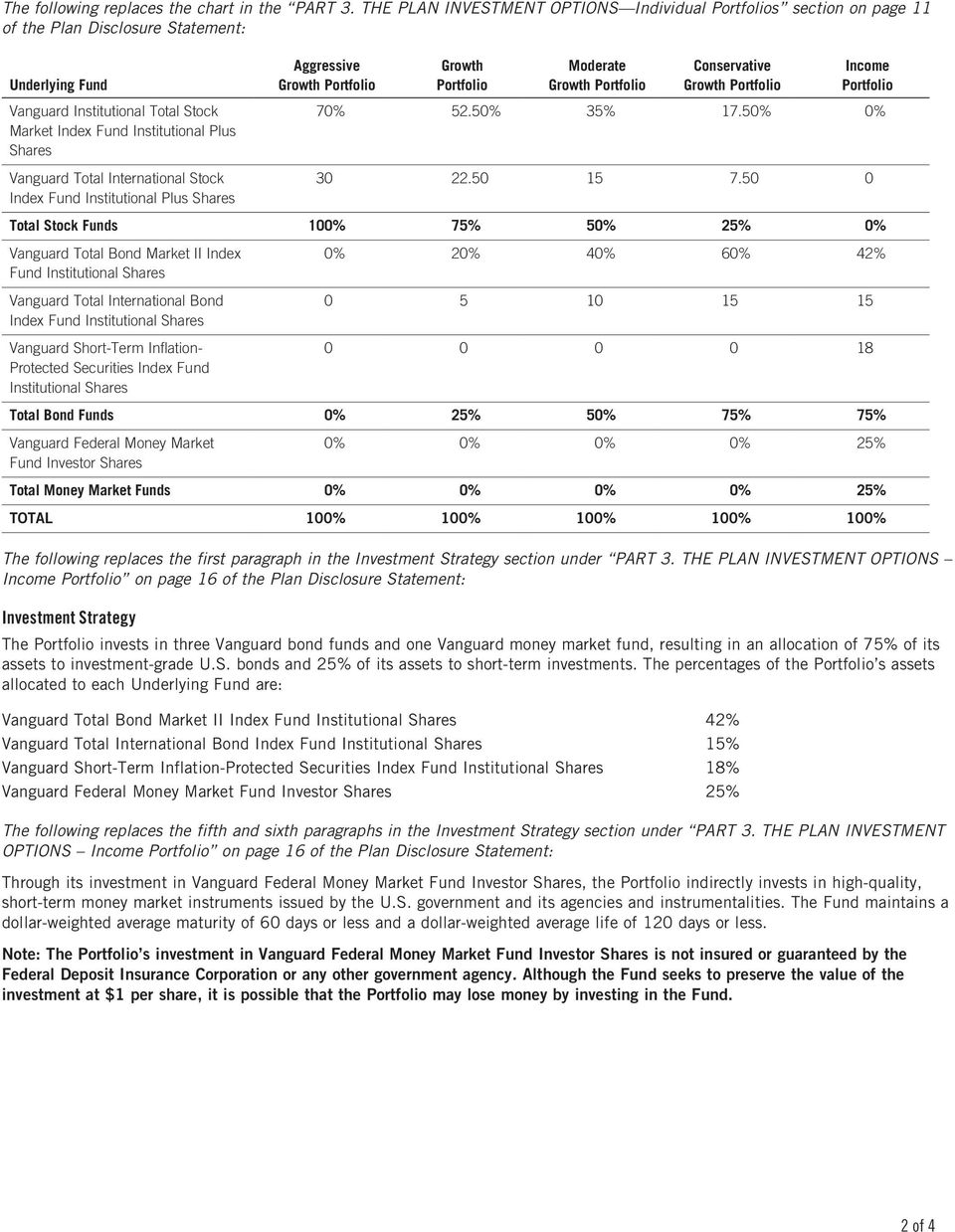
2 The following replaces the chart in the PART 3. THE PLAN INVESTMENT OPTIONS Individual s section on page 11 of the Plan Disclosure Statement: Underlying Fund Institutional Total Stock Market Index Fund Institutional Plus Shares Total International Stock Index Fund Institutional Plus Shares Aggressive Growth Growth Moderate Growth Conservative Growth Income 70% 52.50% 35% 17.50% 0% Total Stock Funds 100% 75% 50% 25% 0% Total Bond Market II Index Fund Institutional Shares Total International Bond Index Fund Institutional Shares Short-Term Inflation- Protected Securities Index Fund Institutional Shares 0% 20% 40% 60% 42% Total Bond Funds 0% 25% 50% 75% 75% Federal Money Market Fund Investor Shares 0% 0% 0% 0% 25% Total Money Market Funds 0% 0% 0% 0% 25% TOTAL 100% 100% 100% 100% 100% The following replaces the first paragraph in the Investment Strategy section under PART 3. THE PLAN INVESTMENT OPTIONS Income on page 16 of the Plan Disclosure Statement: Investment Strategy The invests in three bond funds and one money market fund, resulting in an allocation of 75% of its assets to investment-grade U.S. bonds and 25% of its assets to short-term investments. The percentages of the s assets allocated to each Underlying Fund are: Total Bond Market II Index Fund Institutional Shares 42% Total International Bond Index Fund Institutional Shares 15% Short-Term Inflation-Protected Securities Index Fund Institutional Shares 18% Federal Money Market Fund Investor Shares 25% The following replaces the fifth and sixth paragraphs in the Investment Strategy section under PART 3. THE PLAN INVESTMENT OPTIONS Income on page 16 of the Plan Disclosure Statement: Through its investment in Federal Money Market Fund Investor Shares, the indirectly invests in high-quality, short-term money market instruments issued by the U.S. government and its agencies and instrumentalities. The Fund maintains a dollar-weighted average maturity of 60 days or less and a dollar-weighted average life of 120 days or less. Note: The s investment in Federal Money Market Fund Investor Shares is not insured or guaranteed by the Federal Deposit Insurance Corporation or any other government agency. Although the Fund seeks to preserve the value of the investment at $1 per share, it is possible that the may lose money by investing in the Fund. 2 of 4
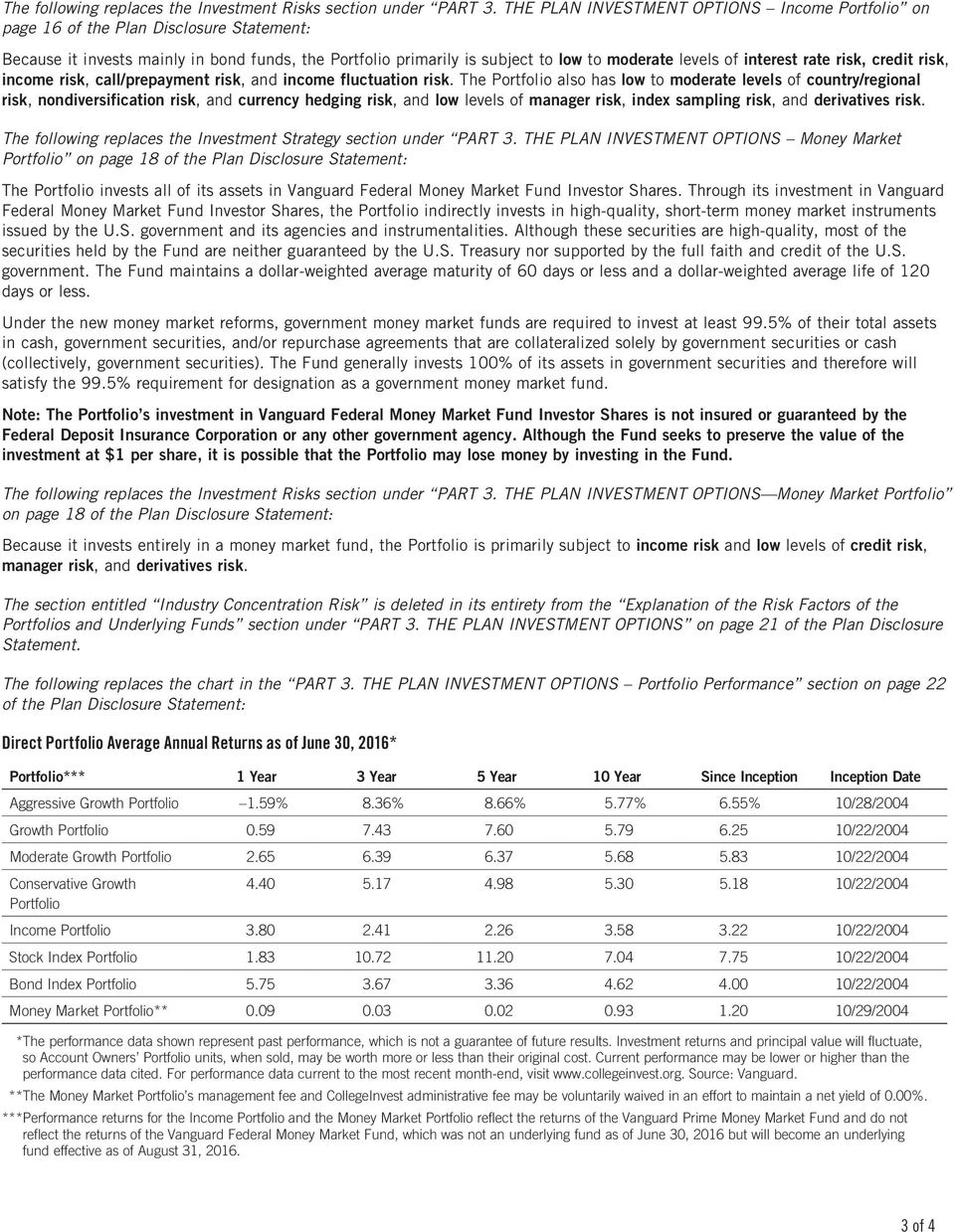
3 The following replaces the Investment Risks section under PART 3. THE PLAN INVESTMENT OPTIONS Income on page 16 of the Plan Disclosure Statement: Because it invests mainly in bond funds, the primarily is subject to low to moderate levels of interest rate risk, credit risk, income risk, call/prepayment risk, and income fluctuation risk. The also has low to moderate levels of country/regional risk, nondiversification risk, and currency hedging risk, and low levels of manager risk, index sampling risk, and derivatives risk. The following replaces the Investment Strategy section under PART 3. THE PLAN INVESTMENT OPTIONS Money Market on page 18 of the Plan Disclosure Statement: The invests all of its assets in Federal Money Market Fund Investor Shares. Through its investment in Federal Money Market Fund Investor Shares, the indirectly invests in high-quality, short-term money market instruments issued by the U.S. government and its agencies and instrumentalities. Although these securities are high-quality, most of the securities held by the Fund are neither guaranteed by the U.S. Treasury nor supported by the full faith and credit of the U.S. government. The Fund maintains a dollar-weighted average maturity of 60 days or less and a dollar-weighted average life of 120 days or less. Under the new money market reforms, government money market funds are required to invest at least 99.5% of their total assets in cash, government securities, and/or repurchase agreements that are collateralized solely by government securities or cash (collectively, government securities). The Fund generally invests 100% of its assets in government securities and therefore will satisfy the 99.5% requirement for designation as a government money market fund. Note: The s investment in Federal Money Market Fund Investor Shares is not insured or guaranteed by the Federal Deposit Insurance Corporation or any other government agency. Although the Fund seeks to preserve the value of the investment at $1 per share, it is possible that the may lose money by investing in the Fund. The following replaces the Investment Risks section under PART 3. THE PLAN INVESTMENT OPTIONS Money Market on page 18 of the Plan Disclosure Statement: Because it invests entirely in a money market fund, the is primarily subject to income risk and low levels of credit risk, manager risk, and derivatives risk. The section entitled Industry Concentration Risk is deleted in its entirety from the Explanation of the Risk Factors of the s and Underlying Funds section under PART 3. THE PLAN INVESTMENT OPTIONS on page 21 of the Plan Disclosure Statement. The following replaces the chart in the PART 3. THE PLAN INVESTMENT OPTIONS Performance section on page 22 of the Plan Disclosure Statement: Direct Average Annual Returns as of June 30, 2016* *** 1 Year 3 Year 5 Year 10 Year Since Inception Inception Date Aggressive Growth 1.59% 8.36% 8.66% 5.77% 6.55% 10/28/2004 Growth /22/2004 Moderate Growth /22/2004 Conservative Growth /22/2004 Income /22/2004 Stock Index /22/2004 Bond Index /22/2004 Money Market ** /29/2004 * The performance data shown represent past performance, which is not a guarantee of future results. Investment returns and principal value will fluctuate, so Account Owners units, when sold, may be worth more or less than their original cost. Current performance may be lower or higher than the performance data cited. For performance data current to the most recent month-end, visit Source:. ** The Money Market s management fee and CollegeInvest administrative fee may be voluntarily waived in an effort to maintain a net yield of 0.00%. *** Performance returns for the Income and the Money Market reflect the returns of the Prime Money Market Fund and do not reflect the returns of the Federal Money Market Fund, which was not an underlying fund as of June 30, 2016 but will become an underlying fund effective as of August 31, of 4
4 The following replaces the chart in the PART 3. THE PLAN INVESTMENT OPTIONS Underlying Fund Performance section on page 23 of the Plan Disclosure Statement: Average Annual Returns as of June 30, 2016* Underlying Fund 1 Year 3 Year 5 Year 10 Year Since Inception Inception Date Institutional Total Stock 2.24% 11.16% 11.67% 7.62% 6.28% 05/31/2001 Market Index Fund Institutional Plus Shares Total Bond Market Index /18/1995 Fund Institutional Plus Shares Total Bond Market II Index /17/2009 Fund Institutional Shares Short-Term Inflation /17/2012 Protected Securities Index Fund Institutional Shares Total International Bond /31/2013 Index Fund Institutional Shares Prime Money Market Fund /03/1989 Institutional Shares** Total International Stock Index Fund Institutional Plus Shares /30/2010 * The performance data shown represent past performance, which is not a guarantee of future results. Investment returns and principal value will fluctuate, so Account Owners units, when sold, may be worth more or less than their original cost. Current performance may be lower or higher than the performance data cited. For performance data current to the most recent month-end, visit Source:. **This fund is being replaced by the Federal Money Market Fund effective August 31, 2016 as discussed in this Supplement. The following replaces the chart in the PART 4. THE PLAN FEES AND CHARGES section on page 25 of the Plan Disclosure Statement: Annual Asset-Based Fees as of June 30, 2016 Estimated Underlying Fund Expenses* CollegeInvest Administrative Fee** Manager s Fee Total Annual Asset-Based Fees Aggressive Growth 0.04% 0.06% 0.29% 0.39% Growth Moderate Growth Conservative Growth Income Stock Index Bond Index Money Market *** * Estimated Underlying Fund Expenses include each Underlying Fund s investment advisory fee, administrative, and other expenses. The Expenses disclosed in this table reflect each Underlying Fund s expense ratio as disclosed in its most recent prospectus available as of June 30, 2016, and are net of any Acquired Fund Fees and Expenses otherwise applicable to the Underlying Fund. Estimated Underlying Fund Expenses for Blended s represent a weighted average of the expenses of the s multiple Underlying Fund(s). Source:. **Reflects CollegeInvest s election to waive 0.04% of its 0.10% administrative fee. *** This reflects the underlying fund expenses for the Federal Money Market Fund which was not an investment as of June 30, 2016 but is an investment effective August 31, The Money Market s management fee and the CollegeInvest administrative fee may be voluntarily waived in an effort to maintain a net yield of 0.00%. Additional Information If you have questions concerning this Supplement, please call or visit the CollegeInvest website at CO5293QS of 4

5 SUPPLEMENT DATED APRIL 2016 TO THE COLLEGEINVEST DIRECT PORTFOLIO COLLEGE SAVINGS PLAN PLAN DISCLOSURE STATEMENT, PARTICIPATION AGREEMENT, AND PRIVACY POLICY DATED MARCH 2015 This Supplement describes important changes for the CollegeInvest Direct College Savings Plan (the Plan). This information is intended to supplement the Plan Disclosure Statement, Participation Agreement, and Privacy Policy (the Plan Disclosure Statement) dated March Please keep this Supplement with your other Plan documents. Protecting Americans from Tax Hikes (PATH) Act of 2015 On December 18, 2015, the Protecting Americans from Tax Hikes (PATH) Act of 2015, or PATH Act, was signed into law. The PATH Act introduces the following improvements to 529 Plan tax treatment, effective for tax years beginning after December 31, 2014: Certain Computer Equipment, Software, and Services Constitute Qualified Higher Education Expenses The definition of Qualified Higher Education Expenses, as set forth in the Other Information About Your Plan Account Withdrawals-Qualified Higher Education Expenses section on page 32 of the Plan Disclosure Statement, the Tax Matters Qualified Higher Education Expenses section on page 37 of the Plan Disclosure Statement, and the Participation Agreement Qualified Higher Education Expenses section on page 43 of the Plan Disclosure Statement, is expanded to include expenses for the purchase of computer or peripheral equipment (as defined in Section 168(i)(2)(B) of the Code), computer software (as defined in Section 197(e)(3)(B) of the Code), or internet access and related services, if such equipment, software, or services are to be used primarily by the Beneficiary during any of the years the Beneficiary is enrolled at an Eligible Educational Institution. Expenses for computer software designed for sports, games, or hobbies do not qualify as Qualified Higher Education expenses unless the software is predominantly educational in nature. Ability to Recontribute Refunded Amounts When given a refund from an Eligible Educational Institution of amounts paid out of a Beneficiary s 529 Plan account for Qualified Higher Education Expenses, Account Owners can now recontribute that money into the same or another 529 Plan account for the same Beneficiary without incurring federal income taxes or penalties on the recontributed amounts, provided the Account Owner recontributes the money within 60 days of receiving it. The following is added as an additional paragraph to the Other Information About Your Plan Account Withdrawals section on page 31 of the Plan Disclosure Statement: If all or part of a Qualified Withdrawal used to pay Qualified Higher Education Expenses of a Beneficiary is refunded by the Eligible Educational Institution, the amount refunded will not be subject to federal income tax if it is recontributed to a 529 Plan account for the same Beneficiary within 60 days of the refund, as described in Part 8. Tax Matters Qualified Withdrawals. The following replaces the last paragraph at the end of the Tax Matters Qualified Withdrawals section on page 37 of the Plan Disclosure Statement: If all or part of a Qualified Withdrawal used to pay Qualified Higher Education Expenses of a Beneficiary is refunded by the Eligible Educational Institution, the amount refunded will not be subject to federal income tax to the extent it is recontributed to a 529 Plan account for which the same Beneficiary is the beneficiary, but only to the extent such recontribution is made no later than 60 days after the date of such refund and does not exceed the refunded amount (a Qualified Recontribution ). It is the responsibility of the Account Owner to keep all records of the refunds and subsequent recontributions. A qualified tax advisor should be consulted to determine your eligibility for this treatment.

6 The following sentence is added at the end of the second paragraph of the Tax Matters Nonqualified Withdrawals section on page 38 of the Plan Disclosure Statement: If all or part of a Qualified Withdrawal used to pay Qualified Higher Education Expenses of a Beneficiary is refunded by the Eligible Educational Institution but is not recontributed to a 529 Plan account as part of a Qualified Recontribution, then the refunded amount will be treated as a Nonqualified Withdrawal and subject to the tax treatment described above. Accounts No Longer Required to be Aggregated Across Colorado Section 529 Plans for Withdrawal Purposes The PATH Act also eliminated a burdensome recordkeeping requirement for a 529 Plan to calculate the earnings portion of distributions by aggregating multiple 529 accounts with the same Account Owner and Beneficiary within a program. In connection with this change, starting with the 2015 tax year, CollegeInvest is no longer aggregating CollegeInvest Direct College Savings Plan Accounts with accounts in other Colorado Section 529 Plans (including accounts in the Stable Value Plus College Savings Plan, the Scholars Choice College Savings Program, and the Smart Choice College Savings Plan), but will continue to aggregate CollegeInvest Direct College Savings Plan Accounts having the same Account Owner and Beneficiary. CollegeInvest has instructed the Manager to follow such new aggregation requirements in performing recordkeeping and administrative services with respect to CollegeInvest Direct College Savings Plan Accounts and in preparing and issuing IRS Form 1099-Qs with respect to withdrawals taken from CollegeInvest Direct College Savings Plan Accounts in the 2015 tax year and in subsequent tax years. The amendments set forth below reflect the manner in which CollegeInvest intends to implement the new aggregation requirements. Qualified Withdrawals taken in 2015 and in subsequent tax years continue to be excludable from the Account Owner s and Beneficiary s federal taxable income. The following replaces the last sentence of the third paragraph of the Other Information About Your Plan Account Withdrawals section on page 31 of the Plan Disclosure Statement: For purposes of calculating these taxes, each withdrawal is treated as including a ratable share of investment earnings on all Plan accounts for the Beneficiary having the same Account Owner. The following replaces the first sentence of the Tax Matters Aggregation of Accounts section on page 38 of the Plan Disclosure Statement: All Plan accounts with the same Account Owner for the benefit of a single Beneficiary will be treated as a single account for purposes of calculating the earnings portion of a distribution from those Plan accounts. Account Owners are encouraged to consult their tax advisors about the impact of these and other 529 Plan-related changes made by the PATH Act on their individual situations. Additional Information If you have questions concerning this Supplement, please call or visit the CollegeInvest website at CO529SUP

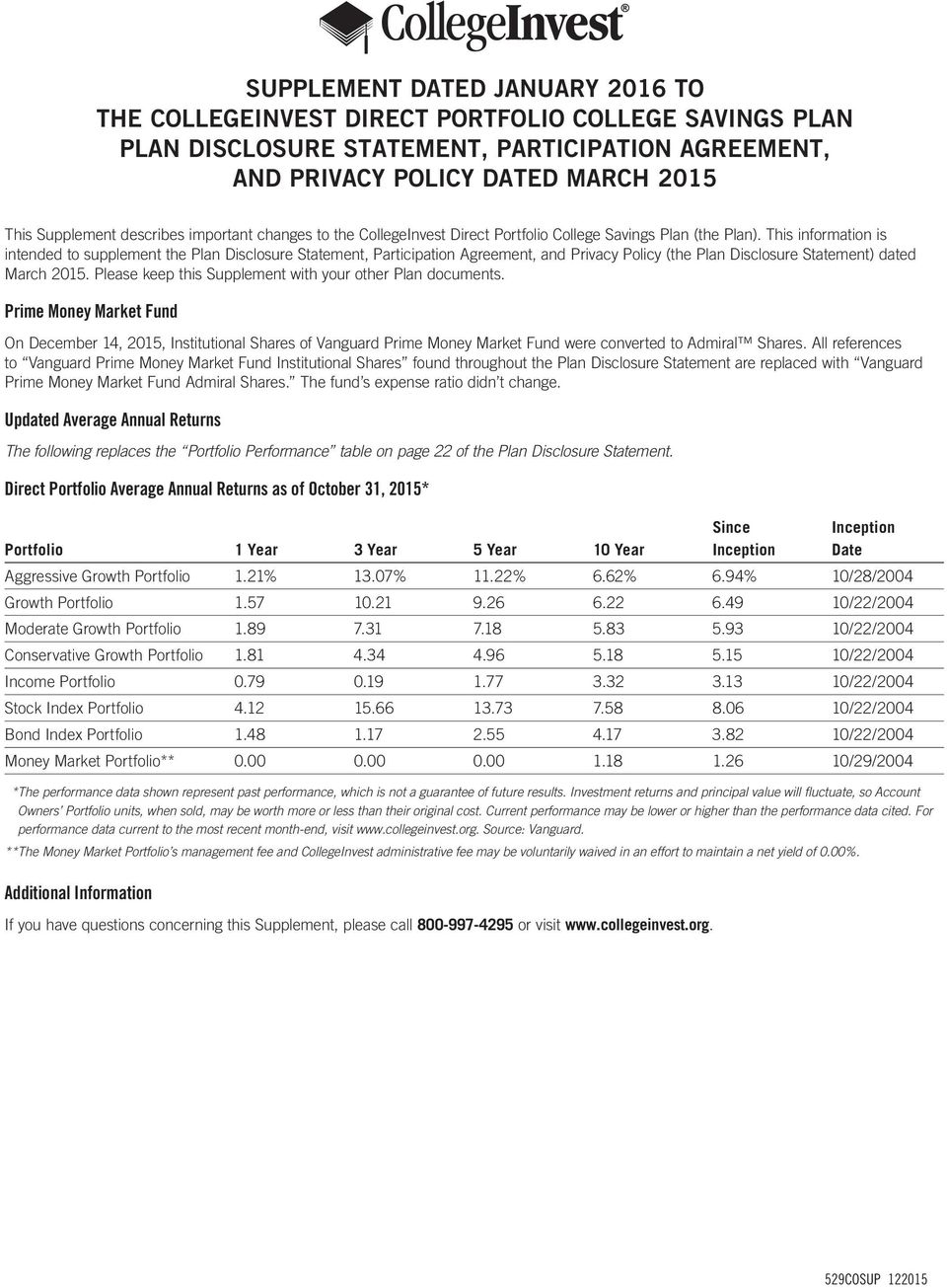
7 SUPPLEMENT DATED JANUARY 2016 TO THE COLLEGEINVEST DIRECT PORTFOLIO COLLEGE SAVINGS PLAN PLAN DISCLOSURE STATEMENT, PARTICIPATION AGREEMENT, AND PRIVACY POLICY DATED MARCH 2015 This Supplement describes important changes to the CollegeInvest Direct College Savings Plan (the Plan). This information is intended to supplement the Plan Disclosure Statement, Participation Agreement, and Privacy Policy (the Plan Disclosure Statement) dated March Please keep this Supplement with your other Plan documents. Prime Money Market Fund On December 14, 2015, Institutional Shares of Prime Money Market Fund were converted to Admiral Shares. All references to Prime Money Market Fund Institutional Shares found throughout the Plan Disclosure Statement are replaced with Prime Money Market Fund Admiral Shares. The fund s expense ratio didn t change. Updated Average Annual Returns The following replaces the Performance table on page 22 of the Plan Disclosure Statement. Direct Average Annual Returns as of October 31, 2015* 1 Year 3 Year 5 Year 10 Year Since Inception Inception Date Aggressive Growth 1.21% 13.07% 11.22% 6.62% 6.94% 10/28/2004 Growth /22/2004 Moderate Growth /22/2004 Conservative Growth /22/2004 Income /22/2004 Stock Index /22/2004 Bond Index /22/2004 Money Market ** /29/2004 ** The performance data shown represent past performance, which is not a guarantee of future results. Investment returns and principal value will fluctuate, so Account Owners units, when sold, may be worth more or less than their original cost. Current performance may be lower or higher than the performance data cited. For performance data current to the most recent month-end, visit Source:. **The Money Market s management fee and CollegeInvest administrative fee may be voluntarily waived in an effort to maintain a net yield of 0.00%. Additional Information If you have questions concerning this Supplement, please call or visit 529COSUP
8 DIRECT PORTFOLIO COLLEGE SAVINGS PLAN PLAN DISCLOSURE STATEMENT, PARTICIPATION AGREEMENT, AND PRIVACY POLICY COLLEGEINVEST Trustee and Administrator ASCENSUS COLLEGE SAVINGS / VANGUARD Managers MARCH 2015

9

10 Plan Disclosure Statement, Participation Agreement, and Privacy Policy Plan Disclosure Statement The Plan Highlights Pages 2 3 Part 1. Introduction Pages 5 6 General Information About 529 Plans and The Plan Who s Who in The Plan Other Important Information How to Contact Us Part 2. Getting Started Pages Opening Your Plan Account 2. Choosing Your Beneficiary 3. Choosing Your Investment Options 4. Contributing to Your Plan Account Part 3. The Plan Investment Options Pages 9 23 Investment Option Summary The Age-Based Options The Blended s and Individual s The Plan Profiles The Blended s Aggressive Growth Growth Moderate Growth Conservative Growth Income The Individual s Stock Index Bond Index Money Market Certain Underlying Fund Profiles Explanation of the Risk Factors of the s and Underlying Funds Performance Underlying Fund Performance Part 4. The Plan Fees and Charges Pages Asset-Based Fee Other Charges Investment Cost Example Part 5. Certain Risks of Investing in The Plan Pages Part 6. Information About The Plan, the Managers, the Upromise Service, and Ugift Give College Savings Page 28 The Plan Upromise Service Ugift Give College Savings Part 7. Other Information About Your Plan Account Pages Contributions Changing Investment Options for Current Balances and Future Contributions Withdrawals Nonqualified Withdrawals Exempt From the 10% Federal Penalty Tax Maximum Contribution Limit Unused Account Assets Pricing of Units Confirmations and Statements/Safeguarding Your Plan Account Account Restrictions Control Over Your Plan Account Designation of Successor Account Owner Changing Your Beneficiary Dormant Account Part 8. Tax Matters Pages Caveats With Respect to Tax Discussion Changing Tax Laws and Regulations Maximum Contribution Limit Federal Income Tax Treatment of Contributions and Withdrawals Qualified Higher Education Expenses Qualified Withdrawals Nonqualified Withdrawals Tax Reporting Losses Upon Withdrawal Aggregation of Accounts Transfers Between Accounts of Different Designated Beneficiaries or Different 529 Plans Federal Estate and Gift Taxes Education Savings Accounts Series EE and I Savings Bonds American Opportunity and Lifetime Learning Credits Tax Deduction for Education Expenses Effect on Other Federal Tax Benefits State of Colorado Income Tax Part 9. Legal and Administrative Information About The Plan Page 41 Participation Agreement Pages Privacy Policy Page 49

11 The Plan Highlights The Plan Highlights below direct you to more complete information about The Plan contained in this Plan Disclosure Statement, which you should review carefully. The offering of the CollegeInvest Direct College Savings Plan to potential investors is made only by means of the entire Plan Disclosure Statement and Participation Agreement. Purpose of the CollegeInvest Direct Managers of The Plan Contact Information No Guarantee Against Loss Eligibility (Account Owner) Beneficiary Contributions To help individuals and families save for higher education expenses through a tax-advantaged investment plan administered by CollegeInvest, a division of the Colorado Department of Higher Education. The Plan is managed by Ascensus College Savings Recordkeeping Services, LLC, and Ascensus Broker Dealer Services, Inc. (collectively, Ascensus College Savings ), and The Group, Inc. ( ). The term Manager or Managers as used in this Plan Disclosure Statement means Ascensus College Savings and/or as the context so requires. All investment management for The Plan will be provided by. The Managers contract expires on December 31, See Part 1. Introduction, page 5. CollegeInvest Direct College Savings Plan P.O. Box Kansas City, MO Phone: Monday through Friday from 6 a.m. to 7 p.m., Mountain time None of your Plan account, the principal you invest in the CollegeInvest Direct College Savings Trust, or any investment return is insured or guaranteed by The Plan, the State of Colorado, CollegeInvest, any other state or federal governmental agency, Ascensus College Savings,, or any other entity. You could lose money, including the principal you invest. The Plan is open to all U.S. citizens and resident aliens who have a Social Security number or taxpayer identification number and have a U.S. permanent address that is not a P.O. box. There are no restrictions on income of Account Owners. See Part 2. Getting Started, page 7. The Beneficiary may be a U.S. citizen or resident alien with a Social Security number or taxpayer identification number, of any age, from newborn to adult. The Account Owner may change Beneficiaries or transfer a portion of the account to a different Beneficiary without adverse tax consequences, provided the new Beneficiary is a qualifying member of the family of the prior designated Beneficiary. The Account Owner and the Beneficiary for a Plan account may be the same. See Part 7. Other Information About Your Plan Account Changing Your Beneficiary, page 34. Contributions may be made by anyone, regardless of the relationship to the Account Owner or Beneficiary, but the Account Owner retains ownership and control of all account assets. Initial contribution: $25 minimum. Additional contributions: $15 minimum. See Part 7. Other Information About Your Plan Account Maximum Contribution Limit, page 32. Maximum Contribution Limit $350,000 Plan accounts that have reached the combined Maximum Contribution Limit across all 529 Plans sponsored by the State of Colorado ( Colorado 529 Plans ) for the same Beneficiary may continue to accrue earnings, but additional contributions are prohibited unless the combined account balance falls below the Maximum Contribution Limit. See Part 7. Other Information About Your Plan Account Maximum Contribution Limit, page 32. Investment Options and Performance Risk Factors of The Plan There are 11 different investment options, all managed by : 3 Age-Based Options (conservative, moderate, or aggressive). 8 Blended and Individual Options. This Plan Disclosure Statement contains historical performance information for the s and the mutual funds in which the s invest. See Part 3. The Plan Investment Options, page 9. Investing in The Plan involves certain risks, including: (1) the possibility that you may lose money (including your original contribution) over short or even long periods, (2) the risk of federal or state tax law changes, (3) the risk of Plan changes including changes in fees, asset allocation, and investment guidelines, and (4) the risk that contributions to The Plan may adversely affect the eligibility of the Beneficiary or the Account Owner for financial aid or other benefits. See Part 5. Certain Risks of Investing in The Plan, page 26. 2
12 Fees and Charges Tax Matters Qualified Withdrawals Account Control Account Control Limitations Online Applications and Account Information Upromise Service Privacy Policy Other Education Savings and Investment Alternatives Current asset-based fee: 0.39%. The Plan charges an annual account fee of $20, which will be waived if: (1) the Account Owner or the Beneficiary is a resident of Colorado, (2) the account balance is greater than $10,000, (3) the Account Owner elects electronic delivery of all Plan documents, or (4) the account was established prior to December 1, 2011, where either the Account Owner or the Beneficiary was a Wyoming resident. See Part 4. The Plan Fees and Charges, page 24. Earnings grow free from federal and Colorado income tax while in a Plan account. There is no federal or Colorado income tax on Qualified Withdrawals. The annual gift exclusion is $14,000 (single) and $28,000 (married couple). No gift tax is payable on contributions up to $70,000 (single) and $140,000 (married couple) prorated over five years. Contributions are deductible from Colorado state income tax (subject to recapture if a Nonqualified Withdrawal). The earnings portion of a Nonqualified Withdrawal generally is includable in the taxable income of the Account Owner. Subject to certain exceptions, the earnings portion of a Nonqualified Withdrawal will also be subject to an additional 10% federal penalty tax. Contributions to a 529 Plan are not deductible for federal income tax purposes. Consult a qualified tax advisor regarding the application of these rules to your circumstances. See Part 8. Tax Matters, page 36. Assets in your Plan account used to pay for tuition, fees, certain room and board, books, supplies, and equipment required for enrollment or attendance at any Eligible Educational Institution in the U.S. or abroad will be considered a Qualified Withdrawal. See Part 7. Other Information About Your Plan Account Withdrawals, page 31. As an Account Owner, you can: Retain control of how and when money is used. Change Beneficiaries without paying federal income tax or a federal penalty tax, if the new Beneficiary is a member of the family of the currently designated Beneficiary. Withdraw amounts in your account for any purpose, subject to applicable federal and Colorado income taxes on earnings (including possible recapture of state tax deductions) and a 10% federal penalty tax on earnings. See Part 7. Other Information About Your Plan Account, page 29. A few limitations apply: You may change the investment option for your Plan account for any reason two times during any calendar year, or with the permissible change of Beneficiary. This limitation applies on an aggregate basis to all accounts under The Plan and other Colorado 529 Plans having the same Account Owner and Beneficiary. An Account Owner may transfer all or part of a Plan account to a non-colorado 529 Plan for the same Beneficiary only if it has been at least 12 months since the last such transfer for the Beneficiary. See Part 7. Other Information About Your Plan Account, page 29. Account Owners may obtain an Enrollment Application online at or by mail. Account Owners may choose to receive periodic account statements, transaction confirmations, tax forms, and other personal correspondence online, rather than by mail. See Part 2. Getting Started, page 7. You may choose to sign up for the optional Upromise service that lets members get back a percentage of their qualified spending when dining out, shopping for groceries, buying gas, and making other purchases with participating companies. These dollars can be transferred to your Plan account on a periodic basis. See Part 6. Information About The Plan, the Managers, the Upromise Service, and Ugift Give College Savings, page 28. All information you provide to The Plan is treated confidentially. CollegeInvest has a Privacy Policy for the benefit of Plan participants. See Privacy Policy, page 49. There are education savings and investment options other than The Plan for saving for the expenses of attending an Eligible Educational Institution, including other 529 Plans administered by CollegeInvest, such as the Scholars Choice College Savings Program, the Stable Value Plus College Savings Plan, and the Smart Choice College Savings Plan. See CollegeInvest s website at for more information. If you are a resident of a state other than Colorado, you may have the opportunity to invest in a 529 Plan sponsored by your home state that may provide state tax benefits not available to you by investing in The Plan. State-based benefits should be one of many appropriately weighted factors to be considered when making an investment decision. 3

13

14 Part 1. Introduction General Information About 529 Plans and The Plan Section 529 of the Internal Revenue Code permits states and state agencies to sponsor qualified tuition programs ( 529 Plans ), which are tax-advantaged programs intended to help individuals and families save for the costs of higher education. CollegeInvest administers a college savings program (the Program ) and offers several 529 Plans as part of the Program. This Plan Disclosure Statement describes the CollegeInvest Direct College Savings Plan ( The Plan ), which is one of such 529 Plans. Even if you do not live in Colorado, you may invest in The Plan, although non- Colorado residents should consider whether their state offers a 529 Plan that would provide state income tax or other benefits not available through The Plan. See Other Important Information State Tax and Other Benefits below. CollegeInvest also offers several 529 Plans other than The Plan. See CollegeInvest s website at for more information. Amounts contributed to The Plan are invested in the CollegeInvest Direct College Savings Trust (the Trust ). When you invest in The Plan, you are purchasing units issued by the Trust. CollegeInvest acts as trustee for the Trust and has contracted with the Managers to hold the assets of the Trust in a segregated custody account. Assets of the Trust are held in trust for the exclusive benefit of Account Owners and Beneficiaries of The Plan. The Trust will not make any loans to either Account Owners or Beneficiaries. Amounts invested in a Plan account may not be pledged, assigned, or otherwise used as collateral or security for a loan. The assets in the Trust will be allocated as directed by Account Owners to investment portfolios ( s ) and invested by. See Part 3. The Plan Investment Options. An investment in The Plan will not be the appropriate investment program for all investors. You should evaluate The Plan, the investment options available, and the s in the context of your overall financial situation, investment goals, other resources and needs (such as liquidity), and other investments. Who s Who in The Plan CollegeInvest CollegeInvest, a division of the Colorado Department of Higher Education ( CollegeInvest ), provides certain administrative services in connection with The Plan and generally oversees the Managers activities in providing services to The Plan. Ascensus College Savings Ascensus College Savings Recordkeeping Services, LLC, and Ascensus Broker Dealer Services, Inc., have been selected by CollegeInvest to be Managers of The Plan, responsible for the day-to-day operations of The Plan, including but not limited to certain marketing services, administration, recordkeeping, and other services for The Plan. Ascensus College Savings is used to refer collectively or individually, as the case requires, to Ascensus College Savings Recordkeeping Services, LLC, Ascensus Broker Dealer Services, Inc., and their affiliates. The Group, Inc., has been selected by CollegeInvest to be a Manager of The Plan, responsible for all investments of The Plan s and the Underlying Funds in which each of the s is invested. also assists CollegeInvest in marketing The Plan, providing administrative services, and distributing the securities issued by the Trust. is used to refer collectively or individually, as the case requires, to The Group, Inc., Marketing Corporation, and their affiliates. Throughout this document, the State of Colorado, the Trust, CollegeInvest, Ascensus College Savings, and are referred to collectively as Associated Persons of The Plan. Other Important Information IMPORTANT INFORMATION ABOUT OPENING A NEW ACCOUNT. The Plan is required by federal law to obtain from each person who opens an account certain personal information including name, street address, Social Security number or individual taxpayer identification number, and date of birth, among other information, that will be used to verify identity. If you do not provide this information, The Plan will not be able to open your account. If we are unable to verify your identity, The Plan reserves the right to close your account or take other reasonable steps. The Plan is intended to be used only to save for Qualified Higher Education Expenses. The Plan is not intended to be used, nor should it be used, by any taxpayer for the purpose of evading federal or state taxes or tax penalties. This Plan Disclosure Statement is not intended to constitute, nor does it constitute, legal or tax advice. You should consult your own legal or independent tax advisor for more information on the tax implications to you of investing in The Plan based on your own particular circumstances. 5

15 State Tax and Other Benefits. The Colorado income tax deduction, as described in this Plan Disclosure Statement, is available only to Colorado taxpayers investing in Colorado plans under current law, which may be changed through future legislative or judicial action. If you are not a Colorado taxpayer, consider before investing whether your or the Beneficiary s home state offers a 529 Plan that provides its taxpayers with favorable state tax or other benefits that may only be available through investment in the home state s 529 Plan and that are not available through investment in The Plan. Because different states have different tax provisions, this Plan Disclosure Statement contains limited information about the state tax consequences of investing in The Plan. Therefore, please consult your financial, tax, or other advisor to learn more about how state-based benefits (or any limitations) would apply to your specific circumstances. You also may wish to contact your home state s 529 Plan(s), or any other 529 Plan, to learn more about those Plans features, benefits, and limitations. Keep in mind that state-based benefits should be one of many appropriately weighted factors to be considered when making an investment decision. Other 529 Plans Administered by CollegeInvest. CollegeInvest currently offers three other 529 Plans that are not described in this Plan Disclosure Statement. These 529 Plans have different investment options, investment managers, fees, and sales commissions and may be marketed differently from The Plan. CollegeInvest may develop and offer other 529 Plans in the future. Please call or go to for information and materials that describe other 529 Plans administered and offered by CollegeInvest. Investments Are Not Guaranteed or Insured. Investments in The Plan are not guaranteed or insured by The Plan, the State of Colorado, CollegeInvest, any other federal or state governmental agency, the Federal Deposit Insurance Corporation,, Ascensus College Savings, or any other entity. The value of your Plan account will depend on market conditions and the performance of the s for the investment option(s) you select. Investments in The Plan can go up or down in value, and you could lose money (including the principal invested), or not make money, by investing in The Plan. The Plan Is Not a Mutual Fund. Although money contributed to The Plan will be allocated to s that invest in mutual funds, neither the Trust, The Plan, nor any of The Plan s s is a mutual fund. An investment in The Plan is an investment in municipal fund securities that are offered and issued by the Trust. These securities are not registered with the U.S. Securities and Exchange Commission ( SEC ) or any state, nor are the Trust, The Plan, or The Plan s s registered as investment companies with the SEC or any state. Changes in The Plan. It is possible that federal and state laws may change in a manner that will adversely affect The Plan as described in this Plan Disclosure Statement and that such adverse effects may be retroactive. CollegeInvest also may amend The Plan at any time if CollegeInvest determines that such an amendment is necessary to maintain qualification under Section 529 or is otherwise desirable. Important Reference Material. Please keep this Plan Disclosure Statement and Participation Agreement for future reference. This document gives you important information about The Plan, including information about the investment risks associated with, and the terms under which you agree to participate in, The Plan. How to Contact Us Please call if you have any questions about The Plan or would like additional information. You can also visit CollegeInvest s website at for more information about The Plan or to download forms described in this Plan Disclosure Statement. 6

16 Part 2. Getting Started This section offers a brief overview of the process needed to: (1) open your account with The Plan, (2) designate your Beneficiary, (3) choose your investment option(s), and (4) contribute money to your Plan account. Before you begin, it is important that you understand two terms used throughout this Plan Disclosure Statement. The Account Owner is the person who opens an account with The Plan and controls the assets held in the account. References in this document to you mean you in your capacity as the Account Owner. The Beneficiary (future student) is the person designated by the Account Owner whose higher education expenses are expected to be paid (in whole or in part) using money from the account. The Account Owner and the Beneficiary for a Plan account may be the same. 1. Opening Your Plan Account Who May Open a Plan Account? To be an Account Owner, you must be a U.S. citizen or resident alien and must have a Social Security number or taxpayer identification number. Trusts, not-for-profit organizations, local governments, corporations, and partnerships may also be Account Owners. Account Owners must provide The Plan with a permanent U.S. address that is not a P.O. box. Although persons other than the Account Owner can contribute to an account, only the Account Owner controls how account assets are invested and used. There can be only one Account Owner designated per account. You may grant another person the ability to take certain actions with respect to your account by completing the appropriate form(s). You may name a successor Account Owner to control the account if you die. If, on the death of the Account Owner, a successor Account Owner has not been designated or is deceased or validly disclaims his or her interest in the account at the time of the Account Owner s death, the Beneficiary of the account automatically will become the Account Owner after completion of the Enrollment Application in good order. The Plan may also require submission of additional documents. You may transfer a Plan account to another Account Owner subject to the conditions described in Part 7. Other Information About Your Plan Account. There is no limit on the age of the Account Owner to participate in, or benefit from, The Plan. If the Account Owner is a minor, his or her parent or legal guardian will need to consent to the minor s participation in The Plan by signing the Enrollment Application. How Do You Open a Plan Account? Online: Complete the Enrollment Application at By mail: Complete, sign, and mail the Enrollment Application to CollegeInvest Direct College Savings Plan, P.O. Box , Kansas City, MO By signing the Enrollment Application, you will agree to the terms of your account, the Participation Agreement, and The Plan set forth in this Plan Disclosure Statement. Please see Part 7. Other Information About Your Plan Account for a description of the Enrollment Application process and for more details on setting up an account with The Plan. 2. Choosing Your Beneficiary You must name a Beneficiary for the account on your Enrollment Application. A Beneficiary must be a U.S. citizen or resident alien and have a Social Security number or taxpayer identification number. You may designate only one Beneficiary per account, but you or different Account Owners may establish different accounts for the same Beneficiary subject to the Maximum Contribution Limit. There is no limit on the age of the Beneficiary to participate in, or benefit from, The Plan. You do not have to be related to the Beneficiary. You may name yourself as the Beneficiary. Only the Account Owner can change the Beneficiary of an account. Please see Part 7. Other Information About Your Plan Account for more details on setting up an account with The Plan and changing the Beneficiary of your account. 3. Choosing Your Investment Options You may select from a number of investment options. The options fall into two categories: Age-Based Options (three options). The asset allocation of money invested in the Age-Based Options is automatically adjusted over time to include a lower percentage of allocations to stock funds as the Beneficiary approaches college age. Blended s and Individual s (eight options). Money invested in one of these options is allocated to the you choose for the life of your investment (unless you direct a change in investment option). The Blended s and the Individual s are each invested according to a static asset allocation; it does not change over time (unless CollegeInvest determines that a change is appropriate). Each time you contribute, you may choose up to five investment options. Regardless of how many investment options you select, you must allocate a minimum of 5% of the contribution to each option you choose. Investment percentages must total 100%. You may not direct the investment of your account assets other than selecting investment options when a contribution is made and reallocating assets up to twice per calendar year. Please see Part 3. The Plan Investment Options for details about The Plan s investment options, including investment objectives, strategies, risks, and fees. 7
17 4. Contributing to Your Plan Account Initial Contribution You must open an account with an initial investment of $25 or more. Additional Contributions You or others may make additional contributions to your account at any time, subject to the Maximum Contribution Limit. The minimum additional contribution is $15. There are limitations on, and there may be other tax consequences of, rollovers or other contributions. You should consult a qualified tax advisor regarding your particular circumstances. Please see Part 7. Other Information About Your Plan Account Contributions for additional details on contributing to your account through rollovers, transfers, setting up an automatic investment plan, and the guidelines relating to transfers and contributions from UGMA/UTMA custodial accounts or other savings accounts. 8

18 Part 3. The Plan Investment Options Investment Option Summary The Plan offers many different investment options for your account contributions. You may choose from three Age-Based Options in which your money automatically is moved to s that progressively include a lower percentage of allocations to stock funds as your Beneficiary approaches college age. You may select the Age-Based Option conservative, moderate, or aggressive that best reflects your own risk tolerance. You may choose from five Blended s and three Individual s, which invest the respective assets in varying allocations of stock funds, bond funds, and a money market fund. If you choose a Blended or an Individual, your money will remain in that until you direct The Plan to change the investment of your account assets. The limits on your ability to change the investment option(s) for your account are described in Part 7. Other Information About Your Plan Account Changing Investment Options for Current Balances and Future Contributions. Each invests its assets in investments approved by CollegeInvest, which currently consist of one or more mutual funds managed by (the Underlying Funds ). Please keep in mind that you will not own shares of the Underlying Funds. has agreed to invest assets in investments in accordance with the CollegeInvest Investment Policy Statement, which sets forth policies, objectives, and guidelines that govern the investment of such assets. CollegeInvest reserves the right to change, at any time, the Investment Policy Statement, which may affect the s that make up the Age-Based Options, the Blended s, the Individual s, or the Underlying Funds in which the s invest. PLEASE NOTE: The holding period for higher education investing is very short relative to that for retirement (i.e., 5 to 20 years versus 30 to 60 years). Also, the need for liquidity during the withdrawal phase (to pay for certain educational expenses) generally is very important. You should seriously consider the level of risk you wish to assume, your investment time horizon, and other factors important to you before you select investment options. You should periodically assess and, if appropriate, adjust your investment choices with the same factors in mind. The Plan and its Associated Persons make no representations regarding the suitability of The Plan s investment options to any particular investor. Other types of investments and other types of college savings vehicles may be more appropriate, depending on your personal circumstances. Please consult your tax or investment advisor for more information. 9

19 The Age-Based Options You may choose from the following three Age-Based Options: Conservative Age-Based Option Moderate Age-Based Option Aggressive Age-Based Option The Age-Based Options are designed to take into account a Beneficiary s age and your investing time horizon i.e., the number of years before the Beneficiary is expected to attend an Eligible Educational Institution as defined later. Within the Age-Based Options, you may invest according to your risk tolerance in either a conservative, moderate, or aggressive asset allocation. In general, for younger Beneficiaries, the Age-Based Options will be invested in s more heavily weighted in stock funds to capitalize on the longer investment time frame and to try to maximize returns. As time passes, account assets are automatically moved to include a lower percentage of allocations to stock funds in an attempt to preserve capital as the withdrawal phase approaches. As the table below shows, for any particular age group, the Conservative Age-Based Option usually has a higher concentration of assets in bond and/or money market funds than does the Moderate Age- Based Option. The same is true for the Moderate Age-Based Option compared with the Aggressive Age-Based Option. s with higher allocations to bond and money market funds tend to be less volatile than those with higher stock allocations. Less volatile s generally will not decline as much when stock markets go down but also generally will not appreciate in value as much when stock markets go up. The Manager relies on your representation as to the age of the Beneficiary to allocate your assets to a particular at the outset. A description of the Underlying Funds, as of December 31, 2014, in which each of these s invests is provided in The Blended s and Individual s in this section. For each of the Age-Based Options, The Plan will automatically exchange assets between one and another as the Beneficiary ages. The exchange occurs during the month following the month of the Beneficiary s birth date, according to the schedule in the following table. Age-Based Options Age of Beneficiary Conservative Moderate Aggressive Newborn through 5 Moderate Growth 50% Stock 50% Bond Growth 75% Stock 25% Bond Aggressive Growth 100% Stock 6 through 10 Conservative Growth 25% Stock 75% Bond 11 through 15 Income 75% Bond 25% Money Market 16 through 18 Income 75% Bond 25% Money Market 19 or older Money Market 100% Money Market Moderate Growth 50% Stock 50% Bond Conservative Growth 25% Stock 75% Bond Income 75% Bond 25% Money Market Income 75% Bond 25% Money Market Growth 75% Stock 25% Bond Moderate Growth 50% Stock 50% Bond Conservative Growth 25% Stock 75% Bond Income 75% Bond 25% Money Market 10

20 The Blended s and Individual s Unlike the Age-Based Options, the Blended s and Individual s do not change asset allocations as the Beneficiary ages. Instead, your assets will be allocated to such for the life of your investment (unless you direct a change in investment option). These s are invested according to an asset allocation that remains fixed over time (unless CollegeInvest decides to implement changes to any of the asset allocations under the Investment Policy Statement). If you choose to invest in s that have a significant weighting in stock funds, you may wish to consider moving your assets to include a lower percentage of allocations to stock funds as your Beneficiary approaches college age. Please note that there are limitations on your ability to move assets from one to another. See Part 7. Other Information About Your Plan Account Changing Investment Options for Current Balances and Future Contributions. Blended s The five Blended s listed below invest in multiple Underlying Funds (the percentages of those investments are detailed in the following table). Aggressive Growth Growth Moderate Growth Conservative Growth Income Individual s Each of the three Individual s invests entirely in a single Underlying Fund. Stock Index invests in Institutional Total Stock Market Index Fund Institutional Plus Shares. Bond Index invests in Total Bond Market Index Fund Institutional Plus Shares. Money Market invests in Prime Money Market Fund Institutional Shares. The Underlying Fund in which an Individual invests all of its assets is subject to change. invests Blended assets in one or more Underlying Funds that have investment objectives consistent with each particular asset category. The following table provides, as of March 2015, the expected allocation of each Blended s assets for investment in the particular Underlying Fund (unless a decision is made by CollegeInvest to change the investments in which the assets are invested). You will be notified of any significant changes to the investments to which assets are allocated. Underlying Fund Aggressive Growth Growth Moderate Growth Conservative Growth Income Institutional Total Stock Market Index Fund Institutional Plus Shares 70% 52.5% 35% 17.5% 0% Total International Stock Index Fund Institutional Plus Shares Total Stock Funds 100% 75% 50% 25% 0% Total Bond Market II Index Fund Institutional Shares Total International Bond Index Fund Institutional Shares Short-Term Inflation-Protected Securities Index Fund Institutional Shares Total Bond Funds 0% 25% 50% 75% 75% Prime Money Market Fund Institutional Shares Total Money Market Funds 0% 0% 0% 0% 25% TOTAL 100% 100% 100% 100% 100% 11

21 The Plan Profiles Requesting Additional Information About the Underlying Funds Your contributions to a will be invested Aggressive in one or more of the Underlying Funds. Please keep in mind that Option you will not own shares of the Underlying Funds. Instead, you will own interests in the Trust established by CollegeInvest. Information in this Plan Disclosure Statement about the Underlying Funds has been provided by and has not been independently verified by CollegeInvest. Additional information about the investment strategies and risks of each Underlying Fund is available in its current prospectus and statement of additional information. You can request a copy of the current prospectus, Moderate the statement of additional information, or the most recent semiannual or annual report of any Underlying Fund Option by visiting s website at or by calling Information about Total Bond Market II Index Fund Institutional Shares can be found on s Institutional Investors site at institutional or by calling Annual Asset-Based Fee. The annual asset-based fee for any of the Age-Based Options, Blended s, or Individual s is currently 0.39%. See Part 4. The Plan Conservative Fees and Charges Asset-Based Fee. Option The Target Indexes of the Underlying Funds May Change. star Six of the Underlying Funds Institutional Total Stock Market Index Fund Institutional Plus Shares, Total International Stock Index Fund Institutional Plus Shares, Total Bond Market Index Fund Institutional Plus Shares, Total Bond Market II Index Fund Institutional Shares, Short-Term Inflation-Protected Securities Index Fund Institutional Shares, and Total International Bond Index Fund Institutional Shares are index funds. The target index for each Underlying Fund is described below. Each index fund reserves the right to substitute a different target index for the index it currently tracks. Another target index could be substituted if the original target index is discontinued, if the Underlying Fund s agreement with the sponsor of its current index is terminated, or for any other reason determined in good faith by the Underlying Fund s board of trustees. In any such instance, the substitute index would measure the same market segment as the current index. Investment Objectives May Not Be Met. The ability of a to meet its investment objective is directly related to the ability of each Underlying Fund to meet its objective as well as to the allocation of assets among the Underlying Funds. The performance of the Underlying Funds, in turn, depends on the performance of the stock, bond, and money markets in the United States and abroad. There can be no assurance that the investment objective of any or Underlying Fund will be achieved. Risk Information. The following investment portfolio profiles identify certain risks of each and Underlying Fund. An explanation of these risks appears after the profiles. This risk information has been provided by and has not been independently verified by CollegeInvest. 12 AGE-BASED OPTIONS (The expense ratio for all the portfolios in the three age-based options is 0.19% The Blended s Age of beneficiary: Aggressive Growth Birth to 5 years 6 10 years years years 100% stocks Moderate Growth Investment Aggressive Objective Growth Growth 75% stocks The 100% stocks seeks 25% to provide bonds capital appreciation. 50% stocks 50% bonds Investment Strategy The invests in two stock index funds according to a formula that results in an allocation of 100% of assets to stocks. The percentages of the s assets allocated to each Underlying Fund are: Institutional Total Stock Market Growth Income Index Fund Institutional Plus Shares 70% Moderate Growth Conservative 75% stocks Total International Stock Growth 75% bonds 25% Index bonds Fund Institutional 50% stocks Plus Shares 25% stocks 30% 25% short-term 50% bonds 75% bonds reserves Through its investment in Institutional Total Stock Market Index Fund Institutional Plus Shares, the indirectly invests in primarily large-capitalization U.S. stocks and, to a lesser extent, mid-, small-, and micro-capitalization U.S. stocks. The Fund is designed to track the performance of the CRSP US Total Market Index, which represents 100% of the investable U.S. stock market and includes Income large-, mid-, Income Moderate Growth Conservative small-, and micro-cap Growth stocks regularly traded 75% bonds on the New 75% York bonds Stock 50% stocks Exchange ( NYSE ) 25% stocks and Nasdaq. 25% The short-term Fund invests 25% by short-term sampling 50% bondsthe Index, 75% meaning bonds that it holds reserves a broadly diversified reserves collection of securities that, in the aggregate, approximates the Stocks full Index in Bonds terms of Short-term key characteristics. reserves Through its investment in Total International Stock Index Fund Institutional Plus Shares, the also indirectly invests in international stocks. The Fund is designed to track the performance of the FTSE Global All Cap ex US Index, a free-float-adjusted, market-capitalization-weighted index designed to measure equity market performance of companies located in developed and emerging markets, excluding the United States. The Index includes approximately 5,330 stocks of companies located in 45 countries. The Fund invests all, or substantially all, of its assets in the common stocks included in its target Index. Investment Risks Because it invests entirely in stock funds, the is primarily subject to stock market risk. The is also subject to investment style risk, country/regional risk, currency risk, and emerging markets risk, and has low levels of index sampling risk and derivatives risk. Conservative Growth 25% stocks 75% bonds
22 te vative Aggressive Growth 100% stocks Growth 75% stocks 25% bonds Moderate Growth 50% stocks 50% bonds 75% bonds reserves Growth Through its investment in Total Bond Market II Index Fund Institutional Shares, the indirectly invests in a broadly diversified collection of securities that, 75% stocks in the aggregate, approximates the Barclays U.S. Aggregate 25% bonds Float Adjusted Index in terms of key risk factors and other characteristics. The Index represents a wide spectrum of Growth Income public, investment-grade, Income taxable, fixed income securities Investment Objective Moderate Growth Conservative in the United States including government, corporate, and The 75% stocks seeks to provide capital appreciation Growth and low 75% to bondsinternational 75% dollar-denominated bonds bonds, as well as mortgagebacked and asset-backed securities all with maturities of moderate 25% bonds current income. 50% stocks 25% stocks 25% short-term 25% short-term 50% bonds 75% bonds reserves reserves Investment Strategy more than 1 year. The Fund maintains a dollar-weighted average maturity consistent with that of the Index, which The invests in two stock index funds and generally ranges between 5 and 10 years. two bond index funds, resulting in an allocation of 75% of its assets to stocks and 25% of its assets to Through its investment in Total International Bond investment-grade bonds. The percentages of the s Index Fund Institutional Shares, the also indirectly assets allocated to each Underlying Fund are: Income Income invests in government, Interest government agency, corporate, Moderate Growth Institutional Conservative Total Stock Market and securitized Accumulation non-u.s. investment-grade fixed income Growth 75% bonds 75% bonds Index Fund Institutional Plus Shares 52.5% investments, all issued in currencies other than the U.S. 50% stocks 25% stocks 25% short-term 25% short-term dollar and 100% with short-term maturities of more than 1 year. The Fund is 50% bonds Total International 75% bonds Stock reserves reserves reserves Index Fund Institutional Plus Shares 22.5% Stocks Total BondsBond Market Short-term II Index reserves Fund Institutional Shares 20% Total International Bond Index Fund Institutional Shares 5% Through its investment in Institutional Total Stock Market Index Fund Institutional Plus Shares, the indirectly invests in primarily large-capitalization U.S. stocks and, to a lesser extent, mid-, small-, and micro-capitalization U.S. stocks. The Fund is designed to track the performance of the CRSP US Total Market Index, which represents 100% of the investable U.S. stock market and includes large-, mid-, small-, and micro-cap stocks regularly traded on the NYSE and Nasdaq. The Fund invests by sampling the Index, meaning that it holds a broadly diversified collection of securities that, in the aggregate, approximates the full Index in terms of key characteristics. Through its investment in Total International Stock Index Fund Institutional Plus Shares, the also indirectly invests in international stocks. The Fund is designed to track the performance of the FTSE Global All Cap ex US Index, a free-float-adjusted, market-capitalization-weighted index designed to measure equity market performance of companies located in developed and emerging markets, excluding the United States. The Index includes approximately 5,330 stocks of companies located in 45 countries. The Fund invests all, or substantially all, of its assets in the common stocks included in its target Index. Conservative Growth 25% stocks Income 75% bonds 25% short-term designed to track the performance of the Barclays Global Aggregate ex-usd Float Adjusted RIC Capped Index (USD Hedged), which provides a broad-based measure of the global, investment-grade, fixed-rate debt markets. The Fund invests by sampling the Index, meaning that it holds a range of securities that, in the aggregate, approximates the full Index in terms of key risk factors and other characteristics. The Fund maintains a dollar-weighted average maturity consistent with that of the Index, which generally ranges between 5 and 10 years. Investment Risks Because it invests mainly in stock funds, the primarily is subject to stock market risk. Through its bond fund holdings, the has low to moderate levels of interest rate risk, credit risk, income risk, and call/ prepayment risk. The also has low to moderate levels of country/regional risk, currency risk, and emerging markets risk, and low levels of nondiversification risk, currency hedging risk, index sampling risk, and derivatives risk. 13
23 ative Growth 75% stocks 25% bonds Moderate Growth 50% stocks Conservative Growth 25% stocks 75% bonds 50% bonds Moderate Growth reserves reserves Through its investment in Total Bond Market II Index Fund Institutional Shares, the indirectly 50% stocks invests in a broadly diversified collection of securities that, in the aggregate, approximates the Barclays U.S. Aggregate 50% bonds Float Adjusted Index in terms of key risk factors and other characteristics. The Index represents a wide spectrum of Income Income public, investment-grade, Interest taxable, fixed income securities Investment Moderate Growth Objective Conservative in the United Accumulation States including government, corporate, and The seeks Growth to provide capital appreciation 75% bonds and 75% bonds international dollar-denominated bonds, as well as mortgagebacked and reserves asset-backed securities all with maturities of 50% stocks 25% stocks 25% short-term 25% short-term 100% short-term current income. 50% bonds 75% bonds reserves reserves Investment Strategy more than 1 year. The Fund maintains a dollar-weighted Stocks Bonds Short-term reserves average maturity consistent with that of the Index, which The invests in two stock index funds and generally ranges between 5 and 10 years. two bond index funds, resulting in an allocation of 50% of its assets to stocks and 50% of its assets to investment-grade bonds. The percentages of the s assets allocated to each Underlying Fund are: Institutional Total Stock Market Index Fund Institutional Plus Shares 35% Total International Stock Index Fund Institutional Plus Shares 15% Total Bond Market II Index Fund Institutional Shares 40% Total International Bond Index Fund Institutional Shares 10% Through its investment in Institutional Total Stock Market Index Fund Institutional Plus Shares, the indirectly invests in primarily large-capitalization U.S. stocks and, to a lesser extent, mid-, small-, and micro-capitalization U.S. stocks. The Fund is designed to track the performance of the CRSP US Total Market Index, which represents 100% of the investable U.S. stock market and includes large-, mid-, small-, and micro-cap stocks regularly traded on the NYSE and Nasdaq. The Fund invests by sampling the Index, meaning that it holds a broadly diversified collection of securities that, in the aggregate, approximates the full Index in terms of key characteristics. Through its investment in Total International Stock Index Fund Institutional Plus Shares, the also indirectly invests in international stocks. The Fund is designed to track the performance of the FTSE Global All Cap ex US Index, a free-float-adjusted, market-capitalization-weighted index designed to measure equity market performance of companies located in developed and emerging markets, excluding the United States. The Index includes approximately 5,330 stocks of companies located in 45 countries. The Fund invests all, or substantially all, of its assets in the common stocks included in its target Index. Income 75% bonds 25% short-term Income 75% bonds 25% short-term Through its investment in Total International Bond Index Fund Institutional Shares, the also indirectly invests in government, government agency, corporate, and securitized non-u.s. investment-grade fixed income investments, all issued in currencies other than the U.S. dollar and with maturities of more than 1 year. The Fund is designed to track the performance of the Barclays Global Aggregate ex-usd Float Adjusted RIC Capped Index (USD Hedged), which provides a broad-based measure of the global, investment-grade, fixed-rate debt markets. The Fund invests by sampling the Index, meaning that it holds a range of securities that, in the aggregate, approximates the full Index in terms of key risk factors and other characteristics. The Fund maintains a dollar-weighted average maturity consistent with that of the Index, which generally ranges between 5 and 10 years. Investment Risks Through its stock fund holdings, the is subject to stock market risk. Through its bond fund holdings, the has low to moderate levels of interest rate risk, credit risk, income risk, and call/prepayment risk. The also has low to moderate levels of country/ regional risk, currency risk, and emerging markets risk, and low levels of nondiversification risk, currency hedging risk, index sampling risk, and derivatives risk. 14
24 d Growth cks ds Moderate Growth 50% stocks 50% bonds Conservative Growth 25% stocks 75% bonds Income 75% bonds 25% short-term reserves Conservative Growth Through its investment in Institutional Total Stock Market Index Fund Institutional Plus Shares, the indirectly invests in primarily large-capitalization U.S. stocks 25% stocks and, to a lesser extent, mid-, small-, and micro-capitalization 75% bonds U.S. stocks. The Fund is designed to track the performance of the CRSP US Total Market Index, which represents 100% d Income Income Interest of the investable U.S. stock market and includes large-, mid-, te Growth Investment Conservative Objective Accumulation small-, and micro-cap stocks regularly traded on the NYSE The Growth seeks 75% to provide bonds current 75% income bonds and low to and Nasdaq. The Fund invests by sampling the Index, cks moderate 25% stocks capital appreciation. 25% short-term 25% short-term 100% short-term ds 75% bonds reserves reserves reserves meaning that it holds a broadly diversified collection of Investment Strategy securities that, in the aggregate, approximates the full Index s BondsThe Short-term invests reserves in terms of key characteristics. in two bond index funds and two stock index funds, resulting in an allocation of Through its investment in Total International 75% of its assets to investment-grade U.S. bonds and 25% Stock Index Fund Institutional Plus Shares, the also of its assets to stocks. The percentages of the s indirectly invests in international stocks. The Fund is designed assets allocated to each Underlying Fund are: to track the performance of the FTSE Global All Cap ex US Total Bond Market II Index, a free-float-adjusted, market-capitalization-weighted Index Fund Institutional Shares 60% index designed to measure equity market performance of companies located in developed and emerging markets, Total International Bond excluding the United States. The Index includes approximately Index Fund Institutional Shares 15% 5,330 stocks of companies located in 45 countries. The Fund Institutional Total Stock Market invests all, or substantially all, of its assets in the common Index Fund Institutional Plus Shares 17.5% stocks included in its target Index. Total International Stock Index Fund Institutional Plus Shares 7.5% Through its investment in Total Bond Market II Index Fund Institutional Shares, the indirectly invests in a broadly diversified collection of securities that, in the aggregate, approximates the Barclays U.S. Aggregate Float Adjusted Index in terms of key risk factors and other characteristics. The Index represents a wide spectrum of public, investment-grade, taxable, fixed income securities in the United States including government, corporate, and international dollar-denominated bonds, as well as mortgagebacked and asset-backed securities all with maturities of more than 1 year. The Fund maintains a dollar-weighted average maturity consistent with that of the Index, which generally ranges between 5 and 10 years. Through its investment in Total International Bond Index Fund Institutional Shares, the also indirectly invests in government, government agency, corporate, and securitized non-u.s. investment-grade fixed income investments, all issued in currencies other than the U.S. dollar and with maturities of more than 1 year. The Fund is designed to track the performance of the Barclays Global Aggregate ex-usd Float Adjusted RIC Capped Index (USD Hedged), which provides a broad-based measure of the global, investment-grade, fixed-rate debt markets. The Fund invests by sampling the Index, meaning that it holds a range of securities that, in the aggregate, approximates the full Index in terms of key risk factors and other characteristics. The Fund maintains a dollar-weighted average maturity consistent with that of the Index, which generally ranges between 5 and 10 years. Income 75% bonds 25% short-term reserves Investment Risks Because it invests mainly in bond funds, the primarily is subject to low to moderate levels of interest rate risk, credit risk, income risk, and call/prepayment risk. Through its stock fund holdings, the is subject to stock market risk. The also has low to moderate levels of country/regional risk, currency risk, emerging markets risk, nondiversification risk, and currency hedging risk, and low levels of index sampling risk and derivatives risk. 15
25 te cks ds ative cks ds cks ds ative ds rt-term Income 20% stocks 80% bonds Income 75% bonds 25% short-term reserves Conservative Investment Income Objective The 75% bonds seeks to provide current income. 25% short-term Investment reserves Strategy The invests in three bond funds and one money market fund, resulting in an allocation of 75% of its assets to investment-grade U.S. bonds and 25% of its assets to short-term investments. The percentages of the s assets allocated to each Underlying Fund are: Money MarketTotal Bond Market II Index Fund Institutional Shares 42% 100% short-term reserves Total International Bond Index Fund Institutional Shares 15% Short-Term Inflation-Protected Securities Index Fund Institutional Shares 18% Prime Money Market Fund Institutional Shares 25% Through Money Market its investment in Total Bond Market II Index Fund Institutional Shares, the indirectly 100% short-term invests in a broadly diversified collection of securities that, reserves in the aggregate, approximates the Barclays U.S. Aggregate Float Adjusted Index in terms of key risk factors and other characteristics. The Index represents a wide spectrum of public, investment-grade, taxable, fixed income securities in the United States including government, corporate, and international dollar-denominated bonds, as well as mortgagebacked and asset-backed securities all with maturities of more than 1 year. The Fund maintains a dollar-weighted average maturity consistent with that of the Index, which generally ranges between 5 and 10 years. Through its investment in Total International Bond Index Fund Institutional Shares, the also indirectly invests in government, government agency, corporate, and securitized non-u.s. investment-grade fixed income investments, all issued in currencies other than the U.S. dollar and with maturities of more than 1 year. The Fund is designed to track the performance of the Barclays Global Aggregate ex-usd Float Adjusted RIC Capped Index (USD Hedged), which provides a broad-based measure of the global, investment-grade, fixed-rate debt markets. The Fund invests by sampling the Index, meaning that it holds a range of securities that, in the aggregate, approximates the full Index in terms of key risk factors and other characteristics. The Fund maintains a dollar-weighted average maturity consistent with that of the Index, which generally ranges between 5 and 10 years. Through its investment in Short-Term Inflation- Protected Securities Index Fund, the indirectly invests in inflation-protected public obligations issued by the U.S. Treasury with remaining maturities of less than 5 years. Through its investment in Prime Money Market Fund Institutional Shares, the indirectly invests in high-quality, short-term money market instruments, including certificates of deposit, banker s acceptances, commercial paper, and other money market securities. The Fund maintains a dollar-weighted average maturity of 60 days or less and a dollar-weighted average life of 120 days or less. Note: The s investment in Prime Money Market Fund Institutional Shares is not insured or guaranteed by the Federal Deposit Insurance Corporation or any other government agency. Although the Fund seeks to preserve the value of the investment at $1 per share, it is possible that the may lose money by investing in the Fund. Investment Risks Because it invests mainly in bond funds, the primarily is subject to low to moderate levels of interest rate risk, credit risk, income risk, call/prepayment risk, and income fluctuation risk. The also has low to moderate levels of country/regional risk, nondiversification risk, and currency hedging risk, and low levels of manager risk, index sampling risk, industry concentration risk, and derivatives risk. 16
26 ED OPTIONS (The expense ratio for all the portfolios in the three age-based options is 0.19%.) sive te vative The Individual s Bond Index Age of beneficiary: Stock Birth to Index 5 years 6 10 years years years 19 years or older 100% bonds Investment Strategy The invests in Institutional Total Stock Market Index Fund Institutional Plus Shares, which employs an indexing investment approach designed to track the performance of the CRSP US Total Market Index. The Index Growth represents 100% of the investable U.S. stock market and Moderate Growth Conservative includes 75% stocks large-, mid-, small-, and micro-cap Growth stocks regularly 75% bonds traded 25% bonds the NYSE 50% and stocks Nasdaq. The Fund 25% stocks invests by sampling the Index, 50% which bonds means that 75% it holds bonds a broadly reserves diversified collection of securities that, in the aggregate, approximates the full Index in terms of key characteristics. These key characteristics include industry weightings and market capitalization, as well as certain financial measures, such as price/earnings ratio and dividend yield. 100% stocks Investment Objective The seeks to track the performance of a broad, Investment Objective Income market-weighted bond index. Aggressive Growth Moderate Growth Conservative The Growth seeks 75% to track stocks the performance of a benchmark Growth 75% bonds Investment Strategy index 100% stocks that measures 25% the bonds investment return 50% stocks of the overall 25% stocks 25% short-term stock market. 50% bonds 75% bondsthe reserves invests in Total Bond Market Index Fund Institutional Plus Shares, which employs an indexing investment approach designed to track the performance of the Barclays U.S. Aggregate Float Adjusted Index. The Index represents a wide spectrum of public, investment-grade, taxable, fixed income securities in the United States including government, corporate, and international dollar- Income Income denominated bonds, as well as mortgage-backed and assetbacked securities all 75% bonds with maturities of more than 1 year. 25% short-term 25% short-term The Fund invests by sampling the Index, meaning that reserves it holds a broadly diversified collection of securities that, in the aggregate, approximates the full Index in terms of key risk factors and other characteristics. All of the Fund s investments will be selected through the sampling process, and at least 80% of the Fund s assets will be invested in bonds held in the Index. The Fund maintains a dollar-weighted Investment Risks Income average Income maturity consistent Interest with that of the Index, which Moderate Growth Conservative The primarily is subject to stock market risk. The generally ranges Accumulation between 5 and 10 years. Growth 75% bonds 75% bonds 50% stocks also has low 25% levels stocksof index sampling 25% short-term risk and 25% short-term Investment 100% Risks short-term derivatives 50% bonds risk. 75% bonds reserves reserves reserves The primarily is subject to moderate levels of Stocks Bonds Short-term reserves interest rate risk, income risk, and call/prepayment risk, and low levels of credit risk, index sampling risk, and derivatives risk. 17
27 AGE-BASED OPTIONS (The expense ratio for all the portfolios in the three age-based options is 0.19% Money Market 100% short-term reserves Aggressive Option Investment Objective The seeks to provide current income while maintaining liquidity and a stable share price of $1. Investment Strategy The invests in Prime Money Market Fund Institutional Shares, which invests primarily in high-quality, short-term money market instruments, including Moderate certificates of deposit, banker s acceptances, commercial Option paper, and other money market securities. To be considered high-quality, a security generally must be rated in one of the two highest credit-quality categories for short-term securities by at least two nationally recognized rating services (or by one, if only one rating service has rated the security). If unrated, the security must be determined by to be of quality equivalent to securities in the two highest credit-quality categories. The Fund invests more than 25% of its assets Conservative in securities issued by companies in the financial services industry. The Fund maintains a dollar-weighted Option average maturity of 60 days or less and a dollar-weighted average star life of 120 days or less. Note: The s investment in Prime Money Market Fund Institutional Shares is not insured or guaranteed by the Federal Deposit Insurance Corporation or any other government agency. Although the Fund seeks to preserve the value of the investment at $1 per share, it is possible that the may lose money by investing in the Fund. Investment Risks The primarily is subject to income risk. The has low levels of credit risk, manager risk, industry concentration risk, and derivatives risk. Age of beneficiary: Total International Stock Index Fund Institutional Birth to 5 yearsplus Shares 6 10 years years years 100% stocks Investment Objective Aggressive Growth Moderate Growth Conservative The Growth Fund seeks to track 75% stocks the performance of a benchmark Growth index 100% stocks that measures 25% the bonds investment return 50% stocks of stocks issued 25% stocks by companies located in developed and 50% emerging bonds markets, 75% bonds excluding the United States. Investment Strategy Total International Stock Index Fund Institutional Plus Shares employs an indexing investment approach designed to track the performance of the FTSE Global All Growth Income Cap ex US Index, a free-float-adjusted, market-capitalizationweighted 75% stocksindex designed to measure equity Growth market 75% bonds Moderate Growth Conservative performance 25% bonds of companies 50% stocks located in developed 25% stocks and 25% short-term emerging markets, 50% excluding bonds the United 75% States. bonds The Index reserves includes more than 5,330 stocks of companies located in 45 countries. The Fund invests all, or substantially all, of its assets in the common stocks included in its target Index. Investment Risks The Fund is subject to stock market risk, investment style risk, country/regional risk, currency risk, and Income emerging Income Moderate Growth Conservative markets risk. Growth 75% bonds 75% bonds 50% stocks 25% stocks 25% short-term 25% short-term 50% bonds 75% bonds reserves reserves Stocks Bonds Short-term reserves Certain Underlying Fund Profiles Each Age-Based Option or Blended invests in one or more Underlying Funds, which generally are available for investment as Individual s, and information has therefore been provided above about them. However, because four of the Underlying Funds are not available as Individual s, more information about their investment strategies and risks is presented below. This information has been provided by, and CollegeInvest has not independently verified this information. 18
28 Total International Bond Index Fund Institutional Shares Short-Term Inflation-Protected Securities Index Fund Institutional Shares 100% bonds 100% bonds Investment Objective The Fund seeks to track the performance of a benchmark index that measures the investment return of non-u.s. dollardenominated, investment-grade bonds. Investment Strategy Total International Bond Index Fund Institutional Shares employs an indexing investment approach designed to track the performance of the Barclays Global Aggregate ex-usd Float Adjusted RIC Capped Index (USD Hedged). This Index provides a broad-based measure of the global, investment-grade, fixed-rate debt markets. The Index includes government, government agency, corporate, and securitized non-u.s. investment-grade fixed income investments, all issued in currencies other that the U.S. dollar and with maturities of more than 1 year. The Fund invests by sampling the Index, meaning that it holds a range of securities that, in the aggregate, approximates the full Index in terms of key risk factors and other characteristics. All of the Fund s investments will be selected through the sampling process, and at least 80% of the Fund s assets will be invested in bonds included in the Index. The Fund maintains a dollar-weighted average maturity consistent with that of the Index, which generally ranges between 5 and 10 years. Investment Risks The Fund is subject to interest rate risk, income risk, credit risk, call/prepayment risk, country/regional risk, nondiversification risk, currency hedging risk, and index sampling risk. Investment Objective The Fund seeks to track the performance of a benchmark index that measures the investment return of inflationprotected public obligations of the U.S. Treasury with remaining maturities of less than five years. Investment Strategy The Fund employs an indexing investment approach designed to track the performance of the Barclays U.S. 0-5 Year Treasury Inflation Protected Securities Index. The Index is a market-capitalization-weighted index that includes all inflationprotected public obligations issued by the U.S. Treasury with remaining maturities of less than 5 years. The Fund attempts to replicate the target index by investing all, or substantially all, of its assets in the securities that make up the Index, holding each security in approximately the same proportion as its weighting in the Index. The Fund maintains a dollarweighted average maturity consistent with that of the target index, which generally does not exceed 3 years. Note: Short-Term Inflation-Protected Securities Index Fund Institutional Shares seeks to provide protection from inflation (i.e., a rise in the general price level for goods and services) as measured by the Consumer Price Index. It is possible that the costs of higher education may increase at a rate that exceeds the rate of increase of the Consumer Price Index. There is no guarantee that the Fund will protect investors from the rising costs of higher education. Investment Risks The Fund is subject to income fluctuation risk and interest rate risk. 19
29 Total Bond Market II Index Fund Institutional Shares 100% bonds Investment Objective The Fund seeks to track the performance of a broad, marketweighted bond index. Investment Strategy Total Bond Market II Index Fund Institutional Shares employs an indexing investment approach designed to track the performance of the Barclays U.S. Aggregate Float Adjusted Index. This Index represents a wide spectrum of public, investment-grade, taxable, fixed income securities in the United States including government, corporate, and international dollar-denominated bonds, as well as mortgagebacked and asset-backed securities all with maturities of more than 1 year. The Fund invests by sampling the Index, meaning that it holds a broadly diversified collection of securities that, in the aggregate, approximates the full Index in terms of key risk factors and other characteristics. All of the Fund s investments will be selected through the sampling process, and at least 80% of the Fund s assets will be invested in bonds held in the Index. The Fund maintains a dollar-weighted average maturity consistent with that of the Index, which generally ranges between 5 and 10 years. Investment Risks The Fund is subject to interest rate risk, income risk, call/ prepayment risk, credit risk, and index sampling risk. 20
30 Explanation of the Risk Factors of the s and Underlying Funds Call/Prepayment Risk. This is the risk that during periods of falling interest rates, issuers of callable bonds may call (redeem) securities with higher coupons or interest rates before their maturity dates. The Underlying Fund would then lose any price appreciation above the bond s call price and would be forced to reinvest the unanticipated proceeds at lower interest rates, resulting in a decline in the Underlying Fund s income. For mortgage-backed securities, this risk is known as prepayment risk. Country/Regional Risk. This is the risk that world events such as political upheaval, financial troubles, or natural disasters will adversely affect the value of securities issued by foreign companies, governments, or government agencies. Investments in foreign stock markets can be riskier than U.S. stock investments. The prices of foreign stocks and the prices of U.S. stocks have, at times, moved in opposite directions. Country/Regional risk is especially high in emerging markets. Credit Risk. This is the risk that an issuer of a bond owned by an Underlying Fund will fail to pay interest and principal in a timely manner or that negative perceptions of the issuer s ability to make such payments will cause the price of that bond to decline. Currency Hedging Risk. This is the risk that the currency hedging transactions entered into by an Underlying Fund may not perfectly offset the Fund s foreign currency exposures. Currency Risk. This is the risk that the value of a foreign investment, measured in U.S. dollars, will decrease because of unfavorable changes in currency exchange rates. Currency risk is especially high in emerging markets. Derivatives Risk. Each of the Underlying Funds may invest, to a limited extent, in derivatives. Generally speaking, a derivative is a financial contract whose value is based on the value of a financial asset (such as a stock, a bond, or a currency), a physical asset (such as gold, oil, or wheat), a market index (such as the Standard & Poor s 500 Index), or a reference rate such as London Interbank Offered Rate (LIBOR). Investments in derivatives may subject the Underlying Funds to risks different from, and possibly greater than, those of the underlying securities, assets, or market indexes. The Underlying Funds will not use derivatives for speculation or for the purpose of leveraging (magnifying) investment returns. Emerging Markets Risk. This is the risk that the stocks of companies located in emerging markets will be substantially more volatile and substantially less liquid than the stocks of companies located in more developed foreign markets because, among other factors, emerging markets can have greater custodial and operational risks; less developed legal, regulatory, and accounting systems; and greater political, social, and economic instability than developed markets. Income Fluctuation Risk. This is the risk that an Underlying Fund s quarterly income distributions are likely to fluctuate considerably more than the income distributions of a typical bond fund. For Short-Term Inflation-Protected Securities Index Fund, income fluctuations associated with changes in interest rates are expected to be low; however, income fluctuations associated with changes in inflation rates are expected to be high. Income Risk. This is the risk that falling interest rates will cause an Underlying Fund s income to decline. Income risk is generally higher for short-term bond funds and lower for longterm bond funds. Index Sampling Risk. This is the risk that the securities selected for an Underlying Fund in the aggregate will not provide investment performance matching that of the Underlying Fund s target index. Industry Concentration Risk. This is the risk that there will be overall problems affecting a particular industry in which an Underlying Fund invests more than 25% of its assets. Because the Income and Money Market s invest indirectly in Prime Money Market Fund Institutional Shares, which invests more than 25% of its assets in securities of companies in the financial services industry, each s performance depends to a greater extent on the overall condition of that industry and is more susceptible to events affecting that industry. Interest Rate Risk. This is the risk that bond prices overall will decline because of rising interest rates. Interest rate risk should be low for short-term bond funds, moderate for intermediateterm bond funds, and high for long-term bond funds. Investment Style Risk. This is the risk that returns from the specific stocks in which an Underlying Fund invests will trail returns from the overall stock market. Small-, mid-, and largecap stocks (growth or value) (foreign or domestic) each tend to go through cycles of doing better or worse than other segments of the stock market or the stock market (or global stock market) in general. Historically, small- and mid-cap stocks have been more volatile in price than large-cap stocks because small- and mid-size companies are more sensitive to changing economic conditions. Manager Risk. This is the risk that poor security selection will cause an Underlying Fund to underperform relevant benchmarks or other funds with a similar investment objective. Nondiversification Risk. This is the risk that an Underlying Fund s performance may be hurt disproportionately by the poor performance of bonds issued by just a few or even a single issuer. The Fund is considered nondiversified, which means that it may invest a significant percentage of its assets in bonds issued by a small number of issuers. Nondiversification risk for the Fund is high. Stock Market Risk. This is the risk that stock prices overall will decline. Stock markets tend to move in cycles, with periods of rising prices and periods of falling prices. Prices of mid- and small-cap stocks often fluctuate more than those of large-cap stocks. In addition, an Underlying Fund s target index may, at times, become focused on stocks of a particular market sector, which would subject the Fund to proportionately higher exposure to the risks of that sector. An Underlying Fund s investments in foreign stocks can be riskier than U.S. stock investments. The prices of foreign stocks and the prices of U.S. stocks have, at times, moved in opposite directions. 21
31 Performance The table below shows the average annual returns for the 1-, 3-, 5-, and 10-year periods and since inception for the s based on the Underlying Funds and share classes held in the s as of December 31, The performance data are net of each s annual asset-based fee but do not take into account other charges associated with an investment in The Plan, such as the annual account fee for non-colorado residents (other than Wyoming residents prior to December 1, 2011). The information concerning performance has been provided by for inclusion herein and has not been independently verified by CollegeInvest. Keep in mind that the net performance of the s will differ from the performance of the Underlying Funds, even when a invests in only one Underlying Fund. This is due primarily to the differences in the Underlying Fund expense of the Underlying Funds and the s in The Plan. While the Underlying Funds expenses are a part of the annual asset-based fee of the s (see Part 4. The Plan Fees and Charges), there are additional costs associated with a 529 Plan that do not exist in an individual mutual fund. (Of course, investing directly in the Underlying Funds does not offer the same tax advantages as investing in the s.) The result is, in the case of a that invests in a single Underlying Fund, that the performance of the typically would be lower than the performance of the Underlying Fund. Performance differences between a and its Underlying Fund(s) also result from differences in the timing of purchases, which is determined as described in Part 7. Other Information About Your Plan Account Pricing of Units. On days when money is invested in a, the will not use that money to purchase shares of an Underlying Fund until the next business day. This timing difference, depending on how the markets are moving, will cause the s performance to either trail or exceed the Underlying Fund s performance. If you are invested in an Age-Based Option, the assets in the in which you are currently invested ( Current ) will automatically transfer to other s as the Beneficiary ages and depending on the option you chose. Accordingly, your assets in your Current may not have been invested in the Current for all or a portion of the period reported in the performance table shown on the next page. Thus, your personal performance may be different than the performance for a as shown below. Direct Average Annual Returns as of December 31, 2014* 1 Year 3 Year 5 Year 10 Year Since Inception Inception Date Aggressive Growth 8.75% 17.83% 13.00% 6.86% 7.51% 10/28/2004 Growth /22/2004 Moderate Growth /22/2004 Conservative Growth /22/2004 Income /22/2004 Stock Index /22/2004 Bond Index /22/2004 Money Market ** /29/2004 ** The performance data shown represent past performance, which is not a guarantee of future results. Investment returns and principal value will fluctuate, so Account Owners units, when sold, may be worth more or less than their original cost. Current performance may be lower or higher than the performance data cited. For performance data current to the most recent month-end, visit Source:. ** The Money Market s management fee and CollegeInvest administrative fee may be voluntarily waived in an effort to maintain a net yield of 0.00%. 22
32 Underlying Fund Performance The following table shows the average annual returns for the 1-, 3-, 5-, and 10-year periods and since inception for the Underlying Funds in the share classes held by the s as of December 31, 2014.* The information concerning performance of the Underlying Funds has been provided by for inclusion herein and has not been independently verified by CollegeInvest. Note: Please keep in mind that you, as an individual investor, are not investing directly in shares of the Underlying Funds. Average Annual Returns as of December 31, 2014* Underlying Fund 1 Year 3 Year 5 Year 10 Year Since Inception Inception Date Institutional Total Stock Market Index Fund Institutional Plus Shares 12.64% 20.60% 15.77% 8.18% 6.67% 5/31/2001 Total Bond Market Index Fund Institutional Plus Shares /18/1995 Total Bond Market II Index Fund Institutional Shares /17/2009 Short-Term Inflation-Protected Securities Index Fund Institutional Shares /17/2012 Total International Bond Index Fund Institutional Shares /31/2013 Prime Money Market Fund Institutional Shares /03/1989 Total International Stock Index Fund Institutional Plus Shares /30/2010 * The performance data shown represent past performance, which is not a guarantee of future results. Investment returns and principal value will fluctuate, so Account Owners units, when sold, may be worth more or less than their original cost. Current performance may be lower or higher than the performance data cited. For performance data current to the most recent month-end, visit Source:. 23
33 Part 4. The Plan Fees and Charges CollegeInvest, in its sole discretion, will establish, and may change at any time, the fees and charges it deems appropriate for The Plan. In the future, the Plan s fees and charges could be higher or lower than those discussed in this Plan Disclosure Statement. Asset-Based Fee The Plan currently charges an annual asset-based fee of 0.39% daily against the assets in each at an annualized rate. This fee is the total of the administrative and management fees relating to the Plan and the Underlying Fund expenses applicable to such. Included in the asset-based fee is an administrative fee paid to CollegeInvest. CollegeInvest may charge an administrative fee at an annual rate of up to 0.10% of the average daily net assets in each. This fee will be determined and used by CollegeInvest for the payment of expenses incurred in connection with its operation of the Program, including the funding of scholarships and grants, which may or may not relate to The Plan. Other CollegeInvest Plans include the Scholars Choice College Savings Program, the Stable Value Plus College Savings Plan, and the Smart Choice College Savings Plan. CollegeInvest will not earn a profit from the Program. Commencing September 1, 2011, CollegeInvest elected to waive 0.04% of its 0.10% administrative fee. While such waiver continues in effect, CollegeInvest will receive an administrative fee at an annual rate of 0.06% of the average daily net assets in each. CollegeInvest will periodically reevaluate such 0.06% administrative fee rate and, at any time, may determine either to lower such fee rate or increase it to a rate that is not greater than 0.10%. Account Owners will be notified of any decision to change the current 0.06% administrative fee rate. Also included in the asset-based fee is the Managers fee, which includes the administrative and management fees paid to and Ascensus College Savings for their services to The Plan. The asset-based fee for each also includes the Underlying Fund expenses applicable to such. The table of asset-based fees on the following page shows the fees and expenses associated with each. If you invest in a (i.e., own units issued by the ), you bear a pro rata share of the s costs. Although you are not charged directly for these costs, you bear the costs indirectly because the costs are deducted from the s assets and therefore reduce the value of the units that you own. Please note that these costs can change over time. Other Charges Annual Account Fee The Plan may assess an annual account fee. Currently, this fee is $20 and assessed each May, but this amount may be changed in the future. The annual account fee will be waived if: (1) the Account Owner or the Beneficiary is a resident of Colorado, (2) the account balance is greater than $10,000, (3) the Account Owner elects electronic delivery of all Plan documents, or (4) the account was established prior to December 1, 2011, where either the Account Owner or Beneficiary was a Wyoming resident as of the date such account was established. You may register on to sign up for electronic delivery of all documents. Transaction Fees The Plan reserves the right to charge a Plan account in any circumstance in which The Plan incurs expenses on behalf of the account (e.g., when a check, automatic investment plan payment, or electronic bank transfer is returned unpaid by the financial institution upon which it is drawn). Your financial institution may also charge you a fee for such items. The following are the current fees charged for the respective transactions: Transaction Fee Amount* Returned Check $30 Rejected Automatic Funds Transfer $30 Wire Transfer Fee $25, Saturday Reissue of Disbursement $5 Reissue of Historical Statement $10 Overnight Delivery $15, weekday Other Fees and Charges New Plan fees and charges also may be charged in the future without prior notice. The Plan may deduct the fees and charges identified in this Part 4. The Plan Fees and Charges directly from an Account Owner s Plan account. For fees and costs that may be associated with an investment change, please see Part 5. Certain Risks of Investing in The Plan Fees and Costs Associated With Investment Changes. *Subject to change without prior notice. 24
34 Annual Asset-Based Fees as of March 2015 Estimated Underlying Fund Expenses* CollegeInvest Administrative Fee** Managers Fee Total Annual Asset-Based Fees Aggressive Growth 0.04% 0.06% 0.29% 0.39% Growth Moderate Growth Conservative Growth Income Stock Index Bond Index Money Market *** Investment Cost Example The examples in the table below are intended to help you compare the cost of investing in The Plan over different periods of time. It illustrates the hypothetical expenses that you would incur over various periods if you invest $10,000 in a of The Plan. These examples assume that the provides a return of 5% per year and that the s annual asset-based fee of 0.39% remains the same (assuming that the election by CollegeInvest to waive 0.04% of its 0.10% administrative fee continues in effect). The results apply whether or not the investment is withdrawn at the end of the period, but they do not take into account any withdrawals that are Nonqualified Withdrawals (defined in Part 7. Other Information About Your Plan Account Withdrawals) or withdrawals otherwise subject to state or federal income taxes, or any penalties. Approximate Cost of a $10,000 Investment (Without $20 Annual Account Fee) 1 year 3 years 5 years 10 years $40 $125 $219 $493 (With $20 Annual Account Fee) 1 year 3 years 5 years 10 years $60 $185 $318 $689 Source:. These examples do not represent actual expenses or performance from the past or for the future. Actual future expenses and performance may be higher or lower than what is shown or assumed. The tables do not consider the impact of any potential state or federal taxes on the withdrawal. *** Estimated Underlying Fund Expenses include each Underlying Fund s investment advisory fee, administrative, and other expenses. The Expenses disclosed in this table reflect each Underlying Fund s expense ratio as disclosed in its most recent prospectus available as of December 31, 2014, and are net of any Acquired Fund Fees and Expenses otherwise applicable to the Underlying Fund. Estimated Underlying Fund Expenses for Blended s represent a weighted average of the expenses of the s multiple Underlying Fund(s). Source:. ***Reflects CollegeInvest s election to waive 0.04% of its 0.10% administrative fee. *** The Money Market s management fee and the CollegeInvest administrative fee may be voluntarily waived in an effort to maintain a net yield of 0.00%. 25
35 Part 5. Certain Risks of Investing in The Plan Investing in The Plan involves certain risks, including the possibility that you may lose money (including your original contribution) over short or even long periods. In addition to the investment risks of the s and Underlying Funds described above, there are certain risks relating to The Plan generally. These risks are described below. No Guarantee of Principal or Earnings; No Insurance The value of your Plan account may increase or decrease over time based on the performance of the (s) you select. It is possible that, at any given time, your account s value may be less than the total amount contributed. An investment in The Plan is not a bank deposit, and neither the principal contributed to nor any investment return on the account is guaranteed by the Federal Deposit Insurance Corporation, the State of Colorado, the federal government, CollegeInvest, the Trust,, Ascensus College Savings, or any federal or state governmental agency. Limited Investment Direction An Account Owner or contributor may not direct the underlying investments of a. The ongoing money management is the responsibility of CollegeInvest and. Liquidity Investments in a 529 Plan are considered less liquid than other types of investments (for example, investments in mutual fund shares), because the circumstances in which you may withdraw money from a 529 Plan account without a penalty tax or adverse tax consequences are significantly more limited. Amounts invested in an account may not be pledged, assigned, or otherwise used as collateral or security for a loan. Potential Changes to The Plan or Investments CollegeInvest reserves the right, in its sole discretion, to discontinue The Plan or to change any aspect of The Plan. For example, CollegeInvest may change The Plan s fees and charges; add, subtract, or merge s; close a to new investors; change the asset allocation and investment guidelines for The Plan; or direct to change the Underlying Fund(s) of a. Depending on the nature of the change, Account Owners may be required to participate in or may be prohibited from participating in the change with respect to accounts established before the change. For instance, if CollegeInvest makes changes to Underlying Funds or allocations of a, an Account Owner who has already made each of the permitted two-per-calendar-year investment exchanges cannot change investment options until the following calendar year without incurring taxes and penalties. Fees and Costs Associated With Investment Changes During the transition from investment in one Underlying Fund to investment in another Underlying Fund with respect to a particular asset class, a may temporarily hold a basket of securities if the Underlying Fund from which it redeems chooses to satisfy the s redemption out of such Underlying Fund on an in-kind basis. In such event, will seek to liquidate the securities received from the Underlying Fund as promptly as practicable so that the proceeds can be promptly invested in the replacement Underlying Fund. The transaction costs associated with such liquidation, as well as any market impact on the value of the securities being liquidated, will be borne by the and accounts invested in such. An Underlying Fund from which a redeems may impose redemption fees with respect to shares in such Underlying Fund that were held by the for a specific period of time as specified in the Underlying Fund s prospectus. In such event, the and accounts invested in such will bear such redemption fees. Changes in Manager The current term of the College Savings Manager Services Contract among, Ascensus College Savings, and CollegeInvest (the Services Contract ) ends on December 31, CollegeInvest has the right to terminate the Services Contract in its entirety or with respect to one of the Managers earlier under certain circumstances, such as a material breach of or failure to meet specific performance standards under the Services Contract. If the term expires and is not extended or if the Services Contract is terminated for certain reasons specified in the Services Contract, the Managers will, in many instances, continue to provide services under the Services Contract with respect to accounts in existence as of the last day of the term or upon termination. In other instances discussed in the Services Contract, upon expiration or termination of the Services Contract, CollegeInvest may appoint a successor Program Manager with respect to existing as well as new accounts. In either case, the Managers may continue to hold existing accounts and accept additional contributions to those accounts; the fee and compensation structure may be higher than the fees that existing Account Owners currently pay; and, in the case of a successor Program Manager, that Manager may invest assets in mutual funds and investments other than the initial Underlying Funds, or achieve performance results that are different from those that may have been achieved by. If you do not wish to continue to invest in the Trust after a change in Program Manager, your options are to make a tax-free rollover to another 529 Plan or to make a Nonqualified Withdrawal of your account assets, subject to applicable taxes. If you choose to roll over to another 529 Plan that is not administered by CollegeInvest, or you make a Nonqualified Withdrawal, any Colorado tax deduction taken for contributions to the account will be subject to recapture. 26
36 Status of Federal and State Law and Regulations Governing The Plan Federal and state law and regulations governing the administration of Section 529 Plans could change in the future. In addition, federal and state laws on related matters such as the funding of higher education expenses, treatment of financial aid, and tax rules are subject to frequent change. It is unknown what effect these kinds of changes could have on an account. You should also consider the potential impact of any other state laws on your Plan account. Neither CollegeInvest nor the Managers are under any obligation to continue The Plan in the event that a change in the tax or other federal or state law makes continued operation not in the best interests of Account Owners or Beneficiaries. There can be no assurance that a change will not adversely affect The Plan or the value, either to you or the Beneficiary, of your investment in a Plan account. No Indemnification Neither The Plan nor any of its Associated Persons will indemnify any Account Owner or Beneficiary against losses or other claims arising from the official or unofficial acts, negligent or otherwise, of Board members, CollegeInvest employees, or other state employees. Eligibility for Financial Aid Being the Account Owner or Beneficiary of an account in a 529 Plan may adversely affect one s eligibility to receive financial aid. In making decisions about eligibility for financial aid programs offered by the U.S. government and the amount of such aid required, the U.S. Department of Education takes into consideration a variety of factors, including, among other things, the assets owned by the student (i.e., the Beneficiary) and the assets owned by the student s parents. The Department generally expects the student to spend a substantially larger portion of his or her own assets on educational expenses than the parents. For purposes of these federal programs, 529 Plan accounts owned by a dependent student or the student s parents are treated as parental assets. Assets in a 529 Plan account owned by a student who is considered independent for financial aid purposes are considered student assets. 529 Plan accounts owned by neither the student nor the student s parents are currently treated as neither student nor parental assets. With respect to financial aid programs offered by educational institutions and other nonfederal sources, the effect of being the Account Owner or Beneficiary of a 529 Plan account varies from institution to institution. Accordingly, no generalizations can be made about the effect of being the Account Owner or Beneficiary of a 529 Plan account on the student s eligibility for financial aid, or the amount of aid the student may qualify for, from such sources. The federal and nonfederal financial aid program treatments of 529 Plan accounts are subject to change at any time. You should therefore check and periodically monitor the applicable laws and other official guidance, as well as particular program and institutional rules and requirements, to determine the impact of 529 Plan accounts on eligibility under particular financial aid programs. No Guarantee That Investments Will Cover Education-Related Expenses There is no guarantee that the money in your Plan account will be sufficient to cover all of a Beneficiary s higher education expenses, even if contributions are made in the maximum allowable amount for the Beneficiary. The future rate of increase in higher education expenses is uncertain and could exceed the rate of return on your investment in an account over any relevant period. No Guarantees With Respect to Eligible Educational Institutions There is no guarantee that, as a result of being the Beneficiary of an account in The Plan, a Beneficiary will be accepted at any Eligible Educational Institution. Even after he or she begins to attend an Eligible Educational Institution, there is no guarantee that the Beneficiary will be able to continue to attend, that he or she will graduate, or that he or she will be considered a resident of any particular state for tuition purposes. Education Savings and Investment Alternatives In addition to The Plan, there are many other 529 Plans, including programs designed to provide prepaid tuition and certain other educational expenses, as well as other education savings and investment alternatives. These alternative programs may offer different investment vehicles and may result in different tax and other consequences. State tax features vary by program; the Managers and CollegeInvest do not render tax advice, and you should consult your own tax advisor to determine the effect of state and federal tax benefits related to each program. In addition, these alternatives may have different eligibility requirements and other features, as well as fees and expenses that may be more or less than those charged by The Plan. You should consider other investment alternatives before establishing an account in The Plan. Medicaid and Other Federal and State Benefits The effect of a 529 Plan account on eligibility for Medicaid or other state and federal benefits is uncertain. It is possible that an account in The Plan will be viewed as a countable resource in determining an individual s financial eligibility for Medicaid. Withdrawals from a Plan account during certain periods also may have the effect of delaying the disbursement of Medicaid payments. You should consult a qualified advisor to determine how a 529 Plan account may affect eligibility for Medicaid or other state and federal benefits. 27
37 Part 6. Information About The Plan, the Managers, the Upromise Service, and Ugift Give College Savings The Plan In 1999, the Colorado General Assembly directed CollegeInvest to develop and administer a college savings program (the Program ) as a tax-advantaged way to save for higher education expenses. In October 2004, CollegeInvest began offering The Plan as part of the Program. The Plan is designed to qualify for treatment as a qualified tuition program under Section 529 of the Internal Revenue Code of 1986, as amended, and any regulations and other guidance issued thereunder ( Section 529 ). CollegeInvest provides certain administrative services in connection with The Plan and generally oversees the activities of the Managers in providing services to The Plan. Ascensus College Savings serves as a Manager of The Plan and provides certain marketing services, administration, recordkeeping, and other services for The Plan. also serves as a Manager of The Plan and provides investment management services for the s and the Underlying Funds in which each of the s is invested. also provides distribution, marketing, and administrative services for The Plan. Upromise Service You may establish a Upromise service account without charge. The Upromise service is offered by Upromise, Inc., and deposits a percentage of your eligible spending with particular companies to your Upromise service account. Your Upromise service account and your Plan account can be linked so that your Upromise service savings dollars are automatically transferred to your Plan account on a periodic basis. The minimum amount for an automatic transfer from a Upromise service account to an existing account in The Plan is $15. This Plan Disclosure Statement provides information concerning The Plan but is not intended to provide detailed information concerning the Upromise service. The Upromise service is administered in accordance with the terms and procedures set forth in the Upromise Member Agreement (as amended from time to time), which is available on the Upromise website at If you want more information about the Upromise service, please visit The Upromise service is an optional service, is separate from The Plan, and is not offered by or the responsibility of CollegeInvest. Ugift Give College Savings You may invite family and friends to contribute to your Plan accounts through Ugift Give College Savings ( Ugift ), a service offered by Ascensus College Savings, either in connection with a special event or just to provide a gift to your account for the Beneficiary. Gift givers may either contribute online through an electronic bank transfer or by mailing in the gift contribution coupon with a check made payable to Ugift CollegeInvest Direct College Savings Plan. The minimum Ugift contribution is $15. Gift contributions associated with a special event will be held in an account by Ascensus College Savings upon receipt and transferred into your account approximately three business days after the special event. If the gift contribution is received less than two business days prior to the special event or if the gift contribution is not associated with a special event, the gift contribution will be held for approximately five business days before being transferred into your account. Gift contributions through Ugift are subject to the general contribution limitations of the Plan. Gift contributions so transferred to your account by Ascensus College Savings will be invested according to the allocation on file for the account at the time of transfer. There may be potential tax consequences of gift contributions made to Ugift for transfer to a Plan account. You and the gift giver should consult a tax advisor for more information. Please see Part 8. Tax Matters Federal Estate and Gift Taxes. The Plan Disclosure Statement provides information concerning The Plan but is not intended to provide detailed information concerning Ugift. For more information on Ugift, please visit or call Ugift is an optional service, is separate from The Plan, and is not offered by or the responsibility of CollegeInvest. 28
38 Part 7. Other Information About Your Plan Account Contributions You may contribute money to your account in The Plan by any of the following methods: check, automatic investment plan, electronic bank transfer, payroll deduction, transfer from a Upromise service account, or a rollover. You may also receive a contribution through Ugift Give College Savings. The Plan will not accept contributions made with cash, money orders, stocks, securities, or other nonbank-account assets. You may not charge contributions to your credit card. Contributions by check, automatic investment plan, or electronic bank transfer will be held and not available for withdrawal for seven business days. Note: The Plan may deduct money directly from your Plan account to pay for any expenses or charges incurred by The Plan as a result of any check, automatic investment plan payment, or electronic bank transfer being returned unpaid by the financial institution upon which it is drawn. Minimum Contributions You must contribute at least $25 to open a Plan account. Additional contributions must be at least $15. Contributions by Check Please make all checks payable to CollegeInvest Direct College Savings Plan and send to the following address: CollegeInvest Direct College Savings Plan, P.O. Box Kansas City, MO Contributions through Ugift must be made payable to Ugift CollegeInvest Direct College Savings Plan. For established Plan accounts, please include your account number on the check. The Plan will not accept contributions made by starter check, bank courtesy check, instant loan check, credit card check, traveler s check, foreign check not in U.S. dollars, check dated more than 180 days before The Plan receives it, postdated check, check with unclear instructions, or any other check the Managers deem unacceptable. Third-party checks up to $10,000 are accepted only at the discretion of the Managers. Third-party checks must be payable to you or the Beneficiary and properly endorsed to CollegeInvest Direct College Savings Plan by you or the Beneficiary. Contributions Through Payroll Direct Deposit You may be eligible to make automatic contributions to your Plan account through a payroll direct deposit plan if your employer has agreed to make such a plan available to employees and can meet the operational and administrative requirements of the Managers of The Plan. The minimum payroll direct deposit contribution to an existing Plan account is $15. Please check with your employer to see whether you are eligible to contribute to The Plan through a payroll direct deposit plan. Forms for payroll direct deposit are available at Automatic Investment Plan (AIP) You may contribute to The Plan through periodic automated debits of $15 ($25 for the initial contribution) or more from a checking or savings account at your bank, if your bank is a member of the Automated Clearing House, subject to certain processing restrictions. There is no charge for establishing or maintaining an AIP. To initiate an AIP during enrollment, you must complete the appropriate section of the online or paper Enrollment Application. Even if you initiate an AIP during enrollment, the $25 initial minimum contribution applies. You also may set up an AIP after a Plan account has been established, either by visiting or by submitting the Automatic Investment Plan/Electronic Bank Transfer Form. Your bank account will be debited on the day you designate, provided the day is a regular business day. If the day you designate falls on a weekend or a holiday, the AIP debit will occur on the next business day. You will receive a trade date of one business day prior to the day the bank debit occurs. For example, if the 15th of every month was selected as the debit date and the 15th falls on a business day, then the trade date for the transaction will be the 14th. The first debit of an AIP must be at least three days from the date of receipt of the AIP request. Quarterly AIP investments will be made on the day indicated every three months, not on a calendarquarter basis. If no date is designated, your bank account will be debited on the 20th of the month. (If the 20th is not a business day, the debit will be made on the next business day.) If you choose a start date that is within the first four days of the month, there is a chance that your investment will be credited on the last business day of the previous month. Please note that AIPs with a debit date of January 1, 2, 3, or 4 will be credited in the same year as the debit date. Authorization to perform automated periodic deposits will remain in effect until The Plan has received notification of its termination. Either you or The Plan may terminate your enrollment in the AIP at any time. Changes to, or termination of, an AIP must occur at least five business days before an AIP debit is scheduled to be deducted from your bank account and are not effective until received and processed by The Plan. If your AIP contribution cannot be processed because the bank account on which it is drawn contains insufficient funds or because of incomplete information or inaccurate information, or if the transaction would violate processing restrictions, The Plan reserves the right to suspend processing of future AIP contributions. Electronic Bank Transfer (EBT) You may contribute to your Plan account by giving authorization to make a onetime EBT from your bank checking or savings account, subject to certain processing restrictions. To authorize an EBT, you must provide certain information about the bank account from which money will be withdrawn (the same information required to establish an AIP). Once you have provided that information, you may make an EBT from 29
39 the designated bank account to The Plan online at or by phone at There is no charge for making an EBT. If your EBT contribution cannot be processed because the bank account on which it is drawn contains insufficient funds, or because of incomplete information or inaccurate information, or if the transaction would violate processing restrictions, The Plan reserves the right to suspend processing of future EBT contribution requests. Incoming Rollover Contributions You can contribute to The Plan with money transferred from another state s 529 Plan. This transaction is known as a rollover. You may roll over assets from an account in another state s 529 Plan to an account in The Plan for the same Beneficiary without penalty or federal income tax consequences provided it has been more than 12 months since any previous rollover for that Beneficiary. A transfer to another Plan account or to another account you maintain for the same Beneficiary under another CollegeInvest 529 Plan is not subject to this rule but is subject to the investment change limitation described under Transfer of Assets to the Same Beneficiary Within the CollegeInvest Program in this section. A withdrawal and subsequent reinvestment to a CollegeInvest 529 Plan for the same Beneficiary is not a tax-free rollover and thus may be treated as a Nonqualified Withdrawal. You also may roll over money from an account in another state s 529 Plan to an account in The Plan at any time without penalty or federal income tax consequences when you change Beneficiaries, provided that the new Beneficiary is a member of the family of the currently designated Beneficiary (see Changing Your Beneficiary in this section for a list of eligible people). Rollovers must occur within 60 days of withdrawal. A 529 Plan rollover that does not meet these criteria will be considered by the IRS to be a Nonqualified Withdrawal (defined in Withdrawals in this section) that is subject to federal income tax and an additional 10% federal penalty tax on earnings. There may also be state income tax consequences (including possible recapture of state tax deductions) resulting from a Nonqualified Withdrawal. Incoming rollovers can be direct or indirect. Direct rollovers involve the transfer of money from another state s 529 Plan directly to a Plan account. Indirect rollovers involve the transfer of money from an account in another state s 529 Plan to the Account Owner, who then contributes the money to an account in The Plan. To avoid penalties and federal income tax consequences, money received by an Account Owner in an indirect rollover must be contributed to The Plan within 60 days of the withdrawal. You should be aware that not all states permit direct rollovers from 529 Plans. Additionally, there may be state income tax consequences (and, in some cases, state-imposed penalties) resulting from a rollover out of a state s 529 Plan. See Part 8. Tax Matters Transfers Between Accounts of Different Designated Beneficiaries or Different 529 Plans. You can roll over assets to The Plan either as an initial contribution when you open a Plan account or as an additional contribution to an existing Plan account. When making a rollover, you will need to provide The Plan with an account statement or other documentation from the distributing 529 Plan account indicating how much of the rollover money is attributable to earnings. Until The Plan receives this documentation, the entire amount of your contribution will be treated as earnings, which would be subject to taxation in the case of a Nonqualified Withdrawal. Contributions From an Education Savings Account or Qualified U.S. Savings Bond You can contribute to The Plan with proceeds from the sale of assets held in an education savings account (formerly known as an Education IRA) or a Qualified U.S. Savings Bond. See Part 8. Tax Matters Education Savings Accounts. You will need to provide The Plan with the following documentation: For assets from an education savings account, an account statement or other documentation from the custodian financial institution showing the total amount contributed and the proportion of the assets that represent earnings. For assets obtained by redeeming a Qualified U.S. Savings Bond, an account statement, IRS Form 1099-INT, or other documentation from the financial institution that redeemed the bond showing how much of the proceeds represented interest and how much represented principal. Until The Plan receives this documentation, the entire amount of your contribution will be treated as earnings, which would be subject to taxation in the case of a Nonqualified Withdrawal. Contributions From UGMA/UTMA Accounts; Establishing an Account as an UGMA/UTMA Account The custodian for a minor under the Uniform Gifts to Minors Act or Uniform Transfers to Minors Act ( UGMA/UTMA ) may use the assets previously held in an UGMA/UTMA account to open an account in The Plan and act as the Account Owner, subject to the laws of the state under which the UGMA/UTMA account was established. The minor and/ or the minor s parent may incur capital gains (or losses) from the sale of noncash assets held by an UGMA/UTMA account. You may also establish a Plan account as an UGMA/UTMA account with funds that have not previously been established as an UGMA/UTMA account. You should contact a qualified tax advisor to determine how to transfer UGMA/UTMA custodial assets, and what the implications of such a transfer may be for you. UGMA/UTMA custodians should consider the following: The custodian may make withdrawals only as permitted under UGMA/UTMA and The Plan. The custodian may not change the Beneficiary of The Plan account (directly or by means of a rollover distribution), except as permitted under UGMA/UTMA. 30
40 The custodian should not change the Account Owner to anyone other than a successor custodian during the term of the custodial account under UGMA/UTMA. When the custodianship terminates, the Beneficiary is legally entitled to take control of The Plan account and may become the Account Owner subject to the provisions of The Plan that are applicable to Plan accounts established or funded with non-ugma/utma assets. You should consider whether additional contributions of money not previously gifted to the Beneficiary under UGMA/UTMA should be made to a separate and noncustodial 529 Plan account. (A noncustodial 529 Plan account will allow the Account Owner to retain control of the assets and make Beneficiary changes.) Neither The Plan nor any of its Associated Persons will be liable for any consequences related to a custodian s improper use, transfer, or characterization of custodial funds. Changing Investment Options for Current Balances and Future Contributions You may move money already in your Plan account to a different mix of investment options within The Plan or to any other 529 Plan offered by CollegeInvest. Section 529 Plan participants are limited to two investment exchanges (reallocations) of their current investments per calendar year. The twice-per-calendar-year limitation will not incur tax consequences and penalties. The twiceper-calendar-year limitation on changing investment options applies on an aggregate basis to all accounts in The Plan and all accounts under other Colorado 529 Plans having the same Account Owner and Beneficiary. Exchanges that occur because the assets are in an Age-Based Option do not count toward the twice-per-calendar-year exchange limitation. You may also make exchanges or reallocations anytime you change the Beneficiary (see Changing Your Beneficiary in this section). In addition, you may change the allocation of future contributions at any time. Please note that a decision to change the allocation of future contributions will not affect the allocation of assets already in your account, and vice versa. For example, assume that since you opened your Plan account your contributions have been allocated 60% to Option A and 40% to Option B. You decide to reallocate existing assets: 60% to Option A and 40% to Option C. At the same time, you decide to allocate 100% of future contributions to Option D. You may only make one additional change to the allocation of existing assets in your Plan account during the current calendar year. However, you may continue to change the allocation of future contributions. The Plan will accept a contribution of money withdrawn from an account in the CollegeInvest Stable Value Plus College Savings Plan. However, such money may not be withdrawn or transferred from an account in the CollegeInvest Stable Value Plus College Savings Plan within a period of 61 days for contribution into the Money Market. If you move money to any other 529 Plan offered by CollegeInvest, you cannot take the Colorado income tax deduction for those monies deposited into the new account, if such a tax deduction was previously taken. You may change the allocation of existing assets in your Plan account or change the allocation of future contributions by calling or by submitting the Annual Exchange/Future Contribution (Allocation) Form to The Plan. Changing future allocations also may be done online at Withdrawals You may withdraw money from your Plan account at any time, except as noted below. You may request a withdrawal online, by phone, or by mail using the appropriate form and providing such other information as The Plan may require. If the request meets these requirements, The Plan typically will process the withdrawal and initiate payment of a distribution within three business days after the trade date (the trade date is determined in accordance with the policies described in Pricing of Units in this section). During periods of market volatility and at year-end, withdrawal requests may take up to five business days to process. Please allow ten business days for the proceeds to reach you. Contributions by check, automatic investment plan, or electronic bank transfer will be held and will not be available for withdrawal for seven business days. Withdrawals will be held for nine business days from a mailing address change if proceeds are requested by check to the Account Owner or for a Beneficiary address change if the proceeds are requested by check to the Beneficiary. The ninebusiness-day hold does not apply to checks sent directly to an Eligible Educational Institution. Withdrawals by electronic bank transfer will not be available for 15 calendar days after bank information has been added or edited. There are two types of withdrawals: Qualified and Nonqualified. In a Qualified Withdrawal, the proceeds are used for the Qualified Higher Education Expenses (as defined below) of your Beneficiary. A Nonqualified Withdrawal is any withdrawal that is not a Qualified Withdrawal. The earnings portion of a Qualified Withdrawal is not subject to federal income tax. The earnings portion of a Nonqualified Withdrawal: (1) is treated as income to the person who receives it and is thus subject to applicable federal and state income taxes and (2) in most cases is subject to an additional 10% federal penalty tax. Certain exceptions to treatment as a Nonqualified Withdrawal exist and are explained in more detail under Nonqualified Withdrawals Exempt From the 10% Federal Penalty Tax in this section. For purposes of calculating these taxes, each withdrawal is treated as including a ratable share of investment earnings on all Plan accounts for the Beneficiary having the same Account Owner (and all such accounts in other Colorado 529 Plans). Although The Plan will report the earnings portion of all withdrawals, it is solely the responsibility of the person receiving the withdrawal to calculate, report, and pay any resulting tax liability. 31
41 Qualified Higher Education Expenses Qualified Higher Education Expenses currently include: Tuition, fees, and the costs of books, supplies, and equipment required for the enrollment or attendance of a Beneficiary at an Eligible Educational Institution. Certain room and board costs incurred while attending an Eligible Educational Institution at least half-time. In the case of a special-needs Beneficiary, expenses for special-needs services incurred in connection with enrollment or attendance at an Eligible Educational Institution. For more detailed information, see Part 8. Tax Matters Qualified Higher Education Expenses. Eligible Educational Institutions Eligible Educational Institutions refers to institutions of higher education eligible to participate in certain Department of Education student aid programs. They include most community colleges, public and private four-year colleges, universities, graduate and postgraduate programs, certain proprietary and vocational schools, and certain institutions in foreign countries. Nonqualified Withdrawals Exempt From the 10% Federal Penalty Tax Death of the Beneficiary* If the Beneficiary dies, you may select a new Beneficiary or authorize a payment to the estate of the Beneficiary or a beneficiary of the Beneficiary. A payment to the estate of the Beneficiary or to a beneficiary of the Beneficiary will not be subject to the additional 10% federal penalty tax, but earnings will be subject to any applicable federal and state income taxes at the recipient s (the party receiving the withdrawal) tax rate. Disability of the Beneficiary* If the Beneficiary becomes disabled, you may change the Beneficiary or withdraw all or a portion of the account balance. A withdrawal because of the disability of the Beneficiary will not be subject to the additional 10% federal penalty tax, but earnings will be subject to any applicable federal and state income taxes at the recipient s (the party receiving the withdrawal) tax rate. Receipt of Scholarship/Attendance at a Military Academy* If the Beneficiary receives a qualified scholarship or attends a military academy, you may withdraw money from your Plan account up to the amount of the scholarship or the estimated cost of attendance at a military academy without imposition of the additional 10% federal penalty tax. A qualified scholarship includes certain educational assistance allowances under federal law as well as certain payments for educational expenses (or attributable to attendance at certain educational institutions) that are exempt from federal income tax. The earnings portion of a withdrawal because of a qualified scholarship or attendance at a military academy is subject to any applicable federal and state income taxes at the recipient s (the party receiving the withdrawal) tax rate. Rollovers to Other 529 Plans See Incoming Rollover Contributions in this section. The same considerations are applicable to rollovers to other 529 Plans. Indirect and direct rollovers must be requested in writing, using the appropriate forms. Transfer of Assets to Another Beneficiary Within the CollegeInvest Program If you transfer assets to the account of another Beneficiary within The Plan or any other 529 Plan offered by CollegeInvest and if the new Beneficiary is a member of the family (defined in Changing Your Beneficiary in this section) of the currently designated Beneficiary, then the transfer will be treated as a nontaxable rollover of assets for federal income tax purposes. See Part 8. Tax Matters Transfers Between Accounts of Different Designated Beneficiaries or Different 529 Plans. Transfer of Assets to the Same Beneficiary Within the CollegeInvest Program A transfer into a Plan account from an account in another 529 Plan offered by CollegeInvest for the benefit of the same designated Beneficiary will be treated as an allowable taxfree change of investment options that is permitted twice per calendar year, rather than as a tax-free rollover. See Changing Investment Options for Current Balances and Future Contributions in this section for more information on changes to investment options. Maximum Contribution Limit You may contribute to a Plan account for a Beneficiary provided the aggregate balance of all accounts for the same Beneficiary under all Colorado 529 Plans does not exceed the maximum contribution limit (the Maximum Contribution Limit ), which currently is $350,000. For more details, see Part 8. Tax Matters Maximum Contribution Limit. CollegeInvest reserves the right to make adjustments to the Maximum Contribution Limit. Any adjustments to the Maximum Contribution Limit will be posted on the CollegeInvest website at * If you select a new Beneficiary who is a member of the family of the currently designated Beneficiary (see Changing Your Beneficiary in this section), you will not owe federal or state income tax or the additional 10% federal penalty tax. 32
42 Unused Account Assets If the Beneficiary graduates from an Eligible Educational Institution or chooses not to pursue higher education, and assets remain in The Plan account, you have three options: 1. You can change the Beneficiary to a member of the family of the currently designated Beneficiary. 2. You can keep the assets in the account to pay future Qualified Higher Education Expenses, such as graduate or professional school expenses, of the Beneficiary. 3. You can withdraw the remaining assets (including earnings). Options 1 and 2 are not subject to federal and state income taxes or penalties. Option 3 is a Nonqualified Withdrawal subject to applicable federal and state income taxes, including the additional 10% federal penalty tax on earnings and the possible recapture of any state income tax deduction for contributions to The Plan. Pricing of Units When you contribute to The Plan, your money will be invested in units of one or more s, depending on the investment option(s) you select. The price of a unit is calculated each business day after the close of trading on the NYSE. The price is determined by dividing the dollar value of the s net assets (i.e., total assets minus total liabilities) by the number of units outstanding. On holidays or other days when the NYSE is closed, the s unit price is not calculated, and The Plan does not transact purchase or redemption requests. When you purchase or redeem units of a, you will do so at the price of the s units on the trade date. Your trade date will be determined as follows: 1. If The Plan receives your transaction request (whether to contribute money, withdraw money, or exchange money between investment options) in good order on a business day prior to the close of the NYSE, your transaction will receive that day s trade date. 2. If The Plan receives your transaction request in good order on a business day after the close of the NYSE or at any time on a nonbusiness day, your transaction will receive the next business day s trade date. 3. Notwithstanding paragraphs 1 and 2, AIP contributions will receive a trade date of the business day before the day the bank debit occurs. Confirmations and Statements/Safeguarding Your Plan Account You will receive quarterly account statements to reflect financial transactions only if you have made financial transactions within the quarter. These transactions include: (1) contributions made to your Plan account, including Ugift contributions, (2) withdrawals made from your Plan account, (3) changes between investment options, and (4) transaction and account fees incurred by your account. The total value of your Plan account at the end of the quarter will also be included in your quarterly account statement. You will receive an annual account statement even if you have made no financial transactions within the year. You will also receive confirmations for any activity in your Plan account, except for AIP transactions, contributions through payroll direct deposit, assets in your Plan account that are automatically moved to another within an Age-Based option, transfers from a Upromise service account to your Plan account, and nonresident account fee deductions, which will appear on your quarterly statement. Account Owners are responsible for alerting CollegeInvest to a change of address. The Plan periodically matches and updates the addresses of record against a change-of-address database maintained by the U.S. Postal Service to reduce the possibility that items sent by first-class mail, such as account statements, will be undeliverable. You can securely access your account information including quarterly statements and transaction confirmations 24 hours a day at once you have created an online user name and password. The Plan requires you to select a user name and password immediately upon opening an account online. If you enroll by submitting a paper application, you may establish a user name and password at The Plan uses reasonable procedures to confirm that transaction requests are genuine. However, you may be responsible for losses resulting from fraudulent or unauthorized instructions received by The Plan, provided The Plan reasonably believed the instructions were genuine. To safeguard your Plan account, please keep your information confidential. Contact The Plan immediately if you believe there is a discrepancy between a transaction you requested and your confirmation statement or if you believe someone has obtained unauthorized access to your Plan account. If you receive a confirmation that you believe does not accurately reflect your instructions e.g., the amount invested differs from the amount contributed or the contribution was not invested in the particular investment options you selected you have 60 days from the date of the confirmation to notify The Plan of the error. If you do not notify The Plan within 60 days, you will be considered to have approved the information in the confirmation and to have released The Plan and its Associated Persons from all responsibility for matters covered by the confirmation. This notification is required for all transactions that you believe do not accurately reflect your instructions. 33
43 Account Restrictions In addition to rights expressly stated elsewhere in this Plan Disclosure Statement, The Plan reserves the right to: (1) freeze an account and/or suspend account services when The Plan has received reasonable notice of a dispute regarding the assets in an account, including notice of a dispute in account ownership or when The Plan reasonably believes a fraudulent transaction may occur or has occurred, (2) freeze an account and/or suspend account services upon the notification to The Plan of the death of an Account Owner until The Plan receives required documentation in good order and reasonably believes that it is lawful to transfer account ownership to the successor Account Owner, (3) redeem an account, without the Account Owner s permission, in cases of threatening conduct or suspicious, fraudulent, or illegal activity, and (4) reject a contribution for any reason, including contributions for The Plan that the Program Managers or The Plan believes are not in the best interests of The Plan, a, or the Account Owners. The risk of market loss, tax implications, penalties, and any other expenses as a result of such an account freeze or redemption will be solely the Account Owner s responsibility. Control Over Your Plan Account Pursuant to Section 529, the Account Owner controls the account and the disposition of all assets held in the account, including earnings, whether contributed by the Account Owner or by another person. A Beneficiary who is not the Account Owner has no control over any of the account assets. An Account Owner may transfer a Plan account to another Account Owner without changing the Beneficiary. This type of transfer will be effective only if it is irrevocable and transfers all rights, title, interest, and power over the account to the new Account Owner. To transfer a Plan account, you may contact The Plan; however, such a transfer may have adverse tax consequences, and you should consult your tax advisor before initiating any transfer. Designation of Successor Account Owner You may designate a successor Account Owner (to the extent permitted under applicable law) to succeed to all of your rights, title, and interest in your Plan account (including the right to change the Beneficiary) upon your death. This designation can be made on the initial Enrollment Application, which is available at If you do not initially designate a successor Account Owner but later decide to do so or if you wish to revoke or change a designation, you may either make the change at or submit the Account Information Change Form to The Plan. Once this paperwork has been received and processed, the designation will become effective for the successor Account Owner who will have all the rights and responsibilities over the account as outlined in this Plan Disclosure Statement. In the event a successor Account Owner is utilized, the new Account Owner will be required to complete an Enrollment Application. If you do not designate a successor Account Owner, the Beneficiary automatically becomes the Account Owner in the event of your death, after completion of an Enrollment Application. The Beneficiary also will become the Account Owner, after completion of an Enrollment Application, if a designated successor Account Owner is deceased or validly disclaims his or her interest in the account at the time of your death. The Plan may also require submission of additional documents. All requests to transfer ownership to a successor Account Owner after your death must be submitted by authorized persons in writing. Contact The Plan at for information needed to complete the change of account ownership. Please note that a change in Account Owner may have adverse tax consequences, and you should consult your tax advisor before making this designation. Changing Your Beneficiary Section 529 permits an Account Owner to change Beneficiaries without adverse federal income tax consequences if the new Beneficiary is a member of the family (as defined below) of the currently designated Beneficiary. If the new Beneficiary is not a member of the family of the currently designated Beneficiary, then the change is treated as a Nonqualified Withdrawal subject to federal and state income taxes (including possible recapture of state deductions) and the additional 10% federal penalty tax described above. There may also be federal gift tax, estate tax, or generation-skipping tax consequences in connection with changing the Beneficiary of a 529 Plan account. Please see Part 8. Tax Matters Federal Estate and Gift Taxes. If an Account Owner is a minor or if an investment in a Plan account consists of the proceeds from an UGMA/ UTMA account, the person designated as Beneficiary of The Plan account cannot be changed, the account cannot be transferred to another Account Owner (other than to another UGMA/UTMA custodian for the benefit of the same Beneficiary), and there can be no Nonqualified Withdrawals other than for the benefit of the Beneficiary. To change a Beneficiary, you must submit the Beneficiary Change Form. At the time you change Beneficiaries, you may reallocate assets in The Plan account to a different mix of investment options. If there are other accounts opened for the benefit of the new Beneficiary, you may be limited in how much of your account can be used for the new Beneficiary under the Maximum Contribution Limit. Note: Assets invested in an Age-Based Option, if not reallocated to a different investment option, will automatically be invested in the that corresponds to the age of the new Beneficiary. 34
44 Member of the Family A member of the family of the Beneficiary is defined as a: Father, mother, or an ancestor of either. Son, daughter, or a descendant of either. Stepfather or stepmother. Stepson or stepdaughter. Brother, sister, stepbrother, stepsister, half-brother, or half-sister. Brother or sister of the father or mother. Brother-in-law, sister-in-law, son-in-law, daughter-in-law, father-in-law, or mother-in-law. Son or daughter of a brother or sister. Spouse of the Beneficiary or any of the individuals mentioned above. First cousin. A legally adopted child of an individual shall be treated as the child of such individual by blood. Dormant Account Each state has unclaimed property laws that may require a dormant Account to be turned over to the applicable state. The applicable state for this purpose is usually determined by the most recent address on file of the Account Owner. An Account is considered dormant if over a designated period of time there is no activity on an Account and CollegeInvest is unable to make contact with the Account Owner. 35
45 Part 8. Tax Matters The following discussion summarizes certain aspects of the federal income, gift, estate, and generation-skipping transfer tax, and Colorado income tax consequences relating to the Trust and your contributions to and withdrawals from your Plan account. This discussion does not address other state or local taxes, including taxes imposed by a state other than Colorado. If you reside in a jurisdiction outside the United States, you should consult a qualified tax advisor regarding the application of all taxes (including those summarized herein) to your particular situation. If you are not a Colorado taxpayer, consider before investing whether your or the Beneficiary s home state offers a 529 Plan that provides its taxpayers with favorable state tax or other benefits that may only be available through investment in the home state s 529 Plan, and which are not available through investment in The Plan. Since different states have different tax provisions, this Plan Disclosure Statement contains limited information about the state tax consequences of investing in The Plan. Therefore, please consult your financial, tax, or other advisor to learn more about how statebased benefits (including any limitations) would apply to your specific circumstances. You also may wish to contact your home state s 529 Plan(s), or any other 529 Plan, to learn more about those Plans features, benefits, and limitations. Keep in mind that state-based benefits should be one of many appropriately weighted factors to be considered when making an investment decision. Caveats With Respect to Tax Discussion This summary is not exhaustive, and you should not construe it as providing advice on your particular situation. In addition, there can be no assurance that the Internal Revenue Service (IRS) will accept the conclusions in this Plan Disclosure Statement or, if challenged by the IRS, that these conclusions would be sustained in court. The applicable tax rules are complex, some of the rules are uncertain, and their application to any particular person may vary according to facts and circumstances specific to that person. Neither this Part 8 nor any other information provided throughout this Plan Disclosure Statement is intended to constitute, nor does it constitute, legal or tax advice. You should consult your legal or tax advisor about the impact of the law and these rules on your individual situation. Changing Tax Laws and Regulations The summary is based on the relevant provisions of the Internal Revenue Code of 1986, as amended (the Code ), relevant legislative history, proposed U.S. Department of Treasury regulations in effect as of the date of this Plan Disclosure Statement, as well as other administrative guidance and announcements issued by the IRS and U.S. Department of Treasury, Colorado tax law, and official interpretations of applicable federal and Colorado law as of the date of this Plan Disclosure Statement. Additional changes to federal or state tax laws could occur in the future due to legislative or judicial actions that could have a significant impact on The Plan and your investment in the s or the availability of state tax deductions, or result in termination of The Plan. On January 17, 2008, the IRS issued an Advance Notice of Proposed Rulemaking (the Notice ), which details issues on which the IRS intends to issue new proposed regulations under Section 529 (the New Proposed Regulations ). As described in the Notice, a principal component of the New Proposed Regulations will be an anti-abuse rule intended to deny the favorable federal tax treatment provided by Section 529 to the extent that transactions involving an account are inconsistent with the education-savings purpose of Section 529 (for example, use of an account to avoid gift or generation-skipping transfer taxes, as a retirement plan, or for other purposes inconsistent with the intent of Section 529). The Notice also indicates that the New Proposed Regulations will include other provisions that will change certain tax consequences described in this Plan Disclosure Statement. Although the Notice provides that the New Proposed Regulations generally will be proposed to be prospective in effect, the Notice also states that the anti-abuse rule may be applied retroactively. It is uncertain whether any or all of the provisions described in the Notice will become effective or, if so, when they will become effective, and it is uncertain whether provisions will become applicable to accounts established prior to the general effective date of the provisions. The following discussion under this caption Tax Matters relates to current law and does not further discuss the Notice or the New Proposed Regulations. Maximum Contribution Limit The federal income tax laws require that a limit be placed on the amount that can be contributed to certain 529 Plan accounts. Currently, the aggregate Maximum Contribution Limit under The Plan for the benefit of a particular Beneficiary is $350,000. Accounts in the Plan for the same designated Beneficiary funded from all Account Owners are aggregated for purposes of applying this limitation, together with the balances of accounts for the same Beneficiary in other Colorado Section 529 Plans, including the Stable Value Plus College Savings Plan, the Scholars Choice College Savings Program, and the Smart Choice College Savings Plan, as well as any future plans developed and offered as Colorado 529 Plans. The Maximum Contribution Limit is based on the aggregate market value of the accounts for a Beneficiary and not solely on the aggregate contributions made to the accounts. Additional contributions to a Plan account (including rollover contributions) will not be accepted or, if accepted, will be returned together with any earnings thereon, to the extent that the contribution would cause the aggregate balance for the Beneficiary to exceed the Maximum Contribution Limit. However, if the aggregate balance in such accounts later falls below the Maximum Contribution Limit, additional contributions to such accounts will be accepted. The Plan may, in its discretion, refuse to accept a proposed 36
46 contribution, upon determination that acceptance of such proposed contribution would not comply with federal or Colorado requirements. None of the Associated Persons will be responsible for any loss, damage, or expense incurred in connection with a rejected or returned contribution. It is possible that the Maximum Contribution Limit at any time will be periodically increased in the future to reflect increases in higher education costs. Federal Income Tax Treatment of Contributions and Withdrawals The Plan is designed to constitute a qualified tuition program under Section 529 of the Code. Contributions to a Plan account will not result in taxable income to the Beneficiary. Contributions to 529 Plans are not deductible for federal income tax purposes. Generally, earnings in the Trust will not be includable in computing the federal taxable income of the Account Owner or the Beneficiary while held in the account. As described in greater detail below, whether the earnings are taxed upon withdrawal depends upon how the withdrawal is used. Qualified Higher Education Expenses Section 529 of the Code defines Qualified Higher Education Expenses as tuition, fees, books, supplies, and equipment required for the enrollment or attendance of a Beneficiary at an Eligible Educational Institution (see Part 7. Other Information About Your Plan Account Withdrawals Eligible Educational Institutions). The term also includes certain amounts for room and board for a Beneficiary attending an Eligible Educational Institution at least halftime in a degree or certificate program. The amount of a Beneficiary s room and board expenses that can be counted as Qualified Higher Education Expenses generally may not exceed the amount applicable to the Beneficiary included in the cost of attendance at the Eligible Educational Institution. In the case of a Beneficiary living in housing owned or operated by an Eligible Educational Institution, however, the amount of room and board expenses that can be counted as Qualified Higher Education Expenses is the greater of: (1) the amount described in the preceding sentence or (2) the actual amount charged to the Beneficiary by the Eligible Educational Institution for room and board for such period. Qualified Higher Education Expenses also include certain additional enrollment and attendance costs of specialneeds beneficiaries. Qualified Higher Education Expenses do not include expenses associated with repaying loans obtained to pay for Qualified Higher Education Expenses or any other loan or expenses associated with admissions or preenrollment testing or test preparation. They also do not include travel or commuting expenses. Qualified Withdrawals Withdrawals used to pay for Qualified Higher Education Expenses ( Qualified Withdrawals ) will be excludable from the Beneficiary s and the Account Owner s federal taxable income. Account Owners should retain documentation such as invoices and receipts adequate to substantiate to the IRS the qualifying use of such withdrawals. There are two components to such a Qualified Withdrawal: (1) return of principal and (2) distribution of earnings. Although neither component is taxable for a Qualified Withdrawal, separately accounting for such components is necessary in order to determine how much of the remaining investment in the accounts consists of earnings and how much consists of principal invested. The earnings portion of a particular withdrawal will generally be determined as of the withdrawal date, rather than in the aggregate for all distributions as of the end of the year. Pending guidance from the IRS, it is unclear whether a withdrawal used to pay for Qualified Higher Education Expenses incurred or paid prior to the establishment of the accounts will be treated as a Qualified Withdrawal. Pending guidance from the IRS, it is also unclear whether a withdrawal taken before January 1 or after December 31 of the year in which the Qualified Higher Education Expenses were incurred and paid will be treated as a Qualified Withdrawal. Please consult with a qualified tax advisor. Although the IRS has not yet provided guidance on this issue, if amounts from a Qualified Withdrawal that were used to pay Qualified Higher Education Expenses are subsequently refunded in whole or in part to the Account Owner or the Beneficiary by the educational institution or other payee, the Account Owner may be required to include the earnings portion of such refund in taxable income for federal income tax purposes and pay the additional 10% federal penalty tax on such earnings, even if such amount is reinvested in The Plan account. Such inclusion may not be required if the refunded amount is used to pay other Qualified Higher Education Expenses of the Beneficiary. Please consult with a qualified tax advisor. Nonqualified Withdrawals Under Section 529, the earnings portion of a Nonqualified Withdrawal is includable in computing the income of the person who receives it for federal income tax purposes in the year in which the withdrawals are made, except for certain nontaxable transfers to a Plan account or another 529 Plan as explained in more detail under Transfers Between Accounts of Different Designated Beneficiaries or Different 529 Plans in this section. The computation of the portion of a Nonqualified Withdrawal that is includable in taxable income is again made under a pro rata allocation between a nontaxable return of principal and a taxable distribution of earnings. Earnings from Nonqualified Withdrawals are subject to state income tax (including possible recapture of state deductions). A financial emergency would not entitle you to any special treatment under federal or Colorado tax laws. The earnings portion of any Nonqualified Withdrawal generally may be subject to an additional 10% federal penalty tax, in addition to applicable income tax. The additional 10% federal penalty tax will not apply, however, to: (1) certain withdrawals made as a result of the death or disability of the Beneficiary, as a result of a scholarship received by the Beneficiary, 37
47 and as a result of attendance of the Beneficiary at a United States military academy subject to certain limitations (see Part 7. Other Information About Your Plan Account Nonqualified Withdrawals Exempt From the 10% Federal Penalty Tax) and (2) nontaxable transfers to another Plan account or another 529 Plan as explained in more detail under Transfers Between Accounts of Different Designated Beneficiaries or Different 529 Plans in this section. Tax Reporting Ascensus College Savings will issue an IRS Form 1099-Q in the event of a withdrawal from or trustee-to-trustee rollover from a Plan account. It is the responsibility of the recipient of the 1099-Q (which will be the Account Owner unless the withdrawal is paid directly to the Beneficiary or to an Eligible Educational Institution for the benefit of the Beneficiary) to determine whether a withdrawal is a Qualified Withdrawal or a Nonqualified Withdrawal and whether any income tax or the 10% federal penalty tax may apply. CollegeInvest may also release information about contributions to and withdrawals from an account and as otherwise requested to the Colorado Department of Revenue as permitted by law. Losses Upon Withdrawal If an Account Owner has an investment loss in a Plan account, the Account Owner may be able to take the loss as a federal deduction on the Account Owner s tax return but only when all amounts from that account have been withdrawn and the total withdrawals are less than the total contributions to the account. Aggregation of Accounts All accounts in 529 Plans sponsored by the State of Colorado having the same Account Owner and Beneficiary must be treated as a single account for purposes of calculating the earnings portion of each distribution from any such account (including any such accounts in other 529 Plans administered by CollegeInvest). Consequently, if more than one account is created by an Account Owner for a Beneficiary and a Nonqualified Withdrawal is made from one or more such accounts, the amount includable in income must be calculated based on the ratio of total earnings in all such accounts to the total amount in such accounts. Thus, the amount withdrawn from an account may carry with it a greater or lesser amount of income than the earnings in that account alone would justify, depending on the earnings in the other relevant account or accounts. Transfers Between Accounts of Different Designated Beneficiaries or Different 529 Plans An Account Owner may change the designated Beneficiary of a Plan account without taking a withdrawal and without income tax consequences. In addition, an Account Owner may transfer (i.e., roll over ) an amount that has been withdrawn from a Plan account to a Plan account for a different Beneficiary, may transfer (i.e., roll over ) an amount that has been withdrawn from an account under another Section 529 qualified tuition program to a Plan account for a different Beneficiary, or may transfer (i.e., roll over ) an amount that has been withdrawn from a Plan account to an account for a different Beneficiary under another Section 529 qualified tuition program, without the amount transferred having to be included at that time in the federal taxable income of the Account Owner or any Beneficiary and without the tax on Nonqualified Withdrawals. Rollovers must occur within 60 days of withdrawal. In order to qualify for this tax-free treatment, a new designated Beneficiary must be a member of the family of the currently designated Beneficiary. See Part 7. Other Information About Your Plan Account Changing Your Beneficiary Member of the Family. If there are other accounts open for the benefit of the new Beneficiary, you may be limited in how much of your account can be used for the new Beneficiary under the Maximum Contribution Limit. If the new Beneficiary is a member of a younger generation than that of the currently designated Beneficiary, a federal gift tax may apply, and if the new Beneficiary is two or more generations younger than the currently designated Beneficiary, a federal generation-skipping transfer tax may apply. This tax applies in the year in which the money is withdrawn from an account or in which the designated Beneficiary is changed. Tax-free treatment is also available for a rollover to an account in another 529 Plan for the benefit of the same Beneficiary, provided that it has been at least 12 months since the most recent such rollover for that Beneficiary. Such a rollover must occur within 60 days of withdrawal. (For transfers between 529 Plans sponsored by the State of Colorado, see Part 7. Other Information About Your Plan Account Changing Investment Options for Current Balances and Future Contributions.) Rollover amounts from another 529 Plan generally retain their character as earnings and invested principal. Until the 529 Plan receiving the rollover receives documentation from the distributing 529 Plan showing the earnings portion, however, the receiving 529 Plan must treat the entire amount of the rollover as earnings. Federal Estate and Gift Taxes Contributions (including certain rollover contributions) to 529 Plan accounts are considered completed gifts for federal estate and gift tax purposes. Generally, if the Account Owner dies while there is still money in his or her accounts, the value of the accounts would not be included in the Account Owner s estate (except in the situation described below relating to the federal gift tax election for contributions exceeding the annual gift tax exclusion). However, amounts distributed to a beneficiary of the Beneficiary (or the estate of the Beneficiary) as a result of the death of a Beneficiary may be included in the gross estate of that Beneficiary for federal estate tax purposes. Account contributions are potentially subject to federal gift tax payable by the contributing Account Owner and are potentially subject to the generation-skipping transfer tax if the Beneficiary is a member of a generation that is two or more generations 38
48 younger than the generation of the Account Owner. Generally, if an Account Owner s contributions to a 529 Plan account or accounts for a Beneficiary, together with all other gifts by the Account Owner to the Beneficiary, are less than $14,000 (single) or $28,000 (married couple) per year, no federal gift tax or generation-skipping transfer tax will be imposed on the Account Owner for gifts to the Beneficiary during that year. If an Account Owner s contribution to an account for a Beneficiary in a single year is greater than $14,000 (single) or $28,000 (married couple), the Account Owner may elect for federal gift tax purposes to treat the contributions, up to $70,000 (single) or $140,000 (married couple), as having been made proportionately over a five-year period. However, if the Account Owner dies before the five-year period has elapsed, the portion of the contribution allocable to years remaining in the five-year period (except for earnings on such contribution) would be includable in the Account Owner s estate for federal estate tax purposes. A withdrawal from a 529 Plan account, a permissible change of the designated Beneficiary, or a permissible transfer to an account for another Beneficiary will not be subject to federal gift or generation-skipping transfer tax if the new Beneficiary is of the same generation as (or an older generation than) the prior designated Beneficiary and is a member of the family of the prior designated Beneficiary. Such a change or transfer will potentially be subject to federal gift tax if the new Beneficiary is of a younger generation than the prior designated Beneficiary and will potentially be subject to the generation-skipping transfer tax if the new Beneficiary is two or more generations younger than the prior designated Beneficiary, in each case regardless of whether or not the new Beneficiary is a member of the family of the prior designated Beneficiary. Generally, taxpayers are eligible for a limited generationskipping transfer tax exemption that will be allocated to transfers that are subject to generation-skipping transfer tax. Accordingly, this tax may not apply to many Account Owners and Beneficiaries. However, where it applies, it is imposed at a flat rate. Income, estate, gift, and generation-skipping transfer tax issues arising in connection with 529 Plans can be quite complicated. You and the Beneficiary should consult with a qualified tax advisor regarding these issues and the specific application of these rules to your particular circumstances. Education Savings Accounts Education savings accounts (ESAs) permit deferral of federal income tax liability and possible exclusion from gross income for earnings in such ESAs. If withdrawals are made from a Plan account and an ESA in the same year for the same Beneficiary in excess of Qualified Higher Education Expenses, however, you will need to allocate Qualified Higher Education Expenses between the two programs. You may make contributions to your accounts in The Plan and to an ESA in the same year. You may also take a distribution of part or all of your ESA and invest it as a contribution to your Plan accounts. Such a distribution is considered a qualifying ESA distribution that is not subject to federal income tax. Series EE and I Savings Bonds Interest on Series EE Savings Bonds issued in January 1990 and later, as well as interest on all Series I Savings Bonds, may be completely or partially excluded from federal income tax if bond proceeds are used to pay certain higher education expenses at an Eligible Educational Institution or are contributed to a Plan account in the same calendar year the bonds are redeemed. For this purpose, qualifying expenses do not include the cost of books, supplies, or room and board. The amount of higher education expenses taken into account in calculating the interest excludable from income is reduced by scholarships, fellowships, and certain other forms of tuition assistance. Certain income limitations apply and the Beneficiary must have a specified relationship with the Account Owner. Provided appropriate documentation is furnished to The Plan, the original purchase price of the bonds redeemed and contributed to a Plan account will be added to the contribution portion of the account, with the interest added to earnings. American Opportunity and Lifetime Learning Credits A taxpayer may not claim an American Opportunity Credit or Lifetime Learning Credit for amounts withdrawn tax-free from an account and used for Qualified Higher Education Expenses but may be eligible for these credits for education expenses paid from other sources during the year. Tax Deduction for Education Expenses The Code provides for a deduction for the payment of tuition and related expenses by taxpayers who fall within certain income limits. The deduction may not be claimed, however, for expenses that were paid from the earnings portion of a tax-free withdrawal from a Plan account. Effect on Other Federal Tax Benefits Under certain circumstances, the interest paid with respect to a loan used to fund Qualified Higher Education Expenses is deductible for federal income tax purposes. The Code provides that, to the extent that withdrawals are made from a 529 Plan to pay Qualified Higher Education Expenses, the amount of such expenses is not eligible for a loan, the interest on which is otherwise deductible for federal income tax purposes. Under certain circumstances, the interest on U.S. savings bonds used to pay higher education expenses may be excluded from taxable income for federal income tax purposes. The Code also provides that, to the extent withdrawals are made from a 529 Plan for Qualified Higher Education expenses, such expenses cannot also be treated as paid with U.S. savings bonds for purposes of this exclusion. 39
49 State of Colorado Income Tax The following information applies only to Colorado taxes. Any Colorado tax benefits offered in connection with The Plan are only available to certain Colorado taxpayers. You should consult with a qualified tax advisor regarding the application of Colorado tax benefits to your particular circumstances. Contributions. Individuals, estates, and trusts subject to Colorado income tax will generally be entitled to a deduction at the state level to the extent of their Colorado taxable income for the year for contributions made to an account in such year. The Colorado Department of Revenue does not treat a transfer or rollover from another Section 529 Plan to The Plan as a contribution eligible for the Colorado income tax deduction. Generally, earnings in the Trust are not included in computing the Colorado state taxable income of the Account Owner or Beneficiary. Withdrawals. Qualified Withdrawals are not included in Colorado taxable income of the Account Owner or Beneficiary. The earnings portion of any withdrawal other than a Qualified Withdrawal is subject to Colorado income tax. Recapture. For withdrawals other than: (i) to pay Qualified Higher Education Expenses, (ii) as a result of the Beneficiary s death or disability, or (iii) as a result of receiving a scholarship (to the extent the withdrawal does not exceed the amount of the scholarship), the portion of the withdrawal attributable to contributions previously deducted for Colorado income tax purposes is subject to recapture and must be added to taxable income of the taxpayer who took the deductions, in the year in which the withdrawal is made. The recapture provision applies to a rollover to a non-colorado Section 529 Plan. 40
50 Part 9. Legal and Administrative Information About The Plan Suitability. The Plan and its Associated Persons make no representations regarding the suitability of The Plan s investment options to any particular investor. Other types of investments and other types of college savings vehicles may be more appropriate, depending on your personal circumstances. Please consult your tax or investment advisor for more information. Status of Claims Against Accounts Colorado law is intended to exempt accounts and account assets from claims by creditors of the Account Owner or Beneficiary. However, the law does not exempt accounts and account assets from tax levy, garnishment, attachment, or similar orders from the IRS. Neither an Account Owner nor a Beneficiary may use an interest in an account as security for a loan, and any pledge of an interest in an account is of no force and effect. As of the date of this Plan Disclosure Statement, courts have yet to interpret, apply, or rule on matters involving this Colorado law. It is unclear whether a court located in Colorado or in another state would apply this Colorado law in the case of an Account Owner who is a resident of a state other than Colorado. Further, the Colorado exemption may not be enforceable or available to exempt an Account Owner s interest in an account in such Account Owner s bankruptcy proceedings commenced under Title 11 of the United States Code. However, the Bankruptcy Abuse Prevention and Consumer Protection Act of 2005 (the Act ) provides protection in federal bankruptcy proceedings for many Section 529 accounts. Under such Act, accounts should be protected in federal bankruptcy proceedings if the designated Beneficiary is your child, stepchild, grandchild, or stepgrandchild (including a child, stepchild, grandchild, or stepgrandchild through adoption or foster care) subject to the following limits: Contributions made to all Section 529 accounts for the same designated Beneficiary at least 720 days before a federal bankruptcy filing are completely protected. Contributions made to all Section 529 accounts for the same designated Beneficiary more than 365 days but less than 720 days before a federal bankruptcy filing are protected up to $5,850. Contributions made to all Section 529 accounts for the same designated Beneficiary less than 365 days before a federal bankruptcy filing are not protected against creditor claims in federal bankruptcy proceedings. Neither CollegeInvest, the Trust, nor the Managers make any representations or warranties regarding protection from creditors. You should consult a legal advisor regarding Colorado law, federal bankruptcy law, and your particular circumstances. Not an Offer to Sell. This Plan Disclosure Statement does not constitute an offer to sell or the solicitation of an offer to buy, nor shall there be any sale of a security issued by the Trust by any person in any jurisdiction in which it is unlawful for such person to make such an offer, solicitation, or sale. Information Subject to Change. The information in this Plan Disclosure Statement is believed to be accurate as of the cover date but is subject to change without notice. No one is authorized to provide information that is different from the information in the most current form of this Plan Disclosure Statement, including any amendments. Continuing Disclosure. To comply with Rule 15c2-12(b)(5) of the Securities Exchange Act of 1934 (the Rule ), CollegeInvest will make appropriate arrangements for the benefit of Account Owners to produce and disseminate certain financial information and operating data (the Annual Information ) relating to The Plan and notices of the occurrence of certain enumerated events as required by the Rule. CollegeInvest will make provision for the filing of the Annual Information and event notices with the Municipal Securities Rulemaking Board s Electronic Municipal Market Access system. Independent Registered Public Accounting Firm. Each year, an independent public accountant will audit the Trust. The auditor will examine financial statements for the Trust and provide other audit and related services. The fiscal year of CollegeInvest ends on June 30 of each year. A copy of the Trust s audited financial statements is available from CollegeInvest upon request. The Trust s current auditor is BKD, LLP. Custodial Arrangements. The Bank of New York Mellon ( Bank of New York Mellon ) is the Managers custodian in connection with The Plan. As such, Bank of New York Mellon holds in safekeeping for the Managers cash and shares of the Underlying Funds belonging to The Plan. Upon instruction from the Managers, Bank of New York Mellon receives and delivers cash and shares of the Underlying Funds of The Plan in connection with transactions and collects all income payable to and all distributions made with respect to The Plan s shares of the Underlying Funds. Special Considerations. CollegeInvest and the Managers reserve the right to: Refuse, change, discontinue, or temporarily suspend account services, including accepting contributions and processing withdrawal requests, for any reason. Delay sending out the proceeds of a withdrawal request for up to seven business days (this generally applies only to very large withdrawal requests without advance notice or during unusual market conditions). Delay sending out the proceeds of a withdrawal request for up to 15 calendar days when a mailing address has changed and if the proceeds are requested to be sent by check to either the Account Owner or Beneficiary or if bank information has been added or edited. Suspend the processing of withdrawal requests or postpone sending out the proceeds of a withdrawal request when the NYSE is closed for any reason other than its usual weekend or holiday closings, when trading is restricted by the SEC, or under any emergency circumstances. 41
51 Participation Agreement General Information This Participation Agreement contains the terms governing the Account that you will establish pursuant to the CollegeInvest Direct College Savings Plan ( The Plan ). CollegeInvest administers The Plan, which is designed to qualify for treatment as a qualified tuition program within the meaning of Section 529 (a 529 Plan ). By signing the CollegeInvest Direct College Savings Plan Enrollment Application, you agree to be bound by the terms of this Participation Agreement, which is deemed effective as of the date you sign the Enrollment Application. The Plan is designed to help you save for the Qualified Higher Education Expenses of the person you designate as Beneficiary in the Enrollment Application. Your investment in The Plan will be used to purchase units of beneficial interest in the CollegeInvest Direct College Savings Trust (the Trust ). The amounts you invest will be allocated to an individual account established and maintained as part of the Trust. The Group, Inc. ( ), is a Manager of The Plan and is responsible for all investments of The Plan s and the Underlying Funds and for assisting CollegeInvest in marketing The Plan, providing administrative services, and distributing the securities issued by the Trust. Ascensus College Savings Recordkeeping Services, LLC, and Ascensus Broker Dealer Services, Inc. ( Ascensus College Savings ), are Managers of The Plan and are responsible for the day-to-day operations of The Plan, including but not limited to marketing, administrative, recordkeeping, and other services under The Plan. The services of the Managers include establishing your Account with the Trust, investing your Account assets according to the guidelines established by CollegeInvest, accepting and processing contributions to and withdrawals from your Account, and providing certain recordkeeping services with respect to your investment in The Plan. The Plan Disclosure Statement sets forth in greater detail the terms of The Plan. The Plan Disclosure Statement is incorporated in its entirety by reference into this Participation Agreement. Before making any investment under The Plan, you must read The Plan Disclosure Statement in its entirety. Call The Plan at with any questions. Any Account that you open pursuant to this Participation Agreement is not insured by the State of Colorado or CollegeInvest, and neither the principal invested in nor the investment return on the Account is guaranteed by the State, CollegeInvest, the Trust, or the Managers, or any affiliate of any of the foregoing, or the federal government or any of its agencies or instrumentalities. Definitions Terms used in this Participation Agreement shall have the meanings set forth below. Any terms not defined in this Participation Agreement shall have the meanings given to them in the Plan Disclosure Statement. Account means your individual account established and maintained as part of the Trust. The money you contribute under The Plan will be allocated to your Account. You may open more than one Account for the same Beneficiary. Account Owner, you, or your refers to the individual or entity signing the Enrollment Application and opening an Account. Act refers to Title 23, Article 31, Part 3, Colorado Revised Statutes, as amended, which requires and authorizes the establishment of a college savings program to be developed and implemented by CollegeInvest under Section 529 of the Code. Beneficiary means the person you identify on the Enrollment Application as the Beneficiary of the Account whose Qualified Higher Education Expenses are expected to be paid from the Account. Code means the Internal Revenue Code of 1986, as amended. CollegeInvest refers to CollegeInvest, a division of the Colorado Department of Higher Education of the State of Colorado. CollegeInvest is the administrator of The Plan. Eligible Educational Institutions are institutions of higher education that are described in Section 481 of the Higher Education Act of 1965 (20 U.S.C. 1988), as in effect on August 5, 1997, and are eligible to participate in a program under Title IV of such Act. Enrollment Application refers to The Plan Enrollment Application. Family Member means a member of the family, as defined in Section 529(e)(2). Manager refers to and/or Ascensus College Savings, as the case may be, or such other financial institution selected by CollegeInvest to provide investment management and other services in connection with The Plan. Collectively, and Ascensus College Savings are the Managers. Nonqualified Withdrawal means a withdrawal from an Account other than a Qualified Withdrawal. Plan Disclosure Statement means the CollegeInvest Direct College Savings Plan Disclosure Statement, as amended and supplemented from time to time. Policy Statement refers to the Investment Policy Statement established by CollegeInvest. The Policy Statement sets forth the policies, objectives, and guidelines that govern the investment of Trust assets. 42
52 means any of the investment portfolios in the Age-Based Options, the Blended s, or Individual s of the Trust, all as described more fully in the Plan Disclosure Statement. Qualified Higher Education Expenses are tuition, room and board (subject to certain limits), fees, books, supplies, and equipment required for enrollment or attendance of the Beneficiary at an Eligible Educational Institution, all within the meaning of Section 529(e)(3). Qualified Withdrawal means a withdrawal from an Account to pay the Qualified Higher Education Expenses of the Beneficiary. State refers to the State of Colorado. Trust means the CollegeInvest Direct College Savings Trust. Your Account in The Plan is part of the Trust, which is administered by CollegeInvest. Assets of the Trust are held in trust on behalf of and for the benefit of Account Owners and Beneficiaries. Underlying Funds are the mutual funds in which the assets of the s are invested from time to time and which currently are managed by. chooses the particular Underlying Funds, if any, in which assets of each are invested in accordance with the Policy Statement and subject to the approval of CollegeInvest. Units are units of interest in one or more of the s to which the assets in your Account are allocated. Contributions to Your Account 1. You may contribute money to your Account in The Plan by any of the following methods: check, automatic investment plan, electronic bank transfer, payroll deduction, transfer from a Upromise service account, or a rollover. You may also receive a contribution through Ugift Give College Savings. Third-party checks are accepted only at the discretion of the Managers. The Plan will not accept contributions made with cash, money orders, stocks, securities, or other nonbank-account assets. You may not charge contributions to your credit card. Checks should be made payable to CollegeInvest Direct College Savings Plan. 2. The minimum initial contribution to an Account is $25, and the minimum additional contribution is $ For each Beneficiary, there is an aggregate Maximum Contribution Limit of $350,000 for all Accounts established under The Plan and accounts established under any other Colorado 529 Plans (including the Smart Choice College Savings Plan, the Stable Value Plus College Savings Plan, the Scholars Choice College Savings Program, and any other 529 Plans that CollegeInvest may develop and offer in the future). This aggregate Maximum Contribution Limit, which includes aggregate contributions and investment earnings, is subject to change. Any adjustments to this limit will be posted on the CollegeInvest website at 4. Your contribution will be directed to one or more Accounts established for the purpose of funding the Qualified Higher Education Expenses of the Beneficiary (each Account can be for only one Beneficiary) that you designated when you made your initial contribution. 5. You (not the Beneficiary) are the sole owner of all contributions and all earnings on such contributions, although there are special federal and state tax rules applicable to such contributions and earnings. Contributions may be made to your Account by anyone, regardless of the relationship to you or the Beneficiary, but you will retain ownership and control of all Account assets. See Part 7. Other Information About Your Plan Account Contributions Contributions From UGMA/ UTMA Accounts; Establishing an Account as an UGMA/ UTMA Account. Investment of Account Assets 1. At the time you establish your Account, you may choose up to five investment options that will form the basis for the allocation of that Account s assets among s with various asset allocations. Regardless of how many investment options you choose, you must allocate a minimum of 5% of the contribution to each option you select, for a total of 100%. After this initial election, you may move money already in your Account to a different mix of investment options within The Plan or to any other Colorado 529 Plan for any reason two times during any calendar year. The twice-per-calendar-year limitation on changing investment options applies on an aggregate basis to all Accounts in The Plan and all accounts under other Colorado 529 Plans having the same Account Owner and Beneficiary. You may also move money in your Account upon a change in the designated Beneficiary of your Account. However, you may change the allocation of future contributions at any time. You may request a change to your investment option(s) online by logging on to by calling , or by completing the designated form, which can be obtained from the Managers. 2. After establishing your Account or changing the investment option(s) for your Account, it is your responsibility to verify that the (s) in which your Account assets are allocated correctly correspond(s) to the investment option(s) you have elected and, if applicable, the age and/or expected year of enrollment of the Beneficiary. You have 60 days after the Managers send your investment confirmation to notify the Managers if you believe that: (i) the Managers have not invested your Account assets in accordance with the investment option(s) you selected or (ii) your Account assets were invested in the wrong (s). After 60 days, your Account assets will remain invested pursuant to the investment option(s) identified on your confirmation statement until you withdraw all such Account assets or subsequently change your investment option(s). It also is your responsibility to review the investment goals and time horizons for the investment options and s described in the Plan Disclosure Statement and to 43
53 determine whether participation in The Plan is appropriate for you and if the investment option(s) you have selected meet(s) your needs and risk tolerance. 3. The Managers will separately maintain your Account as part of the Trust, and CollegeInvest will be the trustee of the Trust. The assets of your Account will be commingled with amounts credited to the accounts of other Account Owners for investment purposes. Designation of Beneficiary 1. You shall designate one person as Beneficiary for each Account on the Enrollment Application. 2. You may from time to time designate a new Beneficiary in place of the person currently designated as the Beneficiary of your Account, except as discussed in paragraph 4 of this section. 3. If the new Beneficiary is a Family Member of the currently designated Beneficiary, there is no penalty or adverse income tax consequences resulting from such designation (you will receive a new Account number). If, however, you designate a person who is not a Family Member of the currently designated Beneficiary, that designation will be treated as a Nonqualified Withdrawal of Account assets and a transfer of such assets to a new Account for the new Beneficiary. This transfer is subject to federal income taxation and may be subject to an additional 10% federal penalty tax on the earnings portion of such withdrawal, as well as state income tax (including possible recapture of state deductions). There may also be federal gift tax, estate tax, or generation-skipping tax consequences in connection with changing the Beneficiary of your Account. 4. In the case of a minor Account Owner, the parent or guardian for such minor Account Owner may not change the original Beneficiary designation. If an Account is funded with assets from an UGMA/UTMA account or is established as an UGMA/UTMA account, the Account Owner (who is the UGMA/UTMA custodian) will not be able to change the person designated as Beneficiary on the Account. 5. You may request a change of designated Beneficiary of your Account only by completing the Beneficiary Change Form, which can be obtained from the Managers. This form is available online at The substitution shall become effective when the Managers have approved the form. The form will ask you to certify the family relationship between the new Beneficiary and the currently designated Beneficiary. Withdrawals 1. You may request a withdrawal of all or a portion of your Account at any time. Your request for a withdrawal may be made online, by phone, or by mail. The Plan uses reasonable procedures to confirm that transaction requests are genuine. Indirect and direct rollovers must be requested in writing by submitting the appropriate forms. 2. If an Account is funded with UGMA/UTMA account assets or is established as an UGMA/UTMA account, the Account Owner is not permitted to make withdrawals other than for the benefit of the Beneficiary. 3. If you request a Nonqualified Withdrawal, the withdrawal will be subject to an additional 10% federal penalty tax payable to the IRS on that portion of such withdrawal that is attributable to investment earnings in the Account, unless the withdrawal qualifies for an exception to the additional tax. Nonqualified Withdrawals likely will also result in income taxation (including possible recapture of state deductions) except for: (i) a nontaxable transfer to another Account or to another 529 Plan for a new Beneficiary who is a Family Member of the currently designated Beneficiary or (ii) a qualifying nontaxable transfer to another 529 Plan for the currently designated Beneficiary. 4. A Nonqualified Withdrawal is not subject to the additional 10% federal penalty tax only if the withdrawal: (i) is made as a result of the death or disability of the Beneficiary, (ii) is made as a result of a scholarship received by the Beneficiary, to the extent that the withdrawal does not exceed the amount of the scholarship, (iii) is a nontaxable transfer to another Account or another 529 Plan for the same Beneficiary or for the benefit of a Family Member of the currently designated Beneficiary, or (iv) is up to the amount of the estimated cost of attendance of the Beneficiary at a military academy. 5. The earnings portion of any withdrawal is to be computed in accordance with Section 529 and any regulations thereunder. Although The Plan will report the earnings portion of all withdrawals, it is solely the responsibility of the person receiving the withdrawal to calculate, report, and pay any resulting tax liability. Account Owner s Representations and Acknowledgments You hereby represent, warrant, acknowledge, and agree with CollegeInvest as follows: 1. You have received and read the Plan Disclosure Statement, have carefully reviewed the information contained therein including information provided by or with respect to CollegeInvest and the Managers, and agree that its terms are incorporated into this Participation Agreement as if they were set forth herein. 2. The investment of assets held in your Account will be governed by the provisions of the Plan Disclosure Statement and this Participation Agreement, each as amended from time to time, and all such assets will be held exclusively for your benefit and the benefit of the person named as Beneficiary of that Account. 3. State tax features vary by program. Neither the Managers nor CollegeInvest renders tax advice, and you should consult your own tax advisor to determine the effect of state and federal tax benefits related to The Plan. The nature and composition of available options and costs (including costs, fees, and expenses) varies from plan to plan. You should consider the wide variety of plans and related costs available to you. 44
54 4. You have been given an opportunity, within a reasonable time prior to the effective date of this Participation Agreement, to ask questions of representatives of CollegeInvest and the Managers and receive satisfactory answers concerning: (i) an investment in The Plan, (ii) the terms and the conditions of The Plan and the Trust, (iii) the particular investment option(s) that may be selected, (iv) the Plan Disclosure Statement, this Participation Agreement, and the Enrollment Application, (v) other Colorado 529 Plans offered by CollegeInvest, and the investment options and costs associated with such plans, and (vi) your ability to obtain such additional information that may be necessary to verify the accuracy of any information furnished. 5. Your Account is subject to the fees and charges as set forth in the Plan Disclosure Statement. Such fees and charges may be changed in the future. New fees and charges may also be charged in the future. You hereby authorize the Managers to redeem Units in your Account to satisfy fees and charges, including the $20 annual Account fee, as applicable. 6. The Plan is established and maintained with the intent that it meets the requirements for favorable federal tax treatment under Section 529. Qualification under Section 529 is vital, and CollegeInvest may amend this Participation Agreement at any time if CollegeInvest determines that such an amendment is necessary to maintain qualification under Section Federal and state laws are subject to change, sometimes with retroactive effect, and none of the State, CollegeInvest, or the Managers, or any affiliate of the foregoing, or any other person makes any representation that such federal or state laws will not be changed or repealed. 8. With respect to each Account you open under The Plan, you are opening the Account in order to provide funds for the Qualified Higher Education Expenses of the person designated as Beneficiary of that Account. You may contribute to a Plan Account for a Beneficiary provided the aggregate balance of all Accounts for the same Beneficiary under all Colorado 529 Plans does not exceed the maximum contribution limit (the Maximum Contribution Limit ), which currently is $350, You have not relied on any representations or other information, whether oral or written, and whether made by any agent or representative of CollegeInvest, the Manager, or otherwise, other than as set forth in the Plan Disclosure Statement (including any applicable supplement to the Plan Disclosure Statement) and in this Participation Agreement. 10. The value of your Account will increase or decrease each day that the NYSE is open for trading, based on the investment performance of the s in which your Account is then invested, and each will invest in Underlying Funds or other investments selected by and approved by CollegeInvest. YOU UNDERSTAND THAT THE VALUE OF ANY ACCOUNT TO WHICH YOU MAKE CONTRIBUTIONS MAY BE MORE OR LESS THAN THE AMOUNTS YOU CONTRIBUTED TO THE ACCOUNT. 11. All investment decisions will be made by, one of the Managers of The Plan, in accordance with the Policy Statement and the Services Agreement, and you cannot direct the investment decisions of the Trust, either directly or indirectly. You will, however, have the ability to change the investment option(s) selected for your Account for any reason two times during any calendar year and also upon a change in the person designated as Beneficiary of your Account, as described in the Contributions to Your Account and Investment of Account Assets sections of this Participation Agreement. 12. None of the State, CollegeInvest, the Managers, or any affiliate of the foregoing, or any other person makes any guarantee that you will not suffer a loss of the amount invested in any Account or that you will receive a particular return on any amount contributed to an Account. 13. You have accurately and truthfully completed the Enrollment Application. Any other documentation that you have furnished or subsequently furnish in connection with the opening or maintenance of, or any withdrawals from, your Account is or will be accurate, truthful, and complete, including the age and/or anticipated years to enrollment indicated for the Beneficiary. 14. If you make false statements in connection with opening an Account or otherwise, CollegeInvest and/or the Managers may take such action as permitted by the Act, including, without limitation, terminating your Account or requiring that you indemnify the State, the Managers, and/or CollegeInvest as discussed under the Limitation of Liability; Indemnification section of this Participation Agreement. 15. Your participation in The Plan does not guarantee that the Beneficiary: (i) will be accepted as a student by any Eligible Educational Institution, (ii) if accepted, will be permitted to continue as a student, (iii) will be treated as a resident of any state for tuition purposes, (iv) will graduate from any Eligible Educational Institution, or (v) will receive any particular treatment under applicable state or federal financial aid programs. You further acknowledge and agree that none of the State, CollegeInvest, the Managers, or any affiliate of the foregoing, or any other person, makes any such representation or guarantee. 16. No Account in which you invest will be used as collateral for any loan. Any attempt to use an Account as collateral for a loan shall be void. The Plan itself will not loan any assets to you or the Beneficiary. 17. You will not assign or transfer any interest in any Account, except as otherwise contemplated in the Plan Disclosure Statement or this Participation Agreement. Any attempted assignment or transfer of such an interest shall be void. 18. Although you own Units through your Account, you do not have a direct beneficial interest in the Underlying Funds or any other investments or mutual funds in which Trust assets are invested, and therefore you do not have the rights of an owner or shareholder of such mutual funds or other investments. 45
55 19. You may transfer your Account to another Account Owner without changing the person identified as Beneficiary of your Account. If the Account Owner is a minor or the Account was funded with the proceeds from or otherwise established as an UGMA/UTMA account, the Account cannot be transferred to another Account Owner (other than to another UGMA/UTMA custodian for the benefit of the same Beneficiary). Such a transfer will be effective only if it is irrevocable and transfers all rights, title, interest, and power over the Account to the new Account Owner. The tax consequences associated with a transfer of ownership are uncertain. You should consult with a qualified tax advisor concerning the potential income, gift, and estate tax consequences of a transfer of ownership before effecting a transfer. To effect a transfer of ownership, you should contact the Managers or visit the website for the proper form. 20. If you do not validly designate a successor Account Owner on your Enrollment Application or on the appropriate form subsequent to opening an account, or if a designated successor is deceased or validly disclaims his/her interest in the Account, the Beneficiary will become the Account Owner in the event of your death. The successor Account Owner cannot be a minor. 21. CollegeInvest or the Managers may ask you to provide additional documentation that may be required by applicable law or in connection with your investment in The Plan, and you agree to promptly comply with any such requests for additional documentation. 22. None of the Plan Disclosure Statement, this Participation Agreement, or the Enrollment Application addresses taxes imposed by a state other than Colorado or the applicability of local taxes to The Plan, the Trust or your investment in the Trust, or your Account. You should consult with a qualified tax advisor regarding the application of all taxes (including those summarized in the Plan Disclosure Statement) to your particular situation. 23. The state or locality in which you reside may impose a tax on the earnings accumulated on your Account assets, without deferring such tax until the time that a withdrawal is made from the Account. You are generally responsible for paying any taxes imposed upon you with respect to your Account. However, to the extent that such taxes relating to your Account are imposed upon the Trust, the Trust may pay them directly from your Account. Such payments may be considered Nonqualified Withdrawals. 24. Your Account may be considered dormant if for a designated period of time there is no activity on the Account and The Plan is not able to make contact with you. Dormant Accounts are subject to states unclaimed property laws. 25. In addition to rights expressly stated elsewhere in this Plan Disclosure Statement, The Plan reserves the right to: (1) freeze an Account and/or suspend Account services when The Plan has received reasonable notice of a dispute regarding the assets in an Account, including notice of a dispute in account ownership or when The Plan reasonably believes a fraudulent transaction may occur or has occurred, (2) freeze an Account and/or suspend Account services upon the notification to The Plan of the death of an Account Owner until The Plan receives required documentation in good order and reasonably believes that it is lawful to transfer account ownership to the successor Account Owner, (3) redeem an Account, without the Account Owner s permission, in cases of threatening conduct or suspicious, fraudulent, or illegal activity, and (4) reject a contribution for any reason, including contributions for The Plan that The Plan believes are not in the best interests of The Plan, a, or the Account Owners. The risk of market loss, tax implications, penalties, and any other expenses, as a result of such an Account freeze or redemption will be solely the Account Owner s responsibility. Limitation of Liability; Indemnification 1. Indemnification. You recognize that the establishment of any Account in the Trust will be based on your acknowledgments, statements, agreements, representations, warranties, and covenants set forth in this Participation Agreement and the Enrollment Application. You agree to indemnify and hold harmless The Plan, the Trust, CollegeInvest, the State, the Managers, and any affiliates, directors, officers, employees, agents, and other representatives of the foregoing, for any liabilities or expenses (including costs of reasonable attorneys fees) they each may incur as the result of any misstatement or misrepresentation made by you or the Beneficiary, or any breach by you or the Beneficiary of the acknowledgments, statements, agreements, representations, warranties, or covenants contained in this Participation Agreement, other than those arising out of CollegeInvest s failure to perform its duties specified in this Participation Agreement, or CollegeInvest s or the Managers failure to perform their respective duties specified in the Plan Disclosure Statement. All of your statements, representations, warranties, covenants, and agreements shall survive the termination of this Participation Agreement. 2. Extraordinary Events. CollegeInvest and the Managers each will not be liable for loss caused directly or indirectly by government restrictions, exchange or market rulings, suspension of trading, war, strikes, changes in federal or state law (including tax law), or other conditions beyond their control. Lawsuits; Disputes 1. Lawsuits Involving Your Account. Except as to controversies arising between you or the Beneficiary and CollegeInvest or a Manager, CollegeInvest or the Managers may apply to a court at any time for judicial settlement of any matter involving your Account. CollegeInvest represents that if CollegeInvest or the Managers so apply for a judicial settlement, CollegeInvest will give you or the Beneficiary the opportunity to participate in the court proceeding, but each of them also can involve other persons. Any expense that CollegeInvest or the Managers 46
56 incur in legal proceedings involving your Account, including attorneys fees and expenses, are chargeable to your Account and payable by you or the Beneficiary if not paid from your Account. 2. Disputes. Any controversies that may arise between you or the Beneficiary and CollegeInvest involving any transaction in your Account, or the construction, performance, or breach of this Participation Agreement, may be determined by arbitration or court proceedings, as determined by CollegeInvest in its sole discretion. If there is a dispute between you or the Beneficiary and CollegeInvest that is adjudicated in the courts, you hereby submit (on behalf of yourself and the Beneficiary) to exclusive jurisdiction in the courts of Colorado for all legal proceedings arising out of or relating to this Participation Agreement. In any such proceeding, you (on behalf of yourself and the Beneficiary) and CollegeInvest each agree to waive your rights to trial by jury. If there is a dispute between you or the Beneficiary and CollegeInvest that CollegeInvest determines, in its sole discretion, has to be arbitrated, you agree (on behalf of yourself and the Beneficiary) that the arbitration will be conducted in Colorado pursuant to the then-current rules for such proceedings as provided by the American Arbitration Association. Arbitration This is a predispute arbitration clause. Any controversy or claim arising out of or relating to this Plan or the Enrollment Application, or the breach, termination, or validity of this Plan or the Enrollment Application, shall be settled by arbitration administered by the American Arbitration Association (the AAA ) in accordance with its Commercial Arbitration Rules (except that if or Ascensus Broker Dealer Services, Inc., is a party to the arbitration, it may elect that arbitration will instead be subject to the Code of Arbitration Procedure of the Financial Industry Regulatory Authority), which are made part of this Agreement, and judgment on the award rendered by the arbitrator(s) may be entered in any court having jurisdiction thereof. By the Account Owner signing an Enrollment Application and upon acceptance of the Account Owner s initial contribution by The Plan, the Account Owner and the other parties to this Plan agree as follows: All parties to this Plan are giving up important rights under state law, including the right to sue each other in court and the right to a trial by jury, except as provided by the rules of the arbitration forum. Arbitration awards are generally final and binding; a party s ability to have a court reverse or modify an arbitration award is very limited. The ability of the parties to obtain documents, witness statements, and other discovery is generally more limited in arbitration than in court proceedings. The potential costs of arbitration may be more or less than the cost of litigation. The arbitrators do not have to explain the reason(s) for their award unless, in an eligible case, a joint request for an explained decision has been submitted by all parties to the panel at least 20 days prior to the first scheduled hearing date. The panel of arbitrators will typically include a minority of arbitrators who were or are affiliated with the securities industry. The rules of the arbitration forum may impose time limits for bringing a claim in arbitration. In some cases, a claim that is ineligible for arbitration may be brought in court. The rules of the arbitration forum in which the claim is filed, and any amendments thereto, shall be incorporated into this Agreement. No person shall bring a putative or certified class action to arbitration, nor seek to enforce any predispute arbitration agreement against any person who has initiated in court a putative class action, who is a member of a putative class who has opted out of the class with respect to any claims encompassed by the putative class action until: (i) the class certification is denied, (ii) the class is decertified, or (iii) the person is excluded from the class by the court. Such forbearance to enforce an agreement to arbitrate shall not constitute a waiver of any rights under this Agreement except to the extent set forth in this section. Miscellaneous Provisions 1. Reporting. Ascensus College Savings will keep records of all transactions concerning your Account and will provide quarterly statements of your Account to you only if you have made financial transactions within the quarter. Ascensus College Savings will provide annual statements of your Account to you even if you have made no financial transactions within the year. Ascensus College Savings will cause reports of your Account to be sent to you, the IRS, the Colorado Department of Revenue, and such other regulatory authorities as required by law. If you do not write to the Managers to object to a statement or report within 60 days after it has been sent to you, you will be considered to have approved it and to have released CollegeInvest and the Managers from all responsibility for matters covered by the report. You agree to provide all information CollegeInvest or the Managers may need to comply with any legal reporting requirements. You will continue to be responsible for filing your federal and state tax returns and any other reports required of you by law. 47
57 2. Duties of CollegeInvest. Neither CollegeInvest nor its representatives has a duty to perform any action other than those specified in this Participation Agreement or the Plan Disclosure Statement. CollegeInvest may accept and rely conclusively on any instructions or other communications reasonably believed to have been given by you or another authorized person and may assume that the authority of any authorized person continues in effect until CollegeInvest receives written notices to the contrary. CollegeInvest has no duty to determine or advise you of the investment, tax, or other consequences of your actions, or of its actions in following your directions, or of its failing to act in the absence of your directions. 3. Duties of the Managers. Neither the Managers nor their representatives have a duty to perform any actions other than those specified in the Plan Disclosure Statement and the Services Agreement. The Managers may accept and rely conclusively on any instructions or other communications reasonably believed to have been given by you or another authorized person and may assume that the authority of any other authorized person continues in effect until the Managers receive written notices to the contrary. The Managers have no duty to determine or advise you of the investment, tax, or other consequences of your actions, or of their actions in following your directions, or of failing to act in the absence of your directions. 4. Change in Manager. CollegeInvest may appoint a new Manager in the future. In such event, your Account assets may: (i) continue to be managed by the prior Managers, (ii) be managed in part by a prior Manager and in part by the new Manager, such that assets in your Account before the change in Managers, and earnings on such assets, are managed by a prior Manager, and assets contributed to your Account after the change or earnings on such assets are managed by the new Manager, or (iii) be managed entirely by the new Manager. In each such event, you will not be able to direct investment of your Account assets, except as described above in Investment of Account Assets. 5. Effectiveness of This Participation Agreement. This Participation Agreement shall become effective upon the execution of your Enrollment Application, subject to CollegeInvest s or the Managers right to reject your Enrollment Application if, in processing the Enrollment Application, it is determined that the Enrollment Application has not been completed in accordance with guidelines under The Plan. 6. Amendment and Termination. CollegeInvest may, at any time and from time to time, amend this Participation Agreement or the Plan Disclosure Statement, or suspend or terminate The Plan and the Trust, by giving written notice of such action to you, but your Account assets may not thereby be diverted from the exclusive benefit of you and/or the Beneficiary. Nothing contained in this Participation Agreement or the Plan Disclosure Statement shall constitute an agreement or representation by CollegeInvest, on its own behalf or on behalf of the Managers, or any contracting party, that it will continue to maintain The Plan or the Trust indefinitely. 7. Successors and Assigns. This Participation Agreement shall be binding upon the parties and their respective heirs, successors (including substitute and transferee Account Owners), and permitted assigns. You agree that all of your representations and obligations under this Participation Agreement shall inure to the benefit of the Managers as well as to CollegeInvest. 8. Communications. For purposes of this Participation Agreement, communications will be sent to you at the permanent address that you specify in your Enrollment Application or at such other permanent address that you give to the Managers in writing. All communications so sent will be deemed to be given to you personally upon such sending, whether or not you actually receive them. Account Owners are responsible for alerting the Managers to a change of address. 9. Severability. If any provision of this Participation Agreement is held to be invalid, illegal, void, or unenforceable, by reason of any law, rule, or administrative order, or by judicial decision, such determination will not affect the validity of the remaining provisions of this Participation Agreement. 10. Headings. The heading of each section, paragraph, and provision in this Participation Agreement is for descriptive purposes only and shall not be deemed to modify or qualify any of the rights or obligations set forth in each such section, paragraph, and provision. 11. Governing Law. This Participation Agreement shall be construed in accordance with and shall be governed by the laws of the State, without regard to community property laws or choice of law rules of any state. Your execution of the Enrollment Application shall constitute execution of this Participation Agreement. 48
58 Privacy Policy CollegeInvest, State Administrator for Direct College Savings Plan CollegeInvest 529 Plan Privacy Policy At CollegeInvest, privacy and confidentiality of your personal information is important and we want to ensure your trust in us. The following statement describes our practices and policies for protecting your nonpublic personal information. CollegeInvest reserves the right to revise this policy at any time without notice. General CollegeInvest does not disclose, sell, rent, trade, or otherwise provide nonpublic personal information that we have about you or your account(s) to third parties, whether affiliated or unaffiliated with CollegeInvest, except as permitted by law. CollegeInvest only collects nonpublic personal information provided by you either through secure online information requests or the application, through general and toll-free phone numbers, through the application process, or through your transactions with our Program Managers or us. Examples of nonpublic personal information collected include: Name, address, phone number, and Social Security numbers of Account Owner, Account successor, and Beneficiary. Account information, such as dollars contributed, units purchased, and value of Account. Optional demographic information such as gender, household income, ethnicity, age, and level of education. Voluntary information collected by our service providers to conduct market research on our behalf. CollegeInvest restricts access to your nonpublic personal and account information to those employees who need to know that information to service your Account(s). We also maintain physical, electronic, and procedural safeguards to protect your nonpublic personal information. CollegeInvest will disclose nonpublic personal information to third parties as is necessary to process and service your Account(s). In addition, CollegeInvest will disclose nonpublic personal information to third parties providing services on CollegeInvest s behalf, such as delivery of information about CollegeInvest products and services through means including but not limited to mail, , and phone. We also provide names, addresses, and phone numbers to a firm that conducts market research on our behalf. All third-party servicers are governed by confidentiality agreements requiring the third party to keep all personal information provided to them by CollegeInvest confidential except as permitted by law. 49
59 As a not-for-profit division of the Colorado Department of Higher Education, CollegeInvest is a trusted resource providing 529 college savings plans, financial education, and scholarships to further higher education aspirations. CollegeInvest is the issuer of plan securities and is the trustee of The Plan in accordance with Colorado law. CollegeInvest also oversees the Managers activities and provides certain administrative services, such as marketing, audit, and financial statements, in connection with The Plan. Ascensus College Savings Recordkeeping Services, LLC, and Ascensus Broker Dealer Services, Inc., serve as Plan Managers for the CollegeInvest Direct College Savings Plan and have overall responsibility for the day-to-day operations. The Group, Inc., also serves as Plan Manager and Investment Manager for the CollegeInvest Direct College Savings Plan, and Marketing Corporation, an affiliate of The Group, Inc., assists CollegeInvest with marketing and distributing the Direct Plan. The Direct Plan s portfolios, although they invest in mutual funds, are not mutual funds and you could lose money by investing in The Plan. Investments in The Plan are not insured or guaranteed by the Federal Deposit Insurance Corporation, the State of Colorado, CollegeInvest,, or Ascensus College Savings. Account Owners assume all investment risks, including the potential for loss of principal, as well as responsibility for federal and state tax consequences. CollegeInvest and the CollegeInvest logo are registered trademarks of CollegeInvest. and the ship logo are trademarks of The Group, Inc. Ugift is a registered service mark of Ascensus Broker Dealer Services, Inc. Upromise is a registered service mark of Upromise, Inc. All other marks are the exclusive property of their respective owners. Marketing Corporation, Distributor and Underwriter CollegeInvest. All rights reserved. DPPDS
SUPPLEMENT SEPTEMBER 2015 TO THE VANGUARD 529 COLLEGE SAVINGS PLAN PROGRAM DESCRIPTION DATED NOVEMBER 2014
 SUPPLEMENT SEPTEMBER 2015 TO THE VANGUARD 529 COLLEGE SAVINGS PLAN PROGRAM DESCRIPTION DATED NOVEMBER 2014 Please keep this Supplement, which describes important changes, with your other Vanguard 529 College
Program Brochure and Tuition Savings Agreement for New York s 529 College Savings Program
 Program Brochure and Tuition Savings Agreement for New York s 529 College Savings Program Advisor Plan Class A, B and C For Use by Account Owners Investing with a Financial Advisor December 2009 Program
SUPPLEMENT TO THE DIRECT PLAN OFFERING STATEMENT AND PARTICIPATION AGREEMENT DATED JUNE 19, 2015
 CollegeAdvantage Direct 529 Savings Plan Offering Statement and Participation Agreement June 19, 2015 The CollegeAdvantage Direct 529 Savings Plan is offered and administered by the Ohio Tuition Trust
IMPORTANT UPDATE TO THE MARYLAND COLLEGE INVESTMENT PLAN DISCLOSURE STATEMENT
 IMPORTANT UPDATE TO THE MARYLAND COLLEGE INVESTMENT PLAN DISCLOSURE STATEMENT This is an update to the 2014/2015 Maryland College Investment Plan Disclosure Statement. You should review this information
SUPPLEMENT DATED OCTOBER 2015 TO THE USAA 529 COLLEGE SAVINGS PLAN TM PLAN DESCRIPTION AND PARTICIPATION AGREEMENT DATED AUGUST 2013 AS SUPPLEMENTED
 SUPPLEMENT DATED OCTOBER 2015 TO THE 529 COLLEGE SAVINGS PLAN TM PLAN DESCRIPTION AND PARTICIPATION AGREEMENT DATED AUGUST 2013 AS SUPPLEMENTED Please file this Supplement to the 529 COLLEGE SAVINGS PLAN
SUPPLEMENT DATED MARCH 2016 TO THE USAA 529 COLLEGE SAVINGS PLAN TM PLAN DESCRIPTION AND PARTICIPATION AGREEMENT DATED JANUARY 2016
 SUPPLEMENT DATED MARCH 2016 TO THE USAA 529 COLLEGE SAVINGS PLAN TM PLAN DESCRIPTION AND PARTICIPATION AGREEMENT DATED JANUARY 2016 Please file this Supplement to the USAA 529 COLLEGE SAVINGS PLAN TM Plan
SUPPLEMENT DATED JULY 2015 TO THE SSgA UPROMISE 529 PLAN PLAN DESCRIPTION AND PARTICIPATION AGREEMENT DATED APRIL 16, 2012, as supplemented
 SUPPLEMENT DATED JULY 2015 TO THE SSgA UPROMISE 529 PLAN PLAN DESCRIPTION AND PARTICIPATION AGREEMENT DATED APRIL 16, 2012, as supplemented This Supplement describes important changes affecting the SSgA
New Account Application
 New Account Application COLLEGE SAVINGS PROGRAM BY COLLEGEINVEST Check with your home state to learn if it offers tax or other benefits for investing in its own 529 plan.. Account Registration a) Account
The State Farm College Savings Plan. Supplement dated January 13, 2016 to Enrollment Handbook and Participation Agreement dated March 31, 2015
 The State Farm College Savings Plan Supplement dated January 13, 2016 to Enrollment Handbook and Participation Agreement dated March 31, 2015 This Supplement amends the Enrollment Handbook and Participation
Changes to the MI 529 Advisor Plan 00169121 CAPDNMI_STKBKLT_063016
 Supplement dated June 30, 2016 to MI 529 Advisor Plan Disclosure Statement and Participation Agreement for Investors Using a Financial Advisor (Classes A and C) Dated March 14, 2013 This Supplement amends
ILLINOIS 529 COLLEGE SAVINGS PLAN
 ILLINOIS 529 COLLEGE SAVINGS PLAN Your children deserve an opportunity for higher education and you can help them achieve it. Whether your kids are learning to walk or in their teenage years, it s never
www.mnsaves.org ENROLLMENT MATERIALS
 ENROLLMENT MATERIALS www.mnsaves.org Why should you save for college? What you might need. Paying for a college education can be one of the most pressing family financial challenges. Although it may seem
PORTFOLIO PERFORMANCE INFORMATION
 Bright Start College Savings Program-Advisor-Sold Plan Supplement dated January 11, 2016 to Program Disclosure Statement dated November 12, 2012 This Supplement amends the Program Disclosure Statement
Coverdell Education Savings Account (CESA or ESA) Distributions used to pay for qualified education expenses. Custodial Accounts (UGMA/UTMA)
 There are many choices for you to consider when charting your child's course to college. The option you choose depends on how many years you have to save, your overall financial goals and your investment
How To Save For A College Fund In Pennsylvania
 1.800.440.4000 THIS DISCLOSURE STATEMENT CONTAINS IMPORTANT INFORMATION TO BE CONSIDERED BEFORE MAKING A DECISION TO CONTRIBUTE TO THE PENNSYLVANIA 529 GUARANTEED SAVINGS PLAN ( PA 529 GSP ) UNDER THE
The Schwab 529 College Savings Plan. Rely on Schwab s expertise to help you plan for a child s college education.
 The Schwab 529 College Savings Plan Rely on Schwab s expertise to help you plan for a child s college education. Saving for college: A 529 plan is essential Tuition, fees, books, room and board. It all
Guaranteed Income for Life Select
 Guaranteed Income for Life Select Adding a source of guaranteed income to your retirement A source of guaranteed income for life Retirement planning that incorporates a guarantee At John Hancock Retirement
From Here to There. Michigan s 529 College Savings Plan
 From Here to There Michigan s 529 College Savings Plan You Can Get There. We Can Help. Paying for a college education can be one of the most pressing financial challenges a family may face. Although it
TABLE OF CONTENTS. Section 1: Important Notice to Investors...1. Section 2: CollegeAdvantage Direct 529 Savings Plan Offering Statement...
 CollegeAdvantage Direct 529 Savings Plan Offering Statement and Participation Agreement June 19, 2015 The CollegeAdvantage Direct 529 Savings Plan is offered and administered by the Ohio Tuition Trust
Aim High For Higher Education. Edvest: Wisconsin s 529 College Savings Plan
 Aim High For Higher Education Edvest: isconsin s 529 College Savings Plan 3 Aim High for your Child s Future 4 How Edvest orks 5 Edvest Offers Tax Advantages 6 Edvest is Flexible to Use 7 Investment Options
A guide to investing in cash alternatives
 A guide to investing in cash alternatives What you should know before you buy Wells Fargo Advisors wants to help you invest in cash alternative products that are suitable for you based on your investment
CollegeCounts 529 Fund Program Disclosure Statement
 CollegeCounts 529 Fund Program Disclosure Statement Supplement dated January 1, 2016 to the Program Disclosure Statement dated December 17, 2014, as supplemented The CollegeCounts 529 Fund (the Plan )
Prospectus December 18, 2015 Private Investment Classes
 Prospectus December 18, 2015 Private Investment Classes Liquid Assets Portfolio (LPVXX) STIC Prime Portfolio (SPVXX) Treasury Portfolio (TPFXX) Government & Agency Portfolio (GPVXX) Government TaxAdvantage
Congratulations on taking the first step toward saving for your child s education!
 Congratulations on taking the first step toward saving for your child s education! This enrollment guide will walk you through the PA 529 Guaranteed Savings Plan s (GSP) features and benefits such as flexibility,
SHARE CLASS AND SALES CHARGE INFORMATION IVY FUNDS
 SHARE CLASS AND SALES CHARGE INFORMATION IVY FUNDS CHOOSING A SHARE CLASS Each class of shares has its own sales charge, if any, and expense structure. The decision as to which class of shares of a Fund
FUTURE SCHOLAR 529 COLLEGE SAVINGS PLAN BECAUSE YOU CAN HELP MAKE THEIR DREAMS COME TRUE
 FUTURE SCHOLAR 529 COLLEGE SAVINGS PLAN BECAUSE YOU CAN HELP MAKE THEIR DREAMS COME TRUE CONTENTS 3 Welcome to the Future Scholar 529 plan 4 5 Tax advantages 6 7 Control and flexibility 8 9 Investment
SUPPLEMENT NO. 4 DATED DECEMBER 31, 2015, TO THE SCHOLARSHARE COLLEGE SAVINGS PLAN PLAN DISCLOSURE BOOKLET DATED JULY 8, 2014
 SUPPLEMENT NO. 4 DATED DECEMBER 31, 2015, TO THE SCHOLARSHARE COLLEGE SAVINGS PLAN PLAN DISCLOSURE BOOKLET DATED JULY 8, 2014 This Supplement No. 4 provides new and additional information beyond that contained
ANNUITIES VARIABLE. MetLife Retirement Perspectives. asset allocation questionnaire
 LINE BAN ANNUITIES VARIABLE MetLife Retirement Perspectives asset allocation questionnaire Asset Allocation Questionnaire The following questions will enable you to determine your time horizon and risk
TOMORROW S SCHOLAR. Wisconsin s 529 Plan. ... connecting to the future. Program Description and Participation Agreement.
 TOMORROW S SCHOLAR Wisconsin s 529 Plan... connecting to the future Program Description and Participation Agreement May 1, 2014 Administrator: The Wisconsin College Savings Program Board Tomorrow s Scholar
TRADITIONAL AND ROTH IRA SUMMARY & AGREEMENT
 TRADITIONAL AND ROTH IRA SUMMARY & AGREEMENT SEPTEMBER 2004 T. Rowe Price Privacy Policy In the course of doing business with T. Rowe Price, you share personal and financial information with us. We treat
Putnam 529 for AmericaSM
 Putnam 529 for AmericaSM They are the faces of the future. They will invent things we can t even envision. Discover cures with global reach. Tackle challenges far greater than ours. We can t imagine all
Pennsylvania 529 Guaranteed Savings Plan Enrollment Form
 UIIPA MKT9010 GSP ENROLL 0214 Page 1 of 12 Pennsylvania 529 Guaranteed Savings Plan Enrollment Form Please complete this form if you would like to establish a new Pennsylvania 529 Guaranteed Savings Plan
Schwab 529 College Savings Plan
 Schwab 529 College Savings Plan A 529 College Savings Plan Guide and Participation Agreement July 17, 2015 The Schwab 529 Plan is administered by Kansas State Treasurer Ron Estes. Managed by American Century
NextGen College Investing Plan. An investment for a lifetime of achievement
 NextGen College Investing Plan An investment for a lifetime of achievement An investment for a lifetime of achievement... begins today Education is the soul of a society as it passes from one generation
USAA 529 COLLEGE SAVINGS PLAN
 January 2016 USAA 529 COLLEGE SAVINGS PLAN Plan Description and Participation Agreement Administered by Nevada State Treasurer Dan Schwartz Investment Products Offered Are Not FDIC Insured May Lose Value
CollegeCounts 529 Fund Advisor Plan Program Disclosure Statement
 CollegeCounts 529 Fund Advisor Plan Program Disclosure Statement Supplement dated January 1, 2016 to the Program Disclosure Statement dated December 17, 2014, as supplemented The CollegeCounts 529 Fund
BLACKROCK COLLEGEADVANTAGE 529 PLAN Sponsor: Ohio Tuition Trust Authority
 BLACKROCK COLLEGEADVANTAGE 529 PLAN Sponsor: Ohio Tuition Trust Authority SUPPLEMENT DATED JULY 1, 2015 TO THE BLACKROCK COLLEGEADVANTAGE 529 PLAN PROGRAM DESCRIPTION AND PARTICIPATION AGREEMENT DATED
SMART529 WV DIRECT COLLEGE SAVINGS PLAN
 THE COLLEGE SAVINGS SOLUTION SMART529 WV DIRECT COLLEGE SAVINGS PLAN Offering Statement Descriptions of The Underlying Funds Participation Agreement October 29, 2012 SERIES XII Office of West Virginia
Franklin Templeton 529 College Savings Plan OFFERED NATIONWIDE BY THE NEW JERSEY HIGHER EDUCATION STUDENT ASSISTANCE AUTHORITY
 Franklin Templeton 529 College Savings Plan OFFERED NATIONWIDE BY THE NEW JERSEY HIGHER EDUCATION STUDENT ASSISTANCE AUTHORITY What Does the Future Hold? As soon as your child is born, you begin imagining
TURN A DREAM INTO A DEGREE A COLLEGE SAVINGS PROGRAM FOR NEW JERSEY RESIDENTS. Follow us @NJBEST529
 TURN A DREAM INTO A DEGREE A COLLEGE SAVINGS PROGRAM FOR NEW JERSEY RESIDENTS Follow us @NJBEST529 What Does the Future Hold? As soon as your child is born, you begin imagining what the future will hold.
Goldman Sachs IRA IRA
 Goldman Sachs IRA A P P L I C A T I O N IRA Instructions for Opening Your Account New Accounts If you are opening a Traditional IRA, Roth IRA or SEP IRA, review this booklet and complete the Goldman Sachs
Vanguard Financial Plan Brochure
 Vanguard Financial Plan Brochure June 21, 2013 Vanguard Advisers, Inc. 100 Vanguard Blvd., Malvern, PA 19355 800-337-6241 vanguard.com This brochure provides information about the qualifications and business
paying for college the benefits of using a 529 plan
 paying for college the benefits of using a 529 plan Education is the Cornerstone of Personal Development And a college education can open doors for your children that would otherwise be closed. However,
RBC Money Market Funds Prospectus
 RBC Money Market Funds Prospectus November 25, 2015 Prime Money Market Fund RBC Institutional Class 1: RBC Institutional Class 2: RBC Select Class: RBC Reserve Class: RBC Investor Class: TPNXX TKIXX TKSXX
Guaranteed Income for Life (GIFL) Rollover Variable Annuity IRA
 GIFL_Prospectus Cvr_Prdt 0414:Layout 1 4/29/14 10:36 AM Page 2 Guaranteed Income for Life (GIFL) Rollover Variable Annuity IRA PROSPECTUS Exclusively available for 401(k) plan participants with the John
How To Invest In A 529 Plan
 New York s 529 College Savings Program Direct Plan Be ready when the bell rings for college. Program Brochure and Tuition Savings Agreement George E. Pataki Governor Alan G. Hevesi State Comptroller This
Important Disclosure Information
 Important Disclosure Information Health Savings Account Custodial Agreement (Under section 223(a) of the Internal Revenue Code) Please keep this agreement with your HSA records. Thank you for choosing
UBS Financial Services Inc. Deposit Account Sweep Program Disclosure Statement
 UBS Financial Services Inc. Deposit Account Sweep Program Disclosure Statement On or about October 28, 2011, the UBS Deposit Account Sweep Program minimum cap amounts will be increased to $250,000/$500,000
T. Rowe Price SIMPLE IRA SUMMARY & AGREEMENT
 T. Rowe Price SIMPLE IRA SUMMARY & AGREEMENT June 2006 Important Change to the T. Rowe Price Traditional and Roth IRA Summary & Agreement and the T. Rowe Price SIMPLE IRA Summary & Agreement Please review
MISSISSIPPI ORP. Net. Gross Fund. Fund. Fund. Inception. Stability of Principal
 P E R F O R M A N C E U P D A T E MISSISSIPPI ORP Average Annual Total Returns as of: 01/31/2016 (shown in percentages) Mutual funds offered through a retirement plan are investments designed for retirement
DESCRIPTION OF THE PLAN
 DESCRIPTION OF THE PLAN PURPOSE 1. What is the purpose of the Plan? The purpose of the Plan is to provide eligible record owners of common stock of the Company with a simple and convenient means of investing
JOHNS HOPKINS UNIVERSITY 403(b) PLAN and JOHNS HOPKINS UNIVERSITY INCOME DEFERRAL 403(b) PLAN FOR RESIDENTS, INTERNS AND POSTDOCTORAL FELLOWS
 JOHNS HOPKINS UNIVERSITY 403(b) PLAN and JOHNS HOPKINS UNIVERSITY INCOME DEFERRAL 403(b) PLAN FOR RESIDENTS, INTERNS AND POSTDOCTORAL FELLOWS Summary of Plan Services and Costs This summary provides important
New Alternatives Fund, Inc. INDIVIDUAL RETIREMENT ACCOUNT (IRA) TRADITIONAL IRA SEP IRA ROTH IRA
 New Alternatives Fund, Inc. INDIVIDUAL RETIREMENT ACCOUNT (IRA) TRADITIONAL IRA SEP IRA ROTH IRA TABLE OF CONTENTS COMBINED DISCLOSURE STATEMENT 3 TRADITIONAL INDIVIDUAL RETIREMENT ACCOUNT DISCLOSURE 4
With Scholar s Edge, New Mexico s 529 College Savings Plan,
 With Scholar s Edge, New Mexico s 529 College Savings Plan, You Can Get an Edge When You Save for College Table of Contents 1 3 EDGE 1 A 529 Plan that s almost as smart as your child EDGE 2 Potentially
NJBEST 529 COLLEGE SAVINGS PLAN NEW JERSEY
 TURN A DREAM INTO A DEGREE INVESTOR HANDBOOK December 1, 2014 NJBEST 529 COLLEGE SAVINGS PLAN NEW JERSEY For Account Owners who are, or whose Beneficiaries are, Residents of New Jersey Investing in the
Ameriprise Brokerage Non-Qualified Account Application For Internal Use Only Account Number
 DOC0105402192 Ameriprise Financial Services, Inc. 70100 Ameriprise Financial Center Minneapolis, MN 55474 Ameriprise Brokerage Non-Qualified Account Application Part 1 Account Owner Details Account Owner
THE MISSISSIPPI AFFORDABLE COLLEGE SAVINGS PROGRAM
 THE WAY TO GO GO THE MISSISSIPPI AFFORDABLE COLLEGE SAVINGS PROGRAM MACS is a program of College Savings Mississippi, and is administered by the Office of the State Treasurer, Lynn Fitch. THE MISSISSIPPI
Hitachi Data Systems Deferred Compensation Plan II - Sales
 Hitachi Data Systems Deferred Compensation Plan II - Sales Introduction Plan Overview Deferrals to the Plan Benefits Available Investment Measurement Options Benefit Payments Summary of Plan Provisions
Transfer of Ownership Request
 Transfer of Ownership Request Use this form to transfer ownership of shares from an existing Thrivent Mutual Fund account to a new owner within the same Thrivent Mutual Fund. Complete the Transfer of Ownership
IRA Custodian Disclosure Statement and Plan Agreement
 Deutsche Asset & Wealth Management IRA Custodian Disclosure Statement and Plan Agreement Retain these pages for your records. Custodian disclosure statement The following information is provided to you
DISCLOSURE STATEMENT
 DISCLOSURE STATEMENT for Individual Retirement Annuities Home Office: Wilmington, Delaware Administrative Office: P.O. Box 19032 Greenville, SC 29602-9032 Telephone 866-262-1161 The following information
A guide to investing in 529 savings plans
 A guide to investing in 529 savings plans What you should know before you buy Wells Fargo Advisors wants to ensure that you are investing in the 529 plan that best suits your investment objectives, risk