
SCIENCE FOUNDATION IRELAND
|
|
|
- Marion Chandler
- 9 years ago
- Views:
Transcription
1 SCIENCE FOUNDATION IRELAND SFI/EI Technology Innovation Development Award (TIDA) 2016 Call for Submission of Proposals KEY DATES Call Launch 29 th March 2016 Webinar 12 th April 2016, 14:00 Dublin Local Time Deadline for Proposal submission 27 th May 2016, Dublin Local Time Funding Decision October 2016 Terms of Reference While every effort has been made to ensure the accuracy and reliability of this document, it is provided for information purposes only and as a guide to expected developments. It is not intended, and should not be relied upon, as any form of warranty, representation, undertaking, contractual, or other commitment binding in law upon Science Foundation Ireland, the Government of Ireland, or any of their respective servants or agents. Science Foundation Ireland Terms and Conditions of Research Grants shall govern the administration of SFI grants and awards to the exclusion of this and any other oral, written, or recorded statement. All responses to this Call for Submission of Proposals will be treated in confidence and no information contained therein will be communicated to any third party without the written permission of the applicant except insofar as is specifically required for the consideration and evaluation of the proposal or as may be required under law, including the Industrial Development (Science Foundation Ireland) Act, 2003, the Industrial Development (Science Foundation Ireland) (Amendment) Act 2013 and the Freedom of Information Acts 1997 and
2 Contents 1. Introduction Programme Eligibility and Remit ORCID ID Review Process Programme Details Definition of Lead Applicant and Collaborator Eligibility Criteria of Applicant Funding Submission Application Procedure Step 1: Eligibility Questionnaire Step 2: Full Proposal Preparation Research Body Approval Applicant Agreement to Terms and Conditions Deadlines Intellectual Property Management Common Issues with Applications Submitted to TIDA SFI Resubmission Policy Research Integrity Ethical Issues Non-Compliance Confidentiality Conflict of Interest Award Management Questions Appendix A: Applicant CV Template Appendix B: TIDA Entrepreneurship Training Programme Description Appendix C: TIDA Proposal Checklist
3 1. Introduction Science Foundation Ireland s (SFI) legal remit 1 is to promote, develop and assist the carrying out of oriented basic and applied research in strategic areas of scientific endeavour that concern the future development and competitiveness of industry and enterprise in the State. As outlined in SFI s Strategic Plan, Agenda , the Foundation is committed to continuing its focus on funding excellent science that will deliver strongly on impact, thus realising significant benefits for the Irish economy and Irish society. Current Irish government policy mandates that the majority of public research funding is aligned with areas of strategic opportunity for the State. These areas have been identified on the basis of an assessment of Ireland s economic potential as set out in the recommendations of the National Research Prioritisation (NRP) Steering Group, published in , and adopted as Government policy. The majority of public funds for research must be directed towards the fourteen priority areas. In addition, with the evolution of research priorities, new and emerging strategic areas of opportunity related to science or engineering may be prescribed with due regard to (a) economic and social benefit; (b) long term industrial competitiveness or (c) environmentally sustainable development. In order to support the future development and competitiveness of industry and enterprise in the State, SFI in collaboration with Enterprise Ireland (EI), is pleased to launch the Technology Innovation Development Award (TIDA) EI is the government organisation responsible for the development and growth of Irish enterprises in world markets. The remit of the TIDA programme includes the 14 NRP areas or any area under SFI s legal remit where strong evidence can be provided of significant industrial relevance and strong economic impact. As laid out in Agenda 2020, Science Foundation Ireland has committed to invest in translational research capability so as to enhance the progression of research from discovery to delivery. In the case of discoveries that have potential commercial application; a key objective is to increase the number and quality of these discoveries entering both State and private commercialisation systems. Fostering Entrepreneurship Entrepreneurship is the motivation, attitude and skill to realise new opportunities and create economic and societal impact from them. Entrepreneurship is recognised as a powerful driver of economic growth and job creation. The National Policy Statement on Entrepreneurship in Ireland 4, sets out a number of strategic objectives to support Ireland s ambition to be among the most entrepreneurial countries in the world. Innovation describes Ireland s strategic vision to be a Global Innovation Leader and 1 About SFI - What we do 2 Agenda 2020; Published
4 highlights the important role of entrepreneurship in the translation of knowledge between Research Performing Organisations (RPOs) and enterprise to deliver economic and societal impact. In this context, it is important that a flourishing entrepreneurial culture in RPOs is encouraged through the provision of supports that allow researchers to realise new and emerging opportunities for innovative ideas and to encourage researchers to pursue those opportunities by considering entrepreneurship as an alternative career path. Towards achieving these objectives and in support of other national initiatives, SFI is seeking to fund researchers who are at the initial stages of developing a new or innovative technology, product, process or service with strong commercial potential. Purpose of the TIDA Programme The TIDA is an SFI programme designed to enable researchers to focus on the initial stages of an applied research project which may have a commercial benefit if further developed. The TIDA programme enables researchers to demonstrate the technical feasibility of an applied research project directed toward the development of a new or innovative technology, product, process or service that has potential for further commercial development. While the proposed research may address early stage technology development, supporting data which clearly demonstrates that development has progressed beyond basic proof of principle must be provided as part of the application. The TIDA programme can be used to address key technical issues that currently limit the potential for further commercial development as a technology, product, process or service. Following completion of a TIDA, researchers should be in a position to demonstrate the viability and robustness of their idea in the context of competing technologies and market potential. The current TIDA call is open to SFI award holders; and non-sfi award holders who have demonstrated their competitiveness through securing alternative sources of funding. Furthermore, in an expansion of previous calls, the TIDA 2016 call is open to early-career stage postdoctoral researchers based at eligible research bodies who are currently funded under a competitively awarded internationally peer reviewed research grant. As part of an application to TIDA 2016, it is expected that supporting data, which clearly demonstrates the potential of the idea, is provided. In support of researchers who wish to pursue the commercialisation of their research, an entrepreneurship training course is offered as part of the award. Given SFI s expectation that applicants would pursue the commercialisation of their research, all applicants are strongly encouraged to include this course in their TIDA application. The award duration is 12 months. Researchers who have the scientific and technical capability to produce novel technologies or products and who are keen to develop a better understanding of entrepreneurship and the commercialisation process are especially encouraged to apply for this award. Applications from early career stage postdoctoral researchers interested in technology entrepreneurship are particularly welcome. 4

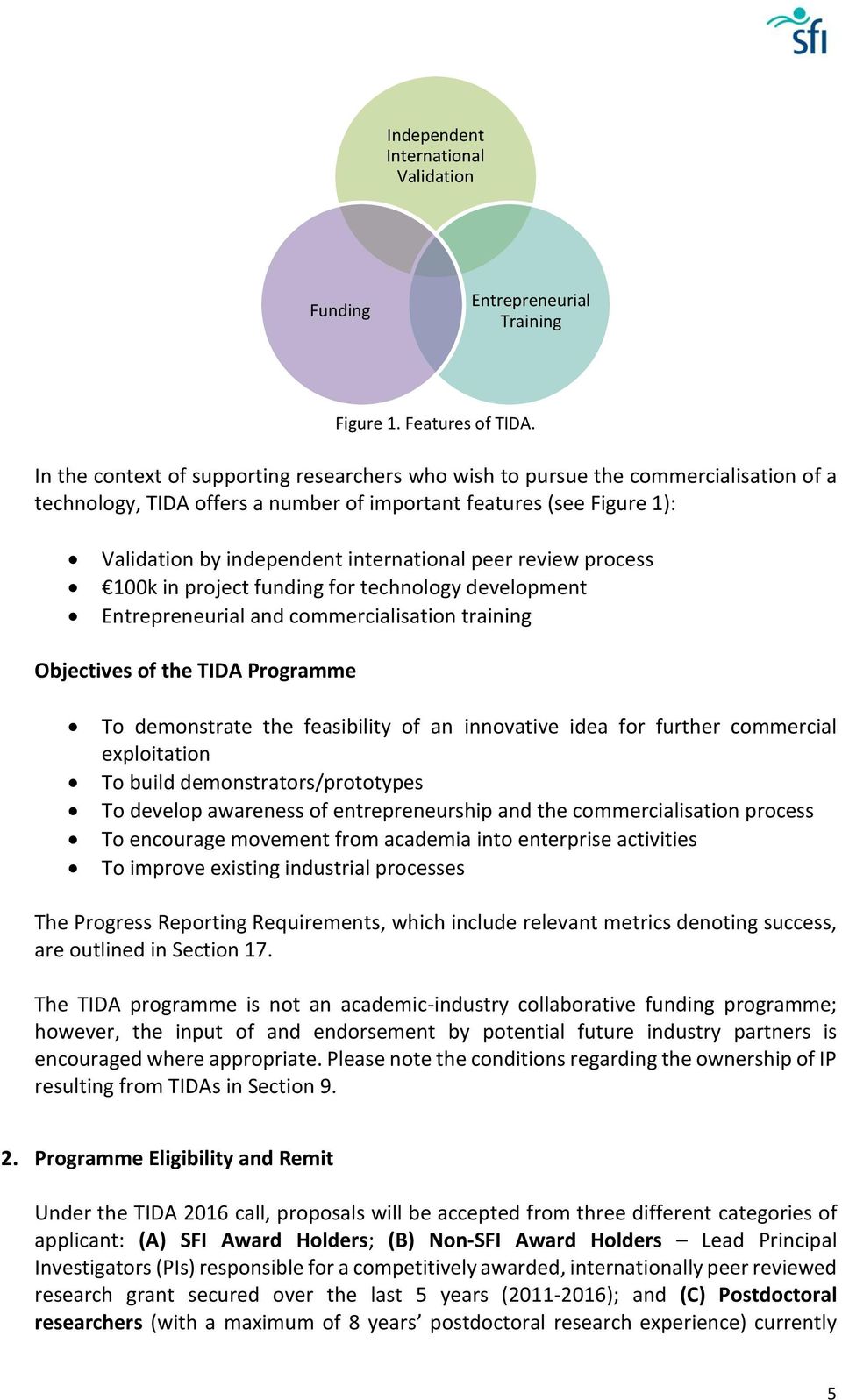
5 Independent International Validation Funding Entrepreneurial Training Figure 1. Features of TIDA. In the context of supporting researchers who wish to pursue the commercialisation of a technology, TIDA offers a number of important features (see Figure 1): Validation by independent international peer review process 100k in project funding for technology development Entrepreneurial and commercialisation training Objectives of the TIDA Programme To demonstrate the feasibility of an innovative idea for further commercial exploitation To build demonstrators/prototypes To develop awareness of entrepreneurship and the commercialisation process To encourage movement from academia into enterprise activities To improve existing industrial processes The Progress Reporting Requirements, which include relevant metrics denoting success, are outlined in Section 17. The TIDA programme is not an academic-industry collaborative funding programme; however, the input of and endorsement by potential future industry partners is encouraged where appropriate. Please note the conditions regarding the ownership of IP resulting from TIDAs in Section Programme Eligibility and Remit Under the TIDA 2016 call, proposals will be accepted from three different categories of applicant: (A) SFI Award Holders; (B) Non-SFI Award Holders Lead Principal Investigators (PIs) responsible for a competitively awarded, internationally peer reviewed research grant secured over the last 5 years ( ); and (C) Postdoctoral researchers (with a maximum of 8 years postdoctoral research experience) currently 5
6 funded under a competitively awarded, internationally peer reviewed research grant. For full details of applicant eligibility see Section 5. Eligibility of Research Body The Research Body 6 is the body responsible for the overall financial and administrative co-ordination of research programmes supported by research grants from SFI. A list of Eligible Research Bodies 7 is available on the SFI website. Programme Remit The remit of the TIDA programme includes the 14 NRP areas or any other area under SFI s legal remit where strong evidence can be provided of significant industrial relevance and strong economic impact. In addition, the applicant is required to complete a brief statement justifying how the proposed research aligns with SFI s legal remit. This statement will be used to determine the eligibility of the application. 3. ORCID ID ORCID 8 provides a unique identifier for all researchers which can then be linked to their different research works across different platforms. In December 2015, Science Foundation Ireland s award management system, SESAME, integrated with ORCID making it possible for researchers with a SESAME Researcher Profile to connect directly to an ORCID id from their profile. There are a number of benefits to creating an ORCID id that include: 1. ORCID allows you to pull information from different platforms creating a centralised reference to your different works (e.g. publications, patents, awards) in one location using a single sign in. 2. Your ORCID id is a unique identifier which distinguishes you from other researchers with a similar name. 3. Using the ORCID id assists in making your research works more visible to funders and publishers. You are able to build a complete picture of your research in one location. As part of the integration of SESAME with ORCID, it is possible for researchers to import publication data from ORCID directly into their SESAME Researcher Profile. For the TIDA 2016 call, researchers are required to have their SESAME Researcher Profiles linked to an ORCID id before an application can be submitted. 6 The term Research Body and Institution are equivalent and interchangeable in SFI documentation and in the SFI SESAME system
7 4. Review Process Following the submission of proposals to the TIDA 2016 Programme Call, all proposals are checked for compliance with: non-technical mandatory criteria (e.g. all sections complete, page numbers not exceeded); technical mandatory criteria (e.g. publication and prior funding requirements, alignment with the legal remit of SFI and alignment with NRP, where required); and any other requirements outlined in the call document. Proposals identified as ineligible at this stage will be declined without review. Distinguished international peer reviewers are employed in the review of applications to the TIDA programme. All reviewers engaged by SFI are required to adhere to the SFI Reviewer Code of Conduct. At all times the identity of the reviewers will be confidential. The first stage of full proposal review is undertaken by a panel of international experts engaged by SFI. This panel comprises distinguished international peer reviewers with significant expertise across the subject areas of proposals submitted to the call. A number of proposals are assigned to each member of the panel based on expertise. During review, the following review criteria are applied by the international reviewers: Quality and novelty of the proposed innovation Potential commercial opportunities for the proposed innovation Significance, including usefulness of the proposed innovation Quality of the project plan to realise the commercial potential of the innovation Potential impact of the proposed innovation Following submission of reviews from this first stage, proposals deemed to be of both excellent scientific quality and demonstrating strong commercial potential will proceed to the second stage of review. Applicants whose proposals do not proceed to the subsequent review stage will not be informed until the end of the overall review process. The second stage of full proposal review is undertaken by a sitting panel of international experts engaged by SFI. This panel convenes to discuss each proposal and the postal reviews submitted as part of the first stage of review. This panel meeting is also attended by a number of senior commercialisation specialists from EI. Only proposals deemed to be of both excellent scientific quality and demonstrating strong commercial potential are recommended for funding by the sitting panel. Prior to the sitting panel meeting, proposals are provided to Enterprise Ireland (EI) for review by an internal panel of commercialisation specialists. During review, the following review criteria are applied by Enterprise Ireland: Potential for project (once completed successfully) to secure future funding Any overlap between the proposed research programme and related Enterprise Ireland Funded Projects Whether this project is more suited to an EI commercialisation fund. 7
8 The reviews submitted by EI form part of the documentation provided as briefing to the sitting panel. 5. Programme Details 5.1 Definition of Lead Applicant and Collaborator The Lead Applicant will be responsible for the scientific and technical direction of the research programme and the submission of reports to SFI. The applicant has primary fiduciary responsibility and accountability for carrying out the research within the funding limits awarded and in accordance with the SFI Terms and Conditions of Research Grants. The lead will serve as the primary point of contact for SFI on the award and during the review process. There are no co-applicants permitted on a TIDA. A Mentor will be an established researcher within an eligible Research Body who will give advice and provide laboratory space and related infrastructure to a postdoctoral award holder. The mentor will act as an advisor and host to the postdoctoral award holder. The mentor will work with the postdoctoral award holder to ensure that all fiduciary aspects of the award are managed successfully. An Academic Collaborator is an individual from an academic institution who is committed to providing a focused contribution to the project and can enable a convergence across disciplines. The collaborator will serve under the direction of the applicant, and may or may not receive funding through the award. The nature of the collaboration should be referenced in the body of the research proposal. (For example: Will the collaborators be supplying samples, data, etc.? Will the collaborators be providing training in techniques or the use of equipment? Will the collaborators directly participate in specific work projects? Will collaborators be acting in a purely advisory capacity?). 5.2 Eligibility Criteria of Applicant Under the TIDA 2016 Programme Call, proposals will be accepted from three different categories of applicant: (A) SFI Award Holder; (B) Non-SFI Award Holder Lead Principal Investigator (PI) on a competitively awarded, internationally peer reviewed research grant secured over the last 5 years ( ); (C) Postdoctoral researcher (with a maximum of 8 years postdoctoral experience) currently funded under a competitively awarded, internationally peer reviewed research grant. In all cases, the applicant must be: A member of the academic staff of an eligible Research Body (permanent or with a contract that covers the period of the TIDA), or 8

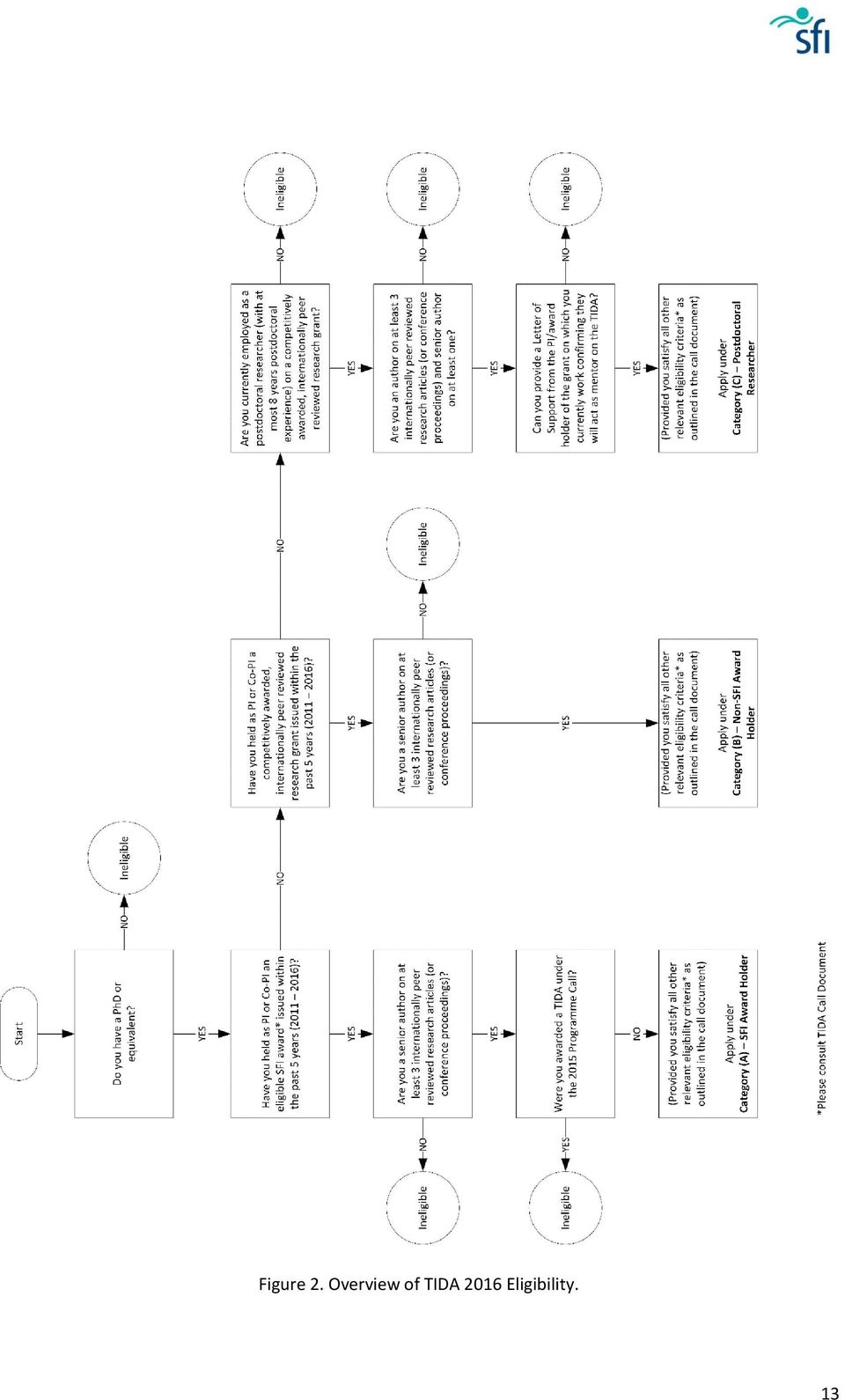
9 5.2.2 A contract researcher with a contract that covers the period of the TIDA (contract may be subject to receipt of the TIDA). Research Body submission confirms that the lead applicant meets these criteria and is either a member of the academic staff, a contract researcher, or awaiting appointment as defined above. IMPORTANT: SFI pre-approval for submission to Category (B) has been removed The applicant must hold a PhD or equivalent. Please consult the SFI Policy of PhD Equivalence 9 for further information Applicants who currently hold a TIDA award (i.e. awarded under TIDA 2015 Programme Call) are not eligible to apply. In such cases, TIDA awardees are strongly encouraged to support and mentor a postdoctoral researcher eligible to apply under Category (C). This is in keeping with the objectives of the TIDA programme to develop awareness of entrepreneurship and the commercialisation process; and to encourage movement from academia into enterprise activities. Furthermore, it provides an important opportunity for early-career stage researchers to gain experience in the management of an award Applicants who were awarded a TIDA prior to the 2015 Programme Call are eligible to apply to the current call. However, they must clearly highlight in the proposal how the current TIDA application differs from any previous applications. In particular, applicants must provide a brief report outlining the current technological and commercial development of their most recent award. In the case where an applicant is seeking funding to continue work developed as part of a previous TIDA project, the applicant must outline how all milestones were met in the previous project and justify the rationale to receive funding in the current call Only one application per person is allowed Only one application per award is allowed with the exception of the SFI CSET, SRC and SFI Research Centre programmes (see below SFI Award Holder Exception Funded Investigators). Figure 2 provides an overview of the eligibility criteria for each application category in TIDA. Additional eligibility criteria for each category of applicant are outlined below: 9 9
10 (A) SFI AWARD HOLDER The applicant must hold or have held within the past 5 years an SFI award as Lead Principal Investigator (PI) or Co-PI under the following programmes 10 : PI, SFI IvP Awards and Projects, PICA, RFP, Strategic Partnerships, SRC, CSET, SFI Research Centres, Stokes, Research Professor, PIYRA, SIRG, CDA, Charles Parsons, Mathematics Initiative, US-Ireland (excluding US-Ireland planning grant holders), SFI-Royal Society University Research Fellowship. Applicants who have only held awards which expired before January 1 st 2011 are not eligible to apply under this condition. Exception: SFI Funded Investigators For SRCs, CSETs and SFI Research Centres, SFI Funded Investigators are eligible to apply under Category (A) as long as they meet all other eligibility criteria. SFI Funded Investigators in an SFI Research Centre applying under Category (A) do not need to supply a Letter of Support from the Centre/Cluster Director. Note: Funded Investigators intending to apply under Category (A) should ensure that they are formally recognised by Science Foundation Ireland as an SFI Funded Investigator associated with the award under which they intend to apply. The applicant must be senior author on at least 3 international peer-reviewed articles. Only original research publications, and not review articles, are acceptable. Please consult the accompanying FAQs regarding the definition of senior author. (B) NON-SFI AWARD HOLDER Applications are accepted from Lead Principal Investigators (PIs) working on non-sfi funded awards. The applicant must be/have been Lead Principal Investigator (PI) on a competitively awarded, internationally peer reviewed research grant secured over the last 5 years ( ). The grant(s) in question must have been competitively awarded and internationally peer reviewed. Personal awards such as travel awards, career fellowships (which only include the salary of the PI and not research-team costs (i.e., salary for team member(s) and consumables, etc.) do not count as independent research grants). Awards of short duration (i.e., less than 12 months) are also not considered to be independent research grants. Awards which expired before January 1 st 2011 may not be used to meet this eligibility criterion. 10 For information on eligibility of awards not currently listed, applicants should contact SFI at [email protected] prior to the deadline for proposal submission. 10
11 In the case of large collaborative EU framework projects, the Co-PI/work package leader is eligible to apply as long as he/she meets all other eligibility criteria and are the lead PI for their institution. Please note that you may be required to provide evidence of your role in any such projects. As evidence, SFI may request the Research Office of your Host Research Body to provide it with details of the project to satisfy the Foundation of the applicant s role and that research has been undertaken as part of the project. If this evidence is not satisfactory then the Foundation may disregard the inclusion of this project which may in turn, make the application ineligible. The applicant must be senior author on at least 3 internationally peer reviewed articles. Only original research publications, and not review articles, are acceptable. Please consult the FAQs regarding the definition of senior author. (C) POSTDOCTORAL RESEARCHER One of the objectives of the TIDA programme is to encourage movement from academia into enterprise activities. In order to achieve this objective, applications are accepted from postdoctoral researchers who are interested in leading a TIDA and who, at the time of application, are funded under a competitively awarded, internationally peer reviewed research grant. The postdoctoral researcher will be able to request a contribution toward their own salary as part of the budget request. Interested postdoctoral researchers who will be coming to the end of an existing contract before the end of 2016 are particularly encouraged to apply. This provides the postdoctoral researcher with the opportunity to transition to the TIDA and to lead and focus solely on the TIDA for the duration of the award. The applicant must not have more than eight years of research experience beyond the PhD or equivalent (i.e. those who graduated after September 2008 are eligible to apply). Allowances will be made for documented leave, including maternity leave, paternity leave, parental leave, military service, sick/disability leave, time spent in industry and carer s leave. The applicant must currently be funded under a competitively awarded, internationally peer reviewed research grant and work under the guidance of the Principal Investigator (PI) on the award. The applicant must be endorsed by the Lead Principal Investigator (PI) (award holder) on the award in the form of a Letter of Support. This Letter of Support must indicate that the PI endorses the applicant and must confirm that the PI has agreed to act as mentor (see Section 5.1) to the applicant and to allow the applicant to carry out research within their laboratory space for the duration of the TIDA. Note: The title, identification code and awarding body of the grant under which the Category (C) applicant is funded must be included in (i) the Letter of Support 11
12 from the mentor (award holder) AND (ii) the CV of the mentor uploaded to SESAME as part of the application (see Section 5.5). The applicant must be an author on at least three internationally peer reviewed articles and must be senior author on at least one internationally peer reviewed article. Only original research publications, and not review articles, are acceptable. Please consult the FAQs regarding the definition of senior author. The applicant must not hold or have held a competitively awarded, internationally peer reviewed research award of greater than one year duration. The applicant must not hold a faculty position at the time of application. The applicant must be committed to work solely on the TIDA for one year and may not hold another concurrent award. The Research Body must confirm that the applicant meets the above criteria and must also provide assurance that the space and infrastructure to carry out the proposed research are available for the duration of the award. Where an applicant fails to meet the eligibility criteria outlined above, the application will be deemed ineligible and will not be accepted for review. 12
13 Figure 2. Overview of TIDA 2016 Eligibility. 13
14 5.3 Funding Applications may be submitted for a TIDA up to a maximum of 100k direct costs for a period of 12 months. Eligible costs include: Materials, consumables and travel. Access charges may be sought for use of infrastructure where SFI pre-approved access charge plans are in place. SFI offer an entrepreneurship training course as an optional but strongly recommended part of the TIDA programme. Depending on the number of successful applicants, multiple courses may be run during the year. Logistical details will be made available once the awards have commenced. The list of indicative course modules is shown in Appendix B. Note that appropriate justification for attendance at the entrepreneurship training course should be provided in the budget justification section of your application. Participation in the TIDA Entrepreneurial Training Course is only permitted for the PI and, where applicable, other team member(s) directly funded as part of the award. Where the applicant is either (A) an SFI Award Holder or (B) a non-sfi award holder, they may not apply for their own salary but are permitted to apply for the following staff costs (In all cases below, Please consult the SFI Grant Applications Budget Policy 11 ). o Stipends and Fees to support an MSc student for up to 12 months subject to the condition that MSc students must be registered by the end of June 2016 at the latest. o Contribution to salary of a Research Assistant. o Contribution to salary of a Postdoctoral Researcher. Where the applicant is (C) Postdoctoral Researcher, they are not eligible to hire additional staff but may apply for funding to support their own salary, on a full time basis, for the duration of the TIDA. In addition to direct costs, SFI also makes an indirect or overhead contribution to the host research body, which is reflected as a percentage (30%) of the direct costs (excluding equipment). Overheads are payable as a contribution to the Research Body for the indirect costs of hosting SFI-funded research programmes and are intended to enable the research body to develop internationally competitive research infrastructure and support services

15 5.4 Submission Proposals will only be accepted through SESAME, SFI's online grants and awards management system. Access to SESAME is controlled by staff at the Research Office of your Host Research Body. Please follow your internal organisational process to request this access. Once you have been registered by your Research Office, you will receive an containing: 1. Username 2. Password 3. SFI PIN number 4. SESAME website address Your username and password are needed to log in to SESAME. SFI s grants and awards management system, SESAME, is accessed using the Internet; no additional software needs to be installed. You can access SESAME online from any location. The configuration of some browsers and internet infrastructure (pop-up blockers, firewalls, etc.) can restrict an individual s access to the internet and as a result to the SESAME system. If you are having any such difficulties, please contact your organisation s IT support team. The SESAME system is accessed using the following Internet address: Please see the SESAME Users Guides 12 for more detailed information. SESAME enables: Individual researchers to apply online for SFI grants. Host research bodies to review and authorise all applications. Once submitted by the host research body to SFI through SESAME, an application cannot be withdrawn and subsequently modified for resubmission in the same call, regardless of the date of submission

16 5.5 Application Procedure IMPORTANT: Applicants must ensure that their SESAME Researcher Profile is linked to an ORCID id before an application can be submitted. Applicants must submit the following documentation: Full proposal Full proposals must be submitted online through SESAME to SFI by the Research Office of the lead applicant s research body before the call deadline. Applicants should follow carefully the instructions below and in the SESAME Users Guides 13 to complete the various sections of the application. In addition, a checklist of requirements is provided in Appendix C of this call document. Full proposal submission requirements: All text in uploaded PDFs should be provided in Times New Roman font, or similar, with minimum font size of 11, and at least single-line spacing as well as a minimum margin size of 2.5cm. Text in diagrams may be in any clearly legible font. Uploads in SESAME must be submitted in Adobe or Microsoft PDF format only. The number of pages in uploads must not exceed the specifications for any given section. Applications that do not comply with these requirements will be deemed ineligible and will be returned without review. Appendices or other unsolicited documentation are not permitted. Applications that include such unsolicited documentation will be returned without review. The currency to be used is the euro ( ). File sizes of attachments should be less than 5MB. Full proposals must be submitted online through SESAME to SFI by the Research Office of the lead applicant s Research Body in advance of the call deadline. Applications not adhering to these requirements, or with incomplete content, will be deemed ineligible and will not be accepted for review, regardless of the date of submission. It is the responsibility of the applicant to ensure that eligible proposals are received by SFI on, or before, the deadline indicated. In order to safeguard against ineligibility, applicants are reminded to adhere rigorously to the guidelines in the call

17 documentation and to review the proposal document prior to submission in SESAME. Early submission in SESAME is strongly recommended. Applicants who wait until shortly before the close of the call to upload their proposal for Research Body review and approval prior to the deadline, take serious risk of encountering submission issues. The submit button will cease to be active at the indicated deadline. Applications cannot be withdrawn and subsequently modified for resubmission in the same call. Step 1: Eligibility Questionnaire Applicants will be asked to select one of the three options below: (A) SFI Award Holders (B) Non-SFI Award Lead Principal Investigator (PI) on a competitively awarded, internationally peer reviewed research grant secured over the last 5 years ( ) (C) Postdoctoral researcher (with a maximum of 8 years postdoctoral experience) currently funded under a competitively awarded, internationally peer reviewed research grant The appropriate set of relevant eligibility questions will then appear for completion. Step 2: Full Proposal Preparation (i) Proposal Summary The Research Proposal title should clearly convey the nature of the research to be undertaken, in up to 30 words. Please note that the title should be non-confidential. For data gathering purposes, please select the most relevant NRP area (from the Priority Areas, Platform Science or Technology areas), which most closely aligns with the topic of your TIDA or select other. SFI tracks a number of research categorisation areas (separate from the NRP areas) for reporting purposes. The applicant must choose a primary and a secondary category from the dropdown lists which best align with the subject area of the proposed research. The applicant must complete a statement (250 words maximum) justifying how their proposed research is aligned with SFI s legal remit. This statement will be used as part of SFI s determination on the eligibility of the application. 17
18 (ii) Lead Applicant details (a) Lead Applicant CV - (Upload to SESAME) A CV of the lead applicant (max. 5 pages) using the template found at the end of this document should be completed and uploaded (see Appendix A). (b) Summary information on publication output and supervisory experience to date Please provide summary information on the total numbers of publications to date and also provide supervisory experience to date for the lead applicant. (iii) Collaborator(s) details Mentor Addition of Collaborators (Mentor) Information must be included in this section. Clicking on the Add button will open a form into which details about the mentor should be completed. Ensure that Mentor is selected in the Collaborator Type drop-down menu. Only one mentor may be assigned in the proposal. Once details regarding the name and institution of the mentor have been added and saved, which is achieved by clicking on the Save Draft button at the bottom of the application form, it will be possible to upload the mentor s CV (maximum of two pages) by clicking on the appropriate button. A template is not provided for mentor CVs. Relevant publications for the mentor should be listed, ensuring that the two-page limit is not exceeded. Academic Addition of Collaborators (Academic) Information must be included in this section. Include name, contact information and other requested details of academic collaborator(s), if any. Collaborator CVs are not permitted. Any other planned collaborative activities may be briefly described within the main body of the proposal. Industry collaborators are not permitted on TIDA applications, although relevant Letters of Support may be included (see this Section Step 2 (ix)). (iv) Main Body of Proposal (a) Keywords (max. 15 words) Please list the keywords/phrases from the research discipline or sub-discipline that best describe the research proposed in the application. (b) Scientific abstract (max. 200 words) This should be a succinct and accurate summary, in technical language, of the proposed work when separated from the application. 18

19 (c) Lay abstract (max. 100 words) This should be a succinct and accurate summary in lay, non-technical language of the proposed work when separated from the application. (d) Project Proposal (max. 6 pages) - (Upload to SESAME) The project proposal must be at maximum 6 pages in total (excluding references) and must be structured under the following headings and sub-headings: Personal Statement (max. 1/2 page) The statement should describe any qualifications, experience (e.g. entrepreneurship), achievements or awards and interests relevant to the application. Applicants are particularly encouraged to describe their ambitions and aspirations for the TIDA. Importantly, the personal statement may be used by reviewers as part of the overall evaluation process to gain deeper insight into the motivations of the applicant and understand the broader context of their application. Technical Description What is the question that this proposal addresses? This section should include project objectives and hypotheses, as appropriate. The objectives should be coherent and well planned and should be linked with tangible deliverables that demonstrate the commercial potential of your idea. This section must include supporting data which clearly demonstrates that development has progressed beyond basic proof of principle. Why is this question significant? This section should include the scientific and commercial background for context. Details of the state of the art in the research field should be included (with references). A clear explanation should be given as to why the questions addressed are key ones to addressing the commercial potential. In this context, specific reference should be made to the supporting data. How will the question be addressed and what are the expected outcomes? This section should provide details of the methodology and what achievable outcomes are to be expected. The current stage of development, as indicated by the supporting data should be described, and a description of what is to be achieved during the award should be provided (applicants should as part of the Commercial Opportunity section reference how the proposed technological development will progress any commercial objectives and enable commercial opportunities to be exploited). A clear project plan with specific reference to expected timelines, milestones and deliverables for the proposed research must be included. A Gantt chart 19
20 may be included as part of project plan (applicants should ensure that the chart is clearly legible). Commercial Opportunity What is the potential market for your technology? This section should include a description of the potential addressable market for the technology, identify the unmet market need and clearly outline how the proposed technology will address this need. A description of how this unmet market need was identified and validated should be provided. What are the innovative aspects of your technology and how does it compare to competing technologies/products in the market? This section should provide details of competing technologies currently in the market that you are aware of. Describe what is novel and innovative about your technology and describe how it is/will be differentiated from existing/competing technologies/products in the marketplace. As part of this description, please outline any potential advantages/disadvantages associated with your technology/product. How do you propose to commercialise this technology/product? Describe a potential route to commercialisation for this technology. In particular, refer to any interactions you have had or intend to develop with industry that may facilitate this process. In addition, refer to any interactions you have had with your Institution s Technology Transfer Office in relation to the development of a potential route to commercialisation. These interactions should be reflected in the Letter of Support provided by your Institution s Technology Transfer Office. As part of this, describe briefly how you propose to develop this technology and clearly indicate the role of the TIDA in this roadmap. Please also refer to any other funding mechanisms that you could potentially employ to progress this idea following completion of a TIDA project. Intellectual Property This section should include a brief description of the current status of any IP relevant to the current proposal and future plans to manage IP arising from the proposal. This section should be completed in close consultation with your Institution s Technology Transfer Office. If you have held a TIDA previously you must clearly highlight how the current TIDA application differs from previous applications. If the application relates to a previous TIDA, the applicant must outline how all milestones were met in the previous project and justify the rationale for follow on funding within the scope of TIDA. (e) References (max. 1 page) 20
21 (v) Expired, Current and Pending Support of Applicants The lead applicant must report on any expired, current and pending funding. The applicant should include details of any financial support pending, or received over the previous 10 years. This should include competitive research funding received from funding agencies (international & national), charities, industry, etc. The applicant must include details of any financial support from another body currently provided, or currently being sought. SFI will not support research programmes currently being funded by another source. For each current and pending grant listed, the applicant should provide a brief description of the research. Applicants must also indicate their percentage time commitment to these other projects, as a function of 100% of their total working time. For pending grants, please include the expected decision date in the description box. For grants for which the applicant is/was contractually responsible (expired or current), the applicant must indicate the funding source, the value of the grant ( ), the grant number, and the duration. The grant specific website, where possible, should also be provided in the description box. For collaborative expired and current grants where the applicant is not the sole grant-holder, indicate the funding source, whether the applicant is the PI, or co- PI, name the other partners on the grant, state the total value of the grant ( ) and the amount of the grant ( ) allocated in the applicant s name, state the grant number, and the duration. The grant specific website, where possible, should also be provided. If the applicant is solely a collaborator on a collaborative research project, the grant should not be included here. The portion of research funding that you claim in your name must be an accurate and a fair reflection of your responsibility in the projects listed and must be verifiable as such. SFI may conduct audits to verify such claims and reserves the right to reject proposals where the above principle of proportionality is not observed. This section of the proposal will be reviewed as part of the applicant s track record. Applicants with extremely large numbers of expired grants over the previous ten years may be selective with which funding grants to include in this section. The most prestigious grants and those most relevant to the proposed research should be included. 21
22 Research funding may be added directly to the application or added from the applicant s profile (see SESAME Users Guides 14 ). If this section is left blank it will indicate that the applicant has NO expired, current or pending funding. The applicant must complete the textbox detailing potential overlap between current and pending funding and the proposed research in this application. For each current and pending grant listed above, the applicant must clearly indicate any scientific overlap with this application, referring only to overlap in content. (vi) Proposed Budget Please note that the Budget Table for completion by the applicant(s) is located at the end of the full proposal application in SESAME. The costs eligible for grant support by SFI are those costs which can, uniquely and unambiguously, be identified with the proposed research programme. Applicants must give details of all relevant costs, including staff, equipment, materials travel and training. Ensure that the final total provided includes all costs requested from SFI. All grants are made directly to the lead applicant s research body. Please also refer to the SFI Grant Terms and Conditions 15 and also the SFI Grant Applications Budget Policy 16. See notes for completion in the SESAME Users Guides 17 and within SESAME. a) Staff: Salaries and benefits Please refer to the SFI Grants Team Member Budgeting Scale 18 and note that the Cost to Grant figures in these scales include the 20% employer s pension. Please note that the submission of an application by the host Research Body must only take place once salaries requested have been approved and justified. See Section 5.3 for details on allowable salaries and benefits under the TIDA Programme. b) Equipment Details of all requested equipment necessary for the research programme should be itemised. Requests for large pieces of equipment should not be included in the proposal. Small equipment of a value of less than 2,000 should be included in the ng_scale_november% pdf 22
23 materials and consumables section. The exception to this is costs associated with computers/laptops, which must be listed in the equipment section regardless of cost. If funding for computer cluster resources is requested, justification must be given as to why national high performance computing facilities cannot be used for the purposes of the project. c) Materials and Consumables Details of all materials and consumables that will be used in the course of the research programme should be provided. Access charges may be sought for use of infrastructure where SFI pre-approved access charge plans are in place. These may include, with SFI approval, access to facilities and services not available to the applicant, such as the costs associated with accessing international databases or commissioning specific experiments in national facilities (e.g. Tyndall, CRANN etc.). The Tyndall National Access Programme (NAP) provides researchers with access to Tyndall National Institutes' facilities and expertise and Tyndall NAP access costs should be included with appropriate justification. Access charge requests must be included as a separate line item in the budget and where relevant must include the name of the relevant infrastructure to be used. A rationale for the amount of use proposed must be provided in the budget justification. Funding requested for team members to attend the TIDA Entrepreneurial Training Programme may be included under the Materials and Consumables budget heading. Applicants wishing to attend the TIDA Entrepreneurial Training Programme should include a line item entitled TIDA Entrepreneurial Training Programme in the Materials and Consumables budget section. This line item should not have a cost associated with it. SFI will manage the allocation of training programme costs to the budgets of proposals at the time of award. d) Travel Only travel costs for journeys directly related to the progress of the TIDA may be requested. The applicant should detail travel expenses directly related to commercialisation activities. In the case of working visits, the rates sought for subsistence and other allowances may be no more than those which the Research Body s permanent staff may claim. In the case of travel budget requests to attend academic conferences a strong case must be made as to how attendance at the conference would further the commercialisation aspects of the project. Travel and accommodation to attend the TIDA Entrepreneur Training Course If a team member is interested in attending the TIDA entrepreneur training course, they may include reasonable travel costs. Economy fares on trains, buses or flights can be requested. As a public sector agency, SFI supports the use of public transport but where this is not possible, budget for taxi fares can also be requested. The maximum 23
24 allowable budget for travel to the TIDA training course is 500. The maximum allowable budget for accommodation for the TIDA training course is 500. e) Ineligible Costs The following costs are examples of ineligible costs: PhD stipends and fees; teaching buyout, clinical buyout, contingency or miscellaneous costs, hospitality and entertainment costs; technology transfer or patent costs; workshop organisation; journal subscriptions; relocation expenses. (vii) Infrastructure, facilities, services and space to be provided by Research Body (max. 1 page) Describe the infrastructure, facilities and space to be provided by the Research Body. This should include details of the office, laboratory, computing, animal or other facilities as necessary, where the research will be done, including all of the equipment that will be available, but excluding equipment requested in this application. (viii) Budget Justification (max. 2 pages) The applicant should outline the required expertise for the requested team member and justify the team member s role in the research programme. Please include the salary scale (as per SFI Grants Team Member Budgeting Scale 19 ) for the team member. Clear and explicit justification is required for any request for an experienced post-doctoral researcher, i.e. one who will be appointed higher than Level 2A, Point 1 of the SFI team member budgeting scales. Justification should also be provided for all requests relating to: small items of equipment, consumables and travel. Justification for the attendance at the TIDA entrepreneur training must also be included. Clear indication should be given where funding is apportioned to collaborators (within the Republic of Ireland and within an eligible Research Body only). Please note that collaborators outside the Republic of Ireland are not eligible to receive funding through the TIDA. Only eligible Research Bodies will be entitled to receive direct funding through the grant and all funding will be administered through the lead applicant s research body. SFI encourages TIDA applicants, where appropriate, to avail of national facilities to demonstrate their technology. Costs for the use of national facilities should be clearly outlined and justified. Where available, SFI pre-approved access costs must be used. If funding is sought for use of overseas equipment/services, this should be clearly justified and the rationale for not carrying out this activity in Ireland must be provided g_scale_november% pdf 24
25 (ix) Letters of Support A Letter of Support from the Technology Transfer Office outlining the commercialisation strategy for the TIDA and highlighting any relevant details regarding the TIDA, including for example possible routes to market, IP landscape etc., must be included. A Letter of Support from the Host Research Body of the lead applicant which should comment on the infrastructure and services available to the applicant. In addition, in cases where team members will be transferring to the TIDA from another active SFI research grant, an outline the management plan (i.e. a description of how the individual will be replaced on the original award) to assure that both awards progress satisfactorily should be provided. Where the applicant wishes to apply under Category (C) Postdoctoral researcher, a signed Letter of Support from the Mentor must be included. The Mentor is the PI (award holder) of the award on which the applicant currently works. This Letter of Support must indicate that the PI endorses the applicant and must confirm that the PI has agreed to act as mentor and to allow the applicant to carry out research within their laboratory space for the duration of the TIDA. The Letter of Support must include details of the applicant s current role and funding arrangements including remuneration level. The grant identification code and grant title under which the applicant is currently funded must be included in (i) the Letter of Support from the Mentor AND (ii) the CV of the Mentor uploaded to SESAME as part of the application (see Section 4.6). The Letter of Support must demonstrate that the Mentor has the infrastructure and capability to host the team member during the course of the TIDA. Letters of support from potential future industry partners may also be included where appropriate to demonstrate the relevance and business need for the proposed technology. (x) View Proposal Prior to Submission A PDF of your proposal is available in SESAME and should be reviewed prior to submission to enable you to validate your application. The responsibility lies with the applicant in this regard. Submission is made initially to your local research office for approval, prior to submission by the research office to SFI. Please contact your Research Office well in advance in order to obtain registration details for SESAME and familiarise yourself with any internal Research Body submission deadlines. Applicants will receive a notification from SESAME periodically when the status of their proposal changes. Alternatively, if you wish to track the status of your proposal e.g. proposal pending Research Office approval or under review at SFI, this information will be displayed in SESAME. 25
26 6. Research Body Approval It should be noted that Research Body submission of an application represents their approval of an application and agreement to SFI Terms and Conditions of Research Grants. Submission must only be made by an authorised Research Body representative. In particular, the Research Body is approving: The eligibility of the applicants That the applicants are, or will be upon receipt of the grant, recognised as employees of the Research Body for the duration of the grant That the requested budget including salaries/stipends, equipment, travel and consumables are in line with accepted institutional guidelines The availability of infrastructure within the institution as outlined by the applicant in the research proposal That the proposed research programme has not been funded by other sources That relevant ethical and regulatory approval has been or will be sought and must be granted prior to the award commencing That the relevant licences will be in place at the time of award That the details provided in relation to research funding history i.e., current, pending or expired grants, as detailed in the application, are valid and accurate 7. Applicant Agreement to Terms and Conditions It should be noted that submission of an application represents your agreement to SFI Grant Terms and Conditions Deadlines The deadline for full proposal submission will be Friday 27th May 2016, Dublin Local Time. After this deadline, applications will not be accepted by Sesame. Therefore they will not be reviewed by SFI. 9. Intellectual Property Management IP management practices will be in accordance with national guidelines. In particular, IP processes arising out of TIDAs must comply with the practices and procedures described in the national IP protocol document Inspiring Partnership the national IP Protocol Specifically, all IP generated through the TIDA will be owned by the Research Body named on the Letter of Offer and will be subject to the following conditions:
27 Disclosure of conflict of interest and prior communication with third parties The Host Institution hereby represents and warrants on its own behalf and on behalf of the Applicant, all Research Staff and Other Staff associated with the Project, having made reasonable and diligent enquiries of them, that no conflict of interest arises from their participation in the Project and full and frank disclosure has been made in the TIDA proposal concerning all prior or pending communications with industry, any company, scientific publisher, person or other body concerning the Project including the possible exploitation of potential Foreground IP and/or Background IP insofar as the latter would affect the exploitation of Foreground IP in accordance with the terms of this Letter of Offer. Intellectual Property Access The Host Institution hereby warrants that it has a right to full and unfettered ownership of all Foreground IP and that there is no formal or informal arrangement with, or commitment given by it to any person, group of persons, company or other body that could affect that right or attach conditions to it. The Host Institution hereby further warrants that there is no formal or informal arrangement with, or commitment given by on behalf of the Applicant, any member of the Research Staff or Other Staff associated with the Project to any person, group of persons, company or other body that could affect its rights to unfettered ownership of all Foreground IP or attach conditions to it. The Host Institution hereby further warrants that, insofar as can be reasonably determined it is not aware that any arrangement or commitment of the type referred to in this clause is in place with respect to Background IP that would affect the exploitation of Foreground IP in accordance with the terms of this Letter of Offer. 10. Common Issues with Applications Submitted to TIDA The most common reasons for applications not being funded by the TIDA programme in previous calls are outlined below; applicants are strongly advised to consider these points when preparing their application to ensure they are adequately addressed. The research is too early stage: Keeping in mind that the timeline for commercialising an idea or technology can vary significantly with area, a proposal to the TIDA programme should have the necessary data or information to show that a one year project will progress the idea to a stage where the technical feasibility has been demonstrated and potential for commercialisation has been investigated. The route to market is unclear: This review feedback is usually a symptom that the applicant has not given enough thought to what the market is for their idea, how they would go about accessing that market, what commercialisation activities they would undertake, what technologies or products already exist in the marketplace to address the problem being tackled by the TIDA application and why their idea is better. Applicants should also note: 27
28 Proposals where there is no viable commercialisation route in Ireland, either through the formation of a start-up, or via technology or knowledge transfer to an Irish-based industry partner, for example, will need to make a compelling case for the value of the project to Ireland in order for funding to be considered. Applicants should include as much detail as possible on the relevant Intellectual Property (IP) landscape surrounding their idea and also include detail on the target market, demonstrating that they will have freedom to operate within this landscape. If a proposal is deemed fundable, the successful applicant s institution will be asked to sign off that they have the right to full and unfettered ownership of all Foreground IP. Applicants are strongly encouraged to obtain input and advice from their institution s Technology Transfer Office (TTO) as early as possible during proposal preparation. A Letter of Support from the TTO must be provided. Detailed TTO input shows that the applicant is thinking about, and has knowledge of, the next stages in the commercialisation process. It should be noted that typically reviewers have looked on this favourably. 11. SFI Resubmission Policy Applications to any call that are based primarily on unsuccessful submissions (following peer review) to any SFI programme must demonstrate that the review comments resulting from the initial application have been taken into account in the preparation of the new submission. SFI will not review resubmissions that have not clearly taken into account the major comments or concerns resulting from the prior review and these proposals will be withdrawn without review. Please see SFI Policy on Resubmission of Grant Applications 22 for further information. Applicants to an SFI call for proposals must declare whether a new submission relates to a previously submitted application to any SFI scheme. If the application is a resubmission, a statement referencing the previous application and explaining the differences must be provided and making reference to reviewer comments where relevant. Please this statement to [email protected] prior to the deadline. This statement will assist SFI Scientific Staff in the assessment of eligibility of a revised application and will not be shared with reviewers. 12. Research Integrity SFI places high importance on ensuring research integrity and endorses the National Policy Statement on Ensuring Research Integrity in Ireland 23. All applicants and institutions are expected to abide by the aforementioned Irish Policy on Research Integrity and the European
29 Code of Conduct for Research Integrity 24. SFI plans to audit compliance by its award holders and relevant research bodies with the principles laid down in these guidelines that are relevant to the agency s activities and the awards it makes. 13. Ethical Issues All investigators and research bodies must ensure that, before the research commences and during the full award period, all the necessary ethical, legal and regulatory requirements in order to conduct the research are met, and all the necessary licences and approvals have been obtained. All research bodies are responsible for ensuring that a safe working environment is provided for all individuals associated with a research project. If research activities involve the use of animals, applicants must comply with the Health Products Regulatory Authority s (HPRA) position on the use of animals in research. SFI will only support research using animals that is fully compliant with the requirements of the HPRA, has been independently peer reviewed and where consideration has been given to the use of alternative approaches not involving the use of live animals and addressing the principles of the 3R s (reduction, replacement, refinement). For studies involving humans, ethical approval must be obtained from the relevant national or local ethics committee prior to the start of the project. SFI only permits early stage regulated clinical trials (Phase I or combined Phase I/II) and investigations to be undertaken under the scope of the following SFI programmes: SFI Research Centres, Spokes, and Strategic Partnerships in addition to SFI Research Professorship where the successful candidate will become a Co-Principal Investigator within an SFI Research Centre 25. Clinical trials and investigations requiring approval by the Health Products Regulatory Authority (HPRA) will not be permitted through other SFI funding programmes, including TIDA. Funding requests for early stage research involving human volunteers and/or human samples that does not require regulatory approval are permitted under TIDA. Where there is any doubt, applicants are advised to contact the HPRA prior to submission to ensure eligibility and are required to indicate in their application that the proposed study does not require HPRA approval. SFI will require evidence that relevant ethical and regulatory approval has been granted prior to the award commencing. Furthermore, in line with a current directive from its parent Government Department, research funded by SFI must not comprise any component of the following: Research intended to create human embryos solely for the purpose of research or for the purpose of stem cell procurement, including by means of somatic cell nuclear transfer Research using human embryonic stem cells or tissues
30 14. Non-Compliance Full Proposals will only be accepted through the SESAME Award Management System. Proposals not in compliance with any details specified in this document, or in the SFI Terms and Conditions of Research Grants will not be eligible for a grant and will be returned without review. 15. Confidentiality Science Foundation Ireland takes all reasonable steps to ensure that information provided in the application is treated as confidential, subject to submission to the members of its committees and merit review and to any obligations under law. 16. Conflict of Interest Conflict of interest rules are applied rigorously and apply to both reviewers and applicants. Reviewers engaged by SFI are required to adhere to SFI s conflict of interest policy and immediately declare to SFI where a conflict of interest exists or arises so that an alternative reviewer may be appointed. International peer reviewers will not provide comments or scores on any application on which they have a conflict of interest. Reviewers must adhere to high standards of integrity during the peer review process. They must not compromise the intellectual property integrity of the application and may not appropriate and use as their own, or disclose to any third party, ideas, concepts or data contained in the applications they review. 17. Award Management Progress Reporting Requirements SFI has stringent requirements for the reporting on awards that it makes. Individuals who hold the primary responsibility for reporting and who fail to comply with reporting requirements, run the risk of having their grant payments suspended. In order for SFI to evaluate the success of a TIDA, awardees will be asked to report on the outputs arising from their award. As such, at the end of the 12 month TIDA, award holders will be asked to complete both a detailed annual report and an on-line survey. Submission of the annual report is through SESAME where detailed guidelines can also be accessed in relation to the reporting template. The TIDA Survey which enables longitudinal capture of TIDA outputs and impacts is also completed in SESAME (see further details below). The degree to which the award achieves the objectives set out in the TIDA Programme call will be evaluated from these reports. 30
31 The TIDA Annual report Each of the TIDA programme call objectives, with expected outputs, is discussed in turn below: To demonstrate the feasibility of an innovative idea for further commercial exploitation Success against this objective will be determined from productivity in a number of areas. In the annual report, awardees with be asked to outline milestones that support the feasibility of their idea for further commercialisation. These milestones should include fulfilling the technical objectives of the project and any formal commercialisation steps that have taken place. They might also include steps such as the production of prototypes, the engagement with commercialisation funders or investors, or the protection of intellectual property. It is recognised that innovation can be driven by the combination of ideas or processes from different disciplines. As such, awardees should report on collaborators that are associated with the award and that have supported its successful outcome, if relevant. To develop awareness of entrepreneurship and the commercialisation process It is expected that the TIDA will allow the awardee to gain a better understanding of the business requirements and operations central to commercialising the products of academic research. In the online survey, awardees will be directly asked to rate the improvement of their own and their team s awareness of the commercialisation process. Awardees will be asked to report on initiatives for the training of team members, and to provide details of their participation in various aspects of the commercialisation process. These may include meetings with industry, technology transfer offices or other commercialisation agencies such as Enterprise Ireland. Additionally, evidence of engaging with commercialisation steps such as the protection of intellectual property through invention disclosures, filing patents or applications for follow-on funding should be reported. To encourage movement from academia into enterprise activities One of the key performance indicators described in Agenda 2020 is to Increase the percentage of SFI trainees moving to industry as a first destination. It is expected that a TIDA will provide the experience and opportunities for researchers to carry an idea from the academic sphere to a commercial one. Additionally, the skills gained by participation in a TIDA are expected to improve employability in sectors outside academia. Metrics/outputs in support of this indicator include the destination of team members following the close of the award and all evidence supporting the increased knowledge of TIDA award-holders and their team about the commercialisation process. To build demonstrators/prototypes Where applicable to a particular project, an objective of the TIDA project is to enable the production of a demonstrator or prototype as a stage in the realisation of a new commercial product. In the reporting process, awardees should describe demonstrators/prototypes that 31
32 have been developed and examples where these have been demonstrated to interested companies or investors. To improve existing industrial processes In cases where the objective of a TIDA is to improve an existing industrial process, technical and scientific information will be provided by the awardee relating to the improvements made. The TIDA online survey The purpose of the short online-survey is to collate quantitative metrics and to enable awardees to self-assess performance on their award. Due to the nature of a typical commercialisation time-line, it is important to capture the outputs of the project for a period beyond the formal end of the TIDA, and as such the survey will be completed on an annual basis for 5 years after the conclusion of the award. T this survey is undertaken using the SESAME award management system. The self-assessment section instructs the awardees to select one of the categories listed below which most closely matches the output of their award. 1. Commercialisation/Business plan activated. 2. Industrial Collaboration formed. 3. Commercialisation/Business plan developed. 4. Application made for follow on funding, e.g. Enterprise Ireland commercialisation fund, Angel or VC funding. 5. Patent filed. 6. Other commercial IP generated, e.g., copyright, trademark, know-how, standards 7. Invention disclosure filed. 8. Not pursuing project as feasibility study demonstrated no/limited commercial potential. Awardees will be asked to complete follow on surveys on an annual basis for five years, where they will be instructed to select one of the following categories that most closely matches the output from their award. 1. Company founded 2. Licensing Option/Assignment Achieved 3. Industrial Collaboration formed 4. Patents Granted 5. Follow on funding secured, e.g. EI CF, VC, Angel, Industry 6. Patents Filed 7. Not pursuing project as award outputs demonstrated no/limited commercial potential 32
33 18. Questions FAQs are available on the TIDA webpage. For all additional queries please contact: 33
34 Appendix A: Applicant CV Template 5 PAGES MAX: Section 1 (max. 2 pages) + Section 2 (max. 3 pages) SECTION 1 Required Details (up to 2 pages maximum) NAME AND CONTACT DETAILS CAREER PROFILE (Education and Employment) If you wish you may provide details of any career breaks or periods of part-time work, for example parental or long-term sick leave. HISTORY OF MENTORING AND SUPERVISION Please include numbers of current and completed MSc and PhD students, directly under your supervision, as well as details of previous and current post-doctoral staff. INNOVATION/COMMERCIALISATION ACTIVITY (e.g., relevant industry collaborations, invention disclosures, patents, spin-outs) Please distinguish between patents applied and under review versus patents granted OTHER INFORMATION AS APPROPRIATE Please include details of key achievements including measures of esteem, invited presentations, principal scientific activities and responsibilities, as well as a statement demonstrating the applicant s accomplishments as an independent PI. 34
35 SECTION 2 Publication Listing (up to 3 pages maximum) FULL LIST OF PUBLICATIONS (or up to maximum space allowed) Please fill in the table including the total number of publications and categorize that number according to the additional categories below. Total Publications # # Senior Author publications Journal Articles Reviews Book Chapters Books *Conference Associated Publications # # # # # # Other *classified into peer reviewed conference papers and edited conference proceedings where appropriate as per discipline Please highlight below with an asterisk each of your senior author publications (as per the eligibility criteria). Please underline the name of the PI (and co-pis if applicable) on each publication listed. 35
36 Appendix B: TIDA Entrepreneurship Training Programme Description SFI will provide an entrepreneurship training programme as an optional but recommended part of the TIDA 2016 programme. Depending on the number of successful applicants, multiple courses may be run during the year. Indicative course modules include: Entrepreneurship, Pitching, Marketing and Intellectual Property (IP). 36
37 Appendix C: TIDA Proposal Checklist SECTION DESCRIPTION REQUIREMENTS Title Max. 30 words Total funding requested Budget is indicative Proposal Summary Select 1 of 3 eligibility criteria Choose 1 Select NRP option as appropriate Research categorisation areas Choose 2 Lead-applicant details Collaborator details Mentor Category (C) Collaborator(s) details - Academic Main Body of Full Proposal Expired, Current or Pending Support of Applicants Proposed Budget Infrastructure Budget Justification Letters of Support Resubmission Justification for SFI legal remit Percentage time commitment (NB Category (C) 100%) Summary info publication/ supervisory CV use template provided (see Appendix A) Name/Contact details etc. CV no template provided Name/Contact details etc. Keywords Scientific abstract Lay abstract Project Proposal (Upload to SESAME) References Expired, Current & Pending Funding Indicate scientific overlap Details of all relevant costs Applicant to complete detail on the infrastructure, facilities, services and space to be provided by the Research Body Outline the justification for the requested costs Technology Transfer Office Host Research body of applicant Category (C) Letter of Support from Mentor Industry (If applicable) Resubmission Statement to be ed to [email protected] where applicable (See Section 11). Max. 250 words Max. 5 pages Max. 2 pages Max. 15 words Max. 200 words Max. 100 words Max. 6 pages Max. 1 page Max. 600 words Budget Table Max. 1 page Max. 2 pages 37
38 Viewing the PDF of your application prior to submission allows you to verify content There is no system validation on multiple upload file fields as the number of documents required may vary for each application. It is the responsibility of the applicant to ensure that all documentation is included and that page lengths are not exceeded. 38
Call for Submission of Proposals
 SCIENCE FOUNDATION IRELAND SFI Investigators Programme 2015 Call for Submission of Proposals Key Dates Call announcement: 31 st March 2015 Deadline for proposal submission: 26 th June 2015, 13.00 Dublin
Morris Animal Foundation
 General Information: Morris Animal Foundation First Award Proposal Morris Animal Foundation (MAF) is dedicated to funding proposals that are relevant to our mission of advancing the health and well-being
SBRI Healthcare: NHS England competition for development contracts
 SBRI Healthcare: NHS England competition for development contracts GUIDANCE NOTES These Guidance Notes complement the Invitation to Tender document and are designed to help you complete your application
GUIDELINES FOR APPLICANTS
 GUIDELINES FOR APPLICANTS TABLE OF CONTENTS I. ABOUT POLONEZ... 2 II. APPLICANTS... 2 III. HOST INSTITUTION OF THE FELLOWSHIP... 3 IV. FUNDING... 5 V. HOW TO COMPLETE THE POLONEZ 1 APPLICATION FORM...
Guide for Applicants. Funding Scheme for the Archiving of Programme Material
 Funding Scheme for the Archiving of Programme Material Guide for Applicants Round 2: Archiving of programme material which preserves a historic record of Irish culture, heritage and experience and in particular,
University Research Fellowships 2016 Republic of Ireland applicants
 University Research Fellowships 2016 Republic of Ireland applicants 1. Overview The Royal Society and Science Foundation Ireland (SFI) have established a partnership to ensure that outstanding early career
Research Funding Guide
 Research Funding Guide Page 1 Contents Introduction... 7 Equal Opportunities... 7 Concordat to Support Research Integrity... 8 How to use this guide... 8 Definition of research... 9 1 Funding opportunities...
2015 Grant Application Guidelines for A Awards
 2015 Grant Application Guidelines for A Awards In this packet you will find the following: Award Overview and Eligibility - page 2, 3 Application Information and Outline - pages 4, 5 Important Dates and
LRCP Catalyst Grants for Translational Cancer Research Spring 2015 Competition
 LRCP Catalyst Grants for Translational Cancer Research Spring 2015 Competition Grant Themes ONLY for: Translational Breast Cancer Research Translational Ovarian Cancer Research Translational Surgical Oncology
Discovery Grants. 2015-2016 Request for Applications
 The mission of the American Brain Tumor Association is to advance the understanding and treatment of brain tumors with the goals of improving, extending and, ultimately, saving the lives of those impacted
How To Write A Research Proposal For An Erc Grant
 ERC Starting Grant 2014 Research proposal (Part B1 and Part B2) Version 1.0 11 December 2013 Disclaimer This document is aimed at informing potential applicants for Horizon 2020 funding. It serves only
PREANNOUNCES RESEARCH WITHIN PRIORITY SECTORS CALL FOR PROPOSALS
 THE GENERAL SECRETARIAT FOR RESEARCH AND TECHNOLOGY AS PROGRAMME OPERATOR OF THE GREEK-EEA RESEARCH PROGRAMME IMPLEMENTED UNDER THE GREEK FINANCIAL MECHANISM 2009-2014 PREANNOUNCES RESEARCH WITHIN PRIORITY
Guidelines for applicants
 ERACoSysMed 1st Joint Transnational Call for Proposals for European Research Projects to demonstrate the feasibility and benefits of systems medicine Guidelines for applicants Submission deadline for pre-proposals:
Administrative forms (Part A) Project proposal (Part B)
 Ref. Ares(2015)2346168-04/06/2015 Project Grants (HP-PJ) Administrative forms (Part A) Project proposal (Part B) Version 2.0 05 June 2015 Disclaimer This document is aimed at informing potential applicants
Future Research Leaders call 2015/16 Guidance notes for non-academic reviewers
 Future Research Leaders call 2015/16 Guidance notes for non-academic reviewers Introduction... 1 Aims and objectives... 1 Procedure... 3 Peer Review form on Je-S... 3 The decision-making process... 3 Assessment
Quick Reference. Future Manufacturing Platform Grants
 Quick Reference Please note that you must read the full Call document for guidance before submitting your proposal Future Manufacturing Platform Grants Call type: Invitation for outlines Closing date:
FLORENCE UNIVERSITY OF THE ARTS (FUA) OFFICE OF REASEARCH, ASSESSMENT AND DEVELOPMENT (ORAD)
 FLORENCE UNIVERSITY OF THE ARTS (FUA) OFFICE OF REASEARCH, ASSESSMENT AND DEVELOPMENT (ORAD) CALL FOR PROPOSALS Research is the crossroads where the knowledge of today encounters the potential to shape
RE AP QUE PLIC FOR IONS. Compa CPRIT RFA C 12 FORM 2. Company. p.1/17
 RE AP QUE ST PLIC AT RFA C 12 FORM 2 FOR IONS Compa any Formation Awards FY 2012 Fiscal Year Award Period September 1, 2011 Augustt 31, 2012 CPRIT RFA C 12 FORM 2 (Rev 6/ /30/11) Company Formation Awards
Guide for Writing a Short Proposal
 Guide for Writing a Short Proposal LS Call 2013 New Ventures Beyond Established Frontiers November 2012 Vienna Science and Technology Fund (WWTF) Schlickgasse 3/12 1090 Vienna, Austria T: +43 (0) 1 4023143-12
R&D Fund Reference Document. Supporting market-led innovation in manufacturing and internationally traded services companies.
 R&D Fund Reference Document Supporting market-led innovation in manufacturing and internationally traded services companies. Revision date: 28th April 2016 http://www.enterprise-ireland.com/randd 1 Reference
CENTRAL GRANT APPLICATION GUIDELINES
 CENTRAL GRANT APPLICATION GUIDELINES 1. What does the Foundation fund? DM Thomas Foundation for Young People makes grants to charities that meet one of our chosen areas of focus. Our primary remits are:
ERC Proof of Concept Grant 2014 Administrative forms (Part A) Research proposal (Part B) Letter of Commitment of the Host Institute
 ERC Proof of Concept Grant 2014 Administrative forms (Part A) Research proposal (Part B) Letter of Commitment of the Host Institute Version 1.1 3 February 2014 Disclaimer This document is aimed at informing
STFC IPS Guidance Notes. Contents
 STFC IPS Guidance Notes INTRODUCTION Contents AIMS Choice of scheme remit and structure ELIGIBILITY Academic Applicants Non-Academic organizations TIMETABLE APPLICATION PROCESS Capital Information for
PROPOSAL ACRONYM - ETN / EID / EJD (delete as appropriate and include as header on each page) START PAGE MARIE SKŁODOWSKA-CURIE ACTIONS
 START PAGE MARIE SKŁODOWSKA-CURIE ACTIONS Innovative Training Networks (ITN) Call: H2020-MSCA-ITN-2015 PART B PROPOSAL ACRONYM This proposal is to be evaluated as: [ETN] [EID] [EJD] [delete as appropriate]
Version 1.0 23 October 2014
 ERC Proof of Concept Grant 2015 Administrative forms (Part A) Research proposal (Part B) Letter of Commitment of the Host Institute Version 1.0 23 October 2014 Disclaimer This document is aimed at informing
Application summary. Lead applicant. Type of Intermediate Fellowship requested. Application title. Proposed duration of funding (months)
 Application summary Type of Intermediate Fellowship requested Application title Proposed duration of funding (months) Proposed start date Name of administering organisation Lead applicant's address at
E-Rare Joint Transnational Call for Proposals 2014 " Development of Innovative Therapeutic Approaches for Rare Diseases"
 E-Rare- JTC 01: Pre-proposal application form E-Rare Joint Transnational Call for Proposals 01 " Development of Innovative Therapeutic Approaches for Rare Diseases" Pre-proposal application form CHECKLIST
Revision History. Profile, Images to Details Planning, Resubmission Feedback/Comments. 1.4 22 nd July 2013
 Revision History Revision Date Comment 1.0 15 th January 2013 1 st Edition 1.1 18 th January 2013 Update on Other Researchers 1.2 22 th January 2013 Account Registration and Miscellaneous updates. 1.3
Establishing and operating HEA accredited provision policy
 Page 1 of 13 Establishing and operating HEA accredited provision policy 1. Introduction The Higher Education Academy (HEA) accredits initial and continuing professional development provision delivered
UNIVERSITY GLOBAL PARTNERSHIP NETWORK (UGPN) RESEARCH COLLABORATION FUND 2014 THIRD CALL FOR PROPOSALS
 UNIVERSITY GLOBAL PARTNERSHIP NETWORK (UGPN) RESEARCH COLLABORATION FUND 2014 THIRD CALL FOR PROPOSALS SUMMARY The University Global Partnership Network (UGPN) is a preferred partnership network including
Evaluation Guide 2013 FCT INVESTIGATOR GRANTS. 01 August 2013
 Evaluation Guide 2013 FCT INVESTIGATOR GRANTS 01 August 2013 1. INTRODUCTION This document outlines the reviewing process of the call for FCT Investigator grants, inputs and outputs, and defines the responsibilities
ROYAL COLLEGE OF CHIROPRACTORS (RCC) PHD STUDENTSHIP GRANTS TERMS & CONDITIONS OF AWARD
 ROYAL COLLEGE OF CHIROPRACTORS (RCC) PHD STUDENTSHIP GRANTS TERMS & CONDITIONS OF AWARD Introduction These terms and conditions relate to RCC PhD Studentship Grants (SGs). An SG is a grant paid by the
Africa Mathematics Project. Request for Applications
 Africa Mathematics Project Request for Applications The Africa Mathematics Project (AMP) of the Simons Foundation invites applications for grants to support mathematical activities in Africa, including
Associate Engineer. Regulations for the title of Associate Engineer
 Associate Engineer Regulations for the title of Associate Engineer FOREWORD Engineers Ireland is the operating title of the Institution of Engineers of Ireland. Engineers Ireland, founded in 1835, represents
Collaborative Computational Projects: Networking and Core Support
 Collaborative Computational Projects: Networking and Core Support Call type: Invitation for proposals Closing date: 16:00 07 October 2014 Related themes: Engineering, ICT, Mathematical sciences, Physical
Royal Society of Chemistry Researcher Mobility Grant - Terms and Conditions 2015
 Royal Society of Chemistry Researcher Mobility Grant - Terms and Conditions 2015 Scope and Duration UK Researcher Mobility Grants For all intents and purposes, the Republic of Ireland is considered in
2017 Postdoctoral Fellowship. Application and Funding Guide:
 2017 Postdoctoral Fellowship Application and Funding Guide: DST-NRF Free-standing (Local and Abroad) DST-NRF Innovation DST-NRF-DHET Scarce Skills Postdoctoral Grants Management and Systems Administration
Announcement of Opportunity. Part B: Applying for ESPA 2016 Grants
 Announcement of Opportunity Part B: Applying for ESPA 2016 Grants Critical Deadlines: Full proposals to be submitted via Je-S by 16:00 (4pm) UK Local Time (GMT+1/UCT+1), 17 May 2016 Information about your
Graduate School. Online skills training (Research Skills Master Programme) Research Methods. Research methods in the social sciences
 Graduate School Online skills training (Research Skills Master Programme) Research Methods Research methods in the social sciences This course begins with an examination of different approaches to knowledge
A guide for applicants to the learning and teaching in cyber security grant scheme
 A guide for applicants to the learning and teaching in cyber security grant scheme August 2014 Contents Overview of the learning and teaching in cyber security grant scheme 3 Important dates 3 Key information
Instructions for Application Submission National MS Society-American Academy of Neurology (AAN) Clinician Scientist Development Award 2016
 Instructions for Application Submission National MS Society-American Academy of Neurology (AAN) Clinician Scientist Development Award 2016 INTRODUCTION Please read these instructions and follow them carefully.
Joint Singapore-UK Research in Cyber Security
 Joint Singapore-UK Research in Cyber Security Summary Call type: Invitation for proposals Closing date: 30 July 2015 Call available on Je-S: May 2015 Related themes: PaCCS, ICT Singapore s National Research
DEPARTMENT OF PHYSIOLOGY AND BIOPHYSICS GRADUATE DEGREE POLICIES AND PROGRAM
 DEPARTMENT OF PHYSIOLOGY AND BIOPHYSICS GRADUATE DEGREE POLICIES AND PROGRAM Contents Section I - Introduction and general information...1 1. Faculty of Graduate Studies...1 2. Programs...1 The M.Sc. program...1
Management Programmes. Dissertation Student Guidelines
 Dissertation Student Guidelines 1 Guidelines for students undertaking dissertations as part of the University of Liverpool s online Management programmes. Roles in the dissertation process Several Laureate
Guide for writing and submitting applications for the FCT Investigator Grants
 Guide for writing and submitting applications for the FCT Investigator Grants Introduction This guide for writing and submitting an application for the FCT Investigator Grants is intended to guide you
REQUEST FOR APPLICATIONS
 REQUEST FOR APPLICATIONS Issued By Parkinson Society Canada / La Société Parkinson Canada CLINICAL RESEARCH FELLOWSHIP PROGRAM (July 2016 June 2018 Cycle) Release Date: 23 November 2015 Application Deadline
EMPLOYMENT AND CAREER MANAGEMENT STRUCTURE FOR RESEARCHERS
 EMPLOYMENT AND CAREER MANAGEMENT STRUCTURE FOR RESEARCHERS UCC Oct 2011 CONTENTS EXECUTIVE SUMMARY... 3 SCOPE OF THE POLICY... 3 1. UNIVERSITY RESEARCH CAREER MANAGEMENT STRUCTURE... 4 1.2 RESEARCH ASSISTANT...
2016 FACULTY RESEARCH GRANTS PROPOSAL GUIDELINES
 2016 FACULTY RESEARCH GRANTS PROPOSAL GUIDELINES DEADLINES: Due to College Dean for final approval: 4:30 p.m., Friday, January 29, 2016 ********************************* Due to Office of Vice President
SESAR 2020 EXPLORATORY RESEARCH INFO DAY PROPOSALS SUBMISSION & EVALUATION & PROGRAMME MANAGEMENT REQUIREMENTS
 SESAR 2020 EXPLORATORY RESEARCH INFO DAY PROPOSALS SUBMISSION & EVALUATION & PROGRAMME MANAGEMENT REQUIREMENTS ALESSANDRO PRISTER PROGRAMME MANAGER ER, SJU ER CALL COORDINATOR List of topics covered Call
IDENTIFICATION, MANAGEMENT AND COMMERCIALISATION OF UNIVERSITY-OWNED R&D INTELLECTUAL PROPERTY
 GUIDELINES IDENTIFICATION, MANAGEMENT AND COMMERCIALISATION OF UNIVERSITY-OWNED R&D INTELLECTUAL PROPERTY INTRODUCTION Guidelines provide user-friendly principles and guidance to staff and students in
UNSOLICITED PROPOSALS
 UNSOLICITED PROPOSALS GUIDE FOR SUBMISSION AND ASSESSMENT January 2012 CONTENTS 1 PREMIER S STATEMENT 3 2 INTRODUCTION 3 3 GUIDING PRINCIPLES 5 3.1 OPTIMISE OUTCOMES 5 3.2 ASSESSMENT CRITERIA 5 3.3 PROBITY
New Energy Jobs Fund. Application Guidelines
 New Energy Jobs Fund Application Guidelines i Table of Contents 1. Background... 1 2. The Program... 1 2.1. Objectives... 1 2.2. Overview... 1 2.3. Program Timetable... 2 3. Funding... 3 4. Eligibility...
MIMT The Michelsen Centre for Industrial Measurement Science and Technology
 The Research Council of Norway Division for Innovation Midway Evaluation of MIMT The Michelsen Centre for Industrial Measurement Science and Technology Host institution: Christian Michelsen Research AS
TG 47-01. TRANSITIONAL GUIDELINES FOR ISO/IEC 17021-1:2015, ISO 9001:2015 and ISO 14001:2015 CERTIFICATION BODIES
 TRANSITIONAL GUIDELINES FOR ISO/IEC 17021-1:2015, ISO 9001:2015 and ISO 14001:2015 CERTIFICATION BODIES Approved By: Senior Manager: Mpho Phaloane Created By: Field Manager: John Ndalamo Date of Approval:
ANNOUNCEMENT OF FEDERAL FUNDING OPPORTUNITY EXECUTIVE SUMMARY
 ANNOUNCEMENT OF FEDERAL FUNDING OPPORTUNITY EXECUTIVE SUMMARY Federal Agency Name(s): Oceanic and Atmospheric Research (OAR), National Oceanic and Atmospheric Administration (NOAA), Department of Commerce
National Science Centre. POLONEZ funding scheme
 National Science Centre POLONEZ funding scheme 1 1 POLONEZ Programme objectives: funding of research fellowships for incoming researchers who may apply for 12- or 24-month fellowships in host institutions,
Funding Agency Requirements & Guidelines. For. Managing Research-Generated Intellectual Property
 Funding Agency Requirements & Guidelines For Managing Research-Generated Intellectual Property Commercialisation Steering Group February 2006 February 2006 2 PURPOSE STIMULATE ECONOMIC AND REGIONAL DEVELOPMENT
Welcome 5. Four steps to apply for Grants for the arts 5. Eligibility 7
 Contents Welcome 5 Four steps to apply for Grants for the arts 5 Eligibility 7 Who can apply 10 Who cannot apply 11 What you can apply for 12 What you cannot apply for 13 Overdue conditions on previous
FC 2 Collaborative Seed Grant Program
 FC 2 Collaborative Seed Grant Program Program Description: The Florida Center for Cybersecurity (FC 2 ) supports and encourages collaboration across the State University System (SUS) to promote research
The Gateway Review Process
 The Gateway Review Process The Gateway Review Process examines programs and projects at key decision points. It aims to provide timely advice to the Senior Responsible Owner (SRO) as the person responsible
1. Master's Fellowship in Public Health and Tropical Medicine application. 2. Application summary. Reference number
 1. Master's Fellowship in Public Health and Tropical Medicine application Reference number Applicant name Title of application Total amount requested 2. Application summary Application title Proposed duration
NIHR FELLOWSHIP PROGRAMME GUIDANCE NOTES FOR NIHR FELLOWSHIPS 2016
 NIHR FELLOWSHIP PROGRAMME GUIDANCE NOTES FOR NIHR FELLOWSHIPS 2016 1 Contents Introduction... 3 Eligibility (DRF)... 5 Eligibility (PDF)... 6 Eligibility (TRF)... 8 Eligibility (CDF)... 10 Eligibility
Criteria for the Accreditation of. DBA Programmes
 Criteria for the Accreditation of DBA Programmes 1 1 INTRODUCTION 1.1 This document sets out the criteria for DBA programme accreditation. While setting the standards that accredited provision is expected
Movember Clinical Trial Award (CTA)
 Movember Clinical Trial Awards Part 1: Overview Participating Organisation (s) Funding Category Description The Movember Foundation and Prostate Cancer Foundation of Australia Movember Clinical Trial Award
2. The Life of a Project. 1.2. Who Can Apply? 2.1. Application and Evaluation. 2.1.1. Project Plan
 Emerging Security Challenges Division Science for Peace and Security Programme Multi-Year Projects Handbook 1. Introduction The NATO Science for Peace and Security Programme (SPS) seeks to enhance cooperation
Teaching Excellence Framework & Quality Assurance Administrator
 University Offices Teaching Excellence Framework & Quality Assurance Administrator Academic Division (Educational and Student Policy) 1 Educational and Student Policy Educational and Student Policy (ESP)
Request for Proposal For Qualitative Research to Increase Viewing Frequency and Loyalty
 Request for Proposal For Qualitative Research to Increase Viewing Frequency and Loyalty Corporation for Public Broadcasting is hereby announcing a Request for Proposal ( RFP ) entitled Enthusiastic & Open
Recruitment and Selection Procedure
 Recruitment and Selection Procedure INTRODUCTION The College aims to attract, select and retain the best candidate to any given vacancy within the college. The College is committed to safeguarding and
Erasmus for Young Entrepreneurs Registration guide for New Entrepreneurs
 Erasmus for Young Entrepreneurs Registration guide for New Entrepreneurs Erasmus for Young Entrepreneurs Support Office co/eurochambres 1 Table of contents Background and purpose of the guide... 3 STEP
Harvard Medical School Portugal Program in Translational Research and Information. Terms of Reference for the 2011 Calls for Proposals
 Harvard Medical School Portugal Program in Translational Research and Information Terms of Reference for the 2011 Calls for Proposals 1 Contents Contents... 2 Themes for the Call for Proposals... 3 1.
Registration Guide- New entrepreneurs
 Registration Guide- New entrepreneurs Erasmus for Young Entrepreneurs Support Office co/eurochambres 1 Table of contents Background and purpose of the guide... 3 STEP 1 Preparing your registration... 3
Guide for Applicants. Call for Proposal:
 Guide for Applicants Call for Proposal: COSME Work Programme 2014 TABLE OF CONTENTS I. Introduction... 3 II. Preparation of the proposal... 3 II.1. Relevant documents... 3 II.2. Participants... 4 II.2.1.
ERC Advanced Grant 2015
 ERC Advanced Grant 2015 Administrative forms (Part A) Research proposal (Part B1 and Part B2) Letter of Commitment of the Host Institute Version 1.0 9 February 2015 Disclaimer This document is aimed at
Lung Health Dissertation Grant (LH) Program Description
 IMPORTANT NOTES APPLICANTS ARE LIMITED TO SUBMITTING ONLY ONE APPLICATION PER ANNUAL CYCLE. APPLICANTS ARE STRONGLY ADVISED TO READ COMPLETELY THROUGH THE PROGRAM DESCRIPTIONS AND GUIDELINES BEFORE STARTING
Procedure for applying to BUE- LSBU PhD Programme
 University Research & Post Graduate Studies Committee (URPGC) Procedure for applying to BUE- LSBU PhD Programme The joint BUE- LSBU PhD programme was established to help support BUE teaching assistants
ENGINEERING COUNCIL OF SOUTH AFRICA
 ENGINEERING COUNCIL OF SOUTH AFRICA Standards and Procedures System Policy on Registration of Persons in Professional Categories Status: Approved by Council Document : R-01-P Rev-1.4 9 April 2013 Background:
Common Rules Courses leading to the Awarding of a Professional Doctorate (Research) Doctor of
 Common Rules Courses leading to the Awarding of a Professional Doctorate (Research) Doctor of Version: 3.00 Approved: Council Date: 20 June 2008 Administered: Governance Next Review: June 2011 COMMON RULES
POLICY FOR COLLABORATIVE RESEARCH DEGREES. Policy for Split-Site PhD Arrangements. October 2005. August 2013. Research Office Graduate Education Team
 POLICY FOR COLLABORATIVE RESEARCH DEGREES October 2005 Policy for Split-Site PhD Arrangements Research Office Graduate Education Team CONTENTS 1 INTRODUCTION AND DEFINITION OF A SPLIT-SITE PHD... 3 2 RATIONALE
Ordinances and Regulations: Degree of Doctor of Business Administration (DBA)
 Degree of Doctor of Business Administration (DBA) Research Office Graduate Education Team CONTENTS A. Ordinances B. Regulations 1. Admission to the Degree 2. Conditions of Admission 3. Duration of the