
Treatment Options for Acute Migraine
|
|
|
- Winfred Reeves
- 9 years ago
- Views:
Transcription
1 Treatment Options for Acute Migraine a report by Andrew J Dowson Director of the King s Headache Service, King s College Hospital DOI: /ENR Introduction Migraine Treatments Andrew Dowson is the Director of the NHS King s Headache Service at King s College Hospital, London. He also has several general practice (GP)-based, headache-focused positions. He has served as an investigator in many clinical studies of headache, on epidemiology, medications and devices. He is chairman of Migraine in Primary Care Advisors (MIPCA), the leading UK charity that promotes headache management in primary care, and chairman of the international organisation Headache Care for Practising Clinicians. In recent years he has chaired the Primary Care Neurology Society (P-CNS). Dr Dowson has authored numerous original articles, reviews, books and congress presentations in the field. qualified in medicine in 1984, and worked as a GP for several years before becoming a specialist in headache. Migraine is a common and painful condition that affects approximately 6% of men and 20% of women, predominantly from young adulthood to middle age; the years of maximum work and family commitments. 1 Sufferers experience episodic attacks of moderate to very severe headache (typically throbbing, unilateral and exacerbated by physical activity), accompanied by nausea, photophobia and phonophobia. 2 Migraine is a highly disabling condition that leads to reduced quality of life and suffering among sufferers. 3 Attacks are heterogeneous in symptomatology, severity and disability, both between different individuals and between separate attacks in the individual sufferer. 4 Despite its high prevalence, migraine is generally not well treated in the clinic. Many patients do not consult with a physician, and of those that do, under-diagnosis and under-treatment are both common. 3 Over the years, a large number of educational initiatives have tried to address these barriers to successful care, although progress has been variable. One of the major breakthroughs was the pioneering work of the US Headache Consortium to provide evidence-based ratings of migraine treatments and guidelines for their use. 5 This work, and follow-up research on emerging therapies, has allowed the development of evidence-based guidelines for migraine treatments in the USA, 5 Canada, 6 the UK, 7 France 8 and internationally. 9 This article reviews the migraine treatments that have Grade A evidence of clinical effectiveness and can therefore be recommended for use in the clinic. Grade A clinical evidence requires at least one randomised controlled trial as part of a body of literature of overall good quality and consistency addressing the specific recommendation (evidence levels Ia [evidence obtained from meta-analysis of randomised controlled trials] and Ib [evidence obtained from at least one randomised controlled trial]). 5 Migraine therapy falls into two broad areas. Acute treatments are used to treat each attack as it occurs and are needed by all patients. Preventive treatments are taken daily by some patients in an attempt to stop the attacks developing. No preventive treatment is 100% effective, which explains why acute treatments should always be supplied to the patient. Some acute and preventive therapies are available for the patient to buy overthe-counter (OTC) without a prescription, while others (usually the most effective ones) can only be provided by a physician with a prescription. Acute Migraine Treatments The goals of acute treatment are that it should rapidly relieve the headache and other symptoms of migraine and permit the return to normal activities. 5,7 A time limit of two hours has been suggested for these effects. 7 Acute medications should be provided for all patients, and patients should be given a portfolio of acute medications to treat attacks of differing severities and provide rescue medication if the initial therapy fails. 10 Acute treatments with Grade A evidence of effectiveness are shown in Table 1. 5,11 15 First-line treatments include simple analgesics (paracetamol, 12,13 aspirin, 5 non-steroidal antiinflammatory drugs (NSAIDs) 5 and combination analgesics 5 ) for mild-to-moderate attacks. Triptans (usually in tablet form) are now the treatments of choice for patients with moderate-to-severe migraine and for those who have failed on analgesic-based therapies. 5 Sumatriptan, zolmitriptan, rizatriptan, almotriptan and eletriptan have broadly similar clinical profiles and are the usual first-choice triptans. Naratriptan and frovatriptan have a relatively slow onset of action but long plasma half-lives. They may be best suited to patients with long-lasting attacks, headache recurrence (where the headache returns a few hours after initially successful treatment) or those reporting bothersome side effects with the other 28 EUROPEAN NEUROLOGICAL DISEASE 2006
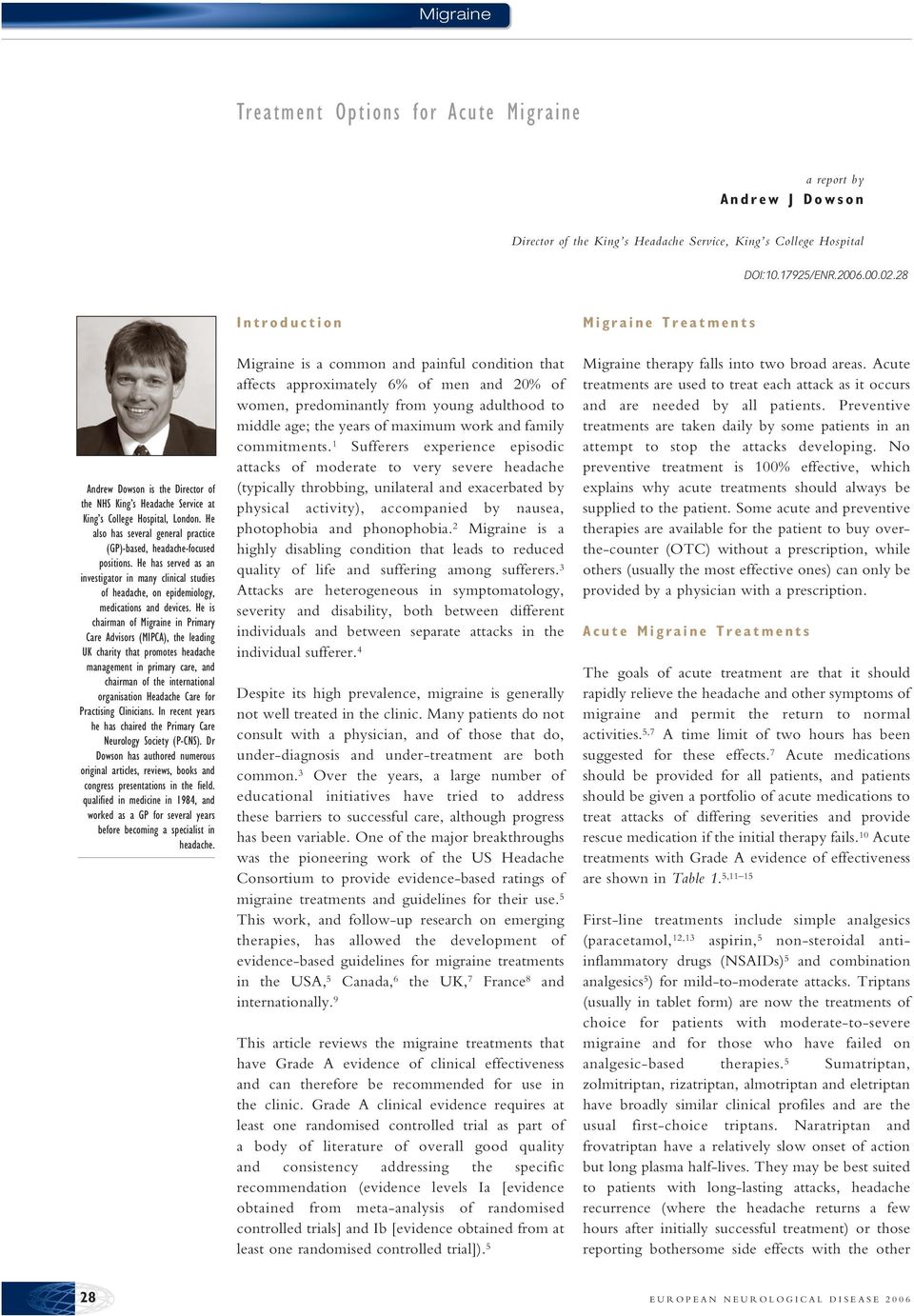
2 Treatment Options for Acute Migraine Table 1: Acute Migraine Treatments with Grade A Evidence of Clinical Effectiveness Drug Effectiveness Adverse effects Recommendations (scientific/clinical) Triptans (POM) Subcutaneous injection Sumatriptan High Frequent Severe/refractory migraine and for emergency use Nasal sprays Sumatriptan High Occasional Severe/unpredictable attacks and as rescue medication Zolmitriptan 11 High Occasional Tablets Almotriptan 11 High Infrequent Moderate-severe attacks. Recommended to be taken early in the Eletriptan 11 High Occasional attack, when the headache is mildfrovatriptan 11 Moderate Infrequent Naratriptan Moderate Infrequent Rizatriptan High Occasional Sumatriptan* High Occasional Zolmitriptan High Occasional Ergots (POM) Dihydroergotamine nasal spray Moderate Occasional Moderate-severe attacks and where headache recurrence is a problem Simple analgesics (OTC) Recommended to be taken as soon as possible after migraine onset, if possible before the headache starts Paracetamol 12,13 Moderate Infrequent Mild-moderate attacks. High dose needed (1,000mg) Aspirin Moderate Occasional Mild-moderate attacks. High dose needed (1,000mg) NSAIDs Ibuprofen Moderate Occasional Mild-moderate attacks Naproxen sodium Moderate Occasional Combination analgesics (OTC) Paracetamol + aspirin + caffeine Moderate-High Infrequent Migraine. Excedrin (USA), Anadin Extra (UK) Analgesics plus anti-emetics (POM) Aspirin/Paracetamol + metoclopramide 14 Moderate-High Occasional Migraine with associated nausea/vomiting Opiates (POM) Butorphanol nasal spray High Frequent Severe/refractory migraine and emergency use. Oral combination opiates Moderate Frequent Limit use due to potential for habituation Anti-emetics (POM) Parenteral metoclopramide 15 Moderate High Occasional Frequent Emergency use and for refractory nausea/vomiting POM = prescription only medication; OTC = over-the-counter *Sumatriptan 50mg tablets can be sold OTC in the UK to appropriate patients (adapted and updated from reference 5). triptans. 11 Dihydroergotamine nasal spray also has a long duration of action and may be appropriate for patients with long-lasting attacks and/or headache recurrence. 5 Ergotamine is now not generally recommended for use in migraine due to its suboptimal efficacy profile and the risk of potentially severe side effects. 5 The combination of analgesics and anti-emetics provides a further option for attacks with associated nausea and/or vomiting, although the triptans are also effective for these symptoms. 14 Patients who have unpredictable attacks may benefit from the orally disintegrating tablet (ODT) formulations of zolmitriptan and rizatriptan (although these formulations are not absorbed in the mouth), or the nasal spray formulations of sumatriptan and zolmitriptan (again mostly swallowed, but a proportion absorbed via the nasal mucous membranes). Patients with particularly severe attacks, those with a need for rapid response, those with nausea and (especially) vomiting and those attending an emergency room may require nasal spray triptans or subcutaneous sumatriptan. 11 Parenteral anti-emetics and opiates may also be useful in the emergency situation. 5,15 However, opiates need to be used with care due to safety concerns and the risk of habituation. Recent developments illustrate the best way to use triptans in practice and offer more flexible treatment options. Triptan tablets are now recommended for use early in the attack when the headache is mild in intensity. 16 Many patients have attacks of differing severity and may require more than one acute treatment, while all require rescue EUROPEAN NEUROLOGICAL DISEASE

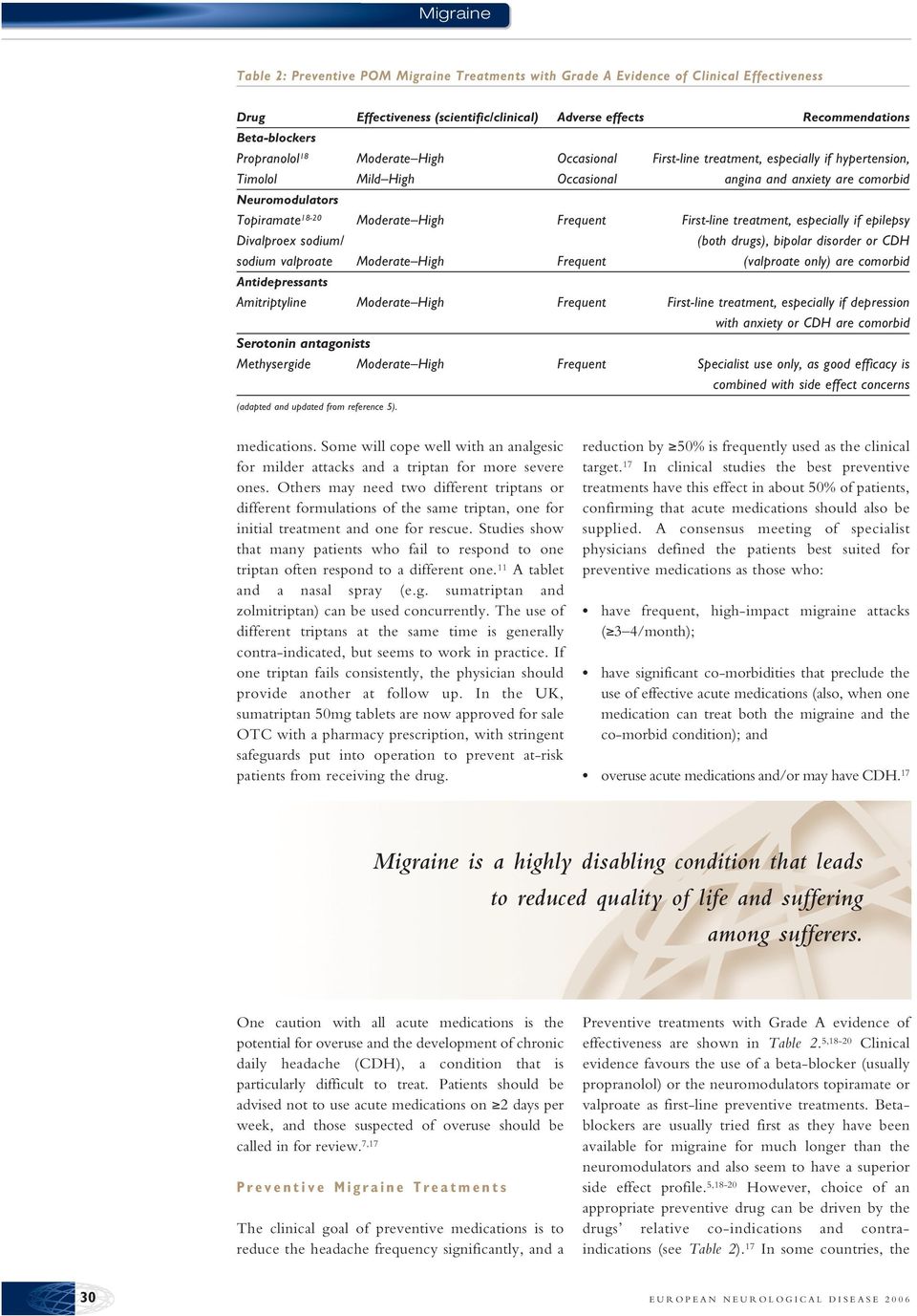
3 Table 2: Preventive POM Migraine Treatments with Grade A Evidence of Clinical Effectiveness Drug Effectiveness (scientific/clinical) Adverse effects Recommendations Beta-blockers Propranolol 18 Moderate High Occasional First-line treatment, especially if hypertension, Timolol Mild High Occasional angina and anxiety are comorbid Neuromodulators Topiramate Moderate High Frequent First-line treatment, especially if epilepsy Divalproex sodium/ (both drugs), bipolar disorder or CDH sodium valproate Moderate High Frequent (valproate only) are comorbid Antidepressants Amitriptyline Moderate High Frequent First-line treatment, especially if depression with anxiety or CDH are comorbid Serotonin antagonists Methysergide Moderate High Frequent Specialist use only, as good efficacy is combined with side effect concerns (adapted and updated from reference 5). medications. Some will cope well with an analgesic for milder attacks and a triptan for more severe ones. Others may need two different triptans or different formulations of the same triptan, one for initial treatment and one for rescue. Studies show that many patients who fail to respond to one triptan often respond to a different one. 11 A tablet and a nasal spray (e.g. sumatriptan and zolmitriptan) can be used concurrently. The use of different triptans at the same time is generally contra-indicated, but seems to work in practice. If one triptan fails consistently, the physician should provide another at follow up. In the UK, sumatriptan 50mg tablets are now approved for sale OTC with a pharmacy prescription, with stringent safeguards put into operation to prevent at-risk patients from receiving the drug. reduction by 50% is frequently used as the clinical target. 17 In clinical studies the best preventive treatments have this effect in about 50% of patients, confirming that acute medications should also be supplied. A consensus meeting of specialist physicians defined the patients best suited for preventive medications as those who: have frequent, high-impact migraine attacks ( 3 4/month); have significant co-morbidities that preclude the use of effective acute medications (also, when one medication can treat both the migraine and the co-morbid condition); and overuse acute medications and/or may have CDH. 17 Migraine is a highly disabling condition that leads to reduced quality of life and suffering among sufferers. One caution with all acute medications is the potential for overuse and the development of chronic daily headache (CDH), a condition that is particularly difficult to treat. Patients should be advised not to use acute medications on 2 days per week, and those suspected of overuse should be called in for review. 7,17 Preventive Migraine Treatments The clinical goal of preventive medications is to reduce the headache frequency significantly, and a Preventive treatments with Grade A evidence of effectiveness are shown in Table 2. 5,18-20 Clinical evidence favours the use of a beta-blocker (usually propranolol) or the neuromodulators topiramate or valproate as first-line preventive treatments. Betablockers are usually tried first as they have been available for migraine for much longer than the neuromodulators and also seem to have a superior side effect profile. 5,18-20 However, choice of an appropriate preventive drug can be driven by the drugs relative co-indications and contraindications (see Table 2). 17 In some countries, the 30 EUROPEAN NEUROLOGICAL DISEASE 2006
4 Treatment Options for Acute Migraine serotonin antagonist pizotifen or a calcium channel blocker (usually verapamil or flunarizine) are used as first-line preventive therapies, even though their clinical profiles are suboptimal. These drugs may be best used as second-line therapies, unless coindications or contra-indications are favourable. For example, pizotifen is the only preventive drug licensed for use in children in the UK, verapamil is co-indicated for hypertension, angina and arrhythmias and flunarizine for vestibular vertigo, insomnia and anxiety. 17 All the preventive drugs have several contraindications, special precautions for use and associated side effects, which may limit their utility in a selflimiting condition such as migraine. Full prescribing recommendations should be consulted for all these drugs before issuing a prescription. Several non-prescribed preventive therapies are also available without prescription, and may be attractive to the physician and patient due to their generally non-invasive nature and lack of side effects. 7 Behavioural therapies, including relaxation, biofeedback, stress reduction strategies and the avoidance of migraine triggers. Physical therapies, including acupuncture, cervical manipulation, massage and exercise. Some complementary medications, including feverfew, magnesium, riboflavin, co-enzyme Q and butterbur root. the criteria for Grade A clinical evidence, with the strongest evidence deriving from the butterbur root study. These therapies may be recommended to be used in addition to the patient s existing acute and/or preventive therapies. However, patients should be encouraged to consult accredited complementary practitioners and to only use formulations that have been shown to be effective in the clinical studies cited. Finally, it is certainly true to say that even the best of the current preventive migraine treatments are suboptimal, and new and more effective treatments are needed. Conclusion Migraine is eminently suited for management in the primary care setting. The gold standard acute and preventive therapies will usually be an oral triptan and a beta-blocker or neuromodulator, respectively. However, treatment needs to be provided that is tailored to each patient s specific needs. For example, someone with a busy lifestyle who perhaps has unpredictable attacks may require treatment that can be taken on the move, e.g. an ODT, nasal spray or subcutaneous injection triptan formulation, depending on the severity of the presenting attack. Another person with a predictable lifestyle and attacks will usually do well with a conventional tablet. While analgesic-based therapies can be effective for milder migraine attacks, patients have often exhausted OTC treatments before they ever consult a physician for care. Taking a treatment history will elicit this The gold standard acute and preventive therapies will usually be an oral triptan and a beta-blocker or neuromodulator, respectively. Placebo-controlled studies demonstrate the efficacy of acupuncture, 21,22 feverfew, 23 magnesium, 24 riboflavin, 25 co-enzyme Q26 and butterbur root. 27,28 However, of these, only the two acupuncture studies 21,22 and one study on each of feverfew, 23 magnesium 24 and butterbur root 27 met information and inform the selection of an effective initial acute treatment. Preventive treatments require persistence on the part of the patient and healthcare professional. Treatment takes a period of months to achieve success and the patient requires support and encouragement during this time. References 1. Breslau N, Rasmussen BK, The impact of migraine: Epidemiology, risk factors, and co-morbidities, Neurology (2001);56(Suppl. 1): pp EUROPEAN NEUROLOGICAL DISEASE
5 2. Headache Classification Committee of the International Headache Society, The international classification of headache disorders; 2nd Edition, Cephalalgia (2004);24(Suppl. 1): pp Lipton RB, Goadsby PJ, Sawyer JPC et al., Migraine: diagnosis and assessment of disability, Rev Contemp Pharmacother (2000);11: pp Stewart WF, Shechter A, Lipton RB, Migraine heterogeneity: Disability, pain intensity, and attack frequency and duration, Neurology (1994);44(Suppl. 4): pp. S Silberstein SD, for the US Headache Consortium, Practice parameter: evidence-based guidelines for migraine headache (an evidence-based review). Report of the Quality Standards Subcommittee of the American Academy of Neurology, Neurology (2000);55: pp Pryse-Phillips WEM, Dodick DW, Edmeads JG et al., Guidelines for the diagnosis and management of migraine in clinical practice, Can Med Assoc J (1997);156: pp Dowson AJ, Lipscombe S, Sender J et al., New guidelines for the management of migraine in primary care, Curr Med Res Opin (2002);18: pp Géraud G, Lantéri-Minet M, Lucas C et al., French guidelines for the diagnosis and management of migraine in adults and children, Clin Ther (2004);26: pp Dowson AJ, Sender J, Lipscombe S et al., Establishing principles of migraine management in primary care, Int J Clin Pract (2003);57: pp Lipscombe S, Rees T, Dowson AJ, Tailoring migraine management in primary care to the needs of the individual patient, Headache Care (2004);1: pp Dowson AJ, Kilminster S, Peters M et al., Understanding the evidence: evaluating the efficacy of migraine medications in clinical practice, Headache Care (2005);2: pp Lipton RB, Baggish JS, Stewart WF et al., Efficacy and safety of acetaminophen in the treatment of migraine: results of a randomized, double-blind, placebo-controlled, population-based study, Arch Intern Med (2000);160: pp Diener HC, Pfaffenrath V, Pageler L et al., The fixed combination of acetylsalicylic acid, paracetamol and caffeine is more effective than single substances and dual combination for the treatment of headache: a multicentre, randomized, double-blind, single-dose, placebo-controlled parallel group study, Cephalalgia (2005);25: pp Tfelt-Hansen P, Henry P, Mulder LJ et al., The effectiveness of combined oral lysine acetylsalicylate and metoclopramide compared with oral sumatriptan for migraine, Lancet (1995);346: pp Colman I, Brown MD, Innes GD et al., Parenteral metoclopramide for acute migraine: meta-analysis of randomised controlled trials, BMJ (2004);329: pp Dowson AJ, Mathew NT, Pascual J, Review of clinical trials using early acute intervention with oral triptans for migraine management, Int J Clin Pract (2006);60: pp Tepper SJ, D Amico D, Baos V et al., Guidelines for prescribing prophylactic medications for migraine: a survey among headache specialist physicians in different countries, Headache Care (2004);1: pp Diener HC, Tfelt-Hansen P, Dahlöf C et al., Topiramate in migraine prophylaxis: results from a placebo-controlled trial with propranolol as an active control, J Neurol (2004);251: pp Silberstein SD, Neto W, Schmitt J et al., Topiramate in migraine prevention: results of a large controlled trial, Arch Neurol (2004);61: pp Brandes J, Saper J, Diamond M et al., Topiramate for migraine prevention: a randomized controlled trial, JAMA (2004);291: pp Linde K, Streng A, Jurgens S et al., Acupuncture for patients with migraine: a randomized controlled trial, JAMA (2005);293: pp Diener H-C, Kronfeld K, Boewing G et al., Efficacy of acupuncture for the prophylaxis of migraine: a multicentre randomised controlled clinical trial, Lancet Neurology (2006); online publication 2 March Diener HC, Pfaffenrath V, Schnitker J et al., Efficacy and safety of 6.25 mg t.i.d. feverfew CO2-extract (MIG-99) in migraine prevention a randomized, double-blind, multicentre, placebo-controlled study, Cephalalgia (2005);25: pp Peikert A, Wilimzig C, Kohne-Volland R, Prophylaxis of migraine with oral magnesium: results from a prospective, multi-center, placebo-controlled and double-blind randomized study, Cephalalgia (1996);16: pp Schoenen J, Jacquy J, Lenaerts M, Effectiveness of high-dose riboflavin in migraine prophylaxis. A randomized controlled trial, Neurology (1998);50: Sandor PS, Di Clemente L, Coppola G et al., Efficacy of coenzyme Q10 in migraine prophylaxis: a randomized controlled trial, Neurology (2005);64: pp Lipton RB, Gobel H, Einhaupl KM et al., Petasites hybridus root (butterbur) is an effective preventive treatment for migraine, Neurology (2004);63: pp Diener HC, Rahlfs VW, Danesch U, The first placebo-controlled trial of a special butterbur root extract for the prevention of migraine: reanalysis of efficacy criteria, Eur Neurol (2004);51: pp EUROPEAN NEUROLOGICAL DISEASE 2006
What is chronic daily headache? Information for patients Neurology
 What is chronic daily headache? Information for patients Neurology What is chronic daily headache (CDH)? Chronic daily headache (CDH) is the term used when a person has a headache on 15 days a month or
Headaches in Children How to Manage Difficult Headaches
 Headaches in Children How to Manage Difficult Headaches Peter Procopis Childhood headaches Differential diagnosis Migraine Psychological Raised Pressure Childhood headaches Other causes: Constitutional
Sporadic attacks of severe tension-type headaches may respond to analgesics.
 MEDICATIONS While we are big advocates of non-drug treatments, many people do require the use of medications to control headaches. Headache medications are divided into two categories. Abortive drugs are
New appendix criteria open for a broader concept of chronic migraine
 Blackwell Publishing LtdOxford, UKCHACephalalgia0333-1024Blackwell Science, 20062006266742746Original ArticleA broader concept of chronic migrainej Olesen et al. BRIEF REPORT New appendix criteria open
Inside Treating tension-type headache
 Headache and migraine Nearly everyone gets a headache occasionally, whereas about one in five women and one in fifteen men suffer from migraines. 1 Migraine treatment which works for one person often fails
Emergency and inpatient treatment of migraine: An American Headache Society
 Emergency and inpatient treatment of migraine: An American Headache Society survey. The objective of this study was to determine the practice preferences of AHS members for acute migraine treatment in
Please be sure to list all therapies that have been previously tried on the request form so that your request can be processed in a timely manner.
 Drug Therapy Guidelines: Migraine Agents Axert (almotriptan), Relpax (eletriptan), Frova (frovatriptan), Amerge (naratriptan), Maxalt/MLT (rizatriptan), Imitrex (sumatriptan), Zomig/ZMT (zolmitriptan),
MIGRAINE. Denise Cambier M.D. Delaware Neurology, Ohio Health March 2013
 MIGRAINE Denise Cambier M.D. Delaware Neurology, Ohio Health March 2013 HISTORY: Graham and Wolff 1938: decreased amplitude of arterial pulsations coincided with reduction of headache with IV ergotamine.
When the Pain Won t Stop: Managing Chronic Daily Headache
 When the Pain Won t Stop: Managing Chronic Daily Headache Arnolda Eloff, MB, ChB, Mmed Presented at the University of Calgary s Wednesday Evening Course Program, Calgary, Alberta. Copyright Chronic daily
Migraine The Problem: Common Symptoms:
 Migraine The Problem: A combination of genetic and environmental factors alter pain mechanisms in your brain Transient changes in brain chemicals such as serotonin and neuropeptides affect the membranes
The Application of Migraine Disability Assessment Questionnaire (MIDAS)
 Continuing Medical Education 43 The Application of Migraine Disability Assessment Questionnaire () Pei-Hua Hung, Jong-Ling Fuh, and Shuu-Jiun Wang Abstract- Migraine is a recurring and disabling pain disorder
HEADACHE. as. MUDr. Rudolf Černý, CSc. doc. MUDr. Petr Marusič, Ph.D.
 HEADACHE as. MUDr. Rudolf Černý, CSc. doc. MUDr. Petr Marusič, Ph.D. Dpt. of Neurology Charles University in Prague, 2nd Faculty of Medicine Motol University Hospital History of headache 1200 years B.C.
Chronic daily headache
 Chronic daily headache Chronic daily headache (CDH) is defined as any headache syndrome affecting more than half of the month, i.e. a headache on more than 15 days per month. It is also known as daily
Evidence-Based Guidelines for Migraine Headache in the Primary Care Setting: Pharmacological Management of Acute Attacks
 Evidence-Based Guidelines for Migraine Headache in the Primary Care Setting: Pharmacological Management of Acute Attacks David B. Matchar, MD Professor of Medicine and Director, Center for Clinical Health
Post-Concussive Headaches and Dizziness Louise M. Klebanoff, MD
 Post-Concussive Headaches and Dizziness Louise M. Klebanoff, MD Associate Professor and Vice Chairman for Operations Chief, General Neurology Department of Neurology Disclosures: None Introduction: Headaches
Headaches and Kids. Jennifer Bickel, MD Assistant Professor of Neurology Co-Director of Headache Clinic Children s Mercy Hospital
 Headaches and Kids Jennifer Bickel, MD Assistant Professor of Neurology Co-Director of Headache Clinic Children s Mercy Hospital Overview Headache classifications and diagnosis Address common headache
HEADACHES IN CHILDREN AND ADOLESCENTS. Brian D. Ryals, M.D.
 HEADACHES IN CHILDREN AND ADOLESCENTS Brian D. Ryals, M.D. Frequency and Type of Headaches in Schoolchildren 8993 children age 7-15 in Sweden Migraine in 4% Frequent Nonmigrainous in 7% Infrequent Nonmigrainous
Tension-type headache Non-pharmacological and pharmacological treatment
 Danish Headache Center Tension-type headache Non-pharmacological and pharmacological treatment Lars Bendtsen Associate professor, MD, PhD, Dr Med Sci Danish Headache Center, Department of Neurology Glostrup
There are two different types of migraines: migraines without aura and migraines with aura.
 What is migraine? A migraine is a relatively common medical condition that can severely affect the quality of life of the sufferer and his or her family and friends. 1 Almost 8% of Canadians over the age
SIGN. Diagnosis and management of headache in adults. Quick Reference Guide. Scottish Intercollegiate Guidelines Network
 SIGN Scottish Intercollegiate Guidelines Network 107 iagnosis and management of headache in adults Quick Reference Guide November 2008 opies of all SIGN guidelines are available online at www.sign.ac.uk
Treating Acute Migraines: Triptans vs. Antiemetics
 Samuel Reisman Samuel will graduate in June 2015 with a B.S. degree in Biology. Abstract Influential American medical organizations and publications have published guidelines for the treatment of acute
Acute Treatment of Migraine
 Acute Treatment of Migraine Headache Cooperative of New England (HCNE) Topnotch at Stowe, VT March 6, 2009 ALAN M. RAPOPORT, M.D. Founder and Director-Emeritus The New England Center for Headache Stamford,
None related to the presentation Grants to conduct clinical trials from:
 Chronic Daily Headache Bassel F. Shneker, MD, MBA Associate Professor Vice Chair, OSU Neurology The Ohio State University Wexner Medical Center Financial Disclosures None related to the presentation Grants
Evaluation of Headache Syndromes and Migraine
 Evaluation of Headache Syndromes and Migraine Sonja Potrebic MD PhD Department of Neurology Los Angeles Kaiser Objectives 1) Identify the diagnostic features of migraine Differentiate from sinusitis 2)
Proper Diagnosis and Treatment for the Headache Patient Alexander Feoktistov MD, PhD
 Proper Diagnosis and Treatment for the Headache Patient Alexander Feoktistov MD, PhD Director of Clinical Research Diamond Headache Clinic Chicago, IL 2014 Objectives Get familiar with primary headache
Headache Help for Your Child or Teen
 Patient and Family Education Headache Help for Your Child or Teen Headaches are a common problem for kids and teens. This flyer will help you to understand some of the ways you can help your child or teen
Frequent headache is defined as headaches 15 days/month and daily. Course of Frequent/Daily Headache in the General Population and in Medical Practice
 DISEASE STATE REVIEW Course of Frequent/Daily Headache in the General Population and in Medical Practice Egilius L.H. Spierings, MD, PhD, Willem K.P. Mutsaerts, MSc Department of Neurology, Brigham and
Botulinum toxin in the treatment of chronic migraine. Gregory P. Hanes, MD Neuroscience Summit 5/14/15
 Botulinum toxin in the treatment of chronic migraine Gregory P. Hanes, MD Neuroscience Summit 5/14/15 Primary Headache Disorders: Frequency Classification After Secondary Causes Are Ruled Out Short-Duration
Prevention of Migraine
 CHAPTER 49 Prevention of Migraine M. K. Roy, P. Ghosh Introduction Headache is a universal experience with 1 year prevalence of about 90% and life time prevalence of about 99%. The differential diagnosis
Post Traumatic and other Headache Syndromes. Danielle L. Erb, MD Brain Rehabilitation Medicine, LLC Brain Injury Rehab Center, PRA
 Post Traumatic and other Headache Syndromes Danielle L. Erb, MD Brain Rehabilitation Medicine, LLC Brain Injury Rehab Center, PRA Over 45 million Americans have chronic, recurring headaches 62% of these
Sumatriptan (Imitrex ) Utilization Management Criteria
 Sumatriptan (Imitrex ) Utilization Management Criteria DRUG CLASS: BRAND (generic) NAME: 5HT1 agonists Imitrex (sumatriptan) Sumavel DosePro (sumatriptan) Injection kit or refill (GCN = 050741) Injection
Tension-type headache Non-pharmacological and pharmacological treatment
 Danish Headache Center Tension-type headache Non-pharmacological and pharmacological treatment Lars Bendtsen Associate professor, MD, PhD, Dr Med Sci Danish Headache Center, Department of Neurology Glostrup
Adult with headache. Problem-specific video guides to diagnosing patients and helping them with management and prevention
 Adult with headache Problem-specific video guides to diagnosing patients and helping them with management and prevention London Strategic Clinical Networks London Neuroscience Strategic Clinical Network
Levels of evidence and grades of recommendation
 MOH Clinical Practice Guidelines 5/2007 Levels of evidence and grades of recommendation Levels of evidence Level Type of Evidence 1 + + High quality meta-analyses, systematic reviews of randomised controlled
Controversies in Migraine Management
 Controversies in Migraine Management A Technology Assessment Final Report August 19, 2014 Completed by: Institute for Clinical and Economic Review Institute for Clinical and Economic Review, 2014 AUTHORS:
11/18/2015. Neurology Update Migraine Headaches. Disclosure Statement. Objectives. Diagnosis of Migraine. Acute Migraine Treatment
 Disclosure Statement Neurology Update Migraine Headaches Ralph T. Dunnigan, M.D. Mid Dakota Clinic Bismarck ND DISCLOSURE OF CONFLICT OF INTEREST A commercial interest is any entity producing, marketing,
Medical wisdom says that migraines reduce as people age - they are most common in the productive years and therefore migraine attacks should not be a
 Migraine at 65 Medical wisdom says that migraines reduce as people age - they are most common in the productive years and therefore migraine attacks should not be a major problem in later life. Studies
EFNS guideline on the drug treatment of migraine revised report of an EFNS task force
 European Journal of Neurology 2009, 16: 968 981 CME ARTICLE doi:10.1111/j.1468-1331.2009.02748.x EFNS guideline on the drug treatment of migraine revised report of an EFNS task force S. Evers a,j.áfra
One Day at a Time: When Headaches Become Chronic. Robert Shapiro, MD, PhD
 One Day at a Time: When Headaches Become Chronic Robert Shapiro, MD, PhD Disclosures Scientific/Medical Advisory Boards (since 10/12) Transcept Pharmaceuticals Chronic Headaches: Overview What is a chronic
botulinum toxin type A, 50 unit, 100 unit and 200 unit powder for solution for injection (Botox ) SMC No. (692/11) Allergan Ltd
 Resubmission botulinum toxin type A, 50 unit, 100 unit and 200 unit powder for solution for injection (Botox ) SMC No. (692/11) Allergan Ltd 08 March 2013 The Scottish Medicines Consortium (SMC) has completed
Diagnosing and treating episodic migraine
 D A N I S H H E A D A C H E C E N T E R Danish Headache Center Disclosures Diagnosing and treating episodic migraine M.A. is a consultant or scientific adviser for Allergan, Alder, Amgen, ATI, Bayer and
Medical Marijuana for the Treatment of Migraine Headaches: An Evidence Review
 2012 Medical Marijuana for the Treatment of Migraine Headaches: An Evidence Review Doug Campos-Outcalt 1, MD, MPA Cecilia Rosales 2, MD, MS 1 UA College of Medicine-Phoenix and UA Zuckerman College of
Migraine Agents Quantity Limit Program Summary
 Migraine Agents Quantity Limit Program Summary Program applies to GenRx Open, GenRx Closed, Health Insurance Marketplace, FlexRx Open, FlexRx Closed and Medicaid. For the GenRx Closed Formulary, nonpreferred
Refractory Migraine: Definition, Diagnosis, Management
 Refractory Migraine: Definition, Diagnosis, Management Morris Levin, MD Associate Professor of Neurology Associate Professor of Psychiatry Dartmouth Medical School Co director, Dartmouth Headache Center
Guidelines for controlled trials of prophylactic treatment of chronic migraine in adults
 doi:10.1111/j.1468-2982.2008.01555.x REVIEW Guidelines for controlled trials of prophylactic treatment of chronic migraine in adults S Silberstein 1 (Chairman, USA), P Tfelt-Hansen 2 (Co-Chairman, Denmark),
Migraines: Treatment Options Report
 Migraines: Treatment Options Report April 2006 Migraines: Treatment Options Report Prepared for: CALIFORNIA HEALTHCARE FOUNDATION Prepared by: UC Davis Center for Health Services Research in Primary Care
33 % of whiplash patients develop. headaches originating from the upper. cervical spine
 33 % of whiplash patients develop headaches originating from the upper cervical spine - Dr Nikolai Bogduk Spine, 1995 1 Physical Treatments for Headache: A Structured Review Headache: The Journal of Head
MANAGEMENT OF CHRONIC NON MALIGNANT PAIN
 MANAGEMENT OF CHRONIC NON MALIGNANT PAIN Introduction The Manitoba Prescribing Practices Program (MPPP) recognizes the important role served by physicians in relieving pain and suffering and acknowledges
M I G R A I N E Updates in Diagnosis & Treatment
 M I G R A I N E Updates in Diagnosis & Treatment Theresa Mallick-Searle, MS, RN-BC, APN-BC Stanford Health Care Division Pain Medicine [email protected] Disclosures: Speakers bureau Allergan
Breaking the cycle of medication overuse headache
 REVIEW CME CREDIT EDUCATIONAL OBJECTIVE: Readers will recognize the risk of developing medication overuse headache with increasing use of medications to treat acute migraine Stewart J. Tepper, MD * Center
Headaches in Children
 Children s s Hospital Headaches in Children Manikum Moodley, MD, FRCP Section of Pediatric Neurology The Cleveland Clinic Foundation Introduction Headaches are common in children Most headaches are benign
Chronic Daily Headache
 The new england journal of medicine clinical practice Chronic Daily Headache David W. Dodick, M.D. This Journal feature begins with a case vignette highlighting a common clinical problem. Evidence supporting
Contents Page. 1. What is IV DHE? 3. 2. Medication Licence 3. 3. How can a course of IV DHE help? 4. 4. What are the side effects of IV DHE?
 If you would like this document in another language or format, or if you require the services of an interpreter, please contact us on extension 84299 or 83926. Switchboard: 0845 155 5000 020 3456 7890
BOTOX Injection (Onabotulinumtoxin A) for Migraine Headaches [Preauthorization Required]
![BOTOX Injection (Onabotulinumtoxin A) for Migraine Headaches [Preauthorization Required]](/thumbs/29/13417512.jpg "BOTOX Injection (Onabotulinumtoxin A) for Migraine Headaches [Preauthorization Required]") BOTOX Injection (Onabotulinumtoxin A) for Migraine Headaches [Preauthorization Required] Medical Policy: MP-RX-01-11 Original Effective Date: March 24, 2011 Reviewed: Revised: This policy applies to products
BOTOX Injection (Onabotulinumtoxin A) for Migraine Headaches [Preauthorization Required] Medical Policy: MP-RX-01-11 Original Effective Date: March 24, 2011 Reviewed: Revised: This policy applies to products
Web: www.migraine.org.uk. Medication overuse headache and undergoing a detox programme
 Web: www.migraine.org.uk Medication overuse headache and undergoing a detox programme Web: www.migraine.org.uk/moh What is medication overuse headache? Medication taken to help relieve migraine attacks