
Guidelines on Credit Risk Management
|
|
|
- Walter Pierce
- 9 years ago
- Views:
Transcription
1 Guidelines on Credit Risk Management Best Practices These guidelines were prepared by the Oesterreichische Nationalbank (OeNB) in cooperation with the Financial Market Authority (FMA)

2 Published by: Oesterreichische Nationalbank (OeNB) Otto Wagner Platz 3, 1090 Vienna, Austria Austrian Financial Market Authority (FMA) Praterstrasse 23, 1020 Vienna, Austria Produced by: Oesterreichische Nationalbank Editor in chief: Gu nther Thonabauer, Secretariat of the Governing Board and Public Relations (OeNB) Barbara No sslinger, Staff Department for Executive Board Affairs and Public Relations (FMA) Editorial processing: Luise Breinlinger, Yi-Der Kuo, Alexander Tscherteu, Florian Weidenholzer (all OeNB) Thomas Hudetz, Werner Lanzrath (all FMA) Design: Peter Buchegger, Secretariat of the Governing Board and Public Relations (OeNB) Typesetting, printing, and production: OeNB Printing Office Published and produced at: Otto Wagner Platz 3, 1090 Vienna, Austria Inquiries: Orders: Internet: Paper: Oesterreichische Nationalbank Secretariat of the Governing Board and Public Relations Otto Wagner Platz 3, 1090 Vienna, Austria Postal address: PO Box 61, 1011 Vienna, Austria Phone: (+43-1) Fax: (+43-1) Oesterreichische Nationalbank Documentation Management and Communication Systems Otto Wagner Platz 3, 1090 Vienna, Austria Postal address: PO Box 61, 1011 Vienna, Austria Phone: (+43-1) Fax: (+43-1) Salzer Demeter, 100% woodpulp paper, bleached without chlorine, acid-free, without optical whiteners DVR Vienna, 2004

3 Preface The ongoing development of contemporary risk management methods and the increased use of innovative financial products such as securitization and credit derivatives have brought about substantial changes in the business environment faced by credit institutions today. Especially in the field of lending, these changes and innovations are now forcing banks to adapt their in-house software systems and the relevant business processes to meet these new requirements. The Guidelines on Credit Risk Management are intended to assist practitioners in redesigning a bankõs systems and processes in the course of implementing the Basel II framework. Throughout 2004 and 2005, guidelines will appear on the subjects of securitization, rating and validation, credit approval processes and management, as well as credit risk mitigation techniques. The content of these guidelines is based on current international developments in the banking field and is meant to provide readers with best practices which banks would be well advised to implement regardless of the emergence of new regulatory capital requirements. The purpose of these publications is to develop mutual understanding between regulatory authorities and banks with regard to the upcoming changes in banking. In this context, the Oesterreichische Nationalbank (OeNB), AustriaÕs central bank, and the Austrian Financial Market Authority (FMA) see themselves as partners to AustriaÕs credit industry. It is our sincere hope that the Guidelines on Credit Risk Management provide interesting reading as well as a basis for effective discussions of the current changes in Austrian banking. Vienna, December 2004 Univ. Doz. Mag. Dr. Josef Christl Member of the Governing Board of the Oesterreichische Nationalbank Dr. Kurt Pribil, Dr. Heinrich Traumu ller FMA Executive Board 3
4 Contents 0 Introduction 7 1 Fundamentals Motivation and Delineation Motives behind Securitization Delineation of Securitization Transactions Common Structures Ways of Assuming Risk Basic Types of Securitization Transaction Current Developments New Securitization Structures The Austrian Securitization Market 18 2 Risks Essential Types of Risk Credit Risks Origins of Credit Risk Limitation Distribution Structural Risks Market Risks Liquidity Risks Operational Risks Legal Risks General Treatment Enforceability of Claims Availability of Information Relevance of Risks to the Parties Involved Incomplete Transfer of Risk from the Originator General Risks Assumed by the Investor 33 3 Risk Measurement Defining and Quantifying Risk Approaches to Quantifying Credit Risk Origin of Credit Risk Limitation and Distribution Quantification Approaches for Structural Risks Market Risks Liquidity Risks Operational Risks Quantification Approaches for Legal Risks General Treatment Enforceability of Claims 40 4 External Ratings Function of External Ratings Initial Rating Preliminary Stage 42 4
5 Contents Quantitative Analysis Qualitative Analysis Rating Determination and Completion Stage Ongoing Monitoring of Ratings Data Requirements Specific to Types of Receivables Conclusions Securitization Transaction Ratings vs. Corporate Ratings Using External Ratings in the BankÕs Internal Risk Management 49 5 Risk Management Meeting Basic Prerequisites Basic Prerequisites for the Originator Basic Prerequisites for the Investor Execution Stage Structuring Stage for the Originator Specific Investment Decisions for Investors Ongoing Monitoring and Reporting Risk Controlling Reporting Special Issues for the Originator 60 6 Appendix A: Glossary 63 7 Appendix B: Regulatory Discussion 72 5

6

7 0 Introduction This guideline deals with best practices in risk management for securitization transactions and concentrates on two primary objectives: First, it is intended to give a fundamental overview of securitization for readers who have had little or no exposure to the subject. Second, this publication is intended to provide more experienced readers with practically relevant information and guidance for the proper design of risk management mechanisms in securitization. In light of these objectives, this guideline should not be seen as a comprehensive reference work on securitization structuring, nor as a collection of mathematical methods for risk quantification. Instead, the guideline first presents an overview of the risks associated with securitization. On the basis of these risks, we then elaborate on the resulting practical challenges for risk management for securitized products. The guideline also describes those approaches to meeting such challenges which have proven reliable in the eyes of experienced market participants. Unless explicitly indicated otherwise, the ideas presented in this publication apply to originators as well as investors. Chapter 1 covers the fundamentals of securitization. In that chapter, we point out that securitization transactions are not only to be regarded as a source of risk, but that banks can also use them to control and manage credit risk. In these transactions, banks can assume risk by means of a large number of functions and instruments. Given the high complexity and innovative power of securitization markets, effective risk management in this field makes high demands with regard to know-how and flexibility. Chapter 2 gives a description of the key risks specifically associated with securitization. The primary conclusion reached in this context is that the risk structure of securitization transactions goes far beyond the credit risk involved in conventional lending business and thus has to be treated separately in risk management. For cost reasons, it may be difficult for a single bank to provide all the expertise necessary to assess all of the complex structural and legal risks involved in securitization transactions. In risk management, these transactions therefore call for stronger emphasis on the coordination and monitoring of all parties involved as well as consultation with external experts. Chapter 3 examines approaches to quantifying the risks involved in securitization positions. The prevalent credit portfolio models provide a basis for the quantification of credit risks in securitizations, but this basis is not sufficient to cover the specific quantitative distribution of credit risks among the parties involved in these transactions. Approaches to the integrated quantification of credit risks, structural risks and legal risks are applied in the process of cash flow modeling. However, these approaches require a great deal of effort and have only been able to quantify a small number of structural and legal risks up to now. Therefore, risk management for securitization transactions cannot focus on a single quantitative method alone but should always use multiple quantitative and qualitative approaches. 7

8 Chapter 4 explains how securitization deals are rated by external rating agencies. For a bankõs in-house securitization risk management, the conclusion reached here is that external ratings can only be used to replace in-house risk quantification to a limited extent. Due to the considerable effort involved in risk quantification, however, the use of external ratings does have advantages in terms of costs and can therefore be considered as an alternative for individual securitization transactions. Chapter 5 discusses how the securitization-specific risks identified in the preceding chapters can be addressed in risk management. It is only possible to optimize securitization risk management when certain prerequisites are met by the originator and investor prior to each transaction. A majority of securitization-specific risks can be minimized by designing a transparent and comprehensive structuring process. The ongoing monitoring of securitization positions will then require the originator and investors to adapt their usual credit risk management activities only to a minor extent in order to accommodate securitization-specific risks. This guideline concludes by explaining a number of essential securitizationrelated terms in a glossary (Appendix A) and by giving a brief overview of current discussions on the regulatory treatment of securitization (Appendix B). Finally, we would like to point out that this guideline is only intended to be descriptive and informative in nature. It cannot (and is not meant to) make any statements on the regulatory requirements imposed on credit institutions dealing with securitization positions, nor is it meant to pass judgment on the activities of the competent authorities. Although this document has been prepared with the utmost care, the publishers cannot assume any responsibility or liability for its content. 1 Fundamentals This chapter gives a brief introduction to the field of securitization, thus providing a basis for the description of best practices for securitization risk management in the later chapters. Section 1.1 discusses the motives behind securitization, as well as defining this type of capital market instrument and delineating it from other instruments from a risk management perspective. Based on the general structure of a securitization transaction, section 1.2 presents the essential functions assumed and instruments deployed by banks to take on risk in securitization transactions. Furthermore, it gives an overview of the most common securitization structures. Section 1.3 concludes the chapter with a description of recent innovations in securitization structures as well as current developments on the Austrian securitization market. 1.1 Motivation and Delineation Securitization products are structured capital market instruments. Due to the complex structure of risk distribution in securitization transactions and their unique character compared to other capital market instruments, they must 8

9 be regarded as a separate instrument in risk management. The essential reasons why banks make use of securitization are discussed in detail below Motives behind Securitization In a securitization transaction, the credit risks associated with a defined pool of receivables (i.e. assets) are isolated from the originator of the receivables, then structured and passed on to one or more investors in the form of at least two different risk positions. In addition to transferring risk, financed structures can also create an inflow of liquid funds corresponding to the value of the pool of receivables for the originator. Banks have five essential motives for securitizing assets: Risk diversification: By transferring risk in a securitization transaction, a bank can restructure its credit portfolio thus improving its risk/return profile and deliberately pass on risks or take on new ones. This might be useful, for example, in cases where a bankõs credit portfolio accumulates considerable concentration risks due to its regional sales strength. Securitization deals are thus not only a source of risk, they can also be used in risk management with the specific aim of controlling risk. Access to liquidity: Funded structures provide the securitizing bank with additional funds by means of refinancing on the capital market. By isolating the pool of receivables and refinancing it separately, the bank might also be able to obtain more favorable terms than in the case of on-balance-sheet refinancing. This is especially attractive to banks whose ratings would only allow less favorable refinancing terms on the capital or interbank market. Reduction of capital requirements: By transferring credit risks to third parties, banks can reduce their regulatory and economic capital requirements. Therefore, securitization provides a means of reducing tied-up capital, thus making it available for new business opportunities. Product range enhancement: In addition to bank claims, other receivables such as corporate accounts can also be securitized. This gives companies an alternative source of capital market financing instead of financing by means of conventional bank loans. Banks frequently offer securitization products to their corporate clients in addition to such loans. Investment opportunities: Banks also invest in the bonds issued in securitization transactions, as these bonds frequently offer attractive yields. These motives are likely to gain importance in the eyes of the banks due to the harmonization and internationalization of markets, which might in turn lead to the increased use of securitization. The need to pay increased attention to securitization in risk management also stems from its unique structural characteristics compared to other capital market instruments Delineation of Securitization Transactions For all of the parties involved, securitization risk management presents a number of special challenges resulting from the characteristics of securitization. In this guideline, securitization transactions are delineated on the basis of three central structural features: 9

10 The basis of a securitization transaction is a defined pool of receivables. Therefore, risk management not only has to take into account the risk involved in individual claims, it also has to consider pooling effects (e.g. volume and diversification effects). The pool can contain a wide variety of receivables, and the risks involved can differ significantly from those of conventional loans, thus requiring particular caution in assessment (e.g. trade receivables, receivables from licensing). In a securitization transaction, the defined pool of receivables is isolated from the credit originatorõs credit rating, and the risks in the pool are transferred to third parties and in some cases refinanced separately. Therefore, the complete isolation of the pool of receivables as well as the wide variety of instruments used for risk transfer and refinancing deserve special attention in securitization risk management. The risk transfer and any refinancing in a securitization transaction are structured, that is, at least two positions (tranches) which are assigned different levels of priority are created in the distribution of risks and cash flows. Identifying the risks contained in the individual tranches requires a careful analysis of this (usually complex) structuring mechanism. On the basis of these three structural characteristics, securitization transactions can be differentiated clearly from other capital market instruments as follows: The direct sale or derivative-based hedging of individual loans involves refinancing and/or a transfer of risk, but not a defined pool of receivables. No structuring is performed in the direct sale or derivative-based hedging of a pool of receivables. Furthermore, the reference portfolio used in derivativebased hedging does not necessarily have to match the defined pool of receivables; it can contain defined positions not held by the originator (e.g. in the case of a basket credit default swap). In the case of Pfandbrief mortgage bonds, the pool of receivables is not completely isolated from the credit rating of the credit originator, nor is the pool structured. The subordinated status of a conventional bond only causes a payment disruption if the issuer goes bankrupt; this does not constitute structuring as defined above. In contrast to a subordinated bond, a junior securitization tranche will already be endangered by defaults in the pool of receivables well before an issuer becomes bankrupt. Securitization products are thus innovative and clearly differentiated capital market instruments which have to be treated separately in risk management. 1.2 Common Structures This guideline is primarily intended for banks. For this reason, special attention is paid to the functions a bank can assume in the course of a securitization transaction. Along with the instruments employed in the most common securitization structures, these functions determine the type and extent of the risk positions assumed by the bank. 10
11 1.2.1 Ways of Assuming Risk Securitization risk management must cover all of the risk positions a bank takes on in the course of a transaction. These risk positions arise from the various functions the bank assumes as well as the instruments employed in a transaction. The most common functions and instruments are presented below along the lines of the basic structure of a securitization transaction (cf. Chart 1). Chart 1 The main parties involved in a securitization transaction are the originator, the investor, and the servicer. These parties are related by means of a special-purpose vehicle or SPV (cf. Chart 1). In the course of its business activities, the originator generates assets in the form of receivables (such as those arising from credit agreements) from debtors (obligors). A defined pool of receivables is then transferred to the special-purpose vehicle established specifically for this purpose. In turn, the special-purpose vehicle structures the risks and payments involved in the transaction, after which it passes them on to the investors. The servicer is commissioned by the special-purpose vehicle to handle the ongoing management and collection of those receivables. In addition, a large number of other parties also cooperate in securitization transactions. The securitization deal is structured by the arranger, who usually also evaluates the pool of receivables. In the structuring process, some of the risks are transferred to credit enhancers (i.e. providers of credit risk mitigation). The special-purpose vehicle is founded by the sponsor, which may be the same organization as the originator or trustee. The trustee monitors the proper execution of the transaction as well as the business activities of the special-purpose vehicle and servicer on behalf of the investors. The trustee might also act as the paying agency between the servicer and the investors. If the special-purpose vehicle transfers risk by way of the capital market, the credit quality of tranches has to be assessed by rating agencies, and tranches are placed on the market by an 11

12 underwriting syndicate. In general, banks can assume all of the functions except for those of the rating agency. Depending on the duties they assume, banks take on risks by means of various instruments. Among the instruments used to assume risk, it is first necessary to differentiate between credit derivatives and traditional securitization instruments. Credit derivatives can be subdivided into credit default swaps (CDSs) and credit-linked notes (CLNs). In contrast to CDSs, CLNs provide funding for the issuer. Credit derivatives can be used to transfer risk both from the originator to the special-purpose vehicle and from the special-purpose vehicle to the investors. In traditional securitization, ownership as well as the risks are transferred from the originator to the special-purpose vehicle through the sale of receivables. In a traditional securitization environment, the special-purpose vehicle will pass the risks on to the investors by issuing bonds which are collateralized by the receivables and called asset-backed securities (ABS). Both of these steps provide funding for the respective seller. To a limited extent, risk is also transferred using other risk mitigation instruments or credit enhancements, which include credit insurance, guarantees, letters of credit, or liquidity facilities to bridge short-term payment disruptions. Credit enhancements are distinguished from credit derivatives and asset-backed securities by the nature of the instruments used as well as the fact that they are granted by credit enhancers and not sold to investors. The most subordinated risk position is usually referred to as the first-loss piece (FLP), as it has to absorb the first losses incurred in the pool of receivables. The general structure presented here can be found in almost all forms of securitization transactions; however, specific structural characteristics may well be arranged differently in individual cases. In order to ensure comprehensive risk management, practitioners will require a more detailed understanding of common securitization structures. These structures are presented in the next section Basic Types of Securitization Transaction The basic types of securitization transaction are differentiated by the type of underlying assets, the means of transferring risk and the structure of the transaction. In principle, any receivables can be securitized, but usually receivables with stable and foreseeable future payment streams are selected for economic reasons. When differentiated by the type of underlying receivables, securitization transactions can be broken down into mortgage-backed securities (MBSs), collateralized debt obligations (CDOs) and asset-backed securities (ABSs) in the narrower sense (see Table 1). 12

13 Table 1 Securitization Types by Underlying Assets (ABS, broadly defined) MBS CDO ABS (strictly defined) RMBS: Residential mortgage-backed securities CMBS: Commercial mortgage-backed securities CLO: Collateralized loan obligations CBO: Collateralized bond obligations Credit card receivables Leasing receivables Trade receivables Consumer loans Receivables in MBSs are secured by land or real estate. In CDOs, loans and similar products (e.g. bonds) are securitized, and the debtors are mainly corporate clients. The narrow definition of ABSs includes all securitization transactions not categorized as MBSs or CDOs. The most frequently used types of receivables are credit card debt, leasing receivables, trade receivables and consumer loans. In addition, the underlying receivables can be categorized by their origins (primary or secondary market) and debtors (banks, corporate clients, public-sector entities). It is necessary to differentiate types of receivables in risk management because valuating a pool of receivables backed by real assets, for example, will require different parameters from those used to assess a pool of credit card receivables. ABSs are also often based on revolving receivables. Receivables are referred to as ÒrevolvingÓ when debtors are allowed to vary the amounts borrowed and repaid within agreed limits (e.g. in the case of credit card debt and corporate lines of credit). This poses an additional challenge in securitization: The precise amounts of the debt as well as the associated interest and principal payments can fluctuate heavily and can only be forecast to a limited extent. This has to be taken into consideration accordingly in risk management. When it comes to the means of transferring risk, a fundamental distinction is made between synthetic securitization and true-sale structures (cf. Chart 2). The latter type of transaction is also referred to as a traditional securitization transaction in Basel II terminology. In the case of synthetic securitization, the originator retains ownership of the receivables, and only the credit risks arising from them are transferred to the special-purpose vehicle (by means of derivatives). In a true-sale structure, ownership of the receivables including the credit risk passes to the special-purpose vehicle and the originator receives the corresponding amount of financial funds. 13

14 Chart 2 Synthetic securitization transactions only provide funding for the originator under certain circumstances. In general, a distinction is to be made between flows of funds to the special-purpose vehicle and the financing effects for the originator in synthetic securitization deals. In order to achieve these financing effects, the special-purpose vehicle can issue CLNs or ABSs (in this case on a synthetic underlying). For its part, the originator can issue CLNs to the special-purpose vehicle in order to receive financial funds in return. Otherwise, the special-purpose vehicle should invest the funds in top-rated instruments. Under the latter arrangement, it follows that funds would only be transferred to the originator if it issued such highly rated instruments that the specialpurpose vehicle could reinvest in them. In the case of synthetic securitization, it is possible to avoid setting up a special-purpose vehicle altogether if the originator has such a high rating that it can also issue CLNs on its own balance sheet. Compared to synthetic securitization, therefore, a true-sale structure generally offers the advantages of the greatest possible financing effect as well as balance sheet improvement for the originator. From the risk management perspective, however, true-sale structures pose a special challenge because the transfer of ownership of the receivables and the associated collateral to the special-purpose vehicle has to be secured under civil law and bankruptcy law. While the International Swaps and Derivatives Association (ISDA) provides standardized contracts which can be used for synthetic structures, true-sale structures usually have to be documented on an individual basis. When risk is transferred from the special-purpose vehicle to the investors in the form of asset-backed securities (ABSs) secured by receivables, a general distinction is made between long-running term transactions and asset-backed commercial paper programs (ABCPs). The ABSs issued in term transactions generally have maturities of at least two years. Rating agencies assign term transactions long-term issue ratings, that 14

15 is, usually a pool of receivables which is fixed for the defined term of the securitization is evaluated and individual securitization tranches are rated on the basis of that evaluation. The securitization transactionõs rating is thus largely independent of the originatorõs own rating. In ABCP programs, short-term, unsecured receivables (e.g. corporate receivables) are purchased by a special-purpose vehicle referred to as the conduit. The conduit refinances the receivables purchased by issuing commercial paper (CP), which generally has a term of 30 to a maximum of 360 days. Repayments from the pool of receivables are used to purchase new receivables, and outstanding commercial paper is redeemed at maturity by issuing new commercial paper. Therefore, ABCP programs do not have predefined maturities. Rating agencies give these programs short-term program ratings which reflect the ability of the program to service the commercial paper completely and in a timely manner. These ratings are largely independent of the credit quality of the underlying pool of receivables. Liquidity is typically ensured in ABCP programs by liquidity facilities provided by the sponsor. By granting a loan to the conduit until the first commercial paper is issued, the sponsor also generally assumes the credit risks while the pool of receivables is being built up; this is known as the ramp-up or warehousing stage. The ABCP programõs rating therefore depends heavily on the sponsorõs rating. As is the case in term transactions, servicing is also usually handled by the originator in ABCP programs. Rating agencies treat term transactions and ABCP programs in fundamentally different ways, which also clearly indicates that they have to be regarded as different transaction types in risk management. As regards the structure of a securitization transaction, the most important differentiating characteristics are public versus private transactions as well as single versus multi-seller structures. Public transactions are offered to a broad base of investors and are therefore usually rated by external agencies. This rating is monitored over the term of the transaction. In contrast, private transactions are usually arranged specifically for individual investors and do not necessarily receive external ratings. As a result, the reduced amount of information available makes risk management more difficult. Single-seller structures are securitization transactions in which the underlying receivables are only generated by a single originator. As small banks and companies often cannot attain the critical mass required to launch a securitization project, they aggregate their pools of receivables into what we refer to as multi-seller structures. These structures are currently found almost exclusively in ABCP programs, but in principle they could also be implemented in term transactions. Due to differences in lending procedures among the originators involved, however, it is often difficult to compare and assess the risks in such pools, which means that these structures require special attention in risk management. 15

16 Securitization transactions can also be classified on the basis of other structural characteristics, such as the type of risk mitigation instruments used or the mechanisms used to allocate payment streams to the structured risk positions (tranches). A description of various securitization forms and the resulting requirements for risk management is given in the presentation of credit risks in section Current Developments The final section of this chapter deals with a number of new securitization structures which can be observed on international markets. Against this backdrop, we also discuss the securitization activities seen to date in Austria as well as potential future developments. This discussion indicates that best practices in securitization risk management have to be adapted quickly and flexibly to the changing structure of the securitization markets New Securitization Structures The new, innovative securitization structures discussed in this section include the securitization of public-sector receivables, delinquent loans and other types of receivables which have not been securitized in the past. In addition, this section discusses the growing tendency to combine synthetic securitization with true-sale structures as well as the use of securitization transactions and Pfandbrief mortgage bonds as mutual complements. The securitization of public-sector receivables generally serves to relieve public budgets. Such transactions have already been carried out in Italy, Spain and the Netherlands, for example. In response to this development, EUROSTAT (the Statistical Office of the European Communities) has defined criteria which the securitization of public-sector receivables has to fulfill in order to be included in deficit calculations. The province of Lower Austria also securitized housing loans already in In the securitization of delinquent loans, extremely risky receivables are deliberately placed in the pool in order to reduce risk and tied-up capital for the bank and to improve the risk/return profile of the portfolio of receivables. In individual cases, however, losses will also have to be realized due to the market-based valuation of receivables. However, receivables in which payment streams are highly volatile and can only be predicted with difficulty can, in principle, also be securitized. In recent years, we have also seen an increasing number of new types of receivables in securitization transactions (i.e. those which have not been securitized in the past), for example receivables from license and patent fees, stadium revenues, and revenues from businesses such as pubs or funeral homes. These receivables are generally securitized in whole business securitizations (WBSs), in which all of the payment streams for a company (or part of a company) are assigned to the special-purpose vehicle. WBSs are generally carried out in connection with corporate takeovers and have remained a rather secondary market segment to date. 16
17 All of the new and innovative securitization structures described up to this point have extended the usual range of receivables securitized. From a risk management perspective, it is necessary to ensure that all of the additional risks involved in these structures, for example the increased risks in the pool of receivables when delinquent loans are securitized, are taken into consideration. In the future, we can expect to see the increased convergence of synthetic securitization transactions and true-sale structures. Even today, credit-linked notes can be used to provide partial funding in synthetic securitization transactions. Furthermore, receivables do not necessarily have to be removed from the balance sheet explicitly in a true-sale structure in order for reduced regulatory capital requirements to be recognized under Basel II. In the future, Pfandbrief mortgage bonds and securitization are also likely to see increased use as mutual complements in the structure of transactions. Pfandbrief mortgage bonds are distinguished from securitization transactions by the following characteristics: The receivables remain on the originatorõs balance sheet, thus the originator is still forced to bear the corresponding credit risk. In addition to the receivables used to secure the Pfandbrief, the issuing bankõs overall assets serve as liability assets for the investors. There is no direct connection between the payments arising from the receivables used as collateral and the payments disbursed to investors. The composition of coverage capital can change over time. Pfandbrief mortgage bonds can only be issued by banks which have been granted the legal right to do so. In several European countries which do not have a law regarding this type of bond (e.g. England and Italy), a securitization structure very similar to Pfandbrief mortgage bonds is currently being developed. In these structures, defined receivables on the originatorõs balance sheet are segregated for separate refinancing, with the revenue streams arising from those receivables being used to repay bonds issued for that specific purpose. On the other hand, in some European countries which do have laws regulating Pfandbrief mortgage bonds, separate securitization laws have been passed or are currently being discussed, which means that a separate legal framework is being set up for securitization (similar to the existing framework for Pfandbrief mortgage bonds). Therefore, future best-practice risk management has to be designed in such a way that it can respond to potential changes in securitization structures quickly and comprehensively. 17
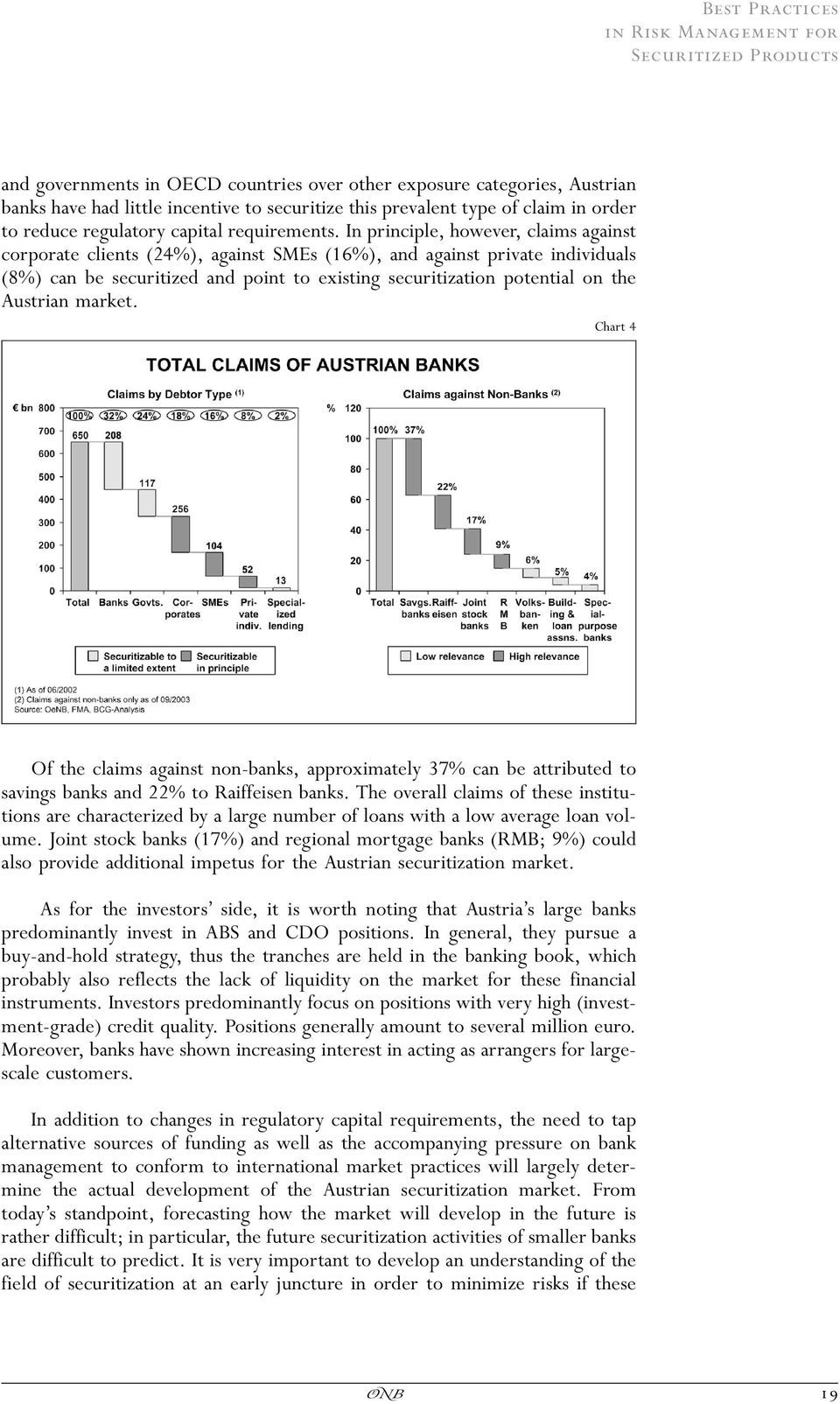
18 1.3.2 The Austrian Securitization Market This section first gives an overview of the nature and scope of the current securitization market in Austria. We then discuss the structure of Austrian banksõ overall receivables as well as their general suitability for securitization. This step is included in order to identify potential future developments on the Austrian securitization market insofar as these tendencies are influenced by the structure of bank claims. Chart 3 Although it may not be exhaustive, Chart 3 gives a general overview of securitization transactions carried out in Austria to date. Only few large-scale securitization transactions have been carried out by Austrian banks thus far. At the same time, the types of receivables securitized have covered a broad spectrum, including the securitization of loans to Austrian small and medium-sized enterprises (SMEs), receivables from leasing transactions and residential construction loans, as well as trade receivables. As regards the type of structure used, the majority of transactions were true-sale securitization deals. One exception was the synthetic securitization PROMISE Austria 2002, which was carried out through KfWÕs fairly standardized program in Germany. Moreover, several transactions have taken place in the international subsidiaries of Austrian banks (e.g. Dolomiti Funding by Hypo Alpe Adria Bank in Italy). However, those transactions are not included as part of the Austrian market because they involved securitizing foreign receivables. Chart 4, which depicts the structure of Austrian bank claims, shows that amounts receivable from other banks and from governments account for over 30% and 18% of total claims, respectively, which means that these two components are significant. Due to the regulatory capital requirements which have been in place up to now (and will remain applicable until new regulations go into effect) as well as the resulting preferential treatment of claims against banks 18

19 and governments in OECD countries over other exposure categories, Austrian banks have had little incentive to securitize this prevalent type of claim in order to reduce regulatory capital requirements. In principle, however, claims against corporate clients (24%), against SMEs (16%), and against private individuals (8%) can be securitized and point to existing securitization potential on the Austrian market. Chart 4 Of the claims against non-banks, approximately 37% can be attributed to savings banks and 22% to Raiffeisen banks. The overall claims of these institutions are characterized by a large number of loans with a low average loan volume. Joint stock banks (17%) and regional mortgage banks (RMB; 9%) could also provide additional impetus for the Austrian securitization market. As for the investorsõ side, it is worth noting that AustriaÕs large banks predominantly invest in ABS and CDO positions. In general, they pursue a buy-and-hold strategy, thus the tranches are held in the banking book, which probably also reflects the lack of liquidity on the market for these financial instruments. Investors predominantly focus on positions with very high (investment-grade) credit quality. Positions generally amount to several million euro. Moreover, banks have shown increasing interest in acting as arrangers for largescale customers. In addition to changes in regulatory capital requirements, the need to tap alternative sources of funding as well as the accompanying pressure on bank management to conform to international market practices will largely determine the actual development of the Austrian securitization market. From todayõs standpoint, forecasting how the market will develop in the future is rather difficult; in particular, the future securitization activities of smaller banks are difficult to predict. It is very important to develop an understanding of the field of securitization at an early juncture in order to minimize risks if these 19
20 instruments are employed later on. For this purpose, the later chapters of this guideline give a more detailed description of these risks and discuss best-practice approaches to risk management. 2 Risks This chapter focuses on identifying the various risks involved in securitization, especially those which are specific to this type of transaction. General banking risks are only discussed when they are especially relevant to securitization risk management. Section 2.1 defines and differentiates the following main risk types relevant to securitization: credit risk, structural risk and legal risk. Sections 2.2, 2.3 and 2.4 discuss a selection of occurrences of these risk types in greater detail. In section 2.5, we discuss the varying relevance of each risk type to the parties involved in a securitization transaction. The information presented in this chapter forms the basis for the risk quantification considerations discussed in chapter 3. The risks involved in securitization are just as widely varied as the range of possible securitization structures, thus the explanations in this chapter cannot be considered exhaustive. However, the systematic approach presented here is also well suited for more detailed analyses of securitization risk. 2.1 Essential Types of Risk In risk management, banking transactions are generally assumed to be exposed to credit risks, market risks, liquidity risks, and operational risks. As banking transactions, securitization deals are obviously exposed to these risks as well. Chart 5 depicts the structure of the securitization-specific risk types discussed in this guideline. Specific forms of risk are assigned to risk types according to the focus of this document. Chart 5 20

21 In this guideline, credit risk is defined as the risk of incomplete or delayed fulfillment of payment obligations. All payments which arise in a securitization transaction are subject to credit risk. Therefore, this risk can stem from debtors as well as the other parties involved in a transaction. As we will discuss in section 2.2, the structure of a securitization transaction serves to mitigate credit risks and distribute them among the investors. This guideline only addresses those market risks, liquidity risks and operational risks which specifically arise from the structure of a securitization transaction. Therefore, these risks are clustered under the heading of structural risks in section 2.3. In particular, the essential market risks involved in securitization are interest rate and exchange risks. These risks might arise in the case of differing interest payment arrangements, or when the currency in the underlying pool of receivables differs from that of the bonds issued. Securitization transactions are subject to liquidity risk in two respects: On the one hand, temporal mismatches between incoming and outgoing payment flows have to be managed (balance-sheet liquidity risk); these mismatches are often caused by early repayment on the part of the debtors (prepayment risk). On the other hand, marketbased liquidity risk can arise when bonds are issued on the primary market or traded on the secondary markets. The large number of parties involved in a securitization transaction brings about agency risk, a special form of operational risk in which individual parties involved in the transaction (agents) may take advantage of discretionary freedom to the detriment of the investors (principals). Securitization structures are complex and generally require extensive and detailed contractual agreements. Legal risks arise due to uncertainties in the general treatment of securitization transactions and in the enforcement of individual partiesõ claims. In addition, special issues related to data protection and banking privacy also come up in connection with data availability. Section 2.4 gives a more detailed description of these forms of risk, with due attention to jurisdiction issues. 2.2 Credit Risks From a risk management perspective, the origins of credit risk are less important than its limitation and subsequent distribution among the investors. This section examines all three of these aspects in succession Origins of Credit Risk Credit risks are created by the individual debtors in the pool of receivables as well as the other parties involved in a transaction. Individual debtors in the pool of receivables might fail to meet their contractual payment obligations in full or on time due to bankruptcy or for other reasons. Structuring and transferring these risks in the pool of receivables are often the main motives behind a securitization transaction. Therefore, credit risks in the 21
22 pool are usually the focus of risk management activities in securitization transactions (e.g. when agencies determine ratings). However, securitization transactions involve a large number of additional payment flows which are also subject to credit risk (cf. Chart 1), including the following: Payments from the paying agency to the investors Payments of fees from the special-purpose vehicle to the servicer Payments passed on from the servicer to the paying agency Payments from credit enhancers in connection with their credit enhancement obligations. Each of these payment streams is subject to the risk of default by one of the other parties involved in the transaction. This additional credit risk also has to be addressed in risk management for securitization transactions; however, it is usually far less significant than the total of individual credit risks in the pool of receivables Limitation The credit risks identified within a securitization transaction are first limited by means of various credit enhancements before being distributed among the investors. Credit enhancements can be differentiated by their origins. Internal credit enhancements are generated within the pool of receivables, while external credit enhancements include all additional enhancements provided by credit enhancers. With regard to credit enhancements within the pool of receivables, we can distinguish between overcollateralization, excess spread and repurchase agreements. Overcollateralization means that the portfolio transferred to the specialpurpose vehicle has a higher nominal value than that of the bonds issued to the investors. The additional interest and principal repayment income is then available to cover any occurring credit defaults. Payments not required for this purpose can be returned to the originator once the transaction has been completed. Excess spread refers to any funds left over once the claims of investors and other interested parties have been satisfied. This can be the case, for example, when interest payments to investors are exceeded by the total interest paid by individual debtors as a result of diversification effects. Excess spread is invested within the scope of the transaction and can be used to cover credit risks if necessary. Repurchase agreements provide the originator with a specific means of limiting credit risks within the pool of receivables. In such an agreement, the originator undertakes to offset realized credit risks by repurchasing the relevant receivables at face value. Repurchase agreements are generally limited to only a certain part of the pool of receivables (e.g. the amount of the expected loss). 22
23 Enhancements provided by credit enhancers usually include general guarantees (e.g. letters of credit or other guarantees), pledges (cash deposits, financial collateral, interest subparticipation) and credit insurance (financial guarantee insurance, pool insurance). These credit enhancements can also be contributed by the originator. In a general guarantee, a credit enhancer undertakes to offset losses arising from credit risk up to a certain amount. In contrast to a repurchase agreement, a general guarantee usually does not allow receivables in the pool to be replaced at a later time. Another credit enhancement is the pledge of cash deposits or other financial collateral to the special-purpose vehicle by means of guarantee agreements. These enhancements can be used to cover losses incurred when credit risks are realized. Such pledges usually involve only collateral with high ratings and high liquidity. Credit insurance can also be used to mitigate credit risks, with a general distinction being made between insurance for the overall value of the underlying pool of receivables (pool insurance) and insurance for a specific tranche (financial guarantee insurance) Distribution Credit risks are distributed among the parties involved by means of bonds in true-sale securitization structures and by means of credit derivatives (usually CDSs and CLNs) in synthetic structures. The distribution of credit risks using credit derivatives in securitization transactions does not differ from the isolated use of credit derivatives, thus it is not discussed further in this context. The distribution of credit risks is based on the principle of subordination. Subordination involves forming at least two tranches of claims to payments from the pool of receivables, with the claims from the senior tranche taking precedence over the subordinated or junior tranche (cf. definition of a securitization transaction using structured risk positions). Should credit defaults occur, they will be offset first by the claims in the junior tranches. Credit risk is therefore reduced in the senior tranches, as they do not bear losses until the junior tranches have defaulted. The position known as the first-loss piece, which bears the losses arising from the first payment defaults occurring in a securitization deal, is a specific type of subordinated tranche. The first-loss piece does not necessarily have to be a bond, it may also take the form of a credit enhancement mentioned above. In most cases, the first-loss piece is taken on by the originator and should be considered accordingly in the originatorõs risk management activities. The distribution of credit risks is not necessarily fixed over the term of a transaction; it may well be subject to fluctuations over time. When a cleanup call is agreed upon, for example, the originator is given the option of 23
24 repurchasing all outstanding tranches once a certain limit is reached prior to the scheduled end of the transaction. This option can be exercised for financial reasons and allows credit risks to be shifted back to the originator after the transaction has been initiated, which is relevant to risk management activities. 2.3 Structural Risks Even in cases where debtors and other involved parties meet their payment obligations completely and in a timely manner, structural risks can still bring about payment disruptions in a securitization structure. The types of structural risk differentiated in this guideline include the market risks, liquidity risks and operational risks resulting specifically from the structure of a securitization transaction Market Risks The main market risks relevant to securitization are interest rate risks and exchange risks. One of the special-purpose vehicleõs sources of revenue is the contractually agreed interest payments to be made by the debtors. These can be based on either a fixed interest rate or a variable rate linked to a reference rate (i.e. the base rate). The same applies to the interest payments disbursed by the special-purpose vehicle to the investors. Four situations associated with specific interest rate risks can be distinguished: 1. Interest income and expenses are based on a fixed interest rate: A change in reference rates would not pose a risk to the special-purpose vehicleõs payment flows as long as refinancing matches in terms of maturity. In the case of a maturity mismatch, reinvestment risks may arise depending on the term structure of interest rates. 2. Interest income is based on a fixed rate, interest expenses on a variable rate: If the reference rate increases, there is a risk that the special-purpose vehicleõs income will not be sufficient to cover its expenses. 3. Interest income is based on a variable rate, interest expenses on a fixed rate: If the reference rate decreases, there is a risk that the special-purpose vehicleõs income will not be sufficient to cover its expenses. 4. Interest income and expenses are based on a variable rate: In case where interest income and expenses are linked to different reference rates, there is a risk that these rates will develop differently (basis risk). Foreign exchange risk is comparable to the interest rate risk described under Item 4 above in cases where income and expenses are in different currencies and their relationship changes due to fluctuations in exchange rates. The market risks described above can be hedged with common interest-rate and currency derivatives. As securitization transactions primarily focus on managing credit risks, special emphasis should be placed on hedging market risks Liquidity Risks As mentioned in the introduction to this chapter, it is necessary to distinguish between balance-sheet and market-related liquidity risks in a securitization transaction. 24
25 Balance-sheet liquidity risks arise when the special-purpose vehicle experiences a temporal mismatch between incoming and outgoing payments. These risks can largely be avoided if clear-cut schedules are established for incoming and outgoing payments over the term of the transaction and if these payments are effected on time. Liquidity risks can also arise due to payment delays caused by market and credit risks. Incoming payments are subject to prepayment risk as well as credit and market risk. Prepayment refers to a situation in which debtors exercise any existing rights to repay claims early. This early repayment reduces the special-purpose vehicleõs incoming interest payments, which may then be insufficient to service the investorsõ claims. Quantification approaches for prepayment risk are discussed in more detail in chapter 3. The incoming payments in a securitization deal might also deviate from original forecasts due to changes in the composition of the pool of receivables. Depending on the specific structure of the transaction, common measures include the ex post substitution of receivables and the replenishment of the pool. The latter is a regular occurrence in pools of revolving debt and in asset-backed commercial paper programs. In order to avoid balance-sheet liquidity risks, the payment structures in securitization transactions are usually equipped with various mechanisms which allow outgoing payments to be modeled on the basis of actual incoming payments. Like credit risks, liquidity risks are thus limited before they are distributed among the investors and other parties involved. At the same time, this also enables payment flows to be tailored to the specific needs of the investors. A comprehensive presentation of these diverse and constantly developing mechanisms would go far beyond the scope of this document. However, a few common mechanisms are presented below: Management of payment flows (pass-through, pay-through) Arrangement of interest and repayment agreements (pro rata, sequential, targeted, planned, continuous, bullet) Definition of early amortization criteria Use of liquidity facilities. In pass-through structures, interest and principal payments from the pool of receivables are passed on directly to the investors, thus subjecting them to prepayment risk in particular. In a pay-through structure, the timing of payment flows is managed actively, thereby leading to substantial reductions in liquidity risk. Pay-through structures can be based on various forms of interest and principal repayment agreements. Under pro rata payment arrangements, incoming payments are distributed among the various tranches in the pool on a pro rata basis, while sequential payment involves servicing the senior tranches prior to the junior tranches. The course of amortization (i.e. repayment) over time can be dependent on the actual payment flows from the pool of receivables (targeted amortization), or independent of them within defined limits (planned 25
26 amortization). The mode of repayment can involve continuous amortization or a bullet payment at maturity. Another mechanism for avoiding liquidity risks from the investorõs perspective is the use of early amortization criteria. In such mechanisms, the fulfillment of defined criteria such as an increased prepayment rate or the termination of revolving debt triggers the early amortization of the bonds issued to the investors in order to protect them from foreseeable risks. Early amortization criteria are not necessarily restricted to liquidity risks, they can also be used to account for credit and market risks. Liquidity risk is especially high in the relatively short-term receivables (and likewise in the short-term refinancing) found in asset-backed commercial paper programs. For this reason, ABCP programs often use liquidity facilities to secure payments to commercial paper investors. Market-based liquidity risks may arise, for example, when not all of the bonds issued can be placed on the primary market, thus causing liquidity shortages for the special-purpose vehicle issuing the bonds. This form of liquidity risk is also especially relevant in ABCP programs which have to market commercial paper issues at brief intervals. In order to hedge this risk, liquidity facilities are used here to offset market disruptions. However, market-based liquidity risks also arise for investors in cases where they cannot liquidate their bonds at the desired price at any given time due to a lack of liquidity on the secondary markets. Such a situation would force investors to pursue a buy-and-hold strategy Operational Risks In the category of general operational risks, this guideline only addresses the securitization-specific agency risks which result from the numerous contractual relationships among the parties involved in a securitization transaction, in combination with the existing information asymmetries between the parties. As the principal, the special-purpose vehicle commissions the other parties involved (agents) without being able to monitor their actions directly. This leaves the agents a certain latitude for discretionary action which they could use to their own benefit and to the detriment of the special-purpose vehicle as well as the investors (moral hazard). This agency risk is exacerbated in cases where the agent has access to specific information (e.g. defaults which become known to the servicer) and withholds it from the principal. Examples of potential agency risks include the following: Disregard for the criteria defined for selecting receivables on the part of the originator Failure to report losses on the part of the servicer Lack of motivation on the part of the servicer to collect receivables on time and as completely as possible, as the securitization is intentionally drawn on as insurance against losses Insufficient monitoring of the transaction by the trustee or the violation of payout arrangements Attempts to exercise influence on rating calculations and 26
27 Maximization of fee income by the arranger or the bank syndicate at the expense of the available payment flows. The avoidance of agency risks is to be ensured in the structuring of the transaction and in ongoing risk monitoring. 2.4 Legal Risks This guidelineõs presentation of legal risks is not intended to address specific legal regulations. Especially at present, the relevant legal and regulatory frameworks are in a state of transition, which means that such an approach would make it impossible to ensure that the guideline is up to date. Instead, this section discusses generally relevant risk considerations related to legal and regulatory issues. On this basis, the legal risks relevant to various securitization structures can be derived for a specific legal framework. Even in the structuring stage of a securitization transaction, the originator has to resolve a number of legal issues in order to ensure the desired general legal treatment of the structure. These issues are mainly rooted in commercial law, supervisory law and tax law, with civil law and corporate law also playing a secondary role. Should a debtor, originator or another party involved file for bankruptcy in the course of a securitization transaction, it is necessary to ensure the enforceability of claims for the other parties involved. In such cases, a variety of issues under corporate law and bankruptcy law (as well as closely related issues in civil law) will have to be resolved. From a risk management perspective, it is also important to resolve these issues in the very early stages of the transaction in order to increase awareness of potential later risks. Moreover, additional legal issues need to be addressed in connection with banking privacy, data protection, as well as disclosure and auditing requirements, as the high availability of information is essential in order to ensure meaningful and effective risk management. In securitization transactions, it is necessary to examine all three areas of potential legal risks in light of the current legal and regulatory environment. In cross-border transactions, these requirements also have to be reviewed for all legal jurisdictions involved, which can require a great deal of additional effort in the structuring stage General Treatment In deciding to securitize assets, the originator aims to transfer risk and, in the case of a true-sale structure, ownership of the receivables to the special-purpose vehicle. This objective can only be attained with due attention to the relevant commercial, tax and supervisory regulations in each country. Under commercial law, the removal of receivables from the balance sheet (i.e. derecognition) is often only recognized once the originator no longer bears 27
28 any of the economic risks associated with the receivables. This means that even though ownership might have been transferred under civil law, the receivables may still be assigned the originator under commercial law and treated as a loan which is secured by the receivables and granted to the originator by the specialpurpose vehicle (reclassification risk). In general, preliminary or excessively high discounts, repurchase agreements, the assumption of first-loss positions, and clean-up calls are considered detrimental to the complete transfer of economic risks if they leave the originator exposed to substantial risks of this type. For this reason, an originator making large investments in tranches of its own securitized receivables may also be subject to critical review. It is therefore advisable to resolve commercial law issues with the help of auditors and legal counsel at an early stage. In addition to ensuring the legal derecognition of receivables on the balance sheet, it is also necessary to examine the circumstances under which the assets of the special-purpose vehicle have to be consolidated with those of the originator under commercial law (consolidation risk). In such cases, the receivables and the accompanying risks could remain in the groupõs balance sheet even if the transfer of assets from the companyõs balance sheet is recognized. In cases of consolidation under commercial law, this could bring about a situation in which the reduction of regulatory capital requirements intended in a securitization deal is not (or only partially) attained, or the receivables might be considered part of the originatorõs estate and not allocated directly to the investors if the originator files for bankruptcy (see also section 2.4.2). From the regulatory perspective, securitization transactions can bring about a reduction of regulatory capital requirements if credit risks are transferred (cf. recognition risk). Credit risks partly retained or repurchased by the originator are to be taken into account in determining capital requirements under applicable regulations and may limit the desired effect of reducing capital requirements. The regulatory treatment of a securitization deal can also differ from its treatment under commercial law. In cases of doubt, it is advisable to consult the competent authority regarding regulatory treatment of the transaction at an early stage. In chapter 6, the rules set forth for regulatory treatment under Basel II are covered in brief. In the tax treatment of a securitization transaction, taxes on profits, valueadded tax and other transaction taxes are of particular relevance. Taxation issues often become particularly complex in securitization transactions because the special-purpose vehicle is frequently established abroad. Therefore, it is first necessary to identify the countries in which the parties involved in the transaction are incorporated and which assets, debts, income, expenses, and services can be assigned to which places of business (allocation risk). The revenues and expenses of the special-purpose vehicle are generally structured in such a way that it does not earn a profit and is therefore not subject to taxation. Should payment deferrals arise, however, this can cause periodic accrual and deferral problems which may bring about unexpected tax liabilities 28
29 (accrual/deferral risk). When receivables are sold, the originator may also record paper profits or losses which might be subject to taxation. As regards the treatment of the transaction under value-added tax regulations, it is necessary to define precisely which services are provided by the parties involved, whether they are generally subject to value-added tax, and how the assessment base is to be calculated (value-added tax risk). If the originator handles servicing for a fee, this compensation may be subject to value-added tax depending on the special-purpose vehicleõs place of incorporation. It is also important to consider whether the assumption of risks by the special-purpose vehicle is considered a service subject to value-added tax, which could create a value-added tax liability for the originator. Furthermore, it is advisable to take into account whether the originator and the special-purpose vehicle are entitled to an input tax deduction and whether the effective value-added tax burden can be reduced in this way. In true-sale securitization structures, additional transaction taxes and fees may be required if the sale of receivables and the accompanying collateral is subject to taxation. In Austria, for example, this applies to the transfer of mortgages when residential construction loans are securitized. The tax risks involved in securitization can be minimized by careful structuring and wherever possible by obtaining binding opinions from legal counsel and tax authorities at an early stage. Any remaining tax risks are generally easy to quantify in risk management Enforceability of Claims Bankruptcy on the part of the special-purpose vehicle or originator during a securitization transaction can bring about considerable risks with regard to the enforceability of the involved partiesõ claims. As regards the special-purpose vehicle, appropriate measures should be taken to avoid bankruptcy as far as possible by means of contractual agreements and by selecting a suitable legal form of business organization (usually a trust or partnership). In the case of bankruptcy on the part of the originator, it is important to enable the specialpurpose vehicle to collect receivables and collateral completely and in a timely manner with due attention to bankruptcy and civil law regulations. In order to avoid bankruptcy on the part of the special-purpose vehicle, its business activities should be limited to the purchase and securitization of risks. No-petition agreements can be used to ensure that only the investors can file for bankruptcy on the part of the special-purpose vehicle, at least for a limited time period (e.g. the term of the transaction). Additional security can be derived from no-recourse clauses, in which all of the special-purpose vehicleõs contract partners waive their right to sue for claims until after the transaction is completed. Moreover, the special-purpose vehicle should also be isolated from the originator (e.g. with regard to consolidation requirements) in order to render the SPVÕs assets bankruptcy-remote in the event of bankruptcy on the part of the originator. Despite comprehensive hedging with additional measures, 29
30 there will still be a slight risk of bankruptcy on the part of the special-purpose vehicle (bankruptcy risk). In practice, special-purpose vehicles are generally incorporated in third countries (e.g. the Channel Islands, Cayman Islands, etc.) or in another EU country (e.g. Ireland, Luxembourg, Netherlands). The most commonly cited reasons for incorporating special-purpose vehicles abroad are as follows: Availability of bankruptcy-proof legal forms of business organizations, such as Anglo-Saxon trusts or limited liability partnerships Low incorporation fees and ongoing administrative costs Favorable tax treatment. In securitization risk management, other jurisdictions (such as that of the special-purpose vehicle) might be relevant in addition to the jurisdiction to which the originator is subject. This is especially true when receivables generated in various countries are securitized (e.g. a portfolio of internationally diversified commercial real estate receivables). In this context, the following issues typically arise with regard to conflicts of law: Will the competent courts in the originatorõs place of incorporation recognize the sale of receivables if the originator files for bankruptcy? Which relevant regulations exist in the legal system of the country where the receivables were generated? In the case of bankruptcy on the part of the originator, there is a danger that the receivables and collateral (or the payments arising from them) transferred to the special-purpose vehicle might be allocated to the originatorõs bankruptcy estate (risk of repudiation). This can be the case regardless of whether such assets are consolidated with those of the originator or not. If the receivables and collateral are assigned to the originatorõs bankruptcy estate, they will only be available to the special-purpose vehicle and investors in part or with a delay. This can result in payment disruptions for the special-purpose vehicle (realization risk). The risk of repudiation arises from various legal regulations. First, civil law considerations and other reasons might render the assignment of receivables and collateral invalid, for example in cases where the debtor has agreed to a no-assignment clause or the receivables have already been assigned to another party. In the case of mortgage collateral, assignment is sometimes not considered effective under civil law until the debtorõs credit standing deteriorates; this minimizes the costs incurred for entries in the property register. If the originator files for bankruptcy, however, the assignment of mortgages may not be considered effective, meaning that they would be allocated to the originatorõs estate and not to the special-purpose vehicle. There may also be disputes in cases where the treatment of assets under bankruptcy law is based on their treatment under commercial law. Receivables and collateral might be deemed part of the originatorõs bankruptcy estate in cases where the receivables were not removed from the balance sheet under commercial law, or where the special-purpose vehicle is subject to consolidation requirements (cf. section 2.4.1). In addition, 30
31 other creditorsõ claims can also lead to challenges against the transfer of receivables, for example if the securitization transaction was detrimental to the interests of bankruptcy creditors (preference risk). Realization risk has both a temporal and a monetary component, as the sale of receivables and collateral by the bankruptcy administrator can cause a delay as well as a reduction in payment flows. For example, the bankruptcy administrator might withhold fees for the collection of receivables and collateral under the applicable fee schedule, and the administrator is generally not legally required to adhere to deadlines during bankruptcy or compulsory auction proceedings. In principle, it is also possible that receivables which have not been settled in full by either side are terminated prematurely by the bankruptcy administrator and therefore rendered void. The special-purpose vehicle and the investors would thus lose expected interest payments. The possible premature termination of receivables is discussed especially in the securitization of leasing and rental receivables. Receivable amounts may also be reduced if the bankruptcy administrator recognizes offsetting positions (setoff risk). Offsetting positions can arise, for example, if the debtor holds savings deposits with a bank as well as a mortgage-backed construction loan. In the case of bankruptcy on the part of the bank, the amount of the mortgage-backed receivables might then be reduced by the amount of the savings deposits in order to secure the debtorõs claims. Another noteworthy aspect of realization risk is the risk of assets being commingled (commingling risk): If the payment flows from a securitization transaction are handled by a bank acting as paying agency, it may not be possible to differentiate between financial funds arising from the securitization transaction and other funds if the bank goes bankrupt. The bankruptcy administrator might then use those funds to satisfy the general claims of creditors without being obligated to pass the funds on to the special-purpose vehicle. Realization risks can also arise in cases where servicing is not handled by the special-purpose vehicle itself. Should a debtor go bankrupt, the servicer will only be authorized to realize assets in cases where it is the owner of the receivables to be collected. However, this is not generally the case in a typical securitization transaction. This risk can be avoided by transferring defaulted receivables from the special-purpose vehicle to the servicer for collection. From a risk management perspective, the best means of ensuring the enforceability of claims is to structure the securitization carefully and in close coordination with legal counsel and rating agencies Availability of Information In order to define the pool of receivables underlying a securitization transaction, to assess the risks it involves, and to realize collateral in cases of bankruptcy on the part of debtors, at least the servicer, the investors and the rating agencies will require precise and detailed information. Due to data protection regulations, personal information cannot generally be passed on without certain restrictions. If the originator is subject to banking secrecy requirements, these regulations also have to be upheld. In general, this risk can be mitigated by 31
32 obtaining permission from the debtors to pass on such data. However, banks are often hesitant to obtain this permission for economic reasons and in order to protect their customer relationships (data transfer risks). It is especially important to ensure the availability of information and the ability to pass on data easily in cases where the originator does not perform the duties of servicer. Even in cases where data can be shared legally with the servicer, new risks may arise in connection with a substitute servicer in cases where the first servicer goes bankrupt. For the purpose of ongoing risk assessment by rating agencies and investors, it is essential to ensure that sufficient and up-to-date information is made available to the parties involved by fulfilling all applicable disclosure and auditing requirements. In structuring the transaction, the parties involved can also make explicit agreements as to the time and extent of data exchanges. 2.5 Relevance of Risks to the Parties Involved The risks discussed above are relevant to those parties involved in a securitization transaction who have to bear the economic effects in cases where risks are realized. In risk management for individual parties, it is crucial to maintain as much transparency as possible with regard to the risk positions taken in a securitization transaction in order to enable a sound assessment of their potential economic effects. Therefore, all of the risks described above are basically relevant to the partiesõ analyses of risk positions in a securitization transaction. However, these risks have a different level of relevance for originators and investors, whose specific risk situations are described briefly below. In the case of the originator, the danger of an incomplete risk transfer deserves attention. For the investors, the foremost danger is that they may ultimately be required to bear risks which are not explicitly hedged in the securitization transaction Incomplete Transfer of Risk from the Originator When distributing credit risk, the originator usually takes the first-loss position, which involves considerable credit risk, while the other (less risky) tranches are sold to the investors. Therefore, if the originator securitizes substantial portions of its receivables, this may result in a significant increase in risk relative to the total receivables of the originator. In risk management, this increased risk should be accompanied by suitable countermeasures, for example an increase in the equity ratio. In synthetic securitization transactions, the originator will be required to assume the entire structural risk and possibly parts of the credit risk involved. The definition of credit events used in connection with the derivatives employed does not generally imply a transfer of market and liquidity risks. For example, the special-purpose vehicle will not make payments to the originator in cases where interest-rate or prepayment risks are realized, thus the originator will have to bear those risks. 32
33 Financial covenants are often utilized to ensure that the originator as well as the servicer perform their duties in a certain manner and fulfill specific requirements for the purpose of limiting operational risk. However, this means that these parties explicitly bear the agency risk involved, which must be mitigated by in-house risk management accordingly. Furthermore, the originator also usually takes on the majority of legal risks by assuming liability (through indemnity declarations) for the legal recognition of the transactionõs structure and by guaranteeing its general stability. In risk management for the originator, binding legal opinions should be obtained from legal counsel during the structuring process in order to ensure the greatest possible transparency with regard to legal risks. This also means that attorneys will be required to assume some of the legal risks General Risks Assumed by the Investor Ultimately, the investors bear all of the securitization risks which are not explicitly assumed by another party. The credit risk arising from an individual securitization deal is distributed in its entirety among the parties involved. From the investor bankõs overall perspective, however, the investors are subject to the additional risk of securitization positions correlating strongly with other positions outside of the securitization transaction, thus giving rise to concentration risks. For example, one of the debtors included in the securitization transaction might also be indebted to the investor in the course of its usual business activities. This means that the securitization deal would bring about a substantial increase in the credit risk arising from that debtor. It is far more difficult to identify the remaining structural risks borne by the investors. Therefore, investors should also pay special attention to analyzing the distribution of the market, liquidity and operational risks involved a securitization transaction. When dealing with operational risks, it is important to ensure that they are limited effectively and directly where they originate (i.e. mainly with the originator and servicer), for example by setting up financial covenants. Legal risks which are not explicitly taken on by the originator or other parties by means of indemnification or structural guarantees are borne by the investor. 3 Risk Measurement Having described the risks relevant to securitization transactions in the previous chapter, we can now present various approaches to quantifying these risks. Effective risk management rests upon the quantitative assessment of risks. For this purpose, the term ÒriskÓ itself is defined and explained on the basis of several fundamental considerations regarding the extent to which risks can be quantified. Approaches to quantifying credit risk have developed to a relatively sophisticated level; these are discussed with attention to established credit 33
34 portfolio models in section 3.1. At present, only a few specific forms of structural and legal risks can be quantified; most of them cannot. On the basis of relevant examples, these quantification approaches are explained in section 3.2 for structural risks and in section 3.3 for legal risks. In our discussion of approaches to quantifying structural risks in section 3.2, we also briefly deal with cash flow models which can be used to enable a more integrated view of various risk types. Due to the large number and high complexity of risks associated with securitization, risk management should not be confined to a single quantitative method but always employ multiple quantitative and qualitative procedures. 3.1 Defining and Quantifying Risk In this guideline, the term ÒriskÓ is defined as the possibility that a state arising at a certain time in the future will deviate from the state expected at that time (i.e. an unexpected change of state). It is also possible that the state expected in the future will already differ from the present state (i.e. an expected change of state). In both cases, this change of state is assumed to be a negative deviation. Therefore, risk quantification in this guideline is always based on losses. Against this backdrop, the risk associated with securitization positions can be quantified on the basis of the loss distribution for a certain future point in time. The measures used in this context are unexpected loss and expected loss, which are also used for risk quantification under the Basel II framework. Modeling focuses on a number of different specific aspects in the various approaches to quantifying risk types. As regards credit risk, modeling concentrates on the risks arising from the pool of receivables and the distribution of these risks across credit enhancements and tranches. While common credit portfolio models can be used to quantify risks from the pool of receivables, they are not designed to quantify the distribution of credit risk across individual tranches in a securitization transaction. With regard to structural risks, modeling focuses on additional aspects such as the temporal distribution of risks and the robustness of cash flows based on various future stress scenarios. The most popular quantification approaches used for this purpose are cash flow models. Insofar as they can be quantified, legal risks can likewise be included in these models. The significance of quantitative risk values generated by individual models depends on both the calculation models themselves and the quality of the data used for quantification. In general, sophisticated models and a comprehensive data basis are available for the quantification of credit risks. In the case of legal and structural risks, on the other hand, modeling approaches which might be applied in theory yield results of limited significance due to practical difficulties in data acquisition. Another difficulty is the fact that the future losses arising from these risk types are highly improbable but usually all the more substantial. In this context, an imprecise data basis can drastically augment uncertainties in risk quantification. For example, the probability of bankruptcy on the part of the originator is very low (and hardly measurable on the basis of historical data), but the resulting losses are likely to be considerable for the investors in a securitization transaction. 34
35 The risk quantification approaches presented in this chapter are described not only in terms of their modeling fundamentals but also in terms of the data required and their availability. This discussion also includes the tools available for risk quantification as well as the results to be obtained using these tools. In this context, we also point out an additional demand in risk management for securitization transactions: The source and significance of the quantitative risk estimates used must always be examined in a critical light. 3.2 Approaches to Quantifying Credit Risk In this section, we discuss the quantification of credit risk based on the explanations in section 2.2. In this context, it is first necessary to quantify the risks in the pool of receivables and to identify the credit risks caused by the other parties involved. Then the amount of the credit risk assumed by credit enhancers and investors has to be determined (limitation and distribution) Origin of Credit Risk Quantifying the credit risks in a securitized pool of receivables is not fundamentally different from quantifying risks in a general credit portfolio. Therefore, the explanations given in this guideline are confined to the basic aspects of quantifying credit risks in a pool of receivables. The credit risks in a pool of receivables are first quantified at the level of individual loans and then aggregated at pool level. For the purpose of quantifying risks at the individual level, they are generally divided into two components: The probability of default (PD) and the severity of the loss. The severity of the loss is, in turn, calculated on the basis of the amount outstanding at the time of default (exposure at default, or EAD) and the loss given default (LGD). When aggregating risks at pool level, it is also necessary to take correlations into account in order to quantify diversification effects in the pool of receivables. The distribution of losses in the pool can be calculated either analytically or using numerical simulation methods. Due to the high level of complexity in such calculations, a closed analytical procedure is not possible in most cases. The parameters (including correlations) necessary for the simulation methods are generally estimated on the basis of historical data, through market-oriented analyses, or by derivation from existing ratings as a special form of historical analysis. The tools that can be employed in calculating loss distributions include various commonly used credit portfolio models (e.g. Credit Monitor, Credit Metrics, Credit Risk+). In this context, the suitability of a credit portfolio model depends heavily on the respective type of underlying receivables. For example, modeling credit card receivables or residential construction loans involves requirements which credit portfolio models might only fulfill to a limited extent (e.g. a lack of possibilities to model variable utilization in the case of credit card receivables). The requirements stipulated under Basel II for data management relevant to credit risk quantification indicate that the data available for quantifying credit risks in pools of receivables will continue to improve. 35
36 The credit risks arising from the potential default of other parties involved in a transaction (e.g. the servicer) are not usually included in loss distribution calculations for the pool of receivables; these risks are generally calculated separately. In many cases, the probability of default is approximated using the other partyõs corporate rating, and the assumed loss amount is a complete default on all of the partyõs contractual payment obligations Limitation and Distribution This section presents a schematic example of how credit risks can be distributed across the individual tranches in a securitization transaction. Furthermore, the issue of how risks are assumed by means of credit enhancements is covered. First, the table below defines the tranche thicknesses in a simplified securitization transaction, with the thicknesses reflecting each trancheõs share in the nominal value of the underlying pool of receivables. It is also necessary to decide on the order in which the tranches will have to bear any losses incurred. This gives us the credit enhancement level, which refers to that portion of a pool of receivables in which claims are subordinate to a given tranche. Table 2 shows tranche thicknesses and credit enhancement levels for a sample securitization transaction: Table 2 Tranche Tranche Thickness Credit Enhancement Level Senior tranche 80% 20% Junior tranche 15% 5% First-loss piece 5% It is now possible to derive the loss distribution for each tranche on the basis of its size and credit enhancement level. For this purpose, we first determine the relationship between the poolõs loss distribution and the corresponding losses arising in a certain tranche. This makes it possible to calculate each trancheõs loss distribution by assigning probabilities to the trancheõs loss values. From the trancheõs loss distribution, we can then derive a quantification of risk in the form of expected and unexpected loss. Chart 6 shows an example of how the loss distribution is calculated for an assumed junior tranche of 15%. Even in this schematic example, the trancheõs loss distribution does not exhibit a continuous distribution function but shows steps at the transitions to the adjacent tranches. 36
37 Chart 6 This calculation of the loss distribution for individual tranches does not yet account for the risk-mitigating effects of any credit enhancements used. The calculation of credit risks covered by credit enhancements is explained briefly below for the credit enhancements mentioned in section In the case of overcollateralization, the reduction in credit risk results from the difference between the nominal value of the receivables in the pool and the value of the bonds issued. Both values can be determined reliably in securitization transactions. With regard to excess spread, the reduction in credit risk arises from the difference between incoming interest payments from the pool of receivables and outgoing interest payments to the investors. However, this difference is subject to market and liquidity risks and depends on specific payment arrangements in the securitization structure. The credit-enhancing effect of excess spread should therefore be examined with great care. In cases where the originator signs a repurchase agreement, the amount of the risk assumed is mentioned explicitly in the agreement. In general, this also applies to the credit enhancements, for example in the form of letters of credit, pledges, or credit insurance policies. In contrast to the credit risks in the pool of receivables, hardly any commercial tools are available for the purpose of quantifying credit risks for individual tranches and credit enhancements. The calculation models used in practice generally model all of the other cash flows in a securitization transaction as well as the distribution of credit risks, thus also covering structural and some legal risks. These cash flow models are often created by the parties involved and adapted specifically to individual transactions, either independently or with 37
38 the help of external experts. This frequently involves considerable time and expense, which should be taken into account when carrying out securitization transactions. Quantifying the distribution of credit risks involves special data requirements with regard to tranche sizes and credit enhancement levels. These values are elementary components of a securitization structure, so in general they should be readily available. 3.3 Quantification Approaches for Structural Risks Specific forms of structural risk vary widely in terms of their ability to be quantified. While market and liquidity risks can generally be quantified without great difficulty, operational risks are more difficult to record and can usually only be captured in qualitative terms. Quantifiable structural risks are usually captured in cash flow models which use defined assumptions to simulate all of the payment flows arising over the term of a transaction, including specific payment structures (cf. section 2.3). By simulating various scenarios (including external ones), it is possible to approximate the loss distribution and thus also the overall structural risks for a securitization position. Common credit enhancements (e.g. interest and currency derivatives) can be integrated in order to limit these risks to such an extent that they will no longer cause significant payment disruptions in a securitization position, even in extreme scenarios Market Risks Market risks are subdivided into the categories of interest-rate and currency risks. As these risks are relevant to banking transactions beyond securitization, quantification models are available for both types of risk. In general, stochastic processes are used as a basis for modeling the development of interest rates and exchange rates, and the resulting values are then used as input parameters in cash flow modeling Liquidity Risks As regards balance-sheet liquidity risks, cash flow models have to account for prepayment risk by means of the prepayment rate. This rate is influenced by a number of factors: First, the general development of interest rates has to be considered, as falling interest rates will lead to increases in debt rescheduling. After a period of low interest rates, a pool of receivables might become less sensitive to later changes in rates and thus show a lower prepayment rate (burnout). Moreover, it can be proven that prepayment risk rises as the age of a loan increases. The extent to which the prepayment rate is affected by the debtorõs credit rating is debatable. On the one hand, poorly rated debtors will make efforts to adapt their loans to better terms and conditions quickly. On the other hand, debtors with good ratings will always be able to obtain the best terms and conditions and will thus enjoy stronger prepayment incentives. With the help of multi-factor models, a prepayment rate can be derived from these influencing factors and used as an input value for cash flow modeling. 38
39 Many practitioners make the simplifying assumption that the prepayment rate is constant over time (i.e. a constant prepayment rate, or CPR) or follows a predefined pattern such as that specified by the Bond Market Association (BMA; formerly the PSA). The BMA assumes that the prepayment rate for real estate loans is 0.2% in the first year and then shows a linear increase to 6% after 30 months. For longer periods, this prepayment rate is assumed to be constant. Other balance-sheet liquidity risks (e.g. due to changes in pool composition) are generally accounted for by applying various standard discounts to the expected payment flows in the cash flow models. The amount of such discounts is determined by past experience. Market-oriented liquidity risks are often mitigated by means of liquidity facilities. In order to quantify the risks involved, it is necessary to define the circumstances under which these facilities can (or must) be drawn upon as well as the period and amount in which they can be utilized. This information makes it possible to forecast the probability of drawing and the corresponding drawing amount in cash flow models. In addition, this can also be used to determine the (usually low) probability of default on these facilities, as well as providing an indication of the expected loss by multiplying the values Operational Risks Operational risks are generally not quantified in cash flow models. Due to the few cases available and the newness of the instrument, it is not generally possible to derive statistically significant observations of realized operational risks from past securitization transactions. For the same reason, tracing operational risks back to the underlying risk factors will only yield risk statements of limited value. For the purpose of indirect risk quantification, statements as to the credit standing of the parties involved (in the form of external ratings) are the most suitable data available. Strictly speaking, however, these statements only cover credit risk and not operational risks. Therefore, qualitative methods should be used in securitization risk management wherever possible in order to account for operational risks. 3.4 Quantification Approaches for Legal Risks The vast majority of legal risks cannot be expressed in quantitative terms (e.g. reclassification risk, risk of bankruptcy on the part of the special-purpose vehicle) and should be limited wherever possible by means of the transactionõs structural design as well as binding opinions from legal counsel. The only legal risks which can be quantified are the tax risks arising from the general tax treatment of the structure and realization risks in the enforcement of bankruptcy claims. These quantifiable risks can be included in cash flow models General Treatment Tax risks can be quantified according to the corresponding methods of calculating taxes. For this purpose, the tax base and the applicable tax rate are to be determined in specific cases. 39
40 With regard to value-added tax, for example, one topic of discussion is the fact that servicing (by the servicer) and the assumption of risk (by the specialpurpose vehicle) are services which may be subject to value-added tax. If we assume a servicing fee of 1% p.a. of the poolõs nominal value and a value-added tax rate of 20%, the tax risk exposure for this service would equal 20 basis points. As regards the taxation of risk assumption, one could assume that the tax base for this service is determined by the amount of the discount on the purchase price. If we assume a 3 to 9% discount, this would bring about a value-added tax risk exposure of 60 to 180 basis points. The rudimentary quantification approach presented here can also be transposed onto other tax types and enables an initial estimate of tax risks which would then have to be specified on the basis of the actual legal agreements drawn up in individual transactions Enforceability of Claims With regard to the enforceability of claims in the cases where one of the parties involved goes bankrupt, risk quantification involves determining the amount of the potential loss as well as the time over which the loss is incurred. Bankruptcy proceedings frequently involve fees which can be used directly in risk quantification calculations. Examples include fees for the transfer of mortgages, amendments to the property register, or the collection of receivables and collateral by the bankruptcy administrator. Other types of realization risk can only be quantified using inexact approaches or with considerable effort. In the case of setoff risk, the amount held by the debtor as a claim against the originator (e.g. in the form of savings deposits) has to be determined. While precise calculations seem possible in small pools of receivables (given sufficient data availability on the originatorõs part), large pools of receivables require approximation assumptions. For example, one might relate a portion of the originatorõs total savings deposits to the value of the pool. Commingling risks can be quantified on the basis of the average amount of cash flows passing through the paying agency and the average time the funds are held by the paying agency. In this context, generalized assumptions also have to be made. 4 External Ratings Securitization transactions involve a wide variety of risks which have to be captured using specific quantification approaches. Risk management for securitization transactions will therefore require relatively intense analysis and monitoring effort on a regular basis. This chapter presents the manner in which external parties assign credit ratings as well as the resulting conclusions for the purpose of risk management. This investigation is based on publicly accessible materials from the rating agencies MoodyÕs, Standard & PoorÕs, and Fitch. In section 4.1, we begin by explaining the general meaning of ratings and their functions in securitization transactions. The essential functions of a rating 40
41 include initial credit assessment as well as the ongoing monitoring of risk in a securitization transaction. Sections 4.2 and 4.3 then deal with the process used to determine an initial rating and to monitor it on an ongoing basis. This discussion also includes examples of differences between individual rating agencies and is based on the fairly standardized rating process used for collateralized debt obligations (CDOs). The rating processes applied to securitization transactions involving other types of receivables are generally similar, but they are substantially more complex as they require consideration of the specific characteristics of each type of receivables (e.g. mortgage collateral in MBSs or the short-term, revolving characteristics of credit card receivables). Therefore, in our description of the data required for external ratings in section 4.4, we also discuss the types of receivables for which specific rating processes and data requirements exist. Finally, section 4.5 discusses a number of conclusions which might be drawn from external ratings for the purposes of securitization risk management. Due to the special significance of this section, we would like to point out explicitly that the statements made here are only intended to provide general guidance for an optimal design of securitization risk management. 4.1 Function of External Ratings From the investorõs point of view, a rating is a comparative measure of the credit quality of an issuer or an issue. In this context, credit quality (or credit standing) refers to a general ability to meet interest and principal payment obligations completely and in a timely manner. The extent to which types of risk other than credit risk are considered in the case of securitization transactions will have to be examined later. Ratings for securitization transactions are generally not based on the credit standing of an individual borrower or business unit (issuer ratings), but on the specific credit quality of the bonds issued in the transaction (issue rating). One special form of issue ratings is the program rating, which is generally used to assess the credit quality of asset-backed commercial paper programs. In this context, all rating agencies use a special short-term rating scale for commercial paper. The rating itself does not make any quantitative statements regarding risk. The rating scale also generally provides a relative and not an absolute measure of credit quality, which means that twice the distance between two ratings on a scale does not necessarily mean that the difference in credit quality is doubled. Quantitative statements on risks in individual rating classes are generally made ex post, for example by calculating the historical default probability for a certain class. Without such additional analyses, it would not generally be possible to calculate expected or unexpected loss as a quantitative risk value based on a securitization trancheõs external rating. Even rating agencies agree that ratings merely contain opinions on credit quality generated using quantitative and qualitative criteria. Therefore, an external rating can also be influenced by the agenciesõ subjective estimates and cannot usually be reproduced externally in all aspects, even in cases of com- 41
42 plete transparency and disclosure of all criteria and processes. As a result, it is possible that the same securitization structure could be assessed in different ways by various rating agencies and thus be assigned different external ratings. The purpose of a securitization transactionõs external rating is no different from that of ratings assigned to other capital market instruments. From the investorõs perspective, the primary function of a rating is the independent assessment of the risk associated with investing in a given capital market instrument. In addition, the agenciesõ ongoing monitoring of the rating should facilitate risk management for the investors. From the originatorõs point of view, ratings may offer the advantage of more favorable refinancing terms, as investors will be more willing to accept a lower interest rate for bonds with a solid external rating. External ratings, however, are not necessary in the private placement of securitization transactions, as the positive effects for the originator would be limited. 4.2 Initial Rating The creation of an initial rating for a securitization transaction can generally be subdivided into four steps: the preliminary stage, quantitative analysis, qualitative analysis, and the rating determination and completion stage. This section deals with the individual stages in detail and points out several examples of differences among rating agencies. The rating process for securitization transactions essentially differs from that of other capital market instruments only in its quantitative and qualitative analyses, which are therefore the focus of this section. The creation of an external rating for a new securitization structure generally takes approximately three months; this time period is to be taken into account accordingly when planning a securitization transaction Preliminary Stage The rating process begins with a rating application submitted by the originator or arranger. Rating agencies first review the general motivation behind the securitization transaction and ascertain that the originator and servicer can generally meet their obligations in the course of the transaction. For this purpose, the rating agencies might check these partiesõ corporate ratings, among other things. In order to prepare for quantitative and qualitative analyses, the rating agencies request detailed data on both the portfolio of receivables and the parties involved in the transaction (see also section 4.4). The duration of the preliminary stage is thus heavily dependent on the availability of data among the parties involved Quantitative Analysis Quantitative analysis is performed by rating agencies in a three-stage procedure similar to the one described for internal risk quantification in chapter 3: Once the credit risks in the pool of receivables have been quantified, the individual tranches are assembled and the robustness of their credit quality is tested against various risks in the course of cash flow modeling. In this context, the various rating agencies apply differing modeling philosophies. Due to the large number of input variables, it is not possible to give a general assessment of the circum- 42
43 stances under which this leads to systematic differences in ratings or in required credit enhancements. The basic structures of the various quantitative approaches used by rating agencies is outlined and compared using sample criteria below (cf. Chart 7). Chart 7 Source: Moody s; FitchRatings; S&P; BCG-Analysis The portfolio model used by MoodyÕs is based on a standardized view of the portfolio to be securitized. The basis of this standardization is the assumption that the default behavior of the real portfolio can be simulated by a portfolio with identical (fictitious) receivables which are independent of one another. The number of these idealized receivables is referred to as the diversity score (D) and results from the concentration of the receivables in the pool to be securitized. In this standardized portfolio, the discrete probabilities of default for 0, 1, 2... to D of the idealized receivables is calculated analytically by means of binomial or log-normal distributions. Tranches are formed by defining the size and target (i.e. desired) rating first for each tranche. In this context, MoodyÕs defines a maximum expected loss which can be permitted for each target rating. In the process of cash flow modeling, the loss incurred for a tranche is calculated for each of the D+1 default scenarios. This is weighted with the probability of occurrence to obtain the expected loss. If the expected loss is above the predefined limit, either additional credit enhancements have to be provided or the tranche size and target rating have to be adjusted. Standard & PoorÕs uses the CDO Evaluator to quantify the risks in the pool of receivables. In this portfolio model, correlation assumptions and Monte Carlo simulations are used to calculate the probability distribution for the percentage of defaults in the pool of receivables. In contrast to MoodyÕs, Standard & PoorÕs forms initial tranches by defining the maximum default probability per tranche, not by means of expected loss. The quantile corresponding to a 43
44 trancheõs defined maximum default probability is then determined using the probability distribution of defaults. This quantile then represents the maximum tranche size. In the ensuing cash flow modeling process, tests are performed to establish whether or not the maximum tranche size demonstrates higher default probabilities in various extreme scenarios. The scenarios are designed in various ways depending on the desired rating of a tranche, and they include the severity of loss as well as a large number of other quantifiable risks. If the maximum tranche size does not undergo this cash flow modeling process successfully, additional credit enhancements have to be integrated into the structure, or the tranche size or target rating has to be adapted. Combinations of these measures can also be considered. Fitch bases its quantitative analysis on the VECTOR model and follows an approach similar to the one used by Standard & PoorÕs. One essential difference is that the VECTOR model takes correlations into account which differentiate between industries, regions and types of receivables using a factor model. In addition, the severity of losses is modeled for individual receivables depending on their default rate and then aggregated in the course of Monte Carlo simulations to yield the average loss amount for the overall portfolio. The loss amount is then used as an input value in the cash flow model. In addition, the cash flow model also includes the occurrence profile of defaults over time, prepayment rates, as well as changes in interest rates and exchange rates. Although the cash flow models used by Fitch and Standard & PoorÕs are not fundamentally different, their relevant stress scenarios are defined differently. For example, FitchÕs most extreme scenario is based on the assumption that 33% of the defaults in the portfolio of receivables will occur in the first year, while Standard & PoorÕs assumes 40%. A basic comparison of the quantitative models used by rating agencies shows a clear difference in the philosophies they apply. MoodyÕs links its ratings to statements regarding expected loss, and the procedure used to calculate this figure is highly analytical in nature. Standard & PoorÕs and Fitch, in contrast, connect their ratings with a statement on the probability of default, that is, their ratings do not make explicit statements as to the amount of the loss incurred. In addition, these two agencies work more with simulations than with analytical procedures and use somewhat more complex assumptions and parameters. This is especially the case in the model used by Fitch, which takes the extent of losses (in addition to the default probability) into account in its simulation procedure, calculates correlations on the basis of a factor model, and uses a multi-step procedure in its Monte Carlo simulations. As all models are subject to the same difficulties in calculating parameters, this higher level of complexity does not necessarily appear to yield more precise risk estimates. For example, minor inaccuracies in estimating correlations in the portfolio of receivables can have severe effects on tranche formation and the risks associated with each tranche. Judging from the available public information, the specific risk types taken into consideration in cash flow modeling are relatively similar and generally limited to credit risks and structural risks. Legal risks, on the other hand, are usually included in qualitative analysis. 44
45 4.2.3 Qualitative Analysis Qualitative analysis serves as a supplement to quantitative analysis in two respects: First, this type of analysis deals with credit risks arising not from the pool of receivables but from other parties involved in a transaction, and second, qualitative analysis also takes potential legal risks into account. In order to avoid credit risks caused by the other parties involved in a transaction, these risks are subjected to thorough analysis. In this context, special emphasis is placed on analyzing the originator and servicer, including on-site visits and management interviews in addition to surveying and evaluating qualitative aspects. In the process, rating agencies address a large number of relevant topics such as: The companyõs strategic orientation and the managementõs experience Financial stability Key figures on staff development Process flows for all relevant credit processes. Therefore, qualitative analysis is basically an abbreviated corporate rating process which is repeated for the most important parties (originator, servicer) involved in a securitization transaction. In contrast, external ratings (if available) can also be used for less important parties (e.g. credit enhancers, trustees). Usually, the Òweakest link in the chainó principle is applied in this context, that is, the rating of the credit enhancer and trustee must be at least as high as that of the best tranche in the securitization transaction. If the rating of one of the miscellaneous parties involved is downgraded in the course of the transaction, contractual agreements require them to be replaced. As regards the avoidance of legal risks, rating agencies generally require a large number of binding opinions from law offices stating that specific legal problems cannot arise within a concrete securitization structure, or that arrangements have been made to avoid such problems. Should law offices be unable to give binding opinions, for example due to a generally unclear legal situation, this will have a negative influence on a transactionõs rating. If the remaining legal risk can be quantified, it is possible to set up reserve accounts instead of obtaining binding legal opinions; the originator could then deposit funds in an amount corresponding to the legal risk in order to provide collateral in case the risk is realized. The exact amount of these funds is calculated using the methods described in section 3.4 and can substantially exceed the expected losses in the pool of receivables in some cases. Differences between rating agencies may arise in estimates of legal risks; for example, not all rating agencies recognize mortgage collateral which is not transferred until a defined deterioration in credit quality occurs (contingent perfection). In order to protect investors, rating agencies will generally tend to act conservatively in the assessment of legal risks. 45
46 4.2.4 Rating Determination and Completion Stage The ultimate determination of ratings for the various tranches is performed by the rating committee, which consists of several rating analysts. This decision is taken with due attention to all of the information gathered and evaluations performed in the course of quantitative and qualitative analysis. The final rating is usually determined two to three weeks before the end of the structuring stage in order to enable the rating to be taken into account accordingly when issuing prices are set. However, until the final completion of the structuring stage, any later changes to the structure of the transaction can still lead to a change in its rating. The completion stage involves drawing up all necessary documents, especially the pre-sales report summarizing the salient results of rating analysis for the investors. In these reports, rating agencies place great emphasis on giving the investors as comprehensive a picture as possible of the risks associated with investing in specific tranches. 4.3 Ongoing Monitoring of Ratings The ongoing monitoring of ratings for securitization transactions hardly differs from the monitoring of other ratings. In general, a transaction is reviewed periodically. If there are signs of deviation from the existing credit quality assessment, it is placed on a watch list and, if necessary, the rating is adjusted once the rating process has been repeated. For the purpose of ongoing monitoring, the servicer and the manager of the special-purpose vehicle are periodically requested to provide current data on the development of the securitization transaction, after which these data are compared to the original assumptions, such as expected defaults, prepayment rates, etc. In addition, the ratings and performance of the other parties involved in the securitization transaction are also monitored. Checks are generally carried out every 6 to 12 months due to the effort required for data collection and analysis. Special versions of the cash flow models employed in the initial rating process can be used in ongoing monitoring. In addition to regular monitoring activities, event-triggered reviews may also take place. For example, when a large company files for bankruptcy, the rating agencies always check the extent to which such an event could affect the ratings of securitization transactions in which that company is a debtor. Event-triggered reviews are also performed in cases where the rating of one of the parties (e.g. the servicer) is adjusted. If a re-rating process has to be carried out, the models and systems used in the initial rating process can be used in order to reduce the required analysis effort, and the new rating can be made available relatively quickly. Current rating developments can be followed on the usual information platforms or in rating agency publications. 46
47 4.4 Data Requirements Specific to Types of Receivables The main data requirement in this context is the individual debtorõs probability of default and the accompanying correlations. In general, four methods are available for this purpose, and the methods themselves essentially determine the data requirements. In the simplest case, the debtors in the pool of receivables will already have an external rating from which the probability of default can be derived. This information then needs to be supplemented to include the debtorõs industry and country of origin, the amount receivable, the amount and rank of collateral provided, the currency, interest arrangements and other information on the specific account receivable. The precise specification of data requirements only varies slightly among different rating agencies and is published by each agency. For receivables in the retail segment (including small and medium-sized enterprises), however, the originator will often have an internal rating for the debtor. In such cases, rating agencies attempt to transpose the originatorõs rating scale onto their own rating scales using statistical methods. Thus the internal rating will be included as an additional data requirement. If neither an external nor an internal rating has been determined for a debtor, the rating agencies indicate that either an average probability of default is assumed (e.g. in pools with a very large number of relatively small consumer loans) or specific models are used to quantify the probability of default (e.g. MoodyÕs KMV Private Firm Model). In the latter case, the data requirements may increase significantly compared to the previously described cases. This also lengthens the securitization process significantly, as ultimately a rating has to be recalculated for the receivables to be securitized (at least in an abbreviated procedure). In addition to the quantified probability of default, rating agencies also request a precise description of payment arrangements, the distribution of cash flows, and documentation on the legal structures in the securitization transaction. When carrying out such a transaction, it is necessary to contact rating agencies at an early stage in order to enable the thorough compilation of required data. In addition, it is important to ensure that the data necessary for ongoing rating monitoring can also be provided in a timely manner during the term of the transaction. In addition to the rating processes described above for CDOs, rating agencies also have at their disposal a large number of specific rating approaches for other types of receivables. Typically, specific rating processes and data requirements exist for residential mortgage-backed securities (RMBSs), commercial mortgage-backed securities (CMBSs), various forms of asset-backed securities (ABSs) in the narrow sense (leasing receivables, consumer loans, credit card receivables) and asset-backed commercial paper programs (ABCPs). 47
48 For example, rating agencies will request additional information on residential and commercial mortgage-backed securities, such as age, geographical location, other liens on the collateral assets, or supplementary information on the receivables themselves (e.g. the precise repayment structure, etc.). A complete description can be found in the rating agenciesõ documentation. 4.5 Conclusions This section examines the conclusions which can be drawn from our description of rating processes for the purpose of a bankõs internal risk management in securitization transactions. On the basis of selected, practically relevant issues, we present fundamental considerations regarding the use of external ratings. In this context, we assume that the requirements defined under Basel II for the use of external ratings have been fulfilled and do not have to be taken into specific consideration (cf. CP3). It is not the intention of this guideline to make statements as to the relative advantages of ratings from specific agencies. Therefore, the explanations presented below refer to all rating agencies Securitization Transaction Ratings vs. Corporate Ratings From the rating agenciesõ perspective, a certain rating class (e.g. AA) always characterizes the same risk for the investor regardless of the type and origin of the underlying debtor or instrument. Therefore, from this standpoint the risk level of securitization ratings should generally be comparable to that of corporate ratings. In this context, it is necessary to note that securitization ratings are issue ratings, whereas corporate ratings can be seen as issuer ratings. With regard to statements on the loss given default (LGD), there are substantial differences between corporate ratings and securitization ratings. For example, the LGD for corporates is strongly influenced by the available collateral, while the LGD of a securitization position is driven by factors such as the thickness of defaulted tranches. Moreover, one special characteristic of securitization transactions is that a default (especially in tranches with good ratings) will usually occur relatively close to the end of the transactionõs term. However, this is not the case with corporate loans, for which defaults have been empirically proven to occur more toward the beginning of the term. This is to be taken into consideration accordingly when quantifying and interpreting risks. If we compare the historical migration and default probabilities for securitization ratings versus corporate ratings (as published by rating agencies), it is conspicuous that securitization ratings are clearly more stable and involve lower default probabilities than the corresponding corporate ratings. However, the significance of such observations definitely has to be put into perspective due to the short data history available for generating matrices of this type and due to specific valuation characteristics. For example, some sub-investmentgrade tranches are traded on the market with substantially larger spreads than comparable corporate bonds. Another reason why it may also be necessary to 48
49 exercise caution in evaluating these figures is that for a long time the process of ongoing rating monitoring for securitization transactions was only of secondary importance due to the predominance of buy-and-hold strategies. Only in recent years has monitoring undergone rapid development in rating agencies, thus increasing the number of rating migrations observed. In part, the stability of securitization ratings might also result from the novelty of the instrument and from the resulting conservative initial assessments. In order to cover the structural and legal risks specific to securitization, additional credit enhancements have been required in some cases; however, these enhancements can ultimately cover some credit risk as well and thus have a stabilizing effect on the rating. Even if the rating of a securitization transaction is supposed to be formally comparable to that of a company from the rating agenciesõ perspective, the use of empirical statements derived from corporate ratings should be regarded critically in securitization risk management Using External Ratings in the BankÕs Internal Risk Management In cases where banks quantify securitization risks internally, the effort required should generally be weighed against the risk assumed. Due to the complex structure of securitization transactions, this effort will usually be considerable. At least for investments of limited volume in low-risk tranches, it may be possible to do without in-house quantification and to use external ratings for efficiency reasons. In any case, however, accompanying measures should be taken to limit possible uncertainties as to the significance of external ratings. These measures might include: Stress-testing agency ratings based on historical data from the agencies (prepayments, default distribution, various recovery rates, interest rate shocks) Valuating positions at current market prices on an ongoing basis (with regard to the securitization transaction itself as well as the underlying receivables) Monitoring transactions by means of rating changes and investor reports Reviewing the servicerõs and originatorõs business models Reviewing the originatorõs motivation for the securitization transaction and Diversifying securitization investments. However, the originator and credit enhancers are often confronted with a situation in which they assume considerable risks in positions which do not have external ratings. As a supplement to external ratings, these market participants usually build up their own in-house know-how for analysis and risk quantification in securitization transactions. Rating agencies actively support this accumulation of know-how by publishing a great deal of the procedures used and by providing software tools for this purpose. By comparing various quantification methods, in-house risk quantification can then yield far better risk statements on securitization positions than would be possible using external ratings alone. 49
50 5 Risk Management On the basis of the information presented above, this chapter of the guideline provides practice-oriented tips and guidance for risk management in securitization transactions. In this chapter, we mainly focus on securitization-specific aspects and point out potential links to general credit risk management. In order to manage and to limit the risks associated with securitization, it is essential to ensure that the basic prerequisites necessary to optimize risk management are fulfilled even before the securitization transaction is carried out. These prerequisites are explained in section 5.1 for the originator as well as the investor on the basis of selected best-practice descriptions. Once the basic prerequisites for execution and risk management in a securitization transaction have been met, it is necessary to identify the risks in a concrete transaction and limit them as far as possible during the structuring process (for the originator) or the investment decision process (for the investor). The success factors to be considered in this process are discussed in section 5.2. Once the execution stage has been completed and the risks have been transferred to the investors, risk management (and thus the activities described in section 5.3) will usually concentrate on the ongoing monitoring of securitization positions as well as reporting. We also discuss special issues arising for the originator in cases where positions are retained and when the originator assumes the responsibility for servicing. The essential points to be considered by the main parties in a securitization transaction for the purpose of optimum risk management are summarized in Chart 8. The functions of the originator and servicer are examined jointly because the originator usually assumes responsibility for servicing. Chart 8 50
51 5.1 Meeting Basic Prerequisites The basic prerequisites for carrying out a securitization transaction have to be met in two dimensions: First, external relationships to debtors (customers) and investors have to be reviewed in order to identify how they can provide optimal support for the use of securitization and for the accompanying risk management activities. Second, in terms of internal organization it is also necessary to ensure that the decision to use securitization transactions is made with a view to maintaining the overall perspective of the bank, and that the necessary data and sufficient know-how are available for operational execution. This applies to the originator and investor in different ways and with varying levels of relevance, thus these topics are discussed separately for originators and investors in the sections below Basic Prerequisites for the Originator Chart 9 gives an overview of the basic prerequisites to be met by the originator in order to carry out a securitization transaction. These prerequisites are discussed in detail below. Securitization transactions are based on the receivables generated by the originator based on its orientation toward its customers. Therefore, risk management should ensure that the receivables generated are securitizable at an early stage in order to avoid potential later risks in the securitization process. When assessing whether receivables can be securitized, it is necessary to separate the external view from the originatorõs internal perspective. From the external perspective, it is necessary to review the legal and structural regulations which have to be fulfilled by individual receivables in the transaction, for example the absence of clauses prohibiting assignment, ability to transfer collateral, etc. Although an individual originator will only have limited influence over the underlying legal and economic circumstances, the originator can make its receivables easier to securitize by designing contracts and products accordingly. For example, this might be achieved by including clauses in the originatorõs general lending terms and conditions in order to enable receivables to be assigned and data to be passed on in the course of a securitization transaction. Higher standardization in the product range will also make receivables more securitizable and can be useful if sales requirements are taken into consideration sufficiently. From the internal perspective of the originator, economic criteria will also be applied when assessing the securitizability of receivables. This will ensure that the pool of receivables available for securitization also fulfills the economic constraints of a securitization transaction, for example whether the pool offers sufficient margin in relation to the credit risk and tied-up capital involved. Banks which aim to increase securitization in their credit portfolios have already integrated these criteria into their traditional lending process and will review, for example, the general prepayment risk associated with a debtor. The eligibility of receivables for securitization can also affect the pricing of loans by the originator, as a securitizable loan will have a higher level of liquidity and could 51
52 Chart 9 potentially be refinanced on more favorable terms on the capital market. These cost advantages can also be passed on to the customer, for example by making price calculations dependent on whether a loan can be securitized and by explicitly taking these calculations into account in the lending process. The price at which pools of receivables can be securitized is another potential benchmark for pricing in the lending process. Besides its effects on operational lending processes, increased attention to securitizability can also have effects on an institutionõs business policies and risk strategy. In extreme cases, new business transactions can be conducted exclusively with the objective of refinancing them directly by means of securitization. This can raise broad implications for strategic orientation toward specific markets as well as product and customer groups, for example in the case of residential construction loans in the U.S. and their securitization by government agencies. Without sufficient access to buyers / investors, the originator will not be able to attain the securitizationõs primary objectives of risk transfer and refinancing. This is especially the case in the placement of subordinated tranches which involve high risk. Investors first make their investment decisions independently of the originator on the basis of return considerations and with special attention to the risks associated with the securitized portfolio of receivables. Furthermore, the complexity of a securitization structure and the reputation of the originator on the investment market are also important factors. Placing simple structures for 52
53 well-respected originators is far easier than placing complex securitization transactions for more obscure originators. In order to avoid placement risk, it is therefore helpful to limit the complexity of securitization structures as far as possible. For this reason, experienced originators frequently make use of proven structures which are well known on the market. These structures can either be specific to a certain originator or used by a variety of originators (e.g. KfWÕs PROMISE and PROVIDE structures). This use of proven structures not only enables the securitization transaction to be placed at more favorable prices, it also reduces structuring costs and can thereby facilitate the securitization of smaller portfolios. The profile of an originator on the investment market can be enhanced at first by classic marketing activities such as road shows, publications, investorsõ conferences, etc. In this context, it is important to consider specific investors operating in the securitization market, especially risk-friendly investors who are generally prepared to acquire tranches with low ratings. This group is often neglected in the traditional capital market measures taken by originators. Moreover, it is necessary to decide whether access to investors is required only for a one-time securitization transaction or for ongoing securitization activities. In the latter case, it may be useful to place several smaller transactions (possibly with the same securitization structure) on the market over a longer period of time in order to build up a stronger market presence. Moreover, one might also consider carrying out an initial transaction even if there is no explicit need for securitization, simply in order to make a name for the originator on the market in case securitization is required at a later point. From the risk management perspective, placement risks should generally not obstruct a securitization transaction, but they can increase costs substantially. This additional expense can arise indirectly due to the costs of calling in third parties (e.g. large investment banks) for their structuring and placement expertise, or it can stem from the investorsõ demands for higher interest on the tranches they purchase. Securitization should only be considered in cases where it appears sensible in terms of the bankõs overall capital perspective, for example by reducing regulatory or economic capital requirements; by providing an alternative source of funding; by improving the credit portfolioõs risk/return profile; by providing an additional product the institution can offer to its customers; or by making it possible to take advantage of investment opportunities. These motives will be of varying relevance to different organizational units within a bank. Overall capital allocation therefore has to consider and decide when securitization should be used in cooperation with the organizational units concerned. In risk management, difficulties can arise in particular when an institution does not clearly define who is responsible for deciding whether to carry out a securitization transaction. 53
54 Chart 10 In the sample distribution of tasks shown in Chart 10, a lack of clearly defined decision-making responsibilities might give rise to the following problems: A business division might carry out a securitization transaction which seems appropriate from the divisionõs standpoint but is not necessary or sensible in light of the bankõs overall portfolio. A portfolio of receivables which (from a risk/return perspective) should actually remain in the bankõs possession might be securitized for refinancing purposes. Portfolio management might limit new lending to a specific industry in order to avoid risk clusters, but traders might accidentally invest in that industry without being aware of the underlying positions in a securitization deal. Clear responsibilities and processes which focus on the interests of the bank as a whole in securitization decisions can help to forestall these difficulties. Therefore, securitization risk management is generally designed in such a way that all potentially affected parties are consulted in the decision to carry out a securitization transaction. This can be implemented in the form of committees or through informal structures. The effort involved will generally be justified by the considerable significance of securitization transactions and the small number of decisions required for this purpose. Such a process ensures that securitization is employed with the greatest possible transparency for the benefit of the overall bank and not merely for the purpose of optimization in response to problems in a specific area. 54
55 Securitization transactions cannot generally be carried out without comprehensive data and know-how availability. Especially when large numbers of receivables are securitized, the computerized storage and processing of data on the portfolio of receivables is critical. The data requirements of rating agencies and investors can substantially exceed the receivables information generally used for risk management in banks. Collecting data which was not originally captured in electronic form, for example in the case of paper-based collateral administration, usually involves a large amount of manual effort. Although this increases the costs of a securitization transaction, it can also enable better estimates of the risks in the pool of receivables and thus reduce refinancing costs. The main data required for assessing transactions are internal ratings and historically verifiable default statistics for the purpose of validating those ratings. Therefore, banks should also consider the data requirements for future securitization transactions in cases where changes in IT systems are planned. Experienced market participants have pointed out that sound data availability is a crucial success factor in rapid and cost-effective structuring. In operational execution as well as risk management, securitization-related risks can only be assessed comprehensively with the appropriate professional know-how. This know-how can be accumulated by hiring specialists or by carrying out transactions in practice. Training seminars can also be helpful in ensuring that the staffõs knowledge is up to date in a fast-developing market. Given the widely varied uses of securitization mentioned above, the bank can also investigate means of bundling securitization know-how for efficiency purposes. It will not always be necessary to maintain in-depth know-how for all areas of securitization. The level of knowledge among in-house employees, however, should be sufficient to identify and discuss general securitization issues and risks with external experts and to evaluate the quality of their services. The purpose of this guideline is to contribute to this knowledge. The availability of sound know-how among employees not only has to be ensured in the structuring stage; a considerable body of knowledge is also required for ongoing monitoring and reporting in transactions which are carried out by the originator. This is a crucial issue in cases where employees with extensive know-how leave the originatorõs organization once structuring is complete and structure-specific knowledge is lost (operational risk). Such problems arise especially when the securitization transaction is carried out using external consultants only and the relevant know-how is not accumulated within the originatorõs organization Basic Prerequisites for the Investor When investing in securitization deals, the investor also has to meet basic prerequisites in the two dimensions mentioned at the beginning of this section. However, the additional measures required specifically for securitization are not as extensive as in the case of the originator. If an investor decides to invest more heavily in securitization deals, it is necessary to ensure the necessary market access. In the case of publicly traded 55
56 securitization instruments, this will be fairly easy through exchanges or large investment banks, provided that the investor has the necessary contacts (i.e. large investment banks). In order to be considered for private transactions as well, however, an investor must be in high standing on the market. Access to buyers is even more important to the investor than access to suppliers, as otherwise the investor will be forced to pursue a buy-and-hold strategy. As term transactions in particular can have very long maturities, the decision to invest in a securitization transaction also generally involves tying up capital for a long period. At present, the secondary markets for securitization positions are often not sufficiently liquid to enable the immediate sale of positions at reasonable prices. Active trading will therefore only be possible for selected securitization positions. With regard to integration into bank-wide capital allocation, investors should make their strategic decisions to invest more heavily in securitization positions on the basis of detailed analyses. In light of available capital, a decision has to be made as to its strategic use as well as the share of capital available for investments in securitization transactions. In addition, specific return targets which are appropriate to the level of risk involved should also be defined for such investments. As regards data and know-how availability, the investor should concentrate in particular on providing the knowledge required to analyze and manage securitization positions. As securitization involves a large number of specific details and risks (many of which are presented in this guideline), it will generally not be possible to invest in securitization deals successfully in the long term using external ratings alone or without accumulating the relevant know-how internally. 5.2 Execution Stage Risks which are not (or only partly) taken into account in the execution of a securitization transaction can have negative effects on the performance as well as the legal and regulatory stability of the securitization for both the originator and the investors over the term of the transaction. For this reason, the originator has to examine and limit as many risks as possible in the structuring process as well as calling in a large number of experts for this purpose. At the same time, the duration of the structuring process should be kept as short as possible for efficiency reasons and should not exceed six to twelve months for an initial transaction. When making concrete investment decisions, investors and credit enhancers should look at the costs incurred by intensive in-house risk analysis for potential securitization investments in relation to the expected improvement in credit quality assessment indicated by a (possibly) available external rating. 56
57 5.2.1 Structuring Stage for the Originator Structuring is usually carried out as a separate project for which the originator must make dedicated capacities available and define clear responsibilities. In this context, the structuring team will include near-capital-market arrangers as well as credit experts from portfolio management. This team should be given as much support as possible from decision makers in the organization. In other areas of the bank which are also relevant to structuring, such as the affected business divisions, IT, accounting, controlling, legal affairs, etc., employees should have at least a basic understanding of securitization. Representatives of these departments should be included in the project team wherever necessary. Project management should be based on a project plan containing detailed time and task schedules. The defined result of this project plan should not only be the placement of the issue with the investors but also the fulfillment of all processrelated requirements and data processing demands for the subsequent monitoring of the securitization transaction. In detailing the task plans, practitioners should at least investigate the relevant risks presented in this guideline. The time schedules should be defined starting from a target date and moving backwards in time. The target deadline for implementation of the structure will result from the motivation behind the securitization transaction, for example a point at which the originator must receive the funds for liquidity reasons or at which capital requirements should be reduced. The duration of the structuring stage essentially depends on the complexity of the structure, the availability of the necessary data, the breadth of the investor basis, as well as the securitization experience of the parties involved. In general, it should be possible to complete the structuring stage within a period of three to six months. However, this process may take far longer in an originatorõs first securitization transaction. Using existing securitization structures or ABCP programs can shorten the structuring stage considerably. The selection of receivables is especially important in the structuring stage, as the type of receivables chosen will determine the risks involved and affect the complexity and duration of the structuring process. For example, transferring mortgages in the case of mortgage-backed securities will require substantially more time than securitizing unsecured loans. In the process of selecting receivables for securitization, however, the time and effort involved in structuring are not considered as important as achieving the main objective of the securitization transaction in the optimum manner. For example, receivables which have a higher credit rating than the bank itself will be selected in order to create a refinancing advantage, or those types of receivables which command the highest prices on the market will be used. In order to avoid operational risks, it is necessary to define clear criteria for the selection of receivables and to monitor adherence to those criteria. In the case of true-sale securitization, this is generally done during the structuring process before the receivables are sold to the special-purpose vehicle. In synthetic transactions, adherence to the criteria is checked if a defined credit event occurs and leads to actual losses for the investors. 57
58 The complexity of the structuring stage is also determined by the number of experts to be called in. The more know-how is available within the originatorõs organization, the more efficiently the transaction can be structured. However, small and medium-sized banks in particular will not have structuring experts at their disposal, thus they will have to bring in external consultants with this expert knowledge. The originator will then tend to take on the role of a process manager who merely ensures that the risks relevant to a transaction are addressed without actually having to quantify or limit the risks. It is advisable to make contact with the external organizations involved in a securitization transaction, including rating agencies and regulatory authorities, at an early stage in order to address factually relevant issues quickly and to resolve them within a reasonable period of time Specific Investment Decisions for Investors Investors and credit enhancers decide for or against investing in a securitization transaction which is not yet traded on the market according to the same general principles and criteria they apply to other primary market investments. In this context, the question first arises as to whether the investor will perform a separate analysis of the risks associated with a securitization transaction even if an external rating is available for the position. In light of the results presented in chapter 4, it is clear that deriving quantitative risk measures in particular from external ratings still involves considerable uncertainty. These uncertainties might also be inevitable in the investorsõ own risk analyses. For efficiency reasons, the investor is likely to perform such analyses for positions which involve relatively high levels of risk. However, this does not apply to the credit enhancersõ positions, which are generally not assigned external ratings and therefore always have to undergo risk analysis. In contrast to other primary market investments, it must be noted that securitization transactions often have secondary markets of only limited liquidity, thus making it difficult to correct unwise investments in specific securitization transactions. Accordingly, the decision to invest with a buy-and-hold strategy should be made with great caution, and the transaction should be subjected to stringent ongoing monitoring. 5.3 Ongoing Monitoring and Reporting Once securitization positions have been structured and sold to the investors and credit enhancers, the individual positions have to be integrated into ongoing risk controlling. In this context, characteristics specific to securitization can be found in the treatment of individual positions and on the aggregated level. Originators and investors base internal and external reporting for their positions on risk controlling. Two special issues also arise for the originator: First, retained positions have to be monitored with particular intensity as they are usually subordinated and thus involve high risk. In addition, in its potential role as servicer the originator also assumes responsibility for providing information on the securitized pool of receivables, an activity which is crucial to reporting. 58
59 5.3.1 Risk Controlling Like its general counterpart, risk controlling for securitization positions involves risk measurement, monitoring, and control. In this context, risk controlling for securitization positions always has to be based on the methods and procedures used for bank-wide risk management. If these methods and procedures use volume or utilization limits, for example, VaR-based limits for securitization positions can only be integrated with difficulty. If a bank uses methods of calculating credit equivalent amounts for isolated credit derivatives, they should also be used for derivatives in synthetic securitization transactions. In principle, the treatment of a securitization bond does not differ significantly from the treatment of a corporate bond. This approach ensures that securitization positions in risk management can be integrated into the bankõs overall credit portfolio. Securitization positions are subject to the usual regulations and processes involved in lending and credit monitoring. This includes application, approval, limit debiting, ongoing and event-triggered monitoring, as well as any necessary escalation, troubled loan restructuring, and processing activities. Due to the specific securitization know-how required, these functions are generally carried out by organizational units set up expressly for this purpose. However, it is also necessary to ensure a transparent overview of all of the securitization positions associated with a specific transaction (special-purpose vehicle) and held by a single originator or investor. Creating such an overview is similar to the creation of borrower groups. In risk controlling, this will require the corresponding additional processes and report formats. Risk controlling not only has to capture the risks associated with an individual securitization transaction, but also the correlations between various transactions and the bank-wide credit portfolio. When correlations are examined, the focus should be more on the underlying risks than on the originator or special-purpose vehicle in a securitization position. For example, the correlation of a bond issued in an RMBS securitization will depend more on the regional distribution of real estate and debtors than on the special-purpose vehicleõs place of incorporation. The lower the granularity in the pool of receivables is, the more this is the case. In the corresponding CDOs and CMBSs, it is therefore necessary to check whether the securitization position should be partly or entirely assigned to the credit lines of underlying debtors for the purpose of risk controlling. In the simplest case, the securitization position is spread evenly across all debtors in the pool of receivables. As an alternative, it is also possible to make assumptions on the possible sequence of borrower defaults in the pool over time, and to assign the securitization position according to the default scenario and the positionõs level of subordination. In practice, however, this will not generally yield meaningful statements due to the large number of assumptions it requires. 59
60 5.3.2 Reporting In light of the large number of parties involved in a securitization transaction, it is especially important to exchange up-to-date and complete information on the performance and development of securitization positions. In this context, the focus is on the information required by originators and investors for internal and external reporting. First of all, the originator and investor will need information on the development of the pool of receivables. This information should be provided periodically (usually on a monthly basis) and in response to certain events such as the default of a debtor. Information on the development of the pool should be distributed by the originator or arranger in the form of an investorsõ report. It is not advisable to have this information supplied by the servicer, as in such cases the servicer has to be informed as to which receivables are securitized. Under these circumstances, the servicer might deliberately monitor securitized receivables less intensively to the detriment of the investors (agency risk). Therefore, if the originator also handles servicing, it is also necessary to ensure that reporting and servicing are strictly separated in the originatorõs organization. Additional information is required on the performance of the special-purpose vehicle and the overall securitization transaction. If the special-purpose vehicle is incorporated abroad and the management company is also based there, delays and difficulties may arise in conveying the information in a timely and comprehensible manner. In order to prevent this, precise regulations as to the timing and scope of information to be provided should already be defined in the structuring stage. In the internal reporting processes of the originator and investor, the risk positions resulting from the securitization should be made as transparent as possible. Reporting can be handled as part of an organizationõs usual risk reporting processes and can use information processing methods from other credit portfolios (e.g. corporate loans, project finance, construction loans, etc.). Where necessary, originators should include an additional section in their risk report to give more detailed information on newly executed and ongoing securitization transactions. External reporting for securitization positions is carried out in the process of determining regulatory capital requirements and in preparing annual financial statements. The timely availability of information required for this purpose should be ensured in the systems used for securitization risk reporting Special Issues for the Originator For the originator, special challenges in risk management arise in reviewing retained positions and monitoring securitized receivables in the servicing process. 60
61 Retained positions are generally assumed to involve subordinated claims in the securitization structure and should thus be associated with higher risks. This is especially the case if such positions arise from agreements which enable the risk to be shifted back to the originator in the course of the transaction, for example when defaulted receivables are substituted during the transactionõs term. In addition, the originator is often forced to retain the first loss piece, as the high risks it involves may imply that it will only command a low price or that it would be impossible to find an investor to acquire it. Due to the complex structures in a securitization transaction, retained subordinate positions are difficult to compare to other risk-bearing instruments. As a result, these positions need to be monitored intensively in risk management. In this process, it may be helpful to depict the overall structure and especially the underlying pool of receivables in quantitative terms in order to calculate how retained positions are affected by credit events over time promptly and to take the appropriate limitation measures. In general, this can be done with the credit portfolio and cash flow models used in structuring the transaction. In order to avoid agency risks, risk management for retained positions should ensure that ongoing monitoring is not handled by the same organizational units that accompanied and executed the structuring stage. This is analogous to the usual organizational separation of market/front-office divisions and risk controlling. The ongoing monitoring of securitized receivables is the most important activity performed during the term of a securitization transaction. In principle, however, there is no distinction between the ongoing monitoring of securitized receivables and that of non-securitized receivables. Securitization-specific problems may arise when a debtor in the pool of receivables defaults and the receivables and collateral might have to be collected by judicial means. In the case of a true-sale transaction, the receivables are not the property of the servicer (regardless of whether it is the originator or not), meaning that collection services are commissioned on behalf of the special-purpose vehicle and not by the servicer on its own behalf. In order to avoid legal difficulties, it may then be necessary to provide for the transfer of receivables (back) to the servicer/originator. The performance of a securitization transaction depends heavily on the servicerõs success in monitoring and realization activities. If the originator handles servicing and at the same time retains subordinated positions, the originator will be interested in ensuring strong performance in its own interest. This can even prompt the originator to withhold information on incurred losses or to offset them in addition to its retained positions in order to avoid negative effects on the transactionõs rating. This could be interpreted as Òimplicit supportó and constitutes an operational risk. 61
62 If servicing is performed without retained positions, on the other hand, the independent servicer might not necessarily be motivated to achieve a particularly high level of success in monitoring and realization. This is especially the case when the originator services the receivables and the employees in charge of servicing are aware of which positions are securitized. In such cases, there is a danger that these positions will be monitored less closely because they are already ÒinsuredÓ by the securitization transaction. This operational risk also has to be limited. In both situations, the investors and credit enhancers or their representatives (e.g. trustees) should use clearly defined success measures and service level agreements to ensure that the servicer always performs its duties in the best interest of the securitization transaction. Financial covenants and other means of prescribing and monitoring conduct can also be used to avoid operational risks. 62
63 6 Appendix A: Glossary ABS (strictly defined): ABSs which are generally secured by a pool of trade receivables, leasing receivables, credit card receivables or revolving receivables. Accrual/deferral risk: The risk that revenues and expenses cannot be allocated to the originally planned time periods in accruals and deferrals accounting and that results will thus be shifted to other periods. Accrual/deferral risk also frequently brings about unexpected effects on taxation. Agency risk: The risk that the agent in a principal/agent relationship will take advantage of discretionary freedoms to the detriment of the principal. In the context of securitization transactions, the principal is generally the investor or special-purpose vehicle, while agents typically include servicers, trustees, and rating agencies. Allocation risk: The risk that assets, debts, revenues, expenses and services will not be allocated to the parties as anticipated in the tax treatment of a securitization transaction. This risk is both spatial and temporal; for example, the special-purpose vehicle is often incorporated abroad and the temporal distribution of payment flows cannot be determined precisely in advance (e.g. due to prepayment risk). Arranger: A party in a securitization transaction who supports the originator by structuring the transaction for a fee (called the structuring fee) and, for example, reviews the credit quality of the pool of receivables as well as the structure of interest and principal payments as an independent third party. Arrangers are also referred to as structurers. Asset backed commercial paper program (ABCP program): A form of securitization in which the special-purpose vehicle issues commercial paper. In contrast to term transactions, ABCP programs involve shorter maturities, usually 30 to 360 days. The special-purpose vehicle in ABCP programs, often referred to as the conduit, is set up by the sponsor. ABCP programs are assigned short-term issue ratings by rating agencies. Asset-backed securities (ABS): Bonds secured by a pool of assets which generates interest and principal payments to be passed on to the investors. The assets pooled may be loans, bonds, trade receivables, etc. Basket CDS: A basket CDS is a special form of credit default swap (CDS) in which the credit event that triggers payments is determined by the development of a portfolio of reference receivables. The credit event can be the first default in the pool of receivables or another subsequent failure. In contrast to a synthetic securitization transaction, however, these transactions do not usually involve issuing bonds. 63
64 Burnout: Burnout describes a state in which the debtors in a pool of receivables do not see incentives to repay debt early (prepayment) even in times of decreasing market interest rates. Burnout can be caused by preceding periods of low market interest rates. Cash flow modeling: The use of models to describe the rules by which the interest and principal payments from the pool of receivables in a securitization transaction are distributed among the tranches and other creditors after subtraction of administrative costs and fees (waterfall approach). Cleanup call: The originatorõs right to call outstanding bonds in a securitization deal before the transaction comes to an end. The originator will exercise this privilege for economic reasons. Collateralized bond obligation (CBO): A special form of ABS which is usually secured by a pool of marketable bonds. Collateralized debt obligation (CDO): A special form of ABS secured by a pool of general debt instruments. CDOs therefore include collateralized bond obligations (CBOs) and collateralized loan obligations (CLOs). Collateralized loan obligation (CLO): A special form of ABS secured by a pool of loans. Commercial mortgage-backed securities (CMBS): A special form of mortgage-backed securities (MBS) secured by a pool of mortgages on commercially used property (offices, retail spaces, hotels, other real estate used for commercial purposes). Commingling risk: The risk that, if one of the parties to a securitization transaction goes bankrupt, the claims of the investors cannot be distinguished from those of other creditors and therefore cannot be satisfied completely. For example, if the payment flows from a securitization transaction are handled by a bank acting as paying agency, it may not be possible to distinguish financial funds related to the securitization transaction from other funds held by the paying agency. The bankruptcy administrator could then use those funds to satisfy the claims of creditors in general without being obligated to pass the funds on to the investors. Conduit: A specific form of special-purpose vehicle used in securitization transactions, for example in asset-backed commercial paper programs. Consolidation risk: The risk that a special-purpose vehicle will have to be consolidated on the originatorõs balance sheet, thus partly or entirely undermining the risk transfer intended in the securitization transaction. Consolidation can bring about a situation in which the intended reduction in capital requirements in a securitization deal is not or only partially attained, or in cases 64
65 where the originator files for bankruptcy the receivables might be considered part of the originatorõs estate and not allocated directly to the investors. Consultation Paper 3 (CP3): Published by the Basel Committee on Banking Supervision at the Bank for International Settlements (BIS), Consultation Paper 3 describes the new framework for regulatory capital requirements (International Convergence of Capital Measurement and Capital Standards A Revised Framework, Basel II). Contingent perfection: A special means of transferring collateral (usually mortgages) to the special-purpose vehicle in which the transfer does not take place until the debtorõs credit standing deteriorates to a defined level. Credit default swap (CDS): A credit default swap is a contract in which the seller undertakes to pay the buyer a certain compensation amount if a specified credit event occurs. The seller receives a premium in exchange. Credit derivative: A bilateral financial contract which makes it possible to isolate credit risk from the other risks (especially market risk) associated with a financial instrument and to pass this risk on to a counterparty without having to transfer ownership of the instrument itself. In synthetic securitization transactions, credit default swaps (CDSs) and credit-linked notes (CLNs) are the most commonly used forms of credit derivative. Credit enhancement: Credit enhancements generally refer to credit protection instruments which mitigate the credit risk (in a pool of receivables) to be transferred to the investors. Credit enhancements are generally provided within the pool of receivables, by the originator, or by external third parties for individual tranches of a securitization transaction. Credit enhancement level The amount of credit enhancement available to secure a certain tranche in a securitization transaction. Rating agencies prescribe minimum amounts in order for a tranche to receive a specific target rating. A trancheõs degree of subordination is also taken into account when determining its credit enhancement level. Credit enhancer: A party who provides external credit enhancements in a securitization transaction. Credit enhancers differ from investors in that they do not actually invest in securitization tranches. Credit-linked note (CLN): Debentures which are issued by a protection buyer and only redeemed in full at term if a defined credit event has not occurred. Otherwise, CLNs are repaid in part within a defined period after the deduction of a compensation amount. In this respect, a CLN combines the features of a bond and a credit default swap (CDS). In contrast to CDSs, however, CLNs require the protection seller to pay the amount of the bond in advance. 65
66 Debtor: A physical person or legal entity against whom the originator has a claim, for example in the form of a loan. Also referred to as an obligor. Securitization makes it possible to transfer the risk that a debtor will not be able to repay the claim on time or at all (i.e. credit risk) to investors and credit enhancers. Diversity score: The number of idealized, uncorrelated receivables which depict the default behavior of a defined pool of receivables. The rating agency MoodyÕs uses this score as a key measure for modeling credit risk in a pool of receivables. Early amortization: The early redemption of bonds issued in a securitization transaction if certain events defined in the prospectus occur, for example increased prepayment rates, violations of guarantees, changes in legal and regulatory circumstances, etc. Excess spread: The difference between incoming interest paid on the receivables in the pool to the special-purpose vehicle and the interest to be paid on the bonds issued plus the fees incurred. Excess spread can be used as an internal credit enhancement to mitigate credit risk. Expected loss: The loss to be expected over the period of a receivable. Expected loss is calculated by multiplying the probability of default (PD) by the loss given default (LGD) and the exposure at default (EAD). This figure is an important measure in the quantification of credit risk. Expected loss can be calculated statistically as the expected value of the loss distribution. Exposure at default (EAD): The amount of the receivable at the time when a debtor defaults. EAD is one of the key values used in determining the expected loss for receivables. Financial covenants: Agreements which obligate a party to perform duties in a certain way or to adhere to certain requirements. Financial covenants are frequently used to limit operational risks in securitization transactions. First-loss piece (FLP): The position in a securitization structure which bears the first losses in the pool of receivables (first default position); this position is often held by the originator itself. Investors: Securitization investors purchase bonds or assume only the credit risks which are transferred by means of the various tranches in a securitization transaction. Along with the special-purpose vehicle, the originator and the servicer, investors are among the main parties involved in a securitization transaction. Investors have to be distinguished from credit enhancers, who provide credit enhancements for some or all tranches but do not purchase them themselves. 66
67 Issue and issuer ratings: Ratings for securitization transactions are generally not based on the credit standing of an individual borrower or economic unit (issuer ratings), but on the specific credit quality of the bonds issued in a securitization transaction (issue rating). Issuing syndicate: A group of several banks which initially takes the bonds issued by a special-purpose vehicle onto its own books for a fee (the issuing fee) in order to place them on the capital market or with private investors; the syndicate thus usually bears the placement risk for the issue. Kreditanstalt fu r fur Wiederaufbau (Reconstruction Loan Corporation; KfW): A development bank which focuses on the German economy and is headquartered in Frankfurt am Main. KfW offers originators standardized programs for the synthetic securitization of loans to medium-sized enterprises (PROMISE) or private residential mortgage loans (PROVIDE). Legal opinions: Binding statements from attorneysõ offices confirming that specific legal problems cannot arise within a concrete securitization structure or that arrangements have been made to avoid such problems. This also means that the attorneys are required to assume some legal risks. Limited liability partnership (LLP): A legal form of business organization under English law which is generally chosen for special-purpose vehicles in securitization transactions due to its bankruptcy stability. Liquidity facility: A facility used to ensure solvency in a securitization transaction. Liquidity facilities are often required in asset-backed commercial paper programs in order to bridge short-term payment disruptions between redemptions and new issues of commercial paper. Loss given default (LGD): The default rate which quantifies the loss incurred relative to the amount receivable if a debtor defaults. The difference between the amount receivable and the loss given default is also referred to as the repayment rate. LGD is one of the key values used in determining the expected loss for receivables. Mortgage-backed securities (MBS): A special form of ABS secured by a pool of mortgages. MBSs therefore include residential mortgage-backed securities (RMBSs) and commercial mortgage-backed securities (CMBS). Multi-seller structure: A special form of securitization in which the receivables of more than one originator are securitized. This makes it possible to securitize smaller portfolios, for example those of smaller banks or companies. For example, asset backed commercial paper programs can be set up as multiseller structures. No-petition agreement: An agreement stipulating that only the investors and not the other parties involved in a securitization transaction can effect 67
68 the bankruptcy of the special-purpose vehicle during the term of the transaction. Like no-recourse clauses, these agreements ensure the bankruptcy stability of the special-purpose vehicle. No-recourse clause: An agreement in which all of the special-purpose vehicleõs contract partners waive their right to sue for claims until after the transaction is completed. Like no-petition agreements, these agreements ensure the bankruptcy stability of the special-purpose vehicle. Originator: In its ongoing business operations, the originator generates assets which form the pool of receivables to be securitized. Along with the special-purpose vehicle, the investors and the servicer, the originator is among the main parties involved in a securitization transaction. Overcollateralization: Overcollateralization means that the portfolio transferred to the special-purpose vehicle has a higher nominal value than that of the bonds issued to the investors. The additional interest and principal repayment revenues can then be used as an internal credit enhancement to mitigate credit risk. Pass-through structure: A form of securitization in which the interest and principal payments from the pool of receivables are passed on to the investors directly and without active timing management. Paying agency: A party involved in a securitization transaction who assumes responsibility for managing the payment flows collected by the servicer and for passing the funds on to the investors. In pay-through securitization transactions, the paying agency also handles the task of managing payment flows actively according to the relevant agreements. Pay-through structure: A form of securitization in which the payment flows arising from the pool of receivables are managed actively over time and then passed on to the investors. This can help reduce liquidity risk substantially. The most common forms of pay-through structures are pro rata payment, sequential payment, planned amortization and targeted amortization. Pfandbrief: A debt instrument generally secured by mortgages. In contrast to MBSs, however, these receivables are not isolated from the originator, nor do they involve various tranches. Placement risk: The risk that an insufficient number of investors will be found for the risks or bonds transferred in a securitization transaction. In such cases, the originator may have to retain positions unexpectedly and will therefore only partly achieve the objectives of risk transfer and refinancing in the transaction. Planned amortization: An agreement in pay-through structures stipulating that the redemption of the bonds issued in the securitization transaction is inde- 68
69 pendent of the actual payment flows from the pool of receivables within certain limits. This means that prepayment risk is only passed on to investors when it exceeds a defined level. Pool of receivables: A large number of accounts receivable for which the credit risks and in some cases the refinancing are assumed by investors instead of the originator of the claims. Preference risk: The risk that, if the originator goes bankrupt, other creditorsõ claims will lead to disputes against the transfer of the receivables, for example if the securitization transaction was detrimental to the interests of bankruptcy creditors. Prepayment risk: The risk that debtors will exercise their right to the early repayment of claims. The early repayment of securitized receivables reduces the special-purpose vehicleõs incoming interest payments, which may then be insufficient for servicing the investorsõ claims. Prepayment risk can be mitigated by pay-through structures and early amortization agreements. Pro rata payment: An agreement in pay-through structures stipulating that incoming principal repayments are to be spread across the various tranches on a pro rata basis. Probability of default (PD): The probability that a debtor will not (or only partly) repay a claim against him. PD is one of the key values used in determining the expected loss for receivables. Realization risk: The risk that realization proceeds from receivables and collateral will only be available to the special-purpose vehicle and the investors in part or with a delay if the originator or a debtor goes bankrupt. This might be the case, for example, if the bankruptcy administrator withholds fees or compulsory auction procedures are delayed. Reclassification risk: The risk that the removal of receivables from the balance sheet will not be recognized under commercial law but interpreted as a loan granted to the originator by the special-purpose vehicle and secured by the receivables. Recognition of this removal is usually associated with the full transfer of economic risks. Recognition risk: The risk that indirectly involved parties will not recognize a securitization transaction in the way intended by the originator, for example in the calculation of capital requirements by a regulatory authority. Residential mortgage-backed securities (RMBS): A special form of mortgage-backed securities (MBSs) secured by a pool of mortgages on privately used property (e.g. on private apartments and houses). 69
70 Risk of repudiation: The risk that, if the originator goes bankrupt, the transfer of receivables and collateral (as well as the resulting payments) from the originator to the special-purpose vehicle will be disputed by the originatorõs bankruptcy administrator. ABS/ABCP investors would then only receive interest and principal payments to a limited extent or at a later time than expected. Securitization: In this guideline, securitization is defined as a structure which transfers credit risks from a defined pool of receivables to investors and credit enhancers in the form of at least two risk positions which are assigned different levels of priority. Sequential payment: An agreement in pay-through structures stipulating that incoming principal repayments are to be used to repay senior tranches first and then to repay subordinated tranches. Servicer: A party involved in a securitization transaction who handles administration, monitoring, and the collection and realization of securitized receivables and collateral (servicing). Servicing is generally handled by the originator but can also be outsourced to third parties. Along with the special-purpose vehicle, the investors and the originator, the servicer is among the main parties involved in a securitization transaction. Setoff risk: The risk that, if the originator goes bankrupt, the recognition of offsetting positions by the bankruptcy administrator will lead to a decrease in the amount receivable. An offsetting position might arise, for example, if the debtor holds savings deposits with a bank as well as a residential construction loan. Single-seller structure: A form of securitization transaction in which the underlying receivables are generated by only one originator. Special-purpose vehicle (SPV): The company that takes over the assets and risks transferred in a securitization transaction and passes them on to the investors, for example by issuing bonds or credit derivatives. Using an SPV ensures that the investors will continue to receive their payments on time and in their entirety even in cases where the originator goes bankrupt. Sponsor: The party in a securitization transaction who assumes responsibility for setting up the special-purpose vehicle (SPV). The sponsors of assetbacked commercial paper programs usually also provide the liquidity facilities necessary for these programs. Stress scenario: In cash flow modeling, the robustness of credit quality estimates for the various tranches is tested against extreme scenarios such as very high prepayment rates, extremely high defaults in the pool of receivables, etc. The tranches have to pass these stress tests in order to receive a favorable rating from the agencies. 70
71 Synthetic securitization: A form of securitization using credit derivatives in which only the credit risks from the pool of receivables are transferred to the special-purpose vehicle, after which the risks are passed on to investors; the originator retains ownership of the receivables. Targeted amortization: An agreement in pay-through structures stipulating that the redemption of the bonds issued in the securitization transaction will depend on the actual payment flows from the pool of receivables. This transfers prepayment risk directly to the investors. Term transaction: A form of securitization in which the special-purpose vehicle issues bonds with longer maturities, usually at least two years. As an alternative to term transactions, it is also possible to issue asset-backed commercial paper (ABCP) in a securitization transaction. Term transactions are assigned long-term issue ratings by rating agencies. Tranche: A securitization position which is assigned a defined part of the credit risk in the pool of receivables and whose claims can be senior or subordinate to those of other tranches. Securitization transactions generally have at least two different tranches. Tranche size: The relative share of a tranche in relation to the size of the securitized pool of receivables. True-sale securitization: A form of securitization in which ownership of the receivables and collateral is transferred along with all of the risks involved to the special-purpose vehicle, for example by assignment or sale. In contrast to a synthetic securitization transaction, a true-sale securitization transaction will always provide the originator with a source of funding. Trustee: A party in a securitization transaction who monitors the proper execution of the transaction as well as the business activities of the special-purpose vehicle and servicer on behalf of the investors. The trustee might also function as the paying agency between the investors and the servicer. Unexpected loss: The difference between the actually incurred loss and the expected loss. This figure is an important measure in the quantification of credit risk. For a predefined confidence level, unexpected loss can be calculated statistically as the difference between the specific loss related to the respective quantile and the mean of the loss distribution. Value-added tax risk: The risk that a securitization will not be treated as planned under value-added tax regulations due to uncertainties in the interpretation and application of the law. For value-added tax treatment, it is necessary to define precisely which services are provided by the parties involved, whether they are generally subject to value-added tax and how the assessment base is to be calculated. 71
72 7 Appendix B: Regulatory Discussion See current supplement. 72
Disclosure 17 OffV (Credit Risk Mitigation Techniques)
 Disclosure 17 OffV (Credit Risk Mitigation Techniques) The Austrian Financial Market Authority (FMA) and the Oesterreichsiche Nationalbank (OeNB) have assessed UniCredit Bank Austria AG for the use of
Commercial paper collateralized by a pool of loans, leases, receivables, or structured credit products. Asset-backed commercial paper (ABCP)
 GLOSSARY Asset-backed commercial paper (ABCP) Asset-backed security (ABS) Asset-backed securities index (ABX) Basel II Call (put) option Carry trade Collateralized debt obligation (CDO) Collateralized
Guidelines on Credit Risk Management
 Guidelines on Credit Risk Management Rating Models and Validation These guidelines were prepared by the Oesterreichische Nationalbank (OeNB) in cooperation with the Financial Market Authority (FMA) Published
Introduction. What is AIF Securitisation? Analysts. Press. www.scoperatings.com
 October, 2014 Securitisation of Alternative Investment Funds s www.scoperatings.com Introduction Alternative Investment Fund ("AIF") 1 managers are looking to respond to investors search for yield in a
Credit Default Swaps and the synthetic CDO
 Credit Default Swaps and the synthetic CDO Bloomberg Seminar 20March 2003 Moorad Choudhry Journal of Bond Trading and Management www.yieldcurve.com Agenda o Credit derivatives and securitisation o Synthetic
An index of credit default swaps referencing 20 bonds collateralized by subprime mortgages.
 ABX Asset-backed commercial paper (ABCP) Asset-backed security (ABS) Assets under management (AUM) Call (put) option Capital-to-risk-weighted assets ratio Carry trade Cash securitization CAT (catastrophe)
SME COVERED BONDS: AN INTERESTING NEW FORMAT
 72 FOCUS SECTION Bernd Volk SME COVERED BONDS: AN INTERESTING NEW FORMAT Covered bonds backed by unsecured loans to small and medium-sized enterprises (SMEs) could be a new funding tool for European banks.
Development of mortgage lending in Russia
 Development of mortgage lending in Russia Development of Russian mortgage market: 2007-2012 Mortgage origination, bln. (RUB/$) Mortgage share of residential market turnover 1000 900 800 700 600 500 400
HIGH YIELD FINANCING Middle Market. ELA 45th Annual Convention Palm Desert, CA October 22 24, 2006
 HIGH YIELD FINANCING Middle Market ELA 45th Annual Convention Palm Desert, CA October 22 24, 2006 Värde Partners, Inc. Founded in 1993 $2.5 billion assets under management Minneapolis and London offices
Structured Finance. Synthetic Overview for CMBS Investors. Credit Products Special Report. Analysts
 Credit Products Special Report Synthetic Overview for CMBS Investors Analysts Credit Products Brian Bailey +1 212 908-0833 [email protected] Richard Hrvatin, CFA +1 212 908-0690 [email protected]
How To Understand The Concept Of Securitization
 Asset Securitization 1 No securitization Mortgage borrowers Bank Investors 2 No securitization Consider a borrower that needs a bank loan to buy a house The bank lends the money in exchange of monthly
Asset Backed Commercial Paper: A Primer
 Asset Backed Commercial Paper: A Primer ABCP delivers several benefits to cash investors, enhanced diversification and attractive yields chief among them With diversification benefits, flexible terms,
Commercial paper collateralized by a pool of loans, leases, receivables, or structured credit products.
 Asset-backed commercial paper (ABCP) Asset-backed security (ABS) Asset-backed securities index (ABX) Auction rate security Basel II Call (put) option Carry trade Commercial paper collateralized by a pool
Public Policy and Innovation: Partnering with Capital Markets through Securitization. Antonio Baldaque da Silva November 2007
 Public Policy and Innovation: Partnering with Capital Markets through Securitization Antonio Baldaque da Silva November 2007 Agenda 1. Motivation: Innovation and Public Policy 2. Traditional tools 3. Alternatives:
WORLD BANK. SME Financing and the SME ABS Market in Europe
 WORLD BANK SME Financing and the SME ABS Market in Europe Michel Noel Lead Financial Sector Specialist Finance and Private Sector Development, Europe & Central Asia AGENDA SME Financing in Europe Asset-Backed
Recourse vs. Nonrecourse: Commercial Real Estate Financing Which One is Right for You?
 Recourse vs. Nonrecourse: Commercial Real Estate Financing Which One is Right for You? Prepared by Bill White Director of Commercial Real Estate Lending In this white paper 1 Commercial real estate lenders
The CDO Product. Overview
 The CDO Product Overview Collateralized debt obligations, or CDOs, are structured vehicles that are similar to leveraged closed-end funds. As discussed below, the majority are cash flow structures, a fair
The Securitization Process/1
 The Securitization Process/1 Asset-Backed Securities The Securitization Process Prof. Ian Giddy Stern School of Business New York University Asset-Backed Securities The basic idea What s needed? The technique
Learning Curve Asset-Backed Commercial Paper Anuk Teasdale October 2004
 Learning Curve Asset-Backed Commercial Paper Anuk Teasdale October 2004 YieldCurve.com 2004 Page 1 Asset-Backed Commercial Paper Introduction The rise in securitisation has led to the growth of short-term
Glossary of Common Derivatives Terms
 DRAFT: 10/03/07 Glossary of Common Derivatives Terms American Depository Receipts (ADRs). ADRs are receipts issued by a U.S. bank or trust company evidencing its ownership of underlying foreign securities.
Disclosure of Interests in Other Entities
 IFAC Board Exposure Draft 52 October 2013 Comments due: February 28, 2014 Proposed International Public Sector Accounting Standard Disclosure of Interests in Other Entities This Exposure Draft 52, Disclosure
Financial-Institutions Management. Solutions 6
 Solutions 6 Chapter 25: Loan Sales 2. A bank has made a three-year $10 million loan that pays annual interest of 8 percent. The principal is due at the end of the third year. a. The bank is willing to
Centrale Bank van Curaçao en Sint Maarten. Manual International Investment Position Survey. Prepared by: Project group IIP
 Centrale Bank van Curaçao en Sint Maarten Manual International Investment Position Survey Prepared by: Project group IIP December 1, 2014 Contents Introduction 3 General reporting and instruction notes
Copyright 1999 Ian H. Giddy Managing Credit Risks 3 SELL ASSETS (MAY ADD MORE) Copyright 1999 Ian H. Giddy Managing Credit Risks 5
 Managing the Credit Risks/1 Asset-Backed Securities Managing the Credit Risks Managing the Risks Identifying the risks The role of rating agencies Managing the credit risks Managing the sovereign risks
Resolution No. 391/2008 of the Polish Financial Supervision Authority. of 17 December 2008
 Resolution No. 391/2008 of the Polish Financial Supervision Authority of 17 December 2008 on issue of Recommendation S (II) concerning good practices related to mortgage-secured credit exposures Pursuant
WHAT IS STRUCTURED FINANCE?
 WHAT IS STRUCTURED FINANCE? Andreas A. Jobst # Working Paper September 2005 Abstract On the heels of the April downgrades of General Motors Corp. and Ford Motor Co. to non-investment grade status, the
The International Certificate in Banking Risk and Regulation (ICBRR)
 The International Certificate in Banking Risk and Regulation (ICBRR) The ICBRR fosters financial risk awareness through thought leadership. To develop best practices in financial Risk Management, the authors
Special Purpose Entities (SPEs) and the. Securitization Markets
 Special Purpose Entities (SPEs) and the Securitization Markets Prepared by: The Bond Market Association International Swaps & Derivatives Association Securities Industry Association February 1, 2002 Special
NOVEMBER 2010 (REVISED)
 CENTRAL BANK OF CYPRUS BANKING SUPERVISION AND REGULATION DIVISION DIRECTIVE TO BANKS ON THE COMPUTATION OF PRUDENTIAL LIQUIDITY IN ALL CURRENCIES NOVEMBER 2010 (REVISED) DIRECTIVE TO BANKS ON THE COMPUTATION
International Financial Reporting Standard 7 Financial Instruments: Disclosures
 EC staff consolidated version as of 21 June 2012, EN EU IFRS 7 FOR INFORMATION PURPOSES ONLY International Financial Reporting Standard 7 Financial Instruments: Disclosures Objective 1 The objective of
COPYRIGHTED MATERIAL. What do David Bowie, James Brown, the Isley Brothers, and Rod. Introduction CHAPTER 1
 CHAPTER 1 Introduction What do David Bowie, James Brown, the Isley Brothers, and Rod Stewart have in common? The obvious answer is that they are all recording artists. The financial professional would
Guidelines on Credit Risk Management
 Guidelines on Credit Risk Management Credit Approval Process and Credit Risk Management These guidelines were prepared by the Oesterreichische Nationalbank (OeNB) in cooperation with the Financial Market
The Consumer and Business Lending Initiative
 March 3, 2009 The Consumer and Business Lending Initiative A Note on Efforts to Address Securitization Markets and Increase Lending Overview The Obama administration along with the Federal Reserve, the
MEASUREMENTS OF FAIR VALUE IN ILLIQUID (OR LESS LIQUID) MARKETS
 MEASUREMENTS OF FAIR VALUE IN ILLIQUID (OR LESS LIQUID) MARKETS Objective The objective of this paper is to discuss issues associated with the measurement of fair value under existing generally accepted
INDUSTRIAL-ALLIANCE LIFE INSURANCE COMPANY. FIRST QUARTER 2000 Consolidated Financial Statements (Non audited)
 INDUSTRIAL-ALLIANCE LIFE INSURANCE COMPANY FIRST QUARTER 2000 Consolidated Financial Statements (Non audited) March 31,2000 TABLE OF CONTENTS CONSOLIDATED INCOME 2 CONSOLIDATED CONTINUITY OF EQUITY 3 CONSOLIDATED
Shares Mutual funds Structured bonds Bonds Cash money, deposits
 FINANCIAL INSTRUMENTS AND RELATED RISKS This description of investment risks is intended for you. The professionals of AB bank Finasta have strived to understandably introduce you the main financial instruments
Mortgage-Backed Sector of the Bond Market
 1 Mortgage-Backed Sector of the Bond Market LEARNING OUTCOMES 1. Mortgage Loan: a. cash flow characteristics of a fixed-rate, b. level payment, and c. fully amortized mortgage loan; 2. Mortgage Passthrough
Simple synthetic securitisation
 pggm.nl Simple synthetic securitisation Why and how we invest in synthetic balance sheet securitisations Introduction On 30 September 2015 the European Commission (the EC ) presented its Action Plan on
Centrale Bank van Curaçao en Sint Maarten. Manual Coordinated Portfolio Investment Survey CPIS. Prepared by: Project group CPIS
 Centrale Bank van Curaçao en Sint Maarten Manual Coordinated Portfolio Investment Survey CPIS Prepared by: Project group CPIS Augustus 1, 2015 Contents Introduction 3 General reporting and instruction
Financial Accounting Series
 Financial Accounting Series NO. 310 JUNE 2009 Statement of Financial Accounting Standards No. 166 Accounting for Transfers of Financial Assets an amendment of FASB Statement No. 140 Financial Accounting
Important Information about Closed-End Funds and Unit Investment Trusts
 Robert W. Baird & Co. Incorporated Important Information about Closed-End Funds and Unit Investment Trusts Baird has prepared this document to help you understand the characteristics and risks associated
Asset Securitisation in Australia 1
 Asset Securitisation in Australia 1 1 8 6 4 2 Graph 1 Australian Securitisation Vehicles Selected assets and liabilities $b Assets Liabilities $b Non-residential mortgages Other loans 1995 1998 21 24 Sources:
How To Understand The Risks Of Financial Instruments
 NATURE AND SPECIFIC RISKS OF THE MAIN FINANCIAL INSTRUMENTS The present section is intended to communicate to you, in accordance with the Directive, general information on the characteristics of the main
SECURITIZATION RISK MANAGEMENT GUIDELINE
 SECURITIZATION RISK MANAGEMENT GUIDELINE April 2009 Table of Contents Preamble...3 Introduction...4 Scope...5 Coming into effect and updating...6 1. Securitization risk management governance...7 Principle
Janus Investment Fund
 October 26, 2012 Class A Shares Ticker Class C Shares Ticker Class S Shares Ticker Class I Shares Ticker Class N Shares Ticker Class R Shares Ticker Class T Shares Ticker Fixed Income Janus Flexible Bond
Basel Committee on Banking Supervision
 Basel Committee on Banking Supervision Liquidity coverage ratio disclosure standards January 2014 (rev. March 2014) This publication is available on the BIS website (www.bis.org). Bank for International
Financing DESCOs A framework
 Financing DESCOs A framework A framework discussion about financing working capital for distributed energy services companies Chris Aidun and Dirk Muench March 2015 This paper looks at the growing need
Case Western Reserve University Consolidated Financial Statements for the Year Ending June 30, 2001
 Contents Report of Independent Accountants 1 Part 1 Consolidated Financial Statements Consolidated Balance Sheet 2 Consolidated Statement of Activities 3 Consolidated Statement of Cash Flows 4 Part 2 Summary
Brown Advisory Strategic Bond Fund Class/Ticker: Institutional Shares / (Not Available for Sale)
 Summary Prospectus October 30, 2015 Brown Advisory Strategic Bond Fund Class/Ticker: Institutional Shares / (Not Available for Sale) Before you invest, you may want to review the Fund s Prospectus, which
Prof Kevin Davis Melbourne Centre for Financial Studies. Managing Liquidity Risks. Session 5.1. Training Program ~ 8 12 December 2008 SHANGHAI, CHINA
 Enhancing Risk Management and Governance in the Region s Banking System to Implement Basel II and to Meet Contemporary Risks and Challenges Arising from the Global Banking System Training Program ~ 8 12
Consultation Paper on Liquidity Coverage Ratio Disclosure Requirements
 CONSULTATION PAPER P018-2015 Consultation Paper on Disclosure Requirements October 2015 i TABLE OF CONTENTS TABLE OF CONTENTS... ii 1 Preface... 1 2 Specific Areas for Comment... 3 2.1 Scope of Application...
Synthetic CDOs: Rating Credit-Linked Notes
 di Doc ID: SFR#058/RAM/06 STRUCTURED FINANCE RESEARCH (Company No. 208095-U) 14 DECEMBER 2006 CRITERIA PAPER Synthetic CDOs: Rating Credit-Linked Notes KDN No: PP9298A/12/97 ANALYST: Low Li May (603) 7628
As of July 1, 2013. Risk Management and Administration
 Risk Management Risk Control The ORIX Group allocates management resources by taking into account Group-wide risk preference based on management strategies and the strategy of individual business units.
Supervisor of Banks: Proper Conduct of Banking Business [9] (4/13) Sound Credit Risk Assessment and Valuation for Loans Page 314-1
![Supervisor of Banks: Proper Conduct of Banking Business [9] (4/13) Sound Credit Risk Assessment and Valuation for Loans Page 314-1](/thumbs/39/20028146.jpg "Supervisor of Banks: Proper Conduct of Banking Business [9] (4/13) Sound Credit Risk Assessment and Valuation for Loans Page 314-1") Sound Credit Risk Assessment and Valuation for Loans Page 314-1 SOUND CREDIT RISK ASSESSMENT AND VALUATION FOR LOANS Principles for sound credit risk assessment and valuation for loans: 1. A banking corporation
Sound Credit Risk Assessment and Valuation for Loans Page 314-1 SOUND CREDIT RISK ASSESSMENT AND VALUATION FOR LOANS Principles for sound credit risk assessment and valuation for loans: 1. A banking corporation
The University of North Carolina at Greensboro Investment Fund, Incorporated (A Component Unit of The University of North Carolina at Greensboro)
 The University of North Carolina at Greensboro (A Component Unit of The University of North Carolina at Greensboro) Financial Report June 30, 2013 Contents Independent Auditor s Report 1 2 Management s
Diversify Your Portfolio with Senior Loans
 January 2013 Diversify Your Portfolio with Senior Loans White Paper INVESTMENT MANAGEMENT For financial professional or qualified institutional investor use only. Not for inspection by, distribution or
IMPLEMENTATION. Asset-Backed Securities. The basic idea What s needed? The technique ABS around the world. The Securitization Process/1
 The Securitization Process/1 Asset-Backed Securities Asset-Backed Securities The Securitization Process The basic idea What s needed? The technique ABS around the world Prof. Ian Giddy Stern School of
UNITED STATES SECURITIES AND EXCHANGE COMMISSION Washington, D.C. 20549 FORM 10-Q
 UNITED STATES SECURITIES AND EXCHANGE COMMISSION Washington, D.C. 20549 FORM 10-Q È QUARTERLY REPORT PURSUANT TO SECTION 13 OR 15(d) OF THE SECURITIES EXCHANGE ACT OF 1934 For the quarterly period ended
Auditing Treasury Activities. Devina Rankin Assistant Treasurer
 Auditing Treasury Activities Devina Rankin Assistant Treasurer Overview of the Treasury Function Making sure the right amount of cash is in the right accounts on a daily basis Day-to-day cash management
Item 7A. Quantitative and Qualitative Disclosures about Market Risk. Risk Management
 Item 7A. Quantitative and Qualitative Disclosures about Market Risk. Risk Management Risk Management Policy and Control Structure. Risk is an inherent part of the Company s business and activities. The
International Accounting Standard 39 Financial Instruments: Recognition and Measurement
 EC staff consolidated version as of 18 February 2011 FOR INFORMATION PURPOSES ONLY International Accounting Standard 39 Financial Instruments: Recognition and Measurement Objective 1 The objective of this
Chapter 6 Interest rates and Bond Valuation. 2012 Pearson Prentice Hall. All rights reserved. 4-1
 Chapter 6 Interest rates and Bond Valuation 2012 Pearson Prentice Hall. All rights reserved. 4-1 Interest Rates and Required Returns: Interest Rate Fundamentals The interest rate is usually applied to
Bond Fund of the TIAA-CREF Life Funds
 Summary Prospectus MAY 1, 2015 Bond Fund of the TIAA-CREF Life Funds Ticker: TLBDX Before you invest, you may want to review the Fund s prospectus, which contains more information about the Fund and its
How credit analysts view and use the financial statements
 How credit analysts view and use the financial statements Introduction Traditionally it is viewed that equity investment is high risk and bond investment low risk. Bondholders look at companies for creditworthiness,
I. Introduction. II. Financial Markets (Direct Finance) A. How the Financial Market Works. B. The Debt Market (Bond Market)
 University of California, Merced EC 121-Money and Banking Chapter 2 Lecture otes Professor Jason Lee I. Introduction In economics, investment is defined as an increase in the capital stock. This is important
JER INVESTORS TRUST INC. PROVIDES COMPANY UPDATE AND 2009 ANNUAL STATEMENT OF AFFAIRS
 JER INVESTORS TRUST INC. PROVIDES COMPANY UPDATE AND ANNUAL STATEMENT OF AFFAIRS McLean, VA June 4, 2010: JER Investors Trust Inc. (Pink Sheets: JERT.PK, JERT or the Company ) released its annual Statement
IV CASH FLOWS AND CASH FLOW STRUCTURES
 IV CASH FLOWS AND CASH FLOW STRUCTURES INTRODUCTION This section discusses the sources and uses of cash generated from the securitized credit card receivables and how these cash flows are allocated within
CHAPTER 18 ASC TOPIC 320: INVESTMENTS DEBT AND EQUITY SECURITIES
 CCH brings you... CHAPTER 18 ASC TOPIC 320: INVESTMENTS DEBT AND EQUITY SECURITIES from the Special Edition GAAP Financial Statement Disclosures Manual Visit CCHGroup.com/AASolutions for an overview of
NATIONAL FINANCIAL SERVICES LLC STATEMENT OF FINANCIAL CONDITION AS OF DECEMBER 31, 2015 AND REPORT OF INDEPENDENT REGISTERED PUBLIC ACCOUNTING FIRM
 STATEMENT OF FINANCIAL CONDITION AS OF DECEMBER 31, 2015 AND REPORT OF INDEPENDENT REGISTERED PUBLIC ACCOUNTING FIRM Report of Independent Registered Public Accounting Firm To the Board of Directors of
By Hoin Lee, Kim & Chang and Frank Will, HSBC & Chairman of the EU Legislation Working Group
 SOUTH KOREA 3.31 South Korea By Hoin Lee, Kim & Chang and Frank Will, HSBC & Chairman of the EU Legislation Working Group I. FRAMEWORK Efforts to create a covered bond market in Korea The Covered Bond
(1.1) (7.3) $250m 6.05% US$ Guaranteed notes 2014 (164.5) Bank and other loans. (0.9) (1.2) Interest accrual
 17 Financial assets Available for sale financial assets include 111.1m (2013: 83.0m) UK government bonds. This investment forms part of the deficit-funding plan agreed with the trustee of one of the principal
Market Risk Capital Disclosures Report. For the Quarter Ended March 31, 2013
 MARKET RISK CAPITAL DISCLOSURES REPORT For the quarter ended March 31, 2013 Table of Contents Section Page 1 Morgan Stanley... 1 2 Risk-based Capital Guidelines: Market Risk... 1 3 Market Risk... 1 3.1
Mortgage loans and mortgage-backed securities
 Mortgage loans and mortgage-backed securities Mortgages A mortgage loan is a loan secured by the collateral of some specific real estate property which obliges the borrower to make a predetermined series
NOTE ON LOAN CAPITAL MARKETS
 The structure and use of loan products Most businesses use one or more loan products. A company may have a syndicated loan, backstop, line of credit, standby letter of credit, bridge loan, mortgage, or
Multi-Seller Commercial Paper Conduits and Securitization
 Multi-Seller Commercial Paper Conduits and Securitization A Brief History and Current Challenges by Malcolm S. Dorris and Anna E. Panayotou Published in The Journal of Structured and Project Finance (Winter
Statement of Financial Condition
 Financial Report for the 14th Business Year 5-1, Marunouchi 1-Chome, Chiyoda-ku, Tokyo Citigroup Global Markets Japan Inc. Rodrigo Zorrilla, Representative Director, President and CEO Statement of Financial
TwentyFour Global Investment Funds p.l.c.
 TwentyFour Global Investment Funds p.l.c. An open-ended umbrella investment company with variable capital and segregated liability between sub-funds incorporated with limited liability in Ireland under
GOLDMAN SACHS BANK USA AND SUBSDIARIES
 GOLDMAN SACHS BANK USA AND SUBSDIARIES Consolidated Financial Statements As of and for the years ended December 31, 2014 and December 31, 2013 Financial Statements INDEX Page No. Consolidated Financial
Public Employees Individual Retirement Account Fund/Deferred Compensation Plan (A Component Unit of the State of Alabama)
 Public Employees Individual Retirement Account Fund/Deferred Compensation Plan (A Component Unit of the State of Alabama) FINANCIAL STATEMENTS For the Fiscal Year Ended September 30, 2014 201 South Union
How To Account In Indian Accounting Standards
 Indian Accounting Standard (Ind AS) 39 Financial Instruments: Recognition and Measurement Contents Paragraphs Objective 1 Scope 2 7 Definitions 8 9 Embedded derivatives 10 13 Recognition and derecognition
Accounting for securitizations treated as a financing (on-balance sheet) verses securitizations treated as a sale (off-balance sheet)
 Accounting for securitizations treated as a financing (on-balance sheet) verses securitizations treated as a sale (off-balance sheet) The hypothetical example below is provided for informational purposes
Rules Notice Request for Comment. Summary of nature and purpose of proposed Rule
 Rules Notice Request for Comment Dealer Member Rules Contact: Answerd Ramcharan Specialist, Member Regulation Policy 416 943-5850 [email protected] Please distribute internally to: Credit Institutional
Article 2014. Collateralized Loan Obligations. by Rob McDonough Chief Risk Officer, Angel Oak Capital Advisors, LLC
 Article 2014 Collateralized Loan Obligations by Rob McDonough Chief Risk Officer, Angel Oak Capital Advisors, LLC Collateralized Loan Obligations Collateralized loan obligations ( CLOs ) are structured
An Attractive Income Option for a Strategic Allocation
 An Attractive Income Option for a Strategic Allocation Voya Senior Loans Suite A strategic allocation provides potential for high and relatively steady income through most credit and rate cycles Improves
Commercial Mortgage Securities Association (CMSA) July 2007
 Commercial Mortgage Securities Association (CMSA) July 2007 THE COMMERCIAL MORTGAGE-BACKED SECURITIES INDUSTRY FACTUAL BACKGROUND: Commercial Mortgage-Backed Securities (CMBS) Commercial mortgage-backed
Bank Liabilities Survey. Survey results 2013 Q3
 Bank Liabilities Survey Survey results 13 Q3 Bank Liabilities Survey 13 Q3 Developments in banks balance sheets are of key interest to the Bank of England in its assessment of economic conditions. Changes
NHMFC S HOUSING LOAN RECEIVABLES PURCHASE PROGRAM (HLRPP) Presentation to the 20 TH CREBA National Convention 6-7October, 2011 Marriot Hotel, Manila
 NHMFC S HOUSING LOAN RECEIVABLES PURCHASE PROGRAM (HLRPP) Presentation to the 20 TH CREBA National Convention 6-7October, 2011 Marriot Hotel, Manila ITEMS FOR DISCUSSION NHMFC CHARTER AND MANDATE A SHORT
Supplementary study. Consolidation of Special Purpose Entities (SPEs) under IFRS 10
 Supplementary study Consolidation of Special Purpose Entities (SPEs) under IFRS 10 This report on findings has been prepared by the EFRAG secretariat for the sole use of the Internal Market and Services