
CANADIAN HOUSING OBSERVER
|
|
|
- Darren Tucker
- 9 years ago
- Views:
Transcription
1 CANADIAN HOUSING OBSERVER 203 Housing Finance A Chapter from the Canadian Housing Observer

2 Cover Photo: Lawren S. Harris, Toronto Houses, c. 99, Oil on beaverboard, 27 x 32.5 cm, National Gallery of Canada, Ottawa, Gift of Mrs. S.J. Williams, Mrs. Harvey Sims, Mrs. T.M. Cram, and Miss Geneva Jackson, Kitchener, Ontario, 943, Photo NGC 203 Canada Mortgage and Housing Corporation All rights reserved. No portion of this publication may be reproduced, stored in a retrieval system or transmitted in any form or by any means, mechanical, electronic, photocopying, recording or otherwise without the prior written permission of Canada Mortgage and Housing Corporation. Without limiting the generality of the foregoing, no portion of this book may be translated from English into any other language without the prior written permission of Canada Mortgage and Housing Corporation. Printed in Canada Produced by CMHC

3 3 Housing Finance Ethel Seath, The Gardener s House, c. 930, Oil on canvas, 62.5 x 67 cm, National Gallery of Canada, Ottawa. Photo NGC Fast Facts In 20, 3.7 million or 4.4% of the 9.0 million non-farm, non-reserve homeowners in Canada did not have a mortgage. The average homeowner equity in CMHC s insured portfolio in 202 was 45% and has remained in line with 200 and 20. Total residential mortgage credit outstanding stood at $.72 trillion in April 203, an increase of 5.2% from April 202. The proportion of residential mortgages that were three or more months in arrears continued trending down; it was 0.3% in June 203 (i.e., below one-third of %), lower than the average of 0.4% in 20 and the average of 0.4% in the decades There was $79.6 billion of market National Housing Act Mortgage-Backed Securities (NHA MBS) guaranteed in 202 and market NHA MBS outstanding increased to $387.4 billion by the end of 202. There was $39.9 billion of Canada Mortgage Bonds (CMB) issued in 202 and CMB outstanding rose to $203 billion by the end of 202. Mortgage insurance plays an important role in Canada by helping consumers purchase homes with a minimum down payment of 5% at interest rates comparable to those paid by buyers with a 20% (or higher) down payment. By July 203, the Canadian Imperial Bank of Commerce and the Royal Bank of Canada became the first issuers with programs registered under CMHC s new Canadian Registered Covered Bonds Program Guide. Canada Mortgage and Housing Corporation 3-
4 Canadian Housing Observer 203 This chapter highlights key features of, and updates on, Canada s residential mortgage lending and mortgage funding markets, and touches on major policy and regulatory developments related to these areas. Residential mortgage lending market According to Statistics Canada s National Housing Survey, in 20, of the 9.0 million non-farm, non-reserve homeowners in Canada, 58.6% had a mortgage. Mortgage credit rose, but growth rate remained below the long-term average Total residential mortgage credit outstanding stood at $.72 trillion in April 203, 2 up 5.2% compared to a year earlier. The year-over-year growth rate of mortgage credit in April 203 was below the average annual growth rate of 9.3% for the decade , reflecting a moderation in housing market activity levels. Variable mortgage rates continue to hold steady From September 200 to July 203, 3 the Bank of Canada maintained the target for the overnight rate 4 at %. This important benchmark interest rate influences other short-term interest rates in the economy including variable mortgage rates (see text box Some common mortgage terminology), which have remained relatively stable since the last quarter of 20. For instance, the Bank of Canada s estimated variable mortgage rate has held steady at 3% from October 20 through April Some common mortgage terminology Mortgage term is the length of time a mortgage agreement will be in effect (for example, five years). At the end of the term, the borrower has to either pay off the outstanding mortgage amount in full, or renew for another mortgage term (which includes renegotiating the mortgage rate and some other mortgage features). Amortization period is the length of time it would take to pay off a mortgage in full (e.g. 25 years). Fixed mortgage rate is a mortgage interest rate that is set for the duration of the mortgage term. Variable mortgage rate (including adjustable rate) is a mortgage interest rate that varies during the mortgage term. Posted mortgage rate is the rate publicly advertised by lenders (lenders often offer borrowers a discount from this rate.). Combination mortgage typically has a portion of the mortgage term or mortgage loan amount at a fixed rate and the remaining portion at a variable rate. Some mortgage products may also offer a combination of amortizing and non-amortizing (i.e., Home Equity Line of Credit (HELOC)) 2 components or, in general, components with different features. Adapted from Financial Consumer Agency of Canada definitions. (June 5, 203). 2 See Home Equity Lines of Credit (HELOCs) later in this chapter. The Bank of Canada reports Home Equity Lines of Credit (HELOCs) data under consumer credit, rather than residential mortgage credit. However, lenders may include HELOCs in their mortgage credit data when reporting to the Bank of Canada. 2 Bank of Canada. Weekly Financial Statistics 0 May (Accessed July 23, 203). 3 Latest data available as of the time of writing. 4 The target for the overnight rate is the main tool used by the Bank of Canada to conduct monetary policy. (August 26, 203). 5 Bank of Canada, Financial Conditions, credit.bankofcanada.ca/financialconditions (July 2, 203). 3-2 Canada Mortgage and Housing Corporation

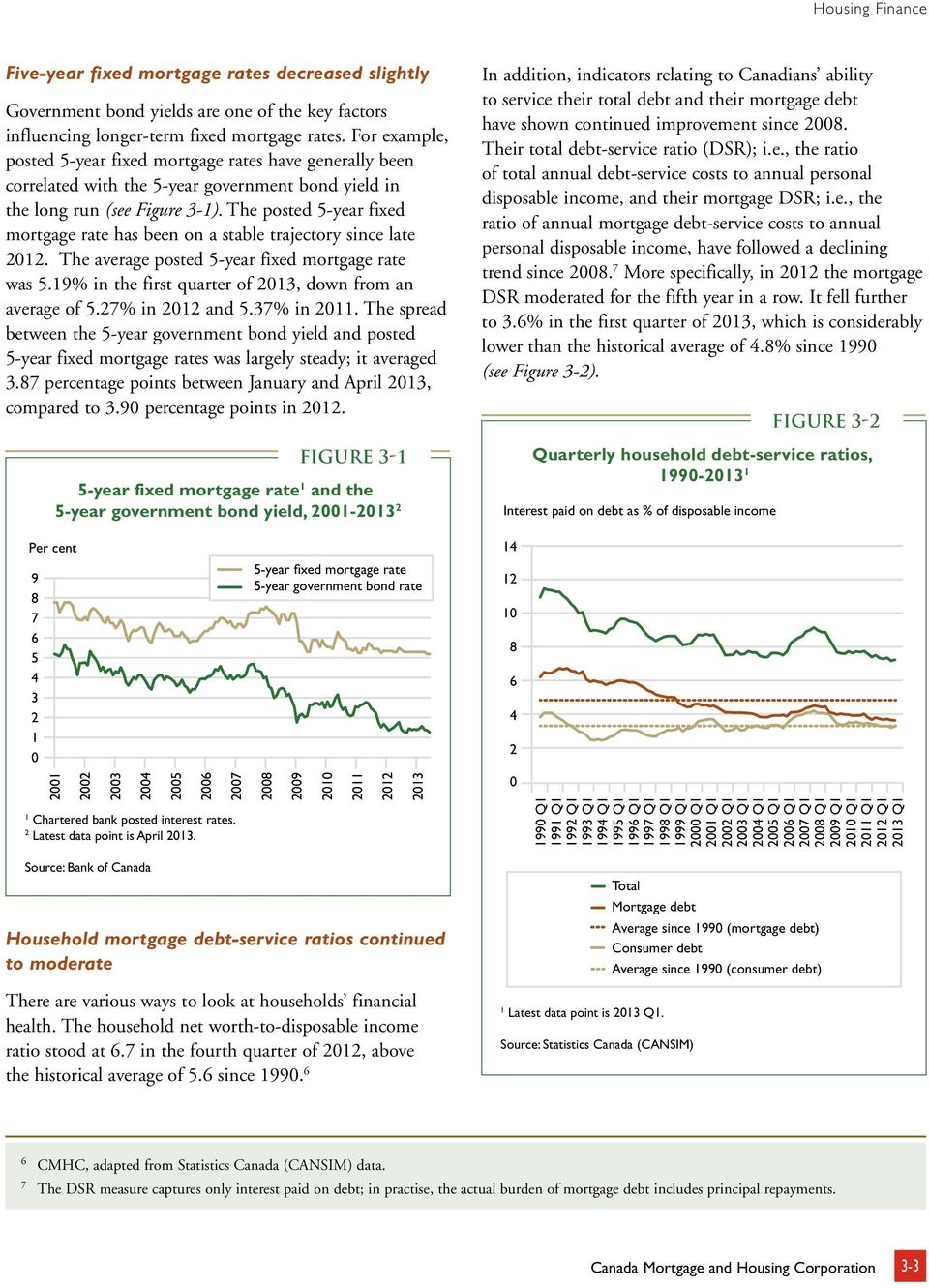
5 Housing Finance Five-year fixed mortgage rates decreased slightly Government bond yields are one of the key factors influencing longer-term fixed mortgage rates. For example, posted 5-year fixed mortgage rates have generally been correlated with the 5-year government bond yield in the long run (see Figure 3-). The posted 5-year fixed mortgage rate has been on a stable trajectory since late 202. The average posted 5-year fixed mortgage rate was 5.9% in the first quarter of 203, down from an average of 5.27% in 202 and 5.37% in 20. The spread between the 5-year government bond yield and posted 5-year fixed mortgage rates was largely steady; it averaged 3.87 percentage points between January and April 203, compared to 3.90 percentage points in 202. FIGURE 3-5-year fixed mortgage rate and the 5-year government bond yield, In addition, indicators relating to Canadians ability to service their total debt and their mortgage debt have shown continued improvement since Their total debt-service ratio (DSR); i.e., the ratio of total annual debt-service costs to annual personal disposable income, and their mortgage DSR; i.e., the ratio of annual mortgage debt-service costs to annual personal disposable income, have followed a declining trend since More specifically, in 202 the mortgage DSR moderated for the fifth year in a row. It fell further to 3.6% in the first quarter of 203, which is considerably lower than the historical average of 4.8% since 990 (see Figure 3-2). Interest paid on debt as % of disposable income FIGURE 3-2 Quarterly household debt-service ratios, Per cent year fixed mortgage rate 5-year government bond rate Chartered bank posted interest rates. 2 Latest data point is April Q 99 Q 992 Q 993 Q 994 Q 995 Q 996 Q 997 Q 998 Q 999 Q 2000 Q 200 Q 2002 Q 2003 Q 2004 Q 2005 Q 2006 Q 2007 Q 2008 Q 2009 Q 200 Q 20 Q 202 Q 203 Q Source: Bank of Canada Household mortgage debt-service ratios continued to moderate There are various ways to look at households financial health. The household net worth-to-disposable income ratio stood at 6.7 in the fourth quarter of 202, above the historical average of 5.6 since Total Mortgage debt Average since 990 (mortgage debt) Consumer debt Average since 990 (consumer debt) Latest data point is 203 Q. Source: Statistics Canada (CANSIM) 6 CMHC, adapted from Statistics Canada (CANSIM) data. 7 The DSR measure captures only interest paid on debt; in practise, the actual burden of mortgage debt includes principal repayments. Canada Mortgage and Housing Corporation 3-3
6 Canadian Housing Observer 203 Mortgage arrears rate remained low and trended downward since mid-200 Mortgage arrears remained low and stable (see Figure 3-3). The annual average rate of mortgage arrears was about one-third of %, at 0.34% in 202, down from 0.4% in 20, according to the Canadian Bankers Association. 8 As of June 203, 0.3% of residential mortgages were three or more months in arrears, compared to 0.33% twelve months earlier. Canada s internationally recognized conservative mortgage lending practices are among the key factors contributing to this outcome. 9 A wide range of mortgage product choices continue to benefit Canadians In recent decades, Canadian consumers have benefitted from a wider range of mortgage product offerings including greater choice of rate, term, and payment features. Mortgage market competition has been one of the key drivers that facilitate consumer choice. Greater use of mortgage brokers may have also assisted consumers in accessing more mortgage products and lenders. According to CMHC s 203 Mortgage Consumer Survey, 0 nearly a quarter (23%) of all consumers used a broker to arrange their mortgage in 203, compared to 4% in 999. Maximum mortgage amortization period for insured mortgages set at 25 years Effective July 9, 202, the maximum amortization period for insured mortgages with loan-to-value (LTV) ratios above 80% was set at 25 years under the government-backed mortgage insurance framework (see below). However, some lenders continue to offer mortgages with amortization periods of more than 25 years for uninsured mortgage loans with LTV ratios at or below 80%. Delinquency rate ( 90 days) (%) FIGURE 3-3 Mortgage arrears rate, , Mortgage arrears rates are non-seasonally adjusted, and calculated based on the total number of loans serviced instead of their dollar value. 2 The mortgage arrears rate reflects the ratio of loans with installments past due by 90 days or more. The annual arrears rate is calculated by averaging 2 monthly arrears data in a calendar year, which is collected by the Canadian Bankers Association from 0 major Canadian banks including BMO, CIBC, HSBC, National, RBC, Scotia, TD Canada Trust, Canadian Western, Manulife (as of April 2004) and Laurentian (as of October 200). Source: Canadian Bankers Association Most common mortgage remains 5-year term, fixed rate The 5-year fixed-rate mortgage (amortized over 25 years) continues to be the most common mortgage product. The 203 Financial Industry Research Monitor s (FIRM) Residential Mortgage Survey confirms the popularity of the 5-year term: 68% of the borrowers who initiated or renewed in the six months prior to the survey opted for a 5-year term (this includes both fixed- and variablerate products). Another 20% chose a term ranging from 6 months to 4 years, while the remaining borrowers had mortgage terms longer than 5 years Average since 990 (0.4%) Canadian Bankers Association. Arrears data include data from the Bank of Montreal, Canadian Imperial Bank of Commerce, HSBC Bank Canada, National Bank of Canada, RBC Royal Bank, Scotiabank, TD Canada Trust, Canadian Western Bank, Manulife Bank (as of April 2004) and Laurentian Bank (as of October 200). (May 3, 203). 9 Financial Stability Board Peer Review of Canada. (May 3, 202). 0 (June 3, 203). The Financial Industry Research Monitor (FIRM) Residential Mortgage Survey, prepared for CMHC by Altus Group Consulting and Ipsos Reid (Winter 203). 3-4 Canada Mortgage and Housing Corporation

7 Housing Finance Fixed-rate mortgages continue to appeal to the majority of Canadian mortgage borrowers. The 203 CAAMP survey 2 showed that 69% of the surveyed mortgage holders had fixed-rate mortgages, while 26% had variable- and adjustable-rate mortgages, and the remaining 5% had combination mortgages where part of the payment is based on a fixed rate and part is based on a variable rate (see text box Some common mortgage terminology). This is in line with CAAMP s 202 survey findings. Many Canadians continue to pay off their mortgage sooner than required CMHC s 202 Mortgage Consumer Survey 3 found that 3% of recent buyers reported making either a lump-sum payment or increasing their regular mortgage payment or both, in order to pay off their mortgage sooner; this compares to 29% in the 20 survey. As well, 44% of recent buyers had their mortgage payment set higher than the minimum required. This trend was consistent across the country. The propensity for Canadians to take steps to shorten the life of their mortgages was also echoed in a December 202 CAAMP report 4 which indicated that 32% of mortgage holders accelerated the pace at which they paid their mortgage, either through payment increases or lump-sum payments. These findings were particularly true for young and middle-aged mortgage holders. Home equity levels are strong The 203 CAAMP survey 5 revealed that home equity levels continue to be strong in Canada; the average equity for homeowners with mortgages was 47%. Among homeowners with mortgages, 7% had at least 25% equity in their home and only 7% had less than 0% equity as of April 203 (see Figure 3-4). In line with this, the average borrower equity in CMHC s insured portfolio was 45% in Mortgage rate discounting is supported by market competition Competition in the mortgage market has continued to support borrowers negotiating power when it comes to getting better mortgage rates. Although lenders offer FIGURE 3-4 Home equity levels of mortgage holders (%) 7 The home equity is calculated by deducting from the value of the home the outstanding balances of the mortgage on the property and the Home Equity Lines of Credit (HELOCs). May not add to 00% due to rounding. Source: Canadian Association of Accredited Mortgage Professionals (CAAMP). Change in the Canadian Mortgage Market May %20Mkt.pdf (July 24, 203) 7 24 < 0% 0% % 25% 2 Canadian Association of Accredited Mortgage Professionals (CAAMP). Change in the Canadian Mortgage Market May (June 3, 203). 3 ftp://ftp.cmhc-schl.gc.ca/chic-ccdh/chic-ccdh/chic-ccdh/mcs_brochure_202_en_.pdf 4 Mortgage Insights Highlights from CAAMP s Fall 202 Consumer and Industry Surveys (Toronto: Canadian Association of Accredited Mortgage Professionals (CAAMP), December 202). (June 3, 203). 5 Change in the Canadian Mortgage Market (Toronto: Canadian Association of Accredited Mortgage Professionals (CAAMP), May 203). (July 24, 203). 6 (July 9, 203). Canada Mortgage and Housing Corporation 3-5

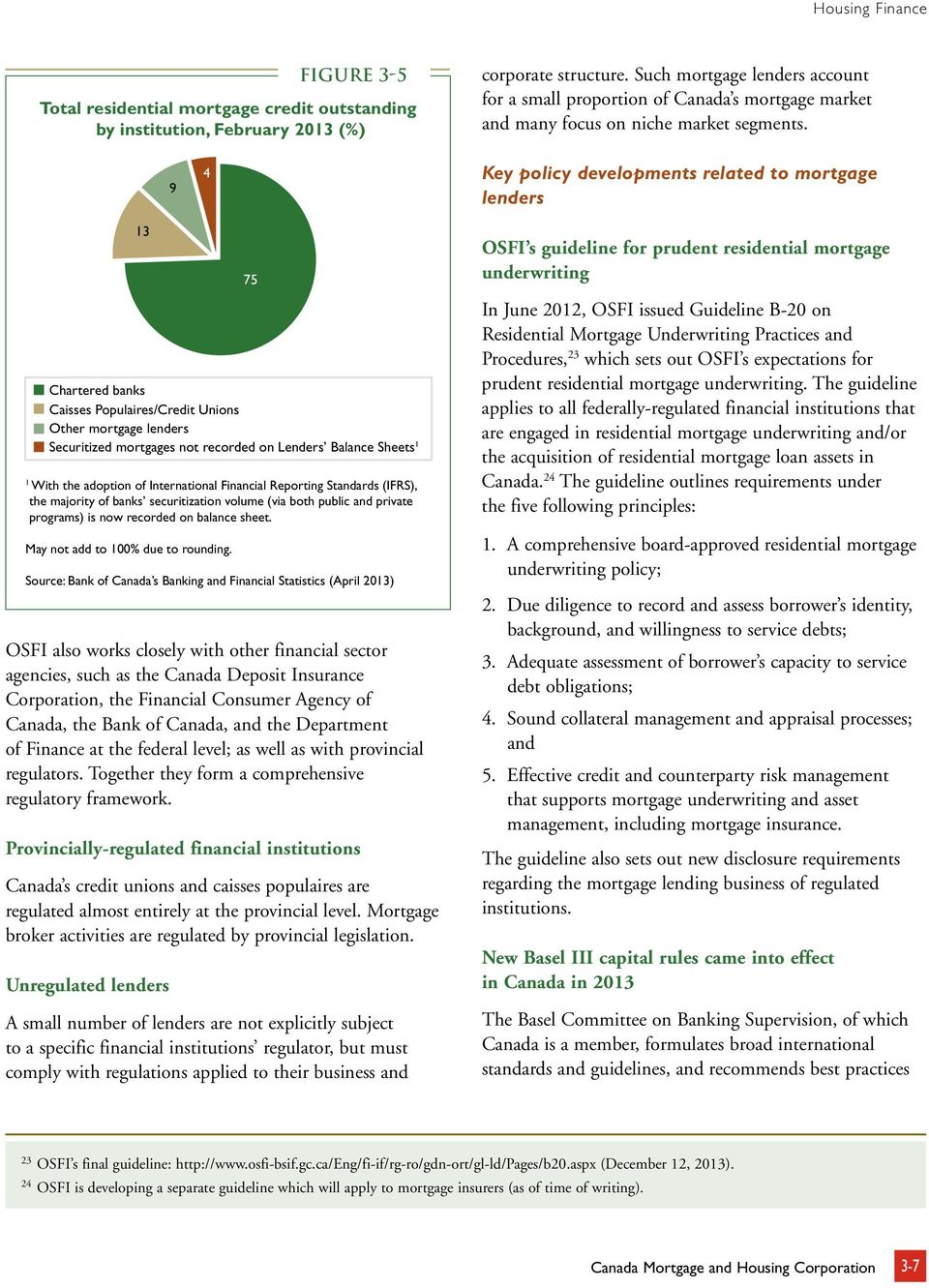
8 Canadian Housing Observer 203 posted rates, it has become a common practice for them to discount these rates based on negotiations with borrowers. The 203 survey by CAAMP, 7 shows the average rate for 5-year fixed-rate mortgages among the surveyed borrowers was 3.05% compared to the average posted 5-year mortgage rate of 5.25% for the same period implying that negotiated mortgage rate discounts averaged 2.2 percentage points for a 5-year fixed-rate term. This is a larger estimated discount than in the 202 CAAMP survey when negotiated mortgage rate discounts averaged.85 percentage points for 5-year fixed-rate mortgages. Home equity lines of credit (HELOCs) HELOCs lines of credit secured by the equity in borrowers property(ies), often their homes have become more popular over the last decade as they provide households with additional financial flexibility at a lower cost. According to the 203 CAAMP survey, 8 about 2.35 million homeowners have HELOCs. In recent years the criteria for HELOCs have been tightened. Since April 20, HELOCs have not been eligible for government-backed mortgage insurance. More recently, in June 202, the Office of the Superintendent of Financial Institutions (OSFI) reduced the maximum loan-to-value ratio on HELOCs to 65% from 80% for federally-regulated financial institutions. 9 Mortgage lenders Chartered banks continue to be the largest type of mortgage lender Residential mortgage credit is provided by a variety of financial institutions in Canada. 20 Chartered banks are the largest mortgage lenders in Canada, holding 74.6% of total outstanding residential mortgage credit on their balance sheets as of February 203, including mortgages that have been securitized. 2 The second largest group of mortgage lenders are credit unions and caisses populaires, holding 2.5% of the mortgages outstanding on their balance sheets. Other types of mortgage lenders are life insurance companies and pension plans, together accounting for 2.4%; trusts and loan companies holding 2.7%; and non-depository and other financial institutions holding 3.9% of the outstanding mortgage credit on their balance sheets. The remaining 3.9% of the total outstanding mortgage credit corresponded to securitized mortgages that were not recorded on lenders balance sheets (see Figure 3-5). The composition of the mortgage lending market is virtually unchanged compared to the same period one year earlier. Regulation of mortgage lenders Federally-regulated financial institutions are supervised by OSFI The Office of the Superintendent of Financial Institutions (OSFI) supervises federally-regulated financial institutions 22 in Canada, including chartered banks, life insurance companies, trust and loan companies, and pension plans. OSFI s long-held, proactive and transparent approach reinforces lenders conservative business and risk management practices, including their housing finance activities. 7 Change in the Canadian Mortgage Market (Toronto: Canadian Association of Accredited Mortgage Professionals (CAAMP), May 203). (June 3, 203). 8 Ibid. 9 OSFI. June 202. Guideline B-20 Residential Mortgage Underwriting Practices and Procedures. gdn-ort/gl-ld/pages/b20.aspx (December 2, 203). 20 The data in this section are calculated from the residential mortgage credit data in the Bank of Canada s Banking and Financial Statistics (April 203). 2 With the adoption of International Financial Reporting Standards (IFRS), the majority of banks securitization volume (via both public and private programs) is now recorded on balance sheet. 22 This includes financial institutions incorporated, continued or regulated under the Bank Act, Trust and Loan Companies Act, Insurance Companies Act, or Cooperative Credit Associations Act. 3-6 Canada Mortgage and Housing Corporation

9 Housing Finance FIGURE 3-5 Total residential mortgage credit outstanding by institution, February 203 (%) corporate structure. Such mortgage lenders account for a small proportion of Canada s mortgage market and many focus on niche market segments. 9 4 Key policy developments related to mortgage lenders 3 Chartered banks Caisses Populaires/Credit Unions Other mortgage lenders Securitized mortgages not recorded on Lenders Balance Sheets With the adoption of International Financial Reporting Standards (IFRS), the majority of banks securitization volume (via both public and private programs) is now recorded on balance sheet. May not add to 00% due to rounding. Source: Bank of Canada s Banking and Financial Statistics (April 203) OSFI also works closely with other financial sector agencies, such as the Canada Deposit Insurance Corporation, the Financial Consumer Agency of Canada, the Bank of Canada, and the Department of Finance at the federal level; as well as with provincial regulators. Together they form a comprehensive regulatory framework. Provincially-regulated financial institutions Canada s credit unions and caisses populaires are regulated almost entirely at the provincial level. Mortgage broker activities are regulated by provincial legislation. Unregulated lenders A small number of lenders are not explicitly subject to a specific financial institutions regulator, but must comply with regulations applied to their business and 75 OSFI s guideline for prudent residential mortgage underwriting In June 202, OSFI issued Guideline B-20 on Residential Mortgage Underwriting Practices and Procedures, 23 which sets out OSFI s expectations for prudent residential mortgage underwriting. The guideline applies to all federally-regulated financial institutions that are engaged in residential mortgage underwriting and/or the acquisition of residential mortgage loan assets in Canada. 24 The guideline outlines requirements under the five following principles:. A comprehensive board-approved residential mortgage underwriting policy; 2. Due diligence to record and assess borrower s identity, background, and willingness to service debts; 3. Adequate assessment of borrower s capacity to service debt obligations; 4. Sound collateral management and appraisal processes; and 5. Effective credit and counterparty risk management that supports mortgage underwriting and asset management, including mortgage insurance. The guideline also sets out new disclosure requirements regarding the mortgage lending business of regulated institutions. New Basel III capital rules came into effect in Canada in 203 The Basel Committee on Banking Supervision, of which Canada is a member, formulates broad international standards and guidelines, and recommends best practices 23 OSFI s final guideline: (December 2, 203). 24 OSFI is developing a separate guideline which will apply to mortgage insurers (as of time of writing). Canada Mortgage and Housing Corporation 3-7
10 Canadian Housing Observer 203 related to prudential banking supervision. The Basel I Accord (988) and Basel II Accord (2004) were the earlier international frameworks established by the Basel Committee. In the aftermath of the financial crisis, the Basel Committee responded by developing new global standards; i.e., Basel III, to improve supervision, regulation and risk management of the banking sector. The major elements of the Basel III rules on capital, leverage and liquidity were issued at the end of 200; however, details on some components are still being finalized. For Canada, OSFI has issued Basel III-compliant capital requirements 25 which came into effect on January, 203 for banks, trust and loan companies, and cooperative retail associations operating in Canada. OSFI is in the process of adapting and implementing other Basel III rules for its regulated financial institutions. Implementation of the Basel III rules will affect Canadian mortgage lenders, including their capital, liquidity, funding and operations, and in turn may have implications for the residential mortgage market. For example, new Basel III liquidity rules are expected to result in higher demand for high quality liquid assets as regulated financial institutions are required to maintain a higher minimum amount of liquid assets on their balance sheet. To the extent that some mortgagebacked securities are qualified as liquid assets, demand for them may become greater, which in turn may impact mortgage securitization and the origination of underlying mortgages. Mortgage loan insurance Mortgage loan insurance facilitates consumer access to mortgage credit and housing to have mortgage insurance coverage for high-ratio mortgages (mortgages where the loan exceeds 80% of the value of the collateral property). Mortgage loan insurance helps protect lenders against mortgage default, and enables consumers to purchase homes with a minimum down payment of 5% with interest rates comparable to those with a 20% or larger down payment. Thus, mortgage insurance helps facilitate the availability of, and access to, mortgage credit. Mortgage insurers The mortgage loan insurance market is currently served by one federal Crown corporation Canada Mortgage and Housing Corporation (CMHC) and two private mortgage insurers Genworth Financial and Canada Guaranty. CMHC is Canada s largest mortgage insurer. As the only public mortgage insurer, CMHC provides service in all parts of the country, including rural and smaller markets that may not be served or well-served by private insurers. CMHC also insures mortgages for large rental housing developments, purpose-built student housing projects, and nursing and retirement homes, important segments of the housing market that are not served by private mortgage insurers in Canada. About 47% of CMHC s mortgage insurance business in 202 was to address these less-served markets. CMHC s mortgage insurance activities are carried out on a commercial basis with no direct financial assistance from the Government of Canada and in accordance with prudent actuarial and underwriting criteria (see Figure 3-6). In 202, CMHC s mandate was enhanced to include financial stability as an objective of its commercial activities, including mortgage insurance. Mortgage loan insurance is a significant component of Canada s mortgage market and financial stability framework. Federally-regulated lenders and most provincially-regulated lenders are required by law 25 (December 2, 203). 3-8 Canada Mortgage and Housing Corporation
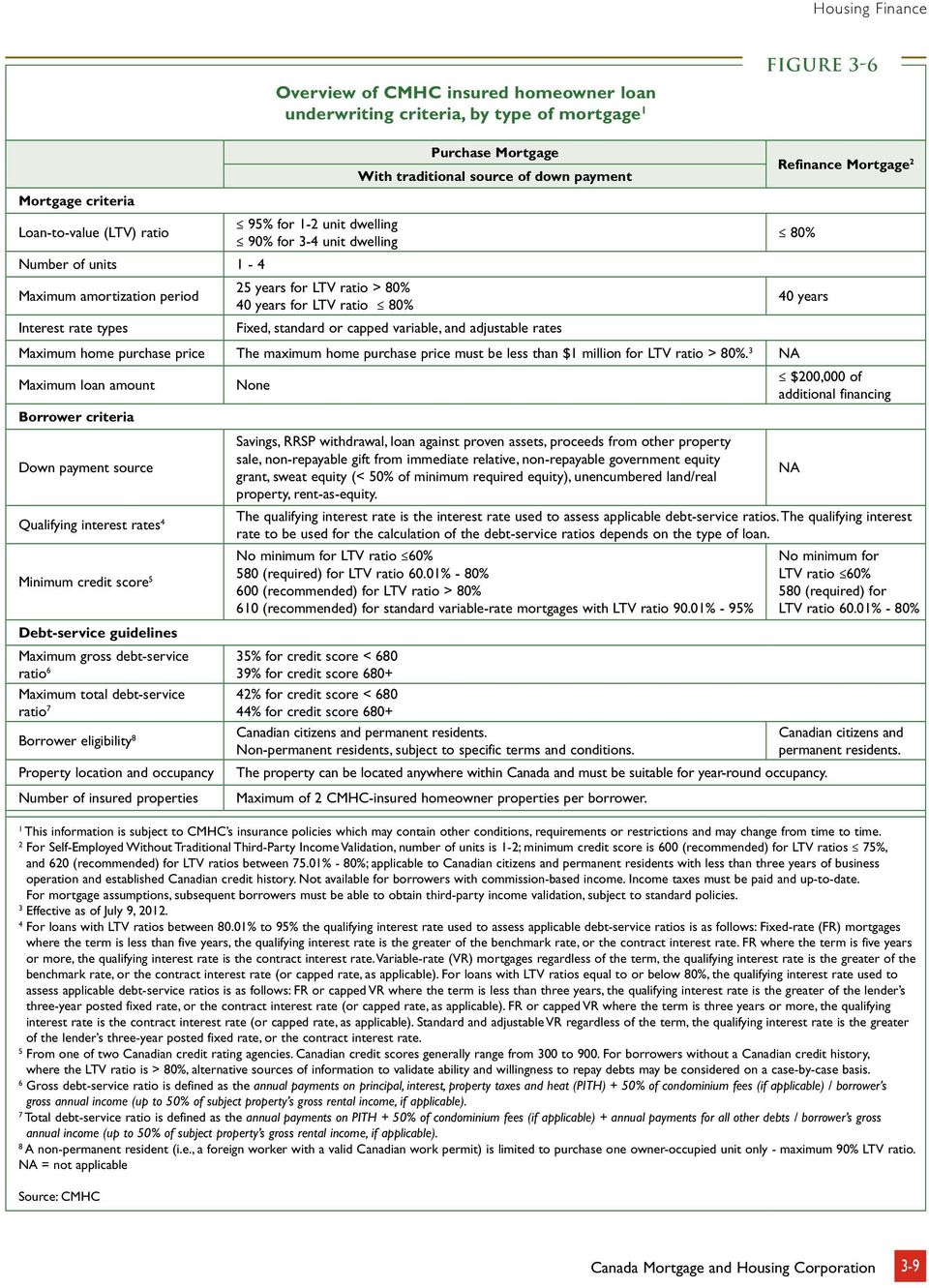
11 Housing Finance Overview of CMHC insured homeowner loan underwriting criteria, by type of mortgage FIGURE 3-6 Mortgage criteria Purchase Mortgage With traditional source of down payment Refinance Mortgage 2 Loan-to-value (LTV) ratio 95% for -2 unit dwelling 90% for 3-4 unit dwelling 80% Number of units - 4 Maximum amortization period 25 years for LTV ratio > 80% 40 years for LTV ratio 80% 40 years Interest rate types Fixed, standard or capped variable, and adjustable rates Maximum home purchase price The maximum home purchase price must be less than $ million for LTV ratio > 80%. 3 NA Maximum loan amount None $200,000 of additional financing Borrower criteria Down payment source Savings, RRSP withdrawal, loan against proven assets, proceeds from other property sale, non-repayable gift from immediate relative, non-repayable government equity grant, sweat equity (< 50% of minimum required equity), unencumbered land/real NA property, rent-as-equity. Qualifying interest rates 4 The qualifying interest rate is the interest rate used to assess applicable debt-service ratios. The qualifying interest rate to be used for the calculation of the debt-service ratios depends on the type of loan. No minimum for LTV ratio 60% 580 (required) for LTV ratio 60.0% - 80% Minimum credit score (recommended) for LTV ratio > 80% 60 (recommended) for standard variable-rate mortgages with LTV ratio 90.0% - 95% Debt-service guidelines Maximum gross debt-service 35% for credit score < 680 ratio 6 39% for credit score 680+ Maximum total debt-service 42% for credit score < 680 ratio 7 44% for credit score 680+ Canadian citizens and permanent residents. Borrower eligibility 8 Non-permanent residents, subject to specific terms and conditions. Property location and occupancy The property can be located anywhere within Canada and must be suitable for year-round occupancy. Number of insured properties Maximum of 2 CMHC-insured homeowner properties per borrower. No minimum for LTV ratio 60% 580 (required) for LTV ratio 60.0% - 80% Canadian citizens and permanent residents. This information is subject to CMHC s insurance policies which may contain other conditions, requirements or restrictions and may change from time to time. 2 For Self-Employed Without Traditional Third-Party Income Validation, number of units is -2; minimum credit score is 600 (recommended) for LTV ratios 75%, and 620 (recommended) for LTV ratios between 75.0% - 80%; applicable to Canadian citizens and permanent residents with less than three years of business operation and established Canadian credit history. Not available for borrowers with commission-based income. Income taxes must be paid and up-to-date. For mortgage assumptions, subsequent borrowers must be able to obtain third-party income validation, subject to standard policies. 3 Effective as of July 9, For loans with LTV ratios between 80.0% to 95% the qualifying interest rate used to assess applicable debt-service ratios is as follows: Fixed-rate (FR) mortgages where the term is less than five years, the qualifying interest rate is the greater of the benchmark rate, or the contract interest rate. FR where the term is five years or more, the qualifying interest rate is the contract interest rate. Variable-rate (VR) mortgages regardless of the term, the qualifying interest rate is the greater of the benchmark rate, or the contract interest rate (or capped rate, as applicable). For loans with LTV ratios equal to or below 80%, the qualifying interest rate used to assess applicable debt-service ratios is as follows: FR or capped VR where the term is less than three years, the qualifying interest rate is the greater of the lender s three-year posted fixed rate, or the contract interest rate (or capped rate, as applicable). FR or capped VR where the term is three years or more, the qualifying interest rate is the contract interest rate (or capped rate, as applicable). Standard and adjustable VR regardless of the term, the qualifying interest rate is the greater of the lender s three-year posted fixed rate, or the contract interest rate. 5 From one of two Canadian credit rating agencies. Canadian credit scores generally range from 300 to 900. For borrowers without a Canadian credit history, where the LTV ratio is > 80%, alternative sources of information to validate ability and willingness to repay debts may be considered on a case-by-case basis. 6 Gross debt-service ratio is defined as the annual payments on principal, interest, property taxes and heat (PITH) + 50% of condominium fees (if applicable) / borrower s gross annual income (up to 50% of subject property s gross rental income, if applicable). 7 Total debt-service ratio is defined as the annual payments on PITH + 50% of condominium fees (if applicable) + annual payments for all other debts / borrower s gross annual income (up to 50% of subject property s gross rental income, if applicable). 8 A non-permanent resident (i.e., a foreign worker with a valid Canadian work permit) is limited to purchase one owner-occupied unit only - maximum 90% LTV ratio. NA = not applicable Source: CMHC Canada Mortgage and Housing Corporation 3-9
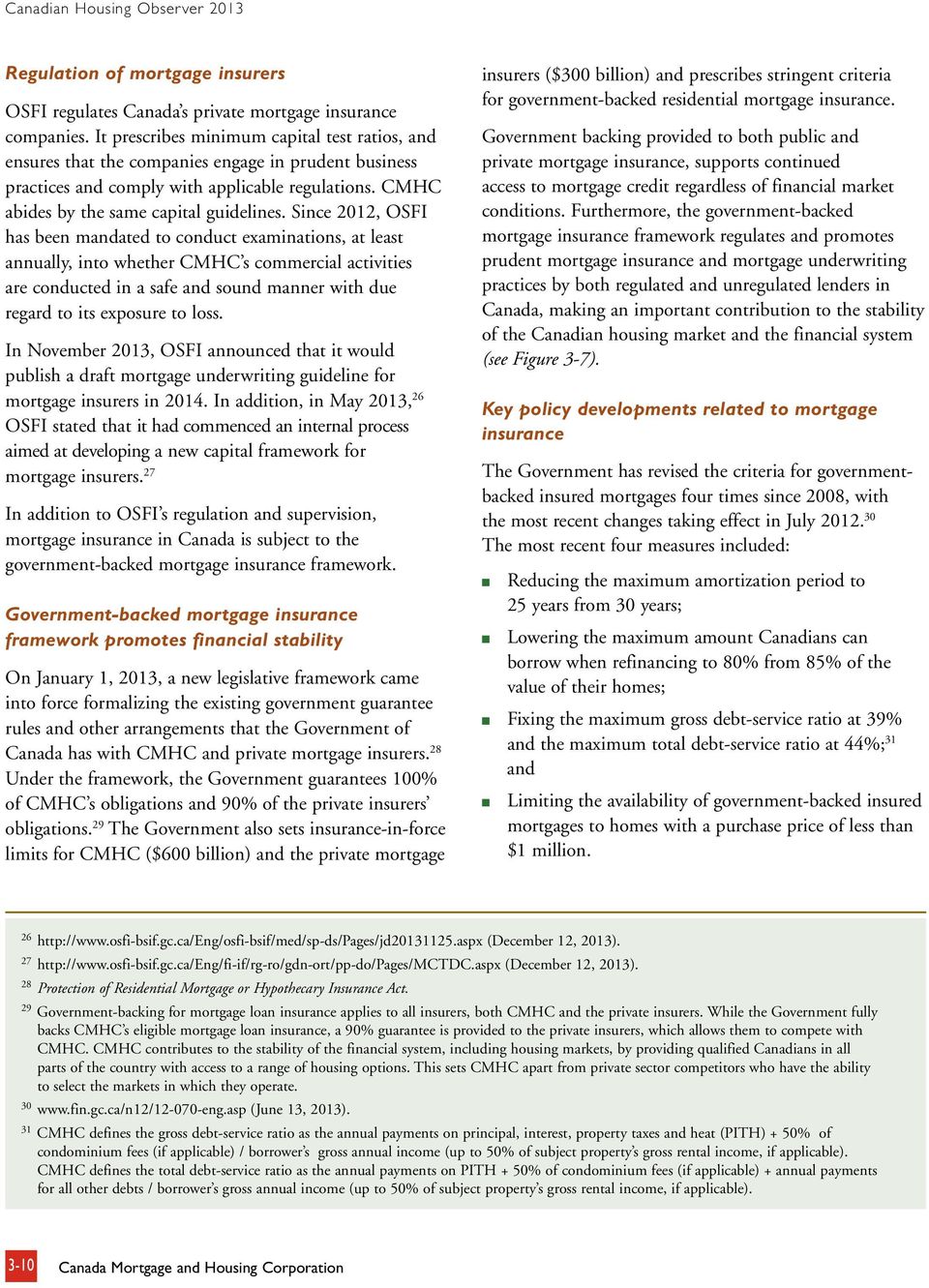
12 Canadian Housing Observer 203 Regulation of mortgage insurers OSFI regulates Canada s private mortgage insurance companies. It prescribes minimum capital test ratios, and ensures that the companies engage in prudent business practices and comply with applicable regulations. CMHC abides by the same capital guidelines. Since 202, OSFI has been mandated to conduct examinations, at least annually, into whether CMHC s commercial activities are conducted in a safe and sound manner with due regard to its exposure to loss. In November 203, OSFI announced that it would publish a draft mortgage underwriting guideline for mortgage insurers in 204. In addition, in May 203, 26 OSFI stated that it had commenced an internal process aimed at developing a new capital framework for mortgage insurers. 27 In addition to OSFI s regulation and supervision, mortgage insurance in Canada is subject to the government-backed mortgage insurance framework. Government-backed mortgage insurance framework promotes financial stability On January, 203, a new legislative framework came into force formalizing the existing government guarantee rules and other arrangements that the Government of Canada has with CMHC and private mortgage insurers. 28 Under the framework, the Government guarantees 00% of CMHC s obligations and 90% of the private insurers obligations. 29 The Government also sets insurance-in-force limits for CMHC ($600 billion) and the private mortgage insurers ($300 billion) and prescribes stringent criteria for government-backed residential mortgage insurance. Government backing provided to both public and private mortgage insurance, supports continued access to mortgage credit regardless of financial market conditions. Furthermore, the government-backed mortgage insurance framework regulates and promotes prudent mortgage insurance and mortgage underwriting practices by both regulated and unregulated lenders in Canada, making an important contribution to the stability of the Canadian housing market and the financial system (see Figure 3-7). Key policy developments related to mortgage insurance The Government has revised the criteria for governmentbacked insured mortgages four times since 2008, with the most recent changes taking effect in July The most recent four measures included: Reducing the maximum amortization period to 25 years from 30 years; Lowering the maximum amount Canadians can borrow when refinancing to 80% from 85% of the value of their homes; Fixing the maximum gross debt-service ratio at 39% and the maximum total debt-service ratio at 44%; 3 and Limiting the availability of government-backed insured mortgages to homes with a purchase price of less than $ million (December 2, 203) (December 2, 203). 28 Protection of Residential Mortgage or Hypothecary Insurance Act. 29 Government-backing for mortgage loan insurance applies to all insurers, both CMHC and the private insurers. While the Government fully backs CMHC s eligible mortgage loan insurance, a 90% guarantee is provided to the private insurers, which allows them to compete with CMHC. CMHC contributes to the stability of the financial system, including housing markets, by providing qualified Canadians in all parts of the country with access to a range of housing options. This sets CMHC apart from private sector competitors who have the ability to select the markets in which they operate (June 3, 203). 3 CMHC defines the gross debt-service ratio as the annual payments on principal, interest, property taxes and heat (PITH) + 50% of condominium fees (if applicable) / borrower s gross annual income (up to 50% of subject property s gross rental income, if applicable). CMHC defines the total debt-service ratio as the annual payments on PITH + 50% of condominium fees (if applicable) + annual payments for all other debts / borrower s gross annual income (up to 50% of subject property s gross rental income, if applicable). 3-0 Canada Mortgage and Housing Corporation
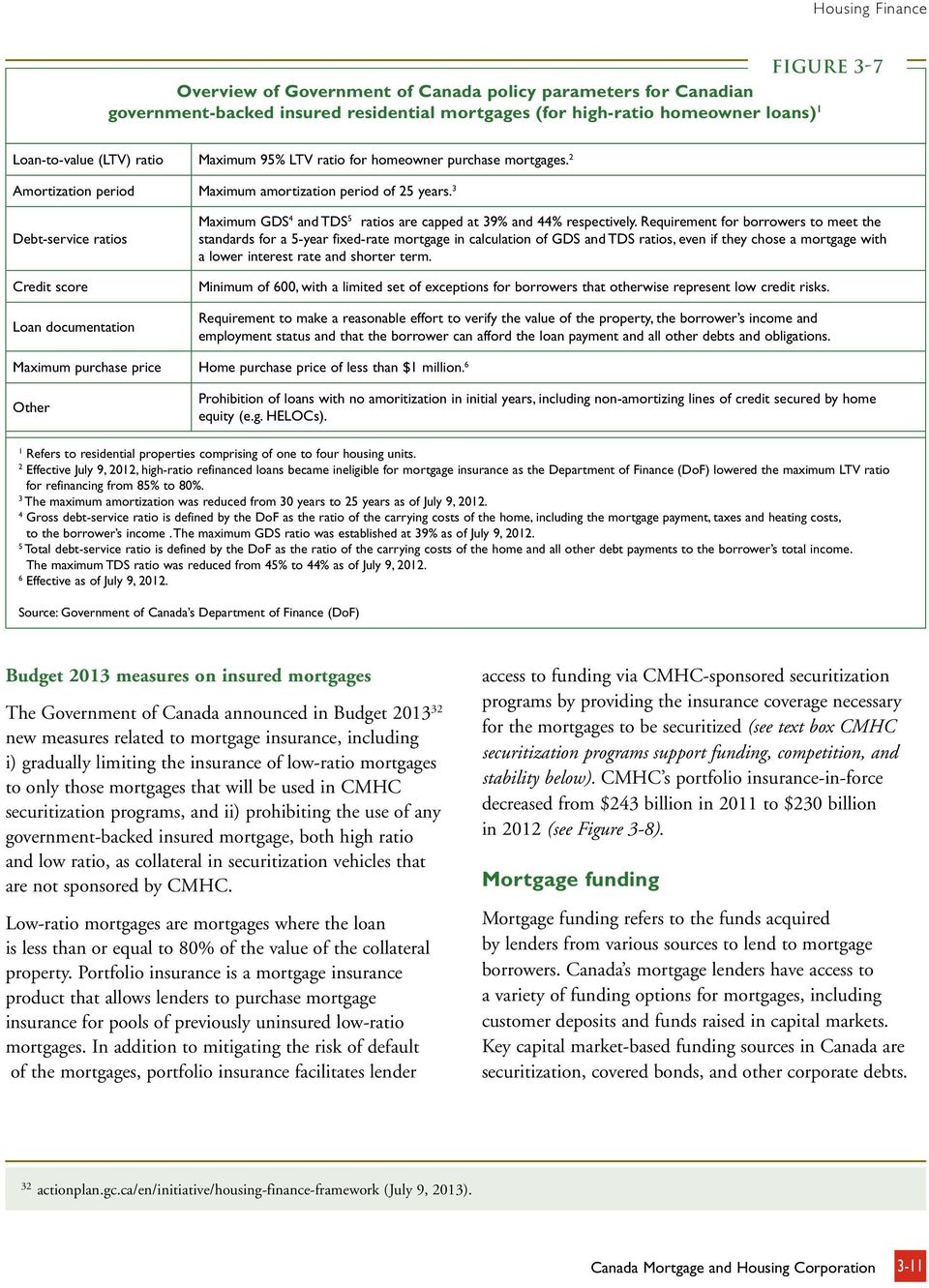
13 Housing Finance FIGURE 3-7 Overview of Government of Canada policy parameters for Canadian government-backed insured residential mortgages (for high-ratio homeowner loans) Loan-to-value (LTV) ratio Maximum 95% LTV ratio for homeowner purchase mortgages. 2 Amortization period Maximum amortization period of 25 years. 3 Debt-service ratios Credit score Loan documentation Maximum GDS 4 and TDS 5 ratios are capped at 39% and 44% respectively. Requirement for borrowers to meet the standards for a 5-year fixed-rate mortgage in calculation of GDS and TDS ratios, even if they chose a mortgage with a lower interest rate and shorter term. Minimum of 600, with a limited set of exceptions for borrowers that otherwise represent low credit risks. Requirement to make a reasonable effort to verify the value of the property, the borrower s income and employment status and that the borrower can afford the loan payment and all other debts and obligations. Maximum purchase price Home purchase price of less than $ million. 6 Other Prohibition of loans with no amoritization in initial years, including non-amortizing lines of credit secured by home equity (e.g. HELOCs). Refers to residential properties comprising of one to four housing units. 2 Effective July 9, 202, high-ratio refinanced loans became ineligible for mortgage insurance as the Department of Finance (DoF) lowered the maximum LTV ratio for refinancing from 85% to 80%. 3 The maximum amortization was reduced from 30 years to 25 years as of July 9, Gross debt-service ratio is defined by the DoF as the ratio of the carrying costs of the home, including the mortgage payment, taxes and heating costs, to the borrower s income. The maximum GDS ratio was established at 39% as of July 9, Total debt-service ratio is defined by the DoF as the ratio of the carrying costs of the home and all other debt payments to the borrower s total income. The maximum TDS ratio was reduced from 45% to 44% as of July 9, Effective as of July 9, 202. Source: Government of Canada s Department of Finance (DoF) Budget 203 measures on insured mortgages The Government of Canada announced in Budget new measures related to mortgage insurance, including i) gradually limiting the insurance of low-ratio mortgages to only those mortgages that will be used in CMHC securitization programs, and ii) prohibiting the use of any government-backed insured mortgage, both high ratio and low ratio, as collateral in securitization vehicles that are not sponsored by CMHC. Low-ratio mortgages are mortgages where the loan is less than or equal to 80% of the value of the collateral property. Portfolio insurance is a mortgage insurance product that allows lenders to purchase mortgage insurance for pools of previously uninsured low-ratio mortgages. In addition to mitigating the risk of default of the mortgages, portfolio insurance facilitates lender access to funding via CMHC-sponsored securitization programs by providing the insurance coverage necessary for the mortgages to be securitized (see text box CMHC securitization programs support funding, competition, and stability below). CMHC s portfolio insurance-in-force decreased from $243 billion in 20 to $230 billion in 202 (see Figure 3-8). Mortgage funding Mortgage funding refers to the funds acquired by lenders from various sources to lend to mortgage borrowers. Canada s mortgage lenders have access to a variety of funding options for mortgages, including customer deposits and funds raised in capital markets. Key capital market-based funding sources in Canada are securitization, covered bonds, and other corporate debts. 32 actionplan.gc.ca/en/initiative/housing-finance-framework (July 9, 203). Canada Mortgage and Housing Corporation 3-
14 Canadian Housing Observer 203 FIGURE 3-8 CMHC's portfolio insurance-in-force Billions of dollars 250 $ $ $ Deposits remain the primary source of mortgage funds for deposit-taking institutions Historically, deposits have been the primary mortgage funding source for Canadian deposit-taking institutions. Deposits are typically short- to medium-term. Retail deposits include demand deposits, e.g. chequing and savings accounts, as well as term deposits, e.g. guaranteed investment certificates (GICs). In addition, banks issue short- to medium-term debts (often called deposit notes), which typically target capital market investors, in particular large institutional investors Source: CMHC Retail deposits continue to be one of the lowest cost funding sources. 33 For example, 5-year guaranteed investment certificates (GIC) rates have generally been lower than 5-year Government of Canada bond rates 34 (see Figure 3-9). FIGURE 3-9 GIC, CMB and NHA MBS monthly spreads to Government of Canada bond benchmark, Basis points 75 5-year fixed GIC 5-year fixed CMB 5-year NHA MBS Mar-05 Jun-05 Sep-05 Dec-05 Mar-06 Jun-06 Sep-06 Dec-06 Mar-07 Jun-07 Sep-07 Dec-07 Mar-08 Jun-08 Sep-08 Dec-08 Mar-09 Jun-09 Sep-09 Dec-09 Mar-0 Jun-0 Sep-0 Dec-0 Mar- Jun- Sep- Dec- Mar-2 Jun-2 Sep-2 Dec-2 Mar-3 Note: The figure uses monthly spread data, which may not reflect all daily changes. Source: CMHC, Bank of Canada, CIBC World Markets, Scotia Capital Markets 33 As an approach to assess the cost of funding, the spreads of various mortgage funding sources can be compared. However, these do not represent the full cost, which includes costs, such as legal costs, guarantee fees or other forms of credit enhancements, and underwriting fees, which may differ by funding source. 34 Exceptions to this occurred around the ends of 2008 and 20 as well as during 202, when significant market uncertainty drove up demand for the government bonds, driving the bond rates to below the GIC rates. In addition, competition for deposits may have also pushed up the costs of GIC post-crisis, narrowing the spread. 3-2 Canada Mortgage and Housing Corporation

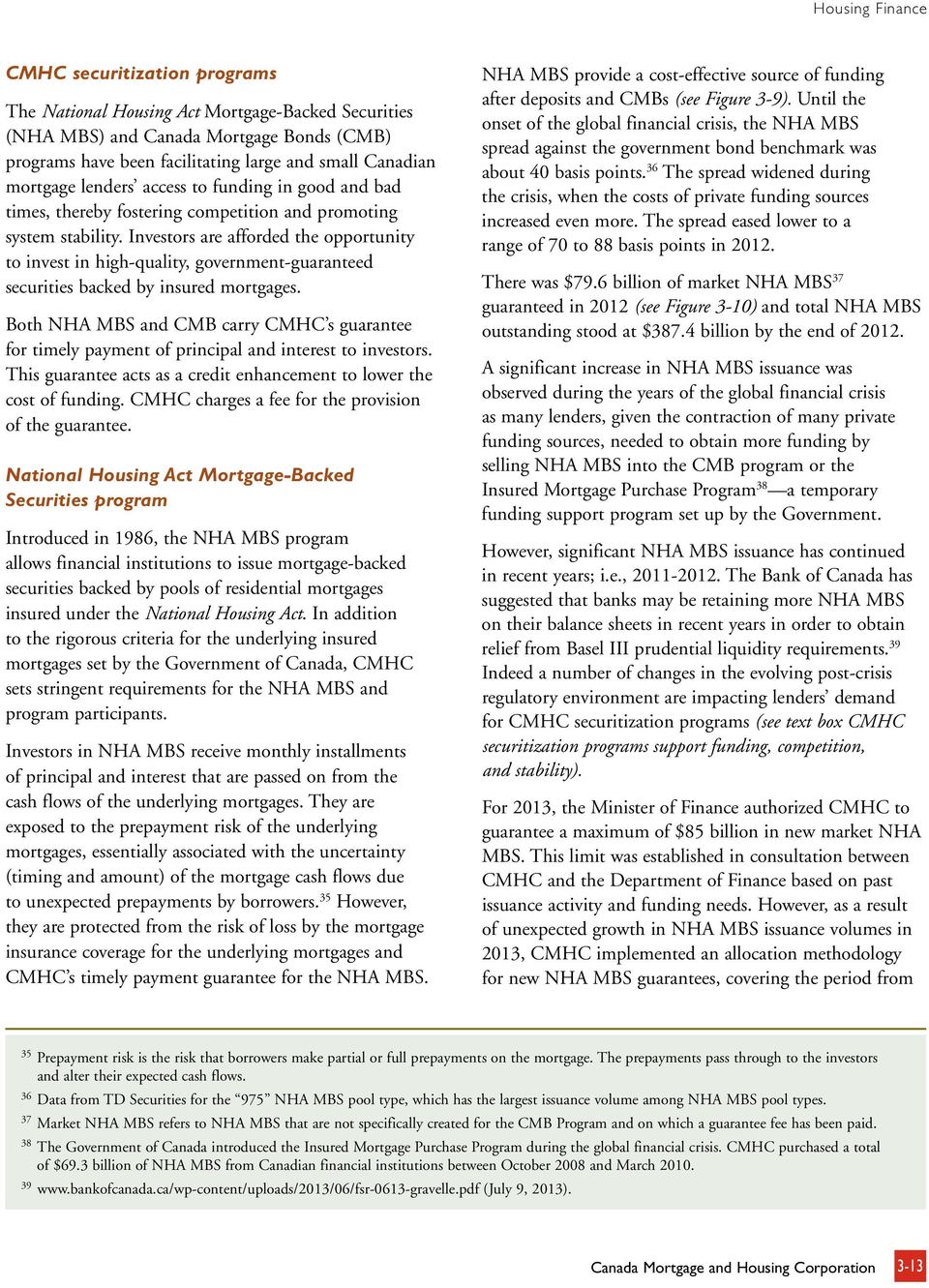
15 Housing Finance CMHC securitization programs The National Housing Act Mortgage-Backed Securities (NHA MBS) and Canada Mortgage Bonds (CMB) programs have been facilitating large and small Canadian mortgage lenders access to funding in good and bad times, thereby fostering competition and promoting system stability. Investors are afforded the opportunity to invest in high-quality, government-guaranteed securities backed by insured mortgages. Both NHA MBS and CMB carry CMHC s guarantee for timely payment of principal and interest to investors. This guarantee acts as a credit enhancement to lower the cost of funding. CMHC charges a fee for the provision of the guarantee. National Housing Act Mortgage-Backed Securities program Introduced in 986, the NHA MBS program allows financial institutions to issue mortgage-backed securities backed by pools of residential mortgages insured under the National Housing Act. In addition to the rigorous criteria for the underlying insured mortgages set by the Government of Canada, CMHC sets stringent requirements for the NHA MBS and program participants. Investors in NHA MBS receive monthly installments of principal and interest that are passed on from the cash flows of the underlying mortgages. They are exposed to the prepayment risk of the underlying mortgages, essentially associated with the uncertainty (timing and amount) of the mortgage cash flows due to unexpected prepayments by borrowers. 35 However, they are protected from the risk of loss by the mortgage insurance coverage for the underlying mortgages and CMHC s timely payment guarantee for the NHA MBS. NHA MBS provide a cost-effective source of funding after deposits and CMBs (see Figure 3-9). Until the onset of the global financial crisis, the NHA MBS spread against the government bond benchmark was about 40 basis points. 36 The spread widened during the crisis, when the costs of private funding sources increased even more. The spread eased lower to a range of 70 to 88 basis points in 202. There was $79.6 billion of market NHA MBS 37 guaranteed in 202 (see Figure 3-0) and total NHA MBS outstanding stood at $387.4 billion by the end of 202. A significant increase in NHA MBS issuance was observed during the years of the global financial crisis as many lenders, given the contraction of many private funding sources, needed to obtain more funding by selling NHA MBS into the CMB program or the Insured Mortgage Purchase Program 38 a temporary funding support program set up by the Government. However, significant NHA MBS issuance has continued in recent years; i.e., The Bank of Canada has suggested that banks may be retaining more NHA MBS on their balance sheets in recent years in order to obtain relief from Basel III prudential liquidity requirements. 39 Indeed a number of changes in the evolving post-crisis regulatory environment are impacting lenders demand for CMHC securitization programs (see text box CMHC securitization programs support funding, competition, and stability). For 203, the Minister of Finance authorized CMHC to guarantee a maximum of $85 billion in new market NHA MBS. This limit was established in consultation between CMHC and the Department of Finance based on past issuance activity and funding needs. However, as a result of unexpected growth in NHA MBS issuance volumes in 203, CMHC implemented an allocation methodology for new NHA MBS guarantees, covering the period from 35 Prepayment risk is the risk that borrowers make partial or full prepayments on the mortgage. The prepayments pass through to the investors and alter their expected cash flows. 36 Data from TD Securities for the 975 NHA MBS pool type, which has the largest issuance volume among NHA MBS pool types. 37 Market NHA MBS refers to NHA MBS that are not specifically created for the CMB Program and on which a guarantee fee has been paid. 38 The Government of Canada introduced the Insured Mortgage Purchase Program during the global financial crisis. CMHC purchased a total of $69.3 billion of NHA MBS from Canadian financial institutions between October 2008 and March (July 9, 203). Canada Mortgage and Housing Corporation 3-3
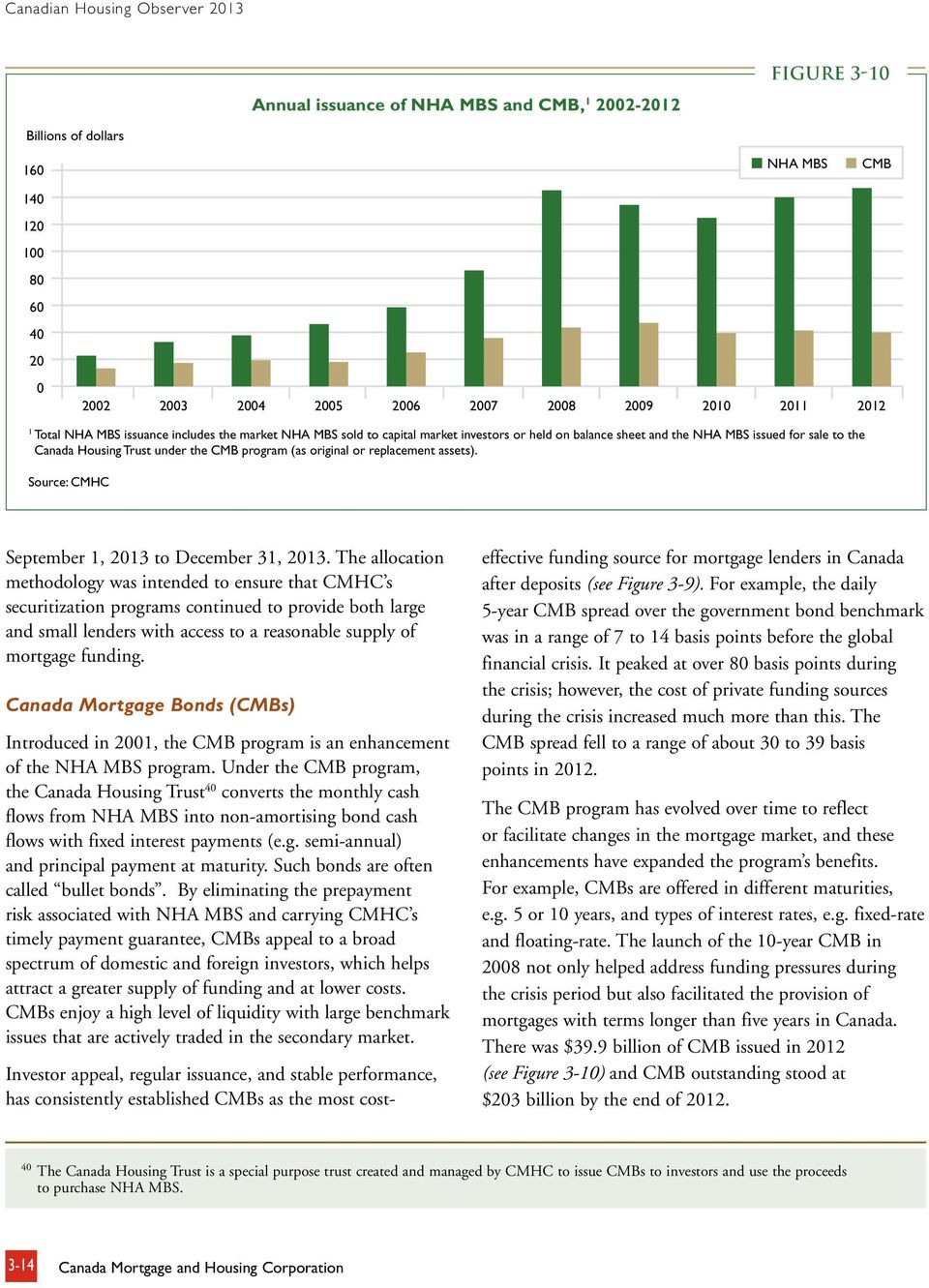
16 Canadian Housing Observer 203 Annual issuance of NHA MBS and CMB, FIGURE 3-0 Billions of dollars NHA MBS CMB Total NHA MBS issuance includes the market NHA MBS sold to capital market investors or held on balance sheet and the NHA MBS issued for sale to the Canada Housing Trust under the CMB program (as original or replacement assets). Source: CMHC September, 203 to December 3, 203. The allocation methodology was intended to ensure that CMHC s securitization programs continued to provide both large and small lenders with access to a reasonable supply of mortgage funding. Canada Mortgage Bonds (CMBs) Introduced in 200, the CMB program is an enhancement of the NHA MBS program. Under the CMB program, the Canada Housing Trust 40 converts the monthly cash flows from NHA MBS into non-amortising bond cash flows with fixed interest payments (e.g. semi-annual) and principal payment at maturity. Such bonds are often called bullet bonds. By eliminating the prepayment risk associated with NHA MBS and carrying CMHC s timely payment guarantee, CMBs appeal to a broad spectrum of domestic and foreign investors, which helps attract a greater supply of funding and at lower costs. CMBs enjoy a high level of liquidity with large benchmark issues that are actively traded in the secondary market. Investor appeal, regular issuance, and stable performance, has consistently established CMBs as the most cost- effective funding source for mortgage lenders in Canada after deposits (see Figure 3-9). For example, the daily 5-year CMB spread over the government bond benchmark was in a range of 7 to 4 basis points before the global financial crisis. It peaked at over 80 basis points during the crisis; however, the cost of private funding sources during the crisis increased much more than this. The CMB spread fell to a range of about 30 to 39 basis points in 202. The CMB program has evolved over time to reflect or facilitate changes in the mortgage market, and these enhancements have expanded the program s benefits. For example, CMBs are offered in different maturities, e.g. 5 or 0 years, and types of interest rates, e.g. fixed-rate and floating-rate. The launch of the 0-year CMB in 2008 not only helped address funding pressures during the crisis period but also facilitated the provision of mortgages with terms longer than five years in Canada. There was $39.9 billion of CMB issued in 202 (see Figure 3-0) and CMB outstanding stood at $203 billion by the end of The Canada Housing Trust is a special purpose trust created and managed by CMHC to issue CMBs to investors and use the proceeds to purchase NHA MBS. 3-4 Canada Mortgage and Housing Corporation
17 Housing Finance CMHC securitization programs support funding, competition, and stability CMHC s securitization programs contribute to the efficient functioning, competitiveness, and stability of the housing finance system by helping ensure lenders and, in turn, borrowers have access to a reliable source of funding for residential mortgages regardless of economic cycles and market conditions. Experience during the global financial crisis provided a notable example of this, as the programs were able to expand quickly to address funding gaps caused by the contraction of other funding sources. The programs also contribute to system stability during stress periods. Furthermore, CMHC securitization programs promote competition in the mortgage market by allowing a broad range of lenders to access a cost-effective source of funding (see Figure 3-9 for an indication of the cost of funding). Many smaller lenders have increasingly benefited from CMHC s securitization programs as a source of funding, not only during the critical crisis time, but also in recent years. This in turn facilitates consumer choice and helps mitigate the risk of increasing market power in a few larger lenders. For example, 83% of the participants in 5-year fixed-rate CMB transactions as of mid-203 were smaller lenders; i.e., those other than the six largest banks, and the number of these participants more than quadrupled between 2006 and mid-203 (see Figure 3-). The share of 5-year fixed-rate CMB issuances attributable to participants other than the six largest banks increased significantly from 9% in 2006 to 67% by mid-203 (see Figure 3-2). FIGURE 3- Participation in the CMB program by smaller lenders has increased significantly since 2006 Proportion of participants in a 5-year fixed-rate CMB transaction (%) Source: CMHC largest banks Others 202 mid- 203 FIGURE 3-2 Smaller lenders enjoy access to a large share of mortgage funding through the CMB program Share of 5-year fixed-rate CMB funding (%) Source: CMHC largest banks Others 202 mid- 203 Changes in the regulatory and policy environment, e.g. new Basel III standards on capital and liquidity; reforms related to derivatives, securitization and shadow banking; and the recently announced Budget 203 measures related to mortgage insurance may impact future demand for, and the use of, CMHC securitization programs by market participants. For example, the measures prohibiting the use of insured mortgages as collateral in private securitization vehicles mean that many market participants will now have CMHC securitization programs as the only means of securitizing insured mortgages. In another example, according to some commentators, e.g. the Bank of Canada, the new Basel liquidity rule and other reforms to improve financial stability may result in greater demand for high quality liquid assets such as NHA MBS and CMB in order to meet liquidity and collateral requirements. 2 These are Bank of Montreal, Canadian Imperial Bank of Commerce, National Bank of Canada, RBC Royal Bank, Scotiabank, and Toronto-Dominion Bank. 2 (June 203). Canada Mortgage and Housing Corporation 3-5

18 Canadian Housing Observer 203 Recovery of private mortgage securitization remains uncertain Prior to the global financial crisis, Canadian lenders, particularly small non-bank lenders, accessed funding via private mortgage securitization by issuing residential mortgage-backed securities (RMBS), asset-backed securities (ABS), and asset-backed commercial paper (ABCP) backed in full or in part by mortgages. Private mortgage securitization in Canada and abroad effectively collapsed during the crisis as investors withdrew from these markets. Canada s private mortgage securitization market has shown few signs of recovery in the post-crisis period. Similar to 200 and 20, there was no new private RMBS issuance in 202 and only about $ million of private RMBS outstanding at the end of 202. The share of mortgage assets underlying ABS was minimal at the end of 202, while mortgage assets underlying ABCP fell to $6.9 billion in 202 compared to $0. billion in An interesting post-crisis shift in the sector has been the increased use of insured residential mortgages to back ABCP. Between 2008 and 202, there was a notable shift in the types of residential mortgages backing ABCP from conventional to insured mortgages. Conventional mortgages and insured mortgages represented 20.9% and 5.7% of the total outstanding, respectively, in By 202, the split was 2.7% for insured residential mortgages and 4.3% for conventional mortgages. 42 The future trajectory for a recovery of the private mortgage securitization market remains unclear. In Canada, the noted trend of increased use of insured mortgages in private securitization vehicles will be impacted by the Budget 203 measure prohibiting the use of insured mortgages as collateral in non- CMHC-sponsored securitization vehicles. At the international level, regulatory reform proposals may also impact securitization in Canada. For example, greater disclosure on securitization was recommended in November 202 by the International Organization of Securities Commissions. 43 In December 202, the Basel Committee indicated that it is working on a new capital framework for securitization, 44 which is expected to entail higher capital costs for securitization activities. Covered bond funding is supported by new covered bond legislation Covered bonds (see text box What are covered bonds?) are a relatively new mortgage funding tool available to Canadian financial institutions. First issued in 2007, issuance volumes have grown in recent years as covered bonds have become an established funding source What are covered bonds? Covered bonds are debt obligations generally issued by regulated financial institutions and secured by a segregated pool of assets (called the cover pool ). Covered bonds provide investors with dual recourse to the issuer and to the assets in the cover pool. The issuer is obliged to pay the investors the principal and interest on the covered bond. In the event of default by the issuer, the investors continue to be paid with proceeds from the segregated cover pool assets. This dual recourse feature distinguishes covered bonds from other debt obligations. For example, securitization debt instruments are typically supported only by a designated asset pool backing the securities and not also by recourse to the issuer, as is the case for covered bonds. Residential mortgages are the most common asset type in the cover pool. 4 Dominion Bond Rating Service (DBRS), 203. Canadian Structured Finance: Big Wins, Notable Misses and the Great Unknown. 42 Ibid (July 23, 203) (July 24, 203). 3-6 Canada Mortgage and Housing Corporation
19 Housing Finance (see Figure 3-3). By early 202, Canada s six largest banks and one credit union had each set up their own covered bond programs. However, covered bonds issued by Canadian financial institutions between 2007 and 202 are contractual covered bonds as they were issued prior to the implementation of Canada s new covered bonds legal framework (see Canada s covered bond legal framework, below). Billions of dollars FIGURE 3-3 Annual issuance and outstanding volume of contractual covered bonds, Billions of dollars (in Canadian dollar equivalent) FIGURE 3-4 Annual issuance of contractual covered bonds by currency, Canadian Dollar (CAD) Euro (EUR) United States Dollar (USD) Swiss Franc (CHF) Australian Dollar (AUD) 0 Source: CMHC, adapted from DBRS Monthly Canadian Covered Bond Report and Issuers' Monthly Covered Bond Program Investor Reports Canada s covered bond legal framework Issuance Outstanding Source: CMHC, adapted from DBRS Monthly Canadian Covered Bond Report and Issuers' Monthly Covered Bond Program Investor Reports Under these contractual covered bond programs, covered bonds were issued in a variety of currencies (see Figure 3-4) and terms, ranging from 2 to 0 years. The U.S. dollar has been the most popular issuance currency since 200 and 3-year and 5-year terms the dominant maturities. Total contractual covered bonds outstanding were $64.5 billion by the end of 202 (see Figure 3-3). In April 202, the Government of Canada amended the National Housing Act to establish a dedicated legal framework for future issuance of Canadian covered bonds and designated CMHC as responsible for administering the framework. The legislative framework established a truly private source of mortgage-backed funding for banks, as it prohibited the use of taxpayerbacked insured mortgages as collateral in cover pools. The framework has made the Canadian covered bonds market more robust, by improving investor certainty, and has helped lenders access new sources of funding, as some international investors can only invest in covered bonds that are issued under a legislative framework. Canada Mortgage and Housing Corporation 3-7

20 Canadian Housing Observer 203 CMHC established detailed requirements to implement the legal framework for covered bonds in December 202 via the Canadian Registered Covered Bond Programs Guide 45 (see text box Key requirements of the Canadian registered covered bonds legal framework). In order to issue covered bonds in Canada, an issuer must now be registered and comply with the requirements in the guide. In administering the legal framework for covered bonds, CMHC maintains a public registry of Canadian covered bond issuers and programs containing: the names and addresses of registered issuers; a list of registered programs and information relating to those programs; a list of any registered issuers whose right to issue is suspended and the reasons for the suspension; and One of the key differences and requirements under the new framework is that insured mortgages are prohibited as collateral in cover pools. Thus the legislative framework for covered bonds establishes a truly private source of mortgage funding. Covered bonds issued under the contractual framework will be allowed to mature, but will benefit from the legal framework only if the bonds comply with all the requirements of the framework, including the prohibition on insured collateral. In July 203, CMHC announced the Canadian Imperial Bank of Commerce and the Royal Bank of Canada as the first issuers with programs registered under the new framework. 46 The framework has been positively received by industry, analysts and ratings agencies, and is widely recognized as being among the strongest in the world. any other information that, in the Corporation s opinion, is necessary. Key requirements of the Canadian registered covered bonds legal framework There are four key areas of the Canadian registered covered bonds legal framework: Structure of registered covered bond programs The framework is designed to promote the soundness of covered bond structures in order to improve the continuity of payments pre- and post-issuer default. There are requirements that mitigate counterparty risk (e.g. mandatory ratings triggers for counterparty replacement); set issuer and servicer standards (e.g. issuer/servicer must be in good standing and compliance with their policies); and mitigate risks upon issuer default (e.g. require transferring the control of the covered bond guarantor to an independent entity upon issuer default and using an independent document custodian). Counterparty risk is the risk that a party of a contract will default on its contractual obligations (July 9, 203) (July 9, 203). 3-8 Canada Mortgage and Housing Corporation
21 Housing Finance Key requirements of the Canadian registered covered bonds legal framework (continued) Cover pool assets that secure registered covered bonds To improve the strength of the collateral that secures covered bonds, the framework includes important enhancements related to the valuation and risk management of the cover pool assets. Concerning valuation, issuers are required to update the asset value quarterly using property price indices and to disclose the updated value and methodology; 2 and Regarding risk management, issuers are required to materially hedge all market risks associated with the cover pool, to collateralize the hedging exposures upon rating triggers, and to disclose the hedging agreements. Disclosures to investors The disclosure requirements under the framework will facilitate investors ability to assess covered bond investments. Key disclosure requirements include the following: multi-dimensional disclosure of the cover pool asset characteristics (i.e. the disclosure integrates multiple factors such as geography, loan-to-value, credit score, and arrear rates); and disclosure of all material legal agreements and material changes to the program or the cover pool. In addition, each issuer must make all disclosures related to their covered bond programs accessible through a single website and provide them in a format that assists investors analysis. Monitoring to ensure compliance Requirements in this area focus on ensuring continued integrity and compliance of covered bond issuers and programs with the framework. Key requirements include the following: specified reports of covered bond programs be prepared by independent cover pool monitors; disclosure to investors of all material issues raised in the reports as well as any material breaches by the issuer; a written annual certification of compliance from an issuer s management; and potential suspension of an issuer s right to issue covered bonds if it fails to remedy breaches during a specified period. Further details on the Canadian covered bond legal framework and the Canadian Registered Covered Bond Programs Guide can be found at CMHC s website On the website, CMHC also maintains the public registry of registered covered bond issuers, registered programs, suspended registered issuers, if any, and provides a centralized platform for other useful information related to the Canadian registered covered bond programs. 2 This requirement is effective on or before July, 204. See page 4 of the Canadian Registered Covered Bond Programs Guide, Canada Mortgage and Housing Corporation 3-9
22 Housing Finance Alternative text and data for figures Figure 3-: 5-year fixed mortgage rate and the 5-year government bond yield, Year by month 5-year government bond rate (%) 5-year fixed mortgage rate (%) Year by month 5-year government bond rate (%) 5-year fixed mortgage rate (%) Year by month 5-year government bond rate (%) 5-year fixed mortgage rate (%) Jan Jan Jan Feb Feb Feb Mar Mar Mar Apr Apr Apr May May May Jun Jun Jun Jul Jul Jul Aug Aug Aug Sep Sep Sep Oct Oct Oct Nov Nov Nov Dec Dec Dec Jan Jan Jan Feb Feb Feb Mar Mar Mar Apr Apr Apr May May May Jun Jun Jun Jul Jul Jul Aug Aug Aug Sep Sep Sep Oct Oct Oct Nov Nov Nov Dec Dec Dec Jan Jan Jan Feb Feb Feb Mar Mar Mar Apr Apr Apr May May May Jun Jun Jun Jul Jul Jul Aug Aug Aug Sep Sep Sep Oct Oct Oct Nov Nov Nov Dec Dec Dec Jan Jan Jan Feb Feb Feb Mar Mar Mar Apr Apr Apr May May May Jun Jun Jun Jul Jul Jul Aug Aug Aug Sep Sep Sep Oct Oct Oct Nov Nov Nov Dec Dec Dec Chartered bank posted interest rates. 2 Latest data point is April 203. Source: Bank of Canada Jan Feb Mar Apr Canada Mortgage and Housing Corporation 3-2
23 Canadian Housing Observer 203 Figure 3-2: Quarterly household debt-service ratios, Year by quarter Mortgage debt-service ratio, interest paid on debt as a share of disposable income (%) Average mortgage debt-service ratio since 990 (%) Consumer debt-service ratio, interest paid on debt as a share of disposable income (%) Average consumer debt-service ratio since 990 (%) Total debt-service ratio, interest paid on debt as a share of disposable income (%) 990 Q Q Q Q Q Q Q Q Q Q Q Q Q Q Q Q Q Q Q Q Q Q Q Q Q Q Q Q Q Q Q Q Q Q Q Q Q Q Q Q Q Q Q Q Q Q Q Q Canada Mortgage and Housing Corporation
24 Housing Finance Figure 3-2: Quarterly household debt-service ratios, (continued) Year by quarter Mortgage debt-service ratio, interest paid on debt as a share of disposable income (%) Average mortgage debt-service ratio since 990 (%) Consumer debt-service ratio, interest paid on debt as a share of disposable income (%) Average consumer debt-service ratio since 990 (%) Total debt-service ratio, interest paid on debt as a share of disposable income (%) 2002 Q Q Q Q Q Q Q Q Q Q Q Q Q Q Q Q Q Q Q Q Q Q Q Q Q Q Q Q Q Q Q Q Q Q Q Q Q Q Q Q Q Q Q Q Q Latest data point is 203 Q. Source: Statistics Canada (CANSIM) Canada Mortgage and Housing Corporation 3-23
25 Canadian Housing Observer 203 Figure 3-3: Mortgage arrears, , 2 Figure 3-4: Home equity levels of mortgage holders Year Canada - residential mortgages (from 0 major lenders) (%) Home equity level category Share of mortgage holders in equity level category (%) Canada - average since 990 is 0.4% < 0% 7 0% % 24 25% 7 The home equity is calculated by deducting from the value of the home the outstanding balances of the mortgage on the property and the Home Equity Lines of Credit (HELOCs). May not add to 00% due to rounding. Source: Canadian Association of Accredited Mortgage Professionals (CAAMP). Change in the Canadian Mortgage Market May %20Mkt.pdf (July 24, 203) Mortgage arrears rates are non-seasonally adjusted, and calculated based on the total number of loans serviced instead of their dollar value. 2 The mortgage arrears rate reflects the ratio of loans with instalments past due by 90 days or more. The annual arrears rate is calculated by averaging 2 monthly arrears data in a calendar year, which is collected by the Canadian Bankers Association from 0 major Canadian banks including BMO, CIBC, HSBC, National, RBC, Scotia, TD Canada Trust, Canadian Western, Manulife (as of April 2004) and Laurentian (as of October 200). Source: Canadian Bankers Association Figure 3-5: Total residential mortgage credit outstanding by institution, February 203 Financial Institition Type Share of Residential Mortgage Credit Outstanding 203 (%) Chartered Banks 75 Caisses Populaires/ Credit Unions Other Mortgage Lenders 9 Securitized Mortgages Not Recorded On Lenders Balance Sheets 4 3 Figure 3-8: CMHC s portfolio insurance-in-force Source: CMHC CMHC's low ratio Year portfolio insurance-in-force (billions of dollars) With the adoption of International Financial Reporting Standards (IFRS), the majority of banks securitization volume (via both public and private programs) is now recorded on balance sheet. May not add to 00% due to rounding. Source: Bank of Canada s Banking and Financial Statistics (April 203) 3-24 Canada Mortgage and Housing Corporation
26 Housing Finance Figure 3-9: GIC, CMB and NHA MBS monthly spreads to Government of Canada bond benchmark, The figure uses the monthly spread, i.e. the difference between two rates, in basis points for guaranteed investment certificates (GIC), NHA MBS, and CMB compared to the benchmark 5-year Government of Canada bond rate between January 2005 and March 203. The GIC spread was broadly stable between January 2005 and June This was followed by a sharp 80 basis point rise from June 2007, as the global financial crisis unfolded, to its peak in December From the December 2008 peak to an April 200 trough, the GIC spread broadly declined by 90 basis points. Between April 200 and December 20, the GIC spread mostly trended upward, with only a notable dip from September 200 to March 20. Between December 20 and July 202, the GIC spread experienced some minor volatility. The GIC spread was largely stable between July 202 and March 203. The CMB spread was virtually unchanged between January 2005 and June Between the June 2007 trough and September 2008 peak, the CMB spread rose by about 50 basis points as the financial crisis hit funding markets. Between the September 2008 peak and October 2009 trough, the CMB spread broadly fell about 40 basis points. The spread was mostly stable from October 2009 to March 203, with only a significant 20 basis point increase between February 200 and May 200. The NHA MBS spread was virtually unchanged between January 2005 and June The spread rose sharply by 32 basis points from June 2007 to December 2008, when it reached its highest point as a result of the global financial crisis. From December 2008 until August 2009, the NHA MBS spread trended down dramatically, falling 5 basis points from peak to trough. The spread was largely stable between July 2009 and March 203, with only a notable 20 basis point increase between December 20 and June 202. All figures are rounded. Sources: CMHC (proprietary data), Bank of Canada, CIBC World Markets, Scotia Capital Markets Year Figure 3-0: Annual issuance of NHA MBS and CMB, NHA MBS (billions of Canadian dollars) CMB (billions of Canadian dollars) Figure 3-: Participation in the CMB program by smaller lenders has increased significantly since 2006 The figure shows participation in 5-year fixed-rate CMB transactions by the big 6 banks versus other lenders for each year from 2006 through mid-203. Other lenders have increased their proportionate participation in CMB transactions over the years. Participation by the big 6 banks versus other lenders was split 46%-54% in 2006, 27%-73% in 2007, 22%-78% in 2008, 22%-78% in 2009, 8%-82% in 200, 8%-82% in 20, 6%-84% in 202, 7%-83% up to mid-203. Source: CMHC, proprietary data Total NHA MBS issuance includes the market NHA MBS sold to capital market investors or held on balance sheet and the NHA MBS issued for sale to the Canada Housing Trust under the CMB program (as original or replacement assets). Source: CMHC Canada Mortgage and Housing Corporation 3-25
27 Canadian Housing Observer 203 Figure 3-2: Smaller lenders enjoy access to a large share of mortgage funding through the CMB program The figure shows the share of 5-year fixed rate CMB funding allocated to the big 6 banks versus other lenders for each year from 2006 through mid-203. The share of CMB funding has shifted over the years, from the big 6 banks holding the majority share of 8% in 2006, to the other lenders enjoying the largest share at 67% by mid-203. The share of funding to the big 6 banks versus other lenders was split 8%-9% in 2006, 56%-44% in 2007, 35%-65% in 2008, 34%-66% in 2009, 43%-57% in 200, 46%-54% in 20, 37%-63% in 202, 33%-67% up to mid-203. Source: CMHC, proprietary data Figure 3-3: Annual issuance and outstanding volume of contractual covered bonds, Year Annual issuance (billions of dollars) Total outstanding (billions of dollars) Source: CMHC, adapted from DBRS Monthly Canadian Covered Bond Report and Issuers Monthly Covered Bond Program Investor Reports Figure 3-4: Annual issuance of contractual covered bonds by currency, Year Canadian Dollar (billions of $) Euro (billions of $) United States Dollar (billions of $) Swiss Franc (billions of $) Australian Dollar (billions of $) In Canadian dollar equivalent. Source: CMHC, adapted from DBRS Monthly Canadian Covered Bond Report and Issuers Monthly Covered Bond Program Investor Reports 3-26 Canada Mortgage and Housing Corporation
CMHC Mortgage Loan Insurance Overview
 CMHC Mortgage Loan Insurance view Mortgage loan insurance is typically required when homebuyers make a down payment of less than 2% of the purchase price. Mortgage loan insurance helps protect lenders
IMF Country Report No. 11/365
 The mortgage finance system in Canada is quite strong, as evidenced by its performance during the recent financial crisis. Home buyers who cannot make a 20 percent down-payment are required to insure their
Sections 628 and 600 of the Bank Act and Section 495 of the Trust and Loan Companies Act.
 MORTGAGE LOANS REPORT PURPOSE This report provides the and the Bank of Canada with data on mortgages. STATUTORY Sections 628 and 600 of the Bank Act and Section 495 of the Trust and Loan Companies Act.
ZAG BANK BASEL II & III PILLAR 3 DISCLOSURES. December 31, 2014
 ZAG BANK BASEL II & III PILLAR 3 DISCLOSURES December 31, 2014 Zag Bank (the Bank ) is required to make certain disclosures to meet the requirements of the Office of the Superintendent of Financial Institutions
the Residential Mortgage Market in Canada: A Primer
 BANK OF CANADA Financial System Review December 2013 53 The Residential Mortgage Market in Canada: A Primer Allan Crawford, Césaire Meh and Jie Zhou Introduction The recent financial crisis illustrated
DRAFT RESIDENTIAL HYPOTHECARY LENDING GUIDELINE
 DRAFT RESIDENTIAL HYPOTHECARY LENDING GUIDELINE January 2013 TABLE OF CONTENTS Preamble... 3 Introduction... 4 Scope... 5 Coming into effect and updating... 6 1. Governance of residential hypothecary lending
Financial-Institutions Management. Solutions 6
 Solutions 6 Chapter 25: Loan Sales 2. A bank has made a three-year $10 million loan that pays annual interest of 8 percent. The principal is due at the end of the third year. a. The bank is willing to
Audit and Evaluation Services
 Audit and Evaluation Services Canada Mortgage Bonds Program Evaluation Final report Prepared by KPMG LLP CMHC Home to Canadians Canada Mortgage and Housing Corporation (CMHC) has been Canada s national
Mortgage Basics 101. Talk to your CIBC Mobile Mortgage Advisor today.
 Mortgage Basics 101 Mortgages are big investments that require financial stability and dedication. Start the process on the right foot by familiarizing yourself with different types of mortgages and rates,
Residential Mortgage Underwriting Guideline
 Residential Mortgage Underwriting Guideline BC CREDIT UNIONS JANUARY 2015 www.fic.gov.bc.ca INTRODUCTION The Residential Mortgage Underwriting Guideline (guideline) outlines the Financial Institutions
Mortgage-Backed Sector of the Bond Market
 1 Mortgage-Backed Sector of the Bond Market LEARNING OUTCOMES 1. Mortgage Loan: a. cash flow characteristics of a fixed-rate, b. level payment, and c. fully amortized mortgage loan; 2. Mortgage Passthrough
MCAN MORTGAGE CORPORATION MANAGEMENT S DISCUSSION AND ANALYSIS OF OPERATIONS
 MCAN MORTGAGE CORPORATION MANAGEMENT S DISCUSSION AND ANALYSIS OF OPERATIONS MARCH 31, 2016 MANAGEMENT S DISCUSSION AND ANALYSIS OF OPERATIONS This Management s Discussion and Analysis of Operations (
Basel Committee on Banking Supervision
 Basel Committee on Banking Supervision Liquidity coverage ratio disclosure standards January 2014 (rev. March 2014) This publication is available on the BIS website (www.bis.org). Bank for International
THE EMPIRE LIFE INSURANCE COMPANY
 THE EMPIRE LIFE INSURANCE COMPANY Condensed Interim Consolidated Financial Statements For the six months ended June 30, 2013 Unaudited Issue Date: August 9, 2013 These condensed interim consolidated financial
Banks Funding Costs and Lending Rates
 Cameron Deans and Chris Stewart* Over the past year, lending rates and funding costs have both fallen in absolute terms but have risen relative to the cash rate. The rise in funding costs, relative to
The Trusted Name, WeCanLend.com
 Table of Contents THE OPPORTUNITY... 1 NEW REGULATIONS AND OPPORTUNE MARKET CONDITIONS... 1 WHAT YOU CAN EXPECT... 1 OUR EXECUTIVE TEAM... 2 KEY FEATURES OFFERING LOWER RISK & HIGHER RETURNS... 3 LENDING
PURCHASE MORTGAGE. Mortgage loan types
 PURCHASE MORTGAGE Mortgage loan types There are many types of mortgages used worldwide, but several factors broadly define the characteristics of the mortgage. All of these may be subject to local regulation
The Consumer and Business Lending Initiative
 March 3, 2009 The Consumer and Business Lending Initiative A Note on Efforts to Address Securitization Markets and Increase Lending Overview The Obama administration along with the Federal Reserve, the
introduction CANADA MORTGAGE AND HOUSING CORPORATION
 introduction CANADA MORTGAGE AND HOUSING CORPORATION More Than Insurance CMHC is well known for mortgage insurance, but we re not only Canada s leading mortgage insurer, we re Canada s national housing
2014 Survey of Credit Underwriting Practices
 2014 Survey of Credit Underwriting Practices Office of the Comptroller of the Currency Washington, D.C. December 2014 Contents Introduction... 1 Part I: Overall Results... 3 Primary Findings... 3 Commentary
BASEL III PILLAR 3 DISCLOSURES. March 31, 2014
 BASEL III PILLAR 3 DISCLOSURES Table of Contents 2 Table 1. Scope of application HomEquity Bank (the Bank) is a federally regulated Schedule I bank, incorporated and domiciled in Canada. The Bank s main
Introduction to Mortgage Insurance. Mexico City November 2003
 Introduction to Mortgage Insurance Mexico City November 2003 Agenda United Guaranty Mortgage guaranty insurance Industry history Product structure and risk factors Advantages of mortgage insurance Process
The case for high yield
 The case for high yield Jennifer Ponce de Leon, Vice President, Senior Sector Leader Wendy Price, Director, Institutional Product Management We believe high yield is a compelling relative investment opportunity
Opening Doors For Muslim Families In America
 Fe r d de i M a c We Open Doors Opening Doors For Muslim Families In America Saber Salam Vice President, Freddie Mac April 2002 Introduction The dream of homeownership is at the core of American society.
Residential Mortgage Underwriting Practices and Procedures
 Guideline Subject: Category: Sound Business and Financial Practices No: B-20 Date: I. Purpose and Scope of the Guideline The Financial Stability Board (FSB) has published Principles for Sound Residential
ANNUAL AND FOURTH QUARTER CONSOLIDATED FINANCIAL REPORT
 2012 ANNUAL AND FOURTH QUARTER CONSOLIDATED FINANCIAL REPORT Financial Highlights (000s, except Per Share and Percentage Amounts) For the three months ended For the year ended December 31 September 30
TABLE OF CONTENTS. REGULATORY GUIDELINE Residential Mortgage Underwriting. SYSTEM COMMUNICATION NUMBER Guideline 2015-01. I. Introduction...
 REGULATORY GUIDELINE Residential Mortgage Underwriting SYSTEM COMMUNICATION NUMBER Guideline 2015-01 ISSUE DATE January 2015 TABLE OF CONTENTS I. Introduction... 1 II. Regulatory Limits... 1 III. Purpose
Small Business Lending *
 Reserve Small Business Bank of Lending Australia Bulletin Small Business Lending * These notes were prepared in response to a request from the House of Representatives Standing Committee on Financial Institutions
Caisse centrale Desjardins Legislative Covered Bond Programme Monthly Investor Report
 This report contains information regarding loans or other assets, as the case may be, (the Cover Pool) securing the obligations under the covered bonds issued by La du Québec (CCDQ or ) under the Legislative
Chapter 1 THE MONEY MARKET
 Page 1 The information in this chapter was last updated in 1993. Since the money market evolves very rapidly, recent developments may have superseded some of the content of this chapter. Chapter 1 THE
Mortgage Loan Insurance Business Supplement
 CANADA MORTGAGE AND HOUSING CORPORATION Mortgage Loan Insurance Business Supplement YEAR-END December 31, March 31, The following Mortgage Loan Insurance Business Supplement is prepared for the year ending
Residential Mortgage Securitization in Canada: A Review
 BANK OF CANADA Financial System Review December 215 39 Residential Mortgage Securitization in Canada: A Review Adi Mordel and Nigel Stephens Residential mortgage securitization (together with mortgage
CHAPTER 2: THE CANADIAN SECURITIES INDUSTRY
 CHAPTER 2: THE CANADIAN SECURITIES INDUSTRY Topic One: Industry Overview 1. Self-regulatory Organizations (SROs). A. The SROs set rules that govern the operations of investment dealers and market activity.
OBSERVATION. TD Economics ARE CANADIANS PREPARED FOR HIGHER INTEREST RATES?
 OBSERVATION TD Economics May, ARE CANADIANS PREPARED FOR HIGHER INTEREST RATES? Highlights With the Bank of Canada recently signalling that interest rates may rise sooner than many were anticipating, the
CANADIAN TIRE BANK. BASEL PILLAR 3 DISCLOSURES December 31, 2014 (unaudited)
 (unaudited) 1. SCOPE OF APPLICATION Basis of preparation This document represents the Basel Pillar 3 disclosures for Canadian Tire Bank ( the Bank ) and is unaudited. The Basel Pillar 3 disclosures included
CREDIT UNION TRENDS REPORT
 CREDIT UNION TRENDS REPORT CUNA Mutual Group Economics July 2 (May 2 data) Highlights First quarter data revisions were modest. The number of credit unions was revised down by and assets and loans were
Household debt in Australia
 Household debt in Australia Michael Davies 1 Introduction Over the past two decades, Australian households debt levels have increased noticeably and are now fairly high by international standards. The
Home Financing Guide
 Home Financing Guide Table of Contents Is Home Ownership Right for You? 1 Basics about Your Mortgage Options 2 Conventional or High Ratio Mortgage 3 Options for a Down Payment 3 Understanding Amortization
Asset Securitisation in Australia 1
 Asset Securitisation in Australia 1 1 8 6 4 2 Graph 1 Australian Securitisation Vehicles Selected assets and liabilities $b Assets Liabilities $b Non-residential mortgages Other loans 1995 1998 21 24 Sources:
Risk Management. Risk Management Overview. Credit Risk
 Risk Management Risk Management Overview Risk management is a cornerstone of prudent banking practice. A strong enterprise-wide risk management culture provides the foundation for the Bank s risk management
Appraisal A written analysis prepared by a qualified appraiser and estimating the value of a property
 REAL ESTATE BASICS Affordability Analysis An analysis of a buyer s ability to afford the purchase of a home, reviews income, liabilities, and available funds, and considers the type of mortgage a buyer
GLOSSARY COMMONLY USED REAL ESTATE TERMS
 GLOSSARY COMMONLY USED REAL ESTATE TERMS Adjustable-Rate Mortgage (ARM): a mortgage loan with an interest rate that is subject to change and is not fixed at the same level for the life of the loan. These
Investor Update Fourth Quarter 2015
 Investor Update Fourth Quarter 2015 Caution re: Forward-looking Statements This presentation provides management with the opportunity to discuss the financial performance and condition of Home Capital
Development of mortgage lending in Russia
 Development of mortgage lending in Russia Development of Russian mortgage market: 2007-2012 Mortgage origination, bln. (RUB/$) Mortgage share of residential market turnover 1000 900 800 700 600 500 400
Development of consumer credit in China
 Development of consumer credit in China Shen Bingxi and Yan Lijuan 1 Summary Consumer credit particularly personal consumer loans such as home mortgages and loans financing purchases of automobiles and
The Westpac Group third quarter 2011 sound core earnings growth
 Media Release 16 August 2011 The Westpac Group third quarter 2011 sound core earnings growth Third quarter 2011 highlights (compared to results for the average of 1Q and 2Q 2011) 1 Cash earnings of approximately
Controls and accounting policies
 Controls and accounting policies Controls and procedures Management s responsibility for financial information contained in this Annual Report is described on page 92. In addition, the Bank s Audit and
First Quarter Report January 31, 2015
 First Quarter Report January 31, 2015 PWC CAPITAL INC. ANNOUNCES RESULTS FOR ITS FIRST QUARTER ENDED JANUARY 31, 2015 FIRST QUARTER SUMMARY (1) (compared to the same periods in the prior year unless otherwise
National Policy Statement 29 Mutual Funds Investing in Mortgages SECTION III INVESTMENT POLICY SECTION IV DISCLOSURE
 National Policy Statement 29 Mutual Funds Investing in Mortgages SECTION I SECTION II APPLICABILITY DEFINITIONS SECTION III INVESTMENT POLICY SECTION IV DISCLOSURE National Policy Statement 29 Mutual Funds
NOTE ON LOAN CAPITAL MARKETS
 The structure and use of loan products Most businesses use one or more loan products. A company may have a syndicated loan, backstop, line of credit, standby letter of credit, bridge loan, mortgage, or
FHLBanks: The Basics. For more information, visit www.fhlbanks.com.
 FHLBanks: The Basics For more information, visit www.fhlbanks.com. The Federal Home Loan Banks (FHLBanks) are 11 private, wholesale banks regionally based throughout the U.S. They are cooperatively owned
THE EMPIRE LIFE INSURANCE COMPANY
 THE EMPIRE LIFE INSURANCE COMPANY Condensed Interim Consolidated Financial Statements For the nine months ended September 30, 2013 Unaudited Issue Date: November 6, 2013 These condensed interim consolidated
MORTGAGE TERMS. Assignment of Mortgage A document used to transfer ownership of a mortgage from one party to another.
 MORTGAGE TERMS Acceleration Clause This is a clause used in a mortgage that can be enforced to make the entire amount of the loan and any interest due immediately. This is usually stipulated if you default
Appendix. Debt Position and Debt Management
 Appendix Debt Position and Debt Management BUDGET '97 BUILDING ALBERTA TOGETHER Table of Contents Debt Position and Debt Management... 349 The Consolidated Balance Sheet and Net Debt... 350 Liabilities...
A PLAN FOR A DEBT-FREE ALBERTA
 A PLAN FOR A DEBT-FREE ALBERTA Table of Contents Step 1 - Eliminating the Annual Deficit... 139 Step 2 - Eliminating the Net Debt... 139 Step 3 - Creating a Debt-Free Alberta... 142 Repaying Accumulated
The Effects of Funding Costs and Risk on Banks Lending Rates
 The Effects of Funding Costs and Risk on Banks Lending Rates Daniel Fabbro and Mark Hack* After falling for over a decade, the major banks net interest margins appear to have stabilised in a relatively
TD Mutual Funds Fund Profiles
 TD Mutual Funds Fund Profiles Fixed Income Funds TD Ultra Short Term Bond Fund TD Short Term Bond Fund TD Mortgage Fund TD Canadian Bond Fund TD Income Advantage Portfolio July 21, 2010 TD Canadian Core
1 October 2015. Statement of Policy Governing the Acquisition and Management of Financial Assets for the Bank of Canada s Balance Sheet
 1 October 2015 Statement of Policy Governing the Acquisition and Management of Financial Assets for the Bank of Canada s Balance Sheet Table of Contents 1. Purpose of Policy 2. Objectives of Holding Financial
Fixed Income Liquidity in a Rising Rate Environment
 Fixed Income Liquidity in a Rising Rate Environment 2 Executive Summary Ò Fixed income market liquidity has declined, causing greater concern about prospective liquidity in a potential broad market sell-off
BUDGET 1999. Debt Management Strategy. Building today for a better tomorrow 1999-2000. February 1999. Department of Finance Canada
 BUDGET 1999 Building today for a better tomorrow Debt Management Strategy 1999-2000 February 1999 Department of Finance Canada Ministère des Finances Canada Her Majesty the Queen in Right of Canada (1999)
ANNUAL AND FOURTH QUARTER CONSOLIDATED FINANCIAL REPORT
 2015 ANNUAL AND FOURTH QUARTER CONSOLIDATED FINANCIAL REPORT Financial Highlights For the three months ended For the year ended (000s, except Percentage, Multiples, and Per Share Amounts) December 31 September
A. Volume and Share of Mortgage Originations
 Section IV: Characteristics of the Fiscal Year 2006 Book of Business This section takes a closer look at the characteristics of the FY 2006 book of business. The characteristic descriptions include: the
Canada Mortgage and Housing Corporation (CMHC) Input to Response
 QUESTIONNAIRE ON HOUSING FINANCING POLICIES AND PROGRAMMES BY THE SPECIAL RAPPORTEUR ON ADEQUATE HOUSING AS A COMPONENT OF THE RIGHT TO AN ADEQUATE STANDARD OF LIVING, AND ON THE RIGHT TO NON-DISCRIMINATION
NATIONAL SURVEY OF HOME EQUITY LOANS
 NATIONAL SURVEY OF HOME EQUITY LOANS Richard T. Curtin Director, Surveys of Consumers Survey Research Center The October 1998 WP51 The 1988, 1994, and 1997 National Surveys of Home Equity Loans were sponsored
Structured Financial Products
 Structured Products Structured Financial Products Bond products created through the SECURITIZATION Referred to the collection of Mortgage Backed Securities Asset Backed Securities Characteristics Assets
CITIZENS PROPERTY INSURANCE CORPORATION. INVESTMENT POLICY for. Liquidity Fund (Taxable)
 CITIZENS PROPERTY INSURANCE CORPORATION INVESTMENT POLICY for Liquidity Fund (Taxable) INTRODUCTION Citizens is a government entity whose purpose is to provide property and casualty insurance for those
2015 Survey of Credit Underwriting Practices
 2015 Survey of Credit Underwriting Practices Office of the Comptroller of the Currency Washington, D.C. December 2015 Contents Introduction... 1 Part I: Overall Results... 3 Primary Findings... 3 Commentary
Notes to Consolidated Financial Statements Note 1: Basis of Presentation
 NOTES TO CONSOLIDATED FINANCIAL STATEMENTS to Consolidated Financial Statements Note 1: Basis of Presentation Bank of Montreal ( the bank ) is a public company incorporated in Canada having its registered
Financial Market Instruments
 appendix to chapter 2 Financial Market Instruments Here we examine the securities (instruments) traded in financial markets. We first focus on the instruments traded in the money market and then turn to
1Q 2014 Stockholder Supplement. May 7, 2014
 1Q 2014 Stockholder Supplement May 7, 2014 Safe Harbor Notice This presentation, other written or oral communications and our public documents to which we refer contain or incorporate by reference certain
FOR IMMEDIATE RELEASE November 7, 2013 MEDIA CONTACT: Lisa Gagnon 703-903-3385 INVESTOR CONTACT: Robin Phillips 571-382-4732
 FOR IMMEDIATE RELEASE MEDIA CONTACT: Lisa Gagnon 703-903-3385 INVESTOR CONTACT: Robin Phillips 571-382-4732 FREDDIE MAC REPORTS PRE-TAX INCOME OF $6.5 BILLION FOR THIRD QUARTER 2013 Release of Valuation