
Annual Report 2015 Schouw & Co. 1
|
|
|
- Violet Pierce
- 9 years ago
- Views:
Transcription
1 Annual Report 2015 Schouw & Co. 1

2 Contents Management's report Portfolio companies Consolidated statements Parent company statements 03 Introduction 04 Highlights 05 Financial highlights / key ratios 06 Our businesses 07 Management's report 10 Outlook 11 Strategy 13 Board of Directors 16 Executive management 17 Investor information 19 Corporate governance 21 The financial reporting process 22 Management bodies 24 Quarterly financial highlights 26 BioMar 28 Fibertex Personal Care 30 Fibertex Nonwovens 32 Hydra-Grene 34 Kramp 36 Other investments 39 Statements of income and comprehensive income 40 Balance sheet 41 Cash flow statement 42 Statement of changes in equity 43 Basis of preparation of the consolidated financial statements 45 Profit, working capital and cash flows 55 Invested capital 66 Capital structure 70 Tax 74 Other notes 83 Statements of income and comprehensive income 84 Balance sheet 85 Cash flow statement 86 Statement of changes in equity 87 Notes to the parent company financial statements Management's statement and auditor's report 96 Statement by the Management Board and the Board of Directors 97 Independent auditors report Management s review includes the sections Management s report and Portfolio Companies This publication is a translation of the Danish Annual Report The original Danish text shall be contolling for all purposes, and in cases of discrepancy, the Danish wording shall be applicable. Published in March 2016 by Aktieselskabet Schouw & Co. As in previous years, Schouw & Co. will not be printing and distributing a conventional annual report. We have published a shareholder magazine to accompany our full-length annual report and readers may benefit from reading the annual report in conjunction with the shareholder magazine. The shareholder magazine is available in a print version and electronically at The annual report contains a full presentation of financial statements and a full management's report, whereas the articles in the shareholder magazine provide supplementary information about our portfolio companies in the interviews with our subsidiary CEOs. Annual Report 2015 Schouw & Co. 2
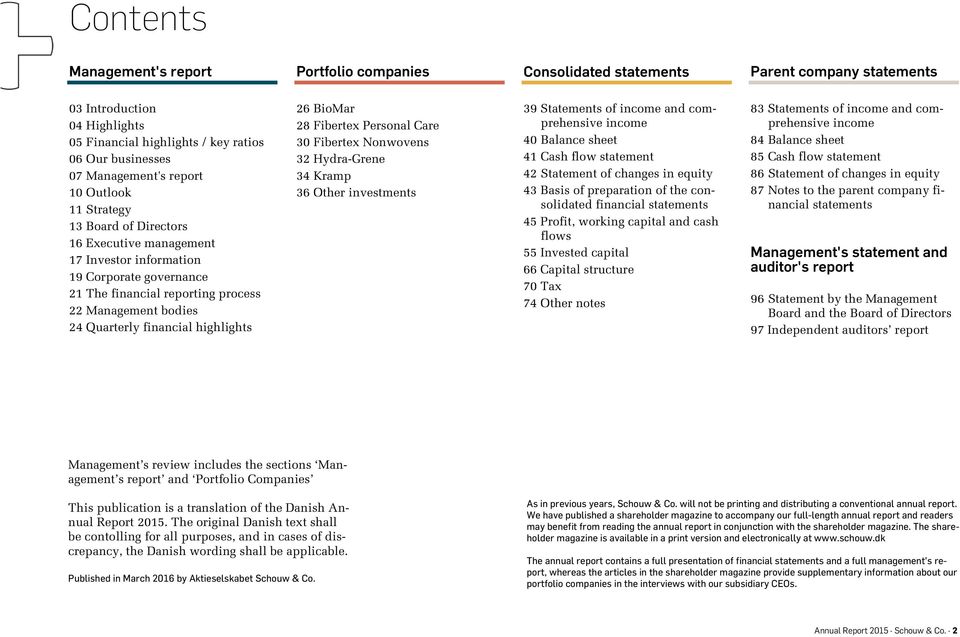
3 INTRODUCTION Sustained value creation and future-proofing There have been many good years in Schouw & Co. s almost 140-year history, but 2015 was definitely one of the very best. We generated EBIT of DKK 831 million and, through that, cash flows from operations of almost DKK 1.2 billion. Both were best-ever performances in Schouw & Co. history and substantially better than we had dared hope for at the beginning of the year. Our very solid performance comes on the back of the platform we have established over the past few years. We are strongly committed to futureproofing our businesses by giving priority to development, innovation and long-term investment. A common characteristic of all of our businesses in their busy everyday operations and challenging market conditions is their ever-present commitment and dedication to visionary, innovative thinking and a long-term approach. It is a culture we value very highly at Schouw & Co. The last few months have been full of intense acquisition activity, and we are very pleased with the additions of Specma and GPV to the Schouw family. Our acquisition of Swedish company Specma has taken Hydra-Grene a very significant step towards becoming the leading Nordic supplier of hydraulics solutions, both for local manufacturers and for global industrial groups. This is a transformation we have wanted for the company for many years. We also look forward to adding a new business to our portfolio after the GPV acquisition, which will presumably be completed soon. It has been ten years since we last added a new leg to Schouw & Co., and we are very excited about our new exposure to the international electronics industry. We are confident that through active ownership we can accelerate growth and bring the company to a new and stronger level, just as we have done with our other portfolio businesses. Our focus in 2016 will be on helping our already large and strong companies become even better prepared to meet the challenges and opportunities that may come their way. We never forget how important every single penny is, and together with our ongoing focus on margin management, that will be our foundation for generating attractive cash flows in the coming years as well. Long-term investment in innovation and in developing value-creating products and services will be a priority for us in future-proofing our strategic platform. Jens Bjerg Sørensen, President and CEO Aarhus, 4 March 2016 Annual Report 2015 Schouw & Co. 3
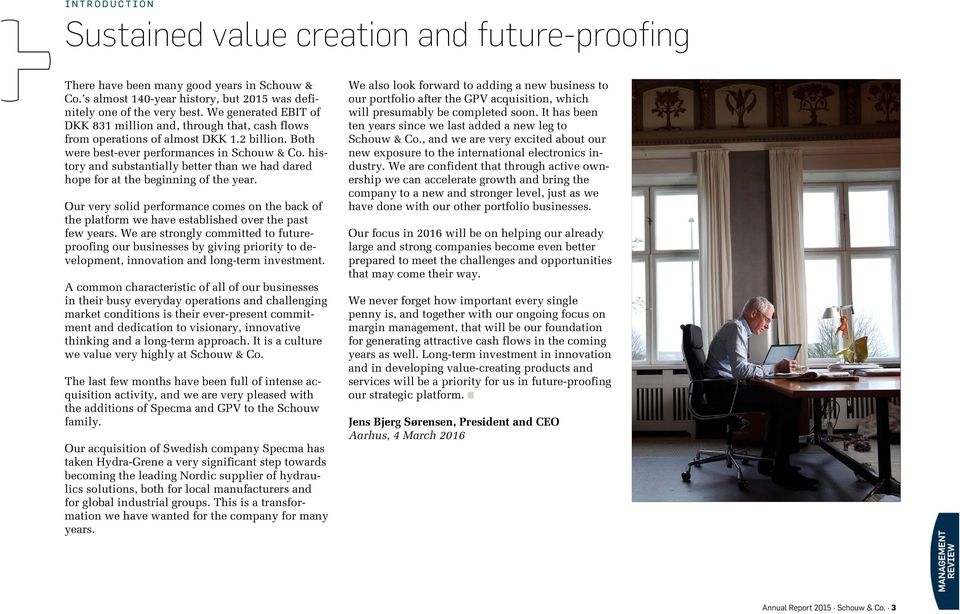
4 HIGHLIGHTS Best EBIT performance in Schouw & Co. history Realised in 2015 Revenue rose to DKK 12.6 billion. (2014: 11.8). EBIT up to DKK 831 million (2014: 708), which was much better than expected during the year. Cash flows from operations improved by more than DKK 500 million to DKK 1,171 million, mainly due to lower working capital. Free cash flow of DKK 602 million. All portfolio companies reported revenue and EBIT improvements relative to NIBD was a net deposit of DKK 511 million. High level of activity in portfolio companies: BioMar set up a joint venture in China, Fibertex Personal Care resolved investment in printing facilities in Malaysia, Fibertex Nonwovens acquired company in Turkey, and Hydra-Grene agreed to acquire its much larger Swedish peer Specma. Our ROIC improved for the sixth consecutive year, reaching 18.3%, excluding goodwill, and 15.1% when stated including goodwill. Outlook for 2016 Still very competitive markets, but earnings are expected to remain attractive. Completion of GPV expected. First time in ten years, a new leg is added to the portfolio. We expect 2016 revenue to be around DKK 14.2 billion (2015: 12.6) and EBIT in the range of DKK million (2015: 831). These numbers are stated without the effect of the GPV acquisition. The share of profit in associates etc. is expected to be DKK million after tax. Proposal to increase the dividend for the 2015 financial year by 25% to DKK 10 per share. BioMar Volumes sold were down on 2014, but revenue was up by 6%, mostly due to higher raw materials prices and currency appreciation. EBIT grew to DKK 447 million (2014: 434) mainly as a result of changes in foreign exchange rates, proper cost control and margin management in all regions. Facing challenging market conditions, and a slight drop in EBIT is expected relative to Fibertex Personal Care Revenue was marginally up from 2014, but EBIT was up by 47% to DKK 253 million (2014: 171) due to efficient operations, attractive raw materials prices and favourable FX rate developments. EBIT for 2016 is expected lower than in Fibertex Nonwovens Revenue up by 17% and EBIT up by 23% to DKK 76 million in Improvements expected to continue in 2016, which will be a year of consolidating past investments. Hydra-Grene Revenue up to DKK 603 million (2014: 566), and EBIT up by 30% to DKK 78 million, driven by a high level of activity in the wind turbine segment. Specma acquisition will lift 2016 revenue and earnings, but market expectations moderate. Kramp (20% owned) Revenue up by 5% to DKK 5,126 million and EBIT rose by 17% to DKK 474 million. Revenue expected to improve and EBIT to remain flat in 2016 despite the challenging conditions facing the agricultural sector. 6.6% Revenue growth from 2014 to % EBIT growth from 2014 to % Sixth consecutive increase in ROIC (excluding goodwill) in 2015 DKK 10 Dividend raised for the fifth consecutive year. This year by DKK 2 per share. Annual Report 2015 Schouw & Co. 4

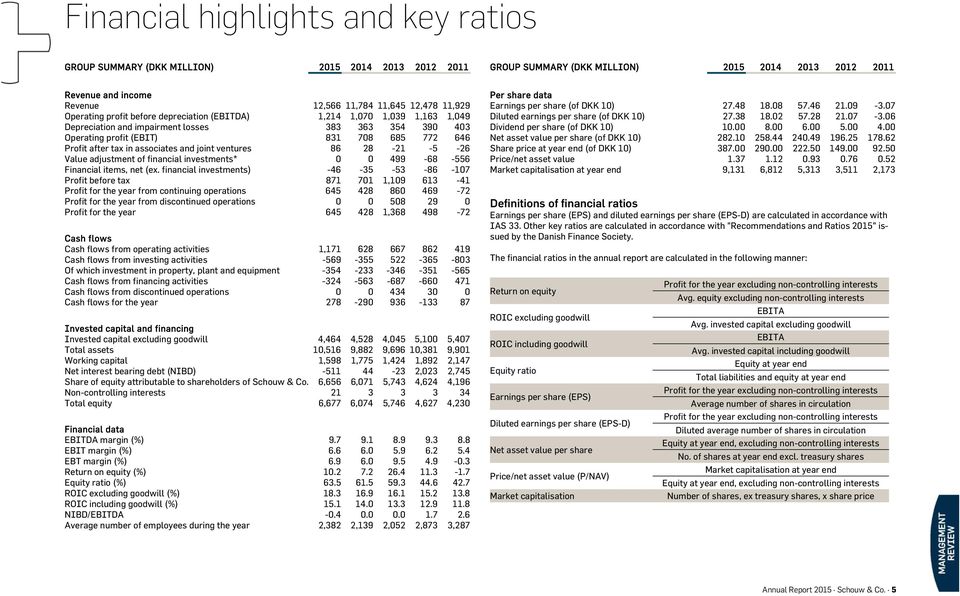
5 Financial highlights and key ratios GROUP SUMMARY (DKK MILLION) GROUP SUMMARY (DKK MILLION) Revenue and income Revenue 12,566 11,784 11,645 12,478 11,929 Operating profit before depreciation (EBITDA) 1,214 1,070 1,039 1,163 1,049 Depreciation and impairment losses Operating profit (EBIT) Profit after tax in associates and joint ventures Value adjustment of financial investments* Financial items, net (ex. financial investments) Profit before tax , Profit for the year from continuing operations Profit for the year from discontinued operations Profit for the year , Cash flows Cash flows from operating activities 1, Cash flows from investing activities Of which investment in property, plant and equipment Cash flows from financing activities Cash flows from discontinued operations Cash flows for the year Invested capital and financing Invested capital excluding goodwill 4,464 4,528 4,045 5,100 5,407 Total assets 10,516 9,882 9,696 10,381 9,901 Working capital 1,598 1,775 1,424 1,892 2,147 Net interest bearing debt (NIBD) ,023 2,745 Share of equity attributable to shareholders of Schouw & Co. 6,656 6,071 5,743 4,624 4,196 Non-controlling interests Total equity 6,677 6,074 5,746 4,627 4,230 Financial data EBITDA margin (%) EBIT margin (%) EBT margin (%) Return on equity (%) Equity ratio (%) ROIC excluding goodwill (%) ROIC including goodwill (%) NIBD/EBITDA Average number of employees during the year 2,382 2,139 2,052 2,873 3,287 Per share data Earnings per share (of DKK 10) Diluted earnings per share (of DKK 10) Dividend per share (of DKK 10) Net asset value per share (of DKK 10) Share price at year end (of DKK 10) Price/net asset value Market capitalisation at year end 9,131 6,812 5,313 3,511 2,173 Definitions of financial ratios Earnings per share (EPS) and diluted earnings per share (EPS-D) are calculated in accordance with IAS 33. Other key ratios are calculated in accordance with "Recommendations and Ratios 2015" issued by the Danish Finance Society. The financial ratios in the annual report are calculated in the following manner: Return on equity ROIC excluding goodwill ROIC including goodwill Equity ratio Earnings per share (EPS) Diluted earnings per share (EPS-D) Net asset value per share Price/net asset value (P/NAV) Market capitalisation Profit for the year excluding non-controlling interests Avg. equity excluding non-controlling interests EBITA Avg. invested capital excluding goodwill EBITA Avg. invested capital including goodwill Equity at year end Total liabilities and equity at year end Profit for the year excluding non-controlling interests Average number of shares in circulation Profit for the year excluding non-controlling interests Diluted average number of shares in circulation Equity at year end, excluding non-controlling interests No. of shares at year end excl. treasury shares Market capitalisation at year end Equity at year end, excluding non-controlling interests Number of shares, ex treasury shares, x share price Annual Report 2015 Schouw & Co. 5
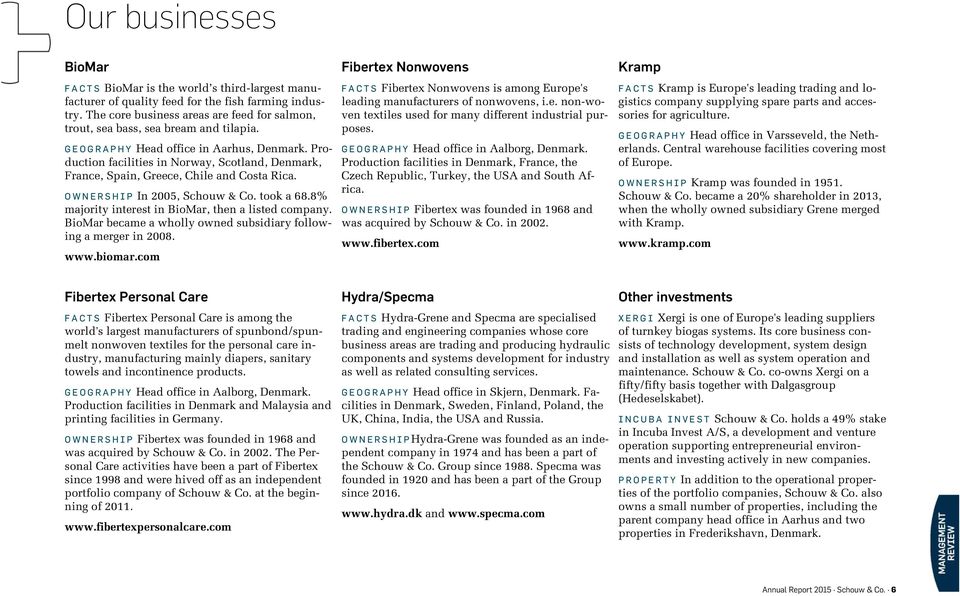
6 Our businesses BioMar FACTS BioMar is the world s third-largest manufacturer of quality feed for the fish farming industry. The core business areas are feed for salmon, trout, sea bass, sea bream and tilapia. GEOGRAPHY Head office in Aarhus, Denmark. Production facilities in Norway, Scotland, Denmark, France, Spain, Greece, Chile and Costa Rica. OWNERSHIP In 2005, Schouw & Co. took a 68.8% majority interest in BioMar, then a listed company. BioMar became a wholly owned subsidiary following a merger in Fibertex Nonwovens FACTS Fibertex Nonwovens is among Europe's leading manufacturers of nonwovens, i.e. non-woven textiles used for many different industrial purposes. GEOGRAPHY Head office in Aalborg, Denmark. Production facilities in Denmark, France, the Czech Republic, Turkey, the USA and South Africa. OWNERSHIP Fibertex was founded in 1968 and was acquired by Schouw & Co. in Kramp FACTS Kramp is Europe's leading trading and logistics company supplying spare parts and accessories for agriculture. GEOGRAPHY Head office in Varsseveld, the Netherlands. Central warehouse facilities covering most of Europe. OWNERSHIP Kramp was founded in Schouw & Co. became a 20% shareholder in 2013, when the wholly owned subsidiary Grene merged with Kramp. Fibertex Personal Care FACTS Fibertex Personal Care is among the world's largest manufacturers of spunbond/spunmelt nonwoven textiles for the personal care industry, manufacturing mainly diapers, sanitary towels and incontinence products. GEOGRAPHY Head office in Aalborg, Denmark. Production facilities in Denmark and Malaysia and printing facilities in Germany. OWNERSHIP Fibertex was founded in 1968 and was acquired by Schouw & Co. in The Personal Care activities have been a part of Fibertex since 1998 and were hived off as an independent portfolio company of Schouw & Co. at the beginning of Hydra/Specma FACTS Hydra-Grene and Specma are specialised trading and engineering companies whose core business areas are trading and producing hydraulic components and systems development for industry as well as related consulting services. GEOGRAPHY Head office in Skjern, Denmark. Facilities in Denmark, Sweden, Finland, Poland, the UK, China, India, the USA and Russia. OWNERSHIPHydra-Grene was founded as an independent company in 1974 and has been a part of the Schouw & Co. Group since Specma was founded in 1920 and has been a part of the Group since and Other investments XERGI Xergi is one of Europe's leading suppliers of turnkey biogas systems. Its core business consists of technology development, system design and installation as well as system operation and maintenance. Schouw & Co. co-owns Xergi on a fifty/fifty basis together with Dalgasgroup (Hedeselskabet). INCUBA INVEST Schouw & Co. holds a 49% stake in Incuba Invest A/S, a development and venture operation supporting entrepreneurial environments and investing actively in new companies. PROPERTY In addition to the operational properties of the portfolio companies, Schouw & Co. also owns a small number of properties, including the parent company head office in Aarhus and two properties in Frederikshavn, Denmark. Annual Report 2015 Schouw & Co. 6
7 Management's report Financial performance The companies of the Schouw & Co. Group had another good year in Expectations were relatively moderate at the beginning of the year, as volatility raised challenging prospects, but favourable developments especially in the fourth quarter due among other things to the positive effects of raw materials prices and foreign exchange rates enabled us to raise our profit guidance several times during the year. FOURTH QUARTER 2015 Q Q4 Change Revenue 3,078 3, % EBITDA % EBIT % Associates etc % Profit before tax % Cash flow from operations % The Group's companies improved consolidated revenue by 7% from DKK 11,784 million in 2014 to DKK 12,566 million in The revenue performance was composed of several opposing factors, including changing prices of raw materials, foreign exchange rates and volume sales, but all of our consolidated businesses reported revenue improvements. EBIT rose from DKK 708 million in 2014 to DKK 831 million in The 17% EBIT improvement was driven mainly by Fibertex Personal Care, but BioMar, Fibertex Nonwovens and Hydra-Grene also contributed. The large associate Kramp reported EBIT improvements as expected. Kramp is recognised as an associate in the Schouw & Co. consolidated financial statements at a 20% share of its profit as stated after tax. The recognised share of profit for 2015 amounted to DKK 71 million, against DKK 22 million in However, a comparison with 2014 should take into account the fact that the recognised share of the profit in Kramp for the first four months of 2014 was reduced by DKK 36 million in adjustments that were mainly the result of the purchase price allocation prepared in connection with the merger of Kramp and Grene in Xergi, which is recognised as a joint venture, achieved the expected revenue and earnings improvements, and a DKK 9 million share of the profit has been recognised under Profit/loss after tax in joint ventures for 2015, compared with DKK 5 million in Consolidated net financial items were an expense of DKK 46 million in 2015, compared with a DKK 35 million expense in The expense for 2015 derived mainly from a DKK 43 million writedown of securities by BioMar due to the strained situation facing Chile s fish farming industry. Other financial expenses were partially offset by foreign exchange adjustments. FULL YEAR 2015 Q Q4 Change Revenue 12,566 11, % EBITDA 1,214 1, % EBIT % Associates etc % Profit before tax % Cash flow from operations 1, % Net interest-bearing debt Working capital 1,598 1, % ROIC excl. goodwill 18.3% 16.9% 1.4pp ROIC incl. goodwill 15.1% 14.0% 1.1pp Liquidity and capital resources The Schouw & Co. Group s operating activities generated a cash inflow of DKK 1,171 million in 2015, compared with DKK 628 million in Cash flows for investing activities amounted to DKK 569 million in 2015, against DKK 355 million in Consolidated net interest-bearing debt at 31 December 2014 was a moderate DKK 44 million, and with the cash inflow for 2015, this item was converted into a net deposit of DKK 511 million at 31 December The Group's overall working capital fell from DKK 1,775 million at 31 December 2014, to DKK 1,598 million at 31 December 2015, most of the reduction being attributable to BioMar. Group developments Our portfolio companies generally saw good activity in most of their active markets in 2015, although they all experienced mounting international competition. There is a fierce battle for market share everywhere, and customers are very determined to get competitive prices and terms of trade. That forces our portfolio companies to constantly invest in safeguarding their competitive strength, and in some cases having to take strategic positions to secure necessary market share. Much of the developments in 2015 were driven by significant changes in prices of raw materials and in foreign exchange rates, which combined to contribute to the profit for the year, particularly towards the end of the period. Annual Report 2015 Schouw & Co. 7

8 Management's report The following is a brief review of individual company performances in 2015: BioMar reported a drop in volume sales relative to 2014, but even so lifted revenue by 6% mainly due to higher average prices of raw materials and changes in foreign exchange rates. EBIT also improved relative to last year. BioMar is working hard to expand its operations by developing feed for fish species previously not served and establishing a presence in new geographical markets. The company is currently working to establish production in Turkey in association with the local company Sagun Group, and to set up production in China in association with Tongwei, the major Chinese producer of fish feed. In Norway, a developed market, BioMar is expanding its output capacity by building a new production line at the factory in Karmøy. Fibertex Personal Care achieved a rather moderate revenue improvement but a substantial EBIT improvement. The performance was primarily due to a sharp drop in prices of raw materials towards the end of the year and unusually large, positive foreign exchange effects in the second half of Early in 2015, Fibertex Personal Care stepped up operations in its German printing business Innowo Print by establishing a third production line that increased the company s capacity for direct printing on nonwoven fabrics by 30%. Fibertex Nonwovens increased its ownership interest in Fibertex South Africa from 26% to 74% effective from 1 March 2015, and the South African company was consolidated from that date. In November 2015, Fibertex Nonwovens acquired the nonwoven operations of the Turkish company Ribatek. Fibertex Nonwovens reported a substantial revenue improvement, which was attributable to the full-year effect of the acquisition of a US company in October 2014 and the consolidation of the acquisitions in South Africa and Turkey in March and November 2015, respectively. The full-year EBIT improved, in part due to a greater proportion of advanced products for the auto industry and other specialist products and the effect of the US acquisition in 2014, whereas the South African business was a negative contributor. Hydra-Grene reported a fair revenue improvement mainly driven by higher sales to the wind turbine industry. EBIT also improved over 2014, when the results were impacted by substantial costs of implementing a new ERP system. In November 2015, Hydra-Grene agreed to acquire the Swedish hydraulics business Specma. The transaction, which nearly trebles the Group s hydraulics operations, was completed on 4 January Kramp, which is recognised as an associate, reported an increase in revenue and a positive performance in most of its markets. EBIT also improved relative to Xergi, which is recognised as a joint venture, reported a high level of activity following recent years' heavy investment in technology innovation and in building a substantial customer and project portfolio. The company lifted its revenue by 32% and also strongly improved its net profit. Events after the balance sheet date On 9 November 2015, Schouw & Co. signed an agreement to acquire the Swedish hydraulics business Specma AB. The transaction was completed on 4 January 2016, and Specma is thus consolidated with effect from the beginning of On 29 January 2016, Schouw & Co. signed an agreement to acquire the Danish EMS manufacturer GPV International A/S. The agreement is subject to approval by the relevant authorities, and the transaction is expected to be completed around 1 April Other than as set out above and elsewhere in this Annual Report, Schouw & Co. is not aware of events occurring after 31 December 2015, which are expected to have a material impact on the Group's financial position or outlook. Annual Report 2015 Schouw & Co. 8
9 Management's report Special risks Schouw & Co. is an industrial conglomerate whose activities are distributed on various business areas. By diversifying its businesses, the Group spreads the ordinary business risk exposure related to its individual business areas. However, over the past few years, BioMar has grown to a size that in terms of a number of key ratios represents more than half of the consolidated group. Accordingly, the risks that specifically attach to BioMar weigh heavily in a consolidated perspective. The special risks that inherently follow from being a producer of fish feed involve in particular the biological and climatic issues relating to fish farming. Several of the Group s business areas rely on certain raw materials and are thus sensitive to large fluctuations in the prices of such raw materials. This applies in particular to BioMar and the two Fibertex companies, although they apply automatic price adjustment mechanisms to a large extent. The Group s businesses have substantial trade receivables and all are generally very attentive to following up on receivables. Of the Group s receivables is about half credit insured or secured through collateral. The Group has interest-bearing debt, some of which has short-term maturities, while some carries floating interest rates, resulting in overall ordinary risk. However, the Group's current limited net interest-bearing debt makes this a relatively less important risk factor at the present time. The majority of the Group s activities are located in Denmark and in other European countries with relatively stable political conditions. but it also has substantial assets outside of Europe, primarily in Malaysia and Chile. The Group believes that it has ordinary insurance cover for its assets and activities. Dividend The Board of Directors recommends to the Annual General Meeting that the dividend for 2015 be raised by 25% to DKK per share, for an amount equal to 2.6% of the market capitalisation at 31 December As a result, total dividend payments will amount to DKK 255 million, equal to a payout ratio of 40%. Annual Report 2015 Schouw & Co. 9

10 Outlook The companies of the Schouw & Co. Group are generally well-positioned with international competitive strength, and the Group has adequate resources to facilitate the necessary business initiatives. Current market conditions are characterised by several material sources of volatility. Europe remains bogged down by economic weakness and geopolitical tension that is impacting the Group's operations. Nevertheless, our portfolio companies are reporting healthy activity in most of their market segments, although some softness is detected in certain segments. In all markets, winning orders is very demanding and requires highly competitive prices and terms of trade. BioMar expects challenging market conditions with limited growth in the European markets and lower overall volume sales in Chile. However, the company expects to improve revenue and volumes sold, but with a lower EBIT. Fibertex Personal Care expects to increase its revenue in 2016, but also a considerable drop in EBIT relative to 2015 when a sharp drop in prices of raw materials towards the end of the year and unusually large, positive foreign exchange effects in the second half of 2015 produced extraordinary good results. Fibertex Nonwovens expects its recent investment and acquisitions to contribute to the company s operations and projects both revenue and EBIT improvements for The acquisition of Specma will expand the hydraulics activities in 2016, but both Hydra-Grene and Specma have moderate expectations for 2016 market developments. Revenue is projected to be maintained at the level the two companies reported for 2015, but with slightly lower EBIT before adjustments resulting from the accounting treatment of the purchase price allocation. The associate Kramp projects continued revenue improvement and EBIT in line with the 2015 performance. Xergi, which is recognised as a joint venture, expects to keep up the high level of business activity in 2016, but for its profit to be lower than in Overall, Schouw & Co. expects to generate consolidated revenue in the vicinity of DKK 14.2 billion in However, for several of the companies, revenue depends very much on prices of raw materials, and any fluctuations can significantly change revenue without necessarily having any notable effect on earnings. Schouw & Co. applies a profit forecast range for each individual business, and aggregating these ranges indicates consolidated EBIT guidance for 2016 in the range of DKK million. The above guidance does not include the effects of the GPV acquisition, which is expected to be completed around 1 April Subject to completion of the transaction as planned, GPV is expected to contribute revenue in the nine months to 31 December 2016, of DKK million and EBIT of around DKK 40 million before adjustments for the accounting treatment of the purchase price allocation to be prepared in connection with the acquisition. Associates and joint ventures, which are recognised at a share of profit after tax, are expected to contribute profit of DKK million in 2016, most of which amount will consist of the share of profit in Kramp. Net financials for 2016 are expected to be an expense in the region of DKK 35 million. REVENUE (DKK million) 2016 forecast 2015 actual 2014 actual BioMar c. 9,200 8,974 8,451 Fibertex Personal Care c. 1,900 1,797 1,787 Fibertex Nonwovens c. 1,400 1,222 1,048 Hydra/Specma c. 1, Other/eliminations Total revenue c bn 12,566 11,784 Kramp (100%) c. 5,400 5,126 4,905 EBIT (DKK million) 2016 forecast 2015 actual 2014 actual BioMar Fibertex Personal Care Fibertex Nonwovens Hydra/Specma * Other c Total EBIT Associates etc Other financial items c Profit before tax *After about DKK 25 million from Purchase Price Allocation The expected contribution from GPV should be added to the above numbers. Annual Report 2015 Schouw & Co. 10
11 STRATEGY Portfolio companies growing stronger All companies of the Schouw & Co. Group improved on their revenue and earnings in 2015 relative to the year before, the fruit of several years of long-term investing to future-proof our companies strategic platforms. Our focus in 2016 will remain on profitable growth, on using our capital efficiently and on future-proofing. During his tenure as President of Schouw & Co. since 2000, Jens Bjerg Sørensen has continually worked to make this almost 140-year-old industrial conglomerate bigger and stronger. Going into 2015, Schouw & Co. had a uniquely strong position for future growth. The Group had virtually no interest-bearing debt, and we had several large and promising investments in the pipeline. Looking back on the year, we re very pleased with the way we used our strong platform and our substantial cash flow to strengthen our portfolio companies and prime them for future growth and earnings, says Mr Bjerg Sørensen. All companies of the Schouw & Co. Group improved on their 2015 revenue and earnings relative to the year before, and the Group s consolidated EBIT is the highest ever. Even with its high level of investment, the Group s net interest-bearing debt was a net deposit of more than half a billion kroner thanks to the cash flows from operating activities totalling almost DKK 1.2 billion. Several of the larger investments will not affect the cash resources until in 2016, when the acquisitions of Specma and GPV, whose price tags totalled more than DKK 1 billion, are completed. We showed a commitment to growth and investment in 2015, and we ve laid the groundwork for taking several of our businesses to the next level. For example, BioMar is currently expanding its feed production capacity in Norway by 30% and has set up a joint venture with Tongwei, China s largest and most dominant producer of fish feed. While BioMar produces extremely efficient, highquality feed with full traceability in raw materials and is focused on sustainability throughout the value chain, the situation in China today is generally quite different, and we re confident that Bio- Mar can help change that. Expansion in Norway and setting up in China are both long-term moves that will help position BioMar to become one of the absolutely strongest players in the industry, says the President. Stronger businesses Helping the businesses build an even stronger position in relation to their customers, their suppliers and the competition and priming them for strong future earnings has been a core objective in recent years, and Schouw & Co. intends to put ever more effort into this commitment in Over the past few years, we ve invested heavily in making our businesses both larger and stronger. It s now time to shift our focus to prioritising stronger businesses over larger ones. This does not imply that we have no ambition for growth, but it is important that such growth goes hand in hand with profitability. Growth will always be a prerequisite for development, but the timing is crucial. The biggest changes will be seen in Hydra-Grene, a member of the Schouw family since 1988, due to the acquisition of Swedish hydraulics company Specma. Hydra-Grene has been trailing the other core Schouw & Co. businesses in revenue terms, and for the past several years the plan has been to use Hydra-Grene s significant leading position in Denmark as a springboard for international expansion. The acquisition of Specma, a company that generates nearly twice as much revenue as Hydra- Grene, has markedly expanded Schouw & Co. s hydraulics activities, and the platform for future growth has become considerably stronger. A company with a long-standing tradition of following major Swedish industrial companies to international markets, Specma currently has operations in the United States, Brazil, China, the UK and Poland. This international presence will now be consolidated, and the task at hand will be to maintain profitability at an attractive level. Fair prospects for 2016 The regular flow of investment into all the Group s businesses and the acquisitions made in 2015, combined with a consistently strong financial platform, make for fair prospects for Schouw & Co. in Mr Bjerg Sørensen is fairly confident about 2016: We have the capacity for growth, and we ve shown a commitment to investing in making our businesses stronger. Schouw & Co. remains wellpositioned for long-term value creation. The markets our companies operate in will always be highly competitive, but we are well prepared to face a changing world. Our company acquisitions from 2015 will propel us forward, and the future looks quite promising. Annual Report 2015 Schouw & Co. 11
12 STRATEGY GPV a new leg in the Schouw & Co. portfolio Schouw & Co. added a new business to its portfolio in early 2016, the first addition since Bio- Mar in GPV becomes the sixth leg for Schouw & Co.: the ambition is to bring GPV to a new and more attractive level through longterm ownership. The autumn and winter months were a busy time for Schouw & Co. Shortly after acquiring Swedish hydraulics company Specma for DKK 650 million, Schouw & Co. announced that it had agreed to spend DKK 400 million to acquire GPV International, Denmark s leading player in electronic manufacturing services (EMS). With a reported 2015 revenue of about DKK 850 million, GPV employs more than 1,000 people and has production facilities in Denmark (Tarm and Aars) and in Bangkok, Thailand. GPV plays a leading role in the Danish market and is an internationally recognised electronics company. The company faced some challenges five to seven years ago but has since refocused and been back on track in recent years, said Schouw & Co. President Jens Bjerg Sørensen. We re entering an industry that is new to us, but our approach will be to invest in profitable growth, use our capital efficiently, and futureproof the company's strategic platform. It has been more than ten years since Schouw & Co. last established a new business area. In the time following the financial crisis, adding new business areas was not on the agenda, but Schouw & Co. has been looking for an attractive new leg for the Group for the past few years: We ve spent a lot of time carefully identifying the right new business for Schouw & Co. The growth potential, the potential for transformation through active ownership, and the attractive valuation and return on invested capital was the combination that sold us on GPV. Acquiring GPV has given us a platform for a long-term investment that is hopefully also a value-creating one. GPV specialises in both electronics and advanced mechanics, which gives it a competitive advantage over pure electronics manufacturers. The company mainly supplies low-volume customised solutions with a high degree of flexibility, including electronic sub-assembly solutions and finished goods (box builds). GPV manufactures a total of roughly 5,500 electronics products for about 300 international B2B customers. Just as it did a decade ago, the company s customer base includes some of the very largest international OEMs (original equipment manufacturers) in the Cleantech, Instruments & Industry, Medico and Marine & Defence industries. GPV s close and long-standing customer relationships ensure a solid position and opportunities for growth driven in part by the fact that more and more OEMs venture into strategic partnerships with EMS manufacturers to develop and produce electronic components outside their own core business. In addition, the growing demand for industrial products able to compile various types of information and communicate online also means growth opportunities for GPV. GPV operates in Europe and in Asia; according to Mr Bjerg Sørensen, setting up operations on the other side of the Atlantic would be an obvious next step in moving closer to the US market: We have an ambitious growth plan that, among other things, includes setting up production facilities in Mexico. For several years, GPV has successfully retained and expanded relationships with customers that are among the most advanced in their fields, and, in the ever more global market, it has become necessary to have a presence in the three most important time zones. Like the other Schouw & Co. portfolio businesses, GPV will now have owners with the financial clout to drive industry consolidation. As a result, acquisitions in the EMS industry will be an option as a means of accelerating growth. Our acquisition of GPV makes it less probable that we ll be establishing another new leg for our portfolio in the near future. Instead, we intend to concentrate on strengthening all the businesses in our portfolio, including GPV. However, we re not in a rush to buy new companies. We plan to keep GPV in our portfolio for a good many years, so whether or not we land the first add-on within the first couple of years of ownership is not so important. What is important is that we make the right long-term decisions so the company will grow bigger and stronger. Annual Report 2015 Schouw & Co. 12
13 Board of Directors CHAIRMAN Jørn Ankær Thomsen Born Elected to the Board in Current term expires in LL.M., University of Copenhagen. Attorney and partner of Gorrissen Federspiel Law Firm. Member of the company s audit committee. Mr Ankær Thomsen has special expertise in legal matters, including company law and capital markets, and in strategy, financial reporting, treasury and finance, as well as mergers and acquisitions. Directorships Chairman: Aida A/S, AP Invest Kapitalforening, Carlsen Byggecenter Løgten A/S, Th. C. Carlsen Løgten A/S, Carlsen Supermarked Løgten A/S, Danish Industrial Equipment A/S, Ejendomsselskabet FMJ A/S, Fibertex Nonwovens A/S, Fibertex Personal Care A/S, F.M.J. A/S, Givesco A/S, Investeringsforeningen Danske Invest, Investeringsforeningen Danske Invest Select, Investeringsforeningen Procapture, Investeringsforeningen Profil Invest, Kapitalforeningen Danske Invest Institutional, Kildebjerg Ry A/S, Leighton Foods A/S, Løgten Midt A/S, Niels Bohrs Vej A/S, Schouw & Co. Finans A/S, Søndergaard Give A/S. Deputy Chairman: Carletti A/S, Jens Eskildsen og Hustru Mary Antonie Eskildsens Mindefond. Board member: BioMar Group A/S, Dan Cake A/S, Danske Invest Management A/S, Givesco Bakery A/S, Givesco Ejendomme A/S, Hydra-Grene A/S, Jacobsens Bakery Ltd A/S, Købmand Th. C. Carlsens Mindefond. Executive Management: Advokatanpartsselskabet Jørn Ankær Thomsen, Galten Midtpunkt ApS, Perlusus ApS. Shares held in Schouw & Co. Holds 20,000 shares in Schouw & Co. Independence as a board member Jørn Ankær Thomsen is not considered to be independent due to his affiliation with the main shareholder Givesco A/S, his affiliation with a law firm which acts as an adviser to the company and the fact that he has served more than 12 years on the Board. DEPUTY CHAIRMAN Erling Eskildsen Born Elected to the Board in Current term expires in Managing director of Givesco A/S, the main shareholder of Schouw & Co. Mr Eskildsen has special expertise in international business relations, including specifically in manufacturing and foods. Directorships Chairman: Carletti A/S, Dan Cake A/S, Dan Cake Services ApS, Givesco Bakery A/S. Board member: Danish Industrial Equipment A/S, Givesco A/S, Hydra-Grene A/S, Jens Eskildsen og Hustru Mary Antonie Eskildsens Mindefond, Leighton Foods A/S, LHTS Invest A/S, OK Snacks A/S, Struer Brød A/S, Søndergaard Give A/S. Executive Management: Givesco A/S, Søndergaard Give A/S. Shares held in Schouw & Co. Holds 1,004,462 shares in Schouw & Co. Independence as a board member Erling Eskildsen is not considered to be independent due to his affiliation with the main shareholder Givesco A/S and the fact that he has served more than 12 years on the Board. Annual Report 2015 Schouw & Co. 13

14 Board of Directors BOARD MEMBER Niels Kristian Agner Born Elected to the Board in Current term expires in B.Sc. (Bus.Adm.), Copenhagen Business School and a professional board member. Mr Agner has special expertise in capital markets, strategy, financial reporting, treasury and finance, international business as well as mergers and acquisitions. Directorships Chairman: D.F. Holding Skive A/S, SP Group A/S, SP Moulding A/S. Board member: Fonden LDE 2 GP, Fonden LDE 3 GP, Fonden Maj Invest Equity General Partner, Fonden MIFIF II GP, G.E.C. Gads Forlag A/S. Executive Management: Pigro Management ApS. Shares held in Schouw & Co. Holds 27,686 shares in Schouw & Co. Independence as a board member Niels Kristian Agner is not considered to be independent, having served more than 12 years on the Board. BOARD MEMBER Erling Lindahl Born Elected to the Board in Current term expires in Mechanical engineer from Sønderborg Technical College, Denmark. Managing Director of Momenta ApS. Mr Lindahl has special expertise in management and business development of industrial manufacturing companies as well as mergers and acquisitions and international business relations. Directorships Chairman: JKS A/S. Board member: Lindahl & Co. ApS, Linco Invest A/S, Skandinavisk Båndkompagni A/S, Venti A/S. Executive Management: Lindahl & Co. ApS, Lindahl Life ApS, Momenta ApS, Linco Invest A/S. Shares held in Schouw & Co. Holds 30,800 shares in Schouw & Co. Independence as a board member Erling Lindahl is not considered to be independent, having served more than 12 years on the Board. BOARD MEMBER Kjeld Johannesen Born Elected to the Board in Current term expires in Business diploma (HD), Marketing economics, Copenhagen Business School. Executive director of Danish Crown a.m.b.a. Mr Johannesen has special expertise in management, production and sales as well as in strategy, business development and international business relations. Directorships Chairman: DAT-Schaub A/S, Hamlet Protein A/S, KPC Holding A/S, New Nutrition ApS, New Nutrition Holding ApS. Deputy Chairman: Spar Nord Bank A/S Executive Management: Danish Crown Amba, Danish Crown A/S, Leverandørselskabet Danish Crown Amba. Shares held in Schouw & Co. Holds 22,000 shares in Schouw & Co. Independence as a board member Kjeld Johannesen is not considered to be independent, having served more than 12 years on the Board. Annual Report 2015 Schouw & Co. 14
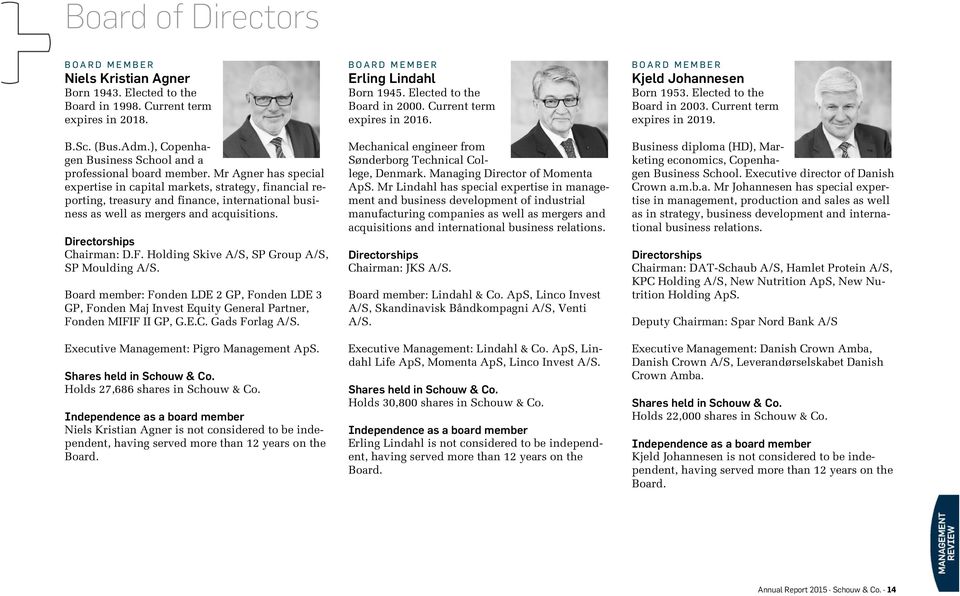
15 Board of Directors BOARD MEMBER Jørgen Wisborg Born Elected to the Board in Current term expires in MSc, Aarhus School of Business and CEO of OK a.m.b.a. Chairman of the company s audit committee. Mr Wisborg has special expertise in management and sales as well as in strategy, business development, financial reporting, treasury and finance. Directorships Chairman: Danoil Exploration A/S, Energidata A/S, Kamstrup A/S, OK Plus A/S, OK Plus Butiksdrift A/S, Samfinans A/S. Deputy Chairman: The Danish Oil Industry Association. Board member: AP Pension Livsforsikringsaktieselskab, AP Pensionsservice A/S, Miljøforeningen af 1992, Foreningen AP Pension F.M.B.A. Executive Management: OK a.m.b.a., Rotensia ApS. Shares held in Schouw & Co. Holds 15,000 shares in Schouw & Co. Independence as a board member Jørgen Wisborg is considered to be independent. BOARD MEMBER Agnete Raaschou-Nielsen Born Elected to the Board in Term expires in PhD, University of Copenhagen and a professional board member. Ms Raaschou-Nielsen has special expertise in business development and acquisitions, macroeconomics, emerging markets, as well as international production, sales and marketing. Member of the company s audit committee. Directorships Chairman: Arkil A/S, Arkil Holding A/S, Brødrene Hartmann A/S. Deputy Chairman: AP Invest Kapitalforening, Dalhoff Larsen & Horneman A/S, Investeringsforeningen Danske Invest, Investeringsforeningen Danske Invest Select, Investeringsforeningen Procapture, Investeringsforeningen Profil Invest, Kapitalforeningen Danske Invest Institutional, Solar A/S. Board member: Danske Invest Management A/S, Icopal A/S, Icopal Holding A/S, Novozymes A/S, RFG Midco A/S. Shares held in Schouw & Co. Holds 0 shares in Schouw & Co. Independence as a board member Agnete Raaschou-Nielsen is considered to be independent. Annual Report 2015 Schouw & Co. 15
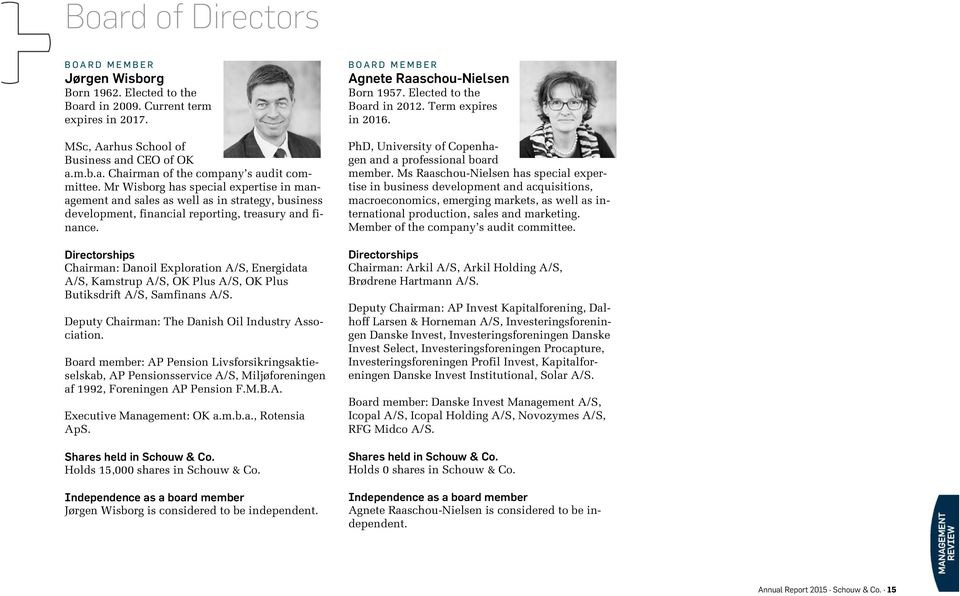
16 Executive Management PRESIDENT Jens Bjerg Sørensen Born Appointed in Business graduate, Niels Brock Business College, Business diploma (HD), Marketing economics, Copenhagen Business School, IEP Insead Executive Programme, Insead, France. Directorships Chairman: Alba Ejendomme A/S, BioMar Group A/S, Dovista A/S, F. Salling Holding A/S, F. Salling Invest A/S, Hydra-Grene A/S, Købmand Herman Sallings Fond, Xergi A/S. Deputy Chairman: Dansk Supermarked A/S, Fibertex Nonwovens A/S, Fibertex Personal Care A/S, Per Aarsleff A/S. Board member: Aida A/S, Ejendomsselskabet FMJ A/S, F.M.J. A/S, Fonden bag udstilling af skulpturer ved Aarhusbugten, Fonden Aarhus 2017, Incuba Invest A/S, Kramp Groep B.V., Niels Bohrs Vej A/S, Schouw & Co. Finans A/S, Specma AB. Executive Management: Jens Bjerg Sørensen Datterholding 1 ApS, Jens Bjerg Sørensen Holding ApS, Saltebakken 29 ApS, Schouw & Co. Finans A/S. Shares held in Schouw & Co. Holds 55,000 shares in Schouw & Co. VICE PRESIDENT Peter Kjær Born Appointed in BSc, Electronic Engineering, Engineering College of Aarhus, Business diploma (HD), Marketing economics, Aarhus School of Business, MBA from IMD, Lausanne, Switzerland. Directorships Chairman: Den Gamle By, Helsingforsgade 25 Aarhus A/S, Incuba A/S. Deputy Chairman: Capnova A/S Board member: Alba Ejendomme A/S, Hydra- Grene A/S, Niels Bohrs Vej A/S, Xergi A/S. Executive Management: Alba Ejendomme A/S, Incuba Invest A/S, Niels Bohrs Vej A/S, Saltebakken 29 ApS, Erhvervscentrum Aarhus ApS. Shares held in Schouw & Co. Holds 37,500 shares in Schouw & Co. Listed on pages are directorships in other companies and other relevant management positions held by members of the Board of Directors and the Executive Management. Shareholdings include each board member's or executive's shares in Schouw & Co. and those held by their related parties. Changes to shareholdings are reported to the Danish FSA pursuant to current rules. Annual Report 2015 Schouw & Co. 16

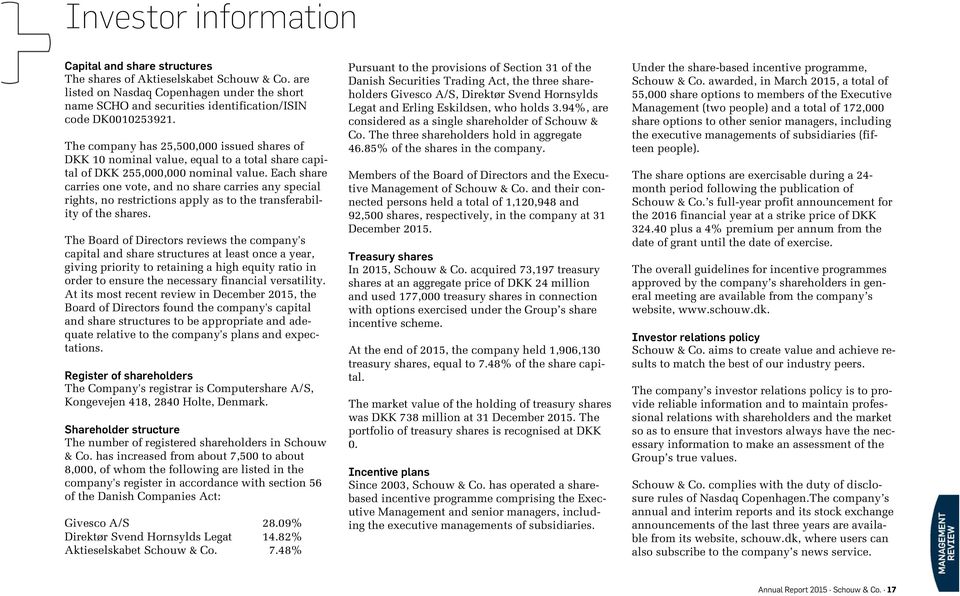
17 Investor information Capital and share structures The shares of Aktieselskabet Schouw & Co. are listed on Nasdaq Copenhagen under the short name SCHO and securities identification/isin code DK The company has 25,500,000 issued shares of DKK 10 nominal value, equal to a total share capital of DKK 255,000,000 nominal value. Each share carries one vote, and no share carries any special rights, no restrictions apply as to the transferability of the shares. The Board of Directors reviews the company's capital and share structures at least once a year, giving priority to retaining a high equity ratio in order to ensure the necessary financial versatility. At its most recent review in December 2015, the Board of Directors found the company's capital and share structures to be appropriate and adequate relative to the company's plans and expectations. Register of shareholders The Company's registrar is Computershare A/S, Kongevejen 418, 2840 Holte, Denmark. Shareholder structure The number of registered shareholders in Schouw & Co. has increased from about 7,500 to about 8,000, of whom the following are listed in the company's register in accordance with section 56 of the Danish Companies Act: Givesco A/S 28.09% Direktør Svend Hornsylds Legat 14.82% Aktieselskabet Schouw & Co. 7.48% Pursuant to the provisions of Section 31 of the Danish Securities Trading Act, the three shareholders Givesco A/S, Direktør Svend Hornsylds Legat and Erling Eskildsen, who holds 3.94%, are considered as a single shareholder of Schouw & Co. The three shareholders hold in aggregate 46.85% of the shares in the company. Members of the Board of Directors and the Executive Management of Schouw & Co. and their connected persons held a total of 1,120,948 and 92,500 shares, respectively, in the company at 31 December Treasury shares In 2015, Schouw & Co. acquired 73,197 treasury shares at an aggregate price of DKK 24 million and used 177,000 treasury shares in connection with options exercised under the Group s share incentive scheme. At the end of 2015, the company held 1,906,130 treasury shares, equal to 7.48% of the share capital. The market value of the holding of treasury shares was DKK 738 million at 31 December The portfolio of treasury shares is recognised at DKK 0. Incentive plans Since 2003, Schouw & Co. has operated a sharebased incentive programme comprising the Executive Management and senior managers, including the executive managements of subsidiaries. Under the share-based incentive programme, Schouw & Co. awarded, in March 2015, a total of 55,000 share options to members of the Executive Management (two people) and a total of 172,000 share options to other senior managers, including the executive managements of subsidiaries (fifteen people). The share options are exercisable during a 24- month period following the publication of Schouw & Co. s full-year profit announcement for the 2016 financial year at a strike price of DKK plus a 4% premium per annum from the date of grant until the date of exercise. The overall guidelines for incentive programmes approved by the company s shareholders in general meeting are available from the company s website, Investor relations policy Schouw & Co. aims to create value and achieve results to match the best of our industry peers. The company s investor relations policy is to provide reliable information and to maintain professional relations with shareholders and the market so as to ensure that investors always have the necessary information to make an assessment of the Group s true values. Schouw & Co. complies with the duty of disclosure rules of Nasdaq Copenhagen.The company s annual and interim reports and its stock exchange announcements of the last three years are available from its website, schouw.dk, where users can also subscribe to the company s news service. Annual Report 2015 Schouw & Co. 17
18 Investor information Schouw & Co. hosts conference calls when releasing annual or interim reports. Presentations given during conference calls will subsequently be posted on the company's website. From time to time, Schouw & Co. holds meetings with investors and other parties. Presentations from such meetings are also available from the company s website. Schouw & Co. observes a three-week silent period ahead of releasing financial reports. During such periods, our financial communications are subject to special restrictions. Any queries of an investor relations nature should be ed to: [email protected] or to the company s management at: [email protected]. The company's web site contains press releases and company announcements, as well as more detailed information on the Group. Interested parties are also invited to subscribe to the company s news service. Financial calendar 14 Apr 2016 Annual General Meeting 19 Apr 2016 Expected distribution of dividend for the 2015 financial year 3 May 2016 Release of Q interim report 11 Aug 2016 Release of H interim report 10 Nov 2016 Release of Q interim report Company announcements Company announcements to the Danish FSA and Nasdaq Copenhagen since 1 January The announcements are available at the company s website, 22 Jan 2015 #1 EBIT 2014 higher than expected 6 Mar 2015 #2 Annual report Mar 2015 #3 Notice of annual general meeting 13 Mar 2015 #4 Continuation of incentive programme 9 Apr 2014 Annual general meeting 17 Apr 2015 #6 BioMar signs memorandum of understanding for JV in China 7 May 2015 #7 Interim report Q1 of Aug 2015 #8 Interim report H1 of Oct 2015 #9 Fibertex Nonwovens makes strategic acquisition in Turkey 5 Nov 2015 #10 Interim report Q3 of Nov 2015 #11 Trebling size of hydraulics operations by acquiring Specma 16 Dec 2015 #12 Financial calendar 18 Dec 2015 #13 The Competition Authority approves the acquisition of Specma 21 Jan 2016 #1 Upward adjustment of 2015 EBIT 22 Jan 2016 #2 Fibertex Personal Care to expand Malaysia by more than 20% 29 Jan 2016 #3 Schouw & Co. acquires Danish EMS manufacturer Dividend policy Schouw & Co. aims to pay stable or growing dividends, always with due consideration for the company's earnings and any potential major investments or acquisitions. The Board of Directors recommends that the dividend for the 2015 financial year be raised by 25% to DKK 10 per share. Share price performance The Schouw & Co. share closed the year at a price of DKK (official year-end price), compared with DKK per share at 31 December 2014, corresponding to an increase of 33%. Accordingly, the total market capitalisation of the company s listed share capital amounted to DKK 9,869 million at the close of the financial year, against DKK 7,395 million at the close of Adjusted for the holding of treasury shares, the company s market capitalisation was DKK 9,131 million at 31 December Schouw & Co. share price C20 CAP indexed to Schouw & Co. MidCap indexed to Schouw & Co. Jan Feb Mar Apr May Jun Jul Aug Sep Oct Nov Dec Jan Feb Annual Report 2015 Schouw & Co. 18

19 Corporate governance Statutory report Schouw & Co. has prepared a statutory corporate governance report for the 2015 financial year, as required under section 107 b of the Danish Financial Statements Act. The statutory report consists of three parts: A report on the company's work to comply with the recommendations on corporate governance, which is found below. A description of the main elements of the Group's internal control and risk management systems in connection with the financial reporting process, which is found on page 21. A description of the composition of the company's management bodies, committees established and their functions, which is found on pages In addition, information on the company's Board of Directors and Executive Management can be found on pages The full report on corporate governance as required under section 107 b of the Danish Financial Statements Act is available from schouw.dk/cg2015. As required under section 99 a of the Danish Financial Statements Act, Schouw & Co. has also prepared a statutory report on corporate social responsibility, and a statutory report on targets and policies on the gender composition of the management, see section 99 a of the Danish Financial Statements Act, which can be found below. Corporate governance recommendations Schouw & Co. complies with the rules applying to companies listed on Nasdaq Copenhagen, which include a code on corporate governance as set out in Corporate Governance Recommendations. The Board of Directors and the Executive Management of Schouw & Co. see corporate governance as a natural part of running a responsible business. Corporate governance considerations and the interaction with the company's stakeholders is a constant priority, and considering the company s corporate governance policy is a recurring item in the annual business of the Board meetings. Schouw & Co. believes it complies in all material respects with the intentions of Corporate Governance Recommendations. However, there are a few areas in which Schouw & Co. does not apply the corporate governance recommendations. A detailed account of the company's position on each individual item of the Recommendations on Corporate Governance is provided (in Danish) on the website: schouw.dk/cg2015. Social responsibility (section 99 a) Schouw & Co.'s general policy is for all of the Group s companies, as a minimum, to comply with relevant legislation and regulations applying in the countries and local communities in which they operate. None of the portfolio companies have any outstanding issues with the authorities of those countries. Schouw & Co. operates a group of companies that derive the bulk of their revenue from advanced process production in which issues like ongoing reduction of energy consumption and waste of input materials form an essential part of their business model. Most of the Group's operations are located in Denmark or neighbouring European countries with well-established and detailed legislation. However, the Group also has business operations in non-european countries, mainly in Malaysia and Chile, but the production facilities there are generally fully on par with the European units. In Europe as well as the other countries, our companies generally employ a skilled workforce. Considering the assumed high standards in our portfolio companies, we have not yet found it necessary to lay down specific CSR policies or establish systems or mechanisms inherent to such policies. Accordingly, Schouw & Co. has not adopted a specific policy for reducing the climate impact from the company's activities or specific policies pertaining to human rights. In the year under review, Schouw & Co. investigated the possibility of working out appropriate guidelines for structuring CSR efforts across the Group's companies. However, the Group's companies are involved in different industries and have traditionally directed their CSR efforts at target areas of particular relevance for each individual industry. These efforts have continued in the various companies in the year under review. BioMar, the Group s largest business accounting for more than 70% of the consolidated revenue, released its first Sustainability Report in Covering the 2014 financial year, the report is Annual Report 2015 Schouw & Co. 19

20 Corporate governance structured according to the G4 Sustainability Reporting Guidelines under the Global Reporting Initiative, but the report is not externally audited. At the beginning of 2016, the Group s second-largest business, Fibertex Personal Care, was certified to the ISO Energy Management standard. We continue to believe that value creation is best supported by according our individual portfolio companies a degree of self-determination in planning their work, and that specifically laying down general CSR policies for all Group companies would thus not serve any purpose. We are aware, however, that there may be areas of common interest, especially in the field of human rights. As a result, we intend to investigate in 2016 whether an appropriate joint structure can be established in this particular field. The company's website schouw.dk/cg2015 contains illustrated descriptions of the business activities of our individual subsidiaries. Also available from the website is BioMar s Sustainability Report published in Gender composition (section 99 b) The Board of Directors of Schouw & Co. has fixed the following targets for the gender composition of its management. For the measurement period from 1 April 2013 to 31 March 2017, the target is to increase the number of female board members of Aktieselskabet Schouw & Co. from one member currently, equal to 14%, to at least two members, equal to at least 28%. A target has also been defined for the Group that all large Danish reporting class C companies should have representation of at least one female board member, equal to at least 20%. At the start of the measurement period, none of these companies had female board members. The Board of Directors of Aktieselskabet Schouw & Co. consists of seven shareholder-elected members, one of whom is female. No changes have been made to the Board s composition since the start of the measurement period. The Group has five subsidiaries in the relevant reporting class: BioMar Group A/S with four shareholder-elected board members, BioMar A/S with three shareholder-elected board members, Fibertex Personal Care A/S and Fibertex Nonwovens A/S both with four shareholder-elected board members, and Hydra-Grene A/with five shareholder-elected board members. Other than one board member of BioMar A/S being replaced in March 2015, there have been no changes to the composition of the shareholderelected memberships of the boards of directors involved since the current targets were adopted. BioMar A/S is a subsidiary of BioMar Group A/S, and the company s board of directors consists of senior employees of the BioMar Group. The new board member is male and a senior employee with many years of seniority with the company. He replaced an executive who had resigned from the board. BioMar Group had no internal female candidates with the relevant qualifications at the time. Accordingly, the Group made no progress in 2015 in meeting the targets. In addition, the Board of Directors of Schouw & Co. has adopted, on behalf of the Group, the following policy for increasing the proportion of the under-represented gender at the Group's other management levels: Schouw & Co. is aware that the proportion of women at management level in the Group is generally lower than the gender composition of the Group's employees in general. Accordingly, the companies of the Schouw & Co. Group will make a special effort to create a framework to support the career development of individual women employees, for example through networks, mentor schemes or other specific initiatives that may help individual employees build management experience. The companies of the Schouw & Co. Group will also make a dedicated effort to ensuring the best possible women representation among candidates being considered for management positions. During the year, no management changes were made in the companies in which Schouw & Co. exercises control. Annual Report 2015 Schouw & Co. 20

21 The financial reporting process As part of its statutory report on corporate governance, the company is required to describe the main features of the Group s internal control and risk management systems in relation to the financial reporting process. Group structure The Schouw & Co. Group consists of a number of legal corporate entities in an operational structure consisting of the parent company Schouw & Co. and a number of subsidiary portfolio companies each structured as focused sub-groups with their own subsidiaries. Each individual portfolio company has a high degree of autonomy as well as its own organisation and management in charge of its operations. Subsidiaries of the portfolio companies operate activities that are identical to or closely related to the general activities of the portfolio company, facilitating the establishment of uniform systems and procedures in the portfolio company. The management of the portfolio company s ultimate entity is in charge of preparing and implementing reasonable and appropriate procedures and policies for the company and for ensuring a systematic and responsible controlling of the portfolio company s subsidiaries. To support the individual managements of the portfolio companies, Schouw & Co. has issued a set of general guidelines for its subsidiaries. In addition, the parent company Schouw & Co. conducts follow-ups on its directly-owned companies with a view to ensuring that the financial reporting presents a true and fair view without material misstatement. The Board of Directors of Schouw & Co. has appointed an Audit Committee, whose tasks include monitoring the work and processes relating to the financial reporting. Preparation of consolidated financial statements The preparation of consolidated financial statements is based on the Group s financial reporting manual, which is intended to ensure a uniform application of accounting policies throughout the Group that is in accordance with the international financial reporting standards, IFRS/IAS, under which Schouw & Co. prepares its financial statements. The financial reporting manual is updated on an ongoing basis by the parent company Schouw & Co. as and when required by amendments to accounting standards and legislation. The financial reporting manual is available in electronic form to Group users. Reporting of financial data from the Group s subsidiaries takes place in accordance with the instructions provided by the parent company in standard reporting packages transferred electronically into the parent company s financial consolidation system, thus reducing the risk of manual errors. Auditors Each year, the shareholders in annual general meeting appoint external auditors following a recommendation by the Board of Directors. Ahead of each recommendation, the Board of Directors makes a critical assessment of the auditor s independence and competencies, etc., in accordance with the Recommendations of Corporate Governance. Auditors appointed by the shareholders in general meeting serve as auditors of all of the Group s major subsidiaries. In a few foreign units, however, other local auditors may be appointed for practical reasons, but audits in all group entities are conducted in accordance with instructions issued by the shareholder-appointed auditors with a focus on high-risk and material areas. Shareholder-appointed auditors report in writing in the form of long-form audit reports to the entire Board of Directors at least once a year, and immediately on becoming aware of any matters to be brought to the attention of the Board of Directors. The independent auditor attends the meeting at which the Board considers the draft annual report, holding a private session with the Board and without the Executive Management attending. The independent auditor also attends meetings of the Audit Committee, which are concluded with a private session of the Audit Committee without the attendance of the day-to-day management. Internal audit On the recommendation of the Audit Committee, the Board of Directors of Schouw & Co. has resolved not to establish an internal audit function, as it is not considered necessary given the size and structure of the Group. Annual Report 2015 Schouw & Co. 21
22 Management Bodies As part of its statutory report on corporate governance, the company is required to report on the composition of the Group's management bodies, committees established and their functions. The company also reports on its targets and policies on the gender composition of the management. The Board of Directors of Schouw & Co. The Board of Directors of Schouw & Co. consists of seven shareholder-elected members who elect a chairman and a deputy chairman from among their number. Board members are elected for terms of four years and for purposes of continuity the individual members are up for election in different years. When a new Board candidate is nominated, emphasis is on the potential new member possessing the professional knowledge and experience to contribute to maintaining the necessary scope of competence on the Board and on the potential new member being able to act independently of special interests. The Board of Directors carries out an annual selfassessment, applying a structured model. The chairman is responsible for carrying out the assessment, and the results are discussed by the entire Board. The Board of Directors performed its most recent self-assessment in December 2015, and it concluded that the Board works well as a unit and that, overall, it has the competencies necessary for it to perform its duties. The Board of Directors is responsible for the overall management of the company, which includes appointing the members of the Executive Management, laying down guidelines for and exercising control of the work performed by the Executive Management, organising the company s business in a responsible manner, defining the company s business concept and strategy, and evaluating the adequacy of the company s capital contingency programme. The duties of the Board are set out in the company s rules of procedure, and Board meetings are conducted in accordance with a fixed master agenda, which over the full year ensures compliance with the Board s rules of procedure. Ordinary Board meetings are scheduled at least six months in advance. Board meetings are normally attended by all members of the Board and the Executive Management. In 2015, the Board of Directors held a total of seven meetings and a board seminar. Schouw & Co.'s Board committees The Board of Directors of Schouw & Co. has appointed an Audit Committee consisting of Jørgen Wisborg (chairman), Jørn Ankær Thomsen and Agnete Raaschou-Nielsen. Jørgen Wisborg and Agnete Raaschou-Nielsen are considered to be independent. Jørn Ankær Thomsen is not considered to be independent due to his affiliation with the main shareholder Givesco A/S, his affiliation with a law firm which acts as an adviser to the company and the fact that he has served more than 12 years on the Board. All three members are considered to meet the requirements under the Auditors Act on accounting qualifications. The Audit Committee s task is mainly to monitor the work and processes relating to the financial reporting process. The Committee assists the Board in assessments and controls relating to auditing, accounting policies, systems of internal controls, financial reporting, etc. The Audit Committee normally convenes four times a year, as was the case in Due to the company's simple management structure, the Board of Directors believes that at the present time it is most appropriate that all Board members participate in the work to nominate candidates and determine remuneration. Accordingly, the Board of Directors has not set up a nomination committee or a remuneration committee. The Executive Management of Schouw & Co. The members of the Executive Management of Schouw & Co. are Jens Bjerg Sørensen, President and CEO, and Peter Kjær, Vice President. The members of the Executive Management are registered with the Danish Business Authority. The Executive Management is in charge of the day-to-day management of the company both at parent company and consolidated level and complies with the guidelines and directions issued by the Board of Directors. Annual Report 2015 Schouw & Co. 22
23 Management Bodies The day-to-day management does not include any transactions that, considering the company s circumstances, are of an unusual nature or of material importance. Such transactions can only be made by the Executive Management upon specific authority from the Board of Directors unless awaiting a decision by the Board of Directors would cause significant disadvantage to the activities of the company. Management of the portfolio companies The Schouw & Co. Group has a decentralised corporate structure, under which the individual portfolio companies enjoy a large degree of independence and have their own individual organisation and management in charge of the company s operations. Each portfolio company is structured as focused sub-groups with their own subsidiaries. Remuneration policy Schouw & Co.'s remuneration policy is intended to firmly align the interests of the members of the Board of Directors and the Executive Management with those of the shareholders and the company. The remuneration policy is a means of ensuring that the remuneration provided will always reasonably reflect the company's performance and current situation. In addition, it is intended to promote the long-term goals for safeguarding the company s interests. The remuneration policy and the overall guidelines for incentive programmes can be found on the company's website, The boards of directors of the ultimate company of the individual portfolio companies are generally composed of a representative from each of the Board of Directors and the Executive Management of Schouw & Co. along with external board members who have a special interest in and knowledge of the particular portfolio company s business area. The boards of directors of a portfolio company s underlying subsidiaries are generally composed of managers and employees from the portfolio company and possibly external board members. To support the individual managements of the portfolio companies, Schouw & Co. has issued a set of general guidelines for its subsidiaries. Annual Report 2015 Schouw & Co. 23
24 Quarterly financial highlights Quarterly information (DKK million) Q1 '14 Q2 '14 Q3 '14 Q4 '14 Q1 '15 Q2 '15 Q3 '15 Q4 '15 Revenue Income statement Revenue 2, , , , , , , ,078.3 Gross profit EBITDA Depreciation and impairment Operating profit (EBIT) Profit after tax from associates and joint ventures Financial items, net Profit before tax Tax on profit Profit Q1 ' Q2 '14 Q3 '14 Q4 '14 Q1 '15 Q2 '15 Q3 '15 Operating profit (EBIT) Q4 '15 Cash flow Cash flows from operating activities Cash flows from investing activities Cash flows from financing activities BALANCE SHEET Intangible assets , , , , ,176.0 Property, plant and equipment 2, , , , , , , ,776.2 Other non-current assets , , Cash and cash equivalents 1, , , , , , , ,410.7 Other current assets 3, , , , , , , ,193.8 Total assets 9, , , , , , , ,515.8 Q1 '14 99 Q2 ' Q3 ' Q4 '14 Q1 '15 EBIT% Q2 ' Q3 ' Q4 ' Equity 5, , , , , , , ,676.5 Interest-bearing debt 1, , , , , , , Other creditors 2, , , , , , , ,852.7 Total liabilities and equity 9, , , , , , , ,515.8 Q1 '14 4,1% Q2 '14 5,3% Q3 '14 7,5% Q4 '14 6,4% Q1 '15 5,5% Q2 '15 4,9% Q3 '15 7,5% Q4 '15 8,4% Average number of employees 2,063 2,097 2,144 2,228 2,294 2,399 2,409 2,430 ROIC ex. goodwill FINANCIAL KEY FIGURES Gross profit margin 14.2% 14.6% 14.6% 14.6% 14.8% 13.9% 15.3% 17.9% EBITDA margin 7.7% 8.6% 9.9% 9.5% 8.9% 8.0% 10.1% 11.6% EBIT margin 4.1% 5.3% 7.5% 6.4% 5.5% 4.9% 7.5% 8.4% ROIC excl. goodwill (annualised) 17.3% 18.1% 18.7% 16.9% 17.5% 17.0% 17.0% 18.3% Working capital 1, , , , , , , ,598.4 Net interest-bearing debt ,3% Q1 '14 18,1% Q2 '14 18,7% Q3 '14 16,9% Q4 '14 17,5% Q1 '15 17,0% Q2 '15 17,0% Q3 '15 18,3% Q4 '15 Annual Report 2015 Schouw & Co. 24
25 Annual Report 2015 Schouw & Co. 25
26 BioMar BioMar is the world s third-largest manufacturer of quality feed for the fish farming industry. The company divides its operations into three geographical regions: the North Sea (Norway and Scotland), the Americas (Chile and Costa Rica) and Continental Europe. BioMar is currently building up operations in Asia as well. Financial performance Sales by volume were lower in 2015 than in Especially Chile reported lower volumes, with biological challenges and very low salmon prices reducing overall feed consumption. In addition, BioMar s market share was lower than usual. In the North Sea region, algae blooms in Scotland and an increasing occurrence of sea lice in Norway led to lower volumes. In Continental Europe, volumes increased despite the difficult financial conditions facing fish farmers in southern Europe. Revenue was up by 6%, from DKK 8,451 million in 2014 to DKK 8,974 million in 2015, mainly due to changes in foreign exchange rates and higher selling prices resulting from higher average prices of raw materials. When revenue is translated into Danish kroner, the stronger US dollar more than offset the lower volumes sold in the Americas, whereas the weaker Norwegian krone led to a reduction in revenue from Norway. There was a neutral foreign exchange effect in Continental Europe, i.e. the higher volumes translated into higher revenues. Changes in the prices of raw materials generally trigger similar revenue changes, but most often do not lead to material changes in earnings. In other words, changes in foreign exchange rates, proper cost control and margin management were the main reasons that EBIT improved from DKK 434 million in 2014 to DKK 447 million in 2015, even with the lower volumes sold. Both the North Sea region and Continental Europe reported earnings improvements, but it proved impossible to compensate for the effect of lower volumes in the Americas. Due to the financial challenges facing Chilean fish farmers, provisions for trade receivables were higher in 2015 than for the year before, when provisions were very low. The Group s working capital fell from DKK 983 million at 31 December 2014, to DKK 752 million at 31 December 2015, mainly due to an increase in supplier credit. Return on invested capital (ROIC) excluding goodwill fell marginally to 22.7%; ROIC including goodwill was 16.4%. Business development On balance, total feed volumes are expected to grow slightly in the North Sea and Continental Europe regions, whereas the market in Chile is expected to contract. In the North Sea region, the anticipated improvement is mainly related to an expected improvement in the biological conditions in both Norway and Scotland. BioMar projects a revenue improvement in Continental Europe from the penetration of new markets and higher volumes in Greece, where some of the company s more important customers took part in a beginning consolidation of the Greek fish farming industry. In Chile, BioMar expects to increase sales by recovering previous market shares, despite projections of a smaller overall market. The work to develop feed for fish species previously not farmed and to establish new geographical markets will continue in The factory in Costa Rica worked on developing shrimp feed in 2015: production of this feed will be escalated in In the past year, the aim to expand into Asia led to the planning of a fish feed factory in China, which is being built in a joint venture with major Chinese feed manufacturer Tongwei. The new factory is expected to be operational in The joint venture will complement Tongwei's current production, focusing on high-end feed and utilising BioMar's expertise in optimising feed composition, technology and farm management. BioMar plans to review on a regular basis the potential for setting up new production units in China and South-east Asia. BioMar is currently constructing a new factory in Turkey in association with Turkish company Sagun Group. The new factory, scheduled for commissioning in the second half of 2016, will initially have an expandable capacity of about 50,000 tonnes of feed. Initially, production will be for fish species that BioMar already manufactures feed for. The factory gives BioMar a natural point of entry to Turkey, which is one of Europe s most important fish farming markets. BioMar is also expanding in the very important Norwegian market, constructing a new production line at its existing factory in Karmøy. When it becomes operational in the second quarter of 2017, the new production line will have an annual capacity of 140,000 tonnes. Annual Report 2015 Schouw & Co. 26
27 BioMar Outlook Expectations are relatively moderate for how total volumes will trend in the core markets in The current expectation is for average prices of raw materials to be lower than they were in Nevertheless, BioMar expects to improve revenue by increasing volumes sold, but as always revenue may be strongly affected by changes in the prices of raw materials without such changes necessarily having a notable effect on profit. The general market conditions will remain challenging in 2016, primarily due to moderate growth in European markets and the lower volumes anticipated in the overall Chilean market. In return, the previous uncertainty regarding prospects in southern Europe will be partially mitigated by the ongoing consolidation of the Greek fish farming industry. In other words, BioMar will have to continue defending its competitive strength through careful margin management, quick implementation of new products on the market and efficiency improvements based on more globalised concepts. Against this backdrop, BioMar expects to generate a full-year 2016 revenue of DKK 9.2 billion and EBIT in the range of DKK million. Volume (thousands of tonnes) Revenue (DKK million) 8,974 8,451 - of which North Sea 4,279 4,099 - of which Americas 2,666 2,558 - of which Continental Europe 2,029 1,794 INCOME STATEMENT Revenue 8, ,451.3 Gross profit 1, ,019.4 EBITDA Depreciation and impairment Operating profit (EBIT) Profit after tax from associates and joint ventures Financial items, net Profit before tax Tax for the year Profit for the year CASH FLOWS Cash flows from operating activities Cash flows from investing activities Cash flows from financing activities BALANCE SHEET Intangible assets * Property, plant and equipment Other non-current assets Cash and cash equivalents Other current assets 2, ,765.1 Total assets 4, ,841.2 Equity 2, ,902.2 Interest-bearing debt ,019.4 Other creditors 2, ,919.6 Total liabilities and equity 4, ,841.2 Average number of employees FINANCIAL KEY FIGURES EBITDA margin 6.6% 6.8% EBIT margin 5.0% 5.1% ROIC ex goodwill 22.7% 22.9% RIOC incl. goodwill 16.4% 16.6% Working capital Net interest-bearing debt * Excluding goodwill on consolidation in Schouw & Co. of DKK million All amounts in DKK million Annual Report 2015 Schouw & Co. 27
28 Fibertex Personal Care Fibertex Personal Care is one of the world's largest manufacturers of spunbond/spunmelt nonwoven fabrics for the personal care industry. The company's products are key components in diapers, sanitary towels and incontinence products. The company's activities are concentrated mainly in Europe and South East Asia. Financial performance Fibertex Personal Care generated revenue of DKK 1,797 million in 2015, compared with DKK 1,787 million in While largely unchanged, the revenue was composed of a number of opposing factors: volumes sold increased in Denmark but fell in Malaysia, lower prices of raw materials reduced revenue as sales prices are automatically regulated and changes in exchange rates helped to increase DKK-denominated revenue. EBIT improved from DKK 171 million in 2014 to DKK 253 million in 2015, with improvements from both Denmark and Malaysia. EBIT was well above the guidance provided, which was mainly due to a sharp drop in prices of raw materials towards the end of the year and unusually large, positive foreign exchange effects in the second half of The company estimates that these special factors lifted EBIT by more than DKK 50 million. Working capital amounted to DKK 294 million at 31 December 2015, which was in line with the figure at 31 December The EBIT improvement lifted ROIC from 14.4% in 2014 to 20.7% in ROIC including goodwill improved to 19.2%. Business development Fibertex Personal Care's core customers are major international producers of diapers and other hygiene products. The largest one, Procter & Gamble, is the producer of, among other things, Pamper's diapers and Always hygiene products, but customers also include SCA (Libero and Libresse), Kimberly-Clark (Huggies) and a large number of producers of other brands and private labels. Fibertex Personal Care ensures excellent professional relationships with its customers through its extensive product development and product optimisation efforts. Over the years, these beneficial collaborations have resulted in a number of awards and distinctions from key customers. In 2015, Fibertex Personal Care and Innowo Print shared the prestigious Kimberly-Clark Global Supplier Award as one of only six of Kimberly- Clark's 75,000 suppliers. Fibertex Personal Care has seven large highly efficient production lines, three in Denmark and four in Malaysia, producing high-quality nonwoven textiles. Each line has its own speciality, ranging from super-soft products and ultrathin products to products with high-performance leakage barriers. Through its German subsidiary Innowo Print, Fibertex Personal Care can also offer direct printing on nonwoven textiles. Innowo Print commissioned a third production line in early 2015, expanding capacity by about 30%. In addition, the company has decided to add print facilities to the operations in Malaysia with commissioning expected to take place in early The global output capacity of nonwoven fabrics is growing constantly, which leads to excess capacity in individual markets from time to time. The European market was characterised by its usual limited growth in 2015, but Fibertex Personal Care performed extremely well in Denmark. Capacity utilisation was high and production efficiency satisfactory all through the year, and products were of a very high quality. Demand is growing steadily in the Asian markets, but supply is also increasing. Fibertex Personal Care's division in Malaysia works continually to align its operations with the current market situation and, like its Danish counterpart, the Malaysian business also performed extremely well. Outlook In 2016, Fibertex Personal Care will continue its work to consolidate its business platform and utilise its total production capacity, One of the production lines in Denmark is due for a scheduled upgrade and will be out of operation for a short period of time. At the same time, work is scheduled to begin on setting up another production line in Malaysia. As there is no room for further expansion at the existing factory area in Nilay, south-east of Kuala Lumpur, a new factory unit will be built some 25 km south of the Nilay factory with room to expand in the future. The new production line is expected to be operational in Annual Report 2015 Schouw & Co. 28
29 Fibertex Personal Care Fibertex Personal Care experienced a plunge in prices of raw materials in late Lower prices of raw materials mean less revenue, but the sharp drop also temporarily strengthened earnings. However, these prices are expected to rise again in 2016, which will negatively affect earnings for a while. A strong appreciation of the US dollar relative to the Malaysian ringgit (MYR) lifted the financial results of the factory in Malaysia by a significant margin, as its sales are predominantly in USD, whereas MYR is its reporting currency. The company does not expect these exceedingly favourable circumstances to be repeated in Fibertex Personal Care expects to generate fullyear 2016 revenue of DKK 1.9 billion. However, revenue may be affected both by changes in raw materials prices and by the timing of such changes. Similarly, the full-year EBIT will depend on how prices of raw materials develop and on possible shifts in foreign exchange rates, but, given the current outlook, the company expects EBIT of DKK million. Revenue (DKK million) 1,797 1,787 - of which from Denmark of which from Malaysia of which from Germany 67 8 INCOME STATEMENT Revenue 1, ,787.5 Gross profit EBITDA Depreciation and impairment Operating profit (EBIT) Financial items, net Profit before tax Tax for the year Profit for the year CASH FLOWS Cash flows from operating activities Cash flows from investing activities Cash flows from financing activities BALANCE SHEET Intangible assets * Property, plant and equipment ,099.7 Other non-current assets Cash and cash equivalents Other current assets Total assets 1, ,881.8 Equity Interest-bearing debt Other creditors Total liabilities and equity 1, ,881.8 Average number of employees FINANCIAL KEY FIGURES EBITDA margin 22.0% 17.2% EBIT margin 14.1% 9.6% ROIC ex goodwill 20.7% 14.4% RIOC incl. goodwill 19.2% 13.5% Working capital Net interest-bearing debt * Excluding goodwill on consolidation in Schouw & Co. of DKK 48.1 million All amounts in DKK million Annual Report 2015 Schouw & Co. 29
30 Fibertex Nonwovens Fibertex Nonwovens is among Europe's leading manufacturers of nonwovens, i.e. non-woven textiles used for a number of different industrial purposes. The company's core markets are in Europe and North America and its secondary markets are in Africa. Financial performance Fibertex Nonwovens generated revenue of DKK 1,222 million in 2015, a 17% increase from DKK 1,048 million in The improvement was attributable to the full-year effect of the acquisition of a US company in October 2014 and the consolidation of the acquisitions in South Africa and Turkey in March and November 2015, respectively. EBIT improved by DKK 14 million to reach DKK 76 million, up from DKK 62 million in 2014, The improvement was due to a stronger performance in the core business areas, which saw a larger percentage of sales of advanced products for the auto industry and other specialist products, and the effect of the US acquisition in Overall, the acquisition of the Turkish company had a negligible effect on the 2015 financial results, whereas the South African business detracted from overall performance by a relatively significant amount. Invested capital increased by more than 30% in 2015 due to new production line investments, existing production line upgrades, a greater ownership interest in the South African business and the company acquisition in Turkey. The return on invested capital (ROIC) was 7.8%. ROIC including goodwill was 7.0%. Working capital increased from DKK 319 million at 31 December 2014, to DKK 361 million at 31 December This is a relatively smaller increase than the rise in activity would otherwise indicate. Business development Fibertex Nonwovens is reporting a generally positive performance for 2015 with growing sales to the automotive industry and to non-european markets as well as an improved product mix and growing sales of advanced products. On the other hand, product sales to the construction industry and infrastructure projects in Europe declined year-on-year due to the generally lower construction activity. Fibertex Nonwovens is engaged in R&D, production and sales of nonwovens for these global business areas: Automotive (engine compartment insulation, car ceilings, door panels, trim panels and acoustic solutions) Construction (geotextiles, building and composite materials, and DIY products) Industrial (furniture, mattresses, carpets and flooring) and the med-tech industry Filtration (air, liquid and odour filters) and acoustics Wipes (wet wipes for the consumer market and specialist products for the industrial market). In recent years, Fibertex Nonwovens has consolidated its position as a leading manufacturer of industrial nonwovens. The company has strengthened its business platform and made a number of structural investments, of which several largescale projects were completed in In terms of R&D and innovation, the company has built a solid portfolio of new projects. To grow and develop along with its customers and to capitalise on future growth potential, Fibertex Nonwovens has expanded capacity at its factory in the Czech Republic by building a new production line to be commissioned at the start of In November 2015, Fibertex Nonwovens acquired the nonwoven operations of the Turkish company Ribatek. The transaction gives Fibertex Nonwovens a strong production platform within spunlacing technology and also improves the company s access to the growing Turkish market. Spunlacing is a production method using highpressure jets of water to needlepunch nonwoven textiles. Fibertex Nonwovens French subsidiary already used the technology, but growing demand had raised the need to increase capacity. Effective from 1 March 2015, Fibertex Nonwovens increased its ownership interest in Fibertex South Africa from 26% to 74%. At the same time, along with acquiring an existing line for producing fibre, the company has also invested in a new production line scheduled to start up in the first quarter of However, the South African operations have not delivered the expected financial results, primarily due to low capital expenditure on infrastructure and construction in the neighbouring countries. The completed investments in new production capacity and in building a sales organisation and developing the market are expected to boost the financial results of the Group s South African business going forward, both through synergies and through improved sales. The work to optimise the operational processes continues, and in 2015 Fibertex Nonwovens set Annual Report 2015 Schouw & Co. 30
31 Fibertex Nonwovens up a new ERP platform for its European factories that will subsequently be rolled out on a global scale. Outlook Fibertex Nonwovens anticipates a relatively stable level of business activity in most segments and markets in South Africa will remain challenged, however, and general uncertainty about global growth and the resulting concerns about trends in the cyclical segments may also impact full-year sales and earnings. Fibertex Nonwovens expects to increase its fullyear profit in 2016, supported by the production lines upgraded in 2015, the new capacity established in the Czech Republic and South Africa, and the acquisition in Turkey, which will take full effect in Given the structural investments made and the company s increased efforts to work the market, with the focus on growing sales of value-added products, Fibertex Nonwovens expects to build a solid base for future earnings. Against this backdrop, Fibertex Nonwovens expects to generate full-year revenue of DKK 1.4 billion and EBIT in the range of DKK million in Revenue (DKK million) 1,222 1,048 - of which from Denmark of which from the Czech Republic of which from France of which from the USA of which from South Africa of which from Turkey 9 0 INCOME STATEMENT Revenue 1, ,048.0 Gross profit EBITDA Depreciation and impairment Operating profit (EBIT) Profit after tax from associates Financial items, net Profit before tax Tax for the year Profit before non-controlling interests Non-controllig interests Profit for the year CASH FLOWS Cash flows from operating activities Cash flows from investing activities Cash flows from financing activities BALANCE SHEET Intangible assets * Property, plant and equipment Other non-current assets Cash and cash equivalents Other current assets Total assets 1, ,178.5 Equity Interest-bearing debt Other creditors Total liabilities and equity 1, ,178.5 Average number of employees FINANCIAL KEY FIGURES EBITDA margin 12.5% 12.2% EBIT margin 6.2% 5.9% ROIC ex goodwill 7.8% 8.4% RIOC incl. goodwill 7.0% 7.5% Working capital Net interest-bearing debt * Excluding goodwill on consolidation in Schouw & Co. of DKK 32.0 million All amounts in DKK million Annual Report 2015 Schouw & Co. 31
32 Hydra-Grene Hydra-Grene is a specialised trading and engineering company whose core business is trading and producing hydraulic components and systems development for general industry and for the wind power and offshore industries, as well as providing related consulting services. Hydra- Grene's core operations are based in Denmark and in other parts of Europe, and the company serves selected business segments in overseas markets. After the end of the financial year, Hydra-Grene took over its much larger Swedish peer, hydraulic company Specma AB, which will be consolidated as of the beginning of Financial performance Hydra-Grene had a good year in 2015, reporting its highest revenue ever. This performance was mainly driven by the much higher activity in the wind turbine segment in 2015 than in 2014, and the company grew its revenue by almost 7%, from DKK 566 million in 2014 to DKK 603 million in In addition to the higher sales to the wind turbine industry, total sales to other industry customers improved slightly relative to 2014, whereas Offshore, the new business area, reported lower revenue than in 2014 EBIT improved by DKK 18 million, from DKK 60 million in 2014 to DKK 78 million in 2015, an improvement attributable to one-off income of net DKK 5 million and a higher level of activity and improved production and processing efficiency. It should also be noted that the 2014 results were impacted by substantial costs of implementing a new ERP system. Due to the higher level of business activity, overall working capital was up from DKK 187 million at 31 December 2014, to DKK 202 million at 31 December ROIC both before and after goodwill improved from 22.6% in 2014 to 28.9% in Business development Hydra-Grene's principal business activity is to sell components and accessories for hydraulics, industrial hoses and related areas, including the supply of assembled goods such as hydraulic pump units and cooling and lubricating systems as well as the production of aluminium valve blocks. As part of its shift in recent years towards selling increasingly complex products and system solutions to the wind turbine industry in particular, Hydra-Grene has continually adapted to the tough demands on its organisation and quality management capabilities and now also applies these new capabilities in new business areas. Hydra-Grene generates most of its business in Denmark: its international sales are mainly to customers in the wind turbine industry, the offshore industry and other industries in which the company has special expertise. According to Hydra-Grene's general strategy, production of core products such as valve blocks and systems will continue to be based in Denmark. For this reason, the company is focusing strongly on a production process that is automated and efficient enough to maintain competitive strength despite the high wage costs in Denmark. In November 2015, Schouw & Co. agreed to acquire hydraulics company Specma AB from Investment AB Latour of Sweden. The transaction was completed on 4 January 2016, and as a result Specma will only be consolidated with effect from the beginning of A purchase price allocation was prepared in connection with the acquisition, which means that there will be an annually increase in depreciations and amortisations recognised in the income statement. The adjustments, where the majority will be applied until 2026, will have no cash flow effect. Specma was founded in 1920 and had been a part of Latour since The company employs about 750 people, most of whom are based in Sweden but it also has a significant presence in Finland, the UK, China and Poland as well as small business units in the USA and Brazil. In 2015, Specma generated revenue of DKK 1,093 million and EBIT of DKK 57 million. Specma is the market leader in Sweden in hydraulic systems and in tubing and piping, particularly for the mobile market. Like Hydra-Grene, Specma serves selected business segments in international markets in addition to its primary geographical markets. Combined, the two companies will hold a substantial share of the Nordic hydraulics market, backed by divisions in Denmark, Sweden and Finland and a powerful platform from which to serve strategic customers in international markets. Outlook For 2016, Hydra-Grene and Specma anticipate Annual Report 2015 Schouw & Co. 32
33 Hydra-Grene relatively stable sales in many market segments. However, some segments are relatively more cyclical than others, and a slowdown in certain segments towards the end of 2015 has dampened sales expectations for As for the wind turbine industry, Hydra-Grene expects sales to be good, at roughly the same level as in The company anticipates stable sales to its other industry customers, although sales to a few segments will likely come under pressure. The current crisis in the offshore industry resulting from the low oil prices will also have a negative impact on sales to this segment. Specma generally expects sales to remain stable in most areas, but does serve several cyclical segments in which sales are under hard pressure, such as marine and mining operations. Acordingly the combined business has moderate expectations with regard to their 2016 earnings. While combining the two companies is expected to produce positive synergies, primarily through an optimisation of procurement and cross-sales, natural integration costs will counteract such in the short term. In addition, the purchase price allocation will affect EBIT for the year, leading to a downward adjustment of about DKK 25 million. Against this backdrop, Hydra/Specma expects to generate a full-year 2016 revenue of DKK 1.7 billion and EBIT in the range of DKK million before Purchase Price Allocation. INCOME STATEMENT Revenue Gross profit EBITDA Depreciation and impairment Operating profit (EBIT) Financial items, net Profit before tax Tax for the year Profit before non-controlling interests Non-controllig interests Profit for the year CASH FLOWS Cash flows from operating activities Cash flows from investing activities Cash flows from financing activities BALANCE SHEET Intangible assets Property, plant and equipment Other non-current assets Cash and cash equivalents Other current assets Total assets Equity Interest-bearing debt Other creditors Total liabilities and equity Average number of employees FINANCIAL KEY FIGURES EBITDA margin 15.5% 13.8% EBIT margin 12.9% 10.6% ROIC ex goodwill 28.9% 22.6% RIOC incl. goodwill 28.9% 22.6% Working capital Net interest-bearing debt All amounts in DKK million Annual Report 2015 Schouw & Co. 33
34 Kramp Kramp is the leading supplier of spare parts and accessories to the agricultural sector in Europe. Schouw & Co. merged its wholly owned subsidiary Grene with Dutch company Kramp in 2013 and now holds a 20% ownership interest in the continuing company. Financial performance Kramp continued to perform well in 2015, increasing revenue by 5%, from DKK 4,905 million in 2014 to DKK 5,126 million in 2015, even with the farming industry under pressure in a number of markets. The revenue increase was driven by improvements in most of the company s markets, including in particular France, Denmark, Switzerland and Russia, although revenue remained flat in a few markets. Germany and Poland were the only markets to report a minor decline. EBIT improved by 17%, from DKK 405 million in 2014 to DKK 474 million in In addition to the revenue improvement, factors contributing to the performance included realised synergies from the merger of Kramp and Grene. Schouw & Co. recognises Kramp as an associate at a 20% share of its profit as stated after tax. The recognised share of profit for 2015 amounted to DKK 71 million, against DKK 22 million in However, any comparison with 2014 should take into account the fact that the recognised share of the profit in Kramp for the first four months of 2014 was reduced by DKK 36 million in adjustments that were mainly the result of the purchase price allocation prepared in connection with the merger. Kramp s working capital increased from DKK 1,434 million at 31 December 2014, to DKK 1,505 million at 31 December 2015, mainly due to larger inventories resulting from a wider assortment of products carried and more business activity. Net interest-bearing debt increased from DKK 1,371 million at 31 December 2014, to DKK 1,419 million at 31 December 2015, after the company paid dividends of DKK 246 million to its shareholders, of which Schouw & Co. received DKK 49 million in December Business development Activity in the agricultural market softened going into 2015, as several tractor and other agricultural machinery manufacturers encountered slowing demand that forced them to cut back on production. The general downturn in new machinery sales did not have a similar impact on the demand for spare parts and accessories, which is the main component of Kramp's business, although it had some effect. As a result, the full-year revenue grew by slightly less than originally expected. Despite the current pressure on the European agricultural sector, however, the fact remains that the agricultural area being cultivated does not change, nor does the number of people that have to be fed. In other words, Kramp s business platform remains intact, and Kramp will continue to invest in retaining and expanding its leadership position. Even before the merger, Grene and Kramp operated a joint venture in Russia. Not surprisingly, its Russian business has attracted attention due to the many changes the Russian market has undergone, but Kramp s Russian operations have performed well in the past couple of years. Measured in local currency, Kramp's Russian activities reported a revenue improvement of just over 30% in 2015, but the depreciation of the rouble reduced this gain to about 20% in terms of the euro and related currencies. Kramp stepped up its capital expenditure in 2015 relative to 2014, primarily in the IT field. The company consolidated its leading position in e- business and plans to integrate the IT systems used by Kramp and Grene on a best-of-breed basis. In addition, the existing physical facilities have been extended in 2015 through an expansion of the central warehouses in Konin, Poland and Poitiers, France. The new facilities cater to the needs arisen after Kramp and Grene merged and the advances achieved in the two markets. Also, the new facilities will improve the quality of service and ensure added accessibility for Kramp s customers. A large part of the synergies anticipated from the merger of Kramp and Grene have materialised. A number of organisational and system adjustments have been made to ensure that the individual business units have the right management tools at their disposal. In addition, the management structure has been realigned to support the continued development of the merged business. Annual Report 2015 Schouw & Co. 34
35 Kramp Outlook Europe's agro industry continues to face several significant challenges, and while they vary from market to market, they are all the result of economic and political conditions that are dampening demand expectations. However, Kramp's expanded physical facilities and its competitive strength make it well positioned to expect business growth in 2016, in line with the improvements of recent years. Against this backdrop, Kramp expects to generate revenue of about DKK 5.4 billion in 2016 and intends to allocate additional resources to securing its market position in 2016, also by investing in IT and developing new platforms. The full-year EBIT is expected to be in the DKK million range, which is in line with the 2015 results. Schouw & Co. expects to recognise DKK million as its share of the profit for 2016 after financial items and tax. The amount will be recognised under profit/loss after tax in associates. INCOME STATEMENT Revenue 5, ,905.5 Gross profit 1, ,782.6 EBITDA Depreciation and impairment Operating profit (EBIT) Financial items, net Profit before tax Tax for the year Profit for the year Profit recognised in Schouw & Co BALANCE SHEET Non-current assets 1, ,000.5 Current assets 1, ,786.5 Total assets 2, ,787.0 Equity 1, ,063.1 Interest-bearing debt 1, ,371.0 Other creditors Total liabilities and equity 2, ,787.0 Average number of employees 2,574 2,604 FINANCIAL KEY FIGURES EBITDA margin 11.8% 10.8% EBIT margin 9.2% 8.3% Working capital 1, ,433.5 Net interest-bearing debt 1, ,371.0 All amounts in DKK million Annual Report 2015 Schouw & Co. 35
36 Other investments Xergi Schouw & Co. has been involved in the biogas field since 2001, and today co-owns Xergi on a fifty/fifty basis together with Dalgasgroup (Hedeselskabet). Xergi is one of Europe's leading suppliers of turnkey biogas systems. Its core business consists of technology development, system design and installation as well as turnkey system operation and maintenance. The company's head office is in Støvring near Aalborg, Denmark and it operates mainly on the European and US markets. Xergi is recognised as a joint venture in the Schouw & Co. consolidated financial statements. In recent years, Xergi has invested heavily in technology innovation and in building a substantial customer and project portfolio, partly by working the market in Denmark, partly by maintaining its successful presence in the French and UK markets. In 2015/2016, Xergi is scheduled to hand over three large biogas plants in Denmark that can upgrade and feed the biogas to the Danish natural gas grid. In the past year, Xergi has also built two biogas plants in France, one of which is currently the largest of its kind in the country; two biogas plants in the UK, one for organic waste and one for energy crops; and a biogas plant in Sweden where household waste sorted at source is converted into a gas that is upgraded to methane quality and used in the transport industry. Its strong project portfolio has helped expand the company's activities: Xergi boosted its revenue by 32% in 2015 to DKK 411 million from DKK 311 million in The company also reported a very strong profit for 2015, DKK 9 million of which is recognised in the Schouw & Co. consolidated financial statements under profit/loss after tax in associates and joint ventures. Xergi expects to complete negotiations for orders for biogas projects in several different countries in 2016, but the timing of the final approval of these projects will depend on, among other things, the regulatory authorities and on financing commitments. Against that backdrop, Xergi expects to see a high level of activity in 2016, but with a profit lower than that recorded for Incuba Invest Schouw & Co. holds a 49% ownership interest in the development and venture company Incuba Invest A/S, whose other shareholders are the Aarhus University Research Foundation and NRGi a.m.b.a. Incuba Invest is recognised as an associate in the Schouw & Co. consolidated financial statements. Incuba Invest has a 26% ownership interest in Incuba, a company owning a number of properties and running three science parks in Aarhus, Denmark: the biotech-med science park next to Aarhus University Hospital, the IT science park at Katrinebjerg and the energy and clean-tech Navitas science park at the Port of Aarhus. In addition, Incuba Invest has for several years been engaged in development activities through an ownership interest in Østjysk Innovation, a government-approved innovation environment. Østjysk Innovation merged with a peer organisation, CAT Science Park, in 2014, and Incuba Invest now holds a 16% ownership interest in the merged company called Capnova. Lastly, Incuba Invest is involved in the venture capital area through a 38% ownership interest in Scandinavian Micro Biodevices ApS, a company producing point-of-care veterinary diagnostic products. Incuba Invest reported a profit after tax of just over DKK 2 million for 2015, 49% of which was recognised in Schouw & Co. s consolidated financial statements. The company expects to report a profit in 2016, as well Property In addition to the operational properties of the portfolio companies, Schouw & Co. owns a small number of properties. They are the parent company's offices in Aarhus, Denmark, a minor property relating to the former Grene Industri-service, also in Aarhus, and two properties in Frederikshavn, Denmark, that Schouw & Co. took over in February 2013 in connection with the divestment of Martin, both of which have been put up for sale. Annual Report 2015 Schouw & Co. 36
37 Annual Report 2015 Schouw & Co. 37
38 Consolidated financial statements Note Page Note Page Statements of income and comprehensive income Balance sheet Cash flow statement Statement of changes in equity Basis of preparation of the consolidated financial statements Profit, working capital and cash flows Segment reporting Revenue Costs Other operating income and expenses Inventories Receivables (current) Changes in working capital Trade payables and other payables Adjustment for non-cash transactions Invested capital Intangible assets Property, plant and equipment Receivables (non-current) Investments in subsidiaries, joint arrangements and associates Operational leases and rent commitments Acquisitions Impairment test Capital structure Financial income Financial expenses Net interest-bearing debt Share capital Tax Tax on the profit for the year Deferred tax Income tax Other note disclosures Pensions, provisions and other payables Securities Pledges and guarantees Financial risk Categories of financial assets and liabilities Fair value of categories of financial assets and liabilities Fees to auditors appointed by the general meeting Earnings per share (DKK) Related party transactions Events after the balance sheet date New financial reporting regulations All amounts in DKK million Annual Report 2015 Schouw & Co. 38
39 Statements of income and comprehensive income Note Income statement Note Comprehensive income 1, 2 Revenue 12, , Cost of sales -10, ,073.1 Gross profit 1, , Other operating income Distribution costs , 30 Administrative expenses Other operating expenses Operating profit (EBIT) Profit after tax in associates Profit after tax in joint ventures Financial income Financial expenses Profit before tax Tax on profit for the year Profit for the year Items that can be reclassified to the profit and loss statement: Exchange rate adjustment of foreign subsidiaries Hedging instruments recognised during the year Hedging instruments transferred to cost of sales Hedging instruments transferred to financials Other comprehensive income from associates and joint ventures Other adjustment on equity Tax on other comprehensive income Other comprehensive income after tax Profit for the year Total recognised comprehensive income Attributable to: Shareholders of Schouw & Co Non-controlling interests Total recognised comprehensive income Attributable to: Shareholders of Schouw & Co Non-controlling interests Profit for the year Earnings per share (DKK) Diluted earnings per share (DKK) All amounts in DKK million Annual Report 2015 Schouw & Co. 39
40 Balance sheet Assets and liabilities at 31 December Note Assets Goodwill 1, Completed development projects Development projects in progress Other intangible assets , 10 Intangible assets 1, ,094.9 Land and buildings 1, ,262.5 Plant and machinery 1, ,251.9 Other fixtures, tools and equipment Assets under construction, etc , 11 Property, plant and equipment 2, , Equity investments in associates Equity investments in joint ventures Securities Deferred tax Receivables Other non-current assets Total non-current assets 4, , Inventories 1, , Receivables 2, , Income tax receivable Securities Cash and cash equivalents 1, ,087.1 Total current assets 5, ,135.2 Note Liabilities and equity 20 Share capital Hedge transaction reserve Exchange adjustment reserve Retained earnings 5, ,478.2 Proposed dividend Share of equity attributable to the parent company 6, ,070.9 Non-controlling interests Total equity 6, , Deferred tax Pensions and similar liabilities Credit institutions Non-current liabilities , Current portion of non-current debt Credit institutions Trade payables and other payables 2, , Income tax Current liabilities 2, ,685.5 Total liabilities 3, ,808.3 Total liabilities and equity 10, ,882.1 Notes without reference 14, 16, & Total assets 10, ,882.1 All amounts in DKK million Annual Report 2015 Schouw & Co. 40
41 Cash flow statement 1 Jan 31 Dec Note Note Profit before tax Adjustment for operating items of a non-cash nature, etc.: 3 Depreciation and impairment losses Other operating items, net Provisions Profit/(loss) after tax in associates and joint ventures Financial income Financial expenses Cash flows from operating activities before changes in working capital 1, , Changes in working capital Cash flows from operating activities 1, Interest income received Interest expenses paid Cash flows from ordinary activities 1, Debt financing: Repayment of non-current liabilities Proceeds from incurring non current financial liabilities Increase (repayment) of bank overdrafts Repayment of loans by associates Shareholders: Capital contributions, etc. by non-controlling interests Dividend paid Purchase / sale of treasury shares, net Cash flows from financing activities Cash flows for the year Cash and cash equivalents at 1 January 1, ,324.0 Value adjustment of cash and cash equivalents Cash and cash equivalents at 31 December 1, , Income tax paid Cash flows from operating activities 1, Purchase of intangible assets Purchase of property, plant and equipment Sale of property, plant and equipment Acquisition of enterprises Acquisition of joint ventures and associates Received dividend from associates Additions/disposals of other financial assets Cash flows from investing activities All amounts in DKK million Annual Report 2015 Schouw & Co. 41
42 Statement of changes in equity Share capital Hedge transaction reserve Exchange adjustment reserve Retained earnings Proposed dividend Total Non-conrolling interests Total equity Equity at 1 January , , ,746.0 Other comprehensive income in 2014 Exchange rate adjustment of foreign subsidiaries Value adj. of hedging instruments recognised during the year Hedging instruments transferred to cost of sales Hedging instruments transferred to financials Other comprehensive income from associates and JVs Other adjustment on equity Tax on other comprehensive income Profit for the year Total recognised comprehensive income Transactions with the owners Share-based payment, net Dividend distributed Treasury shares bought/sold Transactions with the owners for the period Equity at 31 December , , ,073.8 Other comprehensive income in 2015 Exchange rate adjustment of foreign subsidiaries Value adj. of hedging instruments recognised during the year Hedging instruments transferred to cost of sales Hedging instruments transferred to financials Other comprehensive income from associates and JVs Other adjustment on equity Tax on other comprehensive income Profit for the year Total recognised comprehensive income Transactions with the owners Share-based payment, net Dividend distributed Addition/disposal of non-controlling interests Treasury shares bought/sold Transactions with the owners for the period Equity at 31 December , , ,676.5 All amounts in DKK million Annual Report 2015 Schouw & Co. 42
43 Notes Basis of preparation of the consolidated statements With a few exceptions, the structure of Schouw & Co. s consolidated financial statements is consistent with that applied last year. In this 2015 annual report, the notes have been grouped into five sections. This year, notes relating to tax matters are provided in a separate section. Each section contains a description of the Group's accounting policies, estimates and judgments along with comments. Only individually material items are presented in the primary statements. Both quantitative and qualitative factors are used in determining whether or not an item is deemed to be principal. Accounting policies The annual report for the year ended 31 December 2015 has been prepared in accordance with the International Financial Reporting Standards as adopted by the EU and additional Danish disclosure requirements for annual reports of listed companies. The annual report also complies with the International Financial Reporting Standards (IFRS) issued by IASB. Recognition and measurement Schouw & Co. has implemented the standards and interpretations which are effective from The consolidated accounting policies are consistent with those of last year. The annual report has been approved by the Board of Directors and will be submitted for approval at the company's annual general meeting to be held on 14 April The annual report is presented in Danish kroner. Roundings and presentation In the preparation of the annual report, the Schouw & Co. Group uses minimum amounts of DKK 1,000 in the measurement of underlying data. As the annual report is presented in millions of Danish kroner, all amounts provided have been rounded, for which reason some additions may not add up. Consolidated financial statements The financial statements of the Group consolidate the financial statements of Schouw & Co. and subsidiaries controlled by Schouw & Co. Control is achieved by directly or indirectly holding or having the disposal of more than 50% of the voting rights or otherwise exercising a controlling influence over the relevant enterprise. Enterprises in which the Group exercises significant influence but not control are classified as associates. Significant influence is generally achieved by directly or indirectly holding or controlling 20% or more, but less than 50%, of the voting rights. Factors used to determine whether or not Schouw & Co. has control include de facto control and potential voting rights exercisable at the balance sheet date. Joint arrangements are activities or companies in which the Group has joint control through collaborative agreements with one or more parties. Joint control implies that unanimous decisions on the relevant activities are required by the parties sharing the controlling influence. Joint arrangements are classified either as joint ventures or as joint operations. A joint operation refers to activities where the parties have direct rights to assets and direct obligations for liabilities, whereas a joint venture means activities for which the parties only have rights to the net assets. Schouw & Co. has joint operations, the most important of which are fish feed activities in Chile (Alitec Pargua). These businesses are consolidated on a pro-rata basis. Schouw & Co. also has joint arrangements classified as joint ventures, the most important of which is Xergi. These businesses are recognised in a single line at the proportionate share of the profit or loss attributable to the Group. The consolidated financial statements have been prepared by aggregating the financial statements of the parent company, the individual subsidiaries and joint operations prepared in accordance with the Group s accounting policies. Intra-group income and expenses, shareholdings, intra-group balances and dividends and realised and unrealised gains and losses on transactions between the consolidated companies are eliminated. Unrealised gains on transactions with associates and joint ventures are eliminated in proportion to the Group s share of the enterprise. Unrealised losses are eliminated in the same way as unrealised gains, to the extent that no impairment has occurred. Foreign currency translation A functional currency is determined for each of the reporting enterprises of the Group. The functional currency is the currency in the primary economic environment in which the reporting entity operates. Transactions in currencies other than the functional currency are transactions in foreign currencies. On initial recognition, transactions denominated in foreign currency are translated at the exchange rate ruling on the transaction date. Exchange differences arising between the exchange rate at the transaction date and the exchange rate at the date of actual payment are recognised in the income statement under financial income or financial expenses. Receivables, payables and other monetary items denominated in foreign currency are translated at the exchange rates ruling at the balance sheet date. The difference between the exchange rate ruling at the balance sheet date and the exchange rate ruling at the date when the receivable or payable arose or the exchange rate applied in the most recent annual report is recognised in the income statement under financial income or financial expenses. On consolidation of enterprises with functional currencies other than Danish kroner, the income statements are translated at the exchange rates ruling at the transaction date and the balance sheets are translated at the exchange rates ruling at the balance sheet date. The average exchange rate for each individual month is used as the transaction date exchange rate. Exchange differences arising on the translation of the opening equity of such enterprises at the exchange rates ruling at the balance sheet date and on the translation of the income statements from the exchange rates ruling at the transaction date to the exchange rates ruling at the balance sheet date are recognised in other comprehensive income in the exchange adjustment reserve under equity. Foreign exchange adjustment of balances that are considered as part of the overall net investment in enterprises with functional currencies other than Danish kroner, are recognised directly in other comprehensive income in the exchange adjustment reserve under equity. Similarly, exchange gains and losses on the part of loans and derivative financial instruments effectively hedging the net investment in such enterprises are recognised in other comprehensive income in the exchange adjustment reserve under equity. On consolidation of associates and joint ventures with functional currencies other than Danish kroner, the pro-rata share of the results is translated at the exchange rates ruling at the transaction date, and the share of equity including goodwill is translated at the exchange rates ruling at the balance sheet date. Exchange differences arising on the translation of the share of the opening equity of foreign associates at exchange rates ruling at the balance sheet date and on the translation of the share of the results for the year from average exchange rates to the exchange rates All amounts in DKK million Annual Report 2015 Schouw & Co. 43
44 ruling at the balance sheet date are recognised in other comprehensive income in the exchange adjustment reserve under equity. Derivative financial instruments Derivative financial instruments are measured at fair value and recognised in the balance sheet under other receivables or other payables, respectively. The fair value of derivative financial instruments is calculated on the basis of current market data and recognised valuation methods. Changes in the fair value of derivative financial instruments that effectively hedge the fair value of a recognised asset or a recognised liability are recognised in the income statement together with any changes in the value of the hedged asset or hedged liability. Hedging of future cash flows under agreements are treated as hedging of the fair value of a recognised asset or a recognised liability. Changes in the part of the fair value of derivative financial instruments effectively hedging future cash flows are recognised in other comprehensive income in the reserve for hedging transactions under equity. On realisation of the hedged transaction, any gains or losses relating to such hedge transactions are transferred from other comprehensive income and recognised in the same item as the hedged item. Changes in the fair value of derivative financial instruments effectively hedging net investments in foreign subsidiaries or associates are recognised in other comprehensive income in the exchange adjustment reserve under equity. For derivative financial instruments that do not qualify for hedge accounting, changes in fair value are recognised as interest income or expenses and similar items in the income statement as they occur. Shareholders' equity The hedge transaction reserve contains the accumulated net change in the fair value of hedging transactions that meet the criteria for hedging future cash flows and for which the hedged transaction has yet to be realised. The exchange adjustment reserve in the consolidated financial statements comprises exchange differences arising on the translation of the financial statements of foreign enterprises from their functional currencies into Danish kroner including exchange differences on financial instruments considered to be a part of the net investment or as hedging of the net investment. The fair value adjustment reserve comprises value adjustments of available-for-sale securities that are not regularly monitored. On realisation, accumulated value adjustments are taken from equity to financial items in the income statement. Treasury shares The purchase and sale sums of treasury shares and dividends thereon are taken directly to retained earnings under equity. Proceeds from the sale of treasury shares in Schouw & Co. in connection with the exercise of share options are taken directly to equity. Dividend Dividend is recognised as a liability at the time of adoption by the shareholders at the annual general meeting (the date of declaration). Dividends expected to be declared in respect of the year are stated as a separate line item under equity. Significant accounting estimates Calculating the carrying amounts of certain assets and liabilities requires judgments, estimates and assumptions to be made regarding future events. The estimates and assumptions applied are based on factors such as historical experience and other factors that management considers reasonable under the circumstances, but which are inherently uncertain and unpredictable. Such assumptions may be incomplete or inaccurate, and unexpected events or circumstances may arise. Due to the risks and uncertainties the Group is subject to, actual outcomes may deviate from estimates made. It may be necessary to revise previous estimates as a result of changes to the assumptions on which such estimates were based or due to new information or subsequent events. Estimates material to Schouw & Co. s financial reporting are made by recognising, inter alia, trade receivables, inventories, results of goodwill impairment tests and by calculating the fair value of unlisted securities All amounts in DKK million Annual Report 2015 Schouw & Co. 44
45 Notes Profit, working capital and cash flows This section of the annual report contains notes relating to the Group's primary operations, including a breakdown by operating segments. The following notes are presented in this section: 1. Segment reporting 2. Revenue 3. Costs 4. Other operating income and expenses 5. Inventories 6. Receivables (current) 7. Changes in working capital 8. Trade payables and other payables 9. Adjustment for non-cash transactions Comments Revenue Consolidated revenue was up by DKK 782 million from DKK 11,784 million in 2014 to DKK 12,566 million in Due to the effect of changes in exchange rates, international sales contributed a net amount of DKK 290 million more to consolidated revenue than last year. Higher exchange rates increased revenue by DKK 528 million, while lower exchange rates had a negative effect of DKK 238 million. An increase in the USD/DKK exchange rate alone increased revenue by DKK 425 million, while a fall in the NOK/DKK exchange rate had a negative effect of DKK 238 million. Revenue 9,802 11,162 11,645 11,784 12, Operating profit (EBIT) EBIT improved by DKK 124 million, from DKK 708 million in 2014 to DKK 831 million in A large part of the 17.5% increase was due to the DKK 81 million EBIT improvement by Fibertex Personal Care. In Malaysia, Fibertex Personal Care reported a substantial earnings improvement due to a fall in raw materials prices combined with USD-denominated sales contracts and a fall in the MYR/USD exchange rate. The Group s other business areas also reported EBIT improvements. BioMar, Fibertex Nonwovens and Hydra-Grene achieved EBIT improvements of DKK 12 million, DKK 14 million and DKK 18 million, respectively. In addition to the effect of the sales contracts in Malaysia, net changes in foreign exchange rates lifted EBIT for the year by a net amount of DKK 38 million. The main contributor was USD appreciation, which alone lifted recognised earnings from BioMar Chile by DKK 37 million. EBIT Working capital Working capital amounted to DKK 1,598 million at 31 December 2015, as compared with DKK 1,775 million at 31 December The reduction was due to various factors relating to the individual businesses and to the individual working capital components. Inventories were reduced from DKK 1,448 million to DKK 1,435 million, resulting from reductions in BioMar and Fibertex Personal Care s inventories of DKK 59 million and DKK 19 million, respectively. On the other hand, Fibertex Nonwovens increased its inventories by DKK 54 million, that amount mainly representing additions on acquisition. Lastly, Hydra-Grene increased its inventories by DKK 11 million. Trade receivables and other receivables increased by DKK 165 million to stand at DKK 2,730 million. DKK 18 million of the increase represented additions on acquisition. Capital tied up in trade receivables increased by 6%, which was due to a corresponding increase in revenue. The biggest part of the change for the year was in BioMar, whose receivables increased by DKK 115 million, whereas receivables in Fibertex Personal Care, Fibertex Nonwovens and Hydra-Grene increased by DKK 5 million, DKK 24 million and DKK 19 million, respectively. The final working capital component, trade payables and other payables amounted to DKK 2,567 million, representing an increase of DKK 329 million. Working Capital 1,391 1,497 1,424 1,775 1, Cash flow statement Cash flows from operating activities for the year before changes in working capital improved by DKK 183 million to DKK 1,288 million in The DKK 495 million movement in the 2015 working capital brought the cash flow from operating activities to DKK 1,486 million, against DKK 808 million in Net of interest and taxes paid, cash flows from operating activities improved by DKK 543 million to DKK 1,171 million. The overall net cash flows for investing activities was up by DKK 215 million to DKK 569 million in Most of the increase related to acquisitions of intangible assets and property, plant and equipment, which increased by DKK 171 million to DKK 416 million. Fibertex Nonwovens accounted for most of this amount at DKK 185 million. BioMar and Fibertex Personal Care accounted for DKK 135 million and DKK 86 million, respectively. while the remaining DKK 10 million was invested by Hydra-Grene. In addition, Fibertex Nonwovens spent DKK 125 million on acquisitions. Cash flows from operations for the year amounted to DKK 1,171 million, of which DKK 569 million was used for investing purposes. Debt financing etc. was reduced by DKK 159 million, and dividends paid to the shareholders amounted to DKK 189 million. In addition, the company sold treasury shares for DKK 33 million for option settlement purposes and bought shares in Schouw & Co. for DKK 24 million. The company has received capital contributions of DKK 15 million from non-controlling shareholders. Net of amounts used for investing and financing purposes, the company had a cash inflow for 2015 of DKK 278 million. Operating cash flow , The bar charts show five-year consolidated figures adjusted for the divestments of Martin and Grene. All amounts in DKK million Annual Report 2015 Schouw & Co. 45
46 Notes Profit, working capital and cash flows Accounting policies Segment reporting Segment reporting is consistent with the internal management reporting. Schouw is an industrial conglomerate consisting of a number of sub-groups operating in various industries and independently of the other sub-groups. If the profit or loss, assets or revenue of a sub-group represents 10% or more of consolidated profit or loss, assets or revenue, such sub-group is classified as a reporting segment. The reporting segments are presented separately and without aggregation of operating segments. Included in the reporting segments are revaluations of assets and liabilities made in connection with Schouw & Co.'s acquisition of the segment in question and consolidated goodwill arising as a result of the acquisition. The operational impact of depreciation/amortisation and write-downs on the above revaluations or goodwill is also included in the profit or loss presented for the reporting segment. Geographical segment information indicates the group's revenue and assets by national market. Revenue Revenue from the sale of goods for resale and finished goods is recognised in the income statement if transfer of risk to the buyer has taken place before year-end and if the income can be reliably measured. Revenue is measured excluding VAT and other taxes and duties charged on behalf of third parties. All discounts granted are deducted from revenue. Cost of sales Cost of sales comprises costs defrayed to achieve the year s revenue. The trading companies recognise the cost of goods sold and manufacturing companies recognise production costs corresponding to the year s revenue, including direct and indirect costs for raw materials and consumables, wages and salaries, rent and leasing, amortisation and impairment of intangible assets, depreciation and impairment of production equipment and impairment of inventory. Cost of sales also includes operating costs relating to investment property. Cost of sales also includes research costs and product development costs that do not meet the criteria for capitalisation, as well as amortisation and impairment of capitalised product development costs. Distribution costs Distribution costs comprise expenses incurred in connection with the distribution of goods sold during the year and in connection with sales campaigns, etc. launched during the year under review, including cost of sales and logistics staff, advertising and exhibition costs, as well as depreciation/amortisation and impairment. Administrative expenses Administrative expenses comprise expenses incurred during the year for management and administration, including expenses for administrative staff, office premises and office expenses, and depreciation and impairment. Administrative expenses also comprise write-downs on receivables. Employee benefits Equity-settled share options are measured at fair value at the grant date and their value is recognised in the income statement under staff costs over the vesting period. The balancing item is recognised directly in equity as a shareholder transaction. On initial recognition of the share options, the number of options expected to vest is estimated. Subsequently, changes in the estimated number of vested options are adjusted to the effect that the total amount recognised is based on the actual number of vested options. The fair value of options granted is estimated using a valuation model that takes into account the terms and conditions of the options granted. Other operating income and expenses Other operating income and expenses comprise items of a secondary nature relative to the companies activities, including gains and losses on replacement of intangible assets and property, plant and equipment. Gains and losses on the disposal of intangible assets and property, plant and equipment are computed as the difference between the selling price and the carrying amount at the date of disposal. Government grants include grants and funding of development work and grants for investments, etc. Grants for research and development costs recognised directly in the income statement are included in other operating income. Investment grants in the form of certain tax-privileged schemes in individual countries are recognised in the balance sheet under receivables and as deferred income under accruals and deferred income. Grants are recognised in the income statement under other operating income as the underlying investments are depreciated. The receivable is reduced as the grant is received and the accruals and deferred income item is reduced as the grant is recognised in the income statement. Inventories Inventories are measured at cost in accordance with the FIFO method. Where the net realisable value is lower than cost, inventories are written down to this lower value. The cost of goods for resale, raw materials and consumables comprise the purchase price plus delivery costs. The cost of finished goods and work in progress comprises the cost of raw materials, consumables, direct labour and indirect production costs. Indirect costs of production include indirect materials and labour as well as maintenance of and depreciation and impairment of the machines, factory buildings and equipment used in the manufacturing process as well as factory management and administrative expenses. The net realisable value of inventories is calculated as the selling price less costs of conversion and costs incurred to execute the sale and is determined having regard to marketability, obsolescence and expected selling price movements. Biological inventories are recognised at fair value less estimated selling costs. Gains and losses occurring on the recognition of biological assets at fair value less estimated selling costs are recognised in cost of sales for the year. Receivables Receivables are measured at amortised cost. Receivables are written down for anticipated losses. Impairment write-downs on receivables are recognised in the income statement under administrative expenses Prepayments and accrued income Prepayments and accrued income include expenses paid in respect of subsequent financial years. Deferred income comprises All amounts in DKK million Annual Report 2015 Schouw & Co. 46
47 Notes Profit, working capital and cash flows payments received relating to income in subsequent financial years, including investment grants. Cash flow statement The cash flow statement shows the cash flows for the year distributed on operating, investing, financing and discontinued activities, net changes for the year in cash as well as cash and cash equivalents at the beginning and end of the year. The cash effect of acquisitions and divestments is shown separately under cash flows from investing activities. In the cash flow statement, cash flows concerning acquired companies are recognised from the date of acquisition, while cash flows concerning divested companies are recognised until the date of divestment. Cash flows in currencies other than the functional currency are translated at average exchange rates unless these differ materially from the exchange rate ruling at the transaction day. Cash flows from operating activities are calculated according to the indirect method as the profit for the year before tax adjusted for non-cash operating items, changes in working capital, interest paid and income taxes paid. Cash flows from investing activities comprise payments made in connection with the acquisition and divestment of companies and operations and the acquisition and disposal of intangible assets, property, plant and equipment as well as the purchase and sale of securities not recognised under cash and cash equivalents. Dividends from associates are included in cash flows from investing activities. Cash flows from financing activities include payments to and from shareholders and related expenses as well as the raising of loans, repayments on interest-bearing debt and the purchase and sale of treasury shares. Cash flows from discontinued activities comprise cash flows from operating, investing and financing activities in the discontinued entity. Cash and cash equivalents include cash at bank and in hand as well as securities with a maturity of less than three months at the time of acquisition that can immediately be converted into cash and that involve insignificant risk of value fluctuations. Significant accounting estimates Inventories The uncertainty attaching to estimating inventories is related to any write-down to net realisable value. As the Schouw & Co. Group consists of companies of a diverse nature, the process of estimating net realisable value of inventories varies from company to company. Historically, only a small part of the Schouw & Co. Group s inventories have been impaired. At 31 December 2015, impaired inventories had on average been written down by 73% or their original value. Generally, BioMar's inventories consist of a range of different fish feed products which are only in stock for a few weeks on average. As fish feed usually has a storage life of eight to twelve months, the Group believes that BioMar's inventories are impaired only to a very limited extent. Fibertex Personal Care generally only manufactures to order, and its inventories consist only of nonwoven products that are shipped to customers shortly after production. Accordingly, the Group believes that Fibertex Personal Care's inventories are impaired only to a very limited extent. Fibertex Nonwovens manufactures a number of different nonwoven products, a part of which is manufactured for stock. Fibertex Nonwovens reviews its inventory on a regular basis to identify products with a low turnover rate. Primarily being a trading company, Hydra-Grene has the largest inventory of the Schouw & Co. Group's portfolio companies. Currently, Hydra-Grene is estimated to carry about 40,000 different items. Given the relatively large number of items, testing each individual item for impairment is not practically possible. Instead, Hydra-Grene applies a general impairment model of writing down down goods after they have been in stock for a certain number of days. Hydra-Grene reviews its impairment model on a regular basis, and in the Group's best estimate, the model provides an appropriate and fair view of the net realisable inventory value. Historically, 20-30% of Hydra-Grene's inventories have had evidence of impairment. Goods impaired have been written down by 80-90% of their value. It is estimated that 22% of Hydra-Grene's current inventories show evidence of impairment. The inventories in question were written down by a total of 91% at the balance sheet date. Inventories, end of year by portfolio company: Hydra-Grene 10% Fibertex Nonwovens 22% Fibertex Personal Care 12% 2015 BioMar 56% Hydra-Grene 9% Fibertex Nonwovens 18% Fibertex Personal Care 13% 2014 BioMar 60% Debtors Management applies estimates in the assessment of the likelihood that receivables at the balance sheet date will be received. For the Schouw & Co. Group, the largest risks of losses on trade receivables have historically related to customers of the Group's fish feed manufacturer (BioMar). BioMar sells a significant part of its products in markets in South America (Chile), Norway and in southern and central Europe. Historically, the largest debtor risks have been for customers in Chile and in southern Europe, especially Greece. The Group has substantial receivables with certain customers in these geographical areas. Some of these customers are under reconstruction, a few have gone bankrupt and others for various reasons are in financial difficulty. Thorough analyses have been made of the credit quality of these debtors, especially of those mentioned above, and management believes that adequate and necessary provisions for losses on these debtors had been made at 31 December The other companies are not believed to involve material credit risks. All amounts in DKK million Annual Report 2015 Schouw & Co. 47
48 Notes Profit, working capital and cash flows 1 SEGMENT REPORTING Total reportable segments 2015 BioMar Fibertex Personal Care Fibertex Nonwovens Hydra-Grene Total External revenue 8, , , ,558.1 Intra-group revenue Segment revenue 8, , , ,596.6 Depreciation and impairment EBIT Segment assets 5, , , ,959.6 Including goodwill ,006.2 Equity investments in associates and joint ventures Segment liabilities 2, , ,863.1 Working capital ,610.0 NIBD ,358.7 Cash flows from operating activities ,142.8 Cash flows from investing activities Cash flows from financing activities Capital expenditure Average number of employees ,371 Total reportable segments 2014 BioMar Fibertex Personal Care Fibertex Nonwovens Hydra-Grene Total External revenue 8, , , ,776.4 Intra-group revenue Segment revenue 8, , , ,852.6 Depreciation and impairment EBIT Segment assets 5, , , ,803.1 Including goodwill Equity investments in associates and joint ventures Segment liabilities 2, , ,087.4 Working capital ,781.1 NIBD ,692.0 Cash flows from operating activities Cash flows from investing activities Cash flows from financing activities Capital expenditure Average number of employees ,128 All amounts in DKK million Annual Report 2015 Schouw & Co. 48
49 Notes Profit, working capital and cash flows 1 SEGMENT REPORTING (CONTINUED) Based on management control and financial management, Schouw & Co. has identified four reporting segments, which are BioMar, Fibertex Personal Care, Fibertex Nonwovens and Hydra-Grene. The data on revenue by geography are based on customers' geographical location, while data on intangible assets and property, plant and equipment by geography are based the geographical location of the assets. The specification shows the individual countries that account for more than 5% of the Group in terms of revenue or assets. As Schouw & Co.'s consolidated revenue is generated in some 100 different countries, a very large proportion of the revenue derives from the 'Other' category. All inter-segment transactions were made on an arm s length basis. Reconciliation of consolidated revenue, EBIT, assets and liabilities 2015 Group revenue EBIT Assets Liabilities Reporting segments 12, , ,863.1 Non-reporting segments The parent company , Group elimination etc , ,201.0 Total 12, , , Group revenue EBIT Assets Liabilities Reporting segments 11, , ,087.4 Non-reporting segments The parent company , Group elimination etc , ,445.1 Total 11, , ,808.3 Revenue by country: 41% 6% 7% 27% 19% Intangible and fixed assets by country: Norway 3,365 3,244 Chile 2,415 2,301 U.K Denmark Other 5,082 4,459 Total 12,566 11,784 14% 10% 14% Denmark 1,325 1,348 10% 5% 5% 5% 33% Malaysia % 5% 33% 35% 6% Norway % Chile % 13% Czech Republic % 14% France % 11% 10% 17% 17% 10% Other % 20% Total 3,952 3,810 38% 7% 8% 28% 19% 35% All amounts in DKK million Annual Report 2015 Schouw & Co. 49
50 Notes Profit, working capital and cash flows 2 REVENUE Sale of goods 12, ,775.9 Sale of services Rental income Total revenue 12, ,784.1 Revenue by subsidiary Fibertex Personal Care 14% Hydra-Grene 5% Fibertex Nonwovens10% 2015 BioMar 71% Fibertex Personal Care 15% 2014 Hydra-Grene 5% Fibertex Nonwovens9% BioMar 71% 3 COSTS Cost of sales Cost of goods sold -9, ,761.0 Inventory impairments Reversed inventory impairments Staff costs Remuneration to the Board of Directors of Schouw & Co Wages and salaries Defined contribution pension plans Other social security costs Share-based payment Total staff costs Including staff costs capitalised and recognised in plant, machinery and development projects Staff costs recognised in the income statement Staff costs are recognised as follows: Production Distribution Administration Staff costs recognised in the income statement Average number of employees 2,382 2,139 Determination of remuneration to the Board of Directors and the Executive Management Aktieselskabet Schouw & Co. has prepared a remuneration policy describing guidelines for the remuneration to members of the company s Board of Directors and Executive Management. The remuneration to board members consists of a fixed base fee, which in 2015 amounted to DKK 250,000. The base fee for 2016 is unchanged at DKK 250,000. The remuneration policy is available on the company's website. Remuneration to the Board of Directors includes a fee to the audit committee of DKK 0.4 million (2014: DKK 0.4 million). Staff costs include salaries and bonuses of DKK 10.7 million (2014: DKK 9.8 million), pension contributions of DKK 0.3 million (2014: DKK 0.3 million) and share-based payment of DKK 1.8 million (2014: DKK 1.4 million) to members of the Executive Management. In addition, members of the Executive Management have company cars at their disposal. Members of the Management Board do not have any unusual employment or contractual terms. All amounts in DKK million Annual Report 2015 Schouw & Co. 50
51 Notes Profit, working capital and cash flows 3 COSTS (CONTINUED) Staff costs include salaries and bonuses of DKK 14.1 million (2014: DKK 13.8 million), pension contributions of DKK 0.8 million (2014: DKK 0.8 million) and share-based payment of DKK 2.8 million (2014: DKK 2.1 million) to the registered executive managements of directly owned subsidiaries. No severance payments were made to senior employees in 2015 or Share-based payment: Share option programme The company maintains an incentive programme for the Management and senior managers, including the executive management of subsidiaries. The programme entitles participants to acquire shares in Schouw & Co. at a price based on the officially quoted price at around the time of grant plus a calculated rate of interest (4% p.a.) from the date of grant until the date of exercise. Outstanding options Management Other Total Granted in ,000 40,000 80,000 Granted in , , ,000 Granted in , , ,000 Outstanding options in total at 31 December , , ,000 Granted in , , ,000 Exercised (from the share options granted in 2012) 0-40,000-40,000 Exercised (from the share options granted in 2013) -15, , ,000 Exercised (from the share options granted in 2014) 0-10,000-10,000 Outstanding options in total at 31 December , , ,000 The following assumptions were applied in calculating the fair value of outstanding share options at the date of grant: Presumptions for the fair value: 2015 grant 2014 grant 2013 grant 2012 grant Expected volatility 27.62% 26.12% 25.36% 34.48% Expected term 48 mths 48 mths 48 mths 48 mths Expected dividend per share DKK 6 DKK 5 DKK 4 DKK 3 Risk-free interest rate 0.00% 0.65% 0.62% 1.04% Other information regarding the options: Strike price in DKK * Fair value in DKK per option ** Fair value in total in DKK millions ** Can be exercised from March 2017 March 2016 March 2015 March 2014 Can be exercised to March 2019 March 2018 March 2017 March 2016 *) On exercise after four years (at the latest possible date) **) At the date of grant Research and development costs Research and development costs expensed and development costs incurred are shown below: Research and development costs incurred Amortisation and impairment losses on recognised development costs Research and development costs for the year recognised in the income statement Exercised from 2012 grant Exercised from 2013 grant Exercised from 2014 grant Options exercised in 2015: Exercised number of shares 40, ,000 10,000 Average excercise price in DKK Average share price in DKK on exercise Group's cash proceeds in DKK million The expected volatility is calculated as 12 months' historical volatility based on average prices. If the optionholders have not exercised their share options within the period specified, the share options will lapse without any compensation to the holders. Exercise of the share options is subject to the holders being in continuing employment during the above-mentioned periods. If the share option holder leaves the company s employ before a share option vests, the holder may in some cases have a right to exercise the share options early during a four-week period following Schouw & Co. s next following profit announcement. In the event of early exercise, the number of share options will be reduced proportionately. Depreciation/amortisation and impairment Amortisation of intangible assets Impairment of intangible assets Depreciation of property, plant and equipment Impairment of property, plant and equipment Total depreciation/amortisation and impairment Depreciation/amortisation and impairment is recognised in the income statement as follows: Production Distribution Administration Total depreciation/amortisation and impairment All amounts in DKK million Annual Report 2015 Schouw & Co. 51
52 Notes Profit, working capital and cash flows 4 OTHER OPERATING INCOME AND EXPENSES 5 INVENTORIES Gains on the disposal of property, plant and equipment and intangible assets Government grants Other operating income Total other operating income Losses on the disposal of property, plant and equipment and intangible assets Other operating expenses Total other operating expenses Fibertex Personal Care recognised a DKK 9.8 million investment grant received in Malaysia as income in 2015 (2014: DKK 8.8 million). The grant is primarily subject to Fibertex Personal Care Malaysia continuing to generate a taxable profit over the coming years, which is considered very likely. Raw materials and consumables Work in progress Finished goods and goods for resale Biological assets (fish) Inventories in total 1, ,447.5 Cost of inventories for which impairment losses have been recognised Accumulated impairment losses on inventories Net sales value BioMar has realised collateral on receivables, primarily resulting in the takeover of fish stocks at 31 December At 31 December 2015, the group s biological assets consisted exclusively of fish used for fish feed experiments and mainly in association with the group s associate LetSea (formerly Helgeland Havbruksstasjon) in Norway. Inventories written down by portfolio company (stated at cost): 2015 BioMar 8% Fibertex Personal Care 4% 2014 BioMar 3% Fibertex Personal Care 8% Hydra-Grene 55% Fibertex Nonwovens 33% Hydra- Grene 61% Fibertex Nonwovens 28% All amounts in DKK million Annual Report 2015 Schouw & Co. 52
53 Notes Profit, working capital and cash flows 6 RECEIVABLES - CURRENT Trade receivables 2, ,423.5 Receivables from associates Other current receivables Accruals and deferred income Receivables current 2, ,592.1 Trade receivables by portfolio company: Due between (days) 2014 Not due >91 Total Trade receivables not considered to be impaired 1, ,219.6 Trade receivables individually assessed to be impaired Trade receivables in total 1, ,605.4 Impairment losses on trade receivables Trade receivables net 1, ,423.5 Proportion of the total receivables which is expected to be settled 93.0% Impairment percentage 0.1% 0.3% 1.6% 59.9% 7.0% Fibertex Personal Care 12% Hydra-Grene 6% Fibertex Nonwovens7% Hydra-Grene 5% Fibertex Nonwovens 7% Fibertex Personal Care 13% Impairment losses on trade receivables Impairment losses at 1 January Exchange adjustments Reversed impairment losses Impairment losses for the year Realised loss Impairment losses at 31 December BioMar 75% BioMar 75% Collateral breakdowns as shown below: Collateral on receivables not due for payment Collateral on receivables due for payment which have not been individually impaired Collateral on receivables due for payment which have been individually impaired Due between (days) 2015 Not due >91 Total Trade receivables not considered to be impaired 2, ,406.3 Trade receivables individually assessed to be impaired Trade receivables in total 2, ,764.3 Impairment losses on trade receivables Trade receivables net 2, ,557.5 Proportion of the total receivables which is expected to be settled 92.5% Impairment percentage 0.0% 0.6% 3.5% 72.1% 7.5% A total of 13.0% (2014: 14.8%) of receivables at the balance sheet date were impaired to a greater or lesser extent. There is a continual follow-up on overdue debtors. Net provisions for bad debts of DKK 34.6 million were recognised in 2015, compared with DKK 0.5 million last year. A major provision was reversed in BioMar has taken out credit insurance for DKK 1,095 million for its trade receivables. In addition, customers have provided collateral in the amount of DKK million (2014: DKK million). Most of the DKK million collateral provided relates to BioMar. The collateral provided consists mainly of assets such as fish stocks and fish farming equipment. All amounts in DKK million Annual Report 2015 Schouw & Co. 53
54 Notes Profit, working capital and cash flows 7 CHANGES IN WORKING CAPITAL 9 ADJUSTMENT FOR NON-CASH TRANSACTIONS Change in inventories Change in receivables Change in trade payables and other payables Changes in working capital in total TRADE PAYABLES AND OTHER PAYABLES Purchase of intangible assets Of which not paid at the balance sheet date/adjustment for the year Amount paid in relation to intangible assets Purchase of property, plant and equipment Of which not paid at the balance sheet date/adjustment for the year Of which assets held under finance leases Amount paid in relation to purchase of property, plant and equipment Incurring financial liabilities Of which lease debt Proceeds from incurring financial liabilities Trade payables 2, ,867.4 Customer prepayments Other payables Accruals and deferred income Current liabilities Trade payables and other payables in total 2, ,238.6 Trade payables and other payables largely all fall due within one year. All amounts in DKK million Annual Report 2015 Schouw & Co. 54
55 Notes invested capital This section of the annual report contains notes relating to the Group's invested capital. Invested capital excl. goodwill Invested capital by portfolio company The following notes are presented in this section: % BioMar % 10. Intangible assets 11. Property, plant and equipment 12. Receivables (non-current) 13. Investments in subsidiaries, joint arrangements and ass. 14. Operational leases and rent commitments 15. Acquisitions 16. Impairment test Comments 4,362 4,498 4,597 4,325 4,469 4,591 4,471 4,045 4,122 4,116 4,487 4,528 4,755 4,859 4,578 4,464 Q1 Q2 Q3 Q4 Q1 Q2 Q3 Q4 Q1 Q2 Q3 Q4 Q1 Q2 Q3 Q Avg. invested capital excl. goodwill 26% 7% 27% 38% Fibertex Personal Care Fibertex Nonwovens Hydra-Grene Other 19% 6% 30% 43% Invested capital Invested capital expresses both property, plant and equipment and intangible assets and working capital and can be stated both inclusive and exclusive of goodwill. Invested capital exclusive of goodwill fell from DKK 4,528 million to DKK 4,464 million at 31 December The distribution of invested capital by portfolio company appears from the chart below. Although negligible at group level, the change in invested capital consisted of several opposing factors, including a DKK 239 million reduction in BioMar that was mainly due to a reduction of working capital. Fibertex Personal Care had a reduction of DKK 114 million, which was mainly due to the foreign exchange adjustment of its assets in Malaysia, whereas Fibertex Nonwovens invested capital increased by DKK 288 million in 2015, most of it being due to the acquisition of the associate in South Africa and the acquisition of the activities in Turkey. ROIC Return on invested capital (ROIC) is measured as Operating profit/loss after amortisation (EBITA) as a percentage of average invested capital. ROIC exclusive of goodwill improved from 16.9% in 2014 to 18.3% in The improvement is the result of earnings growth of about 17% combined with only about an 8% increase in the average invested capital. ROIC inclusive of goodwill based on invested capital inclusive of goodwill is shown in the five-year financial highlights on page 5. 4,204 4,318 4,420 4,446 4,472 4,495 4,464 4,394 4,307 4,189 4,193 4,313 4,471 4,657 4,680 4,664 Q1 Q2 Q3 Q4 Q1 Q2 Q3 Q4 Q1 Q2 Q3 Q4 Q1 Q2 Q3 Q ROIC excl. goodwill 16.0% 16.8% 17.6% 15.6% 14.1% 13.4% 13.0% 16.1% 17.3% 18.1% 18.7% 16.9% 17.5% 17.0% 17.0% 18.3% Q1 Q2 Q3 Q4 Q1 Q2 Q3 Q4 Q1 Q2 Q3 Q4 Q1 Q2 Q3 Q Shown in the bar charts are consolidated figures adjusted for the divestments of Martin and Grene. Accounting policies Intangible assets On initial recognition goodwill is recognised in the balance sheet at cost of acquisition. Subsequently, goodwill is measured at cost less accumulated impairment. Goodwill is not amortised. The carrying amount of goodwill is allocated to the Group s cash-generating units at the date of acquisition. The identification of cashgenerating units follows the management structure and internal financial control. Development costs comprise salaries, amortisation and depreciation and other costs attributable to the company's development activities. Clearly defined development projects are recognised as intangible assets where the technical feasibility of the project, the availability of adequate resources and a potential future market or application opportunity in the company can be demonstrated and where the intention is to manufacture, market or use the project if the cost can be measured reliably and it is probable that the future earnings or the net selling prices can cover production and selling expenses, administrative expenses as well as the development costs. Development projects normally consist of product development and the proprietary development of IT solutions. Other development costs are recognised in the income statement as incurred. Recognised development costs are measured at cost less accumulated amortisation and impairment. On completion of the development work, the development project is amortised on a straight-line basis over the estimated useful life. The usual amortisation period is two to seven years. The basis of amortisation is calculated less any impairment. All amounts in DKK million Annual Report 2015 Schouw & Co. 55
56 Notes invested capital Other intangible assets including patents, licenses and rights as well as certain intangible assets acquired in connection with business combinations and acquired IT solutions are measured at cost less accumulated amortisation and impairment. Other intangible assets are amortised on a straight-line basis over their estimated useful lives. The usual amortisation period is three to fifteen years. The basis of amortisation is calculated less any impairment. Property, plant and equipment Land and buildings, investment property, plant and machinery, fixtures and fittings, tools and equipment are measured at cost less accumulated depreciation and impairment. Cost comprises the purchase price and any costs directly attributable to the acquisition until the date when the asset is ready for use. For assets produced in-house, cost comprises direct and indirect costs of materials, components, third-party suppliers and labour. Cost is increased by the present value of estimated liabilities for the removal and disposal of the asset and restoration of the site on which the asset was used. The cost of a total asset is divided into separate components that are depreciated separately if such components have different useful lives. Interest expense of constructing a new asset and incurred during the construction period is recognised in the cost of the asset. The cost of assets held under finance leases is determined as the lower of the fair value of the assets and the present value of future minimum lease payments. The present value is calculated using the interest rate implicit in the lease as the discount factor, or an approximate value. Subsequent costs, such as the cost of replacing components of property, plant and equipment, are included in the asset s carrying amount. The replaced components are no longer recognised in the balance sheet, and the carrying amount is transferred to the income statement. All other ordinary repair and maintenance costs are recognised in the income statement when incurred. Property, plant and equipment are depreciated on a straight-line basis over the expected useful lives of the assets/components, which are expected to be as follows: Buildings years Plant and machinery Other fixtures and fittings, tools and equipment Land is not depreciated 3-15 years 2-8 years The basis of depreciation is calculated with due consideration to the asset s scrap value, reduced by any impairment losses. The residual value is determined at the acquisition date and reassessed annually. Where the residual value exceeds the carrying amount, the property ceases to be depreciated. If the depreciation period or the scrap value is changed, the effect on depreciation going forward is recognised as a change in accounting estimates. Depreciation is recognised in the income statement as production costs, distribution costs or administrative expenses. Investments in joint ventures and associates Joint ventures and associates are recognised in the consolidated income statement at the proportionate share of the profit or loss after tax and non-controlling interests and after elimination of the proportionate share of intra-group gains or losses after impairment of goodwill. Investments in joint ventures and associates are measured in the balance sheet at the proportionate share of the companies net asset value calculated in accordance with the Group s accounting policies with the deduction or addition of the proportionate share of unrealised intra-group gains and losses and with the addition of the carrying amount of goodwill. Associates with a negative equity value are recognised at zero. Receivables from associates are written down to the extent they are deemed to be irrecoverable. Leases For accounting purposes, leases are divided into finance and operating leases. Leases are classified as finance leases when substantially all risks and rewards of ownership of the leased asset are transferred. Other leases are classified as operating leases. The accounting treatment of assets held under a finance lease and the related liability is described in the sections on property, plant and equipment and financial liabilities, respectively. Obligations under operating leases are determined at the balance sheet date as the present value of future cash flows for which the discount effect is material, typically for leases running for more than five years from inception. Operating lease payments are recognised in the income statement on a straight-line basis over the lease term. Business combinations. Newly acquired or newly established companies are recognised in the consolidated financial statements from the date of acquisition. Comparative figures are not adjusted to reflect acquisitions. The purchase method is applied on acquisitions if the parent company gains control of the company acquired. Assets, liabilities and contingent liabilities in companies acquired are measured at their fair value at the date of acquisition. Intangible assets are recognised if they can be separated or if they arise from a contractual right and the fair value can be reliably measured. Deferred tax on revaluations made is recognised. Any excess of the consideration paid for the business over the fair value of the acquired assets, liabilities and contingent liabilities is recognised as goodwill under intangible assets. In the event of uncertainty regarding measurement, goodwill may be adjusted until 12 months after the acquisition. Goodwill is not amortised, but is tested for impairment annually. The first impairment test is performed before the end of the year of acquisition. On acquisition, goodwill is transferred to the cash-generating units that will subsequently form the basis for future impairment tests. On initial recognition, non-controlling interests are either recognised at their fair value or at their pro-rate share of the fair value of the acquired company's identifiable assets, liabilities and contingent liabilities. Accordingly, for the former option, goodwill is recognised relating to non-controlling interests of the acquired business, while for the latter option, goodwill relating to non-controlling interests is not recognised. The measurement of non-controlling interests is determined on a case-by-case basis and disclosed in the presentation of acquired businesses in the notes to the financial statements. Profit/loss from divestment of equity investments in the consolidated financial statements Companies divested or wound up are consolidated in the income statement until the date they are divested or wound up. Comparative figures are not adjusted to reflect acquisitions or divestments. Discontinued operations are presented as a separate item. All amounts in DKK million Annual Report 2015 Schouw & Co. 56
57 Notes invested capital Any gains or losses on the disposal of subsidiaries, associates or joint ventures are stated as the difference between the sales sum or the proceeds from the winding-up and the carrying amount of net assets, including goodwill, at the date of disposal and expenses for selling or winding-up. On the disposal of subsidiaries, adjustments accumulated in equity through other comprehensive income and which are attributable to the unit are reclassified to the income statement and recognised together with any gains or losses from the disposal. On the divestment of a company, the profit/loss is recognised under profit/loss from the divestment of equity investments if the company sold does not represent an independent reporting segment or if its revenue, profit/loss or assets represent less than 10% of consolidated revenue, consolidated profit/loss or consolidated assets. Profit from the sale of other companies is recognised in profit from discontinued operations. Non-current asset impairment test Goodwill and intangible assets with indefinite useful lives are tested annually for impairment, initially before the end of the year of acquisition. Development projects in progress are also tested for impairment annually. The carrying amount of goodwill is tested for impairment together with the other non-current assets of the cash-generating unit to which goodwill has been allocated and is written down over the income statement to the lower of the recoverable amount and the carrying amount. The recoverable amount is generally calculated as the present value of the future net cash flows expected to be derived from the business or activity (cash-generating unit) to which the goodwill relates. A write-down is recognised when the carrying amount of an asset or a cash-generating unit exceeds the recoverable amount of the asset or the cash-generating unit. Write-downs are recognised in the income statement as production costs, distribution costs or administrative expenses. However, goodwill write-downs are recognised as a separate item in the income statement. Impairment write-downs of goodwill are not reversed. Impairment of other assets is reversed to the extent changes have occurred to the assumptions and estimates leading to the impairment. Impairment is only reversed to the extent the new carrying amount of an asset does not exceed the carrying amount the asset would have had net of depreciation, had the asset not been impaired. The carrying amounts of other non-current assets are tested annually to determine whether there is any indication of impairment. If such an indication exists, the recoverable amount of the asset is calculated. The recoverable amount is the higher of the fair value of the asset less expected costs to sell and the value in use. Significant accounting estimates Impairment test The estimated useful lives of intangible assets and property, plant and equipment which are depreciated are reviewed regularly. Goodwill is tested annually for impairment, and other intangible assets are tested if there is evidence of impairment. An assessment is made as to whether the cash-generating unit to which the asset relates will be able to generate sufficient cash flows in future to support the carrying amount of the asset. Assessments are made of the estimated cash flows for the next many years and of the long-term growth rate and a reasonable discount rate reflecting the risk inherent to the asset or cashgenerating unit, all of which is inherently subject to uncertainty. Acquisitions Acquisitions are accounted for using the purchase method, according to which the acquired enterprise s identifiable assets, liabilities and contingent liabilities are recognised in the balance sheet at fair value. The principal assets are generally goodwill, property, plant and equipment, intangible assets and inventories and any tax thereon. As there is generally no efficient market for the individual assets, the valuation of the respective assets are generally based on significant accounting estimates. All amounts in DKK million Annual Report 2015 Schouw & Co. 57
58 Notes invested capital 10 INTANGIBLE ASSETS Completed Development Other intangible 2015 development projects in Goodwill projects progress assets Total Cost at 1 January ,162.1 Foreign exchange adjustment Addition through separate acquisition Addition on company acquisition Transferred/reclassified Cost at 31 December , ,270.5 Amortisation and impairment at 1 January Foreign exchange adjustment Transferred/reclassified Impairment Amortisation Amortisation and impairment at 31 December Carrying amount at 31 December , ,176.0 Depreciated over (years) Completed Development Other intangible 2014 development projects in Goodwill projects progress assets Total Cost at 1 January ,010.1 Foreign exchange adjustment Addition on internally generated assets Addition through separate acquisition Addition on company acquisition Disposals Transferred/reclassified Cost at 31 December ,162.1 Amortisation and impairment at 1 January Foreign exchange adjustment Impairment Amortisation Amortisation and impairment of disposed assets Amortisation and impairment at 31 December Carrying amount at 31 December ,094.9 Depreciated over (years) All amounts in DKK million Annual Report 2015 Schouw & Co. 58
59 Notes invested capital 11 PROPERTY, PLANT AND EQUIPMENT Land and buildings Plant and machinery Other fixtures, tools and equipment Assets under construction 2015 Total Cost at 1 January , , ,547.6 Foreign exchange adjustment Addition Addition on company acquisitions Disposals Transferred/reclassified Cost at 31 December , , ,928.0 Amortisation and impairment at 1 January , ,832.6 Foreign exchange adjustment Transferred/reclassified Depreciation and impairment of disposed assets Amortisation Amortisation and impairment at 31 December , ,151.8 Carrying amount at 31 December , , ,776.2 Of which assets held under finance lease Depreciated over (years) Land and buildings Plant and machinery Other fixtures, tools and equipment Assets under construction 2014 Total Cost at 1 January , , ,163.2 Foreign exchange adjustment Addition Addition on company acquisitions Disposals Transferred/reclassified Cost at 31 December , , ,547.6 Amortisation and impairment at 1 January , ,534.5 Foreign exchange adjustment Transferred/reclassified Amortisation and impairment of disposed assets Impairment Amortisation Amortisation and impairment at 31 December , ,832.6 Carrying amount at 31 December , , ,715.0 By the end of 2015, the Group had entered into contracts for the purchase of property, plant and equipment for future delivery for an amount of DKK million (2014: DKK 66.0 million). These are mainly contracts involving the setting up of a new production line at BioMar Norway, a printing line at Fibertex Personal Care in Malaysia and an upgrade of a production line at Fibertex Personal Care in Aalborg, Denmark. Properties with evidence of impairment have been tested for impairment. No properties were written down to their recoverable amount during the financial year (2014: DKK 0.0 million). 12 RECEIVABLES - NON-CURRENT Investment grant Other receivables non-current Total receivables non-current All investment grants received related to the Group's activities in Malaysia (Fibertex Personal Care). The amount is expected to be received as a positive taxable income is achieved. Of the lower amount of investment grants, DKK 11.5 million was due to a lower DKK/MYR exchange rate. Other non-current assets include interest-bearing receivables of DKK 63.9 million (2014: DKK 16.5 million). Of which assets held under finance lease Depreciated over (years) All amounts in DKK million Annual Report 2015 Schouw & Co. 59
60 Notes invested capital 13 INVESTMENTS IN SUBSIDIARIES, JOINT ARRANGEMENTS AND ASSOCIATES The Group has the following subsidiaries and joint operations: Ownership Ownership Name Registered office interest interest Schouw & Co. Finans A/S Aarhus, Denmark 100% 100% Niels Bohrs Vej A/S Aarhus, Denmark 100% 100% Saltebakken 29 ApS Aarhus, Denmark 100% 100% Alba Ejendomme A/S Aarhus, Denmark 100% 100% BioMar Group A/S Aarhus, Denmark 100% 100% BioMar A/S Aarhus, Denmark 100% 100% Oy BioMar Ab Vanda, Finland 100% 100% BioMar AB Rimbo, Sweden 100% 100% BioMar OOO Ropsha, Russia 100% 100% Dana Feed A/S Horsens, Denmark 100% 100% BioMar Sp. z o.o. Koszalin, Poland 100% 100% BioMar S.A.S. Nersac, France 100% 100% BioMar B.V. Amsterdam, The Netherlands 100% 100% BioMar Iberia S.A. Dueñas, Spain 100% 100% BioMar Hellenic S.A. Volos, Greece 100% 100% BioMar AS Myre, Norway 100% 100% BioMar Ltd. Grangemouth, Scotland 100% 100% BioMar A/S Chile Holding S.A. Puerto Montt, Chile 100% 100% BioMar Chile SA Puerto Montt, Chile 100% 100% BioMar Aquacultura Corporation S.A. Canas, Costa Rica 100% 100% BioMar Aquacorporation Products S.A. * Canas, Costa Rica 50% 50% Alitec Pargua S.A. * Pargua, Chile 50% 50% Fibertex Personal Care A/S Aalborg, Denmark 100% 100% Fibertex Personal Care Sdn Bhd Nilai, Malaysia 100% 100% Innowo Print AG Ilsenburg, Germany 100% 100% Fibertex Nonwovens A/S Aalborg, Denmark 100% 100% Fibertex, a.s. Svitavy, Czech Republic 100% 100% Fibertex France S.A.R.L. Beauchamp, France 100% 100% Elephant Nonwovens - Nao Tecidos U.P., Lda. Estoril, Portugal 100% 100% Fibertex Elephant Espana. S.L. Sant Cugat del Vallés, Spain 100% 100% Fibertex Nonwovens S.A. Chemillé, France 100% 100% Fibertex Nonwovens LLC Ingleside IL, USA 100% 100% Fibertex South Africa Ltd. Durban, South Africa 74% 26% Fibertex Nonwovens Tekstil Sanayi ve Ihracat A.Ş. Cerkezkoy, Turkey 100% - Hydra-Grene A/S Skjern, Denmark 100% 100% Hydra Grene Hydraulics Equipment Accessory Co., Ltd. Tianjin, China 100% 100% Hydra Grene Hydraulics India Private Limited Chennai, India 100% 100% Hydra-Grene USA Inc. Chicago, USA 100% 100% Dansk Afgratningsteknik A/S Skjern, Denmark 60% 60% The ownership interest in Fibertex South Africa Ltd. changed in In 2014, the company was recognised as an associate, the ownership interest being 26%. Effective from 1 March 2015, Fibertex Nonwovens added an additional 48% of the shares to its ownership interest in Fibertex South Africa Ltd. and thus currently owns 74% of the company. On 2 November, Fibertex Nonwovens acquired Ribatek's nonwoven activities at Cerkezkoy in Turkey, setting up Fibertex Nonwovens Tekstil Sanayi ve Ihracat A.s. *Pro-rata consolidated companies are Alitec Pargua S.A. and BioMar Aquacorporation Products S.A. Both are 50%-owned. Both companies are a joint arrangement in which the Schouw & Co. Group (BioMar) shares control over the production apparatus of the jointly managed companies with an external business partner. According to IFRS 11, the arrangements are therefore classified as joint operations and pro-rata consolidated. The companies are recognised at the following amounts: Current assets DKK million (2014: DKK million), non-current assets DKK million (2014: DKK 98.1 million), current liabilities DKK million (2014: DKK million), non-current liabilities DKK 25.0 million (2014: DKK 23.7 million), revenue DKK million (2014: DKK million) and expenses DKK million (2014: DKK million). All amounts in DKK million Annual Report 2015 Schouw & Co. 60
61 Notes invested capital 13 INVESTMENTS IN SUBSIDIARIES, JOINT ARRANGEMENTS AND ASSOCIATES - CONTINUED The Group has the following associates: Name Registered office Ownership interest Ownership interest Incuba Invest A/S Aarhus, Denmark 49% 49% LetSea AS * Dønna, Norway 33% 33% Kramp Groep B.V. Varsseveld, The Netherlands 20% 20% * Helgeland Havbruksstasjon AS changed its name to LetSea AS in There was a net profit from investments in associates after tax of DKK 74.7 million against a profit of DKK 23.2 million in The share of profit in Kramp of DKK 70.6 million made up the bulk of the profit. It should be noted, however, that the recognised share of the profit in Kramp for 2014 was reduced by DKK 35.7 million in adjustments that were mainly the result of the purchase price allocation Fibertex Incuba Invest A/S LetSea AS South Africa Ltd. Kramp Groep B.V. Revenue ,126.4 Profit for the year Total assets ,925.9 Liabilities ,795.6 Recognised in the Schouw & Co. Group: Share of profit for the year Share of equity Goodwill Carrying amount at 31 December Fibertex Incuba Invest A/S LetSea AS South Africa Ltd. Kramp Groep B.V. Revenue 0.0 i.o ,905.5 Profit for the year Total assets ,787.0 Liabilities ,723.9 Associates: Cost at 1 January Reclassified Disposals Cost at 31 December Adjustments at 1 January Foreign exchange adjustments Dividends paid by Kramp Disposals for the year Profit after tax in associates Adjustments at 31 December Carrying amount at 31 December Kramp Groep B.V. is the only associate of the Schouw & Co. Group considered to be of significant importance to the Group. The following financial information is available about Kramp Groep B.V.: Comprehensive income Revenue 5, ,905.5 Profit for the year Other comprehensive income Total comprehensive income Balance sheet Non-current assets 1, ,000.5 Current assets 1, ,786.5 Non-current liabilities 1, Current liabilities ,660.3 Equity 1, ,063.1 Received dividends in Schouw & Co Recognised in the Schouw & Co. Group: Share of profit for the year Share of equity Goodwill Carrying amount at 31 December All amounts in DKK million Annual Report 2015 Schouw & Co. 61
62 Notes invested capital 13 INVESTMENTS IN SUBSIDIARIES, JOINT ARRANGEMENTS AND ASSOCIATES - CONTINUED The Group has the following joint ventures: Name Registered office Ownership interest Ownership interest Xergi A/S Støvring, Denmark 50% 50% BioMar-Sagun TTK Istanbul, Turkey 50% 50% BioMar-Tongwei Chengdu, China 50% - The Schouw & Co. Group does not have control of individual assets in the above joint ventures, but shares a controlling influence on the operation of the companies and has a right to a proportionate share of the companies' net assets Xergi BioMar- Sagun BioMar- Tongwei Revenue Profit for the year Total assets Liabilities Recognised in the Schouw & Co. Group: Share of profit for the year Share of equity Goodwill Carrying amount at 31 December Xergi BioMar- Sagun BioMar- Tongwei Revenue Profit for the year Total assets Liabilities Recognised in the Schouw & Co. Group: Share of profit for the year Share of equity Goodwill Carrying amount at 31 December Joint ventures: Cost at 1 January Additions Cost at 31 December Adjustments at 1 January Foreign exchange adjustments Profit after tax in joint ventures Adjustments at 31 December Carrying amount at 31 December In 2015, BioMar agreed to establish a joint venture with the Chinese company Tongwei. The agreement involves building a joint aqua feed factory in China. 14 OPERATIONAL LEASES AND RENT COMMITMENTS 2015 Property Machinery Ships Cars Total Due for payment within 1 year Due for payment within 1-5 years Due for payment after 5 years Total operational leases and rent commitments Property Machinery Ships Cars Total Due for payment within 1 year Due for payment within 1-5 years Due for payment after 5 years Total operational leases and rent commitments BioMar is a party to long-term time charter agreements including ship crews. Only services related to the right to use the vessels (bare boat) are shown in the table above. An amount of DKK 93.2 million (2014: DKK 89.1 million) relating to operating leases and rent commitments has been recognised in the consolidated income statement for All amounts in DKK million Annual Report 2015 Schouw & Co. 62
63 Notes invested capital 15 ACQUISITIONS Intangible assets Property, plant and equipment Inventories Receivables Cash and cash equivalents Credit institutions Deferred tax Trade payables Other liabilities Net assets acquired Of which non-controlling interests Current value of original share of equity Goodwill Cost Of which cash and cash equivalents Cash cost total The Group acquired Non Woven Solutions LLC ( NWS ), a manufacturer of nonwovens based in the USA. NWS was acquired at an enterprise value of USD 25 million. In December 2014, NWS was renamed Fibertex Nonwovens LLC, and the company has been recognised in the Schouw & Co. Group consolidated financial statements effective from 24 October The acquisition of NWS involved acquisition costs of DKK 3.4 million. In connection with the purchase price allocation relating to the acquisition of NWS, goodwill was calculated at DKK 37.1 million. The Group acquired control of Innowo Print AG in For a number of years, Fibertex Personal Care had held a 15% ownership interest in Innowo Print, but on 30 October 2014, the company agreed with the other shareholders to acquire the remaining 85% of the shares, making Innowo Print a wholly owned subsidiary. Innowo Print was acquired at an enterprise value (100%) of DKK 100 million. The acquisition of Innowo Print involved acquisition costs of DKK 0.7 million. In connection with the purchase price allocation relating to the acquisition of Innowo Print, goodwill was calculated at DKK 26.7 million. In connection with the acquisition of Innowo Print, the previous ownership interest (15%) was adjusted to fair value. Until the remaining 85% of the shares were acquired, the ownership interest in Innowo Print was recognised under securities in the Schouw & Co. consolidated financial statements. The shares in Innowo Print were recognised at DKK 0.5 million, but following the transaction, the fair value of the non-controlling interest amounted to DKK 7.8 million. The DKK 7.3 million value adjustment has been recognised under financial income. Effective 1 March 2015, the Group acquired an additional 48.2% of the shares in Fibertex South Africa for a cash consideration of DKK 19.5 million. The transaction brought the ownership interest to 74.2%, and the Group gained control of the company. IFU (the lndustrialisation Fund for Developing Countries) continues to hold the remaining 25.8% of the shares in the company. The transaction provides an important platform for Fibertex Nonwovens and its continued development in Africa, and it coincides with a resolution to expand the company's output capacity by installing a second needlefelt line. At the same time, Fibertex South Africa acquired a fiberline and land and buildings where the company runs its business from the former shareholder. The acquisition of Fibertex South Africa involved acquisition costs of DKK 0.4 million. On 2 November 2015, Fibertex Nonwovens took over Ribatek s nonwoven activities in Turkey. The deal is structured as a purchase of assets, under which Fibertex Nonwovens acquired buildings, machinery, inventories and other assets for a total amount of about DKK 120 million through a newly-established Turkish company. The takeover included the employees related to the activities along with customers and other rights. The transaction gives Fibertex Nonwovens a production platform within spunlacing technology, expands its production capacity and also improves the company s access to the growing Turkish market. The acquisition of Ribatek's nonwoven activities in Turkey involved acquisition costs of DKK 1.4 million. Revenue and profit for the year made up on a pro forma basis as if Fibertex South Africa and Fibertex Turkey had been acquired on 1 January 2015 would have been DKK 60 million higher (revenue) and DKK 2 million lower (net profit). All amounts in DKK million Annual Report 2015 Schouw & Co. 63
64 Notes invested capital 15 ACQUISITIONS (CONTINUED) Acquisitions made after the balance sheet date The Group acquired Specma AB, a hydraulics business based in Sweden, on 4 January Specma specialises in the production and sales of hydraulics systems and components for local and international OEM customers. Headquartered in Gothenburg, Sweden, Specma generated revenue of DKK 1.1 billion in The company employs 750 people, most of whom are based in Sweden but it also has a significant presence in Finland, the UK, China and Poland. Specma operates two independent business areas: a Global division that serves major international OEM customers and a Nordic division that serves a number of local OEM and aftermarket customers in Sweden and Finland. Specma is recognised in the Hydra-Grene group effective from 4 January In the preliminary purchase price allocation prepared on the acquisition of Specma, goodwill has been calculated at DKK million. Goodwill represents the value of labour, new customers, synergies and deferred tax on those assets. The Specma acquisition involved acquisition costs of DKK 3.2 million, which amount has been recognised under administrative expenses in the consolidated income statement for the 2015 financial year. The transaction has made Hydra-Grene the largest player in specialist hydraulics technology in the Nordic region, and the company serves OEM customers as well as the wind power, marine and offshore sectors. Preliminary statement of acquired assets and liabilities at 1 January 2016: Recognised value at time of acquisition Intangible assets Property, plant and equipment 80.1 Inventories Receivables Cash and cash equivalents 60.9 Credit institutions Deferred tax Provisions -4.3 Trade payables Other liabilities Net assets acquired Goodwill Cost Of which cash and cash equivalents Cash cost total All amounts in DKK million Annual Report 2015 Schouw & Co. 64
65 Notes invested capital 16 IMPAIRMENT TEST Goodwill The management of Schouw & Co. has tested the value in use of the carrying amounts against goodwill in group companies. In the test performed, the senior management of each company indicated the expected free cash flows for a five-year budget period ( ). The free cash flow after tax has been applied to a discounted cash flow model (the "value in use" principle) for the purpose of estimating each company s value and goodwill, which amount was subsequently compared with the carrying amount recognised in the Schouw & Co. consolidated financial statements. Schouw & Co. recognised goodwill of DKK 1,006 million at 31 December This was an increase of DKK 36 million relative to 31 December 2014, which breaks down into foreign exchange adjustments of DKK 30 million in BioMar and of DKK 6 million in Fibertex Nonwovens. The required rate of return is based on WACC consisting of a 10-year unit bond plus an industry/ geography-specific risk premium. The rate of growth used to extrapolate company cash flows was fixed at 2%, a rate not expected to exceed the long-term inflation rate. At 78%, the goodwill in BioMar makes up most of the consolidated goodwill. BioMar operates in an expanding industry that is driven by global population growth and rising standards of living. According to a United Nations population growth report, the global population is expected to grow by 1.2 billion from 2015 to 2030 and by a further 1.2 billion by According to a 2012 report by Norwegian research institute SINTEF, Scandinavia's largest independent research organisation, demand for salmon feed in Norway will grow at an average rate of 5.6% annually in the period Due to rising demand, similar average growth rates are expected to apply in the rest of the world, although actual growth rates will vary by species. Volume growth of 5.8% is assumed for BioMar in the budget period. The assumed production capacity for the budget period will cover the expected increase in business activity, and no productivity enhancements or cost savings have been assumed for the period. BioMar's feed products are mainly based on marine and vegetable raw materials, for which price fluctuations can largely be passed on to selling prices. An EBIT margin of 4-6% may be achieved in a competitive market. Due to the correlation between prices of raw materials and selling prices, uncertainty mainly prevails at EBIT level, for which reason EBIT, which is the main earnings parameter in the industry, has been selected as sensitivity parameter. Sensitivity analyses and company-specific assumptions: The impairment test made at 31 December 2015 did not result in a write-down of carrying amounts. Sensitivity analysis were performed as part of the test to determine if reduced cash flows or a higher WACC would produce evidence of impairment. The sensitivity analysis showed that likely changes in basic assumptions would not result in a recoverable amount of less than the carrying amount of goodwill. Development projects Schouw & Co. had no recognised development projects at 31 December An impairment test was performed in 2014 on the carrying amount of completed development projects and on development projects in progress. The impairment test resulted in write-downs of DKK 4.7 million charged to the income statement. Other intangible assets Schouw & Co. recognised other intangible assets of DKK million at 31 December The amount related primarily to customer rights and know-how taken over in company acquisitions and identified through purchase price allocation, and to IT solutions developed mainly with the assistance of external consultants. In 2015, management recognised a minor impairment loss of DKK 2.9 million related to IT projects. No impairment losses were recognised in Property, plant and equipment The Group did not identify any assets with indication of impairment in 2015, and therefore did not write down property, plant and equipment in Write-downs in 2014 amounted to DKK 1.5 million. Investments in joint ventures and associates In 2014 and 2015, management did not identify factors indicating that investments in joint ventures and associates may be impaired. Other non-current assets Other non-current assets consist primarily of a 13.6% shareholding in Salmones Austral SpA. In the autumn of 2015, due to an unsatisfactory earnings performance, management reviewed the valuation of Salmones Austral. The review resulted in a DKK 43 million write-down, which amount was recognised as a financial expense. Management believes that the impaired value of the ownership interest reflects 13.6% of the present value of the company s future earnings. There were no indications of impairment in other non-current assets. Carrying amount of goodwill Test assumptions Sensitivity analysis WACC WACC EBIT WACC Revenue EBIT after before permitted permitted growth per cent tax tax drop increase BioMar % 5.2% 7.7% 7.7% 59% 5.9pp Fibertex Personal Care % 11.3% 7.8% 8.0% 55% 6.2pp Fibertex Nonwovens % 8.0% 8.3% 8.6% 22% 2.1pp All amounts in DKK million Annual Report 2015 Schouw & Co. 65
66 Notes capital structure This section of the annual report contains notes relating to the Group's capital structure. The following notes are presented in this section: Interest-bearing debt Equity 17. Financial income 18. Financial expenses 19. Interest-bearing debt 20. Share capital Comments Financial income Financial income fell by DKK 2 million higher from DKK 52 million to DKK 50 million. Fair value adjustments of DKK 7 million relating to the Group's investment in Innowo Print were recognised in On the other hand, foreign exchange gains increased by DKK 6 million to DKK 25 million. Financial expenses Financial expenses for 2015 include a DKK 43 million write-down on the Group s shares in Salmones Austral. When adjusted for this special expense, financial expenses fell from DKK 87 million in 2014 to DKK 53 million in Most of the decline consisted of DKK 16 million in reduced interest expenses and a DKK 15 million reduction of capital losses. The average effective rate of interest was 3.9% in 2015 compared with 4.2% in Liabilities Interest bearing debt was DKK 987 million, representing a yearon-year reduction of DKK 188 million. The main reason for the lower interest-bearing debt was the repayment of long-term debt. Most of the Group's debt is still in Danish kroner or in euro, these currencies representing 69% of total debt in 2015 (2014: 72%). In addition, some 16% of the Group's debt at 31 December 2015, was in MYR. The group has converted most of its interestbearing debt to fixed rates through interest rate swaps and, as a result, the Group is not particularly sensitive to changes in interest rates. 2,352 1,992 1,474 1, Shown in the bar charts are five-year consolidated figures adjusted for the divestments of Martin and Grene. Net interest-bearing debt Net interest-bearing debt was reduced from a net debt of DKK 44 million in 2014 to a net deposit of DKK 511 million at 31 December The Group s net interest-bearing debt is historically low due to the strong cash flow from operating activities including the lower working capital in ,745 2,023 Net interest-bearing debt Treasury shares The share capital was unchanged at 25,500,000 shares of DKK 100 each. At 31 December 2014, Schouw & Co. held 2,009,933 treasury shares, corresponding to 7.88% of the share capital. A further 73,197 treasury shares were acquired in 2015, whereas 177,000 treasury shares were sold for use in the Group s share option programme. Accordingly, Schouw & Co. held 1,906,130 treasury shares at 31 December 2014, corresponding to 7.48% of the share capital. The portfolio of treasury shares is recognised at DKK ,230 4,627 5,746 6,074 6, Accounting policies Financial income and expenses Financial income and expenses include interest and capital gains and losses on transactions in foreign currency and impairment losses on securities. Also included are amortisation of financial assets and liabilities, finance lease obligations, surcharges and refunds under the on-account tax scheme. and changes in fair values of derivative financial instruments that do not qualify as hedge accounting. Financial expenses relating to the construction of non-current assets are recognised as part of the cost of the asset. Financial liabilities Debt to credit institutions is recognised at the raising of a loan at fair value less transaction costs incurred. In subsequent periods, financial liabilities are measured at amortised cost, applying the effective interest rate method, to the effect that the difference between the proceeds and the nominal value is recognised in the income statement under financial expenses over the term of the loan. In addition, the capitalised residual lease liability under finance leases is recognised under financial liabilities. Significant accounting estimates No significant accounting estimates were made in the calculation of financial liabilities. All amounts in DKK million Annual Report 2015 Schouw & Co. 66
67 Notes capital structure 17 FINANCIAL INCOME 19 NET INTEREST-BEARING DEBT Interests from financial assets measured Currency transaction adjustments Fair value adj. of financial assets measured through profit or loss Total FINANCIAL EXPENSES Interests from financial liabilities Fair value adj. of hedging transactions transferred from equity Currency transaction adjustments Fair value adj. of financial assets measured through profit or loss Total Through BioMar, the Group holds a 13.6% interest in the Chilean fish farming company Salmones Austral. The Chilean fish farming industry has faced difficult market conditions, which has triggered a critical review of the valuation of the ownership interest in Salmones Austral. The net present value of Salmones Austral was estimated on the basis of budgets and forecasts for the company and using a DCF model. The review resulted in a DKK 43 million write-down, which amount was recognised as a financial expense. Borrowing costs of DKK 0.2 million were capitalised in 2015 based on an average rate of interest of 2.3% p.a. No borrowing costs were capitalised in Debt recognised in the balance sheet: Credit institutions (non-current) Mortgage debt (non-current) Lease debt (non-current) Recognised under non-current debt to credit institutions, total Current portion of non-current liabilities Credit institutions (current) Interest-bearing debt in total ,174.1 Fair value of the interest bearing debt ,175.4 Maturity profile of interest-bearing debt: Payment Overdraft facilities without planned repayment Less than 1 year years More than 5 years Total 1, ,244.0 Rate of interest Overdraft facilities without planned repayment Less than 1 year years More than 5 years Total Carrying amount Overdraft facilities without planned repayment Less than 1 year years More than 5 years Total ,174.1 Spot rate used for floating rate loans in the table above. All amounts in DKK million Annual Report 2015 Schouw & Co. 67
68 Notes capital structure 19 NET INTEREST-BEARING DEBT (CONTINUED) Weighted average effective rate of interest of the year was (%) Weighted average effective rate of interest on the balance sheet date was (%) Percentage breakdown of interest-bearing debt by currency: 16% % 6% 31% 38% DKK EUR MYR CZK Other Breakdown of assets under finance leases are included in debt to credit institutions as follows: Lease payment Expire in less than 1 year Expire in 1-5 years Expire in more than 5 years Total Rate of interest Expire in less than 1 year Expire in 1-5 years Expire in more than 5 years Total Carrying amount Expire in less than 1 year Expire in 1-5 years Expire in more than 5 years Total % 28% 7% % DKK EUR MYR Other The fair value of liabilities relating to assets held under finance leases largely corresponds to the carrying amount. The fair value is an estimate of the present value of future cash flows applying a market rate for similar leases. Interest rate risk The Group hedges parts of the interest rate risk on its debt subject to a case-by-case assessment. Such assessments include, in addition to expectations for interest rate developments, the amount of the total floating rate debt relative to equity. Hedging normally consists of interest rate swaps and rate caps. All interest rate swaps and rate caps are used to hedge underlying loans/credit facilities. Interest profile of interest-bearing debt: 30% % 64% 36% Fixed rate debt includes loans, for which the rate of interest will not be reset within the next year. Hedging expires in: Less than 1 year years More than 5 years Total An increase in interest rates of 1 percentage point would cause the annual interest expense to increase by about DKK 2 million after tax (2014: DKK 3 million). 6% 58% Fixed rate debt Variable rate debt swapped to fixed rate debt Floating rate debt All amounts in DKK million Annual Report 2015 Schouw & Co. 68
69 Notes capital structure 20 SHARE CAPITAL The share capital consists of 25,500,000 shares with a nominal value of DKK 10 each. All shares rank equally. The share capital is fully paid up. Dividend in DKK per share 8 10 Treasury shares Number of shares Nominal value in DKK Cost Percentage of share capital 1 January ,621,113 16,211, % Share option programme -301,667-3,016, % Additions 690,487 6,904, % 31 December ,009,933 20,099, % Share option programme -177,000-1,770, % Additions 73, , % 31 December ,906,130 19,061, % Schouw & Co. has been authorised by the shareholders in general meeting to acquire up to 5,100,000 treasury shares, equal to 20.0% of the share capital. The authorisation is valid until 1 April Proposal The company acquires treasury shares for allocation to the Group s share option programmes. A total of 177,000 shares held in treasury were used in connection with options exercised in The shares had an aggregate fair value of DKK 57.9 million at the time of exercise. The Group s holding of treasury shares had a market value of DKK million at 31 December 2015 (2014: DKK million). The share capital has remained unchanged in the past five years. Dividend A dividend of DKK 10 per share is proposed in respect of the 2015 financial year for a total dividend amount of DKK million. On 14 April 2015, the Group paid a dividend of DKK 8 per share for a total dividend amount of DKK million. Payment of dividends has no tax implications for the company. All amounts in DKK million Annual Report 2015 Schouw & Co. 69
70 Notes tax This section of the annual report contains notes relating to the Group's taxation. The following notes are presented in this section: 21. Tax on profit/loss for the year 22. Deferred tax 23. Income tax Comments Income tax Schouw & Co. achieved a profit before tax for the year of DKK 871 million. Tax on the profit for the year was an expense of DKK 226 million, for an effective tax rate of 26%. The rate should be compared with the Group s expected weighted tax rate of 27%. However, that rate is not adjusted for tax-deductible costs, the biggest of which is BioMar s write-down on shares in Salmones Austral. The biggest item in terms of non-taxable income is the share of profit in associates and joint ventures, which are recognised after tax. In addition, the tax rate is increased by the dividend tax rate in Chile and reduced by the use of non-capitalised prior-year losses. Accounting policies Taxation Schouw & Co. is taxed jointly with all its Danish subsidiaries. The current Danish income tax liability is allocated among the companies of the tax pool in proportion to their taxable income. Companies that use tax losses in other companies pay a joint tax contribution to the parent company at an amount corresponding to the tax value of the tax losses used. Companies whose tax losses are used by other companies receive joint tax contributions from the parent company corresponding to the tax value of the losses used (full absorption). The jointly taxed companies pay tax under the Danish on-account tax scheme. Income tax comprises current tax and changes in deferred tax for the year. The tax expense relating to the results for the year is recognised in the income statement, and the tax expense relating to changes in equity is recognised in equity. In certain countries, the distribution of dividends is liable to taxation. Tax on dividends is provided only to the extent a resolution to distribute dividends has been made or to the extent the company has a dividend distribution policy. To the extent the Schouw & Co. Group benefits from a deduction in the determination of taxable income in Denmark due to sharebased incentive programmes, the tax effect of such programmes is included in income tax. Any tax deduction exceeding the accounting cost is recognised directly in equity. Current tax liabilities and current tax receivables are recognised in the balance sheet as calculated tax on the taxable income for the year, adjusted for tax on prior years taxable income and for tax paid under the on-account tax scheme. Deferred tax is calculated in accordance with the balance sheet liability method on all timing differences between the accounting and tax value of assets and liabilities. However, no deferred tax is recognised on timing differences regarding non-deductible goodwill and other items for which timing differences have arisen at the acquisition date without affecting the financial results or taxable income. Deferred tax assets, including the tax base of tax loss carry-forwards, are recognised under other non-current assets at the expected value of their utilisation, either as a set-off against tax on future income or as a set-off against deferred tax liabilities within the same legal tax entity and jurisdiction. Deferred tax adjustments are made regarding eliminations of unrealised intercompany gains and losses. Deferred tax is measured based on the tax rules and rates in the respective countries that will apply under the legislation in force on the balance sheet date when the deferred tax asset is expected to crystallise as current tax. Changes in deferred tax resulting from changes in tax rates are recognised in the income statement. Deferred tax assets are reviewed annually and recognised only to the extent that it is probable that they will be utilised. Significant accounting estimates Deferred tax assets The calculation of deferred tax assets is based on estimates of the extent to which prior-year losses can be utilised against future earnings. For Danish companies, tax assets have been capitalised at a tax rate of 22%. Minor adjustments of deferred tax assets were made in 2015, because losses were used a little sooner than otherwise anticipated. All amounts in DKK million Annual Report 2015 Schouw & Co. 70
71 Notes tax 21 TAX ON THE PROFIT FOR THE YEAR Tax for the year is composed as follows: Tax on the profit for the year Tax on other comprehensive income Tax in total Tax on the profit for the year has been calculated as follows: Current tax Deferred tax Change in deferred tax due to change in corporate income tax rates Adjustment of prior-year tax charge Tax recognised in the income statement in total Specification of the tax on the profit for the year: Calculated 23.5% (24.5%) tax of the profit for the year 23.5% 24.5% Adjustment of calculated tax in foreign subsidiaries relative to 23.5% (24.5%) 3.5% -0.6% Estimated weighted consolidated income tax rate 27.0% 23.9% Change of corporate income tax rate -0.2% -0.5% Tax effect of non-deductible costs and non-taxable income -0.7% -2.1% Tax effect on share of profit in associates and joint ventures -2.3% 0.0% Tax effect of write-down on ownership interest in Salmones Austral 1.7% 0.0% Tax effect of dividend tax in Chile 1.8% 16.5% Tax effect of adjustment of prior-year tax charge -0.1% 0.7% Tax effect of non-capitalised tax asset 0.4% 0.9% Tax effect of deferred tax regarding previous years recognised this year -1.6% -0.3% Effective tax rate 26.0% 39.0% 2015 Tax on items taken directly to other comprehensive income Before tax Tax After tax Exchange adjustments of foreign units, etc Hedging instruments for the year Hedging instruments transferred to cost of sales Hedging instruments transferred to financials Other comprehensive income from associates and JVs Other adjustments recognised directly in equity Tax on items taken directly to other comprehensive income in total Tax on items taken directly to other comprehensive income Before tax Tax After tax Exchange adjustments of foreign units, etc Hedging instruments for the year Hedging instruments transferred to cost of sales Hedging instruments transferred to financials Other comprehensive income from associates and JVs Other adjustments directly to the equity Tax on items taken directly to other comprehensive income in total All amounts in DKK million Annual Report 2015 Schouw & Co. 71
72 Notes tax 22 DEFERRED TAX Change in deferred tax Balance at 1 Jan Foreign exchange adjustment Additions on acquisition Recognised in profit for the year Recognised in other comprehensive income Balance at 31 Dec Intangible assets Property, plant and equipment Receivables Inventories Other current assets Provisions Other liabilities Tax losses Total change in deferred tax Change in deferred tax Balance at 1 Jan Foreign exchange adjustment Additions on acquisition Recognised in profit for the year Recognised in other comprehensive income Balance at 31 Dec Intangible assets Property, plant and equipment Receivables Inventories Other current assets Provisions Other liabilities Tax losses Total change in deferred tax All amounts in DKK million Annual Report 2015 Schouw & Co. 72
73 Notes tax 22 DEFERRED TAX (CONTINUED) 23 INCOME TAX Deferred tax at 1 January Foreign exchange adjustment Deferred tax adjustment at 1 January Deferred tax for the year recognised in profit for the year Effect of lowering corporate income tax Transferred to income tax payable, 1 January Deferred tax for the year recognised in other comprehensive income Addition on acquisition of subsidiary Net deferred tax at 31 December Net income tax payable at 1 January Exchange adjustments at 1 January Current tax for the year Prior-year adjustments Transferred from deferred tax at 1 January Current tax for the year recognised in other comprehensive income Additions on acquisitions Corporate income tax paid during the year Income tax at 31 December Deferred tax is recognised in the balance sheet as follows: Deferred tax (asset) Deferred tax (liability) Net deferred tax at 31 December Which is distributed as follows: Income tax receivable Income tax payable Income tax at 31 December Deferred tax pertains to: Intangible assets Property, plant and equipment Current assets Provisions Other liabilities Tax loss carry-forwards Net deferred tax at 31 December Schouw & Co. has capitalised tax assets of DKK 18 million. It is expected that the tax capitalised will be absorbed by taxable income within the next few years. There are no deferred tax liabilities that have not been recognised in the balance sheet. Tax losses with an aggregate tax value of DKK 54 million (2014: DKK 43 million) have not been capitalised, because it is considered unlikely that they will be realised. Income tax paid by country Chile* Denmark Malaysia Spain Czech Other * Dividend tax of DKK 132 million paid in Chile in the 2015 related to the accumulated profit for the period All amounts in DKK million Annual Report 2015 Schouw & Co. 73
74 Other notes to the consolidated financial statements This section of the annual report contains other mandatory notes that do not fall within the scope of the other sections of the report. The following notes are presented in this section: 24. Pensions, provisions and other payables 25. Securities 26. Contingent liabilities and guarantees 27. Financial risk 28. Categories of financial assets and liabilities 29. Fair value of categories of financial assets and liabilities 30. Fees to auditors appointed by the general meeting 31. Earnings per share (DKK) 32. Related party transactions 33. Events after the balance sheet date 34. New financial reporting regulations Comments Securities The Group's holding of securities contracted by DKK 31 million to DKK 84 million at 31 December The 13.6% ownership interest in Chilean fish farming company Salmones Austral SpA represents DKK 82 million of this amount. At 31 December 2014, Salmones Austral SpA was recognised at DKK 113 million. The change for the year of DKK 31 million consisted of a DKK 43 million write-down and foreign exchange adjustments of DKK 12 million. Accounting policies Pension obligations The Group has set up pension plans and similar arrangements with the majority of the Group s employees. Liabilities relating to defined contribution plans are recognised in the income statement in the period in which the benefits vest, and payments due are recognised in the balance sheet under other payables. For defined benefit plans, annual actuarial calculations are made of the net present value of future benefits to be paid under the plan. The net present value is calculated based on assumptions of the future developments of salary, interest, inflation and mortality rates, among other things. The net present value is calculated only for those benefits earned by the employees through their employment with the Group to date. The actuarial calculation of the net present value less the fair value of any plan assets is recognised in the balance sheet as pension obligations. See below. Current service cost is recognised in the income statement based on actuarial estimates and financial forecasts at the beginning of the year. Differences between the expected development of pension assets, liabilities and the realised values are termed actuarial gains and losses and are recognised in other comprehensive income. If changes occur in benefits payable regarding the employees service in the company to date, a change in the actuarial net present value arises. This is termed past service cost. Past service cost is recognised immediately if the employees' right to the changed benefit has already vested. If not, it is recognised in the income statement over the period during which the employees' right to the changed benefits vests. Provisions Provisions are recognised when, as a consequence of an event occurring before or at the balance sheet date, the Group has a legal or constructive obligation, the settlement of which is likely to result in an outflow from the Group of economic benefits. In the measurement of provisions, the expenditure required to settle the obligation is discounted. Changes in present values during the year are recognised as financial expenses. Warranty commitments are recognised as the sale of goods and services is effected, based on incurred warranty costs from prior financial years. Restructuring costs are recognised as liabilities when a detailed, formal restructuring plan has been announced to the parties affected by such plan on or before the balance sheet date. On acquisition of enterprises, restructuring provisions relating to the acquired enterprise are included in the calculation of goodwill only if the acquired enterprise has a liability at the date of acquisition. A provision for onerous contracts is recognised when the unavoidable costs under a contract exceed the expected benefits to the Group from the contract. Other liabilities Other liabilities are measured at net realisable value. Securities Security holdings which do not enable the company to exercise control or a significant influence, and other securities are measured at fair value. Value adjustments of listed securities for which changes in fair value are regularly monitored, are recognised under financial items in the income statement when they occur. Unlisted securities for which the fair value is not regularly monitored are classified as available for sale. The securities are measured at fair value, and unrealised value adjustments are recognised directly in other comprehensive income, except for impairment losses which are recognised in the income statement under financial items. On realisation, the accumulated value adjustment recognised in other comprehensive income is reclassified as financials in the income statement. Significant accounting estimates Pension obligations In calculating the present value of pension obligations, a number of estimates have been made on the basis of life expectancy, price trends and a discount rate. As a result, the actual obligation may prove different than estimated. All amounts in DKK million Annual Report 2015 Schouw & Co. 74
75 Other notes to the consolidated financial statements 24 PENSIONS, PROVISIONS AND OTHER PAYABLES 25 SECURITIES Pensions Provisions Other payables Accruals and deferred income Pensions, provisions and other payables in total It is group policy to fund all pension liabilities and predominantly to avoid defined benefit plans. The acquisition of the majority holding in BioMar Holding A/S at 31 December 2005 included defined benefit pension obligations. Those pension obligations were calculated at DKK 20.6 million at 31 December The entire amount relates to Schouw & Co. s liability to insure the entitlements to receive supplementary pensions in accordance with the previous practise of the KFK pension funds. The entire obligation is related to people who were on the labour market at 30 September 2002 and who transferred to employment with the consortium that took over the divested grain and feed operations (the former KFK). Some uncertainty applies as to the amount of the pension obligation. Accordingly, final coverage of this liability may impact future financial results in a positive or a negative direction. The pension obligation has changed, involving payments of DKK 0.8 million in 2015 (2014: DKK 1.0 million). Provisions made comprise warranty commitments, etc. For certain products, the Group has a contractual commitment to provide warranties of from 12 to 24 months. Under these warranties, the Group undertakes to replace or repair goods that do not function satisfactorily. The statement of expected expiry dates is based on previous experience of when claims for repair are typically received or goods are returned. Deferred income mainly consists of investment grants. Non current assets Securities measured at fair value Cost at 1 January Reclassified Foreign exchange adjustment Additions Disposals Cost at 31 December Adjustments at 1 January Foreign exchange adjustment Adjustments recognised in the income statement Adjustments at 31 December Carrying amount at 31 December Current assets Securities measured at fair value Cost at 1 January Cost at 31 December Adjustments at 1 January Adjustments at 31 December Carrying amount at 31 December Securities are classified as available for sale. Long-term securities consist primarily of a 13.58% shareholding in Salmones Austral SpA. Following a fair value calculation, the investment in Salmones Austral SpA was written down by DKK 43.3 million in All amounts in DKK million Annual Report 2015 Schouw & Co. 75
76 Other notes to the consolidated financial statements 26 PLEDGES AND GUARANTEES Contingent liabilities The Schouw & Co. Group is currently a party to a small number of legal disputes. Management believes that the results of these legal disputes will not impact the Group s financial position other than the receivables and liabilities that have been recognised in the balance sheet at 31 December The Danish tax authorities ( SKAT ) have in a transfer pricing review increased the taxable income of the subsidiary Fibertex Personal Care A/S by DKK 122 million for the years According to SKAT, the subsidiary Fibertex Personal Care Sdn. Bhd, Malaysia must pay an annual revenue-driven royalty to the Danish company in return for the use of intellectual property rights. The company's management disagrees with the decision, because no intellectual property rights have been transferred to the Malaysian subsidiary. Accordingly, SKAT's decision to increase the taxable income has been appealed to the National Tax Tribunal. Furthermore, SKAT has an obligation to negotiate a corresponding reduction of income in Malaysia with the Malaysian tax authorities, the outcome of which could fully or partly eliminate the consolidated tax effect. Due to the nature of the case, no liability has been recognised in respect of this tax matter. At 31 December 2015, the Group provided a guarantee to an insurance company in the amount of DKK 20 million. The following assets have been provided as security to credit institutions (carrying amount): Land and buildings Plant and machinery Current assets Other collaterals Total 1, ,131.3 The collateral set out above represents the Group's debt to credit and mortgage-credit institutions of DKK million (2014: DKK million). All amounts in DKK million Annual Report 2015 Schouw & Co. 76
77 Other notes to the consolidated financial statements 27 FINANCIAL RISK The Group s risk management policy Due to the nature of its operations, investments and financing, the Group is exposed to changes in exchange rates and interest rates. Group policy is to not actively speculate in financial instruments. Accordingly, the Group s financial management exclusively involves the management of financial risk relating to its operations, investments and financing. Risk relating to raw materials Risk on raw materials prices is not hedged by way of financial instruments. Credit risk The Group s credit risk is primarily related to trade receivables (see note 6) and cash deposits. The Group seeks to avoid significant exposure to individual customers or business partners. The Group s policy for undertaking credit risks involves an ongoing credit assessment of all major customers. At 31 December 2015, the maximum credit risk considering the collateral provided was DKK 3,677.6 million (trade receivables less collateral + cash). Liquidity risk It is group policy when raising loans to maximise flexibility by diversifying borrowing in respect of maturity/renegotiation dates and counterparties, with due consideration to costs. The Group s cash reserves consist of cash and undrawn credit facilities. The Group's objective is to have sufficient cash resources to allow it to continue in an adequate manner to operate the business and to react to unforeseen fluctuations in its cash holdings. Operating credit facility 1, ,057.3 Drawn operating credits, see note Cash and cash equivalents 1, ,087.1 Cash resources 3, ,066.8 The Group's credit facilities have mainly been raised with large Scandinavian banks, with whom the Group has had a long-standing relationship. Most operating credits can be terminated at short notice, with the exception of the DKK 600 million credit facility, which is interminable on the part of the bank until 31 May 2018, subject to compliance with covenants. The credit facility will be reduced by DKK 40 million per year until expiry in May Capital management Schouw & Co. gives priority to having a high equity ratio in order to ensure financial versatility. The company s significant undrawn credit limits provide it with substantial cash resources. Currency risk In order to limit currency risk, the group applies a number of financial instruments, mainly forward currency transactions. The individual group companies manage and hedge current and future currency positions in accordance with guidelines determined by Schouw & Co. It is group policy to hedge material expected currency flows in currencies not closely correlated with EUR 6 12 months forward. Currency positions in EUR are not hedged. The Group has a number of investments in foreign subsidiaries, for which the translation of equity into Danish kroner is subject to currency risk. Generally, group policy is not to hedge net investments. In addition to risks from actual currency streams, the recognition of profit in foreign subsidiaries in the consolidated financial statements is also affected by changes in average exchange rates of local functional currencies relative to Danish kroner. Such risks are not hedged. The Group has generally had a relatively modest foreign exchange exposure because its sales have to a large degree had a natural hedge through same-currency costs. At the balance sheet date, the Group's largest foreign currency exposures relative to its functional currency are to the following currencies. Currency Likely change in exchange rate* Effect on profit for the year** DKK/MYR 9% -9.7 USD/DKK 12% 10.3 USD/NOK 18% -7.4 USD/MYR 23% 6.5 EUR/TRY 11% -9.0 * Percentage increase in exchange rate ** A decrease in the exchange rate would reverse the sign The effect on the profit for the year of likely changes in Danish kroner exchange rates against USD, MYR and TRY is shown in the table above. 'Likely change in exchange rate is based on changes in the year-end exchange rates of the last two years. Hedging of future cash flows is primarily done in BioMar, which often enters into substantial contracts for the purchase of fish oil and fish meal in currencies other than the functional currency of individual Group companies. It is customary to hedge the foreign exchange risk on individual purchases of raw materials at the time of purchase. Currency hedging Interest rate hedging Hedging agreements before tax Tax on hedging agreements Hedging agreements after tax Currency hedging expires in maximum (number of months) 9 13 Interest rate hedging expires in maximum (number of months) All amounts in DKK million Annual Report 2015 Schouw & Co. 77
78 Other notes to the consolidated financial statements 27 FINANCIAL RISK - CONTINUED The Group s debt maturity profile: Cash flows including interests 2015 Carrying amount Overdraft facilities w/o planned repayment Less than 1 year 1-5 years More than 5 years Total Non-derivative financial instruments: Banks and other credit institutions ,020.8 Financial leases Trade payables 2, , ,152.0 Other current payables, etc Derivative financial instruments: Forward currency contracts used as hedging instruments Interest rate swaps used for hedging Recognised in the balance sheet total 3, , ,582.3 Operational leases Legal obligation at 31 December for the purchase of PPE Total , ,421.3 Cash flows including interests 2014 Carrying amount Overdraft facilities w/o planned repayment Less than 1 year 1-5 years More than 5 years Total Non-derivative financial instruments Banks and other credit institutions 1, ,230.0 Financial leases Trade payables 1, , ,867.4 Other current payables, etc Derivative financial instruments Forward currency contracts used as hedging instruments Interest rate swaps used for hedging Recognised in the balance sheet total 3, , ,469.8 Operational leases Legal obligation at 31 December for the purchase of PPE Total , ,063.5 All amounts in DKK million Annual Report 2015 Schouw & Co. 78
79 Other notes to the consolidated financial statements 28 CATEGORIES OF FINANCIAL ASSETS AND LIABILITIES Financial assets Non-current assets Other investments and securities (other equity holdings) Available-for-sale financial assets (3) Other receivables Receivables measured at amortised cost Current assets Trade receivables 2, ,423.5 Other receivables Cash and cash equivalents 1, ,087.1 Receivables measured at amortised cost 4, ,673.0 Other investments and securities (other equity holdings) Available-for-sale financial assets (3) Other receivables (derivative financial instruments) Trading portfolio (2) Financial liabilities Non-current liabilities Debt to mortgage-credit institutions Other (debt) to credit institutions Other liabilities Financial liabilities measured at amortised cost Current liabilities Debt to mortgage-credit institutions Other (debt) to credit institutions Trade payables 2, ,867.4 Financial liabilities measured at amortised cost 2, ,183.1 Other debt (derivative financial instruments) Trading portfolio (2) ) Listed shares, stated at market value of shareholding (level 1). No items are currently classified at this level. 2) Financial instruments valued by external credit institutions using generally accepted valuation techniques on the basis of observable data (level 2). 3) Unlisted shares, stated at estimated value (level 3). The fair value of financial assets and liabilities measured at amortised cost largely corresponds to the carrying amount. 29 FAIR VALUE OF CATEGORIES OF FINANCIAL ASSETS AND LIA- BILITIES Financial assets Derivative financial instruments to hedge future cash flows level Securities measured at fair value through other comprehensive income level Financial liabilities Derivative financial instruments to hedge future cash flows level Securities measured at fair value through other comprehensive income level 3 amounted to DKK million at the beginning of the year. The change for the reporting period was due to foreign exchange adjustments of DKK 12.2 million and a write-down of DKK 43.3 million. The write-down of DKK 43.3 million relates to the Group s ownership interest in Salmones Austral and was made due to the deteriorated market conditions of Chile s fish farming industry. The Group uses interest rate swaps and forward currency contracts to hedge fluctuations in the level of interest rates and foreign exchange rates. Forward exchange contracts and interest rate swaps are valued using generally accepted valuation techniques based on relevant observable swap curves and exchange rates. The fair values applied are calculated mainly by external sources on the basis of discounted future cash flows. The fair value of derivative financial instruments is calculated by way of valuation models such as discounted cash flow models. Anticipated cash flows for individual contracts are based on observable market data such as yield curves and exchange rates. In addition, fair values are based on nonobservable market data, including exchange rate volatilities, or correlations between yield curve, exchange rates and credit risks. Non-observable market data account for an insignificant part of the fair value of the derivative financial instruments at the end of the reporting period. All amounts in DKK million Annual Report 2015 Schouw & Co. 79
80 Other notes to the consolidated financial statements 30 FEES TO AUDITORS APPOINTED BY THE GENERAL MEETING 31 EARNINGS PER SHARE (DKK) Statutory audit fees, EY Fees for other assurance engagements, EY Fees for tax and VAT related services, EY Fees for other services, EY Total fees, EY Statutory audit fees, other accountants Fees for other assurance engagements, other auditors Fees for tax and VAT related services, other accountants Fees for other services, other accountants Total fees, other accountants Share of the profit for the year attributable to shareholders of Schouw & Co Average number of shares 25,500,000 25,500,000 Average number of treasury shares -1,924,775-1,833,701 Average number of outstanding shares 23,575,225 23,666,299 Average dilutive effect of outstanding share options * 88,443 73,377 Diluted average number of outstanding shares 23,663,668 23,739,676 Earnings per share in Danish kroner of DKK Diluted earnings per share in Danish kroner of DKK * See note 3 for information on options that may cause dilution. All amounts in DKK million Annual Report 2015 Schouw & Co. 80
81 Other notes to the consolidated financial statements 32 RELATED PARTY TRANSACTIONS Under Danish legislation, Givesco A/S, Svinget 24, DK-7323 Give, members of the Board of Directors, the Management Board and senior management as well as their family members are considered to be related parties. Related parties also comprise companies in which the individuals mentioned above have material interests. Related parties also comprise subsidiaries, joint arrangements and associates, see note 13 to the consolidated financial statements and note 9 to the parent company financial statements, in which Schouw & Co. has control, significant influence or joint control of as well as members of the boards of directors, management boards and senior management of those companies. Management's remuneration and share option programmes are set out in note EVENTS AFTER THE BALANCE SHEET DATE On 9 November 2015, Schouw & Co. signed an agreement to acquire the Swedish hydraulics business Specma AB. The transaction was completed on 4 January 2016, and Specma is thus consolidated with effect from the beginning of On 29 January 2016, Schouw & Co. signed an agreement to acquire the Danish EMS manufacturer GPV International A/S. The agreement is subject to approval by the relevant authorities, and the transaction is expected to be completed around 1 April Other than as set out above and elsewhere in this Annual Report, Schouw & Co. is not aware of events occurring after 31 December 2015, which are expected to have a material impact on the Group's financial position or outlook. Joint Ventures: During the financial year, the Group received consulting fees in the amount of Associates: During the financial year, the Group received management fee in the amount of During the financial year, the Group sold goods in the amount of During the financial year, the Group bougth goods in the amount of During the financial year, the Group received interest income in the amount of At 31 December the Group had a receivable in the amount of At 31 December the Group had debt in the amount of During the financial year, the Group received dividends in the amount of NEW FINANCIAL REPORTING REGULATIONS A number of new standards and interpretations were issued in 2015 that are not mandatory for Schouw & Co. A/S, including IFRS and Amendments to IFRS 9. Schouw & Co. expects to implement the adopted standards and interpretations that have not yet come into force when they become mandatory as per the EU effective dates. The amendments are not expected to have any material impact on the financial reporting of Schouw & Co. The Group traded with Xergi, Kramp, Incuba Invest, LetSea and BioMar-Sagun. Other than as set out above, no transactions were made during the year with related parties. Schouw & Co. has registered the following shareholders as holding 5% or more of the share capital: Givesco A/S (28.09%), Direktør Svend Hornsylds Legat (14.82%) and Aktieselskabet Schouw & Co. (7.48%). All amounts in DKK million Annual Report 2015 Schouw & Co. 81
82 All amounts in DKK million Annual Report 2015 Schouw & Co. 82
83 Statements of income and comprehensive income Note Income statement 1 Revenue Other operating income , 22 Administrative expenses Operating profit (EBIT) Recognition of share of profit in subsidiaries Recognition of share of profit in joint venture Recognition of share of profit in associates Financial income Financial expenses Profit before tax Note Statement of comprehensive income Items that will be reclassified to the income statement: Hedging instruments recognised during the year Hedging instruments transferred to financials Value adjustment of subsidiaries, associates and joint ventures Other adjustments to parent company shareholders equity Tax on other comprehensive income Other comprehensive income after tax Profit for the year Total recognised comprehensive income Tax on profit for the year Profit for the year Attributable to Proposed dividend, DKK 10 per share (2014: DKK 8 per share) Retained earnings Profit for the year All amounts in DKK million Annual Report 2015 Schouw & Co. 83
84 Balance sheet Assets and liabilities Note Assets 31/ / / Note Liabilities and equity 31/ / / Land and buildings Other fixtures, tools and equipment Property, plant and equipment Equity investments in subsidiaries 4, , , Equity investments in joint ventures Equity investments in associates Securities Deferred tax Receivables from subsidiaries Other non-current assets 5, , ,266.4 Total non-current assets 5, , , Receivables from subsidiaries Receivables Income tax Cash Total current assets 1, , ,032.7 Total assets 6, , , Share capital Hedge transaction reserve Net revaluation reserve as per the equity method 1, Retained earnings 4, , ,666.9 Proposed dividend Total equity 6, , , Pensions and similar liabilities Credit institutions Non-current liabilities Current portion of non-current debt Payables to subsidiaries Trade payables and other payables Joint taxation contribution Current liabilities Total liabilities Total liabilities and equity 6, , ,316.7 Notes without reference 10, 16, 17 & 23. All amounts in DKK million Annual Report 2015 Schouw & Co. 84
85 Cash flow statement 1 January 31 December Note Note Profit before tax Adjustment for operating items of a non-cash nature, etc. 2 Depreciation and impairment losses Other operating items, net Share of profit from subsidiaries, associates and joint ventures Provisions Financial income Financial expenses Cash flows from operating activities before changes in working capital Changes in working capital Cash flows from operating activities Debt financing: Repayment of non-current liabilities Increase (repayment) of intra-group balances Shareholders: Dividend paid Purchase / sale of treasury shares, ect Cash flows from financing activities ,111.1 Cash flows for the year Cash and cash equivalents at 1 January Value adjustment of cash and cash equivalents Cash and cash equivalents at 31 December ¹ Financial income received Financial expenses paid Cash flows from ordinary activities ,21 Joint taxation contribution received and net tax paid Cash flows from operating activities Purchase of property, plant and equipment Capital increase in subsidaries Dividend from subsidiaries ,076.0 Loans to associates Cash flows from investing activities ,032.2 All amounts in DKK million Annual Report 2015 Schouw & Co. 85
86 Statement of changes in equity Share capital Hedge transaction reserve Net revaluation reserve as per the equity method Retained earnings Proposed dividend Total equity Equity at 1 January , ,525.8 Change in accounting policies ,216.8 New equity at 1 January , ,742.6 Other comprehensive income in 2014 Value adjustment of hedging instruments recognised during the year Hedging instruments transferred to financials Value adjustment of subsidiaries, associates and joint ventures Other adjustments to parent company shareholders equity Tax on other comprehensive income Profit for the year Total recognised comprehensive income Transactions with the owners Share-based payment, net Dividend distributed Treasury shares bought/sold Transactions with the owners for the year Equity at 31 December , ,070.9 Other comprehensive income in 2015 Value adjustment of hedging instruments Hedging instruments transferred to financials Value adjustment of subsidiaries, associates and joint ventures Other adjustments to parent company shareholders equity Tax on other comprehensive income Profit for the year Total recognised comprehensive income Transactions with the owners Share-based payment, net Dividend distributed Treasury shares bought/sold Transactions with the owners for the year Equity at 31 December , , ,655.8 The hedge transaction reserve contains the accumulated net change in the fair value of hedging transactions that meet the criteria for hedging future cash flows and for which the hedged transaction has yet to be realised. Net revaluation reserve as per the equity method contains the accumulated change of investments in subsidiaries, joint ventures and associates from the date of acquisition until the balance sheet date and expresses the accumulated change in value of the investment while in the Group s ownership. All amounts in DKK million Annual Report 2015 Schouw & Co. 86
87 Notes Basis of preparation of the parent company The structure of the parent company Schouw & Co. s financial statements is consistent with that applied last year. Accounting policies General reference is made to the description of accounting policies provided in the consolidated financial statements. Matters particular to the parent company are described in the following. Changes in accounting policies The Group has prospectively implemented IAS 27, which allows for the recognition of investments in subsidiaries, joint ventures and associates at a share of net asset value. Schouw & Co. has changed its accounting policy from recognition of investments at cost to a share of net asset value. Under the previous accounting policy, subsidiaries, joint ventures and associates were recognised in the balance sheet at cost less any write-downs. Dividends received were recognised as financial income in the parent company income statement. Under the new accounting policy, subsidiaries, joint ventures and associates are recognised in the balance sheet at a share of net asset value. The share of profit of an investment is recognised in the parent company s income statement after tax and added to the value of the investment in the balance sheet. Dividends received are deducted from the investment in the balance sheet. The change in accounting policy provides consistency between profit and equity in the parent company and the consolidated financial statements. In the parent company financial statements for 2015, comparative figures for 2014 have been restated accordingly. The change has resulted in the following adjustments for the parent company: New practice 2015 Old practice 2015 New practice 2014 Old practice 2014 Income statement Recognition of share of profit in subsidiaries etc Financial income ,097.6 Financial expenses Profit for the year Balance sheet Investments in subsidiaries, etc. 4, , , ,993.6 Shareholders' equity 6, , , ,621.8 Total assets 6, , , ,737.4 Profit/(loss) from investments in subsidiaries, associates and joint ventures The proportionate share of the profit or loss from individual subsidiaries, associates and joint ventures after tax and after elimination of the proportionate share of intra-group gains or losses is recognised in the income statement. Investments in subsidiaries, associates and joint ventures Investments in subsidiaries, associates and joint ventures are measured at cost on initial recognition and subsequently at the proportionate share of the companies net asset value calculated in accordance with the parent company s accounting policies with the deduction or addition of unrealised intra-group gains and losses and with the addition or deduction of goodwill calculated according to the purchase method. Companies with a negative net asset value are recognised at DKK nil, and any receivable amount from these companies is written down, to the extent it is deemed to be irrecoverable, by the parent company s share of the negative net asset value. If the negative net asset value exceeds the amount receivable, the residual amount is recognised under provisions to the extent that the parent company has a legal or constructive obligation to cover the subsidiary s negative balance. The net revaluation of investments is taken to the reserve for net revaluation under equity according to the equity method to the extent the carrying amount exceeds cost. Newly acquired or newly established companies are recognised in the financial statements from the date of acquisition. Enterprises disposed of or wound up are recognised until the date of disposal. Shareholders' equity The purchase and sale sums of treasury shares and dividends thereon are taken directly to retained earnings under equity. Treasury shares Proceeds from the sale of treasury shares in Schouw & Co. in connection with the exercise of share options or employee shares are taken directly to equity. Dividend Dividend is recognised as a liability at the time of adoption by the shareholders at the annual general meeting (the date of declaration). Dividends expected to be declared in respect of the year are stated as a separate line item under equity. The change in accounting policy has increased the profit for the year by DKK million (2014: DKK 57.0 million). In the balance sheet, investments in subsidiaries etc. increased by DKK 1,836.4 million (2014: DKK 1,449.1 million). As the change has only affected the value of subsidiaries etc., the total assets and equity have both increased by the same amounts. Other than as set out above, the accounting policies are consistent with those applied last year. All amounts in DKK million Annual Report 2015 Schouw & Co. 87
88 Notes to the parent company financial statements 1 REVENUE 3 OTHER OPERATING INCOME Management fee Total revenue COSTS Staff costs Remuneration to the Board of Directors of Schouw & Co Wages and salaries Defined contribution pension plans Other social security costs Share-based payment Total staff costs Average number of employees Other operating income Total other operating income Other operating income in 2015 relates to an expected reimbursement of VAT in connection with a change in the deductibility of VAT in holding companies. 4 RECEIVABLES - CURRENT Receivables from associates Other current receivables Accruals and deferred income Receivables current No impairment losses were recognised on receivables during the year. Depreciation Depreciation of property, plant and equipment Total depreciation Depreciation is recognised in the income statement as follows: Administration Total depreciation For more information on salaries, pensions and share-based payment to the Executive Management of Schouw & Co., see note 3 to the consolidated financial statements. Staff costs including share-based payment are recognised under administrative expenses. 5 CHANGES IN WORKING CAPITAL Change in receivables Change in trade payables and other payables Changes in working capital in total TRADE PAYABLES AND OTHER PAYABLES Trade payables Other payables Trade payables and other payables in total All amounts in DKK million Annual Report 2015 Schouw & Co. 88
89 Notes to the parent company financial statements 7 PROPERTY, PLANT AND EQUIPMENT Other fixtures, tools 2015 Land and buildings and equipment Total Cost at 1 January Additions Disposals Cost at 31 December Depreciation and impairment at 1 January Depreciation and impairment of disposed assets Depreciation Depreciation and impairment at 31 December Carrying amount at 31 December Depreciated over 25 years 3-8 years 8 RECEIVABLES FROM SUBSIDIARIES Receivables from subsidiaries - non-current Receivables from subsidiaries - current Receivables from subsidiaries in total 1, ,320.7 Break down of receivables from subsidiaries: Interest-bearing 1, ,319.1 Non-interest-bearing Receivables from subsidiaries in total 1, ,320.7 No impairment losses were recognised on receivables during the year. For receivables which mature within 12 months after the end of the financial year, the nominal value is estimated to correspond to the fair value. Other fixtures, tools 2014 Land and buildings and equipment Total Cost at 1 January Additions Cost at 31 December Depreciation and impairment at 1 January Depreciation Depreciation and impairment at 31 December Carrying amount at 31 December Depreciated over 25 years 3-8 years At 31 December 2015, Schouw & Co. owned the property at Chr. Filtenborgs Plads 1, Aarhus, which is the Group s head office, and an undeveloped site at Hovmarken 18, Lystrup. All amounts in DKK million Annual Report 2015 Schouw & Co. 89
90 Notes to the parent company financial statements 9 INVESTMENTS IN SUBSIDIARIES, JOINT VENTURES AND ASSOCI- ATES 31/ / / The parent company has the following subsidiaries: Ownership interest Ownership interest Name Registered office BioMar Group A/S Aarhus, Denmark 100% 100% Fibertex Personal Care A/S Aalborg, Denmark 100% 100% Fibertex Nonwovens A/S Aalborg, Denmark 100% 100% Hydra-Grene A/S Skjern, Denmark 100% 100% Schouw & Co. Finans A/S Aarhus, Denmark 100% 100% Niels Bohrs Vej A/S Aarhus, Denmark 100% 100% Saltebakken 29 ApS Aarhus, Denmark 100% 100% Alba Ejendomme A/S Aarhus, Denmark 100% 100% 31/ / / Cost at 1 January 2, , ,475.1 Dividends exceeding accumulated profit Additions Cost at 31 December 2, , ,475.1 Adjustments at 1 January 1, Change in accounting policies 0 0 1,244.2 Share of profit for the year Dividends paid Other capital entries Adjustments at 31 December 1, , Carrying amount at 31 December 4, , ,242.3 Of which carrying amount of goodwill Schouw & Co. has tested investments, including goodwill in subsidiaries, for impairment. The impairment tests did not result in investments being written down. The parent company has the following joint ventures: Ownership interest Ownership interest Name Registered office Xergi A/S Støvring, Denmark 50% 50% Cost at 1 January Cost at 31 December Adjustments at 1 January Change in accounting policies Share of profit for the year Other capital entries Adjustments at 31 December Carrying amount at 31 December No goodwill has been capitalised in respect of investments in joint ventures. The parent company has the following associates: Ownership interest Ownership interest Name Registered office Incuba Invest A/S Aarhus, Denmark 49% 49% Kramp Groep B.V. Varsseveld, The Netherlands 20% 20% 31/ / / Cost at 1 January Cost at 31 December Adjustments at 1 January Change in accounting policies Share of profit for the year Dividends paid Other capital entries Adjustments at 31 December Carrying amount at 31 December Of which carrying amount of goodwill For more information about significant associates, see Note 13 to the consolidated financial statements. All amounts in DKK million Annual Report 2015 Schouw & Co. 90
91 Notes to the parent company financial statements 10 OPERATING LEASE LIABILITIES 13 NET INTEREST-BEARING DEBT Due for payment within 1 year Due for payment within 1-5 years Due for payment after 5 years Operating leases in total An amount of DKK 0.2 million (2014: DKK 0.4 million) relating to operating leases has been recognised in the income statement for The parent company has lease agreements for cars only. 11 FINANCIAL INCOME Interest income from subsidiaries Currency transaction adjustments Other interest income Total financial income FINANCIAL EXPENSES Interest payable to subsidiaries Interests on financial liabilities Fair value adjustments of hedging transactions transferred from equity Currency transaction adjustments Total financial expenses Debt recognised in the balance sheet: Mortgage debt (non-current) Recognised under non-current debt to credit institutions, total Current portion of non-current liabilities Payables to subsidiaries Interest-bearing debt in total Fair value of the interest bearing debt Maturity profile of interest-bearing debt: Payment Payables to subsidiaries without planned repayment Less than 1 year years More than 5 years Total Rate of interest Payables to subsidiaries without planned repayment Less than 1 year years More than 5 years Total Carrying amount Payables to subsidiaries without planned repayment Less than 1 year years More than 5 years Total Spot rate used for floating rate loans. All amounts in DKK million Annual Report 2015 Schouw & Co. 91
92 Notes to the parent company financial statements 13 NET INTEREST-BEARING DEBT (CONTINUED) The weighted average effective rate of interest for the year was 3.4% (2014: 1.8%). The weighted average effective rate of interest at the balance sheet date was 2.8% (2014: 3.9%). Distribution of interest-bearing debt by currency: DKK 86%, EUR 11% and USD 3% (2014: DKK 87% and EUR 13%). Interest rate risk The parent company hedges parts of the interest rate risk on its debt subject to a case-by-case assessment. Such assessments include, in addition to expectations for interest rate developments, the amount of the total floating rate debt relative to equity. Hedging consists of interest rate swaps and rate caps. Interest profile of interest-bearing debt: Fixed rate debt Floating rate debt Variable rate debt swapped to fixed rate debt An increase in interest rates of 1 percentage point would cause the annual interest expense to increase by about DKK 0.2 million after tax (2014: DKK 0.0 million). An increase in interest rates of 1 percentage point would cause equity to rise by DKK 1.3 million after tax (2014: DKK 1.7 million). The fair value of the interest rate swap has been calculated using generally accepted valuation techniques on the basis of observable data (level 2). The interest rate swap has a term to maturity of 3.5 years. Fixed rate debt consists only of items, for which the rate of interest will not be reset within the next 12 months. 14 SHARE CAPITAL The share capital consists of 25,500,000 shares with a nominal value of DKK 10 each. All shares rank equally. The share capital is fully paid up. Each share carries one vote, for a total of 25,500,000 voting rights. Treasury shares Number of shares Nominal value in DKK Cost Percentage of share capital 1 January ,621,113 16,211, % Share option programme -301,667-3,016, % Additions 690,487 6,904, % 31 December ,009,933 20,099, % Share option programme -177,000-1,770, % Additions 73, , % 31 December ,906,130 19,061, % In 2015, Schouw & Co. sold shares held in treasury for proceeds of DKK 33.2 million used for the Group's share option programme. The shares had a fair value of DKK 57.9 million at the time of sale. Schouw & Co. has been authorised by the shareholders in general meeting to acquire up to 5,100,000 treasury shares, equal to 20.0% of the share capital. The authorisation is valid until 1 April The company acquires treasury shares for allocation to the Group s share option programmes. At 31 December 2015, the company's treasury shares had a market value of DKK million (2014: DKK million). 15 PENSIONS AND SIMILAR OBLIGATIONS It is company policy to fund all pension liabilities, so as predominantly to avoid defined benefit plans. However, as part of the merger with BioMar Holding, Schouw & Co. assumed a defined benefit obligation. Net liability at 1 January Paid out Net liability at 31 December The pension obligation was calculated at DKK 20.6 million at 31 December The entire amount relates to the liability to insure the entitlements to receive supplementary pensions in accordance with the previous practise of the KFK pension funds. The entire obligation is related to people who were on the labour market at 30 September 2002 and who transferred to employment with the consortium that took over the divested grain and feed operations (the former KFK). Some uncertainty applies as to the amount of the pension obligation. Accordingly, final coverage of this liability may impact future financial results in a positive or a negative direction. Amounts recognised in the consolidated income statement in respect of defined contribution plans and defined benefit plans are shown in note 3 to the financial statements. All amounts in DKK million Annual Report 2015 Schouw & Co. 92
93 Notes to the parent company financial statements 16 PLEDGES AND GUARANTEES Contingent liabilities The company is taxed jointly with the other Danish group companies. As a management company, the company is joint and severally liable with the other Danish group companies for Danish income tax and withholding tax on dividends, interest and royalties within the joint taxation pool. Guarantees The following assets have been provided as security to credit institutions: Land and buildings with a carrying amount of DKK 16.1 million (2014: DKK 16.1 million). The collateral set out above represents the parent company's debt to mortgage-credit institutions of DKK 6.9 million (2014: DKK 7.4 million). Surety for group debt to mortgage-credit institutions amounted to DKK 0.0 million (2014: DKK 8.7 million). In addition, the Group has provided a guarantee to an insurance company in the amount of DKK 20 million. 17 FINANCIAL RISK The parent company s risk management policy Due to the nature of its operations, investments and financing, the parent company is exposed primarily to changes in the level of interest rates. Interest rate risks are described in greater detail in note 13. The parent company s financial management exclusively involves the management of financial risk relating to operations and investment. Currency risk The parent company s foreign exchange risks relate to its subsidiaries' foreign business operations. The parent company does not hedge these investments. In addition, the parent company has limited exposure to foreign exchange risk relating to EUR- and USD-denominated net debt. The DKK/USD exchange rate can fluctuate to a considerable extent, whereas fluctuations in the DKK/EUR exchange rate are relatively modest. 'Likely change in exchange rate' is based on historical developments of the year-end exchange rates of the last two years Currency Net position Likely change in exchange rate* Effect on profit for the year** EUR/DKK 1, % 2.4 USD/DKK % Currency Net position Likely change in exchange rate* Effect on profit for the year** EUR/DKK % 1.2 USD/DKK % 8.8 *) Percentage increase in exchange rate. **) A decrease in the exchange rate would reverse the sign. Credit risk The parent company credit risk relates primarily to receivables from subsidiaries and secondarily to cash deposits. Liquidity risk To ensure that the company always has the necessary cash resources to capitalise on opportunities for investment that may arise and to be able to settle obligations agreed, the company has entered into a number of agreements with recognised financial institutions, under which they provide credit lines to Schouw & Co. It is company policy to diversify borrowings on short term drawing facilities and long-term loans from an assessment of its current leverage as well as an assessment of the current and expected future interest rate levels. The company's cash resources consist of cash, shortterm receivables from subsidiaries and undrawn credit facilities. Operating credit facility Cash and cash equivalents Current receivables from group companies Current liabilities to group companies Credit limits allocated to subsidiaries -1, Cash resources 1, ,571.6 Operating credits can be terminated at short notice. The maturity profile of the parent company s interest-bearing financial liabilities is shown in note 13. All amounts in DKK million Annual Report 2015 Schouw & Co. 93
94 Notes to the parent company financial statements 18 TAX ON THE PROFIT FOR THE YEAR 19 DEFERRED TAX Tax for the year is composed as follows: Tax on the profit for the year Tax on other comprehensive income Tax in total Tax on the profit for the year has been calculated as follows: Current tax Deferred tax Adjustment of prior-year tax charge Tax recognised in the income statement in total Specification of the tax on the profit for the year: Calculated 23.5% (24.5%) tax of the profit for the year Tax effect of non-deductible costs and non-taxable income Tax effect of adjustment of prior-year tax charge Tax recognised in the income statement in total Effective tax rate -0.4% -1.0% Non-taxable income and non-deductible expenses relate primarily to non-deductible income from investments in subsidiaries, joint ventures and associates. Deferred tax at 1 January Deferred tax adjustment at 1 January Deferred tax for the year recognised in profit for the year Net deferred tax at 31 December Deferred tax pertains to: Property, plant and equipment Other liabilities Tax loss carry-forwards Net deferred tax at 31 December There are no deferred tax assets or tax liabilities that have not been recognised in the balance sheet Change in deferred tax Balance at 1 Jan Recognised in profit for the year Balance at 31 Dec Property, plant and equipment Other liabilities Tax losses Total change in deferred tax Tax on items taken to other comprehensive income Before tax Tax After tax Hedging instruments for the year Hedging instruments transferred to financials Value adjustment of subsidiaries, associates and joint ventures Other adjustments to parent company shareholders equity Total tax on items taken to other comprehensive income Tax on items taken to other comprehensive income Before tax Tax After tax Hedging instruments for the year Hedging instruments transferred to financials Value adjustment of subsidiaries, associates and joint ventures Other adjustments to parent company shareholders equity Total tax on items taken to other comprehensive income Change in deferred tax Balance at 1 Jan Recognised in profit for the year Balance at 31 Dec Property, plant and equipment Other liabilities Tax losses Total change in deferred tax All amounts in DKK million Annual Report 2015 Schouw & Co. 94
95 Notes to the parent company financial statements 20 JOINT TAXATION CONTRIBUTIONS 23 Related party transactions Related parties are described in note 34 to the consolidated financial statements. Joint taxation contribution at 1 January Current tax for the year Joint taxation contribution received/paid Joint taxation contribution in total Which is distributed as follows: Joint taxation contribution receivable Joint taxation contribution payable Joint taxation contribution in total INCOME TAX Net income tax payable at 1 January Current tax for the year Transferred from deferred tax at 1 January Current tax for the year recognised in other comprehensive income Current tax for the year from jointly taxed companies Corporate income tax paid during the year Income tax in total Management's remuneration and share option programmes are set out in note 3 to the consolidated financial statements. Subsidiaries: The parent company has during the year received a management fee of The parent company has during the year received interests of The parent company has at 31 December a receivable of 1, ,320.7 The parent company has at 31 December a debt of The parent company has during the year received dividends of ,000.0 Associates: The parent company has during the year received a management fee of The parent company has during the year received interests of The parent company has at 31 December a receivable of The parent company has during the year received dividends of Joint Ventures: The parent company has during the year received concultancy fee of Other than as set out above, no transactions were made during the year with related parties. Which is distributed as follows: Income tax receivable Income tax payable Income tax in total FEES TO AUDITORS APPOINTED BY THE GENERAL MEETING Statutory audit fees, EY Fees for tax and VAT related services, EY Fees for other services, EY Total fees, EY All amounts in DKK million Annual Report 2015 Schouw & Co. 95
96 Management Statement To the shareholders of Aktieselskabet Schouw & Co. The Board of Directors and the Executive Management have considered and approved the annual report for the 2015 financial year. The annual report has been prepared in accordance with the International Financial Reporting Standards as adopted by the EU and Danish disclosure requirements for listed companies. In our opinion, the consolidated and parent company financial statements give a true and fair view of the Group s and the parent company s assets, liabilities and financial position at 31 December 2015 and of the results of the Group s and the parent company s operations and cash flows for the financial year ended 31 December In our opinion, the management s report includes a fair review of the development and performance of the Group and the parent company, the financial results and cash flows for the year and of the financial position, together with a description of the principal risks and uncertainties that the Group and the parent company face. We recommend that the annual report be adopted by the shareholder at the annual general meeting. Executive Management Jens Bjerg Sørensen President and CEO Board of Directors Peter Kjær Jørn Ankær Thomsen Erling Eskildsen Niels Kristian Agner Chairman Deputy Chairman Aarhus, 4 March 2016 Erling Lindahl Kjeld Johannesen Jørgen Wisborg Agnete Raaschou-Nielsen Annual Report 2015 Schouw & Co. 96
97 Independent auditors report To the shareholders of Aktieselskabet Schouw & Co. Independent auditors report on the consolidated financial statements and the parent company financial statements We have audited the consolidated financial statements and the parent company financial statements of Aktieselskabet Schouw & Co. for the financial year 1 January 31 December The consolidated financial statements and the parent company financial statements comprise income statement, statement of comprehensive income, balance sheet, statement of changes in equity, cash flow statement and notes, including a summary of significant accounting policies for the Group as well as for the parent company. The consolidated financial statements and the parent company financial statements are prepared in accordance with International Financial Reporting Standards as adopted by the EU and Danish disclosure requirements for listed companies. Management s responsibility for the consolidated financial statements and the parent company financial statements Management is responsible for the preparation of consolidated financial statements and parent company financial statements that give a true and fair view in accordance with International Financial Reporting Standards as adopted by the EU and Danish disclosure requirements for listed companies and for such internal control that Management determines is necessary to enable the preparation of consolidated financial statements and parent company financial statements that are free from material misstatement, whether due to fraud or error. Auditors responsibility Our responsibility is to express an opinion on the consolidated financial statements and the parent company financial statements based on our audit. We conducted our audit in accordance with International Standards on Auditing and additional requirements under Danish audit regulation. This requires that we comply with ethical requirements and plan and perform the audit to obtain reasonable assurance as to whether the consolidated financial statements and the parent company financial statements are free from material misstatement. An audit involves performing procedures to obtain audit evidence about the amounts and disclosures in the consolidated financial statements and the parent company financial statements. The procedures selected depend on the auditors judgement, including the assessment of the risks of material misstatement of the consolidated financial statements and the parent company financial statements, whether due to fraud or error. In making those risk assessments, the auditors consider internal control relevant to the Company s preparation of consolidated financial statements and parent company financial statements that give a true and fair view in order to design audit procedures that are appropriate in the circumstances, but not for the purpose of expressing an opinion on the effectiveness of the Company s internal control. An audit also includes evaluating the appropriateness of accounting policies used and the reasonableness of accounting estimates made by Management, as well as evaluating the overall presentation of the consolidated financial statements and the parent company financial statements. We believe that the audit evidence we have obtained is sufficient and appropriate to provide a basis for our opinion. Our audit has not resulted in any qualification. Opinion In our opinion, the consolidated financial statements and the parent company financial statements give a true and fair view of the Group s and the parent company s financial position at 31 December 2015 and of the results of the Group s and the parent company s operations and cash flows for the financial year 1 January 31 December 2015 in accordance with International Financial Reporting Standards as adopted by the EU and Danish disclosure requirements for listed companies. Statement on the Management s review Pursuant to the Danish Financial Statements Act, we have read the Management s review. We have not performed any further procedures in addition to the audit of the consolidated financial statements and the parent company financial statements. On this basis, it is our opinion that the information provided in the Management s review is consistent with the consolidated financial statements and the parent company financial statements. Aarhus, 4 March 2016 Ernst & Young Godkendt Revisionspartnerselskab CVR no Claus Hammer-Pedersen Morten Friis State Authorised Public Accountant State Authorised Public Accountant Annual Report 2015 Schouw & Co. 97
98 Aktieselskabet Schouw & Co. Chr. Filtenborgs Plads 1 DK-8000 Aarhus C T [email protected] Company reg. (CVR) no Annual Report 2015 Schouw & Co. 98
Annual Report 2014 Schouw & Co. 1
 Annual Report 2014 Schouw & Co. 1 Contents Report Businesses Consolidated statements Parent company statement 03 Introduction 04 Highlights 05 Key figures 06 Our businesses 07 Management s report 10 Outlook
Half-year report 2003. Aarhus United A/S
 Direct line: +45 8730 6102 Fax: +45 8730 6002 [email protected] 2003-08-25 Half-year report 2003 Aarhus United A/S CVR no. 45 95 49 19 Announcement no. 20/2003 to the Copenhagen Stock Exchange Further information
Net interest-bearing debt at 30 June 2015 was DKK 560 million (30 June 2014: DKK 595 million).
 H+H International A/S Interim financial report Company Announcement No. 327, 2015 H+H International A/S Dampfærgevej 3, 3rd Floor 2100 Copenhagen Ø Denmark Tel. +45 35 27 02 00 [email protected] www.hplush.com
Carnegie Investment Bank AB (publ) Year-end report
 Carnegie Investment Bank AB (publ) (Corp. reg. no. 516406-0138) Year-end report 1 January 31 December 2009 Carnegie Investment Bank AB (publ) is a leading independent investment bank with Nordic focus.
Stakeholder Relations Manager Charlotte Risskov Kræfting tel. +45 40 34 29 08
 NASDAQ OMX Copenhagen A/S GlobeNewswire https://cns.omxgroup.com Announcement no. 4 2015 Contacts: Chairman of the Board of Directors Jens Borum - tel. +45 79 30 00 00 Stakeholder Relations Manager Charlotte
1st Quarter Report 2004. Aarhus United A/S
 Erik Højsholt Direct line: +45 8730 6102 Fax: +45 8730 6002 [email protected] 2004-05-24 1st Quarter Report 2004 Aarhus United A/S CVR no. 45 95 49 19 Stock exchange announcement no. 12/2004
This announcement is available in Danish and English. In case of doubt, the Danish version shall prevail.
 Interim financial report Q1 2007 (1/1 31/3 2007) The Supervisory Board of MT Højgaard a/s has today discussed and approved the Company s interim financial report for the first quarter of 2007. The interim
INTERIM REPORT 2012 FOURTH QUARTER (Q4)
 INTERIM REPORT 2012 FOURTH QUARTER (Q4) Summary - In January 2013 Norway Seafoods entered into an agreement to sell most of the company s Farming operations in France - Revenue in the fourth quarter came
Interim report April-June 2003
 Interim report April-June 2003 Pre-tax profit for the second quarter amounted to SEK -34m, which is a SEK 30m improvement compared to last year (SEK -64m). Software revenue grew by 5% during the second
Significant result increase due to higher sales volumes and efficiency improvements
 Herrliberg, February 5, 2016 MEDIA INFORMATION EMS Group: Annual results 2015 Significant result increase due to higher sales volumes and efficiency improvements 1. Summary The EMS Group, with its companies
This announcement is available in Danish and English. In case of doubt, the Danish version shall prevail.
 Interim report First quarter 2006 (1/1 31/3 2006) The Supervisory Board of MT Højgaard a/s has today considered and approved the Company's interim report for the first quarter 2006. The interim report
Earnings Release Q3 FY 2015 April 1 to June 30, 2015
 Munich, Germany, July 30, 2015 Earnings Release FY 2015 April 1 to June 30, 2015 Solid performance, softening market environment»overall our businesses delivered solid underlying profitability despite
Dansk Supermarked A/S. Højbjerg
 Dansk Supermarked A/S Højbjerg Annual report 2013 CVR no. 35 95 47 16 The Annual report has been presented and approved on the company's annual general meeting at / 2014 Chair Table of contents Page Management's
Financial Information
 Financial Information Solid results with in all key financial metrics of 23.6 bn, up 0.4% like-for like Adjusted EBITA margin up 0.3 pt on organic basis Net profit up +4% to 1.9 bn Record Free Cash Flow
EDB Business Partner ASA FOURTH QUARTER 2003 INTERIM REPORT
 - 1 - EDB Business Partner ASA FOURTH QUARTER 2003 INTERIM REPORT Summary The EDB group reports its best quarterly earnings since the fourth quarter of 2001 All business areas report improved operating
GrandVision reports Revenue growth of 13.8% and EPS growth of 31.7%
 GrandVision reports Revenue of 13.8% and EPS of 31.7% Schiphol, the Netherlands 16 March 2015. GrandVision NV (EURONEXT: GVNV) publishes Full Year and Fourth Quarter 2015 results. 2015 Highlights Revenue
Consolidated Earnings Report for the Second Quarter of Fiscal 2011 [Japanese GAAP]
![Consolidated Earnings Report for the Second Quarter of Fiscal 2011 [Japanese GAAP]](/thumbs/39/20260573.jpg "Consolidated Earnings Report for the Second Quarter of Fiscal 2011 [Japanese GAAP]") Consolidated Earnings Report for the Second Quarter of Fiscal 2011 [Japanese GAAP] October 27, 2010 Company Name: KOITO MANUFACTURING CO., LTD. Stock Listing: First Section, Tokyo Stock Exchange Code Number:
Consolidated Earnings Report for the Second Quarter of Fiscal 2011 [Japanese GAAP] October 27, 2010 Company Name: KOITO MANUFACTURING CO., LTD. Stock Listing: First Section, Tokyo Stock Exchange Code Number:
Investeringsselskabet. Nasdaq OMX Copenhagen A/S Announcement No 7 Nikolaj Plads 6 page 1 of 19 PO Box 1040 date 27 August 2015
 Investeringsselskabet LUXOR Frederiksborggade 50, 1360 København K Telefon 33 32 50 15 Telefax 33 12 41 70 CVR-nr. 49 63 99 10 Nasdaq OMX Copenhagen A/S Announcement No 7 Nikolaj Plads 6 page 1 of 19 PO
Management s Review. For more details, please see the Management s Review in the Consolidated Financial Statements.
 Management s Review Principal activities Arla Foods amba and its subsidiary enterprises operate dairy activities based on milk weighed in by its members in Denmark, Sweden, Germany and now also the United
EDB Business Partner ASA FIRST QUARTER 2005 INTERIM REPORT
 - 1 - EDB Business Partner ASA FIRST QUARTER 2005 INTERIM REPORT Growth in revenues and profit as a consequence of acquisitions Successful integration of acquired businesses and subsequent cost reductions
Announcement of Financial Results 1999. for. Den Danske Bank Group
 Announcement of Financial Results 1999 for Den Danske Bank Group 2 Den Danske Bank Group Highlights Core earnings and net profit for the year (DKr million) 1999 1998 1997 1996 1995 Net interest income,
PONSSE PLC, STOCK EXCHANGE RELEASE, 26 OCTOBER 2010, 9:00 a.m. PONSSE S INTERIM REPORT FOR 1 JANUARY 30 SEPTEMBER 2010
 PONSSE PLC, STOCK EXCHANGE RELEASE, 26 OCTOBER 2010, 9:00 a.m. PONSSE S INTERIM REPORT FOR 1 JANUARY 30 SEPTEMBER 2010 - Net sales were EUR 171.8 (Q1-Q3/2009 EUR 98.9) million. - Q3 net sales were EUR
9-MONTHS REPORT. Stable development of business in Q3 Lila Logistik confirms full-year forecast
 /08 9-MONTHS REPORT Stable development of business in Q3 Lila Logistik confirms full-year forecast Key figures for the first three quarters of 2008 in accordance with IFRS 01.01. 01.01. Change in Change
Interim Report January 1 st March 31 st, 2003
 Interim Report January 1 st March 31 st, 2003 First Quarter 2003 Earnings before taxes increased by 23 per cent to 70 MSEK. Earnings after taxes increased by 36 per cent to 45 MSEK. Earnings per share
Release no. 04 2014 Report on first quarter 2014 To NASDAQ OMX Nordic Exchange Copenhagen A/S
 Page 1/10 22 May 2014 for ROCKWOOL International A/S Today the Board of ROCKWOOL International A/S has discussed and approved the following report on first quarter 2014. Highlights Sales in first quarter
MEDIA RELEASE SIKA WITH STRONG GROWTH IN EMERGING MARKETS
 DATUM 1 / 6 Zugerstrasse 50 6341 Baar, Switzerland www.sika.com CONTACT TELEPHONE E MAIL Dominik Slappnig Corporate Communications & Investor Relations +41 58 436 68 21 [email protected] SIKA
Key figures as of June 30, 2013 1st half
 Never standing still. Interim Report as of June 30, 2013 Contents 2 Key figures as of June 30, 2013 1st half 3 Key figures as of June 30, 2013 2nd quarter 6 Strong revenue growth 12 Consolidated interim
Interim report January 1 March 31, 2014
 Odd Molly International AB (publ) Stockholm, Sweden, April 29, 2014 Interim report January 1 March 31, 2014 More stores and new sales organization January 1 March 31, 2014 Net sales amounted to SEK 82.8
NOBINA AB INVESTOR PRESENTATION, Q3, SEPTEMBER NOVEMBER 2015
 NOBINA AB INVESTOR PRESENTATION,, SEPTEMBER NOVEMBER 2015 LARGEST PUBLIC TRANSPORT COMPANY IN THE NORDIC REGION Nobina s economies of scale, market expertrise and outstanding bus fleet, combined with long-term
ANNOUNCEMENT OF FINANCIAL RESULTS. PANASONIC REPORTS THIRD QUARTER AND NINE-MONTH RESULTS - Sales downturn led to a decrease in earnings -
 FOR IMMEDIATE RELEASE Media Contacts: February 4, 2009 Investor Relations Contacts: Akira Kadota (Japan) Kazuo Sasaki (Japan) International PR Investor Relations (Tel: +81-3-3578-1237) (Tel: +81-6-6908-1121)
TO OUR SHAREHOLDERS DYNAMIC FIRST HALF YEAR
 HALF YEAR REPORT AS OF JUNE 30, 2015 TO OUR SHAREHOLDERS Patrik Heider, Spokesman of the Executive Board and CFOO The Nemetschek Group maintained its dynamic development from the first quarter of 2015
NORWAY ROYA L S A L M ON PRESENTATION Q1 2016. Oslo, 4 May 2016 Charles Høstlund, CEO Ola Loe, CFO 1
 PRESENTATION Q1 2016 Oslo, 4 May 2016 Charles Høstlund, CEO Ola Loe, CFO 1 AGENDA: Highlights for the period Segment information Green licenses Group financials Markets Outlook 2 Highlights in Q1 2016
FINANCIAL REPORT Q4 2015
 CRAYON GROUP HOLDING AS FINANCIAL REPORT Q4 2015 Management commentary Q4 2015 Crayon continues to invest in geographic expansion centred on Software Asset Management (SAM) and cloud first, providing its
Sydbank s preliminary announcement of 2006 annual results
 Copenhagen Stock Exchange London Stock Exchange Bourse de Luxembourg Other stakeholders Stock Exchange Announcement No 01/07 Group Executive Management Peberlyk 4 PO Box 1038 DK-6200 Aabenraa Tel +45 74
Statement by Kasper Rorsted Chairman of the Management Board Conference-Call November 11, 2015, 10.30 a.m.
 Statement by Kasper Rorsted Chairman of the Management Board Conference-Call November 11, 2015, 10.30 a.m. Welcome to our conference call today. As you will have seen, this morning we sent out our news
2 N D Q U A R T E R 2 0 1 6. O s l o, 1 8 J u l y 2 0 1 6
 2 N D Q U A R T E R 2 1 6 O s l o, 1 8 J u l y 2 1 6 Agenda Per A Sørlie, President & CEO Highlights Business areas Outlook Per Bjarne Lyngstad, CFO Financial performance 2 Highlights 2 nd quarter 216
H & M Hennes & Mauritz AB Full-year Report
 H & M Hennes & Mauritz AB Full-year Report 1 December 2012 30 November 2013 FULL-YEAR The H&M Group s sales including VAT increased in local currencies by 9 percent during the financial year. Sales in
H & M HENNES & MAURITZ AB FULL-YEAR REPORT
 H & M HENNES & MAURITZ AB FULL-YEAR REPORT 1 December 2010 30 November 2011 FULL-YEAR The H&M Group s sales including VAT increased in local currencies by 8 percent during the financial year. Sales in
Aalberts Industries realises strong growth in revenue (15%) and earnings per share (24%)
 date 23 February 2012 more information e-mail Jan Aalberts / John Eijgendaal [email protected] phone +31 (0)343 565 080 Press Release Aalberts Industries realises strong growth in revenue (15%) and earnings
H & M Hennes & Mauritz AB
 Nine-month report (1 Dec - 31 August ) H & M Hennes & Mauritz AB Nine-month report Nine-months (1 December 31 August ) The H&M Group s sales including VAT increased in local currencies by 15 percent during
Earnings Release Q1 FY 2016 October 1 to December 31, 2015
 Munich, Germany, January 25, 2016 Earnings Release FY 2016 October 1 to December 31, 2015 Strong start into the fiscal year earnings outlook raised»we delivered a strong quarter and are well underway in
INTERIM REPORT for the period January 1 June 30, 2006
 ICA AB, corporate identity number 556582-1559 INTERIM REPORT for the period January 1 June 30, 2006 Strong development for ICA Group during first half year Stockholm, August 15, 2006 Net sales during the
SCANFIL GROUP S INTERIM REPORT 1 JANUARY 30 SEPTEMBER 2009
 SCANFIL PLC INTERIM REPORT 23 OCTOBER 2009 8.30 a.m. SCANFIL GROUP S INTERIM REPORT 1 JANUARY 30 SEPTEMBER 2009 January - September - Turnover for the first nine months of 2009 totalled EUR 149.2 million
Interim Report HORNBACH HOLDING AG GROUP. 1st QUARTER 2004/2005 (March 1 to May 31, 2004)
 Interim Report HORNBACH HOLDING AG GROUP 1st QUARTER 2004/2005 (March 1 to May 31, 2004) page 2 HORNBACH HOLDING AG Group Interim Report (IFRS) for the First Quarter of 2004/2005 (March 1 to May 31, 2004)
pv crystalox solar plc
 the key to solar power About PV Crystalox Solar Group, initially established in 1982, is a highly specialised supplier to the world s leading solar cell manufacturers, producing multicrystalline silicon
TO OUR SHAREHOLDERS PROFITABLE GROWTH COURSE INTERNATIONALIZATION FURTHER EXTENDED US MARKET IN FOCUS
 QUARTERLY STATEMENT AS OF MARCH 31, 2015 TO OUR SHAREHOLDERS Patrik Heider, Spokesman of the Executive Board and CFOO The Nemetschek Group has made a dynamic start in the 2015 financial year and continues
Consolidated Financial Results for the First Quarter of the Fiscal Year Ending March 31, 2016 (Japan GAAP)
 Consolidated Financial Results for the First Quarter of the Fiscal Year Ending March 31, 2016 (Japan GAAP) Name of Listed Company: Yokogawa Electric Corporation (the Company herein) Stock Exchanges Where
Third quarter results 2015
 1 Third quarter results 2015 30 October 2015 Peter A. Ruzicka, President & CEO Improved performance in the third quarter 2.3% organic growth 1 15% EBIT (adj.) 2 growth in BCG 57% increase in EPS 2 1 Reported
Consolidated Settlement of Accounts for the First 3 Quarters Ended December 31, 2011 [Japanese Standards]
![Consolidated Settlement of Accounts for the First 3 Quarters Ended December 31, 2011 [Japanese Standards]](/thumbs/37/17704792.jpg "Consolidated Settlement of Accounts for the First 3 Quarters Ended December 31, 2011 [Japanese Standards]") The figures for these Financial Statements are prepared in accordance with the accounting principles based on Japanese law. Accordingly, they do not necessarily match the figures in the Annual Report issued
The figures for these Financial Statements are prepared in accordance with the accounting principles based on Japanese law. Accordingly, they do not necessarily match the figures in the Annual Report issued
Significant reduction in net loss
 press release 12 May 2015 Royal Imtech publishes first quarter 2015 results Significant reduction in net loss Order intake in Q1 at a satisfactorily level of 912 million Revenue 3% down excluding Germany
Equity per share (NOK) 147 123 131 Equity ratio 39 % 38 % 36 % Non-current net asset value per share (NOK) (EPRA NNNAV) 2) 184 152 165
 REPORT FOR Q2 AND THE FIRST 6 MONTHS OF 2015 KEY FIGURES Amounts in NOK million Q2 2015 Q2 2014 30.06.15 30.06.14 2014 Net rental income 501 450 1 005 904 1 883 Fair value adjustments in investment properties
Fiscal Year Guidance Achieved Execution of Vision 2020 Begun
 Fiscal Year Guidance Achieved Execution of Vision 2020 Begun Joe Kaeser, President and Chief Executive Officer of Siemens AG We delivered the results we originally promised for fiscal 2014 and made substantial
INTERIM REPORT FOR Q3 2015 PANDORA INCREASES REVENUE WITH 37.5% DRIVEN BY ALL GEOGRAPHIC REGIONS
 No. 271 COMPANY ANNOUNCEMENT 10 November 2015 INTERIM REPORT FOR PANDORA INCREASES REVENUE WITH 37.5% DRIVEN BY ALL GEOGRAPHIC REGIONS Group revenue in was DKK 3,911 million, an increase of 37.5% or 28.0%
Interim Results 2015 12 March 2015
 Interim Results 2015 12 March 2015 2015 Interim Highlights Adjusted diluted EPS of 5.80c underlying increase of 7.1% Group Revenue Agri-Services Operating Profit Share of Profit of Associates and JV Adjusted
GrandVision reports 2.8 billion Revenue and 449 million EBITDA for 2014
 GrandVision reports 2.8 billion Revenue and 449 million EBITDA for 2014 Schiphol, the Netherlands 18 March 2015. GrandVision N.V. publishes Full Year and Quarter 2014 results. 2014 Highlights Revenue grew
Interim report January March 2009
 14 May, 2009 Interim report January March 2009 STRONG FIRST QUARTER EBIT INCREASED BY 20 PER CENT Revenues increased by 19 per cent to SEK 744 M (626). EBIT increased by 20 per cent to SEK 57 M (48) and
Speech at the annual press conference on the 2010 financial year Bonn, February 25, 2011
 The spoken word shall prevail Speech at the annual press conference on the 2010 financial year Bonn, February 25, 2011 Timotheus Höttges Chief Financial Officer Deutsche Telekom AG Thank you, René Obermann!
Service Tax Planning - Expected Revenue Growth in FY 2015
 Munich, Germany, May 7, 2015 Earnings Release FY 2015 January 1 to March 31, 2015 Portfolio gains drive income»for business volume, we performed well in our markets. The profitability of our Industrial
PRESS RELEASE. Indesit Company s Board of Directors examines the results for 2 nd quarter 2012 and approves the 1 st half management report
 PRESS RELEASE Indesit Company s Board of Directors examines the results for 2 nd quarter and approves the 1 st half management report Growth in 2 nd quarter revenues and market share. Operating margin
Notes. Contents. 1st Quarter 2014
 Notes Contents Note 1 - Accounting principles... 2 Note 2 - Critical estimates and assessment concerning the use of accounting principles... 3 Note 3 - Account by business line... 4 Note 4 - Operating
EMPRESARIA GROUP PLC
 5 September EMPRESARIA GROUP PLC Half Yearly Results for the six months ended Empresaria Group plc ( Empresaria or the Group, AIM: EMR), the international specialist staffing group announces its unaudited
Summary of Consolidated Financial Statements for the First Quarter of Fiscal Year Ending December 31, 2016 (Japanese GAAP)
 This document is a translation of the Japanese financial statements and is not in conformity with accounting principles of the United States. Summary of Consolidated Financial Statements for the First
Q3 YTD 2007 AND FULL-YEAR OUTLOOK
 Q3 YTD 2007 AND FULL-YEAR OUTLOOK Presentation by: President & CEO Niels Henrik Jensen Group CFO Michael Østerlund Madsen 8 November 2007 Copenhagen AGENDA EAC s Q3 YTD 2007 results Group highlights Performance
Report of the Executive Board. In millions of EUR 2014 2013
 Review Results from operating activities Revenue 19,257 19,203 income 93 226 Raw materials, consumables and services (12,053) (12,186) Personnel expenses (3,080) (3,108) Amortisation, depreciation and
Announcement to the Copenhagen Stock Exchange 11/2005 12 August 2005 HALF-YEAR REPORT 2005
 Announcement to the Copenhagen Stock Exchange 11/2005 12 August 2005 HALF-YEAR REPORT 2005 The BANK of Greenland Half-Year Report 2005 1/11 FINANCIAL HIGHLIGHTS and KEY FIGURES half-year half-year 2nd
INTERIM REPORT 2015 SECOND QUARTER (Q2)
 INTERIM REPORT 2015 SECOND QUARTER (Q2) Summary - Revenue in the second quarter came to 519 million kroner, 122 million kroner higher than the second quarter of 2014 - Higher revenue was a result of increased
SAGICOR FINANCIAL CORPORATION
 Interim Financial Statements Nine-months ended September 30, 2015 FINANCIAL RESULTS FOR THE CHAIRMAN S REVIEW The Sagicor Group recorded net income from continuing operations of US $60.4 million for the
Q2 2003 Sales volume insurance (weighted*) Total 7,298 6,261 5,741 4,517 5,393 8,254 Q1 2003 Q4 2002 Q1 2002 Q3 2002
 Appendix 1 SEB Trygg Liv SEB Trygg Liv represents the SEB Group s life insurance business according to a bank-assurance concept, i.e. an integrated banking and insurance business. The purpose of the concept
FOR IMMEDIATE RELEASE
 FOR IMMEDIATE RELEASE O-I REPORTS FULL YEAR AND FOURTH QUARTER 2014 RESULTS O-I generates second highest free cash flow in the Company s history PERRYSBURG, Ohio (February 2, 2015) Owens-Illinois, Inc.
Scania Interim Report, January-September 2011
 21 October 2011 Scania Interim Report, January-September 2011 Summary of the first nine months of 2011 Operating income rose to SEK 9,657 m. (9,021), and earnings per share rose to SEK 9.11 (7.63) Net
Interim report as at 31 March 2015
 Interim report as at 31 March 2015 Increase of unit sales, revenue and profit Dividend raises to 1.60 per share Fielmann expects continuation of positive business performance Fielmann Aktiengesellschaft
Summary of Consolidated Financial Statements for the Second Quarter of Fiscal Year Ending March 31, 2012 (Japanese GAAP)
 This document is a translation of the Japanese financial statements and is not in conformity with accounting principles of the United States. Summary of Consolidated Financial Statements for the Second
ACE: Leader in the European Automotive Components Market
 ACE: Leader in the European Automotive Components Market ACE 2012-2015 Strategy 21/12/2011 Following on from our Current Report in December 2010, ACE s management herein presents its 2011 update on the
Aalberts Industries Net profit and earnings per share +15%
 PRESS RELEASE 1 ST HALF YEAR 2015 Aalberts Industries Net profit and earnings per share +15% Langbroek, 13 August 2015 Highlights o Revenue EUR 1,244 million, increase +18% (organic +2%). o Operating profit
RTL Group s growth accelerates in Q3/2015
 RTL Group s growth accelerates in Q3/2015 Revenue up 7.5 per cent, digital revenue up 86.6 per cent, EBITA up 13.8 per cent in Q3/2015 to record levels FremantleMedia broadens content portfolio with investments
FUCHS PETROLUB SE The leading independent lubricants manufacturer of the world
 FUCHS PETROLUB SE The leading independent lubricants manufacturer of the world Dr. Alexander Selent, Vice Chairman & CFO Dagmar Steinert, Head of Investor Relations January 2014 The leading independent
SSH COMMUNICATIONS SECURITY CORPORATION FINANCIAL STATEMENT RELEASE, JANUARY 1 MARCH 31, 2016
 SSH COMMUNICATIONS SECURITY CORPORATION FINANCIAL STATEMENT RELEASE April 21, 2016 AT 9:00 A.M SSH COMMUNICATIONS SECURITY CORPORATION FINANCIAL STATEMENT RELEASE, JANUARY 1 MARCH 31, 2016 January March
Staples, Inc. Announces First Quarter 2016 Performance
 Media Contact: Mark Cautela 508-253-3832 Investor Contact: Chris Powers/Scott Tilghman 508-253-4632/1487 Staples, Inc. Announces First Quarter 2016 Performance FRAMINGHAM, Mass., May 18, 2016 Staples,
DANIELI & C. OFFICINE MECCANICHE S.p.A. Buttrio (UD) via Nazionale n. 41
 DANIELI & C. OFFICINE MECCANICHE S.p.A. Buttrio (UD) via Nazionale n. 41 Fully paid-up share capital of euro 81,304,566 Registration Number with the Register of Companies of Udine, tax number and VAT registration
International investment continues to struggle
 FDI IN FIGURES December 2014 International investment continues to struggle Figures for the first half of 2014 point to stalled FDI flows Findings FDI fell in the first quarter of 2014 before rebounding
2015 Quarterly Report II
 2015 Quarterly Report II 2 Key data Eckert & Ziegler 01 06/2015 01 06/2014 Change Sales million 69.0 61.9 + 11 % Return on revenue before tax % 16 % 9 % + 87 % EBITDA million 15.6 9.7 + 61 % EBIT million
Welcome to Annual General Meeting 2013/14. 17 December 2014 IDA Mødecenter
 Welcome to Annual General Meeting 2013/14 17 December 2014 IDA Mødecenter Agenda 1. Management s review 2. Annual report and consolidated financial statements 3. Appropriation of the net profit for the
Closing Announcement of First Quarter of the Fiscal Year Ending March 31, 2009
 Member of Financial Accounting Standards Foundation Closing Announcement of First Quarter of the Fiscal Year Ending March 31, 2009 Name of Listed Company: Arisawa Mfg. Co., Ltd. Listed on the 1st Section