
Allianz Index Advantage Variable Annuity Prospectus
|
|
|
- Gillian Allison
- 10 years ago
- Views:
Transcription
1 Allianz Index Advantage Variable Annuity Allianz Life Insurance Company of North America Allianz Index Advantage Variable Annuity Prospectus A flexible-payment deferred variable and index-linked annuity: Allianz Life Variable Account B Sign up to view your prospectuses online. Go to com/paperless. IXA-003
2

3 ALLIANZ INDEX ADVANTAGE VARIABLE ANNUITY CONTRACT Issued by Allianz Life Variable Account B and Allianz Life Insurance Company of North America (Allianz Life, we, us, our) Prospectus Dated: August 24, 2015 This prospectus describes an individual flexible purchase payment variable and index-linked deferred annuity contract (Contract). The Contract offers both variable investment options (Variable Options) and index-linked investment options (Index Options). (The Variable Options and the Index Options together are referred to as Allocation Options.) You can allocate your money (Purchase Payments) to any or all of the Variable Options or Index Options. The Contract also offers various standard annuity features, including multiple fixed annuitization options (Annuity Options), a free withdrawal privilege, and a guaranteed death benefit (Traditional Death Benefit). The Contract has a six-year withdrawal charge period. If you allocate Purchase Payments to the Variable Options, the value of your investment (Variable Account Value) increases and decreases based on your selected Variable Options performance. The Variable Options do not provide any protection against loss of principal. You can lose money you allocate to the Variable Options. Variable Options Currently Available AZL MVP Growth Index Strategy Fund AZL MVP Balanced Index Strategy Fund AZL Money Market Fund If you allocate Purchase Payments to the Index Options, you receive annual returns (Credits) based on the performance of one or more third-party broad based securities indices (Index or Indices). Unlike the Variable Options, the Index Options do not involve an indirect investment by you in any underlying fund and do not participate directly in the equity market. Instead, Credits are an obligation of Allianz Life, and are subject to the claims paying ability of Allianz Life. These Credits are calculated by us based on annual changes in the Index s value. We currently offer three Index Credit calculation methods (Crediting Methods). These are the Index Protection Strategy, Index Performance Strategy and Index Guard Strategy. All Crediting Methods provide a combination of a Credit that is calculated by reference to Index performance, a level of protection against negative Index performance, and a limit or Cap on participation in positive Index performance. Crediting Methods Indices Currently Available Index Protection Strategy with. S&P 500 Index Index Performance Strategy with. S&P 500 Index, Russell 2000 Index, Nasdaq-100 Index and EURO STOXX 50 Index Guard Strategy with. S&P 500 Index, Russell 2000 Index, Nasdaq-100 Index and EURO STOXX 50 NOTE: The Index Guard Strategy and EURO STOXX 50 were not available for selection before August 24, 2015, and are not currently available to inforce Contracts issued before August 24, 2015, or to Contracts issued in Missouri. If your Contract is issued in Missouri, or was issued before August 24, 2015, only the Index Protection Strategy and Index Performance Strategy are available to you. All of these Crediting Methods are described in more detail in section 7, Index Options. The Index Protection Strategy provides a Declared Protection Strategy Credit (DPSC) if the change in Index value from one year to the next is greater than or equal to zero. If the change in value is negative you do not receive the DPSC, but you also do not receive a negative Credit. Amounts withdrawn from the Index Protection Strategy Index Option during the year do not receive the DPSC. We can change the amount of the DPSC at the beginning of each year. The Index Performance Strategy and Index Guard Strategy provide a different form of Credit calculation. You receive a positive Performance Credit based on positive Index Return (annual changes in Index value) subject to an upper limit called the Cap. If the Index Return is negative, you will receive a negative Performance Credit under the Index Performance Strategy if the loss is greater than a specified percentage called the Buffer. Under the Index Guard Strategy you receive a negative Performance Credit if the Index Return is negative; but your negative Credit will never be less than a specified percentage called the Floor. A negative Performance Credit means that you can lose money. We can change the Caps at the beginning of each Index Year, but we establish the Buffers and Floors at the beginning of the first Contract Year and we cannot change them. The Caps, Buffers and Floors can be different depending on the Index Options you select. The values allocated to the Index Performance Strategy and Index Guard Strategy Index Options may fluctuate between Index Anniversaries. We base interim values on a calculation called the Daily Adjustment, which reflects changes in Index Option Value resulting from Index performance. An Index Anniversary is a twelve-month anniversary of the Index start date (Index Effective Date) and is the date we apply Performance Credits. Allianz Index Advantage Variable Annuity Prospectus August 24,
4 You can lose money that you allocate to the Index Performance Strategy if Index losses are greater than the Buffer, or the Index Guard Strategy for Index losses down to the Floor. This loss could be significant. If money is withdrawn or removed from an Index Performance Strategy or Index Guard Strategy Index Option before the Index Anniversary, you could lose principal even if the Index Return is positive on the date of withdrawal due to the application of the Daily Adjustment. The values allocated to all of the Index Options may also fluctuate based on the Alternate Minimum Value. The Alternate Minimum Value is the guaranteed minimum on each Index Option Value if you take a withdrawal, annuitize the Contract, transfer Contract Value out of Index Options, or if we pay a death benefit. The three Crediting Methods have different risk and return potentials. The Index Protection Strategy has the lowest risk in return for the lowest potential return. Potential returns and risks are higher for the Index Performance Strategy and Index Guard Strategy. Positive returns for the Index Performance Strategy and Index Guard Strategy are limited by the Caps. Negative returns are limited for the Index Performance Strategy by the Buffer, and for the Index Guard Strategy by the Floor. The Index Performance Strategy Buffer has a level of protection from negative returns, but has the potential for a larger loss in any year that has a significant market decline. The Index Guard Strategy permits negative Credits down to the Floor, and provides less risk of significant negative returns than the Index Performance Strategy Buffer. All guarantees under the Contract are the obligations of Allianz Life and are subject to the claims paying ability of Allianz Life. The Contract involves certain risks, as described in section 1, Risk Factors on page 19 of this prospectus. Please read this prospectus before investing and keep it for future reference. It contains important information about your annuity and Allianz Life that you ought to know before investing. This prospectus is not an offering in any state, country, or jurisdiction in which we are not authorized to sell the Contracts. You should rely only on the information contained in this prospectus. We have not authorized anyone to give you different information. Allianz Life Variable Account B is the Separate Account that holds the assets allocated to the Variable Options. Additional information about the Separate Account has been filed with the Securities and Exchange Commission (SEC) and is available upon written or oral request without charge, or on the EDGAR database on the SEC s website ( A Statement of Additional Information (SAI) dated the same date as this prospectus includes additional information about the annuity offered by this prospectus. The SAI is incorporated by reference into this prospectus. The SAI is filed with the SEC on Form N-4 and is available without charge by contacting us at the telephone number or address listed at the back of this prospectus. The SAI s table of contents appears after the Privacy and Security Statement in this prospectus. The prospectus, SAI and other Contract information are also available on the EDGAR database. The SEC has not approved or disapproved these securities or determined if this prospectus is truthful or complete. Any representation to the contrary is a criminal offense. An investment in this Contract is not a deposit of a bank or financial institution and is not federally insured or guaranteed by the Federal Deposit Insurance Corporation or any other federal government agency. An investment in this Contract involves investment risk including the possible loss of principal. Variable and index-linked annuity contracts are complex insurance and investment vehicles. Before you invest, be sure to ask your Financial Professional about the Contract s features, benefits, risks, and fees, and whether the Contract is appropriate for you based upon your financial situation and objectives. Allianz Index Advantage Variable Annuity Prospectus August 24,

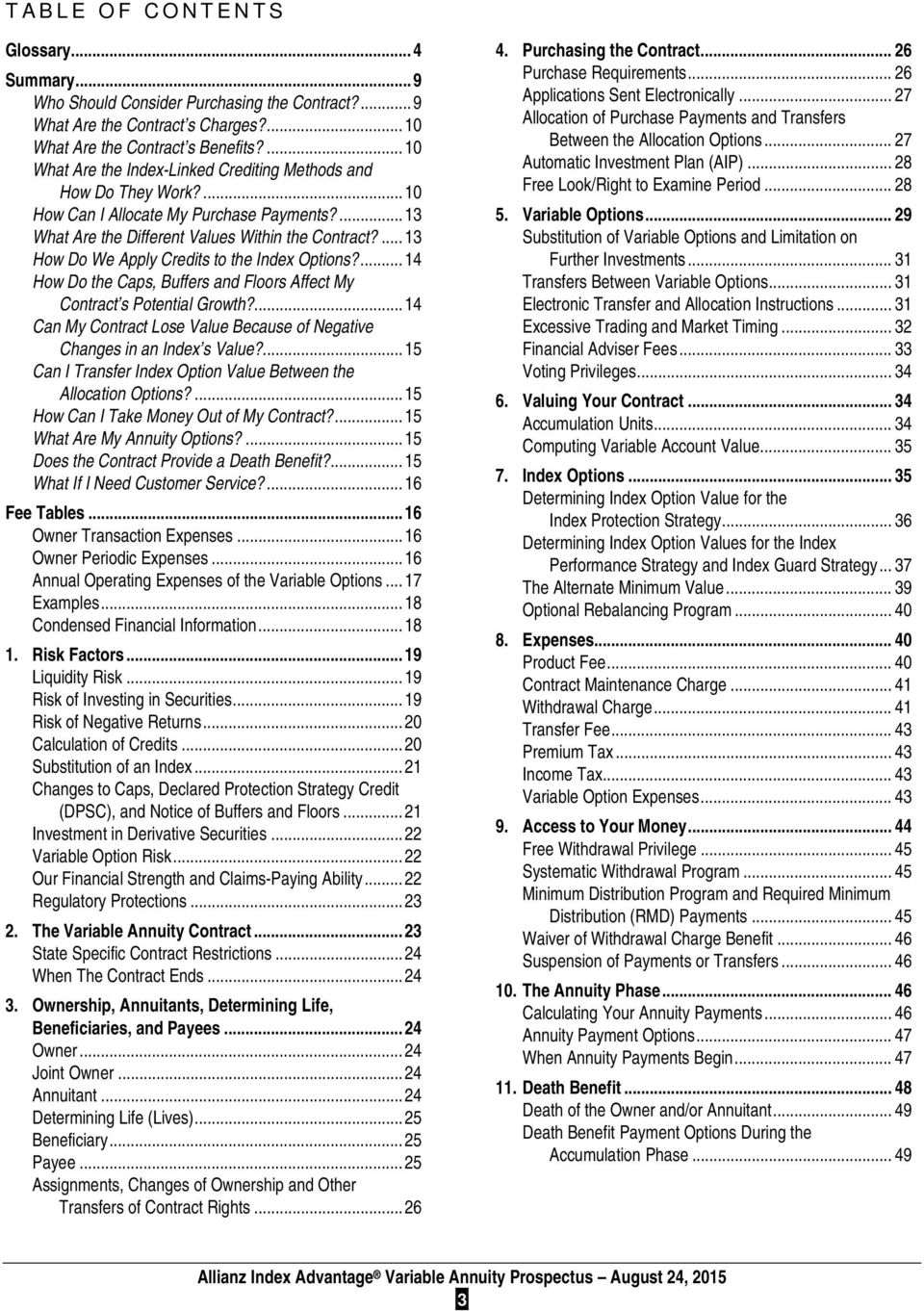
5 TABLE OF CONTENTS Glossary... 4 Summary... 9 Who Should Consider Purchasing the Contract?... 9 What Are the Contract s Charges? What Are the Contract s Benefits? What Are the Index-Linked Crediting Methods and How Do They Work? How Can I Allocate My Purchase Payments? What Are the Different Values Within the Contract? How Do We Apply Credits to the Index Options? How Do the Caps, Buffers and Floors Affect My Contract s Potential Growth? Can My Contract Lose Value Because of Negative Changes in an Index s Value? Can I Transfer Index Option Value Between the Allocation Options? How Can I Take Money Out of My Contract? What Are My Annuity Options? Does the Contract Provide a Death Benefit? What If I Need Customer Service? Fee Tables Owner Transaction Expenses Owner Periodic Expenses Annual Operating Expenses of the Variable Options Examples Condensed Financial Information Risk Factors Liquidity Risk Risk of Investing in Securities Risk of Negative Returns Calculation of Credits Substitution of an Index Changes to Caps, Declared Protection Strategy Credit (DPSC), and Notice of Buffers and Floors Investment in Derivative Securities Variable Option Risk Our Financial Strength and Claims-Paying Ability Regulatory Protections The Variable Annuity Contract State Specific Contract Restrictions When The Contract Ends Ownership, Annuitants, Determining Life, Beneficiaries, and Payees Owner Joint Owner Annuitant Determining Life (Lives) Beneficiary Payee Assignments, Changes of Ownership and Other Transfers of Contract Rights Purchasing the Contract Purchase Requirements Applications Sent Electronically Allocation of Purchase Payments and Transfers Between the Allocation Options Automatic Investment Plan (AIP) Free Look/Right to Examine Period Variable Options Substitution of Variable Options and Limitation on Further Investments Transfers Between Variable Options Electronic Transfer and Allocation Instructions Excessive Trading and Market Timing Financial Adviser Fees Voting Privileges Valuing Your Contract Accumulation Units Computing Variable Account Value Index Options Determining Index Option Value for the Index Protection Strategy Determining Index Option Values for the Index Performance Strategy and Index Guard Strategy The Alternate Minimum Value Optional Rebalancing Program Expenses Product Fee Contract Maintenance Charge Withdrawal Charge Transfer Fee Premium Tax Income Tax Variable Option Expenses Access to Your Money Free Withdrawal Privilege Systematic Withdrawal Program Minimum Distribution Program and Required Minimum Distribution (RMD) Payments Waiver of Withdrawal Charge Benefit Suspension of Payments or Transfers The Annuity Phase Calculating Your Annuity Payments Annuity Payment Options When Annuity Payments Begin Death Benefit Death of the Owner and/or Annuitant Death Benefit Payment Options During the Accumulation Phase Allianz Index Advantage Variable Annuity Prospectus August 24,
6 12. Taxes...50 Qualified and Non-Qualified Contracts...50 Taxation of Annuity Contracts...50 Tax-Free Section 1035 Exchanges Other Information...51 The Registered Separate Account...51 Our General Account...52 Our Unregistered Separate Account...52 Distribution...53 Additional Credits for Certain Groups...54 Administration/Allianz Service Center...54 Legal Proceedings...54 Status Pursuant to Securities Exchange Act of Information on Allianz Life...55 Directors, Executive Officers and Corporate Governance...55 Board of Directors...55 Executive Compensation...59 Security Ownership of Certain Beneficial Owners and Management...74 Transactions with Related Persons, Promoters and Certain Control Persons...74 Risks Associated with the Financial Services Industry Financial Statements Privacy and Security Statement Table of Contents of the Statement of Additional Information (SAI) Appendix A Buffers and Initial and Renewal DPSCs and Caps Index Protection Strategy Index Performance Strategy Appendix B Available Indices Standard & Poor s 500 Index Russell 2000 Index Nasdaq-100 Index EURO STOXX Appendix C Daily Adjustment Appendix D Selected Financial Data and Consolidated Financial Statements Management s Discussion and Analysis of Financial Condition and Results of Operations (For the 12 month period ending December 31, 2014) Consolidated Financial Statements and Supplemental Schedules For Service or More Information Our Service Center GLOSSARY This prospectus is written in plain English. However, there are some technical words or terms that are capitalized and are used as defined terms throughout the prospectus. For your convenience, we included this glossary to define these terms. Accumulated Alternate Interest the sum of alternate interest earned for the entire time you own your Contract. The alternate interest for each Index Year is equal to the Alternate Minimum Base multiplied by the alternate interest rate. The alternate interest rate is stated in your Contract and does not change for the entire time you own your Contract. We use the Accumulated Alternate Interest to calculate the Alternate Minimum Value. Accumulation Phase the initial phase of your Contract before you apply your Contract Value to Annuity Payments. The Accumulation Phase begins on the Issue Date. Allocation Options the Variable Options and Index Options available to you under the Contract. Alternate Minimum Base the Index Option Value at the beginning of an Index Year multiplied by the AMB Factor. We use the Alternate Minimum Base to determine the amount of interest earned on the Alternate Minimum Value. Alternate Minimum Value the guaranteed minimum Index Option Value we provide for each Crediting Method if you take a withdrawal, annuitize the Contract, transfer Contract Value out of Index Options, or if we pay a death benefit. AMB Factor the percentage of the Index Option Base that determines the Alternate Minimum Base on the Index Effective Date and each Index Anniversary. The AMB Factor is stated in your Contract and does not change for the entire time you own your Contract. We use the AMB Factor to calculate the Alternate Minimum Value. AMV Factor the percentage of the Index Option Base that determines the Alternate Minimum Value on the Index Effective Date and each Index Anniversary. The AMV Factor is stated in your Contract and does not change for the entire time you own your Contract. Annuitant the individual upon whose life we base the Annuity Payments. Subject to our approval, the Owner designates the Annuitant, and can add a joint Annuitant for the Annuity Phase. There are restrictions on who can become an Annuitant. Allianz Index Advantage Variable Annuity Prospectus August 24,

7 Annuity Date the date we begin making Annuity Payments to the Payee from the Contract. Annuity Options the annuity income options available to you under the Contract. Annuity Payments payments made by us to the Payee pursuant to the chosen Annuity Option. Annuity Phase the phase the Contract is in once Annuity Payments begin. Beneficiary the person(s) the Owner designates to receive any death benefit, unless otherwise required by the Contract or applicable law. Buffer under the Index Performance Strategy, this is the negative Index Return that Allianz Life absorbs before applying a negative Performance Credit. We declare Buffers for each Index Option on the Issue Date. Buffers do not change after the Issue Date. Business Day each day on which the New York Stock Exchange is open for trading, except, with regard to a specific Variable Option, when that Variable Option does not value its shares. Allianz Life is open for business on each day that the New York Stock Exchange is open. Our Business Day closes when regular trading on the New York Stock Exchange closes, which is usually at 4:00 p.m. Eastern Time. Cap under the Index Performance Strategy and Index Guard Strategy, this is the maximum amount of positive Index Return that you can receive as a positive Performance Credit. We declare Caps for each Index Option on the Index Effective Date and each Index Anniversary. The Caps are shown on the Index Options Statement. Charge Base the Contract Value on the preceding Quarterly Contract Anniversary (or the initial Purchase Payment received on the Issue Date if this is before the first Quarterly Contract Anniversary), adjusted for subsequent Purchase Payments and withdrawals. We use the Charge Base to determine the next product fee we deduct. Contract the individual flexible purchase payment variable and index-linked deferred annuity contract described by this prospectus. Contract Anniversary a twelve-month anniversary of the Issue Date or any subsequent Contract Anniversary. Contract Value on any Business Day, the sum of your Index Option Value(s) and Variable Account Value. The Contract Value does not include any currently applicable withdrawal charge, final product fee, or final contract maintenance charge. The Variable Account Value component of the Contract Value fluctuates each Business Day. The Index Option Value component of the Contract Value is adjusted on each Index Anniversary to reflect Credits, which can be negative with the Index Performance Strategy and Index Guard Strategy. A negative Credit means that you can lose money. The Index Performance Strategy and Index Guard Strategy Index Option Values also reflect the Daily Adjustment on every Business Day other than the Index Anniversary. Contract Year any period of twelve months beginning on the Issue Date or a subsequent Contract Anniversary. Credit the annual return you may receive when you allocate money to an Index Option. Credits may be positive, zero, or, in some instances, negative if you select the Index Performance Strategy or Index Guard Strategy. A negative Credit means that you can lose money. Crediting Method a method we use to calculate annual Credits if you allocate money to an Index Option. Daily Adjustment the change in the market value of an Index Option under the Index Performance Strategy and Index Guard Strategy as discussed in section 7, Index Options and Appendix C. Each Index Performance Strategy and Index Guard Strategy Index Option has a Daily Adjustment. We use the Daily Adjustment to calculate the Index Option Values for these Index Options on each Business Day during the Index Year other than the Index Effective Date or Index Anniversary. The Daily Adjustment can affect the values available for withdrawals, annuitizations, death benefits, and the Contract Value used to determine the Charge Base and contract maintenance charge. Declared Protection Strategy Credit (DPSC) the positive Credit we apply under the Index Protection Strategy if the change in Index value from one Index Anniversary to the next is greater than or equal to zero. We set the DPSC on the Index Effective Date and each Index Anniversary. The DPSC is shown on the Index Options Statement. Determining Life (Lives) the person(s) designated at Contract issue and named in the Contract on whose life we base the guaranteed Traditional Death Benefit. Financial Professional the person who advises you regarding the Contract. Allianz Index Advantage Variable Annuity Prospectus August 24,
8 Floor under the Index Guard Strategy, this is the lowest potential Performance Credit for an Index Option. We declare Floors for each Index Guard Strategy Index Option on the Issue Date. Floors do not change after the Issue Date. Good Order a request is in Good Order if it contains all of the information we require to process the request. If we require information to be provided in writing, Good Order also includes providing information on the correct form, with any required certifications, guarantees and/or signatures, and received at our Service Center after delivery to the correct mailing, , or website address, which are all listed at the back of this prospectus. If you have questions about the information we require, or whether you can submit certain information by fax, or over the web, please contact our Service Center. If you send information by or upload it to our website, we send you a confirmation number that includes the date and time we received your information. Index (Indices) one (or more) of the third-party broad based securities indexes available to you under your Contract. Index Anniversary a twelve-month anniversary of the Index Effective Date or any subsequent Index Anniversary. If an Index Anniversary does not occur on a Business Day, we consider it to occur on the next Business Day for the purposes of declaring Caps, determining Index values and Index Returns, and applying Credits. Index Effective Date the date shown on the Index Options Statement that starts the first Index Year. When you purchase this Contract you select the Index Effective Date as discussed in section 4, Purchasing the Contract Allocation of Purchase Payments and Transfers Between the Allocation Options. Index Guard Strategy one of the Index Crediting Methods available to Contracts issued on or after August 24, 2015, that is described in section 7, Index Options. The Index Guard Strategy was not available for selection before August 24, 2015, and is not currently available to inforce Contracts issued before August 24, 2015, or to Contracts issued in Missouri. The Index Guard Strategy calculates Performance Credits based on Index Returns subject to a Cap and Floor. You can receive negative Performance Credits under this Crediting Method, which means you can lose principal. The Index Guard Strategy is more sensitive to smaller negative market movements that persist over time because the Floor reduces the impact of large negative market movements. In an extended period of smaller negative market returns, the risk of loss is greater with the Index Guard Strategy than the Index Performance Strategy. Index Option the combination of an Index and a Crediting Method to which you can allocate money. Index Option Base an amount we use to calculate Credits, and if you select the Index Performance Strategy or Index Guard Strategy, the Daily Adjustment. The Index Option Base is equal to the amounts you allocate to an Index Option adjusted for withdrawals, Contract expenses, transfers into or out of the Index Option, and the application of any Credits. Index Option Value on any Business Day it is equal to the value in an Index Option. We establish an Index Option Value for each Index Option you select. Each Index Option Value includes any Credits from previous Index Anniversaries and the deduction of any previously assessed contract maintenance charge, product fee, and withdrawal charge. On each Business Day during the Index Year other than the Index Effective Date or an Index Anniversary, each Index Option Value under the Index Performance Strategy and Index Guard Strategy also includes the Daily Adjustment. If you take a withdrawal, annuitize the Contract, transfer Contract Value out of Index Options, or if we pay a death benefit each Index Option Value for each Crediting Method also includes any increase from the Alternate Minimum Value. Index Options Statement an account statement we mail to you on the Index Effective Date and each Index Anniversary thereafter. On the Index Effective Date, the statement shows the Index values, and the Caps and the DPSC that are initially declared on the Index Effective Date. On each Index Anniversary, the statement shows the new Index values, and the Caps and DPSC that are effective for the next year. Index Performance Strategy one of the Index Crediting Methods available to you under the Contract described in section 7, Index Options. The Index Performance Strategy calculates Performance Credits based on Index Returns subject to a Cap and Buffer. You can receive negative Performance Credits under this Crediting Method, which means you can lose principal. The Index Performance Strategy is more sensitive to large negative market movements because small negative market movements are absorbed by the Buffer. In a period of extreme negative market performance, the risk of loss is greater with the Index Performance Strategy than with the Index Guard Strategy. Index Protection Strategy one of the Index Crediting Methods available to you under the Contract described in section 7, Index Options. Under the Index Protection Strategy you receive the DPSC if the change in Index value from one Index Anniversary to the next is zero or more. You cannot receive a negative Credit under this Crediting Method. Allianz Index Advantage Variable Annuity Prospectus August 24,

9 Index Return a calculation we use to determine the Performance Credits on each Index Anniversary. The Index Return is an Index s current value, minus its value on the last Index Anniversary (or the Index Effective Date if this is the first Index Anniversary), divided by the Index s value on the last Index Anniversary (or the Index Effective Date if this is the first Index Anniversary). Index Year any period of twelve months beginning on the Index Effective Date or a subsequent Index Anniversary. Issue Date the date shown on the Contract that starts the first Contract Year. Contract Anniversaries and Contract Years are measured from the Issue Date. We must receive your initial Purchase Payment and all necessary information before we issue the Contract. Joint Owners two Owners who own a Contract. Lock Date under the Index Performance Strategy and Index Guard Strategy, this is the Business Day we process your request to lock in an Index Option Value (a Performance Lock) before the Index Anniversary. Non-Qualified Contract a Contract that is not purchased under a pension or retirement plan qualified for special tax treatment under sections of the Internal Revenue Code. Owner you, your and yours. The person(s) or entity designated at Contract issue and named in the Contract who may exercise all rights granted by the Contract. Payee the person or entity who receives Annuity Payments during the Annuity Phase. Performance Lock a feature under the Index Performance Strategy and Index Guard Strategy that allows you to lock in each of your current Index Option Values before the Index Anniversary. A Performance Lock applies to the total Index Option Value in an Index Option, and not just a portion of that Index Option Value. After the Lock Date, Daily Adjustments do not apply for the remainder of the Index Year and the Index Option Value will not receive a Performance Credit on the next Index Anniversary. Performance Credit the Credit we apply on the Index Anniversary under the Index Performance Strategy and Index Guard Strategy. We base Performance Credits on Index Returns limited by the Cap, Buffer or Floor. Performance Credits can be negative, which means that you can lose money. Proxy Investment an investment tracking mechanism we establish that is structured as a hypothetical set of call and put options designed to provide the same returns as the Performance Credits under the Index Performance Strategy and Index Guard Strategy on an Index Anniversary. We use the Proxy Investment to calculate the Daily Adjustment between Index Anniversaries. For more information, see Appendix C. Proxy Value the value of the Proxy Investment for an Index Performance Strategy or Index Guard Strategy Index Option used to calculate the Daily Adjustment as discussed in Appendix C. Purchase Payment the money you put into the Contract. Qualified Contract a Contract purchased under a pension or retirement plan qualified for special tax treatment under sections of the Internal Revenue Code (for example, 401(a) and 401(k) plans), Individual Retirement Annuities (IRAs), or Tax-Sheltered Annuities (referred to as TSA or 403(b) contracts). Currently, we issue Qualified Contracts that may include, but are not limited to Roth IRAs, Traditional IRAs and Simplified Employee Pension (SEP) IRAs. We may also issue an Inherited IRA and Inherited Roth IRA to make any required minimum distribution payments to a beneficiary of a previously held tax-qualified arrangement. Quarterly Contract Anniversary the day that occurs three calendar months after the Issue Date or any subsequent Quarterly Contract Anniversary. Separate Account Allianz Life Variable Account B is the Separate Account that issues the variable investment portion of your Contract. It is a separate investment account of Allianz Life. The Separate Account holds the Variable Options that underlie the Contracts. The Separate Account is divided into subaccounts, each of which invests exclusively in a single Variable Option. The Separate Account is registered with the SEC as a unit investment trust, and may be referred to as the Registered Separate Account. Allianz Index Advantage Variable Annuity Prospectus August 24,
10 Service Center the area of our company that issues Contracts and provides Contract maintenance and routine customer service. Our Service Center address and telephone number are listed at the back of this prospectus. The address for mailing applications and/or checks for Purchase Payments may be different and is also listed at the back of this prospectus. Traditional Death Benefit the death benefit provided by the Contract that is equal to the greater of Contract Value (after deduction of the final product fee), or total Purchase Payments adjusted for withdrawals. Valid Claim the documents we require to be received in Good Order at our Service Center before we pay any death claim. This includes the death benefit payment option, due proof of death, and any required governmental forms. Due proof of death includes a certified copy of the death certificate, a decree of court of competent jurisdiction as to the finding of death, or any other proof satisfactory to us. Variable Account Value on any Business Day, the sum of the values in your selected Variable Options. The Variable Account Value includes the deduction of the Variable Option operating expenses, and any previously assessed transfer fee, contract maintenance charge, product fee, and withdrawal charge. Variable Options the variable investments available to you under the Contract. Variable Option performance is based on the securities in which they invest. Withdrawal Charge Basis the total amount under your Contract that is subject to a withdrawal charge as discussed in section 8, Expenses Withdrawal Charge. Allianz Index Advantage Variable Annuity Prospectus August 24,
11 SUMMARY The Allianz Index Advantage Variable Annuity is a variable and index-linked annuity product. When you purchase a Contract, you tell us how to allocate your money. You can select any or all of the available Variable Options and Index Options. Your allocations must be in whole percentages and we only allow allocations to the Index Options once each Index Year. An Index Year is a twelve month-period beginning on the Index Effective Date and each subsequent Index Anniversary. You can only reallocate money from the Index Options to the Variable Options on every sixth Index Anniversary. If you allocate money to the Variable Options offered through the Contract, the value of your investment (Variable Account Value) increases and decreases based on your selected Variable Options performance. If you allocate money to an Index Option, we calculate an annual return or Credit, on each Index Anniversary. The Credit is based on the change in value of one or more nationally recognized third-party broad based securities Indices. Credits may be positive, zero, or, in some instances, negative, depending on the Index Option you select. Under the Index Performance Strategy and Index Guard Strategy there is a Cap on positive Credits. Under the Index Performance Strategy, there is also a Buffer on negative Credits, but there is no protection for negative Credits for losses greater than the Buffer. Under the Index Guard Strategy there is a Floor on negative Credits, which determines the minimum Performance Credit you can receive. Once we issue your Contract we can change the Caps annually. We establish the Buffers and Floors on the date we issue the Contract (Issue Date) and we cannot change them. For newly issued Contracts, we publish any changes to the Buffers, Floors and Caps at least seven calendar days before they take effect on our website at You can lose money that you allocate to the Index Performance Strategy if Index losses are greater than the Buffer, or the Index Guard Strategy for Index losses down to the Floor. You cannot lose money that you allocate to the Index Protection Strategy due to Index losses. The Index Performance Strategy and Index Guard Strategy include a risk of potential loss of principal and this loss could be significant. If money is withdrawn or removed from an Index Performance Strategy or Index Guard Strategy Index Option before the Index Anniversary, you could lose principal even if the Index Return is positive on the date of withdrawal. During the Index Year, the Index Protection Strategy Index Option Values do not change for Index performance. On each Business Day during the Index Year other than the Index Effective Date or Index Anniversary, the Index Performance Strategy and Index Guard Strategy Index Option Values change for Index performance through the Daily Adjustment. A Business Day is any day the New York Stock Exchange is open, except, with regard to a specific Variable Option, when that Variable Option does not value its shares. The Daily Adjustment is meant to approximate the Index Option Value on the next Index Anniversary, as adjusted for gains during the Index Year subject to the Cap and either losses greater than the Buffer for the Index Performance Strategy, or losses down to the Floor for the Index Guard Strategy. Even if the current Index Return during the Index Year is positive, or losses are within the Buffer for the Index Performance Strategy, the Daily Adjustment may be negative until the Index Anniversary. This means you could receive reduced principal even if the Index Return is positive on that day. Similarly, if the Index Return is less than the Floor for the Index Guard Strategy, the Daily Adjustment may be lower than the Floor until the next Index Anniversary. The Contract has two phases: the Accumulation Phase and the Annuity Phase. During the Accumulation Phase your Contract Value (the total of your Variable Account Value and all Index Option Values) fluctuates based on the returns of your selected Variable Options and Index Options. During the Accumulation Phase you can add Purchase Payments to your Contract, take withdrawals, and we pay a death benefit if you die. The Accumulation Phase of your Contract ends and the Annuity Phase starts once you begin Annuity Payments. You can take Annuity Payments based on your Contract Value as discussed in section 10, The Annuity Phase. Who Should Consider Purchasing the Contract? We designed the Contract for people who are looking for a level of protection for their principal while providing potentially higher returns than are available on traditional fixed annuities. This Contract is not intended for someone who is seeking complete protection from downside risk. Allianz Index Advantage Variable Annuity Prospectus August 24,

12 What Are the Contract s Charges? The Contract includes a product fee, contract maintenance charge, transfer fee, and contingent withdrawal charge. These fees and charges are discussed in more detail in section 8, Expenses. We assess a 1.25% annualized product fee. The fee is deducted quarterly during the Accumulation Phase while your Contract Value is positive. We calculate and accrue the fee on a daily basis as a percentage of the Charge Base. The Charge Base is the Contract Value on the preceding Quarterly Contract Anniversary (or the initial Purchase Payment received on the Issue Date if this is before the first Quarterly Contract Anniversary), adjusted for subsequent Purchase Payments and withdrawals. A Quarterly Contract Anniversary is the day that occurs three calendar months after the Issue Date or any subsequent Quarterly Anniversary. We assess a $50 contract maintenance charge annually, but we waive this charge if your Contract Value is at least $100,000. We assess a $25 transfer fee for each transfer in excess of 12 between the Variable Options in a Contract Year. A Contract Year is any period of twelve months beginning on the Issue Date or a subsequent Contract Anniversary (a twelve-month anniversary of the Issue Date). The withdrawal charge is calculated based upon Purchase Payments. The withdrawal charge period applies separately to each Purchase Payment. The withdrawal charge starts at 8.5% and decreases to zero after we have had a Purchase Payment for six complete years. During the period that the withdrawal charge applies, if you withdraw more than is allowed under the free withdrawal privilege, we may deduct a withdrawal charge. (See section 9, Access to Your Money Free Withdrawal Privilege.) Contract charges and pro-rata fees are assessed on any full or partial withdrawal from either the Variable Options or the Index Options as discussed in more detail in section 8, Expenses. What Are the Contract s Benefits? The Contract offers a variety of variable and index-linked Allocation Options, each with different return and risk characteristics. The Contract has a free withdrawal privilege that allows you to withdraw up to 10% of your total Purchase Payments from your Contract each Contract Year during the Accumulation Phase without incurring a withdrawal charge. The Contract includes a waiver of withdrawal charge benefit in most states that allows you to take money out of the Contract without incurring a withdrawal charge if you are confined to a nursing home for a period of time. Keep in mind that if you withdraw money from an Index Performance Strategy or Index Guard Strategy Index Option on any day other than an Index Anniversary, we apply the Daily Adjustment when calculating your Index Option Value for the withdrawal, even if the withdrawal is not subject to a withdrawal charge. The Contract has several Annuity Options which can provide guaranteed income for life, or life and term certain. (For more information see section 9, Access to Your Money and section 10, The Annuity Phase.) We also pay a death benefit to your Beneficiary(s) if you die before Annuity Payments begin. What Are the Index-Linked Crediting Methods and How Do They Work? The Contract offers three Index Crediting Methods: the Index Protection Strategy, Index Performance Strategy and Index Guard Strategy. However, if your Contract is issued in Missouri, or was issued before August 24, 2015, only the Index Protection Strategy and Index Performance Strategy are available to you. All of these Crediting Methods are described in more detail in section 7, Index Options. The Index Protection Strategy provides a Declared Protection Strategy Credit (DPSC) on each Index Anniversary if the Index s current value is equal to or greater than its value on the last Index Anniversary (or the Index Effective Date if this is the first Index Anniversary). If an Index Anniversary does not occur on a Business Day, we use the next Business Day s Index value. We set the amount of the DPSC at the beginning of each Index Year (the Index Effective Date and subsequent Index Anniversaries) and we pay this Credit if the change in Index value is zero or more regardless of the amount of the actual change. If the change in Index value is negative you do not receive the DPSC, but you also do not receive a negative Credit. We can change the DPSC annually. For information on the initial DPSCs that we offered to newly issued Contracts, and renewal DPSCs that we offered to previously issued Contracts ( inforce Contracts ) on their first Index Anniversary please see Appendix A. This information regarding the initial and renewal DPSCs is for historical purposes only; it is not a representation as to future DPSCs. DPSCs may change frequently, and may vary substantially based on market conditions. Allianz Index Advantage Variable Annuity Prospectus August 24,
13 The Index Performance Strategy provides a positive Performance Credit if the Index Return is positive, adjusted by an upper limit called the Cap. The Index Return is an Index s value on the current Index Anniversary, minus its value on the last Index Anniversary (or the Index Effective Date if this is the first Index Anniversary), divided by the Index s value on the last Index Anniversary (or the Index Effective Date if this is the first Index Anniversary). If the Index Return is negative, you will receive a negative Performance Credit if the loss is greater than a specified percentage called the Buffer. A negative Performance Credit means that you can lose money. If the Index Return is negative, but the loss is less than or equal to the Buffer, your Performance Credit is zero. We can change the Caps annually, but we establish the Buffers on the Issue Date and we cannot change them. The Caps and Buffers can be different depending on the Indices you select. For information on the Buffers and initial Caps that we offered to newly issued Contracts, and renewal Caps that we offered to inforce Contracts on their first Index Anniversary please see Appendix A. The EURO STOXX 50 was not available for selection before August 24, 2015, and is not currently available in Missouri, or to inforce Contracts issued before August 24, Therefore, no historical Caps for EURO STOXX 50 are included in Appendix A. This information regarding the Buffers, and initial and renewal Caps is for historical purposes only; it is not a representation as to future Buffers or Caps. Caps may change frequently, and may vary substantially based on market conditions. The Index Guard Strategy also provides a positive Performance Credit if the Index Return is positive, limited by the Cap. If the Index Return is zero, your Performance Credit is zero. You will receive a negative Performance Credit if the Index Return is negative, but your negative Credit will never be less than a specified percentage called the Floor. A negative Performance Credit means that you can lose money. We can change the Caps annually, but we establish the Floors on the Issue Date and we cannot change them. The Caps and Floors can be different depending on the Indices you select. Caps may change frequently, and may vary substantially based on market conditions. The Index Guard Strategy was not available for selection before August 24, 2015, and is not currently available in Missouri, or to inforce Contracts issued before August 24, Therefore, no historical Caps or Floors for the Index Guard Strategy are included in Appendix A. For information on the Index Protection Strategy DPSC, Index Performance Strategy Caps and Buffers, and Index Guard Strategy Caps and Floors we currently offer for newly issued Contracts, see our website at For newly issued Contracts, we publish any changes to the DPSC, Caps, Buffers and Floors on our website at least seven calendar days before they take effect. Buffers and Floors may change before we issue your Contract, and the initial DPSC and Caps may change before your Index Effective Date. The minimum DPSC and Caps are 1.5% for the entire time you own your Contract. The minimum Index Performance Strategy Buffer is 5%. The minimum Index Guard Strategy Floor is -25%. Your actual Buffers and Floors are stated in your Contract and cannot change after the Issue Date. We inform you of the initial DPSC and Caps for your Contract in the Index Options Statement, which we mail to you on the Index Effective Date and each Index Anniversary. The Index Options Statement also includes the Index values on the Index Effective Date and each subsequent Index Anniversary. We use these Index values to determine if you receive the DPSC under the Index Protection Strategy, and to determine the Index Return and Performance Credits under the Index Performance Strategy and Index Guard Strategy. The DPSC and Caps can be adjusted each year, in our discretion. We will send you a letter at least 30 days before each Index Anniversary. This letter advises you that your current DPSC and Caps are expiring on the upcoming Index Anniversary, and the renewal DPSC and Caps for the next Index Year will be available for your review in your account on our website at least seven calendar days before the upcoming Index Anniversary. We also have a link to your Contract information with your renewal DPSC and Caps on our website at Your Index Options Statement that we mail on each Index Anniversary will include the actual renewal DPSC and Caps you received for the current Index Year. The Index Anniversary letter also reminds you of your opportunity to transfer Contract Value from the Variable Options to the Index Options, or rebalance your Index Option Values, on the upcoming anniversary. We must receive your transfer instructions in Good Order at our Service Center by the end of the last Business Day before your Index Anniversary. If we do not receive transfer instructions from you, your Index Option Value will remain allocated to your existing Index Options at the renewal DPSC and Caps. The three Crediting Methods have different risk and return potentials. The Index Protection Strategy has the lowest risk/return potential, and provides the most protection. You cannot lose money that you allocate to the Index Protection Strategy due to negative Index performance. Potential returns and risks are higher for the Index Performance Strategy and Index Guard Strategy. Allianz Index Advantage Variable Annuity Prospectus August 24,
14 Positive returns for the Index Performance Strategy and Index Guard Strategy are limited by the Caps. Negative returns are limited for the Index Performance Strategy by the Buffer, and for the Index Guard Strategy by the Floor. The Index Performance Strategy Buffer has a level of protection from negative returns, but has the potential for a larger loss in any year that has a significant market decline. The Index Guard Strategy permits negative Credits down to the Floor, and provides less risk of significant negative returns than the Index Performance Strategy Buffer. The Index Guard Strategy is sensitive to smaller negative market movements that persist over time, but provides more certainty regarding the maximum loss in any one year than the Index Performance Strategy. The Index Performance Strategy has protection for smaller negative market movements, but it also has the potential for the largest loss in any one year. NOTE: The DPSC and Caps may be different for newly issued Contracts and for inforce Contracts, even if the Contracts have Index Effective Dates with the same month and day. The initial DPSC and Caps for newly issued Contracts may be higher or lower than the renewal DPSC and Caps for inforce Contracts. However, all inforce Contracts with Index Effective Dates in the same date range will receive the same renewal DPSC and Caps. For example, if on January 1, 2015 we declared initial and renewal Caps for the Index Performance Strategy Index Option using the S&P 500 Index for Contracts with Index Effective Dates of January 7 through February 3, these Caps might hypothetically be as follows: 13% for newly issued Contracts, 14% for inforce Contracts issued in 2014, and 12% for inforce Contracts issued in If your Contract is still within its Free Look/Right to Examine period you may be able to take advantage of any increase in initial DPSC or Caps for newly issued Contracts by cancelling your existing Contract and purchasing a new Contract. The DPSCs and Caps will vary depending upon a variety of factors, including our hedging strategies and investment performance, your Index Effective Date, and the level of interest rates and volatility on your Index Effective Date and on Index Anniversaries. The DPSCs and Caps may be different for new Contracts and for inforce Contracts that have reached an Index Anniversary and are receiving a current renewal rate, and may also be different for Contracts with the same Index Anniversaries that were issued in different years. Caps can also be different for the Index Performance Strategy and the Index Guard Strategy. While initial and renewal DPSCs and Caps may be affected by a variety of factors including, for example, a change in the current level of interest rates, the effect of a change in interest rates or other market conditions on the DPSC and Caps may not be direct or immediate. There may be a lag in changes to DPSCs and Caps. In a rising interest rate environment, increases in Caps, if any, may be substantially slower than increases in interest rates. (For more information see section 7, Index Options.) We cannot eliminate or modify the three Crediting Methods; however, we can adjust the amount of the DPSC and the Caps each Index Year. We can replace an Index as described in section 1, Risk Factors Substitution of an Index. We can add new Crediting Methods to your Contract in the future, and you can select these Crediting Methods if they are made available to you. The Index Guard Strategy and EURO STOXX 50 are not currently available to Contracts issued in Missouri, or to Contracts issued before August 24, The Contract includes an Alternate Minimum Value that provides a guaranteed minimum on each of your Index Option Values if you take a withdrawal, annuitize the Contract, transfer Contract Value out of Index Options, or if we pay a death benefit. Allianz Index Advantage Variable Annuity Prospectus August 24,

15 How Can I Allocate My Purchase Payments? You can allocate your Purchase Payments to any or all of the available Allocation Options in whole percentages. We only allow allocations to the Index Options on the Index Effective Date and on subsequent Index Anniversaries. The Index Effective Date starts the first Index Year and is shown on the Index Options Statement. An Index Anniversary is a twelvemonth anniversary of the Index Effective Date, or any subsequent Index Anniversary. An Index Year is any period of twelve months beginning on the Index Effective Date or a subsequent Index Anniversary. You can only reallocate money from the Index Options to the Variable Options on every sixth Index Anniversary. NOTE: If you allocate an additional Purchase Payment to the Index Options, we place that allocation in the AZL Money Market Fund until the next Index Anniversary, when we transfer the allocations from the AZL Money Market Fund to the Index Options. Additional Purchase Payments that we receive after the Index Effective Date that you allocate to an Index Option are not eligible to receive Credits until the second Index Anniversary after we receive them because they are not applied to the Index Option until the next Index Anniversary. What Are the Different Values Within the Contract? The Contract provides the following values. The Contract Value is the sum of your Variable Account Value and total Index Option Values. Contract Value does not include any currently applicable withdrawal charge, final product fee, or final contract maintenance charge that we assess on a full withdrawal or when you request Annuity Payments. The Variable Account Value is the sum of the values in your selected Variable Options. It includes the deduction of Variable Option operating expenses, and any previously assessed transfer fee, contract maintenance charge, product fee, and withdrawal charge. Your Variable Account Value changes daily based on the performance of your selected Variable Options. The total Index Option Value is the sum of the values in each of your selected Index Options. Each Index Option Value includes any Credits from previous Index Anniversaries and the deduction of any previously assessed contract maintenance charge, product fee, and withdrawal charge. On each Business Day during the Index Year other than the Index Effective Date or an Index Anniversary, we calculate the current Index Option Value for each Index Performance Strategy and Index Guard Strategy Index Option by applying a Daily Adjustment to the Index Option Base (which is the amount you allocate to an Index Option adjusted for withdrawals, Contract expenses, transfers into or out of the Index Option, and the application of any Performance Credits). We calculate the Daily Adjustment before we process any partial withdrawal or deduct any Contract expenses, and the adjustment can be positive or negative. Any amounts removed from an Index Performance Strategy or Index Guard Strategy Index Option during the Index Year do not receive a Performance Credit on the next Index Anniversary, but the amount remaining does receive a Performance Credit subject to the Cap and Buffer, or Cap and Floor. If you take a withdrawal, annuitize the Contract, transfer Contract Value out of Index Options, or if we pay a death benefit each Index Option Value for each Crediting Method also includes any increase from the Alternate Minimum Value, if higher. If we are determining the Alternate Minimum Value for an Index Performance Strategy or Index Guard Strategy Index Option Value on any day other than an Index Anniversary, we first calculate the Index Option Value and apply the Daily Adjustment, then compare this value to its associated Alternate Minimum Value and we pay the greater of these two amounts. If we are paying a partial withdrawal, we compare the percentage of Index Option Value with an equivalent percentage of its Alternate Minimum Value. We expect that an Alternate Minimum Value generally will not be greater than its Index Option Value. During the Index Year the Index Protection Strategy Index Option Values do not change for Index performance. On each Business Day during the Index Year other than the Index Effective Date or Index Anniversary, the Index Performance Strategy and Index Guard Strategy Index Option Values change for Index performance through the Daily Adjustment. The Daily Adjustment is meant to approximate the Index Option Value on the next Index Anniversary, as adjusted for gains during the Index Year subject to the Cap and either losses greater than the Buffer for the Index Performance Strategy, or losses down to the Floor for the Index Guard Strategy. The application of the Daily Adjustment is based on your agreement to be exposed to Index Anniversary gains in Index value subject to the Cap and losses in Index value either greater than the Buffer, or losses down to the Floor. The Daily Adjustment does this by tracking the hypothetical value of a Proxy Investment (called the Proxy Value) each Business Day other than an Index Anniversary using the formulas in Appendix C. The Proxy Investment is designed to return the same amount as the Index Option on an Index Anniversary (an amount equal to the Performance Credit as determined using the applicable Cap and Buffer, or Cap and Floor). Allianz Index Advantage Variable Annuity Prospectus August 24,

16 Between Index Anniversaries, the Proxy Investment provides a current estimate of what the Index value gain or loss would be if the investment were held until the Index Anniversary. The actual value of the relevant Index is not used in the Daily Adjustment calculation. The Daily Adjustment does not give you the actual Index return on the day of the calculation. When the Daily Adjustment is positive, your Index Option Value has increased since the beginning of the year; when it is negative, your Index Option Value has decreased (excluding the effect of any partial withdrawal or the deduction of Contract expenses). For the Index Performance Strategy, the Daily Adjustment is generally negatively affected by increases in the expected volatility of index prices, interest rate decreases, and by poor market performance. For the Index Guard Strategy, the Daily Adjustment is generally negatively affected by decreases in the expected volatility of index prices, interest rate decreases, and by poor market performance. All other factors being equal, even if the current Index Return during the Index Year is greater than the Cap, the Daily Adjustment will be lower than the Cap during the Index Year and will not be equal to the Cap until the next Index Anniversary. For more information see section 6, Valuing Your Contract, section 7, Index Options, and Appendix C. The specific details of the Daily Adjustment formula are described in Appendix C and in Exhibit 99(b) of the Form S-1 Registration Statement filed with the SEC, of which this prospectus is a part. This information is incorporated by reference into this prospectus. You can obtain a copy of Exhibit 99(b) by calling (800) How Do We Apply Credits to the Index Options? We calculate and apply Credits on the Index Anniversary based on either the change in the Index s value (Index Protection Strategy), or the Index Returns (Index Performance Strategy and Index Guard Strategy). Positive Credits are not guaranteed, and Credits can be zero under all the available Crediting Methods. Credits can be negative after application of the Buffer under the Index Performance Strategy, or negative down to the Floor under the Index Guard Strategy. Under the Index Performance Strategy and Index Guard Strategy you can lock in the current Index Option Value on any Business Day during the Index Year by requesting a Performance Lock. You can request a lock once each Index Year for each of your selected Index Performance Strategy and Index Guard Strategy Index Options. A Performance Lock applies to the total Index Option Value (including any Daily Adjustment) in an Index Option, and not just a portion of that Index Option Value. After the Business Day we process your request to lock in an Index Option Value (Lock Date), Daily Adjustments do not apply for the remainder of the Index Year and the Index Option Value will not receive a Performance Credit on the next Index Anniversary. NOTE REGARDING WITHDRAWALS DURING THE INDEX YEAR: Amounts removed from the Index Options during the Index Year for partial withdrawals and Contract expenses receive the Daily Adjustment, but do not receive a Credit on the next Index Anniversary. However, the remaining amount is eligible for a Credit, subject to the Cap and Buffer for the Index Performance Strategy Index Options, or the Cap and Floor for the Index Guard Strategy Index Options. Contract expenses include the product fee, the contract maintenance charge and any applicable withdrawal charge. If you take a partial withdrawal from an Index Performance Strategy or Index Guard Strategy Index Option on any day other than an Index Anniversary, we first calculate the Index Option Value and apply the Daily Adjustment, then compare the percentage of Index Option Value withdrawn to an equivalent percentage of its Alternate Minimum Value and pay you the greater of these two amounts. How Do the Caps, Buffers and Floors Affect My Contract s Potential Growth? The Index Performance Strategy involves both a Cap and a Buffer. The Index Guard Strategy involves both a Cap and a Floor. The Cap limits your ability to receive positive index-linked returns, and the Buffer and Floor limit the impact of negative returns. We set the Buffers and Floors on the Issue Date and the initial Caps on the Index Effective Date. We declare new Caps on each Index Anniversary. The Caps do not change during the Index Year. Caps cannot be less than 1.5% for the entire time you own your Contract. The Buffers and Floors do not change after the Issue Date. The Index Performance Strategy Buffers cannot be less than 5%. The Index Guard Strategy Floor cannot be less than -25%. For newly issued Contracts, we publish any changes to the Buffers, Floors and Caps on our website at at least seven calendar days before they take effect. Allianz Index Advantage Variable Annuity Prospectus August 24,

17 Can My Contract Lose Value Because of Negative Changes in an Index s Value? If you select the Index Protection Strategy, your Contract cannot lose value due to negative Index Returns. However, if you select the Index Performance Strategy or Index Guard Strategy, your Contract can lose value due to negative Index Returns. These losses could be significant. Can I Transfer Index Option Value Between the Allocation Options? On each Index Anniversary you can transfer Variable Account Value to the available Index Options and you can reallocate your Index Option Values. On every sixth Index Anniversary you can transfer Index Option Value to the Variable Options. At the end of the six-year term, we allow you to transfer all of the money in the Index Options to the Variable Options, even if a portion of that money was added after the start of the six-year term, and has been allocated to the Index Options for less than six years. How Can I Take Money Out of My Contract? You can take money out of your Contract by taking withdrawals, required minimum distributions or Annuity Payments. You can withdraw money from either the Variable Options or the Index Options. Amounts withdrawn from an Index Performance Strategy or Index Guard Strategy Index Option on any day other than an Index Anniversary do not receive a Performance Credit, but they do receive the Daily Adjustment on the day of the withdrawal. Amounts withdrawn from an Index Protection Strategy Index Option will not receive a DPSC. A withdrawal before an Index Anniversary from an Index Performance Strategy or Index Guard Strategy Index Option may not receive the full benefit of the Cap, Buffer or Floor. This occurs because the Daily Adjustment calculation takes into account what may potentially happen between the withdrawal date and the next Index Anniversary. As a result, even if the Index Return is above the Cap, the Daily Adjustment may be less than the Cap, because there is a possibility that the Index Return could decrease before the end of the Index Year. Similarly, even though a negative Index Return may be within the amount of the Buffer for the Index Performance Strategy, the Owner (person(s) designated at Contract issue who may exercise all rights granted by the Contract you, your, and yours ) still may receive a negative Daily Adjustment (i.e., lose money) because there is a possibility that the Index Return could decrease before the end of the Index Year. Also, a negative Index Return for the Index Guard Strategy may result in you receiving a Daily Adjustment lower than the Floor, because the Daily Adjustment reflects the present value of the Floor and you will not receive the full benefit of the Floor until the Index Anniversary. If you withdraw more than is allowed by the free withdrawal privilege we may assess a withdrawal charge. Under the waiver of withdrawal charge benefit in most states you can take a one-time withdrawal from your Contract after the first Contract Anniversary without incurring a withdrawal charge if you are confined to a nursing home for a period of at least 90 consecutive days. If you take required minimum distributions from a Contract that qualifies for special tax treatment under sections of the Internal Revenue Code (Qualified Contract) to pay required minimum distribution amounts owing with regard to the Contract, these distributions are not subject to a withdrawal charge. However, required minimum distributions reduce the amount available under the free withdrawal privilege. When we process a withdrawal from an Index Performance Strategy or Index Guard Strategy Index Option on a day other than an Index Anniversary we determine the proper amount to deduct by calculating the Index Option Value using the Daily Adjustment. For more information see section 9, Access to Your Money. What Are My Annuity Options? The Contract includes several Annuity Options that can provide fixed life, or fixed life and term certain Annuity Payments. The designated individual(s) upon whose life we base Annuity Payments are the Annuitant(s). For more information see section 10, The Annuity Phase. Does the Contract Provide a Death Benefit? The Contract provides a guaranteed Traditional Death Benefit based on the greater of Contract Value or total Purchase Payments adjusted for withdrawals. The Traditional Death Benefit is a first-to-die death benefit based on the life of the person(s) designated at Contract issue (Determining Life). The Determining Life (or Lives) is either the Owner(s) or the Annuitant if the Owner is a non-individual. We establish the Determining Lives at Contract issue and they generally do not change unless there is a divorce or you establish a Trust. If you change Owners or the Annuitant after the Issue Date, upon death of the Owner, the person(s) designated to receive the death benefit (Beneficiary(s)) may only receive the Contract Value. For more information see section 3, Ownership, Annuitants, Determining Life, Beneficiaries, and Payees and section 11, Death Benefit. Allianz Index Advantage Variable Annuity Prospectus August 24,

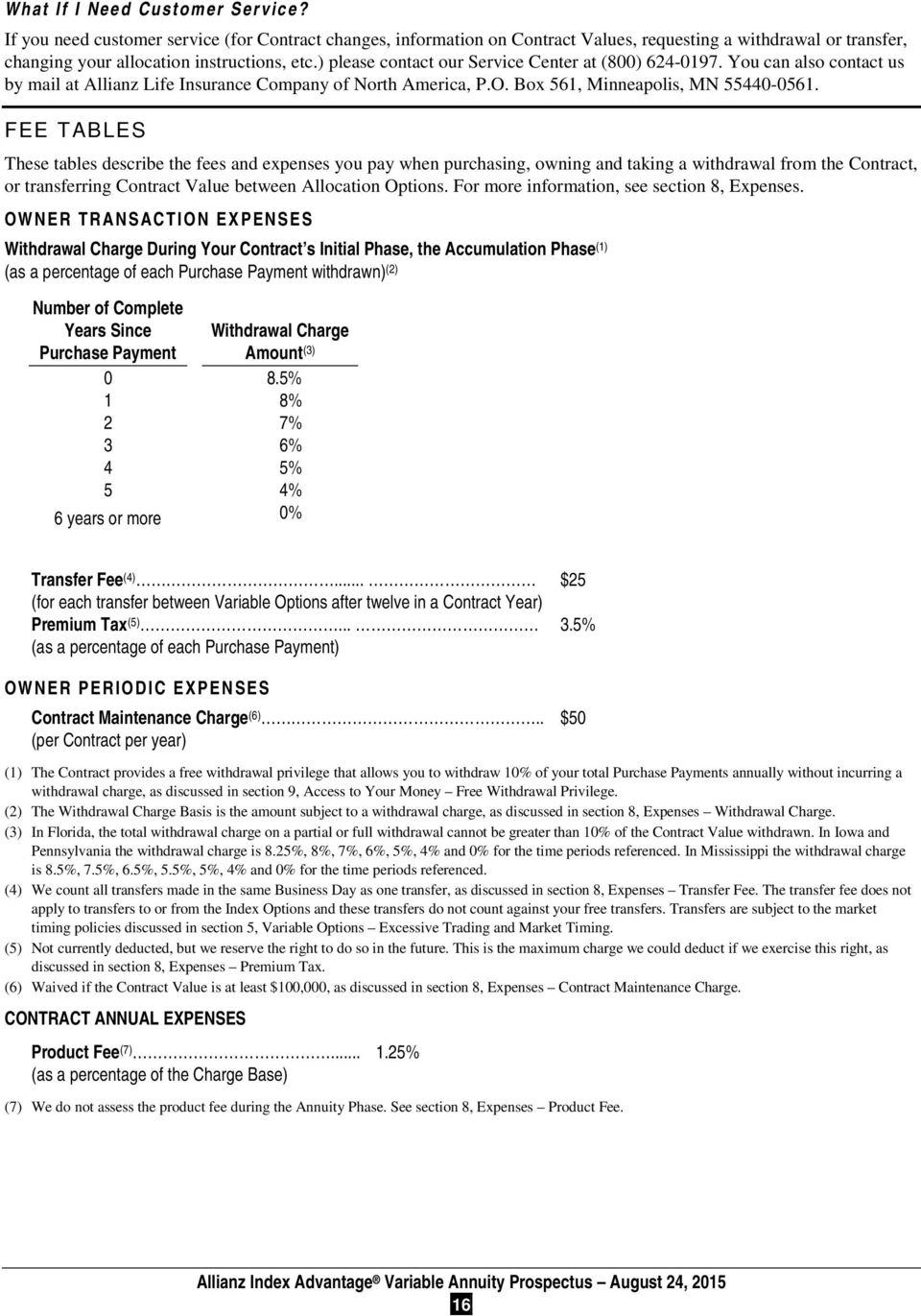
18 What If I Need Customer Service? If you need customer service (for Contract changes, information on Contract Values, requesting a withdrawal or transfer, changing your allocation instructions, etc.) please contact our Service Center at (800) You can also contact us by mail at Allianz Life Insurance Company of North America, P.O. Box 561, Minneapolis, MN FEE TABLES These tables describe the fees and expenses you pay when purchasing, owning and taking a withdrawal from the Contract, or transferring Contract Value between Allocation Options. For more information, see section 8, Expenses. OWNER TRANSACTION EXPENSES Withdrawal Charge During Your Contract s Initial Phase, the Accumulation Phase (1) (as a percentage of each Purchase Payment withdrawn) (2) Number of Complete Years Since Purchase Payment Withdrawal Charge Amount (3) 0 8.5% 1 8% 2 7% 3 6% 4 5% 5 4% 6 years or more 0% Transfer Fee (4)... $25 (for each transfer between Variable Options after twelve in a Contract Year) Premium Tax (5) % (as a percentage of each Purchase Payment) OWNER PERIODIC EXPENSES Contract Maintenance Charge (6).. $50 (per Contract per year) (1) The Contract provides a free withdrawal privilege that allows you to withdraw 10% of your total Purchase Payments annually without incurring a withdrawal charge, as discussed in section 9, Access to Your Money Free Withdrawal Privilege. (2) The Withdrawal Charge Basis is the amount subject to a withdrawal charge, as discussed in section 8, Expenses Withdrawal Charge. (3) In Florida, the total withdrawal charge on a partial or full withdrawal cannot be greater than 10% of the Contract Value withdrawn. In Iowa and Pennsylvania the withdrawal charge is 8.25%, 8%, 7%, 6%, 5%, 4% and 0% for the time periods referenced. In Mississippi the withdrawal charge is 8.5%, 7.5%, 6.5%, 5.5%, 5%, 4% and 0% for the time periods referenced. (4) We count all transfers made in the same Business Day as one transfer, as discussed in section 8, Expenses Transfer Fee. The transfer fee does not apply to transfers to or from the Index Options and these transfers do not count against your free transfers. Transfers are subject to the market timing policies discussed in section 5, Variable Options Excessive Trading and Market Timing. (5) Not currently deducted, but we reserve the right to do so in the future. This is the maximum charge we could deduct if we exercise this right, as discussed in section 8, Expenses Premium Tax. (6) Waived if the Contract Value is at least $100,000, as discussed in section 8, Expenses Contract Maintenance Charge. CONTRACT ANNUAL EXPENSES Product Fee (7) % (as a percentage of the Charge Base) (7) We do not assess the product fee during the Annuity Phase. See section 8, Expenses Product Fee. Allianz Index Advantage Variable Annuity Prospectus August 24,
19 ANNUAL OPERATING EXPENSES OF THE VARIABLE OPTIONS Following are the minimum and maximum total annual operating expenses charged by any of the Variable Options for the period ended December 31, 2014, before the effect of any contractual expense reimbursement or fee waiver. We show the expenses as a percentage of a Variable Option s average daily net assets. The Index Options do not assess any separate operating expenses, and are not included in the following chart. Minimum Maximum Total annual Variable Option operating expenses (including management fees, distribution or 12b-1 fees, and other expenses) before fee waivers and expense reimbursements 0.65% 0.74% The table below describes, in detail, the annual expenses of the Variable Options before fee waivers and/or expense reimbursements. We show the expenses as a percentage of a Variable Option s average daily net assets for the most recent calendar year. Expenses may vary in current and future years. The investment advisers for the Variable Options provided the fee and expense information and we did not independently verify it. See the Variable Options prospectuses for further information regarding the expenses you may expect to pay. Some of the Variable Options or their affiliates may also pay service fees to us or our affiliates. If these fees are deducted from Variable Option assets, they are reflected in the table below. Management fees Acquired fund fees and expenses Total annual fund operating expenses before fee waivers and/or expense reimbursements Variable Option Rule 12b-1 fees Other expenses BLACKROCK AZL Money Market Fund ALLIANZ FUND OF FUNDS AZL MVP Balanced Index Strategy Fund (1) AZL MVP Growth Index Strategy Fund (1) (1) The underlying funds may pay 12b-1 fees to the distributor of the Contracts for distribution and/or administrative services. The underlying funds do not pay service fees or 12b-1 fees to the Allianz Fund of Funds and the Allianz Fund of Funds do not pay service fees or 12b-1 fees. The underlying funds of the Allianz Fund of Funds may pay service fees to the insurance companies issuing variable contracts, or their affiliates, for providing customer service and other administrative services to contract purchasers. The amount of such service fees may vary depending on the underlying fund. Allianz Index Advantage Variable Annuity Prospectus August 24,

20 EXAMPLES These examples are intended to help you compare the cost of investing in this Contract s Variable Options with the costs of other variable annuity contracts. These examples assume you make a $10,000 investment and your Variable Options earn a 5% annual return. They are not a representation of past or future expenses. Your Contract expenses may be more or less than the examples below, depending on the Variable Options you select and whether and when you take withdrawals. We deduct the $50 contract maintenance charge in the examples on each Contract Anniversary during the Accumulation Phase (or the next Business Day if the Contract Anniversary is not a Business Day), and we deduct it from each Annuity Payment during the Annuity Phase. We may waive this charge under certain circumstances, as described in section 8, Expenses Contract Maintenance Charge. We deduct the annual product fee (maximum charge of 1.25%) in the examples on each Quarterly Contract Anniversary during the Accumulation Phase, as described in section 8, Expenses Product Fee. A transfer fee may apply, but is not reflected in these examples (see section 8, Expenses Transfer Fee). 1) If you surrender your Contract (take a full withdrawal) at the end of each time period. Total annual Variable Option operating expenses before any fee waivers or expense reimbursements of: 1 Year 3 Years 5 Years 10 Years 0.74% (the maximum Variable Option operating expense) $1,101 $1,469 $1,808 $2, % (the minimum Variable Option operating expense) $1,092 $1,442 $1,763 $2,665 2) If you annuitize your Contract and begin Annuity Payments at the end of each time period. The earliest available Annuity Date (the date Annuity Payments begin) is one year after the Issue Date (the date we issue the Contract). Total annual Variable Option operating expenses before any fee waivers or expense reimbursements of: 1 Year 3 Years 5 Years 10 Years 0.74% (the maximum Variable Option operating expense) - $769 $1,308 $2, % (the minimum Variable Option operating expense) - $742 $1,263 $2,665 3) If you do not surrender your Contract. Total annual Variable Option operating expenses before any fee waivers or expense reimbursements of: 1 Year 3 Years 5 Years 10 Years 0.74% (the maximum Variable Option operating expense) $251 $769 $1,308 $2, % (the minimum Variable Option operating expense) $242 $742 $1,263 $2,665 CONDENSED FINANCIAL INFORMATION The consolidated financial statements of Allianz Life Insurance Company of North America are included in Appendix D of this prospectus, and the financial statements of Allianz Life Variable Account B are included in Part C of the Form N-4 Registration Statement. Accumulation unit value (AUV) information for the Contract offered by this prospectus, as of the end of December 31, 2014, is listed in the table below. This information should be read in conjunction with the financial statements and related notes of the Separate Account included in Part C of the Form N-4 Registration Statement. (Number of Accumulation Units in thousands) AUV at Beginning of Period Number of Accumulation Units Outstanding at End of Period Period or Year Ended AUV at End of Period AZL Money Market Fund 12/31/2013 NA /31/ AZL MVP Balanced Index Strategy Fund 12/31/2013 NA /31/ AZL MVP Growth Index Strategy Fund 12/31/2013 NA /31/ Allianz Index Advantage Variable Annuity Prospectus August 24,

21 1. RISK FACTORS The Contract involves certain risks that you should understand before purchasing. You should carefully consider your income needs and risk tolerance to determine whether the Contract is appropriate for you. The level of risk you bear and your potential investment performance will differ depending on the Allocation Options you choose. LIQUIDITY RISK We designed the Contract to be a long-term investment that you can use to help build and provide income for retirement. The Contract is not suitable for short-term investment. If you need to take money from your Contract during the withdrawal charge period, we deduct a withdrawal charge unless the withdrawal is specifically not subject to this charge (for example, the amount allowed under the free withdrawal privilege). We calculate the withdrawal charge as a percentage of your Purchase Payments, not Contract Value. Consequently, if the Contract Value has declined since you made a Purchase Payment it is possible the percentage of Contract Value withdrawn to cover the withdrawal charge would be greater than the withdrawal charge percentage. For example, assume you buy the Contract with a single Purchase Payment of $1,000. If your Contract Value in the 5th year is $800 and you take a full withdrawal a 5% withdrawal charge applies. The total withdrawal charge would be $50 (5% of $1,000). This results in you receiving $750. Deduction of the withdrawal charge, product fee, and contract maintenance charge may result in loss of principal and Credits. We only apply Credits once each Index Year on the Index Anniversary, rather than on a daily basis. In the interim, we calculate Index Performance Strategy and Index Guard Strategy Index Option Values based on the Daily Adjustment, which may result in you not receiving the full benefit of the Index Returns, Caps and Buffers or Floors if, before the Index Anniversary, you take a withdrawal or annuitize the Contract, or if we pay a death benefit. We do not do an interim calculation for the Index Protection Strategy Index Option Value. While the free withdrawal privilege and required minimum distributions provide liquidity, they permit limited withdrawals and are designed to be used over a number of years. If you need to withdraw most or all of your Contract Value in a short period, this will exceed the chargefree amounts available to you and result in a withdrawal charge. Amounts withdrawn from this Contract may also be subject to a 10% additional federal tax if taken before age 59½. In addition, upon a full withdrawal we assess a withdrawal charge against Purchase Payments that were previously withdrawn as a penalty-free withdrawal if those Purchase Payments are still within their withdrawal charge period. Penalty-free withdrawals include: withdrawals under the free withdrawal privilege and waiver of withdrawal charge benefit and; payments under our minimum distribution program. This means that upon a full withdrawal, we may assess a withdrawal charge on more than the amount you are withdrawing. In addition, if the Contract Value has declined due to poor performance, the withdrawal charge may be greater than the total Contract Value and you will not receive any money. You can transfer Contract Value from an Index Option to a Variable Option only on every sixth Index Anniversary. At other times, you can only withdraw money from an Index Option by taking partial withdrawals or surrendering the Contract. This may limit your ability to react to changes in market conditions. Amounts withdrawn from an Index Performance Strategy or Index Guard Strategy Index Option before the Index Anniversary may not receive the full benefit of the Buffer or Floor. You should consider whether investing in an Index Option is consistent with your financial needs. RISK OF INVESTING IN SECURITIES Returns on securities and securities Indexes can vary substantially, which may result in investment losses. The historical performance of the available Allocation Options does not guarantee future results. It is impossible to predict whether underlying investment values will fall or rise. Trading prices of the securities underlying the Allocation Options are influenced by economic, financial, regulatory, geographic, judicial, political and other complex and interrelated factors. These factors can affect capital markets generally and markets on which the underlying securities are traded and these factors can influence the performance of the underlying securities. Allianz Index Advantage Variable Annuity Prospectus August 24,
22 RISK OF NEGATIVE RETURNS If you allocate money to the Variable Options, returns will fluctuate and may be negative. You can lose money. If you allocate money to the Index Performance Strategy or Index Guard Strategy, Index fluctuations may cause Performance Credits to be either negative after application of the Buffer, or negative down to the amount of the Floor. You can incur a loss, which could be significant. If money is withdrawn or removed from an Index Performance Strategy or Index Guard Strategy Index Option before the Index Anniversary, you could lose principal even if the Index Return is positive on the date of withdrawal. If you select the Index Performance Strategy or Index Guard Strategy we calculate each of your Index Performance Strategy and Index Guard Strategy Index Option Values on each Business Day during the Index Year by applying the Daily Adjustment. The Daily Adjustment affects the calculation of Index Performance Strategy and Index Guard Strategy Index Option Values we use to calculate Contract Value between Index Anniversaries, and it affects the Contract Value available for withdrawal, annuitization, death benefits, and the Contract Value used to determine the Charge Base and contract maintenance charge. The Daily Adjustment may result in a loss even if Index performance has been positive since the beginning of the Index Year. The Contract Value as adjusted by the Daily Adjustment may also be less than you would have received as a Performance Credit on the next Index Anniversary. The Daily Adjustment is generally negatively affected by increases in the expected volatility of Index prices, interest rate decreases, and by poor market performance. All other factors being equal, even if the current Index Return during the Index Year is greater than the Cap, the Daily Adjustment will be lower than the Cap during the Index Year and will not be equal to the Cap until the next Index Anniversary. Even if the current Index Return during the Index Year is positive, or losses are within the Buffer for the Index Performance Strategy, the Daily Adjustment may be negative until the Index Anniversary. This means you could receive reduced principal even if the Index Return is positive on that day. Similarly, if the Index Return is less than the Floor for the Index Guard Strategy, the Daily Adjustment may be lower than the Floor until the next Index Anniversary. The Alternate Minimum Value may, in limited instances, mitigate negative return risk associated with the Index Performance Strategy and Index Guard Strategy Index Options. CALCULATION OF CREDITS We calculate Credits each Index Year on the Index Anniversary. If you allocate money to the Index Protection Strategy, positive returns are limited to the amount of the DPSC. You are not subject, however, to potential negative Credits. The Caps on the Index Performance Strategy and Index Guard Strategy limit upward performance and could cause your returns to be lower than they would otherwise have been if you invested in a mutual fund or exchange traded fund designed to track the performance of the applicable Index, or if you allocated to the Variable Options. The Index Options do not directly participate in the returns of the Indices underlying securities, and do not receive any dividends payable on these securities. Index returns would be higher if they included the dividends from the underlying securities. Over the past ten years the actual Index returns without dividends and the returns if dividends for the underlying securities had been included would have been as follows: January 1, 2005 through December 31, 2014 S&P 500 Index Nasdaq-100 Index Russell 2000 Index EURO STOXX 50 Returns without dividends 7.23% 13.03% 8.30% 3.00% Returns with dividends 9.47% 14.20% 9.72% 7.17% DPSCs and Caps may be adjusted annually on the Index Anniversary and may vary significantly from year to year. Changes to Caps may significantly affect the amount of Performance Credit you receive. (For more information, see the Changes to Caps, Declared Protection Strategy Credit (DPSC), and Notice of Buffers and Floors discussion later in this section. The Crediting Methods only capture Index values on one day each year, so you will bear the risk that the Index value might be abnormally low on these days. Allianz Index Advantage Variable Annuity Prospectus August 24,
23 SUBSTITUTION OF AN INDEX There is no guarantee that the Indices will be available during the entire time that you own your Contract. If we substitute a new Index for an existing Index, the performance of the new Index may be different and this may affect your ability to receive positive Credits. We may substitute a new Index for an existing Index if: the Index is discontinued, we are unable to use the Index because, for example, changes to an Index make it impractical or expensive to purchase derivative securities to hedge the Index, or we are not licensed to use the Index, or the method of calculation of the Index values changes substantially, resulting in significantly different values and performance results. This could occur, for example, if an Index altered the types of securities tracked, or the weighting of different categories of securities. If we add or substitute an Index, unless the Index has been discontinued, we first seek regulatory approval (from each applicable state insurance regulator) and then provide you with written notice. We also provide you with written notice if an Index changes its name. Substitutions of an Index may occur during an Index Year. If we substitute an Index, this does not cause a change in the Buffers, Floors, current Charge Base, current DPSC, or current Caps. Changes, if any, occur at the next regularly scheduled Index Anniversary. Depending on the constitution of the substituted Index, the volatility of its investments, and our ability to hedge the Index s performance, we may determine for the next Index Year, in our discretion, that a higher or lower Cap or DPSC may be appropriate. However, we would not implement any change to reflect this difference until the next Index Anniversary after the substitution. Under the Index Performance Strategy or Index Guard Strategy, this may result in an abnormally large change in the Daily Adjustment on the day we substitute the Index. The selection of a substitution Index is in our discretion; however, it is anticipated that any substitute Index will be substantially similar to the Index it is replacing and we will replace any equity Index with a broad-based equity index. CHANGES TO CAPS, DECLARED PROTECTION STRATEGY CREDIT (DPSC), AND NOTICE OF BUFFERS AND FLOORS We determine the Index Performance Strategy Buffers and Index Guard Strategy Floors on the Issue Date. We determine the initial DPSC for the Index Protection Strategy and initial Caps for the Index Performance Strategy and Index Guard Strategy on the Index Effective Date. We publish the Buffers, Floors, DPSC and Caps for newly issued Contracts on our website at at least seven calendar days before they take effect. We can change the renewal DPSCs and Caps as frequently as annually and they are effective on Index Anniversaries. The renewal DPSCs and Caps may be adjusted up or down, or they may stay the same. The Buffers and Floors you receive are stated in your Contract and do not change after the Issue Date. Renewal DPSCs and Caps are available for your review in your account on our website at least seven calendar days before each Index Anniversary. We send you a letter at least 30 days in advance of each Index Anniversary notifying you of your upcoming anniversary. When the renewal DPSCs and Caps are set on the Index Anniversary you have the option of staying in your current Index Option or moving to another permitted Allocation Option, subject to the limitations on transferring from an Index Option to a Variable Option. If you do not review information regarding renewal DPSCs and Caps when they are published, or take no action to move to another permitted Allocation Option, you stay in your current Index Options and automatically become subject to any new DPSC and Caps. You will be subject to the new DPSC and Caps until the next Index Anniversary. You risk the possibility that the renewal DPSC and Caps you receive may be less than you would find acceptable. If you do not find the renewal DPSC and Caps acceptable, you must give us notice no later than the Index Anniversary (or the next Business Day if the anniversary is not a Business Day) and request to move your money on the Index Anniversary or you will be subject to these renewal DPSC and Caps for the next Index Year. Other than on a sixth Index Anniversary when you can move money from the Index Options to the Variable Options, when your DPSC and Caps change the only option available to you is to move your money between Index Options. We will inform you of the renewal DPSC and Caps applicable to your Contract in your annual Index Options Statement. Caps and the DPSC may vary significantly from year to year. There are a variety of factors that may affect Caps and the DPSC including market volatility, the price and availability of hedging instruments, the level of interest rates, utilization of Contract benefits by Owners, and our profitability goals. Allianz Index Advantage Variable Annuity Prospectus August 24,
24 We manage our obligation to provide Credits in part by trading call and put options, and other derivatives on the available Indices. The costs of the call and put options and other derivatives vary based on market conditions, and we may adjust future renewal DPSCs and Caps to reflect these cost changes. The primary factor affecting the differences in the initial DPSC and Caps for new business and renewal DPSCs and Caps for inforce Contracts is the difference in what we can earn from these investments for new business versus what we are earning on the investments that were made, and are being held to maturity, for inforce Contracts. In some instances we may need to reduce the DPSC and Caps for new business and inforce Contracts, or we may need to replace an Index on the Contract. You bear the risk that we may reduce the DPSC and/or Caps, which reduces your opportunity to receive positive Credits. You also bear the risk that the Buffers and Floors we declare on the Issue Date are small, which increases the risk that you could receive negative Performance Credits. For more information about how we set Buffers, Floors, the DPSC and Caps, see the What Are the Index-Linked Crediting Methods and How Do They Work? discussion in the Summary section of this prospectus. INVESTMENT IN DERIVATIVE SECURITIES The Index Options are supported by bonds and other fixed income securities used to support the Contract guarantees, cash, and derivative hedging instruments used to hedge the movements of the applicable Index. At Contract issue, we invest a substantial majority of the initial Contract Value allocated to the Index Options in fixed income securities, with most of the remainder invested in derivative hedging securities. The derivative securities are purchased to track and hedge Index movements and support our obligations with regard to the Index Options. The derivative securities we purchase include put options, call options, futures, swaps, and other derivatives. We manage the hedging securities used to support the Index Protection Strategy differently than we do the hedging securities used to support the Index Performance Strategy and Index Guard Strategy. The Index Protection Strategy purchases derivative securities within the general account. In contrast, the Index Performance Strategy and Index Guard Strategy purchases derivative securities within an unregistered separate account. For the Index Performance Strategy and Index Guard Strategy, we move assets between the general account and the unregistered separate account during the Index Year based on Index performance. We typically transfer assets between these accounts if there is a 10% incremental change in year-to-date Index performance. For both the Index Performance Strategy and the Index Guard Strategy this starts at a -10% decrease in the market. We monitor year-to-date Index performance daily and change allocations daily if needed based on this 10% increment. For more information on our unregistered separate account backing the Index Performance Strategy and Index Guard Strategy, see section 13, Other Information Our Unregistered Separate Account. We currently limit our purchase of derivative securities to liquid securities. However, like many types of derivative securities, these securities may be volatile and their price may vary substantially. In addition, because we pay Credits regardless of the performance of derivative securities we purchase, we may incur losses on hedging mismatches or errors in hedging. Our experience with hedging securities may affect new business rates for Buffers, Floors, the DPSC and Caps, and may also affect renewal DPSCs and Caps. Certain Variable Options may also invest in derivative securities. For more information on these investments, see the Variable Option prospectuses. VARIABLE OPTION RISK The Variable Options do not provide any protection against loss of principal. You can lose some or all of the money you allocate to the Variable Options. OUR FINANCIAL STRENGTH AND CLAIMS-PAYING ABILITY We make Annuity Payments and apply Credits from our general account. Our general account assets are subject to claims by our creditors, and any payment we make from our general account is subject to our financial strength and claimspaying ability. The assets in our unregistered separate account, Separate Account IANA, that hold a portion of any assets you allocate to the Index Performance Strategy and Index Guard Strategy are also subject to claims by our creditors. This does not apply to the Texas unregistered separate account, Separate Account IATX. You can obtain information on our financial condition by reviewing our financial statements in this prospectus. Allianz Index Advantage Variable Annuity Prospectus August 24,
25 REGULATORY PROTECTIONS Allianz Life is not an investment company and therefore we are not registered as an investment company under the Investment Company Act of 1940, as amended, and the protections provided by this Act are not applicable to the guarantees we provide. The Separate Account is, however, registered as an investment company. Any allocations you make to an Index Option are not part of the Separate Account. Allianz Life is not an investment adviser and so is not subject to the Investment Advisers Act of 1940, and does not provide investment advice to you in connection with your Contract. Your Contract is registered in accordance with the Securities Act of 1933 and the offering of the Contract must be conducted in accordance with the requirements of this Act. In addition, the offer and sale of the Contract is subject to the provisions of the Securities Exchange Act of The Contract is filed with and approved by each state in which the Contract is offered. State insurance laws provide a variety of regulatory protections. 2. THE VARIABLE ANNUITY CONTRACT An annuity is a contract between you as the Owner, and an insurance company (in this case Allianz Life), where you make payments to us and the money is invested in Allocation Options available through the Contract. Depending on market conditions, your Contract may gain or lose value based on the returns of your selected Allocation Options. When you are ready to take money out, we make payments to you according to your instructions and any restrictions associated with the payout option you select that is described in this prospectus. We do not make any changes to your Contract without your permission except as may be required by law. The Contract has an Accumulation Phase and an Annuity Phase. The Accumulation Phase is the first phase of your Contract, and it begins on the Issue Date. During the Accumulation Phase, your money is invested in the Allocation Options you select on a tax-deferred basis. Tax deferral means you are not taxed on any earnings or appreciation on the assets in your Contract until you take money out of your Contract. (For more information, see section 12, Taxes.) During the Accumulation Phase you can take withdrawals (subject to any withdrawal charge) and you can make additional Purchase Payments subject to the restrictions set out in section 4, Purchasing the Contract Purchase Requirements. The Accumulation Phase ends upon the earliest of the following. The Business Day before the Annuity Date. The Business Day we process your request for a full withdrawal. Upon the death of any Owner (or the Annuitant if the Contract is owned by a non-individual), the Business Day we first receive the documents we require before we pay any death claim (Valid Claim) from any one Beneficiary, unless the surviving spouse/beneficiary continues the Contract. If there are multiple Beneficiaries, the remaining Contract Value continues to fluctuate with the performance of the Allocation Options until the complete distribution of the death benefit. If you request Annuity Payments, your Contract enters the Annuity Phase. During the Annuity Phase we make regular fixed periodic payments (Annuity Payments) based on the life of a person you choose (the Annuitant), or life and term certain. We send Annuity Payments to you (the Payee). You can choose when Annuity Payments begin (the Annuity Date), subject to certain restrictions. We base Annuity Payments on your Contract Value and the payout rates for the Annuity Option you select. Your Annuity Payments do not change unless an Annuitant dies. The Annuity Phase ends when we make the last Annuity Payment under your selected Annuity Option. For more information, see section 10, The Annuity Phase. Allianz Index Advantage Variable Annuity Prospectus August 24,
26 STATE SPECIFIC CONTRACT RESTRICTIONS If you purchase a Contract, it is subject to the law of the state in which it is issued. Some of the features of your Contract may differ from the features of a Contract issued in another state because of state-specific legal requirements. Features for which there are state-specific Contract provisions include the following. Free look/right to examine provisions. The withdrawal charge. Restrictions on additional Purchase Payments, Contract assignments and the earliest Annuity Date. The insulation or non-insulation of the unregistered separate account that supports your Contract. Availability of the waiver of withdrawal charge benefit. All material state variations in the Contract are disclosed in this prospectus. If you would like more information regarding state-specific Contract provisions, you should contact your Financial Professional or contact our Service Center at the toll-free telephone number listed at the back of this prospectus. WHEN THE CONTRACT ENDS The Contract ends when: all applicable phases of the Contract (Accumulation Phase and/or Annuity Phase) have ended, and/or if we received a Valid Claim, all applicable death benefit payments have been made. For example, if you purchase a Contract and later take a full withdrawal of the total Contract Value, both the Accumulation Phase and the Contract end even though the Annuity Phase never began and we did not make any death benefit payments. 3. OWNERSHIP, ANNUITANTS, DETERMINING LIFE, BENEFICIARIES, AND PAYEES OWNER You, as the Owner, have all the rights under the Contract. The Owner is designated at Contract issue. The Owner may be a non-individual, which is anything other than an individual person, and could be a trust, qualified plan, or corporation. Qualified Contracts can only have one Owner. JOINT OWNER A Contract that is not qualified pursuant to a specialized provision of the Internal Revenue Code (Non-Qualified Contract) can be owned by up to two Owners (Joint Owners). We generally require the signature of both Joint Owners on any forms that are submitted to our Service Center. ANNUITANT The Annuitant is the individual on whose life we base Annuity Payments. Subject to our approval, you designate an Annuitant when you purchase a Contract. For Qualified Contracts, before the Annuity Date the Owner must be the Annuitant unless the Contract is owned by a qualified plan or is part of a custodial arrangement. You can change the Annuitant on an individually owned Non-Qualified Contract at any time before the Annuity Date, but you cannot change the Annuitant if the Owner is a non-individual (for example, a qualified plan or trust). Subject to our approval, you can add a joint Annuitant on the Annuity Date. For Qualified Contracts, the ability to add a joint Annuitant is subject to any plan requirements associated with the Contract. For jointly owned Contracts, if an Annuitant who is not also an Owner dies before the Annuity Date, the younger Owner automatically becomes the new Annuitant, but the Owner can subsequently name another Annuitant. Allianz Index Advantage Variable Annuity Prospectus August 24,
27 Designating different persons as Owner(s) and Annuitant(s) can have important impacts on whether a death benefit is paid, and on who receives it as indicated below. For more examples, please see the Appendix to the SAI. Use care when designating Owners and Annuitants, and consult your Financial Professional if you have questions. UPON THE DEATH OF A SOLE OWNER Action if the Contract is in the Accumulation Phase Action if the Contract is in the Annuity Phase We pay a death benefit to the person you designate (the Beneficiary) unless the Beneficiary is the surviving spouse and continues the Contract. The Beneficiary becomes the Payee. If we are still required to make Annuity Payments under the selected Annuity Option, the Beneficiary also becomes the new Owner. If the deceased was not an Annuitant, Annuity Payments to the Payee continue. No death benefit is payable. If the deceased Owner was the Determining Life and the surviving spouse Beneficiary continues the Contract, we increase the Contract Value to equal total Purchase Payments adjusted for withdrawals (if greater), the Traditional Death Benefit ends, the surviving spouse becomes the new Owner, and the Accumulation Phase continues. If the deceased Owner was not the Determining Life the Traditional Death Benefit is not available. Upon the surviving spouse s death, his or her Beneficiary(s) receives the Contract Value. If the deceased was the only surviving Annuitant, Annuity Payments end or continue as follows. Annuity Option 1 or 3, payments end. Annuity Option 2 or 4, payments end when the guarantee period ends. Annuity Option 5, payments end and the Payee may receive a lump sum refund. If the deceased was an Annuitant and there is a surviving joint Annuitant, Annuity Payments to the Payee continue during the lifetime of the surviving joint Annuitant. No death benefit is payable. DETERMINING LIFE (LIVES) The Determining Life (Lives) are the individuals on whose life we base the guaranteed Traditional Death Benefit. We establish the Determining Life (Lives) at Contract issue and they generally do not change. For an individually owned Contract the Determining Life (Lives) are the Owner(s). For a non-individually owned Contract the Determining Life is the Annuitant. After the Issue Date the Determining Life (Lives) only change if: you remove a Joint Owner due to divorce we also remove that person as a Determining Life, or you establish a jointly owned Non-Qualified Contract and change ownership to a Trust, we remove the prior Owner who is not the Annuitant as a Determining Life. BENEFICIARY The Beneficiary is the person(s) or entity you designate at Contract issue to receive any death benefit. You can change the Beneficiary or contingent Beneficiary at any time before your death unless you name an irrevocable Beneficiary. If a Beneficiary dies before you, or you and a Beneficiary die simultaneously as defined by applicable state law or regulation, that Beneficiary s interest in this Contract ends unless your Beneficiary designation specifies otherwise. If there are no surviving primary Beneficiaries, we pay the death benefit to the contingent Beneficiaries who survive you. If there are no surviving Beneficiaries or if there is no named Beneficiary, we pay the death benefit to your estate or the Owner if the Owner is a non-individual. NOTE FOR JOINTLY OWNED CONTRACTS: The sole primary Beneficiary is the surviving Joint Owner regardless of any other named primary Beneficiaries. If both Joint Owners die simultaneously as defined by applicable state law or regulation, we pay the death benefit to the named contingent Beneficiaries, or equally to the estate of the Joint Owners if there are no named contingent Beneficiaries. PAYEE The Payee is the person or entity who receives Annuity Payments during the Annuity Phase. The Owner receives tax reporting on those payments. Generally we require the Payee to be an Owner. However, we may allow you to name a charitable trust, financial institution, qualified plan, or an individual specified in a court order as a Payee subject to our approval. For Qualified Contracts owned by a qualified plan, the qualified plan must be the Payee. Allianz Index Advantage Variable Annuity Prospectus August 24,
28 ASSIGNMENTS, CHANGES OF OWNERSHIP AND OTHER TRANSFERS OF CONTRACT RIGHTS You can assign your rights under this Contract to someone else during the Accumulation Phase. An assignment may be absolute or limited, and includes changes of ownership, collateral assignments, or any other transfer of specific Contract rights. After an assignment, you may need the consent of the assignee of record to exercise certain Contract rights depending on the type of assignment and the rights assigned. You must submit your request to assign the Contract in writing to our Service Center and we must approve it in writing. To the extent permitted by state law, we reserve the right to refuse to consent to any assignment at any time on a nondiscriminatory basis. We will not consent if the assignment would violate or result in noncompliance with any applicable state or federal law or regulation. Upon our consent, we record the assignment. We are not responsible for the validity or effect of the assignment. We are not liable for any actions we take or payments we make before we receive your request in Good Order and record it. A request is in Good Order when it contains all the information we require to process it. Assigning the Contract does not change, revoke or replace the originally named Annuitant or Beneficiary; if you also want to change the Annuitant or Beneficiary you must make a separate request. An assignment may be a taxable event. In addition, there are other restrictions on changing the ownership of a Qualified Contract and Qualified Contracts generally cannot be assigned absolutely or on a limited basis. You should consult with your tax adviser before assigning this Contract. NOTE: An assignment does not change the Determining Life (Lives). We cannot restrict assignments for Contracts issued in California, Florida, New Jersey, Ohio, and Wisconsin. For Contracts issued in Connecticut, we can only restrict assignments to settlement companies and institutional investors as described in your Contract. The Traditional Death Benefit is only available on the death of a Determining Life. If you assign the Contract and the Determining Life (Lives) are no longer an Owner (or Annuitant if the Owner is a non-individual) the Traditional Death Benefit may not be available to your Beneficiary(s). 4. PURCHASING THE CONTRACT PURCHASE REQUIREMENTS To purchase this Contract, all Owners and the Annuitant must be age 80 or younger on the Issue Date. The Purchase Payment requirements for this Contract are as follows. The minimum initial Purchase Payment due on the Issue Date is $10,000. You can make additional Purchase Payments of $50 or more during the Accumulation Phase. We do not accept additional Purchase Payments on or after the Annuity Date. The maximum total Purchase Payments we accept without our prior approval is $1 million including amounts already invested in other Allianz Life variable annuities. We may, at our sole discretion, waive the minimum Purchase Payment requirements. Once we receive your initial Purchase Payment and all necessary information in Good Order at our Service Center, we issue the Contract within two Business Days and allocate your payment to your selected Allocation Options. If you do not give us all of the information we need, we contact you or your Financial Professional. If for some reason we are unable to complete this process within five Business Days, we either send back your money or get your permission to keep it until we get all of the necessary information. If you make additional Purchase Payments, we add this money to your Contract on the Business Day we receive it in Good Order. Our Business Day closes when regular trading on the New York Stock Exchange closes. If you submit a Purchase Payment and/or application to your Financial Professional, we do not begin processing the payment and/or application until we receive it. A Purchase Payment is received when it arrives at our Service Center from the address for mailing checks listed at the back of this prospectus regardless of how or when you submitted them. We forward Purchase Payments we receive at the wrong address to the last address listed at the back of this prospectus, which may delay processing. Allianz Index Advantage Variable Annuity Prospectus August 24,
29 We may terminate your ability to make additional Purchase Payments because we reserve the right to decline any or all Purchase Payments at any time on a non-discriminatory basis. This applies to Contracts issued in all states except those listed in the following Note. If mandated under applicable law, we may be required to reject a Purchase Payment. If we exercise our right to no longer allow additional Purchase Payments this may limit your ability to fund your Contract s guaranteed benefits such as the Traditional Death Benefit. NOTE: For Contracts issued in Florida, New Jersey, and Maryland: We can only decline a Purchase Payment if it would cause total Purchase Payments to be more than $1 million, or if it would otherwise violate the Purchase Payment restrictions of your Contract (for example, we do not allow additional Purchase Payments on or after the Annuity Date). For Contracts issued in Mississippi and Utah: We do not accept additional Purchase Payments on or after the first Contract Anniversary. APPLICATIONS SENT ELECTRONICALLY We accept manually signed applications that are in Good Order and are sent by fax, or , or uploaded to our website. It is important to verify receipt of any faxed application, or to receive a confirmation number when using or the web. We are not liable for applications that we do not receive. A manually signed application sent by fax, or over the web is considered the same as an application delivered by mail. Our electronic systems (fax, or website) may not always be available; any electronic system can experience outages or slowdowns which may delay application processing. Although we have taken precautions to help our system handle heavy use, we cannot promise complete reliability. If you experience problems, please submit your written application by mail to our Service Center. We reserve the right to discontinue or modify our electronic application policy at any time and for any reason. ALLOCATION OF PURCHASE PAYMENTS AND TRANSFERS BETWEEN THE ALLOCATION OPTIONS You can allocate your Purchase Payments to the available Allocation Options. At issue we collect Index Effective Date allocation instructions. You must allocate your money to the Allocation Options in whole percentages. If an Index Option is chosen at issue, then the future Purchase Payment allocation instructions for the portion allocated to the Index Options will be to the AZL Money Market Fund until the next Index Anniversary unless you give us alternate instructions. We only allow allocations (both Purchase Payments and transfers of Contract Value) into the Index Options on the Index Effective Date and on subsequent Index Anniversaries. We only allow you to move money between Index Options on an Index Anniversary. You cannot move money from one Index Option to another mid-year. When you purchase this Contract you select the Index Effective Date. The Index Effective Date can be any Business Day from the Issue Date up to and including the first Quarterly Anniversary. However, it cannot be the 29th, 30th or 31st of a month. If the Index Effective Date would occur on the 29th, 30th or 31st of a month, we change the Index Effective Date to be the next available Business Day. On each Index Anniversary, if we have not received new allocation instructions from you, all monies invested in an Index Option continue to be invested in that option at the renewal DPSCs and Caps. We place any Purchase Payments you allocate to an Index Option that we receive before the Index Effective Date or the next Index Anniversary, as applicable, in the AZL Money Market Fund. Then on the Index Effective Date, we rebalance your Contract Value among your selected Allocation Options according to your Index Effective Date allocation instructions. We only allow transfers of Index Option Value from the Index Options to the Variable Options on every sixth Index Anniversary. At the end of the six-year term, we allow you to transfer all of the money in the Index Options to the Variable Options, even if a portion of that money was added after the start of the six-year term, and has been allocated to the Index Options for less than six years. A request to transfer Index Option Value to the Variable Options on a sixth Index Anniversary will automatically cancel any prior transfer instructions you gave to us regarding moving Variable Account Value to the Index Options. We must receive all transfer instructions in Good Order at our Service Center by 4 p.m. Eastern Time on the Index Anniversary (or the next Business Day if the Index Anniversary is not a Business Day). Allianz Index Advantage Variable Annuity Prospectus August 24,
30 You can instruct us on how to allocate additional Purchase Payments, but we do not allow you to invest additional Purchase Payments in Index Options until the next Index Anniversary. If you do not instruct us on how to allocate an additional Purchase Payment, we allocate it according to your future Purchase Payment allocation instructions. The allocation instructions you provide us at issue automatically become your future Purchase Payment allocation instructions until you give us different instructions. However, if those instructions include allocations to the Index Options, we place those allocations in the AZL Money Market Fund until the next Index Anniversary, when we transfer the allocations from the AZL Money Market Fund to the Index Option. We notify you at least 30 days in advance of each Index Anniversary as a reminder that you may transfer Contract Value from the Variable Options to the Index Options on the upcoming anniversary. Contract Value transfers between Allocation Options do not change your future allocation instructions. For more information, see section 5, Variable Options Electronic Transfer and Allocation Instructions. You can change your future allocation instructions at any time without fee or penalty. Future allocation instruction changes are effective on the Business Day we receive them in Good Order at our Service Center. We accept changes to future allocation instructions from any Owner unless you instruct otherwise. We may allow you to authorize someone else to change allocation instructions on your behalf. NOTE: Variable Options are subject to market risk and money allocated to them may lose value before it can be transferred into the Index Options. Additional Purchase Payments that we receive after the Index Effective Date that you allocate to an Index Option are not eligible to receive Credits until the second Index Anniversary after we receive them because they are not applied to the Index Option until the next Index Anniversary. AUTOMATIC INVESTMENT PLAN (AIP) The AIP makes additional Purchase Payments to the Variable Options during the Accumulation Phase on a monthly or quarterly basis by electronic money transfer from your savings, checking or brokerage account. You can participate in AIP by completing our AIP form. Our Service Center must receive your form in Good Order by the 15th of the month (or the next Business Day if the 15th is not a Business day) in order for AIP to begin that same month. We process AIP Purchase Payments on the 20th of the month, or the next Business Day if the 20th is not a Business Day. We allocate AIP Purchase Payments according to your future allocation instructions which must comply with the allocation requirements and restrictions stated in this section. AIP has a maximum of $1,000 per month. We must receive your request to stop or change AIP at our Service Center by 4 p.m. Eastern Time on the Business Day immediately before the Business Day we process AIP to make the change that month. If you choose to begin Annuity Payments, AIP ends automatically on the Business Day before the Annuity Date. We reserve the right to discontinue or modify AIP at any time and for any reason. NOTE: For Owners of Qualified Contracts, AIP is not available if your Contract is funding a plan that is tax qualified under Section 401 of the Internal Revenue Code. AIP is also not available if your Contract is an Inherited IRA or Inherited Roth IRA. FREE LOOK/RIGHT TO EXAMINE PERIOD If you change your mind about owning the Contract, you can cancel it within ten days after receiving it (or the period required in your state). If you cancel within the allowed period, in most states we return your Contract Value as of the day we receive your cancellation request. This may be more or less than your initial Purchase Payment. In states that require us to return Purchase Payments less withdrawals if you cancel your Contract, we return Contract Value less withdrawal charges if greater. IRA Qualified Contracts require us to return Purchase Payments less withdrawals in all states except Pennsylvania which requires us to return Contract Value. For IRA Qualified Contracts issued in a state that requires return of Contract Value, we return the greater of Purchase Payments less withdrawals or Contract Value. For IRA Qualified Contracts issued in a state that requires return of Purchase Payments less withdrawals, we return Contract Value less withdrawal charges if greater. Allianz Index Advantage Variable Annuity Prospectus August 24,
31 Some states and certain IRA Qualified Contracts require return of Purchase Payments. For these Contracts, we reserve the right to allocate your initial Purchase Payment to the AZL Money Market Fund until the free look period ends, and then re-allocate your money, less fees and charges, according to your future Purchase Payment allocation instructions. If we allocate your initial Purchase Payment to the AZL Money Market Fund during the free look period and: your requested Index Effective Date would occur during this time, we change your Index Effective Date to the next Business Day after the free look period that is not the 29th, 30th or 31st of the month. you cancel your Contract during this time, we return the greater of Purchase Payments less withdrawals, or Contract Value. you do not cancel your Contract during this time, we re-allocate your money according to your future Purchase Payment allocation instructions after the free look period as follows: if your instructions include the Variable Options, we re-allocate this portion of your money on the next Business Day after the free look period. if your instructions include the Index Options, we re-allocate this portion of your money on the Index Effective Date. Contract Value includes application of the Alternate Minimum Value if the free look occurs after the Index Effective Date and you selected an Index Option. In the Contract, the free look provision is also called the right to examine. NOTE FOR CONTRACTS ISSUED TO PERSONS AGES 60 OR OLDER IN CALIFORNIA: For Owners age 60 or older (or Annuitants age 60 or older for non-individually owned Contracts), we are required to allocate your initial Purchase Payment to the AZL Money Market Fund during the free look period unless you specify otherwise on the appropriate form. If you want to immediately apply your Purchase Payment to the Index Options or other Variable Options you must opt out of this allocation. If you do not opt out of this allocation to the AZL Money Market Fund your Index Effective Date cannot occur until the free look period has ended. 5. VARIABLE OPTIONS The following table lists this Contract s Variable Options and their associated investment advisers and subadvisers, investment objectives, and primary investments. Depending on market conditions, you can gain or lose value by investing in the Variable Options. In the future, we may add, eliminate or substitute Variable Options to the extent permitted by the federal securities laws and, when required, the Securities & Exchange Commission. You should read the Variable Options prospectuses carefully. The Variable Options invest in different types of securities and follow varying investment strategies. There are potential risks associated with each of these types of securities and investment strategies. The operation of the Variable Options and their various risks and expenses are described in the Variable Options prospectuses. We send you the current copy of the Variable Options prospectus when we issue the Contract. (You can also obtain the current Variable Options prospectus by contacting your Financial Professional or calling us at the toll-free telephone number listed at the back of this prospectus.) Currently, the Variable Options are not publicly traded mutual funds. They are available only as Variable Options in variable annuity contracts or variable life insurance policies issued by life insurance companies or in some cases, through participation in certain qualified pension or retirement plans. A material conflict of interest may arise between insurance companies, owners of different types of contracts, and retirement plans or their participants. Each Variable Option s Board of Directors monitors for material conflicts, and determines what action, if any, should be taken. The names, investment objectives and policies of certain Variable Options may be similar to the names, investment objectives and policies of other portfolios managed by the same investment advisers. Although the names, objectives and policies may be similar, the Variable Options investment results may be higher or lower than these other portfolios results. The investment advisers cannot guarantee, and make no representation, that these similar funds investment results will be comparable even though the Variable Options have the same names, investment advisers, objectives, and policies. Each Variable Option offered by the Allianz Variable Insurance Products Fund of Funds Trust (Allianz VIP Fund of Funds Trust) is a fund of funds and diversifies its assets by investing primarily in shares of several other affiliated mutual funds. Allianz Index Advantage Variable Annuity Prospectus August 24,
32 The Variable Options may pay 12b-1 fees to the Contracts distributor, our affiliate, Allianz Life Financial Services, LLC, for distribution and/or administrative services. In addition, we may enter into certain arrangements under which we, or Allianz Life Financial Services, LLC, are compensated by the Variable Options advisers, distributors and/or affiliates for administrative services and benefits we provide to the Variable Options. The compensation amount usually is based on the Variable Options aggregate assets purchased through contracts we issue or administer. Some advisers may pay us more or less than others. The maximum service fee we currently receive from any Variable Option in any Contract is 0.35% annually of the average aggregate amount invested by us in the Variable Options. The Allianz VIP Fund of Funds Trust underlying funds do not pay 12b-1 fees or service fees to the Trust, and the Trust does not charge 12b-1 fees or service fees. The Allianz VIP Fund of Funds Trust underlying funds or their advisers may pay service fees to us and our affiliates for providing customer service and other administrative services to you. Service fees may vary depending on the underlying fund. We offer other variable annuity contracts that may invest in these Variable Options. These contracts may have different charges and may offer different benefits more appropriate to your needs. For more information about these contracts, please contact our Service Center. Allianz Investment Management LLC is an adviser/subadviser that is a subsidiary of Allianz Life. VARIABLE OPTIONS Investment Management Company and Adviser/Subadviser Name of Variable Option Asset Category Objective(s) Primary Investments (Normal market conditions) ALLIANZ FUND OF FUNDS Managed by Allianz Investment Management LLC BLACKROCK Managed by Allianz Investment Management LLC/BlackRock Advisors, LLC AZL MVP Balanced Index Strategy Fund AZL MVP Growth Index Strategy Fund AZL Money Market Fund A Fund of Funds Model Portfolio A Fund of Funds Model Portfolio Cash Equivalent Long-term capital appreciation with preservation of capital as an important consideration Long-term capital appreciation Current income consistent with stability of principal Invests primarily (approximately 80% to 100%) in a combination of five underlying index funds (generally allocated 40% to 60% to underlying equity index funds and 40% to 60% to underlying bond index funds), combined with the MVP (Managed Volatility Portfolio) risk management process intended to adjust the risk of the portfolio based on quantitative indicators of market risk. May invest up to 20% of the Fund s assets in a combination of derivative and fixed income instruments. Invests primarily (approximately 80% to 100%) in a combination of five underlying index funds (generally allocated 65% to 85% to underlying equity index funds and 15% to 35% to underlying bond index funds), combined with the MVP (Managed Volatility Portfolio) risk management process intended to adjust the risk of the portfolio based on quantitative indicators of market risk. May invest up to 20% of the Fund s assets in a combination of derivative and fixed income instruments. Invests in a broad range of short-term, high quality U.S. dollar-denominated money market instruments, including government, U.S. and foreign bank, commercial and other obligations. During extended periods of low interest rates, and due in part to contract fees and expenses, the yield of the AZL Money Market Fund may also become extremely low and possibly negative. Allianz Index Advantage Variable Annuity Prospectus August 24,
33 SUBSTITUTION OF VARIABLE OPTIONS AND LIMITATION ON FURTHER INVESTMENTS We may substitute another Variable Option for one of your selected Variable Options, for any reason in our sole discretion. To the extent required by the Investment Company Act of 1940 or other applicable law, we do not substitute any shares without SEC approval and providing you notice. We may make substitutions with respect to your existing allocations, future Purchase Payment allocations, or both. New or substitute Variable Options may have different fees and expenses, and their availability may be limited to certain purchaser classes. We may limit further Variable Option allocations if marketing, tax or investment considerations warrant, or for any reason in our sole discretion. We may also close Variable Options to additional allocations. The fund companies that sell Variable Option shares to us, pursuant to participation agreements, may end those agreements and discontinue offering us their shares. TRANSFERS BETWEEN VARIABLE OPTIONS You can make transfers between Variable Options, subject to the following restrictions. Currently, there is no maximum number of transfers allowed, but we may change this in the future. Transfers may be subject to a transfer fee, see section 8, Expenses. The following applies to any transfer. Your request for a transfer must clearly state the Variable Options involved and how much to transfer. Your right to make transfers is subject to the Excessive Trading and Market Timing policy discussed later in this section. Variable Account Value transfers between Variable Options do not change your future Purchase Payment allocation instructions. We process transfer requests based on prices next determined after we receive your request in Good Order at our Service Center. If we do not receive your transfer request before the end of the current Business Day, even if due to our delay in answering your call or a delay caused by our electronic systems, you receive the next Business Day s prices. Unless you instruct us not to, we accept transfer instructions from any Owner. We may also allow you to authorize someone else to request transfers on your behalf. ELECTRONIC TRANSFER AND ALLOCATION INSTRUCTIONS We use reasonable procedures to confirm that electronic transfer and allocation instructions given to us are genuine. If we do not use such procedures, we may be liable for any losses due to unauthorized or fraudulent instructions. We record all telephone instructions and log all fax, and website instructions. We reserve the right to deny any transfer request or allocation instruction change, and to discontinue or modify our electronic instruction privileges at any time for any reason. Please note that telephone, fax, and/or the website may not always be available. Any electronic system, whether it is ours, yours, your service provider s, or your Financial Professional s, can experience outages or slowdowns for a variety of reasons, which may delay or prevent our processing of your transfer request or allocation instruction change. Although we have taken precautions to help our systems handle heavy use, we cannot promise complete reliability. If you are experiencing problems, you should submit your instructions in writing to our Service Center. By authorizing electronic instructions, you authorize us to accept and act upon these instructions for your Contract. There are risks associated with electronic communications that do not occur with a written request. Anyone authorizing or making such requests bears those risks. You should protect your website password, because the website is available to anyone with your password; we cannot verify that the person providing instructions on the website is you, or is authorized by you. Allianz Index Advantage Variable Annuity Prospectus August 24,
34 EXCESSIVE TRADING AND MARKET TIMING We may restrict or modify your right to make transfers to prevent any use that we consider to be part of a market timing program. Frequent transfers, programmed transfers, transfers into and then out of a Variable Option in a short period of time, and transfers of large amounts at one time (collectively referred to as potentially disruptive trading ) may have harmful effects for other Owners, Annuitants and Beneficiaries. These risks and harmful effects include the following. Dilution of the interests of long-term investors in a Variable Option, if market timers or others transfer into a Variable Option at prices that are below their true value, or transfer out at prices above their true value. An adverse effect on portfolio management, such as causing a Variable Option to maintain a higher level of cash or causing a Variable Option to liquidate investments prematurely. Increased brokerage and administrative expenses. We attempt to protect our Owners and the Variable Options from potentially disruptive trading through our excessive trading and market timing policies and procedures. Under these policies and procedures, we could modify your transfer privileges for some or all of the Variable Options. Unless prohibited by your Contract or applicable state law, we may: Limit transfer frequency (for example, prohibit more than one transfer a week, or more than two a month, etc.). Restrict the transfer method (for example, requiring all transfers be sent by first-class U.S. mail and rescinding electronic transfer privileges). Require a minimum time period between each transfer into or out of the same Variable Option. Our current policy, which is subject to change without notice, prohibits round trips within 14 calendar days. We do not include transfers into and/or out of the AZL Money Market Fund when available in your Contract. Round trips are transfers into and back out of the same Variable Option, or transfers out of and back into the same Variable Option. Refuse transfer requests made on your behalf by an asset allocation and/or market timing service. Limit the dollar amount of any single Purchase Payment or transfer request to a Variable Option. Prohibit transfers into specific Variable Options. Impose other limitations or restrictions to the extent permitted by federal securities laws. We also reserve the right to reject any specific Purchase Payment allocation or transfer request from any person if in the investment adviser s, subadviser s or our judgment, a Variable Option may be unable to invest effectively in accordance with its investment objectives and policies. This could occur, for example, where frequent or rapid trading causes the investment adviser to hold an excess of uninvested cash to meet redemption requests, or to sell investment positions to fund redemptions, thereby affecting Variable Option returns. Similarly, rapid or frequent trading may cause a Variable Option to incur excessive transaction fees, which also could affect performance. Currently, we attempt to deter disruptive trading as follows. If a transfer(s) is/are identified as potentially disruptive trading, we may (but are not required to) send a warning letter. If the conduct continues and we determine it constitutes disruptive trading, we also impose transfer restrictions. Transfer restrictions may include refusing electronic transfers and requiring all transfers be sent by first-class U.S. mail. We do not enter into agreements permitting market timing and would not permit activities determined to be disruptive trading to continue. We also reserve the right to impose transfer restrictions if we determine, in our sole discretion, that transfers disadvantage other Owners. We notify you in writing if we impose transfer restrictions on you. We do not include automatic transfers made under any of our programs or Contract features when applying our market timing policy. We adopted these policies and procedures as a preventative measure to protect all Owners from the potential effects of disruptive trading, while also abiding by your legitimate interest in diversifying your investment and making periodic asset re-allocations based on your personal situation or overall market conditions. We attempt to protect your interests in making legitimate transfers by providing reasonable and convenient transfer methods that do not harm other Owners. We may make exceptions when imposing transfer restrictions if we determine a transfer is appropriate, although it may technically violate our policies and procedures discussed here. In determining if a transfer is appropriate, we may, but are not required to, take into consideration its relative size, whether it was purely a defensive transfer into the AZL Money Market Fund, and whether it involved an error or similar event. We may also reinstate electronic transfer privileges after we revoke them, but we do not reinstate these privileges if we believe they might be used for future disruptive trading. Allianz Index Advantage Variable Annuity Prospectus August 24,
35 We cannot guarantee the following. Our monitoring will be 100% successful in detecting all potentially disruptive trading activity. Revoking electronic transfer privileges will successfully deter all potentially disruptive trading. In addition, some of the Variable Options are available to other insurance companies and we do not know if they adopted policies and procedures to detect and deter potentially disruptive trading, or what their policies and procedures might be. Because we may not be completely successful at detecting and preventing market timing activities, and other insurance companies that offer the Variable Options may not have adopted adequate market timing procedures, there is some risk that market timing activity may occur and negatively affect other Owners. We may, without prior notice to any party, take whatever action we deem appropriate to comply with any state or federal regulatory requirement. In addition, purchase orders for a Variable Option s shares are subject to acceptance by that Variable Option s manager. We reserve the right to reject, without prior notice, any Variable Option transfer request or Purchase Payment if the purchase order is rejected by the investment manager. We have entered into agreements required under SEC Rule 22c-2 (Rule 22c-2 agreements) whereby, upon request by an underlying fund or its designee, we must provide information about you and your trading activities to the underlying fund or its designee. Under the terms of the Rule 22c-2 agreements, we are required to: (1) provide details concerning every purchase, redemption, transfer, or exchange of Variable Options during a specified period; and (2) restrict your trading activity if the party receiving the information so requests. Under certain Rule 22c-2 agreements, if we fail to comply with a request to restrict trading activity, the underlying fund or its designee may refuse to accept buy orders from us until we comply. Variable Options may add or change policies designed to restrict market timing activities. For example, Variable Options may impose restrictions on transfers between Variable Options in an affiliated group if the investment adviser to one or more of the Variable Options determines that the person requesting the transfer has engaged, or is engaging in, market timing or other abusive trading activities. In addition, a Variable Option may impose a short-term trading fee on purchases and sales within a specified period. You should review the Variable Options prospectuses regarding any applicable transfer restrictions and the imposition of any fee to discourage short-term trading. The imposition of these restrictions would occur as a result of Variable Option restrictions and actions taken by the Variable Options managers. NOTE: This Contract is not designed for professional market timing organizations, or other persons using programmed, large, or frequent transfers, and we may restrict excessive or inappropriate transfer activity. We retain some discretion in determining what actions constitute potentially disruptive trading and in determining when and how to impose trading restrictions. Therefore, persons engaging in potentially disruptive trading may be subjected to some uncertainty as to when and how we apply trading restrictions, and persons not engaging in potentially disruptive trading may not know precisely what actions will be taken against a person engaging in potentially disruptive trading. For example, if we determine a person is engaging in potentially disruptive trading, we may revoke that person s electronic transfer privileges and require all future requests to be sent by first-class U.S. mail. In the alternative, if the disruptive trading affects only a single Variable Option, we may prohibit transfers into or Purchase Payment allocations to that Variable Option. We notify the person or entity making the potentially disruptive trade when we revoke any transfer privileges. The retention of some level of discretion by us may result in disparate treatment among persons engaging in potentially disruptive trading, and it is possible that some persons could experience adverse consequences if others are able to engage in potentially disruptive trading practices that have negative effects. FINANCIAL ADVISER FEES If you have an investment adviser and want to pay their fees from this Contract, you can submit a written request to our Service Center on a form satisfactory to us. If we approve your request, we withdraw the fee and pay it to your adviser. We treat this fee payment as a withdrawal. Financial adviser fees paid from a Non-Qualified Contract will be a taxable withdrawal to the extent that gain exists within the Contract. If any Owner is under age 59½, withdrawals may be subject to a 10% additional federal tax. Financial adviser fees paid from an IRA will not be treated as a taxable withdrawal as long as the annuity contract is solely liable for the payment of the fee. You should consult a tax adviser regarding the tax treatment of adviser fee payments. Allianz Index Advantage Variable Annuity Prospectus August 24,
36 Your investment adviser acts on your behalf, not ours. We are not party to your advisory agreement or responsible for your adviser s actions. We do not set your adviser s fee or receive any part of it. Any adviser fee you pay is in addition to this Contract s fees and expenses. You should ask your adviser about compensation they receive for this Contract. You can submit a written request to our Service Center on a form satisfactory to us to allow your adviser to make Variable Option transfers on your behalf. However, we reserve the right to review an adviser s trading history before allowing him or her to make transfers. If, in our sole discretion, we believe the adviser's trading history indicates excessive trading, we can deny your request. If we approve it, your adviser is subject to the same trading restrictions that apply to Owners. We can deny or revoke trading authority in our sole discretion. VOTING PRIVILEGES We legally own the Variable Option shares. However, when a Variable Option holds a shareholder vote that affects your investment, we ask you to give us voting instructions. We then vote all of our shares, including any we own on our behalf, in proportion to those instructions. Because most Owners do not give us instructions and we vote shares proportionally, a small number of Owners may determine a vote s outcome. If we determine we no longer need to get your voting instructions, we will decide how to vote the shares. Only Owners have voting privileges. Annuitants, Beneficiaries, Payees and other persons have no voting privileges unless they are also Owners. We determine your voting interest in a Variable Option as follows. You can provide voting instructions based on the dollar value of the Variable Option s shares in your Contract s subaccount. We calculate this value based on the number and value of accumulation units for your Contract on the record date. We count fractional units. You receive proxy materials and a voting instruction form. 6. VALUING YOUR CONTRACT Your Contract Value increases and decreases based on Purchase Payments, transfers, withdrawals, deduction of fees and charges, and the performance of your selected Allocation Options. Your Contract Value is the total of the Variable Account Value (if you allocate to the Variable Options) and the total Index Option Value (if you allocate to the Index Options). For information on how we calculate your Index Option Values see section 7, Index Options. ACCUMULATION UNITS When we receive a Purchase Payment that you allocate to the Variable Options at our Service Center, we credit your Contract with accumulation units based on the Purchase Payment amount and daily price (accumulation unit value) for the subaccount of your selected Variable Option. A subaccount s accumulation unit value is based on the price (net asset value) of the underlying Variable Option. A Variable Option s net asset value is typically determined at the end of each Business Day, and any Purchase Payment received at or after the end of the current Business Day receives the next Business Day s price. We arbitrarily set the initial accumulation unit value for each subaccount. On the Issue Date, the number of accumulation units in each subaccount is equal to the initial Purchase Payment amount allocated to a subaccount, divided by that subaccount s accumulation unit value. Example On Wednesday, we receive at our Service Center an additional Purchase Payment of $3,000 from you before the end of the Business Day. When the New York Stock Exchange closes on that Wednesday, we determine that the accumulation unit value is $13.25 for your selected Variable Option. We then divide $3,000 by $13.25 and credit your Contract on Wednesday night with subaccount accumulation units for your selected Variable Option. At the end of each Business Day, we adjust the number of accumulation units in each subaccount as follows. Additional Purchase Payments and transfers into a subaccount increase the number of accumulation units. Withdrawals, transfers out of a subaccount, and the deduction of any Contract charge decrease the number of accumulation units. At the end of each Business Day for each subaccount, we multiply the accumulation unit value at the end of the prior Business Day by the percentage change in value of a Variable Option since the prior Business Day. The percentage change includes the market performance of the Variable Option. Allianz Index Advantage Variable Annuity Prospectus August 24,
37 COMPUTING VARIABLE ACCOUNT VALUE We calculate your Variable Account Value at the end of each Business Day by multiplying each subaccount s accumulation unit value by its number of accumulation units, and then adding those results together for all subaccounts. Allocations (additional Purchase Payments and transfers of Index Option Value to the Variable Options) increase your Variable Account Value, withdrawals and Contract expenses reduce your Variable Account Value. 7. INDEX OPTIONS When you allocate money to the Index Options you earn Credits based on the Index Option you select. Each Index Option is the combination of a Crediting Method and an Index. Crediting Methods Indices Currently Available Index Protection Strategy with. S&P 500 Index Index Performance Strategy with. S&P 500 Index, Russell 2000 Index, Nasdaq-100 Index and EURO STOXX 50 Index Guard Strategy with. S&P 500 Index, Russell 2000 Index, Nasdaq-100 Index and EURO STOXX 50 The Index Guard Strategy and EURO STOXX 50 were not available for selection before August 24, 2015, and are not currently available to Contracts issued before August 24, 2015, or to Contracts issued in Missouri. If your Contract is issued in Missouri, or was issued before August 24, 2015, only the Index Protection Strategy and Index Performance Strategy are available to you. For more information on the Indices, see Appendix B. The three Crediting Methods have different risk and return potentials. The Index Protection Strategy has the lowest risk/return potential, and provides the most protection. You cannot lose money that you allocate to the Index Protection Strategy due to negative Index performance. Potential returns and risks are higher for the Index Performance Strategy and Index Guard Strategy. Although both the Index Performance Strategy and Index Guard Strategy offer higher potential returns than the Index Protection Strategy, you can lose money that you allocate to these Crediting Methods due to negative Index performance and these losses could be significant. Positive returns for the Index Performance Strategy and Index Guard Strategy are limited by the Caps. Negative returns are limited for the Index Performance Strategy by the Buffer, and for the Index Guard Strategy by the Floor. The Index Performance Strategy Buffer has a level of protection from negative returns, but has the potential for a larger loss in any year that has a significant market decline. The Index Guard Strategy permits negative Credits down to the Floor, and provides less risk of significant negative returns than the Index Performance Strategy Buffer. The Index Guard Strategy is sensitive to smaller negative market movements that persist over time, but provides more certainty regarding the maximum loss in any one year than the Index Performance Strategy. The Index Performance Strategy has protection for smaller negative market movements, but it also has the potential for the largest loss in any one year. The total Index Option Value is the sum of the values in each of your selected Index Options. Each Index Option Value includes any Credits from previous Index Anniversaries, and the deduction of any previously assessed contract maintenance charge, product fee, and withdrawal charge during the Index Year. Positive Credits are not guaranteed, and Credits can be zero under all the available Crediting Methods. Credits can be negative after application of the Buffer under the Index Performance Strategy, or negative down to the Floor under the Index Guard Strategy. A negative Performance Credit means that you can lose money. We apply Credits on Index Anniversaries. On Index Anniversaries each Index Option Value also increases with any additional Purchase Payment allocated or Contract Value transferred into an Index Option and decreases with any transfer out of an Index Option. On each Business Day during the Index Year other than the Index Effective Date or an Index Anniversary, each Index Option Value under the Index Performance Strategy and Index Guard Strategy is valued by using the Daily Adjustment. The Daily Adjustment estimates the present value of positive or negative Performance Credits on the next Index Anniversary. The Daily Adjustment is based on your agreement to be exposed to gains in Index value subject to the Cap and losses in the Index value either greater than the Buffer or losses down to the Floor on the next Index Anniversary. The Daily Adjustment is a calculation mechanism by which Index Option Values are established each Business Day for purposes of computing amounts available for full or partial withdrawals, an annuitization, death benefits, and the Contract Value used to determine the Charge Base and contract maintenance charge. The Daily Adjustment may result in an adjustment up or down from the preceding Index Anniversary or Index Effective Date. If you take a withdrawal, annuitize the Contract, transfer Contract Value from an Index Option to a Variable Option, or if we pay a death benefit, we calculate the Alternate Minimum Value for each Index Option Value in all Crediting Methods. Allianz Index Advantage Variable Annuity Prospectus August 24,
38 If we are determining the Alternate Minimum Value for an Index Performance Strategy or Index Guard Strategy Index Option Value on any day other than an Index Anniversary, we first calculate the Index Option Value and apply the Daily Adjustment, then compare this value to its associated Alternate Minimum Value and we pay the greater of these two amounts. If we are paying a partial withdrawal, we compare the percentage of Index Option Value with an equivalent percentage of its Alternate Minimum Value. We expect that an Alternate Minimum Value generally will not be greater than its Index Option Value. NOTE REGARDING WITHDRAWALS DURING THE INDEX YEAR: Amounts removed from the Index Options during the Index Year for partial withdrawals and Contract expenses do not receive a Credit on the next Index Anniversary. However, the remaining amount in the Index Options is eligible for a Credit on the next Index Anniversary. Performance Credits under Index Performance Strategy and Index Guard Strategy are subject to the Cap and Buffer or Floor. DETERMINING INDEX OPTION VALUE FOR THE INDEX PROTECTION STRATEGY On any Business Day, the Index Protection Strategy s Index Option Value is equal to the amounts you allocate to the Index Option adjusted for withdrawals, Contract expenses, transfers into or out of the Index Option, and the Index Option Base. The Daily Adjustment does not apply to the Index Protection Strategy, but the Alternate Minimum Value does. On the Index Effective Date both the Index Option Value and the Index Option Base for the Index Protection Strategy Index Option is equal to either: the amount of your initial Purchase Payment you allocated to the Index Option if the Index Effective Date is the Issue Date, or the amount of Variable Account Value you allocated to the Index Option. At the end of each Business Day during the Index Year we reduce the Index Option Value by the dollar amount withdrawn from the Index Option for partial withdrawals you request and Contract expenses we deduct (any withdrawal charge, product fee and/or contract maintenance charge). We deduct partial withdrawals and Contract expenses from the Allocation Options proportionately based on the percentage of Contract Value in each Allocation Option. - The percentage is equal to the Index Protection Strategy Index Option Value divided by the Contract Value using values determined at the end of the Business Day before we process the withdrawal or deduct the Contract expense. However, if you specifically direct us to take a partial withdrawal from the Index Protection Strategy Index Option we reduce that Index Option Value by the dollar amount you specify, including any applicable withdrawal charge. We then set the Index Option Base equal to its Index Option Value. On each Index Anniversary we first determine if you receive the DPSC. If the Index s current value is less than its value on the last Index Anniversary (or the Index Effective Date if this is the first Index Anniversary), you do not receive the DPSC. If the Index s current value is equal to or greater than its value on the last anniversary, you receive the DPSC as follows. We multiply the Index Option Base by its DPSC and add this amount to the Index Option Base. Then we set the Index Option Value equal to the Index Option Base. Then we increase and/or decrease the Index Option Base and Index Option Value on the Index Anniversary for additional Purchase Payments, transfers into or out of the Index Option, partial withdrawals and the deduction of any Contract expenses. Additional Purchase Payments received and allocated to this Index Option and transfers of Variable Account Value or Index Option Value into this Index Option increase these values by the dollar amount allocated to this Index Option. Transfers out of this Index Option reduce these values by the dollar amount removed from the Index Option. Partial withdrawals and Contract expenses reduce these values as on any other Business Day. Lastly, at the end of each Business Day during the Index Year, we apply the Alternate Minimum Value as discussed later in this section, if you take a withdrawal, annuitize the Contract, transfer Contract Value out of Index Options, or if we pay a death benefit. Allianz Index Advantage Variable Annuity Prospectus August 24,
39 DETERMINING INDEX OPTION VALUES FOR THE INDEX PERFORMANCE STRATEGY AND INDEX GUARD STRATEGY We use the Index Option Base to determine the Index Option Value. On each Index Anniversary we determine each of your selected Index Performance Strategy and Index Guard Strategy Index Option Values by applying its associated Performance Credit to its Index Option Base. On any day other than an Index Anniversary each Index Option Value is equal to the Index Option Base plus the Daily Adjustment as discussed later in this section. On the Index Effective Date both the Index Option Value and the Index Option Base for each of your selected Index Performance Strategy and Index Guard Strategy Index Options are equal to either: the amount of your initial Purchase Payment you allocated to that Index Option if the Index Effective Date is the Issue Date, or the percentage of Variable Account Value you allocated to that Index Option. At the end of each Business Day during the Index Year other than the Index Effective Date or Index Anniversary we first add each Index Performance Strategy and Index Guard Strategy Index Option s Daily Adjustment to its Index Option Base and determine its Index Option Value (as discussed later in this section) before we process any partial withdrawal or deduct any Contract expenses. At the end of each Business Day during the Index Year we reduce each Index Performance Strategy and Index Guard Strategy Index Option Value by the dollar amount withdrawn from the Index Option for partial withdrawals you request and Contract expenses we deduct (any withdrawal charge, product fee and/or contract maintenance charge). We deduct partial withdrawals and Contract expenses from the Allocation Options proportionately based on the percentage of Contract Value in each Allocation Option. - The percentage is equal to each Index Performance Strategy and Index Guard Strategy Index Option Value divided by the Contract Value using values determined at the end of the Business Day before we process the withdrawal or deduct the Contract expense. However, if you specifically direct us to take a partial withdrawal from an Index Performance Strategy or Index Guard Strategy Index Option we reduce that Index Option Value by the dollar amount you specify, including any applicable withdrawal charge. We then reduce each Index Option Base by the same percentage that the amount withdrawn reduced its associated Index Option Value. On each Index Anniversary we first determine your Performance Credit. If you select the EURO STOXX 50, Performance Credits are based on the Index Returns without any exchange rate adjustment. If the Index Return is positive, you receive a positive Performance Credit limited by the Cap. For example if the Cap is 8% and the Index Return is 10%, you receive an 8% Performance Credit. If the Index Return is zero, the Performance Credit is zero. If the Index Return is negative and you selected the Index Performance Strategy, we apply the Buffer and determine if you receive a negative Performance Credit. For example, if the Buffer is 10% and the Index Return is -8%, we apply a Performance Credit of zero to your Index Option Base. If instead the Index Return is -12%, we apply a -2% Performance Credit to your Index Option Base. If the Index Return is negative and you selected the Index Guard Strategy, we apply the Floor and determine the amount of the negative Performance Credit. For example, if the Floor is -10% and the Index Return is -8%, we apply a Performance Credit of -8% to your Index Option Base. If instead the Index Return is -12%, we apply a -10% Performance Credit to your Index Option Base. We then apply the Performance Credit to the Index Option as follows: We multiply each Index Option Base by its Performance Credit and add this amount to its Index Option Base. Then we set each Index Option Value equal to its Index Option Base. Allianz Index Advantage Variable Annuity Prospectus August 24,
40 Then we increase and/or decrease each Index Option Base and Index Option Value on the Index Anniversary for additional Purchase Payments, transfers into or out of the Index Option, partial withdrawals and the deduction of any Contract expenses. Additional Purchase Payments received and allocated to this Index Option and transfers of Variable Account Value or Index Option Value into this Index Option increase these values by the dollar amount allocated to this Index Option. Transfers out of this Index Option reduce these values by the dollar amount removed from the Index Option. Partial withdrawals and Contract expenses reduce these values as on any other Business Day. Lastly, at the end of each Business Day during the Index Year we compare each Index Performance Strategy and Index Guard Strategy Index Option Value to its Alternate Minimum Value as discussed later in this section, if you take a withdrawal, annuitize the Contract, transfer Contract Value out of Index Options, or if we pay a death benefit. If the Alternate Minimum Value calculation occurs on any day other than an Index Anniversary, this comparison occurs after we apply the Daily Adjustment, and we pay the greater of these two amounts. Index Option Value Daily Adjustment for the Index Performance Strategy and Index Guard Strategy We designed the Daily Adjustment to provide an Index Option Value during the Accumulation Phase on days other than the Index Effective Date or an Index Anniversary. The Daily Adjustment generally reflects the change in market value of your allocation to an Index Performance Strategy or Index Guard Strategy Index Option. We apply a Daily Adjustment to the Index Performance Strategy and Index Guard Strategy Index Option Values for purposes of computing amounts available for withdrawal, annuitization, death benefits, and the Contract Value used to determine the Charge Base and contract maintenance charge. The Daily Adjustment directly increases or decreases your Index Performance Strategy and Index Guard Strategy Index Option Values. The Daily Adjustment is different from the method we use to apply Performance Credits to an Index Option on an Index Anniversary. The Daily Adjustment is meant to approximate the Index Option Value on the next Index Anniversary, as adjusted for gains during the Index Year subject to the Cap and either losses greater than the Buffer, or losses down to the Floor. The application of the Daily Adjustment is based on your agreement to be exposed to Index Anniversary gains in Index value subject to the Cap and losses in Index value either greater than the Buffer, or losses down to the Floor. The Daily Adjustment does this by using a Black Scholes model to track the hypothetical value of a Proxy Investment (called the Proxy Value) each Business Day other than an Index Anniversary. The Proxy Investment is designed to return the same amount as the Index Option on an Index Anniversary (an amount equal to the Performance Credit as determined using the applicable Cap and Buffer or Floor). Between Index Anniversaries, the Proxy Investment provides a current estimate of what the Index value gain or loss would be if the investment were held until the Index Anniversary. The actual value of the relevant Index is not used in the Daily Adjustment calculation. The Daily Adjustment does not give you the actual Index return on the day of the calculation. The Daily Adjustment can be positive or negative. When the Daily Adjustment is positive, an Index Option Value is higher than the Index Option Base. When the Daily Adjustment is negative, an Index Option Value is lower than the Index Option Base. The Daily Adjustment will differ from the Index Return. The Daily Adjustment is affected by the length of time until the next Index Anniversary and it is generally negatively affected by increases in the expected volatility of index prices, interest rate decreases, and by poor market performance. All other factors being equal, even if the current Index Return during the Index Year is greater than the Cap, the Daily Adjustment will be lower than the Cap during the Index Year and will not be equal to the Cap until the next Index Anniversary. Even if the current Index Return during the Index Year is positive, or losses are within the Buffer for the Index Performance Strategy, the Daily Adjustment may be negative until the next Index Anniversary. This means you may receive reduced principal even if the Index Return is positive on that day. Similarly, if the Index Return is less than the Floor for the Index Guard Strategy, the Daily Adjustment may be lower than the Floor until the next Index Anniversary. At the end of each Business Day during the Index Year (other than the Index Effective Date or Index Anniversary) we add each Daily Adjustment to its Index Option Base to calculate each Index Option Value before we process any partial withdrawal or deduct any Contract expenses. If there is a system error in calculating your Daily Adjustment, or if the Index value for a Business Day is not received, we will calculate the Daily Adjustment when corrected or other required information is received, effective as of the original pricing date. For more information on how we calculate the Daily Adjustment see Appendix C. Allianz Index Advantage Variable Annuity Prospectus August 24,
41 Index Option Value Performance Locks for the Index Performance Strategy and Index Guard Strategy Under the Index Performance Strategy and Index Guard Strategy you can lock in a current Index Option Value by requesting a Performance Lock. You can request a lock once each Index Year for each of your selected Index Performance Strategy and Index Guard Strategy Index Options. A Performance Lock applies to the total Index Option Value in an Index Option, and not just a portion of that Index Option Value. After the Lock Date Daily Adjustments do not apply for the remainder of the Index Year and the Index Option Value will not receive a Performance Credit on the next Index Anniversary. However, the Index Option Value does decrease during the remainder of the Index Year for any partial withdrawals and the deduction of any Contract expenses. Beginning on the next Index Anniversary, your locked Index Performance Strategy and Index Guard Strategy Index Options will no longer be locked and Daily Adjustments will again apply. A Performance Lock can help eliminate doubt about future Index performance and possibly limit the impact, or avoid receiving, a negative Performance Credit. The disadvantage of taking a Performance Lock is that the relevant Index value may increase until the next Index Anniversary, and you will not participate in that increase. In addition, if you exercise a Performance Lock, you may receive less than the full Cap or less than the full protection of the Buffer or the Floor that you would have received if you waited for us to apply the Performance Credit on the next Index Anniversary. THE ALTERNATE MINIMUM VALUE The Alternate Minimum Value is the guaranteed minimum on each of your Index Option Values if we pay a death benefit, upon annuitization, if you take a withdrawal, or if you transfer Contract Value from an Index Option to a Variable Option. The Alternate Minimum Value applies to all of the Crediting Methods. If we are determining the Alternate Minimum Value for an Index Performance Strategy or Index Guard Strategy Index Option on any day other than an Index Anniversary, we first calculate the Index Option Value and apply the Daily Adjustment, then compare this value to its associated Alternate Minimum Value and we pay the greater of these two amounts. On the Index Effective Date the Alternate Minimum Value for each of your Index Options is equal to the Index Option Base multiplied by the AMV Factor. On each day during the Index Year, the Alternate Minimum Value is equal to the Index Option Base on the last Index Anniversary (or the Index Effective Date if this is the first Index Year) (adjusted for any withdrawals, including any withdrawal charge) multiplied by the AMV Factor plus the Accumulated Alternate Interest. We then add the Daily Adjustment if this is an Index Performance Strategy or Index Guard Strategy Index Option. We establish the Alternate Minimum Base for each of your Index Options. On the Index Effective Date it is equal to the Index Option Base multiplied by the AMB Factor. The Accumulated Alternate Interest is the total interest your Contract has earned under the Alternate Minimum Value. The interest that is added each day to the Accumulated Alternate Interest is equal to the Alternate Minimum Base multiplied by the alternate interest rate, then dividing this result by 365. We set the alternate interest rate on the Issue Date and it does not change during the time you own your Contract On each Index Anniversary we reset your Alternate Minimum Value to equal the new Index Option Base multiplied by the AMV Factor plus the Accumulated Alternate Interest. We also reset your Alternate Minimum Base to equal the Index Option Base multiplied by the AMB Factor plus the Accumulated Alternate Interest. The Accumulated Alternate Interest does not reset on the Index Anniversary. The Index Option Base is determined at the end of the day on the Index Anniversary after applying any Credit, additional Purchase Payment, transfers into or out of the Index Option, partial withdrawals and Contract expenses. If you receive no Credits, or only modest Credits, over many years the Alternate Minimum Value may be higher than the Index Option Value. However, we expect that an Alternate Minimum Value generally will not be greater than its Index Option Value. If you take a full withdrawal, annuitize the Contract, or we pay a death benefit we compare each of your Index Option Values (after any applicable withdrawal charge, final product fee, and final contract maintenance charge) and its associated Alternate Minimum Value using values determined at the end of the Business Day. If any Index Option Value is less than its Alternate Minimum Value, we increase the Index Option Value to equal its Alternate Minimum Value before we calculate Annuity Payments or pay out any Contract Value as a withdrawal or death benefit. If you take a partial withdrawal or transfer Index Option Value to a Variable Option, we compare the percentage of Index Option Value withdrawn (including any applicable withdrawal charge) with an equivalent percentage of its Alternate Minimum Value using values determined at the end of the Business Day we process the partial withdrawal or transfer. If the percentage of Index Option Value is less than the equivalent percentage of Alternate Minimum Value, we add the difference to the amount we pay to you as a partial withdrawal or to the amount transferred. Allianz Index Advantage Variable Annuity Prospectus August 24,
42 You can find more information about the Alternate Minimum Value at Exhibit 99(a) of the Form S-1 Registration Statement filed with the SEC, of which this prospectus is a part. This information is incorporated by reference into this prospectus. You can obtain a copy of Exhibit 99(a) by calling (800) OPTIONAL REBALANCING PROGRAM Your selected Index Options performance may cause the percentage of total Index Option Value in each Index Option to change. Rebalancing can help you maintain your selected Index Option allocation percentages. You can direct us to automatically adjust your Index Option Value on each Index Anniversary (or on the next Business Day if the Index Anniversary is not a Business Day) according to your instructions. We must receive your optional rebalancing program form in Good Order at our Service Center by 4 p.m. Eastern Time on the Business Day we rebalance. We reserve the right to discontinue or modify the optional rebalancing program at any time and for any reason. To end this program, we must receive your request at our Service Center by 4 p.m. Eastern Time on the Business Day immediately before the Index Anniversary. 8. EXPENSES Contract fees and expenses reduce your investment return and are described here in detail. PRODUCT FEE We deduct a product fee from your Contract Value during the Accumulation Phase, under death benefit payment Option B, and with optional payments under death benefit payment Option C as noted in section 11, Death Benefit. The product fee is an annualized rate of 1.25% that is calculated and accrued on a daily basis as a percentage of the Charge Base. The Charge Base is initially equal to the Purchase Payment received on the Issue Date. At the end of each Business Day, we adjust the Charge Base as follows. We increase it by the amount of any additional Purchase Payments. We reduce it by the percentage of any Contract Value withdrawn. Withdrawals include all Contract expenses (withdrawal charge, product fee, contract maintenance charge, and transfer fee). On each Quarterly Contract Anniversary (or on the next Business Day if the Quarterly Contract Anniversary is not on a Business Day) the Charge Base is equal to the Contract Value determined at the end of the Business Day. We begin calculating and accruing the daily product fee amount on the day after the Issue Date. We deduct the product fee on each Quarterly Contract Anniversary (or the next Business Day if the Quarterly Contract Anniversary is not a Business Day) with the following exceptions. If you withdraw the total Contract Value, we deduct the final product fee (the total of all daily product fees we calculated for the current Contract quarter) before processing the withdrawal. If you annuitize the Contract, we deduct the final product fee before calculating Annuity Payments. Upon the death of an Owner (or Annuitant if the Owner is a non-individual), we deduct the final product fee before calculating the death benefit if death benefit payment Option A or Annuity Payments under death benefit payment Option C is selected. We deduct the product fee on a dollar for dollar basis from the Contract Value and we deduct it proportionately from each Allocation Option. We do not treat the deduction of the product fee as a withdrawal when computing total Purchase Payments adjusted for withdrawals under the Traditional Death Benefit (see section 11). If on a Quarterly Contract Anniversary (or the next Business Day if the Quarterly Contract Anniversary is not a Business Day) the Contract Value is less than the product fee, we deduct your total remaining Contract Value to cover the final product fee and reduce your Contract Value to zero. If the deduction of the final product fee reduces your Contract Value to zero and the Traditional Death Benefit has ended, we treat this as a full withdrawal and your Contract ends. Changes to the Charge Base change the product fee amount. For example, if you make an additional Purchase Payment both your Charge Base and daily product fee amount also increase. Similarly, a withdrawal decreases both your Charge Base and daily product fee amount. Allianz Index Advantage Variable Annuity Prospectus August 24,
43 The product fee compensates us for all your Contract s benefits, including our contractual obligation to make Annuity Payments, certain Contract expenses, and assuming the expense risk that the current charges are less than future Contract administration costs. If the product fee covers these costs and risks, any excess is profit to us. We anticipate making such a profit. CONTRACT MAINTENANCE CHARGE Your annual contract maintenance charge is $50. This charge is for Contract administration and maintenance expenses. We waive this charge as follows: During the Accumulation Phase, if the total Contract Value for all Index Advantage Contracts you own is at least $100,000 at the end of the last Business Day before the Contract Anniversary, or if the Contract Value for this single Index Advantage Contract is at least $100,000 on the Contract Anniversary. We determine the total Contract Value for all individually owned Index Advantage Contracts by using the Owner s social security number, and for nonindividually owned Index Advantage Contracts we use the Annuitant s social security number. During the Annuity Phase if the Contract Value on the last Business Day before the Annuity Date is at least $100,000. When paying death benefits under death benefit payment options A, B, or C. During the Accumulation Phase, we deduct the contract maintenance charge on a dollar for dollar basis from the Contract Value on the Contract Anniversary and we deduct it proportionately from each Allocation Option. If you take a full withdrawal from your Contract (other than on a Contract Anniversary), we deduct the full contract maintenance charge. We do not treat the deduction of the contract maintenance charge as a withdrawal when computing total Purchase Payments adjusted for withdrawals under the Traditional Death Benefit. During the Annuity Phase, we deduct the contract maintenance charge proportionately from each Annuity Payment. WITHDRAWAL CHARGE You can take withdrawals during the Accumulation Phase. A withdrawal charge applies if any part of a withdrawal comes from a Purchase Payment that is still within the withdrawal charge period. We assess the withdrawal charge against the Withdrawal Charge Basis, which is equal to total Purchase Payments, less any Purchase Payments withdrawn (excluding any penalty-free withdrawals), and less any applicable withdrawal charge. We do not reduce the Withdrawal Charge Basis for any amounts we deduct to pay other Contract expenses. We do not assess a withdrawal charge on penalty-free withdrawals or amounts we deduct to pay Contract expenses, other than the withdrawal charge. However, any amounts used to pay a withdrawal charge are subject to a withdrawal charge. Amounts withdrawn to pay investment adviser fees are subject to a withdrawal charge if they exceed the free withdrawal privilege. Penalty-free withdrawals include: withdrawals under the free withdrawal privilege and waiver of withdrawal charge benefit and; payments under our minimum distribution program. For purposes of calculating any withdrawal charge, we withdraw Purchase Payments on a first-in-first-out (FIFO) basis and we process withdrawal requests as follows. 1. First we withdraw from Purchase Payments that we have had for six or more complete years, which is your Contract s withdrawal charge period). This withdrawal is not subject to a withdrawal charge and it reduces the Withdrawal Charge Basis. 2. Then, if this is a partial withdrawal, we withdraw from the free withdrawal privilege (see section 9, Access to Your Money Free Withdrawal Privilege). This withdrawal is not subject to a withdrawal charge and it does not reduce the Withdrawal Charge Basis. 3. Next, on a FIFO basis, we withdraw from Purchase Payments within your Contract s withdrawal charge period and assess a withdrawal charge. Withdrawing payments on a FIFO basis may help reduce the total withdrawal charge because the charge declines over time. We determine your total withdrawal charge by multiplying each payment by its applicable withdrawal charge percentage and then totaling the charges. This withdrawal reduces the Withdrawal Charge Basis. 4. Finally we withdraw any Contract earnings. This withdrawal is not subject to a withdrawal charge and it does not reduce the Withdrawal Charge Basis. Allianz Index Advantage Variable Annuity Prospectus August 24,
44 The withdrawal charge as a percentage of each Purchase Payment withdrawn is as follows. Number of Complete Years Since Purchase Payment Withdrawal Charge Amount (1) 0 8.5% 1 8% 2 7% 3 6% 4 5% 5 4% 6 years or more 0% (1) In Iowa and Pennsylvania the withdrawal charge is 8.25%, 8%, 7%, 6%, 5%, 4% and 0% for the time periods referenced. In Mississippi the withdrawal charge is 8.5%, 7.5%, 6.5%, 5.5%, 5%, 4% and 0% for the time periods referenced. Upon a full withdrawal, we first deduct any applicable product fee and contract maintenance charge before we calculate the withdrawal charge. We deduct any applicable withdrawal charge from the total Contract Value and send you the remaining amount. For a partial withdrawal we deduct the amount you request, plus any applicable withdrawal charge from the total Contract Value. We apply the withdrawal charge to this total amount and we pay you the amount you requested. We deduct any partial withdrawal (including any withdrawal charge) proportionately from each Allocation Option unless you provide us with alternate instructions. If a partial withdrawal occurs on a day that we also assess the product fee and/or contract maintenance charge, we assess these charges in this order after we deduct the withdrawal and any applicable withdrawal charge from the Contract Value. The withdrawal charge compensates us for expenses associated with selling the Contract. Example: You make an initial Purchase Payment of $30,000 and make another Purchase Payment in the first month of the second Contract Year of $70,000. In the third month of the third Contract Year, your Contract Value is $110,000 and you request a $52,000 withdrawal. We withdraw money and compute the withdrawal charge as follows. 1) Purchase Payments beyond the withdrawal charge period. All payments are still within the withdrawal charge period, so this does not apply. 2) Amounts available under the free withdrawal privilege. You did not take any other withdrawals this year, so you can withdraw up to 10% of your total payments (or $10,000) without incurring a withdrawal charge. 3) Purchase Payments on a FIFO basis. The total amount we withdraw from the first Purchase Payment is $30,000, which is subject to a 7% withdrawal charge, and you receive $27,900. We determine this amount as follows: (amount withdrawn) x (1 withdrawal charge) = the amount you receive, or: $30,000 x 0.93 = $27,900. Next we withdraw from the second Purchase Payment. So far, you received $37,900 ($10,000 under the free withdrawal privilege and $27,900 from the first Purchase Payment), so we withdraw $14,100 from the second Purchase Payment to equal the $52,000 you requested. The second Purchase Payment is subject to an 8% withdrawal charge. We calculate the total amount withdrawn and its withdrawal charge as follows: (the amount you receive) (1 withdrawal charge) = amount withdrawn, or: $14, = $15,326. 4) Contract earnings. We already withdrew your requested amount, so this does not apply. In total we withdrew $55,326 from your Contract, of which you received $52,000 and paid a withdrawal charge of $3,326. Allianz Index Advantage Variable Annuity Prospectus August 24,
45 Reduction or Elimination of the Withdrawal Charge We may reduce or eliminate the withdrawal charge when the Contract is sold under circumstances that reduce its sales expenses. For example, if a large group of individuals purchases Contracts or if a prospective purchaser already has a relationship with us. We may choose not to deduct a withdrawal charge under a Contract issued to an officer, director, or employee of Allianz Life or any of its affiliates. Also, we may reduce or eliminate the withdrawal charge when a Contract is sold by a Financial Professional appointed with Allianz Life to any members of his or her immediate family and the Financial Professional waives their commission. We must pre-approve any withdrawal charge reduction or elimination. Keep in mind that if you withdraw money from an Index Performance Strategy or Index Guard Strategy Index Option on any day other than an Index Anniversary, we apply the Daily Adjustment when calculating your Index Option Value for the withdrawal, even if the withdrawal is not subject to a withdrawal charge. NOTE: Because we do not reduce the Withdrawal Charge Basis for penalty-free withdrawals or the deduction of Contract expenses other than the withdrawal charge, we may assess a withdrawal charge on more than the amount you are withdrawing upon a full withdrawal of the total Contract Value. Also, upon full withdrawal, if the Contract Value has declined due to poor performance, the withdrawal charge may be greater than the total Contract Value and you will not receive any money. Withdrawals may have tax consequences and, if taken before age 59½, may be subject to a 10% additional federal tax. For tax purposes in most instances, withdrawals from Non-Qualified Contracts are considered to come from earnings first, not Purchase Payments. For Contracts issued in Florida: The withdrawal charge cannot exceed 10% of the Contract Value withdrawn. TRANSFER FEE The first twelve transfers between Variable Options every Contract Year are free. After that, we deduct a $25 transfer fee for each additional transfer. We count all transfers made in the same Business Day as one transfer. We do not count transfers between the Variable Options and Index Options or reallocation of Index Option Value among the Index Options against the free transfers we allow and these transfers are not subject to a transfer fee. The transfer fee continues to apply under death benefit payment Option B, and with optional payments under death benefit payment Option C as noted in section 11, Death Benefit. We deduct the transfer fee on a dollar for dollar basis from the amount of Variable Account Value being transferred before allocating the remaining Variable Account Value to your selected Variable Options. We do not treat the deduction of the transfer fee as a withdrawal when computing total Purchase Payments adjusted for withdrawals under the Traditional Death Benefit. PREMIUM TAX Premium tax is based on your state of residence at the time you make each Purchase Payment. In states that assess a premium tax, we do not currently deduct it from the Contract, although we reserve the right to do so in the future. Premium tax normally ranges from 0% to 3.5% of the Purchase Payment, depending on the state or governmental entity. INCOME TAX Currently, we do not deduct any Contract related income tax we incur, although we reserve the right to do so in the future. VARIABLE OPTION EXPENSES The Variable Options assets are subject to operating expenses (including management fees). These expenses are described in the Fee Tables and in the Variable Options prospectuses. These expenses reduce the Variable Options performance and, therefore, negatively affect your Contract Value and any payments based on Contract Value. The Variable Options investment advisers provided us with the expense information in this prospectus and we did not independently verify it. Allianz Index Advantage Variable Annuity Prospectus August 24,
46 9. ACCESS TO YOUR MONEY The money in your Contract is available under the following circumstances: by withdrawing your Contract Value; by taking required minimum distributions (Qualified Contracts only) as discussed in Minimum Distribution Program and Required Minimum Distribution (RMD) Payments later in this section; by taking Annuity Payments; or when we pay a death benefit. You can take withdrawals during the Accumulation Phase. We process withdrawal requests based on values next determined after receipt of the request in Good Order at our Service Center. Values are normally determined at the end of each Business Day. Any withdrawal request received at or after the end of the current Business Day receives the next Business Day s values. Any partial withdrawal must be for at least $100.* The Contract Value after a partial withdrawal must be at least $2,000.* We reserve the right to treat a partial withdrawal that reduces the Contract Value below this minimum as a full withdrawal. * Does not apply to required minimum distributions. We deduct any partial withdrawal (including any withdrawal charge) proportionately from each Allocation Option unless you provide us with alternate instructions. If you are withdrawing money from an Index Option we also apply any Alternate Minimum Value to the amount we send you as described in section 7, Index Options The Alternate Minimum Value. When you take a full withdrawal, we process your request on the Business Day we receive it in Good Order at our Service Center as follows: total Contract Value, less any final product fee and final contract maintenance charge, less any withdrawal charge, and plus any increase from the application of the Alternate Minimum Value if you selected an Index Option. See the Fee Tables and section 8, Expenses for a discussion of these charges. See also section 7, Index Options The Alternate Minimum Value. We pay withdrawals promptly, but in no event later than seven days after receipt of your request in Good Order at our Service Center, unless the suspension of payments or transfers provision is in effect (see the discussion later in this section). NOTE: Ordinary income taxes and tax penalties may apply to any withdrawal you take. We may be required to provide information about you or your Contract to government regulators. We may also be required to stop Contract disbursements and thereby refuse any transfer requests, and refuse to pay any withdrawals, surrenders, or death benefits until we receive instructions from the appropriate regulator. If, pursuant to SEC rules, the AZL Money Market Fund suspends payment of redemption proceeds in connection with a fund liquidation, we will delay payment of any transfer, partial withdrawal, surrender, or death benefit from the AZL Money Market Fund subaccount until the fund is liquidated. For Contracts issued in Montana: If you take a partial withdrawal that reduces the Contract Value below $2,000, we contact you by phone and give you the option of modifying your withdrawal request. If we cannot reach you, we process your request as a full withdrawal. For Contracts issued in Texas: We only treat a partial withdrawal that reduces the Contract Value below $2,000 as a full withdrawal if you have not made an additional Purchase Payment in the past two calendar years. Allianz Index Advantage Variable Annuity Prospectus August 24,
47 FREE WITHDRAWAL PRIVILEGE Each Contract Year, you can withdraw up to 10% of your total Purchase Payments without incurring a withdrawal charge (the free withdrawal privilege). Any unused free withdrawal privilege in one Contract Year is not added to the amount available next year. Withdrawals of Purchase Payments that are beyond the withdrawal charge period are not subject to a withdrawal charge and do not reduce your free withdrawal privilege. Required minimum distribution payments are not subject to a withdrawal charge, but do reduce your free withdrawal privilege. NOTE: The free withdrawal privilege is not available upon a full withdrawal. SYSTEMATIC WITHDRAWAL PROGRAM If your Contract Value is at least $25,000, the systematic withdrawal program can provide automatic withdrawal payments to you. You can request to receive these withdrawal payments monthly, quarterly, semi-annually or annually. The minimum amount you can withdraw under this program is $100 and there is no maximum. During the withdrawal charge period (if applicable), systematic withdrawals in excess of the free withdrawal privilege are subject to a withdrawal charge. We make systematic withdrawals on the ninth of the month, or the next Business Day if the ninth is not a Business Day. We must receive your systematic withdrawal program form instructions in Good Order at our Service Center by 4 p.m. Eastern Time on the Business Day before we process these withdrawals, or your program does not begin until the next month. This program ends at your request or when you withdraw your total Contract Value. However, we reserve the right to discontinue or modify the systematic withdrawal program at any time and for any reason. NOTE: Ordinary income taxes and tax penalties may apply to systematic withdrawals. The systematic withdrawal program is not available while you are receiving required minimum distribution payments. MINIMUM DISTRIBUTION PROGRAM AND REQUIRED MINIMUM DISTRIBUTION (RMD) PAYMENTS If you own an IRA or SEP IRA Qualified Contract, you can participate in the minimum distribution program during the Accumulation Phase. If you purchase this Contract as an Inherited IRA Qualified Contract, we generally require you to participate in the minimum distribution program when you purchase this Contract. Under this program, we make payments to you designed to meet the applicable minimum distribution requirements imposed by the Internal Revenue Code for this Qualified Contract. RMD payments are not subject to a withdrawal charge, but they reduce the free withdrawal privilege amount during the Contract Year. We can make payments to you on a monthly, quarterly, semiannual or annual basis. However, if your Contract Value is less than $25,000, we only make annual payments. You cannot aggregate RMD payments between this Contract and other qualified contracts that you own. We make RMD payments on the ninth of the month, or the next Business Day if the ninth is not a Business Day. We must receive your program form instructions in Good Order at our Service Center by 4 p.m. Eastern Time on the Business Day before we process these payments, or your program does not begin until the next month. Inherited IRA Contracts. If you (the Owner) were the spouse of the deceased owner of a previous tax-qualified investment and your spouse had not yet reached the date at which he/she was required to begin receiving RMD payments, then you can wait to begin receiving RMD payments until the year that your deceased spouse would have reached age 70½. Alternately, if your deceased spouse had already reached the date at which he/she was required to begin receiving RMD payments, you can begin RMD payments based on your single life expectancy in the year following your deceased spouse s death, or (if longer) your deceased spouse s life expectancy in the year of his/her death reduced by one. You must begin to receive these RMD payments by December 31 of the year following the year of your deceased spouse s death. NOTE: You should consult a tax adviser before purchasing a Qualified Contract that is subject to RMD payments. The minimum distribution program is not available while you are receiving systematic withdrawals. Allianz Index Advantage Variable Annuity Prospectus August 24,
48 WAIVER OF WITHDRAWAL CHARGE BENEFIT After the first Contract Year, if any Owner becomes confined to a nursing home for a period of at least 90 consecutive days and a physician certifies that continued confinement is necessary, you can take a withdrawal and we waive the withdrawal charge. This waiver is not available if any Owner was confined to a nursing home on the Issue Date. We base this benefit on the Annuitant for non-individually owned Contracts. We must receive proof of confinement in Good Order before we waive the withdrawal charge. NOTE FOR CONTRACTS ISSUED IN: Massachusetts The waiver of withdrawal charge benefit is not available. New Hampshire The definition of nursing home is an institution operated in accordance with state law. Pennsylvania The waiver is not available if on the Issue Date, an Owner was confined to a nursing home or was already diagnosed with a terminal illness. Also, the nursing home confinement requirement is a total of 90 days within a six month period. These 90 days do not need to be consecutive. SUSPENSION OF PAYMENTS OR TRANSFERS We may be required to suspend or postpone transfers or payments for withdrawals for any period when: the New York Stock Exchange is closed (other than customary weekend and holiday closings); trading on the New York Stock Exchange is restricted; an emergency (as determined by the SEC) exists as a result of which disposal of the Variable Option shares is not reasonably practicable or we cannot reasonably value the Variable Option shares; or during any other period when the SEC, by order, so permits for the protection of Owners. 10. THE ANNUITY PHASE Prior to annuitization, you can surrender your Contract and receive your total Contract Value (less the final product fee, final contract maintenance charge, and any applicable withdrawal charge). Annuity Payments offer a guaranteed income stream with certain tax advantages and are designed for Owners who are not concerned with continued access to Contract Value. You can apply your Contract Value to regular periodic fixed annuity payments (Annuity Payments). The Payee receives the Annuity Payments. You receive tax reporting on the payments, whether or not you are the Payee. We may require proof of the Annuitant(s) age before we make any life contingent Annuity Payment. If you misstate the Annuitant(s) age or gender, we recalculate the Annuity Payments based on the correct age or gender. CALCULATING YOUR ANNUITY PAYMENTS We base Annuity Payments upon the following: The Contract Value on the Annuity Date. The age of the Annuitant and any joint Annuitant on the Annuity Date. The gender of the Annuitant and any joint Annuitant where permitted. The Annuity Option you select. Your Contract s interest rate (or current rates, if higher) and mortality table. If the Annuity Date is not an Index Anniversary and you selected the Index Performance Strategy or Index Guard Strategy, Contract Value includes the Daily Adjustment. Contract Value also includes any increase from the Alternate Minimum Value if you selected any of the available Index Options. If you annuitize on any day other than a Contract Anniversary and you selected the Index Protection Strategy, the DPSC for the current Index Year is not applied to your Annuity Payments. We guarantee the dollar amount of Annuity Payments and this amount remains fixed and does not change during the entire annuity payout option period that you selected, except as provided under Annuity Option 3. The contract maintenance charge is deducted proportionately from each Annuity Payment, unless your Contract Value on the last Business Day before the Annuity Date is at least $100,000. Allianz Index Advantage Variable Annuity Prospectus August 24,
49 ANNUITY PAYMENT OPTIONS You can choose one of the Annuity Options described below or any other payment option to which we agree. Before the Annuity Date, you can select and/or change the Annuity Option with at least 30 days written notice to us. After Annuity Payments begin, you cannot change the Annuity Option. Option 1. Life Annuity. We make Annuity Payments during the life of the Annuitant, and the last payment is the one that is due before the Annuitant s death. If the Annuitant dies shortly after the Annuity Date, the Payee may receive less than your investment in the Contract. Option 2. Life Annuity with Payments Over 5, 10, 15 or 20 Years Guaranteed. We make Annuity Payments during the life of the Annuitant, with payments for a guaranteed minimum period that you select. Option 3. Joint and Last Survivor Annuity. We make Annuity Payments during the lifetimes of the Annuitant and the joint Annuitant. Upon the death of one Annuitant, Annuity Payments to the Payee continue during the lifetime of the surviving joint Annuitant, at a level of 100%, 75% or 50% selected by the Owner when he or she chose this Annuity Payment option. If both Annuitants die shortly after the Annuity Date, the Payee may receive less than your investment in the Contract. Option 4. Joint and Last Survivor Annuity with Payments Over 5, 10, 15 or 20 Years Guaranteed. We make Annuity Payments during the lifetimes of the Annuitant and the joint Annuitant, with payments for a minimum guaranteed period that you select. Option 5. Refund Life Annuity. We make Annuity Payments during the lifetime of the Annuitant, and the last payment is the one that is due before the Annuitant s death. After the Annuitant s death, the Payee may receive a lump sum refund. The amount of the refund equals the amount applied to this Annuity Option minus the total paid under this option. After the Annuitant s death under Option 2, or the last surviving joint Annuitant's death under Option 4, we make Annuity Payments during the remaining guaranteed period in the following order based on who is still alive: the Payee, any surviving original Owner, the last surviving Owner s Beneficiaries, or to the last surviving Owner s estate if there are no remaining or named Beneficiaries. Annuity Payments are usually lower if you select an Annuity Option that requires us to make more frequent Annuity Payments or to make payments over a longer period of time. If you choose life contingent Annuity Payments, payout rates for a younger Annuitant are lower than the payout rates for an older Annuitant and payout rates for life with a guaranteed period are typically lower than life only payments. Monthly payout rates are lower than annual payout rates, payout rates for a 20-year guaranteed period are less than payout rates for a 10-year guaranteed period, and payout rates for a 50-year-old Annuitant are less than payout rates for a 70-year-old Annuitant. NOTE: If you do not choose an Annuity Option before the Annuity Date, we make Annuity Payments to the Payee under Annuity Option 2 with ten years of guaranteed monthly payments. WHEN ANNUITY PAYMENTS BEGIN Annuity Payments begin on the Annuity Date. Your scheduled Annuity Date is the maximum permitted date allowed for your Contract, which is the first day of the calendar month following the later of: a) the Annuitant s 90th birthday, or b) the tenth Contract Anniversary. An earlier Annuity Date or a withdrawal may be required to satisfy minimum required distribution rules under certain Qualified Contracts. You can make an authorized request for a different, earlier or later Annuity Date after the Issue Date, but any such request is subject to applicable law and our approval. An earlier or later Annuity Date may not be available to you depending on the Financial Professional you purchase your Contract through and your state of residence. Your Annuity Date must be at least two years after the Issue Date.* The Annuity Date cannot be later than what is permitted under applicable law. * In Florida, the earliest acceptable Annuity Date is one year after the Issue Date. NOTE: If on the maximum permitted Annuity Date (which is generally age 95 or 100) your Contract Value is greater than zero, you must annuitize the Contract. We notify you of your available options in writing 60 days in advance. If you have not selected an Annuity Option, we make payments under Annuity Option 2 with ten years of guaranteed monthly payments. Upon annuitization you no longer have Contract Value or a death benefit, and you cannot receive any other periodic withdrawals or payments other than Annuity Payments. Allianz Index Advantage Variable Annuity Prospectus August 24,
50 11. DEATH BENEFIT You in this section refers to the Owner, or the Annuitant if the Contract is owned by a non-individual. The death benefit is only available during the Accumulation Phase. If you or the Determining Life (Lives) die during the Accumulation Phase, we process the death benefit using prices determined after we receive the required information, which is either a Valid Claim or due proof of death as stated here. (For information on due proof of death see the Glossary Valid Claim). If we receive this information after the end of the current Business Day, we use the next Business Day s prices. We will not accept additional Purchase Payments after receipt of the first Valid Claim from any Beneficiary. We also will not allow any partial or full withdrawals after receipt of a Valid Claim. If there are multiple Beneficiaries, each Beneficiary receives the portion of the death benefit he or she is entitled to when we receive his or her Valid Claim. If a Beneficiary dies before you or the Designated Life, that Beneficiary s interest in this Contract ends unless your Beneficiary designation specifies otherwise. If there are no remaining Beneficiaries, or no named Beneficiaries, we pay the death benefit to your estate, or if the Owner is a non-individual, to the Owner. Unless you instruct us to pay Beneficiaries a specific percentage of the death benefit, he or she each receives an equal share. Any part of the death benefit that is in the Allocation Options remains there until distribution begins. From the time we determine the death benefit until we make a complete distribution, any amount in the Allocation Options continues to be subject to investment risk that is borne by the recipient(s). Once we receive notification of death, we no longer accept additional Purchase Payments or process transfer requests. The Contract provides the Traditional Death Benefit based on the greater of: Contract Value, or total of all Purchase Payments received, reduced by the percentage of Contract Value withdrawn, determined at the end of each Business Day. Withdrawals include withdrawal charges, but not amounts we withdraw for other Contract expenses. If the date we are determining the death benefit is not an Index Anniversary and you selected the Index Performance Strategy or Index Guard Strategy, Contract Value includes the Daily Adjustment. Contract Value also includes any increase from the Alternate Minimum Value if you selected any of the available Index Options. If you are the Determining Life, or if you and the Determining Life (Lives) are different individuals and die simultaneously as defined by applicable state law or regulation we determine the Traditional Death Benefit at the end of the Business Day we receive a Valid Claim. For multiple Beneficiaries, each surviving Beneficiary receives the greater of their portion of total Purchase Payments adjusted for withdrawals determined at the end of the Business Day we receive the first Valid Claim from any one Beneficiary, or their portion of the Contract Value determined at the end of the Business Day during which we receive his or her Valid Claim. If you and the Determining Life (Lives) are different individuals and do not die simultaneously, the death benefit is as follows. This can only occur if you change the Owner after the Issue Date. If a Determining Life dies before you we do not pay a death benefit to the Beneficiary(s), but we may increase the Contract Value. We compare the Contract Value and total Purchase Payments adjusted for withdrawals determined at the end of Business Day we receive due proof of a Determining Life s death. If your Contract Value is less than total Purchase Payments adjusted for withdrawals, we increase your Contract Value to equal total Purchase Payments adjusted for withdrawals. The Traditional Death Benefit becomes the Contract Value, and the Traditional Death Benefit ends. We allocate any Contract Value increase to the Variable Options according to future Purchase Payment allocation instructions. Upon your death your Beneficiary(s) receive the Contract Value determined at the end of the Business Day during which we receive each Beneficiary s Valid Claim. Allianz Index Advantage Variable Annuity Prospectus August 24,
51 The Traditional Death Benefit ends upon the earliest of the following. The Business Day before the Annuity Date. The Business Day that total Purchase Payments adjusted for withdrawals and Contract Value are both zero. Upon the death of a Determining Life, the end of the Business Day we receive a Valid Claim from all Beneficiaries if you and the Determining Life are the same individuals, or if you and the Determining Life (Lives) are different individuals and die simultaneously as defined by applicable state law or regulation. Upon the death of a Determining Life, the end of the Business Day we receive due proof of the Determining Life s death if you and the Determining Life (Lives) are different individuals and do not die simultaneously. Upon the death of an Owner (or Annuitant if the Owner is a non-individual), the end of the Business Day we receive the first Valid Claim from any one Beneficiary, if the Owner (or Annuitant) is no longer a Determining Life. The Business Day the Contract ends. NOTE: The Traditional Death Benefit is a first-to-die benefit based on the Determining Life. This means that upon the death of an Owner (or Annuitant if the Owner is a non-individual), if a surviving spouse continues the Contract the Traditional Death Benefit is no longer available. Also, if you and the Determining Life (Lives) are different individuals and you die first, the Traditional Death Benefit is not available to your Beneficiary(s). DEATH OF THE OWNER AND/OR ANNUITANT The Appendix to the Statement of Additional Information includes tables that are intended to help you better understand what happens upon the death of any Owner and/or Annuitant under the different portions of the Contract. DEATH BENEFIT PAYMENT OPTIONS DURING THE ACCUMULATION PHASE If you do not designate a death benefit payment option, a Beneficiary must select one of the options listed below. If a Beneficiary requests a lump sum payment under Option A, we pay that Beneficiary within seven days of receipt of his or her Valid Claim, unless the suspension of payments or transfers provision is in effect. Payment of the death benefit may be delayed, pending receipt of any state forms. Spousal Continuation: If the Beneficiary is the deceased Owner s spouse, he or she can choose to continue the Contract with the portion of the death benefit the spouse is entitled to in his or her own name. For non-individually owned Contracts, spousal continuation is only available to Qualified Contracts. Spouses must qualify as such under federal law to continue the Contract. An election by the spouse to continue the Contract must be made on the death claim form before we pay the death benefit. If the surviving spouse continues the Contract, at the end of the Business Day we receive his or her Valid Claim, we increase the Contract Value to equal total Purchase Payments adjusted for withdrawals, if applicable. If the surviving spouse continues the Contract: he or she may exercise all of the Owner s rights, including naming a new Beneficiary or Beneficiaries; he or she is subject to any remaining withdrawal charge; and upon the surviving spouse s death their Beneficiary(s) receive the Contract Value determined at the end of the Business Day during which we receive a Valid Claim from each Beneficiary. Option A: Lump sum payment of the death benefit. Option B: Payment of the entire death benefit within five years of the date of any Owner s death. The Beneficiary can continue to make transfers between Allocation Options and is subject to a transfer fee and the product fee. Option C: If the Beneficiary is an individual, payment of the death benefit as Annuity Payments under Annuity Options 1, 2 or 5. With our written consent other options may be available for payment over a period not extending beyond the Beneficiary s life expectancy under which the Beneficiary can continue to make transfers between Allocation Options and is subject to a transfer fee and the product fee. Distribution must begin within one year of the date of the Owner s death. Any portion of the death benefit not applied to Annuity Payments within one year of the date of the Owner s death must be distributed within five years of the date of death. If the Contract is owned by a non-individual, then we treat the death of an Annuitant as the death of an Owner for purposes of the Internal Revenue Code s distribution at death rules, which are set forth in Section 72(s) of the Code. In all events, notwithstanding any provision to the contrary in the Contract or this prospectus, the Contract is interpreted and administered in accordance with Section 72(s) of the Internal Revenue Code. Other rules may apply to Qualified Contracts. Allianz Index Advantage Variable Annuity Prospectus August 24,
52 12. TAXES This section provides a summary explanation of the tax ramifications of purchasing a Contract. More detailed information about product taxation is contained in the Statement of Additional Information, which is available by calling the toll-free telephone number at the back of this prospectus. We do not provide individual tax advice. You should contact your tax adviser to discuss this Contract s effects on your personal tax situation. QUALIFIED AND NON-QUALIFIED CONTRACTS You can purchase either a Qualified Contract or a Non-Qualified Contract. A Qualified Contract is purchased pursuant to a specialized provision of the Internal Revenue Code (Code). For example, a Contract may be purchased pursuant to Section 408 of the Code as an Individual Retirement Annuity (IRA). Qualified Contracts are subject to certain restrictions, including restrictions on the amount of annual contributions, restrictions on how much you can earn and still be able to contribute to a Qualified Contract, and specialized restrictions on withdrawals. Qualified Contracts must be purchased from earned income from the relevant year or years, or from a rollover or transfer from a qualified contract. An IRA to IRA indirect rollover can occur only once in any twelve month period from all of the IRAs you currently own. Purchase Payments to Qualified Contracts other than from a qualified transfer may be restricted once the Owner reaches age 70½. Currently, we offer the following types of Qualified Contracts. Type of Contract Persons and Entities that can buy the Contract IRA Must have the same individual as Owner and Annuitant. Roth IRA Must have the same individual as Owner and Annuitant. Simplified Employee Pension (SEP) IRA Must have the same individual as Owner and Annuitant. A qualified retirement plan is the Owner and the Annuitant must be an individual. We may determine which types of qualified retirement plans are eligible to purchase Certain Code Section 401 Plans this Contract. Inherited IRA and Inherited Roth IRA Must have the same individual as Owner and Annuitant. The deceased owner of the previously held tax-qualified arrangement will also be listed in the titling of the Contract. If you purchase a Qualified Contract, you already receive the benefit of tax deferral through the qualified plan, and so you should purchase this Contract for purposes other than tax deferral. You can instead purchase a Non-Qualified Contract, which is not qualified pursuant to a specialized provision of the Code. There are no Code restrictions on annual contributions to a Non-Qualified Contract or how much you can earn and still contribute to a Contract. TAXATION OF ANNUITY CONTRACTS The Contract has the following tax characteristics. Taxes on earnings are deferred until you take money out. Non-Qualified Contracts owned by corporations or partnerships do not receive income tax deferral on earnings. When you take money out of a Non-Qualified Contract, earnings are generally subject to federal income tax and applicable state income tax. All pre-tax money distributed from Qualified Contracts are subject to federal and state income tax, but qualified distributions from Roth IRA Contracts are not subject to federal income tax. This prospectus does not address specific state tax laws. You should discuss state taxation with your tax adviser. Taxable distributions are subject to an ordinary income tax rate, rather than a capital gains rate. Distributions from Non-Qualified Contracts are considered investment income for purposes of the Medicare tax on investment income. Thus, in certain circumstances, a 3.8% tax may apply to some or all of the taxable portion of distributions (e.g. earnings) to individuals whose income exceeds certain threshold amounts ($200,000 for filing single, $250,000 for married filing jointly and $125,000 for married filing separately.) Please consult a tax advisor for more information. If you take partial withdrawals from your Non-Qualified Contract, the withdrawals are generally taxed as though you were paid taxable earnings first, and then as a non-taxable return of Purchase Payments. Allianz Index Advantage Variable Annuity Prospectus August 24,
53 If you annuitize your Non-Qualified Contract and receive a stream of Annuity Payments, you receive the benefit of the exclusion ratio. The exclusion ratio is a calculation that causes a portion of each Annuity Payment to be nontaxable, based upon the percentage of your Contract Value that is from Purchase Payments. Purchase Payments are treated as a non-taxable return of principal, whereas earnings are taxable. If you take partial withdrawals or annuitize a Qualified Contract, you will be responsible for determining what portion, if any, of the distribution consists of after-tax money. If you take out earnings before age 59½, you may be subject to a 10% additional federal tax, unless you take a lifetime annuitization of your Contract or you take money out in a stream of substantially equal payments over your expected life in accordance with the requirements of the Code. A pledge, assignment, or ownership change of a Contract may be treated as a taxable event. You should discuss any pledge, assignment, or ownership change of a Contract with your tax adviser. If you purchase multiple non-qualified deferred annuity contracts from an affiliated group of companies in one calendar year, these contracts are treated as one contract for purposes of determining the tax consequences of any distribution. Death benefit proceeds from Non-Qualified Contracts are taxable to the beneficiary as ordinary income to the extent of any earnings. Death benefit proceeds must be paid out in accordance with the requirements of the Code. Depending upon the type of Qualified Contract you own, required minimum distributions (RMDs) must be satisfied when you reach a certain age. If you enroll in our minimum distribution program, we make RMD payments to you that are designed to meet this Contract s RMD requirements. When you take money out of a Contract, we may deduct premium tax that we pay on your Contract. This tax varies from 0% to 3.5%, depending on your state. Currently, we pay this tax and do not pass it on to you. TAX-FREE SECTION 1035 EXCHANGES Subject to certain restrictions, you can make a tax-free exchange under Section 1035 of the Internal Revenue Code for all or a portion of one annuity contract for another, or all of a life insurance policy for an annuity contract. Before making an exchange, you should compare both contracts carefully. Remember that if you exchange a life insurance policy or annuity contract for the Contract described in this prospectus: you might have to pay a withdrawal charge on your previous contract, there is a new withdrawal charge period for this Contract, other charges under this Contract may be higher (or lower), the benefits may be different, and you no longer have access to any benefits from your previous contract. If the exchange does not qualify for Section 1035 treatment, you also may have to pay federal income tax, including a possible additional federal tax, on the exchange. You should not exchange an existing life insurance policy or another annuity contract for this Contract unless you determine the exchange is in your best interest and not just better for the person selling you the Contract who generally earns a commission on each sale. You should consult a tax adviser to discuss the potential tax effects before making a 1035 exchange. 13. OTHER INFORMATION THE REGISTERED SEPARATE ACCOUNT We established Allianz Life Variable Account B (the Separate Account) as a separate account under Minnesota insurance law on May 31, The Separate Account is registered with the Securities and Exchange Commission as a unit investment trust under the Investment Company Act of The SEC does not supervise our management of the Separate Account. The Separate Account holds the shares of the Variable Options that have been purchased with Contract assets. We keep the Separate Account assets separate from the assets of our general account and other separate accounts, including the non-unitized separate accounts we established in connection with the Index Options. The Separate Account is divided into subaccounts, each of which invests exclusively in a single Variable Option. Allianz Index Advantage Variable Annuity Prospectus August 24,
54 We own the assets of the Separate Account. We credit gains to or charge losses against the Separate Account, whether or not realized, without regard to the performance of other investment accounts. The Separate Account s assets are insulated, so that the assets cannot be used to pay any of our liabilities, other than those arising from the investment of Contract assets in the Variable Options. If the Separate Account s assets exceed the required reserves and other liabilities, we may transfer the excess to our general account, to the extent of seed money invested by us or earned fees and charges. The obligations under the Contracts are obligations of Allianz Life. OUR GENERAL ACCOUNT Our general account holds all our assets other than assets in our separate accounts. We own our general account assets, and, subject to applicable law, have sole investment discretion over them. The assets are subject to our general business operation liabilities and claims of our creditors and may lose value. We have not registered our general account as an investment company under the Investment Company Act of Our general account assets fund guarantees provided in the Contracts, including obligations associated with the Index Options. Contract Value that you apply to Annuity Payments becomes part of our general account. In addition, we place a majority of the assets you allocate to the Index Options in our general account where we primarily invest the assets in a variety of fixed income securities. OUR UNREGISTERED SEPARATE ACCOUNT Initially, a substantial majority of the aggregate assets backing the Index Performance Strategy and Index Guard Strategy Index Options are allocated to our general account. We place all other assets that you allocate to these Index Options in an unregistered, non-unitized, non-insulated separate account (Separate Account IANA), which we established under Minnesota Insurance Law solely for the purpose of supporting our obligations to pay Performance Credits associated with these Index Options. Subsequently, there may be significant transfers of assets between the general account and Separate Account IANA in response to Index performance. We typically transfer assets between these accounts if there is a 10% incremental change in year-to-date Index performance. We examine year-to-date Index performance daily and change the account allocations daily if needed based on this 10% increment. We invest the assets in Separate Account IANA in hedging instruments, including derivative investments such as put and call options, as well as cash and fixed income securities. Like our general account, the assets in Separate Account IANA are subject to our general business operation liabilities and the claims of our creditors. An Owner who allocates Contract Value to an Index Performance Strategy or Index Guard Strategy Index Option does not have any interest in or claim on the assets in Separate Account IANA. In addition, neither the Owner nor these Index Options participate in any way in the performance of assets held in Separate Account IANA. NOTE FOR CONTRACTS ISSUED IN TEXAS: We place all assets that you allocate to the Index Performance Strategy and Index Guard Strategy Index Options that are not invested in the general account in an unregistered, nonunitized, insulated separate account (Separate Account IATX). Separate Account IATX is structured differently from Separate Account IANA. Unlike Separate Account IANA, Separate Account IATX is for the exclusive benefit of persons purchasing a Contract in the State of Texas. Separate Account IATX is insulated from the claims of creditors and Contract purchasers are given priority with regard to Separate Account IATX s assets over Contract purchasers from other states as well as general creditors. Separate Account IATX was established under Minnesota law for the benefit of Texas Contract purchasers. Separate Account IATX supports our obligations to pay Performance Credits to Texas Contract Owners. Allocations and reallocations to and from the Separate Account IATX are managed in the same manner as Separate Account IANA. Neither Texas Contract purchasers nor these Index Options participate in any way in the performance of assets held in Separate Account IATX. Allianz Index Advantage Variable Annuity Prospectus August 24,
55 DISTRIBUTION Allianz Life Financial Services, LLC (Allianz Life Financial), a wholly owned subsidiary of Allianz Life Insurance Company of North America, serves as principal underwriter for the Contracts. Allianz Life Financial is a limited liability company organized in Minnesota, and is located at 5701 Golden Hills Drive, Minneapolis, MN Allianz Life Financial is registered as a broker/dealer with the SEC under the Securities Exchange Act of 1934, as well as with the securities commissions in the states in which it operates, and is a member of the Financial Industry Regulatory Authority (FINRA). Allianz Life Financial is not a member of Securities Investors Protection Corporation. More information about Allianz Life Financial is available at or by calling You also can obtain an investor brochure from FINRA describing its Public Disclosure Program. We have entered into a distribution agreement with Allianz Life Financial for the distribution of the Contracts. Allianz Life Financial also may perform various administrative services on our behalf. We may fund Allianz Life Financial s operating and other expenses, including: overhead; legal and accounting fees; Financial Professional training; compensation for the Allianz Life Financial management team; and other expenses associated with the Contracts. Financial Professionals and their managers are also eligible for various benefits, such as production incentive bonuses, insurance benefits, and non-cash compensation items that we may provide jointly with Allianz Life Financial. Non-cash items include conferences, seminars and trips (including travel, lodging and meals in connection therewith), entertainment, awards, merchandise and other similar items. Allianz Life Financial does not itself sell the Contracts on a retail basis. Rather, Allianz Life Financial enters into selling agreements with other broker/dealers registered under the 1934 Act (selling firms) for the sale of the Contracts. These selling firms include third party broker/dealers and Questar Capital Corporation, an affiliated broker/dealer. We pay sales commissions to the selling firms and their Financial Professionals. The maximum commission payable to the selling firms for Contract sales is expected to not exceed 7% of Purchase Payments. Sometimes, we enter into an agreement with a selling firm to pay commissions as a combination of a certain amount of the commission at the time of sale and a trail commission which, when totaled, could exceed 7% of Purchase Payments. We and/or Allianz Life Financial may make bonus payments to certain selling firms based on aggregate sales of our variable insurance contracts (including this Contract) or persistency standards, or as part of a special promotion. These additional payments are not offered to all selling firms, and the terms of any particular agreement governing the payments may vary among selling firms. In some instances, the amount paid may be significant. A portion of the payments made to selling firms may be passed on to their Financial Professionals. Financial Professionals may receive cash and non-cash compensation and other benefits. Ask your Financial Professional for further information about what they and their firm may receive in connection with your purchase of a Contract. We intend to recover commissions and other expenses through fees and charges imposed under the Contract. Commissions paid on the Contract, including other incentives or payments, are not charged directly to the Owners or the Separate Account. Broker-dealers and their Financial Professionals and managers involved in sales of the Contracts may receive payments from us for administrative and other services that do not directly involve the sale of the Contracts, including payments made for recordkeeping, the recruitment and training of personnel, production of promotional literature and similar services. In addition, certain firms and their Financial Professionals may receive compensation for distribution and administrative services when acting in a wholesaling capacity and working with retail firms. In certain instances, we and/or Allianz Life Financial may make payments to a broker/dealer for inclusion of this Contract in its list of products that it offers for sale. We and/or Allianz Life Financial may pay certain selling firms additional marketing support allowances for: marketing services and increased access to their Financial Professionals; sales promotions relating to the Contracts; costs associated with sales conferences and educational seminars; the cost of client meetings and presentations; and other sales expenses incurred by them. We retain substantial discretion in determining whether to grant a marketing support payment to a particular broker/dealer firm and the amount of any such payment. Allianz Index Advantage Variable Annuity Prospectus August 24,
56 We may also make payments for marketing and wholesaling support to broker/dealer affiliates of Variable Options that are available through the variable annuities we offer. Additional information regarding marketing support payments can be found in the Distributor section of the Statement of Additional Information. The Variable Options may assess a Rule 12b-1 fee. These fees are paid to Allianz Life Financial as consideration for providing certain services and incurring certain expenses permitted under the Variable Option s plan. These fees typically equal 0.25% of a Variable Option s average daily net assets. In certain instances, an investment adviser and/or subadviser (and/or their affiliates) of a Variable Option may make payments for administrative services to Allianz Life Financial or its affiliates. We offer the Contracts to the public on a continuous basis. We anticipate continuing to offer the Contracts but reserve the right to discontinue the offering. ADDITIONAL CREDITS FOR CERTAIN GROUPS We may credit additional amounts to a Contract instead of modifying charges because of special circumstances that result in lower sales or administrative expenses or better than expected mortality or persistency experience. ADMINISTRATION/ALLIANZ SERVICE CENTER The Allianz Service Center performs certain administrative services regarding the Contracts and is located at 5701 Golden Hills Drive, Minneapolis, Minnesota. Our Service Center mailing address and telephone number are listed at the back of this prospectus. The administrative services performed by our Service Center include: issuance and maintenance of the Contracts, maintenance of Owner records, processing and mailing of account statements and other mailings to Owners, and routine customer service including: responding to Owner correspondence and inquiries, processing of Contract changes, processing withdrawal requests (both partial and total) and processing annuitization requests. To reduce expenses, only one copy of most financial reports and prospectuses, including reports and prospectuses for the Variable Options, will be mailed to your household, even if you or other persons in your household have more than one contract issued by us or our affiliate. Call our Service Center at the toll-free telephone number listed at the back of this prospectus if you need additional copies of financial reports, prospectuses, or annual and semiannual reports, or if you would like to receive one copy for each contract in future mailings. LEGAL PROCEEDINGS We and our subsidiaries, like other life insurance companies, from time to time are involved in legal proceedings of various kinds, including regulatory proceedings and individual and class action lawsuits. In some legal proceedings involving insurers, substantial damages have been sought and/or material settlement payments have been made. Although the outcome of any such proceedings cannot be predicted with certainty, we believe that, at the present time, there are no pending or threatened legal proceedings to which we, the Separate Account, or Allianz Life Financial is a party that are reasonably likely to materially affect the Separate Account, our ability to meet our obligations under the Contracts, or Allianz Life Financial s ability to perform its obligations. STATUS PURSUANT TO SECURITIES EXCHANGE ACT OF 1934 Allianz Life hereby relies on the exemption provided by Rule 12h-7 under the Securities Exchange Act of 1934 from the requirement to file reports pursuant to Section 15(d) of that Act. Allianz Index Advantage Variable Annuity Prospectus August 24,
57 14. INFORMATION ON ALLIANZ LIFE Allianz Life is a stock life insurance company organized under the laws of the State of Minnesota in Our address is 5701 Golden Hills Drive, Minneapolis, MN We are a wholly owned subsidiary of Allianz of America, Inc. (AZOA), a financial holding company. AZOA is a wholly owned subsidiary of Allianz Europe, B.V., which in turn is a wholly owned subsidiary of Allianz SE, which is registered in Munich, Germany. We currently offer fixed, fixed index, and variable annuities, individual life insurance, and registered index-linked annuities. We are licensed to do direct business in 49 states and the District of Columbia. DIRECTORS, EXECUTIVE OFFICERS AND CORPORATE GOVERNANCE BOARD OF DIRECTORS The Board currently consists of seven members, including our Chairman, our President and Chief Executive Officer and Treasurer, our Chief Financial Officer, one executive from and affiliated company, and three independent members. The Board holds regular quarterly meetings, generally in February, April/May, July, and October/November of each year, and holds special meetings or takes action by unanimous written consent as circumstances warrant. The Board has standing Executive and Audit Committees, described in further detail below. Each of the directors attended at least 75% of the Board and committee meetings to which he or she was assigned during The current members of our Board are as follows: Jay S. Ralph Director and Chairman of the Board Jay S. Ralph, age 56, serves as Chairman of Allianz Life s Board of Directors, as of January 1, He is also Chairman of the Management Board of Allianz Asset Management and a Member of the Board of Management of Allianz SE. Mr. Ralph previously served as Chairman of Allianz Life s Board of Directors from 2009 to Mr. Ralph also served as President and CEO of Allianz Risk Transfer, Zurich and as CEO of Allianz Re within Allianz SE, Munich. His past experience also includes roles at Arthur Anderson & Company, Northwestern Mutual Life Insurance Company, Zurich Re, Zurich and Centre Re, Bermuda. Mr. Ralph brings to the Board diverse financial services experience and expertise developed though his service as an executive. Walter R. White Director, President and Chief Executive Officer Walter R. White, age 58, joined Allianz Life in 2009, and currently serves as our President and Chief Executive Officer, and a member of the Board of Directors. Mr. White serves as Chairman and Chief Executive Officer of Allianz Life Insurance Company of New York. Mr. White is responsible for leading and overseeing Allianz Life and Allianz Life Insurance Company of New York and providing strategic management and direction. Mr. White served as Chief Administrative Officer of Allianz Life from 2009 to Prior to joining Allianz Life, Mr. White held executive roles at Woodbury Financial Services from 2001 to 2009, serving as Chief Operating Officer from 2003 to 2007 and President from 2007 to Prior to that, Mr. White held senior management roles at Fortis from 1994 to 2001, serving as Senior Vice President of Fortis Investors from 1998 to Mr. White also held senior management roles at the MONY Group from 1988 to 1994, serving as the President of MONY Brokerage from 1991 to Mr. White brings to the Board extensive financial services and brokerage experience as well as key strategic planning and leadership skills developed as the Chief Executive Officer of Allianz Life and President of Woodbury Financial. Allianz Index Advantage Variable Annuity Prospectus August 24,
58 Giulio Terzariol Director, Senior Vice President, Chief Financial Officer and Treasurer Giulio Terzariol, age 43, joined Allianz Life in 2007 and currently serves as Senior Vice President, Chief Financial Officer and Treasurer and as a member of the Board of Directors. He also currently serves as Director, Chief Financial Officer and Treasurer of Allianz Life Insurance Company of New York. Mr. Terzariol is responsible for all finance and risk management functions, with oversight of the controller, tax, treasury and enterprise data intelligence areas. Prior to joining Allianz Life, Mr. Terzariol served as Regional Chief Financial Officer for Allianz Insurance Management Asia Pacific in Singapore from 2005 to Prior to that, Mr. Terzariol spent seven years with Allianz SE in Munich, Germany as a financial analyst and then as Head of International Insurance Unit within the Group Planning and Controlling Division. Mr. Terzariol started his career in the insurance business in 1996 with Generali as part of their two-year international training program. Mr. Terzariol brings to the Board extensive financial services and insurance industry experience and his general knowledge and experience in financial matters, including serving as Chief Financial Officer and Treasurer of Allianz Life and Allianz Life Insurance Company of New York. Ronald M. Clark Director Ronald M. Clark, age 67, joined Allianz Life s Board of Directors on January 1, Mr. Clark has over 40 years of experience in investments, having served as the President of Allianz Investment Corporation from 1980 to 1990, Chief Operating Officer of AZOA from 1990 to 2001, and Chief Investment Officer of AZOA from 2002 to Mr. Clark retired as of December 31, Mr. Clark also serves on the Board of Directors of Allianz Life Insurance Company of New York and serves as a director and Chair of the Compensation Committee of Manitex International, Inc. Manitex is a leading provider of engineered lifting solutions, including cranes, forklifts and reach stackers. Mr. Clark brings to the Board extensive experience in the financial services and insurance industries as well as extensive experience with investment matters. The Board also benefits from his perspective as a current and former director of other companies. David L. Conway Director David L. Conway, age 67, joined Allianz Life s Board of Directors on January 1, Mr. Conway has over 40 years of experience in the insurance industry. Mr. Conway worked with Fireman s Fund Insurance Company ( FFIC ) from 1970 through 2010, including serving in various executive positions. In 2004, Mr. Conway was appointed as FFIC s first Chief Risk Officer, and in 2007, he was appointed FFIC s Chief Underwriting Officer and established the role, responsibilities and authorities related to that position. Mr. Conway has also served as a director for several insurance and risk industry groups. Mr. Conway brings to the Board extensive experience in the insurance industry as well as extensive experience in risk and underwriting. The Board also benefits from his experience with several industry councils and boards. Thomas K. Naumann Director Dr. Thomas K. Naumann, age 48, joined the Company s Board of Directors on January 1, Dr. Naumann also serves as Chief Financial Officer of Allianz Asset Management, the asset management division of Allianz SE. Dr. Naumann has over sixteen years of investment industry experience including as Head of Group Planning and Controlling for Allianz SE until Prior to joining Allianz SE in May 2007, Dr. Naumann was a Member/Speaker of the management of KG Allgemeine Leasing GmbH & Co. in Grünwald. Previously, he held positions as the Chief Financial Officer of the Institutional Restructuring Unit for Dresdner Bank and Group Head of Accounting and Taxes for Commerzbank. He began his career in 1995 with KPMG Deutsche Treuhand Gesellschaft. Dr. Naumann brings to the Board extensive experience in the financial services industry as well as knowledge and experience in financial matters. Allianz Index Advantage Variable Annuity Prospectus August 24,
59 Marna C. Whittington Director Marna C. Whittington, age 67, joined the Company s Board of Directors in March 2012 and also serves as Chair of the Audit Committee. Prior to joining the Company, Ms. Whittington served as President and Chief Executive Officer of Allianz Global Investors Capital from 2001 to 2012 and Chief Operating Officer of Allianz Global Investors (parent company of Allianz Global Investors Capital) from 2002 to Prior to that, Ms. Whittington served as Managing Director and Chief Operating Officer of Morgan Stanley Investment Management from 1996 to 2001 and was a partner with Miller, Anderson & Sherrerd, LLP from 1992 until January 1996 when it was acquired by Morgan Stanley. Ms. Whittington brings to the Board invaluable expertise as Chair of the Audit Committee and has extensive financial services and insurance industry experience as well as general knowledge and experience in financial matters. The Board also benefits from her perspective as a current and former director of other companies. EXECUTIVE OFFICERS The current executive officers (other than Messrs. White and Terzariol, whose biographies are included above in the Board of Directors information) are as follows: Thomas P. Burns Senior Vice President, Chief Distribution Officer Thomas P. Burns, age 59, joined Allianz Life in 2006 and currently serves as Senior Vice President, Chief Distribution Officer of Allianz Life, He also serves as Director and President of Allianz Life Insurance Company of New York. Mr. Burns is responsible for the development, design and implementation of Allianz Life s and Allianz Life Insurance Company of New York s sales and distribution strategies. Prior to joining Allianz Life, Mr. Burns served as Senior Vice President, Distribution of Securian from 2002 to Prior to joining Securian, Mr. Burns worked for Prudential for 24 years, from 1978 to 2002, in various managerial capacities. Gretchen Cepek Senior Vice President, General Counsel and Secretary Gretchen Cepek, age 47, joined Allianz Life in 2009, and currently serves as Senior Vice President, General Counsel and Secretary. She is also Chief Legal Officer and Secretary of Allianz Life Insurance Company of New York. In this role, Ms. Cepek is responsible for the legal and compliance departments as well as government relations and the special investigations unit. Prior to her current role, Ms. Cepek served as Vice President, Legal Business Operations, Distribution and Product Development, of Allianz Life from 2009 to February Prior to joining Allianz Life, Ms. Cepek served as Counsel at Woodbury Financial Services from 2005 to Prior to joining Woodbury Financial, Ms. Cepek spent 13 years with the law firm of Querrey & Harlow, Ltd. from 1992 to 2005, where she served as a law clerk, associate attorney and then as a shareholder. Ms. Cepek received her J.D. from Valparaiso University School of Law in Nancy E. Jones Senior Vice President, Chief Marketing Officer Nancy E. Jones, age 54, joined Allianz Life in 2008, and currently serves as Senior Vice President, Chief Marketing Officer. Ms. Jones is responsible for new business strategy, product innovation, marketing, and corporate communications. Ms. Jones leads Allianz Life s product strategy and development for its annuity and life insurance product lines. Ms. Jones team drives the Allianz Life brand through segmentation, customer experience, interactive initiatives, and advanced market insights to create strategies designed to help people reach their retirement income goals. Ms. Jones also leads Allianz Life s digital strategy and oversees public relations, internal communications, and community relations efforts. She is also responsible for the United States regional brand strategy for the United States family of Allianz SE companies. Prior to joining Allianz Life, Ms. Jones served as the Senior Vice President of Client Experience and Marketing Operations at Ameriprise Financial (formerly American Express). Prior to that, Ms. Jones held several senior roles at American Express in the traditional financial advisory business, as well as developing new direct and online businesses. Her career in the financial services industry spans more than 20 years, with roles in business strategy, product development, distribution channel management, and marketing. Allianz Index Advantage Variable Annuity Prospectus August 24,
60 Cathy A. Mahone Senior Vice President, Chief Administrative Officer Cathy Mahone, age 50, joined Allianz Life in 2008 and currently serves as Senior Vice President Chief Administrative Officer. Ms. Mahone is responsible for the oversight of enterprise operations, information technology, and other strategic initiatives. Previously, Ms. Mahone was Senior Vice President, Enterprise Operations, a position she held until assuming her current role in Prior to joining Allianz Life, Ms. Mahone had approximately 20 years of financial services experience with Ameriprise Financial, where she served in several leadership roles, including Vice President of the Operations Project Management Office. In her more than 20-year career with Ameriprise, Ms. Mahone held a variety of leadership positions in operations, distribution and marketing. Ms. Mahone earned a Bachelor of Arts degree in mass communications from the University of Minnesota and a Master s degree in business communications from the University of St. Thomas. Ms. Mahone also holds her FINRA Series 7 and 24 securities registrations. Neil H. McKay Senior Vice President, Chief Actuary Neil H. McKay, age 53, joined Allianz Life and Allianz Life Insurance Company of New York in 1999 and currently serves as Senior Vice President, Chief Actuary of Allianz Life, and as Chief Actuary of Allianz Life Insurance Company of New York. Mr. McKay is responsible for all of the actuarial functions of Allianz Life and Allianz Life Insurance Company of New York, including the actuarial assumptions underlying their products and the rate setting associated with existing and new products. Prior to joining Allianz Life, Mr. McKay served in a variety of roles at LifeUSA Holding Company (prior to its merger with Allianz Life) from 1990 to 1999, culminating in the position of Vice President of Finance. Prior to that, Mr. McKay held the position of Assistant Product Actuary from 1984 to 1990 for Security Life of Denver, in Denver, Colorado. Carsten Quitter Senior Vice President, Chief Investment Officer Carsten Quitter, age 50, joined Allianz Life and Allianz Life Insurance Company of New York in 2011, and currently serves as Senior Vice President and Chief Investment Officer of Allianz Life, and as Chief Investment Officer of Allianz Life Insurance Company of New York. Mr. Quitter is responsible for investment management, liquidity planning, hedging and trading the insurance assets for Allianz Life, Allianz Life Insurance Company of New York, and Allianz Global Corporate and Specialty. Prior to joining Allianz Life and Allianz Life Insurance Company of New York, Mr. Quitter served as the chief investment manager and head of risk management for Allianz Switzerland. Mr. Quitter joined Allianz Switzerland in 2005 as head of asset liability management. Prior to that, Mr. Quitter spent eight years with Swiss Re in a variety of executive positions, including managing director and chief operating officer of new markets. Mr. Quitter also served as a partner with Zimmermann & Partner, a consulting firm for the re-insurance industry. Suzanne Zeller Senior Vice President, Human Resources Suzanne Zeller, age 61, joined Allianz Life in August 2010 and currently serves as Senior Vice President, Human Resources. In this position, Ms. Zeller is responsible for setting strategy and leading the Human Resources and Facilities departments to improve business results and increase employee engagement. Prior to joining Allianz Life, Ms. Zeller worked in various capacities with The Hartford Financial Services Group from 2003 to 2010, culminating in the position of Vice President of Human Resources for the international wealth management business of Hartford Life, Inc., a subsidiary of The Hartford Financial Services Group. Prior to that, Ms. Zeller ran her own consulting practice that specialized in executive coaching, business strategy planning and leadership development. Ms. Zeller also has held senior human resources and organizational effectiveness positions at a number of insurance and reinsurance companies, including Swiss Re, Met Life, American Re and Chubb Executive Risk. Allianz Index Advantage Variable Annuity Prospectus August 24,
61 Robert DeChellis Field Senior Vice President, Broker Dealer Distribution Robert DeChellis, age 48, joined Allianz Life in 2006 and currently serves as Field Senior Vice President, Broker Dealer Distribution. He also serves as Field Vice President, Broker Dealer Distribution of Allianz Life Insurance Company of New York, and as President of Allianz Life Financial Services, LLC. In these positions, Mr. DeChellis is responsible for sales and distribution of Allianz Life s and Allianz Life of Insurance Company New York s products, including variable annuities, fixed indexed annuities and advisory annuities through broker-dealers and other financial institutions. Prior to joining Allianz Life, Mr. DeChellis served as Executive Vice President of the Retail Annuities Division of Travelers Life & Annuity. Prior to that, Mr. DeChellis served as Executive Vice President and national sales manager for Jackson National Life Distributors, Inc. Before joining the annuity industry, Mr. DeChellis spent 13 years in asset management, holding positions with firms such as Goldman Sachs and Lord Abbett. CORPORATE GOVERNANCE Committees of the Board The Executive Committee of the Board ( Executive Committee ) is currently composed of Messrs. Ralph (Chair), White and Ms. Whittington. The function of the Executive Committee is to exercise the authority of the Board between meetings of the Board, with the exceptions set forth in Allianz Life s By-Laws. The Executive Committee did not meet in The Audit Committee of the Board is currently composed of Ms. Whittington (Chair) and Messrs. Naumann, Clark and Conway. The Audit Committee is responsible for overseeing Allianz Life s accounting and financial reporting and control processes on behalf of the Board of Directors, which includes assisting with Board oversight of (1) quality and integrity of Allianz Life s financial statements, (2) Allianz Life's compliance with legal and regulatory requirements, (3) the qualifications, independence and fees of the independent-auditors (4) Allianz Life s system of internal controls and (5) the performance of Allianz Life's internal audit function. The Board has determined that each member of the Audit Committee is financially literate. The Audit Committee met four times in Independence of Certain Directors Allianz Life is not subject to the independence standards of the New York Stock Exchange or any other national securities exchange, but is subject to the independence standards required under the Model Audit Rule. Applying the independence standards of the Model Audit Rule to the current members of the Board of Directors, the Board of Directors has determined that Ms. Whittington, Mr. Clark and Mr. Conway are independent under the Model Audit Rule. Code of Ethics All of our officers and employees, including our Chief Executive Officer, Chief Financial Officer and Controller, are subject to the Allianz Life Code of Ethics. Section 16(a) Beneficial Ownership Reporting Compliance Not applicable. EXECUTIVE COMPENSATION Compensation Discussion and Analysis In this section, we provide an overview of the goals and principal components of our executive compensation program and describe how we determine the compensation of our Named Executive Officers or NEOs. For 2014, our NEOs were: Walter White, President and Chief Executive Officer Giulio Terzariol, Senior Vice President, Chief Financial Officer and Treasurer Thomas Burns, Senior Vice President and Chief Distribution Officer Neil McKay, Senior Vice President and Chief Actuary Robert DeChellis, Field Senior Vice President, Broker Dealer Distribution The details of each NEO s compensation may be found in the Summary Compensation Table and other compensation tables included in this Executive Compensation section. Allianz Index Advantage Variable Annuity Prospectus August 24,
62 Executive Summary Allianz Life s compensation programs are intended to align our NEOs interests with those of our ultimate stockholder. Our stockholder is Allianz SE, the parent company of the Allianz Group of Companies in North America ( Allianz NA Group ). Allianz NA Group's compensation programs are designed to reward performance that meets or exceeds the goals established by the Compensation Committee of AZOA Services Corporation, which is a subsidiary of Allianz SE. AZOA Services Corporation is tasked with establishing the executive compensation philosophy for Allianz Life and certain of its affiliates in the United States. In line with Allianz NA Group s compensation philosophy described below, the total compensation received by our NEOs will vary based on individual and corporate performance in light of Allianz Life s annual and long-term performance goals. Our NEOs total compensation is composed of a mix of annual base salary, annual cash awards based on corporate objectives and executive performance factors and long-term equity incentive awards in the form of restricted stock units of the equity securities of Allianz SE. Compensation Philosophy and Strategy Overview The overriding goal of Allianz NA Group s executive compensation programs is to attract, retain and motivate topperforming executive officers who will dedicate themselves to Allianz NA Group s long-term financial and operational success. To this end, Allianz NA Group has structured the executive compensation programs to foster a pay-forperformance management culture by: providing total compensation opportunities that are competitive with the levels of total compensation available at the large diversified financial services companies with which Allianz NA Group most directly competes in the marketplace; setting performance metrics and objectives for variable compensation arrangements that reward executives for attaining both annual targets and medium-range and long-term business objectives, thereby providing individual executives with the opportunity to earn above-average compensation by achieving above-average results; establishing equity-based arrangements that align executives financial interests with those of Allianz SE by ensuring executives have a material financial stake in the equity value of Allianz SE and the business success of its affiliates; and structuring compensation packages and outcomes to foster internal pay equity. Allianz Index Advantage Variable Annuity Prospectus August 24,
63 Compensation Components To support this pay-for-performance strategy, Allianz NA Group s total compensation program provides a mix of compensation components that bases the majority of each executive s compensation on their success and on an assessment of each executive s overall contribution to that success. Compensation Element Description Objective Base Salary Annual Incentive Plan Long-Term Incentives Performance-Based Equity Incentives Severance Arrangements Perquisites-Benefits Fixed rate of pay that compensates employees for fulfilling their basic job responsibilities. For NEOs, increases are generally provided in the case of a significant increase in responsibilities or a significant discrepancy versus the market. Incentive compensation that promotes and rewards the achievement of annual performance objectives through awards under the AZOA Services Corporation Annual Incentive Plan ( AIP ). Incentive compensation that promotes and rewards the achievement of long-term performance objectives through awards under the AZOA Services Corporation Long-Term Performance Unit Plan ( ALTPUP ). In the case of our Chief Executive Officer, Walter White, he is eligible to receive annual awards through the Allianz SE Mid-Term Bonus Plan instead of the ALTPUP. Incentive compensation through restricted stock unit awards made under the Allianz Equity Incentive Plan ( AEI ) that promotes and rewards the achievement of senior executive officers. The AEI replaced the Allianz Group Equity Incentives Plan 2007 ( GEI ). Severance payments to employees, including NEOs, under certain company-initiated termination events. Perquisites provided to our NEOs include employer matching contributions to the NEOs 401(k) plans and may also include the payment of life insurance premiums, relocation reimbursements, reimbursements for financial planning and tax preparation services and reimbursements of spousal travel expenses. Attract and retain high-caliber leadership. Link compensation to annual performance results. Attract, motivate and retain high-caliber leadership. Align the interests of NEOs and our stockholder. Link compensation to annual and multi-year performance results. Attract, motivate and retain high-caliber leadership. Align the interests of NEOs and our stockholder. Attract and retain high-caliber leadership. Align the interests of NEOs and our stockholder. Provide market competitive compensation. Compensate employees for situations where the employee s position is eliminated as a result of outsourcing, merger or other corporate transaction. Provide market competitive compensation. In addition, Allianz NA Group offers all employees, including our NEOs, broad-based benefits, including comprehensive medical, dental and vision insurance, group term life insurance and participation in a 401(k) plan. Allianz Index Advantage Variable Annuity Prospectus August 24,
64 How Compensation Decisions Are Made Role of the Board of Directors and Compensation Committee The framework governing the executive compensation policies for the Allianz NA Group, which includes Allianz Life, except as such policies relate to the compensation for the Chief Executive Officer of Allianz Life, is set through the Board of Directors of AZOA Services Corporation ( ASC ). The Board of Directors of ASC has delegated the following responsibilities to the Compensation Committee: In consultation with senior management, establish the general compensation philosophy and strategy of the Allianz NA Group and oversee the development and implementation of compensation, benefit and perquisite programs for corporate executives consistent with the principles of ensuring that leadership is compensated effectively in a manner consistent with the stated compensation strategy, internal equity considerations, competitive practices, shareholder interests, and the requirements of any applicable regulatory bodies in order to enable the Allianz NA Group to attract and retain high-quality leadership. Review and recommend to the Board of Directors of ASC the establishment of, or material modification to, any executive incentive compensation plans or programs for the Allianz NA Group. Review and recommend to the Board of Directors of ASC the approval of any special benefits, perquisites or compensation contracts in effect for, or offered to, any prospective, current or former Allianz NA Group employee, regardless of the employee s level or assignment within the Allianz NA Group. Such benefits and perquisites are those that are unusual or different than the benefits offered to all similarly-situated employees. Review and recommend to the Board of Directors of ASC any employment agreements or any severance, change in control or similar termination arrangements or agreements proposed to be made with any prospective, current or former employee of any Allianz NA Group company. This does not include special termination agreements, separation or settlement agreements negotiated in connection with and at the time of termination of an executive s employment. In consultation with senior management, ensure that any Allianz NA Group plans are fiscally responsible, consistent with good management practices and in the best interest of the Allianz NA Group and our stockholder. Review and recommend to the Board of Directors of ASC the adoption of, or amendment to, any such plan. Review and ratify compensation decisions. Make Allianz NA Group-wide comparisons of compensation decisions and ensure adherence to Allianz NA Group standards and German regulations. The Compensation Committee will at all times be composed of at least three directors of ASC who are appointed by the full Board of Directors of ASC. The Compensation Committee currently consists of the following directors: Jay Ralph, Walter White and Andrew Torrance (1). The Compensation Committee also utilizes internal personnel to provide advice to the Compensation Committee regarding market trends in compensation policies at competing companies and on a more macro level. (1) Mr. Torrance has resigned and will be leaving his position by June 30, Following its review and discussion, the Compensation Committee produces and submits a report on executive compensation to the Board of Directors of ASC. The report on executive compensation provides recommendations to the Board of Directors for its discussion and approval. Role of the Chief Executive Officer Our Chief Executive Officer assists the Compensation Committee in its review of the total compensation of all the NEOs except himself. He provides the Compensation Committee with his assessment of their performances relative to the corporate and individual goals and other expectations set for them for the preceding year. He then provides his recommendations for each NEO s total compensation and the appropriate goals for each in the year to come. However, the Compensation Committee is not bound by his recommendations. Allianz Index Advantage Variable Annuity Prospectus August 24,
65 Role of Allianz Life s Human Resources Allianz Life s Human Resources supports the Board of Directors of ASC and the Compensation Committee on executive compensation matters by being responsible for many of the organizational and administrative tasks that underlie the compensation review and determination process and making presentations on various topics. Allianz Life s Human Resources efforts include, among other things: evaluating the compensation data from industry groups, national executive pay surveys and other sources for the NEOs and other executive officers as appropriate; gathering and correlating performance ratings and reviews for individual executive officers, including the NEOs; reviewing executive compensation recommendations against appropriate market data and for internal consistency and equity; and reporting to, and answering requests for, information from the Compensation Committee. Allianz Life s Human Resources officers also coordinate and share information with their counterparts at Allianz SE. Use of Competitive Compensation Data Because Allianz NA Group competes most directly for executive talent with other large diversified financial services companies, they regard it as essential to regularly review the competitiveness of the total compensation programs for executives to ensure that Allianz NA Group is providing compensation opportunities that compare favorably with the levels of total compensation offered to similarly situated executives by other companies that participate in the compensation surveys with which it participate. Allianz NA Group relies primarily on external market surveys of corporate compensation and benefits published by various national compensation consulting firms, especially salary surveys focusing on insurance companies. In addition, other factors taken into account include the average revenues and number of employees of companies that participate in such surveys. All these information sources are employed to measure and compare actual pay levels not only on an aggregate, total compensation basis but by breaking down the total compensation program component by component to review and compare specific compensation elements as well as the particular mixes of fixed versus variable, short-term versus longterm and cash versus equity-based compensation at the surveyed companies. This information, as collected and reviewed by Allianz Life s Human Resources, is submitted to the Compensation Committee for review and discussion. Internal Pay Equity Analysis Allianz NA Group s compensation programs are designed with the goal of providing compensation to our NEOs that is fair, reasonable, and competitive. To achieve this goal, Allianz NA Group believes it is important to compare compensation paid to each NEO not only with compensation paid by the surveyed companies, as discussed above, but also with compensation paid to each of our other NEOs. Such an internal comparison is important to ensure that compensation is equitable among our NEOs. Components of Total Compensation For Our NEOs Allianz NA Group provides total compensation to our NEOs that consists of several components. These components include the three components of the total compensation program (i.e., base salary, annual and multi-year incentives and equity) as well as: (i) retirement, health and other benefit programs, (ii) severance benefits and (iii) perquisites. Allianz Index Advantage Variable Annuity Prospectus August 24,
66 Base Salary Allianz NA Group s philosophy is to make base salary a relatively small portion of the overall compensation package for our NEOs, which it believes is common in the industry in which we operate. The amount of the base salary awarded to NEOs is based on the position held, the NEO s career experience, the scope of the position s responsibilities and the NEO s own performance, all of which are reviewed with the aid of market survey data. Using this data, Allianz NA Group maintains a 50th percentile pricing philosophy, comparing base salaries against the median for comparable salaries at surveyed companies, unless exceptional conditions require otherwise. NEO compensation is determined based on the achievement of specific corporate and individual performance objectives. In determining the amount of each NEO s base salary, the Compensation Committee considers the scope of their responsibilities, taking into account available competitive market compensation paid by other companies for similar positions. With respect to the base salary of our Chief Executive Officer, the Chairman of the Compensation Committee considered the Chief Executive Officer s experience, performance, and contribution to overall corporate performance when determining his base salary for Base salaries for our other NEOs for 2014 were also set by the Compensation Committee based upon each NEO s individual experience and contribution to the overall performance of Allianz NA Group, and subject to Compensation Committee reviews. AIP Allianz NA Group offers annual cash bonuses to certain executive officers under the AIP. The AIP is designed to improve performance and profitability by motivating employees to accomplish organizational objectives and financial goals. Bonus awards that may be paid pursuant to the AIP are within the sole discretion of the Compensation Committee and are intended to: reward the performance of participants who have made significant contributions to the achievement of annual goals and objectives; provide an incentive that will encourage future superior individual performance; and encourage the retention of employees who have demonstrated exceptional performance and/or are anticipated to significantly contribute to the long-term success of Allianz NA Group. Over the course of the year, the Compensation Committee developed a specific amount of cash awards to be made pursuant to the AIP to executive officers, including our NEOs, for the 2014 operating year. The amount determined to be available for such awards was at the discretion of the Compensation Committee and was dependent upon many factors as outlined previously, including, but not limited to, current financial performance and performance related contributions of our NEOs in achieving performance objectives. Long-Term Incentives The purpose of the ALTPUP is to advance the interests of the Allianz NA Group, including Allianz Life, Allianz Life of New York, and our stockholder. The ALTPUP seeks to accomplish this purpose by providing an incentive in addition to current compensation to certain individuals within designated classes of employees of each Allianz NA Group company who contribute significantly to their company s long-term performance. Such incentive shall be in the form of Long-Term Performance Units ("ALTPUP Units"), which are contingent awards, subject to the terms, conditions and restrictions described in the ALTPUP and the Award Agreement under which such awards are made, by which participants in the ALTPUP may become entitled to receive cash upon the redemption of the ALTPUP Units on the valuation date. The award of ALTPUP Units is discretionary and any payments from the ALTPUP are intended to: reward the performance of participants who have made significant contributions to the achievement of their company's annual goals and objectives, provide an incentive that will encourage future superior individual performance, and encourage the retention of employees who have demonstrated exceptional performance and/or are anticipated to significantly contribute to the long-term success of their company. The Compensation Committee reviewed the performance of our NEOs following the end of our 2014 fiscal year relative to the long-term equity incentive and retention awards program the Compensation Committee administers. Allianz Index Advantage Variable Annuity Prospectus August 24,
67 Targeted levels of bonus awards made pursuant to the ALTPUP for our NEOs were established by the Compensation Committee based on a number of factors related to the performance of Allianz Life and Allianz Life of New York, and the performance of the NEO. Maximum bonus awards made to our NEOs pursuant to the ALTPUP are set to two times the target amount for each NEO. See footnote (2) to the Summary Compensation Table for the specific amounts awarded to each NEO for the year ended December 31, Our Chief Executive Officer receives cash awards pursuant to the terms of the Allianz SE Mid-Term Bonus Plan instead of the ALTPUP. The Allianz SE Mid-Term Bonus Plan covers business performance over a non-rolling three-year period. The minimum payout is zero and the maximum payout is 165% of the target amount set by the Compensation Committee. Target award amounts generally focus on performance of Allianz Life and Allianz Life of New York, including the growth and operating profit and achievement of goals set by Allianz NA Group. At the end of each three-year period, the performance of the Allianz NA Group and each company thereunder are assessed, along with relevant comparable company comparisons. Proposed incentive awards are endorsed by the Allianz SE Board of Management and approved by the respective Compensation Committee. Performance-Based Equity Incentives AEI The AEI is (a) one part of the variable compensation element for senior executives and provided under the Allianz Sustained Performance Plan ( ASPP ) or (b) offered by an Allianz NA Group company to selected senior employees as an additional part of their variable compensation on a case to case basis. The AEI is granted in the form of restricted stock units of Allianz SE ( RSUs ). An RSU constitutes the right to receipt of the market value of Allianz SE common stock at the time of exercise. This amount will be paid in cash, Allianz SE stock, or other consideration at the sole discretion of Allianz NA Group. RSUs are subject to a four-year vesting period. At the end of the four-year period, the RSUs are exercised uniformly for all participants, provided they remain employed by the Allianz NA Group or are pensioners. The grant at fair value cannot be greater than 165% of a participant s target amount. The maximum value of an exercise is an increase of 200% over the grant value (i.e. 300% of the grant value). Benefit Perquisites Allianz NA Group provides our NEOs with certain limited perquisites. All of our employees, including our NEOs, may participate in the qualified 401(k) plan. Allianz Life and Allianz Life of New York generally provide our executive officers, including our NEOs, with a matching contribution up to $19,500 annually. In addition, Allianz Life and Allianz Life of New York provide excess liability insurance coverage to all of our NEOs and provide financial planning and tax preparation services, relocation reimbursements and reimbursements of spousal travel expenses to certain of our NEOs. The incremental costs of perquisites for the NEOs during 2014 are included in the column entitled All Other Compensation in the Summary Compensation Table included in this section. Severance Arrangements We have entered into an Executive Severance Agreement with our Chief Executive Officer, Walter White, which is described in the Allianz Life Executive Severance Agreement discussion later in this section. We have not entered into any other specific severance agreements with any of our NEOs. The remainder of our NEOs are subject to severance payments under either the Executive Severance Plan or the Severance Allowance Plan. If an NEO is eligible to receive severance payments pursuant to the Executive Severance Plan, he or she is not eligible to receive severance payments under the Severance Allowance Plan. Other than the Executive Severance Plan and the Severance Allowance Plan, which are described later in this section, our NEOs (except for Walter White) are not eligible for severance payments. Certain of our executive officers receive offer letters which set forth the terms relating to base salary, sign-on incentives and equity compensation. However, Allianz Life does not view these offer letters as employment agreements as each offer letter states that employment with Allianz Life is at will. Allianz Index Advantage Variable Annuity Prospectus August 24,
68 Other Compensation Policies Tax and Accounting Implications Stock-Based Compensation. Stock-based compensation, including Allianz SE stock appreciation rights (SARs) and RSUs granted pursuant to the AEI, are accounted for in accordance with the requirements of Financial Accounting Standards Board Accounting Standards Codification ( FASB ASC ) Topic 718. Under the FASB ASC Topic 718, the fair value of the SARs is estimated at the date of grant using the Black-Scholes-Merton option-pricing model, which requires the use of certain subjective assumptions. The most significant of these assumptions are the estimates on the expected term, volatility and forfeiture rates of the awards. Forfeitures are not estimated due to the limited history but are reversed in the period in which forfeiture occurs. As required under the accounting rules, valuation assumptions are reviewed at each grant date and, as a result, are likely to change the valuation assumptions used to value stock-based awards granted in future periods. The fair value of the RSUs at grant is the arithmetic average of the closing prices of an Allianz SE share in the electronic cash market trading system Xetra (or any successor system) on that day and the nine immediately preceding trading days at the grant date, less the present value of dividends expected to be paid on one Allianz SE share over the vesting period. Deductibility of Executive Compensation. When analyzing both total compensation and individual elements of compensation paid to our NEOs, the Compensation Committee considers the income tax consequences compensation policies and procedures. In particular, the Compensation Committee considers Section 162(m) of the Internal Revenue Code, which limits the deductibility of non-performance-based compensation paid to certain of the NEOs to $1,000,000 per affected NEO. The Compensation Committee intends to balance its objective of providing compensation to our NEOs that is fair, reasonable, and competitive with the capability to take an immediate compensation expense deduction. The Board of Directors believes that the best interests of Allianz Life, Allianz Life of New York and their stockholder are served by executive compensation programs that encourage and promote their principal compensation philosophy, enhancement of stockholder value, and permit the Compensation Committee to exercise discretion in the design and implementation of compensation packages. Accordingly, Allianz Life and Allianz Life of New York may from time to time pay compensation to its NEOs that may not be fully tax deductible, including certain bonuses and RSUs. Units granted under the ALTPUP are intended to qualify as performance-based compensation under Section 162(m) and are generally fully deductible. Allianz NA Group will continue to review its executive compensation plans periodically to determine what changes, if any, should be made as a result of the limitation on deductibility. Allianz Index Advantage Variable Annuity Prospectus August 24,
69 Summary Compensation Table The following table sets forth the compensation paid by Allianz Life during the years ended December 31, 2014, 2013 and 2012 to our principal executive officer, our principal financial officer and each of the three highest paid NEOs who are involved in the management and operations of Allianz Life. Non-Equity Incentive Plan Compensation Change in Pension Value and Nonqualified Deferred Compensation Earnings Name and Principal Position Year Salary Bonus Stock Awards Option Awards All Other Compensation Total (a) (b) (c) (d) (e) (1) (f) (g) (2),(3) (h) (i) (5) (j) Walter White 2014 $824,000 N/A $979,530 N/A $1,959,060 N/A $33,701 $3,796,291 President and Chief 2013 $800,000 $1,109,120 $2,218,240 $24,363 $4,151,723 Executive Officer 2012 $750,000 $885,000 $1,770,000 $24,212 $3,429,212 Giulio Terzariol (4) 2014 $500,000 N/A $475,000 N/A $775,000 N/A $56,571 $1,806,571 Senior Vice President 2013 $466,000 $491,000 $770,600 $766 $1,728,366 and Chief Financial 2012 $455,000 $423,000 $696,000 $8,944 $1,582,944 Officer Thomas Burns 2014 $585,000 N/A $485,000 N/A $836,000 N/A $34,498 $1,940,498 Senior Vice President 2013 $585,000 $521,000 $872,000 $23,049 $2,001,049 and Chief Distribution 2012 $585,000 $393,000 $744,000 $19,785 $1,741,785 Officer Neil McKay 2014 $490,000 N/A $398,000 N/A $692,000 N/A $32,029 $1,612,029 Senior Vice President 2013 $490,000 $445,000 $739,000 $21,885 $1,695,885 and Chief Actuary 2012 $490,000 $364,000 $658,000 $19,597 $1,531,597 Robert DeChellis 2014 $400,000 N/A $128,000 N/A $610,000 N/A $90,800 $1,228,800 Field Senior Vice 2013 $400,000 $128,000 $685,000 $184,485 $1,397,485 President, Broker 2012 $400,000 $128,000 $610,000 $79,307 $1,217,307 Dealer Distribution (1) Represents the grant date fair value of the RSUs issued pursuant to the AEI. The RSUs vest over a four-year period. The RSUs issued in 2013 for the 2012 performance year have a March 2017 exercise date, the RSUs issued in 2014 for the 2013 performance year have a March 2018 exercise date, and the RSUs issued in 2015 for the 2014 performance year have a March 2019 exercise date. The grant price of the RSUs was the arithmetic average of the closing prices of an Allianz SE share in the electronic cash market trading system Xetra (or any successor system) on that day and the nine immediately preceding trading days at the grant date, less the present value of dividends expected to be paid on one Allianz SE share over the vesting period. These numbers show the amount realized for financial reporting purposes as calculated in accordance with the FASB ASC Topic 718. Under FASB ASC Topic 718, the grant date fair value is calculated using the closing market price of the common stock of Allianz SE on the date of grant, which is then recognized over the requisite service period of the award. (2) Includes the following payments and grants made pursuant to the AIP and the ALTPUP. Name Year Payments made pursuant to the AIP Grants made pursuant to the ALTPUP Walter White 2014 $979,530 $979, $1,109,120 $1,109, $885,000 $885,000 Giulio Terzariol 2014 $475,000 $300, $491,000 $279, $423,000 $273,000 Thomas Burns 2014 $485,000 $351, $521,000 $351, $393,000 $351,000 Neil McKay 2014 $398,000 $294, $445,000 $294, $364,000 $294,000 Robert DeChellis 2014 $470,000 $140, $525,000 $160, $450,000 $160,000 (3) Walter White, as Chief Executive Officer, participates in the global Allianz SE Mid-Term Bonus Program rather than the ALTPUP. (4) Mr. Terzariol also participates in certain plans maintained by Allianz SE that are not part of Allianz Life s compensation program. Allianz Index Advantage Variable Annuity Prospectus August 24,
70 (5) The following table provides additional details regarding compensation found in the All Other Compensation column. Spousal Travel (6) Relocation (7) Tax Services (8) Milestone/ Anniversary/ Recognition (9) Tuition (10) Life Insurance Premiums Employer Match to 401(k) Plan ASAAP Contribution (11) ESPP Imputed Income (12) Total Name Year Walter White 2014 $11, $1, $1,155 $19, $33, $4, $902 $19, $24, $3, $ $759 $18, $24,212 Giulio Terzariol $33,998 $4, $863 $17, $56, $ $ $ $4,507 $2,523 $1, $ $8,944 Thomas Burns 2014 $14, $591 $19, $34, $3, $366 $19, $23, $ $432 $18, $19,785 Neil McKay 2014 $4, $907 $19, $6,827 $32, $718 $19, $2,042 $21, $847 $18, $19,597 Robert DeChellis $41, $29,250 $520 $17,500 $1, $90, $89, $75,423 $366 $17,500 $1, $184, $60, $432 $17,000 $1, $79,307 (6) Represents reimbursement or payments made to defray the costs of a spouse s travel. (7) Represents reimbursement or payments made to defray the cost of relocation expenses. (8) Represents reimbursements or payments made to defray the cost of tax related services. (9) Represents Milestone Anniversary Program, which pays a bonus at three and five year anniversaries, and then every five years thereafter. (10) Represents reimbursement or payments made to defray the cost of Executive MBA tuition expenses. (11) Represents company matching contribution to the Allianz Supplemental Asset Accumulation Plan for deferrals in excess of IRS compensation limit. (12) Represents value of the discount associated with stock purchases in the Employee Stock Purchase Plan. Performance-Based Incentive Compensation Plans AEI The AEI is designed to recognize the participant s continuous employment with the Allianz NA Group over the relevant period and shall be an incentive to continue in employment. Grants and payments under the AEI will only be made if the participant (i) is employed with the Allianz NA Group at the date of grant, (ii) remains employed with the Allianz NA Group during the vesting period of the RSU, and (iii) has not voluntarily left employment prior to retirement or been terminated for cause. The securities issuable under the AEI are RSUs. AIP The AIP is intended to provide an incentive that will encourage superior individual performance and encourage retention of employees who are anticipated to significantly contribute to future success. The AIP seeks to accomplish this purpose by providing a bonus opportunity to eligible employees who have made significant contributions during the plan year to the achievement of annual goals and objectives. The Compensation Committee or other duly authorized committee determines allocation of bonus awards to employees. The guidelines for target awards are meant to be illustrative of competitive market bonuses for similar job levels in the marketplace. While the target awards may be used for illustrative, budget planning or distribution scenarios, all b onus a wards are discretionary and are in no way guaranteed. ALTPUP In order to be eligible for ALTPUP awards, individuals must be nominated by the business unit and approved by the Compensation Committee. Receipt of an ALTPUP award one year is not a guarantee that an ALTPUP award will be granted in subsequent years. The ALTPUP incentive is in the form of ALTPUP Units, which have a target value of $ The threshold value is $5.00, and the maximum value is $ The ALTPUP consists of three-year award periods, and one-third of the ALTPUP Units pay out each year over the three-year award period. The valuation date is December 31 at the end of each performance year, unless the Compensation Committee in its discretion selects an earlier date. Allianz Index Advantage Variable Annuity Prospectus August 24,
71 Allianz SE Mid-Term Bonus Plan Our Chief Executive Officer receives cash awards pursuant to the terms of the Allianz SE Mid-Term Bonus Plan instead of the ALTPUP. The Allianz SE Mid-Term Bonus Plan covers business performance over a non-rolling three-year period. The minimum payout is zero and the maximum payout is 165% of the target amount set by the Compensation Committee. Target award amounts generally focus on company performance, including growth and operating profit and achievement of goals set by Allianz NA Group. At the end of each three-year period, the performance of the Allianz NA Group and each company thereunder are assessed, along with relevant comparable company comparisons. Proposed incentive awards are endorsed by the Allianz SE Board of Management and approved by the Compensation Committee. GEI The GEI has been replaced by the AEI. The GEI was designed to align a portion of the compensation paid to the executive management team of the Allianz NA Group with the interests of our stockholder. Issuances of securities under the GEI were tied to the common stock of Allianz SE which is traded on stock exchanges in Germany, London, Milan, Paris, and Zurich and, through American Depositary Shares, on the New York Stock Exchange. The securities issuable under the GEI were SARs and RSUs. SARs constitute the right to a payout of the difference between the current price of Allianz SE common stock at the time of exercise by the participant and the grant price of the SARs, paid in cash. SARs issued under the GEI were subject to a two-year vesting period and could only be exercised by recipients at the beginning of the third year after issuance. Such rights expire at the end of the seventh year following issuance. In order for a recipient to be able to exercise a SAR, the recipient must still be employed by the Allianz NA Group or be a pensioner, the value of the Allianz SE common stock must have outperformed the Dow Jones Europe Stoxx Price Index once on five consecutive trading days, and the price of the Allianz SE common stock must have risen by at least 20% over the grant price. The maximum payout to a recipient is capped at 150% over the grant price of the SAR (i.e. 250% of the grant price). RSUs issued under the GEI were subject to a five-year vesting period. At the end of the five-year period, the RSUs are exercised uniformly for all participants, provided they remain employed by the Allianz NA Group or are pensioners. The maximum payout to a recipient is capped at 200% over the grant price of the RSU. Allianz Index Advantage Variable Annuity Prospectus August 24,
72 Grants of Plan-Based Awards The following table provides additional information about plan-based compensation disclosed in the Summary Compensation Table. This table includes both equity and non-equity awards granted during the year ended December 31, Estimated Future Payouts Under Non- Equity Incentive Plan Awards (1),(2) Estimated Future Payouts Under Equity Incentive Plan Awards (3),(4) Maximum Threshold Name Grant Date Threshold ($) Target ($) ($) ($) Target ($) Maximum ($) (a) (b) (c) (d) (e) (f) (g) (h) Walter White 3/6/2015 RSUs (under AEI) $0 $824,000 $4,078,800 AIP Award $0 $824,000 $1,359,600 Midterm Bonus Plan $0 $824,000 $1,359,600 Giulio Terzariol 3/6/2015 RSUs (under AEI) $0 $300,000 $1,485,000 AIP Award $0 $300,000 $600,000 ALTPUP Award $0 $300,000 $600,000 Thomas Burns 3/6/2015 RSUs (under AEI) $0 $351,000 $1,737,450 AIP Award $0 $351,000 $702,000 ALTPUP Award $0 $351,000 $702,000 Neil McKay 3/6/2015 RSUs (under AEI) $0 $294,000 $1,455,300 AIP Award $0 $294,000 $588,000 ALTPUP Award $0 $294,000 $588,000 Robert DeChellis 3/6/2015 RSUs (under AEI) $0 $128,000 $633,600 AIP Award $0 $500,000 $1,000,000 ALTPUP Award $0 $140,000 $280,000 (1) The target and maximum columns show the target award and maximum award for 2014 for each NEO under the AIP. There is no threshold amount for any participant in the AIP. The actual 2014 awards granted to the NEOs are listed in the Non-Equity Incentive Compensation column of the Summary Compensation Table. AIP target and maximum awards are a pre-designated percentage of base salary determined at the executive s level. (2) The target and maximum columns show the target award and maximum award for 2014 for each NEO under the ALTPUP. Under the ALTPUP, all awards are discretionary. To the extent that awards are made, the minimum amount of an award will equal at least 50% of the target amount as determined by the Compensation Committee. The actual 2014 awards granted to the NEOs are listed in the Non-Equity Incentive Compensation column of the Summary Compensation Table. ALTPUP target and maximum awards are a pre-designated percentage of base salary determined at the executive s level. (3) RSUs have a vesting schedule as disclosed in the footnotes to the Summary Compensation Table. See Outstanding Equity Awards at December 31, 2014 for disclosure regarding the number of RSUs that are unvested as of December 31, (4) The target and maximum columns show the target award and maximum award for 2014 for each NEO under the AEI. There is no threshold amount for any participant in the AEI. The actual 2014 awards granted to the NEOs are listed in the Stock Awards column of the Summary Compensation Table. Allianz Index Advantage Variable Annuity Prospectus August 24,
73 Outstanding Equity Awards at December 31, 2014 The following table sets forth the outstanding equity awards at the December 31, 2014 fiscal year-end. The table shows SARs and RSUs, granted pursuant to the GEI and the AEI. SARs RSUs Name Number of Securities Underlying Unexercised SARs Exercisable Number of Securities Underlying Unexercised SARs Unexercisable Equity Incentive Plan Awards: Number of Securities Underlying Unexercised Unearned SARs SAR Base Price SAR Expiration Date Number of RSUs That Have Not Vested Market Value of RSUs That Have Not Vested Equity Incentive Plan Awards: Number of Unearned RSUs That Have Not Vested Equity Incentive Plan Awards: Market or Payout Value of Unearned RSUs That Have Not Vested (a) (b) (1) (c) (d) (e) (f) (g) (2)(3) (h) (4) (i) (j) Walter White 4,160 N/A N/A N/A 3/10/2017 N/A N/A 5,537 $925,067 3,788 $632,861 7,930 $1,324,865 7,927 $1,324,364 Giulio Terzariol 1,253 N/A N/A N/A 3/5/2015 N/A N/A 3,939 3/10/2017 7,094 $1,185,195 4,853 $810,791 3,792 $633,529 3,509 $586,249 Thomas Burns 3,426 N/A N/A N/A 3/5/2015 N/A N/A 7,131 $1,191,376 5,201 $868,931 3,526 $589,089 3,723 $622,002 Neil McKay 2,367 N/A N/A N/A 3/5/2015 N/A N/A 4,274 3/10/2017 6,393 $1,068,079 4,357 $727,924 3,264 $545,316 3,180 $531,283 Robert DeChellis 1,869 N/A N/A N/A 3/5/2015 N/A N/A 2,778 $464,120 1,407 $235,067 1,147 $191, $152,869 (1) There is a two-year vesting period for exercisable securities underlying unexercised SARs. (2) Represents unvested RSUs issued pursuant to the GEI and the AEI. RSUs issued under the GEI plan during the years are subject to a five-year vesting period from the grant date. RSUs issued under the AEI during the years 2012, 2013 and 2014 are subject to a four-year vesting period from the grant date. At the end of the respective vesting period, the RSUs are exercised uniformly for all participants, provided they remain employed by the Allianz NA Group or are pensioners. (3) For each of the NEOs, the number of RSUs listed on the first line expired March 2015, the RSUs listed on the second line expire March 2016, the RSUs listed on the third line expire March 2017, and the RSUs listed on the fourth line expire March (4) Based on an assumed stock price of $ per share, which was the closing stock price of Allianz SE common stock on December 31, 2014, converted from Euros into U.S. dollars. Allianz Index Advantage Variable Annuity Prospectus August 24,
74 Allianz SE Option Exercises and Stock Grants Vested in 2014 The following table summarizes the value received from Allianz SE stock option exercises and stock grants vested during the year ended December 31, Option Awards Stock Awards Number of Shares Number of Shares Name Acquired on Exercise (#) Value Realized on Exercise ($) (1) Acquired on Vesting (#) Value Realized on Vesting ($) (2) Walter White -- $0 632 $109,785 Giulio Terzariol -- $0 299 $51,939 Thomas Burns 4,294 $244, $129,588 Neil McKay -- $0 664 $115,343 Robert DeChellis 3,204 $147, $103,010 (1) Represents Allianz SE SARs that were exercised during 2014 pursuant to the GEI. Amounts realized were paid in cash. (2) Represents Allianz SE RSUs that were exercised during 2014 pursuant to the GEI. Amounts realized were paid in cash. Allianz Life Executive Severance Agreement Allianz Life entered into an Executive Severance Agreement with our Chief Executive Officer, Walter White, with an expiration date of December 31, The severance arrangements for Mr. White are prescribed by the Executive Severance Agreement. Pursuant to the Executive Severance Agreement, Mr. White is entitled to lump sum cash payments upon separation of $1,648,000 in the event he is terminated without cause as defined in the Executive Severance Agreement. In addition, pursuant to the Executive Severance Agreement, Mr. White is also bound by other restrictive covenants, including covenants relating to confidentiality and non-disparagement. Mr. White would also be entitled to continuation of medical and dental benefits at the employee premium rates for a period of 18 months following termination. The remainder of our NEOs are subject to severance payments under either the Executive Severance Plan or the Severance Allowance Plan. If an NEO is eligible to receive severance payments pursuant to the Executive Severance Plan, he or she is not eligible to receive severance payments under the Severance Allowance Plan. The terms of each of these plans are set forth below. Executive Severance Plan Executive officers who have the title of Senior Vice President or above and report directly to a senior executive officer at a specific level are eligible to receive severance allowance benefits under the Executive Severance Plan. For the year ended December 31, 2014, the NEOs eligible for severance benefits under this plan were Giulio Terzariol, Thomas Burns and Neil McKay. The purpose of the Executive Severance Plan is to provide severance benefits to executive officers whose employment is involuntarily terminated in order to assist with job transition. Pursuant to the Executive Severance Plan, eligible executive officers who are involuntarily terminated will receive a lump sum cash payment equal to one and one-half times their annual base pay in effect at the time of termination. Annual base pay, for purposes of this agreement, equals base salary and excludes special payments, such as bonuses, expense reimbursements, living or other allowances. Severance Allowance Plan All employees, including our NEOs, who are not eligible to receive severance benefits under the Executive Severance Plan, are subject to severance payments under the Severance Allowance Plan. For the year ended December 31, 2014, the NEO eligible for severance benefits under this plan was Robert DeChellis. The Severance Allowance Plan provides that employees who are terminated for certain company-initiated reasons are eligible to receive a severance payment in an amount based on the employee s weekly base pay multiplied by the number of weeks set forth in the Severance Allowance Plan. Employees are generally eligible for severance payments if they are terminated for the following reasons: employee s position is eliminated; employee s position is outsourced; or employee s position is eliminated in connection with a sale or merger or other corporate transaction. Allianz Index Advantage Variable Annuity Prospectus August 24,
75 The following table shows the lump sum payments that would have been payable to each of our NEOs had they been terminated on December 31, 2014 and been eligible for severance payments pursuant to the Executive Severance Plan or the Severance Allowance Plan, as the case may be. NEOs Lump Sum Payment Walter White N/A (1) Giulio Terzariol $750,000 Thomas Burns $877,500 Neil McKay $735,000 Robert DeChellis $323,077 (1) Mr. White is not eligible to receive payments pursuant to the Executive Severance Plan or Severance Allowance Plan. See Allianz Life Executive Severance Agreement for information regarding severance payments that Mr. White is eligible to receive upon termination of service. Director Compensation The following table provides information on compensation paid to the directors of Allianz Life for the year ended December 31, Name Fees Earned or Paid in Cash ($) (1) Stock Awards ($) Option Awards ($) Non-Equity Incentive Plan Compensation ($) Change in Pension Value and Nonqualified Deferred Compensation Earnings All Other Compensation (a) (b) (c) (d) (e) (f) (g) (h) Gary Bhojwani (2) N/A N/A N/A N/A N/A N/A N/A Chairman of the Board Walter White (3) N/A N/A N/A N/A N/A N/A N/A President and Chief Executive Officer Giulio Terzariol (3) N/A N/A N/A N/A N/A N/A N/A Senior Vice President, Chief Financial Officer and Treasurer Marna Whittington $25,000 N/A N/A N/A N/A N/A $25,000 Independent Director Ronald M. Clark $25,000 N/A N/A N/A N/A N/A $25,000 Independent Director David L. Conway Independent Director $25,000 N/A N/A N/A N/A N/A $25,000 1 Represents cash compensation provided to our independent directors for the year ended December 31, Mr. Bhojwani served as Chairman of the Board through December 31, 2014, and did not receive any compensation for his services as a director since he is not an independent director. 3 As employee directors, Messrs. White and Terzariol do not receive any compensation for their service as directors. The compensation Messrs. White and Terzariol receive as executive officers of Allianz Life is disclosed in the Summary Compensation Table as set forth herein. Total ($) Allianz Index Advantage Variable Annuity Prospectus August 24,
76 SECURITY OWNERSHIP OF CERTAIN BENEFICIAL OWNERS AND MANAGEMENT We are an indirect wholly owned subsidiary of Allianz SE. Allianz SE s principal executive offices are located at Königinstrasse 28, Munich, Germany. As of March 31, 2015, the directors and executive officers of Allianz Life held less than 1% of Allianz SE s ordinary shares issued and outstanding. We are not aware of any arrangements that may at a later date result in a change in control of Allianz Life. TRANSACTIONS WITH RELATED PERSONS, PROMOTERS AND CERTAIN CONTROL PERSONS We are a wholly owned subsidiary of AZOA, which is a wholly owned subsidiary of Allianz Europe, B.V. Allianz Europe, B.V. is a wholly owned subsidiary of Allianz SE, our ultimate parent, which is registered in Munich, Germany. RISKS ASSOCIATED WITH THE FINANCIAL SERVICES INDUSTRY There are a number of risks associated with the financial services industry including the insurance industry. Legal, Regulatory, and Tax Risks We are heavily regulated by state insurance departments and other regulators, and changes in existing or new laws and regulations may reduce our profitability and limit our growth. We are subject to detailed and comprehensive regulation and supervision in all the jurisdictions in which we operate. Our insurance operations are subject to insurance laws and regulations, which are generally intended to protect policyholders, not our stockholder or creditors. Changes in existing insurance laws and regulations may materially affect the way in which we conduct our business and the products we offer. State insurance laws regulate most aspects of our insurance business. We are domiciled in Minnesota and are primarily regulated by the Minnesota Department of Commerce, which regulates insurance companies in the State of Minnesota, and by the states in which we are licensed. State laws in the United States grant insurance regulatory authorities broad administrative powers with respect to, among other things: licensing companies and agents to transact business; calculating the value of assets to determine compliance with statutory requirements; regulating unfair trade and claims practices, including through the imposition of restrictions on marketing and sales practices, distribution arrangements and payment of inducements; establishing statutory capital and reserve requirements and solvency standards; fixing maximum interest rates on insurance policy loans and minimum rates for guaranteed crediting rates on life insurance policies and annuity contracts; restricting the payment of dividends and other transactions between insurance subsidiaries and affiliates; and regulating the types, amounts, concentrations and valuation of investments. Our asset management operations are also subject to extensive regulation in various jurisdictions. These regulations are primarily intended to protect investors in the securities markets or investment advisory clients and generally grant supervisory authorities broad regulatory powers. Changes to these laws and regulations may adversely affect our asset management operations. We are also subject to increasing regulation under various laws and regulations governing the solvency of insurers and other financial institutions. We are also increasingly subject to detailed and comprehensive regulations governing such matters as money laundering, "know your customer," prohibited transactions with countries or counterparties subject to sanctions, and bribery and other anti-corruption measures. We are faced with significant challenges due to the fact that our regulatory environment is evolving rapidly and supervisory authorities around the country are assuming an increasingly active and aggressive role in interpreting and enforcing regulations governing a variety of business practices, such as the escheatment of unclaimed property, in the jurisdictions where we do business. We have been and may become in the future subject to regulatory investigations and/or examinations which, together with civil actions often following these investigations, may affect our image, brand, relations with regulators and/or results of operations. We cannot predict with any certainty the potential effects that any change in applicable laws or regulations, their interpretation or enforcement, or any enactment of new regulation or legislation in the future may have on the business, financial condition or results of operations of our various businesses. Allianz Index Advantage Variable Annuity Prospectus August 24,
77 Our products are heavily regulated and must be approved by the individual state regulators where such products are sold. State insurance regulators and the National Association of Insurance Commissioners ( NAIC ) regularly reexamine existing laws and regulations applicable to insurance companies and their products. Changes in these laws and regulations, or in interpretations thereof, could have a material adverse effect on our financial condition and consolidated results of operations. In October 2011, the NAIC established a subgroup to study insurers' use of captives and special purpose vehicles to transfer insurance risk in relation to existing state laws and regulations, and to establish appropriate regulatory requirements to address concerns identified in the study. Additionally, in June 2013, the New York State Department of Financial Services (the "NYDFS") released a report critical of certain captive reinsurance structures and calling, in part, for other state regulators to adopt a moratorium on approving such structures pending further review by state and federal regulators. Insurance regulators in a few states, including New York and California, have imposed a moratorium on new reinsurance transactions between life insurers domiciled in those states and captive reinsurers. Allianz Life has two Missouri captive reinsurance subsidiaries. We cannot predict what actions and regulatory changes will result from the NAIC study or the NYDFS report, whether additional state insurance regulators will restrict the use of captive reinsurers or what impact such changes will have on our financial condition and results of operations. State insurance guaranty associations have the right to assess insurance companies doing business in their state for funds to help pay the obligations of insolvent insurance companies to policyholders and claimants. Because the amount and timing of an assessment is beyond our control, the liabilities that we have currently established for these potential liabilities may not be adequate. Our business is subject to significant litigation risks in the various states in which we operate; changes in existing or new laws and government regulations in these states and/or an adverse outcome in any significant pending or future litigation or regulatory investigation may have an adverse effect on our business, financial condition, results of operations, reputation or image in the marketplace. We have been named as defendants in lawsuits (both class actions and individual lawsuits) and involved in various regulatory investigations and examinations and may be involved in more in the future. These actions arise in various contexts, including in connection with our activities as an insurer, securities issuer, employer, investment adviser, investor and taxpayer. Certain lawsuits or regulatory investigations could have a material adverse effect on our financial condition and results of operations. Certain of these lawsuits and investigations seek significant or unspecified amounts of damages, including punitive damages, and certain of the regulatory authorities involved in these proceedings have substantial powers over the conduct and operations of our business. Due to the nature of certain of these lawsuits and investigations, we cannot make an estimate of loss or predict with any certainty the potential impact of these suits or investigations on our business, financial condition or results of operations. Our products are subject to extensive regulation and failure to meet any of the complex product requirements may reduce profitability. Our products are subject to a complex and extensive array of state and federal tax, securities, insurance and employee benefit plan laws and regulations, which are administered and enforced by a number of different governmental and selfregulatory authorities, including, among others, state insurance regulators, state securities administrators, state banking authorities, the SEC, FINRA, the Department of Labor and the IRS. For example, U.S. federal income tax law imposes requirements relating to insurance and annuity product design, administration and investments that are conditions for beneficial tax treatment of such products under the Internal Revenue Code. Additionally, state and federal securities and insurance laws impose requirements relating to insurance and annuity product design, offering and distribution and administration. Failure to administer product features in accordance with contract provisions or applicable law, or to meet any of these complex tax, securities or insurance requirements could subject us to administrative penalties imposed by a particular governmental or self-regulatory authority, unanticipated costs associated with remedying such failure or other claims, litigation, harm to our reputation or interruption of our operations. If this were to occur, it could adversely impact our profitability, results of operations and financial condition. Allianz Index Advantage Variable Annuity Prospectus August 24,
78 Laws and regulations aimed at bank and financial institutions, including the Dodd-Frank Act, could have an adverse impact on our business, financial condition and results of operations. Currently, the U.S. federal government does not directly regulate the business of insurance. While the Dodd-Frank Wall Street Reform and Consumer Protection Act (the Dodd-Frank Act ) does not remove primary responsibility for the supervision and regulation of insurance from the states, Title V of the Dodd-Frank Act establishes a Federal Insurance Office ( FIO ) within the U.S. Treasury Department. The FIO has authority that extends to a wide variety of lines of insurance, including life insurance and annuities. Under the Dodd-Frank Act, the FIO is charged with monitoring all aspects of the insurance industry (including identifying gaps in regulation that could contribute to a systemic crisis), recommending to the Financial Stability Oversight Council the designation of any insurer and its affiliates as a non-bank systemically important financial institution subject to oversight by the Board of Governors of the Federal Reserve System (including the administration of stress testing on capital), assisting the Treasury Secretary in negotiating covered agreements with non-u.s. governments or regulatory authorities, and, with respect to state insurance laws and regulation, determining whether such state insurance measures are pre-empted by such covered agreements. Under the so-called Volcker Rule, the Board of Governors of the Federal Reserve System could impose additional capital requirements and quantitative limits on certain trading and investment activities of a non-bank systemically important financial institution. On December 10, 2013, five U.S. financial regulators adopted a final rule implementing the Volcker Rule, which was created by Section 619 of the Dodd-Frank Act. The Volcker Rule generally prohibits "banking entities" from engaging in "proprietary trading" and making investments and conducting certain other activities with "private equity funds and hedge funds." The final rule became effective April 1, 2014; however, at the time the agencies released the final Volcker Rule, the Federal Reserve announced an extension of the conformance period for all banking entities until July 21, In response to industry questions regarding the final Volcker Rule, the five U.S. financial regulators, which included the Office of the Comptroller of the Currency ( OCC ); the Federal Reserve; the Federal Deposit Insurance Corporation ( FDIC ); the SEC and the U.S. CFTC, issued a clarifying interim final rule on January 14, 2014 that permits banking entities to retain interests in certain collateralized debt obligations ( CDO ) backed by trust preferred securities if the CDO meets certain requirements. On December 18, 2014, the Federal Reserve announced a second extension to the Volcker Rule conformance period, to give banking entities until July 21, 2016, to conform investments in and relationships with covered funds and foreign funds that were in place prior to December 31, 2013 (legacy covered funds). The Federal Reserve also announced its intention to act in the future to grant banking entities an additional one-year extension of the conformance period until July 21, 2017, to conform ownership interests in and relationships with these legacy covered funds. The Federal Reserve did not act to extend the conformance period for proprietary trading activities. Nonbank financial companies such as Allianz Life that are not affiliates with an insured depository institution or otherwise brought within the definition of banking entity generally will not be subject to the Volcker Rule s prohibitions. However, the prohibitions of the Volcker Rule could impact financial markets generally, for example, through reduced liquidity in certain markets or the exiting of positions by banking entities as the end of the conformance period approaches. Non-bank systemically important financial institutions and certain other large financial companies can be assessed under Dodd-Frank for any uncovered costs arising in connection with the resolution of a systemically important financial company and to cover the expenses of the Office of Financial Research, an agency established by Dodd-Frank to improve the quality of financial data available to policymakers and facilitate more robust and sophisticated analysis of the financial system. To date, Allianz Life has not been designated a non-bank systemically important financial institution. On December 12, 2013, the FIO released a study required by Title V of the Dodd-Frank Act entitled How to Modernize and Improve the System of Insurance Regulation in the United States (the Report ). While the Report reflects extensive study and analysis of the broader issue of the appropriate regulatory framework for insurance, it also reviews some narrower regulatory issues that are current topics of discussion. The Report does not recommend direct federal regulation of insurance, but does recommend significantly greater federal involvement in a number of areas. Some of the recommendations outlined in the Report have been implemented. President Obama has signed the National Association of Registered Agents and Brokers Reform Act into law in January 2015, which simplifies the agent and broker licensing process across state lines. The FIO has also engaged with the supervisory colleges to monitor financial stability and identify regulatory gaps for large national and internationally active insurers. We cannot predict what effect these or any other recommendations that stem from the Report may have on our financial condition or results of operations. Allianz Index Advantage Variable Annuity Prospectus August 24,
79 Other aspects of our operations could also be affected by the Dodd-Frank Act. For example, the Dodd-Frank Act also includes a new framework of regulation of the Over-The-Counter ( OTC ) derivatives markets that requires clearing of certain types of transactions currently traded over-the-counter must be traded on swaps execution facilities. This imposes additional costs, including transaction costs, new capital and margin requirements, and additional regulation as well as changing the market structure for the trading of these types of derivatives. Increased margin requirements on our part could reduce our liquidity and narrow the range of securities in which we invest. However, increased margin requirements on counterparties could reduce our exposure to counterparties default. We use derivatives to mitigate the impact of increased benefit exposures from annuity products we sold that offer guaranteed benefits. The derivative clearing requirements of the Dodd-Frank Act could increase the cost of such mitigation. In addition, the Dodd-Frank Act provides that the SEC may promulgate rules to provide that the standard of conduct for all broker-dealers, when providing personalized investment advice about securities to retail customers (and any other customers as the SEC may by rule provide) will be the same as the standard of conduct applicable to an investment adviser under the Investment Advisers Act of Although the full impact of such a provision can only be measured when the implementing regulations are adopted, the intent of this provision is to authorize the SEC to impose on brokerdealers fiduciary duties to their customers, similar to the duties applicable to investment advisers under existing law. The sales of insurance products could also be adversely affected to the extent that some or all of the third-party firms that distribute our products face heightened regulatory scrutiny and/or increased regulation that causes them to de-emphasize sales of the types of products issued by our insurance companies. In addition, regulators and lawmakers in non-u.s. jurisdictions are engaged in addressing the causes of the financial crisis and means of avoiding such crises in the future. On July 18, 2013, the Financial FSB published its initial list of nine global systematically important insurers ( G-SIIs ), based on the IAIS assessment methodology, which includes Allianz SE, our parent company. For G-SIIs which engage in activities deemed to be systemically risky, the framework of policy measures calls for imposition of additional capital (higher loss absorbency ( HLA )) requirements on those activities. On July 9, 2014, the IAIS issued a second exposure draft of the basic capital requirements ( BCR ) that the FSB has directed the IAIS to develop. The BCR provides a basis for the calculation of the HLA requirements. In October 2014, the IAIS concluded the development of its initial BCR framework. Depending on the directions of domestic group wide supervisors, G-SIIs will be required to report their BCR results beginning in 2014 on a confidential basis. The BCR will continue to be revised by the IAIS once the confidential reporting period begins, and a final capital framework for G-SIIs is anticipated by The HLA requirements are scheduled to be finalized by the end of HLA requirements are to be applied in 2019 to companies designated as G-SIIs in In addition, the IAIS proposes to develop a risk-based global insurance company standard by 2016 which will apply to all internationally active insurance groups, including G- SIIs, with implementation to begin in 2019 after two years of testing and refinement, and in December 2014 it published a proposed standard for public comment. The IAIS policy measures would need to be implemented by legislation or regulation in each applicable jurisdiction and the precise implications of being designated a G-SII are not yet clear; however, they could have far-reaching regulatory and competitive implications for Allianz SE and adversely impact its capital requirements, profitability, ability to provide capital/financial support for its affiliates, ability to grow through future acquisitions, ability to conduct its business and overall competitive position compared to insurance groups that are not designated G-SIIs. All of these possibilities, if they occurred, could affect the way we conduct our business (including, for example, which products we offer) and manage our capital, and could require us to satisfy increased capital requirements, which could materially affect our consolidated results of operations, financial condition and liquidity. Changes in tax laws and regulations, including elimination of tax benefits for our products, may adversely affect sales of our insurance and investment advisory products, and also impact our deferred tax assets. Changes to tax laws may affect the attractiveness of certain of our products, which currently have favorable tax treatment. From time to time, governments have considered or implemented proposals for changes in tax law that could adversely affect our products. These proposals have included proposals to levy tax on the undistributed increase in value of life insurance policies or annuities or similar proposals that affect the tax-favored status of life insurance products and annuities in certain jurisdictions as well as other changes that could adversely affect the attractiveness of our products. The enactment of these or other similar types of legislation in the various countries where we operate, including proposals in the U.S. to create or favor alternative tax-favored long-term savings vehicles, could result in a significant decrease in sales of our currently tax-favored products. Allianz Index Advantage Variable Annuity Prospectus August 24,
80 In addition, changes in tax laws or regulations or an operating performance below currently anticipated levels may lead to a significant impairment of deferred tax assets, in which case we could be obligated to write off certain tax assets. Tax assets may also need to be written down if certain assumptions of profitability prove to be incorrect, as losses incurred for longer than expected will make it more unlikely that we would be able to use our tax assets. Any such development may have a material adverse impact on our business or results of operations. Capital, Credit and Investment Risks The amount of statutory capital that we have and the amount of statutory capital we must hold to meet our statutory capital requirements and our financial strength and credit ratings can vary significantly from time to time. Statutory accounting standards and capital and reserve requirements are prescribed by the applicable state insurance regulators and the NAIC. State insurance regulators have established regulations that govern reserving requirements and provide minimum capitalization requirements based on risk-based capital ( RBC ) ratios for life insurance companies. This RBC formula establishes capital requirements relating to insurance, business, asset and interest rate risks, including equity, interest rate and expense recovery risks associated with variable annuities, fixed annuities, life insurance and other insurance businesses. In any particular year, statutory surplus amounts and RBC ratios may increase or decrease depending on a variety of factors, including but not limited to the amount of statutory income or losses we generate (which itself is sensitive to equity market and credit market conditions), changes in reserves, the amount of additional capital we must hold to support business growth, changes in equity market levels, the value of certain fixed-income and equity securities in our investment portfolio, changes in interest rates, and changes to existing RBC formulas. Additionally, state insurance regulators have significant leeway in interpreting existing regulations, which could further impact the amount of statutory capital or reserves that we must maintain. If our primary state regulator were to take more stringent positions than other state insurance regulators on matters affecting, among other things, statutory capital and/or reserves, the effect of these more stringent positions may be that our financial condition appears to be worse than competitors who are not subject to the same stringent standards, which could have a material adverse impact on our competitiveness, results of operations and/or financial condition. Moreover, rating agencies may implement changes to their internal models that have the effect of increasing or decreasing the amount of capital we must hold in order to maintain our current ratings. To the extent that our statutory capital resources are deemed to be insufficient to maintain a particular rating by one or more rating agencies, our financial strength and credit ratings might be downgraded by one or more rating agencies. There can be no assurance that we will be able to maintain our current RBC ratio in the future or that our RBC ratio will not fall to a level that could have a material adverse effect on our business and consolidated results of operations or financial condition. Changes in statutory reserve or other requirements and/or the impact of adverse market conditions could result in changes to our product offerings that could negatively impact our business. Changes in statutory reserve or other requirements, increased costs of hedging, other risk mitigation techniques and financing, and other adverse market conditions could result in certain products becoming less profitable or unprofitable. These circumstances have already caused us to modify and/or eliminate certain features of various products, including our fixed indexed annuity and variable annuity products, and could cause further modifications and/or the cessation of sales of certain products in the future. Modifications to products that we have made (or make in the future) may result in certain of our products being less attractive and/or competitive. This may adversely impact sales, which could negatively impact our ability to retain our sales personnel and maintain our distribution relationships. This, in turn, may negatively impact our business and our results of operations and financial condition. Our reserves could be inadequate due to differences between our actual experience and management s estimates and assumptions. We establish and carry reserves to pay future policyholder benefits and claims. Our reserve requirements for our business are calculated based on a number of estimates and assumptions, including estimates and assumptions related to future mortality, morbidity, interest rates, future equity performance, reinvestment rates, persistency, claims experience, and policyholder elections (i.e., the exercise or non-exercise of rights by policyholders under the contracts). Examples of policyholder elections include, but are not limited to, lapses and surrenders, withdrawals and amounts of withdrawals, and contributions and the allocation thereof. The assumptions and estimates used in connection with the reserve estimation process are inherently uncertain and involve the exercise of significant judgment. We periodically review the adequacy of reserves and the underlying assumptions and make adjustments when appropriate. We cannot, however, determine with precision the amounts that we will pay for, or the timing of payment of, actual benefits and claims or whether the assets Allianz Index Advantage Variable Annuity Prospectus August 24,
81 supporting the policy liabilities will grow to the level assumed prior to payment of benefits or claims. Our claim costs could increase significantly and our reserves could be inadequate if actual results differ significantly from our estimates and assumptions. If so, we will be required to increase reserves or accelerate amortization of deferred acquisition costs ( DAC ), which could adversely impact our earnings and/or capital. Our investments are subject to several market risks, including interest rate risk, market price fluctuation risk and counterparty credit risk. These factors may have a material effect on the fair values of our investments. The fair values of our investments are subject to market risks, including credit risk, interest rate risk and equity price risk. Credit Risk. Counterparty credit risk is defined as the risk that a third party in a transaction will default on its commitments. Investment portfolios held by our insurance operations (excluding assets backing unit-linked products where the financial risk is borne by policyholders) could give rise to counterparty credit risk through the bonds and derivative products held within them. Credit risk diversification and analysis policies, particularly using credit ratings, are implemented by our investment group and monitored by our risk management group, but these policies may be inadequate or ineffective in protecting us against credit risk. Interest Rate Risk. The fair values of our fixed maturity investments will fluctuate in response to changes in market interest rates. Increases and decreases in prevailing interest rates generally result in decreases and increases in fair values of those instruments. Equity Price Risk. The carrying values of investments subject to equity price risk are, in almost all instances, based on quoted market prices as of the balance sheet dates. Market prices are subject to fluctuation and, consequently, the amount realized in the subsequent sale of an investment may differ significantly from the reported market value. Fluctuation in the market price of a security may result from, among other things, perceived changes in the underlying economic characteristics of the investee, the relative price of comparable investments and general market conditions. Losses due to defaults by financial institution counterparties and other third parties, impairment of our investment assets and unrealized losses all could negatively affect the value of our investments and reduce our profitability. Third parties that owe us money, securities or other assets may not perform under their obligations. These parties include issuers whose securities we may hold in our investment portfolios (including mortgage-backed, asset-backed and other types of securities), borrowers under mortgages and other loans that we may hold or extend, customers, trading counterparties, counterparties under swap and other derivative contracts, other counterparties (including brokers and dealers, commercial and investment banks), other investment funds, clearing agents, exchanges, clearing houses and other financial institutions. Many of our transactions with these third parties expose us to credit risk in the event of default of our counterparty. In addition, with respect to secured transactions, our credit risk may be exacerbated when the collateral held by us cannot be realized upon or is liquidated at prices not sufficient to cover the full amount of the loan, derivative or other secured obligation. Also, defaults by parties with which we have no direct contractual relation, such as a default by a credit insurer that has insured bonds, structured finance products or other securities we may hold in our investment portfolios, may adversely impact the value of those securities and potentially adversely affect the financial markets more generally. These parties may default on their obligations due to bankruptcy, lack of liquidity, downturns in the economy or real estate market, operational failure or other reasons. Negative trends and investment climates in our major markets may result in an increase in investment impairments on our investment assets. There can be no assurance that any such losses or impairments to the carrying value of these assets would not materially and adversely affect our business and results of operations. The default of a major market participant could disrupt the securities markets or clearance and settlement systems in our major markets, which could in turn cause market declines or volatility. A failure of a major market participant could also cause some clearance and settlement systems to assess members of that system or could lead to a chain of defaults that could adversely affect us. Some of our investments are relatively illiquid. If we are forced to liquidate these investments, we may be unable to sell them at prices that reflect fair value. We hold certain investments that may lack liquidity, such as privately placed fixed maturity securities, mortgage loans, collateralized debt obligations, commercial mortgage-backed securities, equity real estate and limited partnership interests. Although we seek to adjust our cash and short-term investment positions to minimize the likelihood that we would need to sell illiquid investments, if we were required to liquidate these investments on short notice, we may have difficulty doing so and be forced to sell them for less than we otherwise would have been able to realize. Allianz Index Advantage Variable Annuity Prospectus August 24,
82 Interest rate and credit spread volatility may adversely affect our profitability. Our exposure to interest rate risk relates primarily to the market price and cash flow variability associated with changes in interest rates. During periods of declining interest rates, life insurance and annuity products may be relatively more attractive to consumers, resulting in increased premium payments on products with flexible premium features, and a higher percentage of insurance policies remaining in force from year-to-year, creating asset-liability duration mismatches. During a low interest rate period, our investment earnings may be lower because the interest earnings on our fixed income investments will likely have declined in parallel with market interest rates, which would also cause unrealized gains on our assets recorded at fair value under GAAP. In addition, mortgages and fixed maturity securities in our investment portfolios will be more likely to be prepaid or redeemed as borrowers seek to borrow at lower interest rates. Consequently, we may be required to reinvest the proceeds in securities bearing lower interest rates. Accordingly, during periods of declining interest rates, our profitability may suffer as the result of a decrease in the spread between interest rates credited to policyholders and returns on our investment portfolios. Conversely, in periods of increasing interest rates, surrenders of life insurance policies and fixed annuity contracts may increase as policyholders choose to forgo insurance protection and seek higher investment returns. Obtaining cash to satisfy these obligations may require us to liquidate fixed maturity investments at a time when market prices for those assets are depressed because of increases in interest rates. This may result in realized investment losses. Regardless of whether we realize an investment loss, these cash payments would result in a decrease in total invested assets, and may decrease our net income. Premature withdrawals may also cause us to accelerate amortization of DAC, which would also reduce our net income. Our mitigation efforts with respect to interest rate risk are primarily focused towards maintaining an investment portfolio with diversified maturities that has a weighted average duration that is approximately equal to the duration of our estimated liability cash flow profile. However, our estimate of the liability cash flow profile may be inaccurate and we may be forced to liquidate investments prior to maturity at a loss in order to cover the liability. Although we take measures to manage the economic risks of investing in a changing interest rate environment, we may not be able to fully mitigate the interest rate risk of our assets relative to our liabilities. Our exposure to credit spreads primarily relates to market variability associated with changes in credit spreads. A widening of credit spreads will increase the net unrealized loss position of the investment portfolio. Credit spread tightening will reduce net investment income associated with new purchases of fixed maturity securities. Ongoing volatility in interest rates and credit spreads, individually or in tandem with other factors such as lack of pricing transparency, market illiquidity and declines in equity prices, could have a material adverse effect on our consolidated results of operations, financial condition or cash flows through realized losses, impairments, and changes in unrealized loss positions. Recent periods have been characterized by low interest rates, and the Federal Reserve Board has committed to keeping interest rates low until there is substantial improvement in the labor market. A prolonged period during which interest rates remain at levels lower than those anticipated may result in (1) greater costs associated with certain of our product features that guarantee death benefits or income streams for stated periods or for life, (2) higher costs for derivative instruments used to hedge certain of our product risks or (3) shortfalls in investment income on assets supporting policy obligations as our portfolio earnings decline over time, each of which may require us to record charges to increase reserves. In addition to compressing spreads and reducing net investment income, such an environment may cause policies to remain in force for longer periods than we anticipated in our pricing, potentially resulting in greater claims costs than we expected and resulting in lower overall returns on business in force. Our hedging and reinsurance programs may be inadequate to protect us against the full extent of the exposure or losses we seek to mitigate. Certain of our products, including our fixed and variable annuity products, include guarantees of income streams for stated periods or for life. Changes in equity markets, increased equity volatility, or reduced interest rates could result in an increase in the valuation of liabilities associated with such products, resulting in increases in reserves and reductions in net income. Our fixed indexed annuity and life insurance products include features that increase in value along with the growth in underlying indices. In the normal course of business, we seek to mitigate some of these risks through hedging programs. Growth in the underlying indices may result in an increase in reserves and a corresponding reduction in net income. We seek to mitigate these risks through the use of economic hedging and reinsurance programs. However, these Allianz Index Advantage Variable Annuity Prospectus August 24,
83 programs cannot eliminate all of these risks, and no assurance can be given as to the extent to which such programs will be effective in reducing such risks. Reinsurance. We utilize reinsurance to mitigate a portion of the risks that we face, principally in certain of our in-force life insurance and annuity products with regard to mortality, and in certain of our annuity products with regard to a portion of the enhanced guarantee features. Under our reinsurance arrangements, other insurers assume a portion of the obligation to pay claims and related expenses to which we are subject. However, we remain liable as the direct insurer on all risks we reinsure and, therefore, are subject to the risk that our reinsurer is unable or unwilling to pay or reimburse claims at the time demand is made. Although we evaluate periodically the financial condition (including the applicable capital requirements) of our reinsurers, the inability or unwillingness of a reinsurer to meet its obligations to us (or the inability to collect under our reinsurance treaties for any other reason) could have a material adverse impact on our consolidated results of operations and financial condition. We are continuing to utilize reinsurance to mitigate a portion of our risk on certain new life insurance and annuity sales. Prolonged or severe adverse mortality or morbidity experience could result in increased reinsurance costs, and ultimately may reduce the availability of reinsurance for future life insurance sales. If, for new sales, we are unable to maintain our current level of reinsurance or purchase new reinsurance protection in amounts that we consider sufficient, we would either have to be willing to accept an increase in our net exposures, revise our pricing to reflect higher reinsurance premiums, or limit the amount of new business written on any individual life. If this were to occur, we may be exposed to reduced profitability and cash flow strain, or we may not be able to price new business at competitive rates. Hedging Programs. We utilize hedging programs to mitigate a portion of the unreinsured risks we face in, among other areas, the guarantee features of our annuity products from unfavorable changes in benefit exposures due to movements in the equity markets and interest rates. In certain cases, however, we may not be able to apply these techniques to hedge these risks effectively because the derivative market(s) in question may not be of sufficient size or liquidity or there could be an operational error in the application of our hedging strategy or for other reasons. The operation of our hedging programs is based on models involving numerous estimates and assumptions, including, among others, mortality, lapse, surrender and withdrawal rates and amounts of withdrawals, election rates, market volatility, interest rates and correlation among various market movements. There can be no assurance that ultimate actual experience will not differ materially from our assumptions, particularly (but not only) during periods of high market volatility, which could adversely impact consolidated results of operations and financial condition. For example, in the past, due to levels of volatility in the equity and interest rate markets above our assumptions as well as deviations between actual and assumed surrender and withdrawal rates, gains from our hedging programs did not fully offset the economic effect of the increase in the potential net benefits payable under the guarantees offered in certain of our products. If these circumstances were to reoccur in the future or if, for other reasons, results from our hedging programs in the future do not correlate with the economic effect of changes in benefit exposures to customers, we could experience economic losses which could have a material adverse impact on our consolidated results of operations and financial condition. Our hedging programs do not fully hedge our statutory capital position. In addition, we may choose to hedge these risks on a basis that does not correspond to their anticipated or actual impact upon our results of operations or financial position under U.S. GAAP, which may decrease our earnings or increase the volatility of our results of operations or financial position. If the hedging instruments we use do not perform as intended, we could realize losses and have unanticipated cash needs to collateralize or settle such transactions. In addition, adverse market conditions can limit the availability and increase the costs associated with hedging instruments, and we may not be able to recover those costs in the pricing of the underlying products being hedged. Finally, hedging counterparties may fail to perform their obligations, thereby resulting in unhedged exposures and losses on positions that are not fully collateralized. Reinsurance may not be available, affordable or adequate to protect us against losses. As part of our overall risk management strategy, we purchase reinsurance for certain risks underwritten by our various business segments. While reinsurance agreements generally bind the reinsurer for the life of the business reinsured at generally fixed pricing, market conditions beyond our control can determine the availability and cost of the reinsurance protection for new business. In certain circumstances, the price of reinsurance for business already reinsured may also increase. Any decrease in the amount of reinsurance will increase our risk of loss and any increase in the cost of reinsurance will reduce our earnings. Accordingly, we may be forced to incur additional expenses for reinsurance, may not be able to obtain sufficient reinsurance on acceptable terms or may not be able to obtain reinsurance coverage, which could adversely affect our ability to write future business, offer new products or enter new markets, or result in the assumption of more risk with respect to those policies we issue. Allianz Index Advantage Variable Annuity Prospectus August 24,
84 Our business is subject to fluctuations in financial markets, particularly for interest-sensitive or variable products, and our hedging programs may be inadequate to protect us. Certain types of insurance and investment products that we offer expose us to risks associated with fluctuations in financial markets, including certain types of interest sensitive or variable products such as guaranteed annuities or variable annuities, which have crediting or other guaranteed rates or guaranteed minimum benefits not necessarily related to prevailing market interest rates or investment returns on underlying assets. Although we use hedging techniques to manage our exposure under certain of these guarantees, increased volatility in the financial markets, combined with unanticipated policyholder behavior, may increase the cost of these hedges and/or negatively affect our ability to hedge certain of these risks, which may adversely affect our profitability. Our hedging programs may be inadequate to protect us against the full extent of the exposure or losses we seek to mitigate, which in turn may negatively impact our business, results of operations and financial condition. Poor investment performance in our variable products could adversely affect our financial condition and results of operations. We believe that investment performance is an important factor in the growth of our fixed indexed annuity, fixed indexed universal life and variable annuity business. Poor investment performance could result in a reduction in fee income received from our variable annuity products since these products generate fees primarily related to the value of our assets under management. Poor performance also could impair our prospects for growth, because our ability to attract funds from existing and new clients might diminish and existing clients might withdraw assets from our variable products in favor of better performing products of other companies, which would result in lower revenues. The determination of the amount of allowances and impairments taken on our investments requires use of significant management judgment in certain cases, particularly for debt instruments, and could materially impact our results of operations or financial position. The determination of the amount of allowances and impairments vary by investment type and is based upon our periodic evaluation and assessment of known and inherent risks associated with each asset class. Such evaluations and assessments are revised as conditions change and new information becomes available. In considering impairments, management considers a wide range of factors and uses its best judgment in evaluating the cause of the decline in the estimated fair value of the security and the prospects for near-term recovery. For certain asset classes, particularly debt instruments, management's evaluation involves a variety of assumptions and estimates about the operations of the issuer and its future earnings potential. Management updates its evaluations regularly and reflects changes in allowances and impairments as such evaluations are revised. There can be no assurance, however, that management has accurately assessed the level of impairments taken and allowances reflected in our financial statements, and any additional impairments and/or allowances may have a material adverse effect on our consolidated results of operations and financial position. A downgrade or potential downgrade in our financial strength ratings could result in a loss of business. Claims-paying and financial strength ratings, which various ratings organizations publish as measures of an insurance company s ability to meet contract holder and policyholder obligations, are important to maintaining public confidence in our Company and our products, and the ability to market our products and our competitive position. A downgrade in our financial strength ratings, or the announced potential for a downgrade, could have an adverse effect on our financial condition, results of operations and cash flows in several ways, including: reducing new sales of insurance products, annuities and other investment products; increasing our cost of capital or limiting our access to sources of capital; adversely affecting our relationships with our field marketing organizations, agents and other sales specialists; materially increasing the number or amount of policy surrenders and withdrawals by contract holders and policyholders; requiring us to reduce prices or increase crediting rates for many of our products and services to remain competitive; and adversely affecting our ability to obtain reinsurance or obtain reasonable pricing on reinsurance. The impairment or negative performance of other financial institutions could adversely affect our business. Allianz Index Advantage Variable Annuity Prospectus August 24,
85 We have exposure to many different industries and counterparties, and routinely execute transactions with counterparties in the financial services industry, including broker-dealers, commercial banks, investment banks, insurers, reinsurers and other investment and financial institutions. The operations of U.S. and global financial services institutions are interconnected, and a decline in the financial condition of one or more financial services institutions, or the perceived lack of creditworthiness of such financial institutions, may expose us to credit losses or defaults, limit access to liquidity or otherwise disrupt the operations of our business. While we regularly assess our exposure to different industries and counterparties, the performance and financial strength of specific institutions are subject to rapid change, the timing and extent of which cannot be known. Many transactions with and investments in the products and securities of other financial institutions expose us to credit risk in the event of default of our counterparty. With respect to secured transactions, our credit risk may be exacerbated when the collateral we hold cannot be realized upon or is liquidated at prices insufficient to recover the full amount of the loan or derivative exposure. We also have exposure to financial institutions in the form of unsecured debt instruments, derivative transactions (including, with respect to derivatives hedging, our exposure on variable annuity contracts with guaranteed benefits), repurchase and underwriting arrangements and equity investments. There can be no assurance that any such losses or impairments to the carrying value of these assets would not materially and adversely impact our business and results of operations. Downgrades in the credit or financial strength ratings assigned to the counterparties with whom we transact business or other adverse reputational impacts to such counterparties could create the perception that our financial condition will be adversely impacted as a result of potential future defaults by such counterparties. Additionally, we could be adversely affected by a general, negative perception of financial institutions caused by the downgrade or other adverse impact to the reputation of other financial institutions. Business and Operational Risks Difficult conditions in the global capital markets and the economy could materially adversely affect our business, consolidated results of operations and financial condition. Our business, consolidated results of operations and financial condition are materially affected by conditions in the global capital markets and the economy generally. We have been affected by the financial crisis and its aftermath since While financial markets generally stabilized and performed well in 2014, a wide variety of factors continue to negatively impact economic conditions and consumer confidence. These factors include, among others, concerns over the pace of the economic recovery, the U.S. Federal Reserve s tapering of its bond buying program, the level of U.S. national debt, the European sovereign debt crisis, unemployment, the availability and cost of credit and hedging instruments, the U.S. housing market, oil prices, inflation levels, and geopolitical issues. Given our interest rate and equity market exposure, these events have had and may in the future have an adverse effect on us. Our revenues may decline, our profit margins could erode and we could incur significant losses. Factors such as consumer spending, business investment, government spending, the volatility and strength of the equity markets, interest rates, deflation and inflation all affect the business and economic environment and, ultimately, the profitability of our business. In an economic downturn characterized by higher unemployment, lower family income, lower corporate earnings, lower business investment and lower consumer spending, the demand for our financial and insurance products could be adversely affected. In addition, the levels of surrenders and withdrawals of our annuity contracts we face may be adversely impacted. Our policyholders may choose to defer paying insurance premiums or stop paying insurance premiums altogether. Adverse changes in the economy could affect earnings negatively and could have a material adverse effect on our business, consolidated results of operations and financial condition. We use numerous assumptions to determine the appropriate level of insurance reserves and DAC and to calculate certain widely used industry measures of value, which involve a significant degree of management judgment and predictions about the future that are inherently uncertain; if these assumptions are not correct, it may have an adverse impact on our results of operations and/or performance indicators. Allianz Index Advantage Variable Annuity Prospectus August 24,
86 The establishment of insurance reserves, including the impact of minimum guarantees which are contained within certain of our variable and fixed annuity products, the adequacy test performed on the reserves for life and annuity policies and the establishment of DAC, are inherently uncertain processes involving assumptions about factors such as policyholder behavior (e.g., lapses, persistency and mortality), court decisions, changes in laws and regulations, social, economic and demographic trends, inflation, investment returns and other factors, and in the life insurance and annuity business, assumptions concerning mortality and morbidity trends. The use of different assumptions about these factors could have a material effect on our reserves and underwriting expenses as well as on our DAC. In addition, insurance reserves for minimum guarantees contained within certain of our variable and fixed annuity products may be significantly impacted by the state of the financial markets and significant declines could have a material adverse effect on our consolidated results of operations and financial position. We face competition from other insurance companies, banks and other financial institutions, which may adversely impact our market share and profitability. There is strong competition among insurers, banks, brokerage firms and other financial institutions and providers seeking clients for the types of products and services we provide, including insurance, annuity and other investment products and services. Competition is intense among a broad range of financial institutions and other financial service providers for retirement and other savings dollars. This competition makes it especially difficult to provide unique insurance products since once such products are made available to the public, they often are reproduced and offered by our competitors. In addition, this competition may adversely impact our market share and profitability. Our ability to compete is dependent on numerous factors, including, among others, the successful implementation of our strategy; our financial strength as evidenced, in part, by our financial and claims-paying ratings; our access to diversified sources of distribution; our size and scale; our product quality, range, features/functionality and price; our ability to bring customized products to the market quickly; our ability to explain complicated products and features to our distribution channels and customers; our crediting rates on our fixed products; the visibility, recognition and understanding of our brands in the marketplace; our reputation and quality of service; and (with respect to variable insurance and annuity products, mutual funds and other investment products) our investment options, flexibility and investment management performance. Consolidation of distributors of insurance products may adversely affect the insurance industry and the profitability of our business. The insurance industry distributes many of its products through other financial institutions such as banks, broker-dealers and field marketing organizations. Over the last several years, there has been substantial consolidation of these financial institutions, particularly between and among banks and other financial services companies. An increase in consolidation activity with banks and other financial services companies affecting insurance distributors may create firms with even stronger competitive positions and negatively impact the industry s sales. Such consolidation could increase competition for access to distributors, result in greater distribution expenses and impair our ability to market insurance products to our current customer base or expand our customer base. Consolidation of distributors and/or other industry changes may also increase the likelihood that distributors will try to renegotiate the terms of any existing selling agreements to terms less favorable to us. Inadequate or failed processes or systems, human factors or external events may adversely affect our profitability, reputation or operational effectiveness. Operational risk is inherent in our business and can manifest itself in various ways, including business interruption, poor vendor performance, information systems malfunctions or failures, regulatory breaches, human errors, employee misconduct, and external fraud. These events can potentially result in financial loss, harm to our reputation and/or hinder our operational effectiveness. Management attempts to control these risks and keep operational risk at low levels by maintaining a sound and well controlled environment in light of the characteristics of our business, markets and regulatory environment in which we operate. Notwithstanding these measures, operational risk is part of the business environment in which we operate, and we may incur losses from time to time due to these types or risks. Allianz Index Advantage Variable Annuity Prospectus August 24,
87 The failure to maintain and modernize our information systems could adversely affect our business. Our business depends significantly on effective information systems, and we have different information systems for our various lines of business. We must commit significant resources to maintain and enhance our existing information systems and develop new ones in order to keep pace with the evolving information technology, industry and regulatory standards and customer preferences. If we do not maintain adequate information systems, we may not be able to gather and rely on adequate information to base our pricing, underwriting and reserving decisions. We may also have difficulties in attracting new customers and preserving our existing customer base. In addition, underperforming information systems could cause us to become subject to a higher number of customer, provider and agent disputes, may increase our litigation and regulatory exposure and may make us incur higher administrative expenses, including remediation costs. We may not be able to protect our intellectual property and may be subject to infringement claims by a third party. We rely on a combination of contractual rights, copyright, trademark, and trade secret laws to establish and protect our intellectual property. Although we use a broad range of measures to protect our intellectual property rights, third parties may infringe or misappropriate our intellectual property. The loss of intellectual property protection or the inability to secure or enforce the protection of our intellectual property assets could have a material adverse effect on our business and our ability to compete. Third parties may have, or may eventually be issued, patents or other protections that could be infringed by our products, methods, processes or services or could limit our ability to offer certain product features. In recent years, there has been increasing intellectual property litigation in the financial services industry challenging, among other things, product designs and business processes. If a third party were to successfully assert an intellectual property infringement claim against us, or if we were otherwise precluded from offering certain features or designs, or utilizing certain processes, it could have a material adverse effect on our business, consolidated results of operations and financial condition. Changes in and the adoption of accounting standards could have a material impact on our financial statements. We prepare our financial statements in accordance with U.S. GAAP. From time to time, the Financial Accounting Standards Board ( FASB ), the SEC, and other regulators change the financial accounting and reporting standards governing the preparation of our financial statements. In some cases, we could be required to apply a new or revised standard retrospectively, resulting in the restating of prior period financial statements. The FASB and International Accounting Standards Board ( IASB ) have ongoing projects to revise accounting standards for insurance contracts. The FASB has focused on disclosures for short-duration insurance contracts and on targeted improvements to accounting measurements and disclosures for long-duration insurance contracts. The IASB continues to contemplate significant changes to accounting measurements for both short and long duration insurance contracts. While the final resolution of changes to U.S. GAAP and International Financial Reporting Standards pursuant to these projects remains unclear, changes to the manner in which we account for insurance products could have a significant impact on our future financial reports, business, consolidated results of operations and financial condition. Further, the adoption of a new insurance contracts standard as well as other future accounting standards could have a material effect on our financial condition and results of operations. Our risk management policies and procedures may not be fully effective in identifying or mitigating our risk exposure in all market environments or against all types of risk, including employee misconduct. We have devoted significant resources to develop our risk management policies and procedures and will continue to do so. Nonetheless, our policies and procedures to identify, monitor and manage risks may not be fully effective in mitigating our risk exposure in all market environments or against all types of risk. Many of our methods of managing risk and exposures are based upon our use of observed historical market behavior or statistics based on historical models. During periods of market volatility or due to unforeseen events, the historically derived correlations upon which these methods are based may not be valid. As a result, these methods may not predict future exposures accurately, which could be significantly greater than what our models indicate. This could cause us to incur investment losses or cause our hedging and other risk management strategies to be ineffective. Allianz Index Advantage Variable Annuity Prospectus August 24,
88 Other risk management methods depend upon the evaluation of information regarding markets, clients, catastrophe occurrence or other matters that are publicly available or otherwise accessible to us, which may not always be accurate, complete, up-to-date or properly evaluated. Moreover, we are subject to the risks of errors and misconduct by our employees, such as fraud, non-compliance with policies, recommending transactions that are not suitable, and improperly using or disclosing confidential information. These risks are difficult to detect in advance and deter, and could harm our business, financial condition or results of operations. We are also subject to the risk of nonperformance or inadequate performance of contractual obligations by third-party vendors of products and services that are used in our business as well as misconduct by our employees. Past or future misconduct by our employees or employees of our vendors could result in violations of law by us, regulatory sanctions and/or serious reputational or financial harm and the precautions we take to prevent and detect this activity may not be effective in all cases. Management of operational, legal and regulatory risks requires, among other things, policies and procedures to record properly and verify a large number of transactions and events, and these policies and procedures may not be fully effective in mitigating our risk exposure in all market environments or against all types of risk. Insurance and other traditional risk-shifting tools may be held by or available to us in order to manage certain exposures, but they are subject to terms such as deductibles, coinsurance, limits and policy exclusions, as well as risk of counterparty denial of coverage, default or insolvency. We also review our compensation policies and practices as part of our overall risk management program, but it is possible that our compensation policies and practices could inadvertently incentivize excessive or inappropriate risk taking. If our associates take excessive or inappropriate risks, those risks could harm our reputation and have a material adverse effect on our business, results of operations or financial condition. Breaches of security, or interference with our technology infrastructure, could harm our business. Our business is reliant upon technology systems and networks, including systems and networks managed by third parties to process, transmit and store information and to conduct business activities and transactions with clients, distributors, vendors and other third parties. We are also subject to certain federal and state regulations that require us to establish and maintain policies and procedures designed to protect sensitive client information. Maintaining the integrity of our systems is critical to the success of our business operations, including the retention of clients, and to the protection of our clients personal information. To date, we have not experienced any material breaches of or interference with our systems and networks; however, we routinely encounter and address such threats, including an increasing frequency of phishing scams, introductions of malware and unauthorized payment requests. Any such breaches or interference by third parties or by our employees that may in the future occur could have a material adverse impact on our business, financial condition or results of operations. We have implemented and maintain security measures designed to protect against breaches of security and other interference with systems and networks resulting from attacks by third parties, including hackers, and from employee error or malfeasance. We also require third party vendors who, in the provision of services to us, are provided with or process information pertaining to our business or our clients to meet certain information security standards. Changes in our technology platforms, such as an evolution to accommodate mobile computing, may also require corresponding changes in our systems, networks and data security measures. In addition, the increasing reliance on technology systems and networks and the occurrence and potential adverse impact of attacks on such systems and networks, both generally and in the financial services industry, have enhanced government and regulatory scrutiny of the measures taken by companies to protect against cyber-security threats. As these threats, and government and regulatory oversight of associated risks, continue to evolve, we may be required to expend additional resources to enhance or expand upon the security measures we currently maintain. Despite the measures we have taken and may in the future take to address and mitigate these risks, we cannot ensure that our systems and networks will not be subject to breaches or interference. Any such event may result in operational disruptions as well as unauthorized access to or the disclosure or loss of our proprietary information or our clients personal information, which in turn may result in legal claims, regulatory scrutiny and liability, reputational damage, the incurrence of costs to eliminate or mitigate further exposure, the loss of clients or other damage to our business. In addition, the trend toward broad consumer and general public notification of such incidents could exacerbate the harm to our business, financial condition, or results of operations. Even if we successfully protected our technology infrastructure and the confidentiality of sensitive data, we may incur significant expenses in responding to any such attacks as well as the adoption and maintenance of appropriate security measures. We could also suffer harm to our business and reputation if attempted security breaches are publicized. We cannot be certain that advances in criminal capabilities, discovery of new vulnerabilities, attempts to exploit vulnerabilities in our systems, data thefts, physical system or network break-ins or inappropriate access, or other developments will not compromise or breach the technology or other security measures protecting our networks and systems used in connection with our products and services. Allianz Index Advantage Variable Annuity Prospectus August 24,
89 The failure to protect our clients confidential information and privacy could adversely affect our business. A number of our businesses are subject to privacy regulations and confidentiality obligations. For example, certain of the activities conducted by our businesses are subject to the privacy regulations of the Gramm-Leach-Bliley Act and state privacy laws and regulations. We also have contractual obligations to protect certain confidential information we obtain from our existing vendors and clients. These obligations generally include protecting such confidential information in the same manner and to the same extent as we protect our own confidential information. The actions we take to protect confidential information vary by business segment and may include, among other things: training and educating our employees regarding our obligations relating to confidential information; monitoring changes in state or federal privacy and compliance requirements; drafting appropriate contractual provisions into any contract that raises proprietary and confidentiality issues; maintaining secure storage facilities for tangible records; limiting access to electronic information; and in the event of a security breach, providing credit monitoring or other services to affected customers. In addition, we must develop, implement and maintain a comprehensive written information security program with appropriate administrative, technical and physical safeguards to protect such confidential information. If we do not properly comply with privacy regulations and protect confidential information, we could experience adverse consequences, including regulatory sanctions, such as penalties, fines and loss of license, as well as loss of reputation and possible litigation. This could have an adverse impact on our Company s image and, therefore, result in lower sales or lapses of existing business. We face intense competition in attracting and retaining key talent. Our continued success depends to a substantial degree on our ability to attract and retain qualified people. The market for qualified talent is extremely competitive, and we may not be able to attract and retain the employees we need to sustain and grow our business and operations. If we are unable to attract and retain qualified individuals or our recruiting and retention costs increase significantly, our financial condition and results of operations could be materially adversely impacted. Third-party defaults, bankruptcy filings, legal actions and other events may limit the value of or restrict our access to cash and investments. Capital and credit market volatility can exacerbate, and has exacerbated, the risk of third-party defaults, bankruptcy filings, foreclosures, legal actions and other events that may limit the value of or restrict our access to cash and investments. We may have contingent liabilities from discontinued, divested and run-off businesses and may incur other offbalance sheet liabilities that could result in charges to the income statement. We may, from time to time, retain insurance obligations and other contingent liabilities in connection with our liquidation or run-off of various businesses. Our reserves for these types of obligations and liabilities may be inadequate, which could cause us to take additional charges that could be material to our results of operations. We may also, from time to time and in the course of our business, provide guarantees and enter into derivative and other types of off-balance sheet transactions that could result in income statement charges. Protection from system interruptions and operating errors is important to our business. If we were to experience a sustained interruption to our telecommunications or data processing systems or other failure in operational execution, these events could harm our business. Operating errors and system or network interruptions could delay and disrupt our ability to develop, deliver or maintain our products and services, causing harm to our business and reputation and resulting in loss of customers or revenue. Interruptions could be caused by operational failures arising from employee error or malfeasance, interference by third parties (including hackers and other cyber-attacks), implementation of new technology, and maintenance of existing technology. Our financial, accounting, data processing or other operating systems and facilities may fail to operate or report data properly, experience connectivity disruptions or otherwise become disabled as a result of events that are wholly or partially beyond our control, adversely affecting our ability to process transactions or provide products and services to customers. These interruptions can include fires, floods, earthquakes and other natural disasters, power losses, equipment failures, attacks by third parties, failures of internal or vendor software or systems and other events beyond our control. Allianz Index Advantage Variable Annuity Prospectus August 24,
90 We rely on third party service providers and vendors for certain communications, technology and business functions and face the risk of operational failure (including, without limitation, failure caused by an inaccuracy, untimeliness or other deficiency in data reporting), termination or capacity constraints of any of the clearing agents, exchanges, clearing houses or other third party service providers that we use to facilitate or are component providers to our transactions and other product manufacturing and distribution activities. These risks are heightened by the evolution in the financial markets of increasingly sophisticated products, by business-driven hedging, by compliance issues and by other risk management or investment or by financial management strategies. Any such failure, termination or constraint could adversely impact our ability to implement transactions, service our clients, manage our exposure to risk or otherwise achieve desired outcomes. Failures elsewhere in the insurance industry could obligate us to pay assessments through guaranty associations. When an insurance company becomes insolvent, state insurance guaranty associations have the right to assess other insurance companies doing business in their state for funds to pay obligations to policyholders of the insolvent company, up to the state-specified limit of coverage. The total amount of the assessment is typically based on the number of insured residents in each state, and each company s portion is based on its proportionate share of premium volume in the relevant lines of business. The future failure of a large life, health or annuity insurer could trigger assessments which we would be obligated to pay. Further, amounts for historical insolvencies may be assessed over many years, and there can be significant uncertainty around the total obligation for a given insolvency. In addition, certain states allow us to offset future assessments with premium tax offsets which are estimated and recorded as a corresponding asset. Existing liabilities may not be sufficient to fund the ultimate obligations of a historical insolvency, and we may be required to increase our liability, which could have an adverse effect on our results of operations. In addition, future premium tax offsets may not be realized and we may be required to decrease our assets, which could also have an adverse effect on our results of operations. The occurrence of natural or man-made disasters and catastrophes could adversely affect our financial condition and results of operations. The occurrence of natural disasters and catastrophes, including acts of terrorism, pandemics, industrial accident, blackout, cyber-attack, computer virus, insider threat, insurrections and military actions, unanticipated problems with our disaster recovery systems, or a support failure from external providers, could adversely affect our financial condition or results of operations particularly if those events affect our computer-based data processing, transmission, storage, and retrieval systems or destroy data. Such disasters and catastrophes may damage our facilities, preventing our employees from performing their roles or otherwise disturbing our ordinary business operations, and by impacting claims. Such disasters and catastrophes may also impact us indirectly by changing the condition and behaviors of our customers, business counterparties and regulators, as well as by causing declines or volatility in the economic and financial markets. 15. FINANCIAL STATEMENTS The financial statements of Allianz Life Variable Account B as of and for the year or period ended December 31, 2014 (including the statements of changes in net assets for each of the years or periods in the two year period then ended and the financial highlights for each of the periods presented), are included in Part C of the Registration Statement filed with the SEC on Form N-4 in reliance upon the report of KPMG LLP, independent registered public accounting firm, and upon the authority of said firm as experts in accounting and auditing. The consolidated financial statements and supplemental schedules of Allianz Life Insurance Company of North America as of December 31, 2014 and 2013 and for each of the years in the three-year period ended December 31, 2014, are included in Appendix D of this prospectus, in reliance upon the report of KPMG LLP, independent registered public accounting firm, and upon the authority of said firm as experts in accounting and auditing. Allianz Index Advantage Variable Annuity Prospectus August 24,
91 16. PRIVACY AND SECURITY STATEMENT 2015 Your privacy is a high priority for Allianz Life Insurance Company of North America (Allianz). Our pledge to protect your privacy is reflected in our Privacy and Security Statement. This statement outlines our principles for collecting, using, and protecting information that we maintain about you. This statement applies to Allianz and its affiliated companies listed at the end of this notice. The law allows us to share your information among our affiliates. The law does not allow you to prevent these disclosures. Information about you that Allianz collects Allianz collects information about you so that we can provide you with the products and services you have requested, maintain your account, improve our services, and inform you of additional products or services that may be of interest to you. We limit the amount of information collected to what we feel is needed for these purposes. We may collect your information from the following sources: From you, either directly or through your agent. This includes information on your insurance application or other information provided during the application process or while you hold a policy with us. From others, through the process of handling a claim. This may include information from medical or accident reports. From your doctor or health provider. This is medical information about you, gathered with your written authorization. From a consumer reporting agency such as a medical, credit, or motor vehicle report. From sources using the information you provide, in order to obtain updated or additional information. An example is the U.S. Postal Service, in order to validate your current mailing address so that we may maintain records to correspond with you. Information about you that Allianz shares Allianz does not share information about current or former customers with anyone, except as allowed by law. Allowed by law means that we may share your information as follows: With affiliates and service providers in order to administer or service your policy, and with research groups to conduct various studies. However, no individual is identified in any study or summary report. These companies sign a Privacy and Security Agreement, requiring them to protect your information. With consumer reporting agencies to obtain a medical report, credit report, or motor vehicle report. These reports are used to determine eligibility for coverage or to process your requested transactions. With your insurance agent and their affiliates so that they can perform services for you. With medical professionals in order to process your claim. With a state Department of Insurance in order to examine our records or business practices. With state or federal law enforcement agencies, as required by law or to report suspected fraud activities. Allianz does not sell your information to anyone We do not share your information with anyone for their own marketing purposes. For this reason, we are not required to obtain an opt-in election, an opt-out election or an authorization from you. We also do not share your information with any of our affiliated companies except to administer or service your policy. Allianz policies and practices regarding security of your information Allianz uses computer hardware and software tools to maintain physical and electronic safeguards. These safeguards comply with applicable federal and state regulations and are in place to secure our websites and protect the information that may be shared over these sites. When you visit our website, we may use cookies (small text files sent from our site to your hard drive). These cookies help us to recognize repeat visitors and allow easy access to and use of the site. We do not use cookies to gather your information. The cookies only enable you to use our website more easily. Refer to the Legal and Privacy link at the bottom of our website for more information on browsing privacy practices. Your ability to access and correct your information You have the right to access and obtain a copy of your information. This does not include the right to access and copy your information related to a claim or civil or criminal proceeding. If you wish to review your information, please write us at the address below. Provide your full name, address and policy number(s). For your protection, please have your request notarized. This will ensure the identity of the person requesting your information. Alternatively, you may also make your request through our secure website. Allianz Index Advantage Variable Annuity Prospectus August 24,
92 Within 30 working days of our receipt of your request, your information will be available. You may see the information in person or we will send you a copy. If medical information is contained in your file, we may request that you name a medical professional to whom we will send your information. If you believe any of your information is incorrect, notify us in writing at the address below, or through our secure website. Within 30 working days, we will let you know if our review has resulted in a correction of your information. If we do not agree there is an error, you may file a statement disputing our finding. We will attach the statement to your file. We will send any corrections we make, or your statement, to anyone we shared your information with over the past two years, and to anyone who may receive your information from us in the future. We do not control the information For more information or if you have questions about you that is obtained from a consumer reporting agency or a Department of Motor Vehicles. At your request, we will provide you with the names and addresses of these agencies so that you can contact them directly. Montana residents: You may write to us and also ask for a record of any disclosure of your medical information made within the last three years. Notification of change Your trust is one of our most important assets. If we revise our privacy practices in the future, we will notify you prior to introducing any changes. You can view this statement by logging into our website, and accessing the Contract Details page. If you have any questions or concerns about our privacy policies or procedures, please call the Corporate Compliance Privacy Office at , write us at the following address or contact us via the website. Allianz Life Insurance Company of North America 5701 Golden Hills Drive Minneapolis, MN Allianz and its affiliated companies: Allianz Life Insurance Company of North America Allianz Life Insurance Company of New York Allianz Investment Management LLC Allianz Life Financial Services, LLC Questar Asset Management, Inc. Questar Capital Corporation M40018 (R-11/2014) 17. TABLE OF CONTENTS OF THE STATEMENT OF ADDITIONAL INFORMATION (SAI) Allianz Life as Custodian 2 Income Tax Withholding... 8 Legal Opinions.. 2 Multiple Contracts. 9 Distributor. 2 Partial 1035 Exchanges 9 Federal Tax Status 2 Assignments, Pledges and Gratuitous Transfers. 9 Annuity Contracts in General 3 Death Benefits 9 Taxation of Annuities in General 3 Spousal Continuation and the Federal Defense of Qualified Contracts 3 Marriage Act (DOMA) 9 Purchasing a Qualified Contract 5 Federal Estate Taxes 10 Distributions-Qualified Contracts 5 Generation-Skipping Transfer Tax. 10 Distributions-Non-Qualified Contracts 7 Foreign Tax Credits.. 10 Required Distributions 7 Possible Tax Law Changes. 10 Diversification. 8 Annuity Payments.. 10 Owner Control. 8 Annuity Payment Options 10 Contracts Owned by Non-Individuals 8 Appendix Death of the Owner and/or Annuitant 11 Annuity Purchases by Nonresident Aliens and Foreign Corporations 8 Allianz Index Advantage Variable Annuity Prospectus August 24,
93 APPENDIX A BUFFERS AND INITIAL AND RENEWAL DPSCs AND CAPS This information regarding the Buffers, and initial and renewal DPSCs and Caps is for historical purposes only; it is not a representation as to future Buffers, DPSCs or Caps. DPSCs and Caps may change frequently, and may vary substantially based on market conditions. NOTE: The Index Guard Strategy was not available before August 24, 2015, and is not currently available to Contracts issued in Missouri, or to Contracts issued before August 24, Therefore, no Caps or Floors for the Index Guard Strategy are included here. The EURO STOXX 50 was not available before August 24, 2015, and is not currently available to Contracts issued in Missouri, or to Contracts issued before August 24, Therefore, no Caps for EURO STOXX 50 are included here. INDEX PROTECTION STRATEGY For the currently available Index Option, the following are the initial DPSCs (offered to newly issued Contracts) and renewal DPSCs (offered to previously issued Contracts ( inforce Contracts ) on their first Index Anniversary) from September 16, 2013, the date the Contracts were first issued, to August 31, S&P 500 Index Beginning Index Effective Date 09/16/ /01/ /05/ /03/ /07/ /04/ /04/ /01/2014 Ending Index Effective Date 09/30/ /04/ /02/ /06/ /03/ /03/ /31/ /05/2014 Initial DPSC 4.00% 4.50% 4.50% 4.00% 4.00% 4.00% 4.00% 4.00% 1st Anniversary Renewal 4.00% 3.75% 3.75% 3.75% 3.75% 3.75% 3.50% 3.50% Beginning Index Effective Date 05/06/ /03/ /01/ /05/ /02/ /07/ /04/ /02/2014 Ending Index Effective Date 06/02/ /30/ /04/ /01/ /06/ /03/ /01/ /05/2015 Initial DPSC 4.00% 4.00% 4.00% 4.00% 4.00% 3.75% 3.75% 3.75% 1st Anniversary Renewal 3.50% 3.50% 3.50% NA NA NA NA NA Beginning Index Effective Date 01/06/ /03/ /03/ /07/ /05/ /02/ /07/ /04/2015 Ending Index Effective Date 02/02/ /02/ /06/ /04/ /01/ /06/ /03/ /31/2015 Initial DPSC 3.75% 3.75% 3.50% 3.50% 3.50% 3.50% 3.50% 3.50% 1st Anniversary Renewal NA NA NA NA NA NA NA NA INDEX PERFORMANCE STRATEGY For the currently available Indices, the following are the initial Caps (offered to newly issued Contracts) and renewal Caps (offered to inforce Contracts on their first Index Anniversary) from September 16, 2013, the date the Contracts were first issued, through August 31, S&P 500 Index Beginning Index Effective Date 09/16/ /01/ /05/ /03/ /07/ /04/ /04/ /01/2014 Ending Index Effective Date 09/30/ /04/ /02/ /06/ /03/ /03/ /31/ /05/2014 Initial Cap 13.00% 14.00% 14.00% 13.00% 13.00% 12.75% 12.75% 12.75% 1st Anniversary Renewal 12.75% 12.50% 13.50% 12.75% 11.75% 12.00% 11.75% 11.00% Beginning Index Effective Date 05/06/ /03/ /01/ /05/ /02/ /07/ /04/ /02/2014 Ending Index Effective Date 06/02/ /30/ /04/ /01/ /06/ /03/ /01/ /05/2015 Initial Cap 13.00% 13.00% 13.00% 12.75% 12.75% 12.50% 13.50% 12.75% 1st Anniversary Renewal 11.00% 10.75% 10.50% NA NA NA NA NA Beginning Index Effective Date 01/06/ /03/ /03/ /07/ /05/ /02/ /07/ /04/2015 Ending Index Effective Date 02/02/ /02/ /06/ /04/ /01/ /06/ /03/ /31/2015 Initial Cap 11.75% 12.00% 11.75% 11.00% 11.00% 10.75% 10.50% 10.75% 1st Anniversary Renewal NA NA NA NA NA NA NA NA During the periods shown above, the Buffer for the Index Performance Strategy with the S&P 500 Index was 10.00% on all newly issued Contracts. Allianz Index Advantage Variable Annuity Prospectus August 24, 2015 Appendix A 91
94 Russell 2000 Index Beginning Index Effective Date 09/16/ /01/ /05/ /03/ /07/ /04/ /04/ /01/2014 Ending Index Effective Date 09/30/ /04/ /02/ /06/ /03/ /03/ /31/ /05/2014 Initial Cap 14.00% 16.00% 16.00% 14.00% 14.00% 13.50% 13.50% 13.50% 1st Anniversary Renewal 15.00% 14.75% 15.75% 15.00% 14.00% 14.25% 14.25% 13.25% Beginning Index Effective Date 05/06/ /03/ /01/ /05/ /02/ /07/ /04/ /02/2014 Ending Index Effective Date 06/02/ /30/ /04/ /01/ /06/ /03/ /01/ /05/2015 Initial Cap 15.00% 15.00% 15.00% 15.00% 15.00% 14.75% 15.75% 15.00% 1st Anniversary Renewal 13.25% 14.50% 14.25% NA NA NA NA NA Beginning Index Effective Date 01/06/ /03/ /03/ /07/ /05/ /02/ /07/ /04/2015 Ending Index Effective Date 02/02/ /02/ /06/ /04/ /01/ /06/ /03/ /31/2015 Initial Cap 14.00% 14.25% 14.25% 13.25% 13.25% 14.50% 14.25% 13.50% 1st Anniversary Renewal NA NA NA NA NA NA NA NA During the periods shown above, the Buffer for the Index Performance Strategy with the Russell 2000 Index was 10.00% on all newly issued Contracts. Nasdaq 100 Index Beginning Index Effective Date 09/16/ /01/ /05/ /03/ /07/ /04/ /04/ /01/2014 Ending Index Effective Date 09/30/ /04/ /02/ /06/ /03/ /03/ /31/ /05/2014 Initial Cap 11.00% 13.00% 13.00% 12.50% 12.50% 12.25% 12.25% 12.25% 1st Anniversary Renewal 12.25% 12.00% 13.00% 12.25% 11.25% 11.50% 11.50% 10.75% Beginning Index Effective Date 05/06/ /03/ /01/ /05/ /02/ /07/ /04/ /02/2014 Ending Index Effective Date 06/02/ /30/ /04/ /01/ /06/ /03/ /01/ /05/2015 Initial Cap 12.25% 12.25% 12.25% 11.75% 12.25% 12.00% 13.00% 12.25% 1st Anniversary Renewal 10.75% 10.50% 10.00% NA NA NA NA NA Beginning Index Effective Date 01/06/ /03/ /03/ /07/ /05/ /02/ /07/ /04/2015 Ending Index Effective Date 02/02/ /02/ /06/ /04/ /01/ /06/ /03/ /31/2015 Initial Cap 11.25% 11.50% 11.50% 10.75% 10.75% 10.50% 10.00% 10.25% 1st Anniversary Renewal NA NA NA NA NA NA NA NA During the periods shown above, the Buffer for the Index Performance Strategy with the Nasdaq 100 Index was 10.00% on all newly issued Contracts. Allianz Index Advantage Variable Annuity Prospectus August 24, 2015 Appendix A 92
95 APPENDIX B AVAILABLE INDICES STANDARD & POOR S 500 INDEX The S&P 500 Index is comprised of 500 stocks representing major U.S. industrial sectors. S&P is a registered trademark of Standard & Poor s Financial Services LLC ( S&P ). This trademark has been licensed for use by S&P Dow Jones Indices LLC. S&P marks are trademarks of S&P. This trademark has been sublicensed for certain purposes by Allianz Life Insurance Company of North America ( Allianz ). The S&P 500 Index ( the Index ) is a product of S&P Dow Jones Indices LLC and/or its affiliates and has been licensed for use by Allianz. Allianz products are not sponsored, endorsed, sold, or promoted by S&P Dow Jones Indices LLC, Dow Jones, S&P, or any of their respective affiliates (collectively, S&P Dow Jones Indices ). S&P Dow Jones Indices make no representation or warranty, express or implied, to the owners of the Allianz products or any member of the public regarding the advisability of investments generally or in Allianz products particularly or the ability of the Index and Average to track general market performance. S&P Dow Jones Indices only relationship to Allianz with respect to the Index and Average is the licensing of the Index and Average and certain trademarks, service marks, and/or trade names of S&P Dow Jones Indices and/or its third-party licensors. The Index and Average are determined, composed, and calculated by S&P Dow Jones Indices without regard to Allianz or the products. S&P Dow Jones Indices have no obligation to take the needs of Allianz or the owners of the products into consideration in determining, composing, or calculating the Index and Average. S&P Dow Jones Indices are not responsible for and have not participated in the design, development, pricing, and operation of the products, including the calculation of any interest payments or any other values credited to the products. S&P Dow Jones Indices have no obligation or liability in connection with the administration, marketing, or trading of products. There is no assurance that investment products based on the Index and Average will accurately track index performance or provide positive investment returns. S&P Dow Jones Indices LLC and its subsidiaries are not investment advisors. Inclusion of a security or futures contract within an index is not a recommendation by S&P Dow Jones Indices to buy, sell, or hold such security or futures contract, nor is it considered to be investment advice. Notwithstanding the foregoing, CME Group Inc. and its affiliates may independently issue and/or sponsor financial products unrelated to products currently being issued by Allianz, but which may be similar to and competitive with Allianz products. In addition, CME Group Inc., an indirect minority owner of S&P Dow Jones Indices LLC, and its affiliates may trade financial products which are linked to the performance of the Index and Average. It is possible that this trading activity will affect the value of the products. S&P DOW JONES INDICES DO NOT GUARANTEE THE ADEQUACY, ACCURACY, TIMELINESS, AND/OR THE COMPLETENESS OF THE INDEX AND AVERAGE OR ANY DATA RELATED THERETO OR ANY COMMUNICATION, INCLUDING BUT NOT LIMITED TO, ORAL OR WRITTEN COMMUNICATION (INCLUDING ELECTRONIC COMMUNICATIONS) WITH RESPECT THERETO. S&P DOW JONES INDICES SHALL NOT BE SUBJECT TO ANY DAMAGES OR LIABILITY FOR ANY ERRORS, OMISSIONS, OR DELAYS THEREIN. S&P DOW JONES INDICES MAKE NO EXPRESS OR IMPLIED WARRANTIES, AND EXPRESSLY DISCLAIM ALL WARRANTIES, OF MERCHANTABILITY OR FITNESS FOR A PARTICULAR PURPOSE OR USE OR AS TO RESULTS TO BE OBTAINED BY ALLIANZ, OWNERS OF THE PRODUCTS, OR ANY OTHER PERSON OR ENTITY FROM THE USE OF THE INDEX AND AVERAGE OR WITH RESPECT TO ANY DATA RELATED THERETO. WITHOUT LIMITING ANY OF THE FOREGOING, IN NO EVENT WHATSOEVER SHALL S&P DOW JONES INDICES BE LIABLE FOR ANY INDIRECT, SPECIAL, INCIDENTAL, PUNITIVE, OR CONSEQUENTIAL DAMAGES INCLUDING BUT NOT LIMITED TO, LOSS OF PROFITS, TRADING LOSSES, LOST TIME, OR GOODWILL, EVEN IF THEY HAVE BEEN ADVISED OF THE POSSIBILITY OF SUCH DAMAGES, WHETHER IN CONTRACT, TORT, STRICT LIABILITY, OR OTHERWISE. THERE ARE NO THIRD- PARTY BENEFICIARIES OF ANY AGREEMENTS OR ARRANGEMENTS BETWEEN S&P DOW JONES INDICES AND ALLIANZ OTHER THAN THE LICENSORS OF S&P DOW JONES INDICES. Allianz Index Advantage Variable Annuity Prospectus August 24, 2015 Appendix B 93
96 RUSSELL 2000 INDEX The Russell 2000 Index is an equity index that measures the performance of the 2,000 smallest companies in the Russell 3000 Index, which is made up of 3,000 of the biggest U.S. stocks. The Russell 2000 Index is constructed to provide a comprehensive and unbiased small-cap barometer and is completely reconstituted annually to ensure larger stocks do not affect the performance and characteristics of the true small-cap index. Allianz products are not sponsored, endorsed, sold or promoted by Frank Russell Company (""Russell""). Russell makes no representation or warranty, express or implied, to the owners of Allianz products or any member of the public regarding the advisability of investing in securities generally or in Allianz products particularly or the ability of the Russell 2000 Index to track general stock market performance or a segment of the same. Russell's publication of the Russell 2000 Index in no way suggests or implies an opinion by Russell as to the advisability of investment in any or all of the securities upon which the Russell 2000 Index is based. Russell's only relationship to Allianz Life Insurance Company of North America ( Allianz ) is the licensing of certain trademarks and trade names of Russell and of the Russell 2000 Index which is determined, composed and calculated by Russell without regard to Allianz or Allianz products. Russell is not responsible for and has not reviewed the Allianz products nor any associated literature or publications and Russell makes no representation or warranty express or implied as to their accuracy or completeness, or otherwise. Russell reserves the right, at any time and without notice, to alter, amend, terminate or in any way change the Russell 2000 Index. Russell has no obligation or liability in connection with the administration, marketing or trading of Allianz products. RUSSELL DOES NOT GUARANTEE THE ACCURACY AND/OR THE COMPLETENESS OF THE RUSSELL 2000 INDEX OR ANY DATA INCLUDED THEREIN AND RUSSELL SHALL HAVE NO LIABILITY FOR ANY ERRORS, OMISSIONS, OR INTERRUPTIONS THEREIN. RUSSELL MAKES NO WARRANTY, EXPRESS OR IMPLIED, AS TO RESULTS TO BE OBTAINED BY ALLIANZ, INVESTORS, OWNERS OF ALLIANZ PRODUCTS, OR ANY OTHER PERSON OR ENTITY FROM THE USE OF THE RUSSELL 2000 INDEX OR ANY DATA INCLUDED THEREIN. RUSSELL MAKES NO EXPRESS OR IMPLIED WARRANTIES, AND EXPRESSLY DISCLAIMS ALL WARRANTIES OF MERCHANTABILITY OR FITNESS FOR A PARTICULAR PURPOSE OR USE WITH RESPECT TO THE RUSSELL 2000 INDEX OR ANY DATA INCLUDED THEREIN. WITHOUT LIMITING ANY OF THE FOREGOING, IN NO EVENT SHALL RUSSELL HAVE ANY LIABILITY FOR ANY SPECIAL, PUNITIVE, INDIRECT, OR CONSEQUENTIAL DAMAGES (INCLUDING LOST PROFITS), EVEN IF NOTIFIED OF THE POSSIBILITY OF SUCH DAMAGES. NASDAQ-100 INDEX The NASDAQ-100 Index includes 100 of the largest domestic and international non-financial securities listed on The NASDAQ Stock Market based on market capitalization. Allianz products are not sponsored, endorsed, sold or promoted by The NASDAQ OMX Group, Inc. or its affiliates (NASDAQ OMX, with its affiliates, are referred to as the Corporations ). The Corporations have not passed on the legality or suitability of, or the accuracy or adequacy of descriptions and disclosures relating to, Allianz products. The Corporations make no representation or warranty, express or implied to the owners of Allianz products or any member of the public regarding the advisability of investing in securities generally or in Allianz products particularly, or the ability of the NASDAQ-100 Index to track general stock market performance. The Corporations' only relationship to Allianz Life Insurance Company of North America ( Licensee ) is in the licensing of the NASDAQ, NASDAQ OMX, NASDAQ-100, and NASDAQ-100 Index registered trademarks, and certain trade names of the Corporations and the use of the NASDAQ-100 Index which is determined, composed and calculated by NASDAQ OMX without regard to Licensee or Allianz products. NASDAQ OMX has no obligation to take the needs of the Licensee or the owners of Allianz products into consideration in determining, composing or calculating the NASDAQ-100 Index. The Corporations are not responsible for and have not participated in the determination of the timing of, prices at, or quantities of Allianz products to be issued or in the determination or calculation of the equation by which Allianz products are to be converted into cash. The Corporations have no liability in connection with the administration, marketing or trading of the Allianz products. Allianz Index Advantage Variable Annuity Prospectus August 24, 2015 Appendix B 94
97 THE CORPORATIONS DO NOT GUARANTEE THE ACCURACY AND/OR UNINTERRUPTED CALCULATION OF THE NASDAQ-100 INDEX OR ANY DATA INCLUDED THEREIN. THE CORPORATIONS MAKE NO WARRANTY, EXPRESS OR IMPLIED, AS TO RESULTS TO BE OBTAINED BY LICENSEE, OWNERS OF ALLIANZ PRODUCTS, OR ANY OTHER PERSON OR ENTITY FROM THE USE OF THE NASDAQ-100 INDEX OR ANY DATA INCLUDED THEREIN. THE CORPORATIONS MAKE NO EXPRESS OR IMPLIED WARRANTIES, AND EXPRESSLY DISCLAIM ALL WARRANTIES OF MERCHANTABILITY OR FITNESS FOR A PARTICULAR PURPOSE OR USE WITH RESPECT TO THE NASDAQ-100 INDEX OR ANY DATA INCLUDED THEREIN. WITHOUT LIMITING ANY OF THE FOREGOING, IN NO EVENT SHALL THE CORPORATIONS HAVE ANY LIABILITY FOR ANY LOST PROFITS OR SPECIAL, INCIDENTAL, PUNITIVE, INDIRECT, OR CONSEQUENTIAL DAMAGES, EVEN IF NOTIFIED OF THE POSSIBILITY OF SUCH DAMAGES. EURO STOXX 50 The EURO STOXX 50, Europe s leading Blue-chip index for the Eurozone, provides a blue-chip representation of supersector leaders in the Eurozone. The index covers 50 stocks from 12 Eurozone countries: Austria, Belgium, Finland, France, Germany, Greece, Ireland, Italy, Luxembourg, the Netherlands, Portugal and Spain. STOXX has no relationship to Allianz Life Insurance Company of North America ( Allianz ), other than the licensing of the EURO STOXX 50 and the related trademarks for use in connection with Allianz products. STOXX does not: sponsor, endorse, sell or promote Allianz products, recommend that any person invest in Allianz products or any other securities, have any responsibility or liability for or make any decisions about the timing, amount or pricing of Allianz products, have any responsibility or liability for the administration, management or marketing of Allianz products, consider the needs of Allianz products or the owners of Allianz products in determining, composing or calculating the EURO STOXX 50 or have any obligation to do so. STOXX will not have any liability in connection with Allianz products. Specifically, STOXX does not make any warranties, express or implied and disclaims any and all warranties about: the results to be obtained by Allianz products, the owner of Allianz products or any other person in connection with the use of the EURO STOXX 50 and the data included in the EURO STOXX 50 ; the accuracy or completeness of the EURO STOXX 50 and its data; the merchantability and the fitness for a particular purpose or use of the EURO STOXX 50 and its data; STOXX has no liability for any errors, omissions or interruptions in the EURO STOXX 50 or its data; under no circumstances will STOXX be liable for any lost profits or indirect, punitive, special or consequential damages or losses, even if STOXX knows that they might occur. The licensing agreement between Allianz and STOXX is solely for their benefit and not for the benefit of the owners of Allianz products or any other third parties. Allianz Index Advantage Variable Annuity Prospectus August 24, 2015 Appendix B 95
98 APPENDIX C DAILY ADJUSTMENT We designed the Daily Adjustment to provide an Index Option Value for the Index Performance Strategy and Index Guard Strategy Index Options on days other than the Index Effective Date or an Index Anniversary. The Daily Adjustment is meant to approximate the Index Option Value on the next Index Anniversary, as adjusted for gains during the Index Year subject to the Cap and either losses greater than the Buffer, or down to the Floor. The application of the Daily Adjustment is based on your agreement to be exposed to these Index Anniversary gains subject to the Cap and either losses greater than the Buffer, or down to the Floor. The Daily Adjustment in essence is a proxy for the performance of the Index Performance Strategy and Index Guard Strategy accomplished by investing a portion of the Index Option Value in a set of options and the remaining balance in an interest bearing asset. The Daily Adjustment has two components, the change in Proxy Value and accumulated proxy interest, both multiplied by the Index Option Base. The change in Proxy Value represents the current market value of the Proxy Investment ( current Proxy Value ), less the cost of the Proxy Investment at the beginning of the Index Year ( beginning Proxy Value ). The proxy interest is an amount of interest that is earned to provide compensation for the cost of the Proxy Investment at the beginning of the Index Year. The proxy interest is approximated by the value of amortizing the cost of the Proxy Investment over the Index Year to zero. The proxy interest may be significantly different from current interest rates available on interest bearing investments. The change in Proxy Value and the proxy interest estimates the present value of positive or negative Performance Credits on the next Index Anniversary. You should note that even if your selected Index(s) experience positive growth, their Daily Adjustments may be negative because of other market conditions, such as the expected volatility of Index prices and interest rates. The formula for the calculation of the Daily Adjustment is as follows: Daily Adjustment = (a) change in Proxy Value plus (b) proxy interest (a) change in Proxy Value = (current Proxy Value beginning Proxy Value) x Index Option Base (b) proxy interest = proxy interest rate x (1 - time remaining) x Index Option Base proxy interest rate = beginning Proxy Value The current Proxy Value is the Proxy Value calculated on the same day as the Daily Adjustment. The beginning Proxy Value is the Proxy Value calculated on the first day of the current Index Year. The time remaining is equal to the number of days remaining in the Index Year divided by 365. The Proxy Value is calculated differently in the Index Performance Strategy compared to the Index Guard Strategy. In the Index Performance Strategy, the Proxy Value tracks three hypothetical derivative investments (call and put options), and in the Index Guard Strategy the Proxy Value tracks four hypothetical call and put options. We designed the Proxy Value to mimic the market value of your allocation to an Index Option. We calculate a Proxy Value for each of your selected Index Performance Strategy and Index Guard Strategy Index Options. The Proxy Value for the Index Performance Strategy has three components: an at-the-money call; an out-of-the-money call; and an out-of-the-money put. An Index Performance Strategy Index Option Proxy Value = (at-the-money call) (out-of-the-money call) (out-of-themoney put) The Proxy Value for the Index Guard Strategy has four components: an at-the-money call; an at-the-money put; an out-of-the-money call; and an out-of-the-money put. An Index Guard Strategy Index Option Proxy Value = (at-the-money call) (out-of-the-money call) (at-the-money put) + (out-of-the-money put) Allianz Index Advantage Variable Annuity Prospectus August 24, 2015 Appendix C 96
99 We designed the two call options to value the potential for Index gains up to the Cap. We designed the out-of-the-money put option to value the potential for Index losses greater than the Buffer for the Index Performance Strategy. It is important to note that the out-of-the-money put option will almost always reduce the Daily Adjustment, even when the current Index value is higher than it was at the beginning of the Index Year for the Index Performance Strategy. This is because the risk that the Index value could be lower on the next Index Anniversary is present to some extent whether or not the Index value is lower than it was at the beginning of the Index Year. Similarly, we designed the at-the-money put option to value the potential for Index losses, but add back the out-of-money put option to mimic the protection of the Floor for the Index Guard Strategy. It is important to note that the at-the-money put option will almost always reduce the Daily Adjustment, even when the current Index value is higher than it was at the beginning of the Index Year. It is also important to note that the out-of-money put option will almost always reduce, and never exceed, the negative impact of the at-the-money put option for the Index Guard Strategy. On the Index Anniversary, the current Proxy Value for an Index Option is equal to its Performance Credit as discussed in section 7, Index Options Determining the Index Option Values for the Index Performance Strategy and Index Guard Strategy. You can find a more detailed explanation of the calculation of the Proxy Value, including examples, at Exhibit 99(b) of the Form S-1 Registration Statement filed with the SEC, of which this prospectus is a part. This Exhibit is incorporated by reference into this prospectus. You can obtain a copy of this Exhibit by calling (800) Allianz Index Advantage Variable Annuity Prospectus August 24, 2015 Appendix C 97
100 APPENDIX D SELECTED FINANCIAL DATA AND CONSOLIDATED FINANCIAL STATEMENTS MANAGEMENT S DISCUSSION AND ANALYSIS OF FINANCIAL CONDITION AND RESULTS OF OPERATIONS (FOR THE 12 MONTH PERIOD ENDING DECEMBER 31, 2014) The following discussion of our financial condition and results of operations should be read in conjunction with our consolidated financial statements and notes to those statements included in this Appendix. The discussion and analysis in this Appendix includes certain forward-looking statements that are subject to risks, uncertainties and other factors, as described in Risk Factors and elsewhere in this prospectus, that could cause our actual growth, results of operations, performance, financial position and business prospects and opportunities in 2015 and beyond to differ materially from those expressed in, or implied by, those forward-looking statements. See Forward-Looking Statements. CONSOLIDATED FINANCIAL STATEMENTS AND SUPPLEMENTAL SCHEDULES The following consolidated financial statements and supplemental schedules of Allianz Life Insurance Company of North America and subsidiaries as of December 31, 2014 and 2013 and for each of the years in the three-year period ended December 31, 2014, are included in this Appendix in reliance upon the report of KPMG LLP, independent registered public accounting firm, and upon the authority of said experts in accounting and auditing. The principal business address of KPMG LLP is 4200 Wells Fargo Center, 90 South Seventh Street, Minneapolis, MN. Allianz Index Advantage Variable Annuity Prospectus August 24, 2015 Appendix D 98
101 Item 11(e). Financial Statements meeting the requirements of S-X Item 11(f). Selected Financial Data (dollars in thousands, unless otherwise stated) Part I The following table sets forth the Company s selected historical consolidated financial data. The selected financial data has been derived from the audited Financial Statements included elsewhere in this prospectus, and should be read in conjunction with Management s Discussion and Analysis of Financial Condition and Results of Operations and the Company s consolidated financial statements and related notes. These historical results are not necessarily indicative of results to be expected for any future period. Year Ended December 31, Selected income data Net premiums and policy fees $ 1,408,097 $ 1,288,373 $ 1,049,157 $ 926,195 $ 875,972 Interest and similar income, net 3,957,298 3,592,117 3,632,406 3,520,016 3,324,907 Change in fair v alue of assets and liablilities 1,841, ,265 (157,279) (205,567) 35,859 Realized inv estment gains, net 77, , , , ,905 Fee, commission and other rev enue 311, , , , ,975 Total rev enue 7,596,966 6,296,831 4,992,691 4,576,222 4,655,618 Benefits and ex penses 7,416,778 5,552,353 5,080,032 4,583,204 4,228,023 Income tax ex pense (benefit) 24, ,292 (44,959) (57,875) 109,072 Net income (loss) $ 155,465 $ 541,186 $ (42,382) $ 50,893 $ 318,523 As of December 31, Selected balance sheet data Total Inv estments $ 88,992,022 75,459,751 75,657,875 72,440,837 65,458,479 Reinsurance recov erables and receiv ables 4,205,860 4,105,078 4,079,593 4,054,150 3,981,493 Deferred acquisition costs 4,362,771 4,820,215 2,603,307 4,858,136 5,352,713 Separate account assets 30,789,371 30,747,777 25,670,675 20,558,885 19,327,536 Total assets 135,107, ,124, ,669, ,805,542 99,442,275 Policy holder liabilities 92,264,270 78,949,169 75,844,762 75,569,962 70,211,585 Separate account liabilities 30,789,371 30,747,777 25,670,675 20,558,885 19,237,536 Total liabilities 127,331, ,028, ,024,654 99,523,615 92,190,903 Stockholder's equity 7,776,350 7,096,524 8,435,459 8,281,927 7,251,372 Item 11(h). Management s Discussion and Analysis of Financial Condition and Results of Operations The following discussion and analysis provides an assessment by management of the Company s financial condition as of December 31, 2014, compared with December 31, 2013, and its results of operations for each of the three years ended December 31. The information contained herein should be read in conjunction with the Company s 2014 and 2013 audited U.S. generally accepted accounting principles (GAAP) consolidated financial statements and schedules. The information contained below includes certain forward-looking statements that are subject to risks, uncertainties and other factors, as described in Risk Factors and elsewhere in this prospectus, that could cause actual growth, results of operations, performance, financial position and business prospects and opportunities in 2015 and beyond to differ materially from those expressed in, or implied by, those forward-looking statements. See Forward-Looking Statements. Selected Financial Data and Management s Discussion and Analysis Page 1 of 34
102 Company Overview Allianz Life Insurance Company of North America (hereafter referred to as the Company, we, our and us ) is a life insurance company with two wholly owned life insurance company subsidiaries, Allianz Life Insurance Company of New York (Allianz Life of NY) and Allianz Life and Annuity Company (ALAC). The Company is domiciled in the State of Minnesota, and is a wholly owned subsidiary of Allianz of America, Inc. (AZOA), which is a wholly owned subsidiary of Allianz Europe, B.V.. Allianz Europe, B.V. is a wholly owned subsidiary of Allianz SE. Allianz SE is a European Company registered in Munich, Germany, and is our ultimate parent. We offer a portfolio of individual annuities and individual life insurance products. We are licensed to sell in the United States, Canada, and several U.S. territories. We also maintain a legacy portfolio of individual long-term care (LTC), individual and group life, individual and group annuity, and group accident and health policies, but do not actively issue new policies related to these products. Our products are either sold through licensed independent agents, contracted with a field marketing organization or insurance agency, or through licensed registered representatives that are contracted with a broker/dealer or associated with a banking institution. Our business is classified into four operating segments: Individual Annuities, Life, Questar, and Legacy Products. Individual Annuity The Individual Annuity segment provides tax-deferred investment growth and lifetime income opportunities for our customers through fixed, fixed-indexed, variable, and variable indexed annuities. The fixed and variable classifications describe whether we or the contractholders bear the investment risk of the assets supporting the contract. We are one of the largest sellers of fixed and fixed-indexed annuity products and also offer a number of variable products. Fixed and variable annuities provide for both asset accumulation and asset distribution needs. Fixed and fixed-indexed annuities provide guarantees related to the preservation of principal and interest credited. In 2014, we experienced strong sales in our fixed-indexed annuity products primarily through the exclusive Barclays US Dynamic Balance Index (BUDBI) agreement with Barclays, which began in August of 2013 and extends through The BUDBI index option provides balance by shifting weight daily between the Standard and Poors (S&P) 500 Index and the Barclays U.S. Aggregate Bond Index based on realized market volatility. Variable annuities allow the contractholder to make deposits into various investment options and also have unique product features that allow for guaranteed minimum income benefits, guaranteed minimum accumulation benefits, guaranteed minimum death benefits, and guaranteed minimum withdrawal benefits. The variable annuity products with guaranteed minimum benefits which provide a minimum return based on their initial deposit may be increased by additional deposits, bonus amounts, or other account crediting features. The income and accumulation benefits shift a portion of the investment risk from the contractholder back to the Company. In 2013, we introduced a new variable indexed annuity to the market. This product has characteristics similar to our fixed-indexed annuities but allows contractholders to invest a portion of the funds into a variety of mutual funds and stock indexes. Our individual annuity products are sold through independent distribution channels made up of agents and registered representatives. Life Our life insurance products provide flexibility and control over a person s assets, providing the assurance that the beneficiaries will be protected after the insured is gone and, in certain cases, to add cash value accumulation potential. The focus of our Life segment is building and repositioning our fixed-indexed universal life insurance product (FIUL). The life segment is an emerging focus within our Company. The FIUL product allows the insured to increase or decrease the amount of death benefit coverage over the term of the contract and the owner to adjust the amount and frequency of the deposits. Deposits are credited to an account maintained for the policyholder. In addition to FIUL, the life segment encompasses some products (including term and whole life) that we no longer sell or distribute. Our individual life products are sold through independent distribution channels made up of agents and registered representatives. In 2014, our life insurance sales have also been positively impacted by the BUDBI index option which is available on the FIUL products. Questar The Questar segment consists of two wholly owned subsidiaries, Questar Capital Corporation (Questar Capital) and Questar Asset Management Inc. (QAM). Questar Capital is registered as a broker-dealer under the Securities Exchange Act of 1934 and operates as a retail broker-dealer. QAM provides portfolio management for clients and revenue is based Selected Financial Data and Management s Discussion and Analysis Page 2 of 34
103 upon wrap fees of assets under management. Questar Capital distributes a full range of securities products, including mutual funds and variable life insurance and annuity contracts. Questar Capital also processes general securities transactions through a clearing arrangement with Pershing, LLC. Legacy Products The legacy business consists of our closed block of LTC and our Special Markets products. The Special Market products consist of closed blocks of individual and group universal life and term insurance. Although our legacy product lines are part of the consolidated results, we do not focus additional resources in this area, other than to maintain the operational support to our current customers. The performance of these product lines is not material enough to warrant discussion as separate operating segments. Refer to Application of Critical Accounting Policies below for information related to the allocation of income and expense to our segments. Basis of Presentation The Consolidated Financial Statements have been prepared in accordance with GAAP, which vary in certain respects from accounting practices prescribed or permitted by state insurance regulatory authorities. The accounts of our primary subsidiary, Allianz Life of New York, and all other subsidiaries have been consolidated. All significant intercompany balances and transactions have been eliminated in consolidation. The preparation of consolidated financial statements in conformance with GAAP requires us to make certain estimates and assumptions that affect reported assets and liabilities, including reporting or disclosure of contingent assets and liabilities as of the balance sheet date and the reported revenues and expenses during the reporting period. Future events, including changes in mortality, morbidity, interest rates, capital markets, and asset valuations could cause actual results to differ from the estimates used in the Consolidated Financial Statements. Such changes in estimates are recorded in the period they are determined. Application of Critical Accounting Policies The preparation of the financial statements in conformance with GAAP requires us to adopt accounting policies and make certain estimates and assumptions, which affect amounts reported in the Consolidated Financial Statements. Our critical accounting policies are summarized in Summary of Significant Accounting Policies included in the accompanying notes to the consolidated financial statements and require the use of judgments related to a variety of assumptions and estimates, in particular expectations of current and future mortality, persistency, investment returns, equity market performance, expenses, and interest rates. Our most critical accounting policies include those policies related to the Company s accounting for (i) Valuation of Investments, (ii) Derivatives and Hedging, (iii) Deferred Acquisition Costs (DAC) and Deferred Sales Inducements (DSI), (iv) Account Balances and Future Policy Benefit Reserves (v) Other than Temporary Impairments (OTTI), and (vi) Income Taxes. Due to the inherent uncertainty of assumptions and estimates, the effect of certain accounting policies under different conditions or assumptions could be materially different from that reported in the consolidated financial statements. A discussion of the various critical accounting policies is presented below. Valuation of Investments We have portfolios of certain fixed-maturity and equity securities classified as available-for-sale. Accordingly, the securities are carried at fair value, and related unrealized gains and losses are credited or charged directly to accumulated other comprehensive income in stockholder s equity, net of tax and related adjustments to DAC, DSI, Value of Business Acquired (VOBA) and Other Intangible Assets, and reserves (commonly referred to as shadow adjustments). The adjustments to DAC, DSI, and VOBA represent the change in amortization that would have been required as a charge or credit to operations had such unrealized amounts been realized. The adjustment to reserves represents the increase or decrease in the reserve balance that would have been required had such unrealized amounts been realized. We have portfolios of certain fixed-maturity securities classified as held-to-maturity, and accordingly, the securities are carried at amortized cost on the Consolidated Balance Sheets. We use a significant amount of judgment to determine the fair value of these investments. We also have portfolios of certain fixed maturity securities classified as at fair value, through income and equity securities classified as trading. These securities are carried at fair value, and their respective related unrealized gains and losses are reflected in change in fair value of assets and liabilities, within the Consolidated Statements of Operations. Selected Financial Data and Management s Discussion and Analysis Page 3 of 34
104 The Fair Value Measurements and Disclosures Topic of the Financial Accounting Standards Board (FASB) Accounting Standards Codification (ASC) establishes a fair value hierarchy that prioritizes the inputs used in the valuation techniques to measure fair value. Level 1 Unadjusted quoted prices for identical assets or liabilities in active markets that we have the ability to access at the measurement date. Level 2 Valuations derived from techniques that utilize observable inputs, other than quoted prices included in Level 1, which are observable for the asset or liability either directly or indirectly, such as: (a) quoted prices for similar assets or liabilities in active markets; (b) quoted prices for identical or similar assets or liabilities in markets that are not active; (c) inputs other than quoted prices that are observable; and (d) inputs that are derived principally from or corroborated by observable market data by correlation or other means. Level 3 Valuations derived from techniques in which the significant inputs are unobservable. Level 3 fair values reflect our own assumptions about the assumptions that market participants would use in pricing the asset or liability (including assumptions about risk). The fair value of fixed-maturity securities and equity securities is based on quoted market prices in active markets when available. Based on the market data, the securities are categorized by asset class, and based on the asset class of the security, appropriate pricing applications, models and related methodology, and standard inputs are utilized to determine what a buyer in the marketplace would pay for the security in a current sale. When quoted prices are not readily available or in an inactive market, standard inputs used in the valuation models, listed in approximate order of priority, include, but are not limited to, benchmark yields, reported trades, Municipal Securities Rulemaking Board (MSRB) reported trades, Nationally Recognized Municipal Securities Information Repository (NRMSIR) material event notices, broker-dealer quotes, issuer spreads, two-sided markets, benchmark securities, bids, offers, reference data, and industry and economic events. In some cases, including private placement securities and certain difficult-to-price securities, internal pricing models may be used that are based on market proxies. Generally, U.S. treasury securities and exchange-traded stocks are included in Level 1. Most fixed-maturity securities for which prices are provided by third-party pricing sources are included in Level 2, because the inputs used are market observable. Fixed-maturity securities for which prices were obtained from broker quotes and private placement securities that are internally priced are included in Level 3. See Note 6 of the Notes to the Consolidated Financial Statements for additional information regarding fair value of investments, including management s process related to review of third-party pricing services. Derivatives and Hedging We utilize derivatives within certain actively managed investment portfolios to manage the risk associated with variability in cash flows related to financial assets and liabilities. Within these portfolios, derivatives can be used for hedging, replication, and income generation only. The financial instruments are carried at fair value and the unrealized gains and losses on the derivatives are reflected in change in fair value of assets and liabilities within the Consolidated Statements of Operations. Interest rate swaps are used to economically hedge against the changes in cash flows associated with variable interest rates on certain underlying fixed-maturity securities. The interest rate swaps have notional amounts and maturity dates equal to the underlying fixed-maturity securities. We utilize foreign currency swaps to hedge cash flows and interest fluctuations on certain underlying foreign fixedmaturity securities and apply hedge accounting treatment. The foreign currency swaps are reported at fair value as derivatives on the Consolidated Balance Sheets Selected Financial Data and Management s Discussion and Analysis Page 4 of 34
105 We also utilize over-the-counter (OTC) options and exchange-traded options (ETOs) with the objective to economically hedge certain fixed-indexed annuity and life products tied to certain indices as well as certain variable annuity guaranteed benefits. These options are not used for speculative or income generating purposes. The ETOs provide us flexibility to use instruments, which are exchange-cleared and allow us to mitigate counterparty credit risk. These options are cleared through the Options Clearing Corporation (OCC), which operates under the jurisdiction of both the Securities and Exchange Commission (SEC) and the Commodities Futures Trading Commission (CFTC). The credit rating on the OCC is currently AA+ from S&P. We utilize futures to economically hedge individual annuities and our life products. Future contracts do not require an initial cash outlay and we have agreed to daily net settlement based on changes in fair value. Therefore, no asset or liability is recorded on the Consolidated Balance Sheet except for the outstanding unpaid variation margin representing market movements on the last trading day of the year and cash posted as initial margin. Gains or losses on future contracts are included in the realized investment gains on the Consolidated Statements of Operations as of December 31, 2014 and We also utilize interest rate swaps to economically hedge certain variable annuity guarantee benefits. We can receive the fixed or variable rate. The interest rate swaps are traded in 10-, 20-, and 30-year maturities. We will only enter into OTC interest rate swap contracts with counterparties rated A- or better. Typically, we transact with the same counterparties the OTC options are traded. Certain fixed-indexed annuity products, variable annuity riders, and universal life policies include a market value liability option (MVLO), which is essentially an embedded derivative with equity-indexed features. This embedded derivative is reported within account balances and future policy benefit reserves on the Consolidated Balance Sheets with changes in fair value reported in change in fair value of annuity embedded derivatives on the Consolidated Statements of Operations. We issue certain variable annuity products with guaranteed minimum benefit riders, including guaranteed minimum withdrawal benefit (GMWB) and guaranteed minimum accumulation benefit (GMAB), which are measured at fair value separately from the host variable annuity contract, with changes in fair value reported in change in fair value of annuity embedded derivatives on the Consolidated Statements of Operations. These embedded derivatives are classified within account balances and future policy benefit reserves on the Consolidated Balance Sheets. See Note 5 of the Notes to the Consolidated Financial Statements for additional information regarding derivatives and hedging instruments. Deferred Acquisition Costs and Deferred Sales Inducements We capitalize costs which consist of commissions and other incremental costs that are directly related to the successful acquisition of insurance contracts. Acquisition costs are deferred to the extent recoverable from future policy revenues and gross profits. However, acquisition costs associated with insurance contracts recorded under the fair value option are not deferred as guidance related to the fair value option requires that transaction costs are recorded immediately as an expense. For fixed and fixed-indexed annuity, and FIUL contracts, acquisition costs are amortized in relation to the present value of expected future gross profits from investment margins and mortality, morbidity, and expense charges. For variable annuity contracts issued in 2010 and after, acquisition costs are amortized in relation to the present value of expected future gross profits from investments and mortality, morbidity, and expense charges. For variable annuity contracts issued prior to 2010, acquisition costs are amortized in relation to the present value of estimated gross revenues from investments and mortality, morbidity, and expense charges. Acquisition costs for LTC insurance policies are deferred and amortized over the lives of the policies in the same manner as premiums are earned. For traditional life and group life products, such costs are amortized over the projected earnings pattern of the related policies using the same actuarial assumptions used in computing future policy benefit reserves. DAC is reviewed for recoverability, at least annually, and adjusted when necessary. Recoverability is evaluated separately for fixed-indexed annuities, variable annuities, and life insurance products. Recoverability is a two-step process where current policy year issues are evaluated, and then in-force policies are evaluated. Before assessing recoverability, DAC is capped such that the balance cannot exceed the original capitalized costs plus interest. We review our best estimate assumptions and record unlocking as appropriate. These reviews are based on recent changes in the organization and businesses of the Company and actual and expected performance of in-force policies. Our Selected Financial Data and Management s Discussion and Analysis Page 5 of 34
106 review includes all assumptions, including mortality, lapses, expenses, and separate account returns. The revised best estimate assumptions are applied to the current in-force policies to project future gross profits. Sales inducements are product features that enhance the investment yield to the contractholder on the contract. We offer two types of sales inducements on certain universal life and annuity contracts. The first type, an immediate bonus, increases the account value at inception, and the second type, a persistency bonus, increases the account value at the end of a specified period. Annuity sales inducements are deferred when credited to contractholders and life sales inducements are deferred and recognized as part of the liability for policy benefits. DSI is reported in other assets in the Consolidated Balance Sheets. They are amortized over the expected life of the contract in a manner similar to DAC and are reviewed annually for recoverability. Amortization is recorded in policyholder benefits on the Consolidated Statements of Operations. DSI capitalization related to a persistency and immediate bonus on non-indexed annuities are recorded in policyholder benefits on the Consolidated Statements of Operations at policy issuance. DSI capitalization related to an immediate bonus on fixed-indexed annuities is recorded in policy fees on the Consolidated Statements of Operations at policy issuance. The impact of unlocking during 2014 was a $5,294 increase in amortization of DAC and $8,673 increase in amortization of DSI primarily due to adjustments made to future period assumptions for interest margins, policyholder behavior (including surrender, annuitization and lifetime income benefit utilization), separate account returns and maintenance expenses. In 2013, the impact of unlocking was a $82,082 increase in DAC amortization and a $20,860 increase in DSI amortization due to similar assumption changes. On April 1, 2014, we applied a prospective change to our method of calculating DAC amortization for variable annuity policies issued prior to This was a change in estimate that is inseparable from the effect of a related change in accounting principle. For these annuities, acquisition costs are now amortized in relation to the present value of estimated gross revenues, whereas previously were amortized using estimated future gross profits. The implementation of the new DAC amortization will better reflect the revenue pattern of the pre-2010 variable block of business, which is currently in run-off. The implementation of this change resulted in a decrease in income from operations before income taxes of $165,790 for the year ended December 31, On December 1, 2014, we applied a prospective change to the method of calculating DAC amortization for our variable annuity policies issued after The change in estimate will minimize accounting mismatches on interest and claim projections within the estimated gross profit (EGP) calculation. The implementation of this change resulted in a decrease in income from operations before income taxes of approximately $45,623 for the year ended December 31, In 2012, we implemented the FASB issued guidance that changes the accounting for costs associated with acquiring or renewing insurance contracts. This guidance was adopted on a prospective basis. Specifically, the guidance changes the definition of acquisition costs eligible for deferral. In 2012, we capitalized $737,390 of acquisition costs compared to $820,993 that would have been capitalized if the Company s previous policy had continued to be applied. During 2012, the Company recorded a change in estimate related to the implementation of a new model for the valuation of policyholder reserves, DAC, DSI, and VOBA for the Company s fixed and fixed-indexed annuities. Reserve changes were primarily driven by more sophisticated modeling of newer product features such as lifetime income riders. In addition to DAC amortization related to these reserve changes, the Company s DAC balances changed as a result of bringing the DAC projection model in line with the reserve model. Historically, the valuation and projection models were distinct in such cases as compression and product mapping. Now, valuation and projection are maintained within the same model, which provides greater consistency and a more refined estimate. This change in estimate resulted in a reserve decrease of $288,822, and additional DAC, DSI, and VOBA amortization of $710,549. See Note 10 and 11 of the Notes to the Consolidated Financial Statements for additional information regarding DAC and DSI. Account Balances and Future Policy Benefit Reserves We calculate and maintain reserves for the estimated future payment of claims to policyholders based on actuarial assumptions and in accordance with industry practice. Many factors can affect these reserves, including economic and social conditions, inflation, changes in doctrines of legal liability. The reserves we establish are policy and contract Selected Financial Data and Management s Discussion and Analysis Page 6 of 34
107 account balances for interest-sensitive products, which include universal life and fixed deferred annuities and are generally carried at accumulated contract values. For fixed-indexed annuity products, the policyholder obligation is divided into two parts one part representing the value of the underlying base contract (host contract) and the second part representing the fair value of the expected index benefit over the life of the contract. The host contract is valued using principles consistent with similar deferred annuity contracts without an index benefit. The index benefit is valued at fair value using current capital market assumptions, such as index and volatility, to estimate future index levels. The index benefit valuation is also dependent upon estimates of future policyholder behavior. We must include provisions for our own credit risk and for risk that our assumptions about policyholder activity could differ from actual experience. The fair value determination of the index benefit is sensitive to the economic market and interest rate environment, as it is discounted at current market interest rates. There is volatility in this liability due to these external market sensitivities. Certain two-tier fixed annuity products provide additional benefits payable upon annuitization for period-certain and life-contingent payout options. An additional annuitization reserve is accrued using assumptions consistent with those used in estimating gross profits for purposes of amortizing DAC. We issue variable annuity contracts through our separate accounts for which investment income and investment gains and losses accrue directly to, and investment risk is borne by, the contractholder. We recognize gains or losses on transfers from the general account to the separate accounts at fair value to the extent of contractholder interests in separate accounts, which are offset by changes in contractholder liabilities. We also issue variable annuity contracts through our separate accounts where we provide certain contractual guarantees to the contractholder. These guarantees are in the form of a guaranteed minimum death benefit (GMDB), a guaranteed minimum income benefit (GMIB), a GMAB, and a GMWB. These guarantees provide for benefits that are payable to the contractholder in the event of death, annuitization, or at specified dates during the accumulation period. Changes in GMDB and GMIB are calculated in accordance with the Financial Services Insurance Topic of the Codification and are included in policyholder benefits on the Consolidated Statements of Operations. GMAB and GMWB are considered to be embedded derivatives under the Derivatives and Hedging Topic of the Codification, and the changes in these embedded derivatives are included in change in fair value of annuity embedded derivatives on the Consolidated Statements of Operations. The GMDB provides a specified minimum return upon death. The survivor has the option to terminate the contract or continue it and have the death benefit paid into the contract. The GMIB is a living benefit that provides the contractholder with a guaranteed annuitization value. The GMDB and GMIB liabilities are determined each period by estimating the expected future claims in excess of the associated account balances. We regularly evaluate estimates used and adjust the additional liability balance, with a related charge or credit to policyholder benefits on the Consolidated Statements of Operations if actual experience or other evidence suggests that earlier assumptions should be revised. The GMAB is a living benefit that provides the contractholder with a guaranteed value that was established at least five years prior at each contract anniversary. The GMWB is a living benefit that provides the contractholder with a guaranteed amount of income in the form of partial withdrawals. Policy and contract account balances for variable annuity products are carried at accumulated contract values. Future policy benefit reserves for any death and income benefits that may exceed the accumulated contract values are established using a range of economic scenarios and are accrued for using assumptions consistent with those used in estimating gross profits for purposes of amortizing DAC. Future policy benefit reserves for accumulation and withdrawal benefits that may exceed account values are established using capital market assumptions, such as index and volatility, along with estimates of future policyholder behavior. See Note 2 of the Notes to the Consolidated Financial Statements for additional information regarding Account Balances and Future Policy Benefit Reserves. Other than Temporary Impairments We review the available for sale and held-to-maturity investment portfolios each quarter to determine whether or not declines in fair value are other-than-temporary. We continue to evaluate factors in addition to average cost and fair value, including credit quality, the extent and duration of the decline, market analysis, current events, recent price declines, likelihood of recovery in a reasonable period of time, and management s judgment, to determine whether fixed income securities are considered other-than-temporarily impaired. In addition, the Investments-Debt and Equity Securities topic of the FASB ASC require that we evaluate other-than-temporary impairments on available for sale and held-to-maturity Selected Financial Data and Management s Discussion and Analysis Page 7 of 34
108 fixed maturity securities based on additional factors. Specifically, declines in value resulting from changes in risk free interest rates must also be considered. When the fair value of a fixed-maturity security is less than its amortized cost, we assess whether or not: (i) we have the intent to sell the security or (ii) it is more likely than not that we will be required to sell the security before its anticipated recovery. We also evaluate factors to determine whether we or any of our investment managers have intent to sell a security or a group of securities. Additionally, we perform a cash flow projection for several years into the future to determine whether cash needs would require the sale of any securities. If either of these conditions is met, we must recognize an other-than-temporary impairment for the difference between the investment s amortized cost basis and its fair value through earnings. For securities that do not meet the above criteria, and we do not expect to recover a security s amortized cost basis, the security is considered other-than temporarily impaired. For these securities, we separate the total impairment into the credit loss component and the amount of the loss related to other factors. The amount of the total impairment related to credit loss is considered an OTTI and is recognized in realized investment gains, net on the Consolidated Statements of Operations. The amount of the total impairment related to other factors is recognized in other comprehensive income, net of impacts to DAC, DSI, VOBA, reserves, and deferred income taxes. See Note 4 of the Notes to the Consolidated Financial Statements for additional information regarding other than temporary impairment losses. Income Taxes We file a consolidated federal income tax return with AZOA and all of its wholly owned subsidiaries. The consolidated tax allocation agreement stipulates that each company participating in the return will bear its share of the tax liability pursuant to certain tax allocation elections under the Internal Revenue Code and its related regulations and reimbursement will be in accordance with an intercompany tax reimbursement arrangement. We provide for federal income taxes based on amounts we believe are ultimately owed. Inherent in the provision for federal income taxes are estimates regarding the deductibility of certain items and the realization of certain tax credits. In the event the ultimate deductibility of certain items or the realization of certain tax credits differs from estimates, we may be required to significantly change the provision for federal income taxes recorded on the Consolidated Balance Sheets. Any such change could significantly affect the amounts reported on the Consolidated Statements of Operations. Management uses best estimates to establish reserves based on current facts and circumstances regarding tax exposure items where the ultimate deductibility is open to interpretation. Quarterly, we evaluate the appropriateness of such reserves based on any new developments specific to their fact patterns. Information considered includes results of completed tax examinations, Technical Advice Memorandums, and other rulings issued by the Internal Revenue Service (IRS) or the tax courts. We utilize the asset and liability method of accounting for income tax. Deferred tax assets and liabilities are recognized for the future tax consequences attributable to differences between the financial statement carrying amounts of existing assets and liabilities and their respective tax bases. Deferred tax assets and liabilities are measured using enacted tax rates expected to apply to taxable income in the years in which those temporary differences are expected to be recovered or settled. The effect on deferred tax assets and liabilities of a change in tax rates is recognized in operations in the period that includes the enactment date. Valuation allowances are established when it is determined that it is more likely than not that the deferred tax asset will not be fully realized or that the related temporary differences, such as other-than-temporary impairments, will not reverse over time. Although realization is not assured, we believe it is not necessary to establish a valuation allowance for ordinary deferred tax assets, as it is more likely than not the deferred tax assets will be realized principally through future reversals of existing ordinary taxable temporary differences and future ordinary taxable income. For deferred tax assets that are capital in nature, considering all objective evidence and the available tax planning strategy, it is more likely than not the deferred tax assets that are capital in nature will be realized and no valuation allowance is required. The amount of the ordinary and capital deferred tax assets considered realizable could be reduced in the near term if estimates of future reversals of existing taxable temporary differences and future ordinary and capital taxable income are reduced. See Note 16 of the Notes to the Consolidated Financial Statements for additional information regarding income tax estimates and assumptions. Selected Financial Data and Management s Discussion and Analysis Page 8 of 34
109 Allocation of Income and Expense The Company does not maintain segregated investment portfolios for each segment. All interest and similar income, net and realized investment gains, are allocated to the segments. Assets are only monitored at the total Company level, and as such, asset disclosures by segment are not included herein. Income and expense related to assets backing policyholder reserves are allocated to the segments based on policyholder reserve levels. The results of our Individual Annuity, Life, and Legacy segments also reflect allocation of income and expense related to assets backing surplus. Income and expense related to assets backing surplus are allocated to the segments based on required capital levels for each segment and are excluded from estimated gross profits used in reserve and DAC model projections. Consolidated Results of Operations Increase (decrease) Increase (decrease) Year Ended December 31, and % change and % change Revenue: Net premiums and policy fees $ 1,408,097 $ 1,288,373 $ 1,049,157 $ 119, % $ 239, % Interest and similar income, net 3,957,298 3,592,117 3,632, , % (40,289) (1.1)% Change in fair value of assets and liabilities 1,841, ,265 (157,279) 920, % 1,078, % Realized investment gains, net 77, , ,701 (110,535) (58.7)% (39,404) (17.3)% Fee, commission and other revenue 311, , ,706 5, % 66, % Total revenue 7,596,966 6,296,831 4,992,691 1,300, % 1,304, % Benefits and expenses: Net benefits 5,875,825 3,704,019 2,890,203 2,171, % 813, % General and administrative and commission 2,214,039 1,641,635 1,505, , % 136, % Change in deferred acquisition costs, net (673,086) 206, ,350 (879,785) (425.6)% (477,651) (69.8)% Total benefits and expenses 7,416,778 5,552,353 5,080,032 1,864, % 472, % Pretax income (loss) 180, ,478 (87,341) (564,290) (75.8)% 831, % Income tax expense (benefit) 24, ,292 (44,959) (178,569) (87.8)% 248, % Net income (loss) $ 155,465 $ 541,186 $ (42,382) $ (385,721) (71.3)% $ 583,568 NM NM Not Meaningful. Year Ended December 31, 2014 Compared to Year Ended December 31, 2013 Overview Net income (loss): For the Company, net income is a decrease of $385,721 to $155,465 for 2014 compared to $541,186 for the prior year. The decrease was driven by our Individual Annuity segment due to the unfavorable impacts from the decline in interest rates and partially offset by market movement, net of DAC. Revenue Net premiums and policy fees. Net premiums consist primarily of premiums for term life insurance, and LTC, net of reinsurance. Policy fees represent asset fees, cost of insurance charges, administrative fees, charges for guarantees on investment products, and surrender charges for investment products and universal life insurance. Premium and policy fee revenue increase of $119,724 or 9.3% in 2014 as compared to 2013 is primarily due to increases in fee revenue and rider charges driven by higher separate account balances within our Individual Annuity segment, increased expense fees for our Life segment, and increased LTC premium due to a rate increase in Selected Financial Data and Management s Discussion and Analysis Page 9 of 34
110 Interest and similar income, net. Interest and similar income primarily includes interest income on fixed maturity securities classified as available-for-sale and held-to-maturity, interest income, and dividend income. Interest and similar income increase of $365,181 or 10.2% in 2014 compared to 2013 is primarily due to the increase in the Individual Annuity products average invested assets and higher bond calls in 2014 partially offset by a decrease in the general account balance and a decrease in the average yield earned on the investments. Change in fair value of assets and liabilities. Change in fair value of assets and liabilities represents the changes in fair value and the realized gains and losses from derivative instruments driven by interest rate and market movement. It also includes gains and losses and changes in fair value on fixed maturity and equity security investments classified as trading or fair value through income or for which we have elected the fair value option. We utilize derivatives within certain actively managed investment portfolios to manage the risk associated with variability in cash flows or changes in fair values related to financial assets and liabilities. See Application of Critical Accounting Policies for additional information. Change in fair value of assets and liabilities increase of $920,724 or 99.9% in 2014 compared to 2013 is driven by more positive results in the Individual Annuity segment driven by interest rate impacts on derivatives backing variable annuity products partially offset by derivative assets due to lower market growth in 2014 compared to 2013 for the fixed annuity and life products. The Individual Annuity and Life derivative results economically hedge reserve changes in net benefits. Realized investment gains, net. Realized investment gains consist of gains and losses from the sale or impairment of investments. Realized investment gains, net is a decrease of $110,535 or 58.7% in 2014 compared to 2013 and is primarily a result of lower fixed maturity securities sales to fund surrenders and withdrawals of the general account for variable annuities. In 2014, the change in our valuation allowance for mortgage loans is a favorable impact of $5,000 compared to the favorable 2013 impact of $18,500. In 2014 the Company recognized a $6,500 loss on the settlement of an FMO put agreement. In 2013, the company recognized a gain on the sale of a subsidiary of $11,809. Fee, commission and other revenue. Fee, commission and other revenue relate primarily to annual marketing or distribution fees on mutual funds (12B-1 fees) and investment advisory fees earned on assets under management by fund companies within Individual Annuity and Questar, and gross dealer concessions from sales of products within Questar. This also includes the change in cash surrender value for our company owned life insurance policy. Fee, commission and other revenue increase of $5,041 or 1.6% in 2014 compared to 2013 is due to higher registered investment advisor fees driven by increases in assets under management and higher gross dealer concessions revenue partially offset by the change in company-owned life insurance (COLI) due the less positive market returns in Benefits and Expenses Net benefits. Net benefits consist of amounts paid to policyholders and changes in liabilities held for anticipated future benefit payments under insurance policies and annuity contracts. Amounts are net of benefit payments recovered or expected to be recovered under reinsurance contracts. The index benefit under fixed-indexed annuities and fixed-indexed universal life, and the accumulation and withdrawal benefits under variable annuity guarantees include the change in fair value for these embedded derivatives. The derivatives to economically hedge these benefits are included in revenue under change in fair value of assets and liabilities. Net benefits also include amortization of DSI. Net benefits increase of $2,171,806 or 58.6% in 2014 compared to 2013 is primarily due to an unfavorable change in reserves for our Individual Annuity products primarily driven by the various market impacts, including declining interest rates, partially offset by the favorable change in reserves due to less positive market results in 2014 compared to Benefits also include a less favorable impact from unlocking in 2014 of $29,738 compared to the favorable impact of $203,214 in Individual annuity reserve movements are economically hedged in change in fair value assets and liabilities. General and administrative and commission. General and administrative and commission includes compensation, commissions paid to sales force, consultant fees, information technology, facilities and equipment, advertising and marketing, legal and regulatory, and corporate related expenses. Commissions and other incremental costs, which are Selected Financial Data and Management s Discussion and Analysis Page 10 of 34
111 directly related to the successful acquisition of insurance contracts, are capitalized in change in deferred acquisition costs, net. General and administrative and commission increase of $572,404 or 34.9% in 2014 compared to 2013 is primarily due to higher fixed annuity commissions, consistent with the increase in gross written premiums driven by the growth of the products with the BUDBI index option in Change in deferred acquisition costs, net. Change in deferred acquisition costs, net represents the capitalization of acquisition costs reported in general and administrative and commission expenses, and amortization of DAC. For fixed and fixed-indexed Annuity, Variable annuity contracts issued in 2010 and after, and Life contracts, acquisition costs are amortized in relation to the present value of future EGPs from investment margins, mortality, morbidity, and expense charges. For variable annuity contracts issued prior to 2010, acquisition costs are amortized in relation to the present value of estimated gross revenues from investments and mortality, morbidity, and expense charges. Acquisition costs for LTC policies are deferred and amortized over the lives of the policies. Changes in assumptions are recorded as an increase or decrease in amortization (unlocking). Change in deferred acquisition costs is a decrease of $879,785 in 2014 compared to The favorable change is primarily due to the Individual Annuity products which reflect a favorable change in deferred acquisition costs primarily due to higher DAC capitalization driven by higher fixed annuity production in It also reflects decreased variable annuity amortization due to the impact of decreasing interest rates (compared to increasing rates in 2013) and the impact on EGPs in 2014 compared to These impacts were partially offset by the prospective changes to our method of calculating DAC amortization for variable annuity policies discussed in Application of Critical Accounting Policies. The variance also includes a less favorable impact of $5,294 from unlocking in 2014 compared to $82,082 unfavorable unlocking in Income tax expense (benefit) Income tax expense (benefit): The income tax expense is a decrease of $178,569 for an effective tax rate of 13.7% compared to an effective tax rate of 27.3% in The change in pretax income, with minimal variance in deductions, causes the effective tax rate to change based upon the pretax earnings of $180,188 that were reported in 2014 compared to $744,478 reported in Year Ended December 31, 2013 Compared to Year Ended December 31, 2012 Overview Net income (loss): For the Company, net income is an increase of $583,568 to $541,186 for 2013 compared to ($42,382) for the prior year. The increase is primarily due to the unfavorable impact in 2012 related to a change in accounting estimate for the fixed and fixed-indexed annuity reserve and the DAC model update, more favorable unlocking in 2013 compared to 2012, and favorable impact for the Individual Annuity reserves net of economic hedging driven by market movement in Revenue Net premiums and policy fees: Premium and policy fee revenue increase of $239,216 or 22.8% in 2013 as compared to 2012 is primarily due to increases in fee revenue and rider charges driven by higher separate account balances and higher surrender charges within our Individual Annuity segment, and increased premium and expense fees for our Life segment. Interest and similar income, net: Interest and similar income decrease of $40,289 or 1.1% in 2013 compared to 2012 is primarily due to a decrease in the average yield earned on the investments. Change in fair value of assets and liabilities: Change in fair value of assets and liabilities increase of $1,078,544 or 685.8% in 2013 compared to 2012 is driven by more positive results on derivative assets due to market growth for Individual Annuity and Life products. The Individual Annuity and Life derivative results economically hedge reserve changes in net benefits. Realized investment gains, net: Realized investment gains, net is a decrease of $39,404 or 17.3% in 2013 compared to 2012 and is primarily a result of lower fixed maturity securities sales to fund surrenders and withdrawals of the general account for variable annuities. In 2013, the change in our valuation allowance for mortgage loans is a Selected Financial Data and Management s Discussion and Analysis Page 11 of 34
112 favorable impact of $18,500, due to the change in estimate of realizable value of the underlying collateral. In 2012, the change in our valuation allowance for mortgage loans is an unfavorable impact of $10,232. OTTI was $15,048 in 2013 compared to $28,768 in The impairments are primarily comprised of corporate fixed maturity securities in 2013 as compared to corporate fixed maturity securities and commercial debt obligations in Fee, commission and other revenue: Fee, commission and other revenue increase of $66,073 or 27.4% in 2013 compared to 2012 is due to higher registered investment advisor fees driven by increases in assets under management partially offset by lower gross dealer concessions revenue. Benefits and Expenses Net benefits: Net benefits increase of $813,816 or 28.2% in 2013 compared to 2012 is primarily due to an unfavorable change in reserves for Individual Annuity primarily driven by the impact of market movement in 2013 compared to The change was partially offset by other product market impacts, driven by low interest rates and low volatility of the equity market. There was an additional unfavorable impact due to the 2012 change in accounting estimate. Benefits include a favorable impact from unlocking in 2013 of $203,214 compared to an unfavorable impact of $101,108 in General and administrative and commission: General and administrative and commission increase of $136,156 or 9.0% in 2013 compared to 2012 is primarily due to higher commissions as a result of the increase in Individual Annuity deposits. We also experienced higher commissions within Questar, consistent with higher gross dealer concessions in Change in deferred acquisition costs, net: Change in deferred acquisition costs is a decrease of $477,651 or 69.8% in 2013 compared to The favorable change is primarily due to the 2012 change in accounting estimate causing higher 2012 amortization. This is partially offset by the unfavorable impact of $82,082 from unlocking in 2013 compared to $63,616 from unlocking in Income tax expense (benefit) Income tax expense (benefit): The income tax expense is an increase of $248,251 for an effective tax rate of 27.3% compared to an effective tax rate of 51.5% in The change in pretax income, with minimal variance in deductions, causes the effective tax rate to change based upon the pretax earnings of $744,478 that were reported in 2013 compared to the loss of ($87,341) reported in Selected Financial Data and Management s Discussion and Analysis Page 12 of 34
113 Individual Annuity Segment results of operations Increase (decrease) Increase (decrease) Year Ended December 31, and % change and % change Revenue: Net premiums and policy fees $ 1,148,803 $ 1,050,072 $ 821,192 $ 98, % $ 228, % Interest and similar income, net 3,799,849 3,464,951 3,514, , % (50,002) (1.4)% Change in fair value of assets and liabilites 1,805, ,121 (169,234) 962, % 1,012, % Realized investment gains, net 74, , ,246 (98,014) (56.7)% (52,306) (23.2)% Fee, commission and other revenue 246, , ,120 6, % 50, % Total revenue 7,075,210 5,770,776 4,581,277 1,304, % 1,189, % Benefits and expenses: Net benefits 5,582,740 3,378,366 2,656,502 2,204, % 721, % General and administrative and commission 1,964,597 1,408,107 1,300, , % 107, % Change in deferred acquisition costs, net (615,902) 264, ,277 (879,970) (333.2)% (465,209) (63.8)% Total benefits and expenses 6,931,435 5,050,541 4,686,447 1,880, % 364, % Pretax income (loss) $ 143,775 $ 720,235 $ (105,170) $ (576,460) (80.0)% $ 825, % NM Not Meaningful. Selected operating performance measures Increase (decrease) Increase (decrease) Year Ended December 31, and % change and % change Individual Annuity Deposits $ 14,961,713 $ 9,087,280 $ 8,809,101 $ 5,874, % $ 278, % Inforce 100,373,384 89,971,242 83,274,087 10,402, % 6,697, % Deposits and in-force amounts in the table above are for direct and assumed business. Deposits reflect amounts collected on both new and renewal business. Individual Annuity in-force represents account values of the annuity contracts for our fixed, fixed-indexed, and variable annuity contracts. The increase in deposits in 2014 compared to 2013 is a result of the strong sales of fixed-indexed annuity products due to the growth of the BUDBI index option. Change in key market factors Our Individual Annuity segment is impacted by various market impacts and movements which are summarized below: Year Ended December 31, Stock Index S&P % 29.60% 13.41% % 16.20% NASDAQ % 34.99% 16.82% % 18.17% BUDBI 4.75% 10.78% 6.13% -6.03% 4.65% Year Ended December 31, % change basis point (bps) change Interest Rates Treasury 10 Year -87 bps 126 bps -11 bps -213 bps 137 bps Treasury 30 Year -121 bps 101 bps 6 bps -222 bps 95 bps Selected Financial Data and Management s Discussion and Analysis Page 13 of 34
114 Year Ended December 31, 2014 Compared to Year Ended December 31, 2013 Overview Our Individual Annuity segment pretax income decrease of $576,460 or 80.0% to $143,775 for 2014 compared to $720,235 for the prior year is primarily due to the unfavorable yield curve impact in 2014, net of DAC impact, a prospective change in DAC amortization methodology for variable annuity, and less favorable 2014 impacts of unlocking. This was partially offset by favorable impacts on reserves net of hedging as a result of market movement. Revenue Net premiums and policy fees: The premiums and policy fees increase of $98,731 or 9.4% in 2014 as compared to 2013 is primarily due to increases in fee revenue and rider charges driven by higher variable annuity products separate account balances. Interest and similar income, net: Interest and similar income increase of $334,898 or 9.7% in 2014 compared to 2013 is primarily due to an increase in the fixed and fixed-indexed annuity products average invested assets and higher bond calls in This is partially offset by a decrease in variable products general account balance and a decrease in the average yield earned on the investments. Change in fair value of assets and liabilities: Change in fair value of assets and liabilities increase of $962,490 or 114.2% in 2014 compared to 2013 is driven by more positive results on variable annuity products driven by interest rate impacts on derivatives backing variable annuity products. This is partially offset by derivative asset impacts due to lower market growth in 2014 compared to 2013 for the fixed annuity products. The Individual Annuity derivative results economically hedge reserve changes in net benefits. Realized investment gains, net: Realized gains decrease of $98,014 or 56.7% in 2014 compared to 2013 is primarily a result of lower fixed maturity security sales. The higher gains in 2013 were driven by the sales to fund the reduction of the variable general account and normal rebalancing activity, in addition to the allocation of gains related to other assets backing surplus. Fee, commission and other revenue: The revenue increase of $6,329 or 2.6% in 2014 compared to 2013 is a result of higher variable investment advisory fees and 12B-1 revenue due to the continued asset base growth in This is partially offset by less favorable impacts of COLI which is driven by the equity markets. Benefits and Expenses Net benefits: The benefits are an increase of $2,204,374 or 65.2% in 2014 compared to The Individual annuity products reflect an unfavorable change in reserves primarily driven by declining interest rates in This was partially offset by the fixed-annuity products favorable reserve impacts due to less positive market results in Individual Annuity reserve movements are economically hedged in Change in fair value of assets and liabilities. Net benefits include a favorable impact of $28,928 from unlocking in 2014 compared to $203,211 in the prior year. General and administrative and commission: The expense increase of $566,490 or 39.5% in 2014 compared to 2013 is primarily due to higher fixed annuity commissions, consistent with the increase in deposits (offset in change in DAC capitalization). This is partially offset by lower variable commissions, consistent with the decrease in deposits in Change in deferred acquisition costs, net: The change in deferred acquisition costs, net is a decrease of $879,970 or 333.2% in 2014 compared to The Individual Annuity products reflect a favorable change in deferred acquisition costs primarily due to higher DAC capitalization driven by higher fixed annuity production in It also reflects lower variable annuity amortization due to declining interest rates (compared to increasing rates in 2013) and its impact on estimated gross profits in 2014 compared to These impacts were partially offset by the prospective changes to our method of calculating DAC amortization for variable annuity policies, discussed in Application of Critical Accounting Policies. Change in deferred acquisition costs include an unfavorable impact of $3,823 from unlocking in 2014 compared to the unfavorable impact of $82,459 in the prior year. Selected Financial Data and Management s Discussion and Analysis Page 14 of 34
115 Year Ended December 31, 2013 Compared to Year Ended December 31, 2012 Overview Our Individual Annuity segment pretax income increase of $825,405 or 784.8% to $720,235 for 2013 compared to ($105,170) for the prior year is primarily due to the unfavorable impact in 2012 related to the change in accounting estimate related to the fixed and fixed-indexed annuity reserve and DAC model update, 2013 favorable impacts of unlocking, and the 2013 yield curve movement, net of DAC impacts. Revenue Net premiums and policy fees: The premiums and policy fees increase of $228,880 or 27.9% in 2013 as compared to 2012 is primarily due to increases in fee revenue and rider charges driven by higher variable annuity products separate account balances and higher fixed and fixed index surrender margins. Interest and similar income, net: Interest and similar income decrease of $50,002 or 1.4% in 2013 compared to 2012 is primarily due to a decrease in variable products general account balance and a decrease in the average yield earned on the investments, partially offset by an increase in the fixed and fixed indexed annuity products average invested assets. Change in fair value of assets and liabilities: Change in fair value of assets and liabilities increase of $1,012,355 or 598.2% in 2013 compared to 2012 is driven by more positive results on derivative assets due to market growth for fixed annuity products, partially offset by a decrease for variable annuity products driven by interest rate impacts on derivatives backing variable annuity products. The Individual Annuity derivative results economically hedge reserve changes in net benefits. Realized investment gains, net: Realized gains decrease of $52,306 or 23.2% in 2013 compared to 2012 is primarily a result of lower fixed maturity security sales. The 2012 sales were higher to fund the reduction of the variable products general account. Fee, commission and other revenue: The revenue increase of $50,572 or 26.7% in 2013 compared to 2012 is a result of the improved market conditions in 2013 compared to Benefits and Expenses Net benefits: The benefits are an increase of $721,864 or 27.2% in 2013 compared to Equity markets continued to increase in 2013, which caused an overall reserve increase. The fixed annuity products unfavorable change in reserves was partially offset by favorable impacts from the change in the yield curve impacting the MVLO discount rate. The variable annuity products reflect a favorable change in reserves primarily due to market impacts, driven by the low interest rate environment and low volatility of the equity market. Individual Annuity reserve movements are economically hedged in Change in fair value of assets and liabilities. Net benefits include a favorable impact of $203,211 from unlocking in 2013 compared to an unfavorable impact of $101,108 in the prior year, which is partially offset by the 2012 change in accounting estimate related to the fixed and fixed-indexed annuity reserve and DAC model update. General and administrative and commission: The expenses increase of $107,439 or 8.3% in 2013 compared to 2012 is primarily due to higher commissions within fixed and fixed indexed annuity, consistent with the increase in deposits (offset in change in DAC capitalizations). Change in deferred acquisition costs, net: The change in deferred acquisition costs, net is a decrease of $465,209 or 63.8% in 2013 compared to The Individual Annuity products reflect a favorable change in deferred acquisition costs primarily due to the 2012 unfavorable impact from the change in accounting estimate partially offset by the variable products impact due to the change in interest rates and its impact on estimated gross profits in 2013 compared to Change in deferred acquisition costs include an unfavorable impact of $82,459 from unlocking in 2013 compared to a favorable impact of $63,837 in the prior year. Selected Financial Data and Management s Discussion and Analysis Page 15 of 34
116 Life Segment results of operations Increase (decrease) Increase (decrease) Year Ended December 31, and % change and % change Revenue: Net premiums and policy fees $ 117,950 $ 104,715 $ 93,795 $ 13, % $ 10, % Interest and similar income, net 90,088 71,125 67,509 18, % 3, % Change in fair value of assets and liabilites 41,292 77,920 12,125 (36,628) (47.0)% 65,795 NM Realized investment gains, net 1,579 2,227 1,387 (648) (29.1)% % Fee, commission and other revenue (109) (18.7)% 288 NM Total revenue 251, , ,111 (5,187) (2.0)% 81, % Benefits and expenses: Net benefits 147, ,923 92,872 (33,575) (18.6)% 88, % General and administrative and commission 162, , ,602 26, % 17, % Change in deferred acquisition costs, net (72,109) (71,632) (58,368) (477) (0.7)% (13,264) (22.7)% Total benefits and expenses 238, , ,106 (7,496) (3.1)% 92, % Pretax income $ 13,171 $ 10,862 $ 22,005 $ 2, % $ (11,143) (50.6)% NM Not Meaningful. Selected operating performance measures Total Life Increase (decrease) Increase (decrease) Year Ended December 31, and % change and % change Deposits and Gross Premiums Written $ 508,544 $ 397,374 $ 307,609 $ 111, % $ 89, % Inforce 24,316,419 21,624,339 19,552,225 2,692, % 2,072, % Deposits and gross premiums written and in-force amounts in the table above are for direct and assumed business. Deposits reflect amounts collected on our fixed-indexed universal life business, and gross premiums written reflect premiums collected on our term business. Life in-force amounts represent our fixed-indexed universal life and our older universal life and term life business. The increase in deposits in 2014 compared to 2013 is a result of the continued focus on the Life segment by the Company and the offering of the BUDBI index crediting option in 2014 on FIUL products. The movement of in-force, year over year, is primarily driven by policyholder activity. Increases are driven by deposits and new business, and decreases are driven by policyholder charges, surrenders, and claims. Year Ended December 31, 2014 Compared to Year Ended December 31, 2013 Overview Our Life segment pretax income increase of $2,309 or 21.3% to $13,171 for 2014 compared to $10,862 for the prior year is primarily due to market movement, causing lower index credits in 2014 compared to 2013, and higher interest and similar income in 2014 driven by a growing and maturing block of business. Revenue Net premiums and policy fees: The premiums and policy fees increase of $13,235 or 12.6% in 2014 as compared to 2013 is primarily due to higher premium and expense fees driven by increased deposits as a result of the continued focus on growing the Life Segment. Interest and similar income, net: Interest and similar income increase of $18,963 or 26.7% in 2014 compared to 2013 is primarily due to an increase in Life average invested assets, partially offset by a decrease in the average yield earned on the investments. Selected Financial Data and Management s Discussion and Analysis Page 16 of 34
117 Change in fair value of assets and liabilities: Derivative income decrease of $36,628 or 47.0% in 2014 compared to 2013 is due to Life derivative results primarily driven by change in fair value of options, which are intended to economically hedge reserve changes in net benefits. Benefits and Expenses Net benefits: The benefits decrease of $33,575 or 18.6% in 2014 compared to 2013 is primarily driven by the market impacts in Market returns were less favorable in 2014 which positively impacted reserves. The Life fair value reserve movement is economically hedged in Change in fair value of assets and liabilities. General and administrative and commission: The expenses increase of $26,556 or 19.5% in 2014 compared to 2013 is primarily due to higher commissions as a result of an increase in deposits and higher allocated expenses due to the growing block of business. Year Ended December 31, 2013 Compared to Year Ended December 31, 2012 Overview Our Life segment pretax income decrease of $11,143 or 50.6% to $10,862 for 2013 compared to $22,005 for the prior year is primarily due to higher interest and index credits and higher allocated expenses driven by a growing and maturing block of business. Revenue Net premiums and policy fees: The premiums and policy fees increase of $10,920 or 11.6% in 2013 as compared to 2012 is primarily due to higher premium and expense fees driven by increased deposits from the maturing block of business. Interest and similar income, net: Interest and similar income increase of $3,616 or 5.4% in 2013 compared to 2012 is primarily due to an increase in Life average invested assets, partially offset by a decrease in the average yield earned on the investments. Change in fair value of assets and liabilities: Derivative income increase of $65,795 or 542.6% in 2013 compared to 2012 is due to Life derivative results primarily driven by change in fair value of options, which are intended to economically hedge reserve changes in net benefits. Benefits and Expenses Net benefits: The benefits increase of $88,051 or 94.8% in 2013 compared to 2012 is due to an unfavorable change in reserves primarily due to the growing block of business and 2013 market impacts and an unfavorable increase in claims due to death claim activity and associated reinsurance. The Life fair value reserve movement is economically hedged in Change in fair value of assets and liabilities. General and administrative and commission: The expenses increase of $17,815 or 15.0% in 2013 compared to 2012 is primarily due to higher commissions as a result of an increase in deposits and higher allocated expenses due to the growing block of business. Change in deferred acquisition costs, net: The change in deferred acquisition costs decrease of $13,264 or 22.7% in 2013 compared to 2012 is primarily due to higher commission capitalization. Additionally, there was lower amortization as a result of lower estimated gross profits. Selected Financial Data and Management s Discussion and Analysis Page 17 of 34
118 Questar Segment results of operations Increase (decrease) Increase (decrease) Year Ended December 31, and % change and % change Revenue: Interest and similar income, net $ (17) $ (16) $ (20) $ (1) (6.3)% $ % Realized Investment gains (losses), net (7) (87.5)% 8 % Fee, commission and other revenue 102,234 93,485 72,917 8, % 20, % Total revenue 102,218 93,477 72,897 8, % 20, % Benefits and expenses: General and administrative and commission 111, ,633 90,580 1, % 20, % Total benefits and expenses 111, ,633 90,580 1, % 20, % Pretax loss $ (9,749) $ (17,156) $ (17,683) $ 7, % $ % Fee, Commission and Other Revenue Fee, commission and other revenue: Increase (decrease) Increase (decrease) Year Ended December 31, and % change and % change Gross Dealer Concessions $ 58,314 $ 59,388 $ 45,491 $ (1,074) (1.8)% $ 13, % Allianz Life production 34,527 25,571 21,788 8, % 3, % Registered Investment Advisor Fees 9,393 8,526 5, % 2, % Total Fee, commission and other revenue $ 102,234 $ 93,485 $ 72,917 $ 8, % $ 20, % Year Ended December 31, 2014 Compared to Year Ended December 31, 2013 Overview Our Questar segment pretax loss decrease of $7,407 or 43.2% to ($9,749) for 2014 compared to ($17,156) for the prior year is primarily due to higher gross dealer concession revenue which is partially offset by higher commissions. Revenue Fee, commission and other revenue: The revenue increase of $8,749 or 9.4% in 2014 compared to 2013 is driven by higher gross dealer concessions revenue driven by an increase in first year concessions. The overall revenue growth in 2014 compared to 2013 is driven by the fixed-indexed annuity sales through Allianz Life primarily due the success of the BUDBI index option. Benefits and Expenses General and administrative and commission: The expenses increase of $1,334 or 1.2% in 2014 compared to 2013 is primarily due to higher commissions consistent with higher gross dealer concessions. This is partially offset by lower general and administrative expenses due to lower legal settlements and fees. Selected Financial Data and Management s Discussion and Analysis Page 18 of 34
119 Year Ended December 31, 2013 Compared to Year Ended December 31, 2012 Overview Our Questar segment pretax loss decrease of $527 or 3.0% to ($17,156) for 2013 compared to ($17,683) for the prior year is primarily due to growth in fee and commission income partially offset by higher expenses. Revenue Fee, commission and other revenue: The revenue increase of $20,568 or 28.2% in 2013 compared to 2012 is due to higher gross dealer concessions revenue due to increases in registered representatives, and higher registered investment advisor fees due to increases in assets under management. Benefits and Expenses General and administrative and commission: The expenses increase of $20,053 or 22.1% in 2013 compared to 2012 is primarily due to higher commissions consistent with higher gross dealer concessions and higher expenses due to adding division sales managers. Legacy Products Segment results of operations Increase (decrease) Increase (decrease) Year Ended December 31, and % change and % change Revenue: Net premiums and policy fees $ 141,344 $ 133,586 $ 134,170 $ 7, % $ (584) (0.4)% Interest and similar income, net 67,378 56,057 49,964 11, % 6, % Change in fair value of assets and liabilities (4,914) 224 (170) (5,138) NM % Realized investment gains, net 1,256 13,122 1,068 (11,866) (90.4)% 12,054 NM Fee, commission and other revenue 6,217 6,207 7, % (1,387) (18.3)% Total revenue 211, , ,626 2, % 16, % Benefits and expenses: Net benefits 145, , ,829 1, % 3, % General and administrative and commission 17,628 19,666 24,849 (2,038) (10.4)% (5,183) (20.9)% Change in deferred acquisition costs, net 14,925 14,263 13, % % Total benefits and expenses 178, , ,119 (369) (0.2)% (460) (0.3)% Pretax income $ 32,991 $ 30,537 $ 13,507 $ 2, % $ 17, % NM Not meaningful Selected operating performance measures Year Ended December 31, and % change and % change Legacy Products Gross Premiums Written $ 261,193 $ 251,299 $ 257,175 $ 9, % $ (5,876) (2.3)% Inforce 4,243,003 4,562,126 4,865,241 (319,123) (7.0)% (303,115) (6.2)% Gross premiums written and in-force amounts in the table above are for direct and assumed business. Gross premiums written reflect premiums collected on renewal business. There are no new premiums as these are closed blocks of business. Legacy Products in-force amounts represent life insurance in-force within our Special Markets products. The increase in gross premiums written in 2014 compared to 2013 was due to a rate increase implemented in the LTC block of business in Selected Financial Data and Management s Discussion and Analysis Page 19 of 34
120 Year Ended December 31, 2014 Compared to Year Ended December 31, 2013 Overview Our Legacy Products segment pretax income is an increase of $2,454 or 8.0% to $32,991 for 2014 compared to $30,537 for the prior year. The increase is driven by LTC and partially offset by Special Markets. LTC pretax income increased primarily due to a premium rate increase implemented in 2014 and an increase in allocated investment income. This is partially offset by a decrease in pretax income for Special Markets, due to a realized gain recognized on the disposal of a subsidiary in Revenue Net premiums and policy fees: The premiums and policy fees is an increase of $7,758 or 5.8% in 2014 as compared to LTC reflects higher premiums primarily driven by a rate increase implemented in Interest and similar income, net: Interest and similar income is an increase of $11,321 or 20.2% in 2014 compared to LTC reflects higher investment income due to higher allocated interest and similar income due to growth in reserves driven by an aging block of business. Change in fair value of assets and liabilities: The change in fair value of assets and liabilities is a decrease of $5,138 due to allocated losses relating to investments not backing policyholder assets. Realized investment gains, net: The realized investment gain is a decrease of $11,866 or 90.4% due to the gain on the disposal of a subsidiary in Benefits and Expenses General and administrative and commission: The expenses are a decrease of $2,038 or 10.4% in 2014 compared to LTC reflects a decrease in commission expenses due to lower renewal commissions as a result of policies which have transitioned into reduced paid up status that no longer generate commissions. Change in deferred acquisition costs, net: The change in deferred acquisition costs are an increase of $662 or 4.6% in 2014 compared to LTC reflects higher amortization in 2014 compared to 2013, partially offset by higher capitalization driven by policyholder activity and premium levels. Year Ended December 31, 2013 Compared to Year Ended December 31, 2012 Overview Our Legacy Products segment pretax income is an increase of $17,030 or 126.1% to $30,537 for 2013 compared to $13,507 for the prior year. For Special Markets, pretax income increased due a realized gain recognized on the disposal of a subsidiary in For LTC, pretax income decreased primarily due to an increase in claim reserves and the update to the claim continuance rated assumptions in Revenue Net premiums and policy fees: The premiums and policy fees is a decrease of $584 or 0.4% in 2013 as compared to LTC reflects lower premiums, as expected for this closed block of business. Interest and similar income, net: Interest and similar income is an increase of $6,093 or 12.2% in 2013 compared to LTC reflects higher investment income due to growth in reserves driven by an aging block of business. Selected Financial Data and Management s Discussion and Analysis Page 20 of 34
121 Realized investment gains, net: The realized investment gain is an increase of $12,054 due to the gain on the disposal of a subsidiary in Fee, commission and other revenue: The revenue is a decrease of $1,387 or 18.3% in 2013 compared to Special Markets reflects lower other revenue due to lower scheduled amortization of deferred gains on old blocks of business. Benefits and Expenses Net benefits: The benefits are an increase of $3,901 or 2.8% in 2013 compared to LTC reflects an unfavorable change is reserves, higher incurred claims and incurred but not yet reported claims (IBNR) driven by the maturing of in-force policies. Special Markets reflects overall decreases in IBNR reserves. General and administrative and commission: The expenses are a decrease of $5,183 or 20.9% in 2013 compared to Special Markets reflect lower expenses primarily due to a receivable write-off in LTC reflects an increase in expenses due to transition of claims processing to a third party in 2012, partially offset by a lower ceding allowance. Change in deferred acquisition costs, net: The change in deferred acquisition costs are an increase of $822 or 6.1% in 2013 compared to LTC reflects lower amortization driven by policyholder activity and premium levels. Special Markets is driven by lower capitalization in 2013 compared to Financial Condition Investment Strategy Our investment strategy focuses on diversification by asset class. We seek to achieve economic diversification, while reducing overall credit and liquidity risks. We attempt to mitigate these credit and liquidity risks by adhering to investment policies that provide portfolio diversification on an asset class, creditor, and industry basis, and by complying with investment limitations governed by state insurance laws and regulations, as applicable. We also consider all relevant objective information available in estimating the cash flows related to structured securities. In addition, we seek to mitigate the impact of cash flow variability from embedded options in our variable annuities, through certain investment products such as interest rate swaps, option contracts and futures contracts. We actively monitor and manage exposures, and determine whether any securities are impaired. The aggregate credit risk taken in the investment portfolio is influenced by our risk/return preferences, the economic and credit environment, and the relationship of credit risk in the asset portfolio to liabilities. We also have an asset-liability management strategy to align cash flows and duration of the investment portfolio with contractholder liability cash flows and duration. The following table presents the investment portfolio at December 31. Portfolio Composition Carry ing value % of total Carry ing v alue % of total Fix ed maturities $ 79,433, % $ 66,624, % Mortgage loans on real estate 7,182, % 6,134, % Loans to affiliates 850, % 1,191, % Deriv ativ es 721, % 831, % Equity securities 320, % 256, % Acquired loans 201, % 205, % Policy loans 160, % 158, % Other invested assets 75, % 50, % Short term securities 47, % 7, % Total investments $ 88,992, % $ 75,459, % Selected Financial Data and Management s Discussion and Analysis Page 21 of 34
122 Fixed Maturity Securities At December 31, the amortized cost, gross unrealized gains, gross unrealized losses, and fair value of fixed-maturity securities (excluding trading securities) are shown in the following tables: Amortized Gross Gross cost % of unrealized unrealized Fair % of or cost Total gains losses value Total 2014: Fixed-maturity securities, available-for-sale: U.S. government $ 1,127, % 105, ,232, % Agencies not backed by the full faith and credit of the U.S. government 130, % 14, , % States and political subdivisions 6,718, % 824,806 2,093 7,540, % Foreign government 308, % 13,505 10, , % Public utilities 5,482, % 851,165 5,614 6,328, % Corporate securities 45,725, % 4,067, ,841 49,497, % Mortgage-backed securities 13,415, % 682, ,097, % Collateralized mortgage obligations 10, % 1,335 12, % Collateralized debt obligations 33, % 11, , % Total fixed-maturity securities, available-for-sale 72,953, % 6,572, ,379 79,211, % Fixed-maturity securities, held-to-maturity: Corporate securities % % CDOs 180, % 24, , % Total fixed-maturity securities, held-to-maturity 180, % 24, , % Equity securities, available-for-sale Common stock 6, % 46 6, % Total available-for-sale and held-to-maturity securities $ 73,139, % 6,596, ,379 79,422, % Selected Financial Data and Management s Discussion and Analysis Page 22 of 34
123 Amortized Gross Gross cost % of unrealized unrealized Fair % of or cost Total gains losses value Total 2013: Fixed-maturity securities, available-for-sale: U.S. government $ 1,063, % 57,667 2,846 1,118, % Agencies not backed by the full faith and credit of the U.S. government 480, % 30, , % States and political subdivisions 4,916, % 161, ,538 4,958, % Foreign government 341, % 24, , % Public utilities 4,692, % 467,650 23,952 5,136, % Corporate securities 39,446, % 2,700, ,158 41,676, % Mortgage-backed securities 11,668, % 876,705 19,911 12,525, % Collateralized mortgage obligations 12, % 1,655 14, % Collateralized debt obligations 44, % 12, , % Total fixed-maturity securities, available-for-sale 62,666, % 4,333, ,679 66,363, % Fixed-maturity securities, held-to-maturity: Corporate securities % % Collateralized debt obligations 220, % 1,100 2, , % Total fixed-maturity securities, held-to-maturity 220, % 1,119 2, , % Total available-for-sale and held-to-maturity securities $ 62,887, % 4,334, ,034 66,582, % As of December 31, 2014 and 2013, there were 356 and 990 available for sale fixed maturity securities that were in an unrealized loss position. As of December 31, 2014 and 2013, of the total amount of unrealized losses, $267,015 or 84.9% and $586,869 or 92.2%, respectively, are related to unrealized losses on investment grade securities. Investment grade is defined as a security having a credit rating of Aaa, Aa, A, or Baa from Moody s or a rating of AAA, AA, A, or BBB from Standards and Poor (S&P), or a NAIC rating of 1 or 2 if a Moody s or S&P rating is not available. Unrealized losses on securities are principally related to changes in interest rates or changes in sector spreads from the date of purchase. As contractual payments continue to be met, management continues to expect all contractual cash flows to be received. The Company reviews these securities regularly to determine whether or not declines in fair value are other than temporary. Further, as the Company neither has an intention to sell nor does it expect to be required to sell the securities outlined above, the Company did not consider these investments to be other than temporarily impaired. Selected Financial Data and Management s Discussion and Analysis Page 23 of 34
124 Total available for sale fixed-maturity securities by quality rating category were as follows at December 31, 2014 and Fair Value % of Total Amortized Cost % of Total AAA $ 10,448, % $ 9,893, % AA 16,526, % 15,103, % A 23,620, % 21,072, % BBB 27,764, % 26,031, % BB 724, % 736, % B and below 126, % 116, % Total $ 79,211, % $ 72,953, % Fair Value % of Total Amortized Cost % of Total AAA $ 9,307, % $ 8,674, % AA 13,471, % 12,852, % A 20,009, % 18,506, % BBB 22,880, % 21,922, % BB 628, % 641, % B and below 65, % 68, % Total $ 66,363, % $ 62,666, % The amortized cost and fair value of available-for-sale and held to maturity fixed-maturity securities at December 31, 2014, by contractual maturity, are shown below: Av ailable for sale Amortized cost Fair v alue Due in one y ear or less $ 1,938,774 $ 1,981,044 Due after one y ear through fiv e y ears 9,519,557 10,404,244 Due after fiv e y ears through ten y ears 20,634,395 21,584,444 Due after ten y ears 27,434,010 31,132,124 MBS and CMO 13,426,643 14,109,929 Total av ailable for sale $ 72,953,379 $ 79,211,785 Held to maturity Amortized cost Fair v alue Due after fiv e y ears through ten y ears $ 82 $ 97 Due after ten y ears 180, ,392 Total held to maturity $ 180,398 $ 204,489 Expected maturities will differ from contractual maturities, because borrowers may have the right to call or prepay obligations with or without call or prepayment penalties. Sub-prime and Alt-A Mortgage Exposure We do not originate or purchase whole-loan mortgages. We do not have exposure to residential mortgage-backed securities (RMBS). Sub-prime lending is the origination of loans to customers with weaker credit profiles. Due to the high quality of our mortgaged-backed securities, and the lack of sub-prime loans in the securities, we do not have a material exposure to sub-prime mortgages in those holdings. Our Sub-prime exposure is limited to a concentration within certain CDO investments. Alt-A loans are defined as any security backed by residential mortgage collateral which is not clearly identifiable as prime or sub-prime; we do not have a material exposure to Alt-A mortgages. Selected Financial Data and Management s Discussion and Analysis Page 24 of 34
125 Commercial Mortgage-backed and Other Asset-backed Securities Commercial mortgage-backed securities (CMBS) represent pools of commercial mortgages that are broadly diversified across property types and geographical areas. The following table summarizes our exposure to CMBS holdings by credit quality and vintage year as of December 31: 2014 % of total CMBS Vintage AAA $ 8,858, % 2014 $ 1,559, % AA 1,007, % , % A 557, % , % BBB 62, % , % BB and below - 0.0% 2010 and prior 8,158, % $ 10,485, % $ 10,485, % 2013 % of total CMBS Vintage AAA $ 7,898, % 2013 $ 6, % AA 1,290, % , % A 765, % , % BBB 110, % , % BB and below - 0.0% 2009 and prior 9,124, % $ 10,064, % $ 10,064, % Our Asset Backed Security (ABS) holdings consist primarily of CDOs. The CDO investment assets generally include credit asset-backed securities, mortgage-backed securities, default swaps/synthetic CDO, and asset-backed securities that meet specific criteria, such as credit quality, insurance requirements, or limits on the types of collateral underlying those investments. The following table summarizes our exposure to other ABS holdings by credit quality and vintage year as of December 31: 2014 % of total other ABS Vintage AAA $ 470, % 2014 $ 8, % AA 27, % , % A 86, % , % BBB 217, % , % BB and below 274, % 2010 and prior 909, % $ 1,076, % $ 1,076, % 2013 % of total other ABS Vintage AAA $ 486, % 2013 $ 22, % AA 50, % , % A 88, % , % BBB 219, % , % BB and below 260, % 2009 and prior 923, % $ 1,107, % $ 1,107, % Selected Financial Data and Management s Discussion and Analysis Page 25 of 34
126 Unrealized investment losses of fixed-maturity securities, for investment grade (IG) and below investment grade (BIG) securities by duration are as follows at December 31: 2014 IG % of IG and BIG BIG % of IG and BIG Tw elve months or less below amortized cost $ 207, % $ 19, % More than twelv e months below amortized cost 59, % 27, % Total $ 267, % $ 47, % 2013 IG % of IG and BIG BIG % of IG and BIG Tw elve months or less below amortized cost $ 557, % $ 35, % More than twelv e months below amortized cost 28, % 14, % Total $ 586, % $ 49, % Unrealized investment losses of fixed-maturity securities, for instances in which fair value declined below amortized cost by greater than or less than 20% for consecutive periods as indicated in the tables below, were as follows at December 31: Amortized Cost Unrealized Capital Loss Number of Securities 2014 < 20% > 20% < 20% > 20% < 20% > 20% Twelve months or less below amortized cost $ 4,498,159 $ 210,896 $ 184,846 $ 42, More than tw elve months below amortized cost 1,409, ,503 60,865 26, Total unrealized investment losses $ 5,908,133 $ 332,399 $ 245,711 $ 68, Amortized Cost Unrealized Capital Loss Number of Securities 2013 < 20% > 20% < 20% > 20% < 20% > 20% Twelve months or less below amortized cost $ 13,080,761 $ 125,935 $ 562,748 $ 30, More than tw elve months below amortized cost 428,157-43, Total unrealized investment losses $ 13,508,918 $ 125,935 $ 606,117 $ 30, OTTI, by market sector, for impairments included in the Consolidated Statements of Operations, were as follows at December 31: Impairment No. of Securities Impairment No. of Securities States and political subdivisions $ - - $ 1,337 1 Corporate securities 6, ,620 5 Collateralized debt obligations Total $ 6,445 5 $ 15,048 7 Selected Financial Data and Management s Discussion and Analysis Page 26 of 34
127 The following table presents a rollforward of the Company s cumulative impairments on fixed-maturity securities held on December 31: Balance as of January 1 $ 45,722 $ 60,128 Additions for credit impairments recognized on : Securities not prev iously impaired - 1,870 Securities prev iously impaired 4, Securities that the Company intends to sell or more likely than not be required to sell before recov ery (interest) 2,054 13,087 Reductions for credit impairments prev iously on: Securities that matured, w ere sold, or w ere liquidated during the period (15,219) (29,454) Balance as of December 31 $ 36,948 $ 45,722 The following financial instruments are carried at fair value on a recurring basis in the Company s Consolidated Financial Statements: available-for-sale and at fair value through income fixed-maturity securities, freestanding and embedded derivatives, equity securities, corporate-owned life insurance, and separate accounts assets and liabilities. The Company has analyzed the valuation techniques and related inputs, evaluated its assets and liabilities reported at fair value, and determined an appropriate fair value hierarchy level based upon trading activity and the observability of market inputs. Based on the results of this evaluation and investment class analysis, each valuation was classified into Level 1, 2, or 3. See Note 6 of the Notes to Consolidated Financial Statements in Item 8 for additional information Total Lev el 1 Lev el 2 Lev el 3 Assets accounted for at fair value Fix ed maturity - av ailable-for-sale $ 79,211,785 $ 1,232,954 $ 72,164,363 $ 5,814,468 Fix ed maturity - at fair v alue through income 41,223 41, Derivative investments 721, ,121 11,583 Equity securities, available-for-sale 6,226 6, Equity securities, trading 314, ,971 27,052 - Corporate-ow ned life insurance 312, ,419 - Separate account assets 30,789,371 30,789, Total assets accounted for at fair v alue $ 111,396,783 $ 32,356,777 $ 73,213,955 $ 5,826,051 Liabilities accounted for at fair v alue Derivative liabilities $ 448,220 $ - $ 447,463 $ 757 Separate account liabilities 30,789,371 30,789, Reserves at fair value 17,052, ,052,283 Total liabilities accounted for at fair v alue $ 48,289,874 $ 30,789,371 $ 447,463 $ 17,053, Total Lev el 1 Lev el 2 Lev el 3 Assets accounted for at fair value Fix ed maturity - av ailable-for-sale $ 66,363,306 1,118,443 $ 61,222,628 $ 4,022,235 Fix ed maturity - at fair v alue through income 40,416 40,416 Derivative investments 831,707 1, ,890 8,666 Equity securities, available-for-sale 29,112 29, Equity securities, trading 227, ,500 21,322 - Corporate-ow ned life insurance 290, ,752 - Separate account assets 30,747,777 30,747, Total assets accounted for at fair v alue $ 98,530,892 $ 32,143,399 $ 62,356,592 $ 4,030,901 Liabilities accounted for at fair v alue Derivative liabilities $ 1,391,989 $ 770 $ 1,361,968 $ 29,251 Separate account liabilities 30,747,777 30,747, Reserves at fair value 11,943, ,943,461 Total liabilities accounted for at fair v alue $ 44,083,227 $ 30,748,547 $ 1,361,968 $ 11,972,712 Selected Financial Data and Management s Discussion and Analysis Page 27 of 34
128 Mortgage Loans on Real Estate The Company s investment in mortgage loans on real estate at December 31 is summarized as follows: Mortgage loans on real estate: Commercial $ 7,217,169 6,200,697 Residential Valuation allowance (35,000) (66,750) Total mortgage loans on real estate $ 7,182,169 6,134,525 In 2014, the decrease to the valuation allowance on mortgage loans is a result of the Company releasing a specific reserve of $26,750 on one mortgage loan that was settled. The Company also reevaluated the allowance related to the remainder of the mortgage loan portfolio during 2014, which resulted in a reduction of the provision of $5,000. In 2013, the decrease to the valuation allowance on mortgage loans is a result of the Company reducing a specific reserve on one mortgage loan in the amount of $13,500 related to a change in the estimate of realizable value of the underlying collateral. The Company also reevaluated the allowance related to the remainder of the mortgage loan portfolio during 2013, which resulted in a reduction of the provision of $5,000. The Company analyzes loan impairment quarterly when assessing the valuation allowance. The Company considers recent trends in the Company s loan portfolio and information on current loans, such as loan-to-value ratios and debt service coverage, which could impact a loan s credit quality. The Company also evaluates the valuation allowance to ensure that the estimate is based on the most recent available industry default and loss studies and historical default rates for the Company as compared with default rates for the industry group. The Company does not accrue interest on defaulted loans. Loan-to-value (LTV) and debt service coverage (DSC) ratios are common measurements used to assess the risk and quality of commercial mortgage loans. The LTV ratio, calculated at the time of origination, is the percentage of the loan amount relative to the value of the underlying property. The DSC ratio, based upon the most recently received financial statements from the debtor, is calculated as the amount of the property s net income divided by the debt service payments. LTV and DSC ratios were as follows at December 31: Loan-to-Value Ratio: Less than 50% $ 2,439,554 $ 2,025,011 50% - 60% 1,849,502 1,668,987 60% - 70% 2,072,965 1,622,171 70% - 80% 599, ,096 80% - 90% 209, ,964 90% - 100% 13,426 - Greater than 100% 32, ,468 Total Commercial Mortgage Loans $ 7,217,169 $ 6,200,697 Debt Serv ice Coverage Ratio: Greater than 1.4x $ 5,204,622 $ 4,103, x - 1.4x 1,208, , x - 1.2x 656, ,438 Less than 1.0x 148, ,220 Total Commercial Mortgage Loans $ 7,217,169 $ 6,200,697 Selected Financial Data and Management s Discussion and Analysis Page 28 of 34
129 Commercial property collateralizing mortgage loans is geographically dispersed throughout the United States as follows at December 31: Commercial Mortgage Loans by Region Gross Carry Value % of Total Gross Carry Value % of Total East North Central $ 1,106, % $ 903, % Middle Atlantic 366, % 294, % Mountain 418, % 488, % New England 573, % 389, % Pacific 2,282, % 2,112, % South Atlantic 1,175, % 952, % West North Central 564, % 305, % West South Central 729, % 755, % Total $ 7,217, % $ 6,200, % Commercial property collateralizing mortgage loans diversified by property type are as follows at December 31: Commercial Mortgage Loans by Property Type Gross Carry Value % of Total Gross Carry Value % of Total Industrial $ 2,000, % $ 2,035, % Retail 1,512, % 1,262, % Office 1,970, % 1,256, % Apartments 1,733, % 1,645, % 2014 Total $ 7,217, % $ 6,200, % 2013 Liquidity and Capital Resources Overview Liquidity and Capital Resources represent our overall financial strength and ability to generate cash flows from the business. The liquidity requirements are generally met through funds provided by investment income, receipt of insurance premiums, management and expense (M&E) fees and benefit rider income, maturities and sales of investments, reinsurance recoveries, participation in the Allianz SE Cash Pool, and capital contributions from Allianz SE as needed. The Cash Pool is comprised of various short term investments and access is limited to entities within the Allianz SE holding company structure. We hold membership stock of the Federal Home Loan Bank (FHLB) of Des Moines which provides access to collateralized borrowings. Funding from the FHLB of Des Moines is collateralized with government securities, agency residential mortgage backed securities and commercial mortgage backed securities from our General Account investment portfolio. See Note 6 of the Notes to Consolidated Financial Statements for additional information regarding the funding agreement balances. Reinsurance may play a key role in funding our continued growth, and is utilized for any new line of business for which there is significant uncertainty related to future claims experience. Moreover, we are generally risk adverse for our smaller lines of business, and predictability of future profitability takes precedence over retaining a large percentage of risk. We do not utilize the capital markets as a source of capital. Should the need for capital arise, we may obtain capital contributions from our ultimate parent, Allianz SE, as an alternative source of funding. The primary uses of funds are policy benefits, commissions, other product-related acquisition and sales inducement costs, investment purchases, operating expenses, and dividends to AZOA. We routinely review our source and use of funds in order to meet our ongoing obligations. Selected Financial Data and Management s Discussion and Analysis Page 29 of 34
130 Financial Ratings and Strength We received the following financial strength ratings as of December 31, 2014: AM Best A (Excellent) S&P AA (Very Strong) Moody s A2 (Good) The financial strength ratings are influenced by many factors including the operating and financial performance, asset quality, liquidity, asset/liability management, overall portfolio mix, financial leverage, and exposure to risks. Cash Flows The following table sets forth information from our Consolidated Statements of Cash Flows for the years ended December 31: Year Ended December 31, Consolidated Cash Flows Net cash prov ided by operating activities 3,164,605 5,102,119 2,699,125 Net cash used in inv esting activ ities (9,378,243) (3,039,145) (1,169,839) Net cash prov ided by (used in) financing activ ities 7,101,813 (1,198,753) (2,613,197) Net change in cash and cash equiv alents $ 888,175 $ 864,221 $ (1,083,911) For the year ended December 31, 2014, cash and cash equivalents increased $888,175 as compared to 2013 and increased $864,221 for the year ended December 31, 2013, compared to The Company has the funds necessary to meet the capital requirements of all states in which the Company does business, and to support the Company s operations. The decrease in net cash provided by operating activities in 2014 compared to 2013 is a result of losses recognized on the settlement of futures contracts. The increase in net cash provided by operating activities in 2013 as compared to 2012 is a result of gains recognized on the settlement of futures contracts. In 2014, the decrease in cash flows used in investing activities was primarily related to increased purchases and lower sales of available-for-sale fixed-maturity securities. This is partially offset by a decrease in loan to affiliate movement due to the initial investment in the Cash Pool in In 2013, the increase in cash flows used in investing activities was primarily related to increased purchases and lower sales of available-for-sale fixed-maturity securities. The increase in cash flows from financing activities was driven by higher deposits and lower net transfers from the general account to the separate account, partially offset by $250,000 in dividend payments made to our parent compared to $650,000 in In 2013, the change in the level of cash used in financing activities was driven by higher deposits, and lower withdrawals and the dividend payments of $650,000 to our parent company, compared to $150,000 in Securities Lending We account for our securities lending transactions as secured borrowings, in which the collateral received and the related obligation to return the collateral are recorded on the Consolidated Balance Sheets as cash and cash equivalents, and other liabilities, respectively. Securities on loan remain on the Consolidated Balance Sheets, and interest and dividend income earned on loaned securities is recognized in interest and similar income, net on the Consolidated Statements of Operations. We also participate in restricted securities lending arrangements whereby specific securities are loaned to other institutions. The collateral is defined by the agreement to be cash and cash equivalents. We began participating in unrestricted arrangements whereby we may use collateral for general purposes. For securities lending agreements, our policies require a minimum of 102% of fair value of securities loaned under securities lending agreements to be maintained as collateral. We had securities on loan of $2,280,442 and $1,754,187, in fixed maturities, at fair value on the Consolidated Balance Sheets, and held collateral in the amounts of $2,361,952 and $1,824,788, as of December 31, 2014 and 2013, respectively. Selected Financial Data and Management s Discussion and Analysis Page 30 of 34
131 Risk-Based Capital An insurance enterprise s state of domicile imposes minimum risk based capital requirements that were developed by the National Association of Insurance Commissioners (NAIC). The formulas for determining the amount of risk based capital specify various weighting factors that are applied to financial balances or various levels of activity based on the perceived degree of risk. Regulatory compliance is determined by a ratio of an enterprise s regulatory total adjusted capital to its authorized control level risk based capital, as defined by the NAIC. Companies below specific trigger points or ratios are classified within certain levels, each of which requires specified corrective action. This ratio for the Company significantly exceeds required minimum thresholds as of December 31, 2014 and Capital Contributions and Dividends We paid cash dividends of $250,000 to our parent, AZOA, during the year ended December 31, 2014 compared to dividends of $650,000 in the prior year. Statutory accounting practices prescribed or permitted by our state of domicile are directed toward insurer solvency and protection of policyholders. Accordingly, certain items recorded in financial statements prepared under GAAP are excluded or vary in calculation in determining statutory policyholders surplus and gain from operations. Currently, these items include, among others, DAC, furniture and fixtures, deferred taxes, accident and health premiums receivable which are more than 90 days past due, reinsurance, certain investments, and undeclared dividends to policyholders. Additionally, future policy benefit reserves and policy and contract account balances calculated for statutory reporting do not include provisions for withdrawals. Our statutory capital and surplus reported in the statutory annual statement filed with the State of Minnesota as of December 31, 2014 and 2013, was $5,255,180 and $4,426,168, respectively. We are also required to meet minimum statutory capital and surplus requirements. Our statutory capital and surplus as of December 31, 2014 and 2013, was in compliance with these requirements. The maximum amount of dividends that can be paid by Minnesota insurance companies to stockholders without prior approval of the Commissioner of Commerce is subject to restrictions relating to statutory earned surplus, also known as unassigned funds. Unassigned funds are determined in accordance with the accounting procedures and practices governing preparation of the statutory annual statement. In accordance with Minnesota Statutes, the Company may declare and pay from its surplus cash dividends of no more than the greater of 10% of its beginning-of-the-year statutory surplus, or the net gain from operations of the insurer, not including realized gains, for the 12-month period ending the 31st day of the next preceding year. Ordinary dividends of $525,518 can be paid in 2015 without prior approval of the Commissioner of Commerce. Commitments The following table summarizes certain contractual obligations and the Company s commitments by period as of December 31, 2014: Pay ments due In 1 y ear after 1 y ear After 3 years After Total or less up to 3 y ears up to 5 years 5 Years Policy holder liabilities $ 110,132,757 $ 6,803,953 $ 14,062,003 $ 14,854,961 $ 74,411,840 Mortgage notes pay able 92,184 7,424 16,132 18,012 50,616 Operating leases 6,556 1,512 2,086 1,931 1,027 Total payments due $ 110,231,497 $ 6,812,889 $ 14,080,221 $ 14,874,904 $ 74,463,483 Policyholder liabilities include estimated claim and benefit, policy surrender and commission obligations offset by expected future deposits and premiums on in-force insurance policies and investment contracts in the Individual Annuity and Life segments. We have excluded the separate account liabilities as these obligations are legally insulated from general account obligations and will be fully funded by cash flows from separate account assets. The obligations have not been discounted at present value. Estimated claim and benefit obligations are based upon mortality, morbidity and lapse assumptions comparable to historical experience. The results are based on assuming market growth and interest crediting Selected Financial Data and Management s Discussion and Analysis Page 31 of 34
132 consistent with other valuation assumptions. In contrast to this table, the majority of the Company s obligations are recorded on the balance sheet at current account values or other GAAP prescribed measurements that are not directly related to liability cash flows. These obligations do not incorporate an expectation on future market growth, interest crediting, or future deposits. Therefore, due to the significance of the assumptions used, the amounts presented could materially differ from actual results. Mortgage notes payable includes contractual principal and interest payments and therefore exceeds the amount shown in the Consolidated Balance Sheet. See Note 13 and 20 of the Notes to Consolidated Financial Statements in Item 8 for additional information. Operating leases include non-cancelable obligations on certain office space and equipment. Contingencies We are named as defendants in various pending or threatened legal proceedings on an ongoing basis, including four putative and certified class action proceedings, arising from the conduct of our business. We intend to vigorously contest the lawsuits, but may pursue settlement negotiations in some cases, if appropriate. The outcome of these cases is uncertain at this time, and there can be no assurance that such litigation, or any future litigation, will not have a material adverse effect on the Company and/or its subsidiaries. In 2007 and in 2011, we settled two class action lawsuits. With respect to those settlements, uncertainty remains regarding our ultimate obligations due to the fact that it will depend upon future policy owner behavior and elections. We recognize legal costs for defending ourselves as incurred. We are also contingently liable for possible future assessments under regulatory requirements pertaining to insolvencies and impairments of unaffiliated insurance companies. Provision has been made for assessments currently received and assessments anticipated for known insolvencies. The financial services industry, including mutual funds, variable and fixed annuities, life insurance, distribution companies, and broker-dealers, is subject to close scrutiny by regulators, legislators, and the media. Federal and state regulators, such as state insurance departments, state securities departments, the SEC, the Financial Industry Regulatory Authority (FINRA) and other regulatory bodies regularly make inquiries and conduct examinations or investigations concerning various selling practices, including suitability reviews, product exchanges, sales to seniors, and compliance with, among other things, insurance laws and securities laws. State regulators have also been investigating various practices relating to unclaimed property and we did reach a settlement agreement with some state regulators regarding unclaimed property. In certain instances, these investigations have led to regulatory enforcement proceedings. We are subject to ongoing market conduct examinations and investigations by regulators which may have a material adverse effect on the Company. Off-Balance Sheet Arrangements We do not have any off-balance sheet transactions, arrangements or other relationships that we believe would be reasonably likely to have a material effect on our liquidity or the requirements for capital resources. We utilize exchange-traded futures to economically hedge certain product liabilities. Under this kind of transaction, we agree to purchase a specified number of contracts and settle the variation margin with the counterparty on a daily basis in an amount equal to the change in the market value of the underlying contracts from the close of the previous trading day. The parties with whom we enter into the exchange-traded futures contracts are regulated futures commission s merchants who are members of a trading exchange. We are exposed to credit-related losses in the event of non-performance by counterparties under the terms of the futures contracts. We minimize counterparty credit risk by establishing relationships only with counterparties rated A- and higher. Given the credit ratings of the counterparties with which we transact, we do not expect any counterparties to fail to meet their obligations. We also have executed Credit Support Annex (CSA) agreements with all active counterparties and require a CSA from all new counterparties added to our counterparty pool. The CSA agreements further limit our counterparty credit risk by requiring the counterparty to post collateral to a segregated account to cover any counterparty exposure. Selected Financial Data and Management s Discussion and Analysis Page 32 of 34
133 As our futures transactions are executed through a regulated exchange, positions are marked-to-market and settled on a daily basis, and collateral is posted prior to execution of a transaction, we have minimal exposure to credit-related losses in the event of non-performance. We are also required to post collateral for any futures and options contracts that are executed. The amount of collateral required is determined by the exchange on which the contract is traded. For 2014 and 2013, we posted U.S. Government Securities to satisfy this collateral requirement. Forward-looking Statements This report reviews the Company s financial condition and results of operations. Where appropriate, factors that may affect future financial performance are also identified and discussed. Certain statements made in this report include forward-looking statements within the meaning of the Private Securities Litigation Reform Act of Forwardlooking statements include any statement that may predict, forecast, indicate or imply future results, performance or achievements instead of historical facts, and may contain words like believe, expect, estimate, project, budget, forecast, anticipate, plan, will, shall, may, and other words, phrases or expressions with similar meaning. Forward-looking statements are subject to risks and uncertainties. Readers are cautioned not to place undue reliance on forward-looking statements as a prediction of actual results. We undertake no obligation to update publicly or revise any forward-looking statements. Item 11(j). Quantitative and Qualitative Disclosures about Market Risk Market risk is the risk of the loss of fair value resulting from adverse changes in market rates and prices, such as interest rates and equity prices. Market risk is directly influenced by the volatility and liquidity in the markets in which the related underlying financial instruments are traded. The following is a discussion of our market risk exposures and our risk management practices. Interest Rate Risk Interest rate risk is the risk that movements in interest rates or interest rate volatility will change and cause a decrease in the value of an insurer s assets relative to the value of its liabilities and/or an unfavorable change in prepayment activity resulting in compressed interest margins. We have an asset-liability management strategy to align cash flows and duration of the investment portfolio with policyholder liability cash flows and duration. We further limit interest rate risk on variable annuity guarantees through interest rate hedges. Equity Market Risk Equity market risk is the risk that movements in equity prices or equity volatility will cause a decrease in the value of an insurer s assets relative to the value of its liabilities. The policy value of the fixed-indexed annuity and fixed-indexed universal life products is linked to equity market indices. We economically hedge this exposure with derivatives. Variable annuity products may provide a minimum guaranteed level of benefits irrespective of market movements. We have adopted an economic hedging program to manage the equity risk of these products. We also monitor the economic and accounting impacts of equity stress scenarios on assets and liabilities regularly. Basis risk is the risk that the variable annuity hedge asset value changes unexpectedly relative to the value of the underlying separate account funds of the variable annuity contracts. Basis risk may arise from the Company s inability to directly hedge the underlying mutual funds of the variable annuity contracts. We mitigate this risk through regular review and synchronization of fund mappings, product design features, and hedge design. Sensitivity Analysis To assess the impact of changes in interest rate and equity markets, we perform sensitivity tests. Sensitivity tests measure the instantaeous impact of a single hypothetical interest rate or equity price change on our pre-tax income, or fair value of an asset or liability, while holding all other rates or prices constant. To assess interest rate risk we perform a sensitivity test which instantaneously shocks interest rates across all maturities by a hypothetical 50 basis points (bps). To assess equity risk, we perform a sensitivity test which instantaneously decreases all equity prices by a hypothetical 15%. Selected Financial Data and Management s Discussion and Analysis Page 33 of 34
134 Interest Rate Risk One means of assessing exposure to interest rate changes is to measure the potential change in fair value of an asset due to a hypothetical change in interest rates of 50 bps across all maturities. We noted that under this model, with all other factors remaining constant, a 50 bps increase in interest rates would result in the decrease in the fair value of our fixed income securities of $3,187,904 based on our securities positions as of December 31, We also examined the impact on pre-tax income due to a hypothetical decrease in interest rates of 50 bps across all maturities. Note that all impacts referenced below reflect reserve changes net of economic hedge impact and DAC changes unless otherwise noted. Under this model, with all other factors being constant, we estimated that such a decline would cause our pre-tax income to decrease by $363,989 as of December 31, Equity Market Risk One means of assessing exposure to changes in equity market prices is to estimate the potential changes in pre-tax income from a hypothetical decline in equity market prices of 15%. Under this model, with all other factors constant, we estimated that such a decline in equity market prices would cause our pre-tax income to increase by $8,302 based on our equity exposure as of December 31, Adoption of New Financial Accounting Standards See Note 2 Summary of Significant Accounting Policies of the Company s Consolidated Financial Statements in Item 8 Financial Statements of this prospectus for information related to recent accounting pronouncements. Selected Financial Data and Management s Discussion and Analysis Page 34 of 34
135 ALLIANZ LIFE INSURANCE COMPANY OF NORTH AMERICA AND SUBSIDIARIES Consolidated Financial Statements and Supplemental Schedules December 31, 2014 and 2013 (With Report of Independent Registered Public Accounting Firm Thereon)
136 KPMG LLP 4200 Wells Fargo Center 90 South Seventh Street Minneapolis, MN Report of Independent Registered Public Accounting Firm The Board of Directors Allianz Life Insurance Company of North America: We have audited the accompanying consolidated balance sheets of Allianz Life Insurance Company of North America and subsidiaries (the Company) as of December 31, 2014 and 2013, and the related consolidated statements of operations, comprehensive income (loss), stockholder s equity, and cash flows for each of the years in the three-year period ended December 31, These consolidated financial statements are the responsibility of the Company s management. Our responsibility is to express an opinion on these consolidated financial statements based on our audits. We conducted our audits in accordance with the standards of the Public Company Accounting Oversight Board (United States). Those standards require that we plan and perform the audit to obtain reasonable assurance about whether the financial statements are free of material misstatement. An audit includes examining, on a test basis, evidence supporting the amounts and disclosures in the financial statements. An audit also includes assessing the accounting principles used and significant estimates made by management, as well as evaluating the overall financial statement presentation. We believe that our audits provide a reasonable basis for our opinion. In our opinion, the consolidated financial statements referred to above present fairly, in all material respects, the financial position of Allianz Life Insurance Company of North America and subsidiaries as of December 31, 2014 and 2013, and the results of their operations and their cash flows for each of the years in the three-year period ended December 31, 2014, in conformity with U.S. generally accepted accounting principles. Our audits were made for the purpose of forming an opinion on the basic consolidated financial statements taken as a whole. The supplementary information included in Schedules I, II, and III is presented for purposes of additional analysis and is not a required part of the basic consolidated financial statements. Such information has been subjected to the auditing procedures applied in the audits of the basic consolidated financial statements and, in our opinion, is fairly stated in all material respects in relation to the basic consolidated financial statements taken as a whole. Minneapolis, Minnesota March 23, 2015 KPMG LLP is a Delaware limited liability partnership, the U.S. member firm of KPMG International Cooperative ( KPMG International ), a Swiss entity.
137 ALLIANZ LIFE INSURANCE COMPANY OF NORTH AMERICA AND SUBSIDIARIES Consolidated Balance Sheets December 31, 2014 and 2013 (In thousands, except share data) Assets Investments: Fixed-maturity securities: Available-for-sale, at fair value (amortized cost of $72,953,379 and $62,666,291, respectively) $ 79,211,785 66,363,306 At fair value through income (amortized cost of $40,535 and $40,117 respectively) 41,223 40,416 Held to maturity, at amortized cost (fair value of $204,489 and $219,516, respectively) 180, ,752 Mortgage loans on real estate (net of valuation allowances of $35,000 and $66,750, respectively) 7,182,169 6,134,525 Short-term securities 47,897 7,547 Derivatives 721, ,707 Loans to affiliates 850,115 1,191,170 Policy loans 160, ,217 Acquired loans 201, ,131 Equity securities: Available-for-sale (cost of $6,180 and $29,112, respectively) 6,226 29,112 Trading (cost of $296,992 and $209,978, respectively) 314, ,822 Other invested assets 75,041 50,046 Total investments 88,992,022 75,459,751 Cash and cash equivalents 3,832,569 2,944,394 Accrued investment income 919, ,904 Receivables (net of allowance for uncollectible accounts of $6,631 and $6,254, respectively) 150, ,028 Reinsurance recoverables and receivables 4,205,860 4,105,078 Deferred acquisition costs 4,362,771 4,820,215 Other assets 1,855,159 2,073,826 Assets, exclusive of separate account assets 104,318,584 90,377,196 Separate account assets 30,789,371 30,747,777 Total assets $ 135,107, ,124,973 Consolidated Financial Statements and Supplemental Schedules 2 (Continued)
138 ALLIANZ LIFE INSURANCE COMPANY OF NORTH AMERICA AND SUBSIDIARIES Consolidated Balance Sheets December 31, 2014 and 2013 (In thousands, except share data) Liabilities and Stockholder s Equity Policyholder liabilities: Account balances and future policy benefit reserves $ 91,358,761 78,125,212 Policy and contract claims 443, ,109 Unearned premiums 130, ,639 Other policyholder funds 331, ,209 Total policyholder liabilities 92,264,270 78,949,169 Derivative liability 448,220 1,391,989 Mortgage notes payable 92,184 99,210 Other liabilities 3,737,560 2,840,304 Liabilities, exclusive of separate account liabilities 96,542,234 83,280,672 Separate account liabilities 30,789,371 30,747,777 Total liabilities 127,331, ,028,449 Stockholder s equity: Class A, Series A preferred stock, $1 par value. Authorized, issued, and outstanding, 8,909,195 shares; liquidation preference of $1,560 and $2,340 at December 31, 2014 and 2013, respectively 8,909 8,909 Class A, Series B preferred stock, $1 par value. Authorized, 10,000,000 shares; issued and outstanding, 9,994,289 shares; liquidation preference of $1,750 and $2,625 at December 31, 2014 and 2013, respectively 9,994 9,994 Common stock, $1 par value. Authorized, 40,000,000 shares; issued and outstanding, 20,000,001 shares at December 31, 2014 and ,000 20,000 Additional paid-in capital 4,053,371 4,053,371 Retained earnings 1,906,931 2,001,466 Accumulated other comprehensive income, net of tax 1,777,145 1,002,784 Total stockholder s equity 7,776,350 7,096,524 Total liabilities and stockholder s equity $ 135,107, ,124,973 See accompanying notes to consolidated financial statements. Consolidated Financial Statements and Supplemental Schedules 3
139 ALLIANZ LIFE INSURANCE COMPANY OF NORTH AMERICA AND SUBSIDIARIES Consolidated Statements of Operations Years ended December 31, 2014, 2013, and 2012 (In thousands) Revenue: Premiums $ 241, , ,604 Policy fees 1,286,614 1,172, ,737 Premiums and policy fees, ceded (120,221) (119,767) (124,184) Net premiums and policy fees 1,408,097 1,288,373 1,049,157 Interest and similar income, net 3,957,298 3,592,117 3,632,406 Change in fair value of assets and liabilities 1,841, ,265 (157,279) Realized investment gains, net 77, , ,701 Fee and commission revenue 282, , ,458 Other revenue 29,762 44,853 28,248 Total revenue 7,596,966 6,296,831 4,992,691 Benefits and expenses: Policyholder benefits 689, , ,757 Change in fair value of annuity embedded derivatives 4,955,984 1,598,061 1,140,185 Benefit recoveries (371,608) (268,067) (286,714) Net interest credited to account values 602,130 1,539,473 1,062,975 Net benefits and expenses 5,875,825 3,704,019 2,890,203 Commissions and other agent compensation 1,537, , ,823 General and administrative expenses 676, , ,656 Change in deferred acquisition costs, net (673,086) 206, ,350 Total benefits and expenses 7,416,778 5,552,353 5,080,032 Income (loss) from operations before income taxes 180, ,478 (87,341) Income tax expense (benefit): Current 265,586 42, ,018 Deferred (240,863) 160,438 (324,977) Total income tax expense (benefit) 24, ,292 (44,959) Net income (loss) $ 155, ,186 (42,382) Supplemental disclosures: Realized investment (losses), net: Total other-than-temporary impairment losses on securities $ (6,445) (15,048) (28,768) Portion of loss recognized in other comprehensive income Net impairment losses recognized in realized investment gains, net (6,445) (15,048) (28,768) Other net realized gains 84, , ,469 Realized investment gains, net $ 77, , ,701 See accompanying notes to consolidated financial statements. Consolidated Financial Statements and Supplemental Schedules 4
140 ALLIANZ LIFE INSURANCE COMPANY OF NORTH AMERICA AND SUBSIDIARIES Consolidated Statements of Comprehensive Income (Loss) Years ended December 31, 2014, 2013, and 2012 (In thousands) Net income (loss) $ 155, ,186 (42,382) Foreign currency translation adjustments, net of tax (2,103) (1,650) 604 Unrealized (losses) gains on postretirement obligation, net of tax (6) 167 (226) Unrealized gains (losses) on fixed-maturity and equity securities, net of tax 776,470 (1,228,638) 340,573 Total other comprehensive income (loss) 774,361 (1,230,121) 340,951 Total comprehensive income (loss) $ 929,826 (688,935) 298,569 See accompanying notes to consolidated financial statements. Consolidated Financial Statements and Supplemental Schedules 5
141 ALLIANZ LIFE INSURANCE COMPANY OF NORTH AMERICA AND SUBSIDIARIES Consolidated Statements of Stockholder s Equity Years ended December 31, 2014, 2013, and 2012 (In thousands) Accumulated Loan to Additional other Total Preferred Common parent paid-in Retained comprehensive stockholder s stock stock company capital earnings income equity 2012: Balance, beginning of year $ 18,903 20,000 (4,963) 4,053,371 2,302,662 1,891,954 8,281,927 Comprehensive income: Net loss (42,382) (42,382) Net unrealized gain on investments, net of shadow adjustments and deferred taxes 340, ,573 Net unrealized loss on postretirement obligation, net of deferred taxes (226) (226) Foreign currency translation adjustment, net of deferred taxes Total comprehensive income 298,569 Dividend (150,000) (150,000) Payment received on loan 4,963 4,963 Balance, end of year $ 18,903 20,000 4,053,371 2,110,280 2,232,905 8,435, : Balance, beginning of year $ 18,903 20,000 4,053,371 2,110,280 2,232,905 8,435,459 Comprehensive income: Net income 541, ,186 Net unrealized loss on investments, net of shadow adjustments and deferred taxes (1,228,638) (1,228,638) Net unrealized gain on postretirement obligation, net of deferred taxes Foreign currency translation adjustment, net of deferred taxes (1,650) (1,650) Total comprehensive loss (688,935) Dividend (650,000) (650,000) Balance, end of year $ 18,903 20,000 4,053,371 2,001,466 1,002,784 7,096, : Balance, beginning of year $ 18,903 20,000 4,053,371 2,001,466 1,002,784 7,096,524 Comprehensive income: Net income 155, ,465 Net unrealized gain on investments, net of shadow adjustments and deferred taxes 776, ,470 Net unrealized loss on postretirement obligation, net of deferred taxes (6) (6) Foreign currency translation adjustment, net of deferred taxes (2,103) (2,103) Total comprehensive income 929,826 Dividend (250,000) (250,000) Balance, end of year $ 18,903 20,000 4,053,371 1,906,931 1,777,145 7,776,350 See accompanying notes to consolidated financial statements. Consolidated Financial Statements and Supplemental Schedules 6
142 ALLIANZ LIFE INSURANCE COMPANY OF NORTH AMERICA AND SUBSIDIARIES Consolidated Statements of Cash Flows Years ended December 31, 2014, 2013, and 2012 (In thousands) Cash flows provided by operating activities: Net income (loss) $ 155, ,186 (42,382) Adjustments to reconcile net income (loss) to net cash provided by operating activities: Realized investment gains (77,209) (199,546) (229,909) Purchase of fixed-maturity securities at fair value through income (9,156) (14,075) (27,280) Sale, maturity, and other redemptions of fixed-maturity securities at fair value through income 8,500 8,306 20,700 Purchases of trading securities (241,188) (226,555) (13,174) Sale and other redemptions of trading securities 158,825 49,856 17,179 Change in annuity-related options, derivatives, and gross reserves 1,561,437 3,573,672 1,358,018 Deferred income tax (benefit) expense (240,863) 160,438 (324,977) Charges to policy account balances (158,401) (136,807) (120,090) Gross interest credited to account balances 829,932 1,731,843 1,430,161 Amortization and depreciation (41,534) (10,259) (56,380) Change in: Accrued investment income (87,428) (63,627) (15,178) Receivables (12,479) 16,560 (88,379) Reinsurance recoverables and receivables (100,782) (25,485) (25,443) Deferred acquisition costs (673,086) 206, ,350 Future policy benefit reserves 1,826,979 (764,875) 112,768 Policy and contract claims 27,335 57,377 64,723 Other policyholder funds 59,155 85,602 (5,413) Unearned premiums 11,669 9,639 (5,730) Other assets and liabilities 166, ,279 (34,519) Other, net 745 (3,109) 80 Total adjustments 3,009,140 4,560,933 2,741,507 Net cash provided by operating activities $ 3,164,605 5,102,119 2,699,125 Consolidated Financial Statements and Supplemental Schedules 7 (Continued)
143 ALLIANZ LIFE INSURANCE COMPANY OF NORTH AMERICA AND SUBSIDIARIES Consolidated Statements of Cash Flows Years ended December 31, 2014, 2013, and 2012 (In thousands) Cash flows used in investing activities: Purchase of fixed-maturity securities $ (15,498,964) (9,176,417) (7,804,813) Purchase of available-for-sale equity securities (6,163) (163,512) (337,225) Purchase of real estate (228) Funding of mortgage loans on real estate (1,854,016) (559,154) (592,716) Sale and other redemptions of fixed-maturity securities 4,264,652 5,822,778 7,087,767 Matured fixed-maturity securities 1,121, , ,367 Sale of available-for-sale equity securities 29, , ,635 Sale of derivative securities 1,344,736 85, ,150 Sale of real estate 15,471 Net change in securities lending 537, ,364 (688,770) Repayment/disposal of mortgage loans on real estate 811, , ,591 Net change in short-term securities (40,350) (2,045) 350 Purchase of home office property and equipment (4,882) (2,831) (4,016) Purchase of interest in equity method investees (2,992) (1,478) (1,219) Change in loan to affiliate 341,055 (1,162,445) 27,293 Change in loan to non affiliate (21,966) (5,896) (3,909) Options purchased, net (397,943) (217,382) (431,167) Other, net (682) 6,132 (2,929) Net cash used in investing activities (9,378,243) (3,039,145) (1,169,839) Cash flows provided by (used in) financing activities: Policyholders deposits to account balances 13,666,314 7,014,576 5,817,341 Policyholders withdrawals from account balances (6,207,879) (6,438,692) (6,826,518) Policyholders net transfers between account balances (98,712) (1,094,927) (1,495,577) Change in amounts drawn in excess of bank balances (884) (23,062) 42,887 Dividend paid to parent company (250,000) (650,000) (150,000) Payment received on loan to parent company 4,963 Repayment of mortgage notes payable (7,026) (6,648) (6,293) Net cash provided by (used in) financing activities 7,101,813 (1,198,753) (2,613,197) Net change in cash and cash equivalents 888, ,221 (1,083,911) Cash and cash equivalents at beginning of year 2,944,394 2,080,173 3,164,084 Cash and cash equivalents at end of year $ 3,832,569 2,944,394 2,080,173 See accompanying notes to consolidated financial statements. Consolidated Financial Statements and Supplemental Schedules 8
144 ALLIANZ LIFE INSURANCE COMPANY OF NORTH AMERICA AND SUBSIDIARIES Notes to Consolidated Financial Statements December 31, 2014 and 2013 (In thousands, except share data and security holdings quantities) (1) Organization Allianz Life Insurance Company of North America is a wholly owned subsidiary of Allianz of America, Inc. (AZOA or parent company), which is a wholly owned subsidiary of Allianz Europe, B.V. Allianz Europe, B.V. is a wholly owned subsidiary of Allianz SE. Allianz SE is a European Company registered in Munich, Germany, and is the Company s ultimate parent. Allianz Life Insurance Company of North America and its wholly owned subsidiaries are referred to as the Company. The Company is a life insurance company licensed to sell annuity, group and individual life, and group accident and health policies in the United States, Canada, and several U.S. territories. Based on 2014 statutory net premium written, 96%, 3%, and 1% of the Company s business is annuity, life insurance, and accident and health, respectively. The annuity business comprises fixed-indexed, variable, and fixed interest annuities. The fixed-index and variable business represents 85% and 15% of 2014 statutory annuity net premium written, respectively. Life business comprises both traditional and group life. Life business includes products with guaranteed premiums and benefits and consists principally of universal life policies, fixed index universal life policies, term insurance policies, and limited payment contracts. Accident and health business primarily comprises closed blocks of long-term care (LTC) insurance. The Company s primary distribution channels are through independent agents, broker-dealers, banks, and third-party marketing organizations. (2) Summary of Significant Accounting Policies (a) Basis of Presentation The Consolidated Financial Statements have been prepared in accordance with U.S. generally accepted accounting principles (GAAP), which vary in certain respects from accounting practices prescribed or permitted by state insurance regulatory authorities. The accounts of the Company s primary subsidiary, Allianz Life Insurance Company of New York, and all other subsidiaries have been consolidated. All significant intercompany balances and transactions have been eliminated in consolidation. (b) Use of Estimates The preparation of consolidated financial statements in conformity with GAAP requires management to make certain estimates and assumptions that affect reported amounts of assets and liabilities, including reporting or disclosure of contingent assets and liabilities as of the balance sheet date and the reported amounts of revenues and expenses during the reporting period. Future events, including changes in mortality, morbidity, interest rates, capital markets, and asset valuations could cause actual results to differ from the estimates used in the Consolidated Financial Statements. Such changes in estimates are recorded in the period they are determined. (c) Investment Products and Universal Life Business Investment products consist primarily of fixed, variable, and deferred annuity products. Premium receipts are reported as deposits to the contractholders accounts. Policy fees on the Consolidated Statements of Operations represent asset fees, cost of insurance charges, administrative fees, charges Consolidated Financial Statements and Supplemental Schedules 9 (Continued)
145 ALLIANZ LIFE INSURANCE COMPANY OF NORTH AMERICA AND SUBSIDIARIES Notes to Consolidated Financial Statements December 31, 2014 and 2013 (In thousands, except share data and security holdings quantities) for guarantees on investment products, and surrender charges for investment products and universal life insurance. These fees have been earned and assessed against contractholders on a daily or monthly basis throughout the contract period and are recognized as revenue when assessed and earned. Amounts assessed that represent compensation to the Company for services to be provided in future periods are not earned in the period assessed. Such amounts are reported as unearned premiums, which include unearned revenue reserves (URR), and are recognized in operations over the period benefited using the same assumptions and factors used to amortize capitalized acquisition costs. Surrender charges are recognized upon surrender of a contract in accordance with contractual terms. Derivatives embedded in fixed-indexed, variable, and certain life products are recorded at fair value and changes in value are included in change in reserves at fair value on the Consolidated Statements of Operations. Benefits consist of interest credited to contractholders accounts and claims incurred in excess of the contractholders account balance and are included in net interest credited to account values and policyholder benefits, respectively, on the Consolidated Statements of Operations. The Company offers a variable annuity product that combines a separate account option with a general account option that is similar to a fixed-indexed annuity. The Company has elected the fair value option to account for the entire insurance contract liability and the mutual fund assets backing the separate account. The insurance contracts reserves are reported in account balances and future policy benefit reserves and the mutual fund assets backing the separate account are reported in equity securities, trading on the Consolidated Balance Sheets. Electing the fair value option for an insurance contract liability requires that the Company account for that liability as a financial instrument and also requires that acquisition costs be recognized immediately in expense. (d) Life and Accident and Health Insurance Premiums on traditional life products are recognized as earned when due. Benefits and expenses are associated with earned premiums so as to result in recognition of profits over the life of the contracts. This association is accomplished by establishing provisions for future policy benefits and deferral and amortization of related acquisition costs. Accident and health premiums are recognized as earned on a pro rata basis over the risk coverage periods. Benefits and expenses are recognized as incurred. (e) Goodwill Goodwill is the excess of the amount paid to acquire a company over the fair value of its tangible net assets, value of business acquired (VOBA), other identifiable intangible assets, and valuation adjustments (such as impairments), if any. Goodwill is reported in other assets on the Consolidated Balance Sheets. Goodwill is evaluated annually for impairment at the reporting unit level, which is one level below an operating segment. Goodwill of a reporting unit is also tested for impairment on an interim basis if a triggering event occurs, such as a significant adverse change in the business climate or a decision to sell or dispose of a business unit. Consolidated Financial Statements and Supplemental Schedules 10 (Continued)
146 ALLIANZ LIFE INSURANCE COMPANY OF NORTH AMERICA AND SUBSIDIARIES Notes to Consolidated Financial Statements December 31, 2014 and 2013 (In thousands, except share data and security holdings quantities) (f) Value of Business Acquired and Other Intangible Assets The value of insurance in-force purchased is recorded as the VOBA and is reported in other assets on the Consolidated Balance Sheets. The initial value was determined by an actuarial study using the present value of future profits in calculating the value of the insurance purchased. An accrual of interest is added to the unamortized balance using the rates credited to the policyholder accounts. The balance is amortized in relation to the present value of expected future gross profits in the same manner as Deferred Acquisition Costs (DAC). The amortization period is expected to be approximately 20 years from the date the business was acquired; however, the Company continually monitors this assumption. If estimated gross profits (EGP) differ from expectations, the amortization of VOBA is adjusted on a retrospective or prospective basis, as appropriate. Adjustments to VOBA are made to reflect the estimated corresponding impact on the present value of expected future gross profits from unrealized gains and losses on available-for-sale investments used to support policyholder liabilities (commonly known as shadow VOBA). These adjustments are included in accumulated other comprehensive income and are explained further in the Investments section of this note. The recoverability of VOBA is evaluated annually, or earlier if factors warrant, based on estimates of future earnings related to the insurance in-force purchased. If the existing insurance liabilities, together with the present value of future net cash flows from the blocks of business acquired, are not sufficient to recover VOBA, the difference, if any, is charged to expense through general and administrative expenses within the Consolidated Statements of Operations. Intangible assets are identified by the Company in accordance with the Intangibles Goodwill and Other Topic of the Financial Accounting Standards Board (FASB) Accounting Standards Codification (Codification), which requires an identifiable intangible asset to be recognized apart from goodwill when it arises from contractual or legal rights or it is capable of being separated and valued when sold, transferred, licensed, rented, or exchanged. The Company determines the useful life and amortization period for each intangible asset identified at acquisition, and continually monitors these assumptions. An intangible asset with a determinable life is amortized over that period, while an intangible asset with an indefinite useful life is not amortized. The Company s intangible assets include trademarks, agent lists, and noncompete agreements that were acquired as a result of the Company s ownership in field marketing organizations, and are reported in other assets on the Consolidated Balance Sheets. These intangible assets were assigned values using the present value of projected future cash flows and are generally amortized over five years using the straight-line method. Also included in the Company s intangible assets are the trade name and service mark of a broker-dealer acquired during 2005, and state insurance licenses acquired in Recoverability of the value of the amortizing intangible assets is assessed whenever events or changes in circumstances indicate the carrying amount may not be recoverable. Recoverability of the Consolidated Financial Statements and Supplemental Schedules 11 (Continued)
147 ALLIANZ LIFE INSURANCE COMPANY OF NORTH AMERICA AND SUBSIDIARIES Notes to Consolidated Financial Statements December 31, 2014 and 2013 (In thousands, except share data and security holdings quantities) value of the nonamortizing intangible assets is assessed annually or earlier if events or changes in circumstances indicate the carrying amount may not be recoverable. (g) Deferred Acquisition Costs Acquisition costs consist of commissions and other incremental costs that are directly related to the successful acquisition of insurance contracts. Acquisition costs are deferred to the extent recoverable from future policy revenues and gross profits. However, acquisition costs associated with insurance contracts recorded under the fair value option are not deferred as guidance related to the fair value option requires that transaction costs are recorded immediately as an expense. For interest-sensitive products and variable annuity contracts issued in 2010 and after, acquisition costs are amortized in relation to the present value of expected future gross profits from investments and mortality, morbidity, and expense charges. For variable annuity contracts issued prior to 2010, acquisition costs are amortized in relation to the present value of estimated gross revenues from investments and mortality, morbidity, and expense charges. Acquisition costs for accident and health insurance policies are deferred and amortized over the lives of the policies in the same manner as premiums are earned. For traditional life and group life products, such costs are amortized over the projected earnings pattern of the related policies using the same actuarial assumptions used in computing future policy benefit reserves. DAC is reviewed for recoverability and loss recognition, at least annually, and adjusted when necessary. Recoverability and loss recognition are evaluated separately for fixed annuities, variable annuities, and life insurance products. The evaluation is a two-step process where current policy year issues are evaluated for recoverability, and then in-force policies are evaluated for loss recognition. Before assessing recoverability and loss recognition, DAC is capped, if necessary, such that the balance cannot exceed the original capitalized costs plus interest. Adjustments to DAC are made to reflect the corresponding impact on the present value of expected future gross profits and revenues from unrealized gains and losses on available-for-sale investments used to support policyholder liabilities (commonly known as shadow DAC). These adjustments are included in accumulated other comprehensive income and are explained further in the Investments section of this note. Changes in assumptions can have an impact on the amount of DAC reported for annuity and life insurance products and their related amortization patterns. In the event experience differs from assumptions or assumptions are revised, the Company is required to record an increase or decrease in DAC amortization expense, which is referred to as DAC unlocking. In general, increases in the estimated investment spreads and fees result in increased expected future profitability and may lower the rate of DAC amortization, while increases in costs of product guarantees, and lapse/surrender and mortality assumptions reduce the expected future profitability of the underlying business and may increase the rate of DAC amortization. The Company formally evaluates the appropriateness of the best-estimate assumptions on an annual basis. If the economic environment or policyholder behavior changes quickly and substantially, assumptions will be reviewed more frequently to affirm best estimates. Any resulting DAC Consolidated Financial Statements and Supplemental Schedules 12 (Continued)
148 ALLIANZ LIFE INSURANCE COMPANY OF NORTH AMERICA AND SUBSIDIARIES Notes to Consolidated Financial Statements December 31, 2014 and 2013 (In thousands, except share data and security holdings quantities) unlocking is reflected prospectively in change in DAC, net on the Consolidated Statements of Operations. Adjustments may also be made to the EGPs related to DAC that correspond to deferred annuities and universal life products for investment activity, such as write-downs on other-than-temporarily impaired fixed-maturity securities, and realized gains and losses. Management action may include assumption changes in the DAC models, such as adjustments to expected future gross profits used, as well as in-force management action such as crediting rate changes or index rate cap adjustments. This approach applies to fixed-maturity securities purchased at investment grade only and not noninvestment-grade items that were purchased with other yield considerations. See further discussion of DAC unlocking in note 10. The Company assesses internal replacements on insurance contracts to determine whether such modifications significantly change the contract terms. An internal replacement represents a modification in product benefits, features, rights, or coverages that occurs by the exchange of an in-force insurance contract for a new insurance contract, or by amendment, endorsement, or rider to a contract, or by the election of a feature or coverage within a contract. If the modification substantially changes the contract, the remaining DAC on the original contract is immediately expensed and any new DAC on the replacement contract is deferred. If the contract modification does not substantially change the contract, DAC amortization on the original contract continues and any new acquisition costs associated with the modification are immediately expensed. (h) Deferred Sales Inducements Sales inducements are product features that enhance the investment yield to the contractholder on the contract. The Company offers two types of sales inducements on certain universal life and annuity contracts. The first type, an immediate bonus, increases the account value at inception, and the second type, a persistency bonus, increases the account value at the end of a specified period. Annuity sales inducements are deferred when credited to contractholders and life sales inducements are deferred and recognized as part of the liability for policy benefits. Deferred sales inducements (DSI) are reported in other assets in the Consolidated Balance Sheets. They are amortized over the expected life of the contract in a manner similar to DAC and are reviewed annually for recoverability. DSI capitalization and amortization are recorded in policyholder benefits on the Consolidated Statements of Operations. Adjustments to DSI are made to reflect the estimated corresponding impact on the present value of expected future gross profits and revenues from unrealized gains and losses on available-for-sale investments used to support policyholder liabilities, commonly known as shadow DSI. These adjustments are included in accumulated other comprehensive income and are explained further in the Investments section of this note. Consolidated Financial Statements and Supplemental Schedules 13 (Continued)
149 ALLIANZ LIFE INSURANCE COMPANY OF NORTH AMERICA AND SUBSIDIARIES Notes to Consolidated Financial Statements December 31, 2014 and 2013 (In thousands, except share data and security holdings quantities) Adjustments may also be made to DSI related to deferred annuities for investment activity, such as write-downs on other-than-temporarily impaired fixed-maturity securities, and realized gains and losses. Management action may include assumption changes in the DSI models, such as adjustments to expected future gross profits used, as well as policyholder changes, such as credited rate changes. This approach applies to fixed-maturity securities purchased at investment grade only and not noninvestment grade items that were purchased with other yield considerations. (i) Account Balances and Future Policy Benefit Reserves Policy and contract account balances for interest-sensitive products, which include universal life and fixed deferred annuities, are generally carried at accumulated contract values. For fixed-indexed annuity products, the policyholder obligation is divided into two parts one part representing the value of the underlying base contract (host contract) and the second part representing the fair value of the expected index benefit over the life of the contract. The host contract is valued using principles consistent with similar deferred annuity contracts without an index benefit. The index benefit is valued at fair value using current capital market assumptions, such as index and volatility, to estimate future index levels. The index benefit valuation is also dependent upon estimates of future policyholder behavior. The Company must include provisions for the Company s own credit risk and for risk that the Company s assumptions about policyholder activity could differ from actual experience. The fair value determination of the index benefit is sensitive to the economic market and interest rate environment, as it is discounted at current market interest rates. There is volatility in this liability due to these external market sensitivities. Certain two-tier fixed annuity products provide additional benefits payable upon annuitization for period-certain and life-contingent payout options. An additional annuitization reserve is accrued using assumptions consistent with those used in estimating gross profits for purposes of amortizing DAC. Policy and contract account balances for variable annuity products are carried at accumulated contract values. Future policy benefit reserves for any death and income benefits that may exceed the accumulated contract values are established using a range of economic scenarios and are accrued for using assumptions consistent with those used in estimating gross profits for purposes of amortizing DAC. Future policy benefit reserves for accumulation and withdrawal benefits that may exceed account values are established using capital market assumptions, such as index and volatility, along with estimates of future policyholder behavior. Future policy benefit reserves on traditional life products are computed by the net level premium method based upon estimated future investment yield, mortality and withdrawal assumptions, commensurate with the Company s experience, modified as necessary to reflect anticipated trends, including possible unfavorable deviations. Most life reserve interest assumptions range from 2.3% to 6.0%. Consolidated Financial Statements and Supplemental Schedules 14 (Continued)
150 ALLIANZ LIFE INSURANCE COMPANY OF NORTH AMERICA AND SUBSIDIARIES Notes to Consolidated Financial Statements December 31, 2014 and 2013 (In thousands, except share data and security holdings quantities) Future policy benefit reserves on LTC products are computed using a net level reserve method. Reserves are determined as the excess of the present value of future benefits over the present value of future net premiums and are based on best estimate assumptions at the time of issue for morbidity, mortality, lapse, and interest with provisions for adverse deviation. Most LTC reserve interest assumptions range from 5.0% to 6.0%. An additional reserve has been established to provide for future expected losses that are anticipated to occur after a period of profits. The reserve accrual will be over the profit period and is based on best estimate assumptions as of the beginning of the accrual period without provisions for adverse deviation. (j) Policy and Contract Claims Policy and contract claims include the liability for claims reported but not yet paid, claims incurred but not yet reported (IBNR), and claim settlement expenses on the Company s accident and health business. Actuarial reserve development methods are generally used in the determination of IBNR liabilities. In cases of limited experience or lack of credible claims data, loss ratios are used to determine an appropriate IBNR liability. Claim and IBNR liabilities of a short-term nature are not discounted, but those claim liabilities resulting from disability income or LTC benefits include interest and mortality discounting. (k) Reinsurance The Company assumes and cedes business with other insurers. Reinsurance premium and benefits paid or provided are accounted for in a manner consistent with the basis used in accounting for original policies issued and the terms of the reinsurance contracts and are included in premiums and policy fees, ceded, and benefit recoveries, respectively, on the Consolidated Statements of Operations. Insurance liabilities are reported before the effects of reinsurance. Account balances and future policy benefit reserves, and policy and contract claims covered under reinsurance contracts are recorded in reinsurance recoverables and receivables on the Consolidated Balance Sheets. Amounts paid or deemed to have been paid for claims covered by reinsurance contracts are recorded as receivables on the Consolidated Balance Sheets. Reinsurance recoverables are recognized in a manner consistent with the liabilities related to the underlying reinsured contracts. Amounts due to other insurers on assumed business are recorded as a reinsurance payable, and are included in other liabilities on the Consolidated Balance Sheets. A gain recognized when the Company enters into a coinsurance agreement with a third-party reinsurer is deferred and recorded in other liabilities on the Consolidated Balance Sheets. Such gains are amortized into operations over the revenue-producing period or the claims run-off period of the related reinsured policies. These amortized gains are recorded in other revenue on the Consolidated Statements of Operations. Consolidated Financial Statements and Supplemental Schedules 15 (Continued)
151 ALLIANZ LIFE INSURANCE COMPANY OF NORTH AMERICA AND SUBSIDIARIES Notes to Consolidated Financial Statements December 31, 2014 and 2013 (In thousands, except share data and security holdings quantities) (l) Investments Fixed-Maturity and Equity Securities The Company has portfolios of certain fixed-maturity and equity securities as available-for-sale. Accordingly, the securities are carried at fair value, and related unrealized gains and losses are credited or charged directly to accumulated other comprehensive income in stockholder s equity, net of tax and related shadow adjustments. The adjustments to DAC, DSI, and VOBA represent the change in amortization that would have been required as a charge or credit to operations had such unrealized amounts been realized. The adjustment to reserves represents the increase or decrease in the reserve balance that would have been required as a charge or credit to operations had such unrealized amounts been realized. The Company has portfolios of certain fixed-maturity securities classified as at fair value through income and equity securities classified as trading. These securities are carried at fair value, and their respective related unrealized gains and losses are reflected in change in fair value of assets and liabilities, within the Consolidated Statements of Operations. In addition, the Company also has portfolios of certain fixed-maturity securities classified as held-to-maturity, and accordingly, the securities are carried at amortized cost on the Consolidated Balance Sheets. The Company has the intent and ability to hold such securities to maturity.dividends are accrued on the date they are declared and interest is accrued as earned. Premiums or discounts on fixed-maturity securities are amortized using the constant yield method. Realized gains and losses are computed based on the average cost basis of all lots owned of each security. Mortgage-backed securities and structured securities are amortized using, among other assumptions, anticipated prepayments. Prepayment assumptions for loan-backed securities are obtained from various external sources or internal estimates. The Company believes these assumptions are consistent with those a market participant would use. The Company recognizes income using a constant effective yield method based on prepayment assumptions and the estimated economic life of the securities. For all structured securities without expected credit deterioration, when estimated prepayments differ significantly from anticipated prepayments, the effective yield is recalculated to reflect actual payments to date and anticipated future payments using the retrospective method. Any resulting adjustment is included in interest and similar income, net on the Consolidated Statements of Operations. For structured securities with expected credit deterioration, when adjustments are anticipated for prepayments and other expected changes in future cash flows, the effective yield is recalculated using the prospective method as required by the Beneficial Interests in Securitized Financial Assets Topic of the Codification. The fair value of fixed-maturity securities and equity securities is obtained from third-party pricing sources whenever possible. Management completes its own Independent Price Verification (IPV) process, which ensures security pricing is obtained from a third-party source other than the sources used by the investment managers. The IPV process supports the reasonableness of price overrides and challenges by the investment managers and reviews pricing for appropriateness. Results of the IPV are reviewed by the Company s Pricing Committee. Consolidated Financial Statements and Supplemental Schedules 16 (Continued)
152 ALLIANZ LIFE INSURANCE COMPANY OF NORTH AMERICA AND SUBSIDIARIES Notes to Consolidated Financial Statements December 31, 2014 and 2013 (In thousands, except share data and security holdings quantities) The Company reviews the available-for-sale and held-to-maturity investment portfolios to determine whether or not declines in fair value are other than temporary. The Company continues to evaluate factors in addition to average cost and fair value, including credit quality, the extent and duration of the decline, market analysis, current events, recent price declines, likelihood of recovery in a reasonable period of time, and management s judgment, to determine whether fixed-income securities are considered other-than-temporarily impaired. In addition, the Investments Debt and Equity Securities Topic of the Codification requires that the Company evaluate other-than-temporary impairments (OTTI) on available-for-sale and held-to-maturity fixed-maturity securities based on additional factors. Specifically, declines in value resulting from changes in risk-free interest rates must also be considered. When the fair value of a fixed-maturity security is less than its amortized cost, the Company assesses whether or not (i) it has the intent to sell the security or (ii) it is more likely than not that the Company will be required to sell the security before its anticipated recovery. The Company evaluates these factors to determine whether the Company or any of its investment managers have an intent to sell a security or a group of securities. Additionally, the Company performs a cash flow projection for several years into the future to determine whether cash needs would require the sale of any securities in an unrealized loss position. If either of these conditions is met, the Company must recognize an OTTI for the difference between the investment s amortized cost basis and its fair value through earnings. For securities that do not meet the above criteria, and the Company does not expect to recover a security s amortized cost basis, the security is considered other-than-temporarily impaired. For these securities, the Company separates the total impairment into the credit loss component and the amount of the loss related to other factors. The amount of the total impairment related to credit loss is considered an OTTI and is recognized in realized investment gains, net on the Consolidated Statements of Operations. The amount of the total impairment related to other factors is recognized in other comprehensive income, net of impacts to DAC, DSI, VOBA, reserves, and deferred income taxes. For available-for-sale and held-to-maturity securities that have recognized an OTTI through earnings, if through subsequent evaluation there is a significant increase in the cash flow expected, the difference between the amortized cost basis and the discounted cash flows expected to be collected is accreted as interest income. Subsequent increases and decreases not related to additional credit losses in the fair value of available-for-sale securities are included as a separate component in the Consolidated Statements of Comprehensive Income. The Company evaluates whether a credit loss exists by considering primarily the following factors: (a) the length of time and extent to which the fair value has been less than the amortized cost of the security, (b) changes in the financial condition, credit rating, and near-term prospects of the issuer, (c) whether the issuer is current on contractually obligated interest and principal payments, (d) changes in the financial condition of the security s underlying collateral, if any, and (e) the payment structure of the security. The Company uses a probability-weighted cash flow model for corporate bonds to determine the credit loss amount. This measurement is a quantitative and qualitative process that incorporates information received from third-party sources along with certain internal assumptions and significant judgments regarding the future performance of the security. The Company s probability-weighted cash flow model involves assumptions including, but not limited Consolidated Financial Statements and Supplemental Schedules 17 (Continued)
153 ALLIANZ LIFE INSURANCE COMPANY OF NORTH AMERICA AND SUBSIDIARIES Notes to Consolidated Financial Statements December 31, 2014 and 2013 (In thousands, except share data and security holdings quantities) to, various performance indicators, such as historical and projected default and recovery rates, credit ratings, and current delinquency rates. For structured securities, the Company selects a probability-weighted or best estimate cash flow model depending on the specifics of the individual security and the information available to measure the expected cash flows of the underlying collateral. In the event that sufficient information is not available to measure the expected cash flows of a structured security in a timely manner due to a lack of available information on the valuation date, the entire decline in fair value is considered to be related to credit loss. The Company provides a supplemental disclosure on its Consolidated Statements of Operations that presents the total OTTI losses recognized during the period less the portion of OTTI losses recognized in other comprehensive income to equal the credit-related portion of OTTI that was recognized in earnings during the period. The portion of OTTI losses recognized in other comprehensive income includes the portion of OTTI losses related to factors other than credit recognized during the period, offset by reclassifications of OTTI losses previously determined to be related to factors other than credit that are determined to be credit related in the current period. The amount presented in the supplemental disclosure on the Consolidated Statements of Operations represents the portion of OTTI losses recognized in other comprehensive income and excludes subsequent increases and decreases in the fair value of these securities. The Company views equity securities that have a fair value of at least 20% below average cost at the end of a quarter or are in an unrealized loss position for nine consecutive months as other-than-temporarily impaired. However, other factors, including market analysis, current events, recent price declines, and management s judgment related to the likelihood of recovery within a reasonable period of time, are also used to determine whether equity securities are considered other-than-temporarily impaired and may result in an equity security being impaired. All previously impaired equity securities will incur additional OTTI should the fair value fall below the book value. Impairments in the value of securities held by the Company, considered to be other than temporary, are recorded as a reduction of the cost of the security, and a corresponding realized loss is recognized on the Consolidated Statements of Operations. The Company adjusts DAC, DSI, and VOBA for impairments on securities, as discussed in their respective sections of this note. Mortgage Loans on Real Estate Mortgage loans on real estate are reflected at unpaid principal balances adjusted for an allowance for uncollectible balances. Interest on mortgage loans is accrued on a monthly basis and recorded in interest and similar income, net on the Consolidated Statements of Operations. The Company analyzes loan impairment quarterly when assessing the adequacy of the allowance for uncollectible balances. The Company considers recent trends in the Company s loan portfolio and information on current loans, such as loan-to-value ratios and debt service coverage, which could impact a loan s credit quality. The Company also evaluates the mortgage loan reserve to ensure that the estimate is based on the most recent available industry default and loss studies and historical default rates for the Company. The Company does not accrue interest on defaulted loans. Consolidated Financial Statements and Supplemental Schedules 18 (Continued)
154 ALLIANZ LIFE INSURANCE COMPANY OF NORTH AMERICA AND SUBSIDIARIES Notes to Consolidated Financial Statements December 31, 2014 and 2013 (In thousands, except share data and security holdings quantities) Other Invested Assets Other invested assets include short-term securities, policy loans, loans to affiliates, loans to nonaffiliates, real estate, equity securities carried at cost and partnership investments. Short-term securities are carried at amortized cost, which approximates fair value. Policy loans, which are supported by the underlying cash value of the policies, are carried at unpaid principal balances, which approximate fair value. Loans to affiliates are carried at cost, and interest is accrued monthly, with payments received semiannually. Loans to non-affiliates are carried at amortized cost, and interest is accrued monthly. Real estate consists of building and land and is carried at cost less accumulated depreciation. The buildings are amortized over 39 years at acquisition, and improvements and additions are depreciated using the straight-line method over the remaining life of the real estate. The Company is a member of the Federal Home Loan Bank of Des Moines (FHLB), primarily for the purpose of participating in the Bank s mortgage collateralized loan advance program with short-term and long-term funding facilities. Members are required to purchase and hold a minimum amount of FHLB capital stock plus additional stock based on outstanding advances. The investment is carried at cost, which approximates fair value, and is reported in other invested assets on the Consolidated Balance Sheets. The investment is evaluated for impairment based on the ultimate recoverability of its par value. Acquired Loans The Company acquired a portfolio of assets that have deteriorated credit quality and are recorded as acquired loans within other invested assets on the Consolidated Balance Sheets. Acquired loans are initially recorded at fair value, and changes in expected cash flows are recorded as adjustments to accretable yield, to the carrying amount, or both. Fair values are obtained using a combination of third-party vendors and cash flow modeling, which is reviewed by the Company Pricing Committee. Accretable yield refers to the amount of undiscounted cash flows expected in excess of the carrying amount. This amount is converted into a rate and accreted into interest and similar income, net on the Consolidated Statements of Operations. Interest is recorded as received on certain acquired loans that do not have reasonably estimable cash flows. Repurchase Agreements The Company has entered into a tri-party repurchase facility agreement with an unaffiliated bank, whereby the Company may sell securities with an agreement to repurchase at a later date for a specified price. The facility has not been used since the inception of the agreement. Consolidated Financial Statements and Supplemental Schedules 19 (Continued)
155 ALLIANZ LIFE INSURANCE COMPANY OF NORTH AMERICA AND SUBSIDIARIES Notes to Consolidated Financial Statements December 31, 2014 and 2013 (In thousands, except share data and security holdings quantities) (m) Derivatives The Company utilizes derivatives within certain actively managed investment portfolios. Within these portfolios, derivatives can be used for hedging, replication, and income generation only. The financial instruments are valued and carried at fair value and the unrealized gains and losses on the derivatives are reflected in change in fair value of assets and liabilities within the Consolidated Statements of Operations. Hedge Accounting To qualify for hedge accounting treatment, a derivative must be highly effective in mitigating the designated changes in cash flow of the hedged item. At hedge inception, the Company formally documents all relationships between hedging instruments and hedged items, as well as its risk management objective and strategy for undertaking each hedge transaction. The documentation process includes linking derivatives that are designated as cash flow hedges to specific assets or liabilities on the Consolidated Balance Sheets and defining the effectiveness and ineffectiveness testing methods to be used. The Company also formally assesses, at inception and on a quarterly basis, whether the derivatives used in hedging transactions have been and are expected to continue to be highly effective in offsetting changes in cash flows of hedged items. Hedge effectiveness is assessed using qualitative and quantitative methods. Qualitative methods may include comparison of critical terms of the derivative to the hedged item. Quantitative methods include analysis of changes in fair value or cash flows associated with the hedge relationship. Hedge effectiveness is measured using the dollar offset method or regression analysis. The dollar offset method compares changes in cash flows of the hedging instrument with changes in the cash flows of the hedged item attributable to the hedged risk. Random changes in interest rate movements are assumed. Related changes in the cash flows of the hedging instrument are expected to offset the changes in the cash flows of the hedged item as the notional/par amounts, reset dates, interest rate indices, and business day conventions are the same for both the bond and the swap. Regression analysis is a statistical technique used to measure the relationships between the fair value or cash flows of a derivative and a hedged item and how each reacts to changes in the risk managed by hedge accounting (i.e., interest rates, foreign currency rates).the cumulative amount of unrealized gains and losses of the hedging instrument is recognized in accumulated other comprehensive income, net of tax on the Consolidated Balance Sheets. The ineffective portion of the change in the fair value of the hedging instrument is recognized in change in fair value of assets and liabilities in the Consolidated Statements of Operations. Interest Rate Swaps and Foreign Currency Swaps The Company utilizes interest rate swaps and foreign currency swaps to hedge cash flows and applies hedge accounting treatment. The Company also uses foreign currency swaps to hedge foreign currency and interest fluctuations on certain underlying foreign fixed-maturity securities. The interest rate swaps and foreign currency swaps are reported at fair value as derivatives on the Consolidated Balance Sheets. The fair value of the interest rate and foreign currency swaps Consolidated Financial Statements and Supplemental Schedules 20 (Continued)
156 ALLIANZ LIFE INSURANCE COMPANY OF NORTH AMERICA AND SUBSIDIARIES Notes to Consolidated Financial Statements December 31, 2014 and 2013 (In thousands, except share data and security holdings quantities) are derived using a third-party vendor software program and deemed by management to be reasonable. The Company has a minor mismatch between the purchase of the derivative and settlement of the bond for foreign currency swaps. Any changes in value of the derivative between the purchase and settlement date are recorded in change in fair value of assets and liabilities on the Consolidated Statements of Operations. After the bond is settled, the Company completes documentation and designates hedge accounting. Nonqualifying hedging Options and Futures Contracts The Company provides additional benefits through certain life and annuity products, which are linked to the fluctuation of various United States and international stock market indices. In addition, certain variable annuity contracts provide minimum guaranteed benefits. The Company has analyzed the characteristics of these benefits and has entered into over-the-counter (OTC) option contracts, exchange-traded option (ETO) contracts, and exchange-traded futures contracts tied to an appropriate underlying index with similar characteristics with the objective to economically hedge these risks. The Company uses exchange-traded futures contracts with the objective to increase the effectiveness of the economic hedge. Management monitors in-force amounts and option and futures contract values to ensure satisfactory matching and to identify unsatisfactory mismatches. If persistency assumptions were to deviate significantly from anticipated rates, management would purchase or sell option and futures contracts as deemed appropriate or take other actions. The OTC option contracts and ETO contracts are reported at fair value as derivatives on the Consolidated Balance Sheets. The fair value of the OTCs is derived internally and deemed by management to be reasonable via performing an IPV process. The process of deriving internal derivative prices requires the Company to calibrate Monte Carlo scenarios to actual market information. The calibrated scenarios are applied to derivative cash flow models to calculate fair value prices for the derivatives. The fair value of the ETOs is based on quoted market prices. Changes in unrealized gains and losses on the option contracts and incremental gains and losses from expiring options are recorded in change in fair value of assets and liabilities on the Consolidated Statements of Operations. The liability for the benefits is reported in account balances and future policy benefit reserves on the Consolidated Balance Sheets. Futures contracts do not require an initial cash outlay, and the Company has agreed to daily net settlement based on movements of the representative index. Therefore, no asset or liability is recorded on the Consolidated Balance Sheets. Gains and/or losses on futures contracts are included in change in fair value of assets and liabilities on the Consolidated Statements of Operations. Consolidated Financial Statements and Supplemental Schedules 21 (Continued)
157 ALLIANZ LIFE INSURANCE COMPANY OF NORTH AMERICA AND SUBSIDIARIES Notes to Consolidated Financial Statements December 31, 2014 and 2013 (In thousands, except share data and security holdings quantities) Interest Rate Swaps, Credit Default Swaps, and Total Return Swaps The Company utilizes interest rate swaps, credit default swaps and total return swaps (TRS) to hedge market risks embedded in certain annuities. The interest rate swaps, credit default swaps and TRS are reported at fair value as derivatives on the Consolidated Balance Sheets. The fair value of the over-the-counter interest rate swaps and credit default swaps are derived using a third-party vendor software program and deemed by management to be reasonable. Centrally cleared interest rate swap fair values are obtained from the exchange on which they are traded. The fair value of the TRS is based on counterparty pricing and deemed by management to be reasonable. Changes in unrealized gains and losses on the swaps are recorded in change in fair value of assets and liabilities on the Consolidated Statements of Operations (n) Securities Lending The Company accounts for its securities lending transactions as secured borrowings, in which the collateral received and the related obligation to return the collateral are recorded on the Consolidated Balance Sheets as cash and cash equivalents, and other liabilities, respectively. Securities on loan remain on the Consolidated Balance Sheets, and interest and dividend income earned by the Company on loaned securities is recognized in interest and similar income, net on the Consolidated Statements of Operations. The Company participates in restricted securities lending arrangements whereby specific securities are loaned to other institutions. The collateral is defined by the agreement to be cash and cash equivalents; is unrestricted and may be used for general purposes. Company policy requires a minimum of 102% of fair value of securities loaned under securities lending agreements to be maintained as collateral. (o) Receivables Receivable balances (contractual amount less allowance for doubtful accounts) are based on pertinent information available to management as of year-end, including the financial condition and creditworthiness of the parties underlying the receivables. Receivable balances are monitored and allowances for doubtful accounts are maintained based on the nature of the receivable, and the Company s assessment of the ability to collect. The allowance is estimated by aging the balances due from individual parties and generally setting up an allowance for any balances that are more than 90 days old. (p) Company-Owned Life Insurance Company-owned life insurance (COLI) is recognized as the amount that could be realized assuming the surrender of an individual-life policy (or certificate in a group policy), otherwise known as the cash surrender value. Subsequent measurement of the contract is also at the cash surrender value with changes in cash surrender value recognized in Other Revenue on the Consolidated Statements of Operations. The COLI policies are reported in other assets on the Consolidated Balance Sheets. Consolidated Financial Statements and Supplemental Schedules 22 (Continued)
158 ALLIANZ LIFE INSURANCE COMPANY OF NORTH AMERICA AND SUBSIDIARIES Notes to Consolidated Financial Statements December 31, 2014 and 2013 (In thousands, except share data and security holdings quantities) (q) Home Office Property and Equipment Home office property consists of buildings and land. Equipment consists of furniture, office equipment, leasehold improvements, and computer hardware. Both are reported at cost, net of accumulated depreciation, in other assets on the Consolidated Balance Sheets. Major upgrades and improvements are capitalized, while maintenance and repairs are expensed when incurred. Depreciation is computed over the estimated useful lives (3 7 years, depending on the asset) of depreciable assets using the straight-line method. The cost and accumulated depreciation for home office property and equipment sold, retired, or otherwise disposed of are relieved from the accounts, and resulting gains or losses are reflected in general and administrative expenses on the Consolidated Statements of Operations. The property and equipment balance was $142,774, net of accumulated depreciation of $122,319 as of December 31, 2014, and $146,242, net of accumulated depreciation of $110,880 as of December 31, Pre-operating and start-up costs incurred in connection with the construction of the Company s headquarters were capitalized until the facility became operational. Interest was also capitalized in connection with the construction and recorded as part of the asset. These costs are being amortized, using the straight-line method, over a 39-year period. The amounts of capitalized costs amortized, including interest was $2,275 during 2014, 2013, and The expansion of the Company s headquarters was put into operation in 2006, resulting in amortization of $2,115, $2,104, and $2,104 for the years ended December 31, 2014, 2013, and 2012, respectively. (r) Income Taxes The Company and its subsidiaries file a consolidated federal income tax return with AZOA and all of its wholly owned subsidiaries. The consolidated tax allocation agreement stipulates that each company participating in the return will bear its share of the tax liability pursuant to certain tax allocation elections under the Internal Revenue Code and its related regulations and reimbursement will be in accordance with an intercompany tax reimbursement arrangement. The Company, and its insurance subsidiaries generally will be paid for the tax benefit on their losses and any other tax attributes to the extent they could have obtained a benefit against their post-1990 separate return tax liability. The Company provides for federal income taxes based on amounts the Company believes it ultimately will owe. Inherent in the provision for federal income taxes are estimates regarding the deductibility of certain items and the realization of certain tax credits. In the event the ultimate deductibility of certain items or the realization of certain tax credits differs from estimates, the Company may be required to significantly change the provision for federal income taxes recorded on the Consolidated Balance Sheets. Any such change could significantly affect the amounts reported on the Consolidated Statements of Operations. Management uses best estimates to establish reserves based on current facts and circumstances regarding tax exposure items where the ultimate deductibility is open to interpretation. Quarterly, management evaluates the appropriateness of such reserves based on any new developments specific to their fact patterns. Information considered includes results of completed tax examinations, Technical Advice Memorandums, and other rulings issued by the Internal Revenue Service (IRS) or the tax courts. Consolidated Financial Statements and Supplemental Schedules 23 (Continued)
159 ALLIANZ LIFE INSURANCE COMPANY OF NORTH AMERICA AND SUBSIDIARIES Notes to Consolidated Financial Statements December 31, 2014 and 2013 (In thousands, except share data and security holdings quantities) The Company utilizes the asset and liability method of accounting for income tax. Deferred tax assets and liabilities are recognized for the future tax consequences attributable to differences between the financial statement carrying amounts of existing assets and liabilities and their respective tax bases. Deferred tax assets and liabilities are measured using enacted tax rates expected to apply to taxable income in the years in which those temporary differences are expected to be recovered or settled. The effect on deferred tax assets and liabilities of a change in tax rates is recognized in operations in the period that includes the enactment date. Valuation allowances are established when it is determined that it is more likely than not that the deferred tax asset will not be fully realized or that the related temporary differences will not reverse over time (see further discussion in note 16). (s) Stockholder s Equity, Loan to Parent Company The Company entered into an agreement during 2002 to lend AZOA $250,000. This agreement was executed in close proximity to a capital contribution from AZOA of $650,000 in the form of preferred stock of an affiliate. The unamortized loan balance is recorded as contra equity in accordance with the Equity Topic of the Codification. This loan was paid in full during (t) Stockholder s Equity, Accumulated Unrealized Foreign Currency Foreign currency translation adjustments are related to the conversion of foreign currency upon the consolidation of a foreign subsidiary (see further discussion in note 22). The net assets of the Company s foreign operations are translated into U.S. dollars using exchange rates in effect at each year-end. Translation adjustments arising from differences in exchange rates from period to period are included in the foreign currency translation adjustments, net of tax reported, as a separate component of comprehensive income on the Consolidated Statements of Comprehensive Income. (u) Separate Accounts and Annuity Product Guarantees The Company issues variable annuity and life contracts through its separate accounts for which investment income and investment gains and losses accrue directly to, and investment risk is borne by, the contractholder. The Company recognizes gains or losses on transfers from the general account to the separate accounts at fair value to the extent of contractholder interests in separate accounts, which are offset by changes in contractholder liabilities. The Company also issues variable annuity and life contracts through its separate accounts where the Company provides certain contractual guarantees to the contractholder. These guarantees are in the form of a guaranteed minimum death benefit (GMDB), a guaranteed minimum income benefit (GMIB), a guaranteed minimum accumulation benefit (GMAB), and a guaranteed minimum withdrawal benefit (GMWB). These guarantees provide for benefits that are payable to the contractholder in the event of death, annuitization, or at specified dates during the accumulation period. Separate account assets supporting variable annuity contracts represent funds for which investment income and investment gains and losses accrue directly to contractholders. Each fund has specific investment objectives and the assets are carried at fair value. The assets of each account are legally segregated and are not subject to claims that arise out of any other business of the Company. Consolidated Financial Statements and Supplemental Schedules 24 (Continued)
160 ALLIANZ LIFE INSURANCE COMPANY OF NORTH AMERICA AND SUBSIDIARIES Notes to Consolidated Financial Statements December 31, 2014 and 2013 (In thousands, except share data and security holdings quantities) Separate account assets and liabilities are reported as summary totals on the Consolidated Balance Sheets. Amounts charged to the contractholders for mortality and contract maintenance are included in policy fees on the Consolidated Statements of Operations. Administrative and other services are included in fee and commission revenue on the Consolidated Statements of Operations. These fees have been earned and assessed against contractholders on a daily or monthly basis throughout the contract period and are recognized as revenue when assessed and earned. Changes in GMDB and GMIB are calculated in accordance with the Financial Services Insurance Topic of the Codification and are included in policyholder benefits on the Consolidated Statements of Operations. GMAB and GMWB are considered to be embedded derivatives under the Derivatives and Hedging Topic of the Codification, and the changes in these embedded derivatives are included in change in fair value of annuity embedded derivatives on the Consolidated Statements of Operations. The GMDB net amount at risk is defined as the guaranteed amount that would be paid upon death, less the current accumulated contractholder account value. The GMIB net amount at risk is defined as the current amount that would be needed to fund expected future guaranteed payments less the current contractholder account value, assuming that all benefit selections occur as of the valuation date. The GMAB net amount at risk is defined as the current guaranteed value amount that would be added to the contracts less the current contractholder account value. The GMWB net amount at risk is defined as the current accumulated benefit base amount less the current contractholder account value. The GMDB provides a specified minimum return upon death. The survivor has the option to terminate the contract or continue it and have the death benefit paid into the contract. The Company s GMDB options have the following features: Return of Premium Provides the greater of account value or total deposits made to the contract, less any partial withdrawals and assessments. Reset Provides the greater of a return of premium death benefit or the most recent five-year anniversary account value (prior to age 81), adjusted for withdrawals. Ratchet Provides the greater of a return of premium death benefit or the highest specified anniversary account value (prior to age 81), adjusted for withdrawals. Currently, there are three versions of ratchet, with the difference based on the definition of anniversary: quarterly evaluated quarterly, annual evaluated annually, and six-year evaluated every sixth year. Rollup Provides the greater of a return of premium death benefit or premiums adjusted for withdrawals accumulated with a compound interest rate. There are two variations of rollup interest rates: 5% with no cap and 3% with a cap of 150% of premium. This GMDB locks in at age 81. Earnings Protection Rider Provides the greater of a return of premium death benefit or a death benefit equal to the contract value plus a specified percentage of the earnings on the contract at the date of death. Consolidated Financial Statements and Supplemental Schedules 25 (Continued)
161 ALLIANZ LIFE INSURANCE COMPANY OF NORTH AMERICA AND SUBSIDIARIES Notes to Consolidated Financial Statements December 31, 2014 and 2013 (In thousands, except share data and security holdings quantities) The GMIB is a living benefit that provides the contractholder with a guaranteed annuitization value. The GMIB features are: Return of Premium Provides the greater of account value or total deposits made to the contract less any partial withdrawals and assessments. Ratchet Provides an annuitization value equal to the greater of account value, net premiums, or the highest one-year anniversary account value (prior to age 81), adjusted for withdrawals. Rollup Provides an annuitization value equal to the greater of account value and premiums adjusted for withdrawals accumulated with a compound interest rate, which is subject to a cap for certain interest rates and products. The GMDB and GMIB liabilities are determined each period by estimating the expected future claims in excess of the associated account balances. The Company regularly evaluates estimates used and adjusts the additional liability balance, with a related charge or credit to policyholder benefits on the Consolidated Statements of Operations, if actual experience or other evidence suggests that earlier assumptions should be revised. The following assumptions were used to determine the GMDB and GMIB liabilities as of December 31, 2014 and 2013: 100 stochastically generated investment performance scenarios. Mean investment performance assumption of 6.5% in 2014 and Volatility assumption of 13.4% in 2014 and Mortality assumption of 90% of the Annuity 2000 Mortality Table for all variable annuity products in In 2013, the assumption was 93.3% of the Annuity 2000 Mortality Table for all actively sold variable annuity products and 50.0% of the 1994 MGDB Mortality Table for all other products. Lapse rates vary by contract type and duration. Spike rates could approach 40% with an ultimate rate around 15%. Discount rates vary by contract type and equal an assumed long-term investment return (6.5%), less the applicable mortality and expense rate. GMIB contracts only dynamic lapse assumption. For example, if the contract is projected to have a large additional benefit, then it becomes less likely to lapse. The GMAB is a living benefit that provides the contractholder with a guaranteed value that was established at least five years prior at each contract anniversary. This benefit is first available at the fifth contract anniversary, seventh contract anniversary, or tenth contract anniversary depending on the type of contract. Depending on the contractholder s selection at issue, this value may be either a Consolidated Financial Statements and Supplemental Schedules 26 (Continued)
162 ALLIANZ LIFE INSURANCE COMPANY OF NORTH AMERICA AND SUBSIDIARIES Notes to Consolidated Financial Statements December 31, 2014 and 2013 (In thousands, except share data and security holdings quantities) return of premium or may reflect market gains, adjusted at least proportionately for withdrawals. The contractholder also has the option to reset this benefit. The GMWB is a living benefit that provides the contractholder with a guaranteed amount of income in the form of partial withdrawals. The benefit is payable provided the covered person is between the specified ages in the contract. The benefit is a fixed rate (depending on the age of the covered person) multiplied by the benefit base in the first year the benefit is taken and contract value in following years. The benefit does not decrease if the contract value decreases due to market losses. The benefit can decrease if the contract value is reduced by withdrawals. The benefit base used to calculate the initial benefit is the maximum of the contract value, the quarterly anniversary value, or the guaranteed annual increase of purchase payments (capped at twice the total purchase payments). Additionally, there is a GMWB living benefit where the benefit is an initial payment percentage established at issue, based on issue age. For each year there is a year-over-year contract value increase, the payment percentage will increase by 1.0% (up to age 91). This payment percentage is applied against total purchase payments instead of a benefit base value. The GMAB and GMWB liabilities are determined each period as the difference between expected future claims and the expected future profits. One result of this calculation is that these liabilities can be negative (contra liability). The Company regularly evaluates estimates used and adjusts the additional liability balance, with a related charge or credit to change in fair value of annuity embedded derivatives on the Consolidated Statements of Operations, if actual experience or other evidence suggests that earlier assumptions should be revised. Products featuring GMWB benefits were first issued in In the calendar year that a product launches, the reserves are set to zero, until the policy s first anniversary date. The following assumptions were used to determine the GMAB and GMWB liabilities as of December 31, 2014 and 2013: 1000 stochastically generated investment performance scenarios. Market volatility assumption varies by fund type and grades from a current volatility number to a long-term assumption over one year as shown below: 2014 Long-term Current forward Fund index type volatility volatility Large cap 16.6% 18.2% Bond International Small cap Consolidated Financial Statements and Supplemental Schedules 27 (Continued)
163 ALLIANZ LIFE INSURANCE COMPANY OF NORTH AMERICA AND SUBSIDIARIES Notes to Consolidated Financial Statements December 31, 2014 and 2013 (In thousands, except share data and security holdings quantities) 2013 Long-term Current forward Fund index type volatility volatility Large cap 15.8% 18.2% Bond International Small cap Mortality assumption of 90% of the Annuity Mortality Table for all variable annuity products in In 2013, the assumption rate was 93.3% of the Annuity 2000 Mortality Table for all actively sold variable annuity products and 50.0% of the 1994 MGDB Mortality Table for all other products. Lapse rates vary by contract type and duration. Spike rates could approach 40% with an ultimate rate around 15%. GMAB cash flows are discounted using a rate equal to current month s London Interbank Offered Rate (LIBOR) plus a Company specific spread for the years ended December 31, 2014 and Beginning in December of 2014, the expected life-contingent GMWB payments are discounted using a blend of short and long term rates to the date the account value is expected to be exhausted. These obligations and all cash flows are then discounted to the current date using LIBOR plus a spread for the Company s own nonperformance risk. Previously, GMWB cash flows were discounted using a rate equal to the current month s LIBOR plus a Company specific spread. In 2012 and prior years, these cash flows were discounted using the U.S. Treasury rate plus a company specific spread The Company issues fixed-indexed annuities with a GMWB as an optional rider. The GMWB has a roll-up feature. The net amount at risk is partially limited, because the contractholder account value has an annual credit that is floored at zero. Since the account value cannot decrease, in contrast to a variable annuity, the difference between the withdrawal value and the account value will not diverge to the degree that is possible in a variable annuity. (v) Permitted Statutory Accounting Practices The Company is required to file annual statements with insurance regulatory authorities, which are prepared on an accounting basis prescribed or permitted by such authorities. Prescribed statutory accounting practices include state laws, regulations, and general administrative rules, as well as a variety of publications of the National Association of Insurance Commissioners (NAIC). Permitted statutory accounting practices encompass all accounting practices that are not prescribed; such practices differ from state to state, may differ from company to company within a state, and may change in the future. The Company currently has a permitted practice in effect for one of its affiliates, which allows interest rate swaps to be accounted for using hedge accounting. This Consolidated Financial Statements and Supplemental Schedules 28 (Continued)
164 ALLIANZ LIFE INSURANCE COMPANY OF NORTH AMERICA AND SUBSIDIARIES Notes to Consolidated Financial Statements December 31, 2014 and 2013 (In thousands, except share data and security holdings quantities) permitted practice does not significantly impact statutory capital and surplus or regulatory risk-based capital requirements. (w) Recently Issued Accounting Pronouncements Adopted In November 2014, the FASB issued amendments to provide an acquired entity with an option to apply pushdown accounting in its separate financial statements upon occurrence of an event in which an acquirer obtains control of the acquired entity. An acquired entity may elect the option to apply pushdown accounting in the reporting period in which the change-in-control event occurs. This guidance was effective immediately upon issuance. The guidance did not have an impact on the Consolidated Financial Statements. In January 2014, the FASB issued new guidance that applies to investments in qualified affordable housing projects through limited liability entities that are flow-through entities for tax purposes. The amendments allow reporting entities to make an accounting policy election to account for investments in Low Income Housing (LIH) using the proportional amortization method if certain conditions are met. For reporting entities that meet the conditions for and elect to use the proportional amortization method to account for LIH projects, all amendments apply. For reporting entities that do not meet the conditions or that do not elect the proportional amortization method, only the amendments related to disclosures apply. This guidance is effective for fiscal years beginning after December 15, Early adoption is permitted. As the Company has only minor investments in qualified affordable housing projects, this amended guidance has been implemented in 2014 and has an immaterial impact to the Company's Consolidated Financial Statements. In July 2013, the FASB issued guidance about the presentation of unrecognized tax benefits. This guidance requires an unrecognized tax benefit, or a portion of an unrecognized tax benefit, be presented in the financial statements as a reduction to a deferred tax asset for a net operating loss carryforward, a similar tax loss, or a tax credit carryforward, except as follows. Under the tax law of the applicable jurisdiction, to the extent a net operating loss carryforward, a similar tax loss, or a tax credit carryforward is not available at the reporting date to settle any additional income taxes that would result from the disallowance of a tax position or the tax law of the applicable jurisdiction does not require the entity to use, and the entity does not intend to use, the deferred tax asset for such purpose, the unrecognized tax benefit should be presented in the financial statements as a liability and should not be combined with deferred tax assets. The guidance is effective for fiscal years beginning after December 15, There was no impact on the Consolidated Financial Statements as a result of adopting this guidance. In July 2013, the FASB issued guidance allowing the Fed Funds Effective Swap Rate (OIS) to be used as a benchmark interest rate for hedge accounting purposes, in addition to the U.S. Treasury rate and LIBOR. Additionally, this guidance removes a restriction that previously required similar hedges to use the same benchmark interest rate. As part of this guidance, the glossary of the Accounting Standard Codification was updated to define the OIS rate and define that it is considered a proxy for a risk-free interest rate. This guidance is effective for hedging relationships beginning on or after July 17, The Company adopted this guidance beginning July 17, The Company Consolidated Financial Statements and Supplemental Schedules 29 (Continued)
165 ALLIANZ LIFE INSURANCE COMPANY OF NORTH AMERICA AND SUBSIDIARIES Notes to Consolidated Financial Statements December 31, 2014 and 2013 (In thousands, except share data and security holdings quantities) began discounting its collateralized derivatives recorded at fair value using OIS as the discount rate in In June 2013, the FASB amended the guidance used to determine if an entity is an investment company within the scope of the Financial Service Investment Companies guidance. Entities that are investment companies under the Investment Company Act of 1940 continue to be investment companies for accounting. Additionally, the guidance requires an investment company to measure non-controlling ownership interests in other investment companies at fair value rather than using the equity method of accounting and to add disclosures to its financial statements. The guidance is effective for fiscal years beginning after December 15, There was no impact on the Consolidated Financial Statements as a result of adopting this guidance. In April 2013, the FASB issued guidance that requires an entity to prepare its financial statements using the liquidation basis of accounting when liquidation is imminent. Liquidation is imminent when the likelihood is remote that the entity will return from liquidation and either a plan for liquidation is approved by the person or persons with the authority to make such a plan effective and the likelihood is remote that the execution of the plan will be blocked by other parties, or a plan for liquidation is being imposed by other forces (for example, involuntary bankruptcy). If a plan for liquidation was specified in the entity's governing documents from the entity's inception (for example, limited-life entities), the entity should apply the liquidation basis of accounting only if the approved plan for liquidation differs from the plan for liquidation that was specified at the entity's inception. This guidance does not apply to investment companies under the Investment Company Act of The guidance is effective for annual reporting periods beginning after December 15, There was no impact on the Consolidated Financial Statements as a result of adopting this guidance. In March 2013, the FASB issued guidance that applies to the release of the cumulative translation adjustment into net income when a parent either sells a part or all of its investment in a foreign entity or no longer holds a controlling financial interest in a subsidiary or group of assets that is a nonprofit activity or a business (other than a sale of in substance real estate or conveyance of oil and gas mineral rights) within a foreign entity. Changes are applied prospectively and the guidance is effective for fiscal years beginning after December 15, There was no impact on the Consolidated Financial Statements as a result of adopting this guidance. In February 2013, the FASB issued guidance for the recognition, measurement, and disclosure of obligations resulting from joint and several liability arrangements that are not included in other guidance and for which the total amount of the obligation is fixed at the reporting date. Examples of such liabilities include debt arrangements, other contractual obligations, and settled legal and judicial rulings. The guidance is effective for fiscal years beginning after December 15, There was no impact on the Consolidated Financial Statements as a result of adopting this guidance. In February 2013, the FASB issued guidance requiring an entity to provide information about the amounts reclassified out of accumulated other comprehensive income by component. In addition, an entity is required to present, either on the face of the statement where net income is presented or in Consolidated Financial Statements and Supplemental Schedules 30 (Continued)
166 ALLIANZ LIFE INSURANCE COMPANY OF NORTH AMERICA AND SUBSIDIARIES Notes to Consolidated Financial Statements December 31, 2014 and 2013 (In thousands, except share data and security holdings quantities) the notes, significant amounts reclassified out of accumulated other comprehensive income by the respective line items of net income but only if the amount reclassified is required under U.S. GAAP to be reclassified to net income in its entirety in the same reporting period. For other amounts that are not required under U.S. GAAP to be reclassified in their entirety to net income, an entity is required to cross-reference to other disclosures required under U.S. GAAP that provide additional detail about those amounts. This guidance is effective for fiscal years beginning after December 15, This guidance was adopted January 1, The Company elected to present the required information in note 24 to the Consolidated Financial Statements. In October 2010, the FASB issued guidance that changes the accounting for costs associated with acquiring or renewing insurance contracts. Specifically, the guidance changes the definition of acquisition costs eligible for deferral. The new definition is meant to reduce diversity in practice regarding the types of expenses treated as DAC in the insurance industry. The new DAC definition states that acquisition costs include only those incremental costs that are directly related to the successful acquisition of insurance contracts. An entity may defer incremental direct costs of contract acquisition that are incurred in transactions sold by independent third parties and incremental direct costs of contract acquisition that are incurred in transactions sold by employees. Additionally, an entity may capitalize as DAC only those advertising costs meeting the capitalization criteria for direct-response advertising. All other acquisition costs are to be charged to expense as incurred. The guidance is effective for fiscal years, and interim periods within those fiscal years, beginning after December 15, The Company adopted this guidance beginning January 1, In 2012, the Company capitalized $737,390 of acquisition costs compared to $820,993 that would have been capitalized if the Company s previous policy had continued to be applied. In July 2011, the FASB issued guidance related to recording liabilities under the Patient Protection and Affordable Care Act as amended by the Health Care and Education Reconciliation Act ("the Acts"). This guidance applies to recording liabilities and expenses for fees under the act for insurers that provide qualifying health insurance under the Acts. These requirements are effective for calendar years beginning on or after December 31, The Company does not issue health insurance that is subject to fees under the Acts and, therefore, there was no impact on the Consolidated Financial Statements as a result of adopting this guidance. (x) Recently Issued Accounting Pronouncements To Be Adopted In August 2014, the FASB issued an amendment to provide guidance about management's responsibility to evaluate whether there is substantial doubt about an entity's ability to continue as a going concern and to provide related footnote disclosures. The amendments are intended to reduce diversity in the timing and content of footnote disclosures. Additional disclosures are required. The revisions are effective for annual periods ending after December 15, 2016, and for annual and interim periods, thereafter. The guidance is not expected to have an impact on the Consolidated Financial Statements. In August 2014, the FASB revised guidance related to consolidations of variable interest entities (VIE) that are a collateralized financing entity, such as a collateralized debt obligation (CDO) or a Consolidated Financial Statements and Supplemental Schedules 31 (Continued)
167 ALLIANZ LIFE INSURANCE COMPANY OF NORTH AMERICA AND SUBSIDIARIES Notes to Consolidated Financial Statements December 31, 2014 and 2013 (In thousands, except share data and security holdings quantities) collateralized loan obligation (CLO) entity, when the reporting entity determines that it is the primary beneficiary. This revision will apply to reporting entities that are required to consolidate a collateralized financing entity under the variable interest entity guidance when 1) the reporting entity measures the financial assets and liabilities of that collateralized financing entity at fair value based on other Topics and 2) the changes in the fair value are reflected in earnings. The revisions are effective for fiscal years beginning after December 15, Early adoption is permitted. The guidance is not expected to have an impact on the Consolidated Financial Statements. In August 2014, the FASB issued amendments to guidance about troubled debt restructurings by creditors. The amendments require that a mortgage loan be derecognized and that a separate other receivable be recognized upon foreclosure if the following conditions are met: 1) the loan has a government guarantee that is not separable from the loan before foreclosure, 2) at the time of foreclosure, the creditor has the intent to convey the real estate property to the guarantor and make a claim on the guarantee, and the creditor has the ability to recover under that claim, and 3) at the time of foreclosure, any amount of the claim that is determined on the basis of the fair value of the real estate is fixed. The revisions are effective for fiscal years beginning after December 15, The guidance is not expected to have an impact on the Consolidated Financial Statements. In June 2014, the FASB revised guidance about share-based payment transactions. These revisions apply to entities that grant their employees share-based payments in which the terms of the award provide that a performance target that affects vesting could be achieved after the requisite service period. The revisions are effective for fiscal years beginning after December 15, Early adoption is permitted. The guidance is not expected to have an impact on the Consolidated Financial Statements. In May 2014, the FASB issued a new standard for recognizing revenue from contracts when goods and services are transferred to a customer in exchange for payment. The model requires 1) identifying contracts with a customer, 2) identifying separate performance obligations, 3) determining the transaction price, 4) allocating the transaction price to the separate performance obligations and 5) recognizing revenue when (or as) the entity satisfies a performance obligation. The revenue recognition standard does not apply to financial instruments or to insurance contracts. However, the standard will require significantly more disclosures about items that are recorded under the new revenue recognition model. The guidance is effective for fiscal years beginning after January 1, The Company is currently evaluating the impact of this guidance on the Consolidated Financial Statements. In March 2014, the FASB amended Topic 205, Presentation of Financial Statements, and Topic 360, Property, Plant and Equipment. These amendments apply to either a component of an entity that either is disposed of or meets the criteria to be classified as held for sale or a business that, on acquisition, meets the criteria to be classified as held for sale. Under these amendments, a component of an entity or a group of components of an entity or a business is required to be reported in discontinued operations if the disposal represents a strategic shift that has a major effect on an entity's operations and financial results. A strategic shift may include situations such as disposal of a Consolidated Financial Statements and Supplemental Schedules 32 (Continued)
168 ALLIANZ LIFE INSURANCE COMPANY OF NORTH AMERICA AND SUBSIDIARIES Notes to Consolidated Financial Statements December 31, 2014 and 2013 (In thousands, except share data and security holdings quantities) major geographical area, a major line of business, a major equity method investment, or other major parts of the entity. These amendments require additional disclosures about discontinued operations. The amendments in this standard should not be applied to a component of an entity that is classified as held for sale before the effective date even if disposed after the effective date. The amendments are effective, prospectively, within annual periods beginning on or after December 15, 2014 and for interim periods within annual periods beginning on or after December 15, The Company does not expect a material impact to the Consolidated Financial Statements as a result of adopting this guidance. (y) Accounting Changes and Correction of an Error On April 1, 2014, the Company applied a prospective change to its method of calculating DAC amortization for variable annuity policies issued prior to This was a change in estimate that is inseparable from the effect of a related change in accounting principle. For these annuities, acquisition costs are now amortized in relation to the present value of estimated gross revenues, whereas previously the amortization was based on estimated future gross profits. The implementation of the new DAC amortization will better reflect the revenue pattern of the pre-2010 variable block of business, which is currently in run-off. The implementation of this change resulted in a decrease in income from operations before income taxes of approximately $165,790 for the year ended December 31, On December 1, 2014, the Company applied a prospective change to its method of calculating DAC amortization for variable annuity policies issued after The change in estimate will minimize accounting mismatches on interest and claim projections within the EGP calculation. The implementation of this change resulted in a decrease in income from operations before income taxes of approximately $45,623for the year ended December 31, A portfolio of fixed-maturity securities held by the Company s subsidiary, Allianz Life Financial Services, LLC (ALFS) was reclassified from available-for-sale to fair value through income as a result of a correction of an error. As of December 31, 2014 and 2013, these securities had a fair market value of $41,223 and $40,416, respectively and are now separately reported on the Consolidated Balance Sheets. Cumulative net unrealized gains of $687 were reclassified to change in fair value of assets and liabilities on the Consolidated Statements of Operations for the year ended December 31, Cumulative net unrealized gains of $299 and $1,282 were not reclassified from accumulated other comprehensive income, net of tax at December 31, 2013 and 2012, respectively. Additionally, purchases of fixed-maturity securities at fair value through income of $9,156, $14,075, and $27,280 for the years ended December 31, 2014, 2013, and 2012, respectively, and sales, maturities and other redemptions of fixed-maturity securities at fair value through income of $8,500, $8,306, and $20,700 for the years ended December 31, 2014, 2013, and 2012, respectively, are now separately reported on the Consolidated Statements of Cash Flows within net cash provided by operating activities. This activity was historically reported as purchases, sales, or maturities of fixed maturity securities within net cash used in investing activities. Consolidated Financial Statements and Supplemental Schedules 33 (Continued)
169 ALLIANZ LIFE INSURANCE COMPANY OF NORTH AMERICA AND SUBSIDIARIES Notes to Consolidated Financial Statements December 31, 2014 and 2013 (In thousands, except share data and security holdings quantities) On September 30, 2012, the Company applied a prospective change to its method of grouping insurance policies for measuring amortization of DAC and DSI for its variable annuity policies. This was a change in estimate that is inseparable from the effect of a related change in accounting principle. The implementation of the new DAC and DSI groupings better reflects the way the Company examines the profitability of its variable business and results in more logical amortization rates, sensitivities, and other analyses. The implementation of this change resulted in additional income from operations before income taxes of $38,503 for the year ended December 31, During 2012, the Company recorded a change in estimate related to the implementation of a new model for the valuation of policyholder reserves, DAC, DSI, and VOBA for the Company s fixed and fixed-indexed annuities. Reserve changes were primarily driven by more sophisticated modeling of newer product features such as lifetime income riders. In addition to DAC amortization related to these reserve changes, the Company s DAC balances changed as a result of bringing the DAC projection model in line with the reserve model. Historically, the valuation and projection models were distinct in such cases as compression and product mapping. As a result of the change, valuation and projection are maintained within the same model, which provides greater consistency and a more refined estimate. This change in estimate resulted in a reserve decrease of $288,822, and caused additional DAC, DSI, and VOBA amortization of $710,549 for the year ended December 31, (z) Reclassifications (3) Risk Disclosures Certain prior year balances have been reclassified to conform to the current year presentation. The following is a description of the significant risks facing the Company and how it attempts to mitigate those risks: (a) Credit Risk Credit risk is the risk that issuers of fixed-rate and variable rate income securities, mortgages on commercial real estate, or other parties with whom the Company has transactions, such as reinsurers and derivative counterparties, default on their contractual obligations, resulting in unexpected credit losses. The Company mitigates this risk by adhering to investment policies and limits that provide portfolio diversification on an asset class, asset quality, creditor, and geographical basis, and by complying with investment limitations governed by state insurance laws and regulations, as applicable. The Company considers all relevant objective information available in estimating the cash flows related to structured securities. The Company actively monitors and manages exposures, and determines whether any securities are impaired. The aggregate credit risk taken in the investment portfolio is influenced by management s risk/return preferences, the economic and credit environment, and the ability to manage this risk through liability portfolio management. Consolidated Financial Statements and Supplemental Schedules 34 (Continued)
170 ALLIANZ LIFE INSURANCE COMPANY OF NORTH AMERICA AND SUBSIDIARIES Notes to Consolidated Financial Statements December 31, 2014 and 2013 (In thousands, except share data and security holdings quantities) For derivative counterparties, the Company mitigates credit risk by tracking and limiting exposure to each counterparty through limits that are reported regularly and, once breached, restricts further trades; establishing relationships with counterparties rated A- and higher; and monitoring the credit default swap (CDS) of each counterparty as an early warning signal to cease trading when CDS spreads imply severe impairment in credit quality. The Company executes Credit Support Annexes (CSA) with all active counterparties and requires a CSA from all new counterparties added to the counterparty pool. The CSA agreement further limits credit risk by requiring counterparties to post collateral to a segregated account to cover any counterparty exposure. (b) Credit Concentration Risk Credit concentration risk is the risk of increased exposure to significant asset defaults (of a single security issuer or class of security issuers); economic conditions (if business is concentrated in a certain industry sector or geographic area); or adverse regulatory or court decisions (if concentrated in a single jurisdiction) affecting credit. Concentration risk exposure is monitored regularly. The Company s Finance Committee, responsible for asset/liability management (ALM) issues, recommends an investment policy to the Company s Board of Directors (BOD). The investment policy and accompanying investment mandates specify asset allocation among major asset classes and the degree of asset manager flexibility for each asset class. The investment policy complies, at a minimum, with state statutes. Compliance with the policy is monitored by the Finance Committee who is responsible for implementing internal controls and procedures. Deviations from the policy are monitored and addressed. The Finance Committee and, subsequently, the BOD review the investment policy at least annually. To further mitigate this risk, internal concentration limits based on credit rating and sector are established and are monitored regularly. Any ultimate obligor group exceeding these limits is placed on a restricted list to prevent further purchases, and the excess exposure may be actively sold down to comply with concentration limit guidelines. Further, the Company performs a quarterly concentration risk calculation to ensure compliance with certain state insurance regulations. (c) Liquidity Risk Liquidity risk is the risk that unexpected timing or amounts of cash needed will require liquidation of assets in a market that will result in a realized loss or an inability to sell certain classes of assets such that an insurer will be unable to meet its obligations and contractual guarantees. Liquidity risk also includes the risk that in the event of a company liquidity crisis refinancing is only possible at higher interest rates or by liquidating assets at a discount. Liquidity risk can be affected by the maturity of liabilities, the presence of withdrawal penalties, the breadth of funding sources, and terms of funding sources. It can also be affected by counterparty collateral triggers as well as whether anticipated liquidity sources such as credit agreements are cancelable. Consolidated Financial Statements and Supplemental Schedules 35 (Continued)
171 ALLIANZ LIFE INSURANCE COMPANY OF NORTH AMERICA AND SUBSIDIARIES Notes to Consolidated Financial Statements December 31, 2014 and 2013 (In thousands, except share data and security holdings quantities) The Company manages liquidity within four specific domains: (1) monitoring product development, product management, business operations, and the investment portfolio; (2) setting ALM strategies; (3) managing the cash requirements stemming from the Company s derivative dynamic hedging activities; and (4) establishing liquidity facilities to provide additional liquidity. The Company has established liquidity risk limits, which are approved by the Company s Risk Committee, and the Company monitors its liquidity risk regularly. The Company also sets target levels for the liquid securities in its investment portfolio. The Company does not utilize the capital markets as source of capital. Should the need for capital arise, the Company may utilize Allianz SE as an alternative source of funding. If capital infusions are deemed necessary, the Company obtains prior approval by the Minnesota Department of Commerce (the Department). (d) Interest Rate Risk Interest rate risk is the risk that movements in interest rates or interest rate volatility will change and cause a decrease in the value of an insurer s assets relative to the value of its liabilities and/or an unfavorable change in prepayment activity resulting in compressed interest margins. The Company has an asset-liability management strategy to align cash flows and duration of the investment portfolio with policyholder liability cash flows and duration. The Company further limits interest rate risk on variable annuity guarantees through interest rate hedges. (e) Equity Market Risk Equity market risk is the risk that movements in equity prices or equity volatility will cause a decrease in the value of an insurer s assets relative to the value of its liabilities. The policy value of the fixed-indexed annuity and fixed-indexed universal life products is linked to equity market indices. The Company economically hedges this exposure with derivatives. Variable annuity products may provide a minimum guaranteed level of benefits irrespective of market movements. The Company has adopted an economic hedging program to manage the equity risk of these products. The Company monitors the economic and accounting impacts of equity stress scenarios on assets and liabilities regularly. Basis risk is the risk that the variable annuity hedge asset value changes unexpectedly relative to the value of the underlying separate account funds of the variable annuity contracts. Basis risk may arise from the Company s inability to directly hedge the underlying mutual funds of the variable annuity contracts. The Company mitigates this risk through regular review and synchronization of fund mappings, product design features, and hedge design. Consolidated Financial Statements and Supplemental Schedules 36 (Continued)
172 ALLIANZ LIFE INSURANCE COMPANY OF NORTH AMERICA AND SUBSIDIARIES Notes to Consolidated Financial Statements December 31, 2014 and 2013 (In thousands, except share data and security holdings quantities) (f) Operational Risk Operational risk is the risk of loss resulting from inadequate or failed internal processes, people and systems, external events, or legal/regulatory risk. Operational risk is comprised of the following seven risk categories: (1) internal fraud; (2) external fraud; (3) employment practices and workplace safety; (4) clients, products and business practices; (5) damage to physical assets; (6) business disruption and system failure; and (7) execution, delivery and process management. Operational risk is comprehensively managed through a combination of core qualitative and quantitative activities. The Operational Risk Management framework includes the following key activities: (1) loss data capture identifies historical operational events that meet a designated threshold to ensure transparency and remediation of each event; (2) risk and control self-assessments are performed to proactively manage significant operational risk scenarios throughout the organization; and (3) scenario analyses are conducted to quantify operational risk capital. (g) Legal/Regulatory Risk Legal/regulatory risk is the risk that changes in the legal or regulatory environment in which the Company operates may result in reduced demand for its products or additional expenses not assumed in product pricing. Additionally, the Company is exposed to risk related to how the Company conducts itself in the market and the suitability of its product sales to contract holders. The Company mitigates this risk by offering a broad range of annuity products and by operating throughout the United States. The Company actively monitors all market-related exposure and participates in national and international discussions relating to legal, regulatory, and accounting changes that may impact the business. A formal process exists to assess the Company s risk exposure to changes in regulation including monitoring by the Compliance and Legal departments and regular reporting to the BOD of all known compliance risks and the effectiveness of the approach used to mitigate such risks. (h) Ratings Risk Ratings risk is the risk that rating agencies change their outlook or rating of the Company or a subsidiary of the Company. The rating agencies generally utilize proprietary capital adequacy models in the process of establishing ratings for the Company. The Company is at risk of changes in these models and the impact that changes in the underlying business that it is engaged in can have on such models. To mitigate this risk, the Company maintains regular communications with the rating agencies and evaluates the impact of significant transactions on such capital adequacy models and considers the same in the design of transactions to minimize the adverse impact of this risk. Rating agency capital is calculated and analyzed regularly. Stress tests are performed regularly to assess how rating agency capital adequacy models would be impacted by severe economic events. (i) Mortality Risk Mortality risk is the risk that life expectancy assumptions used by the Company to price its products are too high (i.e., insureds live shorter than expected lives). Conversely, longevity risk is the risk that Consolidated Financial Statements and Supplemental Schedules 37 (Continued)
173 ALLIANZ LIFE INSURANCE COMPANY OF NORTH AMERICA AND SUBSIDIARIES Notes to Consolidated Financial Statements December 31, 2014 and 2013 (In thousands, except share data and security holdings quantities) life expectancy assumptions used by the Company to price its products are too low (i.e., insureds live longer than expected lives). The Company mitigates mortality risk primarily through reinsurance, whereby the Company cedes a significant portion of its new and existing mortality to third parties. The Company manages mortality risk through the underwriting process. The Company also manages both mortality and longevity risks by reviewing its mortality assumptions at least annually, and reviewing mortality experience periodically. (j) Lapse Risk Lapse risk is the risk that actual lapse experience evolves differently than the assumptions used for pricing and valuation exercises leading to a significant loss in Company value and/or income. The Company mitigates this risk by performing sensitivity analysis at the time of pricing, asset/liability management and regular monitoring of policyholder experience. The Company quantifies lapse risk regularly. (k) Reinsurance Risk Reinsurance risk is the risk that reinsurance companies default on their obligation where the Company has ceded a portion of its insurance risk. The Company uses reinsurance to limit its risk exposure to certain business lines and to enable better capital management. Reinsurance contracts do not relieve the Company from its obligations to policyholders. Failure of reinsurers to honor their obligations could result in losses to the Company. The Company mitigates this risk by requiring certain counterparties to meet thresholds related to the counterparty s credit rating, exposure, or other factors. If the thresholds are not met by those counterparties, they are required to establish a trust or letter of credit backed by assets meeting certain quality criteria. All arrangements are regularly monitored to determine whether trusts or letters of credit are sufficient to support the ceded liabilities and that their terms are being met. Also, the Company reviews the financial standings and ratings of its reinsurance counterparties and monitors concentrations of credit risk to minimize its exposure to significant losses from reinsurer insolvencies regularly. Consolidated Financial Statements and Supplemental Schedules 38 (Continued)
174 ALLIANZ LIFE INSURANCE COMPANY OF NORTH AMERICA AND SUBSIDIARIES Notes to Consolidated Financial Statements December 31, 2014 and 2013 (In thousands, except share data and security holdings quantities) (4) Investments (a) Fixed-Maturity and Equity Securities At December 31, 2014 and 2013, the amortized cost or cost, gross unrealized gains, gross unrealized losses, and fair values of available-for-sale and held-to-maturity securities are as shown in the following tables: OTTI in accumulated Amortized Gross Gross other cost unrealized unrealized Fair comprehensive or cost gains losses value income (1) 2014: Fixed-maturity securities, available-for-sale: U.S. government $ 1,127, , ,232,954 Agencies not backed by the full faith and credit of the U.S. government 130,703 14, ,350 States and political subdivisions 6,718, ,806 2,093 7,540,942 Foreign government 308,633 13,505 10, ,675 Public utilities 5,482, ,165 5,614 6,328, Corporate securities 45,725,053 4,067, ,841 49,497,457 2,579 Mortgage-backed securities 13,415, , ,097,897 Collateralized mortgage obligations 10,697 1,335 12,032 Collateralized debt obligations 33,637 11, ,229 11,719 Total fixed-maturity securities, available-for-sale 72,953,379 6,572, ,379 79,211,785 14,782 Fixed-maturity securities, held-to-maturity: Corporate securities CDOs 180,316 24, ,392 Total fixed-maturity securities held-to-maturity 180,398 24, ,489 Equity securities, available-for-sale: Common stock 6, ,226 Total available-for-sale and held-to-maturity securities $ 73,139,957 6,596, ,379 79,422,500 14,782 Consolidated Financial Statements and Supplemental Schedules 39 (Continued)
175 ALLIANZ LIFE INSURANCE COMPANY OF NORTH AMERICA AND SUBSIDIARIES Notes to Consolidated Financial Statements December 31, 2014 and 2013 (In thousands, except share data and security holdings quantities) OTTI in accumulated Amortized Gross Gross other cost unrealized unrealized Fair comprehensive or cost gains losses value income (1) 2013: Fixed-maturity securities, available-for-sale: U.S. government $ 1,063,622 57,667 2,846 1,118,443 Agencies not backed by the full faith and credit of the U.S. government 480,981 30, ,829 States and political subdivisions 4,916, , ,538 4,958,360 Foreign government 341,223 24, ,234 Public utilities 4,692, ,650 23,952 5,136, Corporate securities 39,446,124 2,700, ,158 41,676,852 1,429 Mortgage-backed securities 11,668, ,705 19,911 12,525,293 Collateralized mortgage obligations 12,557 1,655 14,212 Collateralized debt obligations 44,687 12, ,873 11,480 Total fixed-maturity securities, available-for-sale 62,666,291 4,333, ,679 66,363,306 13,559 Fixed-maturity securities, held-to-maturity: Corporate securities $ Collateralized debt obligations 220,642 1,100 2, ,387 Total fixed-maturity securities, held-to-maturity 220,752 1,119 2, ,516 Total available-forsale and held-tomaturity securities $ 62,887,043 4,334, ,034 66,582,822 13,559 (1) The amount represents the net unrealized gain or loss on other-than-temporarily impaired securities. It includes the portion of OTTI losses in accumulated other comprehensive income, which was not included in earnings. Consolidated Financial Statements and Supplemental Schedules 40 (Continued)
176 ALLIANZ LIFE INSURANCE COMPANY OF NORTH AMERICA AND SUBSIDIARIES Notes to Consolidated Financial Statements December 31, 2014 and 2013 (In thousands, except share data and security holdings quantities) The net unrealized gains on available-for-sale securities and effective portion of cash flow hedges consist of the following at December 31: Available-for-sale securities: Fixed maturity $ 6,258,406 3,697,314 8,526,126 Equity 46 Cash flow hedges 2,269 1,570 2,251 Adjustments for: Shadow adjustments (3,542,160) (2,174,866) (5,114,147) Deferred taxes (951,480) (533,407) (1,194,981) Net unrealized gains $ 1,767, ,611 2,219,249 Net unrealized gains of $299 and $1,282 at December 31, 2013 and 2012, respectively, included in the table above, relate to available-for-sale fixed maturity securities that were reclassified to fixed maturity securities at fair value through income at December 31, 2014, as discussed in footnote 2. The amortized cost and fair value of available-for-sale fixed-maturity securities at December 31, 2014, by contractual maturity, are shown below: Amortized cost Fair value Available-for-sale fixed-maturity securities: Due in one year or less $ 1,938,774 1,981,044 Due after one year through five years 9,519,557 10,404,244 Due after five years through ten years 20,634,395 21,584,444 Due after ten years 27,434,010 31,132,124 Mortgage-backed securities and collateralized mortgage obligations 13,426,643 14,109,929 Total available-for-sale fixed-maturity securities $ 72,953,379 79,211,785 The amortized cost and fair value of held-to-maturity fixed-maturity securities at December 31, 2014, by contractual maturity, are shown below: Amortized cost Fair value Held-to-maturity fixed-maturity securities: Due after one year through five years $ Due after ten years 180, ,392 Total held-to-maturity fixed-maturity securities $ 180, ,489 Consolidated Financial Statements and Supplemental Schedules 41 (Continued)
177 ALLIANZ LIFE INSURANCE COMPANY OF NORTH AMERICA AND SUBSIDIARIES Notes to Consolidated Financial Statements December 31, 2014 and 2013 (In thousands, except share data and security holdings quantities) Expected maturities will differ from contractual maturities because borrowers may have the right to call or prepay obligations with or without call or prepayment penalties. The amortized cost of fixed-maturity securities with rights to call or prepay without penalty is $25,127,391 as of December 31, Proceeds from sales of available-for-sale, at fair value through income, and trading investments for the years ended December 31 are presented in the following table: Available-for-sale: Fixed-maturity securities: Proceeds from sales $ 1,479,188 2,503,974 3,156,402 Equity securities: Proceeds from sales 29, , ,635 At fair value through income: Fixed-maturity securities: Proceeds from sales 8,306 Trading: Equity securities: Proceeds from sales 99,307 46,109 17,180 As of December 31, 2014 and 2013, investments with a carrying value of $52,027 and $54,479, respectively, were held on deposit with various insurance departments and in other trusts as required by statutory regulations. The Company s available-for-sale and trading fixed-maturity security portfolios include mortgage-backed securities and collateralized mortgage obligations. Due to the high quality of these investments and the lack of subprime loans within the securities, the Company does not have a material exposure to subprime mortgages. Consolidated Financial Statements and Supplemental Schedules 42 (Continued)
178 ALLIANZ LIFE INSURANCE COMPANY OF NORTH AMERICA AND SUBSIDIARIES Notes to Consolidated Financial Statements December 31, 2014 and 2013 (In thousands, except share data and security holdings quantities) (b) Unrealized Investment Losses Unrealized losses on available-for-sale securities and the related fair value for the respective years ended December 31 are shown below: 12 months or less Greater than 12 months Total Unrealized Unrealized Unrealized Fair value losses Fair value losses Fair value losses 2014: Fixed-maturity securities, available-for-sale: U.S. government $ 23, , , U.S. government agency 3, , States and political subdivisions 51, ,339 1, ,822 2,093 Foreign government 66,859 10,463 66,859 10,463 Public utilities 129,018 3,589 35,919 2, ,937 5,614 Corporate securities 4,101, ,776 1,198,903 83,065 5,300, ,841 Mortgage-backed securities 102, , , CDOs 4, , , Total temporarily impaired securities $ 4,481, ,060 1,444,158 87,319 5,926, , : Fixed-maturity securities, available-for-sale: U.S. government $ 391,533 2,102 4, ,937 2,846 U.S. government agency States and political subdivisions 1,847, ,718 38,616 5,820 1,885, ,538 Foreign government 2, , Public utilities 480,124 19,904 27,946 4, ,070 23,952 Corporate securities 8,969, , ,527 32,581 9,278, ,158 Mortgage-backed securities 902,186 19,735 4, ,481 19,911 CDOs 20, , Total temporarily impaired securities $ 12,613, , ,788 43,369 12,998, ,679 All unrealized losses existing at December 31, 2014, on held-to-maturity investments have existed for less than 12 months. As of December 31, 2014 and 2013, there were 356 and 990 available-for-sale investment holdings that were in an unrealized loss position for fixed-maturity securities. As of December 31, 2014 and 2013, of the total amount of unrealized losses, $267,015 or 84.9% and $586,869 or 92.2%, respectively, are related to unrealized losses on investment grade securities. Investment grade is defined as a security having a credit rating of Aaa, Aa, A, or Baa from Moody s or a rating of AAA, AA, A, or BBB from Standards and Poor s (S&P), or a NAIC rating of 1 or 2 if a Moody s or S&P rating is not available. Unrealized losses on securities are principally related to changes in interest rates or changes in sector spreads from the date of purchase. As contractual payments continue to be met, management continues to expect all contractual cash flows to be received. As mentioned in note 2, the Company reviews these securities regularly to determine Consolidated Financial Statements and Supplemental Schedules 43 (Continued)
179 ALLIANZ LIFE INSURANCE COMPANY OF NORTH AMERICA AND SUBSIDIARIES Notes to Consolidated Financial Statements December 31, 2014 and 2013 (In thousands, except share data and security holdings quantities) whether or not declines in fair value are other than temporary. Further, as the Company neither has an intention to sell, nor does it expect to be required to sell the securities outlined above, the Company did not consider these investments to be other-than-temporarily impaired. (c) OTTI Losses The following table presents a rollforward of the Company s cumulative credit impairments on fixed-maturity securities held at December 31: Balance as of January 1 $ 45,722 60,128 Additions for credit impariments recognized on (1): Securities not previously impaired - 1,870 Securities previously impaired 4, Securities that the Company intends to sell or more likely than not be required to sell before recovery (interest) 2,054 13,087 Reductions for credit impairments previously on: Securities that matured, were sold, or were liquidated during the period (15,219) (29,454) Balance as of December 31 $ 36,948 45,722 (1) There were $6,445 and $15,048 of additions included in the net OTTI losses recognized in realized investment gains, net in the Consolidated Statements of Operations for the years ended December 31, 2014 and 2013, respectively. Consolidated Financial Statements and Supplemental Schedules 44 (Continued)
180 ALLIANZ LIFE INSURANCE COMPANY OF NORTH AMERICA AND SUBSIDIARIES Notes to Consolidated Financial Statements December 31, 2014 and 2013 (In thousands, except share data and security holdings quantities) (d) Realized Investment Gains (Losses) Gross and net realized investment gains (losses) for the years ended December 31, are summarized as follows: Available-for-sale: Fixed-maturity securities: Gross gains on sales and exchanges $ 96, , ,642 Gross losses on sales and exchanges (11,114) (36,798) (52,449) OTTI (6,445) (14,957) (10,506) Net gains on fixedmaturity securities 79, , ,687 Equity securities: Gross gains on sales ,972 Gross losses on sales (1) (562) Net gains (losses) on equity securities ,410 Net gains on available-forsale securities 79, , ,097 Held-to-maturity: Gross gains on exchanges 44,179 1,342 Gross losses on exchanges (84) (11) OTTI (91) (18,262) Net (losses) gains on held-to-maturity securities (84) 44,077 (16,920) Benefit (provision) for mortgage loans on real estate 5,000 18,500 (10,232) Gains for mortgage loans on real estate 4,929 Investment in affiliates (6,500) 11,810 Loss on real estate sales (29) Impairments on real estate (4,538) Net gains on sales of acquired loans ,154 Other 11,140 Net realized investment gains $ 77, , ,701 The 2014 realized loss and 2013 realized gain on investment in affiliates is related to the disposal of an affiliate investment and subsidiary, respectively. The 2013 realized gain for mortgage loans on real estate is a result of the sale of certain loans to two subsidiary companies of AZOA. Consolidated Financial Statements and Supplemental Schedules 45 (Continued)
181 ALLIANZ LIFE INSURANCE COMPANY OF NORTH AMERICA AND SUBSIDIARIES Notes to Consolidated Financial Statements December 31, 2014 and 2013 (In thousands, except share data and security holdings quantities) (e) Interest and Similar Income Major categories of interest and similar income, net, for the respective years ended December 31 are shown below: Interest and similar income: Available-for-sale fixed-maturity securities $ 3,552,896 3,185,680 3,210,655 Mortgage loans on real estate 377, , ,506 Investment income on trading securities 11,645 9,735 4,624 Held-to-maturity fixed-maturity securities 15,894 26,781 38,618 Rental income on real estate 1,462 2,943 Interest on loans to affiliates 980 1,549 2,614 Interest on acquired loans 27,548 27,817 31,085 Interest rate swaps 1, ,314 Other invested assets 2, Policy loans 9,981 10,461 10,177 Short-term securities 7,864 5,575 4,872 Interest on assets held by reinsurers 2,798 2,915 3,043 Total 4,011,473 3,640,064 3,679,523 Less investment expenses 54,175 47,947 47,117 Total interest and similar income, net $ 3,957,298 3,592,117 3,632,406 (f) Mortgage Loans The Company s investment in mortgage loans on real estate at December 31 is summarized as follows: Mortgage loans on real estate: Commercial $ 7,217,169 6,200,697 Residential 578 Valuation allowances (35,000) (66,750) Total mortgage loans on real estate $ 7,182,169 6,134,525 Consolidated Financial Statements and Supplemental Schedules 46 (Continued)
182 ALLIANZ LIFE INSURANCE COMPANY OF NORTH AMERICA AND SUBSIDIARIES Notes to Consolidated Financial Statements December 31, 2014 and 2013 (In thousands, except share data and security holdings quantities) At December 31, 2014, mortgage loans on real estate in California, Texas and Illinois exceeded the 10% concentration levels by state with a concentration of 29.2% or $2,108,890, 10.1% or $729,761 and 10.0% or $722,225, respectively. At December 31, 2013, mortgage loans on real estate in California and Texas exceeded the 10% concentration level by state with concentrations of 30.8% or $1,910,426, and 12.2% or $755,664, respectively. Interest rates on investments in new mortgage loans ranged from a minimum of 3.0% to a maximum of 5.1%. The valuation allowances on mortgage loans on real estate at December 31 and the changes in the allowance for the years then ended are summarized as follows: Balance, beginning of year $ 66,750 85,250 75,018 Release due to settled loan (26,750) (Benefit) provision charged to operations (5,000) (18,500) 10,232 Balance, end of year $ 35,000 66,750 85,250 In 2014, the decrease to the valuation allowance on mortgage loans is a result of the Company releasing a specific reserve of $26,750 on one mortgage loan that was settled. The Company also reevaluated the allowance related to the remainder of the mortgage loan portfolio, resulting in a reduction of the provision of $5,000. In 2013, the decrease to the valuation allowance on mortgage loans is a result of the Company reducing a specific reserve on one mortgage loan in the amount of $13,500 related to a change in the estimate of realizable value of the underlying collateral. The Company also reevaluated the allowance related to the remainder of the mortgage loan portfolio during 2013, which resulted in a reduction of the provision of $5,000. In 2012, the increase to the valuation allowance on mortgage loans is a result of the Company establishing a specific reserve on one mortgage loan in the amount of $40,250. The Company also reevaluated the allowance related to the remainder of the mortgage loan portfolio during 2012, which resulted in a reduction of the provision of $30,018. (g) Securities Lending The Company had fair value of securities on loan of $2,280,442 and $1,754,187, in fixed-maturity securities, on the Consolidated Balance Sheets, and held collateral in the amounts of $2,361,952 and $1,824,788, as of December 31, 2014 and 2013, respectively. The collateral is recorded in cash and cash equivalents and loans to affiliates on the Consolidated Balance Sheets. The corresponding liability is recorded in other liabilities on the Consolidated Balance Sheets. Consolidated Financial Statements and Supplemental Schedules 47 (Continued)
183 ALLIANZ LIFE INSURANCE COMPANY OF NORTH AMERICA AND SUBSIDIARIES Notes to Consolidated Financial Statements December 31, 2014 and 2013 (In thousands, except share data and security holdings quantities) (h) Variable Interest Entities In the normal course of business, the Company enters into relationships with various entities that are deemed to be VIE. A VIE is an entity that either (1) has equity investors that lack certain essential characteristics of a controlling financial interest (including the ability to control activities of the entity, the obligation to absorb the entity s expected losses, and the right to receive the entity s expected residual returns) or (2) lacks sufficient equity to finance its own activities without financial support provided by other entities, which in turn would be expected to absorb at least some of the expected losses of the VIE. The Company s held-to-maturity CDOs were purchased in 2009 and represent interests in VIEs. The CDOs exist for the sole purpose of acquiring and managing a diversified portfolio of asset-backed and synthetic securities and are funded by the issuance of several tranches of funding notes. The CDOs, which are primarily the highest ranking debt tranches of each respective deal, contain similar features. There are several classes of notes, which include a structure that subordinates one note to another. Priorities of payment provide that the most senior classes of notes are paid first. Each CDO trust holds investments in eligible assets, which generally include credit asset-backed securities, mortgage-backed securities, default swaps/synthetic CDOs, other CDOs, and other asset-backed securities. These assets have a concentration in subprime mortgage-backed securities. Each CDO also contains tests, which, if failed, will result in cash payments that would normally be directed to a junior class of note holders, be redirected to the most senior class of note holders. The CDOs contain call features that may be exercised if requested by the appropriate class of note and if other criteria required by the CDO documents are met. In addition, the Company invests in structured securities including VIEs. These structured securities typically invest in fixed-income investments managed by third parties and include mortgage-backed securities, collateralized mortgage obligations, and other CDOs. The Company has carefully analyzed the VIEs to determine whether the Company is the primary beneficiary, taking into consideration whether the Company, or the Company together with its affiliates, has the power to direct the activities of the VIE, that most affect its economic performance and whether the Company has the right to benefits from the VIE. Based on that analysis, the Company has concluded that it is not the primary beneficiary and, as such, did not consolidate any VIEs in the Consolidated Financial Statements. The CDOs are classified as fixed-maturity securities, held-to-maturity on the Consolidated Balance Sheets and reported at amortized cost. The other structured securities are classified as fixed-maturity securities, available-for-sale on the Consolidated Balance Sheets and reported at fair value, or acquired loans and reported at amortized cost. The Company s maximum exposure to loss from these entities is limited to their carrying value. The Company has not provided, and has no obligation to provide, material, financial, or other support that was not previously contractually required to these entities. The Company had no liabilities recorded as of December 31, 2014 or 2013, related to these entities. During 2013, the Company issued an acceleration direction to the trustee of one of the Company s CDOs. The trustee then issued a notice of acceleration to the noteholders and beneficial owners Consolidated Financial Statements and Supplemental Schedules 48 (Continued)
184 ALLIANZ LIFE INSURANCE COMPANY OF NORTH AMERICA AND SUBSIDIARIES Notes to Consolidated Financial Statements December 31, 2014 and 2013 (In thousands, except share data and security holdings quantities) notifying them that the principal and all accrued and unpaid interest on the notes are immediately due and repayable. As a result of this acceleration the underlying collateral was sold at auction. The Company received cash of $253,125 for securities with a book value of $208,946 resulting in a realized gain of $44,179. (i) Prepaid Forward Agreement In January 2007, the Company, in an effort to optimize investment returns, entered into an agreement with Dresdner Kleinwort Pfandbriefe Investments (DKPII), a wholly owned subsidiary of Allianz SE prior to January 12, 2009, to manage a portfolio of German Pfandbriefe (PFs) or other European covered bonds with a credit rating of at least AA by S&P or Moody s. AZL PF Investments, Inc. (AZLPF), a wholly owned subsidiary of the Company, entered into a $500,000 prepaid forward agreement to purchase common stock of DKPII in five years from Dresdner Bank Luxembourg, a wholly owned subsidiary of Dresdner Bank Aktiengesellschaft (Dresdner Bank). On January 12, 2009, Allianz SE closed the sale of 100% of Dresdner Bank, including its subsidiaries, to Commerzbank AG. All financial activity with Dresdner Bank, including its subsidiaries, is recorded or disclosed in the Consolidated Financial Statements as nonaffiliated. The effect of the forward agreement was a Reference Portfolio whereby DKPII designated a portfolio of assets in accordance with preestablished investment guidelines. The net value of this agreement was $629,127 as of December 31, In January 2012, Commerzbank AG delivered common stock of DKPII, to AZLPF, Inc. in fulfillment of its obligations under the prepaid forward contract. A preferred stock liability of $32,195 was recorded at December 31, 2014 and 2013, representing Commerzbank AG s share, and is reported in other liabilities on the Consolidated Balance Sheets. At December 31, 2014, the remaining assets of DKPII, in addition to its investment in its subsidiary, Allianz Fund Investments (AFI), are primarily invested in tax-exempt municipal bonds, reported in fixed-maturity securities, available-for-sale on the Consolidated Balance Sheets. These securities are accounted for consistent with the Company s other available-for-sale investments. (5) Derivatives and Hedging Instruments The Company uses derivatives as a risk management strategy to hedge its exposure to various market risks associated with both its products and operations. Derivative assets and liabilities are recorded at fair value in the Consolidated Financial Statements using valuation techniques further discussed in note 6. Each derivative is designated by the Company as either a cash flow hedging instrument (cash flow hedge) or not qualified as a hedging instrument (nonqualifying strategies). Cash Flow Hedges Interest rate swaps are used by the Company to hedge against the changes in cash flows associated with variable interest rates on certain underlying fixed-maturity securities. Beginning in 2014, the Company Consolidated Financial Statements and Supplemental Schedules 49 (Continued)
185 ALLIANZ LIFE INSURANCE COMPANY OF NORTH AMERICA AND SUBSIDIARIES Notes to Consolidated Financial Statements December 31, 2014 and 2013 (In thousands, except share data and security holdings quantities) started using foreign currency swaps to hedge against foreign currency and interest fluctuations on certain foreign denominated fixed-maturity securities. Interest rate swaps and foreign currency swaps have notional amounts and maturity dates equal to the underlying fixed-maturity securities and are deemed to be 100% effective as of December 31, 2014 and The cumulative amount of unrealized gains and losses on the effective portion of the interest rate swaps is recorded as a component of total other comprehensive income in the Consolidated Statements of Comprehensive Income. The following table presents the components of the gains or losses related to the effective portion of the derivatives that qualify as cash flow hedges: Amount of gains (losses) Derivatives designated as recognized at December 31 cash flow hedging instruments Interest rate swaps, net of tax (benefit) expense of ($217), ($238), and ($950), at December 31, 2014, 2013, and 2012, respectively $ (403) (443) (1,763) Foreign currency swaps, net of tax expense of $4,683, $0, and $0 at December 31, 2014, 2013, and 2012, respectively 8,698 $ 8,295 (443) (1,763) At December 31, 2014, the Company does not expect to reclassify any pretax gains or losses on cash flow hedges into earnings during the next 12 months. Recurring interest income earned is recorded in interest and similar income, net in the Consolidated Statements of Operations. The Company has estimated $3,546 of interest income will be earned in 2015 from the interest rate swaps and cross currency swaps. In the event that cash flow hedge accounting is no longer applied, because the derivatives are no longer designated as a hedge, or the hedge is not considered to be highly effective, the reclassification from accumulated other comprehensive income into earnings may be accelerated. Nonqualifying Strategies Option Contracts The Company utilizes OTC options and ETOs with the objective to economically hedge certain fixed-indexed annuity and life products tied to certain indices as well as certain variable annuity guaranteed benefits. These options are not used for speculative or income generating purposes. The ETOs provide the Company flexibility to use instruments, which are exchange-cleared and allow the Company to mitigate counterparty credit risk. These options are cleared through the Options Clearing Corporation (OCC), which operates under the jurisdiction of both the Securities and Exchange Commission (SEC) and the Commodities Futures Trading Commission (CFTC). The credit rating on the OCC is currently AA+ from S&P. Consolidated Financial Statements and Supplemental Schedules 50 (Continued)
186 ALLIANZ LIFE INSURANCE COMPANY OF NORTH AMERICA AND SUBSIDIARIES Notes to Consolidated Financial Statements December 31, 2014 and 2013 (In thousands, except share data and security holdings quantities) As of December 31, the Company held options purchased (asset) and options sold (liability) with the following amortized cost basis, fair value, and notional amounts: Options: Purchased (asset): Amortized cost $ 516, ,427 Fair value 504, ,043 Notional 40,747,227 29,396,102 Sold (liability): Basis $ 323, ,781 Fair value 322, ,813 Notional 32,723,520 25,178,432 Futures The Company utilizes futures to economically hedge fixed-indexed annuity, life, and variable annuity guarantees. The futures contracts do not require an initial investment except for the initial margin described below and the Company is required to settle cash daily based on movements of the representative index, therefore, no asset or liability is recorded as of December 31, 2014 and Futures contracts are also utilized to hedge the investment risk associated with seed money. The Company is required to post collateral as initial margin for futures contracts by the Chicago Mercantile Exchange, Chicago Board of Trade, London International Financial Futures Exchange, and the Eurex. The Company retains ownership of the collateral, but the collateral resides in an account designated by the exchange. The collateral is subject to specific exchange rules regarding rehypothecation. Collateral posted at December 31, 2014 and 2013, had a fair value of $863,480 and $826,227, respectively, and is included in fixed-maturity securities on the Consolidated Balance Sheets. Interest Rate Swaps The Company utilizes interest rate swaps to economically hedge certain variable annuity guarantee benefits. During 2014, the Company began utilizing interest rate swaps to mitigate interest rate impacts on Statutory capital. The Company can receive the fixed or variable rate. The interest rate swaps are traded in 10-, 20-, and 30-year maturities. The Company will only enter into OTC interest rate swap contracts with counterparties rated A- or better. Typically, the Company transacts with the same counterparties the OTC options are traded. The interest rate swap exposure can be netted with the OTC option for settlement and is subject to the rules of the International Swaps and Derivatives Association, Inc. agreements. See the option contracts section of this note for collateral management. Total Return Swaps The Company engages in the use of OTC TRS, which allow the parties to exchange cash flows based on a variable reference rate such as the three-month LIBOR and the return of an underlying index. The Consolidated Financial Statements and Supplemental Schedules 51 (Continued)
187 ALLIANZ LIFE INSURANCE COMPANY OF NORTH AMERICA AND SUBSIDIARIES Notes to Consolidated Financial Statements December 31, 2014 and 2013 (In thousands, except share data and security holdings quantities) Company uses the TRS with the intent to economically hedge fixed-indexed annuity and variable annuity guarantees. Currency Swaps The Company utilized currency swaps in an attempt to hedge the economic currency exposure of Euro-denominated German Pfandbriefe in connection with a prepaid forward agreement. Pfandbriefe are covered bonds issued by European banks and collateralized by pools of German mortgages. The net effect is a credit exposure to German Pfandbriefe and an income stream of U.S. dollar. The Pfandbriefe were all sold during 2012 and the related swaps were settled. Credit Default Swaps The Company utilizes credit default swaps to economically hedge fixed-indexed annuity guarantees. The credit default swaps within the investment portfolios assume credit risk from a single entity or referenced index for the purpose of synthetically replicating investment transactions. The Company can be required to pay or be the net receiver on the contract depending on the net position. Credit events include bankruptcy of the reference and failure to pay by the reference. The notional amount is equal to the maximum potential future loss amount. The following table presents the notional amount, fair value, weighted average years to maturity, underlying referenced credit obligation type, and average credit ratings for the credit derivatives in which the Company was assuming credit risk as of December 31, 2014: Credit Derivative type by derivative risk Notional Amount Weighted Average Years to Maturity Average Credit Rating exposure and reference type Fair Value Basket credit default swaps Investment grade risk exposure U.S. corporate credit 145,300 2,364 8 BBB+ Below investment grade risk Emerging markets sovereign credit 6,200 (642) 11 BBB- Total $ 151,500 $ 1,722 Stock Appreciation Rights The Company also enters into contracts with Allianz SE with the objective to economically hedge risk associated with the Allianz SE stock-based compensation plan, which awards certain employees stock appreciation rights (SARs). The contracts are recorded at fair value within derivatives on the Consolidated Balance Sheets with the change in fair value recorded in change in fair value of assets and liabilities on the Consolidated Financial Statements and Supplemental Schedules 52 (Continued)
188 ALLIANZ LIFE INSURANCE COMPANY OF NORTH AMERICA AND SUBSIDIARIES Notes to Consolidated Financial Statements December 31, 2014 and 2013 (In thousands, except share data and security holdings quantities) Consolidated Statements of Operations. As of December 31, 2014 and 2013, the Company owned 30,897 and 65,202 contracts with a cost of $1,002 and $2,010, respectively. See further discussion of the stock-based compensation plan in note 18. Embedded Derivatives The Company issues certain variable annuity products with guaranteed minimum benefit riders, including GMWB and GMAB, which are measured at fair value separately from the host variable annuity contract, with changes in fair value reported in change in fair value of annuity embedded derivatives on the Consolidated Statements of Operations. These embedded derivatives are classified within account balances and future policy benefit reserves on the Consolidated Balance Sheets. Certain fixed-indexed annuity products, variable annuity riders, and universal life policies include a market value liability option (MVLO), which is essentially an embedded derivative with equity-indexed features. This embedded derivative is reported within account balances and future policy benefit reserves on the Consolidated Balance Sheets with changes in fair value reported in change in fair value of annuity embedded derivatives on the Consolidated Statements of Operations. The Company bifurcates and separately records an embedded derivative related to certain CDOs. This embedded derivative is recorded within derivatives on the Consolidated Balance Sheets, with changes in fair value reported in change in fair value of assets and liabilities on the Consolidated Statements of Operations. Consolidated Financial Statements and Supplemental Schedules 53 (Continued)
189 ALLIANZ LIFE INSURANCE COMPANY OF NORTH AMERICA AND SUBSIDIARIES Notes to Consolidated Financial Statements December 31, 2014 and 2013 (In thousands, except share data and security holdings quantities) The following table presents the balance sheet location and the fair value of the derivatives, including embedded derivatives, for both cash flow hedges and nonqualifying strategies as of December 31: Fair value Derivatives designated as cash flow hedging instruments Interest rate swaps $ 950 1,570 Foreign currency swaps 15,647 Total cash flow hedging instruments $ 16,597 1,570 Derivatives designated as nonqualifying hedging instruments and certain hedged items, net OTC 180, ,313 ETO SAR 1,302 2,536 GMWB (1,491,280) (45,772) GMAB (264,857) (107,973) MVLO (14,903,758) (11,756,097) CDO embedded derivative 3,669 3,819 TRS 7,156 (24,405) Other embedded derivative 1,673 1,903 Interest rate swaps 62,297 (730,399) Total nonqualifying hedging instruments (16,402,976) (12,471,694) Total derivative instruments $ (16,386,379) (12,470,124) Location in Consolidated Balance Sheets Derivatives $ 721, ,707 Account balances and future policy benefit reserves (16,659,895) (11,909,842) Derivative liability (448,220) (1,391,989) Total derivative instruments $ (16,386,379) (12,470,124) Consolidated Financial Statements and Supplemental Schedules 54 (Continued)
190 ALLIANZ LIFE INSURANCE COMPANY OF NORTH AMERICA AND SUBSIDIARIES Notes to Consolidated Financial Statements December 31, 2014 and 2013 (In thousands, except share data and security holdings quantities) The following table presents the gains or losses recognized in income on the various nonqualifying strategies: Derivatives designated as Amount of (losses) gains on nonqualifying hedging derivatives recognized for the instruments and Location in Consolidated years ended December 31 certain hedged item, net Statements of Operations MVLO Policy fees $ 194, , ,420 MVLO Policyholder benefits 2,159 10,191 (38,024) MVLO GMWB GMAB Change in fair value of annuity embedded derivatives (3,344,049) (2,677,038) (1,165,614) Change in fair value of annuity embedded derivatives (1,445,524) 912,073 59,087 Change in fair value of annuity embedded derivatives (166,411) 166,904 (33,658) Total change in fair value of annuity embedded derivatives (4,955,984) (1,598,061) (1,140,185) OTC Change in fair value of assets and liabilities 862,097 (479,713) (198,790) ETO Change in fair value of assets and liabilities 66,855 (11,538) (119,830) Futures Change in fair value of assets and liabilities (267,628) 1,693,399 (14,930) SAR Change in fair value of assets and liabilities 69 1,823 1,292 CDO embedded derivative Change in fair value of assets and liabilities (150) (119) (33) Other embedded derivatives Change in fair value of assets and liabilities (230) (623) (2,151) Interest rate swaps Change in fair value of assets and liabilities 1,085,355 (684,511) 39,610 TRS Change in fair value of assets and liabilities 113, , ,174 Credit Default Swaps Change in fair value of assets and liabilities (626) Currency swaps Change in fair value of assets and liabilities (16,829) Total change in fair value of freestanding and other derivatives 1,858, ,444 (159,487) Total derivative loss, net $ (2,900,618) (108,682) (819,276) Offsetting Assets and Liabilities Certain financial instruments and derivative instruments are eligible for offset in the Consolidated Balance Sheets under GAAP. The Company s derivative instruments are subject to master netting arrangements and collateral arrangements. A master netting arrangement with a counterparty creates a right of offset for amounts due to and from that same counterparty that is enforceable in the event of a default or bankruptcy. Consolidated Financial Statements and Supplemental Schedules 55 (Continued)
191 ALLIANZ LIFE INSURANCE COMPANY OF NORTH AMERICA AND SUBSIDIARIES Notes to Consolidated Financial Statements December 31, 2014 and 2013 (In thousands, except share data and security holdings quantities) The Company s policy is to recognize amounts subject to master netting arrangements on a gross basis on the Consolidated Balance Sheets. The following tables present additional information about derivative assets and liabilities subject to an enforceable master netting arrangement as of the dates indicated: December 31, 2014 Gross amounts not offset in the Balance Sheet Gross Net amounts Gross amounts presented Collateral amounts offset in the in the Financial pledged/ Net recognized Balance Sheet Balance Sheet instruments (1) received amounts Derivative assets $ 715, ,092 (424,495) (212,596) 78,001 Derivative liabilities (448,220) (448,220) 424,495 23,352 (373) Net derivatives $ 266, ,872 (189,244) 77,628 December 31, 2013 Gross amounts not offset in the Balance Sheet Gross Net amounts Gross amounts presented Collateral amounts offset in the in the Financial pledged/ Net recognized Balance Sheet Balance Sheet instruments (1) received amounts Derivative assets $ 823, ,449 (700,630) (103,612) 19,207 Derivative liabilities (1,391,989) (1,391,989) 700, ,015 (1,344) Net derivatives $ (568,540) (568,540) 586,403 17,863 (1) Represents the amount of assets or liabilities that could be offset by liabilities or assets with the same counterparty under master netting or similar arrangements that management elects not to offset on the Consolidated Balance Sheets. In the tables above, the gross amounts of assets or liabilities as presented in the Consolidated Balance Sheets are offset first by financial instruments that have the right of offset under master netting or similar arrangements, then any remaining amount is reduced by the amount of cash and securities collateral. (6) Fair Value Measurements The following assets and liabilities are carried at fair value on a recurring basis in the Company s Consolidated Financial Statements: available-for-sale and at fair value through income fixed-maturity securities, freestanding and embedded derivatives, equity securities, and separate account assets and liabilities. The Fair Value Measurements and Disclosures Topic of the Codification establishes a fair value hierarchy that prioritizes the inputs used in the valuation techniques to measure fair value. Level 1 Unadjusted quoted prices for identical assets or liabilities in active markets that the Company has the ability to access at the measurement date. Consolidated Financial Statements and Supplemental Schedules 56 (Continued)
192 ALLIANZ LIFE INSURANCE COMPANY OF NORTH AMERICA AND SUBSIDIARIES Notes to Consolidated Financial Statements December 31, 2014 and 2013 (In thousands, except share data and security holdings quantities) Level 2 Valuations derived from techniques that utilize observable inputs, other than quoted prices included in Level 1, which are observable for the asset or liability either directly or indirectly, such as: (a) (b) (c) (d) quoted prices for similar assets or liabilities in active markets. quoted prices for identical or similar assets or liabilities in markets that are not active. inputs other than quoted prices that are observable. inputs that are derived principally from or corroborated by observable market data by correlation or other means. Level 3 Valuations derived from techniques in which the significant inputs are unobservable. Level 3 fair values reflect the Company s own assumptions about the assumptions that market participants would use in pricing the asset or liability (including assumptions about risk). The Company has analyzed the valuation techniques and related inputs, evaluated its assets and liabilities reported at fair value, and determined an appropriate fair value hierarchy level based upon trading activity and the observability of market inputs. Based on the results of this evaluation and investment class analysis, each valuation was classified into Level 1, 2, or 3. Transfers of securities among the levels occur at the beginning of the reporting period. Consolidated Financial Statements and Supplemental Schedules 57 (Continued)
193 ALLIANZ LIFE INSURANCE COMPANY OF NORTH AMERICA AND SUBSIDIARIES Notes to Consolidated Financial Statements December 31, 2014 and 2013 (In thousands, except share data and security holdings quantities) The following tables present the assets and liabilities measured at fair value on a recurring basis and their corresponding level in the fair value hierarchy at December 31: Total Level 1 Level 2 Level : Assets accounted for at fair value: Fixed-maturity securities, available-for-sale: U.S. government $ 1,232,954 1,232,954 Agencies not backed by the full faith and credit of the U.S. government 145, ,350 States and political subdivisions 7,540,942 7,540,942 Foreign government 311, ,528 34,147 Public utilities 6,328,249 5,807, ,199 Corporate securities 49,497,457 44,284,896 5,212,561 Mortgage-backed securities 14,097,897 14,096,565 1,332 CMOs 12,032 12,032 CDOs 45,229 45,229 Fixed-maturity securities, at fair value through income 41,223 41,223 Derivative investments 721, ,121 11,583 Equity securities, available-for-sale 6,226 6,226 Equity securities, trading 314, ,971 27,052 Corporate-owned life insurance 312, ,419 Separate account assets 30,789,371 30,789,371 Total assets accounted for at fair value $ 111,396,783 32,356,777 73,213,955 5,826,051 Liabilities accounted for at fair value: Derivative liabilities $ 448, , Separate account liabilities 30,789,371 30,789,371 Reserves at fair value (1) 17,052,283 17,052,283 Total liabilities accounted for at fair value $ 48,289,874 30,789, ,463 17,053,040 Consolidated Financial Statements and Supplemental Schedules 58 (Continued)
194 ALLIANZ LIFE INSURANCE COMPANY OF NORTH AMERICA AND SUBSIDIARIES Notes to Consolidated Financial Statements December 31, 2014 and 2013 (In thousands, except share data and security holdings quantities) Total Level 1 Level 2 Level : Assets accounted for at fair value: Fixed-maturity securities, available-for-sale: U.S. government $ 1,118,443 1,118,443 Agencies not backed by the full faith and credit of the U.S. government 511, ,829 States and political subdivisions 4,958,360 4,958,360 Foreign government 365, ,950 33,284 Public utilities 5,136,210 4,935, ,195 Corporate securities 41,676,852 37,949,049 3,727,803 Mortgage-backed securities 12,525,293 12,522,213 3,080 CMOs 14,212 14,212 CDOs 56,873 56,873 Fixed-maturity securities, at fair value through income 40,416 40,416 Derivative investments 831,707 1, ,890 8,666 Equity securities, available-for-sale 29,112 29,112 Equity securities, trading 227, ,500 21,322 Corporate-owned life insurance 290, ,752 Separate account assets 30,747,777 30,747,777 Total assets accounted for at fair value $ 98,530,892 32,143,399 62,356,592 4,030,901 Liabilities accounted for at fair value: Derivative liabilities $ 1,391, ,361,968 29,251 Separate account liabilities 30,747,777 30,747,777 Reserves at fair value (1) 11,943,461 11,943,461 Total liabilities accounted for at fair value $ 44,083,227 30,748,547 1,361,968 11,972,712 (1) Reserves at fair value are reported in account balances and future policy benefit reserves on the Consolidated Balance Sheets. Consolidated Financial Statements and Supplemental Schedules 59 (Continued)
195 ALLIANZ LIFE INSURANCE COMPANY OF NORTH AMERICA AND SUBSIDIARIES Notes to Consolidated Financial Statements December 31, 2014 and 2013 (In thousands, except share data and security holdings quantities) The following is a discussion of the methodologies used to determine fair values for the assets and liabilities listed in the above table. These fair values represent an exit price (i.e., what a buyer in the marketplace would pay for an asset in a current sale or charge to transfer a liability). (a) Valuation of Fixed-Maturity Securities and Equity Securities The fair value of fixed-maturity securities and equity securities is based on quoted market prices in active markets when available. Based on the market data, the securities are categorized into asset class, and based on the asset class of the security, appropriate pricing applications, models and related methodology, and standard inputs are utilized to determine what a buyer in the marketplace would pay for the security in a current sale. When quoted prices are not readily available or in an inactive market, standard inputs used in the valuation models, listed in approximate order of priority, include, but are not limited to, benchmark yields, reported trades, Municipal Securities Rulemaking Board (MSRB) reported trades, Nationally Recognized Municipal Securities Information Repository (NRMSIR) material event notices, broker-dealer quotes, issuer spreads, two-sided markets, benchmark securities, bids, offers, reference data, and industry and economic events. In some cases, including private placement securities and certain difficult-to-price securities, internal pricing models may be used that are based on market proxies. Generally, Treasury securities and exchange-traded stocks are included in Level 1. Most bonds for which prices are provided by third-party pricing sources are included in Level 2, because the inputs used are market observable. Bonds for which prices were obtained from broker quotes and private placement securities that are internally priced are included in Level 3. The Company is responsible for establishing and maintaining an adequate internal control structure to prevent or detect material misstatements related to fair value measurements and disclosures. This responsibility is especially important when using third parties to provide valuation services. The Company s control framework around third-party valuations begins with obtaining an understanding of the pricing vendor s methodologies. A pricing committee is in place that meets quarterly to establish and review a pricing policy, which includes approving any changes to pricing sources, assessing reasonableness of pricing services, and addressing any ad hoc valuation issues that arise. The pricing methodologies used by the service providers and internal control reports provided by the service providers are reviewed by management. In addition to monitoring the third-party vendor s policies, the Company is also responsible for monitoring the valuation results. Controls are in place to monitor the reasonableness of the valuations received. These controls include price analytic reports that monitor significant fluctuations in price as well as an independent price verification process by which the Company obtains prices from vendors other than the primary source and compares them for reasonableness. Results of the independent price verification are also reviewed by the Pricing Committee. Consolidated Financial Statements and Supplemental Schedules 60 (Continued)
196 ALLIANZ LIFE INSURANCE COMPANY OF NORTH AMERICA AND SUBSIDIARIES Notes to Consolidated Financial Statements December 31, 2014 and 2013 (In thousands, except share data and security holdings quantities) There are limited instances in which the primary third-party vendor is not used to obtain prices for fixed maturity securities. These instances include private placement securities and certain other immaterial portfolios priced by a secondary external vendor or internal models. At December 31, 2014 and 2013, private placement securities of $5,461,205 and $3,902,925, respectively, were included in Level 3. Internal pricing models based on market proxy securities and U.S. Treasury rates, which are monitored monthly by the investment manager for reasonableness, are used to value these holdings. This includes ensuring there are no significant credit events impacting the proxy security and that the spreads used are still reasonable under the circumstances. The portfolio of securities received as a result of liquidating a CDO were priced using a combination of third-party vendors and cash flow modeling. The methodology used is dependent on the availability of observable inputs. Prices are reviewed for reasonableness by reviewing cash flow projections, related yields on similar securities, and comparison to auction prices and other expectations. The securities are reviewed by Management via the Company s Pricing Committee. (b) Valuation of Derivatives Active markets for OTC option assets and liabilities do not exist. The fair value of OTC option assets and liabilities is derived internally, by calculating their expected discounted cash flows, using a set of calibrated, risk-neutral stochastic scenarios, including a market data monitor, a market data model generator, a stochastic scenario calibrator, and the actual asset pricing calculator, because active markets do not exist. The valuation results are reviewed by Management via the Pricing Committee. Options that are internally priced, foreign swaps, credit default swaps, and interest rate swaps are included in Level 2, because they use market observable inputs. TRS are included in Level 3 because they use valuation techniques in which significant inputs are unobservable. The fair value of ETOs and futures is based on quoted market prices and are generally included in Level 1. Certain derivatives are priced using external third-party vendors. The Company has controls in place to monitor the valuations of these derivatives. Using market observable inputs, interest rate swap prices are derived from a third-party source and are independently recalculated internally and reviewed for reasonableness at the position level on a monthly basis. TRS prices are obtained from the respective counterparties. These prices are also internally recalculated and reviewed for reasonableness at the position level on a monthly basis. Consolidated Financial Statements and Supplemental Schedules 61 (Continued)
197 ALLIANZ LIFE INSURANCE COMPANY OF NORTH AMERICA AND SUBSIDIARIES Notes to Consolidated Financial Statements December 31, 2014 and 2013 (In thousands, except share data and security holdings quantities) (c) Valuation of Separate Account Assets and Liabilities Separate account assets are carried at fair value, which is based on the fair value of the underlying assets. Funds in the separate accounts are primarily invested in mutual funds with the following investment types: bond, domestic equity, international equity, or specialty. The separate account funds also hold certain money market funds. Mutual fund investments are generally included in Level 1. The remaining investments are categorized similar to the investments held by the Company in the general account (e.g., if the separate account invested in corporate bonds or other fixed-maturity securities, that portion could be considered a Level 2 or Level 3). In accordance with the Financial Services Insurance Topic of the Codification, the fair value of separate account liabilities is set to equal the fair value of separate account assets. (d) Valuation of Reserves at Fair Value Reserves at fair value principally include the equity-indexed features contained in fixed-indexed annuity products and certain variable annuity riders. Fair values of the embedded derivative liabilities are calculated based on internally developed models, because active, observable markets do not exist for these liabilities. Fair value is derived from techniques in which one or more significant inputs are unobservable and are included in Level 3. These fair values represent the Company s best estimate of an amount that could be realized in a current market exchange absent actual market exchanges. The fair value of the embedded derivative contained in the fixed-indexed annuity products is the sum of the current year s option value projected stochastically, the projection of future index growth at the option budget, and the historical interest/equity-indexed credits. The valuation of the embedded derivative includes an adjustment for the Company s own credit standing and a risk margin for noncapital market inputs. The Company s own credit adjustment is determined by taking into consideration publicly available information on industry default risk with considerations for the Company s own credit profile. Risk margin is incorporated into the valuation model to capture the noncapital market risks of the instrument, which represent the additional compensation a market participant would require to assume the risks related to the uncertainties of certain actuarial assumptions including surrenders, annuitization, and future equity index caps or participation rates. Market conditions including, but not limited to, changes in interest rates, equity indices, market volatility, changes in the Company s own credit standing, and variations in actuarial assumptions regarding contractholder behavior and risk margin related to noncapital market inputs may result in significant fluctuations in the fair value of these embedded derivatives that could materially affect net income. The Company issues certain variable annuity products with guaranteed minimum benefit riders, including GMWB and GMAB riders. The fair value for these riders is estimated using the present value of future benefits minus the present value of future fees using actuarial and capital market assumptions related to the projected cash flows over the expected lives of the contracts. A risk neutral valuation methodology is used under which the cash flows from the riders are projected under multiple capital market scenarios using observable overnight index swap rates (OIS) plus Consolidated Financial Statements and Supplemental Schedules 62 (Continued)
198 ALLIANZ LIFE INSURANCE COMPANY OF NORTH AMERICA AND SUBSIDIARIES Notes to Consolidated Financial Statements December 31, 2014 and 2013 (In thousands, except share data and security holdings quantities) funding valuation adjustments, as approximated by LIBOR. These cash flows are then discounted using the current month s LIBOR plus a company specific spread. Beginning in December of 2014, the expected life-contingent GMWB payments are discounted using a blend of short and long term rates to the date the account value is expected to be exhausted. These obligations are then discounted to the current date using LIBOR plus a spread for the Company s own nonperformance risk. In 2012 and prior years, these cash flows were discounted using the U.S. Treasury rate plus a company specific spread. The valuation of these riders includes an adjustment for the Company s own credit standing and a risk margin for noncapital market inputs. The Company s own credit adjustment is determined taking into consideration publicly available information relating to the Company s claims paying ability. Risk margin is established to capture the noncapital market risks of the instrument, which represent the additional compensation a market participant would require to assume the risks related to the uncertainties of certain actuarial assumptions including surrenders, annuitization, and premium persistency. The establishment of the risk margin requires the use of significant management judgment. These riders may be more costly than expected in volatile or declining equity markets. Market conditions including, but not limited to, changes in interest rates, equity indices, market volatility, changes in the Company s own credit standing, and variations in actuarial assumptions regarding contractholder behavior and risk margins related to noncapital market inputs may result in significant fluctuations in the fair value of the riders that could materially affect net income. The Company elected the fair value option for certain insurance contracts related to the variable index annuity product. The fair value is calculated internally using the present value of future expected cash flows. Future expected cash flows are generated using contractual features, actuarial assumptions, and market emergence over a complete set of market consistent scenarios. Cash flows are then averaged over the scenario set and discounted back to the valuation date using the appropriate discount factors adjusted for nonperformance risk on the noncollateralized portions of the contract. The Company also has an embedded derivative asset related to a modified coinsurance agreement with Transamerica, which is reported within derivatives on the Consolidated Balance Sheets. This agreement results in a credit derivative, with a fair value based on the difference between the LIBOR and Corporate A- spread as of an average portfolio purchase date. The asset is included in Level 2 as the valuation uses market observable inputs. This derivative is on a closed block of business and is not significant to the ongoing results of the Company. Consolidated Financial Statements and Supplemental Schedules 63 (Continued)
199 ALLIANZ LIFE INSURANCE COMPANY OF NORTH AMERICA AND SUBSIDIARIES Notes to Consolidated Financial Statements December 31, 2014 and 2013 (In thousands, except share data and security holdings quantities) (e) Level 3 Rollforward The following table provides a reconciliation of the beginning and ending balances for the Company s Level 3 assets and liabilities measured at fair value on a recurring basis: Realized gains (losses) included in net income Total realized/unrealized related to gains (losses) included in financial Other Purchases Sales Transfer into instruments Beginning comprehensive and and and/or out of Ending still held at balance Net income income (loss) issuances settlements Level 3, net balance December : Fixed-maturity securities: Available-for-sale: Foreign government $ 33, ,147 - Public utilities 201,195 (63) 21, ,774 (8,435) 101, ,199 (63) Corporate securities 3,727,803 (3,046) 138,923 1,432,088 (144,367) 61,160 5,212,561 (11,865) CDOs 56,872 2,488 (592) - (13,539) - 45,229 1,615 Mortgage-backed securities 3, (41) - (1,819) - 1, Total fixedmaturity securities $ 4,022,234 (509) 160,647 1,637,862 (168,160) 162,394 5,814,468 (10,201) Derivative assets $ 8, , (237,783) - 11,583 2,917 Derivative liabilities (29,251) (128,330) ,824 - (757) 28,494 Reserves at fair value (11,943,461) (4,077,424) - (2,166,876) 1,135,478 - (17,052,283) (6,244,300) Realize d gains (losses) included in net income Total realized/unrealized related to gains (losses) included in financial Other Purchases Sales Transfer into instruments Beginning comprehensive and and and/or out of Ending still held at balance Net income income (loss) issuances settlements Level 3, net balance December : Fixed-maturity securities: Available-for-sale: Foreign government $ 34,906 - (1,622) ,284 - Public utilities 193,162 - (10,278) 68,300 (679) (49,310) 201,195 - Corporate securities 3,501,577 3,344 (237,236) 549,744 (89,626) - 3,727, CDOs 54,766 2,009 6,413 - (6,316) - 56,872 1,984 Mortgage-backed securities 4, (1,868) - 3, T otal fixedmaturity securities $ 3,789,200 5,444 (242,655) 618,044 (98,489) (49,310) 4,022,234 2,210 Derivative assets $ 7, , (592,297) - 8, Derivative liabilities (51,705) (242,038) ,492 - (29,251) 22,453 Reserves at fair value (10,961,562) (1,015,824) - (1,232,687) 1,266,612 - (11,943,461) (2,248,511) Consolidated Financial Statements and Supplemental Schedules 64 (Continued)
200 ALLIANZ LIFE INSURANCE COMPANY OF NORTH AMERICA AND SUBSIDIARIES Notes to Consolidated Financial Statements December 31, 2014 and 2013 (In thousands, except share data and security holdings quantities) (f) Transfers The Company reviews its fair value hierarchy classifications annually. This review could reveal that previously observable inputs for specific assets or liabilities are no longer available or reliable. For example, the market for a Level 1 asset becomes inactive. In this case, the Company may need to adopt a valuation technique that relies on observable or unobservable components causing the asset to be transferred to Level 2 or Level 3. Alternatively, if the market for a Level 3 asset or liability becomes active, the Company will report a transfer out of Level 3. Transfers into and/or out of Levels 1, 2, and 3 are reported as of the end of the period in which the change occurs. The net transfers into Level 3 for the year ended December 31, 2014, are a result of observable inputs no longer being used. The net transfers out of Level 3 for the year ended December 31, 2013, are a result of observable inputs being used for certain fixed-maturity securities. There were no transfers between Level 1 and Level 2 for the year ended December 31, (g) Assets and Liabilities Measured at Fair Value Using Significant Unobservable Inputs The following table provides a summary of the significant unobservable inputs used in the fair value measurements developed by the Company or reasonably available to the Company of Level 3 assets and liabilities on a recurring basis at December 31: Fair Valuation Unobservable Range (weighted value Technique input average) 2014: Fixed-maturity securities: Available-for-sale: Foreign government $ 34,147 Matrix pricing Option adjusted spread (160) Public utilities 521,199 Matrix pricing Option adjusted spread (190) Corporate securities 5,212,561 Matrix pricing Option adjusted spread (186) CDOs 24,649 Intex discounted Constant prepayment rate % (0.5%) cash flows Annual default rate % (1.9%) Loss severity % (44.7%) Delinquencies % (1.0%) Discount Margin to LIBOR % (4.9%) CDOs 20,580 Third-Party Vendor Prepayment rates * Mortgage-backed securities 1,332 Intex discounted Constant prepayment rate % (2.0%) cash flows Annual default rate % (20.0%) Loss severity % (55.0%) Delinquencies % (15.0%) Discount Margin to LIBOR % (4.3%) Derivative assets: TRS $ 7,914 Third-Party Vendor Spread and discount rates * CDO embedded derivative 3,669 Discounted cash flow Prepayment rates * Derivative liabilities: TRS (757) Third-Party Vendor Spread and discount rates * Consolidated Financial Statements and Supplemental Schedules 65 (Continued)
201 ALLIANZ LIFE INSURANCE COMPANY OF NORTH AMERICA AND SUBSIDIARIES Notes to Consolidated Financial Statements December 31, 2014 and 2013 (In thousands, except share data and security holdings quantities) Fair Valuation Unobservable Range (weighted value Technique input average) Reserves at Fair Value: *** MVLO $ 14,903,758 Discounted cash flow Annuitizations 0 25% Surrenders 0 25% Mortality** 0 100% Withdrawal Benefit Election 0-50% GMWB and GMAB 1,756,137 Discounted cash flow Surrenders % Mortality** 0 100% * Management does not have insight into the specific assumptions used. See narrative below for qualitative discussion. ** Mortality assumptions are derived by applying management determined factors to the Annuity 2000 Mortality Table. *** Certain reserves at fair value related to a new product are not yet modeled and excluded from this disclosure. (h) Sensitivity of Fair Value Measurements to Changes in Unobservable Inputs Fixed-maturity securities matrix pricing: The primary unobservable input used in the matrix pricing model is a benchmark security option adjusted spread (OAS), which is applied to an OAS ratio. A significant yield increase of the benchmark security OAS in isolation could result in a decreased fair value, while a significant yield decrease in OAS could result in an increased fair value. Fixed-maturity securities and CDO embedded derivative discounted cash flows: A significant increase (decrease) in the prepayment rates could result in an increase (decrease) in fair value. A significant decrease (increase) in default rates or loss severity could result in an increase (decrease) in fair value. A significant widening of the spread in isolation could result in a decreased fair value, while significant spread tightening could result in an increased fair value. Derivative assets and liabilities: The TRS are priced by a third-party vendor and the Company internally reviews the valuation for reasonableness. The Company does not have insight into the specific inputs used; however, the key unobservable input would generally include the spread. For a long position, a significant increase (decrease) in the spread used in the fair value of the TRSs in isolation could result in higher (lower) fair value. For a short position, a significant increase (decrease) in the spread used in the fair value of the TRSs in isolation could result in lower (higher) fair value. Reserves at fair value: A significant increase (decrease) in the utilization of annuitization benefits could result in a higher (lower) fair value. A significant decrease (increase) in mortality rates, surrender rates, or utilization of lifetime income benefits could result in a higher (lower) fair value. (i) Nonrecurring Fair Value Measurements Occasionally, certain assets and liabilities are measured at fair value on a nonrecurring basis. There were no nonrecurring fair value adjustments recorded in 2014 and In 2012, an impairment of $4,538, was recorded on real estate held for sale, and was disposed of in Consolidated Financial Statements and Supplemental Schedules 66 (Continued)
202 ALLIANZ LIFE INSURANCE COMPANY OF NORTH AMERICA AND SUBSIDIARIES Notes to Consolidated Financial Statements December 31, 2014 and 2013 (In thousands, except share data and security holdings quantities) (j) Fair Value of Financial Assets and Liabilities The following table presents the carrying amounts and fair values of financial assets and liabilities at December 31: 2014 Carrying Fair value amount Level 1 Level 2 Level 3 Total Financial assets: Held-to-maturity fixed-maturity securities $ 180, , ,489 Mortgage loans on real estate 7,182,169 7,618,106 7,618,106 Loans to affiliates 850, , ,115 Policy loans 160, , ,141 Acquired loans 201, ,888 97, ,375 Other invested assets 75,041 75,041 75,041 Financial liabilities: Investment contracts $ 84,156,386 84,921,955 84,921,955 Mortgage notes payable 92, , , Carrying Fair value amount Level 1 Level 2 Level 3 Total Financial assets: Held-to-maturity fixed-maturity securities $ 220, , ,516 Mortgage loans on real estate 6,134,525 6,554,054 6,554,054 Loans to affiliates 1,191,170 1,191,170 1,191,170 Policy loans 158, , ,217 Acquired loans 205, ,320 85, ,558 Other invested assets 50,046 50,046 50,046 Financial liabilities: Investment contracts $ 71,735,796 72,477,568 72,477,568 Mortgage notes payable 99, , ,884 The Company has portfolios of certain fixed-maturity securities classified as held-to-maturity, and accordingly, the securities are carried at amortized cost on the Consolidated Balance Sheets. The fair Consolidated Financial Statements and Supplemental Schedules 67 (Continued)
203 ALLIANZ LIFE INSURANCE COMPANY OF NORTH AMERICA AND SUBSIDIARIES Notes to Consolidated Financial Statements December 31, 2014 and 2013 (In thousands, except share data and security holdings quantities) value is calculated internally with cash flow models using unobservable inputs and is categorized as Level 3. The fair value of mortgage loans on real estate is calculated by analyzing individual loans and assigning ratings to each loan based on a combination of loan-to-value ratios and debt service coverage ratios. Default rates and loss severities are then applied to each loan and a fair value is determined based on these factors as well as the contractual cash flows of each loan and the current market interest rates for similar loans. The inputs used are unobservable and the fair value is classified as Level 3. The fair value of loans to affiliates balance comprises investments in a cash pool managed by Allianz SE (Cash Pool). The Cash Pool does not carry a quoted market price and investment access is limited to entities within the Allianz SE holding company structure. However, the Cash Pool comprises various short term investments whose fair value is based on market observable inputs. Therefore, fair value is classified as Level 2. Policy loans, are supported by the underlying cash value of the policies, are carried at unpaid principal balances, which approximate fair value. Therefore, fair value is classified as Level 2. The Company has a portfolio of assets as part of the liquidation of a CDO investment. A portion of these acquired assets have deteriorated credit quality and are recorded as acquired loans. Acquired loans are initially recorded at fair value, and changes in expected cash flows are recorded as adjustments to accretable yield, to the carrying amount, or both. Fair values are obtained using a combination of third-party vendors cash flow modeling, and matrix pricing with unobservable inputs. Prices obtained from third parties are Level 2, modeled and matrix priced are Level 3. Other invested assets relate to an investment in FHLB stock, certain loan receivables, and miscellaneous partnership investments. The loan receivables and partnership investments are carried at cost, and are classified as Level 3 because there is no active market and the fair value is not readily determinable. The FHLB investment is carried at cost, which approximates fair value and is classified as Level 3 due to transfer restrictions and lack of liquidity. The Company held FHLB stock of $30,000 at December 31, 2014 and Investment contracts include certain reserves related to deferred annuity products. These reserves are included in the account balances and future policy benefit on the Consolidated Balance Sheets. The fair values of the investment contracts, which include deferred annuities and other annuities without significant mortality risk, are determined by testing amounts payable on demand against discounted cash flows using market interest rates commensurate with the risks involved, including consideration of the Company s own credit standing and a risk margin for noncapital market inputs. The Company has a funding agreement with a balance of $500,000 and collateral of $655,031 and $598,671 at December 31, 2014 and 2013, respectively. The fair value of mortgage notes payable is the sum of the outstanding balance of the note payable plus the expected prepayment penalty due to the lender if the Company were to prepay the mortgage. The Company believes this approximates fair value, as the calculation of the prepayment penalty is Consolidated Financial Statements and Supplemental Schedules 68 (Continued)
204 ALLIANZ LIFE INSURANCE COMPANY OF NORTH AMERICA AND SUBSIDIARIES Notes to Consolidated Financial Statements December 31, 2014 and 2013 (In thousands, except share data and security holdings quantities) based on current market interest rates and represents lost interest to the lender. The penalty is based on specific provisions provided by the lender, which is an unobservable input; therefore, the liability is classified as Level 3. Changes in market conditions subsequent to year-end may cause fair values calculated subsequent to year-end to differ from the amounts presented herein. (7) Financing Receivables The Company s financing receivables comprise mortgage loans, nontrade receivables, and loans to nonaffiliates. Mortgage loans consist of the unpaid balance of mortgage loans on real estate. Nontrade receivables are amounts for policy or contract premiums due from the agents and broker-dealers, or amounts due from reinsurers. Loans to non-affiliates are loans that are intended to meet certain financial objectives of the Company, AZOA, and Allianz SE. The mortgage loans are evaluated on a collective basis for impairment unless circumstances arise that warrant individual evaluation. The nontrade receivables include some receivables evaluated on a collective basis, and some evaluated individually. The loans to non-affiliates are evaluated individually and do not require an allowance to be recorded as of December 31, 2014 and For additional information, see note 2 for nontrade receivables and note 4 for mortgage loans. Rollforward of Allowance for Credit Losses The allowances for credit losses and recorded investment in financing receivables as of December 31 are shown below: Mortgage Nontrade Loans to loans receivables non-affiliates Total 2014: Allowance for credit losses: Beginning balance $ 66,750 6,217 72,967 (Benefit)/provision (31,750) 269 (31,481) Ending balance 35,000 6,486 41,486 Ending balance individually evaluated for impairment 1,505 1,505 Ending balance collectively evaluated for impairment $ 35,000 4,981 39,981 Financing receivables: Ending balance $ 7,217,169 30,272 30,335 7,277,776 Ending balance individually evaluated for impairment 1,505 30,335 31,840 Ending balance collectively evaluated for impairment $ 7,217,169 28,767 7,245,936 Consolidated Financial Statements and Supplemental Schedules 69 (Continued)
205 ALLIANZ LIFE INSURANCE COMPANY OF NORTH AMERICA AND SUBSIDIARIES Notes to Consolidated Financial Statements December 31, 2014 and 2013 (In thousands, except share data and security holdings quantities) Mortgage Nontrade Loans to loans receivables non-affiliates Total 2013 Allowance for credit losses: Beginning balance $ 85,250 6,892 92,142 Benefit (18,500) (675) (19,175) Ending balance 66,750 6,217 72,967 Ending balance individually evaluated for impairment 26,750 1,505 28,255 Ending balance collectively evaluated for impairment $ 40,000 4,712 44,712 Financing receivables: Ending balance $ 6,201,275 28,789 9,806 6,239,870 Ending balance individually evaluated for impairment 116,750 1,505 9, ,061 Ending balance collectively evaluated for impairment $ 6,084,525 27,284 6,111,809 Credit Quality Indicators The Company analyzes certain financing receivables for credit risk by using specific credit quality indicators. The Company has determined the loan-to-value ratio and the debt service coverage ratio are the most reliable indicators in analyzing the credit risk of its mortgage loan portfolio. The loan-to-value ratio is based on the Company s internal valuation methodologies, including discounted cash flow analysis and comparative sales, depending on the characteristics of the property being evaluated. The debt service coverage ratio analysis is normalized to reflect a 25 year amortization schedule. The loan-to-value analysis as of December 31 is shown below: Commercial Residential Total 2014: Less than 50% $ 2,439, % % $ 2,439, % 50% 60% 1,849, ,849, % 70% 2,072, ,072, % 80% 599, , % 90% 209, , % 100% 13, , Greater than 100% 32, , Total $ 7,217, % % $ 7,217, % Consolidated Financial Statements and Supplemental Schedules 70 (Continued)
206 ALLIANZ LIFE INSURANCE COMPANY OF NORTH AMERICA AND SUBSIDIARIES Notes to Consolidated Financial Statements December 31, 2014 and 2013 (In thousands, except share data and security holdings quantities) Commercial Residential Total 2013: Less than 50% $ 2,025, % $ % $ 2,025, % 50% 60% 1,668, ,668, % 70% 1,622, ,622, % 80% 477, , % 90% 168, , % 100% Greater than 100% 238, , Total $ 6,200, % $ % $ 6,201, % The debt service coverage ratio as of December 31 is shown below: Debt service coverage ratio: Greater than 1.4x $ 5,204,622 4,103, x 1.4x 1,208, , x 1.2x 656, ,438 Less than 1.0x 148, ,220 Total commercial mortgage loans $ 7,217,169 6,200,697 The Company s nontrade receivables are analyzed for credit risk based upon the customer classification of agent or reinsurer. The nontrade receivable and allowance for credit losses by customer classification as of December 31 are shown below: Agent Reinsurer Total Agent Reinsurer Total Nontrade receivables $ 11,557 18,715 30,272 9,681 19,108 28,789 Allowance for credit losses (4,981) (1,505) (6,486) (4,712) (1,505) (6,217) Net nontrade receivables $ 6,576 17,210 23,786 4,969 17,603 22,572 Consolidated Financial Statements and Supplemental Schedules 71 (Continued)
207 ALLIANZ LIFE INSURANCE COMPANY OF NORTH AMERICA AND SUBSIDIARIES Notes to Consolidated Financial Statements December 31, 2014 and 2013 (In thousands, except share data and security holdings quantities) Past-Due Aging Analysis Aging analysis of past-due financing receivables as of December 31 is shown below: Greater than days Total past due past due past due past due Current (1) Total 2014: Mortgage loans $ 7,217,169 7,217,169 Loans to non-affiliates 30,335 30,335 Nontrade receivables 3,794 2,533 7,021 13,348 16,924 30,272 Total $ 3,794 2,533 7,021 13,348 7,264,428 7,277,776 (1) Current amount includes all receivables 30 days or less past due. Greater than days Total past due past due past due past due Current (1) Total 2013: Mortgage loans $ 6,201,275 6,201,275 Loans to non-affiliates 9,806 9,806 Nontrade receivables 6,657 3,457 8,715 18,829 9,960 28,789 Total $ 6,657 3,457 8,715 18,829 6,221,041 6,239,870 (1) Current amount includes all receivables 30 days or less past due. As of December 31, 2014 and 2013, the Company s financing receivables did not include any balances, which are on a nonaccrual status, classified as a troubled debt restructuring, or impaired without a corresponding allowance for credit loss. (8) Goodwill Goodwill at December 31, 2014 and 2013, and the changes in the balance for the years then ended are as follows: Balance, beginning of year $ 484, ,401 Reduction in goodwill due to sale of minority interest (1) (1,496) Balance, end of year $ 482, ,401 (1) See further discussion regarding the sale of the minority interest in Footnote 17. Goodwill is reviewed on an annual basis and impairment considerations are made depending on economic market conditions. There were no impairments to goodwill in 2014 or Consolidated Financial Statements and Supplemental Schedules 72 (Continued)
208 ALLIANZ LIFE INSURANCE COMPANY OF NORTH AMERICA AND SUBSIDIARIES Notes to Consolidated Financial Statements December 31, 2014 and 2013 (In thousands, except share data and security holdings quantities) (9) Value of Business Acquired and Other Intangible Assets VOBA at December 31 and the changes in the balance for the years then ended are as follows: Balance, beginning of year $ Interest Amortization (3,479) (4,327) (5,218) Change in shadow VOBA 3,165 3,888 4,645 Balance, end of year $ The net amortization of the VOBA in each of the next five years is expected to be as follows: 2015 $ 2, , ,576 Intangible assets at December 31 and the changes in the balance for the years then ended are as follows: Balance, beginning of year $ 2,120 3,271 3,435 Amortization (70) (1,151) (164) Balance, end of year $ 2,050 2,120 3,271 The remaining intangible assets have an indefinite life as of December 31, During 2014, there were no events or changes in circumstances that warranted recoverability testing for intangible assets. In 2013, the Company determined it is not likely to recover any value from a subsidiary trade name. Intangible amortization of $1,050 was recognized to fully impair this asset. During 2012, there were no events or changes in circumstances that warranted recoverability testing for intangible assets. Accumulated amortization of VOBA and other intangible assets are $252,759 and $249,210 as of December 31, 2014, and 2013, respectively. Consolidated Financial Statements and Supplemental Schedules 73 (Continued)
209 ALLIANZ LIFE INSURANCE COMPANY OF NORTH AMERICA AND SUBSIDIARIES Notes to Consolidated Financial Statements December 31, 2014 and 2013 (In thousands, except share data and security holdings quantities) (10) Deferred Acquisition Costs DAC at December 31 and the changes in the balance for the years then ended are as follows: Balance, beginning of year $ 4,820,215 2,603,307 4,858,136 Capitalization (1) 1,349, , ,390 Interest 177, , ,229 Amortization (853,904) (1,204,862) (1,643,969) Change in shadow DAC (1,130,530) 2,423,607 (1,570,479) Balance, end of year $ 4,362,771 4,820,215 2,603,307 (1) Reflects prospective adoption of new acquisition cost guidance in See note 2 for adoption impact. The change in shadow DAC balances are impacted by movements in unrealized gains and losses as a result of market conditions. The Company reviews its best estimate assumptions each year and records unlocking as appropriate. These reviews are based on recent changes in the organization and businesses of the Company and actual and expected performance of in-force policies. The reviews include all assumptions, including mortality, lapses, expenses, and separate account returns. The revised best estimate assumptions were applied to the current in-force policies to project future gross profits. Consolidated Financial Statements and Supplemental Schedules 74 (Continued)
210 ALLIANZ LIFE INSURANCE COMPANY OF NORTH AMERICA AND SUBSIDIARIES Notes to Consolidated Financial Statements December 31, 2014 and 2013 (In thousands, except share data and security holdings quantities) The pretax impact on the Company s assets and liabilities as a result of the unlocking during 2014, 2013, and 2012 is as follows: Assets: DAC $ (5,294) (82,082) (63,616) DSI (8,673) (20,860) (14,512) VOBA (120) 116 (1,012) Total assets (decrease) increase (14,087) (102,826) (79,140) Liabilities: Account balances and future policy benefit reserves (38,411) (224,074) 86,596 Unearned premiums (1,851) 2, Total liabilities (decrease) increase (40,262) (221,635) 86,692 Net increase (decrease) 26, ,809 (165,832) Deferred income tax expense (benefit) 9,161 41,583 (58,041) Net increase (decrease) $ 17,014 77,226 (107,791) (11) Deferred Sales Inducements DSI at December 31 and the changes in the balance for years then ended are as follows: Balance, beginning of year $ 1,076, ,944 1,167,736 Capitalization 143, , ,828 Amortization (183,504) (242,605) (289,641) Interest 35,528 38,936 43,279 Change in shadow DSI (225,271) 475,128 (409,258) Balance, end of year $ 847,000 1,076, ,944 The change in shadow DSI balances are impacted by movements in unrealized gains and losses as a result of market conditions. Consolidated Financial Statements and Supplemental Schedules 75 (Continued)
211 ALLIANZ LIFE INSURANCE COMPANY OF NORTH AMERICA AND SUBSIDIARIES Notes to Consolidated Financial Statements December 31, 2014 and 2013 (In thousands, except share data and security holdings quantities) (12) Separate Accounts and Annuity Product Guarantees Guaranteed minimums for the respective years ended December 31 are summarized as follows (note that the amounts listed are not mutually exclusive, as many products contain multiple guarantees): Net amount Weighted Net amount Weighted Account value at risk age (years) Account value at risk age (years) GMDB: Return of premium $ 22,885,613 38, $ 22,290,541 36, Ratchet and return of premium 5,297,482 70, ,388,868 25, Ratchet and rollup 4,413, , ,861, , Ratchet and earnings protection rider 3,960 1, ,107 1, Reset 102, , Earnings protection rider 282,696 27, ,789 29, Total $ 32,986, ,055 $ 32,963, ,653 GMIB: Return of premium $ 123, $ 141, Ratchet and return of premium 2,589,470 6, ,110,426 8, Ratchet and rollup 5,801, , ,407, , Total $ 8,514, ,119 $ 9,659, ,713 GMAB: Five years $ 3,858,091 13, $ 4,660,325 14, Ten years 4, , Target date retirement-7 year 791,444 4, ,148 1, Target date retirement-10 year 295,251 1, ,807 1, Target date with management levers 3,583,692 28, ,402,746 6, Total $ 8,532,709 48,426 $ 9,184,379 24,123 GMWB: No living benefit $ 620, $ 546, Life benefit with optional reset 1,086, , ,145, , Life benefit with automatic reset 1,661,153 97, ,712,815 61, Life benefit with 8% rollup 34,001 3, ,826 2, Life benefit with 10% rollup 1,248, , ,289, , Life benefit with management levers 11,304, , ,128, , Total $ 15,954,817 1,381,137 $ 14,860, ,900 Although account values are relatively stable, the net amount at risk has increased in 2014 due to more surrenders from contracts with account values greater than or equal to the guaranteed level. Consolidated Financial Statements and Supplemental Schedules 76 (Continued)
212 ALLIANZ LIFE INSURANCE COMPANY OF NORTH AMERICA AND SUBSIDIARIES Notes to Consolidated Financial Statements December 31, 2014 and 2013 (In thousands, except share data and security holdings quantities) At December 31, variable annuity account balances were invested in separate account funds with the following investment objectives. Balances are presented at fair value: Investment type Mutual funds: Bond $ 3,712,198 3,832,071 Domestic equity 15,438,301 15,076,444 International equity 1,807,570 2,125,261 Specialty 9,062,822 8,814,913 Total mutual funds 30,020,891 29,848,689 Money market funds 677, ,839 Other 90,909 98,249 Total $ 30,789,371 30,747,777 The following table summarizes the liabilities for variable contract guarantees that are reflected in the general account and shown in account balances and future policy benefit reserves on the Consolidated Balance Sheets: GMDB GMIB GMAB GMWB Totals Balance as of December 31, 2012 $ 76, , , ,865 1,626,001 Incurred guaranteed benefits 4,608 (75,489) (166,884) (912,093) (1,149,858) Paid guaranteed benefits (12,712) (4,570) (70,846) (88,128) Balance as of December 31, , , ,973 45, ,015 Incurred guaranteed benefits 28,860 (8,003) 166,427 1,445,508 1,632,792 Paid guaranteed benefits (10,375) (5,551) (9,543) (25,469) Balance as of December 31, 2014 $ 86, , ,857 1,491,280 1,995,338 (13) Mortgage Notes Payable In 2004, the Company obtained an $80,000 mortgage loan from Northwestern Mutual Life Insurance Company (Northwestern) for the Company s headquarters. In 2005, the Company agreed to enter into a separate loan agreement with Northwestern in conjunction with the construction of an addition to the Company s headquarters of $65,000. This loan was funded in 2006 and combined with the existing mortgage. As of December 31, 2014 and 2013, the combined loan had a balance of $92,184 and $99,210, respectively. This 20 year, fully amortizing loan has an interest rate of 5.52%, with a maturity date of August 1, The level principal and interest payments are made monthly. The loan allows for prepayment; however, it is accompanied by a make-whole provision. The proceeds of this mortgage were used to pay off a floating rate construction loan that the Company used to finance the acquisition of property for, and construction of, the Company s headquarters. Consolidated Financial Statements and Supplemental Schedules 77 (Continued)
213 ALLIANZ LIFE INSURANCE COMPANY OF NORTH AMERICA AND SUBSIDIARIES Notes to Consolidated Financial Statements December 31, 2014 and 2013 (In thousands, except share data and security holdings quantities) Interest expense for all loans is $5,271, $5,649, and $6,007 in 2014, 2013, and 2012, respectively, and is presented in general and administrative expenses on the Consolidated Statements of Operations. The future principal payments required under the Northwestern loan are as follows: 2015 $ 7, , , , , and beyond 50,616 Total $ 92,184 (14) Accident and Health Claim Reserves Accident and health claim reserves are based on estimates that are subject to uncertainty. Uncertainty regarding reserves of a given accident year is gradually reduced as new information emerges each succeeding year, thereby allowing more reliable reevaluations of such reserves. While management believes that reserves as of December 31, 2014, are appropriate, uncertainties in the reserving process could cause such reserves to develop favorably or unfavorably in the near term as new or additional information emerges. Any adjustments to reserves are reflected in the operating results of the periods in which they are made. Movements in reserves could significantly impact the Company s future reported earnings. Consolidated Financial Statements and Supplemental Schedules 78 (Continued)
214 ALLIANZ LIFE INSURANCE COMPANY OF NORTH AMERICA AND SUBSIDIARIES Notes to Consolidated Financial Statements December 31, 2014 and 2013 (In thousands, except share data and security holdings quantities) Activity in the accident and health claim reserves is summarized as follows: Balance at January 1, net of reinsurance recoverables of $259,829, $221,718, and $188,089, respectively $ 127, ,410 91,813 Adjustment primarily related to commutation and assumption reinsurance on blocks of business (35) (70) (272) Incurred related to: Current year 60,474 54,096 42,876 Prior years (11,243) 5,359 8,119 Total incurred 49,231 59,455 50,995 Paid related to: Current year 3,677 3,519 3,001 Prior years 37,756 35,871 32,125 Total paid 41,433 39,390 35,126 Balance at December 31, net of reinsurance recoverables of $283,252, $259,829, and $221,718, respectively $ 135, , ,410 Prior year incurreds for 2014 reflect favorable claim development primarily with the individual LTC line of business. This favorable development is partially due to an update to claim continuance assumptions. Prior year incurreds for 2013 reflect unfavorable claim development within the individual LTC line of business, partially offset by favorable development with the group marketing line of business. The unfavorable development with long term care is partially due to an update to claim continuance assumptions. Prior year incurreds for 2012 reflect unfavorable claim development with the company s participation in the Lloyd s of London market (NALU) and the individual long term care line of business. (15) Reinsurance The Company primarily enters into reinsurance agreements to manage risk resulting from its life, annuity, and accident and health businesses, as well as businesses the Company has chosen to exit. In the normal course of business, the Company seeks to limit its exposure to loss on any single insured and to recover a portion of benefits paid by ceding risks under excess yearly renewal term (YRT) coverage. The Company may also enter into coinsurance agreements for the purpose of preserving capital. The Consolidated Financial Statements and Supplemental Schedules 79 (Continued)
215 ALLIANZ LIFE INSURANCE COMPANY OF NORTH AMERICA AND SUBSIDIARIES Notes to Consolidated Financial Statements December 31, 2014 and 2013 (In thousands, except share data and security holdings quantities) Company generally retained between $1,000 and $5,000 coverage per individual life depending on the type of policy for the years ended December 31, 2014 and 2013, respectively. The Company monitors the financial exposure to the reinsurers, as well as evaluates the financial strength of the reinsurers on an ongoing basis. The Company attempts to mitigate risk by arranging trust accounts or letters of credit with certain reinsurers. Reinsurance recoverables and receivables at December 31, 2014 and 2013 are covered by collateral of $3,669,536 and $3,441,677, respectively. (16) Income Taxes (a) Income Tax Expense (Benefit) Total income tax expense (benefit) for the years ended December 31 is as follows: Income tax expense (benefit) attributable to operations: Current tax expense $ 265,586 42, ,018 Deferred tax (benefit) expense (240,863) 160,438 (324,977) Total income tax expense (benefit) attributable to net income 24, ,292 (44,959) Income tax effect on equity: Income tax expense (benefit) allocated to stockholder s equity: Attributable to unrealized gains (losses) on investments 418,073 (661,574) 192,353 Attributable to unrealized (losses) gains on postretirement obligation (127) 95 Attributable to unrealized (losses) gains on foreign exchange (1,132) (889) 325 Total income tax effect on equity $ 441,664 (459,298) 147,814 Consolidated Financial Statements and Supplemental Schedules 80 (Continued)
216 ALLIANZ LIFE INSURANCE COMPANY OF NORTH AMERICA AND SUBSIDIARIES Notes to Consolidated Financial Statements December 31, 2014 and 2013 (In thousands, except share data and security holdings quantities) (b) Components of Income Tax Expense (Benefit) Income tax expense (benefit) computed at the statutory rate of 35% varies from income tax expense (benefit) reported on the Consolidated Statements of Operations for the respective years ended December 31 as follows: Income tax expense (benefit) computed at the statutory rate $ 63, ,567 (30,570) Dividends-received deductions and tax-exempt interest (27,849) (32,037) (20,015) State income tax 4,106 (2,049) 6,559 Release AZLPF tax (5,829) Accrual of tax contingency reserve 2,180 2,571 2,223 Foreign tax, net (3,202) (12,209) (4,551) Corporate-owned life insurance (7,806) (12,933) (6,894) Penalties (6,174) 6,376 5,377 Other 402 (1,165) 2,912 Income tax expense (benefit) as reported $ 24, ,292 (44,959) Consolidated Financial Statements and Supplemental Schedules 81 (Continued)
217 ALLIANZ LIFE INSURANCE COMPANY OF NORTH AMERICA AND SUBSIDIARIES Notes to Consolidated Financial Statements December 31, 2014 and 2013 (In thousands, except share data and security holdings quantities) (c) Components of Deferred Tax Assets and Liabilities on the Consolidated Balance Sheets Tax effects of temporary differences giving rise to the significant components of the net deferred tax asset (liability), which is included in other liabilities, on the Consolidated Balance Sheets, at December 31 are as follows: Deferred tax assets: Policy reserves $ 2,847,620 1,995,228 Coinsurance deferred income 1,935 Expense accruals 144, ,170 Other-than-temporarily impaired assets 13,352 16,468 Investment income 236,478 Provision for postretirement benefits 31,190 20,984 Other 2, Total deferred tax assets 3,038,461 2,415,044 Deferred tax liabilities: Deferred acquisition costs (1,086,964) (1,346,290) Investment income (159,754) Depreciation and amortization (51,311) (47,147) Deferred intercompany gain (3,187) (3,710) Net unrealized gains on investments and foreign exchange (2,196,751) (1,301,256) Total deferred tax liabilities (3,497,967) (2,698,403) Net deferred tax liabilities $ (459,506) (283,359) Although realization is not assured, the Company believes it is not necessary to establish a valuation allowance for ordinary deferred tax assets, as it is more likely than not the deferred tax assets will be realized principally through future reversals of existing ordinary taxable temporary differences and future ordinary taxable income. For deferred tax assets that are capital in nature, considering all objective evidence and the available tax planning strategy, it is more likely than not the deferred tax assets that are capital in nature will be realized and no valuation allowance is required. The amount of the ordinary and capital deferred tax assets considered realizable could be reduced in the near term if estimates of future reversals of existing taxable temporary differences and future ordinary and capital taxable income are reduced. Income taxes paid by the Company were $250,127, $74,460, and $287,491 in 2014, 2013, and 2012, respectively. At December 31, 2014 and 2013, respectively, the Company had a tax payable to AZOA of $79,981 and $73,372, reported in other liabilities on the Consolidated Balance Sheets. Consolidated Financial Statements and Supplemental Schedules 82 (Continued)
218 ALLIANZ LIFE INSURANCE COMPANY OF NORTH AMERICA AND SUBSIDIARIES Notes to Consolidated Financial Statements December 31, 2014 and 2013 (In thousands, except share data and security holdings quantities) At December 31, 2014 and 2013, the Company had a tax receivable separate from the agreement with AZOA in the amount of $134 and $167, respectively. These amounts are for foreign taxes and taxes on a majority-owned subsidiary. The Company s federal income tax return is consolidated with its parent, AZOA. The Company is no longer subject to U.S. federal, state, local, or non-u.s. income tax examinations by tax authorities for years prior to 2011, though examinations by certain U.S. state and local tax authorities may still be conducted for 2008 and subsequent years. The IRS recently conducted an examination of the consolidated returns filed by AZOA for the 2008 and 2009 tax years. These amended returns were accepted by the IRS as filed and review by the Joint Committee on Taxation in now ongoing. The IRS has not proposed any adjustments that materially affect the Company nor has AZOA received notice from the IRS of its intent to examine any subsequent tax periods. In accordance with the Income Taxes Topic of the Codification, the Company recognizes liabilities for certain unrecognized tax benefits. Reconciliation of the beginning and ending amount of unrecognized tax benefits is as follows: Balance at January 1 $ 70,174 81,012 Additions based on tax positions related to the current year Amounts released related to tax positions taken in prior years (11,580) (11,518) Balance at December 31 $ 59,103 70,174 The balance at December 31, 2014, consists of tax positions for which the deductibility is more likely than not; however, there is uncertainty with respect to the timing of the deduction. Due to the impact of deferred tax accounting, other than interest and penalty, the disallowance would not affect the annual effective tax rate but would accelerate the payment of cash to the taxing authority to an earlier period. The Company recognizes interest and penalties accrued related to unrecognized tax benefits in federal income tax expense. During the years ended December 31, 2014, 2013, and 2012, the Company recognized expenses of $2,180, $2,571, and $2,223, respectively, in interest and penalties. The Company had $12,132 and $9,952 for the payment of interest and penalties accrued at December 31, 2014 and 2013, respectively. Consolidated Financial Statements and Supplemental Schedules 83 (Continued)
219 ALLIANZ LIFE INSURANCE COMPANY OF NORTH AMERICA AND SUBSIDIARIES Notes to Consolidated Financial Statements December 31, 2014 and 2013 (In thousands, except share data and security holdings quantities) (17) Related-Party Transactions (a) Loans to Affiliates The Company held related-party invested assets of $850,115 and $1,191,170 at December 31, 2014 and 2013, respectively, representing 0.95% and 1.58% of total invested assets for the respective years. The 2014 balance comprises the investment in the Cash Pool as discussed in note 6. The Company does not foresee a credit risk with these investments given the financial strength of Allianz SE, which currently has an A.M. Best rating of A+ and a S&P rating of AA. In 2003, the Company entered into an agreement to lend Allianz SE $350,000. In 2004, the Company transferred, in the form of a dividend, a portion of the loan to AZOA with a carrying value of $90,000. In 2006, the Company transferred, in the form of a dividend, an additional portion of the loan to AZOA with a carrying amount of $130,000. The loan was paid off with year-to-date principal payments received through December 31, 2013, in the amount of $28,725. The interest rate was 5.18%. Interest of $1,029 and $2,466 was earned during 2013 and 2012, respectively, and is included in interest and similar income, net on the Consolidated Statements of Operations. (b) Real Estate The Company has real estate investment properties leased to affiliates. The Company reported $0, $1,462, and $1,045, 2014, 2013, and 2012, respectively, for rental income, which is included in interest and similar income, net on the Consolidated Statements of Operations. This property was sold in The Company has agreements to sublease office space to related parties, wholly owned by the same parent company, AZOA. The Company received rental income of $1,281, $1,502, and $881 in 2014, 2013, and 2012, respectively, which is included in other revenue on the Consolidated Statements of Operations. Related to this agreement, the Company had a receivable balance of $34 at both December 31, 2014 and In addition, the Company leases office space from Fireman s Fund Insurance Company (FFIC) pursuant to a sublease agreement. In connection with this subleasing arrangement, the Company has incurred rent expense of $32, $29, and $26, in 2014, 2013, and 2012, respectively, which is included in general and administrative expenses on the Consolidated Statements of Operations. (c) Service Fees The Company incurred fees for services provided by affiliated companies of $40,985, $40,096, and $35,713 in 2014, 2013, and 2012, respectively. The Company s liability for these expenses was $7,197 and $7,054 at December 31, 2014 and 2013, respectively, and is included in other liabilities on the Consolidated Balance Sheets. On a quarterly basis, the Company pays the amount due through cash settlement. Consolidated Financial Statements and Supplemental Schedules 84 (Continued)
220 ALLIANZ LIFE INSURANCE COMPANY OF NORTH AMERICA AND SUBSIDIARIES Notes to Consolidated Financial Statements December 31, 2014 and 2013 (In thousands, except share data and security holdings quantities) The Company earned revenues for various services provided to affiliated companies of $4,711, $6,325, and $5,666, in 2014, 2013, and 2012, respectively. The receivable for these revenues was $269 and $642 at December 31, 2014 and 2013, respectively, and is included in receivables on the Consolidated Balance Sheets. On a quarterly basis, the Company receives payment through cash settlement. The Company has agreements with its affiliates Pacific Investment Management Company (PIMCO), Oppenheimer Capital LLC (OpCap), and with certain other related parties whereby (1) specific investment options managed by PIMCO and OpCap are made available through the Company s separate accounts to holders of the Company s variable annuity products, (2) the Company receives compensation for providing administrative and recordkeeping services relating to the investment options managed by PIMCO and OpCap. Income recognized by the Company from these affiliates for distribution and in-force related costs as a result of providing investment options to the contractholders was $16,260, $16,516, and $15,233 during 2014, 2013, and 2012, respectively, which is included in fee and commission revenue on the Consolidated Statements of Operations. At December 31, 2014 and 2013, $1,281 and $2,780, respectively, were included for these fees in receivables on the Consolidated Balance Sheets. Expenses incurred to these affiliates for management of subadvised investment options were $848, $1,060, and $1,513 during 2014, 2013, and 2012, respectively, which are included in general and administrative expenses on the Consolidated Statements of Operations. The related payable to these affiliates was $69 at both December 31, 2014 and 2013 and is included in other policyholder funds on the Consolidated Balance Sheets. (d) Capital Contributions and Dividends The Company paid cash dividends to AZOA of $250,000, $650,000, and $150,000 in 2014, 2013, and, 2012 respectively. (e) Reinsurance On October 1, 2010, the Company created a subsidiary named Allianz Annuity Company of Missouri (AAMO), a captive reinsurance entity domiciled in Missouri with a $250 capital contribution. On December 22, 2010, an additional capital contribution was made for $288,234 to AAMO. On December 31, 2010, the Company ceded to AAMO, on a combined funds withheld coinsurance basis and modified coinsurance basis, a 20% quota share of the Company s net liability of certain variable annuity policies written directly by the Company. The impact of this reinsurance agreement is eliminated through consolidation. Consolidated Financial Statements and Supplemental Schedules 85 (Continued)
221 ALLIANZ LIFE INSURANCE COMPANY OF NORTH AMERICA AND SUBSIDIARIES Notes to Consolidated Financial Statements December 31, 2014 and 2013 (In thousands, except share data and security holdings quantities) On September 29, 2009, the Company created a subsidiary named Allianz Life of Missouri, LLC (AZLMO), a captive reinsurance entity domiciled in Missouri with a $250 capital contribution. On December 31, 2009, the Company ceded to AZLMO, on a coinsurance basis and modified coinsurance basis, a 100% quota share of the Company s net liability of level term life insurance policies and certain universal life insurance policies written directly by the Company. A letter of credit was issued under an existing letter of credit facility in which Allianz SE is the applicant and the face amount of the letter of credit is in a qualifying trust established by AZLMO. On December 31, 2009, an additional capital contribution was made for $282,000 to AZLMO. The impact of this reinsurance agreement is eliminated through consolidation. During 2010, the Company created a subsidiary named Allianz Life Insurance Company of Missouri, which was merged with AZLMO. There was no financial impact to the Company s consolidated financial statements as a result of the merger. The Company has reinsurance recoverables and receivables due to reinsurance agreements with other affiliated entities. Total affiliated reinsurance recoverables and receivables were $173 and $226 as of December 31, 2014 and 2013, respectively, and are included in reinsurance recoverables and receivables on the Consolidated Balance Sheets. (f) Line of Credit Agreement In 2013, the Company entered into a line-of-credit agreement with its subsidiary, Allianz Life Insurance Company of New York, to provide liquidity, as needed. The Company s lending capacity under the agreement is limited to 5% of the General Account admitted assets of Allianz Life Insurance Company of New York as of the preceding year-end. There are no amounts outstanding under the line of credit agreement and no amounts have been borrowed during the years ended December 31, 2014 and (g) Minority Interest Transactions The Company held a minority equity interest in a certain field marketing organization (FMO). A put option within the stockholders agreement was exercised, which required the Company to purchase all of the remaining stock in the FMO. In lieu of purchasing the remaining stock, the Company purchased a put option for $6,500 on December 3, 2014, and subsequently cancelled it. Simultaneously, the FMO purchased the minority interest for $500. The Company recorded a loss of $6,500 related to the purchase of the put option. As part of the sale of the minority equity interest, goodwill of $1,496 was eliminated. (18) Employee Benefit Plans The Company participates in the Allianz Asset Accumulation Plan (AAAP), a defined contribution plan sponsored by Allianz of America Corporation (AZOAC). Eligible employees are immediately enrolled in the AAAP on their first day of employment. The AAAP will accept participants pretax, Roth 401(k), and/or after-tax contributions up to 80% of the participants eligible compensation, although contributions remain subject to annual limitations set by the IRS. In 2014, 2013, and 2012, the Company matched up to a Consolidated Financial Statements and Supplemental Schedules 86 (Continued)
222 ALLIANZ LIFE INSURANCE COMPANY OF NORTH AMERICA AND SUBSIDIARIES Notes to Consolidated Financial Statements December 31, 2014 and 2013 (In thousands, except share data and security holdings quantities) maximum of 7.5% of the employees eligible compensation, respectively. Participants are 100% vested in the Company s matching contribution after three years of service. The AAAP administration expenses and the trust fund, including trustee fees, investment manager fees, and audit fees, are payable from the trust fund but may, at the Company s discretion, be paid by the Company. Any legal fees are not paid from the trust fund, but are instead paid by the Company. It is the Company s policy to fund the AAAP costs as incurred. The Company has expensed $13,242, $11,657, and $11,827, in 2014, 2013, and 2012, respectively, toward the AAAP matching contributions and administration expenses. A defined group of highly compensated employees is eligible to participate in the AZOAC Deferred Compensation Plan. The purpose of the plan is to provide tax planning opportunities, as well as supplemental funds upon retirement. The plan is unfunded, meaning no assets of the Company have been segregated or defined to represent the liability for accrued assets under the plan. Employees are 100% vested upon enrollment in the plan for funds they have deferred. Employees funds are invested on a pay period basis and are immediately vested. Participants and the Company share the administrative fee. The accrued liability of $17,653 and $14,160 as of December 31, 2014 and 2013, respectively, is recorded in other liabilities on the Consolidated Balance Sheets. The Company sponsors a nonqualified deferred compensation plan for a defined group of agents. The Company may decide to make discretionary contributions to the plan in the form and manner the Company determines. Discretionary contributions are currently determined based on production. The accrued liability of $29,615 and $19,822 as of December 31, 2014 and 2013, respectively, is recorded in other liabilities on the Consolidated Balance Sheets. The Company participates in a stock-based compensation plan sponsored by Allianz SE, which awards certain employees SARs and restricted stock units (RSUs) that are tied to Allianz SE stock. Allianz SE determines the number of SARs and RSUs granted to each participant. The Company records expense equal to the change in fair value of the units during the reporting period. A change in value of $8,429, $8,152, and $5,653 was recorded in 2014, 2013, and 2012, respectively, and is included in general and administrative expenses on the Consolidated Statements of Operations. The related liability of $21,339 and $15,840 as of December 31, 2014 and 2013, respectively, is recorded in other liabilities on the Consolidated Balance Sheets. The Company participates in the Employee Stock Purchase Plan sponsored by AZOAC that is designed to provide eligible employees with an opportunity to purchase American Depository Shares (ADSs) of Allianz SE at a discounted price. An aggregate amount of 250,000 Ordinary Shares is reserved for this plan. Allianz SE determines the purchase price of the share based on the closing price of an Ordinary Share of Allianz SE on the Frankfurt stock exchange on the date of each purchase. Employees are given the opportunity to purchase these shares quarterly on predetermined dates set by Allianz SE. Employees are not allowed to sell or transfer the shares for a one-year period following the purchase settlement date. Effective October 26, 2009, the ADSs were delisted from the New York Stock Exchange and started trading on the U.S. over-the-counter market through the OTCQX (which is an online trading platform). The difference between the market price and the discount price, or the discount, is paid by the Company Consolidated Financial Statements and Supplemental Schedules 87 (Continued)
223 ALLIANZ LIFE INSURANCE COMPANY OF NORTH AMERICA AND SUBSIDIARIES Notes to Consolidated Financial Statements December 31, 2014 and 2013 (In thousands, except share data and security holdings quantities) and amounted to $654, $482, and $426 in 2014, 2013, and 2012, respectively, and is recorded in other liabilities on the Consolidated Balance Sheets. The discount is reflected as taxable income in the year of purchase to employees. The Company participates in the AZOAC Severance Allowance Plan. Under the AZOAC Severance Allowance Plan, all employees who are involuntarily terminated due to job elimination or reduction in force are eligible to receive benefits. The Company expensed $1,120, $753, and $3,571 in 2014, 2013, and 2012, respectively, toward severance payments. The Company offers a life insurance benefit to eligible employees who retired on or before December 31, 1988, or who were hired before December 31, 1988, and who have at least 10 years of service when they reach age 55. The Company s plan obligation at December 31, 2014 and 2013, was $1,113 and $1,054, respectively. This liability is included in other liabilities on the Consolidated Balance Sheets. The Company s plan assets, held in a Welfare Benefit Trust, at December 31, 2014 and 2013 were $614 and $537, respectively. The assets in this trust are used to prefund the Company s self-insured medical plan. (19) Statutory Financial Data and Dividend Restrictions Statutory accounting practices prescribed or permitted by the Company s state of domicile are directed toward insurer solvency and protection of policyholders. Accordingly, certain items recorded in financial statements prepared under GAAP are excluded or vary in calculation in determining statutory policyholders surplus and gain from operations. Currently, these items include, among others, DAC, furniture and fixtures, deferred taxes, and accident and health premiums receivable, which are more than 90 days past due, reinsurance, certain investments, and undeclared dividends to policyholders. Additionally, account balances and future policy benefit reserves calculated for statutory reporting do not include provisions for withdrawals. The Company s statutory capital and surplus reported in the statutory annual statement filed with the State of Minnesota as of December 31, 2014 and 2013, was $5,255,180 and $4,426,168, respectively. The Company is required to meet minimum statutory capital and surplus requirements. The Company s statutory capital and surplus as of December 31, 2014 and 2013, were in compliance with these requirements. The maximum amount of dividends that can be paid by Minnesota insurance companies to stockholders without prior approval of the Department is subject to restrictions relating to statutory earned surplus, also known as unassigned funds. Unassigned funds are determined in accordance with the accounting procedures and practices governing preparation of the statutory annual statement. In accordance with Minnesota Statutes, the Company may declare and pay from its surplus cash dividends of not more than the greater of 10% of its beginning-of-the-year statutory surplus, or the net gain from operations of the insurer, not including realized gains, for the 12-month period ending the 31st day of the next preceding year. Based on these limitations, ordinary dividends of $525,518 can be paid in 2015 without prior approval of the Commissioner of Commerce. Consolidated Financial Statements and Supplemental Schedules 88 (Continued)
224 ALLIANZ LIFE INSURANCE COMPANY OF NORTH AMERICA AND SUBSIDIARIES Notes to Consolidated Financial Statements December 31, 2014 and 2013 (In thousands, except share data and security holdings quantities) Regulatory Risk-Based Capital An insurance enterprise s state of domicile imposes minimum risk-based capital requirements that were developed by the NAIC. The formulas for determining the amount of risk-based capital specify various weighting factors that are applied to financial balances or various levels of activity based on the perceived degree of risk. Regulatory compliance is determined by a ratio of an enterprise s regulatory total adjusted capital to its authorized control level risk-based capital, as defined by the NAIC. Companies below specific trigger points or ratios are classified within certain levels, each of which requires specified corrective action. This ratio for the Company significantly exceeds required minimum thresholds as of December 31, 2014 and (20) Commitments and Contingencies The Company and its subsidiaries are named as defendants in various pending or threatened legal proceedings on an ongoing basis, including five putative and certified class action proceedings, arising from the conduct of business. Two of the class action lawsuits, Negrete v. Allianz Life Insurance Company of North America (CV CAS) and Healey v. Allianz Life Insurance Company of North America (CV CAS) have been certified as class actions, and have been consolidated in the United State District Court, Central District of California, Western Division. One of the other putative class action lawsuits, Jones v. Allianz Life Insurance Company of North America (CV SWW), is pending in the United States District Court, Eastern District of Arkansas, and has been stayed. One of the putative class action lawsuits, Smith v. Questar Capital Corporation and Allianz Life Insurance Company of North America (12-CV SRN/TNL) is pending in the United States District Court for the District of Minnesota. The other putative class action lawsuit, Snyder v. Acord Corporate et. al. (1:14-cv01736-JLK) is pending in the United States District Court for the District of Colorado. The Company generally intends to vigorously contest the lawsuits, but is or may pursue settlement negotiations in some cases, if appropriate. The Company has obtained preliminary approval of a settlement of the Negrete/Healey lawsuits. The outcome of the other cases is uncertain at this time, and there can be no assurance that such litigation, or any future litigation, will not have a material adverse effect on the Company and/or its subsidiaries. The Company recognizes legal costs for defending itself as incurred. When evaluating litigation, claims, and assessments, management considers the nature of the litigation, progress of the case, opinions, or views of legal counsel, as well as prior experience in similar cases. Management uses this information to assess whether the amount of loss can be reasonably estimated prior to making any accruals. The Company is contingently liable for possible future assessments under regulatory requirements pertaining to insolvencies and impairments of unaffiliated insurance companies. Provision has been made for assessments currently received and assessments anticipated for known insolvencies. The financial services industry, including mutual funds, variable and fixed annuities, life insurance, distribution companies, and broker-dealers, is subject to close scrutiny by regulators, legislators, and the media. Federal and state regulators, such as state insurance departments, state securities departments, the SEC, the Financial Industry Regulatory Authority (FINRA) and other regulatory bodies regularly make inquiries and Consolidated Financial Statements and Supplemental Schedules 89 (Continued)
225 ALLIANZ LIFE INSURANCE COMPANY OF NORTH AMERICA AND SUBSIDIARIES Notes to Consolidated Financial Statements December 31, 2014 and 2013 (In thousands, except share data and security holdings quantities) conduct examinations or investigations concerning various selling practices, including suitability reviews, product exchanges, sales to seniors, and compliance with, among other things, insurance laws and securities laws. State regulators have also been investigating various practices relating to unclaimed property, and the Company has reached settlement agreements with some state regulators regarding the unclaimed property. The Company is subject to ongoing market conduct examinations and investigations by regulators, which may have a material adverse effect on the Company. These matters could result in legal precedents and new industry-wide legislation, rules, and regulations that could significantly affect the financial services industry, including life insurance and annuity companies. It is unclear at this time whether any such litigation or regulatory actions will have a material adverse effect on the Company in the future. When evaluating litigation, claims, and assessments, management considers the nature of the litigation, progress of the case, opinions or views of legal counsel, as well as prior experience in similar cases. Management uses this information to assess whether a loss is probable and if the amount of loss can be reasonably estimated prior to making any accruals. The Company has private placement investments that may require a commitment of capital within the next year. The Company had capital commitments of $188,000 and $84,000 at December 31, 2014 and 2013, respectively. The Company has limited partnership investments that require a commitment of Capital. The Company has open capital commitments of $17,957 and $949 at December 31, 2014 and 2013, respectively. The investments in the limited partnerships were $12,043 and $9,051 for the years ended December 31, 2014 and The Company has commercial mortgage loan investments that require additional commitments of capital within the next year. The Company had capital commitments for new mortgage loans of $157,050 and $364,400 at December 31, 2014 and 2013, respectively. The Company leases office space and certain furniture and equipment pursuant to operating leases with some leases containing renewal options and escalation clauses. Expense for all operating leases was $2,828, $2,760, and $2,569 in 2014, 2013, and 2012, respectively. The future minimum lease payments required under operating leases are as follows: 2015 $ 1, , and beyond 1,027 Total $ 6,556 The Company had capital leases to finance furniture and equipment for the Company s headquarters. These leases were all terminated in 2010 and new leases were entered into in No new leases were Consolidated Financial Statements and Supplemental Schedules 90 (Continued)
226 ALLIANZ LIFE INSURANCE COMPANY OF NORTH AMERICA AND SUBSIDIARIES Notes to Consolidated Financial Statements December 31, 2014 and 2013 (In thousands, except share data and security holdings quantities) entered into in 2013 or The cost and accumulated depreciation of the financed assets were $2,976 and $2,357 at December 31, 2014, and $2,976 and $1,613 at December 31, 2013, respectively, and are included in other assets on the Consolidated Balance Sheets. Depreciation on the financed assets was $744, $745, and $868 in 2014, 2013, and 2012, respectively. The present value of the future minimum lease payments for the year ended December 31, 2015 is $783. There are no expected future lease payments in 2016 and beyond. The Company has a service agreement (the agreement) with certain broker-dealers for a marketing support program related to the distribution of select variable insurance products. Under the agreement, the Company pays a base service fee of 0.10% on the amount of variable insurance products under management at the commencement of the agreement. An additional service fee of 0.15% is calculated on the total variable insurance products under management held in excess of this base amount. The fee is calculated on a monthly basis and is paid quarterly. Either party may terminate the agreement with a 90-day notice. Upon termination, the service fee continues to be paid from the date of termination for a period of ten years provided that the broker-dealer is not in material breach of the contract. In the event of termination, the Company has calculated its total commitment at December 31, 2014, to be $5,796 annually with a total commitment of $57,958. The calculation was based on the total variable insurance products under management as of December 31, 2014, due to the variability in estimating future assets under management (such as sales, lapse rate, and fund performance). Total expense under the agreement amounted to $7,734, $5,980, and $5,095 in 2014, 2013, and 2012, respectively. Consolidated Financial Statements and Supplemental Schedules 91 (Continued)
227 ALLIANZ LIFE INSURANCE COMPANY OF NORTH AMERICA AND SUBSIDIARIES Notes to Consolidated Financial Statements December 31, 2014 and 2013 (In thousands, except share data and security holdings quantities) (21) Capital Structure The Company is authorized to issue three types of capital stock, as outlined in the table below: Authorized, Voluntary or issued, and Par value, involuntary outstanding per share Redemption rights liquidation rights Common stock 40,000,000 $ 1.00 None None 20,000,001 20,000,001 Preferred stock: Class A 200,000,000 $ 1.00 Designated by Board Designated by Board 18,903,484 for each series issued for each series issued 18,903,484 Class A, Series A 8,909, $35.02 per share plus $35.02 per share plus 8,909,195 an amount to yield a an amount to yield a 8,909,195 compounded annual compounded annual return of 6%, after return of 6%, after actual dividends paid actual dividends paid Class A, Series B 10,000, $35.02 per share plus $35.02 per share plus 9,994,289 an amount to yield a an amount to yield a 9,994,289 compounded annual compounded annual return of 6%, after return of 6%, after actual dividends paid actual dividends paid Class B 400,000, Designated by Board Designated by Board for each series issued for each series issued Holders of Class A preferred stock and of common stock are entitled to one vote per share with respect to all matters presented to or subject to the vote of shareholders. Holders of Class B preferred stock have no voting rights. All issued and outstanding shares are owned by AZOA. See note 1 for further discussion. Each share of Class A preferred stock is convertible into one share of the Company s common stock. The Company may redeem any or all of the Class A preferred stock at any time. Dividends will be paid to each class of stock only when declared by the BOD. In the event a dividend is declared, dividends must be paid to holders of Class A preferred stock, Class B preferred stock, and common stock, each in that order. As discussed in notes 2 and 17, the Company carried out various capital transactions with related parties during 2014, 2013, and Consolidated Financial Statements and Supplemental Schedules 92 (Continued)
228 ALLIANZ LIFE INSURANCE COMPANY OF NORTH AMERICA AND SUBSIDIARIES Notes to Consolidated Financial Statements December 31, 2014 and 2013 (In thousands, except share data and security holdings quantities) (22) Foreign Currency Translation An analysis of foreign currency translation, net of tax for the respective years ended December 31 is as follows: Beginning amount of cumulative translation adjustments $ 12,343 13,993 13,389 Aggregate adjustment for the period resulting from translation adjustments (3,235) (2,539) 929 Amount of income tax expense (benefit) for the period related to aggregate adjustment 1, (325) Net aggregate translation included in equity (2,103) (1,650) 604 Ending amount of cumulative translation adjustments $ 10,240 12,343 13,993 Canadian foreign exchange rate at end of year (23) Segment Information The Company has organized its principal operations into the following segments: Individual Annuities, Life, Questar, and Legacy products. The Individual Annuities segment consists of fixed, fixed-indexed, and variable annuities that are provided through independent distribution channels made up of agents and registered representatives. Revenues for the Company s fixed annuity products are primarily earned as net investment income on invested assets supporting fixed account balances, with profitability driven by the spread between net investment income earned and interest credited to account balances. Revenues for the Company s variable annuity products are primarily earned as management and expense fees charged on underlying account balances. The Life segment issues fixed-indexed universal life insurance products, as well as maintains term and whole life in-force blocks that the Company no longer sells or distributes. In 2013, the Company identified this segment as an emerging focus. The primary sources for revenue for this segment are premiums, fees, and charges that the Company receives to assume insurance related risk, in addition to earning a spread on net investment income on invested assets. The Questar segment consists of two wholly owned subsidiaries, Questar Capital Corporation (Questar Capital) and Questar Asset Management, Inc. (QAM). Questar Capital is registered as a broker-dealer Consolidated Financial Statements and Supplemental Schedules 93 (Continued)
229 ALLIANZ LIFE INSURANCE COMPANY OF NORTH AMERICA AND SUBSIDIARIES Notes to Consolidated Financial Statements December 31, 2014 and 2013 (In thousands, except share data and security holdings quantities) under the Securities Exchange Act of 1934 and operates as a retail broker-dealer. QAM provides portfolio management for clients and revenue is driven by fees received based on assets under management. Questar Capital distributes a full range of securities products, including mutual funds and variable life insurance and annuity contracts. Questar Capital also processes general securities transactions through a clearing arrangement with Pershing, LLC. The Legacy business consists of closed blocks of LTC and Special Markets products. The Special Markets products include individual and group annuity and life products, including universal life and term life insurance. Although Legacy products are part of the consolidated results, the Company does not allocate additional resources to these areas other than to maintain the operational support to its current customers. The Company does not maintain segregated investment portfolios for each segment. All interest and similar income, net and realized investment gains, net are allocated to the segments. Assets are only monitored at the individual company level, and as such, asset disclosures by segment are not included herein. Income and expense related to assets backing policyholder reserves are allocated to the segments based on policyholder reserve levels. The results of the Individual Annuity, Life, and Legacy segments also reflect allocation of income and expense related to assets backing surplus. Income and expense related to assets backing surplus are allocated to the segments based on required capital levels for each segment and are excluded from EGP used in reserve and DAC model projections. Unconsolidated segment results are reconciled to consolidated statement of operations amounts in the tables below: Year ended December 31, 2014 Individual Legacy annuities Life Questar products Eliminations Consolidated Revenue: Net premiums and policy fees $ 1,148, , ,344 1,408,097 Interest and similar income, net 3,799,849 90,088 (17) 67,378 3,957,298 Change in fair value of assets and liabilities 1,805,611 41,292 (4,914) 1,841,989 Realized investment gains, net 74,926 1, ,256 77,762 Fee, commission, and other revenue 246, ,234 6,217 (43,126) 311,820 Total revenue (loss) 7,075, , , ,281 (43,126) 7,596,966 Benefits and expenses: Net benefits and expenses 5,582, , ,737 5,875,825 General and administrative and commission 1,964, , ,967 17,628 (43,126) 2,214,039 Change in deferred acquisition costs, net (615,902) (72,109) 14,925 (673,086) Total benefits and expenses 6,931, , , ,290 (43,126) 7,416,778 Pretax income (loss) $ 143,775 13,171 (9,749) 32, ,188 Consolidated Financial Statements and Supplemental Schedules 94 (Continued)
230 ALLIANZ LIFE INSURANCE COMPANY OF NORTH AMERICA AND SUBSIDIARIES Notes to Consolidated Financial Statements December 31, 2014 and 2013 (In thousands, except share data and security holdings quantities) Year ended December 31, 2013 Individual Legacy annuities Life Questar products Eliminations Consolidated Revenue: Net premiums and policy fees $ 1,050, , ,586 1,288,373 Interest and similar income, net 3,464,951 71,125 (16) 56,057 3,592,117 Change in fair value of assets and liabilities 843,121 77, ,265 Realized investment gains, net 172,940 2, , ,297 Fee, commission, and other revenue 239, ,485 6,207 (33,188) 306,779 Total revenue (loss) 5,770, ,570 93, ,196 (33,188) 6,296,831 Benefits and expenses: Net benefits and expenses 3,378, , ,730 3,704,019 General and administrative and commission 1,408, , ,633 19,666 (33,188) 1,641,635 Change in deferred acquisition costs, net 264,068 (71,632) 14, ,699 Total benefits and expenses 5,050, , , ,659 (33,188) 5,552,353 Pretax income (loss) $ 720,235 10,862 (17,156) 30, ,478 Year ended December 31, 2012 Individual Legacy annuities Life Questar products Eliminations Consolidated Revenue: Net premiums and policy fees $ 821,192 93, ,170 1,049,157 Interest and similar income, net 3,514,953 67,509 (20) 49,964 3,632,406 Change in fair value of assets and liabilities (169,234) 12,125 (170) (157,279) Realized investment gains, net 225,246 1,387 1, ,701 Fee, commission, and other revenue 189, ,917 7,594 (29,220) 240,706 Total revenue (loss) 4,581, ,111 72, ,626 (29,220) 4,992,691 Benefits and expenses: Net benefits and expenses 2,656,502 92, ,829 2,890,203 General and administrative and commission 1,300, ,602 90,580 24,849 (29,220) 1,505,479 Change in deferred acquisition costs, net 729,277 (58,368) 13, ,350 Total benefits and expenses 4,686, ,106 90, ,119 (29,220) 5,080,032 Pretax (loss) income $ (105,170) 22,005 (17,683) 13,507 (87,341) Consolidated Financial Statements and Supplemental Schedules 95 (Continued)
231 ALLIANZ LIFE INSURANCE COMPANY OF NORTH AMERICA AND SUBSIDIARIES Notes to Consolidated Financial Statements December 31, 2014 and 2013 (In thousands, except share data and security holdings quantities) (24) Changes in and Reclassifications from Accumulated Other Comprehensive Income (AOCI) Changes in AOCI, net of tax, by component consist of the following: Year ended December 31, 2014 Net gain Net (loss) Foreign Pension and unrealized OTTI on cash flow currency postretirement gain on gain (losses) hedging translation plan securities in OCI instruments adjustments adjustments Total AOCI Beginning balance $ 980,777 8,814 1,020 12,343 (170) 1,002,784 OCI before reclassifications 825,079 3, (2,103) (25) 826,520 Amounts reclassified from AOCI (49,858) (2,320) 19 (52,159) Net OCI 775, (2,103) (6) 774,361 Ending balance $ 1,755,998 9,608 1,475 10,240 (176) 1,777,145 Year ended December 31, 2013 Net gain Net (loss) Foreign Pension and unrealized OTTI on cash flow currency postretirement gain on gain (losses) hedging translation plan securities in OCI instruments adjustments adjustments Total AOCI Beginning balance $ 2,206,473 11,313 1,463 13,993 (337) 2,232,905 OCI before reclassifications (1,151,346) (6,431) (443) (1,650) 189 (1,159,681) Amounts reclassified from AOCI (74,350) 3,932 (22) (70,440) Net OCI (1,225,696) (2,499) (443) (1,650) 167 (1,230,121) Ending balance $ 980,777 8,814 1,020 12,343 (170) 1,002,784 Consolidated Financial Statements and Supplemental Schedules 96 (Continued)
232 ALLIANZ LIFE INSURANCE COMPANY OF NORTH AMERICA AND SUBSIDIARIES Notes to Consolidated Financial Statements December 31, 2014 and 2013 (In thousands, except share data and security holdings quantities) Reclassifications from AOCI, net of tax, consist of the following: Amount Reclassified from AOCI Affected line item December 31, in the Consolidated AOCI Statements of Operations Net unrealized gain on securities: Available-for-sale securities $ 76, ,385 Realized investment gains, net 26,847 40,035 Income tax expense (benefit) 49,858 74,350 Net income (loss) OTTI gain (losses) in OCI: Other than temporary impairments 3,569 (6,049) Realized investment gains, net 1,249 (2,117) Income tax expense (benefit) 2,320 (3,932) Net income (loss) Pension and other postretirement plan adjustments: Amortization of actuarial (losses) gains (29) 34 General and administrative expenses (10) 12 Income tax expense (benefit) (19) 22 Net income (loss) Total amounts reclassified from AOCI $ 52,159 70,440 Total net income (loss) (25) Subsequent Events No material subsequent events have occurred since December 31, 2014 through March 23, 2015 that require adjustment to the financial statements. On February 18, 2015, the Company declared a cash dividend payable to the parent company, AZOA. The dividend of $140,000 was paid on March 4, Consolidated Financial Statements and Supplemental Schedules 97
233 ALLIANZ LIFE INSURANCE COMPANY OF NORTH AMERICA AND SUBSIDIARIES Summary of Investments Other than Investments in Related Parties December 31, 2014 (In thousands) Schedule I Amount at which shown in the consolidated Type of investment Cost (1) Fair value balance sheets Fixed-maturity securities: Fixed-maturity securities, available-for-sale: U.S. government $ 1,127,783 1,232,954 1,232,954 Agencies not backed by the full faith and credit of the U.S. government 130, , ,350 States and political subdivisions 6,718,229 7,540,942 7,540,942 Foreign government 308, , ,675 Public utilities 5,482,698 6,328,249 6,328,249 Corporate securities 45,725,053 49,497,457 49,497,457 Mortgage-backed securities 13,415,946 14,097,897 14,097,897 Collateralized mortgage obligations 10,697 12,032 12,032 Collateralized debt obligations 33,637 45,229 45,229 Total fixed-maturity securities, available-for-sale 72,953,379 79,211,785 79,211,785 Fixed-maturity securities, at fair value through income: U.S. government 40,535 41,223 41,223 Total fixed-maturity securities, trading 40,535 41,223 41,223 Fixed-maturity securities, held-to-maturity: Collateralized debt obligations 180, , ,316 Corporate securities Total fixed-maturity securities, held-to-maturity 180, , ,398 Total fixed-maturity securities 73,174,312 79,457,497 79,433,406 Equity securities: Equity securities, available-for-sale: Common stocks: Industrial and miscellaneous 6,180 6,226 6,226 Equity securities, trading: Common stocks: Industrial and miscellaneous 296, , ,023 Total equity securities 303,172 $ 320, ,249 Other investments: Mortgage loans on real estate, net 7,182,169 7,182,169 Short-term securities 47,897 47,897 Derivatives 721, ,736 Real estate Loans to affiliates 850, ,115 Policy loans 160, ,141 Acquired loans 201, ,268 Other invested assets 75,041 75,041 Total other investments 9,238,367 9,238,367 Total investments $ 82,715,851 $ 88,992,022 (1) Original cost of equity securities and, as to fixed-maturities, original cost reduced by repayments and adjusted for amortization of premiums, accrual discounts, or impairments. See accompanying report of independent registered public accounting firm. Consolidated Financial Statements and Supplemental Schedules 98
234 ALLIANZ LIFE INSURANCE COMPANY OF NORTH AMERICA AND SUBSIDIARIES Supplementary Insurance Information As of and for the years ended December 31, 2014, 2013, and 2012 (In thousands) Schedule II December 31 Year ended December 31 Account balances and Net change Net change Deferred Deferred future policy Policy and Interest and in deferred in policy Other acquisition sales benefit Unearned contract Net premium similar Net sales acquisition operating costs inducements reserves premiums claims and policy fees income, net benefits inducements* costs** expenses 2014: Annuities $ 3,934, ,545 85,548,020 1,164 1,148,803 3,799,849 5,578,815 3,925 (615,902) 1,930,071 Life 384,073 3,455 2,255,751 74,207 4, ,950 90, , (72,109) 154,983 Questar (17) 111,967 Legacy 43,997 3,554,990 55, , ,344 67, ,737 14,925 17,018 $ 4,362, ,000 91,358, , ,444 1,408,097 3,957,298 5,871,566 4,259 (673,086) 2,214, : Annuities $ 4,415,572 1,072,742 72,954,916 24,392 1,050,072 3,464,952 3,304,991 73, ,068 1,382,537 Life 345,008 3,788 1,843,616 57,647 3, ,715 71, ,756 (833) (71,632) 128,799 Questar (16) 110,633 Legacy 59,635 3,326,680 53, , ,586 56, ,730 14,263 19,666 $ 4,820,215 1,076,530 78,125, , ,109 1,288,373 3,592,117 3,631,477 72, ,699 1,641, : Annuities $ 2,289, ,988 70,534, ,192 3,514,953 2,571,623 84, ,277 1,278,880 Life 240,192 2,956 1,493,372 32,327 3,913 93,795 67,509 93,390 (518) (58,368) 111,170 Questar (20) 90,580 Legacy 73,855 3,182,713 56, , ,170 49, ,829 13,441 24,849 $ 2,603, ,944 75,210,540 88, ,732 1,049,157 3,632,406 2,805,842 84, ,350 1,505,479 * See note 10 for aggregate gross amortization of deferred sales inducements. ** See note 9 for aggregate gross amortization of deferred acquisition costs. See accompanying report of independent registered public accounting firm. Consolidated Financial Statements and Supplemental Schedules 99
235 ALLIANZ LIFE INSURANCE COMPANY OF NORTH AMERICA AND SUBSIDIARIES Reinsurance Years ended December 31, 2014, 2013, and 2012 (In thousands) Schedule III Percentage Ceded Assumed of amount Direct to other from other Net assumed Years ended amount companies companies amount to net December 31, 2014: Life insurance in force $ 28,518,136 19,851,269 67,484 8,734, % Premiums and policy fees: Life $ 162,098 41, , % Annuities 1,145,637 (1,445) (153) 1,146,929 Accident and health 189,981 80,007 29, , Total premiums and policy fees $ 1,497, ,221 30,602 1,408, % December 31, 2013: Life insurance in force $ 26,107,972 17,815,125 80,931 8,373, % Premiums and policy fees: Life $ 149,803 42, , % Annuities 1,046,313 (1,966) (468) 1,047,811 Accident and health 184,288 78,876 27, , Total premiums and policy fees $ 1,380, ,767 27,736 1,288, % December 31, 2012: Life insurance in force $ 24,257,515 16,420,252 91,346 7,928, % Premiums and policy fees: Life $ 138,180 42, , % Annuities 819, (318) 819,014 Accident and health 189,659 81,257 25, , Total premiums and policy fees $ 1,147, ,184 26,143 1,049, % The Life and Annuities categories above are prescribed splits based on product and will differ from the results of the Life and Individual Annuity segments. See accompanying report of independent registered public accounting firm. Consolidated Financial Statements and Supplemental Schedules 100
236 FOR SERVICE OR MORE INFORMATION You can review and copy information about us, the Separate Account, the prospectus and the SAI at the SEC s Public Reference Room in Washington, D.C. You may obtain information about the operation of the Public Reference Room by calling (202) The SEC also maintains a website ( The prospectus, the SAI and other information about the Contract are available on the EDGAR database on the SEC s website. If you do not have access to the website, you can get copies of information from the website upon payment of a duplication fee by writing to: Public Reference Section of the Commission 100 F Street, NE Washington, DC OUR SERVICE CENTER If you need customer service (for Contract changes, information on Contract Values, requesting a withdrawal or transfer, changing your allocation instructions, etc.) please contact our Service Center at (800) To send an application, a check for an additional Purchase Payment, or for general customer service, please mail to the appropriate address as follows: Send an application or additional Purchase Payment Send an application or general customer service with a check: without a check: REGULAR MAIL REGULAR MAIL Allianz Life Insurance Company of North America Allianz Life Insurance Company of North America NW5989 P.O. Box 561 P.O. Box 1450 Minneapolis, MN Minneapolis, MN OVERNIGHT, CERTIFIED, OR REGISTERED MAIL OVERNIGHT, CERTIFIED, OR REGISTERED MAIL Allianz Life Insurance Company of North America Allianz Life Insurance Company of North America NW Golden Hills Drive 1801 Parkview Drive Golden Valley, MN Shoreview, MN NOTE: Checks sent to the wrong address for applications or additional Purchase Payments are forwarded to the 1801 Parkview Drive address listed above, which may delay processing. To send information by , please use this address: [email protected]. To send information over the web, please upload to your account on our website at: If you have questions about whether you can submit certain information by or over the web, please contact our Service Center. Until May 1, 2015, all dealers that effect transactions in these securities may be required to deliver a prospectus. Allianz Index Advantage Variable Annuity Prospectus August 24,
237 This page intentionally left blank
238 This page intentionally left blank
239
240 Allianz Life Insurance Company of North America PO Box 561 Minneapolis, MN L40538
Variable Annuity Prospectus
 Allianz Index Advantage New York Variable Annuity Allianz Life Insurance Company of New York www.allianzlife.com/newyork/ Allianz Index Advantage New York Variable Annuity Prospectus Individual flexible-payment
Allianz Vision SM Prospectus
 Allianz Life Insurance Company of New York www.allianzlife.com/newyork/ Allianz Vision New York Variable Annuity Allianz Vision SM Prospectus New York Variable Annuity Individual flexible-payment deferred
Allianz Life Insurance Company of North America www.allianzlife.com. A flexible-payment deferred variable annuity: Allianz Life Variable Account B
 Allianz Life Insurance Company of North America www.allianzlife.com Allianz Vision Variable Annuity Allianz Vision SM Prospectus Variable Annuity A flexible-payment deferred variable annuity: Allianz Life
Variable Annuity. Allianz Rewards Prospectus. Sign up to view your prospectuses online. Go to www.allianzlife. com/paperless.
 Allianz Life Insurance Company of North America www.allianzlife.com Allianz Rewards Variable Annuity Allianz Rewards Prospectus Variable Annuity A flexible-payment variable annuity: Allianz Life Variable
Allstate ChoiceRate Annuity
 Allstate ChoiceRate Annuity Allstate Life Insurance Company P.O. Box 80469 Lincoln, NE 68501-0469 Telephone Number: 1-800-203-0068 Fax Number: 1-866-628-1006 Prospectus dated May 1, 2008 Allstate Life
Variable Deferred Annuity
 May 1, 2015 State Farm Life Insurance Company P R O S P E C T U S Variable Deferred Annuity profile Profile Dated May 1, 2015 STATE FARM VARIABLE DEFERRED ANNUITY POLICY STATE FARM LIFE INSURANCE COMPANY
Variable Annuity. Allianz High Five Prospectus. Sign up to view your prospectuses online. Go to www.allianzlife. com/paperless.
 Allianz Life Insurance Company of North America www.allianzlife.com Allianz High Five Variable Annuity Allianz High Five Prospectus Variable Annuity A flexible-payment variable annuity: Allianz Life Variable
Structured Capital Strategies SM Variable Annuity prospectus
 Structured Capital Strategies SM Variable Annuity prospectus September 27, 2010 Variable Annuities: Are Not a Deposit of Any Bank Are Not FDIC Insured Are Not Insured by Any Federal Government Agency Are
The rates below apply for applications signed between December 15, 2015 and January 14, 2016. Income Growth Rate: 6.00% Income Percentages
 PRUDENTIAL DEFINED INCOME ( PDI ) VARIABLE ANNUITY PRUCO LIFE INSURANCE COMPANY PRUCO LIFE FLEXIBLE PREMIUM VARIABLE ANNUITY ACCOUNT PRUCO LIFE INSURANCE COMPANY OF NEW JERSEY PRUCO LIFE of NEW JERSEY
Guaranteed Income for Life (GIFL) Rollover Variable Annuity IRA
 GIFL_Prospectus Cvr_Prdt 0414:Layout 1 4/29/14 10:36 AM Page 2 Guaranteed Income for Life (GIFL) Rollover Variable Annuity IRA PROSPECTUS Exclusively available for 401(k) plan participants with the John
Allianz Index Advantage Variable Annuity
 Allianz Life Insurance Company of North America Allianz Index Advantage Variable Annuity A new balance of performance potential and protection IXA-002 Page 1 of 20 Solutions for RETIREMENT REALITIES This
BUYER S GUIDE TO FIXED DEFERRED ANNUITIES. The face page of the Fixed Deferred Annuity Buyer s Guide shall read as follows:
 BUYER S GUIDE TO FIXED DEFERRED ANNUITIES The face page of the Fixed Deferred Annuity Buyer s Guide shall read as follows: Prepared by the National Association of Insurance Commissioners The National Association
American Legacy Fusion variable annuity
 American Legacy Fusion variable annuity May 1, 2015 Product Prospectus This document and many others can be read online by signing up for edelivery! Make a positive environmental impact by signing up today!
The Hartford Saver Solution SM A FIXED INDEX ANNUITY DISCLOSURE STATEMENT
 The Hartford Saver Solution SM A FIXED INDEX ANNUITY DISCLOSURE STATEMENT THE HARTFORD SAVER SOLUTION SM FIXED INDEX ANNUITY DISCLOSURE STATEMENT This Disclosure Statement provides important information
The Hartford Saver Solution Choice SM A FIXED INDEX ANNUITY DISCLOSURE STATEMENT
 The Hartford Saver Solution Choice SM A FIXED INDEX ANNUITY DISCLOSURE STATEMENT THE HARTFORD SAVER SOLUTION CHOICE SM FIXED INDEX ANNUITY DISCLOSURE STATEMENT This Disclosure Statement provides important
No-Load Variable Annuity
 May 1, 2008 P ROSPECTUS T. ROWE PRICE No-Load Variable Annuity ISSUED BY SECURITY BENEFIT LIFE INSURANCE COMPANY VARIABLE ANNUITY PROSPECTUS T. Rowe Price No-Load Variable Annuity An Individual Flexible
Fixed Deferred Annuities
 Buyer s Guide to: Fixed Deferred Annuities with Appendix for Equity-Indexed Annuities National Association of Insurance Commissioners 2301 McGee St Suite 800 Kansas City, MO 64108-2604 (816) 842-3600 1999,
MML Series Investment Fund II MML Blend Fund MML Equity Fund MML Managed Bond Fund MML Money Market Fund
 Massachusetts Mutual Life Insurance Company Massachusetts Mutual Variable Annuity Separate Account 1 (For Tax-Qualified Arrangements) Massachusetts Mutual Variable Annuity Separate Account 2 (For Non-Tax
BUYER S GUIDE TO FIXED DEFERRED ANNUITIES WITH APPENDIX FOR EQUITY-INDEXED ANNUITIES
 BUYER S GUIDE TO FIXED DEFERRED ANNUITIES WITH APPENDIX FOR EQUITY-INDEXED ANNUITIES Prepared by the NAIC National Association of Insurance Commissioners The National Association of Insurance Commissioners
Variable Annuity. Allianz Alterity Prospectus. Sign up to view your prospectuses online. Go to www.allianzlife. com/paperless.
 Allianz Life Insurance Company of North America www.allianzlife.com Allianz Alterity Variable Annuity Allianz Alterity Prospectus Variable Annuity A flexible-payment variable annuity: Allianz Life Variable
Portfolio Director Fixed and Variable Annuity
 Portfolio Director Fixed and Variable Annuity Prospectus, May 1, 2015 SAVING : INVESTING : PLANNING Enroll in PersonalDeliver- Start today and Go Paperless. Together we can make a difference. Visit VALIC.com
Voya SmartDesign Multi-Rate Index Annuity
 Voya Insurance and Annuity Company Deferred Modified Guaranteed Annuity Prospectus Voya SmartDesign Multi-Rate Index Annuity May 1, 2015 This prospectus describes Voya SmartDesign Multi-Rate Index Annuity,
Consumer s Guide to. Fixed Deferred Annuities
 Consumer s Guide to Fixed Deferred Annuities Louisiana Department of Insurance Jim Donelon, Commissioner CONTENTS What is an Annuity?...3 What are the different kinds of Annuities?...4 How are the interest
Hy7hn MONUMENT ADVISOR JEFFERSON NATIONAL LIFE ANNUITY ACCOUNT G. May 1, 2015 PROSPECTUS
 Hy7hn MONUMENT ADVISOR JEFFERSON NATIONAL LIFE ANNUITY ACCOUNT G May 1, 2015 PROSPECTUS Monument Advisor Individual Variable Annuity Issued by: JEFFERSON NATIONAL LIFE ANNUITY ACCOUNT G AND JEFFERSON NATIONAL
ReliaStar Life Insurance Company Separate Account N
 ReliaStar Life Insurance Company Separate Account N ING Advantage Century Plus SM (Prospectus No. PRO.100208-05) Supplement dated October 14, 2005 to the Contract Prospectus and Statement of Additional
ANNUITY DISCLOSURE MODEL REGULATION. Standards for the Disclosure Document and Buyer s Guide Report to Contract Owners *****
 Draft: 7/15/08 Revisions to Appendix A in Model 245 Edits by K Kitt and B. Cude 9/16/09 Comments should be sent by email to Jennifer Cook at [email protected] by October 23, 2009. Table of Contents ANNUITY
ANNUITY PRODUCTS TRAINING COURSE
 ANNUITY PRODUCTS TRAINING COURSE Single Premium Immediate Annuity The Sagicor Gold Series Single Premium Immediate Annuity (SPIA) turns a single lump-sum deposit into a reliable and consistent income stream.
Income Plus Variable Annuity
 Just the facts about New York Life... Income Plus Variable Annuity What is the New York Life Income Plus Variable Annuity? 1 Why should I consider Income Plus with the Guaranteed Future Income Benefit
How To Get A Free Look At A Contract From A Mutual Fund
 NEA Valuebuilder Select SM Prospectus dated May 1, 2013 A Modified Single Premium Deferred Variable Annuity Contract Issued by Nationwide Life Insurance Company Through its Nationwide Variable Account
Understanding Annuities: A Lesson in Indexed Annuities
 Understanding Annuities: A Lesson in Indexed Annuities Did you know that an annuity can be used to systematically accumulate money for retirement purposes, as well as to guarantee a retirement income that
Understanding Annuities
 Annuities, 06 5/4/05 12:43 PM Page 1 Important Information about Variable Annuities Variable annuities are offered by prospectus, which you can obtain from your financial professional or the insurance
ATHENE ANNUITY AND LIFE COMPANY ALAC Separate Account 1. Visionary Variable Annuity Visionary Choice Variable Annuity
 ATHENE ANNUITY AND LIFE COMPANY ALAC Separate Account 1 Supplement Dated April 22, 2016 to the Prospectus and Statement of Additional Information Dated October 1, 2008 for Visionary Variable Annuity Visionary
AFAdvantage Variable Annuity
 AFAdvantage Variable Annuity from May 1, 2013 AFAdvantage Variable Annuity issued by American Fidelity Separate Account B and American Fidelity Assurance Company PROSPECTUS May 1, 2013 American Fidelity
ING LIFE INSURANCE AND ANNUITY COMPANY VARIABLE ANNUITY ACCOUNT C ING EXPRESS VARIABLE ANNUITY CONTRACT PROSPECTUS MAY 1, 2009
 ING LIFE INSURANCE AND ANNUITY COMPANY VARIABLE ANNUITY ACCOUNT C ING EXPRESS VARIABLE ANNUITY CONTRACT PROSPECTUS MAY 1, 2009 The Contracts. The contracts described in this prospectus are flexible premium,
NAC RetireChoice SM 10 FIXED INDEX ANNUITY 16107Z REV 07-12
 NAC RetireChoice SM 10 FIXED INDEX ANNUITY 16107Z REV 07-12 FLEXIBLE CHOICES THAT FIT Most people dream about having a secure and comfortable retirement. And now because we re living longer, healthier
Income Plus Variable Annuity
 Just the facts about New York Life... Income Plus Variable Annuity What is the New York Life Income Plus Variable Annuity? 1 Why should I consider Income Plus with the Guaranteed Future Income Benefit
L Variable Annuity. Allianz High Five Prospectus. Go Green Enroll to view your future prospectus updates online at www.allianzlife.com.
 Allianz Life Insurance Company of North America www.allianzlife.com High Five L Variable Annuity Allianz High Five Prospectus L Variable Annuity A flexible-payment variable annuity: Allianz Life Variable
Advisor s Edge Variable Annuity Prospectus May 2015
 Advisor s Edge Variable Annuity Prospectus May 2015 Advisor s Edge Variable Annuity Prospectus VAE0515 Annuities issued in all states except New York by Transamerica Premier Life Insurance Company, Cedar
The Basics of Annuities: Planning for Income Needs
 March 2013 The Basics of Annuities: Planning for Income Needs summary the facts of retirement Earning income once your paychecks stop that is, after your retirement requires preparing for what s to come
Income Preferred Bonus Fixed Indexed Annuity
 Income Preferred Bonus Fixed Indexed Annuity 55542 (03/14) What is a fixed indexed annuity? It is a contract between you and an insurance company. In return for your money, or premium, the insurance company
Important Information about your Annuity
 Robert W. Baird & Co. Incorporated Important Information about your Annuity Annuities are long-term investments that may help you meet or supplement your retirement and other long-term goals. Annuities
Variable Universal Life Insurance Policy
 May 1, 2015 State Farm Life Insurance Company P R O S P E C T U S Variable Universal Life Insurance Policy prospectus PROSPECTUS DATED MAY 1, 2015 INDIVIDUAL FLEXIBLE PREMIUM VARIABLE UNIVERSAL LIFE INSURANCE
CENTURY II VARIABLE UNIVERSAL LIFE PROSPECTUS INDIVIDUAL FLEXIBLE PREMIUM VARIABLE LIFE INSURANCE CONTRACT
 CENTURY II VARIABLE UNIVERSAL LIFE PROSPECTUS INDIVIDUAL FLEXIBLE PREMIUM VARIABLE LIFE INSURANCE CONTRACT KANSAS CITY LIFE VARIABLE LIFE SEPARATE ACCOUNT OF KANSAS CITY LIFE INSURANCE COMPANY Street Address:
UNDERSTANDING FIXED INDEXED ANNUITIES
 UNDERSTANDING FIXED INDEXED ANNUITIES INTRODUCING FIXED INDEXED ANNUITIES Fixed Indexed Annuities combine the features of Fixed Annuities including tax-deferred interest accumulation, a minimum guaranteed
14-YEAR SURRENDER PERIOD Issue Ages 0-65 1
 NORTH AMERICAN Charter SM 14 Fixed INDEX ANNUITY 16761Z-04 PRT 08-12 [Any annotations are personal comments for research, informational and education purposes ONLY. Sales Proposals ONLY allow the addition
Important Information about your Annuity Investment
 Robert W. Baird & Co. Incorporated Important Information about your Annuity Investment What is an Annuity Contract? An annuity is a contract between you and an insurance company, under which you make a
MassMutual Transitions Select SM Variable Annuity
 MassMutual Transitions Select SM Variable Annuity Issued by Massachusetts Mutual Life Insurance Company Massachusetts Mutual Variable Annuity Separate Account 4 This prospectus describes an individual
KANSAS CITY LIFE INSURANCE COMPANY. Kansas City Life Variable Life Separate Account
 KANSAS CITY LIFE INSURANCE COMPANY Kansas City Life Variable Life Separate Account Supplement dated May 1, 2015 to the Prospectus dated May 1, 2015 for the Century II Variable Universal Life Insurance
Variable Annuity. Transamerica Retirement Income Plus SM. Prospectus May 2015
 Transamerica Retirement Income Plus SM Prospectus May 2015 Variable Annuity edelivery from Transamerica Less paper conserves natural resources No waiting for the mail Receive documents electronically Store
NAIC Buyer s Guide for Fixed Deferred Annuities
 NAIC Buyer s Guide for Fixed Deferred Annuities It s important that you understand how annuities can be different from each other so you can choose the type of annuity that s best for you. The purpose
Understanding Annuities: A Lesson in Annuities
 Understanding Annuities: A Lesson in Annuities Did you know that an annuity can be used to systematically accumulate money for retirement purposes, as well as to guarantee a retirement income that you
BUYER S GUIDE TO FIXED DEFERRED ANNUITIES. Prepared by the National Association of Insurance Commissioners
 BUYER S GUIDE TO FIXED DEFERRED ANNUITIES Prepared by the National Association of Insurance Commissioners OAR 836-051-0915 EXHIBIT 1 The National Association of Insurance Commissioners is an association
NORTH AMERICAN FORMULA CHOICE FIXED INDEX ANNUITY 11079Z-06 REV 08-10
 NORTH AMERICAN FORMULA CHOICE FIXED INDEX ANNUITY 11079Z-06 REV 08-10 NORTH AMERICAN FORMULA CHOICE The Formula Choice is a flexible premium, fixed index annuity that offers you the ability to apply all
Managing Your Beneficiaries Inheritances
 Managing Your Beneficiaries Inheritances A Predetermined Beneficiary Payout Option 8/13 23220-13A You re in Control With the Predetermined Beneficiary Payout Option, you have the flexibility to choose
MEMBERS Index Annuity
 MEMBERS Index Annuity GUARANTEES, WITH FLEXIBILITY AND UPSIDE POTENTIAL Move confidently into the future 07-0002 REV 09MHC A financial services company serving financial institutions and their clients
Understanding Annuities
 Understanding Annuities Annuities issued by Pruco Life Insurance Company (in New York, issued by Pruco Life Insurance Company of New Jersey) and The Prudential Insurance Company of America. 0160994-00006-00
RiverSource Guaranteed Term Annuity
 May 1, 2016 RiverSource Guaranteed Term Annuity This wrapper contains a prospectus. S-6401 CA (5/16) Issued by: RiverSource Life Insurance Company Gumer C. Alvero Director and Executive Vice President
The Basics of Annuities: Income Beyond the Paycheck
 The Basics of Annuities: PLANNING FOR INCOME NEEDS TABLE OF CONTENTS Income Beyond the Paycheck...1 The Facts of Retirement...2 What Is an Annuity?...2 What Type of Annuity Is Right for Me?...2 Payment
Verizon Communications
 A Direct Stock Purchase and Share Ownership Plan for Common Stock, $.10 par value per share, of Verizon Communications Inc. Verizon Communications Direct Invest Purchase Verizon shares conveniently. Build
NAIC Buyer s Guide for Deferred Annuities
 NAIC Buyer s Guide for Deferred Annuities Prepared by the National Association of Insurance Commissioners The National Association of Insurance Commissioners is an association of state insurance regulatory
BUYER S GUIDE TO FIXED DEFERRED ANNUITIES
 BUYER S GUIDE TO FIXED DEFERRED ANNUITIES Prepared by the National Association of Insurance Commissioners The National Association of Insurance Commissioners is an association of state insurance regulatory
Guardian Investor II SM Variable Annuity Fact Card
 THE GUARDIAN INSURANCE & ANNUITY COMPANY, INC. (GIAC) Guardian Investor II SM Variable Annuity Fact Card A Variable Annuity is a long-term financial product for retirement purposes that allows you to accumulate
Buyer s Guide for Deferred Annuities Fixed. Table of Contents
 Buyer s Guide for Deferred Annuities Fixed Table of Contents What Is an Annuity?...2 When Annuities Start to Make Income Payments... 2 How Deferred Annuities Are Alike... 2 How Deferred Annuities Are Different...
The Lafayette Life Insurance Company Agents Products Quiz The Marquis Series of Products and Other Annuities
 There are different types of annuity products that can serve different needs. Even within a particular type of annuity product category, for example a fixed indexed annuity, the benefits and features can
FLEXIBLE PAYMENT VARIABLE ANNUITY
 THE NORTHWESTERN MUTUAL LIFE INSURANCE COMPANY May 1, 2016 GO PAPERLESS! See back cover for details. FLEXIBLE PAYMENT VARIABLE ANNUITY Account B Individual flexible payment variable annuity contracts for:
Allianz MasterDex X Annuity. Allianz Life Insurance Company of North America CB52575-NFA-CA-2. Page 1 of 16
 Allianz Life Insurance Company of North America CB52575-NFA-CA-2 Page 1 of 16 Discover the MasterDex X Annuity from Allianz. A fixed index annuity from Allianz can be a valuable asset. A prudent plan shouldn
How To Get A Masterdex X Annuity
 Allianz Life Insurance Company of North America Allianz MasterDex X Annuity Focus on the X factor CB52575-NFA-3 1 of 20 Discover the MasterDex X Annuity A fixed index annuity from Allianz Life Insurance
Guide to buying annuities
 Guide to buying annuities Summary of the key points contained in this disclosure document Before you purchase your annuity contract, make sure that you read and understand this guide. While reading this
ROTH IRA REQUIREMENTS
 Regarding Roth Individual Retirement Annuity (IRA) Plans Described in Section 408A of the Internal Revenue Code This Disclosure Statement ( Disclosure ) presents a general overview of the federal laws
The Keystone Index 5 Annuity
 The Keystone Index 5 Annuity A Smart Choice for Safety Concious Individuals Seeking Financial Security and Growth Keystone Index 5 Annuity Single Premium Deferred Equity Index Annuity (Policy form may
North American Charter
 North American Charter Fixed Index Annuity Consumer Brochure 19873Z REV 3-15 North American Charter The North American Charter from North American Company for Life and Health Insurance is a flexible premium,
Voya GoldenSelect Guarantee Annuity
 Voya Insurance and Annuity Company Deferred Modified Guaranteed Annuity Prospectus Voya GoldenSelect Guarantee Annuity May 1, 2015 This prospectus describes Voya GoldenSelect Guarantee Annuity, a group
Guide to buying annuities
 Guide to buying annuities Summary of the key points contained in this disclosure document Before you purchase your annuity contract, make sure that you read and understand this guide. While reading this
Fact Card. Structured Capital Strategies Series B. important considerations
 Structured Capital Strategies Series B Fact Card This document is one part of the Structured Capital Strategies product kit. Please note that this document is intended to be viewed only after reading the
BUYER'S GUIDE TO EQUITY-INDEXED ANNUITIES WHAT ARE THE DIFFERENT KINDS OF ANNUITY CONTRACTS?
 BUYER'S GUIDE TO EQUITY-INDEXED ANNUITIES Prepared by the National Association of Insurance Commissioners The National Association of Insurance Commissioners is an association of state insurance regulatory
Ameritas Life Insurance Corp. of New York ("Ameritas Life of NY")
 Ameritas Life Insurance Corp. of New York ("Ameritas Life of NY") Ameritas Life of NY Separate Account VUL Ameritas Life of NY Separate Account VA ("Separate Accounts") Supplement to: Overture Encore!
Guaranteeing an Income for Life: An Immediate Income Annuity Review
 Guaranteeing an Income for Life: An Immediate Income Annuity Review The biggest financial risk that anyone faces during retirement is the risk that savings will be depleted...the risk that income will
Fixed Deferred Annuities
 Buyer s Guide to: Fixed Deferred Annuities National Association of Insurance Commissioners 2301 McGee St Suite 800 Kansas City, MO 64108-2604 (816) 842-3600 1999, 2007 National Association of Insurance
Understanding Annuities
 This guide: Explains the different types of annuity contracts Describes the various contractual features Discusses how to shop for an annuity State of Wisconsin Office of the Commissioner of Insurance
BUYER S GUIDE TO FIXED DEFERRED ANNUITIES
 BUYER S GUIDE TO FIXED DEFERRED ANNUITIES IT IS IMPORTANT that you understand the differences among various annuities so you can choose the kind that best fits your needs. This guide focuses on fixed deferred
Buyer s Guide for. Deferred Annuities. Fixed
 Buyer s Guide for Deferred Annuities Fixed Prepared by the NAIC National Association of Insurance Commissioners The National Association of Insurance Commissioners is an association of state insurance
Understanding Annuities: A Lesson in Variable Annuities
 Understanding Annuities: A Lesson in Variable Annuities Did you know that an annuity can be used to systematically accumulate money for retirement purposes, as well as to guarantee a retirement income
ING USA Annuity and Life Insurance Company and its Separate Account B
 ING USA Annuity and Life Insurance Company and its Separate Account B ING Rollover Choice SM Variable Annuity Contracts Supplement dated December 23, 2008 to the Contract Prospectus dated April 28, 2008,
Buyer s Guide for. Deferred Annuities. For personal, non-commercial use only.
 Buyer s Guide for Deferred Annuities Prepared by the NAIC National Association of Insurance Commissioners The National Association of Insurance Commissioners is an association of state insurance regulatory
MEMBERS Variable Annuity Series
 MEMBERS Variable Annuity Series Prospectus May 2015 edelivery from Transamerica Less paper conserves natural resources No waiting for the mail Receive documents electronically Store documents securely
Flexible Premium Deferred Annuity Handbook. Concepts and Definitions
 Flexible Premium Deferred Annuity Handbook Contents Overview of Annuities 3 Definition of Flexible Premium Deferred Annuity (FPDA) 4 What is the Difference Between a Qualified and Nonqualified Annuity?
Variable Annuity. Variable Product Series. Building your future with a secure partner SM. Kansas City Life Insurance Company
 Variable Annuity Variable Product Series Building your future with a secure partner SM Kansas City Life Insurance Company Variable Annuity Features at a Glance Minimum Deposit $5,000 minimum single deposit
Ameritas Life Insurance Corp. of New York ("Ameritas Life of NY")
 Ameritas Life Insurance Corp. of New York ("Ameritas Life of NY") Ameritas Life of NY Separate Account VUL Ameritas Life of NY Separate Account VA ("Separate Accounts") Supplement to: Overture Encore!
Annuities. Introduction 2. What is an Annuity?... 2. How do they work?... 3. Types of Annuities... 4. Fixed vs. Variable annuities...
 An Insider s Guide to Annuities Whatever your picture of retirement, the best way to get there and enjoy it once you ve arrived is with a focused, thoughtful plan. Introduction 2 What is an Annuity?...