
Digital Radio Certification Mark
|
|
|
- Randell Herbert Sparks
- 9 years ago
- Views:
Transcription
1 Digital Radio Certification Mark Minimum requirements for domestic and in-vehicle digital radio receivers Test specifications for technologies and products Version 1.0r2

2 Changes to this document A process is in place to consider requests to change the content of this document. The process is managed by DRUK. Changes to this document since the last published version are provided in Annex E. Digital Radio UK,
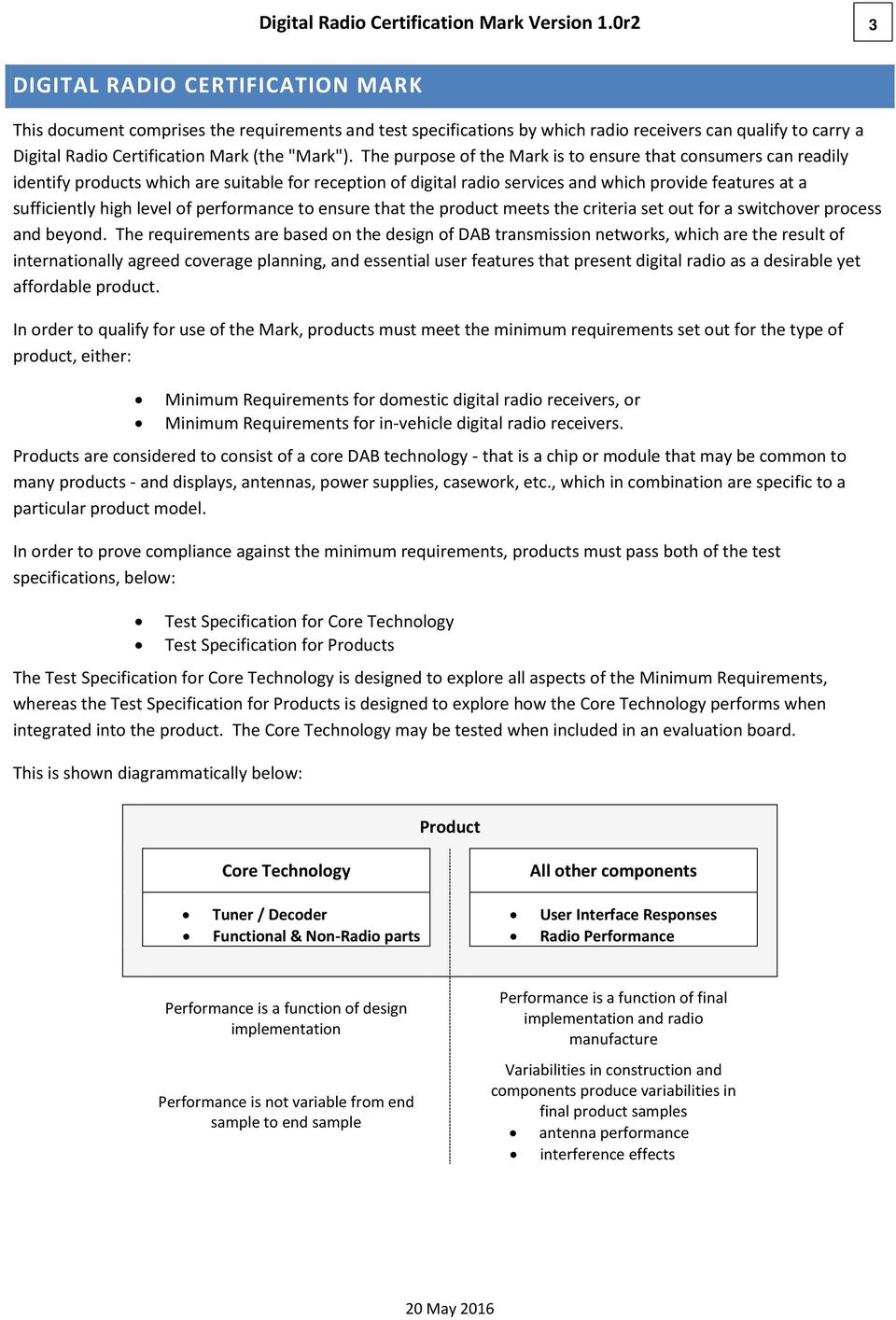
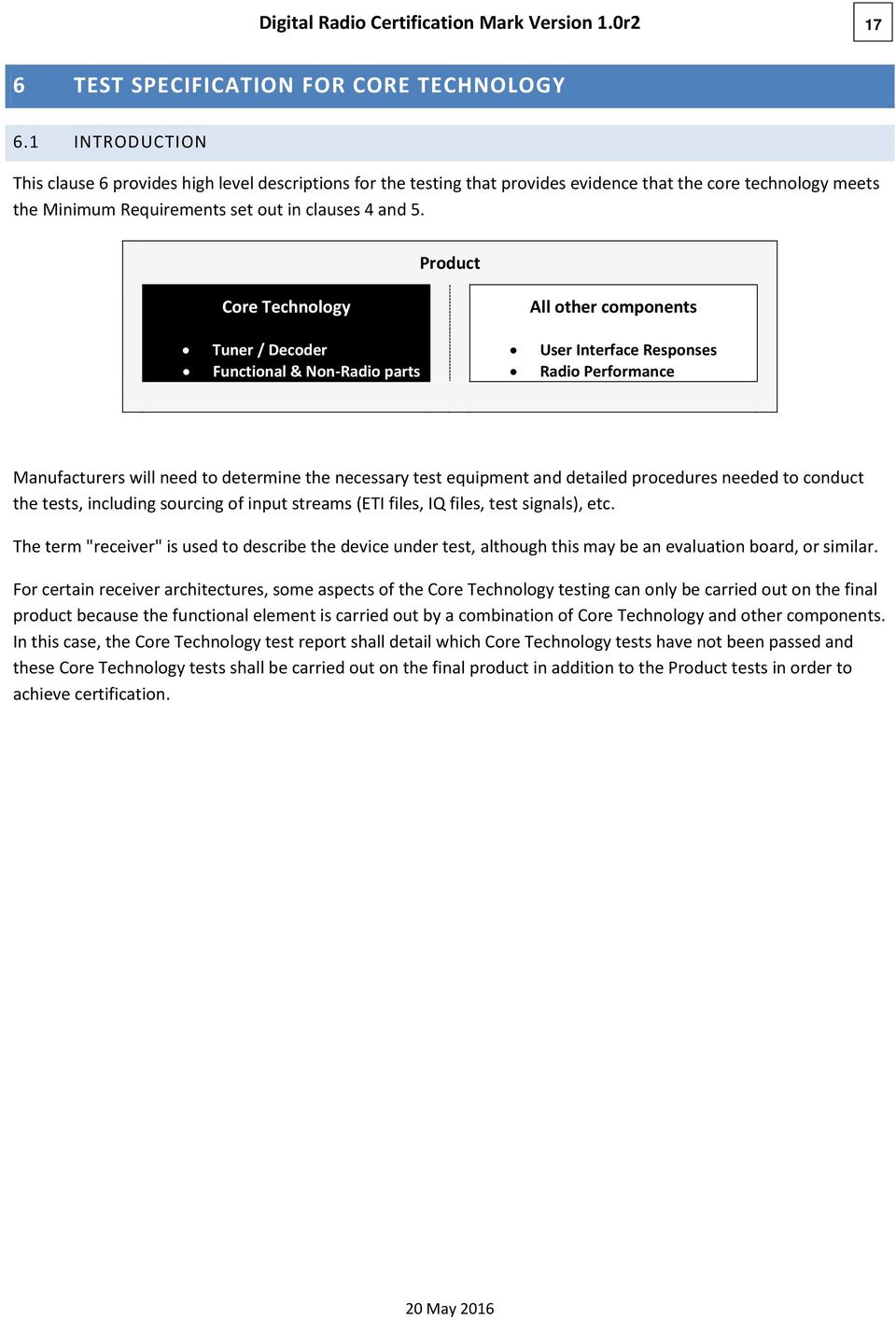
3 3 DIGITAL RADIO CERTIFICATION MARK This document comprises the requirements and test specifications by which radio receivers can qualify to carry a Digital Radio Certification Mark (the "Mark"). The purpose of the Mark is to ensure that consumers can readily identify products which are suitable for reception of digital radio services and which provide features at a sufficiently high level of performance to ensure that the product meets the criteria set out for a switchover process and beyond. The requirements are based on the design of DAB transmission networks, which are the result of internationally agreed coverage planning, and essential user features that present digital radio as a desirable yet affordable product. In order to qualify for use of the Mark, products must meet the minimum requirements set out for the type of product, either: Minimum Requirements for domestic digital radio receivers, or Minimum Requirements for in-vehicle digital radio receivers. Products are considered to consist of a core DAB technology - that is a chip or module that may be common to many products - and displays, antennas, power supplies, casework, etc., which in combination are specific to a particular product model. In order to prove compliance against the minimum requirements, products must pass both of the test specifications, below: Test Specification for Core Technology Test Specification for Products The Test Specification for Core Technology is designed to explore all aspects of the Minimum Requirements, whereas the Test Specification for Products is designed to explore how the Core Technology performs when integrated into the product. The Core Technology may be tested when included in an evaluation board. This is shown diagrammatically below: Product Core Technology All other components Tuner / Decoder Functional & Non-Radio parts User Interface Responses Radio Performance Performance is a function of design implementation Performance is not variable from end sample to end sample Performance is a function of final implementation and radio manufacture Variabilities in construction and components produce variabilities in final product samples antenna performance interference effects
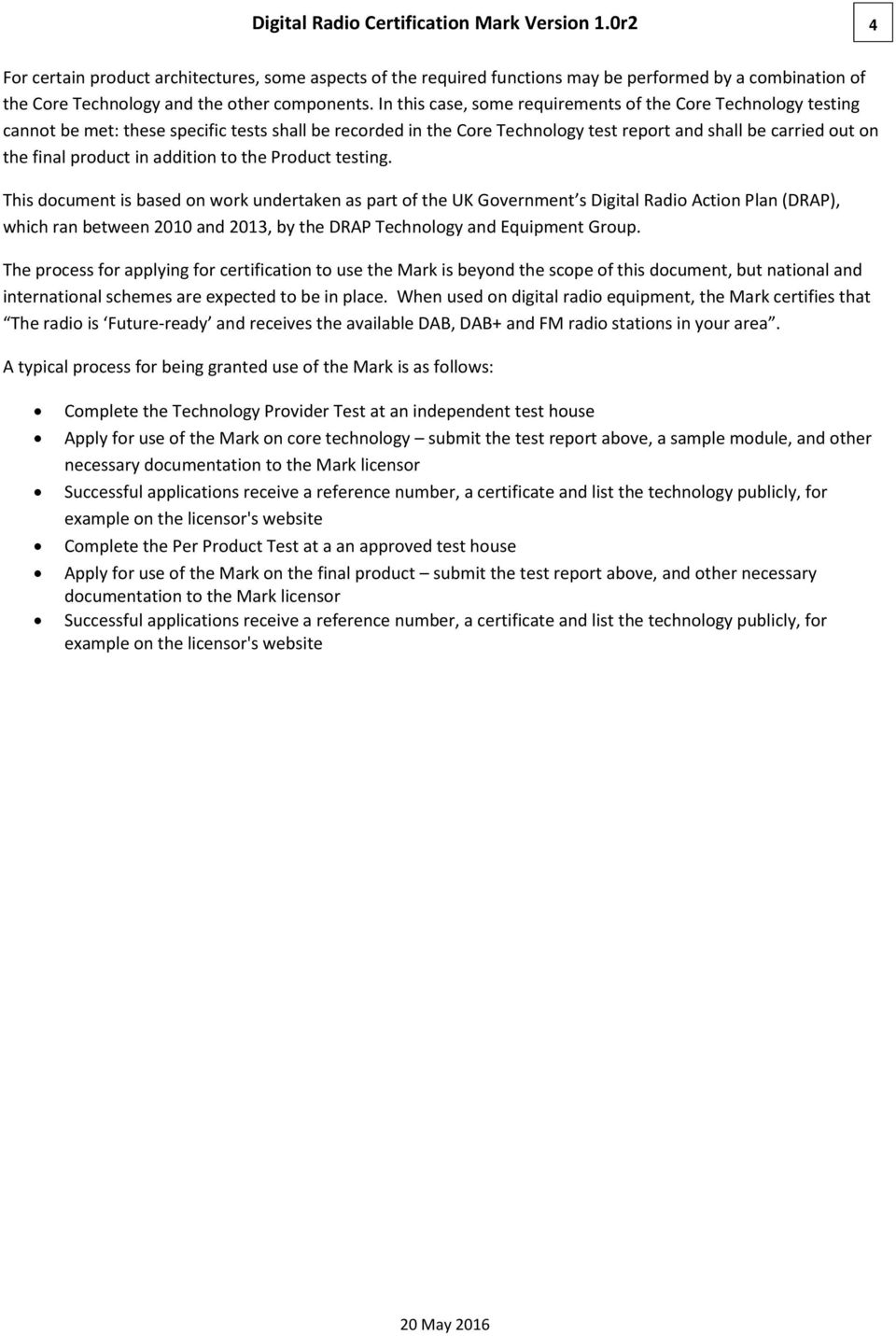
4 4 For certain product architectures, some aspects of the required functions may be performed by a combination of the Core Technology and the other components. In this case, some requirements of the Core Technology testing cannot be met: these specific tests shall be recorded in the Core Technology test report and shall be carried out on the final product in addition to the Product testing. This document is based on work undertaken as part of the UK Government s Digital Radio Action Plan (DRAP), which ran between 2010 and 2013, by the DRAP Technology and Equipment Group. The process for applying for certification to use the Mark is beyond the scope of this document, but national and international schemes are expected to be in place. When used on digital radio equipment, the Mark certifies that The radio is Future-ready and receives the available DAB, DAB+ and FM radio stations in your area. A typical process for being granted use of the Mark is as follows: Complete the Technology Provider Test at an independent test house Apply for use of the Mark on core technology submit the test report above, a sample module, and other necessary documentation to the Mark licensor Successful applications receive a reference number, a certificate and list the technology publicly, for example on the licensor's website Complete the Per Product Test at a an approved test house Apply for use of the Mark on the final product submit the test report above, and other necessary documentation to the Mark licensor Successful applications receive a reference number, a certificate and list the technology publicly, for example on the licensor's website
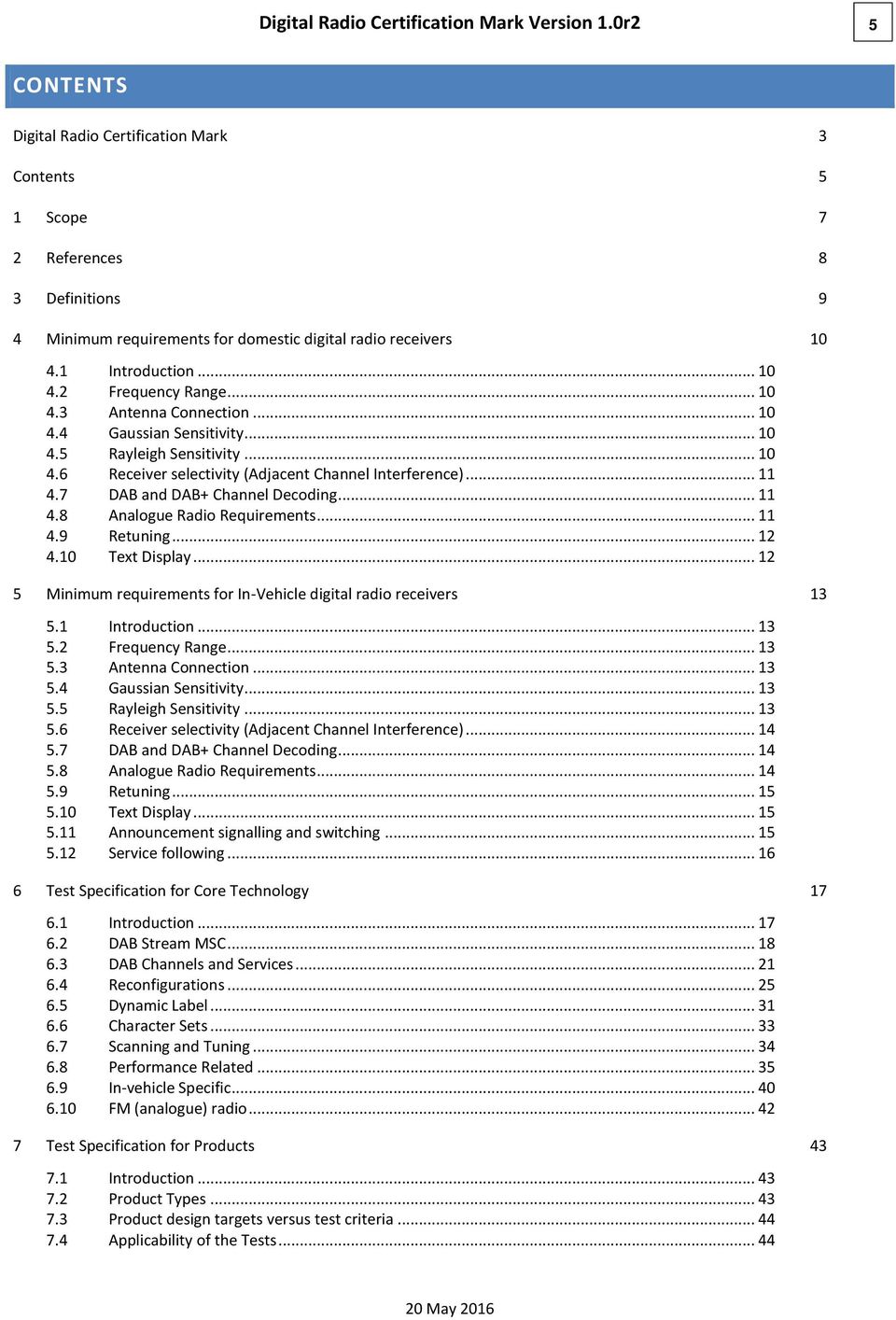
5 5 CONTENTS Digital Radio Certification Mark 3 Contents 5 1 Scope 7 2 References 8 3 Definitions 9 4 Minimum requirements for domestic digital radio receivers Introduction Frequency Range Antenna Connection Gaussian Sensitivity Rayleigh Sensitivity Receiver selectivity (Adjacent Channel Interference) DAB and DAB+ Channel Decoding Analogue Radio Requirements Retuning Text Display Minimum requirements for In-Vehicle digital radio receivers Introduction Frequency Range Antenna Connection Gaussian Sensitivity Rayleigh Sensitivity Receiver selectivity (Adjacent Channel Interference) DAB and DAB+ Channel Decoding Analogue Radio Requirements Retuning Text Display Announcement signalling and switching Service following Test Specification for Core Technology Introduction DAB Stream MSC DAB Channels and Services Reconfigurations Dynamic Label Character Sets Scanning and Tuning Performance Related In-vehicle Specific FM (analogue) radio Test Specification for Products Introduction Product Types Product design targets versus test criteria Applicability of the Tests... 44
6 6 A TEST STREAMS (Normative) 45 A.1 PRODUCT-TESTSTREAM-001_V1.0r2.eti A.2 PRODUCT-TESTSTREAM-002_V1.0.eti B Product test for the user interface responses (Normative) 47 B.1 Introduction B.2 User Interface Tests B.3 Test Streams B.4 Test equipment needed B.5 Test 1 Scan add new services B.6 Test 2 Play audio and view label for audio service B.7 Test 3 Dynamic label is displayed and displayed correctly B.8 Test 4 Scan and add another ensemble C Product test for radio performance (Normative) 54 C.1 Introduction C.2 Radio performance Tests C.3 Standard test conditions C.3.1 Environmental C.3.2 Equipment and Test Conditions Required at all Test Facilities C.3.3 The OOI Onset Of Impairment Test C.4 RF Test Frequencies, Pass / Fail Limits C.4.1 Establishment of the conducted test threshold value C.4.2 Establishment of the radiated test threshold value C.5 Method for Conducted Sensitivity Go/ No Go Test C.5.1 Method of Conducted Signal Measurement Using Acoustic OOI C Initial conditions- Measurement Uncertainty Calculation C Empirical Method 1 khz tone, DAB+, EEP-3A C Empirical Method Music stream, MP2, UEP C.6 Conducted Test Result Template C.7 Conducted Measurement Uncertainty Calculation (Example) C.8 Method for Radiated Sensitivity Go / No Go Test C.8.1 FAR/SAR Test Setup C.8.2 GTEM Test Setup C.8.3 Method of Radiated Signal Measurement Using Acoustic OOI C Initial Conditions - Measurement Uncertainty Calculation C Empirical Method 1 khz tone, DAB+, EEP-3A C Empirical Method Music stream, MP2, UEP C.9 Radiated Test Result Template C.10 Radiated Measurement Uncertainty Calculation (Example) D Technical requirement for the radio test facility (Normative) 72 D.1 Introduction D.2 Standard E Changes since last published version (Informative) 74
7 7 1 SCOPE This document describes the minimum requirements for digital radios, both domestic and in-vehicle, and the necessary test methods to achieve a Digital Radio Certification Mark. A Digital Radio Certification Mark is designed to be used on product packaging and provides an easily recognised mark to correspond to public information campaigns on the necessary requirements for consumers to make a switch to digital radio. Manufacturers are, of course, free to include additional features or increased performance compared to the minimum requirements specified in this document.

8 8 2 REFERENCES ETSI EN Radio Broadcasting Systems; Digital Audio Broadcasting (DAB) to Mobile, Portable and Fixed receivers ETSI TS Digital Audio Broadcasting (DAB); Registered Tables ETSI TS Digital Audio Broadcasting (DAB); Transport of Advanced Audio Coding (AAC) audio ETSI TS Digital Audio Broadcasting (DAB); Rules of implementation; Service information features ETSI EN Radio broadcasting systems; Very High Frequency (VHF), frequency modulated, sound broadcasting transmitters IEC 62104:2015 Characteristics of DAB Receivers IEC Test and Measurement Techniques Radiated, radio frequency, electromagnetic field immunity test CISPR Methods of Measurement ANSI C , p18-46 Methods of Measurement of Radio Noise Emissions from L.V. Electrical And Electronic Equipment in the range 9kHz to 40GHz. ETSI standards are available, free of charge, from

9 9 3 DEFINITIONS For the purposes of this document the following definitions are valid: Receiver Adapter DAB service DAB+ service Adequate audio reception any device designed to receive digital radio signals a product that provides a DAB and DAB+ capability to another device a service where the primary component is an MSC audio stream containing MPEG II audio a service where the primary component is an MSC audio stream containing HE-AAC audio the reception of a 128 kbit/s DAB service which has been transmitted with error protection level EEP-3A when the receiver has reconstructed a data stream at the output of the Viterbi decoder with an error rate equal to or better than 10-4

10 10 4 MINIMUM REQUIREMENTS FOR DOMESTIC DIGITAL RADIO RECEIVERS 4.1 INTRODUCTION The minimum requirements for domestic digital radio receivers are set out in this clause 4. In-vehicle digital radio receivers are the subject of clause 5. Domestic products comprise many types of receiver, including portable and larger devices, and receivers incorporated in equipment such as mobile phones and computers. This includes adapters, whose main function is to add a digital radio capability to another device. Domestic products may be mains or battery powered, or both. They may have a telescopic antenna, a flexible wire antenna, a headphone antenna, an antenna integrated into the receiver, or they may be supplied without an antenna. Products may include additional features beyond the minimum requirement, including reception of digital radio services via other delivery platforms, such as the internet or digital television, or capabilities beyond the minimum requirement. 4.2 FREQUENCY RANGE Products shall be capable of receiving DAB and DAB+ digital radio broadcasts in the frequency range 174 to 240 MHz. The required centre frequencies of the transmitted signals are specified in IEC 62104: ANTENNA CONNECTION An antenna connection is not required. Products sold with an antenna connection shall have an antenna input impedance of 75 Ohms. 4.4 GAUSSIAN SENSITIVITY Products sold with a packaged antenna shall provide adequate audio reception of a DAB signal with Gaussian transmission channel characteristics with field strengths at or above the frequency dependent threshold shown in the following formula: FSG min = [ log(F/220) ] dbµv/m, where F is the frequency in MHz. Products sold without an antenna shall provide adequate audio reception with an input power level of dbm when fed by a DAB signal with Gaussian transmission channel characteristics. NOTE: It is assumed that the external antenna has a gain of -8.1 dbi or greater thus producing this power level at the required minimum field strength. The performance of the antenna and the quality of the connectors and cabling will determine the actual sensitivity experienced by the user. 4.5 RAYLEIGH SENSITIVITY Products sold with a packaged antenna shall provide adequate audio reception of a DAB signal with Rayleigh transmission channel characteristics with field strengths at or above the frequency dependent threshold shown in the following formula: FSR min = [ log(F/220) ] dbµv/m, where F is the frequency in MHz

11 11 Products sold without an antenna shall provide adequate audio reception with an input power level of dbm when fed by a DAB signal with Rayleigh transmission channel characteristics. The Rayleigh fading channel characteristics are as specified in IEC 62104:2015. NOTE: It is assumed that the external antenna has a gain of -8.1 dbi or greater thus producing this power level at the required minimum field strength. The performance of the antenna and the quality of the connectors and cabling will determine the actual sensitivity experienced by the user. 4.6 RECEIVER SELECTIVITY (ADJACENT CHANNEL INTERFERENCE) Products shall provide adequate audio reception in the presence of interfering DAB signals at specified levels on other frequencies. The wanted signal shall be a DAB signal at a level of -70 dbm containing a DAB audio sub-channel with error protection level UEP-3. The interfering signal shall be a DAB signal with a frequency offset and amplitude as described in the following table. Products shall achieve the required selectivity for an interfering signal in all adjacent channels. Interfering DAB Frequency block, relative to wanted signal Level of interfering signal, relative to wanted signal N±1 +35 db N±2 +40 db N±3 and to extent of band +45 db The figure for first adjacent channel interference (N±1) is only applicable where the spacing between centre frequencies is MHz or greater (the majority of DAB frequency blocks); it does not apply where the spacing between centre frequencies is less than MHz. 4.7 DAB AND DAB+ CHANNEL DECODING Products shall be able to decode one audio sub-channel (or more). Products shall be able to decode a DAB audio service contained in a sub-channel of a size up to and including 280 Capacity Units (e.g. 256 kbps@uep-1). Products shall be able to decode a DAB+ audio service contained in a sub-channel of a size up to and including 144 Capacity Units (e.g. 96 kbps@eep-1a). 4.8 ANALOGUE RADIO REQUIREMENTS Products with a primary purpose of permitting an analogue radio receiver to decode and play out digital radio services are not required to receive any analogue radio services. All other products shall be able to receive FM analogue radio broadcasts, as described in ETSI EN , in the frequency range 87.5 to MHz.
12 RETUNING Products which store a list of services/service components shall provide a user function to scan the whole of the tuning range to update the stored list when required. This feature shall be initiated by the press of a single button on the device, or, if it is a feature in a menu structure, it shall be in the top level of the menu, or one level down. The scan feature shall be able to cope with the following changes: 1. Service moves to a different ensemble; 2. New ensemble appears; 3. Ensemble changes frequency; 4. New service or service component appears; 5. Service or service component changes label; 6. Service or service component disappears; 7. Multiple instances of the same service (i.e. same SId) on different ensembles, or on the same ensemble but at different frequencies, and with varying signal levels. DAB ensembles change their configuration from time to time. It is recommended that products update their stored service list by constantly checking the FIC of the ensemble to which they are currently tuned TEXT DISPLAY Products shall have a means of displaying text to the user. The text display shall display the name of the audio components available for selection. Products shall display the complete label whenever possible. The label shall only be reduced in length by applying the character selection provided in the flag field of the label. It is not permissible for the product to reduce the length of the label in any other manner. Products shall display the service label when a primary audio component is selected. Products shall display the service component label when a secondary audio component is selected. Products shall decode the dynamic label from the X-PAD (short X-PAD, variable length X-PAD, whether the dynamic label is the only PAD application or if it is one of a number of PAD applications) of the currently selected service and display it to the user legibly. Products shall treat the special characters 0x0A, 0x0B, and 0x1F as specified in EN and apply such formatting as is possible on the display. Products shall act upon the command to remove the label from the display by immediately removing the label, even if it has only been partially displayed. It is accepted that different displays will have different text rendering capabilities. Receivers shall have a display capable of rendering all the characters from the Complete EBU Latin based repertoire character set, as defined in ETSI TS Annex C, correctly mapped, visually well-formed and clear.
13 13 5 MINIMUM REQUIREMENTS FOR IN-VEHICLE DIGITAL RADIO RECEIVERS 5.1 INTRODUCTION The minimum requirements for in-vehicle digital radio receivers are set out in this clause 5. Domestic digital radio receivers are the subject of clause 4. In-vehicle products are those products designed specifically for use within a vehicle. In-vehicle products comprise many types of receiver, including those integrated into the dashboard, and aftermarket products mounted in the dashboard, behind the dashboard, to the vehicle windscreen or elsewhere. Aftermarket products designed to be self-installed by the consumer should ensure that proper consideration is given to ensuring that power adapters, etc, do not cause interference in the FM and DAB broadcast bands. In-vehicle products may supplied with or without an antenna. Products may include additional features beyond the minimum requirement, or capabilities beyond the minimum requirement. 5.2 FREQUENCY RANGE Products shall be capable of receiving DAB and DAB+ digital radio broadcasts in the frequency range 174 to 240 MHz. The required centre frequencies of the transmitted signals are specified in IEC 62104: ANTENNA CONNECTION An antenna connection with an input impedance of 50 Ohms is required. 5.4 GAUSSIAN SENSITIVITY Products shall provide adequate audio reception with an input power level of dbm when fed by a DAB signal with Gaussian transmission channel characteristics. Products sold with a packaged antenna shall provide adequate audio reception of a DAB signal with Gaussian transmission channel characteristics with field strengths at or above the frequency dependent threshold shown in the following formula: FSG min = [ log(F/220) ] dbµv/m, where F is the frequency in MHz. NOTE: The performance of the antenna and the quality of the connectors and cabling will determine the actual sensitivity experienced by the user. Assuming glass mount antennas are properly fitted in the vehicle, the experienced sensitivity will still depend on several factors, like the type of vehicle, direction of driving, interaction with the body and other components present, etc. 5.5 RAYLEIGH SENSITIVITY Receivers shall provide adequate audio reception with an input power level of dbm when fed by a DAB signal with Rayleigh transmission channel characteristics.

14 14 Products sold with a packaged antenna shall provide adequate audio reception of a DAB signal with Rayleigh transmission channel characteristics with field strengths at or above the frequency dependent threshold shown in the following formula: FSR min = [ log(F/220) ] dbµv/m, where F is the frequency in MHz The Rayleigh fading channel characteristics are as specified in IEC 62104:2015. NOTE: The performance of the antenna and the quality of the connectors and cabling will determine the actual sensitivity experienced by the user. Assuming glass mount antennas are properly fitted in the vehicle, the experienced sensitivity will still depend on several factors, like the type of vehicle, direction of driving, interaction with the body and other components present, etc. 5.6 RECEIVER SELECTIVITY (ADJACENT CHANNEL INTERFERENCE) Products shall provide adequate audio reception in the presence of interfering DAB signals at specified levels on other frequencies. The wanted signal shall be a DAB signal at a level of -70 dbm containing a DAB audio sub-channel with error protection level UEP-3. The interfering signal shall be a DAB signal with a frequency offset and amplitude as described in the following table. Products shall achieve the required selectivity for an interfering signal in all adjacent channels. Interfering DAB Frequency block, relative to wanted signal Level of interfering signal, relative to wanted signal N±1 +35 db N±2 +40 db N±3 and to extent of band +45 db The figure for first adjacent channel interference (N±1) is only applicable where the spacing between centre frequencies is MHz or greater (the majority of DAB frequency blocks); it does not apply where the spacing between centre frequencies is less than MHz. 5.7 DAB AND DAB+ CHANNEL DECODING Products shall be able to decode one audio sub-channel (or more). Products shall be able to decode a DAB audio service contained in a sub-channel of a size up to and including 280 Capacity Units (e.g. 256 kbps@uep-1). Products shall be able to decode a DAB+ audio service contained in a sub-channel of a size up to and including 144 Capacity Units (e.g. 96 kbps@eep-1a). 5.8 ANALOGUE RADIO REQUIREMENTS Products with a primary purpose of permitting an analogue radio receiver to decode and play out digital radio services are not required to receive any analogue radio services.
![7 + 20log(F/220) ] dbµv/m, where F is the frequency in MHz The Rayleigh fading channel characteristics are as specified in IEC 62104:2015.](/docs-images/44/20857558/images/page_14.jpg "NOTE: The performance of the antenna and the quality of the connectors and cabling will determine the actual sensitivity experienced by the user.")
15 15 All other products shall be able to receive FM analogue radio broadcasts, as described in ETSI EN , in the frequency range 87.5 to MHz. 5.9 RETUNING Products which store a list of services/service components shall provide a user function to scan the whole of the tuning range to update the stored list when required. This feature shall be initiated by the press of a single button on the device, or, if it is a feature in a menu structure, it shall be in the top level of the menu, or one level down. The scan feature shall be able to cope with the following changes: 1. Service moves to a different ensemble; 2. New ensemble appears; 3. Ensemble changes frequency; 4. New service or service component appears; 5. Service or service component changes label; 6. Service or service component disappears; 7. Multiple instances of the same service (i.e. same SId) on different ensembles, or on the same ensemble but at different frequencies, and with varying signal levels. DAB ensembles change their configuration from time to time. It is recommended that products update their stored service list by constantly checking the FIC of the ensemble to which they are currently tuned. NOTE: A WorldDMB task force is currently defining rules for the proper management of service lists. Additional requirements are likely to appear when this work is complete TEXT DISPLAY Products shall have a means of displaying text to the user. The text display shall display the name of the audio components available for selection. Products shall display the complete label whenever possible. The label shall only be reduced in length by applying the character selection provided in the flag field of the label. It is not permissible for the product to reduce the length of the label in any other manner. Products shall display the service label when a primary audio component is selected. Products shall display the service component label when a secondary audio component is selected. It is accepted that different displays will have different text rendering capabilities. Receivers shall have a display capable of rendering all the characters from the Complete EBU Latin based repertoire character set, as defined in ETSI TS Annex C, correctly mapped, visually well-formed and clear. NOTE: In-vehicle receivers are not required to implement dynamic label ANNOUNCEMENT SIGNALLING AND SWITCHING Products shall support announcement switching as defined in ETSI clause (i.e. same ensemble only). This feature instructs the receiver to select an alternative audio source only for the duration of an audio announcement, before returning to the original source. Manufacturers may provide the user with an option to disable this feature.
16 16 Products shall switch from the selected service component (even if the user is listening to the CD, AUX, etc.) to a traffic announcement if all the following conditions are met: The announcement feature is enabled; The selected service is signalled as supporting announcements by means of FIG 0/18 with ASu flag bit 1 set to indicate Road Traffic Flash and is provided with a Cluster Id; In the same ensemble, an announcement is signalled by means of FIG 0/19 with ASw flag bit 1 set to indicate Road Traffic Flash and with the same Cluster Id as the selected service; Manufacturers may provide Other Ensembles and/or FM announcement switching, but this is not required. If provided, it shall conform to all the requirements for announcement support: i.e. no interruption shall be made to any service that does not provide announcement support. If the selected service has correct ASu signalling and the product provides support for FM-RDS traffic announcements, then it shall not switch from DAB/DAB+ to FM for a traffic announcement of a hard-linked service (explicit or implicit) since these services carry the same audio which may not be co-timed SERVICE FOLLOWING Products shall support all aspects of service following, including soft linking and hard linking, as specified in ETSI TS v1.2.1 Digital Audio Broadcasting (DAB); Rules of implementation; Service information features. Products required to support service following shall also decode the relevant parts of the RDS data (as defined by IEC EN 62106:2015) transmitted as part of an FM broadcast signal to achieve DAB to FM linking. Service following algorithms shall be designed so as to provide the best possible user experience. If no alternative signal is available, undisturbed reception shall be maintained at the minimum sensitivity level.

17 17 6 TEST SPECIFICATION FOR CORE TECHNOLOGY 6.1 INTRODUCTION This clause 6 provides high level descriptions for the testing that provides evidence that the core technology meets the Minimum Requirements set out in clauses 4 and 5. Product Core Technology All other components Tuner / Decoder Functional & Non-Radio parts User Interface Responses Radio Performance Manufacturers will need to determine the necessary test equipment and detailed procedures needed to conduct the tests, including sourcing of input streams (ETI files, IQ files, test signals), etc. The term "receiver" is used to describe the device under test, although this may be an evaluation board, or similar. For certain receiver architectures, some aspects of the Core Technology testing can only be carried out on the final product because the functional element is carried out by a combination of Core Technology and other components. In this case, the Core Technology test report shall detail which Core Technology tests have not been passed and these Core Technology tests shall be carried out on the final product in addition to the Product tests in order to achieve certification.
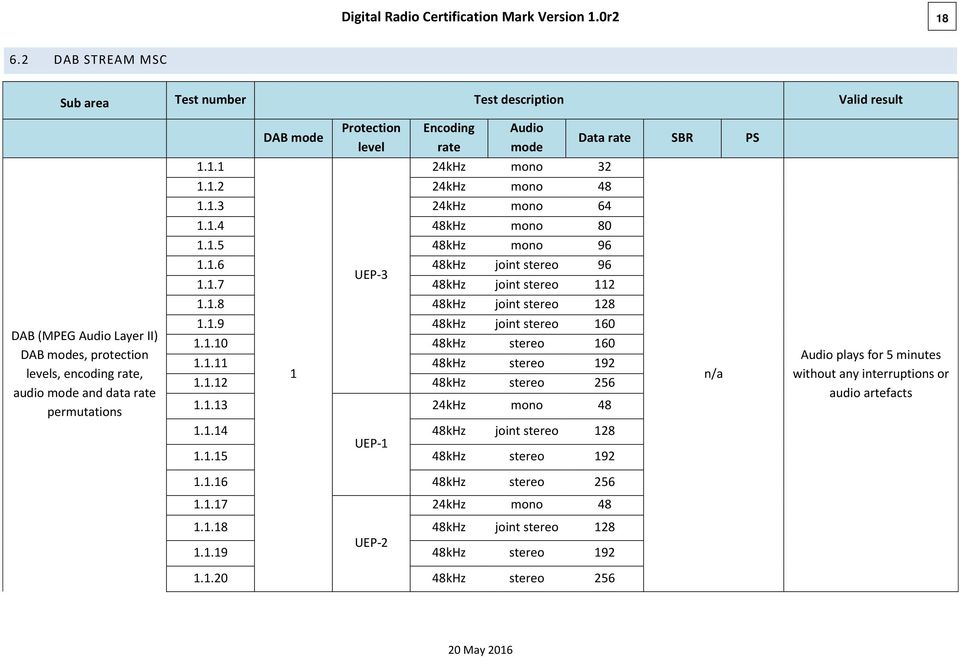
18 DAB STREAM MSC Sub area Test number Test description Valid result DAB (MPEG Audio Layer II) DAB modes, protection levels, encoding rate, audio mode and data rate permutations DAB mode Protection level Encoding rate Audio mode 24kHz mono kHz mono kHz mono kHz mono kHz mono kHz joint stereo 96 UEP kHz joint stereo kHz joint stereo kHz joint stereo kHz stereo kHz stereo kHz stereo kHz mono kHz joint stereo 128 UEP kHz stereo kHz stereo kHz mono kHz joint stereo UEP-2 48kHz stereo kHz stereo 256 Data rate SBR PS n/a Audio plays for 5 minutes without any interruptions or audio artefacts
19 19 Sub area Test number Test description Valid result DAB mode Protection level Encoding rate Audio mode Data rate SBR PS kHz mono UEP-4 48kHz joint stereo kHz stereo kHz mono 48 DAB+ (HE-AACv2) DAB modes, protection levels, encoding rate, audio modes, data rate and additional AAC encoding permutations UEP-5 48kHz joint stereo kHz stereo kHz Mono 16 SBR kHz Mono 32 SBR kHz Mono 40 SBR kHz Mono 48 SBR kHz Stereo 32 SBR PS kHz Stereo 40 SBR kHz Stereo 48 SBR kHz Mono 32 SBR EEP- 3A 48kHz Mono 40 SBR kHz Mono 48 SBR kHz Mono 56 SBR kHz Stereo 32 SBR kHz Stereo 40 SBR kHz Stereo 48 SBR kHz Stereo 32 SBR PS kHz Stereo 40 SBR PS kHz Stereo 48 SBR PS Audio plays for 5 minutes without any interruptions or audio artefacts

20 20 Sub area Test number Test description Valid result DAB mode Protection level Encoding rate Audio mode Data rate SBR PS kHz Stereo 56 SBR kHz Stereo 64 SBR kHz Stereo 72 SBR kHz Stereo 80 SBR kHz Stereo 88 SBR kHz Stereo 96 SBR kHz Stereo kHz Stereo kHz Stereo kHz Stereo kHz Stereo kHz Stereo kHz Stereo kHz Stereo kHz Stereo kHz Stereo 32 SBR PS EEP- 1A 48kHz Stereo 64 SBR kHz Stereo kHz Stereo 32 SBR PS EEP- 2A 48kHz Stereo kHz Stereo kHz Stereo 32 SBR PS EEP- 4A 48kHz Stereo kHz Stereo 192

21 21 Sub area Test number Test description Valid result DAB mode Protection level Encoding rate Audio mode EEP- 1B 48kHz Stereo 96 Data rate SBR PS 48kHz Stereo 32 SBR PS kHz Stereo kHz Stereo 32 SBR PS EEP- 2B 48kHz Stereo kHz Stereo kHz Stereo 32 SBR PS EEP- 3B 48kHz Stereo kHz Stereo kHz Stereo 32 SBR PS EEP- 4B 48kHz Stereo kHz Stereo DAB CHANNELS AND SERVICES Sub area Test number Multiple sub-channels Multiple components Test description Ensure that the receiver can tune to an ensemble with 32 primary audio components (all pointing to different sub-channels), list all components and that all components play out audio Ensure that the receiver can tune to an ensemble with 50 mixed audio DAB and DAB+ and data components, list all components that the receiver handles and that all handled components are handled correctly Valid result All 32 components are available to the user and all components play out audio The receiver should display and handle all supported components. Any unsupported components should be hidden from the user - e.g. if data is not supported
22 22 Sub area Test number Test description Valid result Ensure that the receiver can tune to an ensemble with DAB primary component with a DAB secondary component The receiver should display and handle all supported components Any unsupported components should be hidden from the user - e.g. if data is not supported Ensure that the receiver can tune to an ensemble with DAB primary component with a DAB+ secondary component The receiver should display and handle all supported components. Secondary audio components Any unsupported components should be hidden from the user - e.g. if data is not supported Ensure that the receiver can tune to an ensemble with DAB+ primary component with a DAB+ secondary component The receiver should display and handle all supported components Any unsupported components should be hidden from the user - e.g. if data is not supported Ensure that the receiver can tune to an ensemble with DAB primary audio component with 10 data secondary component The receiver should display and handle all supported components Secondary data components Ensure that the receiver can tune to an ensemble with DAB primary component with a data secondary component Any unsupported components should be hidden from the user - e.g. if data is not supported The receiver should display and handle all supported components Any unsupported components should be hidden from the user - e.g. if data is not supported
23 23 Sub area Test number Reselection Test description Ensure that the receiver can tune to an ensemble with DAB+ primary component with a data secondary component When tuned to a primary component ensure that the receiver can recover and play out the same audio automatically after losing the signal temporarily (10 or more seconds) NOTE: no alternate service is available; i.e. no active links are signalled In a location where multiple instances of the same ensemble can be seen on difference channels ensure that when a service is initially selected the strongest (in RF terms) of the available channels is selected Valid result The receiver should display and handle all supported components. Any unsupported components should be hidden from the user - e.g. if data is not supported As the radio loses and regains the service some amount of noise might be heard depending upon the algorithm and PREFERENCE of the manufacturer. The radio will output audio within 3 seconds of the RF being available again. The strongest channel will be selected regardless of where the channel sits in terms of sequence of channels within the DAB band(s) MFN support In a region where multiple instances of the same ensemble can be seen on different channels, and the broadcasters are supporting this with FIG 0/21 information, ensure that if the receiver is moved from a location where only 1 channel can be seen to another region where only a different channel can be seen then the radio will reselect the same service on the different channel without the user needing to select it The service will be tuneable in either location without user intervention (provided the radio has a 'last listened' function as standard on turning on) Duplicate handling In a location where multiple instances of the same service, (SId matching), can be seen on different channels ensure that one of the services is selected This could be implemented using FIG0/24 information from the broadcast or by having seen all linked services following a scan One of the versions of the services will be selected
24 24 Sub area Test number Test description Valid result When a receiver is moved from one location to another and another instance(s) of a duplicate service can subsequently be received then the radio must be capable of selecting the alternative duplicated service either automatically or via a new scan. The services can be accessed in either location post discovery Service information checking The receiver will display a 16 character component label when one is present The receiver will display a 16 character service label when no component label is present Component label displayed correctly in supported forms i.e. long and short form. Long form is the preferred version to display Service label displayed correctly in supported forms i.e. long and short form Long form is the preferred version to display The receiver will display static program type when present Program type displayed correctly
25 RECONFIGURATIONS Sub area Test number Test description Valid result Add a DAB secondary audio component when a DAB primary audio component is selected No interruption to service, new component can now be found within service list Adding a secondary component Add a DAB secondary audio component when an existing DAB secondary audio component is selected Add a secondary data component when a primary DAB audio component is selected No interruption to service, new component can now be found within service list No interruption to service, new component can now be found within service list if data services are supported Add a secondary DAB+ audio component when a primary DAB+ audio component is selected No interruption to service, new component can now be found within service list Add a secondary data component when a primary DAB+ audio component is selected No interruption to service, new component can now be found within service list if data services are supported Remove a secondary audio component when a primary audio component is selected No interruption to service Confirm that the radio has handled the removal of the secondary component Removing a secondary component Remove a secondary audio component when an alternative existing secondary audio component is selected No interruption to service Confirm that the radio has handled the removal of the secondary component Remove a secondary audio component when the component to be removed is selected If the related Primary component of the same service is an audio component then the receiver falls back to this component: if the primary component is a component then mute the receiver Confirm that the radio has handled the removal of the secondary component
26 26 Sub area Test number Test description Valid result Remove a secondary data component when a primary audio component is selected No interruption to service. Confirm that the radio has handled the removal of the secondary component Remove a secondary audio component when an alternative existing secondary DAB+ audio component is selected No interruption to service Confirm that the radio has handled the removal of the secondary component Remove a secondary DAB+ audio component whilst the component to be removed currently selected If the related Primary component of the same service is an audio component then the receiver falls back to this component: if the primary component is a data component then mute the receiver.. Confirm that the radio has handled the removal of the secondary component Remove an audio service that is currently selected and also has no secondary components NOTE: no alternate service is available; i.e. no active links are signalled Service is lost. Removing a service Remove an audio service with its primary component currently selected that does have secondary components NOTE: no alternate service is available; i.e. no active links are signalled Service with all components is lost. Confirm that the radio has handled the removal of the service and components
27 27 Sub area Test number Test description Valid result Remove an audio service with one of its secondary components currently selected NOTE: no alternate service is available; i.e. no active links are signalled Service with all components are lost. Confirm that the radio has handled the removal of the service and components Moving the start CU of the service selected to a position that is ahead of where it started but still overlaps the previous CU's used No interruption to service Moving CU locations Moving the start CU of the service selected to a position that is ahead of where it started and none of the new location overlaps the previous CUs used No interruption to service Moving the start CU of the service selected from using CU 0 to using the last CU No interruption to service Moving the start CU of the service selected from using the last CU to using CU 0 No interruption to service Full Rate DAB Component increases bit rate from 128kbps@UEP-3 to 192kbps@UEP-3 No interruption to service Full Rate DAB Component decreases bit rate from 192kbps@UEP-3 to 128kbps@UEP-3 No interruption to service Bit rate and audio encoding rate changes Half Rate DAB Component increases bit rate from 128kbps@UEP-3 to 160kbps@UEP-3 No interruption to service Half Rate DAB Component decreases bit rate from 160kbps@UEP-3 to 128kbps@UEP-3 No interruption to service kHz DAB+ Component increases bit rate from 128kbps@EEP-3A to 192kbps@EEP-3A Only a minor break (<1 second) of breakup
28 28 Sub area Test number Test description Valid result kHz DAB+ Component decreases bit rate from to Only a minor break (<1 second) of breakup Full Rate DAB Component increases protection level from 128kbps@UEP-4 to 128kbps@UEP-3 No interruption to service Protection level Half Rate DAB Component decreases protection level from 128kbps@UEP-3to 128kbps@UEP-4 No interruption to service kHz DAB+ Component increases protection level from 96kbps@EEP-4A to 96kbps@EEP-1A No interruption to service Change the service label when connected to the primary component If only the component label is visible then no change should be noticed. If the service label is also shown then this will be seen to change. In either case there will be no interruption to the audio service Change the service label when connected to the secondary component If only the component label is visible then no change should be noticed. If the service label is also shown then this will be seen to change. In either case there will be no interruption to the audio service Service/Component label changes Change the primary component label when connected to the primary component If the component label is visible then the change should be noticed. If the service label is also shown then this will not have changed. In either case there will be no interruption to the audio service Change the secondary component label when connected to the secondary component If the component label is visible then the change should be noticed. If the service label is also shown then this will not have changed. In either case there will be no interruption to the audio service
29 29 Sub area Test number Test description Valid result DAB Primary Component increases bit rate from to & loses DAB Secondary - DAB Primary selected No interruption to service. Confirm that the radio has handled the removal of the secondary component Combined changes DAB Primary Component increases bit rate from 128kbps@UEP-3 to 160kbps@UEP-3 & loses 32kbps@UEP-3 DAB Secondary - DAB Secondary selected The receiver falls back to the primary component of the service that the secondary component was associated with or mutes the receiver. Confirm that the radio has handled the removal of the secondary component DAB Primary Component decreases bit rate from 160kbps@UEP-3 to 128kbps@UEP-3 & adds in a 32kbps@UEP-3 DAB Secondary - DAB Primary selected No interruption to service. Record whether new secondary component has been added to the service list DAB+ Primary Component increases bit rate from 128kbps@EEP-3A to 160kbps@EEP-3A & loses 32kbps@EEP-3A secondary - Primary selected Only a minor break (<1 second) of breakup. Confirm that the radio has handled the removal of the secondary component DAB+ Primary Component changes sample rate from 32khz to 48khz Only a minor break (<1 second) of breakup Audio parameter changes DAB+ Primary Component changes audio mode from Mono to Mono with SBR DAB+ Primary Component changes audio mode from Mono with SBR to Stereo with SBR Only a minor break (<1 second) of breakup Only a minor break (<1 second) of breakup DAB Primary Component changes sample rate from 24kHz to 48kHz Only a minor break (<1 second) of breakup
30 30 Sub area Test number Test description Valid result DAB Primary Component changes audio mode from mono to Stereo No interruption to service DAB Primary Component changes audio mode from Stereo to joint Stereo No interruption to service.
31 DYNAMIC LABEL Sub area Transport methods Maximum length dynamic label Minimum length dynamic label Test number Special characters Test description Receiver will be able to receive and display dynamic label text carried within a service with full rate audio encoding using short xpad Receiver will be able to receive and display dynamic label text carried within a service with half rate audio encoding using short xpad Receiver will be able to receive and display dynamic label text carried within a service with full rate audio encoding using variable xpad Receiver will be able to receive and display dynamic label text carried within a service with half rate audio encoding using variable xpad Receiver will be able to receive and display a 128 single byte character long string of text carried within pad (Charset = EBU) Receiver will be able to receive and display which is only 1 character long carried within pad Receiver will be able to receive and handle an end of headline special character (0x0B) Valid result The dynamic label is displayed correctly, and the scroll rate if applicable enables the text to easily be read The dynamic label is displayed correctly, and the scroll rate if applicable enables the text to easily be read The single character is displayed correctly If supported by the display on the receiver the end of headline character will be handled correctly The special character will never be displayed
32 32 Sub area Test number Test description Valid result Receiver will be able to receive and handle a preferred word break special character (0x1F) The word break character needs to be placed in the dynamic label text string such that the character can be utilised by the display on the receiver where possible Receiver will be able to receive and handle a preferred line break special character (0x0A) If supported by the display on the receiver the preferred word break character will be handled correctly and the word will be broken in the correct location The special character will never be displayed regardless of whether the receiver needs to support it or not If supported by the display on the receiver the preferred word break character will be handled correctly and the line will be broken in the correct point in the text string The line break character needs to be placed in the dynamic label text string such that the character can be utilised by the display on the receiver where possible The special character will never be displayed regardless of whether the receiver needs to support it or not The dynamic label clear command The receiver will correctly handle a dynamic label clear command When a dynamic label clear command is received then the receiver will stop displaying the current dynamic label irrespective of the point at which it is scrolling
33 CHARACTER SETS Sub area Test number Test description Valid result Complete EBU Latin based repertoire (TS annex C) The receiver will support the display of all characters from the character set. The characters being transmitted may be within dynamic labels or ensemble/service/component labels All characters will be displayed correctly UCS-2 encoding of the Complete EBU Latin based repertoire (TS annex C) The receiver will support the display of all characters from the character set encoded as UCS-2. The characters being transmitted may be within dynamic labels or ensemble/service/component labels All characters will be displayed correctly UTF-8 encoding of the Complete EBU Latin based repertoire (TS annex C) The receiver will support the display of all characters from the character set encoded as utf-8. The characters being transmitted may be within dynamic labels or ensemble/service/component labels All characters will be displayed correctly
34 SCANNING AND TUNING Sub area Test number Scanning A new multiplex launches Multiplex changes frequency Manual tuning Service move to a new multiplex Test description Run a full band 3 scan (excluding the N channels) and ensure that all supported services available from all ensembles seen within the band are stored After running a scan in locally transmit another DAB signal on a channel not currently in use and then re-run test and ensure that the new ensemble has been added to the list Alter the channel used by the ensemble that was added within tests to yet another currently unused channel and then rerun test This test assumes that the ensemble is switched and not simulcast for a transition period Ensure that all 38 band 3 channels are available to choose from. Select one channel known to have an ensemble contained on it and select to manually. Scan and find 2 ensembles (on 2 different channels) Select a service on 'a' channel, reconfigure the ensemble on this channel to lose this service. Simultaneously reconfigure the 'other' ensemble on the 'other' channel to add the service (same service details apart from the containing ensemble) Valid result All supported services are available to the user and work correctly (i.e. play audio if an audio service) All supported services are available to the user and work correctly (i.e. play audio if an audio service) including those of the new ensemble All supported services are still available and only one iteration of the ensemble is listed. All supported services on the ensemble are available to the user and work correctly (i.e. play audio if an audio service). Manual tune to the 'other' channel, scan the whole band or select another service on the 'other' ensemble then the moved service is now available on the 'other' channel/ensemble
35 PERFORMANCE RELATED Sub area Conducted sensitivity Test number a b c d a b c d a b c d a b c d a b c d a b c d a Channel Test description Valid result Test method in accordance with IEC 62104:2015 clause 7.3 and 7.4 Meets the requirement in IEC 62104:2015 clause 7.4.4
36 36 Sub area Sensitivity using UEP-3 protection Test number b c d a b c d a b c d e f C Channel Test description Valid result Set up a stream with the following parameters: UEP-3 / music (royalty free) / stereo / 128kbit/s stream / -97.7dBm to be conducted on channel 11C, Using a listening test (or equivalent method) in a period of least 10 seconds the sound image should be substantially intact and recognisable. Fading testing b Test method in accordance with IEC 62104:2015 clause 7.8 Meets the requirement in IEC 62104:2015 clause for an Urban channel Meets the requirement in IEC 62104:2015 clause for a Rural channel
37 37 Sub area Test number Channel Test description Valid result Meets the requirement in IEC 62104:2015 clause for an SFN channel a b c d a b c d a b ACR c d a Test method in accordance with IEC 62104:2015 clause 7.7 Meets the requirement in IEC 62104:2015 clause b c d a b c d a b c
38 38 Sub area Test number d a b c d a b c d a b c d e f Channel Test description Valid result ALL 38 channels affected Test set up in accordance with IEC 62104:2015 clause 7.7, except that the interfering channel power level shall be set to the target for the 3rd adjacent channel. For each wanted channel, from 5A to 13F, the test shall be repeated with the interfering channel being each channel from 5A to 13F except the wanted channel and the 1st, 2nd and 3rd adjacent channels above and below the wanted channel. The BER 10 4 for all wanted channels with all interferers b wanted Ensure that in situations where there is a strong 1st adjacent channel present (upper and lower) that all ensembles can be seen during a scan Low power test - All ensembles are seen.
39 39 Sub area Test number Channel Test description Valid result wanted set at -90dBm adjacents both set at 30dB greater RF levels b wanted Ensure that in situations where there is a strong 1st adjacent channel present (upper and lower) that all ensembles can be seen during a scan High power test - wanted set at -50dBm adjacents both set at 30dB greater RF levels All ensembles are seen.
40 IN-VEHICLE SPECIFIC Sub area Test number Test description Valid result With an SFN set up correctly within the lab ensure that a radio can be switched between transmitters on the SFN without any interference to the radio No breakup in audio is ever heard SFN following Within the coverage area of an on-air SFN, drive the radio along a route that is known to provide large variations in signal strength from different transmitters and ensure that there is no breakup in audio as the radio follows the SFN No breakup in audio is ever heard An ensemble is set up on two different frequencies (MFN). The signal quality of each transmitter is varied in order to simulate a receiver travelling between coverage areas Two ensembles are set up on different frequencies (co-timed); each contains a DAB service with identical audio content but different SId. A hard link (FIG 0/6) connecting the two services is signalled on each ensemble. The Linkage Actuator flag is set to 1 (activated). Frequency information for each ensemble is signalled (FIG 0/21). OE Service information is signalled (FIG 0/24). The signal quality of each ensemble is varied in order to simulate a receiver travelling between coverage areas Set up as for except that the Linkage Actuator flag is set to 0 (de-activated) The radio will follow between the two transmitters according to the best signal quality without intervention from the user The radio will follow the hard link between the two ensembles according to the best signal quality without intervention from the user Service following DAB The radio will NOT alter the station that it is tuned to Set up as for In addition third service is available on both ensembles and a soft link (FIG 0/6) connecting all three services is signalled on each ensemble. The Linkage Actuator flag for the soft link is set to 1 (active) The radio will offer the soft link alternative when the signal quality of the tuned service becomes poor. The radio will not follow without user selection at the point of loss unless an overriding menu choice allows automatic selection of soft linked services
41 41 Sub area Test number Test description Valid result Linkage Set toggle check that brief deactivations do not lose the linkage database Set up as for Tune to one service then reactivate the hard link. Within 5 seconds depower the tuned ensemble The radio will follow the hard link without intervention from the user An ensemble is set up containing a DAB service with identical audio content to an FM-RDS service. The SId and PI codes are identical. The signal quality of the DAB ensemble and FM service are varied in order to simulate a receiver travelling between coverage areas The radio will follow between DAB and FM according to the signal quality without intervention from the user; preference will be given to the DAB service when both signals are of adequate quality. Service following FM (NOT required for adapters) An ensemble is set up containing a DAB service with identical audio content to an FM-RDS service. The SId and PI codes are different. A hard link (FIG 0/6) connecting the two services is signalled on the DAB ensemble. The Linkage Actuator flag is set to 1 (activated). Frequency information for the FM-RDS service is signalled (FIG 0/21). The signal quality of the DAB ensemble and FM service are varied in order to simulate a receiver travelling between coverage areas The radio will follow the hard link according to the signal quality without intervention from the user; preference will be given to the DAB service when both signals are of adequate quality Announcements An ensemble is set up containing a DAB service with different audio content to an FM-RDS service. The SId and PI codes are identical. A dead link (FIG 0/6) is signalled on the DAB ensemble. The signal quality of the DAB ensemble and FM service are varied in order to simulate a receiver travelling between coverage areas Ensure that the radio can respond to and play out an announcement indicated as traffic and using a supported cluster id where the radio is tuned to the correct service before the announcement is signalled Radio will not link to the FM station even though the SId and the PI are identical The announcement is played out fully and the radio returns to the previously tuned service when the announcement stops
42 42 Sub area Test number Test description Valid result Ensure that the radio can decline an announcement where the announcement type and cluster id are not supported/selected/set The radio plays out from the previously tuned service and remains uninterrupted by the announcement When not currently in DAB mode and the previously tuned DAB service had announcement support indicated with FIG 0/18 then the current audio mode (CD,USB etc.) shall respond to announcements as if tuned to the previously tuned service and the current audio will be interrupted The announcement is played out and the radio returns to the previous audio mode (CD, USB etc.) when the announcement stops Ensure that if announcement support is available on the DAB service (as indicated with FIG 0/18) then the Radio shall not respond to any FM announcements that are available. Announcements on FM services shall be ignored If announcement support is NOT available on the DAB service then the Radio shall not respond to any announcement that is made on an implicitly linked FM service (i.e. PI code = SId) Ensure that if the RF signal is lost for a short enough period of time for the announcement to still be present, the radio can recover and continue to play the announcement Announcements on the implicitly linked FM service shall be ignored The radio re-starts playing the announcement when the RF source is regained Ensure that if the RF signal is lost for a period of time longer than the announcement has left to run the radio can recover and continue to play the previously tuned service. The radio plays out from the previously tuned service when the RF source is regained 6.10 FM (ANALOGUE) RADIO Sub area Test number Test description Valid result FM (NOT required for adapters) Select 3 FM radio stations in the location where testing is taking place and tune to each and listen. Audio plays for 5 minutes on each service without any interruptions or audio artefacts
43 43 7 TEST SPECIFICATION FOR PRODUCTS 7.1 INTRODUCTION This clause 7 provides high level descriptions for the testing that provides evidence that the product meets the Minimum Requirements set out in clauses 4 and 5. Product Core Technology All other components Tuner / Decoder Functional & Non-Radio parts User Interface Responses Radio Performance Manufacturers will need to determine the necessary test equipment and detailed procedures needed to conduct the tests, including sourcing of input streams (ETI files, IQ files, test signals), etc. 7.2 PRODUCT TYPES The following types of DAB receiver are identified as forming the main groupings of products. Other types which come about in the future or otherwise not listed here will also be addressable by application of the test methods where appropriate. Product Type Transportable systems, Hi-fi and micro systems which may or may not include audio sources such as portable music players or CD players etc. Portable receivers, lounge or kitchen receivers Hand portable or pocket receivers Self-contained aftermarket vehicle receivers (i.e. in-vehicle accessories) Self-contained in-vehicle receivers for OEM and aftermarket fitments Capabilities and features Rigid whip antennas or free wire antennas Built-in user interface with input finger control and visual display Antenna input or fixed antenna Mains powered, mains/adapter powered through a DC input socket or battery powered, or any of these Loudspeaker(s) for audio output Optional headphone and line outputs Rigid whip antennas or free wire antennas Built-in user interface with input finger control and visual display Antenna input or fixed antenna Mains powered, mains/adapter powered through a DC input socket or battery powered, or any of these Loudspeaker(s) for audio output Optional headphone and line outputs Mains / adapter powered through a DC input socket or battery powered or both Integral antenna or via headphone input With headphones and with or without a loudspeaker output Vehicle powered in the range 8 32 VDC User interface integrated or part of the product package Antenna input or fixed antenna Loudspeaker, line-out or external loudspeaker connectors User interface integrated or part of the product package Antenna input Line-out and / or external loudspeaker connectors
44 PRODUCT DESIGN TARGETS VERSUS TEST CRITERIA Receiver products shall be designed to meet the minimum requirements described in clauses 4 and 5. Products shall be tested against limits provided in this clause 7, using calculated measurement margins. This philosophy ensures that products at the design limits achieve the correct performance criteria to be granted use of the Mark. 7.4 APPLICABILITY OF THE TESTS All types of receivers are required to pass the user interface responses tests described in annex B. The testing consists of four tests, the aims of which are: To ensure that the receiver can tune to, and identify an ensemble in Band-3, and play an audio service To ensure that the receiver can correctly add another ensemble in Band-3 to the service list To ensure that the user interface for scanning meets the Minimum Requirements To ensure that service labels are displayed correctly To ensure that dynamic labels are displayed correctly on domestic products (not required for in-vehicle products). Domestic receivers supplied without an antenna and in-vehicle receivers with an antenna connector are required to pass the conducted sensitivity tests, as described in annex C clause C.5. Domestic receivers supplied with an antenna either fixed or detachable and in-vehicle receivers with an antenna connector are required to pass the radiated sensitivity test with a signal induced at the antenna, as described in annex C clause C.8. A fully representative sample of the receiver such as the consumer would obtain from retail outlets shall be tested. The ETI files necessary to perform the tests are described in annex A. The tests require specialised test equipment and knowledge specific to radio product testing and shall be performed in an accredited test facility. The technical standards for the test facility are described in annex D.
45 45 A TEST STREAMS (NORMATIVE) A.1 PRODUCT-TESTSTREAM-001_V1.0R2.ETI This file contains a 120 minute long ETI (NI) test stream and contains the following services: LABEL: PRODUCTMUX1 EID: CCCC Service label SId Bit rate/codec Protection Audio Content Dynamic label (see note) Sine+ C k AAC EEP-3A 1kHz tone -3dB FS mono image AAC 128kbps 1kHz tone for sensitivity testing OOI Music C k MP2 UEP-3 Royalty free music* 0dB FS stereo image Product Test<EOH> This message includes ABCDEFGHIJKLM<PWB>NOPQRSTUVWXYZ and many<plb>short words to show all is well AABBCCDDEEFFGGHH C k MP2 UEP-3 1.5kHz tone MP2 128kbps 1.5kHz tone ##&&@@[[]](( )) C003 96k AAC EEP-3A 2kHz tone AAC 96kbps 2kHz tone C004 96k AAC EEP-3A 3kHz tone AAC 96kbps 3kHz tone **//== C005 96k AAC EEP-3A 4kHz tone AAC 96kbps 4kHz tone hhggffeeddccbbaa C006 64k AAC EEP-3A 5kHz tone AAC 64kbps 5kHz tone $$ %%<<>> C007 64k AAC EEP-3A 6kHz tone AAC 64kbps 6kHz tone " "«?»?'!'! C008 64k AAC EEP-3A 7kHz tone AAC 64kbps 7kHz tone..,,::;;??!! C009 64k AAC EEP-3A 8kHz tone AAC 64kbps 8kHz tone *The music file is AKMusic AK033- Good Time Grooves - Jazz n Funk, track 11 newyorkskyline NOTE: <PLB> indicates the "preferred line break" control code 0x0A; <EOH> indicates the "end of headline" control code 0x0B; <PWB> indicates the "preferred word break" control code 0x1F.
46 46 A.2 PRODUCT-TESTSTREAM-002_V1.0.ETI This file contains a two minute long ETI (NI) test stream and contains the following services: LABEL: PRODUCTMUX2 EID: DDDD Service label SId Bit rate/codec Protection Audio Content Dynamic label ĂĞIJKLMNĂĞIJKLMN D001 ĄĘĮŲĄĘĮŲOPQROPQR D002 ĀĒĪŪSTVĿĀĒĪŪSTVĿ D003 ÁÉÍÓÚÁÉÍÓÚĆĹŃĆĹŃ D004 ÀÈÌÒÙWXYÀÈÌÒÙWXY D005 ÂÊÎÔÛZÆŒÂÊÎÔÛZÆŒ D006 ÄËÏÖÜŸŊØÄËÏÖÜŸŊØ D007 ÃÕÑŔŚÝŹUÃÕÑŔŚÝŹU D008 ÅŮÇĢĶĻŅŞÅŮÇĢĶĻŅŞ D009 ĚČĎŇŘŠŤŽĚČĎŇŘŠŤŽ D010 ĖİĊĠŻĖİĊĠŻÐĦŁÐĦŁ D011 ĽȘȚĽȘȚŐŰßŵÞŐŰßŵÞ D012 nmlkjiğănmlkjiğă D013 rqpoųįęąrqpoųįęą D014 ŀvtsūīēāŀvtsūīēā D015 ńĺćńĺćúóíéáúóíéá D016 yxwùòìèàyxwùòìèà D017 œæzûôîêâœæzûôîêâ D018 øŋÿüöïëäøŋÿüöïëä D019 uźýśŕñõãuźýśŕñõã D020 şņļķģçůåşņļķģçůå D021 žťšřňďčěžťšřňďčě D022 łħđłħđżġċıėżġċıė D023 þŷðűőþŷðűőțșľțșľ D024 48k AAC EEP-3A 48k AAC EEP-3A 48k AAC EEP-3A 48k AAC EEP-3A 48k AAC EEP-3A 48k AAC EEP-3A 48k AAC EEP-3A 48k AAC EEP-3A 48k AAC EEP-3A 48k AAC EEP-3A 48k AAC EEP-3A 48k AAC EEP-3A 48k AAC EEP-3A 48k AAC EEP-3A 48k AAC EEP-3A 48k AAC EEP-3A 48k AAC EEP-3A 48k AAC EEP-3A 48k AAC EEP-3A 48k AAC EEP-3A 48k AAC EEP-3A 48k AAC EEP-3A 48k AAC EEP-3A 48k AAC EEP-3A 2kHz tone 1kHz tone 2kHz tone 1kHz tone 2kHz tone 1kHz tone 2kHz tone 1kHz tone 2kHz tone 1kHz tone 2kHz tone 1kHz tone 2kHz tone 1kHz tone 2kHz tone 1kHz tone 2kHz tone 1kHz tone 2kHz tone 1kHz tone 2kHz tone 1kHz tone 2kHz tone 1kHz tone AAC 48kbps 2kHz tone AAC 48kbps 1kHz tone AAC 48kbps 2kHz tone AAC 48kbps 1kHz tone AAC 48kbps 2kHz tone AAC 48kbps 1kHz tone AAC 48kbps 2kHz tone AAC 48kbps 1kHz tone AAC 48kbps 2kHz tone AAC 48kbps 1kHz tone AAC 48kbps 2kHz tone AAC 48kbps 1kHz tone AAC 48kbps 2kHz tone AAC 48kbps 1kHz tone AAC 48kbps 2kHz tone AAC 48kbps 1kHz tone AAC 48kbps 2kHz tone AAC 48kbps 1kHz tone AAC 48kbps 2kHz tone AAC 48kbps 1kHz tone AAC 48kbps 2kHz tone AAC 48kbps 1kHz tone AAC 48kbps 2kHz tone AAC 48kbps 1kHz tone
47 47 B PRODUCT TEST FOR THE USER INTERFACE RESPONSES (NORMATIVE) B.1 INTRODUCTION This method description forms part of the Product test for the user interface responses. Product Core Technology All other components Tuner / Decoder Functional & Non-Radio parts User Interface Responses Radio Performance B.2 USER INTERFACE TESTS The testing consists of four tests, the aims of which are: To ensure that the receiver can tune to, and identify an ensemble in Band-3, and play an audio service To ensure that the receiver can correctly add another ensemble in Band-3 to the service list To ensure that the user interface for scanning meets the Minimum Requirements To ensure that service labels are displayed correctly To ensure that dynamic labels are displayed correctly on domestic products (not required for in-vehicle products). The tests shall be performed in sequence, starting with Test 1 and continuing to Test 4. This procedure is required since the state of the product at the beginning of each test is dependent on the previous tests. The text display shall render all characters from the Complete EBU Latin based repertoire. Products with a graphical display may use a font at the manufacturer s choice; it is recommended to apply accessibility considerations. Products with a starburst display with 14 or more segments shall render according to ETSI TS Annex C, table C.3. Products with starburst displays with fewer than 14 segments are permitted to apply "best efforts rendering" to a small sub-set of 12 characters, as detailed in table B.1b. "Best efforts rendering" means that the character may be formed with a different set of segments to those indicated, but the character shall be recognisable. The product will be exposed to the test streams and the behaviour of the product will be verified. B.3 TEST STREAMS The test streams described in annex A are used for these tests. B.4 TEST EQUIPMENT NEEDED The following equipment is needed:
48 48 Signal generator suitable for playing an ETI file and for generating a range of RF output from ~-20dBm to - 50dBm Suitable telescopic antenna attached to the signal generator or Other means to couple the signal to the receiver antenna input ensuring that the signal at the receiver is strong enough. B.5 TEST 1 SCAN ADD NEW SERVICES Objective o To prove that the receiver can recover and show all services within an ensemble and that the method for initiating the scan meets the Minimum Requirements. Method o Identify 2 DAB channels that are currently unused within the test vicinity. For the purposes here these will be labelled: o DAB_channel_1 o DAB_channel_2 o Setup the signal generator and start playing stream PRODUCT-TESTSTREAM-001_V1.0r2.eti o Set the RF level to be suitable for the receiver to tune (i.e. a strong signal e.g. -50dBm) o The aim is to set the level so that the receiver will tune without any errors occurring o Set the signal generator to DAB_channel_1 o Turn on the receiver o Either reset the receiver to clear the service list or confirm that none of the services in the test streams already currently reside in the service list on the receiver o Leave the receiver in an on state o On the receiver, initiate a scan o After the scan completes, navigate to the services and confirm that the service list on the receiver contains all services defined for PRODUCT-TESTSTREAM-001_V1.0r2.eti, see table B.1. o Leave the receiver in the on state Required results o The scan was initiated by the press of a single button on the device or, if it is a feature in a menu structure, it was in the top level of the menu, or one level down. o The product's service list contains all services; listed by either long (16 character) or short (8 character) label with every character rendered correctly according to table B.1. The order of presentation is at the manufacturer's choice.
49 49 Table B.1a Display of service labels for Test 1: graphic display 16 character 8 character Sine+ Sine+ OOI Music OOIMusic AABBCCDDEEFFGGHH ABCDEFGH ##&&@@[[]](( )) #&@[]( ) **//== 89+-*/= hhggffeeddccbbaa hgfedcba $$ %%<<>> $_ %<> " "«?»?'!'! "?'!..,,::;;??!!.,:;?! Table B.1b Display of service labels for Test 1: starburst display 16 character 8 character NOTE: For the bottom two service labels only, "best efforts rendering" is acceptable for displays with fewer than 14 active segments; "best efforts rendering" means that the character may be formed with a different set of segments to those indicated, but the character shall be recognisable. B.6 TEST 2 PLAY AUDIO AND VIEW LABEL FOR AUDIO SERVICE Objective o To ensure that the receiver can select a service, play out the audio and that the label for the audio playing is correct Method o Navigate through the receiver s service list and select OOI Music.
50 50 o Listen for Audio o Leave the receiver in the on state Required results o OOI Music is labelled according to table B.1. o Audio is played out as expected (music is heard) B.7 TEST 3 DYNAMIC LABEL IS DISPLAYED AND DISPLAYED CORRECTLY In-vehicle receivers are not required to pass this test. Objective o To ensure that the receiver can display a dynamic label and in doing so prove that the control codes are correctly handled by the receiver. Method o Via the product s information system, navigate to display the dynamic label o Compare the dynamic label displayed to the examples shown below: Example A. On a single line, scrolling display, without headline capability: Product Test This message includes ABCDEFGHIJKLMNOPQRSTUVWXYZ and many short words to show all is well NOTES: The <EOH> and <PWB> are not displayed at all; the <PLB> is displayed as a space. Example B. On a single line, scrolling display, with headline capability (in this case showing the headline in bold): Product Test This message includes ABCDEFGHIJKLMNOPQRSTUVWXYZ and many short words to show all is well NOTES: recognising the <EOH> causes the text to appear in bold until the <EOH> is reached. The <EOH> and <PWB> are not displayed at all; the <PLB> is displayed as a space. Example C. On a four-line display with 16 characters per line, with headline capability: Product Test Product Test Product Test Product Test Product Test This message includes ABCDEFGHIJKLM NOPQRSTUVWXYZ and many includes ABCDEFGHIJKLM NOPQRSTUVWXYZ and many short words to ABCDEFGHIJKLM NOPQRSTUVWXYZ and many short words to show all is well NOTES: The headline is emphasised and remains in the top line of the display whilst the lower three lines scroll the message line by line. The <PWB> divides the long word. The <PLB> forces a new line.
51 51 Example D. On an eight-line display with 32 characters per line: Product Test This message includes ABCDEFGHIJKLMNOPQRSTUVWXYZ and many short words to show all is well NOTES: The headline is emphasised on the top line of the display which is large enough to display the rest of the label without scrolling. The <PWB> divides the long word. The <PLB> forces a new line in this case, but other presentations are also acceptable. Required results o All characters and formatting in the dynamic label are as expected. If a starburst display is used, the character correspondence shall be checked against TS annex C.3. B.8 TEST 4 SCAN AND ADD ANOTHER ENSEMBLE Objective o To ensure that the receiver can discover another ensemble and show these new services within the service list Method o Turn the receiver off o Turn off the signal generator RF output o Setup the signal generator and start playing stream PRODUCT-TESTSTREAM-002_V1.0.eti o Set the signal generator to DAB_channel_2 o Set the RF level to be suitable for the receiver to tune (i.e. a strong signal e.g. -50dBm) o The aim is to set the level so that the receiver will tune without any errors occurring o Turn on the receiver o On the receiver initiate a scan o After the scan completes, navigate to the services and confirm that the service list on the receiver contains all services defined for PRODUCT-TESTSTREAM-002_V1.0.eti o Turn the receiver off Required results o The product's service list contains all expected services; listed by either long (16 character) or short (8 character) label with every character rendered correctly according to table B.2. The order of presentation is at the manufacturer's choice. Note that the services from table B.1 may also be present.
52 52 Table B.2a Display of additional service labels for Test 4: graphic display 16 character 8 character ĂĞIJKLMNĂĞIJKLMN ĂĞIJKLMN ĄĘĮŲĄĘĮŲOPQROPQR ĄĘĮŲOPQR ĀĒĪŪSTVĿĀĒĪŪSTVĿ ĀĒĪŪSTVĿ ÁÉÍÓÚÁÉÍÓÚĆĹŃĆĹŃ ÁÉÍÓÚĆĹŃ ÀÈÌÒÙWXYÀÈÌÒÙWXY ÀÈÌÒÙWXY ÂÊÎÔÛZÆŒÂÊÎÔÛZÆŒ ÂÊÎÔÛZÆŒ ÄËÏÖÜŸŊØÄËÏÖÜŸŊØ ÄËÏÖÜŸŊØ ÃÕÑŔŚÝŹUÃÕÑŔŚÝŹU ÃÕÑŔŚÝŹU ÅŮÇĢĶĻŅŞÅŮÇĢĶĻŅŞ ÅŮÇĢĶĻŅŞ ĚČĎŇŘŠŤŽĚČĎŇŘŠŤŽ ĚČĎŇŘŠŤŽ ĖİĊĠŻĖİĊĠŻÐĦŁÐĦŁ ĖİĊĠŻÐĦŁ ĽȘȚĽȘȚŐŰßŵÞŐŰßŵÞ ĽȘȚŐŰßŵÞ nmlkjiğănmlkjiğă nmlkjiğă rqpoųįęąrqpoųįęą rqpoųįęą ŀvtsūīēāŀvtsūīēā ŀvtsūīēā ńĺćńĺćúóíéáúóíéá ńĺćúóíéá yxwùòìèàyxwùòìèà yxwùòìèà œæzûôîêâœæzûôîêâ œæzûôîêâ øŋÿüöïëäøŋÿüöïëä øŋÿüöïëä uźýśŕñõãuźýśŕñõã uźýśŕñõã şņļķģçůåşņļķģçůå şņļķģçůå žťšřňďčěžťšřňďčě žťšřňďčě łħđłħđżġċıėżġċıė łħđżġċıė þŷðűőþŷðűőțșľțșľ þŷðűőțșľ
53 53 Table B.2b Display of additional service labels for Test 4: starburst display 16 character 8 character
54 54 C PRODUCT TEST FOR RADIO PERFORMANCE (NORMATIVE) C.1 INTRODUCTION This method description forms part of the Product test for radio performance. Product Core Technology All other components Tuner / Decoder Functional & Non-Radio parts User Interface Responses Radio Performance C.2 RADIO PERFORMANCE TESTS This method description forms part of the final receiver product test for radio performance, to show that the conducted or radiated sensitivity of a product meet the Minimum Requirements. A go / no go RF power level pass / fail test method is used which is straightforward and time efficient. The testing shall be carried out in carefully qualified and accredited test facilities, or by an alternate methodology which is approved by the operator of the certification scheme. The four basic receiver types are tested as follows: Domestic products supplied with an antenna shall be tested using the radiated test method Domestic products supplied without an antenna shall be tested using the conducted test method In-vehicle products with an antenna connector shall be tested using the conducted test method In-vehicle products with a fixed antenna (i.e. no antenna connector is available) shall be tested as domestic products using the radiated test method C.3 STANDARD TEST CONDITIONS C.3.1 ENVIRONMENTAL Ambient Temperature 15 to 35 Deg C Relative Humidity 25 % to 75% Atmospheric pressure 86 kpa to 106 kpa Mains Voltage (EU) 230 V RMS ±10% 50Hz ±6% Mains Voltage (Non-EU) According to laboratory norms
55 55 C.3.2 EQUIPMENT AND TEST CONDITIONS REQUIRED AT ALL TEST FACILITIES The Test Facility shall be familiar with the technical requirements to establish an environment which has the radio wave stability / planarity and absolute calibration in dbµv/m and with sufficient understanding of DAB receiver products to ensure measurement repeatability and accuracy. The technical requirements for the test facility are given in annex D. All equipment to be fully warmed up and operating within calibrated limits. Exact equipment list and chamber details shall be provided by the test facility with test reports. C.3.3 THE OOI ONSET OF IMPAIRMENT TEST Products will typically not provide a means to determine the BER and therefore a test method is specified which allows the audio output of the product to be used to determine the radio performance. The success / failure criterion is the quality of an audio tone delivered by the product, when supplied with a specifically encoded test stream. The audio output of the product is monitored over a 10 second period for the detection of audio impairments. An impairment is defined as any recognisable deviation from a constant amplitude audio tone; for example audio drops or gaps, or bursts of non-programme sound image sometimes called burbles, tweets, chirps or birdies. The required test stream is provided in the ETI file detailed in annex A.1. The service named "Sine+" consists of a 1 khz, sine wave -3dB FS, mono image, encoded as a 128 kbit/s AAC DAB+ service at protection level EEP-3A. The audio level at the listeners ears shall be set to >75 dba weighted SPL at 30 cm and the listening environment shall be a quiet room, or alternately using isolating headphones. Automated monitoring is also permitted. C.4 RF TEST FREQUENCIES, PASS / FAIL LIMITS The pass / fail limits are derived from: 1. The Minimum Requirements set out in clauses 4 and 5; 2. A correction factor of -1.1 dbm to take account of the difference between the BER of 10-4 and the point at which the test signal ceases to provide clean tone; 3. Measurement uncertainties. The Test Facility will identify the measurement uncertainties for radiated and conducted measurements and declare these in the results report for each receiver test. C.4.1 ESTABLISHMENT OF THE CONDUCTED TEST THRESHOLD VALUE The conducted test pass / fail signal threshold, Sc, at the connector of the receiver is the required target of 97.7 dbm plus the correction factor of 1.1 dbm plus a measurement uncertainty allowance Ytf. Ytf is defined as the conducted uncertainty value (U.V.) calculated by the Test Facility in db, and Sc = Ytf (positive magnitude of Ytf) dbm In any case, the maximum permitted value of Ytf is 0.4 db.
56 56 C.4.2 ESTABLISHMENT OF THE RADIATED TEST THRESHOLD VALUE The radiated test pass / fail signal threshold, Sr, is the required target of log10(F/220) dbµv/m plus the correction factor of 1.1 dbµv/m plus a measurement uncertainty allowance Xtf. The Test Facility will seek to minimise the uncertainties for setting of field strength intensity in the test zone and for the OOI measurement process, by choice of equipment and methods and will calculate and report the uncertainty value (U.V.) which prevails at the time of test. Xtf is defined as the radiated uncertainty value (U.V.) for the Test Facility in db, and Sr = log10(F/220) Xtf (positive magnitude of Xtf) In any case, the maximum permitted value of Xtf is +4 db. C.5 METHOD FOR CONDUCTED SENSITIVITY GO/ NO GO TEST Bit Error Rate measurer OOI measurement - Audio tester for audio quality via speakers or headphones Audio Stages Data for BER test Radio demodulator Receiver with antenna input connector Power Supply Accurate RF power meter DAB RF Signal RF Signal Figure C.1: Conducted Test set up for domestic and in-vehicle receivers Controller PC (if required) DAB Stream C.5.1 METHOD OF CONDUCTED SIGNAL MEASUREMENT USING ACOUSTIC OOI NB The OOI test performed at a go / no-go test signal level is a straightforward test to apply. C INITIAL CONDITIONS- MEASUREMENT UNCERTAINTY CALCULATION In order to maximise measurement accuracy and repeatability certain test conditions are stipulated and must be adhered to. The measurement uncertainty for the measurement of onset of impairment is ± 0.3 db with a high confidence level. The Uncertainty Value U.V. (for the whole process, including power level and OOI test) will be established by the test facility and if <0.4dB, used to calculate the dbm in column C of the table in clause C.6; if equal or greater than 0.4dB, then column E will be used. The U.V. will be recorded in box Y of the table in clause C.6. C EMPIRICAL METHOD 1 KHZ TONE, DAB+, EEP-3A
57 57 1. The measurement set-up is given in figure C.1 above for the purpose of explanation of method. 2. The signal generator shall be connected to the RF input of the receiver under test. 3. The acoustic output shall be monitored through speakers or headphones connected to the receiver. 4. Check that the set-up is working with these steps: a. Set the RF input power level to -80 dbm. Set the frequency to channel 10A. b. Play the specified stream PRODUCT-TESTSTREAM-001_V1.0r2.eti. c. Tune the receiver to channel 10A or initiate a scan. Select the service "Sine+" d. Expected result - the 1 khz tone can be heard with no impairments. e. Set the RF input power level to -110 dbm. f. Expected result - 1 khz cannot be heard (the receiver may also display that the service is not available). If the results are as expected, continue with the measurement: 5. Using the table in clause C.6, set the generator frequency to channel 5A, given in column B. Repeat the following steps for test numbers 1 to 38: 6. Set the RF input power level to the value in column C or column E. 7. Tune the receiver to the set frequency or initiate a scan. 8. Select the service "Sine+" - if it is not in the service list then mark "Fail" against this frequency and go to step 11 else continue. 9. A 1 khz tone should be heard - if it is not then mark "Fail" against this frequency and go to step 11 else continue. 10. Listen for audio impairments in the 1 khz tone over a period of 10s - if no impairments are heard then mark "Pass" against this frequency else mark "Fail". 11. Set the generator to the next frequency given in column B. Continue at step 7. Results must be submitted in a standardised way using the test report format in clause C.6. C EMPIRICAL METHOD MUSIC STREAM, MP2, UEP The measurement set-up is given in Figure C1 above for the purpose of explanation of method. 2. The signal generator shall be connected to the RF input of the receiver under test. 3. Using the table in clause C.9, set the generator frequency to channel 11C, given column B. 4. Set the RF input power level to the value corresponding to test number 39, column C or column E (important: this value is not the same as for the Sine+ test). 5. Play the specified stream PRODUCT-TESTSTREAM-001_V1.0r2.eti. 6. Tune the receiver to the set frequency or initiate a scan. 7. Select the service "OOI Music" 8. During a listening period of least 10 seconds, verify that the sound is substantially intact and recognisable. In this case mark the test as a "Pass"; otherwise mark as a "Fail".
58 58 C.6 CONDUCTED TEST RESULT TEMPLATE Receiver Make Model and type and serial number.. Date and time of test. List attached files / diagrams / Photos / video clips: Test personnel names:.. Use Column C and D OR Column E and F Mains voltage / Frequency. Box Y. Measurement uncertainty value, (U.V.) Ytf in db for 95% confidence:. Other Calibration data / test equipment. A B C D E F Test No. Channel Frequency (MHz) Input power (dbm) using U.V. in Box X PASS / FAIL "Sine+", AAC, EEP-3A Input power (dbm) using maximum allowed limit 1 5A ( 98.8+Ytf) B ( 98.8+Ytf) C ( 98.8+Ytf) D ( 98.8+Ytf) A ( 98.8+Ytf) B ( 98.8+Ytf) C ( 98.8+Ytf) D ( 98.8+Ytf) A ( 98.8+Ytf) B ( 98.8+Ytf) C ( 98.8+Ytf) D ( 98.8+Ytf) A ( 98.8+Ytf) B ( 98.8+Ytf) C ( 98.8+Ytf) D ( 98.8+Ytf) A ( 98.8+Ytf) B ( 98.8+Ytf) C ( 98.8+Ytf) D ( 98.8+Ytf) A ( 98.8+Ytf) B ( 98.8+Ytf) C ( 98.8+Ytf) PASS / FAIL
59 D ( 98.8+Ytf) A ( 98.8+Ytf) B ( 98.8+Ytf) C ( 98.8+Ytf) D ( 98.8+Ytf) A ( 98.8+Ytf) B ( 98.8+Ytf) C ( 98.8+Ytf) D ( 98.8+Ytf) A ( 98.8+Ytf) B ( 98.8+Ytf) C ( 98.8+Ytf) D ( 98.8+Ytf) E ( 98.8+Ytf) F ( 98.8+Ytf) "OOI Music", MP2, UEP C ( 97.7+Ytf) C.7 CONDUCTED MEASUREMENT UNCERTAINTY CALCULATION (EXAMPLE) Item db db squared 1 Uncertainty in baseband signal and RF level from Signal gen Assume a Power meter is used to set level Uncertainty loss (variability) in conducted RF match. Use matching pad Variation in sens due to the variability in noise / self interference of the receiver Variability in the Acoustic OOI measurement Sum of squares Root sum squares ± db
60 60 C.8 METHOD FOR RADIATED SENSITIVITY GO / NO GO TEST This clause describes the free field test method in a large screened room (FAR/SAR) with a transmit antenna radiator propagation or a GTEM cell with guided wave propagation. C.8.1 FAR/SAR TEST SETUP In order to obtain the required test accuracy and repeatability, this method is to be used in Accredited Test Facilities and in-house test departments meeting the standards required for receiver testing and free field, radiated electromagnetic wave conditions. See Appendix D for these technical requirements. The radiated test employs the threshold levels in dbµv/m, see the table in clause C.9. DAB Playout Calibrated Rf Signal Generator Transmit antenna, vertical E field Semi - Anechoic chamber Distance 3m preferred (far field) Receiver face Towards Tx antenna Acoustic pick up Or Microphone + Fibre optic relay 0.5 metre clear to antenna tip 1 metre cube uniform field zone EUT- Receiver / antenna Excess lead Non conducting table surface Audio Signal relay box (if required) Non -metallic audio link (plastic pipe or fibre optic link) Floor absorber Ground plane 800 mm PSU lead (when req d) AC/DC wall block or mains lead routing. Figure C.2 Generalised receiver configuration in large anechoic test chamber. N.B. It is beneficial to have a uniform field volume proportionate to the size of the EUT - 1m x1m x1m is a minimum.
61 61 Antenna wire or whip Antenna to be vertical and to full length 5 mm Speaker Body of Receiver 90 Side Elevation Wire antenna to be dressed not more than 5mm from surface of receiver Non-metallic antenna support Figure C.3 Antenna and radio body positioning standard (e.g. for non rigid whip antennas) 75 dba normal 100dBA high [tbd] Speaker Sound Pressure meter with A weighting Body of Receiver Microphone Distance 300 mm Side Elevation Figure C.4 Measuring Speaker sound level. To set a known acoustic level and hence audio PA drive. This may be important as the acoustic PA stage - if class D, may create RF noise and the load on the PSU may similarly cause RF noise which can affect sensitivity. Note, it can be important to control Mains and PSU leads as they may act both as an antenna counterpoise, and as a radiative element for interference which can influence the overall sensitivity result.
62 62 Antenna Mains / DC Power lead excess to be coiled at receiver level DC and or Mains Power leads may exit anywhere in this zone Antenna position not specific Body of Receiver Side Elevation Body of Receiver Rear Elevation Mains lead or Wall -brick dc lead 800 mm max Vertically dressed 800 mm Max from base of receiver to Mains plug / adaptor Mains plug or PSU Adaptor wall-brick Mains plug or PSU Adaptor wall-brick Groundplane Figure C.5 power supply lead positioning 1 Groundplane
63 63 Body of Receiver Plan View Mains PSU At floor level Mains / DC Power lead excess to be coiled at receiver level 10 cm diameter coil Antenna position not specific Body of Receiver Rear Elevation Mains / DC Power lead excess to be coiled at receiver height 10 cm diameter coil 800 mm max Vertically dressed 800 mm Max from base of receiver to Mains plug / adaptor Mains plug or PSU Adaptor wall-brick Figure C.6 Excess Power Supply (and other) Lead Positioning 2 coiled at the receiver, not at mains end. Figure C.5 and C.6 show how excess length in PSU and other (audio, data, USB) leads should be arranged.
64 64 Any excess cable should be bundled as per CISPR section This requires the cable to be placed in a figure of 8 of approximately 30-40cm length tied in the middle. The cable is then connected to the exit point of the TEM cell as per the test procedure. C.8.2 GTEM TEST SETUP In order to obtain the required test accuracy and repeatability, this method is to be used in Accredited Test Facilities and in-house test departments meeting the standards required for receiver testing and free field, radiated electromagnetic wave conditions. See Appendix D for these technical requirements. A GTEM cell with sufficiently large internal dimensions may be considered for the receiver equipment radiated test. The dimensions must allow accommodation of the equipment with a stable zone of field distribution. The GTEM should allow deployment of the receiver, antenna and any power supply and leads to be arranged in a configuration equivalent to that of the FAR / SAR arrangement. The radiated test employs the threshold levels in dbµv/m, see the table in clause C.9. Test arrangement in GTEM cell Septum plate 0.5 metre clear to antenna tip Excess lead 3.05 metre Acoustic pickup or Microphone with Fibre optic relay Non conducting table surface 3.05 metre Marker Non metallic audio link (plastic pipe or fibre optic) 800 mm PSU lead (when req d) To RF input of GTEM Calibrated RF Signal Generator DAB Playout Audio signal relay box (if Required) DAB Playout Figure C.7 Generalised receiver configuration in GTEM cell.
65 65 Antenna wire or whip Antenna to be vertical and to full length 5 mm Speaker Body of Receiver 90 Side Elevation Wire antenna to be dressed not more than 5mm from surface of receiver Non-metallic antenna support Figure C.8 Antenna and radio body positioning standard (e.g. for non rigid whip antennas) The device under test must be placed so that its antenna is on the centreline (long axis) of the GTEM cell, and in the operating plane of the cell. The operating plane is perpendicular to the longitudinal axis of the cell and its position is dependent on the size of the particular GTEM cell in use. 75 dba normal 100dBA high [tbd] Speaker Sound Pressure meter with A weighting Body of Receiver Microphone Distance 300 mm Side Elevation Figure C.9 Measuring Speaker sound level. To set a known acoustic level and hence audio PA drive. This may be important as the acoustic PA stage- if class D, may create RF noise and the load on the PSU may similarly cause RF noise which can affect sensitivity.
66 66 Antenna Mains / DC Power lead excess to be coiled at receiver level DC and or Mains Power leads may exit anywhere in this zone Antenna position not specific Body of Receiver Side Elevation Body of Receiver Rear Elevation Mains plug or PSU Adaptor wall-brick Mains lead or Wall -brick dc lead 800 mm max Vertically dressed Mains plug or PSU Adaptor wall-brick 800 mm Max from base of receiver to Mains plug / adaptor Groundplane Figure C.10 GTEM Power Supply Lead Positioning Groundplane Due to the longitudinal field component generated in a GTEM cell, any cables connected to the EUT should not be routed along this axis. The longitudinal axis is defined as the direction of the wave propagation from the input to the cell along its length. To avoid this, most of the cable should be dressed along the y axis (the vertical axis in line with the electric field) or diagonally down to the mains or wall plate as much as possible with the rest along the x axis (the horizontal axis in line with the magnetic field).
67 67 Plan View Body of Receiver Mains PSU At floor level Mains / DC Power lead excess to be coiled at receiver level 10 cm diameter coil Antenna position not specific Body of Receiver Rear Elevation Mains / DC Power lead excess to be coiled at receiver height 10 cm diameter coil 800 mm max Vertically dressed 800 mm Max from base of receiver to Mains plug / adaptor Mains plug or PSU Adaptor wall-brick Figure C.11 Excess Power Supply (and other) Lead coiled at the receiver, not at mains end
68 68 C.8.3 METHOD OF RADIATED SIGNAL MEASUREMENT USING ACOUSTIC OOI C INITIAL CONDITIONS - MEASUREMENT UNCERTAINTY CALCULATION In order to maximise measurement accuracy and repeatability certain test conditions are stipulated and must be adhered to. The measurement uncertainty for the measurement of onset of impairment is ± 0.3 db with a high confidence level. The Uncertainty Value U.V. (for the whole process, including field strength and OOI test) will be established by the test facility and if <4 db, used to calculate the dbµv/m in column C of the table in clause C.9. If equal or greater than 4dB, then column E will be used. The U.V. will be recorded in box X of the table in clause C. 9. C EMPIRICAL METHOD 1 KHZ TONE, DAB+, EEP-3A 1. The measurement set-up is given in figures C.2 to C.6 for FAR/SAR and figures C.7 to C.11 for GTEM. 2. The signal generator shall be connected to the RF input of the chamber. 3. The audio level from the speaker should be controlled to achieve a 75dBA SPL at 300mm distance. The acoustic output shall be monitored through the sound link relay to speakers or headphones outside the chamber. 4. Check that the set-up is working with these steps: a. Set the field strength to 55 dbµv/m. Set the frequency to channel 10A. b. Play the specified stream PRODUCT-TESTSTREAM-001_V1.0r2.eti. c. Tune the receiver to channel 10A or initiate a scan. Select the service "Sine+" d. Expected result - the 1 khz tone can be heard with no impairments. e. Set the field strength to 15 dbµv/m. f. Expected result - 1 khz cannot be heard (the receiver may also display that the service is not available). If the results are as expected, continue with the measurement: 5. Using the table in clause C.9, set the generator frequency to channel 5A, given in column B. Repeat the following steps for test numbers 1 to 38: 6. Set the field strength to the value in column C or column E. 7. Tune the receiver to the set frequency or initiate a scan. 8. Select the service "Sine+" - if it is not in the service list then mark "Fail" against this frequency and go to step 11 else continue. 9. A 1 khz tone should be heard - if it is not then mark "Fail" against this frequency and go to step 11 else continue. 10. Listen for audio impairments in the 1 khz tone over a period of 10s - if no impairments are heard then mark "Pass" against this frequency else mark "Fail". 11. Set the generator to the next frequency given in column B. Continue at step 6. Results shall be submitted in a standardised way using the test report format in clause C.9. C EMPIRICAL METHOD MUSIC STREAM, MP2, UEP-3.
69 69 1. The measurement set-up is given in figures C.2 to C.6 for FAR/SAR and figures C.7 to C.11 for GTEM. 2. The signal generator shall be connected to the RF input of the chamber. 3. The audio level from the speaker should be controlled to achieve a 75dBA SPL at 300mm distance. The acoustic output shall be monitored through the sound link relay to speakers or headphones outside the chamber. 4. Using the table in clause C.9, set the generator frequency to channel 11C, given column B. 5. Set the field strength to the value corresponding to test number 39, column C or column E (important: this value is not the same as for the Sine+ test). 6. Play the specified stream PRODUCT-TESTSTREAM-001_V1.0r2.eti. 7. Tune the receiver to the set frequency or initiate a scan. 8. Select the service "OOI Music" 9. During a listening period of least 10 seconds, verify that the sound is substantially intact and recognisable. In this case mark the test as a "Pass"; otherwise mark as a "Fail".
70 70 C.9 RADIATED TEST RESULT TEMPLATE Receiver Make Model and type and serial number.. Date and time of test. List attached files / diagrams / Photos / video clips: Test personnel names:.. Use Column C and D OR Column E and F Mains voltage / Frequency. Box X. Measurement uncertainty value, (U.V.) Xtf in db for 95% confidence:. Other Calibration data / test equipment. A B C D E F Test No. Channel Frequency (MHz) Field strength (dbµv/m) using U.V. in Box X PASS / FAIL "Sine+", AAC, EEP-3A Field strength (dbµv/m) using maximum allowed limit 1 5A ( Xtf) B ( Xtf) C ( Xtf) D ( Xtf) A ( Xtf) B ( Xtf) C ( Xtf) D ( Xtf) A ( Xtf) B ( Xtf) C ( Xtf) D ( Xtf) A ( Xtf) B ( Xtf) C ( Xtf) D ( Xtf) A ( Xtf) B ( Xtf) C ( Xtf) D ( Xtf) A ( Xtf) B ( Xtf) C ( Xtf) 37.0 PASS / FAIL
71 D ( Xtf) A ( Xtf) B ( Xtf) C ( Xtf) D ( Xtf) A ( Xtf) B ( Xtf) C ( Xtf) D ( Xtf) A ( Xtf) B ( Xtf) C ( Xtf) D ( Xtf) E ( Xtf) F ( Xtf) 38.0 "OOI Music", MP2, UEP C ( Xtf) 38.4 C.10 RADIATED MEASUREMENT UNCERTAINTY CALCULATION (EXAMPLE) Item db db squared 1 Uncertainty in free field signal strength at Receiver Test zone items include Uncertainty in signal level from Signal generator RF Cable loss variability SG - Antenna Mismatch variability Antenna calibration variability Spurious signal coupling variability Polarization variability 2 Uncertainty (variability) in conducted sensitivity of Receiver (due to changes of environment / PSU etc lead coupling effects) 3 4 Variability in the gain of the receiver antenna "system" due to placement differences 2 4 Variability in the noise / self interference of the antenna system due to placement differences Variability in the Acoustic OOI measurement Sum of squares Root sum squares ± db The value is rounded down to 4.0 db.
72 72 D TECHNICAL REQUIREMENT FOR THE RADIO TEST FACILITY (NORMATIVE) D.1 INTRODUCTION This annex gives the standards for accreditation of the radio frequency test facility to meet the measurement and test requirements. The capability of the test facility will determine the accuracy and repeatability of the radio performance measurements. It is thus critically linked to the confidence in the test pass / fail levels quoted in clause C. D.2 STANDARD The test house will be shown to meet standards for: Item Quality management systems, record keeping and calibration Laboratory RF Measurement capability general. Use of transfer standards. DAB receiver test familiarity Absolute calibration accuracy and repeatability of Free Field signals: Test zone arrangements normalised site attenuation (NSA) Positioning of antennas and Device under test. RF cabling practice. Electromagnetic wave polarization stability and level flatness absolute level calibration accuracy.. Solving RF problems. Uncertainty measurement calculations. Standard ISO 9001 ISO17025 ANSI C pp CISPR equivalent CISPR CISPR 22 NAMAS NIS 81, May 1994 UKAS Document LAB 34 In absolute measurement terms, the uncertainty of the field level will be in the order of ±4dB or more when using these generic standards above (CISPR16-1-4). This alone is unlikely to be sufficiently accurate for the sensitivity measurements. Therefore additional standards below will be applied to reduce measurement uncertainties, to the assumed ±4dB. This table defines the equipment and configurations necessary. Semi Anechoic or Fully Anechoic screened chamber. Screened room to exclude sources of airborne interference; Mains outlet under the mounting table in floor of chamber. Non-metallic mounting table for EUT 0.8 m to 1.5 m height. RF signal generator for VHF. Level to be controlled in 0.1 db steps. Baseband DAB stream generator. ETI files as specified in Annex A.
73 73 A sound level meter to check weighted acoustic tone level Non-metallic acoustic link to get the acoustic output from speaker to outside the chamber. E.g. a. Plastic acoustic pipe or b. Miniature microphone and fibre optic link. Test zone 1 x 1 x 1 metre cube with uniform vertically polarized RF field over the mounting table. Distance of screened wall / ceiling to any part of the product antenna 50 cm minimum (to avoid detuning antenna). The method given in ANSI C63.4, especially sect 5.4 pages will be employed. Additionally, a calibrated transfer standard dipole rather than directional antenna will be used to establish the NSA of the range at each frequency of interest. (This provides a signal collection more representative of the EUT). Additionally a floor absorber of at least 3 metre x 3 metre must be placed immediately in front of the EUT test zone to prevent reflections from the floor to the EUT. Additionally the test zone around the EUT position will be checked for signal variability the substitution dipole should be moved ± 35cm back and forth, up and down to verify that the signal level is uniform and no sharp nulls are present. To meet these criteria Antenna test position Expected result if e-m wave is propagated correctly 35cm backwards (away Signal changes according to path loss change of +35cm i.e. from tx antenna) and fraction of db. forwards 35cm side to side Substantially same signal level. 35cm up and down Substantially same signal level. If the test zone does not meet these criteria, then adjustments must be made until the conditions are fulfilled. Note: It would be beneficial to reduce the uncertainty with a target of ± 2dB.
74 74 E CHANGES SINCE LAST PUBLISHED VERSION (INFORMATIVE) Clause number Summary of change Reason C.6 Headings for columns C and E corrected to "Input power (dbm)". Editorial correction - drafting error; was "Field strength (dbµv/m)" 4.10, 5.10 Reference to starburst display removed. Requirement should be independent of display type. A.1 Service labels redesigned. Permit wider range of displays. B.2 Text added to clarify text requirements. Permit wider range of displays. B.5 Table B.1 split for graphic and starburst displays, service labels revised and "best effort rendering" note added. Permit wider range of displays.
MINIMUM SPECIFICATIONS FOR DAB AND DAB+ IN-VEHICLE DIGITAL RADIO RECEIVERS AND ADAPTORS
 Department for Culture, Media and Sport 1 MINIMUM SPECIFICATIONS FOR DAB AND DAB+ IN-VEHICLE DIGITAL RADIO RECEIVERS AND ADAPTORS Digital Radio Action Plan Report Published February 2013 Department for
MINIMUM TECHNICAL AND EXPLOITATION REQUIREMENTS FOR DIGITAL SOUND BROADCASTING DAB+ RECEIVER DESIGNED FOR POLAND
 MINIMUM TECHNICAL AND EXPLOITATION REQUIREMENTS FOR DIGITAL SOUND BROADCASTING DAB+ RECEIVER DESIGNED FOR POLAND Version 1.0 Prepared by: Technical Subgroup of Digital Sound Broadcasting Committee National
DAB + The additional audio codec in DAB
 DAB + The additional audio codec in DAB 2007 Contents Why DAB + Features of DAB + Possible scenarios with DAB + Comparison of DAB + and DMB for radio services Performance of DAB + Status of standardisation
DAB1001. Wireless Digital Radio Interface. Installation & User Guide
 DAB1001 Wireless Digital Radio Interface Installation & User Guide Contents Contents... 2 Introduction... 3 Contents of Package... 4 Installation... 5 Product Overview... 5 Installation Procedure... 5
In-Car Digital Radio Adaptor User Guide
 S1000-DAB In-Car Digital Radio Adaptor User Guide Table of Content INTRODUCTION... 1 CONTENTS OF PACKAGE... 2 INSTALLATION...3 OVERVIEW OF CONTROLS AND CONNECTORS... 5 STARTING UP THE SYSTEM... 7 USING
AIR DRM. DRM+ Showcase
 AIR DRM DRM+ Showcase New Delhi, 23 rd 27 th May 2011 The Report was prepared by Digital Radio Mondiale Consortium (DRM) & All India Radio (AIR) Version: 2011-07-26 Index: 1. Introduction 2. DRM+ System
Service Following Test Route Digital Radio UK
 Service Following Test Route Digital Radio UK Section 1 Introduction Alongside the launch of the Digital Radio Certification Mark; Arqiva, Global Radio and Digital Radio UK have set up a test area to demonstrate
PG-01instruction manual
 PG-01instruction manual DIGITAL RADIO fairbank house ashley road altrincham WA14 2DP united kingdom t: +44 (0)161 924 0300 f: +44 (0)161 924 0319 e: [email protected] www.intempodigital.com PG-01
DAB Digital Radio Broadcasting. Dr. Campanella Michele
 DAB Digital Radio Broadcasting Dr. Campanella Michele Intel Telecomponents Via degli Ulivi n. 3 Zona Ind. 74020 Montemesola (TA) Italy Phone +39 0995664328 Fax +39 0995932061 Email:[email protected]
Position of the RDS signal in the modulation spectrum... 3 RDS groups... 3 Group Format... 4 Error Correction and Synchronization...
 RDS Basics The RDS service (Radio Data System)... 2 RDS features... 2 Alternate Frequency (AF/EON)... 2 Traffic Announcement / Traffic Program Indication (TA/TP)... 2 TMC - Traffic Information via Traffic
Digital Radio/DAB+/FM RDS digital clock radio with dual alarm Operating instruction
 381SE1D-A Digital Radio/DAB+/FM RDS digital clock radio with dual alarm Operating instruction GB Contents Controls... 2-3 Using the clock radio for the first time... 4 Operating your clock radio... 5 Selecting
Broadcasting your attack: Security testing DAB radio in cars
 Broadcasting your attack: Security testing DAB radio in cars Andy Davis, Research Director Image: computerworld.com.au Agenda Who am I and why am I interested in security testing DAB? Overview of DAB How
ETSI TS 103 176 V1.1.1 (2012-08)
 TS 103 176 V1.1.1 (2012-08) Technical Specification Digital Audio Broadcasting (DAB); Rules of implementation; Service information features European Broadcasting Union Union Européenne de Radio-Télévision
MyM 3T. User Manual. English
 User Manual Compact unit with 2 DVB-T tuners MPEG-2 and MPEG-4 compliant 3 analogue modulators Two CI for decryption or multidecryption NICAM or A2 stereo 12-volt power supply Low power consumption MyM
Tiny Audio C3. English TINY AUDIO C3. Please read carefully before using this product
 English TINY AUDIO C3 Please read carefully before using this product 1 Safety Instructions: 1. Do not use this radio near water. 2. Clean with dry cloth. 3. Do not block any ventilation openings. 4. Do
1-MINIMUM REQUIREMENT SPECIFICATIONS FOR DVB-T SET-TOP-BOXES RECEIVERS (STB) FOR SDTV
 1-MINIMUM REQUIREMENT SPECIFICATIONS FOR DVB-T SET-TOP-BOXES RECEIVERS (STB) FOR SDTV Standard definition television Terminology SHALL (mandatory): Denotes that the item is mandatory. SHOULD (recommended):
DAB+ / FM Tuner Model: TU-201
 DAB+ / FM Tuner Model: TU-201 Instruction Manual www.pulse-audio.co.uk 1 Safety Information The lightning bolt within a triangle is intended to alert the user to the presence of dangerous voltage levels
Introduction Ericsson Handheld Telephone 1341-B
 Ericsson Handheld Telephone 1341-B 2 Contents General 5 The Mobile Telephone Network 6 Base Station and Cell 7 Radio Channels 7 Radio Coverage 8 Transmission Control and Communication 9 Quality Control
COMPATIBILITY AND SHARING ANALYSIS BETWEEN DVB T AND RADIO MICROPHONES IN BANDS IV AND V
 European Radiocommunications Committee (ERC) within the European Conference of Postal and Telecommunications Administrations (CEPT) COMPATIBILITY AND SHARING ANALYSIS BETWEEN DVB T AND RADIO MICROPHONES
Chapter 6: Broadcast Systems. Mobile Communications. Unidirectional distribution systems DVB DAB. High-speed Internet. architecture Container
 Mobile Communications Chapter 6: Broadcast Systems Unidirectional distribution systems DAB DVB architecture Container High-speed Internet Prof. Dr.-Ing. Jochen Schiller, http://www.jochenschiller.de/ MC
Controls (front) 1. Loudspeaker 2. Light button 3. Band button 4. Auto tune button 5. Alarm button 6. LCD display
 GB Contents Controls... 2-4 Mains operation... 5 Operating your radio... 6 Selecting a station DAB... 7 Display modes DAB... 8 Finding new stations - DAB... 9 Secondary services DAB... 9 Manual tuning
DVB-T. C/N in a static Rayleigh channel. C/N values for portable single and diversity reception. Measurement method.
 C/N values for portable single and diversity reception Raul Schramm IRT It has been shown that the minimum C/N values for good-quality portable reception in a static Rayleigh channel as given in the ETSI
Improved user experiences are possible with enhanced FM radio data system (RDS) reception
 Improved user experiences are possible with enhanced FM radio data system (RDS) reception Aravind Ganesan, Senior Systems Engineer, and Jaiganesh Balakrishnan, Senior Member of Technical Staff, Wireless
Technicolor ATSC-8. User s Guide. 2012 Technicolor. All Rights reserved
 Technicolor ATSC-8 User s Guide 2012 Technicolor. All Rights reserved Introduction This document describes the process and procedures for integrating the ATSC-8 product with the COM1000 digital head-end
IRD GUIDELINES FOR THE DVB-T (S) PLATFORM AUSTRIA. Profile. Zapping. Released. Version 1.0 Zapping 04.04.2006. IRD_Guidelines_Zapping_V10.
 IRD GUIDELINES FOR THE DVB-T (S) PLATFORM AUSTRIA Profile Zapping Released IRD_Guidelines_Zapping_V10.doc 1/14 ORS Notice This document is ORS property and may not be reproduced and diffused without the
Digital Audio Broadcasting Receiver Testing Solutions
 Digital Audio Broadcasting Receiver Testing Solutions Self-Guided Demonstration Using Signal Studio software and PXB, MXG/ESG signal generators for digital audio broadcasting receiver test Featured Products:
Technical Standards and Requirements for Radio Apparatus Capable of Receiving Television Broadcasting
 Issue 2 June 2008 Spectrum Management and Telecommunications Broadcasting Equipment Technical Standard Technical Standards and Requirements for Radio Apparatus Capable of Receiving Television Broadcasting
Study on the Comparison of the Transmitting Power between DRM+ and DAB/DAB+ in VHF Band III to Cover the same Service Area
 Study on the Comparison of the Transmitting Power to Cover the same Service Area Ludwigshafen (Germany), 09.11.2015 Version 1.2 Content Management Summary... 3 Details of the Study... 5 1 Objective...
RESULTS OF TESTS WITH DOMESTIC RECEIVER IC S FOR DVB-T. C.R. Nokes BBC R&D, UK ABSTRACT
 RESULTS OF TESTS WITH DOMESTIC RECEIVER IC S FOR DVB-T C.R. Nokes BBC R&D, UK ABSTRACT Digital terrestrial television services using the DVB-T standard will be launched later this year in the UK, followed
Safety instructions. Copyright. Disclaimer. Trademarks. Credits
 Safety instructions Keep the radio away from heat sources. Do not use the radio near water. Avoid objects or liquids getting into the radio. Do not remove screws from or open the radio casing. Unplug the
for the Operation of Digital Cable Television Systems
 Technical Conditions Technical Conditions for the Operation of Digital Cable Television Systems Document No: ComReg 98/66R Date: December, 2002 An Coimisiún um Rialáil Cumarsáide Commission for Communications
Installation & Operation Manual
 GET CONNECTED Installation & Operation Manual DEVICE INTEGRATION AND CHARGING KIT TranzIt USB IS32 Note to Readers, The information contained within the following documentation is subject to change without
Module 5. Broadcast Communication Networks. Version 2 CSE IIT, Kharagpur
 Module 5 Broadcast Communication Networks Lesson 9 Cellular Telephone Networks Specific Instructional Objectives At the end of this lesson, the student will be able to: Explain the operation of Cellular
DAB DIGITAL RADIO MODEL: CANVAS USER MANUAL
 DAB DIGITAL RADIO MODEL: CANVAS USER MANUAL 1 Welcome 2 Your DAB Digital Radio 2.1 In The Box 2.2 Front View 2.3 Top View 2.4 Rear View 3 Quick Setup 4 Features POWER button 4.5 FM mode choosing menu options
H203D 中文 GB Version 1
 H203D 中 GB文 Version 1 Contents Installing batteries... 4 Using the AC adapter (not supplied)... 5 Setting the clock... 6-7 Updating your radio - DAB... 8 Selecting a station - DAB... 9 Secondary services
RECOMMENDATION ITU-R BS.704 *, ** Characteristics of FM sound broadcasting reference receivers for planning purposes
 Rec. ITU-R BS.704 1 RECOMMENDATION ITU-R BS.704 *, ** Characteristics of FM sound broadcasting reference receivers for planning purposes (1990) The ITU Radiocommunication Assembly, considering a) that
Overview ISDB-T for sound broadcasting Terrestrial Digital Radio in Japan. Shunji NAKAHARA. NHK (Japan Broadcasting Corporation)
 Overview ISDB-T for sound broadcasting Terrestrial Digital Radio in Japan Shunji NAKAHARA NHK (Japan Broadcasting Corporation) 2003/11/04 1 Contents Features of ISDB-T SB system Current status of digital
Operation Manual for Users
 Operation Manual for Users Model No.: FLTAMFMRCD!!!!!!!!!! ATTENTION!!!!!!!!!! THE RESET BUTTON MUST BE PRESSED TO ENSURE PROPER OPERATION. SEE INSTRUCTION MANUAL Table of Contents Table of Contents ---------------------------------------------------------------------------------------------
HI-FI FM TRANSMITTER. MS-100 series INSTRUCTION MANUAL
 HI-FI FM TRANSMITTER MS-100 series INSTRUCTION MANUAL CANADA Operation of this device is subject to the following two conditions: (1) This device may not cause interference and (2) this device must accept
ETSI EN 301 700 V1.1.1 (2000-03)
 EN 301 700 V1.1.1 (2000-03) European Standard (Telecommunications series) Digital Audio Broadcasting (DAB); VHF/FM Broadcasting: cross-referencing to simulcast DAB services by RDS-ODA 147 European Broadcasting
AN1200.04. Application Note: FCC Regulations for ISM Band Devices: 902-928 MHz. FCC Regulations for ISM Band Devices: 902-928 MHz
 AN1200.04 Application Note: FCC Regulations for ISM Band Devices: Copyright Semtech 2006 1 of 15 www.semtech.com 1 Table of Contents 1 Table of Contents...2 1.1 Index of Figures...2 1.2 Index of Tables...2
DVB-T2 DIGITAL TV BOX
 DVB-T2 DIGITAL TV BOX QUALITY OF DIGITAL TELEVISION MT4159 User Manual EN 2 Index Index...2 Introduction...3 Front panel...3 Rear panel...3 Remote control...4 Hardware configuration...5 Connecting tuner
ZMR 80 STEREO MODULAR ZONER USERS MANUAL
 ZMR 80 STEREO MODULAR ZONER USERS MANUAL Lime Technologies http://limetechnologies.co.uk Tel: 08712 233127 ZMR80 Stereo Modular Zoner Mixer Introduction The modular construction of the ZMR80 allows it
RECOMMENDATION ITU-R F.1113. (Question ITU-R 157/9) b) that systems using this mode of propagation are already in service for burst data transmission,
 Rec. ITU-R F.1113 1 RECOMMENDATION ITU-R F.1113 RADIO SYSTEMS EMPLOYING METEOR-BURST PROPAGATION (Question ITU-R 157/9) (1994) Rec. ITU-R F.1113 The ITU Radiocommunication Assembly, considering a) that
TECHNICAL SPECIFICATION FOR CORDLESS TELEPHONE SYSTEMS
 TECHNICAL SPECIFICATION FOR CORDLESS TELEPHONE SYSTEMS Suruhanjaya Komunikasi dan Multimedia Malaysia Off Pesiaran Multimedia, 63000 Cyberjaya, Selangor Darul Ehsan, Malaysia Copyright of SKMM, 2007 FOREWORD
Owner s Manual AWM910 JENSEN AWM910 COMPACT DISC PLAYER RADIO CD COMPACT MUSIC SYSTEM MUTE AUX BAND AUX IN PUSH PUSH PWR VOL ALARM T/F AUD SPK A SPK B
 AWM910 Owner s Manual COMPACT DISC PLAYER PUSH 1 2 3 4 5 6 RPT SCAN RDM H M PUSH PWR VOL ALARM SET ON/OFF EQ T/F AUD RADIO CD COMPACT MUSIC SYSTEM MUTE AUX BAND CD AUX IN A B A+B JENSEN AWM910 Thank You!
DR 70 Portable Digital DAB+ and FM Radio Receiver User Manual English Please read carefully before using this product
 DR 70 Portable Digital DAB+ and FM Radio Receiver User Manual Please read carefully before using this product 15 1 Table of Contents 1 Table of Contents... 16 2 Safety Instructions:... 17 3 Specification:...
www.fmtalkinghouse.com
 www.fmtalkinghouse.com 24x7 FM Announcement System (Talking Sign) 2009 FM TALKING HOUSE All rights reserved Talking Sign 24x7 FM Announcement System Description: The 24x7 FM Announcement System or Talking
Pocket DAB & FM Radio with Speaker
 Pocket DAB & FM Radio with Speaker P MODEL: GDPRDAB USER MANUAL 1 Welcome 2 Your DAB Digital Radio 2.1 In The Box 2.2 Front View 2.3 Rear View 3 Quick Setup 3.1 Power On and Autoscan 3.2 Changing DAB Stations
EN 301 489-17 v1.2.1 TEST REPORT FOR. 802.11ag/Draft 802.11n WLAN PCI-E Mini Card MODEL NUMBER: BCM94322MC REPORT NUMBER: 07U11529-5
 EN 301 489-17 v1.2.1 TEST REPORT FOR 802.11ag/Draft 802.11n WLAN PCI-E Mini Card MODEL NUMBER: BCM94322MC REPORT NUMBER: 07U11529-5 ISSUE DATE: JANUARY 29, 2008 Prepared for BROADCOM CORPORATION 190 MATHILDA
CNR Requirements for DVB-T2 Fixed Reception Based on Field Trial Results
 CNR Requirements for DVB-T2 Fixed Reception Based on Field Trial Results Iñaki Eizmendi, Gorka Berjon-Eriz, Manuel Vélez, Gorka Prieto, Amaia Arrinda This letter presents the C/N requirements for DVB-T2
Product Information S N O. Portable VIP protection CCTV & Alarm System 2
 Product Information S N O Portable VIP protection CCTV & Alarm System 2 G O V E R N M E N T A L S E C U R I T Y S O L U T I VIP KIT Rapid Deployment VIP Protection Kit The VIP KIT has been designed to
FREE TV AUSTRALIA OPERATIONAL PRACTICE OP 60 Multi-Channel Sound Track Down-Mix and Up-Mix Draft Issue 1 April 2012 Page 1 of 6
 Page 1 of 6 1. Scope. This operational practice sets out the requirements for downmixing 5.1 and 5.0 channel surround sound audio mixes to 2 channel stereo. This operational practice recommends a number
ACRS 2.0 User Manual 1
 ACRS 2.0 User Manual 1 FCC Regulatory Information This device complies with part 15 of the FCC Rules. Operation is subject to the following two conditions: (1) This device may not cause harmful interference,
ŠkodaAuto CAR RADIO BEAT SIMPLY CLEVER
 ŠkodaAuto CAR RADIO BEAT SIMPLY CLEVER Contents 1 Contents Radio....................................... Radio - Overview............................. Important information........................ Anti-theft
AM / FM Tuner + RDS. Model: TU-101. www.pulse-audio.co.uk
 AM / FM Tuner + RDS Model: TU-101 www.pulse-audio.co.uk 1 Safety Information The lightning bolt within a triangle is intended to alert the user to the presence of dangerous voltage levels within the product
High Power Receiver CR-W400U Operating Instructions
 High Power Receiver CR-W400U Operating Instructions Please read these instructions carefully before using this product and save this manual for future use. Panasonic welcomes you to our ever growing family
RD-11 ROBERTS. FM RDS/DAB digital radio with. Sound for Generations. Please read this manual before use
 ROBERTS Sound for Generations RD- FM RDS/DAB digital radio with Please read this manual before use Contents Controls... Battery operation... 3 Mains operation... 3 Operating your radio - DAB... 4 Selecting
DVB-T BER MEASUREMENTS IN THE PRESENCE OF ADJACENT CHANNEL AND CO-CHANNEL ANALOGUE TELEVISION INTERFERENCE
 DVB-T MEASUREMENTS IN THE PRESENCE OF ADJACENT CHANNEL AND CO-CHANNEL ANALOGUE TELEVISION INTERFERENCE M. Mª Vélez ([email protected]), P. Angueira, D. de la Vega, A. Arrinda, J. L. Ordiales UNIVERSITY
CMP30. User Manual. www.audac.eu
 CMP30 User Manual www.audac.eu 2 Index Introduction 4 Precautions 5 Safety requirements 5 Caution servicing 5 EC Declaration of Conformity 5 Waste of Electrical and Electronic Equipment (WEEE) 6 Caution
Jabra CRUISER2. User manual. www.jabra.com MUTE VOL - VOL + jabra
 Jabra CRUISER2 VOL - VOL + MUTE jabra User manual www.jabra.com Contents THANK YOU...2 ABOUT YOUR JABRA CRUISER2...2 WHAT YOUR SPEAKERPHONE CAN DO...3 GETTING STARTED...4 CHARGE YOUR SPEAKERPHONE...4 TURNING
Web Site: www.parallax.com Forums: forums.parallax.com Sales: [email protected] Technical: [email protected]
 Web Site: www.parallax.com Forums: forums.parallax.com Sales: [email protected] Technical: [email protected] Office: (916) 624-8333 Fax: (916) 624-83 Sales: (888) 512-124 Tech Support: (888) 997-8267
Dream DRM Receiver Documentation
 Dream DRM Receiver Documentation Dream is a software implementation of a Digital Radio Mondiale (DRM) receiver. All what is needed to receive DRM transmissions is a PC with a sound card and a modified
Recommendation on minimum receiver technical requirements for the reception of DVB-T and DVB-T2 signal in the Republic of Croatia 1
 Recommendation on minimum receiver technical requirements for the reception of DVB-T and DVB-T2 signal in the Republic of Croatia 1 Disclaimer Only the Croatian version of this document is to be considered
Spectrum and Power Measurements Using the E6474A Wireless Network Optimization Platform
 Application Note Spectrum and Power Measurements Using the E6474A Wireless Network Optimization Platform By: Richard Komar Introduction With the rapid development of wireless technologies, it has become
Owner s Manual RCD-M40 / RCD-M40DAB CD RECEIVER. Contents Connections Playback Settings Tips Appendix. Front panel Display Rear panel Remote Index
 . Contents Connections Playback Settings Tips Appendix RCD-M40 / RCD-M40DAB CD RECEIVER Owner s Manual You can print more than one page of a PDF onto a single sheet of paper. 1 Accessories 5 Inserting
TR7322U-OR RDS / MP3-USB TUNER (24 Volt)
 www.vdo.com TR7322U-OR RDS / MP3-USB TUNER (24 Volt) OWNER'S MANUAL Safety Information Safety Information Thank you for purchasing this product, please read the manual carefully before operating, and reserve
BROADCASTING ACT (CHAPTER 28) Code of Practice for Television Broadcast Standards
 BROADCASTING ACT (CHAPTER 28) Code of Practice for Television Broadcast Standards 1 In exercise of the powers conferred by section 6 of the Broadcasting Act (Cap. 28), the Media Development Authority of
RD-27 ROBERTS. FM RDS/DAB digital radio with. Sound for Generations. Please read this manual before use
 ROBERTS RD-7 Sound for Generations FM RDS/DAB digital radio with Please read this manual before use Contents Controls... Battery operation... 3 Mains operation... 3 Operating your radio - DAB... 4 Selecting
What is DECT? DECT stands for Digital Enhanced Cordless Telecommunications.
 DECT 6.0 vs 900 MHz vs 2.4GHz vs 5.8 GHz DECT 6.0 (1.9 GHz) 900 MHz 2.4 GHz 5.8 GHz FCC approved frequency for cordless telecommunication Baby monitors, microwave oven Wi-Fi electronics (routers), wireless
RECOMMENDATION ITU-R M.1082-1*, **
 Rec. ITU-R M.1082-1 1 RECOMMENDATION ITU-R M.1082-1*, ** INTERNATIONAL MARITIME MF/HF RADIOTELEPHONE SYSTEM WITH AUTOMATIC FACILITIES BASED ON DIGITAL SELECTIVE CALLING SIGNALLING FORMAT Rec. ITU-R M.1082-1
Application Note Receiving HF Signals with a USRP Device Ettus Research
 Application Note Receiving HF Signals with a USRP Device Ettus Research Introduction The electromagnetic (EM) spectrum between 3 and 30 MHz is commonly referred to as the HF band. Due to the propagation
Safety Warnings and Guidelines
 Safety Warnings and Guidelines Thank you for purchasing this Wireless Speaker Amplifier! For best results, please thoroughly read this manual and carefully follow the instructions. Please pay extra attention
FREE TV AUSTRALIA OPERATIONAL PRACTICE OP-46
 Page 1 of 13 1. SCOPE This document describes the method of implementing an over the air System Software Upgrade (SSU) to DTV consumer equipment used in the reception of digital terrestrial television
ETSI TS 102 386 V1.2.1 (2006-03)
 TS 102 386 V1.2.1 (2006-03) Technical Specification Digital Radio Mondiale (DRM); AM signalling system (AMSS) European Broadcasting Union Union Européenne de Radio-Télévision EBU UER 2 TS 102 386 V1.2.1
Appendix C GSM System and Modulation Description
 C1 Appendix C GSM System and Modulation Description C1. Parameters included in the modelling In the modelling the number of mobiles and their positioning with respect to the wired device needs to be taken
DIGITAL TERRESTRIAL TELEVISION AND CURRENT ANALOG TV RECEPTION A GUIDE FOR Bowen Town
 DIGITAL TERRESTRIAL TELEVISION AND CURRENT ANALOG TV RECEPTION A GUIDE FOR Bowen Town This brochure has been prepared by all local commercial television stations, the ABC and SBS to assist television viewers
Location management Need Frequency Location updating
 Lecture-16 Mobility Management Location management Need Frequency Location updating Fig 3.10 Location management in cellular network Mobility Management Paging messages Different paging schemes Transmission
RDF1. RF Receiver Decoder. Features. Applications. Description. Ordering Information. Part Number Description Packages available
 RDF1 RF Receiver Decoder Features Complete FM Receiver and Decoder. Small Form Factor Range up to 200 Metres* Easy Learn Transmitter Feature. Learns 40 transmitter Switches 4 Digital and 1 Serial Data
Where to go with digital sound broadcasting
 Lord Hall of Birkenhead CBE, Director General BBC, New Broadcasting House 19 Langham Street London W1A 1AA [email protected] (by post and email) 128 Perth Road ILFORD Essex IG2 6AS Email: [email protected]
Assessment of LTE 800 MHz Base Station Interference into DTT Receivers
 Page 1 of 41 Business Unit: RF & EMC Group Report Title: Author(s): Assessment of LTE 800 MHz Base Station Interference into DTT Receivers I Parker, S Munday Client: Ofcom Client Reference: PO 4100017570
ARA Digital Train Radio System Functional Requirements For Australian Metropolitan Railway Operators. 19 September 2005
 ARA Digital Train Radio System Functional Requirements For Australian Metropolitan Railway Operators 19 September 2005 1. General 1.1 General 1.1.1 Scope and Standard The Australian Metropolitan Railway
TOTALLY SOLID STATE NON-DIRECTIONAL RADIO BEACONS 190-535 khz
 TOTALLY SOLID STATE NON-DIRECTIONAL RADIO S 190-535 khz This family of radio transmitters has been developed as extremely efficient, highly reliable Non Directional Beacons. ND2000A/4000A» MODULAR CONSTRUCTION»
Smarthome SELECT Bluetooth Wireless Stereo Audio Receiver and Amplifier INTRODUCTION
 Smarthome SELECT Bluetooth Wireless Stereo Audio Receiver and Amplifier INTRODUCTION The Smarthome SELECT Bluetooth Wireless Stereo Audio Receiver and Amplifier is a multi-functional compact device. It
User Guide. DAB-109CR DAB Digital Radio alarm clock
 User Guide DAB-109CR DAB Digital Radio alarm clock IMPORTANT SAFETY INFORMATION CAUTION! RISK OF ELECTRIC SHOCK DO NOT OPEN TO REDUCE THE RISK OF ELECTRIC SHOCK DO NOT REMOVE COVER (OR BACK) This symbol
Quick Operation Guide DAB, DAB + und DMB USB Digital Receiver Albrecht DR 403
 Quick Operation Guide DAB, DAB + und DMB USB Digital Receiver Albrecht DR 403. 1 Note Thank you for purchasing the DAB/ DMB receiver. This Quick Guide is to guide you to the software installation of the
DAB2+ Dear Customer, Congratulations with your new Argon DAB2+
 Dear Customer, Quality has always been our driving force and founding Argon Audio is a natural extension of this philosophy. We have 20 years' experience in creating and specifying high quality products,
RECOMMENDATION ITU-R S.524-5. (Questions ITU-R 48/4 and ITU-R 70/4)
 Rec. ITU-R S.524-5 1 RECOMMENDATION ITU-R S.524-5 MAXIMUM PERMISSIBLE LEVELS OF OFF-AXIS e.i.r.p. DENSITY FROM EARTH STATIONS IN THE FIXED-SATELLITE SERVICE TRANSMITTING IN THE 6 AND 14 GHz FREQUENCY BANDS
SP1790JK 900MHz Wireless Indoor/Outdoor Speakers. User Manual INTRODUCTION FEATURES IMPORTANT SAFETY INFORMATION
 SP1790JK 900MHz Wireless Indoor/Outdoor Speakers INTRODUCTION This 900 MHz digital hybrid wireless speaker system uses the latest wireless technology that enables you to enjoy music and TV sound anywhere
RECOMMENDATION ITU-R M.1453-1 * Transport information and control systems Dedicated short range communications at 5.8 GHz
 Rec. ITU-R M.1453-1 1 RECOMMENDATION ITU-R M.1453-1 * Transport and control systems Dedicated short range communications at 5.8 GHz (Question ITU-R 205/8) (2000-2002) The ITU Radiocommunication Assembly,
Test Report. DAB+ Automotive OEM Receiver. Nasjonal kommunikasjonsmyndighet Nygård 1, Postboks 93 4791 Lillesand, Norway
 Report No. 298328-3 Test Report Product Name and address of the applicant Name and address of the manufacturer DAB+ Automotive OEM Receiver Nasjonal kommunikasjonsmyndighet Nygård 1, Postboks 93 4791 Lillesand,
ETSI EN 302 774 V1.2.1 (2012-02)
 EN 302 774 V1.2.1 (2012-02) Harmonized European Standard Broadband Wireless Access Systems (BWA) in the 3 400 MHz to 3 800 MHz frequency band; Base Stations; Harmonized EN covering the essential requirements
Controls. LCD Display. Tuning Up Time Set and Station Scan
 PR-D8 GB Revision 3 1 1 2 4 5 7 9 10 12 14 16 18 20 22 24 25 26 27 29 31 33 35 36 37 38 Controls Stereo Built-in Microphone (Left Channel) LCD Display Stereo Built-in Microphone (Right channel) Power/Auto
TI 313 (1.0 EN) d&b Remote network - Integration
 TI 313 (1.0 EN) d&b Remote network - Integration 1. Introduction The d&b Remote network offers various options to configure, control and monitor a d&b sound reinforcement system. This can be done by either
AM/FM/CD/MP3 Receiver with USB/SD & A u xiliary Input 3 Built-in Microphone inputs for P A Announcements. Installation/Operation Manual
 AM/FM/CD/MP3 Receiver with USB/SD & A u xiliary Input 3 Built-in Microphone inputs for P A Announcements Installation/Operation Manual 50W x 4 CD-2000 CONTROLS AND INDICATORS (1) Power Button (2) Volume/Select
MEDIA TECHNOLOGY & INNOVATION. General issues to be considered when planning SFNs
 EBU TECHNICAL MEDIA TECHNOLOGY & INNOVATION 13/03/09 General issues to be considered when planning SFNs 1. SFN networks In a Single Frequency Network (SFN), all transmitters in the network use the same
User Guide. DCR1401B/G Crescendo DAB alarm clock radio
 User Guide DCR1401B/G Crescendo DAB alarm clock radio IMPORTANT SAFETY INFORMATION CAUTION! RISK OF ELECTRIC SHOCK DO NOT OPEN TO REDUCE THE RISK OF ELECTRIC SHOCK DO NOT REMOVE COVER (OR BACK) This symbol
Honeywell Primus HF 1050 HF Radio System
 Honeywell Primus HF 1050 HF Radio System 1 HF Technical Description Honeywell s new 28Vdc HF radio advances the performance and capability of our HF systems to meet the emerging needs of the HF market