
NCLEX-RN Practice Questions
|
|
|
- Jordan Freeman
- 9 years ago
- Views:
Transcription
1

2 NCLEX-RN Practice Questions Copyright 2011 by Pearson Education, Inc. All rights reserved. No part of this book shall be reproduced, stored in a retrieval system, or transmitted by any means, electronic, mechanical, photocopying, recording, or otherwise, without written permission from the publisher. No patent liability is assumed with respect to the use of the information contained herein. Although every precaution has been taken in the preparation of this book, the publisher and author assume no responsibility for errors or omissions. Nor is any liability assumed for damages resulting from the use of the information contained herein. ISBN-13: ISBN-10: X Printed in the United States of America First Printing: November 2010 Trademarks All terms mentioned in this book that are known to be trademarks or service marks have been appropriately capitalized. Pearson IT Certification cannot attest to the accuracy of this information. Use of a term in this book should not be regarded as affecting the validity of any trademark or service mark. NCLEX-RN is a registered trademark of the National Council of State Boards of Nursing, Inc. (NCSBN), which does not sponsor or endorse this product. Warning and Disclaimer Every effort has been made to make this book as complete and as accurate as possible, but no warranty or fitness is implied. The information provided is on an as is basis. The authors and the publisher shall have neither liability nor responsibility to any person or entity with respect to any loss or damages arising from the information contained in this book or from the use of the media or programs accompanying it. Bulk Sales Pearson IT Certification offers excellent discounts on this book when ordered in quantity for bulk purchases or special sales. For more information, please contact U.S. Corporate and Government Sales [email protected] For sales outside the U.S., please contact Associate Publisher David Dusthimer Acquisitions Editor Betsy Brown Senior Development Editor Christopher Cleveland Managing Editor Sandra Schroeder Project Editor Mandie Frank Proofreader Leslie Joseph Technical Editor Maura Cappiello Publishing Coordinator Vanessa Evans Multimedia Developer Dan Scherf Designer Gary Adair Page Layout Bronkella Publishing International Sales [email protected]

3 Contents at a Glance Introduction 1 CHAPTER 1 Practice Exam 1 and Rationales 5 CHAPTER 2 Practice Exam 2 and Rationales 87 CHAPTER 3 Practice Exam 3 and Rationales 169 CHAPTER 4 Practice Exam 4 and Rationales 251 CHAPTER 5 Practice Exam 5 and Rationales 335 APPENDIX A Need to Know More? 419 APPENDIX B Alphabetical Listing of Nursing Boards in the United States and Protectorates 429

4 Table of Contents Introduction....1 Welcome to the NCLEX-RN Practice Questions Exam Cram....1 Taking the Computerized Adaptive Test...2 The Cost of the Exam...2 How to Prepare for the Exam....3 What You Will Find in This Book....3 Hints for Using This Book...4 Need Further Study?...4 Contact the Author....4 Chapter 1: Practice Exam 1 and Rationales...5 Quick Answers Answers and Rationales...61 Chapter 2: Practice Exam 2 and Rationales...87 Quick Answers Answers and Rationales Chapter 3: Practice Exam 3 and Rationales Quick Answers Answers and Rationales Chapter 4: Practice Exam 4 and Rationales Quick Answers Answers and Rationales Chapter 5: Practice Exam 5 and Rationales Quick Answers Answers and Rationales...402

5 vi NCLEX-RN Practice Questions Appendix A: Need to Know More? Pharmacology Care of the Client with Respiratory Disorders Care of the Client with Genitourinary Disorders Care of the Client with Hematological Disorders Fluid and Electrolytes and Acid/Base Balance Care of the Client with Burns Care of the Client with Sensory Disorders Care of the Client with Neoplastic Disorders Care of the Client with Gastrointestinal Disorders Care of the Client with Musculoskeletal and Connective Tissue Disorder Care of the Client with Endocrine Disorders Care of the Client with Cardiac Disorders Care of the Client with Neurological Disorders Care of the Client with Psychiatric Disorders Maternal-Newborn Care Care of the Pediatric Client Cultural Practices Influencing Nursing Care Legal Issues in Nursing Practice Appendix B: Alphabetical Listing of Nursing Boards in the United States and Protectorates...429

6 5 CHAPTER FIVE Practice Exam 5 and Rationales 1. The nurse at a college campus is preparing to medicate several students who have been exposed to meningococcal meningitis. Which would the nurse most likely administer? A. Ampicillin (Omnipen) B. Ciprofoxacin (Cipro) C. Vancomycin (Vancocin) D. Piperacillin/Tazobactam (Zosyn) 2. A 65-year-old client is admitted after a stroke. Which nursing intervention would best improve tissue perfusion to prevent skin problems? Detailed Answer: 394 Detailed Answer: 394 A. Assessing the skin daily for breakdown B. Massaging any erythematous areas on the skin C. Changing incontinence pads as soon as they become soiled with urine or feces D. Performing range-of-motion exercises and turning and repositioning the client 3. Which diet selection by a client with a decubitus ulcer would indicate a clear understanding of the proper diet for healing of the ulcer? Detailed Answer: 394 A. Tossed salad, milk, and a slice of caramel cake B. Vegetable soup and crackers, and a glass of iced tea C. Baked chicken breast, broccoli, wheat roll, and an orange D. Hamburger, French fries, and corn on the cob

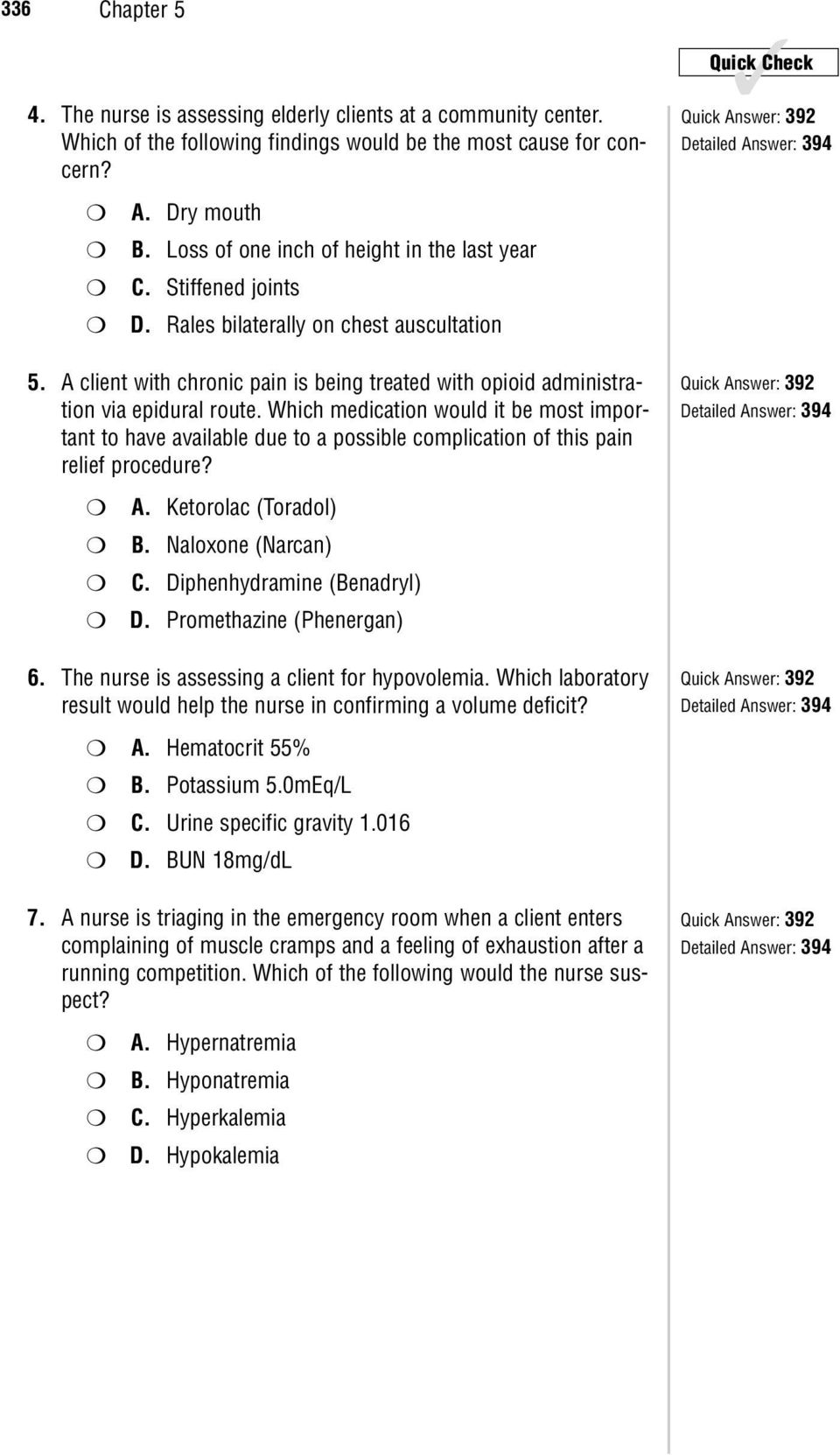
7 336 Chapter 5 4. The nurse is assessing elderly clients at a community center. Which of the following findings would be the most cause for concern? A. Dry mouth B. Loss of one inch of height in the last year C. Stiffened joints D. Rales bilaterally on chest auscultation 5. A client with chronic pain is being treated with opioid administration via epidural route. Which medication would it be most important to have available due to a possible complication of this pain relief procedure? Detailed Answer: 394 Detailed Answer: 394 A. Ketorolac (Toradol) B. Naloxone (Narcan) C. Diphenhydramine (Benadryl) D. Promethazine (Phenergan) 6. The nurse is assessing a client for hypovolemia. Which laboratory result would help the nurse in confirming a volume deficit? Detailed Answer: 394 A. Hematocrit 55% B. Potassium 5.0mEq/L C. Urine specific gravity D. BUN 18mg/dL 7. A nurse is triaging in the emergency room when a client enters complaining of muscle cramps and a feeling of exhaustion after a running competition. Which of the following would the nurse suspect? Detailed Answer: 394 A. Hypernatremia B. Hyponatremia C. Hyperkalemia D. Hypokalemia
8 Practice Exam 5 and Rationales A client was transferred to the hospital unit as a direct admit from a small community hospital. While the nurse is obtaining part of Detailed Answer: 394 the admission history information, the client suddenly becomes semiconscious. Assessment reveals a systolic BP of 70, heart rate of 130, and respiratory rate of 24. What is the nurse s initial action? A. Lower the head of the client s bed. B. Initiate an IV with a large bore needle. C. Notify the physician of the assessment results. D. Call for the cardiopulmonary resuscitation team. 9. The nurse is caring for a client post-myocardial infarction on the cardiac unit. The client is exhibiting symptoms of shock. Which clinical manifestation is the best indicator that the shock is cardiogenic rather than anaphylactic? Detailed Answer: 394 A. BP 90/60 B. Chest pain C. Increased anxiety D. Temp 98.6 F 10. While reading the progress notes on a client with cancer, the nurse notes a TNM classification of T1, N1, M0. What does this classification indicate? Detailed Answer: 395 A. The tumor is in situ, no regional lymph nodes are involved, and there is no metastasis. B. No evidence of primary tumor exists, lymph nodes can t be assessed, and metastasis can t be assessed. C. The tumor is extended, with regional lymph node involvement and distant metastasis. D. The tumor is extended and regional lymph nodes are involved, but there is no metastasis. 11. The nurse is caring for a client with leukemia who has received the drug Daunorubicin (Cerubidine). Which of the following common side effects would cause the most concern? Detailed Answer: 395 A. Nausea B. Vomiting C. Cardiotoxicity D. Alopecia

9 338 Chapter The nurse is caring for an organ donor client with a severe head injury from an MVA. Which of the following is most important when caring for the organ donor client? A. Maintenance of the BP at 90mmHg or greater B. Maintenance of a normal temperature C. Keeping the hematocrit at less than 28% D. Ensuring a urinary output of at least 300mL/hr 13. A client is being admitted with syndrome of inappropriate diuretic hormone. Which does the nurse expect to observe? Select all that apply. Detailed Answer: 395 Detailed Answer: 395 A. Increased thirst B. Tachycardia C. Polyuria D. Hostility E. Muscle weakness 14. A client with a fractured leg is exhibiting shortness of breath, pain upon deep breathing, and hemoptysis. What do these clinical manifestations indicate to the nurse? Detailed Answer: 395 A. Congestive heart failure B. Pulmonary embolus C. Adult respiratory distress syndrome D. Tension pneumothorax 15. A nurse is preparing to mix and administer chemotherapy. What equipment would be unnecessary to obtain? Detailed Answer: 395 A. Surgical gloves B. Luer lok fitting IV tubing C. Surgical hat cover D. Disposable long-sleeve gown 16. The charge nurse is assigning staff for the day. Staff consists of an RN, an LPN, and a certified nursing assistant. Which client assignment should be given to the nursing assistant? Detailed Answer: 395 A. Exploratory laparotomy with a colon resection the previous shift B. Client with a stroke who has been hospitalized for two days C. A client with metastatic cancer on PCA morphine D. A new admission with diverticulitis

10 Practice Exam 5 and Rationales The registered nurse is making shift assignments. Which client should be assigned to the licensed practical nurse (LPN)? Detailed Answer: 395 A. A client who is a diabetic with a foot ulcer B. A client with a deep vein thrombosis receiving intravenous heparin C. A client being weaned from a tracheostomy D. A post-operative cholecystectomy with a T-tube 18. A client with metastatic cancer of the lung has just been told the prognosis by the oncologist. The nurse hears the client state, I don t believe the doctor; I think he has me confused with another patient. This is an example of which of Kubler-Ross stages of dying? Detailed Answer: 395 A. Denial B. Anger C. Depression D. Bargaining 19. The surgical nurse is preparing a patient for surgery on the lower abdomen. In which position would the nurse most likely place the client for surgery on this area? Detailed Answer: 396 A. Lithotomy B. Sim s C. Prone D. Trendelenburg 20. The nurse is performing a history on a client admitted for surgery in the morning. Which long-term medication in the client s history would be most important to report to the physician? Detailed Answer: 396 A. Prednisone B. Lisinopril (Zestril) C. Docusate (Colace) D. Oscal D 21. A nurse is working in an endoscopy recovery area. Many of the clients are administered midazolam (Versed) to provide conscious sedation. Which medication is important to have available as an antidote for Versed? Detailed Answer: 396 A. Diazepam (Valium) B. Naloxone (Narcan) C. Flumazenil (Romazicon) D. Florinef (Fludrocortisone)

11 340 Chapter The nurse is caring for a client with a cerebrovascular accident (CVA) who is complaining of being nauseated and is requesting an emesis basin. Which action would the nurse take first? A. Administer an ordered antiemetic. B. Obtain an ice bag and apply to the client s throat. C. Turn the client to one side. D. Notify the physician. 23. The nurse is assessing a client who had a colon resection two days ago. The client states, I feel like my stitches have burst loose. Upon further assessment, dehiscence of the wound is noted. Which action should the nurse take? Detailed Answer: 396 Detailed Answer: 396 A. Immediately place the client in the prone position. B. Apply a sterile, saline-moistened dressing to the wound. C. Administer atropine to decrease abdominal secretions. D. Wrap the abdomen with an ACE bandage. 24. A client with hepatitis C is scheduled for a liver biopsy. Which would the nurse include in the teaching plan for this client? Detailed Answer: 396 A. The client should lie on the left side after the procedure. B. Cleansing enemas should be given the morning of the procedure. C. Blood coagulation studies might be done before the biopsy. D. The procedure is noninvasive and causes no pain. 25. The nurse is caring for a client after a laryngectomy. The client is anxious, with a respiratory rate of 32 and an oxygen saturation of 88. What should be the initial nursing action? Detailed Answer: 396 A. Suction the client. B. Increase the oxygen flow rate. C. Notify the physician. D. Recheck the O 2 saturation reading.

12 Practice Exam 5 and Rationales The nurse is performing discharge teaching to a client who is on isoniazid (INH). Which diet selection by the client indicates to the Detailed Answer: 396 nurse that further instruction is needed? A. Tuna casserole B. Ham salad sandwich C. Baked potato D. Broiled beef roast 27. A client with a head injury has an intracranial pressure (ICP) monitor in place. Cerebral perfusion pressure calculations are ordered. If the client s ICP is 22 and the mean pressure reading is 70, what is the client s cerebral perfusion pressure? Detailed Answer: 396 A. 92 B. 72 C. 58 D A student nurse is observing a neurological nurse perform an assessment. When the nurse asks the client to stick out his tongue, the nurse is assessing the function of which cranial nerve? Detailed Answer: 396 A. II optic B. I olfactory C. X vagus D. XII hypoglossal 29. Which set of vital signs would best indicate to the nurse that a client has an increase in intracranial pressure? Detailed Answer: 397 A. BP 180/70, pulse 50, respirations 16, temperature 101 F B. BP 100/70, pulse 64, respirations 20, temperature 98.6 F C. BP 96/70, pulse 132, respirations 20, temperature 98.6 F D. BP 130/80, pulse 50, respirations 18, temperature 99.6 F

13 342 Chapter The nurse is assessing the laboratory results of a client scheduled to receive phenytoin sodium (Dilantin). The Dilantin level, drawn two hours ago, is 30mcg/mL. What is the appropriate nursing action? A. Administer the Dilantin as scheduled. B. Hold the scheduled dose and notify the physician. C. Decrease the dosage from 100mg to 50mg. D. Increase the dosage to 200mg from 100mg. 31. A client with sickle cell disease is admitted in active labor. Which nursing intervention would be most helpful in preventing a sickling crisis? A. Obtaining blood pressures every two hours B. Administering pain medication every three hours as ordered C. Monitoring arterial blood gas results D. Administering IV fluids at ordered rate of 200mL/hr 32. A client is admitted with a diagnosis of pernicious anemia. Which of the following signs or symptoms would indicate that the client has been noncompliant with ordered B12 injections? A. Hyperactivity in the evening hours B. Weight gain C. Paresthesia of hands and feet D. Diarrhea stools 33. The nurse has performed nutritional teaching on a client with gout who is placed on a low-purine diet. Which selection by the client would indicate that teaching has been ineffective? A. Boiled cabbage B. Apple C. Peach cobbler D. Spinach 34. The nurse is caring for a 70-year-old client with hypovolemia who is receiving a blood transfusion. Assessment findings reveal crackles on chest auscultation and distended neck veins. What is the nurse s initial action? A. Slow the transfusion. B. Document the finding as the only action. C. Stop the blood transfusion and turn on the normal saline. D. Assess the client s pupils. Detailed Answer: 397 Detailed Answer: 397 Detailed Answer: 397 Detailed Answer: 397 Detailed Answer: 397

14 Practice Exam 5 and Rationales The orthopedic nurse should be particularly alert for a fat embolus in which of the following clients having the greatest risk for this Detailed Answer: 397 complication after a fracture? A. A 50-year-old with a fractured fibula B. A 20-year-old female with a wrist fracture C. A 21-year-old male with a fractured femur D. An 8-year-old with a fractured arm 36. The nurse has performed discharge teaching to a client in need of a high-iron diet. The nurse recognizes that teaching has been effective when the client selects which meal plan? Detailed Answer: 397 A. Hamburger, French fries, and orange juice B. Sliced veal, spinach salad, and whole-wheat roll C. Vegetable lasagna, Caesar salad, and toast D. Bacon, lettuce, and tomato sandwich; potato chips; and tea 37. An elderly female is admitted with a fractured right femoral neck. Which clinical manifestation would the nurse expect to find? A. Free movement of the right leg B. Abduction of the right leg C. Internal rotation of the right hip D. Shortening of the right leg 38. The nurse is performing the skill of intramuscular injection by the Z track method. Which technique would the nurse utilize to prevent tracking of the medication? A. Inject the medication in the deltoid muscle. B. Use a 22-gauge needle when preparing the syringe. C. Omit aspirating for blood before injecting. D. Draw up 0.2mL of air after the proper medication dose. 39. A client with asthma has an order to begin an aminophylline IV infusion. Which piece of equipment is essential for the nurse to safely administer the medication? A. Large bore intravenous catheter B. IV inline filter C. IV infusion device D. Cover to prevent exposure of solution to light Detailed Answer: 397 Detailed Answer: 397 Detailed Answer: 397
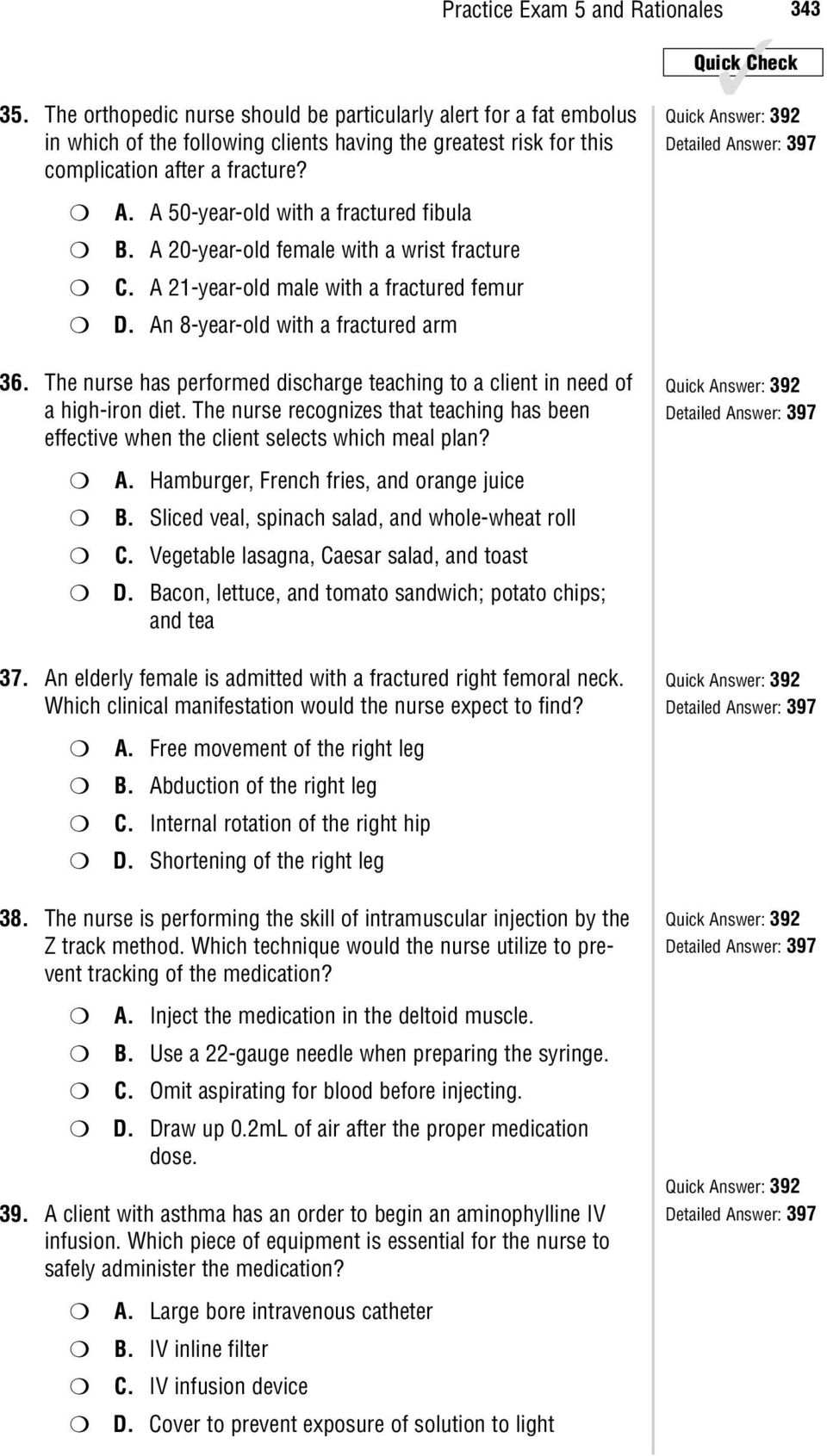
15 344 Chapter The nurse caring for a client with anemia recognizes which clinical manifestation as the one that is specific for a hemolytic type of anemia? A. Jaundice B. Anorexia C. Tachycardia D. Fatigue 41. A client with cancer who is receiving chemotherapeutic drugs has been given injections of pegfilgastrim (Neulasta). Which laboratory value reveals that the drug is producing the desired effect? Detailed Answer: 398 Detailed Answer: 398 A. Hemoglobin of 13.5g/dL B. White blood cells count of 6,000/mm C. Platelet count of 300,000/mm D. Hematocrit of 39% 42. The nurse is performing discharge teaching on a client with polycythemia vera. Which would be included in the teaching plan? A. Avoid large crowds and exposure to people who are ill. B. Keep the head of the bed elevated at night. C. Wear socks and gloves when going outside. D. Recognize clinical manifestations of thrombosis. 43. A client is being discharged after lithotripsy for removal of a kidney stone. Which statement by the client indicates understanding of the nurse s instructions? Detailed Answer: 398 Detailed Answer: 398 A. I ll need to strain my urine starting in the morning. B. I will need to save all my urine. C. I will be careful to strain all the urine and save the stone. D. I won t need to strain my urine now that the procedure is complete.

16 Practice Exam 5 and Rationales The nurse is caring for a client with osteoporosis who is being discharged on alendronate (Fosamax). Which statement would Detailed Answer: 398 indicate a need for further teaching? A. I should take the medication immediately before bedtime every night. B. I should remain in an upright position for 30 minutes after taking Fosamax. C. The medication should be taken by mouth with water. D. I should not have any food with this medication. 45. A client is being evaluated for carpel tunnel syndrome. The nurse is observed tapping over the median nerve in the wrist and asking the client if there is pain or tingling. Which assessment is the nurse performing? Detailed Answer: 398 A. Phalen s maneuver B. Tinel s sign C. Kernig s sign D. Brudzinski s sign 46. The nurse is caring for a client who is recovering from a fractured femur. Which diet selection would be best for this client? Detailed Answer: 398 A. Loaded baked potato, fried chicken, and tea B. Dressed cheeseburger, French fries, and a Diet Coke C. Tuna fish salad on sourdough bread, potato chips, and skim milk D. Mandarin orange salad, broiled chicken, and milk 47. The nurse working in the emergency department realizes that it would be contraindicated to induce vomiting if someone had ingested which of the following? Detailed Answer: 398 A. Ibuprofen B. Aspirin C. Vitamins D. Gasoline

17 346 Chapter A client with AIDS has impaired nutrition due to diarrhea. The nurse teaches the client about the need to avoid certain foods. Which diet selection by the client would indicate a need for further teaching? A. Tossed salad B. Baked chicken C. Broiled fish D. Steamed rice 49. The nurse has just received a report from the previous shift. Which of the following clients should the nurse visit first? Detailed Answer: 398 Detailed Answer: 398 A. A 50-year-old COPD client with a PCO 2 of 50 B. A 24-year-old admitted after an MVA complaining of shortness of breath C. A client with cancer requesting pain medication D. A one-day post-operative cholecystectomy with a temperature of 100 F 50. The nurse is performing a breast exam on a client when she discovers a mass. Which characteristic of the mass would best indicate a reason for concern? Detailed Answer: 399 A. Tender to the touch B. Regular shape C. Moves easily D. Firm to the touch 51. The nurse is caring for a client after a motor vehicle accident. The client has a fractured tibia, and bone is noted protruding through the skin. Which action is of priority? Detailed Answer: 399 A. Provide manual traction above and below the leg. B. Cover the bone area with a sterile dressing. C. Apply an ACE bandage around the entire lower limb. D. Place the client in the prone position.

18 Practice Exam 5 and Rationales The RN on the oncology unit is preparing to mix and administer amphoteracin B (Fungizone) to a client. Which action is contraindicated for administering this drug Detailed Answer: 399 IV? A. Mix the drug with normal saline solution. B. Administer the drug over 4 6 hours. C. Hydrate with IV fluids two hours before the infusion is scheduled to begin. D. Premedicate the client with ordered acetaminophen (Tylenol) and diphenhydramine (Benadryl). 53. A nurse is administering a blood transfusion to a client on the oncology unit. Which clinical manifestation indicates an acute hemolytic reaction to the blood? Detailed Answer: 399 A. Low back pain B. Headache C. Urticaria D. Neck vein distention 54. The nurse caring for a client diagnosed with metastatic cancer of the bone is exhibiting mental confusion and a BP of 150/100. Which laboratory value would correlate with the client s symptoms reflecting a common complication with this diagnosis? Detailed Answer: 399 A. Potassium 5.2mEq/L B. Calcium 13mg/dL C. Inorganic phosphorus 1.7mEq/L D. Sodium 138mEq/L 55. A client with a stroke and malnutrition has been placed on Total Parenteral Nutrition (TPN). The nurse notes air entering the client via the central line. Which initial action is most appropriate? Detailed Answer: 399 A. Notify the physician. B. Elevate the head of the bed. C. Place the client in the left lateral decubitus position. D. Stop the TPN and hang D5 1/2 NS.

19 348 Chapter The nurse is preparing a client for cervical uterine radiation implant insertion. Which will be included in the teaching plan? A. TV or telephone use will not be allowed while the implant is in place. B. A Foley catheter is usually inserted. C. A high-fiber diet is recommended. D. Excretions will be considered radioactive. 57. The nurse is caring for a client with a head injury who has an intracranial pressure monitor in place. Assessment reveals an ICP reading of 66. What is the nurse s best action? Detailed Answer: 399 Detailed Answer: 399 A. Notify the physician. B. Record the reading as the only action. C. Turn the client and recheck the reading. D. Place the client supine. 58. The nurse is caring for a client with leukemia who is receiving the drug doxorubicin (Adriamycin). Which toxic effects of this drug would be reported to the physician immediately? Detailed Answer: 399 A. Rales and distended neck veins B. Red discoloration of the urine C. Nausea and vomiting D. Elevated BUN and dry, flaky skin 59. A client has developed diabetes insipidous after removal of a pituitary tumor. Which finding would the nurse expect? A. Polyuria B. Hypertension C. Polyphagia D. Hyperkalemia 60. A client with cancer received platelet infusions 24 hours ago. Which of the following assessment findings would indicate the most therapeutic effect from the transfusions? Detailed Answer: 399 Detailed Answer: 399 A. Hemoglobin level increase from 8.9 to 10.6mg/dL B. Temperature reading of 99.4 F C. White blood cell count of 11,000/mm 3 D. Decrease in oozing of blood from IV site
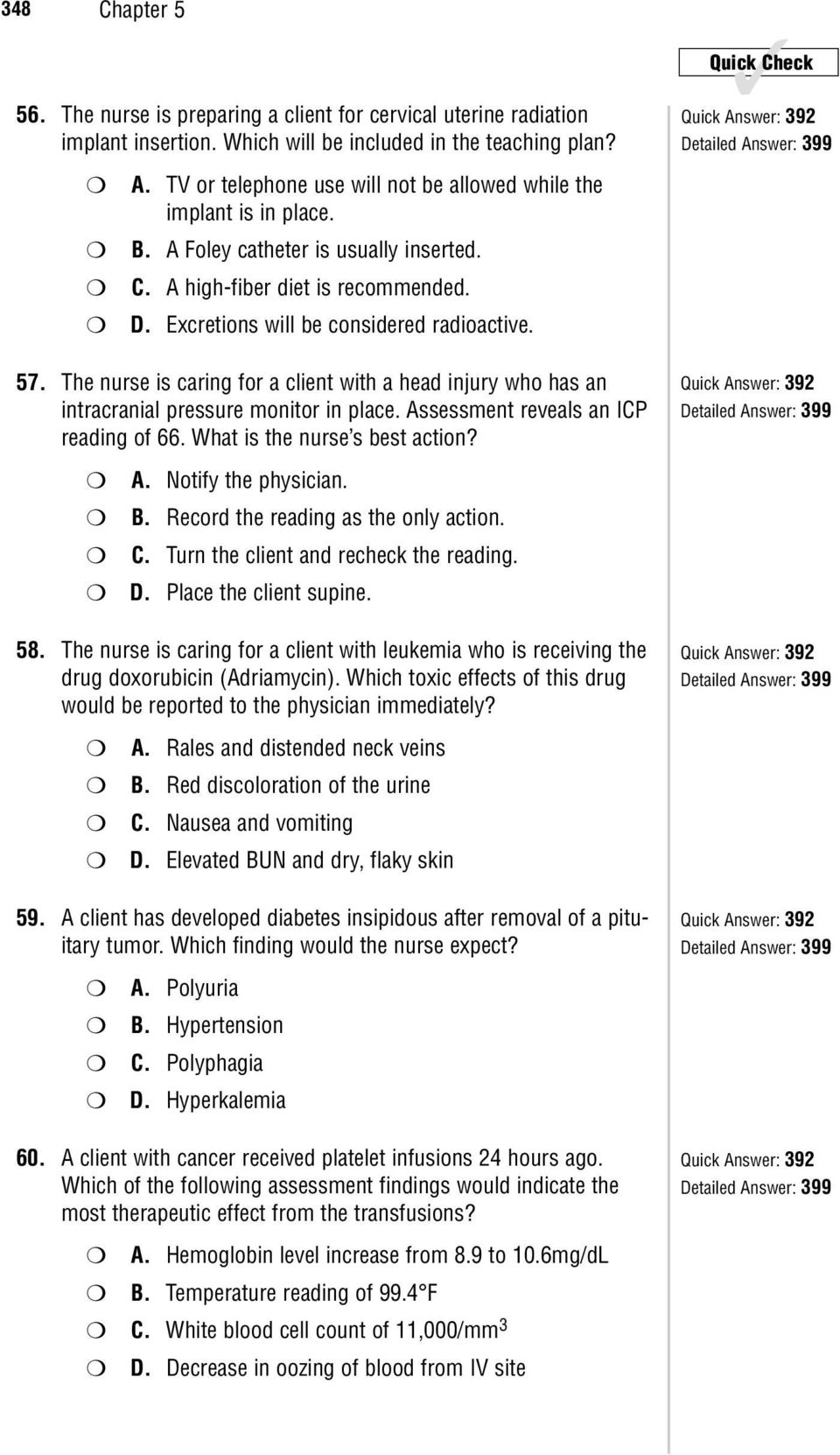
20 Practice Exam 5 and Rationales A client is admitted with Parkinson s disease who has been taking Carbidopa/levodopa (Sinemet) for one year. Which clinical manifestation would be most important to Detailed Answer: 400 report? A. Dry mouth B. Spasmodic eye winking C. Dark urine color D. Complaints of dizziness 62. The nurse who is caring for a client with cancer notes a WBC of 500/mm 3 on the laboratory results. Which intervention would be most appropriate to include in the client s plan of care? Detailed Answer: 400 A. Assess temperature every four hours because of risk for hypothermia. B. Instruct the client to avoid large crowds and people who are sick. C. Instruct in the use of a soft toothbrush. D. Assess for signs of bleeding. 63. A client with Crohn s disease requires TPN to provide adequate nutrition. The nurse finds the TPN bag empty. What fluid would the nurse select to hang until another bag is prepared in the pharmacy? Detailed Answer: 400 A. Lactated Ringers B. Normal saline C. D10W solution D. Normosol R 64. The nurse is caring for a client with possible cervical cancer. What clinical data would the nurse most likely find in the client s history? Detailed Answer: 400 A. Post-coital vaginal bleeding B. Nausea and vomiting C. Foul-smelling vaginal discharge D. Elevated temperature levels

21 350 Chapter The nurse is preparing to receive a client from admitting with tumor lysis syndrome (TLS). Which of the following would the nurse expect to find on the laboratory and patient history sections of the chart? Select all that apply. A. Low blood pressure B. Hyperactivity C. Hyperkalemia D. Hyperuricemia E. Mental changes 66. A client is scheduled to undergo a bone marrow aspiration from the sternum. What position would the nurse assist the client into for this procedure? Detailed Answer: 400 Detailed Answer: 400 A. Dorsal recumbent B. Supine C. High Fowler s D. Lithotomy 67. The nurse is caring for a client with a head injury who has increased ICP. The physician plans to reduce the cerebral edema by constricting cerebral blood vessels. Which physician order would serve this purpose? Detailed Answer: 400 A. Hyperventilation per mechanical ventilation B. Insertion of a ventricular shunt C. Furosemide (Lasix) D. Solu medrol 68. A client with a T6 injury six months ago develops facial flushing and a BP of 210/106. After elevating the head of the bed, which is the most appropriate nursing action? Detailed Answer: 400 A. Notify the physician. B. Assess the client for a distended bladder. C. Apply ordered oxygen via nasal cannula. D. Increase the IV fluids.
22 Practice Exam 5 and Rationales The nurse is performing an admission history for a client recovering from a stroke. Medication history reveals the drug clopidogrel Detailed Answer: 400 (Plavix). Which clinical manifestation alerts the nurse to an adverse effect of this drug? A. Epistaxis B. Hypothermia C. Nausea D. Hyperactivity 70. The nurse caring for a client with a head injury would recognize which assessment finding as the most indicative of increased ICP? Detailed Answer: 400 A. Vomiting B. Headache C. Dizziness D. Papilledema 71. A client with angina is experiencing migraine headaches. The physician has prescribed Sumatriptan succinate (Imitrex). Which nursing action is most appropriate? Detailed Answer: 400 A. Call the physician to question the prescription order. B. Try to obtain samples for the client to take home. C. Perform discharge teaching regarding this drug. D. Consult social services for financial assistance with obtaining the drug. 72. A client with COPD is in respiratory failure. Which of the following results would be the most sensitive indicator that the client requires a mechanical ventilator? Detailed Answer: 400 A. PCO 2 58 B. SaO 2 90 C. PH 7.23 D. HCO 3 30
23 352 Chapter The nurse in the emergency room is caring for a client with multiple rib fractures and a pulmonary contusion. Assessment reveals a respiratory rate of 38, a heart rate of 136, and restlessness. Which associated assessment finding would require immediate intervention? A. Occasional small amounts of hemoptysis B. Midline trachea with wheezing on auscultation C. Subcutaneous air and absent breath sounds D. Pain when breathing deeply, with rales in the upper lobes 74. The nurse is caring for a client with myasthenia gravis who is having trouble breathing. The nurse would encourage which of the following positions for maximal lung expansion? Detailed Answer: 401 Detailed Answer: 401 A. Supine with no pillow, to maintain patent airway B. Side-lying with back support C. Prone with head turned to one side D. Sitting or in high Fowler s 75. The nurse is caring for clients on a respiratory unit. Upon receiving the following client reports, which client should be seen first? Detailed Answer: 401 A. Client with emphysema expecting discharge B. Bronchitis client receiving IV antibiotics C. Bronchitis client with edema and neck vein distention D. COPD client with abnormal PO A client has sustained a severe head injury and damaged the preoccipital lobe. The nurse should remain particularly alert for which of the following problems? Detailed Answer: 401 A. Visual impairment B. Swallowing difficulty C. Impaired judgment D. Hearing impairment 77. The nurse is caring for a client with epilepsy who is to receive phenytoin sodium (Dilantin) 100mg IV push. The client has an IV of D51/2NS infusing at 100mL/hr. When administering the Dilantin, which is the appropriate initial nursing action? Detailed Answer: 401 A. Obtain an ambu bag and put it at bedside. B. Insert a 16g IV catheter. C. Flush the IV line with normal saline. D. Premedicate with promethiazine (phenergan) IV push.
24 Practice Exam 5 and Rationales A client with increased intracranial pressure is receiving Osmitrol (Mannitol) and Furosemide (Lasix). The nurse recognizes that Detailed Answer: 401 these two drugs are given to reverse which effect? A. Energy failure B. Excessive intracellular calcium C. Cellular edema D. Excessive glutamate release 79. The nurse is assessing a client upon arrival to the emergency department. Partial airway obstruction is suspected. Which clinical manifestation is a late sign of airway obstruction? Detailed Answer: 401 A. Rales in lungs B. Restless behavior C. Cyanotic ear lobes D. Inspiratory stridor 80. The nurse is working in the trauma unit of the emergency room when a 24-year-old female is admitted after an MVA. The client is bleeding profusely and a blood transfusion is ordered. Which would the nurse be prepared to administer without a type and crossmatch? Detailed Answer: 401 A. AB positive B. AB negative C. O positive D. O negative 81. When preparing a client for magnetic resonance imaging, the nurse should implement which of the following? Detailed Answer: 401 A. Obtain informed consent and administer atropine 0.4mg. B. Scrub the injection site for 15 minutes. C. Remove any jewelry and inquire about metal implants. D. Administer Benadryl 50mg/mL IV. 82. Upon admission to the hospital, a client reports having the worst headache I ve ever had. The nurse should give the highest priority to which action? Detailed Answer: 401 A. Administering pain medication B. Starting oxygen C. Performing neuro checks D. Inserting a Foley catheter
25 354 Chapter A client has an order to administer cisplatin (Platinol). Which drug would the nurse expect to be ordered to reduce renal toxicity from the cisplatin infusion? A. Amifostine (Ethyol) B. Dexrazoxane (Zinecard) C. Mesna (Mesenex) D. Pamidronate (Aredia) 84. The client is admitted to the ER with multiple rib fractures on the right. The nurse s assessment reveals that an area over the right clavicle is puffy and that there is a crackling noise with palpation. The nurse should further assess the client for which of the following problems? Detailed Answer: 401 Detailed Answer: 401 A. Flail chest B. Subcutaneous emphysema C. Infiltrated subclavian IV D. Pneumothorax 85. A client has an order for Demerol 75mg and atropine 0.4mg IM as a preoperative medication. The Demerol vial contains 50mg/mL, and atropine is available 0.4mg/mL. How much medication will the nurse administer in total? Detailed Answer: 402 A. 1.0mL B. 1.7mLs C. 2.5mLs D. 3.0 mls 86. Nimodipine (Nimotop) is ordered for the client with a ruptured cerebral aneurysm. What does the nurse recognize as a desired effect of this drug? Detailed Answer: 402 A. Prevent the influx of calcium into cells. B. Restore a normal blood pressure reading. C. Prevent the inflammatory process. D. Dissolve the clot that has formed.
26 Practice Exam 5 and Rationales A client is admitted to the hospital with seizures. The client has jerking of the right arm and twitching of the face, but is alert and Detailed Answer: 402 aware of the seizure. This behavior is characteristic of which type of seizure? A. Absence B. Complex partial C. Simple partial D. Tonic-clonic 88. The intensive care unit is full and the emergency room just called in a report on a ventilator-dependent client who is being admitted to the medical surgical unit. It would be essential that the nurse have which piece of equipment at the client s bedside? Detailed Answer: 402 A. Cardiac monitor B. Intravenous controller C. Manual resuscitator D. Oxygen by nasal cannula 89. The nurse is caring for a client on a ventilator that is set on intermittent mandatory ventilation (IMV). Assessment on the ventilator is IMV mode of eight breaths per minute. The nurse assesses the client s respiratory rate of 13 per minute. What do these findings indicate? Detailed Answer: 402 A. The client is fighting the ventilator and needs medication. B. Pressure support ventilation is being used. C. Additional breaths are being delivered by the ventilator. D. The client is breathing five additional breaths on his own. 90. The nurse has given instructions on pursed-lip breathing to a client with COPD. Which statement by the client would indicate effective teaching? Detailed Answer: 402 A. I should inhale through my mouth very deeply. B. I should tighten my abdominal muscles with inhalation. C. I should contract my abdominal muscles with exhalation. D. I should make inhalation twice as long as exhalation.
27 356 Chapter A client is receiving aminophylline IV. The nurse monitors the theophylline blood level and assesses that the level is within therapeutic range at which of the following levels? A. 5ug/mL B. 8ug/mL C. 15ug/mL D. 25ug/mL 92. The nurse is assessing the arterial blood gases (ABG) of a chest trauma client with the results of ph 7.35, PO 2 85, PCO 2 55, and HCO What do these values indicate? Detailed Answer: 402 Detailed Answer: 402 A. Uncompensated respiratory acidosis B. Uncompensated metabolic acidosis C. Compensated respiratory acidosis D. Compensated metabolic acidosis 93. A pneumonectomy is performed on a client with lung cancer. Which of the following would probably be omitted from the client s plan of care? Detailed Answer: 402 A. Closed chest drainage B. Pain-control measures C. Supplemental oxygen administration D. Coughing and deep-breathing exercises 94. When planning the care for a client after a posterior fossa (infratentorial) craniotomy, which action is contraindicated? A. Keeping the client flat on one side B. Elevating the head of the bed 30 C. Log-rolling or turning as a unit D. Keeping the neck in a neutral position 95. The nurse is performing discharge teaching on a client with ulcerative colitis who has been placed on a low-residue diet. Which food would need to be eliminated from this client s diet? Detailed Answer: 402 Detailed Answer: 402 A. Roasted chicken B. Noodles C. Cooked broccoli D. Roast beef
28 Practice Exam 5 and Rationales The nurse is assisting a client with diverticulitis to select appropriate foods. Which food should be avoided? Detailed Answer: 402 A. Bran B. Fresh peach C. Tomatoes D. Dinner roll 97. A client is admitted with a possible bowel obstruction. Which question during the nursing history is least helpful in obtaining information regarding this diagnosis? Detailed Answer: 403 A. Tell me about your pain. B. What does your vomit look like? C. Describe your usual diet. D. Have you noticed an increase in abdominal size? 98. The nurse is caring for a client with epilepsy who is being treated with carbamazepine (Tegretol). Which laboratory value might indicate a serious side effect of this drug? Detailed Answer: 403 A. BUN 10mg/dL B. Hemoglobin 13.0gm/dL C. WBC 4,000/mm 3 D. Platelets 200,000/mm A client is admitted with a tumor in the parietal lobe. Which symptoms would be expected due to this tumor s location? Detailed Answer: 403 A. Hemiplegia B. Aphasia C. Paresthesia D. Nausea 100. A client weighing 150 pounds has received burns over 50% of his body at 1200 hours. Using the Parkland formula, calculate the expected amount of fluid that the client should receive by 2000 hours. Detailed Answer: 403 A. 3,400 B. 6,800 C. 10,200 D. 13,600
29 358 Chapter The nurse is caring for a client post-op femoral popliteal bypass graft. Which post-operative assessment finding would require immediate physician notification? A. Edema of the extremity and pain at the incision site B. A temperature of 99.6 F and redness of the incision C. Serous drainage noted at the surgical area D. A loss of posterior tibial and dorsalis pedis pulses 102. A client admitted with gastroenteritis and a potassium level of 2.9mEq/dL has been placed on telemetry. Which ECG finding would the nurse expect to find due to the client s potassium results? Detailed Answer: 403 Detailed Answer: 403 A. A depressed ST segment B. An elevated T wave C. An absent P wave D. A flattened QRS 103. A client is experiencing acute abdominal pain. Which abdominal assessment sequence is appropriate for the nurse to use for examination of the abdomen? Detailed Answer: 403 A. Inspect, palpate, auscultate, percuss B. Inspect, auscultate, percuss, palpate C. Auscultate, inspect, palpate, percuss D. Percuss, palpate, auscultate, inspect 104. The nurse is to administer a cleansing enema to a client scheduled for colon surgery. Which client position would be appropriate? Detailed Answer: 403 A. Prone B. Supine C. Left Sim s D. Dorsal recumbent 105. The nurse is caring for a client following a crushing injury to the chest. Which finding would be most indicative of a tension pneumothorax? Detailed Answer: 403 A. Expectoration of moderate amounts of frothy hemoptysis B. Trachea shift toward the unaffected side of the chest C. Subcutaneous emphysema noted at the anterior chest D. Opening chest wound with a whistle sound emitting from the area
30 Practice Exam 5 and Rationales The nurse receives a report from the paramedic on four trauma victims. Which client would need to be treated first? A client with: Detailed Answer: 404 A. Lower rib fractures and a stable chest wall B. Bruising on the anterior chest wall and a possible pulmonary contusion C. Gun shot wound with open pneumothorax unstabilized D. Dyspnea, stabilized with intubation and manual resuscitator 107. The nurse is discharging a client with asthma who has a prescription for zafirlukast (Accolate). Which comment by the client would indicate a need for further teaching? Detailed Answer: 404 A. I should take this medication with meals. B. I need to report flu-like symptoms to my doctor. C. My doctor might order liver tests while I m on this drug. D. If I m already having an asthma attack, this drug will not stop it A client is four hours post-op left carotid endarterectomy. Which assessment finding would cause the nurse the most concern? Detailed Answer: 404 A. Temperature 99.4 F, heart rate 110, respiratory rate 24 B. Drowsiness, urinary output of 50mL in the past hour C. BP 120/60, lethargic, right-sided weakness D. Alert and oriented, BP 168/96, heart rate The RN is making assignments on a 12-bed unit. Staff consists of one RN and two certified nursing assistants. Which client should be self-assigned? Detailed Answer: 404 A. A client receiving decadron for emphysema B. A client with chest trauma and a new onset of hemoptysis C. A client with rib fractures and an O 2 saturation of 93% D. A client two days post-operative lung surgery with a pulse oximetry of 92%
31 360 Chapter The nurse is accessing a venous access port of a client about to receive chemotherapy. Place the following steps in proper sequential order. A. Apply clean gloves. B. Clean the skin with antimicrobial and let air dry. C. Insert needle into port at a 90 angle. D. Connect 10 ml NS into extension of huber needle and prime. E. Instill heparin solution. F. Stabilize the part by using middle and index fingers. G. Wash hands and apply sterile gloves. H. Inject saline and assess for infiltration. I. Check placement of needle A client is being discharged on Coumadin after hospitalization for a deep vein thrombosis. The nurse recognizes that which food would be restricted while the client is on this medication? Detailed Answer: 404 Detailed Answer: 404 A. Lettuce B. Apples C. Potatoes D. Macaroni 112. Which assessment finding in a client with COPD indicates to the nurse that the respiratory problem is chronic? Detailed Answer: 404 A. Wheezing on exhalation B. Productive cough C. Clubbing of fingers D. Generalized cyanosis 113. A client who has just undergone a laparoscopic cholecystectomy complains of free air pain. What would be your best action? A. Ambulate the client. B. Instruct the client to breathe deeply and cough. C. Maintain the client on bed rest with his legs elevated. D. Insert an NG tube. Detailed Answer: 404
32 Practice Exam 5 and Rationales The RN is planning client assignments. Which is the least appropriate task for the nursing assistant? Detailed Answer: 404 A. Assisting a COPD client admitted two days ago to get up in the chair. B. Feeding a client with bronchitis who is paralyzed on the right side. C. Accompanying a discharged emphysema client to the transportation area. D. Assessing an emphysema client complaining of difficulty breathing When providing care for a client with pancreatitis, the nurse would anticipate which of the following orders? Detailed Answer: 405 A. Force fluids to 3,000mL/24 hours. B. Insert a nasogastric tube to low intermittent suction. C. Place the client in reverse Trendelenburg position. D. Place the client in enteric isolation The nurse is performing a neurological assessment on a client admitted with TIAs. Assessment findings reveal an absence of the gag reflex. The nurse suspects injury to which of the following cranial nerves? Detailed Answer: 405 A. XII (hypoglossal) B. X (vagus) C. IX (glossopharyngeal) D. VII (facial) 117. The nurse arrives at a motorcycle accident and finds the client unresponsive, apneic, and pulseless. After calling for a spectator to help, what would be the nurse s next action? Detailed Answer: 405 A. Ventilate with a mouth-to-mask device. B. Begin chest compressions. C. Administer a precordial thump. D. Open the client s airway.
33 362 Chapter A client with gallstones and obstructive jaundice is experiencing severe itching. The physician has prescribed cholestyramine (Questran). The client asks, How does this drug work? What is the nurse s best response? A. It blocks histamine, reducing the allergic response. B. It inhibits the enzyme responsible for bile excretion. C. It decreases the amount of bile in the gallbladder. D. It binds with bile acids and is excreted in bowel movements with stool A client with inflammatory bowel disease (IBD) requires an ileostomy. The nurse would instruct the client to do which of the following measures as an essential part of caring for the stoma? Detailed Answer: 405 Detailed Answer: 405 A. Perform massage of the stoma three times a day. B. Include high-fiber foods in the diet, especially nuts. C. Limit fluid intake to prevent loose stools. D. Cleanse the peristomal skin meticulously Diphenoxylate hydrochloride and atropine sulfate (Lomotil) is prescribed for the client with ulcerative colitis. Which of the following nursing observations indicates that the drug is having a therapeutic effect? Detailed Answer: 405 A. There is an absence of peristalsis. B. The number of diarrhea stools decreases. C. Cramping in the abdomen has increased. D. Abdominal girth size increases A nurse is assisting the physician with chest tube removal. Which client instruction is appropriate during removal of the tube? Detailed Answer: 405 A. Take a deep breath, exhale, and bear down. B. Hold the breath for two minutes and exhale slowly. C. Exhale upon actual removal of the tube. D. Continually breathe deeply in and out during removal A client with advanced Alzheimer s disease has been prescribed haloperidol (Haldol). What clinical manifestation suggests that the client is experiencing side effects from this medication? Detailed Answer: 405 A. Cough B. Tremors C. Diarrhea D. Pitting edema
34 Practice Exam 5 and Rationales A student in a cardiac unit is performing auscultation of a client s heart. Which stethoscope placement would indicate to the nurse Detailed Answer: 405 that the student is performing pulmonic auscultation correctly? A. Between the apex and the sternum B. At the fifth intercostal space at the left midclavicular line C. At the second intercostal space, left of the sternum D. At the manubrium area of the chest 124. A client with Alzheimer s disease has been prescribed donepezil (Aricept). Which information should the nurse include in the teaching plan for a client on Aricept? Detailed Answer: 405 A. Take the medication with meals. B. The medicine can cause dizziness, so rise slowly. C. If a dose is skipped, take two the next time. D. The pill can cause an increase in heart rate A client who had major abdominal surgery is having delayed healing of the wound. Which laboratory test result would most closely correlate with this problem? Detailed Answer: 405 A. Decreased albumin B. Decreased creatinine C. Increased calcium D. Increased sodium 126. A client is admitted to the medical-surgical unit with a report of severe hematemesis. What is the priority nursing action? A. Performing an assessment B. Obtaining a blood permit C. Initiating an IV D. Inserting an NG tube 127. The nurse caring for a client with a suspected peptic ulcer recognizes which exam as the one most reliable in diagnosing the disease? Detailed Answer: 405 Detailed Answer: 406 A. Upper-gastrointestinal x-ray B. Gastric analysis C. Endoscopy procedure D. Barium studies x-ray
35 364 Chapter On the second post-operative day after a subtotal thyroidectomy, the client tells the nurse, I feel numbness and my face is twitching. What is the nurse s best initial action? A. Offer mouth care. B. Loosen the neck dressing. C. Notify the physician. D. Document the finding as the only action A client with adult respiratory distress syndrome has been placed on mechanical ventilation with PEEP. Which finding would indicate to the nurse that the client is experiencing the undesirable effect of an increase in airway and chest pressure? Detailed Answer: 406 Detailed Answer: 406 A. A PO 2 of 88 B. Rales on auscultation C. Blood pressure decrease to 90/48 from 120/70 D. A decrease in spontaneous respirations 130. A nurse is teaching a group of teenagers the correct technique for applying a condom. Which point would the nurse include in the teaching plan? Detailed Answer: 406 A. The condom can be reused one time. B. Unroll the condom all the way over the erect penis. C. Apply petroleum jelly to reduce irritation. D. Place water in the tip of the condom before use A client with rheumatoid arthritis is being discharged with a prescription for etanercept (Enbrel). Which should the nurse teach the client to report immediately? Detailed Answer: 406 A. Redness, itching, edema at injection site B. Exposure to chickenpox or shingles C. Headache D. Vomiting
36 Practice Exam 5 and Rationales The nurse in the ER has received report of four clients en route to the emergency department. Which client should the nurse see Detailed Answer: 406 first? A client with: A. Third-degree burns to the face and neck area, with singed nasal hairs B. Second-degree burns to each leg and thigh area, who is alert and oriented C. A chemical burn that has been removed and liberally flushed before admission D. An electrical burn entering and leaving on the same side of the body 133. Which clinical manifestations would the nurse expect a client with a diagnosis of acute osteomyelitis to exhibit? Select all that apply. Detailed Answer: 406 A. Leukemia and normal sedimentation rate B. Pain and fever C. Low blood count D. Tenderness in affected area E. Edema and pus from the wound 134. The nurse recognizes which of the following clients as having the highest risk for pulmonary complications after surgery? Detailed Answer: 406 A. A 24-year-old with open reduction internal fixation of the ulnar B. A 45-year-old with an open cholecystectomy C. A 36-year-old after a hysterectomy D. A 50-year-old after a lumbar laminectomy 135. Which clinical manifestation is most indicative to the nurse that a possible carbon monoxide poisoning has occurred? Detailed Answer: 406 A. Pulse oximetry reading of 80% B. Expiratory stridor and nasal flaring C. Cherry red color to the mucous membranes D. Presence of carbonaceous particles in the sputum
37 366 Chapter A client is admitted with a ruptured spleen following a fourwheeler accident. In preparation for surgery, the nurse suspects that the client is in the compensatory stage of shock because of which clinical manifestation? A. Blood pressure 120/70, confusion, heart rate 120 B. Crackles on chest auscultation, mottled skin, lethargy C. Jaundice, urine output less than 30mL in the past hour, heart rate 170 D. Rapid shallow respirations, unconscious, petechiae anterior chest 137. A client reports to the nurse that he believes he has an ulcer and wants to be checked for H. pylori. Which of the following medications in the client s history would make the test invalid? Detailed Answer: 406 Detailed Answer: 406 A. Omeprazole (Prilosec) B. Furosemide (Lasix) C. Propoxyphene napsylate (Darvocet) D. Ibuprofen (Advil) 138. A client arrives in the emergency room with severe burns of the hands, right arm, face, and neck. The nurse needs to start an IV. Which site would be most suitable for this client? Detailed Answer: 407 A. Top of client s right hand B. Left antecubital fossa C. Top of either foot D. Left forearm 139. Which client clinical manifestation during a bone marrow transplantation procedure alerts the nurse to the possibility of an adverse reaction? Detailed Answer: 407 A. Fever B. Red colored urine C. Hypertension D. Shortness of breath
38 Practice Exam 5 and Rationales The nurse is assessing the integumentary system of a darkskinned individual. Which area would be the most likely to show a Detailed Answer: 407 skin cancer lesion? A. Chest B. Arms C. Face D. Palms 141. A client with a gastrointestinal bleed has an NG tube to low continuous wall suction. Which technique is the correct procedure for the nurse to utilize when assessing bowel sounds? Detailed Answer: 407 A. Obtain a sample of the NG drainage and test the ph. B. Clamp the tube while listening to the abdomen with a stethoscope. C. Irrigate the tube with 30mL of NS while auscultating the abdomen. D. Turn the suction on high and auscultate over the naval area A burn client s care plan reveals an expected outcome of no localized or systemic infection. Which assessment by the nurse supports this outcome? Detailed Answer: 407 A. Wound culture results showing minimal bacteria B. Cloudy, foul-smelling urine C. White blood cell count of 14,000/mm 3 D. Temperature elevation of 101 F 143. The nurse is discharging a client with a prescription of eyedrops. Which observation by the nurse would indicate a need for further client teaching? Detailed Answer: 407 A. Shaking of the suspension to mix the medication B. Administering a second eyedrop medication immediately after the first one was instilled C. Washing the hands before and after the administration of the drops D. Holding the lower lid down without pressing the eyeball to instill the drops
39 368 Chapter The nurse is caring for a client with pneumonia who is allergic to penicillin. Which antibiotic is safest to administer to this client? A. Cefazolin (Ancef) B. Amoxicillin C. Erythrocin (Erythromycin) D. Ceftriaxone (Rocephin) 145. The nurse notes the following laboratory test results on a 24-hour post-burn client. Which abnormality should be reported to the physician immediately? Detailed Answer: 407 Detailed Answer: 407 A. Potassium 7.5mEq/L B. Sodium 131mEq/L C. Arterial ph 7.34 D. Hematocrit 52% 146. The nurse is observing a student nurse administering ear drops to a two-year-old. Which observation by the nurse would indicate correct technique? Detailed Answer: 407 A. Holds the child s head up and extended B. Places the head in chin-tuck position C. Pulls the pinna down and back D. Irrigates the ear before administering medication 147. The nurse is caring for a client with scalding burns across the face, neck, upper half of the anterior chest, and entire right arm. Using the rule of nines, estimate the percentage of body burned. Detailed Answer: 407 A. 18% B. 23% C. 32% D. 36% 148. The nurse caring for a client in shock recognizes that the glomerular filtration rate of the kidneys will fail if the client s mean arterial pressure falls below which of the following levels? Detailed Answer: 408 A. 140 B. 120 C. 100 D. 80
40 Practice Exam 5 and Rationales The nurse is caring for a child with a diagnosis of possible hydrocephalus. Which assessment data on the admission history would Detailed Answer: 408 be the most objective? A. Anorexia B. Vomiting C. Head measurement D. Temperature reading 150. A client is admitted after a motor vehicle accident. Based on the following results, what physician s prescription will the nurse anticipate? Detailed Answer: 408 CBC Chemistry profile Arterial blood gases (ABGs) Hgb 13.6g/dL Potassium 3.9 meq/l ph 7.23 Hct 42% Chloride 102 meq/l pc WBC 8000/mm 3 Glucose 100mg/dL HCO 3 23 meq/l (script) Platelets 250,000 P saturation 84 A. Blood transfusion B. Potassium IVPB C. Mechanical ventilator D. Platelet transfusion 151. The nurse is caring for a client after a burn. Which assessment finding best indicates that the client s respiratory efforts are currently adequate? Detailed Answer: 408 A. The client is able to talk. B. The client is alert and oriented. C. The client s O 2 saturation is 97%. D. The client s chest movements are uninhibited The nurse is performing discharge teaching to the parents of a seven-year-old who has been diagnosed with asthma. Which sports activity would be most appropriate for this client? Detailed Answer: 408 A. Baseball B. Swimming C. Football D. Track
41 370 Chapter The leukemic client is prescribed a low-bacteria diet. Which does the nurse expect to be included in this diet? A. Cooked spinach and sautéed celery B. Lettuce and alfalfa sprouts C. Fresh strawberries and whipped cream D. Raw cauliflower or broccoli 154. A child is to receive heparin sodium five units per kilogram of body weight by subcutaneous route every four hours. The child weighs 52.8 lb. How many units should the child receive in a 24- hour period? Detailed Answer: 408 Detailed Answer: 409 A. 300 B. 480 C. 720 D A client with cancer is experiencing a common side effect of chemotherapy administration. Which laboratory assessment finding would cause the most concern? Detailed Answer: 409 A. A sodium level of 50mg/dL B. A blood glucose of 110mg/dL C. A platelet count of 100,000/mm 3 D. A white cell count of 5,000/mm A client s admission history reveals complaints of fatigue, chronic sore throat, and enlarged lymph nodes in the axilla and neck. Which exam would assist the physician to make a tentative diagnosis of leukemia? Detailed Answer: 409 A. A complete blood count B. An x-ray of the chest C. A bone marrow aspiration D. A CT scan of the abdomen 157. A client is admitted with symptoms of vertigo and syncope. Diagnostic tests indicate left subclavian artery obstruction. What additional findings would the nurse expect? Detailed Answer: 409 A. Memory loss and disorientation B. Numbness in the face, mouth, and tongue C. Radial pulse differences over 10bpm D. Frontal headache with associated nausea or emesis
42 Practice Exam 5 and Rationales The nurse is performing discharge teaching on a client at high risk for the development of skin cancer. Which instruction should be Detailed Answer: 409 included in the client teaching? A. You should see the doctor every six months. B. Sunbathing should be done between the hours of noon and 3 p.m. C. If you have a mole, it should be removed and biopsied. D. You should wear sunscreen when going outside A client with pancreatitis has been transferred to the intensive care unit. The nurse assesses a pulmonary arterial wedge pressure (PAWP) of 14mmHg. Based on this finding, the nurse would want to further assess for what additional correlating wedge pressure data? Detailed Answer: 409 A. A drop in blood pressure B. Rales on chest auscultation C. A temperature elevation D. Dry mucous membranes 160. The nurse is caring for a client with a diagnosis of hepatitis who is experiencing pruritis. Which would be the most appropriate nursing intervention? Detailed Answer: 409 A. Suggest that the client take warm showers. B. Add baby oil to the client s bath water. C. Apply powder to the client s skin. D. Suggest a hot-water rinse after bathing The school nurse assessed and referred a 14-year-old with scoliosis. An 18 curvature of the spine was diagnosed. Which treatment plan would the nurse expect? Detailed Answer: 409 A. Application of a Milwaukee brace B. Electrical stimulation to the outward side of the curve C. Re-evaluation, with no treatment at this time D. Surgical realignment of the spine
43 372 Chapter The physician has ordered a homocysteine blood level on a client. The nurse recognizes that the results will be increased in a client with a deficiency in which of the following: A. Vitamin B12 B. Vitamin C C. Vitamin A D. Vitamin E 163. The registered nurse is assigning staff for four clients on the 3 11 shift. Which client should be assigned to the LPN? Detailed Answer: 409 Detailed Answer: 409 A. A client with a diagnosis of adult respiratory distress syndrome (ARDS) who was transferred from the critical care unit at 1400 B. A one-hour post-operative colon resection C. A client with pneumonia expecting discharge in the morning D. A client with cirrhosis of the liver experiencing bleeding from esophageal varices 164. A client with multiple sclerosis has an order to receive Solu Medrol 200mg IV push. The available dose is Solu Medrol 250mg per ml. How much medication will the nurse administer? Detailed Answer: 409 A. 0.5 ml B. 0.8 ml C. 1.1 ml D. 1.4 ml 165. The nurse is obtaining a history on a 74-year-old client. Which statement made by the client would most alert the nurse to a possible fluid and electrolyte imbalance? Detailed Answer: 409 A. My skin is always so dry. B. I often use a laxative for constipation. C. I have always liked to drink a lot of water. D. I sometimes have a problem with dribbling urine The nurse is caring for a client in the acute care unit. Initial laboratory values reveal serum sodium of 156mEq/L. What behavior changes would the nurse expect the client to exhibit? Detailed Answer: 410 A. Hyporeflexia B. Manic behavior C. Depression D. Muscle cramps
44 Practice Exam 5 and Rationales The nurse is completing the preoperative checklist on a client scheduled for surgery and finds that the consent form has been Detailed Answer: 410 signed, but the client is unclear about the surgery and possible complications. Which is the most appropriate action? A. Call the surgeon and ask him to come see the client to clarify the information. B. Explain the procedure and complications to the client. C. Check in the physician s progress notes to see if understanding has been documented. D. Check with the client s family to see if they understand the procedure fully When preparing a client for admission to the surgical suite, the nurse recognizes that which one of the following items is most important to remove before sending the client to surgery? Detailed Answer: 410 A. Hearing aid B. Contact lenses C. Wedding ring D. Dentures 169. A client with cancer is to undergo a bone scan. The nurse should perform which of the following actions? A. Force fluids 24 hours before the procedure is scheduled to begin. B. Ask the client to void immediately before the study. C. Hold medication that affects the central nervous system for 12 hours pre- and post-test. D. Cover the client s reproductive organs with an x-ray shield during the procedure A client with suspected leukemia is to undergo a bone marrow aspiration. The nurse plans to include which statement in the teaching session? Detailed Answer: 410 Detailed Answer: 410 A. You will be lying on your abdomen for the examination procedure. B. Portions of the procedure will cause pain or discomfort. C. You will be given some medication to cause amnesia of the test. D. You will not be able to drink fluids for 24 hours before the study.
45 374 Chapter The nurse is caring for a client scheduled for a surgical repair of an abdominal aortic aneurysm. Which assessment is most crucial during the preoperative period? A. Assessment of the client s level of anxiety B. Evaluation of the client s exercise tolerance C. Identification of peripheral pulses D. Assessment of bowel sounds and activity 172. The nurse should carefully monitor the client for which common dysrhythmia that can occur during suctioning? Detailed Answer: 410 Detailed Answer: 410 A. Bradycardia B. Tachycardia C. Ventricular ectopic beats D. Sick sinus syndrome 173. The nurse is performing discharge instruction for a client with an implantable permanent pacemaker. What discharge instruction is an essential part of the plan? Detailed Answer: 410 A. You cannot eat food prepared in a microwave. B. You should avoid moving the shoulder on the side of the pacemaker site for six weeks. C. You will have to learn to take your own pulse. D. You will not be able to fly on a commercial airliner with the pacemaker in place The nurse is completing admission on a client with possible esophageal cancer. Which finding would not be common for this diagnosis? Detailed Answer: 410 A. Foul breath B. Dysphagia C. Diarrhea D. Chronic hiccups 175. A client arrives from surgery following an abdominal perineal resection with a permanent ileostomy. What should be the priority nursing care during the post-op period? Detailed Answer: 410 A. Teaching how to irrigate the ileostomy B. Stopping electrolyte loss through the stoma C. Encouraging a high-fiber diet D. Facilitating perineal wound drainage
46 Practice Exam 5 and Rationales The nurse is making initial rounds on a client with a C5 fracture. The client is in a halo vest and is receiving O 2 at 40% via mask to Detailed Answer: 411 a tracheostomy. Assessment reveals a respiratory rate of 40 and O 2 saturation of 88. The client is restless. Which initial nursing action is most indicated? A. Notifying the physician B. Performing tracheal suctioning C. Repositioning the client to the left side D. Rechecking the client s O 2 saturation 177. A client has just finished her lunch, consisting of shrimp with rice, fruit salad, and a roll. The client calls for the nurse, stating, My throat feels thick and I m having trouble breathing. What action should the nurse implement first? Detailed Answer: 411 A. Place the bed in Trendelenburg position and call the physician. B. Take the client s vital signs and administer Benadryl 50mg PO. C. Place the bed in high Fowler s position and call the physician. D. Start an Aminophylline drip and call the physician The nurse is caring for a client with cirrhosis of the liver. Which is the best method to use for determining that the client has ascites? Detailed Answer: 411 A. Inspection of the abdomen for enlargement B. Bimanual palpation for hepatomegaly C. Daily measurement of abdominal girth D. Assessment for a fluid wave 179. A client arrives in the emergency room after a motor vehicle accident. Witnesses tell the nurse that they observed the client s head hit the side of the car door. Nursing assessment findings include BP 70/34, heart rate 130, and respirations 22. Based on the information provided, which is the priority nursing care focus? Detailed Answer: 411 A. Brain tissue perfusion B. Regaining fluid volume C. Clearance of the client s airway D. Measures to increase sensation
47 376 Chapter The home health nurse is visiting a 30-year-old with sickle cell disease. Assessment findings include spleenomegaly. What information obtained on the visit would cause the most concern? The client: A. Eats fast food daily for lunch B. Drinks a beer occasionally C. Sometimes feels fatigued D. Works as a furniture mover 181. The nurse on the oncology unit is caring for a client with a WBC of 1500/mm 3. During evening visitation, a visitor brings in a fruit basket. What action should the nurse take? Detailed Answer: 411 Detailed Answer: 411 A. Encourage the client to eat small snacks of the fruit. B. Remove fruits that are not high in vitamin C. C. Instruct the client to avoid the high-fiber fruits. D. Remove the fruits from the client s room The nurse is giving an end-of-shift report when a client with a chest tube is noted in the hallway with the tube disconnected. What is the most appropriate action? Detailed Answer: 411 A. Clamp the chest tube immediately. B. Put the end of the chest tube into a cup of sterile normal saline. C. Assist the client back to the room and place him on his left side. D. Reconnect the chest tube to the chest tube system A client with deep vein thrombosis is receiving a continuous heparin infusion and Coumadin PO. INR lab test result is 8.0. Which intervention would be most important to include in the nursing care plan? Detailed Answer: 411 A. Assess for signs of abnormal bleeding. B. Anticipate an increase in the heparin drip rate. C. Instruct the client regarding the drug therapy. D. Increase the frequency of vascular assessments.
48 Practice Exam 5 and Rationales Which breakfast selection by a client with osteoporosis indicates that the client understands the dietary management of the disease? Detailed Answer: 411 A. Scrambled eggs, toast, and coffee B. Bran muffin with margarine C. Granola bar and half of a grapefruit D. Bagel with jam and skim milk 185. A client with hepatitis C who has cirrhosis changes has just returned from a liver biopsy. The nurse will place the client in which position? Detailed Answer: 411 A. Trendelenburg B. Supine C. Right side-lying D. Left Sim s 186. The nurse is caring for a client who was admitted to the burn unit four hours after the injury with second-degree burns to the trunk and head. Which finding would the nurse least expect to find during this time period? Detailed Answer: 411 A. Hypovolemia B. Laryngeal edema C. Hypernatremia D. Hyperkalemia 187. The nurse is evaluating nutritional outcomes for a client with anorexia nervosa. Which one of the following is the most objective favorable outcome for the client? Detailed Answer: 411 A. The client eats all the food on her tray. B. The client requests that family bring special foods. C. The client s weight has increased. D. The client weighs herself each morning The client who is two weeks post-burn with a 40% deep partialthickness injury still has open wounds. The nurse s assessment reveals the following findings: temperature 96.5 F, BP 87/40, and severe diarrhea stools. What problem does the nurse most likely suspect? Detailed Answer: 412 A. Findings are normal, not suspicious of a problem B. Systemic gram positive infection C. Systemic gram negative infection D. Systemic fungal infection
49 378 Chapter The nurse assesses a new order for a blood transfusion. The order is to transfuse one unit of packed red blood cells (contains 250mL) in a two-hour period. What will be the hourly rate of infusion? A. 50mL/hr B. 62mL/hr C. 125mL/hr D. 137mL/hr 190. A client has signs of increased intracranial pressure. Which one of the following is an early indicator of deterioration in the client s condition? Detailed Answer: 412 Detailed Answer: 412 A. Widening pulse pressure B. Decrease in the pulse rate C. Dilated, fixed pupils D. Decrease in level of consciousness 191. Which of the following statements by a client with a seizure disorder who is taking topiramate (Topamax) indicates that the client has understood the nurse s instruction? Detailed Answer: 412 A. I will take the medicine before going to bed. B. I will drink 8 to 10 ten-ounce glasses of water a day. C. I will eat plenty of fresh fruits. D. I must take the medicine with a meal or snack A client with terminal lung cancer is admitted to the unit. A family member asks the nurse, How much longer will it be? Which response by the nurse is most appropriate? Detailed Answer: 412 A. This must be a terrible situation for you. B. I don t know. I ll call the doctor. C. I cannot say exactly. What are your concerns at this time? D. Don t worry, from the way things look it will be very soon.
50 Practice Exam 5 and Rationales A client with a history of colon cancer is admitted to the oncology unit. Laboratory results reveal a WBC of 1600/mm 3. What plans will Detailed Answer: 412 the nurse add to the care plan because of the WBC reading? Select all that apply. A. No sick visitors B. Private room necessary C. No Aspirin products D. Low bacteria diet E. Electric razors only 194. The nurse is caring for a client with a closed head injury. Fluid is assessed leaking from the ear. What is the nurse s first action? A. Irrigate the ear canal gently. B. Notify the physician. C. Test the drainage for glucose. D. Apply an occlusive dressing The nurse has inserted an NG tube for enteral feedings. Which assessment result is the best indicator of the tube s stomach placement? A. Aspiration of tan-colored mucus B. Green aspirate with a ph of 3 C. A swish auscultated with the injection of air D. Bubbling noted when the end of the tube is placed in liquid 196. The nurse would identify which one of the following assessment findings as a normal response in a craniotomy client post-operatively? A. A decrease in responsiveness the third post-op day B. Sluggish pupil reaction the first hours C. Dressing changes three to four times a day for the first three days D. Temperature range of 98.8 F to 99.6 F the first 2 3 days 197. A client with alcoholism has been instructed to increase his intake of thiamine. The nurse knows the client understands the instructions when he selects which food? Detailed Answer: 412 Detailed Answer: 412 Detailed Answer: 412 Detailed Answer: 412 A. Roast beef B. Broiled fish C. Baked chicken D. Sliced pork
51 380 Chapter The nurse is caring for a client who abuses narcotics. The client is exhibiting a respiratory rate of 10 and dilated pupils. Which drug would the nurse expect to administer? A. Meperidine (Demerol) B. Naloxone (Narcan) C. Chlordiazepoxide (Librium) D. Haloperidol (Haldol) 199. A client has a CVP monitor in place via a central line. Which would be included in the nursing care plan for this client? Detailed Answer: 412 Detailed Answer: 412 A. Notify the physician of readings less than 3cm or more than 8cm of water. B. Use the clean technique to change the dressing at the insertion site. C. Elevate the head of the bed to 90 to obtain CVP readings. D. The 0 mark on the manometer should align with the client s right clavicle for the readings A client is admitted to the chemical dependency unit for poly-drug abuse. The client states, I don t know why you are all so worried; I am in control. I don t have a problem. Which defense mechanism is being utilized? Detailed Answer: 413 A. Rationalization B. Projection C. Dissociation D. Denial 201. A client scheduled for a carotid endarterectomy requires insertion of an intra-arterial blood pressure-monitoring device. The nurse plans to perform the Allen test. Which observation indicates patency of the ulnar artery? Detailed Answer: 413 A. Blanching of the hand on compression and release of the ulnar artery B. Muscular twitching of the bicep muscle with use of a tourniquet at the wrist C. Hand turning pink after the nurse releases the pressure on the ulnar artery D. Flexion of the wrist when tapping the ulnar artery with a reflex hammer
52 Practice Exam 5 and Rationales A client s chest tube drainage device has continuous bubbling in the water seal chamber. What is the nurse checking for when she Detailed Answer: 413 clamps different areas of the tube to find out where the bubbling stops? A. An air leak in the system B. The suction being too high C. The suction being too low D. A tension pneumothorax 203. The nurse should be particularly alert for which one of the following problems in a client with barbiturate overdose? Detailed Answer: 413 A. Oliguria B. Cardiac tamponade C. Apnea D. Hemorrhage 204. A client taking the drug disulfiram (Antabuse) is admitted to the ER. Which clinical manifestations are most indicative of recent alcohol ingestion? Detailed Answer: 413 A. Vomiting, heart rate 120, chest pain B. Nausea, mild headache, bradycardia C. Respirations 16, heart rate 62, diarrhea D. Temp 101 F, tachycardia, respirations A client with cancer and metastasis to the bone is admitted to the hospital. Which symptom of hypercalcemia causes the nurse the most concern? Detailed Answer: 413 A. Weakness B. Anorexia C. Flaccid muscles D. Cardiac changes 206. The nurse expects that a client with cocaine addiction would most likely be placed on which medication? Detailed Answer: 413 A. Amantidine (Symmetrel) B. Methadone C. THC D. Disulfiram (Antabuse)
53 382 Chapter The nurse is reviewing the laboratory values of a client with a myocardial infarction. Which laboratory test is used to identify injury to the myocardium and can remain elevated for up to three weeks? A. Total CK B. CK-MB C. Myoglobulin D. Troponin T or I 208. A client with newly diagnosed epilepsy tells the nurse, If I keep having seizures, I m scared my husband will feel differently toward me. Which response by the nurse would be most appropriate? Detailed Answer: 413 Detailed Answer: 413 A. You don t know if you ll ever have another seizure. Why don t you wait and see what happens? B. You seem to be concerned that there could be a change in the relationship with your husband. C. You should focus on your children. They need you. D. Let s see how your husband reacts before getting upset While interviewing a client who abuses alcohol, the nurse learns that the client has experienced blackouts. The wife asks what this means. What is the nurse s best response at this time? Detailed Answer: 413 A. Your husband has experienced short-term memory amnesia. B. Your husband has experienced loss of remote memory. C. Your husband has experienced a loss of consciousness. D. Your husband has experienced a fainting spell Which would the nurse include in the nursing care plan of a client experiencing severe delirium tremens? Detailed Answer: 413 A. Placing the client in a darkened room B. Keeping the closet and bathroom doors closed C. Administering a diuretic to decrease fluid excess D. Checking vital signs every eight hours
54 Practice Exam 5 and Rationales The nurse is caring for a client admitted with a diagnosis of epilepsy. The client begins to have a seizure. Which action by the Detailed Answer: 414 nurse is contraindicated? A. Turning the client to the side-lying position B. Inserting a padded tongue blade and oral airway C. Loosening restrictive clothing D. Removing the pillow and raising padded side rails 212. A client has been placed on the drug valproic acid (Depakene). Which would indicate to the nurse that the client is experiencing an adverse reaction to this medication? Detailed Answer: 414 A. Photophobia B. Poor skin turgor C. Lethargy D. Reported visual disturbances 213. A client has an order for vancomycin (Vancocin) 1 gram IVPB in 250 ml normal saline to infuse over 60 minutes. The nurse would set the IV drop rate to deliver how many drops per minute if the IV set delivers 15gtts/mL? Fill in the blank Detailed Answer: 414 Gtts/minute 214. The nurse is performing fluid resuscitation on a burn client. Which piece of assessment data is the best indicator that it is effective? Detailed Answer: 414 A. Respirations 24, unlabored B. Urine output of 30ml/hr C. Capillary refill < 4 seconds D. Apical pulse of 110/min 215. A client diagnosed with COPD is receiving theophylline (Theodur). Morning laboratory values reveal a theophylline level of 38mcg/mL. Which is the most appropriate nursing action? Detailed Answer: 414 A. Take no action; this is within normal range. B. Notify the physician of the level results. C. Administer Narcan 2mg IV push stat. D. Give the client an extra dose of the medication.
55 384 Chapter A client has suffered a severe electrical burn. Which medication would the nurse expect to have ordered for application to the burned area? A. Mafenide acetate (Sulfamylon) B. Silver nitrate C. Providone-iodine ointment D. Silver sulfadiazine (Silvadene) 217. A client with a head injury develops syndrome of inappropriate antidiuretic hormone (SIADH). Which physician prescription would the nurse question? Detailed Answer: 414 Detailed Answer: 414 A. D5W at 200mL/hr B. Demeclocycline (Declomycin) 150mg Q6h C. Daily weights D. Monitor intake and output 218. The nurse is caring for a postpartum client. Which of the following assessment findings would be a reason for concern during the client s postpartum stay? Detailed Answer: 414 A. Pulse rate of the third postpartum day B. Diuresis her second and third postpartum days C. Vaginal discharge of rubra, serosa, then rubra D. Diaphoresis her third postpartum day 219. The nurse is caring for a postpartum client two hours post-delivery who is unable to void. Which of the following nursing interventions should be considered first? Detailed Answer: 414 A. Insert a straight catheter for residual. B. Encourage oral intake of fluids. C. Check perineum for swelling or hematoma. D. Palpate bladder for distention and position A client is admitted to the intensive care unit after falling on an icy sidewalk and striking the right side of the head. An MRI revealed a right-sided epidural hematoma. Which physical force explains the location of the client s injury? Detailed Answer: 414 A. Coup B. Contrecoup C. Deceleration D. Acceleration
56 Practice Exam 5 and Rationales The nurse is preparing to teach a client about phenytoin sodium (Dilantin). Which fact would be most important to teach the client Detailed Answer: 414 regarding why the drug should not be stopped suddenly? A. Physical dependence can develop over time. B. Status epilepticus can develop. C. A hypoglycemic reaction can develop. D. Heart block can develop One week after discharge of a postpartum client, the client s husband calls the postpartum unit and asks the nurse, Is it normal for my wife to cry at the drop of a hat? I m worried I ve done something to upset her. What is the nurse s best initial response? Detailed Answer: 414 A. Have you noticed any pattern to her periods of crying? B. Try not to worry about it. I m sure it s just the postpartum blues. C. Can you think of something you might have done to upset her? D. Let s consider some of the ways you can decrease her depression A client is admitted with suspected Guillain-Barre syndrome. The nurse would expect the cerebrospinal fluid (CSF) analysis to reveal which of the following to confirm the diagnosis? Detailed Answer: 415 A. CSF protein 10mg/dL and WBC 2 cells/mm 3 B. CSF protein of 60mg/dL and WBC 0 cells/mm 3 C. CSF protein of 50mg/dL and WBC 20 cells/mm 3 D. CSF protein of 5mg/dL and WBC 20 cells/mm A client with burns is admitted and fluid resuscitation has begun. The client s CVP reading is 14cm/H 2 O. Which evaluation by the nurse would be most accurate? Detailed Answer: 415 A. The client has received enough fluid. B. The client s fluid status is unaltered. C. The client has inadequate fluids. D. The client has a volume excess.
57 386 Chapter The nurse is working on a neurological unit. If the following events occur simultaneously, which would receive RN priority? A. A client with a cerebral aneurysm complains of sudden weakness on the right side. B. A client with a suspected brain tumor complains of a frontal type headache. C. A client post-op lumbar laminectomy vomits. D. A client with Guillain-Barre syndrome has a temperature elevation The nurse assesses a client s fundal height every 15 minutes during the first hour postpartum. What should the height of the fundus be during this hour? Detailed Answer: 415 Detailed Answer: 415 A. 1 2 fingerbreadths under the umbilicus B. four fingerbreadths under the umbilicus C. one fingerbreadth above the umbilicus D. four fingerbreadths above the umbilicus 227. The nurse assesses a client complaining of a headache. When the nurse shines a light on the frontal and maxillary sinuses, the light does not penetrate the tissues. What is the best interpretation of this finding? Detailed Answer: 415 A. This is a normal finding indicating no problem. B. Inflammation is present in the sinuses. C. The cavity likely contains fluid or pus. D. The client has a sinus infection A client with chronic obstructive pulmonary disease (COPD) is admitted to the respiratory unit. Which physician prescription should the nurse question? Detailed Answer: 415 A. O 2 at 5L/min by nasal cannula B. Solu Medrol 125mg IV push every six hours C. Ceftriaxone (Rocephin) 1gram IVPB daily D. Darvocet N 100 po prn pain
58 Practice Exam 5 and Rationales A burn client begins treatments with silver sulfadiazine (Silvadene) applied to the wounds. The nurse should carefully monitor for Detailed Answer: 415 which adverse affect associated with this drug? A. Hypokalemia B. Leukopenia C. Hyponatremia D. Thrombocytopenia 230. The nurse is caring for clients on the postpartum unit. Which of the following should the nurse assess first? A. A primapara who has delivered an 8-pound baby boy B. A gravida IV para IV who experienced one hour of labor C. A gravida II para II whose placenta was delivered 10 minutes after the infant D. A primapara receiving 100mg of meperidine (Demerol) during her laboring experience 231. The nurse is assessing a client for tactile fremitus. Which of the following diagnoses would most likely reveal a decrease in tactile fremitus? Detailed Answer: 415 Detailed Answer: 415 A. Emphysema B. Bronchial pneumonia C. Tuberculosis D. Lung tumor 232. A client who has been diagnosed with lung cancer is starting a smoking-cessation program. Which of the following drugs would the nurse expect to be included in the program s plan? Detailed Answer: 415 A. Bupropion SR (Zyban) B. Metaproterenol (Alupent) C. Oxitropuim (Oxivent) D. Alprazolam (Xanax) 233. A client delivered a nine-pound infant two hours ago. The client has an IV of D5W with oxytocin. The nurse determines that the medication is achieving the desired effect when which of the following is assessed? Detailed Answer: 415 A. A rise in blood pressure B. A decrease in pain C. An increase in lochia rubra D. A firm uterine fundus
59 388 Chapter The nurse is evaluating cerebral perfusion outcomes for a client with a subdural hematoma. The nurse evaluates which of the following as a favorable outcome for this client? A. Arterial blood gas PO 2 of 98 B. Increase in lethargy C. Pupils slow to react to light D. Temperature of 101 F 235. The nurse is caring for a client with COPD. Which of the associated disorders has changes that are reversible? Detailed Answer: 416 Detailed Answer: 416 A. Bronchiectasis B. Emphysema C. Asthma D. Chronic bronchitis 236. A client experienced a major burn over 55% of his body 36 hours ago. The client is restless and anxious, and states, I am in pain. There is a physician prescription for intravenous morphine. What should the nurse do first? Detailed Answer: 416 A. Administer the morphine B. Assess respirations C. Assess urine output D. Check serum potassium levels 237. The nurse is caring for a client seven days post-burn injury with 60% body surface area involved. What should be the primary focus of nursing care during this time period? Detailed Answer: 416 A. Meticulous infection-control measures B. Fluid-replacement evaluation C. Psychological adjustment to the wound D. Measurement and application of a pressure garment 238. The nurse is preparing a teaching plan for a client beginning external radiation treatments. Which of the following will be included in the teaching plan? Select all that apply. Detailed Answer: 416 A. Space activities with rest periods. B. Avoid spicy and hot foods. C. Expose radiated areas to sunlight daily. D. Use moisturizers on skin. E. Expect to have difficulty swallowing.
60 Practice Exam 5 and Rationales The nurse is performing discharge teaching for a client after a cardiac catheterization. Which statement by the client indicates a Detailed Answer: 416 need for further teaching? A. I should not bend, strain, or lift heavy objects for one day. B. If bleeding occurs, I should place an ice bag on the site for 10 minutes. C. I need to call the doctor if my temperature goes above 101 F. D. I should talk to the doctor to find out when I can go back to work A burn client is in the acute phase of burn care. The nurse assesses jugular vein distention, edema, urine output of 20 mlin two hours, and crackles on auscultation. Which order would the nurse anticipate from the physician? Detailed Answer: 416 A. Furosemide (Lasix) 40 mg IV push B. Irrigate the Foley catheter C. Increase the IV fluids to 200mL/hr D. Place the client in Trendelenburg position 241. The nurse is suctioning a tracheostomy, what is the maximum suction pressure the nurse should use? Detailed Answer: 416 A. 120mmHg B. 145mmHg C. 160mmHg D. 185mmHg 242. A client admitted with transient ischemia attacks has returned from a cerebral arteriogram. The nurse performs an assessment and finds a newly formed hematoma in the right groin area. What is the nurse s initial action? Detailed Answer: 416 A. Apply direct pressure to the site. B. Check the pedal pulses on the right leg. C. Notify the physician. D. Turn the client to the prone position.
61 390 Chapter The nurse is assessing an ECG strip of a 42-year-old client and finds a regular rate greater than 100, a normal QRS complex, a normal P wave in front of each QRS, a PR interval between 0.12 and 0.20 seconds, and a P: QRS ratio of 1:1. What is the nurse s interpretation of this rhythm? A. Premature atrial complex B. Sinus tachycardia C. Atrial flutter D. Supraventricular tachycardia 244. A client is complaining of chest pain. Nursing assessment reveals a BP of 78/40, shortness of breath, and third-degree AV block on the heart monitor. What is the most appropriate initial action? Detailed Answer: 416 Detailed Answer: 416 A. Provide trancutaneous pacing. B. Turn the client on his side. C. Reassess the blood pressure. D. Consult with cardiology The nurse is discussing cigarette smoking with an emphysema client. The client states, I don t know why I should worry about smoking. The nurse s response is based on the fact that smoking has which of the following negative effects to the emphysematous lung? Detailed Answer: 417 A. Affects peripheral blood vessels B. Causes vasoconstriction to occur C. Destroys the lung parenchyma D. Paralyzes ciliary activity 246. The nurse is caring for a client admitted with congestive heart failure. Which finding would the nurse expect if the failure was on the right side of the heart? Detailed Answer: 417 A. Jugular vein distention B. Dry, nonproductive cough C. Dyspneic when supine D. Crackles on chest auscultation
62 Practice Exam 5 and Rationales A client with chest pain is scheduled for a heart catheterization. Which of the following would the nurse include in the client s care Detailed Answer: 417 plan? A. Keep the client NPO for 12 hours afterward. B. Inform the client that general anesthesia will be administered throughout the procedure. C. Assess the site for bleeding or hematoma once per shift. D. Instruct the client that he might be asked to cough and breathe deeply during the procedure The nurse is caring for a COPD client who is discharged on p.o. Theophylline. Which of the following statements by the client would indicate a correct understanding of discharge instructions? Detailed Answer: 417 A. A slow, regular pulse could be a side effect. B. Take the pill with antacid or milk and crackers. C. The doctor might order it intravenously if symptoms worsen. D. Hold the drug if symptoms decrease The nurse has just admitted a client with emphysema. Arterial blood gas results indicate hypoxia. Which physician prescription would the nurse implement for the best improvement in the client s hypoxia? Detailed Answer: 417 A. Elevate the head of the bed 45. B. Encourage diaphragmatic breathing. C. Initiate an Alupent nebulizer treatment. D. Start O 2 at 2L/min The nurse is assessing the chart of a client with a stroke. MRI results reveal a hemorrhagic stroke to the brain. Which physician prescription would the nurse question? Detailed Answer: 417 A. Normal saline IV at 50mL/hr B. O 2 at 3L/min by nasal cannula C. Heparin infusion per pharmacist protocol D. Insert a Foley catheter to bedside drainage
63 392 Chapter 5 Quick Answers 1. B 32. C 2. D 33. D 3. C 34. A 4. D 35. C 5. B 36. B 6. A 37. D 7. B 38. D 8. A 39. C 9. B 40. A 10. D 41. B 11. C 42. D 12. A 43. C 13. B, D, E 44. A 14. B 45. B 15. C 46. D 16. B 47. D 17. A 48. A 18. A 49. B 19. D 50. D 20. A 51. B 21. C 52. A 22. C 53. A 23. B 54. B 24. C 55. C 25. A 56. B 26. A 57. A 27. D 58. A 28. D 59. A 29. A 60. D 30. B 61. B 31. D 62. B 63. C 64. A 65. C, D, and E 66. C 67. A 68. B 69. A 70. D 71. A 72. C 73. C 74. D 75. C 76. A 77. C 78. C 79. C 80. D 81. C 82. C 83. A 84. D 85. C 86. A 87. C 88. C 89. D 90. C 91. C 92. C 93. A 94. B 95. C 96. C 97. C 98. C 99. C 100. B 101. D 102. A 103. B 104. C 105. B 106. C 107. A 108. C 109. B 110. A, B, D, G, F, C, I, H, E 111. A 112. C 113. A 114. D 115. B 116. B 117. D 118. D 119. D 120. B 121. A 122. B 123. C
64 Practice Exam 5 and Rationales B 156. A 188. C 220. A 125. A 157. C 189. C 221. B 126. A 158. D 190. D 222. A 127. C 159. B 191. B 223. B 128. C 160. B 192. C 224. D 129. C 161. C 193. A, B, and D 225. A 130. B 162. A 194. C 226. C 131. B 163. C 195. B 227. C 132. A 164. B 196. D 228. A 133. B, D, and E 165. B 197. D 229. B 134. B 166. B 198. B 230. B 135. C 167. A 199. A 231. A 136. A 168. D 200. D 232. A 137. A 169. B 201. C 233. D 138. B 170. B 202. A 234. A 139. D 171. C 203. C 235. C 140. D 172. A 204. A 236. B 141. B 173. C 205. D 237. A 142. A 174. C 206. A 238. A, B, and D 143. B 175. D 207. D 239. B 144. C 176. B 208. B 240. A 145. A 177. C 209. A 241. A 146. C 178. C 210. B 242. A 147. B 179. B 211. B 243. B 148. D 180. D 212. C 244. A 149. C 181. D gtts/minute 245. D 150. C 182. B 214. B 246. A 151. C 183. A 215. B 247. D 152. B 184. D 216. A 248. B 153. A 185. C 217. A 249. D 154. C 186. C 218. C 250. C 155. A 187. C 219. D
65 394 Chapter 5 Answers and Rationales 1. Answer B is correct. The nurse would be prepared to administer Cipro in combination with rifampin (Rifadin) for all others exposed or in contact with a patient who had meningococcal meningitis. Answers A, C, and D medications are given to the patient with Meningococcal meningitis 2. Answer D is correct. Activity, exercise, and repositioning the client will increase circulation and improve tissue perfusion. Answer A will help to identify problem areas but will not improve the perfusion of the tissue. Answer B should be avoided because it could increase the damage if trauma was present. Answer C should be done to prevent irritation of the skin, but this action does not improve perfusion. 3. Answer C is correct. This client needs a balanced nutritional diet with protein and vitamin C. Answers A and B both lack protein, which is very important in maintaining a positive nitrogen balance. Answer D has protein but is lacking in vitamin C. 4. Answer D is correct. Rales would indicate lung congestion and the need for follow-up. Answers A, B, and C are all normal health-related changes associated with aging. 5. Answer B is correct. Respiratory depression can occur from the administration of opioids. Naloxone should be available as an antagonist for these drugs. Answers A, C, and D might also be needed, but the most important problem that could occur would be the respiratory depression. These clients might also develop itching and nausea, and would likely use Benadryl and Phenergan, respectively, for treatment. Toradol is classified as an NSAID and is useful for its anti-inflammatory properties. 6. Answer A is correct. Hematocrit levels are elevated with hypovolemia. Answers B, C, and D are all normal levels. Potassium (normal mEq/L) levels can be either increased or decreased with hypovolemia; BUN (normal 5 20mg/dL) and specific gravity ( ) levels would be elevated with hypovolemia. 7. Answer B is correct. Athletes can sometimes consume large amounts of water when competing. This can lead to decreased sodium levels. Symptoms of hyponatremia include an altered mental status, anorexia, muscle cramps, and exhaustion. Answers A, C, and D do not correlate with the history or the symptoms given. 8. Answer A is correct. If the nurse suspects a leaking or a ruptured abdominal aortic aneurysm, the first action is to improve blood flow to the brain and elevate the blood pressure. This can be accomplished quickly with the change in position. Answers B and C would be appropriate, but not before answer A. Answer D would not be required at this time. 9. Answer B is correct. Clients with cardiogenic shock often have chest pain. This symptom is not related to anaphylactic shock. Answers A and C can occur with both types of shock, but are not specific to the cardiogenic type. Answer D is a normal temperature reading.
66 Practice Exam 5 and Rationales Answer D is correct. This is the correct classification for the primary tumor of T1, N1, and M0. The letter T denotes the extent of the primary tumor, N indicates the absence or presence and extent of regional lymph nodes, and M denotes the absence or presence of distant metastasis. Answer A is correct for T1, N0, and M0. Answer B is correct for the classification of TX, NX, MX. Answer C is the correct classification for T1, N1, M Answer C is correct. Daunorubicin can damage the heart muscle and is the most serious of the ones listed. It can also cause bone marrow suppression. Answers A, B, and D are all common, but not as life-threatening as answer C. 12. Answer A is correct. The organ donor must have a BP of 90 or greater to ensure tissue perfusion. Answers B, C, and D are not related to adequate tissue maintenance for an organ donation. 13. Answers B, D, and E are correct. These clients will have loss of thirst and decreased urinary output making choices A and C incorrect. The client may also exhibit irritability in addition to the answers given. 14. Answer B is correct. Hemoptysis is a hallmark symptom of a pulmonary embolus, and this client s fracture history and other clinical manifestations lead to this conclusion. The clinical manifestations do not correlate with the diagnoses in answers A, C, and D. 15. Answer C is correct. A surgical hat cover is not necessary to mix or administer chemotherapy. OSHA (Occupational Safety and Health Administration) and ONS (Oncology Nurse Society) recommend answers A, B, and D when mixing or administering chemotherapy. The nurse should dispose of all equipment used in chemotherapy preparation and administration as hazardous waste in leak-proof, puncture-proof containers. 16. Answer B is correct. The client who had a stroke is the most stable client of the ones listed. The client in answer A needs extensive assessment. The client in answer C has a patient-controlled analgesic (PCA) pump and requires an RN because of the intravenous infusion. The client in answer D is a new admission with an infected diverticulum and would be less stable, with more unknowns. 17. Answer A is correct. The diabetic with the foot ulcer is the most stable client and should be assigned to the LPN. Answer B requires assessments for clotting and bleeding complications, as well as monitoring of the IV heparin. Weaning from a tracheostomy could constitute an airway problem, making answer C incorrect. A postoperative client would be less stable and require more extensive care, so answer D is incorrect. 18. Answer A is correct. Kubler-Ross identified five stages of dying as ways that people cope with death. The stage of denial can be used as a buffer and a way to adapt. When dealing with these clients, the nurse would need to use open-ended statements, such as, Tell me more. Other examples of statements made by the client in this stage are This can t be true and I want another opinion. Answers B, C, and D are a few of the other stages of dying. In order, the stages are denial, anger, bargaining, depression, and acceptance.
67 396 Chapter Answer D is correct. The Trendelenburg position is used for surgeries on the lower abdomen and pelvis. This position helps to displace intestines into the upper abdomen and out of the surgical area. Answer A is reserved for vaginal, perineal, and some rectal surgeries. Answer B is used for renal surgery, and answer C is used for back surgery and some rectal surgeries. 20. Answer A is correct. Abrupt withdrawal of steroids can lead to collapse of the cardiovascular system; therefore, the physician should be notified for drug coverage. The medications in answers B, C, and D would not be as important as the maintenance of the steroids. Answer B is an ace inhibitor used as an antihypertensive. Answer C is a stool softener, and answer D is a calcium and vitamin agent. 21. Answer C is correct. Versed is used for conscious sedation and is an antianxiety agent. The antidote for this drug is Romazicon, a benzodiazepine. Answers A, B, and D are not utilized as antagonists for Versed; however, answer B is the antagonist for narcotics. 22. Answer C is correct. Turning the client to the side will allow any vomit to drain from the mouth and decrease the risk for aspiration. Answers A, B, and D are all appropriate nursing interventions, but a patent airway and prevention of aspiration are priorities. 23. Answer B is correct. When dehiscence and/or evisceration of a wound occurs, the nurse should apply a sterile saline dressing before notifying the physician. Answer A is not the appropriate position; the client should be placed in low Fowler s position. Answers C and D will not help in this situation. 24. Answer C is correct. There is a risk of bleeding with a liver biopsy; therefore, laboratory tests are done to determine any problems with coagulation before the biopsy. Answers A, B, and D are incorrect statements. The client lies on the right side, not the left; no enemas are given; and the test is invasive and can cause some pain. 25. Answer A is correct. Obstruction of the tracheostomy can cause anxiety, increased respiratory rate, and an O 2 saturation decrease. The nurse should first suction the client. If this doesn t work, she should notify the physician, as in answer C. Answer B would not help if the tube was obstructed. Answer D would be done to assess for improvement after the suctioning was performed. 26. Answer A is correct. Clients who are taking INH should avoid tuna, red wine, soy sauce, and yeast extracts because of the side effects that can occur, such as headaches and hypotension. Answers B, C, and D are all allowed with this drug. 27. Answer D is correct. The cerebral perfusion pressure is obtained by subtracting the ICP from the mean arterial pressure (MAP). A client must have a CPP of to have a normal reading and adequate cerebral perfusion. Answers A, B, and C are all incorrect calculations. 28. Answer D is correct. The XII hypoglossal cranial nerve deals with the function of the tongue and its movement. Clients can exhibit weakness and deviation with impairment of this cranial nerve. Answers A, B, and C are not tested by this procedure. Cranial nerve I is involved with smelling, cranial nerve II is involved with visual function, and cranial nerve X deals with the gag reflex.
68 Practice Exam 5 and Rationales Answer A is correct. Increased intracranial pressure vital sign changes include an elevated BP with a widening pulse pressure, decreased heart rate, and temperature elevation. Answer C could occur with shock or hypovolemia. Answer B does not correlate with increased ICP. Answer D is not as evident of increased intracranial pressure as answer A. 30. Answer B is correct. The normal Dilantin level is 10 20mcg/mL; a level of 30 exceeds the normal. The appropriate action is to notify the physician for orders. Answer A would be inappropriate with a high level, and answers C and D would require changing the physician s prescription. 31. Answer D is correct. Hydration is needed to prevent slowing of blood flow and occlusion. It is important to perform assessments in answers A, B, and C, but answer D is the best intervention for preventing the crisis. 32. Answer C is correct. B12 is an essential component for proper functioning of the peripheral nervous system. Clients who have a B12 deficit will have symptoms such as paresthesia. Answers A and D do not occur with pernicious anemia; the client in answer B would have weight loss rather than weight gain. 33. Answer D is correct. Spinach should be avoided on a low-purine diet; other foods to avoid include poultry, liver, lobster, oysters, peas, fish, and oatmeal. Answers A, B, and C are all foods included on a low-purine diet. 34. Answer A is correct. The client is exhibiting symptoms of fluid volume excess; slowing the rate is the proper action. The nurse would not stop the infusion of blood, as in answer C, and answers B and D would not help. 35. Answer C is correct. Fat emboli occur more frequently with long bone or pelvic fractures and usually in young adults ages Answers A, B, and D are not high-risk groups for this complication. 36. Answer B is correct. Sliced veal, a spinach salad, and a whole-wheat roll is the selection with the highest iron content. Other foods high in iron include cream of wheat, oatmeal, liver, collard greens, mustard greens, clams, chili with beans, brown rice, and dried apricots. Answers A, C, and D are not high in iron. 37. Answer D is correct. Symptoms of a fractured femoral neck include shortening, adduction, and external rotation of the affected limb. Answer A is incorrect because the patient usually is unable to move the leg because of pain. Answers B and C are incorrect because the leg would be adducted and externally rotated if a fracture was present. 38. Answer D is correct. The 0.2mL of air that would be administered after the medication with an intramuscular injection would allow the medication to be dispersed into the muscle. In answer A, the muscle is too small. Answer C is an incorrect procedure, and answer B does not help prevent tracking. 39. Answer C is correct. Aminophylline must be regulated by an infusion device to prevent improper infusion rates. Answers A, B, and D are not necessary for administration of this drug so they are incorrect.
69 398 Chapter Answer A is correct. Hemolytic anemia involves the destruction of red blood cells that prompt the release of bilirubin, leading to a yellow hue of the skin. Answers C and D occur with several types of anemia but are not specific to hemolytic anemia. Answer B is not related to anemia. 41. Answer B is correct. Neulasta is given to increase the white blood cell count in patients with leucopenia. This white blood cell count is within the normal range for showing an improvement. Answers A, C, and D are not specific to the drug s desired effect. 42. Answer D is correct. Clients with a diagnosis of polycythemia have an increased risk for thrombosis and must be aware of the symptoms. Answers A, B, and C are not related to this disorder. 43. Answer C is correct. The client should strain all urine after the procedure and save any stones for examination. The statements in answers A, B, and D indicate a misunderstanding of how to provide proper self-care after the lithotripsy procedure. 44. Answer A is correct. The medication should be taken in the morning before food or other medications are ingested, with water as the only liquid. Answers B, C, and D are correct administrations. Answer B is an important choice for preventing esophageal problems with Fosamax administration. 45. Answer B is correct. Assessing for Tinel s sign is done to check for paresthesia in the median nerve. An abnormal result would be pain or tingling as this procedure is done. This test can also be performed by inflating a blood pressure cuff to the client s systolic pressure, resulting in pain and tingling. Answer A is another test in which the nurse asks the client to place the backs of the hands together and flex them at the same time. If the client experiences paresthesia within 60 seconds of performing the test, it is a positive result indicating carpel tunnel syndrome. Answers C and D are both assessment procedures for meningeal irritation. 46. Answer D is correct. A diet of mandarin orange salad, broiled chicken, and milk is the most balanced and best selection for promoting healing. Answers A, B, and C are not as inclusive of the food groups that promote healing. 47. Answer D is correct. Vomiting would be contraindicated with an acid, alkaline, or petroleum product. Answers A, B, and C do not contain any of these solutions, so vomiting would be a possible treatment. 48. Answer A is correct. Clients with AIDS who are experiencing diarrhea should avoid bowel irritants such as raw vegetables, nuts, and fatty and fried foods. Answers B, C, and D would not serve as irritants to the bowels. 49. Answer B is correct. The nurse should prioritize these clients and decide to see the client with the shortness of breath because this could be a possible alteration in breathing. The client in answer A has an abnormal PCO 2 (normal 35 45), but this would be expected in a client with COPD. The client s condition in answer C can be corrected by pain medication that someone else could administer. Answer D is incorrect because a temperature elevation of this level would not be a reason for great concern in a client after gallbladder surgery.
70 Practice Exam 5 and Rationales Answer D is correct. A malignant mass is usually firm and hard, typically is located in one breast, is not movable, and has an irregular shape. Answers A, B, and C are not characteristics of a malignancy. 51. Answer B is correct. The client has an open fracture, so the priority would be to cover the wound and prevent further contamination. Swelling usually occurs with a fracture, making answer C incorrect. Manual traction should not be attempted, as in answer A. Placing the client in the prone position, as in answer D, provides excessive movement and is an inappropriate action. 52. Answer A is correct. The drug can be mixed with D5W only. Mixing with normal saline can cause precipitates to form. The answers in B, C, and D are appropriate implementations for administering amphoteracin B, so they are incorrect. 53. Answer A is correct. This clinical manifestation is due to the hemolysis of the red blood cells in the kidney. Answer B doesn t occur in a hemolytic reaction. A rash or urticaria occurs with an allergic reaction, making answer C incorrect. Answer D is incorrect because this clinical manifestation usually occurs with circulatory overload. 54. Answer B is correct. Hypercalcemia is a common occurrence with cancer of the bone. Clinical manifestations of hypercalcemia include mental confusion and an elevated blood pressure. The potassium level in answer A is elevated, but this is not related to the diagnosis. Answers C and D are both normal levels. 55. Answer C is correct. The client is at risk for an air embolus. Placing the client in a left lateral decubitus position will displace air from the right ventricle. Answers B and D would not help, and answer A would not be done first. 56. Answer B is correct. A catheter will allow urine elimination without disrupting the implant. There is usually no restriction on TV or phone use, as in answer A. The client is placed on a low-residue diet, not a high-fiber diet, as stated in answer C. Even though the implant is internally placed, neither the patient nor her secretions are radioactive, but the applicator is. Because secretions are not radioactive, answer D is incorrect. 57. Answer A is correct. Normal ICP is A reading of 66 is high, and the physician should be notified. Answers C and D would not be appropriate actions. Answer B would be the action if the reading was normal. 58. Answer A is correct. Doxorubicin (Adriamycin) can cause cardiotoxicity exhibited by changes in the ECG and congestive heart failure. Rales and distended neck veins are clinical manifestations of congestive heart failure. Answer B is incorrect because the reddish discoloration of the urine is a harmless side effect of doxorubicin. Answer D is not specific to this drug, and answer C is common and not a reason to immediately notify the physician. 59. Answer A is correct. Clients with diabetes insipidous have excessive urinary output because of the lack of antidiuretic hormone. Answers B, C, and D are not exhibited with diabetes insipidous so they are incorrect. 60. Answer D is correct. Platelets deal with the clotting of blood and a lack of platelets can cause bleeding. Answers A, B, and C do not directly relate to platelets.
71 400 Chapter Answer B is correct. Spasmodic eye winking could indicate a toxicity or overdose of the drug Carbidopa/levodopa (Sinemet) and should be reported to the physician. Other signs of toxicity include involuntary twitching of muscles, facial grimaces, and severe tongue protrusion. Answers A, C, and D are side effects but do not indicate toxicity of the drug. 62. Answer B is correct. With neutropenia, the client is at risk for infection; therefore, this client would need to avoid crowds and people who are ill. Answer A would not be appropriate, and answers C and D correlates with a risk for bleeding. 63. Answer C is correct. D10W is the preferred solution to prevent complications from a sudden lack of glucose. Answers A, B, and D do not have glucose. 64. Answer A is correct. Vaginal bleeding or spotting is a common symptom of cervical cancer. Nausea, vomiting, and foul-smelling discharge, in answers B and C, are not specific or common to cervical cancer. Hyperthermia, in answer D, is not related to the diagnosis. 65. Answers C, D, and E are correct. TLS is a complication of chemotherapy that causes cells (especially potassium and purines) to be overabundant. Answers C, D, and E are all associated with TLS. Other symptoms associated with TLS include hypertension and fatigue, therefore answers A and B would not be selected. 66. Answer C is correct. A bone marrow aspiration is usually done by the physician with specimens obtained from the sternum or the iliac crest. The high Fowler s position is the best position in which to obtain a specimen from the client s sternum. Answers A, B, and D are inappropriate positions for getting a bone marrow biopsy. 67. Answer A is correct. Hyperventilation is utilized to decrease the PCO 2, producing cerebral blood vessel constriction. Answers B, C, and D can decrease cerebral edema, but not by constriction of cerebral blood vessels. 68. Answer B is correct. The client is experiencing autonomic hyperreflexia, which can be caused by a full bowel or bladder or a wrinkled sheet. Answer A is not the appropriate action before performing the assessment of the bladder; answers C and D are not appropriate actions in this situation. 69. Answer A is correct. Plavix is an antiplatelet. Bleeding from the nose (epistaxis) could indicate a severe effect. Answers B, C, and D are not associated with the undesired effects of Plavix. 70. Answer D is correct. Papilledema is a hallmark symptom of increased intracranial pressure. Answers A, B, and C are not as conclusive. 71. Answer A is correct. Imitrex results in cranial vasoconstriction to reduce pain, but it can also cause vasoconstrictive effects systemically. Therefore, it is contraindicated in clients with angina, and the physician should be notified. Answers B and D are inappropriate actions from the information given. Answer C is appropriate, but answer A is the most appropriate. 72. Answer C is correct. The ph is an accurate indicator of acute ventilatory failure and a need for mechanical ventilation. An elevated PCO 2, as in answer A, is not an adequate criterion for instituting ventilator support. Answer B, oxygen saturation of 90, would not be very abnormal for a COPD client. Answer D is normal.
72 Practice Exam 5 and Rationales Answer C is correct. The absence of breath sounds and subcutaneous air, increased heart rate, dyspnea, and restlessness indicate a pneumothorax, which would require immediate intervention. Answer A could occur with the pulmonary contusion and would be expected. Answer D would be expected with fractured ribs. Answer B is not a cause for great concern because the midline trachea is a normal finding. 74. Answer D is correct. A position of sitting or high Fowler s is the best choice for assisting the client to use respiratory muscles to breathe and lift the diaphragm from the abdominal area. Answer A is contraindicated, and answers B and C would not help as much as answer D for breathing. 75. Answer C is correct. This client is exhibiting symptoms of heart failure that happen commonly in clients with a COPD disorder. The client in answer A is being discharged, and the client in answer D with an abnormal PO 2 would not be cause for alarm in a COPD client. The client in answer B would not require immediate attention. 76. Answer A is correct. The occipital lobe is the visual lobe. If the client were having problems with the occipital lobe, it would mean that the edema and bleeding were increasing in that area. Answers B, C, and D are not related to the occipital lobe. 77. Answer C is correct. Flushing of the line is required when giving Dilantin IV push because Dilantin crystallizes in the tubing if D5W is present. Answers A, B, and D would not be appropriate or necessary for this procedure. 78. Answer C is correct. Lasix and Mannitol are given for their diuretic effects in decreasing cerebral edema. Answers A, B, and D are not the effects of the drugs in this situation. 79. Answer C is correct. Cyanosis and loss of consciousness will occur later as the obstruction worsens. Answers B and D are both earlier symptoms of obstruction, and answer A is not a definite clinical manifestation of obstruction. 80. Answer D is correct. O negative blood type is universal blood type for females of childbearing age. Answers A, B, and C are not to be given to females of childbearing age if this is not their blood type. A blood type of O positive is given to males and postmenopausal women in emergencies. 81. Answer C is correct. An MRI uses a powerful magnetic force; therefore, any metal or jewelry should be removed before this test. Answers A, B, and D are not appropriate for this test. 82. Answer C is correct. The nurse should pay particular attention to any complaints of a headache when it is described in this way. The client could have a cerebral aneurysm. Pain medications are contraindicated in an undiagnosed neurological clients, so answer A is not appropriate. No criterion in the stem makes answers B or D appropriate. 83. Answer A is correct. Ethyol is used to reduce renal toxicity with cisplatin administration. The drugs in answers B, C, and D are cytoprotectants not used for cisplatin administration so they are incorrect. 84. Answer D is correct. The nurse should further assess the client for the cause of the symptoms, usually a pneumothorax. Answer A is another type of chest trauma not associated with the symptoms. Answer B is simply a term used to describe the symptoms, and answer C is not an appropriate assessment for these symptoms.
73 402 Chapter Answer C is correct. The calculated dosage of Atropine is 1.0mL, and the calculated dosage of Demerol is 1.5mL, making a total of 2.5mL the correct answer. Answers A, B, and D are incorrect calculations. 86. Answer A is correct. Nimotop is a calcium channel blocker and is used to prevent calcium influx. The etiology of vasospasm of the blood vessel has been thought to relate to this calcium influx; therefore, the drug is given to prevent this. Answers B, C, and D do not describe the action of this drug. 87. Answer C is correct. A simple partial seizure is characterized by jerking of extremities, twitching of the face, and mental alertness. Answers A, B, and D are not characterized with these clinical manifestations. Answer B is differentiated by the client s awareness of the seizure. 88. Answer C is correct. The essential piece of equipment is the ambu bag (manual resuscitator). Ventilator clients must always have another means of ventilation in case of a problem, such as a power failure. Answers A and B may be needed, but not as much as answer C. Answer D is inappropriate for a client on the ventilator. 89. Answer D is correct. If the ventilator is set for eight breaths per minute and the client s rate is 13 per minute, subtract 8 from 13 to find that the client is actually breathing five breaths on his own. Answers A, B, and C are incorrect information for the description provided in the stem, so they are wrong. 90. Answer C is correct. Contracting the abdominal muscles with exhalation is the proper technique for pursed-lip breathing. Answers A, B, and D are all incorrect techniques. The goal is to increase the exhalation phase. 91. Answer C is correct. A level of 15ug/mL is within the normal therapeutic theophylline level of 10 20ug/mL. Answers A, B, and D are not within the therapeutic range. 92. Answer C is correct. Readings of ph 7.35, PO 2 85, PCO 2 55, and HCO 3 27 represent compensated respiratory acidosis with increased PCO 2 (normal 35 45), low ph of less than 7.4 (normal ), and high HCO 3 with compensation (normal 22 26). Answers A, B, and D are not reflected in the blood gas results listed in the stem. 93. Answer A is correct. Closed chest drainage is not usually used because it is helpful for serous fluid to accumulate in the space to prevent mediastinal shift. Answers B, C, and D are all involved in care of a client with lung surgery. 94. Answer B is correct. Any posterior craniotomy requires the client to lie flat and on one side as in answer A, rather than with the head of the bed elevated, as stated in answer B. A posterior fossa procedure would be at the lower back of the head. Answer C would not be contraindicated, and answer D would help to decrease intracranial pressure. 95. Answer C is correct. Raw or cooked vegetables are not allowed on a low-residue diet. Answers A, B, and D are all allowed foods. 96. Answer C is correct. A client with diverticulitis should avoid high-fiber foods containing seeds or nuts. Other foods to avoid include corn, popcorn, celery, figs, and strawberries. Answers A, B, and D are foods that do not contain nuts or seeds and would not need to be avoided.
74 Practice Exam 5 and Rationales Answer C is correct. Asking the client about his usual diet is the least helpful information in identifying the problem. Answer A is important because the pain sometimes decreases as obstruction worsens. The distention in answer D indicates obstruction, and answer B is useful because a description of the vomit can help differentiate the type of obstruction. 98. Answer C is correct. Tegretol can cause bone marrow depression, which is evident by the low WBC of 4,000 (normal 5,000 10,000). It can also cause problems with the liver that would raise the BUN (normal 5 25mg/dL). Answers A, B, and D are not related to the adverse effects of this drug. 99. Answer C is correct. The parietal lobe deals with sensation; therefore, anyone with a problem in this area of the brain can have problems with sensation. Answers A, B, and D are not directly associated with this part of the brain Answer B is correct. Every nurse must know military times, Parkland formula, and how to calculate the amount of fluid needed for replacement therapy. The Parkland formula is 4mL Weight in kilograms Percentage of body surface area burned = Amount of fluid to be given in 24 hours. The nurse is to give half this amount in the first eight hours. 4mL 68kg 50% BSA = 13,600ml (amount to be given in 24 hours) Give half this amount in the first eight hours. 13,600 2 = 6,800 Answers A, C, and D are incorrect calculations Answer D is correct. A loss of pulse could indicate an occlusion in the graft that requires surgical intervention. Answers A and C are expected post-operative occurrences with this surgical procedure, which makes them incorrect. Answer B is not an immediate concern, so it is incorrect Answer A is correct. ECG changes associated with hypokalemia are peaked P waves, flat T waves, depressed ST segments, and prominent U waves. Answers B, C, and D are not associated with low potassium levels, so they are incorrect Answer B is correct. Inspect, auscultate, percuss, and palpate is the correct sequence of assessing the abdomen. The initial step is to inspect the abdomen. Auscultation must be accomplished before touching because movement could make auscultation inaccurate. Answers A, C, and D are incorrect assessment sequences Answer C is correct. Left Sim s position is the best position because it follows the natural direction of the colon. In answer A, the client would be placed on the abdomen. In answers B and D, the client would be placed on the back, so these answers are incorrect Answer B is correct. Trachea shift differentiates this clinical manifestation as a tension pneumothorax. When a person has a tension pneumothorax, air enters but cannot escape, causing a pressure buildup and shifting of the great vessels, the heart, and the trachea to the unaffected side. Answer A correlates with a pulmonary contusion, so it is incorrect. Answers C and D are associated with a pneumothorax; this makes them nonspecific for a tension pneumothorax and, thus, incorrect.
75 404 Chapter Answer C is correct. A client with an open pneumothorax is in distress and should be seen by the nurse first. The key word in this correct response is unstable. The clients in answers A, B, and D are more stable clients or those that are not as severely ill as the client in C, so they are incorrect Answer A is correct. Accolate should be taken one hour before or two hours after eating, to prevent slow absorption of the drug when taken with meals; therefore, this statement is incorrect and requires further teaching by the nurse. Answers B, C, and D are all true statements regarding this drug and are correct statements made by the client Answer C is correct. The assessment finding that causes the most concern is the one indicating a possible stroke. Right-sided weakness would mean that there is a loss of muscular functioning on the side opposite the surgical procedure. Answers A, B, and D might indicate a need for reassessments but are not a cause for immediate concern or intervention, so they are incorrect Answer B is correct. This client is the least stable of the ones listed. The key term in this answer is the word new. Bleeding would also give this client a priority status because of the possible deficit in maintaining circulation. The clients in answers A, C, and D are more stable, so they can be assigned to other personnel The correct answer sequence is as follows: A. Apply clean gloves B. Clean the skin with antimicrobial and let air dry D. Connect 10 ml NS into extension of huber needle and prime G. Wash hands and apply sterile gloves F. Stabilize the part by using middle and index fingers C. Insert needle into port at a 90 angle I. Check placement of needle H. Inject saline and assess for infiltration E. Instill heparin solution 111. Answer A is correct. Vitamin K decreases the effects of Coumadin. The client should be taught to avoid green, leafy vegetables, such as broccoli, cabbage, turnip greens, and lettuce. Answers B, C, and D are food choices that are low in vitamin K, so they are incorrect Answer C is correct. The clinical manifestation of clubbing of the fingers takes time, indicating that the condition is chronic and not acute. Answers A, B, and D are all nonspecific for chronicity, so they are incorrect Answer A is correct. Ambulating the client should help to pass the air. The air is used during the surgical procedure to assist in performance of the surgery. Answers B and C would not help, and answer D is not necessary or appropriate at this time Answer D is correct. Assessment is not within the role of a nurse s assistant, which makes this the least appropriate of the tasks listed. Answers A, B, and C are all appropriate tasks for an assistant, so they are incorrect.
76 Practice Exam 5 and Rationales Answer B is correct. An NG is inserted to decrease the secretion of pancreatic juices and assist in pain relief. Answer A is incorrect because these clients are held NPO. Clients are placed in semi-fowler s position, which makes answer C incorrect. Answer D is not appropriate because the wastes are not contaminated Answer B is correct. To test for vagus nerve problems, the nurse uses a tongue blade and depresses the back of the throat to elicit a gag reflex. Another way to test for damage to the vagus nerve is to have the client say Ah while observing for uniform rising of the uvula and the soft palate. The absence of this reflex could indicate damage to the X cranial nerve. Answers A, C, and D are not tested in this manner, so they are incorrect Answer D is correct. The next step after calling for help is to open the airway to ventilate the client. Answers A and B are not performed until after answer D, so they are incorrect. Answer C is not a correct procedure for this situation Answer D is correct. Questran works by binding the bile acid in the GI tract and eliminating it, decreasing the itching associated with jaundice. Answers A, B, and C are not how Questran works to decrease itching Answer D is correct. Careful cleansing is necessary to prevent skin breakdown and skin irritation. Answer A is not an intervention used for ileostomies. Clients should avoid the high-fiber and gas-producing foods in answer B. Answer C is incorrect because these clients are not on fluid restriction Answer B is correct. Lomotil s desired effect is to decrease GI motility and the number of diarrhea stools. Answers A and D do not occur with the use of Lomotil. The drug should decrease cramping instead of increasing it, as in answer C Answer A is correct. During chest tube removal this procedure prevents air entrance into the chest cavity. Answers B and C are inappropriate actions for chest tube removal. Answer D could allow the air to enter the thoracic cavity, so it is incorrect Answer B is correct. Tremors are an extrapyramidal side effect that can occur when taking Haldol. Answers A, C, and D are not side or adverse effects of Haldol so are incorrect Answer C is correct. The pulmonic area is found in the second intercostal space, left of the sternum. Answer B is the correct location of the tricuspid area. Answers A and D are not assessment locations for heart auscultation Answer B is correct. A side effect of Aricept is dizziness; therefore, the client should be reminded to move slowly when rising from a lying or sitting position. Answer A is incorrect because it should be taken at bedtime, with no regard to food. Increasing the number of pills can increase the side effects, so answer C is incorrect. Another effect of the drug is bradycardia, making answer D incorrect Answer A is correct. Protein is a necessary component of wound healing. An inadequate amount of protein would correlate with the client s wound not healing properly. Answers B, C, and D do not directly relate to wound healing, so they are incorrect Answer A is correct. The first step is to assess the client, noting any signs or symptoms of a fluid volume deficit. Answers B, C, and D might all be required interventions at some point, but assessment is needed before any other actions, so they are incorrect.
77 406 Chapter Answer C is correct. All of the tests listed can be used to diagnose an ulcer, but an endoscopic exam is the only way to obtain accurate visual evidence. Answers A, B, and D are not as accurate or reliable, which makes them incorrect Answer C is correct. The parathyroid gland can be inadvertently removed or injured with thyroid removal. This can cause hypocalcemia and symptoms of tetany, which requires notifying the physician. Answers A and B are ineffective for treating or obtaining treatment for hypocalcemia, and answer D would allow the condition to progress; thus, these are incorrect Answer C is correct. PEEP can compress thoracic blood vessels, resulting in a decreased cardiac output and low BP. Answers A, B, and D don t relate to PEEP and are not the result of increased thoracic pressure Answer B is correct. This is the accurate instruction for application of the condom. The condom can be used once, so answer A is incorrect. K-Y jelly and glycerin are the only solutions that can be safely used with condoms, making answer C incorrect. Answer D is incorrect because the air should be squeezed out and nothing should be in the tip of the condom before application Answer B is correct. This information is important to report to the doctor when taking this drug. The answers in A, C, and D are side effects, but do not warrant immediate doctor notification, so they are incorrect Answer A is correct. Clients with face and neck burns and singed nasal hairs are more serious because of the likely respiratory and airway involvement. The clients in answers B and C are more stable. The danger of heart damage from an electrical burn occurs more often when the current enters and leaves on opposite sides of the body, which makes answer D incorrect Answers B, D, and E are correct. These answers are all symptoms of osteomyelitis. The answers in A and C are not associated with osteomyelitis, so they are incorrect Answer B is correct. The client with the most risk factors for pulmonary complications is the 45-year-old with an open cholecystectomy. These include abdominal surgery and prolonged bed rest. The clients in answers A, C, and D do not have as high of a risk factor, so these are incorrect Answer C is correct. The hallmark symptom of carbon monoxide poisoning is the cherry red color. The answers in A, B, and D are not specific to carbon monoxide poisoning Answer A is correct. When a person is in the compensatory stage of shock, the BP remains within normal limits. Increased heart rate occurs, allowing cardiac output to be maintained. The client also exhibits confusion and cold, clammy skin. Answer B correlates with the progressive stage of shock, so it is incorrect. Answers C and D both indicate that the client is past compensation, so they are incorrect Answer A is correct. This drug would make the test read false negative. The drugs in B, C, and D do not affect H. pylori testing so they are incorrect.
78 Practice Exam 5 and Rationales Answer B is correct. Burn clients need large veins to administer the volume of fluid necessary for fluid-replacement therapy. Answer A is contraindicated because of the area burned. Answer C is an area that is not recommended because of the possibility of deep vein thrombosis. The vein in the forearm is smaller than the antecubital; therefore, answer D is incorrect Answer D is correct. Shortness of breath signifies an adverse reaction to the transplant procedure. Answers A and C can occur with the transplant process but do not signify an adverse reaction. Answer B is a normal finding with the bone marrow transplant Answer D is correct. Palms of the hands and soles of the feet are areas in darkskinned clients where skin cancer is more likely to develop because of the decreased pigmentation found in these areas. Answers A, B, and C are not areas where low pigmentation occurs, so they are incorrect Answer B is correct. It is important to clamp the tube while auscultating because the sound from the suction interferes with the auscultation process. Answer A is one measure used to determine whether the NG is in the stomach. Answers C and D are not the correct procedure for assessing bowel sounds, so they are incorrect Answer A is correct. A culture result that shows minimal bacteria is a favorable outcome. The answers in B, C, and D are abnormal and negative outcomes, so they are incorrect Answer B is correct. The client should wait at least five minutes before instilling a second eye medication. Answers A, C, and D are correct procedures for eyedrop administration, so there is no need for further instruction with these observations Answer C is correct. Erythromycin is the only drug listed that is not penicillin based. Answers A, B, and D are in the same family as penicillin, so they are not as safe to administer; this makes them incorrect Answer A is correct. A normal potassium level is Severe life-threatening complications can occur with hyperkalemia, requiring physician notification of any abnormality. Answers B, C, and D are normal results, making them incorrect Answer C is correct. Pulling the pinna down and back is correct for administering ear drops to a child because a child s ear canal is short and straight. The pinna is pulled up and back for adults. Answers A and B are improper techniques that would make it harder for the drops to be administered. Answer D would be incorrect because this is not a necessary part of the administration of ear drops, even though irrigation might be done to cleanse the ear before assessment Answer B is correct. The picture that follows depicts the percentages for each body part according to the Rule of Nines.
79 408 Chapter 5 Head 9% Arm 9% Trunk Anterior 18% Arm 9% Posterior 18% Perineum 1% Leg 18% Leg 18% Epidermis Dermis Hypodermis FIGURE 5.1 Rule of Nines The percentages in Figure 5.1 total 100% of the body surface area. The burned areas in the question are 4.5%, 9%, and 9% equal to 22.5%, with the closest estimate at 23%. The answers in A, C, and D are not correctly calculated sums of the burned areas Answer D is correct. Acute renal failure can occur with a lack of functioning in filtration when the MAP drops below 80. The mean arterial pressures in answers A, B, and C allow for proper functioning of the kidneys, which makes them incorrect Answer C is correct. An increase in head growth is used as a diagnostic gauge for hydrocephalus. Answers A and B can also occur with hydrocephalus, but they are not as specific or diagnostic as head circumference. Answer D is not related to hydrocephalus, so it is incorrect Answer C is correct. The arterial blood gases are abnormal indicating respiratory collapse with acidosis, making mechanical ventilation necessary. The Hgb, Hct, potassium, and platelets are all normal, making A, B, and D incorrect options Answer C is correct. Oxygen saturation is the best indicator of respiratory status because it is more objective. Answers A, B, and D are subjective and nonspecific, so they are incorrect Answer B is correct. Because of the moisturized air inhaled with swimming, it is an ideal sport for children with respiratory conditions. Answers A, C, and D can trigger an attack with asthma and would not be recommended Answer A is correct. Clients requiring low-bacteria foods cannot have raw fruits and vegetables. These types of foods must be cooked. Answers B, C, and D are raw fruits and vegetables, so they are incorrect.
80 Practice Exam 5 and Rationales Answer C is correct. The child weighs 24kg and should receive 5 units/kg, or 120 units every four hours. This would be 720 units in 24 hours. The answers in A, B, and D are incorrect dosages Answer A is correct. Hyponatremia can result from anorexia and nausea and vomiting caused by chemotherapy drugs. Normal sodium is mEq, so 50mg/dL is a low blood level that should be reported. Answers B, C, and D are normal or near-normal readings, so they are incorrect Answer A is correct. CBC results would indicate an elevated WBC count with leukemia. Answers B and D would not assist with the diagnosis, and answer C would be utilized to confirm leukemia; thus, they are incorrect Answer C is correct. Radial pulse differences over 10bpm are findings that relate to the location of the subclavian artery. Obstruction of the artery would also show a decrease in radial heart rate on the side of the obstruction. Answers A, B, and D are related to neurological problems as deficits, which makes them incorrect Answer D is correct. Everyone should wear sunscreen when going outside, to protect them from ultraviolet exposure. Answer A is not necessary. Answer B is the period of day when the sun s rays are most detrimental to the skin. Answer C is incorrect because only moles that are suspicious require removal and biopsy Answer B is correct. Normal pulmonary arterial wedge pressure is This reading is elevated, indicating hypervolemia. The nurse should further assess for other indications of volume excess. Answers A and D correlate with hypovolemia. Answer C does not relate to the wedge pressure result Answer B is correct. Applying baby oil could help soothe the itchy skin. Answers A, C, and D would increase dryness and worsen the itching Answer C is correct. If a client has a curvature of less than 20, it is considered mild, with no treatment required. If after re-evaluation the curve is progressing, treatment might be necessary. Answers A and B are done with curvatures of more than 20, so they are incorrect. Answer D might be required with curvatures greater than 40, making it incorrect Answer A is correct. Homocysteine levels are increased when a client has B12 deficiency. The answers in B, C, and D are incorrect because homocysteine levels are not increased by these disorders Answer C is correct. The pneumonia client is the most stable of the four. The clients in answers A and B are recent arrivals to the unit, indicating extensive assessments. The client in answer D is in danger of fluid volume deficit, requiring RN interventions Answer B is correct. The calculated dosage is 0.8mL. Answers A, C, and D are inaccurate dosages for the amount of medication ordered, making them incorrect Answer B is correct. The misuse and overuse of laxatives can cause serious fluid and electrolyte imbalances in the elderly. Answers A and D can be normal occurrences associated with the physiological changes of aging. Answer C is an incorrect response because the client states that increased fluid intake is not a new occurrence.
81 410 Chapter Answer B is correct. The normal sodium level is mEq/L. When hypernatremia occurs, the client can exhibit manic and hyperactivity behaviors. Other symptoms of increased sodium include restlessness, twitching, seizures, and hyperreflexia. Answers A, C, and D are not symptoms of high sodium levels. Answer D is associated with low sodium levels Answer A is correct. It is not a nursing responsibility to give detailed information about surgical procedures. The nurse can reinforce, but if the nurse feels that the client is not adequately informed, she can serve as an advocate and request that the surgeon visit the client to explain the procedure. Answer B is not the role of the nurse, so this is incorrect. Answers C and D are not appropriate and will not help in increasing or verifying patient understanding Answer D is correct. Safety and prevention of aspiration is the first priority. Answers A, B, and C would not be priority removals, so they are incorrect Answer B is correct. The client is asked to void before the procedure to prevent blurring of the pelvic bones. Answer A is incorrect because, although the client does need fluids to distribute and eliminate the isotope, this is not necessary 24 hours before the procedure. Answers C and D are not appropriate actions for the bone scan exam Answer B is correct. There will be a sensation of pulling during the aspiration. This feeling is painful. Answer A is incorrect because the position is inappropriate for bone marrow aspiration. Answer D is not a required preprocedure diet change. Although the client might receive a local anesthetic and/or pain medication, amnesic medications such as Versed are not usually administered, so answer C is incorrect Answer C is correct. It is most important to identify the pulses pre-operatively to have a baseline for post-operative evaluation. The answers in A, B, and D are not priorities for the client pre-operatively Answer A is correct. Excessive vagal stimulation causes bradycardia because of parasympathetic stimulation. Answers B, C, and D are not common arrhythmias associated with suctioning, so they are incorrect Answer C is correct. The client must be able to check the heart rate and report any rate that differs from the preset rate. Answers A and D are not required or have no effect on the pacemaker. Answer B would be contraindicated because the lack of movement could cause an inability to move the shoulder Answer C is correct. Diarrhea is not associated with esophageal cancer. Answers A, B, and D are clinical manifestations of esophageal cancer, so they are incorrect. The nurse would also assess for weight loss, regurgitation, and vomiting associated with esophageal cancer Answer D is correct. Perineal wound drainage is important to prevent abscess formation and infection. Answer A is incorrect because ileostomies produce liquid stools and do not require irrigation. Answer B cannot be done, and answer C would be inappropriate.
82 Practice Exam 5 and Rationales Answer B is correct. The client could have a mucus plug, so tracheal suctioning is the initial action most indicated. If suctioning doesn t work, notifying the doctor, as in answer A, is the next appropriate action. Answer C would not help, and answer D would be appropriate after the suctioning is done, to see if there has been any improvement Answer C is correct. High Fowler s is the best position for facilitating breathing. The nurse would suspect an allergic reaction to the shrimp. Answers B and D would both require an order from the physician. Answer A would worsen the client s respiratory efforts, so it is incorrect Answer C is correct. A measurement that reveals a numerical value would be the most accurate to detect changes in the size of the abdomen. Answers A, B, and D are less objective, so they are incorrect Answer B is correct. The stem gives objective assessment data that indicates a fluid volume deficit, a low BP with an elevated heart rate. Answer A is incorrect because of the lack of objective information that supports this as a problem. Answers C and D have no supportive data, so they are incorrect Answer D is correct. A client with an enlarged spleen has an increased risk for rupture; therefore, heavy lifting is contraindicated. Answers A, B, and C are not a cause for concern with an enlarged spleen Answer D is correct. A client who is immuno-suppressed is not allowed fresh fruit. Answers A, B, and C would still allow the client to eat raw fruit, which makes them incorrect Answer B is correct. The nurse must provide a water seal. Answer A could cause a tension pneumothorax if the client had no escape for the air. Answer C serves no purpose, and answer D would not allow maintenance of a sterile system Answer A is correct. An INR greater than 6.0 could result in spontaneous bleeding, so this would be a priority. Answers B, C, and D are not associated with the high INR result, so they are incorrect Answer D is correct. The highest calcium level is in the bagel with jam and skim milk. The client also needs to know that calcium in combination with high fiber and caffeine decreases the absorption; therefore, answers A, B, and C are incorrect Answer C is correct. Hemorrhage can occur with liver biopsies. The client is positioned on the right side to keep pressure on the area and prevent bleeding. Answers A, B, and D are not correct positions because of the location of the liver Answer C is correct. Hypernatremia is not an expected finding because hyponatremia is the likely occurrence when sodium moves out of the cell during the fluid shift phase of burn injury. The answers in A, B, and D are more of a priority for this client, which makes them incorrect Answer C is correct. Increased weight is the most objective answer. Answers A, B, and D also show favorable outcomes of anorexia nervosa but are not as objective, making them incorrect.
83 412 Chapter Answer C is correct. Gram negative infection invasion reveals clinical manifestations of severe diarrhea, hypothermia, and hypotension. Answer A is incorrect because the symptoms are abnormal. The infections identified in answers B and D are not consistent with the clinical manifestations identified in the question, so they are incorrect Answer C is correct. A 250mL infusion of packed cells to infuse over two hours is calculated by 250 divided by 2 = 125mL/hr. The answers in A, B, and D are incorrect calculations for infusion of the blood in two hours Answer D is correct. The nurse observes for sluggishness or lethargy, for early indications of increased ICP. A change in vital signs and papillary changes, as in answers A, B, and C, are late signs of increased ICP Answer B is correct. There is an increased risk for kidney stones with the use of topiramate (Topamax), so fluids are an important part of problem prevention. The drug is administered without regard to food and is not an hour-of-sleep medication, making answers A and D incorrect. Answer C is not required with the use of this medication Answer C is correct. The nurse responds appropriately by answering the question honestly and attempting to assess for more information, allowing the person to ventilate feelings. Answer A is an appropriate response but not as appropriate as answer C. Answers B and D are nontherapeutic communication techniques Answers A, B, and D are correct. The WBC count is below normal making the client at risk for infection. The correct answers decrease a clients risk of infection. Answers C and E are related to platelet counts and a risk for bleeding, so they are incorrect Answer C is correct. The initial action is to test the drainage for glucose because this could indicate the presence of cerebrospinal fluid. The next action is to notify the physician, as stated in answer B. Answers A and D are contraindicated, so they are incorrect Answer B is correct. The aspirate of gastric content should be green, brown, clear, or colorless, with a gastric ph of between 1 and 5. Answer A would likely be from the lungs, so it is incorrect. Answers C and D are not as accurate as color and ph for confirming gastric location, so they are incorrect Answer D is correct. A slight elevation in temperature would be expected from surgical intervention and would not be a cause for concern. Answers A, B, and C could indicate a progressing complication, so they are incorrect Answer D is correct. Pork has more thiamine than beef, fish, or chicken, which makes answers A, B, and C incorrect Answer B is correct. The client is exhibiting symptoms of respiratory depression from the use of a narcotic and requires an antagonist to reverse the effects. Answer A is a narcotic that would increase the negative effects the client is experiencing. Answers C and D are antianxiety and antipsychotic drugs, not narcotic-reversal agents Answer A is correct. The normal reading for central venous pressure is 3 8cm of H 2 O. The doctor should be notified of any abnormal readings. Answer B is incorrect because a sterile technique should be utilized. Answer C is incorrect because of the 90 angle; the angle should be supine up to 45. The zero should align at the phlebostatic axis, fourth intercostals space midaxillary, instead of the right clavicle, so answer D is incorrect.
84 Practice Exam 5 and Rationales Answer D is correct. The statement in answer D reflects the use of denial as a means of coping with the illness. Answers A, B, and C are defense mechanisms not reflected by the statement, so they are incorrect Answer C is correct. The Allen test is performed by having the client make a fist while the radial and ulnar arteries are compressed. When the hand blanches, the client is asked to release the fist while the nurse maintains pressure on the radial artery. Patency is indicated by the hand turning pink. Answers A, B, and D are incorrect for the Allen test procedure Answer A is correct. Clamping various areas of the tube allows the nurse to assess for a leak in the tubing. When the bubbling stops, the leak has been located. Answers B and C are assessed by reading the suction gauge and observing the bubbling in the suction-control chamber. Answer D is a diagnosis confirmed by client symptoms and x-ray not related to the chest tube system Answer C is correct. Respiratory depression is a sign of overdose. Other symptoms of overdose include seizures, shock, coma, and cardiovascular collapse. Answers A, B, and D lack any symptoms of overdose, so they are incorrect Answer A is correct. Vomiting, a heart rate of 120, and chest pain are symptoms of drinking alcohol while taking Antabuse. Additional symptoms include severe headache, nausea, cardiac collapse, respiratory collapse, convulsions, and death. Answers B, C, and D contain incomplete or inaccurate clinical signs of the combination of alcohol and Antabuse Answer D is correct. Clients with hypercalcemia can have dysrhythmias (heart block). This is the priority of the symptoms listed in A, B, and C, so they are incorrect. Remember prioritization airway, breathing, and circulation Answer A is correct. Symmetrel is the drug used for addiction to cocaine. It is classified as an anti-parkinsonian drug and gives clients with this addiction a substitute for the neurotransmitter dopamine. Answer B is used for opioid addiction. Answer C is marijuana and is not used for replacement therapy. Answer D is used for alcohol abuse Answer D is correct. Troponin, T or I, is a protein found in the myocardium. Testing for protein is frequently used to identify an acute myocardial infarction. Answers A, B, and C return to normal in less than four days, which makes them incorrect Answer B is correct. The correct response uses the therapeutic technique of identifying the client s feelings. Answers A, C, and D are nontherapeutic, closed statements that reflect judgment and opinions by the nurse, so they are incorrect Answer A is correct. The most appropriate response is to answer the request of the client s spouse and define blackouts. Answers B, C, and D are not accurate definitions of blackouts, so they are incorrect Answer B is correct. Closing the doors can prevent shadows and help with the client s paranoia and hallucinations. A darkened room, as in answer A, would increase the client s anxiety. Answer C is an inappropriate intervention that does not usually occur with DTs, and vital signs would be assessed more frequently than in answer D.
85 414 Chapter Answer B is correct. Nothing should be put in the mouth of a client during a seizure. Answers A, C, and D are important nursing interventions to maintain a patent airway and prevent injury during a seizure, so they are incorrect Answer C is correct. Lethargy could indicate hepatatoxicity. The nurse should also observe for jaundice, nausea and vomiting, anorexia, facial edema, and unusual bleeding or bruising. Answers A, B, and D are not clinical manifestations of adverse effects of the drug Depakene gtts/minute is correct: 250mL 15gtts/mL 60 min = 3750 = 62.5 or 63 gtts/min Answer B is correct. Adequate output would be an accurate assessment of fluid volume. If the client was hypovolemic, the body would compensate by retaining fluids and decreasing the urinary output. Answers A, C, and D do not relate to the fluid volume, and heart rate increase occurs with fluid volume deficit, so they are incorrect Answer B is correct. The therapeutic theophylline level is 10 20mcq/mL; therefore, notifying the physician is most appropriate. Answers A and D are not appropriate actions at this time, and answer C is a narcotic antagonist that is not used to reverse the effects of theophylline Answer A is correct. Sulfamylon is the topical agent of choice for electrical burns because of its ability to penetrate thick eschar. Answers B, C, and D have little or no penetration through eschar tissue, making them incorrect Answer A is correct. Fluid restriction is part of the treatment plan for clients with SIADH. This prescription gives the client too much fluid volume; therefore, the nurse should question this order. Answer B is a common medication for these clients. The weight and I and O are closely monitored, making answers C and D incorrect Answer C is correct. A change in the normal pattern of bleeding could indicate a problem in postpartum recovery. The normal pattern is lochia rubra, serosa, then alba. Answer A is a normal pulse rate. Diuresis and diaphoresis occur normally to rid the body of retained fluids, making answers B and D incorrect Answer D is correct. Before taking any action, an assessment is necessary to further investigate the situation. Answers A and B are appropriate actions, but not initially. Assessing the perineum, as in answer C, will not help the client to void or help assess for bladder distention, so it is incorrect Answer A is correct. A coup type of injury occurs when the brain damage is directly under the site of impact. When the injury is opposite the side of impact, it is identified as contrecoup, as in answer B. Answers C and D relate to the movement of brain tissue inside the head, not at impact Answer B is correct. Abruptly discontinuing seizure medications can cause status epilepticus to occur. This disorder is life threatening, so this would be most important to tell the client. Answers A, C, and D are not correct statements about Dilantin, so they are incorrect Answer A is correct. The nurse should try to find out more information to assist in determining the diagnosis. Answers B and D contain a diagnosis of which the nurse is not aware, and answer C is nontherapeutic because it is accusatory.
86 Practice Exam 5 and Rationales Answer B is correct. CSF evaluations are utilized to diagnose GB. An elevated protein without an increase in other cells is indicative of GB, which makes answers A, C, and D incorrect Answer D is correct. The normal CVP is 3 8cm of water. An elevation in CVP indicates a fluid volume excess. Answers A, B, and C indicate that the reading is normal or low, so they are incorrect Answer A is correct. A change in a client s neurological status requires further immediate intervention to prevent rapid deterioration. Answers B, C, and D would not be a cause for immediate concern Answer C is correct. The correct location of the fundus for this time period is one fingerbreadth above the umbilicus. Answer B occurs on the fourth day post-delivery, and answer A is the location for 12 hours after delivery. Answer D could indicate a distended bladder; therefore, answers A, B, and D are incorrect Answer C is correct. A normal finding is for the light to shine through the tissues and appear as a reddish glow. Answers B and D could also be true, but the best interpretation is that pus or fluid is present. Answer A is incorrect because it is not normal for the light to fail to penetrate the tissue Answer A is correct. The client with COPD uses hypoxemia as a stimulus to breathe. Raising the client s O 2 blood level can suppress the respiratory drive; therefore, this is the prescription the nurse should question. Answers B, C, and D are correct physician prescriptions for COPD clients and would not need to be questioned Answer B is correct. A decreased WBC count can occur with the application of Silvadene. The nurse would need to assess the laboratory test results for this adverse effect. Decreased potassium, sodium, and platelets are not associated with Silvadene administration, which makes answers A, C, and D incorrect Answer B is correct. The client most likely to experience complications is the one with the short delivery time due to the possible trauma and lacerations of the birth canal; therefore, she should be seen first. The clients in answers A, C, and D lack the criteria to make them a priority-level visit requirement Answer A is correct. Tactile fremitus is checked by asking the client to repeat terms such as one, two, three as the nurse s hands move down the thorax. Air does not conduct sound as well as a solid substance, so fremitus is increased with a solid substance and decreased when air is present, as with emphysema. Answers B and D are solid-tissue illnesses that would result in increased, not decreased, tactile fremitus. Answer C is incorrect because bronchopneumonia usually develops with tuberculosis, causing increased fremitus Answer A is correct. Zyban and Wellbutrin are classified as antidepressants and have been proven to increase long-term smoking abstinence. Answers B and C are bronchodilator drugs and are not used for smoking cessation. Answer D is a short-acting benzodiazepine and is not used for smoking-cessation therapy Answer D is correct. Pitocin is administered post-delivery to contract the uterus, resulting in a firm uterus and less chance of hemorrhage. Answers A and C are not desired effects of this drug. The contraction of the uterus is painful, which makes answer B incorrect.
87 416 Chapter Answer A is correct. Arterial blood gas PO 2 of 98 indicates adequate oxygenation and a favorable outcome. Answers B, C, and D are undesirable negative assessment findings, which makes them incorrect Answer C is correct. Asthma is the only disorder that is reversible with treatment or spontaneously after the attack. Answers A, B, and D can produce permanent damage to parts of the respiratory system, so they are incorrect Answer B is correct. The client s respirations would be assessed before administering morphine because morphine can cause respiratory depression. Answers C and D have no correlation with morphine administration, so they are incorrect. Answer A would be the next action after the assessment of a normal respiratory rate, but it would not be the first action Answer A is correct. The main cause of death after the immediate post-burn time frame is sepsis; therefore, preventing infection is a priority for this time period. Answer B would be emphasized earlier, and answer D requires a healed wound before it can be implemented. Answer C would be a necessary intervention during care, but it is not the primary focus Answers A, B, and D are correct. These answers are all teaching points for clients using external radiation therapy. Clients should avoid exposure of the area to sunlight during treatment and up to 12 months after the treatments; therefore, answer C is incorrect. Answer E could indicate damage to the esophagus from the therapy and the physician should be notified Answer B is correct. If there is any bleeding, new bruising, or pain at the puncture site, the physician should be notified. The information in answers A, C, and D are correct discharge teaching statements, so these answers are incorrect Answer A is correct. The nurse suspects congestive heart failure and anticipates an order for a diuretic to remove excess fluid. Answer B has insufficient data to support the need. Answer C would increase the client s fluid volume. Lowering the head, in answer D, would be an expectation for a client with a fluid volume deficit Answer A is correct. The suction source should not exceed 120mmHg when performing trachial suctioning. Answers B, C, and D exceed this amount and could cause damage to the trachea, so they are incorrect Answer A is correct. Bleeding at the site requires pressure to stop it. Answers B and C would be correct actions to take, but eliminating the bleeding process would take priority. Answer D is an inappropriate action, and the movement could increase the bleeding, so it is incorrect Answer B is correct. The systemic analysis of the electrocardiogram shows the information in the question as criteria for sinus tachycardia. Answer A would reveal an irregular rhythm and an early or different P wave. Answer C is incorrect because the P waves would be saw-toothed and the P: QRS ratio would be 2:1, 3:1, or 4:1. Answer D requires an unidentifiable P wave and a PR interval of less than 0.12 seconds, so it is incorrect.
88 Practice Exam 5 and Rationales Answer A is correct. This is the most appropriate initial action for heart block. Turning the patient on the side (answer B) is an inappropriate action. Answers C and D are appropriate, but should not be the initial action Answer D is correct. Cigarette smoking directly affects the sweeping action of the cilia, which interferes with the ability to remove mucus and clear the airway. Answers A and B are accurate statements but do not relate to emphysema. Answer C is not a direct effect of smoking Answer A is correct. The increase in venous pressure causes the jugular veins to distend. Other symptoms of right-sided heart failure include ascites, weakness, anorexia, dependent edema, and weight gain. Answers B, C, and D result from the left ventricle s inability to pump blood out of the ventricle to the body and are specific for left-sided, not right-sided, heart failure Answer D is correct. The client might be asked to cough and breathe deeply at certain times during the procedure. Answer A is incorrect because fluids are encouraged, to increase urine output and flush out the dye. The client will receive mild to moderate sedation, which makes answer B incorrect. Assessment of the site and pedal pulses are performed every 15 minutes for the first hour and then every 1 2 hours until pulses are stable, which makes answer C incorrect Answer B is correct. Theophylline should be taken with food to prevent GI irritation. Because this drug can cause tachycardia, answer A is incorrect. The IV drug is aminophylline and may not be ordered with worsening symptoms, so answer C is incorrect. Answer D is incorrect because the client should continue to take the drug when symptoms get better Answer D is correct. The delivery of oxygen is the best measure to correct hypoxia. Answers A, B, and C should also improve the client s hypoxia, but oxygen is the prescription that would deliver immediate relief Answer C is correct. Delivering an anticoagulant to a client with a hemorrhagic stroke is contraindicated because of the likelihood of increasing the bleed and worsening the client s condition. Answers A, B, and D are necessary positive treatments for clients with strokes, so they would not be questioned.
Dallas Neurosurgical and Spine Associates, P.A Patient Health History
 Dallas Neurosurgical and Spine Associates, P.A Patient Health History DOB: Date: Reason for your visit (Chief complaint): Past Medical History Please check corresponding box if you have ever had any of
Interpretation of Laboratory Values
 Interpretation of Laboratory Values Konrad J. Dias PT, DPT, CCS Overview Electrolyte imbalances Renal Function Tests Complete Blood Count Coagulation Profile Fluid imbalance Sodium Electrolyte Imbalances
ACID- BASE and ELECTROLYTE BALANCE. MGHS School of EMT-Paramedic Program 2011
 ACID- BASE and ELECTROLYTE BALANCE MGHS School of EMT-Paramedic Program 2011 ACID- BASE BALANCE Ions balance themselves like a see-saw. Solutions turn into acids when concentration of hydrogen ions rises
PATIENT HISTORY FORM
 PATIENT HISTORY FORM If you are new to the office, have not been seen in over one (1) year, or are returning for a new problem, please complete this form in full. If there have been any changes since your
VAD Chemotherapy Regimen for Multiple Myeloma Information for Patients
 VAD Chemotherapy Regimen for Multiple Myeloma Information for Patients The Regimen contains: V = vincristine (Oncovin ) A = Adriamycin (doxorubicin) D = Decadron (dexamethasone) How Is This Regimen Given?
404 Section 5 Shock and Resuscitation. Scene Size-up. Primary Assessment. History Taking
 404 Section 5 and Resuscitation Scene Size-up Scene Safety Mechanism of Injury (MOI)/ Nature of Illness (NOI) Ensure scene safety and address hazards. Standard precautions should include a minimum of gloves
RGN JOY LAUDE WATFORD GENERAL HOSPITAL, ENGLAND
 RGN JOY LAUDE WATFORD GENERAL HOSPITAL, ENGLAND Monitor patient on the ward to detect trends in vital signs and to manage accordingly To recognise deteriorating trends and request relevant medical/out
Dehydration & Overhydration. Waseem Jerjes
 Dehydration & Overhydration Waseem Jerjes Dehydration 3 Major Types Isotonic - Fluid has the same osmolarity as plasma Hypotonic -Fluid has fewer solutes than plasma Hypertonic-Fluid has more solutes than
Gemcitabine and Cisplatin
 PATIENT EDUCATION patienteducation.osumc.edu What is Gemcitabine (jem-site-a been)? Gemcitabine is a chemotherapy medicine known as an anti-metabolite. Another name for this drug is Gemzar. This drug is
Presence and extent of fatty liver or other metabolic liver diseases
 UC San Diego Health System Patient Information Sheet: Liver Biopsy What is a Liver Biopsy? A liver biopsy is a procedure where a qualified doctor (typically a hepatologist, radiologist or gastroenterologist)
Medical Surgical Nursing (Elsevier)
 1 of 6 I. The Musculoskeletal System Medical Surgical Nursing (Elsevier) 1. Med/Surg: Musculoskeletal System: The Comprehensive Health History 2. Med/Surg: Musculoskeletal System: A Nursing Approach to
Colon Cancer Surgery and Recovery. A Guide for Patients and Families
 Colon Cancer Surgery and Recovery A Guide for Patients and Families This Booklet You are receiving this booklet because you will be having surgery shortly. This booklet tells you what to do before, during,
EYE, EAR, NOSE, and THROAT INJURIES
 T6 EYE, EAR, NOSE, and THROAT INJURIES Management of injuries of the eyes, ears, nose, and throat focuses on airway management and initial stabilization of the injury. Bilateral comparisons can assist
The degree of liver inflammation or damage (grade) Presence and extent of fatty liver or other metabolic liver diseases
 ilearning about your health Liver Biopsy www.cpmc.org/learning What is a Liver Biopsy? A liver biopsy is a procedure where a specially trained doctor (typically a hepatologist, radiologist, or gastroenterologist)
PERIPHERAL STEM CELL TRANSPLANT INTRODUCTION
 PERIPHERAL STEM CELL TRANSPLANT INTRODUCTION This booklet was designed to help you and the important people in your life understand the treatment of high dose chemotherapy with stem cell support: a procedure
Oxygen - update April 2009 OXG
 PRESENTATION Oxygen (O 2 ) is a gas provided in compressed form in a cylinder. It is also available in liquid form, in a system adapted for ambulance use. It is fed via a regulator and flow meter to the
CERVICAL MEDIASTINOSCOPY WITH BIOPSY
 INFORMED CONSENT INFORMATION ADDRESSOGRAPH DATA CERVICAL MEDIASTINOSCOPY WITH BIOPSY You have decided to have an important procedure and we appreciate your selection of UCLA Healthcare to meet your needs.
Oxygen Therapy. Oxygen therapy quick guide V3 July 2012.
 PRESENTATION Oxygen (O 2 ) is a gas provided in a compressed form in a cylinder. It is also available in a liquid form. It is fed via a regulator and flow meter to the patient by means of plastic tubing
Intraperitoneal Chemotherapy
 Intraperitoneal Chemotherapy What is Intraperitoneal (IP) Chemotherapy? Intraperitoneal (IP) chemotherapy is a way to put some of your chemotherapy into your abdomen (also called the peritoneal cavity)
X-Plain Preparing For Surgery Reference Summary
 X-Plain Preparing For Surgery Reference Summary Introduction More than 25 million surgical procedures are performed each year in the US. This reference summary will help you prepare for surgery. By understanding
MEDICATION GUIDE POMALYST (POM-uh-list) (pomalidomide) capsules. What is the most important information I should know about POMALYST?
 MEDICATION GUIDE POMALYST (POM-uh-list) (pomalidomide) capsules What is the most important information I should know about POMALYST? Before you begin taking POMALYST, you must read and agree to all of
NCLEX Sample Questions
 NCLEX Sample Questions 1. A nurse is working in an outpatient orthopedic clinic. During the patient s history the patient reports, I tore 3 of my 4 Rotator cuff muscles in the past. Which of the following
Full name DOB Age Address Email Phone numbers (H) (W) (C) Emergency contact Phone
 DEMOGRAPHIC INFORMATION Full name DOB Age Address Email Phone numbers (H) (W) (C) Emergency contact Phone CARE INFORMATION Primary care physician: Address Phone Fax Referring physician: Specialty Address
BASIC SKILLS: BLOOD PRESSURE
 Precepted clinical skills checklist Pre Experience (Medical/Surgical, ICU, ED, Telemetry Unit, Or Psychiatry) Student Name Facility THE LIST BELOW INCORPORATES NURSING ASSESSMENTS AND INTERVENTIONS. COMPLETE
Peripherally Inserted Central Catheter (PICC) for Outpatient
 Peripherally Inserted Central Catheter (PICC) for Outpatient Introduction A Peripherally Inserted Central Catheter, or PICC line, is a thin, long, soft plastic tube inserted into a vein of the arm. It
PARAMEDIC TRAINING CLINICAL OBJECTIVES
 Page 1 of 21 GENERAL PATIENT UNIT When assigned to the General Patient unit paramedic student should gain knowledge and experience in the following: 1. Appropriate communication with patients and members
QUESTIONS TO ASK MY DOCTOR
 Be a part of the treatment decision by asking questions QUESTIONS TO ASK MY DOCTOR FOR PATIENTS WITH ADVANCED STOMACH OR GASTROESOPHAGEAL JUNCTION (GEJ) CANCER CYRAMZA (ramucirumab) is used alone or in
Femoral artery bypass graft (Including femoral crossover graft)
 Femoral artery bypass graft (Including femoral crossover graft) Why do I need the operation? You have a blockage or narrowing of the arteries supplying blood to your leg. This reduces the blood flow to
For the Patient: GDP Other names: LYGDP
 1 For the Patient: GDP Other names: LYGDP G D P Gemcitabine Dexamethasone (taken by mouth) CISPlatin Uses: GDP is a drug treatment given for Non-Hodgkins and Hodgkin Lymphoma with the expectation of destroying
Informed Consent for Laparoscopic Vertical Sleeve Gastrectomy. Patient Name
 Informed Consent for Laparoscopic Vertical Sleeve Gastrectomy Patient Name Please read this form carefully and ask about anything you may not understand. I consent to have a laparoscopic Vertical Sleeve
YTTRIUM 90 MICROSPHERES THERAPY OF LIVER TUMORS
 YTTRIUM 90 MICROSPHERES THERAPY OF LIVER TUMORS The information regarding placement of Yttrium 90 microsphres for the management of liver tumors on the next several pages includes questions commonly asked
Oxygenation. Chapter 21. Anatomy and Physiology of Breathing. Anatomy and Physiology of Breathing*
 Oxygenation Chapter 21 Anatomy and Physiology of Breathing Inspiration ~ breathing in Expiration ~ breathing out Ventilation ~ Movement of air in & out of the lungs Respiration ~ exchange of O2 & carbon
Preoperative Laboratory and Diagnostic Studies
 Preoperative Laboratory and Diagnostic Studies Preoperative Labratorey and Diagnostic Studies The concept of standardized testing in all presurgical patients regardless of age or medical condition is no
COALINGA STATE HOSPITAL. Effective Date: August 31, 2006
 COALINGA STATE HOSPITAL NURSING POLICY AND PROCEDURE MANUAL SECTION Emergency Procedures POLICY NUMBER: 715 Effective Date: August 31, 2006 SUBJECT: EMERGENCY CARE OF HEMORRHAGE 1. PURPOSE: The management
Roswell Ear, Nose, Throat, & Allergy 342 W. Sherrill Lane Suite A, Roswell, New Mexico 88201 (575)-622-2911 Fax: (575)-622-2598
 Roswell Ear, Nose, Throat, & Allergy 342 W. Sherrill Lane Suite A, Roswell, New Mexico 88201 (575)-622-2911 Fax: (575)-622-2598 Patient Registration Form: (Please Print all Pertinent Information) Last
Care of Gastrostomy Tubes for Adults with IDD in Community Settings: The Nurse s Role. Lillian Khalil, BSN, RN Volunteers of America, Chesapeake
 Care of Gastrostomy Tubes for Adults with IDD in Community Settings: The Nurse s Role Lillian Khalil, BSN, RN Volunteers of America, Chesapeake Objectives The participants will be able to identify the
The science of medicine. The compassion to heal.
 A PATIENT S GUIDE TO ELECTROPHYSIOLOGY STUDIES OF THE HEART The science of medicine. The compassion to heal. This teaching booklet is designed to introduce you to electrophysiology studies of the heart.
X-Plain Subclavian Inserted Central Catheter (SICC Line) Reference Summary
 X-Plain Subclavian Inserted Central Catheter (SICC Line) Reference Summary Introduction A Subclavian Inserted Central Catheter, or subclavian line, is a long thin hollow tube inserted in a vein under the
You will be having surgery to remove a tumour(s) from your liver.
 Liver surgery You will be having surgery to remove a tumour(s) from your liver. This handout will help you learn about the surgery, how to prepare for surgery and your care after surgery. Surgery can be
For the Patient: Paclitaxel injection Other names: TAXOL
 For the Patient: Paclitaxel injection Other names: TAXOL Paclitaxel (pak'' li tax' el) is a drug that is used to treat many types of cancer. It is a clear liquid that is injected into a vein. Tell your
General Internal Medicine Clinic New Patient Questionnaire
 General Internal Medicine Clinic New Patient Questionnaire Date: Name: What would you like to be called by the doctor? Marital Status: Please list how you would like to be contacted, for test results:
PATIENT HEALTH QUESTIONNAIRE Radiation Oncology (Patient Label)
 REVIEWED DATE / INITIALS SAFETY: Are you at risk for falls? Do you have a Pacemaker? Females; Is there a possibility you may be pregnant? ALLERGIES: Do you have any allergies to medications? If, please
Upstate University Health System Medication Exam - Version A
 Upstate University Health System Medication Exam - Version A Name: ID Number: Date: Unit: Directions: Please read each question below. Choose the best response for each of the Multiple Choice and Medication
TCH: Docetaxel, Carboplatin and Trastuzumab
 PATIENT EDUCATION patienteducation.osumc.edu TCH: Docetaxel, Carboplatin and Trastuzumab What is TCH? It is the short name for the drugs used for this chemotherapy treatment. The three drugs you will receive
Target groups: Paramedics, nurses, respiratory therapists, physicians, and others who manage respiratory emergencies.
 Overview Estimated scenario time: 10 15 minutes Estimated debriefing time: 10 minutes Target groups: Paramedics, nurses, respiratory therapists, physicians, and others who manage respiratory emergencies.
Paclitaxel and Carboplatin
 PATIENT EDUCATION patienteducation.osumc.edu What is Paclitaxel (pak-li-tax-el) and how does it work? Paclitaxel is a chemotherapy drug known as an anti-microtubule inhibitor. Another name for this drug
Laparoscopic Cholecystectomy
 Laparoscopic Cholecystectomy Removal of Gall Bladder Page 12 Patient Information Further Information We endeavour to provide an excellent service at all times, but should you have any concerns please,
UW MEDICINE PATIENT EDUCATION. Xofigo Therapy. For metastatic prostate cancer. What is Xofigo? How does it work?
 UW MEDICINE PATIENT EDUCATION Xofigo Therapy For metastatic prostate cancer This handout explains how the drug Xofigo is used to treat metastatic prostate cancer. What is Xofigo? Xofigo is a radioactive
MEDICAL HISTORY AND SCREENING FORM
 MEDICAL HISTORY AND SCREENING FORM The purpose of preventive exams is to screen for potential health problems and provide education to promote optimal health. It is best practice for chronic health problems
NEW PATIENT HISTORY QUESTIONNAIRE. Physician Initials Date PATIENT INFORMATION
 NEW PATIENT HISTORY QUESTIONNAIRE Physician Initials Date PATIENT INFORMATION JHH# DOB# AGE HOME PH CELL PH DAY PH EMAIL Who is your REFERRING PHYSICIAN? (The doctor who referred you to Johns Hopkins Neurology.)
Laparoscopic Colectomy. What do I need to know about my laparoscopic colorectal surgery?
 Laparoscopic Colectomy What do I need to know about my laparoscopic colorectal surgery? Traditionally, colon & rectal surgery requires a large, abdominal and/or pelvic incision, which often requires a
A. ADMINISTERING SUBCUTANEOUS MEDICATIONS INTERMITTENTLY/CONTINUOUSLY B. (SUBCUTANEOUS INFUSION) HYDRODERMOCLYSIS
 SUBCUTANEOUS THERAPY A. ADMINISTERING SUBCUTANEOUS MEDICATIONS INTERMITTENTLY/CONTINUOUSLY B. (SUBCUTANEOUS INFUSION) HYDRODERMOCLYSIS PARTS I. Purposes II. General Information III. Responsibilities IV.
Enhanced recovery programme (ERP) for patients undergoing bowel surgery
 Enhanced recovery programme (ERP) for patients undergoing bowel surgery Information for patients, relatives and carers An enhanced recovery programme (ERP) has been established at Imperial College Healthcare
A PATIENT S GUIDE TO CARDIAC CATHETERIZATION
 A PATIENT S GUIDE TO CARDIAC CATHETERIZATION The science of medicine. The compassion to heal. This teaching booklet is designed to introduce you to cardiac catheterization. In the following pages, we will
Department of Surgery
 Thoracic Surgery After Your Lung Surgery Patient Education Discharge Information You have just had lung surgery. The following are definitions of terms you may hear in connection with your surgery: THORACOTOMY
Are any artificial parts used in the ACE Malone surgery?
 ACE Malone (Antegrade Continence Enema) What is the ACE Malone? The Antegrade Continence Enema (ACE) is a type of surgery designed for the child who has chronic bowel problems with bouts of constipation,
For the Patient: Protocol LUAJNP Other names: Adjuvant Treatment of Non-Small Cell Lung Cancer with Cisplatin and Vinorelbine
 For the Patient: Protocol LUAJNP Other names: Adjuvant Treatment of Non-Small Cell Lung Cancer with Cisplatin and Vinorelbine LU = LUng AJ = AdJuvant NP = Navelbine (vinorelbine), cisplatin ABOUT THIS
CUESTA COLLEGE REGISTERED NURSING PROGRAM CRITICAL ELEMENTS
 CUESTA COLLEGE REGISTERED NURSING PROGRAM CRITICAL ELEMENTS LEVELS I through IV A. OVERRIDING CRITICAL ELEMENTS Violation of an overriding area will result in termination and failure of the particular
Objectives. Burn Assessment and Management. Questions Regarding the Case Study. Case Study. Patient Assessment. Patient Assessment
 Objectives Burn Assessment and Management Discuss the mechanisms and complications of a thermal burn, electrical burn and an inhalation burn Explain the factors to consider when determining the severity
Gastrointestinal Bleeding
 Gastrointestinal Bleeding Introduction Gastrointestinal bleeding is a symptom of many diseases rather than a disease itself. A number of different conditions can cause gastrointestinal bleeding. Some causes
Lesson 7: Respiratory and Skeletal Systems and Tuberculosis
 Glossary 1. asthma: when the airways of the lungs narrow, making breathing difficult 2. bacteria: tiny living creatures that can only be seen with a microscope; some bacteria help the human body, and other
PATIENT MEDICATION INFORMATION
 READ THIS FOR SAFE AND EFFECTIVE USE OF YOUR MEDICINE PATIENT MEDICATION INFORMATION Pr CYRAMZA ramucirumab Read this carefully before you receive CYRAMZA (pronounced "si ram - ze"). This leaflet is a
AC: Doxorubicin and Cyclophosphamide
 PATIENT EDUCATION patienteducation.osumc.edu What is AC? It is the short name for the drugs used for this chemotherapy treatment. The two drugs you will receive during this treatment are Doxorubicin (Adriamycin
Blood Transfusion. There are three types of blood cells: Red blood cells. White blood cells. Platelets.
 Blood Transfusion Introduction Blood transfusions can save lives. Every second, someone in the world needs a blood transfusion. Blood transfusions can replace the blood lost from a serious injury or surgery.
Planning: Patient Goals and Expected Outcomes The patient will: Remain free of unusual bleeding Maintain effective tissue perfusion Implementation
 Obtain complete heath history including allergies, drug history and possible drug Assess baseline coagulation studies and CBC Assess for history of bleeding disorders, GI bleeding, cerebral bleed, recent
Limited Pay Policy (L-222B) - Underwriting Guidelines
 Limited Pay Policy (L-222B) - Underwriting Guidelines 1 Addiction/Abuser Drug - Past or Present Presently Recovered - AA for last 2 years 2 Aids 3 Alcoholic Presently Recovered - AA for last 2 years 4
Epidural Continuous Infusion. Patient information Leaflet
 Epidural Continuous Infusion Patient information Leaflet April 2015 Introduction You may already know that epidural s are often used to treat pain during childbirth. This same technique can also used as
Urinary Diversion: Ileovesicostomy/Ileal Loop/Colon Loop
 Urinary Diversion: Ileovesicostomy/Ileal Loop/Colon Loop Why do I need this surgery? A urinary diversion is a surgical procedure that is performed to allow urine to safely pass from the kidneys into a
Nursing college, Second stage Microbiology Dr.Nada Khazal K. Hendi L14: Hospital acquired infection, nosocomial infection
 L14: Hospital acquired infection, nosocomial infection Definition A hospital acquired infection, also called a nosocomial infection, is an infection that first appears between 48 hours and four days after
TRACHEOSTOMY TUBE PARTS
 Page1 NR 33 TRACHEOSTOMY CARE AND SUCTIONING Review ATI Basic skills videos: Tracheostomy care and Endotracheal suction using a closed suction set. TRACHEOSTOMY TUBE PARTS Match the numbers on the diagram
BLS TREATMENT GUIDELINES - CARDIAC
 BLS TREATMENT GUIDELINES - CARDIAC CARDIOPULMONARY ARREST - NON-TRAUMATIC (SJ-B101) effective 07/01/99 Defibrillation CPR Apply S-AED and assess rhythm as trained. Defib as indicated Simultaneous OXYGEN:
First Responder (FR) and Emergency Medical Responder (EMR) Progress Log
 First Responder (FR) and Emergency Medical Responder (EMR) Progress Log Note: Those competencies that are for EMR only are denoted by boldface type. For further details on the National Occupational Competencies
38 Assisting with a General Physical Examination
 Learning Outcomes 38-2 38.1 Identify the purpose of a general physical. CHAPTER 38 Assisting with a General Physical Examination 38.2 Describe the role of the medical assistant in a general physical. 38.3
Treating your abdominal aortic aneurysm by open repair (surgery)
 Patient information Abdominal aortic aneurysm open surgery Treating your abdominal aortic aneurysm by open repair (surgery) Introduction This leaflet tells you about open repair of abdominal aortic aneurysm,
Diuretics: You may get diuretic medicine to help decrease swelling in your brain. This may help your brain get better blood flow.
 Hemorrhagic Stroke GENERAL INFORMATION: What is a hemorrhagic stroke? A hemorrhagic stroke happens when a blood vessel in the brain bursts. This may happen if the blood vessel wall is weak, or sometimes
Arterial Blood Gas Case Questions and Answers
 Arterial Blood Gas Case Questions and Answers In the space that follows you will find a series of cases that include arterial blood gases. Each case is then followed by an explanation of the acid-base
POINCIANA INTERNAL MEDICINE PA. Patient Name: Social Security Number: Date of Birth: / / Sex: M/F (Circle One) Married/Single/Divorced/Widow Address:
 Patient Name: Social Security Number: Date of Birth: / / Sex: M/F (Circle One) Married/Single/Divorced/Widow Address: (Street) (City/State/Zip) Home Phone: ( ) E Mail Address: Would you be interested in
ENDOSCOPIC ULTRASOUND (EUS)
 ENDOSCOPIC ULTRASOUND (EUS) What you need to know before your procedure Your Doctor has decided that an EUS is necessary for further evaluation and treatment of your condition. This information sheet has
Undergoing an Oesophageal Endoscopic Resection (ER)
 Contact Information If you have an enquiry about your appointment time/date please contact the Booking Office on 0300 422 6350. For medication enquiries please call 0300 422 8232, this is an answer machine
Blood Transfusion. Red Blood Cells White Blood Cells Platelets
 Blood Transfusion Introduction Blood transfusions are very common. Each year, almost 5 million Americans need a blood transfusion. Blood transfusions are given to replace blood lost during surgery or serious
LPN / LVN SKILL CHECKLIST
 LPN / LVN SKILL CHECKLIST Name: When completing this ckecklist, please indicate your level of proficiency in each area according to the scale below. Place a check mark in box which best describes your
GASTRIC BYPASS SURGERY CONSENT FORM
 Page 1 of 6 I, have been asked to read carefully all of the (name of patient or substitute decision-maker) information contained in this consent form and to consent to the procedure described below on
Consent for Treatment/Procedure Laparoscopic Sleeve Gastrectomy
 Patient's Name: Today's Date: / / The purpose of this document is to confirm, in the presence of witnesses, your informed request to have Surgery for obesity. You are asked to read the following document
For the Patient: Dasatinib Other names: SPRYCEL
 For the Patient: Dasatinib Other names: SPRYCEL Dasatinib (da sa' ti nib) is a drug that is used to treat many types of cancer. It is a tablet that you take by mouth. Tell your doctor if you have ever
Gallbladder Surgery with an Incision (Cholecystectomy)
 Gallbladder Surgery with an Incision (Cholecystectomy) It is normal to have questions about your surgery. This handout gives you information about what will happen to you before, during and after your
New England Pain Management Consultants At New England Baptist Hospital
 New England Pain Management Consultants At New England Baptist Hospital Pain Management Center Health Assessment Dear New Pain Management Patient, Welcome to the New England Pain Management Consultants
NEURO-OPHTHALMIC QUESTIONNAIRE NAME: AGE: DATE OF EXAM: CHART #: (Office Use Only)
 PAGE 1 NEURO-OPHTHALMIC QUESTIONNAIRE NAME: AGE: DATE OF EXAM: CHART #: (Office Use Only) 1. What is the main problem that you are having? (If additional space is required, please use the back of this
PELED PLASTIC SURGERY HEADACHE HISTORY FORM
 HEADACHE HISTORY FORM IF THIS IS YOUR FIRST VISIT, PLEASE TAKE THE TIME TO FILL THIS FORM OUT COMPLETELY. Patient Name: Age: Date of Birth: Weight: Height: Address: City: State: Zip: Home Phone: Cell Phone:
The Family Library. Understanding Diabetes
 The Family Library Understanding Diabetes What is Diabetes? Diabetes is caused when the body has a problem in making or using insulin. Insulin is a hormone secreted by the pancreas and is needed for the
PHSW Procedural Sedation Post-Test Answer Key. For the following questions, circle the letter of the correct answer(s) or the word true or false.
 PHSW Procedural Sedation Post-Test Answer Key 1 1. Define Procedural (Conscious) Sedation: A medically controlled state of depressed consciousness where the patient retains the ability to continuously
Venous Thrombosis and Pulmonary Embolism Treatment with Rivaroxaban
 Venous Thrombosis and Pulmonary Embolism Treatment with Rivaroxaban Information for patients and families Read this booklet to learn: about venous thrombosis and pulmonary embolism how the medicine Rivaroxaban
Dehydration in Long Term Care: The Nurse s Role in Guiding the Interdisciplinary Team
 Dehydration in Long Term Care: The Nurse s Role in Guiding the Interdisciplinary Team Welcome to the Elizabeth McGown Training Institute Cell Phones and Pagers Please turn your cell phones off or turn
GrapeGate v1.0 [email protected]
 As you begin the process of alkalizing and granting the body more energy for cleansing itself (and also for regeneration), many symptoms and seemingly adverse reactions can occur throughout this process
New Patient Evaluation
 What area hurts you the most? (Please choose one) When did this pain start? Neck Other: Back How did this pain start? How often do you experience this pain? Describe what this pain feels like. What makes
Surgery Health Survey
 Surgery Health Survey Name: Social Security Number: Date of Birth: Please tell us which physician(s) we should contact regarding your visit: REFERRING PHYSICIAN Name: Address: PRIMARY CARE PHSYICIAN Name:
The main surgical options for treating early stage cervical cancer are:
 INFORMATION LEAFLET ON TOTAL LAPAROSCOPIC RADICAL HYSTERECTOMY (TLRH) FOR EARLY STAGE CERVICAL CANCER (TREATING EARLY STAGE CERVICAL CANCER BY RADICAL HYSTERECTOMY THROUGH KEYHOLE SURGERY) Aim of the leaflet
PATIENT CONSENT TO PROCEDURE - ROUX-EN-Y GASTRIC BYPASS
 As a patient you must be adequately informed about your condition and the recommended surgical procedure. Please read this document carefully and ask about anything you do not understand. Please initial
Emergency Medical Services Advanced Level Competency Checklist
 Emergency Services Advanced Level Competency Checklist EMS Service: Current License in State of Nebraska: # (Copy of license kept in file at station) Date of joining EMS Service: EMS Service Member Name:
Pulmonary Associates of Richmond
 Pulmonary Associates of Richmond Name: Address One: City: Home Phone#: Work Phone#: Cell Phone#: State: Zip: Sex: Social Security Number: Referring Doctor: of Birth: Employer: Primary Care Doctor: Employment
Y O U R S U R G E O N S. choice of. implants F O R Y O U R S U R G E R Y
 Y O U R S U R G E O N S choice of implants F O R Y O U R S U R G E R Y Y O U R S U R G E O N S choice of implants F O R Y O U R S U R G E R Y Your Surgeon Has Chosen the C 2 a-taper Acetabular System The