
Form 20 Initial Assessment Children and Adolescents (< 18)
|
|
|
- Lewis Hill
- 9 years ago
- Views:
Transcription
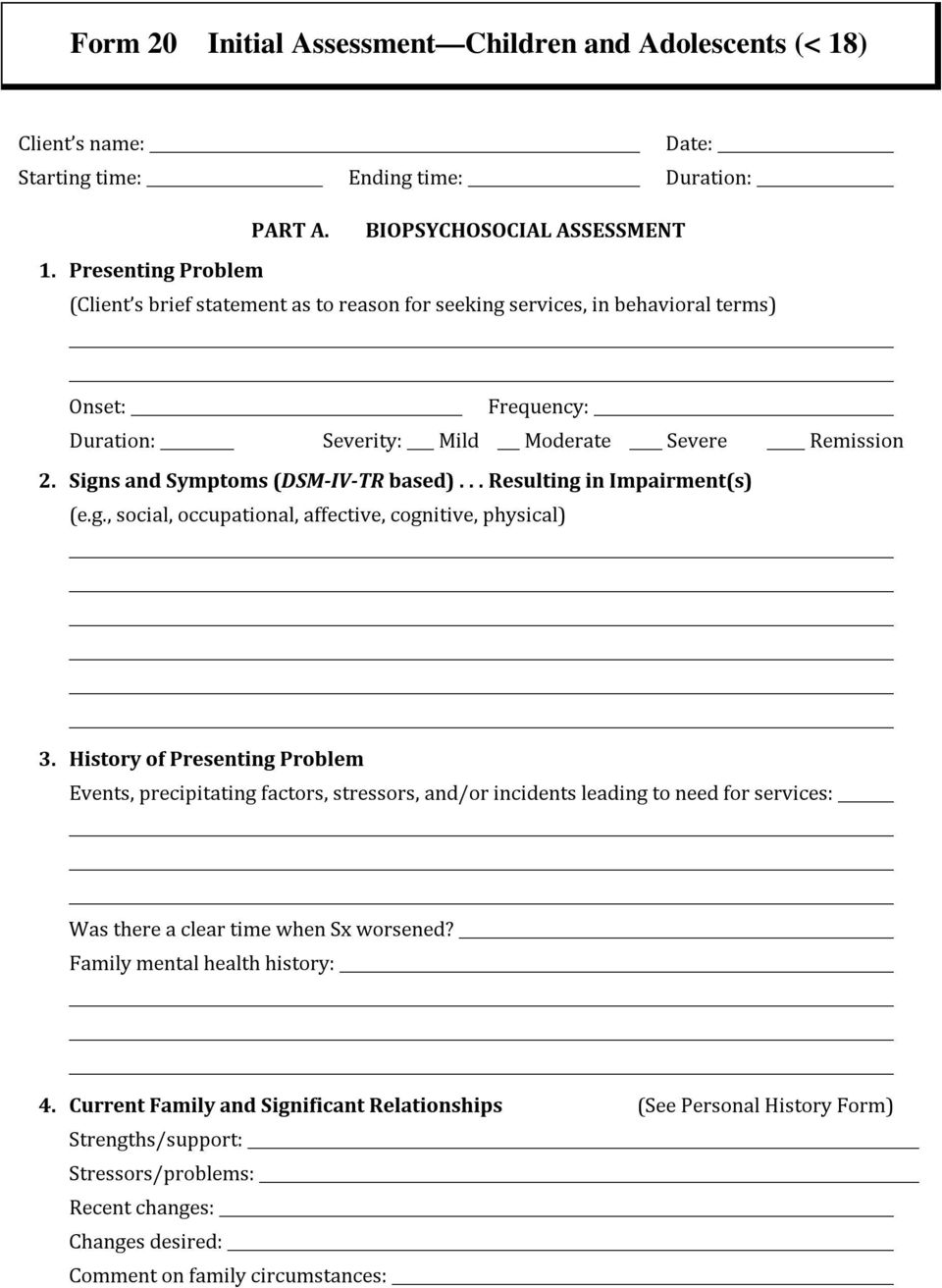
1 Form 20 Initial Assessment Children and Adolescents (< 18) Client s name: Date: Starting time: Ending time: Duration: PART A. BIOPSYCHOSOCIAL ASSESSMENT 1. Presenting Problem (Client s brief statement as to reason for seeking services, in behavioral terms) Onset: Frequency: Duration: Severity: Mild Moderate Severe Remission 2. Signs and Symptoms (DSM-IV-TR based)... Resulting in Impairment(s) (e.g., social, occupational, affective, cognitive, physical) 3. History of Presenting Problem Events, precipitating factors, stressors, and/or incidents leading to need for services: Was there a clear time when Sx worsened? Family mental health history: 4. Current Family and Significant Relationships (See Personal History Form) Stressors/problems: Recent changes: Changes desired: Comment on family circumstances:
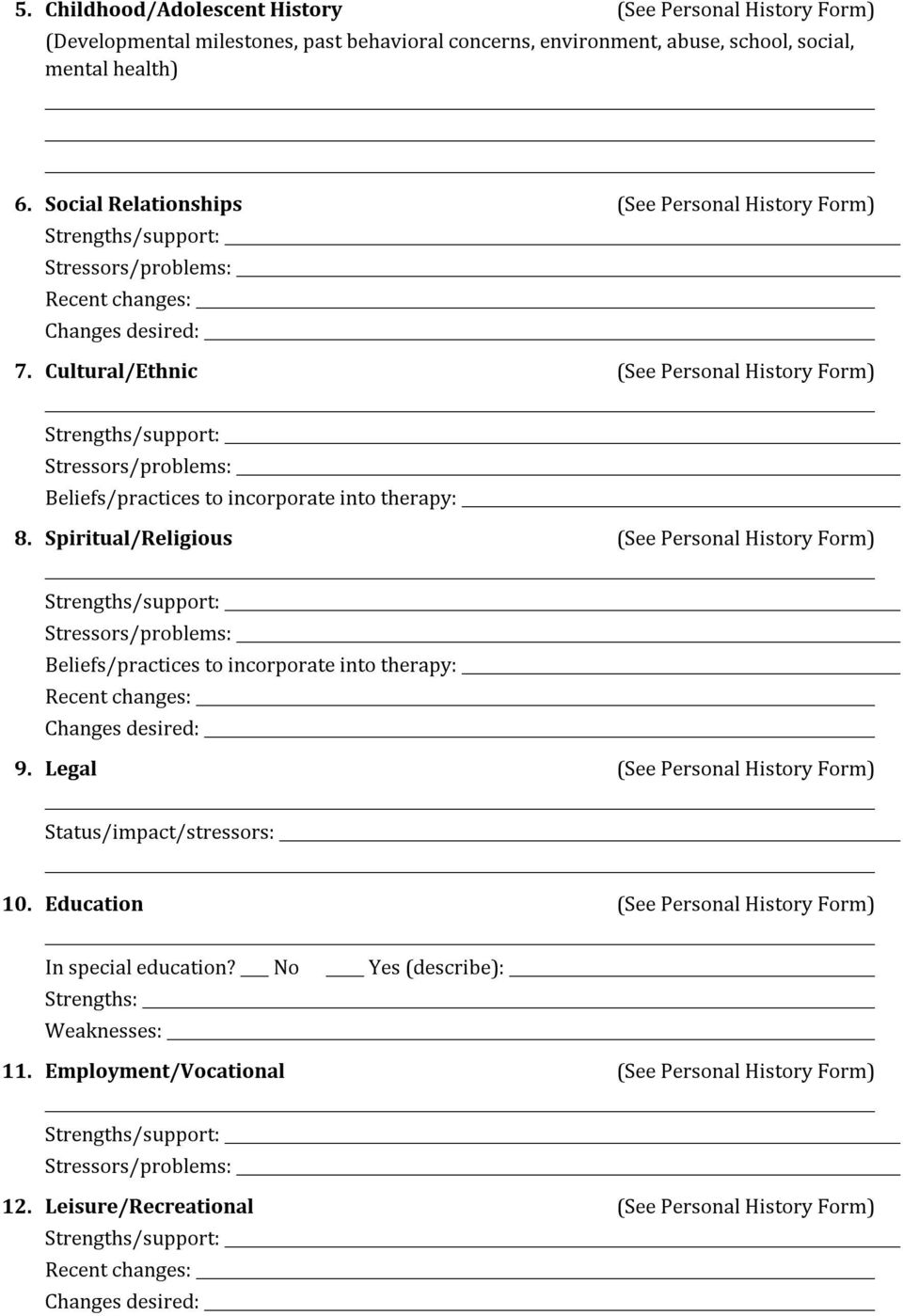
2 5. Childhood/Adolescent History (See Personal History Form) (Developmental milestones, past behavioral concerns, environment, abuse, school, social, mental health) 6. Social Relationships (See Personal History Form) Stressors/problems: Recent changes: Changes desired: 7. Cultural/Ethnic (See Personal History Form) Stressors/problems: Beliefs/practices to incorporate into therapy: 8. Spiritual/Religious (See Personal History Form) Stressors/problems: Beliefs/practices to incorporate into therapy: Recent changes: Changes desired: 9. Legal (See Personal History Form) Status/impact/stressors: 10. Education (See Personal History Form) In special education? No Strengths: Weaknesses: Yes (describe): 11. Employment/Vocational (See Personal History Form) Stressors/problems: 12. Leisure/Recreational (See Personal History Form) Recent changes: Changes desired:
3 13. Physical Health (See Personal History Form) Physical factors affecting mental condition: 14. Chemical Use History (See Personal History Form) Patient s perception of problem: 15. Counseling/Prior Treatment History (See Personal History Form) Benefits of previous treatment: Setbacks of previous treatment: PART B. DIAGNOSTIC INTERVIEW Mood (Rule-in and rule-out signs and symptoms: validate with DSM-IV-TR) Predominant mood during interview: Current Concerns (give examples of impairments (i), severity (s), frequency (f), duration (d)) Adjustment Disorder (w/in 3 months of identified stressor, Sx persist < 6 months after stressor, marked distress) Depressed Anxiety Mixed anxiety & depression Conduct Emotions & conduct Unspecified Specify disturbance: Acute (<6 months) Chronic (>6 months) Impairment(s): social occupational/educational affective cognitive Examples of impairment(s): Major Depression (2 or more wks): Usually depressed or following): wght + / (-) 5%/month appetite + / (-) sleep + / (-) psychomotor + / (-) fatigue worthlessness/guilt concentration death/suicidal ideation Other: crying spells add l. sx withdrawal anhedonia. (4+ of

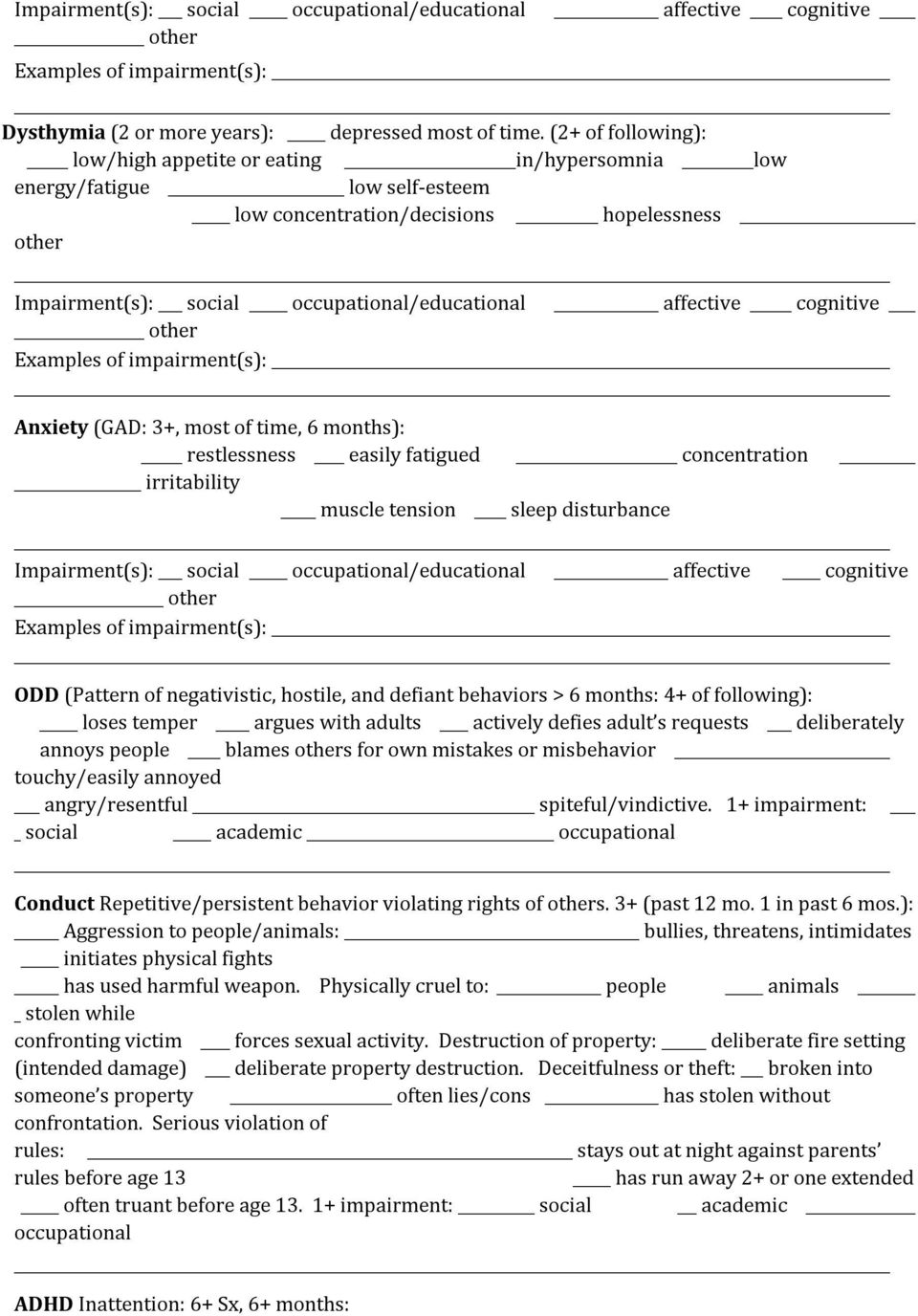
4 Impairment(s): social occupational/educational affective cognitive Examples of impairment(s): Dysthymia (2 or more years): depressed most of time. (2+ of following): low/high appetite or eating in/hypersomnia low energy/fatigue low self-esteem low concentration/decisions hopelessness Impairment(s): social occupational/educational affective cognitive Examples of impairment(s): Anxiety (GAD: 3+, most of time, 6 months): restlessness easily fatigued concentration irritability muscle tension sleep disturbance Impairment(s): social occupational/educational affective cognitive Examples of impairment(s): ODD (Pattern of negativistic, hostile, and defiant behaviors > 6 months: 4+ of following): loses temper argues with adults actively defies adult s requests deliberately annoys people blames s for own mistakes or misbehavior touchy/easily annoyed angry/resentful spiteful/vindictive. 1+ impairment: social academic occupational Conduct Repetitive/persistent behavior violating rights of s. 3+ (past 12 mo. 1 in past 6 mos.): Aggression to people/animals: bullies, threatens, intimidates initiates physical fights has used harmful weapon. Physically cruel to: people animals stolen while confronting victim forces sexual activity. Destruction of property: deliberate fire setting (intended damage) deliberate property destruction. Deceitfulness or theft: broken into someone s property often lies/cons has stolen without confrontation. Serious violation of rules: stays out at night against parents rules before age 13 has run away 2+ or one extended often truant before age impairment: social academic occupational ADHD Inattention: 6+ Sx, 6+ months:
5 poor attn/careless mistakes difficult sustaining attn. not listen when spoken to not follow through difficult organizing, avoids tasks requiring sustained mental effort loses things easily distracted forgetful and/or Hyperactivity/impulsivity. 6+ hyperactivity fidgety leaves seat often runs/climbs difficult being quiet on the go talks excessively. Impulsivity: blurts out answers difficulty awaiting turn interrupts. some SX < impairment: social academic occupational Other Diagnostic Concerns or Behavioral Issues (e.g., dissociation eating sleep impulse control thought disorders anger relationships cognitive phobias substance abuse medical conditions somatization sexual PTSD, etc.) Impairment(s): social occupational/educational affective cognitive Examples of impairment(s): USE ADDITIONAL PAPER AS NECESSARY

6 Mental Status (Check appropriate level of impairment: N/A or OK signifies no known impairment. Comment on significant areas of impairment.) Appearance Unkempt, disheveled ( ) ( ) ( ) ( ) Clothing, dirty, atypical ( ) ( ) ( ) ( ) Odd phys. characteristics ( ) ( ) ( ) ( ) Body odor ( ) ( ) ( ) ( ) Appears unhealthy ( ) ( ) ( ) ( ) Posture Slumped ( ) ( ) ( ) ( ) Rigid, tense ( ) ( ) ( ) ( ) Body Movements Accelerated, quick ( ) ( ) ( ) ( ) Decreased, slowed ( ) ( ) ( ) ( ) Restlessness, fidgety ( ) ( ) ( ) ( ) Atypical, unusual ( ) ( ) ( ) ( ) Speech Rapid ( ) ( ) ( ) ( ) Slow ( ) ( ) ( ) ( ) Loud ( ) ( ) ( ) ( ) Soft ( ) ( ) ( ) ( ) Mute ( ) ( ) ( ) ( ) Atypical (e.g., slurring) ( ) ( ) ( ) ( ) Attitude Domineering, controlling ( ) ( ) ( ) ( ) Submissive, dependent ( ) ( ) ( ) ( ) Hostile, challenging ( ) ( ) ( ) ( ) Guarded, suspicious ( ) ( ) ( ) ( ) Uncooperative ( ) ( ) ( ) ( ) Affect Inappropriate to thought ( ) ( ) ( ) ( ) Increased lability ( ) ( ) ( ) ( ) Blunted, dull, flat ( ) ( ) ( ) ( ) Euphoria, elation ( ) ( ) ( ) ( ) Anger, hostility ( ) ( ) ( ) ( ) Depression, sadness ( ) ( ) ( ) ( ) Anxiety ( ) ( ) ( ) ( ) Irritability ( ) ( ) ( ) ( )

7 Perception Illusions ( ) ( ) ( ) ( ) Auditory hallucinations ( ) ( ) ( ) ( ) Visual hallucinations ( ) ( ) ( ) ( ) Other hallucinations ( ) ( ) ( ) ( ) Cognitive Alertness ( ) ( ) ( ) ( ) Attn. span, distractibility ( ) ( ) ( ) ( ) Short-term memory ( ) ( ) ( ) ( ) Long-term memory ( ) ( ) ( ) ( ) Judgment Decision making ( ) ( ) ( ) ( ) Impulsivity ( ) ( ) ( ) ( ) Thought Content Obsessions/compulsions ( ) ( ) ( ) ( ) Phobic ( ) ( ) ( ) ( ) Depersonalization ( ) ( ) ( ) ( ) Suicidal ideation ( ) ( ) ( ) ( ) Homicidal ideation ( ) ( ) ( ) ( ) Delusions ( ) ( ) ( ) ( ) Estimated level of intelligence: Orientation: Time Place Person Able to hold normal conversation? No Eye contact: Level of insight: Complete denial Blames s Yes Intellectual insight, but few changes likely Emotional insight, understanding, change can occur Client s view of actions needed to change: Comments Slight awareness Blames self

8

9 Diagnosis 1: DSM-IV-TR Criteria PART C. DIAGNOSIS VALIDATION Code: Examples of impairment/dysfunction: Additional validation (e.g., testing, previous records, self-report): Diagnosis 2: DSM-IV-TR Criteria Code: Examples of impairment/dysfunction: Additional validation (e.g., testing, previous records, self-report): Diagnosis 3: DSM-IV-TR Criteria Code: Examples of impairment/dysfunction: Additional validation (e.g., testing, previous records, self-report):

10 Axis I 1: 2: 3: Axis II 1: Axis III Axis IV 2: Diagnosis Code Axis V Current GAF = Highest past year GAF = Prognosis: Poor Marginal Guarded Moderate Good Excellent Qualifiers to prognosis: Med compliance Tx compliance Home environment Other: Activity changes Behavioral changes Attitudinal changes Education/training Treatment Considerations Is the patient appropriate for treatment? No If no, explain and indicate referral made: Tx modality: Indiv. Conjoint Family Collateral Group Frequency: Yes If Conjoint, Family or Collateral, specify with whom: Adjunctive Services Needed: Physical exam Laboratory tests (specify): Patient records (specify): School records Therapist s Questions/Concerns/Comments: Psychiatric evaluation testing Psychological Therapist s signature/credentials: Date: / / Supervisor s Remarks Supervisor s signature/credentials: Date: / / Therapist s Response to Supervisor s Remarks

11 Therapist s signature/credentials: Date: / /

Welcome New Employees. Clinical Aspects of Mental Health, Developmental Disabilities, Addictive Diseases & Co-Occurring Disorders
 Welcome New Employees Clinical Aspects of Mental Health, Developmental Disabilities, Addictive Diseases & Co-Occurring Disorders After this presentation, you will be able to: Understand the term Serious
Self Assessment: Substance Abuse
 Self Assessment: Substance Abuse Please respond TRUE (T) or FALSE (F) to the following items as they apply to you. Part 1 I use or have used alcohol or drugs for recreational purposes. I use alcohol despite
NICHQ Vanderbilt Assessment Scale PARENT Informant
 NICHQ Vanderbilt Assessment Scale PARENT Informant Today s Date: Child s Name: Date of Birth: Parent s Name: Parent s Phone Number: Directions: Each rating should be considered in the context of what is
TELEMEDICINE SERVICES Brant Haldimand Norfolk INITIAL MENTAL HEALTH ASSESSMENT NAME: I.D. # D.O.B. REASON FOR REFERRAL:
 TELEMEDICINE SERVICES Brant Haldimand Norfolk TMS INITIAL MENTAL HEALTH ASSESSMENT NAME: I.D. # D.O.B. (OPTINAL) ADDRESS: CITY: P.C. HOME PHONE: ALTERNATE PHONE: G.P: MARITAL STATUS: AGE: ASSSESSMENT DATE:
Vanderbilt ADHD Diagnostic Rating Scales
 Vanderbilt ADHD Diagnostic Rating Scales Overview The Vanderbilt ADHD Rating Scales (VADRS) are based on DSM-5 criteria for ADHD diagnosis and include versions specific for parents and teachers. These
Child Welfare Trauma Referral Tool
 Module 4, Activity 4F; Module 4, Activity 4G Child Welfare Trauma Referral Tool This measure is designed to help child welfare workers make more trauma-informed decisions about the need for referral to
DIAGNOSTIC ASSESSMENT. Briefly describe how the problem(s) noted above cause difficulty for you or your child (work, school, church, relatives)
 DIAGNOSTIC ASSESSMENT Today s date Sources of Information PRESENTING COMPLAINT SECTION Reason for referral/or treatment Description of presenting problem(s) Briefly describe how the problem(s) noted above
`çããçå=jéåí~ä= aáëçêçéêëw=^åñáéíó=~åç= aééêéëëáçå. aêk=`=f=lâçåü~ jéçáå~ä=aáêéåíçê lñäé~ë=kep=cçìåç~íáçå=qêìëí=
 `çããçå=jéåí~ä= aáëçêçéêëw=^åñáéíó=~åç= aééêéëëáçå aêk=`=f=lâçåü~ jéçáå~ä=aáêéåíçê lñäé~ë=kep=cçìåç~íáçå=qêìëí= Overview: Common Mental What are they? Disorders Why are they important? How do they affect
Washington State Regional Support Network (RSN)
 Access to Care Standards 11/25/03 Eligibility Requirements for Authorization of Services for Medicaid Adults & Medicaid Older Adults Please note: The following standards reflect the most restrictive authorization
Billy. Austin 8/27/2013. ADHD & Bipolar Disorder: Differentiating the Behavioral Presentation in Children
 ADHD & Bipolar Disorder: Differentiating the Behavioral Presentation in Children Judy Goodwin, MSN, CNS Meadows Psychiatric Associates Billy Austin 1 Introduction Distinguishing between ADHD and Bipolar
Children s Community Health Plan INTENSIVE IN-HOME MENTAL HEALTH / SUBSTANCE ABUSE SERVICES ASSESSMENT AND RECOVERY / TREATMENT PLAN ATTACHMENT
 Children s Community Health Plan INTENSIVE IN-HOME MENTAL HEALTH / SUBSTANCE ABUSE SERVICES ASSESSMENT AND RECOVERY / TREATMENT PLAN ATTACHMENT Please fax with CCHP prior authorization form to 608-252-0853
Weiss Symptom Record (WSR)
 Patient Name: Date of Birth: Physician Name: MRN/File No: Date: Weiss Symptom Record (WSR) Instructions to Informant: Check the box that best # items describes typical behavior scored 2 or 3 Instructions
Depression Assessment & Treatment
 Depressive Symptoms? Administer depression screening tool: PSC Depression Assessment & Treatment Yes Positive screen Safety Screen (see Appendix): Administer every visit Neglect/Abuse? Thoughts of hurting
ADHD. & Coexisting Disorders in Children
 ADHD & Coexisting Disorders in Children ADHD AND CHILDREN Attention-deficit/hyperactivity disorder (ADHD) is a recognized medical condition that often requires medical intervention. Establishing a diagnosis
Provider Attestation (Expedited Requests Only) Clinical justification for expedited review:
 Inpatient Treatment Request Fax completed form to: 866 949 4846 Fill out completely to avoid delays Date: / / Request Type (Check one): Standard Expedited (additional information required below) Provider
I. Each evaluator will have experience in diagnosing and treating the disease of chemical dependence.
 PREVENTION/INTERVENTION CENTER COBB COUNTY PUBLIC SCHOOL SAFE AND DRUG FREE PROGRAM www.cobbk12.org/~preventionintervention CONTRACT FOR SERVICE PROVIDERS As a member of the Cobb County Schools Coalition
Documentation Guidelines for ADD/ADHD
 Documentation Guidelines for ADD/ADHD Hope College Academic Success Center This document was developed following the best practice recommendations for disability documentation as outlined by the Association
Mental health issues in the elderly. January 28th 2008 Presented by Éric R. Thériault [email protected]
 Mental health issues in the elderly January 28th 2008 Presented by Éric R. Thériault [email protected] Cognitive Disorders Outline Dementia (294.xx) Dementia of the Alzheimer's Type (early and late
Feeling Moody? Major Depressive. Disorder. Is it just a bad mood or is it a disorder? Mood Disorders. www.seclairer.com S Eclairer 724-468-3999
 Feeling Moody? Is it just a bad mood or is it a disorder? Major Depressive Disorder Prevalence: 7%; 18-29 years old; Female>Male DDx: Manic episodes with irritable mood or mixed episodes, mood disorder
Initial Evaluation for Post-Traumatic Stress Disorder Examination
 Initial Evaluation for Post-Traumatic Stress Disorder Examination Name: Date of Exam: SSN: C-number: Place of Exam: The following health care providers can perform initial examinations for PTSD. a board-certified
Managed Health Care Administration Initial Assessment Child/Adolescent Program Parent Questionnaire Page 1
 Page 1 Date: Patient Name: Date of Birth: / / Age of Patient: Name of person completing this form Relationship to Patient: Dear Parent: The information that you provide is critical in providing an accurate
A Review of Conduct Disorder. William U Borst. Troy State University at Phenix City
 A Review of 1 Running head: A REVIEW OF CONDUCT DISORDER A Review of Conduct Disorder William U Borst Troy State University at Phenix City A Review of 2 Abstract Conduct disorders are a complicated set
UCLA-NPI/VA PG-2 Child & Adolescent Psychiatry Course 2004-5. Week 3:Attention Deficit Hyperactivity Disorder
 UCLA-NPI/VA PG-2 Child & Adolescent Psychiatry Course 2004-5 Week 3:Attention Deficit Hyperactivity Disorder ADHD:Epidemiology Point Prevalence 2-18% M:F>= 2:1 ADHD Symptoms Cognitive (attention) Impulsivity
MCPS Special Education Parent Summit
 MCPS Special Education Parent Summit May 17, 2014 Rockville High School 2100 Baltimore Road Rockville, MD 20851 When ADHD Is Not ADHD: ADHD Look-Alikes and Co-occurring Disorders David W. Holdefer MCPS
CRITERIA CHECKLIST. Serious Mental Illness (SMI)
 Serious Mental Illness (SMI) SMI determination is based on the age of the individual, functional impairment, duration of the disorder and the diagnoses. Adults must meet all of the following five criteria:
Mental Disorders (Except initial PTSD and Eating Disorders) Examination
 Mental Disorders (Except initial PTSD and Eating Disorders) Examination Name: Date of Exam: SSN: C-number: Place of Exam: The following health care providers can perform initial examinations for Mental
Identifying Individuals with a Dual Diagnosis and Substance Misuse
 Identifying Individuals with a Dual Diagnosis and Substance Misuse Presented by the Dual Diagnosis Substance Misuse Committee 1 Goal of Presentation To raise awareness To assist staff to identify individuals
ADHD AND ANXIETY AND DEPRESSION AN OVERVIEW
 ADHD AND ANXIETY AND DEPRESSION AN OVERVIEW A/Professor Alasdair Vance Head, Academic Child Psychiatry Department of Paediatrics University of Melbourne Telephone: 9345 4666 Facsimile: 9345 6002 Email:
Duval, Larry. Discharge Summary
 The Best Clinic 12707 High Bluff Dr, Suite 200 Arlington, TX 22202 Phone: 777-111-2222 Fax: 777-234-2455 2:32:44 PM DATE ADMITTED: 4/20/2009 DATE DISCHARGED: This discharge summary consists of 1. The Initial
Chapter 14. Psychological Disorders
 Chapter 14 Psychological Disorders We ve Come a Long Way Trepanning Ancient priests or medicine men cut holes into the skills of living persons, to release the demons. What is Abnormality Psychopathology
Presently, there are no means of preventing bipolar disorder. However, there are ways of preventing future episodes: 1
 What is bipolar disorder? There are two main types of bipolar illness: bipolar I and bipolar II. In bipolar I, the symptoms include at least one lifetime episode of mania a period of unusually elevated
Crisis Intervention Incidents (CRITICAL)
 Policy 435 City of Sunnyvale Department of Public Safety 435.1 PURPOSE AND SCOPE This policy provides guidelines for interacting with those who may be experiencing a mental health or emotional crisis.
Intensive Residential Treatment Services -IRTS. Program Description
 Intensive Residential Treatment Services -IRTS Program Description A highly structured non-hospital based treatment setting that brings comprehensive and specialized diagnostic and treatment services to
DSM-5 to ICD-9 Crosswalk for Psychiatric Disorders
 DSM-5 to ICD-9 Crosswalk for Psychiatric s The crosswalk found on the pages below contains codes or descriptions that have changed in the DSM-5 from the DSM-IV TR. DSM-5 to ICD-9 crosswalk is available
VIRTUAL UNIVERSITY OF PAKISTAN FORMAT OF THE INTERNSHIP REPORT FOR BS Psychology (Clinical Setting)
 VIRTUAL UNIVERSITY OF PAKISTAN FORMAT OF THE INTERNSHIP REPORT FOR BS Psychology (Clinical Setting) 1. Title page The title page of the report will include: Clinical Case Studies The name of the internee,
Behavioral Health Best Practice Documentation
 Behavioral Health Best Practice Documentation Click on the desired Diagnoses link or press Enter to view all information. Diagnoses: DSM-5 and ICD-10 Codes Major Depressive Disorder Bipolar Disorder Eating
Drugs PSYCHOSIS. Depression. Stress Medical Illness. Mania. Schizophrenia
 Drugs Stress Medical Illness PSYCHOSIS Depression Schizophrenia Mania Disorders In preschool children imaginary friends and belief in monsters under the bed is normal (it may be normal in older developmentally
Dr. Varunee Mekareeya, M.D., FRCPsychT. Attention deficit hyperactivity disorder
 Attention deficit hyperactivity disorder Dr. Varunee Mekareeya, M.D., FRCPsychT Attention deficit hyperactivity disorder (ADHD) is one of the most common psychiatric disorders in childhood. At least half
Interview for Adult ADHD (Parent or Adult Questionnaire)
 Interview for Adult ADHD (Parent or Adult Questionnaire) (client s name here) is undergoing evaluation for Attention Deficit Hyperactivity Disorder (ADHD). You have been identified as someone who could
DISCLAIMER THIS DOCUMENT CONTAINS A SCREENING TOOL. IT IS NOT INTENDED TO BE USED AS A MENTAL HEALTH DIAGNOSTIC TOOL.
 MENTAL HEALTH ASSESSMENT TOOL FORWARD The Mental Health Assessment Tool was developed to bring awareness to behaviors that may potentially disrupt the TB treatment regimen. Substance abuse and mental illness
Conduct Disorder: Treatment Recommendations. For Vermont Youth. From the. State Interagency Team
 Conduct Disorder: Treatment Recommendations For Vermont Youth From the State Interagency Team By Bill McMains, Medical Director, Vermont DDMHS Alice Maynard, Mental Health Quality Management Chief, Vermont
EXHIBIT D, COVERED BEHAVIORAL HEALTH DIAGNOSES
 EXHIBIT D, COVERED BEHAVIORAL HEALTH DIAGNOSES Part I- Mental Health Covered Diagnoses 295-298.9 295 Schizophrenic s (the following fifth-digit sub-classification is for use with category 295) 0 unspecified
Depression, Mental Health and Native American Youth
 Depression, Mental Health and Native American Youth Aisha Mays, MD UCSF Department of Family And Community Medicine Native American Health Center Oakland, CA July 8, 2015 Presenter Disclosures No relationships
Co-Occurring Disorders
 Co-Occurring Disorders PACCT 2011 CAROLYN FRANZEN Learning Objectives List common examples of mental health problems associated with substance abuse disorders Describe risk factors that contribute to the
ENTITLEMENT ELIGIBILITY GUIDELINE
 ENTITLEMENT ELIGIBILITY GUIDELINE BIPOLAR DISORDERS MPC 00608 ICD-9 296.0, 296.1, 296.4, 296.5, 296.6, 296.7, 296.8, 301.13 ICD-10 F30, F31, F34.0 DEFINITION BIPOLAR DISORDERS Bipolar Disorders include:
Emotionally Disturbed. Questions from Parents
 1 Emotionally Disturbed Questions from Parents Characteristics that may be reflective of ED:* an inability to learn which cannot be explained by intellectual, sensory, or health factors. an inability to
Identifying and Treating Dual-Diagnosed Substance Use and Mental Health Disorders. Presented by: Carrie Terrill, LCDC
 Identifying and Treating Dual-Diagnosed Substance Use and Mental Health Disorders Presented by: Carrie Terrill, LCDC Overview What is Dual Diagnosis? How Common is Dual Diagnosis? What are Substance Use
Licensing Exam Practice Questions
 Licensing Exam Practice Questions Everyone has a different study style but the best way to study for this exam is to test your self on the art of the multiple choice question. The exam will have 170 multiple
Employee Drug-Free Workplace Education
 Employee Drug-Free Workplace Education South Carolina State University Alcohol- and Drug-Free Workplace Provided by the Office of Professional Development & Training SC State University Employee Education
Suzanne R. Merlis, Psy. D. Georgia-LLC Licensed Psychologist
 Suzanne R. Merlis, Psy. D. Georgia-LLC Licensed Psychologist If going to asylum officer at affirmative stage: ASYLUM OFFICER, ARLINGTON ASYLUM OFFICE In the Matter of Mr. X Respondent If referred to judge:
CHAPTER 5 MENTAL, BEHAVIOR AND NEURODEVELOPMENT DISORDERS (F01-F99) March 2014. 2014 MVP Health Care, Inc.
 CHAPTER 5 MENTAL, BEHAVIOR AND NEURODEVELOPMENT DISORDERS (F01-F99) March 2014 2014 MVP Health Care, Inc. CHAPTER 5 CHAPTER SPECIFIC CATEGORY CODE BLOCKS F01-F09 Mental disorders due to known physiological
309.28 F43.22 Adjustment disorder with mixed anxiety and depressed mood Adjustment disorder with disturbance of conduct
 Description ICD-9-CM Code ICD-10-CM Code Adjustment reaction with adjustment disorder with depressed mood 309.0 F43.21 Adjustment disorder with depressed mood Adjustment disorder with anxiety 309.24 F43.22
ADD and/or ADHD Verification Form
 ADD and/or ADHD Verification Form Disability Services for Students (DSS) provides academic services and accommodations for students with diagnosed disabilities. The documentation provided regarding the
Psychiatrists should be aware of the signs of Asperger s Syndrome as they appear in adolescents and adults if diagnostic errors are to be avoided.
 INFORMATION SHEET Age Group: Sheet Title: Adults Depression or Mental Health Problems People with Asperger s Syndrome are particularly vulnerable to mental health problems such as anxiety and depression,
Appendix 5. Victim Impact
 Appendix 5 Victim Impact ACQUAINTANCE RAPE: THE VICTIM Gail Abarbanel Director Rape Treatment Center Santa Monica-UCLA Medical Center Issues in Acquaintance Rapes Not common perception of rape Not real
MANAGING DEPRESSIVE SYMPTOMS IN SUBSTANCE ABUSE CLIENTS DURING EARLY RECOVERY
 MANAGING DEPRESSIVE SYMPTOMS IN SUBSTANCE ABUSE CLIENTS DURING EARLY RECOVERY Presented by: William L. Mock, Ph.D., LISW,LICDC, SAP Professional Training Associates Inc North Ridgeville, Ohio 1 (216) 299-9506
Traumatic Stress. and Substance Use Problems
 Traumatic Stress and Substance Use Problems The relation between substance use and trauma Research demonstrates a strong link between exposure to traumatic events and substance use problems. Many people
SLEEP DISTURBANCE AND PSYCHIATRIC DISORDERS
 E-Resource December, 2013 SLEEP DISTURBANCE AND PSYCHIATRIC DISORDERS Between 10-18% of adults in the general population and up to 50% of adults in the primary care setting have difficulty sleeping. Sleep
ADHD DSM Criteria and Evidence-based Treatments
 ADHD DSM Criteria and Evidence-based Treatments DSM-5 Criteria for ADHD A. A persistent pattern of inattention and/or hyperactivity-impulsivity that interferes With functioning or development, as characterized
Study Guide - Borderline Personality Disorder (DSM-IV-TR) 1
 Study Guide - Borderline Personality Disorder (DSM-IV-TR) 1 Pervasive pattern of instability of interpersonal relationships, selfimage, and affects, and marked impulsivity that begins by early adulthood
Attachment 5 Arizona s Crosswalk for DC: 0-3R, DSM-IV-TR and ICD-10-CM 1
 Arizona Department of Health Services/Division of Behavioral Health Services Practice Tool, Working with the Birth to Five Population Attachment 5 Arizona s Crosswalk for DC: 0-3R, DSM-IV-TR and ICD-10-CM
Minnesota DC:0-3R Crosswalk to ICD Codes
 Minnesota DC:0-3R Crosswalk to ICD DC 0-3R 0 Post-Traumatic Stress (this diagnosis must be considered first according to the DC:0-3R decision tree) 150 Deprivation/Maltreatment 200 of Affect 2 Prolonged
Recognizing and Treating Depression in Children and Adolescents.
 Recognizing and Treating Depression in Children and Adolescents. KAREN KANDO, MD Division of Child and Adolescent Psychiatry Center for Neuroscience and Behavioral Medicine Phoenix Children s Hospital
Crosswalk to DSM-IV-TR
 Crosswalk to DSM-IV-TR Note: This Crosswalk includes only those codes most frequently found on existing CDERs. It does not include all of the codes listed in the DSM-IV-TR nor does it include all codes
Memory, Behaviour, Emotional and Personality Changes after a Brain Injury
 Memory, Behaviour, Emotional and Personality Changes after a Brain Injury The consequences of a brain injury on any individual, family or relationship are far reaching. A brain injury not only impacts
Guidelines for Documentation of Attention Deficit/Hyperactivity Disorder In Adolescents and Adults
 Guidelines for Documentation of Attention Deficit/Hyperactivity Disorder In Adolescents and Adults Third Edition 2016 Office of Disability Policy Educational Testing Service Princeton, NJ 08541 Copyright
Bipolar Disorder. When people with bipolar disorder feel very happy and "up," they are also much more active than usual. This is called mania.
 Bipolar Disorder Introduction Bipolar disorder is a serious mental disorder. People who have bipolar disorder feel very happy and energized some days, and very sad and depressed on other days. Abnormal
WORKERS COMPENSATION PROTOCOLS WHEN PRIMARY INJURY IS PSYCHIATRIC/PSYCHOLOGICAL
 WORKERS COMPENSATION PROTOCOLS WHEN PRIMARY INJURY IS PSYCHIATRIC/PSYCHOLOGICAL General Guidelines for Treatment of Compensable Injuries Patient must have a diagnosed mental illness as defined by DSM-5
BRIEF NOTES ON THE MENTAL HEALTH OF CHILDREN AND ADOLESCENTS
 BRIEF NOTES ON THE MENTAL HEALTH OF CHILDREN AND ADOLESCENTS The future of our country depends on the mental health and strength of our young people. However, many children have mental health problems
Kids Have Stress Too! Especially at Back to School Time As a Parent, You Can Help!
 1 Kids Have Stress Too! Especially at Back to School Time As a Parent, You Can Help! Stress can infect and affect the physical, emotional, intellectual and academic well being of children. It can interfere
How to Recognize Depression and Its Related Mood and Emotional Disorders
 How to Recognize Depression and Its Related Mood and Emotional Disorders Dr. David H. Brendel Depression s Devastating Toll on the Individual Reduces or eliminates pleasure and jo Compromises and destroys
Registered Charity No. 5365
 THE MULTIPLE SCLEROSIS SOCIETY OF IRELAND Dartmouth House, Grand Parade, Dublin 6. Telephone: (01) 269 4599. Fax: (01) 269 3746 MS Helpline: 1850 233 233 E-mail: [email protected] www.ms-society.ie
ADHD in Children vs. Adults
 ADHD in Children vs. Adults ADHD Symptoms In Children DSM-IV INATTENTION 1) Often does not give close attention to details or makes careless mistakes in schoolwork, work, or other activities. 2) Often
Depression Treatment Guide
 Depression Treatment Guide DSM V Criteria for Major Depressive Disorders A. Five (or more) of the following symptoms have been present during the same 2-week period and represent a change from previous
What is ADHD/ADD and Do I Have It?
 What is ADHD/ADD and Do I Have It? ADHD Definition and Symptoms Adults with ADHD Possible Coexistent Conditions Medications and Treatments Additional Resources Works Cited What is Attention Deficit Hyperactivity
Understanding. Depression. The Road to Feeling Better Helping Yourself. Your Treatment Options A Note for Family Members
 TM Understanding Depression The Road to Feeling Better Helping Yourself Your Treatment Options A Note for Family Members Understanding Depression Depression is a biological illness. It affects more than
Adult Information Form Page 1
 Adult Information Form Page 1 Client Name: Age: DOB: Date: Address: City: State: Zip: Home Phone: ( ) OK to leave message? Yes No Work Phone: ( ) OK to leave message? Yes No Current Employer (or school
Depression is a medical illness that causes a persistent feeling of sadness and loss of interest. Depression can cause physical symptoms, too.
 The Family Library DEPRESSION What is depression? Depression is a medical illness that causes a persistent feeling of sadness and loss of interest. Depression can cause physical symptoms, too. Also called
Treatment Planning. The Key to Effective Client Documentation. Adapted from OFMQ s 2002 provider training.
 Treatment Planning The Key to Effective Client Documentation Adapted from OFMQ s 2002 provider training. 1 Models Medical Model Diagnosis Psych Eval Problems Symptoms Psycho/Social/Behavioral Model Diagnosis
Lepage Associates Solution-Based Psychological & Psychiatric Services With office in S. Durham/RTP, Main Telephone: (919) 572-0000
 Page 1 of 5 Lepage Associates Solution-Based Psychological & Psychiatric Services With office in S. Durham/RTP, Main Telephone: (919) 572-0000 Raleigh and Chapel Hill www.lepageassociates.com LEPAGE ASSOCIATES
D. Clinical indicators for psychiatric evaluation are established by one or more of the following criteria. The consumer is:
 MCCMH MCO Policy 2-015 Date: 4/21/11 V. Standards A. A psychiatric evaluation shall be done as an integral part of the assessment process. It serves as the guide to the identification of medical and psychiatric
Antisocial personality disorder
 Page 1 of 7 Diseases and Conditions Antisocial personality disorder By Mayo Clinic Staff Antisocial personality disorder is a type of chronic mental condition in which a person's ways of thinking, perceiving
Attachment A. Code Beginning Review
 Attachment A ICD-10-CM Mental Disorders Diagnosis Codes and s Subject to Certification of Admission/Concurrent/Continued Stay Review Based on the Admitting Diagnosis Code This list contains principal diagnosis
The Clinical Presentation of Mood Disorders. Bob Boland MD
 The Clinical Presentation of Mood Disorders. Bob Boland MD 1 The Clinical Presentation of Mood Disorders 2 Concentrating On Depression Major Depression Mania Bipolar Disorder (Manic-Depression) For the
EMOTIONAL DISTURBANCE
 I. DEFINITION "Emotional disturbance" means a condition exhibiting one or more of the following characteristics over a long period of time and to a marked degree that adversely affects a child's educational
Mental Health ICD-10 Codes Department of Health and Mental Hygiene
 Mental Health ICD-10 Codes Department of Health and Mental Hygiene (2) For dates of service on or after October 1, 2015: F200 F201 F202 F203 F205 F2081 F2089 F209 F21 F22 F23 F24 F250 F251 F258 F259 F28
Santa Fe Sage Counseling Center
 Couple/Family Client Intake Date: Names: Partner/Parent/Child (circle one) Partner/Parent/Child (circle one) Parent/Child (circle one) Parent/Child (circle one) Parent/Child (circle one) Insurance ID #:
Background: Previous Research
 OUTCOME TRAJECTORIES FOR YOUTH SERVED IN RESIDENTIAL TREATMENT FACILITY SETTINGS OR THE COMMUNITY THROUGH THE HOME AND COMMUNITY BASED SERVICES MEDICAID WAIVER Office of Performance Measurement & Evaluation
Criteria to Identify Abnormal Behavior
 Criteria to Identify Abnormal Behavior Unusualness Social deviance Emotional distress Maladaptive behavior Dangerousness Faulty perceptions or interpretations of reality Hallucinations Delusions Copyright
DSM-5: A Comprehensive Overview
 1) The original DSM was published in a) 1942 b) 1952 c) 1962 d) 1972 DSM-5: A Comprehensive Overview 2) The DSM provides all the following EXCEPT a) Guidelines for the treatment of identified disorders
DSM-5 Do Not Use ICD -10 Codes
 DSM-5 Do Not Use ICD -10 Codes There are ICD-10 codes that DSM 5 is not compatible with. This spreadsheet details the ICD-10 codes that are NOT compatible with DSM 5. ICD10_DX_CD ICD10_DX_DESC F03.90 Unspecified
Documentation Requirements ADHD
 Documentation Requirements ADHD Attention Deficit Hyperactivity Disorder (ADHD) is considered a neurobiological disability that interferes with a person s ability to sustain attention, focus on a task
Some helpful reminders on depression in children and young people. Maria Moldavsky Consultant Child and Adolescent Psychiatrist
 Some helpful reminders on depression in children and young people Maria Moldavsky Consultant Child and Adolescent Psychiatrist The clinical picture What art and my patients taught me Albert Durer (1471-1528)
Behavioral and Developmental Referral Center
 Dear Parent, Thank you for allowing us the opportunity to serve your family. We will make every effort to best meet your needs. You will find a brief questionnaire enclosed with this letter. This information
Physical Symptoms Mood Symptoms Behavioral Symptoms
 Prescription drugs are the 3 rd most commonly abused drugs amongst teens in Nebraska, and the same statistic holds true on a national level. The rise in prescription drug abuse is becoming increasingly
Wake Forest Mind and Health, PLLC 501 North Main Street Wake Forest, NC 27587
 Wake Forest Mind and Health, PLLC 501 rth Main Street Wake Forest, NC 27587 Katherine E. Walker, PhD, LPC, NCC, BCIA-C Jennifer Endries, MEd, LPC Licensed Professional Counselor Licensed Professional Counselor
Does Non-Suicidal Self-injury Mean Developing Borderline Personality Disorder? Dr Paul Wilkinson University of Cambridge
 Does Non-Suicidal Self-injury Mean Developing Borderline Personality Disorder? Dr Paul Wilkinson University of Cambridge If I see a patient who cuts themself, I just assume they have borderline personality