
Maryland 4-H Public Speaking Guide
|
|
|
- Paulina Conley
- 9 years ago
- Views:
Transcription
1 Maryland 4-H Public Speaking Guide Thomas Hutson, 4-H Youth Development Extension Educator Maryland Cooperative Extension Talbot County Equal access/opportunity programs 1

2 Talbot County 2

3 3

4 4
5 5

6 6

7 7

8 4-H Club Public Speaking Opportunities: Demonstrations and Illustrated Talks 1. Demonstrations - Demonstration Outline Form 2. Illustrated Talks - Illustrated Talk Outline Form - Tips for Creating Great Visual Aids 8
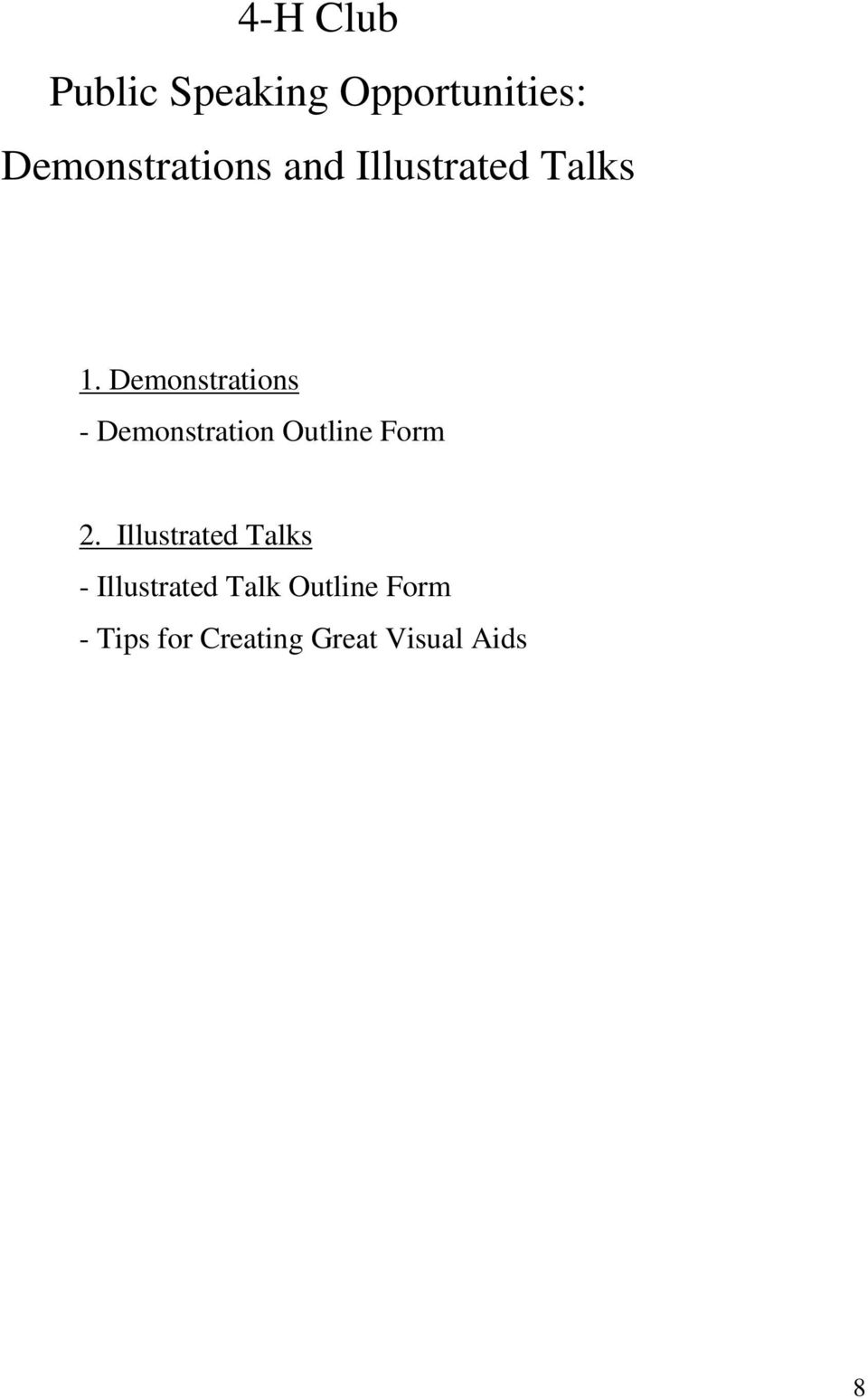
9 Demonstration Outline Form: Name Title or Topic Materials Needed I. INTRODUCTION A. Background Information (name, age, club, project areas, number of years) B. Demonstration Information 1. description of demonstration 2. why I chose this demonstration II. PROCEDURE Description of step Materials to show audience III. CONCLUSION A. Summary of Demonstration (why it s important/summary of steps) B. Helpful Hints 9
10 Illustrated Talk Outline Form: Name Age Project Title or Topic Why topic was chosen Visual Aids Used: (posters, Powerpoint presentation, photographs, etc.) I. INTRODUCTION A. Opening Statement B. Overview of talk and Sub-topics II. BODY Sub-topic Visual aids to show A. Supporting Facts: B. Supporting Facts: C. Supporting Facts: III. CONCLUSION A. Summary of important points 10

11 TIPS FOR CREATING GREAT VISUAL AIDS Choose the correct type of visual aids for your presentation: POSTERS CHARTS AND GRAPHS SERIES OF PHOTOGRAPHS POWERPOINT/ SLIDES Pros: Easy, Pros: Good for Pros: Easy way for Pros: Modern good for showing showing artwork or technology, large information and number data how something has and easy to see pictures and statistics changed over time images, good for combined photos and info. ACTUAL ITEM (3-D) Pros: Best way to show what things really look like Cons: Must be Cons: Can Cons: May need to Cons: Need a Cons: 3-D hung or held up confuse people, be enlarged or reliable computer, materials are must be hung mounted on a projector, and hard to label or held up poster electricity and carry For a successful poster, chart, or slide show Make visual aids BIG ENOUGH for the audience to see! Do everything NEATLY. Choose IMPORTANT INFORMATION to include (don t include all of your info!) Use EASY-TO-READ computer fonts. Include a TITLE. Make letters at least 1 high for a poster. Put information IN YOUR OWN WORDS. (Don t print/glue from internet!) LESS IS MORE. DON T put TOO MUCH on one poster or slide! Too much info that is squished together makes it hard to read a poster. Divide posters into SECTIONS for different topics and use SECTION HEADINGS Use SIMPLE CHARTS AND GRAPHS so you don t confuse the audience. Include a CAPTION for each photograph that tells what is in the photo. Consider COMBINATIONS of posters, photos, and charts (if appropriate). 11

12 4-H Communications Contest Events Maryland 4-H Communications Contest Rules 1. Radio Spot - Radio Spot Rules and Score Card - Tips for Writing an Effective Radio Spot - Radio Spot Planning Form 2. Prepared Speech - Prepared Speech Rules and Score Card - Steps and Tips for Writing an Effective Prepared Speech - Prepared Speech Graphic Organizer - Prepared Speech Outline Form - Prepared Speech Sample Note Cards 3. Interpretations: Dramatic, Poetry, and Humorous - Tips for Interpretations - Interpretations Score Card 4. Extemporaneous - Extemporaneous Score Card 12

13 MARYLAND 4-H COMMUNICATION CONTEST RULES: Revised February The contest consists of four categories: Prepared Speech Extemporaneous Radio Spot Interpretations Speeches are given by individuals, not teams. 2. Each of the above categories includes three age groups: Junior: 8-10 Intermediate: Senior: Ages are as of January 1st of the current year. 3. Time Limits: Prepared: Juniors: 3 to 5 minutes, Intermediates and Seniors: 4 to 6 minutes; Extemporaneous: Juniors and Intermediates: 2 to 3 minutes, Seniors: 3 to 5 minutes; Radio Spot: 30 seconds for all age groups. Interpretations: Juniors and Intermediates: 2 to 3 minutes, Seniors: 3 to 5 minutes. Judges may deduct points for presentations not meeting or exceeding time limits. 4. Visual aids, including posters, are not permitted. Appropriate gestures are encouraged. For Dramatic Interpretation, contestant may choose to wear a costume and opt to sit for the presentation. Podium use is optional. 5. Prepared Speech: Contestants may speak on any topic. It may be wise to discuss topics that could be considered controversial with your 4-H leader or educator before the contest. The speech may be written for a specific audience, such as a 4-H club, PTA, or a Rotary Club. Note cards containing a key word outline are permitted. Only juniors may use a complete script. Memorization is not encouraged. 6. Extemporaneous speakers will draw three topics and choose one topic to speak on. Juniors and Intermediates may have up to 30 minutes and Seniors up to 15 minutes to prepare their talk. Contestants may use one side of up to four, or both sides of up to two, 5 x 8 inch note cards for their key word outline. Extemporaneous speakers will be shown time cards at correctly timed intervals indicating "30 SECONDS", "1 MINUTE" AND "STOP". 7. Prepared Speech, Extemporaneous Speech and Interpretations: contestants should not introduce themselves as part of their presentation. This will be done by an MC or room Host/Hostess. 8. Radio spots should be exactly 30 seconds in length and may include a musical or sound effect introduction and/or background, but may not include a spoken introduction or tag by anyone other than the contestant. If music or a sound effect is used, the contestant must provide and operate the sound-making device. The contestant will provide a complete written script (including notations about music/sound effects) to the timekeeper to aid in timing accuracy. Musical/sound effect introductions and endings are considered a part of the radio spot and must not cause the 30 second time limit to be exceeded The spot should relate to 4-H, be original and be created by the contestant.. 9. Interpretations: Speaker can speak or interpret in language of their choice. If using language other than spoken English, participant must inform Extension Office before the event to ensure appropriate judges. 13

14 10. Judges may ask questions of contestants in the prepared, extemporaneous and interpretations. Due to time constraints, questioning should be limited to two or three minutes per speaker. Questions will not be asked in the radio spot category. 11. At the State Contest, a contestant may only compete in one category. If a contestant wins more than one category at the County Contest, they must choose which category to compete in a the State Contest. 12. The names of county champions in age group in each category will be sent to the State 4-H Office by April 1st. 13. State Champions may not enter the same category and age group a second time. Dramatic, Poetry, and Humorous Interpretations (New Communication Contest Category) Interpretations are to be memorized oral interpretation or a selection of narrative in language of speaker s choice. Interpretations consist of three categories: Dramatic Interpretation a. Oral interpretation, memorized by the speaker or a serious selection of narrative or dramatic literature. Monologues are acceptable. b. Mime use your body to create an interpretation Poetry Interpretation a memorized oral interpretation by the speaker. Humorous Interpretation a memorized oral interpretation of a humorous selection by the speaker. Cuttings may be taken from published plays or prose. Rules: 1. Time limits: a. Juniors & Intermediates: 2 to 3 minutes b. Seniors: 3 to 5 minutes 2. Visual aides are not permitted. Appropriate gestures are encouraged. For Dramatic interpretation, contestant may opt to sit for presentation. Podium use is optional. 3. Contestants are to bring two (2) copies of the script including reference. Language other than spoken English must be translated. 4. Speaker can speak or interpret in language of their choice. If using language other than spoken English, participant must inform Extension Office before the event to ensure appropriate judges. 5. At the State Contest, a contestant may only compete in one category. If a contestant wins more than one category at the County Contest, they must choose which category to compete in at the State Contest. 6. The names of the champions in each of the three age groups of each category will be sent to the State 4-H Office by April 1. State Champions may not enter the same category and age group a second time. Equal opportunity employer and equal access programs. 14

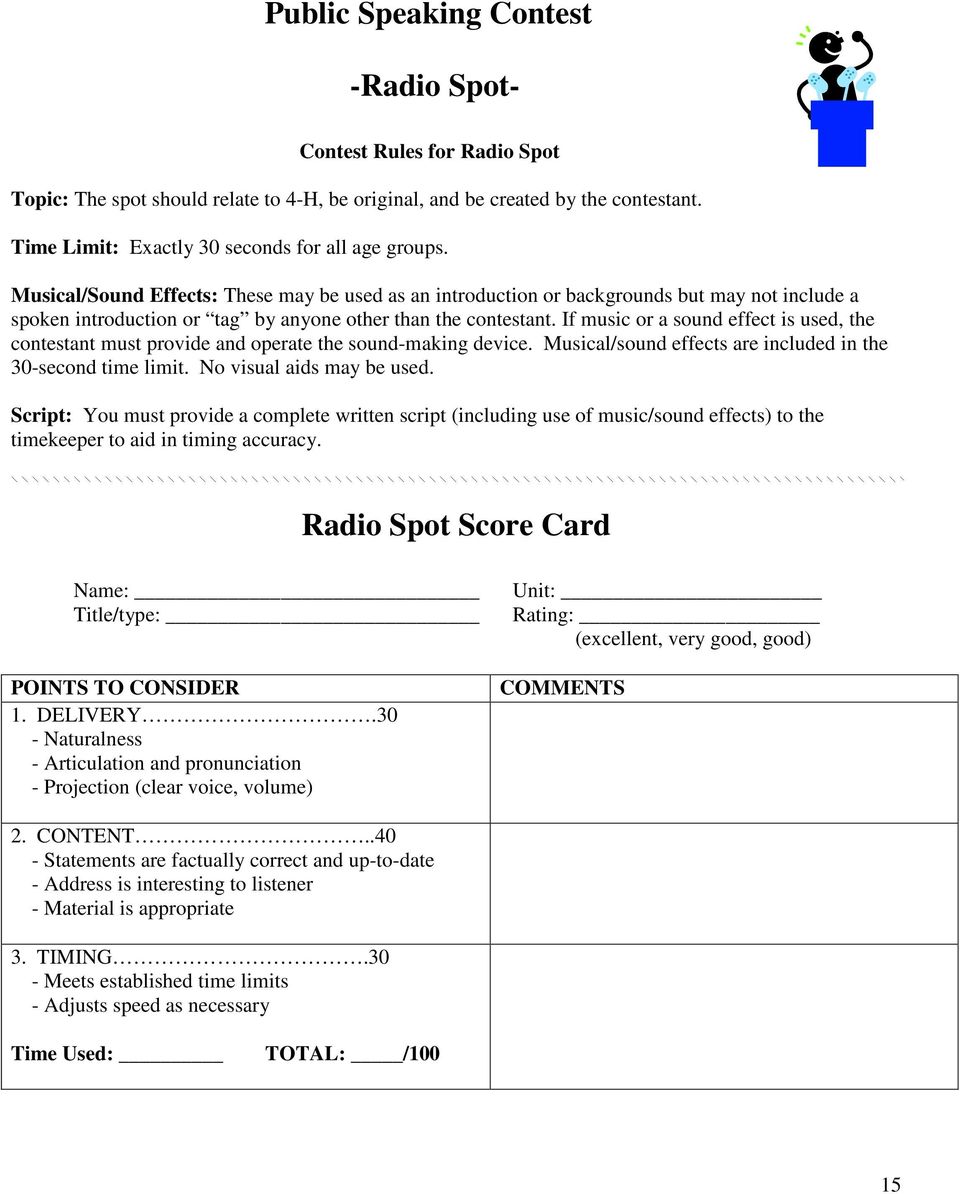
15 Public Speaking Contest -Radio Spot- Contest Rules for Radio Spot Topic: The spot should relate to 4-H, be original, and be created by the contestant. Time Limit: Exactly 30 seconds for all age groups. Musical/Sound Effects: These may be used as an introduction or backgrounds but may not include a spoken introduction or tag by anyone other than the contestant. If music or a sound effect is used, the contestant must provide and operate the sound-making device. Musical/sound effects are included in the 30-second time limit. No visual aids may be used. Script: You must provide a complete written script (including use of music/sound effects) to the timekeeper to aid in timing accuracy. Radio Spot Score Card Name: Title/type: POINTS TO CONSIDER 1. DELIVERY.30 - Naturalness - Articulation and pronunciation - Projection (clear voice, volume) Unit: Rating: (excellent, very good, good) COMMENTS 2. CONTENT Statements are factually correct and up-to-date - Address is interesting to listener - Material is appropriate 3. TIMING.30 - Meets established time limits - Adjusts speed as necessary Time Used: TOTAL: /100 15
16 Steps and Tips for Writing an Effective Radio Spot Steps: 1. Gather your information and decide how you want to use it. 2. Plan your radio spot (use the radio spot planning form). a. Who is your target audience? b. What do you want to tell them? c. What should your audience do after they hear your information? 3. Write your radio spot a. Tell people what they should do. b. State your main message at least twice in your spot. c. Make your radio spot fun to listen to. 4. Review you radio spot. a. Is your target audience clear? b. Does your spot ask your audience to do something? c. Did you tell you audience why they should do this? d. Does your spot have ONLY one main message? e. Did you state your message at least twice? f. Did you use phrases and words that your audience understands? Tips: Remember that our opening sentence is your attention getter. It must be clear and short and attract people s attention. Try starting with a question. Make sure that you support your main point by giving reasons and examples Write your speech so that your audience wants to listen. You have only 30 seconds so every word counts. Make sure your sentences aren t short/choppy. Make sure that you practice your spot so you know how fast you are talking and exactly how long it will take you to get through your commercial. 16

17 4-H Radio Spot Planning Form: Name Age Club Topic of Radio Spot: Main Message: Sound Effects (if any): I. OPENING STATEMENT OR IDEA (Get their attention!) II. SUPPORTING FACTS AND DETAILS (Inform them!) III. FINAL STATEMENT OR IDEA (Make them remember!) Now use your outline to write your script. A radio spot should last EXACTLY 30 seconds! 17

18 Public Speaking Contest -Prepared Speech- Contest Rules for Prepared Speech Topic: Any topic you choose, but ask your leader if you think the topic might be too controversial or inappropriate. You may write your speech for a certain audience such as your 4-H club, the PTA, or the County Commissioners. Time Limit: Juniors = 3-5 minutes; Intermediates and Seniors = 4-6 minutes Rules: (1) DO NOT introduce yourself as part of your speech. You will be introduced before you begin. (2) NO visual aids may be used. (3) You must stand while speaking; you may use a podium if you wish; appropriate gestures are encouraged. (4) Note cards containing a key word outline are permitted. Only juniors may use a complete script. Memorizing the speech is not encouraged. (5) Judges may ask you questions for 2 to 3 minutes after the speech. Prepared Speech Score Card Name Title Unit Rating (Excellent, very good, good) POINTS TO CONSIDER 1. NATURALNESS (AT EASE)..20 -waits for quiet before starting -offers no apologies -has sincere manner; enjoys sharing ideas -appears relaxed, not stilted -pauses naturally between ideas -shows spontaneous, informal style 2. ORGANIZATION 25 -is well organized -develops points logically -uses examples from own experience -expresses own ideas and feelings -makes statements that are easily understood -presents original material -has good opening and closing marks -prepares thoroughly 3. DELIVERY.20 -poise and posture -pronunciation and articulation -projection (clear voice, volume, eye contact) -appropriate gestures 4. CONTENT..35 -statements are factually correct and up-to-date -audience learns about subject COMMENTS Time Used: TOTAL: /100 18

19 Steps and Tips for Writing an Effective Prepared Speech Steps: 1. Choose a topic. a. Pick something you know something about or that you have some thoughts or feelings about. b. Don t make it too big, like How to raise and care for meat and dairy goats because you don t have enough time to explain a big topic. c. Try to avoid very controversial topics. Judges may have strong opinions that could influence their scoring of your speech. 2. Determine your audience. a. Will your speech be for everyone or for a special group? b. What is the age range of the listeners? c. Will they know about your topic before the speech? d. Could they disagree with what you say or have biases that you have to overcome? e. What is your purpose? To teach the audience about something? To change their attitude about a topic? To make them feel more strongly about an issue? 3. Write the speech (use the prepared speech graphic organizer or outline form). I. Introduction an overview Get their attention. The introduction must attract people s interest. You might want to use an interesting statement about your topic, a brief description of a problem you will discuss, or a question to get the audience thinking. State the point or theme of your speech. Give a brief overview of what you will discuss. (See your outline for details.) II. Body the main part of the speech *** Note: Intermediates and seniors can use note cards based on your outline, so be sure to prepare your note cards in advance! Have 2 or 3 small sub-topics ; that support your main topic. Use words such as first or second to let the audience know you are changing subtopics. For each sub-topic, start by saying what it is. Use details to help the audience understand each sub-topic. III. Conclusion a summary Be sure to summarize the main points of the speech and restate the main point. You can ask the audience to take action about your topic. You can finish with an important thought or quote. Have a strong last sentence. 4. Give the speech. *** Look over a detailed list of public speaking tips to help you prepare. a. Use note cards (see sample note card format) and stick to the time limits don t go over. b. Use a conversational tone of voice and focus on your topic. c. Use appropriate gestures. You might want to practice in front of a mirror. d. Dress neatly and try to look as professional as possible. e. Stand with your weight on both feet and lean toward the audience a little so it looks like you really want to tell them something. 19
20 Prepared Speech Graphic Organizer: Name Title or Topic Opening Statement INTRODUCTION Main topic/overview Sub-topic 1 Sub-topic Sub-topic 3 B O D Y Supporting facts Supporting facts Supporting facts Summary of speech CONCLUSION Final statement 20

21 Prepared Speech Outline Form: Name Title or Topic I. INTRODUCTION A. Opening Statement B. Overview of Speech and Sub-topics II. BODY A. (Sub-topic 1) Supporting facts: B. (Sub-topic 2) Supporting facts: C. (Sub-topic 3) Supporting facts: III. CONCLUSION A. Summary of Speech B. Final Statement 21
22 SAMPLE NOTE CARDS FOR PREPARED SPEECHES Title or topic: #1 I. Introduction A. Opening Statement: B. Overview of Speech: II. Body #2 A. (Sub-topic 1) Supporting Facts: #3 B. (Sub-topic 2) Supporting Facts:
23 #4 C. (Sub-topic 3) Supporting Facts: III. Conclusion #5 A. Summary of Speech B. Final Statement 23
24 Tips for Successful Interpretations 24
25 Interpretations Score Card (Circle Category) Dramatic Interpretation Humorous Interpretation Poetry Presentation Award: Name: Unit/Club: Presentation Title: * * * TIMING: Juniors and Intermediates - 2 to 3 minutes, Seniors - 3 to 5 minutes * * * FACTORS EVALUATED COMMENTS POINTS Selection 25 points possible - Appropriate (meets category requirements/tasteful) - Meets Time Limits - Proper identification of author Delivery 30 points possible - Memorization (knowledge of material) - Pronunciation, articulation - Projection (clear voice, volume, eye contact) - Use of body (gestures, facial expression, posture, stage presence) Interpretation 25 points possible - Comprehension & proper emphasis - Creation of mood (style, phrasing, expression) - Spiritual or emotional effect Overall Effectiveness 20 points possible - Proficiency of Delivery - Personal Appearance - Able to relate to audience - Able to hold attention - Poise Equal opportunity employer and equal access programs. Total (100 points possible): 25
26 Extemporaneous Speaking Score Card Name Title Unit Rating (Excellent, very good, good) POINTS TO CONSIDER COMMENTS 1. ORGANIZATION Is well organized Develops points logically Uses illustrations from own experience Expresses own ideas and feelings Makes statements that are easily understood 2. DELIVERY Poise and posture Pronunciation and articulation Projection (clear voice, volume, eye contact) Sincere manner Natural pauses between ideas 3. CONTENT Statements are factually correct and up-to-date Audience learns about subject Time Used TOTAL /100 Juniors and Intermediates: 2 to 3 minutes Seniors: 3 to 5 minutes Equal opportunity employer and equal access programs. 26
Maryland 4-H Public Speaking Guide
 Maryland 4-H Public Speaking Guide Do you have questions? Contact Tom Hutson, 4-H Educator University of Maryland Extension Talbot County (410) 822-1244 or [email protected] Equal access/opportunity programs
TO WRITING AND GIVING A GREAT SPEECH. A Reference Guide for Teachers by Elaine C. Shook Leon County 4-H
 EIGHTSTEPS TO WRITING AND GIVING A GREAT SPEECH A Reference Guide for Teachers by Elaine C. Shook Leon County 4-H Introduction Good oral communication skills are important in our day to day activities.
Link: University of Canberra http://www.canberra.edu.au/studyskills/learning/oralpres.html#preparing
 6. Voice, speech and body language: The way you speak, the way you act and the way you move around can be very important to succeed in your presentation. Here you will find some useful advices and links
Communications & Public Speaking
 Communications & Public Speaking SKILL Project Proficiency Proposal April 2009 - Revised as suggested by the 4-H County Council July 2009 - Final Proposal Chesney Johnson Potter Valley 4-H Communications
Speaking and Listening Materials
 Speaking and Listening Materials The speaking and listening materials consist of a teacher s handbook, a book of teaching objectives and classroom activities, a pack of leaflets and posters and a video
THE ART OF 4-H PUBLIC SPEAKING. 4-H Manual 95 Rep. July 1993 For Grade Levels 4-12
 THE ART OF 4-H PUBLIC SPEAKING 4-H Manual 95 Rep. July 1993 For Grade Levels 4-12 9 CONTENTS To the 4-H Leader... 1 To the 4-H Member - Why Make a Speech?... 1 Developing Your Speech/Talk... 2 Organizing
Guidelines for Giving Oral Presentations
 Section for Magnetic Resonance Technologists Guidelines for Giving Oral Presentations SMRT Education Committee Purpose: This slide presentation covers basic considerations and guidelines for giving and
Steps in Planning a Presentation
 4-H Youth Development 211-200D Steps in Planning a Presentation In general, there are seven steps in planning a presentation: 1. Choose your topic 2. Determine your purpose 3. Gather information 4. Develop
Alignment of the National Standards for Learning Languages with the Common Core State Standards
 Alignment of the National with the Common Core State Standards Performance Expectations The Common Core State Standards for English Language Arts (ELA) and Literacy in History/Social Studies, Science,
Laugh at your fear of Public Speaking ~ Give an Icebreaker Speech!
 Laugh at your fear of Public Speaking ~ Give an Icebreaker Speech! JoAnne Castagna, Ed.D Technical writer-editor Army Corps of Engineers New York District Sonia Satra Soap Opera Actress Award-winning Speaker
Planning and preparing presentations Giving presentations Features of a good presentation Poster presentations
 Presentations What is a presentation? Planning and preparing presentations Giving presentations Features of a good presentation Poster presentations For further information and the full range of study
Form: Filled in table. Method: Peer assessment. Tool: Checklist. Form: Completed table. Method: Peer assessment. Tool: Checklist
 Lesson Plan English First Additional Language Grade 5 Content in context: Text from other Learning Area - Whether Los and ASs Learning Activities Details of Assessment Barriers to Learning LO 1 Listening
Public Speaking Booklet
 Public Speaking Booklet Name: Introduction Any public speech is a type of acting. Your written speech is your script. In a speech you research, order and present your ideas and thoughts to an audience
Chapter 1 Communicating in Your Life
 Name: Class: Date: Chapter 1 Communicating in Your Life True/False Indicate whether the sentence or statement is true or false. 1. The communication process has five components: the sender, the message,
MINUTE TAKING. All material copyright of Lindsay Wright This pack is for sample purposes only, and not for re-use
 MINUTE TAKING All material copyright of Lindsay Wright This pack is for sample purposes only, and not for re-use 1 Minute Taking Sample Programme OBJECTIVES As a result of the programme participants should
Developing Communication Skills in Learning for Life and Work
 Key Stage 3 Developing Communication Skills in Learning for Life and Work 1 Communication is central to the whole curriculum. Children should be able to communicate in order to express themselves socially,
Module 9. Building Communication Skills
 Module 9 Building Communication Skills Essential Ideas to Convey To apply a facilitative approach to supervision, supervisors have to approach the people they manage in a different way, by using certain
The Competent Communicator Manual
 The Competent Communicator Manual Speech 1: The Ice Breaker For your first speech project, you will introduce yourself to your fellow club members and give them some information about your background,
Steps for Planning and Preparing an Effective Presentation
 Steps for Planning and Preparing an Effective Presentation According to speaking consultant Lilyan Wilder (1999), two of the greatest myths about delivering oral presentations are that you re better off
Build a Bridge. Based on the book
 Fifth Grade English Design Brief Build a Bridge Based on the book Bridge to Terabithia by Katherine Paterson Background: You have just completed reading the book Bridge to Terabithia. Jess has asked for
Tips for making effective presentations
 Tips for making effective presentations Doing successful presentations could be considered an Art, which can be mastered only over time after extensive practice. However, it is helpful to remember the
Thai Language Self Assessment
 The following are can do statements in four skills: Listening, Speaking, Reading and Writing. Put a in front of each description that applies to your current Thai proficiency (.i.e. what you can do with
Module 2: Conflict Management
 Module 2: Conflict Management Conflict management, like effective communication skills, is another important element of social competency. This module promotes the use of several forms of conflict management
Develop Your Public Speaking Skills: Tips for Beginning Speakers, Speech Coaches, and Judges 1
 AEC341 Develop Your Public Speaking Skills: Tips for Beginning Speakers, Speech Coaches, and Judges 1 Marshall H. Breeze, Rick D. Rudd, Gregory T. Gifford, and Catherine W. Shoulders 2 Developing effective
Complete a Relationships Presentation
 Complete a Relationships Presentation Speech Tips 1. I am so scared of giving my speech. How do I get over my nervousness? Nervousness is natural. Think of it as a friend rather than an enemy. You need
Winning the Toastmasters Speech Evaluation Contest
 Winning the Toastmasters Speech Evaluation Contest The Evaluation Maven Way By Rodney Denno www.ewoliving.com/comp2c.php 1 Courtesy of EWOL Training & Development Contents The Don t Worry, Be Happy Areas...3
How to teach listening 2012
 How to teach listening skills "Great speakers are not born, they re trained." - Dale Carnegie (1921) Intended Learning Outcomes (ILOs) To enhance deeper understanding of the process of listening as a communicative
IMPROMPTU PUBLIC SPEAKING
 IMPROMPTU PUBLIC SPEAKING Purpose and Standards The MANRRS Contest is designed to develop the ability of all MANRRS members to express himself or herself on a given subject without having prepared or rehearsed
Tips for Successful Conference Presentations. James D. Lehman Associate Dean for Discovery and Faculty Development
 Tips for Successful Conference Presentations James D. Lehman Associate Dean for Discovery and Faculty Development Today s Topics Understanding common conference formats Writing a conference proposal Preparation
COMPETENT COMMUNICATION MANUAL (NEW)
 Project #1: THE ICE BREAKER Executive Summary: For your first speech project, you will introduce yourself to your fellow club members and give them some information about your background, interests and
GUESSING BY LOOKING AT CLUES >> see it
 Activity 1: Until now, you ve been asked to check the box beside the statements that represent main ideas found in the video. Now that you re an expert at identifying main ideas (thanks to the Spotlight
VAK Learning Styles. Whether you realise it or not, we all have preferences for how we absorb information, analyse it and make decisions:
 What is Your Learning Preference? VAK Learning Styles Whether you realise it or not, we all have preferences for how we absorb information, analyse it and make decisions: Some people like to see what you
Youth/Leader Demonstration/Illustrated Talk Guide
 Youth/Leader Demonstration/Illustrated Talk Guide What are Demonstrations and Illustrated Talks? A Demonstration is a talk that shows, one step at a time, how to perform an activity. When you are finished
COMPUTER TECHNOLOGY IN TEACHING READING
 Лю Пэн COMPUTER TECHNOLOGY IN TEACHING READING Effective Elementary Reading Program Effective approach must contain the following five components: 1. Phonemic awareness instruction to help children learn
Planning a Scientific Presentation
 Planning a Scientific Presentation October 8, 2002 Department of Computer Science, Graduate Seminar Facilitator: Jason Harrison As a graduate student in Computer Science you will have
The. Languages Ladder. Steps to Success. The
 The Languages Ladder Steps to Success The What is it? The development of a national recognition scheme for languages the Languages Ladder is one of three overarching aims of the National Languages Strategy.
Prepared Public Speaking
 Prepared Public Speaking Purpose: The purpose of the Prepared Public Speaking CDE is to allow students to develop a speech pertaining to a topic in agriculture. It aims to provide the opportunity for personal
CONTROLLING YOUR FEAR
 CONTROLLING YOUR FEAR The Better Speaker Series WHERE LEADERS ARE MADE CONTROLLING YOUR FEAR The Better Speaker Series TOASTMASTERS INTERNATIONAL P.O. Box 9052 Mission Viejo, CA 92690 USA Phone: 949-858-8255
Imagine It! ICEBREAKER:
 ICEBREAKER: Imagine It! FOCUS: To develop creativity and increase participants comfort with acting in front of a group PURPOSE: To help participants relax before working on their public presentation skills
Presentations Phrases Prepositions Pairwork Student A Choose one of the sections below and read out one of the example sentences with a gap or noise
 Presentations Phrases Prepositions Pairwork Student A Choose one of the sections below and read out one of the example sentences with a gap or noise instead of the preposition. Your partner can guess the
Presentation Skills. Dr. Mark Matthews, Student Learning Development
 Presentation Skills Dr. Mark Matthews, Student Learning Development Ask Yourself 1. What is your experience of giving presentations? 2. What do you like about it? 3. What do you dislike about it? 4. Will
How to Sell Yourself in a Job Interview
 TOOLS Interview Tips Helpful Interview Hints How to prepare for the first important meeting What to expect Be prepared The Interview Interview Techniques Most frequently asked questions Facing the Interviewer
A Guide to Cambridge English: Preliminary
 Cambridge English: Preliminary, also known as the Preliminary English Test (PET), is part of a comprehensive range of exams developed by Cambridge English Language Assessment. Cambridge English exams have
Lesson 3. Becoming a Better Speaker. What You Will Learn to Do. Linked Core Abilities. Skills and Knowledge You Will Gain Along the Way.
 Lesson 3 Becoming a Better Speaker What You Will Learn to Do Present a speech for a specific purpose Linked Core Abilities Communicate using verbal, nonverbal, visual, and written techniques Skills and
A GUIDE TO MAKING GREAT 4-H SPEECHES
 A GUIDE TO MAKING GREAT 4-H SPEECHES Communication and public speaking are important life skills gained through 4-H participation. Speaking face-to-face is one of the oldest forms of communication and
Music Makers. paper clips
 Fifth Grade Science Design Brief Music Makers Background: We know that sound is a form of energy produced and transmitted by vibrating matter and that pitch is determined by the frequency of a vibrating
Reading and Taking Notes on Scholarly Journal Articles
 Reading and Taking Notes on Scholarly Journal Articles Set aside enough time in your schedule to read material thoroughly and repeatedly, until you understand what the author is studying, arguing, or discussing.
How Can Teachers Teach Listening?
 3 How Can Teachers Teach Listening? The research findings discussed in the previous chapter have several important implications for teachers. Although many aspects of the traditional listening classroom
Common Core State Standards Speaking and Listening
 Comprehension and Collaboration. Prepare for and participate effectively in a range of conversations and collaborations with diverse partners, building on others ideas and expressing their own clearly
INFORMATIVE SPEECH. Examples: 1. Specific purpose: I want to explain the characteristics of the six major classifications of show dogs.
 INFORMATIVE SPEECH An informative speech provides information about a specific subject to an audience. The aim of an informative speech is to help your audience to understand and to remember the information
Picture games. 1. What do you see? A picture says a thousand words and the camera does not lie - or does it? Instructions
 A picture says a thousand words and the camera does not lie - or does it? THEMES GEN. HUMAN RIGHTS MEDIA DISCRIMINATION COMPLEXITY Themes Complexity Level 1 Group size Time Overview Related rights Objectives
SPEECH Orientation Packet
 East Bay Regional ACADEMIC DECATHLON SPEECH Orientation Packet TABLE OF CONTENTS Information Index... Cover Schedule for the Day... 2 Rules & Guidelines For Judging Speech... 3-5 A Contest of Academic
LANGUAGE! 4 th Edition, Levels A C, correlated to the South Carolina College and Career Readiness Standards, Grades 3 5
 Page 1 of 57 Grade 3 Reading Literary Text Principles of Reading (P) Standard 1: Demonstrate understanding of the organization and basic features of print. Standard 2: Demonstrate understanding of spoken
Companion Animals Amphibians & Reptiles Cats Dogs Horses Veterinary Science
 Making the Character Connection with Companion Animals Amphibians & Reptiles Cats Dogs Horses Veterinary Science Being a person of good character means you follow the Six Pillars of Character SM everyday.
How To Teach A Counselor To Be A Successful Counselor
 Counseling Microskills Microskills are the basic foundational skills involved in effective helping relationships. They are the foundational tools on which the success of interventions with clients may
Chapter 4 COMMUNICATION SKILLS. The difference between verbal and nonverbal communication. The difference between hearing and listening
 Chapter 4 COMMUNICATION SKILLS What You Will Learn The difference between verbal and nonverbal communication The difference between hearing and listening Factors that promote effective communication Barriers
Giving a great workplace presentation
 Giving a great workplace presentation Cara PENRY WILLIAMS 1 WORKPLACE PRESENTATIONS Could include: Formal presentations to a small or large group to colleagues and managers or to clients Group presentations
High School Speech and Debate Judging Basics and Event Descriptions
 High School Speech and Debate Judging Basics and Event Descriptions October 4, 2012 Pete Martin, Riverside High School General IE Judging Guidelines When judging a competitor in individual or speaking
How to Take Running Records
 Running Records are taken to: guide teaching match readers to appropriate texts document growth overtime note strategies used group and regroup children for instruction How to Take Running Records (adapted
1. The student will understand the origins of World War II, the course of the war, and the impact of the war on American society.
 Lesson Plan Title: Living in Minnesota during World War II Concept / Topic To Teach: The impact of government and community sponsored programs that were used on the home front in Minnesota during World
The plot is the sequence of events in a story. Each event causes or leads to the next. Events of the plot reveal a problem called the conflict.
 FOR USE WITH FOCUS LESSON 1: NARRATIVE STRATEGIES I 1a The plot is the sequence of events in a story. Each event causes or leads to the next. Events of the plot reveal a problem called the conflict. The
2015 Bus & Paratransit Conference
 American Public Transportation Association 2015 Bus & Paratransit Conference Moderator & Speaker Guidelines Your reference for effectively facilitating and presenting educational sessions Moderator Roles
Teaching and Educational Development Institute. Presentation skills for teachers
 Presentation skills for teachers Presentation skills for teachers Your success as a teacher is largely determined by your ability and skill in communicating your message. We have all experienced teachers
Academic presentations
 ST810 March 17, 2008 Outline Types of talks Organization Preparing slides Presentation tips Taking questions Types of talks: Conference presentation Usually 15-20 minutes for contributed talks. Maybe time
Teaching Public Speaking Online
 Teaching Public Speaking Online By Tim Sheldon Bryant & Stratton College January 27, 2009 I teach public speaking Online using PowerPoint audio, and it has proven to be as effective in developing speaking
Writing Business documents and. All material will be adapted from Botha, D. et al. 2007. Public Relations: Fresh Perspectives. Pearson Education SA
 Writing Business documents and Formal Texts All material will be adapted from Botha, D. et al. 2007. Public Relations: Fresh Perspectives. Pearson Education SA Introduction Writing business documents in
Dr. Lisa White [email protected]
 Dr. Lisa White [email protected] edu Associate Dean College of Science and Engineering San Francisco State University Purpose of a Poster To communicate/publicize to others your research/experiment results
NOTE-TAKING. Rutgers School of Nursing
 NOTE-TAKING Rutgers School of Nursing WHEN TO TAKE NOTES BEFORE DURING AFTER I. Before Class: Preparation (mental and physical) Read Textbook BEFORE Class Start Taking Notes BEFORE Class The SQ3R Method
ILLINOIS ASSOCIATION FFA Rules for Extemporaneous Public Speaking CDE
 ILLINOIS ASSOCIATION FFA Rules for Extemporaneous Public Speaking CDE Revised August 2004 Eligibility 1. The CDE is open to students who are regularly enrolled in agricultural education classes and who
Conducting Successful Public Relations & Media Interviews. Rhett Butler Center for Faith-Based and Community Initiatives U.S. Department of Labor
 Conducting Successful Public Relations & Media Interviews Rhett Butler Center for Faith-Based and Community Initiatives U.S. Department of Labor Benefits of Media Coverage Greater public awareness makes
Manual Speech Objectives
 SPECIAL OCCASION SPEECHES - SPEECH OBJECTIVES 1. Mastering the Toast 2-3 minutes -Recognize the characteristics of a toast. -Present a toast honoring an occasion or a person. 2. Speaking in Praise -Prepare
INTERVIEW QUESTIONS & TECHNIQUES Collected by MBA Dept
 INTERVIEW QUESTIONS & TECHNIQUES Collected by MBA Dept General Advice Before you go for your interview you need to find out everything you can about the company. Reread your application/cv/covering letter,
VAK Learning Styles Self-Assessment Questionnaire
 Student Services Study Skills Student Development and Counselling VAK Learning Styles Self-Assessment Questionnaire Circle or tick the answer that most represents how you generally behave. (It s best to
Virginia English Standards of Learning Grade 8
 A Correlation of Prentice Hall Writing Coach 2012 To the Virginia English Standards of Learning A Correlation of, 2012, Introduction This document demonstrates how, 2012, meets the objectives of the. Correlation
French Language and Culture. Curriculum Framework 2011 2012
 AP French Language and Culture Curriculum Framework 2011 2012 Contents (click on a topic to jump to that page) Introduction... 3 Structure of the Curriculum Framework...4 Learning Objectives and Achievement
Learning Style Inventory
 Learning Style Inventory To better understand how you prefer to learn and process information, place a check in the appropriate space after each statement below, then use the scoring directions at the
Cambridge English: First (FCE) Frequently Asked Questions (FAQs)
 Cambridge English: First (FCE) Frequently Asked Questions (FAQs) Is there a wordlist for Cambridge English: First exams? No. Examinations that are at CEFR Level B2 (independent user), or above such as
Monitoring for Meaning
 Monitoring for Meaning Grades 3-5 eeee Wwh Monitoring comprehension is above all engagement. When readers monitor their thinking, they have an inner conversation with the text. They listen to the voice
Newspaper Activities for Students
 Newspaper Activities for Students Newspaper Activities for Students Page 2 Higher Learning By the year 2010, millions of the jobs available in the United States will require more than a high school diploma.
Academic Standards for Reading, Writing, Speaking, and Listening June 1, 2009 FINAL Elementary Standards Grades 3-8
 Academic Standards for Reading, Writing, Speaking, and Listening June 1, 2009 FINAL Elementary Standards Grades 3-8 Pennsylvania Department of Education These standards are offered as a voluntary resource
Multiple Intelligences Survey 1999 Walter McKenzie, The One and Only Surfaquarium http://surfaquarium.com/mi/inventory.htm
 Multiple Intelligences Survey 1999 Walter McKenzie, The One and Only Surfaquarium http://surfaquarium.com/mi/inventory.htm Part I Complete each section by placing a 1 next to each statement you feel accurately
A. What is a play? B. What are basic elements of a play script? 1. 2. 3. 4. 5. C. What kind of character does your group wish to write about?
 WRITE A ONE ACT PLAY I. PREWRITE A. What is a play? B. What are basic elements of a play script? 1. 2. 3. 4. 5. C. What kind of character does your group wish to write about? D. As a result of reading/seeing
LECTURE AND NOTE TAKING
 LECTURE AND NOTE TAKING Goals of Note Taking Taking notes helps with classroom concentration, test preparation and for clues as to what the instructor feels is most important. Prepare to take effective
1 Grammar in the Real World
 U NIT 31 Adjectives and Adverbs Making a Good Impression 1 Grammar in the Real World A Do you know how to give a presentation? What do you do to prepare? Read the article How many of your ideas are in
STUDENT S PACKET FOR THE SCIENCE FAIR PROJECT
 STUDENT S PACKET FOR THE SCIENCE FAIR PROJECT SCIENCE PROJECT STEPS 1. Choose a topic. Be sure it interests you. Don t pick one because you think it will be easy. Talk it over with your parents and when
Starting a Booktalk Club: Success in Just 12 Weeks!
 Starting a Booktalk Club: Success in Just 12 Weeks! It s wonderful that you re interested in starting a booktalk club at your school! Before you even begin, you may want to familiarize yourself with some
...and then, how to handle Questions
 1 THE 4 Ps OF GIVING A GOOD PRESENTATION POSITIVE THINKING PREPARATION PRACTICE PERFORMANCE calm approach start early rehearsal: your voice fear of public speaking? state your case on your own stay relaxed
Customer Service and Communication. Bringing service to the next level
 Customer Service and Communication Bringing service to the next level 1 Park Authority Philosophy & Goals Before focusing on customer service, it is first important to understand and reinforce the Park
heads of SCHOOL SPORT ORGANISING COMMITTEE presentations and public speaking
 heads of SCHOOL SPORT ORGANISING COMMITTEE presentations and public speaking Introduction As a Head of your School Sport Organising Committee (SSOC), there are likely to be situations throughout the year
Creating PowerPoint Presentations with Audio Narration. Tips & Techniques for Designing Online Lectures Using PowerPoint
 Creating PowerPoint Presentations with Audio Tips & Techniques for Designing Online Lectures Using PowerPoint Provided by: Johns Hopkins University - Engineering for Professionals Center for Learning Design
Digital Story Telling with Windows Movie Maker Step by step
 . PAGE 1 Superhighways 2013 CONTENTS Before you open Windows Movie Maker (WMM)... 3 Organising your digital assets... 3 Windows Live Photo Gallery... 3 Your First Project in WMM... 4 Adding Audio... 6
Scientific Conference Presentations
 Scientific Conference Presentations Hilary M Jones If you are collecting Green Card/Training points, please sign in. For you if: You have been to a conference, but not yet given a presentation at one You
GUIDELINES FOR PUBLIC SPEAKING
 Jacobson Center for Writing, Teaching and Learning GUIDELINES FOR PUBLIC SPEAKING From asking and answering questions in class to delivering a formal speech, public speaking is an important part of your
Website Accessibility Under Title II of the ADA
 Chapter 5 Website Accessibility Under Title II of the ADA In this chapter, you will learn how the nondiscrimination requirements of Title II of 1 the ADA apply to state and local government websites. Chapter
Rubrics for Assessing Student Writing, Listening, and Speaking High School
 Rubrics for Assessing Student Writing, Listening, and Speaking High School Copyright by the McGraw-Hill Companies, Inc. All rights reserved. Permission is granted to reproduce the material contained herein
KINDGERGARTEN. Listen to a story for a particular reason
 KINDGERGARTEN READING FOUNDATIONAL SKILLS Print Concepts Follow words from left to right in a text Follow words from top to bottom in a text Know when to turn the page in a book Show spaces between words
ADVANCED COMMUNICATION SERIES PUBLIC RELATIONS. Assignment #1: THE PUBLIC RELATIONS SPEECH
 Assignment #1: THE SPEECH Prepare a talk that will build goodwill for your organization by supplying useful information of interest to the audience. Favorably influence the audience by the skillful and