
ITT EDUCATIONAL SERVICES INC
|
|
|
- Elizabeth Parsons
- 9 years ago
- Views:
Transcription
1 ITT EDUCATIONAL SERVICES INC FORM 10-Q (Quarterly Report) Filed 04/26/12 for the Period Ending 03/31/12 Address NORTH MERIDIAN CARMEL, IN Telephone CIK Symbol ESI SIC Code Services-Educational Services Industry Schools Sector Services Fiscal Year 12/31 Copyright 2016, EDGAR Online, Inc. All Rights Reserved. Distribution and use of this document restricted under EDGAR Online, Inc. Terms of Use.
2 (Mark One) x UNITED STATES SECURITIES AND EXCHANGE COMMISSION Washington, D.C FORM 10-Q QUARTERLY REPORT PURSUANT TO SECTION 13 OR 15(d) OF THE SECURITIES EXCHANGE ACT OF 1934 For the quarterly period ended March 31, 2012 OR TRANSITION REPORT PURSUANT TO SECTION 13 OR 15(d) OF THE SECURITIES EXCHANGE ACT OF 1934 For the transition period from to Commission file number ITT EDUCATIONAL SERVICES, INC. (Exact name of registrant as specified in its charter) Delaware (State or other jurisdiction of (I.R.S. Employer Identification No.) incorporation or organization) North Meridian Street Carmel, Indiana (Address of principal executive offices) (Zip Code) Registrant s telephone number, including area code: (317) Indicate by check mark whether the registrant (1) has filed all reports required to be filed by Section 13 or 15(d) of the Securities Exchange Act of 1934 during the preceding 12 months (or for such shorter period that the registrant was required to file such reports), and (2) has been subject to such filing requirements for the past 90 days. Yes x No Indicate by check mark whether the registrant has submitted electronically and posted on its corporate Web site, if any, every Interactive Data File required to be submitted and posted pursuant to Rule 405 of Regulation S-T ( of this chapter) during the preceding 12 months (or for such shorter period that the registrant was required to submit and post such files). Yes x No Indicate by check mark whether the registrant is a large accelerated filer, an accelerated filer, a non-accelerated filer, or a smaller reporting company. See the definitions of large accelerated filer, accelerated filer and smaller reporting company in Rule 12b-2 of the Exchange Act. (Check one): Large accelerated filer x Accelerated filer Non-accelerated filer (Do not check if a smaller reporting company) Smaller reporting company Indicate by check mark whether the registrant is a shell company (as defined in Rule 12b-2 of the Exchange Act). Yes No x 24,134,527 Number of shares of Common Stock, $.01 par value, outstanding at March 31, 2012

3 ITT EDUCATIONAL SERVICES, INC. Carmel, Indiana Quarterly Report to Securities and Exchange Commission March 31, 2012 PART I FINANCIAL INFORMATION Item 1. Financial Statements. Index Condensed Consolidated Balance Sheets as of March 31, 2012 and 2011 (unaudited) and December 31, 2011 Condensed Consolidated Statements of Income (unaudited) for the three months ended March 31, 2012 and 2011 Condensed Consolidated Statements of Comprehensive Income (unaudited) for the three months ended March 31, 2012 and 2011 Condensed Consolidated Statements of Cash Flows (unaudited) for the three months ended March 31, 2012 and 2011 Condensed Consolidated Statements of Shareholders Equity for the three months ended March 31, 2012 and 2011 (unaudited) and the year ended December 31, 2011 Notes to Condensed Consolidated Financial Statements - 1 -

4 ITT EDUCATIONAL SERVICES, INC. CONDENSED CONSOLIDATED BALANCE SHEETS (Dollars in thousands, except per share data) March 31, As of December 31, March 31, (unaudited) (unaudited) Assets Current assets: Cash and cash equivalents $178,476 $228,993 $187,922 Short-term investments 114, , ,612 Restricted cash 1,123 2,128 1,820 Accounts receivable, net 54,411 48,106 59,798 Deferred income taxes 12,566 9,759 5,402 Prepaid expenses and other current assets 17,832 18,814 24,388 Total current assets 379, , ,942 Property and equipment, net 198, , ,579 Deferred income taxes 34,081 33,267 28,125 Other assets 49,516 38,006 44,869 Total assets $661,304 $728,818 $701,515 Liabilities and Shareholders Equity Current liabilities: Accounts payable $77,664 $78,876 $72,689 Accrued compensation and benefits 13,323 21,438 19,345 Other current liabilities 50,920 18,190 61,321 Deferred revenue 180, , ,540 Total current liabilities 322, , ,895 Long-term debt 175, , ,000 Other liabilities 72,629 64,972 52,151 Total liabilities 569, , ,046 Shareholders equity: Preferred stock, $.01 par value, 5,000,000 shares authorized, none issued Common stock, $.01 par value, 300,000,000 shares authorized, 37,068,904 issued Capital surplus 194, , ,594 Retained earnings 884, , ,765 Accumulated other comprehensive (loss) (9,316) (9,479) (4,563) Treasury stock, 12,934,377, 10,969,425 and 8,999,196 shares, at cost (977,691) (839,341) (700,698) Total shareholders equity 91, ,799 80,469 Total liabilities and shareholders equity $661,304 $728,818 $701,515 The accompanying notes are an integral part of these condensed consolidated financial statements

5 ITT EDUCATIONAL SERVICES, INC. CONDENSED CONSOLIDATED STATEMENTS OF INCOME (Amounts in thousands, except per share data) (unaudited) Three Months Ended March 31, Revenue $341,794 $383,171 Costs and expenses: Cost of educational services 134, ,926 Student services and administrative expenses 106, ,583 Total costs and expenses 241, ,509 Operating income 100, ,662 Interest income Interest (expense) (547) (557) Income before provision for income taxes 100, ,940 Provision for income taxes 39,650 55,554 Net income $61,071 $85,386 Earnings per share: Basic $2.40 $2.94 Diluted $2.38 $2.91 Weighted average shares outstanding: Basic 25,420 29,085 Diluted 25,636 29,312 The accompanying notes are an integral part of these condensed consolidated financial statements

6 ITT EDUCATIONAL SERVICES, INC. CONDENSED CONSOLIDATED STATEMENTS OF COMPREHENSIVE INCOME (Dollars in thousands) (unaudited) Three Months Ended March 31, Net Income $61,071 $85,386 Other comprehensive income, net of tax: Prior service cost amortization, net of income tax of $151 and $135 (237) (211) Net actuarial pension loss amortization, net of income tax of $272 and $ Unrealized (losses) on available-for-sale securities, net of income tax of $0 and $0 (23) (133) Other comprehensive income (loss), net of tax 163 (54) Comprehensive income $61,234 $85,332 The accompanying notes are an integral part of these condensed consolidated financial statements

7 ITT EDUCATIONAL SERVICES, INC. CONDENSED CONSOLIDATED STATEMENTS OF CASH FLOWS (Dollars in thousands) (unaudited) Three Months Ended March 31, Cash flows from operating activities: Net income $61,071 $85,386 Adjustments to reconcile net income to net cash flows from operating activities: Depreciation and amortization 7,420 6,842 Provision for doubtful accounts 15,601 12,667 Deferred income taxes (3,742) (2,685) Excess tax benefit from stock option exercises (805) (351) Stock-based compensation expense 4,483 3,914 Other (339) (1,430) Changes in operating assets and liabilities: Restricted cash 1,005 (1,565) Accounts receivable (21,906) (3,528) Accounts payable (1,212) 4,769 Other operating assets and liabilities 22,166 56,922 Deferred revenue (46,396) 21,178 Net cash flows from operating activities 37, ,119 Cash flows from investing activities: Facility expenditures and land purchases (132) (502) Capital expenditures, net (4,518) (4,699) Proceeds from sales and maturities of investments and repayment of notes 98, ,085 Purchase of investments and note advances (63,545) (158,589) Net cash flows from investing activities 30,760 (21,705) Cash flows from financing activities: Excess tax benefit from stock option exercises Proceeds from exercise of stock options 4,668 3,028 Debt issue costs (1,525) 0 Proceeds from revolving borrowings 175,000 0 Repayment of revolving borrowings (150,000) 0 Repurchase of common stock and shares tendered for taxes (147,571) (139,650) Net cash flows from financing activities (118,623) (136,271) Net change in cash and cash equivalents (50,517) 24,143 Cash and cash equivalents at beginning of period 228, ,779 Cash and cash equivalents at end of period $178,476 $187,922 The accompanying notes are an integral part of these condensed consolidated financial statements

8 ITT EDUCATIONAL SERVICES, INC. CONDENSED CONSOLIDATED STATEMENTS OF SHAREHOLDERS EQUITY (Dollars and shares in thousands) Accumulated Other Common Stock in Common Stock Capital Retained Comprehensive Treasury Shares Amount Surplus Earnings Income/(Loss) Shares Amount Total Balance as of December 31, ,069 $371 $173,935 $524,678 ($4,509) (7,076) ($566,405) $128,070 For the three months ended March 31, 2011 (unaudited): Net income 85,386 85,386 Other comprehensive income: Prior service costs, net of $135 of income tax (211) (211) Net actuarial pension loss, net of $186 of income tax Unrealized (loss) (133) (133) Comprehensive income 85,332 Exercise of stock options and equity awards (2,300) 84 5,328 3,028 Tax benefit from exercise of stock options and equity award vesting Stock-based compensation 3,308 3,308 Common shares repurchased (2,000) (139,097) (139,097) Issuance of shares for Directors compensation Shares tendered for taxes (8) (553) (553) Balance as of March 31, , , ,765 (4,563) (8,999) (700,698) 80,469 For the nine months ended December 31, 2011 (unaudited): Net income 222, ,366 Other comprehensive income: Prior service costs, net of $472 of income
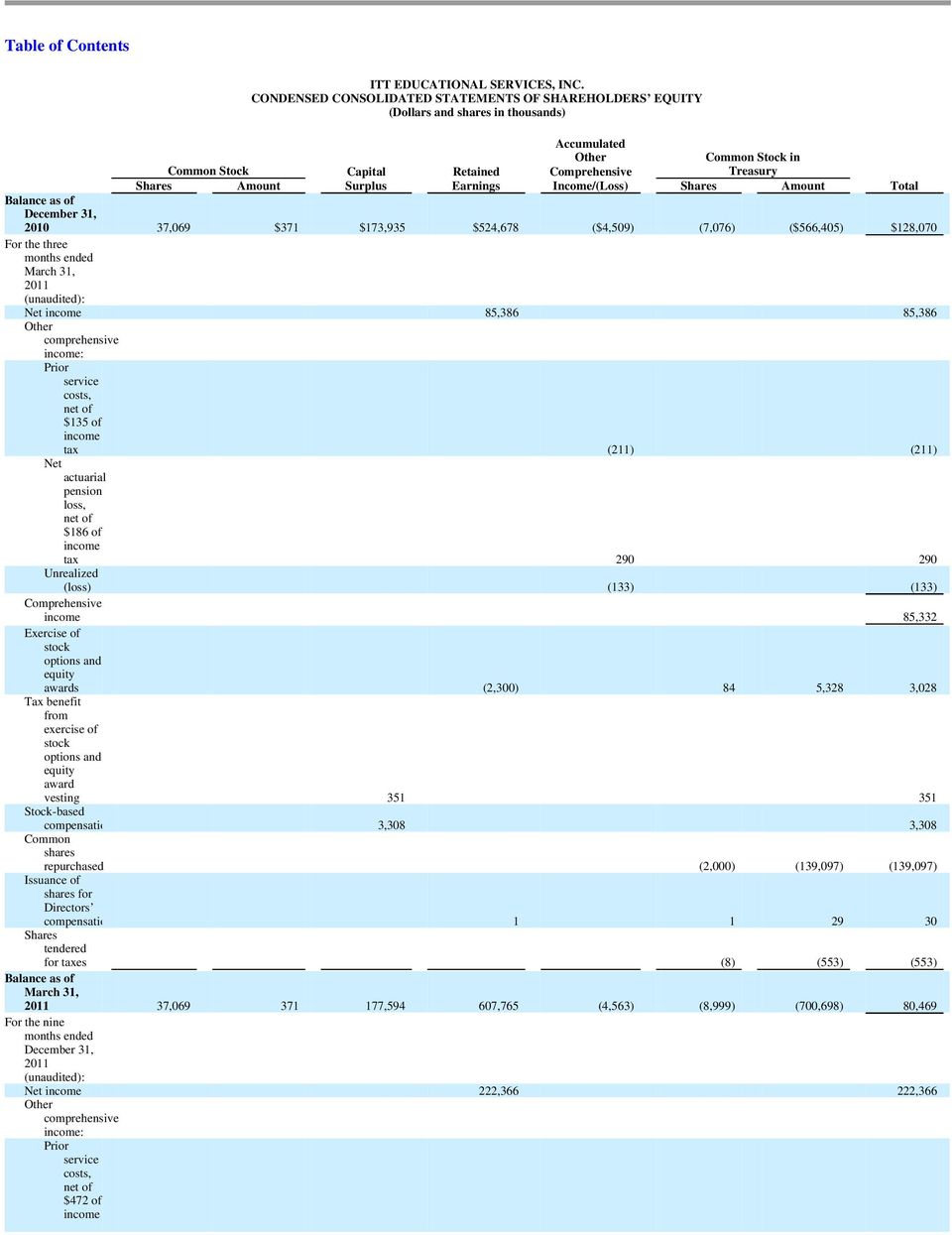
9 tax (737) (737) Net actuarial pension loss, net of $2,819 of income tax (4,986) (4,986) Pension settlement loss, net of $470 of income tax Unrealized gain Comprehensive income 217,450 Exercise of stock options and equity awards (2,456) 71 5,027 2,571 Tax benefit from exercise of stock options and equity award vesting Stock-based compensation 11,140 11,140 Common shares repurchased (2,040) (143,604) (143,604) Shares tendered for taxes (1) (66) (66) Balance as of December 31, , , ,675 (9,479) (10,969) (839,341) 168,799 For the three months ended March 31, 2012 (unaudited): Net income 61,071 61,071 Other comprehensive income: Prior service costs, net of $151 of income tax (237) (237) Net actuarial pension loss, net of $272 of income tax Unrealized (loss) (23) (23) Comprehensive income 61,234 Exercise of stock options and equity awards (4,515) 145 9,183 4,668 Tax benefit from exercise of stock options and equity award vesting Stock-based compensation 4,037 4,037

10 Common shares repurchased (2,097) (146,657) (146,657) Issuance of shares for Directors compensation (1) Shares tendered for taxes (14) (914) (914) Balance as of March 31, ,069 $371 $194,027 $884,230 ($9,316) (12,934) ($977,691) $91,621 The accompanying notes are an integral part of these condensed consolidated financial statements

11 1. The Company and Basis of Presentation ITT EDUCATIONAL SERVICES, INC. NOTES TO CONDENSED CONSOLIDATED FINANCIAL STATEMENTS March 31, 2012 (Dollars in thousands, except per share data and unless otherwise stated) We are a leading proprietary provider of postsecondary degree programs in the United States based on revenue and student enrollment. As of March 31, 2012, we were offering master, bachelor and associate degree programs to approximately 71,000 students at ITT Technical Institute and Daniel Webster College locations. In addition, we offered one or more of our online programs to students who are located in 48 states. As of March 31, 2012, we had 148 college locations (including 145 campuses and three learning sites) in 39 states. All of our college locations are authorized by the applicable education authorities of the states in which they operate and are accredited by an accrediting commission recognized by the U.S. Department of Education ( ED ). We have provided career-oriented education programs since 1969 under the ITT Technical Institute name and since June 2009 under the Daniel Webster College name. Our corporate headquarters are located in Carmel, Indiana. The accompanying unaudited condensed consolidated financial statements include our wholly-owned subsidiaries accounts and have been prepared in accordance with generally accepted accounting principles in the United States of America for interim periods and pursuant to the rules and regulations of the U.S. Securities and Exchange Commission ( SEC ). Certain information and footnote disclosures, including significant accounting policies, normally included in a complete presentation of financial statements prepared in accordance with those principles, rules and regulations have been omitted. The Condensed Consolidated Balance Sheet as of December 31, 2011 was derived from audited financial statements but, as presented in this report, may not include all disclosures required by accounting principles generally accepted in the United States. Arrangements where we may have a variable interest in another party are evaluated in accordance with the provisions of Financial Accounting Standards Board ( FASB ) Accounting Standards Codification ( ASC or Codification ) 810, Consolidation ( ASC 810 ), to determine whether we would be required to include the financial results of the other party in our consolidated financial statements. Based on our most recent evaluation, we were not required to include the financial results of any variable interest entity in our condensed consolidated financial statements. See Note 8 Variable Interests, for additional discussion of our variable interests. In the opinion of our management, the financial statements contain all adjustments necessary to fairly state our financial condition and results of operations. The interim financial information should be read in conjunction with the audited consolidated financial statements and notes thereto contained in our Annual Report on Form 10-K as filed with the SEC for the year ended December 31, New Accounting Guidance In December 2011, the FASB issued Accounting Standards Update ( ASU ) No , which is included in the Codification under ASC 220, Comprehensive Income ( ASC 220 ). This update defers the effective date of ASU No for changes that relate to the presentation of reclassification adjustments out of accumulated other comprehensive income. None of the other requirements in ASU are affected by this update. This guidance became effective for our interim and annual reporting periods beginning January 1, The adoption of this guidance did not have a material impact on our condensed consolidated financial statements. Also in December 2011, the FASB issued ASU No , which is included in the Codification under ASC 210, Balance Sheet ( ASC 210 ). This update provides for enhanced disclosures to help users of financial statements evaluate the effect or potential effect of netting arrangements on an entity s financial position. This guidance is effective for interim and annual reporting periods beginning January 1, We have not yet determined the effect that the adoption of this guidance will have on our condensed consolidated financial statements. In September 2011, the FASB issued ASU No , which is included in the Codification under ASC 350, Intangibles Goodwill and Other ( ASC 350 ). This update allows an entity to assess qualitative factors to determine whether it is necessary to perform the two-step quantitative goodwill impairment test. This guidance became effective for our interim and annual reporting periods beginning January 1, The adoption of this guidance did not have a material impact on our condensed consolidated financial statements. In June 2011, the FASB issued ASU No , which is included in the Codification under ASC 220. This update requires total comprehensive income, the components of net income and the components of other comprehensive income to be presented either in a single continuous statement or in two separate but consecutive statements. This guidance became effective for our interim and annual reporting periods beginning January 1, Prior to January 1, 2012, we presented total Comprehensive income and the components of Other comprehensive income in our Condensed Consolidated Statements of Shareholders Equity. After December 31, 2011, we present total Comprehensive income and the components of Other comprehensive income in our Condensed Consolidated Statements of Comprehensive Income. In May 2011, the FASB issued ASU No , which is included in the Codification under ASC 820, Fair Value Measurements ( ASC 820 ). This update provides guidance and clarification about the application of existing fair value measurements and disclosure requirements. This guidance became effective for our interim and annual reporting periods beginning January 1, The adoption of this guidance did not have a material impact on our condensed consolidated financial statements
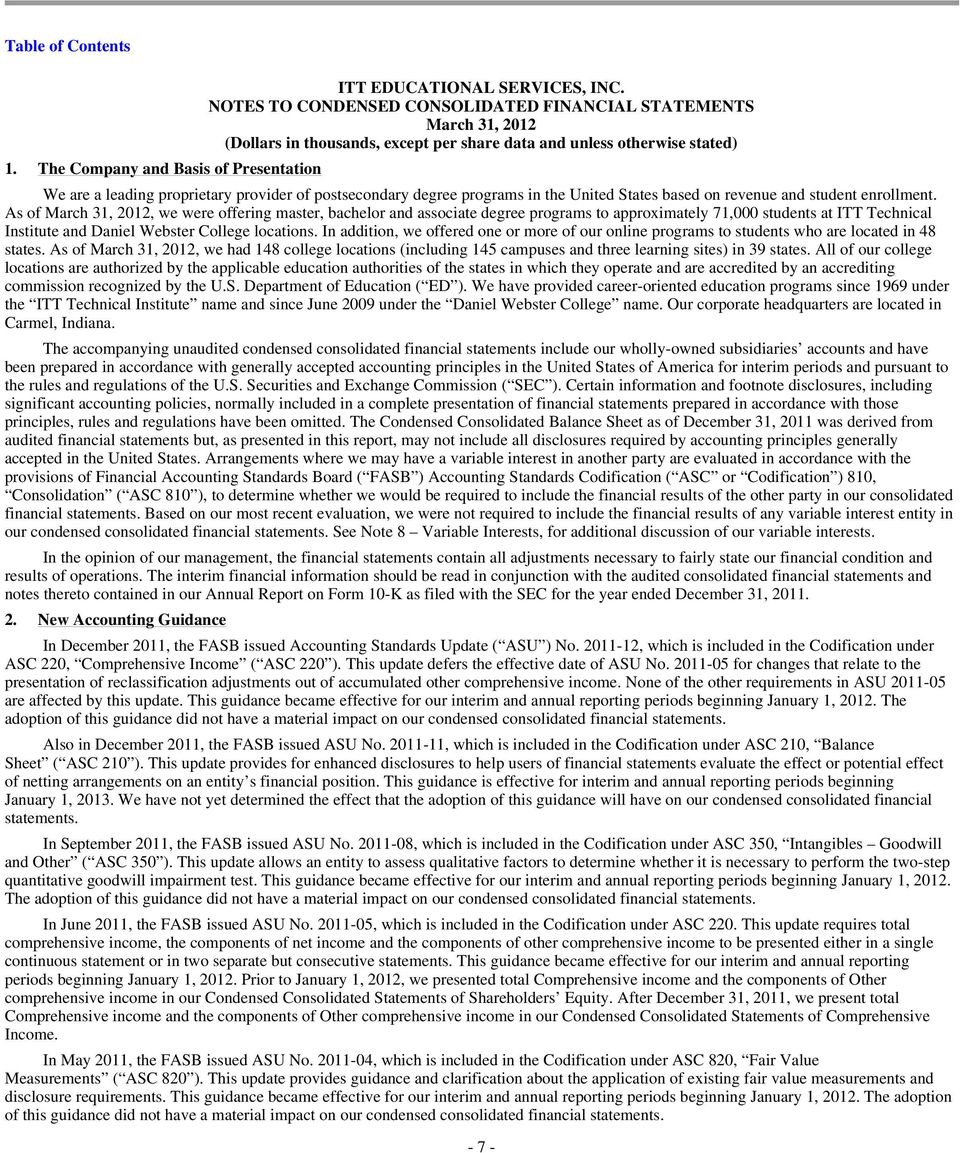
12 3. Fair Value Fair value for financial reporting is defined as the price that would be received upon the sale of an asset or paid upon the transfer of a liability in an orderly transaction between market participants at the measurement date. The fair value measurement of our financial assets utilized assumptions categorized as observable inputs under the accounting guidance. Observable inputs are assumptions based on independent market data sources. The following table sets forth information regarding the fair value measurement of our financial assets as of March 31, 2012: We used quoted prices in active markets for identical assets as of the measurement date to value our financial assets that were categorized as Level 1. For assets that were categorized as Level 2, we used: The carrying amounts for cash and cash equivalents, restricted cash, accounts receivable, accounts payable, other current liabilities and deferred revenue approximate fair value because of the immediate or short-term maturity of these financial instruments. Investments classified as available-for-sale are recorded at their market value. The fair value of the notes receivable included in Other assets on our Condensed Consolidated Balance Sheet as of March 31, 2012 is estimated by discounting the future cash flows using current rates for similar arrangements. As of March 31, 2012, each of the carrying value and the estimated fair value of these financial instruments was approximately $19,000. The fair value of our long-term debt is estimated by discounting the future cash flows using current rates for similar loans with similar characteristics and remaining maturities. As of March 31, 2012, each of the carrying value and the estimated fair value of our long-term debt was approximately $175, Equity Compensation As of March 31, 2012 The stock-based compensation expense and related income tax benefit recognized in our Condensed Consolidated Statements of Income in the periods indicated were as follows: We did not capitalize any stock-based compensation cost in the three months ended March 31, 2012 or As of March 31, 2012, we estimated that pre-tax compensation expense for unvested stock-based compensation grants in the amount of approximately $33,900 net of estimated forfeitures, will be recognized in future periods. This expense will be recognized over the remaining service period applicable to the grantees which, on a weighted-average basis, is approximately 2.4 years Fair Value Measurements at Reporting Date Using (Level 1) (Level 2) (Level 3) Quoted Prices in Significant Active Markets for Unobservable Significant Other Observable Inputs Description Identical Assets Inputs Cash equivalents: Money market funds $175,769 $175,769 $0 $0 Short-term investments: U.S. Treasury obligations 80,445 80, Government agency obligations 17, ,022 0 Corporate obligations 17, ,339 0 Other assets: Money market fund 8,619 8, $299,194 $264,833 $34,361 $0 quoted prices for similar assets in active markets; quoted prices for identical or similar assets in markets that were not active or in which little public information had been released; inputs other than quoted prices that were observable for the assets; or inputs that were principally derived from or corroborated by observable market data by correlation or other means. Three Months Ended March 31, Stock-based compensation expense $4,483 $3,914 Income tax (benefit) ($1,726) ($1,507)
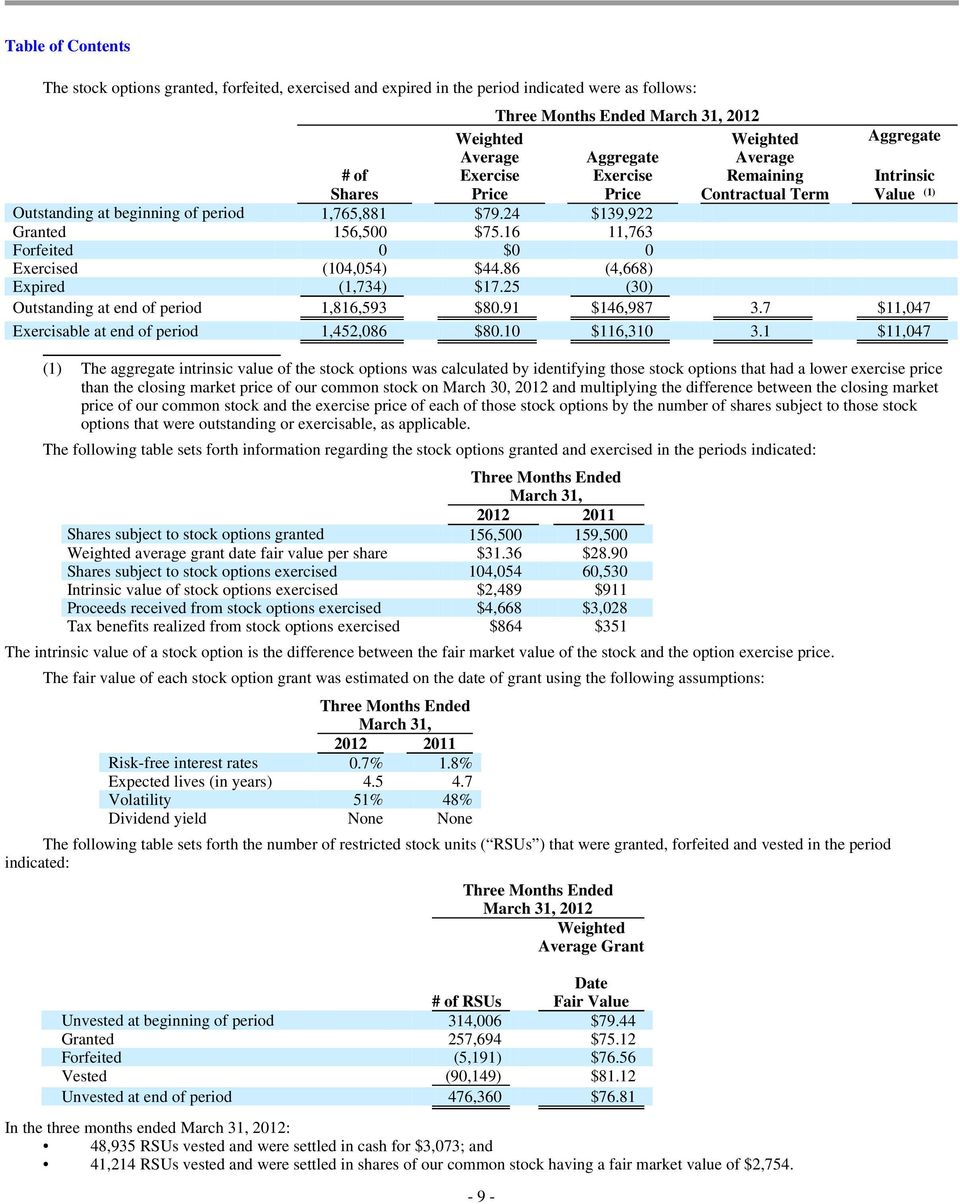
13 The stock options granted, forfeited, exercised and expired in the period indicated were as follows: Weighted Average Exercise Price The following table sets forth information regarding the stock options granted and exercised in the periods indicated: The intrinsic value of a stock option is the difference between the fair market value of the stock and the option exercise price. The fair value of each stock option grant was estimated on the date of grant using the following assumptions: The following table sets forth the number of restricted stock units ( RSUs ) that were granted, forfeited and vested in the period indicated: In the three months ended March 31, 2012: 48,935 RSUs vested and were settled in cash for $3,073; and 41,214 RSUs vested and were settled in shares of our common stock having a fair market value of $2, Three Months Ended March 31, 2012 Aggregate Exercise Price Weighted Average Remaining Contractual Term Aggregate # of Shares Intrinsic Value (1) Outstanding at beginning of period 1,765,881 $79.24 $139,922 Granted 156,500 $ ,763 Forfeited 0 $0 0 Exercised (104,054) $44.86 (4,668) Expired (1,734) $17.25 (30) Outstanding at end of period 1,816,593 $80.91 $146, $11,047 Exercisable at end of period 1,452,086 $80.10 $116, $11,047 (1) The aggregate intrinsic value of the stock options was calculated by identifying those stock options that had a lower exercise price than the closing market price of our common stock on March 30, 2012 and multiplying the difference between the closing market price of our common stock and the exercise price of each of those stock options by the number of shares subject to those stock options that were outstanding or exercisable, as applicable. Three Months Ended March 31, Shares subject to stock options granted 156, ,500 Weighted average grant date fair value per share $31.36 $28.90 Shares subject to stock options exercised 104,054 60,530 Intrinsic value of stock options exercised $2,489 $911 Proceeds received from stock options exercised $4,668 $3,028 Tax benefits realized from stock options exercised $864 $351 Three Months Ended March 31, Risk-free interest rates 0.7% 1.8% Expected lives (in years) Volatility 51% 48% Dividend yield None None Three Months Ended March 31, 2012 Weighted Average Grant Date # of RSUs Fair Value Unvested at beginning of period 314,006 $79.44 Granted 257,694 $75.12 Forfeited (5,191) $76.56 Vested (90,149) $81.12 Unvested at end of period 476,360 $76.81
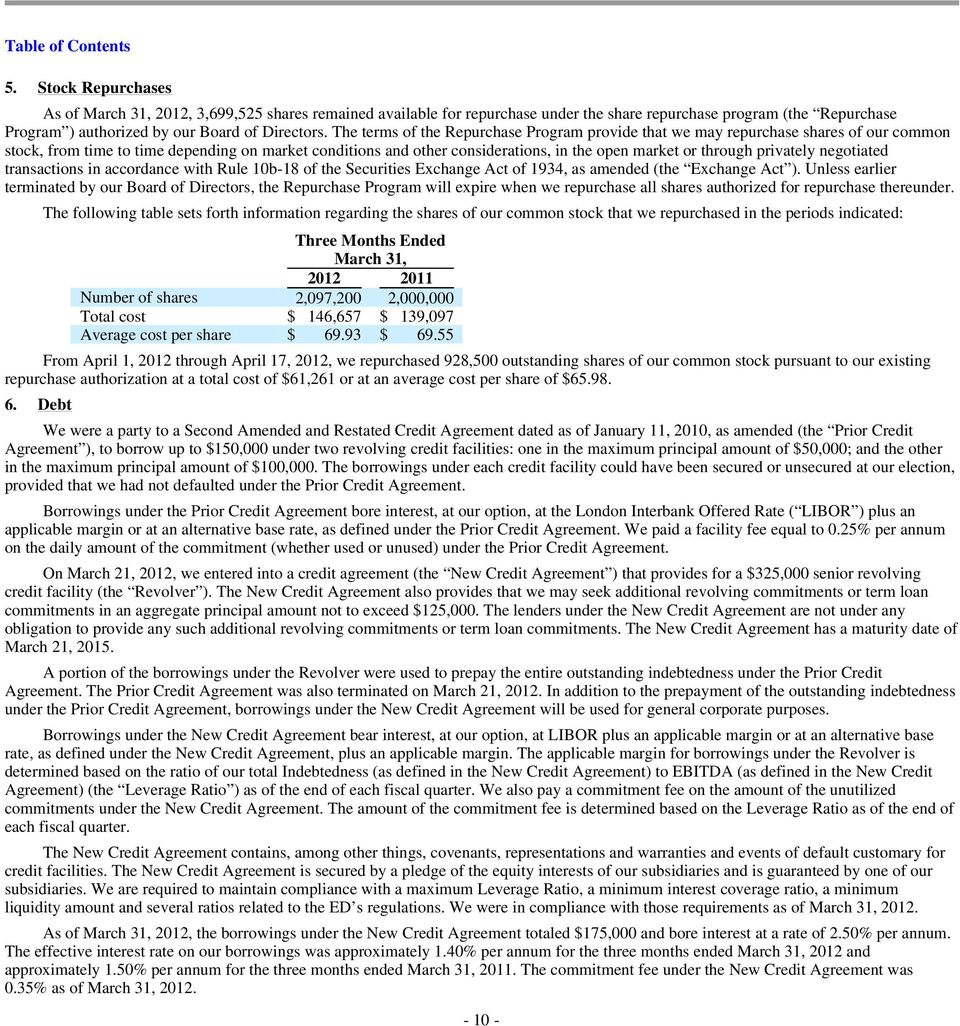
14 5. Stock Repurchases As of March 31, 2012, 3,699,525 shares remained available for repurchase under the share repurchase program (the Repurchase Program ) authorized by our Board of Directors. The terms of the Repurchase Program provide that we may repurchase shares of our common stock, from time to time depending on market conditions and other considerations, in the open market or through privately negotiated transactions in accordance with Rule 10b-18 of the Securities Exchange Act of 1934, as amended (the Exchange Act ). Unless earlier terminated by our Board of Directors, the Repurchase Program will expire when we repurchase all shares authorized for repurchase thereunder. The following table sets forth information regarding the shares of our common stock that we repurchased in the periods indicated: From April 1, 2012 through April 17, 2012, we repurchased 928,500 outstanding shares of our common stock pursuant to our existing repurchase authorization at a total cost of $61,261 or at an average cost per share of $ Debt Three Months Ended March 31, Number of shares 2,097,200 2,000,000 Total cost $ 146,657 $ 139,097 Average cost per share $ $ We were a party to a Second Amended and Restated Credit Agreement dated as of January 11, 2010, as amended (the Prior Credit Agreement ), to borrow up to $150,000 under two revolving credit facilities: one in the maximum principal amount of $50,000; and the other in the maximum principal amount of $100,000. The borrowings under each credit facility could have been secured or unsecured at our election, provided that we had not defaulted under the Prior Credit Agreement. Borrowings under the Prior Credit Agreement bore interest, at our option, at the London Interbank Offered Rate ( LIBOR ) plus an applicable margin or at an alternative base rate, as defined under the Prior Credit Agreement. We paid a facility fee equal to 0.25% per annum on the daily amount of the commitment (whether used or unused) under the Prior Credit Agreement. On March 21, 2012, we entered into a credit agreement (the New Credit Agreement ) that provides for a $325,000 senior revolving credit facility (the Revolver ). The New Credit Agreement also provides that we may seek additional revolving commitments or term loan commitments in an aggregate principal amount not to exceed $125,000. The lenders under the New Credit Agreement are not under any obligation to provide any such additional revolving commitments or term loan commitments. The New Credit Agreement has a maturity date of March 21, A portion of the borrowings under the Revolver were used to prepay the entire outstanding indebtedness under the Prior Credit Agreement. The Prior Credit Agreement was also terminated on March 21, In addition to the prepayment of the outstanding indebtedness under the Prior Credit Agreement, borrowings under the New Credit Agreement will be used for general corporate purposes. Borrowings under the New Credit Agreement bear interest, at our option, at LIBOR plus an applicable margin or at an alternative base rate, as defined under the New Credit Agreement, plus an applicable margin. The applicable margin for borrowings under the Revolver is determined based on the ratio of our total Indebtedness (as defined in the New Credit Agreement) to EBITDA (as defined in the New Credit Agreement) (the Leverage Ratio ) as of the end of each fiscal quarter. We also pay a commitment fee on the amount of the unutilized commitments under the New Credit Agreement. The amount of the commitment fee is determined based on the Leverage Ratio as of the end of each fiscal quarter. The New Credit Agreement contains, among other things, covenants, representations and warranties and events of default customary for credit facilities. The New Credit Agreement is secured by a pledge of the equity interests of our subsidiaries and is guaranteed by one of our subsidiaries. We are required to maintain compliance with a maximum Leverage Ratio, a minimum interest coverage ratio, a minimum liquidity amount and several ratios related to the ED s regulations. We were in compliance with those requirements as of March 31, As of March 31, 2012, the borrowings under the New Credit Agreement totaled $175,000 and bore interest at a rate of 2.50% per annum. The effective interest rate on our borrowings was approximately 1.40% per annum for the three months ended March 31, 2012 and approximately 1.50% per annum for the three months ended March 31, The commitment fee under the New Credit Agreement was 0.35% as of March 31,
15 The following table sets forth the interest expense (including the facility fee and commitment fee) that we recognized on our borrowings under the New Credit Agreement and under the Prior Credit Agreement in the periods indicated: 7. Investments Our available-for-sale investments were classified as short-term investments on our March 31, 2012, December 31, 2011 and March 31, 2011 Condensed Consolidated Balance Sheets. The following table sets forth the aggregate fair value, amortized cost basis and the net unrealized gains and losses included in accumulated other comprehensive income (loss) of our available-for-sale investments as of the dates indicated: We also held a certificate of deposit with a total principal value of $5,345 as of March 31, This investment was included in Shortterm investments on our Condensed Consolidated Balance Sheet as of March 31, We did not hold a certificate of deposit as of March 31, 2012 or December 31, We had $114,806 of debt securities classified as available-for-sale as of March 31, 2012, and all of those debt securities had contractual maturities within one year. The following table sets forth the unrealized gains and losses on available-for-sale investments that were included in other comprehensive income (loss) in the periods indicated: The following table sets forth the components of investment income included in Interest income in our Condensed Consolidated Statements of Income in the periods indicated: 8. Variable Interests Aggregate Fair Value Three Months Ended March 31, $547 $557 As of: March 31, 2012 December 31, 2011 March 31, 2011 Net Net Unrealized Unrealized Amortized Cost Gains (Losses) On January 20, 2010, we entered into agreements with unrelated third parties to establish the PEAKS Private Student Loan Program ( PEAKS Program ), which is a private education loan program for our students. Under the PEAKS Program, an unaffiliated lender originated private education loans to our eligible students and, subsequently, sold those loans to an unaffiliated trust that purchased, owns and collects private education loans ( PEAKS Trust ). The PEAKS Trust issued senior debt in the aggregate principal amount of $300,000 ( PEAKS Senior Debt ) to investors. The lender disbursed the proceeds of the private education loans to us for application to the students account balances with us that represented their unpaid education costs. We transferred a portion of the amount of each private education loan disbursed to us under the PEAKS Program to the PEAKS Trust in exchange for a subordinated note issued by the PEAKS Trust ( Subordinated Note ). No new private education loans were or will be originated under the PEAKS Program after July 2011, but immaterial amounts related to loans originated prior to that date were disbursed by the lender through March Aggregate Fair Value Amortized Cost Gains (Losses) Aggregate Fair Value Amortized Cost Net Unrealized Available- for-sale Investments: Government obligations $80,445 $80,446 ($1) $100,517 $100,480 $37 $100,658 $100,691 ($33) Government agency obligations 17,022 17, ,351 31,354 (3) 33,172 33,187 (15) Corporate obligations 17,339 17,340 (1) 16,620 16,633 (13) 13,437 13,441 (4) $114,806 $114,808 ($2) $148,488 $148,467 $21 $147,267 $147,319 ($52) Three Months Ended March 31, Unrealized gains $0 $0 Unrealized losses ($23) ($133) Three Months Ended March 31, Interest income on investments $141 $155 Realized net gains on the sale of investments $155 $300 Gains (Losses)

16 The Subordinated Note is non-interest bearing and has been recorded net of an unamortized discount based on an imputed interest rate of 9.0% in Other assets on our Condensed Consolidated Balance Sheets. The discount is amortized and recognized in Interest income on our Condensed Consolidated Statements of Income over the term of the Subordinated Note, which is expected to be approximately 15 years. The face value of the Subordinated Note as of March 31, 2012 was approximately $75,400. The PEAKS Trust utilized the proceeds from the issuance of the PEAKS Senior Debt and the Subordinated Note to purchase the private education loans made by the lender to our students. The assets of the PEAKS Trust (which include, among other assets, the private education loans owned by the PEAKS Trust) serve as collateral for, and are intended to be the principal source of, the repayment of the PEAKS Senior Debt and the Subordinated Note. The PEAKS Trust is required to maintain assets having an aggregate value that exceeds the outstanding balance of the PEAKS Senior Debt. As of March 31, 2012, the value of the assets of the PEAKS Trust satisfied this requirement. We guarantee payment of the principal, interest and certain call premiums owed on the PEAKS Senior Debt, and the administrative fees and expenses of the PEAKS Trust ( PEAKS Guarantee ). See Note 11 Contingencies, for further discussion of the PEAKS Guarantee. We did not explicitly or implicitly provide any financial or other support to the PEAKS Trust during the three months ended March 31, 2012 or 2011 that we were not contractually required to provide, and we do not intend to provide any such support to the PEAKS Trust in the foreseeable future, other than what we are contractually required to provide. The PEAKS Trust is a variable interest entity as defined under ASC 810. We held variable interests in the PEAKS Trust as of March 31, 2012 as a result of the Subordinated Note and PEAKS Guarantee. To determine whether we were the primary beneficiary of the PEAKS Trust, we: assessed the risks that the PEAKS Trust was designed to create and pass through to its variable interest holders; identified the variable interests in the PEAKS Trust; identified the other variable interest holders and their involvement in the activities of the PEAKS Trust; identified the activities that most significantly impact the PEAKS Trust s economic performance; determined whether we have the power to direct those activities; and determined whether we have the right to receive the benefits from, or the obligation to absorb the losses of, the PEAKS Trust that could potentially be significant to the PEAKS Trust. We determined that the activities of the PEAKS Trust that most significantly impact the economic performance of the PEAKS Trust involve: establishing the underwriting criteria of, and the interest rates and fees charged on, the private education loans acquired by the PEAKS Trust; and the servicing (which includes the collection) of the private education loans owned by the PEAKS Trust. To make that determination, we analyzed various possible scenarios of student loan portfolio performance to evaluate the potential economic impact on the PEAKS Trust. In our analysis, we made what we believe are conservative assumptions based on historical data for the following key variables: the composition of the credit profiles of the borrowers; the interest rates and fees charged on the loans; the default rates and the timing of defaults associated with similar types of loans; and the prepayment and the speed of repayment associated with similar types of loans. Based on our analysis, we concluded that we are not the primary beneficiary of the PEAKS Trust, because we do not have the power to direct the activities that most significantly impact the economic performance of the PEAKS Trust. As a result, we are not required under ASC 810 to include the financial results of the PEAKS Trust in our condensed consolidated financial statements for the three months ended March 31, Our conclusion that we are not the primary beneficiary of the PEAKS Trust did not change from the prior reporting period. Therefore, there was no effect on our condensed consolidated financial statements. On February 20, 2009, we entered into agreements with an unaffiliated entity (the 2009 Entity ) to create a program that makes private education loans available to our students to help pay the students cost of education that student financial aid from federal, state and other sources do not cover (the 2009 Loan Program ). Under the 2009 Loan Program, an unaffiliated lender originated private education loans to our eligible students and, subsequently, sells those loans to the 2009 Entity. The 2009 Entity purchases the private education loans from the lender utilizing funds received from its owners in exchange for participation interests in the private education loans acquired by the 2009 Entity. The lender disburses the proceeds of the private education loans to us for application to the students account balances with us that represent their unpaid education costs. No new private education loans were or will be originated under the 2009 Loan Program after December 31, 2011, but immaterial amounts related to loans originated prior to that date will be disbursed by the lender and purchased by the 2009 Entity through approximately June In connection with the 2009 Loan Program, we entered into a risk sharing agreement (the 2009 RSA ) with the 2009 Entity. Under the 2009 RSA, we guarantee the repayment of any private education loans that are charged off above a certain percentage of the private education loans made under the 2009 Loan Program, based on the annual dollar volume. See Note 11 Contingencies, for further discussion of the 2009 RSA

17 In addition, we have made advances to the 2009 Entity under a revolving promissory note (the Revolving Note ). We did not make any advances in the three months ended March 31, 2012 or 2011 to the 2009 Entity under the Revolving Note that we were not contractually required to make. Substantially all of the assets of the 2009 Entity serve as collateral for the Revolving Note. The Revolving Note bears interest, is subject to customary terms and conditions and may be repaid at any time without penalty prior to its 2026 maturity date. The advances under the Revolving Note were primarily used by the 2009 Entity to purchase additional private education loans under the 2009 Loan Program that otherwise may not have been originated. We have no immediate plans to significantly increase the amount of advances that we make to the 2009 Entity under the Revolving Note, but we may decide to do so in the foreseeable future. The 2009 Entity is a variable interest entity as defined under ASC 810. We held variable interests in the 2009 Entity as of March 31, 2012 as a result of the Revolving Note and 2009 RSA. To determine whether we were the primary beneficiary of the 2009 Entity, we: assessed the risks that the 2009 Entity was designed to create and pass through to its variable interest holders; identified the variable interests in the 2009 Entity; identified the other variable interest holders and their involvement in the activities of the 2009 Entity; identified the activities that most significantly impact the 2009 Entity s economic performance; determined whether we have the power to direct those activities; and determined whether we have the right to receive the benefits from, or the obligation to absorb the losses of, the 2009 Entity that could potentially be significant to the 2009 Entity. To identify the activities of the 2009 Entity that most significantly impact the economic performance of the 2009 Entity, we analyzed various possible scenarios of private education loan portfolio performance. In our analysis, we made what we believe are conservative assumptions based on historical data for the following key variables: the composition of the credit profiles of the borrowers; the interest rates and fees charged on the loans; the default rates and the timing of defaults associated with similar types of loans; and the prepayment and the speed of repayment associated with similar types of loans. We determined that the activities of the 2009 Entity that most significantly impact its economic performance involve: establishing the underwriting criteria of, and the interest rates and fees charged on, the private education loans acquired by the 2009 Entity; and the servicing (which includes the collection) of the private education loans owned by the 2009 Entity. Based on our analysis, we concluded that we are not the primary beneficiary of the 2009 Entity, because we do not direct those activities. As a result, we are not required under ASC 810 to include the financial results of the 2009 Entity in our condensed consolidated financial statements for the three months ended March 31, Our conclusion that we are not the primary beneficiary of the 2009 Entity did not change from the prior reporting period. Therefore, there was no effect on our condensed consolidated financial statements. The carrying value of the Subordinated Note and the Revolving Note as of March 31, 2012 was approximately $19,000 and is included in Other assets on our Condensed Consolidated Balance Sheet. 9. Earnings Per Common Share Earnings per common share for all periods have been calculated in conformity with ASC 260, Earnings Per Share. This data is based on historical net income and the weighted average number of shares of our common stock outstanding during each period as set forth in the following table: Three Months Ended March 31, (In thousands) Shares: Weighted average number of shares of common stock outstanding 25,420 29,085 Shares assumed issued (less shares assumed purchased for treasury) for stock-based compensation Outstanding shares for diluted earnings per share calculation 25,636 29,

18 A total of 1,534,603 shares at March 31, 2012 and 1,122,931 shares at March 31, 2011 were excluded from the calculation of our diluted earnings per common share because the effect was anti-dilutive. 10. Employee Pension Benefits The following table sets forth the components of net periodic pension benefit of the ESI Pension Plan and ESI Excess Pension Plan for the periods indicated: Three Months Ended March 31, Interest cost $530 $598 Expected return on assets (1,147) (1,147) Recognized net actuarial loss Amortization of prior service (credit) (388) (346) Net periodic pension (benefit) ($310) ($419) The benefit accruals under the ESI Pension Plan and ESI Excess Pension Plan were frozen effective March 31, As a result, no service cost has been included in the net periodic pension benefit. We did not make any contributions to the ESI Pension Plan or the ESI Excess Pension Plan in the three months ended March 31, 2012 or We do not expect to make any contributions to the ESI Pension Plan or the ESI Excess Pension Plan in Contingencies As part of our normal operations, one of our insurers issues surety bonds for us that are required by various education authorities that regulate us. We are obligated to reimburse our insurer for any of those surety bonds that are paid by the insurer. As of March 31, 2012, the total face amount of those surety bonds was approximately $33,000. We are also subject to various claims and contingencies, including those related to litigation, business transactions, guarantee arrangements and employee-related matters, among others. We record a liability for those claims and contingencies, if it is probable that a loss will result and the amount of the loss can be reasonably estimated. Although we believe that our estimates related to any claims and contingencies are reasonable, we cannot make any assurances with regard to the accuracy of our estimates, and actual results could differ materially. As of March 31, 2012, our recorded liability for these claims and contingencies was approximately $37,500 and is primarily included in Other liabilities on our Condensed Consolidated Balance Sheet. The substantial majority of this amount pertains to our guarantee arrangements. We also considered whether additional losses for claims and contingencies were reasonably possible, could be estimated and might be material to our financial condition, results of operations or cash flows. With respect to our guarantee arrangements under the PEAKS Guarantee and the 2009 RSA and the risk sharing agreement that we entered into in 2007 (the 2007 RSA and, collectively with the PEAKS Guarantee and the 2009 RSA, the RSAs ), we believe that it is reasonably possible that we may incur losses in an estimated range of $20,000 less than to $20,000 greater than the recorded liability for those contingencies. As with any estimate, as facts and circumstances change, the recorded liability and estimated range of reasonably possible losses could change significantly. With respect to legal proceedings, we determined that we cannot provide an estimate of the possible losses, or the range of possible losses, in excess of the amount, if any, accrued, for various reasons, including but not limited to some or all of the following: there are significant factual issues to be resolved; there are novel or unsettled legal issues presented; the proceedings are in the early stages; there is uncertainty as to the likelihood of a class being certified or decertified or the ultimate size and scope of the class; there is uncertainty as to the outcome of pending appeals or motions; and in many cases, the plaintiffs have not specified damages in their complaint or in court filings. Litigation. We are subject to various litigation in the ordinary course of our business. We cannot assure you of the ultimate outcome of any litigation involving us. Although we believe that our estimates related to any litigation are reasonable, deviations from our estimates could produce a materially different result. Any litigation alleging violations of education or consumer protection laws and/or regulations, misrepresentation, fraud or deceptive practices may also subject our affected campuses to additional regulatory scrutiny. The following is a description of pending litigation that falls outside the scope of litigation incidental to the ordinary course of our business. On November 3, 2010, a complaint in a securities class action lawsuit was filed against us and two of our current executive officers in the United States District Court for the Southern District of New York under the following caption: Operating Engineers Construction Industry and Miscellaneous Pension Fund, Individually and On Behalf of All Others Similarly Situated v. ITT Educational Services, Inc., et al. (the Securities Litigation ). On January 21, 2011, the court named the Wyoming Retirement

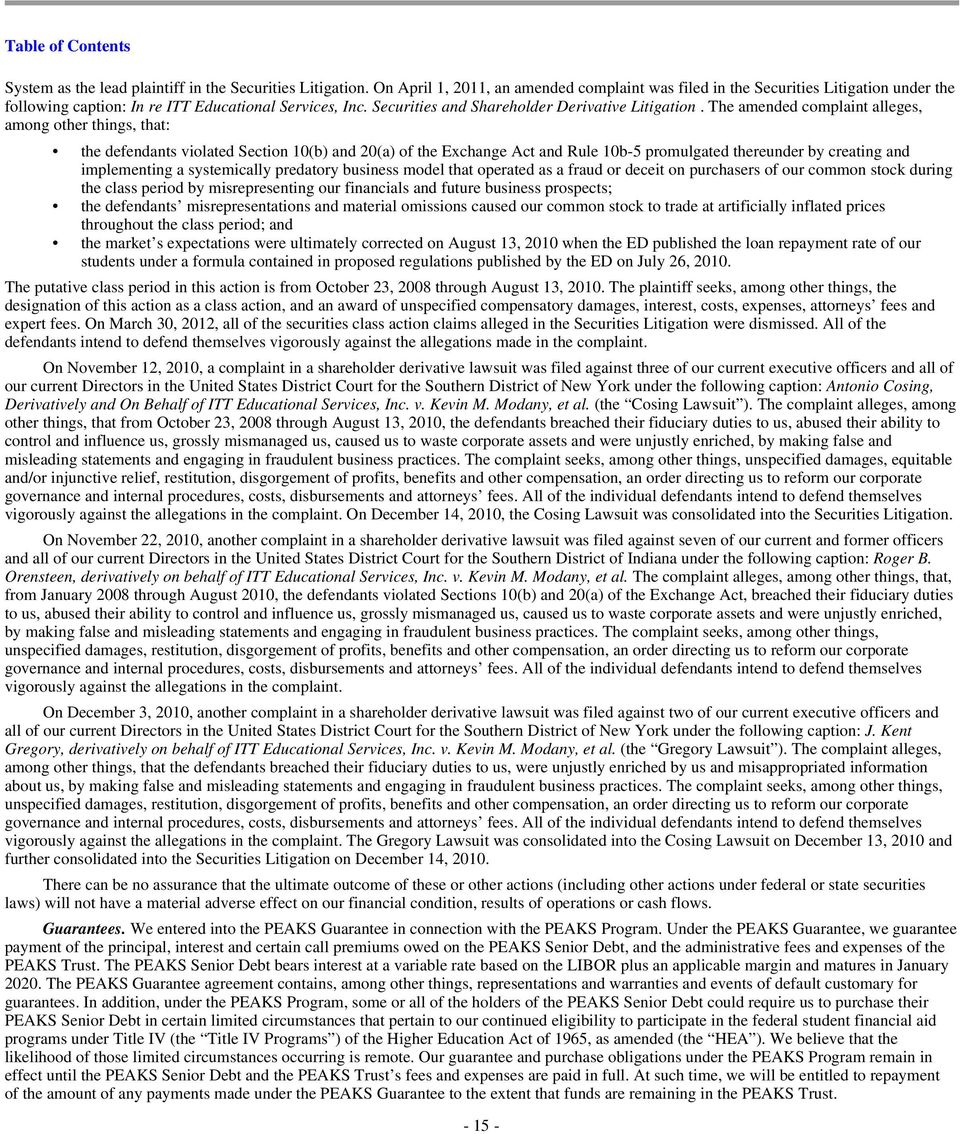
19 System as the lead plaintiff in the Securities Litigation. On April 1, 2011, an amended complaint was filed in the Securities Litigation under the following caption: In re ITT Educational Services, Inc. Securities and Shareholder Derivative Litigation. The amended complaint alleges, among other things, that: the defendants violated Section 10(b) and 20(a) of the Exchange Act and Rule 10b-5 promulgated thereunder by creating and implementing a systemically predatory business model that operated as a fraud or deceit on purchasers of our common stock during the class period by misrepresenting our financials and future business prospects; the defendants misrepresentations and material omissions caused our common stock to trade at artificially inflated prices throughout the class period; and the market s expectations were ultimately corrected on August 13, 2010 when the ED published the loan repayment rate of our students under a formula contained in proposed regulations published by the ED on July 26, The putative class period in this action is from October 23, 2008 through August 13, The plaintiff seeks, among other things, the designation of this action as a class action, and an award of unspecified compensatory damages, interest, costs, expenses, attorneys fees and expert fees. On March 30, 2012, all of the securities class action claims alleged in the Securities Litigation were dismissed. All of the defendants intend to defend themselves vigorously against the allegations made in the complaint. On November 12, 2010, a complaint in a shareholder derivative lawsuit was filed against three of our current executive officers and all of our current Directors in the United States District Court for the Southern District of New York under the following caption: Antonio Cosing, Derivatively and On Behalf of ITT Educational Services, Inc. v. Kevin M. Modany, et al. (the Cosing Lawsuit ). The complaint alleges, among other things, that from October 23, 2008 through August 13, 2010, the defendants breached their fiduciary duties to us, abused their ability to control and influence us, grossly mismanaged us, caused us to waste corporate assets and were unjustly enriched, by making false and misleading statements and engaging in fraudulent business practices. The complaint seeks, among other things, unspecified damages, equitable and/or injunctive relief, restitution, disgorgement of profits, benefits and other compensation, an order directing us to reform our corporate governance and internal procedures, costs, disbursements and attorneys fees. All of the individual defendants intend to defend themselves vigorously against the allegations in the complaint. On December 14, 2010, the Cosing Lawsuit was consolidated into the Securities Litigation. On November 22, 2010, another complaint in a shareholder derivative lawsuit was filed against seven of our current and former officers and all of our current Directors in the United States District Court for the Southern District of Indiana under the following caption: Roger B. Orensteen, derivatively on behalf of ITT Educational Services, Inc. v. Kevin M. Modany, et al. The complaint alleges, among other things, that, from January 2008 through August 2010, the defendants violated Sections 10(b) and 20(a) of the Exchange Act, breached their fiduciary duties to us, abused their ability to control and influence us, grossly mismanaged us, caused us to waste corporate assets and were unjustly enriched, by making false and misleading statements and engaging in fraudulent business practices. The complaint seeks, among other things, unspecified damages, restitution, disgorgement of profits, benefits and other compensation, an order directing us to reform our corporate governance and internal procedures, costs, disbursements and attorneys fees. All of the individual defendants intend to defend themselves vigorously against the allegations in the complaint. On December 3, 2010, another complaint in a shareholder derivative lawsuit was filed against two of our current executive officers and all of our current Directors in the United States District Court for the Southern District of New York under the following caption: J. Kent Gregory, derivatively on behalf of ITT Educational Services, Inc. v. Kevin M. Modany, et al. (the Gregory Lawsuit ). The complaint alleges, among other things, that the defendants breached their fiduciary duties to us, were unjustly enriched by us and misappropriated information about us, by making false and misleading statements and engaging in fraudulent business practices. The complaint seeks, among other things, unspecified damages, restitution, disgorgement of profits, benefits and other compensation, an order directing us to reform our corporate governance and internal procedures, costs, disbursements and attorneys fees. All of the individual defendants intend to defend themselves vigorously against the allegations in the complaint. The Gregory Lawsuit was consolidated into the Cosing Lawsuit on December 13, 2010 and further consolidated into the Securities Litigation on December 14, There can be no assurance that the ultimate outcome of these or other actions (including other actions under federal or state securities laws) will not have a material adverse effect on our financial condition, results of operations or cash flows. Guarantees. We entered into the PEAKS Guarantee in connection with the PEAKS Program. Under the PEAKS Guarantee, we guarantee payment of the principal, interest and certain call premiums owed on the PEAKS Senior Debt, and the administrative fees and expenses of the PEAKS Trust. The PEAKS Senior Debt bears interest at a variable rate based on the LIBOR plus an applicable margin and matures in January The PEAKS Guarantee agreement contains, among other things, representations and warranties and events of default customary for guarantees. In addition, under the PEAKS Program, some or all of the holders of the PEAKS Senior Debt could require us to purchase their PEAKS Senior Debt in certain limited circumstances that pertain to our continued eligibility to participate in the federal student financial aid programs under Title IV (the Title IV Programs ) of the Higher Education Act of 1965, as amended (the HEA ). We believe that the likelihood of those limited circumstances occurring is remote. Our guarantee and purchase obligations under the PEAKS Program remain in effect until the PEAKS Senior Debt and the PEAKS Trust s fees and expenses are paid in full. At such time, we will be entitled to repayment of the amount of any payments made under the PEAKS Guarantee to the extent that funds are remaining in the PEAKS Trust
20 The maximum future payments that we could be required to make under the PEAKS Guarantee include: We are not able to estimate the undiscounted maximum potential amount of future payments that we could be required to make under the PEAKS Guarantee, because those payments will be affected by: No new private education loans were or will be originated under the PEAKS Program after July 2011, but immaterial amounts related to loans originated prior to that date were disbursed by the lender through March We entered into the 2009 RSA in connection with the 2009 Loan Program. Under the 2009 RSA, we guarantee the repayment of the principal amount (including capitalized origination fees) and accrued interest payable on any private education loans that are charged off above a certain percentage of the private education loans made under the 2009 Loan Program, based on the annual dollar volume. The total initial principal amount of private education loans that the 2009 Entity purchased under the 2009 Loan Program was approximately $141,000. No new private education loans were or will be originated under the 2009 Loan Program after December 31, 2011, but immaterial amounts related to loans originated prior to that date will be disbursed and purchased through approximately June Our obligations under the 2009 RSA will remain in effect until all private education loans made under the 2009 Loan Program are paid in full or charged off. The standard repayment term for a private education loan made under the 2009 Loan Program is ten years, with repayment generally beginning six months after a student graduates or three months after a student withdraws or is terminated from his or her program of study. Pursuant to the 2009 RSA, we are required to maintain collateral to secure our guarantee obligation in an amount equal to a percentage of the outstanding balance of private education loans disbursed to our students under the 2009 Loan Program. As of March 31, 2012, the total collateral maintained in a restricted bank account was not material. This amount is included in Other assets on our Condensed Consolidated Balance Sheet as of March 31, The 2009 RSA also requires that we comply with certain covenants, including that we maintain certain financial ratios which are measured on a quarterly basis. We were in compliance with these covenants as of March 31, We entered into the 2007 RSA with a different lender for certain private education loans that were made to our students in 2007 and early We guarantee the repayment of any private education loans that the lender charges off above a certain percentage of the total dollar volume of private education loans made under the 2007 RSA. We will have the right to pursue repayment from the borrowers for those charged off private education loans under the 2007 RSA that we pay to the lender pursuant to our guarantee obligation. The 2007 RSA was terminated effective February 22, 2008, such that no private education loans have been or will be made under the 2007 RSA after that date. Based on information that we have received to date from the lender, we believe that the total original principal amount of private education loans made under the 2007 RSA, net of amounts refunded under those loans, was approximately $180,000. Our obligations under the 2007 RSA will remain in effect until all private education loans under the agreement are paid in full or charged off by the lender. The standard repayment term for a private education loan made under the 2007 RSA is ten years, with repayment generally beginning six months after a student graduates, withdraws or is terminated from his or her program of study. As of March 31, 2012, we had made guarantee payments that were not material under the RSAs. At the end of each reporting period, we assess whether we should recognize a contingent liability related to our guarantees under the RSAs and, if so, in what amount. Our recorded liability for the obligations related to the guarantee arrangements under the RSAs is included in Other liabilities on our Condensed Consolidated Balance Sheets. Item 2. up to $290,000 in principal of PEAKS Senior Debt, which was the approximate outstanding principal balance of the PEAKS Senior Debt as of March 31, 2012; accrued interest on the PEAKS Senior Debt; certain call premiums associated with the PEAKS Senior Debt; and the fees and expenses of the PEAKS Trust. the repayment performance of the private education loans made under the PEAKS Program, the proceeds from which will be used to repay the PEAKS Senior Debt and to pay the fees and expenses of the PEAKS Trust; the fact that those loans will consist of a large number of loans of individually immaterial amounts; the fact that the interest rate on the PEAKS Senior Debt is a variable rate based on the LIBOR plus a margin; whether certain call premiums will be payable in connection with the PEAKS Senior Debt; and the amount of fees and expenses of the PEAKS Trust, much of which is based on the principal balance of the private education loans held by the PEAKS Trust. Management s Discussion and Analysis of Financial Condition and Results of Operations. Forward-Looking Statements All statements, trend analyses and other information contained in this report that are not historical facts are forward-looking statements within the meaning of the safe harbor provision of the Private Securities Litigation Reform Act of 1995 and as defined in Section 27A of the Securities Act of 1933 (the Securities Act ) and Section 21E of the Exchange Act. Forward-looking

21 statements are made based on our management s current expectations and beliefs concerning future developments and their potential effects on us. You can identify those statements by the use of words such as could, should, would, may, will, project, believe, anticipate, expect, plan, estimate, forecast, potential, intend, continue and contemplate, as well as similar words and expressions. Forward-looking statements involve risks and uncertainties and do not guarantee future performance. We cannot assure you that future developments affecting us will be those anticipated by our management. Among the factors that could cause actual results to differ materially from those expressed in our forward-looking statements are the following: Readers are also directed to other risks and uncertainties discussed in other documents we file with the SEC, including, without limitation, those discussed in Item 1A. Risk Factors. of our Annual Report on Form 10-K for the fiscal year ended December 31, 2011 filed with the SEC and in Part II, Item 1A. Risk Factors of this Quarterly Report on Form 10-Q. We undertake no obligation to update or revise any forward-looking information, whether as a result of new information, future developments or otherwise. Overview changes in federal and state governmental laws and regulations with respect to education and accreditation standards, or the interpretation or enforcement of those laws and regulations, including, but not limited to, the level of government funding for, and our eligibility to participate in, student financial aid programs utilized by our students; business conditions and growth in the postsecondary education industry and in the general economy; our failure to comply with the extensive education laws and regulations and accreditation standards that we are subject to; effects of any change in our ownership resulting in a change in control, including, but not limited to, the consequences of such changes on the accreditation and federal and state regulation of our campuses; our ability to implement our growth strategies; our failure to maintain or renew required federal or state authorizations or accreditations of our campuses or programs of study; receptivity of students and employers to our existing program offerings and new curricula; loss of access by our students to lenders for education loans; our ability to collect internally funded financing from our students; our exposure under our guarantees related to private student loan programs; and our ability to successfully defend litigation and other claims brought against us. You should keep in mind the following points as you read this report: References in this document to we, us, our and ITT/ESI refer to ITT Educational Services, Inc. and its subsidiaries. The terms ITT Technical Institute or Daniel Webster College (in singular or plural form) refer to an individual school or campus owned and operated by ITT/ESI, including its learning sites, if any. The term institution (in singular or plural form) means a main campus and its additional locations, branch campuses and/or learning sites, if any. This management s discussion and analysis of financial condition and results of operations should be read in conjunction with the same titled section contained in our Annual Report on Form 10-K for the fiscal year ended December 31, 2011 filed with the SEC for discussion of, among other matters, the following items: cash receipts from financial aid programs; nature of capital additions; seasonality of revenue; components of income statement captions; federal regulations regarding: timing of receipt of funds from the Title IV Programs; percentage of applicable revenue that may be derived from the Title IV Programs; return of Title IV Program funds for withdrawn students; and default rates; private loan programs; investments; and repurchase of shares of our common stock. This management s discussion and analysis of financial condition and results of operations is based on our condensed consolidated financial statements, which have been prepared in conformity with generally accepted accounting principles in the United States. The preparation of these financial statements requires us to make estimates and judgments that affect the reported amount of assets, liabilities, revenue, expenses, and contingent assets and liabilities. Actual results may differ from those estimates and judgments under different assumptions or conditions
22 In this management s discussion and analysis of financial condition and results of operations, when we discuss factors that contributed to a change in our financial condition or results of operations, we disclose the primary factors that materially contributed to that change. Background We are a leading proprietary provider of postsecondary degree programs in the United States based on revenue and student enrollment. As of March 31, 2012, we were offering master, bachelor and associate degree programs to approximately 71,000 students. As of March 31, 2012, we had 148 college locations (including 145 campuses and three learning sites) in 39 states. In addition, we offered one or more of our online programs to students who are located in 48 states. All of our college locations are authorized by the applicable education authorities of the states in which they operate, and are accredited by an accrediting commission recognized by the ED. We design our education programs, after consultation with employers and other constituents, to help graduates prepare for careers in various fields involving their areas of study. We have provided career-oriented education programs since 1969 under the ITT Technical Institute name and since June 2009 under the Daniel Webster College name. In the first quarter of 2012, we began operations at four new ITT Technical Institute campuses. We plan to begin operations at four to six new locations during the remainder of Our strategy is to pursue multiple opportunities for growth. We are implementing a growth strategy designed to: improve the academic outcomes of our students; increase the value proposition of our education programs for our students; and increase access to high-quality, career-based education. We intend to pursue this strategy by: increasing student enrollment in existing programs at existing campuses; increasing the number and types of program and other educational offerings that are delivered in residence and/or online; increasing our students engagement in their programs of study; enhancing the relevancy of our educational offerings; assessing student achievement and learning; improving the flexibility and convenience of how our institutions deliver their educational offerings; increasing our students access to financial aid; helping our graduates obtain entry-level employment involving their fields of study at higher starting annual salaries; operating new campuses across the United States and new institutions in international markets; adding learning sites to existing campuses; and investing in other education-related opportunities. Critical Accounting Policies and Estimates The preparation of our condensed consolidated financial statements requires us to make estimates and judgments that affect the reported amount of assets, liabilities, revenue, expenses, and contingent assets and liabilities. Actual results may differ from those estimates and judgments under different assumptions or conditions. We have discussed the critical accounting policies that we believe affect our more significant estimates and judgments used in the preparation of our consolidated financial statements in the Management s Discussion and Analysis of Financial Condition and Results of the Operations Critical Accounting Policies and Estimates section of our Annual Report on Form 10-K for the fiscal year ended December 31, 2011 filed with the SEC. There have been no material changes to those critical accounting policies or the underlying accounting estimates or judgments. New Accounting Guidance In December 2011, the FASB issued ASU No , which is included in the Codification under ASC 220. This update defers the effective date of ASU No for changes that relate to the presentation of reclassification adjustments out of accumulated other comprehensive income. None of the other requirements in ASU are affected by this update. This guidance became effective for our interim and annual reporting periods beginning January 1, The adoption of this guidance did not have a material impact on our condensed consolidated financial statements. Also in December 2011, the FASB issued ASU No , which is included in the Codification under ASC 210. This update provides for enhanced disclosures to help users of financial statements evaluate the effect or potential effect of netting arrangements on an entity s financial position. This guidance is effective for interim and annual reporting periods beginning January 1, We have not yet determined the effect that the adoption of this guidance will have on our condensed consolidated financial statements. In September 2011, the FASB issued ASU No , which is included in the Codification under ASC 350. This update allows an entity to assess qualitative factors to determine whether it is necessary to perform the two-step quantitative goodwill impairment test. This guidance became effective for our interim and annual reporting periods beginning January 1, The adoption of this guidance did not have a material impact on our condensed consolidated financial statements. In June 2011, the FASB issued ASU No , which is included in the Codification under ASC 220. This update requires total comprehensive income, the components of net income and the components of other comprehensive income to be
23 presented either in a single continuous statement or in two separate but consecutive statements. This guidance became effective for our interim and annual reporting periods beginning January 1, Prior to January 1, 2012, we presented total Comprehensive income and the components of Other comprehensive income in our Condensed Consolidated Statement of Shareholders Equity. After December 31, 2011, we present total Comprehensive income and the components of Other comprehensive income in our Condensed Consolidated Statements of Comprehensive Income. In May 2011, the FASB issued ASU , which is included in the Codification under ASC 820. This update provides guidance and clarification about the application of existing fair value measurements and disclosure requirements. This guidance became effective for our interim and annual reporting periods beginning January 1, The adoption of this guidance did not have a material impact on our condensed consolidated financial statements. Results of Operations The following table sets forth the percentage relationship of certain statement of income data to revenue for the periods indicated: Three Months Ended March 31, Revenue 100.0% 100.0% Cost of educational services 39.5% 36.0% Student services and administrative expenses 31.1% 27.3% Operating income 29.4% 36.7% Interest income, net 0.1% 0.1% Income before provision for income taxes 29.5% 36.8% The following table sets forth our total student enrollment as of the dates indicated: Total (Decrease) Total (Decrease) Total Student Student To Student To Enrollment as of: Enrollment Prior Year Enrollment Prior Year March 31 71,123 (15.4%) 84,030 (0.6%) June 30 Not applicable Not applicable 78,743 (7.0%) September 30 Not applicable Not applicable 79,219 (10.0%) December 31 Not applicable Not applicable 73,255 (13.5%) Total student enrollment includes all new and continuing students. A continuing student is any student who, in the academic term being measured, is enrolled in a program of study at one of our campuses and was enrolled in the same program at any of our campuses at the end of the immediately preceding academic term. A new student is any student who, in the academic term being measured, enrolls in and begins attending any program of study at one of our campuses: for the first time at that campus; after graduating in a prior academic term from a different program of study at that campus; or after having withdrawn or been terminated from a program of study at that campus. The following table sets forth our new student enrollment in the periods indicated: New Student Enrollment New (Decrease) New (Decrease) in the Three Student To Student To Months Ended: Enrollment Prior Year Enrollment Prior Year March 31 18,067 (17.0%) 21,761 (5.6%) June 30 Not applicable Not applicable 17,351 (19.9%) September 30 Not applicable Not applicable 22,909 (14.1%) December 31 Not applicable Not applicable 15,125 (14.7%) Total for the year Not applicable Not applicable 77,146 (13.4%) We believe that the 17.0% decrease in new student enrollment in the three months ended March 31, 2012 compared to the three months ended March 31, 2011 was primarily due to changes that we made to program offerings at select campuses which resulted in a more significant decline in new student enrollment in the criminal justice and drafting and design programs of study compared to our other curricula. We believe, based on leading enrollment metrics, that new student enrollment in the second half of 2012 could increase compared to the second half of 2011, but there can be no assurance thereof due to the volatile enrollment environment. At the vast majority of our campuses, we generally organize the academic schedule for programs of study offered on the basis of four 12- week academic quarters in a calendar year. The academic quarters typically begin in early March, mid-june, early September and late November or early December. To measure the persistence of our students, the number of continuing students in any academic term is divided by the total student enrollment in the immediately preceding academic term.
24 - 19 -
25 The following table sets forth the rates of our students persistence as of the dates indicated: Student Persistence as of: Year March 31 June 30 September 30 December % 74.5% 72.4% 76.1% % 73.1% 71.5% 73.4% % Not applicable Not applicable Not applicable The decrease in student persistence as of March 31, 2012 compared to March 31, 2011 was primarily due to a higher number of students who graduated at the end of the academic period that began in December 2011 compared to the end of the same academic period in the prior year. Three Months Ended March 31, 2012 Compared with Three Months Ended March 31, Revenue decreased $41.4 million, or 10.8%, to $341.8 million in the three months ended March 31, 2012 compared to $383.2 million in the three months ended March 31, The primary factors that contributed to this decrease included, in order of significance: a 13.5% decrease in total student enrollment as of December 31, 2011 compared to December 31, 2010; a 15.4% decrease in total student enrollment as of March 31, 2012 compared to March 31, 2011; and an increase in the amount of institutional scholarships and other awards that we granted to our students in the three months ended March 31, 2012 compared to the same prior year period. The decrease in revenue was partially offset by a lesser impact of the private education loan programs, which expired in 2011, on our revenue recognition in the three months ended March 31, 2012 compared to the same prior year period. The primary factors that contributed to the decrease in total student enrollment as of December 31, 2011 compared to December 31, 2010 included, in order of significance: the 14.7% decrease in new student enrollment in the three months ended December 31, 2011 compared to the same prior year period; and an increase in the number of students who graduated in the three months ended December 31, 2011 compared to the same prior year period. The primary factors that contributed to the decrease in total student enrollment as of March 31, 2012 compared to March 31, 2011 included, in order of significance: the 17.0% decrease in new student enrollment in the three months ended March 31, 2012 and the 14.7% decrease in new student enrollment in the three months ended December 31, 2011 compared to the same prior year periods; and an increase in the number of students who graduated in the three months ended March 31, 2012 compared to the same prior year period. Cost of educational services decreased $3.0 million, or 2.2%, to $134.9 million in the three months ended March 31, 2012 compared to $137.9 million in the three months ended March 31, The primary factors that contributed to this decrease included, in order of significance: a decrease in legal expenses; and a decrease in compensation and benefit costs. Cost of educational services as a percentage of revenue increased 350 basis points to 39.5% in the three months ended March 31, 2012 compared to 36.0% in the three months ended March 31, The primary factor that contributed to this increase was a decline in revenue, which was partially offset by decreases in legal expenses and compensation and benefit costs. Student services and administrative expenses increased $1.7 million, or 1.6%, to $106.3 million in the three months ended March 31, 2012 compared to $104.6 million in the three months ended March 31, The principal causes of this increase were increases in the amount of bad debt expense and media advertising expense, which were partially offset by a decrease in compensation and benefit costs. Student services and administrative expenses increased to 31.1% of revenue in the three months ended March 31, 2012 compared to 27.3% of revenue in the three months ended March 31, The principal causes of this increase were the decline in revenue and increases in bad debt expense and media advertising expense, which were partially offset by a decrease in compensation and benefit costs. Bad debt expense as a percentage of revenue increased to 4.6% in the three months ended March 31, 2012 compared to 3.3% in the three months ended March 31, 2011, primarily as a result of an increase in the amount of internal student financing that we provided to our students in the three months ended March 31, 2012 compared to the three months ended March 31, The increase in the amount of internal student financing was primarily due to the decline in the amount of private education loans available to our students in the three months ended March 31, 2012 as a result of the expiration in 2011 of the two private education loan programs that provided the vast majority of private education loans to our students in
26 Operating income decreased $40.1 million, or 28.5%, to $100.6 million in the three months ended March 31, 2012 compared to $140.7 million in the three months ended March 31, 2011, as a result of the impact of the factors discussed above in connection with revenue, cost of educational services, and student services and administrative expenses. Our operating margin decreased to 29.4% in the three months ended March 31, 2012 compared to 36.7% in the three months ended March 31, 2011, as a result of the impact of the factors discussed above. Interest income decreased $0.2 million, or 18.4%, to $0.7 million in the three months ended March 31, 2012 compared to $0.8 million in the three months ended March 31, 2011, primarily due to lower investment returns. Interest expense was $0.6 million in the three months ended March 31, 2012 and March 31, Our combined federal and state effective income tax rate was 39.4% in the three months ended March 31, 2012 and Financial Condition, Liquidity and Capital Resources Cash and cash equivalents were $178.5 million as of March 31, 2012 compared to $229.0 million as of December 31, 2011 and $187.9 million as of March 31, We also had short-term investments of $114.8 million as of March 31, 2012 compared to $148.5 million as of December 31, 2011 and $152.6 million as of March 31, In total, our cash and cash equivalents and short-term investments were $293.3 million as of March 31, 2012 compared to $377.5 million as of December 31, 2011 and $340.5 million as of March 31, Cash and cash equivalents and short-term investments as of March 31, 2012 decreased $84.2 million compared to December 31, 2011 and $47.3 million compared to March 31, 2011, primarily due to repurchases of our common stock, which was partially offset by cash generated from operations and an increase in borrowings. We are required to recognize the funded status of our defined benefit postretirement plans on our balance sheet. We recorded an asset of $5.3 million for the ESI Pension Plan, a non-contributory defined benefit pension plan commonly referred to as a cash balance plan, and a liability of $0.3 million for the ESI Excess Pension Plan, a nonqualified, unfunded retirement plan, on our Condensed Consolidated Balance Sheet as of March 31, We do not expect to make any contributions to the ESI Pension Plan or the ESI Excess Pension Plan in In 2011, we did not make any contributions to either the ESI Pension Plan or ESI Excess Pension Plan. Operations. Cash flows from operating activities decreased $144.8 million to $37.4 million in the three months ended March 31, 2012 compared to $182.1 million in the three months ended March 31, 2011, primarily due to lower student enrollments and a decrease in the amount of funds received from private education loans made to our students by third-party lenders. Accounts receivable less allowance for doubtful accounts was $54.4 million as of March 31, 2012 compared to $59.8 million as of March 31, Days sales outstanding increased 0.5 days to 14.5 days at March 31, 2012 compared to 14.0 days at March 31, Our accounts receivable balance decreased as of March 31, 2012, primarily due to lower student enrollments and an increase in the amount of scholarships and other awards provided to our students. The amount of scholarships and other awards provided to our students increased 10.7% to $20.7 million in the three months ended March 31, 2012 compared to $18.7 million in the three months ended March 31, The decrease in our accounts receivable balance was partially offset by a decrease in the amount of funds received from private education loans made to our students by third-party lenders. Investing. In the three months ended March 31, 2012, we spent $0.1 million to renovate, expand and construct buildings at four of our locations, compared to $0.5 million for similar expenditures at eight of our locations in the three months ended March 31, Capital expenditures, excluding facility and land purchases and facility construction, totaled $4.5 million in the three months ended March 31, 2012 compared to $4.7 million in the three months ended March 31, These expenditures consisted primarily of classroom and laboratory equipment (such as computers and electronic equipment), classroom and office furniture, software and leasehold improvements. We plan to continue to upgrade and expand our current facilities and equipment in Cash generated from operations is expected to be sufficient to fund our capital expenditure requirements. Financing. We were a party to the Prior Credit Agreement which provided that we could borrow up to $150.0 million under two revolving credit facilities: one in the maximum principal amount of $50.0 million; and the other in the maximum principal amount of $100.0 million. We could borrow under each credit facility on either a secured or unsecured basis at our election, provided that we were not in default under the Prior Credit Agreement. Borrowings under the Prior Credit Agreement bore interest, at our option, at the LIBOR plus an applicable margin or at an alternative base rate as defined under the Prior Credit Agreement. We paid a facility fee equal to 0.25% per annum on the daily amount of the commitment (whether used or unused) under the Prior Credit Agreement. On March 21, 2012, we entered into the New Credit Agreement that provides for a Revolver in the amount of $325.0 million. The New Credit Agreement also provides that we may seek additional revolving commitments or term loan commitments in an aggregate principal amount not to exceed $125.0 million. The lenders under the New Credit Agreement are not under any obligation to provide any such additional revolving commitments or term loan commitments. The New Credit Agreement has a maturity date of March 21,
27 A portion of the borrowings under of the Revolver were used to prepay the entire outstanding indebtedness under the Prior Credit Agreement. The Prior Credit Agreement was also terminated on March 21, In addition to the prepayment of the outstanding indebtedness under the Prior Credit Agreement, borrowings under the New Credit Agreement will be used for general corporate purposes. Borrowings under the New Credit Agreement bear interest, at our option, at LIBOR plus an applicable margin or at an alternative base rate, as defined under the New Credit Agreement, plus an applicable margin. The applicable margin for borrowings under the Revolver is determined based on the Leverage Ratio as of the end of each fiscal quarter. We also pay a commitment fee on the amount of the unutilized commitments under the New Credit Agreement. The amount of the commitment fee is determined based on the Leverage Ratio as of the end of each fiscal quarter. The New Credit Agreement contains, among other things, covenants, representations and warranties and events of default customary for credit facilities. The New Credit Agreement is secured by a pledge of the equity interests of our subsidiaries and is guaranteed by one of our subsidiaries. We are required to maintain compliance with a maximum Leverage Ratio, a minimum interest coverage ratio, a minimum liquidity amount and several ratios related to the ED s regulations. We were in compliance with those requirements as of March 31, As of March 31, 2012, the borrowings under the New Credit Agreement totaled $175.0 million and bore interest at a rate of 2.50% per annum. The effective interest rate on our borrowings was approximately 1.40% per annum for the three months ended March 31, 2012 and approximately 1.50% per annum for the three months ended March 31, The commitment fee under the New Credit Agreement was 0.35% as of March 31, Our Board of Directors has authorized us to repurchase shares of our common stock in the open market or through privately negotiated transactions in accordance with Rule 10b-18 of the Exchange Act under the Repurchase Program. The following table sets forth information regarding our share repurchase activity in the periods indicated: Three Months Ended March 31, Number of shares repurchased 2,097,200 2,000,000 Total cost of shares repurchased (in millions) $146.7 $139.1 Average cost per share $69.93 $69.55 Approximately 3.7 million shares remained available for repurchase under the Repurchase Program as of March 31, From April 1, 2012 through April 17, 2012, we repurchased 928,500 outstanding shares of our common stock pursuant to our existing repurchase authorization at a total cost of $61.3 million or at an average cost per share of $ As a result, approximately 2.8 million shares remained available for repurchase under the Repurchase Program as of April 17, On April 23, 2012, our Board of Directors authorized us to repurchase an additional 5.0 million shares of our common stock pursuant to our existing repurchase authorization. Pursuant to the Board s stock repurchase authorization, we plan to repurchase additional shares of our common stock from time to time in the future depending on market conditions and other considerations. We believe that cash generated from operations and our investments will be adequate to satisfy our working capital, loan repayment and capital expenditure requirements for the foreseeable future. We also believe that any reduction in cash and cash equivalents or investments that may result from their use to provide student financing, purchase facilities, construct facilities, repay loans or repurchase shares of our common stock will not have a material adverse effect on our expansion plans, planned capital expenditures, ability to meet any applicable regulatory financial responsibility standards or ability to conduct normal operations. Contractual Obligations The following table sets forth our specified contractual obligations as of March 31, 2012: Payments Due by Period Less than More than Contractual Obligations Total 1 Year Years Years 5 Years (In thousands) Operating lease obligations $168,087 $48,354 $78,732 $32,684 $8,317 Long-term debt, including scheduled interest payments $189,779 $4,849 $184,930 $0 $0 Total $357,866 $53,203 $263,662 $32,684 $8,317 The long-term debt represents the Revolver under the New Credit Agreement and assumes that the $175.0 million outstanding balance under the Revolver as of March 31, 2012 will be outstanding at all times through the date of maturity. The amounts shown include the principal payments that will be due upon maturity as well as interest payments and commitment fees. Interest payments and commitment fees have been calculated based on their scheduled payment dates using the interest rate charged on our borrowings and the rate charged on unutilized commitments as of March 31,
28 Off-Balance Sheet Arrangements As of March 31, 2012, we leased our non-owned facilities under operating lease agreements. A majority of the operating leases contain renewal options that can be exercised after the initial lease term. Renewal options are generally for periods of one to five years. All operating leases will expire over the next 12 years and management believes that: those leases will be renewed or replaced by other leases in the normal course of business; we may purchase the facilities represented by those leases; or we may purchase or build other replacement facilities. There are no material restrictions imposed by the lease agreements, and we have not entered into any significant guarantees related to the leases. We are required to make additional payments under the terms of certain operating leases for taxes, insurance and other operating expenses incurred during the operating lease period. As part of our normal course of operations, one of our insurers issues surety bonds for us that are required by various education authorities that regulate us. We are obligated to reimburse our insurer for any of those surety bonds that are paid by the insurer. As of March 31, 2012, the total face amount of those surety bonds was approximately $33.0 million. On January 20, 2010, we entered into agreements with unrelated parties to establish the PEAKS Program. Under the PEAKS Program, an unaffiliated lender originated private education loans to our eligible students and, subsequently, sold those loans to the PEAKS Trust. The PEAKS Trust issued PEAKS Senior Debt in the aggregate principal amount of $300.0 million to investors. The assets of the PEAKS Trust (which include, among other assets, the student loans held by the PEAKS Trust) serve as collateral for, and are intended to be the principal source of, the repayment of the PEAKS Senior Debt. The PEAKS Trust is required to maintain assets having an aggregate value that exceeds the outstanding balance of the PEAKS Senior Debt. As of March 31, 2012, the value of the assets of the PEAKS Trust satisfied this requirement. The PEAKS Senior Debt bears interest at a variable rate based on the LIBOR plus a margin and matures in January As of March 31, 2012, the outstanding principal balance of the PEAKS Senior Debt was approximately $290.0 million. In connection with the PEAKS Program, the lender disbursed the proceeds of the private education loans to us for application to the students account balances with us that represent their unpaid education costs. We transferred to the PEAKS Trust a portion of the amount of each private student loan disbursed to us under the PEAKS Program, in exchange for a Subordinated Note. The Subordinated Note does not bear interest, and principal is due on the Subordinated Note following the repayment of the PEAKS Senior Debt, the payment of fees and expenses of the PEAKS Trust and the reimbursement of the amount of any payments made by us under the PEAKS Guarantee. The PEAKS Trust utilized the proceeds from the issuance of the PEAKS Senior Debt and the Subordinated Note to purchase the student loans from the lender. Under the PEAKS Guarantee, we guarantee payment of the principal, interest and certain call premiums owed on the PEAKS Senior Debt, and the administrative fees and expenses of the PEAKS Trust. The PEAKS Guarantee contains, among other things, representations and warranties and events of default customary for guarantees. In addition, under the PEAKS Program, some or all of the holders of the PEAKS Senior Debt could require us to purchase their PEAKS Senior Debt in certain limited circumstances that pertain to our continued eligibility to participate in the Title IV Programs. We believe that the likelihood of those limited circumstances occurring is remote. Our guarantee and purchase obligations under the PEAKS Program remain in effect until the PEAKS Senior Debt and the PEAKS Trust s fees and expenses are paid in full. At such time, we will be entitled to repayment of the amount of any payments made under our guarantee and payment of the Subordinated Note, in each case only to the extent of available funds remaining in the PEAKS Trust. We entered into the PEAKS Program to offer our students another source of private education loans that they could use to help pay their education costs owed to us and to supplement the limited amount of private education loans available to our students under other private education loans programs, including the 2009 Loan Program. Under the PEAKS Program, our students had access to a greater amount of private education loans, which resulted in a reduction in the amount of internal financing that we provided to our students. No new private education loans were or will be originated under the PEAKS Program after July 2011, but immaterial amounts related to loans originated prior to that date were disbursed by the lender through March On February 20, 2009, we entered into the 2009 Loan Program. In connection with the 2009 Loan Program, we entered into the 2009 RSA. Under the 2009 RSA, we guarantee the repayment of the principal amount (including capitalized origination fees) and accrued interest payable on any private education loans that are charged off above a certain percentage of the private education loans made under the 2009 Loan Program, based on the annual dollar volume. The total initial principal amount of private education loans that the 2009 Entity purchased under the 2009 Loan Program was approximately $141.0 million. No new private education loans were or will be made under the 2009 Loan Program after December 31, 2011, but immaterial amounts related to loans originated prior to that date will be disbursed by the lender and purchased by the 2009 Entity through approximately June Our obligations under the 2009 RSA will remain in effect until all private education loans made under the 2009 Loan Program are paid in full or charged off. The standard repayment term for a private education loan made under the 2009 Loan Program is ten years, with repayment generally beginning six months after a student graduates or three months after a student withdraws or is terminated from his or her program of study
29 Pursuant to the 2009 RSA, we are required to maintain collateral to secure our guarantee obligation in an amount equal to a percentage of the outstanding balance of private education loans disbursed to our students under the 2009 Loan Program. As of March 31, 2012, the total collateral maintained in a restricted bank account was not material. The 2009 RSA also requires that we comply with certain covenants, including that we maintain certain financial ratios which are measured on a quarterly basis. We were in compliance with these covenants as of March 31, In addition, beginning in the second quarter of 2009, we have made advances to the 2009 Entity under the Revolving Note. We made the advances, which bear interest, so that the 2009 Entity could use those funds primarily to provide additional funding for the private education loans, instead of retaining the funds ourselves and providing internal student financing, which is non-interest bearing. The Revolving Note bears interest at a rate based on the prime rate plus an applicable margin. Substantially all of the assets of the third party serve as collateral for the Revolving Note. The Revolving Note is subject to customary terms and conditions and may be repaid at any time without penalty prior to its 2026 maturity date. We also are a party to the 2007 RSA with a different lender for certain private education loans that were made to our students in 2007 and early We guarantee the repayment of any private education loans that the lender charges off above a certain percentage of the total dollar volume of private education loans made under the 2007 RSA. We will have the right to pursue repayment from the borrowers for those charged off private education loans under the 2007 RSA that we pay to the lender pursuant to our guarantee obligation. The 2007 RSA was terminated effective February 22, 2008, such that no private education loans have been or will be made under the 2007 RSA after that date. Based on information that we have received to date from the lender, we believe that the total original principal amount of private education loans made under the 2007 RSA, net of amounts refunded under those loans, was approximately $180.0 million. Our obligations under the 2007 RSA will remain in effect until all private education loans under the agreement are paid in full or charged off by the lender. The standard repayment term for a private education loan made under the 2007 RSA is ten years, with repayment generally beginning six months after a student graduates, withdraws or is terminated from his or her program of study. As of March 31, 2012, we had made guarantee payments that were not material under the RSAs. See Notes 8 and 11 of the Notes to Condensed Consolidated Financial Statements for further discussion of the PEAKS Program, the 2009 RSA and the 2007 RSA. At the end of each reporting period, we assess whether we should recognize a contingent liability related to the various claims and contingencies that we are subject to, including those related to litigation, business transactions, guarantee arrangements and employee-related matters, among others. We record a liability for those claims and contingencies if it is probable that a loss will result and the amount of the loss can be reasonably estimated. Although we believe that our estimates related to any claims and contingencies are reasonable, we cannot make any assurances with regard to the accuracy of our estimates, and actual results could differ materially. As of March 31, 2012, our recorded liability for these claims and contingencies was approximately $37.5 million and is primarily included in Other liabilities on our Condensed Consolidated Balance Sheet. The substantial majority of this amount pertains to our guarantee arrangements under the RSAs. Item 3. Quantitative and Qualitative Disclosures about Market Risk. In the normal course of our business, we are subject to fluctuations in interest rates that could impact the return on our investments and the cost of our financing activities. Our primary interest rate risk exposure results from changes in short-term interest rates and the LIBOR. Our investments consist primarily of government and government agency obligations and marketable debt securities. We estimate that the market risk associated with these investments can best be measured by a potential decrease in the fair value of these investments from a hypothetical 10% increase in interest rates. If such a hypothetical increase in rates were to occur, the reduction in the market value of our portfolio of marketable securities would not be material. Changes in the LIBOR would affect the borrowing costs associated with our revolving credit facilities. We estimate that the market risk can best be measured by a hypothetical 100 basis point increase in the LIBOR. If such a hypothetical increase in the LIBOR were to occur, the effect on our results from operations and cash flow would not have been material for the three months ended March 31, Item 4. (a) Controls and Procedures. Evaluation of Disclosure Controls and Procedures. We are responsible for establishing and maintaining disclosure controls and procedures ( DCP ) that are designed to ensure that information required to be disclosed by us in the reports filed by us under the Exchange Act is: (a) recorded, processed, summarized and reported within the time periods specified in the SEC s rules and forms; and (b) accumulated and communicated to our management, including our principal executive and principal financial officers, to allow timely decisions regarding required disclosures. In designing and evaluating our DCP, we recognize that any controls and procedures, no matter how well designed and implemented, can provide only reasonable assurance of achieving the desired control objectives, and that our management s duties require it to make its best judgment regarding the design of our DCP. As of the end of our first fiscal quarter of 2012, we conducted an evaluation, under the supervision (and with the participation) of our management, including our Chief Executive Officer and Chief Financial Officer, of the effectiveness of the design and operation of our DCP pursuant to Rule 13a-15 of the Exchange Act. Based on that evaluation, our Chief Executive Officer and Chief Financial Officer concluded that our DCP were effective at the reasonable assurance level as of March 31,
30 (b) Changes in Internal Control Over Financial Reporting. There were no changes in our internal control over financial reporting that occurred during our most recently completed fiscal quarter that have materially affected, or are reasonably likely to materially affect, our internal control over financial reporting. Item 1. Legal Proceedings. PART II OTHER INFORMATION We are subject to various claims and contingencies in the ordinary course of our business, including those related to litigation, business transactions, employee-related matters and taxes, among others. We cannot assure you of the ultimate outcome of any litigation involving us. Any litigation alleging violations of education or consumer protection laws and/or regulations, misrepresentation, fraud or deceptive practices may also subject our affected campuses to additional regulatory scrutiny. On November 3, 2010, a complaint in a securities class action lawsuit was filed against us and two of our current executive officers in the United States District Court for the Southern District of New York under the following caption: Operating Engineers Construction Industry and Miscellaneous Pension Fund, Individually and On Behalf of All Others Similarly Situated v. ITT Educational Services, Inc., et al. (the Securities Litigation ). On January 21, 2011, the court named the Wyoming Retirement System as the lead plaintiff in the Securities Litigation. On April 1, 2011, an amended complaint was filed in the Securities Litigation under the following caption: In re ITT Educational Services, Inc. Securities and Shareholder Derivative Litigation. The amended complaint alleges, among other things, that: the defendants violated Section 10(b) and 20(a) of the Exchange Act and Rule 10b-5 promulgated thereunder by creating and implementing a systemically predatory business model that operated as a fraud or deceit on purchasers of our common stock during the class period by misrepresenting our financials and future business prospects; the defendants misrepresentations and material omissions caused our common stock to trade at artificially inflated prices throughout the class period; and the market s expectations were ultimately corrected on August 13, 2010 when the ED published the loan repayment rate of our students under a formula contained in proposed regulations published by the ED on July 26, The putative class period in this action is from October 23, 2008 through August 13, The plaintiff seeks, among other things, the designation of this action as a class action, and an award of unspecified compensatory damages, interest, costs, expenses, attorneys fees and expert fees. On March 30, 2012, all of the securities class action claims alleged in the Securities Litigation were dismissed. All of the defendants intend to defend themselves vigorously against the allegations made in the complaint. On November 12, 2010, a complaint in a shareholder derivative lawsuit was filed against three of our current executive officers and all of our current Directors in the United States District Court for the Southern District of New York under the following caption: Antonio Cosing, Derivatively and On Behalf of ITT Educational Services, Inc. v. Kevin M. Modany, et al. (the Cosing Lawsuit ). The complaint alleges, among other things, that from October 23, 2008 through August 13, 2010, the defendants breached their fiduciary duties to us, abused their ability to control and influence us, grossly mismanaged us, caused us to waste corporate assets and were unjustly enriched, by: causing us to encourage our students to lie on their financial aid applications; causing us to lie to our students concerning the costs, quality, value and duration of their programs of study, their job prospects and income expectations upon graduation, and the availability of student financial aid; causing us to issue a series of materially false and misleading statements regarding our financial results; and causing or allowing us to lack the requisite internal controls. The complaint seeks: unspecified damages; extraordinary equitable and/or injunctive relief, including attaching, impounding, imposing a constructive trust on or otherwise restricting the proceeds of, the defendants assets; restitution; disgorgement of profits, benefits and other compensation received by the individual defendants; an order directing us to take all necessary actions to reform and improve our corporate governance and internal procedures; and costs and disbursements, including attorneys, accountants and experts fees, costs and expenses. All of the individual defendants intend to defend themselves vigorously against the allegations in the complaint. On December 14, 2010, the Cosing Lawsuit was consolidated into the Securities Litigation
31 On November 22, 2010, another complaint in a shareholder derivative lawsuit was filed against seven of our current and former officers and all of our current Directors in the United States District Court for the Southern District of Indiana under the following caption: Roger B. Orensteen, derivatively on behalf of ITT Educational Services, Inc. v. Kevin M. Modany, et al. The complaint alleges, among other things, that, from January 2008 through August 2010, the defendants violated Sections 10(b) and 20(a) of the Exchange Act, breached their fiduciary duties to us, abused their ability to control and influence us, grossly mismanaged us, caused us to waste corporate assets and were unjustly enriched, by: employing devices, schemes and artifices to defraud; making untrue statements of material facts, or omitting material facts necessary in order to make the statements made, in light of the circumstances under which they were made, not misleading; engaging in acts, practices and a course of business that operated as a fraud or deceit upon the plaintiff or others similarly situated in connection with their purchase of our common stock; selling shares of our stock while in possession of material adverse, non-public information; causing us to repurchase shares of our stock at artificially inflated prices; reviewing and approving false financial statements with respect to us and ineffective internal control over our financial reporting; receiving compensation based on artificially inflated financial results and other performance metrics; and subjecting us to hundreds of millions of dollars of liability. The complaint seeks: unspecified damages; an order directing us to take all necessary actions to reform and improve our corporate governance and internal procedures; restitution; disgorgements of profits, benefits and other compensation received by the individual defendants; and costs and disbursements, including attorneys, accountants and experts fees, costs and expenses. All of the individual defendants intend to defend themselves vigorously against the allegations in the complaint. On December 3, 2010, another complaint in a shareholder derivative lawsuit was filed against two of our current executive officers and all of our current Directors in the United States District Court for the Southern District of New York under the following caption: J. Kent Gregory, derivatively on behalf of ITT Educational Services, Inc. v. Kevin M. Modany, et al. (the Gregory Lawsuit ). The complaint alleges, among other things, that the defendants breached their fiduciary duties to us, were unjustly enriched by us and misappropriated information about us, by: knowingly, recklessly or negligently signing or approving the issuance of false annual and quarterly financial statements about us that misrepresented and failed to disclose material information about our growth prospects, tuition costs and student loan repayment rates; receiving compensation from us that was tied to our performance during times when they knew or should have known that our financial results and performance were artificially inflated; and selling our stock when they knew that our financial results were overstated. The complaint seeks: unspecified damages; an order directing us to take all necessary actions to reform and improve our corporate governance and internal procedures; restitution; disgorgement of profits, benefits and other compensation received by the individual defendants; and costs and disbursements, including reasonable attorneys, accountants and experts fees, costs and expenses. All of the individual defendants intend to defend themselves vigorously against the allegations in the complaint. The Gregory Lawsuit was consolidated into the Cosing Lawsuit on December 13, 2010 and further consolidated into the Securities Litigation on December 14, Although the derivative actions are brought nominally on behalf of us, we expect to incur defense costs and other expenses in connection with the derivative lawsuits. There can be no assurance that the ultimate outcome of these or other actions (including other actions under federal or state securities laws) will not have a material adverse effect on our financial condition, results of operations or cash flows. The current and former officers named in one or more of the securities class action and shareholder derivative lawsuits described above include: Jeffrey R. Cooper, Clark D. Elwood, Nina F. Esbin, Eugene W. Feichtner, Daniel M. Fitzpatrick, Kevin M. Modany and Martin Van Buren. Certain of our current and former officers and Directors are or may become a party in certain of the actions described above. Our By-laws and Restated Certificate of Incorporation obligate us to indemnify our officers and Directors to the fullest extent
32 permitted by Delaware law, provided that their conduct complied with certain requirements. We are obligated to advance defense costs to our officers and Directors, subject to the individual s obligation to repay such amount if it is ultimately determined that the individual was not entitled to indemnification. In addition, our indemnity obligation can, under certain circumstances, include indemnifiable judgments, penalties, fines and amounts paid in settlement in connection with those actions. Item 1A. Risk Factors. You should carefully consider the risks and uncertainties we describe in this Report and in our Annual Report on Form 10-K for the fiscal year ended December 31, 2011 before deciding to invest in, or retain, shares of our common stock. These are not the only risks and uncertainties that we face. Additional risks and uncertainties that we do not currently know about, we currently believe are immaterial or we have not predicted may also harm our business operations or adversely affect us. If any of these risks or uncertainties actually occurs, our business, financial condition, results of operations, cash flows or stock price could be materially adversely affected. Except as set forth below, there have been no material changes from the risk factors discussed in our Annual Report on Form 10-K for the fiscal year ended December 31, One or more of our institutions may lose its eligibility to participate in Title IV Programs, if its federal student loan cohort default rates are too high. Under the HEA, an institution may lose its eligibility to participate in some or all Title IV Programs, if the rates at which the institution s students default on their federal student loans exceed specified percentages. The ED calculates these rates for each institution on an annual basis, based on the number of students who have defaulted, not the dollar amount of such defaults. Each institution that participated in the Federal Family Education Loan ( FFEL ) program and/or William D. Ford Federal Direct Loan ( FDL ) program receives a FFEL/FDL cohort default rate for each federal fiscal year ( FFY ) based on defaulted FFEL and FDL program loans. A FFY is October 1 through September 30. Currently, the ED calculates an institution s annual cohort default rate as the rate at which borrowers scheduled to begin repayment on their loans in one FFY default on those loans by the end of the next FFY ( Two-Year CDR ). Beginning with the calculation of institutions cohort default rates for FFY 2009, which are expected to be calculated and published by the ED in 2012, the period for which students defaults will be included in an institution s cohort default rate will be extended by one year, so that the formula will be the rate at which borrowers scheduled to begin repayment on their loans in one FFY default on those loans by the end of the second succeeding FFY ( Three-Year CDR ). Currently, if an institution s Two-Year CDR is: 25% or greater for three consecutive FFYs, the institution loses eligibility to participate in the FDL and Pell programs for the remainder of the FFY in which the ED determines that the institution has lost its eligibility and for the two subsequent FFYs; or greater than 40% for one FFY, the institution loses eligibility to participate in the FDL programs for the remainder of the FFY in which the ED determines that the institution has lost its eligibility and for the two subsequent FFYs. None of our institutions had a Two-Year CDR of 25% or greater for any of the three most recent FFYs for which official or preliminary Two-Year CDRs have been issued by the ED. The following table sets forth the average of our institutions Two-Year CDRs for the FFYs indicated: FFY Two-Year CDR Average 2010 (a) 16.7% 2009 (b) 22.3% % % (a) (b) The most recent FFY for which the ED has issued preliminary Two-Year CDRs. The most recent FFY for which the ED has published official Two-Year CDRs. We believe that the increase in the Two-Year CDR average for FFYs 2010 and 2009 compared to the Two-Year CDR average for FFYs 2008 and 2007 was primarily due to the servicing on the FFEL program loans that were purchased by the ED from the lenders (the Purchased Loans ). The Purchased Loans were initially serviced by the FFEL program lenders that made those loans, until the Purchased Loans were sold to the ED. Upon receipt of the Purchased Loans, the ED transferred the servicing of those loans to the servicer of the FDL program loans. Shortly thereafter, the ED replaced the servicer of the FDL program loans with four different servicers, and servicing of the Purchased Loans was distributed among the new servicers of the FDL program loans. We believe that the changes in the servicers of the Purchased Loans had a negative impact on the servicing of those loans, which could have resulted in a higher Two-Year CDR average with respect to those loans. Our institutions Two-Year CDR average for FFYs 2010 and 2009 with respect to the FFEL program loans that were not sold by the FFEL program lenders to the ED (the Retained Loans ) was approximately the same as our institutions Two-Year CDR average for FFY We believe that this is primarily due to the absence of any disruption in the servicing of the Retained Loans. We appealed the ITT Technical Institute institutions official Two-Year CDRs for FFY 2009 on the basis that the Purchased Loans were improperly serviced. We have not yet received the ED s determination with respect to our appeals, but we believe that the average of our ITT Technical Institute institutions official Two-Year CDRs for FFY 2009 should be lowered by the ED to
33 between 13.8% and 19.0%, based on the loan servicing information on the Purchased Loans included in the Two-Year CDRs for FFY 2009 that we obtained from the servicers of those loans. Based on this same information, we believe that the Purchased Loans included in the Two-Year CDRs for FFYs 2010, 2011 and, possibly, 2012 may also have been improperly serviced. As a result, we intend to appeal the ITT Technical Institute institutions official Two-Year CDRs for FFYs 2010, 2011 and, possibly, 2012 on the basis that the Purchased Loans were improperly serviced. Beginning with the official Three-Year CDRs for FFY 2009 (which we believe will be published by the ED in September 2012), the cohort default rate for three consecutive FFYs that triggers loss of eligibility to participate in FDL and Pell programs increases from 25% to 30%. We believe that our institutions Three-Year CDRs will likely be higher than our institutions Two-Year CDRs, because of longer repayment and default histories, among other factors. The ITT Technical Institute institutions preliminary average Three-Year CDR for FFY 2009 was 34.2%, and we believe that the ITT Technical Institute institutions Three-Year CDRs could exceed 30% for FFY 2010, in each case primarily due to the servicing on the Purchased Loans, as discussed above. Since the same Purchased Loans are included in both the Two- and Three-Year CDRs for FFY 2009, we intend to appeal the ITT Technical Institute institutions official Three-Year CDRs for FFY 2009 on the basis that those Purchased Loans were improperly serviced, unless the ED removes the improperly serviced Purchased Loans from the calculation of those rates as a result of our appeal of the ITT Technical Institute institutions official Two-Year CDRs for FFY 2009 discussed above. Similarly and for the same reason that we intend to appeal the Two-Year CDRs for FFYs 2010, 2011 and, possibly, 2012, as discussed above, we intend to appeal the ITT Technical Institute institutions Three-Year CDRs for FFYs 2010, 2011 and, possibly, The ED may place an institution on provisional certification status, if the institution s official: The ED may more closely review an institution that is provisionally certified, if it applies for approval to open a new location or offer a new program of study that requires approval, or makes some other significant change affecting its eligibility. Provisional certification does not otherwise limit an institution s participation in Title IV Programs. An institution can appeal its loss of eligibility due to high Three-Year CDRs. During the pendency of any such appeal, the institution remains eligible to participate in the FDL and Pell programs. If an institution continues its participation in the FDL programs during the pendency of any such appeal and the appeal is unsuccessful, the institution must pay the ED the amount of interest, special allowance, reinsurance and any related payments paid by the ED (or which the ED is obligated to pay) with respect to the FDL program loans made to the institution s students or their parents that would not have been made if the institution had not continued its participation (the Direct Costs ). If a substantial number of our campuses were subject to losing their eligibility to participate in the FDL and Pell programs because of our institutions Three-Year CDRs, the potential amount of the Direct Costs for which we would be liable if our appeals were unsuccessful would prevent us from continuing some or all of the affected campuses participation in the FDL program during the pendency of those appeals, which would have a material adverse effect on our financial condition, results of operations and cash flows. Current and future economic conditions in the United States could also adversely affect our institutions Two-Year CDRs and Three-Year CDRs. Increases in interest rates, declines in individuals incomes, and job losses for our students and graduates or their parents have contributed to, and could continue to contribute to, higher default rates on student loans. The servicing and collection efforts of student loan servicers help to control our institutions Two-Year CDRs and Three-Year CDRs. We supplement their efforts by attempting to contact students to advise them of their responsibilities and any deferment, forbearance or alternative repayment plans for which they may qualify. If any of our institutions lost its eligibility to participate in FDL and Pell programs and we could not arrange for alternative financing sources for the students attending the campuses in that institution, we would probably have to close those campuses, which could have a material adverse effect on our financial condition, results of operations and cash flows. Item 2. Two-Year CDR is 25% or greater in any of the three most recent FFYs; or beginning in 2014, Three-Year CDR is 30% or greater for at least two of the three most recent FFYs. Unregistered Sales of Equity Securities and Use of Proceeds. The following table sets forth information regarding purchases made by us of shares of our common stock on a monthly basis in the three months ended March 31, 2012:
34 Item 6. The terms of the Repurchase Program provide that we may repurchase shares of our common stock, from time to time depending on market conditions and other considerations, in the open market or through privately negotiated transactions in accordance with Rule 10b- 18 of the Exchange Act. Unless earlier terminated by our Board of Directors, the Repurchase Program will expire when we repurchase all shares authorized for repurchase thereunder. Exhibits. Issuer Purchases of Equity Securities Total Number of Average Price Paid Shares Plans Period Purchased per Share or Programs Programs January 1, 2012 through January 31, $ 0 5,796,725 February 1, 2012 through February 29, ,478,700 $ ,478,700 4,318,025 March 1, 2012 through March 31, ,500 $ ,500 3,699,525 Total 2,097,200 $ ,097,200 A list of exhibits required to be filed as part of this report is set forth in the Index to Exhibits, which immediately precedes the exhibits, and is incorporated herein by reference Total Number of Shares Purchased as Part of Publicly Announced Maximum Number of Shares that May Yet Be Purchased Under the Plans or (1) The shares that remained available for repurchase under the Repurchase Program were 3,699,525 as of March 31, Our Board of Directors has authorized us to repurchase the following number of shares of our common stock pursuant to the Repurchase Program: Number of Shares Board Authorization Date 2,000,000 April ,000,000 April ,000,000 October ,000,000 April ,000,000 April ,000,000 January ,000,000 October ,000,000 July ,000,000 April 2012 (1) (1)
35 SIGNATURES Pursuant to the requirements of the Securities Exchange Act of 1934, the registrant has duly caused this report to be signed on its behalf by the undersigned thereunto duly authorized. ITT Educational Services, Inc. Date: April 26, 2012 By: /s/ Daniel M. Fitzpatrick Daniel M. Fitzpatrick Executive Vice President, Chief Financial Officer (Duly Authorized Officer, Principal Financial Officer and Principal Accounting Officer)
36 INDEX TO EXHIBITS Exhibit No. Description 3.1 Restated Certificate of Incorporation, as Amended to Date (incorporated herein by reference from the same exhibit number to ITT/ESI s 2005 second fiscal quarter report on Form 10-Q) 3.2 Restated By-Laws, as Amended to Date (incorporated herein by reference from the same exhibit number to ITT/ESI s Current Report on Form 8-K filed on July 22, 2011) 10.1 Credit Agreement, dated as of March 21, 2012, among ITT Educational Services, Inc., the lenders party thereto, JPMorgan Chase Bank, N.A., as administrative agent, Bank of America, N.A., as syndication agent, and Wells Fargo, N.A., as documentation agent (incorporated herein by reference from Exhibit 10.1 to ITT/ESI s Current Report on Form 8-K filed on March 27, 2012) 10.2 Fourth Amendment to 2006 ITT Educational Services, Inc. Equity Compensation Plan (incorporated herein by reference from Exhibit to ITT/ESI s Annual Report on Form 10-K for the fiscal year ended December 31, 2011) 10.3 First Amendment to the ITT Educational Services, Inc. Senior Executive Severance Plan (incorporated herein by reference from Exhibit to ITT/ESI s Annual Report on Form 10-K for the fiscal year ended December 31, 2011) 31.1 Chief Executive Officer s Certification Pursuant to Rule 13a-14(a)/15d-14(a) of the Securities Exchange Act of Chief Financial Officer s Certification Pursuant to Rule 13a-14(a)/15d-14(a) of the Securities Exchange Act of Chief Executive Officer s Certification Pursuant to 18 U.S.C. Section Chief Financial Officer s Certification Pursuant to 18 U.S.C. Section The following materials from ITT Educational Services, Inc. s Quarterly Report on Form 10-Q for the quarter ended March 31, 2012, formatted in XBRL (extensible Business Reporting language): (i) Condensed Consolidated Balance Sheets; (ii) Condensed Consolidated Statements of Income; (iii) Condensed Consolidated Statements of Comprehensive Income; (iv) Condensed Consolidated Statements of Cash Flows; (v) Condensed Consolidated Statements of Shareholders Equity; and (vi) Notes to Condensed Consolidated Financial Statements
37 Exhibit 31.1 CERTIFICATION PURSUANT TO RULE 13a 14(a)/15d 14(a) OF THE SECURITIES EXCHANGE ACT OF 1934 I, Kevin M. Modany, certify that: 1. I have reviewed this quarterly report on Form 10-Q of ITT Educational Services, Inc.; 2. Based on my knowledge, this report does not contain any untrue statement of a material fact or omit to state a material fact necessary to make the statements made, in light of the circumstances under which such statements were made, not misleading with respect to the period covered by this report; 3. Based on my knowledge, the financial statements, and other financial information included in this report, fairly present in all material respects the financial condition, results of operations and cash flows of the registrant as of, and for, the periods presented in this report; 4. The registrant s other certifying officer(s) and I are responsible for establishing and maintaining disclosure controls and procedures (as defined in Exchange Act Rules 13a-15(e) and 15d-15(e)) and internal control over financial reporting (as defined in Exchange Act Rules 13a-15(f) and 15d-15(f)) for the registrant and have: a) Designed such disclosure controls and procedures, or caused such disclosure controls and procedures to be designed under our supervision, to ensure that material information relating to the registrant, including its consolidated subsidiaries, is made known to us by others within those entities, particularly during the period in which this report is being prepared; b) Designed such internal control over financial reporting, or caused such internal control over financial reporting to be designed under our supervision, to provide reasonable assurance regarding the reliability of financial reporting and the preparation of financial statements for external purposes in accordance with generally accepted accounting principles; c) Evaluated the effectiveness of the registrant s disclosure controls and procedures and presented in this report our conclusions about the effectiveness of the disclosure controls and procedures, as of the end of the period covered by this report based on such evaluation; and d) Disclosed in this report any change in the registrant s internal control over financial reporting that occurred during the registrant s most recent fiscal quarter (the registrant s fourth fiscal quarter in the case of an annual report) that has materially affected, or is reasonably likely to materially affect, the registrant s internal control over financial reporting; and 5. The registrant s other certifying officer(s) and I have disclosed, based on our most recent evaluation of internal control over financial reporting, to the registrant s auditors and the audit committee of the registrant s board of directors (or persons performing the equivalent functions): a) All significant deficiencies and material weaknesses in the design or operation of internal control over financial reporting which are reasonably likely to adversely affect the registrant s ability to record, process, summarize and report financial information; and b) Any fraud, whether or not material, that involves management or other employees who have a significant role in the registrant s internal control over financial reporting. Date: April 26, 2012 /s/ Kevin M. Modany Chief Executive Officer
38 Exhibit 31.2 CERTIFICATION PURSUANT TO RULE 13a 14(a)/15d 14(a) OF THE SECURITIES EXCHANGE ACT OF 1934 I, Daniel M. Fitzpatrick, certify that: 1. I have reviewed this quarterly report on Form 10-Q of ITT Educational Services, Inc.; 2. Based on my knowledge, this report does not contain any untrue statement of a material fact or omit to state a material fact necessary to make the statements made, in light of the circumstances under which such statements were made, not misleading with respect to the period covered by this report; 3. Based on my knowledge, the financial statements, and other financial information included in this report, fairly present in all material respects the financial condition, results of operations and cash flows of the registrant as of, and for, the periods presented in this report; 4. The registrant s other certifying officer(s) and I are responsible for establishing and maintaining disclosure controls and procedures (as defined in Exchange Act Rules 13a-15(e) and 15d-15(e)) and internal control over financial reporting (as defined in Exchange Act Rules 13a-15(f) and 15d-15(f)) for the registrant and have: a) Designed such disclosure controls and procedures, or caused such disclosure controls and procedures to be designed under our supervision, to ensure that material information relating to the registrant, including its consolidated subsidiaries, is made known to us by others within those entities, particularly during the period in which this report is being prepared; b) Designed such internal control over financial reporting, or caused such internal control over financial reporting to be designed under our supervision, to provide reasonable assurance regarding the reliability of financial reporting and the preparation of financial statements for external purposes in accordance with generally accepted accounting principles; c) Evaluated the effectiveness of the registrant s disclosure controls and procedures and presented in this report our conclusions about the effectiveness of the disclosure controls and procedures, as of the end of the period covered by this report based on such evaluation; and d) Disclosed in this report any change in the registrant s internal control over financial reporting that occurred during the registrant s most recent fiscal quarter (the registrant s fourth fiscal quarter in the case of an annual report) that has materially affected, or is reasonably likely to materially affect, the registrant s internal control over financial reporting; and 5. The registrant s other certifying officer(s) and I have disclosed, based on our most recent evaluation of internal control over financial reporting, to the registrant s auditors and the audit committee of the registrant s board of directors (or persons performing the equivalent functions): a) All significant deficiencies and material weaknesses in the design or operation of internal control over financial reporting which are reasonably likely to adversely affect the registrant s ability to record, process, summarize and report financial information; and b) Any fraud, whether or not material, that involves management or other employees who have a significant role in the registrant s internal control over financial reporting. Date: April 26, 2012 /s/ Daniel M. Fitzpatrick Chief Financial Officer
39 Exhibit 32.1 CERTIFICATION PURSUANT TO 18 U.S.C. SECTION 1350, AS ADOPTED PURSUANT TO SECTION 906 OF THE SARBANES-OXLEY ACT OF 2002 In connection with the Quarterly Report of ITT Educational Services, Inc. (the Company ) on Form 10-Q for the period ending March 31, 2012 as filed with the Securities and Exchange Commission on the date hereof (the Report ), I, Kevin M. Modany, Chief Executive Officer of the Company, certify, pursuant to 18 U.S.C. 1350, as adopted pursuant to 906 of the Sarbanes-Oxley Act of 2002, that: (1) The Report fully complies with the requirements of section 13(a) or 15(d) of the Securities Exchange Act of 1934; and (2) The information contained in the Report fairly presents, in all material respects, the financial condition and results of operations of the Company. /s/ Kevin M. Modany Chief Executive Officer April 26, 2012
40 Exhibit 32.2 CERTIFICATION PURSUANT TO 18 U.S.C. SECTION 1350, AS ADOPTED PURSUANT TO SECTION 906 OF THE SARBANES-OXLEY ACT OF 2002 In connection with the Quarterly Report of ITT Educational Services, Inc. (the Company ) on Form 10-Q for the period ending March 31, 2012 as filed with the Securities and Exchange Commission on the date hereof (the Report ), I, Daniel M. Fitzpatrick, Chief Financial Officer of the Company, certify, pursuant to 18 U.S.C. 1350, as adopted pursuant to 906 of the Sarbanes-Oxley Act of 2002, that: (1) The Report fully complies with the requirements of section 13(a) or 15(d) of the Securities Exchange Act of 1934; and (2) The information contained in the Report fairly presents, in all material respects, the financial condition and results of operations of the Company. /s/ Daniel M. Fitzpatrick Chief Financial Officer April 26, 2012
UNITED STATES SECURITIES AND EXCHANGE COMMISSION Washington, D.C. 20549 FORM 10-Q
 UNITED STATES SECURITIES AND EXCHANGE COMMISSION Washington, D.C. 20549 FORM 10-Q È QUARTERLY REPORT PURSUANT TO SECTION 13 OR 15(d) OF THE SECURITIES EXCHANGE ACT OF 1934 For the quarterly period ended
ADOBE SYSTEMS INCORPORATED (Exact name of registrant as specified in its charter)
 UNITED STATES SECURITIES AND EXCHANGE COMMISSION Washington, D.C. 20549 (Mark One) FORM 10-Q QUARTERLY REPORT PURSUANT TO SECTION 13 OR 15(d) OF THE SECURITIES EXCHANGE ACT OF 1934 For the quarterly period
UNITED COMMUNITY BANKS, INC. (Exact name of registrant as specified in its charter)
 [X] UNITED STATES SECURITIES AND EXCHANGE COMMISSION Washington, D.C. 20549 FORM 10-Q QUARTERLY REPORT PURSUANT TO SECTION 13 OR 15(d) OF THE SECURITIES EXCHANGE ACT OF 1934 For the Quarterly Period Ended
YAHOO INC FORM 10-Q. (Quarterly Report) Filed 08/07/15 for the Period Ending 06/30/15
 YAHOO INC FORM 10-Q (Quarterly Report) Filed 08/07/15 for the Period Ending 06/30/15 Address YAHOO! INC. 701 FIRST AVENUE SUNNYVALE, CA 94089 Telephone 4083493300 CIK 0001011006 Symbol YHOO SIC Code 7373
CONNEXUS ENERGY. Financial statements as of and for the Years Ended December 31, 2010 and 2009, and Independent Auditors Report.
 CONNEXUS ENERGY Financial statements as of and for the Years Ended December 31, 2010 and 2009, and Independent Auditors Report. INDEPENDENT AUDITORS REPORT To the Board of Directors of Connexus Energy
AAA PUBLIC ADJUSTING GROUP, INC. (EXACT NAME OF REGISTRANT AS SPECIFIED IN ITS CHARTER)
 UNITED STATES SECURITIES AND EXCHANGE COMMISSION WASHINGTON, D.C. 20549 FORM 10-Q [ X] QUARTERLY REPORT PURSUANT TO SECTION 13 OF 15(d) OF THE SECURITIES EXCHANGE ACT OF 1934 For the quarterly period ended
TIGER X MEDICAL, INC.
 TIGER X MEDICAL, INC. FORM 10-Q (Quarterly Report) Filed 05/03/16 for the Period Ending 03/31/16 Address 10900 WILSHIRE BOULEVARD, SUITE #1500 LOS ANGELES, CA 90024 Telephone (310) 987-7345 CIK 0000925741
ADOBE SYSTEMS INCORPORATED (Exact name of registrant as specified in its charter)
 (Mark One) UNITED STATES SECURITIES AND EXCHANGE COMMISSION Washington, D.C. 20549 FORM 10-Q QUARTERLY REPORT PURSUANT TO SECTION 13 OR 15(d) OF THE SECURITIES EXCHANGE ACT OF 1934 For the quarterly period
NATIONAL FINANCIAL SERVICES LLC STATEMENT OF FINANCIAL CONDITION AS OF DECEMBER 31, 2015 AND REPORT OF INDEPENDENT REGISTERED PUBLIC ACCOUNTING FIRM
 STATEMENT OF FINANCIAL CONDITION AS OF DECEMBER 31, 2015 AND REPORT OF INDEPENDENT REGISTERED PUBLIC ACCOUNTING FIRM Report of Independent Registered Public Accounting Firm To the Board of Directors of
PROTECTIVE LIFE INSURANCE CO 10-Q. Quarterly report pursuant to sections 13 or 15(d) Filed on 11/14/2011 Filed Period 09/30/2011
 PROTECTIVE LIFE INSURANCE CO 10-Q Quarterly report pursuant to sections 13 or 15(d) Filed on 11/14/2011 Filed Period 09/30/2011 UNITED STATES SECURITIES AND EXCHANGE COMMISSION WASHINGTON, D. C. 20549
FORM 10-Q. Ross Stores, Inc. (Exact name of registrant as specified in its charter)
 UNITED STATES SECURITIES AND EXCHANGE COMMISSION Washington, D.C. 20549 FORM 10-Q (Mark one) ý QUARTERLY REPORT PURSUANT TO SECTION 13 OR 15(d) OF THE SECURITIES EXCHANGE ACT OF 1934 For the quarterly
AMERISAFE INC FORM 10-Q. (Quarterly Report) Filed 11/04/13 for the Period Ending 09/30/13
 AMERISAFE INC FORM 10-Q (Quarterly Report) Filed 11/04/13 for the Period Ending 09/30/13 Address 2301 HIGHWAY 190 WEST DERIDDER, LA 70634 Telephone 337-463-9052 CIK 0001018979 Symbol AMSF SIC Code 6331
LendingClub Corporation (Exact name of registrant as specified in its charter)
 LC 10-Q 3/31/2016 Section 1: 10-Q (10-Q) UNITED STATES SECURITIES AND EXCHANGE COMMISSION Washington, D.C. 20549 FORM 10-Q x QUARTERLY REPORT PURSUANT TO SECTION 13 OR 15(d) OF THE SECURITIES EXCHANGE
UNITED STATES SECURITIES AND EXCHANGE COMMISSION WASHINGTON, D.C. 20549 FORM 10-Q
 UNITED STATES SECURITIES AND EXCHANGE COMMISSION WASHINGTON, D.C. 20549 FORM 10-Q QUARTERLY REPORT PURSUANT TO SECTION 13 OR 15(d) OF THE SECURITIES EXCHANGE ACT OF 1934 FOR THE QUARTERLY PERIOD ENDED
Report of Independent Auditors and Consolidated Statements of Financial Condition for. Davidson Companies and Subsidiaries
 Report of Independent Auditors and Consolidated Statements of Financial Condition for Davidson Companies and Subsidiaries REPORT OF INDEPENDENT AUDITORS To the Board of Directors Davidson Companies We
UNITED STATES SECURITIES AND EXCHANGE COMMISSION Washington, D.C. 20549 FORM 10-Q
 UNITED STATES SECURITIES AND EXCHANGE COMMISSION Washington, D.C. 20549 FORM 10-Q (Mark One) QUARTERLY REPORT PURSUANT TO SECTION 13 OR 15(d) OF THE SECURITIES EXCHANGE ACT OF 1934 For the quarterly period
EQUINIX, INC. (Exact name of registrant as specified in its charter)
 Table of Contents UNITED STATES SECURITIES AND EXCHANGE COMMISSION Washington, D.C. 20549 FORM 10-Q x QUARTERLY REPORT PURSUANT TO SECTION 13 OR 15(d) OF THE SECURITIES EXCHANGE ACT OF 1934 For the quarterly
SunGard Capital Corp. SunGard Capital Corp. II SunGard Data Systems Inc.
 United States Securities and Exchange Commission Washington, D.C. 20549 FORM 10-Q (Mark One) Quarterly report pursuant to section 13 or 15(d) of the Securities Exchange Act of 1934 For the quarterly period
UNITED STATES SECURITIES AND EXCHANGE COMMISSION Washington, D.C. 20549 FORM 10-Q
 UNITED STATES SECURITIES AND EXCHANGE COMMISSION Washington, D.C. 20549 FORM 10-Q QUARTERLY REPORT UNDER SECTION 13 OR 15(d) OF THE SECURITIES EXCHANGE ACT OF 1934 For the quarterly period ended June 30,
Consolidated Financial Statements. FUJIFILM Holdings Corporation and Subsidiaries. March 31, 2015 with Report of Independent Auditors
 Consolidated Financial Statements FUJIFILM Holdings Corporation and Subsidiaries March 31, 2015 with Report of Independent Auditors Consolidated Financial Statements March 31, 2015 Contents Report of Independent
ORACLE CORP FORM 10-Q. (Quarterly Report) Filed 03/19/15 for the Period Ending 02/28/15
 ORACLE CORP FORM 10-Q (Quarterly Report) Filed 03/19/15 for the Period Ending 02/28/15 Address 500 ORACLE PARKWAY MAIL STOP 5 OP 7 REDWOOD CITY, CA 94065 Telephone 6505067000 CIK 0001341439 Symbol ORCL
ORACLE CORP FORM 10-Q. (Quarterly Report) Filed 09/23/14 for the Period Ending 08/31/14
 ORACLE CORP FORM 10-Q (Quarterly Report) Filed 09/23/14 for the Period Ending 08/31/14 Address 500 ORACLE PARKWAY MAIL STOP 5 OP 7 REDWOOD CITY, CA 94065 Telephone 6505067000 CIK 0001341439 Symbol ORCL
The Depository Trust Company
 The Depository Trust Company Unaudited Condensed Consolidated Financial Statements as of March 31, 2016 and December 31, 2015 and for the three months ended March 31, 2016 and 2015 THE DEPOSITORY TRUST
Western Energy Services Corp. Condensed Consolidated Financial Statements September 30, 2015 and 2014 (Unaudited)
 Condensed Consolidated Financial Statements September 30, 2015 and 2014 (Unaudited) Condensed Consolidated Balance Sheets (Unaudited) (thousands of Canadian dollars) Note September 30, 2015 December 31,
FEDERAL DEPOSIT INSURANCE CORPORATION FORM 10-Q
 FEDERAL DEPOSIT INSURANCE CORPORATION Washington, D.C. 20429 FORM 10-Q QUARTERLY REPORT PURSUANT TO SECTION 13 OR 15(d) OF THE SECURITIES EXCHANGE ACT OF 1934 For the quarterly period ended March 31, 2016
JANNEY MONTGOMERY SCOTT LLC Statement of Financial Condition Year ended June 30, 2013 (Unaudited)
 JANNEY MONTGOMERY SCOTT LLC Statement of Financial Condition Year ended June 30, 2013 (Unaudited) Janney Montgomery Scott LLC Financial Statements and Supplemental Information For the year ended June 30,
NUVISTA ENERGY LTD. Consolidated Statements of Financial Position (unaudited)
 NUVISTA ENERGY LTD. Consolidated Statements of Financial Position (unaudited) ($Cdn thousands) Assets Current assets Cash and cash equivalents $ - $ - Accounts receivable and prepaids 35,443 30,317 Assets
UNITED STATES SECURITIES AND EXCHANGE COMMISSION Washington, DC 20549 FORM 10-Q
 0Q UNITED STATES SECURITIES AND EXCHANGE COMMISSION Washington, DC 20549 FORM 10-Q QUARTERLY REPORT PURSUANT TO SECTION 13 OR 15(d) OF THE SECURITIES EXCHANGE ACT OF 1934 For the quarterly period ended
UNITED STATES SECURITIES AND EXCHANGE COMMISSION WASHINGTON, DC 20549 FORM 10 - Q
 UNITED STATES SECURITIES AND EXCHANGE COMMISSION WASHINGTON, DC 20549 FORM 10 - Q QUARTERLY REPORT PURSUANT TO SECTION 13 or 15(d) OF THE SECURITIES EXCHANGE ACT OF 1934 FOR THE QUARTER ENDED JUNE 30,
NOTICE OF NO AUDITOR REVIEW OF INTERIM FINANCIAL STATEMENTS
 Condensed Interim Consolidated Financial Statements of THE BRICK LTD. For the three months ended March 31, 2013 NOTICE OF NO AUDITOR REVIEW OF INTERIM FINANCIAL STATEMENTS Under National Instrument 51-102,
TRANSAMERICA ADVISORS LIFE INSURANCE COMPANY
 UNITED STATES SECURITIES AND EXCHANGE COMMISSION Washington, D.C. 20549 FORM 10-Q QUARTERLY REPORT PURSUANT TO SECTION 13 OR 15(d) OF THE SECURITIES EXCHANGE ACT OF 1934 FOR THE QUARTERLY PERIOD ENDED
GOLDMAN SACHS EXECUTION & CLEARING, L.P. and SUBSIDIARIES
 CONSOLIDATED STATEMENT of FINANCIAL CONDITION PURSUANT to RULE 17a-5 of the SECURITIES and EXCHANGE COMMISSION As of June 30, 2010 30 HUDSON STREET JERSEY CITY, NJ 07302 CONSOLIDATED STATEMENT OF FINANCIAL
How To Calculate Cash Flow From Operating Activities
 Lawson Software, Inc. 10 Q Quarterly report pursuant to sections 13 or 15(d) Filed on 10/8/2009 Filed Period 8/31/2009 UNITED STATES SECURITIES AND EXCHANGE COMMISSION Washington, D.C. 20549 FORM 10 Q
HSBC FINANCE CORPORATION
 UNITED STATES SECURITIES AND EXCHANGE COMMISSION Washington, D.C. 20549 FORM 10-Q (Mark One) QUARTERLY REPORT PURSUANT TO SECTION 13 OR 15(d) OF THE SECURITIES EXCHANGE ACT OF 1934 For the quarterly period
U.S. SILICA HOLDINGS, INC.
 U.S. SILICA HOLDINGS, INC. FORM 10-Q (Quarterly Report) Filed 11/07/13 for the Period Ending 09/30/13 Address 8490 PROGRESS DRIVE, SUITE 300 FREDERICK, MD 21701 Telephone 301-682-0600 CIK 0001524741 Symbol
Condensed Consolidated Interim Financial Statements. Sirius XM Canada Holdings Inc. November 30, 2015 (Unaudited)
 Condensed Consolidated Interim Financial Statements Sirius XM Canada Holdings Inc. November 30, 2015 (Unaudited) CONSOLIDATED INTERIM BALANCE SHEETS (Unaudited) At November 30, August 31, (in thousands
LINCOLN INVESTMENT PLANNING, INC. AND SUBSIDIARIES. Consolidated Statement of Financial Condition Period Ended June 30, 2015
 Consolidated Statement of Financial Condition Period Ended Consolidated Statement of Financial Condition Year Ended TABLE OF CONTENTS Page(s) Consolidated Statement of Financial Condition 1 2-10 Consolidated
UNITED STATES SECURITIES AND EXCHANGE COMMISSION WASHINGTON, D.C. 20549 FORM 10-Q
 UNITED STATES SECURITIES AND EXCHANGE COMMISSION WASHINGTON, D.C. 20549 FORM 10-Q QUARTERLY REPORT PURSUANT TO SECTION 13 OR 15(d) OF THE SECURITIES EXCHANGE ACT OF 1934 For the quarterly period ended
ODYSSEY RE HOLDINGS CORP. 10 Q Quarterly report pursuant to sections 13 or 15(d) Filed on 5/6/2010 Filed Period 3/31/2010
 ODYSSEY RE HOLDINGS CORP 10 Q Quarterly report pursuant to sections 13 or 15(d) Filed on 5/6/2010 Filed Period 3/31/2010 (Mark One) UNITED STATES SECURITIES AND EXCHANGE COMMISSION Washington, D.C. 20549
SILVER SPRING NETWORKS INC
 SILVER SPRING NETWORKS INC FORM 10-Q (Quarterly Report) Filed 11/05/15 for the Period Ending 09/30/15 Address 555 BROADWAY ST. REDWOOD CITY, CA 94063 Telephone 650-298-4200 CIK 0001180079 Symbol SSNI SIC
U. S. Securities and Exchange Commission Washington, D. C. 20549 FORM 10-QSB
 U. S. Securities and Exchange Commission Washington, D. C. 20549 FORM 10-QSB [X] QUARTERLY REPORT UNDER SECTION 13 OR 15(d) OF THE SECURITIES EXCHANGE ACT OF 1934 For the quarterly period ended September
DARDEN RESTAURANTS INC
 DARDEN RESTAURANTS INC FORM 10-Q (Quarterly Report) Filed 01/02/14 for the Period Ending 11/24/13 Address 1000 DARDEN CENTER DRIVE ORLANDO, FL 32837 Telephone 4072454000 CIK 0000940944 Symbol DRI SIC Code
SECURITIES & EXCHANGE COMMISSION EDGAR FILING. italk, Inc. Form: 10-Q. Date Filed: 2014-07-18
 SECURITIES & EXCHANGE COMMISSION EDGAR FILING italk, Inc. Form: 10-Q Date Filed: 2014-07-18 Corporate Issuer CIK: 1373444 Symbol: TALK Fiscal Year End: 08/31 Copyright 2014, Issuer Direct Corporation.
Nature of operations and basis of preparation (Note 1) Commitments and contingencies (Note 10) Subsequent events (Note 12)
 Unaudited Interim Consolidated Financial Statements For the nine months ended September 30, 2005 Contents Interim Consolidated Financial Statements Interim Consolidated Balance Sheets Interim Consolidated
TOWN SPORTS INTERNATIONAL HOLDINGS INC
 TOWN SPORTS INTERNATIONAL HOLDINGS INC FORM 10-Q (Quarterly Report) Filed 07/24/13 for the Period Ending 06/30/13 Address 5 PENN PLAZA 4TH FLOOR NEW YORK, NY 10001 Telephone (212) 246-6700 CIK 0001281774
CONSOLIDATED FINANCIAL STATEMENTS
 CONSOLIDATED FINANCIAL STATEMENTS JUNE 30, 2010 BANKERS PETROLEUM LTD. CONSOLIDATED BALANCE SHEETS (Unaudited, expressed in thousands of US dollars) ASSETS June 30 2010 December 31 2009 Current assets
The Goldman Sachs Group, Inc.
 UNITED STATES SECURITIES AND EXCHANGE COMMISSION Washington, D.C. 20549 Form 10-Q È QUARTERLY REPORT PURSUANT TO SECTION 13 OR 15(d) OF THE SECURITIES EXCHANGE ACT OF 1934 For the quarterly period ended
ATS AUTOMATION TOOLING SYSTEMS INC.
 Interim Consolidated Financial Statements For the period ended June 29, 2014 (Unaudited) (Condensed) Interim Consolidated Statements of Financial Position (in thousands of Canadian dollars unaudited) June
TUCKAMORE CAPITAL MANAGEMENT INC.
 Consolidated Interim Financial Statements of TUCKAMORE CAPITAL MANAGEMENT INC. Three and Six Months Ended June 30, 2013 and 2012 (Unaudited) These statements have not been reviewed by an independent firm
KINGSTONE COMPANIES, INC.
 SECURITIES & EXCHANGE COMMISSION EDGAR FILING KINGSTONE COMPANIES, INC. Form: 10-Q Date Filed: 2015-11-12 Corporate Issuer CIK: 33992 Copyright 2015, Issuer Direct Corporation. All Right Reserved. Distribution
LPFA Taxable Student Loan Backed Bonds Series 2011A - FFELP 2016 Annual Disclosure Report to Investors (All Information is as of 03/31/2016)
 LPFA Taxable Student Loan Backed Bonds Series 2011A - FFELP 2016 Annual Disclosure Report to Investors (All Information is as of 03/31/2016) CHARACTERISTICS OF THE FINANCED STUDENT LOANS As of March 31,
Northern Blizzard Resources Inc. Condensed Consolidated Interim Financial Statements For the Three Months Ended March 31, 2016 and 2015 (Unaudited)
 Northern Blizzard Resources Inc. Condensed Consolidated Interim Financial Statements (Unaudited) CONDENSED CONSOLIDATED INTERIM STATEMENT OF FINANCIAL POSITION In Canadian $000s (unaudited) As at March
SCORPEX INTERNATIONAL, INC.
 AUDIT REPORT OF INDEPENDENT REGISTERED PUBLIC ACCOUNTING FIRM AND CONSOLIDATED FINANCIAL STATEMENTS C O N T E N T S Report of Independent Registered Public Accounting Firm.... 3 Consolidated Balance Sheets...
Quarterly Report W E T H I N K L A S E R. 2nd Quarter Fiscal Year 2008. Jan. 1,2008 - Mar. 31, 2008. ROFIN-SINAR Technologies Inc.
 W E T H I N K L A S E R Quarterly Report 2nd Quarter Fiscal Year 2008 Jan. 1,2008 - Mar. 31, 2008 ROFIN-SINAR Technologies Inc. NASDAQ: Prime Standard: RSTI ISIN US7750431022 UNITED STATES SECURITIES AND
5N PLUS INC. Condensed Interim Consolidated Financial Statements (Unaudited) For the three month periods ended March 31, 2016 and 2015 (in thousands
 Condensed Interim Consolidated Financial Statements (Unaudited) (in thousands of United States dollars) Condensed Interim Consolidated Statements of Financial Position (in thousands of United States dollars)
EIGHT SOLUTIONS INC.
 June 30, 2015 NOTICE OF NO AUDITOR REVIEW OF INTERIM FINANCIAL STATEMENTS Under National Instrument 51-102, part 4, subsection 4.3(3)(a), if an auditor has not performed a review of the condensed consolidated
Unaudited Interim Consolidated Financial Statements and Footnotes July 3, 2011
 Unaudited Interim Consolidated Financial Statements and Footnotes July 3, 2011 1 MEXICAN RESTAURANTS, INC. AND SUBSIDIARIES CONSOLIDATED BALANCE SHEETS (unaudited) 7/3/2011 1/2/2011 ASSETS Current assets:
S TATEMENT OF F INANCIAL C ONDITION
 S TATEMENT OF F INANCIAL C ONDITION TD Ameritrade Clearing, Inc. SEC File Number: 8-16335 September 30, 2014 With Report of Independent Registered Public Accounting Firm Statement of Financial Condition
SECURITIES & EXCHANGE COMMISSION EDGAR FILING COUNTERPATH CORP
 SECURITIES & EXCHANGE COMMISSION EDGAR FILING COUNTERPATH CORP Form: 10-Q Date Filed: 2012-12-13 Corporate Issuer CIK: 1236997 Symbol: CPAH SIC Code: 7389 Fiscal Year End: 04/30 Copyright 2012, Issuer
Capital Senior Living Corporation
 (Mark One) UNITED STATES SECURITIES AND EXCHANGE COMMISSION Washington, D.C. 20549 For the quarterly period ended March 31, 2009 For the transition period from Form 10-Q QUARTERLY REPORT PURSUANT TO SECTION
FINANCIAL SUPPLEMENT December 31, 2015
 FINANCIAL SUPPLEMENT December 31, 2015 Monster Worldwide, Inc. (together with its consolidated subsidiaries, the Company, Monster, we, our or us ) provides this supplement to assist investors in evaluating
INDEX TO FINANCIAL STATEMENTS. Balance Sheets as of June 30, 2015 and December 31, 2014 (Unaudited) F-2
 INDEX TO FINANCIAL STATEMENTS Page Financial Statements Balance Sheets as of and December 31, 2014 (Unaudited) F-2 Statements of Operations for the three months ended and 2014 (Unaudited) F-3 Statements
FORM 10-Q È QUARTERLY REPORT PURSUANT TO SECTION 13 OR 15(d) OF THE SECURITIES EXCHANGE ACT OF 1934
 UNITED STATES SECURITIES AND EXCHANGE COMMISSION Washington, D.C. 20549 FORM 10-Q È QUARTERLY REPORT PURSUANT TO SECTION 13 OR 15(d) OF THE SECURITIES EXCHANGE ACT OF 1934 For the Quarterly Period Ended
STOCKCROSS FINANCIAL SERVICES, INC. REPORT ON AUDIT OF STATEMENT OF FINANCIAL CONDITION DECEMBER 31, 2012
 REPORT ON AUDIT OF STATEMENT OF FINANCIAL CONDITION Filed in accordance with Rule 17a-5(e)(3) as a PUBLIC DOCUMENT UNITED STATES SECURITIES AND EXCHANGE COMMISSION Washington, D.C. 20549 ANNUAL AUDITED
Nielsen Holdings plc (Exact name of registrant as specified in its charter)
 UNITED STATES SECURITIES AND EXCHANGE COMMISSION Washington, D.C. 20549 Form 10-Q (Mark One) x QUARTERLY REPORT PURSUANT TO SECTION 13 OR 15(d) OF THE SECURITIES EXCHANGE ACT OF 1934 For the quarterly
AcuityAds Inc. Condensed Consolidated Interim Financial Statements. Three months ended March 31, 2014 and 2013 (Unaudited)
 AcuityAds Inc. Condensed Consolidated Interim Financial Statements Condensed Consolidated Interim Statements of Financial Position March 31, December 31, 2014 2013 Assets Current assets: Cash $ 446,034
ARCH CAPITAL ADVISORS
 ARCH CAPITAL ADVISORS TERM SHEET Mezzanine Debt This term sheet does not constitute an offer and is solely for discussion purposes. This term sheet shall not be construed as creating any obligations on
Illustrative Financial Statements Prepared Using the Financial Reporting Framework for Small- and Medium-Entities
 Illustrative Financial Statements Prepared Using the Financial Reporting Framework for Small- and Medium-Entities Illustrative Financial Statements This component of the toolkit contains sample financial
PAYCHEX, INC. REPORTS SECOND QUARTER RESULTS
 PAYCHEX, INC. REPORTS SECOND QUARTER RESULTS December 19, 2014 SECOND QUARTER FISCAL 2015 HIGHLIGHTS Total service revenue increased 10% to $665.9 million. Payroll service revenue increased 4% to $411.2
SECURITIES & EXCHANGE COMMISSION EDGAR FILING COUNTERPATH CORP
 SECURITIES & EXCHANGE COMMISSION EDGAR FILING COUNTERPATH CORP Form: 10-Q Date Filed: 2013-03-14 Corporate Issuer CIK: 1236997 Symbol: CPAH SIC Code: 7389 Fiscal Year End: 04/30 Copyright 2013, Issuer
Billing Services Group Limited ( BSG or the Company ) Unaudited interim results for the six months ended June 30, 2012
 Immediate Release Billing Services Group Limited ( BSG or the Company ) Unaudited interim results for the six months ended June 30, 2012 ROBUST CASH FLOW FROM OPERATIONS TRADING IN LINE WITH EXPECTATIONS
CARDIOME PHARMA CORP.
 Consolidated Financial Statements (Expressed in thousands of United States (U.S.) dollars) (Prepared in accordance with generally accepted accounting principles used in the United States of America (U.S.