
ABSTRACTION LAYER FOR DEVELOPMENT AND DEPLOYMENT OF CLOUD SERVICES
|
|
|
- Darren Montgomery
- 10 years ago
- Views:
Transcription
1 Computer Science 13 (3) Binh Minh Nguyen Viet Tran Ladislav Hluchý ABSTRACTION LAYER FOR DEVELOPMENT AND DEPLOYMENT OF CLOUD SERVICES Abstract In this paper, we will present an abstraction layer for cloud computing, which intends to simplify the manipulation with virtual machines in clouds for easy and controlled development and deployment of cloud services. It also ensures interoperability between different cloud infrastructures and allows developers to create cloud appliances easily via inheritance mechanisms. Keywords cloud computing, abstraction, service development, service deployment, interoperability 79

2 80 Binh Minh Nguyen, Viet Tran, Ladislav Hluchý 1. Introduction Nowadays, cloud technologies have gained tremendous popularity because they hold a promise of unlimited computational resources on demand from users. Conceptually, cloud computing provides resources via the Internet dynamically on-demand, pay-byuse, reduces total cost of ownership, reduces data overhead for the end users, enables great flexibility, guarantees quality of service (QoS) and many other things. However, from the view of users, there are still barriers to overcome, e.g. [23], [17] and [18]. Not only the migration into clouds is difficult, the development and deployment of new services from the beginning could be quite challenging. There are some reasons why traditional cloud computing of today has make difficulties for the development and deployment of cloud services. First, the lack of interoperability and potential vendor lock-in. Despite the existing standards like OCCI [22] (Open Cloud Computing Interface) and DTMF s OVF [1] (Open Virtualization Format), it is almost impossible to move applications between different cloud providers (e.g. from Amazon [5] to Force.com [14]). Each provider can have his own proprietary data structure and not all providers have interest to make their services interoperable, especially for providers who already have substantial market share. Second, the IaaS (Infrastructure as a Service) model is low-level access of users to the resources. The low-level access, where users can log in to the virtual machines and manually modify every file, execute every command, is similar to the age of assembly languages, where the programmer can modify every byte of memory and CPU registers. Such access is error-prone and potentially interferes with high-level automation and optimization. The last reason is the lack of suitable programming model for application development for IaaS clouds. Cloud applications in IaaS model are often delivered as images of virtual machines which users will deploy on the target infrastructure. The developers have little control over what users will do with the virtual machines, therefore it is difficult for them to make some runtime optimization like dynamic scaling or fail over. Further, due to the lack of interoperability mentioned above, the developers need to create and test the images with every target cloud middleware they intend to support, what can significantly increase the development costs. This paper will describe an abstraction layer which provides the ability to easily develop and deploy services into clouds. The abstraction layer is independent from underlying cloud middlewares, thus, users can choose the target cloud infrastructure to deploy the developed services and manage them in unified user interface. It also could make interoperability between providers and enables opportunities for creating optimization for cloud users. 2. Related work As we mentioned before, there are several projects, which related to this research in the field of cloud interoperability as well as standardization. However, these projects have

3 Abstraction layer for development and deployment of cloud services 81 not provided solution for service development and deployment issue. The following are the outstanding projects. Open Cloud computing Interface Working Group (OCCI) has ambitions to provide an open-standard API (Application Programming Interface) for all IaaS providers using RESTful (Representational State Transfer) protocol. It focuses on a solution that covers the provisioning, monitoring, and definition of cloud infrastructure services. Additionally, the main goal of OCCI is the creation of hybrid cloud operating environments independent from vendor and middlewares. This work has not been finished, it still under development in a preliminary state. The weakness of OCCI is that the standard forces cloud providers to accept and support it. Open Virtualization Format (OVF) project managed to establish a standard format for packaging and exchanging virtual images across virtualization platforms that is supported by the leading virtualization technologies ESX Server (VMware) [16], Hyper-V (Microsoft) [19] and XenServer (Citrix Systems) [15]. Despite its usefulness but similar to OCCI, the OVF format requires support from cloud providers for elastic scaling and dynamic configuration. Besides, Institute of Electrical and Electronics Engineers (IEEE) has two working groups (P2301 [10] and P2302 [11]) that have researched on standardization of cloud computing aspects. P2301 will serve as meta-standard for cloud computing in critical areas such as applications, portability, management, interoperability interfaces, file formats and operation conventions. As the results, P2301 will provide a roadmap for all cloud providers building services under the standard. By the way, the project will enable interoperability, portability between clouds. Meanwhile, P2302 defines topology, protocols, functionalities and governance required for cloud interoperability and cloud federation. When completed, P2302 will ensure the ability of exchange data between clouds. However, cloud providers still may build their systems with distinct features to enable commercial competition. There are also other projects which are sponsored by EU FP7 programme [9]. 4CaaSt [21] project aims to create software libraries for PaaS (Platform as a Service) clouds in order to ease development of applications. Contrail [8] project is to design, implement, evaluate and promote an open source system for Cloud Federations. Vision Cloud project challenges the ideas of raising the abstraction level of storage by encapsulating storage into objects with metadata, extending the limited data migration capabilities. Cloud4SOA [20] project deals with semantic interoperability issues within the Cloud on various levels, from identification of interoperability problems, creation of generic architecture up to development of Cloud4SOA Reference Architecture.

4 82 Binh Minh Nguyen, Viet Tran, Ladislav Hluchý 3. Design of abstraction layer 3.1. Basic instance The abstraction layer relies on the object-oriented approach to abstract computing resources. The resource is represented as an object where all information related to the resource is encapsulated as data members of the object. In this way, the manipulation with the resource will be done via member methods of the object. For example, assume that a virtual machine in the cloud is represented by an object vm, then starting the machine is done by vm.start(), uploading data/application code to the machine is done by vm.upload(data), execution of a program on the machine is done by vm.execute(command-line), and so on. More importantly, developers can concretise and add more details to resource description using derived class and inheritance. They also can define what users can do with cloud application via methods of abstract objects. Within commands, default values will be used whenever possible. Sometime, the users only want to create a virtual machine for running their applications; they do not care about concrete Linux flavour, or which key pair should be used. The interface should not force users to specify every parameter even if the users do not care about it. Abstraction layer also make space for resource optimization. The optimization can decide which options are best for users. Figure 1. Basic instance functionalities The basic instance is a cornerstone of abstraction layer. It provides all abstract functions for virtual machine manipulations. Specifically, functionalities of basic instance are illustrated in Fig. 1, including: Provisioning: users can use method start() to create virtual machines running on different clouds at their request. Conversely, they can call the method stop() to terminate these virtual machines. Data transfer: users data and applications could be uploaded and downloaded into/from virtual machines via put() and get() methods. Execution: to execute a command line or install a package application on virtual machine, basic instance provides exec() and install() methods. Monitoring: status() method gives back information about virtual machine, including IP address, image, type, status and so on. Backup: backup() and restore() methods are the critical point in resolving migration issue of cloud services. Using the backup() method, users can create

5 Abstraction layer for development and deployment of cloud services 83 snapshot of application-specific configuration or users data on a cloud and then they can restore them by restore() on other clouds Running application on clouds We started with a simple example how to create a virtual machine in the cloud and execute an application on the newly created machine. The commands look as follows: t = Instance() t.start() t.put( appdata.dat appcode.exe, ) t.exec( appcode.exe -I appdata.dat o result.dat ) t.get( result.dat, ) t.stop() As Python [6] is a scripting language, users can choose if they will execute the commands one by one in interactive mode of Python shell, or create a script from the commands. The command in the first line will create an instance (a virtual machine) with default parameters (defined in configuration files or in the defaultinstance variable). The users can customize the instance by adding parameters e.g. t = Instance(type=large) or even more complex t = Instance (type=medium, image=myimage, keypair=mykeypair). If the users want to create more instances with the similar parameters, they can set common parameters to defaultinstance. Note that the instance is created without starting, so users can change parameters, e.g. t.setkeypair(public, private). The next commands in the example will start the virtual machine, upload the application and its data, execute the application on the virtual machine, download output data and terminate the machines. Users can get information about the virtual machines simply by command print t. The information given by the command is similar to the xxx-describe-instance in Amazon EC2 [13] or Eucalyptus [3]. As it is shown in the example above, users do not have to deal with detailed information like IP address, SSH commands connection to the virtual machines and so on. They simply upload data, run application or download data with simple, intuitive command like t.put(), t.exec(), t.get() and so on. Of course, if the users really need to run their own SSH connection, they can do it using information (IP address, SSH key) from the print t command. Now we can go further in abstraction by creating a function exec(inputdata, commandline, outputdata, type=medium) from the commands. From this point, users can execute an application in the cloud only with single command exec() with input/output data and command line as parameters. Note that the abstraction (like Instance class or exec() command) does not only simplify the process of using cloud computing, but also allows experts (e.g. IT support staff of institutes/companies) to do optimization for users. The actual users of Cloud computing do not have to be IT professionals but may be scientists, researchers, experts from other branches. For example, the IT staff can customize the virtual

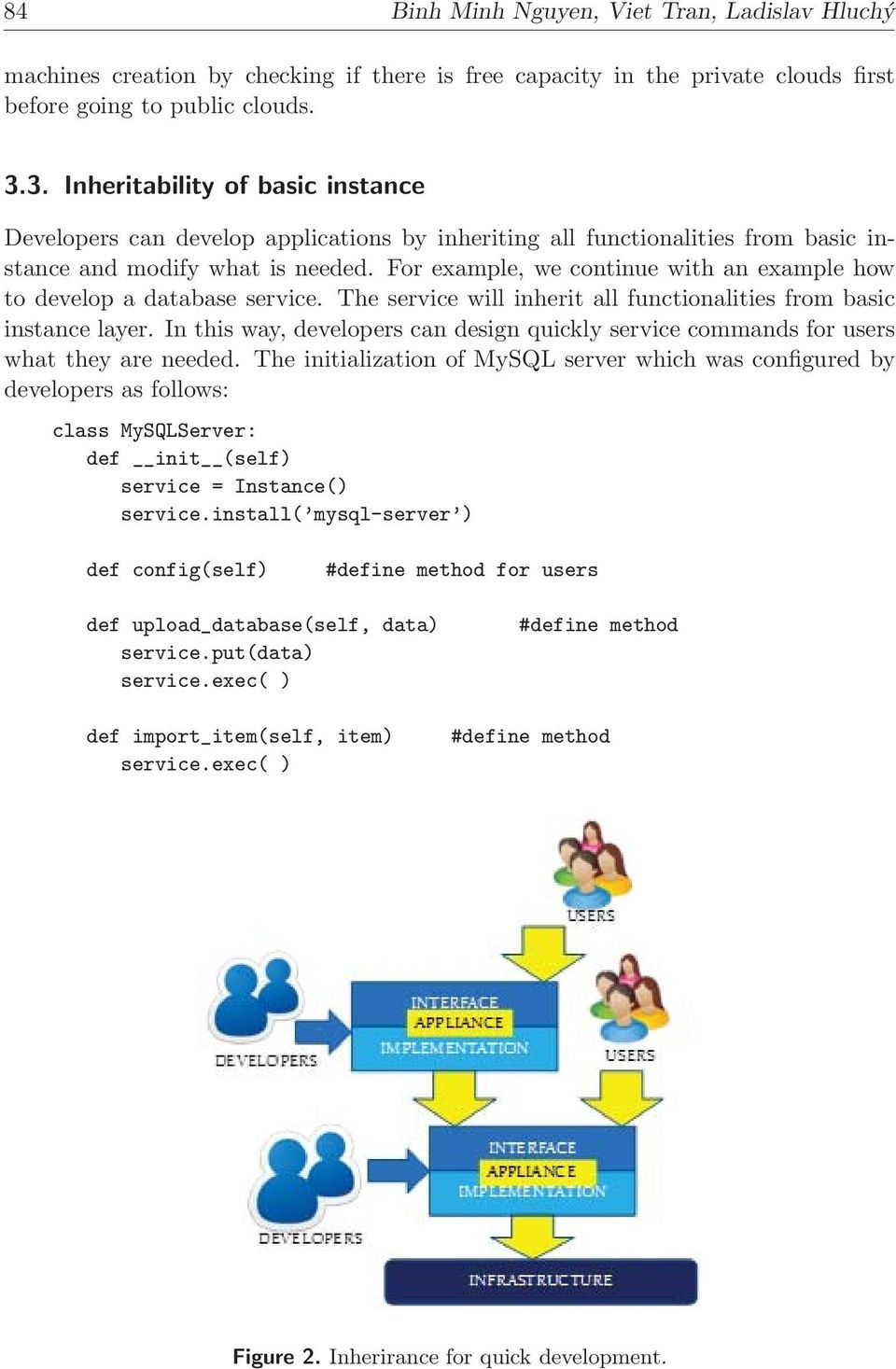
6 84 Binh Minh Nguyen, Viet Tran, Ladislav Hluchý machines creation by checking if there is free capacity in the private clouds first before going to public clouds Inheritability of basic instance Developers can develop applications by inheriting all functionalities from basic instance and modify what is needed. For example, we continue with an example how to develop a database service. The service will inherit all functionalities from basic instance layer. In this way, developers can design quickly service commands for users what they are needed. The initialization of MySQL server which was configured by developers as follows: class MySQLServer: def init (self) service = Instance() service.install( mysql-server ) def config(self) #define method for users def upload_database(self, data) service.put(data) service.exec( ) def import_item(self, item) service.exec( ) #define method #define method Figure 2. Inherirance for quick development.
7 Abstraction layer for development and deployment of cloud services 85 After defining abstract objects for database service, users then can use simply the service: m = MySQLServer() m.config() m.upload_database(data) m.import_item(item) The developers also can go further in the use of abstraction layer to deploy appliances that are linked to the available database (e.g. web services, wiki pages, and forum). Meanwhile, users can use these appliances in simple and intuitive way. According to this principle, the process of developing and deploying cloud services will be faster and simpler than traditional use of cloud computing Enabling Interoperability between clouds and migration of cloud services Of course, interoperability is invaluable feature, which brings many benefits to users/customers in particular, and to scientific community in general. Although some major enterprises or organizations have provided standardizations and aim towards a scenario in which clouds could interact with each other without any trouble. However, there still is no widely accepted common standard. In our approach, the abstraction layer will provide implementation of basic instances for each known cloud middleware. In this way, all middleware-specific functionalities are abstracted by the methods of the basic instance. Developers only use the functionalities which were provided by basic instance without regard to implementation details of different providers. Most of the cloud middlewares support backup or snapshot functions in order to store user data and program-specific configuration on virtual machine. As a result, users save the time on reinstalling application as well as recreating machine. Similarly, the abstraction layers also provide methods for developers to create a backup of systems or appliances. Thus, developers can define what will be stored during overwriting backup method, including whole virtual machine with operation system or only application data with their configurations. In the application backup case, backup data will be smaller, the backup process will be faster and the migration of appliances will be easier. Thus, the migration will be realized via backup-restore function. Then, developers only have to start a new virtual machine and restore application-specific configuration or data. This means that appliances can operate on different middlewares with different virtualisation backends, removing vendor lock-in and allowing perfectly interoperability between clouds. 4. Implementation We have implemented a prototype of the abstraction layer for cloud computing. In this section, we provide some details about the implementation within two cloud
8 86 Binh Minh Nguyen, Viet Tran, Ladislav Hluchý systems: Eucalyptus (which is open-source implementation of Amazon EC2) and OpenNebula [12]. We created an abstract class Engine which has functions for manipulation with virtual machines: start, stop, status and so on. For each cloud system, we create a derived class, like EC2_Engine and ONE_Engine respectively, which use the middlewarespecific interface for implementation of cloud functionalities. The implementation of Engine derived classes: EC2_Engine and ONE_Engine use the webservice interface of the middleware. Each class is initiated with access point to the cloud, credential for authentication and default parameters (machine templates, image, key). Each action start(), stop, status() is realized by sending the respective query to the cloud web interface [7]. If we need to extend our implementation for a new middleware, e.g. for ElasticHost [2], the only thing we have to do is create the new derived class for middleware specific functions. The global variable engine will be set to the actual cloud middleware the users are using. By the default, this variable will be initiated according to the settings in the configuration files. Users can change used cloud system on the fly simply by setting engine to new value e.g. engine=ec2_engine(endpoint,access_key,secret_key) in the program. In Instance class, the middleware-dependent methods start(), stop() will call the respective methods of engine variable i.e.. engine.start(), engine.stop() regardless what middleware is actually used. Due to polymorphism of the objectoriented programming, engine.start() will be realized as EC2_Engine.start() or ONE_Engine.start() according to the actual value of engine. It means that the implementation of Instance and all its derived classes is middleware independent. Note that many methods of the Instance class in Section 2, like put(), get(), exec() are already middleware-independent. Oneimportantfeatureisthatasweusewebserviceinterfaceofthecloudmiddleware, no installation of client software for the middleware is needed. It means that the users can download our software, setting their account information (access points and credential) in the configuration file and then can use different cloud middleware as the same time without any additional installations. The software is implemented in Python programming language [15] which can run on various operating systems including Windows, Linux/Unix, OS/2, Mac. The fragments of code in this paper are taken from our implementation so readers can see some small differences of the syntax of Python language (e.g t = Instance() instead of t = new Instance() in Java). One of the reasons for choosing Python over Java is that as a scripting language, Python is more suitable for quick development. As mentioned before, we have tested our system with Eucalyptus, OpenNebula and Amazon EC2. 5. Conclusion and future work In the paper, we have presented a novel abstraction layer for cloud computing. The abstraction will simplify the use of cloud computing under unified interface. It also

9 Abstraction layer for development and deployment of cloud services 87 will allow users to develop and deploy services easily and independently from underlying infrastructure (create once, run anywhere). Thus, the abstraction will enable interoperability between clouds and migration of services. In the near future, we will extend the abstraction layer for other cloud systems such as Amazon EC2, ElasticHost, and OpenStack [4] etc. After that, we will develop a GUI for the abstraction layer. The advantages of the graphical user interface are as follows: Support for users who can use abstraction layer without programming knowledge. Transparently and easily to use, users will control appliances by clicking on the GUI; Improvement of work performance, using the GUI through mouse clicks is faster than programming the object-oriented commands. Acknowledgements This work is supported by projects SMART ITMS: , SMART II ITMS: , VEGA No. 2/0211/09, VEGA 2/0184/10. References [1] Distributed management task force inc. [2] Elastichosts. [3] Eucalyptus community. [4] Openstack. [5] Amazon elastic compute cloud (amazon ec2). July [6] Amazon elastic compute cloud (amazon ec2). July [7] Aws documentation. July [8] Contrail project home page. July [9] Eu fp7 programme. July [10] Ieee p2301 working group. July [11] Ieee p2302 working group. July [12] Opennebula: The open source toolkit for cloud computing. org/, July [13] Python programming language. July [14] Salesforce.com. July 2012.
![In the near future, we will extend the abstraction layer for other cloud systems such as Amazon EC2, ElasticHost, and OpenStack [4] etc. After that, we will develop a GUI for the abstraction layer.](/docs-images/43/2052380/images/page_9.jpg "The advantages of the graphical user interface are as follows: Support for users who can use abstraction layer without programming knowledge.")
10 88 Binh Minh Nguyen, Viet Tran, Ladislav Hluchý [15] Technical white paper: Analyzing citrix xenserver persistent performance metrics from round robin database logs. aspx/4aa1-4053enw.pdf, July [16] Technical white paper: Vmware esx server. July [17] Andrzej Gościński M. B.: Toward dynamic and attribute based publication, discovery and selection for cloud computing. Future Generation Computer Systems, 26(7): , [18] Kothari C., Arumugam A. K.: Cloud application migration. sys-con.com/node/ /, July [19] Leinenbach D., Santen T.: Verifying the microsoft hyper-v hypervisor with vcc. In Proc. of the 2nd World Congress on Formal Methods. LNCS Springer, vol. 5850, [20] Loutas N., Peristeras V., Bouras T., Kamateri E., Zeginis D., Tarabanis K.: Towards a reference architecture for semantically interoperable clouds. In In Proc. of IEEE 2nd International Conference on Cloud Computing Technology and Science (Cloud Com 2010), pp , [21] Menychtas A., Gatzioura A., Varvarigou T.: A business resolution engine for cloud marketplaces. In In Proc. of 3rd IEEE International Conference and Workshops on Cloud Computing Technology and Science (CloudCom 2011), pp , [22] Metsch T., Edmonds A., Nyran R.: Open cloud computing interface core. Open Grid Forum, OCCI-WG, Specification Document. Available at: gridforum.org/sf/go/doc16161/, [23] Ramakrishnan L., Jackson K. R., Canon S., Cholia S., Shalf J.: Defining future platform requirements for e-science clouds. In Proceedings of the 1st ACM symposium on Cloud computing, pp ACM, Affiliations Binh Minh Nguyen Institute of Informatics, Slovak Academy of Sciences, Dubravska cesta 9, Bratislava, Slovakia, [email protected] Viet Tran Institute of Informatics, Slovak Academy of Sciences, Dubravska cesta 9, Bratislava, Slovakia, [email protected] Ladislav Hluchý Institute of Informatics, Slovak Academy of Sciences, Dubravska cesta 9, Bratislava, Slovakia, [email protected] Received: Revised: Accepted:
![: Toward dynamic and attribute based publication, discovery and selection for cloud computing. Future Generation Computer Systems, 26(7):947 970, 2010. [18] Kothari C., Arumugam A. K.: Cloud application migration.](/docs-images/43/2052380/images/page_10.jpg "http://soa. sys-con.com/node/1458739/, July 2010. [19] Leinenbach D., Santen T.: Verifying the microsoft hyper-v hypervisor with vcc. In Proc. of the 2nd World Congress on Formal Methods.")
A GENERIC DEVELOPMENT AND DEPLOYMENT FRAMEWORK FOR CLOUD COMPUTING AND DISTRIBUTED APPLICATIONS. Binh Minh Nguyen, Viet Tran, Ladislav Hluchý
 Computing and Informatics, Vol. 32, 2013, 461 485 A GENERIC DEVELOPMENT AND DEPLOYMENT FRAMEWORK FOR CLOUD COMPUTING AND DISTRIBUTED APPLICATIONS Binh Minh Nguyen, Viet Tran, Ladislav Hluchý Institute
Mobile Cloud Computing T-110.5121 Open Source IaaS
 Mobile Cloud Computing T-110.5121 Open Source IaaS Tommi Mäkelä, Otaniemi Evolution Mainframe Centralized computation and storage, thin clients Dedicated hardware, software, experienced staff High capital
How To Compare Cloud Computing To Cloud Platforms And Cloud Computing
 Volume 3, Issue 11, November 2013 ISSN: 2277 128X International Journal of Advanced Research in Computer Science and Software Engineering Research Paper Available online at: www.ijarcsse.com Cloud Platforms
Cloud Models and Platforms
 Cloud Models and Platforms Dr. Sanjay P. Ahuja, Ph.D. 2010-14 FIS Distinguished Professor of Computer Science School of Computing, UNF A Working Definition of Cloud Computing Cloud computing is a model
Cloud Computing. Adam Barker
 Cloud Computing Adam Barker 1 Overview Introduction to Cloud computing Enabling technologies Different types of cloud: IaaS, PaaS and SaaS Cloud terminology Interacting with a cloud: management consoles
Deploying Business Virtual Appliances on Open Source Cloud Computing
 International Journal of Computer Science and Telecommunications [Volume 3, Issue 4, April 2012] 26 ISSN 2047-3338 Deploying Business Virtual Appliances on Open Source Cloud Computing Tran Van Lang 1 and
DATA PORTABILITY AMONG PROVIDERS OF PLATFORM AS A SERVICE. Darko ANDROCEC
 RESEARCH PAPERS FACULTY OF MATERIALS SCIENCE AND TECHNOLOGY IN TRNAVA SLOVAK UNIVERSITY OF TECHNOLOGY IN BRATISLAVA 2013 Special Number DATA PORTABILITY AMONG PROVIDERS OF PLATFORM AS A SERVICE Darko ANDROCEC
Private Clouds with Open Source
 Private Clouds with Open Source GridKa School 2010 KIT September 7 th 2010 Christian Baun [email protected] http://www.kit.edu Cloud-Computing? Building on compute and storage virtualization, and leveraging
Analysis and Research of Cloud Computing System to Comparison of Several Cloud Computing Platforms
 Volume 1, Issue 1 ISSN: 2320-5288 International Journal of Engineering Technology & Management Research Journal homepage: www.ijetmr.org Analysis and Research of Cloud Computing System to Comparison of
Tuyet-Trinh Vu, Binh-Minh Nguyen, Viet-Trung Tran Hanoi University of Science and Technology. contact: [email protected]
 Tuyet-Trinh Vu, Binh-Minh Nguyen, Viet-Trung Tran Hanoi University of Science and Technology contact: [email protected] Cloud computing Cloud service models Interoperability Infrastructure for
Virtualization Support - Real Backups of Virtual Environments
 Virtualization Support Real Backups of Virtual Environments Contents Virtualization Challenges 3 The Benefits of Agentless Backup 4 Backup and Recovery Built for Virtualized Environments 4 Agentless in
IaaS Cloud Architectures: Virtualized Data Centers to Federated Cloud Infrastructures
 IaaS Cloud Architectures: Virtualized Data Centers to Federated Cloud Infrastructures Dr. Sanjay P. Ahuja, Ph.D. 2010-14 FIS Distinguished Professor of Computer Science School of Computing, UNF Introduction
Architecture des plates-formes IaaS Etat des lieux et perspectives
 Architecture des plates-formes IaaS Etat des lieux et perspectives Frédéric Dang Tran Orange Labs Joint CompatibleOne and OSCi workshop, 7 June 2011 1 Outline > Scope and objectives > User-facing API and
OpenNebula Open Souce Solution for DC Virtualization. C12G Labs. Online Webinar
 OpenNebula Open Souce Solution for DC Virtualization C12G Labs Online Webinar What is OpenNebula? Multi-tenancy, Elasticity and Automatic Provision on Virtualized Environments I m using virtualization/cloud,
2) Xen Hypervisor 3) UEC
 5. Implementation Implementation of the trust model requires first preparing a test bed. It is a cloud computing environment that is required as the first step towards the implementation. Various tools
Using SUSE Cloud to Orchestrate Multiple Hypervisors and Storage at ADP
 Using SUSE Cloud to Orchestrate Multiple Hypervisors and Storage at ADP Agenda ADP Cloud Vision and Requirements Introduction to SUSE Cloud Overview Whats New VMWare intergration HyperV intergration ADP
Introduction to Cloud computing. Viet Tran
 Introduction to Cloud computing Viet Tran Type of Cloud computing Infrastructure as a Service IaaS: offer full virtual machines via hardware virtualization tech. Amazon EC2, AbiCloud, ElasticHosts, Platform
OpenNebula Open Souce Solution for DC Virtualization
 13 th LSM 2012 7 th -12 th July, Geneva OpenNebula Open Souce Solution for DC Virtualization Constantino Vázquez Blanco OpenNebula.org What is OpenNebula? Multi-tenancy, Elasticity and Automatic Provision
Hybrid Cloud Backup and Recovery Software. Virtualization Support Real Backups of Virtual Environments
 Hybrid Cloud Backup and Recovery Software Virtualization Support Asigra Inc. 1120 Finch Avenue West, Suite 400 Toronto, ON Canada M3J 3H7 tel: 416-736-8111 fax: 416-736-7120 email: [email protected] www.recoveryourcool.com
Getting Started Hacking on OpenNebula
 LinuxTag 2013 Berlin, Germany, May 22nd Getting Started Hacking on OpenNebula Carlos Martín Project Engineer Acknowledgments The research leading to these results has received funding from Comunidad de
Cloud Computing Architecture with OpenNebula HPC Cloud Use Cases
 NASA Ames NASA Advanced Supercomputing (NAS) Division California, May 24th, 2012 Cloud Computing Architecture with OpenNebula HPC Cloud Use Cases Ignacio M. Llorente Project Director OpenNebula Project.
OpenNebula Open Souce Solution for DC Virtualization
 OSDC 2012 25 th April, Nürnberg OpenNebula Open Souce Solution for DC Virtualization Constantino Vázquez Blanco OpenNebula.org What is OpenNebula? Multi-tenancy, Elasticity and Automatic Provision on Virtualized
T-110.5121 Mobile Cloud Computing Private Cloud & Assignment 2 19.10.2011
 T-110.5121 Mobile Cloud Computing Private Cloud & Assignment 2 19.10.2011 Yrjö Raivio, Koushik Annapureddy, Ramasivakarthik Mallavarapu Aalto University, School of Science Department of Computer Science
Infrastructure as a Service (IaaS)
 Infrastructure as a Service (IaaS) (ENCS 691K Chapter 4) Roch Glitho, PhD Associate Professor and Canada Research Chair My URL - http://users.encs.concordia.ca/~glitho/ References 1. R. Moreno et al.,
Deployment Options for Microsoft Hyper-V Server
 CA ARCserve Replication and CA ARCserve High Availability r16 CA ARCserve Replication and CA ARCserve High Availability Deployment Options for Microsoft Hyper-V Server TYPICALLY, IT COST REDUCTION INITIATIVES
Aneka: A Software Platform for.net-based Cloud Computing
 Aneka: A Software Platform for.net-based Cloud Computing Christian VECCHIOLA a, Xingchen CHU a,b, and Rajkumar BUYYA a,b,1 a Grid Computing and Distributed Systems (GRIDS) Laboratory Department of Computer
OpenNebula Leading Innovation in Cloud Computing Management
 OW2 Annual Conference 2010 Paris, November 24th, 2010 OpenNebula Leading Innovation in Cloud Computing Management Ignacio M. Llorente DSA-Research.org Distributed Systems Architecture Research Group Universidad
ONE Cloud Services Secure Cloud Applications for E-Health
 ONE Cloud Services Secure Cloud Applications for E-Health http://cloudbestpractices.net Cloud Solutions Roadmap The Cloud Best Practices Network (CBPN) specializes in pioneering and documenting best practice
Cloud-pilot.doc 12-12-2010 SA1 Marcus Hardt, Marcin Plociennik, Ahmad Hammad, Bartek Palak E U F O R I A
 Identifier: Date: Activity: Authors: Status: Link: Cloud-pilot.doc 12-12-2010 SA1 Marcus Hardt, Marcin Plociennik, Ahmad Hammad, Bartek Palak E U F O R I A J O I N T A C T I O N ( S A 1, J R A 3 ) F I
9/26/2011. What is Virtualization? What are the different types of virtualization.
 CSE 501 Monday, September 26, 2011 Kevin Cleary [email protected] What is Virtualization? What are the different types of virtualization. Practical Uses Popular virtualization products Demo Question,
Cloud Computing Architecture: A Survey
 Cloud Computing Architecture: A Survey Abstract Now a day s Cloud computing is a complex and very rapidly evolving and emerging area that affects IT infrastructure, network services, data management and
Cloud Hosting. QCLUG presentation - Aaron Johnson. Amazon AWS Heroku OpenShift
 Cloud Hosting QCLUG presentation - Aaron Johnson Amazon AWS Heroku OpenShift What is Cloud Hosting? According to the Wikipedia - 2/13 Cloud computing, or in simpler shorthand just "the cloud", focuses
From Grid Computing to Cloud Computing & Security Issues in Cloud Computing
 From Grid Computing to Cloud Computing & Security Issues in Cloud Computing Rajendra Kumar Dwivedi Assistant Professor (Department of CSE), M.M.M. Engineering College, Gorakhpur (UP), India E-mail: [email protected]
CLOUD TECH SOLUTION AT INTEL INFORMATION TECHNOLOGY ICApp Platform as a Service
 CLOUD TECH SOLUTION AT INTEL INFORMATION TECHNOLOGY ICApp Platform as a Service Open Data Center Alliance, Inc. 3855 SW 153 rd Dr. Beaverton, OR 97003 USA Phone +1 503-619-2368 Fax: +1 503-644-6708 Email:
Performance Gathering and Implementing Portability on Cloud Storage Data
 International Journal of Information & Computation Technology. ISSN 0974-2239 Volume 4, Number 17 (2014), pp. 1815-1823 International Research Publications House http://www. irphouse.com Performance Gathering
Cisco UCS Central Software
 Data Sheet Cisco UCS Central Software Cisco UCS Manager provides a single point of management for an entire Cisco Unified Computing System (Cisco UCS) domain of up to 160 servers and associated infrastructure.
A Model-Based Proxy for Unified IaaS Management
 A Model-Based Proxy for Unified IaaS Management Shixing Yan HP Labs Singapore 1 Fusionopolis Way Singapore 138632 Email: [email protected] Bu Sung Lee HP Labs Singapore, Singapore 138632 & School of Computer
CA ARCserve Replication and High Availability Deployment Options for Hyper-V
 Solution Brief: CA ARCserve R16.5 Complexity ate my budget CA ARCserve Replication and High Availability Deployment Options for Hyper-V Adding value to your Hyper-V environment Overview Server virtualization
Comparing Open Source Private Cloud (IaaS) Platforms
 Comparing Open Source Private Cloud (IaaS) Platforms Lance Albertson OSU Open Source Lab Associate Director of Operations [email protected] / @ramereth About me OSU Open Source Lab Server hosting for Open
SUSE Cloud 2.0. Pete Chadwick. Douglas Jarvis. Senior Product Manager [email protected]. Product Marketing Manager djarvis@suse.
 SUSE Cloud 2.0 Pete Chadwick Douglas Jarvis Senior Product Manager [email protected] Product Marketing Manager [email protected] SUSE Cloud SUSE Cloud is an open source software solution based on OpenStack
OpenStack Alberto Molina Coballes
 OpenStack Alberto Molina Coballes Teacher at IES Gonzalo Nazareno [email protected] @alberto_molina Table of Contents From public to private clouds Open Source Cloud Platforms Why OpenStack? OpenStack
Geoff Raines Cloud Engineer
 Geoff Raines Cloud Engineer Approved for Public Release; Distribution Unlimited. 13-2170 2013 The MITRE Corporation. All rights reserved. Why are P & I important for DoD cloud services? Improves the end-to-end
The OpenNebula Cloud Platform for Data Center Virtualization
 CloudOpen 2012 San Diego, USA, August 29th, 2012 The OpenNebula Cloud Platform for Data Center Virtualization Carlos Martín Project Engineer Acknowledgments The research leading to these results has received
Automated Configuration of Open Stack Instances at Boot Time
 Automated Configuration of Open Stack Instances at Boot Time N Praveen 1, Dr. M.N.Jayaram 2 Post Graduate Student 1, Associate Professor 2, EC Department, SJCE, Mysuru, India Abstract: Cloud Computing
INTRODUCTION TO CLOUD COMPUTING CEN483 PARALLEL AND DISTRIBUTED SYSTEMS
 INTRODUCTION TO CLOUD COMPUTING CEN483 PARALLEL AND DISTRIBUTED SYSTEMS CLOUD COMPUTING Cloud computing is a model for enabling convenient, ondemand network access to a shared pool of configurable computing
Mary E. Shacklett President Transworld Data
 Transworld Data Mary E. Shacklett President Transworld Data For twenty-five years, Transworld Data has performed technology analytics, market research and IT consulting on every world continent, including
Assignment # 1 (Cloud Computing Security)
 Assignment # 1 (Cloud Computing Security) Group Members: Abdullah Abid Zeeshan Qaiser M. Umar Hayat Table of Contents Windows Azure Introduction... 4 Windows Azure Services... 4 1. Compute... 4 a) Virtual
Lecture 02a Cloud Computing I
 Mobile Cloud Computing Lecture 02a Cloud Computing I 吳 秀 陽 Shiow-yang Wu What is Cloud Computing? Computing with cloud? Mobile Cloud Computing Cloud Computing I 2 Note 1 What is Cloud Computing? Walking
Integrated Management of IaaS Resources
 2 nd Workshop on Federative and Interoperable Cloud Infrastructures Integrated Management of IaaS Resources Fernando Meireles ([email protected]) and Benedita Malheiro ([email protected]) School of Engineering,
Towards Data Interoperability of Cloud Infrastructures using Cloud Storage Services
 Towards Data Interoperability of Cloud Infrastructures using Cloud Storage Services Tamas Pflanzner 1 and Attila Kertesz 2,1 1 University of Szeged, Department of Software Engineering H-6720 Szeged, Dugonics
Winery A Modeling Tool for TOSCA-based Cloud Applications
 Institute of Architecture of Application Systems Winery A Modeling Tool for TOSCA-based Cloud Applications Oliver Kopp 1,2, Tobias Binz 2, Uwe Breitenbücher 2, and Frank Leymann 2 1 IPVS, 2 IAAS, University
OpenNebula The Open Source Solution for Data Center Virtualization
 LinuxTag April 23rd 2012, Berlin OpenNebula The Open Source Solution for Data Center Virtualization Hector Sanjuan OpenNebula.org 1 What is OpenNebula? Multi-tenancy, Elasticity and Automatic Provision
Comparison of Several Cloud Computing Platforms
 Second International Symposium on Information Science and Engineering Comparison of Several Cloud Computing Platforms Junjie Peng School of computer science & High performance computing center Shanghai
Lecture 02b Cloud Computing II
 Mobile Cloud Computing Lecture 02b Cloud Computing II 吳 秀 陽 Shiow-yang Wu T. Sridhar. Cloud Computing A Primer, Part 2: Infrastructure and Implementation Topics. The Internet Protocol Journal, Volume 12,
Li Sheng. [email protected]. Nowadays, with the booming development of network-based computing, more and more
 36326584 Li Sheng Virtual Machine Technology for Cloud Computing Li Sheng [email protected] Abstract: Nowadays, with the booming development of network-based computing, more and more Internet service vendors
Research of Enterprise Private Cloud Computing Platform Based on OpenStack. Abstract
 , pp.171-180 http://dx.doi.org/10.14257/ijgdc.2014.7.5.16 Research of Enterprise Private Cloud Computing Platform Based on OpenStack Jiang Yunxia, Zhao Bowen, Wang Shuqi and Sun Dongnan School of Automation,
A Cloud Monitoring Framework for Self-Configured Monitoring Slices Based on Multiple Tools
 A Cloud Monitoring Framework for Self-Configured Monitoring Slices Based on Multiple Tools Márcio Barbosa de Carvalho, Rafael Pereira Esteves, Guilherme da Cunha Rodrigues, Lisandro Zambenedetti Granville,
AN IMPLEMENTATION OF E- LEARNING SYSTEM IN PRIVATE CLOUD
 AN IMPLEMENTATION OF E- LEARNING SYSTEM IN PRIVATE CLOUD M. Lawanya Shri 1, Dr. S. Subha 2 1 Assistant Professor,School of Information Technology and Engineering, Vellore Institute of Technology, Vellore-632014
cloud functionality: advantages and Disadvantages
 Whitepaper RED HAT JOINS THE OPENSTACK COMMUNITY IN DEVELOPING AN OPEN SOURCE, PRIVATE CLOUD PLATFORM Introduction: CLOUD COMPUTING AND The Private Cloud cloud functionality: advantages and Disadvantages
NEXT-GENERATION, CLOUD-BASED SERVER MONITORING AND SYSTEMS MANAGEMENT
 NEXT-GENERATION, CLOUD-BASED SERVER MONITORING AND SYSTEMS MANAGEMENT COVERS INTRODUCTION A NEW APPROACH CUSTOMER USE CASES FEATURES ARCHITECTURE V 1.0 INTRODUCTION & OVERVIEW Businesses use computers
Desktop virtualization using SaaS Architecture
 Desktop virtualization using SaaS Architecture Pranit U. Patil, Pranav S. Ambavkar, Dr.B.B.Meshram, Prof. Varshapriya VJTI, Matunga, Mumbai, India. [email protected] Abstract - Desktop virtualization
CLOUD COMPUTING. Virtual Machines Provisioning and Migration Services Mohamed El-Refaey
 CLOUD COMPUTING Virtual Machines Provisioning and Migration Services Mohamed El-Refaey Prepared by: Dr. Faramarz Safi Islamic Azad University, Najafabad Branch, Esfahan, Iran. VIRTUAL MACHINES PROVISIONING
CUMULUX WHICH CLOUD PLATFORM IS RIGHT FOR YOU? COMPARING CLOUD PLATFORMS. Review Business and Technology Series www.cumulux.com
 ` CUMULUX WHICH CLOUD PLATFORM IS RIGHT FOR YOU? COMPARING CLOUD PLATFORMS Review Business and Technology Series www.cumulux.com Table of Contents Cloud Computing Model...2 Impact on IT Management and
Standard Interfaces for Open Source Infrastructure as a Service Platforms
 68 Informatica Economică vol. 19, no. 4/2015 Standard Interfaces for Open Source Infrastructure as a Service Platforms Andrei IONESCU Bucharest University of Economic Studies [email protected]
VMUnify EC2 Gateway Guide
 VMUnify EC2 Gateway Guide Version 2.8.1 Copyright Information This document is the exclusive property of Mindtree limited (Mindtree); the recipient agrees that they may not copy, transmit, use or disclose
Evaluation of Multi-Hypervisor Management with HotLink SuperVISOR
 White Paper White Paper Managing Public Cloud Computing in the Enterprise Evaluation of Multi-Hypervisor Management with HotLink SuperVISOR A Quick Start Guide By David Davis vexpert 1 Table of Contents
SLA BASED SERVICE BROKERING IN INTERCLOUD ENVIRONMENTS
 SLA BASED SERVICE BROKERING IN INTERCLOUD ENVIRONMENTS Foued Jrad, Jie Tao and Achim Streit Steinbuch Centre for Computing, Karlsruhe Institute of Technology, Karlsruhe, Germany {foued.jrad, jie.tao, achim.streit}@kit.edu
SURFnet Cloud Computing Solutions
 Marvin Rambhadjan Arthur Schutijser SURFnet February 3, 2010 Overview Introduction Cloud Computing Introduction Cloud Computing What is Cloud Computing? Resource Pooling Resources are bundled High Level
AppStack Technology Overview Model-Driven Application Management for the Cloud
 AppStack Technology Overview Model-Driven Application Management for the Cloud Accelerating Application Time-to-Market The last several years have seen a rapid adoption for public and private cloud infrastructure
OpenNebula Cloud Platform for Data Center Virtualization
 OSDC 2013 Nüremberg, Germany 17-18 April, 2013 OpenNebula Cloud Platform for Data Center Virtualization Constantino Vázquez Blanco OpenNebula Project Engineer @tinova79 OpenNebula Project. Creative Commons
Sistemi Operativi e Reti. Cloud Computing
 1 Sistemi Operativi e Reti Cloud Computing Facoltà di Scienze Matematiche Fisiche e Naturali Corso di Laurea Magistrale in Informatica Osvaldo Gervasi [email protected] 2 Introduction Technologies
Comparison of Open Source Cloud System for Small and Medium Sized Enterprises
 , pp.276-282 http://dx.doi.org/10.14257/astl.2014.51.63 Comparison of Open Source Cloud System for Small and Medium Sized Enterprises Yasuo Uchida 1, Seigo Matsuno 1, Makoto Sakamoto 2 1 Ube National College
Frédéric Dang Tran Orange Labs [email protected]
 Sirocco: an open-source multi-cloud manager Frédéric Dang Tran Orange Labs [email protected] Outline Objectives Key features API and resource model Middleware Architecture Roadmap 2012 2 Objectives
Approaches for Cloud and Mobile Computing
 Joint CLEEN and ACROSS Workshop on Cloud Technology and Energy Efficiency in Mobile Communications at EUCNC 15, Paris, France - 29 June, 2015 Interoperable Data Management Approaches for Cloud and Mobile
Grid Computing Vs. Cloud Computing
 International Journal of Information and Computation Technology. ISSN 0974-2239 Volume 3, Number 6 (2013), pp. 577-582 International Research Publications House http://www. irphouse.com /ijict.htm Grid
RED HAT CLOUD SUITE FOR APPLICATIONS
 RED HAT CLOUD SUITE FOR APPLICATIONS DATASHEET AT A GLANCE Red Hat Cloud Suite: Provides a single platform to deploy and manage applications. Offers choice and interoperability without vendor lock-in.
Challenges in Hybrid and Federated Cloud Computing
 Cloud Day 2011 KTH-SICS Cloud Innovation Center and EIT ICT Labs Kista, Sweden, September 14th, 2011 Challenges in Hybrid and Federated Cloud Computing Ignacio M. Llorente Project Director Acknowledgments
Virtualization and Cloud Computing
 Written by Zakir Hossain, CS Graduate (OSU) CEO, Data Group Fed Certifications: PFA (Programming Foreign Assistance), COR (Contracting Officer), AOR (Assistance Officer) Oracle Certifications: OCP (Oracle
A Brief Overview. Delivering Windows Azure Services on Windows Server. Enabling Service Providers
 A Brief Overview Enabling Service Providers Chris Van Wesep Cloud OS Product MKTG Manager Microsoft Corp. Delivering Windows Azure Services on Windows Server Challenges and needs Overview of Cloud OS Architecture
Virtualization, SDN and NFV
 Virtualization, SDN and NFV HOW DO THEY FIT TOGETHER? Traditional networks lack the flexibility to keep pace with dynamic computing and storage needs of today s data centers. In order to implement changes,
RSA Authentication Manager 8.1 Virtual Appliance Getting Started
 RSA Authentication Manager 8.1 Virtual Appliance Getting Started Thank you for purchasing RSA Authentication Manager 8.1, the world s leading two-factor authentication solution. This document provides
Open Data Center Alliance Usage: VIRTUAL MACHINE (VM) INTEROPERABILITY IN A HYBRID CLOUD ENVIRONMENT REV. 1.1
 sm Open Data Center Alliance Usage: VIRTUAL MACHINE (VM) INTEROPERABILITY IN A HYBRID CLOUD ENVIRONMENT REV. 1.1 Open Data Center Alliance Usage: Virtual Machine (VM) Interoperability in a Hybrid Cloud
Virtualization & Cloud Computing (2W-VnCC)
 Virtualization & Cloud Computing (2W-VnCC) DETAILS OF THE SYLLABUS: Basics of Networking Types of Networking Networking Tools Basics of IP Addressing Subnet Mask & Subnetting MAC Address Ports : Physical
Scheduler in Cloud Computing using Open Source Technologies
 Scheduler in Cloud Computing using Open Source Technologies Darshan Upadhyay Prof. Chirag Patel Student of M.E.I.T Asst. Prof. Computer Department S. S. Engineering College, Bhavnagar L. D. College of
ConPaaS: an integrated runtime environment for elastic cloud applications
 ConPaaS: an integrated runtime environment for elastic cloud applications Guillaume Pierre Vrije Universiteit Amsterdam July 24th 2012 contrail is co-funded by the EC 7th Framework Programme under Grant
THE EUCALYPTUS OPEN-SOURCE PRIVATE CLOUD
 THE EUCALYPTUS OPEN-SOURCE PRIVATE CLOUD By Yohan Wadia ucalyptus is a Linux-based opensource software architecture that implements efficiencyenhancing private and hybrid clouds within an enterprise s
Cloud Computing and Open Source: Watching Hype meet Reality
 Cloud Computing and Open Source: Watching Hype meet Reality Rich Wolski UCSB Computer Science Eucalyptus Systems Inc. May 26, 2011 Exciting Weather Forecasts 99 M 167 M 6.5 M What is a cloud? SLAs Web
24/11/14. During this course. Internet is everywhere. Frequency barrier hit. Management costs increase. Advanced Distributed Systems Cloud Computing
 Advanced Distributed Systems Cristian Klein Department of Computing Science Umeå University During this course Treads in IT Towards a new data center What is Cloud computing? Types of Clouds Making applications