
Local Impact Statement Report For Bills Enacted in 2006
|
|
|
- Jayson Newman
- 9 years ago
- Views:
Transcription
1 Local Impact Statement Report For Bills Enacted in 2006 SEPTEMBER 2007 Legislative Service Commission 77 South High Street, 9th Floor Columbus, Ohio

2 Table of Contents Introduction...1 Local Government Association Comments Comments from County Commissioners Association of Ohio...5 Comments from Ohio Municipal League...6 Comments from Ohio School Boards Association...7 Comments from Ohio Township Association...8 Summary and Analysis Bills with Local Impact "As Introduced" or "As Enacted"...12 Local Impact by Political Subdivision...14 Local Impact Statements Appendix Fiscal Notes and Local Impact Statements for Bills Enacted in (Includes the page number of each bill's Local Impact Statement) All House Bills Passed in 2006 that Became Law All Senate Bills Passed in 2006 that Became Law Legislative Service Commission Local Impact Statement Report

3 Introduction Why is this report being issued? The Legislative Service Commission (LSC) publishes the Local Impact Statement Report in accordance with section of the Ohio Revised Code, which requires the office to compile the final local impact statements completed for all laws passed by both houses of the General Assembly every calendar year. This report is the ninth in the series of such reports. It covers all legislation that was passed and enacted during calendar year Before its widespread distribution, LSC is required to circulate a draft of this report to the County Commissioners Association of Ohio, the Ohio School Boards Association, the Ohio Municipal League, and the Ohio Township Association for their review and comment. As specified in ORC section , the Local Impact Statement (LIS) Law, this report is a compilation of estimates produced by LSC during the legislative process. This report does not present the actual costs to local governments, since these costs will not occur until after each law is implemented. What is in this report? This report includes summary charts and an overview of bills that were introduced, passed, and enacted, and includes complete copies of fiscal notes prepared for bills that bore provisions triggering a "Yes" local impact determination. The criteria that LSC uses to evaluate the effect of proposed legislation on local governments are detailed below. What process is followed for local impact review? By law, local impact determinations are based on LSC's review of bills in their "As Introduced" form. The initial determination stays with the bill even if a bill is amended in such a way as to alter the initial local impact determination. Occasionally an initial determination is wrong. If so, LSC corrects the LIS as soon as possible, and the correct determination is assigned to the bill from that point on. The Local Impact determination is the first stage of LSC's fiscal analysis of pending legislation. The purpose is to alert legislators to the various fiscal effects that legislation may impose on four specific types of political subdivisions: counties, municipalities, townships, and school districts. The bill sponsor, committee chair, and legislative leaders of the house to which the bill has been introduced all receive notification of LSC's local impact determination. Although bills often affect other more specialized units of government, such as park districts, transit authorities, and so forth, by law these entities are not included in the initial local impact review. These units of government, however, are taken into account in the fiscal notes that accompany bills as they proceed through the legislative process. Legislative Service Commission 1 Local Impact Statement Report

4 What changes have been made to the Local Impact Statement Law? Since it was signed into law in 1994, the Local Impact Statement Law has been modified three times: first, in 1997 by Am. Sub. H.B. 215 of the 122nd General Assembly; second, in 1999 by Am. Sub. H.B. 283 of the 123rd General Assembly; and third, in 2001 by Am. Sub. H.B. 94 of the 124th General Assembly. The combined effect has been to exempt the following bills from the local impact determination process: 1. The main biennial operating appropriations bill; 2. The biennial operating appropriations bill for state agencies supported by motor fuel tax revenue; 3. The biennial operating appropriations bill or bills for the Bureau of Workers' Compensation and the Industrial Commission; 4. Any other bill that makes the principal biennial operating appropriations for one or more state agencies; 5. The bill that primarily contains corrections and supplemental appropriations to the biennial operating appropriations bill; 6. The main biennial capital appropriations bill; 7. The bill that reauthorizes appropriations from previous capital appropriations bills. In 2006, three bills were exempt from the Local Impact Statement Law pursuant to the reasons stated above. These were Am. Sub. H.B. 530 (the capital reappropriations and budget corrections bill), Am. Sub. H.B. 699 (the second capital appropriations bill enacted by the 126th General Assembly), and Sub. S.B. 321 (the tobacco settlement appropriations bill). Nevertheless, LSC continues to assess the impact that such bills have on local governments in the fiscal notes and analyses that accompany such bills. What factors are considered in LSC's initial review for local impact? The following guidelines are used to determine if a bill may affect local governments in such a way as to trigger a "Yes" local impact determination: 1. The estimated aggregate annual cost of the bill is more than $100,000 for all affected local governments; or 2. The estimated annual cost is more than $1,000 for any affected village and township with a population of less than 5,000 or for any school district with an average daily membership (ADM) of less than 1,000; or 3. The estimated annual cost is more than $5,000 for any affected county, municipal corporation, and township with a population of 5,000 or more or for any school district with an ADM of 1,000 or more. Legislative Service Commission 2 Local Impact Statement Report
5 A bill is excluded from a "Yes" determination if it is deemed permissive, appears to impose only minimal costs on political subdivisions, is below the dollar thresholds just described, or involves federal mandates. Questions concerning this report Please direct inquiries to Terry Steele, LSC Budget Analyst, who prepared this report. He may be reached at , or by at [email protected]. Obtaining copies of this report Copies are available upon request from the Ohio Legislative Service Commission at a cost of $12.00 per copy. Call LSC at to receive a copy. The report may also be downloaded from the LSC web site at Legislative Service Commission 3 Local Impact Statement Report
6 LOCAL GOVERNMENT COMMENTS ON THE 2007 LOCAL IMPACT STATEMENT REPORT Legislative Service Commission Local Impact Statement Report

7 COUNTY COMMISSIONERS ASSOCIATION OF OHIO Unfortunately the 2006 Local Impact Statement Report inadequately represents the burden of unfunded mandates placed upon county government by the General Assembly during Unfunded mandates continue to plague all units of local government. Their impact becomes more severe, however, when coupled with the current economic climate. The demands for county government service, most of which the county delivers on the state s behalf, continue to increase while revenue sources for county governments have stagnated or declined. Unfunded mandates continue to erode the foundation of a viable state/county partnership-county fiscal security. Compliance with the federal Help America Vote Act is of major concern for county governments. Yet HB 3, which made significant changes to Ohio s election process, most of which impacted the counties administration of elections, is not addressed in this report. The new responsibilities imposed by HB 3 on our county boards of elections were not accompanied by adequate funding and, thus, our counties will bear significant new costs associated with the implement and continued administration of these responsibilities. The Local Impact Statement process also does not give a comprehensive and accurate view of unfunded mandates from the perspective of counties because the General Assembly has exempted budget bills from the LIS process and, thus, this Report. CCAO feels that the General Assembly would do itself a greater service and bring to itself a greater awareness of how their decisions have financial implications to counties and other local governments by eliminating the current provisions which exempt certain legislation from the LIS process. A review of all legislation enacted for its impact upon Ohio s local governments would be more appropriate. Only then, will the General Assembly and the public receive the true picture of the impacts of unfunded mandates on local governments. Irrespective of the concerns CCAO raises regarding the LIS process, we wish to acknowledge the professionalism and extreme competence of the LSC staff. We have always found the work of LSC to be fair and objective even under what is often challenging circumstances. CCAO wishes to thank the Legislative Service Commission for the opportunity to comment on this report. Legislative Service Commission 5 Local Impact Statement Report
8 OHIO MUNICIPAL LEAGUE The Ohio Municipal League has reviewed the draft of the 2007 Local Impact Statement Report and would like to make the following comments. The report has improved with each passing session. The same can be said for the actual fiscal notes and local impact statements. The report provides helpful information to organization representing local governments, their respective members and the public: information that would otherwise be difficult to compile. It shows that numerous pieces of legislation have a potential negative impact on local governments whose officials are already faced with declining revenues. We are always optimistic that this document will gain a larger recognition with state decision makers as they consider imposing additional programs or duties on local government or reducing limiting funding. The Ohio Municipal League commends the staff of the Legislative Service Commission for the time and effort they put into the individual statements and to this report. Legislative Service Commission 6 Local Impact Statement Report
9 OHIO SCHOOL BOARDS ASSOCIATION The Ohio School Boards Association believes that the 2007 Local Impact Statement Report is a valuable tool provided by the Ohio Legislative Service Commission (LSC) to the members of the Ohio General Assembly and to all Ohioans. The 2007 Local Impact Statement Report shows that 136 bills passed in 2006 and became law. Of those bills, six were reported as having a fiscal impact upon school districts in the As Introduced versions. OSBA believes it is important to note the fiscal impact that bills have upon school districts here in the state. Whether it is costs associated with HB 9, that revised the public records law or SB 311, that establishes the Ohio Core curriculum, this information is vital when legislation is being debated. School districts have faced many unfunded and underfunded mandates from both federal and state passed legislation and making sure these are known throughout the legislative process is important. An area that still needs to be addressed is the section of law that exempts LSC from having to update a local impact statement for the biennial budget, capital appropriation bill or any other budget corrections bill. OSBA would support legislation that would allow the General Assembly to include these bills that are now exempted in Division (F) of RC from these local impact statements. OSBA also believes that local impact statements should be required at each phase of the legislative process. This is particularly important as substitute versions and amended substitute versions of bills are enacted. Legislation can have a huge fiscal impact upon local school districts and this should be known to all as these bills progress through the legislature. OSBA would like to salute the Legislative Service Commission on another job well done and we look forward to working with you in the future. Legislative Service Commission 7 Local Impact Statement Report

10 OHIO TOWNSHIP ASSOCIATION The Ohio Township Association (OTA) would like to thank the Ohio Legislative Service Commission (LSC) for the opportunity to comment on the 2007 Local Impact Statement Report. The LSC Local Impact Statement (LIS) Report is an important educational resource for our members and the members of the General Assembly as it highlights the effect certain legislation will have on townships budgets and keeps legislators and local officials aware of any unfunded mandates created in legislation. In 1994, the General Assembly passed legislation requiring local fiscal impact statements for all legislation affecting local governments. Even with the enactment of that procedure, the General Assembly is still passing laws that impose new or additional requirements on local governments without the funding needed to implement such requirements. The fiscal impact legislation may have on townships often is underestimated. Provisions established in legislation such as filing, notification and public hearing requirements could create significant costs for townships. Although the actual impact these new laws will have on townships will not be known until the laws are put into practice, the fiscal analyses provide a base for our townships to determine how a new law may affect their budgets. For example, HB 9 revises the public records law. This bill specifically requires local governments to adopt a public records policy, a records retention policy and requires elected officials to have public records training to ensure compliance with HB 9 procedures. While the 2007 Local Impact Statement Report offers an analysis of legislation passed in 2006, it is not comprehensive. State budget bills are exempted from local impact statement requirements and, therefore, are not included in this report. A budget correction bill (HB 530) was passed in June of last year and includes several provisions with fiscal implications for townships. The OTA encourages the General Assembly to include budget bills in the LIS report in order to provide a more comprehensive look at how legislation passed affects local governments. A procedure should be established by which local governments can contest new laws that are not fully funded, yet give the General Assembly adequate time to modify or fund the mandates they impose. The Ohio Township Association appreciates the opportunity to provide our input and thanks the Legislative Service Commission for all of their hard work in compiling this data, as it is truly beneficial to legislators and local government groups. Legislative Service Commission 8 Local Impact Statement Report

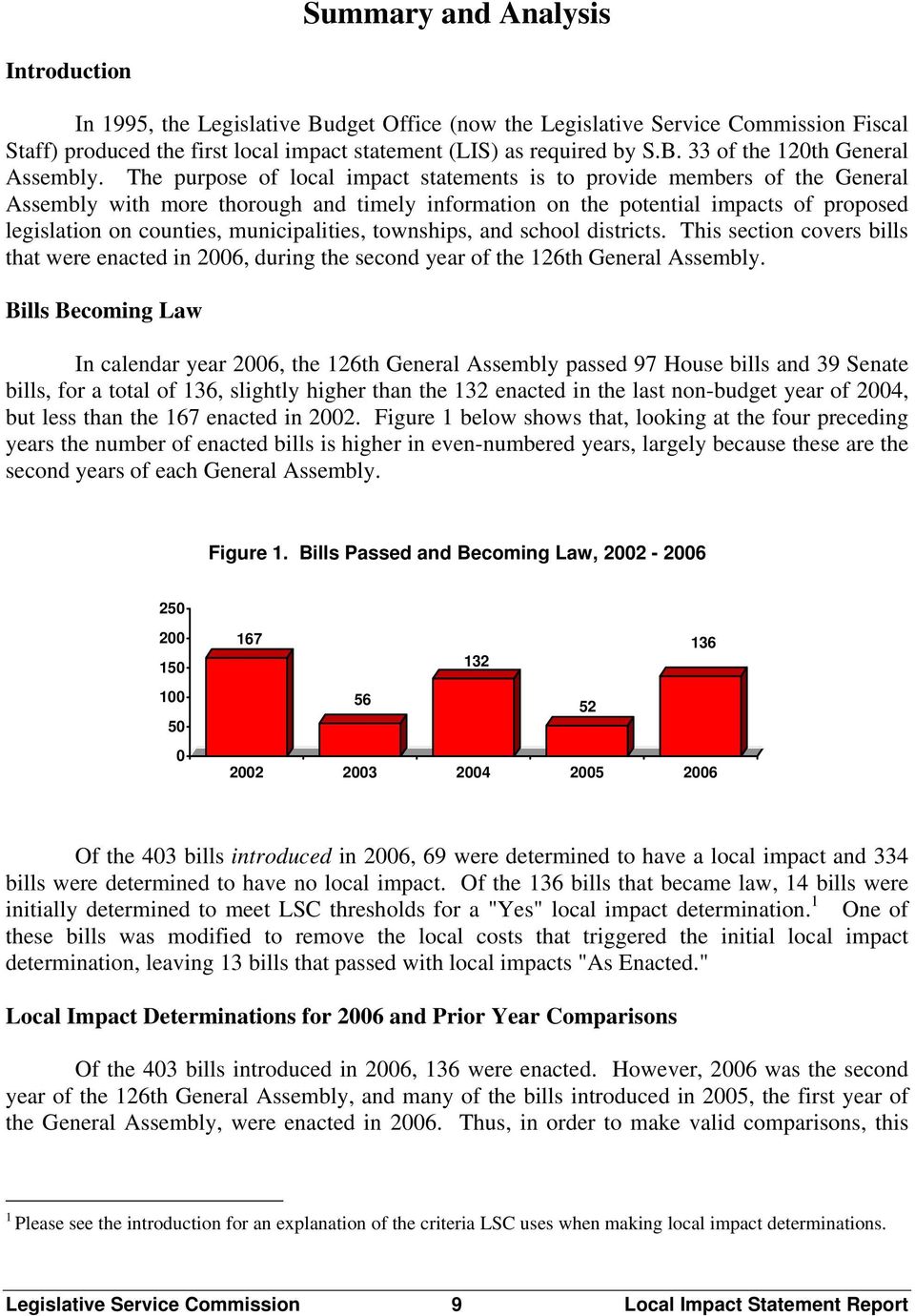
11 Summary and Analysis Introduction In 1995, the Legislative Budget Office (now the Legislative Service Commission Fiscal Staff) produced the first local impact statement (LIS) as required by S.B. 33 of the 120th General Assembly. The purpose of local impact statements is to provide members of the General Assembly with more thorough and timely information on the potential impacts of proposed legislation on counties, municipalities, townships, and school districts. This section covers bills that were enacted in 2006, during the second year of the 126th General Assembly. Bills Becoming Law In calendar year 2006, the 126th General Assembly passed 97 House bills and 39 Senate bills, for a total of 136, slightly higher than the 132 enacted in the last non-budget year of 2004, but less than the 167 enacted in Figure 1 below shows that, looking at the four preceding years the number of enacted bills is higher in even-numbered years, largely because these are the second years of each General Assembly. Figure 1. Bills Passed and Becoming Law, Of the 403 bills introduced in 2006, 69 were determined to have a local impact and 334 bills were determined to have no local impact. Of the 136 bills that became law, 14 bills were initially determined to meet LSC thresholds for a "Yes" local impact determination. 1 One of these bills was modified to remove the local costs that triggered the initial local impact determination, leaving 13 bills that passed with local impacts "As Enacted." Local Impact Determinations for 2006 and Prior Year Comparisons Of the 403 bills introduced in 2006, 136 were enacted. However, 2006 was the second year of the 126th General Assembly, and many of the bills introduced in 2005, the first year of the General Assembly, were enacted in Thus, in order to make valid comparisons, this 1 Please see the introduction for an explanation of the criteria LSC uses when making local impact determinations. Legislative Service Commission 9 Local Impact Statement Report
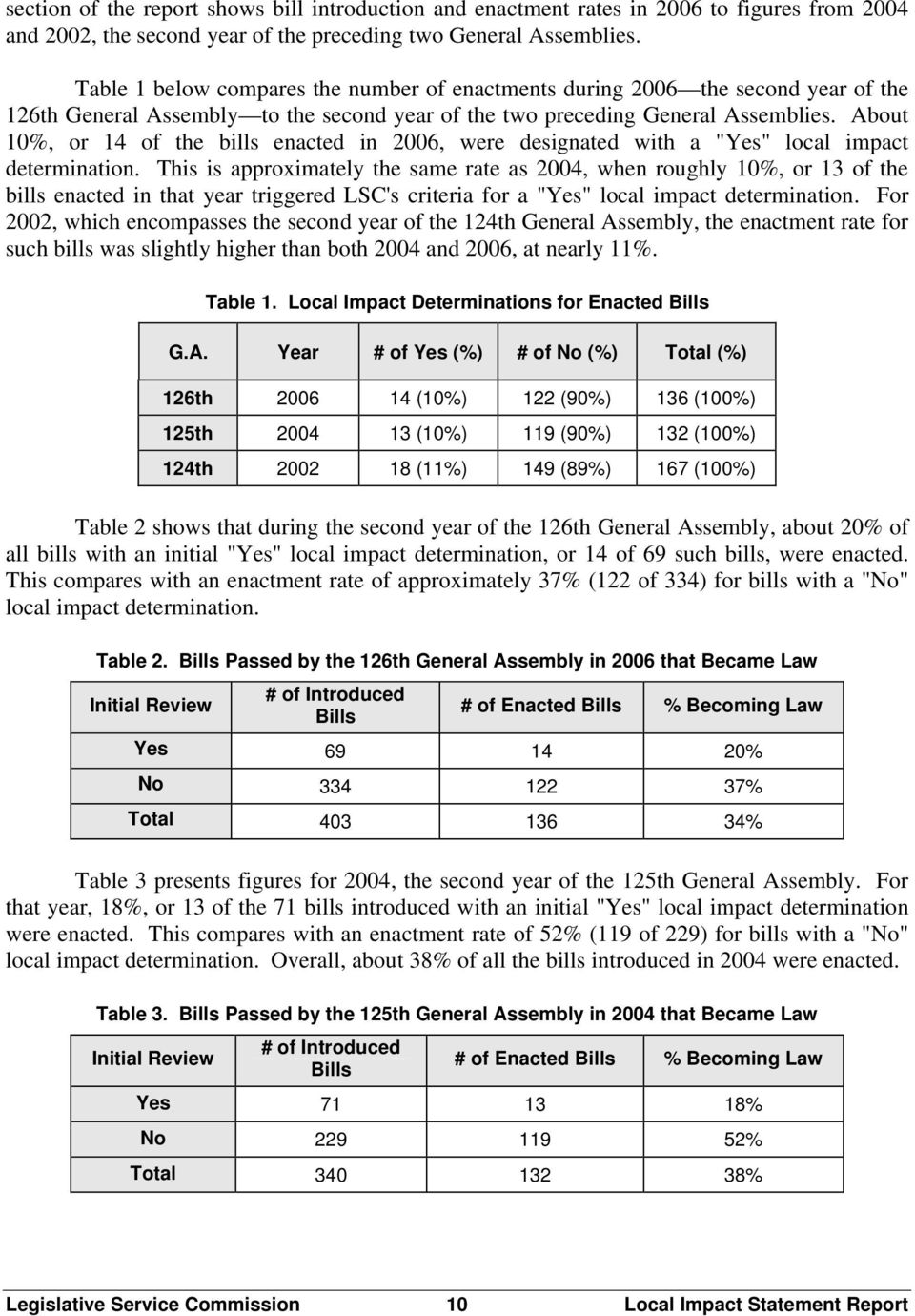
12 section of the report shows bill introduction and enactment rates in 2006 to figures from 2004 and 2002, the second year of the preceding two General Assemblies. Table 1 below compares the number of enactments during 2006 the second year of the 126th General Assembly to the second year of the two preceding General Assemblies. About 10%, or 14 of the bills enacted in 2006, were designated with a "Yes" local impact determination. This is approximately the same rate as 2004, when roughly 10%, or 13 of the bills enacted in that year triggered LSC's criteria for a "Yes" local impact determination. For 2002, which encompasses the second year of the 124th General Assembly, the enactment rate for such bills was slightly higher than both 2004 and 2006, at nearly 11%. Table 1. Local Impact Determinations for Enacted Bills G.A. Year # of Yes (%) # of No (%) Total (%) 126th (10%) 122 (90%) 136 (100%) 125th (10%) 119 (90%) 132 (100%) 124th (11%) 149 (89%) 167 (100%) Table 2 shows that during the second year of the 126th General Assembly, about 20% of all bills with an initial "Yes" local impact determination, or 14 of 69 such bills, were enacted. This compares with an enactment rate of approximately 37% (122 of 334) for bills with a "No" local impact determination. Table 2. Bills Passed by the 126th General Assembly in 2006 that Became Law Initial Review # of Introduced Bills # of Enacted Bills % Becoming Law Yes % No % Total % Table 3 presents figures for 2004, the second year of the 125th General Assembly. For that year, 18%, or 13 of the 71 bills introduced with an initial "Yes" local impact determination were enacted. This compares with an enactment rate of 52% (119 of 229) for bills with a "No" local impact determination. Overall, about 38% of all the bills introduced in 2004 were enacted. Table 3. Bills Passed by the 125th General Assembly in 2004 that Became Law Initial Review # of Introduced Bills # of Enacted Bills % Becoming Law Yes % No % Total % Legislative Service Commission 10 Local Impact Statement Report
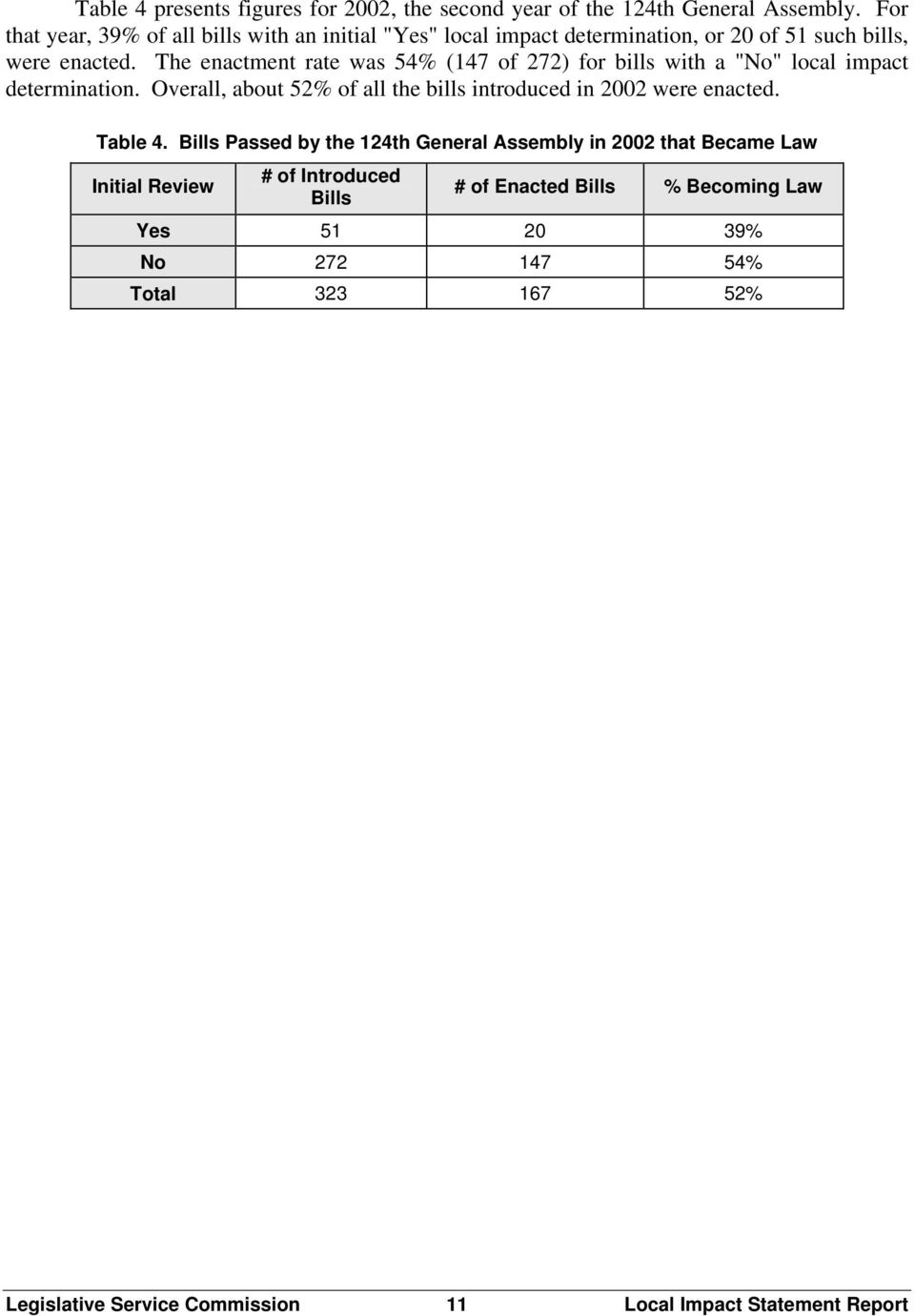
13 Table 4 presents figures for 2002, the second year of the 124th General Assembly. For that year, 39% of all bills with an initial "Yes" local impact determination, or 20 of 51 such bills, were enacted. The enactment rate was 54% (147 of 272) for bills with a "No" local impact determination. Overall, about 52% of all the bills introduced in 2002 were enacted. Table 4. Bills Passed by the 124th General Assembly in 2002 that Became Law Initial Review # of Introduced Bills # of Enacted Bills % Becoming Law Yes % No % Total % Legislative Service Commission 11 Local Impact Statement Report
14 Bills with Local Impact "As Introduced" or "As Enacted" The following chart lists all 14 bills passed in 2006 that became law and were designated with "Yes" local impact determinations in their "As Introduced" form. The political subdivisions affected are also shown. Bill H.B. 9 Subject Revises the Public Records Law; creates a records commission in each public library, special taxing district, and local and joint vocational school district; revises the records commission laws; allows county treasurers to use certain public records training to satisfy part of their continuing education requirement; and extends the Local Government Public Notice Task Force until May 1, 2008 Political Subdivision Affected 2 C M T SD H.B. 46 Permits a political subdivision to establish a health savings account program and permits public moneys to be used to pay for certain federally qualified high deductible health plans 3 H.B. 56 Establishes conditions for the use of a traffic law photo-monitoring device to detect certain traffic law violations and creates a legislative traffic law photoenforcement study committee 4 H.B. 73 Establishes a new income tax domicile test; exempts active-duty military pay and allowances from the state income tax H.B. 149 Authorizes refundable tax credits for rehabilitating historic buildings; exempts from the sales and use tax property used to clean dairy processing equipment H.B. 197 Revises the law governing information hospitals are to provide to the Department of Health and the public H.B. 245 Establishes certain requirements related to the use of alternative fuels by state agencies, and creates the Diesel Emissions Grant Fund, The Diesel Emissions Reduction Revolving Loan Fund, and the Biodiesel Revolving Fund 5 H.B. 272 Revises laws governing the state retirement systems H.B. 336 H.B. 390 Changes the status of the judge of the Marysville Municipal Court from parttime to full-time, adds one judge to the Delaware Municipal Court, creates the Holmes County Municipal Court, establishes one full-time judge in that court, designates the Holmes County Court Clerk of Courts as the clerk of the Holmes County Municipal Court, and provides for the election for the Holmes County Municipal Court of one full-time judge in 2007, adds two additional judges to the Summit County Court of Common Pleas, and creates the Joint Committee to Study Court Costs and Filing Fees Places a time limit on the collection of certain finalized but outstanding tax liabilities; restores and extends the limit on enforcing certain statutory liens; restores and extends the timeframe during which the state must periodically refile for execution or certification of a court judgment against a debtor; and provides "innocent spouse relief" from joint and several liability for income tax under a compromise of claim 2 C=counties; M=municipalities; T=townships; SD=school districts. 3 Local Impact was in "As Introduced." The bill was subsequently amended to remove local impact provisions. 4 Bill was vetoed by the Governor. 5 Local Impact was in "As Introduced." The bill was subsequently amended to remove local impact provisions. Legislative Service Commission 12 Local Impact Statement Report

15 Bill S.B. 17 S.B. 116 S.B. 281 S.B. 311 Subject Requires that clergy or members of other religious faiths report suspected child abuse by another, and makes other changes to statutes concerning childhood sexual abuse Requires group health care policies and contracts to provide benefits for the diagnosis and treatment of biologically based mental illness according to the same terms and conditions that such benefits are provided for other physical diseases and disorders, and would prohibit for 90 days the establishment of special hospitals in certain counties Specifies law enforcement training requirements and certain criminal offenses related to BCII investigators Establishes the Ohio Core curriculum, to restructure admissions requirements for state universities, and changes the minimum school year requirement Political Subdivision Affected 2 C M T SD Legislative Service Commission 13 Local Impact Statement Report

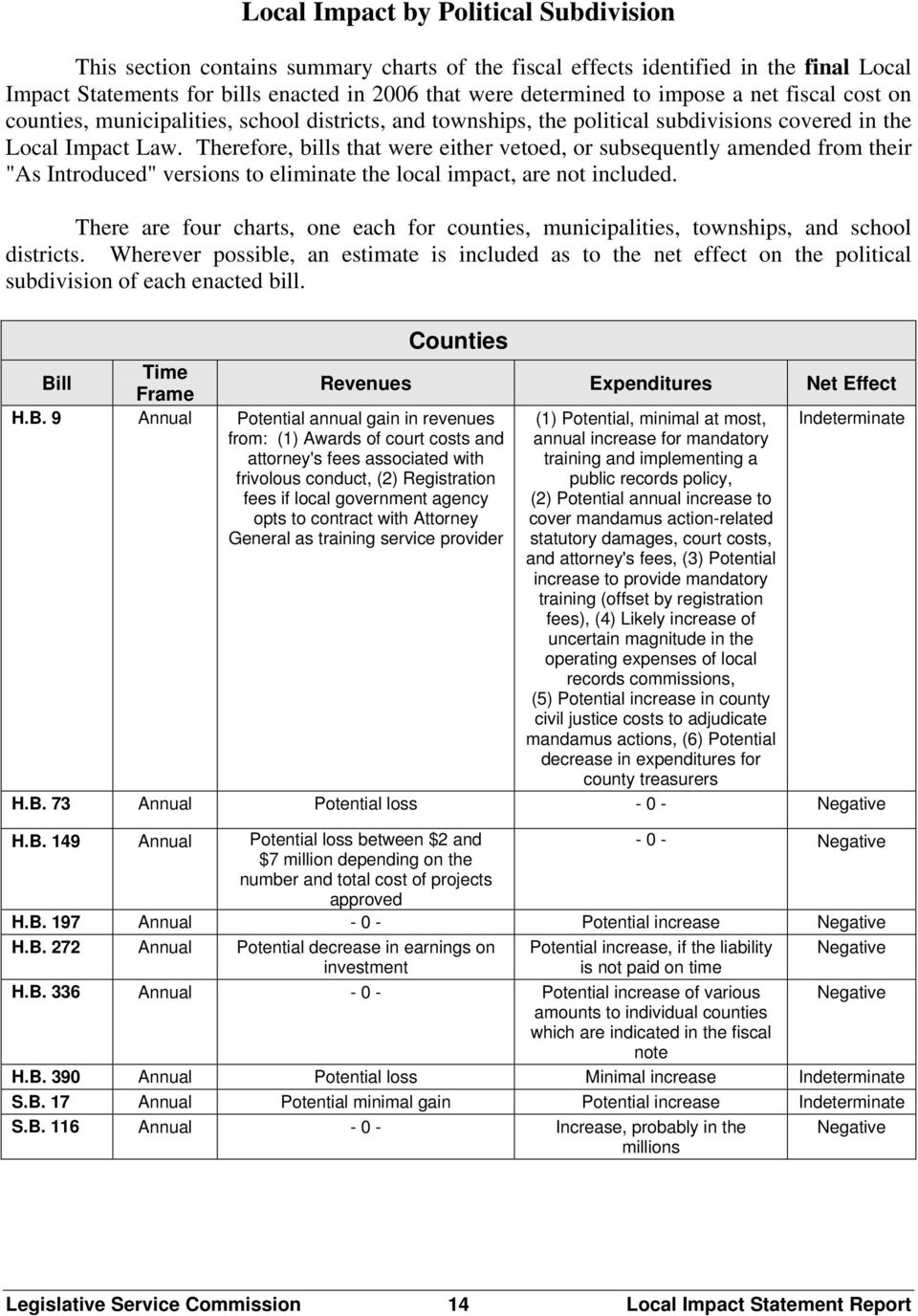
16 Local Impact by Political Subdivision This section contains summary charts of the fiscal effects identified in the final Local Impact Statements for bills enacted in 2006 that were determined to impose a net fiscal cost on counties, municipalities, school districts, and townships, the political subdivisions covered in the Local Impact Law. Therefore, bills that were either vetoed, or subsequently amended from their "As Introduced" versions to eliminate the local impact, are not included. There are four charts, one each for counties, municipalities, townships, and school districts. Wherever possible, an estimate is included as to the net effect on the political subdivision of each enacted bill. Counties Bill Time Frame Revenues Expenditures Net Effect H.B. 9 Annual Potential annual gain in revenues (1) Potential, minimal at most, Indeterminate from: (1) Awards of court costs and attorney's fees associated with frivolous conduct, (2) Registration fees if local government agency opts to contract with Attorney General as training service provider annual increase for mandatory training and implementing a public records policy, (2) Potential annual increase to cover mandamus action-related statutory damages, court costs, and attorney's fees, (3) Potential increase to provide mandatory training (offset by registration fees), (4) Likely increase of uncertain magnitude in the operating expenses of local records commissions, (5) Potential increase in county civil justice costs to adjudicate mandamus actions, (6) Potential decrease in expenditures for county treasurers H.B. 73 Annual Potential loss Negative H.B. 149 Annual Potential loss between $2 and Negative $7 million depending on the number and total cost of projects approved H.B. 197 Annual Potential increase Negative H.B. 272 Annual Potential decrease in earnings on investment Potential increase, if the liability is not paid on time Negative H.B. 336 Annual Potential increase of various Negative amounts to individual counties which are indicated in the fiscal note H.B. 390 Annual Potential loss Minimal increase Indeterminate S.B. 17 Annual Potential minimal gain Potential increase Indeterminate S.B. 116 Annual Increase, probably in the millions Negative Legislative Service Commission 14 Local Impact Statement Report
17 Counties Bill Time Frame Revenues Expenditures Net Effect S.B. 281 Annual Potential gain from reimbursement payments by the Attorney General related to mandatory law enforcement training costs Potential increase related to mandatory training for certain law enforcement officers, possibly (1) exceeding minimal and (2) offset to some degree by Attorney General reimbursement payments Indeterminate Legislative Service Commission 15 Local Impact Statement Report

18 Municipalities Bill Time Frame Revenues Expenditures Net Effect H.B. 9 Annual Potential annual gain in revenues (1) Potential, minimal at most, Indeterminate from: (1) Awards of court costs and attorney's fees associated with frivolous conduct, (2) Registration fees if local government agency opts to contract with Attorney General as training service provider annual increase for mandatory training and implementing a public records policy, (2) Potential annual increase to cover mandamus action-related statutory damages, court costs, and attorney's fees, (3) Potential increase to provide mandatory training (offset by registration fees), (4) Likely increase of uncertain magnitude in the operating expenses of local records commissions, (5) Potential increase in county civil justice costs to adjudicate mandamus actions, (6) Potential decrease in expenditures for county treasurers H.B. 73 Annual Potential loss Negative H.B. 149 Annual Potential loss between $2 and Negative $7 million depending on the number and total cost of projects approved H.B. 197 Annual Potential increase Negative H.B. 272 Annual Potential decrease in earnings on Potential increase, if the liability Negative investment is not paid on time H.B. 336 Annual Potential increase of various Negative amounts to individual municipalities which are indicated in the fiscal note H.B. 390 Annual Potential loss Minimal increase Indeterminate S.B. 17 Annual Potential minimal loss Potential decrease Indeterminate S.B. 116 Annual Potential substantial increase Negative S.B. 281 Annual Potential gain from reimbursement payments by the Attorney General related to mandatory law enforcement training costs; Potential gain in court cost and fine revenues, likely to be minimal at most Potential increase related to mandatory training for certain law enforcement officers, possibly (1) exceeding minimal and (2) offset to some degree by Attorney General reimbursement payments; Potential increase in criminal justice system operating costs, likely to be minimal at most Indeterminate Legislative Service Commission 16 Local Impact Statement Report

19 School Districts Bill Time Frame Revenues Expenditures Net Effect H.B. 9 Annual Potential annual gain in revenues (1) Potential, minimal at most, Indeterminate from: (1) Awards of court costs and attorney's fees associated with frivolous conduct, (2) Registration fees if local government agency opts to contract with Attorney General as training service provider annual increase for mandatory training and implementing a public records policy, (2) Potential annual increase to cover mandamus action-related statutory damages, court costs, and attorney's fees, (3) Potential increase to provide mandatory training (offset by registration fees), (4) Likely increase of uncertain magnitude in the operating expenses of local records commissions, (5) Potential increase in county civil justice costs to adjudicate mandamus actions, (6) Potential decrease in expenditures for county treasurers H.B. 73 Annual Potential loss Negative H.B. 272 Annual Potential decrease in earnings on Potential increase, if the liability Negative investment is not paid on time S.B. 116 Annual Potential substantial increase Negative S.B. 311 Annual Gain of $16.8 million Increase as districts adjust course offerings to insure all students who enter ninth grade in the school year or later have the opportunity to meet the new graduation requirements Indeterminate Legislative Service Commission 17 Local Impact Statement Report

20 Townships Bill Time Frame Revenues Expenditures Net Effect H.B. 9 Annual Potential annual gain in revenues (1) Potential, minimal at most, Indeterminate from: (1) Awards of court costs and attorney's fees associated with frivolous conduct, (2) Registration fees if local government agency opts to contract with Attorney General as training service provider annual increase for mandatory training and implementing a public records policy, (2) Potential annual increase to cover mandamus action-related statutory damages, court costs, and attorney's fees, (3) Potential increase to provide mandatory training (offset by registration fees), (4) Likely increase of uncertain magnitude in the operating expenses of local records commissions, (5) Potential increase in county civil justice costs to adjudicate mandamus actions, (6) Potential decrease in expenditures for county treasurers H.B. 73 Annual Potential loss Negative H.B. 149 Annual Potential loss between $2 and Negative $7 million depending on the number and total cost of projects approved H.B. 272 Annual Potential decrease in earnings Potential increase, if the liability is Negative on investment not paid on time H.B. 390 Annual Potential loss Minimal increase Indeterminate S.B. 116 Annual Potential substantial increase Negative Legislative Service Commission 18 Local Impact Statement Report

21 Local Impact Statements Fiscal Notes and Local Impact Statements for Bills Enacted in Bill Local Impact As Introduced Local Impact As Enacted Page Number H.B. 9 Yes Yes 20 H.B. 46 Yes No 28 H.B. 73 Yes Yes 30 H.B. 149 Yes Yes 38 H.B. 197 Yes Yes 43 H.B. 245 Yes No 49 H.B. 272 Yes Yes 59 H.B. 336 Yes Yes 64 H.B. 390 Yes Yes 78 S.B. 17 Yes Yes 82 S.B. 116 Yes Yes 90 S.B. 281 Yes Yes 98 S.B. 311 Yes Yes H.B. 56 will not be included in this section because it was vetoed by the Governor. Legislative Service Commission 19 Local Impact Statement Report
22 Fiscal Note & Local Impact Statement 126 th General Assembly of Ohio Ohio Legislative Service Commission 77 South High Street, 9 th Floor, Columbus, OH Phone: (614) Internet Web Site: BILL: Sub. H.B. 9 DATE: December 19, 2006 STATUS: As Enacted Effective March 3, 2007 (Sections 1 and 2 effective September 29, 2007) SPONSOR: Rep. Oelslager LOCAL IMPACT STATEMENT: Cost impact on local governments uncertain CONTENTS: Revises the Public Records Law, creates a records commission in each public library, special taxing district, and local and joint vocational school district, revises the records commission laws, allows county treasurers to use certain public records training to satisfy part of their continuing education requirement, and extends the Local Government Public Notice Task Force until May 1, 2008 State Fiscal Highlights STATE FUND/AGENCY FY FUTURE YEARS Ohio Historical Society Revenues Expenditures Potential increase, likely to be minimal at most, in annual operating expenses for review of documents submitted by local records commissions Office of the Attorney General Revenues Expenditures Minimal annual increase in Public Record Unit's operating expenses to administer public records training program for state and local elected officials Auditor of State Revenues Expenditures Potential, at most minimal, increase in annual operating costs to audit compliance with certain sections of the Public Records Law General Revenue Fund (GRF) and Other State Funds Revenues Potential gain from: (1) awards of court costs and attorney's fees associated with frivolous conduct, and (2) registration fees if state agency opts to contract with Attorney General as training service provider Expenditures (1) Potential increase to cover mandamus action-related statutory damages, court costs, and attorney's fees; (2) potential, likely to be onetime and minimal at most, increase for certain state agencies to comply with Public Records Law provisions Note: The state fiscal year is July 1 through June 30. For example, FY 2007 is July 1, 2006 June 30, Legislative Service Commission 20 Local Impact Statement Report
23 Ohio Historical Society. Based on preliminary discussions with Ohio Historical Society personnel, the potential effect of the records review duty on its annual workload and related operating expenses appears unlikely to exceed minimal. Office of the Attorney General. The bill requires that the Attorney General develop, provide, and certify Public Records Law training programs and seminars and develop and provide to all public offices a model public records policy. As of this writing, it appears that the impact of these duties on the Attorney General's Public Records Unit may generate no more than a minimal increase in its annual cost of doing business. It should also be noted that the Attorney General is not permitted to charge any elected official or the appropriate designee any fee for attending the training programs and seminars that the Attorney General conducts. Contracting training with other entities. The bill permits the Attorney General to contract with one or more other state agencies to conduct the training programs and seminars for elected officials or their appropriate designees. The contracting entity is permitted to charge a registration fee, to be determined by the Attorney General, based on the actual and necessary expenses associated with the training program and seminars. Presumably, any state governmental entity opting to contract with the Attorney General for the provision of training programs and seminars would only do so if the amount of revenue generated was at least equal to its expenditures. Auditor of State. The bill requires the Auditor of State, in the course of an annual audit or biennial audit of a public office pursuant to Chapter 117. of the Revised Code, to audit the public office for compliance with certain sections of the Public Records Law. As this duty would be performed during an audit already required under current law, any additional annual cost to the Auditor of State would appear to be minimal, at most. Public offices' public records policy. The bill requires all public offices adopt a public records policy for responding to public records requests and perform other related duties. The requirements are largely one-time in nature, the cost of which for any given state agency would not appear to exceed minimal. Mandatory training for elected officials. All elected officials or their appropriate designees are required to attend three hours of training for every term of office for which the elected official was appointed or elected to the public office involved. If one of these individuals attends a training program or seminar conducted by the Attorney General, then there would be no fee charged. If, however, one of these individuals attends a training program or seminar conducted by a contractor, then a fee may be charged. As of this writing, it seems unlikely that the potential registration fee costs to the state if its elected officials or their appropriate designees opted to attend a contracted program or seminar will exceed minimal, if that. Mandamus actions. The potential cost to the state treasury due to the awarding of statutory damages, court costs, and attorney's fees depends on the future behavior of state officials, persons requesting public records, and courts, making the estimation of those costs for the purposes of this fiscal analysis rather problematic. Similarly, the amount of revenue that the state might gain if courts award court costs and reasonable attorney's fees if the court Legislative Service Commission 21 Local Impact Statement Report
24 determines that a mandamus action commenced against a state public office was frivolous conduct is problematic to predict. Local Government Public Notice Task Force. As of this writing, it does not appear that extending the deadline of the work to be performed by the Local Government Public Notice Task Force will create any immediately discernible state fiscal effects. Local Impact Statement LOCAL GOVERNMENT FY 2007 FUTURE YEARS Counties, Municipalities, Townships, School Districts, and Other Special Districts Revenues Potential annual gain in revenues from: (1) awards of court costs and attorney's fees associated with frivolous conduct; (2) registration fees if local government agency opts to contract with Attorney General as training service provider Expenditures (1) Potential, minimal at most, annual increase for mandatory training and implementing a public records policy; (2) potential annual increase to cover mandamus action-related statutory damages, court costs, and attorney's fees; (3) potential increase to provide mandatory training (offset by registration fees); (4) likely increase of uncertain magnitude in the operating expenses of local records commissions; (5) potential increase in county civil justice system operating costs to adjudicate mandamus actions; (6) potential decrease in expenditures for county treasurers Note: For most local governments, the fiscal year is the calendar year. The school district fiscal year is July 1 through June 30. Mandatory training for elected officials. All elected officials or their appropriate designees are required to attend three hours of training for every term of office for which the elected official was appointed or elected to the public office involved. If one of these individuals attends a training program or seminar conducted by the Attorney General, then there would be no fee charged. If, however, one of these individuals attends a training program or seminar conducted by a contractor, then a fee may be charged. As of this writing, it seems unlikely that the potential registration fee costs to local governmental entities if their elected officials or their appropriate designees opted to attend a contracted program or seminar will exceed minimal, if that. Contracting training with other entities. The bill permits the Attorney General to contract with one or more other local governmental agencies to conduct the training programs and seminars for elected officials or their appropriate designees. The contracting entity is permitted to charge a registration fee that is based on the Attorney General's determination of a reasonable amount for the registration fee based on the actual and necessary expenses associated with the training program and seminars. Presumably, any local governmental entity opting to contract with the Attorney General for the provision of training programs and seminars would only do so if the amount of revenue generated was at least equal to its expenditures. Public offices' public records policy. The bill requires all public offices adopt a public records policy for responding to public records requests and perform other related duties. The requirements are largely one-time in nature, the cost of which for local governmental entities would not appear to exceed minimal. Legislative Service Commission 22 Local Impact Statement Report
25 Mandamus actions. The potential cost to local governments due to the awarding of statutory damages, court costs, and attorney's fees depends on the future behavior of local officials, persons requesting public records, and courts, making the estimation of those costs for the purposes of this fiscal analysis rather problematic. Similarly, the amount of revenue that local governments might gain if courts award court costs and reasonable attorney's fees if the court determines that a mandamus action commenced against a local public office was frivolous conduct is problematic to predict. Local records commissions. Relative to existing records commissions laws, the bill requires existing local records commissions to send any application for records disposal or schedule of records retention and disposition to the Ohio Historical Society for its review and creates records commissions for public libraries, special taxing districts, and local and joint vocational school districts. As of this writing, the potential effect on the workload and any related operating expenses of local records commissions generally is uncertain. County treasurers. By allowing county treasurers to use public records training to satisfy a portion of their continuing education requirements, some county treasurers may realize a modest cost savings. These savings will occur in those counties that pay for or subsidize a portion of their county treasurer's general continuing education requirements. At the time of this writing, it is unclear as to what magnitude these savings could be, or which counties would realize any savings at all. Provisions of the bill Detailed Fiscal Analysis For the purposes of this fiscal analysis, the bill most notably: Revises the Public Records Law, including expansion of the definition of a public record, and requires public officials to comply with their obligations under that Law. Requires all elected officials or their appropriate designees to attend three hours of training for every term of office for which the elected official was appointed or elected to the public office involved. Requires the Attorney General to develop, provide, and certify Public Records Law training programs and seminars for all elected officials or their appropriate designees. Permits the Attorney General to contract with one or more other state agencies, political subdivisions, or other public or private entities to conduct the training programs and seminars for elected officials or their appropriate designees. Requires the Attorney General to develop and provide to all public offices a model public records policy. Requires all public offices to adopt a public records policy for responding to public records requests and perform other related duties. Legislative Service Commission 23 Local Impact Statement Report
26 Provides that an aggrieved person who files a mandamus action against a public office may recover statutory damages, reasonable attorney's fees, and all court costs. Requires the court to award court costs and reasonable attorney's fees to the public office if the court determines that a mandamus action was frivolous conduct. Requires the Ohio Historical Society to provide state archive administration services to additional local records commissions and review applications from local records commissions to dispose of certain records. Requires local records commissions to send applications to dispose of certain records to the Ohio Historical Society. Creates a library records commission in each public library, a special taxing district records commission in each special taxing district, and a school records commission in each local and joint vocational school district. Allows county treasurers to use certain public records training to satisfy part of their continuing education requirement. Extends the Local Government Public Notice Task Force until May 1, Provision of training programs and seminars for elected officials Currently, the Attorney General is voluntarily providing training, free of charge, on the Public Records Law for all interested elected officials, which is a duty of the Public Records Unit. The bill requires the Office of the Attorney General to develop, provide, and certify training programs and seminars for all officials elected to a local or statewide office or their appropriate designees in order to enhance their knowledge of the duty to provide access to public records. The training must be three hours for every term of office for which the elected official was appointed or elected to the public office involved. The Attorney General is not permitted to charge any elected official or the appropriate designee any fee for attending the training programs and seminars that the Attorney General conducts. Based on prior discussions with the Attorney General on the As Introduced version of the bill, it appeared that the Public Records Unit anticipated no more than a minimal increase in its annual cost of doing business. From LSC fiscal staff's perspective, the enacted version of the bill does not appear to change that fiscal assessment. Contracting training with other entities The bill permits the Attorney General to contract with one or more other state agencies, political subdivisions, or other public or private entities to conduct the training programs and seminars for elected officials or their appropriate designees. The contracting entity is permitted to charge a registration fee that is based on the Attorney General's determination of a reasonable amount for the registration fee based on the actual and necessary expenses associated with the training program and seminars. Presumably, any state or local governmental entity opting to contract with the Attorney General for the provision of training programs and seminars would only do so if the amount of revenue generated was at least equal to its expenditures. Legislative Service Commission 24 Local Impact Statement Report
27 Model public records policy The bill requires the Attorney General to develop and provide to all public offices a model public records policy. Presumably, the Attorney General's Public Records Unit would perform this duty. Although uncertain as of this writing, it would not appear that the one-time cost for that unit to develop and distribute this policy will be significant. Auditor of State Audit duties. The bill requires the Auditor of State, in the course of an annual audit or biennial audit of a public office pursuant to Chapter 117. of the Revised Code, to audit the public office for compliance with certain sections of the Public Records Law. As this duty would be performed during an audit already required under current law, any additional annual cost to the Auditor of State would appear to be minimal, at most. Local records commissions. Under current law, local records commissions are required to send a list of records scheduled for disposal to the Auditor of State, and the Auditor has 60 days to either approve or disapprove of the proposed action in whole or in part. Under the bill, the Ohio Historical Society would forward the information for the Auditor of State's approval or disapproval. As of this writing, it does not appear that this provision will noticeably affect the Auditor of State's daily operations and related annual operating costs. Mandatory training for elected officials As noted, all elected officials or their appropriate designees must attend three hours of training for every term of office for which the elected official was appointed or elected to the public office involved. If one of these individuals attends a training program or seminar conducted by the Attorney General, then there would be no fee charged. If, however, one of these individuals attends a training program or seminar conducted by a contractor, then a fee may be charged. As of this writing, it would not appear that the registration fee costs to the state or any affected local jurisdiction will exceed minimal, if that, annually. Public offices' public records policy The bill requires all public offices adopt a public records policy for responding to public records requests, distribute the public records policy to the employee who is the records custodian or records manager or otherwise has custody of the records of that office and include the policy in any general policies and procedures manual or handbook established for employees. The requirements are largely one-time in nature, the cost of which for the state or any local jurisdiction would not appear to exceed minimal. Mandamus action Current law allows an allegedly aggrieved person to commence a mandamus action to obtain a judgment that orders the public office to comply with certain provisions of the Public Records Law. Relative to a mandamus action, the bill: Legislative Service Commission 25 Local Impact Statement Report
28 Provides that an aggrieved person who files a mandamus action against a public office may recover statutory damages (fixed at $100 for each business day during which requested public records were not made available, up to a maximum of $1,000). Requires the court to determine and award all court costs and, subject to certain reductions, reasonable attorney's fees. Requires the court to award court costs and reasonable attorney's fees to the public office if the court determines that a mandamus action was frivolous conduct. As of this writing, from LSC fiscal staff's perspective, predicting the number of mandamus actions that will result from the alleged failure of a public official to comply with an obligation in accordance with the Public Records Law, as well as their outcomes, is rather problematic. Thus, the potential fiscal effects of the bill's mandamus action-related provisions on state and local government revenues and expenditures are uncertain. Ohio Historical Society The bill modifies existing law relative to the Ohio Historical Society's duty to function as the state archives administration for the state and its political subdivisions. Most notably: (1) the society would be required to make its services available to the library and special taxing district commissions, which are created by the bill, (2) local records commissions would be required to send any application for records disposal or schedule of records retention and disposition to the society for its review, and (3) the society would then be required to forward the application or schedule to the Auditor of State for approval in whole or in part. Based on preliminary discussions with society personnel, the potential effect of this records review duty on its annual workload and related operating expenses appears unlikely to exceed minimal. Local records commissions Relative to existing records commissions laws, the bill most notably: Requires existing county records commissions, municipal records commissions, school district records commissions, educational service center records commissions, and township records commissions send any application for records disposal or schedule of records retention and disposition to the Ohio Historical Society for its review. Creates a records commission in each public library, special taxing district, local and joint vocational school district, and requires those commissions to function in a manner similar to existing local records commissions. As of this writing, the potential effect on the annual workload and any related operating expenses of local records commissions generally is uncertain. Legislative Service Commission 26 Local Impact Statement Report
29 County treasurers The bill will allow county treasurers to use certain public records training to satisfy part of their continuing education requirements. Under current law, county treasurers are generally required, subject to certain conditions, to take a specified number of hours of continuing education during each biennial cycle. By allowing county treasurers to use public records training to satisfy a portion of their continuing education requirements, some county treasurers may realize a modest cost savings. These savings will occur in those counties that pay for or subsidize a portion of their county treasurer's general continuing education requirements. At the time of this writing, it is unclear as to what magnitude these savings would be, or which counties would realize any savings at all. Local Government Public Notice Task Force As of this writing, it does not appear that the extension of the Local Government Public Notice Task Force will create any immediately discernible state fiscal effects. LSC fiscal staff: Jamie L. Doskocil, Senior Budget Analyst Legislative Service Commission 27 Local Impact Statement Report
30 Fiscal Note & Local Impact Statement 126 th General Assembly of Ohio Ohio Legislative Service Commission 77 South High Street, 9 th Floor, Columbus, OH Phone: (614) Internet Web Site: BILL: Am. Sub. H.B. 46 DATE: March 29, 2006 STATUS: As Enacted Effective August 17, 2006 SPONSOR: Rep. Schaffer LOCAL IMPACT STATEMENT REQUIRED: Yes Local impact was in As Introduced version CONTENTS: Permits a political subdivision to establish a health savings account program and permits public moneys to be used to pay for certain federally qualified high deductible health plans No direct fiscal effect on the state. State Fiscal Highlights Local Fiscal Highlights LOCAL GOVERNMENT FY 2006 FY 2007 FUTURE YEARS Counties, Municipalities, Townships, and school districts Revenues Expenditures Potential decrease Potential decrease Note: For most local governments, the fiscal year is the calendar year. The school district fiscal year is July 1 through June 30. The bill permits an additional option for political subdivisions to provide health benefits to employees. The new option, using health savings accounts (HSAs) linked to high deductible health plans, may allow them to provide health benefits at lower cost. Legislative Service Commission 28 Local Impact Statement Report
31 Detailed Fiscal Analysis Am. Sub. H.B. 46 would permit political subdivisions to offer health savings accounts (HSAs) to employees and would permit public moneys to be used to make contributions to HSAs or to pay for federally qualified high deductible health plans that are linked to HSAs. Background Health saving accounts as authorized by section 223 of the Internal Revenue Code are described in IRS Publication 969. They are tax-exempt trusts or custodial accounts that the taxpayer sets up with a qualified HSA trustee. No permission is required from the IRS to establish a HSA; however, to be eligible for the tax benefits a taxpayer must have a "high deductible health plan" and no other health coverage. 7 A "high deductible health plan" means that the plan's minimum annual deductible is $1,000 for individual coverage and $2,000 for family coverage, and that the plan has a specified maximum limit on the sum of the annual deductible and out-of-pocket expenses for covered medical services. The maximums for tax year 2005 are $5,100 for individual coverage and $10,200 for family coverage. Fiscal effect By permitting political subdivisions an additional option for providing health benefits to employees, the bill may reduce the cost of providing such health benefits. LSC staff do not have data with which to estimate the potential magnitude of savings. LSC fiscal staff: Ross Miller, Senior Economist 7 There are a few limited exceptions to the latter eligibility requirement. Legislative Service Commission 29 Local Impact Statement Report
32 Fiscal Note & Local Impact Statement 126 th General Assembly of Ohio Ohio Legislative Service Commission 77 South High Street, 9 th Floor, Columbus, OH Phone: (614) Internet Web Site: BILL: Sub. H.B. 73 DATE: December 14, 2006 STATUS: As Enacted Effective April 4, 2007 SPONSOR: Rep. Trakas LOCAL IMPACT STATEMENT REQUIRED: Yes CONTENTS: Establishes a new income tax domicile test; exempts active-duty military pay and allowances from the state income tax State Fiscal Highlights STATE FUND FY 2007 FY 2008 FUTURE YEARS General Revenue Fund Revenues Potential loss Potential loss of several millions Potential loss of several millions Expenditures Note: The state fiscal year is July 1 through June 30. For example, FY 2006 is July 1, 2005 June 30, The bill changes the residency test for income tax purposes and reduces the income tax base. The reduction in tax base decreases receipts from the tax. The bill generally restores the statutory test for residency that existed until 1993, when the General Assembly enacted the contact period test in S.B. 123 of the 120th General Assembly. Revenues from the income tax are distributed to the General Revenue Fund and to several local government funds. The General Revenue Fund receives 89.5% of receipts from the state individual income tax. Thus, the reduction in the income tax base reduces revenues to the GRF. The income tax exemption for active-duty military pay and allowances reduces the state income tax base, thus reducing state income tax revenue. The GRF will bear at least $4.0 million in losses from the exemption. The revenue loss depends on the number of active duty military personnel taking the exemption and their pay. The local government funds freeze for FYs 2006 and 2007 would result in the GRF experiencing the full revenue loss in FY In subsequent years, the revenue loss would be shared by the GRF and the local government funds according to the Revised Code distribution of income tax receipts. Legislative Service Commission 30 Local Impact Statement Report
33 Local Fiscal Highlights LOCAL GOVERNMENT FY 2006 FY 2007 FUTURE YEARS Counties, Municipalities, and Townships (LGF, LGRAF, LLGSF), Municipal Income Taxes, and School District Income Taxes Revenues Potential loss Potential loss Potential loss Expenditures Note: For most local governments, the fiscal year is the calendar year. The school district fiscal year is July 1 through June 30. Under the state formulas for the distribution of income tax revenues, the reduction in personal income tax revenues would reduce distributions to the Local Government Fund (LGF), the Local Government Revenue Assistance Fund (LGRAF), and the Library and Local Government Support Fund (LLGSF). The military pay income tax exemption reduces state income tax revenues. The revenue loss depends on the number of active duty military personnel taking the exemption and their pay. The local government funds freeze for FYs 2006 and 2007 would result in no revenue loss to the local government funds in FY In subsequent years the revenue loss would be shared by the GRF, the LLGSF, the LGF, and the LGRAF according to the Revised Code distribution of income tax receipts. The revenue loss from the military pay exemption will be at least $425,000 per year starting in FY Changes in the residency test may also reduce school district income tax revenues because the bill reclassifies certain residents as nonresidents for Ohio income tax purposes. School district income tax revenues would also be reduced due to a reduction in the tax base from the military pay exemption. The revenue loss for school districts from the military pay exemption may be $114,000 or more per year. The revenue loss depends on the number of active duty military personnel taking the exemption, their pay, and their distribution among school districts. Legislative Service Commission 31 Local Impact Statement Report
34 Detailed Fiscal Analysis Changes to the residency (domicile) test for income tax purposes The bill changes the residency test for income tax purposes. Under current law, the "bright line" test for residency in Ohio is 120 contact days plus up to 30 days for "medical hardship" (such as for days a person is admitted into a hospital in this state). The bill restores the statutory test for residency that existed until 1993 (when the General Assembly enacted the contact period test in S.B. 123 of the 120th General Assembly) and eliminates the "medical hardship" days. The bill proposes a "bright line" of at least 183 days in Ohio to be an Ohio resident or part-year resident. Alternatively, a person may spend up to 182 days in Ohio during a calendar year and be considered a nonresident for income tax purposes. Residency status is important because specific types of income are affected by the question of residency. Taxpayers may seek to establish residency in states other than Ohio to minimize their Ohio tax liability. A nonresident has to pay the income tax on compensation earned in Ohio and on certain other types of income allocable to Ohio. However, interest, dividends, certain types of capital gains (unearned income), and other kinds of income are considered "not earned or received in Ohio" and thus entitle nonresident taxpayers to the nonresident tax credit on some income included in Ohio adjusted gross income. Ohioans who have residence in a state with no income tax 8 are most likely to benefit from changes in the residency test. Part-year residents receive a tax credit based on income taxes paid to another state (including taxes paid on nonwage income). Generally, taxpayers will pay income taxes to one state or both states on all of their income. However, those who have residence in a state without income tax will not pay income taxes either on their wage income earned elsewhere, or on the unearned and nonwage portions of their total income. Exhibit 1 summarizes the potential effect of the bill on various groups of taxpayers. 9 The bill may potentially induce nonresident persons living most of the year elsewhere to spend more time in Ohio without the "risk" of becoming a resident for tax purposes. The additional time spent in Ohio by this group of taxpayers may increase sales tax revenues. The bill is also likely to stimulate certain part-year residents to reduce the time spent in Ohio so they become nonresidents for tax purposes if the change is beneficial and reduces their overall income tax liability. This would create a loss of revenues from the income tax and from the sales and use tax. 10 Part-year residents with large amounts of nonwage income who become nonresidents would cause Ohio to lose income tax revenue on much of that nonwage income. Finally, the bill 8 Alaska, Florida, Nevada, South Dakota, Texas, Washington, and Wyoming, do not tax income. New Hampshire and Tennessee do not tax earned income, but tax income from interest and dividends. 9 This illustrative summary does not purport to describe all potential effects on taxpayers. 10 Compared to the revenue loss from the income tax, revenue gain to the sales tax from H.B. 73 is likely to be smaller. For example, for Ohioans with income above $100,000, the average sales and use tax liability is estimated at $1,355 in CY 2005 (data from the Internal Revenue Service for a taxpayer with two exemptions). In contrast, the average income tax liability for taxpayers in that group is estimated at $16,875 in TY 2002 (data from the Tax Department). Legislative Service Commission 32 Local Impact Statement Report
35 may induce certain Ohio residents to consider establishing a residence elsewhere and spend increasing amount of time there as the major components of their federal adjusted income progressively shift from earned income to unearned income. Overall, the bill increases the number of part-year Ohio residents that will be reclassified as nonresidents for income tax purposes. Several thousands part-time Ohio residents may be affected by the bill. The net revenue loss from the bill is likely to be several millions of dollars. LSC is unable to provide a more precise estimate of the net revenue loss from publicly available data. 11 The Department of Taxation estimates H.B. 73 will reduce income tax revenues between $25 million and $30 million per year. Revenue losses may be reduced by the income tax cuts included in HB 66, the main appropriations bill of the current biennium. 12 Revenue from the income tax is distributed to the General Revenue Fund (GRF, 89.5%), the Library and Local Government Support Fund (LLGSF, 5.7%), the Local Government Revenue Assistance Fund (LGRAF, 4.2%), and the Local Government Fund (LGF, 0.6%). The bill reduces revenues to all these funds. However, due to the FY freeze in the revenue distribution to local government funds, the GRF will bear the revenue loss in FY Exhibit 1 Simplified summary of potential behavioral change within taxpayer groups with H.B. 73 (A) Nonresidents of Ohio for tax purposes For example: 4 months (120 days) in Ohio; 8 months (245 days) outside Ohio (B) Part-year residents of Ohio for tax purposes For example: 5 to 6 months (150 days to 180 days) in Ohio; 6 to 7 months (180 days to 215 days) outside Ohio (C) Residents of Ohio for tax purposes For example: 8 months (245 days in Ohio) and 4 months (120 days) outside Ohio Persons taxed on Ohio-sourced income from business or compensation; not taxed on nonwages and unearned income; not taxed if all income is earned income and was earned outside Ohio; nonresident tax credit for income received and taxed in another state Under H.B. 73, these taxpayers may increase the time spent in Ohio to 181 days and remain nonresidents; no gain from income tax; potential increase in sales tax revenues Persons taxed on all income from business, compensation, unearned income; resident tax credit for income taxed by another state Under H.B. 73, these taxpayers will become nonresidents for tax purposes, particularly if they also reside in a nonincome tax state; loss of income tax revenues and loss of sales tax revenues Persons taxed on all income from business, compensation, unearned income; resident tax credit for income taxed by another state Under H.B. 73, these taxpayers may increase the time spent outside Ohio and become nonresidents for tax purposes; loss of income tax revenues and loss of sales tax revenues 11 The Tax Department examined income tax returns from TY 2000 through TY 2002 during the period when S.B. 287 (123rd General Assembly) allowed 30 additional contact days for charity work or hardship. The analysis indicates that more than 6,300 taxpayers with income above $100,000 switched from residents to nonresidents. More than 1,300 of those taxpayers moved to a nonincome tax state and claimed several millions of dollars worth of nonresident tax credits. 12 H.B. 66 cut the marginal income tax rate 4.2% for all tax brackets for tax year 2005 and an additional 4.2% (from 2004 rates) in each of the years from tax year 2006 through tax year Legislative Service Commission 33 Local Impact Statement Report
36 Fiscal impact of the change in residency test on school districts Changes to the residency test reduce the Ohio Adjusted Gross Income, which is the starting point for the calculation of the school district income tax. Thus, the bill will also reduce school district income tax revenues for school districts that have current residents that would be reclassified as nonresidents. Military Pay Income Tax Exemption The bill exempts, to the extent included in federal adjusted gross income (FAGI) and not otherwise allowable as a deduction or exclusion in computing federal or Ohio adjusted gross income, active-duty military pay and allowances from the state income tax regardless of whether the serviceperson is serving in a declared combat zone. 13 The exemption does not apply to pay and allowances received for active duty service while stationed in Ohio. The exemption also applies to school district income taxes that use the same tax base as the state income tax. All military pay and allowances currently are exempted from municipal income taxes. The proposed exemption reduces the income tax base, resulting in a reduction in income tax revenue. The revenue loss from the proposed exemption depends on the amount of military pay exempted. This amount depends on the number of active duty military personnel taking the exemption and their distribution across ranks and service years. The revenue loss was estimated using 5,672 active duty Ohio residents reported by the U.S. Department of Defense public affairs office. Some of the Ohioans on active duty may be stationed in Ohio and would not be eligible for the exemption. LSC does not have information on this subset of Ohio residents on active duty. The estimated revenue loss was calculated using basic pay only. Other types of pay that are currently taxable (special pay, incentive pay, bonuses, and certain other payments) were not included in the estimates. If the Ohio taxpayers on active duty are assumed to have the same distribution across ranks as the military as a whole, receive basic pay only, and their basic pay is assumed to be at the minimum for that rank, the estimated state income tax revenue loss is $2.4 million. If basic pay is assumed to be at the maximum for each rank, the estimated revenue loss is $4.0 million. 14 The Department of Taxation contacted branches separately to obtain data on the number of active duty personnel listing Ohio as home of record. Based on the information obtained, the Department estimates that 40,266 Ohioans were on active duty outside Ohio during Using the Department of Taxation's estimated number of active duty Ohioans and adjusting for the estimated percentage serving in a combat zone yields an estimated revenue loss of between $17.4 million (assuming basic pay at the minimum for each rank) and $28.5 million (assuming basic pay at the maximum for each rank). The local government fund freeze for FYs 2006 and 2007 would result in the GRF experiencing the full revenue loss in FY In subsequent years, the revenue loss would be shared by the GRF and the local government funds according to the Revised Code distribution of income tax receipts. The Revised Code distribution of receipts from the income tax is as 13 The Internal Revenue Service Armed Forces' Tax Guide contains a table listing items included and excluded from FAGI. The items in Table 1 (attached) are included in FAGI, unless the pay is for service in a combat zone. The items in Table 2 (attached) are excluded whether the item is furnished in-kind or is a reimbursement or allowance. 14 The bill specifies that the exemption is available for taxable years beginning on or after January 1, It is possible that taxpayers filing amended 2005 returns could increase the estimated revenue loss for FY Legislative Service Commission 34 Local Impact Statement Report
37 follows: 89.5% to the GRF, 5.7% to the Library and Local Government Support Fund, 4.2% to the Local Government Fund, and 0.6% to the Local Government Revenue Assistance Fund. The income tax rate reductions scheduled for tax years 2006 through 2009 will act to reduce any revenue losses from the exemption. The number of active duty Ohio residents and their pay will influence the revenue loss. A larger number of active duty Ohio residents will increase the revenue loss and a smaller number will decrease the revenue loss. Pay increases will increase the revenue loss. Fiscal impact of the military pay exemption on school districts The exemption would also reduce the tax base for some school district income taxes. The revenue loss would depend on the school districts in which the active duty military personnel reside, the school district income tax rate for that district, and the value of exemption claimed. If the individual were in a district without a school district income tax, there would be no revenue loss due to that individual's exemption. If all Ohio active duty military personnel were in districts without a school district income tax, then there would be no statewide revenue loss. If all Ohio active duty military personnel were from school districts that levy a school district income tax at the current maximum rate of 2%, 15 then the statewide revenue loss would be $2.3 million assuming basic pay at the minimum for each rank and $3.1 million assuming basic pay at the maximum for each rank. At the average tax rate of 1%, the revenue loss would range from $1.1 million to $1.6 million. As with the state income tax, the revenue loss will be influenced by the number of active duty Ohio residents and their pay. Using the Department of Taxation's estimated number of active duty Ohioans yields an estimated $16.0 million to $22.3 million revenue loss at the 2% tax rate. The Department of Taxation reports that the FAGI of taxpayers in school districts with a school district income tax is approximately 9% of statewide FAGI and that the (weighted) average school district income tax rate is 0.8%. This percentage and tax rate yield an estimated statewide school district income tax revenue loss of $82,000 to $114,000 assuming 5,672 active duty Ohioans and $578,000 to $803,000 using the Department's estimate of the number of active duty Ohioans. 15 There is no rate limit. The only stipulation by law is that the rate must be in increments of a quarter percent (0.25%). Currently, the minimum rate levied by a district is 0.50%, the maximum rate is 2.00%, the median rate is 1.00%, and the most frequently charged rate is 1.00%. Legislative Service Commission 35 Local Impact Statement Report
38 Table 1: Items Included in FAGI Basic Pay Active duty Bonuses Career status Attendance at a designated service school Enlistment Back wages Officer CONUS COLA Overseas extension Drills Reserve training Reenlistment Training duty Incentive Pay Submarine Flight Special Pay Aviation career incentives Hazardous pay Career sea Diving duty High/low altitude Foreign duty Other Payments Accrued leave Foreign language proficiency High deployment per diem Hardship duty Hostile fire or imminent danger Medical or dental officers Nuclear-qualified officers Optometry Pharmacy Special duty assignment pay Veterinarian Personal money allowances paid to highranking officers Student loan repayment from programs such as the Department of Defense Educational Loan Repayment Program when year's service (requirement) is not attributable to a combat zone Legislative Service Commission 36 Local Impact Statement Report
39 Table 2: Items Excluded from FAGI Living Allowances Basic allowance for housing Family Allowances Basic allowance for subsistence Housing and cost-of-living allowances abroad Overseas housing allowance Certain educational expenses for dependents Emergencies Evacuation to a place of safety Separation Moving Allowances Dislocation Death Allowances Burial services Military base realignment and closure benefit Death gratuity payments to eligible survivors Travel Allowances Move-in housing Moving household and personal items Moving trailers or mobile homes Storage Temporary lodging and temporary lodging expenses Annual round trip for dependent students In-kind Military Benefits Travel of dependents to burial site Dependent-care assistance program Legal assistance Medical/dental care Commissary/exchange discounts Space-available travel on government aircraft Combat Zone Pay Leave between consecutive overseas tours Reassignment in a dependent restricted status Transportation for taxpayer and dependents during ship overhaul or inactivation Per diem Compensation for active service while in a combat zone or a qualified hazardous duty area Other Payments Defense counseling Disability, including payments received for injuries incurred as a direct result of a terrorist or military action Group-term life insurance Professional education ROTC educational and subsistence allowances Survivor and retirement protection plan premiums Uniform allowances Uniforms furnished to enlisted personnel LSC fiscal staff: Jean J. Botomogno, Senior Economist Allan Lundell, Economist Legislative Service Commission 37 Local Impact Statement Report
40 Fiscal Note & Local Impact Statement 126 th General Assembly of Ohio Ohio Legislative Service Commission 77 South High Street, 9 th Floor, Columbus, OH Phone: (614) Internet Web Site: BILL: Am. Sub. H.B. 149 DATE: December 14, 2006 STATUS: As Enacted Effective April 4, 2007 (certain sections effective May 1, 2007) SPONSOR: Rep. Calvert LOCAL IMPACT STATEMENT REQUIRED: Yes CONTENTS: Authorizes refundable tax credits for rehabilitating historic buildings; exempts from the sales and use tax property used to clean dairy processing equipment State Fiscal Highlights STATE FUND FY 2007 FY 2008 FUTURE YEARS General Revenue Fund Revenues Potential loss between $19 and $40 million depending on the number and total cost of projects approved Potential loss between $19 and $40 million depending on the number and total cost of projects approved Expenditures Note: The state fiscal year is July 1 through June 30. For example, FY 2006 is July 1, 2005 June 30, The historic building rehabilitation tax credit would reduce revenues collected from the dealers in intangible tax, the personal income tax, and the corporate franchise tax. Under the Revised Code formulas for the distribution of tax revenues, the General Revenue Fund would bear 89.5% of any loss in personal income tax revenue and 95.2% of any loss in corporate franchise tax revenue. The GRF will forego 37.5% of revenues from nonqualifying dealers and all revenues from qualifying dealers in intangibles. The tax exemption for property used to clean dairy processing equipment will decrease revenue from the sales and use tax. Under the Revised Code formulas for the distribution of tax revenues, the GRF would bear 95.2% of the loss in sales and use tax revenues. Legislative Service Commission 38 Local Impact Statement Report
41 Local Fiscal Highlights LOCAL GOVERNMENT FY 2006 FY 2007 FUTURE YEARS Counties, Municipalities, Townships (LGF, LGRAF, LLGSF) Revenues Potential loss between $2 and $7 million depending on the number and total cost of projects approved Potential loss between $2 and $7 million depending on the number and total cost of projects approved Expenditures Note: For most local governments, the fiscal year is the calendar year. The school district fiscal year is July 1 through June 30. The historic building rehabilitation tax credit would reduce revenues collected from the dealers in intangible tax, the personal income tax, and the corporate franchise tax. Under the Revised Code formulas for the distribution of tax revenues, the reduction in personal income tax and corporate franchise tax revenues would reduce distributions to the Local Government Fund (LGF), the Local Government Revenue Assistance Fund (LGRAF), and the Library and Local Government Support Fund (LLGSF). The County Undivided Local Government Fund (CULGF) generally receives 63.5% of revenues from the tax on nonqualifying dealers in intangibles. However, the rehabilitation tax credits will only reduce the amounts credited to the GRF and not amounts that would be distributed to the CULGF. The exemption for property used to clean dairy processing equipment will decrease revenue from the state sales and use tax. Under the Revised Code formulas for the distribution of tax revenues, the reduction in sales and use tax revenues would decrease distributions to the LGF and to the LGRAF. The exemption for property used to clean dairy processing equipment will also decrease revenue from the local permissive county sales and use tax and from the transit authority taxes. Legislative Service Commission 39 Local Impact Statement Report
42 Historic rehabilitation tax credit Detailed Fiscal Analysis The bill authorizes a refundable tax credit against the corporate franchise tax, personal income tax, and the dealers in intangibles tax for rehabilitating historic buildings. The credit equals 25% of the dollar amount of the taxpayer's "qualified rehabilitation expenditures." The bill prescribes the procedure for applying for and reviewing applications for rehabilitation tax credit certificates. Taxpayers claiming the credit shall retain the credit certificate for four years following the end of the tax year to which the credit was applied. In order to qualify for the tax credit for rehabilitating historic buildings the building must be either listed on the national register of historic places, or it must be located in a certified historic district. The Ohio Historic Preservation Office estimates that there are approximately 52,000 buildings in Ohio that fit this description. Owners of historic buildings may apply to the State Preservation Officer for a tax credit certificate. The two application periods are between July 1, 2007 through June 30, 2008, and from July 1, 2008 through June 30, The Director of Development shall prescribe the form and manner of filing such applications. The State Historic Preservation Officer shall forward the applications to the Director of Development who shall review them to determine if they meet certain criteria listed in the bill. An applicant shall demonstrate to the satisfaction of the State Historic Preservation Officer and the Director of Development that the rehabilitation will satisfy various criteria before the start of the physical rehabilitation of the historic building. The bill requires the Director of Development, in conjunction with the Tax Commissioner, to conduct a cost and benefit analysis to determine if the rehabilitation of a historic building will result in a net revenue gain in state and local taxes once the building is used. A rehabilitation tax credit cannot be issued before the rehabilitation of the historic building is complete. The property owner must obtain a tax credit certificate to apply the tax credit against the corporate franchise tax, the individual income tax, or the dealers in intangibles tax. The bill requires the Director of Development and the Tax Commissioner to jointly submit reports on the tax credit program to the General Assembly before the first day of December 2007, 2008, and The bill also requires the Director of Development and the Tax Commissioner to jointly submit a more comprehensive report on or before December 1, 2010, which includes a detailed analysis of the effectiveness of the tax credits for rehabilitating historic buildings. This report shall be prepared with the assistance of an economic research organization. This requirement may increase expenditures for the Department of Development, the Department of Taxation, or both. The requirement to review applications may also increase expenditures for the State Historic Preservation Officer. Exhibit 1 provides the total number of projects, the total amount of Ohio qualified rehabilitation expenditures, 16 the value of the federal tax credits (20% of qualified expenditures), 16 Historic Rehabilitation Database of the Ohio Historic Preservation Office. This database contains detailed listings of all rehabilitation projects completed in Ohio. Legislative Service Commission 40 Local Impact Statement Report
43 and the estimated value of Ohio tax credits (had H.B. 149 been in place from CY 2001 to CY 2005). Total credits are the sum of federal and estimated Ohio credits. Exhibit 1: Number of Projects, Qualified Rehabilitation Expenditures, and Estimated Value of the Federal and Ohio Tax Credits (dollars in millions) Total Number of Projects Average Total Expenditure Expenditures Per Project Federal Tax Credits Ohio Tax Credits Total Credits CY $179.3 $2.6 $35.9 $44.8 $80.7 CY $94.2 $2.0 $18.8 $23.6 $42.4 CY $236.6 $3.2 $47.3 $59.2 $106.5 CY $85.8 $1.4 $17.1 $21.5 $38.6 CY $93.2 $1.8 $18.6 $23.3 $41.9 Under the Revised Code formulas for the distribution of state tax revenues, the General Revenue Fund (GRF) bears 89.5% of any loss of personal income tax revenue, and 95.2% of any loss of corporate franchise tax revenue. The GRF will forego 37.5% of tax revenues from nonqualifying dealers in intangibles and all receipts from the dealers in intangibles tax on qualifying dealers. 17 LSC expects that most of the credits will be applied against the personal income tax and the corporate franchise tax. Based on "qualified" rehabilitation expenditures between CY 2001 through CY 2005, the annual state revenue loss may be between $21 million and $45 million each year. The GRF revenue loss may be between $19 million and $40 million. However, the revenue loss may potentially be higher if the bill induces more projects or more expensive projects. The actual state revenue loss will depend on the number of applications approved and the total cost of rehabilitation projects that qualify for the tax credit. Under the Revised Code formulas for the distribution of tax revenues, the reduction revenues from the personal income tax and corporate franchise tax would decrease distributions to the Local Government Fund (LGF), the Local Government Revenue Assistance Fund (LGRAF), and the Library and Local Government Support Fund (LLGSF). The LLGSF receives 5.7% of personal income tax revenues. The LGRAF receives 0.6% of revenues from the personal income and corporate franchise taxes. The LGF receives 4.2% of receipts from the personal income and corporate franchise taxes. Revenue losses to local governments may be between $2 million and $7 million per year. However, the local government revenue loss may potentially be higher if the bill induces more projects or more expensive projects. The dealer in intangibles tax paid by nonqualifying dealers is distributed to the GRF and the County Undivided Local Government Fund (CULGF). The CULGF generally receives 63.5% of revenues from the tax on nonqualifying dealers in intangibles. However, the tax credits will not reduce the amounts credited to the CULGF, so the tax credits will only be applied 17 A qualifying dealer is a dealer in intangibles that is a member of a controlled group of which a financial institution or insurance company is also a member. The dealers in intangibles tax paid by qualifying dealers is credited to the General Revenue Fund. Legislative Service Commission 41 Local Impact Statement Report
44 against amounts credited to the GRF. Thus, local governments will not incur losses from tax credits applied against the dealers in intangibles tax. Sales and use tax exemption for property used to clean dairy processing equipment The bill exempts from the sales and use tax equipment and supplies used to clean processing equipment that is part of a continuous manufacturing operation to produce milk, ice cream, yogurt, cheese, and similar dairy products for human consumption. The exemption for property used to clean dairy processing equipment decreases the sales and use tax base and will reduce revenue from the sales and use tax. Under the Revised Code formulas for the distribution of tax revenues, the GRF would bear 95.2% of the loss in sales and use tax revenues. Under the Revised Code formulas for the distribution of tax revenues, the reduction in sales and use tax revenues would reduce distributions to the Local Government Fund (LGF, 4.2%) and to the Local Government Revenue Assistance Fund (LGRA, 0.6%). The reduction in the sales and use tax base will also decrease revenues from the local permissive sales and use tax, and from the tax imposed by transit authorities. LSC fiscal staff: Jean J. Botomogno, Senior Economist Legislative Service Commission 42 Local Impact Statement Report
45 Fiscal Note & Local Impact Statement 126 th General Assembly of Ohio Ohio Legislative Service Commission 77 South High Street, 9 th Floor, Columbus, OH Phone: (614) Internet Web Site: BILL: Sub. H.B. 197 DATE: May 25, 2006 STATUS: As Enacted - Effective November 13, 2006 SPONSOR: Rep. Raussen LOCAL IMPACT STATEMENT REQUIRED: Yes CONTENTS: To revise the law governing information hospitals are to provide to the Department of Health and the public State Fiscal Highlights STATE FUND FY 2007 FY 2008 FUTURE YEARS General Revenue Fund Revenues Expenditures Potential impact Potential impact Potential impact Fee Supported Programs (Fund 470) Revenues Potential minimal gain Potential minimal gain Potential minimal gain Expenditures Note: The state fiscal year is July 1 through June 30. For example, FY 2007 is July 1, 2006 June 30, The bill requires the Department of Health (ODH) to make available on its web site the information submitted by hospitals concerning their performance in meeting certain measures and their charges for services. However, the bill also specifies that this applies only to the extent that appropriations are made by the General Assembly to make this responsibility for the Internet web site possible. The bill requires the Director to adopt rules governing submission of information by hospitals. The Department is also to provide meeting space and staff and other administrative support for the Hospital Measures Advisory Council. The Department will have to compile the data received by hospitals and have it in a reportable form, so there will still be some expenses involved in this. However, the bill removes a provision regarding quality of care data reporting requirements. As a result, the employees currently responsible for quality of care data reporting will instead be utilized to compile the information submitted by hospitals. However, the bill specifies that the Director of Health shall enter into a contract with a person under which the Director's duties relating to the Internet web site are performed by the person pursuant to the contract. As a result, if no appropriations are made for the web site, no contract will be entered into. The bill requires the Director of Health to make the hospital measures information and pricing information available for sale to any interested person or government entity. The Director is required to charge a reasonable fee when selling the information. It is unknown Legislative Service Commission 43 Local Impact Statement Report
46 how many people or entities would be interested in purchasing this information if a web site becomes available that has this information displayed. LSC is assuming that any revenues received would be minimal. Also, LSC is assuming that revenues would be placed in Fund 470, Fee Supported Programs. Local Fiscal Highlights LOCAL GOVERNMENT FY 2006 FY 2007 FUTURE YEARS County and Municipal Hospitals Revenues Expenditures Potential increase Potential increase Note: For most local governments, the fiscal year is the calendar year. The school district fiscal year is July 1 through June 30. The bill requires hospitals to submit performance measure data that shows the hospital's record in meeting measures established by the Agency for Health Care Research and Quality and the National Quality Forum, as well as others. According to the Ohio Hospital Association (OHA), it appears that hospitals may not currently submit information to these two entities; also, there could be increased costs for government-owned hospitals in regards to the submission of the performance measure data included in the national voluntary consensus standards for hospital care endorsed by the National Quality Forum. However, the bill requires that the Director of Health (when adopting rules) and the data collection and analysis group (when making recommendations) consider whether there are any excessive administrative or financial implications associated with the reporting of information by hospitals regarding their performance in meeting a particular measure. If financial implications are taken into consideration, it is possible that any potentially burdensome measures would not be required to be submitted. LSC assumes any costs will not begin until FY Currently, every hospital is required to annually disclose to ODH certain data for nongovernmental patients in each of the 100 diagnosis related groups (DRGs) most frequently treated on an inpatient basis as represented by discharges during the previous calendar year. The bill instead requires submission of data for all patients in the top 60 DRGs most frequently treated on an inpatient basis. The bill also requires that each hospital submit the information pertaining to outpatient services, regardless of who pays the charges, for patients in each of the 60 categories of outpatient services most frequently provided by the hospital as represented by outpatient discharges during the previous calendar year. According to OHA since the bill requires hospitals to submit means and medians for this price, admission, and discharge information, there should be very little expense to public hospitals associated with this provision. LSC assumes any costs will not begin until FY For fiscal analyses, a "yes" local impact determination is defined as an annual cost of more than $1,000 for any affected county, city, or township with a population of less than 5,000 or an annual cost of more than $5,000 for any affected county, city, or township with a population of 5,000 or more. Legislative Service Commission 44 Local Impact Statement Report
47 Detailed Fiscal Analysis The bill makes changes to the law governing information hospitals are to provide to the Department of Health (ODH) and the public. The changes are discussed below. Fiscal impact to the department of health Hospital Measures Advisory Council The bill creates the Hospital Performance Measures Advisory Council. The bill specifies that the council members shall serve without remuneration (except to the extent that serving on the council is considered a part of their regular duties) and shall not be reimbursed for expenses. ODH shall provide meeting space and staff and other administrative support for the council. The bill specifies the responsibilities of the group. The bill specifies that the Hospital Measures Advisory Council shall convene a group of health care consumers, nurses, and experts in infection control to provide information about infection issues as needed for the Council to perform its duties. These members also shall serve without remuneration (except to the extent that serving in the group is considered a part of their regular employment duties) and they are not reimbursed for expenses incurred in performing group duties. The bill establishes the responsibilities of the group. Data collection and analysis group The bill requires the Director of Health to convene a group of experts in data collection and analysis or a related field. These members shall serve without remuneration (except to the extent that serving in the group is considered a part of their regular employment duties) and they are not reimbursed for expenses incurred in performing group duties. The bill establishes the responsibilities of the group. Internet web site The Director of Health shall make the data provided by hospitals available on an Internet web site. However, the bill also specifies that this web site requirement applies only to the extent that appropriations are made by the General Assembly to make this responsibility possible. The information submitted shall be presented on a web site in a manner that enables the public to compare hospitals' records in meeting the performance measures for hospital inpatient and outpatient services. In making the information available on a web site, the Director shall do all of the following: Enable the public to compare the hospitals' records in meeting the performance measures for specific diagnoses and procedures; Enable the public to make the comparisons by different geographic regions, such as by county or zip code; Include a report of each hospital's overall record in meeting the performance measures; Legislative Service Commission 45 Local Impact Statement Report
48 To the extent possible, include state and federal benchmarks for the performance measures; Include contextual information and explanations that can be easily understood that explains why differences in the performance of hospitals may be misleading; Exclude a hospital's record in meeting a specific performance measure if the hospital's caseload for the diagnosis or procedure that the performance measure concerns is insufficient, to make the hospital's record for the diagnosis or procedure a reliable indicator of its ability to treat the diagnosis or provide the procedure in a quality manner; and Clearly identify the sources of data used on the web site and explain the analytical methods used in determining performance of hospitals in meeting the measures and the risk adjustment methodologies that hospitals use to adjust information submitted to the Director. The Department of Health may accept gifts, grants, donations, and awards for purposes of paying the fees or other costs incurred when a contract is entered into. The Director of Health must also adopt rules governing hospitals in their submission of information. The bill also permits the Director of Health to audit any performance measure information submitted by hospitals to the Director, including information adjusted for risk. The bill allows the Department to make the submitted information available for sale to any interested person or government entity for a reasonable amount. It is unclear how many people or entities would purchase this information if access via the web site becomes available. The bill requires the Director to adopt rules governing submission of information by hospitals. The Department is also to provide meeting space and staff and other administrative support for the Hospital Measures Advisory Council. The Department will have to compile the data received by hospitals and have it in a reportable form, so there will still be some expenses involved in this. However, the bill removes a provision regarding quality of care data reporting requirements. As a result, the employees currently responsible for quality of care data reporting will instead be utilized to compile the information submitted by hospitals. However, the bill specifies that the Director of Health shall enter into a contract with a person under which the Director's duties relating to the Internet web site are performed by the person pursuant to the contract. If no appropriations are made, then no contract will be entered into. Fiscal impact to government owned hospitals Performance measure data The bill requires each hospital to semiannually submit data to the Director of Health that shows the hospital's performance in meeting each of the measures specified by Department of Health rule. The rules for submission of information shall include rules specifying the inpatient and outpatient services measures to be used by hospitals in submitting the information. The rules may include any of the measures recommended by the group of data collection and analysis experts and shall include measures from the following: (1) hospital quality measures publicly reported by the Centers for Medicare and Medicaid Services, (2) hospital quality measures publicly reported by the Joint Commission on Accreditation of Healthcare Organizations, (3) measures that examine volume of cases, adjusted length of stay, complications, infections, or Legislative Service Commission 46 Local Impact Statement Report
49 mortality rates and are developed by the Agency for Health Care Research and Quality, and (4) measures included in the national voluntary consensus standards for hospital care endorsed by the National Quality Forum. The bill also requires the Director (when adopting rules) and the data collection and analysis group (when making recommendations) to consider whether there are any excessive administrative or financial implications associated with a hospital's reporting of information regarding the measure. According to the Ohio Hospital Association (OHA), hospitals currently submit performance measure data that shows the hospital's record in meeting measures established by the United States Centers for Medicare and Medicaid, the National Committee for Quality Assurance, and the Joint Commission on Accreditation of Healthcare Organizations. Some of this performance measure data is displayed on OHA's web site ( There are links to many organizations that rank or rate hospitals, as well as links that help consumers find the best hospital for their condition. Since hospitals currently submit this data to the previously mentioned entities there should be no costs to government-owned hospitals. However, the bill also requires hospitals to submit performance measure data that shows the hospital's record in meeting measures established by the Agency for Health Care Research and Quality and the National Quality Forum. According to OHA, it appears that hospitals do not currently submit information to these entities; also, there could be increased costs for government-owned hospitals in regards to the submission of the performance measure data established by the National Quality Forum. However, the bill requires that the Director of Health (when adopting rules) and the data collection and analysis group (when making recommendations) consider whether there are any excessive administrative or financial implications associated with the reporting of information by hospitals regarding their performance in meeting a particular measure. If financial implications are taken into consideration, it is possible that any potentially burdensome measures would not be required to be submitted. Price, admission, and discharge data Currently, every hospital is required to annually disclose to ODH certain data for nongovernmental patients in each of the 100 diagnosis related groups (DRGs) most frequently treated on an inpatient basis as represented by discharges during the previous calendar year. The disclosures must be made on or before May 1st of each year. Hospitals must disclose the following: (1) total number of patients discharged, (2) mean, median, and range of total hospital charges, (3) mean, median, and range of length of stay, (4) number of admissions, and (5) number of nongovernmental patients falling within certain diagnosis related group numbers used in federal Medicare regulations. The bill makes some changes to this. The bill repeals current law that permits ODH to obtain information about Medicare patients from the U.S. Department of Health & Human Services and Medicaid patients from the Ohio Department of Job and Family Services. The bill requires that hospitals disclose to ODH, on or before the first day of May each year, the previously mentioned data for all patients (not just nongovernmental patients), in each of the 60 (not 100) DRGs most frequently treated on an inpatient basis in the previous calendar year. The bill also requires that each hospital submit the information pertaining to outpatient services, regardless of who pays the charges, for patients in each of the 60 categories of outpatient services most frequently provided by the hospital as represented by outpatient discharges during the previous calendar year. The information required is: (1) mean Legislative Service Commission 47 Local Impact Statement Report
50 and median of total hospital charges, and (2) for each of the 60 categories, the number of patients for whom the hospital provided the services. Hospitals currently report price, admission, and discharge information to ODH for nongovernmental patients in each of the top 100 DRGs for inpatient procedures. The bill requires hospitals to submit this data on all patients in each of the top 60 DRGs treated on an inpatient basis in the previous calendar year. The bill would also require information regarding outpatient services. According to OHA, since the bill requires hospitals to submit means and medians for this price, admission, and discharge information, there should be very little expense to public hospitals associated with this provision. Price information list Currently, hospitals are required to compile, make available for inspection by the public, and update a price information list. The bill adds a requirement that the list be compiled and made available in a format that complies with the electronic transactions standards and code sets adopted by the U.S. Secretary of Health & Human Services under the Health Insurance Portability and Accountability Act. The list must also include the hospital's billing policies in regards to interest charged on unpaid amounts. The bill also specifies that the list shall be made available free of charge on the hospital's web site. LSC fiscal staff: Wendy Risner, Budget Analyst Legislative Service Commission 48 Local Impact Statement Report
51 Fiscal Note & Local Impact Statement 126 th General Assembly of Ohio Ohio Legislative Service Commission 77 South High Street, 9 th Floor, Columbus, OH Phone: (614) Internet Web Site: BILL: Sub. H.B. 245 DATE: May 5, 2006 STATUS: As Enacted Effective October 12, 2006 (Sections 3, 4, 5, 6 and 9 effective July 6, 2006) SPONSOR: Rep. Reinhard LOCAL IMPACT STATEMENT REQUIRED: Yes However, the enacted version does not contain the tax credit provisions which caused the initial "Yes" local impact determination CONTENTS: To establish certain requirements related to the use of alternative fuels by state agencies, and create the Diesel Emissions Grant Fund, The Diesel Emissions Reduction Revolving Loan Fund, and the Biodiesel Revolving Fund State Fiscal Highlights STATE FUND FY 2007 FY 2008 FUTURE YEARS Diesel Emissions Grant Fund (New Fund) and Diesel Emissions Reduction Revolving Loan Fund (New Fund) Department of Development Revenues Gain between $240,000 to Gain between $240,000 to $360,000 (or more) Expenditures Potential increase up to 2% of balance to cover administrative costs offset by accrued interest $360,000 (or more) Potential increase up to 2% of balance to cover administrative costs offset by accrued interest Fleet Management (Fund 122) Department of Administrative Services Revenues Expenditures Potential increase to meet vehicle acquisition requirements Biodiesel Revolving Fund (New Fund) Department of Administrative Services Revenues Potential gain from sale of credits; appropriations, and other moneys Expenditures Offsetting increase from fuel reimbursements Potential increase to meet vehicle acquisition requirements Potential gain from sale of credits; appropriations, and other moneys Offsetting increase from fuel reimbursements Legislative Service Commission 49 Local Impact Statement Report
52 Alternative Fuel Transportation Grant Fund Department of Development Revenues Gain from a $1,000,000 transfer from the Energy Efficiency Loan and Grant Fund appropriations Expenditures (1) Potential increase as grants are awarded; (2) potential increase to (1) Potential increase as grants are awarded; (2) potential increase to cover administrative costs cover administrative costs Other State Funds (General Revenue Fund and Non-GRF Funds) Various State Agencies; Department of Taxation; Department of Development Revenues Expenditures (1) Potential increase in vehicle and fuel costs; (2) potential administrative increases for departments of Taxation, Development, and EPA Energy Efficiency Loan and Grant Fund (Fund 5M5) Department of Development Revenues Loss from a $1,000,000 transfer to the Alternative Fuel Transportation Grant Fund (1) Potential increase in vehicle and fuel costs; (2) potential administrative increases for departments of Taxation, Development, and EPA Expenditures Note: The state fiscal year is July 1 through June 30. For example, FY 2007 is July 1, 2006 June 30, Diesel Emissions Grant Fund and Diesel Emissions Reduction Revolving Loan Fund. The Department of Development will provide grants and loans for projects relating to certified engine configurations and verified technologies in a manner consistent with the requirements of section 793 of the Energy Policy Act of Moneys credited to the funds may come from grants from Section 793 of the Energy Policy Act of 2005; other grants, gifts, or contributions; and appropriations from the General Assembly. At a minimum, Ohio is estimated to receive at least $240,000 annually between from Section 793. If Ohio can match the $240,000 with state funds the gain would increase to $360,000. Ohio may also receive more depending on how many states are approved for these grants or loans. Assuming Ohio matches the grant and loans received, Ohio may receive at a minimum between $240,000 to $360,000 annually, and over five- years between $1.2 million to $1.8 million. With the additional matching amounts, Ohio could have $600,000 available annually, or $3 million over the five-year period for the Diesel Emission Program. As far as the Department of Development's administrative expenses, the Department estimates it historically uses 2% of the moneys in grant funds to administer the program. The bill provides that these expenses will be covered with interest accrued to the funds. Fleet management of alternative fuels. The Department of Administrative Services (DAS) will ensure that at least 90% of the total number of new motor vehicles acquired by certain state agencies can run on alternative fuels. No additional moneys are provided to cover such costs; therefore DAS states that it will use current resources to negotiate new vehicle contracts, maintain state agency compliance, and establish vehicle cost limitations and Legislative Service Commission 50 Local Impact Statement Report
53 emissions criteria. The Department may experience a revenue gain from the sale of credits exceeding current 75% federal fleet requirements. The bill also requires DAS to designate an employee within DAS as the State Alternative Fuel Resources Officer and also compile data on alternative fuel purchasing and consumption. DAS does not anticipate any additional costs from these provisions. Fuel purchasing requirements and the Biodiesel Revolving Fund. The bill requires that 90 days after the effective date of the bill, all motor vehicles owned or leased by the state that are capable of using alternative fuels to use alternative fuels if the fuel is reasonably available and reasonably priced. The bill also includes gallon amounts that must be purchased by specific dates. The Department of Administrative Services will reimburse state agencies from the newly created Biodiesel Revolving Fund for the difference between biodiesel and regular diesel when they fill up. Money for the reimbursements will come from the sale of credits, appropriations, and other DAS moneys. Alternative Fuel Transportation Grant Fund. The Department of Development will award grants for the purchase and installation of alternative fuel refueling facilities, terminals, and distribution facilities; the purchase of alternative fuels; and to pay the costs of educational and promotional materials and activities in order to increase the availability and use of alternative fuel intended. The bill specifies that moneys for the grants will come from appropriations, transfers from the newly created Biodiesel Revolving Fund, and money from the Energy Efficiency Revolving Loan Fund (Fund 5M5). The bill includes a $1,000,000 transfer in FY 2007 to the Department's Alternative Fuel Transportation Grant Fund (Fund 5CG) from the Energy Efficiency Revolving Loan Fund (Fund 5M5). Any administrative costs are likely to be covered by appropriations in the fund. Other state funds and agencies affected. Several state agencies may experience increased vehicle acquisition, vehicle maintenance, and fuel costs for new alternative fuel vehicles. These costs may come from the GRF or other non-grf funds. Agency alternative fuel costs, in the case of biodiesel only, may be negligible due to reimbursements from the Biodiesel Revolving Fund. The Department of Taxation may experience increased costs to review tax filings and complete a feasibility study on alternative fuel tax rates. The Department of Development may experience costs to complete an economic study on alternative fuels. The EPA may experience increased costs to provide assistance in administering the diesel emissions programs. Energy Efficiency Revolving Loan Fund. Since the bill includes a $1,000,000 transfer from the Energy Efficiency Revolving Loan Fund (Fund 5M5) to the Alternative Fuel Transportation Grant Fund (Fund 5CG), the amount of grant funds available from Fund 5M5 would presumably be reduced by the equivalent amount. Local Fiscal Highlights No direct fiscal effect on political subdivisions. Legislative Service Commission 51 Local Impact Statement Report
54 Detailed Fiscal Analysis The bill contains several provisions related to motor vehicles and the use of alternative fuels. These provisions include: (1) establishing two new programs for the purpose of reducing emissions from diesel engines, the Diesel Emission Reduction Grant Program and the Diesel Emission Reduction Revolving Loan Program, (2) requiring a certain percentage of newly acquired state vehicles to be capable of using alternative fuels, (3) requiring a certain percentage of alternative fuels to be used in state vehicles, (4) establishing a credit banking and selling program, and (5) establishing an Alternative Fuel Transportation Grant Program. Detail on each of these provisions may be found in the LSC Bill Analysis. The fiscal impact of the bill is discussed below. Diesel Emissions Programs The bill establishes two new programs for the purpose of reducing emissions from diesel engines, the Diesel Emissions Reduction Grant Program and the Diesel Emissions Reduction Revolving Loan Program, along with two respective funds to support the programs, the Diesel Emissions Grant Fund and the Diesel Emissions Reduction Revolving Loan Fund. Specifically, the bill states that the programs shall provide for the implementation of Section 793 of the Energy Policy Act of 2005 (see next section for explanation). The Department of Development (DEV) is required to administer both programs and is required to apply to the U.S. Environmental Protection Agency for grants or loan funds under Section 793. Other allowable funding sources for the programs include moneys appropriated by the General Assembly, and other grants, gifts, or other contributions. The bill does not include any appropriations from the General Assembly. Money that is deposited in the Diesel Emissions Grant Fund is to be used for the purposes of making grants for projects relating to certified engine configurations and verified technologies in a manner consistent with the requirements of Section 793. Similarly, money that is deposited into the Diesel Emissions Reduction Revolving Loan Fund is to be used for the purpose of making loans for such projects. The bill does not provide specifics of what types of projects and/or eligible applicants that may be eligible for funding. The bill provides that, upon the request of the Director of Development, the Director of the Ohio EPA shall provide assistance in certain aspects of the administration of these programs. The bill also provides that any interest earned from moneys in the funds shall be used to administer the programs. Based on the administration of other development grant funds, the Department of Development estimates that historically approximately 2% of the money in grant funds is used to cover administrative expenses. It is uncertain whether the interest in the funds will be enough to cover the Department's administrative costs. These costs are likely to include: establishing application requirements and procedures; loan and grant eligibility requirements; requirements for minimum contributions from eligible entities; and requirements and procedures for loan repayments. The bill also requires the Director of Development to consult with the Director of Environmental Protection when adopting the rules of the program. Since DEV Legislative Service Commission 52 Local Impact Statement Report
55 appears to be the primary agency responsible for administrative costs, the EPA is not likely to experience significant costs. The Energy Policy Act of 2005 (H.R. 6). The Energy Policy Act of 2005 contains two sections that provide grants and loans to states and other eligible entities to achieve significant reductions in diesel emissions. Section 792 of the act provides for grants and loans that would go to eligible national entities, while section 793 provides grants and loans to states. A total of $200 million per year is authorized for such programs for fiscal years (FYs) This equals a grand total of $1 billion available over this five-year period. The $200 million per year is divided between two sections of the act: Section 792, which will receive 70%, or $140 million; and Section 793, which will receive 30%, or $60 million. Under the federal legislation, Ohio would be eligible to receive grant and loan funds from Section 793. However, note that even though the $60 million is authorized by the Energy Policy Act of 2005, LSC found no evidence that the money has been appropriated by Congress at this time. Nevertheless, for the purposes of this fiscal note, LSC assumes there will be available grant dollars that the Director of Development may apply for and deposit into the Diesel Emissions Reduction Grant Program and the Diesel Emissions Reduction Revolving Loan Program. At this time, the use and eligibility of these federal dollars is not clearly defined by U.S. EPA publications. Of the $60 million annually presumed to be available funds under Section 793, Ohio, as well as other states, would only be eligible to tap 20% of that amount, or $12 million. It is unknown what the remaining $48 million will be used for. If Ohio applies and is approved for grants and loans, the state is guaranteed 2% of the $12 million annually, or $240,000. Thus, over five years Ohio could potentially receive a total of $1.2 million. Also note that Ohio could receive more if all 50 states do not apply for grants and loans under Section 793. This is because that if fewer than 50 states are approved for grants and loans, those that are approved will receive 2% (the $240,000 discussed above) plus additional amounts determined by multiplying each state's share of the national population by the remaining funds available after each state has received its 2%. Currently it is unknown how many states will apply for the grants and loans and/or how much additional money Ohio may receive beyond the $240,000 annually. Section 793 also includes a state matching incentive whereby if Ohio equally matches the $240,000 described above, the EPA will award the state another 50% of that match, or $120,000 annually, equating to an additional $600,000 over five years. In total, if Ohio is approved for grants and loans each fiscal year from FY 2007 to FY 2011, and if Ohio matches the awards from the U.S. EPA, Ohio may receive $360,000 each fiscal year, or a total of $1.8 million over five years. If state matching funds were contributed, Ohio could potentially have $600,000 available annually, or $3 million over the five-year period, for the Diesel Emission Program. Acquisition of new motor vehicles by DAS and certain state agencies The Department of Administrative Services (DAS) may experience costs to ensure that at all new motor vehicles acquired on and after July 1, 2006 by the state for use by state agencies be capable of using alternative fuels (herein referred to as alternative fuel vehicles AFVs). These Legislative Service Commission 53 Local Impact Statement Report
56 costs may include (1) negotiating new state vehicle contracts, (2) managing the overall program and determining whether state agencies are compliant with the requirements, and (3) establishing vehicle cost limitation and emissions criteria. Such costs will likely require hiring additional staff and obtaining additional supplies and equipment. DAS currently does not have an estimate of these additional costs or whether such costs could be absorbed into their current budget. DAS reports that currently 75% of new vehicles acquired by state agencies are flexible fuel vehicles (FFVs) and are capable of using both regular gasoline, or diesel, as well as certain alternative fuels. It is uncertain whether purchasing and maintaining more alternative fuel vehicles will increase costs to state agencies. Currently, alternative fueled vehicles are priced competitively with standard vehicles. 18 DAS and/or certain state agencies may be temporarily exempt from purchasing AFVs if DAS determines that certain agencies do not have the available funds to purchase them, or the use of such fuels would not meet the energy conservation and exhaust emissions criteria. Currently it is unknown how many agencies may be exempted. Use of alternative fuels in state-owned motor vehicles Accompanying the requirement that DAS and certain state agencies purchase AFVs, the bill requires that no later than 90 days after the effective date of the bill, all motor vehicles owned or leased by the state that are capable of using an alternative fuel shall use an alternative fuel if the fuel is reasonably available at a reasonable price. This provision applies to all on-road motor vehicles and off-road vehicles powered by diesel fuel, regardless of gross vehicle weight. If DAS and/or state agencies have the available funds to purchase AFVs and the available fuels meet the appropriate energy and conservation exhaust emissions criteria, the bill requires DAS and state agencies to meet two fuel purchasing requirements. One of the purchasing requirements is that motor vehicles owned or leased by the state shall use at least 60,000 gallons of E85 blend fuel per year by January 1, 2007, with an increase of 5,000 gallons per calendar year each calendar year thereafter. The other requirement is that the state shall use at least 1,000,000 gallons of biodiesel per year by January 1, 2007 with an increase of 100,000 gallons per year each calendar year thereafter. To ensure that state agencies are complying with this provisions the bill requires DAS to adopt rules to implement the fuel use requirement, and the directors and heads of all state departments and agencies would be required to issue a directive to all state employees who use motor vehicles informing them of the fuel use requirement. The directive shall instruct state employees to purchase alternative fuels at retail fuel facilities whenever possible. Based on data from the U.S. Department of Energy, the actual price per gallon for E85 (85% ethanol, 15% gasoline) and biodiesel are competitive (and even lower for both, particularly for E85) with regular gasoline and diesel prices. 19 That said, based on current prices of alternative fuels and 18 According to DAS's 2005 state vehicle contract, a standard Ford Explorer is priced at $20,319 and a FFV Ford Explorer is priced at $20, According to the U.S. Department of Energy's latest on-line Alternative Fuel Price Report, as of September 2005: regular gasoline - $2.77 per gallon; regular diesel - $2.81 per gallon; E85 - $2.41per gallon; biodiesel (B20)- $2.91 per gallon; biodiesel (B2-B5) - $2.81 per gallon; natural gas (compressed) $2.12 gallon of gasoline equivalent. Legislative Service Commission 54 Local Impact Statement Report
57 regular fuels, and the state agency compliance requirements for alternative fuel purchasing, state agencies may not experience significant increases in fuel costs. Ultimately, fuel costs and the resultant new costs or savings would depend on market conditions. However, all of the discussion above does not consider alternative fuel availability. Currently, there are only a limited number of refueling stations throughout the state that offer alternative fuels. 20 Thus, despite the fueling requirements, unless additional alternative refueling stations are built (or current stations are retrofitted to add such fuels) certain agencies may not be able to comply with the requirements. If more stations start offering alternative fuels, it is uncertain how the price of alternative fuels will compare with standard fuels. If there is a large price difference, particularly in the case of biodiesel, state agencies may rely on the reimbursement from the newly created Biodiesel Revolving Fund (see below) to offset some of these costs. The rate and amount of reimbursement from this new fund is currently unknown and if substantial and consistent price differences do occur it is unknown if the Biodiesel Revolving Fund will have enough available cash to reimburse all agencies that request reimbursement. Business Logo Program. Linked to alternative fuel availability, the bill also contains a provision that requires the Department of Transportation's (ODOT) business logo program to permit motor fuel dealers to include an alternative fuel logo on their signs along the highway. This will create no fiscal effect on the Department. The Department contracts out the administration of the Business Logo Program and ODOT does not receive any funding or bear any costs for the program. The actual number of motor fuel dealers that may participate in this program is unknown. DAS credit banking and selling program Though the bill requires DAS to establish and administer a credit banking and selling program, and permits DAS to sell or trade credits in accordance with procedures established pursuant to the federal "Energy Policy Act of 1992," DAS reports that this language codifies current practices. Therefore, DAS is not likely to experience any additional costs from this provision. Currently, a certain number of federal credits are earned by state government fleets and other alternative fuel provider fleets that operate, lease, or control 50 or more light-duty vehicles (LDVs) within the United States. Examples of fleets in Ohio that buy and sell credits include the state of Ohio, Columbia Gas, and Cinergy Corporation. One to four credits can be earned on a single AFV depending on the size of the vehicle. The bigger the vehicle, the more credits an agency earns. Fleets that exceed their requirements are allowed to bank credits and sell them to other regulated entities that fall short of their mandates. Biodiesel Revolving Fund. The bill also establishes the Biodiesel Revolving Fund, which will consist of any money DAS receives from the sale of credits, any money appropriated to the fund by the General Assembly, and any other money obtained or accepted by DAS for credit to the fund. Currently, it is unknown how much money the fund will receive. The bill 20 According to the U.S. Department of Energy's Alternative Fuel Station Locator, the number of stations providing alternative fuels in Ohio includes: E85-9; biodiesel - 16; natural gas (compressed) - 13; liquefied petroleum - 77; electric - 0; hydrogen - 0. Legislative Service Commission 55 Local Impact Statement Report
58 requires that money credited to the fund must be used to pay for the incremental cost 21 of biodiesel for use in vehicles owned or leased by the state that use diesel fuel. In other words, state agencies may be reimbursed the difference between biodiesel and regular diesel when they fill up. Currently, it is unknown how many state agencies will be reimbursed or the average reimbursement amount. The bill does not include any appropriations to this fund from the General Assembly. The bill also includes a provision that allows DAS, after consultation with the Department of Development, to direct the Office of Budget and Management to transfer available moneys in the Biodiesel Revolving Fund to the Alternative Fuel Transportation Grant Fund to be used for the Alternative Fuel Transportation Grant Program. Once the proper amount of cash flow in the Biodiesel Revolving Fund has been established to provide the needed reimbursement for covering the incremental cost of biodiesel for use in vehicles owned or leased by the state that use diesel fuel, it is unknown how much additional money in the fund may be available to transfer to the Alternative Fuel Transportation Grant Fund. State Alternative Fuel Resource Officer The bill requires DAS to designate an employee within the Department as the State Alternative Fuel Resources Officer. The Officer shall monitor federal activity for any federal action that affects the state in its use of motor vehicles that are capable of using alternative fuels. In addition the Officer shall be available to all state departments and agencies to explain the laws that apply to the purchase of motor vehicles that are capable of using alternative fuels and any relevant issues, such as the location of motor vehicle fueling facilities that sell alternative fuels. If time and resources permit, the Officer may assist political subdivisions with any questions or issues related to alternative fuels and to motor vehicles that are capable of using an alternative fuel. Since the bill only requires DAS to designate an employee as the State Alternative Fuel Resources Officer, DAS may designate its current Fleet Manager as the State Alternative Fuel Resources Officer. Though the current Fleet Manager may have additional responsibilities, DAS does not believe it will incur significant costs to comply with this provision. DAS estimates, at most, that in the event they have to hire an additional employee to fulfill this responsibility, it would cost the agency approximately $60,000 annually. Reporting of alternative fuel consumption The bill also states that on a quarterly basis DAS shall compile all data relating to the purchasing of alternative fuels by state agencies, including the amounts of alternative fuels and conventional fuels purchased, the prices paid for each fuel, the locations at which alternative fuels were purchased, and the amount purchased at each such location. Furthermore, the bill requires that by April 1st of each year, DAS shall prepare a report and submit it to certain members of the legislature, containing all the data described above for the preceding calendar 21 Incremental cost means the difference between blended biodiesel and conventional petroleum-based diesel fuel at the time the blended biodiesel is purchased. Legislative Service Commission 56 Local Impact Statement Report
59 year. The report shall list the number and types of motor vehicles each state agency owns or leases that are capable of using an alternative fuel and the locations at which these motor vehicles are routinely parked. DAS reports that these new responsibilities will likely be handled by its current Fleet Management Division and that any additional costs will likely be absorbed into its current budget. Alternative Fuel Transportation Grant Program Department of Development The bill expands the Department of Development's (DEV) Alternative Fuel Transportation Grant Program. The program will continue to award grants to businesses, nonprofit organizations, public school systems, or local governments for the purchase and installation of alternative fuel refueling facilities and for the purchase and use of alternative fuel. The bill allows grants to also be made for alternative fuel distribution facilities and terminals. The grant awards may also be used to pay the costs of educational and promotional materials and activities intended for prospective alternative fuel consumers, fuel marketers, and others in order to increase availability and use of alternative fuels. All grants are limited to a maximum of 80% of the cost for the purchase and installation of an alternative fuel refueling facility, terminal, or distribution facility, except that at least 20% of the total net cost of the facility or terminal shall be incurred by the grant recipient and not compensated for by any other source. Moneys for the grants will come from the Department of Development's Alternative Fuel Transportation Grant Fund, which will receive transfers from the Biodiesel Revolving Fund (established by the bill) and moneys appropriated to it by the General Assembly. The actual amount that will be transferred and/or appropriated to the fund is unknown at this time. The amount of money transferred from the Biodiesel Revolving Fund is likely to occur after it has been determined there is enough cash in the fund to provide reimbursement for covering the incremental cost of biodiesel for use in vehicles owned or leased by the state that use diesel fuel. The bill adds $1,000,000 in FY 2007 to the Alternative Fuel Transportation Grant Fund (Fund 5CG). The source of the $1,000,000 is from a transfer from the Department's Energy Efficiency Revolving Loan Fund (Fund 5M5). Fund 5M5 receives money from riders on retail electric distribution rates, revenue from loan repayments, and revenues remitted by municipal electric companies and rural electric cooperatives. The General Assembly appropriated $12 million in FY 2006 and $12 million in FY 2007 for these activities. With the transfer of $1,000,000 to Fund 5CG, the amount of grant funds available from Fund 5M5 will be reduced by the equivalent amount. The applicants that receive a grant shall report to the Director of Development the gallon amounts of blended gasoline and blended biodiesel the applicant sells at retail in this state for a period of three years after the grant is awarded. The Director of Development shall enter into a written confidentiality agreement with the applicant regarding the gallon amounts sold as described above. The Department of Development may experience additional costs to administer the expanded Alternative Fuel Transportation Grant Fund; however, any administrative costs are likely to be covered by appropriations in the fund. Historically, the Department has estimated that it takes roughly 2% of the total available grant funds to administer a grant program. Legislative Service Commission 57 Local Impact Statement Report
60 Feasibility study Department of Taxation The Department of Taxation may experience costs to study the feasibility of encouraging the use of alternative fuels by reducing the motor fuel tax rate on those fuels. Such costs may include hiring additional staff and acquiring additional office resources in order to generate a report one year after the effective date of the bill. Currently it is unknown whether these costs may come from the Department's GRF or non-grf funds. Alternative fuel study Department of Development The Department of Development may experience costs to study the factors involved in making the production, sale, and use of blended biodiesel and E85 blend fuel a commercially viable and self-sustaining industry. Such costs may include hiring additional staff and acquiring additional office resources in order to generate a report one year after the bill's effective date. Currently it is unknown whether these costs may come from the Department's GRF or non-grf funds. LSC fiscal staff: Jonathan Lee, Budget Analyst Legislative Service Commission 58 Local Impact Statement Report
61 Fiscal Note & Local Impact Statement 126 th General Assembly of Ohio Ohio Legislative Service Commission 77 South High Street, 9 th Floor, Columbus, OH Phone: (614) Internet Web Site: BILL: Am. Sub. H.B. 272 DATE: December 19, 2006 STATUS: As Enacted Effective April 6, 2007 SPONSOR: Rep. Schneider LOCAL IMPACT STATEMENT REQUIRED: Yes CONTENTS: Revises laws governing the state retirement systems State Fiscal Highlights STATE FUND FY 2007 FY 2008 FUTURE YEARS PERS, STRS, SERS, OP&F, and SHPRS Revenues Potential increase or decrease in investment revenues Potential increase or decrease in investment revenues Potential increase or decrease in investment revenues Expenditures Potential increase or decrease in benefits payments, corresponding to the increase or decrease in revenues Potential increase or decrease in benefits payments, corresponding to the increase or decrease in revenues Note: The state fiscal year is July 1 through June 30. For example, FY 2007 is July 1, 2006 June 30, Potential increase or decrease in benefits payments, corresponding to the increase or decrease in revenues The bill authorizes the state retirement systems Public Employees Retirement System (PERS), State Teachers Retirement System (STRS), School Employees Retirement System (SERS), Ohio Police and Fire Pension Fund (OP&F), and State Highway Patrol Retirement System (SHPRS) to establish a voluntary health care savings account program. The provision may result in some savings to the systems through decreases in health care benefit payments. The bill adjusts the PERS employer contributions remittance requirement to monthly reporting from quarterly, allows late penalties to be assessed if the contributions are received 30 days after the due date, and modifies the interest and penalties amount. The bill also allows for a delay in employer contributions payments ("transitional liability") due for October, November, and December of The "transitional liability" is allowed to be paid in installments over three years. The provisions may increase the system's earnings on investment. They may also increase the system's revenue from penalties if employers fail to remit contributions within the specified time frame. Legislative Service Commission 59 Local Impact Statement Report
62 Local Fiscal Highlights LOCAL GOVERNMENT FY 2006 FY 2007 FUTURE YEARS Counties Revenues Potential decrease in earnings on investment Potential decrease in earnings on investment Potential decrease in earnings on investment Expenditures Potential increase, if the liability is not paid on time Potential increase, if the liability is not paid on time Potential increase, if the liability is not paid on time Other Local Governments Revenues Potential decrease in earnings on investment Potential decrease in earnings on investment Potential decrease in earnings on investment Expenditures Potential increase, if the liability is not paid on time Potential increase, if the liability is not paid on time Potential increase, if the liability is not paid on time Note: For most local governments, the fiscal year is the calendar year. The school district fiscal year is July 1 through June 30. The bill adjusts the PERS employer contributions remittance requirement to monthly reporting from quarterly, allows late penalties to be assessed if the contributions are received 30 days after the due date, and modifies the interest and penalties. The bill also allows for a delay in employer contributions payments ("transitional liability") due for October, November, and December of The "transitional liability" is allowed to be paid in installments over three years. The monthly reporting requirement provision will decrease the political subdivisions' cash flow that may be used for investments or other programs before the employer contributions liability is paid. Expenditures may also increase if political subdivisions fail to pay their liabilities on time. Legislative Service Commission 60 Local Impact Statement Report
63 Detailed Fiscal Analysis The bill makes several changes to the law governing the state retirement systems Public Employees Retirement System (PERS), State Teachers Retirement System (STRS), School Employees Retirement System (SERS), Ohio Police and Fire Pension Fund (OP&F), and State Highway Patrol Retirement System (SHPRS). The provisions in the bill have no direct fiscal impact to the state; however, they have direct fiscal impacts to local governments. The provisions in the bill may have minimal fiscal impacts to PERS and other Ohio retirement systems. According to the PERS actuary, Gabriel, Roeder, Smith & Company, H.B. 272 (As Introduced) encompasses a broad range of plan changes, some of which would have a small upward effect on PERS' costs and others that would have a small downward effect. It is the opinion of the actuaries that the combined effect of all proposed changes would be a reduction in the aggregate funding period of approximately one and one-half (1.5) years. 22 Health care savings account program all retirement systems The bill makes several changes to the state retirement systems' health care coverage. The bill authorizes each retirement system board to establish a voluntary health care savings account program. The participation in the program is optional and the account may be used for medical expenses. Members, employers, and in some cases, retirants may make deposits to the program in addition to their regular contributions. This provision may increase each retirement systems' administrative costs and may also result in some savings through decreases in health care benefit payments. PERS employer contributions The bill changes the employer contributions remittance requirement to monthly reporting from quarterly. The bill also allows late penalties to be assessed if contributions are received 30 days after the due date, and modifies the interest and penalties amount. The monthly reporting requirement provision will decrease the political subdivisions' monthly cash availability that may be used for investment or other purposes before the employer contributions liability is due. The estimated amount of forgone revenue from earnings on investment if the funds are invested before the liability is due rather than remitting it on a monthly basis will depend on several factors including the amount of funds available for investment, interest rates, and the type of investment. The provisions may also increase political subdivisions' expenditures if they fail to pay their liabilities on time. However, the total fiscal impact to local governments will be lessened due to the provisions in the bill that allow for a delay in employer contributions payments ("transitional 22 ORSC Analysis, H.B. 272 As Introduced, October 12, Legislative Service Commission 61 Local Impact Statement Report
64 liability") due for October, November, and December of In the bill, the "transitional liability" is allowed to be paid in three installments over three years. Currently, there are 452 employers that are remitting the employer contributions on a quarterly basis. The amounts of the contributions from these employers that are remitting the contributions on a quarterly basis rather than monthly basis are $461.6 million. Currently, the state pays employer contributions on a bi-weekly basis. The provisions will increase the system's investment income due to faster remittance of employer contributions. The estimated fiscal impact of the provisions to local governments will depend on the amount of investment income opportunity that will be lost due to faster remittance. PERS law enforcement officers The bill waives certain service credit requirements so that the surviving spouse of a deceased member who was a PERS law enforcement officer may receive a monthly survivor benefit, regardless of the member's length of service. The provision may increase the system's expenditures for survivors' benefit payments in the future. However, the impact will depend on the number of surviving spouses and the members' length of service. PERS purchase of an additional annuity The bill makes changes in regard to the purchase of an additional annuity and specifies the payment plans an additional annuity contributor may choose from. The bill also requires spousal consent for the selection of certain payment plans and provides for changes in the payment plan due to specified changes in circumstances. The bill also requires a PERS additional annuity contributor who is subject to a division of marital property order that requires payments to a former spouse to select a plan of payment that provides for such payments. The bill specifies that if a PERS retirant marries or remarries on or after the bill's effective date, election of a joint and survivor annuity plan under the additional annuity program must be made no later than one year after the marriage or remarriage. PERS other provisions The bill specifies that subject to the PERS rules, a member who designates two or more beneficiaries must specify the percentage of the lump sum payment of the member's accumulated contributions each beneficiary is to receive. If specified percentages are not determined, the lump sum will be divided equally among all beneficiaries. OP&F Board of Trustees The bill provides that the police officer retirant member of the OP&F Board of Trustees whose term of office commenced on June 2, 2003, has a term of five instead of four years. Legislative Service Commission 62 Local Impact Statement Report
65 Other changes to all retirement systems The bill specifies that a state retirement board need not hold an election to fill a vacated employee or retirant board member position if not more than 90 days remain in the vacated term. The bill provides that, if a vacancy occurs during the term of an elected member of the OP&F Board, STRS Board, or SERS Board and the remaining board members must elect a successor member, the successor member holds office until the first day of the new term that occurs not less than 90 days after the successor member's election, or until the end of the term for which the successor member was elected, whichever occurs first. The bill requires board member removal proceedings to be conducted by the court of common pleas of the county in which the board member resides rather than the district court of appeals. The bill also provides that the board member has the right to appeal to the court of appeals rather than the Ohio Supreme Court. The bill also requires each state retirement system to annually prepare, by not later than March 1, a report on disability benefits provided by the system during the preceding fiscal year. Under current law, the systems are required to prepare the reports only from 2000 through LSC fiscal staff: Ruhaiza Ridzwan, Economist Legislative Service Commission 63 Local Impact Statement Report
66 Fiscal Note & Local Impact Statement 126 th General Assembly of Ohio Ohio Legislative Service Commission 77 South High Street, 9 th Floor, Columbus, OH Phone: (614) Internet Web Site: BILL: Sub. H.B. 336 DATE: September 12, 2006 STATUS: As Enacted Effective January 18, 2007 SPONSOR: Rep. Core LOCAL IMPACT STATEMENT REQUIRED: Yes CONTENTS: Changes the status of the judge of the Marysville Municipal Court from part-time to full-time, adds one judge to the Delaware Municipal Court, creates the Holmes County Municipal Court, establishes one full-time judge in that court, designates the Holmes County Court Clerk of Courts as the clerk of the Holmes County Municipal Court, and provides for the election for the Holmes County Municipal Court of one full-time judge in 2007, adds two additional judges to the Summit County Court of Common Pleas, and creates the Joint Committee to Study Court Costs and Filing Fees State Fiscal Highlights STATE FUND FY 2007 FY 2008** FY FUTURE YEARS** General Revenue Fund (GRF) Revenues Expenditures (1) $13,110 or more increase related to Marysville judgeship,* (2) $13,110 or more increase related to Holmes County judgeship, (3) potential cost to staff joint committee (1) $26,219 or more increase related to Marysville judgeship, (2) $32,969 or more increase related to Delaware judgeship, (3) $26,219 or more increase related to Holmes County judgeship (1) $26,219 or more annual increase related to Marysville judgeship, (2) $65,938 or more annual increase related to Delaware judgeship, (3) $26,219 or more annual increase related to Holmes County judgeship, (4) up to $137,697 increase in FY 2009, followed by up to $275,394 or more increase annually thereafter related to the Summit County judgeships*** Note: The state fiscal year is July 1 through June 30. For example, FY 2007 is July 1, 2006 June 30, * The bill provides that the existing part-time judge elected in 2005 is to serve as the full-time judge until the end of the judge's term. ** Judgeship salaries will also experience up to 3.0% through FY *** The terms of the two additional court of common pleas judgeships will begin January 5, 2009, and January 6, 2009, respectively. Marysville Municipal Court full-time judgeship. Starting with FY 2008, the additional amount in GRF funding that the Supreme Court of Ohio will disburse in the form of state Legislative Service Commission 64 Local Impact Statement Report
67 support for the full-time judge of the Marysville Municipal Court is estimated at $26,219 annually. These costs resulting from the bill do not reflect the actual salary and benefits of a full-time municipal court judge, but rather the difference in salary, retirement benefits, and miscellaneous other contributions between a full-time judge and a part-time judge. Delaware Municipal Court full-time judgeship. Since the judgeship begins at the halfway point of FY 2008, the amount indicated in the above table, $32,969, represents only the last six months of that fiscal year. Starting with FY 2009, the additional amount in GRF funding that the Supreme Court of Ohio will disburse in the form of state support for the full-time judge elected to the Delaware Municipal Court is estimated at $65,938 annually. Holmes County Municipal Court full-time judgeship. Since the judgeship begins at the halfway point of FY 2007, the amount indicated in the above table, $13,110, represents only the last six months of that fiscal year. Starting with FY 2008, the additional amount in GRF funding that the Supreme Court of Ohio will disburse in the form of state support for the fulltime judge of the Holmes County Municipal Court is estimated at $26,220 annually. Summit County Court of Common Pleas judgeships. Starting with FY 2010, the annual amount in GRF funding that the Supreme Court of Ohio will disburse in the form of state support for the two additional judgeships added to the Summit County Court of Common Pleas could be as high as $275,394, which consists of the following estimated amounts: (1) $225,732 in salary, (2) $31,084 in PERS contributions, and (3) $18,578 in miscellaneous other contributions. As the term of the new judgeships does not begin until halfway through the state's FY 2009, the amount of state financial support that will be disbursed in that fiscal year is expected to be half the estimated annual cost, or $137,697. Currently, the state has statutorily prescribed annual pay increases in the state share of the salary of common pleas court judges through calendar year Joint Committee to Study Court Costs and Filing Fees. The bill creates the Joint Committee to Study Court Costs and Filing Fees, states that the Committee members are to serve without compensation, and that the Ohio Legislative Service Commission and the employees of the Ohio Supreme Court shall provide staff support for the Committee. At the time of this writing, it is uncertain how much staff support the Committee will need. Presumably, there will be some costs involved in terms of staff time, equipment, and resources, but the magnitude of those associated costs is uncertain. Subsequent to submitting findings and recommendations not later than one year after the bill's effective date, the Committee ceases to exist. Legislative Service Commission 65 Local Impact Statement Report
68 Local Fiscal Highlights LOCAL GOVERNMENT FY 2007 FY 2008 FY FUTURE YEARS City of Marysville* Revenues Expenditures $18,585 or more increase $18,585 or more increase $18,585 or more annual increase Union County* Revenues Expenditures $12,390 or more increase $12,390 or more increase $12,390 or more annual increase City of Delaware Revenues Expenditures $43,719 increase $43,719 annual increase Delaware County Revenues Expenditures $29,146 increase $29,146 annual increase Holmes County Revenues Expenditures Up to $30,975 increase in judicial compensation costs Up to $30,975 increase in judicial compensation costs Up to $30,975 annual increase in judicial compensation costs Village of Millersburg Revenues Fiscal effect uncertain Fiscal effect uncertain Fiscal effect uncertain Expenditures Fiscal effect uncertain Fiscal effect uncertain Fiscal effect uncertain Summit County** Revenues Expenditures (1) Increase estimated at $31,794 annually for judicial salary and benefits, (2) additional personnel expenses estimated at $500,000 annually plus the cost of benefits, (3) capital improvements costs uncertain Note: For most local governments, the fiscal year is the calendar year. The school district fiscal year is July 1 through June 30. * The bill provides that the existing part-time judge elected in 2005 is to serve as the full-time judge until the end of the judge's term. ** The terms of the two additional court of common pleas judgeships will begin January 5, 2009, and January 6, 2009, respectively. City of Marysville costs. Starting with calendar year (CY) 2007 (the first full year of the fulltime judgeship), the annual amount that the City of Marysville will expend to support the conversion of their part-time municipal court judge to full-time status will increase by $18,585 (the actual amount will be a function of the bill's effective date). The costs noted here do not reflect the actual salary and benefits of a full-time municipal court judge, but rather the difference in salary and benefits between a full-time judge and a part-time judge. Since the Marysville Municipal Court currently has a part-time municipal judge, the new costs borne by the City of Marysville will be the additional costs in the salary and benefits of a full-time judge. Legislative Service Commission 66 Local Impact Statement Report
69 Union County costs. Starting with CY 2007 (the first full year of the full-time judgeship), the annual amount that Union County will expend to support their portion of the conversion of the part-time Marysville Municipal Court judge to full-time status will increase by $12,390 (the actual amount will be a function of the bill's effective date). The costs noted here do not reflect the actual salary and benefits of a full-time municipal court judge, but rather the difference in salary and benefits between a full-time judge and a part-time judge. Since the Marysville Municipal Court currently has a part-time municipal judge, the new costs borne by Union County will be the additional costs in the salary and benefits of a fulltime judge. City of Delaware costs. Starting with calendar year (CY) 2008, the annual amount that the City of Delaware will expend to support the additional full-time municipal court judge will total $43,719. Delaware County costs. Starting with CY 2008, the annual amount that Delaware County will expend to support their portion of the new full-time municipal court judge will total by $29,146. Holmes County costs. Starting with FY 2007, the annual amount that Holmes County expends in judicial compensation costs will increase by an estimated $30,975. The costs noted here do not reflect the actual salary and benefits of a full-time municipal court judge, but rather the difference in salary and benefits between a full-time municipal court judge and a part-time county court judge. Since Holmes County currently has a part-time county court judge, the new costs borne by Holmes County will be the additional costs in the salary and benefits of a full-time municipal court judge. Related prosecution and judicial system costs. As of this writing, LSC fiscal staff has acquired no information suggesting that the bill's provisions relative to the duties of the Holmes County Clerk of Courts, as well as those of local prosecutors, in particular the Holmes County Prosecuting Attorney, will create significant fiscal effects for Holmes County and affiliated jurisdictions. In addition, it does not appear that Holmes County will need to hire any additional judicial system-related staff or undertake any capital improvements. Millersburg Mayor's Court. The practical effect by the bill's establishment of the Holmes County Municipal Court in the Village of Millersburg is to abolish the Millersburg Mayor's Court. As of this writing, the magnitude of the potential fiscal effect on the Village of Millersburg in terms of the revenues that might otherwise have been collected and retained by the Village, as well as the operating expenses of the Mayor's Court that might otherwise have been incurred, is uncertain. Summit County Court of Common Pleas judgeships. Starting with FY 2009, the annual salary and benefits for the new judgeships to be added to the Summit County Court of Common Pleas will cost Summit County $31,794, which is comprised of an estimated $24,000 in annual base salary plus fringe benefits. According to information provided by court administrative staff roughly one year ago, an additional common pleas court judge would require the hiring of three support staff (one bailiff, one staff attorney, and one judicial assistant), estimated to cost $250,000 per year plus fringe benefits, and that, as courtroom Legislative Service Commission 67 Local Impact Statement Report
70 space already existed, no capital expenditures were anticipated. For the purposes of this fiscal analysis, lacking any information readily at hand, LSC fiscal staff assumes that the second additional judgeship will also require the hiring of three support staff for an annual cost of similar magnitude. As of this writing, it is unclear to LSC fiscal staff as to whether sufficient courtroom space exists to add the second judgeship without undertaking some capital improvements. Overview Detailed Fiscal Analysis For the purposes of this fiscal analysis, the bill most notably: Changes the status of the judge of the Marysville Municipal Court from part-time to full-time on the effective date of the bill. Adds one judge to the Delaware Municipal Court, term to begin January Creates the Holmes County Municipal Court to replace the Holmes County County Court effective January 1, Creates a full-time municipal court judge for the Holmes County Municipal Court. Abolishes the Millersburg Mayor's Court. Designates the Holmes County Clerk of Courts as the clerk of the Holmes County Municipal Court. Requires the Holmes County Prosecuting Attorney to prosecute all violations of state law arising in Holmes County and authorizes the Prosecuting Attorney to enter into agreements with the County's municipal corporations to prosecute violations of their municipal ordinances. Transfers all cases and employees from the Holmes County County Court to the Holmes County Municipal Court effective January 1, Adds two additional judges to the Summit County Court of Common Pleas, terms to begin in January Creates the Joint Committee to Study Court Costs and Filing Fees. Marysville Municipal Court The bill changes the status of the sole judgeship of the Marysville Municipal Court from part-time to full-time, and permits the occupant of the full-time judgeship to be paid the salary of a full-time judge on or after the effective date of the bill. Therefore, the FY 2007 salary increase noted in this fiscal anlysis below may be less than that amount depending on the effective date of the bill. Legislative Service Commission 68 Local Impact Statement Report
71 Judicial salary The annual salary of a judge of a municipal court judge consists of a state share and a local share paid by the county and municipality. The Supreme Court of Ohio estimates that, on January 1, 2007, the annual salary of the judge could be as high as $112, This cost will be split amongst the appropriate local jurisdictions and the state as follows: The local share of a municipal court judge's full salary is $61,750, split between the City of Marysville (60% or $37,050) and Union County (40% or $24,700). The state share is equal to the annual salary ($112,425) minus the local share ($61,750), or $50,675. It should also be noted that Sub. H.B. 712 of the 123rd General Assembly provided annual salary increases each year from 2002 through The annual salaries of the judges and justices of the court will increase by the lesser of 3% or the percentage increase in the Consumer Price Index (CPI) over the 12-month period ending on September 30 of the previous year. In the case of judges for whom a portion of the salary is paid locally, the entire amount of the increase is added to the state share. Retirement (PERS) State and local elected officials are exempt from membership in PERS (Public Employees Retirement System), unless they choose to become members. Most do. Therefore, this analysis includes PERS payments, which assumes that the full-time judge will contribute to PERS. The state and local PERS contributions are calculated as follows: The state contributes at the rate of 13.77% of its supplemental salary amount, while the county and the city each pays 13.55% on its base share amount. Under that PERS contribution formula, the City of Marysville will pay a total of $5,020 ($37,050 x 13.55%) and Union County will pay $3,347 ($24,700 x 13.55%) annually, while the state will contribute a total of $6,978 ($50,675 x 13.77%) in FY2008, the first full state fiscal year of the full-time municipal court judge. Other state contributions In addition to PERS, the state also makes contributions for other purposes, totaling approximately 8.23%, which includes 1.45% of gross salary for Medicare for all employees hired after April 1986, % for workers' compensation, 0.28% for the administration of the Central Accounting System, and approximately 6.36% in health insurance contributions. It should be noted that the state's share in health insurance contributions has been increasing and is expected to continue increasing in the future. These miscellaneous annual contributions will cost the state $4,171 ($50,675 x 8.23%) in FY 2008, the first full state fiscal year of the full-time municipal court judge. 23 The 2006 salary of a municipal court judge is $109,150. The salary could be increased by as much as 3% in January 2007, in which case the new salary could be as high as $112,425. Legislative Service Commission 69 Local Impact Statement Report
72 Summary of fiscal changes Since the Marysville Municipal Court currently has a part-time judge, the costs outlined above should not be considered "new" costs to the city, county, or state. This part-time judgeship will be changed to full-time, which entitles the occupant to a higher annual salary. Presumably, the change carries no local capital or additional staffing costs, as the existing parttime judge appears to be handling the type of workload associated with a full-time judge. The net increase of the change in costs to the state and local jurisdictions is outlined in the tables below. Ohio Supreme Court FY 2008 Costs + Cost Part-time Judge Full-time Judge Net Increase Salary $29,184* $50,675** $21,491 PERS (13.77% of salary) $4,019 $6,978 $2,959 Other Contributions (1.45% for Medicare % for workers' compensation % for the administration of the Central Accounting System + approximately 6.36% in health insurance contributions = 8.23% of salary) $2,402 $4,171 $1,769 Totals $35,604 $61,824 $26,219 + FY2008 represents the first full year of the full-time judgeship. * Total salary equaling $64,684, of which $35,500 is paid by the locals and the remainder is paid by the Supreme Court. ** Total salary equaling $112,425, of which $61,750 is paid by the locals and the remainder is paid by the Supreme Court. City of Marysville CY 2007 Costs + Cost Part-time Judge Full-time Judge Net Increase Salary $21,300* $37,050** $15,750 Administrative Judge Stipend ($1,500 prescribed by ORC ; 60% city/40% county split) $900 $900 $0 PERS (13.55% of salary) $2,886 $5,020 $2,134 Other Contributions (1.45% Medicare + 3% workers' compensation = 4.45% of salary) $948 $1,649 $701 Totals $26,034 $44,619 $18,585 + CY 2007 represents the first full year of the full-time judgeship. * City of Marysville pays three-fifths of local share, which is $35,500. ** City of Marysville pays three-fifths of local share, which is $61,750. Legislative Service Commission 70 Local Impact Statement Report
73 Union County CY 2007 Costs + Cost Part-time Judge Full-time Judge Net Increase Salary $14320* $24,700** $10,500 Administrative Judge Stipend ($1,500 prescribed by ORC ; 60% city/40% county split) $600 $600 $0 PERS (13.55% of salary) $1,924 $3,347 $1,423 Other Contributions (1.45% Medicare + 3% workers' compensation = 4.45% of salary) $632 $1,099 $467 Totals $17,356 $29,746 $12,390 + CY 2007 represents the first full year of the full-time judgeship. * Union County pays two-fifths of local share, which is $35,500. ** Union County pays two-fifths of local share, which is $61,750. Delaware Municipal Court The bill adds one judge to the Delaware Municipal Court, with a term to begin January Judicial salary The annual salary of a municipal court judge consists of a state share and a local share paid by the county and municipality. The Supreme Court of Ohio estimates that, when the fulltime municipal court judge takes office in January 2008, the annual salary of the judge could be as high as $115, This cost will be split amongst the appropriate local jurisdictions and the state as follows: The local share of a municipal court judge's full salary is $61,750, split between the City of Delaware (60% or $37,050) and Delaware County (40% or $24,700). The state share is equal to the annual salary ($115,798) minus the local share ($61,750), or $54,048. It should also be noted that Sub. H.B. 712 of the 123rd General Assembly provided annual salary increases each year from 2002 through The annual salaries of the judges and justices of the court will increase by the lesser of 3% or the percentage increase in the Consumer Price Index (CPI) over the 12-month period ending on September 30 of the previous year. In the case of judges for whom a portion of the salary is paid locally, the entire amount of the increase is added to the state share. 24 The 2006 salary of a municipal court judge is $109,150. The salary could be increased by as much as 3% in January 2007 and again in January 2008, in which case the new salary could be as high as $115,798. Legislative Service Commission 71 Local Impact Statement Report
74 Retirement (PERS) State and local elected officials are exempt from membership in PERS (Public Employees Retirement System), unless they choose to become members. Most do. Therefore, this analysis includes PERS payments, which assumes that the full-time judge elected to the Delaware Municipal Court will join PERS. The state and local PERS contributions are calculated as follows: The state contributes at the rate of 13.77% of its supplemental salary amount, while the county and the city each pays 13.55% on its base share amount. Under that PERS contribution formula, the City of Delaware will pay a total of $5,020 ($37,050 x 13.55%) and Delaware County will pay $3,347 ($24,700 x 13.55%) annually, while the state will contribute a total of $7,442 ($54,048 x 13.77%) in FY 2009, the first full state fiscal year of the newly elected full-time municipal court judge. Other state contributions In addition to PERS, the state also makes contributions for other purposes, totaling approximately 8.23%, which includes 1.45% of gross salary for Medicare for all employees hired after April 1986, % for workers' compensation, 0.28% for the administration of the Central Accounting System, and approximately 6.36% in health insurance contributions. It should be noted that the state's share in health insurance contributions has been increasing and is expected to continue increasing in the future. These miscellaneous annual contributions will cost the state $4,448 ($54,048 x 8.23%) in FY 2009, the first full state fiscal year of the newly elected full-time municipal court judge. Summary of fiscal changes At the time of this writing, LSC fiscal staff has not had an opportunity to discuss or research any related capital improvement costs that may be needed in order to support the additional judge to take the bench on the Delaware Municipal Court. The current analysis does not include any extraneous costs that may be associated with this provision of the bill. Ohio Supreme Court FY 2009 Costs + Cost Full-time Judge Salary $54,048* PERS (13.77% of salary) $7,442 Other Contributions (1.45% for Medicare % for workers' compensation % for the administration of the Central Accounting System + approximately 6.36% in health insurance contributions = 8.23% of salary) $4,448 Total $65,938 + FY 2009 represents the first full year of the full-time judgeship. * Total salary equaling $115,798, of which $61,750 is paid by the locals and the remainder is paid by the Supreme Court. Legislative Service Commission 72 Local Impact Statement Report
75 City of Delaware CY 2008 Costs + Cost Full-time Judge Salary $37,050* PERS (13.55% of salary) $5,020 Other Contributions (1.45% for Medicare + 3% for workers' compensation = 4.45% of salary) $1,649 Total $43,719 + CY 2008 represents the first full year of the full-time judgeship. * City of Delaware pays three-fifths of local share, which is $61,750. Delaware County CY 2008 Costs + Cost Full-time Judge Salary $24,700* PERS (13.55% of salary) $3,347 Other Contributions (1.45% for Medicare + 3% for workers' compensation = 4.45% of salary) $1,099 Total $29,146 + CY 2008 represents the first full year of the full-time judgeship. * Delaware County pays two-fifths of local share, which is $61,750. Holmes County Municipal Court Local court operating expenses generally Under current law, in the case of a county court and a county-operated municipal court, the county pays all of the court's operating expenses excluding the state's portion of the judicial and clerk of court salaries. This is the current funding structure for the Holmes County County Court and will be the funding structure for the Holmes County Municipal Court as well. Thus, excluding the aforementioned state supplemental compensation, Holmes County currently pays all of the existing county court's operating expenses and will pay all of the municipal court's operating expenses. Judicial salary The bill states that, effective January 1, 2007, the part-time judge of the Holmes County County Court that existed prior to the existence of the new Holmes County Municipal Court will be compensated at the rate equivalent to a full-time judge. The annual salary of a full-time municipal court judge consists of a state share and a local share. The Supreme Court of Ohio estimates that, on January 1, 2007, the annual salary of the judge could be up to $112, This cost will be split amongst the appropriate local jurisdictions and the state as follows: 25 The 2006 salary of a municipal court judge is $109,150. The salary could be increased by as much as 3% in January 2007, in which case the new salary could be as high as $112,425. Legislative Service Commission 73 Local Impact Statement Report
76 The local share of a full-time municipal court judge's full salary is $61,750. The state share is equal to the annual salary ($112,425) minus the local share ($61,750), or $50,675. It should also be noted that Sub. H.B. 712 of the 123rd General Assembly provided annual salary increases each year from 2002 through The annual salaries of the judges and justices of the court will increase by the lesser of 3% or the percentage increase in the Consumer Price Index (CPI) over the 12-month period ending on September 30 of the previous year. In the case of judges for whom a portion of the salary is paid locally, the entire amount of the increase is added to the state share. Retirement (PERS) State and local elected officials are exempt from membership in PERS (Public Employees Retirement System), unless they choose to become members. Most do. Therefore, this analysis includes PERS payments, which assumes that the full-time judge of the Holmes County Municipal Court will contribute to PERS. The state and local PERS contributions are calculated as follows: The state contributes at the rate of 13.77% of its supplemental salary amount, while the county pays 13.55% on its base share amount. Under that PERS contribution formula, Holmes County will pay $8,367 annually, while the state will contribute a total of $6,978 in FY 2008, the first full state fiscal year of the full-time municipal court judge. Other state contributions In addition to PERS, the state also makes contributions for other purposes, totaling approximately 8.23%, which includes 1.45% of gross salary for Medicare for all employees hired after April 1986, % for workers' compensation, 0.28% for the administration of the Central Accounting System, and approximately 6.36% in health insurance contributions. It should be noted that the state's share in health insurance contributions has been increasing and is expected to continue increasing in the future. These miscellaneous annual contributions will cost the state $4,171 ($50,675 x 8.23%) in FY 2008, the first full state fiscal year of the full-time municipal court judge. Summary of judicial compensation changes Since Holmes County currently has a part-time county court judge, the costs outlined above should not be considered "new" costs to the county or the state. This part-time judgeship will be changed to full-time, which entitles the occupant to a higher annual salary. The net increase of the change in costs to the state and Holmes County is outlined in the tables below. Legislative Service Commission 74 Local Impact Statement Report
77 Ohio Supreme Court FY 2008 Costs + Cost Part-time Judge Full-time Judge Net Increase Salary $29,184* $50,675** $21,491 PERS (13.77% of salary) $4,019 $6,978 $2,959 Other Contributions (1.45% for Medicare % for workers' compensation % for the administration of the Central Accounting System + approximately 6.36% in health insurance contributions = 8.23% of salary) $2,402 $4,171 $1,769 Totals $35,605 $61,824 $26,219 + FY 2008 represents the first full year of the full-time judgeship. * Total salary equaling $64,684 (estimated for 2007), of which $35,500 is paid by Holmes County and the remainder is paid by the Supreme Court. ** Total salary equaling $112,425, of which $61,750 is paid by Holmes County and the remainder is paid by the Supreme Court. Related prosecution and judicial system costs As of this writing, LSC fiscal staff has acquired no information suggesting that the bill's provisions relative to the duties of the Holmes County Clerk of Courts, as well as those of local prosecutors, in particular the Holmes County Prosecuting Attorney, will create significant fiscal effects for Holmes County and affiliated jurisdictions. In addition, it does not appear that Holmes County will need to hire any additional judicial system-related staff or undertake any capital improvements. Millersburg Mayor's Court Holmes County CY 2007 Costs + Cost Part-time Judge Full-time Judge Net Increase Salary $35,500* $61,750** $26,250 PERS (13.55% of salary) $4,810 $8,367 $3,557 Other Contributions (1.45% Medicare + 3% workers' compensation = 4.45% of salary) $1,580 $2,748 $1,168 Totals $41,890 $72,865 $30,975 + CY 2007 represents the first full year of the full-time judgeship. * Holmes County pays local share, which is $35,500. ** Holmes County pays local share, which is $61,750. The practical effect by the bill's establishment of the Holmes County Municipal Court in the Village of Millersburg is to abolish the Millersburg Mayor's Court. In general, Ohio law allows mayors of municipal corporations populated by more than 100 people where there is no municipal court to conduct mayor's court. These courts hear only cases involving violations of local ordinances and state traffic laws. As of this writing, the magnitude of the potential fiscal effect on the Village of Millersburg in terms of the revenues that might otherwise have been collected and retained by the Village, as well as the operating expenses of the Mayor's Court that might otherwise have been incurred, is uncertain. Legislative Service Commission 75 Local Impact Statement Report
78 Summit County Court of Common Pleas judgeships The bill adds two additional judges to the Summit County Court of Common Pleas to be elected in 2008, terms to begin January 5, 2009, and January 6, 2009, respectively. Judicial compensation costs Base salary. The annual salary of a judge of a court of common pleas consists of a statepaid share and a local share paid by the county as follows: The local share varies slightly depending on a county's population as determined by the decennial census. The local amount is based on 18 cents per capita in the county, but may not be less than $3,500 or more than $14,000. The state share is equal to the annual salary minus the local share. Substitute House Bill 712 of the 123rd General Assembly provided annual salary increases each year from 2002 through The annual salaries of the judges and justices of the court will increase by the lesser of 3% or the percentage increase in the Consumer Price Index (CPI) over the 12-month period ending on September 30 of the previous year. In the case of judges for whom a portion of the salary is paid locally, the entire amount of the increase is added to the state share. If common pleas court judges receive a 3% pay increase in each of FYs 2007 and 2008, the adjusted salary could be as high as $126,866 in FY Of that amount, based on the 2000 Census, Summit County will have to pay the maximum of $14,000 as required under current law (Summit County population totals 542,899) for each additional judgeship. The state will cover the balance of each annual salary, which for the remainder of state FY 2009 (January 5, 2009 through June 30, 2009), amounts to $56,433 for each additional judgeship. For FY 2010, the first full state fiscal year for the two additional Summit County Court of Common Pleas judgeships, the state will expend $112,866 per judgeship. Retirement State and local elected officials are exempt from membership in PERS (Public Employees Retirement System), unless they choose to become members. Most do. Therefore, this analysis includes PERS payments, which assumes that the new judges added to the Summit County Court of Common Pleas join PERS. The state and local PERS contributions would work as follows: The state contributes at the rate of 13.77% of its supplemental salary amount, while the county pays 13.55% on its base share amount. Under that PERS contribution formula, Summit County will pay an estimated $1,897 annually per judgeship, while the state will contribute an estimated $15,542 in FY 2010 per judgeship, the first full state fiscal year of each of the two additional common pleas court judgeships. Legislative Service Commission 76 Local Impact Statement Report
79 Other state costs In addition to PERS, the state also makes contributions for other purposes, totaling approximately 8.23%, which includes 1.45% of gross salary for Medicare for all employees hired after April 1986, % for workers' compensation, 0.28% for the administration of the Central Accounting System, and approximately 6.36% in health insurance contributions. It should be noted that the state's share in health insurance contributions has been increasing and is expected to continue increasing in the future. These miscellaneous annual contributions will cost the state an estimated $9,289 ($112,866 x 8.23%) per judgeship in FY 2010, the first full state fiscal year of the two additional common pleas court judgeships. Other Summit County costs According to information provided by court administrative staff roughly one year ago, an additional common pleas court judge would require the hiring of three support staff (one bailiff, one staff attorney, and one judicial assistant), estimated to cost $250,000 per year plus fringe benefits, and that, as courtroom space already existed, no capital expenditures were anticipated. For the purposes of this fiscal analysis, lacking any information readily at hand, LSC fiscal staff assumes that the second additional judgeship will also require the hiring of three support staff for an annual cost of similar magnitude. As of this writing, it is unclear to LSC fiscal staff as to whether sufficient courtroom space exists to add the second judgeship without undertaking some capital improvements. Joint Committee to Study Court Costs and Filing Fees The bill creates the Joint Committee to Study Court Costs and Filing Fees. The bill further states that the Committee members are to serve without compensation, but that the Ohio Legislative Service Commission and the employees of the Ohio Supreme Court shall provide staff support for the Committee. At the time of this writing, it is uncertain how much staff support the Committee will need. Presumably, there will be some costs involved in terms of staff time, equipment, and resources, but the magnitude of those associated costs is uncertain. Subsequent to submitting findings and recommendations not later than one year after the bill's effective date, the Committee ceases to exist. LSC fiscal staff: Jamie L. Doskocil, Budget Analyst Legislative Service Commission 77 Local Impact Statement Report
80 Fiscal Note & Local Impact Statement 126 th General Assembly of Ohio Ohio Legislative Service Commission 77 South High Street, 9 th Floor, Columbus, OH Phone: (614) Internet Web Site: BILL: Sub. H.B. 390 DATE: May 10, 2006 STATUS: As Enacted Effective September 28, 2006 SPONSOR: Rep. Taylor LOCAL IMPACT STATEMENT REQUIRED: Yes CONTENTS: Place a time limit on the collection of certain finalized but outstanding tax liabilities; restore and extend the limit on enforcing certain statutory liens; restore and extend the timeframe during which the state must periodically refile for execution or certification of a court judgment against a debtor; and provide "innocent spouse relief" from joint and several liability for income tax under a compromise of claim State Fiscal Highlights STATE FUND FY 2006 FY 2007 FUTURE YEARS General Revenue Fund Revenues Potential loss Potential loss Potential loss Expenditures Minimal increase Minimal increase Minimal increase Note: The state fiscal year is July 1 through June 30. For example, FY 2006 is July 1, 2005 June 30, The provisions to place a time limit on the collection of certain finalized but outstanding tax liabilities could decrease state revenue collections from those taxes. However, the amount of loss is undetermined. The provisions restoring and extending the limit on enforcing certain statutory liens and the timeframe during which the state must periodically refile for execution or certification of a court judgment against a debtor could increase administrative expenses slightly. The provision requiring the Attorney General to appoint a problem resolution officer with regard to collection of the commercial activity tax could increase administrative expenses slightly. The provision that requires the Attorney General to prepare and file an annual report with the Clerk of the House of Representatives, the Clerk of the Senate, and the chairpersons of the respective standing committees of the Senate and House of Representatives that are primarily responsible for considering tax assessment and collection matters could also increase expenses slightly. Legislative Service Commission 78 Local Impact Statement Report
81 Local Fiscal Highlights LOCAL GOVERNMENT FY 2006 FY 2007 FUTURE YEARS Counties Revenues Potential loss Potential loss Potential loss Expenditures Minimal increase Minimal increase Minimal increase Other Local Governments Revenues Potential loss Potential loss Potential loss Expenditures Note: For most local governments, the fiscal year is the calendar year. The school district fiscal year is July 1 through June 30. The provisions to place a time limit on the collection of certain finalized but outstanding tax liabilities may reduce revenues collected from local sales and use taxes. Losses to each local government would depend on their sales and use tax rates levied. Distributions to the local government funds may be reduced due to decreases in revenues from the state income, sales, and corporate franchise taxes. Am. Sub. H.B. 66 of the 125th General Assembly temporarily "freezes" the statutory funding mechanisms and continues the local government funds funding in FY 2006 and FY 2007 at FY 2005 levels. The provisions restoring and extending the limit on enforcing certain statutory liens and the timeframe during which the state must periodically refile for execution or certification of a court judgment against a debtor could increase administrative expenses slightly. Legislative Service Commission 79 Local Impact Statement Report
82 Detailed Fiscal Analysis The bill proposes to place a time limit on the collection of certain finalized but outstanding tax liabilities administered by the Tax Commissioner, to restore and lengthen a prior statute of limitation on certain statutory liens, to restore a former requirement that the state must periodically take affirmative action to keep alive judgment liens in the state's favor, and to provide "innocent spouse relief" from joint and several liability for income tax under a compromise of claim. The provisions to place a time limit on the collection of finalized but outstanding tax liabilities could result in decreased state and local governments revenue collections from those taxes. However, it is difficult to determine the amount of loss. The amount of revenue loss may be offset if the Department of Taxation and Attorney General's Office enhance their compliance and enforcement programs and increase revenue collections from unpaid taxes within the proposed time limit on the collection as specified in the bill. The proposed time limit on the collection begins within seven years after an assessment is issued or within four years after a contested assessment becomes final. The time limit on beginning court collection proceedings may be extended if a stay is issued against collection or by mutual agreement. Under the bill, if the state does not collect the full amount of alleged unpaid tax liabilities before the time limit on the collection expires, then the remaining tax liabilities on the unpaid tax could disappear. The time limit in the bill applies prospectively and retrospectively to assessments made before, on, or after the bill's effective date. If no assessment was issued, the bill applies to tax liabilities arising before, on, or after the bill's effective date, but if the seven-year limit for collecting an assessment or liability would end before three years after the bill's effective date, the time limit is extended three years past the bill's effective date. The bill specifies that the Tax Commissioner must issue an assessment within a ten-year time limit, for any alleged unpaid tax liability when no shorter time limit applies under continuing law. 26 The time limit on assessment begins on the date the tax return report was due when a liability was not reported and paid, including any filing extensions allowed. The time limit may be extended for the duration of any lawful stay of assessment. However, the ten-year time limit on assessments does not apply to tax fraud cases. In addition, the bill requires the Attorney General to appoint a problem resolution officer with regard to collection of the commercial activity tax and to prepare and file an annual report with the Clerk of the House of Representatives, the Clerk of the Senate, and the chairpersons of the respective standing committees of the Senate and House of Representatives that are primarily responsible for considering tax assessment and collection matters. The provisions may increase the Attorney General Office's expenses slightly. 26 Under continuing law, there are shorter time limits within which assessments for most taxes must be issued, except in cases when a return has not been filed, a return is fraudulent, or the tax has been collected but not remitted to the state. Legislative Service Commission 80 Local Impact Statement Report
83 The bill also restores and extends from six to twelve years the time limit on enforcing certain statutory liens for debts due the state. The time period during which the state must periodically refile for execution or certification of a court judgment against a debtor is restored and extended from ten to twelve years. These provisions may increase state and local governments' administrative expenses slightly. Furthermore, the bill authorizes the Tax Commissioner and Attorney General to compromise a claim or enter into a payment-over-time agreement with a spouse that is an "innocent spouse" from joint and several liability for income tax similar to the federal "innocent spouse" tax law. The provision has no fiscal impact to state or local governments. LSC fiscal staff: Ruhaiza Ridzwan, Economist Legislative Service Commission 81 Local Impact Statement Report
84 Fiscal Note & Local Impact Statement 126 th General Assembly of Ohio Ohio Legislative Service Commission 77 South High Street, 9 th Floor, Columbus, OH Phone: (614) Internet Web Site: BILL: Am. Sub. S.B. 17 DATE: March 29, 2006 STATUS: As Enacted Effective August 3, 2006 SPONSOR: Sen. Spada LOCAL IMPACT STATEMENT REQUIRED: Yes CONTENTS: Requires a member of the clergy, rabbi, priest, Christian Science practitioner, minister, or any person or layperson, other than a volunteer, acting as a leader, official, delegate, or other designated function on behalf of any church, religious society, or faith to report the abuse or neglect of a child that is known or reasonably believed to have been committed by any other member of the clergy, rabbi, priest, Christian Science practitioner, minister, or person or layperson, other than a volunteer, so acting on behalf of any church, religious society, or faith, tolls the criminal statute of limitations for violations involving abuse or neglect of a child if certain individuals fail to report the abuse or neglect of the child, provides for the issuance of temporary protection orders and civil protection orders for victims of sexually oriented offenders, provides a 12-year statute of limitations for civil assault or battery actions brought by victims of childhood sexual abuse based on childhood sexual abuse or civil actions brought by victims of childhood sexual abuse asserting resulting claims, expands the offense of "sexual battery" to also prohibit a cleric from engaging in sexual conduct with a minor who is a member of, or attends, the church or congregation served by the cleric, creates a cause of action for a declaratory judgment in cases in which a victim of childhood sexual abuse is barred from bringing an ordinary civil action by the expiration of the limitations period, creates a registration and community notification program for persons who are found liable in a declaratory judgment action for assault or battery based on childhood sexual abuse, requires the Attorney General to establish on the Internet a civil registry of persons found liable in a declaratory judgment action for assault or battery based on childhood sexual abuse, prohibits persons required to register after being found liable in a declaratory judgment action for assault or battery based on childhood sexual abuse from failing to register and from living within 1,000 feet of any school premises, requires occupational licensing boards to consider a person's listing on the civil registry in making determinations related to the licensing of the person, and requires a sheriff to notify the public children services agency of registered sex offenders in the jurisdiction Legislative Service Commission 82 Local Impact Statement Report
85 State Fiscal Highlights STATE FUND FY 2006 FY 2007 FUTURE YEARS General Revenue Fund Revenues Potential minimal gain Potential minimal gain Expenditures Potential minimal increase Potential minimal increase Victims of Crime/Reparations Fund (Fund 402) Revenues Potential minimal gain Potential minimal gain Expenditures Note: The state fiscal year is July 1 through June 30. For example, FY 2006 is July 1, 2005 June 30, Incarceration costs. As a result of the bill, it is possible that more offenders may be sentenced to prison than might otherwise have been the case under current law and sentencing practices, the fiscal effect of which would be to increase the Department of Rehabilitation and Correction's (DRC) annual incarceration and subsequent post-release control costs. As the likely number of affected offenders appears to be relatively small, any increase in DRC's annual operating expenses would be minimal at most, which for the purposes of this fiscal analysis means less than $100,000 per year for the state. Court cost Revenues. Offenders must pay locally collected state court costs. State court costs for a felony conviction total $45, with $30 of that amount being credited to the Victims of Crime/Reparations Fund (Fund 402) and the remainder, or $15, being credited to the General Revenue Fund (GRF). State court costs for a misdemeanor conviction total $24, with $9 of that amount being credited to the Victims of Crime/Reparations Fund and the remainder, or $15, being credited to the GRF. Given the relatively small number of additional convictions expected to result from the bill, as well as the generally problematic nature of collections, the potential annual revenue gains to the state's GRF and Victims of Crime/Reparations Fund would likely not exceed minimal. Local Fiscal Highlights LOCAL GOVERNMENT FY 2006 FY 2007 FUTURE YEARS Counties (Public Children Service Agencies and Civil and Criminal Justice Systems) Revenues Potential minimal gain Potential minimal gain Potential minimal gain Expenditures Potential increase Potential increase Potential increase Municipalities Revenues Potential minimal loss Potential minimal loss Potential minimal loss Expenditures Potential minimal decrease Potential minimal decrease Potential minimal decrease Note: For most local governments, the fiscal year is the calendar year. The school district fiscal year is July 1 through June 30. Mandatory reporting. The bill is likely to increase the number of reports of child abuse and/or neglect that public children services agencies (PCSAs) and county and municipal peace officers will receive. The Legislative Service Commission (LSC) is not able to estimate how many additional reports will be received as a result of this bill. However, any additional reports made as a result of this bill will increase the administrative costs for the entity that receives the report. However, any increase in administrative costs for receiving additional reports is likely to be minimal. Legislative Service Commission 83 Local Impact Statement Report
86 Referral to the PCSA. All reports of child abuse and neglect are referred to the PCSAs in the county in which the abuse or neglect has occurred or is occurring. The Legislative Service Commission is not able to estimate how many additional referrals will be made as a result of this bill. However, each referral that is received will cost the PCSA a minimum of $ for screening the report and as much as $1, to screen and investigate a referral. Orders of protection. The additional circumstances under which protection orders may be sought could potentially increase costs to the courts to consider the request for the protection order and if necessary, issue the order. County criminal justice systems. From the perspective of county criminal justice systems, the bill could: (1) increase criminal justice expenditures related to investigating, prosecuting, adjudicating, defending (if the offender is indigent), and sanctioning offenders (including jail-related expenses), and (2) generate additional court cost and fine revenues. As the likely number of new misdemeanor and felony cases that will be generated by the bill appears to be relatively small, any resulting increase in criminal justice expenditures or gain in revenues for a given county annually would not be likely to exceed minimal. For the purposes of this fiscal analysis, minimal means an estimated expenditure increase or estimated revenue gain of no more than $5,000 for any affected county per year. County civil justice systems. The bill establishes limitation periods relative to the filing of certain civil assault and battery actions. The key fiscal effect of this provision, from the perspective of the courts of common pleas, will be a potential influx of additional future civil case filings stemming from the widening of the window of opportunity for certain plaintiffs to file a specified civil action. With the opportunity to file specified civil actions extended, there will likely be some increase in filings, and a corresponding increase in case processing costs for affected courts of common pleas, including the expense associated with jury trials. Given that the number of new civil cases that will likely be generated by the bill appears to be relatively small, these additional costs would not likely exceed the minimal threshold on an ongoing basis. Municipal criminal justice systems. The bill's expansion of the offense of sexual battery and the corresponding penalty enhancement could potentially elevate a few cases involving a specific set of circumstances, that would have been a misdemeanor of the first degree under current law, to the status of a felony of the third degree, thus shifting such cases out of municipal courts into the more expensive felony case processing system in the courts of common pleas. Such a result could simultaneously: (1) decrease municipal criminal justice expenditures related to investigating, prosecuting, adjudicating, defending (if the offender is indigent), and sanctioning offenders, and (2) cause a loss in municipal court cost and fine revenues. As the likely number of cases that will be affected in this manner by the bill's expanded definition of sexual battery appears to be relatively small, any resulting changes in annual municipal criminal justice expenditures and revenues for any given local jurisdiction would not be likely to exceed minimal. For the purposes of this analysis, "minimal" means an expenditure savings or a revenue loss that is estimated at no more than $5,000 per year for any affected municipality. Legislative Service Commission 84 Local Impact Statement Report
87 Mandatory reporting of child abuse or neglect Detailed Fiscal Analysis Under current law, there are certain individuals who are required to report their knowledge or suspicion that a child under age 18 or a mentally retarded, developmentally disabled, or physically impaired child under age 21 has suffered or faces a threat of suffering abuse or neglect. Reports are to be made to the public children services agency (PCSA) or a county or municipal peace officer in the county in which the abuse or neglect is occurring or has occurred. The bill requires that except under certain circumstances, a member of the clergy, rabbi, priest, Christian Science practitioner, minister, or any person or layperson, other than a volunteer, designated by a church, religious society, or faith acting as a leader, official, or delegate on behalf of the church, religious society, or faith report the known or reasonably believed abuse or neglect of a child has occurred when the perpetrator is any other such member of the clergy, rabbi, priest, Christian Science practitioner, minister, or person or layperson, other than a volunteer, so acting on behalf of any church, religious society, or faith. Failure to so report such known or suspected abuse would constitute a misdemeanor of the first degree, which carries a fine of not more than $1,000 and not more than six months in jail. As the likely number of new cases that will be generated by the bill appears to be relatively small, any resulting increase in criminal justice expenditures or gain in revenues for a given county annually would not be likely to exceed minimal. The bill also changes other laws related to reporting of known or suspected child abuse or neglect to reporting of child abuse that is known or reasonably suspected or believed to have occurred. Once a person makes a report of suspected child abuse or neglect, the report, if not taken by the PCSA is referred to the PCSA in the county. The PCSA must then make a determination of whether or not the referral warrants further investigation. If it is determined that the referral warrants further investigation it is "screened in." Once a referral is screened in, the PCSA must determine if the child has been or is at risk of abuse or neglect and decide if action must be taken to protect the child. According to data collected through the National Child Abuse and Neglect Data System, almost two-thirds of referrals made in Ohio in 2001 were screened in because they met the standards that warrant an investigation or assessment. (There were 104,400 referrals made and 70,079 were screened in.) The Public Children Services Association of Ohio (PCSAO) estimates in its County Child Protection Workload Analysis that intake assessments and interviews take an average of hours. The average cost for investigation activities is $98.65 per hour. Total cost for investigation activities is $1, ($98.65/hour x hours). (The average cost for report screening and intake only is $ ($95.80/hour x 1.15 hours).) The bill is likely to increase the number of reports of child abuse and neglect that PCSAs and county and municipal peace officers will receive. Similarly, the bill is likely to increase the Legislative Service Commission 85 Local Impact Statement Report
88 number of referrals of child abuse and neglect made to PCSAs. While LSC is not able to estimate how many additional reports will be made or how many additional referrals PCSAs will receive as a result of this bill, any additional reports made will cause a minimal increase in the administrative costs of the entity that receives the report and any additional referrals that are made will increase the costs of the PCSA that receives the referral. As stated above, if a PCSA receives a referral and determines that the referral does not warrant additional action, the average cost to the PCSA for that referral is $ If a PCSA receives a referral and determines that an investigation is warranted, the average cost to the PCSA for that referral is $1, Sexual battery The bill expands the definition of sexual battery to specifically prohibit a cleric from engaging in sexual conduct with a minor who is a member of the cleric's church or congregation. As a result of this expanded definition, certain specific situations involving sexual conduct that might have constituted either a felony of the fourth degree, a misdemeanor offense, or even possibly no criminal violation at all under current law, would be prohibited conduct that is chargeable as a felony of the third degree. Of particular relevance to local jurisdictions is the question of whether an offense involving sexual conduct, which under certain circumstances is a misdemeanor of the first degree, will rise to the level of a felony of the third degree. Under the bill's revised definition of sexual battery to include sexual conduct between a cleric and a member of the church who is a minor can be a sufficient trigger to elevate some cases from the misdemeanor jurisdiction of county and municipal courts to the felony jurisdiction of courts of common pleas. Generally, it is more expensive for a county to process a felony case than it is for a county or municipality to process a misdemeanor case. The local fiscal effect of the bill's criminal penalty provisions could be to simultaneously: (1) decrease municipal criminal justice expenditures related to investigating, prosecuting, adjudicating, defending (if the offender is indigent), and sanctioning certain offenders, (2) cause a loss in municipal court cost and fine revenues, (3) increase county criminal justice expenditures related to investigating, prosecuting, adjudicating, defending (if the offender is indigent), and sanctioning certain offenders, and (4) cause a loss in county court cost and fine revenues. As the likely number of cases that will be affected in this manner appears likely to be relatively small in any given local jurisdiction, any resulting changes in annual county and municipal criminal justice expenditures would not exceed minimal. "Minimal" in this instance means revenue or expenditure changes that are estimated at no more than $5,000 per year for any affected county or municipality. Statute of limitations Current law specifies that a criminal prosecution is barred unless it is commenced within certain periods after an offense is committed. Existing law specifies that the period of limitation does not run during any of the following times: (1) during any time when the corpus delicti remains undiscovered, (2) during any time when the accused purposely avoids prosecution (proof that the accused departed Ohio or concealed his or her identity or whereabouts is primafacie evidence of his or her purpose to avoid prosecution), or (3) during any time a prosecution against the accused based on the same conduct is pending in Ohio, even though the indictment, Legislative Service Commission 86 Local Impact Statement Report
89 information, or process which commenced the prosecution is quashed or the proceedings thereon are set aside or reversed on appeal. The bill enacts a provision that specifies an additional circumstance in which the period of limitations for a criminal prosecution of a specified nature does not run. Under this new provision, in addition to the situations specified under existing law, the period of limitation for a violation of any provision of R.C. Title 29 (the Criminal Code) that involves a physical or mental wound, injury, disability, or condition of a nature that reasonably indicates abuse or neglect of a child under 18 years of age or of a mentally retarded, developmentally disabled, or physically impaired child under 21 years of age does not run until either of the following occurs: (1) the victim of the offense reaches the age of majority, or (2) a public children services agency, or a municipal or county peace officer that is not the parent or guardian of the child, in the county in which the child resides or in which the abuse or neglect is occurring or has occurred has knowledge of or suspects that the abuse or neglect occurred. From the perspective of county criminal justice systems, the bill will in all likelihood: widen the net concerning criminal prosecutions of older cases involving child abuse or neglect by extending or delaying the traditional statute of limitations period in these types of crimes. As a result of this provision of the bill, the following may occur: (1) increase county criminal justice expenditures related to investigating, prosecuting, adjudicating, defending (if the offender is indigent), and sanctioning the offender, and (2) generate additional court cost and fine revenues. As the likely number of cases that will be affected by the bill appears to be relatively small, any resulting increase in criminal justice expenditures or gain in revenues for a given county annually would not likely exceed minimal. The bill also provides that any civil actions brought by victims of childhood sexual abuse based on alleged childhood sexual abuse shall be brought within 12 years after the initial cause of action accrues. A cause of action based on childhood sexual abuse begins to accrue from the date on which the victim reaches the age of majority. Under current law, such a civil action must be brought forth within one year after the initial cause of action occurs. The key fiscal effect of this provision, from the perspective of the courts of common pleas, will be some likely increase in new civil case filings stemming from the widening of the window of opportunity for plaintiffs to file an action. At this time, it remains uncertain as to how many additional future civil actions brought by victims of childhood sexual abuse based on allegations of childhood sexual abuse will be brought forward. With the opportunity to file extended to a period of 12 years, there will likely be some future increase in filings, and a corresponding increase in case processing costs for affected courts of common pleas, including the expense associated with jury trials. Given that the number of new cases that will likely be generated by the bill appears to be relatively small, these additional costs would not likely exceed the minimal threshold for any affected court of common pleas on an ongoing basis. Declaratory judgments In any case in which an individual is precluded from commencing a civil action for assault or battery based on childhood sexual abuse against a person solely because the statute of limitation period has expired on or before the effective date of this section of the bill, the Attorney General or the county prosecuting attorney may bring an action in a court for the purpose of obtaining a declaratory judgment finding that the person would have been liable for Legislative Service Commission 87 Local Impact Statement Report
90 assault or battery based on the childhood sexual abuse were it not for the statute of limitations. If the court finds, by a preponderance of the evidence, that the defendant would be liable for assault or battery based on childhood sexual abuse were it not for the statute of limitations, the court shall enter a judgment and shall order that the defendant be listed on a civil registry maintained by the Attorney General. As a result of this provision of the bill, there will likely be some future increase in filings, and a corresponding increase in case processing costs for affected courts of common pleas, including the expense associated with jury trials. Given that the number of new cases that will likely be generated by the bill appears to be relatively small, these additional costs would not likely exceed the minimal threshold for any affected court of common pleas on an ongoing basis. Civil registry The bill creates a registration and community notification program for persons who are found liable in a declaratory judgment action for assault or battery based on childhood sexual abuse as described above. The bill further requires the Attorney General to establish on the Internet a civil registry of all such persons found liable in a declaratory judgment action for assault or battery based on childhood sexual abuse. Any persons required to register, after being found liable in a declaratory judgment action, is prohibited from failing to register and from living within 1,000 feet of any school premises. Failure to follow the proper registration procedures as specified by the bill would be a felony of the fifth degree. As of this writing, LSC fiscal staff has not had the opportunity to conduct the research necessary to produce a reasonable estimate of the likely expenditures required to implement and enforce such a civil registry. Consideration by an occupational licensing board The bill also requires occupational licensing boards to consider a person's listing on the civil registry in making a determination related to licensing of the person. This provision may cause an increase in the administrative burden of licensing boards to obtain and consider a person's listing on the civil registry when granting, renewing, modifying, suspending, or revoking a license or other authorization to engage in an occupation. LSC staff did not have the opportunity to discuss this issue with the licensing boards to determine the magnitude of fiscal impact this provision may have on the licensing boards. Sheriff notification to public children services agency The bill requires the county sheriff to provide written notice of registered sex offenders to the public children services agency that has jurisdiction over the area located within the county served by the sheriff. As of this writing, LSC fiscal staff has not had an adequate opportunity to research the fiscal implications of the notification requirement. Thus, the potential effect, if any, for the workload and operating expenses of any given sheriff is uncertain. That said, as a sheriff already provides certain registered sex offender notifications under the existing Sex Offender Registration and Notification (SORN) Law, the requirement that an additional local governmental entity be notified may in all likelihood not generate a costly new administrative burden. Legislative Service Commission 88 Local Impact Statement Report
91 Protection orders for victims of sexually oriented offenses The bill adds to the circumstances under which individuals may seek protection orders. Under the bill, upon the filing of a criminal complaint that alleges the commission of any sexually oriented offense, not necessarily against a family or household member, the complainant, the alleged victim, or a family or household member of an alleged victim (or, if in an emergency the alleged victim was unable to file, a person who made an arrest for the alleged violation or offense) may request the issuance of a temporary protection order as a pretrial condition of release of the alleged offender, in addition to any bail set. The bill also allows a person on his or her own behalf, or a parent or adult household member on behalf of any other family or household member, to seek a civil protection order against a respondent who had allegedly committed a sexually oriented offense against the petitioner or another victim. These additional circumstances under which protection orders may be sought could potentially increase costs to the courts to consider the request for the protection order and if necessary, issue the order. LSC fiscal staff: Maria Seaman, Senior Budget Analyst Joe Rogers, Senior Budget Analyst Legislative Service Commission 89 Local Impact Statement Report
92 Fiscal Note & Local Impact Statement 126 th General Assembly of Ohio Ohio Legislative Service Commission 77 South High Street, 9 th Floor, Columbus, OH Phone: (614) Internet Web Site: BILL: Am. Sub. S.B. 116 DATE: December 14, 2006 STATUS: As Enacted Effective March 30, 2007 SPONSOR: Sen. Spada LOCAL IMPACT STATEMENT REQUIRED: Yes CONTENTS: Would require group health care policies and contracts to provide benefits for the diagnosis and treatment of biologically based mental illness according to the same terms and conditions that such benefits are provided for other physical diseases and disorders, and would prohibit for 90 days the establishment of special hospitals in certain counties State Fiscal Highlights No direct fiscal effect on state expenditures for state employee health benefits. Potential indirect effects in the form of reduced state expenditures for state mental hospitals. Also potential indirect effect in the form of increased Medicaid caseload and associated expenditures. Local Fiscal Highlights LOCAL GOVERNMENT FY 2007 FY 2008 FUTURE YEARS Counties Revenues Expenditures Potential increase Increase, probably in the millions Increase, probably in the millions Other Local Governments Revenues Expenditures Potential increase Potential substantial increase Potential substantial increase Note: For most local governments, the fiscal year is the calendar year. The school district fiscal year is July 1 through June 30. Research done on FY 2002 health expenditures and health plan coverage in Montgomery, Fairfield, Lucas, Hamilton, and Cuyahoga counties indicated that a bill with identical provisions could increase expenditures for those counties to provide health benefits for employees by between $549,000 and $1.32 million per year. Legislative Service Commission 90 Local Impact Statement Report
93 Possible indirect savings to counties from reduced expenditures for mental health treatment services at mental health service boards (ADAMH boards). The Legislative Service Commission does not collect data on health care spending for employees of municipalities, townships, and school districts on a regular basis, and does not have the data currently to estimate the cost to those levels of government. LSC staff do not know of any reason why the costs to these levels of government would be significantly different from the costs to counties, however. Detailed Fiscal Analysis Senate Bill 116 prohibits discrimination in the coverage provided for the diagnosis and treatment of biologically based mental illness in group sickness and accident insurance policies, in health insurance plans, and in group self-insurance programs operated by a multiple employer welfare arrangement. The bill defines "biologically based mental illness" to be "schizophrenia, schizoaffective disorder, major depressive disorder, bipolar disorder, paranoia and other psychotic disorders, obsessive-compulsive disorder, and panic disorder, as these terms are defined in the most recent edition of the diagnostic and statistical manual of mental disorders published by the American psychiatric association." Health insuring corporations (HICs) are required to provide diagnostic and treatment services, except for prescription drug services, for biologically based mental illnesses as a basic health care service. An HIC that provides coverage for prescription drug services is required to provide them for biologically based mental illness according to the same terms and conditions as for other physical diseases and disorders. Sickness and accident insurance policies and health insurance plans are required to provide parity if the illness is diagnosed by any of the following health care professionals licensed by the state of Ohio: a physician, a psychologist, a professional clinical counselor, a professional counselor, an independent social worker, or a clinical nurse whose nursing specialty is mental health. Neither HICs nor sickness and accident insurers are required to continue to provide the above-described benefits if they are able to document that providing them has increased their costs by more than 1%. Documenting such a cost increase would require a letter to the Superintendent of Insurance signed by an independent member of the American Academy of Actuaries certifying that the increase reflects actual claims experience. The approval of the Superintendent would be required before the requirement could be dropped. The bill also expands the list of licensed health care professionals who may provide services included within the existing required minimum coverage for outpatient mental health services of $550 per year. This minimum is imposed on policies of group sickness and accident insurance and self-insured health plans provided by employers that provide coverage for mental or emotional disorders. Current law requires the minimum coverage for services provided by, or under the supervision of, a licensed physician or psychologist. The bill would include services provided by (or under the supervision of) the following licensed professionals: professional clinical counselors, professional counselors, independent social workers, or clinical nurse specialists whose nursing specialty is in mental health. Legislative Service Commission 91 Local Impact Statement Report
94 The bill also imposes a 90-day moratorium on establishing, developing, or constructing a special hospital 27 in any Ohio county that has a population between 140,000 and 150,000. The moratorium does not apply if all local permits required to begin construction were obtained prior to the effective date of the bill. Background information As of April 2003, the National Conference of State Legislatures' (NCSL) Health Policy Tracking Service reported that 22 states require that health insurance policies and HMOs provide coverage for mental health and substance abuse benefits at full parity with other health benefits. The NCSL categorizes a law as requiring "parity" if it requires an insurer to "provide benefits for mental illnesses and/or substance abuse that are equal to those provided for other physical disorders and diseases." As of May 2003, the Health Policy Tracking Service reports that 13 states provide parity for mental illness only. An actuarial report on the effects of implementing the provisions of H.B. 33 of the 124th General Assembly, which contained provisions similar to those of this bill, was produced during that General Assembly by Milliman USA. Such actuarial reports were required at that time under the provisions of H.B. 221 of the 123rd General Assembly for any bills that mandate health insurance benefits and that receive a second hearing. H.B. 33 required not only that health plans and policies not discriminate in the terms of coverage of mental health conditions, it also required that they not discriminate in providing coverage for substance abuse and addiction conditions. The actuarial report estimated that the provisions of H.B. 33 would increase health insurance premiums in Ohio by between 1.0% and 1.5% on average for plans affected by the bill's provisions, and by up to 5.0% or more for affected plans that currently provide low levels of coverage for mental illness and substance abuse services. The average increase was based on four distinct cost estimates, 28 one for a traditional fee for service (FFS) plan, one for a preferred provider organization (PPO) plan, one for a point of service (POS) plan, and one for an HMO plan. The estimated cost increases for each type of plan are shown in the following table: Plan type Estimated premium increase FFS plan 3.4% PPO plan 1.2% POS plan 0.6% HMO plan 0.4% Source: Milliman USA Consultants and Actuaries 27 For the purpose of this moratorium, "special hospital" refers to a hospital that is primarily or exclusively engaged in the care and treatment of patients (1) with a cardiac condition, (2) with an orthopedic condition, (3) receiving a surgical procedure, or (4) with any combination of these criteria. The Director of Health may specify additional specialized categories of service that would qualify a hospital as a special hospital. 28 Technically, Milliman calculated a weighted average of these percentage increases, with the weights being the estimated share each type of plan has in Ohio's health benefit market. Starting with the premium increases in the table, Milliman calculated a weighted average premium increase of 1.2%. This estimate was widened to the 1.0% to 1.5% range reported above, presumably to allow for some uncertainty at each step of the calculation. Legislative Service Commission 92 Local Impact Statement Report
95 Milliman performed a separate set of estimates allowing for insurance companies to implement tighter controls on mental health care utilization in response to the implementation of the bill's provisions. Allowing for the tighter controls, Milliman estimated that premiums would increase by 0.6% in Ohio on average. Because the bill does not directly address such utilization controls, and because employers may adopt such controls whether the bill is enacted or not, the following analysis treats the adoption of such utilization controls as an indirect effect of the bill. Unfortunately, the Milliman report did not provide separate estimates of the effect on premiums of providing nondiscriminatory coverage of mental illness and of providing nondiscriminatory coverage of substance abuse and addiction. Therefore, while the Milliman estimates described above may serve as upper bounds of the expected increase in premiums due to S.B. 116, the report does not provide a basis for determining the share of this increase attributable to providing parity only for mental illness. The Substance Abuse and Mental Health Services Administration (SAMHSA) of the U.S. Department of Health and Human Services commissioned a study of the costs of similar parity legislation at the national level from Mathematica Policy Research, a private consulting firm. That study, entitled The Costs and Effects of Parity for Mental Health and Substance Abuse Insurance Benefits, was produced in 1998, and found that requiring parity for mental health conditions only, as defined by that study, would cause health insurance premiums to increase by between 94% and 100% of the increases associated with parity benefits for both mental illness and substance abuse treatment. The specific percentage found depended on the type of health benefit plan offered: the low percentage (94.1%) was for PPO plans, and the high percentage (100%) was for HMO plans. In addition to this adjustment, the difference in definitions of mental health conditions covered found in S.B. 116 (biologically based mental health conditions) and those involved in the Mathematica Policy Research study are assumed to result in 10% lower costs due to implementation of the H.B. 225 provisions. This adjustment is based on testimony of a H.B. 33 proponent who testified that just two biologically based mental disorders (schizophrenia and bipolar disorder) account for 90% of the costs associated with all mental disorders. A number of other studies of mental health parity bills have been conducted in recent years, and Milliman reviewed several while preparing its report. Specifically, Milliman reviewed a 1998 study by the federal Department of Health and Human Services (HHS), a 2000 update to that HHS study, a 1996 study by the Congressional Budget Office (CBO), a 1997 study by Mathematica Policy Research, a 1999 study by PricewaterhouseCoopers (PwC), and a 2001 study by PwC. 29 Generally speaking, these studies estimated higher costs from implementing mental health parity than Milliman estimated in its report. Since several of the studies were based on national data, the Milliman report may be a better predictor of Ohio's experience should the bill be enacted. In 1996, Congress enacted a law requiring that if a group health plan offers any mental health benefits, it cannot impose more restrictive annual or lifetime limits on spending for mental illness than on coverage of other health conditions. The federal law, known as the Mental Health Parity Act of 1996, provides limited parity. It does not require an insurer to provide or offer mental health benefits, does not include benefits for chemical dependency treatment, and does not apply to employers with an average of 2 to 50 employees. In addition, the law exempts plans 29 Bibliographical details were provided in the Milliman report, and are available from LSC upon request. Legislative Service Commission 93 Local Impact Statement Report
96 that can show that meeting the requirements of the law would result in a cost increase to the plan of 1% or more. The law took effect January 1, 1998 and was scheduled to sunset on December 31, 2004, according to a web site sponsored by the federal Centers for Medicare and Medicaid Services. In addition to the bill's potential impact on health insurance premiums, it would have a potential impact on the number of uninsured. The bill could result in an increase in the number of individuals who either voluntarily drop their health insurance because of increased premium costs or who lose their health insurance because their employer chooses to no longer provide health insurance. Estimates of the number of people who might lose their insurance coverage are highly uncertain. The Milliman report derived a tentative estimate that 4,300 Ohioans might have lost their insurance coverage had the provisions of H.B. 33 of the 124th General Assembly been implemented. The report goes on to say that the CBO report that served as the basis for Milliman's estimate could not rule out the possibility that there would be no effect on the number of insured persons. As with the Milliman estimate of premium increases, there are other studies that estimate that larger numbers of Ohioans would lose their insurance should the bill be enacted. 30 A recent study by RAND Health entitled Are People with Mental Illness Getting the Help They Need? found that people with mental disorders were significantly more likely to have lost health insurance coverage between 1996 and 1998 than those without mental disorders. Since the period analyzed in the study is the period immediately following passage of the Mental Health Parity Act, the RAND study may suggest this possible indirect effect of the bill should be taken seriously. Persons losing their insurance could end up seeking state Medicaid benefits. Currently, pregnant women and families with incomes under specified thresholds would be eligible for Medicaid. Fiscal year 2006 Poverty Guidelines set 100% of poverty for a household of four at $20,000 per year (in the 48 contiguous states and D.C.). According to the Department of Job and Family Services, the average annual Medicaid cost to cover one individual eligible under the Covered Families and Children Program in FY 2003 under managed care was $2,002 (of which the federal government would pay approximately 59%). This fiscal note examines the fiscal impact of this bill on the state, counties, municipalities, and school districts. The bill does not require that an employer (i.e., state, counties, municipalities, and school districts) assume responsibility for any additional cost to achieve parity. Therefore, some of the increased costs could be passed on to the employee. State fiscal effect According to a spokesperson for the Department of Administrative Services, all of the health care policies from which state employees may choose meet the bill's requirements. The state began to provide parity in mental health benefits in its Ohio Med plan in July of All of the health plans offered to state employees began to provide parity in benefits in July of PricewaterhouseCoopers estimated that similar legislation (H.B. 53 of the 123rd General Assembly) would increase the number of uninsured persons in Ohio by approximately 10,000. The Buckeye Institute estimated this number at 31,100 to 45,100 (assuming a 3.1% increase in premiums). The Buckeye Institute went on to point out that "those losing employer-provided health insurance tend to have incomes under $15,000 a year and have less than a high school education. They tend to be younger and work for smaller companies." Legislative Service Commission 94 Local Impact Statement Report
97 Therefore, the bill would have no fiscal impact on the state's expenditures for state employee health benefits. Local government fiscal effects The Legislative Service Commission (LSC) does not have data on health care expenditures by local governments in Ohio, nor does it have information on the details of benefit packages offered by local governments. Due to the lack of data, it is not possible to provide a complete and reliable estimate of the fiscal impact that the bill would have on counties, municipalities, and school districts. Some of these local entities may already provide health care benefits that meet the bill's requirements, as the state does. Others, however, may not, and for those that do not it is assumed that the cost of providing expanded mental health care benefits would increase costs. LSC staff members called selected counties to gather information about health benefits for workers in those counties for a similar bill (H.B. 225 of the 125th General Assembly). The information gathered was not derived from a random sample, and so cannot serve as a statistically reliable basis for estimating the costs to counties or other local governments of implementing the bill. It does provide information on the impact on the counties selected, however, and to the extent that these counties are representative of other counties in the state (which they may or may not be) could provide insight into the cost to counties from implementing the bill. In FY 2002, Montgomery, Fairfield, Lucas, Hamilton, and Cuyahoga counties spent approximately a combined $117.2 million to provide health benefits to employees. In each county there was a limit (30 days) on the number of days of hospitalization for which the benefit plan would pay for mental health conditions, and none of the counties had a corresponding limit on the number of days of hospitalization for other conditions. Lucas, Hamilton, and Cuyahoga counties also imposed a limit on the number of visits per year that the county would pay for outpatient mental health treatment. Montgomery and Fairfield counties required higher copayments from workers for mental health conditions than they required for other conditions, but copayments were approximately the same (or even lower for mental health conditions) in Lucas and Hamilton counties. Because these counties will have to provide more benefits for mental health conditions than they did as recently as FY 2002, their costs of providing health benefits are likely to increase. The following estimate assumes, as the Milliman report did, that by including mental health treatment under basic health care services, the bill would prohibit limits on the number of days of mental health treatment for which a health insuring corporation would pay. Applying the Milliman estimates of the increases in premiums for HMOs (0.4%) and for FFS plans (3.4%), and the ratio of percentage premium increases for mental health conditions to those for mental health and substance abuse treatments (combined) taken from the Mathematica Policy Research study, these counties are likely to see a combined increase in the costs of providing health benefits to workers of $549,000 to $1.32 million per year. The bill's provision for an insurer to avoid the requirement of offering parity if the cost of providing parity exceeds a 1% threshold implies that the cost to counties may fall over time. Although the bill states that an insurer needs only six months of experience to demonstrate that Legislative Service Commission 95 Local Impact Statement Report
98 the cost increase exceeds the threshold, the cost increases may grow over time as awareness of the benefits grows, meaning that it may take a year or longer for the threshold to be exceeded. The Milliman estimates imply that cost increases under both FFS plans and PPO plans would exceed the 1% threshold. Assuming that the Milliman estimates are correct and that the requirements therefore lapse for these two types of plans 31 after a year or so, the cost increases for these counties are estimated to fall to between $391,000 and $548,000. Although we cannot reliably project the cost to all 88 counties in the state from this sample, it seems likely that the cost of the bill could be in the millions of dollars for all counties in the state. LSC has not collected data from any Ohio municipalities, townships, or school districts, but we are not aware of any reason why the health benefit arrangements for those local governments would differ significantly from the arrangements made by counties. Therefore, although LSC cannot project the costs of the bill to these entities, we cannot rule out the possibility that the cost could be in the millions of dollars per year. As stated earlier, the bill does not require an employer (i.e., state, counties, municipalities, and school districts) to assume any additional cost to achieve parity. Therefore, some (or all) of the increased costs could be passed on to the employee. Indirect fiscal effects Any direct fiscal effects of the bill would be limited to changes in costs to provide health benefits to workers. However, indirect fiscal effects could arise in a number of ways. For the state, early treatments provided because of the bill could reduce expenditures in the future for inpatient care at state mental health facilities. Individuals with private medical insurance who currently have limited inpatient mental health coverage may, in the future, be able to seek services from a private facility rather than from a state hospital. Thus, some costs may be shifted from the state to insurers, and the bill could indirectly reduce state expenditures. However, if some Ohioans lose insurance coverage and are eventually insured by the Medicaid program as a result, the bill could increase state expenditures indirectly, offsetting part or all of the indirect decreases discussed above. LSC cannot predict whether future state expenditures would likely increase or decrease as a result of the combined effect of the various indirect effects. At the local level, the bill could reduce local expenditures for mental health treatment services at mental health service boards (ADAMH boards). Individuals with private medical insurance who currently have limited mental health treatment coverage may seek services from a private provider in the future rather than from a community mental health treatment provider. Thus, some costs may be shifted from ADAMH boards to insurers, decreasing costs for the boards. Moreover, counties, municipalities, and school districts all incur costs currently that may be attributed to untreated mental health problems on the part of some of their employees, such as missed work days and use of disability leave. Early treatment of the underlying mental health problem due to the provisions of the bill may reduce such costs. These indirect effects may be offset, in whole or in part, by cases of employees giving up health insurance due to increased 31 The requirements are assumed to lapse for all FFS plans, since Milliman estimates that costs would increase by 3.4% for such plans: well above the 1% threshold. Since Milliman estimates that costs would increase by just 1.2% for PPO plans, we assume that the requirement lapses for 80% of all PPO plans. The remaining 20% of PPO plans are assumed to see cost increases of just under 1%. Legislative Service Commission 96 Local Impact Statement Report
99 premiums, foregoing any treatment of a condition due to the cost, and increasing their missed work days or use of disability leave. Fiscal effect of the moratorium on construction of certain hospitals The moratorium does not impose a fiscal effect on the state. The Ohio Department of Health registers hospitals, but does not license them. The moratorium may delay the receipt of revenue for a political subdivision located in a county of the specified size if that political subdivision issues building permits that would be required to construct such a hospital. 32 It may also delay expenditures related to building inspections in such a political subdivision. Any such delay would likely involve minimal revenue and expenditures, and would likely not delay them beyond the end of the current fiscal year. 33 LSC fiscal staff: Ross Miller, Senior Economist 32 Based on population estimates for 2005 by the U.S. Census Bureau, only Clark County has a population within the specified range. Three other counties, Delaware, Fairfield, and Greene, had estimated populations within 2,000 of the range. 33 The 90-day moratorium ends during the summer of 2007 and the fiscal years of most political subdivisions are the calendar year. Therefore any receipts or expenditures that may be delayed would still likely occur in FY Legislative Service Commission 97 Local Impact Statement Report
100 Fiscal Note & Local Impact Statement 126 th General Assembly of Ohio Ohio Legislative Service Commission 77 South High Street, 9 th Floor, Columbus, OH Phone: (614) Internet Web Site: BILL: Sub. S.B. 281 DATE: December 19, 2006 STATUS: As Enacted Effective April 5, 2007 SPONSOR: Sen. Stivers LOCAL IMPACT STATEMENT: Likely cost impact in excess of minimal for certain local governments in first year of mandated training; local cost impact in subsequent years uncertain CONTENTS: Law enforcement training and certain criminal offenses related to BCII investigators State Fiscal Highlights STATE FUND FY 2007 FY 2008 FUTURE YEARS Law Enforcement Assistance Fund (Fund 5L5) Revenues One-time cash transfer and appropriation of $5.0 million from Fund 419 Magnitude and source of future moneys uncertain Magnitude and source of future moneys uncertain Expenditures Increase, up to available revenues Potential increase, up to available revenues Attorney General Claims Fund (Fund 419) Revenues Expenditures One-time cash transfer of $5.0 million to Fund 5L5 Victims of Crime/Reparations Fund (Fund 402) Revenues Potential negligible gain in Potential negligible gain in court cost revenues court cost revenues Expenditures Potential increase, up to available revenues Potential negligible gain in court cost revenues Legislative Service Commission 98 Local Impact Statement Report
101 STATE FUND (continued) FY 2007 FY 2008 FUTURE YEARS Funds of Certain State Agencies (those with peace officers/troopers as defined by the bill)* Revenues Likely gain from reimbursement payments by the Attorney General related to mandatory law enforcement training costs Potential gain from reimbursement payments by the Attorney General related to mandatory law enforcement training costs Potential gain from reimbursement payments by the Attorney General related to mandatory law enforcement training costs Expenditures Likely increase related to mandatory training for certain law enforcement officers, possibly (1) exceeding minimal and (2) offset to some degree by Attorney General reimbursement payments General Revenue Fund (GRF) Revenues Potential negligible gain in court cost revenues Expenditures Potential incarceration cost increase, minimal at most Potential increase related to mandatory training for certain law enforcement officers, possibly (1) exceeding minimal and (2) offset to some degree by Attorney General reimbursement payments Potential negligible gain in court cost revenues Potential incarceration cost increase, minimal at most Potential increase related to mandatory training for certain law enforcement officers, possibly (1) exceeding minimal and (2) offset to some degree by Attorney General reimbursement payments Potential negligible gain in court cost revenues Potential incarceration cost increase, minimal at most Note: The state fiscal year is July 1 through June 30. For example, FY 2007 is July 1, 2006 June 30, * The state entities likely to be affected by the bill include, but are not limited to, the Department of Public Safety (in particular the Ohio State Highway Patrol), the Adult Parole Authority, the Department of Natural Resources, and the police departments of state institutions of higher education. Office of the Attorney General. At the time of this writing, based on information provided by personnel of the Attorney General, the reimbursement program could serve up to 28,500 peace officers/troopers statewide and cost up to $4.56 million or more in annual reimbursement payments. The costs to administer the program are uncertain. The initial source of funding for the program will come in the form of a one-time cash transfer and appropriation of $5.0 million from the Attorney General's Claims Fund (Fund 419). The source of funding for law enforcement training reimbursement in subsequent years is uncertain. State law enforcement agencies. As of this writing, it is unclear how certain state agencies with peace officer/trooper personnel will be affected by the bill's mandated law enforcement training, or, if additional training related costs are generated by the bill, what portion of those costs the Attorney General's proposed reimbursement program will cover. Incarceration expenditures. It is possible that, as a result of the bill's criminal offense provisions, additional offenders could end up being sentenced to prison or sentenced to prison for a longer stay than might otherwise have been the case under current law. It would appear, however, that the number of offenders that could be affected annually by these changes in the bill should be relatively small, and that any resulting increase in DRC's annual GRF incarceration costs would be unlikely to exceed minimal. Legislative Service Commission 99 Local Impact Statement Report
102 Court cost revenues. The possibility of a few additional misdemeanor and potentially enhanced felony convictions means that additional state court cost revenues might be collected and deposited into the GRF and the Victims of Crime/Reparations Fund (Fund 402). Given the number of expected additional or enhanced convictions appear to be relatively small, any potential revenue gain to either the GRF or Fund 402 would be at most negligible annually. Local Impact Statement LOCAL GOVERNMENT FY 2007 FY 2008 FUTURE YEARS County, municipal, and township law enforcement agencies (law enforcement training) Revenues Likely gain from reimbursement payments by the Attorney General related to mandatory law enforcement training costs Potential gain from reimbursement payments by the Attorney General related to mandatory law enforcement training costs Potential gain from reimbursement payments by the Attorney General related to mandatory law enforcement training costs Expenditures Likely increase related to mandatory training for certain law enforcement officers, possibly (1) exceeding minimal and (2) offset to some degree by Attorney General reimbursement payments Potential increase related to mandatory training for certain law enforcement officers, possibly (1) exceeding minimal and (2) offset to some degree by Attorney General reimbursement payments Counties and municipalities (criminal justice system case processing) Revenues Potential gain in court cost and fine revenues, likely to be minimal at most Potential gain in court cost and fine revenues, likely to be minimal at most Expenditures Potential increase in criminal justice system operating costs, likely to be minimal at most Potential increase in criminal justice system operating costs, likely to be minimal at most Potential increase related to mandatory training for certain law enforcement officers, possibly (1) exceeding minimal and (2) offset to some degree by Attorney General reimbursement payments Potential gain in court cost and fine revenues, likely to be minimal at most Potential increase in criminal justice system operating costs, likely to be minimal at most Note: For most local governments, the fiscal year is the calendar year. The school district fiscal year is July 1 through June 30. Local law enforcement agencies. Based on LSC fiscal staff's research to date, it appears that local law enforcement appointing authorities will likely experience expenditure increases in excess of the Attorney General's currently proposed reimbursement formula for mandated law enforcement training. For some law enforcement entities, these expenditures could be quite significant, exceeding minimal on an annual basis. For the purposes of this fiscal analysis, an expenditure increase in excess of minimal means an estimated annual cost of: (1) more than $5,000 for any affected county, city, or township with a population of 5,000 or more, or (2) more than $1,000 for any affected village or township with a population of less than 5,000. However, due to the large number of variables, including, but not limited to the size of the law enforcement entity, the scope of primary enforcement duties, the number of volunteer officers to cover shifts of absent officers, the size of administrative staff, the state reimbursement rate at any given time, and the mandated minimum number of training hours, Legislative Service Commission 100 Local Impact Statement Report
103 it is rather problematic to predict with much certainty exactly how each individual local law enforcement appointing authority could be effected by the bill. County and municipal criminal justice system expenditures. It is possible that, as a result of the bill's criminal offense provisions, the threat of a more serious sanction may speed certain criminal cases through the bargaining process (potentially saving expenditures). Other cases may slow down, by increasing an offender's desire to pursue a criminal trial to avoid having to face a more serious sanction (potentially increasing expenditures). These potential expenditure savings and increases may offset one another, and the number of cases that might be affected in either manner in any given local jurisdiction is likely to be fairly small. Thus, the net fiscal effect would be, in the worst-case scenario, at most a minimal increase in the annual operating costs of any affected county or municipal criminal justice system. For the purposes of this fiscal analysis, a minimal expenditure increase means an estimated annual cost of no more than $5,000 for any affected county or municipal criminal justice system. Local court cost and fine revenues. As a result of violations of the bill's criminal offense provisions, it is possible that counties and municipalities may collect more in court cost and fine revenues than might otherwise have been the case under current law and practice. That said, the relatively small number of criminal matters that would likely be affected in any local jurisdiction suggests that the amount of revenues that might be collected would be minimal at most. For the purposes of this fiscal analysis, minimal means a revenue gain estimated at no more than $5,000 for any affected local jurisdiction per year. Legislative Service Commission 101 Local Impact Statement Report
104 (I) Law enforcement training Existing law Detailed Fiscal Analysis Under current law, the Office of the Attorney General is charged with administering a law enforcement training reimbursement program, with the reimbursement payments to be drawn from the Law Enforcement Assistance Fund (Fund 5L5). However, the reimbursement program has, to date, not been activated, as no moneys have ever been deposited in the state treasury to the credit of Fund 5L5 that could in turn have been appropriated for that purpose. Thus, state and local law enforcement agencies and their personnel have not been reimbursed in some manner by the Office of the Attorney General for costs incurred for state-mandated law enforcement training. Bill's provisions Most notably, the bill: (1) abolishes the current law enforcement training reimbursement program and replaces it with a similar program, (2) mandates up to 24 hours a year of continuing professional training for peace officers and Ohio State Highway Patrol troopers, and (3) establishes the method by which the Attorney General may reimburse the training costs. The Attorney General is required to adopt rules for implementation of the program, including the actual amount of reimbursement for continuing professional training; the program is to be administered by the Ohio Peace Officer Training Commission (OPOTC). The bill mandates every "public appointing authority" 34 to require each of its paid peace officers and troopers to complete up to 24 hours of continuing professional training each calendar year and provides that no paid peace officer or trooper who fails to complete the minimum required hours of law enforcement training in any calendar year or who fails to comply with the existing firearms requalification law or any other required training may carry a firearm during the course of official duties or perform the functions of a peace officer or trooper until evidence of their compliance with those requirements is filed with the OPOTC. According to testimony provided by the Executive Director of the Ohio Peace Officer Training Academy (OPOTA), 35 the Office of the Attorney General has identified a level of available cash from within its existing revenues to initially support a reimbursement rate of $20 per hour for eight hours of training per peace officer or trooper. 34 Any public agency or entity that appoints or employs a peace officer or Ohio State Highway Patrol trooper. 35 Executive Director Schierholt (OPOTA) testified before the Senate Judiciary Committee on Criminal Justice on May 17, Legislative Service Commission 102 Local Impact Statement Report
105 Attorney General costs At the time of this writing, based on information provided by personnel of the Attorney General, LSC fiscal staff assumes the following: The reimbursement program could serve up to 28,500 peace officers/troopers statewide. (According to the federal Bureau of Justice Statistics, 36 as of the year 2000, Ohio had 25,082 sworn law enforcement personnel statewide.) All peace officers/troopers would meet the criteria for the mandated training requirements and that eight hours of training would be required according to the rules to be adopted by the Attorney General subsequent to the bill's enactment. The program could cost the Attorney General up to $4.56 million in reimbursement payments. This figure is based on 28,500 peace officers/troopers completing eight hours of training and then reimbursed at a rate of $20 per hour per peace officer/trooper (28,500 eligible personnel x 8 training hours x $20 hourly reimbursement rate = $4.56 million). The costs to administer the program are uncertain. The initial source of funding for the program will come in the form of a one-time cash transfer and appropriation of $5.0 million from the Attorney General's Claims Fund (Fund 419). The source of funding for law enforcement training reimbursement in subsequent years is uncertain. State and local law enforcement costs According to the Executive Director of the Buckeye State Sheriffs' Association, law enforcement appointing authorities will likely experience expenditure increases in excess of the proposed reimbursement formula. For some law enforcement entities, these expenditures could be quite significant, exceeding minimal on an annual basis. 37 However, due to the large number of variables, including, but not limited to size of the law enforcement entity, the scope of primary enforcement duties, the number of volunteer officers to cover shifts of absent officers, the size of administrative staff, the state reimbursement rate at any given time, and the mandated minimum number of training hours, it is rather problematic to predict with much certainty exactly how each individual state and local law enforcement appointing authority could be effected by the bill. That said, there appears to be four major cost issues associated with the bill: (1) Training costs. It is possible that law enforcement appointing authorities may need to pay for registration costs of training sessions (currently unspecified by the bill). (2) Overtime and travel costs of attendees. According to the Executive Director of the Buckeye State Sheriffs' Association, many law enforcement officers earn in excess of 36 Bureau of Justice Statistics, Census of State and Local Law Enforcement Agencies, 2000 (October, 2002). 37 For the purposes of this fiscal analysis, a minimal expenditure increase means an estimated annual cost of: (1) no more than $5,000 for any affected county, city, or township with a population of 5,000 or more, or (2) no more than $1,000 for any affected village or township with a population of less than 5,000. Legislative Service Commission 103 Local Impact Statement Report
106 $20 per hour (the reimbursement rate currently proposed by the Attorney General) and overtime costs would be accumulated as peace officers and troopers are likely to attend training sessions during normal work hours. In addition, travel costs would be reimbursed by the law enforcement appointing authority for which the peace officer/trooper works. (3) Overtime costs for shift coverage. Law enforcement appointing authorities would incur further overtime expenses in order to staff the shifts of peace officers/troopers who are attending training sessions. (4) Administrative costs. While these costs should be minimal, additional administrative expenses would be incurred in order to comply with the bill's reporting requirements. Depending upon the number of training hours required by the Attorney General, larger law enforcement appointing authorities could possibly incur thousands of dollars in additional expenses each year. In the attached Table 1, the potential costs for a hypothetical municipality employing 100 officers are depicted. (II) Criminal offenses From a fiscal perspective, the bill's criminal offense provisions most notably: Extend the provision in the Revised Code that increases the penalty for aggravated vehicular homicide against a peace officer to include a Bureau of Criminal Identification and Investigation (BCII) investigator. Extend the offense of impersonating a peace officer to include a BCII investigator. Aggravated vehicular homicide Under current law, the offense of aggravated vehicular homicide prohibits causing the death of another as the result of: (1) negligence, (2) recklessness, or (3) driving while under the influence. Violation of the prohibition is generally a felony of the second degree and a felony of the first degree if the offender has previous driving while under the influence convictions or is driving under suspension. The bill's aggravated vehicular homicide provision as it relates to a BCII investigator will not create any new criminal matters to resolve, nor will it produce additional arrests or prosecutions. The primary effect of this change will be to enhance the likely prison term of an offender convicted of aggravated vehicular homicide involving the death of a BCII investigator. Impersonating a peace officer Under current law, the offense of impersonating a peace officer carries penalties ranging from a misdemeanor of the fourth degree to a felony of the third degree depending on the conduct of the offender while impersonating the peace officer. By including a BCII investigator in this prohibition, additional misdemeanor and felony cases could be generated. Legislative Service Commission 104 Local Impact Statement Report
107 State fiscal effects It is possible that, as a result of the bill's criminal offense provisions, additional offenders could end up being sentenced to prison or sentenced to prison for a longer stay than might otherwise have been the case under current law. It would appear, however, that the number of offenders that could be affected annually by these changes in the bill should be relatively small, and that any resulting increase in DRC's annual GRF incarceration costs would be unlikely to exceed minimal. The possibility that a few additional misdemeanor and potentially enhanced felony convictions for the offense of impersonating a peace officer could result from the bill means that additional state court cost revenues might be collected and deposited into the GRF and the Victims of Crime/Reparations Fund (Fund 402). Given the number of expected additional or enhanced convictions appear to be relatively small, any potential revenue gain to the GRF or Fund 402 would be at most negligible annually. County and municipal criminal justice system expenditures Any local fiscal effects created by the bill are likely to impact counties, which are largely responsible for funding the operation of the felony portion of the state's local criminal justice system, as well as municipalities that would process misdemeanor criminal cases. The bill will likely create few, if any, additional criminal cases to be processed locally, but could possibly alter the manner in which certain cases are resolved. It is possible that the threat of a more serious sanction may affect individual criminal cases by speeding some through the bargaining process (potentially saving expenditures). Other cases may slow down, by increasing an offender's desire to pursue a criminal trial to avoid having to face a more serious sanction (potentially increasing expenditures). As these potential expenditure savings and increases may offset one another and the number of cases that might be affected in either manner in any given local jurisdiction is likely to be fairly small, it appears that the net fiscal effect would be, in the worst case scenario, at most a minimal increase in the annual operating costs of any affected county or municipal criminal justice system. For the purposes of this fiscal analysis, a minimal expenditure increase means an estimated annual cost of no more than $5,000 for any affected county or municipal criminal justice system. County and municipal revenues As a result of violations of the bill's criminal offense provisions, it is possible that counties and municipalities may collect more in court cost and fine revenues than might otherwise have been the case under current law and practice. That said, the relatively small number of criminal matters that would likely be affected in any given local jurisdiction suggests that the amount of revenues that might be collected would be minimal at most. For the purposes of this fiscal analysis, minimal means a revenue gain estimated at no more than $5,000 for any affected local jurisdiction per year. LSC fiscal staff: Jamie L. Doskocil, Senior Budget Analyst Joseph Rogers, Senior Budget Analyst Legislative Service Commission 105 Local Impact Statement Report
108 Table 1 Training Cost Scenario for Hypothetical Municipality "X" Assumptions 1. Number of eligible peace officers: Number of hours of mandated training for the current year: 8 3. Average hourly wage: $20 per hour ($30 per hour, overtime pay) 4. All officers eligible for full reimbursement of $20 per hour by the Attorney General 5. Training provided free of charge by the Ohio Peace Officer Training Academy; no related registration fees charged to City ""X"" * City's cost per peace officer $30 (overtime pay) x 8 hours of training = $240 per officer Incidental costs Extra shift coverage + travel costs + administrative costs = uncertain amount per peace officer Reimbursement per officer (issued by the Attorney General) $20 per hour x 8 hours of training = $160 per officer Net per peace officer cost to City ""X"" ($240 city's cost per officer - $160 reimbursed by the Attorney General) = $80, plus uncertain amount in incidental costs per peace officer Total net cost to City ""X"" $80 net cost per officer x 100 officers = $8,000 plus uncertain amount in incidental costs** * The bill is silent on this issue. It is possible that there could be some related registration fees if law enforcement appointing authorities attend privately provided training sessions. ** These estimates are valid for the first year of the training program after the bill's enactment; the Office of the Attorney General predicts a rate of reimbursement in the amount of $20 per hour, per peace officer/trooper. Legislative Service Commission 106 Local Impact Statement Report
109 Fiscal Note & Local Impact Statement 126 th General Assembly of Ohio Ohio Legislative Service Commission 77 South High Street, 9 th Floor, Columbus, OH Phone: (614) Internet Web Site: BILL: Am. Sub. S.B. 311 DATE: January 3, 2007 STATUS: As Enacted Effective April 4, 2007 (Certain sections effective January 3, 2007; Certain items vetoed) SPONSOR: Sen. Gardner LOCAL IMPACT STATEMENT REQUIRED: Yes CONTENTS: To establish the Ohio Core curriculum, to restructure admissions requirements for state universities, and to change the minimum school year requirement State Fiscal Highlights STATE FUND FY 2007 FY 2008 FUTURE YEARS General Revenue Fund Revenues Expenditures Increase of $16.8 million Possible increase for initiatives to strengthen schools' capacities to hire needed teachers depending on future appropriations including funding for the Ohio Core Grant Program Increase in administrative burden for the Department of Education and the Board of Regents Note: The state fiscal year is July 1 through June 30. For example, FY 2007 is July 1, 2006 June 30, The bill appropriates $16.8 million in FY 2007 to fund grants under the Ohio Core Grant Program. This is in addition to $13.2 million already appropriated in FY 2007 for various programs related to the Ohio Core. These grants are to be used by school districts to support the purposes of the Ohio Core. The bill also states that the "General Assembly intends to fund the Ohio Core Grant Program from fiscal year 2008 through fiscal year 2012 at a minimum of $16.8 million each fiscal year." The bill states that "the General Assembly intends to appropriate funds for strategic initiatives designed to strengthen schools' capacities to hire and retain highly qualified teachers in the subject areas required by the curriculum." The bill also indicates that these strategic initiatives are expected to require an investment of $120.0 million over five years. The bill requires the State Board of Education to establish a Foreign Language Advisory Council. Depending on the scope and details of the work of this council, this requirement may increase the administrative costs of the Department of Education. For example, Am. Legislative Service Commission 107 Local Impact Statement Report
110 Sub. H.B. 66 of the 126th General Assembly appropriated $300,000 in FY 2006 and FY 2007 for the activities of the Partnership for Continued Learning. The bill requires a number of reports, recommendations, and rules to be issued by the new Foreign Language Advisory Council, the Partnership for Continued Learning, the Teacher Quality Partnership, the Department of Education, and the Board of Regents. These reports and recommendations are consistent with the continuing work of these entities and are not expected to increase costs beyond a minimal administrative burden. The bill, with certain exceptions, requires 10 of the 13 state universities beginning in FY 2015 to only admit undergraduates who have completed the Ohio Core curriculum. Central State University, Shawnee State University, and Youngstown State University are the three universities exempted from this requirement. The bill also discourages the ten universities from accepting undergraduates who would require remedial or developmental courses beginning in FY 2015 by at first limiting and then prohibiting those universities from receiving operating subsidies for remedial or developmental courses taken by undergraduate students. The general funds of the ten universities may possibly see a decrease in revenue beginning in FY 2015 from the loss of subsidy as a result of the limitations on remedial or developmental courses. However, the other state institutions of higher education may see an increase in revenue from the ability to offer and receive subsidy for remedial or developmental courses. Local Fiscal Highlights LOCAL GOVERNMENT FY 2007 FY 2008 FUTURE YEARS School Districts and Community Schools Revenues Increase of $16.8 million Potential increase of $16.8 million Potential increase of $16.8 million Expenditures Increase as districts adjust course offerings to insure all students who enter ninth grade in the school year or later have the opportunity to meet the new graduation requirements Note: For most local governments, the fiscal year is the calendar year. The school district fiscal year is July 1 through June 30. The bill appropriates $16.8 million in FY 2007 to fund grants under the Ohio Core Grant Program. This is in addition to $13.2 million already appropriated in FY 2007 for various programs related to the Ohio Core. These grants are to be used by school districts to support the purposes of the Ohio Core. The bill also states that the "General Assembly intends to fund the Ohio Core Grant Program from fiscal year 2008 through fiscal year 2012 at a minimum of $16.8 million each fiscal year." The bill expands the state's minimum graduation requirements for Ohio high school students who enter ninth grade in the school year or later. This expansion mainly includes an additional unit of math, including Algebra II. Since the total number of required units does not increase, schools may be able to shift resources from nonrequired courses to required courses as the demand for nonrequired courses is likely to decrease. However, shifting resources will likely take time. Schools may incur transitional costs in the short-run. Legislative Service Commission 108 Local Impact Statement Report
111 The bill creates a new requirement for joint vocational school districts to offer a dual enrollment program. Ohio Core Curriculum Detailed Fiscal Analysis The bill expands the state's minimum graduation requirements for Ohio high school students who enter ninth grade in the school year or later, as indicated in Table 1. These students are in the fifth grade or lower in the school year and would typically graduate starting in As can be seen from the table, the total number of units necessary to graduate remains at 20. The main expansion in the requirements is an additional unit of math and the inclusion of Algebra II. This additional mathematics unit is offset by a reduction in the number of elective units from six to five. Table 1: Comparison of Current Minimum Graduation Requirements and the Ohio Core Requirements Current Minimum Requirements Ohio Core Minimum Requirements Mathematics Units = 3 Mathematics Units = 4; including Algebra II Science Units = 3; including 1 unit Biological Sciences and 1 unit Physical Sciences Social Studies Units = 3; including ½ unit American History and ½ unit American Government Science Units = 3 with inquiry-based lab experience; including 1 unit Biology and 1 unit Physical Science and 1 unit in advanced Chemistry, Physics, or other Physical Science; Biology or other Life Science; or Astronomy, Physical Geology, or other Earth or Space Science Social Studies Units = 3; including ½ unit American History and ½ unit American Government English Units = 4 English Units = 4 Health Unit = ½ Health Unit = ½ Physical Education Unit = ½ Physical Education Unit = ½; except that students who participate in high school athletics, marching band, or cheerleading for two seasons may be permitted to substitute ½ unit of another course of study Elective Units = 6; including at least 1 unit from business/technology, fine arts, and foreign language Fine arts can be an elective No specific economics and financial literacy requirement Total Units = 20 Total Units = 20 Elective Units = 5; from foreign language, business, career-technical education, family and consumer sciences, technology, agricultural education, fine arts, or English, mathematics, science, or social studies courses not otherwise required Fine arts at least two semesters of fine arts in grades seven through twelfth are required for graduation except for certain career-technical students Economics and financial literacy must be integrated into one or more of the social studies courses or the content of another course The current state minimum graduation requirements apply to all students graduating from public and nonpublic schools except community schools and except students with an IEP (Individualized Education Program). Currently, community schools are given flexibility in the Legislative Service Commission 109 Local Impact Statement Report
112 establishment of their curriculum and graduation requirements, although their students must pass the Ohio Graduation Test (OGT) as must other public school students. The bill removes some of this flexibility by applying the new minimum graduation requirements to community school students. For nonpublic schools however, the new minimum graduation requirements only apply to chartered schools, nonpublic schools that are not chartered remain subject to the current minimum requirements. The bill also exempts certain students enrolled in certain dropout prevention and recovery programs from the graduation requirements. Under the bill, as under current law, students with an IEP must complete their IEP in order to graduate. Since the total number of required units does not increase, schools may be able to shift resources from some existing nonrequired courses to required courses as the demand for nonrequired courses is likely to decrease. In addition, districts may be able to increase class sizes for those required courses, although small districts may have less flexibility. Shifting resources will likely take time as schools adjust their course offerings, schedules, teaching materials, and staff resources. Schools may incur some transitional costs in the short run. Based on data received from the Board of Regents and the Department of Education, it is likely that some schools will need to offer more mathematics courses to provide all students with sufficient opportunity to meet the new requirements. However, the number of courses needed and the cost to school districts and the state of offering them depend on too many unknown factors to provide a reasonably accurate estimate. According to Department of Education data, over 1,000 new teaching licenses in mathematics were issued in both 2004 and The bill states that "the General Assembly intends to appropriate funds for strategic initiatives designed to strengthen schools' capacities to hire and retain highly qualified teachers in the subject areas required by the curriculum." The bill also indicates that these strategic initiatives are expected to require an investment of $120.0 million over five years. Sub. H.B. 115 of the 126th General Assembly appropriated $13.2 million in FY 2007 for various initiatives. The bill amends this appropriation to include chartered nonpublic schools in these initiatives and to increase the appropriation by $16.8 million. This additional appropriation is earmarked to fund grants under the Ohio Core Grant Program. These grants are to be used by school districts to support the purposes of the Ohio Core. The bill also states that the "General Assembly intends to fund the Ohio Core Grant Program from fiscal year 2008 through fiscal year 2012 at a minimum of $16.8 million each fiscal year." According to Department of Education data, school districts across Ohio have been steadily adding the number of core courses offered since FY In FY 2005, Ohio public high schools offered approximately 36,600 courses in mathematics (including 3,500 in Algebra II), an increase of 3.0% over FY This compares to approximately 43,300 courses in English, 33,700 courses in science, and 29,000 courses in social studies. The average statewide enrollment was approximately 138,000 per high school grade in FY This means that in FY 2005, the ratios of courses offered to students required to take a course were 13 for English, 12 for science, and 14 for social studies. The ratios of courses offered to students required to take a course under the Ohio Core would have been 15 for mathematics. When viewed as class sizes these ratios seem low, even for mathematics under the new requirements. The ratios, however, reflect varying class sizes. Some specialized classes or classes in districts with few students may be very small. In addition, some districts' current graduation requirements are higher than the state minimum, resulting in some students taking more than the required minimum number of courses, and some students fail a course and need to retake it. Both of these instances lower this ratio. The inclusion of the Algebra II requirement may increase the number Legislative Service Commission 110 Local Impact Statement Report
113 of students who fail and need to retake a mathematics course. The distribution of courses is not even across school districts, so although some districts may already be offering a sufficient number of courses to give their students opportunities to complete the Ohio Core, other districts may need to increase their course offerings. Data reported by the Board of Regents provide additional information related to the number of students currently meeting the Ohio Core's mathematics requirement. According to the Board of Regents' 2005 High School Transition Report, approximately 24% of recent high school graduates in Ohio who were enrolled as first-time college freshman in Ohio in the fall of 2003 took a "complete college preparatory curriculum" in high school. This "complete core" is defined as four years of English, mathematics, and social studies and three years of science including biology, chemistry, and physics. In addition, the report claims that approximately 57% of Ohio high school graduates attend college in the fall after graduation. These data imply that at least 13.7% of the 117,000 Ohio public high school graduates in 2003 took at least four years of mathematics. Of course, some graduates who do not attend college immediately after graduation also may take four years of mathematics and some students taking four years of mathematics may have not met other requirements of the complete core, so this percentage could be higher. Opt-out provision The bill allows certain students who enter ninth grade before the school year to "opt out" of the Ohio Core curriculum, but still qualify to graduate. If a school district allows students to use the opt-out provision, it must help to develop individual career plans for each student and must provide counseling and support for students to complete their plans. Dual enrollment programs The bill requires public and nonpublic high schools to offer students the opportunity to participate in a dual enrollment program. School districts and community schools already meet this requirement since they are required to participate in post-secondary enrollment options (PSEO). This is a new requirement for joint vocational school districts (JVSDs). JVSDs are not eligible to participate in PSEO, so this provision would require them to offer advanced placement courses or a similar dual enrollment program pursuant to an agreement with an institution of higher education. This is also a new requirement for nonpublic high schools, but they are eligible for PSEO. The state pays the costs of nonpublic student participation in PSEO through a $2.0 million earmark of GRF appropriation item , Auxiliary Services. Contracts for teaching outside of normal day The bill requires school districts to enter into supplemental contracts for teachers if they assign teachers to teach courses for high school credit that are taught at times outside the normal school day, prohibiting districts from including this teaching within the teachers' regular employment contracts. This provision restricts districts' flexibility in contracting for these services, but should not result in a significant increase in costs. Legislative Service Commission 111 Local Impact Statement Report
114 Parental involvement policies Current law requires each school district and joint vocational school district board of education to adopt a policy on parental involvement in the schools of the district. The bill requires community schools also to adopt such a policy. This provision may increase the administrative burden of those community schools that do not currently have a policy. The bill also requires the State Board of Education, in consultation with the National Center for Parents at the University of Toledo, to make recommendations to schools on adopting policies on parental involvement. This is consistent with the continuing work of the State Board and is not expected to increase costs beyond a minimal administrative burden. Reports, recommendations, and rules The bill requires the State Board of Education to establish a Foreign Language Advisory Council. Depending on the scope and details of the work of this council, this requirement may increase the administrative costs of the Department of Education. For example, Am. Sub. H.B. 66 of the 126th General Assembly appropriated $300,000 in FY 2006 and FY 2007 for the activities of the Partnership for Continued Learning. The bill also requires a number of reports, recommendations, and rules to be issued by the new Foreign Language Advisory Council, the Partnership for Continued Learning, the Teacher Quality Partnership, the Department of Education, and the Ohio Board of Regents. These are consistent with the continuing work of these entities and are not expected to increase costs beyond a minimal administrative burden. These required reports, recommendations, and rules include the following: The Foreign Language Advisory Board must propose a statewide foreign language education implementation plan to the General Assembly. The Partnership for Continued Learning must recommend a means of assessing a student's college and work readiness. The State Board, in consultation with the Board of Regents and the Partnership for Continued Learning, must select one or more measures of the preparedness of a high school's graduates for college and the workplace. This measure must be included on districts' and buildings' report cards beginning in the school year. The State Board, in consultation with the Board of Regents and the Partnership for Continued Learning, must adopt and implement a statewide plan for students to earn units of high school credit based on a demonstrated subject area competency. The State Board must adopt rules revising its standards and requirements for high school honors diplomas. The Department of Education must make its Individual Academic Career Plan available through its Ohio Career Information web site for schools to be used in guiding students in selecting high school courses. The Partnership for Continued Learning must analyze student performance data and use it to issue recommendations on whether to extend the opt-out provision in the bill beyond students entering ninth grade before the school year. Legislative Service Commission 112 Local Impact Statement Report
115 The Board of Regents, in collaboration with the State Board, must post on its web site an annual report describing the dual enrollment programs available in the state. The Partnership for Continued Learning, in consultation with the State Board and the Board of Regents, must recommend legislative changes that would improve the PSEO and other dual enrollment programs. The Partnership for Continued Learning must recommend improvements to programs for school counselors to aid students in planning for postsecondary education. The Partnership for Continued Learning, in consultation with the Board of Regents, must recommend legislative changes that would establish criteria for state universities to use in granting waivers to the general requirement that resident students complete the Ohio Core curriculum prior to admission. The Board of Regents must adopt standards for awarding course credit to students based on their scores on Advanced Placement (AP) exams. The Department of Education and the Board of Regents must propose a standardized method and form for reporting information on high school transcripts. The Board of Regents must adopt standards for and assist in the design and establishment of academic remedial and developmental courses. The State Board, in collaboration with the Board of Regents, must issue an annual report on the quality of higher education institutions with teacher preparation programs. The Teacher Quality Partnership must study and report on the relationship of teacher performance on educator licensure assessments and teacher effectiveness in the classroom. Board of Regents and state institutions of higher education Ohio's public higher education system consists of 61 institutions, including 13 state universities, 23 university branches, 6 community colleges, 9 state community colleges, 9 technical colleges, and 1 stand-alone medical college. The bill, with certain exceptions, requires 10 of the 13 state universities beginning in FY to only admit undergraduates who have completed the Ohio Core curriculum. Central State University, Shawnee State University, and Youngstown State University are the three universities exempted from this requirement. The bill states that it is the intent of the General Assembly that universities make every effort over time to eliminate the academic remedial or developmental courses offered on their campuses. The bill allows the ten universities to offer remedial or developmental courses, but discourages them from doing so beginning in FY This is accomplished by at first limiting and then prohibiting those universities from receiving operating subsidies or State Share of Instruction (SSI) for remedial or developmental courses taken by undergraduate students. 38 While the bill requires the Board of Regents to define the term "academic year," the fiscal analysis that follows regarding higher education will equate an academic year with the state's fiscal year, i.e., the academic year will be represented as FY Legislative Service Commission 113 Local Impact Statement Report
116 Table 2 provides the limitations on SSI subsidy that can be provided for remedial or developmental coursework, based on the number of FTEs 39 at the campus. Table 2: Proposed SSI Subsidy Limitations on Providing Remedial Coursework at the Ten State Universities Fiscal Year FY 2015 FY 2016 FY 2017 FY 2018 FY 2019 FY 2020 and after Limitation on SSI for Remedial Coursework for Undergraduate Students No more than 3% of all FTEs No more than 3% of all FTEs No more than 15% of first-year FTEs No more than 10% of first-year FTEs No more than 5% of first-year FTEs No SSI for remedial coursework Under the bill, any subsidy-eligible remedial or developmental courses for undergraduates beginning in FY 2015 or later would be offered only at a university branch, community college, state community college, technical college, or one of the three universities exempted from this requirement. Academic credit for remedial or developmental courses would be granted by the ten universities based on any applicable articulation and transfer agreements that the universities have entered into. Currently there are statewide requirements for students taking remedial coursework that have been established to distinguish between remedial and college-level work. However, it is the responsibility of each college and university to determine how it implements those requirements. The bill requires the Board of Regents to develop standards for academic remedial and developmental courses. The actual cost of the limitations and prohibition on the ten universities providing subsidy-eligible remedial or developmental coursework will depend on the number of students requiring remediation, how remediation is defined by the Board of Regents, and the design of the SSI formula when the limitations begin in FY The SSI formula is approved every two years by the General Assembly as part of the main operating appropriations bill. Tables 3 and 4 below provide information on the total number of all undergraduates and first time first-year undergraduate FTEs 40 during FY 2005, respectively, as well as the number 39 An FTE, or full-time equivalent student, is a way to standardize the credit hours of institutions using different academic terms as well as provides a method to standardize the courses taken by part-time and full-time students. An FTE assumes 15 credit hours per term 2 terms (30 credit hours) under the semester system and 3 terms (45 credit hours) under the quarter system. 40 For purposes of this analysis, the term "first-year undergraduates enrolled in the university" that is used in the bill is interpreted as first time first-year undergraduates. However, the actual interpretation could differ from what is in this analysis. For example in FY 2005, first-year undergraduates could mean that FY 2005 is the first year that the undergraduate is enrolled at the specific university and would include undergraduates who had enrolled in one or more additional post-secondary institution(s) prior to FY In this case, first time first-year undergraduates would be a subset of that interpretation, and would include only undergraduates who had never previously enrolled at another post-secondary institution. Legislative Service Commission 114 Local Impact Statement Report
117 and percentage of those FTEs taking remedial or developmental coursework and the associated SSI subsidy received by the ten universities for providing those remedial courses. Table 3: FY 2005 Undergraduate and Remedial FTEs and the Associated SSI Subsidy for those Remedial FTEs University Undergraduate FTEs Remedial FTEs % of Remedial Remedial Subsidy Bowling Green State University 15, % $292,084 Cleveland State University 8, % $375,188 Kent State University 17, % $523,481 Miami University 15, % $0 Ohio State University 38, % $304,692 Ohio University 17, % $61,563 University of Akron 14, % $1,093,196 University of Cincinnati 16, % $229,705 University of Toledo 15, % $712,093 Wright State University 11, % $405,319 TOTAL 171,522 2, % $3,997,321 The total SSI for the ten universities in FY 2005 was $1,054,791,169. The SSI subsidy for remedial coursework for all undergraduates at these universities was $3,997,321, which was slightly below 0.4% of the universities' total SSI allocation. Note that Miami University is the only one of the ten universities that does not offer any remedial coursework. If the limitations proposed for FY 2015 and FY 2016 were in effect in FY 2005 no more than 3% of all undergraduate FTEs taking remedial or developmental coursework, only the University of Akron would have seen a reduction in subsidy equal to $353,528. Note that the number of FTEs taking remedial or developmental courses is not the same as the actual number of students (or head count) requiring remediation. Since students taking remedial or developmental courses take other courses that are not remedial in nature, the number of remedial FTEs and the associated percentage of remedial FTEs will be below the actual number of students requiring remediation. For example at the ten universities, 13,764 out of 206,795, or 6.7% of the undergraduate students required remediation in FY 2005, but in terms of FTEs only 2,386 out of 171,522, or 1.4% of undergraduate FTEs required remediation. Legislative Service Commission 115 Local Impact Statement Report
118 Table 4: FY 2005 First Time First-Year Undergraduate and Remedial FTEs and the Associated SSI Subsidy for those Remedial FTEs University Undergraduate FTEs Remedial FTEs % of Remedial Remedial Subsidy Bowling Green State University 3, % $247,390 Cleveland State University 1, % $208,545 Kent State University 3, % $361,793 Miami University 3, % $0 Ohio State University 6, % $88,269 Ohio University 3, % $39,752 University of Akron 3, % $662,424 University of Cincinnati 3, % $118,938 University of Toledo 2, % $377,479 Wright State University 2, % $288,268 TOTAL 33,573 1, % $2,392,859 The total SSI for the ten universities in FY 2005 was $1,054,791,169. The SSI subsidy for remedial coursework for first time first-year undergraduates at these universities was $2,392,859, which was slightly above 0.2% of the universities' total SSI allocation. If the limitations proposed for FY 2017 were in effect in FY 2005 no more than 15% of first time first-year FTEs taking remedial or developmental coursework, then no university would have seen a loss in SSI subsidy. However, if the limitations proposed for FY 2017 would prevent SSI subsidy from being allocated to students who were taking remedial courses and who were not first time first-year undergraduates, the loss in subsidy would be approximately $1.6 million (based on the difference in subsidy amounts from Table 3 to Table 4). Cleveland State University and the University of Akron have greater than 10% of their first time first-year undergraduates taking remedial coursework, meaning they would have lost additional SSI subsidy in FY 2005 if the limitations proposed for FY 2018 would have been in effect. In addition, Kent State University, the University of Toledo, and Wright State University have greater than 5% of their first time first-year undergraduates taking remedial coursework, meaning they also would have lost additional SSI subsidy in FY 2005 if the limitations proposed for FY 2019 would have been in effect. While the ten universities would possibly see a decline in their SSI subsidy due to the limitations on their SSI subsidy, there may not necessarily be a concomitant decrease in expenditures from the GRF. Only if the ten universities offered remedial or developmental courses to undergraduate students above the thresholds in the bill would there be a decrease in expenditures from the GRF as a result of the limitations in the bill. Otherwise, if the students would take their remedial or developmental courses at a different institution, then the decrease in SSI subsidy to the ten universities would be offset by the increase in SSI subsidy for the university branches, community colleges, state community colleges, technical colleges, and the three universities offering and receiving SSI subsidy for remedial or developmental courses. Legislative Service Commission 116 Local Impact Statement Report
119 Dual enrollment courses If the Partnership for Continued Learning fails to submit recommendations for legislative changes for the operation of the PSEO program as required by the bill, the bill requires each state university to offer, via the Internet or interactive distance learning, at least two college level courses, one each in science and mathematics, by which high school students may earn both high school and college credit. The bill permits the university to charge a fee for this course, but limits the fee to one-tenth of the amount per credit hour normally assessed by the university for an undergraduate course at its main campus. The university may also include in the course a single presentation of not more than two minutes in length that describes the university's other programs and courses. If universities are required to offer such courses and the fees charged are not sufficient to cover the cost of the courses, they may experience net expenditure increases. Public-private collaborative commission The bill creates a public-private collaborative commission to recommend methods of promoting student success in conjunction with the Ohio Core curriculum. The commission may increase the administrative burden of the state. LSC fiscal staff: Melaney A. Carter, Senior Economist Legislative Service Commission 117 Local Impact Statement Report
120 Appendix All House Bills Passed in 2006 that Became Law House Bill LIS Subject 3 No Makes specified election reforms 9 Yes 23 No 46 No 71 No 73 Yes 79 No 80 No Revises the Public Records Law; creates a records commission in each public library, special taxing district, and local and joint vocational school district; revises the records commission laws; allows county treasurers to use certain public records training to satisfy part of their continuing education requirement; and extends the Local Government Public Notice Task Force until May 1, 2008 Regulates adult entertainment establishments and permits townships to regulate the location and operation of those establishments Permits a political subdivision to establish a health savings account program and permits public moneys to be used to pay for certain federally qualified high deductible health plans Permits members of the Public Employees Retirement System (PERS), State Teachers Retirement System (STRS), School Employees Retirement System (SERS), or State Highway Patrol Retirement System (SHPRS) to purchase military service credit for service in the Ohio National Guard or armed forces reserves; and permits a board of education to grant high school diplomas to certain women who left school to join the workforce or war effort during World War II, the Korean Conflict, or the Vietnam Conflict Establishes a new income tax domicile test; exempts active-duty military pay and allowances from the state income tax Requires a criminal records check for educator license holders, requires information concerning certain professional misconduct be reported, and makes other changes Requires public improvement contractors and subcontractors to participate in a specified drug-free workplace program 82 No Changes the professional title "Industrial Hygienist in Training" to "Certified Associate Industrial Hygienist" with respect to the practice of industrial hygiene 83 No Adds new responsibilities for probate courts concerning third-party distributions made by the fiduciary of an estate or trust 85 No Limits retail electric service automatic governmental aggregation and creates a "do not aggregate" list 95 No Revises laws dealing with repeat violent offenders, sexual battery, and gross sexual imposition 96 No Creates the offense of criminal trespass on a place of public amusement and clarifies the element of "trespass" in the offenses of aggravated burglary, burglary, and breaking and entering 101 No Creates the Local Government Public Notice Task Force to study local government public notice requirements 102 No Clarifies the parentage of children born as a result of embryo donation 115 No 136 No Establishes the Educational Regional Service System, appropriates funds for the Ohio Core Program, and makes changes to the educational choice programs Makes changes to the law relative to paternity actions and interest on child support arrearages, allows a child support enforcement agency to bring an action relative to the determination of a parent and child relationship if the child's father receives Title IV-D or public assistance, and allows a court to make a temporary custody determination before a parent and child relationship has been legally established 137 No Seals and expunges juvenile records; post-release control; and declares an emergency 141 No Gives parole officers, prosecuting attorneys, assistant prosecuting attorneys, and certain correctional and youth services employees the same options as peace officers with respect to confidentiality of certain personal information, and makes other changes relative to the public records law 143 No Allows a dental hygienist under the supervision of a dentist to administer local anesthesia to a patient 144 No Privileged communications and will contest actions 149 Yes Authorizes refundable tax credits for rehabilitating historic buildings, and exempts from the sales and use tax property used to clean dairy processing equipment Legislative Service Commission 118 Local Impact Statement Report
121 House Bill LIS Subject 150 No Imposes new requirements on licensed junk yard owners, requires scrap metal processors to maintain specified records regarding canceled motor vehicle titles, and adds definitions to the Real Estate Brokers Law and expands the duties of licensees 157 No Revises the Pymatuning Compact with the state of Pennsylvania regarding the use of boats and vessels on the lake 162 No Revises the law governing community-based correctional facilities 163 No Authorizes courts to seek reimbursement of the cost of certain drug tests 184 No Requires school districts and community schools to display donated copies of the mottoes of the United States or the state of Ohio 187 No Implements civil service and other personnel-related changes for state and local government and state colleges and universities 197 Yes Revises the law governing information hospitals are to provide to the Department of Health and the public 214 No Limits the role of a clerk of courts in filing an affidavit to cause an arrest or prosecution 231 No Prohibits the discharge of a laser into an airplane cockpit 235 No Makes changes to the Coroner's Law and associated provisions of the Death and Fetal Certificate Law 236 No Creates "Donate Life" license plates 239 No Declares policy of the state to prefer childbirth over abortion, to permit any person to petition a court of common pleas for an order enjoining the operation of a health care facility without a license, to modify the laws governing public funding of abortions, and to prohibit the use of funds appropriated for genetic services to be used for abortion-related purposes 241 No Adopts the Criminal Sentencing Commission's recommendations regarding revision of the forfeiture laws 245 Yes 251 No Establishes certain requirements related to the use of alternative fuels by state agencies, and creates the Diesel Emissions Grant Fund, The Diesel Emissions Reduction Revolving Loan Fund, and the Biodiesel Revolving Fund Establishes certain state facilities; makes other changes relative to energy programs; changes the Energy Efficiency Revolving Loan Program into the Advanced Energy Program; and makes an appropriation 257 No Requires nursing homes and other homes for the elderly to offer residents vaccinations against influenza and pneumonia, and requires hospitals to offer certain patients vaccinations against influenza and pneumonia 259 No Prohibits harassment with a bodily substance and impersonation of a federal law enforcement officer 265 No Provides a procedure for a probate court to treat a document as a will notwithstanding its noncompliance with the statutory formalities for executing wills 272 Yes Revises laws governing the state retirement systems 276 No Requires anti-harassment policies in schools and makes changes to various education laws 279 No Prohibits defacing or possessing a defaced firearm and prohibits inclusion of social security numbers on documents submitted to the county recorder for recording 282 No Designates September 11 as "Ohio Public Safety Employee Day" 285 No Governs the use of Adult Parole Authority vehicles 287 No 288 No 289 No 293 No Exempts certain freestanding birthing centers from the requirement that a center obtain a health care facility license from the Director of Health Revises the statute governing the vesting of abandoned mineral rights and to allow the chairperson of the Oil and Gas Commission to appoint temporary members to the Commission from the Technical Advisory Council on Oil and Gas when a quorum of the Commission cannot be obtained Establishes the duties of the Ohio Family and Children First Cabinet Council and county family and children first councils Authorizes boards of county commissioners to establish linked deposit programs to help senior and disabled citizens pay property taxes on their homesteads, and changes who pays sales or use taxes when employment service personnel are supplied by the purchaser to a third party as an employment service Legislative Service Commission 119 Local Impact Statement Report
122 House Bill LIS Subject 294 No Provides an expedited foreclosure procedure for lands that have had delinquent tax charges for a specified number of years and that are not occupied; under certain conditions changes transition from origin-based sourcing of sales to destination-based sourcing of sales under the Streamlined Sales and Use Tax Agreement 296 No Provides for the issuance of apprentice hunting licenses and apprentice fur taker permits 298 No Creates Autism Awareness license plates 301 No Makes changes to the Corporation Law regarding conversions of business entities and makes other changes 310 No Clarifies existing statutes concerning photographic and forms of voyeurism 311 No Allows a dental assistant to apply pit and fissure sealants under certain circumstances 312 No 313 No Ensures handicapped parking at polling places and requires the director of a board of elections to sign a statement verifying the availability of that parking after each election and permits withdrawals of statewide and local issue petitions Reduces pledging requirements by public depositories securing repayment of public moneys; specifies debt and other obligations of certain out-of-state subdivisions as eligible to secure repayment of state or political subdivision public money; and makes changes to public entity investment and deposits laws 336 Yes Changes the status of the judge of the Marysville Municipal Court from part-time to full-time, adds one judge to the Delaware Municipal Court, creates the Holmes County Municipal Court, with one full-time judge; designates the Holmes County Court Clerk of Courts as the Clerk of the Holmes County Municipal Court, and provides for the election for the Holmes County Municipal Court of one full-time judge in 2007, adds two additional judges to the Summit County Court of Common Pleas, and creates the Joint Committee to Study Court Costs and Filing Fees 343 No Creates graduated licensing teen drivers and child restraint systems 347 No Revises laws concerning firearms regulation 363 No 367 No 368 No Allows the board of trustees of a law library association to assume responsibility for paying the entire compensation of the librarian and all assistant librarians despite other applicable payment requirements Exempts the Division of Wildlife from making payments into the Department of Natural Resources' Central Support Indirect Fund Removes the prohibition against a minor being in a public dance hall unless accompanied by a parent or legal guardian 371 No Creates the Fuel Production Task Force to study opportunities for and barriers to increasing fuel production in this state 374 No Replaces the Block Parent Program with the McGruff House Program 375 No Revises the State Board of Emergency Medical Services and Ohio Medical Transportation Board Laws 379 No Designates March as "Multiple Sclerosis Awareness Month" 385 No Makes various revisions to township laws 389 No Revises bicycle and motor vehicle traffic and equipment law 390 Yes Places a time limit on the collection of certain finalized but outstanding tax liabilities; restores and extends the limit on enforcing certain statutory liens; restores and extends the timeframe during which the state must periodically refile for execution or certification of a court judgment against a debtor; and provides "innocent spouse relief" from joint and several liability for income tax under a compromise of claim 393 No Designates September 22nd as "Emancipation Day" 401 No Imposes new firefighter training rules 403 No Makes changes to the occupational therapy, physical therapy, and athletic trainers licensing laws 416 No Adopts the Ohio Trust Code 422 No Requires all public and nonpublic schools to conduct school safety drills and adopts school safety plans, and increases the fine for drill violations 426 No Specifies right of disposition of a person's remains Legislative Service Commission 120 Local Impact Statement Report
123 House Bill LIS Subject 440 No 442 No Revises the definition of "air quality facility" under the Air Quality Development Authority Law and makes an appropriation Requires all vehicle protection product warranties and all consumer goods service contracts sold in Ohio to be covered by a reimbursement insurance policy; applies the Ohio Consumer Sales Practices Act to the sale of vehicle protection product warranties and consumer goods service contracts; makes changes to statutes governing mutual protective associations dealing with property, and requires the filing of group life insurance policy forms with the Superintendent of Insurance 443 No Revises and clarifies various provisions of law governing the Department of Natural Resources, the Coal Mining Law, and the Industrial Minerals Mining Law; establishes certain prohibitions on the purchase, sale, and distribution of various mercury-containing products 454 No Makes changes to the Financial Institution Laws and modifies the Money Transmitter Law 455 No Allows employees of a city director of law to serve on a board of education for which the city director of law is not the legal advisor, and to declare an emergency 458 No Revises the Veterinary Practice Law and creates the Veterinarian Loan Repayment Program 461 No Modifies laws concerning OVI-related aggravated vehicular homicide, lifetime driver's license suspension, crime victim's reparation fund awards for hit-skip accident victims, and vehicle seizure and impoundment 468 No Modifies the Ohio's Best Rx Program 478 No Combines the University of Toledo and the Medical University of Ohio at Toledo 484 No Prohibits Funeral protest prohibitions 487 No 530* No Specifies owner requirements concerning notices of commencement and related expiration dates; permits owners to seek recovery of court costs and attorney's fees in damage claims; modifies procedures and requirements for contractor licensure by the Ohio Construction Industry Licensing Board; and makes other changes Makes capital reappropriations for the biennium ending June 30, 2008, to make certain supplemental and capital appropriations, and provides authorization and conditions for the operation of state programs 546 No Authorizes the State Racing Commission to enter into the National Racing Compact, and makes other changes to racing law 551 No Prohibits the activation of false emergency alerts and alters wrongful imprisonment award calculation 571 No Imposes new requirements for peace officers and coroners concerning missing persons 576 No Provides college tuition waivers to spouses of members of the United States armed forces killed in the line of duty in a combat zone after May 7, No Makes changes to school district and ESC treasurer employment laws 690 No Implements Section 34a, Article II, of the Constitution of the state of Ohio Makes capital and other appropriations and to provide authorization and conditions for the operation of 699* No state programs * These bills are exempt from local impact requirements. Legislative Service Commission 121 Local Impact Statement Report
124 All Senate Bills Passed in 2006 that Became Law Senate Bill LIS Subject 5 No Makes changes to statutes governing small employer health care alliances and to statutes governing small employer health benefit plans, would establish the regulation of discount medical plans by the Department of Insurance; exempts health insuring corporations (HICs) that cover solely Medicare recipients from examination by the Director of Health; allows an HIC to impose higher deductibles when requested to do so by contract holders; and specifies that compensation of insurance agents is not improper compensation of a public servant when the compensation complies with conditions specified by the bill 7 No Makes various changes to the Workers' Compensation Law 8 No Makes various chances to prohibitions against operating or being in physical control of a vehicle or vessel while under the influence of drugs 17 Yes Requires that clergy or members of other religious faiths report suspected child abuse by another, and makes other changes to statutes concerning childhood sexual abuse 33 No Prohibits the sale of a gift card that has an expiration date that is less than two years after the date the gift card is issued; prohibits for two years after issuance any service charges or fees having the effect of reducing the value of the gift card 53 No Governs pseudoephedrine sales in Ohio 82 No Prohibits political subdivisions from imposing residency requirements on certain employees 116 Yes Requires group health care policies and contracts to provide benefits for the diagnosis and treatment of biologically based mental illness according to the same terms and conditions that such benefits are provided for other physical diseases and disorders; and prohibits for 90 days the establishment of special hospitals in certain counties 125 No Allows joint county juvenile detention facility districts to enter into agreements with county commissioners to finance facility improvements 126 No Changes the law governing county hospitals 131 No Revises the laws governing liquor control 137 No Increases penalties under the Child Abuse and Neglect Reporting Law 144 No Modifies the Ohio Real Estate Appraisers Law with respect to the temporary registration of appraisers licensed or certified in another state 148 No Authorizes a county recorder to use electronic or magnetic mediums for recording federal liens 154 No 164 No 171 No 184 No Revises the laws regarding the practice of physician assistants, including the establishment of physician-delegated prescriptive authority; modifies the authority of advanced practice nurses to furnish supplies of drugs to patients Permits students to possess and use epinephrine auto-injectors and provides immunity from tort liability to schools and their employees Clarifies that the former township of Northampton is no longer within the jurisdiction of the Akron Municipal Court; abolishes the Carroll County County Court and related judgeship and replaces it with the Carroll County Municipal Court and full-time judgeship; abolishes the Erie County County Court and related judgeship and replaces it with the Erie County Municipal Court and full-time judgeship; adds a judge to the Twelfth District Court of Appeals; codifies a planned relocation of the municipal court from Cuyahoga Falls to Stow; and declares an emergency Establishes a 35-mile per hour speed limit for highways outside municipal corporations within island jurisdictions 185 No Modifies the application of the Consumer Sales Practices Act and the Consumer Credit Mortgage Loan Law and makes many other changes relative to mortgage lending 189 No Makes changes to the Agricultural Seed Law 206 No 223 No Provides for the establishment of the State Highway Patrol Retirement System deferred retirement option plan Recognizes the Division of Unclaimed Funds and the Office of the Superintendent of Unclaimed Funds in the Department of Commerce, and requires the registration of persons who, for compensation, agree to locate or recover the unclaimed funds of another Legislative Service Commission 122 Local Impact Statement Report
125 Senate Bill LIS 227 No Subject Designates a portion of State Route 423 within Marion County the "Deputy Brandy Winfield Memorial Highway" 238 No Adds safeguards relating to adoption and foster care placements; revises the law relating to reports of child abuse and neglect; revises the law regarding the certification of children's crisis care facilities; broadens access to certain adoption records containing nonidentifying information; and permits the adoption of certain adults 245 No Revises penalties for "public indecency" and setting of bail for certain persons 260 No Changes the penalties and conditions that apply to child-oriented sex offenders; requires the Department of Rehabilitation and Correction to notify sheriffs of the release of sex offenders and child-victim oriented offenders and requires BCII to include them on its Internet sex offender database; creates the Adam Walsh study committee; makes other changes; and declares an emergency 262 No Modifies post-conviction DNA testing, declares an emergency 265 No Makes various changes to the Air Pollution Control Law 268 No Adopts the Interstate Insurance Product Regulation Compact 269 No Exempts from the use tax items held by a person and donated to a charitable organization or to a political subdivision of the state 271 No Designates the Newark Earthworks as the official prehistoric monument of the state 277 No Creates the National Statuary Collection Study Committee 281 Yes 305 No 311 Yes 321* No Specifies law enforcement training requirements and certain criminal offenses related to BCII investigators Modifies requirements applied to differing types of hotels and specifies duties of local boards of health regarding sanitary standards applicable to hotels Establishes the Ohio Core curriculum; restructures admissions requirements for state universities; and changes the minimum school year requirement Provides for the distribution of money received by the state pursuant to the Tobacco Master Settlement Agreement by making appropriations for the biennium beginning July 1, 2006, and ending June 30, 2008, and provides authorization and conditions for the operation of state programs 393 No Makes changes to the National Pollutant Discharge Elimination System program with respect to concentrated animal feeding facilities, requires the Director of Environmental Protection to adopt certain rules, and establishes the Preconstruction Rules Working Group for the purpose of developing rules *These bills are exempt from local impact requirements. Legislative Service Commission 123 Local Impact Statement Report
Sub. H.B. 9 * 126th General Assembly (As Reported by H. Civil and Commercial Law)
 Aida S. Montano Bill Analysis Legislative Service Commission Sub. H.B. 9 * 126th General Assembly (As Reported by H. Civil and Commercial Law) Reps. Oelslager, Flowers, Buehrer, White, Trakas BILL SUMMARY
CHAPTER 20 COUNTY PERMISSIVE MOTOR VEHICLE LICENSE TAX
 CHAPTER 20 COUNTY PERMISSIVE MOTOR VEHICLE LICENSE TAX Latest Revision March, 2013 20.01 INTRODUCTION In 1967 the General Assembly granted counties the authority to enact a permissive motor vehicle license
Wisconsin Library Law: Chapter 43. Summaries of Sections
 Wisconsin Library Law: Chapter 43 Summaries of Sections I. Legal Basis/Rationale and Library Definitions Legislature recognizes 1) the importance of free access to information and diversity of ideas, 2)
ATTACHMENT D CHARTER SCHOOLS IN MICHIGAN
 ATTACHMENT D CHARTER SCHOOLS IN MICHIGAN Introduction In December of 1993, Michigan became the ninth state to pass charter school legislation. The current charter school statute applicable to this RFP
BULLETIN 1992-01 MAY 1992 NEW FUNDING OPTIONS FOR 911 PHONE SYSTEMS
 BULLETIN 1992-01 MAY 1992 INTRODUCTION NEW FUNDING OPTIONS FOR 911 PHONE SYSTEMS In 1985 the General Assembly enacted H.B. 491 which established a process and procedure for the establishment of 911 phone
Treasurer of State OVERVIEW
 Treasurer of State OVERVIEW The Treasurer of State collects, invests, and protects state funds. The Treasurer s Office functions as a custodian of the public s money, manager of the state s investment
HOUSE BILL 2587 AN ACT
 Senate Engrossed House Bill State of Arizona House of Representatives Fifty-second Legislature First Regular Session 2015 HOUSE BILL 2587 AN ACT AMENDING SECTIONS 35-142 AND 35-315, ARIZONA REVISED STATUTES;
A BILL TO BE ENTITLED AN ACT
 Page 1 of 24 03 HB 770/AP House Bill 770 (AS PASSED HOUSE AND SENATE) By: Representatives Coleman of the 118 th, Porter of the 119 th, Fleming of the 79 th, Smyre of the 111 th, Skipper of the 116 th,
STATE OF OKLAHOMA. 2nd Session of the 53rd Legislature (2012) COMMITTEE SUBSTITUTE
 STATE OF OKLAHOMA nd Session of the rd Legislature () COMMITTEE SUBSTITUTE FOR HOUSE BILL NO. By: Quinn COMMITTEE SUBSTITUTE An Act relating to labor; amending 0 O.S., Section 00., which relates to renewal
COMPARISON OF CALIFORNIA, ILLINOIS, AND OREGON STATE-RUN RETIREMENT PLAN LEGISLATION
 COMPARISON OF CALIFORNIA, ILLINOIS, AND OREGON STATE-RUN RETIREMENT PLAN LEGISLATION TOPIC / LEGISLATION DATE SIGNED INTO LAW STATED PURPOSE California Secure Choice Retirement Savings Trust Act ( California
Filing Fee $117.00. Instructions for Sealing a Criminal Record
 Filing Fee $117.00 Instructions for Sealing a Criminal Record Effective 1-1-2015 This packet is to be used to assist you in filing an application to seal your criminal record. * * * * * * * * * * * * *
nonprofit alert AUTHORS: Lisa M. Hix [email protected] 202.344.4793 Susan E. Golden [email protected] 212.370.6254
 nonprofit alert August 2013 AUTHORS: Lisa M. Hix [email protected] 202.344.4793 Susan E. Golden [email protected] 212.370.6254 Kristalyn J. Loson [email protected] 202.344.4522 Jeffrey S. Tenenbaum
SENATE BILL No. 795. Introduced by Senator Blakeslee. February 18, 2011. An act to amend Section 1370 of the Penal Code, relating to competency.
 SENATE BILL No. Introduced by Senator Blakeslee February, 0 An act to amend Section 0 of the Penal Code, relating to competency. legislative counsel s digest SB, as introduced, Blakeslee. Competency: involuntary
Sec. 17. EFFECTIVE UPON ENACTMENT. This Act, being deemed of immediate importance, takes effect upon enactment. CHAPTER 1146
 525 LAWS OF THE EIGHTY-THIRD G.A., 2010 SESSION CH. 1146 Sec. 16. Section 423.50, Code 2009, is amended by adding the following new subsection: NEW SUBSECTION. 5. The department shall adopt a standardized
ARKANSAS DEPARTMENT OF EDUCATION RULES GOVERNING THE SCHOOL WORKER DEFENSE PROGRAM AND THE SCHOOL WORKER DEFENSE PROGRAM ADVISORY BOARD June 2014
 ARKANSAS DEPARTMENT OF EDUCATION RULES GOVERNING THE SCHOOL WORKER DEFENSE PROGRAM AND THE SCHOOL WORKER DEFENSE PROGRAM ADVISORY BOARD June 2014 1.0 PURPOSE 1.01 The purpose of these rules is to establish
REFERENCE ACTION ANALYST STAFF DIRECTOR 1) Public Safety & Domestic Security Policy Committee Padgett Kramer SUMMARY ANALYSIS
 HOUSE OF REPRESENTATIVES STAFF ANALYSIS BILL #: HB 383 Discovery Depositions SPONSOR(S): Thompson TIED BILLS: IDEN./SIM. BILLS: SB 2154 REFERENCE ACTION ANALYST STAFF DIRECTOR 1) Public Safety & Domestic
Taxation, Department of
 Taxation, Department of House Transportation and Justice Subcommittee Ruhaiza Ridzwan, Economist Legislative Service Commission March 8, 2005 Additional copies are available on our website at www.lsc.state.oh.us
SB 265-FN - AS AMENDED BY THE HOUSE. establishing the achieving a better life experience (ABLE) savings account program.
 Apr h SB -FN - AS AMENDED BY THE HOUSE SESSION - 0/0 SENATE BILL SPONSORS: COMMITTEE: -FN Sen. Bradley, Dist ; Sen. Birdsell, Dist ; Sen. Lasky, Dist ; Sen. Little, Dist ; Sen. Stiles, Dist ; Sen. Watters,
3/16/2012 SCHOOL FINANCE SCHOOL FINANCE SCHOOL FINANCE
 SCHOOL FINANCE HB 2200 (formerly SB 450 bi-partisan plan) On Senate General Orders $74 base budget per pupil increase 2013 and 2014. Maximum LOB: 31% to 32% in 2013 and 33% in 2014. No mandatory election
*HB0380S03* H.B. 380 3rd Sub. (Cherry) LEGISLATIVE GENERAL COUNSEL Approved for Filing: C.J. Dupont 03-09-16 7:25 PM
 LEGISLATIVE GENERAL COUNSEL Approved for Filing: C.J. Dupont 03-09-16 7:25 PM H.B. 380 3rd Sub. (Cherry) Senator Kevin T. Van Tassell proposes the following substitute bill: 1 UTAH COMMUNICATIONS AUTHORITY
Senate File 2383 - Enrolled
 Senate File 2383 - Enrolled Senate File 2383 AN ACT RELATING TO THE COLLECTION OF DEBT OBLIGATIONS OWED THE STATE AND CITIES AND ESTABLISHING A STATE DEBT COORDINATOR, PROVIDING A FEE, AND INCLUDING EFFECTIVE
Fiscal Note & Local Impact Statement 127 th General Assembly of Ohio
 Fiscal Note & Local Impact Statement 127 th General Assembly of Ohio Ohio Legislative Service Commission 77 South High Street, 9 th Floor, Columbus, OH 43215-6136 Phone: (614) 466-3615 Internet Web Site:
Chapter 1. Framework and Function of County Government. Grimes County Courthouse
 Chapter 1 Framework and Function of County Government Grimes County Courthouse Chapter One: Framework and Function of County Government Developmental Assets: Life Skills: TEKS: Objectives: 7. Community
SENATE, No. 182 STATE OF NEW JERSEY. 211th LEGISLATURE PRE-FILED FOR INTRODUCTION IN THE 2004 SESSION
 SENATE, No. STATE OF NEW JERSEY th LEGISLATURE PRE-FILED FOR INTRODUCTION IN THE 00 SESSION Sponsored by: Senator GERALD CARDINALE District (Bergen) Co-Sponsored by: Senator Turner SYNOPSIS Permits corporation
Office of Legislative Research Connecticut General Assembly OLR ACTS AFFECTING. Banking. By: Jennifer Gelb, Associate Attorney
 Office of Legislative Research Connecticut General Assembly OLR ACTS AFFECTING Banking By: Jennifer Gelb, Associate Attorney 2004-R-0473 June 9, 2004 Mary M. Janicki, Director Phone (860) 240-8400 FAX
RULE 21 FORECLOSURE, QUIET TITLE AND PARTITION ACTIONS (Amended after passage of 2008 H.B. 138, eff. 9-11-2008)
 RULE 21 FORECLOSURE, QUIET TITLE AND PARTITION ACTIONS (Amended after passage of 2008 H.B. 138, eff. 9-11-2008) 21.01 Preliminary Title Report In actions to quiet title, partition and for the marshalling
IC 4-22-2 Chapter 2. Adoption of Administrative Rules
 IC 4-22-2 Chapter 2. Adoption of Administrative Rules IC 4-22-2-0.1 Application of certain amendments to chapter Sec. 0.1. The amendments made to this chapter by P.L.44-1995 apply as follows: (1) The amendments
LSC Redbook Analysis of the Executive Budget Proposal Board of Nursing
 LSC Redbook Analysis of the Executive Budget Proposal Board of Nursing Deauna Hale, Budget Analyst Legislative Service Commission February 2009 READER'S GUIDE The Legislative Service Commission prepares
WRITTEN TESTIMONY OF BRYAN C. SKARLATOS, ESQ. given it powers to collect money and property that far exceed those of any ordinary creditor.
 WRITTEN TESTIMONY OF BRYAN C. SKARLATOS, ESQ. The Internal Revenue Service (the Service ) is a Super Creditor because Congress has given it powers to collect money and property that far exceed those of
MARYLAND FALSE CLAIMS ACT
 MARYLAND FALSE CLAIMS ACT For the purpose of prohibiting certain actions constituting false claims against a governmental entity; providing certain penalties for making false claims; requiring the court
Cuyahoga County Archives. 2905 Franklin Boulevard Cleveland, Ohio 44113
 Cuyahoga County Archives 2905 Franklin Boulevard Cleveland, Ohio 44113 INTRODUCTION The Cuyahoga County Archives was organized in the summer of 1975 and serves as a repository for the historical records
LFN 2011-30. The New Jersey First Act Residency Requirements for Public Employees. October 21, 2011
 ` LFN 2011-30 October 21, 2011 Contact Information Director's Office V. 609.292.6613 F. 609.292.9073 Local Government Research V. 609.292.6110 F. 609.292.9073 Financial Regulation and Assistance V. 609.292.4806
Municipal Lobbying Ordinance
 Municipal Lobbying Ordinance Los Angeles Municipal Code Section 48.01 et seq. Prepared by City Ethics Commission CEC Los Angeles 00 North Spring Street, 4 th Floor Los Angeles, CA 9001 (13) 978-1960 TTY
Seized Assets Program. Division of State Police
 New York State Office of the State Comptroller Thomas P. DiNapoli Division of State Government Accountability Seized Assets Program Division of State Police Report 2013-S-46 December 2014 Executive Summary
CHAPTER 267. BE IT ENACTED by the Senate and General Assembly of the State of New Jersey:
 CHAPTER 267 AN ACT concerning third party administrators of health benefits plans and third party billing services and supplementing Title 17B of the New Jersey Statutes. BE IT ENACTED by the Senate and
HOUSE OF REPRESENTATIVES STAFF ANALYSIS SUMMARY ANALYSIS
 BILL #: CS/HB 587 Education Personnel SPONSOR(S): K-12 Subcommittee, Spano TIED BILLS: IDEN./SIM. BILLS: SB 888 HOUSE OF REPRESENTATIVES STAFF ANALYSIS REFERENCE ACTION ANALYST STAFF DIRECTOR or BUDGET/POLICY
10 LC 36 1527 A BILL TO BE ENTITLED AN ACT
 House Bill 1101 By: Representatives Coan of the 101 st, Marin of the 96 th, Smith of the 129 th, Horne of the 71 st, Dawkins-Haigler of the 93 rd, and others A BILL TO BE ENTITLED AN ACT 1 2 3 4 5 6 7
SPECIAL AND DEDICATED FUNDS 2014
 SPECIAL AND DEDICATED FUNDS 2014 TEXAS ASSOCIATION OF COUNTIES 1210 SAN ANTONIO AUSTIN, TEXAS 78701 THE HONORABLE DON ALLRED, ASSOCIATION PRESIDENT Association Staff Members Serving You and Your County
SENATE APPROPRIATIONS COMMITTEE FISCAL NOTE
 BILL NO. House Bill 911 PRINTER NO. 1756 AMOUNT See Fiscal Impact DATE INTRODUCED April 13, 2015 FUND 911 Fund PRIME SPONSOR Representative Barrar DESCRIPTION AND PURPOSE OF BILL House Bill 911 amends
Substitute for HOUSE BILL No. 2024
 Substitute for HOUSE BILL No. 2024 AN ACT enacting the Kansas roofing contractor registration act. Be it enacted by the Legislature of the State of Kansas: Section 1. Sections 1 through 18, and amendments
LSC Redbook Analysis of the Executive Budget Proposal Department of Taxation
 LSC Redbook Analysis of the Executive Budget Proposal Department of Taxation Phil Cummins, Senior Economist February 2013 READER'S GUIDE The prepares an analysis of the executive budget proposal for each
MINNESOTA DEPARTMENT OF HEALTH MASTER GRANT CONTRACT FOR COMMUNITY HEALTH BOARDS
 MINNESOTA DEPARTMENT OF HEALTH MASTER GRANT CONTRACT FOR COMMUNITY HEALTH BOARDS DRAFT for Discussion Only 8.22.14 THIS MASTER GRANT CONTRACT, and amendments and supplements thereto, is between the State
PENNSYLVANIA SUNSHINE ACT 65 Pa.C.S.A. 701. This chapter shall be known and may be cited as the Sunshine Act.
 PENNSYLVANIA SUNSHINE ACT 65 Pa.C.S.A. 701 701. Short title of chapter This chapter shall be known and may be cited as the Sunshine Act. 702. Legislative findings and declaration (a) Findings.--The General
HOUSE OF REPRESENTATIVES
 HOUSE OF REPRESENTATIVES HB 2010 2013-2014; health; welfare; budget reconciliation. Sponsor: Representative Pratt DPA X Caucus and COW House Engrossed OVERVIEW HB 2010 includes provisions to health and
How To Pass The Marriamandary Individual Tax Preparers Act
 SENATE BILL Q, C, Q lr CF HB By: Senators Conway, Colburn, Della, Garagiola, Lenett, and Pugh Pugh, and Haines Introduced and read first time: February, 00 Assigned to: Rules Re referred to: Education,
ASSEMBLY BILL No. 2036
 california legislature 2015 16 regular session ASSEMBLY BILL No. 2036 Introduced by Assembly Member Lopez February 16, 2016 An act to add Chapter 2.3 (commencing with Section 18890) to Division 8 of the
SENATE, No. 2828 STATE OF NEW JERSEY. 216th LEGISLATURE INTRODUCED MARCH 12, 2015
 SENATE, No. STATE OF NEW JERSEY th LEGISLATURE INTRODUCED MARCH, 0 Sponsored by: Senator RONALD L. RICE District (Essex) Senator PETER J. BARNES, III District (Middlesex) Senator M. TERESA RUIZ District
Workers Compensation Commission
 Audit Report Workers Compensation Commission March 2012 OFFICE OF LEGISLATIVE AUDITS DEPARTMENT OF LEGISLATIVE SERVICES MARYLAND GENERAL ASSEMBLY This report and any related follow-up correspondence are
CHAPTER 428. BE IT ENACTED by the Senate and General Assembly of the State of New Jersey:
 CHAPTER 428 AN ACT concerning retirement benefits for members of the Police and Firemen's Retirement System of New Jersey, amending various parts of the statutory law and supplementing P.L.1944, c.255.
GEORGIA CODE PROVISIONS PUBLIC RETIREMENT SYSTEMS INDEX
 GEORGIA CODE PROVISIONS PUBLIC RETIREMENT SYSTEMS INDEX TITLE 47. RETIREMENT AND PENSIONS TITLE 47 NOTE CHAPTER 1. GENERAL PROVISIONS CHAPTER 2. EMPLOYEES' RETIREMENT SYSTEM OF GEORGIA CHAPTER 3. TEACHERS
Frequently Asked Questions about Local Option Small Games of Chance:
 Office of the District Attorney of Lancaster County Lancaster, Pennsylvania LOCAL OPTION SMALL GAMES OF CHANCE ACT FREQUENTLY ASKED QUESTIONS Frequently Asked Questions about Local Option Small Games of
CHAPTER 2014-254. Committee Substitute for Committee Substitute for House Bill No. 1445
 CHAPTER 2014-254 Committee Substitute for Committee Substitute for House Bill No. 1445 An act relating to the Citrus County Hospital Board, Citrus County; amending chapter 2011-256, Laws of Florida; authorizing
Chapter 2.82 - RECORDS MANAGEMENT Sections:
 Chapter 82 - RECORDS MANAGEMENT Sections: 8010 - Government records findings Recognition of public policy. The council of Salt Lake County finds the following: A. It is in the best interests of Salt Lake
NC General Statutes - Chapter 90B 1
 Chapter 90B. Social Worker Certification and Licensure Act. 90B-1. Short title. This Chapter shall be known as the "Social Worker Certification and Licensure Act." (1983, c. 495, s. 1; 1999-313, s. 1.)
Basic Accounting. Course Objective. General Budgetary Terms 12/8/2015. Presented by: Local Government Services
 Basic Accounting Presented by: Local Government Services Course Objective To give an overview of the different requirements, processes, transactions, and forms relating to your job as clerk General Budgetary
Frequently Asked Questions Concerning the Public Bidding and Prevailing Wage Requirements of New Jersey Charter Schools
 Frequently Asked Questions Concerning the Public Bidding and Prevailing Wage Requirements of New Jersey Charter Schools 1. Are charter schools required to comply with New Jersey public bidding requirements
991. Creation of division of administrative law. 992. Applicability; exemptions; attorney fees; court costs
 LOUISIANA REVISED STATUTES, TITLE 49 CHAPTER 13-B. DIVISION OF ADMINISTRATIVE LAW PART A. ADMINISTRATIVE LAW 991. Creation of division of administrative law The division of administrative law, hereafter
Tools for Understanding a Bill
 Tools for Understanding a Bill Chapter 6 Photographed by Robin Stein, LSC Christopher Columbus Monument, Southwest Corner of the Statehouse CHAPTER 6 Tools for Understanding a Bill How to Read a Bill While
1. A. Name of Applicant: Partnership Limited Liability Partnership. B. Street / Mailing Address: City: County:
 Insurer: J A M I S O N P R O A P P L I C A T I O N I N T E L L E C T U A L P R O P E R T Y L A W Y E R S P R O F E S S I O N A L L I A B I L I T Y I N S U R A N C E N O T I C E : T H I S I S A N A P P
NC General Statutes - Chapter 93B 1
 Chapter 93B. Occupational Licensing Boards. 93B-1. Definitions. As used in this Chapter: "License" means any license (other than a privilege license), certificate, or other evidence of qualification which
CALIFORNIA ALTERNATIVE ENERGY AND ADVANCED TRANSPORTATION FINANCING AUTHORITY Meeting Date: February 18, 2014
 CALIFORNIA ALTERNATIVE ENERGY AND ADVANCED TRANSPORTATION FINANCING AUTHORITY Meeting Date: February 18, 2014 Request to Consider and Approve Emergency Regulations for the Property Assessed Clean Energy
This chapter shall be known and may be cited as the Alyce Griffin Clarke Drug Court Act.
 9-23-1. Short title This chapter shall be known and may be cited as the Alyce Griffin Clarke Drug Court Act. HISTORY: SOURCES: Laws, 2003, ch. 515, 1, eff from and after July 1, 2003. 9-23-3. Legislative
SENATE BILL 698. By Stevens. WHEREAS, pursuant to language proposed to be added to Article VI, Section 3 of the
 SENATE BILL 698 By Stevens AN ACT to amend Tennessee Code Annotated, Title 2; Title 4; Title 6; Title 16; Title 17 and Title 38, Chapter 6, relative to judges. WHEREAS, pursuant to language proposed to
Consolidation of ODMH and ODADAS into the Department of Mental Health and Addiction Services
 MHACD36 Consolidation of ODMH and ODADAS into the 3793., 5119. Merges the Department of Mental Health and the Department of Alcohol and Drug Addiction Services to form the. Relocates numerous Revised Code
78th OREGON LEGISLATIVE ASSEMBLY--2015 Regular Session. Senate Bill 279
 th OREGON LEGISLATIVE ASSEMBLY--0 Regular Session Senate Bill Printed pursuant to Senate Interim Rule. by order of the President of the Senate in conformance with presession filing rules, indicating neither
Introduced by Representatives Lippert of Hinesburg, Conquest of2newbury, Weston, Grad of Moretown, Marek of Newfane, Sweaney 4 of
 2014 Page 1 of 29 1 H.765 Introduced by Representatives Lippert of Hinesburg, Conquest of2newbury, Donaghy of Poultney, Fay of St. Johnsbury, Goodwin 3 of Weston, Grad of Moretown, Marek of Newfane, Sweaney
LIMITED LIABILITY COMPANY OPERATING AGREEMENT FOR
 LIMITED LIABILITY COMPANY OPERATING AGREEMENT FOR A Member-Managed Limited Liability Company ARTICLE I Company Formation 1.1 FORMATION. The Members hereby form a Limited Liability Company ("Company") subject
UNOFFICIAL COPY OF SENATE BILL 660. ENROLLED BILL -- Finance/Economic Matters -- Read and Examined by Proofreaders:
 I1 UNOFFICIAL COPY OF SENATE BILL 660 ENROLLED BILL -- Finance/Economic Matters -- (5lr2457) Introduced by Senator Astle Senators Astle and Exum Read and Examined by Proofreaders: Proofreader. Proofreader.
Senate Bill No. 2 CHAPTER 673
 Senate Bill No. 2 CHAPTER 673 An act to amend Section 6254 of the Government Code, to add Article 3.11 (commencing with Section 1357.20) to Chapter 2.2 of Division 2 of the Health and Safety Code, to add
Public Act No. 15-15
 Public Act No. 15-15 AN ACT AMENDING THE CODE OF ETHICS FOR LOBBYISTS TO REDEFINE "EXPENDITURE" AND RAISE THE THRESHOLD FOR LOBBYIST REGISTRATION. Be it enacted by the Senate and House of Representatives
Bulletin 1999-04 April 1999
 Bulletin 1999-04 April 1999 House Bill 515 of 122 nd General Assembly Expands Allowable Uses of Credit Cards By Counties; Authorizes County-wide Credit Card Acceptance Policy Effective Date: March 30,
IC 12-23-14 Chapter 14. Court Established Alcohol and Drug Services Program
 IC 12-23-14 Chapter 14. Court Established Alcohol and Drug Services Program IC 12-23-14-1 Authority to establish program Sec. 1. A court having misdemeanor jurisdiction in a city or county may establish
ASSEMBLY BILL No. 335
 AMENDED IN ASSEMBLY JANUARY 6, 2014 california legislature 2013 14 regular session ASSEMBLY BILL No. 335 Introduced by Assembly Member Brown February 13, 2013 An act to amend Section 14602.6 of the Vehicle
TOWNSHIP OF ROLLAND ISABELLA COUNTY, MICHIGAN AUDITED FINANCIAL STATEMENTS. Fiscal Year Ended March 31, 2010
 ISABELLA COUNTY, MICHIGAN AUDITED FINANCIAL STATEMENTS Fiscal Year Ended TABLE OF CONTENTS Independent Auditor s Report.. 1 FINANCIAL STATEMENTS Government Wide Statement of Net Assets. 2 Government Wide