
ASSESSMENT OF THE HOSPITAL VALUE-BASED PURCHASING PROGRAM:
|
|
|
- Vincent Willis
- 9 years ago
- Views:
Transcription
1 ASSESSMENT OF THE HOSPITAL VALUE-BASED PURCHASING PROGRAM: CURRENT RESULTS AND OPPORTUNITIES FOR IMPROVEMENT November 2015 David Muhlestein, PhD, JD

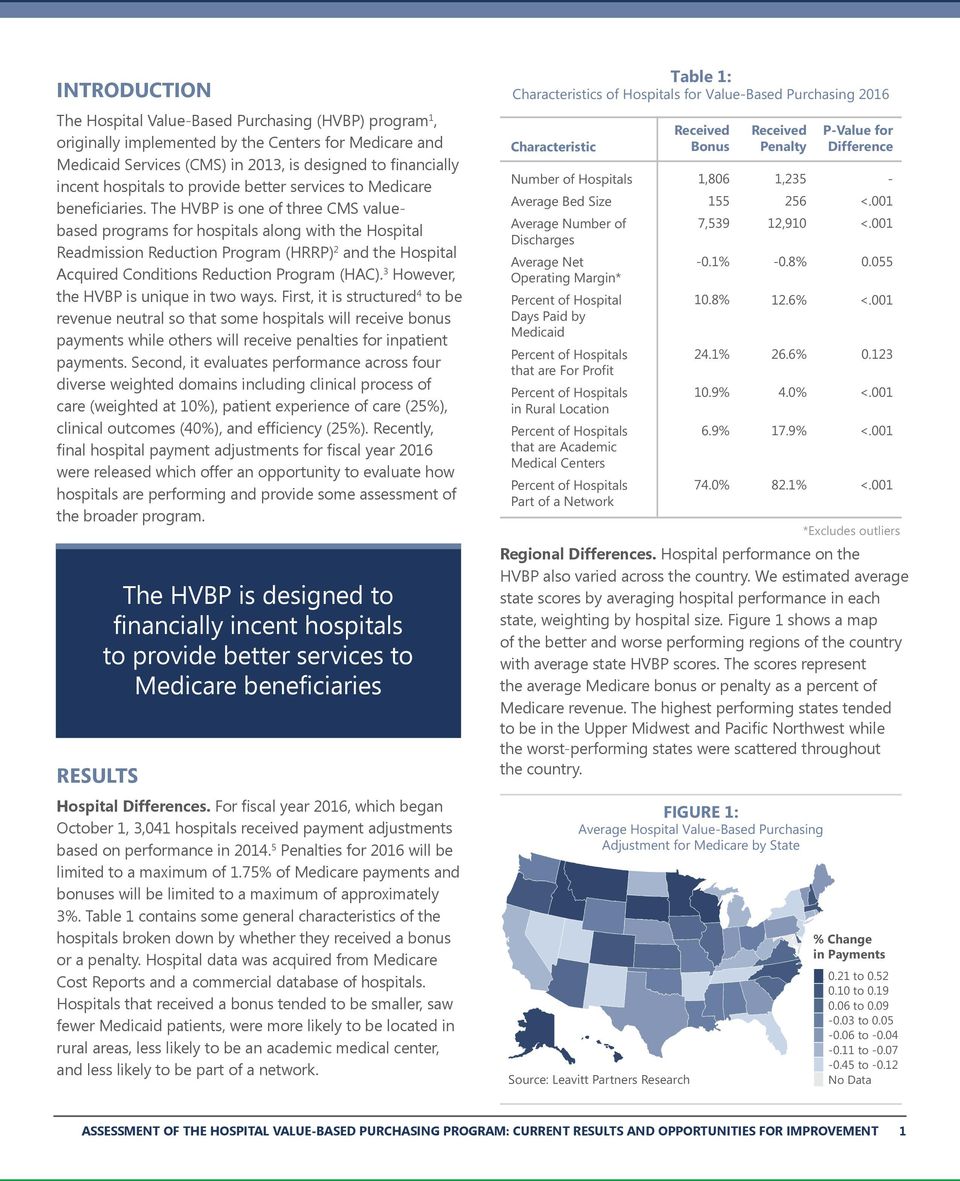
2 INTRODUCTION The Hospital Value-Based Purchasing (HVBP) program 1, originally implemented by the Centers for Medicare and Medicaid Services (CMS) in 2013, is designed to financially incent hospitals to provide better services to Medicare beneficiaries. The HVBP is one of three CMS valuebased programs for hospitals along with the Hospital Readmission Reduction Program (HRRP) 2 and the Hospital Acquired Conditions Reduction Program (HAC). 3 However, the HVBP is unique in two ways. First, it is structured 4 to be revenue neutral so that some hospitals will receive bonus payments while others will receive penalties for inpatient payments. Second, it evaluates performance across four diverse weighted domains including clinical process of care (weighted at 10%), patient experience of care (25%), clinical outcomes (40%), and efficiency (25%). Recently, final hospital payment adjustments for fiscal year 2016 were released which offer an opportunity to evaluate how hospitals are performing and provide some assessment of the broader program. RESULTS The HVBP is designed to financially incent hospitals to provide better services to Medicare beneficiaries Hospital Differences. For fiscal year 2016, which began October 1, 3,041 hospitals received payment adjustments based on performance in Penalties for 2016 will be limited to a maximum of 1.75% of Medicare payments and bonuses will be limited to a maximum of approximately 3%. Table 1 contains some general characteristics of the hospitals broken down by whether they received a bonus or a penalty. Hospital data was acquired from Medicare Cost Reports and a commercial database of hospitals. Hospitals that received a bonus tended to be smaller, saw fewer Medicaid patients, were more likely to be located in rural areas, less likely to be an academic medical center, and less likely to be part of a network. Table 1: Characteristics of Hospitals for Value-Based Purchasing 2016 Characteristic Number of Hospitals Average Bed Size Average Number of Discharges Average Net Operating Margin* Percent of Hospital Days Paid by Medicaid Percent of Hospitals that are For Profit Percent of Hospitals in Rural Location Percent of Hospitals that are Academic Medical Centers Percent of Hospitals Part of a Network Received Bonus 1, , % 10.8% 24.1% 10.9% 6.9% 74.0% Received Penalty 1, , % 12.6% 26.6% 4.0% 17.9% 82.1% P-Value for Difference *Excludes outliers Regional Differences. Hospital performance on the HVBP also varied across the country. We estimated average state scores by averaging hospital performance in each state, weighting by hospital size. Figure 1 shows a map of the better and worse performing regions of the country with average state HVBP scores. The scores represent the average Medicare bonus or penalty as a percent of Medicare revenue. The highest performing states tended to be in the Upper Midwest and Pacific Northwest while the worst-performing states were scattered throughout the country. FIGURE 1: Average Hospital Value-Based Purchasing Adjustment for Medicare by State Source: Leavitt Partners Research % Change in Payments 0.21 to to to to to to to No Data ASSESSMENT OF THE HOSPITAL VALUE-BASED PURCHASING PROGRAM: CURRENT RESULTS AND OPPORTUNITIES FOR IMPROVEMENT 1
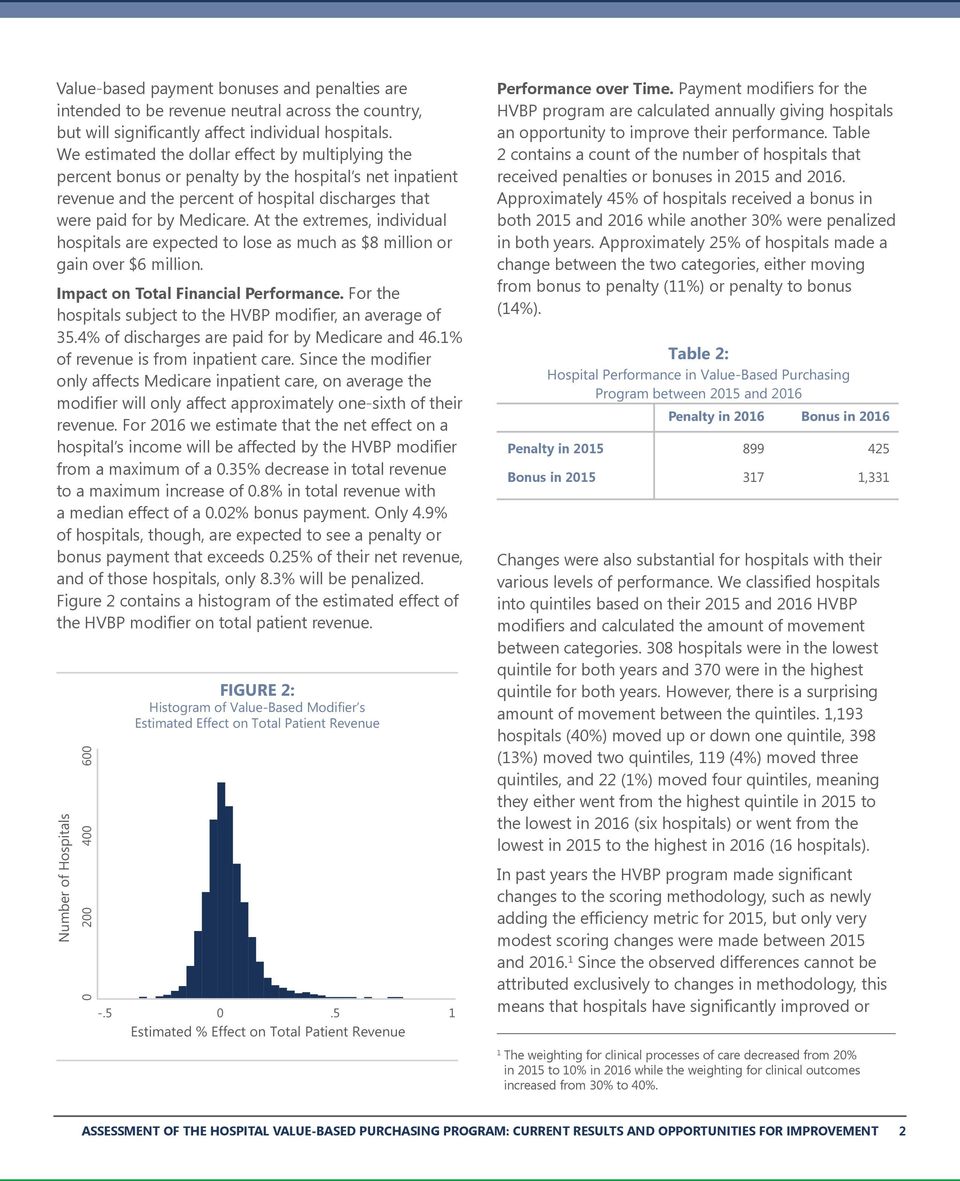
3 Value-based payment bonuses and penalties are intended to be revenue neutral across the country, but will significantly affect individual hospitals. We estimated the dollar effect by multiplying the percent bonus or penalty by the hospital s net inpatient revenue and the percent of hospital discharges that were paid for by Medicare. At the extremes, individual hospitals are expected to lose as much as $8 million or gain over $6 million. Impact on Total Financial Performance. For the hospitals subject to the HVBP modifier, an average of 35.4% of discharges are paid for by Medicare and 46.1% of revenue is from inpatient care. Since the modifier only affects Medicare inpatient care, on average the modifier will only affect approximately one-sixth of their revenue. For 2016 we estimate that the net effect on a hospital s income will be affected by the HVBP modifier from a maximum of a 0.35% decrease in total revenue to a maximum increase of 0.8% in total revenue with a median effect of a 0.02% bonus payment. Only 4.9% of hospitals, though, are expected to see a penalty or bonus payment that exceeds 0.25% of their net revenue, and of those hospitals, only 8.3% will be penalized. Figure 2 contains a histogram of the estimated effect of the HVBP modifier on total patient revenue. Number of Hospitals FIGURE 2: Histogram of Value-Based Modifier s Estimated Effect on Total Patient Revenue Estimated % Effect on Total Patient Revenue Performance over Time. Payment modifiers for the HVBP program are calculated annually giving hospitals an opportunity to improve their performance. Table 2 contains a count of the number of hospitals that received penalties or bonuses in 2015 and Approximately 45% of hospitals received a bonus in both 2015 and 2016 while another 30% were penalized in both years. Approximately 25% of hospitals made a change between the two categories, either moving from bonus to penalty (11%) or penalty to bonus (14%). Table 2: Hospital Performance in Value-Based Purchasing Program between 2015 and 2016 Penalty in 2016 Bonus in 2016 Penalty in 2015 Bonus in Changes were also substantial for hospitals with their various levels of performance. We classified hospitals into quintiles based on their 2015 and 2016 HVBP modifiers and calculated the amount of movement between categories. 308 hospitals were in the lowest quintile for both years and 370 were in the highest quintile for both years. However, there is a surprising amount of movement between the quintiles. 1,193 hospitals (40%) moved up or down one quintile, 398 (13%) moved two quintiles, 119 (4%) moved three quintiles, and 22 (1%) moved four quintiles, meaning they either went from the highest quintile in 2015 to the lowest in 2016 (six hospitals) or went from the lowest in 2015 to the highest in 2016 (16 hospitals) ,331 In past years the HVBP program made significant changes to the scoring methodology, such as newly adding the efficiency metric for 2015, but only very modest scoring changes were made between 2015 and Since the observed differences cannot be attributed exclusively to changes in methodology, this means that hospitals have significantly improved or 1 The weighting for clinical processes of care decreased from 20% in 2015 to 10% in 2016 while the weighting for clinical outcomes increased from 30% to 40%. ASSESSMENT OF THE HOSPITAL VALUE-BASED PURCHASING PROGRAM: CURRENT RESULTS AND OPPORTUNITIES FOR IMPROVEMENT 2
4 worsened their performance over the course of just one year. Table 3 contains a breakdown of hospital performance by quintile in 2015 and Value-Based Purchasing Quintile 2015 Table 3: Hospital Value-Based Purchasing Performance by Quintile for 2015 and 2016 Lowest Highest Value-Based Purchasing Quintile 2016 Lowest Highest Comparison to Other Programs. In addition to the HVBP Program, CMS has also initiated the Hospital Readmission Reduction Program (HRRP) and the Hospital-Acquired Condition (HAC) Reduction Program. While all three programs are intended to improve hospital performance, they focus on different areas HRRP data was released earlier this year while 2016 HAC data has not yet been released. High performance on one program is only mildly associated with high performance on another. HVBP scores are modestly correlated with HAC scores (corr=0.24) and much less correlated with HRRP scores (corr=0.06). Only 28 hospitals scored in the highest quintile for all three measures. POLICY IMPLICATIONS AND RECOMMENDATIONS FOR VALUE-BASED PURCHASING Value-Based Purchasing s Ability to Change Behavior. The stated goal of the HVBP program is to improve patient outcomes, safety, and patients care experience. An important question, though, is whether the program will provide enough of an incentive to hospitals to make changes to improve their delivery. The theory is that the threat of a penalty or possibility of a bonus will incent hospitals to improve their performance across the four measured domains. Improvement in any one of the domains will require significant investments of time, and potentially money, for hospitals. In many cases, the return on that investment is unknown. In total the HVBP includes 24 different measures 6 which means improvement on a single measure is unlikely to lead to a substantive change in the overall score, and simultaneously addressing many measures may prove to be overly difficult. As seen in Figure 2, the high majority of hospitals are either penalized or receive bonuses for a small percentage of their total revenue. With relatively small bonuses or penalties and a high investment in implementing changes required for an unknown potential return, the financial incentives may not be sufficient to justify significant changes for many hospitals. One approach to directly incent action is to move toward measures that have clear pathways for improvement. For example, there is no clearly defined route to improve physician-patient communication scores, making the decision to invest in improvements difficult for management. But, there is a much clearer approach to improve how many patients are provided appropriate discharge information measures with clearer pathways to improvement could be weighted higher than those with a more nebulous pathway forward. Important additional work needs to be done to assess whether hospitals that have higher penalties improved more than those that had smaller penalties or bonuses. Hospitals that are subject to higher penalties have a larger financial incentive to decide that they need to make significant changes to reduce those penalties than those that have marginal penalties or bonuses. Whether this plays out in practice still needs to be studied empirically; it needs to be clearly established whether the HVBP has sufficient power to influence broad changes. If providers with larger penalties do indeed tend to improve more, the program could modify its ASSESSMENT OF THE HOSPITAL VALUE-BASED PURCHASING PROGRAM: CURRENT RESULTS AND OPPORTUNITIES FOR IMPROVEMENT 3

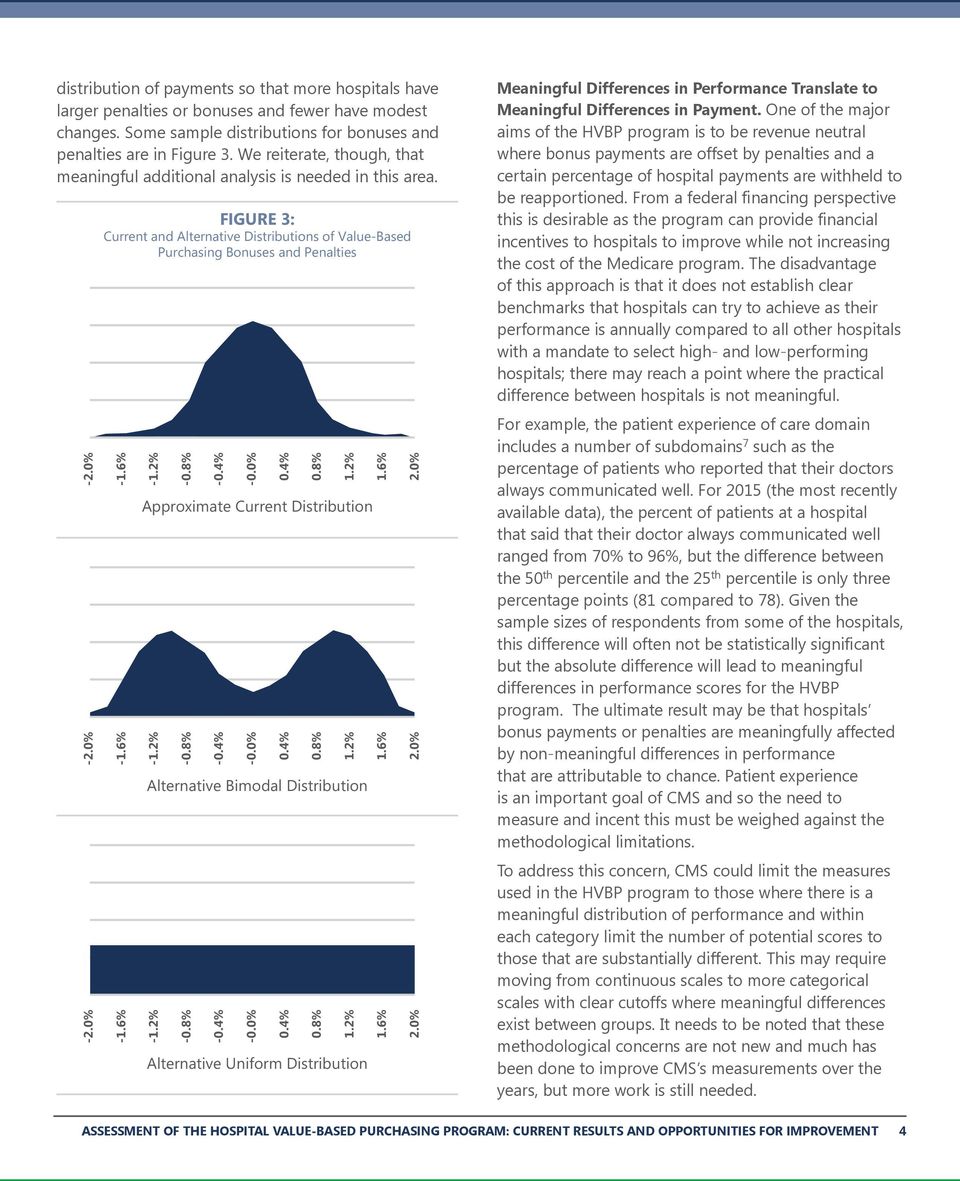
5 distribution of payments so that more hospitals have larger penalties or bonuses and fewer have modest changes. Some sample distributions for bonuses and penalties are in Figure 3. We reiterate, though, that meaningful additional analysis is needed in this area. -2.0% -2.0% -2.0% FIGURE 3: Current and Alternative Distributions of Value-Based Purchasing Bonuses and Penalties -1.6% -1.6% -1.6% -1.2% -0.8% -0.4% -0.0% 0.4% 0.8% 1.2% Approximate Current Distribution -1.2% -0.8% -0.4% -0.0% 0.4% 0.8% 1.2% Alternative Bimodal Distribution -1.2% -0.8% -0.4% -0.0% 0.4% 0.8% 1.2% Alternative Uniform Distribution 1.6% 1.6% 1.6% 2.0% 2.0% 2.0% Meaningful Differences in Performance Translate to Meaningful Differences in Payment. One of the major aims of the HVBP program is to be revenue neutral where bonus payments are offset by penalties and a certain percentage of hospital payments are withheld to be reapportioned. From a federal financing perspective this is desirable as the program can provide financial incentives to hospitals to improve while not increasing the cost of the Medicare program. The disadvantage of this approach is that it does not establish clear benchmarks that hospitals can try to achieve as their performance is annually compared to all other hospitals with a mandate to select high- and low-performing hospitals; there may reach a point where the practical difference between hospitals is not meaningful. For example, the patient experience of care domain includes a number of subdomains 7 such as the percentage of patients who reported that their doctors always communicated well. For 2015 (the most recently available data), the percent of patients at a hospital that said that their doctor always communicated well ranged from 70% to 96%, but the difference between the 50 th percentile and the 25 th percentile is only three percentage points (81 compared to 78). Given the sample sizes of respondents from some of the hospitals, this difference will often not be statistically significant but the absolute difference will lead to meaningful differences in performance scores for the HVBP program. The ultimate result may be that hospitals bonus payments or penalties are meaningfully affected by non-meaningful differences in performance that are attributable to chance. Patient experience is an important goal of CMS and so the need to measure and incent this must be weighed against the methodological limitations. To address this concern, CMS could limit the measures used in the HVBP program to those where there is a meaningful distribution of performance and within each category limit the number of potential scores to those that are substantially different. This may require moving from continuous scales to more categorical scales with clear cutoffs where meaningful differences exist between groups. It needs to be noted that these methodological concerns are not new and much has been done to improve CMS s measurements over the years, but more work is still needed. ASSESSMENT OF THE HOSPITAL VALUE-BASED PURCHASING PROGRAM: CURRENT RESULTS AND OPPORTUNITIES FOR IMPROVEMENT 4
6 Volatility. The objective of the HVBP is for hospitals to improve their performance by making important changes in how they deliver care. High levels of volatility hospitals showing high increases or decreases in performance year over year may indicate that the program is not adequately measuring true underlying quality. For example, one hospital was in the lowest quintile in 2013, the highest quintile in 2014, back to the lowest quintile in 2015 and is now in the middle quintile in hospitals have seen at least a two quintile decline and two quintile improvement between different years. Such movement suggests that the program measures may be susceptible to random variation as opposed to a hospital actually alternating between worsening and improving every year. While some larger hospitals had high levels of volatility, the most volatile hospitals tended to be smaller facilities (116 beds compared to 206 beds; p). Smaller facilities have smaller patient populations with fewer cases being used to estimate population-level outcomes, leading to potential volatility with year over year estimates. A hospital, for example, that annually treats only a few dozen heart failure patients is much more likely to see yearly performance scores that vary much more than a hospital that treats many times that number simply due to clinical variation. A uniform program that is applicable to all hospitals is a laudable goal, but this may underestimate the substantive differences between organizations. High volatility, in particular, indicates a need to revisit whether there are sufficient cases to generate accurate measurements of performance. The efficiency domain, for example, only requires 25 cases 5 which will likely lead to significant variation year over year in measured performance, even if actual performance is relatively constant. Reduction in volatility due to random changes over time can be limited with a higher threshold of minimum cases which would lead to smaller hospitals being excluded from the HVBP program. CMS could recognize this and devise an alternative, low-case volume HVBP program which crafts measures that would be more appropriate for those facilities. This would allow CMS greater flexibility to customize measures that will influence different types of hospitals to improve in ways that are appropriate for the facility. Overlap with other Medicare Initiatives. In conjunction with the HRRP and HAC programs, the HVBP program is one prong of the approach that CMS is managing to try to improve hospital outcomes. Collectively the three programs will lead to hospitals being subject to a potential 6% reduction in Medicare payments (2% from HVBP beginning in 2017, 3% from HRRP and 1% for HAC). Measures are not fully coordinated between the programs. For example, the Agency for Healthcare Research and Quality Patient Safety 90 indicator is used for both the HVBP program and the HAC program. Rather than continuing to administer separate programs, the three could be combined into one program, similar to the Merit-based Incentive Payment System (MIPS) 8 that combines a variety of other initiatives for physicians. Due to the enabling legislation of these programs, such a change would most likely need to be enacted by Congress. This would allow CMS to better align all the quality and performance measures across programs so that hospitals are better-positioned to prioritize their efforts. CONCLUSION The HVBP program is an important effort by CMS to provide tangible incentives to hospitals to improve the quality of care that they are delivering. Current results show uneven performance both geographically and by different types of hospitals. To improve the program CMS should address four concerns. First, CMS should empirically evaluate whether the HVBP penalties are large enough that they lead to providers making changes across any of the four domains. Second, CMS should structure quality measures so that only meaningful differences in performance lead to meaningful differences in payments. Third, to decrease measurement volatility, CMS should increase the minimum number of cases for each of the metrics and could create an alternative HVBP program for low-case volume hospitals. Finally, Congress should consider combining the HVBP program with the readmission and hospital-acquired condition reduction programs so that CMS can better align measures across the programs. ASSESSMENT OF THE HOSPITAL VALUE-BASED PURCHASING PROGRAM: CURRENT RESULTS AND OPPORTUNITIES FOR IMPROVEMENT 5

7 1. Centers for Medicare & Medicaid Services. Hospital Value-Based Purchasing Program Overview [cited 2015 Nov 12]. Available from: 2. Centers for Medicare & Medicaid Services. Readmissions-Reduction-Program [cited 2015 Nov 12]. Available from: 3. Centers for Medicare & Medicaid Services C for. Hospital-Acquired Condition (HAC) Reduction Program [cited 2015 Nov 12]. Available from: Reduction-Program.html 4. Centers for Medicare & Medicaid Services. Fiscal Year (FY) 2016 Results for the CMS Hospital Value-Based Purchasing Program [cited 2015 Nov 12]. Available from: 5. Tourison C. National Provider Call: Hospital Value-Based Purchasing (VBP) Program Apr 29 [cited 2015 Nov 12]. Available from: 6. QualityNet. Scoring: Hospital Value-Based Purchasing (HVBP). [cited 2015 Nov 12]. Available from: dcs/contentserver?c=page&pagename=qnetpublic%2fpage%2fqnettier3&cid= Centers for Medicare & Medicaid Services. Patient Experience of Care domain. [cited 2015 Nov 12]. Available from: Conway PH, Gronniger T, Pham H, Goodrich K, Bassano A, Sharp J, et al. MACRA: New Opportunities For Medicare Providers Through Innovative Payment Systems (Updated). Health Affairs [cited 2015 Nov 12]. Available from: org/blog/2015/09/28/macra-new-opportunities-for-medicare-providers-through-innovative-payment-systems-3/ ASSESSMENT OF THE HOSPITAL VALUE-BASED PURCHASING PROGRAM: CURRENT RESULTS AND OPPORTUNITIES FOR IMPROVEMENT 6
![Readmissions-Reduction-Program. 2015 [cited 2015 Nov 12]. Available from: https://www.cms.gov/medicare/medicare-fee-for-service-payment/acuteinpatientpps/readmissions-reduction-program.html 3.](/docs-images/47/20388553/images/page_7.jpg "Centers for Medicare & Medicaid Services C for. Hospital-Acquired Condition (HAC) Reduction Program. 2014 [cited 2015 Nov 12]. Available from: https://www.cms.")
8 LeavittPartners.com 2015 Leavitt Partners, LLC

Linking Quality to Payment
 Linking Quality to Payment Background Our nation s health care delivery system is undergoing a major transformation as reimbursement moves from a volume-based methodology to one based on value and quality.
HOSPITAL VALUE- BASED PURCHASING. Initial Results Show Modest Effects on Medicare Payments and No Apparent Change in Quality-of- Care Trends
 United States Government Accountability Office Report to Congressional Committees October 2015 HOSPITAL VALUE- BASED PURCHASING Initial Results Show Modest Effects on Medicare Payments and No Apparent
Improving Hospital Performance
 Improving Hospital Performance Background AHA View Putting patients first ensuring their care is centered on the individual, rooted in best practices and utilizes the latest evidence-based medicine is
Hospital Value-Based Purchasing (VBP) Program
 Medicare Spending per Beneficiary (MSPB) Measure Presentation Question & Answer Transcript Moderator: Bethany Wheeler, BS Hospital VBP Program Support Contract Lead Hospital Inpatient Value, Incentives,
Medicare Value-Based Purchasing Programs
 By Jane Hyatt Thorpe and Chris Weiser Background Medicare Value-Based Purchasing Programs To improve the quality of health care delivered to Medicare beneficiaries, the Centers for Medicare and Medicaid
MIPS Performance Scoring: Understanding How CMS Proposes to Calculate Performance Is Key to Preparing for MIPS Participation
 MIPS Performance Scoring: Understanding How CMS Proposes to Calculate Performance Is Key to Preparing for MIPS Participation By Robert F. Atlas, Lesley R. Yeung, and M. Brian Hall IV June 2016 On May 9,
5/19/2016 MIPS AND MACRA: MAKING SENSE OF THE NEW REGULATIONS AND PAYMENT SYSTEMS. No Disclosures AMERICAN ASSOCIATION OF CLINICAL ENDOCRINOLOGISTS
 MIPS AND MACRA: MAKING SENSE OF THE NEW REGULATIONS AND PAYMENT SYSTEMS 1 No Disclosures 2 1 To Better Understand the Future.. We must remember the past regarding physician payment. 3 THE SGR SGR=Sustainable
Under Medicare s value-based purchasing (VBP) program,
 RESEARCH HCAHPS survey results: Impact of severity of illness on hospitals performance on HCAHPS survey results James I. Merlino, MD, FACS, FASCRS a, Carmen Kestranek b, Daniel Bokar b, Zhiyuan Sun, MS,
Summary of Major Provisions in Final House Reform Package
 SPECIAL BULLETIN Monday, March 22, 2010 This summary is five pages. Summary of Major Provisions in Final House Reform Package The U.S. House of Representatives late yesterday voted to pass landmark health
THE LANDSCAPE OF MEDICAID ALTERNATIVE PAYMENT MODELS
 POLICY BRIEF September 2014 THE LANDSCAPE OF MEDICAID ALTERNATIVE PAYMENT MODELS Authored by: America s Essential Hospitals staff KEY FINDINGS States have increasingly sought to establish alternative payment
CMS Office of Public Affairs 202-690-6145 MEDICARE PROPOSES NEW HOSPITAL VALUE-BASED PURCHASING PROGRAM
 For Immediate Release: Friday, January 07, 2011 Contact: CMS Office of Public Affairs 202-690-6145 MEDICARE PROPOSES NEW HOSPITAL VALUE-BASED PURCHASING PROGRAM OVERVIEW: Today the Centers for Medicare
Fiscal Year 2016 proposed Inpatient and Long-term Care Hospital policy and payment changes (CMS-1632-P)
 Fiscal Year 2016 proposed Inpatient and Long-term Care Hospital policy and payment changes (CMS-1632-P) Date 2015-04-17 Title Fiscal Year 2016 proposed Inpatient and Long-term Care Hospital policy and
THE EVOLUTION OF CMS PAYMENT MODELS
 THE EVOLUTION OF CMS PAYMENT MODELS December 3, 2015 Dayton Benway, Principal AGENDA Legislative Background Payment Model Categories Life Cycle The Models LEGISLATIVE BACKGROUND Medicare Modernization
The Medicare Access and CHIP Reauthorization Act of 2015 (MACRA) Summary of SGR Repeal and Replacement Provisions
 ACOG Government Affairs May 2015 The Medicare Access and CHIP Reauthorization Act of 2015 (MACRA) Summary of SGR Repeal and Replacement Provisions This landmark bipartisan legislation, signed into law
Decoding Medicare Spending Per Beneficiary (MSPB) Management and Physician Opportunities Together
 Decoding Medicare Spending Per Beneficiary (MSPB) Management and Physician Opportunities Together Dale N. Schumacher THE TRANSFORMATION TO CONSUMER-DRIVEN HEALTHCARE Decoding Medicare Spending Per Beneficiary
Are Electronic Medical Records Worth the Costs of Implementation?
 Research Are Electronic Medical Records Worth the Costs of Implementation? TARA O'NEILL AUGUST 6, 2015 Executive Summary Electronic medical records (EMRs), as a cornerstone of a more intelligent, adaptive,
Home Health Value-Based Purchasing. April 6, 2016 12:00-3:45 pm
 Home Health Value-Based Purchasing April 6, 2016 12:00-3:45 pm Learning Objectives Understand the changing health care landscape, including various models of value-based purchasing Learn how the HHVBP
June 22, 2012. Dear Administrator Tavenner:
 Submitted Electronically Marilyn Tavenner Acting Administrator Centers for Medicare & Medicaid Services Department of Health and Human Services Room 445-G Hubert H. Humphrey Building 200 Independence Avenue
Sustainable Growth Rate (SGR) Repeal and Replace: Comparison of 2014 and 2015 Legislation
 Sustainable Growth Rate (SGR) Repeal and Replace: Comparison of 2014 and 2015 Legislation Proposal 113 th Congress - - H.R.4015/S.2000 114 th Congress - - H.R.1470 SGR Repeal and Annual Updates General
Adding Value to. Provider Compensation. June 13, 2016. Healthcare Strategy Group OHA Presentation 2016. Adding Value to. Physician Compensation
 Provider Compensation June 13, 2016 1 Who are We? About (HSG) Hospital-physician integration specialists since 1999 Strategic, best practice approach to employed physician networks and independent physician
Medicare Skilled Nursing Facility Prospective Payment System
 Medicare Skilled Nursing Facility Prospective Payment System Payment Rule Brief FINAL RULE Program Year: FFY 2016 Overview and Resources On August 4, 2015, the Centers for Medicare and Medicaid Services
Mount Sinai Care: A Medicare Shared Savings Program Primer. Brett Bernstein, MD, AGAF, FASGE Medical Director, Provider Partners of Mount Sinai IPA
 Mount Sinai Care: A Medicare Shared Savings Program Primer Brett Bernstein, MD, AGAF, FASGE Medical Director, Provider Partners of Mount Sinai IPA Mount Sinai Health System Network Mount Sinai Health System
Medicare s Hospital Value-Based Purchasing Program, a New Era in Medicare Reimbursement by Daniel J. Hettich
 Medicare s Hospital Value-Based Purchasing Program, a New Era in Medicare Reimbursement by Daniel J. Hettich Medicare s new hospital inpatient value-based purchasing ( VBP ) program, mandated by the Affordable
FY 2016 Hospice Wage Index and Payment Rate Update and Hospice Quality Reporting Requirements Proposed Rule
 June 24, 2015 Andrew Slavitt Centers for Medicare & Medicaid Services U.S. Department of Health and Human Services Attention: CMS- 1629-P, Mail Stop C4-26-05 7500 Security Boulevard Baltimore, MD 21244-1850
WHITE PAPER February 2016. Realizing the Promise: Overcoming the Barriers to ACO Success
 WHITE PAPER February 2016 Realizing the Promise: Overcoming the Barriers to ACO Success OVERVIEW The Accountable Care Organizations (ACOs) brought to reality by the Affordable Care Act were designed with
Repeal the Sustainable Growth Rate (SGR), avoiding annual double digit payment cuts;
 Background Summary of H.R. 2: The Medicare Access and CHIP Reauthorization Act of 2015 SGR Reform Law Enacts Payment Reforms to Improve Quality, Outcomes, and Cost On April 16, 2015, the President signed
CMS Listening Session: Merit-Based Incentive Payment System (MIPS)
 CMS Listening Session: Merit-Based Incentive Payment System (MIPS) Kate Goodrich, MD, MHS, Director, Center for Clinical Standards and Quality Pierre Yong, MD, MPH, MS, Acting Director, Quality Measurement
Narrow network health plans: New approaches to regulating adequacy and transparency. Michael S. Adelberg
 Compliance TODAY October 2015 a publication of the health care compliance association www.hcca-info.org Combating healthcare fraud in New Jersey an interview with Paul J. Fishman United States Attorney
Key Information. QP or Partial QP Determination
 HIMSS MACRA NPRM Fact Sheet Alternative Payment Models: Qualifying Alternative Payment Model Participant & Partial Qualifying Alternative Payment Model Participant Determination Key Information During
HAI LEADERSHIP PARTNERING FOR ACCOUNTABLE CARE
 HAI LEADERSHIP PARTNERING FOR ACCOUNTABLE CARE Cepheid s Government Affairs Department Advocating for Patient Access to Molecular Diagnostics in the Era of Healthcare Reform A TEAM APPROACH Legislative
Refining the hospital readmissions reduction program
 Refining the hospital readmissions reduction program C h a p t e r4 C H A P T E R 4 Refining the hospital readmissions reduction program Chapter summary In this chapter In 2008, the Commission reported
Hospital Value-based Purchasing Specifications 2016 Updated August 2015
 Description Methodology Measurement Period Allowable Exclusions Total Performance Score Individual measures CMS incentive program for PPS hospitals. The purpose is to achieve value by tying payment to
HCAHPS and Value-Based Purchasing Methods and Measurement. Deb Stargardt, Improvement Services Darrel Shanbour, Consulting Services
 HCAHPS and Value-Based Purchasing Methods and Measurement Deb Stargardt, Improvement Services Darrel Shanbour, Consulting Services Today s Learning Objectives Acquire new knowledge pertaining to: A. Hospital
March 28, 2016. Dear Acting Administrator Slavitt:
 March 28, 2016 Andrew Slavitt, Acting Administrator Centers for Medicare & Medicaid Services Department of Health and Human Services Attention: CMS 1644-P P.O. Box 8013 Baltimore, MD 21244 8013 Re: Medicare
MIPS. ACR Issues Analysis of Proposed MACRA MIPS Rule
 ACR Issues Analysis of Proposed MACRA MIPS Rule The Centers for Medicare and Medicaid Services (CMS) issued a proposed rule (CMS-5517-P) on April 27, 2016, to establish many of the provisions of Medicare
1. Would additional health care organizations be interested in applying to the Pioneer ACO Model? Why or why not?
 February 28, 2014 Re: Request for Information on the Evolution of ACO Initiatives at CMS AMGA represents multi specialty medical groups and other organized systems of care, including some of the nation
THE USE OF TECHNOLOGY TO IMPROVE QUALITY AND REDUCE COSTS FOR HOSPITALS IN GEORGIA
 THE USE OF TECHNOLOGY TO IMPROVE QUALITY AND REDUCE COSTS FOR HOSPITALS IN GEORGIA Health Policy and Management Capstone Project Spring 2014 2 Index I. Introduction II. III. IV. Description of Hospitals
Patient Experience/ Satisfaction What s at Stake? Customer Service at UAMS
 Patient Experience/ Satisfaction What s at Stake? Customer Service at UAMS Why Do We Care? We started measuring patient satisfaction about 11 years ago because we care what our patients are saying. We
Value-Based Payment and Health System Transformation
 Value-Based Payment and Health System Transformation National Health Policy Forum Patrick Conway, M.D., MSc CMS Chief Medical Officer Deputy Administrator for Innovation and Quality Director, Center for
MEDICARE ACCESS AND CHIP REAUTHORIZATION ACT (MACRA) MERIT-BASED INCENTIVE PAYMENT SYSTEM (MIPS) ADVANCING CARE INFORMATION PERFORMANCE CATEGORY
 MEDICARE ACCESS AND CHIP REAUTHORIZATION ACT (MACRA) MERIT-BASED INCENTIVE PAYMENT SYSTEM (MIPS) ADVANCING CARE INFORMATION PERFORMANCE CATEGORY SUMMARY OF PROVISIONS Brief Synopsis MACRA sunsets the Electronic
A Study by the National Association of Urban Hospitals September 2012
 The Potential Impact of the Affordable Care Act on Urban Safety-Net Hospitals A Study by the National Association of Urban Hospitals September 2012 Introduction One by one and provision by provision, the
Value Based Purchasing: New Tools for Hospitals
 Value Based Purchasing: New Tools for Hospitals The Value Based Purchasing Score Estimator & HANYS Quality Reports Overview of CMS Value Based Purchasing Program Brian Potter, Vice-President, Finance &
Overview of the Hospital Value-Based Purchasing (VBP) Fiscal Year (FY) 2017
 Overview of the Hospital Value-Based Purchasing (VBP) Fiscal Year (FY) 2017 Bethany Wheeler Hospital VBP Program Support Contract Lead HSAG February 17, 2015 2 p.m. ET Purpose This event will provide an
Accountable Care Organization Refinement Brief
 Accountable Care Organization Refinement Brief The participants in the Medicare Shared Savings Program (MSSP), the Physician Group Practice Transition Demonstration (PGP-TD), and the Pioneer Accountable
Nursing Home Compare Five-Star Quality Rating System: Year Five Report [Public Version]
![Nursing Home Compare Five-Star Quality Rating System: Year Five Report [Public Version]](/thumbs/39/19238377.jpg "Nursing Home Compare Five-Star Quality Rating System: Year Five Report [Public Version]") Nursing Home Compare Five-Star Quality Rating System: Year Five Report [Public Version] Final Report June 16, 2014 Prepared for Centers for Medicare & Medicaid Services (CMS) AGG/Research Contracts & Grants
Nursing Home Compare Five-Star Quality Rating System: Year Five Report [Public Version] Final Report June 16, 2014 Prepared for Centers for Medicare & Medicaid Services (CMS) AGG/Research Contracts & Grants
Health IT Policy Committee Meeting. Data Update. March 10, 2015
 Health IT Policy Committee Meeting Data Update March 10, 2015 Agenda Examine characteristics associated with meaningful use performance among eligible hospitals Care transitions Patient engagement Patient
Physician Scorecards. Clinical Documentation and Coding Improvement. Team Goals Metrics. Data Benchmarks Compliance.
 Health Solutions Clinical Documentation and Coding Improvement Physician Scorecards Individual physician performance has a direct impact on a health system s financial, patient safety, and care quality
Value-Based Purchasing Program Overview. Maida Soghikian, MD Grand Rounds Scripps Green Hospital November 28, 2012
 Value-Based Purchasing Program Overview Maida Soghikian, MD Grand Rounds Scripps Green Hospital November 28, 2012 Presentation Overview Background and Introduction Inpatient Quality Reporting Program Value-Based
CMS is requesting information to aid in the planning and implementation of the MIPS in the following areas:
 Summary of Medicare s Request for Information on the Provisions in MACRA which Allow for Implementation of Alternative Payment Models and a Merit-Based Incentive Payment System On September 28, 2015, the
Incentive Compensation Systems In Community Health Centers. Curt Degenfelder Managing Director [email protected]
 Incentive Compensation Systems In Community Health Centers Curt Degenfelder Managing Director [email protected] 1 What are the components of successful health centers culture that support an
Value Based Care and Healthcare Reform
 Value Based Care and Healthcare Reform Dimensions in Cardiac Care November, 2014 Jacqueline Matthews, RN, MS Senior Director, Quality Reporting & Reform Quality and Patient Safety Institute Cleveland Clinic
President Obama Signs the Temporary Payroll Tax Cut Continuation Act of 2011 --New Law Includes Physician Update Fix through February 2012--
 President Obama Signs the Temporary Payroll Tax Cut Continuation Act of 2011 --New Law Includes Physician Update Fix through February 2012-- On Friday, December 23, 2011, President Obama signed into law
PL 111-148 and Amendments: Impact on Post-Acute Care for Health Care Systems
 PL 111-148 and Amendments: Impact on Post-Acute Care for Health Care Systems By Kathleen M. Griffin, PhD. There are three key provisions of the law that will have direct impact on post-acute care needs
The Promise of Regional Data Aggregation
 The Promise of Regional Data Aggregation Lessons Learned by the Robert Wood Johnson Foundation s National Program Office for Aligning Forces for Quality 1 Background Measuring and reporting the quality
UNIVERSITY OF ILLINOIS HOSPITAL & HEALTH SCIENCES SYSTEM: FINANCIAL REPORT AND SYSTEM DASHBOARDS May 29, 2013
 UNIVERSITY OF ILLINOIS HOSPITAL & HEALTH SCIENCES SYSTEM: FINANCIAL REPORT AND SYSTEM DASHBOARDS May 29, 2013 Office of the Vice President for Health Affairs Board of Trustees Spring Chicago Meeting UI
A MACRA Overview. A web discussion with guests Ivy Baer, Gayle Lee, and Tanvi Mehta of AAMC
 A MACRA Overview A web discussion with guests Ivy Baer, Gayle Lee, and Tanvi Mehta of AAMC An Affinity Group Brought to you by HFMA and Vizient Sponsored by Kaufman Hall June 6, 2016 Meeting Notes Plan
Oils. Heart-Healthy CONFERENCE ISSUE. American Heart Month. The Newest Trends in the Dairy-Free Aisle. Plan Healthful Vegan Diets
 CONFERENCE ISSUE Vol. 17 No. 2 February 2015 The Magazine for Nutrition Professionals Heart-Healthy Oils Learn about the latest varieties and science on the healthful fats they contain. American Heart
Medicare Advantage Star Ratings: Detaching Pay from Performance Douglas Holtz- Eakin, Robert A. Book, & Michael Ramlet May 2012
 Medicare Advantage Star Ratings: Detaching Pay from Performance Douglas Holtz- Eakin, Robert A. Book, & Michael Ramlet May 2012 EXECUTIVE SUMMARY Rewarding quality health plans is an admirable goal for
Medicare Inpatient Rehabilitation Facility Prospective Payment System
 Medicare Inpatient Rehabilitation Facility Prospective Payment System Payment Rule Brief FINAL RULE Program Year: FFY 2014 Overview and Resources On August 6, 2013, the Centers for Medicare and Medicaid
PROMISING PRACTICES IN HOME AND COMMUNITY-BASED SERVICES
 PROMISING PRACTICES IN HOME AND COMMUNITY-BASED SERVICES Lessons Learned from Using a Health Information Technology Program that Combines Claims-Level Data with Service-Level Data Outcome data in the treatment
Hospital Financing Overview
 Texas Hospital Association 1108 Lavaca, Suite 700, Austin, TX, 78701-2180 www.tha.org Hospital Financing Overview Under federal law, hospitals are required to provide care to anyone who seeks it in their