
Identity Theft Prevention Program. Effective: November 1, 2009
|
|
|
- Eunice Roberts
- 10 years ago
- Views:
Transcription
1 Identity Theft Prevention Program Effective: November 1, 2009
2 I. BACKGROUND Galveston College ("College" / Institution ) developed this Identity Theft Prevention Program ("Program") pursuant to the Federal Trade Commission's Red Flags Rule ( Rule ), which implements Section 114 of the Fair and Accurate Credit Transactions Act of C. F. R This Program was developed in concert with Galveston College Policy CS (LOCAL) Identity Theft Prevention, approved by the Galveston College Board of Regents ( Board ) on October 14, After consideration of the size and complexity of the College's operations and account systems, and the nature and scope of the College's activities, Management has determined that this Program was appropriate for Galveston College. The program (by federal mandate) becomes effective November 1, II. PROGRAM PURPOSE, SCOPE & DEFINITIONS A. Purpose The purpose of the Identity Theft Protection Program is three-fold: 1. To ensure the security and confidentiality of Customer/Consumer identifying information including that of students, faculty and employees of the College. 2. To prevent unauthorized access, theft, and/or disclosure of Customer/Consumer identifying information stored in the College s ERP system, departmental file cabinets, or that has been provided to 3 rd parties. 3. To detect any unauthorized intrusion, theft, and/or disclosure of Customer/Consumer identifying information that has been collected by the College. B. Scope This program applies to all employees, faculty, staff, temporary workers, and other workers at the College contractors, as well as consultants, and third parties that have received personal information from the College. C. Definitions of terms The following are terms and definitions relating to the subject of identity theft: 1. Red Flag a pattern, practice, or specific activity that indicates the possible existence of Identity Theft. 2. Identity Theft fraud committed using the identifying information of another person. 3. Identifying Information including but not limited to: a. Name (including maiden name)
3 b. Address c. Telephone number d. Social Security Number e. Date of birth f. Government issued driver s license or identification number g. Alien registration number h. Government passport number i. Unique identification number j. Checking account information (used by customers making payments) k. Computer s Internet protocol address, or routing code 4. Payroll Information including but not limited to: a. Paychecks b. Pay stubs c. Bank account information (used by staff and faculty for direct deposit) d. Any other document or electronic file containing salary information 5. Credit Card Information including but not limited to: a. Credit card number (whole or in part) b. Credit card expiration date c. Cardholder name d. Cardholder address 6. Medical Information including but not limited to: a. Doctor names and claims b. Insurance claims c. Prescriptions d. Any related personal medical information 7. Covered Account a College account that is an individual service account held by customers of the College whether residential, commercial, or industrial. a. Any account the College offers or maintains primarily for personal, family, or household purposes, that involves multiple payments or transaction; and b. Any other account the College offers or maintains for which there is a reasonably foreseeable risk to customers or to the safety and soundness of the College from Identity Theft. III. PROGRAM ADMINISTRATION; TRAINING, REPORTING The Director of Human Resources and Risk Management or designee by the College President (hereinafter, the Program Administrator ) is responsible for overall Program management and administration. The Program Administrator shall provide appropriate identity theft training for relevant College faculty and staff and provide reports and 3

4 periodic updates to the Vice President for Administration and the Board of Regents on at least an annual basis. The Identity Theft Prevention Board Policy (CS Local) and this Program shall be posted on the College s main website, as well as departmental web pages including but not limited to the Registrar s Office, Financial Aid, the Business Office, and Human Resources / Risk Management. Periodic notifications of this policy, no less than once a year shall be sent to students, faculty and employee of the College. The annual report shall identify and evaluate issues such as the effectiveness of the College s policies and procedures for addressing the risk of identity theft with respect to Covered Accounts, oversight of service providers (third party contractors), significant incidents involving Identity Theft and the College s response, and any recommendations for material changes to the Board Policy or the Program. As part of the annual review, Red Flags may be revised, replaced, or eliminated. Defining new Red Flags may also be appropriate. IV. RISK MANAGEMENT A. The College may incorporate relevant Red Flags from sources such as: 1. Incidents of identity theft that have been experienced at the College or by other institutions of higher education. 2. Methods of identity theft identified by the College or other Creditors that reflect changes in identity theft risks. 3. Applicable supervisory guidance. B. The College may include relevant Red Flags from the following categories, if deemed appropriate: 1. Alerts, notifications, or other warnings received from consumer reporting agencies or service providers, such as fraud detection services. 2. The presentation of suspicious documents 3. The presentation of suspicious personal identifying information, such as a suspicious address change. 4. The unusual use of, or other suspicious activity related to a Covered Account. 5. Notices from customers, law enforcement authorities, or other persons regarding possible identity theft in connection with Covered Accounts. V. PREVENTIVE / PROTECTIVE ACTIONS TO BE TAKEN The following actions will be taken to protect and defend Customer/Consumer identifying information from unauthorized access, theft, and/or disclosure: A. The College s ERP system will be protected from external intrusion (hacking) by installing adequate, up to date software for this purpose (and from unauthorized internal access) and by promoting and enforcing effective security hierarchies, including password protocols. An annual departmental survey will be conducted by the Program 4
5 Administrator so that up-to-date knowledge of the ERP system protection methods are verified and documented. B. Departmental files containing hard copies of Customer/Consumer identifying information will be identified and reported to the Program Administrator. File cabinets are to be kept locked when not in use. Monitoring and controlling access of these files will be the responsibility of the department supervisor. An annual departmental survey will be conducted by the Program Administrator so that up-to-date knowledge of the location of all stored confidential information is verified and documented. C. Printed documents that have been identified as trash, but which contain Customer/Consumer identifying information will be placed in a locked bin for future shredding or immediately shredded using a mechanical crosscut. D. An annual survey will be conducted by the Program Administrator to confirm that all 3 rd party entities, to which College staff has forwarded identifying information, do maintain an FTC-approved Identity Theft Prevention Program, to safeguard the information. Once confirmed, a copy of each 3 rd party entity s program will be collected and stored in the College s Identity Theft Prevention Program manual. E. A valid photo ID will be required any time identifying information related to a Covered Account is collected or changed. This includes but is not limited to payments received using a credit or debit card, information collected for financial aid, information collected for registration / admission, and information collected for background checks, drug tests, communicable diseases or proof of vaccination (bacterial meningitis vaccine for athletes). VI. IDENTIFICATION OF RED FLAGS In order to identify relevant Red Flags, the College considers the types of accounts that it offers and maintains, the methods it provides to open its accounts, the methods it provides to access its accounts, and its previous experiences with Identity Theft. The College identifies the following red flags, in each of the listed categories: A. Notifications and Warnings from Credit Reporting Agencies Red Flags 1. Report of fraud accompanying a credit report; 2. Notice or report from a credit agency of a credit freeze on a customer or applicant; 3. Notice or report from a credit agency of an active duty alert for an applicant; and 4. Indication from a credit report of activity that is inconsistent with a customer s usual pattern or activity. B. Suspicious Documents 5
6 Red Flags 1. Identification document or card that appears to be forged, altered or inauthentic; 2. Identification document or card on which a person s photograph or physical description is not consistent with the person presenting the document; 3. Other document with information that is not consistent with existing customer information (such as if a person s signature on a check appears forged); and 4. Application for service that appears to have been altered or forged. C. Suspicious Personal Identifying Information Red Flags 1. Identifying information presented that is inconsistent with other information the customer provides (example: inconsistent birth dates); 2. Identifying information presented that is inconsistent with other sources of information (for instance, an address not matching an address on a credit report); 3. Identifying information presented that is the same as information shown on other applications that were found to be fraudulent; 4. Identifying information presented that is consistent with fraudulent activity (such as an invalid phone number or fictitious billing address); 5. Social security number presented that is the same as one given by another customer; 6. An address or phone number presented that is the same as that of another person; 7. A person fails to provide complete personal identifying information on an application when reminded to do so (however, by law social security numbers must not be required); and 8. A person s identifying information is not consistent with the information that is on file for the customer. D. Suspicious Account Activity or Unusual Use of Account Red Flags 1. Change of address for an account followed by a request to change the account holder's name; 2. Payments stop on an otherwise consistently up-to-date account; 3. Account used in a way that is not consistent with prior use (example: very high activity); 4. Mail sent to the account holder is repeatedly returned as undeliverable; 5. Notice to the College that a customer is not receiving mail sent by the College; 6. Notice to the College that an account has unauthorized activity; 7. Breach in the College's computer system security; and 8. Unauthorized access to or use of customer account information. E. Alerts from Others 6
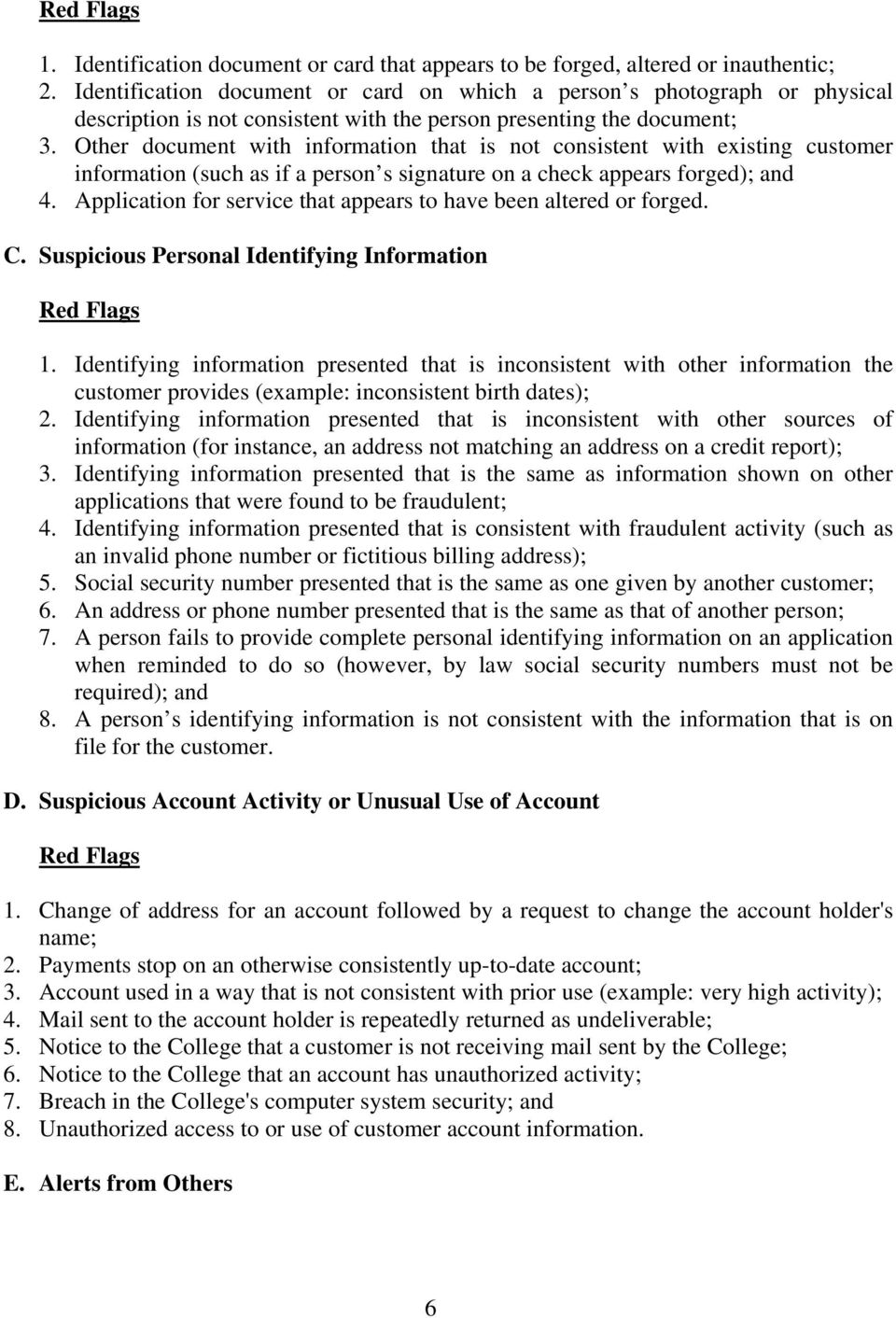
7 Red Flag Notice to the College from a customer, identity theft victim, law enforcement or other person that it has opened or is maintaining a fraudulent account for a person engaged in Identity Theft. VII. DETECTING RED FLAGS. A. New Accounts In order to detect any of the Red Flags identified above associated with the opening of a new account, College personnel will take the following steps to obtain and verify the identity of the person opening the account: B. Detect 1. Require certain identifying information such as name, date of birth, residential or business address, principal place of business for an entity, driver's license or other identification; 2. Verify the customer's identity (for instance, review a driver's license or other identification card); 3. Review documentation showing the existence of a business entity; and 4. Independently contact the customer. C. Existing Accounts In order to detect any of the Red Flags identified above for an existing account, College personnel will take the following steps to monitor transactions with an account: D. Detect 1. Verify the identification of customers if they request information (in person, via telephone, via facsimile, via ); 2. Verify the validity of requests to change billing addresses; and 3. Verify changes in banking information given for billing and payment purposes. VIII. PREVENTING AND MITIGATING IDENTITY THEFT In the event College personnel detect any identified Red Flags, such personnel shall take one or more of the following steps, depending on the degree of risk posed by the Red Flag: E. Prevent and Mitigate 1. Continue to monitor an account for evidence of Identity Theft; 7
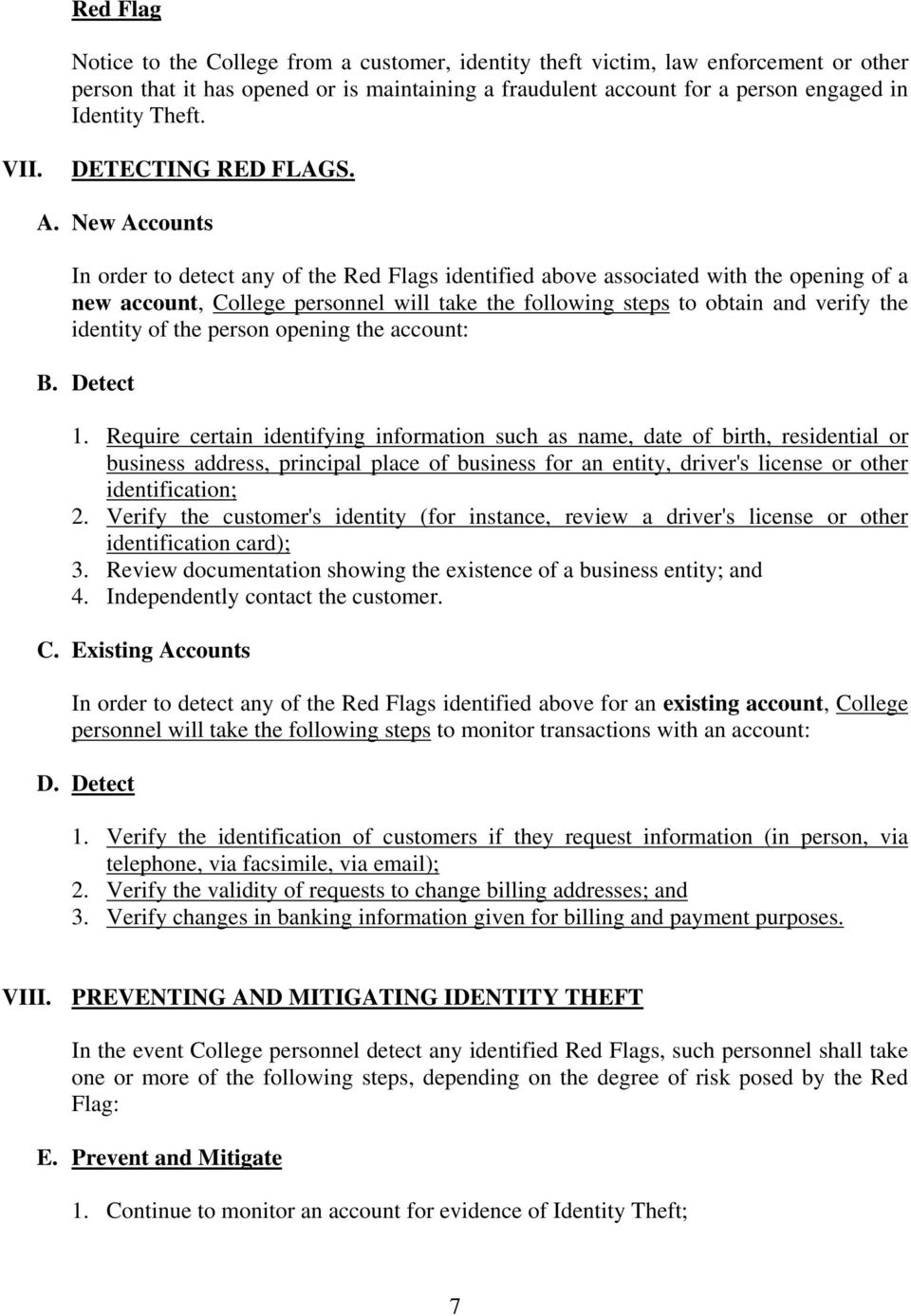
8 2. Contact the customer; 3. Change any passwords or other security devices that permit access to accounts; 4. Not open a new account; 5. Close an existing account; 6. Reopen an account with a new number; 7. Notify the Program Administrator for determination of the appropriate step(s) to take; 8. Notify law enforcement; or 9. Determine that no response is warranted under the particular circumstances. F. Protect customer identifying information In order to further prevent the likelihood of identity theft occurring with respect to College accounts, the College will take the following steps with respect to its internal operating procedures to protect customer identifying information: 1. Ensure that its website is secure or provide clear notice that the website is not secure; 2. Ensure complete and secure destruction of paper documents and computer files containing customer information; 3. Ensure that office computers are password protected and that computer screens lock after a set period of time; 4. Keep offices clear of papers containing customer information; 5. Request only the last 4 digits of social security numbers (if any); 6. Ensure computer virus protection is up to date; and require and keep only the kinds of customer information that are necessary for College purposes. 8

UNIVERSITY OF MASSACHUSETTS IDENTITY THEFT PREVENTION PROGRAM
 Doc. T08-109 Passed by the BoT 12/11/08 UNIVERSITY OF MASSACHUSETTS IDENTITY THEFT PREVENTION PROGRAM The Board recognizes that some activities of the University are subject to the provisions of the Fair
City of Hercules Hercules Municipal Utility Identity Theft Prevention Program
 City of Hercules Hercules Municipal Utility Identity Theft Prevention Program Purpose The purpose of the program is to establish an Identity Theft Prevention Program designed to detect, prevent and mitigate
Identity theft. A fraud committed or attempted using the identifying information of another person without authority.
 SUBJECT: Effective Date: Policy Number: Identity Theft Prevention 08-24-11 2-105.1 Supersedes: Page Of 2-105 1 8 Responsible Authority: Vice President and General Counsel DATE OF INITIAL ADOPTION AND EFFECTIVE
Travis County Water Control & Improvement District No. 17. Identity Theft Prevention Program. Effective beginning November 20, 2008
 Travis County Water Control & Improvement District No. 17 Identity Theft Prevention Program Effective beginning November 20, 2008 I. PROGRAM ADOPTION The Travis County Water Control and Improvement District
Wake Forest University. Identity Theft Prevention Program. Effective May 1, 2009
 Wake Forest University Identity Theft Prevention Program Effective May 1, 2009 I. GENERAL It is the policy of Wake Forest University ( University ) to comply with the Federal Trade Commission's ( FTC )
NEVADA SYSTEM OF HIGHER EDUCATION PROCEDURES AND GUIDELINES MANUAL CHAPTER 13 IDENTITY THEFT PREVENTION PROGRAM (RED FLAG RULES)
 NEVADA SYSTEM OF HIGHER EDUCATION PROCEDURES AND GUIDELINES MANUAL CHAPTER 13 IDENTITY THEFT PREVENTION PROGRAM (RED FLAG RULES) Section 1. NSHE... 2 Section 2. UNR... 4 Section 3. WNC... 9 Chapter 13,
Village of Brockport Identity Theft Prevention Program Effective December 1, 2009 Confirmed 7/21/14
 Village of Brockport Identity Theft Prevention Program Effective December 1, 2009 Confirmed 7/21/14 I. PROGRAM ADOPTION The Village of Brockport ( Village ) developed this Identity Theft Prevention Program
Oklahoma State University Policy and Procedures. Red Flags Rules and Identity Theft Prevention
 Oklahoma State University Policy and Procedures Rules and Identity Theft Prevention 3-0540 ADMINISTRATION & FINANCE July 2009 Introduction 1.01 Oklahoma State University developed this Identity Theft Prevention
CITY OF MARQUETTE, MICHIGAN CITY COMMISSION POLICY
 CITY OF MARQUETTE, MICHIGAN CITY COMMISSION POLICY Policy Number: 2008-02 Date Adopted: October 27, 2008 Department: Administrative SUBJECT: IDENTITY THEFT PREVENTION PROGRAM I. OBJECTIVE: A. To protect
Identity Theft Prevention Program
 Identity Theft Prevention Program DATE: 10/22/2015 VERSION 2015-1.0 Abstract Purpose of this document is to establish an Identity Theft Prevention Program designed to detect, prevent and mitigate identity
Texas A&M University Commerce. Identity Theft Prevention Program Effective beginning May 1, 2009
 Texas A&M University Commerce Identity Theft Prevention Program Effective beginning May 1, 2009 1 I. PROGRAM ADOPTION Texas A&M University - Commerce ( University ) developed this Identity Theft Prevention
IDENTITY THEFT DETECTION POLICY
 IDENTITY THEFT DETECTION POLICY Approved By: President s Cabinet Date of Last Revision: May 5, 2009 Responsible Office/Department: Business and Finance Policy Statement Grand Valley State University (GVSU)
University of Alaska. Identity Theft Prevention Program
 University of Alaska Identity Theft Prevention Program Effective beginning October 31, 2009 I. PROGRAM ADOPTION The University of Alaska ( University ) developed this Identity Theft Prevention Program
II. F. Identity Theft Prevention
 II. F. Identity Theft Prevention Effective Date: May 3, 2012 Revises Previous Effective Date: N/A, New Policy I. POLICY: This Identity Theft Prevention Policy is adopted in compliance with the Federal
21.01.04.Z1.01 Guideline: Identity Theft Prevention Program
 Texas A&M Health Science Center Guidelines 21.01.04.Z1.01 Guideline: Identity Theft Prevention Program Approved October 7, 2009 Reviewed February 26, 2015 Supplements System Regulation 21.01.04 Reason
Identity Theft Prevention Policy
 Eastern Kentucky University Policy and Regulation Library 6.#.#P Volume 6, Volume Title: Financial Affairs Chapter #, Chapter Title Section #, Name: Identity Theft Prevention Policy Approval Authority:
3344-19-01 Identity theft prevention program and red flag compliance policy.
 3344-19-01 Identity theft prevention program and red flag compliance policy. (A) Program adoption Cleveland state university has developed this identity theft prevention program ( program ) pursuant to
I. Purpose. Definition. a. Identity Theft - a fraud committed or attempted using the identifying information of another person without authority.
 Procedure 3.6: Rule (Identity Theft Prevention) Volume 3: Office of Business & Finance Managing Office: Office of Business & Finance Effective Date: December 2, 2014 I. Purpose In 2007, the Federal Trade
Florida International University. Identity Theft Prevention Program. Effective beginning August 1, 2009
 Florida International University Identity Theft Prevention Program Effective beginning August 1, 2009 I. PROGRAM ADOPTION Florida International University developed this Identity Theft Prevention Program
Number: 56.300. Index
 Identity Theft Prevention Program Section: General Operations Title: Identity Theft Prevention Program Number: 56.300 Index POLICY.100 POLICY STATEMENT.110 POLICY RATIONALE.120 AUTHORITY.130 APPROVAL AND
Ouachita Baptist University. Identity Theft Policy and Program
 Ouachita Baptist University Identity Theft Policy and Program Under the Federal Trade Commission s Red Flags Rule, Ouachita Baptist University is required to establish an Identity Theft Prevention Program
IDENTITY THEFT AND MUNICIPAL UTILITIES
 Minnesota Municipal Utilities Association IDENTITY THEFT AND MUNICIPAL UTILITIES Identity Theft and Red Flags Rule requirements The Red Flags Rule implements portions of the Fair and Accurate Credit Transactions
RANDOLPH COUNTY PUBLIC WORKS. Identity Theft Prevention Program. Adopted September 1, 2009 Effective beginning September 1, 2009
 RANDOLPH COUNTY PUBLIC WORKS Identity Theft Prevention Program Adopted September 1, 2009 Effective beginning September 1, 2009 I. PROGRAM ADOPTION The Randolph County Public Works Department ( the Department
Pacific University. Policy Governing. Identity Theft Prevention Program. Red Flag Guidelines. Approved June 10, 2009
 Pacific University Policy Governing Identity Theft Prevention Program Red Flag Guidelines Approved June 10, 2009 Program adoption Pacific University developed this identity Theft Prevention Program ( Program
DOYLESTOWN FAMILY MEDICINE, P.C. IDENTITY THEFT PREVENTION PROGRAM TEMPLATE ADOPTED AND EFFECTIVE: APRIL 15, 2009 UPDATED:
 DOYLESTOWN FAMILY MEDICINE, P.C. IDENTITY THEFT PREVENTION PROGRAM TEMPLATE ADOPTED AND EFFECTIVE: APRIL 15, 2009 UPDATED: I. Adoption of Identity Theft Prevention Program Doylestown Family Medicine, P.C.
Identification of Red Flags, Detecting Red Flags, and Preventing and Mitigating Identity Theft
 George Mason University Identity Theft Prevention Program - Procedures Revised September 30, 2012 Identification of, ing, and Preventing and Mitigating Identity Theft IDENTIFICATION OF COVERED ACCOUNT
RANDOLPH COUNTY EMERGENCY SERVICES & TAX DEPARTMENT. Identity Theft Prevention Program. Adopted August 3, 2009 Effective beginning August 1, 2009
 RANDOLPH COUNTY EMERGENCY SERVICES & TAX DEPARTMENT Identity Theft Prevention Program Adopted August 3, 2009 Effective beginning August 1, 2009 I. PROGRAM ADOPTION The Randolph County Emergency Services
Red Flag Rules Information and Training
 Red Flag Rules Information and Training What are Red Flag Rules? The Red Flag Rules: - Are enforced by the Federal Trade Commission (FTC), the federal bank regulatory agencies, and the National Credit
University of Tennessee's Identity Theft Prevention Program
 IDENTITY THEFT PREVENTION PROGRAM 1. BACKGROUND The University of Tennessee (UT) developed this Identity Theft Prevention Program pursuant to the Federal Trade Commission s Red Flags Rule, Section 114
Facts About FACTA Red Flag Identity Theft Prevention Program
 FACTA Red Flag Identity Theft Prevention Program FACTA Red Flag Policy Program, page 1 of 6 Contents Overview 3 Definition of Terms 3 Covered Accounts..3 List of Red Flags 3 Suspicious Documents...4 Suspicious
Red Flag Identity Theft Financial Policy 1.10
 Issued: 05/16/2014 Revised: Policy and College ( Seminary ) developed this Identity Theft Prevention Program ("Program") pursuant to the Federal Trade Commission's ( FTC ) Red Flags Rule, which implements
UNION COUNTY S IDENTITY THEFT PREVENTION PROGRAM
 UNION COUNTY S IDENTITY THEFT PREVENTION PROGRAM This program shall become effective November 1, 2008. Adopted this the 20 th day of October, 2008. I. PREFACE The purpose of this program is to detect,
University Identity Theft and Detection Program (NEW) All Campuses and All Service Providers Subject to the Red Flags Rule
 NUMBER: BUSF 4.12 SECTION: SUBJECT: Finance and Planning University Identity Theft and Detection Program (NEW) DATE: March 3, 2011 Policy for: Procedure for: Authorized by: Issued by: All Campuses and
IDENTITY THEFT PREVENTION PROGRAM TRAINING MODULE February 2009
 IDENTITY THEFT PREVENTION PROGRAM TRAINING MODULE February 2009 Table of Contents Introduction to the Training Module.. i I. Introduction. 1 II. Definitions. 3 III. Recognizing Identity Theft.. 6 IV. Identifying
Administrative Procedure 5800 Prevention of Identity Theft in Student Financial Transactions
 Reference: Fair and Accurate Credit Transactions Act, ( Pub. L. 108-159) The purpose of the Identity Theft Prevention Program (ITPP) is to control reasonably foreseeable risks to students from identity
PITTSBURGH CARE PARTNERSHIP, INC. COMMUNITY LIFE PROGRAM POLICIES AND PROCEDURES. Identity Theft Prevention Program Policy for Health Care Providers
 SUBJECT: Identity Theft Prevention Program Policy for Health Care Providers NUMBER: 1022 REG. REF.: Identity Theft Red Flags Rule (the Rule ), 16 C.F.R. 681, adopted by the Federal Trade Commission Adoption
IDENTITY THEFT PROCEDURES
 IDENTITY THEFT PROCEDURES FREQUENTLY ASKED QUESTIONS ABOUT IDENTITY THEFT INCIDENTS AND RED FLAGS Q1: How is a Red Flags incident different from a data security breach? A1: A data security breach is the
University Policy: Identity Theft Prevention Policy
 University Policy: Identity Theft Prevention Policy Policy Category: Ethics, Integrity and Legal Compliance Policies Subject: Detection, prevention and mitigation of identity theft Office Responsible for