
Respiratory Care. Provider Guide
|
|
|
- Kerrie Kelley
- 9 years ago
- Views:
Transcription

1 Provider Guide April 1, 2016

2 About this guide This publication takes effect April 1, 2016, and supersedes earlier guides to this program. Washington Apple Health means the public health insurance programs for eligible Washington residents. Washington Apple Health is the name used in Washington State for Medicaid, the children's health insurance program (CHIP), and stateonly funded health care programs. Washington Apple Health is administered by the Washington State Health Care Authority. What has changed? Subject Change Reason for Change All Fixed broken links, clarified language, etc. Housekeeping Important Effective April 1, 2016, important changes are Program changes Changes to Apple Health Effective April 1, 2016 taking place that all providers need to know. Information has been added regarding new policy for early enrollment into managed care, implementation of fully integrated managed care in SW WA Region, Apple Health Core Connections for Foster Children, Behavioral Health Organizations (formerly RSNs), and contact information for southwest Washington. Coverage Table Removed status code indicator D, N, and P because these types of changes are recorded in the What has Changed table. Obsolete indicators Billing EPA EPA Fee Schedule Removed the following HCPCS codes: A7011, E0450, E0460, E0461, E0463, E0464 Updated How do I complete the CMS-1500 claim form? Added EPA requirement for HCPCS codes E0465 and E0466 in the Coverage Table Added codes E0465and E0466 to the Expedited Prior Authorization (EPA) Criteria Table Changed the name of the program s fee schedule from Oxygen to throughout Discontinued codes Webinars no longer available Policy change Policy change Name change This publication is a billing instruction. 2

3 How can I get agency provider documents? To download and print agency provider notices and provider guides, go to the agency s Provider Publications website. Copyright disclosure Current Procedural Terminology (CPT) copyright 2015 American Medical Association (AMA). All rights reserved. CPT is a registered trademark of the AMA. Fee schedules, relative value units, conversion factors and/or related components are not assigned by the AMA, are not part of CPT, and the AMA is not recommending their use. The AMA does not directly or indirectly practice medicine or dispense medical services. The AMA assumes no liability for data contained or not contained herein. 3
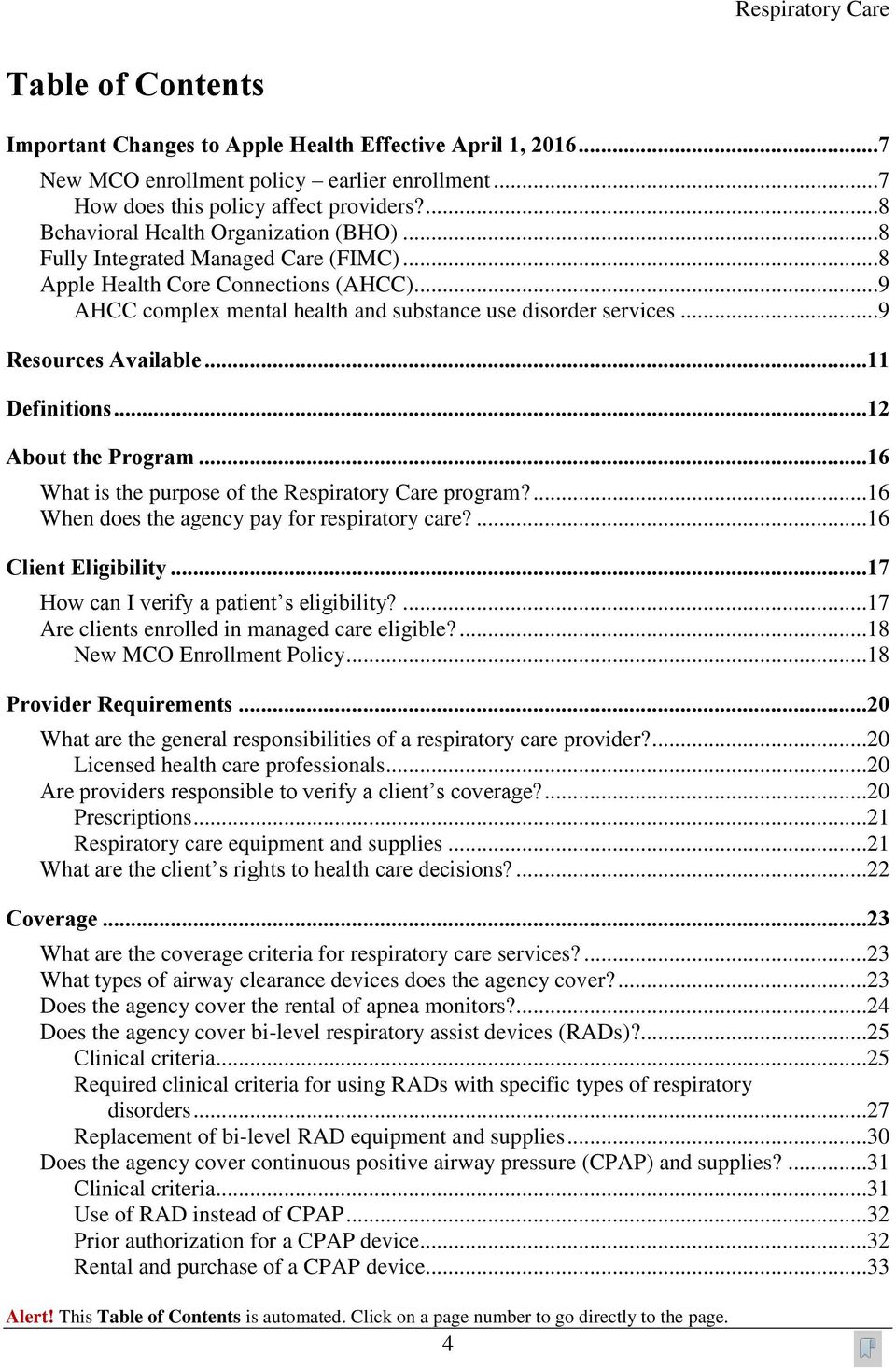
4 Table of Contents Important Changes to Apple Health Effective April 1, New MCO enrollment policy earlier enrollment...7 How does this policy affect providers?...8 Behavioral Health Organization (BHO)...8 Fully Integrated Managed Care (FIMC)...8 Apple Health Core Connections (AHCC)...9 AHCC complex mental health and substance use disorder services...9 Resources Available...11 Definitions...12 About the Program...16 What is the purpose of the program?...16 When does the agency pay for respiratory care?...16 Client Eligibility...17 How can I verify a patient s eligibility?...17 Are clients enrolled in managed care eligible?...18 New MCO Enrollment Policy...18 Provider Requirements...20 What are the general responsibilities of a respiratory care provider?...20 Licensed health care professionals...20 Are providers responsible to verify a client s coverage?...20 Prescriptions...21 Respiratory care equipment and supplies...21 What are the client s rights to health care decisions?...22 Coverage...23 What are the coverage criteria for respiratory care services?...23 What types of airway clearance devices does the agency cover?...23 Does the agency cover the rental of apnea monitors?...24 Does the agency cover bi-level respiratory assist devices (RADs)?...25 Clinical criteria...25 Required clinical criteria for using RADs with specific types of respiratory disorders...27 Replacement of bi-level RAD equipment and supplies...30 Does the agency cover continuous positive airway pressure (CPAP) and supplies?...31 Clinical criteria...31 Use of RAD instead of CPAP...32 Prior authorization for a CPAP device...32 Rental and purchase of a CPAP device...33 Alert! This Table of Contents is automated. Click on a page number to go directly to the page. 4
5 Replacement of CPAP equipment and supplies...33 Does the agency cover nebulizers and related compressors?...34 Does the agency cover oximeters?...35 Clinical criteria for enhanced oximeters...35 Does the agency cover oxygen?...35 Requirements for valid oxygen prescriptions...36 Coverage criteria for oxygen...37 Renting capped-rental oxygen systems and contents...38 Stationary and portable oxygen systems and contents...40 What types of services, equipment, and supplies does the agency not pay for?...41 Does the agency cover suction pumps and supplies?...41 Does the agency cover ventilator equipment and supplies?...42 Primary ventilator...42 Secondary (back-up) ventilators...43 Pressure support ventilators...43 Coverage Table...44 Apnea monitor and supplies...45 Continuous positive airway pressure system (CPAP)...46 IPPB machine and accessories...50 Nebulizers and accessories...50 Oxygen and oxygen equipment...54 Suction pump/supplies...64 Tracheostomy care supplies...65 Ventilators and related respiratory equipment...70 Miscellaneous...73 Miscellaneous equipment reimbursement...77 Authorization...79 What is prior authorization (PA)?...80 What are the criteria for PA?...80 What is the PA process?...81 Is PA required for repairs to client-owned equipment?...82 What is expedited prior authorization (EPA)?...83 What are the EPA criteria?...83 What is the EPA process?...84 What is a limitation extension (LE)?...84 What are the LE criteria?...84 What is the LE process?...85 Expedited prior authorization (EPA) criteria table...86 Noncovered Services...88 What types of services are not covered by the agency?...88 Reimbursement...89 What is the general payment for respiratory care?...89 Alert! This Table of Contents is automated. Click on a page number to go directly to the page. 5

6 Maximum allowable fees...89 Reimbursement rates...90 What does the agency not pay for?...91 How does the agency decide to rent or purchase equipment?...91 What does the agency pay when replacement of rental equipment and supplies is needed?...93 What rental equipment does the agency not pay for?...94 Does the agency pay for only new equipment?...94 When does the agency pay for new equipment on capped-rental items?...95 When does the agency pay for repairs on client-owned equipment?...95 Does the agency require PA for repairs of client-owned equipment?...96 What payment methodology does the agency use for the purchase of respiratory care equipment?...97 How does the agency establish monthly rental reimbursement rates for respiratory care equipment?...98 How does the agency establish daily rental payment rates for respiratory care equipment?...98 Where is the program fee schedule?...98 Billing and Claim Forms...99 What are the general billing requirements?...99 Billing with authorization numbers...99 Is information available to bill for clients eligible for both Medicare and Medicaid?...99 How does the agency handle third-party liability coverage? How do I complete the CMS-1500 claim form? How does a provider bill for supplies? Alert! This Table of Contents is automated. Click on a page number to go directly to the page. 6

7 Important Changes to Apple Health Effective April 1, 2016 These changes are important to all providers because they may affect who will pay for services. Providers serving any Apple Health client should always check eligibility and confirm plan enrollment by asking to see the client s Services Card and/or using the ProviderOne Managed Care Benefit Information Inquiry functionality (HIPAA transaction 270). The response (HIPAA transaction 271) will provide the current managed care organization (MCO), fee-for-service, and Behavioral Health Organization (BHO) information. A Provider FAQ is available online. New MCO enrollment policy earlier enrollment Beginning April 1, 2016, Washington Apple Health (Medicaid) implemented a new managed care enrollment policy placing clients into an agency-contracted MCO the same month they are determined eligible for managed care as a new or renewing client. This policy eliminates a person being placed temporarily in fee-for-service while they are waiting to be enrolled in an MCO or reconnected with a prior MCO. New clients are those initially applying for benefits or those with changes in their existing eligibility program that consequently make them eligible for Apple Health Managed Care. Renewing clients are those who have been enrolled with an MCO but have had a break in enrollment and have subsequently renewed their eligibility. Clients currently in fee-for-service or currently enrolled in an MCO are not affected by this change. Clients in fee-for-service who have a change in the program they are eligible for may be enrolled into Apple Health Managed Care depending on the program. In those cases, this enrollment policy will apply. 7

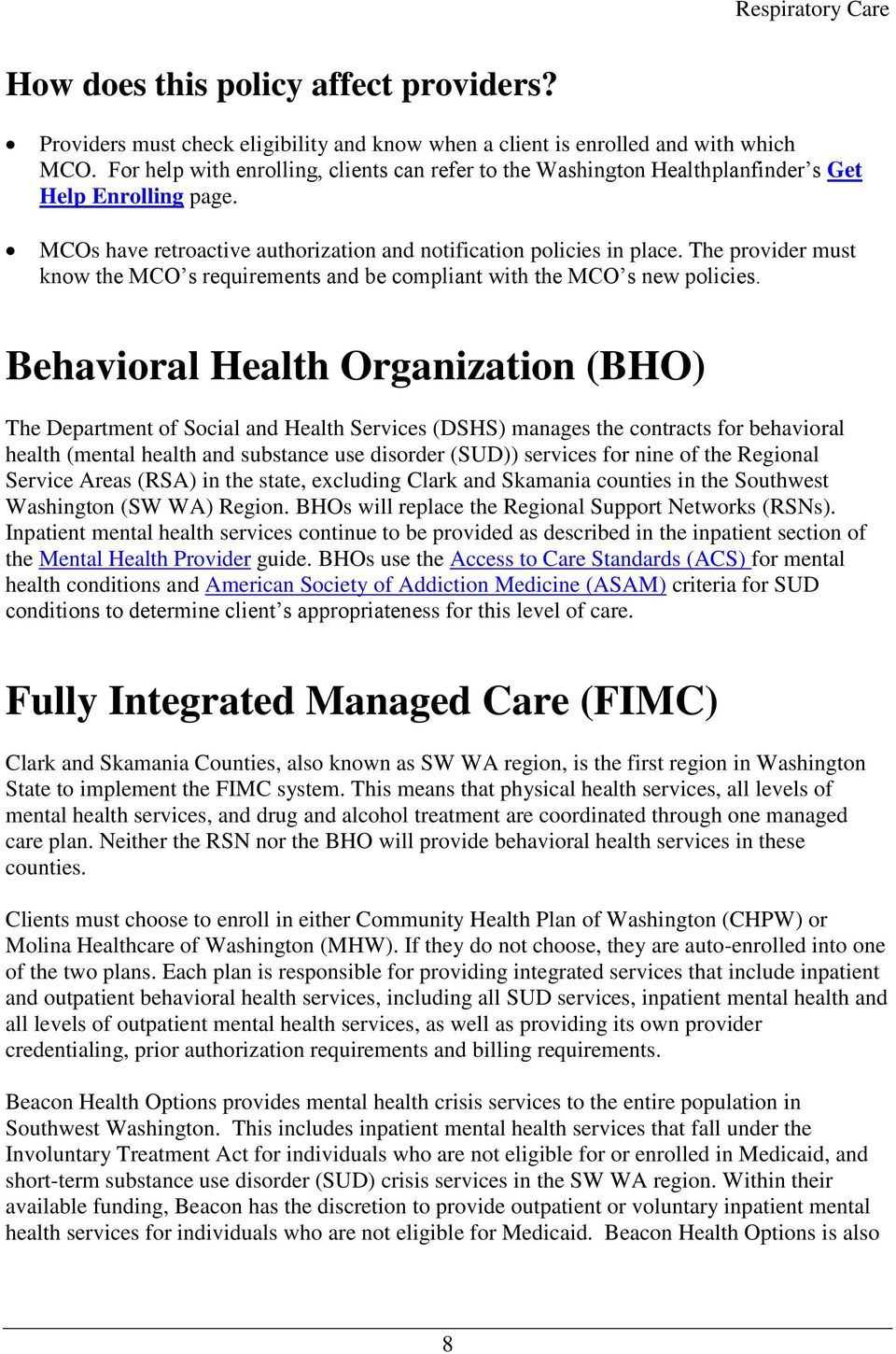
8 How does this policy affect providers? Providers must check eligibility and know when a client is enrolled and with which MCO. For help with enrolling, clients can refer to the Washington Healthplanfinder s Get Help Enrolling page. MCOs have retroactive authorization and notification policies in place. The provider must know the MCO s requirements and be compliant with the MCO s new policies. Behavioral Health Organization (BHO) The Department of Social and Health Services (DSHS) manages the contracts for behavioral health (mental health and substance use disorder (SUD)) services for nine of the Regional Service Areas (RSA) in the state, excluding Clark and Skamania counties in the Southwest Washington (SW WA) Region. BHOs will replace the Regional Support Networks (RSNs). Inpatient mental health services continue to be provided as described in the inpatient section of the Mental Health Provider guide. BHOs use the Access to Care Standards (ACS) for mental health conditions and American Society of Addiction Medicine (ASAM) criteria for SUD conditions to determine client s appropriateness for this level of care. Fully Integrated Managed Care (FIMC) Clark and Skamania Counties, also known as SW WA region, is the first region in Washington State to implement the FIMC system. This means that physical health services, all levels of mental health services, and drug and alcohol treatment are coordinated through one managed care plan. Neither the RSN nor the BHO will provide behavioral health services in these counties. Clients must choose to enroll in either Community Health Plan of Washington (CHPW) or Molina Healthcare of Washington (MHW). If they do not choose, they are auto-enrolled into one of the two plans. Each plan is responsible for providing integrated services that include inpatient and outpatient behavioral health services, including all SUD services, inpatient mental health and all levels of outpatient mental health services, as well as providing its own provider credentialing, prior authorization requirements and billing requirements. Beacon Health Options provides mental health crisis services to the entire population in Southwest Washington. This includes inpatient mental health services that fall under the Involuntary Treatment Act for individuals who are not eligible for or enrolled in Medicaid, and short-term substance use disorder (SUD) crisis services in the SW WA region. Within their available funding, Beacon has the discretion to provide outpatient or voluntary inpatient mental health services for individuals who are not eligible for Medicaid. Beacon Health Options is also 8
9 responsible for managing voluntary psychiatric inpatient hospital admissions for non-medicaid clients. In the SW WA region some clients are not enrolled in CHPW or Molina for FIMC, but will remain in Apple Health fee-for-service managed by the agency. These clients include: Dual eligible Medicare/Medicaid American Indian/Alaska Native (AI/AN) Medically needy Clients who have met their spenddown Noncitizen pregnant women Individuals in Institutions for Mental Diseases (IMD) Long-term care residents who are currently in fee-for-service Clients who have coverage with another carrier Since there is no BHO (RSN) in these counties, Medicaid fee-for-service clients receive complex behavioral health services through the Behavioral Health Services Only (BHSO) program managed by MHW and CHPW in SW WA region. These clients choose from CHPW or MHW for behavioral health services offered with the BHSO or will be auto-enrolled into one of the two plans. A BHSO fact sheet is available online. Apple Health Core Connections (AHCC) Coordinated Care of Washington (CCW) will provide all physical health care (medical) benefits, lower-intensity outpatient mental health benefits, and care coordination for all Washington State foster care enrollees. These clients include: Children and youth under the age of 21 who are in foster care Children and youth under the age of 21 who are receiving adoption support Young adults age 18 to 26 years old who age out of foster care on or after their 18 th birthday American Indian/Alaska Native (AI/AN) children will not be auto-enrolled, but may opt into CCW. All other eligible clients will be auto-enrolled. AHCC complex mental health and substance use disorder services AHCC clients who live in Skamania or Clark County receive complex behavioral health benefits through the Behavioral Health Services Only (BHSO) program in the SW WA region. These clients will choose between CHPW or MHW for behavioral health services, or they will be autoenrolled into one of the two plans. CHPW and MHW will use the BHO Access to Care Standards 9

10 to support determining appropriate level of care, and whether the services should be provided by the BHSO program or CCW. AHCC clients who live outside Skamania or Clark County will receive complex mental health and substance use disorder services from the BHO and managed by DSHS. Contact Information for Southwest Washington Beginning on April 1, 2016, there will not be an RSN/BHO in Clark and Skamania counties. Providers and clients must call the agency-contracted MCO for questions, or call Beacon Health Options for questions related to an individual who is not eligible for or enrolled in Medicaid. If a provider does not know which MCO a client is enrolled in, this information can located by looking up the patient assignment in ProviderOne. To contact Molina, Community Health Plan of Washington, or Beacon Health Options, please call: Molina Healthcare of Washington, Inc Community Health Plan of Washington Beacon Health Options Beacon Health Options

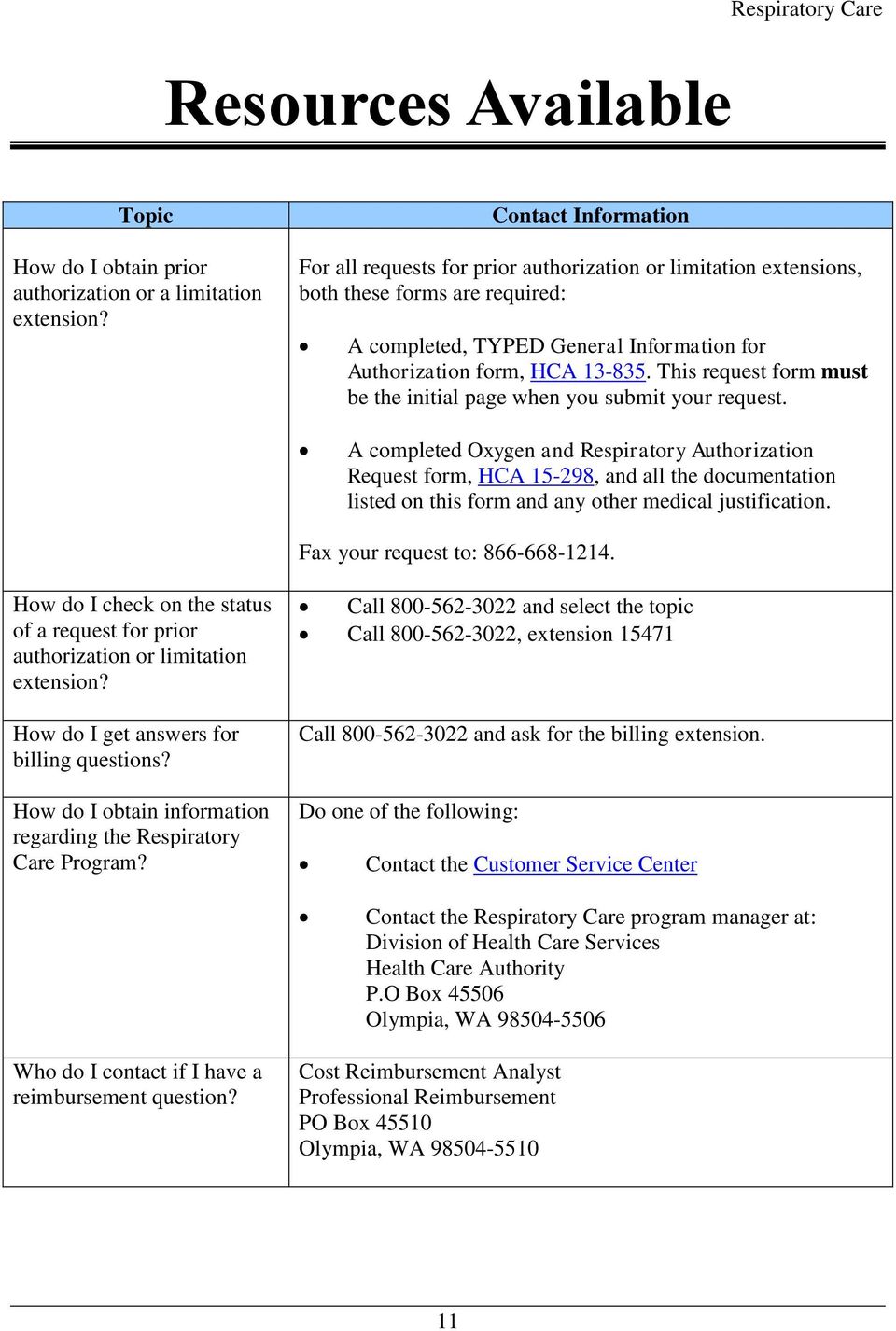
11 Resources Available Topic How do I obtain prior authorization or a limitation extension? Contact Information For all requests for prior authorization or limitation extensions, both these forms are required: A completed, TYPED General Information for Authorization form, HCA This request form must be the initial page when you submit your request. A completed Oxygen and Respiratory Authorization Request form, HCA , and all the documentation listed on this form and any other medical justification. Fax your request to: How do I check on the status of a request for prior authorization or limitation extension? How do I get answers for billing questions? How do I obtain information regarding the Respiratory Care Program? Call and select the topic Call , extension Call and ask for the billing extension. Do one of the following: Contact the Customer Service Center Contact the program manager at: Division of Health Care Services Health Care Authority P.O Box Olympia, WA Who do I contact if I have a reimbursement question? Cost Reimbursement Analyst Professional Reimbursement PO Box Olympia, WA
12 Definitions This section defines terms and abbreviations, including acronyms, used in this provider guide. Please refer to the Washington Apple Health Glossary for a more complete list of definitions. Adult Family Home A residential home licensed to care for up to six residents that provides rooms, meals, laundry, supervision, assistance with activities of daily living, and personal care. In addition to these services, some homes provide nursing or other special care and services. Apnea The cessation of airflow for at least ten seconds. Apnea-hypopnea index (AHI) The average number of episodes of apnea and hypopnea per hour of sleep without the use of a positive airway pressure device. For purposes of this chapter, respiratory effort related arousals (RERAs) are not included in the calculation. Arterial PaO2 Measurement of partial pressure of arterial oxygen. Authorized prescriber A health care practitioner authorized by law or rule in the state of Washington to prescribe oxygen and respiratory care equipment, supplies, and services. Bi-level respiratory assist device (RAD) with backup rate A device that allows independent setting of inspiratory and expiratory pressures to deliver positive airway pressure (within a single respiratory cycle) by way of tubing and a noninvasive interface (such as a nasal or oral facial mask) to assist spontaneous respiratory efforts and supplement the volume of inspired air into the lungs. In addition, these devices have a timed backup feature to deliver this air pressure whenever sufficient spontaneous inspiratory efforts fail to occur. Bi-level respiratory assist device (RAD) without backup rate A device that allows independent setting of inspiratory and expiratory pressures to deliver positive airway pressure (within a single respiratory cycle) by way of tubing and a noninvasive interface (such as a nasal, oral, or facial mask) to assist spontaneous respiratory efforts and supplement the volume of inspired air into the lungs. Blood gas study For this guide, either an oximetry test or an arterial blood gas test. Boarding Home Adult residential care (ARC) facility, enhanced adult residential care (EARC) facility, or assisted living (AL) facility. Capped rental Applies to certain oxygen equipment for in-home medical assistance clients After 36 months of rental by the provider, the equipment is considered capped (not reimbursed) for the next 24 months. (See Capped Rental Oxygen Systems and Contents.) 12

13 Central sleep apnea (CSA) Is defined as meeting all the following criteria: An apnea-hypopnea index (AHI) greater than or equal to 5. Central apneas/hypopneas greater than 50% of the total apneas/hypopneas. Central apneas or hypopneas greater than or equal to 5 times per hour. Symptoms of either excessive sleepiness or disrupted sleep. Chronic Obstructive Pulmonary Disease (COPD) Any disorder that persistently obstructs bronchial airflow. COPD mainly involves two related diseases chronic bronchitis and emphysema. Both cause chronic obstruction of air flowing through the airways and in and out of the lungs. The obstruction is generally permanent and worsens over time. Complex Sleep Apnea (CompSA) A form of central apnea specifically identified by the persistence or emergence of central apneas or hypopneas, upon exposure to CPAP or a bi-level respiratory assist device without a back-up rate feature, when obstructive events have disappeared. These clients have predominantly obstructive or mixed apneas. during the diagnostic sleep study occurring at greater than or equal to five times per hour. With use of a CPAP or bi-level respiratory assist device without a back-up rate feature, the client shows a pattern of apneas and hypopneas that meets the definition of central sleep apnea (CSA). Compressor A pump driven appliance that mechanically condenses atmospheric air into a smaller volume under pressure. In respiratory care therapy, it is used to forcefully nebulize liquid solutions or emulsions into a vapor state, or mist for inhalation. Concentrator A device that increases the concentration of oxygen from the air. Continuous Positive Airway Pressure (CPAP) A single-level device that delivers a constant level of positive air pressure (within a single respiratory cycle) by way of tubing and an interface to assist spontaneous respiratory efforts and supplement the volume of inspired air into the lungs. Dependent Edema Fluid in the tissues, usually ankles, wrists, and the arms. Emergency Oxygen The immediate, short-term administration of oxygen to a client who normally does not receive oxygen, but is experiencing an acute episode that requires oxygen. Erythrocythemia More hematocrit (red blood cells) than normal, making it very difficult to oxygenate those cells. FIO2 The fractional concentration of oxygen delivered to the client for inspiration. For the purpose of this policy, the client s prescribed FIO2 refers to the oxygen concentration the client normally breathes when not undergoing testing to qualify for coverage of a Respiratory Assist Device (RAD). That is, if the client does not normally use supplemental oxygen, their prescribed FIO2 is that found in room air. FEV1 The forced expired volume in 1 second. FVC The forced vital capacity. Group I Clinical criteria, set by Medicare, to identify chronic oxygen clients with obvious respiratory challenges as evidenced by low oxygen saturation. (For specific clinical criteria, see Coverage Criteria for Oxygen.) 13
14 Group II Clinical criteria, set by Medicare, to identify borderline oxygen clients. Their blood saturation levels seem to be within the normal range, but additional extenuating issues suggest a need for oxygen. (For specific clinical criteria, see Coverage Criteria for Oxygen.) Home and Community Residential Settings In-home, adult family home, or boarding home. Hypopnea A temporary reduction of airflow lasting at least ten seconds and accompanied with a 30% reduction in thoracoabdominal movement or airflow as compared to baseline, and with at least a 4% decrease in oxygen saturation. The AHI is the average number of episodes of apnea and hypopnea per hour of sleep without the use of a positive airway pressure device. Hypoxemia Less than normal level of oxygen in the blood. Month For the purposes of this guide, means 30 days. Nebulizer A medical device that administers drugs for inhalation therapy for clients with respiratory conditions such as asthma or emphysema. Obstructive sleep apnea (OSA) This syndrome refers to the interruption of breathing during sleep, due to obstructive tissue in the upper airway that collapses into the air passage with respiration. This may occur several hundred times a night and is thought to cause many symptoms, such as depression, irritability, sexual dysfunction, learning and memory difficulties, and the frequent complaint of excessive daytime sleepiness. Oxygen Medical grade liquid oxygen or compressed gas. Oxygen Concentrator A medical device that removes nitrogen from room air and retains almost pure oxygen (87 95%) for delivery to a client. Oxygen System All equipment necessary to provide oxygen to a client. Portable Oxygen System A system that allows the client to be independent of the stationary system for several hours, thereby providing mobility for the client. Pulmonary hypertension High blood pressure in the vessels that feed through the lungs, causing the right side of the heart to work harder to oxygenate blood. RAD Respiratory assist device Reasonable Useful Lifetime (RUL) Refers to the 36-month capped rental oxygen equipment; the RUL is 5 years. The RUL is not based on the chronological age of the equipment. It starts on the initial date of service and runs for 5 years from that date. The care of a client with respiratory needs and all related equipment, oxygen, services and supplies. Practitioner A person licensed by the Department of Health according to chapter RCW and chapter WAC as a respiratory therapist (RT) or respiratory care practitioner (RCP). 14

15 Respiratory Effort Related Arousals (RERA) These occur when there is a sequence of breaths that lasts at least ten seconds, characterized by increasing respiratory effort or flattening of the nasal pressure waveform, which lead to an arousal from sleep. However, they do not meet the criteria of an apnea or hypopnea. The degree to which RERAs are associated with the same sequelae as apneas and hypopneas is unknown, although clients with only RERAs can be symptomatic in terms of excessive daytime sleepiness. Ventilator A device to provide breathing assistance to clients with neuromuscular diseases, thoracic restrictive diseases, or chronic respiratory failure consequent to chronic obstructive pulmonary disease. It includes both positive and negative pressure devices. Restrictive Thoracic Disorders This refers to a variety of neuromuscular and anatomical anomalies of the chest/rib cage area that may result in hypoventilation, particularly while the client sleeps at night. Nocturnal hypoventilation is associated with a host of health hazards and also can significantly impact the quality of life for these clients. The use of noninvasive positive pressure respiratory assist devices has been found helpful in reducing the episodes of nocturnal hypoventilation and the associated complications for a significant number of those clients who are able to use the device. RUL Also called Reasonable Useful Lifetime. Stationary Oxygen System Equipment designed to be used in one location, generally for the purpose of continuous use or frequent intermittent use. 15

16 (WAC ) About the Program What is the purpose of the program? The purpose of the program is to provide medically necessary respiratory care equipment, services, and supplies to eligible agency clients who are not enrolled in a managed care plan and reside in: A home. A community residential setting. A skilled nursing facility. When does the agency pay for respiratory care? The agency pays for respiratory care when it is: Covered. Within the scope of the eligible client s medical care program. Medically necessary, as defined under WAC Prescribed by a physician, advanced registered nurse practitioner (ARNP), or physician assistant certified (PAC) within the scope of licensure. Authorized, as required within chapters , , and WAC, and this provider guide. Billed according to this provider guide. Provided and used within accepted medical or respiratory care community standards of practice. The respiratory care services, equipment, and supplies described in this guide are considered part of the agency s durable medical equipment (DME) benefit. 16

17 Client Eligibility How can I verify a patient s eligibility? Providers must verify that a patient has Washington Apple Health coverage for the date of service, and that the client s benefit package covers the applicable service. This helps prevent delivering a service the agency will not pay for. Verifying eligibility is a two-step process: Step 1. Verify the patient s eligibility for Washington Apple Health. For detailed instructions on verifying a patient s eligibility for Washington Apple Health, see the Client Eligibility, Benefit Packages, and Coverage Limits section in the agency s current ProviderOne Billing and Resource Guide. If the patient is eligible for Washington Apple Health, proceed to Step 2. If the patient is not eligible, see the note box below. Step 2. Verify service coverage under the Washington Apple Health client s benefit package. To determine if the requested service is a covered benefit under the Washington Apple Health client s benefit package, see the agency s Health Care Coverage Program Benefit Packages and Scope of Service Categories web page. Note: Patients who are not Washington Apple Health clients may submit an application for health care coverage in one of the following ways: 1. By visiting the Washington Healthplanfinder s website at: 2. By calling the Customer Support Center toll-free at: 855-WAFINDER ( ) or (TTY). 3. By mailing the application to: Washington Healthplanfinder PO Box 946 Olympia, WA In-person application assistance is also available. To get information about inperson application assistance available in their area, people may visit or call the Customer Support Center. 17

18 Are clients enrolled in managed care eligible? (WAC (2)) Yes. Respiratory care services, equipment and supplies are covered under the agency-contracted managed care organization (MCO) when the services are medically necessary. All services must be requested directly through the client s MCO. Providers can verify a client s managed care enrollment through the ProviderOne client benefit inquiry screen. Clients may contact their MCO by calling the telephone number provided to them. The MCO is responsible for: Payment of covered services. Payment of services referred by a provider participating with the plan to an outside provider. New MCO Enrollment Policy Beginning April 1, 2016, Washington Apple Health (Medicaid) implemented a new managed care enrollment policy that places clients into an agency-contracted MCO the same month they are deemed eligible as a new or renewing client. This new policy eliminated a person being placed temporarily in fee-for-service while they are waiting to be enrolled in an MCO or reconnected with a prior MCO. New clients are those initially applying for benefits or those with changes in their existing eligibility program that consequently make them eligible for Apple Health Managed Care. Renewing clients are those who have been enrolled with an MCO but have had a break in enrollment and have subsequently renewed their eligibility. Clients currently in fee-for-service or currently enrolled in an MCO are not affected by this change. Clients in fee-for-service who have a change in their eligibility program may be enrolled into Apple Health Managed Care depending on the program. In those cases, the new enrollment policy will apply. How does this policy affect providers? Providers must know when a client is effectively enrolled and with which MCO. For help with enrolling, clients can refer to the Washington Healthplanfinder s Get Help Enrolling page. 18

19 Although MCOs will have retroactive authorization and notification policies in place for these situations, the provider must know these requirements and be compliant with the MCO s new policies. Note: To prevent billing denials, check the client s eligibility before scheduling services, and at the time of the service to make sure proper authorization or referral is obtained from the plan. See the agency s ProviderOne Billing and Resource Guide for instructions on how to verify a client s eligibility. 19

20 Provider Requirements What are the general responsibilities of a respiratory care provider? (WAC ) This section includes general responsibilities for respiratory care providers. More specific requirements are described in different sections of this guide. Providers must meet the general provider requirements in chapters and WAC and this provider guide. Licensed health care professionals The agency requires that respiratory care providers employ a licensed health care professional whose scope of practice allows providing respiratory care, including: Checking equipment to meet the client s initial and ongoing needs. Communicating with the client s authorized prescriber about any concerns or recommendations. (See WAC (1) and the Department of Health s licensing requirements) Are providers responsible to verify a client s coverage? Providers must verify the client s eligibility in ProviderOne before providing services. If ProviderOne indicates the client is enrolled in a managed care plan, contact the client s MCO for all coverage conditions and limits on services. (See Client Eligibility). Bill the agency the usual and customary fee for clients not in managed care and residing at home, in a skilled nursing facility or in a community residential setting. Note: Also, see What are the client's rights for health care decisions? 20

21 Prescriptions Respiratory care providers must: Keep initial and subsequent prescriptions in the client s record. Verify that the client has a valid prescription. (See WACs and ). To be valid, a prescription must: Be written, signed, and dated by a Medicaid-enrolled physician, advanced registered nurse practitioner (ARNP), or physician s assistant certified (PAC). State the specific items or services requested, including the quantity, frequency, and duration/length of need. Note: Prescriptions that state only as needed or PRN are not sufficient. For an initial prescription, not be older than three months from the date the prescriber signed the prescription. For subsequent prescriptions, not be older than one year from the date the prescriber signs the prescription. (For more details about oxygen prescriptions, see Requirements for Valid Oxygen Prescriptions.) Respiratory care equipment and supplies Respiratory care providers must: Obtain prior authorization (PA) from the agency, if required, before delivering respiratory care equipment and supplies to the client and billing the agency. Make regular deliveries of medically necessary oxygen to the client s home, skilled nursing facility, community residential facility. Provide instructions to the client and the client s caregiver on the safe and proper use of the equipment provided. Maintain all rental equipment in good working condition on a continuous (24 hours a day, seven days a week) basis. 21
22 Furnish proof of direct delivery of equipment to a client or a client s authorized representative when requested by the agency. Proof of delivery must include: The client s name. Detailed description of the item(s) delivered, including the quantity, brand name, and serial number. A signature and date by the client (or client s authorized representative) when the item was received. (See WAC ). Provide a minimum warranty period of one year for all client-owned medical equipment (excluding disposable/non-reusable supplies). Keep a copy of all warranties in the client s file including date of purchase, applicable serial number, model number or other unique identifier of equipment, and warranty period and provide them to the agency upon request. If the warranty expires, information must include the date of purchase and the warranty period. (See WAC ). Note: Under WAC , the agency does not pay for respiratory care equipment or supplies when the authorized prescriber providing a client s evaluation or an item s medical justification also has a financial relationship with the provider, including employment or a contract. What are the client s rights to health care decisions? (42 CFR ) All Medicare-Medicaid certified hospitals, nursing facilities, home health agencies, personal care service agencies, hospices, and managed health care organizations are federally mandated to give all adult clients written information about their rights, under state law, to make their own health care decisions. Clients have the right to: Accept or refuse medical treatment. Make decisions concerning their own medical care. Prepare an advance directive, such as a living will or durable power of attorney, for their health care. 22
23 Coverage What are the coverage criteria for respiratory care services? This section describes general clinical criteria and policies for respiratory care services, equipment and supplies. Inhalation drugs and solutions are included in the Medicaid prescription drug program (see Chapter WAC). Note: Requests do not require prior authorization (PA) when meeting the clinical criteria for covered respiratory care for Medicaid clients. When requests do not meet the clinical criteria, as specified in this guide including those associated with expedited prior authorization (EPA) PA is required. The agency evaluates requests requiring PA on a case-by-case basis to determine whether they are medically necessary. (See WAC (4) and (5) and WAC ). For more details about PA requests, including EPA and limitation extension, see Authorization. For details about specific items, see the Coverage Table. The coverage table lists equipment and supplies with: Associated codes. Any authorization requirements (PA and EPA). Any limits and specific comments per code. What types of airway clearance devices does the agency cover? (WAC ) Clinical criteria Chest physiotherapy (CPT), also known as percussion and postural drainage (P/PD), is traditionally seen as the standard of care of secretion clearance methods. However, there are client instances when conventional manual CPT is unavailable, ineffective, or not tolerated. The agency covers the following types of airway clearance devices when medically necessary for a person with a diagnosis characterized by excessive mucus production and difficulty clearing secretions: 23
24 Mechanical percussors Oscillatory positive expiratory pressure devices Positive expiratory pressure devices Cough stimulating devices, including replacement batteries, alternating positive and negative airway pressure High frequency chest wall oscillation air-pulse generator system For specific details about items covered, see Miscellaneous in the Coverage Table. Does the agency cover the rental of apnea monitors? (WAC ) Clinical criteria The agency covers, without PA, the rental of an apnea monitor with recording feature for a maximum of six months when: The vendor has a licensed clinician who: Is competent in pediatric respiratory care Is responsible for managing the client s apnea monitoring The client is less than one year of age and meets at least one of the following clinical criteria: Born less than 37-weeks gestation, and the infant is not more than 43 weeks corrected gestational age Had an apparent life-threatening apneic event (defined as requiring mouth-tomouth resuscitation or vigorous stimulation) Has been diagnosed with bradycardia and is being treated with caffeine, theophylline, or other stimulating agents Has documented gastro-esophageal reflux, which results in apnea, bradycardia, or oxygen desaturation Has documented apnea greater than 20 seconds in duration Has apnea for periods less than 20 seconds in duration and accompanied by bradycardia, cyanosis, or pallor 24
25 Has bradycardia (defined as heart rate less than 100 beats per minute) Has oxygen desaturation below 90% Has neurologic/anatomic/metabolic or respiratory diseases affecting respiratory drive Is a subsequent sibling of an infant who died of sudden infant death syndrome (SIDS) until the client is one month older than the age at which the earlier sibling died, and the client remains event-free For each subsequent rental period: The client must continue to meet the clinical criteria for apnea monitors. The vendor must obtain PA from the agency. The vendor must document the results of the use of the apnea monitor in the client s records. For specific details about items covered, see Apnea Monitor and Supplies in the Coverage Table. Does the agency cover bi-level respiratory assist devices (RADs)? (WAC ) Clinical criteria The agency covers, without PA, one bi-level respiratory assist device (RAD), with or without a back-up rate feature, per client every five years as long as the following criteria are met: The bi-level device has a data card. The client has one of the following conditions and meets the specific clinical criteria specified in this section: Restrictive thoracic disorders (such as neuromuscular diseases or severe thoracic cage abnormalities) Severe chronic obstructive pulmonary disease (COPD) Central or complex sleep apnea Hypoventilation syndrome PA is required for Bi-Level RADs if either: The client does not meet the required clinical criteria. 25
26 The agency has purchased a CPAP device or other RAD for the client within the last five years. Bi-level RAD without the back-up rate feature For a bi-level RAD without the back-up rate feature, the agency: Pays for rental of the device during an initial three month period. The treating authorized prescriber must: Conduct a face-to-face clinical re-evaluation of the client between day 31 and day 91 of the rental period. In order to continue rental of the device, document the following items in the client s file to show: The progress of the client s relevant symptoms. The client s compliance with using the device. Purchases the device after the requirements for the rental are met. Bi-level RAD with the back-up rate feature For a bi-level RAD with the back-up rate feature used with an invasive interface, the agency pays for the rental only. For a bi-level RAD with the back-up rate feature used with a noninvasive interface, the agency: Pays for rental of the device during an initial three-month period. The treating authorized prescriber must: Conduct a face-to-face clinical re-evaluation of the client between 31 and 91 days of the rental period. In order to continue rental of the device, document the following items in the client s file to show: The progress of the client s relevant symptoms. The client s compliance with using the device. Purchases after a total of 13 months of rental. 26
27 Required clinical criteria for using RADs with specific types of respiratory disorders Type of Respiratory Disorder Restrictive Thoracic Disorders Type of Device Paid by Agency PA Required Clinical Criteria Bi-level RAD device with or without back-up rate feature No when all clinical criteria are met The client has been diagnosed with a neuromuscular disease, such as amyotrophic lateral sclerosis (ALS) or a severe thoracic cage abnormality (for example, post-thoracoplasty for tuberculosis). Chronic obstructive pulmonary disease (COPD) does not contribute significantly to the person s pulmonary limitation. The client also meets one or more of these clinical criteria: An arterial blood gas PaCO 2, done while awake and breathing the client s prescribed FIO 2 (fractionated inspired oxygen concentration) is 45 mm Hg. Sleep oximetry demonstrates an oxygen saturation 88% for 5 minutes of nocturnal recording time (minimum record time of 2 hours), done while breathing the client s prescribed recommended FIO 2. For a neuromuscular disease (only), either: Maximal inspiratory pressure is < 60 cm H2O. Forced vital capacity is 50% predicted. Severe Chronic Obstructive Pulmonary Disease (COPD) Bi-level RAD device without back-up rate feature No when all clinical criteria are met The client meets all these clinical criteria: An arterial blood gas PaCO 2, done while awake and breathing the client s prescribed FIO 2, is 52 mm Hg. Sleep oximetry demonstrates oxygen saturation 88% for 5 minutes of nocturnal recording time (minimum recording time of 2 hours), done while breathing oxygen at 2 LPM or the client s prescribed FIO 2 (whichever is higher). Before initiating therapy, obstructive sleep apnea and treatment with CPAP has been considered and ruled out. 27
28 Type of Respiratory Disorder COPD (cont.) Type of Device Paid by Agency PA Required Clinical Criteria Bi-level RAD device with the back-up rate feature No when all clinical criteria are met Started any time after the initial use of the bi-level RAD without the backup rate feature when both these clinical criteria are met: An arterial blood gas PaCO 2, done while awake and breathing, the client s prescribed FIO 2 shows that the client s PaCO 2, worsens 7 mm Hg compared to the original result from using the bilevel RAD without the back-up rate feature. A facility-based PSG demonstrates oxygen saturation 88% for 5 minutes of nocturnal recording time (minimum recording time of 2 hrs) while using a bi-level RAD without the back-up feature. (Not caused by obstructive upper airway events that is, AHI less than 5). -OR- Started at a time no sooner than 61 days after initial use of the bi-level RAD without the back-up rate feature when both these clinical criteria are met: An arterial blood gas PaCO 2, done while awake and breathing, the client s prescribed FIO 2 still remains 52 mm Hg. Sleep oximetry while breathing with the bi-level RAD without the back-up rate demonstrates oxygen saturation 88% for 5 minutes of nocturnal recording time (minimum recording time of 2 hrs), done while breathing oxygen at 2 LPM or the client s prescribed FIO 2, whichever is higher. Central or Complex Sleep Apnea (not due to airway obstruction) Bi-level RAD device with or without the back-up rate feature No when the client s polysomnogram test meets clinical criteria The client s polysomnogram test reveals both: The diagnosis of central sleep apnea (CSA) or complex sleep apnea (CompSA). Significant improvement of the sleep-associated hypoventilation with the use of a bi-level RAD device with or without the back-up rate feature on the settings that will be prescribed for initial use at home, while breathing the client s usual FIO 2. 28
29 Type of Respiratory Disorder Obstructive Sleep Apnea (OSA) Type of Device Paid by Agency PA Required Clinical Criteria Bi-level RAD device without the back-up rate feature No when all clinical criteria are met The client meets the clinical criteria for a CPAP. However, the CPAP has been tried and proven ineffective. Ineffective in this case, is defined as documented failure to meet therapeutic goals using a CPAP during either: The titration portion of a facility-based study. Home use despite optimal therapy (that is, proper mask selection and fitting and appropriate pressure setting). Hypoventilatio n Syndrome Bi-level RAD device without the back-up rate feature No when all the clinical criteria are met. The client meets one of these three sets of clinical criteria: An initial arterial blood gas PaCO2, done while awake and breathing the client s prescribed FIO 2, to 45 mm Hg. Spirometry shows an FEV1/FVC to 70% and an FEV1 50% of predicted. -OR- An arterial blood gas PaCO2, done during sleep or immediately upon awakening, and breathing the client s prescribed FIO 2, shows the client s PaCO2 worsened to 7 mm Hg compared to the original result. -OR- A facility-based PSG demonstrates oxygen saturation 88% for to 5 continuous minutes of nocturnal recording time (minimum recording time of 2 hours) that is not caused by obstructive upper airway events that is, AHI less than 5. 29
30 Type of Respiratory Disorder Hypoventilatio n Syndrome (cont.) Type of Device Paid by Agency PA Required Clinical Criteria Bi-level RAD device with the back-up rate feature No- when all the clinical criteria are met. The client meets both of these clinical criteria: A covered bi-level RAD without the back-up rate feature is being used. Spirometry shows an FEV1/FVC 70% and an FEV1 50% of predicted. The client also meets one of these clinical criteria: An arterial blood gas PaCO2, done while awake and breathing the client s prescribed FIO2, shows that the client s PaCO2 worsens 7 mm Hg compared to the ABG result performed to qualify the client for the bi-level RAD without the back-up rate feature. -OR- A facility-based PSG demonstrates oxygen saturation to 88% percent for 5 continuous minutes of nocturnal recording time (minimum recording time of 2 hours) that is not caused by obstructive upper airway events that is, AHI less than 5 while using a bi-level RAD without the backup rate feature. Replacement of bi-level RAD equipment and supplies PA is required for the replacement of a bi-level RAD device if the client has had the device for less than five years. After five years, the client s authorized prescriber must conduct a face-to-face evaluation documenting that the client continues to use and benefit from the bi-level RAD device. A new polysmnogram (PSG) (sleep test), trial period, or PA is not required. The agency pays for replacement supplies for a bi-level RAD device, as identified in the Coverage Table. For specific details about items covered, see Continuous Positive Airway Pressure System and Ventilators and Related Respiratory Equipment in the Coverage Table. The agency does not cover accessories or services not specifically identified in this guide. 30
31 Does the agency cover continuous positive airway pressure (CPAP) and supplies? (WAC ) Clinical criteria The agency covers, without PA, one continuous positive airway pressure (CPAP) device including related supplies, per client, every five years as long as all the following criteria are met: The client is diagnosed with obstructive sleep apnea using a clinical evaluation and a positive attended polysomnogram (PSG) performed in a sleep laboratory. Notes: Unattended home sleep studies do not meet the clinical criteria for reimbursement. The agency does not pay for a CPAP device when the client is diagnosed with upper airway resistance syndrome (UARS). CPAP is the least costly, most effective treatment modality. The CPAP device has a data card and is FDA approved. The item requested is not included in any other reimbursement methodology such as the diagnosis-related group (DRG). Additional criteria for clients age 13 and older The client s polysomnogram demonstrates an apnea-hypopnea index (AHI) 15 events per hour with a minimum of 30 events. -OR- The client s PSG demonstrates the AHI is 5 and 14 events per hour with a minimum of 10 events and clinical documentation of one of the following: Excessive daytime sleepiness, impaired cognition, mood disorders, or insomnia. Hypertension, ischemic heart disease, or history of stroke. Additional criteria for clients age 12 and younger Clinical criteria must include: A documented diagnosis of obstructive sleep apnea (OSA). A PSG that demonstrates an apnea index (AI) or apnea-hypopnea index (AHI) 1 and one of the following: 31
32 Adenotonsillectomy has been unsuccessful in relieving OSA Adenotonsillar tissue is minimal Adenotonsillectomy is inappropriate based on OSA being attributable to another underlying cause (such as craniofacial anomaly or obesity) or adenotonsillectomy is contraindicated The client s family does not wish to pursue surgical intervention Note: The AHI is calculated on the average number of events per hour. If the AHI is calculated based on less than two hours of sleep or recording time, the total number of recorded events used to calculate the AHI must be at least the number of events that would have been required in a two-hour period (that is, must reach at least 30 events without symptoms or at least 10 events with symptoms). Use of RAD instead of CPAP If a client meets the criteria for CPAP, but a CPAP device has been tried and proven ineffective, the agency will cover a bi-level RAD without the back-up. Ineffective, in this case, means documented failure to meet therapeutic goals using a CPAP during either: The titration portion of a facility-based study. Home use despite optimal therapy (that is, proper mask selection and fitting and appropriate pressure setting). Prior authorization for a CPAP device PA is required for a CPAP device if either: The client does not meet the required clinical criteria. The agency has purchased either a CPAP or a bi-level RAD device for the client within the last five years. 32
33 Rental and purchase of a CPAP device After the initial three-month rental period for a CPAP device, the agency will consider purchasing this device for the client. Note: The provider must submit a purchase request to the agency. The following documentation of clinical benefit must be recorded in the client s file: A face-to-face clinical re-evaluation of the client by the authorized prescriber, which documents that symptoms of obstructive sleep apnea are improved. A review of objective evidence by the authorized prescriber of the client s adherence* to use of the CPAP device. *Adherance is defined as use of the CPAP device 4 hours per night on 70% of nights during a consecutive 30-day period anytime during the first 3 months of initial usage. For specific details about CPAP-related covered items, see Continuous Positive Airway Pressure System in the Coverage Table. Replacement of CPAP equipment and supplies PA is required for the replacement of a CPAP device if the client has had the device for less than five years. After five years, the client s treating authorized prescriber must conduct a face-to-face evaluation documenting that the client continues to use and benefit from the CPAP device. A new PSG (sleep test), trial period, or PA is not required. The agency pays for replacement supplies for a CPAP device, as identified in Continuous Positive Airway Pressure System in the Coverage Table. 33
34 Does the agency cover nebulizers and related compressors? (WAC ) Clinical criteria The agency covers, without PA, the purchase of a nebulizer and related compressor, with limits, when the following clinical criteria are met. The small volume nebulizer and related compressor are covered for administering inhalation drugs for: The management of obstructive pulmonary disease. A client with cystic fibrosis or bronchiectiasis. A client with HIV, pneumocystosis, or complications of organ transplants. Persistent, thick, or tenacious pulmonary secretions. The large volume nebulizer and related compressor to deliver humidity to a client who has thick, tenacious secretions and has: Cystic fibrosis. Bronchiestasis. A tracheostomy. A tracheobronchial stent. The filtered nebulizer when necessary to administer pentamidine to clients with HIV, pneumocystosis, or complications of organ transplants. The agency does not pay for a large volume nebulizer, related compressor/generator, and water or saline when used predominantly to provide room humidification. For specific details about items covered, see Nebulizer and Accessories in the Coverage Table. 34
35 Does the agency cover oximeters? (WAC ) Clinical criteria for standard oximeters The agency covers the purchase of standard oximeters, without PA, for clients age 17 or younger in the home when the client: Has chronic lung disease and is on supplemental oxygen. Has a compromised or artificial airway. Has chronic lung disease requiring a ventilator or a bi-level RAD. PA is needed for purchasing standard oximeters for clients 18 years or older. Clinical criteria for enhanced oximeters The agency covers the purchase of enhanced oximeters, without PA, for clients age 17 or younger in the home when both: The criteria for a standard oximeter are met. The EPA criteria are met. Note: See EPA Criteria for more details. The agency covers the purchase of enhanced oximeters, with PA, for: Clients age 18 and older Clients age 17 and younger who do not meet clinical criteria. For specific details about items covered, see Miscellaneous in the Coverage Table. Does the agency cover oxygen? (WACs and ) The agency covers oxygen, without PA, when the clinical criteria are met. 35
36 Requirements for valid oxygen prescriptions (WAC ) The agency requires a valid prescription for oxygen under WAC When prescribing oxygen, follow these requirements: Include the flow rate of oxygen, estimated length of need, frequency and duration of oxygen use, and the client s oxygen saturation level on the prescription. Prescriptions that state only as needed or PRN are not sufficient. Recertify clients who meet Group I clinical criteria one year after initial certification. Recertify clients who meet Group II clinical criteria three-months after initial certification. Use the client s oxygen saturation or laboratory values to meet recertification requirements. The agency requires that documentation be kept in the client s record for oxygen saturation and lab values to verify the medical necessity of continued oxygen. The provider may perform the oxygen saturation measurements. The agency does not accept lifetime certificates of medical need (CMNs). (See WAC ) 36
37 Coverage criteria for oxygen For Group I clients (chronic oxygen clients with obvious respiratory challenges as evidenced by low oxygen saturation) Criteria Any of the following: An arterial PaO2 at or below 55mm Hg or an arterial oxygen saturation (SaO2) at or below 88% taken at rest (awake). An arterial PaO2 at or below 55 mm Hg, or an arterial oxygen saturation at or below 88% for at least 5 minutes, taken during sleep for a client who demonstrates an arterial PaO2 at or above 56 mm Hg or an arterial oxygen saturation at or above 89% while awake. A decrease in arterial PaO2 more than ten mm Hg, or a decrease in arterial oxygen saturation more than 5% from baseline saturation for at least five minutes taken during sleep associated with symptoms (for example, impairment of cognitive processes and nocturnal restlessness or insomnia) or signs (for example, cor pulmonale, P pulmonale on EKG, documented pulmonary hypertension and erythrocytosis) reasonably attributable to hypoxemia. Initial Prescription 12 months or length of need specified by authorized prescriber, whichever is shorter Renew Prescription A least every 12 months thereafter, provided that clinical criteria continue to be met Documented Verification by Provider For both the initial and renewal prescriptions, document how the client specifically meets the criteria. For ongoing coverage, the provider may perform the oxygen saturation measurements. An arterial PaO2 at or below 55 mm Hg or an arterial oxygen saturation at or below 88%, taken during exercise for a client who demonstrates an arterial PaO2 at or above 56 mm Hg or an arterial oxygen saturation at or above 89% during the day while at rest. In this case, oxygen is provided during exercise if it is documented that the use of oxygen improves the hypoxemia that was demonstrated during exercise when the client was breathing room air. 37
38 For Group II clients (borderline oxygen clients their blood saturation levels seem to be within the normal range, but additional extenuating issues suggest a need for oxygen) Criteria The presence of an arterial PaO2 of mm Hg or an arterial blood oxygen saturation of 89% at rest (awake), during sleep for at least five minutes, or during exercise (as described under Group I criteria). AND Any of the following: Dependent edema suggesting congestive heart failure. Pulmonary hypertension or cor pulmonale, determined by measurement of pulmonary artery pressure, gated blood pool scan, echocardiogram, or P pulmonale on EKG (P wave greater than 3 mm in standard leads II, III, or AVF). Initial Prescription 3 months or length of need specified by authorized prescriber, whichever is shorter Renew Prescription 3 months after initial prescription and annually thereafter, provided that clinical criteria continue to be met Documented Verification by Provider For both the initial and renewal prescriptions, document how the client specifically meets the criteria. For ongoing coverage, the provider may perform the oxygen saturation measurements. Erythrocythemia with a hematocrit greater than 56%. Renting capped-rental oxygen systems and contents (WAC ) Capped rental applies only to in-home oxygen use by medical assistance clients. Oxygen systems are considered capped rental (provider continues to own the equipment) after 36 months. The agency makes only 36 rental payments for stationary oxygen system and portable oxygen system equipment. During the rental period, the agency s payment includes any supplies, accessories, oxygen contents, delivery and associated costs, instructions, maintenance, servicing, and repairs. Throughout the 36-month capped rental period, the supplier who provides the oxygen equipment for the first month must continue to provide any necessary oxygen equipment and related items and services. 38
39 The supplier (provider) must continue to provide the client with properly functioning oxygen equipment (including maintenance and repair), and associated supplies for the remaining 24 months of the equipment s reasonable useful lifetime (RUL). During the remaining 24 months, the supplier may bill the agency only for: Oxygen contents. Disposable supplies. Maintenance fees, which are limited to one every six months. The provider may replace the equipment any time after the end of the five-year RUL, which begins a new 36-month rental period. Using the EPA process, providers may restart a 36-month rental period in any of the following situations: The initial provider is no longer providing oxygen equipment or services. The initial provider s core provider agreement with the agency is terminated or expires. The client moves to an area that is not part of the provider s service area. (This applies to Medicaid-only clients.) The client moves into a permanent residential setting. A pediatric client is transferred to an adult provider. Once a provider requests and receives PA, the agency may authorize a restart of the 36- month rental period when: Extenuating circumstances occur, resulting in a loss or destruction of oxygen equipment (for example, fire, or flood). (See WAC (7)). The client was exercising reasonable care. Note: For further details, see the EPA Criteria Table and the EPA process in Authorization. 39
40 Stationary and portable oxygen systems and contents (WAC ) The Medicaid agency covers, without PA, the rental of a stationary oxygen system and a portable oxygen system, as follows: For clients age 20 and younger, when prescribed by the client's treating practitioner. For clients age 21 and older, when prescribed by a practitioner and the client meets Medicare group I or group II clinical criteria as defined in WAC PA is required for clients age 21 and older, who do not meet Medicare clinical criteria. Stationary oxygen systems are one of the following: Compressed gaseous oxygen Stationary liquid oxygen A concentrator A portable oxygen system can be either gas or liquid. For specific details about items covered, see Oxygen and Oxygen Equipment. Rental The agency pays a maximum of one rental payment every 30 days per client for stationary or portable oxygen systems, including oxygen contents. The rental of a stationary oxygen system and a portable oxygen system is covered without prior authorization for clients who are: Age 20 and younger, when prescribed by the client s treating practitioner. Age 21 and older, when prescribed by a practitioner and the client meets Group I or Group II clinical criteria. PA is required for clients age 21 and older who do not meet clinical criteria for rental of a stationary oxygen system or a portable oxygen system. Contents The agency pays a maximum of one payment for oxygen contents, per client, every 30 days when the client owns the oxygen system or the capped rental period is met. Maintenance The agency pays one maintenance fee every six months for an oxygen concentrator and oxygen transfilling equipment only when the capped rental period is met or the client owns the oxygen concentrator. The maintenance fee is 50% of the monthly rental rate. 40
41 What types of services, equipment, and supplies does the agency not pay for? The agency does not pay for oxygen therapy and related services, equipment or supplies for clients age 21 and older with, but not limited to, any one of the following conditions: Angina pectoris in the absence of hypoxemia Dyspnea without cor pulmonale or evidence of hypoxemia Severe peripheral vascular disease resulting in clinically evident desaturation in one or more extremities but in the absence of systemic hypoxemia The agency does not pay separately for: Accessories, such as humidifiers, necessary for the effective use of oxygen equipment. These are included in the monthly rental payment. Spare tanks of oxygen and related supplies as back-up or for travel. Does the agency cover suction pumps and supplies? (WAC ) The agency: Covers suction pumps and supplies when medically necessary for airway clearance or tracheostomy suctioning. Pays for a maximum of two suction devices per client in a five-year period as follows: The agency rents one primary suction device (stationary or portable) per client for use in the home and one secondary suction device per client for back-up or portability. The agency considers the suction devices purchased after 12 months rental. For specific details about items covered, see Suction Pumps/Supplies. 41
42 Does the agency cover ventilator equipment and supplies? (WAC ) Primary ventilator The agency covers the rental of a ventilator, equipment, and related disposable supplies when the ventilator is for the treatment of chronic respiratory failure (chronic carbon dioxide retention). The agency covers medically necessary ventilator equipment rental and related disposable supplies when all of the following apply: There is a prescription for the ventilator. The ventilator is to be used exclusively by the client for whom it is requested. The ventilator is FDA-approved. The item requested is not included in any other reimbursement methodology such as, but not limited to, diagnosis-related group (DRG). The agency s monthly rental rate includes ventilator maintenance and accessories, including but not limited to: Alarms Adapters Batteries Cables Chargers Circuits, and filters Connectors Fittings Humidifiers Nebulizers Temperature probes Tubing Note: The agency does not pay separately for ventilator accessories unless the client owns the ventilator system. 42
43 Secondary (back-up) ventilators The agency covers a secondary (back-up) ventilator at 50% of the monthly rental rate when one or more of the following clinical criteria are met: The client cannot maintain spontaneous ventilations for four or more consecutive hours. The client lives in an area where a replacement ventilator cannot be provided within two hours. The client requires mechanical ventilation during mobility as prescribed in their plan of care. Pressure support ventilators For clients age 18 and older, the agency requires PA. For clients age 17 and younger, the agency requires EPA provided that all following criteria are met: The client is currently using a pressure support ventilator. The client must be able to take spontaneous breaths. There must be an authorized prescriber s order for the pressure support setting. The client must be using the ventilator in the pressure support mode. The EPA is valid for either 6 or 12 months. If the client has no clinical potential for weaning, the agency s EPA is valid for 12 months. If the client has the potential to be weaned, the agency s EPA is valid for 6 months. To continue using the EPA after the 6-or 12-month period, a vendor must update the client s file to: Address the client s weaning potential for either 6 or 12 months of continued EPA use. Document how the client continues to meet the criteria. For specific details about items covered, see Ventilators and related respiratory equipment. 43
44 Coverage Table Bill With: Do Not Bill With: Maximum Allowance: Rentals: Taxonomy 332BX2000X. Any procedure code listed in the Do Not Bill With column of the fee schedule is AT NO TIME allowed in combination with the primary code located in the Hospital Common Coding System (HCPCS) Code column. Rentals are calculated on a 30-day basis unless otherwise indicated. In those instances where rental is required before purchase, the rental price is applied towards the purchase price. From and to dates are required on all rental billings. (1 month equals 30 days.) REMINDER: See the Fee Schedule for payment requirements. Notes: Providers must monitor the amount of supplies and accessories a client is actually using and assure the client has nearly exhausted the supply on hand before dispensing any additional items. For policy requirements, including clinical criteria, for different types of equipment and supplies, see Coverage Criteria. For an explanation of PA, including EPA and limitation extension, see Authorization. 44
45 Apnea monitor and supplies Code Status Indicator HCPCS Code Modifier Description Do Not Bill With EPA/ PA? Policy/ Comments NC E0618 Apnea monitor, without recording feature E0619 RR Apnea monitor, with recording feature PA Maximum of 6 months rental without PA if criteria are met. (For more about criteria, see Apnea Monitors in Coverage Criteria.) PA required after the initial 6 months. A4556 NU Electrodes (e.g., Apnea monitor), per pair A4558 Purchase only. For use only when client is unable to tolerate carbon patch electrodes. Limit: 15 pairs every 30 days. NC A4557 Lead Wires, e.g. apnea monitor per pair NC A4558 NU Conductive paste or gel A4556 Purchase only. 45
46 Continuous positive airway pressure system (CPAP) Code Status Indicator HCPCS Code Modifier E0601 RR NU RA Description Continuous airway pressure (CPAP) device Do Not Bill With E0470 E0471 E0472 EPA/ PA? Policy/ Comments Requires results of sleep study performed in an agency-approved sleep center. No PA is required for rental or purchase if criteria are met. (For more about criteria, see CPAP in Coverage Criteria.) Rental limit: 1 unit per month, maximum of 3- months mandatory rental. Limit includes 3-month rental. If criteria met, submit for purchase. Purchase limit: 1 unit per client, every 5 years. Purchase price is amount allowed after 3 months mandatory rental. Use of RA modifier the RA modifier allows for the replacement of a CPAP at the end of the 5-year limit when the machine is no longer functional or cost effective to repair. This eliminates the 3- month rental requirement for this situation. NC E0605 Vaporizer, Room Type A7027 Combination oral/nasal mask, used with continuous positive airway pressure device, each PA 46
47 Code Status Indicator HCPCS Code Modifier A7028 Description Oral cushion for combination oral/nasal mask, replacement only, each Do Not Bill With EPA/ PA? PA Policy/ Comments A7029 Nasal pillows for combination oral/nasal mask, replacement only, pair PA A7030 NU Full face mask, used with positive airway pressure device, each A7031 NU Face mask interface, replacement for full face mask, each A7031 A7030 Limit: 1 every 6 months. (Cushion and pillows can be replaced every 3 months.) Limit: 1 every 3 months. A7032 NU Cushion for use on nasal mask interface, replacement only, each A7033 A7034 Limit: 1 every 3 months. A7033 NU Pillow for use on nasal cannula type interface, replacement only, pair A7034 NU Nasal interface (mask or cannula type) used with positive airway pressure device, with or without head strap A7035 NU Headgear used with positive airway pressure device A7036 NU Chinstrap used with positive airway pressure device A7032 A7034 A7032 A7033 Limit: 1 pair every 3 months. Limit: 1 every 6 months. (Cushion and pillows can be replaced every 3 months.) Limit: 1 every 6 months. Limit: 1 every 6 months. 47
48 Code Status Indicator HCPCS Code Modifier Description A4604 NU Tubing with integrated heating element for use with positive airway pressure device Do Not Bill With A7010 A7037 EPA/ PA? Policy/ Comments Limit: 1 every 6 months A7037 NU Tubing used with positive airway pressure device A7038 NU Filter, disposable, used with positive airway pressure device A7039 NU Filter, nondisposable, used with positive airway pressure device NC A7044 Oral interface, used with positive airway pressure device, each NC A7045 Exhalation port (with or without swivel) used with accessories for positive airway devices, replacement only A7046 NU Water chamber for humidifier, used with positive airway pressure device, replacement, each NC A7047 Oral interface used with respiratory suction pump, each E0561 Humidifier, nonheated, used with positive airway pressure device A7010 A4604 Limit: 1 every 6 months. Limit: 2 every 30 days. Limit: 1 every 6 months. Limit: 1 every 6 months. 48
49 Code Status Indicator HCPCS Code Modifier Description E0562 NU Humidifier, heated, used with positive airway pressure device Do Not Bill With EPA/ PA? Policy/ Comments Purchase only. Limit: 1 per 5 years. E0470 RR NU RA Respiratory assist device, bi-level pressure capability, without backup rate feature, used with noninvasive interface, e.g., nasal or facial mask (intermittent assist device with continuous positive airway pressure device) E0601 E0471 E0472 PA** (Example: BiPAP S) **PA is necessary only if the client does not meet the Medicare clinical criteria; or if a CPAP machine (E0601), or a BiPAP machine (E0470) has been purchased within the last 5 years. Requires results of sleep study performed in an agency-approved sleep center when prescribed for sleep apnea. Purchase required after maximum of 3 months mandatory rental. Client compliance and effectiveness must be documented prior to purchase. Purchase price is amount allowed after 3 months mandatory rental. Limit includes 3-month rental. If criteria are met, submit for a purchase. Purchase limit: 1 unit per client, every 5 years. RA modifier allows for the replacement of a BiPAP at the end of the five (5) year limit when the machine is no longer functional or cost effective to repair. This eliminates the 3-month rental requirement for this situation. 49
50 IPPB machine and accessories Code Status Indicator HCPCS Code Modifier Description NC E0500 RR IPPB machine, all types, with built-in nebulization; manual or automatic valves; internal or external power source (includes mouthpiece and tubing) Do Not Bill With E0570 EPA/ PA? Policy/ Comments Nebulizers and accessories Code Status Indicator HCPCS Code Modifier Description E0565 RR Compressor, air power source for equipment which is not self-contained or cylinder driven Do Not Bill With EPA/ PA? Policy/ Comments Rental for 13 months, then considered purchased. Limit: 1 per client every 5 years. E0570 NU Nebulizer with compressor. A4619 A4217 A7007 A7010 A7012 A7014 A7018 E0500 EPA** PA not required if client meets clinical criteria. (For more about criteria, see Nebulizers and Accessories in Coverage Criteria.) **See Expedited Prior Authorization (EPA) table for clients not meeting clinical criteria. Limit: 1 per client, per 5 years. AC/DC adapters used with this equipment are considered included in nebulizer reimbursement. NC E0572 Aerosol compressor, adjustable pressure, light duty for intermittent use 50
51 Code Status Indicator HCPCS Code Modifier Description NC E0574 Ultrasonic/electronic aerosol generator with small volume nebulizer Do Not Bill With EPA/ PA? Policy/ Comments NC E0575 Nebulizer ultrasonic, large volume NC E0580 Nebulizer, with compressor and heater NC E0585 Nebulizer, with compressor and heater E1352 E1372 Oxygen accessory, flow regulator capable of positive inspiratory pressure Immersion external heater for nebulizer PA A7003 NU Administration set, with small volume non-filtered pneumatic nebulizer, disposable A7004 NU Small volume nonfiltered pneumatic nebulizer, disposable A7005 NU Administration set, with small volume non-filtered pneumatic nebulizer, non-disposable A7006 NU Administration set, with small volume filtered pneumatic nebulizer. A7005 A7004 Purchase only. Limit: 1 per client, every 30 days. Purchase only. Limit: 2 per client, every 30 days. Purchase only. Limit: 1 per client, every 6 months. Purchase only. Limit: 1 per client, every 30 days. For Pentamidine administration only. 51
52 Code Status Indicator HCPCS Code Modifier Description A7007 NU Large volume nebulizer, disposable, unfilled, used with aerosol compressor Do Not Bill With EPA/ PA? Policy/ Comments E0570 Limit: 10 per client, every 30 days. NC A7008 Large volume nebulizer, disposable, prefilled, used with aerosol compressor NC A7009 Reservoir bottle, non-disposable, used with large volume ultrasonic nebulizer A7010 NU Corrugated tubing, disposable, used with large volume nebulizer, 100 feet A7012 NU Water collection device, used with large volume nebulizer (e.g., aerosol drainage bag) A7013 NU Filter, disposable, used with aerosol compressor A7014 NU Filter, nondisposable, used with aerosol compressor or ultrasonic generator A7015 NU Aerosol mask, used with DME nebulizer A7037 A4604 E0570 E0570 A7014 A7013 E0570 Purchase only. Limit: 1 unit per client, every 60 days. Only paid in conjunction with E0565. Must bill on same claim with E0565. Purchase only. Limit: 8 per client, every 30 days. Only when using E0570 or E0565. Must bill on same claim with E0570 or E0565. Purchase only. Limit: 2 per client, every 30 days. Only when using E0565. Must bill on same claim with E0565. Purchase only. Limit: 1 per client, every 90 days. Purchase only. Limit: 1 per client, every 30 days. 52
53 Code Status Indicator HCPCS Code Modifier Description Do Not Bill With A4619 NU Face tent E0424 E0431 E0434 E0439 E0570 E1390 E1392 K0738 EPA/ PA? Policy/ Comments Purchase only. Limit: 1 per client, every 30 days. NC A7016 Dome and mouth piece, used with small volume ultrasonic nebulizer NC A7017 Nebulizer, durable, glass or autoclavable plastic, bottle type, not used with oxygen A7018 NU Water, distilled, used with large volume nebulizer, 1000 ml E0570 A4217 Limit is 50 units, per client, every 30 days. 1 unit = 1000ml. 53
54 Oxygen and oxygen equipment Code Status Indicator Do Not HCPCS Code Modifier Description Bill With A4615 NU Cannula, nasal E0424 E0431 E0434 E0439 E1390 E1392 K0738 EPA/ PA? Policy/ Comments May only be billed for client-owned equipment or following the 36-month capped rental period until the end of the 5-year lifetime for the following equipment : E0424, E0431, E0434, E0439, E1390, E1392, and K0738. Limit: 2 per client, every 30 days. A4616 NU Tubing (oxygen), per foot A4620 NU Variable concentration mask E0424 E0431 E0434 E0439 E0471 E0472 E1390 E1392 K0738 E0424 E0431 E0434 E0439 E1390 E1392 K0738 May only be billed for client-owned equipment or following the 36-month capped rental period until the end of the 5-year lifetime for the following equipment : E0424, E0431, E0434, E0439, E1390, E1392, and K0738. Limit: 1 tube per client, every 30 days. May only be billed for client-owned equipment or following the 36-month capped rental period until the end of the 5-year lifetime for the following equipment : E0424, E0431, E0434, E0439, E1390, E1392, and K0738. Limit: 2 per client, every 30 days. 54
55 Code Status Indicator HCPCS Code Modifier E0424 RR MS Description Stationary compressed gaseous oxygen system, rental; includes container, contents, regulator, flowmeter, humidifier, nebulizer, cannula or mask, and tubing Do Not Bill With A4615- A4620 E0439 E0441- E0444 E1390 E1392 EPA/ Policy/ PA? Comments EPA** Limit: 1 per client, every 30 days, for a maximum reimbursed period of 36 months. Following the capped rental period, the same vendor continues to be responsible for the equipment and provision of oxygen services to the client until the 5-year reasonable, useful lifetime of the equipment has been met. Maintenance fees (MS modifier) are paid at 50 percent of the monthly rental rate. Limit is 1 every 6 months following the end the capped rental period until the 5-year lifetime. **See the EPA Criteria Table for criteria to restart the 36-month capped rental period. NC E0425 Stationary compressed gas system, purchase: includes regulator, flowmeter, humidifier, nebulizer, cannula or mask, and tubing NC E0430 Portable gaseous oxygen system, purchase; includes regulator, flowmeter, humidifier, cannula or mask, and tubing 55
56 Code Status Indicator HCPCS Code Modifier E0431 RR MS Description Portable gaseous oxygen system, rental; includes portable container, regulator, flowmeter, humidifier, cannula or mask, and tubing Do Not Bill With A4615- A4620 E0434 E0441- E0444 K0738 EPA/ Policy/ PA? Comments EPA** Limit: 1 per client, every 30 days, for a maximum reimbursed period of 36 months. Following the capped rental period, the same vendor continues to be responsible for the equipment and provision of oxygen services to the client until the 5-year reasonable, useful lifetime of the equipment has been met. Maintenance fees (MS modifier) are paid at 50 percent of the monthly rental rate. Limit is 1 every 6 months following the end of the capped rental period until the 5-year lifetime. **See the EPA Criteria Table for criteria to restart the 36-month capped rental period. 56
57 Code Status Indicator HCPCS Code Modifier K0738 RR MS Description Portable gaseous oxygen system, rental; home compressor used to fill portable oxygen cylinders; includes portable containers, regulator, flowmeter, humidifier, cannula or mask and tubing Do Not Bill With A4615- A4620 E0431 E0434 E0441- E0444 EPA/ Policy/ PA? Comments EPA** Limit: 1 per client, every 30 days, for a maximum reimbursed period of 36 months. Following the capped rental period, the same vendor continues to be responsible for the equipment and provision of oxygen services to the client until the 5-year reasonable, useful lifetime of the equipment has been met. Maintenance fees (MS modifier) are paid at 50 percent of the monthly rental rate. Limit is 1 every 6 months following the end of the capped rental period until the 5-year lifetime. **See the EPA Criteria Table for criteria to restart the 36-month capped rental period. NC E0433 Portable liquid oxygen system, rental; home liquefier used to fill portable liquid oxygen containers, includes portable containers, regulator, flowmeter, humidifier, cannula or mask and tubing, with or without supply reservoir and contents gauge 57
58 Code Status Indicator HCPCS Code Modifier E0434 RR MS Description Portable liquid oxygen system, rental; includes portable container, supply reservoir, humidifier, flowmeter, refill adapter, contents, gauge, cannula or mask and tubing Do Not Bill With A4615- A4620 E0431 E0441- E0444 E1392 K0738 EPA/ Policy/ PA? Comments EPA** Limit: 1 per client, every 30 days, for a maximum reimbursed period of 36 months. Following the capped rental period, the same vendor continues to be responsible for the equipment and provision of oxygen services to the client until the 5-year reasonable, useful lifetime of the equipment has been met. Maintenance fees (MS modifier) are paid at 50 percent of the monthly rental rate. Limit is 1 every 6 months following the end of the capped rental period until the 5-year lifetime. **See the EPA Criteria Table for criteria to restart the 36-month capped rental period. NC E0435 Portable liquid oxygen system, purchase: includes portable container, supply reservoir, humidifier, flowmeter, contents gauge, cannula or mask, tubing, and refill adapter 58
59 Code Status Indicator HCPCS Code Modifier E0439 RR MS Description Stationary liquid oxygen system, rental; includes container, contents, regulator, flowmeter, humidifier, nebulizer, cannula or mask, and tubing Do Not Bill With A4615- A4620 E0424 E0441- E0444 E1390 E1392 EPA/ Policy/ PA? Comments EPA** Limit: 1 per client, every 30 days, for a maximum reimbursed period of 36 months. Following the capped rental period, the same vendor continues to be responsible for the equipment and provision of oxygen services to the client until the 5-year reasonable, useful lifetime of the equipment has been met. Maintenance fees (MS modifier) are paid at 50 percent of the monthly rental rate. Limit is 1 every 6 months following the end of the capped rental period until the 5-year lifetime. **See the EPA Criteria Table for criteria to restart the 36-month capped rental period. NC E0440 Stationary liquid oxygen system, purchase; includes use of reservoir, contains indicator, regulator, flowmeter, humidifier, nebulizer, cannula or mask, and tubing 59
60 Code Status Indicator HCPCS Code Modifier Description E0441 NU Stationary oxygen contents, gaseous. One month s supply equals one unit. Do Not Bill With E0424 E0431 E0434 E0439 E0442 E0443 E0444 E1390 E1392 K0738 EPA/ PA? Policy/ Comments Limit: 1 per client, every 30 days. 30-day supply equals one unit. Providers may bill this code for the 24 months following a 36 month capped rental period, or if the client owns the oxygen equipment. Provider needs to add comment on the claim as to which criteria have been met. E0442 NU Stationary oxygen contents, liquid). One month s supply equals one unit E0424 E0431 E0434 E0439 E0441 E0443 E0444 E1390 E1392 K0738 Limit: 1 per client, every 30 days. 30-day supply equals one unit. Providers may bill this code for the 24 months following a 36 month capped rental period, or if the client owns the oxygen equipment. Provider needs to add comment on the claim as to which criteria have been met. E0443 NU Portable oxygen contents, gaseous. One month s supply equals one unit E0424 E0431 E0434 E0439 E0441 E0442 E0444 E1390 E1392 K0738 Limit: 1 per client, every 30 days for client-owned equipment. 30-day supply equals one unit. Providers may bill this code for the 24 months following a 36 month capped rental period, or if the client owns the oxygen equipment Provider needs to add comment on the claim as to which criteria have been met. 60
61 Code Status Indicator HCPCS Code Modifier Description E0444 NU Portable oxygen contents, liquid. One month s supply equals one unit Do Not Bill With E0424 E0431 E0434 E0439 E0441 E0443 E1390 E1392 K0738 EPA/ PA? Policy/ Comments Limit: 1 per client, every 30 days. 30-day supply equals one unit. Providers may bill this code for the 24 months following a 36 month capped rental period, or if the client owns the oxygen equipment. Provider needs to add comment on the claim as to which criteria have been met. NC E0455 Oxygen tent, excluding croup or pediatric tents NC E0457 Chest Sll (Cuirass) NC E0459 Chest wrap NC E0446 Topical oxygen delivery system, not otherwise specified, includes all supplies and accessories NC E1354 Oxygen accessory, wheeled cart for portable cylinder or portable concentrator NC E1355 Stand/rack NC E1356 Oxygen accessory, battery pack/cartridge for portable concentrator, any type NC E1357 Oxygen accessory, battery charger for portable concentrator, any type 61
62 Code Status Indicator HCPCS Code Modifier Description NC E1358 Oxygen accessory, DC power adapter for portable concentrator, any type Do Not Bill With EPA/ PA? Policy/ Comments E1390 RR MS Oxygen concentrator, single delivery port, capable of delivering 85 percent or greater oxygen concentration at the prescribed flow A4615- A4620 E0424 E0439 E0441 E0442 E0443 E0444 EPA** Limit: 1 per client, every 30 days, for a maximum reimbursed period of 36 months. Following the capped rental period, the same vendor continues to be responsible for the equipment and provision of oxygen services to the client until the 5-year reasonable, useful lifetime of the equipment has been met. Maintenance fees (MS modifier) are paid at 50 percent of the monthly rental rate. Limit is 1 every 6 months following the end the capped rental period until the 5-year lifetime. NC E1391 Oxygen concentrator, dual delivery port, capable of delivering 85 percent or greater oxygen concentration at the prescribed flow rate, each **Refer to the EPA Criteria Table for criteria to restart the 36-month capped rental period. 62
63 Code Status Indicator HCPCS Code Modifier E1392 RR MS Description Portable oxygen concentrator, rental. Do Not Bill With A4615- A4620 E0424 E0431 E0434 E0439 E0441 E0442 E0443 E0444 EPA/ Policy/ PA? Comments EPA** Limit: 1 per client, every 30 days, for a maximum reimbursed period of 36 months. Following the capped rental period, the same vendor continues to be responsible for the equipment and provision of oxygen services to the client until the 5-year reasonable, useful lifetime of the equipment has been met. Maintenance fees (MS modifier) are paid at 50 percent of the monthly rental rate. Limit is 1 every 6 months following the end the capped rental period until the 5-year lifetime. NC E1405 Oxygen and water vapor enriching system with heated delivery **Refer to the EPA Criteria Table for criteria to restart the 36-month capped rental period. NC E1406 Oxygen and water vapor enriching system without heated delivery 63
64 Suction pump/supplies Code Status Indicator HCPCS Code Modifier Description A4605 NU Tracheal suction catheter, closed system, each Do Not Bill With A4624 EPA/ PA? Policy/ Comments Limit 1 per day per client. A4624 NU Tracheal suction catheter, any type, other than closed system, each A4605 Purchase only. Limit: 150 per client age 8 years and older, every 30 days. 300 per client under age 8, every 30 days. A4628 NU Oropharyngeal suction catheter (Yankauer), each Purchase only. Limit: 4 per client, every 30 days. A7000 NU Canister, disposable, used with suction pump, each A7001 Purchase only. Limit: 5 per client every 30 days for primary suction pump; 5 per client every 30 days for secondary suction pump. Use modifiers NU and TW together for the secondary pump. A7001 NU Canister, nondisposable, used with suction pump, each A7000 Purchase only. Limit: 1 every 12 months. A7002 NU Tubing, used with suction pump, each Purchase only. Limit: 15 per client, every 30 days. 64
65 Code Status Indicator HCPCS Code Modifier Description E0600 RR Respiratory suction TW pump, home model, portable or stationary, electric Do Not Bill With EPA/ PA? Policy/ Comments Limit: 2 in 5 years per client, one for use in the home and one for back-up or portability. Bill RRTW when billing for the backup unit. Deemed purchased after 12 months rental. The agency allows payment for suction supplies, (e.g., gloves and sterile water) when billed by Durable Medical Equipment (DME) providers and pharmacists. (See Resources Available.) Tracheostomy care supplies Code Status Indicator HCPCS Code Modifier Description NC A4481 Tracheostoma filter, any type, any size, each Do Not Bill With EPA/ PA? Policy/ Comments NC A4483 Moisture exchanger, disposable, for use with invasive mechanical ventilation NC A4608 Transtracheal oxygen catheter, each A4623 NU Tracheostomy, inner cannula (disposable replacement only) Purchase only. Limit: 1 per client, each day. 65
66 Code Status Indicator HCPCS Code Modifier Description A4625 NU Tracheostomy care kit for new tracheostomy Do Not Bill With A4626 A4629 EPA/ PA? Policy/ Comments Includes: basin or tray, trach dressing, gauze sponges, pipe cleaners, cleaning brush, cotton tipped applicators, twill tape, drape, and sterile gloves. Limit: 1 per client, each day. Use this code for first 14 days only, then use A4629. A4625 should not be billed again after the first 14 days. Purchase only. NC A4626 Tracheostomy cleaning brush, each A4629 NU Tracheostomy care kit for established tracheostomy NC A7501 Tracheostoma valve, including diaphragm, each NC A7502 Replacement diaphragm/faceplate for tracheostoma valve, each NC A7503 Filter holder or filter cap, reusable, for use in a tracheostoma heat and moisture exchange system, each A4625 A4626 Includes: basin or tray, trach dressing, gauze sponges, pipe cleaners, cleaning brush, cotton tipped applicators, twill tape, drape, and sterile gloves. Limit: 1 per client, each day. Use after the first 14 days. Do not bill A4625 after the first 14 days. Purchase only. 66
67 Code Status Indicator HCPCS Code Modifier Description NC A7504 Filter for use in a tracheostoma heat and moisture exchange system, each Do Not Bill With EPA/ PA? Policy/ Comments NC A7505 Housing, reusable without adhesive, for use in a heat and moisture exchange system or with a tracheostoma valve, each A7520 NU, AU Tracheostomy/laryn gectomy tube, noncuffed, polyvinylchloride (PVC), silicone or equal, each Limit per client, per 30 days: 1 if removable inner cannula or 4 each per 30 days if no removable inner cannula. Invoice required when billing with modifier AU. A7521 NU Tracheostomy/laryn gectomy tube, cuffed, polyvinylchloride (PVC), silicone or equal, each Limit: 1 per client every 30 days if removable inner cannula or 4 per client every 30 days if no removable inner cannula. NC A7506 Adhesive disc for use in a heat and moisture exchange system or with tracheostoma valve, any type, each NC A7507 Filter holder and integrated filter without adhesive, for use in a tracheostoma heat and moisture exchange system, each 67
68 Code Status Indicator HCPCS Code Modifier Description NC A7508 Housing and integrated adhesive, for use in a tracheostoma heat and moisture exchange system or with a tracheostoma valve, each Do Not Bill With EPA/ PA? Policy/ Comments A7509 NU Filter holder and integrated filter housing, and adhesive, for use as tracheostoma heat and moisture exchange system (condenser, disposable e.g., artificial nose), each. A7522 NU Tracheostomy/laryn gectomy tube, stainless steel or equal (sterilizable and reusable), each Limit: 1 each day for clients age 8 and older. Limit: 3 each day for clients under age 8. Purchase only. Limit: 1 per client every 30 days if removable inner cannula or 4 per client every 30 days if no removable inner cannula. NC A7523 Tracheostomy shower protector, each NC A7524 Tracheostoma stent/stud/button, each A7525 NU Tracheostomy mask, each Purchase only. Limit: 4 per client, every 30 days. A7526 NU Tracheostomy tube collar/holder, each Limit: 15 per client, every 30 days. NC A7527 Tracheostomy/laryn gectomy tube plug/stop E1399 RR Heated humidifier with temperature modifier and alarms for clients who have a tracheostomy PA For clients with a tracheostomy but are not ventilator dependent. Monthly rental only. 68
69 Code Status Indicator HCPCS Code Modifier Description L8501 NU Tracheostomy speaking valve Do Not Bill With EPA/ PA? Policy/ Comments Purchase only. Limit: 1 every 6 months. S8189 Tracheostomy supply not otherwise classified PA 69
70 Ventilators and related respiratory equipment Code Status Indicator HCPCS Code Modifier Description E0465 RR NU Home ventilator, any type, used with invasive interface, (e.g., tracheostomy tube) Do Not Bill With EPA/ Policy/ PA? Comments EPA/PA Payment includes all necessary accessories, fittings, tubing, and humidifier. 30-days equals 1 unit. In addition to RR, U2 modifier is required when claiming a secondary or backup ventilator for the same client. (For more details, see Ventilator Equipment and Supplies in Coverage Criteria.) Rental only. For client-owned ventilators only: Bill with MS modifier - use when claiming a 6-month maintenance check. Limit of 1 per 6 months allowed for client-owned equipment beginning one year from date of purchase. Maintenance checks are paid at 50% of the rental rate for client-owned equipment. 70
71 Code Status Indicator HCPCS Code Modifier Description E0466 RR NU Home ventilator, any type, used with non-invasive interface, (e.g., mask, chest shell) Do Not Bill With EPA/ Policy/ PA? Comments EPA/PA Payment includes all necessary accessories, fittings, tubing, and humidifier. In addition to RR, U2 modifier is required when claiming a secondary or backup ventilator for the same client. (For more details, see Ventilator Equipment and Supplies in Coverage Criteria.) Rental only. 30-days equals 1 unit. For client-owned ventilators only: Bill with MS modifier - use when claiming a 6-month maintenance check. Limit of 1 per 6 months allowed for client-owned equipment beginning one year from date of purchase. Maintenance checks are paid at 50% of the rental rate for client-owned equipment. 71
72 Code Status Indicator HCPCS Code Modifier Description E0471 RR RA Respiratory assist device, bi-level pressure capability, with backup rate feature, used with noninvasive interface, e.g., nasal or facial mask (intermittent assist device with continuous positive airway pressure device) Do Not Bill With A4611- A4613 A4616- A4618 E0470 E0472 E0601 EPA/ PA? PA Policy/ Comments PA is necessary only if a CPAP machine (E0601), or a BiPAP machine (E0470) has been purchased within the last 5 years, or if the clinical criteria are not met. (For more about criteria, see Bi-Level Respiratory Assist Devices in Coverage Criteria.) Monthly Rental only. Deemed purchased after 13 months of rental Purchase Limit: 1 per client every 5 years. Use of RA modifier the RA modifier allows for the replacement of E0471 at the end of the five (5) year limit when the machine is no longer functional or cost effective to repair. This eliminates the 13 month rental requirement. E0472 RR Respiratory assist device, bi-level pressure capability, with backup rate feature, used with invasive interface, e.g., tracheostomy tube (intermittent assist device with continuous positive airway pressure device) A4611- A4613 A4616- A4618 E0470 E0471 E0601 Payment includes all necessary accessories, fittings, tubing, and humidifier. Rental only. 30-days equals 1 unit 72
73 Miscellaneous Code Status Indicator HCPCS Code Modifier Description A4216 NU Sterile saline or (sterile) water, 10 ml Do Not Bill With EPA/ PA? Policy/ Comments Limit: 100 units every thirty days. A4217 Sterile saline or (sterile) water, 500 ml A7018 E0570 Limit: 50 units every thirty days. NC A4218 Sterile saline or (sterile) water, metered dose dispenser, 10ml A4450 NU Tape, non-waterproof, per 18 square inches A4452 NU Tape, waterproof, per 18 square inches A4614 NU Peak expiratory flow rate meter, hand held A4627 NU Spacer, bag or reservoir, with or without mask, for use with metered dose inhaler (e.g., Aerovent) Purchase only. Limit: 3 per client, every 12 months. Limit: 6 per child (17 and younger), every 12 months; 3 per adult, (18 and older) every 12 months. NC A9284 Spirometer, nonelectronic, includes all accessories E0445 NU Oximeter device for measuring blood oxygen levels noninvasively E0445SC PA Standard oximeter. PA required for clients age 18 and older. PA not required for clients age 17 and younger who meet clinical criteria. Purchase limit - 1 in a 24 month period per client, regardless of age. 73
74 Code Status Indicator HCPCS Code Modifier Description E0445 SC Oximeter device for measuring blood oxygen levels noninvasively Do Not Bill EPA/ With PA? E0445NU PA/ EPA** Policy/ Comments Enhanced oximeter PA required for clients 18 years and older; or for clients under 18 who do not meet clinical criteria. (For more details, see Oximeters in Coverage Criteria.) **EPA required for clients who are 17 years and younger and meet clinical criteria. (See the EPA Criteria Table.) Limit = 1 per client every 36 months. E1399 Replacement cable for enhanced oximeter PA Limit= 2 per client per year. A4606 NU Oxygen probe for use with oximeter device, replacement A4606 RA Oxygen probe for use with oximeter device, replacement A4606R A A4606N U NU = Nondisposable probe Limit = 1 per client every 180 days. RA = Disposable probe Limit = 4 per client every 30 days. E1399 RB Durable medical equipment, miscellaneous PA For equipment without an assigned HCPCS code. RB = Only for parts used in the repair of clientowned equipment. (See Client-Owned Equipment in Reimbursement.) 74
75 Code Status Indicator HCPCS Code Modifier Description K0740 Repair or nonroutine service for oxygen equipment requiring the skill of a technician, labor component, per 15 minutes Do Not Bill With EPA/ PA? PA Policy/ Comments For client-owned equipment only. Must include invoice with actual labor time defined in units. (See Client- Owned Equipment in Reimbursement.) 1 unit = 15 min. E0480 NU Percussor, electric or pneumatic, home model Purchase only. Limit: 1 per client, per lifetime. NC E0481 Intrapulmonary percussive ventilations system and related accessories E0482 RR Cough stimulating device, alternating positive and negative airway pressure A4601 Lithium ion rechargeable for non-prosthetic use, replacement only A7020 NU Interface for cough stimulating device, includes all components, replacement only E0483 RR High frequency chest wall oscillation airpulse generator system, (includes hoses and vest), each PA PA PA PA Limit: 1 per client, per lifetime. Deemed purchased after twelve months of rental. Limit: 1 per client, per every five years Rental includes vest and generator, all repairs and replacements. Manufacturer will replace vest (during either rental or purchase period) for change in user s size. Limit: 1 per client, per lifetime. Deemed purchased after twelve months of rental. 75
76 Code Status Indicator HCPCS Code Modifier Description A7025 NU High frequency chest wall oscillation system vest, replacement for use with client owned equipment, each Do Not Bill With EPA/ PA? PA Policy/ Comments E0484 Oscillatory positive expiratory pressure device, non-electric, any type, each Limit: 1 per client every 180 days. S8185 NU Flutter device Purchase only. Limit: 1 every 6 months. NC E0487 Spirometer, electronic, includes all accessories NC S8186 Swivel adaptor NC S8210 Mucus trap S8999 NU Resuscitation bag, disposable, adult/pediatric size Purchase only. Limit: 1 every 6 months. 76
77 Miscellaneous equipment reimbursement The following equipment is only reimbursed when a client owns the core equipment. Code Status Indicator HCPCS Code Modifier Description A4611 NU Battery, heavy duty; replacement for clientowned ventilator A4612 NU Battery cables; replacement for clientowned ventilator A4613 NU Battery charger; replacement for client-owned ventilator NC A4617 NU Mouthpiece Do Not Bill With E0472 E0472 E0472 EPA/ PA? Policy/ Comments Gel cell only. Purchase only. Limit: 1 every 24 months. Purchase only. Limit of 1 every 24 months. Gel cell only. Purchase only. Limit of 1 every 24 months. A4618 NU Breathing circuits E0424 E0431 E0434 E0439 E0472 E1390 E1392 K0738 Purchase only for client - owned equipment. Limit: 4 per client, every 30 days. NC E0550 Humidifier, durable for extensive supplemental humidification during IPPB treatments or oxygen delivery NC E0555 Humidifier, durable, glass or autoclavable plastic bottle type, for use with regulator or flow meter NC E0560 Humidifier, durable for supplemental humidification during IPPB treatment or oxygen delivery 77
78 Code Status Indicator HCPCS Code Modifier Description NC K0462 RR Temporary replacement for clientowned equipment being repaired, any type Do Not Bill With EPA/ PA? Policy/ Comments 78
79 (WAC ) Authorization What are the general authorization requirements? The agency requires providers to obtain authorization for covered respiratory care as required in: Chapters , and WAC. Published agency provider guides. Situations where the required clinical criteria are not met. When a service requires authorization, the provider must properly request authorization, under the agency s rules and provider guides. When authorization is not properly requested, the agency rejects and returns the request to the provider for further action. The agency does not consider the rejection of a request to be a denial of service. The agency s authorization of service(s) does not necessarily guarantee payment. The agency evaluates requests for authorization of covered respiratory care equipment and supplies that exceed limitations in this chapter on a case-by-case basis under WAC The agency may recoup any payment made to a provider if the agency later determines that the service was not properly authorized, or did not meet the expedited prior authorization (EPA) criteria. (See WAC (1)(c). Notes: For submitting claims with authorization numbers, see Billing with Authorization in this guide. For more detailed information on requesting authorization, see the agency s ProviderOne Billing and Resource Guide. 79
80 What is prior authorization (PA)? (WACs and ) Prior authorization (PA) is the agency s approval for certain medical services, equipment, or supplies before being provided to clients (except when the items and services are covered by a third-party payer.) PA is a precondition for provider reimbursement. The item or service must be delivered to the client before the provider bills the agency. What are the criteria for PA? With PA, the agency may consider covering new respiratory care items that do not have assigned healthcare common procedure coding system (HCPCS) codes, and are not listed in the agency s published issuances. For these, the provider must furnish all of the following information to the agency to establish medical necessity: A detailed description of the item(s) or service(s) to be provided The cost or charge for the item(s) A copy of the manufacturer s invoice, price list or catalog with the product description for the item(s) being provided A detailed explanation of how the requested item(s) differs from an already existing code description In addition, for PA requests, the agency requires the prescribing provider to furnish client-specific justification for respiratory care. The agency does not accept general standards of care or industry standards for generalized equipment as justification. When the agency receives the initial request for PA, the prescription(s) for those items or services must not be older than three months from the date the agency receives the request. The agency does not pay for the purchase, rental, or repair of respiratory care equipment that duplicates equipment clients already own or rent. If providers believe the purchase, rental or repair of respiratory care equipment is not duplicative, they may request PA by submitting the following to the agency: Reasons the existing equipment no longer meets the client s medical needs Reasons the existing equipment could not be repaired or modified to meet the client s medical needs 80
81 Upon request, documentation showing how the client s condition meets the criteria for PA A provider may resubmit a request for PA for an item or service that the agency has denied. The agency requires the provider to include new documentation that is relevant to the request What is the PA process? For PA, a provider must submit a written request to the agency. Providers make written PA requests by submitting: A completed General Information for Authorization form, HCA A completed Oxygen and Respiratory Authorization Request form, HCA A prescription. Any other required documentation. To prior authorize the purchase or rental of equipment, providers also must provide the information that includes, but is not limited to: The manufacturer s name. The equipment model and serial number. A detailed description of the item. Any modifications required, including the product or accessory number as shown in the manufacturer s catalog. (Also, see WAC ) 81
82 Is PA required for repairs to client-owned equipment? To be paid for a repair of client-owned equipment, the provider must submit a PA request for repairs and must include: A manufacturer pricing sheet showing manufacturer s list or suggested retail price (MSRP); or a manufacturer invoice showing the acquisition cost (AC) of the repair, identifying and itemizing the parts. A completed General Information for Authorization form, HCA showing, by line, the HCPCS codes being requested with corresponding billed charges. A statement on company letterhead indicating that the equipment or parts are no longer covered by warranty. The serial number of the equipment being repaired. If the equipment did not come with a serial number or the number is no longer legible or on the equipment, the provider must: Assign a new number. Attach it to the equipment. Include this information on company letterhead. Specific respiratory care labor code (K0740). Actual labor time used for repairs. 82
83 What is expedited prior authorization (EPA)? (WACs and ) The expedited prior authorization (EPA) process eliminates the need for written requests for PA of selected respiratory care procedure codes. Services requiring EPA are identified in the EPA Criteria Table. What are the EPA criteria? For EPA, a provider must document how the EPA criteria are met and have supporting medical documentation. The provider must include all documentation in the client s file, available to the agency on request. The provider must use the appropriate EPA number and process when billing the agency. When a situation does not meet the EPA criteria for selected respiratory care procedure codes, a written request for PA is required. The agency may recoup any payment made to a provider if the provider did not follow the EPA criteria and process. 83
84 What is the EPA process? Providers must create a 9-digit EPA number for selected respiratory care procedure codes: The first five or six digits of the EPA number must be The last three or four digits must be the code assigned to the diagnostic condition, procedure, or service that meets the EPA criteria. (See the EPA Criteria Table.) Example: In billing E0570 for a Nebulizer when the client is two years old and has been diagnosed with acute bronchiolitis, the EPA number would be ( = first six digits of all EPA numbers; 900 = last three digits of an EPA number, indicating the clinical criteria and the equipment you are billing.) Note: When the client s situation does not meet published criteria, authorization is necessary. What is a limitation extension (LE)? (WAC and ) A limitation extension (LE) is the agency s method for the provider to furnish more units than are typically allowed. The agency limits the amount, frequency, or duration of certain covered respiratory care, and pays up to the stated limit without requiring PA. (Limits are based on what is normally considered medically necessary, for quantities sufficient for a 30-day supply for one client.) What are the LE criteria? The provider must request PA for an LE to exceed the stated limits for respiratory care equipment and supplies using the required process. The provider must provide justification that the additional units of service are medically necessary. The agency evaluates LE requests on a case-by-case basis under WAC Note: LEs do not override the client s eligibility or program limitations. Not all categories of eligibility can receive all services. For example: Kidney dialysis is excluded under the Family Planning Only Program. 84
85 What is the LE process? The provider requests an LE by using a written/fax authorization process. All PA requests must be accompanied by: A completed General Information for Authorization form, HCA A completed Oxygen and Respiratory Authorization Request form, HCA A prescription. Any other required documentation. 85
86 Expedited prior authorization (EPA) criteria table EPA Last 3 digits below 006 Enhanced Oximeter Criteria With all of the following features: HCPCS Code Modifier Do Not Bill With E0445 SC E0445 NU Alarms for heart rate and oxygen saturation Adjustable alarm volume Memory for download Internal rechargeable battery Client must be age 17 and younger, in the home, and meet the clinical criteria for an Oximeter. Purchase limit of 1 per client, every 3 years. 000 Home Ventilator (invasive and non-invasive) Includes primary and secondary or backup ventilator for chronic respiratory failure. If the client has no clinical potential for weaning, the EPA is valid for 12 months. If the client has the potential to be weaned, then the EPA is valid for 6 months. All of the following criteria must be met in order to use this EPA: E0465 E0466 RR U2 The client must be under the age of 18 and currently using a pressure support ventilator. The client must be able to take spontaneous breaths. There must be a physician order for the pressure support setting, and the client must be utilizing the ventilator in the pressure support mode. Legend Code Status Indicator Modifier NC = Not Covered AU = Requests over allowed amount RR = Equipment rental NU = Equipment purchase SC = Enhanced Oximeter MS = Six month maintenance fee TW = Backup equipment* RA = Replacement equipment U2 = Second Ventilator (Backup) *Use TW in addition to any required modifier when billing for backup equipment other than a ventilator. For backup ventilators, use modifier U2. 86
87 EPA Criteria Last 3 digits below 052 Restart 36-month oxygen capped rental when meeting one of the following criteria: HCPCS Code Modifier RR Do Not Bill With The initial provider is no longer providing oxygen equipment or services. The initial provider s Core Provider Agreement with the agency is terminated or expires. The client moves to an area that is not part of the provider s service area. (This applies to Medicaid-only clients.) The client moves into a permanent residential setting. A pediatric client is transferred to an adult provider. 900 Nebulizer with compressor. Use this EPA for clients who do not meet the clinical criteria (in Coverage Criteria), but who have a diagnosis of acute bronchiolitis, or acute bronchitis requiring the administration of nebulized medications. E0570 NU E0500 Legend Code Status Indicator Modifier NC = Not Covered AU = Requests over allowed amount RR = Equipment rental NU = Equipment purchase SC = Enhanced Oximeter MS = Six month maintenance fee TW = Backup equipment* RA = Replacement equipment U2 = Second Ventilator (Backup) *Use TW in addition to any required modifier when billing for backup equipment other than a ventilator. For backup ventilators, use modifier U2. 87
88 (WAC ) Noncovered Services What types of services are not covered by the agency? In addition to the noncovered services found in WAC , the agency does not cover: Emergency or stand-by oxygen systems, including oxygen as needed. Portable nebulizer. Kits and concentrates for use in cleaning respiratory equipment. Intrapulmonary percussive ventilation system and related accessories. Battery for a CPAP. An item or service which primarily serves as a convenience for the client or caregiver. Oximetry checks. Loaner equipment. The agency evaluates a request for respiratory care that is listed as noncovered in this guide under the provisions of WAC
89 Reimbursement What is the general payment for respiratory care? (WAC ) The agency pays qualified providers for covered respiratory care services, equipment, and supplies on a fee-for-service (FFS) basis. Agency-enrolled durable medical equipment (DME) providers, pharmacies, and home health agencies are paid under their national provider identifier (NPI) numbers according to: Chapter WAC and this provider guide. Healthcare common procedure coding system (HCPCS) guidelines. Note: The agency is the payor of last resort for clients with Medicare or third-party insurance. Maximum allowable fees (WAC ) The agency updates the maximum allowable fees at least once per year, unless otherwise directed by the legislature or considered necessary by the agency. The agency sets, evaluates, and updates the maximum allowable fees for respiratory care services, equipment and supplies using available published information, including but not limited to: Commercial databases. Manufacturer s catalogs. Medicare fee schedules. Wholesale prices. The agency may adopt policies, procedure codes, and/or rates that are inconsistent with those set by Medicare if the agency determines that such actions are necessary. The maximum payment is either of the following, whichever is less: Providers usual and customary charges Established rates, except those provided in WAC (3) 89
90 Reimbursement rates (WAC (8)) The agency s reimbursement rates for respiratory care include: Any adjustments or modifications to the equipment that are either required within three months of the delivery date; or are covered under the manufacturer s warranty. Pick-up, delivery, or associated costs such as mileage, travel time, or gas. Telephone calls. Shipping, handling, and postage. Fitting and setting up. Instructions to the client or client s caregiver about the use of the oxygen or respiratory care equipment and supplies. 90
91 What does the agency not pay for? (WAC ) The dispensing provider who furnishes respiratory care equipment or supplies to a client is responsible for any costs incurred to have a different provider repair the equipment when all of the following apply: Any equipment or supply that the agency considers purchased requires repair during the applicable warranty period. The provider refuses or is unable to fulfill the warranty. The respiratory care equipment or supply continues to be medically necessary. The agency does not pay for respiratory care equipment and supplies, or related repairs and labor charges under fee-for-service (FFS) when the client is: An inpatient hospital client. Terminally ill and receiving hospice care. An enrollee in a risk-based MCO that includes coverage for such items or services. The agency rescinds any purchase order for a prescribed item if the equipment or supply was not provided to the client before the client: Dies. Loses medical eligibility. Becomes covered by a hospice agency. Becomes covered by an MCO. How does the agency decide to rent or purchase equipment? (WAC ) The agency bases its decision to rent or purchase respiratory care equipment and supplies on the cost and length of time the client needs the equipment. A provider must not bill the agency for the rental or purchase of equipment supplied to the provider at no cost by suppliers or manufacturers. The agency purchases new respiratory equipment only. A new respiratory item that is placed with a client initially as a rental item is considered a new item by the agency at the time of purchase. 91
92 A used respiratory item that is placed with a client initially as a rental item must be replaced by the supplier with a new item before purchase by the agency. The agency requires a dispensing provider to ensure that the respiratory equipment rented to a client: Is in good working order. Is comparable to equipment the provider rents to clients with similar medical equipment needs who are either private pay clients or who have other third-party coverage. The agency s minimum rental period for covered respiratory care equipment and supplies is one day. The agency s reimbursement for rented respiratory care equipment and supplies includes: A full service warranty. Cost of delivery to, or pick-up from, the client s residence and, when appropriate, to and from the room in which the equipment will be used. Fitting, set-up, adjustments, and modifications. Maintenance, repair and replacement, and cleaning of the equipment. Instructions to the client and the client s caregiver for safe and proper use of the equipment. All medically necessary accessories, contents, and disposable supplies, unless separately billable according to these billing instructions. The agency considers some rented equipment to be purchased after 12 months rental, unless the equipment is restricted as rental only, or is otherwise defined in this guide. Respiratory care equipment and related services purchased by the agency for a client are the client s property, unless identified as capped rental items by the agency. Capped rental items are considered the property of the provider. In the event of a client s ineligibility, death, or discontinued use of equipment, rental fees end on the last day of eligibility, life, or medically necessary usage. Reimbursement will be prorated in these cases. For a client who is eligible for both Medicare and Medicaid, the agency discontinues paying the client s coinsurance and deductible for rental equipment when either of the following applies: The reimbursement amount reaches Medicare s reimbursement cap for the equipment Medicare considers the equipment purchased 92
93 What does the agency pay when replacement of rental equipment and supplies is needed? (WAC (12)) If rental respiratory equipment or supplies must be replaced during the warranty period, the agency recoups 50% of the total amount previously paid toward the rental costs and eventual purchase of the equipment or supplies if: The provider is unwilling or unable to fulfill the warranty. The respiratory care equipment or supply continues to be medically necessary. 93
94 What rental equipment does the agency not pay for? (WAC (11) and (12)) The agency does not pay for: Insurance coverage against liability, loss or damage to rental equipment that a provider supplies to a client. Defective equipment. The cost of materials covered under the manufacturer s warranty or administrative fees charged by the manufacturer to perform warranty or repair work. Repair or replacement of equipment as a result of the client s carelessness, negligence, recklessness, or misuse in accordance with WAC (7). (The agency may request documentation, such as a police report, for equipment repair or replacement at its discretion.) Does the agency pay for only new equipment? (WAC ) The agency pays for equipment that is new at the time of purchase. This may be the same equipment that is provided to the client during the initial rental. Note: If the equipment was not new at the time of the initial rental, the supplier must replace it with new equipment before the agency purchases it. Purchased equipment becomes the property of the client, unless identified as capped rental items by the agency. Capped rental items are considered the property of the provider. The provider must make warranty information, including date of purchase, applicable serial number, model number or other unique equipment identifier, and warranty period and warranty period, available to the agency upon request. The agency does not pay for: Defective equipment. The cost of materials (and associated labor) covered under the manufacturer s warranty. 94
95 When does the agency pay for new equipment on capped-rental items? (WAC (13)) Capped rental equipment is considered to have a reasonable useful lifetime of five years. The agency will pay for new equipment on capped rental items for eligible clients after five years of continuous use, at which point the capped rental period of 36 months will start again. When does the agency pay for repairs on clientowned equipment? (WAC (13)) Equipment is considered to be client-owned if: It is not identified as a capped rental item in this provider guide. The agency has reached the maximum reimbursement for the item. The agency pays for the repair (parts and labor) of client-owned respiratory equipment with PA. The agency s bases the decision to pay for repairs to client-owned equipment on cost and length of time the client needs the equipment. The agency considers the age of the equipment. In addition, all these criteria must be met: All warranties are expired. The cost of the repair is less than 50% of the cost of a new item and the provider has supporting documentation. The repair has a warranty for a minimum of 90 days. Note: If a provider does not obtain PA, the agency will deny the billing, and the client must not be held financially responsible for the service. The reimbursement rate for client-owned equipment includes, but is not limited to: A manufacturer s warranty for a minimum warranty period of one year for medical equipment, not including disposable/nonreusable supplies. Instructions to the client and the client s caregiver for safe and proper usage of the equipment. The cost of delivery to the client s residence or skilled nursing facility and, when appropriate, to the room in which the equipment will be used. 95
96 Does the agency require PA for repairs of clientowned equipment? (WAC (6)) For reimbursement, the agency requires providers to submit PA for repairs of client-owned equipment. The provider must use assigned HCPCS codes for parts in the repair. For parts without an assigned HCPCS code, the agency evaluates those parts as By-Report items. The provider must submit a manufacturer pricing sheet or manufacturer invoice to the agency for reimbursement. The reimbursement for by-report parts used in a repair is either: Eighty percent of the manufacturer s list or suggested retail price as of October 31 of the base year. The cost from the manufacturer s invoice. Reimbursement for actual labor charges are made according to the agency s current fee schedule. The provider must follow HCPCS coding guidelines and submit an authorization request with actual labor units identified and supported by documentation. Note: Base labor charges or other administrative-like fees will not be reimbursed. The agency does not cover: Repairs (parts or labor) to equipment under warranty. This includes equipment that was rented and subsequently considered client-owned by the agency, but still under warranty. A base or minimum labor fee that is added to the charges for the actual labor in doing the repair. Equipment, when there is evidence of malicious damage, culpable neglect, or wrongful disposition. The agency does not reimburse separately for troubleshooting, telephone calls, delivery or mileage, or travel time. These services are included in the reimbursement for other equipment and services. (See WAC ). 96
97 What payment methodology does the agency use for the purchase of respiratory care equipment? (See WAC (1)-(3)) The agency sets, evaluates and updates the maximum allowable fees for purchased respiratory care equipment at least once yearly using one or more of the following: The current Medicare rate, as established by the federal Centers for Medicare and Medicaid Services (CMS), for a new purchase if a Medicare rate is available A pricing cluster On a by-report basis Establishing payment rates for purchased respiratory care equipment based on pricing clusters. A pricing cluster is based on specific HCPCS code. The agency s pricing cluster is made up of all the brands/models for which the agency obtains pricing information. However, the agency may limit the number of brands/models included in the pricing cluster. The agency considers all of the following when establishing the pricing cluster: A client s medical needs Product quality Introduction, substitution or discontinuation of certain brands/models Cost When establishing the fee for respiratory care equipment items in a pricing cluster, the maximum allowable fee is the median amount of available manufacturers list prices for all brands/models as noted in the pricing cluster. The agency evaluates a by- report (BR) item, procedure, or service for its medical necessity, appropriateness and payment value on a case-by-case basis. The agency calculates the payment rate for these items at 80% of the manufacturer s list price. 97
98 How does the agency establish monthly rental reimbursement rates for respiratory care equipment? (WAC (4)) The agency s maximum allowable fee for monthly rental is established using one of the following: For items with a monthly rental rate on the current Medicare fee schedule, as established by the federal Centers for Medicare and Medicaid Services (CMS), the agency equates its maximum allowable fee for monthly rental to the current Medicare monthly rental rate. For items that have a new purchase rate but no monthly rental rate on the current Medicare fee schedule, as established CMS, the agency sets the maximum allowable fee for monthly rental at 1/10 of the new purchase price of the current Medicare rate. For items not included in the current Medicare fee schedule, as established by CMS, the agency considers the maximum allowable monthly payment rate as By Report. The agency calculates the monthly payment rate for these items at 1/10 of 80% of the manufacturer s list price. How does the agency establish daily rental payment rates for respiratory care equipment? (WAC (5)) The agency s maximum allowable fee for daily rental is established using one of the following: For items with a daily rental rate on the current Medicare fee schedule, as established by the federal Centers for Medicare and Medicaid Services (CMS), the agency equates its maximum allowable fee for daily rental to the current Medicare daily rental rate. For items that have a new purchase rate but no daily rental rate on the current Medicare fee schedule, as established CMS, the agency sets the maximum allowable fee for daily rental at 1/300 of the new purchase price of the current Medicare rate. For items not included in the current Medicare fee schedule, as established by CMS, the agency considers the maximum allowable daily payment rate as By Report. The agency calculates the daily payment rate for these items at 1/300 of 80% of the manufacturer s list price. Where is the program fee schedule? See the agency s Fee Schedule web page. 98
99 Billing and Claim Forms What are the general billing requirements? Providers must follow the agency s ProviderOne Billing and Resource Guide. These billing requirements include: Time limits for submitting and resubmitting claims and adjustments. When providers may bill a client. How to bill for services provided to primary care case management (PCCM) clients. How to bill for clients eligible for both Medicare and Medicaid. How to handle third-party liability claims. Standards for record keeping. Billing with authorization numbers If billing electronically, refer to the ProviderOne Billing and Resource Guide. If billing with an authorization number on a CMS-1500 claim form, providers must list the authorization number in field 23 of the claim form. With HIPAA implementation, multiple authorization (prior or expedited) numbers may be submitted on a claim when billing electronically. The authorization number must be placed in the correct data field of the claim. Do not put authorization numbers in the comment field, as they cannot be processed. Is information available to bill for clients eligible for both Medicare and Medicaid? For more information on billing Medicare/Medicaid crossover claims, see the agency s ProviderOne Billing and Resource Guide. Note: When Medicare has paid as primary insurance and you are billing the agency as the secondary payer, the agency does not require PA for services. 99
100 How does the agency handle third-party liability coverage? If the client has third-party liability (TPL) coverage for a service requiring authorization by the agency, and the TPL payer denies payment for that service, authorization must be obtained through the agency. A denial from the TPL payer must be submitted with the request. If the TPL payer is paying for the service, no authorization through the agency is required. (For more information, see Authorization. For more information on TPL coverage, see the agency s ProviderOne Billing and Resource Guide. How do I complete the CMS-1500 claim form? Instructions on how to bill professional claims and crossover claims electronically can be found on the Medicaid Providers Training page under Medicaid 101. Also, see Appendix I of the agency s ProviderOne Billing and Resource Guide for general instructions on completing the CMS-1500 claim form. The following CMS-1500 claim form instructions relate to : Field No. Name Entry 23 Prior Authorization Number When applicable. If the service or hardware being billed requires prior authorization, enter the assigned number. 24B Facility Type These are the only appropriate codes for this program: Facility Type To Be Used For 12 Home (client s residence) 13 Assisted living facility 14 Group home 31 Skilled nursing facility 32 Nursing facility 99 Other 24G Days or Units For multiple quantities of supplies, enter the number of items dispensed and all of the dates or dates spanned that the supplies were used. Unless the procedure code description specifically indicates pack, cans, bottles, or other quantity, the each is each single item. 100
101 How does a provider bill for supplies? When a provider bills for supplies that are limited to a specific number per day, the provider needs to bill a span of dates that matches the number of units billed. For example, if a supply has a limit of three per day, and the provider wants to bill for a 10-day supply, the provider would need to bill for a span of dates that covers 10 days and the units billed should be 30. When a provider bills for a monthly rental, the provider must bill 30 days at a time unless any of these situations occur: It is a short-term rental (less than a month). There is a break in service or eligibility for the client. It is the last month the provider supplies the equipment to the client, and the client did not have the equipment for 30 days. Examples of correcting billing are: The first month and day the client gets service is February 1, and the provider will be continuing to bill for the rental. The provider should bill for February, 2/1/2011 3/2/2011 (non-leap year); and then for March, 3/3/2011 4/1/2011; for April, 4/2/2011 5/1/2011; and for May, 5/2/2011 5/31/2011. The first month and day the client gets service is October 15 and the provider will be continuing to bill for the rental. The provider should bill for October, 10/15/ /13/11; and then for November, 11/14/11 12/13/11. When a provider bills for supplies that have no limit or are limited to a specific number of units in a month, the provider should bill using just the date the supplies were provided. 101
Chapter 17 Medical Policy
 RAD-1 LCD for Respiratory Assist Devices (L11482) Contractor Information Contractor Name Contractor Number 00635 Contractor Type LCD Information LCD Database ID Number L11482 AdminaStar Federal, Inc. DMERC
Titration protocol reference guide
 Titration protocol reference guide Description Page Titration protocol goals 4 CPAP protocol CPAP protocol 6 CPAP titration protocol 7 CPAP reimbursement criteria 8 BiPAP S protocol BiPAP S protocol 10
MODULE. POSITIVE AIRWAY PRESSURE (PAP) Titrations
 MODULE POSITIVE AIRWAY PRESSURE (PAP) Titrations POSITIVE AIRWAY PRESSURE (PAP) TITRATIONS OBJECTIVES At the end of this module the student must be able to: Identify the standards of practice for administering
Medicare C/D Medical Coverage Policy
 Medicare C/D Medical Coverage Policy Oxygen and Oxygen Supplements Origination: April 10, 1992 Review Date: July 15, 2015 Next Review: July, 2017 DESCRIPTION OF PROCEDURE OR SERVICE USP Oxygen is a gaseous
Oxygen and Oxygen Equipment Coverage and Documentation Checklist
 Medicare Dispensing Order Oxygen and Oxygen Equipment Coverage and Documentation Checklist Oxygen equipment and supplies may be delivered upon receipt of a dispensing. A dispensing order may be verbal
Oxygen. 1554_0714_oxygen.pptx. Billing, Common Audit Errors and Tips to Avoid Them
 Oxygen 1554_0714_oxygen.pptx Billing, Common Audit Errors and Tips to Avoid Them Today s Presenters Charity Bright Provider Outreach and Education Consultant Stacie McMichel Provider Outreach and Education
A. Guide to Medicare Coverage
 A. Guide to Medicare Coverage Who qualifies for Medicare benefits? Individuals 65 years of age or older Individuals under 65 with permanent kidney failure (beginning three months after dialysis begins),
Using home NIV for the management of hypercapnic COPD
 Home NIV Program for COPD Using home NIV for the management of hypercapnic COPD This program offers COPD treatment guidelines to physicians to help appropriately target and qualify patients for noninvasive
DME: Definition... 2 Life Sustaining DME... 3 Oxygen Use Policy... 4 Non-Life Sustaining DME... 7
 DME: Definition... 2 Life Sustaining DME... 3 Oxygen Use Policy... 4 Non-Life Sustaining DME... 7 A Division of Health Care Service Corporation, a Mutual Legal Reserve Company, an Independent Licensee
Coding Guidelines for Certain Respiratory Care Services July 2014
 Coding Guidelines for Certain Respiratory Care Services Overview From time to time the AARC receives inquiries about respiratory-related coding and coverage issues through its Help Line or Coding Listserv.
HEALTH EVIDENCE REVIEW COMMISSION (HERC) COVERAGE GUIDANCE: DIAGNOSIS OF SLEEP APNEA IN ADULTS DATE: 5/9/2013 HERC COVERAGE GUIDANCE
 HEALTH EVIDENCE REVIEW COMMISSION (HERC) COVERAGE GUIDANCE: DIAGNOSIS OF SLEEP APNEA IN ADULTS DATE: 5/9/2013 HERC COVERAGE GUIDANCE The following diagnostic tests for Obstructive Sleep Apnea (OSA) should
Diagnosis and Treatment
 Sleep Apnea: Diagnosis and Treatment Sleep Apnea Sleep Apnea is Common Dangerous Easily recognized Treatable Types of Sleep Disordered Breathing Apnea Cessation of airflow > 10 seconds Hypopnea Decreased
SLEEP STUDIES AND THERAPY MANAGEMENT
 SLEEP STUDIES AND THERAPY MANAGEMENT Effective November 1 st, 2012 Policy NHP has partnered with SMS (Sleep Management Solutions) and their parent company, CareCentrix (CCX) to provide sleep study and
Occupational Therapy Program
 Health Care Authority Occupational Therapy Program Billing Instructions [WAC 182-545-0300] About This Publication This publication supersedes all previous Agency Occupational Therapy Program Billing Instructions
Treatment of Obstructive Sleep Apnea (OSA)
 MP9239 Covered Service: Prior Authorization Required: Additional Information: Yes when meets criteria below Yes as shown below None Prevea360 Health Plan Medical Policy: 1.0 A continuous positive airway
Physical Therapy Program
 Health and Recovery Services Administration Physical Therapy Program Billing Instructions ProviderOne Readiness Edition [WAC 388-545-0500] About This Publication This publication supersedes all previous
Durable Medical Equipment (DME) & Noncomplex Rehabilitation Technology (CRT) Wheelchairs Billing Guide
 Durable Medical Equipment (DME) & Noncomplex Rehabilitation Technology (CRT) Wheelchairs Billing Guide July 1, 2016 About this guide This guide takes effect July 1, 2016, and supersedes earlier billing
Underwriting Sleep Apnea
 Underwriting Sleep Apnea Joel Weiner, MD, FLMI April 29, 2014 WAHLU The Northwestern Mutual Life Insurance Company Milwaukee, WI A Brief Survey Before We Get Started The Weiner Sleepiness Scale How likely
Lothian Guideline for Domiciliary Oxygen Therapy Service for COPD
 Lothian Guideline for Domiciliary Oxygen Therapy Service for COPD This document describes the standard for clinical assessment, prescription, optimal management and follow-up of patients receiving domiciliary
STATE OF NEBRASKA STATUTES RELATING TO RESPIRATORY CARE PRACTICE ACT
 2012 STATE OF NEBRASKA STATUTES RELATING TO RESPIRATORY CARE PRACTICE ACT Department of Health and Human Services Division of Public Health Licensure Unit 301 Centennial Mall South, Third Floor PO Box
Understanding Hypoventilation and Its Treatment by Susan Agrawal
 www.complexchild.com Understanding Hypoventilation and Its Treatment by Susan Agrawal Most of us have a general understanding of what the term hyperventilation means, since hyperventilation, also called
Arlington Dental Associates Ira Stier DDS PC 876 Dutchess Tpk 2 Lafayette Ct. Poughkeepsie, NY 12603 Fishkill, NY 12524 845-454-7023 845-896-4977
 Home Sleep Test Liability Form Study Equipment Due: @ I, accept responsibility for the sleep monitoring device while it is in rny possession. I understand that if I fail to return the device or I return
Comparative Billing Report
 Comparative Billing Report January 17, 2014 CBR #: FAX#: fax name street city state zip Dear Medicare Provider: The Centers for Medicare & Medicaid (CMS) strives to protect the Medicare Trust Fund and
ROLE OF ORAL APPLIANCES TO TREAT OBSTRUCTIVE SLEEP APNEA
 1 ROLE OF ORAL APPLIANCES TO TREAT OBSTRUCTIVE SLEEP APNEA There are three documented ways to treat obstructive sleep apnea: 1. CPAP device 2. Oral Appliances 3. Surgical correction of nasal and oral obstructions
Medicare C/D Medical Coverage Policy
 Nebulizer Medications Origination: June 17, 2009 Review Date: October 21, 2015 Next Review: October, 2017 Medicare C/D Medical Coverage Policy DESCRIPTION Nebulizer medications are used to prevent and
Home Oxygen Therapy Policy and Administration Manual. April 2014. Assistive Devices Program Ministry of Health and Long-Term Care
 Home Oxygen Therapy Policy and Administration Manual April 2014 Assistive Devices Program Ministry of Health and Long-Term Care Table of Amendments This page will list all substantive changes to policies
SUBSTANCE USE DISORDER SOCIAL DETOXIFICATION SERVICES [ASAM LEVEL III.2-D]
![SUBSTANCE USE DISORDER SOCIAL DETOXIFICATION SERVICES [ASAM LEVEL III.2-D]](/thumbs/27/9667060.jpg "SUBSTANCE USE DISORDER SOCIAL DETOXIFICATION SERVICES [ASAM LEVEL III.2-D]") SUBSTANCE USE DISORDER SOCIAL DETOXIFICATION SERVICES [ASAM LEVEL III.2-D] I. Definitions: Detoxification is the process of interrupting the momentum of compulsive drug and/or alcohol use in an individual
SUBSTANCE USE DISORDER SOCIAL DETOXIFICATION SERVICES [ASAM LEVEL III.2-D] I. Definitions: Detoxification is the process of interrupting the momentum of compulsive drug and/or alcohol use in an individual
RESPIRATORY THERAPIST CLASSIFICATION SERIES
 STATE OF WISCONSIN CLASSIFICATION SPECIFICATION RESPIRATORY THERAPIST CLASSIFICATION SERIES Effective Date: June 16, 1985 Modified Effective: November 5, 2000 Modified Effective: May 6, 2001 I. INTRODUCTION
An Overview of Asthma - Diagnosis and Treatment
 An Overview of Asthma - Diagnosis and Treatment Asthma is a common chronic disorder of the airways that is complex and characterized by variable and recurring symptoms, airflow obstruction, bronchial hyperresponsiveness,
DME PROVIDER Manual. Cigna Sleep Management Program General Information Module
 DME PROVIDER Manual Cigna Sleep Management Program General Information Module 1 DME Provider Manual Cigna Sleep Management Program The Cigna Sleep Management Program is a precertification program administered
RESPIRATORY THERAPIST CLASSIFICATION SERIES
 STATE OF WISCONSIN CLASSIFICATION SPECIFICATION RESPIRATORY THERAPIST CLASSIFICATION SERIES Effective Date: June 16, 1985 Modified Effective: November 5, 2000 Modified Effective: May 6, 2001 Modified Effective:
Polysomnography in Patients with Obstructive Sleep Apnea. OHTAC Recommendation. Polysomnography in Patients with Obstructive Sleep Apnea
 OHTAC Recommendation Polysomnography in Patients with Obstructive Sleep Apnea June 16, 2006 1 The Ontario Health Technology Advisory Committee (OHTAC) met on June 16, 2006 and reviewed a health technology
Physical and Occupational Therapy Services Program Rulebook
 Division of Medical Assistance Programs Physical and Occupational Therapy Services Program Rulebook Includes: 1) Table of Contents 2) Current Update Information (changes since last update) 3) Other Provider
Sleep Test Optimization Program Frequently Asked Questions Table of Contents
 Sleep Test Optimization Program Frequently Asked Questions Current published medical findings cited by the Centers for Medicare & Medicaid Services (CMS) support sleep studies being performed outside the
Helpful hints for filing
 Helpful hints f filing Polysomnography Home Sleep Testing (HST) f diagnosing obstructive sleep apnea (OSA) Mary Coughlin RN, MS, NNP, Global Clinical Services Managers, Children s Medical Ventures Sleep
MISSISSIPPI LEGISLATURE REGULAR SESSION 2016
 MISSISSIPPI LEGISLATURE REGULAR SESSION 2016 By: Representative Mims To: Public Health and Human Services HOUSE BILL NO. 1187 1 AN ACT TO AMEND SECTION 73-25-34, MISSISSIPPI CODE OF 1972, 2 TO REVISE THE
Understanding Sleep Apnea
 Understanding Sleep Apnea www.sleepmangementsolutions.com What is Obstructive Sleep Apnea (OSA)? OSA afflicts 20 million adult men and women in the U.S. People who have OSA stop breathing repeatedly during
Your Long-Term Care Insurance Benefits
 Long-Term Care Long-Term Care Insurance can help you or an eligible family member pay for costly Long-Term Care assistance when you can no longer function independently. For more information on See Page
SAMPLE. Anesthesia Services. An essential coding, billing, and reimbursement resource for anesthesiology and pain management ICD-10
 Coding and Payment Guide www.optumcoding.com Anesthesia Services An essential coding, billing, and reimbursement resource for anesthesiology and pain management 2017 a ICD10 A full suite of resources including
DURABLE MEDICAL EQUIPMENT (DME), INCONTINENT SUPPLY, HEARING AID, AND ORTHOTIC/PROSTHETIC PROVIDER OBLIGATIONS
 DURABLE MEDICAL EQUIPMENT (DME), INCONTINENT SUPPLY, HEARING AID, AND ORTHOTIC/PROSTHETIC PROVIDER OBLIGATIONS CenCal Health contracted providers are obligated to provide our members with medical equipment
Restoring a good night s sleep
 Restoring a good night s sleep Products for diagnosing, treating, and monitoring sleep apnea Sleep apnea solutions A good night s sleep is an essential part of healthy living, but for patients diagnosed
Perioperative Management of Patients with Obstructive Sleep Apnea. Kalpesh Ganatra,MD Diplomate, American Board of Sleep Medicine
 Perioperative Management of Patients with Obstructive Sleep Apnea Kalpesh Ganatra,MD Diplomate, American Board of Sleep Medicine Disclosures. This activity is supported by an education grant from Trivalley
Applicant Information Sheet for MASS 45 Adult Oxygen: Initial Application and 4 Month Review
 , Queensland Health Applicant Information Sheet for Applicants should retain this section for their records Eligibility Administrative eligibility is dependent upon the applicant being a permanent Queensland
Oxygenation. Chapter 21. Anatomy and Physiology of Breathing. Anatomy and Physiology of Breathing*
 Oxygenation Chapter 21 Anatomy and Physiology of Breathing Inspiration ~ breathing in Expiration ~ breathing out Ventilation ~ Movement of air in & out of the lungs Respiration ~ exchange of O2 & carbon
Children Who Snore Do they have Sleep Apnea? Iman Sami, M.D. Division of Pulmonary and Sleep Medicine, Children s National
 Children Who Snore Do they have Sleep Apnea? Iman Sami, M.D. Division of Pulmonary and Sleep Medicine, Children s National June 3, 2015 No disclosures relevant to this talk No disclosures relevant to this
MECHINICAL VENTILATION S. Kache, MD
 MECHINICAL VENTILATION S. Kache, MD Spontaneous respiration vs. Mechanical ventilation Natural spontaneous ventilation occurs when the respiratory muscles, diaphragm and intercostal muscles pull on the
Table of Contents of AASM DME Accreditation Standards
 Table of Contents of AASM DME Accreditation s Facility and Equipment A-1 Address (MANDATORY) p. 3 A-2 DME Supplier Availability p. 3 A-3 Appropriate Equipment (MANDATORY) p. 3 A-4 Materials for DME Equipment
SARASOTA MEMORIAL HOSPITAL DEPARTMENT POLICY
 PS1006 SARASOTA MEMORIAL HOSPITAL DEPARTMENT POLICY TITLE: NON-INVASIVE POSITIVE PRESSURE (NPPV) VENTILATION (CPAP/BIPAP) Job Title of Reviewer: EFFECTIVE DATE: REVISED DATE: POLICY TYPE: Director, Respiratory
Summary of AASM Clinical Guidelines for the Manual Titration of Positive Airway Pressure in Patients with Obstructive Sleep Apnea - Updated July 2012
 Summary of AASM Clinical Guidelines for the Manual Titration of Positive Airway Pressure in Patients with Obstructive Sleep Apnea - Updated July 2012 SUMMARY: Sleep technologists are team members who work
Overview of the Florida Medicaid Therapy Services Coverage and Limitations Handbook
 Overview of the Florida Medicaid Therapy Services Coverage and Limitations Handbook 2 Introduction Medicaid reimburses for physical therapy (PT), occupational therapy (OT), respiratory therapy (RT), and
Healthier WA and Behavioral Health Care Reform
 Healthier WA and Behavioral Health Care Reform Candace Goehring RN MN Director Residential Care Services Aging and Long Term Support Administration February 19, 2016 Moving Forward: Healthier Washington
Local Coverage Determination (LCD) for Oxygen and Oxygen Equipment (L11446)
 Local Coverage Determination (LCD) for Oxygen and Oxygen Equipment (L11446) Contractor Information Contractor Name CIGNA Government Services Back to Top Contractor Number 18003 Contractor Type DME MAC
Standards for Accreditation of Non-Medicare Durable Medical Equipment (DME) Suppliers
 s for Accreditation of Non-Medicare Durable Medical Equipment (DME) Suppliers AASM accredited durable medical equipment (DME) suppliers must be in compliance with all accreditation standards at the time
Chapter 57 Respiratory Care Practices Act
 Chapter 57 Respiratory Care Practices Act 58-57-1 Short title. This chapter is known as the "Respiratory Care Practices Act." Enacted by Chapter 208, 1990 General Session 58-57-2 Definitions. In addition
Physical and Occupational Therapy Services Program Rulebook
 Health Services Office of Medical Assistance Programs Physical and Occupational Therapy Services Program Rulebook Includes: 1) Table of Contents 2) Current Update Information (changes since last update)
Changes in the Evaluation and Treatment of Sleep Apnea
 Changes in the Evaluation and Treatment of Sleep Apnea Joseph DellaValla, MD FACP Medical Director Center for Sleep Medicine At Androscoggin Valley Hospital Sleep Related Breathing Problems Obstructive
Dental Sleep Medicine
 Dental Sleep Medicine The Patient and Physician Friendly Practice Insurance from A to Pay Dental Sleep Medicine A = Assignment of Benefits A procedure whereby a patient authorizes the administrator of
Medicaid Purchasing Administration (MPA) Diabetes Education Program Billing Instructions. ProviderOne Readiness Edition
 Medicaid Purchasing Administration (MPA) Diabetes Education Program Billing Instructions ProviderOne Readiness Edition About This Publication This publication supersedes all previous Department/MPA Diabetes
DRG 475 Respiratory System Diagnosis with Ventilator Support. ICD-9-CM Coding Guidelines
 DRG 475 Respiratory System Diagnosis with Ventilator Support ICD-9-CM Coding G The below listed g are not inclusive. The coder should refer to the applicable Coding Clinic g for additional information.
Molina Healthcare of Washington, Inc. Glossary GLOSSARY OF TERMS
 GLOSSARY OF TERMS Action The denial or limited Authorization of a requested service, including the type, level or provider of service; reduction, suspension, or termination of a previously authorized service;
Pulmonary Diseases. Lung Disease: Pathophysiology, Medical and Exercise Programming. Overview of Pathophysiology
 Lung Disease: Pathophysiology, Medical and Exercise Programming Overview of Pathophysiology Ventilatory Impairments Increased airway resistance Reduced compliance Increased work of breathing Ventilatory
02 DEPARTMENT OF PROFESSIONAL AND FINANCIAL REGULATION. Summary: This chapter defines certain professional terms used throughout the board s rules.
 02 DEPARTMENT OF PROFESSIONAL AND FINANCIAL REGULATION 343 BOARD OF RESPIRATORY CARE PRACTITIONERS Chapter 1: DEFINITIONS Summary: This chapter defines certain professional terms used throughout the board
5557 FAQs & Definitions
 5557 FAQs & Definitions These Questions and Answers are intended to present information that has been acquired as part of the discovery process and provides necessary context for the Policy Directives
Department of Surgery
 What is emphysema? 2004 Regents of the University of Michigan Emphysema is a chronic disease of the lungs characterized by thinning and overexpansion of the lung-like blisters (bullae) in the lung tissue.
Helpful hints for filing
 Helpful hints f filing Oxygen and oxygen-related equipment Overview The following infmation describes the Durable Medical Equipment Medicare Administrative Contracts (DME MAC) medical policy f oxygen and
Sleep Difficulties. Insomnia. By Thomas Freedom, MD and Johan Samanta, MD
 Sleep Difficulties By Thomas Freedom, MD and Johan Samanta, MD For most people, night is a time of rest and renewal; however, for many people with Parkinson s disease nighttime is a struggle to get the
New Patient Visit. UnitedHealthcare Medicare Reimbursement Policy Committee
 New Patient Visit Policy Number NPV04242013RP Approved By UnitedHealthcare Medicare Committee Current Approval Date 12/16/2015 IMPORTANT NOTE ABOUT THIS REIMBURSEMENT POLICY This policy is applicable to
75-09.1-08-02. Program criteria. A social detoxi cation program must provide:
 CHAPTER 75-09.1-08 SOCIAL DETOXIFICATION ASAM LEVEL III.2-D Section 75-09.1-08-01 De nitions 75-09.1-08-02 Program Criteria 75-09.1-08-03 Provider Criteria 75-09.1-08-04 Admission and Continued Stay Criteria
Waterloo Wellington Rehabilitative Care System Integrated Care Pathway for COPD Stream of Care (short version)
 Waterloo Wellington Rehabilitative Care System Integrated Care Pathway for COPD Stream of Care (short version) Care Setting ACUTE Activity Confirmation of COPD diagnoses: If time and the patient s condition
Medicare Supplement Application Aetna Life Insurance Company Aetna Administrator, P.O. Box 10374, Des Moines, IA 50306
 Medicare Supplement Application Aetna Administrator, P.O. Box 10374, Des Moines, IA 50306 INSTRUCTIONS: To be considered complete, all sections on this form must be filled out, unless marked optional.
Medical Management. G.2 At a Glance. G.3 Procedures Requiring Prior Authorization. G.5 How to Contact or Notify Medical Management
 G.2 At a Glance G.3 Procedures Requiring Prior Authorization G.5 How to Contact or Notify Medical Management G.6 When to Notify Medical Management G.9 Case Management Services G.12 Special Needs Services
Willamette University Long-Term Care Insurance Outline of Coverage
 JOHN HANCOCK LIFE INSURANCE COMPANY Group Long-Term Care PO Box 111, Boston, MA 02117 Tel. No. 1-800-711-9407 (from within the United States) TTY 1-800-255-1808 for hearing impaired 1-617-572-0048 (from
PROTOCOLS FOR SPEECH THERAPY PROVIDERS
 PROTOCOLS FOR SPEECH THERAPY PROVIDERS Type of Services Provided Services provided by Speech Therapy (or Speech Pathology) providers are covered for Santa Barbara Health Initiative (SBHI), San Luis Obispo
Rapid Resolution of Intense Suicidal Ideation after Treatment of Severe. From the Department of Psychiatry and Psychology (L.E.K.
 Category [Case Report] Rapid Resolution of Intense Suicidal Ideation after Treatment of Severe Obstructive Sleep Apnea Lois E. Krahn, MD Bernard W. Miller, RPSGT Larry R. Bergstrom, MD From the Department
CMS National Coverage Policy
 LCD ID Number L32764 LCD Title Pulmonary Rehabilitation (PR) Programs Contractor s Determination Number L32764 AMA CPT/ADA CDT Copyright Statement CPT only copyright 2002-2011 American Medical Association.
Tests. Pulmonary Functions
 Pulmonary Functions Tests Static lung functions volumes Dynamic lung functions volume and velocity Dynamic Tests Velocity dependent on Airway resistance Resistance of lung tissue to change in shape Dynamic
PAP Therapy Devices: Delivering the Right Therapy To The Right Patient. Ryan Schmidt, BS,RRT Clinical Specialist Philips Respironics
 PAP Therapy Devices: Delivering the Right Therapy To The Right Patient Ryan Schmidt, BS,RRT Clinical Specialist Philips Respironics Conflict of Interest Disclosure(s) I do not have any potential conflicts
Respiratory Care. A Life and Breath Career for You!
 Respiratory Care A Life and Breath Career for You! Respiratory Care Makes a Difference At 9:32 am, Lori Moreno brought a newborn baby struggling to breathe back to life What have you accomplished today?
About Sleep Apnea ABOUT SLEEP APNEA
 ABOUT SLEEP APNEA About Sleep Apnea What is Sleep Apnea? Sleep Apnea (from Greek, meaning "without breath") is one of the most common sleep disorders in which breathing stops and then restarts again recurrently
UNITED TEACHER ASSOCIATES INSURANCE COMPANY P.O. Box 26580 Austin, Texas 78755-0580 (800) 880-8824
 UNITED TEACHER ASSOCIATES INSURANCE COMPANY P.O. Box 26580 Austin, Texas 78755-0580 (800) 880-8824 OUTLINE OF MEDICARE SUPPLEMENT COVERAGE - COVER PAGE BASIC AND EXTENDED BASIC PLANS The Commissioner of
Long Term Acute Care (LTAC) Program
 Health and Recovery Services Administration (HRSA) Long Term Acute Care (LTAC) Program Billing Instructions WAC 388-550-2565 through 2595 Copyright Disclosure Current Procedural Terminology (CPT ) five
BCN e-referral Questionnaire Preview: Sleep study, outpatient facility or clinic-based setting
 Sleep studies, outpatient facility or clinic-based setting Blue Care Network provides coverage for attended sleep studies in the outpatient treatment setting for pediatric members and for adult members
Informational Series. Community TM. Glossary of Health Insurance & Medical Terminology. (855) 624-6463 HealthOptions.
 Informational Series Glossary of Health Insurance & Medical Terminology How to use this glossary This glossary has many commonly used terms, but isn t a full list. These glossary terms and definitions
Oxygenation and Oxygen Therapy Michael Billow, D.O.
 Oxygenation and Oxygen Therapy Michael Billow, D.O. The delivery of oxygen to all body tissues is the essence of critical care. Patients in respiratory distress/failure come easily to mind as the ones
Diseases and Health Conditions that can Lead to Daytime Sleepiness
 October 21, 2014 Diseases and Health Conditions that can Lead to Daytime Sleepiness Indira Gurubhagavatula, MD, MPH Associate Professor Director, Occupational Sleep Medicine University of Pennsylvania,
The patient s response to therapy within the first hour in the Emergency Room is one of the most reliable ways to predict need for hospitalization.
 Emergency Room Asthma Management Algorithm The Emergency Room Asthma Management Algorithm is to be used for any patient seen in the Emergency Room with the diagnosis of asthma. (The initial history should
Maryland Data as of July 2003. Mental Health and Substance Abuse Services in Medicaid and SCHIP in Maryland
 Mental Health and Substance Abuse Services in Medicaid and SCHIP in Maryland As of July 2003, 638,662 people were covered under Maryland's Medicaid/SCHIP programs. There were 525,080 enrolled in the Medicaid
2015 Physician Quality Reporting System Data Collection Form: Sleep Apnea (for patients aged 18 and older)
 2015 Physician Quality Reporting System Data Collection Form: Sleep Apnea (for patients aged 18 and older) IMPORTANT: Any measure with a 0% performance rate (100% for inverse measures) is not considered
Medical Management. G.2 At a Glance. G.3 Procedures Requiring Prior Authorization. G.5 How to Contact or Notify Medical Management
 Page1 G.2 At a Glance G.3 Procedures Requiring Prior Authorization G.5 How to Contact or Notify G.6 When to Notify G.11 Case Management Services G.14 Special Needs Services G.16 Health Management Programs
Molina Healthcare of Ohio Nursing Facility Orientation Molina Dual Options MyCare Ohio 2014
 Molina Healthcare of Ohio Nursing Facility Orientation Molina Dual Options MyCare Ohio 2014 1 Eligibility Headline Goes Here Long Term Care (LTC) is the provision of medical, social, and personal care
Update on Home Sleep Studies Is there a Home for Portable Monitoring?
 Update on Home Sleep Studies Is there a Home for Portable Monitoring? Samuel T. Kuna, MD Center for Sleep and Respiratory Neurobiology University of Pennsylvania and Pulmonary, Critical Care & Sleep Section
Helpful hints for filing
 Helpful hints for filing CPT coding Mary Coughlin RN, MS, NNP, Global Clinical Services Managers, Children s Medical Ventures Overview The following information describes the terminology and coding language
OFFICE OF GROUP BENEFITS 2014 OFFICE OF GROUP BENEFITS CDHP PLAN FOR STATE OF LOUISIANA EMPLOYEES AND RETIREES PLAN AMENDMENT
 OFFICE OF GROUP BENEFITS 2014 OFFICE OF GROUP BENEFITS CDHP PLAN FOR STATE OF LOUISIANA EMPLOYEES AND RETIREES PLAN AMENDMENT This Amendment is issued by the Plan Administrator for the Plan documents listed
Durable Medical Equipment, Orthotics and Prosthetics Multiple Frequency Policy
 Policy Number REIMBURSEMENT POLICY Durable Medical Equipment, Orthotics and Prosthetics Multiple Frequency Policy 2015R0109C Annual Approval Date 7/8/2015 Approved By Payment Policy Oversight Committee
PAGE 1 OF 1 0 REFERENCE CURRENT EFFECT DATE 10/13 ORIGINAL ISSUE DATE 09/12 TITLE: SUBJECT: Patient Care
 PAGE 1 OF 1 0 REFERENCE [ ] All Sharp HealthCare AFFECTED DEPARTMENTS: ACCREDITATION: [ ] System Services Surgery Centers: [ ] SRS [ ] CV-OPS [ ] SCMG [ ] GPSC [ ] SHP [ ] SMH-OPP Hospitals (check all
NJ FamilyCare B. Covered by Horizon NJ Health for spontaneous abortions/miscarriages. Abortions & Related Services
 NJ FamilyCare B BENEFIT Abortions & Related Services COVERAGE by Horizon NJ Health for spontaneous abortions/miscarriages. by Fee-for-Service for elective/induced abortions. Acupuncture Audiology (see