
Insertion of a Peripherally Inserted Central Catheter (PICC Line)
|
|
|
- Eugene Gardner
- 9 years ago
- Views:
Transcription
1 Insertion of a Peripherally Inserted Central Catheter (PICC Line) Patient Information
2 Introduction This booklet has been written to provide information to patients about to have a peripherally inserted central catheter (PICC) in order to receive chemotherapy treatment. It is not meant to replace the discussion between you and the nursing team treating you, but helps you tounderstand more what is discussed. What is a PICC? A PICC is a thin flexible tube that is used to give you treatments such as chemotherapy, antibiotics and/or intravenous (IV) fluids. A PICC can also be used for taking blood samples. A PICC can remain in position for up to twelve months and you can go home with it in place. Why am I having a PICC inserted? A PICC is ideal for people who: Have small veins which are difficult to find. Are very anxious about needles. Need treatment over a long period of time, such as chemotherapy and/or long-term antibiotics. Are receiving drugs that may cause damage to the veins. Whereabouts in my body is a PICC inserted? A PICC is inserted into a vein, usually in the bend of your arm. The PICC is then threaded so that the tip lies in one of the large veins in the chest, as shown in the drawing below. 1

3 How is a PICC inserted? A specially trained nurse or doctor will insert your PICC. Not all patients are suitable for a PICC, so the nurse or doctor who will insert the PICC will assess your veins for their suitability first. The nurse or doctor may apply a local anaesthetic cream to the area where the PICC will be put in up to an hour before insertion (this will be discussed with you during your assessment for a PICC). This should ensure that the procedure is as comfortable as possible, you will need to lie down whilst your PICC is inserted. The procedure should take approximately 40 minutes to an hour. The PICC will be held in place with an anchoring device (a butterfly shaped dressing used to secure PICCs) and covered with a clear, waterproof dressing. You will also be asked if you can bend your arm without discomfort. After your PICC is inserted, you will have a chest X-ray to confirm that it is in the correct position. What are the benefits of having a PICC inserted? A PICC will prevent you from receiving several needles throughout the course of your treatment. This will prevent long-term damage to your veins that may be caused by receiving several injections over a long period of time. Insertion of a PICC allows the treatment the doctor has recommended for you to be given safely. What are the main risks following the insertion of a PICC? As with most procedures there is a small risk of complications which may include: Bleeding When you have a PICC inserted, the exit site may bleed for a few hours afterwards. This will be observed whilst you are in hospital and a pressure dressing may be applied to control this. You will only be allowed home when the nursing staff is happy that any bleeding is under control. 2
4 Infection It is possible for an infection to develop either inside the PICC or around the site where it has been inserted. You may be given antibiotics, or occasionally if the infection is serious, the PICC may have to be removed. Blood clots It is possible for a blood clot (thrombosis) to form in your vein at the tip of the PICC. If a clot does form, your PICC may have to be removed. You will also be given some medication to dissolve the clot. Incorrect position of the catheter tip The catheter position will be confirmed on X-ray and may need to be removed or the position readjusted if it is in the wrong place. Break or cut in the PICC It is important that you do not get a break or cut in your PICC. Do not use scissors near the PICC and only use a clamp that is supplied. If the PICC does split or become damaged, try to clamp it above the cut and call your hospital. Your PICC may need to be removed if it cannot be repaired whilst still in place. Symptoms to look out for and report Sometimes there are complications. If you suspect something is wrong, or if you have any of the following symptoms, contact the hospital straight away: A temperature above 38 o C, fever, chills or feel generally unwell. This could be the beginning of an infection. Oozing or discoloured fluid coming from around the PICC. Cracks or leaks. Pain, redness or swelling around the site. If your PICC becomes dislodged. Are there any alternatives to having a PICC? A PICC has been recommended as the most appropriate way to deliver your treatment. Alternative types of catheter are available, please ask your chemotherapy nurse if you would like more information about these. If you have any doubts, or want to ask any questions please talk to a member of your nursing or medical team. 3
5 What are the consequences of having a PICC? Once the PICC has been removed, you may have a very small scar on your arm where it was inserted. There may be scarring to the vein in which your PICC was inserted. This will heal in time and will cause no long-term effects. However, if you need a PICC in the future, it is unlikely that the same arm will be able to be used. What do I need to do after insertion of my PICC? Sometimes you may have some tenderness, swelling or inflammation of the upper arm where your PICC was inserted. This reaction is most common in the first week following insertion. To minimise these reactions, you should do light arm exercises and apply warm compresses for 20 minutes three or four times a day for 2 days. You will be given instructions on how to do this, by the nurse or doctor placing the line. Also, if you have any tenderness or pain in your arm, taking a simple painkiller such as Paracetamol may help (however, please note it is important that you check your temperature before doing this). If the pain persists, telephone your hospital for advice. Who will care for my PICC? 24 hours after your PICC has been inserted, the dressing will need to be changed, This will either be done by a district nurse or the hospital department will arrange an appointment for you to have this done. Whilst you are in hospital, the nursing staff will look after your PICC. This involves: Cleaning the site where the PICC leaves your arm and applying a new dressing (weekly) Flushing the PICC to prevent blocking when it is not in use (we do this as a minimum once a week). Your PICC will need to be cared for as it will be in place for several weeks. It is possible for you to care for the PICC yourself and the nursing staff can teach you how to do this. You will also be given a detailed information booklet describing the procedures you have been shown. However if you find it difficult to do it yourself a relative or friend can be shown how to do this for you. We can also arrange for district nurses or the hospital nurse to care for the catheter if you prefer. 4
6 Removal of your PICC When you no longer need your PICC, it will be removed by a member of the nursing staff. Removal of your PICC will take approximately 5 minutes and will be pain free. Frequently asked questions: Can I eat and drink before having my PICC inserted? Yes, you can eat and drink normally before having your PICC inserted. Can I have a bath/shower or swim with a PICC in place? As a general rule, we encourage people with PICC to take a shower. This is preferable to submerging your PICC in bath water because of the risk of infection. Waterproof coverings are available to protect the PICC whilst showering. If you would like to know more about this, please speak to a member of staff. Swimming should be avoided whilst your PICC is in place. Can I lead a normal social life? Having a PICC in place should not interfere with your social life. However, your chemotherapy drugs may temporarily restrict certain social activities either immediately after treatment or if your blood counts are low. Your nurse or doctor will give you more specific information. Can I play sports? There is a risk that your PICC could become dislodged because of excessive upper body movement. Vigorous exercises are discouraged whilst your PICC is in place. Non-contact/gentle exercise should be fine, however, if you experience any pain or problems, please check with your chemotherapy nurse. Can I go on holiday? Please talk to your doctor before planning a trip abroad. It is possible to go on holiday abroad with a PICC in place. However, you need to consider the type of treatment you are having, the duration and destination of your holiday, and whether you have someone to help care for your PICC. If you do travel by air, carry all medication in your hand luggage. 5
7 Will my PICC affect my sex life? Having a PICC in place should not interfere with your sex life. To minimise the risk of damage to your PICC, ensure it is secure before making love. However, sometimes while you are feeling unwell or having cancer treatment you may lose interest in sex. Adequate contraception is essential during cancer treatment to avoid pregnancy because of the risk of damage to the baby. We strongly advise that you use a barrier method of contraception such as condoms for 7 days following any chemotherapy treatment. This is to protect your partner from any chemotherapy drugs which may be present in the semen or the vagina. Please use the space below to write down any questions you may want to ask: We hope this booklet has been helpful and answered some of your questions but if you are unsure or worried at any time throughout your illness, please ask the doctors or nurses who will explain things in more detail. Glossary of medical terms: Anchoring device: a butterfly shaped dressing used to secure PICCs. Anticoagulant: any substance that prevents blood clotting. 6
8 Blood count: a test that gives information about the cells in a patient s blood. District nurse: a nurse that can visit you in your own home. Flushing: passing liquid through a PICC when it is not being used, via a syringe, to prevent it from becoming blocked. Intravenous: the administration of liquid substances directly into a vein. PICC: a PICC is a thin flexible tube that is used to give you treatments such as chemotherapy, antibiotics and/or Intravenous (IV) fluids. A PICC can also be used for taking blood samples. Local sources of further information You can visit any of the health/cancer information centres listed below: Birmingham Women's NHS Foundation Trust Health Information Centre Birmingham Women's Healthcare NHS FoundationTrust Metchley Park Road Edgbaston Birmingham B15 2TG Telephone: Heart of England NHS Foundation Trust Health Information Centre Birmingham Heartlands Hospital Bordesley Green Birmingham B9 5SS Telephone: Cancer Information and Support Centre Good Hope Hospital Rectory Road Sutton Coldfield B75 7RR Telephone: Sandwell and West Birmingham Hospitals NHS Trust The Courtyard Centre Sandwell General Hospital (Main Reception) Lyndon West Bromwich B71 4HJ 7

9 Telephone: Fax: University Hospital Birmingham NHS Foundation Trust The Patrick Room Cancer Centre University Hospital Birmingham NHS Foundation Trust Queen Elizabeth Hospital Edgbaston Birmingham B15 2TH Telephone: Walsall Primary Care Trust Cancer Information & Support Services Challenge Building Hatherton Street Walsall WS1 1YB Freephone: About this information This guide is provided for general information only and is not a substitute for professional medical advice. Every effort is taken to ensure that this information is accurate and consistent with current knowledge and practice at the time of publication. We are constantly striving to improve the quality of our information. If you have a suggestion about how this information can be improved, please contact us via our website: This information was produced by Pan Birmingham Cancer Network and was written by Consultant Surgeons, Clinical Nurse Specialists, Allied Health Professionals, Patients and Carers from the following Trusts: Heart of England NHS Foundation Trust Sandwell and West Birmingham Hospitals NHS Trust University Hospital Birmingham Foundation Trust Walsall Hospital NHS Trust We acknowledge the support of Macmillan in producing this information. Pan Birmingham Cancer Network 2010 Publication Date: March 2010 Review Date: March

Insertion of a Central Catheter (Hickman/Groshong Catheter)
 Insertion of a Central Catheter (Hickman/Groshong Catheter) Patient Information Introduction This booklet has been written to provide information to patients about to have a central catheter inserted in
Flushing and Dressing a Peripherally Inserted Central Catheter (PICC Line)
 Flushing and Dressing a Peripherally Inserted Central Catheter (PICC Line) Patient Information Introduction This booklet has been written to provide information to patients with a Peripherally Inserted
Excision or Open Biopsy of a Breast Lump Your Operation Explained
 Excision or Open Biopsy of a Breast Lump Your Operation Explained Patient Information Introduction This leaflet tells you about the procedure known as excision or open biopsy of a breast lump. It explains
Transurethral Resection of Bladder Tumour (T.U.R.B.T)
 Transurethral Resection of Bladder Tumour (T.U.R.B.T) Patient Information Introduction This booklet has been written to help you understand the surgery you are about to undergo. It will give you information
Your Treatment with Bacillus Calmette- Guérin (BCG)
 Your Treatment with Bacillus Calmette- Guérin (BCG) Patient Information Introduction Your consultant has prescribed BCG for the treatment of your bladder tumour. This booklet does not replace the discussion
How to Examine Yourself After Treatment for a Melanoma
 How to Examine Yourself After Treatment for a Melanoma Patient Information Introduction This booklet is designed to give you information about examining yourself following your treatment for a melanoma.
Lumbar Puncture Procedure and Intrathecal Chemotherapy Explained
 Lumbar Puncture Procedure and Intrathecal Chemotherapy Explained Patient Information Introduction This leaflet tells you about the procedures known as lumbar puncture and intrathecal chemotherapy. We hope
Wide Local Excision of a Breast Lump Your Operation Explained
 Wide Local Excision of a Breast Lump Your Operation Explained Patient Information Introduction This booklet is designed to give you information about having a wide local excision and the care you will
Peripherally Inserted Central Venous Catheter (PICC) Invasive Devices Clinical Nurse Specialist Chief Nurse
 Peripherally Inserted Central Venous Catheter (PICC) Invasive Devices Clinical Nurse Specialist Chief Nurse This leaflet has been designed to give you important information about your condition / procedure,
Care of your peripherally inserted central catheter
 Care of your peripherally inserted central catheter A guide for patients and their carers We care, we discover, we teach Contents What is a PICC?.... 1 How is it put in?.... 1 What are the benefits of
Guy s, King s and St Thomas Cancer Centre The Cancer Outpatient Clinic Central venous catheter: Peripherally inserted central catheter
 Guy s, King s and St Thomas Cancer Centre The Cancer Outpatient Clinic Central venous catheter: Peripherally inserted central catheter This information leaflet aims to help answer some of the questions
Peripherally Inserted Central Catheter (PICC)
 Patient information leaflet Royal Surrey County Hospital NHS Foundation Trust Peripherally Inserted Central Catheter (PICC) Intravenous Therapy What is a PICC? A PICC is a very fine flexible tube measuring
Flushing and Dressing a Peripherally Inserted Central Catheter (PICC Line): a Guide for Nurses
 Flushing and Dressing a Peripherally Inserted Central Catheter (PICC Line): a Guide for Nurses Information for Nurses Introduction This information is for community nursing staffs who have been asked to
Short Course, Pre-operative Radiotherapy for Bowel Cancer
 Short Course, Pre-operative Radiotherapy for Bowel Cancer Patient Information Introduction This leaflet tells you about short course, pre-operative radiotherapy for the treatment of bowel cancer. It explains
Understanding your Peripherally Inserted Central Catheter (PICC) Patient Information
 Understanding your Peripherally Inserted Central Catheter (PICC) Patient Information The Purpose of this Information Sheet This information sheet has been written by patients, members of the public and
Basal Cell Carcinoma Affecting the Eye Your Treatment Explained
 Basal Cell Carcinoma Affecting the Eye Your Treatment Explained Patient Information Introduction This booklet is designed to give you information about having a Basal Cell Carcinoma near your eye and the
Colonic Stenting Your Procedure Explained
 Colonic Stenting Your Procedure Explained Patient Information Introduction This leaflet tells you about the procedure known as colonic stenting. It explains what is involved and some of the common complications
Sigmoid Colectomy Your Operation Explained
 Sigmoid Colectomy Your Operation Explained Patient Information Information for patients This leaflet tells you about the procedure known as a sigmoid colectomy. It explains what is involved, and some of
Peripherally Inserted Central Catheter (PICC) for Outpatient
 Peripherally Inserted Central Catheter (PICC) for Outpatient Introduction A Peripherally Inserted Central Catheter, or PICC line, is a thin, long, soft plastic tube inserted into a vein of the arm. It
Neck Dissection Your Operation Explained
 Neck Dissection Your Operation Explained Patient Information Introduction This leaflet tells you about the procedure known as a neck dissection. It explains what is involved, and some of the common complications
Spillage Waste Management
 Spillage Waste Management Patient Information Introduction This leaflet contains the answers to some questions patients and carers may have about the disposal of chemotherapy waste and the management of
Anterior Resection Your Operation Explained
 Anterior Resection Your Operation Explained Patient Information Introduction This leaflet tells you about the procedure known as an anterior resection. It explains what is involved, and some of the common
PICC & Midline Catheters Patient Information Guide
 PICC & Midline Catheters Patient Information Guide medcompnet.com 1 table of contents Introduction 4 What is a PICC or Midline Catheter? 4 How is the PICC or Midline Catheter Inserted? 6 Catheter Care
All About Your Peripherally Inserted Central Catheter (PICC)
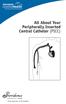 All About Your Peripherally Inserted Central Catheter (PICC) General Information Intravenous (IV) therapy is the delivery of fluid directly into a vein. An intravenous catheter is a hollow tube that is
Care of your central venous catheter A guide for patients and their carers. We care, we discover, we teach
 Care of your central venous catheter A guide for patients and their carers We care, we discover, we teach This booklet contains information about central venous catheters (CVC). These are sometimes called
Tunnelled haemodialysis catheter
 Liver, Renal & Surgery Tunnelled haemodialysis catheter Information for patients and carers This leaflet explains what a tunnelled haemodialysis catheter is and how it is put in. It also covers the risks
PATIENT GUIDE. Understand and care for your peripherally inserted central venous catheter (PICC). MEDICAL
 PATIENT GUIDE Understand and care for your peripherally inserted central venous catheter (PICC). MEDICAL Introduction The following information is presented as a guideline for your reference. The best
Radioactive Iodine Therapy Your Treatment Explained
 Radioactive Iodine Therapy Your Treatment Explained Patient Information Introduction This leaflet tells you about the treatment known as radioactive iodine therapy. It explains what is involved and some
PICCs and Midline Catheters
 Patient Education PICCs and Midline Catheters Patient s guide to PICC (peripherally inserted central catheter) and midline catheters What are PICCs and midline catheters used for? Any medicine given over
X-Plain Subclavian Inserted Central Catheter (SICC Line) Reference Summary
 X-Plain Subclavian Inserted Central Catheter (SICC Line) Reference Summary Introduction A Subclavian Inserted Central Catheter, or subclavian line, is a long thin hollow tube inserted in a vein under the
Peripherally Inserted Central Catheter (PICC Line)
 Feedback We appreciate and encourage feedback. If you need advice or are concerned about any aspect of care or treatment please speak to a member of staff or contact the Patient Advice and Liaison Service
Peripherally Inserted Central Catheter (PICC)
 Peripherally Inserted Central Catheter (PICC) Disclaimer This is general information developed by The Ottawa Hospital. It is not intended to replace the advice of a qualified healthcare provider. Please
Peripherally Inserted Central Catheter (PICC) Patient Instructions
 Patient Care Services 300 Pasteur Drive Stanford, CA 94305 Peripherally Inserted Central Catheter (PICC) Patient Instructions A Peripherally Inserted Central Catheter (PICC) is a soft flexible tube inserted
PICC Catheter for IV Therapy
 PICC Catheter for IV Therapy A Patient Guide for: PATIENT PICC A PICC is defined as a Peripherally Inserted Central Catheter. A PICC is a special IV Catheter. It is put in an arm vein and ends in a large
Epidural Continuous Infusion. Patient information Leaflet
 Epidural Continuous Infusion Patient information Leaflet April 2015 Introduction You may already know that epidural s are often used to treat pain during childbirth. This same technique can also used as
Page 1 of 10 MC1482 Peripherally-Inserted Central Catheter. Peripherally-Inserted Central Catheter (PICC)
 Page 1 of 10 MC1482 Peripherally-Inserted Central Catheter Peripherally-Inserted Central Catheter (PICC) Page 2 of 10 MC1482 Peripherally-Inserted Central Catheter Introduction A peripherally-inserted
Femoral artery bypass graft (Including femoral crossover graft)
 Femoral artery bypass graft (Including femoral crossover graft) Why do I need the operation? You have a blockage or narrowing of the arteries supplying blood to your leg. This reduces the blood flow to
Headache after an epidural or spinal injection What you need to know. Patient information Leaflet
 Headache after an epidural or spinal injection What you need to know Patient information Leaflet April 2015 We have produced this leaflet to give you general information about the headache that may develop
How to care for a Midline Catheter
 How to care for a Midline Catheter Developed by the health care professionals of the IV Program with assistance from the Department of Learning and Development. All rights reserved. No part of this book
Having a RIG tube inserted
 Having a RIG tube inserted Information for patients and carers Delivering the best in care UHB is a no smoking Trust To see all of our current patient information leaflets please visit www.uhb.nhs.uk/patient-information-leaflets.htm
Having a Trans-Arterial Embolisation
 Having a Trans-Arterial Embolisation Delivering the best in care UHB is a no smoking Trust To see all of our current patient information leaflets please visit www.uhb.nhs.uk/patient-information-leaflets.htm
Surgery for breast cancer in men
 Surgery for breast cancer in men This information is an extract from the booklet Understanding breast cancer in men. You may find the full booklet helpful. We can send you a free copy see page 9. Contents
Vaxcel PICCs Valved and Non-Valved. A Patient s Guide
 Vaxcel PICCs Valved and Non-Valved A Patient s Guide Information about your Vaxcel PICC is available by calling the Navilyst Medical Vascular Access Information Line 800.513.6876 Vaxcel Peripherally Inserted
Renal Vascular Access Having a Fistula For Haemodialysis
 Renal Vascular Access Having a Fistula For Haemodialysis Delivering the best in care UHB is a no smoking Trust To see all of our current patient information leaflets please visit www.uhb.nhs.uk/patient-information-leaflets.htm
Cardiac Catheter Lab Information for patients having a Coronary Angiogram
 Cardiac Catheter Lab Information for patients having a Coronary Angiogram Page 1 of 5 What is a Coronary Angiogram? This is a test that uses dye and special x-rays to show the inside of your coronary arteries.
Going home with your Tunneled Catheter
 Going home with your Tunneled Catheter Your Tunneled Catheter was put in by on Interventional Radiologist Date Your Tunneled Catheter was put in at: McMaster University Medical Centre Hamilton General
Having a kidney biopsy
 Having a kidney biopsy Delivering the best in care UHB is a no smoking Trust To see all of our current patient information leaflets please visit www.uhb.nhs.uk/patient-information-leaflets.htm Introduction
Tunneled Central Venous Catheter (CVC) Placement
 PATIENT EDUCATION patienteducation.osumc.edu Tunneled Central Venous Catheter (CVC) Placement A tunneled Central Venous Catheter (CVC) is a special type of intravenous (IV) line that is placed into a large
Laparoscopic Hysterectomy Your operation explained
 Laparoscopic Hysterectomy Your operation explained Patient Information Introduction This booklet is designed to give you information about having a laparoscopic hysterectomy and the care you will receive
Cancer of the Thyroid Explained
 Cancer of the Thyroid Explained Patient Information Introduction This leaflet tells you about the condition known as thyroid cancer. We hope it will answer some of the questions that you or those who care
Deep Vein Thrombosis (DVT) in pregnancy
 Deep Vein Thrombosis (DVT) in pregnancy Information and advice for women and families Maternity What is a deep vein thrombosis (DVT)? A deep vein thrombosis (DVT) is a blood clot that forms in a deep leg
Having denervation of the renal arteries for treatment of high blood pressure
 Having denervation of the renal arteries for treatment of high blood pressure The aim of this information sheet is to help answer some of the questions you may have about having denervation of the renal
Intraperitoneal Chemotherapy
 Intraperitoneal Chemotherapy What is Intraperitoneal (IP) Chemotherapy? Intraperitoneal (IP) chemotherapy is a way to put some of your chemotherapy into your abdomen (also called the peritoneal cavity)
PICC- Peripherally Inserted Central Catheter PROCEDURAL CONSENT FORM. A. Interpreter / cultural needs. B. Procedure. C. Risks of the procedure
 DO NOT WRITE IN THIS BINDING MARGIN v3.00-03/2011 SW9266 Facility: PICC- Peripherally Inserted Central Catheter A. Interpreter / cultural needs An Interpreter Service is required? Yes No If Yes, is a qualified
The temporary haemodialysis catheter
 The temporary haemodialysis catheter Department of Renal Medicine Patient Information Leaflet Introduction The information in this booklet is for: People have renal failure and who require urgent haemodialysis.
Central Venous Catheter Care For Haemodialysis
 Central Venous Catheter Care For Haemodialysis Information For Parents and Carers Haemodialysis Unit 01 878 4757 Main Hospital Number 01 878 4200 Central Venous Catheters We hope this booklet will help
Information for you Treatment of venous thrombosis in pregnancy and after birth. What are the symptoms of a DVT during pregnancy?
 Information for you Treatment of venous thrombosis in pregnancy and after birth Published in September 2011 What is venous thrombosis? Thrombosis is a blood clot in a blood vessel (a vein or an artery).
Oxford Centre for Respiratory Medicine Bronchial-Artery Embolisation Information for patients
 Oxford Centre for Respiratory Medicine Bronchial-Artery Embolisation Information for patients This leaflet tells you about the bronchial-artery embolisation procedure. It explains what is involved and
Contents. Overview. Removing the womb (hysterectomy) Overview
 This information is an extract from the booklet Understanding womb (endometrial) cancer. You may find the full booklet helpful. We can send you a free copy see page 9. Overview Contents Overview Removing
Laparoscopic Nephrectomy
 Laparoscopic Nephrectomy Information for Patients This leaflet explains: What is a Nephrectomy?... 2 Why do I need a nephrectomy?... 3 What are the risks and side effects of laparoscopic nephrectomy?...
Tunnelled indwelling pleural catheter (TIPC)
 Tunnelled indwelling pleural catheter (TIPC) A patient s guide 1 What is a tunnelled indwelling pleural catheter? A tunnelled indwelling pleural catheter is a specially designed small tube to drain fluid
Care for your child s Central Venous Catheter (CVC)
 Care for your child s Central Venous Catheter (CVC) This booklet is intended for general informational purposes only. You should consult your doctor for medical advice. Please call the clinic or your home
TERMINATION OF PREGNANCY- MEDICAL
 TERMINATION OF PREGNANCY- MEDICAL Information Leaflet Your Health. Our Priority. Page 2 of 8 You have been offered a medical termination of pregnancy using mifepristone. You will have been given some verbal
Having a circumcision information for men
 Having a circumcision information for men This leaflet aims to answer your questions about having a circumcision. It explains the benefits, risks and alternatives, as well as what you can expect when you
Varicose Vein Surgery
 Information for patients Varicose Vein Surgery Northern General Hospital You have been diagnosed as having varicose veins and your specialist has recommended varicose vein surgery. This leaflet explains
The main surgical options for treating early stage cervical cancer are:
 INFORMATION LEAFLET ON TOTAL LAPAROSCOPIC RADICAL HYSTERECTOMY (TLRH) FOR EARLY STAGE CERVICAL CANCER (TREATING EARLY STAGE CERVICAL CANCER BY RADICAL HYSTERECTOMY THROUGH KEYHOLE SURGERY) Aim of the leaflet
Chemotherapy. What is chemotherapy? How does it work? What is cancer? How will I be given chemotherapy? Cannula
 INFORMATION SHEET This information sheet has been written to help you understand more about chemotherapy. The sheet discusses the support and information your doctors, nurses and the Cancer Society can
The Children s Hospital Treatment for Hypospadias Information for parents
 The Children s Hospital Treatment for Hypospadias Information for parents What is hypospadias and what is the cause? Hypospadias is a congenital (since birth) abnormality of a boy s penis. Hypospadias
Peripherally Inserted Central Catheter
 Peripherally Inserted Central Catheter (PICC) by Patricia Griffin Kellicker, BSN En Español (Spanish Version) Definition A peripherally inserted central catheter is a long, thin tube that is inserted through
Vaginal hysterectomy and vaginal repair
 Women s Service Vaginal hysterectomy and vaginal repair Information for patients Vaginal hysterectomy and vaginal repair This leaflet is for women who have been advised to have a vaginal hysterectomy.
LASER TREATMENT FOR VARICOSE VEINS
 LASER TREATMENT FOR VARICOSE VEINS How can varicose veins be treated by laser? Laser treatment of varicose veins, Endovascular Laser Ablation (known as EVLA), is a minimally invasive procedure for treating
Temozolomide (oral) with concurrent radiotherapy to the brain
 Temozolomide (oral) with concurrent radiotherapy to the brain Temozolomide (oral) with concurrent radiotherapy to the brain This leaflet is offered as a guide to you and your family. You will find it useful
Having a PEG tube inserted?
 Having a PEG tube inserted? Information for Patients and Carers Delivering the best in care UHB is a no smoking Trust To see all of our current patient information leaflets please visit www.uhb.nhs.uk/patient-information-leaflets.htm
PERIPHERALLY INSERTED CENTRAL CATHETERS (PICC) Fong So Kwan APN, Haematology unit Medical Department, QMH
 PERIPHERALLY INSERTED CENTRAL CATHETERS (PICC) Fong So Kwan APN, Haematology unit Medical Department, QMH 1 What is a PICC catheter? Primary vascular access device since their introduction in the mid-1970s,
After your gastric banding
 After your gastric banding Exceptional healthcare, personally delivered 2 Please call J Ward at Southmead Hospital on 0117 323 5132 if you have any questions or concerns soon after discharge. You may be
Percutaneous Nephrostomy. Care of your Nephrostomy. Department of Urology
 Percutaneous Nephrostomy Care of your Nephrostomy Department of Urology You may encounter some problems at home but these are usually easily overcome. Listed below are some questions patients commonly
Transrectal Ultrasound (Trus) Guided Prostate Biopsies Urology Patient Information Leaflet
 Transrectal Ultrasound (Trus) Guided Prostate Biopsies Urology Patient Information Leaflet Page 1 What is the purpose of my appointment? Your doctor has informed us that you have an elevated Prostate Specific
Caring for a Tenckhoff Catheter
 Caring for a Tenckhoff Catheter UHN A Patient s Guide What is a Pleural Effusion? There is a small space between the outside of your lung and the chest wall (ribs). This space is called the pleural space.
Care of Your Hickman Catheter
 Care of Your Hickman Catheter Johns Hopkins Kimmel Cancer Center, Revised 7/11 Contents What is a Hickman Catheter? Page 3 Does the Catheter Limit My Activities? Page 4 How Do I Care for My Catheter? Page
Cholangiocarcinoma (Bile Duct Cancer) Patient Information Booklet
 Cholangiocarcinoma (Bile Duct Cancer) Patient Information Booklet Delivering the best in care UHB is a no smoking Trust To see all of our current patient information leaflets please visit www.uhb.nhs.uk/patient-information-leaflets.htm
PROCEDURE- SPECIFIC INFORMATION FOR PATIENTS
 The British Association of Urological Surgeons 35-43 Lincoln s Inn Fields London WC2A 3PE Phone: Fax: Website: E- mail: +44 (0)20 7869 6950 +44 (0)20 7404 5048 www.baus.org.uk [email protected] PROCEDURE-
PICC/Midclavicular/Midline Catheter
 47 PICC/Midclavicular/Midline Catheter Introduction- PICC/ MCV/ Midline You have a PICC/Midclavicular/Midline (peripherally inserted) catheter. This catheter should make receiving I.V. medicines or solutions
Elective Laparoscopic Cholecystectomy
 General Surgery Elective Laparoscopic Cholecystectomy This information aims to explain what will happen before, during and after your surgery to remove your gallbladder. It includes information about the
Liver Resection. Patient Information Booklet. Delivering the best in care. UHB is a no smoking Trust
 Liver Resection Patient Information Booklet Delivering the best in care UHB is a no smoking Trust To see all of our current patient information leaflets please visit www.uhb.nhs.uk/patient-information-leaflets.htm
What should I expect before the procedure?
 The British Association of Urological Surgeons 35-43 Lincoln s Inn Fields London WC2A 3PE Phone: Fax: Website: E- mail: +44 (0)20 7869 6950 +44 (0)20 7404 5048 www.baus.org.uk [email protected] PROCEDURE-
Blood Transfusion. Red Blood Cells White Blood Cells Platelets
 Blood Transfusion Introduction Blood transfusions are very common. Each year, almost 5 million Americans need a blood transfusion. Blood transfusions are given to replace blood lost during surgery or serious
Inguinal Hernia (Female)
 Inguinal Hernia (Female) WHAT IS AN INGUINAL HERNIA? 2 WHAT CAUSES AN INGUINAL HERNIA? 2 WHAT DOES TREATMENT / MANAGEMENT INVOLVE? 3 DAY SURGERY MANAGEMENT 3 SURGICAL REPAIR 4 WHAT ARE THE RISKS/COMPLICATIONS
You will be having surgery to remove a tumour(s) from your liver.
 Liver surgery You will be having surgery to remove a tumour(s) from your liver. This handout will help you learn about the surgery, how to prepare for surgery and your care after surgery. Surgery can be
ORAL ANTICOAGULANTS RIVAROXABAN (XARELTO) FOR PULMONARY EMBOLISM (PE)
 ORAL ANTICOAGULANTS RIVAROXABAN (XARELTO) FOR PULMONARY EMBOLISM (PE) Information Leaflet Your Health. Our Priority. Page 2 of 6 What Are Anticoagulants And What Do They Do? This information leaflet has
Hysterectomy for womb cancer
 Gynaecology Oncology Service Hysterectomy for womb cancer April 2014 Great Staff Great Care Great Future INTRODUCTION This leaflet has been produced to provide you with general information about your operation.
Trans Urethral Resection of the Prostate (TURP) Trans Urethral Incision of the Prostate (TUIP) Department of Urology
 Trans Urethral Resection of the Prostate (TURP) Trans Urethral Incision of the Prostate (TUIP) Department of Urology Where is the Prostate Gland? The prostate gland sits below the bladder which lies behind
CATHETER for Hemodialysis
 CATHETER for Hemodialysis What You Need to Know to Stay Healthy with a Catheter One treatment choice for kidney failure is hemodialysis (HD). HD removes wastes and excess fluid from your blood. Your lifeline
Chemotherapy for lung cancer
 This information is an extract from the booklet Understanding lung cancer. You may find the full booklet helpful. We can send you a free copy see page 8. Contents Chemoradiation Small cell lung cancer
Vasectomy Services Patient Information
 Vasectomy Services Patient Information Vasectomy Vasectomy Please read this information leaflet and consent form carefully, and bring it with you to your appointment. Please ask the doctor any questions
Other treatments for chronic myeloid leukaemia
 Other treatments for chronic myeloid leukaemia This information is an extract from the booklet Understanding chronic myeloid leukaemia. You may find the full booklet helpful. We can send you a copy free