
Business Development and Marketing
|
|
|
- Rudolf Phillips
- 10 years ago
- Views:
Transcription
1 In this Issue: Business Development and Marketing Business Development and Marketing ETHICAL CONSIDERATIONS FOR ATTORNEYS HOW TO USE INTERNET MARKETING PROMOTING DIVERSITY AS A COMPETITIVE ADVANTAGE MARKETING YOUR LAW PRACTICE IN A DOWN ECONOMY FEATURES Ethical Considerations for Attorney Marketing 13 by Asaad K. Siddiqi How to Increase Firm Revenue Using Internet Marketing 20 by Chris Mulvaney Developing Relationships with Prospective Clients in by Dan Beldowicz Podcasting: It s About Being the Media 27 by Steven L. Lubetkin Pathways to Success 29 by Susan Borowski Storch Marketing Diversity as a Competitive Advantage 33 by Michael J. Plata and Michelle A. Ferrer The Importance of Leadership and Differentiation in Attorney Marketing 37 by Khizar A. Sheikh and Jonathan Jaffe The Value in Strategic Referral Partners and Common Myths about Attorney Referrals 40 by Stephen Fairley Practical Success: Making This Your Best Year Ever 42 by Cordell M. Parvin The Definitive Associate Marketing Checklist 44 by Larry Bodine Marketing Your Law Practice in a Down Economy 48 by Anthony Kalikas 15 Tips for Marketing Your Law Practice in a Tight Economy 51 by Terrie S. Wheeler Getting Marketing and Business Development on the Same Page 54 by Bob Buday, Bernie Thiel, Susan Buddenbaum and Tim Parker The Future of Business Development for New Jersey Law Firms in by Susan Storch and Asaad Siddiqi Commentary: How You Think is Everything 69 by Jeffrey H. Newman DEPARTMENTS PRESIDENT S PERSPECTIVE 2 MESSAGE FROM THE SPECIAL EDITORS 4
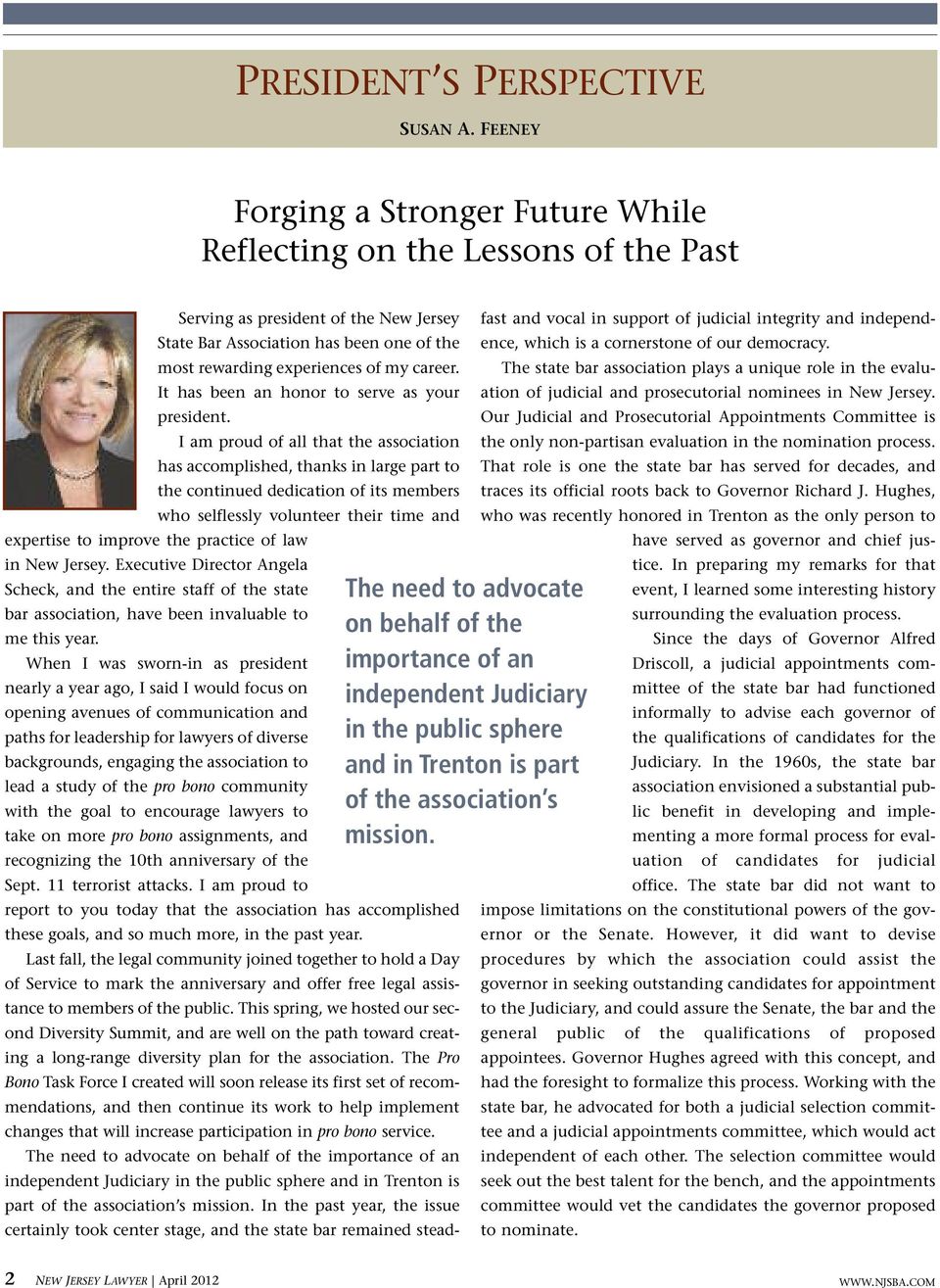
2 PRESIDENT S PERSPECTIVE SUSAN A. FEENEY Forging a Stronger Future While Reflecting on the Lessons of the Past The need to advocate on behalf of the importance of an independent Judiciary in the public sphere and in Trenton is part of the association s mission. Serving as president of the New Jersey State Bar Association has been one of the most rewarding experiences of my career. It has been an honor to serve as your president. I am proud of all that the association has accomplished, thanks in large part to the continued dedication of its members who selflessly volunteer their time and expertise to improve the practice of law in New Jersey. Executive Director Angela Scheck, and the entire staff of the state bar association, have been invaluable to me this year. When I was sworn-in as president nearly a year ago, I said I would focus on opening avenues of communication and paths for leadership for lawyers of diverse backgrounds, engaging the association to lead a study of the pro bono community with the goal to encourage lawyers to take on more pro bono assignments, and recognizing the 10th anniversary of the Sept. 11 terrorist attacks. I am proud to report to you today that the association has accomplished these goals, and so much more, in the past year. Last fall, the legal community joined together to hold a Day of Service to mark the anniversary and offer free legal assistance to members of the public. This spring, we hosted our second Diversity Summit, and are well on the path toward creating a long-range diversity plan for the association. The Pro Bono Task Force I created will soon release its first set of recommendations, and then continue its work to help implement changes that will increase participation in pro bono service. The need to advocate on behalf of the importance of an independent Judiciary in the public sphere and in Trenton is part of the association s mission. In the past year, the issue certainly took center stage, and the state bar remained steadfast and vocal in support of judicial integrity and independence, which is a cornerstone of our democracy. The state bar association plays a unique role in the evaluation of judicial and prosecutorial nominees in New Jersey. Our Judicial and Prosecutorial Appointments Committee is the only non-partisan evaluation in the nomination process. That role is one the state bar has served for decades, and traces its official roots back to Governor Richard J. Hughes, who was recently honored in Trenton as the only person to have served as governor and chief justice. In preparing my remarks for that event, I learned some interesting history surrounding the evaluation process. Since the days of Governor Alfred Driscoll, a judicial appointments committee of the state bar had functioned informally to advise each governor of the qualifications of candidates for the Judiciary. In the 1960s, the state bar association envisioned a substantial public benefit in developing and implementing a more formal process for evaluation of candidates for judicial office. The state bar did not want to impose limitations on the constitutional powers of the governor or the Senate. However, it did want to devise procedures by which the association could assist the governor in seeking outstanding candidates for appointment to the Judiciary, and could assure the Senate, the bar and the general public of the qualifications of proposed appointees. Governor Hughes agreed with this concept, and had the foresight to formalize this process. Working with the state bar, he advocated for both a judicial selection committee and a judicial appointments committee, which would act independent of each other. The selection committee would seek out the best talent for the bench, and the appointments committee would vet the candidates the governor proposed to nominate. 2 NEW JERSEY LAWYER April
3 On Sept. 25, 1969, Governor Hughes signed a resolution with the state bar association giving the judicial appointments committee of the state bar the authority to confidentially interview and report on the qualification of candidates for judicial and prosecutor positions. This became know as the Hughes Compact. This compact has been renewed by every governor since Richard Hughes, ensuring that the governor receives the best evaluation and guidance on each candidate. From Governor Hughes time in office through the present administration of Governor Chris Christie, as part of the compact the New Jersey State Bar Association s Judicial and Prosecutorial Appointments Committee (JPAC) conducts extensive interviews and reviews potential candidates to the tax court, superior court, and Supreme Court, as well as to county prosecutor positions. This compact is also an example of the devotion to judicial independence and integrity that Richard Hughes valued, both as a governor and as chief justice. The New Jersey State Bar Association believes the strength of our Judiciary is best served by insulating those serving on the bench from politics that may underlie the executive and legislative branches. That independence is absolutely essential, and must be guarded. The Hughes Compact helps protect and promote this concept of judicial independence. Through the Hughes Compact, there is the assurance of the nonpartisan evaluation of candidates for judicial office. The state bar association is deeply thankful to Governor Hughes for the wisdom he had in creating this compact nearly five decades ago. It has been my privilege to see firsthand how that compact has ensured the residents of our state have access to a nationally respected Judiciary. NEW JERSEY LAWYER April

4 MESSAGE FROM THE SPECIAL EDITORS STAFF Angela C. Scheck Publisher Cheryl Baisden Janet Gallo Paula Portner Managing Editor Graphic Designer Display Advertising EDITORIAL BOARD James J. Ferrelli Michael F. Schaff Senwan Akhtar Mitchell H. Cobert John C. Connell Angela Foster Mimi Huang Susan R. Kaplan Brian R. Lehrer Robert Olejar Asaad Siddiqi Susan Storch Susan Stryker Lisa Trembly Chair Vice Chair NJSBA EXECUTIVE COMMITTEE Susan A. Feeney President Kevin P. McCann President-Elect Ralph J. Lamparello First Vice President Paris P. Eliades Second Vice President Miles S. Winder III Treasurer Angela W. Dalton Secretary Richard H. Steen Immediate Past President New Jersey Lawyer Magazine (ISSN ) is published six times per year. Permit number Subscription is included in dues to members of the New Jersey State Bar Association ($10.50); those ineligible for NJSBA membership may subscribe at $60 per year. There is a charge of $2.50 per copy for providing copies of individual articles Published by the New Jersey State Bar Association, New Jersey Law Center, One Constitution Square, New Brunswick, New Jersey Periodicals postage paid at New Brunswick, New Jersey and at additional mailing offices. POSTMASTER: Send address changes to New Jersey Lawyer Magazine, New Jersey State Bar Association, New Jersey Law Center, One Constitution Square, New Brunswick, New Jersey Copyright 2012 New Jersey State Bar Association. All rights reserved. Any copying of material herein, in whole or in part, and by any means without written permission is prohibited. Requests for such permission should be sent to New Jersey Lawyer Magazine, New Jersey State Bar Association, New Jersey Law Center, One Constitution Square, New Brunswick, New Jersey New Jersey Lawyer invites contributions of articles or other items. Views and opinions expressed herein are not to be taken as official expressions of the New Jersey State Bar Association or the author s law firm or employer unless so stated. Publication of any articles herein does not necessarily imply endorsement in any way of the views expressed or legal advice. Printed in U.S.A. Official Headquarters: New Jersey Lawyer Magazine, New Jersey State Bar Association, New Jersey Law Center, One Constitution Square, New Brunswick, New Jersey Advertising Display ASAAD K. SIDDIQI SUSAN BOROWSKI STORCH Recognizing the continued uncertain nature of the economy, New Jersey Lawyer Magazine has dedicated this issue to attorney business-development activities and the quest of a successful rainmaker. This issue focuses entirely on practical ways attorneys whether from national, regional, or small firms may improve their marketing efforts to enhance their bottom line. Essentially, this issue discusses the current rules for attorney marketing, Internet marketing tools, insights from some of the country s top marketing and business development advisors, the importance of diversity, critical skills to enhance the attorney s arsenal for marketing him or herself and his or her firm, and an interview with nine of New Jersey s top law firms on their projected marketing trends for The starting point for attorney advertising, of course, would be the Rules of Professional Conduct (RPC), which apply to all marketing and advertising efforts, whether online or in-person. They impose specific and general rules upon attorneys regarding all communications, and generally flow from the RPC 7.1(a) pronouncement that: A lawyer shall not make false or misleading communications about the lawyer, the lawyer s services, or any matter in which the lawyer has or seeks a professional involvement. It is critical to a firm s reputation that these rules be consulted whenever a firm s attorney tweets, blogs, leads a podcast, or otherwise connects with the world with an eye toward business development. Over the past few years, a new world of social media and real-time connectivity has brought consumers and businesses closer together, electronically speaking. Many businesses have successfully leveraged social media to increase their bottom line, while others have been less successful, or slow to adapt. Attorneys also have begun using Facebook, GroupOn, LinkedIn and other e-communication applications to increase visibility and reduce marketing and advertising costs. Indeed, larger firms are working toward developing social media marketing tools that efficiently grow the firm s book of business. Toward that end, the lead article by Asaad K. Siddiqi, of counsel at Walder, Hayden & Brogan, P.A., provides general background for attorneys, both in-house and in private practice, on the applicable rules and ethics opinions that guide attorney marketing and advertising. The article also covers the ethical considerations presented by an attorney s use of emerging social media, like GroupOn and Facebook, as part of his or her business development activities. Without question, many Fortune 500 companies and emerging businesses have successfully used Internet and social media marketing to expand their appeal and market share. With this in mind, Chris Mulvaney, a designer and online marketing strategist working with some of the world s best-known brands, writes about how law firms and 4 NEW JERSEY LAWYER April

5 attorneys need to tap the full potential of Internet advertising, and shares the keys to generating the kind of eye-popping revenue many attorneys desire. Similarly, an article by Dan Beldowicz, a marketing consultant for businesses, focuses on Internet marketing and social media measures for attorneys to consider in Next, Steven Lubetkin, an award-winning producer of documentary audio and video podcasts for corporate and legal clients, discusses how the integration of podcasting into an attorney s online communications strategy can improve the firm s visibility among its clients and prospects, and present the attorney as a clear expert in his or her specialty area. The straightforward conclusion to be drawn from these articles is that law firms and individual attorneys need to follow suit and adapt to the new Internet-savvy corporate clients. Successful lawyers know themselves, believe in themselves, and maintain a strong sense of what they want to achieve in both the short and long term. Pathways to Success is an article by Susan Storch, which provides advice on how to become a rainmaker, and features some of the state s leading business generators. Addressing the theme of developing a broader pool of rainmakers, Michael Plata and Michelle A. Ferrer, partners at Plata Ferrer & Gutierrez, reflect on the importance of connecting the goal of diversity in the legal profession with attracting the burgeoning population of diverse corporate and individual clients, how those clients value and view diversity in choosing law firms, and the methods of effectively including diversity in attorney marketing efforts. To grow business, an attorney must also understand that clients gravitate to lawyers they see as trusted advisors and experts. The article by Khizar Sheikh, counsel at Lowenstein Sandler, and Jonathan Jaffe, managing principal of a public relations and communications firm, explain the importance of personal leadership and differentiation among attorneys. Drawing upon collective experiences and the reflections of conversations with chief executives and general counsels, they conclude that becoming a leader requires a willingness to roll up your sleeves, a mindset that finds opportunities in problems, and a desire to lead people to solutions. Elemental to originating business is an attorney s development of referral sources. Taking that one step further, Stephen Fairley, CEO of The Rainmaker Institute, a known commodity to members of the New Jersey State Bar Association on the issue of rainmaking, encourages cultivating a two-way street with strategic referral partnerships in which the attorney recognizes the need to nurture the growth of the referral source s business, which in return helps the attorney s book of business grow. Continuing with the overall topic of developing a bigger book of business, Cordell Parvin, a nationally recognized business development consultant to law firms and former head of a national construction practice group with Jenkins & Gilchrest, provides a framework for a marketing business plan for developing marketing activities to achieve success in one s field. Next, Larry Bodine, a business development advisor and former editor and publisher of the American Bar Association Journal and former director of communications at Sidley, Austin Brown & Wood in Chicago, provides a comprehensive marketing toolkit for associates seeking to become business generators. Similarly, Anthony Kalikas, founder of an Internet marketing company specializing in content management websites for solo and small-firm attorneys, provides valued marketing insight for small firms looking to grow their practices, while Terrie S. Wheeler, founder of an online interactive tool designed to help lawyers better market their services, discusses 15 concepts for helping to market legal services in a tight economy. Too often, marketing departments at large and small firms are not in sync with the business-development activities of firm lawyers, and vice versa. Drawing from over 200 interviews of professional service providers conducted nationally, Bob Buday, co-founder of The Bloom Group and proponent of developing and marketing thought leadership content, writes about the importance of ensuring that marketing and business development activities go hand-in-hand. Buday and his coauthors demonstrate that a little foresight and planning between law firm marketing plans and attorney rainmaking efforts may lead to larger dividends later. Conversely, a failure to unite these two aspects of a firm s administration could lead to lost opportunities in the long run. Given the state s economic downturn over the past several years, which resulted in massive layoffs of attorneys and the closure of some law firms, the issue of how to grow a law firm s bottom line begins with its relationship with its existing clients and the business development skills of the firm s attorneys. In the next article, Siddiqi and Storch posed questions to the chairs and managing partners of some of the state s top law firms. The resulting article summarizes the most pressing issues facing New Jersey firms in 2012, the primary focus of business development techniques in-house, external marketing efforts, definition of a rainmaker, and the most important asset to the firm s continued growth in the coming year. The article also includes a discussion with the chairs, presidents, and managing partners of some of the leading law firms in New Jersey regarding their approach to business development. Perhaps surprisingly, firm leaders diverged widely on their marketing efforts, but generally agreed that bigger isn t always NEW JERSEY LAWYER April
6 better, and that given the economic recession, clients are more fee conscious than ever before, wanting to ensure the best bang for their buck. The leadership at the top law firms unanimously agreed on one key point: Law is a relationship business. And, on the subject of how to develop close relationships with clients, Jeffrey H. Newman, a partner and member of the executive and management committees of Sills Cummis & Gross, PC, has allowed us to include a chapter from his new book, Listening with Your Heart. The breadth of this piece encourages attorneys to appreciate that their thoughts provide the framework for their goals, inevitably leading to their future successes, and that with a daily practice in humility, kindness, and earnest listening, even a shy novice attorney can blossom into an astounding rainmaker one day. Successful rainmakers never stop prospecting for new clients. No attorney is too young to begin developing a book of business, and no law firm is ever reluctant to expand its business potential. While these maxims may seem obvious, the unfortunate truth is that not all attorneys who seek to be rainmakers succeed. To address that shortcoming, this issue asks attorneys and law firms to continue evolving beyond the attorney advertising comfort zone that was established well before the Internet became the dominant method of communication. We hope readers enjoy this unique and thought-provoking issue, which addresses topics that apply not only to the professional practice of law but to one s daily life and social interactions as well. Susan Borowski Storch is a member of the editorial board of New Jersey Lawyer Magazine and a former business-originating partner with global, national and regional law firms. Asaad K. Siddiqi is of counsel at Walder, Hayden & Brogan, P.A., in Roseland. A member of the New Jersey Lawyer Magazine Editorial Board, he practices in the areas of business counseling and litigation, attorney ethics, and white-collar criminal defense, and also serves as counsel to nonprofit organizations. 6 NEW JERSEY LAWYER April
7 MAY 16 18, 2012 BORGATA HOTEL CASINO & SPA Presented by the New Jersey State Bar Association in conjunction with the New Jersey Institute for Continuing Legal Education Wednesday Earn up to 4 CLE credits Annual Meeting and Convention CLE seminars begin at 1 p.m. Meet and network with your fellow attendees at the Opening Wine and Cheese Reception, First-Time Attendees Orientation and Welcome Reception. Featured Speakers Chief Justice Stuart Rabner Chief Judge Jerome Simandle, USDJ Justice Barry T. Albin Justice Helen E. Hoens Justice Anne M. Patterson Thursday Earn up to 6 CLE credits CLE seminars from 8 a.m. to 4:15 p.m. Buy your tickets and enjoy the Annual Dinner and Installation of Officers and the 14th Annual Diversity Committee Luncheon. Justice Virginia Long (ret.) Justice Roberto Rivera-Soto (ret.) Hon. Freda L. Wolfson, USDJ Judge Glenn A. Grant, Acting Administrative Director of the AOC Friday Earn up to 2 CLE credits CLE seminars from 9 to 11:40 a.m. States of the Judiciaries kicks off the Friday sessions followed by benchbar events, substantive seminars and the annual luncheons of the Labor and Employment Law and Public Utility Law sections. Solo and Small-Firm Conference MAY 16, 2012 THE WATER CLUB Earn up to 6 CLE credits Successfully practicing law requires more than legal knowledge it s also about being an entrepreneur and running your practice like a business. The one-day Solo and Small-Firm Conference offers exclusive programming for the solo practitioner and small-firm attorney to help you get practical advice, answers to specific questions and important tips on how to grow and energize a successful business. NJSBA.COM

8 Ticketed Events Thursday, May p.m. Borgata Hotel Casino & Spa $165 per person Black-tie preferred This gala affair features the installation of NJSBA President Kevin P. McCann, Esq. and a farewell to President Susan A. Feeney, Esq. Thursday, May 17 Noon 1:30 p.m., Borgata Hotel Casino & Spa $50 per person Includes the presentation of the Mel Narol Excellence in Diversity Award Friday, May 18 11:30 a.m. 2:30 p.m., Borgata Hotel Casino & Spa $60 per person Friday, May 18 12:30 p.m., Angelo s Fairmount Tavern $80 per person Receptions and Gatherings Wednesday 2 p.m. 4 5:30 p.m., Exhibit Hall 5 5:30 p.m., Borgata Theater 6:30 8 p.m., Borgata Pool Thursday 7 8:30 a.m., Exhibit Hall 11:30 a.m. 1 p.m., Exhibit Hall 4 5 p.m., Exhibit Hall 5:30 7 p.m., The Water Club 5 p.m. 11 p.m., mur.mur Friday 7:30 9 a.m., Exhibit Hall 12 1:30 p.m., Exhibit Hall NJSBA.COM

9 Agenda At-A-Glance Annual Meeting and Convention May Earn up to 12 CLE credits toward New Jersey, New York and Pennsylvania mandatory continuing legal education requirements at seminars sponsored by the New Jersey State Bar Association and New Jersey Institute for Continuing Legal Education, the educational division of the NJSBA. The association s sections, committees and the Young Lawyers Division, in addition to other groups, are program cosponsors. All programs are subject to change. THURSDAY, MAY :15 a.m., Borgata Negotiating the Franchise Agreement Probate Litigation 2012: Planning and Trial Techniques Advanced Topics in Property Taxation Hiring and Firing and Everything in Between Getting In, Getting Out and Getting Paid: The Rules of Representation Managing Challenging Clients Case Study on Irreconcilable Differences THURSDAY, MAY 17 8:30 9:45 a.m., The Water Club Negotiation Hot Topics in Insurance Defense 2012 The New Proposed Criminal Identification Charge DWI Update 2012 Crime and Punishment in Workers Compensation: From Cunningham to Quereshi WEDNESDAY, MAY :40 p.m., Borgata Internet Gaming & Sports Wagering in New Jersey Federal Estate Tax Update Planning in New Jersey in 2011, 2012 and Beyond, Possibilities and Pitfalls Introduction to Immigration Law Automobile Insurance Update Building the Family Through Surrogacy The State of the Law in New Jersey Marketing and Ethics: Maximizing Results While Avoiding Liability The FD Action Not Just for Pro Ses Anymore WEDNESDAY, MAY 16 3:30 5:10 p.m., Borgata Drafting Enforceable Non-compete Agreements: Tips and Perspectives from In-house Counsel How to Practice Before an Administrative Law Judge To File or Not to File: Contemplating Bankruptcy and Non Bankruptcy Alternatives for Your Small Business Clients Attracting and Retaining Clients General Council Meeting Tax Issues Every Matrimonial Attorney Needs to Know Hot Tips for Hot Litigators Introduction to New Jersey Residential Real Estate Closings THURSDAY, MAY :15 a.m., Borgata The Fundamentals of Commercial Leasing Client Crisis Management and Expedited Litigation in Chancery Courts Hot Topics in Class Action Law Recognizing and Addressing Gender Bias in the Litigation Process: What Lawyers and Courts Need to Know Family Law Section Swearing-In Trial Practice: The Appellate Perspective Ethical Issues in Settlement Negotiations THURSDAY, MAY 17 10:30 11:45 a.m., The Water Club Lessons for All Lawyers from the Mediation Front Insurance Fraud: How to Define It and How to Prosecute It Let Me Help You (Un)pack How the NJDEP is Keeping Business and Aiding Sound Growth in New Jersey Non-DWI Hot Topics in Municipal Court Practice Inside Trenton WEDNESDAY, MAY 16 3:30 5:10 p.m., The Water Club Pet Trusts Damages for Emotional Distress NJSBA.COM

10 THURSDAY, MAY :15 p.m., Borgata The Nuts & Bolts of Navigating an Appeal Above & Beyond and Other Mysteries of Appellate Practice Privacy and Security Exposures: Practical Concerns for Law Firms Have I Got a Deal For You: Scams, Short Sales & the CFPB Specter. Avoiding Ethical Pitfalls of a Distressed Real Estate Market Guidance from the Bench Practical Advice from a Panel of Women Judges Asked and Answered: 10 Questions Every Attorney Should or Should Not Ask an Expert Witness Trial Practice The Judicial Perspective Legislative Year in Review THURSDAY, MAY :15 p.m., The Water Club Lawyers' Guide to Professionalism: What Every Practitioner Needs to Know Bad Faith: A Review of the Practical and Ethical Implications of Bad Faith Law and Proposed Legislative Amendments 2012 Renewable Energy Update Introduction to Municipal Court Shareholder Disputes Due to Deadlock or Oppression THURSDAY, MAY :15 p.m., Borgata The Anti-Bullying Bill of Rights: Still Alive! Crucial Updates, Compliance, Training, Hearings and Litigation Oh, My! Section 40 Liens in Workers Compensation Cases Introduction to Elder Law The Jersey Sting E Discovery & Computer Forensics Practical Solutions for the Smaller Case Alimony: Length and Amount Trial Practice: The Lawyer s Perspective Ethics in Pro Bono THURSDAY, MAY :15 p.m., The Water Club Product Liability/Toxic Tort Toolbox Five Topics to Make Your Products/ Toxic Tort Litigation Practice Better The Inherently Beneficial Use Doctrine: Cell Towers, Solar Energy, Affordable Housing and Religious Institutions A Board s Perspective Municipal Court Bench-Bar Conference Unmanned Drones Over Occupy Wall Street: The Occupy Movement and the First Amendment FRIDAY, MAY a.m., Borgata The States of the Judiciaries FRIDAY, MAY :40 a.m., Borgata Hot Topics in Labor and Employment Criminal Law Bench-Bar Conference Civil Trial Bench-Bar Conference Benchmarks Civics Project Training Avoiding Legal Malpractice Workers Compensation Bench-Bar Conference Family Law Bench-Bar Conference: A Tribute to and Fireside Chat with the Honorable Virginia A. Long Preparing and Defending a Claim of Construction Delay FRIDAY, MAY :40 a.m., The Water Club GLBT Update Update on School Law Hacker Taxonomy Introduction to Trusts and Estates Expungements Avoiding the Pitfalls Agenda At-A-Glance Solo and Small-Firm Conference Wednesday, May 16 Earn up to 6 CLE credits toward New Jersey, New York and Pennsylvania mandatory continuing legal education requirements at seminars sponsored by the New Jersey State Bar Association, the association s Solo and Small-Firm Section and the New Jersey Institute for Continuing Legal Education, the educational division of the NJSBA. All programs are subject to change. Re-boot Your Practice Getting Paid For Your Services Tips from the Bench: A bench-bar Discussion for Solo and Small-Firm Attorneys IT What You Really Need to Know 2012 Virtual Office Update 11 Ways to Kill Your Practice Without Even Trying How To Survive a Random Audit Growing Your Practice While Optimizing Your Overhead Beyond the Website: Getting Attention For Your Practice Ethics Game Show Investors Bank WithumSmith+Brown, PC EasySoft Legal Software The Provident Bank Clio AffiniPay UPS USI Affinity Fastcase, Inc. Visit njsba.com for more details. NJSBA.COM

11 Corporate Sponsors Investors Bank WithumSmith+Brown, PC Citibank EasySoft Legal Software Morgan Stanley Smith Barney, LLC TD Bank The Provident Bank Capital One Bank Schulman Wiegmann & Associates USI Affinity VeriText National Court Reporting Law Firm Sponsors PLATINUM Chance & McCann, LLC Chasan Leyner & Lamparello, PC McCarter & English, LLP GOLD Lum Drasco & Positan, LLC SILVER Chamlin Rosen Uliano & Witherington Connell Foley, LLP Courter Kobert & Cohen, PC Donahue Hagan Klein Newsome O Donnell & Weisberg, PC Skoloff & Wolfe, PC Richard H. Steen, Esq. Miles S. Winder III, Esq., PC Wilentz Goldman & Spitzer, PA Zager Fuchs, PC Hotels Borgata Hotel Casino & Spa The Water Club HOTEL RESERVATIONS Reservations at Borgata Hotel Casino & Spa and The Water Club may be made through a central reservations department before April 15, 2012 by calling MYBORGATA ( ) or online at theborgata.com (Group Code GBNJB12) or thewaterclubhotel.com (GWNJB12). Individuals must identify themselves as being with the New Jersey State Bar Association or reference the group code in order to receive the discounted rate. Reservations made after the cut-off date are on a spaceavailable basis. Individual rooms cancelled less than 48 hours prior to arrival time will forfeit deposit of first and last night s room and tax. ROOM RATES Borgata The Water Club $155 plus taxes and fees $175 plus taxes and fees NJSBA.COM
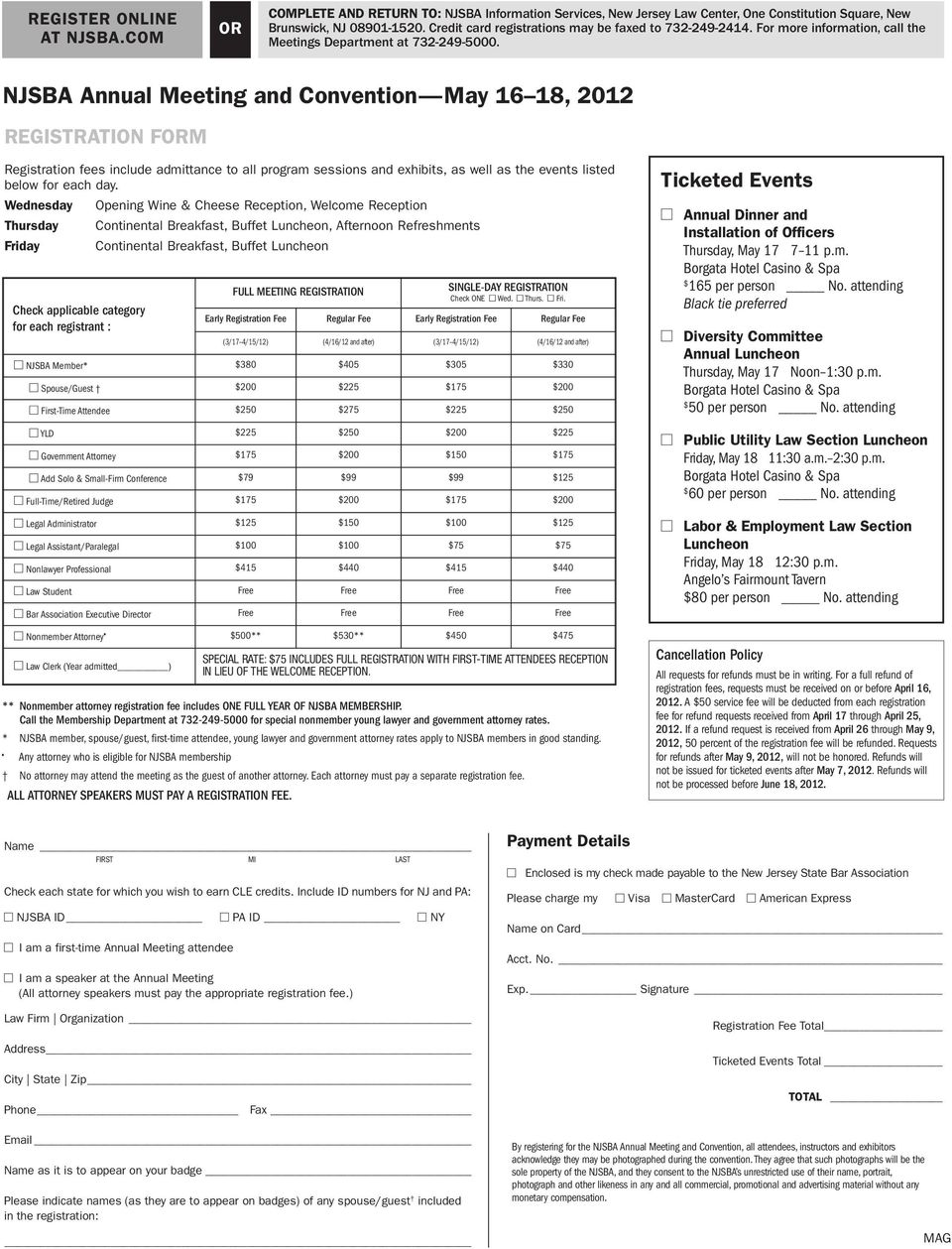
12 REGISTER ONLINE AT NJSBA.COM OR COMPLETE AND RETURN TO: NJSBA Information Services, New Jersey Law Center, One Constitution Square, New Brunswick, NJ Credit card registrations may be faxed to For more information, call the Meetings Department at NJSBA Annual Meeting and Convention May 16 18, 2012 REGISTRATION FORM Registration fees include admittance to all program sessions and exhibits, as well as the events listed below for each day. Wednesday Opening Wine & Cheese Reception, Welcome Reception Thursday Continental Breakfast, Buffet Luncheon, Afternoon Refreshments Friday Continental Breakfast, Buffet Luncheon Check applicable category for each registrant : FULL MEETING REGISTRATION SINGLE-DAY REGISTRATION Check ONE Wed. Thurs. Fri. Early Registration Fee Regular Fee Early Registration Fee Regular Fee (3/17 4/15/12) (4/16/12 and after) (3/17 4/15/12) (4/16/12 and after) NJSBA Member* $380 $405 $305 $330 Spouse/Guest $200 $225 $175 $200 First-Time Attendee $250 $275 $225 $250 YLD $225 $250 $200 $225 Government Attorney $175 $200 $150 $175 Add Solo & Small-Firm Conference $79 $99 $99 $125 Full-Time/Retired Judge $175 $200 $175 $200 Legal Administrator $125 $150 $100 $125 Legal Assistant/Paralegal $100 $100 $75 $75 Nonlawyer Professional $415 $440 $415 $440 Law Student Free Free Free Free Bar Association Executive Director Free Free Free Free Nonmember Attorney $500** $530** $450 $475 Law Clerk (Year admitted ) SPECIAL RATE: $75 INCLUDES FULL REGISTRATION WITH FIRST-TIME ATTENDEES RECEPTION IN LIEU OF THE WELCOME RECEPTION. ** Nonmember attorney registration fee includes ONE FULL YEAR OF NJSBA MEMBERSHIP. Call the Membership Department at for special nonmember young lawyer and government attorney rates. * NJSBA member, spouse/guest, first-time attendee, young lawyer and government attorney rates apply to NJSBA members in good standing. Any attorney who is eligible for NJSBA membership No attorney may attend the meeting as the guest of another attorney. Each attorney must pay a separate registration fee. ALL ATTORNEY SPEAKERS MUST PAY A REGISTRATION FEE. Ticketed Events Annual Dinner and Installation of Officers Thursday, May p.m. Borgata Hotel Casino & Spa $ 165 per person No. attending Black tie preferred Diversity Committee Annual Luncheon Thursday, May 17 Noon 1:30 p.m. Borgata Hotel Casino & Spa $ 50 per person No. attending Public Utility Law Section Luncheon Friday, May 18 11:30 a.m. 2:30 p.m. Borgata Hotel Casino & Spa $ 60 per person No. attending Labor & Employment Law Section Luncheon Friday, May 18 12:30 p.m. Angelo s Fairmount Tavern $80 per person No. attending Cancellation Policy All requests for refunds must be in writing. For a full refund of registration fees, requests must be received on or before April 16, A $50 service fee will be deducted from each registration fee for refund requests received from April 17 through April 25, If a refund request is received from April 26 through May 9, 2012, 50 percent of the registration fee will be refunded. Requests for refunds after May 9, 2012, will not be honored. Refunds will not be issued for ticketed events after May 7, Refunds will not be processed before June 18, Name FIRST MI LAST Check each state for which you wish to earn CLE credits. Include ID numbers for NJ and PA: NJSBA ID PA ID NY I am a first-time Annual Meeting attendee I am a speaker at the Annual Meeting (All attorney speakers must pay the appropriate registration fee.) Law Firm Organization Address City State Zip Phone Fax Name as it is to appear on your badge Please indicate names (as they are to appear on badges) of any spouse/guest included in the registration: Payment Details Enclosed is my check made payable to the New Jersey State Bar Association Please charge my Visa MasterCard American Express Name on Card Acct. No. Exp. Signature Registration Fee Total Ticketed Events Total TOTAL By registering for the NJSBA Annual Meeting and Convention, all attendees, instructors and exhibitors acknowledge they may be photographed during the convention. They agree that such photographs will be the sole property of the NJSBA, and they consent to the NJSBA s unrestricted use of their name, portrait, photograph and other likeness in any and all commercial, promotional and advertising material without any monetary compensation. MAG
13 Ethical Considerations for Attorney Marketing by Asaad K. Siddiqi Today s social media provides myriad opportunities for consumers to find services in the marketplace. Conversely, businesses have engaged in clever ways to follow and forecast consumer trends, to gain the consumer s attention, and to earn the consumer s hard-earned money. Social media outlets like Facebook and Google+ have brought friends, family, and strangers closer together than ever before. Twitter and YouTube are constant sources of breaking news, whether worthy of public distribution or not. LinkedIn offers a global networking environment for businesses and professionals. Without question, the Internet is the first choice of many consumers for information sharing/gathering, and it is always open for business and easily accessible through a widening array of digital devices. Not surprisingly, attorneys have sought to leverage social media to advertise their practices and solicit clients. Attorneys are now able to self-publish at little cost, and generate clients by advertising on websites visited by potential clients and responding to client inquiries on Twitter, LinkedIn, and Facebook. Many social media sites, as well as some attorney advertising sites, allow others to post comments and recommendations about listed attorneys. For better or worse, attorneys have also adapted to the contemporary consumer and how a potential client will be drawn to terms like Super Lawyer and Best Lawyer, as opposed to the staid belief that self praise is no recommendation. Indeed, law firms, large and small, have developed marketing strategies and departments to meet the demands of today s clients. The Rules of Professional Conduct (RPCs) govern both traditional and online advertising. The rules, however, were formulated when attorney advertising was deemed a form of commercial speech, and sought to address advertisements in the Yellow Pages and billboards, and on the radio and television. The proliferation of social media as a marketing tool has, thus, triggered a renewed emphasis on an attorney s knowledge of the Rules of Professional Conduct in order to avoid glaring ethical missteps. This article endeavors to highlight some of the ethical considerations for attorney marketing in New Jersey. It begins with a short history of the advent of modern attorney advertising in 1977, and includes a discussion of the current rules and recent ethics opinions. It concludes with a sampling of ethical considerations raised by the prevailing social media. While this article does not comprehensively address every nuance of each potential attorney communication, it is intended to serve as a launching point for the ethical considerations for attorney marketing in New Jersey. General Background and History of Attorney Marketing Attorney advertising has had a varied existence in the United States. Attorney marketing was commonplace before the adoption of the Constitution, and proliferated in an unregulated manner for over a century. 1 That came to a halt when the American Bar Association, acting in response to growing ethical concerns, adopted Canon 27 in 1908, and ushered in a blanket proscription on attorney advertising. 2 The New Jersey Supreme Court punctuated the sentiment that attorney advertising was unprofessional, stating If competitive advertising among lawyers were permitted, the conscientious ethical practitioner would be inescapably at the mercy of the braggart. 3 The blanket limitations on attorney advertising lasted until 1977, when the United States Supreme Court held that truthful attorney advertising constituted commercial speech protected by the First Amendment. 4 Attorney advertising that was false, deceptive or misleading, however, remained subject to restraint. 5 In a subsequent decision, the United States Supreme Court held that even truthful commercial speech may be regulated by the states upon a showing that: first, the restriction is sought in order to serve a substantial state interest; second, in fact the restriction does directly serve that interest; and third, there is no less restrictive alternative available to accomplish the same effect. 6 NEW JERSEY LAWYER April

14 Guiding Principles for Attorney Marketing in New Jersey The requirements of RPC 7.1 govern all attorney communications, including attorney advertising, and provide: (a) A lawyer shall not make false or misleading communications about the lawyer, the lawyer s services, or any matter in which the lawyer has or seeks a professional involvement. A communication is false or misleading if it: (1) contains a material misrepresentation of fact or law, or omits a fact necessary to make the statement considered as a whole not materially misleading; (2) is likely to create an unjustified expectation about results the lawyer can achieve, or states or implies that the lawyer can achieve results by means that violate the Rules of Professional Conduct or other law; (3) compares the lawyer s services with other lawyers services, unless (i) the name of the comparing organization is stated, (ii) the basis for the comparison can be substantiated, and (iii) the communication includes the following disclaimer in a readily discernable manner: No aspect of this advertisement has been approved by the Supreme Court of New Jersey ; or RPC 7.2 specifically addresses attorney advertising: (a) Subject to the requirements of RPC 7.1, a lawyer may advertise services through public media, such as a telephone directory, legal directory, newspaper or other periodical, radio or television, Internet or other electronic media, or through mailed written communication. All advertisements shall be predominantly informational. No drawings, animations, dramatizations, music, or lyrics shall be used in connection with televised advertising. No advertisement shall rely in any way on techniques to obtain attention that depend upon absurdity and that demonstrate a clear and intentional lack of relevance to the selection of counsel; included in this category are all advertisements that contain any extreme portrayal of counsel exhibiting characteristics clearly unrelated to legal competence. (b) A copy or recording of an advertisement or written communication shall be kept for three years after its dissemination along with a record of when and where it was used. (c) A lawyer shall not give anything of value to a person for recommending the lawyer s services, except that: (1) a lawyer may pay the reasonable cost of advertising or written communication permitted by this Rule; (2) a lawyer may pay the reasonable cost of advertising, written communication or other notification required in connection with the sale of a law practice as permitted by RPC 1.17; and (3) a lawyer may pay the usual charges of a not-forprofit lawyer referral service or other legal service organization. RPC 7.3 governs attorney solicitation of prospective clients, and provides in relevant part: (a) A lawyer may initiate personal contact with a prospective client for the purpose of obtaining professional employment, subject to the requirements of paragraph (b). (b) A lawyer shall not contact, or send a written communication to, a prospective client for the purpose of obtaining professional employment if: (1) the lawyer knows or reasonably should know that the physical, emotional or mental state of the person is such that the person could not exercise reasonable judgment in employing a lawyer; or (2) the person has made known to the lawyer a desire not to receive communications from the lawyer; or (3) the communication involves coercion, duress or harassment; or (4) the communication involves unsolicited direct contact with a prospective client within thirty days after a specific mass-disaster event, when such contact concerns potential compensation arising from the event; or (5) the communication involves unsolicited direct contact with a prospective client concerning a specific event not covered by section (4) of this Rule when such contact has pecuniary gain as a significant motive except that a lawyer may send a letter by mail to a prospective client in such circumstances provided the letter: (i) bears the word ADVERTISEMENT prominently displayed in capital letters at the top of the first page of text and on the outside envelope, unless the lawyer has a family, close personal, or prior professional relationship with the recipient; and (ii) contains the following notice at the bottom of the last page of text: Before making your choice of attorney, you should give this matter careful thought. The selection of an attorney is an important decision. ; and (iii) contains an additional notice also at the bottom of the last page of text that the recipient may, if the letter is inaccurate or misleading, report same to the Committee on Attorney Advertising, Hughes Justice Complex, P.O. Box 037, Trenton, New Jersey Although RPC 7.3(b)(4) forbids attorney solicitation of potential clients for 30 days after a mass disaster, and RPC 7.3(b)(5) imposes other requirements for contacting potential clients not covered by (b)(4), the New Jersey Legislature passed A-4430/S-2316 on Jan. 5, 2012, criminalizing an attorney s attempt to contact a person involved in a motor vehicle accident before 30 days have passed. 7 Governor Chris Christie pocket-vetoed the legislation on Jan. 17, Nonetheless, a fair question 14 NEW JERSEY LAWYER April

15 remains as to whether the Legislature can criminalize attorney advertising conduct the Supreme Court has not deemed violative of the RPCs. 8 In addition, A-4430/S-2316 may offend the still-emerging law of commercial speech by criminalizing truthful statements that may otherwise be protected by the First Amendment. 9 RPC 7.4 governs an attorney s ability to market that he or she practices in particular fields of law, and an attorney s ability to state whether he or she has been recognized or certified as a specialist in a particular field of practice, for example patent law, admiralty law, civil trials, criminal defense, matrimonial law, and municipal practice. 10 RPC 7.5 governs attorney and firm communications relating to firm names and attorneys not admitted in New Jersey. Subsection (a) states that firm names must conform with RPC 7.1 and Rule 1:21-1(e). 11 Subsection (b) sets forth the required information that must be included in advertisements and letterheads when the firm name includes, or if the firm employs, attorneys not admitted to practice in New Jersey. 12 Subsection (c) states that the firm name shall not contain the name of any person not actively associated with the firm other than a person or persons who have ceased to be associated with the firm through death or retirement. 13 Subsection (d) states that lawyers may assert that they practice in a partnership only if the persons designated in the firm name and the principal members of the firm share in the responsibility and liability for the firm s performance of legal services. 14 Subsection (e) states that a firm name cannot include legal aid in its name or any additional identifying language; may include & Associates only when such language is accurate and descriptive of the firm; and may include Legal Services only if the client is advised that the firm is not affiliated with a public, quasi-public or charitable organization. 15 Subsection (f) states that a law firm that uses a trade name permitted by subsection (a) shall display the name or names of its principally responsible attorneys on all letterheads, signs, advertisements, cards, and wherever else the trade name is used. 16 Committee on Attorney Advertising The New Jersey Supreme Court has also created the Committee on Attorney Advertising (CAA), consisting of seven members, five of whom shall be members of the bar and two of whom shall be public members. 17 The CAA shall have the exclusive authority to consider requests for advisory opinions and ethics grievances concerning the compliance of advertisements and other related communications with [RPC s 7.1, 7.2, 7.3, 7.4, and 7.5] and with any duly approved advertising guidelines promulgated by the [CAA] with the approval of the Supreme Court. 18 The CAA may adopt advertising guidelines, 19 conduct pre-publication review of certain types of proposed advertisements, 20 and provide education to the public regarding the process of selecting counsel and determining whether counsel is needed, and to the bar regarding the ethical limitations of attorney advertising. 21 The CAA has issued several opinions that are informative in wading through the myriad issues presented by attorney advertising through social media. A brief overview of some of those opinions follows. Opinion 15 addresses client testimonials and endorsements, and concludes that, subject to certain conditions, lawyers may use such statements in their advertising. 22 Specifically, Opinion 15 requires that testimonials be first-hand expressions of satisfaction by actual clients of the attorney s services, and must include the following disclaimer: Results may vary depending on your particular facts and legal circumstances. 23 Opinion 15 further states that the attorney should include this disclaimer in any general or targeted direct-mail solicitation letter and/or make certain that it is included and prominently displayed in the body of the testimonial letter itself. 24 The CAA sought to supersede Opinion 15 with Opinion 33, which concluded that attorneys may not advertise using client testimonials. 25 The New Jersey Supreme Court, however, stayed Opinion 33 on Sept. 14, 2005, and there have been no further pronouncements from the Court. Thus, Opinion 15 remains in effect. In Opinion 36, the CAA held permissible an attorney s payment of a flat fee for listing the attorney s website on a website run by a private commercial advertising and marketing enterprise, and the attorney s receipt of an exclusive listing for a particular county in a specific practice area. 26 Such an arrangement was acceptable provided that the listing or advertisement contains a prominently and unmistakably displayed disclaimer, in a presentation at least equal to the largest and most prominent font and type on the site, declaring that all attorney listings are a paid attorney advertisement, and do not in any way constitute a referral or endorsement by an approved or authorized lawyer referral service. With such disclosure, the proposed activity is permissible, as long as it otherwise complies with RPC 7.1 and In Opinion 38, the CAA reiterated the longstanding prohibition against participation in private for-profit referral services, including U.S. Lawyers and 1800USLawyer.com: Private for-profit referral services are NEW JERSEY LAWYER April
16 barred by RPC 7.3(d). This Rule prohibits attorneys from compensat[ing] or giv[ing] anything of value to a person or organization to recommend or secure the lawyer s employment by a client, or as a reward for having made a recommendation resulting in the lawyer s employment by a client... Further, RPC 7.2(c) prohibits a lawyer from giv[ing] anything of value to a person for recommending the lawyer s services, with limited exceptions for not-for-profit legal referral services or organizations listed in RPC 7.3(e), such as certain legal aid offices. Accordingly, assuming New Jersey lawyers have paid or given something of value to be included in the roster of attorneys of U.S.Lawyer and/or 1800US Lawyer.com, attorney participation with services offered by this entity is strictly prohibited. 28 In the much-publicized Opinion 39, the CAA concluded that advertisements describing attorneys as Super Lawyers, Best Lawyers in America, or similar comparative titles, violate the prohibition against advertisements that are inherently comparative in nature, RPC 7.1(a)(3), or that are likely to create an unjustified expectation about results, RPC 7.1(a)(2). 29 Less than a month after it was released, the Supreme Court stayed Opinion 39 and appointed a special master, the Hon. Robert Fall, J.A.D. (retired), to conduct hearings and issue a report. 30 Following the lead of Judge Fall s comprehensive June 2008 report, the Court vacated Opinion 39 and concluded that the RPCs required review, and that RPC 7.1(a)(3), at a minimum, must be modified, because of the constitutional concerns identified in the Report and in light of the emerging trends in attorney advertising. 31 Subsequent to that remand, amendments to RPC 7.1(a)(3) were proposed, and ultimately, on Nov. 2, 2009, the Supreme Court adopted the version reproduced in this article, together with the Court s official comment. Opinion 42 best summarizes the impact of the Super Lawyers litigation and the Supreme Court s subsequent rulemaking on attorney advertising. 32 In Opinion 42, the CAA reaffirms that attorneys may communicate that they are included in ranking lists only if the factual basis for the comparison of attorneys services can be substantiated or verified, and the comparing organization has made appropriate inquiry into the attorney s fitness. 33 Next, the attorney must include in the communication the name of the comparing organization and a description of the standard or methodology on which the honor or accolade is based. 34 The advertisement must state that it has not been approved by the Supreme Court. 35 The attorney is further directed to include the year the honor or accolade was conferred and the specialty, if any, for which the attorney was listed. 36 Opinion 42 further provides that if the list contains a superlative in its title, such as super, best, leading, top, or elite, the attorney must state and emphasize only his or her inclusion in the list, and must not state that he or she is super, best, leading, top, or elite. 37 Similarly, an attorney may not state that the list in which he or she is included reflects the best attorneys or a top percentage of attorneys, or that he or she belongs to an organization comprising an elite percentage of attorneys, because [s]uch statements cannot be substantiated and are inherently misleading. 38 Opinion 42 also notes that popularity contests such as those conducted by newspapers to anoint top attorneys do not reflect a process that can substantiate or verify the quality of a winning attorney s services, and as such, attorneys may not refer to such honors or accolades in any communications about the attorney s services. 39 Opinion 40 provides guidance on advertising to out-of-state attorneys eligible to practice before a federal agency in New Jersey, and to law firms employing such attorneys. 40 Opinion 40 provides, in material part: An attorney not licensed in New Jersey may not advertise his or her availability to provide legal services to New Jersey residents. [However], an attorney licensed in another United States jurisdiction is permitted to represent persons in the federal immigration agency in New Jersey. If the out-of-state attorney is associated with New Jersey attorneys in a New Jersey law firm and solely engages in immigration law, then the attorney may practice from that law firm s offices in New Jersey. Any advertising by the out-of-state attorney or the law firm, however, must be accurate and not misleading. Hence, all communications (including the firm s letterhead, business cards, website, and advertising materials) must specifically state that the attorney is not licensed in New Jersey and that the attorney s practice is limited to immigration matters. 41 Opinion 43 addresses several overlapping topics, namely Internet advertising, misleading content, and impermissible referral services in the context of attorneys seeking to purchase exclusive rights to geographical locations from which client contacts may emerge. 42 Consistent with RPC 7.1, Opinion 43 reiterates that the content and operation of Internet advertising websites must not be misleading. 43 Internet websites that offer exclusivity for client contacts must make the methodology for the selection of the attorney s name clear, especially if the website limits participation of attorneys by geographical area or practice area. 44 If participation is limited to a certain number of attorneys, all requirements for attorneys to participate in the website must be specified. 45 Websites may state that the participat- 16 NEW JERSEY LAWYER April

17 ing attorneys meet these requirements, but must refrain from making statements vouching for the quality of the participating attorneys or comparing participating attorneys to other attorneys. Internet websites must make a full list of participating attorneys readily accessible. 46 Websites must provide this information to consumers in plain language, not convoluted legalese, and the information cannot be countermanded or undermined by contrary statements or suggestions. 47 The language attorney advertisement and not an attorney referral service must still be prominently displayed on the website. 48 Opinion 43 also obliquely discusses whether websites that use a fee scheme that requires participating attorneys to pay-per-lead, pay-per-click, or payper-contact constitute an impermissible referral service. Answering in the negative, Opinion 43 focuses on whether [t]he payment is based only on the contact, not on the retention of the attorney by the client or the establishment of an attorney-client relationship. 49 The CAA then concludes with a somewhat cryptic message: Attorneys are responsible for the language and methods of websites on which they advertise. A New Jersey attorney who participates in a website that is misleading violates Rule of Professional Conduct 7.1(a). 50 In addition to the opinions, the CAA has also adopted two advertising guidelines. Guideline 1 provides that, In any advertisement by an attorney or law firm, the advertisement shall include the bona fide street address of the attorney or law firm. Adopted 15 years later, in 2005, Guideline 2 sets forth specific requirements for attorney solicitations governed by RPC 7.3(b)(5): (a) The word ADVERTISEMENT required by RPC 7.3(b)(5)(i) must be at least two font sizes larger than the largest size used in the advertising text. (b) The font size of notices required by RPC 7.3(b)(5)(ii and iii) must be no smaller than the font size generally used in the advertisement. (c) When envelopes or self-contained mailers used for sending direct mail solicitations are imprinted or stamped with any message relating to the subject matter of the solicitation, the envelopes or self-contained mailers must also bear the word ADVERTISE- MENT as required by RPC 7.3 (b)(5)(i). Illustrative Ethical Concerns Raised by Attorney Use of Social Media It is beyond dispute that a New Jersey-licensed attorney may be disciplined in New Jersey for violations of the state s Rules of Professional Conduct. 51 The Internet, however, provides unprecedented ability for attorneys to market across a broad geographic audience. That ease of access presents a doubleedged sword, in that clients outside of New Jersey can have access to the attorney. As a result, a New Jersey-licensed attorney is subject to discipline in New Jersey regardless of where the lawyer s conduct occurs. 52 Should an ethics infraction occur outside of New Jersey, the choice of law in any subsequent ethics proceeding may be the rules of the jurisdiction in which the lawyer s conduct occurred, or, if the predominant effect of the conduct is in a different jurisdiction, the rules of that jurisdiction. 53 Accordingly, marketing through social media greatly expands the jurisdictions whose rules may apply to an attorney s marketing efforts, even though he or she only practices in New Jersey and sought to abide by its attorney advertising rules. Recently, the Supreme Court did not punish an attorney whose website designer inadvertently used a seal reserved for attorneys authorized by Rule 1:39. However, the Court made clear that, going forward, Whether a website is created by an outside consultant or developed and maintained by an attorney or his or her staff, all language and design that appears on it should be reviewed frequently for compliance with Rule 1:39 and all Rules of Professional Conduct, and that an offending website would subject the attorney to discipline. 54 A question has recently arisen regarding whether an attorney s use of GroupOn (group coupon) is permissible under the rules of professional conduct. GroupOn is among a growing trend of deal-of-the-day websites that rely on the user s location to offer discounts on goods and services in the area. GroupOn negotiates the discounts with businesses on a case-by-case basis; however, GroupOn s fee is a percentage of each daily deal or coupon sold. In the past year, ethics authorities in New York, 55 North Carolina, 56 and South Carolina 57 have condoned an attorney s use of GroupOn and like websites, as long as there is a true discount being provided to the consumer, and cautions the subscribing attorney to ensure compliance with RPC 7.1 and RPC 7.2. The respective authorities in North Carolina and South Carolina have also concluded that GroupOn s collection of fees is not a violation of RPC 5.4(a), which prohibits the sharing of legal fees with non-lawyers. 58 The New York decision summarized the ethical considerations for an attorney pursuing a GroupOn deal as follows: A lawyer may properly market legal services on a deal of the day or group coupon website, provided that the advertisement is not false, deceptive or misleading, and that the advertisement clearly discloses that a lawyer-client relationship will not be created until after the lawyer has checked for conflicts and determined whether the lawyer is competent to perform a service appropriate to the client. If the offered service cannot be performed due to conflicts or compe- NEW JERSEY LAWYER April
18 tence reasons, the lawyer must give the coupon buyer a full refund. The website advertisement must comply with all of the Rules governing attorney advertising, and if the advertisement is targeted, it must also comply with Rule 7.3 regarding solicitation. 59 As noted before, Twitter and Facebook effectively constitute an open conversation on the Internet. Potential clients will often share intimate details, such as a family member s filing for divorce, getting pulled over for speeding, or having to probate a loved one s will. An attorney that responds to such a Twitter tweet or Facebook posting may run afoul of the advertising rules. For example, RPC 7.3(b)(1) prohibits contacting a person for the purposes of obtaining professional employment when that person s physical, emotional or mental state compromises the reasonable judgment necessary to employ a lawyer, while RPC 7.3(b)(5)(i) imposes specific advertising requirements unless the attorney has a family, close personal, or prior professional relationship with the intended contact. Real-time methods of communication can also land the attorney in hot water. For example, an attorney in an effort to brandish his or her criminal defense practice may inadvertently reveal client secrets or work product by posting that he or she had a client meeting in a certain location to discuss a particular defense strategy. Websites like LinkedIn and Avvo permit attorneys and clients to write testimonials about an attorney s services. If the testimonial states that an attorney is the best trial lawyer in town, the attorney receiving the testimonial would be wise to consult RPC 7.1(a)(3), which proscribes comparative statements unless certain criteria are met. For websites that permit the attorney to determine whether to accept or reject a testimonial, the CAA s Opinion 15 provides specific guidance as it relates to testimonials and the requisite disclaimers. LinkedIn, however, does not appear to provide an attorney the opportunity to include the disclaimer language required by Opinion 15. LinkedIn also includes a field for specialties. Unless the attorney is certified as a specialist consistent with RPC 7.4, attorneys would be wise to not complete this section while listing practice areas in the general information section. Conclusion In the past, print or television advertisements reached an audience within certain boundaries, and were restricted by the money spent and the form of advertisement. Social media, by contrast, provides access to an audience in any state, and even in other countries, often at a fraction of the cost. Just as the technology is constantly changing to bring people closer, so are the attitudes and the rules governing attorney advertising, as reflected by the Super Lawyers litigation. Social media is about building connections and relationships. If New Jersey attorneys continue to avoid impermissible client solicitations and false and misleading attorney advertising, they should continue enjoying the benefits of today s technology without running afoul of the rules governing attorney advertising. Endnotes 1. See Jean Edward Smith, John Marshall 101 (Henry Holt &. Co., 1996) (footnotes omitted), citing Virginia Gazette and General Advertiser, Nov. 6, See also Petition of Felmeister & Isaacs, 104 N.J. 515, (1986). 2. Felmeister, supra, 104 N.J. at In re Rothman, 12 N.J. 528, 542 (1953). 4. Bates v. State Bar of Arizona, 433 U.S. 350, 383 (1977). 5. Bates, supra, 433 U.S. at Central Hudson Gas & Electric Corp. v. Public Service Commission of New York, 447 U.S. 557, 566 (1980). 7. A-4430/S-2316 provides that no person shall solicit professional employment from, or contact, a person whose name, address or other personal information was obtained from a public record of a motor vehicle accident for a period of 30 days after the date on which the accident occurred. 8. See N.J. State Const. Art. VI, sec. 2, para. 3. See also Winberry v. Salisbury, 5 N.J. 240, 255 (1950). 9. But see Chambers v. Stengel, 256 F.3d 397 (6th Cir. 2001) (state satisfied its burden of demonstrating statute criminalizing attorney solicitation of accident victims before passage of thirty-day period was sufficiently narrowly tailored to avoid offending the First Amendment, notwithstanding the statute s criminalization of such conduct). 10. RPC RPC 7.5(a). 12. RPC 7.5(b). 13. RPC 7.5(c). 14. RPC 7.5(d). 15. RPC 7.5(e). 16. RPC 7.5(f). 17. R. 1:19A-1(a). 18. R. 1:19A-2(a). 19. R. 1:19A-2(c). 20. R. 1:19A-2(d). 21. R. 1:19A-2(e). 22. Opinion 15 of the CAA, 133 N.J.L.J (April 5, 1993). 23. Id. 24. Id. 25. Opinion 33 of the CAA, 180 N.J.L.J. 655 (May 23, 2005). 26. Opinion 36 of the CAA, 182 N.J.L.J (Dec. 26, 2005). 27. Id. 28. Opinion 38 of the CAA, 185 N.J.L.J.360 (July 24, 2006). 29. Opinion 39 of the CAA, 185 N.J.L.J. 360 (July 23, 2006). 30. In re Opinion 39 of the Committee on Attorney Advertising, 197 N.J. 66, 67 (2008). 18 NEW JERSEY LAWYER April
19 31. Id. at Opinion 42 of the CAA, 202 N.J.L.J (Dec. 27, 2010). 33. Id. 34. Id. 35. Id. 36. Id. 37. Id. 38. Id. 39. Id. 40. Opinion 40 of the CAA, 194 N.J.L.J. 450 (Oct. 27, 2008). 41. Id. 42. Opinion 43 of the CAA, N.J.L.J. (July 2, 2011). 43. Id. 44. Id. 45. Id. 46. Id. 47. Id. 48. Id. 49. Id. 50. Id. 51. RPC 8.5(a). 52. Id. 53. RPC 8.5(b)(2). 54. Matter of Ty Hyderally, D (Dec. 20, 2011). 55. New York State Bar Association Committee on Professional Ethics, Opinion 897 (Dec. 13, 2011). 56. North Carolina State Bar Ethics Committee, Formal Ethics Opinion 10 (Oct. 21, 2011). 57. South Carolina Bar Ethics Advisory Committee, Ethics Advisory Opinion (July 22, 2011). 58. Id. 59. Opinion 897, supra, at pp.3-4, 24. Asaad K. Siddiqi is of counsel at Walder, Hayden & Brogan, P.A., in Roseland. A member of the New Jersey Lawyer Magazine Editorial Board, he practices in the areas of business counseling and litigation, attorney ethics, and white-collar criminal defense, and also serves as counsel to nonprofit organizations. NEW JERSEY LAWYER April

20 How to Increase Firm Revenue Using Internet Marketing by Chris Mulvaney The advent of the digital age has ushered in a number of changes for attorneys across the United States, specifically the leveraging of nontraditional media for use in advertising and branding initiatives. As traditional advertising expenditures continue to dwindle, the digital media realm becomes more solidified and trusted by target audiences. In his December 2010 report, Dan Bischoff, of SEO.com, cited a recent Search Engine Marketing Professional Organization (SEMPO) survey, which reported that 49 percent of companies were shifting their ad budgets from print advertising to a form of digital media. Forrester Research says advertisers will spend almost $77 billion online, comprising 35 percent of overall ad spending by 2016, which suggests interactive marketing spending will grow at a compound annual rate of 17 percent. This tremendous increase in how companies utilize their ad budgets points to a drastic increase in how companies and consumers search for and find services. Law firms that seek to draw an audience s attention to their service offerings need to advertise and brand themselves well. It helps to let potential clients know how your firm can benefit them, and gives them a reason to choose your firm. Advertising and branding is also an important tool used to connect to current customers and remind them why they have chosen the right company. Start With a Solid Foundation Websites are one of the most misconstrued and misused marketing tools in a company s arsenal. Once the busy-work of nephews and associates friends, websites have undergone maturation in how they are used by companies and perceived by consumers. Companies now treat their online presence with a higher degree of deference, understanding that a website represents the company s most easily found source of information, and that their online presentation is just as important as how they present themselves in person. Legal services firms can utilize a variety of methods to create or update a website that serves as an accurate representation of their professionalism and capabilities. In 2012, there is more benefit to Internet marketing then ever before. According to the latest Nielsen Global Online Survey on Internet shopping habits, more than 85 percent of the world s online population has used the Internet to make a purchase increasing the market for online shopping by 40 percent in the past two years. With so many potential customers searching on the web for services, it becomes even more important to market you or your firm online. Get More Leads With Good Conversion Architecture User behavior is the most important aspect in quantifying the success of any website. Are users able to easily find information? Are they confused about how to use the website? Is contact information readily accessible? Are there forms to capture user information on every page? The architecture of a website is vital to offering the best possible experience to site users, while simultaneously capturing user data. Conversion architecture is a method employed to provide the user with a highly functional and interactive web experience while capturing pertinent user data for use in direct marketing and sales initiatives. Users convert their visit to becoming a lead for your company when they provide their information in exchange for something of value to them. 20 NEW JERSEY LAWYER April
21 Whether it is a free report, white paper, complementary analysis or consultation, they are willing to provide basic information (name, phone number, and address) to receive something for free. The perceived value of the free offering is most important in many cases websites offer only what is already a free offering, but the perceived value of the offering creates the sense of urgency in the user, who gladly trades their information for the offering. Websites need to draw attention to these free offerings in order to harvest user data en masse. Sites that correctly employ calls-to-action benefit from users who believe their experience has been enriched, and rewards the enrichment with essential marketing and sales data. Powerful calls-to-action engage users on an emotional level, and offer multiple points of complementary services rolled into a single offering. These calls-to-action guide users to a short form with three to four fields, asking them to enter their personal information to gain access to the free material or information. This data is an invaluable asset to legal firms as they seek to build their customer base through qualified web traffic. Driving Qualified Traffic The sophistication of digital media tools and analytics allows legal service firms the opportunity to not only drive traffic to their website, but qualify the traffic to ensure a user population that is targeted and in need of the firm s service. Print advertising leaves large gaps in the knowledge of its performance; it is painfully difficult to accurately track the success of print campaigns. Digital tools create pinpoint accuracy, and services are presented to users as they search for it. Onsite Search Engine Optimization The process of driving users in need of a product or service to a website is the basis for search engine optimization. Search engine optimization (SEO) is usually considered an innocuous but still puzzling form of Internet witchcraft, where SEOs perform rituals over digital cauldrons to make website traffic appear. In reality, SEO is an exact science, grounded in the logic of search engines and appealing to the basic needs of the consumer. A website must be properly optimized in order to be found by users during relevant keyword searches. Google, Yahoo, Bing, and other search engines seek to serve the most appropriate website possible when keywords are used to search for information. In order for a website to be found near the top of the search results, it must honestly represent itself as an appropriate resource for users performing the search through the search engine. This is done by methodically placing instances of desired keywords and phrases throughout the content of the website, as well as within the code of the website. Additionally, the way a site is developed and designed plays a large part in its level optimization and how easily search engines can find it. Content generation should also be a main focus when optimizing a site. Search engines crave heaps of engaging, keyword-rich articles and content, and reward websites that follow these guidelines with higher ranking on results pages via keyword queries. When articles are written well and generate interest on the web, they become link bait, which is the process of generating links from other websites from other users interested in your content. Link Building Another important factor that influences the search engine s decision is the number of quality links that point to a website. Search engines want to see thousands of links to websites on other, high-ranking websites, preferably within the same industry. Tens of thousands of links surrounding appropriate keywords will help to ensure that the properly optimized website will be displayed through search engine results during relevant keyword searches. Creating a hierarchy with keywords is the best way to ensure good placement for each important page on your site. Search Engine Optimization Results The fruits of search engine optimization labors are not usually seen immediately, and can take up to six months to show results. Done incorrectly, search engine optimization can significantly hurt your reputation with major search engines. SEO does not produce instantaneous results; however, a properly organized and executed campaign builds upon itself and, over time, produces results that could return your initial investment and more. Many site owners start to see contact requests increase after six months of marketing. If the efforts are continued and done correctly, the results will continue to improve over time. Pay-Per-Click Campaigns Pay-per-click (PPC) campaigns are sponsored results or listings found at the top and sides of search engine result pages. Two of the most utilized PPC programs are Google AdWords and Yahoo! Search Marketing, which allow businesses the opportunity to serve specific advertisements based on the keyword used for the search. These ads need to be carefully constructed around the keyword and landing page in order to procure the most effective results. PPC advertising is an excellent tool that creates almost instant results. PPC advertisements start to show on search engine result pages immediately after the campaign is completed and funded. The position of the advertisement depends on a variety of factors; however, the ad will show immediately and only incurs a cost when clicked by a user. It is for this reason that many legal NEW JERSEY LAWYER April
22 service firms employ PPC advertising while simultaneously starting search engine optimization campaigns. The PPC campaign will start to drive website traffic and can supplement the flow of leads until the search engine optimization campaign is given the appropriate time to flourish. PPC advertising creates an increase in site traffic; however, that traffic will disappear once the PPC campaign has been suspended or terminated. This is why most law firms use PPC advertising to boost their site traffic while building their search engine optimization efforts for future success. It is important to note that your site needs to be set up so that all methods of Internet marketing are utilized. Monitoring your return on investment is very important to ensure your cost per sale is low enough to still be profitable. Marketing With the ongoing decline of magazines and newspapers, digital media has seen an increase in readership specifically through newsletters. is widely used as a source of information because it is easy to opt-in to receive and read. Many law firms use as a way to promote their brand and stay in front of current and potential clients. s may be produced at any frequency; however, it should be noted that users do not like to be barraged by correspondence. With this point in mind, a biweekly campaign will most likely keep readers interested without them feeling harassed. newsletters should be informative and educational, giving readers valuable information they can use either professionally, personally, or both. Newsletters should not be conspicuously promotional readers want information that is important to them, and will be more prone to mark s as spam if the newsletter is inundated with service and capability plugs. Frequent Website Maintenance The inherent danger of any website is that it becomes stale and outdated due to infrequent updating. Websites need constant attention, and generally require updating on a monthly basis, at a minimum. Both site users and search engines want to see fresh website content when they visit, so it is critical that any legal services firm ensures updating of relevant industry information, news, articles, and videos, as well as the site s overall SEO efforts. Frequent website maintenance keeps users and search engines coming back for more. Users enjoy seeing fresh content, and search engines are more inclined to increase rankings of websites that constantly update content. For decent local exposure online, a good strategy would be to start with 20 new pages or articles a month, and build on it from there. Utilizing Blogs to Increase Site Visitors and Search Engine Rankings One of the most essential website tools a legal services firm can make use of is a blog. Blogs are, in a very basic sense, online journals where administrators share information with readers. Blogs are a popular form of information because of how easily they can be read and updated. Sites with blogs are more likely to attract repeat visitors, because users will come back for new content. Blogging not only attracts more devoted site visitors but also helps improve a site s search engine optimization. Blogs are a pivotal tool in search engine optimization because they are simple to update, and, as mentioned before, search engines like to see fresh, new content on the websites they index. While blogging tips and advice, it s important to include a link to terms of use and privacy policy pages on your site. This will insure extra protection against being held legally responsible for actions someone takes based on the information you provide. There are many free tools that legal service firms can use to create a blog filled with relevant industry and firm information and articles. Sites like WordPress or Blogger are easy to integrate into existing sites, or can be used as a third-party tool and linked from the main company site. Blogs can also be integrated with social networking tools to create a full brand identity while cross-promoting all firm media and activity. Social Networking for Legal Service Firms Social networking is no longer for teenagers looking to connect with friends. Social media sites like Twitter, LinkedIn, Facebook and Google + can help law firms build their brand while also reaching hundreds or thousands of qualified users and potential clients at once. Twitter is an easy-to-use social networking utility that delivers simple yet powerful messages. Legal service firms should create a Twitter account and start following users who are potential clients. At the same time, firms should actively tweet about trending industry topics and keep their Twitter account lively and filled with content. Blogs can also be integrated with Twitter so new blog entries are automatically submitted to the firm s followers as tweets. The more robust and relevant the Twitter account, the better the brand recognition. LinkedIn has quickly become one of the most utilized social networking sites across the world. According to LinkedIn, over 85 million professionals have profiles. The site allows both individual professionals and companies to connect with potential clients, existing customers, vendors, and partners to promote and add value to services and capabilities. In addition to connecting with professional contacts, individual profes- 22 NEW JERSEY LAWYER April
23 sionals and attorneys should join and actively participate in local and regional legal groups. Groups are an excellent way to share expertise, find new ideas, and network with potential clients. Both company and individual pages should be as robust as possible, with all pertinent information completed, as well as displaying recommendations from clients, vendors, and partners. LinkedIn is a firm s and an attorney s online resume, and can help promote services while attracting new business. Facebook is the reigning champion of social media, and can be leveraged by legal service firms to help promote service offerings and build brand credibility. Firms should create Facebook fan pages for the company and invite friends and colleagues to become fans of the page. The page should be updated as often as possible with industry-relevant information to keep fans coming back on a regular basis. Facebook fan pages can help build firm authority and keep users informed on important company and industry news. Legal service firms have a multitude of opportunities at their disposal to use the Internet to build their brand and business. Properly coordinating and executing these strategies through an interactive online marketing firm will help to ensure success for any legal service firm for 2012 and beyond. Conclusion With more people using the Internet as a research and buying tool, it is more important than ever for your firm to have a strong presence on the web. In 2012, plan to develop a website with conversion architecture, generate links to your site, create content and blog, develop and maintain social presences in the most relevant networks, and perform basic maintenance on your website. By monitoring all the leads that come in from these efforts, and weighing their value against the cost for each lead, you will have a clearer picture of how to approach web-based marketing in the years to come. Chris Mulvaney is the CEO of CMDS Marketing Agency in Middletown. NEW JERSEY LAWYER April
24 Developing Relationships with Prospective Clients in 2012 by Dan Beldowicz Chief marketing officers, directors of business development and managing partners of law firms should carefully consider how they will best utilize their resources to capture and retain clients in In this changing world, the marketing initiatives that got your firm this far are not necessarily the business development activities that will propel you forward and take you to the next level. The one thing that will actually make a difference in your business this year is mastering the art of networking and effectively utilizing social media to foster those new relationships. While some businesses in New Jersey have had their heads in the sand during the economic slump regarding marketing, others have managed to develop a marketing strategy that has allowed them to thrive. In the current market, lawyers who employ new means of getting in front of their targeted prospects will fare much better than their competitors. Clients and their expectations often change from one year to the next, so adapt accordingly. The key steps to successfully developing new client relationships include: 1. Identify Your Potential Clients Who is your target audience? Instead of following what your competition is doing, or listening to others about social media, redefine your target by looking at your current clients to define the type of business or customer that has stayed with you. Then decide if this is who you want your customer base to be. If your firm is not attracting the type of clients you would like to see walking through your doors, reconsider the qualities of a desirable client in relation to the business goals of the firm. For example, if you assess that the big mass tort clients you d like to see are going to larger firms, and increasing your firm s bottom line is your top business goal, perhaps an assessment of the dollar-value of the referral work from the senior associates might be worthwhile. Moreover, you may find that the value of the potential work redefines the type of client your firm may be able to attract, but has overlooked in the past. Failing to redirect your sail when the wind of change hits can make or break a firm in this economy. 2. Target Your Marketing Activities to Connect with the Prospective Client Now that you have identified the type of clients you would like to attract, start researching where to find them. For example, it makes little sense to utilize a Facebook campaign if your target market isn t there. Take a look at the big picture with regard to how your firm has been successful in attracting, and most importantly, retaining the right clients. (Clearly, all associates should know the top 10 prospects your firm is seeking in the event their social media connections actually work for one of the prospects.) Additionally, an assessment of your marketing activities and budget over the past three years should indicate, for example, whether hosting a booth, giving a presentation or merely attending and networking at an industry trade show was most productive in generating new leads and connecting with the targeted clients. You might find that sending a friendly associate with a good client to an industry trade show may generate more leads than the cost of hosting a booth. Also consider where the referral work came from and how it was received. Ask your key generators to define the parameters of their referrals. Invest in development of a framework for questionnaires that can produce this data. Moreover, eval- 24 NEW JERSEY LAWYER April
25 uate the mode of communication utilized in the referral work, for instance direct referrals from within the firm, queries external to the firm, online blogs, professional websites like LinkedIn, third parties involved in requests for proposals (RFPs), etc. It is important to appreciate the nuances of the new marketing activities in social media. Just about everything you can do online originated from something done offline. Websites today were formally the marketing brochures of yesterday. Similarly, today s social networking came from face-to-face networking; from snail mail; Twitter from a news wire service; webinars from actual sales presentations. In essence there are really no new marketing techniques; the secret is the mediums utilized. 3. Capture the Prospective Client s Attention Today, marketing is all about your list and your relationship with that list. How are you capturing people s attention, and then their information, so you can market to them over time? You can offer a free report, estimate, or consultation in exchange for their name, address or mobile number. Instead of trying to deliver your sales message all in one shot, try delivering it over time. Study after study shows that prospects need to be touched, or see your message as many as nine times before they make a decision to go with you. In 2012, more and more law firms will be utilizing Internet marketing activities to further touch a prospective client. Consider measuring your firm s success with its social media marketing to candidly evaluate the marketing plans completed by your attorneys and how effective they have been to connecting with a potential client. This analysis provides a way to identify the key strength areas where the prospective client utilizes social media and how successful it has been in developing a relationship with a prospective client. To do so, first consider the mediums selected, the reasons why they were chosen and the actual return on investment. Second, identify the key characteristics that seem to work best in specific contexts. For instance, if your target clients are energy efficiency companies, identify the types of networking activities with which they are involved and how many of those activities you or the client participate in. Third, consider avoiding questions on the marketing plans that do not produce the best responses to the queries raised. As an example, if your firm asks its attorneys to list the articles they have written, a better question may be Of the articles you ve published, which has been most effective in receiving a response from potential clients? The next two questions may elicit more detail, which can help you and your firm pinpoint the best forms of medium utilized to attract new clients, and those which may be a waste of valuable billable hours. In essence, develop a method for monitoring the usage of your attorneys online communications to assess which forms are effective in connecting with potential clients. If your firm has a policy against attorneys using Facebook during working hours, do the attorneys believe that LinkedIn provides them with the same access to relationships that might be referral sources? With some, Facebook may be the only way to connect with former classmates and their spouses. It might be advantageous to the associate to know that ACB Conglomerates is among the firm s top five prospects when he or she connects with an old friend and learns that friend is now a principal with ACB. 4. Convert the Prospect to a New Firm Client Changing a prospect to a customer is the most important part of the process. Be sure to identify all of your prospect s objections regarding why they would not want to switch law firms, and listen carefully to their responses. The prospect may actually disclose some of the problem areas or discuss with you some of the current issues they are facing in Interviewing the prospective client using carefully worded questions can provide you with an arsenal of information. With this data in hand, you can better position yourself as someone who has possible solutions to problems, which the client may not have considered to be options. It is equally important to provide them with a clear vision of what working with you will be like. It is important that the prospective client feels he or she can trust you as a legal advisor. To increase their confidence in your abilities, you may consider offering references from existing clients in the same or a related industry, who can vouch for your credentials as their legal advisor. Additionally, you may wish to consider assessing your current vendor relationships to assess which are vendors or clients to a prospect and would be willing to provide a reference on behalf of you and/or your firm. 5. Retain Your Client Once you have a client, the best way to grow your business is to maintain their level of satisfaction. Too often, law firm partners may pass a good, existing client along to a junior associate while the partner courts bigger fish in the pond. This method may have worked in the past, given socializing activities of the partner and client, but in today s economy the clients consider the lawyer, not the law firm, as their representative. If the partner fails to remain visible in the eyes of the client, it can take a toll on the relationship. A quarterly or monthly call to the client s key connections by the partner to inquire about the level of satisfaction keeps the NEW JERSEY LAWYER April
26 partner in the client s thoughts, and shows a level of concern for their business. An inquiry is a weaker way; a face-to-face meeting, lunch or coffee will yield far better results. Even if the client doesn t have the time to meet, the mere offer by the law partner leaves the client with a sense of being valued by the firm. Obviously, the best way to keep clients and make them happy is by providing the results they want. Unfortunately, more often than not the client s expectations may be unrealistic. When the facts of the case simply can t meet a client s expectations, the best person to break the news is the partner in charge, not the associate. The client may not be entirely happy, but the way the advice was delivered will be respected, and the client will more readily turn to you in the future. More importantly, the client will refer you to his or her business associates when he or she learns they are facing similar problems. Always keep in mind the best source for new customers is actually your existing client base, which can not only serve as a reference but can be utilized to leverage your relationships with other prospective clients. Dan Beldowicz is vice president of business development at Single Throw Internet Marketing in Wall Township. 26 NEW JERSEY LAWYER April
27 Podcasting: It s About Being the Media by Steven L. Lubetkin Most professional services firms know that it s becoming more difficult than ever to get traditional news media to cover their organizations. Increasingly, law firms, like other professional services providers, need to be the media. This means not waiting for mainstream news media to seek your firm out for coverage. It means producing your own high-quality radio- and TV-style content to reach important constituencies like clients, prospects, and the general public. One increasingly popular way to do this is through the creation of Internet radio and TV programs, often called podcasts, which are distributed via the Internet. Organizations as varied as insurance companies, banks, professional associations, and trade groups all have dipped their toes in the waters of social media by producing podcasts. Why is Web Video and Audio Important? Today, people don t go to the Yellow Pages to find the services they need, and may not search a law firm s website. Prospective clients search through Google (and to a lesser extent other search engines). Like other providers of business services, law firms need to appear in the first page or so of a Google search. Search engine optimization experts will urge you to use keyword tagging techniques to raise your score in a search. produce broadcast-quality special effects like titles, subtitles, and other features typical of network productions. Get Respect as an Expert in Your Industry from Podcasting The real value of podcasting is to demonstrate your firm s thought leadership or subject matter expertise in return for the visibility and credibility you get. Firms that podcast can become the go-to resource for people who want to know more about a particular legal practice area, or how clients in that practice can become better informed about legal issues in that sector. It s all part of an overall marketing effort that focuses on where your potential audiences are, not where your business owners may want them to be or think they are. Keep in mind that people want strong content and a quality production in a podcast. And throughout development, remember that a podcast is not an online commercial for the law firm; it is designed to impart helpful information and promote your expertise as a result. Rich Media Content Scores Higher From Search Engines You ll become more visible in search results more quickly if you create compelling, original rich media content like video and audio podcasts, and online presentations and blogs, and if you update the content on a regular basis. Google and other search robots give higher scores to pages that are frequently updated (like blogs), or have rich content (photos, videos, audio, RSS feeds) and lots of hyperlinks (blogs, podcast show notes pages, etc.) to other sites and resources. New video technologies enable podcast producers to marry slide presentations, video clips, and other visual aids with video of a seminar presenter, in a single, integrated production. Editing software enables even novice videographers to Podcasts and Commercial Messaging If your audience believes you are delivering a purely commercial message, you will lose credibility. Effective podcasts should entertain and inform audiences, providing them with useful information whether they do business with your organization or not. The podcast can affect your firm s reputation in a positive or negative manner, depending on what you project to your audience. An Old Bridge bank understood this concept when it produced a podcast to educate the community about a new, internally developed reverse mortgage product aimed at senior citizens. Most reverse mortgage products use the federal model for their structure. This product was designed NEW JERSEY LAWYER April
28 by the bank, and its closing costs could be significantly lower than costs associated with the federal reverse mortgage products a competitive advantage for the bank in the highly competitive New Jersey market. The podcast features two interviews, one with a customer, a retiree who describes how the reverse mortgage has helped him manage expenses on a fixed income, and the other with a bank reverse mortgage counselor who describes the terms of the product and the bank s program for educating prospective customers and their families. Unlike broadcast advertising, which can be expensive to produce and place, or audio and video news release packages, which may be used only by small broadcast stations either late at night or not at all, podcasts are full-length programs that are delivered to a global audience 24/7 through Internet technology. Podcast programs are served via websites; through itunes; and through syndication technology known as an RSS feed, which alerts podcast listeners automatically when new program content is available. The following are key tips to podcasting success: Use a good quality microphone and digital audio recorder to achieve high-quality recordings. Don t rely on a computer as your only recording device. Position the mic to the side of the face instead of straight-ahead, or use a noise-protection filter. Learn how to use the sound editing software and understand the importance of equalization and compression. It is important to keep the volumes equalized so the sound is consistent throughout the entire program. Editing of the recording can provide an opportunity to delete repetitive comments or remove errors. Using a second person to interview the subject matter expert makes the podcast more interesting to viewers and gives a summary of the speaker s area of expertise. Use a clip-on mic, such as a stereo lavalier microphone, for any speaker who is being interviewed. Lighting is important. Use a professional video light mounted on the camera to provide a more natural color for the video. Learn how to use the tools in video editing software. For example, learn how to create the title at the bottom of the screen, called lower thirds, which names the person who is speaking and may summarize a key point in the discussion. With regard to room tone, record the sound of the room without anyone speaking. That recording can then be layered into the finished recording, which helps make the editing more seamless. With digital editing, you have the ability to experiment with various approaches to editing the material. Invest in a qualified professional to consult on the project, and possibly to assess the strengths and weaknesses of your firm s prior podcasts, as well as the distribution of the content over the Internet. For instance, there may be a way to maximize the visibility of your podcast. Consider hosting your podcast on an independent content distribution platform rather than trying to do it on your internal network. This will help your firm avoid network congestion and server storage constraints. A professional can recommend which product makes the most sense for the particular event or series of events. Podcasts extend the life of a seminar program by making it available to audiences that couldn t attend in person. They dramatically expand the reach of a professional service firm s marketing dollars at a fraction of the cost of direct mail or advertising expenditures, because they reach pre-qualified audiences that self-select the content that interest them. Steve Lubetkin is managing partner of Lubetkin Global Communications LLC and Professional Podcasts, which produces documentary audio and video podcasts for corporate clients. He is accredited by the Public Relations Society of America. 28 NEW JERSEY LAWYER April
29 Pathways to Success by Susan Borowski Storch Successful lawyers know themselves, believe in themselves and maintain a strong sense of what they want to achieve in both the short and long term. Having faith in your abilities implies a willingness to take risks. For instance, asking a client to refer you to a trade organization for a speaking engagement carries with it the inherent risk that the organization will say no; however, if your request is turned down a commitment to persevere will keep you moving in the right direction. You may have failed in that first attempt, but there is a benefit: You will immediately have name recognition when your firm s marketing officer calls the organization at a later date to pitch you as a subject matter expert for an upcoming event. Excel in your given specialty and distinguish yourself as a hard-working attorney. This may assist you in reaching potential clients, says Karol Corbin Walker, an equity partner with LeClair Ryan, and a former president of the New Jersey State Bar Association. Treat everyone as a potential client Don t be afraid to promote yourself. And most importantly, don t be afraid to ask for business. Fighting the Fear Factor At times, the fear of failure or rejection may become overwhelming because it requires you to step outside your comfort zone. Within the firm setting, it is easy to become jaded by the predictability of the office routine. Associates working hard at their craft may become sedated by the appraisals of the manager, the support of the administrative staff and the comfort of peer camaraderie. Business networking after work may not seem necessary or worth the risk of rejection. Moreover, jumping in head first in a crowd of strangers, or attending a meeting with unknown attorneys, may seem at best unappealing and at worst the catalyst for an anxiety attack. After five or six years of the professional routine, it may be time to step up and be accountable for your firm s future growth. In other words, it may be time to feel the fear and do it anyway. 1 Susan Jeffers, Ph.D., is a motivational coach who has produced over 20 books, tapes and CDs on leadership, relationships and personal success. In her international bestseller, Feel the Fear And Beyond, Jeffers provides concrete exercises and a 30-day power planner to move beyond a feeling of doubt and loss of power in new situations. The point of the exercises, according to Jeffers, is that constant repetition of desirable thoughts and behavior is the key to changing undesirable thoughts and behavior. Through a series of guided affirmations, the planner requires the reader to make daily statements of intention, beyond the quarterly business objectives or bi-annual performance goals established within the firm. Daily planning can also involve listening to motivational speakers during a commute, such as Unlimited Power by Tony Robbins, Four Pathways to Success by Dr. Wayne W. Dyer, The Science of Being Great by Wallace D. Wattles, or You Can Create an Exceptional Life by Louise L. Hay. Another option may be to read inspirational books on leadership, empowerment or self development, like John C. Maxwell s The 21 Indispensable Qualities of a Leader, Think and Grow Rich by Napoleon Hill or Never Eat Alone by Keith Ferrazzi. Top sales leaders note that it is the constant repetition of positive thinking through a vast array of activities that keeps them at the top of their game and on their toes to seize the next opportunity. Perseverance and Business Development Lawyers tend to forget the importance of taking courses to improve their relationship skills, and instead focus solely on NEW JERSEY LAWYER April
30 continuing education to enhance their legal knowledge. Attorneys who think like business leaders will gravitate to courses that focus on business development, networking and leadership training. In most firms, the bottom line is the end-all-be-all, yet relatively few firms offer associate training in business development and rainmaking. To become marketable in a down economy, lawyers not only need to rely on their expertise, but they must have the business sense to network and sell their firm and themselves. To succeed, attorneys must be effective communicators who can engage in social conversation while also seeking a business lead or opportunity. Leadership training programs offer courses that develop these skills. A critical part of social interaction is to listen carefully for an alignment between your firm s services and the prospect s worries. Lawyers, like business owners, must think like the prospective client to fully understand what he or she may need. Maintain and expand relationships with friends, colleagues and members of your community who are (or in the future may be) able to send you business; join organizations you care about; ask clients to tell you what keeps them up at night, and then try to help them solve their problems, says Beth Rose, a business generator and partner in the litigation department of Sills Cummis & Gross, PC. Don t be afraid to ask for business, and don t be afraid to fail. Building a Strategic Partnership Network Nancy Reardon, chief human resources and communications officer at Campbell Soup Company, outlined ways to network at the corporate board level at an executive women s coaching event in Philadelphia in November Specifically, she cited ways in which board appointments opened doors for networking. Reardon advised business leaders to first create a personal strategic plan that includes: being aware of your employer s policy on board service, gaining both formal and informal supporters, understanding what experiences you bring to a specific board, and creating a target list of relevant factors such as industry, geographic and economic factors. Similarly, junior partners and senior-level associates may consider seeking appointments to a board of directors spot for a charitable or for-profit organization. This connection will expand the attorney s personal network of acquaintances, and help him or her build new strategic partnerships with corporate executive-level personnel. For example, involvement in women s leadership organizations, such as the Women s Executive Leadership Program with Rutgers University, can be helpful in networking with female executives in business. A recent study of participants found that 100 percent agreed the program expanded their business network and provided a significant improvement in the participants individual strategies for advancement. Professional organizations and social associations, such as golf and country clubs, may provide an avenue for developing strategic relationships; however, the cost can be prohibitive without a firm s financial support. Further, consider participating in a leadership role with the bar association or teaching at a New Jersey Institute for Continuing Legal Education-sponsored course. Susan A. Feeney, president of the New Jersey State Bar Association and a partner with McCarter & English, views bar involvement as one of the key ingredients for success. First, find an area of law you are excited about and enjoy, so that you will likely excel in your substantive field. Become excellent at what you do, she says. Second, find a mentor, either within your firm or on the outside, to mentor you on substantive areas of practice and on life issues you will face. You will make mistakes, but a mentor may help you learn from your mistakes. And third, join the New Jersey State Bar Association and take advantage of section and committee meetings to network with your peers. Volunteer to write for your section newsletter or to speak at continuing legal education programs. Sowing those seeds early in your career will set you up for referrals in years to come. Relationships with strategic partners of the firm can best be developed by asking a senior partner with the primary contact to introduce you to your peers at the organization. This may be accomplished through a dinner, breakfast or hosting a seminar. Sometimes a strategic partner, like an auditing or accounting firm, needs attendees at a charitable event and will welcome your firm s involvement. Do not be afraid to ask your managing partner for tickets to the theatre or ballet, or even box seats at MetLife stadium, if the strategic partner mentions a prospective client s interest in a particular event. Without appearing pushy, you can invite the prospective client to the event with a simple exclamation: You ll never guess what tickets my boss just gave me. As new relationships begin to solidify, some rainmakers advise that it is important to keep notes of your personal conversations with prospects, including the names of their children and spouse, and their interests and hobbies. Writing notes on the back of business cards helps. If your firm uses Microsoft Outlook, consider inserting notations or reminders in the notes section of your contacts page. For instance, if the prospect, a Giants fan, explains he can t accept your invitation to the playoff game because his wife is expecting a baby that week, consider adding a notation to the calendar to send 30 NEW JERSEY LAWYER April
31 an two weeks later to inquire about her condition. Upon the news of the baby s arrival, rather than send the traditional flowers or gift basket, a small, unique gift would be more warmly received and remembered. The result will most likely be a grateful call from the prospect or an engaging thank-you note from the spouse. Once again, follow up to schedule another date for a get-together, which will undoubtedly be accepted. Developing a Strategic Plan If your business goal is to secure one new client for the firm, your quarterly or monthly objectives might involve one of the following: Identifying new contacts for your business network Developing relationships with the firm s existing strategic partners Connecting with a partner in a different practice group to cross-sell services Exploring new ways to provide exposure for you and the firm Each of these options requires you to think outside the box, or outside your comfort zone. They also involve planning smaller steps on a monthly or daily basis to move steadily toward the big picture of acquiring a new client for the firm. For example, you may want to consider becoming a legal commentator. It is relatively easy to organize a basic press kit highlighting your accomplishments, complete with a head shot and list of specific areas of expertise. Armed with your press kit, when a news story arises, your firm s communications or press relations director can initiate contact with TV and radio stations, as well as the print media, to emphasize your reputation and pursue an invitation for you to offer commentary. The news media is constantly seeking fresh faces to feature on talk show panels, and when it comes to the print media, once your name becomes synonymous with the subject matter, a reporter will likely call you for future articles, or the magazine s editor may ask to interview you for a feature article on the topic. Both give you the unique opportunity to gain exposure with countless new prospects. While publishing articles or op-ed pieces might seem like a drain on your time, there are some advantages. Writing an article may not automatically generate a new client, but article reprints, distributed to targeted prospects with a similar business need or dilemma, may capture the attention of prospective clients. Be forewarned, however, that the client s existing counsel might call to comment on your article s merits. A mentor, either within the firm or externally, might provide a good sounding board to discuss ways to achieve your quarterly or monthly objective. It will be up to you to practice, on a daily basis, the new thought pattern outside your comfort zone. Fred Hassan, former CEO of Pharmacia Corporation and Schering-Plough Corporation, has served as an inspiration to other pharmaceutical executives. In an interview in 2009 with Pharmaceutical Executive magazine, he discussed how he goes about overcoming the trepidations that inevitably occur along the way to achieving a business goal. There are hurdles. There are challenges. You have to look at life beyond the challenge and kind of see it. Make a mental picture of how it might look, and then go for it and keep that mental picture in front of you. So if I come into a tough situation, I have to make a mental picture of how things would look (several years later), and keep bringing that mental picture back as you go about dealing with the bite-size problems that need to be solved. You can t solve all the problems, but you can break them down into pieces that need to be solved. Essentially, Hassan makes a mental picture of his business goal and keeps it clearly in his mind. As obstacles present themselves, he moves in a direction that breaks down the barrier. Daily planning can keep you focused on the bigger goal ahead, and not allow doubt and anxiety to stand in the way when rejection or a loss of power occurs. Dealing with people is perhaps the most important part of any chief executive officer s job, explains Hassan. To develop a rainmaking mentality you need to interact constantly and naturally with people to develop relationships. Carefully planning business milestones will advance your development of networks through greater social interaction. Thus, the business plan is essentially a series of steps that lead to strategic partnerships and business relationships, which can develop new business. Or, as Hassan states, once the strategy becomes clear, the execution becomes the strategy. Positive Attitude At the end of the day, a positive attitude inspires you to move forward. Marketing is hard work because it requires you to face rejection and continue moving beyond it. When a negative situation arises, it is important to take a moment to reflect on the goal at hand and to remind yourself of your personal strengths. If it means placing the client on hold, or stepping outside a meeting to recollect your thoughts, it is important to remain focused on the bigger picture. Maintaining a positive vision of yourself amidst negative circumstances is a major step toward the rainmakers circle. Some Final Words Motivational speakers often emphasize the importance of taking time to breathe or meditate on where you are and where you want to be. As Joan Didion wrote in her book The Year of Magi- NEW JERSEY LAWYER April
32 cal Thinking, Live every day as a transcendent day to the fullest of your abilities, because you never know when you re going to have a chance to live it again. In other words, don t give up on your path to success. Simply put, a rainmaker is someone who succeeds despite the odds given a strong belief in his or her expertise, the power of his or her strategic networks and his or her value to clients. Armed with a strategic plan, you can achieve all that you envision for yourself and your firm. Endnote 1. Susan Jeffers, PhD; Feel the Fear and Do It Anyway; A Fawcett Book The Random House Publishing group, 1998; see also James C. Humes, How to Be a Very Important Person, McGraw- Hill Book Company, 1977, p. xiv; ( All you have to know are some little tricks of the trade, which may or may not be common knowledge (and) added to your personal arsenal of experience and common sense, will make things that once looked impossible seem easy. ) Susan Borowski Storch is a member of the editorial board of New Jersey Lawyer Magazine and a former business-originating partner with global, national and regional law firms. The author would like to thank Cheryl Baisden, managing editor of New Jersey Lawyer Magazine, for her assistance in the preparation of this article. 32 NEW JERSEY LAWYER April
33 Marketing Diversity as a Competitive Advantage by Michael J. Plata and Michelle A. Ferrer In the business of practicing law, the skill of marketing is a critical attribute for success. Marketing is at the core of building a thriving law practice. Each attorney interested in growing, whether practicing at a large law firm or running a solo practice, should identify and nurture his or her strengths, and learn to aggressively put them on display. A strength that is often discounted is the advantage of diversity. Today, more than ever, the ability to market diversity is a benefit that lawyers and law firms tend to overlook. The typical law firm website and brochure may include a diversity commitment statement and a list of accolades awarded for alleged strides in diversity, but are often silent regarding whether they actually have a diverse team of lawyers. This may be a result of a marketing oversight, or failure to achieve diversity. In either case, this article addresses the importance of diversity and the impact it can have on marketing when law firms attempt to relate to an ever-expanding diverse clientele. The Facts on Diversity The figures reported by the 2010 U.S. census confirmed that diversity in this country has steadily grown. According to those figures, whites now make up 72.4 percent of the population, but that figure drops to 63.7 percent when you only consider non-hispanic whites. 1 Notably, the term white includes a highly diverse group, in that it is defined as persons having origins in any of the original peoples of Europe, the Middle East, or North Africa. 2 The other major groups are Hispanics, which account for 16.3 percent of the population, blacks or African-Americans at 12.6 percent, and Asians at 4.8 percent. 3 Similar to the term white, the terms Hispanic, black, and Asian each consist of a highly diverse set of peoples. Thus, these general racial or ethnic categories merely scratch the surface in identifying diversity within our communities, but at minimum are great indicators of that fact. When other aspects of diversity, such as gender and religion, are considered, no doubt exists that we live in a complex society where homogeneity is no longer preferred. The business community also has grown far more diverse. According to the Senate Democratic Policy Committee, over the past decade minority-owned businesses have accounted for over 50 percent of new businesses started in the United States. 4 The same committee reports that the nation has over four million minority-owned companies with annual sales totaling $694 billion. 5 Hispanic-owned businesses alone increased by 31 percent between 1997 and 2002, and today total 1.6 million. 6 These figures reflect a growing trend that is not limited to small businesses. Indeed, the decision makers in corporate America also have grown more diverse. According to recent figures, 17 percent of all Fortune 500 general counsel are women, and 7.6 percent of all general counsel are minorities. 7 Further, corporate America has made a commitment to diversity, and demands that their legal representation reflect the diversity of the communities in which they do business. Unfortunately, the legal profession does not reflect the unfettered growth in diversity experienced by the business community or the population at large. In fact, minority attorneys merely account for 11 percent of the profession. 8 This number becomes far grimmer when you compare the percentage of Hispanic or black attorneys to the overall population. Although Hispanics comprise 16.3 percent of the population, they only account for 3.4 percent of all attorneys. 9 Likewise, blacks make up 13 percent of the population, but represent only 4.3 percent of the profession. 10 Despite our communities becoming far more diverse, major U.S. law firms have become NEW JERSEY LAWYER April
34 less diverse in the past few years. 11 Clearly, these unfortunate trends reveal that law firms are missing opportunities to generate business. This is especially so, since the business of law relies heavily on an attorney s relationship and ability to relate to clients. These statistics, combined with the notion that an attorney s practice is built on his or her network and relationships, support the fact that law firms of all sizes can benefit from marketing diversity. Corporate America has already made a demand for diversity that corporate law firms are trying to meet. In fact, leaders from both sectors joined forces in 2009 to create the Leadership Council on Legal Diversity with the goal of advancing diversity within the legal profession. 12 The statistics reveal, however, that the growth of small- to middle-market minority-owned businesses has created a market that will undoubtedly require legal representation. Moreover, personal legal services are always in demand. It is far easier to gain clients from a diverse community if a firm reflects such diversity; therefore, law firms of all sizes may benefit from diversifying their ranks and marketing diversity. Such efforts will assist with building relationships within this increasingly growing sector of minorities and minorityowned businesses. Marketing 101 The Basics Marketing diversity is just one factor in developing business; therefore, its success lies with the law firm s or individual attorney s ability to master the basic skills of marketing. Obviously, an attorney s reputation, competence, and ability to serve his or her clients are determinative of whether he or she will be successful within the profession. This is a given that needs no further discussion. Instead, the focus here is on the other factors necessary for marketing. At its core, a marketing strategy should have a value proposition; the basis on which clients will choose one firm s services over another s. The key is to develop a competitive or differential advantage over the competition and ensure that clients perceive and value that advantage. This process requires the firm or attorney to develop a consistent image, research their clients and potential clients and understand their businesses, build rapport, and serve their clients beyond providing legal services. Every marketing strategy begins with the creation of an image, market research, and networking. Regardless of a law firm s size, developing a brand or creating an image is a basic and noteworthy marketing tool. A law firm s business cards, stationary, website, marketing materials, logo, etc. all speaks to who the attorney or firm s team of attorneys are. It is vital to ensure that the image remains consistent, highlights the firm s attorneys legal skills and reputations, and portrays the firm s competitive advantage. Equally important is conducting market research in order to determine who needs the firm s services (i.e., the target market, how the firm will reach potential clients in the target market, who the firm s competitors are, and how best to promote the firm s competitive advantage within and beyond the target market). Simultaneous with taking the aforementioned steps, each attorney at the firm should be developing his or her network and identifying potential clients. The initial step to developing a network is to create a list of contacts. It is important not to overlook the networks that the attorney or firm already has (i.e., old classmates, friends, and family) and consider expanding on them by finding commonalities between attorneys and individuals in the target market who may already be in the firm s current network or know someone who is. This list of contacts should grow exponentially, because each attorney should strive to network every day in varying venues at professional events, the gym, beauty salon/barber shop, doctor s office, child s school, restaurants/bars, dry cleaners, etc. In order to network effectively, however, those in the network must know what it is the attorney and the firm are capable of doing and have done, so the firm s services are sought and/or work can be referred. Likewise, potential clients who seek services outside the firm s practice area should be referred to an attorney within the network who is equipped to handle the matter. The potential client is better served, and the firm begins to establish referral relationships with other attorneys. This also reinforces the who you are aspect of marketing by educating the public and those in the network on the services the firm provides. Once clients have been retained and potential clients have been identified, it is essential that each attorney commit to understanding their client s and potential client s needs and goals in order to better serve them. This permits attorneys to perform everyday tasks, such as reading the newspaper, and forward relevant articles to clients or post them on the firm s website, Facebook page, or LinkedIn page. With one simple click of the attorney s mouse, he or she is staying at the forefront of the client s or potential client s mind, while also solidifying his or her commitment to that client or potential client. Further, such knowledge of the client s or potential client s needs and goals will provide the attorney with the ability to serve the client or potential client beyond just legal services. For instance, when the attorney learns of a business opportunity that may be of interest to a client, he or she should pass along that opportunity to the client. The attorney should also connect clients that are unaware of each other to 34 NEW JERSEY LAWYER April
35 further the respective business relationships. Similarly, all attorneys should attempt to get to know their clients or potential clients on a personal level, in order to find commonalities. Such efforts can assist with building trust and long-lasting relationships. The Strength of Marketing Diversity A review of a major law firm s website will likely produce a page dedicated to diversity and the firm s effort toward workplace diversity. Whether the firm considers diversifying to be a socially responsible initiative or good for business, or both, is of no consequence. The bottom line is that marketing diversity has already been acknowledged to be of some importance. Not surprisingly, many mid-size and small firms will also have a section of their website or literature dedicated to a discussion of their diversity efforts. For a firm to market diversity successfully, however, it must actually be diverse and decide to emphasize that fact to underscore its competitive advantage. Deciding to emphasize diversity is an important first step in a firm s marketing efforts. Many young attorneys spend their first few years trying to fit in, attempting to emulate the traditional, conservative, white, male attorney. Although this perception may be misguided, not all law firms have taken steps to develop a more inclusive environment, or one that truly embraces diversity. Diversity is far more than ensuring that certain percentages of a firm s staff satisfy specific categories of individuals. True diversity is the result of bringing together individuals from various backgrounds and unique experiences. It provides educational and economic value and enhances creativity, but in order to be achieved each attorney must be considered a member of the team, and not merely a statistic. Thus, to embrace diversity, firms must encourage participation and demonstrate acceptance so that the concept of fitting in is no longer tied to the myth of having to emulate what one simply is not. A firm with a diverse team of attorneys will reflect the community at large, and will be able to market that diversity as a competitive advantage. Marketing diversity through the basic skills discussed above can be a powerful tool. Being able to market diversity as a part of an attorney s or firm s image will set the firm apart from competitors, and that difference may be just what clients or potential clients relate to. With this in mind, the firm s diversity and commitment to diversity should be expressed as part of its image throughout its marketing materials, literature, and website. The firm should outline how it is diverse, and explain the benefits of its diversity, (i.e., the inclusion of ideas and creative solutions). Further, the firm and its attorneys should be active throughout the communities they represent, in order to establish a presence and build relationships. The firm s culture of inclusion may also be reflected throughout its offices. This course of action will express to the firm s clients or potential clients a sense of cultural understanding that builds comfort, trust, and the ability to relate. By marketing diversity, a firm can create a genuine and inviting image and atmosphere. A diverse team of attorneys increases the probability that existing and potential clients will relate to the firm, thus expanding its reach to a more diverse clientele. An atmosphere of inclusion also helps to establish a sense of trust and security in the relationships a firm is developing. Clients prefer to spend their money on a competent and effective attorney they relate to, trust, and consider an acquaintance or friend. A firm will not be considered part of a client s team if its attorneys are merely viewed as hired hands. Therefore, once a firm has convinced an existing or potential client that it can perform the services requested, it is likely to gain a competitive advantage if it has embraced diversity and developed a team of attorneys clients can relate to, and who will build relationships with the communities the firm hopes to serve. Undoubtedly, this slight edge over the competition should be marketed. Conclusion Marketing diversity can be a powerful tool; it broadens a firm s reach to obtain clients and further builds relationships. To be successful, however, the value of diversity must be embraced and become a part of the firm s culture. Quoting firm statistics or a firm s diversity policy is simply not enough. Clients or potential clients will know whether a firm is merely providing lip service for financial gain. Similarly, the diverse client (or a client that strongly reflects diversity) must also feel accepted and understood in order for a lasting relationship to develop. Accordingly, if a firm is serious about developing stronger relationships with clients by building a culture of inclusion reflective of its clients, then marketing diversity is a necessary next step of that culture change, and will likely provide a competitive advantage. Endnotes 1. U.S. Census Bureau, The White Population: 2010, Issued Sept (2010 Census Briefs) by Lindsay Hixson et al., at 3. Available at gov/prod/cen2010/briefs/c2010br- 05.pdf (last visited Jan. 18, 2012). 2. Id. at U.S. Census Bureau, 2010 Census Data, census/data/ (last visited Jan. 18, 2012). 4. Sen. Democratic Policy Comm., Hispanic Small Businesses: Diversity, Eco- NEW JERSEY LAWYER April
36 nomic Growth, and Job Creation in America (Sept. 9, 2008). Available at doc_name=fs (last visited Jan. 18, 2012). 5. Id. 6. Id. 7. Luis J. Diaz and Patrick C. Dunican Jr., Ending the Revolving Door Syndrome in Law, 41 Seton Hall L. Rev. 947, 957 (2011). 8. U.S. Dep t of Labor, Bureau of Labor Statistics, Current Population Survey, Table 11 Employed Person by Detailed Occupation, Sex, Race, and Hispanic or Latino Ethnicity (2010). Available at 11.pdf (last visited Jan. 18, 2012) (referencing statistics for Lawyers ). 9. Id. 10. Id. 11. Diaz and Dunica, supra note 7 at Id. at Michael J. Plata and Michelle A. Ferrer are partners with Plata Ferrer & Gutierrez LLC. The authors law firm provides litigation, corporate, and estate planning services and targets businesses and business owners from traditionally underserved communities. The authors acknowledge the assistance of their partner, Antonio Gutierrez, in preparing this article. 36 NEW JERSEY LAWYER April
37 The Importance of Leadership and Differentiation in Attorney Marketing by Khizar A. Sheikh and Jonathan Jaffe Let s not beat around the bush. The end business goal of any attorney in private practice is to make a living by gaining knowledge and then distributing it. Attorneys are the original knowledge workers people who add value to clients by processing existing information to create new information that can be used to define and solve problems. For many years, this new information creation lay in an attorney s ability to apply the law (that only an attorney knew or understood how to access) to a set of facts (that the client supplied). Attorneys were relevant to their clients because they had an understanding of, and access to, information (the law). Client relationships developed because of an attorney s reputation, which was nothing more than an expression of his or her competence, humanity, and insight into that client s specific situation. Geography was often an important factor, as local attorneys were not only physically close to a client base, but often had an understanding of a specific jurisdiction s laws and court procedures. Those days, fortunately or unfortunately, are now almost gone, as the practice of law has undergone a visible structural shift. The reasons for this are debatable, but the take-away is that attorneys cannot rest on simply knowing the law in their jurisdiction and being generalists to a wide group of potential clients. Technology and the Internet have dropped the cost of obtaining legal information, allowing people easy access to cases, statutes, and regulations. Ironically, the proliferation of attorney blogs, web entries, and smartphones allows for easy access to legal analysis as well. And knowledge management efforts in corporations, large and small, permit clients to keep it all in a central, accessible location (such as in a specialized wiki) available for later use. In a nutshell, simply reciting and applying the law is no longer enough. If an attorney can look up the information, so can anyone else, including other attorneys and even clients. So, in this new environment, how does an attorney stay relevant? Is it best to just accept the inevitable, brace for lower-priced competition and decreased margins, and hustle until retirement? Is it to join the attorney herd in yelling on a blog or Twitter rooftop with the constant message that, yes, you are indeed unique and that your fees are justified because you say so? The answer, of course, is no. The message repeatedly heard from general counsels (GCs) and chief executive officers (CEOs) is that their budgets do not have the wiggle room to pay high rates for legal services they can get virtually anywhere that is, commodity services. But cost ceases being a factor for these decision-makers if they believe they need and/or are receiving value, or are receiving the services of a market-leading professional at a fair rate. Attorneys Must Differentiate Themselves The key to attorney differentiation is to deliver recognizable value to clients. In today s hyper-competitive world, an attorney can approach the value proposition in one of two ways: by lowering prices to a level that clients deem fair, or by becoming a professional who offers market-leading services. Lowering and then competing with other attorneys on price is simpler than becoming a market leader, but it also has great risks. Price competition only works in commodity practices with little pricing power, and ultimately drives down margins in these practices because a potential client can go down the street (or, today, across the state or country) and find another attorney willing to do the same job for less money. NEW JERSEY LAWYER April
38 An attorney must make up for these decreased margins by increasing revenue (volume), lowering expenses, or both. But if an attorney s practice area can compete on price alone, it runs the risk of ultimately becoming obsolete, as the ever-quickening pace of technological advances will eliminate or greatly reduce the need for attorneys to deliver these services. (Whether attorneys are replaced in these areas by technology or non-attorneys is an open question.) For example, the pricing ability for attorneys who do residential real estate closings has all but disappeared (except in markets like New York City) because of technology and competition. The only attorneys who can successfully maintain a full practice in the area greatly depend on volume, and often hire lower-priced paraprofessionals to keep up. Is the practice of law already a commodity industry? Some commentators say yes, but they may be viewing the industry through the lens of general corporate or general litigation services. In those areas, yes, indeed, the competition may be great and the barriers to entry relatively low, so that most general corporate attorneys or general litigators would have a hard time competing on anything but price. To the contrary, specialized areas do not face the same problem. Just like in the medical industry, becoming specialized is more difficult and takes more time, but once achieved will result in more opportunities with higher benefits, including increased compensation. Why? Remember, GCs and CEOs are willing to pay for attorneys who deliver market-leading services. By its very nature, specialization requires a defined market, and becoming an expert in that defined market. It requires and forces leadership as well. The very essence of leadership is differentiation through reputation, depth, and focus. Without leadership, the expert runs the risk of becoming obsolete if and when the specialized area changes. Becoming a Leader Recognizing that attorney specialization and leadership are required within today s legal profession, the question becomes how to achieve the necessary specialization and leadership. It is not by simply choosing an area of specialization and then trying to find a community of people (potential clients) to whom to cater. This is a strategy doomed to fail. It is placing the attorney s interests before the client s. The attorney may be pursuing an interest or a passion, but that is not leadership. That is not leading a group of people, taking them somewhere they d like to go, and connecting them to one another. The attorney ultimately may be intellectually stimulated or challenged, but will not necessarily be able to differentiate from other attorneys. The attorney who simply follows an interest does not know from whom or for what reason to differentiate. Instead of choosing an area of specialization, the attorney should try first to seek out the group of people to whom he or she feels most passionate and connected a community whether these people are residents of the attorney s town/state, bar association, business industry, political organization, trade group, charitable cause, or whatever. The group can be large or small, lawyers or non-lawyers, businesspeople or not. The attorney just needs to find a leadership niche by being in a position to understand the group s current and potential problems, and then devise solutions to help move past those problems and down a path that minimizes the risk of future problems. Indeed, the best lawyers are often the ones who go beyond the law to serve their clients. They have institutional knowledge, deep-rooted community relationships, political astuteness and understanding of public opinion, and, above all, the knack to frame a debate in a way that the common person understands. They are superior lawyers because they are confidants. They are problem solvers. They are advisors in business and in life. This community leadership can allow an attorney to showcase his or her own values or ambitions, engage and build connections with key decision-makers, understand the bigger picture and competing interests, and then offer solutions to the tough problems facing that community. It is within this community that an attorney s potential clients reside, and can know an attorney well enough to follow him or her to whatever length to achieve common goals. To make potential clients into actual clients, however, an attorney cannot rest on just joining and getting to know a community. This is not akin to a gym membership. Once having chosen a community, attorneys must demonstrate thought leadership, in that community. They must develop a reputation as a leading expert who can develop innovative ideas and be willing to risk group rejection in the pursuit of a better way of doing things. These lawyers need to be the ones who move the ball. Rather than focusing on why a group can t succeed, they must lay out a roadmap for success. People have always craved leadership. Why not the attorney as leader? So how does an attorney build a reputation as a singular expert someone who drives the agenda? He or she must become immersed in the tough problems of his or her community and their potential solutions, so the attorney can demonstrate a strong understanding and make thoughtful recommendations. Once immersed in the community domain, the attorney should search for new ideas to suggest that add value to members of that community. It could be solutions to legal problems, but also could relate to other areas of interest, such as the marketing, financial, or public relations fields. 38 NEW JERSEY LAWYER April
39 Ultimately, it is important to recognize that the goal is not to innovate for innovation s sake, but to be the resource that solves the tough problems and is always looking to help. Becoming a thought leader for a chosen community, an attorney can become irreplaceable and indispensable. That is how to stay relevant, and hopefully even make a living in the law, even in today s world. Conclusion The legal professional is undoubtedly adjusting to a shift in the way clients choose and relate to their legal advisors. The law profession is in danger of being seen as a commodity industry, as more attorneys scramble for a limited number of visible clients, and technology lowers the cost of obtaining legal information. An attorney must differentiate him or herself from other attorneys, not by chasing after the same potential clients or competing on price, but by specializing and leading in a chosen community. Leadership is ultimately about an attorney inserting him or herself into the conversation that is happening in a chosen community or any larger system where an attorney can connect with people. To generate and retain business in today s world, an attorney cannot simply be a passive member of the audience. An attorney must lead, both in community and in thought, so that he or she can differentiate and innovate for potential and actual clients who share the attorney s values and who need the attorney s particular expertise. It is about being relevant and smart and earning the right to be heard. Khizar A. Sheikh is counsel to Lowenstein Sandler PC. Jonathan Jaffe is the managing principal of Jaffe Communications, Inc., a public relations and communications firm in Newark. Both were 2010 Leadership New Jersey fellows. NEW JERSEY LAWYER April
40 The Value in Strategic Referral Partners and Common Myths about Attorney Referrals by Stephen Fairley Referrals are near the top of the list when it comes to the best ways of finding new clients. There are, however, four common myths that exist regarding referrals. 1.Clients are the best source of referrals. Clients are simply the most obvious source of referrals, not the best source. There are too many variables that cannot be controlled when trying to get more referrals from clients. For instance, does the client know all the different services you offer? Can they accurately explain who your ideal target market is? Will they remember you when they meet someone who needs your legal services? Did they just receive a large bill from you? Every legal practice should have a client education plan that positions the law firm, explains what it offers, and keeps current clients informed about what s going on in the firm. Most legal professionals find referrals from current clients happen haphazardly, not consistently. 2. Most referrals come from other attorneys. According to current industry research, 25 percent of an established attorney s practice comes from referrals from other legal professionals, so logically about 75 percent of your clients will come from other sources. This may vary greatly by practice area. A good tip is to set up an easy tracking system as part of your client intake file, and then review on a quarterly basis where those leads came from. 3. Online legal directories produce a lot of referrals. There is some indication that white-collar workers are starting to use online legal directories as a screening mechanism, and they may even view attorneys who are listed in the directory as more qualified than attorneys who are not. Generally speaking, local and state bar directories are more effective, but most non-bar-affiliated online directories have become the equivalent of online yellow pages, and do not offer any more benefits than advertising in a telephone book. 4. Formal networking is a great way to get more referrals. Formal networking events (like trade shows and chamber of commerce events, etc.) work exceptionally well for a select group of attorneys and not for most attorneys. There are many reasons for this. For example: attending the wrong kind of group one filled with your peers not your prospects; most people don t know how to network properly, so it becomes a game to see how many business cards you can pass out in two hours; and there is no plan for following up in a timely manner. You have 48 hours to follow up with a hot lead or they will likely forget about you. Of course, if you are a small or solo law practitioner, or just starting out, trying out formal leads groups, like Business Networking International, may help, depending on your legal practice area. The Truth of the Matter The fact is, the best source of new referrals comes from strategic referral partners (SRP). SRPs are people who already have a relationship with or already do business with the people you want to reach. For example, if your legal practice targets small business owners, a few potential SRPs are: accountants, financial planners, insurance brokers, commercial real estate agents, community bankers, payroll processing agents, chambers of commerce, industry-specific trade associations, temporary staffing agencies, management consultants, business coaches, recruiters, angel investors, commercial lenders, CEO clubs, property management companies, etc. By building a large network of people who already have relationships with small business owners, you can reap the benefits of more referrals. The following eight steps can be used to create a network of strategic referral partners. 1. Identify two or three professions or industries where you can find SRPs. The specific industries you consid- 40 NEW JERSEY LAWYER April
41 er should include access to your ideal target market. It s better to target just a few professions rather than several at once. 2. Create a database of at least people in these fields who work in your local area. This is simply a numbers game at this point. For example, if you start out with 300 people in your database, you may be able to connect with about half of them to discuss your practice. Of 150 contacts, it is possible that 75 will agree to meet with you. Out of these 75 people, about one out of 10 who agree to be a referral source for you will actually send you a referral in the next six to nine months, which translates into a possible seven or eight new referral sources out of a list of Write a letter of introduction to serve as a template. This letter introduces who you are, briefly describes your ideal target market, and requests that they contact you if they are interested in getting together to determine if the possibility exists for cross-referrals. 4. Contact several individuals in these fields to identify their challenges. Before you meet with a prospective SRP, be sure to contact some people you already know in these fields, to discover common industry trends and challenges. This will allow you to speak intelligently about the field when you meet with the potential SRP. 5. Send out letters per week. Do not send all 300 letters at once. Pace yourself. For each letter you send out, plan on making six to eight calls to try and reach the person. So letters represents 60 to 160 calls a week that s a lot of dialing. 6. Create a spreadsheet to track your efforts. Include specific details, such as when you sent the letter out, date of the first call, date of the second call, date when you actually spoke to them, whether they agreed to meet with you in person, when the meeting took place, if they agreed to be a referral source for you, date of the first referral, etc. 7. Follow up on your letters with a call within three or four days, to set up a face-to-face meeting. The goal is to set up one or two inperson meetings per week. The in-person meeting is critical, because it allows you to start the process of building a relationship with the person and discuss with them the types of referrals that interest you. During this meeting, you should only talk about 25 percent of the time, and listen and ask powerful questions the remaining 75 percent of the time. Be clear about your goals, and ask if they would be willing to be a referral partner for you. Be clear about what you can and cannot offer them in return. 8. Immediately follow up each meeting with a thank-you letter or . Taking this action will set you apart as someone who is professional and caring. Create a plan to stay in touch with each person at least every six to eight weeks via , telephone, letter, or newsletter. In your follow-up correspondence, remind the contact of the exact kind of referral you are looking for, and how you can help them in their business as well. For this system to work, you must approach it as a win-win opportunity. This easy step-by-step system can help you quickly build a network of new referral sources every year. Stephen Fairley is the CEO of The Rainmaker Institute, LLC, the nation s largest law firm marketing company specializing in lead conversion for small law firms and solo practitioners. He has provided seminars on rainmaking to the New Jersey State Bar Association, as well as over 8,000 attorneys nationwide. NEW JERSEY LAWYER April
42 Practical Success Making This Your Best Year Ever by Cordell M. Parvin Interestingly, many of the people who are truly successful in business also have a great personal life and are very family oriented. How can this be so? Put simply, they understand their priorities and use their time wisely. It s All in the Attitude It begins with attitude. We all talk to ourselves, and we sometimes convey our attitude about things when we talk to others. To paraphrase Winston Churchill, less successful lawyers see the problem in every opportunity and successful lawyers see the opportunity in every problem. Less successful lawyers frequently say: Yes, but... Successful lawyers say: Sure, how? Less successful lawyers say: My problem is... More successful lawyers say: My opportunity is... Less successful lawyers say: I need to. More successful lawyers say: I want to. Less successful lawyers say: I will try my best to. More successful lawyers say: I will achieve. So, the first step to make this your best year ever is to listen to your self-talk and, if necessary, consciously make a change in what you are telling yourself. Painting a Picture Second, successful lawyers have a very clear idea of what they want to accomplish. They know where they want to be five years from now, and maybe even 20 years from now. Being clear on what you want to accomplish with your career actually enables you to have more time for your personal life. Setting Goals Really successful people set goals and develop a plan to achieve them. There are scientific studies showing that people who have written goals achieve far more than those who do not, and they are happier with their careers and lives. Why? In part it is because they feel they have more control over their destiny. They also are going after something, and can define what it is. Here is how you can get started with your plan. Write down 10 goals for the year. Now that you have written down your goals, go back and prioritize them. In other words, decide which is the most important, and so forth. Next, identify why achieving each goal is important to you. Why focus on what makes each goal important? If you do not have a good answer to the question, then your goal will be like a New Year s resolution that you give up on the first time there is a roadblock. You have to have a good answer to the why question in order to motivate yourself, energize yourself and remain disciplined and committed to achieve that goal. Next, write down as many actions as you can think of to help you achieve your goal. Now that you have your list, write down something you can do in the next week to get started on each goal, so you can get the train out of the station. Getting Better There is a popular concept that if you are not getting better, you are actually getting worse. That has never been more significant for lawyers than it is today, as a result of the many changes going on in the profession. Take one area of your practice to focus on improving this year. It might be communication skills, drafting skills, or a particular legal topic. After you select the area, find every book you can on the topic, read articles, attend continuing legal education programs, listen to audio books and podcasts, and actually practice what you are trying to learn. So, what do want to do this year to improve your skill? What is the one area that you want to focus on? Use Your Time More Effectively Time is your most valuable resource, and you cannot afford 42 NEW JERSEY LAWYER April
43 to waste it. If you have a clear idea of what you want in your career, have goals, and have decided what you want to learn this year, you are well on your way to not wasting time; you can see whether a potential activity advances you toward your goals or not. To get a better handle on your time, draw a circle and put 168 in the middle, representing the number of hours in a week. Next make a rough-sketch pie chart. The first piece of the pie is how many hours you sleep. If you sleep eight hours a night, that would total 56 hours a week. The next piece of the pie is the number of billable hours you work a week. You might record 40 billable hours a week. If so, fill in that number. The next piece of the pie is the non-billable time you are using to invest in your career. This could be firm administrative activities, time you plan to spend for your own development, and time you plan to spend for client development. You should spend at least 10 nonbillable hours a week investing in your career. If you do, that leaves 62 waking hours for your personal life including: Being a good father/mother, husband/ wife, son/daughter, and brother/sister Exercising Involvement in church activities Taking part in community activities Pursuing other personal activities How well you plan and execute the 10 hours a week you invest in your career will determine the quality of your career, and how well you plan and execute the 62 waking hours of personal time will determine the quality of your life. Conclusion How can you make this your best year ever? It is really not that complicated. Make this your best year yet by taking control of your future, deciding what you want, and then creating and executing a plan. Cordell M. Parvin built a national construction practice during his 35 years of practicing law, and now works with lawyers and law firms on career development, planning, and client development. NEW JERSEY LAWYER April
44 The Definitive Associate Marketing Checklist by Larry Bodine The following article provides an analysis of steps any associate can take to transform his or her legal career from supporting associate to rainmaking partner. First-Year Associate Your job is to excel at delivering legal services. Don t worry about originating new files right now. Your short-term goal is to start building your network. Your long-term goal is to avoid being a 40-year-old lawyer with no clients. Volunteer for assignments, and ask the firm s rainmakers for assignments. Your eagerness will build a reputation for you among the partners as a dedicated lawyer. Become known as the go-to associate of the first-year associates. Make sure your work is delivered on time, accurate and error free. Start a habit of visiting the people you work with at client sites. It doesn t matter that they re junior people. In five years they will become executives or company owners, and now is your chance to start a relationship with them. For example, drop off work product personally. Take your client contacts out for breakfast or lunch. Start the habit of scheduling at least one face-to-face meeting a week. If the firm will reimburse you, go someplace really nice to create a memorable meeting. Ask questions, and get to know the other person. Get the person s business card. Make a note. Whenever you get a business card, write three things on the back: the date, where you are, and what you talked about. Keep a record. When you return to the office, immediately create a contact record for the person in your or firm customer relationship management (CRM) system. Record key points about the conversation, and the business card information. Remember, you can easily search a computer record, but you can t easily search a wad of cards in a rubberband. Over time, collect more information about the other person. Make note of key events in contacts lives, like births, deaths, graduations, and promotions; obtain the names of their spouses/significant others, children; find out their hobbies and what they like to do for fun. Once you have the names of all their pets, you ve gone deep enough. Create a mailing list and keep it updated. Include your law school classmates (who will become referral sources, judges and in-house lawyers), your fraternity/sorority contacts, college friends, etc. In the future, these are people to whom you ll send your e-newsletter. Ask your firm s marketing professional for help. Join a bar association and learn the law. Make friends with people in your generation. Get their business cards. Scrub your Facebook page. Eliminate from Facebook and other social sites anything you don t want a client or the managing partner to find. Use the privacy settings to control what s visible. Go to and create a complete profile with a good picture. A million lawyers have profiles on LinkedIn, and it s the de facto online directory for professionals. The idea is to make yourself easy to find. Invite contacts on other online social networks to connect with you on LinkedIn. Don t waste time on Twitter. Only four percent of in-house lawyers use it, so there are few potential clients there. Send out holiday cards to your mailing list. Hand-write the signature; do not delegate the task of signing cards. When you receive a holiday card, make a record of the sender s job or address changes. Sign up to have the firm s annual report or other firm-wide messages sent to your mailing list. Participate in firm functions attended by clients. Encourage senior attorneys to introduce you to clients you don t know, or go ahead and introduce yourself and thank them for being your firm s guest. Ask them questions about their work. Get their business card. Look like a lawyer, not like someone who works in the mail room. Take your dress cues from the senior partners and rainmakers. Your office should also look organized and tidy. Do not use the floor for filing space. 44 NEW JERSEY LAWYER April
45 Second-Year Associates This is the year to start building your reputation. Your job is still to excel at delivering legal services. Don t worry about originating new files yet. New business comes in through relationships, so start building business relationships now. Continue all the activities above. Avoid eating meals at your desk every day. Reinforce the habit of getting out to meet people face-to-face. Remember that business development is up to you. Don t rely on the firm or senior lawyers to build your clientele for you. Find a mentor. Success comes much easier with help from a senior lawyer. Select your mentor based on good chemistry. Give him or her a reason to be your mentor, for example by helping with their marketing efforts. Meet with them regularly before or after work, and develop your career goals. You need someone who is invested in your success. When you get an assignment, ask how the business came to the firm. You need to know which lawyer originated the work and who the key contact person was. All new business comes in through relationships. Visit your firm s rainmakers and inquire about what they did to open the new file. Get to know your colleagues in the firm. Your best ally in business development may be down the hall. Look for lawyers outside your practice area, and find out about cross-selling opportunities. Get on a committee at the bar association. Your short-term goal is to be involved in helping with an event. Your long-term goal is to be chair of the committee. Join a community organization, charity or political party. Your shortterm goal is to get to know more people in your generation, and to stay in touch with them as they advance in their careers. Your long-term goal is to be president of the organization. Pick an organization whose mission you care about, or that involves your kids. Ask the president if there is a project that you can help with. Add the names of people you meet to your contact list. Keep adding to that mailing list. Be sure to keep your list updated as you come in contact with accountants, bankers, and clients. Buy a box of thank-you cards and a roll of stamps. Put them on your desk, where they won t get buried under paper. Develop a habit of writing short notes or sending clippings to people you ve met. Do everything by hand; a personal note does not go through a printer, into a firm envelope, or through a postage machine. Remember, you are sending a personal message designed to foster a relationship. Write an article for a partner or practice group. Make yourself useful to other lawyers in the firm. Increase lunches and events with your peers. Your goal is to be the hub of the wheel of all your contacts. Become known as the person to call for people s contact information. Create a local listing for yourself on Google. Simply visit com/local/add and complete the form. Most people find lawyers by Googling lawyer and [the specific city]. Join a group on LinkedIn. Pick a group that includes referral sources and potential clients. Participate in discussions (being careful not to discuss client affairs; not to offer legal advice that may create an unwanted attorney-client relationship; and not to give an opinion on a court ruling, which may conflict with a position another attorney in your office is taking in a brief). Talk about facts, news and trends. Read articles about marketing and business development. Third-, Fourth-, Fifth-Year Associates It s time to declare your major. Draw a picture in your mind of the kind of person you d most like to have as a client. Is it an entrepreneur? A corporate executive? A surgeon? Then reflect on the legal work you do the best or enjoy the most. Your goal is to find these ideal clients and solve their problems with the legal work you like to do. This is the formula for a happy and prosperous law practice. Start thinking of yourself as the owner of a business. In this capacity, your job is to be very good at what you do, but also bring in business for the company. Stop thinking like an employee, who is a worker bee, whose job is to take assignments from others. Remember that clients sort themselves into industries. Pick an industry you will study and become familiar with. Develop an area of expertise. Clients don t want generalists, they want specialists. Now is the time to distinguish yourself from the pack. Develop a 30-second commercial. When someone asks you what you do, don t say I m a lawyer. That will end the conversation. Instead, develop a concise description of yourself in terms of: 1) what you do (for example, I m a dealmaker, or I settle disputes ), 2) what kind of clients you work for, and 3) what kind of problems you solve. Make it very short and rehearse it, so you can say it automatically. Ask your clients what meetings they go to. Then, propose to go to the meeting together, and have your client introduce you to their friends, who may be potential clients. Join a trade association your clients belong to. Your goal is to be at a NEW JERSEY LAWYER April
46 meeting where you are the only lawyer in the room. Strike up business conversations with executives. Business leaders want to find someone they can talk to about their business problems. Attend a seminar on business development. Sign up for webinars or seminars on business development. Read a book on how to sell legal services. Present a custom continuing legal education (CLE) program for a client. When you discover a client needs education on a particular topic, team up with a partner and present a breakfast or lunch-and-learn session, at no charge. Ask your marketing professional for help in getting CLE approval. Find a hot topic, and present a webinar with a partner. Volunteer to do the research and create the Power- Point presentation. Invite clients at distant locations to attend for free. Your marketing professional can help you create an invitation list, find a webinar host and handle logistics. Re-evaluate how you envision activity in the bar association. At some point you ll find that you re giving CLE programs to educate your competitors. Instead, think of the bar as a source of referrals. Become visible in your trade or community organization. The positions you should pursue are president, newsletter editor or program director, all of which put you in contact with other people. Offer to host a committee meeting at the firm for a volunteer group you are involved in. Add more lunches, sports or cultural events. You should be entertaining clients, potential clients and referral sources regularly. Give a speech to an audience of clients, potential clients and referral sources. Develop one core speech, become comfortable delivering it, and find multiple venues to present it. The best way for a lawyer to establish credibility is to give a public presentation. Learn to become a good speaker by joining organizations such as Toastmasters, or study the techniques of professional speakers and incorporate them into your repertoire. The more you speak, the better you ll get. Write articles for industry magazines or websites on topics that interest your ideal clients, if you don t like public appearances. Contact the editor first to find out if they accept submitted articles, and inquire into what kinds of articles they are looking for. Write the article second; find the place it will be published first. Ask your firm marketing professionals for assistance. Use LinkedIn to obtain introductions and request recommendations, but be sure to check your state s ethics rules regarding testimonials. Start a group on your own. Consider joining lawyer-only online networks like those available through the New Jersey State Bar Association or through Legal OnRamp, Martindale Connected and JD Supra. Add a business aspect to your personal relationships. Everyone you know now has a job and a career. Ask your friends about their work and where they think they ll be in five years. Don t hit on them for legal work. Instead, strive to learn how they earn their living. Then tell your friends how your practice relates to them. Find a speaking role in a firm seminar. You ll have to pay your dues first by doing logistical work. Once you become familiar with setting up a seminar, volunteer to speak on a topic. Keep visiting clients at their offices. Become an expert in how they make money, their competitors and what industry trends affect them. Offer to be the editor of your practice area s newsletter. Propose to write a blog, if you like to write. Form a team of writers to spread the work around, or join the writing team of an existing blog. Ask your marketing professional about firm marketing and business development activities you can become active in. Sixth-, Seventh-, Eighth-Year Associates You are close to being promoted to partner. Now is the time to demonstrate that you can bring in business. The easiest way is to open a new matter for a client. It s time to write a business development plan. There are five elements: 1. Fill in the appropriate number in the following statement: I want to be responsible for bringing in $_ thousands in originating collections this year. 2. List clients for which you are the handling or billing attorney. Enter dates in your calendar when you will visit them at least quarterly. Your primary objective is to see beyond the existing files they are sending you, and explore upcoming and foreseeable business issues. Among other things, ask if they will recommend you to other inhouse lawyers. 3. List anyone outside the firm who has referred a file to you. Meet with them in person and set up an express referral arrangement. Identify other lawyers, accountants and business executives who can refer business to you, and ask them to recommend you. 4. Pick one trade association and go deep. Attend all the meetings even the boring holiday parties and election of officers. Before you go, review the membership directory and highlight in yellow the peo- 46 NEW JERSEY LAWYER April
47 ple you plan to meet. If the meeting is out-of-town, set up dinners with your targets in advance. 5. Write down a list of businesses you would like to represent. Ask you firm marketing professional to help identify the decision-maker who hires lawyers. Make a concerted effort to meet these target people and develop a relationship. Have lunches or meetings with prospects, clients and referrers as often as possible. Keep up community involvement. Run for board positions in organizations you ve joined. Make certain the firm is financially supporting at least one fundraiser a year that you re directly involved in. Client Service Checklist for Everyone Be punctual at meetings. Your client s time is incredibly valuable. Make a client feel as though they are the only piece of business you work on. Don t ever say how busy you are with other clients, do remove your other clients files from your desk when you meet, and never tell a client you can t get back to them/handle their question because I m doing work for other clients, and it s a rush. Return phone calls promptly. One of the main complaints clients have about their lawyers in general is the slow return of phone calls. If you are so tied up that you can t return a call, have your secretary call and say Sue will be freed up at 4:30, you are the first call she s going to return, and is there anything I can do to help in the meantime? Setting expectations is a big part of communicating with a client if they know when they ll hear from you, they can live with a four-hour delay which is far preferable to feeling as though they ve been ignored. Don t strand a client in the reception area. If they are coming to meet with you and you are tied up, have your secretary or a colleague greet them, offer them coffee, take them to a conference room, offer them the phone for calls, etc. Use business language in correspondence with clients, and avoid using terms of art with lay executives. Make yourself understood, and you ll be seen as My business partner who speaks my language, instead of The lawyer who I never understand. Remember and use names of your client s staff their receptionist, their secretary, their managers. Support staff are the gatekeepers to your client, and fostering a good relationship with them can be just as important as one with the client. Who else will sneak your call in when the client is too busy to answer the phone? Take a tour of your client s facility, office, factory or store. Meet employees, ask questions, and become more familiar with the issues their industry faces. When great news like a settlement check or a signed contract that took weeks to negotiate arrives at the firm, personally drive it to your client and deliver it with a smile and a handshake. Make note of special events or accomplishments. Is a special event coming up for your client? A new headquarters move? An anniversary? Were they named to a distinguished list or did they win a prestigious industry award? Mention and celebrate their success with them. Remember, if you can t provide client service like this, your competition at another firm gladly will. Larry Bodine is a business development advisor who has 15 years of experience as a journalist, serving as editor and publisher of the American Bar Association Journal and other news publications. He previously served as director of communications of Sidley, Austin Brown & Wood in Chicago. NEW JERSEY LAWYER April
48 Marketing Your Law Practice in a Down Economy by Anthony Kalikas For the past couple of years, much of the news about our economy has been grim. From one coast to the other, several large law firms that have been in existence for decades have closed. This has triggered a dramatic phenomenon: A drastic shift in the legal services market. Lawyers from some disbanded large law firms have formed smaller boutique firms. Others have decided to hang their shingle as solo practitioners. Some, unfortunately, have left the profession entirely. For those former large-firm attorneys who have chosen to remain and brave the stormy waters of this economic climate, a new task marketing has now been added to their to-do list. Although most firms have always required some level of marketing for associates on the partnership track, it was really only a select few that were the true rainmakers within the firm. Alternatively, some firms designated an individual whose sole function was to sell the firm to large institutional clients in the hopes of sending large volumes of cases to the firm. Thus, where the marketing may have been handled by other individuals previously, today s attorneys must now not only embrace marketing, but more importantly, make it a systematic function of their office in order to maintain a steady flow of cases. This article is meant to provide a few little- or no-cost ideas you can employ immediately to improve your marketing efforts. The ultimate goal to be more competitive in today s legal marketplace. Set Up a Contact Management System We have all heard the phrase the power of information. Every attorney has this power, but few harness and channel it into something productive. As a solo practitioner for almost 20 years, I would collect business cards. Sometimes I would contact the individual again, but on most occasions the card went into a drawer. In order to market your law practice efficiently, you must take the time to not only collect, but also properly organize all of your contact information in one place. This means clients, friends, acquaintances, relatives, and, yes, even your fellow attorneys. All of the above are great sources of case referrals. You most likely already have a contact manager, but you probably do not utilize it to its full potential. There are several contact management programs available to the general public. Microsoft Outlook is one such contact management system, but there are others, including some that cater specifically to the legal profession. Microsoft Outlook allows you to export your data to a csv (comma separated values) file. The use of csv files will be discussed later in this article. For starters, you or your staff should follow up with each person on your contact list to ensure their information is accurate and current. Thereafter, you should periodically (i.e., once or twice a year) have your staff confirm the accuracy of your contact list. An added benefit of keeping in touch with people on your contacts list is that a simple telephone call to verify the accuracy of contact information may very well result in the inheritance of a case or a referral of a client. Develop and Maintain an Online Presence Take a moment to consider when you last reached for a Yellow Page directory. For most of us, it has probably been a few years. The Internet has essentially rendered this directory, and 48 NEW JERSEY LAWYER April
49 similar ones, nearly obsolete. Although there are still segments of our society (generally older individuals) that are reluctant or unable to fully embrace the advantages offered by the Internet, like it or not the web is now a vital part of our daily lives. It is a rare day that you do not send or receive an , download a file or Google something. Over the last 10 years, Internet usage worldwide has virtually tripled. In fact today, individuals your potential clients are placing their trust and faith in the Internet to not only make some of the largest purchases of their lives (houses and cars), but also to find a husband, wife or life partner. Consumers are using the Internet to search for attorneys as well. Internet searches are increasingly becoming more precise and more detailed, as today s Internet users become increasingly sophisticated about how to fine-tune their inquiries. Many bar associations have established online attorney directories on their websites where attorneys can list themselves under various practice areas. Paid sites such as Findlaw and Lawyers.com offer similar services bundled with web design and hosting. Finally, there are free sites such as Plaxo and LinkedIn, which serve the same function, to some extent, by allowing you to post a free profile and classify yourself under a particular occupation or area of expertise. Websites and Social Media Sites Once an attorney makes the decision to develop an online presence, he or she must then decide what form that online presence will take. There are several options, but this article will address websites and social media sites, since they are the most widely used methods by which individuals currently obtain information on the Internet. Websites Before Google and other search engines came along, if a client needed to consult an attorney, he or she often turned to the Yellow Pages or obtained a referral from a friend, relative or coworker. The Internet has provided consumers with the ability to perform their own due diligence in the comfort and safety of their homes. Thus, public perception of your online presence becomes paramount. Simply stated, attorneys cannot hope to remain competitive in today s legal marketplace unless they have an online presence; more specifically, a website which can be found easily, is easy to navigate, and, of course, is attractive. Finally, the site should provide some basic information consumers and potential clients want and need to know about the attorney s office (i.e., types of cases handled, results on similar cases, fees charged, office hours, location, directions, etc.). Most people who perform a Google search expect it to result in locating relevant websites. In other words, a website is no longer a luxury; a website is now a necessity. Consequently, the absence of a website dramatically reduces your chances of having a potential client, who was given your name, contact you. Therefore, the importance of having a website to remain competitive in today s legal economy cannot be understated. The cost of setting up and maintaining a website can range from relatively inexpensive to ridiculously expensive. Everyone s budget is different. If you belong to a bar association, visit their website and take a look at their member benefits. Chances are they may have done a lot of the work for you already, by forming working relationships with companies that specialize in developing and maintaining websites for law firms and solo attorneys. You do not have to spend thousands of dollars to develop a web presence. There are several free services available, as well as companies that charge a modest fee to develop and host your site. Social Media (Facebook, Twitter, LinkedIn) Everyone has heard of Facebook, Twitter and other social media sites. These free social networks have become increasingly popular among the general population, and more recently, among attorneys. The additional online exposure available to the attorney and potential search engine optimization (SEO) benefits that stem from an attorney s presence on such sites can be significant. In their most basic form, each social media site has a common function. Every time a message is posted or a tweet is issued, the communication is broadcast to all of the contacts (i.e., to friends or followers) in your social networking group. Therefore, it is imperative to make the decision early on regarding whether to use social media sites as a marketing tool for your law practice versus an online chat room for you and your friends. If you choose to use them as a marketing tool, you may want to restrict access to clients and business acquaintances. Otherwise, your college roommates, high school buddies or old friends may (and almost assuredly will) post or tweet something you feel may detract from the professional image you wish to project. Back to Basics Just because we have entered the digital and paperless age, does not mean we must abandon historically successful techniques. Up to this point, the focus of this article has been to illustrate the various new methods attorneys can utilize to get their names in front of clients. However, some of the ideas from the past can still be used to your advantage. Over the years, these have taken many different forms, such as newsletters, holiday and/or birthday cards, etc. The popularity of the Internet has made these methods of communication easier and less expensive. Electronic Marketing (Newsletters, Cards, Announcements) Csv contact files, referenced previously in this article, are a critical part of NEW JERSEY LAWYER April
50 your marketing plan. Csv files are easy to import and export into and out of programs. More significantly, they make communication with your intended recipients dramatically less expensive than conventional mail. However, moderation is the key to success. There are several free or open-source marketing programs, such as PHPlist and Open EMM, but both require some level of technical knowledge to efficiently send out s on a systematic basis. There are other paid services, such as icontact and Constant Contact, which streamline and simplify the process for those who are less technologically sophisticated. Most marketing services allow for the importation of csv files. Used properly, these services can be powerful tools. Most paid services offer free trials, and subscriptions start as low as $25 a month. More importantly, you avoid the high cost of a postage stamp. The cost of a stamp may be under 50 cents, but multiply that by a few hundred or thousand, and postage becomes a sizeable expense. Once the contacts have been imported into your marketing program, you are ready to hit the ground running. Electronic newsletters can be an invaluable source of generating client leads. Your newsletter should be informational in nature and provide legal tips. For example, if you handle drunken driving cases, you may want the newsletter to focus on what to do (or not do when pulled over. The same can be said for personal injury attorneys (i.e., instructing the reader what to do in case of an auto accident, etc.). The newsletter can also be sent to inform clients about recent changes to the law in your jurisdiction. Finally, you can offer clients some insight on how to handle themselves in small claims court. Newsletters should be sent out on a quarterly basis, or less frequently. Overuse of the electronic newsletter concept may cause the recipient to view and/or report your communication as spam. In that event, most services will shut down your account and refuse to allow you to send further electronic newsletters. Holiday/Birthday Cards Every December, the U.S. Postal Service is bombarded with letters, cards and packages. The same can be said of any company or law firm. Although it s good practice to send cards, timing can be everything. In other words, is it written in stone that a greeting card is meant only to be sent during the months of November and December? Cards can be sent at any time for any holiday and do not need to say Merry Christmas, Happy Chanukah or even Joyous Festivus. For example, cards can be sent to wish a client (present and former) a happy birthday, happy Independence Day or happy St. Patrick s Day. The idea is to separate yourself from the rest of the crowd. As noted in the discussion of electronic newsletters, electronic services can be employed to send out a holiday or birthday greeting card. There are also many free services available that will allow you to actually schedule when the cards should be sent. Thus, you or your staff can complete the task in one sitting. Conclusion The suggestions in this article provide you with an introduction to a variety of inexpensive, Internet-based methods and ideas available to improve your ability to present yourself successfully in an increasingly competitive legal market. Once you begin the process of exploring marketing options, building a plan that works for you will start to become second nature. Anthony Kalikas, a licensed California attorney, is the founder of EsqSites123.com, an Internet marketing company specializing in content management websites for solo and small-firm attorneys. 50 NEW JERSEY LAWYER April
51 15 Tips for Marketing Your Law Practice in a Tight Economy by Terrie S. Wheeler During a tight economy, attorneys feel the pinch as much as anyone else in business. Whether you are a solo practitioner or working in a small law firm, you face the dilemma of reaching revenue goals in an economy that is less than friendly. However, you can rest assured that by getting back to the basics, you will be putting your energy in the right place. A balanced marketing strategy will contain tactics from the four pillars of marketing. Consider the following tips as you develop your marketing plan: Pillar I Retain and Grow Relationships with Existing Contacts Tip #1 Keep Your Eye on the Ball Develop a strategy that allows you to set realistic goals and to support those goals with cost-effective marketing and communications strategies. Take the opportunity to step back from your day-to-day practice and reassess what has made you successful to date. Take an in-depth look at last year s revenue. How does it compare to past years? From what types of matters or cases did your revenue come? What services are most profitable for you? What industries are you serving? Build your new marketing strategies around the best of what has worked for you in the past. Tip #3 When in Doubt, Ask Your Clients Before moving forward on a new marketing campaign, expanding into another market, or launching a new service, consult with your clients. Many lawyers and law firms have benefited from conducting client surveys or interviews. Particularly in a tight economy, you need to know your clients perceptions and what is important to them. Tip #4 Be a Stickler for Responsiveness If a client or contact calls you, call them back. If they send you an , respond the same day. Even if you have no news to report to an existing client, call them back. A tight economy generally creates more competition. One variable you have complete control of even in a tight economy is the service-oriented focus you provide your clients and contacts each day. Tip #2 Focus on Relationship Building The vast majority of your clients have likely come from referrals. Past clients, other professionals, industry associations, friends, family, and business associates have all contributed to your current success. How often do you touch base with these people? Make a list of everyone with whom you d like to reconnect, and call a few people each week just to say hello and check in to see how they are doing. Meet for breakfast, coffee, or lunch. Staying connected to the great people you have met throughout your career will lead to opportunities you may never have imagined. Tip #5 Clarify, Then Exceed Your Clients Expectations Early in the relationship, clarify what clients expect from you as their lawyer. Find out how they want you to communicate with them, how much detail they want in their invoices, how they want you to provide updates in the laws that affect them. You should even find out what frustrates them about having to deal with lawyers. Every client will have different expectations (and baggage from past relationships they have had with attorneys). It is your job as a service provider to clarify expectations with a goal of exceeding them. NEW JERSEY LAWYER April
52 Pillar II Develop New Business Tip #6 Know the Criteria for Your Ideal Client When building a law practice, it is important to attract the right kind of clients not just clients who can pay your fees. Think for a moment about your very best clients. Now think of clients you wish you weren t working with. Create a list of attributes of your best clients. What characteristics do they have in common? How were they attracted to you? Why do you like working with them over other clients? Make it a goal to grow your practice by selectively adding clients you know are a good fit those who meet the criteria you have established for your A-level clients. Tip #7 Target Your Audience and Your Message Based on the results of your A-level client criteria, identify types of clients who make the best and highest use of your knowledge and experience when you work with them. What characteristics do they have in common (age, geographic location, company type, industry affiliation, their referral source, results you generated for them)? For each audience group, develop messages that answer the question, Why should I hire you? Focus your key hire me messages around the value you bring to your clients, the proven experience you have developed in certain areas, your clients satisfaction with your work, the results you generate, and other specific proof supporting why you are the best choice for this type of client to hire. Tip #8 Focus on Your Top 10 Lists Track the logical flow of developing new business by making the process manageable. First, identify the top 10 prospective clients you would like to attract. Next, identify your top 10 current clients. Finally, identify your top 10 referral sources. You now have 30 individuals and/or companies to focus on. Spend a few minutes putting a plan in place to connect with each person over the next 12 months. Think of those you know in your network who might introduce you to a key prospective client. Plan to attend an industry event with a client or with one of your best referral sources. Spend time with these people and focus on asking great questions, and listening to their responses. You have to listen for opportunities in order to turn them into new business. Pillar III Increase Your Name Recognition Tip #9 Stay Involved in Your Community If you re not already involved in your local community, consider becoming active in the chamber of commerce or the Rotary Club. Also remember that nonprofit organizations especially during tough times want and need dedicated volunteers. What organization in your community interests you? Is it a local food bank, your place of worship, or an arts organization? Ask colleagues and clients about volunteer and nonprofit board opportunities. You will be happily surprised at the number of other professionals who also take an interest in their community. Being an exceptional volunteer translates in the eyes of your fellow board members as, Joe/Janice must also be an excellent lawyer! Tip #10 Focus on the Media, Not on Advertising Have you asked your clients how they originally found you? More than likely it will not be because of an ad you placed in the local paper. When the economy is tight, a much more credible and cost-effective way to increase your name recognition is through public relations. Pay attention to the news media and reporters covering the industries you represent. Keep these four concepts in mind: 1. Keep members of the media current on happenings at your firm (through regular news releases). 2. Talk to editors and reporters about being a knowledgeable source they can consult when covering stories involving your highest-level expertise. 3. Develop a timely and relevant story angle and pitch editors and reporters to interview you. 4. Identify specific ideas for articles you believe their readers, viewers or listeners need to know. Contact the editors, and tell them why you are the best attorney to write an article or to be interviewed on the given topic. Tip #11 Join a Trade Association and Become Active Based on your top 10 lists, ask your clients, contacts and referral sources what trade and/or professional associations they belong to. Join one and make a point of attending the events and meeting other members. Offer to write for their publication and speak at their events. Become the legal resource for their members. Perception is reality, and if members of an industry group perceive you have more knowledge of their business because of your involvement in their industry group, they will hire you over other lawyers they do not perceive to be knowledgeable about their industry. Pillar IV Communicate in a Targeted Fashion Tip #12 Continue Communicating with Your Clients Look at the target audiences you have identified and again consult your top 10 lists. Identify information that is timely and relevant to each group, and create audience-specific communications. Don t simply succumb to the standard firm newsletter approach. Make sure your communications with clients, contacts and referral sources are targeted to their unique needs, and are personalized to each individual. This is one of the 52 NEW JERSEY LAWYER April
53 only ways to rise above being perceived as junk mail. Communicate regularly with fewer groups, but make your communications extremely relevant to each. Tip #13 Use Your Invoices as a Marketing Tool Each month you have the opportunity to communicate the value you deliver to clients through the invoices you send. Take the extra time to provide a detailed summary of time spent on your client s behalf. Make sure the process and outcome justify the fees. Prepare your invoices from a client s perspective. If you received an invoice for services rendered, or for meeting with Joe, would you feel good about paying the bill? Probably not. Show your clients through your detailed time reporting that everything you do is carefully thought out, and part of the broader picture to help them achieve the results they hired you for. Tip #14 Don t Just Tell Them, Show Them How convincing are your marketing materials? Do you simply convey a long list of legal services you offer? Would you hire a doctor based on his or her list of services? It s unlikely you would. Clients are no different. They want to see you have experience doing what they need done. Focus on providing representative examples of your expertise. Don t just create a list of services, show prospective clients and referral sources that you have the breadth and depth of experience required to work with them based largely on your past successes. Create representative experience that summarizes the client s situation, your approach to the problem, and the solution. Results sell. Tip #15 Revamp Your Website One of the most cost-effective communication tools you have is your website. Through your website you provide clients and referral sources access to information they need to know about you and your practice. You can also tie your website into the other targeted communications you have with your clients by posting relevant legal updates on the site, then sending an to select clients and contacts with a link to that information. No need to budget for glitzy glossy brochures put your time and energy into building a website that showcases your expertise. Terrie S. Wheeler is the founder and president of MarketYourLawPractice.com, an online interactive tool designed to help lawyers market and grow their practices. NEW JERSEY LAWYER April
54 Getting Marketing and Business Development on the Same Page by Bob Buday, Bernie Thiel, Susan Buddenbaum and Tim Parker Leaders of professional services firms can begin to increase the returns on their marketing and sales investments by asking one simple question: Are marketing and business development playing the same game, on the same team, and using the same game plan and scorecard? For the majority of professional firms, research and experience indicates the answer to this question is no. Despite the fact that marketing and business development people are both charged with expanding their firm s client base, at any given time they may be promoting different services to the same companies or speaking about the same services in quite different ways thus confusing their clients. They rarely know which side has interacted with each prospect, or what happened. This leads to poorly timed and inappropriate pitches. And many marketing and business development groups within the same firm use different metrics to gauge their respective performance. That can put them at cross-purposes. It also usually fails to give firm leaders a solid indication of whether revenues are poised to grow or shrink. A 2007 survey 1 suggests that when marketing and business development are on the same page, a professional firm has a significant competitive advantage. By working in concert, successful firms marketing and sales activities create many more viable leads. A much higher percentage of those leads turn into work, and much faster; they accelerate the sales process. And, these firms sell bigger and more profitable projects. The key is that the most successful firms: View marketing and selling not as independent activities but rather as an integrated process in which marketing and business development have defined, complementary, but different, roles. Organize their demand-creation process in a way their clients prefer to buy complex, high-cost, high-stakes offerings, which are hallmarks of all professional services. Concentrate marketing and sales activities on fewer service offerings rather than more, to avoid fragmenting resources and reducing market exposure for each service. Base their activities on strong points of view wellresearched and rigorous insights on business issues and how to solve them that redefine the way their target clients think about these issues and enable the professional firms to shape leads to their advantage and stop responding to standard requests for proposals. This article explores how professional services firms can more effectively organize and synchronize marketing and business development activities by taking a multidisciplinary, team-based approach to campaigns. The article considers how these teams can dramatically improve the level of collaboration among marketers, business developers and subject-matter experts, and how this increased collaboration enables professional firms to create far more effective and integrated campaigns ones structured around the way clients prefer to purchase expertise. The Collaboration Conundrum Marketing and business development functions are still a relatively recent phenomenon in many professional services organizations. Heads of firms or practices often see marketing as responsible for the firm s brand identity and graphic look, as well as ensuring that public communications (ads, websites, proposals, brochures, etc.) are well-written. Dedicated business developers are an even newer resource in many professional firms (especially law firms). They often are relegated to lining up meetings with potential clients for firm partners and other fee-earning experts. In other cases, some firm partners themselves are assigned to business development roles, freed from having to be billable to focus instead on selling 54 NEW JERSEY LAWYER April
55 and account development. This has long been a tradition in the consulting industry. For the most part, these separate functions have evolved autonomously. Marketing rarely interacts directly with clients or prospects; it simply passes along their inquiries to the right professional for follow-up. Marketers direct their attention to the press, industry analysts and other market influencers. For their part, business developers face off with clients and prospects. The few times that business developers do interact with marketing, it is usually not to develop strategies for targeting and selling accounts, but rather something more mundane (e.g., to put a prospect or client on the company s mailing list or edit a client proposal). The experiences of one large professional services firm illustrates the challenges that arise from this relative isolation of roles. At this firm, full-time business development professionals, residing in offices in major cities, were responsible for drumming up new business. They owned relationships with clients, and enlisted the help of subjectmatter experts when necessary to close deals. The firm s headquarters marketing department was charged with developing materials to support the business developers efforts, and relied on marketing professionals in the offices to use these materials in local marketing campaigns to generate leads that local business developers would pursue. In theory, the model made sense. However, in practice, it often produced results that fell far short of expectations. Headquarters marketing professionals and subject-matter experts created white papers, bylined articles, research studies and other thought leadership materials, which business developers were expected to bring to their clients and prospects to generate interest. However, often these materials sat unused on the local offices shelves either because they covered topics that were not relevant to the business developers target accounts or because the local business developers were not even aware of their existence. When headquarters marketing generated prospect inquiries from national media relations efforts or conference presentations, it sent those leads to the appropriate local marketing contact, who in turn gave it to a business developer. But headquarters marketing usually couldn t determine the status of those inquiries especially, how many had been turned into business because there was little to no feedback. And when a subject-matter expert working at a client introduced a new white paper he or she had just published with the help of headquarters marketing, the business developer who owned that account often would be embarrassed in a subsequent conversation when his or her client referenced the white paper the business developer knew nothing about. The preceding example illustrates the problems that arise when marketing and business development are not in sync. And yet, the situation is far from unique. In fact, it is prevalent across professional services sectors, as a recent survey of 224 marketers and business developers found: Only a slight majority (54 percent) said marketing and business development activities were strongly coordinated. Some 46 percent said they were coordinated sometimes, infrequently or not at all. The majority (57 percent) were not working off the same timeline of demand-creation activities most or all of the time. In about one-third (32 percent), no one was managing the overall demand-creation process. What is the price of this lack of orchestration? Less than one third (29 percent) of the professional firms reported a high or very high rate of success in creating market awareness of their services. Only 31 percent said they were highly or very highly successful at getting meetings with prospects. An even lower percentage 25 percent said they had high or very high success in getting a request for a proposal following a sales meeting. Just 15 percent said they had high or very high success in maintaining relationships with past clients. And less than half (46 percent) had high or very high success in converting proposals to business. In short, most professional firms were found to be less than pleased with the performance of their marketing and business development functions. This is at a time when increasing competition, tough economic times and rising client demands make a well-oiled demandgeneration capability critical. While pervasive, this situation can be changed without massive investments in new programs or contentious restructuring of marketing and business development groups. Many firms struggle with the age-old questions of who should report to whom, and whether to hire fulltime business development professionals or have fee-earners also take responsibility for sales. According to research, these issues aren t the core problem. Firms in which business development is handled by full-time sales professionals are just as likely to struggle with creating awareness and converting prospects to clients as those in which fee-earners also do business development (as well as those featuring a blend of these two models). Similarly, whether marketing reports to business development or vice versa had no correlation with the effectiveness of companies marketing and business development activities. The issue boils down to this: Regardless of their marketing and business development models, most professional firms are not playing the same game on the same team, using the same game NEW JERSEY LAWYER April
56 plan, or keeping the same scorecard. This means they aren t pitching the same services and bringing the same point of view to market at the same time, which means that marketing and business development don t see themselves as part of a larger integrated demand-creation process that has clear steps and roles for each, and they don t share a common way of measuring their progress and impact on the firm s business. The Same Game Plan: Creating Demand, One Point of View at a Time A game plan is a sports team s strategy on how its players will approach a contest against an opponent. All the players must buy into the plan not their own plans (which can be contradictory). And of course they must execute the one plan well to win. The analogy to professional services firms is this: In the same timeframe, the marketers and business developers must work off the same game plan. That game plan is a point of view that the firm is conveying to the marketplace expertise that represents a service that it sells. Problems develop, and games are lost, when marketers are using one or sometimes several game plans at once, while business developers are working off others. Think back to the company mentioned earlier: In that example, headquarters marketing and subject-matter experts had their plan, developing and marketing points of view that the subject-matter experts believed were relevant (based on their work with various clients). Local business developers, however, had a different game plan: executing various activities (meetings, mailings, and roundtables, for instance) to build tighter relationships with target accounts and identify services they could sell to these accounts (which may or may not dovetail with the points of view being developed by headquarters marketing and the subject matter experts). Research found that creating demand for the same services at the same time was one of the key success factors for professional services firms with more effective marketing and business development functions. In firms that were more successful at creating market awareness, getting meetings with prospects, and generating and winning proposals (organizations deemed leaders ), marketers and business developers were much more likely to consistently promote the same services than those firms that had far less success in those areas (i.e., the laggards ). Not surprisingly, by a wide margin the leaders surveyed reported much stronger coordination and integration between marketing and business development than the laggards. Leaders were much more likely to say that, most or all of the time, their sales and marketing functions are coordinated/integrated (77 percent versus 40 percent). And, leaders were much more likely to work off the same timeline of activities (62 percent versus 38 percent); work off the same issue-based campaign (77 percent versus 53 percent); and work off the same client/prospect database (75 percent versus 56 percent). Clearly, collaboration is critical to marketing and business development effectiveness. But how do professional firms achieve such collaboration, especially in a large, complex, multinational firm where marketers and business developers are likely to be dispersed across many countries and time zones? Solving the problem begins with creating a multidisciplinary team that is organized around a specific campaign that brings to market one point of view at a time. Why a multidisciplinary team? The skills to create and execute such a thought leadership campaign include conducting research, writing white papers and articles, conducting media relations, disseminating marketing materials to clients and prospects, giving presentations on the topic, and holding meetings with target buyers, among others. These skills are typically not resident in a single individual or function within a professional firm. Thus, each thought leadership campaign should be developed and executed by a team comprising at least the following: A marketing generalist skilled in managing large-scale programs and events, who can act as the overall project manager of the campaign Editors and writers who are experienced in communicating management concepts and writing about them in a compelling way A public relations professional who can communicate the point of view to appropriate media and analysts Digital media experts who can leverage Internet-oriented channels Business developers who sell services covered by the campaign, or who can act as a liaison to the broader business development community Fee-earning professionals who are knowledgeable about the content on which the campaign is based The team should be supported by an integrated contact management database that enables team members to track and manage their interactions with prospective clients throughout the duration of the campaign. (This is something surveyed leaders were more likely than laggards to have in place 75 percent versus 56 percent.) The Same Team and Game: Being Part of the Same Demand-Creation Process By organizing in this way, a professional firm substantially improves the chance that its marketing and business development organizations will be on the same page (i.e., working off the same campaign). However, if the content of this cam- 56 NEW JERSEY LAWYER April
57 paign is weak, it is not likely to be effective. Every successful thought leadership marketing campaign begins with a powerful point of view deep, novel, proven and codified insights about a specific business problem and how to solve it. A point of view is not to be confused with a bunch of views (i.e., opinions based on few facts that do not go deep on any one issue). Buyers of professional services deal with significant problems and, thus, are attracted to firms that display deep familiarity with their problems and how to solve them. Compelling points of view have irresistible appeal to target clients. Without a superior point of view, a campaign regardless of how well packaged and orchestrated will generate little client interest. (For more on how important a point of view is to a successful campaign, see the sidebar below.) Once a team confirms it has a powerful point of view to promote, it must develop an integrated campaign that is consistent with the way prospective clients prefer to buy professional services. This can be quite different from the way the firm has been marketing and selling its services. Purchasers of professional services need significant levels of trust before they select a firm. That is one of the big differences between professional services and most other services and products. Much is at stake for the decision-maker and his or her company: big money (often hundreds of thousands or millions of dollars of fees in a short period of time); business success and sometimes survival; and often careers. In effect, the buyer often is relying heavily on his or her judgment of the capabilities of individuals and the firm. A successful outcome will depend on how good his or her judgment is. This puts trust at the center of the professional services sell. It is why marketing and sales strategies in professional services must necessarily differ from those in products and services that do not require high levels of trust. Generating trust requires a professional firm to make both an intellectual and personal connection with prospects. An intellectual connection happens when the firm demonstrates in writing or in speech The Importance of a Great Intellectual Point of View to Campaign Success Extensive, high-quality marketing and business development activities will not rescue a shallow point of view that isn t novel and lacks evidence to back it up. This assertion is the view of more than 300 professional services managers (marketers, business developers, practice heads and managing directors) from a survey conducted in Responders said the single most important factor in thought leadership marketing was having a compelling point of view. 2 In North America, professional services managers said it was more important than having a well-crafted marketing strategy, strong business developers, a big marketing budget or a recognized brand. European respondents ranked it second to having a sound marketing strategy. It s also clear that professional firms on both sides of the Atlantic struggle to market compelling intellectual capital. They gave their intellectual capital a slightly higher than average rating, despite contending that its importance to effective marketing has grown over the prior five years. But survey respondents with better intellectual capital were eight times more likely than those with weak ideas to have marketing programs that generate substantial awareness and leads. The power of a point of view to attract prospects into a firm s fold is a direct function of several critical factors: The relevance of the issue whether the problem is well understood and prevalent The novelty and depth of the insights about the problem and the prescriptions on how to solve it The number of irrefutable proof points the firm can present (client examples or other best practices surfaced through case study research methods) The rigor of the argument and the practicality of the prescriptions The clarity of the message Addressing all of these criteria requires a professional firm to adopt the same multidisciplinary team approach to intellectual capital development as recommended for the marketing and selling of that intellectual capital. By having marketers, business developers and subject-matter experts collaboratively defining the topics on which to focus thought leadership materials, as well as contributing in various ways to the research, analysis and writing activities that are involved in intellectual capital development, a firm will end up with superior content for its marketing and business development programs that will resonate strongly with prospects and clients. NEW JERSEY LAWYER April
58 that it has superior expertise for solving the client s problem. The personal connection occurs when prospects get to know the firm and its people beyond what they can glean from the firm s website, articles, speeches or books. This connection only happens through personal contact and usually through more than one interaction. A professional services marketing and sales campaign that steadily increases trust has three distinct phases, each of which corresponds to the appropriate phase in the client s buying process. The first stage in the buyer s process qualifying is one in which the prospect is looking for expertise on an issue that s critical to their organization. The task of the professional firm is to use marketing to make an intellectual connection with the prospect (i.e., demonstrating the firm s expertise on the issue at hand). Such awareness-creation activities are onedirectional communications to the broadest possible number of target clients, and are usually led by the marketing professionals on the campaign team (working with the subject-matter expert where necessary). These activities can include: Articles: These are bylined by firm professionals for placement in management journals and industry publications, or self-published articles in firm newsletters and websites. Conference speaking presentations: These should be educational in nature, not sales oriented. Webinars: Even though there s audience participation, it typically is limited, with the presenter spending most of the time going through his or her material and taking a few questions at the end. This is largely oneway communication. Press mentions: Getting firm professionals quoted in articles written about the specific business problem. Business books: These lay out the point of view in detail. Research has found all these activities are key pieces of the mix, because they give prospects multiple ways to learn about a firm s expertise. This is critical, because rarely does one activity alone even a Harvard Business Review article (the pinnacle of marketing for many consulting firms) generate a groundswell of interest in a professional firm. By earning the trust of target prospects through these activities, a professional firm will find a good percentage of those who have been touched by awareness-creation programs to engage in the next phase of the process: relationship creation, which corresponds to the buyer s vendor-selection phase. For a professional services firm, the cornerstone activities here are marketing events (i.e., breakfast briefings, half- or full-day seminars or other conferences that enable prospects to get a greater understanding of the firm s expertise and its people, culture, clients and past work). These activities serve an important purpose, for both the professional firm and prospective clients: to establish a personal connection. This is a critical difference between professional firms and other companies. Unlike a company that sells a product, the people of a professional firm work directly inside their client organizations. The client s personnel need to respect and work with the professional firm s people. Making a personal connection ensuring the professional firm will be a cultural fit is critical to how the prospective client will select a supplier. Marketing events largely are planned and executed by the marketing professionals on the campaign team, with the subject-matter experts presenting the content. These events enable a professional firm to create an environment it can control (unlike speaking at an industry conference, where the firm must compete against many other speakers and vendors for prospects attention). The trust level of prospects goes up significantly in marketing events when the presenters include other clients of the professional firm, which provide walking, talking testimonials of the power of the firm s expertise. A professional firm with strong client relationships and stellar work will have no problem getting clients to present their stories about how they addressed some aspect of their business. Such case studies, though an indirect endorsement of the firm, are extremely powerful. Marketing events can require big investments. Some of the biggest cost hundreds of thousands of dollars (or more). However, a marketing event that happens in the middle phase of the type of thought leadership campaign described can be a much more effective and cost-effective way of generating business than cold-call telemarketing or sending salespeople out to chase down unqualified leads. The people who come to such a marketing event have already been prequalified in one important way: They already have made an intellectual connection with the professional firm s expertise. That is not the case when business developers are making cold calls or introductory meetings. Professional firms can spend great amounts on travel and high-priced business developers who fan out to make such sales calls. The returns are often low because no amount of great salesmanship, no matter how skilled, can quickly turn an uninformed prospect with little trust into a client. This is not to downplay the importance of business developers, even those charged with the difficult task of coldcalling companies in the hope of arranging introductory meetings. In fact, business developers play a critical role in marketing events. First, they can invite prospects to get involved in something that many will perceive of greater value to them than a meeting with a lawyer, 58 NEW JERSEY LAWYER April
59 consultant or accountant: a seminar or briefing at which insightful, actionable information will be imparted. Second, business developers should attend these events because they can introduce themselves to prospects who want to know them (i.e., the firm behind an intriguing presentation). When those presentations are compelling, business developers will typically leave such marketing events with a number of calls to people who have requested them. This is particularly true when clients of the professional firm have presented their case studies and provided first-hand proof of value of the firm s expertise. At this point, the third phase client conversion begins with many prospective clients who have struck an intellectual and personal connection to the professional firm and its expertise. Already somewhat sold on using the professional firm, the prospect is now looking to understand how the firm would implement its solution in its organization. Conversion rates are higher and cycle times much shorter than they are with cold or relatively uninformed prospects. And, a professional firm that reaches this stage generally faces no competitor, in part because the firm has convinced the prospect that the firm has a unique take on the client s problem and how to solve it. As a result, closing the deal generally goes quickly and smoothly. The sales presentation created by the business developer with support from marketing must reinforce the key messages that prospects heard in the first two phases of the campaign. In the sales meeting led by the business developer and the subject-matter expert (who provides deep content expertise and client experiences), those messages must be tailored to the needs of the prospect. For example, client case studies of the firm s work at similar companies are important. So is describing in depth the barriers the firm can expect to face with the client (based on experience with other clients) and how it addresses them. Any proposal that follows the meeting must echo the messages in the sales conversation or meeting (and the awareness and relationship activities), as well as explicitly explain how the process will work in the client s company. The marketing professionals on the campaign team especially the writer can play an important role in ensuring the proposal is as logical, clear and compelling as possible before it is sent to the prospect. In fact, one company found that when business developers enlisted marketing professionals help in developing proposals, the firm was 40 percent more successful in winning the work being pitched. The Same Scorecard: Clear Roles and Common Metrics Measuring how a campaign performs is important for two reasons: one, it enables a firm to understand the return it is getting on its marketing and business development investment; and two, it identifies areas in which it needs improvement. Indeed, research found that the firms with the most successful marketing and business development functions are much more likely to track the performance of these functions. Thirty one percent of leaders, compared with just seven percent of laggards, said they were highly or very highly successful in measuring the effectiveness of their marketing programs. Thirty one percent of leaders, versus only five percent of laggards, reported the same level of success in measuring their sales programs. Overall, just 14 percent of firms said they had high success in measuring their marketing programs, and only 15 percent said the same about business development performance measurement. For a thought leadership campaign to have the greatest impact, a single set of metrics should be used to assess the team s performance and the campaign s ultimate impact. While some individuals within the campaign team will have more responsibility for the achievement of certain results than others (and should be measured individually on their performance in those areas), it s important the firm uses this one set of metrics to evaluate (and reward accordingly) the overall team as well. In awareness creation, the metrics are heavily focused on marketing for example, the percentage of the target audience reached through specific activities, the number of target clients responding to an activity, the number of press mentions and firm-bylined articles placed. In relationship creation, the team should be measured on the number and level of people attracted to marketing events results influenced not only by marketing s promotional efforts, but also by business developers performance in spreading the word among their clients and prospects, and the strength of the content the subjectmatter experts are producing. In client creation, metrics should focus on the number of meetings requested by prospects after attending the firm s marketing events (in which, again, marketers and business developers, as well as subject-matter experts, all play a role) and the percentage of leads followed up on and closed. The ultimate measure of a campaign s success is, of course, total revenue generated which is a function of the cumulative contributions of all members of the team that created and implemented the campaign. This is why team, not individual performance, should be measured. And When They re in Sync? The Impact The approach to marketing and sales described is one that can be implemented in any firm regardless of sector, size or focus area. It requires no formal orga- NEW JERSEY LAWYER April
60 nizational restructuring, no new reporting relationships and no changes in job definitions. And, because it is campaignspecific, it can be piloted on one campaign to gauge its efficacy before rolling the model out more broadly. When this model is in high gear, marketing and business development activities should be staged in a series of campaigns. Getting marketing and business development to collaborate more closely in the ways discussed can have a profound impact on professional services firms. At the most basic level, this approach eliminates one of the thorniest issues plaguing the relationships between marketing and sales: the handoff. Defining where marketing ends and business development begins is something most firms struggle with. But if the two groups are part of the same team driving the same campaign, there is no hand-off, and therefore no haggling. The integrated approach also enables firms to shift from reacting to demand to actually shaping it to their advantage. When a professional services firm convinces prospects that it has unique insights into a problem and how to solve it, it creates a substantial marketplace advantage. (By all means, it must also be able to deliver on those insights (i.e., it must have enough trained professionals who know how to deliver that particular expertise). This can be an issue for professional firms that use thought leadership content for marketing purposes only, not to power up their services.) In a sales call, firms that possess a strong take on a problem don t face the all-too-common situation of meeting with a prospect who has already determined how he or she wants his or her needs filled which generally means the discussion ends up being about price and not about the value the firm can generate for the client. The returns on integrated thought leadership campaigns can be substantial, even if the investment appears significant. Here s a real-life example: Six service lines in a global professional services organization ran integrated campaigns concurrently. The awarenessgenerating and relationship-creating programs created numerous first appointments that were gradually pulled through the pipeline with subsequent marketing and sales activities. The appointments ultimately resulted in 105 project wins that totaled $197 million in revenue and an additional 759 new opportunities in various stages of development within eight months of the campaigns launch. One of the campaigns targeted the firm s customer relationship management (CRM) practice. The campaign, based on a CRM assessment tool and point of view created as a result of an executive survey, included a number of activities direct mailing of the point of view, media relations on the survey results, a management roundtable on the topic co-sponsored by a business publication, and co-marketing of the point of view with vendor partners. The total cost of the campaign (excluding the initial survey and point of view development) was approximately $120,000. The first wave of the campaign was directed toward the 159 survey respondents and other leads generated through marketing activities. Six months after launching, the campaign had generated $35.3 million in sales across both existing and new clients with the first win, a $600,000 consulting engagement, coming in just six weeks. These and much larger returns are possible when professional firms develop compelling points of view and get their marketing and business development teams on the same page in marketing and selling them. In firms that have been successful in creating a collaborative marketing-business development environment, marketers and business developers wonder why they ever stayed out of each other s way. Endnotes 1. This Bloom Group survey polled 224 marketers and business developers at professional services organizations in Europe and North America. It was conducted in 2007, and 37 percent of the respondents were law firms. For more information, see tg_biz_dev_survey.pdf. 2. From the Bloom Group research report, Attaining Thought Leadership: How Professional Services Firms Develop, Capture and Market Their Intellectual Capital. The study was conducted in 2006 with more than 300 professional services firms, including 179 in the U.S. A press release of the U.S. results can be found at / /en/Consulting- Services-Sectors-Content-King-Professional-Services. Bob Buday and Tim Parker are principals of Bloom Group LLC, a Hopkinton, Mass.-based thought leadership content development and marketing firm. Bernie Thiel and Susan Buddenbaum are principals of Alterra Group, a thought leadership marketing firm based in Cleveland, Ohio. 60 NEW JERSEY LAWYER April
61 The Future of Business Development for New Jersey Law Firms in 2012 by Susan Storch and Asaad Siddiqi Editor s Note: Given the state s economic downturn over the past several years, which resulted in massive layoffs of attorneys and the closure of some law firms, the issue of how to grow a law firm s bottom line begins with its relationship with its existing clients and the business development skills of the firm s attorneys. In this article, Asaad Siddiqi and Susan Storch posed questions to the chairs and managing partners of some of the state s top law firms. The following is a summary of the most pressing issues facing New Jersey firms in 2012, the primary focus of in-house business development techniques, external marketing efforts, the definition of a rainmaker, and the most important asset to the firm s continued growth in the coming year. By far, all the firms interviewed expressed concern over the impact the recession has had on their business clients, which resulted in the stagnation of yearly fee increases, and pressure from clients to offer alternative fee arrangements. Moreover, the firms that experienced attorney layoffs expressed concern that it was perhaps the most difficult decision to make from a cost-cutting perspective. Without a doubt, all the firms agreed that the most important asset to the firm s continued growth was their client relationships. The responses from the firms differed on business development training methods, marketing tools, characteristics of a rainmaker and the usage of external coaches. All firms stated that, at a minimum, all attorneys are required to develop annual business plans, which are reviewed at least once a year by senior management. Edward Deutsch, Managing Partner McElroy, Deutsch, Mulvaney & Carpenter, LLP The challenges I see are to maintain continued growth despite a downturn in our clients industries, such as construction, and due to the decrease in mergers and acquisitions work. To me, during the recession it was important to convey to all of our staff that we would have no economic layoffs; this was key to retaining the loyalty of our staff. We have succeeded in being able to balance costs by assigning staff as needed. We also were very fortunate to attract new talent to the firm, including new practice areas that have enhanced our firm s growth. We also have been very successful in devising alternative fee arrangements, which have satisfied our clients needs while also providing us with a profit. Our goal continues to be to provide the most competitive and realistic fee arrangements. In some areas we were required to freeze our rates; however, we now see the economy is slowly turning around. Our firm has grown exponentially, given the high percentage of success we continue to have on requests for proposals (RFPs). With regard to our branding, I see it as viewing our legal profession not as a business but on providing high-quality service, professional treatment of our clients and offering a fair fee arrangement. Given this view, we see a very high percentage of our existing clients referring others to us. Personally, I believe the term of rainmaker is overrated. In a quality firm, perhaps five to 10 percent of the attorneys are true business originators. Thereafter, some attorneys may be very successful cultivating their networks, others are more vigilant in writing cases and providing good, quality lawyering. The facilitators who support the rainmaker are also rewarded for their contributions to business growth. We take pride in the success of our teamwork efforts. Equally important is for the team and business originator to enjoy the place where they work, and to feel they have a good quality of life. A rainmaker must be able to maintain a good symbiotic relationship with his client despite economic circumstances. He is someone who puts the client s interests before his own or his firm, and is steadfast in his pursuit of providing the quickest and most economical solution to get the client out of his misery, at times. With regard to in-house marketing and business develop- NEW JERSEY LAWYER April
62 ment activities, we offer several seminars throughout the year to all attorneys regarding business development and cross-marketing. Last year, we had an all-attorney retreat, which included a comprehensive discussion regarding the firm s practice areas and capabilities. We did this so attorneys in all offices are not strangers to one another, and so they could be educated as to what services we can provide our clients, and thus optimize our cross-marketing capabilities. The most important assets to our business growth has been our marketing activities in publishing articles, providing continuing legal education seminars to clients at no cost, unveiling a new firm website and, above all, word-of-mouth referrals from our existing clients. Patrick C. Dunican Jr., Chair and Managing Director Gibbons The key challenge we face in 2012 is the preservation of the existing client basis following the recession, which effectively ravaged the legal field. Overall, firms must stay as close as possible to retain their client base and to hold on to their partners. Moreover, business producers must remain happy with the firm and its management. Economics is key. In 2008, we froze our rates in response to client demands, and also experienced clients requesting significant discounts on accounts over 120 days past due. We also cut our expenses and had some minor trimmings to staff in We also maintained non-dilutive growth with respect to our lateral partners, based on the consolidation of smaller firms. Our New York office continued to show a steady growth since 1997, and we continue to attract overseas clients doing international work, and have the ability to charge legal rates higher than our traditional New Jersey fee structure. Our firm remains competitive in presenting alternative fee structures to clients, and we estimate that 20 percent of our fees are generated that way. I view a rainmaker as someone who is the working embodiment of the law firm, a five-tool athlete; the thoroughbred. The rainmaker carries the brand of the firm with him in the community, professionally and socially. A good rainmaker is the trusted advisor who can facilitate the client s objectives and execute the successful outcome. With regard to marketing plans, we have our practice groups administer a one-page document to our attorneys that contains three parts: business development objectives for the year, such as the target client name; steps to be taken, such as a speaking engagement or writing an article that relates the clients issues; and networking or business development activities with which to engage. As to business development training for our attorneys we developed our Gibbons Leadership Academy. We institute four classes and saw the need to train all of our lawyers on marketing, business development, presentation skills and the importance of our role in the community. Our specialized program provides one-on-one coaching and resources to our attorneys to help them build relationships. We do not view business development as sales. We focus our efforts on relationship-building training so that the attorney can become an income generator. We also provide speakers from industry, such as sales directors, to speak on developing and maintaining networks; individualized meetings between the coaches and attorneys. Then we ask the attorneys to employ the techniques in their respective business plans. A second portion of our program is to focus senior associates on relationship building as they prepare to advance their careers in the firm. We also have a segment that basically provides Law Firm 101 topics for our first- to fourthyear associates. Senior administrators provide presentations, such as our chief knowledge officer speaking on mining data from the Internet or our chief marketing officer discussing RFP responses. We provide new associates with the history of the firm, its services to clients and key components. We also include legal writing workshops and client presentation skills. Through Gibbons Academy, we have monthly evening meetings with things like pizza and soda, where a speaker discusses business development or rainmaking techniques. Further, our firm provides professional speakers on business development and marketing at our annual attorney retreats. To successfully develop business, we have found that it takes nine separate touches to acquire a new client based on the research we have conducted and advice from our consultants. Thus, we utilize our networks with our alumni, referral partners and existing clients to expand our relationships with these clients. We also work closely with our lateral partners with their business objectives and cross-selling within the firm to retain non-dilutive growth for the new partner and the firm. The most important asset to our firm is our client relationships, the impetus of our Gibbons Leadership Academy. Second to that, we find that bringing in business at our firm requires being a walking embodiment of our brand within the community. Everything we do impacts our brand identity. Given our firm s 86-year history, we continue to support local and statewide community events, to maintain our brand recognition among the top law firms in the state. Christopher R. Gibson, President of the Firm Archer & Greiner, P.C. In 2012, we should be seeing signs of recovery, but we are a long way from being out of the woods. As to challenges, our firm will continue to focus on cost 62 NEW JERSEY LAWYER April
63 control, and will need to pass along some minor increases in fees to our clients. We find our clients are extraordinariiy sensitive to their legal fees and the provision of quality services. Our clients have told us that in this market for the prices we charge, we are a very good value. My view of the current economy is that business from corporate legal departments is primarily going to firms that can demonstrate the ability to contain costs. Managing partners must also come to grips with having their law firms reflect the diversity of our society. One of our top priorities will be continuing to address this issue within our firm and in our support of such initiatives externally. This is becoming the reality of the world in which we live today. I see a rainmaker as someone who is a great lawyer and can bring in a diverse amount of business without blowing his own horn too loudly. Within our firm, we teach our young attorneys that rainmaking and success are all about relationships. For example, most of my clients know that I am fully aware of what is going on in their business, and that I am sensitive to what their particular business needs may be at any given time. It is important that people want to continue to do business with you because they trust your judgment and advice. There is nothing phony about being sincere with clients and providing them with the best alternatives possible to reach their business goals. With regard to our marketing activities, we have found that clients and prospects look to our website as the first introduction, at times, to our firm. In fact, we see an average of 15,000 to 20,000 hits a month. Thus, this year we will be take an aggressive approach to revising our website. Our new site will feature every bell and whistle that will promote the values, culture, services and expertise of our firm. In terms of business development, we have a very active practice development program, which fosters the growth of our attorneys at all levels. We believe that one size does not fit all when it comes to business development. Some people are shy, and may be better at writing articles than networking with new faces in a crowded room. We personalize our approach for each attorney within the practice group, to ensure that individual plans fall within the overall strategy of each department. We encourage our attorneys, even our junior associates, to start early by becoming involved in the communities in which they live. From a firm leadership perspective, I believe it is important to become totally invested in your community political, social, charitable and business and be prominent and visible in all aspects. Firms must be totally invested in that concept. The firm should be recognized as a leader in all areas of the community where it practices. In this regard, we consider our firm to be a full-service firm; for instance, we have a government relations group that tries to help clients solve problems outside of the courtroom. We offer business development programs, coaching and rainmaking techniques to our attorneys at various levels. After a junior associate has become a good lawyer, he or she understands the importance of the business plan. Mid-level associates are expected to become more aggressive in practicing business development efforts. We use the review process within our practice development committee to monitor the effectiveness of individual business plans. We also provide our attorneys with mentors to help them develop their ideas and plans. We generally support all requests for business development-type seminars presented to us by our attorneys. Our firm regularly hosts luncheons and seminars to discuss business development activities and training. We encourage our partners to be members of professional organizations which enhance the reputation of our firm. For over 90 years, our firm has been known for its good lawyers and responsive to clients. In a short time, we grew from approximately 30 attorneys to our current team of 210. We have been successful because we stay involved in the social fabric of our community. As for networking with a firm s strategic business partners, I think we will see a lot more of that this year. We have networked our business relationships with our clients in healthcare, as well as client accounting firms. We also do business with some of our clients, like banks, as we are a large economic entity in the community. While our clients remain our greatest asset, our firm s active commitment to diversity initiatives is extremely important to our continued success. We utilize our marketing efforts to promote our work in this area. As a result, we have garnered recognition within our community and among our clients. For example, we created a minority scholarships program, which guarantees summer employment to diversity students. We also have implemented scholarship programs with the law schools of Rutgers and Temple to attract and mentor the advancement of diverse attorneys within our firm and the community. As a firm, we are proud of these accomplishments, and encourage our attorneys to continually be engaged in their respective communities as well. Walter J. Greenhalgh, Managing Partner Newark Duane Morris LLP With respect to challenges firms face in 2012, we have found that one of the reasons the legal market has been flat is due to the downturn in the real estate market, which places a premium on the firm s ability to sustain a competitive advantage. In this regard, we have NEW JERSEY LAWYER April
64 shaped our solutions and proposals to address the needs of the client within his or her industry. I have been with the firm for 16 years and throughout that time we have always operated on a fiscally conservative basis. Prior to the recession we were preparing for the economic downturn through, for example, attrition, so that when it started to hit we were prepared. Contrary to the majority of AMLaw 100 firms, we did not have any layoffs and carefully watched the expenditures of our practice groups. If an attorney left the firm, rather than hire we would first determine whether we had the resources internally to redistribute the work. We were also very fortunate to have great clients who supported these strategies. We take a traditional view of a rainmaker as an attorney who can develop and maintain relationships with clients, has strong credibility, is a good listener, thinks about the client s business first and foremost and who can communicate that concept effectively to the client. At our firm, our rainmakers are attorneys who can also speak to the client about his or her business, explain that our goal is to understand their business needs and how we can work with the client to support their business. With clients who are interviewing for litigation counsel, for example, we take an approach whereby we learn the basis for the litigation and discuss how we can partner with the client to achieve his goal. Rainmakers understand that they must build on the existing relationship with the client by giving honest advice even if the result is a lower legal fee to the client this time around. The clients will remember that when another opportunity arises. Our firm offers a large variety of business development programs. At the beginning of their careers, we want our attorneys to learn to be good lawyers and to be professional in their dealings with clients. At the mid-level of their career, we provide a variety of business development programs to help them succeed in attaining the goals of their quarterly and annual marketing plans. Our objective is to work with them to improve their legal skills and business development techniques. Although our firm is national, we support our partners through their individual practice groups. Our goal is to work with our attorneys to develop referrals from our existing clients and with the support of our strategic business partners. Within the practice group, we teach our attorneys how to develop referral sources throughout their career. We use the example of planting and nurturing seeds of relationships so that in several years the fruits of that labor are realized. We advise our attorneys to consider referral sources through a variety of community, bar and social activities. Our firm has developed a very extensive mentoring program for young attorneys, and into the ranks of partner. In that regard, we have a partner designated to work with an associate regardless of location. All associates have a partner-mentor so that they understand what is expected from the firm, and have support in developing ways to achieve their business plan goals. We require both the attorney and the mentor to be committed and to work toward achieving the objectives of our program. We ask the mentor to meet with the attorney once a month to review the business plan, experiences and steps being taken. It is not merely taking the associate to lunch but really focusing on the heart of the matter and giving them the feedback they need to succeed. With partners in the practice group, our leadership meets with them every month, at all levels, to ensure that business plans are being followed and activities are being completed. In addition, we also have partners meetings in various practice groups once every two weeks, which provides an opportunity to discuss marketing activities within the group, and to facilitate communication so that partners can work with each other. Each group also has a more detailed strategic business plan, which encompasses the business plans of the group s attorneys. The group s strategic plan is given to the executive committee and the managing partner of the office for review as well. With regard to lateral partners, we dive much more deeply into the business plan and discuss how our marketing capabilities and business development activities can support them in meeting their individual goals. We also plot the action plan and really work at getting the new partner integrated in the practice group. We also work with them on pitch presentations and responding to RFPs. On a national level, we have four yearly face-to-face meetings of all national partners. We also have a faceto-face national meeting with all our attorneys. At this meeting, we include social activities, best practices and a strong business development component, such as pitch techniques to a prospective client, strategic conversations with a new client; execution and focus of a presentation; and building a personal brand. We find our strategic referral partners are always willing to work with us. We consider it, though, a win-win as opposed to a give-and-take relationship. We utilize our strategic referrals to help further our business goals. We consider business development to be a high touch contact sport and we convey this concept to our attorneys. Our single most important asset is our clients as they provide us with recommendations for new prospects; we also look for opportunities to network within trade groups, and stage our own proprietary events. Our marketing efforts 64 NEW JERSEY LAWYER April
65 are key to supporting these initiatives. Gerald Liloia, Partner and Chair, Executive Committee Riker Danzig The economic conditions over the past few years have created the challenges facing New Jersey law firms in Deal flows in the middle market area have slowed considerably, predominantly because bank lending has substantially diminished, as well as for other reasons; in addition, mergers and acquisitions have slowed significantly. Our clients became more fee-conscious, and therefore we have held our rates steady over the past three years. We expect our clients will be amenable to increases going forward, as the economy improves. On the plus side, litigation and other core practice areas have remained steady and strong for us. The critical issue facing law firms in 2012 is how to maintain their profitability in this stagnant and uncertain economy. This will require innovative ways to develop new areas of business, as well as carefully monitoring expenses. A rainmaker, by definition, is someone who by virtue of his or her skills, reputation, experience, contacts, relationships, etc., has demonstrated the ability to generate a large amount of business. In my view, a rainmaker usually has the ability to not only impress clients with the legal skills to solve problems, but also to do what the client needs to have done without excessive expense and wheel spinning. Most importantly, a rainmaker understands the client s full legal and business needs, and has the ability to help the client accomplish their business goals. This includes having a real dialog with inhouse counsel about their legal budgetary restrictions, business goals, etc., and then working with the client to make sure these goals are achieved. The bottom line is that a client wants quality legal services at a reasonable price, and expects his or her lawyers to figure out ways to achieve these goals. We train our lawyers on marketing efforts early on in their careers by teaching them how to build networks and develop relationships with potential clients. Each practice group designs a marketing plan and reviews it with a member of our executive committee. Once plans are finalized, we make sure there is a clear understanding as to how the goals will be realized. We do not benchmark the plans, but rely on our partners and associates to develop their business objectives and discuss with us their needs to implement those objectives. We have professional development programs in-house, which provide training and education to our associates and partners, as well as special events and firm-sponsored events with trade, community and professional associations outside the firm. We hold specialty seminars for our clients where our associates and partners participate in customizing a seminar to suit a particular client s needs at no cost to the client. We have found this form of business development to be very effective in developing relationships with potential clients and expanding our business relationships with current clients. For example, we recently held an in-house customized seminar on specialty loan work-outs for a very large bank, which later became a new client of our firm. We teach our attorneys how to tailor programs for a particular client. These types of marketing efforts have been very effective in getting us in the door of a new client. Our in-house business development programs are administered at different levels within the firm. If a young associate impresses us with his or her skills and personality, we will introduce him or her to our clients. We find it is important to introduce associates to their age-group peers at the client, to begin developing a personal and business relationship. We do the same thing with senior associates or young partners, so the client learns the depth of the firm and quality of our lawyers. I find this to be a very effective training device, and it helps to establish long-lasting relationships. Another crucial factor in developing a business relationship is to teach associates and junior partners that follow-up efforts are critical. Many lawyers lose potential opportunities because if the first contact doesn t work, they give up. We emphasize different ways to follow up; for instance, invite potential clients to have breakfast or lunch to discuss recent developments that may be of interest to them. The important point is to keep in touch with the person through a variety of points of contact. The important thing is that a personal relationship is being established. It often happens that when a potential client moves to another company, he or she is in a position to send work to us. Our goal is to help our attorneys maintain these connections to develop lasting contacts and friendships. We still believe that the most important asset in developing business is networking, which we do through a variety of means. We carefully select the public speaking engagements in which we participate, and our involvement in conferences and associations is very targeted. Many of our attorneys are using Internet marketing, such as podcasting and LinkedIn. In this regard, we host training seminars for our attorneys on how to effectively use these marketing means. Traditional networking with our clients, however, remains invaluable. Brian J. Molloy, Managing Partner Wilentz, Goldman & Spitzer, PA The main challenge within law firms this year will be the tension between containing costs and increasing revenue. Firms have to develop more efficient ways to achieve this goal, for example expanding or starting a new NEW JERSEY LAWYER April
66 practice area. We have not seen alternative fee structures as a big issue for our clients. With regard to business development efforts within our firm, we have found that no one size fits all. Attorneys generate business differently, using their own personalized approach. We have found that what may work for one attorney may not be an effective approach for another lawyer. For example, some of our attorneys have no issue asking their existing clients for referrals to other prospects, yet that may not work for others, who prefer to be active in seminars and organizations; those individuals are equally successful. I have found that the primary source of our referral business is our existing clients. We also receive many referrals from our adversaries. Our practice groups take the lead in developing their attorneys and supervising marketing activities and budgets. We let our attorneys decide which types of marketing activities best fit their practice area, after consultation with their practice group s leadership. The marketing activities of our attorneys are supervised and screened by the practice group head. In addition, we provide in-house coaching seminars and bring in outside speakers to discuss business development strategies, communications skills and marketing. Each practice group is required to develop a yearly business plan, and each attorney on a practice group team is required to prepare his or her own plan. The business plan asks the attorney to consider what they will do to help grow and develop business for the firm, such as speaking engagements. Attorneys who are most successful in business development will share their experiences and ideas with other attorneys to help develop their plans. Many of these individuals will bring along a younger attorney to a client meeting to observe the development of and caring for a client relationship. New attorneys are provided with a training session, which includes viewing a video of Warren Wilentz and his views on developing business. Warren could make it rain in the Sahara Desert. He was the consummate rainmaker. In the video presentation, Warren takes the lead in explaining how to develop relationships, and the value of treating your client as the most important person for the day. We also have our inhouse leadership speak to the new attorneys about their experiences, and techniques that have worked for them in generating business. We teach our attorneys to cultivate relationships through their informal networks, community involvement and professional activities. For instance, an attorney may learn that his former college roommate is now the CEO of a large company, and he is not sure as to the most professional way to approach that contact. Our leadership coaches him on an approach. Our marketing group is responsible for updating our website and evaluating Internet marketing venues for our firm s possible involvement. We find that many prospective clients, like medical practices, pay serious attention to the firm s website and social marketing activities. Our strongest asset has been our relationships with our clients, and the utilization of a variety of marketing activities to invite them to seminars and to support their business needs. As Warren would say, every single time the client calls, he is paying you a compliment. Michael D. Sirota, Co-managing Shareholder Cole, Schotz, Meisel, Forman & Leonard, P.A. We see the challenges for 2012 to be to increase top-line revenues in the face of fierce competition and limited ability to increase billable rates. In considering alternative fee structures we find it is very fact sensitive. Clients in the middle markets are looking at keeping billing rates the same while also seeking fair estimates of projected work. Firms have to maximize productivity, and wisely manage overhead costs, including the cost of increasing technology expenses and real estate. Firms like ours are utilizing technology more like ichat, and WebEx, and reducing costs associated with travel. A motivated managing partner doesn t wait for the storm to hit, he plans in advance when the clouds start to form. This is what we have done in our firm to weather the financial downturn in the economy. From our perspective, I would define a rainmaker as someone who is responsible for new business origination, maintaining and growing the existing business, as well as mentoring and motivating those around the rainmaker. We support the referral sources that create the rainmaker so they can prosper and succeed; we view those relationships as a two-way street. Rainmakers have a genuine interest in the success of the referral source as well. A good rainmaker is someone who establishes critical business partners both inside and outside the firm. We utilize business-to-business networks to promote our overall growth. Additionally, we monitor our customer relations manager to track where our new business comes from and pay attention to those who have referred business to us. We think business development and marketing efforts start with the staff and go up to the managing partner. There is no excluded category. We work to build confidence in the entire organization and how new business benefits the entire firm. We provide training to our lawyers and offer varying levels of enhancements to support their efforts. Our junior associates are trained on developing milestone goals on their business development plan. We offer different forms of coaching for an attor- 66 NEW JERSEY LAWYER April
67 ney who has been with the firm for many years and may have become stagnant. We also look at the reasons why an attorney s new business efforts have slowed, and work with them to develop new plans for growth. We examine the best practices for developing business and institute training seminars for our attorneys. We also host speakers on a variety of business development topics, including ways to cultivate business relationships. Our attorneys are required to complete annual marketing plans across the board. We do them less formally, and our marketing director spends time with attorneys going over their plans and suggesting ways to pursue their goals. We expect mid-level attorneys to consider how they can advance their own careers. We provide marketing dollars to those attorneys who are willing to invest their time and pursue business opportunities. I tend to take an old-fashioned view of defining a firm s success, namely, provide superior lawyering and above and beyond client servicing. To this end, we educate our staff at all levels on the importance and value of servicing our clients. For example, not answering or promptly returning calls is unacceptable. We spend a lot of time and money educating our attorneys and staff on client service; for example, avoiding mindless time entries that a client sees as of little value and shouldn t be charged for. An example may be worth noting. We received a call from a large client of another firm who was involved in the middle of a bankruptcy matter. We knew the lawyer and his firm and could not imagine why the client would want to leave. The client expressed concern that he was not getting the servicing he expected. With the client s permission, we called the lawyer to discuss the issue and possible substitution. We expected the lawyer to tell us the client was crazy, or that he did not pay his legal bills. Instead, the lawyer told us the client paid his monthly legal bills of approximately $150,000 - $200,000 per month by Federal Express. His advice to us was to do a great job, and that we should pay attention to servicing the client, and that was something he had overlooked. Steven M. Vajtay Jr., Managing Partner McCarter & English, LLP The greatest challenge facing a law firm in New Jersey in 2012 is the active contraction in business despite an expansion of legal services over the past decade. Given the recession, we are seeing an unprecedented client focus on value. Not only are clients more costconscious, but they are looking at alternative fee structures, like fixed, capped and blended fee arrangements, to get certainty in their legal budgets. For a firm to increase its market share, it also has to manage its costs. We made some decisions to reduce headcount, but it was relatively minor compared to other firms, based on data we received from our consultants. For over 160 years, our firm has been successful in partnering with businesses in our community. As such, we consider our legal branding to be that of trusted advisor to our clients. Thus, we encourage the marketing and business development initiatives of our lawyers through participation in a wide range of community activities. We support and sponsor networking events for industry-specific clients, business entrepreneurs series, practice area seminars, diversity workshops, women-lawyer events, webinars on recent legal developments, social media forums and podcast presentations. The traditional American lawyer view of a rainmaker is a lawyer with a large portable book of business; however, in my mind it is more than that. Law is a relationship business. A rainmaker in our profession is a trusted advisor to a significant client, and when the chips are down and legal expertise is necessary, the first person to come to mind, for that client, is that advisor. The hallmark of our firm s business development activities is our commitment to several key programs that impact all our attorneys. Specifically, our Chief Executives Business Forum features foremost authorities in diverse industries and the topics have included talent management, decentralized management structures and global market forecasts. Our Women s Initiative has been a catalyst in fostering positive relationships with peers and clients within the community, for which we received the Gold Standard Certificate from the Women in Law Empowerment Forum. Additionally, our Diversity Initiative is designed to enhance the promotion and professional growth of diverse attorneys to board and leadership positions not only within our firm but in community organizations, and for our work we were named the Garden State Equality Company of the Year in What perhaps sets our marketing strategy apart from our competitors is the inclusion of our distinctive Marketing Mentoring Program. At various levels within our firm, attorneys are partnered with partners, who have proven marketing track records, to foster and build marketing techniques and skills. Our goal is to empower our lawyers to build their professional networks, expand their community outreach, and customize personal business plans. Participants can rely on the expertise of their legal mentor to brainstorm on issues and ideas. Most importantly, through this partnering relationship the attorneys expand their knowledge of the service offerings of our firm and develop a personalized way to successfully become a trusted client advisor. In 2012, our greatest asset is our clients, and my vision for our firm NEW JERSEY LAWYER April
68 includes taking our marketing and business development strategy to the next level. Gary M. Wingens, Chair and CEO Lowenstein Sandler PC The biggest challenge our firm faces is the economy s impact on our business. The challenge is to continue to deliver superior legal services at an extreme value. We have some very feesensitive clients, given the impact of the recession on their businesses. As a result, an extreme focus for us is to carefully convey the value of the service so that the client understands the amount of work that was done to achieve the result the client wanted. We went through a fairly painful layoff of attorneys in 2009, and since that time we have returned to strong business growth. In my view, a rainmaker is an attorney who is dedicated to three things: client service, client service and client service. At our firm, we are blessed with so many entrepreneurial partners who take the time to understand a client s business; the client s particular business issues; and, can think both creatively and cost-efficiently in providing a timely solution or course of action. Rainmakers in law are attorneys who truly feel the pain of the client, and can unify the client s worries with the firm s expertise. Additionally, rainmakers make good use of their networks, and partner with not only their business colleagues, but their clients, their vendors and their social contacts as well. Networking is important to our business development. We find that our new business primarily comes from referrals from existing clients and our strategic partners. For example, in the corporate securities industry, our firm is known for its expertise, and we receive new business predominantly by word of mouth. In one particular instance, our client was so elated with the outcome of his company s matter that he referred us and said, if you are not completely satisfied with their client service, I will pay your legal bill for you! That, in my view, sums up the value of maintaining excellent relationships with your clients. Our marketing team works directly with our attorneys to develop and maintain their business plans. Lowenstein Sandler University is a unique program that teaches lawyers how to be excellent attorneys, both in terms of their skill and client service. We offer a wide range of seminars, programs and lectures, which acclimate our attorneys to the business development climate, teach them the vocabulary of the business, and provide mentoring as well as coaching to our attorneys at various levels during their career. Within their individual practice groups, junior associates and new partners to the firm are educated on our service offerings, marketing support and business development activities within their area. As to the greatest asset I see in terms of our firm s continued growth in 2012, it is simply to continue providing the best service possible to our clients. Conclusion In November 2001, upon the passing of Judge Bill McElroy, the Commission on Professionalism in the Law paid tribute to his work, stating (w)e need to remember that the legal profession is more than a business, and life in the law is not an end in itself. 1 The commission had surveyed judges and bar leaders who expressed concern that there are no longer client relationships but instead transaction-by-transaction business arrangements, which is a direct result of intense competition for clients driven by a change of culture within law firms so that revenue production is the primary measure of success. The commission pondered the question: What is the true meaning of success? In the end, the response was an attorney who can achieve a balance between work, family and community service and one who is solely concentrated on professional advancement. As social marketing and business networking become the tools to achieve business growth for firms in 2012, the managing partners interviewed here agreed on the need to reflect on the true value of relationships in all walks of an attorney s life. Endnote 1. Essex County Bar Foundation Chronicle, October/November 2001, Learning from Bill McElroy, the Quintessential Professional by The New Jersey Commission on Professionalism in the Law. Asaad Siddiqi is of counsel with Walder, Hayden & Brogan, P.A. in Roseland. Susan Storch is a former businessoriginating partner with global, national and regional law firms. Both are members of the editorial board of New Jersey Lawyer Magazine. 68 NEW JERSEY LAWYER April
69 COMMENTARY How You Think is Everything by Jeffrey H. Newman Editor s Note: Client presentations can make or break a firm when it comes to a marketing pitch to a prospective company, or in response to a request for a proposal (RFP). Law firms will go to great lengths to utilize the latest technology and data, and the right team to make the pitch. But while every i may be properly dotted and every t correctly crossed, successful marketing can still come down to possessing the right attitude. The following chapter excerpts from the book Hear with Your Heart, by Jeffrey H. Newman, a senior partner and one of Sills Cummis & Gross s top rainmakers, address the key attributes that can give a law firm or solo practitioner the winning edge over the competition when it comes to leveraging a successful marketing pitch. In Dr. Norman Vincent Peale s seminal work, The Power of Positive Thinking, or any of myriad subsequent works, in virtually every context the principle of the way we think is the fulcrum for improving ourselves, and thereby improving our lives. Yet, how do we actualize the concept of positive thinking, as opposed to just agreeing with it? How do we go beyond internalization; how do we actualize the power? How do we incorporate positivity (kindness and grace) into our everyday lives? It s easy to reflect on the concept of positive thinking and resolve to become better human beings. How do we use it to help us become more successful in every aspect of life, rather than just a better negotiator? A policeman stops our car and opens the conversation with the usual, Driver s license, insurance, and registration, please. How do we conduct ourselves in this situation? How do we maintain a positive mental attitude? How do we infuse ourselves, and the situations we face, with positive mental energy to help us become more successful as human beings? It s easy. Visualize the other side (or yourself) saying yes instead of no. Think in terms of working to obtain a yes. Stop saying, I ll try, and start saying I can or I will. Delete the words I ll try from your life. Those two words allow us to accept the expectation of failure. Make positivity your predominant thought. To paraphrase Henry David Thoreau, what we think is who we are. The more we think about something, the more likely it is that we will eventually verbalize it; and as we verbalize our thought processes, the more likely we will act upon the verbalization of what we were thinking. Mr. Thoreau surely believed we are truly what we think. Our thoughts become our acts and deeds our thoughts are who we are. We are what and how we think. The little secret to achieve positive thinking is to do it by doing it. We use positive thinking by thinking positively. Visualize the goal. Shine a different light on it. Play new background music. Rewrite the script. Change clothes. If we think of our attitude as an outfit in our closet that we can wear or change at any given moment, we can think of our thought processes as reflecting who we are at any given moment. Our thoughts are what we are wearing. Let s apply this lofty concept to two different situations. Let s take, for example, an interaction that is scheduled in advance versus one that is suddenly thrust upon us. In either instance, to be successful in the negotiation we need to think positively. We need to think in terms of solving the problem being presented in the most effective manner possible. To be an effective solver, we must disassociate ourselves from what I call our egotude surrounding the situation. A scheduled negotiation gives us some preparation time. We know it s coming. Maybe it s with our adversary, colleague, or employer. On the other hand, when an interaction is thrust upon us, when we are confronted, we do not have the opportunity to prepare. For example, being stopped by a police officer for a traffic violation is a negotiation thrust upon us, one in which many of us NEW JERSEY LAWYER April
70 will attempt to talk our way out of the ticket. As we hear the siren and see the flashing lights quickly approaching from the rear, our egotude might try to convince us that we were not speeding. Perhaps, as we notice other speeding motorists not being stopped by the police officer, our egotude makes us feel we are being singled out. In such circumstances, our egotude blinds us from seeing the other side, the officer s perspective. Our egotude will prevent us from clearly thinking through the problem, thereby reducing our chance of finding a viable solution. So, let s take off the egotude and think this through. When we do, our visions, our dreams, enable us to see beyond our next step. They enable us to take leaps in our lives, some small and some quantum. We just need to put aside our rational thought, to open our minds and believe in ourselves. Our visions will stimulate us if we let them. If we let them, they will create mental excitement that will permeate our mind and body. The electrons in our atoms will jump to a higher energy state and our mind will expand, race forward, energized by our positive thoughts. Our visions allow us, for example, to be transformed from a member of the audience to the speaker on the stage. To see ourselves with that promotion we seek. All we need to do is be the speaker, be the promotion. If we begin to live the promotion we want, others will notice the growth and attitude we are radiating. Eventually, we obtain the promotion with our current employer, or seek another avenue to reach our goal. Our visions, when acted upon, create the leaps in our lives. They are more powerful than our knowledge. They open the door, and merely ask us to walk through. As Albert Einstein said, Imagination is more important than knowledge. The same dynamics are at play in a negotiation in any interaction. We can approach a negotiation with a variety of biases. Biases create walls built by our egotude. For example, we may feel the other side is somehow lesser than we are, has already indicated its inability or unwillingness to be reasonable, or has trespassed upon us with earlier perceived insults. Perhaps the other side demanded the meeting be at a particular place (their office), a particular hour (inconvenient), or that particular participants be present (ones we wish weren t going to be in attendance). If we treat these demands as trespasses and bruises to our ego, we become invested in those biases, and it becomes more difficult to listen to the other side. We lose the opportunity to gain their trust. Without their trust, it is more difficult to ask probing questions and hit pay dirt strike oil. How will we understand the other side s wants and needs, the predicates upon which to build a solution? Our simple everyday thoughts can either be negative or positive. Which switch will you flick prior to your next interaction? What tone will you set? Will it be a tone of disdain, or one which facilitates a relationship leading to trust and understanding? Of course, there will be circumstances where an acceptable solution may not be available. For example, the police officer who stopped us may be working a holiday shift due to lack of seniority; his holiday is spoiled. Perhaps he even quarreled with his wife because he couldn t attend the family s holiday picnic. Who knows what baggage the police officer may be carrying to your encounter? You sense the officer is in a bad mood, not to be reckoned with. However, by putting aside your biases and burying your egotude, if nothing else you ought to be able to contain the situation. In so doing, you will most likely enable the officer to issue the least painful ticket possible. On the other hand, if you become argumentative or flash your egotude, the officer will probably ticket you for the most serious violation possible. If you address the situation without ego, then you can allow yourself to accept that you were the one he caught, the one every other driver stares at as they speed by, grateful it wasn t them. It could have been another motorist, but instead it was you. Tough luck! Accept that reality. Instead of formulating your defense which always reeks of attitude accept the reality and you will most likely give off an aroma of respect, the recognition that the officer is simply doing his job. It may not help (although it usually will), but it surely won t hurt. You will have opened the door for the officer to respond in kind with a summons for a lesser offense. Likewise, as we approach a scheduled negotiation with individuals with whom we have not been able to establish a rapport, we have two choices. On one hand, we can think positively and endeavor to build a bridge regardless of the reasons for the lack thereof so far. Ironically, the very act of positive thinking puts us in a position to overcome the negativities, even if we really don t know why they exist. On the other hand, once we allow our biases and egotude to overcome us, we find ourselves short-circuiting our ability to create a rapport. Are you approaching each encounter with a positive attitude, or are you approaching too many encounters with bias and egotude? If the latter, it will imprison you in your own thoughts, and prevent you from seeing the other side s position. It will prevent you from working to find a solution. When we think positively, we emit a positive vibration. When we think in terms of how we can help to solve the problem whether it s a colleague who seeks our advice, or tension that developed by virtue of an unpleasant encounter between us and another we find ourselves automatically exuding positive vibrations, vibrations of good- 70 NEW JERSEY LAWYER April
71 ness and kindness bubbling up from our self-replenishing reservoir of grace. By thinking positively, as a problem-solver, we begin to see issues and problems in ways that will tempt us to find solutions. Positive thinking can be exhibited by sincerity. Imagine this situation. Your initial encounter with an adversary was strained and chilly. You walk into the meeting and: sit down on your side of the table. You do not make eye contact, or you say, You know, I think we got started on the wrong foot. Maybe, it was my fault because you caught me at a difficult moment during our first telephone conversation. Which opening gambit do you think will move the meeting in a positive direction? Which response are you more likely to receive: an icy glare, or Let s put our differences behind us and find a way to bridge them. I certainly want to. Positive thinking allows us to recognize there may be many ways to be right. Often, to reach resolution, a compromise between several rights may be necessary. Once we become a positive thinker, our thought processes grow, and instead of over-analyzing each issue, some of which are minor, we begin to see the big picture. We don t feel the need to win every battle in the trenches of secondary or tertiary issues. Once we begin thinking globally, we will be able to better free-think the issues and see deeper into the other side s true needs, wants, and desires. Positive thinking fosters moments of epiphany, when a new idea comes to us. One we had not thought of before or that, at first blush, seemed so radical or unrealistic that we dismissed it. It may occur while we are thinking about a problem, perhaps while driving, or as we daydream watching television, or in our sleep. Although many greater thinkers have written and spoken about the epiphanies that occur while dreaming, embarrassment may nonetheless prevent us from writing them down and remembering them. They seem so out of the box, we are fearful that our colleagues, employer, or adversaries will deride us if we suggest the idea. Yet, more often than not, it may be that these thoughts the ones that bubble up from our subconscious during our dreams present the best paths to solving a problem. Sometimes they offer a new path in our lives. All too often, we refuse to listen to these thoughts, much less act upon them. We refuse to emancipate ourselves. Our fear of derision and scorn keeps us inside our lock-less prisons. Our jailers are fear of rejection and fear of failure. If we think positively, however, we won t discard new ideas. Our positive thoughts will allow us to trust ourselves enough to share new ideas with ourselves think them through and then share them with others. Trust your instincts. Take a chance and trust yourself. Positive thoughts will promote positive actions. As we grow older, our instincts are often smothered by our fear of failure and rejection. Cast those fears aside. Let s consider a classic scenario where rational thought often overrides the instinctual to our detriment. When two people first meet on a blind date they are, at that moment, best able to feel their natural instincts. To feel whether they will work as a couple. To feel how they fit. On a first date, neither party is invested in the relationship. This first encounter (and perhaps the next encounter as well) may be the only time the couple can allow themselves to truly feel their unadulterated instinctual emotions. They can really listen to what the other person has to say, and absorb their entire presence emotional, spiritual, physical, and verbal. However, once the parties proceed into the relationship and become intimate, neither can continue to be truly instinctual. Why? Because they have then become invested in the relationship. Let s try to make it work insinuates itself into each person s thinking. At this watershed in the relationship, when one or both say (or think), Let s make it work since we ve already gone this far, the parties no longer think instinctually. Rationalization infuses their thoughts. If the couple doesn t really mesh, one or both of them starts to say, Even though X does so and so, I really want to give the relationship more of a chance. X will change They should have listened to the comedian Flip Wilson, whose signature line was, What you see is what you get! In fact, what you see is what you get, for the most part, in life. It is painful to really look at ourselves and recognize our flaws. It is even harder (and rarer) to commit to change and follow through on it. Mr. Wilson was perhaps advising that each of us needs to allow ourselves to see the other person exactly for whom and what they are. Why? Because that is most likely who and what we are almost always going to get. Yet, even when we sense a romantic relationship really isn t right, our investment in the relationship causes us to rationalize. The investment causes us to rationalize away our concerns by attempting to neutralize attempting to smother our instincts. This is a time to listen to your heart. Trust your instincts. We tend to rationalize away our instincts too often in our everyday encounters as well, encounters of lesser significance than our love life. We must allow ourselves to free-think the deal to free-think the relationship no matter how difficult or painful. It s easy in a negotiation. The investment of time in NEW JERSEY LAWYER April
72 a negotiation pales in significance to an investment of time and emotion in our love life. We seldom have to concern ourselves about the feelings of the other party to a negotiation if the deal dies. No matter what, it s just another deal. Do not emotionalize the deal. Use your power of positive thought to process issues and solve problems. We can also actualize the concept of positive thinking through visualization. Simply visualize the smile and the yes we seek from the other side. By the same token, we can visualize ourselves saying yes and wearing a smile. Radiate positivity. It will shine on the negotiation and enhance your ability to reach a solution. Start with a simple visualization of yes. Then visualize a completed deal or successful encounter. See it in the way you would like it to resolve. Visualize a successful ending. Visualize the police officer simply giving you a warning. See the return clerk waiting on you and giving you a store credit or cash refund in exchange for your shirt, rather than making you return after her lunch break. By visualizing a successful ending, we automatically give off vibrations and aromas that will induce, perhaps even intoxicate (with our kindness) the other side to reach for a yes. Many years ago, when I refocused my legal career to concentrate more on real estate than corporate law, I sought to find an industry organization in which to participate. Finally, after attending several conferences, I found an organization in which I felt comfortable. As I attended this particular organization s conferences, I was always impressed by the quality of its volunteer speakers. Then, one day, at one of their conferences, I visualized myself at the lectern giving a presentation. With that positive thought and visualization, I developed the confidence, even though I was relatively new to the industry, to seek a speaker s role at the next conference. It took a while to break in. Eventually, after volunteering for any speaker role regardless of importance, I was given a chance to speak. That opportunity was the springboard for my career in real estate. Years later, I became the chairman of the conference. The power of positive thought and visualization was much stronger than I could have possibly realized back then. We can all become better negotiators and more effective and fulfilled individuals if we allow ourselves to exhibit more of the grace of kindness, goodness, and understanding. We simply need the right attitude the one that allows us to think positively. Jeffrey H. Newman is a member of the management and executive committees and chair of the real estate department of Sills Cummis & Gross PC. Reprinted with the permission of Walnut Road Press, NEW JERSEY LAWYER April
SUMMARY OF NEW LAWYER ADVERTISING RULES EFFECTIVE MAY 1, 2013
 The Supreme Court of Florida has issued new lawyer advertising rules, which will be effective at 12:01 a.m. on May 1, 2013. In re: Amendments to the Rules Regulating The Florida Bar - Subchapter 4-7, Lawyer
Discuss the importance of professionalism in client development.
 MENTORMATCH PROGRAM WORKSHEET BB INTRODUCTION TO CLIENT DEVELOPMENT Worksheet BB is intended to facilitate a discussion about methods of client development that have been successful for the mentor and
Attorney Advertising, Solicitation, and Professional Notices
 Attorney Advertising, Solicitation, and Professional Notices The following questions and answers are designed to assist the Bar in identifying issues and relevant disciplinary rules pertaining to attorney
~ thej~ Cowdo/r~kMa thej~ Cowd[!/J~ ffl the
 VIRGINIA: ~ thej~ Cowdo/r~kMa thej~ Cowd[!/J~ ffl the Citjj o/~on Monday the 15th day 0/ April, 2013. On November 7, 2011, March 29, 2012 and December 4, 2012 came the Virginia State Bar, by George Warren
Section Council Scope Notes Revised September 2006
 Section Council Scope Notes Revised September 2006 Administrative Law To inform and advise the members of the bar who practice in the field on current developments in administrative law. To provide a forum
Marketing Tips Ideas Plans for Illinois State Bar Association Members
 2 0 0 9 Marketing Tips Ideas Plans for Illinois State Bar Association Members Vol. 96, No. 10 www.isba.org october 2008 The Magazine of Illinois lawyers Marital Property Before Divorce? Judicial Review
CITY OF EDMONDS REQUEST FOR QUALIFICATIONS FOR PUBLIC DEFENSE ATTORNEYS. The City of Edmonds ( City ), Washington, is requesting proposals from well
 CITY OF EDMONDS REQUEST FOR QUALIFICATIONS FOR PUBLIC DEFENSE ATTORNEYS The City of Edmonds ( City ), Washington, is requesting proposals from well qualified attorneys interested in providing legal representation
This information is provided by the
 Almost everything individuals do such as making a purchase, starting a business, driving a car, getting married or writing a will is affected by laws. This pamphlet is intended to help you decide when
SPECIAL CIVIL A GUIDE TO THE COURT
 NEW JERSEY JUDICIARY SPECIAL CIVIL A GUIDE TO THE COURT Superior Court of New Jersey Law Division Special Civil Part Special Civil A Guide to the Court page 1 Special Civil is a court of limited jurisdiction
In the Indiana Supreme Court
 In the Indiana Supreme Court Cause No: 94S00-1003-MS-128 ORDER AMENDING INDIANA RULES OF PROFESSIONAL CONDUCT In 2006, the Court received from the Indiana State Bar Association the report of its Special
UNITED STATES SENATE COMMITTEE ON THE JUDICIARY QUESTIONNAIRE FOR JUDICIAL NOMINEES PUBLIC. 1. Name: State full name (include any former names used).
 UNITED STATES SENATE COMMITTEE ON THE JUDICIARY QUESTIONNAIRE FOR JUDICIAL NOMINEES PUBLIC 1. Name: State full name (include any former names used). 2. Position: State the position for which you have been
Specia Nation. Materials
 Specia al Needs Trusts Nation nal Conference Friday, October 16, 2015 Breakout Session 3 3:15 P.M. 4:05 P.M.. Marketing Your Special Needs Planning Skills to Others; Expanding Your Practice Focus Presenter:
DELAWARE STATE BAR ASSOCIATION COMMITTEE ON PROFESSIONAL ETHICS. Opinion 2008-2. February 29, 2008
 DELAWARE STATE BAR ASSOCIATION COMMITTEE ON PROFESSIONAL ETHICS Opinion 2008-2 February 29, 2008 This opinion is merely advisory and is not binding on the inquiring attorney or the Court or any other tribunal
Interpretive Comments. Part 7: Information About Legal Services
 Interpretive Comments Part 7: Information About Legal Services To assist lawyers advertising in the public media or soliciting prospective clients by written communications, the Advertising Review Committee
Municipal Lobbying Ordinance
 Municipal Lobbying Ordinance Los Angeles Municipal Code Section 48.01 et seq. Prepared by City Ethics Commission CEC Los Angeles 00 North Spring Street, 4 th Floor Los Angeles, CA 9001 (13) 978-1960 TTY
Gerard G. Brew Partner
 Partner T: 973.639.6976 F: 973.297.3956 [email protected] Four Gateway Center 100 Mulberry St. Newark, NJ 07102 Mr. Brew represents clients in disputed matters involving estates, trusts, fiduciaries,
Consumer Legal Guide. Your Guide to Hiring a Lawyer
 Consumer Legal Guide Your Guide to Hiring a Lawyer How do you find a lawyer? Finding the right lawyer for you and your case is an important personal decision. Frequently people looking for a lawyer ask
California Attorney Advertising Rules. (includes relevant sections from the RPC, B&P Code and proposed new RPC Rules)
 California Attorney Advertising Rules (includes relevant sections from the RPC, B&P Code and proposed new RPC Rules) 1 California Rules of Professional Conduct Rule 1-400. Advertising and Solicitation
NEW JERSEY JUDICIARY SMALL CLAIMS. Superior Court of New Jersey Law Division Special Civil Part Small Claims Section
 NEW JERSEY JUDICIARY SMALL CLAIMS Superior Court of New Jersey Law Division Special Civil Part Small Claims Section Small Claims page 1 The small claims section is a court in which you can sue a person
Ethan J. Wall ASSOCIATE. Location: Miami Direct: 305.373.4050
 Richman Greer Professional Association Ethan J. Wall RELATED PRACTICE AREAS ASSOCIATE Commercial and Complex Litigation Location: Miami Direct: 305.373.4050 Employment Law Intellectual Property Litigation
Comparison of Newly Adopted Rhode Island Rules of Professional Conduct with ABA Model Rules RHODE ISLAND
 Comparison of Newly Adopted Rhode Island Rules of Professional Conduct with ABA Model Rules RHODE ISLAND Preamble Scope Rule 1.0 Rule 1.1 Rule 1.2 Rule 1.3 Rule 1.4 Rule 1.5 Rule 1.6 Rule 1.7 Rule 1.8
Denver Bar Association. Certificate and Affidavit of Completion of Mentoring Program
 Denver Bar Association Certificate and Affidavit of Completion of Mentoring Program We,, Mentor, and, Mentee, completed the Mentoring Plan Curriculum on or before (date), within 12 months of the start
STEPHEN M. ORLOFSKY. Practice Concentration. 900200.00001/30331035v.2 A PENNSYLVANIA LLP
 A PENNSYLVANIA LLP STEPHEN M. ORLOFSKY 301 Carnegie Center Third Floor Princeton, NJ 08540 609.750.2646 fax 609.897.7286 [email protected] Practice Concentration Stephen Orlofsky is the administrative
THE STATE BAR OF CALIFORNIA STANDING COMMITTEE ON PROFESSIONAL RESPONSIBILITY AND CONDUCT FORMAL OPINION NO. 2012-186
 THE STATE BAR OF CALIFORNIA STANDING COMMITTEE ON PROFESSIONAL RESPONSIBILITY AND CONDUCT FORMAL OPINION NO. 2012-186 ISSUE: DIGEST: AUTHORITIES INTERPRETED: Under what circumstances would an attorney
Frequently Asked Questions Pro Bono Assignments
 Frequently Asked Questions Pro Bono Assignments Why are New Jersey attorneys required to represent indigent defendants for free when assigned those cases by the court? In Madden v. Delran, 126 N.J. 591
NJ PARALEGAL CONVENTION
 Ethics and Social Media Joseph Zavaglia, Jr., Esq. Michael Sullivan, Esq. NJ PARALEGAL CONVENTION NJ Paralegal Convention October 24, 2014 Presenters: Provider: Michael K. Sullivan, Esq. ([email protected])
BYLAWS OF HARRIS COUNTY CRIMINAL LAWYERS ASSOCIATION - A NON-PROFIT CORPORATION - ARTICLE 1 - NAME
 BYLAWS OF HARRIS COUNTY CRIMINAL LAWYERS ASSOCIATION - A NON-PROFIT CORPORATION - ARTICLE 1 - NAME 1.01. The name of this organization is the Harris County Criminal Lawyers Association (hereinafter referred
How To Get A Pro Bono Assignment In New Jersey
 Frequently Asked Questions Pro Bono Assignments Why are New Jersey attorneys required to represent indigent defendants for free when assigned those cases by the court? In Madden v. Delran, 126 N.J. 591
FAMILY LAW SECTION, STATE BAR OF NEVADA THE STANDARDS FOR BOARD CERTIFIED SPECIALIZATION IN FAMILY LAW
 FAMILY LAW SECTION, STATE BAR OF NEVADA THE STANDARDS FOR BOARD CERTIFIED SPECIALIZATION IN FAMILY LAW 1.0 DURATION OF BOARD CERTIFICATION OF SPECIALIZATION IN FAMILY LAW 1.1 Board Certification of Specialization
Rivers McNamara, PLLC 1209 West Fifth Street, Suite 200 Austin, Texas 78703 (512) 439-7000 [email protected]
 RICHEL RIVERS Rivers McNamara, PLLC 1209 West Fifth Street, Suite 200 Austin, Texas 78703 (512) 439-7000 [email protected] EDUCATION University of Texas School of Law (J.D. 1976) Trinity University
ROBERT J. BRASS, Esq. ALOIA LAW FIRM LLC 2 Broad Street, Suite 407 Bloomfield, NJ 07003 (973)337-6626 rbrass@aloialawfirm.
 ROBERT J. BRASS, Esq. ALOIA LAW FIRM LLC 2 Broad Street, Suite 407 Bloomfield, NJ 07003 (973)337-6626 [email protected] RESUME ADMITTED TO THE BAR OF THE STATE OF NEW JERSEY AND THE BAR OF THE UNITED
CURRICULUM VITAE OF BONNIE BLUME GOLDSAMT THE LAW & MEDIATION OFFICES OF BONNIE BLUME GOLDSAMT, MA, JD, APM
 March 17, 2013 CURRICULUM VITAE OF BONNIE BLUME GOLDSAMT THE LAW & MEDIATION OFFICES OF BONNIE BLUME GOLDSAMT, MA, JD, APM One University Plaza, Suite 14 25 Pompton Avenue, Suite 101 Hackensack, New Jersey
Nine Question You Should Always Ask Every Lawyer You Interview in a Personal Injury or Wrongful Death Case
 Nine Question You Should Always Ask Every Lawyer You Interview in a Personal Injury or Wrongful Death Case Here are 9 questions you should ask EVERY lawyer you interview to represent you in a personal
CURRICULUM VITAE FRANK D. RUSSO
 Russo Mediation and Law Mediation, Arbitration, Dispute Resolution 1185 Trestle Glen Rd. Oakland, CA 94610 Office: (510) 452-5001 Cell: (510) 333-7118 Email: [email protected] Web: www.russomediates.com
HOURLY CONSULTING AGREEMENT
 4245 Kemp Blvd., Suite 1007 Wichita Falls, Texas 76308 HOURLY CONSULTING AGREEMENT This is an agreement between Personal Money Planning ( Advisor ), and ( Client ). By this agreement, Client retains Advisor
Seminar Agenda. 8:15 8:45 Registration, breakfast & vendor exhibits. 8:45-9:00 Welcome
 Blueprints for Building a Better Defense: Tips from Master Craftsmen Friday, March 6, 2015 Casino Queen Hotel 200 South Front Street, East St. Louis, IL 62201 Seminar Agenda 8:15 8:45 Registration, breakfast
Social Media Friend or Foe?
 12 Maryland Bar Journal March 2011 Social Media Friend or Foe? By Linda D. Schwartz Web 2.0 is a term used to describe Internet communications through interactive commentary or written discussions between
A Practical Guide to. Hiring a LAWYER
 A Practical Guide to Hiring a LAWYER A PRACTIAL GUIDE TO HIRING A LAWYER I. Introduction 3 II. When do you Need a Lawyer? 3 III. How to Find a Lawyer 4 A. Referrals 4 B. Lawyer Referral Service 5 C. Unauthorized
Complying with the FCPA- An Exploration of Ethical Issues Raised by Recent Cases Are the Professional Conduct Rules Any Different?
 Complying with the FCPA- An Exploration of Ethical Issues Raised by Recent Cases Are the Professional Conduct Rules Any Different? By Roseann B. Termini, Esq. [email protected] www.fortipublications.com
INDEPENDENT CONTRACTOR AGREEMENT
 INDEPENDENT CONTRACTOR AGREEMENT This Independent Contractor Agreement ( Agreement ) is entered between Nordstrom, Inc. ( Nordstrom ), with a business address at 1700 Seventh Avenue, Suite 1000, Seattle,
Comparison of Newly Adopted Arizona Rules of Professional Conduct with ABA Model Rules
 Comparison of Newly Adopted Arizona Rules of Professional Conduct with ABA Model Rules ARIZONA New rules as adopted by Arizona Supreme Court to be effective 12/1/03. Rules 1.13, 5.5 and 8.5 as amended
How To Use Social Media To Help Your Business
 Ethics of Social Media Marketing for Law Firms Presented by Paul J. Kazaras, Esq. (Philadelphia Bar Association) Gina F. Rubel, Esq., Moderator (Furia Rubel Communications, Inc. ) Apps. Blogs Chat Rooms
Prosecuting Attorneys Council of Georgia Transition Into Prosecution Program
 Prosecuting Attorneys Council of Georgia Transition Into Prosecution Program Office: Name of Beginning Lawyer: Bar No. Name of Mentor: Bar No. MODEL MENTORING PLAN OF ACTIVITIES AND EXPERIENCES FOR STATE
PROFESSIONAL COUNSELSM
 PROFESSIONAL COUNSELSM ADVICE AND INSIGHT INTO THE PRACTICE OF LAW Lawyers Toolkit 3.0: A Guide to Managing the Attorney-Client Relationship A CNA PROFESSIONAL COUNSEL GUIDE FOR LAWYERS AND LAW FIRMS The
Bridging the Gap March 2015
 New York State Bar Association Bridging the Gap March 2015 Wednesday, March 18, 2015 & Thursday, March 19, 2015 9:00 a.m. 5:00 p.m. each day The Graduate Center, CUNY Albany Video Conference New York State
Legal Care Direct Family Legal Plan Member Guidebook
 Legal Care Direct Family Legal Plan Member Guidebook Table of Contents Section 1 Eligibility & Plan Usage Section 2 Family Legal Plan Benefits Section 3 Definitions & Miscellaneous Information Section
TOP TRIAL TIPS AND TECHNIQUES FROM 2014
 TOP TRIAL TIPS AND TECHNIQUES FROM 2014 Regional CLE Seminar Friday, May 8, 2015 One American Square, Main Auditorium Indianapolis, IN 46282 Presented by the Trial Practice Committee American Bar Association
VOLUNTEER ATTORNEY REGISTRATION FORM
 Consulate General of Nigeria, New York 828 Second Avenue, New York, New York 10017 Tel: (212) 850-2200 Fax: (212) 687-1476 http://www.nigeriahouse.com VOLUNTEER ATTORNEY REGISTRATION FORM PERSONAL INFORMATION
GUIDANCE ON THE TESTIMONIAL RULE AND SOCIAL MEDIA
 IM Guidance Update March 2014 No. 2014-04 GUIDANCE ON THE TESTIMONIAL RULE AND SOCIAL MEDIA From time to time, we have been asked questions concerning the nature, scope and application of the rule that
LAWYERS PROFESSIONAL LIABILITY INSURANCE APPLICATION
 LAWYERS PROFESSIONAL LIABILITY INSURANCE APPLICATION ProAssurance Casualty Company PO Box 150 Okemos, MI 48805-0150 800.292.1036 517.349.6500 Fax 517.347.6321 NOTICE: This professional liability coverage
SUPERIOR COURT OF CALIFORNIA COUNTY OF ORANGE CIVIL MEDIATION PROGRAM GUIDELINES
 SUPERIOR COURT OF CALIFORNIA COUNTY OF ORANGE CIVIL MEDIATION PROGRAM GUIDELINES 1. Description. The Superior Court of California, County of Orange (Court), offers a voluntary civil mediation program for
LFN 2011-30. The New Jersey First Act Residency Requirements for Public Employees. October 21, 2011
 ` LFN 2011-30 October 21, 2011 Contact Information Director's Office V. 609.292.6613 F. 609.292.9073 Local Government Research V. 609.292.6110 F. 609.292.9073 Financial Regulation and Assistance V. 609.292.4806
OPINION NO. 90-04 March 16, 1990
 ..,, OPINION NO. 90-04 March 16, 1990 FACTS: The inquiring attorney asks about the propriety of mailing to members of the bar and others a professional announcement regarding his election to membership
The two sides disagree on how much money, if any, could have been awarded if Plaintiffs, on behalf of the class, were to prevail at trial.
 SUPERIOR COURT OF THE COUNTY OF LOS ANGELES If you are a subscriber of Kaiser Foundation Health Plan, Inc. and you, or your dependent, have been diagnosed with an autism spectrum disorder, you could receive
PART IV GEORGIA RULES OF PROFESSIONAL CONDUCT
 SUPREME COURT OF GEORGIA Atlanta March 21, 2014 The Honorable Supreme Court met pursuant to adjournment. The following order was passed: The Court having considered the 2012-2 First Amended Motion to Amend
HOUSTON LAWYER REFERRAL SERVICE, INC. RULES OF MEMBERSHIP
 HOUSTON LAWYER REFERRAL SERVICE, INC. RULES OF MEMBERSHIP The Houston Lawyer Referral Service, Inc. (HLRS) is a non-profit corporation sponsored by the Houston Bar Association, Houston Young Lawyers Association,
Rule 82.1 Who May Appear as Counsel; Who May Appear Pro Se
 Rule 82.1 Who May Appear as Counsel; Who May Appear Pro Se Only members of the bar of this Court may appear as counsel in civil cases. Only individuals who are parties in civil cases may represent themselves.
What to do when a lawyer dies:
 What to do when a lawyer dies: Sounds like a line from a lawyer joke, but it s not. There are some serious considerations. Being mindful that the lawyer may have assumed the responsibility for thousands
OSBA Informal Advisory Opinion 2012-02. June 20, 2012. Re: Request for Informal Advisory Opinion
 OHIO STATE BAR ASSOCIATION EST I880 OSBA Informal Advisory Opinion 2012-02 June 20, 2012 Re: Request for Informal Advisory Opinion You have requested the opinion of the Ohio State Bar Association Committee
20 Essential Legal Tips to Know Before You Hire a Lawyer
 20 Essential Legal Tips to Know Before You Hire a Lawyer Ken LaMance, Attorney at Law Copyright 2000-2010 All Rights Reserved Contents Do I need a Lawyer? 1. Define your problem carefully before considering
PROGRAM ANNOUNCEMENT
 The Advocacy Institute, in Conjunction With the County Prosecutors Association of New Jersey, Is Pleased to Announce PROGRAM ANNOUNCEMENT APA/AGAI 2 ND ANNUAL CLE CONFERENCE May 21, 2011 8:00 a.m. to 4:00
HOW TO FIND, INTERVIEW AND HIRE A PERSONAL INJURY OR WRONGFUL DEATH LAWYER- Nine Questions Every Client Needs to Ask (and the answers they need to
 HOW TO FIND, INTERVIEW AND HIRE A PERSONAL INJURY OR WRONGFUL DEATH LAWYER- Nine Questions Every Client Needs to Ask (and the answers they need to hear!) Introduction The "perfect" personal injury and
Guidelines Legal Services Advertising, Marketing and Promotion The purpose of these Guidelines is to provide practitioners with a starting point for
 Guidelines Legal Services Advertising, Marketing and Promotion The purpose of these Guidelines is to provide practitioners with a starting point for seeking general information about their professional
Legal Ethics and Advertising in the Social Media Era
 Legal Ethics and Advertising in the Social Media Era By Michele Ballard Miller Miller Law Group Prepared in connection with the Federation of Defense & Corporate Counsel s Lunch & Learn Webinar Series
GALVESTON COUNTY CRIMINAL DEFENSE LAWYERS ASSOCIATION BY-LAWS
 GALVESTON COUNTY CRIMINAL DEFENSE LAWYERS ASSOCIATION BY-LAWS ARTICLE I NAME The name of this organization shall be the Galveston County Criminal Defense Lawyers Association (the Association). ARTICLE
Drafting and Issuing Subpoenas: New Jersey
 View the online version at http://us.practicallaw.com/6-569-5426 Drafting and Issuing Subpoenas: New Jersey EZRA ROSENBERG, MICHELLE HART YEARY AND THOMAS J. MILLER, DECHERT LLP, WITH PRACTICAL LAW LITIGATION
texasbar.com/annualmeeting
 JUNE 16-17, 2016 EXHIBIT OPPORTUNITIES E X H I B I T O P P O R T U N I T I E S Annual Meeting is the State Bar s largest conference of the year and the best opportunity for exhibitors to market their products,
KENTUCKY BAR ASSOCIATION Ethics Opinion KBA E-429 Date: June 17, 2008
 KENTUCKY BAR ASSOCIATION Ethics Opinion KBA E-429 Date: June 17, 2008 Since the adoption of the Rules of Professional Conduct in 1990, the Kentucky Supreme Court has adopted various amendments, and made
California Attorneys for Criminal Justice. Fighting for Justice Since 1973
 California Attorneys for Criminal Justice Fighting for Justice Since 1973 CACJ 1540 River Park Drive, Suite 224A Sacramento, CA 95815 (916) 643-1800 tel (916) 643-1836 fax www.cacj.org Since 1973 California
APPLICATION FOR INDIGENT REPRESENTATION
 APPLICATION FOR INDIGENT REPRESENTATION AFFIDAVIT OF LICENSED ATTORNEY RESIDING OR PRACTICING LAW IN BRAZORIA COUNTY, TEXAS THE STATE OF TEXAS COUNTY OF BRAZORIA I,, (PRINT name of attorney completing
LAW OFFICE OF JILLIAN T. WEISS, P.C. P.O. BOX 642 TUXEDO PARK, NEW YORK 10987 (845) 709-3237 Fax: (845) 915-3283
 LAW OFFICE OF JILLIAN T. WEISS, P.C. P.O. BOX 642 TUXEDO PARK, NEW YORK 10987 (845) 709-3237 Fax: (845) 915-3283 INFORMATION ABOUT CLIENT REPRESENTATION Thank you for considering retaining the Law Office
Publications Listing. (By Area of Law)
 Publications Listing (By Area of Law) Alternative Dispute Resolution 06-03 Preparing Your Client for a Successful ADR experience Appellate Practice 15-04 Idaho Appellate Handbook - 4th Edition (Non-Section
The Ethics of Digital Marketing
 The Ethics of Digital Marketing By Sharon D. Nelson, Esq. and John W. Simek 2012 Sensei Enterprises, Inc. Introduction Twenty years ago, most lawyers advertised in the Yellow Pages and perhaps in local
RETAINER AGREEMENT. Dibble & Miller, P.C.
 RETAINER AGREEMENT Dibble & Miller, P.C. Print Client s First Name, Middle Initial and Last Name This Retainer Agreement is a binding contract between the Law Firm of Dibble & Miller, P.C. and you, the
PHILADELPHIA BOARD OF ETHICS REGULATION NO. 1 CAMPAIGN FINANCE. Table of Contents
 PHILADELPHIA BOARD OF ETHICS REGULATION NO. 1 CAMPAIGN FINANCE Table of Contents Subpart A. Scope; Definitions Subpart B. Contribution Limits Subpart C. Excess Pre-Candidacy Contributions; Excess Post-Candidacy
CACJ HAS GROWN TO BECOME ONE OF THE COUNTRY S
 SINCE 1973, C a l i f o r n i a Atto r n e y s F o r Crimina l Justice HAS ADVOCATED ON CRIMINAL JUSTICE ISSUES, EDUCATED PRACTITIONERS & ASSOCIATED PROFESSIONALS, PROVIDED INFORMATION & RESOURCES & A
INFORMATION FOR LANDLORDS
 NEW JERSEY JUDICIARY INFORMATION FOR LANDLORDS Superior Court of New Jersey Law Division Special Civil Part Landlord/Tenant Section Information for Landlords page 1 Most disputes between landlords and
RULES RELATING TO CONTINUING LEGAL EDUCATION
 RULES RELATING TO CONTINUING LEGAL EDUCATION PURPOSE AND SCOPE It is essential to the public and the legal profession that attorneys admitted to practice law in Kansas maintain and increase their professional
Vermont Bar Association April 11, 2014 Capitol Plaza, Montpelier. Limited Legal Licensure of Paralegals. Paralegals practicing law? Why not?
 Vermont Bar Association Capitol Plaza, Montpelier Paralegals practicing law? Why not? More than ever, our courts are inundated with pro se litigants. Since many Vermonters are not finding affordable legal
COMMITTEE ON ATTORNEY ADVERTISING. Appointed by the Supreme Court of New Jersey
 -- N.J.L.J. -- (July --, 2011) Issued by CAA June 28, 2011 COMMITTEE ON ATTORNEY ADVERTISING Appointed by the Supreme Court of New Jersey OPINION 43 Committee on Attorney Advertising Internet Advertising,
FUNDAMENTALS OF MUNICIPAL BOND LAW SEMINAR
 2014 FUNDAMENTALS OF MUNICIPAL BOND LAW SEMINAR April 30 - May 2, 2014 Grand Hyatt Atlanta Atlanta, GA You rm Att issi e cam nd a on: th p to h r one ee day you b r sk oot ills. Are You Ready?! Do you
INTRODUCTION TO LEGAL AID AND RELATED ETHICAL ISSUES I N N S O F C O U R T P U P I L A G E G R O U P 3 P R E S E N T A T I O N
 INTRODUCTION TO LEGAL AID AND RELATED ETHICAL ISSUES I N N S O F C O U R T P U P I L A G E G R O U P 3 P R E S E N T A T I O N OATH OF ATTORNEY I do solemnly swear: I will support the Constitution of the
SOLICITOR APPLICATION
 Date: / / SOLICITOR APPLICATION General Information Name: Birth Date: / / Office Address: City: State: Zip: E-mail address: Business phone: ( ) - Fax number: ( ) - Assistant s Name: Registered Investment
LOBBYIST REGISTRATION FORM
 OFFICE OF THE CLERK AND RECORDER CITY CLERK DEPARTMENT 201 W. Colfax Ave. Dept 101 Denver, Colorado 80202 [email protected] LOBBYIST REGISTRATION FORM CHECK ONE: I am: New registration: INDIVIDUAL
SUPREME COURT PROCEDURES GOVERNING THE PRIVATE COLLECTION OF MUNICIPAL COURT DEBT UNDER L. 2009, C. 233
 SUPREME COURT PROCEDURES GOVERNING THE PRIVATE COLLECTION OF MUNICIPAL COURT DEBT UNDER L. 2009, C. 233 Promulgated March 31, 2011 Table of contents Preface 1. Purpose 2. Definitions 3. Process Overview
STUDENT STUDY GUIDE CHAPTER FIVE
 Multiple Choice Questions STUDENT STUDY GUIDE CHAPTER FIVE 1. Orators were able to win cases for their clients as a result of their a. knowledge of the law b. skill in speaking and debating c. familiarity
DUI PRACTICE IN ALABAMA
 DUI PRACTICE IN ALABAMA from Arrest to Appeal September 27, 2013 Moot Court Room, Cumberland School of Law Birmingham, Alabama 6.3 CLE hours, including 1.0 hour of ethics WHAT YOUR PEERS HAVE SAID ABOUT