
Local Public Health System Performance Assessment
|
|
|
- Cuthbert White
- 10 years ago
- Views:
Transcription
1 Public Health System Performance Assessment Version 2.0 Model Standards U.S. Department of Health and Human Services Centers for Disease Control and Prevention

2

3 THE NATIONAL PUBLIC HEALTH PERFORMANCE STANDARDS PROGRAM Local Public Health System Performance Assessment - Model Standards Version 2.0

4 Program Partner Organizations American Public Health Association Association of State and Territorial Health Officials Centers for Disease Control and Prevention National Association of County and City Health Officials National Association of Local Boards of Health National Network of Public Health Institutes Public Health Foundation

5 Table of Contents Introduction...iv Crosswalk of Model Standards... viii Local Public Health System Model Standards Essential Service 1 Monitor Health Status to Identify Community Health Problems... 2 Essential Service 2 Diagnose and Investigate Health Problems and Health Hazards in the Community... 4 Essential Service 3 Inform, Educate, and Empower Individuals and Communities about Health Issues... 6 Essential Service 4 Mobilize Community Partnerships to Identify and Solve Health Problems... 8 Essential Service 5 Develop Policies and Plans that Support Individual and Community Health Efforts Essential Service 6 Enforce Laws and Regulations that Protect Health and Ensure Safety Essential Service 7 Link People to Needed Personal Health Services and Assure the Provision of Health Care when Otherwise Unavailable Essential Service 8 Assure a Competent Public and Personal Health Care Workforce Essential Service 9 Evaluate Effectiveness, Accessibility, and Quality of Personal and Population-Based Health Services Essential Service 1 0 Research for New Insights and Innovative Solutions to Health Problems iii

6 National Public Health Performance Standards Program An Introduction to the Local Public Health System Performance Assessment Instrument The National Public Health Performance Standards Program (NPHPSP) assessments are intended to help users answer questions such as What are the activities and capacities of our public health system? and How well are we providing the Essential Public Health Services in our jurisdiction? The dialogue that occurs in answering these questions can help to identify strengths and weaknesses and determine opportunities for improvement. The NPHPSP is a partnership effort to improve the practice of public health and the performance of public health systems. The NPHPSP assessment instruments guide state and local jurisdictions in evaluating their current performance against a set of optimal standards. Three assessment instruments have been designed to assist state and local partners in assessing and improving their public health systems or boards of health. These instruments are the: State Public Health System Performance Assessment Instrument, Local Public Health System Performance Assessment Instrument, and Local Public Health Governance Performance Assessment Instrument. The NPHPSP is a collaborative effort of seven national partners: Centers for Disease Control and Prevention, Office of Chief of Public Health Practice (CDC/ OCPHP) American Public Health Association (APHA) Association of State and Territorial Health Officials (ASTHO) National Association of County and City Health Officials (NACCHO) National Association of Local Boards of Health (NALBOH) National Network of Public Health Institutes (NNPHI) Public Health Foundation (PHF) The three instruments were first released in 2002 after a comprehensive development and testing process. Since the NPHPSP began, 21 states and almost 1,000 localities (over 750 local jurisdictions and almost 200 boards of health) have used the instruments and submitted data. One or more of the NPHPSP instruments have been applied in 30 states. In late 2005, the NPHPSP partnership initiated a collaborative effort to update the instruments, in order to ensure the standards remain current and to seek opportunities for improving the tools. Similar to the development process of the original instruments, the effort was guided by three work groups of practitioners from the field. Input from field test sites as well as subject matter experts on a variety of public health topics further informed the revisions. The Version 2 instrument presented in this document is the result of this initiative. iv

7 About the Performance Assessment Instruments Each of the three NPHPSP instruments is based on the framework of the ten Essential Public Health Services. The Essential Services represent the spectrum of public health activities that should be provided in any jurisdiction. Therefore, the instrument itself is divided into ten sections one for each of the Essential Services. Because many entities contribute to delivering the Essential Services, the focus of the NPHPSP is the public health system. A public health system includes all public, private, and voluntary entities that contribute to the delivery of the Essential Public Health Services within a given jurisdiction. The purpose for undertaking a performance assessment is to strengthen and improve the public health system. The standards were set at the optimal level; for this reason, participating jurisdictions will likely see many differences Essential Public Health Services 1. Monitor health status to identify community health problems. 2. Diagnose and investigate health problems and health hazards in the community. 3. Inform, educate, and empower people about health issues. 4. Mobilize community partnerships to identify and solve health problems. 5. Develop policies and plans that support individual and community health efforts. 6. Enforce laws and regulations that protect health and ensure safety. 7. Link people to needed personal health services and assure the provision of health care when otherwise unavailable. 8. Assure a competent public and personal health care workforce. 9. Evaluate effectiveness, accessibility and quality of personal and population-based health services. 10. Research for new insights and innovative solutions to health problems. between their own performance and the gold standard presented in the instruments. System partners should seek to address these weaknesses and also recognize and maintain areas in which they are strong. The topics addressed within each of the three instruments are complementary and mutuallysupporting, although each instrument may be used independently of the other. To view how the instruments relate, a side-by-side comparison of the model standard titles within each instrument follows this introduction. However, because the state public health system, local public health systems, and boards of health play important and synergistic roles in public health within a state, a coordinated application of all three instruments within the same timeframe is considered ideal. Findings from a coordinated use of multiple assessments may more effectively guide statewide efforts to improve public health practice and performance. v

8 The Local Public Health System Performance Assessment The audience for this instrument is the local public health system. This may include organizations and entities such as the local health department, other governmental agencies, healthcare providers, human service organizations, schools and universities, faith institutions, youth development organizations, economic and philanthropic organizations, environmental agencies and many others. Any organization or entity that contributes to the health or well-being of a community is considered part of the public health system. Ideally, a group that is broadly representative of these public health system partners will participate in the assessment process. By sharing their diverse perspectives, all participants will gain a better understanding of each organization s contributions, the interconnectedness of activities, and how the public health system can be strengthened. For each Essential Service in the Local Instrument, the model standards describe or correspond to the primary activities conducted at the local level. For example, model standards in Essential Service #3 (inform, educate, and empower the public about health issues) include Health Education and Promotion, Health Communication, and Risk Communication. The number of model standards vary across the Essential Services; while some Essential Services include only two model standards, others include up to four. There are a total of 30 model standards in this instrument. Through the assessment process, participants from throughout the local public health system will have an opportunity to discuss and determine how they are performing in comparison to each of the 30 model standards. Once the assessment is completed, sites submit their data to the NPHPSP and receive a report summarizing their results within 24 hours. All of this information the responses to the assessment questions, the NPHPSP report, and the comments shared during the dialogue can be used to develop improvement strategies for the local public health system. About this Document This document includes only the standards for local public health systems. A full assessment instrument, with questions that address the concepts in each standard, also is available. The questions in the assessment instrument are used to determine how well a public health system is meeting each standard. Sites may want to consider sharing this abbreviated document rather than the full instrument with participants. It can be used as an educational resource about key activities in public health practice. Additionally, some sites have found that focusing discussion on the standards rather than on the lengthier set of questions can allow for a more lively and engaged discussion around public health activities. The facilitator and recorder can use the discussion points to identify consensus responses for the questions under each standard. vi

9 A variety of technical assistance and training resources are available to assist jurisdictions in undertaking the assessment and post-assessment performance improvement activities. We encourage users to visit our website or contact the NPHPSP partners to access these resources. National Public Health Performance Standards Program Technical Assistance and Support For general NPHPSP support and technical assistance resources, go to or contact or For support with the NPHPSP Local Public Health System Assessment, users may also contact NACCHO or vii

10 Crosswalk of Model Standards Within the Three NPHPSP Instruments Essential Services 1. Monitor health status to identify community health problems. 2. Diagnose and investigate health problems and health hazards in the community. 3. Inform, educate, and empower people about health issues. 4. Mobilize community partnerships to identify and solve health problems. 5. Develop policies and plans that support individual and community health efforts. State Public Health System Assessment 1.1 Planning and Implementation 1.2 State-Local Relationships 1.3 Performance Management and Quality Improvement 1.4 Public Health Capacity and Resources 2.1 Planning and Implementation 2.2 State-Local Relationships 2.3 Performance Management and Quality Improvement 2.4 Public Health Capacity and Resources 3.1 Planning and Implementation 3.2 State-Local Relationships 3.3 Performance Management and Quality Improvement 3.4 Public Health Capacity and Resources 4.1 Planning and Implementation 4.2 State-Local Relationships 4.3 Performance Management and Quality Improvement 4.4 Public Health Capacity and Resources 5.1 Planning and Implementation 5.2 State-Local Relationships 5.3 Performance Management and Quality Improvement 5.4 Public Health Capacity and Resources Local Public Health System Assessment 1.1 Population-Based Community Health Profile 1.2 Current Technology to Manage and Communicate Population Health Data 1.3 Maintenance of Population Health Registries 2.1 Identification and Surveillance of Health Threats 2.2 Investigation and Response to Public Health Threats and Emergencies 2.3 Laboratory Support for Investigation of Health Threats 3.1 Health Education and Promotion 3.2 Health Communication 3.3 Risk Communication 4.1 Constituency Development 4.2 Community Partnerships 5.1 Governmental Presence at the Local Level 5.2 Public Health Policy Development 5.3 Community Health Improvement Process and Strategic Planning 5.4 Plan for Public Health Emergencies Local Public Health Governance Assessment 1. Oversight for Community Health Status Monitoring 2. Oversight for Public Health Surveillance and Response 3. Oversight of Public Health Information, Education and Empowerment Activities 4. Oversight for Constituency Development and Partnership Building 5. Oversight of Public Health Planning and Policy Development viii

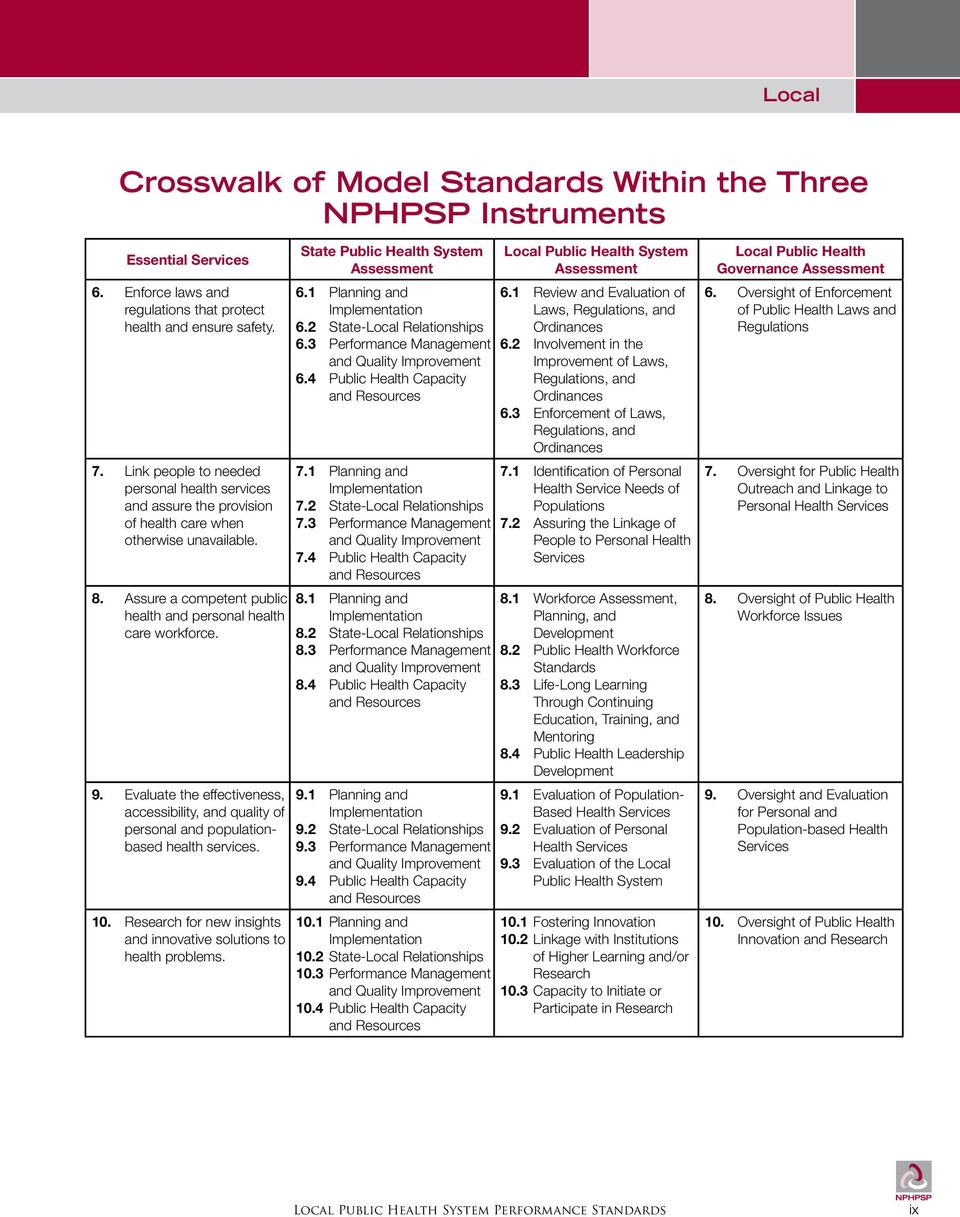
11 Crosswalk of Model Standards Within the Three NPHPSP Instruments Essential Services 6. Enforce laws and regulations that protect health and ensure safety. 7. Link people to needed personal health services and assure the provision of health care when otherwise unavailable. 8. Assure a competent public health and personal health care workforce. 9. Evaluate the effectiveness, accessibility, and quality of personal and populationbased health services. 10. Research for new insights and innovative solutions to health problems. State Public Health System Assessment 6.1 Planning and Implementation 6.2 State-Local Relationships 6.3 Performance Management and Quality Improvement 6.4 Public Health Capacity and Resources 7.1 Planning and Implementation 7.2 State-Local Relationships 7.3 Performance Management and Quality Improvement 7.4 Public Health Capacity and Resources 8.1 Planning and Implementation 8.2 State-Local Relationships 8.3 Performance Management and Quality Improvement 8.4 Public Health Capacity and Resources 9.1 Planning and Implementation 9.2 State-Local Relationships 9.3 Performance Management and Quality Improvement 9.4 Public Health Capacity and Resources 10.1 Planning and Implementation 10.2 State-Local Relationships 10.3 Performance Management and Quality Improvement 10.4 Public Health Capacity and Resources Local Public Health System Assessment 6.1 Review and Evaluation of Laws, Regulations, and Ordinances 6.2 Involvement in the Improvement of Laws, Regulations, and Ordinances 6.3 Enforcement of Laws, Regulations, and Ordinances 7.1 Identification of Personal Health Service Needs of Populations 7.2 Assuring the Linkage of People to Personal Health Services 8.1 Workforce Assessment, Planning, and Development 8.2 Public Health Workforce Standards 8.3 Life-Long Learning Through Continuing Education, Training, and Mentoring 8.4 Public Health Leadership Development 9.1 Evaluation of Population- Based Health Services 9.2 Evaluation of Personal Health Services 9.3 Evaluation of the Local Public Health System 10.1 Fostering Innovation 10.2 Linkage with Institutions of Higher Learning and/or Research 10.3 Capacity to Initiate or Participate in Research Local Public Health Governance Assessment 6. Oversight of Enforcement of Public Health Laws and Regulations 7. Oversight for Public Health Outreach and Linkage to Personal Health Services 8. Oversight of Public Health Workforce Issues 9. Oversight and Evaluation for Personal and Population-based Health Services 10. Oversight of Public Health Innovation and Research ix
12

13 Local Public Health System Model Standards 1

14 Essential Service #1 Monitor Health Status to Identify Community Health Problems This service includes: Accurate, periodic assessment of the community s health status, including: -- Identification of health risks, determinants of health, and determination of health service needs; -- Attention to the vital statistics and health status indicators of groups that are at higher risk than the total population; and -- Identification of community assets that support the local public health system (LPHS) in promoting health and improving quality of life. Utilization of appropriate methods and technology, such as geographic information systems (GIS), to interpret and communicate data to diverse audiences. Collaboration among all LPHS components, including private providers and health benefit plans, to establish and use population health registries, such as disease or immunization registries. LPHS Model Standard 1.1: Population-Based Community Health Profile (CHP) The community health profile (CHP) is a common set of measures for the community to prioritize the health issues that will be addressed through strategic planning and action, to allocate and align resources, and to monitor population-based health status improvement over time. The CHP includes broad-based surveillance data and measures related to health status and health risk at individual and community levels including: demographic and socioeconomic characteristics; health resource availability; quality of life; behavioral risk factors; environmental health indicators; social and mental health; maternal and child health; death, illness, and injury; communicable disease; and sentinel events. The CHP displays information about trends in health status, along with associated risk factors and health resources. Local measures are compared with peer, state, and national benchmarks. Data and information are displayed in multiple formats for diverse audiences, such as the media and community-based organizations. Data included in the community health profile are accurate, reliable, and consistently interpreted according to the science and evidence-base for public health practice. To accomplish this, the local public health system (LPHS): Conducts regular community health assessments to monitor progress towards health-related objectives. Compiles and periodically updates a community health profile using community health assessment data. Promotes community-wide use of the community health profile and/or assessment data and assures that this information can be easily accessed by the community. 2

15 LPHS Model Standard 1.2: Current Technology to Manage and Communicate Population Health Data Population health data are presented in formats that allow for clear communication and interpretation by end users. Such formats include graphed trend data that allow for comparisons over time by relevant variables such as gender, race, and geographic designation. Tools such as geographic information systems (GIS) are used to combine geography, data, and computer mapping to support the exploration of spatial relationships, patterns, and trends in health data. Use of geocoded data (matching of street address to a corresponding latitude and longitude) is promoted, while maintaining appropriate safeguards for confidentiality. Increased public access to GIS information provides new insights to develop strategies that are appropriate for specific geographic areas and to align health status indicators with health resources. While the information in the Community Health Profile (CHP) is available in paper format, this information is also available in a web-based version that is accessible to individuals, community groups, and other organizations in a timely manner. Links to other sources of related information are provided. To accomplish this, the LPHS: Uses state-of-the-art technology to collect, manage, integrate, and display health profile databases. Has access to geocoded data for geographic analysis. Uses computer-generated graphics to identify trends and/or compare data by relevant categories (i.e., race, gender, age group). LPHS Model Standard 1.3: Maintenance of Population Health Registries Population health registries track health-related events such as disease patterns and preventive health services delivery (i.e., cancer registries facilitate tracking of cancer incidence, cancer stage at diagnosis, treatment patterns, and survival probability; vaccine registries provide the real time status of vaccine coverage for specified age groups in the community). The LPHS creates and supports systems to assure accurate and timely reporting by providers. Data are collected for registries in accordance with standards that assure comparability of data from public, private, local, state, regional, and national sources. Collaboration among multiple partners facilitates the aggregation of individual data to compile a population health registry used to inform policy decisions, program implementation, and population research. To accomplish this, the LPHS: Maintains and regularly contributes to population health registries using established criteria to report identified health events. Uses information from one or more population health registries. 3

16 Essential Service #2 Diagnose and Investigate Health Problems and Health Hazards in the Community This service includes: Epidemiological investigations of disease outbreaks and patterns of infectious and chronic diseases and injuries, environmental hazards, and other health threats. Active infectious disease epidemiology programs. Access to a public health laboratory capable of conducting rapid screening and high volume testing. LPHS Model Standard 2.1: Identification and Surveillance of Health Threats Surveillance systems are designed and maintained to monitor health events, to identify changes or patterns, and to investigate underlying causes or factors. Epidemiological and behavioral science techniques are used to collect data to identify risk factors for health threats. Local public health surveillance systems are integrated with national and state surveillance systems to provide comprehensive monitoring of health events using consistent collection and reporting procedures. Surveillance data are used to assess and analyze health problems and hazards. Surveillance data are also used to examine the impact of health hazards, behaviors, and risk factors on disease and mortality. Surveillance efforts also alert the local public health system (LPHS) to community and health indicators that may signal public health emergencies (e.g., natural and intentional disasters including biological and chemical incidents). To accomplish this, the LPHS: Participates in integrated state, local and national surveillance system(s) that identify and analyze health problems and threats. Collects timely reportable disease information from community health professionals who submit information on possible disease outbreaks. Utilizes human and technological resources to support surveillance and investigation activities, including state-of-the-art information technology and communication systems, as well as Masters and/or Doctoral level statistical and epidemiological expertise to assess, investigate, and analyze health threats and health hazards. 4
17 LPHS Model Standard 2.2: Investigation and Response to Public Health Threats and Emergencies Local public health systems must have capacity to respond rapidly and effectively to investigate public health threats and emergencies which involve communicable disease outbreaks or chemical, biological, radiological, nuclear, explosive or environmental incidents. With the occurrence of an adverse public health event or potential threat, a collaborative team of LPHS professionals participates in the collection and analysis of relevant data. A network of support and communication relationships exists in the LPHS, which includes health-related organizations, public safety and rapid response teams, the media, and the general public. Timely investigation of public health emergencies is coordinated through an Emergency Response Coordinator, who leads the local effort in collaboration with LPHS partners in the event of a public health emergency (e.g., health officer, environmental health director). In order to have the capacity to investigate and respond to public health emergencies, the LPHS: Maintains written protocols to implement a program of case finding, contact tracing and source identification and containment for communicable diseases or toxic exposures. Develops written protocols for the immediate investigation of public health threats and emergencies, including natural and intentional disasters. Designates an Emergency Response Coordinator. Identifies personnel with the technical expertise to rapidly respond to potential biological, chemical, or radiological public health emergencies. Evaluates incidents for effectiveness and opportunities for improvement. LPHS Model Standard 2.3: Laboratory Support for Investigation of Health Threats Laboratory support is defined as the ability to produce timely and accurate laboratory results for diagnostic and investigative public health concerns. The actual testing may be performed outside the traditional public health system, however, public health retains the responsibility for ensuring that proper testing and timely results are available to the community. In order to accomplish this, the LPHS: Maintains ready access to laboratories capable of meeting routine diagnostic and surveillance needs. Maintains ready access (24 hours-per-day/7 days-per-week) to laboratories capable of supporting investigations of public health threats, hazards, and emergencies. Confirms that laboratories are in compliance with regulations and standards through credentialing and licensing agencies. Maintains guidelines or protocols to address the handling of laboratory samples, which describe procedures for storing, collecting, labeling, transporting, and delivering laboratory samples, and for determining the chain of custody regarding the handling of these samples, as well as reporting findings. 5

18 Essential Service #3 Inform, Educate, and Empower Individuals and Communities about Health Issues This service includes: Health information, health education, and health promotion activities designed to reduce health risk and promote better health. Health education and health promotion program partnerships with schools, faith communities, work sites, personal care providers, and others to implement and reinforce health promotion programs and messages that are accessible to all populations. Health communication plans and activities such as media advocacy and social marketing. Accessible health information and educational resources. Risk communication processes designed to inform and mobilize the community in time of crisis. LPHS Model Standard 3.1: Health Education and Promotion The local public health system (LPHS) actively creates, communicates, and delivers health information and health interventions using customer-centered and science-based strategies to protect and promote the health of diverse populations. The LPHS supports its health improvement objectives and responds to public health issues with health education and health promotion initiatives that are based on the best available scientific evidence of effectiveness in helping people make healthy choices throughout their lives. Strong working relations include numerous agencies that are actively engaged in promoting and implementing these activities. The LPHS designs and implements a wide range of health education and health promotion activities. Health promotion activities include any combination of educational and environmental supports that give individuals, groups, or communities greater control over conditions affecting their health. Health education is the process by which the LPHS conveys information and facilitates the development of health-enhancing skills among individuals and groups in the community. Health education serves to reinforce health promotion messages within the community, ultimately helping to reduce health risk and improve health status. To accomplish this, the LPHS: Provides the public, policymakers, and stakeholders with information on community health status and health needs in the community, as well as information on policies and programs that can improve community health. Plans, conducts, and evaluates targeted health education and health promotion activities to develop and enhance knowledge and attitudes and assist in lowering risk or changing negative behaviors. Works with other entities within the system on health education and health promotion activities that facilitate healthy living in healthy communities. 6

19 LPHS Model Standard 3.2: Health Communication Health communication encompasses the use of multiple communication strategies to inform and influence individual and community decisions that enhance health. Health communication includes activities related to media campaigns, social marketing, entertainment education, and interactive health communication. Health communication serves to raise awareness of health risks and solutions, support adoption of healthy behavior, and create advocacy for health policies and programs that empower people to adopt healthy lifestyles. The LPHS utilizes a variety of communication channels, such as interpersonal, small group, organizational, community, and mass media, to reach people in a variety of settings, including home, school, work, and community. The LPHS works collaboratively to identify the best contexts, channels, and content of health messages in their community and to leverage resources for their implementation. To accomplish this, the LPHS: Develops health communication plans addressing media and public relations, as well as guidelines for sharing information among stakeholders. Utilizes relationships with media channels (e.g., print, radio, television, Internet) to share health information with general and targeted audiences. Identifies and trains spokespersons on public health issues. LPHS Model Standard 3.3: Risk Communication Risk communication is the provision of information by public health professionals to allow individual, stakeholders, or an entire community to make the best possible decisions about their well-being in times of crisis or emergency. Risk communication includes pre-event, event and post-event communication planning. The LPHS identifies and analyzes potential risks in order to develop strategic plans for public, media, partner, and stakeholder communication during public health emergencies, including terrorism. To accomplish this, the LPHS: Develops an emergency communications plan to effectively create and disseminate materials for each stage of a crisis according to recognized theories and methods. Ensures adequate resources to enable a rapid emergency communications response. Provides crisis and emergency communications training for employees and establishes protocols for the dissemination of public information and instructions during a public health emergency. Maintains current, accurate 24 hours-per-day, 7 days-per-week contact information and collaborative relations with news media, public information officers (PIOs), and partners. 7

20 Essential Service #4 Mobilize Community Partnerships to Identify and Solve Health Problems This service includes: Identifying potential stakeholders who contribute to or benefit from public health and increase their awareness of the value of public health. Building coalitions and working with existing coalitions to draw upon the full range of potential human and material resources to improve community health. Convening and facilitating partnerships and strategic alliances among groups and associations (including those not typically considered to be health-related) in undertaking defined health improvement activities, including preventive, screening, rehabilitation, and support programs, and establishing the social and economic conditions for long-term health. LPHS Model Standard 4.1: Constituency Development Constituents of the LPHS include all persons and organizations that directly contribute to or benefit from public health. Constituents may include members of the public served by the local public health system (LPHS), the governmental bodies it represents, and other health, environmental, and non-health-related organizations in the community. Constituency development is the process of establishing collaborative relationships among the LPHS and all current and potential stakeholders. As part of constituency development activities, the LPHS develops and operationalizes a communications strategy designed to educate the community about the benefits of public health and the role of the LPHS in improving community health. The LPHS operationalizes the communications strategy through formal and informal community networks, which may include businesses, schools, healthcare organizations, the faith community, and community associations. For effective constituency development, the LPHS: Has a process to identify key constituents for population-based health in general and for specific health concerns (e.g., a particular health theme, disease, risk factor, life stage need). Encourages the participation of its constituents in community health activities, such as in identifying community issues and themes and engaging in volunteer public health activities. Establishes and maintains a comprehensive directory of community organizations. Uses broad-based communication strategies to strengthen linkages among LPHS organizations and to provide current information about public health services and issues. 8

21 LPHS Model Standard 4.2: Community Partnerships Community partnerships and strategic alliances describe a continuum of relationships that foster the sharing of resources and accountability in undertaking community health improvement. Public health departments may convene or facilitate the collaborative process. The multiple levels of relationships among public, private, or nonprofit institutions have been described as 1) networking, exchanging information for mutual benefit; 2) coordination, exchanging information and altering activities for mutual benefit and to achieve a common purpose; 3) cooperation, exchanging information, altering activities, and sharing resources for mutual benefit and to achieve a common purpose; and 4) collaboration, exchanging information, altering activities, sharing resources, and enhancing the capacity of another for mutual benefit and to achieve a common purpose. Multi-sector collaboration is thus defined as a voluntary strategic alliance of public, private, and nonprofit organizations to enhance each other s capacity to achieve a common purpose by sharing risks, responsibilities, resources, and rewards. Multi-sector partnerships such as community health improvement committees (community committees) exist in some communities as formally constituted bodies (e.g., a community health planning council) while in other communities they are less formal groups. The community committee is a dynamic collaboration designed to be comprehensive and inclusive in its membership and its approach to community health improvement. To accomplish this, the LPHS: Establishes community partnerships and strategic alliances to assure a comprehensive approach to improving health in the community. Assures the establishment of a broad-based community health improvement committee. Assesses the effectiveness of community partnerships and strategic alliances in improving community health. 9
22 Essential Service #5 Develop Policies and Plans that Support Individual and Community Health Efforts This service includes: An effective governmental presence at the local level. Development of policy to protect the health of the public and to guide the practice of public health. Systematic community-level planning for health improvement and public health emergency response in all jurisdictions. Alignment of local public health system (LPHS) resources and strategies with a community health improvement plan. LPHS Model Standard 5.1: Governmental Presence at the Local Level Every community must be served by a governmental public health entity. As the line of first defense, local governmental public health entities play a vital role in ensuring the safety, health, and well-being of communities. The governmental public health entity works in partnership with the community to assure the development and maintenance of a flexible and dynamic public health system that provides the Essential Public Health Services. In doing this, the local governmental public health entity coordinates or assures the provision of quality public health services. Typically, the local health department (LHD) or a local branch of the state health agency serves as the local governmental public health entity. To accomplish this, the local public health system (LPHS): Includes a local governmental public health entity to assure the delivery of the Essential Public Health Services to the community. Assures the availability of adequate resources for the local health department s contributions to the provision of Essential Public Health Services. Maintains an appropriate relationship with its local governing entity (e.g., local board of health, county commission, state health agency). Coordinates with the state public health system. 10
23 LPHS Model Standard 5.2: Public Health Policy Development As used in this instrument, the phrase policy development involves the means by which problem identification, technical knowledge of possible solutions, and societal values join to set a course of action (IOM, 1988). Policy development is not synonymous with the development of laws, rules, and regulations (which are the focus of Essential Service # 6). Laws, rules, and regulations may be adopted as tools to implement policy, but good policies must precede good legislation. Policy development is a process that enables informed decisions to be made concerning issues related to the public s health. The LPHS works with the community to identify policy needs and gaps to develop policies to improve the public s health. The LPHS promotes the community s understanding of, and advocacy for, policies to improve health, and serves as a resource to elected officials to establish and maintain public health policies. To assure effective public health policy, the LPHS: Contributes to the development and/or modification of public health policy by facilitating community involvement and engaging in activities that inform the policy development process. Alerts policymakers and the public of potential public health impacts (both intended and unintended) from current and/or proposed policies. Reviews existing policies at least every three to five years. 11
24 LPHS Model Standard 5.3: Community Health Improvement Process and Strategic Planning Community health improvement includes traditional public health, environmental health, and health services categories, as well as business, economic, housing, land use, health equity and other community issues affecting the public s health. The community health improvement process involves an ongoing collaborative, community-wide effort by the LPHS to identify, analyze, and address health problems; assess applicable data; inventory community health assets and resources; identify community perceptions; develop and implement coordinated strategies; develop measurable health objectives and indicators; identify accountable entities; and cultivate community ownership of the entire process. The community health improvement process provides the opportunity to develop a community-owned plan that will lead to a healthier community. The community health improvement process is further strengthened by the organizational strategic planning activities of LPHS members, including the local health department. To effectively leverage community resources and optimize outcomes, organizations within the LPHS make efforts to review and align their organizational strategic plans with the community health improvement process. To accomplish this, the LPHS: Establishes a community health improvement process, which includes broad-based participation and uses information from community health assessments as well as perceptions of community residents. Develops strategies to achieve community health improvement objectives and identifies accountable entities to achieve each strategy. Because the activities of the local health department should be focused on community public health needs and issues, specific attention is given to this organization s strategic plan. The local health department: Conducts organizational strategic planning activities and reviews its organizational strategic plan to determine how it can best be aligned with the community health improvement process. 12
25 LPHS Model Standard 5.4: Plan for Public Health Emergencies An All-Hazards emergency preparedness and response plan describes the roles, functions and responsibilities of LPHS and other entities in the event of one or more types of public health emergencies. LPHS entities, including the local health department, emergency management, law enforcement, fire departments, health care providers, and other partners work collaboratively to formulate emergency response plans and procedures. Careful planning and mobilization of resources and partners prior to an event is crucial to a prompt and effective response. The plan should create an all-hazards response infrastructure, in that it outlines the capacity of the LPHS to respond to all public health emergencies (including natural and intentional incidents and disasters), while taking into account the unique and complex challenges presented by chemical, biological, radiological, nuclear and explosive incidents. These plans describe community interventions necessary to prevent, monitor and control the incident. In order to plan for public health emergencies, the LPHS: Establishes a task force to develop and maintain emergency preparedness and response plans. Develops a plan that defines public health disasters and emergencies that might trigger implementation of the LPHS emergency response plan, describes organizational responsibilities, and establishes standard operating procedures and clearly outlines alert and evacuation protocols. Tests the plan through the staging of one or more mock events, and revises the plan as necessary at least every two years. 13
26 Essential Service #6 Enforce Laws and Regulations that Protect Health and Ensure Safety This service includes: The review, evaluation, and revision of laws, regulations, and ordinances designed to protect health and safety to assure that they reflect current scientific knowledge and best practices for achieving compliance. Education of persons and entities obligated to obey or to enforce laws, regulations, and ordinances designed to protect health and safety in order to encourage compliance. Enforcement activities in areas of public health concern, including, but not limited to the protection of drinking water; enforcement of clean air standards; emergency response; regulation of care provided in health care facilities and programs; re-inspection of workplaces following safety violations; review of new drug, biologic, and medical device applications; enforcement of laws governing the sale of alcohol and tobacco to minors; seat belt and child safety seat usage; and childhood immunizations. LPHS Model Standard 6.1: Review and Evaluation of Laws, Regulations, and Ordinances The local public health system (LPHS) reviews existing federal, state, and local laws, regulations, and ordinances relevant to public health in the community, including laws, regulations, and ordinances addressing environmental quality and health-related behavior. The review focuses on the authority established for laws, regulations, and ordinances as well as the impact of existing laws, regulations, and ordinances on the health of the community. The review also assesses compliance, opinions of constituents, and whether laws, regulations, and ordinances require updating. In order to accomplish this, the LPHS: Identifies public health issues that can only be addressed through laws, regulations, or ordinances. Is knowledgeable about current federal, state, and local laws, regulations, and ordinances that protect the public s health. Reviews public health laws, regulations, and ordinances at least once every five years. Has access to legal counsel for assistance in the review of laws, regulations, and ordinances. 14
27 LPHS Model Standard 6.2: Involvement in the Improvement of Laws, Regulations, and Ordinances Having identified local public health issues that are not adequately being addressed through existing laws, regulations, and ordinances, the LPHS participates actively in the modification of existing laws, regulations, and ordinances and the formulation of new laws, regulations, and ordinances designed to assure and improve the public s health. This participation includes the drafting of proposed legislation and regulations, involvement in public hearings, and periodic communication with legislators and regulatory officials. In order to accomplish this, the LPHS: Identifies local public health issues that are not adequately addressed through existing laws, regulations, and ordinances. Participates in the modification of existing laws, regulations, and ordinances and/or the formulation of new laws, regulations, and ordinances designed to assure and improve the public s health. Provides technical assistance for drafting proposed legislation, regulations, and ordinances. LPHS Model Standard 6.3: Enforcement of Laws, Regulations, and Ordinances The LPHS recognizes the unique role of the government to enforce public health laws, regulations, and ordinances. The authority of the governmental organizations within the LPHS to enforce public health laws, regulations, and ordinances varies from state to state and between jurisdictions within states. In many communities, the local health department exercises regulatory enforcement that is delegated or contracted to it by federal, state, county, or municipal government entities. In other communities, enforcement authority may be retained by the state or delegated to one or more private entities whose authority may cross local jurisdictional boundaries. To enforce laws, regulations, and ordinances, the LPHS: Identifies organizations within the LPHS that have authority to enforce public health laws, regulations, or ordinances. Assures that a local governmental public health entity is appropriately empowered through laws and regulations to act in public health emergencies and implement necessary community interventions. Assures that all enforcement activities are conducted in accordance with laws, regulations, and ordinances. Informs and educates individuals and organizations of the meaning and purpose of public health laws, regulations, and ordinances with which they are required to comply. Evaluates the compliance of regulated organizations and entities. 15
28 Essential Service #7 Link People to Needed Personal Health Services and Assure the Provision of Health Care when Otherwise Unavailable This service includes: Identifying populations with barriers to personal health services. Identifying personal health service needs of populations with limited access to a coordinated system of clinical care. Assuring the linkage of people to appropriate personal health services through coordination of provider services and development of interventions that address barriers to care (e.g., culturally and linguistically appropriate staff and materials, transportation services). LPHS Model Standard 7.1: Identification of Personal Health Service Needs of Populations The local public health system (LPHS) identifies populations who may encounter barriers to personal health services. Identified barriers may be due to age, lack of education, poverty, culture, race, language, religion, national origin, physical and/or mental disability, or lack of health insurance. In order to ensure equitable access to personal health services, the LPHS has defined and agreed upon roles and responsibilities for the local governmental public health entity, hospitals, managed care plans, and other community health care providers in relation to providing these services. To accomplish this, the LPHS: Identifies populations in the community who may experience barriers to the receipt of personal health services. Defines personal health service needs for the general population and for those populations who may experience barriers to personal health services. This includes defining specific preventive, curative, and rehabilitative health service needs for the jurisdiction. Assesses the extent to which personal health services in the jurisdiction are available and utilized by populations who may encounter barriers to care. 16
29 LPHS Model Standard 7.2: Assuring the Linkage of People to Personal Health Services The LPHS supports and coordinates partnerships and referral mechanisms among the community s public health, primary care, oral health, social service, and mental health systems to optimize access to needed personal health services. The LPHS seeks to create innovative partnerships with organizations such as libraries, parenting centers, and service organizations, that will help to enhance the effectiveness of LPHS personal health services. To accomplish this, the LPHS: Links populations to personal health services, including populations who may encounter barriers to care. Provides assistance in accessing personal health services in a manner that recognizes the diverse needs of unserved and underserved populations. Enrolls eligible beneficiaries in state Medicaid or Medical and Prescription Assistance Programs. Coordinates the delivery of personal health and social services to optimize access. 17
30 Essential Service #8 Assure a Competent Public and Personal Health Care Workforce This service includes: Assessment of all of the workers within the local public health system (LPHS) (including agency, public, and private workers, volunteers, and other lay community health workers) to meet community needs for public and personal health services. Maintaining public health workforce standards, including efficient processes for licensure/ credentialing of professionals and incorporation of core public health competencies needed to provide the Essential Public Health Services into personnel systems. Adoption of continuous quality improvement and life-long learning programs for all members of the public health workforce, including opportunities for formal and informal public health leadership development. LPHS Model Standard 8.1: Workforce Assessment, Planning, and Development Workforce assessment is the process of determining the competencies, skills, and knowledge; categories and number of personnel; and training needed to achieve public health and personal health goals. It is a community process that includes the identification of those available to contribute to the provision of the Essential Public Health Services and the particular strengths and assets that each brings. Workforce assessment includes the projection of optimal numbers and types of personnel and the formulation of plans to address identified workforce shortfalls or gaps. To accomplish this, organizations within the local public health system (LPHS): Establish a collaborative process to periodically determine the competencies, composition, and size of the public and personal health workforce that provides the Essential Public Health Services. Identify and address gaps in the public and personal health workforce, ideally using information from the assessment. Distribute information from the workforce assessment to community organizations, including governing bodies and public and private agencies, for use in their strategic and operational plans. 18
31 LPHS Model Standard 8.2: Public Health Workforce Standards Organizations within the LPHS develop and maintain public health workforce standards for individuals who deliver and/or contribute to the Essential Public Health Services. Public health workforce qualifications include certifications, licenses, and education required by law or established by local, state, or federal policy guidelines. In addition, core and specific competencies that are needed to provide the Essential Public Health Services are incorporated into personnel systems. These standards are linked to job performance through clearly written position descriptions and regular performance evaluations. To accomplish this, organizations within the LPHS: Are aware of and in compliance with guidelines and/or licensure/certification requirements for personnel contributing to the Essential Public Health Services. Periodically develop, use, and review job standards and position descriptions that incorporate specific competency and performance expectations. Evaluate members of the public health workforce on their demonstration of core public health competencies and those competencies specific to a work function or setting and encourage staff to respond to evaluations and performance goal adjustments by taking advantage of continuing education and training opportunities. Workforce standards are essential for each organization within the local public health system, but are particularly important for the local health department (LHD) where a large concentration of public health professionals exists. To fulfill these important obligations the LHD: Develops written job standards and/or position descriptions for all LHD personnel. Conducts annual performance evaluations of personnel within the LHD. 19
32 LPHS Model Standard 8.3: Life-Long Learning Through Continuing Education, Training, and Mentoring Continuing education and training include formal and informal educational opportunities. This may encompass distance learning, workshops, seminars, national and regional conferences, and other activities intended to strengthen the professional knowledge and skills of employees contributing to the provision of the Essential Public Health Services. Experienced mentors and coaches are available to less experienced staff to provide advice and assist with skill development and other needed career resources. Opportunities are available for staff to work with academic and research institutions, particularly those connected with schools of public health, public administration, and population health disciplines. Through these academic linkages, the public health workforce, faculty, and students are provided with opportunities for relevant interaction, which enriches both settings. The complexity of promoting health and preventing disease in a country as diverse as the United States requires the public health workforce to continually learn and apply this new knowledge. The population in the United States continues to be diverse in terms of race, ethnicity, faith beliefs, age, economics, education, life-style preference and other demographic characteristics. Factors such as the social environment, physical environment, economic status, genetic predisposition, behavioral risk factors, and health care also influence health and well-being. An understanding and respect for this diversity and the underlying factors that address health are critical to the performance of all of the Essential Public Health Services. The LPHS respects diverse perspectives and cultural values and expects staff to demonstrate cultural competence in all interactions based on the dignity and value of each individual as a professional colleague or community member. To accomplish this, organizations within the LPHS: Identify education and training needs and encourage opportunities for workforce development. Provide opportunities for all personnel to develop core public health competencies. Provide incentives (e.g., improvements in pay scale, release time, tuition reimbursement) for the public health workforce to pursue education and training. Provide opportunities for public health workforce members, faculty and student interaction to mutually enrich practice-academic settings. 20
33 LPHS Model Standard 8.4: Public Health Leadership Development LPHS leadership is demonstrated by both individuals and organizations that are committed to improving the health of the community. Leaders play a vital role in assuring the creation of a public health system, the implementation of the Essential Public Health Services, and the creation and achievement of a shared vision of community health and well-being. LPHS leadership may be provided by the local governmental public health entity, may emerge from the public and private sectors or the community, or may be shared by multiple stakeholders. The LPHS encourages the development of leadership capacity that is inclusive, representative of community diversity, and respectful of the community s perspective. To accomplish this, the organizations within the LPHS: Provide formal (e.g., educational programs, leadership institutes) and informal (e.g., coaching, mentoring) opportunities for leadership development for employees at all organizational levels. Promote collaborative leadership through the creation of a public health system with a shared vision and participatory decision-making. Assure that organizations and/or individuals have opportunities to provide leadership in areas where their expertise or experience can provide insight, direction, or resources. Provide opportunities for development of diverse community leadership to assure sustainability of public health initiatives. 21
34 Essential Service #9 Evaluate Effectiveness, Accessibility, and Quality of Personal and Population- Based Health Services This service includes: Evaluating the accessibility and quality of services delivered and the effectiveness of personal and population-based programs provided. Providing information necessary for allocating resources and reshaping programs. LPHS Model Standard 9.1: Evaluation of Population-Based Health Services The local public health system (LPHS) regularly evaluates the accessibility, quality, and effectiveness of population-based health services (e.g., injury prevention, physical activity, immunizations) and progress towards program goals. The LPHS has established performance criteria, or used externally established performance criteria (e.g., Healthy People 2010 objectives or The Guide to Community Preventive Services), to evaluate specific indicators for population-based services. The evaluation of population-based health services is built on the analysis of health status, service utilization, and community satisfaction data to assess program effectiveness and to provide information to allocate resources and reshape programs. To accomplish this, the LPHS: Evaluates population-based health services against established criteria for performance, including the extent to which program goals are achieved for these services. Assesses community satisfaction with population-based services and programs through a broad-based process, which includes residents who are representative of the community and groups at increased risk of negative health outcomes. Identifies gaps in the provision of population-based health services. Uses evaluation findings to modify the strategic and operational plans of LPHS organizations to improve services and programs. 22
35 LPHS Model Standard 9.2: Evaluation of Personal Health Services The LPHS regularly evaluates the accessibility, quality, and effectiveness of personal health services, ranging from prevention services to acute care to hospice care. Special attention is given to the ability of community providers to deliver services across life stages and population groups. An important component of the evaluation is a survey of client satisfaction. The clients surveyed are representative of all actual and potential users of the system. The survey addresses satisfaction with access to the system by populations with barriers to personal health services, usability of the system by all clients, and inclusiveness of services. To accomplish this, organizations within the LPHS: Evaluate the accessibility, quality, and effectiveness of personal health services. Evaluate personal health services against established standards. Assess the satisfaction of clients (including those at increased risk of negative health outcomes). Use information technology to assure quality of personal health services and communication among providers. Use evaluation findings to modify their strategic and operational plans and to improve services and programs. LPHS Model Standard 9.3: Evaluation of the Local Public Health System A local public health system includes all public, private, and voluntary entities, as well as individuals and informal associations that contribute to the delivery of the Essential Public Health Services within a jurisdiction. The evaluation focuses primarily on the performance of the LPHS as a whole. The local governmental public health entity takes a lead role in convening a collaborative evaluation process. Organizations engaged in the evaluation process use established criteria to assess LPHS activities, the achievement of goals, and any lapses in quality. The standards used are consistent with NPHPSP or similar standards. Community perceptions are a vital component of the evaluation. The evaluation findings are regularly used to inform the community health improvement process and to improve services and programs. To accomplish this, the LPHS: Identifies community organizations or entities that contribute to the delivery of the Essential Public Health Services. Evaluates the comprehensiveness of LPHS activities against established criteria at least every five years and ensures that all organizations within the LPHS contribute to the evaluation process. Assesses the effectiveness of communication, coordination, and linkage among LPHS entities. Uses information from the evaluation process to refine existing community health programs, to establish new ones, and to redirect resources as needed to accomplish LPHS goals. 23
36 Essential Service #10 Research for New Insights and Innovative Solutions to Health Problems This service includes: A continuum of innovative solutions to health problems ranging from practical field-based efforts to foster change in public health practice, to more academic efforts to encourage new directions in scientific research. Linkages with institutions of higher learning and research. Capacity to undertake timely epidemiological and health policy analyses and conduct health systems research. LPHS Model Standard 10.1: Fostering Innovation Organizations within the local public health system (LPHS) foster innovation to strengthen public health practice. Innovation includes practical field-based efforts to foster change in public health practice as well as academic efforts to encourage new directions in scientific research. To accomplish this, organizations within the LPHS: Enable staff to identify new solutions to health problems in the community by providing the time and resources for staff to pilot test or conduct studies to determine the feasibility of implementing new ideas. Propose public health issues to organizations that do research for inclusion in their research agendas. Research and monitor best practice information from other agencies and organizations at the local, state, and national level. Encourage community participation in research development and implementation (e.g., identifying research priorities, designing studies, preparing related communications for the general public). 24
37 LPHS Model Standard 10.2: Linkage with Institutions of Higher Learning and/or Research The LPHS establishes a wide range of relationships with institutions of higher learning and/or research organizations, including patterns of mutual consultation, and formal and informal affiliation. Such relationships can occur with schools of public health as well as with schools and departments of medicine, nursing, pharmacy, allied health, business and environmental science. The LPHS establishes linkages with other research organizations, such as federal and state agencies, associations, private research organizations, and research departments or divisions of business firms. The LPHS links with one or more institutions of higher learning and/or research organizations to co-sponsor continuing education programs. To accomplish this, the LPHS: Develops relationships with these institutions that range from patterns of consultation to formal and informal affiliations. Partners with institutions of higher learning or research to conduct research activities related to the public s health, including community-based participatory research. Encourages collaboration between the academic/research and practice communities, including field training experiences and continuing education opportunities. LPHS Model Standard 10.3: Capacity to Initiate or Participate in Research Organizations within the LPHS initiate and/or participate in research that contributes to epidemiological and health policy analyses and improved health system performance. Health systems research encompasses both population-based and personal health care services research. This research includes the examination of factors related to the efficient and effective implementation of the Essential Public Health Services (public health systems research) as well as the study of variables that influence health care quality and service delivery (health services research). The capacity to initiate or participate in timely epidemiological, policy, and health systems research begins with ready access to researchers with the knowledge and skill to design and conduct research in those areas. This capacity also includes the availability of resources, such as a technical library, on-line services, and information technology. Capacity also includes facilities for analyses, and the ability to disseminate and apply research findings to improve public health practice. To accomplish this, the LPHS: Includes or has access to researchers with the knowledge and skill to design and conduct health-related studies. Ensures the availability of resources (e.g., databases, information technology) to facilitate research. Disseminates research findings to public health colleagues and others (e.g., publication in journals, websites). Evaluates the development, implementation, and impact of LPHS research efforts on public health practice. 25
38
39
40 CS110300
Local Public Health Governance Performance Assessment
 Local Public Health Governance Performance Assessment Version 2.0 Model Standards U.S. Department of Health and Human Services Centers for Disease Control and Prevention THE NATIONAL PUBLIC HEALTH PERFORMANCE
Crosswalk of Model Standards and Key Points within the Three NPHPSP Instruments
 Crosswalk of Model Standards and Key Points within the Three NPHPSP Instruments Essential Services 1. Monitor health status to identify community health problems. 1.1 Planning and 1.1.1 Surveillance and
San Francisco Local Public Health System Assessment
 Background In January 2012, San Francisco Department of the Environment (SFE) and the San Francisco Department of Public Health (SFDPH) partnered to conduct a Local Public Health System Assessment (LPHSA).
National Public Health Performance Standards Program Frequently Asked Questions
 National Public Health Performance Standards Program Frequently Asked Questions What is the National Public Health Performance Standards Program (NPHPSP)? The NPHPSP is a partnership initiative of national
Definition of Foundational Public Health Services
 Definition of Foundational Public Health Services FOUNDATIONAL CAPABILITIES A. Assessment (Surveillance and Epidemiology). The foundational definition of this capability includes: 1. Ability to collect
Operational Definition
 Operational Definition of a functional local health department Public Health Operational Definition of a Functional Local Health Department November 2005 1 November 2005 Prevent. Promote. Protect. o p
LEVY COUNTY Community Health Improvement Plan Prepared by the Florida Department of Health in Levy County 2013 Update Originally prepared September
 LEVY COUNTY Community Health Improvement Plan Prepared by the Florida Department of Health in Levy County 2013 Update Originally prepared September 2012 Table of Contents Executive Summary... 3 MAPP Process......
Following are detailed competencies which are addressed to various extents in coursework, field training and the integrative project.
 MPH Epidemiology Following are detailed competencies which are addressed to various extents in coursework, field training and the integrative project. Biostatistics Describe the roles biostatistics serves
Online MPH Program Supplemental Application Handbook
 Online MPH Program Supplemental Application Handbook Table of Contents Online MPH Supplemental Application Handbook Completing & Submitting the Supplemental Application 2 Eligible Previous Public Health
Essential Functions of Public Health
 Essential Functions of Public Health Prepared by Conference of Local Health Officials Standards Committee as an orientation to the Minimum Standards for Local Health Departments in Oregon Functions or
The 10 Essential Public Health Services An Overview
 The 10 Essential Public Health Services An Overview Office for State, Tribal, Local and Territorial Support Centers for Disease Control and Prevention March 2014 Centers for Disease Control and Prevention
DEPARTMENT OF PUBLIC HEALTH AND ENVIRONMENT. Office of Planning and Partnerships
 DEPARTMENT OF PUBLIC HEALTH AND ENVIRONMENT Office of Planning and Partnerships 6 CCR 1014-7 Core Public Health Services (PROMULGATED BY THE STATE BOARD OF HEALTH) Last amended 10/19/11, effective 11/30/11
ASPH Education Committee Master s Degree in Public Health Core Competency Development Project
 ASPH Education Committee Master s Degree in Public Health Core Competency Development Project Version 2.3 Word Format Domains and Competencies Only May 2007 Discipline-specific Competencies A. BIOSTATISTICS
The MPH. ability to. areas. program. planning, the following. Competencies: research. 4. Distinguish. among the for selection
 MPH COMPETENCIES The MPH competencies are based on those approved by the Association of Schools of Public Health (ASPH) in 2006. By graduation, all MPH students must demonstrate the ability to apply public
Public Health Accreditation Board STANDARDS. Measures VERSION 1.0 APPLICATION PERIOD 2011-2012 APPROVED MAY 2011
 Public Health Accreditation Board STANDARDS & Measures VERSION 1.0 APPLICATION PERIOD 2011-2012 APPROVED MAY 2011 Introduction The Public Health Accreditation Board (PHAB) Standards and Measures document
Core Competencies for Public Health Professionals: Tier 2
 Core Competencies for Public Health Professionals: Analytical/Assessment Skills (Mid Tier) 2 1B1. Describes factors impacting the health of a community (e.g., equity, income, education, environment) [formerly
Registered School Nurses Scope of Practice
 Registered School Nurses Scope of Practice INTRODUCTION: This document identifies the fundamental competencies required in each of the three domains of nursing practice, namely: Care Provision and Management,
 Upon completion of their degree in Health Sciences - Public Health, students will demonstrate their knowledge and ability to apply the following processes, concepts, and principles to promote and protect
Introduction to Public Health: Explaining Its Role in Disasters
 Introduction to Public Health: Explaining Its Role in Disasters Objectives By the end of this section, the participant should be able to: State the mission of public health Describe the role of public
The UNE Master of Public Health Program and Graduate Certificate in Public Health Programs Competencies
 The UNE Master of Public Health Program and Graduate Certificate in Public Health Programs Competencies A. BIOSTATISTICS Biostatistics is the development and application of statistical reasoning and methods
How To Be A Health Care Provider
 Program Competency & Learning Objectives Rubric (Student Version) Program Competency #1 Prepare Community Data for Public Health Analyses and Assessments - Student 1A1. Identifies the health status of
Scope and Standards of Practice for The Acute Care Nurse Practitioner. American Association of Critical-Care Nurses
 Scope and Standards of Practice for The Acute Care Nurse Practitioner American Association of Critical-Care Nurses Editor: Linda Bell, RN MSN Copy Editor: Anne Bernard Designer: Derek Bennett An AACN Critical
Bioterrorism & Emergency Readiness
 Bioterrorism & Emergency Readiness COMPETENCIES FOR ALL PUBLIC HEALTH WORKERS A Message from the Centers for Disease Control and Prevention Dear Public Health Colleague, A prepared workforce is an essential
SCHOOL NURSE COMPETENCIES SELF-EVALUATION TOOL
 Page 1 of 12 SCHOOL NURSE COMPETENCIES SELF-EVALUATION TOOL School Nurse School Date Completed School Nurse Supervisor Date Reviewed The school nurse competencies presume that some core knowledge has been
TITLE 8. HEALTH CHAPTER 52. PUBLIC HEALTH PRACTICE STANDARDS OF PERFORMANCE FOR LOCAL BOARDS OF HEALTH IN NEW JERSEY
 TITLE 8. HEALTH CHAPTER 52. PUBLIC HEALTH PRACTICE STANDARDS OF PERFORMANCE FOR LOCAL BOARDS OF HEALTH IN NEW JERSEY CHAPTER AUTHORITY: N.J.S.A. 26:1A-15 and 26:3A2-1 et seq. CHAPTER SOURCE AND EFFECTIVE
Planning for Health Information Technology and Exchange in Public Health
 Planning for Health Information Technology and Exchange in Public Health UC Davis Health Informatics 2009 Seminar Series Linette T Scott, MD, MPH Deputy Director, Health Information and Strategic Planning
Healthy People First: Opportunities and Risks in Health System Transformation in Ontario
 HL9.3 STAFF REPORT FOR ACTION Healthy People First: Opportunities and Risks in Health System Transformation in Ontario Date: January 11, 2016 To: From: Wards: Board of Health Medical Officer of Health
How To Be A Health Care Worker
 Working with Epidemiologists for Heart Disease & Stroke Prevention Program Development Betty C. Jung, RN MPH CHES Connecticut Department of Public Health [email protected] Albert Tsai, PhD, MPH
Subdomain Weight (%)
 CLINICAL NURSE LEADER (CNL ) CERTIFICATION EXAM BLUEPRINT SUBDOMAIN WEIGHTS (Effective June 2014) Subdomain Weight (%) Nursing Leadership Horizontal Leadership 7 Interdisciplinary Communication and Collaboration
The Healthy Asia Pacific 2020 Roadmap INTRODUCTION: THE HEALTHY ASIA PACIFIC 2020 INITIATIVE
 The Healthy Asia Pacific 2020 Roadmap INTRODUCTION: THE HEALTHY ASIA PACIFIC 2020 INITIATIVE In the 2014 APEC Leader s Declaration and Joint Ministerial Statement, it is recognized that the prospect of
SUBTITLE D--PROVISIONS RELATING TO TITLE IV SEC 10408 GRANTS FOR SMALL BUSINESSES TO PROVIDE COMPREHENSIVE WORKPLACE WELLNESS PROGRAMS
 SUBTITLE D--PROVISIONS RELATING TO TITLE IV SEC 10408 GRANTS FOR SMALL BUSINESSES TO PROVIDE COMPREHENSIVE WORKPLACE WELLNESS PROGRAMS The Secretary of HHS will award grants to eligible employers to provide
Standards for the School Nurse [23.120]
![Standards for the School Nurse [23.120]](/thumbs/25/4559478.jpg "Standards for the School Nurse [23.120]") Standards for the School Nurse [23.120] STANDARD 1 Content Knowledge The certificated school nurse understands and practices within a framework of professional nursing and education to provide a coordinated
Standards for the School Nurse [23.120] STANDARD 1 Content Knowledge The certificated school nurse understands and practices within a framework of professional nursing and education to provide a coordinated
CURRICULAR MAP FOR THE MASTER OF PUBLIC HEALTH
 CUICULA MA FO THE MASTE OF UBLIC HEALTH The accrediting agency requires that assessment be based on public health competencies, so we have chosen those competencies that best match the generic SLOs most
TEXAS HOMELAND SECURITY STRATEGIC PLAN 2015-2020: PRIORITY ACTIONS
 TEXAS HOMELAND SECURITY STRATEGIC PLAN 2015-2020: PRIORITY ACTIONS INTRODUCTION The purpose of this document is to list the aligned with each in the Texas Homeland Security Strategic Plan 2015-2020 (THSSP).
Case Study A - Discussion Questions
 Case Study A In late 2002 the Healthy County Health Department convened a wide range of organizations and entities in order to develop a community health improvement plan. This collaboration included community
United States Public Health 101
 United States Public Health 101 [Individuals and organizations may customize and use the following slides for their own informational and educational purposes] Office for State, Tribal, Local and Territorial
Rubric for Evaluating Colorado s Specialized Service Professionals: School Nurses
 Rubric for Evaluating Colorado s Specialized Service Professionals: School Nurses Definition of an Effective School Nurse Effective school nurses are vital members of the education team. They are properly
State of Mississippi. Oral Health Plan
 State of Mississippi Oral Health Plan 2006 2010 Vision Statement: We envision a Mississippi where every child enjoys optimal oral health; where prevention and health education are emphasized and treatment
2013-14 Report on Plans and Priorities Additional Information for Sub-programs and Sub-sub-programs
 2013-14 Report on Plans and Priorities Additional Information for Sub-programs and Sub-sub-programs Strategic Outcome: Protecting Canadians and empowering them to improve their health Program 1.1 Public
2015-16 Rubric for Evaluating Colorado s Specialized Service Professionals: School Nurses
 2015-16 Rubric for Evaluating Colorado s Specialized Service Professionals: School Nurses Definition of an Effective School Nurse Effective school nurses are vital members of the education team. They are
Sample Position Description for Tier 3a: Senior-Level Epidemiologist, Supervisor or Manager
 Sample Position Description for Tier 3a: Senior-Level Epidemiologist, Supervisor or Manager Introduction Incumbent serves as chief or head of a major epidemiology program unit within the Epidemiology Department
Responsibilities of Public Health Departments to Control Tuberculosis
 Responsibilities of Public Health Departments to Control Tuberculosis Purpose: Tuberculosis (TB) is an airborne infectious disease that endangers communities. This document articulates the activities that
PHFAST Public Health Framework ASsessment Tool Adapted from the Public Health Framework for Action and STAR
 LEADERSHIP: The state chronic disease prevention and control unit is the unifying voice for the prevention and control of chronic diseases. LS1 LS2 LS3 LS4 LS5 The unit is a key contact for others both
Prevent what is preventable, cure what is curable, provide palliative care for patients in need, and monitor and manage for results.
 Proposed PAHO Plan of Action for Cancer Prevention and Control 2008 2015 Prevent what is preventable, cure what is curable, provide palliative care for patients in need, and monitor and manage for results.
School Nurse Section - Introduction
 School Nurse Section - Introduction The Role of the Credentialed School Nurse Role of the Credentialed School Nurse The California School Nurses Organization (CSNO) position statement: The California School
KING COUNTY PUBLIC HEALTH OPERATIONAL MASTER PLAN: A POLICY FRAMEWORK FOR THE HEALTH OF THE PUBLIC
 KING COUNTY PUBLIC HEALTH OPERATIONAL MASTER PLAN: A POLICY FRAMEWORK FOR THE HEALTH OF THE PUBLIC October 12, 2007 Page 1 of 22 I. King County s Mission & Goal for the Health of the Public King County
A Model Framework For Community Oral Health. Programs. Based Upon The Ten Essential Public Health Services. Prepared by
 A Model Framework For Community Oral Health Programs Based Upon The Ten Essential Public Health Services Prepared by American Association for Community Dental Programs With support from Association of
Sample Position Description for Tier 1: Entry-Level Epidemiologist
 Sample Position Description for Tier 1: Entry-Level Epidemiologist Introduction Incumbent serves as an entry-level epidemiologist responsible for carrying out a range of investigative and analytical epidemiologic
2015-2016 Alabama Department of Public Health Strategic Plan
 2015-2016 Alabama Department of Public Health Strategic Plan ADPH Strategic Plan Page 1 The vision, mission, and core values are the foundation for any strategic plan. Together, they identify why an organization
Public Health Leadership Development: Recommendations for a Sustainable National Network
 Public Health Leadership Development: Recommendations for a Sustainable National Network A White Paper by the Public Health Leadership Society July 2006 1515 Poydras Street, Suite 1200 New Orleans, LA
Primary Health Care Dietitian. Authority Division/Region Location. GASHA Community Health Antigonish
 Position Number New 0.5 FTE Position Title Primary Health Care Dietitian Authority Division/Region Location GASHA Community Health Antigonish PURPOSE OF THE POSITION To provide health assessment, interventions
Goal 1; Objective B: Improve health care quality and patient safety: Performance measure
 TRUST FOR AMERICA S HEALTH COMMENTS ON THE DEPARTMENT OF HEALTH AND HUMAN SERVICES (HHS) DRAFT STRATEGIC PLAN 2010 2015 Goal 1; Objective B: Improve health care quality and patient safety: Performance
ARKANSAS DEPARTMENT OF HEALTH. Intro to Public Health Accreditation with PHAB
 Intro to Public Health Accreditation with PHAB What is Public Health Accreditation? Accreditation is the act of granting credit or recognition by a qualified board. Public health accreditation is granted
The Massachusetts Sharps Injury Surveillance System evaluation. Characterizing injuries and illnesses among temporary agency workers
 Occupational Health, Environmental Health Massachusetts Department of Public Health, Bureau of Community Health and Prevention - Occupational Health Surveillance Program Boston, MA Assignment Description
Title I. QUALITY, AFFORDABLE HEALTH COVERAGE FOR ALL AMERICANS
 HELP Health Reform Legislation Section by Section Summary of Initial Draft Legislation Title I. QUALITY, AFFORDABLE HEALTH COVERAGE FOR ALL AMERICANS Preventive Services: Health insurance policies will
Prevention and Public Health Fund: Community Transformation Grants to Reduce Chronic Disease
 Prevention and Public Health Fund: Community Transformation Grants to Reduce Chronic Disease The Affordable Care Act created Community Transformation Grants aimed at helping communities implement projects
HUMAN SERVICES MANAGEMENT COMPETENCIES
 HUMAN SERVICES MANAGEMENT COMPETENCIES A Guide for Non-Profit and For Profit Agencies, Foundations and Academic Institutions Prepared by: Anthony Hassan, MSW, Ed.D. William Waldman, MSW Shelly Wimpfheimer,
Overarching MPH Degree Competencies
 Overarching MPH Degree 1. Describe basic concepts of probability, random variation and commonly used statistical probability distributions. 2. Apply common statistical methods for inference. 3. Describe
Performance Measurement for Public Health Policy
 Performance Measurement for Public Health Policy This tool was developed jointly by the American Public Health Association (APHA) and the Public Health Foundation (PHF), and was made possible through a
State of Delaware Suicide Prevention Plan. July 2013 - July 2018. A Five-Year Strategy
 State of Delaware Suicide Prevention Plan July 2013 - July 2018 A Five-Year Strategy Approved by Delaware Suicide Prevention Coalition on Monday, June 17, 2013 Goal 1 : Integrate and coordinate suicide
FAO/WHO Regional Conference on Food Safety for the Americas and the Caribbean San José, Costa Rica, 6-9 December 2005
 Agenda Item 5 Conference Room Document 13 FAO/WHO Regional Conference on Food Safety for the Americas and the Caribbean San José, Costa Rica, 6-9 December 2005 THE FOOD SAFETY REGULATORY SYSTEM IN CANADA
ASAE s Job Task Analysis Strategic Level Competencies
 ASAE s Job Task Analysis Strategic Level Competencies During 2013, ASAE funded an extensive, psychometrically valid study to document the competencies essential to the practice of association management
Section 7. Terms of Reference
 APPENDIX-A TERMS OF REFERENCE UNION-LEVEL TECHNICAL ASSISTANCE TO PROVIDE INSTITUTIONAL SUPPORT TO THE MYANMAR NATIONAL COMMUNITY DRIVEN DEVELOPMENT PROJECT I. INTRODUCTION IDA GRANT H814MM FY 2013-16
Ontario Public Health Standards 2008
 Ontario Public Health Standards 2008 Revised October, 2015 The Ontario Public Health Standards are published as the guidelines for the provision of mandatory health programs and services by the Minister
COLORADO PUBLIC HEALTH NURSE COMPETENCY SETS User Guide
 Part 1. Competency Basics 1 Introduction COLORADO PUBLIC HEALTH NURSE COMPETENCY SETS User Guide The Colorado Public Health Nurse Competency Sets have been created to facilitate the development of a competent
School of Public Health
 School of Public Health Academic Certificate Student Handbook 2014-2015 Revised August 2014 TABLE OF CONTENTS P a g e 2 TABLE OF CONTENTS ACADEMIC CERTIFICATE PROGRAM OVERVIEW... 3 BASIC COMMUNITY PUBLIC
Test Content Outline Effective Date: February 9, 2016. Family Nurse Practitioner Board Certification Examination
 February 9, 2016 Board Certification Examination There are 200 questions on this examination. Of these, 175 are scored questions and 25 are pretest questions that are not scored. Pretest questions are
ROLE OF HEALTH SERVICES STAFF
 ROLE OF HEALTH SERVICES STAFF IN SCHOOLS MARYLAND STATE SCHOOL HEALTH SERVICES GUIDELINE JANUARY 2006 Maryland State Department of Education Maryland Department of Health and Student Services and Alternative
Public Health Services
 Public Health Services FUNCTION The functions of the Public Health Services programs are to protect and promote the health and safety of County residents. This is accomplished by monitoring health status
Model for Comprehensive and Integrated School Psychological Services
 Model for Comprehensive and Integrated School Psychological Services 2010 INTRODUCTION The mission of the National Association of School Psychologists (NASP) is to represent school psychology and support
ILLINOIS REGISTER DEPARTMENT OF PUBLIC HEALTH NOTICE OF PROPOSED AMENDMENTS. 1) Heading of the Part: Certified Local Health Department Code
 1) Heading of the Part: Certified Local Health Department Code 2) Code Citation: 77 Ill. Adm. Code 600 3) Section Numbers: Proposed Actions: 600.100 Amendment 600.110 Amendment 600.120 New Section 600.200
School of Public Health. Academic Certificate Student Handbook 2012-2013
 School of Public Health Academic Certificate Student Handbook 2012-2013 Revised August 2012 Page 2 TABLE OF CONTENTS ACADEMIC CERTIFICATE PROGRAM OVERVIEW... 3 BASIC COMMUNITY PUBLIC HEALTH PRACTICE...
Brian C. Castrucci, MA Chief Program and Strategy Officer de Beaumont Foundation
 Brian C. Castrucci, MA Chief Program and Strategy Officer de Beaumont Foundation Denise Koo, MD, MPH CAPT, USPHS Director, Scientific Education and Professional Development Program Office Centers for Disease
Standard 1. Governance for Safety and Quality in Health Service Organisations. Safety and Quality Improvement Guide
 Standard 1 Governance for Safety and Quality in Health Service Organisations Safety and Quality Improvement Guide 1 1 1October 1 2012 ISBN: Print: 978-1-921983-27-6 Electronic: 978-1-921983-28-3 Suggested
Workers health: global plan of action
 Workers health: global plan of action Sixtieth World Health Assembly 2 SIXTIETH WORLD HEALTH ASSEMBLY SIXTIETH WORLD HEALTH ASSEMBLY WHA60.26 Agenda item 12.13 23 May 2007 Workers health: global plan of
University of Maryland School of Medicine Master of Public Health Program. Evaluation of Public Health Competencies
 Semester/Year of Graduation University of Maryland School of Medicine Master of Public Health Program Evaluation of Public Health Competencies Students graduating with an MPH degree, and planning to work
THE THREE CORE PUBLIC HEALTH FUNCTIONS And the Essential Public Health Services. Assessment. Policy Development. Assurance
 THE THREE CORE PUBLIC HEALTH FUNCTIONS And the Essential Public Health Services Assessment Monitor health status to identify community health problems Diagnose and investigate health problems and health
Oak Park School District. School Psychologist Evaluation
 Oak Park School District School Psychologist Evaluation School Psychologist Evaluation Instrument Domain I: Databased Decision Making and Accountability School psychologists have knowledge of varied models
Five-Year Prevention Statewide Strategic Plan
 Five-Year Prevention Statewide Strategic Plan State of Nebraska Department of Health and Human Services Division of Behavioral Health FY13-FY17 Five-Year Substance Abuse Prevention Statewide Strategic
Tennessee Strategy for Suicide Prevention Sixth Edition Effective July 1, 2013
 Tennessee Strategy for Suicide Prevention Sixth Edition Effective July 1, 2013 1. Develop broad-based support for suicide prevention. A. Form and sustain public-private partnerships with the widest variety
Commissioning fact sheet for clinical commissioning groups
 Commissioning fact sheet for clinical groups July 2012 This fact sheet sets out the services to be commissioned by clinical groups (CCGs) from April 2013. It also sets out the complementary services to
UCLA FIELDING SCHOOL OF PUBLIC HEALTH. Competencies for Graduate Degree Programs
 UCLA FIELDING SCHOOL OF PUBLIC HEALTH Competencies for Graduate Degree Programs May 8, 2015 Page 1 of 31 FSPH Competencies: MPH degree May 8, 2015 FSPH MPH Competencies Core MPH Competencies (Apply to
Dear Colleagues, Best Regards, Pamela L. Quinones, RDH, BS
 A Letter from the 2011-2012 ADHA President Dear Colleagues, Partnering with ADEA to develop the Core Competencies for Graduate Dental Hygiene Education was a very positive and rewarding experience for