
Final. U.S. Department of Defense. Application-level Firewall. Protection Profile. for. Basic Robustness Environments. Version 1.0
|
|
|
- Maryann Blair
- 9 years ago
- Views:
Transcription
1 Final U.S. Department of Defense Application-level Firewall Protection Profile for Basic Robustness Environments Version 1.0 June 22, 2000
2

3 Protection Profile Title: U.S. Department of Defense Application-Level Firewall Protection Profile for Basic Robustness Environments. Criteria Version: This Protection Profile (PP) was developed using Version 2.1 of the Common Criteria (CC) [1]. Constraints: Authors: Acknowledgements: Targets of Evaluation (TOEs) developed to satisfy this Protection Profile shall conform to CC Part 2 and CC Part 3. This Protection Profile was prepared by: Wayne Jansen, National Institute of Standards and Technology Jack Walsh, National Security Agency Kathy V. Dolan, National Security Agency Patricia A. Wright, National Security Agency Rita R. Montequin, National Security Agency The authors would like to acknowledge Thomas Karygiannis from the National Institute of Standards and Technology, Jandria Alexander and Mario Tinto from the Aerospace Corporation, and Kris Britton from the National Security Agency. i
4 Table of Contents Conventions and Terminology...iv Document Organization...vi Application-Level Firewall Protection Profile Protection Profile (PP) Introduction PP Identification PP Overview Related Protection Profiles: Target of Evaluation (TOE) Description TOE Security Environment Assumptions Threats Threats Addressed by the TOE Threat to be Addressed by Operating Environment Organizational Security Policies Security Objectives Information Technology (IT) Security Objectives Security Objectives For the Environment IT Security Requirements TOE Security Requirements TOE Security Requirements TOE Security Assurance Requirements Rationale Rationale For IT Security Objectives Rationale for Security Objectives for the Environment Rationale For Security Requirements Rationale For Assurance Requirements Rationale For Not Satisfying All Dependencies References Acronyms ii

5 List of Tables Table Functional Requirements Table Auditable Events Table Assurance Requirements: EAL Table Summary of Mappings Between Threats and IT Security Objectives Table Summary of Mappings Between Threats and Security Objectives for the Environment Table Summary of Mappings Between Threats and IT Security Objectives iii

6 Conventions and Terminology CONVENTIONS The notation, formatting, and conventions used in this Protection Profile are largely consistent with those used in version 2 of the Common Criteria (CC). Selected presentation choices are discussed here to aid the Protection Profile user. The CC allows several operations to be performed on functional requirements; refinement, selection, assignment, and iteration are defined in paragraph of Part 2 of the CC. Each of these operations is used in this Protection Profile. The refinement operation is used to add detail to a requirement, and thus further restricts a requirement. Refinement of security requirements is denoted by bold text. For an example, see FMT_SMR.1 in this Protection Profile. The selection operation is used to select one or more options provided by the CC in stating a requirement. Selections are denoted by underlined italicized text. For an example, see FDP_RIP.1 in this Protection Profile The assignment operation is used to assign a specific value to an unspecified parameter, such as the length of a password. Assignment is indicated by showing the value in square brackets, [ assignment_value ]. For an example, see FIA_AFL.1 in this Protection Profile. The iteration operation is used when a component is repeated with varying operations. Iteration is denoted by showing the iteration number in parenthesis following the component identifier, (iteration_number). For example, see FDP_IFC in this Protection Profile. The security target writer operation is used to denote points in which the final determination of attributes is left to the security target writer. Security target writer operations are indicated by the words {determined by the security target writers} in braces. For example, see FIA_ATD.1 in this Protection Profile. As a vehicle for providing a further understanding of and context for functional requirements, Requirements Overview sections have been selectively added to this Protection Profile. When they appear in the text, these overviews precede either a component or set of components. They provide a discussion of the relationship between security requirements so that the Protection Profile user can see why a component or group of components was chosen and what effect it is expected to have as a group of related functions. As an example, see the Requirements Overview which precedes the ADV_RCR.1 assurance component. iv

7 Application Notes are provided to help the developer, either to clarify the intent of a requirement, identify implementation choices, or to define pass-fail criteria for a requirement. For those components where Application Notes are appropriate, the Application Notes will follow the requirement component. For an example, see the Application Note which follows FMT_MSA.3 in this Protection Profile. TERMINOLOGY In the Common Criteria, many terms are defined in Section 2.3 of Part 1. The following are a subset of those definitions. They are listed here to aid the user of the Protection Profile. User -- Any entity (human user or external IT entity) outside the TOE that interacts with the TOE. Human user -- Any person who interacts with the TOE. External IT entity -- Any IT product or system, untrusted or trusted, outside of the TOE that interacts with the TOE. Role -- A predefined set of rules establishing the allowed interactions between a user and the TOE. Identity -- A representation (e.g. a string) uniquely identifying an authorized user, which can either be the full or abbreviated name of that user or a pseudonym. Authentication data -- Information used to verify the claimed identity of a user. From the above definitions given by the CC, the following terms can be derived: Authorized external IT entity Any IT product or system, outside the scope of the TOE that may administer the security parameters of the TOE. Such entities are not subject to any access control requirements once authenticated to the TOE and are therefore trusted to not compromise the security policy enforced by the TOE. Authorized Administrator A role which human users may be associated with to administer the security parameters of the TOE. Such users are not subject to any access control requirements once authenticated to the TOE and are therefore trusted to not compromise the security policy enforced by the TOE. v

8 Document Organization Section 1 is the introductory material for the Protection Profile. Section 2 provides a general definition for application-filter firewalls. Section 3 is a discussion of the expected environment for the firewall, in particular the assumptions that must be true about aspects such as physical, personnel, and connectivity conditions. This section then defines the set of threats that are to be addressed by either the technical countermeasures implemented in the firewall s hardware and software, or through the environmental controls. Section 4 defines the security objectives for both the firewall and the environment in which the firewall resides. Section 5 contains the functional and assurance requirements derived from the Common Criteria, Part 2 and Part 3, respectively, that must be satisfied by the firewall. Section 6 provides a rationale to explicitly demonstrate that the IT security objectives satisfy the threats. The section then explains how the set of requirements are complete relative to the objectives; that each security objective is addressed by one or more relevant component requirements. Appendix A provides a list of relevant vulnerabilities against which Protection Profile compliant products must be checked. References are provided as background material for further investigation by interested users of the Protection Profile. Acronyms are provided to facilitate comprehension of frequently used terms. vi

9 Application-Level Firewall Protection Profile 1 PROTECTION PROFILE (PP) INTRODUCTION 1.1 PP IDENTIFICATION 1 Title: U. S. Department of Defense Application-Level Firewall Protection Profile for Basic Robustness Environments 2 Sponsor: National Security Agency (NSA) 3 Authors: Wayne Jansen, NSA; Jack Walsh, NSA; Kathy V. Dolan, NSA; Patricia A. Wright, NSA; Rita R. Montequin, NSA 4 CC Version: CC Version Registration: <to be provided upon registration> 6 PP Version: Version 1.0, dated June Keywords: information flow control, firewall, network security, proxy server, application gateway, protection profile 1.2 PP OVERVIEW 8 This Application Level Firewall Protection Profile defines the minimum security requirements for firewalls used by U. S. Government organizations handling unclassified information in a low-risk environment. Firewalls may consist of one or more devices that act as part of an organization s overall security defense by isolating an organization s internal network from the Internet or other external networks. The Protection Profile defines the assumptions about the security aspects of the environment in which the firewall will be used, defines the threats that are to be addressed by the firewall, defines implementation-independent security objectives of the firewall and its environment, defines the functional and assurance requirements to meet those objectives, and provides a rationale demonstrating how the requirements meet the security objectives. 1.3 RELATED PROTECTION PROFILES 9 U.S. Government Traffic-Filter Firewall Protection Profile for Low-Risk Environments [2]. 1
10 2 TARGET OF EVALUATION (TOE) DESCRIPTION 10 The purpose of a firewall is to provide controlled and audited access to services, both from inside and outside an organization s network, by allowing, denying, and/or redirecting the flow of data through the firewall. Although there are a number of firewall architectures and technologies, firewalls basically fall into two major categories: traffic-filter and application-level firewalls. This Protection Profile specifies the minimum-security requirements for TOEs composed of an application-level firewall. 11 The TOE mediates information flows between clients and servers located on internal and external networks governed by the TOE. TOEs must employ proxies to screen information flows. Proxy servers on the TOE, for services such as FTP and Telnet, require authentication at the TOE by client users before requests for such services can be authorized. Thus, only valid requests are relayed by the proxy server to the actual server on either an internal or external network. 12 TOEs meeting this Protection Profile additionally impose traffic-filtering controls on information flows mediated by the TOE. Information flows between clients and servers according to the site s security policy rules. By default, these security policy rules deny all inbound and outbound information flows. Only an authorized administrator has the authority to change the security policy rules. 13 Users of the TOE consist of human users and host-like entities, called external IT entities. Human users may or may not be associated with the single role on the TOE for authorized administrators. If the information flow security policy rules permit human users (who are not authorized administrators) on an internal or external network to send and receive information to FTP or Telnet servers on an external or internal network, respectively, such users will have to be identified and authenticated (using a single-use authentication mechanism) by the TOE before information is relayed by the proxy server on the TOE to the FTP or Telnet server. Of the human users, only authorized administrators may access the TOE through remote means from an internal or external network. If an authorized administrator accesses the TOE remotely, and after successful identification and authentication (using a single-use authentication mechanism), a channel using DES encryption with securely generated and distributed key values must be used. In addition to remote access, and after successful identification and authentication, authorized administrators may access the TOE through local means without encryption, such as through a console (that may be included as part of the TOE). Though not recommended, the human users who are not authorized administrators may identify and authenticate from a local console to use nonsecurity functions on the TOE. The only security functions available to human users who are not authorized administrators are the controlled usage of the identification and authentication functions. 2
11 10 External IT entities sending information through the TOE do not have to be identified and authenticated, unless those functions are supported by the underlying service (e.g., FTP). However, external IT entities attempting to send information to the TOE must always be identified and authenticated. Those external IT entities that are successfully identified and authenticated (using a single-use authentication mechanism) are authorized external IT entities. This subset of the external IT entities are permitted to perform a limited number of security functions. They are authorized to violate the TSP in a well understood and permitted manner. A router sending routing table updates to the TOE, serves as an example of an authorized external IT entity. This router would identify itself to the TOE and then use a single-use authentication mechanism to authenticate. The TOE would then accept routing table updates from the authorized external IT entity. There are no requirements mandating authorized external IT entities. 11 Audit trail data is stamped with a dependable date and time when recorded. Audit events include modifications to the group of users associated with the authorized administrator role, all use of the identification and authentication mechanisms (including any attempted reuse of authentication data), all information flow control decisions made by the TOE according to the security policy rules, and the use of all security functions. If the audit trail becomes filled, then the only auditable events that may be performed are those performed by the authorized administrator. The TOE includes tools to perform searching and sorting on the collected audit trail data according to attributes of the data recorded and ranges of some of those attributes. 3

12 3 TOE SECURITY ENVIRONMENT 12 Protection Profile-compliant TOEs are intended to be used either in environments in which, at most, sensitive but unclassified information is processed, or the sensitivity level of information in both the internal and external networks is equivalent. 13 For all Federal agencies, including Department of Defense agencies, for the use of cryptographic modules in the protection of sensitive but unclassified information, compliance with FIPS PUB is required 1. FIPS PUB defines security requirements for cryptographic modules. A cryptographic module is that part of a system or application that provides cryptographic services such as encryption, authentication, or electronic signature generation and verification. Products and systems compliant with this Protection Profile are expected to utilize cryptographic modules for remote administration compliant with this FIPS PUB. 3.1 ASSUMPTIONS 14 The following conditions are assumed to exist in the operational environment. A.PHYSEC A.LOWEXP A.GENPUR A.PUBLIC A.NOEVIL A.SINGEN A.DIRECT The TOE is physically secure. The threat of malicious attacks aimed at discovering exploitable vulnerabilities is considered low. There are no general-purpose computing capabilities (e.g., the ability to execute arbitrary code or applications) and storage repository capabilities on the TOE. The TOE does not host public data. Authorized administrators are non-hostile and follow all administrator guidance; however, they are capable of error. Information can not flow among the internal and external networks unless it passes through the TOE. Human users within the physically secure boundary protecting the TOE may attempt to access the TOE from some direct connection (e.g., a console port) if the connection is part of the TOE. 1. See FIPS-PUB for the schedule by which all cryptographic modules used by Federal agencies must meet the provisions of this standard. 4
13 A.NOREMO Human users who are not authorized administrators can not access the TOE remotely from the internal or external networks. A.REMACC Authorized administrators may access the TOE remotely from the internal and external networks. 3.2 THREATS 15 The following threats are addressed either by the TOE or the environment Threats Addressed by the TOE 16 The threats discussed below are addressed by Protection Profile-compliant TOEs. The threat agents are either unauthorized persons or external IT entities not authorized to use the TOE itself. T.NOAUTH T.REPEAT T.REPLAY T.ASPOOF T.MEDIAT T.OLDINF T.PROCOM T.AUDACC An unauthorized person may attempt to bypass the security of the TOE so as to access and use security functions and/or non-security functions provided by the TOE. An unauthorized person may repeatedly try to guess authentication data in order to use this information to launch attacks on the TOE. An unauthorized person may use valid identification and authentication data obtained to access functions provided by the TOE. An unauthorized person on an external network may attempt to by-pass the information flow control policy by disguising authentication data (e.g., spoofing the source address) and masquerading as a legitimate user or entity on an internal network. An unauthorized person may send impermissible information through the TOE which results in the exploitation of resources on the internal network. Because of a flaw in the TOE functioning, an unauthorized person may gather residual information from a previous information flow or internal TOE data by monitoring the padding of the information flows from the TOE. An unauthorized person or unauthorized external IT entity may be able to view, modify, and/or delete security related information that is sent between a remotely located authorized administrator and the TOE. Persons may not be accountable for the actions that they conduct because the audit records are not reviewed, thus allowing an attacker to escape detection. 5

14 T.SELPRO T.AUDFUL An unauthorized person may read, modify, or destroy security critical TOE configuration data. An unauthorized person may cause audit records to be lost or prevent future records from being recorded by taking actions to exhaust audit storage capacity, thus masking an attackers actions. T. LOWEXP The threat of malicious attacks aimed at discovering exploitable vulnerabilities is considered low Threat to be Addressed by Operating Environment 17 The threat possibility discussed below must be countered by procedural measures and/or administrative methods. T.TUSAGE The TOE may be inadvertently configured, used, and administered in an insecure manner by either authorized or unauthorized persons. 3.3 ORGANIZATIONAL SECURITY POLICIES 18 Federal agencies are required to protect sensitive but unclassified information with cryptography. Products and systems compliant with this Protection Profile are expected to utilize cryptographic modules for remote administration compliant with FIPS PUB (level 1). P.CRYPTO Triple DES encryption (as specified in FIPS 46-3 [3]) must be used to protect remote administration functions, and the associated cryptographic module must comply, at a minimum, with FIPS (level 1) [5]. 6
15 4 SECURITY OBJECTIVES 4.1 INFORMATION TECHNOLOGY (IT) SECURITY OBJECTIVES 19 The following are the IT security objectives for the TOE: O.IDAUTH O.SINUSE O.MEDIAT O.SECSTA O.ENCRYP O.SELPRO O.AUDREC O.ACCOUN O.SECFUN O.LIMEXT O.EAL The TOE must uniquely identify and authenticate the claimed identity of all users, before granting a user access to TOE functions or, for certain specified services, to a connected network. The TOE must prevent the reuse of authentication data for users attempting to authenticate to the TOE from a connected network. The TOE must mediate the flow of all information between clients and servers located on internal and external networks governed by the TOE, and must ensure that residual information from a previous information flow is not transmitted in any way. Upon initial start-up of the TOE or recovery from an interruption in TOE service, the TOE must not compromise its resources or those of any connected network. The TOE must protect the confidentiality of its dialogue with an authorized administrator through encryption, if the TOE allows administration to occur remotely from a connected network. The TOE must protect itself against attempts by unauthorized users to bypass, deactivate, or tamper with TOE security functions. The TOE must provide a means to record a readable audit trail of security-related events, with accurate dates and times, and a means to search and sort the audit trail based on relevant attributes. The TOE must provide user accountability for information flows through the TOE and for authorized administrator use of security functions related to audit. The TOE must provide functionality that enables an authorized administrator to use the TOE security functions, and must ensure that only authorized administrators are able to access such functionality. The TOE must provide the means for an authorized administrator to control and limit access to TOE security functions by an authorized external IT entity. The TOE must be structurally tested and shown to be resistant to obvious vulnerabilities. 7
16 20 For a detailed mapping between threats and the IT security objectives listed above, see section 6.1 of the Rationale. 4.2 SECURITY OBJECTIVES FOR THE ENVIRONMENT 21 All of the assumptions stated in section 3.1 are considered to be security objectives for the environment. The following are the Protection Profile non-it security objectives, which, in addition to those assumptions, are to be satisfied without imposing technical requirements on the TOE. That is, they will not require the implementation of functions in the TOE hardware and/or software. Thus, they will be satisfied largely through application of procedural or administrative measures. O.PHYSEC O.LOWEXP O.GENPUR O.PUBLIC O.NOEVIL O.SINGEN O.DIRECT The TOE is physically secure. The threat of malicious attacks aimed at discovering exploitable vulnerabilities is considered low. There are no general-purpose computing capabilities (e.g., the ability to execute arbitrary code or applications) and storage repository capabilities on the TOE. The TOE does not host public data. Authorized administrators are non-hostile and follow all administrator guidance; however, they are capable of error. Information can not flow among the internal and external networks unless it passes through the TOE. Human users within the physically secure boundary protecting the TOE may attempt to access the TOE from some direct connection (e.g., a console port) if the connection is part of the TOE. O.NOREMO Human users who are not authorized administrators can not access the TOE remotely from the internal or external networks. O.REMACC O.GUIDAN Authorized administrators may access the TOE remotely from the internal and external networks. The TOE must be delivered, installed, administered, and operated in a manner that maintains security. O.ADMTRA Authorized administrators are trained as to establishment and maintenance of security policies and practices. 22 For a detailed mapping between threats, assumptions, and the non-it security objectives listed above see section 6.2 of the Rationale. 8

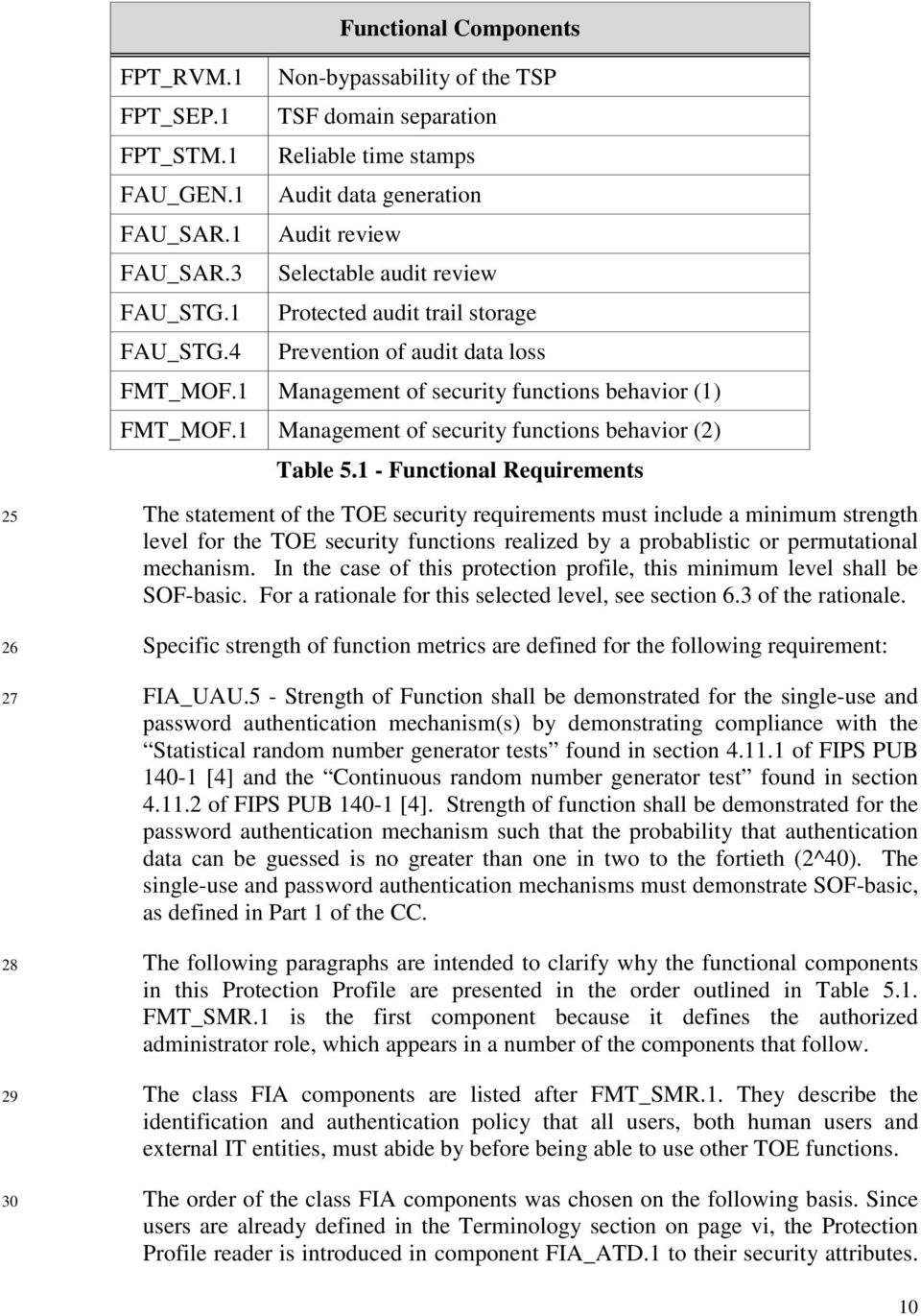
17 5 IT SECURITY REQUIREMENTS 5.1 TOE SECURITY REQUIREMENTS 23 This section provides functional and assurance requirements that must be satisfied by a Protection Profile-compliant TOE. These requirements consist of functional components from Part 2 of the CC and an Evaluation Assurance Level (EAL) containing assurance components from Part 3 of the CC TOE Security Requirements 24 The functional security requirements for this Protection Profile consist of the following components from Part 2 of the CC, summarized in the following table. FMT_SMR.1 FIA_ATD.1 FIA_UID.2 FIA_AFL.1 FIA_UAU.5 Functional Components Security roles User attribute definition User identification before any action Authentication failure handling Multiple authentication mechanisms FDP_IFC.1 Subset information flow control (1) FDP_IFC.1 Subset information flow control (2) FDP_IFF.1 Simple security attributes (1) FDP_IFF.1 Simple security attributes (2) FMT_MSA.1 Management of security attributes (1) FMT_MSA.1 Management of security attributes (2) FMT_MSA.1 Management of security attributes (3) FMT_MSA.1 Management of security attributes (4) FMT_MSA.3 Static attribute initialization FMT_MTD.1 Management of TSF data (1) FMT_MTD.1 Management of TSF data (2) FMT_MTD.2 FDP_RIP.1 FCS_COP.1 Management of limits on TSF data Subset residual information protection Cryptographic operation 9
18 FPT_RVM.1 FPT_SEP.1 FPT_STM.1 FAU_GEN.1 FAU_SAR.1 FAU_SAR.3 FAU_STG.1 FAU_STG.4 Functional Components Non-bypassability of the TSP TSF domain separation Reliable time stamps Audit data generation Audit review Selectable audit review Protected audit trail storage Prevention of audit data loss FMT_MOF.1 Management of security functions behavior (1) FMT_MOF.1 Management of security functions behavior (2) Table Functional Requirements 25 The statement of the TOE security requirements must include a minimum strength level for the TOE security functions realized by a probablistic or permutational mechanism. In the case of this protection profile, this minimum level shall be SOF-basic. For a rationale for this selected level, see section 6.3 of the rationale. 26 Specific strength of function metrics are defined for the following requirement: 27 FIA_UAU.5 - Strength of Function shall be demonstrated for the single-use and password authentication mechanism(s) by demonstrating compliance with the Statistical random number generator tests found in section of FIPS PUB [4] and the Continuous random number generator test found in section of FIPS PUB [4]. Strength of function shall be demonstrated for the password authentication mechanism such that the probability that authentication data can be guessed is no greater than one in two to the fortieth (2^40). The single-use and password authentication mechanisms must demonstrate SOF-basic, as defined in Part 1 of the CC. 28 The following paragraphs are intended to clarify why the functional components in this Protection Profile are presented in the order outlined in Table 5.1. FMT_SMR.1 is the first component because it defines the authorized administrator role, which appears in a number of the components that follow. 29 The class FIA components are listed after FMT_SMR.1. They describe the identification and authentication policy that all users, both human users and external IT entities, must abide by before being able to use other TOE functions. 30 The order of the class FIA components was chosen on the following basis. Since users are already defined in the Terminology section on page vi, the Protection Profile reader is introduced in component FIA_ATD.1 to their security attributes. 10
19 The next component, FIA_UID.2, forces users to identify themselves to the TOE using the user security attributes of component FIA_ATD.1 before further actions take place. Then, component FIA_AFL.1 describes what results if the user fails to authenticate after some settable number of attempts. Lastly, component FIA_UAU.5 discusses when authentication mechanisms must be used. 31 There are two information flow control SFPs, and they are defined after the class FIA components in FDP_IFC.1. Then the policy rules which must be enforced as well as the attributes of the entities defined in FDP_IFC.1 are written in FDP_IFF.1. Next, the management of the attributes in FDP_IFF.1 are specified in FMT_MSA.1(1), FMT_MSA.1(2), FMT_MSA.1(3) and FMT_MSA.1(4). Component FMT_MSA.3, which FDP_IFF.1 depends on, follows. As part of the installation and start-up of the TOE, FMT_MSA.3 mandates a default deny policy which permits no information to flow through the TOE. FMT_MTD.1(1), FMT_MTD.1(2), and FMT_MTD.2 define the management of TSF data. FDP_RIP.1 is listed next, ensuring that resources are cleared before being allocated to hold packets of information at the TOE. 32 Component FCS_COP.1 is a conditional requirement. If the developer allows administration from a remote location outside the physically protected TOE, then evaluation against this Protection Profile shall require the TOE to meet this component. FCS_COP.1 defines a cryptographic algorithm as well as the key size that must be used. The cryptographic module must be FIPS PUB compliant for the reasons stated in Section Components dealing with the protection of trusted security functions come next. These include components FPT_RVM.1 and FPT_SEP Since FAU_GEN.1 requires recording the time and date when audit events occur, it follows the FPT_STM.1 component that alerts developers that an accurate time and date must be maintained on the TOE. The class FAU requirements follow to define the audit security functions which must be supported by the TOE. FAU_GEN.1 is the first audit component listed because it depicts all the events that must be audited, including all the information which must be recorded in audit records. The remainder of the class FAU components ensure that the audit records can be read (component FAU_SAR.1), searched and sorted (component FAU_SAR.3), and protected from modification (FAU_STG.1). Lastly, FAU_STG.4 ensures that the TOE is capable of preventing auditable actions, not taken by an authorized administrator, from occurring in the event that the audit trail becomes full. 35 The last component in the profile is FMT_MOF.1. It appears last because it lists all the functions to be provided by the TOE for use only by the authorized administrator. Almost all of these functions are based on components which precede it. Thus it is listed last. 11

20 FMT_SMR.1 Security roles 36 FMT_SMR The TSF shall maintain the role [authorized administrator]. 37 FMT_SMR The TSF shall be able to associate users with the authorized administrator role. FIA_ATD.1 User attribute definition 38 FIA_ATD The TSF shall maintain the following list of security attributes belonging to individual users: a) [identity; b) association of a human user with the authorized administrator role; c) any other user security attributes {to be determined by the Security Target writer(s)}]. FIA_UID.2 User identification before any action 39 FIA_UID The TSF shall require each user to identify itself before allowing any other TSF-mediated actions on behalf of that user. FIA_AFL.1 Authentication failure handling 40 FIA_AFL The TSF shall detect when [a non-zero number determined by the authorized administrator] of unsuccessful authentication attempts occur related to [authorized TOE administrator access or authorized TOE IT entity access]. 41 FIA_AFL When the defined number of unsuccessful authentication attempts has been met or surpassed, the TSF shall [prevent the offending user from successfully authenticating until an authorized administrator takes some action to make authentication possible for the user in question]. FIA_UAU.5 Multiple authentication mechanisms 42 FIA_UAU The TSF shall provide [password and single-use authentication mechanisms] to support user authentication. 43 FIA_UAU The TSF shall authenticate any user's claimed identity according to the [following multiple authentication mechanism rules: a) single-use authentication mechanism shall be used for authorized administrators to access the TOE remotely such that successful authentication must be achieved before allowing any other TSFmediated actions on behalf of that authorized administrator; 12

21 b) single-use authentication mechanism shall be used for authorized external IT entities accessing the TOE such that successful authentication must be achieved before allowing any other TSFmediated actions on behalf of that authorized external IT entity; c) single-use authentication mechanism shall be used for human users sending or receiving information through the TOE using FTP or Telnet such that successful authentication must be achieved before allowing any other TSF-mediated actions on behalf of that human user; d) reusable password mechanism shall be used for authorized administrators to access the TOE via a directly connected terminal such that successful authentication must be achieved before allowing any other TSF-mediated actions on behalf of that authorized administrator]. 44 Application Note: TOEs that do not provide capabilities for authorized administrators to access the TOE remotely from either an internal or external network (i.e., for remote administration), or for authorized external IT entities do not have to make such functionality available in order to satisfy this requirement. The intent of this requirement is not to require developers to provide all such capabilities and their associated authentication mechanisms. The requirement applies to those developers that do incorporate such functionality and intend for it to be evaluated. 45 Requirements Overview: This Protection Profile consists of multiple information flow control Security Function Policies (SFPs). The CC allows multiple policies to exist, each having a unique name. This is accomplished by iterating FDP_IFC.1 for each of the two named information flow control policies. The first policy identified is called the UNAUTHENTICATED SFP. The subjects under control of this policy are external IT entities on an internal or external network sending information through the TOE to other external IT entities. The second policy identified is called the AUTHENTICATED SFP. The subjects under control of this policy are human users on an internal or external network who must be authenticated to the TOE. The information flowing between subjects in both policies is traffic with attributes, defined in FDP_IFF.1.1, including source and destination addresses. The rules that define each information flow control SFP are found in FDP_IFF.1.2. Component FDP_IFF.1 is iterated twice to correspond to each of the two iterations of FDP_IFC.1. FDP_IFC.1 Subset information flow control (1) 46 FDP_IFC The TSF shall enforce the [UNAUTHENTICATED SFP] on: a) [subjects: unauthenticated external IT entities that send and receive information through the TOE to one another; 13
22 b) information: traffic sent through the TOE from one subject to another; c) operation: pass information]. 14
23 FDP_IFC.1 Subset information flow control (2) 47 FDP_IFC The TSF shall enforce the [AUTHENTICATED SFP] on: a) [subjects: a human user or external IT entity that sends and receives FTP and Telnet information through the TOE to one another, only after the human user initiating the information flow has authenticated at the TOE per FIA_UAU.5, b) information: FTP and Telnet traffic sent through the TOE from one subject to another; c) operation: initiate service and pass information]. FDP_IFF.1 Simple security attributes (1) 2 48 FDP_IFF The TSF shall enforce the [UNAUTHENTICATED SFP] based on at least the following types of subject and information security attributes: a) [subject security attributes: presumed address; other subject security attributes {to be determined by the Security Target writer(s)}; b) information security attributes: presumed address of source subject; presumed address of destination subject; transport layer protocol; TOE interface on which traffic arrives and departs; 2. The complete set of functional elements of a component must be selected for inclusion in a PP. However, since the following functional elements from the FDP_IFF.1 (1) component do not add anything significant to the PP, they have been moved here to allow for a clearer, smoother flowing presentation of FDP_IFF.1(1). FDP_IFF The TSF shall enforce the [none]. FDP_IFF The TSF shall provide the following [none]. FDP_IFF The TSF shall explicitly authorize an information flow based on the following rules: [none]. 15
24 service; other information security attributes {to be determined by the Security Target writer(s)}]. 49 FDP_IFF The TSF shall permit an information flow between a controlled subject and another controlled subject via a controlled operation if the following rules hold: a) [Subjects on an internal network can cause information to flow through the TOE to another connected network if: all the information security attribute values are unambiguously permitted by the information flow security policy rules, where such rules may be composed from all possible combinations of the values of the information flow security attributes, created by the authorized administrator; the presumed address of the source subject, in the information, translates to an internal network address; and the presumed address of the destination subject, in the information, translates to an address on the other connected network. b) Subjects on the external network can cause information to flow through the TOE to another connected network if: all the information security attribute values are unambiguously permitted by the information flow security policy rules, where such rules may be composed from all possible combinations of the values of the information flow security attributes, created by the authorized administrator; the presumed address of the source subject, in the information, translates to an external network address; and the presumed address of the destination subject, in the information, translates to an address on the other connected network.] 50 FDP_IFF The TSF shall explicitly deny an information flow based on the following rules: a) [The TOE shall reject requests for access or services where the information arrives on an external TOE interface, and the presumed address of the source subject is an external IT entity on an internal network; 16
25 b) The TOE shall reject requests for access or services where the information arrives on an internal TOE interface, and the presumed address of the source subject is an external IT entity on the external network; c) The TOE shall reject requests for access or services where the information arrives on either an internal or external TOE interface, and the presumed address of the source subject is an external IT entity on a broadcast network; d) The TOE shall reject requests for access or services where the information arrives on either an internal or external TOE interface, and the presumed address of the source subject is an external IT entity on the loopback network; e) The TOE shall reject requests in which the subject specifies the route in which information shall flow en route to the receiving subject; and f) For application protocols supported by the TOE (e.g., DNS, HTTP, SMTP, and POP3), the TOE shall deny any access or service requests that do not conform to its associated published protocol specification (e.g., RFC). This shall be accomplished through protocol filtering proxies that are designed for that purpose. 51 Application Note: Rule f) applies when an application-level proxy is provided for the following protocols: DNS, HTTP, SMTP, and POP3. FDP_IFF.1 Simple security attributes (2) 3 52 FDP_IFF The TSF shall enforce the [AUTHENTICATED SFP] based on at least the following types of subject and information security attributes: a) [subject security attributes: presumed address; other subject security attributes {to be determined by the Security Target writer(s)}; 3. The complete set of functional elements of a component must be selected for inclusion in a PP. However, since the following functional elements from the FDP_IFF.1 (2) component do not add anything significant to the PP, they have been moved here to allow for a clearer, smoother flowing presentation of FDP_IFF.1 (2). FDP_IFF The TSF shall enforce the [none]. FDP_IFF The TSF shall provide the following [none]. FDP_IFF The TSF shall explicitly authorize an information flow based on the following rules: [none]. 17
26 b) information security attributes: user identity; presumed address of source subject; presumed address of destination subject; transport layer protocol; TOE interface on which traffic arrives and departs; service (i.e., FTP and Telnet); security-relevant service command; and other information security attributes {to be determined by the Security Target writer(s)}]. 53 FDP_IFF The TSF shall permit an information flow between a controlled subject and another controlled subject via a controlled operation if the following rules hold: a) [Subjects on an internal network can cause information to flow through the TOE to another connected network if: the human user initiating the information flow authenticates according to FIA_UAU.5; all the information security attribute values are unambiguously permitted by the information flow security policy rules, where such rules may be composed from all possible combinations of the values of the information flow security attributes, created by the authorized administrator; the presumed address of the source subject, in the information, translates to an internal network address; and the presumed address of the destination subject, in the information, translates to an address on the other connected network. b) Subjects on the external network can cause information to flow through the TOE to another connected network if: the human user initiating the information flow authenticates according to FIA_UAU.5; 18
27 all the information security attribute values are unambiguously permitted by the information flow security policy rules, where such rules may be composed from all possible combinations of the values of the information flow security attributes, created by the authorized administrator; the presumed address of the source subject, in the information, translates to an external network address; and the presumed address of the destination subject, in the information, translates to an address on the other connected network.] 54 FDP_IFF The TSF shall explicitly deny an information flow based on the following rules: a) [The TOE shall reject requests for access or services where the information arrives on an external TOE interface, and the presumed address of the source subject is an external IT entity on an internal network; b) The TOE shall reject requests for access or services where the information arrives on an internal TOE interface, and the presumed address of the source subject is an external IT entity on the external network; c) The TOE shall reject requests for access or services where the information arrives on either an internal or external TOE interface, and the presumed address of the source subject is an external IT entity on a broadcast network; d) The TOE shall reject requests for access or services where the information arrives on either an internal or external TOE interface, and the presumed address of the source subject is an external IT entity on the loopback network; e) The TOE shall reject requests in which the subject specifies the route in which information shall flow en route to the receiving subject; and f) The TOE shall reject Telnet or FTP command requests that do not conform to generally accepted published protocol definitions (e.g., RFCs). This must be accomplished through protocol filtering proxies designed for that purpose. 55 Application Note: The TOE can make no claim as to the real address of any source or destination subject, therefore the TOE can only suppose that these addresses are accurate. Therefore, a presumed address is used to identify source and destination addresses. A service, listed in FDP_IFF.1.1(b), could be identified, for example, by a source port number and/or destination port number. A service command, also mentioned in FDP_IFF.1.1(b), could be identified, for 19
28 example, in the case of the File Transfer Protocol (FTP) service as an FTP STOR or FTP RETR. FMT_MSA.1 Management of security attributes (1) 56 FMT_MSA.1.1 (1) - The TSF shall enforce the [UNAUTHENTICATED_SFP] to restrict the ability to [delete attributes from a rule, modify attributes in a rule, add attributes to a rule] the security attributes [listed in section FDP_IFF1.1(1)] to [the authorized administrator]. FMT_MSA.1 Management of security attributes (2) 57 FMT_MSA.1.1(2) - The TSF shall enforce the [AUTHENTICATED_SFP] to restrict the ability to [delete attributes from a rule, modify attributes in a rule, add attributes to a rule] the security attributes [listed in section FDP_IFF1.1(2)] to [the authorized administrator]. FMT_MSA.1 Management of security attributes (3) 58 FMT_MSA.1.1(3) - The TSF shall enforce the [UNAUTHENTICATED_SFP] to restrict the ability to delete and [create] the security attributes [information flow rules described in FDP_IFF.1(1)] to [the authorized administrator]. FMT_MSA.1 Management of security attributes (4) 59 FMT_MSA.1.1(4) - The TSF shall enforce the [AUTHENTICATED_SFP] to restrict the ability to delete and [create] the security attributes [information flow rules described in FDP_IFF.1(2)] to [the authorized administrator]. FMT_MSA.3 Static attribute initialization 60 FMT_MSA The TSF shall enforce the [UNAUTHENTICATED_SFP and AUTHENTICATED_SFP] to provide restrictive default values for information flow security attributes that are used to enforce the SFP. 61 FMT_MSA The TSF shall allow [the authorized administrator] to specify alternative initial values to override the default values when an object or information is created. 62 Application Note: The default values for the information flow control security attributes appearing in FDP_IFF.1 (1) and FDP_IFF.1 (2) are intended to be restrictive in the sense that both inbound and outbound information is denied by the TOE until the default values are modified by an authorized administrator. 20
29 FMT_MTD.1 Management of TSF data (1) 63 FMT_MTD.1.1(1) - The TSF shall restrict the ability to query, modify, delete, [and assign] the [user attributes defined in FIA_ATD.1.1] to [the authorized administrator]. FMT_MTD.1 Management of TSF data (2) 64 FMT_MTD.1.1(2) - The TSF shall restrict the ability to [set] the [time and date used to form the timestamps in FPT_STM.1.1] to [the authorized administrator]. FMT_MTD.2 Management of limits on TSF data 65 FMT_MTD The TSF shall restrict the specification of the limits for [the number of authentication failures] to [the authorized administrator]. 66 FMT_MTD The TSF shall take the following actions, if the TSF data are at, or exceed, the indicated limits: [actions specified in FIA_AFL.1.2]. FDP_RIP.1 Subset residual information protection 67 FDP_RIP The TSF shall ensure that any previous information content of a resource is made unavailable upon the allocation of the resource to [all objects]. 68 Application Note: If, for example, the TOE pads information with bits in order to properly prepare the information before sending it out an interface, these bits would be considered a resource. The intent of the requirement is that these bits shall not contain the remains of information that had previously passed through the TOE. The requirement is met by overwriting or clearing resources (e.g. packets) before making them available for use. FCS_COP.1 Cryptographic operation 69 FCS_COP The TSF shall perform [encryption of remote authorized administrator sessions] in accordance with a specified cryptographic algorithm: [Triple Data Encryption Standard (DES) as specified in FIPS PUB 46-3 and implementing any mode of operation specified in FIPS PUB 46-3 with Keying Option 1 (K1, K2, K3 are independent keys)] and cryptographic key sizes [that are 192 binary digits in length] that meet the following: [FIPS PUB 46-3 with Keying Option 1 and FIPS PUB (Level 1)]. 70 Application Note: This requirement is applicable only if the TOE includes the capability for the authorized administrator to perform security functions remotely from a connected network. In this case, Triple DES encryption must protect the communications between the authorized administrator and the TOE, and the associated cryptographic module(s) must comply at a minimum with FIPS PUB Level 1. The intent of this requirement is not for the evaluator to perform a FIPS PUB evaluation; rather, the evaluator will check for a certificate, 21
30 verifying that the module did complete a FIPS PUB evaluation. FPT_RVM.1 Non-bypassability of the TSP 71 FPT_RVM The TSF shall ensure that TSP enforcement functions are invoked and succeed before each function within the TSC is allowed to proceed. FPT_SEP.1 TSF domain separation 72 FPT_SEP The TSF shall maintain a security domain for its own execution that protects it from interference and tampering by untrusted subjects. 73 FPT_SEP The TSF shall enforce separation between the security domains of subjects in the TSC. FPT_STM.1 Reliable time stamps 74 FPT_STM The TSF shall be able to provide reliable time stamps for its own use. 75 Application Note: The word reliable in the above requirement means that the order of the occurrence of auditable events is preserved. Reliable time stamps, which include both date and time, are especially important for TOEs comprised of greater than one component. FAU_GEN.1 Audit data generation 76 FAU_GEN The TSF shall be able to generate an audit record of the following auditable events: a) Start-up and shutdown of the audit functions; b) All auditable events for the not specified level of audit; and c) [the events listed in Table 5.2]. 77 FAU_GEN The TSF shall record within each audit record at least the following information: a) Date and time of the event, type of event, subject identity, outcome (success or failure) of the event; and b) For each audit event type, based on the auditable event definitions of the functional components included in the PP/ST, [information specified in column three of Table 5.2]. 22
31 Functional Component FMT_SMR.1 FIA_UID.2 FIA_UAU.5 FIA_AFL.1 FDP_IFF.1 FCS_COP.1 Auditable Event Modifications to the group of users that are part of the authorized administrator role. All use of the user identification mechanism. Any use of the authentication mechanism. The reaching of the threshold for unsuccessful authentication attempts and the subsequent restoration by the authorized administrator of the users capability to authenticate. All decisions on requests for information flow. Success and failure, and the type of cryptographic operation Additional Audit Record Contents The identity of the authorized administrator performing the modification and the user identity being associated with the authorized administrator role The user identities provided to the TOE The user identities provided to the TOE The identity of the offending user and the authorized administrator The presumed addresses of the source and destination subject. The identity of the external IT entity attempting to perform the cryptographic operation FPT_STM.1 Changes to the time. The identity of the authorized administrator performing the operation FMT_MOF.1 FAU_SAR.1 Audit review Use of the functions listed in this requirement pertaining to audit. Table Auditable Events The identity of the authorized administrator performing the operation 78 FAU_SAR The TSF shall provide [an authorized administrator] with the capability to read [all audit trail data] from the audit records. 79 FAU_SAR The TSF shall provide the audit records in a manner suitable for the user to interpret the information. 23
32 FAU_SAR.3 Selectable audit review 80 FAU_SAR The TSF shall provide the ability to perform searches and sorting of audit data based on: a) [user identity; b) presumed subject address; c) ranges of dates; d) ranges of times; e) ranges of addresses]. 81 Application Note: The Security Target writer(s) is expected to describe, as part of their TOE Summary Specification section, the capabilities of the tool(s) used by the TOE to perform these searches and sorts. FAU_STG.1 Protected audit trail storage 82 FAU_STG The TSF shall protect the stored audit records from unauthorized deletion. 83 FAU_STG The TSF shall be able to prevent modifications to the audit records. FAU_STG.4 Prevention of audit data loss 84 FAU_STG The TSF shall prevent auditable events, except those taken by the authorized administrator and [shall limit the number of audit records lost] if the audit trail is full. 85 Application Note: The Security Target writer(s) is expected to provide, as part of their Security requirements rationale section, an analysis of the maximum amount of audit data that can be expected to be lost in the event of audit storage failure, exhaustion, and/or attack. FMT_MOF.1 Management of security functions behavior (1) 86 FMT_MOF.1.1(1) - The TSF shall restrict the ability to enable, disable the functions: a) [operation of the TOE; b) multiple use authentication functions described in FIA_UAU.5] to [an authorized administrator]. 24
33 87 Application Note: By Operation of the TOE in a) above, we mean having the TOE start up (enable operation) and shut down (disable operation). By "multiple use authentication" in b) above, we mean the mangement of password and single use authentication mechanisms. FMT_MOF.1 Management of security functions behavior (2) 88 FMT_MOF.1.1(2) - The TSF shall restrict the ability to enable, disable, determine and modify the behaviour of the functions: a) [audit trail management; b) backup and restore for TSF data, information flow rules, and audit trail data; and c) communication of authorized external IT entities with the TOE] to [an authorized administrator]. 89 Application Note: Determine and modify the behavior of element c (communication of authorized external IT entities with the TOE) is intended to cover functionality such as providing a range of addresses from which the authorized external entity can connect. 25
34 5.1.2 TOE Security Assurance Requirements 90 The assurance security requirements for this Protection Profile, taken from Part 3 of the CC, compose EAL2. These assurance components are summarized in the following table. Assurance Class Assurance Components Configuration management ACM_CAP.2 Configuration items Delivery and operation ADO_DEL.1 Delivery procedures ADO_IGS.1 Installation, generation, and start-up procedures ADV_FSP.1 Informal functional specification Development ADV_HLD.1 Descriptive high-level design ADV_RCR.1 Informal correspondence demonstration Guidance documents AGD_ADM.1 Administrator guidance AGD_USR.1 User guidance ATE_COV.1 Evidence of coverage Tests ATE_FUN.1 Functional testing ATE_IND.2 Independent testing - sample Vulnerability assessment AVA_SOF.1 Strength of TOE security function evaluation AVA_VLA.1 Developer vulnerability analysis Table Assurance Requirements: EAL2 ACM_CAP.2 Configuration items Developer action elements: 91 ACM_CAP.2.1D - The developer shall provide a reference for the TOE. 92 ACM_CAP.2.2D - The developer shall use a CM system. 93 ACM_CAP.2.3D - The developer shall provide CM documentation. Content and presentation of evidence elements: 94 ACM_CAP.2.1C - The reference for the TOE shall be unique to each version of the TOE. 95 ACM_CAP.2.2C - The TOE shall be labeled with its reference. 96 ACM_CAP.2.3C - The CM documentation shall include a configuration list. 97 ACM_CAP.2.4C - The configuration list shall describe the configuration items that comprise the TOE. 26
35 98 ACM_CAP.2.5C - The CM documentation shall describe the method used to uniquely identify the configuration items. 99 ACM_CAP.2.6C - The CM system shall uniquely identify all configuration items. Evaluator action elements: 100 ACM_CAP.2.1E - The evaluator shall confirm that the information provided meets all requirements for content and presentation of evidence. ADO_DEL.1 Delivery procedures Developer action elements: 101 ADO_DEL.1.1D - The developer shall document procedures for delivery of the TOE or parts of it to the user. 102 ADO_DEL.1.2D - The developer shall use the delivery procedures. Content and presentation of evidence elements: 103 ADO_DEL.1.1C - The delivery documentation shall describe all procedures that are necessary to maintain security when distributing versions of the TOE to a user s site. Evaluator action elements: 104 ADO_DEL.1.1E - The evaluator shall confirm that the information provided meets all requirements for content and presentation of evidence. ADO_IGS.1 Installation, generation, and start-up procedures Developer action elements: 105 ADO_IGS.1.1D - The developer shall document procedures necessary for the secure installation, generation, and start-up of the TOE. Content and presentation of evidence elements: 106 ADO_IGS.1.1C - The documentation shall describe the steps necessary for secure installation, generation, and start-up of the TOE. Evaluator action elements: 107 ADO_IGS.1.1E - The evaluator shall confirm that the information provided meets all requirements for content and presentation of evidence. 108 ADO_IGS.1.2E - The evaluator shall determine that the installation, generation, and start-up procedures result in a secure configuration. 27
36 ADV_FSP.1 Informal functional specification Developer action elements: 109 ADV_FSP.1.1D - The developer shall provide a functional specification. Content and presentation of evidence elements: 110 ADV_FSP.1.1C - The functional specification shall describe the TSF and its external interfaces using an informal style. 111 ADV_FSP.1.2C - The functional specification shall be internally consistent. 112 ADV_FSP.1.3C - The functional specification shall describe the purpose and method of use of all external TSF interfaces, providing details of effects, exceptions and error messages, as appropriate. 113 ADV_FSP.1.4C - The functional specification shall completely represent the TSF. Evaluator action elements: 114 ADV_FSP.1.1E - The evaluator shall confirm that the information provided meets all requirements for content and presentation of evidence. 115 ADV_FSP.1.2E - The evaluator shall determine that the functional specification is an accurate and complete instantiation of the TOE security functional requirements. 116 Application Note: This requirement can potentially be met by a combination of documents provided by the developer, including the Security Target and external interface specification. ADV_HLD.1 Descriptive high-level design Developer action elements: 117 ADV_HLD.1.1D - The developer shall provide the high-level design of the TSF. Content and presentation of evidence elements: 118 ADV_HLD.1.1C - The presentation of the high-level design shall be informal. 119 ADV_HLD.1.2C - The high-level design shall be internally consistent. 120 ADV_HLD.1.3C - The high-level design shall describe the structure of the TSF in terms of subsystems. 121 ADV_HLD.1.4C - The high-level design shall describe the security functionality provided by each subsystem of the TSF. 28
37 122 ADV_HLD.1.5C - The high-level design shall identify any underlying hardware, firmware, and/or software required by the TSF with a presentation of the functions provided by the supporting protection mechanisms implemented in that hardware, firmware, or software. 123 ADV_HLD.1.6C - The high-level design shall identify all interfaces to the subsystems of the TSF. 124 ADV_HLD.1.7C - The high-level design shall identify which of the interfaces to the subsystems of the TSF are externally visible. Evaluator action elements: 125 ADV_HLD.1.1E - The evaluator shall confirm that the information provided meets all requirements for content and presentation of evidence. 126 ADV_HLD.1.2E - The evaluator shall determine that the high-level design is an accurate and complete instantiation of the TOE security functional requirements. 127 Requirements Overview: ADV_RCR.1 ensures that there is consistency between each level of design decomposition for the TOE. Each higher level of design decomposition (the higher the level of design decomposition, the more abstract) should map to the one below it, until a level of design decomposition maps to the least abstract representation, the implementation itself. Thus, for Security Targets derived from this Protection Profile there are four layers of abstraction (from high to low): the Sts TOE summary specification section, the Functional Specification, the high-level design, and the TOE itself. 4 ADV_RCR.1 Informal correspondence demonstration Developer action elements: 128 ADV_RCR.1.1D - The developer shall provide an analysis of correspondence between all adjacent pairs of TSF representations that are provided. Content and presentation of evidence elements: 129 ADV_RCR.1.1C - For each adjacent pair of provided TSF representations, the analysis shall demonstrate that all relevant security functionality of the more abstract TSF representation is correctly and completely refined in the less abstract TSF representation. 4. For related information, see section in Part 1 of the CC. 29
38 Evaluator action elements: 130 ADV_RCR.1.1E - The evaluator shall confirm that the information provided meets all requirements for content and presentation of evidence. 131 Application Note: The intent of this requirement is for the vendor to provide, and the evaluator to confirm, that there exists accurate, consistent, and clear mappings between each level of design decomposition. Thus there can be no TOE security functions defined at a lower layer of abstraction absent from a higher level of abstraction and vice versa. AGD_ADM.1 Administrator guidance Developer action elements: 132 AGD_ADM.1.1D - The developer shall provide administrator guidance addressed to system administrative personnel. Content and presentation of evidence elements: 133 AGD_ADM.1.1C - The administrator guidance shall describe the administrative functions and interfaces available to the administrator of the TOE. 134 AGD_ADM.1.2C - The administrator guidance shall describe how to administer the TOE in a secure manner. 135 AGD_ADM.1.3C - The administrator guidance shall contain warnings about functions and privileges that should be controlled in a secure processing environment. 136 AGD_ADM.1.4C - The administrator guidance shall describe all assumptions regarding user behavior that are relevant to secure operation of the TOE. 137 AGD_ADM.1.5C - The administrator guidance shall describe all security parameters under the control of the administrator, indicating secure values as appropriate. 138 AGD_ADM.1.6C - The administrator guidance shall describe each type of security-relevant event relative to the administrative functions that need to be performed, including changing the security characteristics of entities under the control of the TSF. 139 AGD_ADM.1.7C - The administrator guidance shall be consistent with all other documentation supplied for evaluation. 140 AGD_ADM.1.8C - The administrator guidance shall describe all security requirements for the IT environment that are relevant to the administrator. 30
39 Evaluator action elements: 141 AGD_ADM.1.1E - The evaluator shall confirm that the information provided meets all requirements for content and presentation of evidence. AGD_USR.1 User guidance Developer action elements: 142 AGD_USR.1.1D - The developer shall provide user guidance. Content and presentation of evidence elements: 143 AGD_USR.1.1C - The user guidance shall describe the functions and interfaces available to the non-administrative users of the TOE. 144 AGD_USR.1.2C - The user guidance shall describe the use of user-accessible security functions provided by the TOE. 145 AGD_USR.1.3C - The user guidance shall contain warnings about user-accessible functions and privileges that should be controlled in a secure processing environment. 146 AGD_USR.1.4C - The user guidance shall clearly present all user responsibilities necessary for secure operation of the TOE, including those related to assumptions regarding user behavior found in the statement of TOE security environment. 147 AGD_USR.1.5C - The user guidance shall be consistent with all other documentation supplied for evaluation. 148 AGD_USR.1.6C - The user guidance shall describe all security requirements for the IT environment that are relevant to the user. Evaluator action elements: 149 AGD_USR.1.1E - The evaluator shall confirm that the information provided meets all requirements for content and presentation of evidence. 150 Application Note: This assurance component is trivially met if neither authorized external IT entities nor human users who are not authorized administrators are permitted on the TOE. If authorized external IT entities and/or human users who are not authorized administrators are permitted on the TOE, it is intended that functions and interfaces for these users be described. If the developer permits human users who are not authorized administrators on the TOE, AGD_USR.1.2C is not intended to permit security functions or interfaces to exist for such users beyond those security functions described in the CC class FIA functional components in section If the developer does not permit human users who are not authorized administrators on the TOE, AGD_USR.1.2C only 31
40 applies if authorized external IT entities are permitted. ATE_COV.1 Evidence of coverage Developer action elements: 151 ATE_COV.1.1D - The developer shall provide evidence of the test coverage. Content and presentation of evidence elements: 152 ATE_COV.1.1C - The evidence of the test coverage shall show the correspondence between the tests identified in the test documentation and the TSF as described in the functional specification. Evaluator action elements: 153 ATE_COV.1.1E - The evaluator shall confirm that the information provided meets all requirements for content and presentation of evidence. ATE_FUN.1 Functional testing Developer action elements: 154 ATE_FUN.1.1D - The developer shall test the TSF and document the results. 155 ATE_FUN.1.2D - The developer shall provide test documentation. Content and presentation of evidence elements: 156 ATE_FUN.1.1C - The test documentation shall consist of test plans, test procedure descriptions, expected test results and actual test results. 157 ATE_FUN.1.2C - The test plans shall identify the security functions to be tested and describe the goal of the tests to be performed. 158 ATE_FUN.1.3C - The test procedure descriptions shall identify the tests to be performed and describe the scenarios for testing each security function. These scenarios shall include any ordering dependencies on the results of other tests. 159 ATE_FUN.1.4C - The expected test results shall show the anticipated outputs from a successful execution of the tests. 160 ATE_FUN.1.5C - The test results from the developer execution of the tests shall demonstrate that each tested security function behaved as specified. Evaluator action elements: 161 ATE_FUN.1.1E - The evaluator shall confirm that the information provided meets all requirements for content and presentation of evidence. 32
41 ATE_IND.2 Independent testing - sample Developer action elements: 162 ATE_IND.2.1D - The developer shall provide the TOE for testing. Content and presentation of evidence elements: 163 ATE_IND.2.1C - The TOE shall be suitable for testing. 164 ATE_IND.2.2C - The developer shall provide an equivalent set of resources to those that were used in the developer s functional testing of the TSF. Evaluator action elements: 165 ATE_IND.2.1E - The evaluator shall confirm that the information provided meets all requirements for content and presentation of evidence. 166 ATE_IND.2.2E - The evaluator shall test a subset of the TSF as appropriate to confirm that the TOE operates as specified. 167 ATE_IND.2.3E - The evaluator shall execute a sample of tests in the test documentation to verify the developer test results. AVA_SOF.1 Strength of TOE security function evaluation 5 Developer action elements: 168 AVA_SOF.1.1D - The developer shall perform a strength of TOE security function analysis for each mechanism identified in the ST as having a strength of TOE security function claim. Content and presentation of evidence elements: 169 AVA_SOF.1.1C - For each mechanism with a strength of TOE security function claim the strength of TOE security function analysis shall show that it meets or exceeds the minimum strength level defined in the PP/ST. 170 AVA_SOF.1.2C - For each mechanism with a specific strength of TOE security function claim the strength of TOE security function analysis shall show that it meets or exceeds the specific strength of function metric defined in the PP/ST. 5. This component is intended to apply strictly to those security functions that are vulnerable to an attack involving a quantitative or statistical analysis (e.g., password guessing). A short discussion of how a security mechanism may be vulnerable is provided under the Objectives heading for AVA_SOF, in Part 3 of the CC. 33
42 Evaluator action elements: 171 AVA_SOF.1.1E - The evaluator shall confirm that the information provided meets all requirements for content and presentation of evidence. 172 AVA_SOF.1.2E - The evaluator shall confirm that the strength claims are correct. 173 Application Note: The security mechanisms defined by the following requirements have a specific strength of function claim: FIA_UAU.5. Section of this PP defines the specific strength of function metric for each of these mechanisms. AVA_VLA.1 Developer vulnerability analysis Developer action elements: 174 AVA_VLA.1.1D - The developer shall perform and document an analysis of the TOE deliverables searching for obvious ways in which a user can violate the TSP. 175 AVA_VLA.1.2D - The developer shall document the disposition of obvious vulnerabilities. Content and presentation of evidence elements: 176 AVA_VLA.1.1C - The documentation shall show, for all identified vulnerabilities, that the vulnerability cannot be exploited in the intended environment for the TOE. Evaluator action elements: 177 AVA_VLA.1.1E - The evaluator shall confirm that the information provided meets all requirements for content and presentation of evidence. 178 AVA_VLA.1.2E - The evaluator shall conduct penetration testing, building on the developer vulnerability analysis, to ensure obvious vulnerabilities have been addressed. 179 Application Note: According to the Common Criteria Part 3, obvious vulnerabilities include those in the public domain. The evaluation body will be provided a current list of such vulnerabilities which should be included as part of vulnerability analysis and penetration testing. The first instantiation of this list is call Vulnerability list for AVA_VLA.1 and is included as Appendix A of this document. 34
43 6 RATIONALE 6.1 RATIONALE FOR IT SECURITY OBJECTIVES O.IDAUTH O.SINUSE O.MEDIAT O.SECSTA O.ENCRYP O.SELPRO O.AUDREC O.ACCOUN O.SECFUN This security objective is necessary to counter the threat: T.NOAUTH because it requires that users be uniquely identified before accessing the TOE. This security objective is necessary to counter the threats: T.REPEAT and T.REPLAY because it requires that the TOE prevent the reuse of authentication data so that even if valid authentication data is obtained, it will not be used to mount an attack. This security objective is necessary to counter the threats: T.ASPOOF, T.MEDIAT and T.OLDINF which have to do with getting impermissible information to flow through the TOE. This security objective requires that all information that passes through the networks is mediated by the TOE and that no residual information is transmitted. This security objective ensures that no information is compromised by the TOE upon start-up or recovery and thus counters the threats: T.NOAUTH and T.SELPRO. This security objective is necessary to counter the threats and policy: T.NOAUTH, T.PROCOM and P.CRYPTO by requiring that an authorized administrator use encryption when performing administrative functions on the TOE remotely. This security objective is necessary to counter the threats: T.SELPRO, T.AUDFUL and T.NOAUTH because it requires that the TOE protect itself from attempts to bypass, deactivate, or tamper with TOE security functions. This security objective is necessary to counter the threat: T.AUDACC by requiring a readable audit trail and a means to search and sort the information contained in the audit trail. This security objective is necessary to counter the threat: T.AUDACC because it requires that users are accountable for information flows through the TOE and that authorized administrators are accountable for the use of security functions related to audit. This security objective is necessary to counter the threats: T.NOAUTH, T.REPLAY and T.AUDFUL by requiring that the TOE provide functionality that ensures that only the authorized administrator has access to the TOE security functions. 35
44 O.LIMEXT O.EAL This security objective is necessary to counter the threat: T.NOAUTH because it requires that the TOE provide the means for an authorized administrator to control and limit access to TOE security functions. This security objective is necessary to counter the threat: T.LOWEXP because it requires that the TOE is resistant to penetration attacks performed by an attacker possessing minimal attack potential. T.NOAUTH T.REPEAT T.REPLAY T.ASPOOF T.MEDIAT T.OLDINF T.PROCOM T.AUDACC T.SELPRO T.AUDFUL T.LOWEXP P.CRYPTPO O.IDAUTH X O.SINUSE X X O.MEDIAT X X X O.SECSTA X X O.ENCRYP X X X O.SELPRO X X X O.AUDREC O.ACCOUN O.SECFUN X X X O.LIMEXT O.EAL X Table 6.1 Summary of Mappings Between Threats and IT Security Objectives 6.2 RATIONALE FOR SECURITY OBJECTIVES FOR THE ENVIRONMENT X X X O.PHYSEC O.LOWEXP O.GENPUR The TOE is physically secure. The threat of malicious attacks aimed at discovering exploitable vulnerabilities is considered low. There are no general-purpose computing capabilities (e.g., the ability to execute arbitrary code or applications) and storage repository capabilities on the TOE. 36
45 O.PUBLIC O.NOEVIL O.SINGEN O.DIRECT The TOE does not host public data. Authorized administrators are non-hostile and follow all administrator guidance; however, they are capable of error. Information can not flow among the internal and external networks unless it passes through the TOE. Human users within the physically secure boundary protecting the TOE may attempt to access the TOE from some direct connection (e.g., a console port) if the connection is part of the TOE. O.NOREMO Human users who are not authorized administrators can not access the TOE remotely from the internal or external networks. O.REMACC O.GUIDAN Authorized administrators may access the TOE remotely from the internal and external networks. This non-it security objective is necessary to counter the threat: T.TUSAGE and T.AUDACC because it requires that those responsible for the TOE ensure that it is delivered, installed, administered, and operated in a secure manner. O.ADMTRA This non-it security objective is necessary to counter the threat: T.TUSAGE and T.AUDACC because it ensures that authorized administrators receive the proper training. T.TUSAGE T.AUDACC O.GUIDAN X X O.ADMTRA X X Table Summary of Mappings Between Threats and Security Objectives for the Environment 180 Since the rest of the security objectives for the environment are, in part, a restatement of the security assumptions, those security objectives trace to all aspects of the assumptions. 6.3 RATIONALE FOR SECURITY REQUIREMENTS 181 The security requirements are derived according to the general model presented in Part 1 of the Common Criteria. Specifically, Table 6.3 illustrates the mapping between the security requirements and the security objectives and Table 6.1 demonstrates the relationship between the threats, policies and IT security objectives. The functional and assurance requirements presented in this Protection Profile are mutually supportive and their combination meet the stated security objectives. 37
46 182 The rationale for the SOF is based on the minimal attack potential identified in this Protection Profile. The security objectives imply the need for probablistic or permutational security mechanisms. The metrics defined in this Protection Profile are acceptable (i.e., passwords) metrics to protect information in environments which process, at most, sensitive but unclassified information, or the sensitivity level of information in both the internal and external networks is equivalent. FMT_SMR.1 Security roles 183 Each of the CC class FMT components in this Protection Profile depends on this component. It requires the PP/ST writer to choose a role(s). This component traces back to and aids in meeting the following objective: O.SECFUN. FIA_ATD.1 User attribute definition 184 This component exists to provide users with attributes to distinguish one user from another, for accountability purposes and to associate the role chosen in FMT_SMR.1 with a user. This component traces back to and aids in meeting the following objectives: O.IDAUTH and O.SECFUN. FIA_UID.2 User identification before any action 185 This component ensures that before anything occurs on behalf of a user, the user's identity is identified to the TOE. This component traces back to and aids in meeting the following objectives: O.IDAUTH and O.ACCOUN. FIA_AFL.1 Authentication failure handling 186 This component ensures that human users who are not authorized administrators can not endlessly attempt to authenticate. After some number of failures that the authorized administrator decides, that must not be zero, the user becomes unable from that point on in attempts to authenticate. This goes on until an authorized administrator makes authentication possible again for that user. This component traces back to and aids in meeting the following objective: O.SELPRO. FIA_UAU.5 Multiple authentication mechanisms 187 This component was chosen to ensure that multiple authentication mechanism are used appropriately in all attempts to authenticate at the TOE from an internal or external network. A SOF metric for this requirement is defined in section to ensure that the mechanisms are of adequate probabilistic strength to protect against authentication data compromise. This component traces back to and aids in meeting the following objective: O.SINUSE and O.IDAUTH. FDP_IFC.1 Subset information flow control (1) 188 This component identifies the entities involved in the UNAUTHENTICATED information flow control SFP (i.e., users sending information to other users and 38
47 vice versa). This component traces back to and aids in meeting the following objective: O.MEDIAT. FDP_IFC.1 Subset information flow control (2) 189 This component identifies the entities involved in the AUTHENTICATED information flow control SFP (i.e., users of the services FTP or Telnet sending information to servers and vice versa). The users of these services must be authenticated at the TOE. This component traces back to and aids in meeting the following objective: O.MEDIAT. FDP_IFF.1 Simple security attributes (1) 190 This component identifies the attributes of the users sending and receiving the information in the UNAUTHENTICAED SFP, as well as the attributes for the information itself. Then the policy is defined by saying under what conditions information is permitted to flow. This component traces back to and aids in meeting the following objective: O.MEDIAT. FDP_IFF.1 Simple security attributes (2) 191 This component identifies the attributes of the users sending and receiving the information in the AUTHENTICAED SFP, as well as the attributes for the information itself. Then the policy is defined by saying under what conditions information is permitted to flow. This component traces back to and aids in meeting the following objective: O.MEDIAT. FMT_MSA.1 Management of security attributes (1) 192 This component ensures the TSF enforces the UNAUTHENTICATED_SFP to restrict the ability to delete, modify, and add within a rule those security attributes that are listed in section FDP_IFF1.1(1). This component traces back to and aids in meeting the following objectives: O.MEDIAT, O.SECSTA, and O.SECFUN. FMT_MSA.1 Management of security attributes (2) 193 This component ensures the TSF enforces the AUTHENTICATED_SFP to restrict the ability to delete, modify, and add within a rule those specified security attributes that are listed in section FDP_IFF1.1(2). This component traces back to and aids in meeting the following objectives: O.MEDIAT, O.SECSTA, and O.SECFUN. FMT_MSA.1 Management of security attributes (3) 194 This component ensures the TSF enforces the UNAUTHENTICATED_SFP to restrict the ability to create or delete rules for security attributes that are listed in FDP_IFF.1(1). This component traces back to and aids in meeting the following objectives: O.MEDIAT, O.SECSTA, and O.SECFUN. 39
48 FMT_MSA.1 Management of security attributes (4) 195 This component ensures the TSF enforces the AUTHENTICATED_SFP to restrict the ability to create or delete rules for security attributes that are listed in FDP_IFF.1(2). This component traces back to and aids in meeting the following objectives: O.MEDIAT, O.SECSTA, and O.SECFUN. FMT_MSA.3 Static attribute initialization 196 This component ensures that there is a default deny policy for the information flow control security rules. This component traces back to and aids in meeting the following objectives: O.MEDIAT ando.secsta. FMT_MTD.1 Management of TSF data (1) 197 This component ensures that the TSF restrict abilities to query, modify, delete and assign certain user attributes as defined in FIA_ATD.1.1 to only the authorized administrator. This component traces back to and aids in meeting the following objective: O.SECFUN. FMT_MTD.1 Management of TSF data (2) 198 This component ensures that the TSF restrict abilities to set the time and date used to form timestamps to only the authorized administrator. This component traces back to and aids in meeting the following objective: O.SECFUN. FMT_MTD.2 Management of limits on TSF data 199 This component ensures that the TSF restrict the specification of limits of the number of unauthenticated failures to the authorized administrator and specifies the action be taken if limits on the TSF data are reached or exceeded. This component traces back to and aids in meeting the following objective: O.SECFUN. FDP_RIP.1 Subset residual information protection 200 This component ensures that neither information that had flown through the TOE nor any TOE internal data are used when padding is used by the TOE for information flows. This component traces back to and aids in meeting the following objective: O.MEDIAT. FCS_COP.1 Cryptographic operation 201 This component ensures that if the TOE does support authorized administrators to communicate with the TOE remotely from an internal or external network that DES is used to encrypt such traffic. This component traces back to and aids in meeting the following objective: O.ENCRYP and O.EAL. 40
49 FPT_RVM.1 Non-bypassability of the TSP 202 This component ensures that the TSF are always invoked. This component traces back to and aids in meeting the following objective: O.SELPRO and O.SECSTA. FPT_SEP.1 TSF domain separation 203 This component ensures that the TSF have a domain of execution that is separate and that cannot be violated by unauthorized users. This component traces back to and aids in meeting the following objective: O.SELPRO and O.SECSTA. FPT_STM.1 Reliable time stamps 204 FAU_GEN.1 depends on this component. It ensures that the date and time on the TOE is dependable. This is important for the audit trail. This component traces back to and aids in meeting the following objective: O.AUDREC. FAU_GEN.1 Audit data generation 205 This component outlines what data must be included in audit records and what events must be audited. This component traces back to and aids in meeting the following objectives: O.AUDREC and O.ACCOUN. FAU_SAR.1 Audit review 206 This component ensures that the audit trail is understandable. This component traces back to and aids in meeting the following objective: O.AUDREC. FAU_SAR.3 Selectable audit review 207 This component ensures that a variety of searches and sorts can be performed on the audit trail. This component traces back to and aids in meeting the following objective: O.AUDREC. FAU_STG.1 Protected audit trail storage 208 This component is chosen to ensure that the audit trail is protected from tampering, the security functionality is limited to the authorized administrator, and that start-up and recovery does not compromise the audit records. This component traces back to and aids in meeting the following objectives: O.SELPRO, O.SECFUN and O.SECSTA. FAU_STG.4 Prevention of audit data loss 209 This component ensures that the authorized administrator will be able to take care of the audit trail if it should become full. But this component also ensures that no other auditable events as defined in FAU_GEN.1 occur. Thus the authorized administrator is permitted to perform potentially auditable actions though these 41
50 events will not be recorded until the audit trail is restored to a non-full status. This component traces back to and aids in meeting the following objectives: O.SELPRO, O.SECFUN and O.SECSTA. FMT_MOF.1 Management of security functions behavior (1) 210 This component was to ensure the TSF restricts the ability of the TOE start up and shut down operation and multiple authentication function to the authorized administrator. This component traces back to and aids in meeting the following objectives: O.SECFUN, O.LIMEXT, and O.SECSTA. FMT_MOF.1 Management of security functions behavior (2) 211 This component was to ensure the TSF restricts the ability to modify the behavior of functions such as audit trail management, back and restore for TSF data, and communication of authorized external IT entities with the TOE to an authorized administrator. This component traces back to and aids in meeting the following objectives: O.SECFUN, O.LIMEXT, and O.SECSTA. 42
51 O.IDAUTH O.SINUSE O.MEDIAT O.SECSTA O.ENCRYP O.SELPRO O.AUDREC O.ACCOUN O.SECFUN O.LIMEXT FMT_SMR.1 FIA_ATD.1 X X FIA_UID.2 X X FIA_AFL.1 FIA_UAU.5 X X FDP_IFC.1 (1) FDP_IFC.1 (2) FDP_IFF.1 (1) FDP_IFF.1 (2) X X X X FMT_MSA.1 (1) X X X FMT_MSA.1 (2) X X X FMT_MSA.1 (3) X X X FMT_MSA.1 (4) X X X FMT_MSA.3 X X FMT_MTD.1 (1) FMT_MTD.1 (2) FMT_MTD.2 FDP_RIP.1 FCS_COP.1 FPT_RVM.1 X X FPT_SEP.1 FPT_STM.1 FAU_GEN.1 X X FAU_SAR.1 FAU_SAR.3 X FAU_STG.1 X X X FAU_STG.4 X X X FMT_MOF.1 (1) X X X FMT_MOF.1 (2) X X X Table 6.3 Summary of Mappings Between Threats and IT Security Objectives X X X X X X X X X X 43
52 6.4 RATIONALE FOR ASSURANCE REQUIREMENTS 212 EAL2 was chosen to ensure a level of security in the absence of complete vendor documentation. Specifically, the assurance requirements (that is, documentation and testing) were chosen to demonstrate that a low to moderate level of independently assured security exists as defined in Part 3, Section of the CC. Minimal additional tasks are imposed upon the vendor to the extent that if the vendor applies reasonable standards of care to the development, evaluation may be feasible without vendor involvement other than support for functional testing, strength of function analysis and vulnerability testing verification. 213 The chosen assurance level is consistent with the postulated threat environment. Specifically, the threat of malicious attacks aimed at discovering exploitable vulnerabilities is considered low, and the product will have undergone a search for obvious flaws. This is supported by the inclusion of the AVA_VLA.1 requirement. 6.5 RATIONALE FOR NOT SATISFYING ALL DEPENDENCIES 214 With the exception of the functional component FCS_COP.1, all dependencies are contained in this Protection Profile. 215 Functional component FCS_COP.1 depends on the following functional components: FCS_CKM.1 Cryptographic key generation, FCS_CKM.4 Cryptographic key destruction and FMT_MSA.2 Secure Security Attributes. Cryptographic modules must be FIPS PUB compliant. If the cryptographic module is indeed compliant with this FIPS PUB, then the dependencies of key generation, key destruction and secure key values will have been satisfied in becoming FIPS PUB compliant. For more information, refer to sections and of FIPS PUB
53 References [1] Common Criteria for Information Technology Security Evaluation, CCIB Version 2.1, August [2] U.S. Government Traffic-Filter Firewall Protection Profile for Low-Risk Environments; Version 1.1, April [3] Federal Information Processing Standard Publication (FIPS-PUB) 46-3, Data Encryption Standard (DES), October [4] Federal Information Processing Standard Publication (FIPS-PUB) 81, DES Modes of Operation, December [5] Federal Information Processing Standard Publication (FIPS-PUB) 140-1, Security Requirements for Cryptographic Modules, dated January 11, [6] Building Internet Firewalls, Chapman & Zwicky, O Reilly & Associates, Inc., November
54 Acronyms 216 The following abbreviations from the Common Criteria are used in this Protection Profile: CC EAL FIPS PUB IT PP SFP ST TOE TSC TSF TSP Common Criteria for Information Technology Security Evaluation Evaluation Assurance Level Federal Information Processing Standard Publication Information Technology Protection Profile Security Function Policy Security Target Target of Evaluation TSF Scope of Control TOE Security Functions TOE Security Policy 46
U.S. Government Protection Profile for Application-level Firewall In Basic Robustness Environments
 U.S. Government Protection Profile for Application-level Firewall In Basic Robustness Environments Information Assurance Directorate Version 1.1 July 25, 2007 Forward This Protection Profile US Government
DataPower XS40 XML Security Gateway and DataPower XI50 Integration Appliance Version 3.6. Security Target Version 0.75
 DataPower S40 ML Security Gateway and DataPower I50 Integration Appliance Version 3.6 Security Target Version 0.75 10/09/2008 Prepared for: IBM SOA Appliance Group One Rogers St Cambridge, MA 02142 Prepared
McAfee Web Gateway Version 7.0.1.1 EAL 2 + ALC_FLR.2 Security Target
 McAfee Web Gateway Version 7.0.1.1 EAL 2 + ALC_FLR.2 Security Target Release Date: September 2010 Document ID: Version: Draft J Prepared By: Primasec Ltd. Prepared For: McAfee Inc. 3965 Freedom Circle
McAfee Web Gateway Version 7.2.0.1 EAL 2 + ALC_FLR.2 Security Target
 McAfee Web Gateway Version 7.2.0.1 EAL 2 + ALC_FLR.2 Release Date: 5 October 2012 Version: 1.0 Prepared By: Primasec Ltd. Prepared For: McAfee Inc. 3965 Freedom Circle Santa Clara, CA 95054 Document Introduction
McAfee Firewall Enterprise v8.2.0 and McAfee Firewall Enterprise Control Center v5.2.0 Security Target
 v8.2.0 and McAfee Firewall Enterprise Control Center v5.2.0 10 January 2012 Version 1.1 Prepared By: Primasec Ltd For McAfee Inc 2340 Energy Park Drive St. Paul, MN 55108 USA Contents 1 Introduction...
McAfee Firewall Enterprise v7.0.1.02 Security Target
 McAfee Firewall Enterprise v7.0.1.02 Security Target 8 Nov 2010 Version 1.3 Prepared By: Primasec Ltd For McAfee Inc 2340 Energy Park Drive St. Paul, MN 55108 USA McAfee Inc. Page 1 of 60 Contents 1 Introduction...
Trust Technology Assessment Program. Validation Report
 Trust Technology Assessment Program Validation Report U.S. Government Traffic Filter Firewall Protection Profile for Low-Risk Environments version 1.1 TTAP Report Number: TTAP-VR-0007 June, 1999 Mutual
Network Intrusion Prevention System Protection Profile V1.1
 Network Intrusion Prevention System Protection Profile V1.1 December 21, 2005 (This page left blank on purpose for double-side printing) Protection Profile Title Network Intrusion Prevention System Protection
Cisco 800, 1900, 2900, 3900 Series Integrated Service Routers (ISR) Security Target
 Cisco 800, 1900, 2900, 3900 Series Integrated Service Routers (ISR) Security Target Revision 1.0 August 2011 1 Table of Contents 1 SECURITY TARGET INTRODUCTION... 6 1.1 ST and TOE Reference... 6 1.2 Acronyms
U.S. Government Protection Profile for Database Management Systems
 U.S. Government Protection Profile for Database Management Systems Information Assurance Directorate Version 1.3 December 24, 2010 Protection Profile Title: 1 U.S. Government Protection Profile for Database
Firewall Protection Profile V2.0 2008. 4. 24
 Firewall Protection Profile V2.0 2008. 4. 24 (This page left blank on purpose for double-side printing) Protection Profile Title Firewall Protection Profile for Government Evaluation Criteria Version This
ARKOON FAST Firewall v3.0 SECURITY TARGET
 Version Date October 28, 2004 Version 2.7p Ref. AKV3-CRT-EAL2-ST ARKOON FAST Firewall v3.0 SECURITY TARGET 20 Prepared for 40 ARKOON Network Security 13A avenue Victor HUGO F-69160 Tassin La Demi-Lune
Security Target: Symantec Endpoint Protection Version 11.0
 Security Target: Symantec Endpoint Protection Version 11.0 ST Version 1.6 June 2, 2008 Document Version 1.6 Symantec Corporation Page 1 of 68 Prepared For: Prepared By: Symantec Corporation 20330 Stevens
EMC Documentum. EMC Documentum Content Server TM V5.3. and EMC Documentum Administrator TM V5.3. Security Target V2.0
 EMC Documentum EMC Documentum Content Server TM V5.3 and EMC Documentum Administrator TM V5.3 Security Target V2.0 December 8, 2005 ST prepared by Suite 5200, 4925 Jones Branch Drive McLean, VA 22102-3305
Firewall Protection Profile
 samhällsskydd och beredskap 1 (38) ROS-ISÄK Ronny Janse 010-2404426 [email protected] Firewall Protection Profile samhällsskydd och beredskap 2 (38) Innehållsförteckning 1. Introduction... 4 1.1 PP reference...
Security Target for Cisco Secure PIX Firewall 515, 520, 525 Version 5.2(3)
 Security Target for Cisco Secure PIX Firewall 515, 520, 525 Version 5.2(3) Reference: ST January 2001 Version: 1.6 Europe: USA: CISCO Systems Ltd CISCO Systems Inc. 3 The Square 170 West Tasman Drive Stockley
Security Target for Cisco Firewall Services Module (FWSM)
 Security Target for Cisco Firewall Services Module (FWSM) April 2007 This document includes the following sections: Security Target Introduction, page 1 TOE Description, page 3 TOE Security Environment,
Intrusion Detection System System Protection Profile
 Intrusion Detection System System Protection Profile Prepared for National Security Agency 9800 Savage Road Fort Meade MD, 20755 Prepared by Science Applications International Corporation 7125 Gateway
Microsoft Forefront UAG 2010 Common Criteria Evaluation Security Target Microsoft Forefront Unified Access Gateway Team
 Microsoft Forefront UAG 2010 Common Criteria Evaluation Security Target Microsoft Forefront Unified Access Gateway Team Author: Microsoft Corp. Version: 1.0 Last Saved: 2011-03-10 File Name: MS_UAG_ST_1.0.docx
Security Target. Symantec TM Network Access Control Version 12.1.2. Document Version 0.12. February 14, 2013
 Security Target Symantec TM Network Access Control Version 12.1.2 Document Version 0.12 February 14, 2013 Document Version 0.12 Symantec Page 1 of 39 Prepared For: Prepared By: Symantec Corporation 350
IronMail Secure Email Gateway Software Version 4.0.0 Security Target April 27, 2006 Document No. CipherTrust E2-IM4.0.0
 IronMail Secure Email Gateway Software Version 4.0.0 Security Target April 27, 2006 Document No. CipherTrust E2-IM4.0.0 CipherTrust 4800 North Point Parkway Suite 400 Alpharetta, GA 30022 Phone: 678-969-9399
EAL4+ Security Target
 EAL4+ Security Target Common Criteria: EAL4 augmented with ALC_FLR.3 Version 1.0 21-DEC-10 Document management Document identification Document ID Document title Release authority E14_EAL4_ASE Microsoft
Mobile Billing System Security Target
 Mobile Billing System Security Target Common Criteria: EAL1 Version 1.2 25 MAY 11 Document management Document identification Document ID Document title Product version IDV_EAL1_ASE IDOTTV Mobile Billing
Low Assurance Protection Profile for a VPN gateway
 LAPP VPN gateway Low Assurance Protection Profile for a VPN gateway Version: 1.4 Date: 29/04/2005 Filename: lapp4_14 Product: VPN gateway Sponsor: SRC Security Research & Consulting GmbH, Graurheindorfer
Top Layer Networks. Security Target V2.3
 Top Layer Networks IDS Balancer TM Version 2.2 Appliance (IDSB3531-CCV1.0, IDSB3532-CCV1.0, IDSB4508-CCV1.0) Security Target V2.3 August 31, 2004 AppBalancing, AppSafe, DCFD, Flow Mirror, SecureWatch,
Teradata Database Version 2 Release 6.1.0 (V2R6.1.0) Security Target
 Teradata Database Version 2 Release 6.1.0 (V2R6.1.0) Security Target Version 2.0 February 2007 TRP Number: 541-0006458 NCR, Teradata and BYNET are registered trademarks of NCR Corporation. Microsoft, Windows,
Security Target. McAfee Enterprise Mobility Management 9.7. Document Version 0.9. July 5, 2012
 Security Target McAfee Enterprise Mobility Management 9.7 Document Version 0.9 July 5, 2012 Document Version 0.9 McAfee Page 1 of 39 Prepared For: Prepared By: McAfee, Inc. 2821 Mission College Blvd. Santa
GuardianEdge Data Protection Framework 9.0.1 with GuardianEdge Hard Disk Encryption 9.0.1 and GuardianEdge Removable Storage Encryption 3.0.
 GuardianEdge Data Protection Framework 9.0.1 with GuardianEdge Hard Disk Encryption 9.0.1 and GuardianEdge Removable Storage Encryption 3.0.1 Security Target Version 2.01 Common Criteria EAL4 augmented
Security Target: Symantec Mail Security 8300 Series Appliances Version 5.0
 Security Target: Symantec Mail Security 8300 Series Appliances Version 5.0 ST Version 1.6 August 20, 2007 Document Version 1.6 Symantec Corporation Page 1 of 55 Prepared For: Prepared By: Symantec Corporation
Security Target for BorderWare Firewall Server 6.5
 Security Target for BorderWare Firewall Server 6.5 Reference: ST January 2002 Version : 2.4 North America: Europe: 50 Burnhamthorpe Rd. W. 1 The Harlequin Centre Suite 502 Southall Lane Mississauga Southall
Security Target Microsoft SQL Server Team
 Security Target Microsoft SQL Server Team Author: Roger French Version: 1.27 Date 2008-07-23 File Name: MS_SQL_ST_1.27 Abstract This document is the Security Target (ST) for the Common Criteria evaluation
How To Protect Your Computer From Being Hacked
 Senforce Endpoint Security Suite Version 3.1.175 Security Target Version 1.0 06/19/07 Prepared for: Senforce Technologies, Inc. 147 W Election Rd Ste 110 Draper UT 84020 Prepared By: Science Applications
Marimba Client and Server Management from BMC Software Release 6.0.3
 Marimba Client and Server Management from BMC Software Release 6.0.3 Version 2.3.0 4 June, 2007 Prepared by: BMC Software, Inc. 2101 City West Blvd. Houston, Texas 77042 TABLE OF CONTENTS 1. Introduction...
Protection Profile for Portable Storage Media (PSMPP) Common Criteria Protection Profile BSI-CC-PP-0081-2012 Version 1.0
 Protection Profile for Portable Storage Media (PSMPP) Common Criteria Protection Profile BSI-CC-PP-0081-2012 Version 1.0 German Federal Office for Information Security PO Box 20 03 63 D-53133 Bonn Tel.:
U.S. DoD. Remote Access. Protection Profile. for. High Assurance Environments
 U.S. DoD Remote Access Protection Profile for High Assurance Environments Version 1.0 June 2000 Document Authors: G. Roger Black, National Security Agency (Team Leader) John M. Boone, Mitretek Systems
EMC Corporation Data Domain Operating System Version 5.2.1.0. Security Target. Evaluation Assurance Level (EAL): EAL2+ Document Version: 0.
 EMC Corporation Data Domain Operating System Version 5.2.1.0 Security Target Evaluation Assurance Level (EAL): EAL2+ Document Version: 0.11 Prepared for: Prepared by: EMC Corporation 176 South Street Hopkinton,
StoneGate Firewall/VPN
 Stonesoft Corporation StoneGate Firewall/VPN Version 4.2.2 Build 5708.cc3.1 COMMON CRITERIA SECURITY TARGET VERSION 1.3 19 February 2010 Stonesoft Corporation Itälahdenkatu 22 A, FIN-0210 Helsinki, Finland
SECURITY TARGET FOR FORTIANALYZER V4.0 MR3 CENTRALIZED REPORTING
 SECURITY TARGET FOR FORTIANALYZER V4.0 MR3 CENTRALIZED REPORTING Document No. 1735-005-D0001 Version: 1.0, 3 June 2014 Prepared for: Fortinet, Incorporated 326 Moodie Drive Ottawa, Ontario Canada, K2H
Enterasys Networks, Inc. Netsight/Network Access Control v3.2.2. Security Target
 Enterasys Networks, Inc. Netsight/Network Access Control v3.2.2 Security Target Evaluation Assurance Level: EAL2+ Document Version: 0.7 Prepared for: Prepared by: Enterasys Networks, Inc. Corsec Security,
AppGate Security Server, Version 8.0.4. Security Target. Document Version: 2.9 Date: 2008-04-10
 AppGate Security Server, Version 8.0.4 Security Target Document Version: 2.9 Date: 2008-04-10 Contents 1 INTRODUCTION...6 1.1 ST Identification...6 1.2 ST Overview...6 1.3 CC Conformance Claim...6 1.4
MINISTERIO DE DEFENSA CENTRO NACIONAL DE INTELIGENCIA CENTRO CRIPTOLÓGICO NACIONAL ORGANISMO DE CERTIFICACIÓN
 REF: 2010-12-INF-626 V1 Distribution: Public Date: 29.04.2011 Created: CERT3 Reviewed: TECNICO Approved: JEFEAREA CERTIFICATION REPORT FOR EADS GROUND SEGMENT SYSTEMS PROTECTION PROFILE (GSS-PP) ISSUE
Security Target: IBM Internet Security Systems GX Series Security Appliances Version 4.1 and SiteProtector Version 2.0 Service Pack 8.
 Security Target IBM Internet Security Systems GX Series Security Appliances Version 4.1 and Document Version 0.6 February 27, 2012 Document Version 0.6 IBM Internet Security Systems Page 1 of 55 Prepared
IBM Internet Security Systems GX6116 Security Appliance Version 2.2 and SiteProtector Version 2.0 Service Pack 7.0 with Reporting Module
 Security Target IBM Internet Security Systems GX6116 Security Appliance Version 2.2 and SiteProtector Version 2.0 Service Pack 7.0 with Reporting Module Document Version 2.0 July 6, 2011 Document Version
Security Target. Astaro Security Gateway V8 Packet Filter Version 1.000. Assurance Level EAL4+ Common Criteria v3.1
 Astaro Security Gateway V8 Packet Filter Version 1.000 Assurance Level EAL4+ Common Criteria v3.1 This Security Target also covers the secunet wall 2 packet filter Version : 1.03 Date: 2011-05-20 Author:
National Information Assurance Partnership. Common Criteria Evaluation and Validation Scheme Validation Report
 National Information Assurance Partnership Common Criteria Evaluation and Validation Scheme Validation Report TM HP Network Node Management Advanced Edition Software V7.51 with patch PHSS_35278 Report
SECURITY TARGET CITADEL HERCULES ENTERPRISE VULNERABILITY MANAGEMENT (EVM) VERSION 4.1
 SECURITY TARGET CITADEL HERCULES ENTERPRISE VULNERABILITY MANAGEMENT (EVM) VERSION 4.1 Document No. 1517-011-D001 Version 1.1, 3 August 2006 Prepared for: Citadel Security Software Inc. Two Lincoln Centre
Security Target. McAfee Enterprise Mobility Management 12.0. Document Version 1.16
 Security Target McAfee Enterprise Mobility Management 12.0 Document Version 1.16 September 17, 2014 Prepared For: Prepared By: McAfee, Inc. 2821 Mission College Blvd. Santa Clara, CA 95054 Primasec Ltd
Trustwave Secure Web Gateway Security Target
 Trustwave Secure Web Gateway Security Target Version 1.5 September 18, 2013 Trustwave 70 West Madison Street Suite 1050 Chicago, IL 60602 Prepared By: Common Criteria Consulting LLC 15804 Laughlin Lane
Faculty of Informatics Masaryk University Application-Level Firewall Protection Profile for High Robustness Environments Initial Considerations
 } w!"#$%&'()+,-./012345
IBM WebSphere Message Broker Security Target
 IBM WebSphere Message Broker Security Target Version 2.1.2 2007-08-22 Document History Version Date Summary Author 1.0 2006-10-23 Final EAL3 ST plus changes by IBM. SAIC / IBM 1.1 2006-12-11 Fixed inconsistencies.
Multi-Functional Printer (Digital Copier) 7222/7322/7228/7235 Series Security Target Version 10
 Multi-Functional Printer (Digital Copier) 7222/7322/7228/7235 Series Security Target Version 10 This document is a translation of the security target written in Japanese which has been evaluated and certified.
Check Point Endpoint Security Full Disk Encryption Security Target
 Check Point Endpoint Security Full Disk Encryption Security Target ST Version 2.4 June 22, 2009 Prepared for: 5 Ha Solelim St. Tel Aviv, Israel 67897 Prepared by: Metatron Ltd. 66 Yosef St., Modiin, Israel
Check Point Endpoint Security Media Encryption Security Target
 Check Point Endpoint Security Media Encryption Security Target Version 1.0 June 23, 2010 Prepared for: 5 Ha Solelim St. Tel Aviv, Israel 67897 Prepared By: Science Applications International Corporation
Security Target. NetIQ Access Manager 4.0. Document Version 1.13. August 7, 2014. Security Target: NetIQ Access Manager 4.0
 Security Target NetIQ Access Manager 4.0 Document Version 1.13 August 7, 2014 Document Version 1.13 NetIQ Page 1 of 36 Prepared For: Prepared By: NetIQ, Inc. 1233 West Loop South Suite 810 Houston, TX
Green Hills Software INTEGRITY-178B Separation Kernel Security Target
 Green Hills Software INTEGRITY-178B Separation Kernel Security Target Version 1.0 Prepared for: Green Hills Software, Inc. 34125 US Hwy 19 North Suite 100 Palm Harbor, FL 34684 USA Prepared By: Science
Security Target for the Fortinet FortiGate -200B and 620B Unified Threat Management Solution and FortiOS 4.0 CC Compliant Firmware: EAL4+
 Security Target for the Fortinet FortiGate -200B and 620B Unified Threat Management Solution and FortiOS 4.0 CC Compliant Firmware: EAL4+ EWA Document No. 1708-001-D002 Fortinet Document No. ST0007 Version
Extended Package for Mobile Device Management Agents
 Extended Package for Mobile Device Management Agents 31 December 2014 Version 2.0 REVISION HISTORY Version Date Description 1.0 21 October 2013 Initial Release 1.1 7 February 2014 Typographical changes
Top Layer Networks IPS 5500 E Security Target
 Top Layer Networks IPS 5500 E Security Target Version 1.1 April 10, 2009 Prepared For: Top Layer Networks 2400 Computer Drive Westborough, MA 01581 Prepared By: CygnaCom Solutions Security Evaluations
How To Evaluate A Security Target Of Evaluation (Toe)
 Security Target McAfee Enterprise Security Manager with Event Receiver, Enterprise Log Manager, Advanced Correlation Engine, Application Data Monitor and Database Event Monitor 9.1 Document Version 1.1
Intrusion Detection System Scanner Protection Profile
 Intrusion Detection System Scanner Protection Profile Prepared for National Security Agency 9800 Savage Road Fort Meade MD, 20755 Prepared by Science Applications International Corporation 7125 Gateway
Security Target. McAfee Host Intrusion Prevention 8 and epolicy Orchestrator 4.5. Document Version 1.1. September 9, 2011
 Security Target McAfee Host Intrusion Prevention 8 and epolicy Orchestrator 4.5 Document Version 1.1 September 9, 2011 Document Version 1.1 McAfee Page 1 of 61 Prepared For: Prepared By: McAfee, Inc. 2821
Citrix Systems, Inc. NetScaler Platinum Edition Load Balancer Version 9.1 Security Target
 Citrix Systems, Inc. NetScaler Platinum Edition Load Balancer Version 9.1 Security Target Evaluation Assurance Level: EAL2 augmented with ALC_FLR.2 Document Version: 1 Prepared for: Prepared by: Citrix
Commercial Database Management System Protection Profile (C.DBMS PP)
 Common Commercial Database Management System (C.DBMS PP) March 1998 Common Commercial Database Management System March 1998 Page ii Contents March 1998 1 Introduction... 1 1.1 Identification of... 1 1.2
Protection Profile for Server Virtualization
 Protection Profile for Server Virtualization 29 October 2014 Version 1.0 i 0 Preface 0.1 Objectives of Document This document presents the Common Criteria (CC) Protection Profile (PP) to express the fundamental
Security Target. McAfee Data Loss Prevention Endpoint 9.4 and epolicy Orchestrator 5.1.3. Document Version 1.0
 Security Target McAfee Data Loss Prevention Endpoint 9.4 and epolicy Orchestrator 5.1.3 Document Version 1.0 November 24, 2015 Prepared For: Prepared By: Intel Corporation. 2821 Mission College Blvd. Santa
Natek Network Access Control (NAC)
 Natek Network Access Control (NAC) V 5.4.2 Security Target Release Date: 28.08.2014 Version 1.13 AUTHOR: NATEK BİLİŞİM BİLGİSAYAR EĞİTİM DANIŞMANLIK YAZILIM TİCARET SANAYİ ANONİM ŞİRKETİ 1 Revision History
TRUSTED SECURITY FILTER SECURITY TARGET
 TRUSTED SECURITY FILTER SECURITY TARGET Edition: 4 29 Oct 07 Previous editions: Ed. 1 11 May 2006 Ed. 2 16 Aug 2006 Ed. 3 28 June 2007 Author: KKK Appr.: PÅT All pages in this document shall have the same
Network Device Collaborative Protection Profile (NDcPP) Extended Package Session Border Controller. July 24, 2015 Version 1
 Network Device Collaborative Protection Profile (NDcPP) Extended Package Session Border Controller July 24, 2015 Version 1 1 Table of Contents 1 Introduction... 4 1.1 Conformance Claims...4 1.2 How to
LogLogic v4.6.1 Open Log Management Platform Security Target. Release Date: 30 June 2009 Version: 2.0
 LogLogic v4.6.1 Open Log Management Platform Security Target Release Date: 30 June 2009 Version: 2.0 Prepared for: LogLogic Inc. 110 Rose Orchard Way, Suite 200 San Jose, CA 95134 Prepared by: Savvis Federal
How To Manage Security In A Network Security System (Tsi)
 SecureDoc Disk Encryption v4.3c Security Target for Common Criteria EAL-4 Abstract: This document represents Security Target Document for Secure Doc Disk Encryption product v4.3c. It specifies treats,
Security Target for Citrix Presentation Server 4.0 For Windows
 Security Target for Citrix Presentation Server 4.0 For Windows Reference: ST/T488 July 2005 Version: 1.0 This document has been prepared on behalf of: Prepared by: Citrix Systems, Inc BT 851 West Cypress
HP StoreOnce Backup System Generation 3 Version 3.6.6 Security Target
 HP StoreOnce Backup System Generation 3 Version 3.6.6 Security Target Version 1.0 February 12, 2014 Prepared for: Hewlett-Packard Long Down Avenue Stoke Gifford Bristol BS34 8QZ UK Prepared By: Leidos
Joint Interpretation Library
 for smart cards and similar devices Document purpose: provide requirements to developers and guidance to evaluators to fulfill the Security Architecture requirements of CC V3 ADV_ARC family. Version 2.0
Cryptographic Modules, Security Level Enhanced. Endorsed by the Bundesamt für Sicherheit in der Informationstechnik
 Common Criteria Protection Profile Cryptographic Modules, Security Level Enhanced BSI-CC-PP-0045 Endorsed by the Foreword This Protection Profile - Cryptographic Modules, Security Level Enhanced - is issued
COMMON CRITERIA PROTECTION PROFILE. for SECURE COMMUNICATION MODULE FOR WATER TRACKING SYSTEM (SCM-WTS PP)
 COMMON CRITERIA PROTECTION PROFILE for SECURE COMMUNICATION MODULE FOR WATER TRACKING SYSTEM (SCM-WTS PP) Revision No 1.1 Revision Date 11.07.2014 Document Code File Name SCM-WTS PROTECTION PROFILE Prepared
Canon ir6570/ir5570 Series ir Security Kit-B3. Security Target
 Document ID: CANON-Device05-001 Canon ir6570/ir5570 Series ir Security Kit-B3 Security Target This document is a translation of the security target written in Japanese, which has been evaluated and certified.
Basics of Internet Security
 Basics of Internet Security Premraj Jeyaprakash About Technowave, Inc. Technowave is a strategic and technical consulting group focused on bringing processes and technology into line with organizational
Security Target for Cisco Remote Access VPN
 Security Target for Cisco Remote Access VPN Reference: ST 16 May 2007 Version 1.17 CISCO Systems Inc. 170 West Tasman Drive San Jose CA 95124-1706 USA Copyright: 2007 Cisco Systems, Inc. Table of Contents
SenSage, Inc. SenSage 4.6.2. Security Target. Evaluation Assurance Level: EAL2+ Document Version: 1.2
 SenSage, Inc. SenSage 4.6.2 Security Target Evaluation Assurance Level: EAL2+ Document Version: 1.2 Prepared for: Prepared by: SenSage, Inc. 55 Hawthorne Street San Francisco, CA 94105 United States of
How To Evaluate Watchguard And Fireware V11.5.1
 Certification Report EAL 4+ Evaluation of WatchGuard and Fireware XTM Operating System v11.5.1 Issued by: Communications Security Establishment Canada Certification Body Canadian Common Criteria Evaluation
Security Target. Securonix Security Intelligence Platform 4.0. Document Version 1.12. January 9, 2015
 Security Target Securonix Security Intelligence Platform 4.0 Document Version 1.12 January 9, 2015 Document Version 1.12 Copyright Securonix Page 1 of 41 Prepared For: Prepared By: Securonix 5777 W. Century
JMCS Northern Light Video Conferencing System Security Target
 JMCS Northern Light Video Conferencing System Security Target Common Criteria: EAL2 Version 1.2 22 FEB 12 Document management Document identification Document ID Document title Product version NLVC_ST_EAL2
Certification Report - Firewall Protection Profile and Firewall Protection Profile Extended Package: NAT
 Template: CSEC_mall_doc.dot, 7.0 Ärendetyp: 6 Diarienummer: 14FMV10188-21:1 Dokument ID CB-015 HEMLIG/ enligt Offentlighets- och sekretesslagen (2009:400) 2015-06-12 Country of origin: Sweden Försvarets
Extreme Networks, Inc. ExtremeXOS Network Operating System v12.3.6.2
 Extreme Networks, Inc. ExtremeXOS Network Operating System v12.3.6.2 Security Target Evaluation Assurance Level: EAL3+ Document Version: 0.9 Prepared for: Prepared by: Extreme Networks, Inc. 3585 Monroe
Red Hat Enterprise Linux 3 (running on specified Dell and Hewlett-Packard hardware) Security Target
 Red Hat Enterprise Linux 3 (running on specified Dell and Hewlett-Packard hardware) Security Target Version 1.7 January 2004 Document Control DOCUMENT TITLE Red Hat Enterprise Linux 3 Security Target Version
Security Target. McAfee VirusScan Enterprise 8.8 and epolicy Orchestrator 4.5. Document Version 1.3. October 12, 2011
 Security Target McAfee VirusScan Enterprise 8.8 and epolicy Orchestrator 4.5 Document Version 1.3 October 12, 2011 Document Version 1.3 McAfee Page 1 of 69 Prepared For: Prepared By: McAfee, Inc. 2821
RSA, The Security Division of EMC envision platform v4.0 SP 1. Security Target
 RSA, The Security Division of EMC envision platform v4.0 SP 1 Security Target Evaluation Assurance Level: 3+ Document Version: 0.8 Prepared for: Prepared by: RSA, The Security Division of EMC 174 Middlesex
Security Target. Symantec Data Loss Prevention 11.1.1. Document Version 1.0. January 23, 2012
 Security Target Symantec Data Loss Prevention 11.1.1 Document Version 1.0 January 23, 2012 Document Version 1.0 Symantec Corporation Page 1 of 40 Prepared For: Prepared By: Symantec Corporation 350 Ellis