
THE MODERNIZATION OF PRIVATE EQUITY
|
|
|
- Millicent Dickerson
- 9 years ago
- Views:
Transcription
1 THE MODERNIZATION OF PRIVATE EQUITY Understanding and Implementing Private Equity Today OCTOBER 2015 Eric Bundonis, CFA Portfolio Manager, Director of Research and Sourcing Altegris Advisors Lara Magnusen, CAIA Portfolio Manager, Portfolio Strategist Altegris Advisors KEY POINTS A diversified private equity portfolio has been a staple of institutional investing for decades. Greater investor access to preeminent private equity managers should help diversify and enhance portfolio returns for a broader array of investors. We expect lower returns from public equity for the next five to ten years. The illiquidity premium is likely to persist for private equity, potentially providing a meaningful return enhancer to one s public equity allocation. Liquidity considerations and one s investment time horizon are key when determining allocations to private equity. The performance difference between upper quartile and lower quartile private equity managers is significant. Investing with a skilled private equity manager that has demonstrated success over time is critical. With $2.6 trillion in assets under management, private equity has long been a core investment strategy for institutional investors across the globe. 1 In fact, endowments alone have allocated ~21% of their portfolio to private equity investments. 2 For many individual investors, however, private equity has historically been difficult to access and even more difficult to build a well diversified portfolio. Our belief is that one s net worth should not dictate the availability or quality of investment options. 1 Preqin Global Private Equity and Venture Capital Report as of year-end Source: 2014 NACUBO-Commonfund Study of Endowments. Includes private equity (LBOs, mezzanine, M&A funds and international private equity), venture capital, and private equity and real estate (non-campus). Everyone cannot invest like an institution. Institutions are professional money managers who have unique access and the ability to perform extensive due diligence on managers. Many investors experience, financial means, objectives, risk tolerance, and time frame will differ from that of institutions, and they may not be able to access the same investment opportunities as institutions. These factors should be taken into consideration when creating an allocation to alternatives. The above should not be construed as investment advice. Diversification does not ensure profit nor protect against loss.
2 More investors deserve access to preeminent private equity managers in order to diversify and try to enhance their portfolios. As a result, our firm and others have helped to modernize investor access to private equity, making it available to a broader set of investors than ever before. First-time investors may have some questions. In this paper, we aim to address several topics about investing in private equity from the basics to how to invest given the market environment ahead. KEY QUESTIONS FOR NEW INVESTORS: What are the key differences between private equity and public equity from an investment perspective? What are the different sectors of private equity just as there are small-cap stocks, international stocks, or sector-specific stocks? How does one allocate to private equity? Should an allocation to private equity be considered an alternative investment in a client s portfolio or be grouped with public equity? How should a portfolio with private equity be evaluated on a look-forward basis? More specifically, what s the opportunity set in private equity versus public equity in the future? October
3 Private versus Public Equity Few terms in the investment industry are as literal to their definition as private and public equity. Public equity is public capital (defined as shares or stock of a public company) that are publicly listed and traded on exchanges. For example, Target (TGT) is a publicly listed retail company whose shares trade on the New York Stock Exchange; an investor can become a shareholder of TGT by buying shares at its currently traded market value. Target is managed by an executive management team, which ultimately reports to a board of directors that represents all shareholders. Conversely, private equity is private capital that is not traded on an exchange there is no public quote for a private equity investment. Private equity refers to investing in privately-owned companies or public companies that intend to become privately held. 3 Private equity managers aim to capitalize on the illiquidity premium as they are willing to give up liquidity to achieve higher returns over a longer-term holding period. Private equity managers raise capital from investors and establish funds that acquire equity ownership in companies or assets that are not publicly listed or traded. They typically evaluate thousands of companies each year, ultimately selecting a very small number that have the potential for value creation. Once they assume ownership, private equity owners work closely with their companies and utilize their industry and operational experience with the goal of enhancing performance and ultimately improving profitability and company value. A specific private equity fund typically consists of a small number of companies in a portfolio, although all companies fit within the stated geographical and strategic mandate of the fund, e.g., North America, Asia, or Energy. The fund structure is typically a limited partnership (LP) that remains in existence for many years on average ten 3 and is not liquid except if there is a return of capital from the sale of companies in the portfolio. Private equity managers typically hold underlying portfolio companies for five to seven years, and look for an exit strategy (via IPO, sale to another company, or sale to another private equity firm) to monetize any value they created during the ownership period. One of the most prominent methods for value creation is through buyout opportunities. Buyout private equity funds aim to acquire attractive businesses and work closely with their management over the long term to design and implement value creating strategies. Firms that focus on buyout opportunities have their skin in the game. They typically work directly with their portfolio companies to use their respective operational expertise with the goal of enhancing and improving the value and performance of the company s assets to positively impact the return on investment. If the buyout fund is successful in this effort, fund s investors are the ultimate benefactors as value is accrued and realized. Illiquidity premium: Forgoing frequent liquidity can be rewarded with enhanced returns. This is a primary reason why investors should consider private equity. 3 CFA Institute. The Modernization of Private Equity 3

4 Types of Private Equity Private equity opportunities generally focus on certain value creation methods. Some private equity managers raise capital for funds focused on a specific geography such as Asia or North America. Others may focus on different types of strategies, including buyout opportunities, infrastructure, special situations, venture capital, mezzanine, distressed, growth equity or real estate. Most primary private equity funds specialize in one of these private equity strategies at a time. Basic definitions of each type of strategy are shown in Figure 1. FIGURE 1. STRATEGY DEFINITIONS Buyout Focus on value creation in cash flow positive companies, business units or assets Infrastructure Special Situations Focus on public works opportunities such as bridges, tunnels, toll roads, airport and public transportation Focus on event-driven or complex situations, where a fund manager may be able to exploit pricing inefficiencies due to an unexpected or actual significant event Venture Capital Focus on new and rapidly growing companies Mezzanine Focus on the private debt of a company with a senior ranking to equity but subordinate to other claims Distressed Focus on the equity or debt of an underperforming company Growth Equity Focus on operating companies requiring capital infusions for growth Real Estate Focus on equity and debt investments in property development and re-redevelopment October

5 Accessing Private Equity Newly formed private equity portfolios structured in a limited partnership format are called primary funds, which can be strategy and/or geographically focused for example, a primary fund focused on special situation opportunities in Asia. Private equity managers typically raise capital for these new funds over a several year period, and use capital calls to draw on the committed capital from investors as opportunities for investment arise. The year in which a newly formed fund starts investing is referred to as the vintage year. These funds are closed-end investments with an average lifespan of ten years. Primary funds are generally accessible by qualified purchasers only, which require a high level of suitability and high investment minimum to access. Investors may also want to diversify their private equity investments beyond one geography, vintage, or strategy type. With minimums averaging around $5 million per primary investment, it takes considerable capital to invest in a diversified array of primary fund opportunities, and may take many years for investors to be fully allocated. The secondary market or secondaries are another method of accessing private equity investments. Secondary investments are more mature funds that were once primaries. These funds include both funded and unfunded portfolio companies (capital has already been called to invest in funded companies, and uncalled capital will be invested in future opportunities) and are available for purchase when a limited partner no longer wants to continue holding the investment. This typically occurs if the holder has determined a different investment strategy for its assets, developed a near-term cash need, or the size of the investment remaining after having received earlier distributions is too small to warrant continued monitoring. These sellers are typically institutions that are responsible for very large portfolios. Since the value of the remaining holdings consists of mostly private companies, there is no fixed public value of the secondary portfolio. Buyers of secondaries are generally firms that specialize in analyzing these portfolios. These firms likely have developed a greater knowledge of the existing portfolio companies within these limited partnership assets. There are a handful of specialty firms that focus on sourcing and evaluating secondary market opportunities. These firms aim to use their analytical capabilities to help determine the long-term return potential of secondary portfolios. Most of these firms focus on acquiring secondary interests a few years after their initial formation, ideally at a discount to their net asset value (NAV). Typically, these firms have a goal of building a portfolio of secondary opportunities and making them available for investment. Some firms also advise direct investors on the value of a particular opportunity. One final access point to private equity investments is through co-investment opportunities. Co-investments allow investors to invest directly alongside the private equity firm in specific portfolio companies or transactions. These investments require specific analysis of the individual company and its future prospects to determine the risk/return characteristics one can expect over the life of the investment. The Modernization of Private Equity 5

6 Private Equity in a Portfolio AN ENHANCEMENT TO PUBLIC EQUITY ALLOCATIONS For investors considering an investment in private equity whether it be in primary, secondary, co-investments or a combination thereof we believe that capital to fund the allocation should come from one s equity allocation. Private equity has historically been a significant return enhancer to public equities, but with lower drawdowns and lower volatility [Figure 2]. Unlike alternative strategies such as global macro or managed futures, private equity is a strategy that should not be viewed as a diversifier with very low or zero correlation to the rest of a traditional 60/40 stock/bond portfolio. Private equity does have diversifying properties; however our belief is that the primary objective of private equity within an individual investor s portfolio is to enhance returns over a long-term horizon as it has done for decades [Figure 2]. It is important to note that an investment in private equity is subject to substantial fees and carrying costs. In some cases, fees may be charged on invested capital, while others may charge fees only FIGURE 2. HISTORICAL OUTPERFORMANCE OF PRIVATE EQUITY VALUE OF AN INITIAL $1,000 INVESTMENT Logarithmic Scale April 1986 March 2015 $64,000 $32,000 Cambridge US Private Equity Index S&P 500 Total Return Index $41,425 WDD % StdDev 10.97% $16,000 $8,000 $16,859 WDD % StdDev 15.24% $4,000 $2,000 $1,000 $ October Past performance is no guarantee of future results. There is no guarantee that any investment will achieve its objectives, generate profits or avoid losses. There are significant differences between public and private equities, which include but are not limited to, the fact that public equities have a lower barrier to entry then private equities. There is also greater access to information about public companies. Private equities typically have a longer time horizon than public equities before profits, if any, or realized. Additionally, public equities provide greater liquidity whereas private equities are considered highly illiquid. Private equity investments are subject to substantial management fees and carrying costs. These fees will reduce return and may even result in negative returns, particularly in the early years of an investment. Cambridge U.S. Private Equity Index data based on quarterly returns. S&P 500 Total Return Index data based on monthly returns. Date range based on common period of data availability. Worst drawdown (WDD) measures the peak to valley loss relative to the peak for a stated time period. Standard deviation (StdDev) is a statistical measure of how consistent returns are over time; a lower standard deviation indicates historically less volatility. The reference indices are shown for general market comparison and are not meant to represent any particular investment. An investor cannot invest directly in an index. Moreover, indices do not reflect commissions or fees that may be charged to an investment product based on the index, which may materially affect the performance data presented. Source: Cambridge Associates, Pertrac based on data from S&P.
![Private equity has historically been a significant return enhancer to public equities, but with lower drawdowns and lower volatility [Figure 2].](/docs-images/47/20016178/images/page_6.jpg "Unlike alternative strategies such as global macro or managed futures, private equity is a strategy that should not be viewed as a diversifier with very low or zero correlation to the rest of a")
7 on committed capital. Fund of private equity funds may be subject to an additional layer of fees charged by the underlying private equity funds in which they invest. Over the typical 3- to 7-year window that an underlying private equity portfolio may be held, the fees can range from organizational costs, servicing fees, carried interest, transaction fees, and management fees. The potential for substantial fees and costs often result in capital outflows and negative returns in the early years of a private equity fund s existence. The fee structure for private equity can be complex. Nevertheless, the potential for higher performance is still attractive to investors. Figure 2 shows that private equity has outperformed public equity by approximately 4% annually, based on data from the Cambridge U.S. Private Equity Index. We expect this level of outperformance to continue as the illiquidity premium is likely to hold or even expand. The relative performance of private equity versus US stocks could be even more significant depending on the private equity firm and ultimately the funds selected for one s private equity investment portfolio. This is because private equity investing is a skills-based business, and generating returns is dependent on how much value a private equity manager can realize from its underlying portfolio companies; in short, this is where experience matters. Indeed, there is a wide disparity of performance among private equity managers, with the top quartile significantly outperforming the average. In Figure 3 below, we have detailed the percentage difference between the best and worst performing private equity funds as defined by Cambridge Associates. 4 These numbers are based on data FIGURE 3. US PRIVATE EQUITY UPPER QUARTILE VERSUS LOWER QUARTILE: IRR BY FUND VINTAGE YEAR Performance Difference % % % 30% 20% 10% 0% Upper Quartile Performance (%) Lower Quartile Performance (%) Past performance is not indicative of future results. There is no guarantee that any investment will achieve its objectives, generate profits or avoid losses. Figure 3 is based on data compiled from 1,181 US private equity funds, including fully liquidated partnerships, formed between 1986 and The upper quartile and lower quartile are based on the fund internal rate of return (IRR) included in a vintage year. IRR is net of fees, expenses and carried interest. Vintage year is the year of fund formation and the first drawdown of capital. Source: Cambridge Associates. 4 Cambridge Associates, US Private Equity Index and Benchmark Statistics, March 31, The Modernization of Private Equity 7

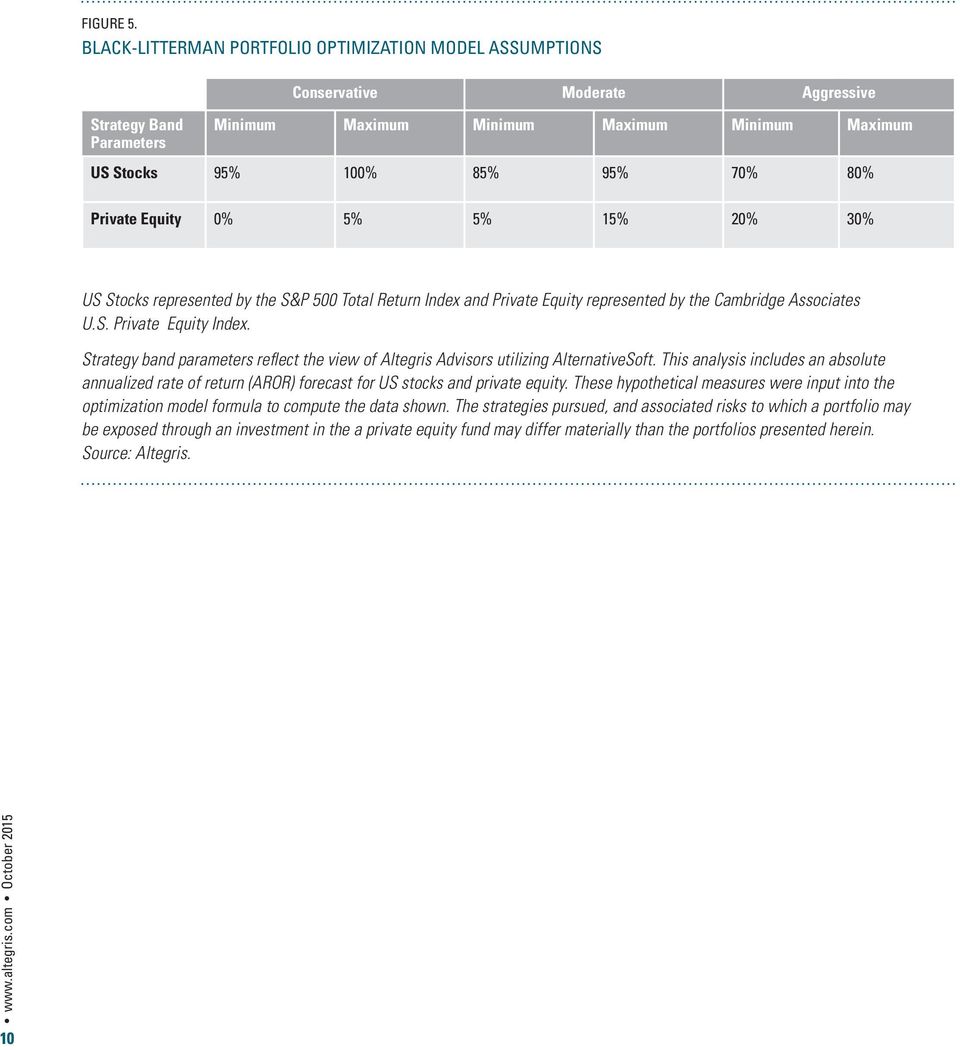
8 October 2015 compiled from 1,181 institutional private equity funds formed from 1986 to Looking at simple averages, one can see that the upper quartile of funds significantly outperformed the lower quartile by an average of 14.38% on an annual basis. In 1988, this difference was as low as 5.49% while in 2001, this difference was a stark 24.23% over the long term, this difference is even more magnified. Please note that we have excluded vintage years 2012 and 2013 given the short life of these funds. ALLOCATION ASSUMPTIONS Because private equity is less liquid than public equity, investors must utilize a long-term investment horizon to fully realize the potential benefits of the strategy. Therefore, the optimal percentage allocated to private equity depends on an individual s long-term investment goals and, importantly, one s liquidity needs. An analysis of liquidity needs may be the most important factor to consider when making a decision to take advantage of the illiquidity premia that exist in certain strategies. It should be noted that private equity may not be suitable for everyone. As with any investment, there are numerous risks to investing in private equity including the possible loss of principal. Nevertheless, for those investors who understand the risks, and have available risk capital, private equity can provide an opportunity to enhance their portfolio returns. A conservative investor, perhaps nearing or at retirement age, should not allocate a significant portion of his or her portfolio to private equity if substantial liquidity could be needed. This investor is more focused on capital preservation than capital generation, and may need to have a larger percentage of his or her assets in investments that can be easily liquidated. If this individual is primarily building a portfolio for one s heirs and has determined what portion is needed for one s own cash needs, it could be a different story. Likewise, an investor with a more opportunistic investment profile and ability to take on greater liquidity risk may consider a larger allocation. This investor has more time to benefit from the illiquidity premium they can be patient with their capital, allowing private equity fund managers to use their expertise to try to enhance portfolio returns. Their investments will also be less influenced by various public market factors including investor sentiment, volatility, quarterly reporting and seasonality. Rather, the performance of the underlying portfolio companies and ultimately the private equity funds (whether it be primary, secondary, co-investment or a combination thereof) will be dependent on idiosyncratic factors related to the private equity manager s ability to deliver on a specific company s potential value. While we cannot predict exactly how public equity or private equity will perform over the next decade, we believe that the next ten years are unlikely to repeat the past four decades of double-digit public equity returns. More likely, we expect to see a lower global growth environment from an economic standpoint with low- to mid- single digit annual returns from public equities. We do, however, expect volatility levels to fall within historical norms. Thus, investors should expect lower returns but similar volatility ahead for US stocks. Our assumptions used in determining recommended allocations [Figure 5] for private equity within a client s equity portfolio are predicated on these assumptions about the markets ahead. FINAL RECOMMENDATIONS We ve utilized Black-Litterman which incorporates a forward-looking approach to formulate recommended equity allocations inclusive of private equity [Figure 4]. Using this methodology, adding private equity to one s portfolio of US stocks may lower the volatility profile, but more importantly may increase annualized returns. 8

9 FIGURE 4. EQUITY ALLOCATION PROPOSALS: US STOCKS & PRIVATE EQUITY As a percentage of a 100% Equity Allocation Conservative Moderate Aggressive US Stocks 95% Private Equity 5% US Stocks 85% Private Equity 15% US Stocks 70% Private Equity 30% There is no guarantee that any investment will achieve its objectives, generate profits or avoid losses. Portfolio allocations will vary depending on the investment objectives, risk tolerances and experience of the individual investor. The Black-Litterman model was used to derive the above allocations, which require certain assumptions. An important part of understanding and implementing private equity today is assessing the potential benefits as well as the risks. Equity securities are subject to market risk, or risk of loss due to adverse company news, industry developments, and general economic decline. In addition, private equity is considered speculative therefore subject to a unique set of risks. These risks include, but are not limited to, liquidity risk and lack of a secondary market to trade securities, management risk, concentration and non-diversification risk, foreign investment risk, lack of transparency, leverage risk, and volatility. For more information and perspectives on alternatives, please visit or contact your alternatives consultant at Altegris Investments, The Modernization of Private Equity 9

10 FIGURE 5. BLACK-LITTERMAN PORTFOLIO OPTIMIZATION MODEL ASSUMPTIONS Conservative Moderate Aggressive Strategy Band Parameters Minimum Maximum Minimum Maximum Minimum Maximum US Stocks 95% 100% 85% 95% 70% 80% Private Equity 0% 5% 5% 15% 20% 30% US Stocks represented by the S&P 500 Total Return Index and Private Equity represented by the Cambridge Associates U.S. Private Equity Index. Strategy band parameters reflect the view of Altegris Advisors utilizing AlternativeSoft. This analysis includes an absolute annualized rate of return (AROR) forecast for US stocks and private equity. These hypothetical measures were input into the optimization model formula to compute the data shown. The strategies pursued, and associated risks to which a portfolio may be exposed through an investment in the a private equity fund may differ materially than the portfolios presented herein. Source: Altegris. October
11 OTHER RISKS AND IMPORTANT CONSIDERATIONS It is important to note that all investments are subject to risks that affect their performance in different market cycles. There are significant differences between public and private equities, which include but are not limited to, the fact that public equities have a lower barrier to entry than private equities. There is also greater access to information about public companies. Private equities typically have a longer time horizon than public equities before profits, if any, are realized. Public equities provide greater liquidity whereas private equities are considered highly illiquid. The analyses herein are based on numerous assumptions and past market conditions. Different benchmarks, market conditions and other assumptions could result in materially different outcomes. ALTEGRIS ADVISORS Altegris Advisors LLC is a CFTC-registered commodity pool operator, commodity trading advisor, NFA member, and SEC-registered investment adviser that sponsors and/or manages a platform of alternative investment products. ABOUT ALTEGRIS The Altegris group of affiliated companies is wholly-owned and controlled by (i) private equity funds managed by Aquiline Capital Partners LLC and its affiliates ( Aquiline ), and by Genstar Capital Management, LLC and its affiliates ( Genstar ), and (ii) certain senior management of Altegris and other affiliates. Established in 2005, Aquiline focuses its investments exclusively in the financial services industry. Established in 1988, Genstar focuses its investment efforts across a variety of industries and sectors, including financial services. The Altegris companies include Altegris Investments, Altegris Advisors, and Altegris Clearing Solutions. INDEX DEFINITIONS, DESCRIPTIONS AND RISKS An investor cannot invest directly in an index. Moreover, indices do not reflect commissions or fees that may be charged to an investment product based on the index, which may materially affect the performance data presented. Cambridge Associates U.S. Private Equity Index. The Cambridge Associates U.S. Private Equity Index is based on data compiled from more than 1,100 institutional-quality buyout, growth equity, private equity energy and mezzanine funds formed between 1986 and KEY RISKS: Liquidity risk inability to sell asset quickly; Market risk value may decline; Country/regional risk world events may adversely affect values. S&P 500 Total Return Index. The total return version of S&P 500 index. The S&P 500 index is unmanaged and is generally representative of certain portions of the US equity markets. For the S&P 500 Total Return Index, dividends are reinvested. All regular cash dividends are assumed reinvested in the S&P 500 index on the ex-date. Special cash dividends trigger a price adjustment in the price return index. KEY RISKS: Stock market risk stocks prices may decline; Country/regional risk world events may adversely affect values. The Modernization of Private Equity 11
12 ALTEGRIS MISSION Driven by a culture of deep research and innovation, with clients goals foremost, we identify superior investment capabilities and deliver effective, sustainable portfolio solutions. ALTEGRIS ADVISORS Printed October _CRT_100615

Private Equity Secondaries: The Opportunity Set October 2013
 THE ART OF SERIOUS INVESTING LVW Advisors is an independent Registered Investment Advisor based in Rochester (Pittsford), New York. Our team of experienced financial advisors provides customized investment
AN INTRODUCTION TO PORTFOLIO DIVERSIFICATION USING ALTERNATIVE INVESTMENTS
 ALTEGRIS ACADEMY FUNDAMENTALS AN INTRODUCTION TO PORTFOLIO DIVERSIFICATION USING ALTERNATIVE INVESTMENTS [1] The key elements of diversification. Most, if not all, investors have been told the virtues
Long Term Investment Pool (LTIP) Investment Policy Statement Level 1
 Long Term Investment Pool (LTIP) Level 1 CONTENTS I. OVERVIEW II. FINANCIAL GOALS OF THE LTIP III. INVESTMENT OBJECTIVES OF THE LTIP IV. INVESTMENT STRATEGIES OF THE LTIP V. PORTFOLIO REBALANCING VI. ASSET
About Our Private Investment Benchmarks
 1. What is a benchmark? FREQUENTLY ASKED QUESTIONS A benchmark is a standard of measurement for investment performance. One of the more common types of benchmarks is an index which, in this case, measures
Los Angeles County Employees Retirement Association Private Equity Objectives, Policies, and Procedures. Adopted: April 23, 1997
 Private Equity Objectives, Policies, and Procedures Adopted: April 23, 1997 Last Revised: February 10, 2016 Page 2 Table of Contents A. DOCUMENT PURPOSE 3 B. INVESTMENT OBJECTIVE AND STRATEGY 3 C. DEFINITIONS
Structured Products. Designing a modern portfolio
 ab Structured Products Designing a modern portfolio Achieving your personal goals is the driving motivation for how and why you invest. Whether your goal is to grow and preserve wealth, save for your children
Where you hold your investments matters. Mutual funds or ETFs? Why life insurance still plays an important estate planning role
 spring 2016 Where you hold your investments matters Mutual funds or ETFs? Why life insurance still plays an important estate planning role Should you undo a Roth IRA conversion? Taxable vs. tax-advantaged
Mutual Funds Made Simple. Brighten your future with investments
 Mutual Funds Made Simple Brighten your future with investments About Invesco Aim When it comes to investing, your sights are set on a financial summit a college diploma, new home or secure retirement.
Solutions Platform & Due Diligence Executing from the foundation of strategic asset allocation
 Solutions Platform & Due Diligence Executing from the foundation of strategic asset allocation We emphasize a thorough, disciplined process designed to identify and monitor what we believe to be the best
Abstract. What are alternative asset classes?
 An Introduction to Alternative Asset Classes Richard D. Landsberg, JD, LLM, MA, CLU, CPM, ChFC, RFC, AIF Director Advanced Consulting Nationwide Financial Abstract Alternative investments, which have been
Interest Rates and Inflation: How They Might Affect Managed Futures
 Faced with the prospect of potential declines in both bonds and equities, an allocation to managed futures may serve as an appealing diversifier to traditional strategies. HIGHLIGHTS Managed Futures have
About Hedge Funds. What is a Hedge Fund?
 About Hedge Funds What is a Hedge Fund? A hedge fund is a fund that can take both long and short positions, use arbitrage, buy and sell undervalued securities, trade options or bonds, and invest in almost
Single Manager vs. Multi-Manager Alternative Investment Funds
 September 2015 Single Manager vs. Multi-Manager Alternative Investment Funds John Dolfin, CFA Chief Investment Officer Steben & Company, Inc. Christopher Maxey, CAIA Senior Portfolio Manager Steben & Company,
Why Invest in a Non-Traded Business Development Company?
 Why Invest in a Non-Traded Business Development Company? This literature must be read in conjunction with the prospectus in order to fully understand all of the implications and risks of the offering of
DSIP List (Diversified Stock Income Plan)
 Kent A. Newcomb, CFA, Equity Sector Analyst Joseph E. Buffa, Equity Sector Analyst DSIP List (Diversified Stock Income Plan) Commentary from ASG's Equity Sector Analysts January 2014 Concept Review The
SANTA BARBARA COUNTY EMPLOYEES RETIREMENT SYSTEM PRIVATE EQUITY INVESTMENT POLICY. I. Purpose. II. Strategic Objective
 SANTA BARBARA COUNTY EMPLOYEES RETIREMENT SYSTEM PRIVATE EQUITY INVESTMENT POLICY I. Purpose This ( Policy ) is designed to ensure that investment managers, consultants, and the Santa Barbara County Employees
2016 Summary Prospectus
 April 18, 2016 Global X S&P 500 Catholic Values ETF NASDAQ: CATH 2016 Summary Prospectus Before you invest, you may want to review the Fund's prospectus, which contains more information about the Fund
for Analysing Listed Private Equity Companies
 8 Steps for Analysing Listed Private Equity Companies Important Notice This document is for information only and does not constitute a recommendation or solicitation to subscribe or purchase any products.
A guide to investing in unit investment trusts
 A guide to investing in unit investment trusts What you should know before you buy Wells Fargo Advisors wants to ensure that you are investing in the products that best suit your financial situation, investment
The Use of Pooled Investment Vehicles for Ultra High Net Worth Investors. By Mark W. Castelin Director, Senior Investment Advisor
 The Use of Pooled Investment Vehicles for Ultra High Net Worth Investors By Mark W. Castelin Director, Senior Investment Advisor A major challenge for a large segment of today s Ultra High Net Worth (UHNW)
Six strategies for volatile markets
 Six strategies for volatile markets When markets get choppy, it pays to have a plan for your investments, and to stick to it. by Fidelity Viewpoints 06/30/2016 No investor likes to hear that the market
Understanding a Firm s Different Financing Options. A Closer Look at Equity vs. Debt
 Understanding a Firm s Different Financing Options A Closer Look at Equity vs. Debt Financing Options: A Closer Look at Equity vs. Debt Business owners who seek financing face a fundamental choice: should
UNDERSTANDING PARTICIPATING WHOLE LIFE INSURANCE
 UNDERSTANDING PARTICIPATING WHOLE LIFE INSURANCE equimax CLIENT GUIDE ABOUT EQUITABLE LIFE OF CANADA Equitable Life is one of Canada s largest mutual life insurance companies. For generations we ve provided
PEI: New Strategies for Risk Management in Private Equity
 PEI: New Strategies for Risk Management in Private Equity Risk in non-traditional secondary strategies By Augustin Duhamel and Vidar Bergum, 17Capital Introduction As the private equity industry has matured,
Franklin Templeton Real Estate Advisors Investing in Multimanager Private Real Estate Funds
 Investing in Multimanager Private Real Estate Funds INVESTMENT INSIGHT MAY 2010 Jack Foster Head of Real Estate Raymond Jacobs Managing Director INTRODUCTION The financial crisis at the end of the recent
KKR Income Opportunities Fund Declares Monthly Distributions of $0.125 Per Share and. Announces Quarterly Investor Call Date
 KKR Income Opportunities Fund Declares Monthly Distributions of $0.125 Per Share and Announces Quarterly Investor Call Date New York, NY, January 27 th, 2016 KKR Income Opportunities Fund (the Fund ) (NYSE:
Davis New York Venture Fund
 Davis New York Venture Fund Price Is What You Pay, Value Is What You Get Over 40 Years of Reliable Investing Price Is What You Pay, Value Is What You Get Over 60 years investing in the equity markets has
Hedge Fund Seeding: Why the Interest?
 Prepared by Larch Lane Advisors LLC July 2012 This paper is for informational purposes only and is not intended to be, and should not be construed as, an offer to sell, or the solicitation of an offer
Sankaty Advisors, LLC
 Middle Market Overview March 2013 Overview of Middle Market We view the middle market as having three distinct segments, defined by a company's ownership type, prospects, and access to capital. Companies
Introduction to Australian Real Estate Debt Securities
 1 Introduction Introduction to Australian Real Estate Debt Securities Superannuation fund investors and managers have for a long time invested in real estate as part of their asset allocation in the belief
Eight Steps for Analysing Listed Private Equity Companies
 Eight Steps for Analysing Listed Private Equity Companies Tim Spence, Graphite Capital Management LLP Monique Dumas, Electra Partners LLP With thanks to Research & Analysis Ltd www.lpeq.com Historically,
Payout Ratio: The Most Influential Management Decision a Company Can Make?
 leadership series market research Payout Ratio: The Most Influential Management Decision a Company Can Make? January 2013 In today s equity market, payout ratios have a meaningful impact on both equity
SPDR EURO STOXX 50 ETF
 FEZ (NYSE Ticker) Summary Prospectus-January 31, 2016 Before you invest in the SPDR EURO STOXX 50 ETF (the Fund ), you may want to review the Fund's prospectus and statement of additional information,
IF YOU HAVE THE TIME The Long-Term Potential of Closed-End Funds vs. Open-End Funds
 IF YOU HAVE THE TIME The Long-Term Potential of Closed-End Funds vs. Open-End Funds Authored by Robert Kenyon, Managing Director, Business Development Closed-end funds have been on the market since 1893,
Obligation-based Asset Allocation for Public Pension Plans
 Obligation-based Asset Allocation for Public Pension Plans Market Commentary July 2015 PUBLIC PENSION PLANS HAVE a single objective to provide income for a secure retirement for their members. Once the
CFA Institute Contingency Reserves Investment Policy Effective 8 February 2012
 CFA Institute Contingency Reserves Investment Policy Effective 8 February 2012 Purpose This policy statement provides guidance to CFA Institute management and Board regarding the CFA Institute Reserves
Private Equity: A Practitioner s Perspective. Edward J. Mathias
 Private Equity: A Practitioner s Perspective Edward J. Mathias Private Equity A Practitioner s Perspective The Carlyle Group Overview The Fundamental Case Investor Activity Private Equity Investment Criteria
Bringing Alternatives Within Reach
 Bringing Alternatives Within Reach Goldman Sachs Multi-Manager Alternatives Fund (Ticker: GSMMX) Mutual funds pursuing alternative investment strategies, also known as alternative mutual funds, open up
The Benefits of Secondary Funds in a Private Equity Portfolio
 The Benefits of Secondary Funds in a Private Equity Portfolio By Ryan Cotton Senior Private Markets Research Analyst CTC Consulting Broader scope. Deeper insights. While private equity serves as a compelling
A: SGEAX C: SGECX I: SGEIX
 A: SGEAX C: SGECX I: SGEIX NOT FDIC INSURED MAY LOSE VALUE NO BANK GUARANTEE Salient Global Equity Fund The investment objective of the Salient Global Equity Fund (the Fund ) is to seek long term capital
REAL ESTATE INVESTMENT TRUSTS (REITs)
 UNDERSTANDING REAL ESTATE INVESTMENT TRUSTS (REITs) www.griffincapital.com KEY TERMS for ASSESSING REITS NET LEASE TRIPLE NET LEASE ABSOLUTE NET LEASE GAAP STRAIGHT-LINING FUNDS FROM OPERATIONS (FFO) MODIFIED
Behind the Scenes Constructing the Amerivest Opportunistic Portfolios
 Behind the Scenes Constructing the Amerivest Opportunistic Portfolios Powered by Morningstar Associates The Amerivest Opportunistic Portfolios are constructed to be tactical and more active in their investment
Important Information about Closed-End Funds and Unit Investment Trusts
 Robert W. Baird & Co. Incorporated Important Information about Closed-End Funds and Unit Investment Trusts Baird has prepared this document to help you understand the characteristics and risks associated
UNDERSTANDING MUTUAL FUNDS. TC83038(0215)3 Cat No 64095(0215)
 UNDERSTANDING MUTUAL FUNDS 10 % TC83038(0215)3 Cat No 64095(0215) Investing your hard earned money comes with some big decisions. So, before you invest, you need to ask yourself a simple question: What
Financial Wellness & Education. Understanding mutual funds
 Financial Wellness & Education Understanding mutual funds Benefits of mutual funds Foresters Financial Services provides everyday families and individuals with financial solutions, guidance and tools,
An Attractive Income Option for a Strategic Allocation
 An Attractive Income Option for a Strategic Allocation Voya Senior Loans Suite A strategic allocation provides potential for high and relatively steady income through most credit and rate cycles Improves
Important Information about Real Estate Investment Trusts (REITs)
 Robert W. Baird & Co. Incorporated Important Information about Real Estate Investment Trusts (REITs) Baird has prepared this document to help you understand the characteristics and risks associated with
Real Estate Investment Newsletter May 2004
 Pooled Investment: A Primer This month I will explain the benefits of pooling your money to invest in real estate along with other investors as an alternative to direct ownership of real estate. We ll
Davy Defensive High Yield Fund from New Ireland
 Davy Asset Management For Financial Advisors Only Davy Defensive High Yield Fund from New Ireland Davy Asset Management is regulated by the Central Bank of Ireland. Exposure to: equity-market type returns
The Role of Alternative Investments in a Diversified Investment Portfolio
 The Role of Alternative Investments in a Diversified Investment Portfolio By Baird Private Wealth Management Introduction Traditional Investments Domestic Equity International Equity Taxable Fixed Income
New York's 529 Advisor-Guided College Savings Program
 New York's 529 Advisor-Guided College Savings Program Data as of May 3, 204 month (as of 3/3/204) 0 yrs Expense ratio AGE-BASED PORTFOLIOS JPMorgan 529 Aggressive Age-Based Portfolio (Age 0-5) 2,3,4,5,6,7,8,9,37
Evolution of GTAA Investment Styles. In This Issue: June 2012
 June 2012 ALPHA GROUP TOPIC The Alpha Group researches investment managers. In This Issue: n Evolution of GTAA Investment Styles n Risk-Parity vs. GTAA Managers n Implementation n Investing in a GTAA Strategy
Learn about alternative investments. Investor education
 Learn about alternative investments Investor education Special investment instruments may help enhance a portfolio Once the exclusive domain of the ultrawealthy, alternative investments are beginning
Market Linked Certificates of Deposit
 Market Linked Certificates of Deposit This material was prepared by Wells Fargo Securities, LLC, a registered brokerdealer and separate non-bank affiliate of Wells Fargo & Company. This material is not
5Strategic. decisions for a sound investment policy
 5Strategic decisions for a sound investment policy 1 An investment policy sets your course for the long term. Managers of billion-dollar pension and endowment funds know it s nearly impossible to beat
REAL ESTATE STATEMENT OF INVESTMENT POLICY
 REAL ESTATE STATEMENT OF INVESTMENT POLICY Amended February 26, 2016 2211 York Road, Suite 500 Oak Brook, IL 60523-2337 (630) 368-1010 www.imrf.org Table of Contents I. Purpose and Objectives... 3 II.
U.S. Venture Capital Index and Selected Benchmark Statistics. December 31, 2015
 U.S. Venture Capital Index and Selected Benchmark Statistics Note on Terminology Updates: Starting this quarter, we have made some minor changes to the terminology used to refer to the Benchmarks and associated
Monthly Leveraged Mutual Funds UNDERSTANDING THE COMPOSITION, BENEFITS & RISKS
 Monthly Leveraged Mutual Funds UNDERSTANDING THE COMPOSITION, BENEFITS & RISKS Direxion 2x Monthly Leveraged Mutual Funds provide 200% (or 200% of the inverse) exposure to their benchmarks and the ability
Pomona Investment Fund
 Pomona Investment Fund A Registered Fund Structured To Provide Streamlined Access To Private Equity An investor should consider the investment objectives, risks, charges and expenses of the Fund(s) carefully
UNDERSTANDING CLOSED-END FUNDS
 Lessons in Investing for Income UNDERSTANDING CLOSED-END FUNDS Income is one of investors most common goals but one not easily achieved, especially in today s low-yielding environment. That s why investors
Priority Senior Secured Income Fund, Inc.
 Priority Senior Secured Income Fund, Inc. This material is neither an offer to sell nor the solicitation of an offer to buy any security. Such an offer can be made only by prospectus, which has been filed
NorthCoast Investment Advisory Team 203.532.7000 [email protected]
 NorthCoast Investment Advisory Team 203.532.7000 [email protected] NORTHCOAST ASSET MANAGEMENT An established leader in the field of tactical investment management, specializing in quantitative research
Dartmouth College Endowment Investment Policy Statement Updated August 2013
 Introduction and Purpose of the Endowment This Investment Policy Statement ( IPS ) applies to the endowment of Dartmouth College (the College ), referred to throughout this document as the Total Return
A guide to investing in cash alternatives
 A guide to investing in cash alternatives What you should know before you buy Wells Fargo Advisors wants to help you invest in cash alternative products that are suitable for you based on your investment
Asset Management Portfolio Solutions Disciplined Process. Customized Approach. Risk-Based Strategies.
 INSTITUTIONAL TRUST & CUSTODY Asset Management Portfolio Solutions Disciplined Process. Customized Approach. Risk-Based Strategies. As one of the fastest growing investment managers in the nation, U.S.
GIPS List of Composite Descriptions. Perkins Composites...11. Fixed Income Composites... 14. Global Macro Composites...19. Alternative Composites...
 GIPS List of Composite Descriptions Updated 6/4/2015 Janus Equity Composites...2 Perkins Composites....11 Fixed Income Composites... 14 Global Macro Composites...19 Alternative Composites.....19 Allocation
30% 5% of fixed income mutual funds paid capital gains in 2015
 FIXED INCOME ETFs: NEW ASSET CLASS, SAME BENEFITS Exchange Traded Funds ( ETFs ) first appealed to equity investors, providing efficient access to the world s stock markets and they have revolutionized
PROSHARES S&P 500 EX-FINANCIALS ETF
 SUMMARY PROSPECTUS SEPTEMBER 17, 2015 SPXN PROSHARES S&P 500 EX-FINANCIALS ETF SPXN LISTED ON NYSE ARCA This Summary Prospectus is designed to provide investors with key fund information in a clear and
BRINKER CAPITAL OVERVIEW. Helping You Invest with Confidence
 BRINKER CAPITAL OVERVIEW Helping You Invest with Confidence PARTIALLY INVESTED PERIODIC INVESTMENT FULLY INVESTED Unwavering Focus on Investment Excellence For more than 25 years, Brinker Capital has been
SUMMARY PROSPECTUS. BlackRock Funds SM. Service Shares BlackRock Science & Technology Opportunities Portfolio Service: BSTSX JANUARY 28, 2016
 JANUARY 28, 2016 SUMMARY PROSPECTUS BlackRock Funds SM Service Shares BlackRock Science & Technology Opportunities Portfolio Service: BSTSX Before you invest, you may want to review the Fund s prospectus,
Under the Radar: the value of hedged equity in a diversified portfolio
 Under the Radar: the value of hedged equity in a diversified portfolio By Emmett Maguire III, CFA Lake Street Advisors, LLC Investment Analyst As hedged equity strategies have underperformed their long
Equinox Frontier Funds
 MARCH 206 PROFILE Equinox Frontier Funds Equinox Frontier Fund Equinox Frontier Masters Fund Equinox Frontier Long/Short Commodity Fund DIVERSE RETURN OPPORTUNITIES Three distinct commodity pool options
ADVISORSHARES YIELDPRO ETF (NASDAQ Ticker: YPRO) SUMMARY PROSPECTUS November 1, 2015
 ADVISORSHARES YIELDPRO ETF (NASDAQ Ticker: YPRO) SUMMARY PROSPECTUS November 1, 2015 Before you invest in the AdvisorShares Fund, you may want to review the Fund s prospectus and statement of additional
Impact of rising interest rates on preferred securities
 Impact of rising interest rates on preferred securities This report looks at the risks preferred investors may face in a rising-interest-rate environment. We are currently in a period of historically low
Public Investment Memorandum. Strategic Partners Fund VII, L.P. Secondary Fund Commitment
 Public Investment Memorandum Strategic Partners Fund VII, L.P. Secondary Fund Commitment Charles J. Spiller Deputy CIO, Non-Traditional Investments February 12, 2016 Recommendation: Staff, together with
Guide to mutual fund investing. Start with the basics
 Guide to mutual fund investing Start with the basics Pursue your financial goals Why do you invest? For a rainy day? A secure retirement? Funding a college tuition? Having a specific goal in mind will
FREQUENTLY ASKED QUESTIONS March 2015
 FREQUENTLY ASKED QUESTIONS March 2015 Table of Contents I. Offering a Hedge Fund Strategy in a Mutual Fund Structure... 3 II. Fundamental Research... 4 III. Portfolio Construction... 6 IV. Fund Expenses
Investments in Private Energy Partnerships
 Investments in Private Partnerships August 2010 Private energy partnership investments offer a meaningful addition to a diversified private equity or real asset portfolio. Over the past 20 years, private
The Asset. Allocation Guide To. Wealth Creation. Absolute Return. Gold. Vehicle. Real Estate. Tax. An Investor Education Initiative by.
 The Asset Allocation Guide To Wealth Creation Real Estate Cash Reserves Vehicle Education Gold Tax Funds Food Car Equities Bonds House Precious Metals Fixed Income Natural Resources Absolute Return Understanding
Stock Market -Trading and market participants
 Stock Market -Trading and market participants Ruichang LU ( 卢 瑞 昌 ) Department of Finance Guanghua School of Management Peking University Overview Trading Stock Understand trading order Trading cost Margin
STATEMENT OF INVESTMENT POLICIES AND OBJECTIVES. WASHINGTON AND LEE UNIVERSITY The General Endowment Fund. Approved May 2007
 STATEMENT OF INVESTMENT POLICIES AND OBJECTIVES WASHINGTON AND LEE UNIVERSITY The General Endowment Fund Approved May 2007 This statement is issued by the investment committee of the board of trustees
Asset Allocation Made Easy
 Asset Allocation Made Easy Reaching Your Goals At Your Pace Most people can rattle off their investment goals: retirement, college tuition, a new house. That s easy. What s harder is successfully reaching
Global Buyout & Growth Equity Index and Selected Benchmark Statistics. December 31, 2014
 Global Buyout & Growth Equity and Selected Benchmark Statistics Disclaimer Our goal is to provide you with the most accurate and relevant performance information possible; as a result, Cambridge Associates
Private Equity in Asia
 Private Equity in Asia October 21 Asia private equity, in particular China, has increasingly attracted attention from institutional investors due to the region s faster economic recovery, greater growth
SFDCP TARGET DATE FUND PORTFOLIO SUMMARY: January 29, 2016
 SFDCP TARGET DATE FUND PORTFOLIO SUMMARY: January 29, 2016 SFDCP Target Date Funds Overview SFDCP Target Date Funds (each, a Fund and collectively the Funds or the SFDCP Target Date Funds ) were developed
EQUITY INVESTMENT IN REAL ESTATE THROUGH LISTED REITS
 Your Fund s Real Estate Investments: Approaches for Today s Market and a Better Tomorrow EQUITY INVESTMENT IN REAL ESTATE THROUGH LISTED REITS National Association of Real Estate Investment Trusts REITs: