
Insurance Supervision Department Financial Reporting Forms Guidelines
|
|
|
- Barrie Ramsey
- 9 years ago
- Views:
Transcription
1 Financial Reporting Forms Guidelines Version 1.3 (January 2010)
2 Table of Contents Section 1 Introduction....3 Section 2 Monthly Financial Reporting Forms Guidelines...6 Section 3 Quarterly/ Annual Financial Reporting Forms Guidelines Section 4 Intermediaries Semi-Annual Financial Reporting Forms Guidelines..73 Page 2

3 I. Introduction of this Document Insurance companies and intermediaries are required to submit a set of regulatory forms to SAMA, to report financial and non financial information to the on a monthly, quarterly, semi-annual and annual basis. This document represents the guidelines to these regulatory reporting forms; it provides an explanation of the purpose of each form, its filling instructions as well as definitions of each caption the form contains. General SAMA: Refers to the of the Saudi Arabian Monetary Agency which is the regulator of insurance operations in the Kingdom of Saudi Arabia. Company: Refers to all insurers and/ or reinsurers, agents and/ or brokers submitting forms. Agent: A juristic entity that for compensation represents the Company to solicit, procure and negotiate insurance contracts. Broker: A juristic entity that for compensation represents the customers insured or prospective customers to solicit, procure, and negotiate insurance contracts. Third Party Administrator (TPA): Refers to an entity that serves as a liaison between the insured (person or company) and the insurance provider. GHI: Refers to General and Health Insurance. PSI: Refers to Protection and Savings Insurance. PH: Refers to Policyholders. SH: Refers to Shareholders. Forms: Refers to each regulatory reporting template. Schedule: Refers to tables within a form. Return: Refers to a set of forms (e.g., monthly return, quarterly return, and annual return). Current/Reporting Period: Refers to the current period (i.e., current year, quarter, or month) unless mentioned otherwise. Prior Period: Refers to the corresponding period from the prior calendar year. Lines of Business First: General Insurance Accident and liability insurance which includes the following: 1. Personal Accident Insurance which may include but is not limited to personal accident motor, group personal accident "medical", personal accident group, personal accident individual, personal accident plan, or plastic card insurance. 2. Work Related Insurance. 3. Employer s Liability Insurance. 4. Third Party Liability Insurance. 5. General Liability Insurance which may include but is not limited to inherent structural defect, public liability, deterioration of stock, directors & officers liability, workmen's compensation, or blood stock insurance. 6. Product Liability Insurance which may include but is not limited to comprehensive general liability. 7. Medical Liability Insurance which may include but is not limited to medical malpractice insurance. 8. Professional Liability Insurance which may include but is not limited to professional indemnity insurance. 9. Theft and Burglary Insurance. 10. Fidelity Insurance which may include but is not limited to fidelity guarantee. 11. Safe Burglary Insurance inside the premises and in transit. 12. Any other liability insurance which may include but is not limited to money and pecuniary insurance, insurance for travelers, or live stock insurance. Motor Insurance: Provides coverage against losses and liability related to motor vehicles, excluding transport insurance. Motor insurance is divided into Compulsory Motor Insurance and Compulsory + Others Motor Insurance. 1. Compulsory Motor Insurance may include but is not limited to motor vehicle insurance, motor third party, or motor driving license. Page 3
4 2. Compulsory + Others Motor Insurance refers to any compulsory motor insurance policy that includes a non-compulsory part in addition to its compulsory part. Property Insurance: Provides coverage against fire, theft, explosion, natural phenomena, civil disturbance, and any other insurance included under this class of insurance. Property insurance may include but is not limited to all risk insurance, business interruption insurance, fire & lightning insurance, property fire allied perils insurance, or house holders comprehensive insurance. Marine Insurance: Provides coverage for goods in transit and the vehicles of transportation on waterways, and any other insurance included under this class of insurance. Marine insurance is divided into Hull Marine Insurance and Cargo Marine Insurance. 1. Hull Marine Insurance insures hull of a ship and its tackle, passenger fittings, equipment, stores, boats, and ordnance. 2. Cargo Marine Insurance may include but is not limited to carrier's liability, marine insurance certificate, land transit insurance, land transit open cover, marine open cover, or marine cargo. Aviation Insurance: Provides coverage for airline hulls and liability against passengers and third parties, freight transport by air, and any other insurance included under this class of insurance. Energy Insurance: Provides coverage for oil, petrochemical, other energy installations, and any other insurance included under this class of insurance. Engineering Insurance: Provides coverage for builder s risks, construction, mechanical, electrical, electronic, and machinery breakdown, and any other insurance included under this class of insurance. Engineering Insurance may include but is not limited to contractor's all risk insurance, deterioration of stock machinery breakdown insurance, erection all risk insurance, electronic equipment insurance, loss on profit insurance, or plant and equipment insurance. Other Classes: Includes all recognized classes of general insurance not mentioned above. Other classes may include but are not limited to special acceptance insurance, special term life insurance, employees dishonesty or fidelity insurance or internal travelers assistance insurance. Second: Health Insurance Health Insurance: Provides individual or group coverage for medical costs, medicines, medical and medications requirements as well as management of medical programs. Health Insurance is divided into Compulsory Health Insurance and Compulsory + Others Health Insurance. Compulsory + Others Health Insurance refers to any compulsory health insurance policy that includes a noncompulsory part in addition to its compulsory part. Third: Protection and Savings Insurance Protection Insurance: Provides individual or group coverage for death related consequences, and permanent and partial disability. Protection and Savings Insurance: Provides individual or group coverage for death related consequences, and permanent and partial disability with a saving/ retirement plan for an additional premium paid by the insured. Other Protection and Savings Insurance: This category includes other classes of insurance in the protection and savings insurance not mentioned above. Submission Process The regulatory reporting forms must be completed and submitted to SAMA in 2 formats: 1) Electronic excel-based forms, which are available for download from SAMA s website ( The forms should be sent by to the following address [email protected], Carbon Copying (cc) Adel Abal Khail on the following [email protected]. 2) Hard copies for quarterly and annual forms. The forms printout must be sent to SAMA via registered mail to the following address Adel Abalkhail, SAMA ISD, P.O. Box 2992, Riyadh 11169, Kingdom of Saudi Arabia. A certification statement must accompany the hard copy and has to be signed by the chief accountant, finance manager, and the CFO or CEO. The annual forms must be audited, and according to the Implementing Regulations, accompanied by an actuarial report. The company must assign the responsibility of completing and submitting the forms to the finance manager who will be the main point of contact with SAMA.. Note: For speed and reliability, it is advised that companies send hard copies by courier (e.g., FedEx). Page 4
5 Submissions Schedule All licensed insurance and reinsurance companies in Saudi Arabia are required to submit 3 sets of Regulatory Financial Reporting Forms whereas intermediaries are required to submit 1 set. The submissions are as follows: Party Concerned Forms Submission Periods No. of Annual Submissions Submission Date (Date for receipt by SAMA) Insurance and Reinsurance companies Monthly To be submitted on monthly basis 12 Within 15 working days of the end of each calendar month Insurance and Reinsurance companies Quarterly To be submitted on quarterly basis, for 3- month periods ending March, June, September, and December 4 Within 25 working days of the end of each calendar quarter Intermediaries Semi- Annually To be submitted on a semi-annual basis, for 6-month periods ending June and December 2 Within 21 working days of the end of each 6 months Insurance and Reinsurance companies Annual To be submitted on annual basis for the 12- month period ending December of each calendar year 1 Within 60 working days of the end of each calendar year Financial Amounts 1) Valuation: All the values (assets and liabilities) must be reported as book values. 2) Format: Financial amounts must be provided in Saudi Riyals rounded to the nearest thousand (SR 000). Financial amounts in foreign currency must be converted to Saudi Riyals (SR 000) using the exchange rate as of the last day of the current period. Supplementary Note Template: Attached with the financial forms is an excel file called Supplementary Note Template.xls. This file includes one sheet used for detailing some captions in the forms. The company should complete this sheet whenever it is asked to fill a supplementary note in the guidelines. For every caption that needs detailing, the company should copy the blank sheet in the same excel file and complete it. References to Forms: All references to captions in the Forms use the abbreviation format Form.Line.Column, e.g., 21.5.E = Form 21, Line 5, Column E) for Completing the Company and Reporting Period on the Cover Sheet Company: insert name of the company in the indicated field Reporting Period: insert the name of the beginning and ending months of the reporting period, e.g., for month reporting insert the reporting month (e.g., Jan or Feb ); for quarterly reporting insert (e.g., Jan-Mar or Apr-Jun ); for semi-annual reporting insert (e.g., Jan-Jun ), for annual reporting insert (e.g., Jan-Dec ). Financial Year: Insert the calendar year of the reporting period (e.g., 2008 ) Forms Submission Date: insert the day, month and year (DD/MM/YYYY) of the forms submission date (e.g., 05/04/2008 ). The date for receiving the electronic copy cannot be more than 3 days from the date on which SAMA receives the hardcopy version of the reporting forms. Page 5

6 II. Monthly Financial Reporting Forms Guidelines Form 11M Summary Form The purpose of this form is to provide an overview of an insurer s underwriting activities and reserves. This form contains two schedules: Schedule 1 Underwriting activities Schedule 2 Reserves In this form, columns A, B and C are computed automatically based on links to subsequent Forms 12M, 13M, 14M, 15M, and 16M. Columns D, E and F are to filled manually with the corresponding figures from the prior month, grand totals over the past 12 months and the values from current month last year respectively. For schedule 1, columns A, B and C are automatically calculated from the information in Forms 12M, 13M, and 14M. This schedule consists of three parts, leading to the calculation of the underwriting results for GHI and PSI for the current period: (a) Underwriting revenues (line 29), which consist of net premiums and commissions earned (b) Underwriting expenses (line 40), which consist of claims, policy acquisition costs, and commissions incurred (c) Operational and technical expenses (line 41) The underwriting result (line 49) is calculated by subtracting lines 40 and 41 from line 29. For schedule 2, columns A, B and C are automatically calculated from the information in Forms 15M and 16M. This schedule consists of reserves for GHI and PSI. The reserves for each type of insurance are subdivided into different categories. Direct insurance gross written premiums: Refers to all premiums for insurance business accepted directly including premiums from brokers and agents. Reinsurance assumed gross written premiums: Refers to all premiums for insurance business assumed or accepted from insurers (i.e., reinsured inwards). Gross written premiums: Refers to all premiums for insurance business accepted directly and reinsurance assumed/ accepted (i.e., inward reinsurance). Reinsurance premium ceded: Refers to all premiums to the reinsurance company for outward reinsurance. Net written premiums: Refers to the result of subtracting premiums ceded (i.e., reinsurance ceded) from gross written premiums. Movement in unearned premium reserve (net): Refers to the difference between the balance of unearned premium reserve at the end of the period and the balance of the unearned premium reserve at the beginning of the period. This amount is net of the share of reinsurance. Net earned premiums: Refers to the result of subtracting the change in unearned premiums between two reporting periods from the net written premiums. Reinsurance commissions earned: Refers to all commissions earned on the reinsured portfolio (i.e., reinsured outwards) to reinsurance companies. Other underwriting income: Refers to all underwriting income that has not been accounted for in the above categories; companies must fill a supplementary note to explain the nature of this income. Gross claims paid: Refers to all claims paid (i.e., released) directly or through reinsurance agreements, including lawyer fees, adjustment fees, and all expenses to settle a claim. Page 6
7 Reinsurance share of claims: Refers to the portion of gross claims that are covered by reinsurers. Net claims paid: Refers to the result of subtracting reinsurance share of claims paid from gross claims paid. Changes in outstanding claims and IBNR reserves (net): Refers to the difference between the balance in outstanding claims reserves and IBNR reserves at the end of the period and consecutively, the balance of the outstanding claims reserves and IBNR reserves at the beginning of the period. These reserves are net of the share of reinsurance. Changes in mathematical reserves (net): Refers to the difference between the balance in the mathematical reserves at the end of the period and the balance of the mathematical reserves at the start of the period. These reserves are net of the share of reinsurance. Net claims incurred: Refers to the result of adding changes in net reserves to net claims paid. Policy acquisition costs incurred: Refers to all costs incurred (i.e., costs paid + movement in costs) related to the acquisition of business excluding commissions incurred. Commissions incurred: Refers to all commissions incurred (i.e., commissions paid + movement in commissions) for acquiring new customers Other direct underwriting expense: Refers to any other underwriting expense not accounted for in the above categories; companies must fill a supplementary note to explain the nature of these expenses. Operational and technical expenses: Refers to all operational costs such as salaries, office supplies, training, electricity, water, etc., related to insurance activities General and administrative expenses: Refers to any shareholders expenses (e.g., board meetings, events, supplies, services, public disclosures, and charitable donations). These expenses should not be intended to benefit policyholders or claimants. Unearned premium reserve (net): Refers to the portion of premiums which is matched to a future period in accordance with the related policy risk and is unearned as of the end of the reporting period. This reserve should be reported net of the share of reinsurers. Outstanding claims reserve (net): Refers to the amount set aside by the insurer for claims that have been reported but not settled, net of the share of reinsurers. Claims IBNR reserve (net): Refers to the amount set aside by the insurer for claims that have been incurred but not reported at the reporting date, net of the share of reinsurers. Adjustment expense reserve (net): Refers to the amount set aside by the insurer for any projected adjustment expense associated with future claims. The reserve should be net of the share of reinsurers. Other reserves (net): Refers to any other form of reserves not accounted for in the above captions. The reserve should be net of the share of reinsurers. With-profit policy reserve: Refers to the amount set aside by the insurer for policies under which the company may declare a reversionary bonus, a terminal bonus or a policyholder dividend based on the experience of the company for policies in the same class of insurance (provides policyholders to be eligible to participate in any surplus arising on the whole of, or any part of, the insurer s long term insurance business). The reserve should be net of the share of reinsurers. Without-profit policy reserves: Refers to the amount set aside by the insurer for policies that are guaranteed during the policy s life and are not eligible to receive reversionary bonuses or other forms of participation features. Investment-linked policy reserve: Refers to the amount set aside by the company for policies whose investment performance is directly linked to the performance of a unit linked fund. All amounts available for investment under these policies are invested in this unit linked fund. The reserve should be net of the share of reinsurers. Page 7

8 Form 12M Underwriting Revenues The purpose of this form is to break down an insurer s underwriting revenue by line of business. This form contains two schedules: Schedule 1 General and Health Insurance Schedule 2 Protection and Savings Insurance Vertically, each schedule is subdivided into specific lines of business (e.g., Accident and Liability, Motor, Health, etc ). Totals for GHI and PSI are calculated in lines 39 and 49, respectively. Horizontally, the schedules are divided into the components of the underwriting revenues (columns A to I) leading to the calculation of the total underwriting revenues by line of business (column J). The number of policies written and the number of policyholders for each line of business must be provided in columns K and L consecutively. The number of policies written indicate the number of new policies that are written in the current period which correspond to the amount of accepted premium in the same period. NOTE: For relevant definitions, refer to Form 11M. Page 8

9 Form 13M Underwriting Expenses The purpose of this form is to break down an insurer s underwriting expenses by line of business. This form contains two schedules: Schedule 1 General and Health Insurance Schedule 2 Protection and Savings Insurance Vertically, each of these schedules is further subdivided into specific lines of business (e.g., Accident and Liability, Motor, Health, etc ). Totals for GHI and PSI are calculated in lines 39 and 49, respectively. Horizontally, the schedules are divided into the components of the underwriting expenses (columns A to I) leading to the calculation of total underwriting expenses by line of business (column J). The number of claims reported for each line of business must be provided column K. This caption indicates the number of claims that are paid in the current period which correspond to the amount of claims paid in the same period. NOTE: For relevant definitions, refer to Form 11M. Page 9

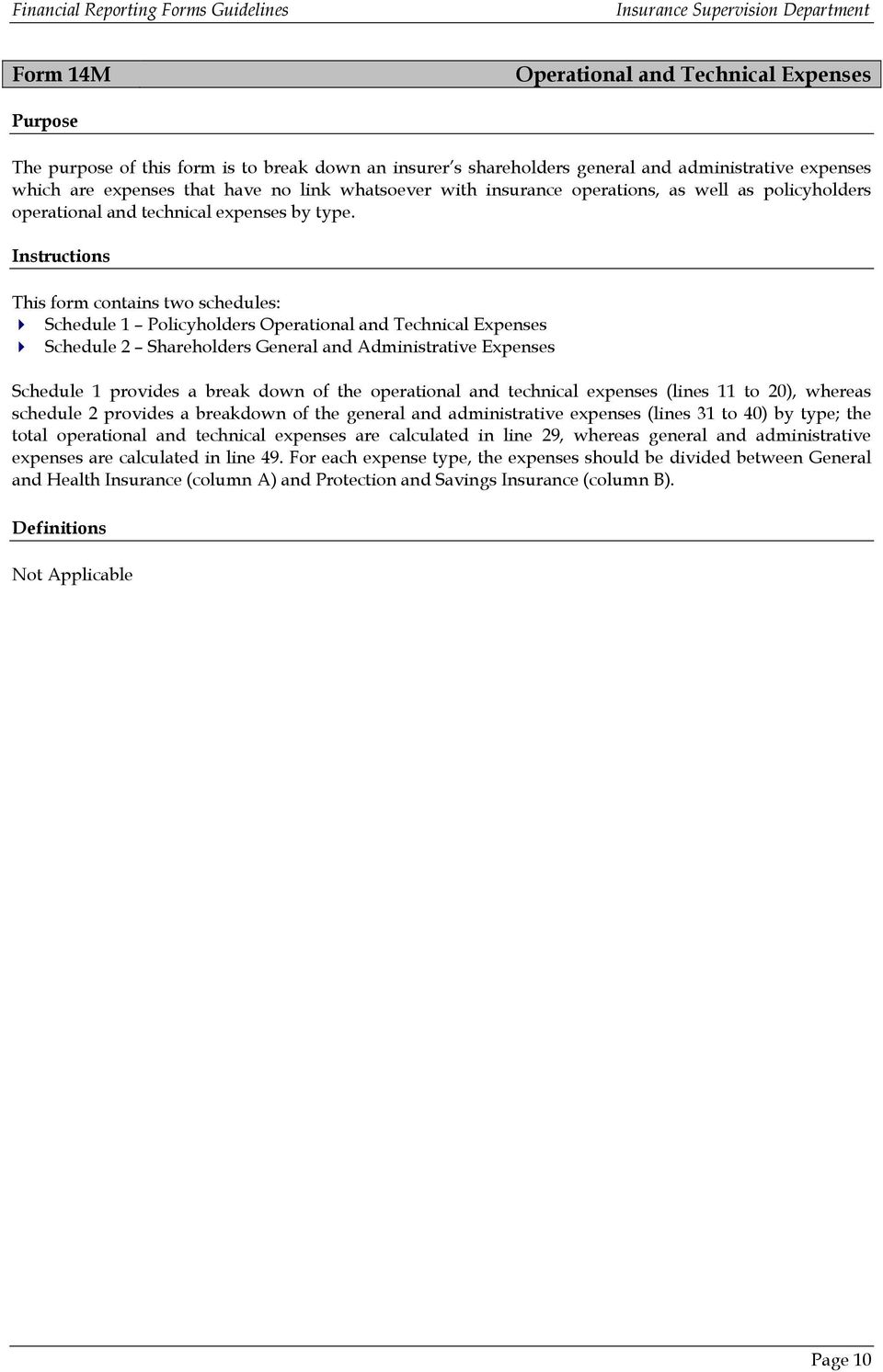
10 Form 14M Operational and Technical Expenses The purpose of this form is to break down an insurer s shareholders general and administrative expenses which are expenses that have no link whatsoever with insurance operations, as well as policyholders operational and technical expenses by type. This form contains two schedules: Schedule 1 Policyholders Operational and Technical Expenses Schedule 2 Shareholders General and Administrative Expenses Schedule 1 provides a break down of the operational and technical expenses (lines 11 to 20), whereas schedule 2 provides a breakdown of the general and administrative expenses (lines 31 to 40) by type; the total operational and technical expenses are calculated in line 29, whereas general and administrative expenses are calculated in line 49. For each expense type, the expenses should be divided between General and Health Insurance (column A) and Protection and Savings Insurance (column B). Not Applicable Page 10
11 Form 15M General and Health/ Protection and Savings Insurance Common Reserves The purpose of this form is to break down an insurer s General and Health Insurance and Protection and Savings Insurance common reserves by line of business. Provide, for each line of business specified in this form the unearned premium reserve (column A), outstanding claims reserve (column B), claims IBNR reserve (column C), adjustment expense reserve (column D), and other reserves (column E). All the above reserves are net of the share of reinsurance, and should be reported as aggregate reserves to date for all the in force business, as of the reporting period. NOTE: For relevant definitions, refer to Form 11M. Page 11

12 Form 16M Protection and Savings Insurance Reserves The purpose of this form is to break down an insurer s Protection and Savings Insurance reserves by line of business. Provide, for each line of business specified in this form, non-linked individual with-profit policy reserve (column A), non-linked individual without-profit policy reserve (column B), non-linked group with-profit policy reserve (column C), non-linked group without-profit policy reserve (column D), individual investment-linked policy reserve (column F), and group investment-linked policy reserve (column G). All the above reserves are net of the share of reinsurance, and should be reported as aggregate reserves to date for all the in force business, as of the reporting period. NOTE: For relevant definitions, refer to Form 11M. Page 12

13 Form 17M Solvency Analysis Calculation of Required Solvency GHI The purpose of this form is to calculate the required solvency margin of a company s General and Health Insurance business operations. This form contains two schedules, each corresponding to one method of calculating the required solvency margin: The First method is based on a premium calculation. For each line of business, the gross written premium (column A) and the net written premium (column B) values must be provided. The required solvency for the current period is automatically computed (column E) using the class factor risks in Table 3 of the Implementing Regulations. The required solvency for the prior period must be entered manually (column F). The Second method is based on claim calculations (only for companies that have been operating for 3 years or more). For each line of business, the values of the past 3 years of gross claims incurred (columns M, N, O) and the net claims incurred (columns P, Q, R) must be entered manually. The required solvency for the current period is automatically computed (column K) using the class factor risks in Table 4 of the Implementing Regulations. The required solvency for the prior period must be entered manually (column L). The maximum of the 2 methods above is selected as the solvency requirement for the company s General and Health Insurance business operations (line 59). For this form to be of value on a monthly basis, the reporting date has to be taken into consideration: (a) If the reporting is in 2009 (i.e., company has been reporting to SAMA for a year or longer), the current period would be the current month and the 11 months that precede the current month, whereas the prior period would be the prior month and the 11 months that precede the prior month. (b) If the reporting is taking place in 2008, then the current period would be the current month and all the months preceding the current month reaching January 2008, whereas the prior period would be the prior month and all the months preceding the prior month reaching January Gross claims incurred: Refers to all claims reported to the company during the current period, including claims applicable to insurance placed directly, reinsurance accepted (i.e., inward reinsurance), and reinsurance ceded (i.e., outward reinsurance). NOTE: For additional definitions, refer to Form 21. Page 13

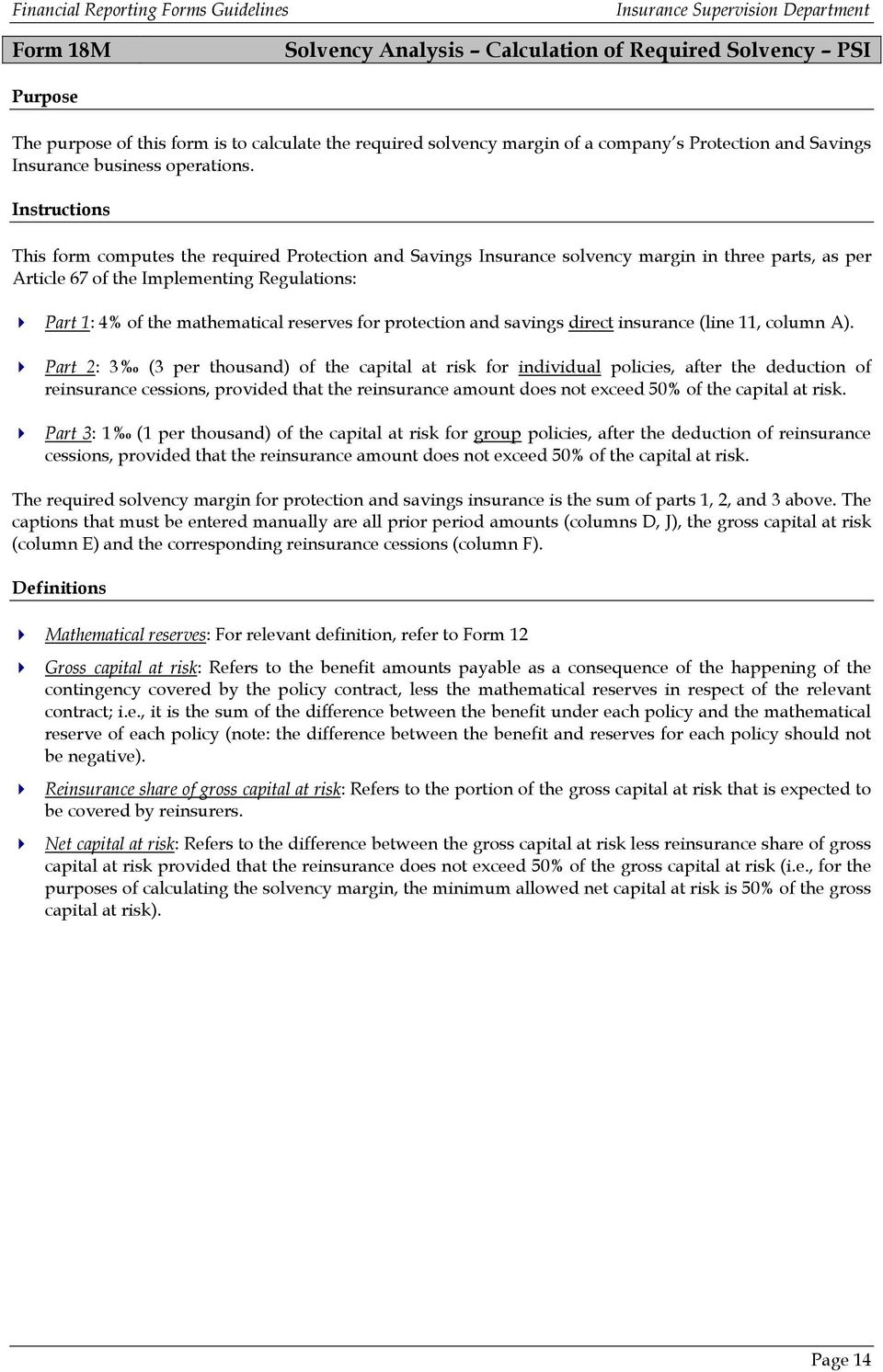
14 Form 18M Solvency Analysis Calculation of Required Solvency PSI The purpose of this form is to calculate the required solvency margin of a company s Protection and Savings Insurance business operations. This form computes the required Protection and Savings Insurance solvency margin in three parts, as per Article 67 of the Implementing Regulations: Part 1: 4% of the mathematical reserves for protection and savings direct insurance (line 11, column A). Part 2: 3 (3 per thousand) of the capital at risk for individual policies, after the deduction of reinsurance cessions, provided that the reinsurance amount does not exceed 50% of the capital at risk. Part 3: 1 (1 per thousand) of the capital at risk for group policies, after the deduction of reinsurance cessions, provided that the reinsurance amount does not exceed 50% of the capital at risk. The required solvency margin for protection and savings insurance is the sum of parts 1, 2, and 3 above. The captions that must be entered manually are all prior period amounts (columns D, J), the gross capital at risk (column E) and the corresponding reinsurance cessions (column F). Mathematical reserves: For relevant definition, refer to Form 12 Gross capital at risk: Refers to the benefit amounts payable as a consequence of the happening of the contingency covered by the policy contract, less the mathematical reserves in respect of the relevant contract; i.e., it is the sum of the difference between the benefit under each policy and the mathematical reserve of each policy (note: the difference between the benefit and reserves for each policy should not be negative). Reinsurance share of gross capital at risk: Refers to the portion of the gross capital at risk that is expected to be covered by reinsurers. Net capital at risk: Refers to the difference between the gross capital at risk less reinsurance share of gross capital at risk provided that the reinsurance does not exceed 50% of the gross capital at risk (i.e., for the purposes of calculating the solvency margin, the minimum allowed net capital at risk is 50% of the gross capital at risk). Page 14
15 Form 19M Solvency Analysis - Calculation of Required Solvency Margin Total Insurance The purpose of this form is to calculate the required solvency margin of a company s Total Insurance business operations. This form contains two schedules that calculate the minimum required solvency margin of a company using two different methods. The first method uses the minimum capital requirement stipulated by the Insurance Law (Article 3.3): - SR 100 million for a company engaged in insurance business. - SR 200 million for a company engaged in insurance and reinsurance business. The second method uses the sum of the required margin for General and Health, as well as Protection and Savings insurance calculated in forms 17M, and 18M respectively. The maximum of the 2 methods above is selected as the minimum solvency requirement for the company (line 39). Page 15

16 Form 20M Financial Flows of the Insurance Company The purpose of this form is to show the financial flows of the insurance companies into and out of Saudi Arabia. This form contains two schedules: Schedule 1 Inward Cash Flow Schedule 2 Outward Cash Flow Vertically, each of these schedules is further subdivided into the different sources of cash flow which vary from insurance premiums and claims (lines 11 and 21), to reinsurance share of premiums (lines 12 and 22), to reinsurer share of claims (lines 13 and 23), and to other cash flows (lines 14 and 24). Horizontally, the amount for each cash flow (inward and outward) must be reported for the current month. Direct insurance premiums: Refers to all the inward cash flows as a result of direct insurance premiums (i.e., excluding any premiums from reinsurance). Reinsurance premiums assumed: Refers to all the inward cash flows as a result of undertaking reinsurance premiums from other insurance companies. Reinsurance recoverables: Refers to all the inward cash flows as a result of the reinsurer covering part of the claims paid. Other inward cash flows: Refers to all other inward cash flows that are not accounted for in the above captions. Companies must fill a supplementary note to explain the nature of these inward cash flows. Direct insurance claims paid: Refers to all the outward cash flows as a result of direct insurance claims excluding any claims from reinsurance. Reinsurance premiums ceded: Refers to all the outward cash outflows as a result of ceding premium to a reinsurer. Reinsurance claims paid: Refers to all outward cash flows dispensed to cover claims arising from the reinsurance that the company has assumed. Other outward cash flows: Refers to all other outward cash flows that are not accounted for in the above captions. Companies must fill a supplementary note to explain the nature of these outward cash flows. Page 16

17 Form 21M Foreign Assets & Liabilities of Insurance Companies The purpose of this form is to break down an insurer s foreign assets and foreign liabilities. This form contains two schedules: Schedule 1 Foreign Assets Schedule 2 Foreign Liabilities Vertically, each of these schedules is further subdivided into specific types of assets and liabilities. Horizontally, the amount for each asset/ liability must be reported for the current month. [Foreign assets] Subscription to capital of branches or financial institutions abroad: Refers to the subscription of domestic insurance companies to the capital of insurance companies abroad or to their branches abroad by 10 percent or over. [Foreign assets] Loans to branches abroad: Refers to loans on branches, subsidiaries, and affiliates abroad from domestic insurance companies. [Foreign assets] Investment income: Refers to the income of domestic insurance companies from their investments abroad. [Foreign assets] Shares and title deeds: Refers to the domestic insurance companies' investments in stock and title deeds abroad. [Foreign assets] Debentures: Refers to the domestic insurance companies' investments in debt securities, bills, deeds, and financial derivatives abroad. [Foreign assets] Currencies and deposits Abroad: Refers to the domestic insurance companies' holdings of bank notes and coins abroad and convertible deposits and other deposits denominated in domestic and foreign currencies which they own abroad. [Foreign liabilities] Subscription to capital of b ranches or financial institutions in the Kingdom: Refers to the subscription of foreign insurance companies to the capital of insurance companies or branches of the insurance companies in the Kingdom by 10 percent or over. [Foreign liabilities] Loans from branches abroad: Refers to the loans of domestic insurance companies from their branches, subsidiaries and affiliates abroad. [Foreign liabilities] Foreign loans: Refers to the loans extended by foreign entities (foreign banks, financial institutions and others) to insurance companies in the Kingdom, excluding loans from their branches, subsidiaries and affiliates abroad. [Foreign liabilities] Trade credit: Refers to the loans of trade credit for import purposes from abroad. Page 17

18 III. Quarterly/ Annual Financial Reporting Forms Guidelines Form 11 Balance Sheet Assets The purpose of this form is to provide a summary of all policyholders and shareholders assets for both General and Health Insurance and Protection and Savings Insurance. This form contains three schedules: Schedule 1 Policyholders assets Schedule 2 Shareholders assets Schedule 3 Total assets Ea ch schedule is broken down into General and Health Insurance, Protection and Savings Insurance non- Linked, Protection and Savings Insurance Linked, and Total Insurance. Asset amounts must be provided for each of these categories as of the end of the current period and prior period. Many captions in this form are further broken down in other forms, so care must be taken to make sure that the corresponding amounts tally correctly. The validation sheet at the end of the workbook cross-references all captions to avoid inconsistencies and mistakes. Cash and cash equivalents: Cash and cash equivalents are defined as amounts included in cash, excluding statutory deposits, and due from banks and other financial institutions with a maturity of three months or less from the date of acquisition. [Investments] Deposits at financial insti tutions: Refers to non-current deposits in banks (e.g., term deposits), other than those included within cash and cash equivalents above. [Investments] Loans: Refers to all loans made to third parties. [Investments] Investment funds: Refers to mutual investment vehicles/mutual funds and unit trusts. [Investments] Debt securities and fixed income: Refers to debt securities, such as bonds, notes, bills, and money-market securities. [Investments] Shares (commo n, preferred) : Refers to equity investments in common or preferred stocks. [Investments] Real estate: Refers to all real estate used for investment purposes. In the case of policyholders assets only, this caption should not include real estate used for operations, which should instead be included in the tangible assets caption. [Investments] Investment in subsidiaries and affiliat es: Refers to investments made by the company in related companies (e.g., subsidiaries and affiliates). [Investments] Other: Refers to any other form of investment not accounted for in the above captions; companies must fill a supplementary note to explain the nature of these investments. Receivables: Refers to all receivables that are net of allowance for doubtful accounts. [Receivables] Agents, brokers, and TPAs: Refers to all receivables due to the company from agents, brokers, and TPAs. [Receivables] Policyholders: Refers to all receivables generated from the normal course of the insurance business; this caption includes unpaid premiums due from policyholders. Page 18
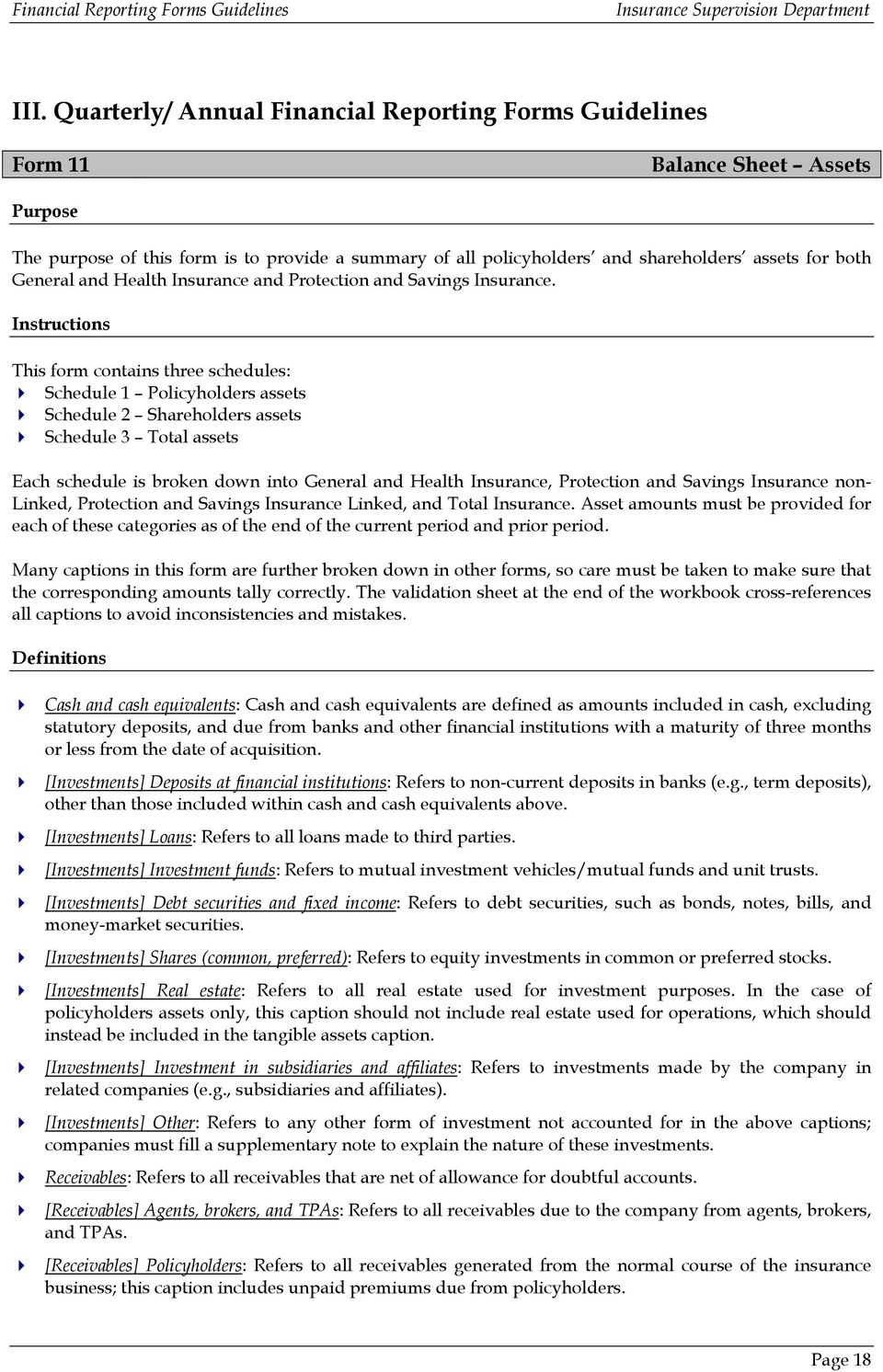
19 [Receivables] Reinsurers: Refers to the amounts receivable from reinsurers excluding reserves from Reinsurance Recoverables. [Receivables] Other insurers: Refers to all receivables expected from other insurers and reinsurers; this caption includes receivables for salvage or subrogation due from other insurers and reinsurers. [Receivables] Subsidiaries and affiliates: Refers to all receivables by the company from subsidiaries and affiliates. [Receivables] Other: Refers to all other receivables not accounted for in the above captions; companies must fill a supplementary note to explain the nature of these receivables. [Reinsurance recoverables] Unearned premium and PSI mathematical reserves: Refers to the reinsurers share of unearned premium for general and health insurance and the mathematical reserves for PSI insurance. Other Reinsurance recoverables: Refers to receivables expected from reinsurers to cover the reinsurance portion of claims reported but not settled, claims incurred but not reported, adjustment expenses, unexpired risk, catastrophe risk, general expenses, and other reserves. Accrued interest, rent, income: Refers to any interest, rent, or other income that has been earned or accumulated over the current period. Deferred acquisition cost: Refers to the deferred portion of payments (commissions, advertising, etc ) for acquiring new customers and renewals; these payments are amortized over time. Policyholders (Operations) distribution declared: Refers to the portion of net surplus from insurance operations that is allocated to policyholders account for the relevant period. Distribution due from policyholders accounts: Refers to the declared income distributions from insurance operations to the company s shareholders account. Prepaid expenses: Refers to payments of items made in advance of receiving their benefits; these expenses are amortized over the period as the corresponding benefits are received. Tangible assets: Refers to physical and material assets such as property, plant, and equipment; tangible assets include real estate used for operations. Intangible assets: Refers to non-physical assets such as goodwill, patents, trademarks, and copyrights. Other assets: Refers to any other assets that have not been accounted for in the above categories; companies must fill a supplementary note to explain these assets. Page 19
![reinsurers. [Receivables] Subsidiaries and affiliates: Refers to all receivables by the company from subsidiaries and affiliates.](/docs-images/47/19990736/images/page_19.jpg "[Receivables] Other: Refers to all other receivables not accounted for in the above captions; companies must fill a supplementary note to explain the nature of these receivables.")
20 Form 12 Balance Sheet Liabilities The purpose of this form is to provide a summary of all policyholders and shareholders liabilities for both General and Health Insurance and Protection and Savings Insurance. This form contains three schedules: Schedule 1 Policyholders liabilities and equity Schedule 2 Shareholders liabilities and equity Schedule 3 Total liabilities and equity Each schedule is broken down into General and Health Insurance, Protection and Savings Insurance non- Linked, Protection and Savings Insurance Linked, and total insurance. Liability amounts must be supplied for each of these categories as of the end of the current period and prior period. Many captions in this form are further broken down in other forms, so care must be taken to make sure that the corresponding amounts tally correctly. The validation sheet at the end of the workbook cross-references all captions to avoid inconsistencies and mistakes. In this form caption G (Distribution to shareholders accounts) must match caption G (Distribution due from policyholders accounts). Overdrafts: Refers to withdrawals from bank accounts that exceed the available balance and are due to be paid within 12 months from the reporting period. Borrowings and accrued interest: Refers to all short-term loans (due in less than 12 months) and the accumulated interest payment incurred as of the end of the reporting period. [Payables] Agents, brokers, and TPAs: Refers to all amounts owed by the company to agents, brokers, and TPAs. [Payables] Policyholders: Refers to all amounts owed to policyholders; this caption includes unpaid policyholders claims. [Payables] Other insurers: Refers to all amounts owed to other insurers or reinsurers; this caption may include payables for salvage or subrogation. [Payables] Subsidiaries and affiliates: Refers to all amounts owed by the company to its subsidiaries and affiliates. [Payables] Other: Refers to all other payables not accounted for in the above captions; companies must fill a supplementary note to explain the nature of these payables. Reinsurance payables: Refers to all amounts owed to reinsurance companies. Distribution to shareholders accounts: Refers to all amounts owed by policyholders (through insurance operations) to shareholders. Mathematical reserves: Refers to all provisions made by an insurer to cover liabilities (excluding liabilities which have fallen due and liabilities arising from deposit back arrangements) arising under or in connection with long-term insurance contracts (Protection and Savings Insurance), net of the share of reinsurers. [Technical reserves] Unearned premium: Refers to the portion of premiums which is matched to a future period and is unearned as of the end of the reporting period. These reserves should be reported at gross value. [Technical reserves] Outstanding claims, IBNR, and adjustment expenses: Refers to the amount set aside by the company for claims that have been reported but not settled and claims approved but not yet paid, Page 20
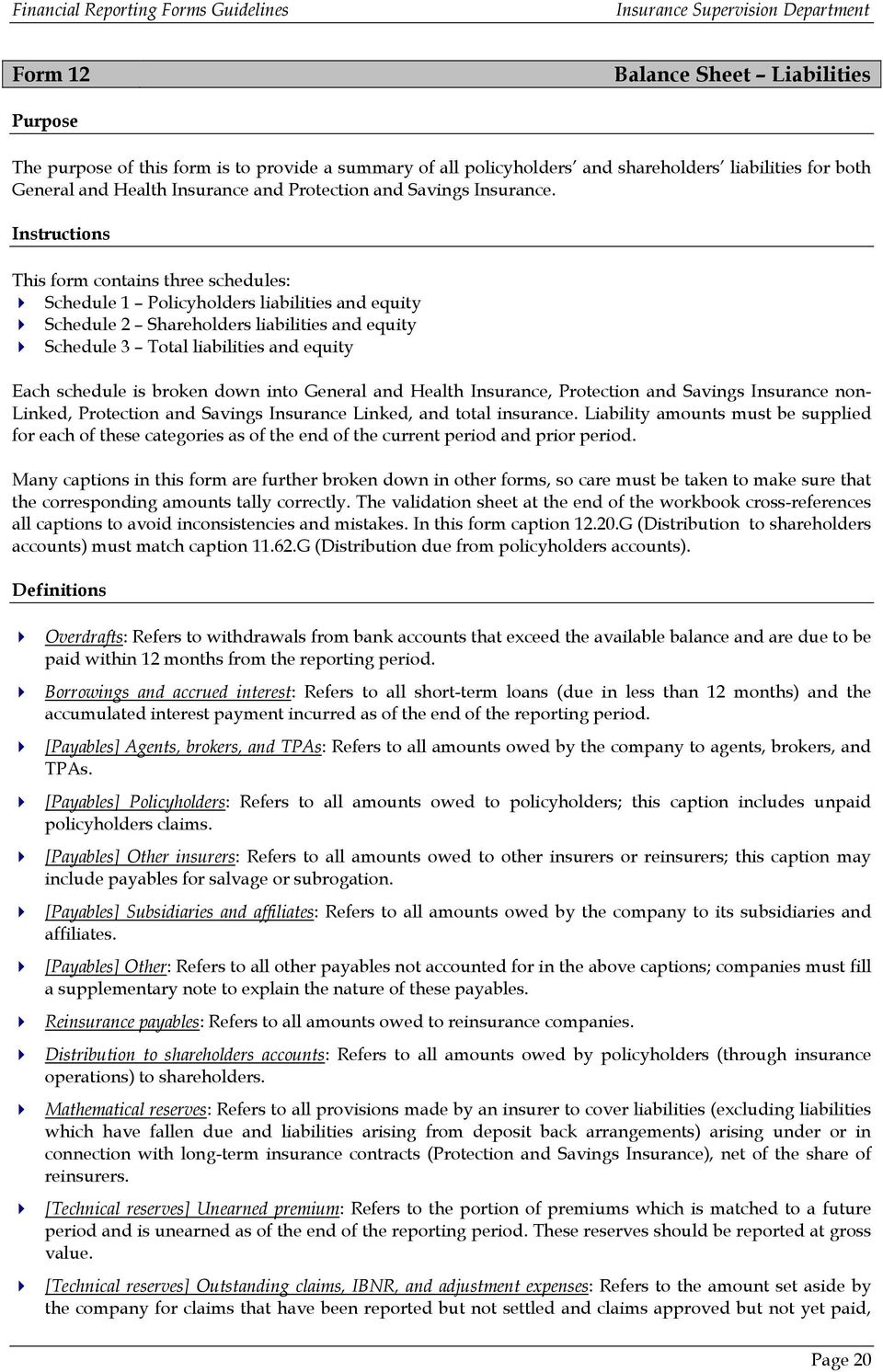
21 claims that have been incurred as of the reporting date but not reported, and any projected adjustment expenses associated with those claims, at gross value. Other reserves: Refers to any other provisions made by the company that have not been accounted for in the above categories, at gross value. [Zakat and taxes] Zakat: Refers all Zakat payments due by the company to the government with respect to Saudi and GCC shareholders income law. [Zakat and taxes] Taxes on foreign shareholders income: Refers to all tax payments due by the company to the government with respect to foreign shareholders income law. Employee terminal benefits: Refers to employees end of service benefits payable by the company at the end of the current period. Unearned reinsurance commissions: Refers to reinsurance commissions which have been received portfolio but have not yet been earned at the end of the period. Declared dividend payable: Refers to all declared dividend payments due to the company s shareholders at the end of the period. Expenses accrued and deferred income: Refers to all expenses which have been incurred but not paid, as well as income that has been received but not yet earned. Other liabilities: Refers to any other liability that has not been accounted for in the above categories; companies must fill a supplementary note to explain the nature of these liabilities. Share capital: Refers to the shareholders paid-in capital of the company. Statutory reserves: Refers to amounts set aside from the shareholders net income to meet the statutory reserve regulations under Article 70 of the Implementing Regulations. Accumulated surplus: Refers to accumulated retained earnings from insurance operations, which have not been distributed to shareholders. Retained earnings: Refers to the earnings that are not paid out as dividends but instead reinvested in the core insurance business or used to pay off debt. Other equity: Refers to all other forms of equity not covered in the above categories; companies must fill a supplementary note to explain the nature of this equity. Page 21
22 Form 21 Income Statement Policyholders (Operations) The purpose of this form is to provide a summary of all policyholders revenues and expenses for both General and Health Insurance and Protection and Savings Insurance. This form contains three schedules: Schedule 1 Underwriting activities Schedule 2 Investing and other activities Schedule 3 Distributions Each schedule is broken down into General and Health Insurance, Protection and Savings Insurance, and total insurance. All amounts must be supplied for each of these categories for both the current period and the prior period. Many captions in this form are further broken down in other forms, so care must be taken to make sure that the corresponding amounts tally correctly. The validation sheet at the end of the workbook cross-references all captions to avoid inconsistencies and mistakes. Direct insurance gross written premiums: Refers to all premiums from insurance accepted directly including premiums from brokers and agents. Reinsurance assumed gross written premiums: Refers to all premiums assumed or accepted from insurers (i.e., reinsured inwards). Gross written premiums: Refers to all premiums for insurance accepted directly and reinsurance assumed/ accepted (inward reinsurance). Reinsurance ceded: Refers to all premiums ceded to reinsurers (i.e., reinsured outwards). Net written premiums: Refers to the result of subtracting premiums ceded (reinsurance ceded) from gross written premiums. Change in unearned premiums: Refers to the difference between the balance of unearned premium (technical reserve) at the start and at the end of the period; unearned premium is the portion of the premium which is matched with a future period and has not yet been earned. Net earned premiums: Refers to the result of subtracting the change in unearned premiums from net written premiums. Reinsurance commissions earned: Refers to all commissions earned on the reinsured portfolio (i.e., reinsured outwards) to reinsurance companies. Other underwriting income: Refers to all underwriting income that has not been accounted for in the above categories; companies must fill a supplementary note to explain the nature of this income. Gross claims paid: Refers to all claims paid directly or through reinsurance agreements, including lawyer fees, adjustment fees, and all expenses to settle a claim, and in the case of protection and savings these claims include surrenders. Reinsurance share of claims: Refers to the portion of gross claims that are covered by reinsurers. Net claims paid: Refers to the result of subtracting reinsurance share of claims from gross claims paid. Change in outstanding claims reserve: Refers to the difference between the balance of claims outstanding reserve at the start and at the end of the reporting period. Outstanding claims reserve refers to provisions set aside for claims that have been reported but not settled, including any claims settlement expenses. Page 22
23 Change in claims IBNR reserve: Refers to the difference between the balance of claims IBNR reserve at the start and at the end of the reporting period; claims IBNR reserve refers to provisions set aside for claims that have been incurred but not yet reported. Change in mathematical reserve: Refers to the difference between the balance of mathematical reserve at the start and at the end of the reporting period; mathematical reserves refer to provisions set aside for protection and savings insurance. Net claims incurred: Refers to the result of adding changes in reserves to net claims paid. Commissions incurred: Refers to commissions incurred to agents, brokers or other insurers (in respect of reinsurance assumed). Policy acquisition costs excluding commissions incurred: Refers to all costs related to the acquisition of business, excluding commissions, such as marketing and advertising costs. Other direct underwriting expense: Refers to any other underwriting expense not accounted for in the above categories; companies must fill a supplementary note to explain the nature of these expenses. Doubtful debt expense: Refers to the amount of receivables that will not be collected. Operational and technical expenses: Refers to all insurance operational costs such as salaries, office supplies, training, electricity, water, etc., incurred for the purpose of insurance activities. Investment income: Refers to investment income from dividends and interest generated from policyholders investments; this caption should not include investment income or losses generated from sales of policyholders investments. Interest income: Refers to income on investment from loans and deposits. Dividend income: Refers to dividend earned on equity investments. Unrealized Gain/Loss on investment: Refers to the difference between the opening and the closing balance of unrealized gain (loss) on investment at the end of the current period including changes in the fair value of financial assets which are either: (i) designated on initial recognition as one to be measured at fair value with fair value changes in profit or loss, or (ii) held-for-trading assets, which are acquired or held for the purpose of selling in the short term. Realized Gain/Loss on investment: Refers to all policyholders investment income or losses made from disposal or sale of policyholders investments. Investment expenses: Refers to any expenses that are tied to policyholders investment activities, including the asset management fees, brokerage fees, transaction fees, consulting fees, and custodian fees. Other income: Refers to any income earned by the shareholders and not accounted for in the above categories; the insurer must fill a supplementary note to explain the nature of this income. Other expenses: Refers to any other shareholders expenses not accounted for in the above categories; companies must fill a supplementary note to explain the nature of these expenses. Policyholders (Operations) distribution declared: Refers to the portion of net surplus from insurance operations that is allocated to policyholders account for the relevant period. Shareholders share of net surplus: Refers to the portion of net surplus from insurance operations that is allocated to shareholders account. Page 23
24 Form 22 Income Statement Shareholders The purpose of this form is to provide a summary of all shareholders revenues and expenses. All amounts in this form must be supplied for the current period and the prior period. Some captions in this form are broken down in other forms, so care must be taken to make sure that the corresponding amounts tally correctly. The validation sheet at the end of the workbook cross-references all captions to avoid inconsistencies and mistakes. Shareholders share of net surplus (deficit): Refers to the portion of net surplus from insurance operations that are allocated to shareholders account. Investment income: Refers to investment income from dividends and interest generated from shareholders investments; this caption should not include investment income or losses generated from sales of shareholders investments. Interest income: For relevant definition, refer to Form 21 Dividend income: For relevant definition, refer to Form 21 Movement in unrealized gain/loss on investment: For relevant definition, refer to Form 21 Gain (loss) on investment: For relevant definition, refer to Form 21 Investment expenses: For relevant definition, refer to Form 21. Other income: Refers to any income earned by the shareholders and not accounted for in the above categories; the insurer must fill a supplementary note to explain the nature of this income. General and administrative expenses: Refers to any shareholders expenses (e.g., board meetings, events, supplies, services, public disclosures, and charitable donations). These expenses should not be intended to benefit policyholders or claimants. Directors remuneration: Refers to the compensation of board of directors members. Other expenses: Refers to any other shareholders expenses not accounted for in the above categories; companies must fill a supplementary note to explain the nature of these expenses. Zakat: Refers to all Zakat payments due by the company to the government with respect to Saudi and GCC shareholders income law. Taxes: Refers to all tax payments done by the company to the government with respect to foreign shareholder s income law. Transfer to statutory reserves: Refers to amounts set aside from the shareholders net income to meet the statutory reserve condition under Article 70 of the Implementing Regulations. Page 24
25 Form 31 Solvency Analysis Statement of Solvency The purpose of this form is to compare a company s actual solvency against its required solvency. This form contains four schedules: Schedule 1 Admissible assets Schedule 2 Liabilities Schedule 3 Net admissible assets Schedule 4 Required minimum margin Many cells in the above schedules are linked to output calculations in Forms 12, 32, 33, and 42. As such, companies must complete these forms prior to filling the blank cells in this form. All amounts must be supplied for both the current period and the prior period. The required minimum margin is obtained by selecting the maximum value between the minimum capital requirement, and the sum of the required margins imposed by the General and Health, as well as Protection and Savings Business lines. Admissible assets policyholders (General and Health Insurance): Refers to policyholders admissible assets for General and Health Insurance as calculated in Form 42, line 79, column H. Admissible assets policyholders (Protection and Savings Insurance): Refers to policyholders admissible assets for Protection and Savings Insurance as calculated in Form 42, line 79, column I. Admissible assets shareholders: Refers to shareholders admissible assets as calculated in Form 42, line 79, column J. Adjustments: Refers to manual adjustments in admissible assets resulting from asset limits exceeding: (a) asset concentration regulatory limits highlighted in Form 42 (as per Implementing Regulations Article 61.1 and Table 1), or (b) exceeding the maximum asset category limit of 20% as shown in column G of this form (as per Implementing Regulations Article 65.2 ) Any other adjustment entries in this caption require the prior written approval of SAMA. Other assets allowed to cover the required minimum margin: Refers to any other assets that have been approved by SAMA as being admissible for the calculation of the solvency margin. Policyholders liabilities (General and Health Insurance): Refers to policyholders liabilities for General and Health Insurance as calculated in Form 12, line 39, column A. Policyholders liabilities (Protection and Savings Insurance): Refers to policyholders liabilities for Protection and Savings Insurance as calculated in Form 12, line 39, column C. Shareholders liabilities: Refers to shareholders liabilities as calculated in Form 12, line 89, column G. Liabilities allowed to be left out in covering the minimum margin: Refers to any liabilities that have been approved by SAMA to be removed from the calculation of the solvency margin. Net assets policyholders (General and Health Insurance): Refers to policyholders admissible assets (General and Health Insurance) net of policyholders liabilities (General and Health Insurance). Net assets policyholders (Protection and Savings Insurance): Refers to policyholders admissible assets (protection and savings insurance) net of policyholders liabilities (protection and savings insurance). Net assets shareholders: Refers to shareholders admissible assets net of shareholders liabilities. Page 25
26 Adjustments, allowed additions and exclusions: Refers to the net adjustments for admissible assets (i.e., other assets allowed to cover the required minimum margin net of liabilities allowed to be left out in covering the minimum margin). Required margin (General and Health Insurance): Refers to the required General and Health Insurance solvency margin as computed in Form 32, line 59, column S. Required margin (Protection and Savings Insurance): Refers to the required long-term solvency margin as computed in Form 33, line 29, column I. Required capital requirement: As stipulated by the Insurance Law (Article 3.3): - SR 100 million for a company engaged in insurance business. SR 200 million for a company engaged in insurance and reinsurance business. Page 26
27 Form 32 Solvency Analysis Calculation of Required Solvency GHI The purpose of this form is to calculate the required solvency margin of a company s General and Health Insurance business operations. This form contains two schedules, each corresponding to one method of calculating the required solvency margin: The first method is based on a premium calculation. For each line of business, the gross written premium (column A) and the net written premium (column B) values must be supplied. The required solvency for the current period is automatically computed (column E) using the class factor risks in Table 3 of the Implementing Regulations. The required solvency for the prior period must be entered manually (column F). The second method is based on claim calculations (only for companies that have been operating for 3 years or more). For each line of business, the values of the past 3 years of gross claims incurred (columns M, N, O) and the net claims incurred (columns P, Q, R) must be entered manually. The required solvency for the current period is automatically computed (column K) using the class factor risks in Table 4 of the Implementing Regulations. The required solvency for the prior period must be entered manually (column L). The maximum of the 2 methods above is selected as the solvency requirement for the company s General and Health Insurance business operations (line 59). For this form to be of value on a quarterly basis, the reporting date has to be taken into consideration: (a) For the reporting to be valid (i.e., company has been reporting to SAMA for a year or longer), the current period would be the current quarter and the 3 quarters that precede the current quarter, whereas the prior period would be the prior quarter and the 3 quarters that precede the prior quarter. Gross claims incurred: Refers to all claims reported to the company during the current period, including claims applicable to insurance placed directly, reinsurance accepted (i.e., inward reinsurance), and reinsurance ceded (i.e., outward reinsurance). NOTE: For additional definitions, refer to Form 21. Page 27
28 Form 33 Solvency Analysis Calculation of Required Solvency PSI The purpose of this form is to calculate the required solvency margin of a company s Protection and Savings Insurance business operations. This form computes the required Protection and Savings Insurance solvency margin in three parts, as per Article 67 of the Implementing Regulations: Part 1: 4% of the mathematical reserves for protection and savings direct insurance (line 11, column A). Part 2: 3 (3 per thousand) of the capital at risk for individual policies, after the deduction of reinsurance cessions, provided that the reinsurance amount does not exceed 50% of the capital at risk. Part 3: 1 (1 per thousand) of the capital at risk for group policies, after the deduction of reinsurance cessions, provided that the reinsurance amount does not exceed 50% of the capital at risk. The required solvency margin for protection and savings insurance is the sum of parts 1, 2, and 3 above. The captions that must be entered manually are all prior period amounts (columns D, J), the gross capital at risk (column E) and the corresponding reinsurance cessions (column F). To ensure consistency across the forms, the mathematical reserves in caption A must equal to the sum of reported amounts in captions C and E. Mathematical reserves: For relevant definition, refer to Form 12 Gross capital at risk: Refers to the benefit amounts payable as a consequence of the happening of the contingency covered by the policy contract, less the mathematical reserves in respect of the relevant contract; i.e., it is the sum of the difference between the benefit under each policy and the mathematical reserve of each policy (note: the difference between the benefit and reserves for each policy should not be negative). Reinsurance share of gross capital at risk: Refers to the portion of the gross capital at risk that is expected to be covered by reinsurers. Net capital at risk: Refers to the difference between the gross capital at risk less reinsurance share of gross capital at risk provided that the reinsurance does not exceed 50% of the gross capital at risk (i.e., for the purposes of calculating the solvency margin, the minimum allowed net capital at risk is 50% of the gross capital at risk). Page 28
29 Form 41 Asset Analysis Policyholder Investments Breakdown The purpose of this form is to provide a breakdown of policyholders investments by location, type and currency, for both General and Health Insurance and Protection and Savings Insurance. This form contains six schedules: Schedule 1 Investments inside Kingdom of Saudi Arabia (KSA) Schedule 2 Investments outside KSA Schedule 3 Total investments inside and outside KSA Schedule 4 Linked investments inside KSA Schedule 5 Linked investments outside KSA Schedule 6 Total linked investments inside and outside KSA Investments inside KSA refer to the location where the underlying asset generates the majority of its cash flows. Vertically, this form distinguishes between investments inside and outside of KSA and divides investments by type according to the Implementing Regulations. Horizontally, the investments are divided between General and Health Insurance and Protection and Savings Insurance, and further subdivided by currency. Schedules 1, 2, and 3 for Protection and Savings Insurance correspond to the Non-Linked investments only, whereas schedules 4, 5, and 6 for Protection and Savings correspond to Linked investments. All amounts, including those of investments held in foreign currencies, must be entered in Saudi Riyals rounded to nearest thousand (SR 000). All investments that do not fit in the stated categories must be entered in lines 23, 43, 63, and 83. This form also contains regulatory compliance checks for certain investment amounts. These checks compare the values in the form with the values required by the Implementing Regulations (Article 61.1 and Table 1) and highlight any captions that are not in compliance. The relevant regulatory compliance criteria are: Investments outside KSA should not exceed 20% of total investments in accordance with Article 61.1 For General and Health Insurance, Saudi Riyal investment funds should constitute a maximum of 10% of total General and Health Insurance investments; similarly, foreign currency investment funds should constitute a maximum of 10% of General and Health Insurance investments For Protection and Savings Insurance, Saudi Riyal investment funds should constitute a maximum of 15% of total Protection and Savings Insurance investments; similarly, foreign currency investment funds should constitute a maximum of 10% of Protection and Savings Insurance investments Investments in Saudi Riyals should constitute at least 50% of total investments The Company shall take in consideration the investment concentration risks. Concentration in an investment instrument shall not exceed 50% in one investment instrument mentioned in table (1). To ensure consistency across the forms, captions D (total GHI Investments), the sum of captions H and H (total PSI Investments), and the sum of captions L and L (total investments) must match the captions A, sum of C and E, and G respectively. Deposits in Saudi authorized banks: Refers to deposits in banks that are licensed to operate in Saudi Arabia. Deposits in banks: Refers to deposits in banks operating outside Saudi Arabia. Saudi government bonds: Refers to bonds issued by the Saudi government. Page 29
30 Foreign government bonds (Zone A): Refers to bonds issued by non-saudi governments with a country rating of A. Bonds issued by domestic companies: Refers to bonds issued by Saudi-registered companies. These bonds include Sukook. Bonds issued by foreign companies: Refers to bonds issued by companies registered outside Saudi Arabia. Loans secured by real estate mortgages: Refers to loans where a real estate mortgage is used as collateral. Loans secured by policies issued by the insurer: Refers to loans where insurer policies are used as collateral. Investment funds: Refers to mutual investment vehicles/mutual funds and unit trusts. Equities: Refers to investment instruments that represent ownership in an entity. Real estate: Refers to investments in land and buildings. Other investments: Refers to all other investment instruments not captured in the above categories. Page 30
31 Form 42 Asset Analysis Calculation of Admissible Assets The purpose of this form is to calculate the total admissible assets of a company by using the admissibility factors detailed in Article 65 of the Implementing Regulations. This form provides a breakdown of all asset categories by type and across policyholders (both general and Protection and Savings Insurance) and shareholders. These assets are then multiplied by the relevant admissibility factors (column A) described in Table 2 of the Implementing Regulations if their percentage from the total assets exceeds these factors. The values obtained are the unadjusted admissible assets (columns H, I, J). The admissible assets should comply with regulatory criteria, including: (a) asset concentration in one asset category must have a 20% limit (Article 65.2) (b) the maximum asset category limits, which are highlighted in Form 42 must comply with Article 61.1 of the Implementing Regulations. (c) The asset valuation should not exceed the market value for the purpose of calculating the solvency margin (Article 65.1) (d) Assets linked to the Investment part of the Protection and Savings insurance should be excluded for the purposes of calculating the solvency margin (Article 65.1). The adjustments column (column K) provides a way for SAMA to modify the admissible assets to comply with regulatory criteria. Note that this column should be filled by SAMA only. To ensure consistency across the forms, values in Form 42 must match the corresponding values in Form 11. Cash in hand: Refers to cash held within the premises of the company and/ or including cash imprest. Cash in bank: Refers to cash in a current/ checking account held at a financial institution. [Deposits at financial institutions] Statutory deposit: Refers to the deposit held at SAMA and required by Implementing Regulations Article 58. [Reinsurance recoverables] Unearned premium: Refers to the reinsurance share of unearned premium. [Other reinsurance recoverables]: Refers to receivables expected from reinsurers to cover the reinsurance portion of claims reported but not settled, claims incurred but not reported, adjustment expenses, unexpired risk, catastrophe risk, general expenses, and other reserves. NOTE: For additional definitions, refer to Form 11. Page 31
32 Form 43 Asset Analysis Significant Investment Breakdown by Counterparty The purpose of this form is to list counterparties in which a significant portion of investments are held. The company should list all counterparties (defined as either a single entity or a group of related entities) in which it holds investments representing more than 5% of its total assets. Asset amounts must be identified as of the end of the current reporting period and the corresponding prior period. The company should disclose the full counterparty name (column A), a description of the counterparty (column B), a description of the investment (column C), investment amounts for the current reporting period (columns D and E), and the corresponding prior period (columns F and G). Description of counterparty: Refers to key information about the counterparty, including the type of business, place of registration, countries in which it is operational, and credit rating (if available). Description of investment: Refers to the type of investment(s) made in the counterparty (e.g., government bonds, term deposits, preferred equity shares). Page 32
33 Form 44 Asset Analysis Breakdown of Receivables The purpose of this form is to provide an age analysis of receivables segmented by types of counterparty. This form contains four schedules: Schedule 1 Policyholders Receivables for General and Health Insurance Schedule 2 Policyholders Receivables for Protection and Savings Insurance Schedule 3 Shareholders Receivables Schedule 4 Total Receivables This form covers all types of receivables, including reinsurance receivables (recoverables), for both policyholders and shareholders. Each of these receivables is classified as not yet due (column A) or overdue (columns B to E). Overdue receivables are further subdivided by age. To ensure consistency across the forms, captions F to F (Total Receivables) must match captions G to G. NOTE: For relevant definitions, refer to Form 11. Page 33
34 Form 45 Asset Analysis Breakdown of Receivables and Doubtful Debt Reserve The purpose of this form is to provide an analysis of the Doubtful Debt reserves in accordance with Article 69.2(d) of the Implementing Regulations. This form contains four schedules: Schedule 1 Policyholders Gross Receivables (Total Insurance) Schedule 2 Shareholders Gross Receivables Schedule 3 Doubtful Debt Reserves Schedule 4 Net Receivables This form covers all types of receivables, and the amount of doubtful debt reserves for these receivables according to the Implementing Regulations. The receivables reported in columns A to D should exclude disputed and uncollectible receivables which are reported in column E. Column F is the sum of the values from A to E and shows the ending balance. Beginning balance should be reported in column G and the movement during the period for the corresponding balances will be computed automatically by subtracting the values in column G from those in column F. Doubtful debt reserves are calculated as follows: (a) Ten percent (10%) of the total amounts due from reinsurers exceeding 180 days. (b) Fifteen percent (15%) of the total amounts due from the insured exceeding 90 days. (c) Twenty-five percent (25%) of the total amounts due from the insured exceeding 180 days. (d) Seventy-five percent (75%) of the total amounts of uncollected receivables exceeding 360 days. (e) One hundred percent (100%) of any disputed and uncollected receivables. To ensure consistency across the forms, captions F to F (Total Receivables) must match captions G to G and caption F (Doubtful debt expense) must match caption E. NOTE: For relevant definitions, refer to Form 11. Page 34
35 Form 51 Counterparty Analysis Receivables/ Payables for Major Agents, Brokers, Policyholders, Reinsurers, and TPAs The purpose of this form is to provide an analysis of receivables and payables pertaining to major agents, brokers, policyholders, and TPAs. This form contains five schedules: Schedule 1 Agent Schedule 2 Brokers Schedule 3 Policyholders Schedule 4 Reinsurers Schedule 5 - TPAs In each schedule, the company should disclose the name of the relevant entity whose receivables or payables represent either: (a) counterparties where accounts represent 10% or more of the total category (Agents, Brokers, Policyholders, Reinsurers, TPAs) receivables/ payables, or (b) counterparties whose annual premium represents 10% or more of the total category (Agents, Brokers, Policyholders, Reinsurers, TPAs) direct written premium. All remaining counterparties should be grouped and reported under one caption on line 20 for agents, line 40 for brokers, line 60 for policyholders, line 80 for Reinsurers, and line 100 for TPAs. General and Health Insurance: The sum of captions B (Agents Receivables), B (Brokers Receivables), and B (TPAs Receivables) must equal caption A (Agents, Brokers, and TPAs Receivables); caption B (Policyholders Receivables) must equal caption A (Policyholders Receivables); caption 51.89B (Reinsurers Receivables) must equal caption A (Reinsurers Receivables). Similarly, the sum of captions C (Agents Payables), C (Brokers Payables), and C (TPAs Receivables) must equal caption A (Agents, Brokers, and TPAs Payables); caption C (Policyholders Payables) must equal caption A (Policyholders Payables); caption C (Reinsurers Payables) must equal caption A (Reinsurers Payables). Protection and Savings Insurance: The sum of captions D (Agents Receivables), D (Brokers Receivables), and D (TPAs Receivables) must equal sum of captions C and E (Agents, Brokers, and TPAs Receivables); caption D (Policyholders receivables) must equal sum of captions C and E (Policyholders Receivables) ; caption 51.89D (Reinsurers Receivables) must equal caption C and E (Reinsurers Receivables). Similarly, the sum of captions E (Agents payables), E (Brokers Payables), and E (TPAs payable) must equal caption C (Agents, Brokers, and TPAs Payables); caption E (Policyholders Payables) must equal caption sum of captions C and E (Policyholders Payables) ; caption E (Reinsurers Payables) must equal caption C and E (Reinsurers Payables). NOTE: For relevant definitions, refer to Forms 11, 12 and 21. Page 35
36 Form 52 Counterparty Analysis Receivables/ Payables for Other Insurers The purpose of this form is to provide an analysis of receivables and payables pertaining to other insurers. The company should list the names of insurers with whom it has receivables or payables exceeding 5% of the corresponding totals. The list should include insurers with whom the company has reinsurance assumed (i.e., inward reinsurance). The company should disclose the name of insurers (column A) whose receivables or payables represent either: (a) counterparties where accounts represent 5% or more of the total receivables/ payables, or (b) counterparties whose annual premium value is 5% or more of the total direct written premium. All remaining insurers should be grouped and reported under one caption on line 30. The company should also disclose reinsurance assumed for the current period (column B) and prior period (column C), as well as receivables and payables for General and Health Insurance (columns D and E) and protection and savings insurance (columns F and G). Captions D (GHI Accounts Receivable) and F (PSI Accounts Receivable) must match captions A and sum of C and E respectively. Also, captions E (GHI Accounts Payable) and G (PSI Accounts Payable) must match captions A and the sum of captions C and E. NOTE: For relevant definitions, refer to Forms 11, 12 and 21. Page 36
37 Form 53 Counterparty Analysis Analysis of Major Reinsurers (Receivables/ Recoverables) The purpose of this form is to provide an analysis of receivables/ recoverables from all major reinsurers. This form contains two schedules: Schedule 1 Reinsurers for General and Health Insurance Schedule 2 Reinsurers for Protection and Savings Insurance The names of all reinsurers to whom reinsurance ceded exceeds 10% of total reinsurance premium ceded must be specified in column A. All remaining reinsurers should be grouped and reported under one caption on line 20 for General and Health Insurance and line 40 for Protection and Savings Insurance. For each reinsurer identified, the company should fill a supplementary note to explain the nature and types of risks that have been placed with the reinsurer. Caption C (Total Reinsurance Ceded) must match caption E (Income Statement Total Reinsurance Ceded). Also, caption H (Reinsurance Receivables/ Recoverables) must match the sum of captions G, G and G (Balance Sheet Reinsurance Recoverable). NOTE: For relevant definitions, refer to Forms 11, 12 and 21. Page 37
38 Form 54 Counterparty Analysis Analysis of Major Reinsurers (Payables) The purpose of this form is to provide an analysis of payables to all major reinsurers. This form contains two schedules: Schedule 1 Reinsurers for General and Health Insurance Schedule 2 Reinsurers for Protection and Savings Insurance The names of all reinsurers to whom reinsurance ceded exceeds 10% of total reinsurance premium ceded must be specified in column A. All remaining reinsurers should be grouped and reported under one caption on line 20 for General and Health Insurance and line 40 for Protection and Savings Insurance. For each reinsurer identified, the company should fill a supplementary note to explain the nature and types of risks that have been placed with the reinsurer. Caption C (Total Reinsurance Ceded) must match caption E (Income Statement Total Reinsurance Ceded). Also, caption H (Reinsurance Payables) must match caption G. NOTE: For relevant definitions, refer to Forms 11, 12 and 21. Page 38
39 Form 55 Counterparty Analysis Reinsurance Contributions and Recoveries by Line of Business The purpose of this form is to provide an analysis of reinsured premiums and recovered claims (received or accepted but not yet paid) by line of business. This form contains two schedules: Schedule 1 - General and Health Insurance Schedule 2 - Protection and Savings Insurance For each schedule, a breakdown of both reinsurance premiums and recovered claims must be provided for each line of business. To ensure consistency across the forms, captions D (GHI Reinsurance Premiums Ceded) and H (GHI Reinsurance Claims Recovered) must match captions A and A, respectively. Similarly, captions L (PSI Reinsurance Premiums Ceded) and P (PSI Reinsurance Claims Recovered) must match captions C and C, respectively. Facultative: Refers to premiums and claims where the ceding insurer has the right (faculty) to choose whether or not to offer an individual policy to a reinsurer for reinsurance and the reinsurer is free to choose whether or not to accept the risk (i.e., reinsurance occurs on a per-policy basis). Proportional: Refers to premiums and claims where the insurer and reinsurer share the risk in accordance with a formula that is defined prior to the contingency occurring. Proportional reinsurance includes quota share and surplus share: Quota share: Refers to reinsurance where each risk is split between the insurer and reinsurer in a fixed proportion (the quota) of the gross written premiums and pays the same proportion of the losses arising from the business protected. Quota share normally includes specified maximum risk which the reinsurers are prepared to accept so that the insurers needs to obtain additional protection where the sum assured exceeds the maximum specified in the contract. Surplus share: Refers to reinsurance where the risk in excess of a specified level, or surplus retention limit, of risks underwritten is taken up by the reinsurer (in full). Non-proportional: Refers to premiums and claims where reinsurance depends on the claim amounts on a block of polices rather than on a specific predetermined amount of claims on individual policies. The reinsurer is obligated only after the ceding insurer s loss payments exceed a predetermined amount, after which the reinsurer s share of subsequent losses is substantial or even total. The term nonproportional is used because the reinsurer s share of loss is not proportional. Non-proportional reinsurance includes excess-of-loss, catastrophe and stop-loss reinsurance: Excess-of-loss: This type of reinsurance covers claims arising from a single event, treating separately each policy affected (Total loss incurred in a single underwriting year). Catastrophe: This type of reinsurance that protects the ceding insurer against a loss or losses in excess of a specified retention, from accumulation of losses resulting from a single catastrophic event or a series of events, subject to the reinsurance contract limit. Stop-loss: This type of reinsurance provides coverage against an aggregate amount of claims over a defined period from a group of policies, in excess of a specified percentage of the earned premium income. Page 39
40 Form 56 Counterparty Analysis Business Volume for Major Agents, Brokers and TPAs The purpose of this form is to provide an analysis of premium and claim volume by major agent, broker, or TPA. This form contains 4 schedules: Schedule 1 Agents Schedule 2 Brokers Schedule 3 TPAs Schedule 4 Direct Sales In column A of this form for schedules 1 and 2, companies should disclose the names of: (a) counterparties for whom value of gross written premiums and claims represent 10% or more of the total gross written premiums and claims or (b) counterparties for whom the number of policies written represents 10% or more of the total number of policies written. For each schedule, companies should fill in the gross written premiums (column B), number of policies written (column C), gross claims paid (column D) and number of claims paid (column E). All quantities should be supplied for both General and Health Insurance and Protection and Savings Insurance. To ensure consistency across the forms, captions B (GHI Gross Written Premiums) and D (GHI Gross Claims Paid) must match captions A and A, respectively. Similarly, captions F (PSI Gross Written Premiums) and H (PSI Gross Claims Paid) must match captions C and C, respectively. Not Applicable Page 40
41 Form 57 Related Party Analysis The purpose of this form is to identify amounts of related party transactions. This form applies to related party transactions conducted during the period. In column A of this form, the full names of individual related party should be disclosed. In columns B and C, the opening balance and the closing balance of the related party should be disclosed respectively. In column D, the aggregate value of the transactions done with the related party during the end of the current period should be disclosed. Related party: Refers to a party related to the company if: (a) Directly, or indirectly through one or more intermediaries, the party: i. Controls, is controlled by, or is under common control with, the company (this includes parents, subsidiaries and fellow subsidiaries); ii. Has an interest in the company that makes it influential; or iii. Has joint control over the company. (b) The party is an associate (as defined in International Accounting Standard (IAS) 28 Investments in Associates) of the company; (c) The party is a joint venture in which the company is a venturer (see IAS 31 Interests in Joint Ventures); (d) The party is a member of the key management personnel of the company or its parent; (e) The party is a close member of the family of any individual referred to in (a) or (d); (f) The party is an entity that is controlled, jointly controlled or significantly influenced by, or for which significant voting power in such entity resides with, directly or indirectly, any individual referred to in (d) or (e); or (g) The party is a post-employment benefit plan for the benefit of employees of the company, or of any entity that is a related party of the company. Related party transactions: Refers to a transfer of resources, services, or obligations between related parties, regardless of whether a price is charged (e.g., a business transaction between a major shareholder and the insurer, such as a contract for the shareholder's company to perform renovations to the insurer's offices, would be deemed a related-party transaction). Page 41
42 Form 58 Captive Business Analysis The purpose of this form is to identify information about the captive business of the insurers or reinsurers This form applies to the captive business of insurers and reinsurers. Captive business is the day-to-day basic insurance business between the insurer and his shareholders. An example of such a business would be when a certain shareholder of the insurer pays a certain amount of gross written premium for a certain insurance policy. It is important that this kind of business relationship between the insurance company and its shareholders be the same as the one with the policyholders i.e., no discrimination should exist between shareholders and policyholders when it comes to selling policies, collecting premiums, and paying claims. In column A of this form, the full names of individual captives should be disclosed. In columns B and C, the captive gross written premium and the number of policies for each captive should be disclosed. In columns D through H the aging analysis of receivables is performed. In columns I through M, the aging analysis of payables is performed. Captive GWP: Refers to the gross written premium that is accepted by the company from the shareholders of the company. No. of policies: Refers to the number of policies sold to the shareholders of the company. Page 42
43 Form 61 Liability Analysis Breakdown of Payables The purpose of this form is to provide an age analysis of payables by counterparty. This form contains four schedules: Schedule 1 - Policyholders Payables for General and Health Insurance Schedule 2 - Policyholders Payables Protection and Savings Insurance Schedule 3 Shareholders Payables Schedule 4 Total Payables The form covers all types of payables for both policyholders and shareholders. Each of these payables is classified as not yet due (column A) or overdue (columns B to E). Overdue payables are further subdivided by age. To ensure consistency across the forms, captions F to F (Total Payables) must match captions G to G. Not Applicable Page 43
44 Form 62 Liability Analysis Breakdown of Reserves GHI/ PSI The purpose of this form is to break down a company s technical reserves by type for General and Health Insurance and Protection and Savings Insurance. This form contains six schedules: Schedule 1 - General and Health Insurance Technical Reserves (Gross) Schedule 2 - Protection and Savings Insurance Technical Reserves (Gross) Schedule 3 - General and Health Insurance Technical Reserves (Reinsurance Share) Schedule 4 - Protection and Savings Insurance Technical Reserves (Reinsurance Share) Schedule 5 - General and Health Insurance Technical Reserves (Net) Schedule 6 - Protection and Savings Insurance Technical Reserves (Net) The form breaks down the technical reserves by line of business into eight components: Unearned premium reserve Outstanding claims reserve Claims IBNR reserve Adjustment expense reserve Unexpired risk reserve Catastrophe risk reserve General expense reserve Other reserves Mathematical reserves (non-linked) Mathematical reserves (linked) The gross reserves are reported in schedules 1 and 2, the reinsurance share of reserves are reported in schedules 3 and 4, the net reserves are reported in schedules 5 and 6, all of the reserves are reported as aggregate reserves to date for all the in force business, as of the reporting period. To ensure consistency across the forms, for the gross values: caption A (GHI Unearned Premium Reserve) must match caption A. Also, the sum of captions B (GHI Outstanding Claims Reserve), C (GHI Claims IBNR Reserve), and D (GHI Adjustment Expense Reserve) must match caption A. Also, the sum of captions E (GHI Unexpired Risk Reserve), F (GHI Catastrophe Risk Reserve), G (GHI General Expense Reserve), and H (GHI Other Reserves) must match caption A. Finally, captions I (PSI mathematical reserves (linked)) and J (PSI mathematical reserves non-linked) must match captions C and E respectively. For the Reinsurance share of reserves: caption J (GHI Unearned Premium Reserve) must match caption A. Also, the sum of captions K (GHI Outstanding Claims Reserve), L (GHI Claims IBNR Reserve), M (GHI Adjustment Expense Reserve), N (GHI Unexpired Risk Reserve), O (GHI Catastrophe Risk Reserve), P (GHI General Expense Reserve), and Q (GHI Other Reserves) must match caption A. NOTE: For relevant definitions, refer to Form 11 and 12. Page 44
45 Form 63 Liability Analysis Breakdown of Borrowings by Lender The purpose of this form is to analyze the borrowings from major lenders. In this form, all major lenders whose borrowings payable at the end of the current reporting period exceed 10% of total borrowings payable at the current period should be listed in column A lines 11 to 19. For each major lender, the company should provide the balance at the start of the reporting period (column B), borrowings made during the reporting period (column C), accrued interest during the reporting period (column D), payments made during the reporting period (column E), the balance at the end of the reporting period (column F), the effective interest rate (column G) and a description of the nature of the borrowings (column H). All remaining lenders should be grouped and reported under one caption on line 20. To ensure consistency across the forms, caption B (Borrowings Payable at Start of Period) must match caption H. Also, caption F (Borrowings Payable at End of Period) must match caption G. Effective interest rate: Refers to the rate that exactly discounts estimated future cash payments or receipts through the expected life of the financial instrument or, when appropriate, a shorter period to the net carrying amount of the financial asset or financial liability. When calculating the effective interest rate, the company shall estimate cash flows considering all contractual terms of the financial instrument (for example, prepayment, call and similar options) but shall not consider future credit losses. The calculation includes all fees and points paid or received between parties to the contract that are an integral part of the effective interest rate (see IAS 18), transaction costs, and all other premiums or discounts. There is a presumption that the cash flows and the expected life of a group of similar financial instruments can be estimated reliably. However, in those rare cases when it is not possible to estimate reliably the cash flows or the expected life of a financial instrument (or group of financial instruments), the entity shall use the contractual cash flows over the full contractual term of the financial instrument (or group of financial instruments). Page 45
46 Form 64 Liability Analysis Mathematical Reserves PSI (Valuation Summary of Non-linked Policies) The purpose of this form is to disclose the key assumptions made in calculating the mathematical reserves and to set out a summary of the results of these calculations at key steps for all non-linked policies and riders. This form contains 10 schedules: Schedule 1 & 2 - Valuation Summary of Individual With-Profit Policies. Schedule 3 & 4 - Valuation Summary of Individual Without-Profit Policies. Schedule 5 - Valuation Summary of Non linked rider benefits attached to Individual Investment Linked Policies. Schedule 6 & 7 - Valuation Summary of Group With-Profit Policies. Schedule 8 & 9 - Valuation Summary of Group Without-Profit Policies. Schedule 10 - Valuation Summary of Non linked rider benefits attached to Group Investment Linked Policies. Schedules 1, 2, 6, and 7 relate to with-profit policies, under which the insurer may declare a reversionary bonus, a terminal bonus or a policyholders dividend based on the experience of the insurer for the policies in the same class of insurance. Schedule 3, 4, 8, and 9 relate to without-profit policies that are guaranteed during the policy s life and are not eligible to receive reversionary bonuses or other forms of participation features. Schedule 5 and 10 relate to Non linked rider benefits attached to Investment Linked policies. A separate line is to be completed for: (a) each separate product and rider for which policy information has been filed with SAMA. (b) each category within a product type where different valuation basis have been used. [Valuation basis] Discount rate: Refers to the rate of return that has been assumed for the future periods in order to discount the value of future benefits and premiums. [Valuation basis] Mortality and morbidity table: Refers to the title of the mortality and morbidity table that has been assumed in order to forecast the amount of future benefits. These tables should be annexed to this return form. Where the named table has been modified or an internal table has been used, a separate note should be appended to this form setting out the reasons for selecting a non-standard table and the justification for making any modification. No. of contracts: Refers to the count of the contracts included in the block for which results and statistics are reported on the line. No. of lives: Refers to the number of lives covered in the block for which results and statistics are reported on the line. Date of valuation: Refers to the number of lives covered in the block for which results and statistics is reported on the line (the date at which the mathematical reserves are calculated). Amount of sums assured or annuities per annum including vested reversionary bonus: Refers to the total death benefit payable, including any investment element covered under the basic policy. For deferred annuities under which the annuity has not yet commenced, this is the amount that would be paid if Page 46
47 death occurred as of the date of the valuation. For annuities in course of payment, this is the annual income payable to the annuitant in the year (if these amounts can vary from year to year, the reported amount would be the annual income paid in the year prior to the date of the valuation). [Amount of annual premiums] Office premiums: Refers to the total office premiums for all policies for which calculations are reported on this line, excluding the premium for any riders that might be attached to the policy. For single premium or limited premium, contracts the reported figure is nil except for the year in which premiums are paid. [Amount of annual premiums] Net premiums: Refers to the total net premiums for the basic policy calculated on the basis of the assumptions used for this block of business. For single premium or limited premium, contracts the reported figure is nil except for the year in which premiums are paid. Present value of sums assured or annuities per annum, including vested reversionary bonuses: Refers to the present value of future benefits under the basic portion of all the policies in this block, using the assumptions listed on the line. These include the value of any reversionary bonuses that have been declared prior to the date of the valuation. [Present value of annual premiums] Office premiums: Refers to the present value of future office premiums for all the policies in this block. [Present value of annual premiums] Net premiums: Refers to the present value of the total of net premiums for all the policies in this block calculated on the valuation basis. Amount of mathematical reserves: Refers to the difference between (i) the Present value of sums assured or annuities per annum including vested reversionary bonuses, and (ii) the Present value of Net premiums. [Alteration to Reserves for] Reinsurance accepted: Refers to the addition in reserves for the reinsurance business assumed for all of the policies in this block. [Alteration to Reserves for] Reinsurance ceded: Refers to the reduction in reserves for the reinsurance business ceded for all of the policies in this block. Amount of net mathematical reserves: Refers to the mathematical reserves after adjusting for the reinsurance assumed and ceded for all of the policies in this block. Other alterations to reserves: Refers to any additions/reductions to the net mathematical reserves for all of the policies in this block. The insurer must fill a supplementary note, setting out the reasons for the alterations to reserves and the basis assumed for determining the alteration amount. Other reserves: Refers to reserve amounts kept for factors other than the benefit reserves, including but not limited to expense overrun reserve, bonus stabilization reserve etc., for all of the policies in this block. The insurer must fill a supplementary note, explaining the reasons for the additional reserves and the basis assumed for determining the reserve amount. Total amount of mathematical reserves: This is the sum of (i) net mathematical reserves and (ii) other reserves adjusted for (iii) the alterations to reserves. Current cash surrender value: Refers to surrender value applicable as of the valuation date in case of the following: (a) Where the contract is a contract of life assurance or a contract for an annuity, the amount (including a nil amount) payable by the company or other body issuing the contract on surrender of the policy; (b) Where the contract is a pension contract, the amount payable on the transfer of the investor's accrued rights under that contract to another pension contract; (c) Where the contract is for any other matter, the amount payable by the company on the surrender of the policy. Page 47
48 Form 65 Liability Analysis Mathematical Reserves PSI (Valuation Summary of Investment Linked Policies) The purpose of this form is to disclose the key assumptions used in calculating the mathematical reserves and to set out a summary of the results of these calculations at key steps for all the investment linked policies. This form contains four schedules: Schedule 1 & 2 - Valuation Summary of Individual Investment Linked Policies Schedule 3 & 4 - Valuation Summary of Group Investment Linked Policies Investment Linked policies: these include policies under which the investment performance of the policy is directly linked to the performance of a linked fund in which all amounts available for investment under the policy are invested. A separate line is to be completed for: (a) each separate product and rider for which policy information has been filed with SAMA. (b) each category within a product type where different valuation basis have been used. [Amount of sums assured or annuities per annum] Guaranteed on death: Refers to the guaranteed death benefit payable, including any investment element covered under the basic policy. For deferred annuities under which the annuity has not yet commenced, this is the amount that would be paid if death occurred as of the date of the valuation. For annuities in course of payment, this is the annual income payable to the annuitant in the year (if these amounts can vary from year to year, the reported amount would be the annual income paid in the year prior to the date of the valuation. [Amount of sums assured or annuities per annum] Current on death: Refers to the death benefit that would be payable as of the valuation date if death of the insured was to occur at that date. [Amount of sums assured or annuities per annum] Guaranteed on maturity: Refers to the amount of the minimum benefit that is guaranteed would be paid at the date on which policy matures. [Amount of annual premiums] Office premiums: Refers to the total of the office premiums for all the policies for which the calculations are reported on this line, excluding the premium for any riders that might be attached to the policy. For single premium, or limited premium contracts the reported figure is nil except for the year in which premiums are paid. Investment Reserves for direct business: Refers to the linked portion of liability for the directly written business for all the policies in this block. [Non - Investment Reserves] Direct business: Refers to the non-linked portion of liability (covering guarantees and options such as minimum investment return guarantee, guaranteed minimum death benefit, etc.) for the directly written business for all the policies in this block using the assumptions listed on the line. [Non - Investment Reserves] Reinsurance accepted: Refers to the non-linked portion of liability for the reinsurance business accepted for all the policies in this block. [Non - Investment Reserves] Reinsurance ceded: Refers to the non-linked portion of liability for the reinsurance business ceded for all the policies in this block. Page 48
49 Amount of Net Non - Investment reserves: Refers to the non-investment reserves from direct business after adjusting for the reinsurance assumed and ceded for all of the policies in this block. Other reserves: Refers to reserve amounts kept for factors other than the benefit reserves, including but not limited to expense overrun reserve etc, for all of the policies in this block. The insurer must fill a supplementary note, explaining the reasons for the additional reserves and the basis assumed for determining the reserve amount. Total amount of mathematical reserves: Refers to the sum of (i) investment reserves, (ii) net non-investment reserves and (iii) other reserves. Current account balance: Refers to the investment value of the policies as of the valuation date for all of the policies in this block. For other definitions, refer to Form 64. Page 49
50 Form 66 Asset/ Liability Analysis PSI Summarized Balance Sheet for Internal Linked Funds The purpose of this form is analyze assets and liabilities related to internal linked funds. This form captures summary information about the fund(s) that the company has. For each fund listed in column A, the company must provide the value of assets held in the fund (column C), the number of units (column B), and the value of units in other funds that the fund may hold as investments (column D). Additionally, the company must provide relevant liability items such as provisions for tax on the above investments (column F) and loans (column G). The difference between the asset items (column E) and the liability items (column I) results in the net asset value corresponding to each fund (column J). Internal linked funds: Refers to unit-linked funds where the fund is managed by the insurance company and the funds are part of the assets of the company. Page 50
51 Form 67 Asset/ Liability Analysis PSI Analysis of Units in Internal Linked Funds Matching the Liabilities in respect of Linked Benefits The purpose of this form is to reconcile the value of units in the internal linked funds with the liabilities related to linked benefits. This form captures summary information about the fund(s) that the company has. Each column relates to each of the fund that the Company has, thus the number of columns should correspond to the number of internal funds that the Company is offering its customers. The form tracks the different sources of income and expenditure to determine the net change in the funds during the financial year. Income/ Expense items that cannot be allocated to the income/ expense heads in the form should be entered in Other Income/ Expenditure respectively. Name of internal linked fund: Refers to the name given to each of the internal linked funds. Valuation price per unit: Refers to the unit price at the valuation date for the fund reported on the line. Total actual number of units in force: Refers to the total number of units in force as at the valuation date for the fund reported on the line. Value of total actual units in force: Refers the value of units, arrived at by multiplying the unit price with the number of units in force at the valuation date for the fund reported on the line. Value of actual units held by other internal linked funds: Refers to the units held by other internal linked funds as at the valuation date for the fund reported on the line. This is to avoid double counting of the units in multiple funds. Value of actual units in force excluding those held by other internal linked funds: Refers to the in forced units corresponding purely to the liabilities linked to the fund reported on the line. [Value of units deemed allocated to contracts] Gross: Refers to the total unit reserve for the contracts linked to the fund reported on the line. [Value of units deemed allocated to contracts] Reinsurance ceded: Refers to the unit reserve on reinsurance ceded business for the contracts linked to the fund reported on the line. Value of surplus units: Refers to the excess of (i) value of actual units in force excluding those held by other internal linked funds over (ii) the value of units deemed allocated to contracts after adjusting for the reinsurance ceded. Page 51
52 Form 68 Asset/ Liability Analysis PSI Summarized Revenue Account for Internal Linked Funds The purpose of this form is to analyze the revenue and expenditure related to internal linked funds and the movement of the fund during the financial year. A separate line has to be completed for each of the internal linked fund. Value of total creation of units: Refers to the amount of new monies that flow in to create new units in the internal linked fund. Investment income attributable to the funds before deduction of tax: Refers to the investment income relating to the internal linked fund before deduction of any tax on investment income. Increase (decrease) in the value of investments in the financial year: Refers to gains or (losses) in the value of underlying investments of the linked fund. Other income: Refers to any income other the investment income and capital gains for investments relating to the internal linked fund. Value of total cancellation of units: Refers to the value of units that are cancelled from the internal linked fund. Charges for managements: Refers to the charges for management of investments relating to the internal linked fund. Charges in respect of tax on investment income: Refers to the tax levied on the investment income relating to the investments of the internal linked fund. Taxation on realized capital gains: Refers to tax levied on the increase in the value of investments relating to the internal linked fund. Increase (decrease) in amount set aside for tax on capital gains not yet realized: Refers to the change in the provision of the tax on unrealized capital gains. Internal linked fund brought forward: Refers to the value of internal linked fund at the beginning of the reporting period. Page 52
53 Form 71 Revenue Analysis Premiums Breakdown by Line of Business The purpose of this form is to analyze written and earned premiums by line of business. This form contains 2 schedules: Schedule 1 General and Health Insurance Schedule 2 Protection and Savings Insurance The premium amounts related to each line of business should be broken down by direct premiums (column A), premiums assumed from reinsurance (column B), reinsurance ceded in KSA (column D), and outside KSA (column E), as well as the amount of unearned premium at the beginning (column H) and end (column I) of the period. The calculation of the retention and reinsurance ceded in KSA is calculated and shown as an output in lines 101 and 102. The output is used to verify insurers compliance with Article 40 of the Implementing Regulations, which requires insurers to retain 30% of their premiums and reinsure 30% of their premiums in KSA. Insurers that do not meet the above ratios must provide an explanation by way of a supplementary note. To ensure consistency across the forms, caption C (Total Gross Written Premiums) must match caption E. In addition, caption G (Total Net Written Premiums) must match caption E and caption K (Total Net Earned Premiums) must match caption E. Single premium: Refers to protection and savings insurance premiums that are paid once (i.e., lump sum). Regular premium: Refers to protection and savings insurance premiums that must be paid every period. NOTE: For other definitions, refer to Form 21. Page 53
54 Form 72 Revenue Analysis Analysis of Changes in PSI The purpose of this form is to analyze, by line of Protection and Savings Insurance, any changes in contracts, number of insurers, and premiums. This form contains 3 schedules: Schedule 1 Individual Business Schedule 2 Group Business Schedule 3 Total Business For each line of Protection and Savings Insurance, the company should provide a breakdown of all new business sold or transferred in from one type of Protection and Savings Insurance to another. This breakdown should be specified in terms of number of contracts, number of insureds, annual premiums, single premiums, and sums assured. Similarly, all business terminated or transferred out shall be specified in the listed categories. The net change in Protection and Savings Insurance is automatically calculated from the above. The company shall additionally provide the amounts in force at the start of the period. The amounts in force at the end of the period are automatically calculated. Not Applicable Page 54
55 Form 73 Revenue Analysis Reinsurance Commissions Breakdown by Line of Business The purpose of this form is to analyze changes in the unearned commissions balance. This form contains 2 schedules: Schedule 1 General and Health Insurance Schedule 2 Protection and Savings Insurance For each line of business detailed in the leftmost column, the company shall provide the corresponding commission entries in columns A to D. To ensure consistency across the forms, caption D (GHI Commissions Earned) must match caption A. Also, caption D (PSI Commissions Earned) must match caption C. Unearned commissions: Refers to commissions which have been received but have not yet been earned at the end of the current period. Commissions received during current period: Refers to all commissions received during the current period. Commissions earned during current period: Refers to the portion of commissions that corresponds to insurance coverage for the current period. Page 55
56 Form 74 Revenue Analysis Investment Income Breakdown by Type The purpose of this form is to analyze investment income for each investment type. This form contains two schedules: Schedule 1 Policyholders Investment Income Schedule 2 Shareholders Investment Income Each schedule breaks down the relevant investments by type. For each of these investments, the company shall provide the book value (columns A, F), interest income (columns B, G), dividend income (columns C, H), unrealized (gains/losses) (columns D, I) and realized gains/losses on investment ( colums E,J) for both General and Health Insurance and Protection and Savings Insurance. To ensure consistency across the forms, caption K (Book Value of Total PH Investments) must match caption G; caption L (Total Interest Income on PH Investments) must match caption E, Caption M (Total Dividend Income on PH Investments) must match caption E, and caption N (Unrealized Gains/ Losses on PH Investments) and O (Realized Gains/Losses on PH investment) must match caption E.. Similarly, caption K (Book Value of Total SH Investments) must match caption G, caption L (Total Interest Income on SH Investments) must match caption A, caption M (Total Dividend Income on SH Investments) must match caption A, and caption N (Unrealized Gains/Losses on SH Investments) must match caption A and O (Realized Gains/Losses on SH investments) must match caption A. NOTE: For other definitions, refer to Form 21. Page 56
57 Form 75 Revenue/ Expense Analysis Number of Policies and Claims The purpose of this form is to analyze premiums and policies written in terms of new business and renewals, as well as the number of claims paid. This form contains two schedules: Schedule 1 General and Health Insurance Schedule 2 Protection and Savings Insurance For each line of business in both schedules, the company must provide the gross written premiums from new business (columns A and B) and renewals (columns C and D), as well as the number of policies written from new business (columns G and H) and renewals (columns I and J). The values must be provided for both the current period and the prior period. Additionally, companies shall provide the number of claims paid for the current period (column M) and prior period (column N) for each line of business. To ensure consistency across the forms, caption E (Total Gross Written Premiums, Current Period) must match caption E and caption F (Total Gross Written Premiums, Prior Period) must match caption F. New business: Refers to premiums or policies written for new clients acquired during the current period. Renewals: Refers to premiums or policies written for clients acquired in a prior period. Page 57
58 Form 76 Revenue/ Expense Analysis - Breakdown of Gross Premiums and Claims by Region and Line of Business The purpose of this form is to provide a breakdown of premium and claim volumes by geographic region and line of business. The region refers to the place where the policy was issued. This form contains seven schedules: Schedule 1 Western Region Schedule 2 Eastern Region Schedule 3 Central Region Schedule 4 Other Regions Inside KSA Schedule 5 GCC Regions Outside KSA Schedule 6 Rest of the World Schedule 7 Total Insurance For each schedule, companies should fill in the gross written premiums (columns A to D), number of policies written (columns F to I), gross claims paid (columns K to N) and number of claims paid (columns P to S). All quantities should be broken down to reflect the source of the policy in question, namely as coming from direct sales, agents, brokers, or TPAs. To ensure consistency across the forms, the sum of captions E, E, E, E, E, and E (Total Gross Written Premiums) must match caption E. Similarly, the sum of captions O, O, O, O, O, and O (Total Gross Claims Paid) must match caption E. Also, the sum of captions J, J, J, J, J, and J (Total Number of Policies Written) must match caption K. Similarly, the sum of captions T, T, T, T, T, and T (Total Number of Claims paid) must match caption M. Not Applicable Page 58
59 Form 81 Expense Analysis Claims Breakdown by Line of Business (Gross) GHI The purpose of this form is to analyze gross claims paid and incurred by line of business. This form contains two schedules: Schedule 1 General and Health Insurance Schedule 2 Protection and Savings Insurance The leftmost column of this form contains all the lines of business for General and Health Insurance and Protection and Savings Insurance. For each line of business, the relevant claims information must be entered in columns A to J. In order to obtain the gross claims paid for the current period, all claims paid directly (column A) and paid outwards to reinsurers (column B) must be filled out. Column C uses the above information to compute the gross claims paid for the current period. Subsequently, gross claims reported but not yet settled at the start and end of the current period must be entered in columns D and E. Similar information must be entered for gross claims incurred but not reported in columns G and H. This information is used to calculate the gross claims incurred (column J). To ensure consistency across the forms, captions C (GHI Gross Claims Paid), and J must match captions A and M respectively. [Claims Paid] Direct: Refers to claims paid (released) for insurance placed directly by receiving premiums from customers. [Claims Paid] Reinsurance assumed: Refers to claims paid (released) for business generated through inward reinsurance. [Claims Paid] Reinsurance ceded: Refers to the share of claims paid (released) by reinsurers of outward reinsurance business. Claims outstanding reserve: Refers to the amount set aside by the insurer for claims that have been reported but not settled, including any projected adjustment expenses associated with those claims. Claims IBNR reserve: Refers to the amount set aside by the insurer for claims that have been incurred but not yet reported, including any projected adjustment expenses associated with those claims. Gross claims incurred: Refers to all claims reported to the insurer during the current period, including changes in claims outstanding reserve and Claims IBNR reserve. Page 59
60 Form 82 Expense Analysis General and Health Insurance Claims Breakdown The purpose of this form is to analyze the net claims paid and incurred by line of business. The leftmost column of this form contains all the lines of business for General and Health Insurance. For each line of business, the relevant claims information must be entered in columns A to K. In order to obtain the net claims paid for the current period, all claims paid directly (column A), paid outwards to reinsurers (column B), and received from reinsurers (column C) must be filled out. Column D uses the above information to compute the net claims paid for the current period. Subsequently, net claims reported but not yet settled at the start and end of the current period must be entered in columns E and F. Similar information must be entered for net claims incurred but not reported in columns H and I. This information is used to calculate the net claims incurred (column K). To ensure consistency across the forms, captions D (GHI Net Claims Paid), G (GHI Change in Claims Outstanding Reserve), J (GHI Change in Claims IBNR Reserve), and K (GHI Net Claims Incurred) must match captions A, A, A and A, respectively. [Claims Paid] Direct: Refers to claims paid (released) for insurance placed directly by receiving premiums from customers. [Claims Paid] Reinsurance assumed: Refers to claims paid (released) for business generated through inward reinsurance. [Claims Paid] Reinsurance ceded: Refers to the share of claims paid (released) by reinsurers of outward reinsurance business. Claims outstanding reserve (net): Refers to the amount set aside by the insurer for claims that have been reported but not settled, including any projected adjustment expenses associated with those claims; Reserve amounts must be net of reinsurers share for this form. Claims IBNR reserve (net): Refers to the amount set aside by the insurer for claims that have been incurred but not yet reported, including any projected adjustment expenses associated with those claims; Reserve amounts must be net of reinsurers share. Net claims incurred: Refers to the result of adding changes in net outstanding claims reserves and net IBNR reserves to net claims paid. Page 60
61 Form 83 Expense Analysis Claims Breakdown by Line of Business PSI The purpose of this form is to analyze claims by type for Protection and Savings Insurance. This form is divided into three schedules, each corresponding to a type of Protection and Savings Insurance, and containing subcategories for claims by type. Each subcategory should be broken down by gross claims paid (column A) and Reinsurance Recoverables Received (column B). Net claims paid are calculated in column D. Claims outstanding reserves, IBNR reserves and Mathematical reserves should be broken down by beginning of period balance and end of period balance. The changes in claims outstanding reserves, IBNR reserves and mathematical reserves are calculated in columns F, I, L respectively. To ensure consistency across the forms, caption A (PSI Gross claims paid) must match C, caption B (PSI Reinsurance recoverables) must match caption C, caption 83.1, caption C (PSI net claims paid) must match caption C, caption F (PSI change in outstanding reserves) must match caption C, caption J (PSI change in IBNR reserves ) must match caption C, caption L (PSI change in mathematical reserves) must match caption C and caption M (PSI net claims incurred) must match caption C. NOTE: For relevant definitions, refer to Form 82. Page 61
62 Form 84 Expense Analysis General Expenses Breakdown The purpose of this form is to analyze a company s operational as well as general and administrative expenses. This form is composed of three schedules: Schedule 1 Policyholders Expenses Schedule 2 Shareholders Expenses Schedule 3 Total Expenses Each schedule lists expenses by type on the leftmost column. For policyholders expenses, relevant amounts shall be provided for both General and Health Insurance and Protection and Savings Insurance. Shareholders expenses are not segmented by line of business. Expenses must be reported for the current and prior periods. To ensure consistency across the forms, caption E (Total PH operational Expenses) must match caption E. Also, caption E (Total SH General and Administrative Expenses) must match caption A. Not Applicable Page 62
63 Form 85 Expense Analysis Breakdown of Commissions Paid by Line of Business The purpose of this form is to provide a breakdown of commissions paid by line of business. This form is composed of two schedules: Schedule 1 General and Health Insurance Schedule 2 Protection and Savings Insurance For each line of business detailed in the leftmost column, the company shall provide the corresponding commission entries in columns A to D. To ensure consistency across the forms, caption E (GHI Commissions Incurred during Current Period) must match caption A. Also, caption E (PSI Commissions Incurred during Current Period) must match caption C. Deferred commissions: Refers to commissions which have been paid but have not yet been incurred at the end of the period. Commissions paid during current period: Refers to all commissions paid out by the company during the current period. Commissions incurred during current period: Refers to the portion of commissions paid that corresponds to insurance coverage for the current period. Page 63
64 Form 91 Non-financial Information Significant Shareholders The purpose of this form is to provide information on major shareholders in the company. This form contains two schedules: Schedule 1 Where shareholding represents more than 5% but less than 20% of voting shares Schedule 2 Where shareholding represents more than 20% of voting shares For the purposes of completing this form, a shareholder refers to any individual entity or groups of related entities. For each schedule, the company should provide the full name of shareholders (column A), the percentage of voting rights (column B), a description of the shareholders (column C), the shareholders nationality (column D), and the ultimate controller (column E). If the shareholder is a financial company i.e., bank or insurance company, then the company should provide the regulation jurisdiction (column F), the name of regulator (column G), the stock exchange where it is listed (column H), and the website address (column I). Not Applicable Page 64
65 Form 92 Non-Financial Information Directors and Senior Management The purpose of this form is to provide information on directors and senior managers of the company. For each director/manager, provide the full name (column A), (column B) and telephone number (column C). A description of any special roles or other designations that the director or manager has in the company or outside the company shall be disclosed in column D. Not Applicable Page 65
66 Form 93 Non-Financial Information Breakdown of Employees by Gender, Nationality, and Level The purpose of this form is to provide information on the nationality and gender of a company s employees. This form is divided into two schedules, one for operations within Saudi Arabia, and one for operations outside of Saudi Arabia. For each of these schedules, the leftmost column classifies employees as nationals (i.e., citizenship holders) of Saudi Arabia, GCC, or other countries. For each of these divisions, employees are sub-divided into male or female. For each row, the number of managerial and non-managerial employees should be provided for both the current period and the prior period. Managerial positions include CEO, Vice Presidents/ Directors of business units, Managers and Assistant Managers. The percentage of Saudi employees for operations inside Saudi Arabia is automatically calculated in line 39. This percentage will be used to determine whether the company is in compliance with Article 79 of the Implementing Regulations, which requires that the percentage of Saudi Employees not be less than 30% at the end of the first year, and this percentage shall increase annually according to a Saudization plan submitted to SAMA. Not Applicable Page 66
67 Form 94 Non-Financial Information Company Information The purpose of this form is to provide some information about the company and, in case it is registered outside Saudi Arabia, its branches. This form contains two schedules: Schedule 1 Companies operating in Saudi Arabia Schedule 2 Companies operating in Saudi Arabia but registered outside Saudi Arabia Schedule 1 is for all the companies operating in Saudi Arabia whether registered in the country or outside, whereas schedule 2 is for branches of companies operating in Saudi Arabia but are registered outside the country. For schedule 1, the establishment date (column A), head office (column B), number of branches in Saudi Arabia and abroad (columns C and D), and the share of foreign partner (column E) must be provided. For schedule 2, the branches names (column F), their establishment date (column G), and their national wide head office (column H) must be provided. Not Applicable Page 67
68 Form 95 Non-Financial Information Surrender and Lapse Report The purpose of this form is to analyze the surrender and lapse experience of the business. This form contains two schedules: Schedule 1 General and Health Insurance Schedule 2 Protection and Savings Insurance For the General and Health Insurance, the company only needs to provide the lapse information as surrender is not an option in these lines of business. While for the Protection and Savings Insurance the details for both surrenders (where applicable) and lapses must be provided. The information details for lapses and surrenders include: Number of Policies Annual Premium Duration (in months) since inception of the policy before the policy lapsed Lapse: Refers to termination of a policy because of (i) failure to pay a renewal premium and (ii) only incase of Protection & Savings Insurance, due to lack of sufficient cash value to continue the policy. In the case of group polices (e.g., 1 policy covering 400 employees), if policy was cancelled for a fraction of the employees, then this fraction must be reported in column A (Number of Policies column) and the corresponding fraction of annual premium must be reported in column B (Annual Premium column). Surrender: Refers to cancellation of in forced policies that have a cash surrender value available at the time of cancellation. Page 68
69 Form 96 Non-Financial Information Complaints Breakdown The purpose of this form is to analyze the breakdown of complaints that the company handles, by category and by line of business, per period. For each type of complaint, provide the number of complaints the company has handled throughout the period by line of business (columns A to J). The percentage of each type of complaint from the total complaints is automatically calculated in column L. For the above complaints, indicate how many were closed by the end of the current period (column M), still open by the end of the current period (column N), and escalated by the end of the current period (column O). Not Applicable Page 69
70 Form 101 Supervision Fees Calculation of quarterly supervision Fees The purpose of this form is to present the calculation methodology of the Supervision fees on a quarterly basis for the first three quarters of the financial year. This form applies to all insurance and reinsurance companies operating inside the Kingdom. It includes the applicable fees rate of 5 per thousand (0.5%) to be paid to SAMA. In column A, the value of the gross written premium for the respective quarters is to be entered. When reporting subsequent quarters the values previously entered for any quarter should not be changed. In column B, the value of the reinsured premiums within the Kingdom is to be entered. Premium reinsured within KSA: Refers to the total value of premiums that was ceded to reinsurance companies operational within the Kingdom of Saudi Arabia. Base premiums for fees: Refers to the amount of the gross written premium that is accounted for when calculating the supervision fees. It is the total gross written premium for the period, with only the amount of premiums reinsured to reinsurance companies within the Kingdom deducted. Supervisory fees: Refers to the amount that is to be paid to SAMA as supervision fees for the quarter. It is equal to the base premiums for fees multiplied by the applicable fees rate (0.5 %). Page 70
71 Form 102 Supervision Fees Calculation of Year-End Fees and Deductions The purpose of this form is to provide the calculation methodology of the supervision fees for the last quarter of the financial year. This form contains 3 schedules: Schedule 1 Base Supervision Fees for the Financial Year Schedule 2 Credit for Canceled Business Schedule 3 Remaining/ (Excess) Fees to be paid by Year-End In schedule 1, the values of the total gross written premium for the entire year, and the total amount of premiums reinsured within the Kingdom, must be filled in their respective fields. In schedule 2, in line 21, the total amount of the gross written premiums that was canceled during the financial year must be disclosed. In line 22, the amount of the canceled gross written premiums that is reinsured within the Kingdom must be entered. Schedule 3 summarizes the form and gives the value of the supervision fees that is to be paid for the fourth quarter of the financial year. This value can be negative, meaning that if the cancelations during the year were higher than the amount of gross written premium in the fourth quarter, then an amount of the supervision fees can be claimed from SAMA. Gross written premium canceled during the financial year: Refers to the total value of the gross written premiums that was canceled during the entire financial year. Premium reinsured within KSA from the canceled business during the financial year: Refers to the total value of the reinsured gross written premiums that was canceled during the entire financial year. Page 71
72 Form 103 Validation The purpose of this sheet is to ensure consistency of input data across the forms through validation rules. The validation sheet lists crosschecks across the forms to ensure the consistency of input data. Starting with Form 32, a number of equalities was detailed to ensure that equivalent amounts are consistent with the balance sheet and income statement (Forms 11, 12, 21, and 22). The Formula column displays the validation rule with a form number, line number, and column number corresponding to the amounts on each side of the equation. The Discrepancy column shows any difference between the amounts (under normal circumstances, all discrepancies would be zero). The Pass/Fail column displays Fail (in bright red) when inconsistencies are encountered. Otherwise, it displays Pass. The last two columns provide a description of the amounts under question as well as reference number for the specific amounts. In the upper right-hand corner of the sheet, a counter keeps track of the fail rate in the validation rules. Companies should ensure that the fail rate is zero prior to submitting the forms. Not Applicable Page 72
73 IV. Intermediaries Semi-Annual Financial Reporting Forms Guidelines Form 111 Balance Sheet The purpose of this form is to provide a summarized balance sheet of intermediaries. This form contains two schedules: Schedule 1 Assets Schedule 2 Liabilities and Shareholders Equity Each schedule is broken down into General and Health Insurance, Protection Insurance, Protection and Savings Insurance, Other Protection and Savings Insurance and Total Insurance. All amounts must be supplied for each of these categories as of the end of the current period and prior period. Unrestricted cash and cash equivalents: All assets that meet the definition of cash and cash equivalents as set out in Form 11 (provided that it is not restricted cash) (see below). Restricted cash: Refers to cash in hand or in a bank account that is held by the intermediary but belongs to insurers or reinsurers. For Protection and Savings Insurance, money is transferred directly from the intermediary to the insurer or reinsurer, and so the corresponding restricted cash must always be zero. [Accounts receivable] Premiums receivable from policyholders: Refers to premium amounts due to the agent or broker from policyholders/ clients. This caption does not apply to Protection and Savings Insurance. [Accounts receivable] Fees receivable from policyholders: Refers to any fees due to the agent or broker from policyholders. [Accounts receivable] Commissions receivable from insurers and reinsurers: Refers to any commissions due to the agent or broker from insurance or reinsurance companies. [Accounts receivable] Other receivables: Refers to all other receivables that are not accounted for in the above categories; intermediaries must fill a supplementary note to explain these items. Deferred costs and prepaid expenses: Refers to costs that are paid but not yet incurred (i.e., costs that are to be amortized over time) or expenses paid in advance of receiving their benefits. Accrued income: Refers to any income that has been accrued over the current period. Investments: Refers to any invested assets, such as shares or real estate that are held by the agent or broker. Tangible assets: Refers to net value of the physical and material assets such as property, plant, and equipment; tangible assets include real estate used for operations. Intangible assets: Refers to non-physical assets such as goodwill, patents, trademarks, and copyrights. Other assets: Refers to any other assets that have not been accounted for in the above categories; intermediaries must fill a supplementary note to describe these assets. [Borrowings] Short term: Refers to all loans and the accumulated interest payment accrued as of the end of the reporting period with an original maturity of one year or less. [Borrowings] Long term: Refers to all loans and the accumulated interest payment accrued as of the end of the reporting period with an original maturity of more than one year. [Accounts payable] Premiums payable to insurers and reinsurers: Refers to all premium payments due to be transferred from agents and brokers to insurers and reinsurers. This caption does not apply to Protection and Savings Insurance. Page 73
74 [Accounts payable] Other payables: Refers to all other payables that are not accounted for in the above category; intermediaries must fill a supplementary note to explain these items. Deferred income and accrued expenses: Refers to all income received but not yet earned (with the exception of commissions or fees) or expenses accrued over the current period. Unearned fees: Refers to fees that have been received by the agent or broker but have not yet been earned as of the end of the current period. Zakat and taxation: Refers to all Zakat and tax payments due by the company to the government with respect to Saudi and foreign shareholders income law. Employee terminal benefits: Refers to employees end of service benefits payable by the company at the end of the current period. Other liabilities: Refers to any other liability that was not accounted for in the above categories; intermediaries must fill a supplementary note to describe these liabilities. Share capital: Refers to the shareholders paid-in capital. Statutory reserves: Refers to amounts set aside from the shareholders net income to meet the statutory reserve regulations under Article 58 of the Implementing Regulations. Retained earnings: Refers to all accumulated profits that are not paid out to shareholders but rather retained in the company. Other equity: Refers to all other forms of equity not covered in the above categories; intermediaries must fill a supplementary note to describe these equity items. Page 74
75 Form 112 Income Statement The purpose of this form is to provide a summarized income statement for intermediaries. This form contains two schedules: Schedule 1 Revenue Schedule 2 Expenses Each schedule is broken down into General and Health Insurance, Protection and Savings Insurance, and Total Insurance. All amounts must be supplied for each of these categories as of the end of the current period and prior period. As per Article 26 of the Implementing Regulations, commissions and fees of insurance and reinsurance business shall be separated. Commissions earned from insurance: Refers to all non-contingent commissions earned from the sale of insurance over the current period. Commissions earned from reinsurance: Refers to all non-contingent commissions earned from the sale of reinsurance over the current period. Fees earned from insurance: Refers to all fees earned in compensation for insurance services over the current period. Fees earned from reinsurance: Refers to all fees earned in compensation for reinsurance services over the current period. Investment income: Refers to investment income from dividends and interest generated from intermediaries investments; this caption should not include investment income or losses generated from sales of investments. Other income: Refers to any other income not accounted for in the above categories; intermediaries must fill a supplementary note to describe these income items. Salaries and benefits: Refers to expenses related to the compensation of employees, including and benefit or bonus payments. Training and education: Refers to all expenses for training and educational purposes, such as seminars, workshops, courses, or educational media. Marketing, advertising, and promotion: Refers to all expenses related to the marketing, advertising, and promotion of the agent or broker and product offerings. Depreciation and amortization: Refers to the depreciation of tangible assets and the amortization of intangible assets over the accounting period. Investment expense: Refers to expenses incurred over the current period related to the sale or disposal of investments, such as investment commissions or fees paid. Interest expense: Refers to interest expense incurred on borrowings or loans over the current period. Zakat: Refers all Zakat payments due by the company to the government with respect to Saudi and GCC shareholders income law. Income tax charge: Refers to all tax payments done by the company to the government with respect to foreign shareholder s income law. Page 75
76 Other expenses: Refers to any other expenses not accounted for in the above categories; intermediaries must fill a supplementary note to describe these expenses. Page 76
77 Form 113 Written Premiums from Major Insurers and Reinsurers The purpose of this form is to track the written premiums of major insurers and reinsurers. In column A of this form, intermediaries should disclose the names of insurers or reinsurers for which gross written premiums represent 5% or more total gross premiums written by the intermediary. These insurers or reinsurers are the ones that are paying the commissions to the intermediary. For each of these insurers or reinsurers, intermediaries must disclose the volume of gross written premiums sold for insurance inside KSA (columns B, C and D), insurance outside KSA (columns E, F, and G) reinsurance inside KSA (columns H, I and J) and reinsurance outside KSA (columns K, L and M). All quantities must be respectively broken down for General and Health Insurance, as well as Protection and Savings Insurance. Not Applicable Page 77
78 Form 114 Commissions Earned from Major Insurers and Reinsurers The purpose of this form is to track the commissions earned from major insurers and reinsurers. In column A of this form, intermediaries should disclose the names of insurers or reinsurers for which commissions earned represent 5% or more total commissions earned by the intermediary. These insurers or reinsurers are the ones that are paying the commissions to the intermediary. For each of these insurers or reinsurers, intermediaries must disclose the amount of commissions earned for insurance inside KSA (columns B, C and D), insurance outside KSA (columns E, F, and G) reinsurance inside KSA (columns H, I and J) and reinsurance outside KSA (columns K, L and M). All quantities must be respectively broken down for General and Health Insurance, as well as Protection and Savings Insurance. It is important to note that sum of captions D and G (commissions earned from insurance) must match caption E, and the sum of captions J and M (commissions earned from reinsurance) must match caption E. The individual commissions earned from General and Health Insurance and Protection and Savings Insurance must also tally with those in Form 112. Not Applicable Page 78
79 Form 115 Fees Earned in Respect of Business by Major Insurers and Reinsurers The purpose of this form is to track the fees earned in respect of business by major insurers and reinsurers. In column A of this form, intermediaries should disclose the names of insurers or reinsurers for which fees earned represent 5% or more total fees earned by the intermediary. Fees that cannot be associated with specific insurers or reinsurers must be provided in line 30. For each of these insurers or reinsurers, intermediaries must disclose the amount of fees earned for insurance inside KSA (columns B, C and D), insurance outside KSA (columns E, F, and G) reinsurance inside KSA (columns H, I and J) and reinsurance outside KSA (columns K, L and M). All quantities must be respectively broken down for general and health insurance, as well as protection and savings insurance. It is important to note that sum of captions D and G (fees earned from insurance) must match caption E and the sum of captions J and M (fees earned from reinsurance) must match caption E. The individual fees earned from General and Health Insurance and Protection and Savings Insurance must also tally with those in Form 112. Not Applicable Page 79
80 Form 116 Accounts Receivable from/ Payable to Major Insurers and Reinsurers The purpose of this form is to provide an age analysis of the accounts receivable including premiums, commissions, fees, and other receivables from major insurers and reinsurers and accounts payable to major insurers or reinsurers. Column A of this form displays the same list of insurers and reinsurers that appear in column A of Form 113. This allows a comparison of accounts payable and receivable for major insurers and reinsurers to their business volume in terms of both written premiums and commissions earned. For each of these insurers or reinsurers, intermediaries must provide an age analysis of accounts receivable, specifying payments not yet due (column B) and payments overdue (columns C to F). Similarly, intermediaries must provide an age analysis of accounts payable, specifying payments not yet due (column H) and payments overdue (columns I to L). Not Applicable Page 80
81 Form 117 Accounts Receivable from/ Payable to Major Policyholders The purpose of this form is to provide an age analysis of the accounts receivable from and payable to major policyholders/ clients. In column A of this form, intermediaries should disclose the names of: (a) policyholders/ clients for whose portion of accounts receivable represent 5% or more total accounts receivable, or (b) policyholders/ clients for whose portion of accounts payable represent 5% or more total accounts payable. For each of these policyholders/ clients, intermediaries must provide an age analysis of accounts receivable, specifying payments not yet due (column B) and payments overdue (columns C to F). Similarly, intermediaries must provide an age analysis of accounts payable, specifying payments not yet due (column H) and payments overdue (columns I to L). Not Applicable Page 81
82 Form 118 Broker Information The purpose of this form is to identify whether individual brokers within a brokerage firm are selling insurance or reinsurance business. This form only applies to brokerage firms. In column A of this form, the full names of individual brokers operating within the firm should be disclosed. For each individual broker, an X must be marked in column B or C to identify whether the broker is selling insurance business or reinsurance business. As per Article 26 of the Implementing Regulations, brokers must not combine insurance and reinsurance business activities to avoid conflict of interest that is harmful to the policyholder. Not Applicable Page 82
83 Form 119 Related Party Information The purpose of this form is to identify information about related party (Agents, Brokers, Reinsurance) transactions. This form applies to related party transactions conducted during the period. In column A of this form, the full names of individual related party should be disclosed. In columns B and C, the opening balance and the closing balance of the related party should be disclosed respectively. In column D, the aggregate value of the transactions done with the related party during the end of the current period should be disclosed. Related party: Refers to a party related to the company if: (a) Directly, or indirectly through one or more intermediaries, the party: i. Controls, is controlled by, or is under common control with, the company (this includes parents, subsidiaries and fellow subsidiaries); ii. Has an interest in the company that makes it influential; or iii. Has joint control over the company. (b) The party is an associate (as defined in International Accounting Standard (IAS) 28 Investments in Associates) of the company; (c) The party is a joint venture in which the company is a venturer (see IAS 31 Interests in Joint Ventures); (d) The party is a member of the key management personnel of the company or its parent; (e) The party is a close member of the family of any individual referred to in (a) or (d); (f) The party is an entity that is controlled, jointly controlled or significantly influenced by, or for which significant voting power in such entity resides with, directly or indirectly, any individual referred to in (d) or (e); or (g) The party is a post-employment benefit plan for the benefit of employees of the company, or of any entity that is a related party of the company. Related party transactions: Refers to a transfer of resources, services, or obligations between related parties, regardless of whether a price is charged. Page 83
84 Form 120 Supervision Fees - Calculation Semi-Annual Supervision Fees The of this form is to present the calculation methodology of the supervision fees to be paid by intermediaries on semi-annual basis for the financial year. This form applies to all brokers operating inside the Kingdom. It includes the applicable fees rate of 1 percent (1%) to be paid to SAMA. In column A, the value of the total commissions earned for the semester is to be entered. When reporting for current semester the values previously entered for the previous semester should not be changed. The value of supervision fees to be paid for each semester is automatically calculated in column B. Total Earned Commissions: Refers to all non-contingent commissions earned from the sale of insurance/ reinsurance over the current period. Page 84
The General Department of Insurance Control
 Saudi Arabian Monetary Agency The General Department of Insurance Control The Saudi Insurance Market Report 2014 Table of Contents Introduction 4 Insurance Market Performance - Overall Gross Written Premiums
Anadolu Hayat Emeklilik Anonim Şirketi Consolidated Balance Sheet As At 31 December 2015 (Currency: Turkish Lira (TRY))
 Consolidated Balance Sheet As At ASSETS I- Current Assets A- Cash and Cash Equivalents 14 302,999,458 216,428,429 1- Cash 14 3,385 27,952 2- Cheques Received 3- Banks 14 145,598,543 87,301,020 4- Cheques
MITSUI SUMITOMO INSURANCE COMPANY, LIMITED AND SUBSIDIARIES. CONSOLIDATED BALANCE SHEETS March 31, 2005 and 2006
 CONSOLIDATED BALANCE SHEETS March 31, 2005 and 2006 2005 2006 ASSETS Investments - other than investments in affiliates: Securities available for sale: Fixed maturities, at fair value 3,043,851 3,193,503
The Prudential Assurance Company Limited
 The Prudential Assurance Company Limited Annual PRA Insurance Returns for the year ended 31 December 2015 IPRU(INS) Appendices 9.1, 9.2, 9.3, 9.4, 9.4A, 9.5, 9.6 Balance Sheet and Profit and Loss Account
ANADOLU ANONİM TÜRK SİGORTA ŞİRKETİ DETAILED BALANCE SHEET. ASSETS Unaudited Current Audited Previous Dipnot I- Current Assets
 ASSETS Unaudited Current Audited Previous Dipnot I- Current Assets A- Cash and Cash Equivalents 14 2.364.314.943 2.304.904.212 1- Cash 14 38.784 18.864 2- Cheques Received 3- Banks 14 1.961.058.269 1.937.834.876
ANADOLU ANONİM TÜRK SİGORTA ŞİRKETİ DETAILED BALANCE SHEET ASSETS
 ASSETS ANADOLU ANONİM TÜRK SİGORTA ŞİRKETİ I- Current Assets Audited Current Audited Previous Period Period Notes 31/12/2015 31/12/2014 A- Cash and Cash Equivalents 14 2.304.904.212 1.606.048.714 1- Cash
AvivaSA Emeklilik ve Hayat Anonim Şirketi
 BALANCE SHEET AS OF 30 SEPTEMBER 2015 ASSETS Audited I- CURRENT ASSETS Note 31 December 2014 A- Cash and Cash Equivalents 14 431.210.641 394.414.565 1- Cash 14 603 142 2- Cheques Received - - 3- Banks
 2014 Head office: Ballam Road, Lytham St.Annes, FY8 4JZ Annual PRA Insurance Returns for the year ended 31 December 2014 IPRU(INS) Appendices 9.1, 9.2, 9.3, 9.4, 9.4A, 9.5, 9.6 Balance Sheet and Profit
Audited Prior Period 31 December 2014
 As at ASSETS I- Current Assets A- Cash and Cash Equivalents 202.531.176 216.428.429 1- Cash 5.603 27.952 2- Cheques Received 3- Banks 49.703.075 87.301.020 4- Cheques Given and Payment Orders (31.536)
ANADOLU ANONİM TÜRK SİGORTA ŞİRKETİ DETAILED BALANCE SHEET
 ASSETS I- Current Assets Audited Current Period Audited Previous Period A- Cash and Cash Equivalents 14 1.606.048.714 1.153.712.216 1- Cash 14 37.347 49.256 2- Cheques Received 3- Banks 14 1.356.733.446
AvivaSA Emeklilik ve Hayat Anonim Şirketi BALANCE SHEET AS OF 31 MARCH 2015 (Amounts expressed in Turkish Lira ( TL) unless otherwise stated).
 BALANCE SHEET AS OF 31 MARCH 2015 ASSETS Audited I- CURRENT ASSETS Note 31 Mart 2015 31 Aralık 2014 A- Cash and Cash Equivalents 2.12, 14 410.052.299 394.414.565 1- Cash 14 799 142 2- Cheques Received
AvivaSA Emeklilik ve Hayat Anonim Şirketi
 BALANCE SHEET AS OF 31 DECEMBER 2015 ASSETS I- CURRENT ASSETS Notes 31 December 2015 31 December 2014 A- Cash and Cash Equivalents 14 447.814.449 394.414.565 1- Cash 14-142 2- Cheques Received 3- Banks
Draft for consultation as part of CP18/16, available at: www.bankofengland.co.uk/pra/pages/publications/cp/2016/cp1816.aspx
 Draft for consultation as part of CP18/16, available at: www.bankofengland.co.uk/pra/pages/publications/cp/2016/cp1816.aspx Form 1 Statement of solvency general insurance business Global business/uk branch
UNITED COOPERATIVE ASSURANCE COMPANY (A SAUDI JOINT STOCK COMPANY)
 FINANCIAL STATEMENTS AND INDEPENDENT AUDITORS REPORT FOR THE YEAR ENDED 31 DECEMBER 2013 FINANCIAL STATEMENTS AND INDEPENDENT AUDITORS REPORT FOR THE YEAR ENDED 31 DECEMBER 2013 INDEX PAGE Independent
INSTRUCTIONS FOR COMPLETING INSURANCE COMPANY FINANCIAL STATEMENTS
 INSTRUCTIONS FOR COMPLETING INSURANCE COMPANY "DRAFT VERSION FOR FIRST REVIEW ONLY" Submitted to: Minstry of Finance and Economy Head of Insurance Department Republic of Armenia Submitted by: BearingPoint
Current Period Current Period I- Current Assets
 BALANCE SHEET (Independent ) ASSETS I- Current Assets A- Cash and Cash Equivalents 21,681,608 22,641,606 1- Cash 1,043 2,356 2- Cheques Received - - 3- Banks 18,087,148 20,777,618 4- Cheques Given and
Dumfries Mutual Insurance Company Financial Statements For the year ended December 31, 2010
 Dumfries Mutual Insurance Company Financial Statements For the year ended December 31, 2010 Contents Independent Auditors' Report 2 Financial Statements Balance Sheet 3 Statement of Operations and Unappropriated
AEGON EMEKLİLİK VE HAYAT A.Ş. DETAILED BALANCE SHEET (Independent Unaudited) ASSETS. Current Period Current Period I- Current Assets
 (Independent ) ASSETS I- Current Assets A- Cash and Cash Equivalents 65,840,622 33,270,237 1- Cash 5,473 3,936 2- Cheques Received 3- Banks 37,175,261 6,888,908 4- Cheques Given and Payment Orders (-)
AEGON EMEKLİLİK VE HAYAT A.Ş. DETAILED BALANCE SHEET (Independent Audited) ASSETS. Audited Current Period Current Period I- Current Assets
 (Independent ) ASSETS I- Current Assets A- Cash and Cash Equivalents 33.270.237 28.327.786 1- Cash 3.936 3.924 2- Cheques Received 3- Banks 6.888.908 8.595.579 4- Cheques Given and Payment Orders (-) 5-Bank
Friends Life Limited
 Annual PRA Insurance Returns for the year ended 31 December 2014 IPRU(INS) Appendices 9.1, 9.3, 9.4, 9.4A, 9.6 Balance Sheet and Profit and Loss Account Contents Form 2 Statement of solvency - long-term
Standard Life Assurance Limited
 Standard Life Assurance Limited Annual PRA Insurance Returns for the financial year ended 31 December 2015 Prepared in accordance with the Accounts and Statements Rules (Appendices 9.1, 9.3, 9.4, 9.4A
SAMA GENERAL DEPARTMENT OF FINANCE COMPANIES CONTROL. Prudential Returns Handbook (Finance Companies)
 SAMA GENERAL DEPARTMENT OF FINANCE COMPANIES CONTROL Prudential Returns Handbook (Finance Companies) 1. Introduction Submission schedule All licensed finance companies in Saudi Arabia are required to submit
AEGON EMEKLİLİK VE HAYAT A.Ş. DETAILED BALANCE SHEET (Independent Audited) ASSETS. Audited Current Period Current Period I- Current Assets
 (Independent ) ASSETS I- Current Assets A- Cash and Cash Equivalents 28.327.786 38.018.697 1- Cash 3.924 3.419 2- Cheques Received 3- Banks 8.595.579 25.886.925 4- Cheques Given and Payment Orders (-)
Commercial Union Life Assurance Company Limited
 Commercial Union Life Assurance Limited Registered office: St Helen s, 1 Undershaft, London, EC3P 3DQ Annual FSA Insurance Returns for the year ended 31st December 2002 Accounts and statements pursuant
ANNUAL RETURN: FORM 1 - FUND BALANCE SHEET
 ANNUAL RETURN: FORM - FUND BALANCE SHEET R98G General: Singapore Insurance Fund Annex Row No. ASSETS Equity securities A Debt securities B Land and buildings C Loans D Cash and deposits 5,96,57 Other invested
$ 2,035,512 98,790 6,974,247 2,304,324 848,884 173,207 321,487 239,138 (117,125) 658,103
 FINANCIAL SECTION CONSOLIDATED BALANCE SHEETS Aioi Insurance Company, Limited (Formerly The Dai-Tokyo Fire and Marine Insurance Company, Limited) and March 31, and ASSETS Cash and cash equivalents... Money
Aviva Insurance UK Limited
 Annual FSA Insurance Returns for the ended st December (Appendices 9.1, 9.2, 9.5, 9.6) Produced using BestESP Services - UK AVIVA INSURANCE UK LIMITED Year ended st December Contents The companies included
Standard Life Assurance Limited
 Standard Life Assurance Limited Annual PRA Insurance Returns for the financial year ended 31 December 2014 Prepared in accordance with the Accounts and Statements Rules (Appendices 9.1, 9.3, 9.4, 9.4A
Partnership Life Assurance Company Limited
 Partnership Life Assurance Company Limited Annual PRA Insurance Returns for the year ended 31 December 2013 IPRU(INS) Appendices 9.1, 9.3, 9.4, 9.6 Contents Balance Sheet and Profit and Loss Account Form
ANNUAL RETURN: FORM 1 - FUND BALANCE SHEET ZURICH INSURANCE COMPANY LTD (SINGAPORE BRANCH) 34,844,737 Land and buildings
 ANNUAL RETURN: FORM - FUND BALANCE SHEET I86G General: Singapore Insurance Fund Annex Row No. ASSETS Equity securities A Debt securities B,8,77 Land and buildings C Loans D Cash and deposits 5,6,76 Other
Legal & General Insurance Limited
 Annual PRA Insurance Returns for the ended 31 December 2014 IPRU(INS) Appendices 9.1, 9.2, 9.5, 9.6 Balance Sheet and Profit and Loss Account Contents Form 1 Statement of solvency - general insurance
NAMA CHEMICALS COMPANY AND SUBSIDIARIES (SAUDI JOINT STOCK COMPANY)
 CONSOLIDATED INTERIM FINANCIAL STATEMENTS AND AUDITORS REPORT (LIMITED REVIEW) CONSOLIDATED INTERIM FINANCIAL STATEMENTS AND AUDITORS REPORT INDEX PAGE Auditors report (limited review) 1 Consolidated interim
Aviva Insurance Limited
 Annual FSA Insurance Returns for the ended st December (Appendices 9.1, 9.2, 9.5, 9.6) Produced using BestESP Services - UK Year ended st December Contents Page Appendix 9.1 Form 1 Statement of solvency
Consolidated Balance Sheets
 Consolidated Balance Sheets March 31 2015 2014 2015 Assets: Current assets Cash and cash equivalents 726,888 604,571 $ 6,057,400 Marketable securities 19,033 16,635 158,608 Notes and accounts receivable:
GLOSSARY. A contract that provides for periodic payments to an annuitant for a specified period of time, often until the annuitant s death.
 The glossary contains explanations of certain terms and definitions used in this prospectus in connection with us and our business. The terms and their meanings may not correspond to standard industry
Royal Scottish Assurance Plc
 Registered office: 24/25 St Andrews Square, Edinburgh, EH2 1AF 31st December 2004 Annual FSA Insurance Returns for the year ended 31 December 2010 Returns under the Accounts and Statements Rules Index
ST ANDREW'S LIFE ASSURANCE PLC
 Annual FSA Insurance Returns for the year ended 31 December 2008 Appendices 9.1, 9.3, 9.4, 9.6 Contents Appendix 9.1 Form 2 Statement of solvency - long-term insurance business 1 Form 3 Components of
THE EQUITABLE LIFE ASSURANCE SOCIETY
 THE EQUITABLE LIFE ASSURANCE SOCIETY Annual PRA Insurance Returns for the year ended 31 December 2013 Appendices 9.1, 9.3, 9.4, 9.4A & 9.6 from the Interim Prudential Sourcebook for Insurers Registered
INDUSTRIAL-ALLIANCE LIFE INSURANCE COMPANY. FIRST QUARTER 2000 Consolidated Financial Statements (Non audited)
 INDUSTRIAL-ALLIANCE LIFE INSURANCE COMPANY FIRST QUARTER 2000 Consolidated Financial Statements (Non audited) March 31,2000 TABLE OF CONTENTS CONSOLIDATED INCOME 2 CONSOLIDATED CONTINUITY OF EQUITY 3 CONSOLIDATED
Capital Stock. (units) 9/30/2015 512.362.664 509.842.829 1.022.205.493 6.522.831 13.045.663 19.568.494
 (Convenience translation into English from the original previously issued in Portuguese) ITR QUARTERLY INFORMATION 9/30/2015 SUL AMÉRICA S/A Capital Stock Shares Number (units) Capital Stock Common Preferred
Financial Statements
 Financial Statements Years ended March 31,2002 and 2003 Contents Consolidated Financial Statements...1 Report of Independent Auditors on Consolidated Financial Statements...2 Consolidated Balance Sheets...3
FUNDY MUTUAL INSURANCE COMPANY CONSOLIDATED FINANCIAL STATEMENTS
 CONSOLIDATED FINANCIAL STATEMENTS INDEX Page INDEPENDENT AUDITORS' REPORT 1-2 CONSOLIDATED FINANCIAL STATEMENTS Statement 1 - Consolidated Balance Sheet 3 Statement 2 - Consolidated General Reserve and
Legal & General Insurance Limited
 Annual PRA Insurance Returns for the year ended 31 December 2013 IPRU(INS) Appendices 9.1, 9.2, 9.5, 9.6 Returns under the Accounts and Statements Rules Contents of the Return Financial period ended 31
QATAR GENERAL INSURANCE & REINSURANCE CO. (S.A.Q.) DOHA - QATAR
 QATAR GENERAL INSURANCE & REINSURANCE CO. (S.A.Q.) DOHA - QATAR FINANCIAL STATEMENTS AND AUDITORS' REPORT FOR THE YEAR ENDED DECEMBER 31, 2006 QATAR GENERAL INSURANCE & REINSURANCE CO. (S.A.Q.) DOHA -
GLOSSARY. A contract that provides for periodic payments to an annuitant for a specified period of time, often until the annuitant s death.
 The glossary contains explanations of certain terms and definitions used in this prospectus in connection with the Group and its business. The terms and their meanings may not correspond to standard industry
5. Provisions for decrease in value of marketable securities (-)
 Balance sheet ASSETS I. CURRENT ASSETS A. Liquid Assets: 1. Cash. 2. Cheques received. 3. Banks. 4. Cheques given and payment orders (-). 5. Other liquid assets. B. Marketable Securities: 1. Share certificates.
Life Business Guidance Notes
 REVENUE ACCOUNT Income 1. Policyholders fund brought forward refers to policyholders fund and investment linked fund brought forward from the preceding financial/calendar year. It should correspond with
American International Group, Inc. Financial Supplement Fourth Quarter 2005
 Financial Supplement Fourth Quarter 2005 This report should be read in conjunction with AIG's Annual Report on Form 10-K for the year ended December 31, 2005 filed with the Securities and Exchange Commission.
Supplement No. 2 published with Extraordinary Gazette No. 129 dated 20 th December, 2012. THE INSURANCE LAW, 2010 (LAW 32 OF 2010)
 CAYMAN ISLANDS Supplement No. 2 published with Extraordinary Gazette No. 129 dated 20 th December, 2012. THE INSURANCE LAW, 2010 (LAW 32 OF 2010) THE INSURANCE (CAPITAL AND SOLVENCY) (CLASS A INSURERS)
Large Company Limited. Report and Accounts. 31 December 2009
 Registered number 123456 Large Company Limited Report and Accounts 31 December 2009 Report and accounts Contents Page Company information 1 Directors' report 2 Statement of directors' responsibilities
Jackson National Life Global Funding U.S. $9,000,000,000
 BASE PROSPECTUS SUPPLEMENT Jackson National Life Global Funding U.S. $9,000,000,000 GLOBAL DEBT ISSUANCE PROGRAM This supplement (this Base Prospectus Supplement ) is supplemental to and must be read in
QATAR GENERAL INSURANCE & REINSURANCE CO. (S.A.Q.) DOHA - QATAR
 QATAR GENERAL INSURANCE & REINSURANCE CO. (S.A.Q.) DOHA - QATAR FINANCIAL STATEMENTS AND INDEPENDENT AUDITOR S REPORT FOR THE YEAR ENDED DECEMBER 31, 2007 QATAR GENERAL INSURANCE & REINSURANCE CO. (S.A.Q.)
Philippines - General Insurance (continued)
 Philippines International Comparison of Insurance * May 2009 Philippines General Insurance Definition Definition of property and casualty insurance company Non-life insurance company is one which solicits
Financial Services (Insurance Companies) INSURANCE COMPANIES (ACCOUNTS AND STATEMENTS) REGULATIONS 1998
 Financial Services (Insurance Companies) Regulations made under section 118 of the Insurance Companies Act 1987. 1987-10 INSURANCE COMPANIES (ACCOUNTS AND STATEMENTS) (LN. ) 31.12.1998 Amending enactments
How To Calculate A Balance Sheet Of An Al Rajhi Bank And Investment Company
 AL RAJHI BANKING AND INVESTMENT CORPORATION (Saudi Joint Stock Company) INTERIM CONDENSED CONSOLIDATED FINANCIAL STATEMENTS FOR THE NINE MONTHS PERIOD ENDED SEPTEMBER 30, 2008 (UNAUDITED) P.O. Box 8282
ANNUAL RETURN: FORM 1 - FUND BALANCE SHEET
 ANNUAL RETURN: FORM - FUND BALANCE SHEET 6 Life: SIF - Non-Participating Annex Row No. ASSETS Equity securities A Debt securities B Land and buildings C Loans D Cash and deposits 5 976,9 Other invested
We believe that the audit evidence we have obtained is sufficient and appropriate to provide a basis for our audit opinion.
 Financial Statements MNP INDEPENDENT AUDITOR'S REPORT To the Policyholders of Grenville Mutual Insurance Company We have audited the accompanying financial statements of Grenville Mutual Insurance Company,
MOHAMMAD AL MOJIL GROUP COMPANY (A SAUDI JOINT STOCK COMPANY) FINANCIAL STATEMENTS AND AUDITORS REVIEW REPORT FOR THE YEAR ENDED DECEMBER 31, 2010
 FINANCIAL STATEMENTS AND AUDITORS REVIEW REPORT FOR THE YEAR ENDED DECEMBER 31, FINANCIAL STATEMENTS AND AUDITORS REVIEW REPORT FOR THE YEAR ENDED DECEMBER 31, INDEX PAGE Auditors report 1 Balance sheet
B Exercises 4-1. (d) Intangible assets. (i) Paid-in capital in excess of par.
 B Exercises E4-1B (Balance Sheet Classifications) Presented below are a number of balance sheet accounts of Castillo Inc. (a) Trading Securities. (h) Warehouse in Process of Construction. (b) Work in Process.
ST ANDREW'S LIFE ASSURANCE PLC
 Annual PRA Insurance Returns for the year ended 31 December 2014 IPRU(INS) Appendices 9.1, 9.3, 9.4, 9.6 Balance Sheet and Profit and Loss Account Contents Form 2 Statement of solvency - long-term insurance
3. CONSOLIDATED QUARTERLY FINANCIAL STATEMENTS
 3. CONSOLIDATED QUARTERLY FINANCIAL STATEMENTS (1) Consolidated Quarterly Balance Sheets September 30, 2014 and March 31, 2014 Supplementary Information 2Q FY March 2015 March 31, 2014 September 30, 2014
KYODO PRINTING CO., LTD. and Consolidated Subsidiaries
 KYODO PRINTING CO., LTD. and Consolidated Subsidiaries Interim Consolidated Financial Statements (Unaudited) for the, Interim Consolidated Balance Sheets, as compared with March 31, (Unaudited) ASSETS,
U.S. Property and Casualty Insurance Company Income Tax Return. For calendar year 2014, or tax year beginning, 2014, and ending, 20.
 Form 1120-PC Department of the Treasury Internal Revenue Service A Check if: 1 Consolidated return (attach Form 851). 2 Life-nonlife consolidated return.. 3 Schedule M-3 (Form 1120-PC) attached... U.S.
INSURANCE COMPANIES ORDINANCE (CAP. 41)... (Name of company making this application)
 Form IA-6G INSURANCE COMPANIES ORDINANCE (CAP. 41)... (Name of company making this application) Application for Authorization to carry on General Business in or from Hong Kong 1. We certify that we are
Small Company Limited. Report and Accounts. 31 December 2007
 Registered number 123456 Small Company Limited Report and Accounts 31 December 2007 Report and accounts Contents Page Company information 1 Directors' report 2 Accountants' report 3 Profit and loss account
ST ANDREW'S LIFE ASSURANCE PLC
 Annual PRA Insurance Returns for the year ended 31 December 2013 IPRU(INS) Appendices 9.1, 9.3, 9.4, 9.6 Contents Balance Sheet and Profit and Loss Account Form 2 Statement of solvency - long-term insurance
STATE OF FLORIDA DEPARTMENT OF BUSINESS AND PROFESSIONAL REGULATION. BALANCE SHEET As of
 STATE OF FLORIDA DEPARTMENT OF BUSINESS AND PROFESSIONAL REGULATION BALANCE SHEET As of ASSETS CURRENT ASSETS Cash and Cash Equivalents Cash - Restricted Accounts Receivable - Trade Accounts Receivable
THE EMPIRE LIFE INSURANCE COMPANY
 THE EMPIRE LIFE INSURANCE COMPANY Condensed Interim Consolidated Financial Statements For the nine months ended September 30, 2013 Unaudited Issue Date: November 6, 2013 These condensed interim consolidated
ARABIAN SCANDINAVIAN INSURANCE COMPANY P.L.C.
 ARABIAN SCANDINAVIAN INSURANCE COMPANY P.L.C. Financial statements and independent auditor s report for the year ended 31 December 2012 ARABIAN SCANDINAVIAN INSURANCE COMPANY P.L.C. Contents Pages Independent
NAIC Group Code 0008 NAIC Company Code 00086. Combined Statement Contact LYNN CIRRINCIONE, 847-402-3029 (Area Code) (Telephone Number)
 PROPERTY AND CASUALTY COMPANIES - ASSOCIATION EDITION COMBINED ANNUAL STATEMENT FOR THE YEAR ENDED DECEMBER, 00 OF THE CONDITION AND AFFAIRS OF THE ALLSTATE INSURANCE GROUP its affiliated property casualty
HARMONIC DRIVE SYSTEMS INC. AND CONSOLIDATED SUBSIDIARIES CONSOLIDATED FINANCIAL STATEMENTS MARCH 31, 2013
 HARMONIC DRIVE SYSTEMS INC. AND CONSOLIDATED SUBSIDIARIES CONSOLIDATED FINANCIAL STATEMENTS MARCH 31, 2013 HARMONIC DRIVE SYSTEMS INC. AND CONSOLIDATED SUBSIDIARIES CONSOLIDATED BALANCE SHEETS ASSETS
SUMITOMO DENSETSU CO., LTD. AND SUBSIDIARIES. Consolidated Financial Statements
 SUMITOMO DENSETSU CO., LTD. AND SUBSIDIARIES Consolidated Financial Statements Report of Independent Public Accountants To the Board of Directors of Sumitomo Densetsu Co., Ltd. : We have audited the consolidated
Hamilton Life Assurance Company Limited
 Hamilton Life Assurance Company Limited Registered office: 2 Rougier Street, York, YO90 1UU Annual FSA Insurance 31st December Returns 2004 for the ended 31 December 2009 FN 02 001 Returns under the Accounts
OECD INSURANCE STATISTICS
 ORGANISATION FOR ECONOMIC CO-OPERATION AND DEVELOPMENT ORGANISATION DE COOPÉRATION ET DE DÉVELOPPEMENT ÉCONOMIQUES DIRECTION DES AFFAIRES FINANCIÈRES ET DES ENTREPRISES DIRECTORATE FOR FINANCIAL AND ENTERPRISE
Central Bank Survey. General Provisions
 Summary Methodology Central Bank Survey, Credit Institutions Survey, Banking System Survey, Other Financial Institutions Survey, Financial Sector Survey Central Bank Survey, Credit Institutions Survey,
KOREAN AIR LINES CO., LTD. AND SUBSIDIARIES. Consolidated Financial Statements
 Consolidated Financial Statements December 31, 2015 (With Independent Auditors Report Thereon) Contents Page Independent Auditors Report 1 Consolidated Statements of Financial Position 3 Consolidated Statements
FINANCIAL DISCLOSURES FOR THE QUARTER ENDED JUNE 30, 2013
 REGISTRATION NO 104: DATE OF REGISTRATION WITH IRDA : NOVEMBER 15, 2000 FINANCIAL DISCLOSURES FOR THE QUARTER ENDED JUNE 30, 2013 Form No Description Pages L-01 REVENUE ACCOUNT 2-5 L-02 PROFIT & LOSS ACCOUNT
Halwell Mutual Insurance Company Financial Statements For the year ended December 31, 2014
 Financial Statements For the year ended Contents Independent Auditor's Report 2 Financial Statements Statement of Financial Position 3 Statement of Comprehensive Income 4 Statement of Members Surplus 5
!! "#$% &'&& "(%)*"+!,! - $./ -0/ 1#$02$.3#4*5 6.#.5"070(.5$.% 6 $7#.91#$02 99:&: ""$7*0$**,99:&: -..#$"+??@/ - 0.%4$.#. $.%#$;0 /
 #$% &'&& (%)*+, - $./ -0/ #$0$.#4*5 6.#.5070(.5$.% 6 $.%5070( 8 $7#.9#$0 99:&: $7*0$**,99:&:.#..% 507 8&: -..#$+/ - 0.%4$.#. $.%#$;0 / #0$0$0*.#.0< 507 = > -..#$+/ = 8&& ' - 0.%4$.#. $.%#$;0 / -# /-($+/
The accompanying notes constitute an integral part of the Financial Statements.
 Consolidated Statement of Financial Position Assets Note As at December 31 1022 1020 Intangible assets 4 797,997 785,585 Deferred tax assets 78 9,357 5,565 Deferred acquisition costs 5 8,535,538 949,585
Cathay Life Insurance Co., Ltd. Financial Statements As of December 31, 2006 and 2007 With Independent Auditors Report
 Financial Statements With Independent Auditors Report The reader is advised that these financial statements have been prepared originally in Chinese. These financial statements do not include additional
Minnesota Workers' Compensation Assigned Risk Plan. Financial Statements Together with Independent Auditors' Report
 Minnesota Workers' Compensation Assigned Risk Plan Financial Statements Together with Independent Auditors' Report December 31, 2012 CONTENTS Page INDEPENDENT AUDITORS' REPORT 1 FINANCIAL STATEMENTS: Balance
THE EQUITABLE LIFE ASSURANCE SOCIETY
 Annual FSA Insurance Returns for the year ended 31 December 2004 Appendices 9.1, 9.3, 9.4 & 9.6 from the Interim Prudential Sourcebook for Insurers Registered Office 20-22 Bedford Row, London, WC1R 4JS
Consolidated financial statements 2014. Zurich Insurance Group Annual Report 2014
 Consolidated financial statements 2014 Annual Report 2014 2 Annual results 2014 Consolidated financial statements Contents Consolidated income statements 3 Consolidated statements of comprehensive income
Consolidated Financial Statements
 Consolidated Financial Statements For the year ended February 20, 2016 Nitori Holdings Co., Ltd. Consolidated Balance Sheet Nitori Holdings Co., Ltd. and consolidated subsidiaries As at February 20, 2016
(amounts in USD/GBP/CYP/MKD/CSD)
 @CONSOLIDATED COMPANY @ CODE COMPANY NAME 1045 ALPHA ASSET FINANCE C.I. LTD @TABLE : - ASSETS @FOR THE CONSOLIDATED FINANCIAL STATEMENTS OF ALPHA BANK GROUP 31.12.2005 @ACCOUNT CODE ACCOUNT DESCRIPTION
VALIDUS ANNOUNCES 2015 FULL YEAR NET INCOME OF $374.9 MILLION 2015 NET OPERATING RETURN ON AVERAGE EQUITY OF 11.3%
 VALIDUS ANNOUNCES 2015 FULL YEAR NET INCOME OF $374.9 MILLION 2015 NET OPERATING RETURN ON AVERAGE EQUITY OF 11.3% BOOK VALUE PER DILUTED COMMON SHARE OF $42.33 AT DECEMBER 31, 2015 Pembroke, Bermuda,
AMENDMENT OF SUMMARY OF FINANCIAL STATEMENTS FOR THE YEAR ENDED MARCH 31, 2003 (Consolidated)
 To whom it may concern: May 1, 2003 Name of the Company: Mitsui Sumitomo Insurance Company, Limited (the Company ) Name of Representative: Hiroyuki Uemura, President and Director (Securities Code No.8752,
The Standard Life Assurance Company 2006
 The Standard Life Assurance Company 2006 Annual PRA Insurance Returns for the financial year ended 31 December 2014 Prepared in accordance with the Accounts and Statements Rules (Appendices 9.1, 9.3, 9.4
The Sumitomo Warehouse Co., Ltd.
 Consolidated Financial Results for the Year Ended March 31, 2014[ Japan GAAP ] May 13, 2014 The Sumitomo Warehouse Co., Ltd. Securities code: 9303 Stock exchange listings: URL: Representative: Inquiries:
ZAMIL INDUSTRIAL INVESTMENT COMPANY (SAUDI JOINT STOCK COMPANY)
 ZAMIL INDUSTRIAL INVESTMENT COMPANY INTERIM CONSOLIDATED FINANCIAL STATEMENTS AND AUDITORS REPORT (LIMITED REVIEW) FOR THE THREE MONTHS AND NINE MONTHS PERIODS ENDED SEPTEMBER 30, NOTES TO THE INTERIM
Charities Accounting Standard Accounting Template Explanatory Notes
 Charities Accounting Standard Accounting Template Explanatory Notes Introduction Purpose of Accounting Template The Accounting Template is designed to help smaller charities prepare and present financial
CALIFORNIA EARTHQUAKE AUTHORITY. Financial Statements. December 31, 2001 and 2000. (With Independent Auditors Report Thereon)
 Financial Statements (With Independent Auditors Report Thereon) Three Embarcadero Center San Francisco, CA 94111 Independent Auditors Report The Board of Directors California Earthquake Authority: We have
1 CONSOLIDATED FINANCIAL STATEMENTS (1) Consolidated Balance Sheets
 1 CONSOLIDATED FINANCIAL STATEMENTS (1) Consolidated Balance Sheets As of March 31,2014 As of March 31,2015 Assets Cash and due from banks 478,425 339,266 Call loans and bills bought 23,088 58,740 Monetary
GE Financial Assurance Holdings, Inc. (Exact name of registrant as specified in its charter)
 UNITED STATES SECURITIES AND EXCHANGE COMMISSION WASHINGTON, D.C. 20549 FORM 10-Q QUARTERLY REPORT PURSUANT TO SECTION 13 OR 15(d) OF THE SECURITIES EXCHANGE ACT OF 1934 For the quarterly period ended
CHART OF ACCOUNTS for GENERAL INSURANCE COMPANIES ASSETS
 CHART OF ACCOUNTS for GENERAL INSURANCE COMPANIES ASSETS 1. CASH ON HAND This represents the total amount of undeposited collections and the different types of working funds in the custody of the cashier
Consolidated Balance Sheets March 31, 2001 and 2000
 Financial Statements SEIKAGAKU CORPORATION AND CONSOLIDATED SUBSIDIARIES Consolidated Balance Sheets March 31, 2001 and 2000 Assets Current assets: Cash and cash equivalents... Short-term investments (Note