
Colorado Cancer Coalition Priorities:
|
|
|
- Claude Page
- 9 years ago
- Views:
Transcription
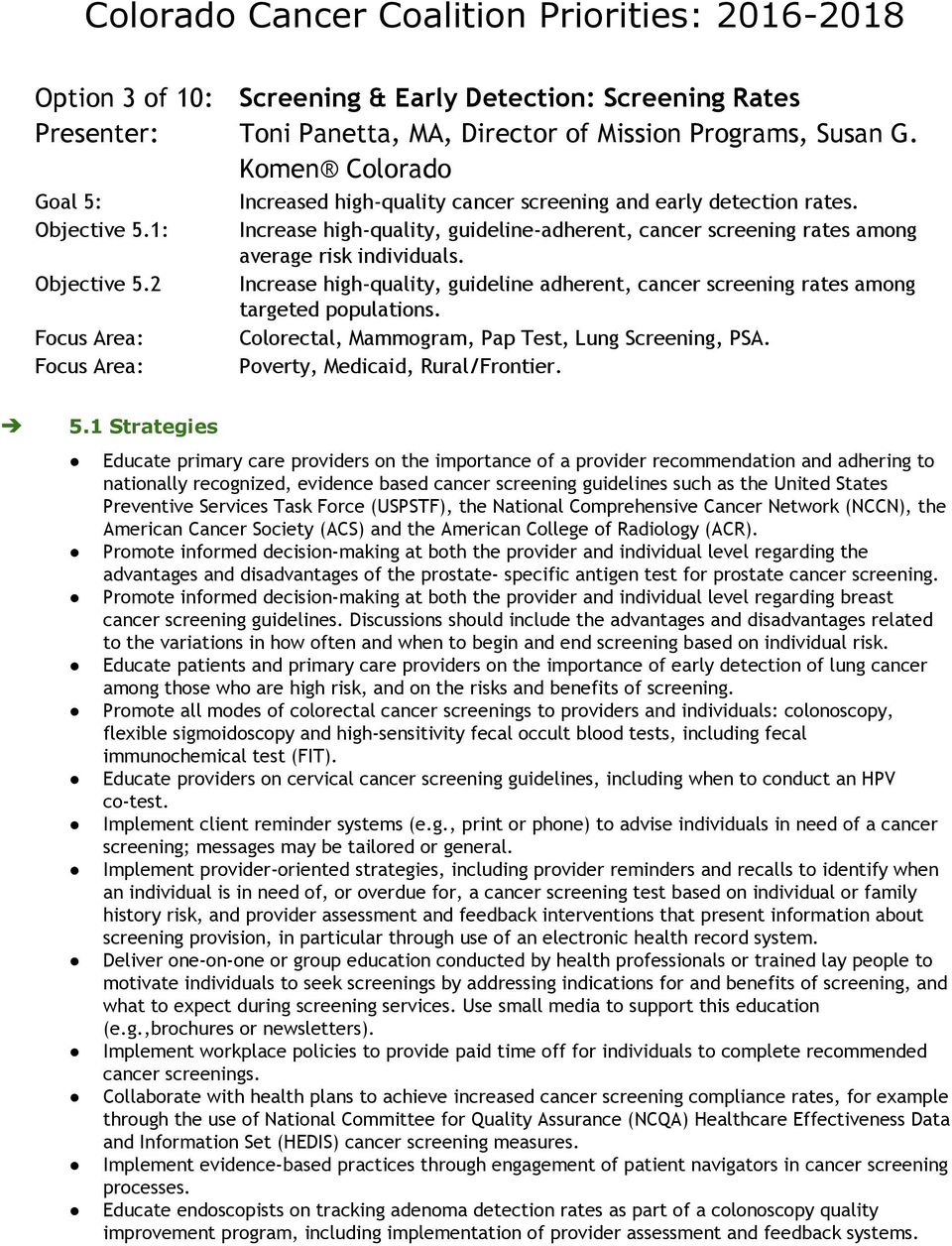
1 Option 3 of 10: Screening & Early Detection: Screening Rates Presenter: Toni Panetta, MA, Director of Mission Programs, Susan G. Komen Colorado Goal 5: Objective 5.1: Objective 5.2 Focus Area: Focus Area: Increased high quality cancer screening and early detection rates. Increase high quality, guideline adherent, cancer screening rates among average risk individuals. Increase high quality, guideline adherent, cancer screening rates among targeted populations. Colorectal, Mammogram, Pap Test, Lung Screening, PSA. Poverty, Medicaid, Rural/Frontier. 5.1 Strategies Educate primary care providers on the importance of a provider recommendation and adhering to nationally recognized, evidence based cancer screening guidelines such as the United States Preventive Services Task Force (USPSTF), the National Comprehensive Cancer Network (NCCN), the American Cancer Society (ACS) and the American College of Radiology (ACR). Promote informed decision making at both the provider and individual level regarding the advantages and disadvantages of the prostate specific antigen test for prostate cancer screening. Promote informed decision making at both the provider and individual level regarding breast cancer screening guidelines. Discussions should include the advantages and disadvantages related to the variations in how often and when to begin and end screening based on individual risk. Educate patients and primary care providers on the importance of early detection of lung cancer among those who are high risk, and on the risks and benefits of screening. Promote all modes of colorectal cancer screenings to providers and individuals: colonoscopy, flexible sigmoidoscopy and high sensitivity fecal occult blood tests, including fecal immunochemical test (FIT). Educate providers on cervical cancer screening guidelines, including when to conduct an HPV co test. Implement client reminder systems (e.g., print or phone) to advise individuals in need of a cancer screening; messages may be tailored or general. Implement provider oriented strategies, including provider reminders and recalls to identify when an individual is in need of, or overdue for, a cancer screening test based on individual or family history risk, and provider assessment and feedback interventions that present information about screening provision, in particular through use of an electronic health record system. Deliver one on one or group education conducted by health professionals or trained lay people to motivate individuals to seek screenings by addressing indications for and benefits of screening, and what to expect during screening services. Use small media to support this education (e.g.,brochures or newsletters). Implement workplace policies to provide paid time off for individuals to complete recommended cancer screenings. Collaborate with health plans to achieve increased cancer screening compliance rates, for example through the use of National Committee for Quality Assurance (NCQA) Healthcare Effectiveness Data and Information Set (HEDIS) cancer screening measures. Implement evidence based practices through engagement of patient navigators in cancer screening processes. Educate endoscopists on tracking adenoma detection rates as part of a colonoscopy quality improvement program, including implementation of provider assessment and feedback systems.
2 5.1 Measures Women ages 50+ who had a mammogram within the last two years Data Source Baseline 2020 Target 72.4% 81.1% Women ages who had a mammogram within the last two years 57.6% 63.4% Women ages who had a Pap test within the last 3 years. 84.9% 93% Men and women ages who are adherent with colorectal cancer screening guidelines (FOBT in 1 year, Flexible Sigmoidoscopy in 5 years + FOBT in 3 years, or colonoscopy in 10 years) Men and women with appropriate smoking history risk (as determined by USPSTF guidelines) who are adherent with lung cancer screening guidelines. Men ages 40+ who have had a discussion with their provider on the advantages and disadvantages of a PSA test 66.7% 80% TBD* TBD TBD 27.4% 31.5% 5.2 Strategies Increase access to cancer screening services, including colonoscopy, mammography and low dose lung CT screening, in rural areas by implementing mobile services, traveling providers, upgraded equipment or increased Medicaid reimbursement. Partner with community based organizations to reduce barriers (financial, cultural, structural or regional) to obtaining cancer screening services through engagement of community health workers and patient navigators. Provide culturally relevant screening services for medically underserved communities and promote culturally sensitive informed decision making about screening through engagement of community health workers and patient navigators. Facilitate enrollment in public and private health insurance. Educate Medicaid eligible Coloradans about their cancer screening coverage, including locations that accept Medicaid. Address limited local provider access for individuals due to insurance coverage, insurance plans accepted by providers, or provider capacity. Educate employers on the importance of providing paid leave for cancer screenings (especially for hourly employees). Encourage Medicaid to adopt lung CT screening guidelines that match Medicare guidelines. 5.2 Measures Women ages 50+ in poverty (under 250% FPL) who had a mammogram in the last two years Data Source Baseline 2020 Target 61.3% 81.1% Women age 50+ who live in rural or frontier counties 66% 81.1%

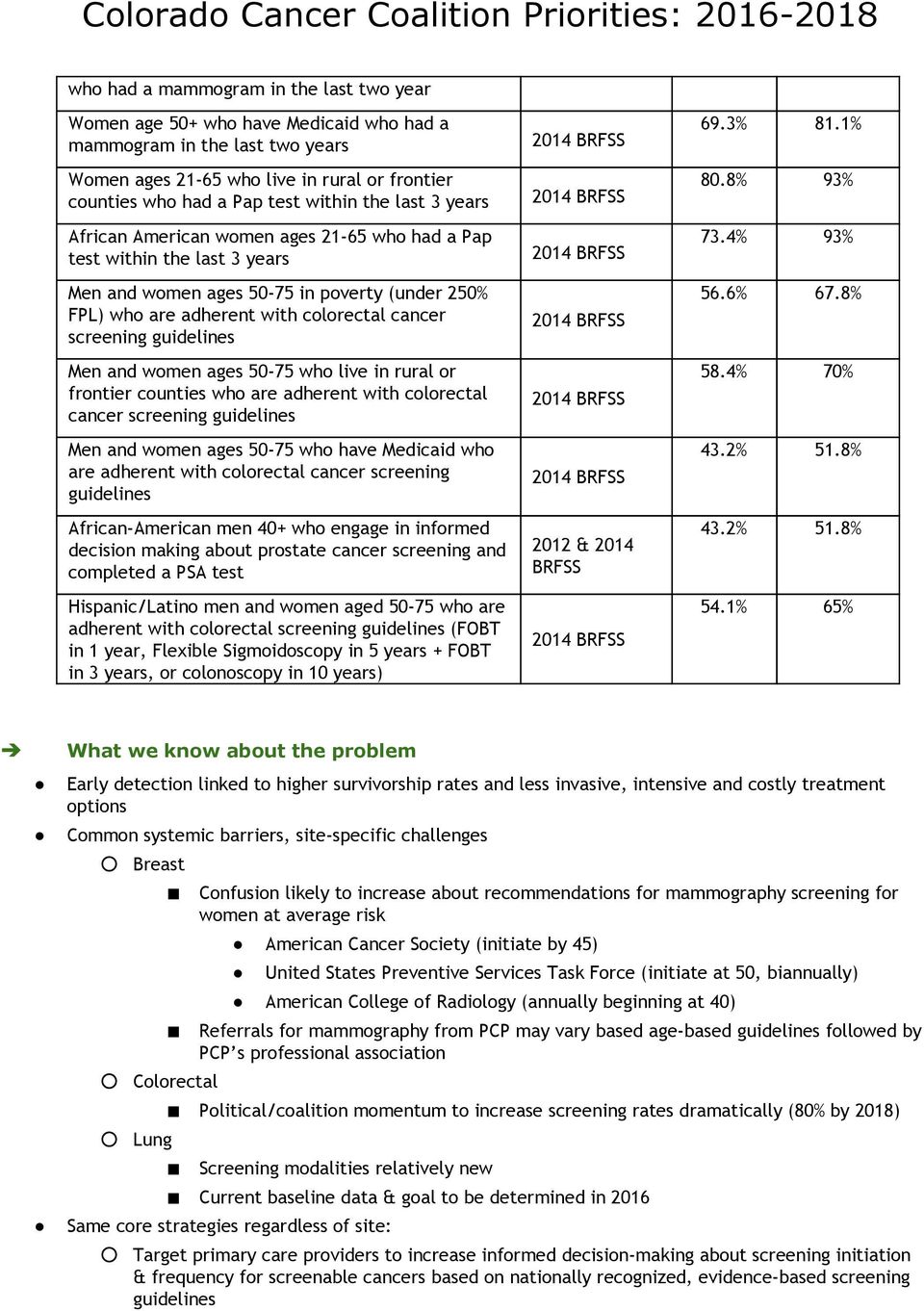
3 who had a mammogram in the last two year Women age 50+ who have Medicaid who had a mammogram in the last two years Women ages who live in rural or frontier counties who had a Pap test within the last 3 years African American women ages who had a Pap test within the last 3 years Men and women ages in poverty (under 250% FPL) who are adherent with colorectal cancer screening guidelines Men and women ages who live in rural or frontier counties who are adherent with colorectal cancer screening guidelines Men and women ages who have Medicaid who are adherent with colorectal cancer screening guidelines African American men 40+ who engage in informed decision making about prostate cancer screening and completed a PSA test Hispanic/Latino men and women aged who are adherent with colorectal screening guidelines (FOBT in 1 year, Flexible Sigmoidoscopy in 5 years + FOBT in 3 years, or colonoscopy in 10 years) 2012 & 2014 BRFSS 69.3% 81.1% 80.8% 93% 73.4% 93% 56.6% 67.8% 58.4% 70% 43.2% 51.8% 43.2% 51.8% 54.1% 65% What we know about the problem Early detection linked to higher survivorship rates and less invasive, intensive and costly treatment options Common systemic barriers, site specific challenges Breast Colorectal Lung Confusion likely to increase about recommendations for mammography screening for women at average risk American Cancer Society (initiate by 45) United States Preventive Services Task Force (initiate at 50, biannually) American College of Radiology (annually beginning at 40) Referrals for mammography from PCP may vary based age based guidelines followed by PCP s professional association Political/coalition momentum to increase screening rates dramatically (80% by 2018) Screening modalities relatively new Current baseline data & goal to be determined in 2016 Same core strategies regardless of site: Target primary care providers to increase informed decision making about screening initiation & frequency for screenable cancers based on nationally recognized, evidence based screening guidelines
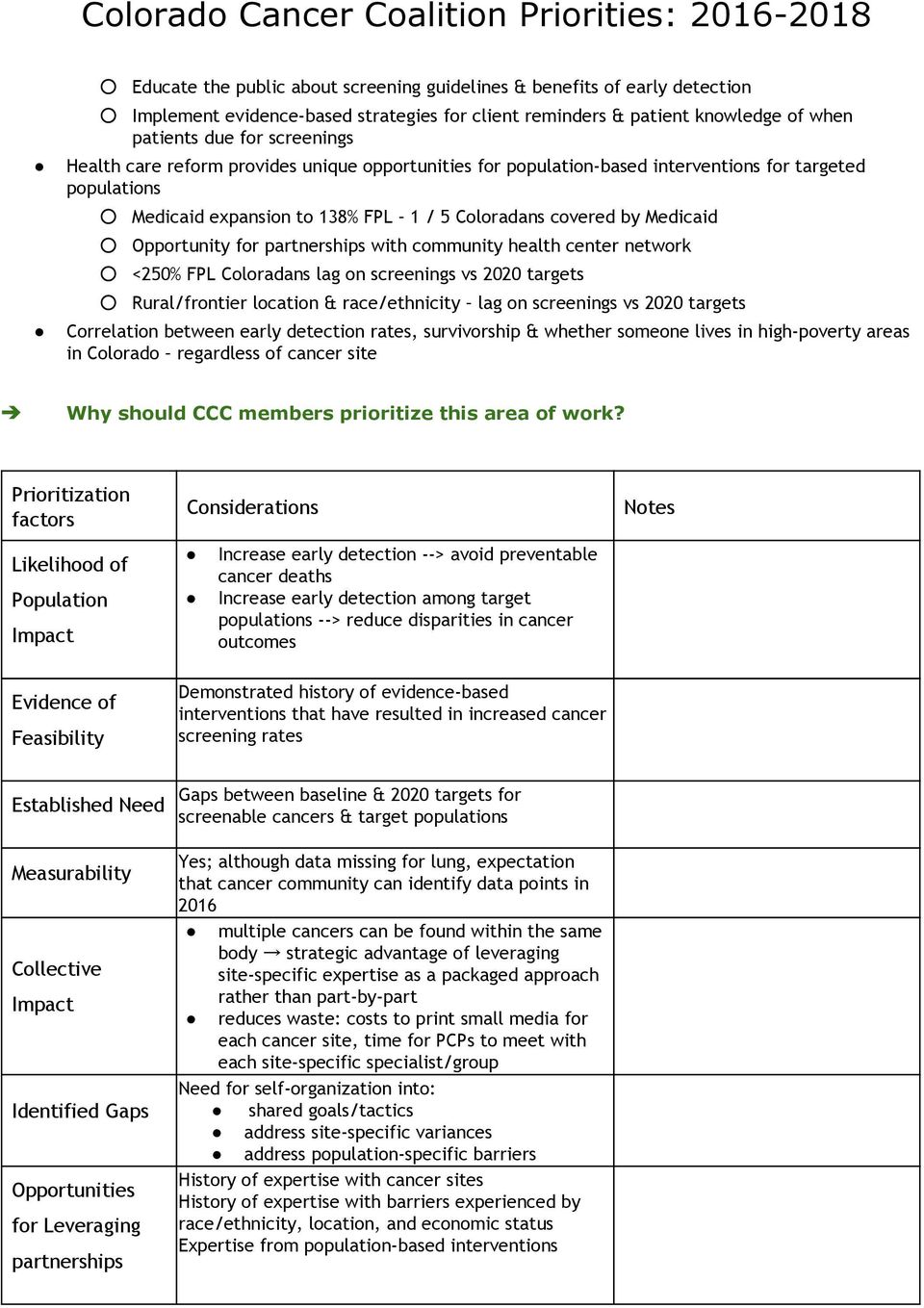
4 Educate the public about screening guidelines & benefits of early detection Implement evidence based strategies for client reminders & patient knowledge of when patients due for screenings Health care reform provides unique opportunities for population based interventions for targeted populations Medicaid expansion to 138% FPL 1 / 5 Coloradans covered by Medicaid Opportunity for partnerships with community health center network <250% FPL Coloradans lag on screenings vs 2020 targets Rural/frontier location & race/ethnicity lag on screenings vs 2020 targets Correlation between early detection rates, survivorship & whether someone lives in high poverty areas in Colorado regardless of cancer site Why should CCC members prioritize this area of work? Prioritization factors Considerations Notes Likelihood of Population Impact Increase early detection > avoid preventable cancer deaths Increase early detection among target populations > reduce disparities in cancer outcomes Evidence of Feasibility Demonstrated history of evidence based interventions that have resulted in increased cancer screening rates Established Need Measurability Collective Impact Identified Gaps Opportunities for Leveraging partnerships Gaps between baseline & 2020 targets for screenable cancers & target populations Yes; although data missing for lung, expectation that cancer community can identify data points in 2016 multiple cancers can be found within the same body strategic advantage of leveraging site specific expertise as a packaged approach rather than part by part reduces waste: costs to print small media for each cancer site, time for PCPs to meet with each site specific specialist/group Need for self organization into: shared goals/tactics address site specific variances address population specific barriers History of expertise with cancer sites History of expertise with barriers experienced by race/ethnicity, location, and economic status Expertise from population based interventions
5 Political/ community support Leverage existing resources public desire for less devastation from cancer diagnosis volume of experts 80% by 2018 established momentum Public desire for increased value in health care prevention, early detection averts avoidable expenses Would you or your organization commit to helping with this priority?

Screening for Cancer in Light of New Guidelines and Controversies. Christopher Celio, MD St. Jude Heritage Medical Group
 Screening for Cancer in Light of New Guidelines and Controversies Christopher Celio, MD St. Jude Heritage Medical Group Screening Tests The 2 major objectives of a good screening program are: (1) detection
Clinical Indicator Ages 19-29 Ages 30-39 Ages 40-49 Ages 50-64 Ages 65+ Frequency of visit as recommended by PCP
 SCREENING EXAMINATION & COUNSELING UPMC Health Plan Clinical Indicator Ages 19-29 Ages 30-39 Ages 40-49 Ages 50-64 Ages 65+ Annually Physical Exam and Counseling 1 Blood Pressure 2 At each visit. At least
Summary of Cancer Prevention and Screening Benefits of the Affordable Care Act (ACA) in Kentucky for health professionals
 Summary of Cancer Prevention and Screening Benefits of the Affordable Care Act (ACA) in Kentucky for health professionals Talk with patients about ü Potential benefits, harms, and unknowns of cancer ü
Preventive Care Guideline for Asymptomatic Elderly Patients Age 65 and Over
 Preventive Care Guideline for Asymptomatic Elderly Patients Age 65 and Over 1. BMI - Documented in patients medical record on an annual basis up to age 74. Screen for obesity and offer counseling to encourage
Ontario Health Insurance Plan (OHIP) Billing Codes Information and Procedures for Claiming the Cumulative Preventative Care Bonus
 Ontario Health Insurance Plan (OHIP) Billing Codes Information and Procedures for Claiming the Cumulative Preventative Care Bonus Eligible Patient Enrolment Model (PEM) physicians may receive Cumulative
Cancer Screening and Early Detection Guidelines
 Cancer Screening and Early Detection Guidelines Guillermo Tortolero Luna, MD, PhD Director Cancer Control and Population Sciences Program University of Puerto Rico Comprehensive Cancer Center ASPPR Clinical
Preventive Care Guideline for Asymptomatic Low Risk Adults Age 18 through 64
 Preventive Care Guideline for Asymptomatic Low Risk Adults Age 18 through 64 1. BMI - Documented in patients medical record on an annual basis. Screen for obesity and offer intensive counseling and behavioral
Cancer Screening 22M 36% 56% Only 56% of uninsured women aged 50 74 are up-to-date with mammography screening. Colorectal Cancer Breast Cancer
 July 2010 22M 22 million adults aged 50 75 need to be screened for colorectal cancer, and 7 million women aged 50 74 need to be screened for breast cancer. Cancer Screening Colorectal Cancer Breast Cancer
Butler Memorial Hospital Community Health Needs Assessment 2013
 Butler Memorial Hospital Community Health Needs Assessment 2013 Butler County best represents the community that Butler Memorial Hospital serves. Butler Memorial Hospital (BMH) has conducted community
PREVENTIVE HEALTHCARE GUIDELINES INTRODUCTION
 PREVENTIVE HEALTHCARE GUIDELINES INTRODUCTION Health Plan of Nevada and Sierra Health and Life suggest that health plan members get certain screening tests, exams and shots to stay healthy. This document
The BreastCare Program
 The BreastCare Program BreastCare Is a Program of the Arkansas Department of Health (ADH) that Offers: Screening and diagnostic services to qualifying women at no cost Public and professional education
Examples of good screening tests include: mammography for breast cancer screening and Pap smears for cervical cancer screening.
 CANCER SCREENING Dr. Tracy Sexton (updated July 2010) What is screening? Screening is the identification of asymptomatic disease or risk factors by history taking, physical examination, laboratory tests
This publication was developed and produced with funding from the Centers for Disease Control and Prevention under a cooperative agreement.
 This publication was developed and produced with funding from the Centers for Disease Control and Prevention under a cooperative agreement. Suggested Citation Centers for Disease Control and Prevention.
NYSDOH. Cancer Services Program Operations Manual
 NYSDOH Cancer Services Program Operations Manual BLANK FOR PRINTING Table of Contents Chapter 1: Program Overview... - 0 - Chapter 1: CSP Program Overview... - 1 - A. NYSDOH CSP Definitions... - 1 - B.
Clinic Readiness Survey Leadership
 Clinic Readiness Survey Leadership Date of interview: Organizational interview ID#: Interviewer: Interview modality: 1 phone 2 in-person STOP CRC is a program about colon health. As part of STOP CRC, we
Detecting Cancer in Blood. Company presentation
 Detecting Cancer in Blood Company presentation Safe harbor statement Forward Looking Statements This communication contains certain forward-looking statements, including, without limitation, statements
SHIIP Combo Form. 1-855-408-1212 www.ncshiip.com. North Carolina Department of Insurance Wayne Goodwin, Commissioner
 SHIIP Combo Form Seniors Health Insurance Information Program North Carolina Department of Insurance Wayne Goodwin, Commissioner 1-855-408-1212 www.ncshiip.com What is SHIIP? Seniors Health Insurance Information
CANCER AND MEDICARE A CHARTBOOK
 CANCER AND MEDICARE A CHARTBOOK February 2009 PREPARED BY: Lisa Potetz Health Policy Alternatives, Inc. Leticia Flores DeWilde American Cancer Society Cancer Action Network (ACS CAN) ACKNOWLEDGEMENTS We
2016 HEDIS & Quality Assurance Reporting Requirements Measures Provider Reference Guide
 2016 HEDIS & Quality Assurance Reporting Requirements Measures Provider Reference Guide HEDIS Measure: Test/Care Needed for Compliance Adult BMI Assessment Individuals ages 18-74 Documentation of BMI and
Medicare s Preventive Care Services. Manage Your Chronic Kidney Disease (CKD stages 3-4) with Diet
 s Preventive Care Services Manage Your Chronic Kidney Disease (CKD stages 3-4) with Diet What do the kidneys do? Your kidneys have important jobs to do in your body. Two of the kidneys most important jobs
PROSTATE CANCER SCREENING PROSTATE CANCER SCREENING
 3:45 4:45pm Screening Guidelines for Men's Health SPEAKER Radha Rao, MD Presenter Disclosure Information The following relationships exist related to this presentation: Radha Rao, MD: No financial relationships
An ANALYSIS of Medicare Benefits per the 2016 Medicare and You Handbook & The State of Delaware's Special Medicfill Plan Benefits
 An ANALYSIS of Medicare Benefits per the 2016 Medicare and You Handbook & The State of Delaware's Special Medicfill Plan Benefits The chart below presents the list of benefits covered by Medicare, and
Colorectal Cancer: Preventable, Beatable, Treatable. American Cancer Society
 Colorectal Cancer: Preventable, Beatable, Treatable American Cancer Society Reviewed January 2013 What we ll be talking about How common is colorectal cancer? What is colorectal cancer? What causes it?
COVERAGE SCHEDULE. The following symbols are used to identify Maximum Benefit Levels, Limitations, and Exclusions:
 Exhibit D-3 HMO 1000 Coverage Schedule ROCKY MOUNTAIN HEALTH PLANS GOOD HEALTH HMO $1000 DEDUCTIBLE / 75 PLAN EVIDENCE OF COVERAGE LARGE GROUP Underwritten by Rocky Mountain Health Maintenance Organization,
Preventive Health Care Services Provided to the New Hampshire Medicaid Adult Population with Comparisons to the Commercially Insured Population
 Preventive Health Care Services Provided to the New Hampshire Medicaid Adult Population with Comparisons to the Commercially Insured Population A report prepared for the New Hampshire Department of Health
GrantSpace - Collaboration Hub. Access to Healthcare Network. Participating Organizations. Primary Contact. Formation
 GrantSpace - Collaboration Hub Access to Healthcare Network Participating Organizations Saint Mary's Regional Hospital, Reno, NV Primary Contact Name:Mike Johnson Title:CEO Email:[email protected] Please
MEDICAL MALPRACTICE FACT BOOK
 MEDICAL MALPRACTICE FACT BOOK - 1 - Firm Profile For over a decade, The Law Offices of Bruce M. Robinson have been dedicated to protecting the rights of victims who have been injured by the negligent and
Racial Differences in Cancer. A Comparison of Black and White Adults in the United States
 p P F I Z E R F A C T S Racial Differences in Cancer A Comparison of Black and White Adults in the United States p Approximately 177,000 blacks aged 20 and older will be diagnosed with cancer in 2005 an
Michigan Electrical Employees Health Plan Benefits & Eligibility-at-a Glance Supplement to Medicare - Medicare Enrollees
 Medicare Coverage BCBSM Supp Coverage Preventive Services 12 months, if age 50 and older Colonoscopy - one per calendar year 1 0 years (if at high risk every 24 months) approved amount**, once per flu
Routine Preventive Services. Covered by Medicare 2012
 Routine Preventive Services Covered by Medicare 2012 Brook Golshan, CPC, ACS-EM 2/20/2012 1 Preventive Services Covered by Medicare 2012 Covered by Medicare Part B: Original/Direct Medicare Most of the
Colorectal Cancer: Preventable, Beatable, Treatable. American Cancer Society
 Colorectal Cancer: Preventable, Beatable, Treatable American Cancer Society Reviewed January 2016 What we ll be talking about How common is colorectal cancer? What is colorectal cancer? What causes it?
Stay Healthy. In the Know. Screenings you and your family need. Protect yourself against health care fraud. www.aultcare.com
 good health FALL 2015 YOUR FAST TRACK TO LIVING WELL Stay Healthy Screenings you and your family need In the Know Protect yourself against health care fraud www.aultcare.com TELL US HOW WE ARE DOING Whether
Aetna Life Insurance Company
 Aetna Life Insurance Company Hartford, Connecticut 06156 Amendment Policyholder: Group Policy No.: Effective Date: UNIVERSITY OF PENNSYLVANIA POSTDOCTORAL INSURANCE PLAN GP-861472 This Amendment is effective
Overuse of PSA Screening for Prostate Cancer in Older Men. Elizabeth Jaramillo, MD January 17, 2014
 Overuse of PSA Screening for Prostate Cancer in Older Men Elizabeth Jaramillo, MD January 17, 2014 Screening Prostate cancer screening occurs in patients with no clinical sign or suspicion of disease Screening
Preventive Health Guidelines
 Preventive Health Guidelines As of April 2010 What is your plan for better health? Make this year your best year for overall wellness. Your health benefits plan may cover early detection screenings and
University Hospital Community Health Needs Assessment FY 2014
 FY 2014 Prepared by Kathy Opromollo Executive Director of Ambulatory Care Services Newark New Jersey is the State s largest city. In striving to identify and address Newark s most pressing health care
SBIRT in Primary Care Settings. José Esquibel SBIRT Project Director
 SBIRT in Primary Care Settings José Esquibel SBIRT Project Director SBIRT Screening Brief Intervention and Referral to Treatment (SBIRT) is a public health approach to preventing risky substance use behavior.
COLORECTAL CANCER SCREENING
 COLORECTAL CANCER SCREENING By Douglas K. Rex, M.D., FACG & Suthat Liangpunsakul, M.D. Division of Gastroenterology and Hepatology, Department of Medicine Indiana University School of Medicine Indianapolis,
uninsured RESEARCH BRIEF: INSURANCE COVERAGE AND ACCESS TO CARE IN PRIMARY CARE SHORTAGE AREAS
 kaiser commission on medicaid and the uninsured RESEARCH BRIEF: INSURANCE COVERAGE AND ACCESS TO CARE IN PRIMARY CARE SHORTAGE AREAS Prepared by Catherine Hoffman, Anthony Damico, and Rachel Garfield The
Medicare. Orientation Guide
 Medicare Orientation Guide Your Medicare Orientation Guide At MCS Classicare (HMO), we take care of you so you feel better every day. That s why we want to get you familiar and provide you with the tools
Effect of Anxiety or Depression on Cancer Screening among Hispanic Immigrants
 Racial and Ethnic Disparities: Keeping Current Seminar Series Mental Health, Acculturation and Cancer Screening among Hispanics Wednesday, June 2nd from 12:00 1:00 pm Trustees Conference Room (Bulfinch
Total Health Quality Indicators For Providers 2015
 Total Health Quality Indicators For Providers 2015 Adult- Preventive Measure Test/Procedure Parameters Frequency CPT/HCPCS CPT II ICD-9 BMI Assessment BMI Recording 18-74 yrs Yearly G8417, G8418, G8420
Health Maintenance Guidelines for Women
 Health Maintenance Guidelines for Women Customize your plan: These guidelines apply to healthy women in the general population. The right plan for your care may differ based on your medical history, family
COMMUNITY PROFILE REPORT
 COMMUNITY PROFILE REPORT Puget Sound Affiliate Susan G. Komen for the Cure 112 Fifth Avenue North Seattle, Washington 98109 www.komenpugetsound.org Executive Summary Introduction The Susan G. Komen Foundation
Preventive Services Explained
 Preventive Services Explained Medicare covers many preventive care services without charge. Most of these services have been recommended by the U.S. Preventive Services Task Force. However, which beneficiaries
Health Care Coverage Analyses of the 2006 National Healthcare Quality and Disparities Reports
 Health Care Coverage Analyses of the 26 National Healthcare Quality and Disparities Reports U.S. Department of Health and Human Services Prepared by the Agency for Healthcare Research and Quality for and
Preventive Health Services
 understanding Preventive Health Services For the most current version of this document, visit www.wellwithbluemt.com or www.bcbsmt.com. Preventive health services include evidence-based screenings, immunizations,
Preventive Care Services Health Care Reform The following benefits are effective beginning the first plan year on or after Sept.
 Coding Summary for Providers NOTE THE FOLLOWING: The purpose of this document is to provide a quick reference of the applicable codes for UnitedHealthcare plans that cover preventive care services in accordance
inflammation of the pancreas and damage to the an increased risk of hypertension, stroke and Table 7.1: Classification of alcohol consumption
 H E A LT H SURVEY Alcohol Consumption 7 Alcohol Consumption N AT I O N A L Introduction Excessive alcohol consumption is associated with inflammation of the pancreas and damage to the an increased risk
HealthPartners: Triple Aim Approach to ACO Development
 HealthPartners: Triple Aim Approach to ACO Development Brian Rank, MD Medical Director, HealthPartners Medical Group October 27, 2010 HealthPartners Integrated Care and Financing System 10,300 employees
IN-NETWORK MEMBER PAYS. Out-of-Pocket Maximum (Includes a combination of deductible, copayments and coinsurance for health and pharmacy services)
 HMO-OA-CNT-30-45-500-500D-13 HMO Open Access Contract Year Plan Benefit Summary This is a brief summary of benefits. Refer to your Membership Agreement for complete details on benefits, conditions, limitations
2012 Oncology Service Line Goals and Accomplishments
 2012 Oncology Service Line Goals and Accomplishments 2012 Program goals and outcomes Quality and Service Seek NAPBC accreditation by December 31, 2012 Application was accepted; visit date set for April
HEDIS/CAHPS 101. August 13, 2012 Minnesota Measurement and Reporting Workgroup
 HEDIS/CAHPS 101 Minnesota Measurement and Reporting Workgroup Objectives Provide introduction to NCQA Identify HEDIS/CAHPS basics Discuss various components related to HEDIS/CAHPS usage, including State
Procedure Code(s): n/a This counseling service is included in a preventive care wellness examination or focused E&M visit.
 Coding Summary for Providers NOTE THE FOLLOWING: The purpose of this document is to provide a quick reference of the applicable codes for UnitedHealthcare plans that cover preventive care services in accordance
The Promise of Regional Data Aggregation
 The Promise of Regional Data Aggregation Lessons Learned by the Robert Wood Johnson Foundation s National Program Office for Aligning Forces for Quality 1 Background Measuring and reporting the quality
How To Know If You Are At Risk For Cancer
 Ana Maria Lopez, MD, MPH, FACP Professor of Medicine and Pathology Arizona Cancer Center University of Arizona Definitions Rationale Who is at risk Guidelines Breast Cancer Colorectal Cancer Prostate Cancer
Quality Measures Overview
 Quality Measures Overview Health care quality, Stars and Member Engagement Initiatives Approved for External Use Section 1 Introduction Introduction Stars Quality Measures Overview UnitedHealthcare is
ScreenWise. Breast, Cervical, and Hereditary Cancer Screenings OCTOBER 28, 2015
 ScreenWise Breast, Cervical, and Hereditary Cancer Screenings OCTOBER 28, 2015 ScreenWise Three programs working together to bring quality screening services to Oregon residents Why we all do this work
PLAN DESIGN AND BENEFITS POS Open Access Plan 1944
 PLAN FEATURES PARTICIPATING Deductible (per calendar year) $3,000 Individual $9,000 Family $4,000 Individual $12,000 Family Unless otherwise indicated, the Deductible must be met prior to benefits being
UNINSURED ADULTS IN MAINE, 2013 AND 2014: RATE STAYS STEADY AND BARRIERS TO HEALTH CARE CONTINUE
 UNINSURED ADULTS IN MAINE, 2013 AND 2014: RATE STAYS STEADY AND BARRIERS TO HEALTH CARE CONTINUE December 2015 Beginning in January 2014, the federal Patient Protection and Affordable Care Act (ACA) has