
Brown Advisory Funds plc
|
|
|
- Nigel Matthews
- 9 years ago
- Views:
Transcription
1 Brown Advisory Funds plc (an open-ended umbrella investment company with variable capital and segregated liability between its sub-funds incorporated under the laws of Ireland with registered number as an undertaking for collective investment in transferable securities pursuant to the European Communities Undertaking for Collective Investment in Transferable Securities Regulations 2011, as amended) SUPPLEMENT TO THE PROSPECTUS FOR GERMAN INVESTORS ONLY This Supplement is supplemental to, forms part of and should be read in conjunction with the Prospectus for Brown Advisory Funds plc (the Company ) dated 14 May 2015 (the Prospectus ), the Supplement No. 1 to the Prospectus for the Brown Advisory US Equity Value Fund dated 14 May 2015, the Supplement No. 2 to the Prospectus for the Brown Advisory US Equity Growth Fund dated 14 May 2015, the Supplement No. 3 to the Prospectus for the Brown Advisory US Smaller Companies Fund dated 14 May 2015, the Supplement No. 4 to the Prospectus for the Brown Advisory American Fund dated 14 May 2015, the Supplement No. 6 to the Prospectus for the Brown Advisory US Small Cap Blend Fund dated 14 May 2015, and the Supplement No. 7 to the Prospectus for the Brown Advisory US Flexible Equity Fund dated 14 May 2015 (the Supplements ), in each case as amended from time to time, to which it is attached. Words and expressions defined in the Prospectus shall, unless the context otherwise requires, have the same meaning when used herein. Dated: 8 June BUSINESS

2 Right to market Shares in Germany The Company has notified its intention to market Shares in Germany. Since completion of the notification process the Company has the right to market Shares in Germany. No marketing notification has been submitted for Brown Advisory US Flexible Equity SRI Fund and Brown Advisory Global Leaders Fund. Accordingly, Shares of these sub-funds may not be marketed in Germany. Paying and Information Agent in Germany The function of the paying and information agent in the Federal Republic of Germany has been assumed by: Société Générale S.A. Neue Mainzer Straße Frankfurt am Main (the Paying and Information Agent ). Redemption and conversion applications may be sent to the Paying and Information Agent for onward transmission to the Company. Investors with their place of residence in Germany may request that redemption proceeds, any distributions and other payments be forwarded through the Paying and Information Agent. Copies of the Memorandum and Articles of Association, the Prospectus and Supplements, the Key Investor Information Documents as well as the annual and semi-annual reports are available free of charge in paper form at the registered office of the Paying and Information Agent. Furthermore, copies of those documents referred to in the section Documents for Inspection in the Prospectus may be obtained from the Paying and Information Agent and inspected at its registered office free of charge during usual business hours during a Business Day. The subscription, redemption and conversion prices are also available free of charge at the registered office of the Paying and Information Agent. Publications The subscription and redemption prices will be published in the Federal Gazette, possible Shareholder notices on In the cases enumerated in Sec. 298 (2) of the German Investment Code (KAGB), Shareholders will also be notified by means of a durable medium in accordance with the terms of Sec. 167 KAGB BUSINESS

3 If you are in any doubt about the contents of this Prospectus and the relevant Supplement you should consult your stockbroker, bank manager, solicitor, accountant or other financial adviser. Brown Advisory Funds plc An umbrella fund with segregated liability between sub-funds. A company incorporated with limited liability as an open-ended investment company with variable capital under the laws of Ireland with registered number PROSPECTUS This Prospectus is dated 14 May 2015 This Prospectus may not be distributed unless accompanied by, and must be read in conjunction with, the Supplement for the Shares of the Fund being offered. The Directors of Brown Advisory Funds plc whose names appear on page 5 accept responsibility for the information contained in this Prospectus. To the best of the knowledge and belief of the Directors (who have taken all reasonable care to ensure such is the case), the information contained in this document is in accordance with the facts and does not omit anything likely to affect the import of such information.

4 INTRODUCTION Central Bank Authorisation The Company is an investment company with variable capital incorporated on 11 October 2005 and authorised in Ireland as an undertaking for collective investment in transferable securities pursuant to the European Communities (Undertakings for Collective Investment in Transferable Securities) Regulations, 2011 (S.I. No. 352 of 2011) as may be amended, supplemented or consolidated from time to time. This authorisation however, does not constitute a warranty by the Central Bank as to the performance of the Company and the Central Bank shall not be liable for the performance or default of the Company. Authorisation of the Company is not an endorsement or guarantee of the Company by the Central Bank nor is the Central Bank responsible for the contents of the Prospectus. Investor Responsibility Potential subscribers and purchasers of Shares should inform themselves as to (a) the possible tax consequences, (b) the legal requirements, (c) any foreign exchange restrictions or exchange control requirements and (d) any other requisite governmental or other consents or formalities which they might encounter under the laws of the countries of their incorporation, citizenship, residence or domicile and which might be relevant to the subscription, purchase, holding or disposal of Shares. Investment Risk The value of and income from Shares in the Company may go up or down and you may not get back the amount you have invested in the Company. Shares constituting each Fund are described in a Supplement to this Prospectus for each such Fund, each of which is an integral part of this Prospectus and is incorporated herein by reference with respect to the relevant Fund. Please see the risk factors described under the heading Risk Factors below. Establishment and Incorporation The Company is structured as an open-ended umbrella fund with segregated liability between subfunds. Shares representing interests in different Funds may be issued from time to time by the Directors. Shares of more than one Class may be issued in relation to a Fund. All Shares of each Class will rank pari passu save as provided for in the relevant Supplement. On the introduction of any new Fund (for which prior Central Bank approval is required) or any new Class of Shares (which must be issued in accordance with the requirements of the Central Bank), the Company will prepare and the Directors will issue a Supplement setting out the relevant details of each such Fund or new Class of Shares. A separate portfolio of assets will be maintained for each Fund (and accordingly not for each Class of Shares) and will be invested in accordance with the investment objective and policies applicable to such Fund. Particulars relating to individual Funds and the Classes of Shares available therein are set out in the relevant Supplement. The Company has segregated liability between its Funds and accordingly any liability incurred on behalf of or attributable to any Fund shall be discharged solely out of the assets of that Fund. The Company has the following Funds:- Brown Advisory US Equity Value Fund (Supplement No.1); Brown Advisory US Equity Growth Fund (Supplement No.2); Brown Advisory US Smaller Companies Fund (Supplement No.3); Brown Advisory American Fund (Supplement No.4); Brown Advisory US Flexible Equity SRI Fund (Supplement No.5); Brown Advisory US Small Cap Blend Fund (Supplement No.6); Brown Advisory US Flexible Equity Fund (Supplement No.7); and

5 Brown Advisory Global Leaders Fund (Supplement No. 8). Investors Reliance on US Federal Tax Advice in this Prospectus The discussion contained in this Prospectus as to US federal tax considerations is not intended or written to be used, and cannot be used, for the purposes of avoiding penalties. Such discussion is written to support the promotion or marketing of the transactions or matters addressed in this Prospectus. Each taxpayer should seek US federal tax advice based on the taxpayer s particular circumstances from an independent tax advisor. Key Investor Information Document Key Investor Information Documents are available for the Funds of the Company. In addition to summarising some important information in this Prospectus, the Key Investor Information Documents may contain information on the historical performance and the ongoing charges for each of the Funds. The Key Investor Information Documents can be obtained from the registered office of the Company which is set out in the section Directory. Preliminary Charge/Repurchase Charge Where a Preliminary Charge and/or Repurchase Charge is payable in respect of a subscription or redemption for certain Classes of Shares, the resulting difference at any one time between the issue price and the repurchase price means that investment in such Shares should be viewed as medium to long term. A Preliminary Charge of up to 3% of the issue price may be charged by the Company for the payment to the Investment Manager on the issue of Shares, out of which the Investment Manager may, for example, pay commission to financial intermediaries. Further details of this Preliminary Charge will be set out in the relevant Supplement. A Repurchase Charge of up to 2% of the gross repurchase price of any Class of Shares of a Fund may be charged by the Company as described in Share Dealings - Repurchase of Shares. The amount of Repurchase Charge (if any) will be set out in the relevant Supplement. Restrictions on Distribution and Sales of Shares The distribution of this Prospectus and the offering or purchase of the Shares may be restricted in certain jurisdictions. This Prospectus does not constitute an offer or solicitation by or to anyone in any jurisdiction in which such offer or solicitation is not lawful or in which the person making such offer or solicitation is not qualified to do so or to anyone to whom it is unlawful to make such offer or solicitation. Shares are offered only on the basis of the information contained in this Prospectus and the latest audited annual accounts and any subsequent half-yearly reports will be made available to the public at the office of the Administrator. Any further information or representations given or made by any person should be disregarded and accordingly, should not be relied upon. Neither the delivery of this Prospectus, the latest published annual report or accounts of the Company (once published) nor the offer, placement, allotment or issue of any of the Shares shall under any circumstances create any implication or constitute a representation that the information given in this Prospectus or in any such report is correct as of any time subsequent to the date thereof or that the affairs of the Company have not be changed since the date thereof. Statements in this Prospectus are based on law and practice currently in force in Ireland and are made as at the date of this Prospectus and are subject to change. No information or advice herein contained shall constitute advice to a proposed investor in respect of his personal position. Accordingly, no representations or warranties of any kind are intended or should be inferred with respect to the economic return or the tax consequences of an investment in 3
6 the Company. No assurance can be given that existing laws will not be changed or interpreted adversely. Prospective investors are not to construe this document as legal or tax advice. The Shares are not, and are not expected to be liquid, except as described in this Prospectus. The distribution of this Prospectus in some jurisdictions may require the translation of this Prospectus into other languages specified by the regulatory authorities in those jurisdictions provided that any such translation shall be a direct translation of the English text. In the event of any inconsistency or ambiguity in relation to the meaning of any word or phrase in translation, the English text shall prevail and all disputes as to the terms thereof shall be governed by, and construed in accordance with, the law of Ireland. This Prospectus should be read in its entirety before making an application of for Shares. United States The Shares have not been, and will not be, registered under the 1933 Act or qualified under any applicable state statutes, and the Shares may not be transferred, offered or sold in the United States (including its territories and possessions) or to or for the benefit of, directly or indirectly, any U.S. Person (as defined in Appendix II), except pursuant to registration or an applicable exemption. The Company has not, and will not be, registered under the 1940 Act, and investors will not be entitled to the benefits of such registration. Any re-sales or transfers of the Shares in the U.S. or to U.S. Persons may constitute a violation of U.S. law and requires the prior written consent of the Company. Applicants for Shares will be required to certify whether they are a U.S. Person and will be required to declare whether they are Irish Residents. The Directors have the power to impose restrictions on the shareholdings by (and consequently to redeem Shares held by), or the transfer of Shares to, any U.S. Person (unless permitted under certain exceptions under the laws of the United States), or by any person who appears to be in breach of the laws or requirements of any country or government authority, or by any person or persons in circumstances (whether directly or indirectly affecting such person or persons, and whether taken alone or in conjunction with any other persons, connected or not, or any other circumstances appearing to the Directors to be relevant) which, in the opinion of the Directors, might result in the Company incurring any liability to taxation or suffering any other pecuniary disadvantage which the Company might not otherwise have incurred or suffered. See the section Repurchase of Shares: Mandatory Repurchases. The Shares have not been approved or disapproved by the SEC, any state securities commission or the U.S. regulatory authority, nor have any of the foregoing authorities passed upon or endorsed the merits of this offering or the accuracy of adequacy of these offering materials. Any representation to the contrary is unlawful. Irish Stock Exchange Listing Application may be made to the Irish Stock Exchange for the listing of Shares issued and available for issue, to be admitted to the official list and trading on the main securities market of the Irish Stock Exchange. This Prospectus together with the relevant Supplement comprises listing particulars for the purpose of the listing of such Shares on the Irish Stock Exchange. Notwithstanding any application to list the Shares, it is not anticipated that an active secondary market will develop in such Shares. Neither the admission of Shares of the Company to the official list and trading on the main securities market of the Irish Stock Exchange nor the approval of the Prospectus pursuant to the listing requirements of the Irish Stock Exchange shall constitute a warranty or representation by the Irish Stock Exchange as to the competence of service providers to or any other party connected with the Company, the adequacy of information contained in the Prospectus or the suitability of the Company for investment purposes. This prospectus, including all information required to be disclosed by the Irish Stock Exchange listing requirements, comprises listing particulars for the purpose of the listing of such Shares on the Irish Stock Exchange. The Directors confirm there has been no significant change in the financial or 4

7 trading position of the Company since the end of the period for which the audited financial statements included in the listing particulars are prepared and which form part of the listing particulars. As at the date of this Prospectus, the Company has no loan capital (including term loans) outstanding or created but unissued, and no outstanding mortgages, charges, or other borrowings or indebtedness in the nature of borrowings, including bank overdrafts and liabilities under acceptances or acceptance credits, hire purchase or finance lease commitments, guarantees or other contingent liabilities. All Shareholders are entitled to the benefit of, are bound by and are deemed to have notice of the provisions of the Memorandum and Articles of Association of the Company, copies of which are available from the Administrator. This Prospectus and the relevant Supplements shall be governed by and construed in accordance with Irish Law. Defined terms used in this Prospectus shall have the meanings attributed to them in the Definitions section below unless the context requires otherwise. 5

8 DIRECTORY Board of Directors Michael D. Hankin (US Resident) Paul McNaughton (Chairman, Irish Resident) Paul Montgomery (Irish Resident) David M. Churchill (US Resident) Clinton R. Daly (US Resident) Pierce B. Dunn (US Resident) Gordon F. Rainey Jr. (US Resident) Charles E. Noell (US Resident) Promoter, Investment Manager and Distributor Brown Advisory LLC 901 South Bond Street Suite 400 Baltimore Maryland USA Administrator, Registrar and Transfer Agent Brown Brothers Harriman Fund Administration Services (Ireland) Limited 30 Herbert Street Dublin 2 Ireland Registered Office of the Company Ground Floor Riverside Two Sir John Rogerson s Quay Dublin 2 Ireland Sponsoring Brokers A&L Listing Limited International Financial Services Centre North Wall Quay Dublin 1 Ireland Custodian Brown Brothers Harriman Trustee Services (Ireland) Limited 30 Herbert Street Dublin 2 Ireland Legal Advisors as to Irish law Dechert Ground Floor Riverside Two Sir John Rogerson s Quay Dublin 2 Ireland Company Secretary Dechert Secretarial Limited Ground Floor Riverside Two Sir John Rogerson s Quay Dublin 2 Ireland Legal Advisors as to US law Dechert LLP One International Place 40 th Floor 100 Oliver Street Boston Massachusetts USA Auditors PricewaterhouseCoopers One Spencer Dock North Wall Quay Dublin 1 Ireland 6

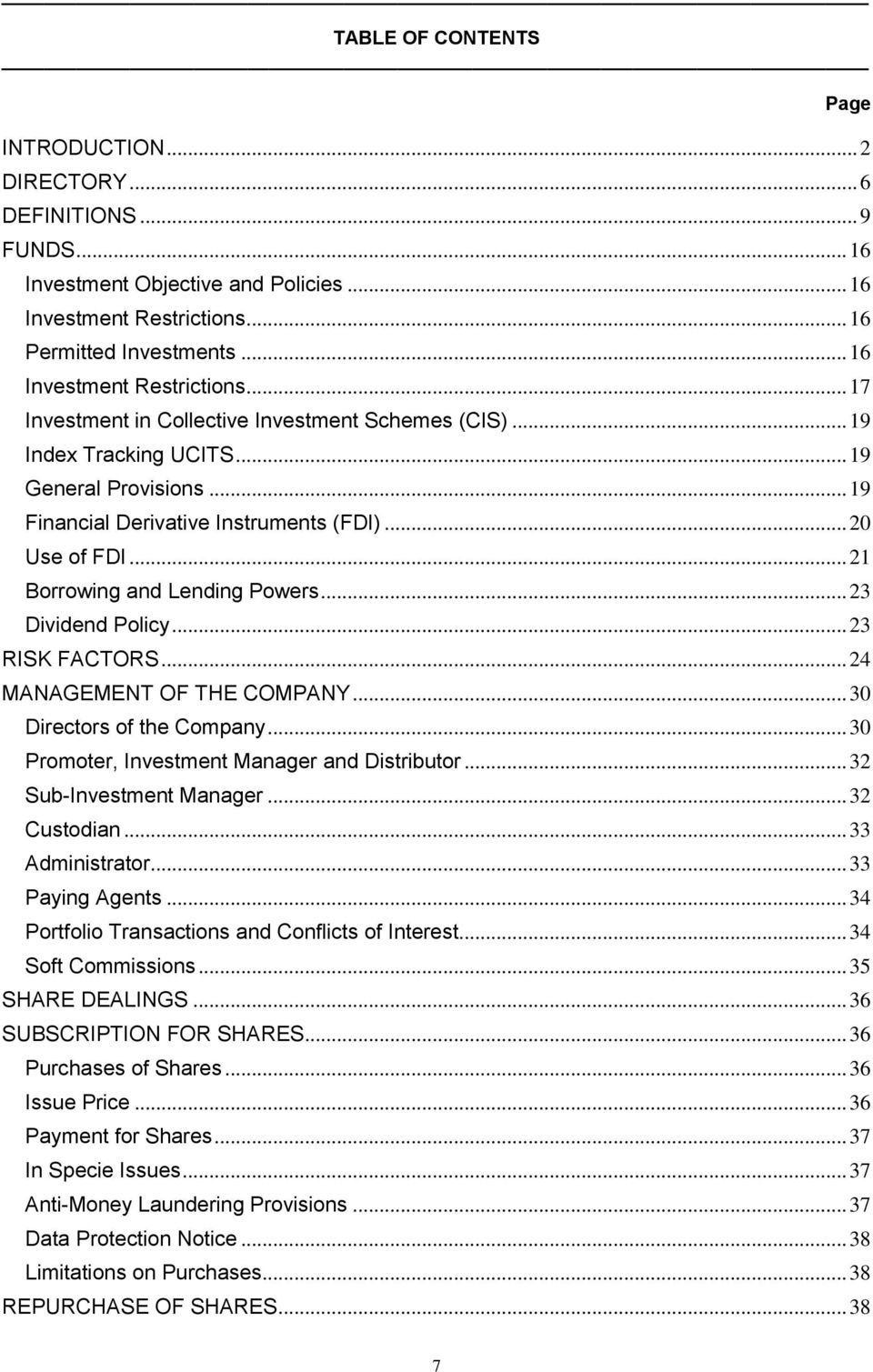
9 TABLE OF CONTENTS Page INTRODUCTION... 2 DIRECTORY... 6 DEFINITIONS... 9 FUNDS Investment Objective and Policies Investment Restrictions Permitted Investments Investment Restrictions Investment in Collective Investment Schemes (CIS) Index Tracking UCITS General Provisions Financial Derivative Instruments (FDI) Use of FDI Borrowing and Lending Powers Dividend Policy RISK FACTORS MANAGEMENT OF THE COMPANY Directors of the Company Promoter, Investment Manager and Distributor Sub-Investment Manager Custodian Administrator Paying Agents Portfolio Transactions and Conflicts of Interest Soft Commissions SHARE DEALINGS SUBSCRIPTION FOR SHARES Purchases of Shares Issue Price Payment for Shares In Specie Issues Anti-Money Laundering Provisions Data Protection Notice Limitations on Purchases REPURCHASE OF SHARES
10 Repurchases of Shares Repurchase Price Payment of Repurchase Proceeds Limitations on Repurchases Mandatory Repurchases Anti-Dilution Levy Exchange of Shares Limitations on Exchange Form of Shares, Share Certificates and Transfer of Shares Notification of Prices Calculation of Net Asset Value/Valuation of Assets Suspension of Calculation of Net Asset Value FEES AND EXPENSES TAXATION General Ireland United Kingdom Taxation in the U.S Other Jurisdictions GENERAL INFORMATION Reports and Accounts Directors Confirmation Commencement of Business Incorporation and Share Capital Memorandum and Articles of Association Litigation and Arbitration Directors Interests Material Contracts Miscellaneous Documents for Inspection APPENDIX I APPENDIX II

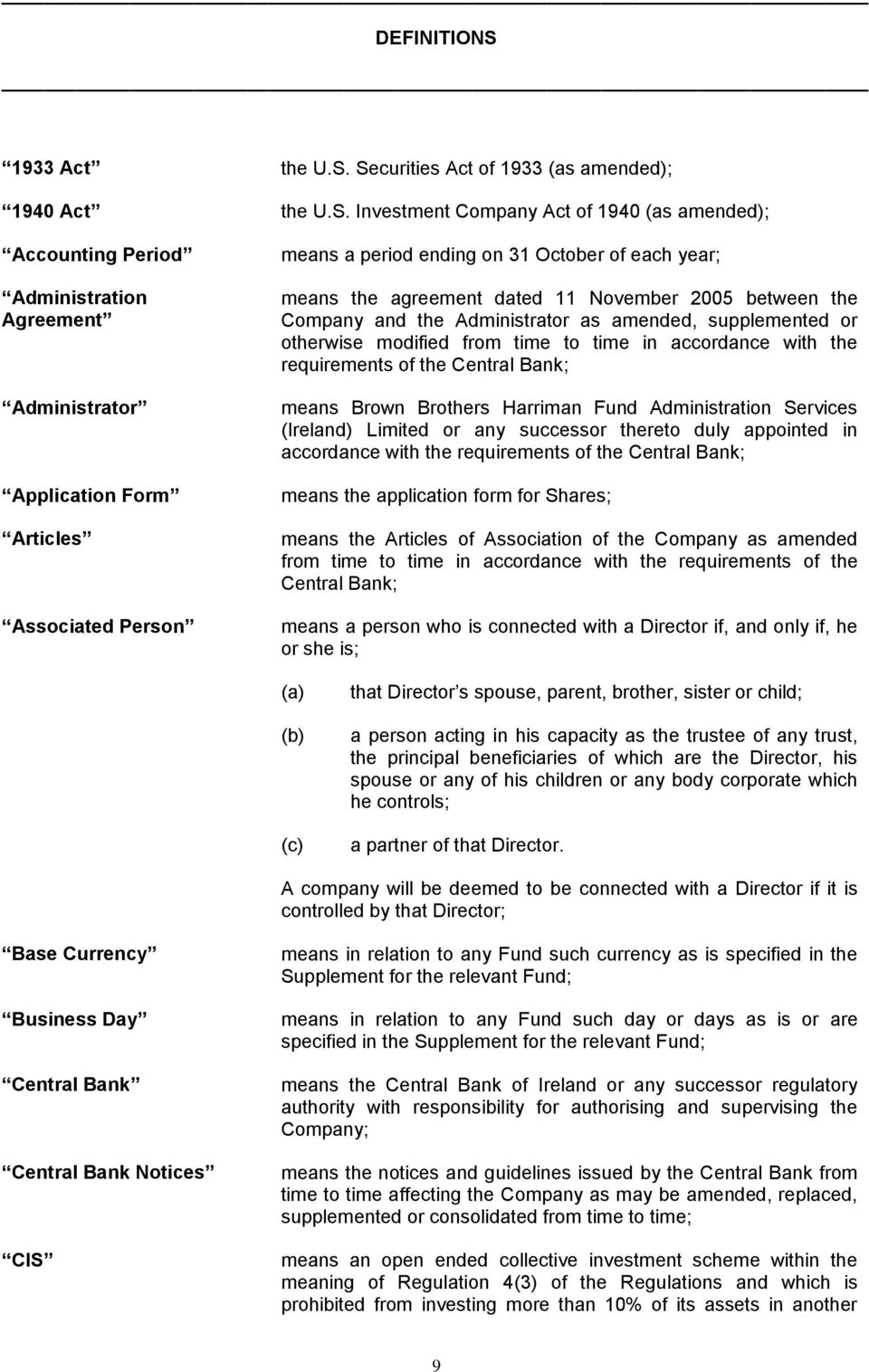
11 DEFINITIONS 1933 Act the U.S. Securities Act of 1933 (as amended); 1940 Act the U.S. Investment Company Act of 1940 (as amended); Accounting Period Administration Agreement Administrator Application Form Articles Associated Person means a period ending on 31 October of each year; means the agreement dated 11 November 2005 between the Company and the Administrator as amended, supplemented or otherwise modified from time to time in accordance with the requirements of the Central Bank; means Brown Brothers Harriman Fund Administration Services (Ireland) Limited or any successor thereto duly appointed in accordance with the requirements of the Central Bank; means the application form for Shares; means the Articles of Association of the Company as amended from time to time in accordance with the requirements of the Central Bank; means a person who is connected with a Director if, and only if, he or she is; (a) (b) (c) that Director s spouse, parent, brother, sister or child; a person acting in his capacity as the trustee of any trust, the principal beneficiaries of which are the Director, his spouse or any of his children or any body corporate which he controls; a partner of that Director. A company will be deemed to be connected with a Director if it is controlled by that Director; Base Currency Business Day Central Bank Central Bank Notices CIS means in relation to any Fund such currency as is specified in the Supplement for the relevant Fund; means in relation to any Fund such day or days as is or are specified in the Supplement for the relevant Fund; means the Central Bank of Ireland or any successor regulatory authority with responsibility for authorising and supervising the Company; means the notices and guidelines issued by the Central Bank from time to time affecting the Company as may be amended, replaced, supplemented or consolidated from time to time; means an open ended collective investment scheme within the meaning of Regulation 4(3) of the Regulations and which is prohibited from investing more than 10% of its assets in another 9
12 such collective investment scheme; Class Code Company Connected Person Currency Class Custodian Agreement Custodian Dealing Day Dealing Deadline Directors Distribution Agreement Distributor EEA Member State EEA Emerging Market Country EU means any class of Shares each representing interests in Fund; means the US Internal Revenue Code of 1986, as amended; means Brown Advisory Funds plc; means the persons defined as such in the section headed Portfolio Transactions and Conflicts of Interest ; means the currency of denomination of a Class; means the agreement dated 11 November 2005 between the Company and the Custodian as amended, supplemented or otherwise modified from time to time in accordance with the requirements of the Central Bank; means Brown Brothers Harriman Trustee Services (Ireland) Limited or any other person or persons for the time being duly appointed Custodian in succession to the said Brown Brothers Harriman Trustee Services (Ireland) Limited subject to the approval of the Central Bank; means in respect of each Fund such Business Day or Business Days as is or are specified in the Supplement for the relevant Fund provided that there shall be at least two Dealing Days for each Fund in each Month carried out at regular intervals; means in relation to applications for subscription, repurchase or exchange of Shares in a Fund, the day and time specified in the Supplement for the relevant Fund; means the directors of the Company, each a Director; means the agreement dated 17 December 2007 (as novated by a novation agreement dated 27 March 2012 (effective 23 February 2012) between the Distributor and the Company as amended, supplemented, or otherwise modified from time to time in accordance with the requirements of the Central Bank; means Brown Advisory LLC or such other entity as may be duly appointed by the Directors in accordance with the requirements of the Central Bank as the distributor of the Company or a Fund, the details of such Distributor and its relevant agreement with the Investment Manager and/or the Company (where appropriate) being set out in the relevant Supplement; means a member state of the EEA; means European Economic Area (the current members being: the EU Member States, Iceland, Liechtenstein and Norway); means any country having an economy or market that is considered by the international monetary fund or world bank to be developing or is a recent (within 2 years) or current index member in the MSCI Emerging Markets Index; means the European Union; 10

13 EU Member State Euro or Exchange Charge FATCA or Foreign Account Tax Compliance Act FCA FDI Financial Account Financial Institution Fund Guidance Note 3/03 Hedged Share Class Initial Issue Price Initial Offer Period Investment Grade Investment Management Agreement means a member state of the EU; means the lawful currency of the European Monetary Union member states from time to time; means the charge, if any, payable on the exchange of Shares as is specified herein; means sections 1471 through 1474 of the Code, any current or future regulations or official interpretations thereof, and any agreement entered into pursuant to Section 1471(b) of the Code, or any fiscal or regulatory legislation, rules or practices adopted pursuant to any intergovernmental agreement entered into in connection with the implementation of these Sections of the Code; means the Financial Conduct Authority in the United Kingdom; means a financial derivative instrument permitted by the Regulations; means a Financial Account as used in the intergovernmental agreement between the United States and Ireland for the purposes of FATCA; means a Financial Institution as defined in FATCA; means a separate portfolio of assets which is invested in accordance with the investment objective and policies set out in the relevant Supplement and to which all liabilities, income and expenditure attributable or allocated to such fund shall be applied and charged and Funds means all or some of the Funds as the context requires or any other funds as may be established by the Company from time to time with the prior approval of the Central Bank; means the Guidance Note 3/03 issued by the Central Bank entitled UCITS Financial Derivative Instruments as may be amended, replaced, supplemented or consolidated from time to time; means a Class which is not denominated in the Base Currency of a Fund to which a currency hedging strategy is applied. means the price (excluding any Preliminary Charge) per Share at which Shares are initially offered in a Fund during the Initial Offer Period as specified in the Supplement for the relevant Fund; means the period during which Shares in a Fund are initially offered at the Initial Issue Price as specified in the Supplement for the relevant Fund; means (i) a rating of BB/Ba or higher, by Standard & Poor s ( S&P ) or Moody s Investment Services ( Moody s ), respectively or (ii) unrated but determined by the Investment Manager to be of comparable quality. means the agreement dated 11 November 2005 between the Company and Brown Investment Advisory Incorporated as novated by a novation agreement dated 27 March 2012 (effective 23 February 2012) between the Company, Brown Investment Advisory Incorporated and the Investment Manager as further amended, supplemented or otherwise modified from time to time in 11

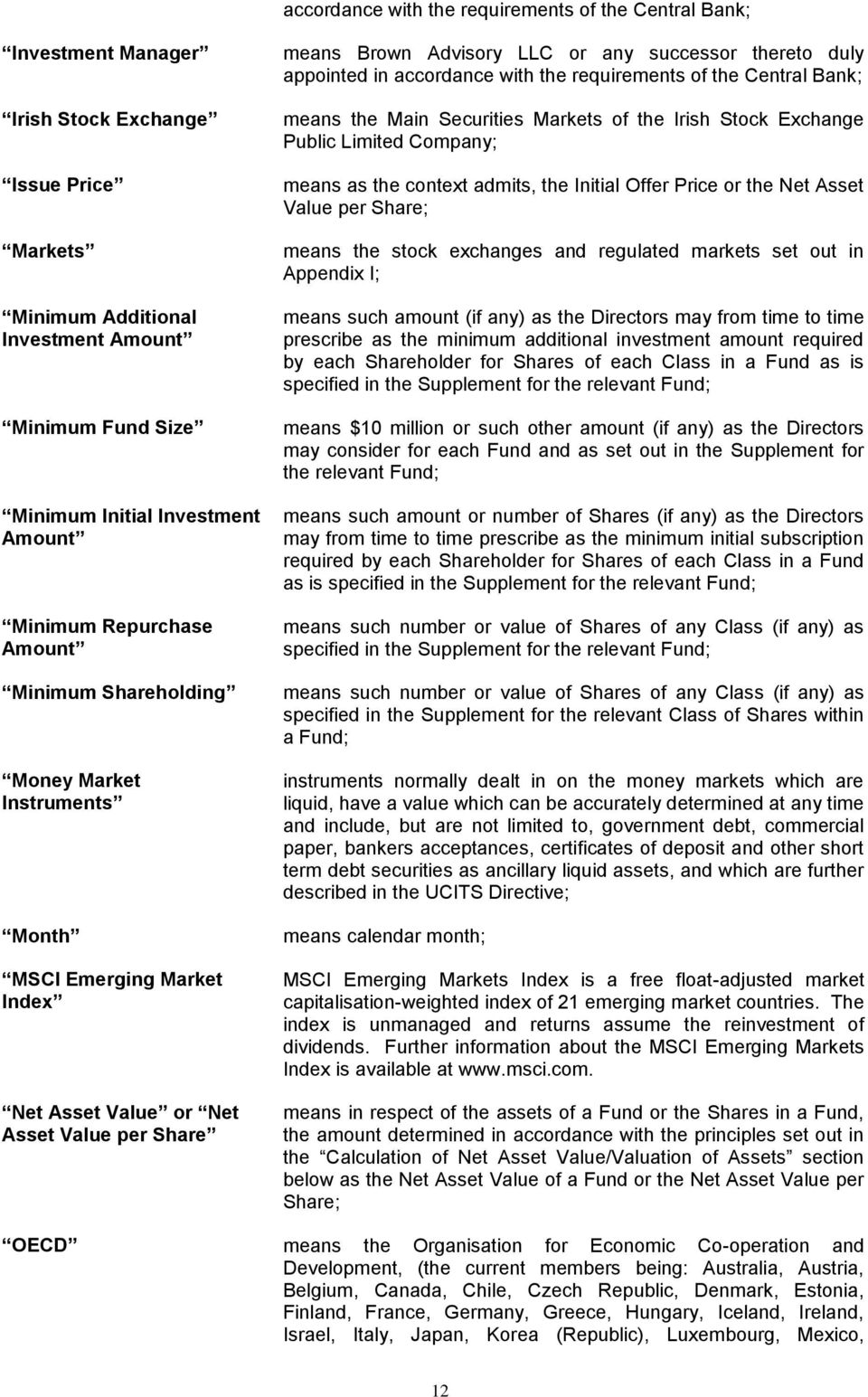
14 accordance with the requirements of the Central Bank; Investment Manager Irish Stock Exchange Issue Price Markets Minimum Additional Investment Amount Minimum Fund Size Minimum Initial Investment Amount Minimum Repurchase Amount Minimum Shareholding Money Market Instruments Month MSCI Emerging Market Index Net Asset Value or Net Asset Value per Share means Brown Advisory LLC or any successor thereto duly appointed in accordance with the requirements of the Central Bank; means the Main Securities Markets of the Irish Stock Exchange Public Limited Company; means as the context admits, the Initial Offer Price or the Net Asset Value per Share; means the stock exchanges and regulated markets set out in Appendix I; means such amount (if any) as the Directors may from time to time prescribe as the minimum additional investment amount required by each Shareholder for Shares of each Class in a Fund as is specified in the Supplement for the relevant Fund; means $10 million or such other amount (if any) as the Directors may consider for each Fund and as set out in the Supplement for the relevant Fund; means such amount or number of Shares (if any) as the Directors may from time to time prescribe as the minimum initial subscription required by each Shareholder for Shares of each Class in a Fund as is specified in the Supplement for the relevant Fund; means such number or value of Shares of any Class (if any) as specified in the Supplement for the relevant Fund; means such number or value of Shares of any Class (if any) as specified in the Supplement for the relevant Class of Shares within a Fund; instruments normally dealt in on the money markets which are liquid, have a value which can be accurately determined at any time and include, but are not limited to, government debt, commercial paper, bankers acceptances, certificates of deposit and other short term debt securities as ancillary liquid assets, and which are further described in the UCITS Directive; means calendar month; MSCI Emerging Markets Index is a free float-adjusted market capitalisation-weighted index of 21 emerging market countries. The index is unmanaged and returns assume the reinvestment of dividends. Further information about the MSCI Emerging Markets Index is available at means in respect of the assets of a Fund or the Shares in a Fund, the amount determined in accordance with the principles set out in the Calculation of Net Asset Value/Valuation of Assets section below as the Net Asset Value of a Fund or the Net Asset Value per Share; OECD means the Organisation for Economic Co-operation and Development, (the current members being: Australia, Austria, Belgium, Canada, Chile, Czech Republic, Denmark, Estonia, Finland, France, Germany, Greece, Hungary, Iceland, Ireland, Israel, Italy, Japan, Korea (Republic), Luxembourg, Mexico, 12
15 Netherlands, New Zealand, Norway, Poland, Portugal, Slovak (Republic), Slovenia, Spain, Sweden, Switzerland, Turkey, United Kingdom and United States; OTC derivative Paying Agent Preliminary Charge Promoter Regulation 4(3) Regulations Repurchase Charge SEC Settlement Date Shareholders Shares Sub-Investment Management Agreement Sub-Investment Manager Supplement TCA means a financial derivative instrument permitted by the Regulations which is dealt in over the counter; means such entity as may be duly appointed by the Company or its delegate in accordance with the requirements of the Central Bank as the paying agent of the Company or a Fund. means in respect of a Fund, the charge payable (if any) on the subscription price for Shares as is specified in the Supplement for the relevant Fund; means Brown Advisory LLC; means clause 4(3) of the Regulations; means the European Communities (Undertakings for Collective Investment in Transferable Securities) Regulations, 2011 (Statutory Instrument No. 352 of 2011) as amended, supplemented, consolidated or otherwise modified from time to time including any condition that may from time to time be imposed thereunder by the Central Bank; means in respect of a Fund, the charge payable (if any), out of the gross repurchase price for Shares as is specified in the Supplement for the relevant Fund; means U.S. Securities and Exchange Commission; means in respect of receipt of monies for subscription for Shares or dispatch of monies for the repurchase of Shares, the date specified in the Supplement for the relevant Fund. In the case of repurchases this date will be no more than ten Business Days after the relevant Dealing Deadline, or if later, the receipt of completed repurchase documentation including relevant anti-money laundering documentation; means holders of Shares and each a Shareholder; means participating shares in the Company representing interests in a Fund and where the context so permits or requires any Class of participating shares representing interests in a Fund; an agreement between the Investment Manager and a Sub- Investment Manager to whom the assets of a Fund (or a proportion thereof) are allocated as set out in the Supplement for the relevant Fund and as may be amended from time to time; the person or persons appointed by the Investment Manager pursuant to a Sub-Investment Management Agreement as set out in the Supplement for the relevant Fund and as may be amended from time to time; means any supplement to the Prospectus issued on behalf of the Company from time to time; means the Irish Taxes Consolidation Act, 1997, as amended; 13

16 Transferable Securities Means 1. shares in companies and other securities equivalent to shares in companies; 2. bonds and other forms of securitised debt; 3. other negotiable securities which carry the right to acquire any such transferable securities by subscription or exchange, other than the techniques and instruments referred to in regulation 48A of the Regulations; and 4. such securities as specified for the purposes of Part 2, Schedule 2 of the Regulations; UCITS means an undertaking for collective investment in transferable securities which is authorised under the Regulations or authorised by a competent authority in another member state of the European Union in accordance with Council Directives 2009/65/EC, as amended, supplemented, consolidated or otherwise modified from time to time: 1. the sole object of which is the collective investment in transferable securities and/or in other liquid financial instruments of capital raised from the public and which operates on the principle of risk-spreading; and 2. the shares of which are, at the request of holders, repurchased or redeemed, directly or indirectly, out of that undertaking s assets; U.S. Person U.S. Reportable Account U.S. Reportable Person U.S. Taxpayer UCITS Directive United Kingdom and UK United States and U.S. US Dollars, Dollars and $ Valuation Point means a U.S. Person as defined in Appendix II herein; means a Financial Account held by a U.S. Reportable Person; means (i) a U.S. Taxpayer who is not an Excluded U.S. Taxpayer or (ii) a Passive U.S. Controlled Foreign Entity. See Appendix II for a complete definition of U.S. Reportable Person, Excluded U.S. Taxpayer, and Passive U.S. Controlled Foreign Entity; means a U.S. Taxpayer as defined in Appendix II herein; and means the EC Council Directive 2009/65/EC of 13 July 2009 on the co-ordination of Laws, Regulations and administrative provisions relating to UCITS as amended, supplemented or replaced from time to time; means the United Kingdom of Great Britain and Northern Ireland; means the United States of America, (including each of the states, the District of Columbia and the Commonwealth of Puerto Rico) its territories, possessions and all other areas subject to its jurisdiction; means the lawful currency of the United States or any successor currency; means the day and time(s) with reference to which the Net Asset Value per Share are calculated as is specified in the Supplement for the relevant Fund provided that there shall be at least two 14

17 Valuation Points in every Month. 15

18 FUNDS The Company has segregated liability between its Funds and accordingly any liability incurred on behalf of or attributable to any Fund shall be discharged solely out of the assets of that Fund. Investment Objective and Policies The Articles provide that the investment objective and policies for each Fund will be formulated by the Directors at the time of the creation of that Fund. Details of the investment objective and policies for each Fund of the Company appear in the Supplement for the relevant Fund. Any change in the investment objective or any material change to the investment policies of a Fund as disclosed in the relevant Supplement may only be made with the prior written approval of all Shareholders or approval on the basis of a majority of votes cast at a general meeting of the Shareholders of the Fund. In the event of a change of investment objective and/or policies on the basis of a majority of votes cast at a general meeting of Shareholders of a Fund, a reasonable notification period must be given to each Shareholder of the Fund to enable a Shareholder to have its Shares repurchased prior to the implementation of such change. Pending investment of the proceeds of a placing or offer of Shares or where market or other factors so warrant, a Fund may, subject to the investment restrictions set out under the heading Investment Restrictions below, invest in cash deposits, Money Market Instruments and in short-term securities such as commercial paper, bankers acceptances, certificates of deposit, and government securities issued by an OECD member country or by any supranational entity provided that the securities are listed, traded or dealt in on a Regulated Market in an OECD member country and are rated Investment Grade or better. Under the rules of the Irish Stock Exchange, in the absence of unforeseen circumstances, the investment objective and policies for each Fund must be adhered to for at least three years following the admission of the Shares of the relevant Fund to the official list and trading on the main securities market of the Irish Stock Exchange. The rules also provide that any material change in the investment objective of a Fund or its policies during the said period may only be made with the approval of the Irish Stock Exchange and an ordinary resolution of the Shareholders of the relevant Fund. Investment Restrictions The investment restrictions applying to each Fund of the Company under the Regulations are set out below. These are, however, subject to the qualifications and exemptions contained in the Regulations and in the Central Bank Notices. Any additional investment restrictions for other Funds will be formulated by the Directors at the time of the creation of such Fund and detailed in the relevant Supplement. The Directors may from time to time impose such further investment restrictions as shall be compatible with or in the interest of the Shareholders. 1. Permitted Investments Investments of a Fund are confined to: 1.1 transferable securities and Money Market Instruments which are either admitted to official listing on a stock exchange in an EU Member State or non-eu Member State or which are dealt on a market which is regulated, operates regularly, is recognised and open to the public in an EU Member State or non-eu Member State. 1.2 recently issued transferable securities which will be admitted to official listing on a stock exchange or other market (as described above) within a year. 16

19 1.3 Money Market Instruments, as defined in the Central Bank Notices, other than those dealt on a regulated market. 1.4 units of UCITS. 1.5 units of non-ucits as set out in the Central Bank s Guidance Note 2/ deposits with credit institutions as prescribed in the Central Bank Notices. 1.7 financial derivative instruments as prescribed in the Central Bank Notices. 2. Investment Restrictions 2.1 A Fund may invest no more than 10% of net assets in transferable securities and Money Market Instruments other than those referred to in paragraph A Fund may invest no more than 10% of net assets in recently issued transferable securities which will be admitted to official listing on a stock exchange or other market (as described in paragraph 1.1) within a year. This restriction will not apply in relation to investment by the Fund in certain US securities known as Rule 144A securities provided that: the securities are issued with an undertaking to register with the US Securities and Exchanges Commission within one year of issue; and the securities are not illiquid securities i.e. they may be realised by the Fund within seven days at the price, or approximately at the price, at which they are valued by the Fund. 2.3 A Fund may invest no more than 10% of net assets in transferable securities or Money Market Instruments issued by the same body provided that the total value of transferable securities and Money Market Instruments held in the issuing bodies in each of which it invests more than 5% is less than 40%. 2.4 Subject to the prior approval of the Central Bank, the limit of 10% (in 2.3) is raised to 25% in the case of bonds that are issued by a credit institution which has its registered office in an EU Member State and is subject by law to special public supervision designed to protect bond-holders. If a Fund invests more than 5% of its net assets in these bonds issued by one issuer, the total value of these investments may not exceed 80% of the Net Asset Value of the Fund. 2.5 The limit of 10% (in 2.3) is raised to 35% if the transferable securities or Money Market Instruments are issued or guaranteed by an EU Member State or its local authorities or by a non-eu Member State or public international body of which one or more EU Member States are members. 2.6 The transferable securities and Money Market Instruments referred to in 2.4 and 2.5 shall not be taken into account for the purpose of applying the limit of 40% referred to in A Fund may not invest more than 20% of net assets in deposits made with the same credit institution Deposits with any one credit institution, other than credit institutions authorised in an EEA Member State or credit institutions authorised within a signatory state (other than an EEA Member State) to the Basle Capital Convergence Agreement of July 1988 or credit institutions located in the Channel Islands, Australia or New Zealand held as ancillary liquidity, must not exceed 10% of net assets. This limit may be raised to 20% in the case of deposits made with the Custodian. 17

20 2.8 The risk exposure of a Fund to a counterparty to an over the counter (OTC) derivative may not exceed 5% of net assets This limit is raised to 10% in the case of credit institutions authorised in the EEA or credit institutions authorised within a signatory state (other than an EEA Member State) to the Basle Capital Convergence Agreement of July, 1988 or a credit institution authorised in Jersey, Guernsey, the Isle of Man, Australia or New Zealand. 2.9 Notwithstanding paragraphs 2.3, 2.7 and 2.8 above, a combination of two or more of the following issued by, or made or undertaken with, the same body may not exceed 20% of net assets: investments in transferable securities or Money Market Instruments; deposits, and/or risk exposures arising from OTC derivatives transactions The limits referred to in 2.3, 2.4, 2.5, 2.7, 2.8 and 2.9 above may not be combined, so that exposure to a single body shall not exceed 35% of net assets Group companies are regarded as a single issuer for the purposes of 2.3, 2.4, 2.5, 2.7, 2.8 and 2.9 However, a limit of 20% of net assets may be applied to investment in transferable securities and Money Market Instruments within the same group A Fund may invest up to 100% of net assets in different transferable securities and Money Market Instruments issued or guaranteed by any EU Member State, its local authorities, non-eu Member States or public international bodies of which one or more EU Member States are members or by Australia, Canada, Hong Kong, Japan, New Zealand, Switzerland, United States or any of the following: OECD Governments, excluding those listed above (provided the relevant issues are investment grade) European Investment Bank European Bank for Reconstruction and Development International Finance Corporation International Monetary Fund Euratom The Asian Development Bank European Central Bank Council of Europe Eurofima African Development Bank International Bank for Reconstruction and Development (The World Bank) The Inter American Development Bank European Union Federal National Mortgage Association (Fannie Mae) Federal Home Loan Mortgage Corporation (Freddie Mac) Government National Mortgage Association (Ginnie Mae) Student Loan Marketing Association (Sallie Mae) Federal Home Loan Bank Federal Farm Credit Bank Tennessee Valley Authority Straight A Funding LLC The Fund must hold securities from at least 6 different issues, with securities from any one issue not exceeding 30% of net assets. 18
21 3. Investment in Collective Investment Schemes (CIS) 3.1 A Fund may not invest more than 10% of net assets in any one CIS which include exchange traded funds. 3.2 Investment in CIS (either UCITS or non-ucits) may not, in aggregate, exceed 10% of net assets of any Fund. 3.3 The CIS are prohibited from investing more than 10% of its net assets in other CIS. 3.4 When a Fund invests in the units of other CIS that are managed, directly or by delegation, by the Fund s management company or by any other company with which the Fund s management company is linked by common management or control, or by a substantial direct or indirect holding, that management company or other company may not charge subscription, conversion or redemption fees on account of the Fund s investment in the units of such other CIS. 3.5 Where a commission (including a rebated commission) is received by the Fund s manager/investment manager/investment adviser by virtue of an investment in the units of another CIS, this commission must be paid into the property of the Fund. 4. Index Tracking UCITS 4.1 A Fund may invest up to 20% of net assets in shares and/or debt securities issued by the same body where the investment policy of the Fund is to replicate an index which satisfies the criteria set out in the Central Bank Notices and is recognised by the Central Bank. 4.2 The limit in 4.1 may be raised to 35%, and applied to a single issuer, where this is justified by exceptional market conditions. 5. General Provisions 5.1 An investment company, or management company acting in connection with all of the CIS it manages, may not acquire any shares carrying voting rights which would enable it to exercise significant influence over the management of an issuing body. 5.2 A Fund may acquire no more than: % of the non-voting shares of any single issuing body; % of the debt securities of any single issuing body; % of the units of any single CIS; % of the Money Market Instruments of any single issuing body. The limits laid down in 5.2.2, and above may be disregarded at the time of acquisition if at that time the gross amount of the debt securities or of the Money Market Instruments, or the net amount of the securities in issue cannot be calculated and 5.2 shall not be applicable to: transferable securities and Money Market Instruments issued or guaranteed by an EU Member State or its local authorities; transferable securities and Money Market Instruments issued or guaranteed by a non-eu Member State; transferable securities and Money Market Instruments issued by public international bodies of which one or more EU Member States are members; 19
22 5.3.4 shares held by a Fund in the capital of a company incorporated in a non-eu member State which invests its assets mainly in the securities of issuing bodies having their registered offices in that State, where under the legislation of that State such a holding represents the only way in which the Fund can invest in the securities of issuing bodies of that State. This waiver is applicable only if in its investment policies the company from the non-eu Member State complies with the limits laid down in 2.3 to 2.11, 3.1, 3.2, 5.1, 5.2, 5.4, 5.5 and 5.6 and provided that where these limits are exceeded, paragraphs 5.5 and 5.6 below are observed; shares held by an investment company in the capital of subsidiary companies carrying on only the business of management, advice or marketing in the country where the subsidiary is located, in regard to the repurchase of units at unit-holders request exclusively on their behalf. 5.4 The Company need not comply with the investment restrictions herein when exercising subscription rights attaching to transferable securities or Money Market Instruments which form part of their assets. 5.5 The Central Bank may allow recently authorised Funds to derogate from the provisions of 2.3 to 2.12, 3.1, and 4.2 for six months following the date of their authorisation, provided they observe the principle of risk spreading. 5.6 If the limits laid down herein are exceeded for reasons beyond the control of the Company, or as a result of the exercise of subscription rights, the Company must adopt as a priority objective for its sales transactions the remedying of that situation, taking due account of the interests of its shareholders. 5.7 Neither the Company nor a Fund, may carry out uncovered sales of: transferable securities; Money Market Instruments; units of CIS; or financial derivative instruments. 5.8 A Fund may hold ancillary liquid assets. 6. Financial Derivative Instruments (FDI) 6.1 A Fund s global exposure (as prescribed by the Central Bank Notices) relating to FDI must not exceed its total Net Asset Value. 6.2 Position exposure to the underlying assets of FDI, including embedded FDI in transferable securities or Money Market Instruments, when combined where relevant with positions resulting from direct investments, may not exceed the investment limits set out in the Central Bank Notices. (This provision does not apply in the case of index based FDI provided the underlying index is one which meets with the criteria set out in the Central Bank Notices.) 6.3 A Fund may invest in FDI dealt in over-the-counter (OTC) provided that the counterparties to over-the-counter (OTCs) are institutions subject to prudential supervision and belonging to categories approved by the Central Bank. 6.4 Investment in FDI are subject to the conditions and limits laid down by the Central Bank. It is intended that each Fund should have the power to avail of any change in the law, Regulations or guidelines which would permit investment in assets and securities on a wider basis in accordance with the requirements of the Central Bank. 20
23 Use of FDI The Company may, on behalf of a Fund and subject to the conditions and within the limits laid down by the Central Bank, employ techniques and instruments relating to transferable securities and/or other financial instruments in which it invests for investment or hedging purposes, (to protect the Fund s unrealised gains by hedging against possible adverse fluctuations in the securities markets or changes in interest rates or currency exchange rates that may reduce the market value of the Fund s investment portfolio) or for the purposes of efficient portfolio management. Full details, including a description of the relevant instruments and the purpose for which they will be utilised shall be, where applicable, set out in the relevant Supplement. Where a Fund invests in FDI for investment or hedging purposes or for the purposes of efficient portfolio management, a risk management process will be submitted to the Central Bank by the Company, prior to the Fund engaging in such transactions in accordance with the Central Bank s requirements as such are set out in Guidance Note 3/03. The Company on behalf of the Fund will on request provide supplementary information to Shareholders relating to the risk management methods employed, including the quantitative limits that are applied and any recent developments in the risk and yield characteristics of the main categories of investments. The Company may engage in such techniques for the reduction of risk, cost or the generation of additional capital or income for each Fund with an appropriate level of risk, taking into account the risk profile of the Company as described in this Prospectus and the general provisions of the Regulations. The use of techniques for efficient portfolio management is not expected to raise the risk profile of a Fund or result in higher volatility. As is required to be disclosed in this Prospectus by UCITS Notice 12.7, all revenues from efficient portfolio management techniques, net of direct and indirect operational costs, will be returned to the relevant Fund. Direct and indirect operational costs and fees arising from efficient portfolio management techniques (which shall not include hidden revenue) will be paid to the counterparty to the agreement, who shall not be related to the Company, Investment Manager or the Custodian. Forward Foreign Exchange Contracts A forward foreign exchange contract is a contractually binding obligation to purchase or sell a particular currency at a specified date in the future. Forward foreign exchange contracts are not uniform as to the quantity or time at which a currency is to be delivered and are not traded on exchanges. Rather, they are individually negotiated transactions. Forward foreign exchange contracts are effected through a trading system known as the interbank market. It is not a market with a specific location but rather a network of participants electronically linked. Documentation of transactions generally consists of an exchange of telex or facsimile messages. There is no limitation as to daily price movements on this market and in exceptional circumstances there have been periods during which certain banks have refused to quote prices for forward foreign exchange contracts or have quoted prices with an unusually wide spread between the price at which the bank is prepared to buy and that at which it is prepared to sell. Transactions in forward foreign exchange contracts are not regulated by any regulatory authority nor are they guaranteed by an exchange or clearing house. If the Fund uses such contracts, it will be subject to the risk of the inability or refusal of its counterparties to perform with respect to such contracts. Any such default would eliminate any profit potential and compel the Fund to cover its commitments for resale or repurchase, if any, at the then current market price. These events could result in significant losses. Futures and Options on Futures A Fund may enter into futures contracts (including contracts for difference) and options on futures contracts, which involve the purchase or sale of a contract to buy or sell a specified security or other financial instrument at a specific future date and price on an exchange or the over-the-counter ( OTC ) market. A Fund may enter into such contracts as a substitute for taking a position in any underlying asset or to increase returns. 21
24 Options A Fund may purchase call and put options and write (i.e. sell) covered call and put option contracts in accordance with its investment objective and policies. A call option is a contract sold for a price giving its holder the right to buy a specific number of securities at a specific price prior to a specified date. A covered call option is a call option issued on securities already owned by the writer of the call option for delivery to the holder upon the exercise of the option. A put option gives the purchaser of the option the right to sell, and obligates the writer to buy, the underlying securities at the exercise price at any time during the option period. A put option sold by a Fund is covered when, among other things, a Fund segregates permissible liquid assets having a value equal to or greater than the exercise price of the option to fulfill the obligation undertaken or otherwise covers the transaction. A Fund may purchase and sell call and put options in respect of specific securities (or groups or baskets of specific securities) or securities indices, currencies (as described in more detail above) or futures. A Fund also may enter into OTC options contracts, which are available for a greater variety of securities, and a wider range of expiration dates and exercise prices, than are exchange-traded options. Successful use by a Fund of options and options on futures will depend on the Investment Manager s ability to predict correctly movements in the prices of individual securities, the relevant securities market generally, non-u.s. currencies or interest rates. Risk Management The Investment Manager operates a risk management process on behalf of the Funds in relation to the use of FDI which allows it to accurately measure, monitor and manage the various risks associated with FDI and other investments, and which is intended to ensure that the Fund s investments including FDI exposure remains within the limits described below. This risk management process also takes into account any exposure created through FDI embedded in investments held by the Funds. The risk management process is a statement, a copy of which has been filed with the Central Bank, and which will be updated from time to time to include any additional FDI which the Investment Manager proposes to employ on behalf of the Funds ( Risk Management Process ). Until such time as the risk management statement has been updated, however, the Investment Manager will not use any FDI which is not for the time being included in the Risk Management Process. Currency Class Hedging Strategy A currency hedging strategy is used for efficient portfolio management purposes effectively to hedge against movements in the values of Hedged Share Classes as a result of changes in the exchange rates against US Dollar of the respective currencies. The currency hedging strategy involves utilising forward foreign exchange contracts to provide a return hedged against fluctuations. This currency hedging policy will seek to limit a Shareholder s risk of loss arising from an appreciation in the value of the currency of the Hedged Share Class relative to the value of the US Dollar. A Fund may attempt to hedge a Hedged Share Class against the currency fluctuations. While not the intention, over-hedged and under-hedged positions may arise due to factors outside the control of a Fund. Over-hedged positions are not permitted to exceed 105% of the Net Asset Value of the relevant Hedged Share Class. Hedged positions are kept under review to ensure that over-hedged positions do not exceed the permitted level. This review also incorporates a procedure to ensure that positions materially in excess of 100% will not be carried forward month to month. Transaction costs are clearly attributable to a specific Hedged Share Class and the costs and gains or losses of the hedged transaction will accrue solely to the relevant Hedged Share Class. To the extent that hedging is successful, the performance of a Hedged Share Class is likely to move in line with the performance of the underlying assets and investors in a Hedged Share Class will not benefit if the Currency Class falls against the Base Currency. Fund/Portfolio Currency Hedging Strategy Each Fund generally operates the investment portfolio in US Dollar, which shall constitute the Base Currency of the Funds. As long as a Fund holds securities or currencies denominated in a currency other than the denomination of the Base Currency of a Fund, the value of a Fund may be affected by 22
25 the value of the local currency relative to the currency in which that Fund is denominated. The Company may use currency hedging techniques to remove the currency exposure against the US Dollar as applicable in order to limit currency exposure between the currencies of a Fund s investment portfolio and the Base Currency of a Fund; however, this may not be possible or practicable in all cases. As long as a Fund holds securities denominated in a currency other than the Base Currency of the Fund, the Fund s Net Asset Value will be affected by the value of the local currency relative to the Base Currency. Borrowing and Lending Powers The Company may not borrow money except insofar as is permitted under the Regulations. The Company may borrow, for the account of a Fund, up to 10% of the Net Asset Value of a Fund and the assets of such Fund may be charged as security for any such borrowings provided that such borrowing is only for temporary purposes. The Company may acquire non-u.s currency by means of a back to back loan agreement(s). Non-U.S. currency obtained in this manner is not classified as borrowing for the above mentioned 10% limit provided that the offsetting deposit equals or exceeds the value of the foreign currency loan outstanding. The Company may not carry out uncovered sales of transferable securities, Money Market Instruments and other financial instruments. The Company may not borrow for investment purposes. Without prejudice to the powers of the Company to invest in transferable securities, the Company may not lend, or act as guarantor on behalf of third parties. Any special borrowing restrictions relating to a Fund will be formulated by the Directors and disclosed in the relevant Supplement. There are no special borrowing restrictions currently in operation. Dividend Policy The Directors decide the dividend policy and arrangements relating to each Fund and details are set out where applicable in the relevant Supplement. The Directors intend to operate the distribution policy such as to enable each relevant Class of each Fund to qualify as a reporting fund for the purposes of United Kingdom taxation. Under the Articles, the Directors are entitled to declare dividends out of the profits of the relevant Fund being: (i) the accumulated revenue (consisting of all revenue accrued including interest and dividends) less expenses and/or (ii) realised and unrealised capital gains on the disposal/ valuation of investments and other funds less realised and unrealised accumulated capital losses of the relevant Fund. The Directors may satisfy any dividend due to Shareholders in whole or in part by distributing to them in specie any of the assets of the relevant Fund, and in particular any investments to which the relevant Fund is entitled. In selecting these investments the Directors will consult with the Custodian to ensure that the remaining Shareholders are not disadvantaged. A Shareholder may require the Company instead of transferring any assets in specie to him, to arrange for a sale of the assets and for payment to the Shareholder of the net proceeds of same. The Company will be obliged and entitled to deduct an amount in respect of Irish taxation from any dividend payable to a Shareholder in any Fund who is or is deemed to be an Irish Taxable Person and pay such sum to the Irish tax authorities. Dividends (if any) will be paid in accordance with Irish Stock Exchange policy. Dividends not claimed within six years from their due date will lapse and revert to the relevant Fund. Dividends payable to Shareholders will be paid by electronic transfer to the bank account designated by the Shareholder in which case the dividend will be paid at the expense of the payee and will be paid within four Months of the date the Directors declared the dividend. The dividend policy for each Fund is set out in the Supplement for the relevant Fund. 23
26 RISK FACTORS 1. General The investments of the Company in securities are subject to normal market fluctuations and other risks inherent in investing in securities. The value of investments and the income from them, and therefore the value of and income from Shares relating to each Fund can go down as well as up and an investor may not get back the amount he invests. Changes in exchange rates between currencies or the conversion from one currency to another may also cause the value of the investments to diminish or increase. While the provisions of the Companies Acts provide for segregated liability between Funds, these provisions have yet to be tested in foreign courts, in particular, in satisfying local creditors claims. Accordingly, it is not free from doubt that the assets of any Fund of the Company may not be exposed to the liabilities of other Funds of the Company. As at the date of this Prospectus, the Directors are not aware of any existing or contingent liability of any Fund of the Company. 2. Geographic concentration Where a Fund s investments are concentrated in one particular region, that Fund is more vulnerable to economic, political, regulatory or other developments in that particular region than a more diversified portfolio would be. 3. Segregated Liability Risk The Company is an umbrella company with segregated liability between its Funds. As a result, as a matter of Irish law, any liability attributable to a particular Fund may only be discharged out of the assets of that Fund and the assets of other Funds may not be used to satisfy the liability of that Fund. These provisions are binding both on creditors and in any insolvency but do not prevent the application of any enactment or rule of law which would require the application of the assets of one Fund to discharge some or all liabilities of another Fund, for example, on the grounds of fraud or misrepresentation. In addition, whilst these provisions are binding in an Irish court which would be the primary venue for an action to enforce a debt against the Company, these provisions have not been tested in other jurisdictions, and there remains a possibility that a creditor might seek to attach or seize assets of one Fund in satisfaction of an obligation owed in relation to another Fund in a jurisdiction which may not recognise the principle of segregation of liability between Funds. 4. Custodian Risk Each market may have different clearance and settlement procedures which may make it difficult to conduct securities transactions. A Fund may invest in certain markets in different parts of the world where custodian and/or settlement systems do not recognise legal structures established in other jurisdictions and/or such systems are not fully developed. The assets of a Fund which are traded in such markets and which have been entrusted to subcustodians, in circumstances where the use of such sub-custodians is necessary, may be exposed to risk in circumstances whereby the Custodian will have no liability, in which case the custodial risk will be borne by the Fund. 5. Risk of U.S. Withholding Tax The Company (and each Fund) will be required to comply (or be deemed compliant) with extensive new reporting and withholding requirements (known as FATCA ) designed to inform the U.S. Department of the Treasury of U.S.-owned foreign investment accounts. 24
27 Failure to comply (or be deemed compliant) with these requirements will subject the Company (and each Fund) to U.S. withholding taxes on certain U.S.-sourced income and gains beginning on July 1, Pursuant to an intergovernmental agreement between the United States and Ireland, the Company (and each Fund) may be deemed compliant, and therefore not subject to the withholding tax, if it identifies and reports U.S. Reportable Account information directly to the Irish government. Shareholders may be requested to provide additional information to the Company to enable the Company (and each Fund) to satisfy these obligations. Failure to provide requested information may subject a Shareholder to liability for any resulting U.S. withholding taxes, U.S. tax information reporting and/or mandatory redemption, transfer or other termination of the Shareholder s interest in its Shares. Detailed guidance as to the mechanics and scope of this new reporting and withholding regime is continuing to develop. There can be no assurance as to the timing or impact of any such guidance on future operations of the Company (and each Fund). The administrative cost of compliance with FATCA may cause the operating expenses of the Company (and each Fund) to increase, thereby reducing returns to investors. FATCA may also require the Company (and each Fund) to provide to the U.S. Internal Revenue Service private and confidential information relating to certain investors. See section headed Foreign Account Tax Compliance Act. 6. Change of Law Risk The Company must comply with regulatory constraints, such as a change in the laws affecting the applicable investment restrictions, which might require a change in the investment policies and objectives followed by a Fund. 7. Investment in Cash or Cash Equivalents Each Fund seeks to remain fully invested in accordance with its investment objective. However, in an attempt to respond to adverse market, economic, political, or other conditions, a Fund may take a temporary defensive position by holding some or all of its assets in shortterm investments. These investments include cash, commercial paper, Money Market Instruments, repurchase agreements, and U.S. government securities. A Fund also may hold these types of investments while looking for suitable investment opportunities or to maintain liquidity. Taking a temporary defensive position could prevent the Fund from achieving its investment objective. 8. Emerging Market Country Risk The securities markets of Emerging Markets Countries tend to be less liquid, be especially subject to greater price volatility, have a smaller market capitalisation, and have less government regulation and may not be subject to as extensive and frequent accounting, financial, and other reporting requirements as securities issued in more developed countries. Further, investing in securities issued or guaranteed by emerging market governmental or corporate entities may present a greater risk of loss resulting from problems in security registration and custody or substantial economic, social, or political disruptions. In addition, key information about an issuer, security, or market may be inaccurate or unavailable. Securities clearance, settlement procedures and trading practices may be different, transaction costs may be higher, and there may be less trading volume and liquidity in emerging markets, subjecting the securities traded in them to greater price fluctuations. Investments in emerging markets also may be affected by changes in currency rates or currency controls. With respect to certain non-u.s. countries, there is a possibility of nationalisation, expropriation or confiscatory taxation, imposition of withholding or other taxes, and political or social instability that could affect investments in those countries. 9. Convertible and Other Equity Related Securities Risk Convertible securities are subject to the risks affecting both equity and fixed income securities, including market, credit, liquidity, and interest rate risk. Convertible securities generally offer lower interest or dividend yields than non-convertible securities of similar quality and less potential for gains or capital appreciation in a rising stock market than equity securities. They tend to be more volatile than other fixed income securities, and the markets 25
28 for convertible securities may be less liquid markets for common stocks or bonds. Many convertible securities have below investment grade credit ratings and are subject to increased credit and liquidity risks. Synthetic convertible securities and convertible structured notes may present a greater degree of market risk, and may be more volatile, less liquid and more difficult to price accurately than less complex securities. These factors may cause a Fund to perform poorly compared to other funds, including funds that invest exclusively in fixed income securities. 10. American and Global Depositary Receipts American and global depositary receipts are a representation of a stock, rather than an actual holding in the company and are subject to particular risks such as currency risks, political risk and inflation risk. For example, if the value of the US dollar rises against the value of the company s home currency, a good deal of the company s intrinsic profit might be wiped out in the transaction. American and global depositary receipt status does not insulate a company s stock from the inherent risk of its home country s political stability. Revolution, nationalisation, currency collapse or other potential disasters may be greater risk factors in other parts of the world than in the U.S., and those risks will be clearly translated through any American and global depositary receipt that originates in an affected nation. Countries around the globe may be more or less prone to inflation than the US economy is at any given time. 11. Taxation Shareholders attention is drawn to the taxation risk associated with investing in any Fund of the Company. Any change in the Company s tax status or in taxation legislation could affect the value of the investments held by each Fund and affect each Fund s ability to achieve the investment objective to provide the investor returns. Shareholders should note that the statements on taxation which are set out herein are based on advice which has been received by the Directors regarding the law and practice in force in the relevant jurisdiction as at the date of this Prospectus and each Supplement. As is the case with any investment, there can be no guarantee that the tax position or proposed tax position prevailing at the time an investment is made in the Fund will endure indefinitely. The attention of Shareholders is drawn to the tax risk associated with investing in the Company. See section headed Taxation. 12. Currency Risk The Net Asset Value per Share will be computed in the Base Currency of the relevant Fund, whereas a Fund s investments may be acquired in a wide range of currencies, some of which may be affected by currency movements of a more volatile nature than those of developed countries and some of which may not be freely convertible. It may not be possible or practical to hedge against the consequent currency risk exposure and in certain instances the Investment Manager may consider it desirable not to hedge against such risk. In addition where Shares are denominated in a currency other than the Base Currency, the value of the Shares expressed in such Currency Class will be subject to exchange rate risk in relation to the Base Currency. Hedging strategies employed by the Investment Manager (or any agent appointed by the Investment Manager) may not completely eliminate the exposure to currency movements between the Base Currency of a Fund and the currency in which a Hedged Share Class is denominated. There can be no guarantee that hedging strategies will be successful. Mismatches may result between a currency position held by the Fund and the currency of one or more of the Hedged Share Class issued for the Fund. The use of hedging strategies may substantially limit the extent to which Hedged Share Class Shareholders may benefit if the currency of the Hedged Share Class falls against a Fund s Base Currency and/or the currency of a Fund s investments. The Fund s exposure under currency forwards, nondeliverable forwards or spot currency transactions may, in the case of an extreme change in currency exchange rates, exceed the value of a Fund s Net Asset Value. Spot currency contracts are not traded on exchanges and are not standardised, each transaction is 26
29 negotiated on an individual basis. There is no limitation on daily price movements and speculative position limits are not applicable. The principals who deal in these markets are not required to continue to make markets in the currencies they trade and these markets can experience periods of illiquidity, sometimes of significant duration. It is possible that developments in the market, including potential government regulation, could adversely affect a Fund s ability to terminate existing agreements or to realise amounts to be received under such agreements. 13. Market Risk Some of the recognised exchanges on which a Fund may invest may prove to be illiquid or highly volatile from time to time and this may affect the price at which a Fund may liquidate positions to meet repurchase requests or other funding requirements. Potential investors should also note that the securities of small capitalisation companies are less liquid and this may result in fluctuations in the price of the Shares of the relevant Fund. 14. European Economic Risk The financial and economic crisis affecting certain countries in the European Monetary Union (the Eurozone) and the risk of the crisis spreading to other, more stable, countries within the Eurozone and elsewhere pose risks for the Funds and in particular for holders of Euro denominated Classes of Shares. For example, one or more Eurozone countries may exit the Eurozone and reintroduce their own national currencies. Any such withdrawal could result in, among other things, currency devaluations, restrictions on international movements of capital, and disruption of international trade. One or more countries in the Eurozone could default on their debts or restructure their debts in a manner that disadvantages debt holders. Any such default or restructuring could severely impact holders of the defaulted or restructured debt, including many European and non-european financial institutions, possibly affecting the solvency of these institutions. Any such events could have significant adverse effects on the European and global economies and financial markets that are difficult to predict and could prove difficult or impossible to contain, control or manage. It is even possible that the Euro could be abandoned as the European single currency. This could have severe and lasting negative consequences for the European and global economies, financial markets and political systems. Any such events could have a negative impact on the performance of the Funds. 15. Valuation Risk A Fund may invest a limited proportion of its assets in unquoted securities. Such investment will be valued at the probable realisation value as determined in accordance with the valuation provisions set out in the Calculation of Net Asset Value/Valuation of Assets section below. Estimates of the fair value of such investments are inherently difficult to establish and are the subject of substantial uncertainty. Each Fund may engage in financial derivative instruments in which case there can be no assurance that the valuation as determined in accordance with the valuation provisions set out in the Calculation of Net Asset Value/Valuation of Assets section below reflects the exact amount at which the instrument may be closed out. 16. Risks associated with Financial Derivative Instruments Certain risks associated with the use of FDI are as follows: Market Risk This is a general risk that the value of a particular FDI may change in a way which may be detrimental to a Fund s interests and the use of FDI techniques may not always be an effective means of, and sometimes could be counter-productive to achieving a Fund s investment objective Control and Monitoring 27
30 FDI are highly specialised and require specific techniques and risk analysis. In particular, the use and complexity of FDI require the maintenance of adequate controls to monitor the transactions entered into, the ability to assess the risk that a FDI may add to a Fund and the ability to forecast the relative price, interest rate or currency rate movements correctly Liquidity Risk Liquidity risk exists when a particular instrument is difficult to purchase or sell. If an FDI transaction is particularly large or if the relevant market is illiquid (as is the case with many privately negotiated FDI), it may not be possible to initiate a transaction to liquidate a position at an advantageous price, to assess or value a position or to assess the exposure to risk. An adverse price movement in a FDI position may also require a cash payment to counterparties that might in turn require, if there is insufficient cash available in a Fund, the sale of investments under disadvantageous conditions Counterparty and Settlement Risk A Fund may enter into FDI transactions in over-the-counter markets, which will expose the Fund to the credit of its counterparties and their ability to satisfy the terms of such contracts. A Fund may be exposed to the risk that the counterparty may default on its obligations to perform under the relevant contract. In the event of the bankruptcy or insolvency of a counterparty, a Fund could experience delays in liquidating the position as well as significant losses, including declines in value during the period in which the Fund seeks to enforce its rights, the inability to realise any gains during such period and fees and expenses incurred in enforcing its rights. The fact that the FDI may be entered into over-the-counter, rather than on a regulated market, may increase the potential for loss by a Fund Legal Risk There is a possibility that the agreements governing the FDI techniques may be terminated due, for instance, to supervening illegality or change in the tax or accounting laws relative to those at the time the agreement was originated. There is also a risk if such agreements are not legally enforceable or if the derivative transactions are not documented correctly Other Risks Other risks in using FDI include the risk of differing valuations of FDI arising out of different permitted valuation methods and the inability of FDI to correlate perfectly with underlying securities, rates and indices. Many FDI, in particular over-the-counter FDI, are complex and often valued subjectively and the valuation can only be provided by a limited number of market professionals which often are acting as counterparties to the transaction to be valued. Inaccurate valuations can result in an increased cash payment to counterparties or a loss of value to a Fund. FDI do not always perfectly or even highly correlate or track the value of the securities, rates or indices they are designed to track. Additional risk factors (if any) in respect of each Fund are set out in the Supplement for the relevant Fund. 17. Options A Fund may purchase call or put options. In order for a call option to be profitable, the market price of the underlying security must rise sufficiently above the exercise price to cover the premium and transaction costs. These costs will reduce any profit that might have realised had it bought the underlying security at the time it purchased the call option. For a put option to be profitable, the market price of the underlying security must decline sufficiently below the exercise price to cover the premium and transaction costs. By using put options in this manner, a Fund will reduce any profit it might otherwise have realised from appreciation of the underlying security by the premium paid for the put option and by transaction costs. If a Fund sells a put option, there is a risk that a Fund may be required to buy the underlying asset at a disadvantageous price. If a Fund sells a call option, there is a risk that a Fund may be 28
31 required to sell the underlying asset at a disadvantageous price. If a Fund sells a call option on an underlying asset that a Fund owns and the underlying asset has increased in value when the call option is exercised, a Fund will be required to sell the underlying asset at the call price and will not be able to realise any of the underlying asset s value above the call price. 18. Participatory Notes Participatory notes involve risks that are in addition to the risks normally associated with a direct investment in the underlying equity securities. The Fund is subject to the risk that the issuer of the participatory note (i.e., the issuing bank or broker-dealer), which is the only responsible party under the note, is unable or refuses to perform under the participatory note. While the holder of a participatory note is entitled to receive from the issuing bank or brokerdealer any dividends or other distributions paid on the underlying securities, the holder is not entitled to the same rights as an owner of the underlying securities, such as voting rights. Participatory notes are also not traded on exchanges, are privately issued, and may be illiquid. To the extent a participatory note is determined to be illiquid, it would be subject to the Fund s limitation on investments in illiquid securities. There can be no assurance that the trading price or value of participatory note will equal the value of the underlying value of the equity securities they seek to replicate. 29
32 MANAGEMENT OF THE COMPANY Directors of the Company The Directors of the Company are described below:- MICHAEL D. HANKIN (US Resident) Michael D. Hankin is President and Chief Executive Officer of the Investment Manager. During his career in both the law and the investment advisory business, he has spent over 25 years assisting a wide range of individuals and institutions on their investment and financial matters. Before helping to found Brown Advisory in 1993, he worked extensively with clients as a tax and business law partner with Piper & Marbury (now DLA Piper). Mr. Hankin earned a B.A. and M.A. from Emory University in 1979 where he graduated Summa Cum Laude and Phi Beta Kappa and received a J.D. from The University of Virginia School of Law in He serves in leadership roles for a variety of non-profit organizations with a particular focus on the environment and land conservation, education and health care. Mr. Hankin is Chairman of the Baltimore Waterfront Partnership and Management Authority, the public/private business tax district responsible for the landscaping, clean-up and safety of Baltimore s waterfront. His deep respect for the importance of Johns Hopkins is evidenced by his roles as trustee of Johns Hopkins University, trustee and Vice-Chairman of Johns Hopkins Medicine and Chairman of the Board of Managers of the Applied Physics Lab. He also serves as President of Land Preservation Trust, and is a trustee of the Baltimore Community Foundation, the Chesapeake Conservancy and the Center for Large Landscape Conservation. He is a past Chairman of the Board of Trustees of the Maryland Zoological Society (The Maryland Zoo). PAUL MCNAUGHTON (Chairman and Irish Resident) Paul McNaughton has over 25 years experience in the Banking/Finance, Fund Management & Securities Processing Industries. Mr. McNaughton spent 10 years with IDA (Ireland) both in Dublin and in the USA marketing Ireland as a location for multinational investment. He went on to establish Bank of Ireland s IFSC Fund s business before joining Deutsche Bank to establish their funds business in Ireland. He was overall Head of Deutsche Bank s Offshore Funds business, including their hedge fund administration businesses primarily based in Dublin and the Cayman Islands, before assuming the role of Global Head of Deutsche s Fund Servicing business worldwide. Mr. McNaughton left Deutsche Bank in August 2004 after leading the sale of Deutsche s Global Custody and Funds businesses to State Street Bank. As and from September 2004, Mr. McNaughton acts as an advisor and non-executive director for investment companies and other financial entities in Ireland including alternative/hedge fund entities. Mr. McNaughton holds an Honours Economics Degree from Trinity College Dublin. He was the founding Chairman of the IFIA (Irish Funds Industry Association) and a member of the Irish Government Task Force on Mutual Fund Administration. He was instrumental in the growth of the funds business in Ireland both for traditional and alternative asset classes. PAUL MONTGOMERY (Irish Resident) Paul Montgomery graduated in Economics from University College Dublin. He spent a number of years in the computer industry before joining Montague Drayton as a Fund Manager and the Investment Bank of Ireland where he was Investment Director. He founded Montgomery Govett in 1986, and was Managing Director until He currently serves on the board of a number of other investment companies and he also serves on the board of a charity Careaid. DAVID M. CHURCHILL (US Resident) David M. Churchill, a Certified Public Accountant, is Partner for Finance and Operations of the Investment Manager. He is responsible for the firm s financial, operational and technology efforts. Prior to joining Brown Advisory in 1997, he was a Vice President of the Finance Division of Alex. Brown & Sons where he was responsible for its accounting and finance and SEC reporting functions. Mr. Churchill earned a B.S. in Neuroscience (1987) and holds an M.B.A. in Finance (1990) from the 30
33 University of Rochester. He serves on the Investment and Finance Committee of Mercy Medical Center, and is a member of the Capital One Bank Advisory Board. He is a director of First Fruits Farm, Inc., an organisation focused on providing fresh produce to Baltimore area food pantries and homeless shelters. He also chairs the finance committee for Grace Fellowship Church. CLINTON R. DALY (US Resident) Clinton R. Daly is a Partner of the Investment Manager where he has been the firm s Head of Business Development since October Prior to joining the firm, Mr. Daly worked at Alex. Brown & Sons for 20 years, the majority of which was in international sales. He served as head of global U.S. equity institutional sales for Deutsche Bank before joining Wachovia Bank in the same capacity in late Mr. Daly earned a B.A. from Johns Hopkins University in He is the past president of the Catholic Charities Board of Trustees, and past chairman and current member of the board of the Baltimore Chesapeake Chapter Outward Bound Centre. Mr. Daly is also a board member of the Baltimore Development Corporation, Mercy Health Systems and Institute for Christian and Jewish Studies. Prior board trusteeships include Catholic Charities, St. Mary s Seminary and University, the Marion Burk Knott Scholarship Fund, and St. Agnes Development. PIERCE B. DUNN (US Resident) Pierce B. Dunn, former Partner of the Investment Manager, is a Director, Vice Chair of the Board and Chair of the Governance Committee at J.J. Haines Corporation. He joined the Investment Manager in 2007 after many years as a successful entrepreneur. He is a Board Member of the World Presidents Organization (WPO) and Chair of WPO s Northeast U.S. region. He is co-founder and chairman of MIRCON, Inc. (d.b.a. CONNOR), an environmental services firm providing a broad range of compliance related services to the commercial real estate and insurance industries. Mr. Dunn was also Managing Director Europe of TESSCO Technologies. Mr. Dunn started his career as an attorney with the law firm of Venable, Baetjer and Howard. Mr. Dunn is a venture partner of BrownSavano Direct Capital Partners, a fund that invests in venture capital backed companies. He received a B.A. from Princeton University in 1972, a J.D. from Georgetown University in 1977 and an M.B.A from Loyola University in He is a Past Trustee and Member of the Endowment, Budget & Finance and Executive Committees of Goucher College as well as a Past Trustee of Baltimore Symphony Orchestra and Walters Art Museum. GORDON F. RAINEY JR. (US Resident) Gordon F. Rainey Jr. is Chairman Emeritus of the law firm of Hunton & Williams, an international law firm with numerous offices in the US, Europe and Asia. He has practiced corporate law at the firm for 42 years, serving 12 years as the firm s Chairman. Mr. Rainey is a former Rector and member of the Board of Visitors of The University of Virginia, a Trustee of The University of Virginia Law School Foundation and a Senior Trustee of The Colonial Williamsburg Foundation. He is a former director or trustee of a number of non-profit organizations and foundations. For many years he served as a director of Crestar Financial Corporation, a NYSE bank holding company, prior to its acquisition by SunTrust Banks in He currently serves as National Chairman of the $3 billion Campaign for The University of Virginia. CHARLES E. NOELL (US Resident) Charles E. Noell is the co-founder of JMI Equity Partners, a technology-focused private equity firm based in Baltimore, MD and San Diego, CA. He currently serves as a director of Axeda, ServiceNow, Authentify, Alex. Brown Realty, Inc. and Greystar Real Estate Partners. Since late 1991, Mr. Noell has been president of the family investment company of John J. Moores, the founder and former chairman and CEO of BMC Software, Inc. Prior to joining JMI, Mr. Noell served as a managing director and cohead of the technology group of investment bank Alex. Brown & Sons. He serves on the Board of Trustees of Center Stage, Baltimore s largest professional producing theatre, and on the Board of Governors of St. Christopher s School. He received his Bachelor of Arts degree from the University of North Carolina at Chapel Hill and his Master s from Harvard Business School. No Director has ever: (i) had any unspent convictions in relation to indictable offences; or 31
34 (ii) (iii) been a director of any company or partnership which, while he was a director with an executive function or partner at the time of or within the 12 months preceding such events, been declared bankrupt, went into receivership, liquidation, administration or voluntary arrangements; or been subject to any official public incrimination and/or sanctions by statutory or regulatory authorities (including designated professional bodies); or been disqualified by a court from acting as a director of a company or from acting in the management or conduct of affairs of any company. Save for the information disclosed herein no further information is required to be given in respect of the Directors pursuant to the listing requirements of the Irish Stock Exchange. For the purposes of this Prospectus, the address of all the Directors is the registered office of the Company. The Company has delegated the day to day investment management, administration and distribution of the Company to the Investment Manager, the Administrator and the Distributor respectively and the custody of the assets of each Fund to the Custodian. Consequently, all Directors of the Company in relation to the Company are non-executive. Promoter, Investment Manager and Distributor Brown Advisory LLC acts as promoter of the Company and has been appointed by the Company to provide certain investment related services to the Company. The Investment Manager was organized in Maryland in The Investment Manager is a wholly owned subsidiary of Brown Advisory Management LLC, a limited liability company incorporated under the laws of Maryland. The Investment Manager and its affiliates have provided investment advisory and management services to clients for over twenty years. The Investment Manager is authorised and regulated by the US Securities and Exchange Commission. Neither the Investment Manager nor Brown Advisory Management LLC is an affiliate of the Custodian or the Administrator. The Investment Management Agreement provides that the appointment of the Investment Manager will continue until terminated by either party giving the other not less than 90 days written notice although in certain circumstances the appointment may be terminated forthwith by notice in writing by either party to the other. The Investment Management Agreement contains certain indemnities in favour of the Investment Manager which are restricted to exclude matters arising by reason of the wilful misfeasance, bad faith or negligence of the Investment Manager in the performance of its obligations and duties. Brown Advisory LLC has also been appointed as a non-exclusive distributor of Shares in the Company with power to appoint sales agents pursuant to a distribution agreement dated 17 December 2007 as novated by a novation agreement dated 27 March 2012 (effective 23 February 2012) between the Company, Brown Investment Advisory Incorporated and the Distributor. The Directors may appoint Distributors in accordance with the requirements of the Central Bank as the distributors of the Company or a relevant Fund, the details of such Distributors being set out in the relevant Supplement. Sub-Investment Manager The Investment Manager may delegate certain investment management or advisory functions to Sub- Investment Managers and/or advisers and details of such entities, where appointed, will be set out in the relevant Supplement for the relevant Fund and provided to Shareholders on request and will be published in the periodic reports. References to the Investment Manager in this Prospectus shall be interpreted to mean the Sub- Investment Manager, as appropriate. 32
35 Custodian Brown Brothers Harriman Trustee Services (Ireland) Limited has been appointed as custodian under the custodian agreement (summarised below). The Custodian is a limited liability company incorporated in Ireland on 29th March, The Custodian is a subsidiary of Brown Brothers Harriman & Co. and has shareholder equity in excess of US$1,500,000. The main activity of the Custodian is to act as custodian and trustee of the assets of collective investment schemes. The Custodian is responsible for the safe-keeping of all of the assets of the Company and each Fund. As per the Custodian Agreement, the Custodian must exercise due care and diligence in the discharge of its duties and will be liable to the Company and the Shareholders for any loss suffered by them as a result of its unjustifiable failure to perform its obligations or its improper performance of them. The Custodian may, however, appoint any person or persons to be the sub-custodian of the assets of the Company and each Fund. The liability of the Custodian shall not be affected by the fact that it has entrusted to a third party some or all of the assets in its safekeeping. The Company and the Custodian acknowledge that the Central Bank considers that in order for the Custodian to discharge its responsibility under the Regulations, the Custodian must exercise care and diligence in choosing and appointing such third parties as safekeeping agents so as to ensure that the third parties have, and will maintain the expertise, competence and standing appropriate to discharge the responsibilities concerned. The Custodian must maintain an appropriate level of supervision over the safekeeping agent and make appropriate enquiries, from time to time, to confirm that the obligations of the third party continue to be competently discharged. This does not purport to be a legal interpretation of the Regulations and the corresponding provisions of the UCITS Directive legislation. The Custodian Agreement contains provisions governing the responsibilities of the Custodian and provides that, in the absence of its unjustifiable failure to perform its obligations or its improper performance of them, the Custodian shall be indemnified out of the assets of the Company. The Custodian Agreement specifies the conditions to be followed with respect to the replacement of the Custodian with another custodian and contains provisions to ensure the protection of Shareholders in the event of any such replacement. The Custodian Agreement provides that the appointment of the Custodian will continue until terminated by either party giving to the other not less than 90 consecutive calendar days written notice although in certain circumstances the appointment may be terminated forthwith by notice in writing by either party to the other. If no successor is appointed at the end of the notice period, the Company shall at the request of the Custodian serve notice on all Shareholders of its intention to redeem all Shares then issued on the date specified in such notice and shall procure that following the redemption of such Shares, the Company will be wound up provided that the Agreement will remain in effect until the appointment of a successor custodian or the revocation of the Company s authorisation by the Central Bank and the Company has been wound up. Administrator Brown Brothers Harriman Fund Administration Services (Ireland) Limited has been appointed as administrator of the Company and each Fund with responsibility for performing the day-to-day administration of the Company and each Fund and providing related fund accounting services (including the calculation of the Net Asset Value and the Net Asset Value per Share) pursuant to an administration agreement (summarised under Material Contracts below). The Administrator was incorporated as a limited liability company in Ireland on 29th March, 1995 and is a wholly-owned subsidiary of Brown Brothers Harriman & Co. The Administrator has an issued and fully paid up capital of US$700,000. The administration duties and functions of the Administrator will include, inter alia, the calculation and publication of the Net Asset Value, the provision of facilities for the confirmation and registration of Shares, the keeping of all relevant records and accounts of the Company and assisting with compliance by the Company with the reporting requirement of the Central Bank. The Administrator will also act as registrar of the Company. 33
36 The Administration Agreement provides that the appointment of the Administrator will continue until terminated by either party giving the other not less than 90 days written notice although in certain circumstances the appointment may be terminated forthwith by notice in writing by either party to the other. The Administration Agreement contains certain indemnities in favour of the Administrator which are restricted to exclude matters arising by reason of wilful malfeasance, bad faith or negligence of the Administrator in the performance of such obligations and duties. Paying Agents The Directors or their duly appointed representative may appoint a Paying Agent in respect of the Company or any Fund in accordance with the requirements of the Central Bank. Where an investor chooses or is obliged under local regulations to subscribe/redeem via an intermediary entity rather than directly to the Administrator, the investor bears a credit risk against the intermediary entity with respect to (i) subscription payments prior to the transmission of such payment to the Custodian for the account of the Fund and (ii) redemption payments by such intermediary entity to the Shareholder. Local regulations in EEA countries may require the appointment of paying agents and the maintenance of accounts by such agents through which subscriptions and redemption monies may be paid. The fees of such paying agents and local representatives will be borne by the Company. Portfolio Transactions and Conflicts of Interest Subject to the provisions of this section, the Company, the Investment Manager, the Administrator, the Custodian, Directors, any Shareholder and any of their respective subsidiaries, affiliates, associates, agents or delegates as applicable (each a Connected Person) may contract or enter into any financial, banking or other transaction with one another or with the Company. This includes, without limitation, investment by the Company in securities of any Connected Person or investment by any Connected Persons in any company or bodies any of whose investments form part of the assets comprised in any Fund or be interested in any such contract or transactions. In addition, any Connected Person may invest in and deal in Shares relating to any Fund or any property of the kind included in the property of any Fund for their respective individual accounts or for the account of someone else. Any cash of the Company may be deposited, subject to the provisions of the Central Bank Acts, 1942 to 2011, of Ireland with any Connected Person or invested in certificates of deposit or banking instruments issued by any Connected Person. Banking and similar transactions may also be undertaken with or through a Connected Person. Any Connected Person may also deal as agent or principal in the sale or purchase of securities and other investments (including foreign exchange and stocklending transactions) to or from the relevant Fund. There will be no obligation on the part of any Connected Person to account to the relevant Fund or to Shareholders of that Fund for any benefits so arising, and any such benefits may be retained by the relevant party, provided that such transactions are carried out as if effected on normal commercial terms negotiated at arm s length, are consistent with the best interests of the Shareholders of that Fund and: a certified valuation of such transaction by a person approved by the Custodian (or in the case of any such transaction entered into by the Custodian, the Directors) as independent and competent has been obtained; or such transaction has been executed on best terms reasonably available on an organised investment exchange under its rules; or where (a) and (b) are not reasonably practicable, such transaction has been executed on terms which the Custodian is (or in the case of any such transaction entered into by the Custodian, the Directors are) satisfied conform with the principle that such transactions be carried out as if effected on normal commercial terms negotiated at arm s length. The Investment Manager may also, in the course of its business, have potential conflicts of interest with the Company in circumstances other than those referred to above. The Investment Manager will, however, have regard in such event to its obligations under the Investment Management Agreement and, in particular, to its obligations to act in the best interests of the Company so far as practicable, 34
37 having regard to its obligations to other clients when undertaking any investments where conflicts of interest may arise and will ensure that such conflicts are resolved fairly as between the Company, the relevant Funds and other clients. The Investment Manager will ensure that investment opportunities are allocated on a fair and equitable basis between the Company and their other clients. In the event that a conflict of interest does arise the directors of the Investment Manager will endeavour to ensure that such conflicts are resolved fairly. As the fees of the Investment Manager are based on the Net Asset Value of a Fund, if the Net Asset Value of the Fund increases so to do the fees payable to the Investment Manager and accordingly there is a conflict of interest for the Investment Manager in cases where the Investment Manager is responsible for determining the valuation price of a Fund s investments. Soft Commissions It is the Investment Manager s policy to seek to obtain best execution on all client transactions over which the Investment Manager exercises discretion. However, under certain circumstances, consistent with applicable law and regulation, the Investment Manager may select broker-dealers that furnish the Investment Manager with proprietary and third-party brokerage and research services in connection with commissions paid on transactions it places for client accounts (including for the Funds). The Investment Manager has entered into client commission arrangements with a number of broker-dealers that it selects to execute client transactions from time to time. These client commission arrangements provide for the broker-dealers to pay a portion of the commissions paid by eligible client accounts for securities transactions to providers of certain research services designated by the Investment Manager. Although the broker-dealers involved in these soft commission arrangements do not necessarily charge the lowest brokerage commissions, the Investment Manager will nonetheless enter into such arrangements where the broker-dealers have agreed to provide best execution and/or the value of the research and other services exceeds any incremental commission costs. Details of any such soft commission arrangements will be disclosed in the period reports of the relevant Fund. The Investment Manager intends to enter into soft commission arrangements in accordance with all applicable law and industry standards when it is of the view that the arrangements enhance the quality of the provision of the investment services to the Company. While such arrangements are designed to be for the benefit of it clients, not all soft commission arrangements will benefit all clients at all times. In selecting brokers or dealers to execute transactions and negotiating their commission rates, the Fund is expected to consider one or more of such factors as price, execution capabilities, reputation, reliability, financial resources, the quality of research products and services and the value and expected contribution of such services to the performance of the Fund. It is not possible to place a dollar value on information and services received from brokers and dealers, as they only supplement the research efforts of the Fund. If the Fund determines in good faith that the amount of the commissions charged by a broker or dealer is reasonable in relation to the value of the research products or services provided by such broker or dealer, the Fund may pay commissions to such broker or dealer in an amount greater than the amount another broker or dealer might charge. 35
38 SHARE DEALINGS Purchases of Shares SUBSCRIPTION FOR SHARES Under the Articles, the Directors are given authority to effect the issue of Shares and to create new Classes of Shares (in accordance with the requirements of the Central Bank) and have absolute discretion to accept or reject in whole or in part any application for Shares. Issuances of Shares will normally be made with effect from a Dealing Day in respect of applications received on or prior to the Dealing Deadline. Dealing Days and Dealing Deadlines relating to each Fund are specified in the relevant Supplement. Applications for the issue of Shares should be submitted in writing or by facsimile to the Company care of the Administrator provided that an original Application Form (and supporting documentation in relation to anti-money laundering checks) shall be submitted in the case of an initial application for Shares. Applications received after the Dealing Deadline for the relevant Dealing Day shall, unless the Directors shall otherwise agree and provided they are received before the Valuation Point for the relevant Dealing Day, be deemed to have been received by the next Dealing Deadline. Applications will be irrevocable unless the Directors, or a delegate, otherwise agree. If requested, the Directors may, in their absolute discretion and subject to the prior approval of the Custodian, agree to designate additional and/or substitute Dealing Days (provided there is at least one per fortnight) and Valuation Points for the purchase of Shares relating to any Fund which will be open to all Shareholders and which will be notified in advance to all Shareholders. The Minimum Initial Investment Amount for Shares of each Fund that may be subscribed for by each investor on initial application, the Minimum Shareholding and the Minimum Additional Investment Amount of Shares of each Fund is set out in the Supplement for the relevant Fund. Fractions of Shares up to four decimal places may be issued. Subscription monies representing smaller fractions of Shares will not be returned to the applicant but will be retained as part of the assets of the relevant Fund. The Application Form contains certain conditions regarding the application procedure for Shares in the Company and certain indemnities in favour of the Company, the relevant Fund, the Administrator, the Custodian and the other Shareholders for any loss suffered by them as a result of certain applicants acquiring or holding Shares. Directors have the discretion to accept or reject applications. If an application is rejected, the Administrator at the risk of the applicant may return application monies or the balance thereof by electronic transfer to the account from which it was paid within two Business Days of the rejection, at the cost and risk of the applicant. Issue Price During the Initial Offer Period for each Fund, the Issue Price for Shares in the relevant Fund shall be the Initial Offer Price set out in the Supplement for the relevant Fund. The Issue Price at which Shares of any Fund will be issued on a Dealing Day after the Initial Offer Period is calculated by ascertaining the Net Asset Value per Share of the relevant Class on the relevant Dealing Day. A Preliminary Charge of up to 3% of the Issue Price may be charged by the Company for the payment to the Investment Manager on the issue of Shares, out of which the Investment Manager may, for example, pay commission to financial intermediaries. Further details of this Preliminary Charge will be set out in the relevant Supplement. 36
39 Payment for Shares Payment in respect of the issue of Shares must be made by the relevant Settlement Date by electronic transfer in cleared funds in the currency of denomination of the relevant Class. Shareholders should note that fees may be charged by clearing banks and these will be deducted from the subscription monies received and accordingly should ensure the full price of the Shares must be received. Shareholders should note that delays in clearing subscription monies will result in subscriptions being placed on the Dealing Day next following receipt of cleared funds (net of charges). The Administrator may, at its discretion, accept payment in other currencies, but such payments will be converted into the currency of denomination of the relevant Class at the then prevailing exchange rate available to the Administrator and only the net proceeds (after deducting the conversion expenses) will be applied towards payment of the subscription moneys. This may result in a delay in processing the application. If payment in full has not been received by the Settlement Date, or in the event of non-clearance of funds, such application may, at the discretion of the Directors, be cancelled, or, alternatively, the Directors may treat the application as an application for such number of Shares as may be purchased with such payment on the Dealing Day next following receipt of cleared funds. In such cases the Company may charge the applicant for any resulting bank charges or market losses incurred by the relevant Fund. In Specie Issues The Directors may in their absolute discretion, provided that they are satisfied that no material prejudice would result to any existing Shareholder and subject to the provisions of the Companies Acts 1963 to 2012, allot Shares in any Fund against the vesting in the Custodian on behalf of the relevant Fund of investments, the nature of which would qualify as suitable investments of the relevant Fund in accordance with the investment objectives, policies and restrictions of the Fund. The number of Shares to be issued in this way shall be the number which would, on the day the investments are vested in the Custodian on behalf of the relevant Fund, have been issued for cash (together with the relevant Preliminary Charge) against the payment of a sum equal to the value of the investments. The value of the investments to be vested shall be calculated by applying the valuation methods described below under the heading Calculation of Net Asset Value/ Valuation of Assets. The Directors, in valuing any such investments, may provide that the whole of or any part of any duties and charges arising in connection with the vesting of the investments in the Custodian on behalf of the relevant Fund shall be paid out of the assets of the relevant Fund or by the investor to whom the Shares are to be issued or partly by the Fund and partly by such investor. Anti-Money Laundering Provisions The measures provided for in the Criminal Justice (Money Laundering and Terrorist Financing) Act, 2010 which are aimed towards the prevention of money laundering, may require detailed verification of the investor s identity; for example an individual may be required to produce a copy of his passport or identification card together with two items evidencing his address such as a utility bill or bank statement and his date of birth. In the case of corporate investors this will require production of a certified copy of the certificate of incorporation (and any change of name), memorandum and articles of association (or equivalent), the names, occupations, dates of birth and residential and business address of all directors of the company and details of persons with substantial beneficial ownership of the corporate applicant. The Administrator and the Company each reserves the right to request such information as is necessary to verify the identity of an applicant. In the event of delay or failure by the investor to produce any information required for verification purposes, the Administrator may refuse to accept the application and return all subscription monies. If an application is rejected, the Administrator may return application monies or the balance thereof by cheque or electronic transfer to the account from which it was paid at the cost and risk of the applicant. The Administrator on behalf of the Company, and the Directors, may reject any application in whole or in part without giving any reason for such rejection in which event the subscription monies or any balance thereof will be returned without interest, expenses or compensation to the applicant by transfer to the applicant s designated account or by post at the applicant s risk. 37
40 Data Protection Notice Prospective investors should note that by completing the Application Form they are providing personal information, which may constitute personal data within the meaning of the Irish Data Protection Act, 1988, as amended by the Data Protection (Amendment) Act, 2003 (the Data Protection Legislation ). This data will be used for the purposes of administration, transfer agency, statistical analysis, research and disclosure to the Company, its delegates and agents. By signing the Application Form, prospective investors acknowledge that they are providing their consent to the Company, its delegates and its or their duly authorised agents and any of their respective related, associated or affiliated companies obtaining, holding, using, disclosing and processing the data for any one or more of the following purposes: to manage and administer the investor s holding in the Company and any related accounts on an ongoing basis; for any other specific purposes where the investor has given specific consent; to carry out statistical analysis and market research; to comply with legal and regulatory obligations applicable to the investor and the Company; for disclosure or transfer, whether in Ireland or countries outside Ireland, including without limitation the United States, which may not have the same data protection laws as Ireland, to third parties including financial advisers, regulatory bodies, auditors, technology providers or to the Company and its delegates and its or their duly appointed agents and any of their respective related, associated or affiliated companies for the purposes specified above; or for other legitimate business interests of the Company. Pursuant to the Data Protection Legislation, investors have a right of access to their personal data kept by the Company and the right to amend and rectify any inaccuracies in their personal data held by the Company by making a request to the Company in writing. The Company is a Data Controller within the meaning of the Data Protection Legislation and undertakes to hold any personal information provided by investors in confidence and in accordance with the Data Protection Legislation. By signing the Application Form, prospective investors consent to the recording of telephone calls made to, and received from, them by the Company, its delegates, its duly appointed agents and any of their respective related, associated or affiliated companies for recordkeeping, security and/or training purposes. Additionally, by signing the Application Form, prospective investors acknowledge and accept that the Company and/or the Administrator, for purposes of FATCA compliance, may be required to disclose personal data relating to U.S. Reportable Persons and, in certain cases, their Controlling U.S. Persons and nonparticipating FFIs (as defined in FATCA) to the U.S. Internal Revenue Service. Limitations on Purchases Shares may not be issued or sold by the Company during any period when the calculation of the Net Asset Value of the relevant Fund is suspended in the manner described under Suspension of Calculation of Net Asset Value below. Applicants for Shares will be notified of such postponement and, unless withdrawn, their applications will be considered as at the next Dealing Day following the ending of such suspension. Shares may not be directly or indirectly offered or sold in the United States or purchased or held by or for U.S. Persons (unless permitted under certain exceptions under the laws of the United States). Repurchases of Shares REPURCHASE OF SHARES Requests for the repurchase of Shares should be made to the Company care of the Administrator in writing, or by facsimile and must quote the relevant account number, the relevant Fund(s) and Class of Share and any other information which the Administrator reasonably requires, and be signed by or on behalf of the Shareholder before payment of repurchase proceeds can be made. Repurchase requests will be irrevocable. 38
41 Repurchase requests received by fax will only be processed provided that the Shareholder name and account number, and the address and/or fax number to which the contract note is to be sent corresponds to that listed as the Shareholder of record registered with the Administrator. Should the Shareholder designate that the contract note be sent to the name and/or address which differs from that registered with the Administrator, written confirmation of this change must be submitted by the Shareholder and received by the Administrator before the order will be processed. Requests received on or prior to the relevant Dealing Deadline will, subject as mentioned in this section and in the relevant Supplement, normally be dealt with on the relevant Dealing Day. Repurchase requests received after the Dealing Deadline shall, unless the Directors shall otherwise agree and provided they are received before the relevant Valuation Point, be treated as having been received by the following Dealing Deadline. In no event shall repurchase proceeds be paid until the original Application Form and repurchase request have been received from the investor and all of the necessary anti-money laundering checks including the required tax declarations have been completed. A repurchase request will not be capable of withdrawal. If requested, the Directors may, in their absolute discretion and subject to the prior approval of the Custodian, agree to designate additional and/or substitute Dealing Days and Valuation Points for the repurchase of Shares relating to any Fund which will be open to all Shareholders and which will be notified in advance to all Shareholders. The Directors may decline to effect a repurchase request which would have the effect of reducing the value of any holding of Shares relating to any Fund below the Minimum Shareholding for that Class of Shares of that Fund. Any repurchase request having such an effect may be treated by the Company as a request to repurchase the Shareholder s entire holding of that Class of Shares. The Administrator will not accept repurchase requests, until all the necessary information is obtained. Repurchase Price The price at which Shares will be repurchased on a Dealing Day is calculated by ascertaining the Net Asset Value per Share of the relevant Class on the relevant Dealing Day. A Repurchase Charge of up to 2% of the repurchase price may be charged by the Company on the repurchase of Shares. Further details of this Repurchase Charge will be set out in the relevant Supplement. When a repurchase request has been submitted by an investor who is or is deemed to be a Irish Taxable Person or is acting on behalf of a Irish Taxable Person, the Company shall deduct from the repurchase proceeds an amount which is equal to the tax payable by the Company to the Irish Revenue Commissioners in respect of the relevant transaction. Payment of Repurchase Proceeds The amount due on repurchase of Shares will be paid by electronic transfer to an account nominated by the Shareholder in the currency of denomination of the relevant Class of Shares of the relevant Fund (or in such other currency as the Directors shall determine) by the relevant Settlement Date. Any currency conversion, where necessary, will take place at prevailing exchange rates. Payment of repurchase proceeds will be made to the registered Shareholder or in favour of the joint registered Shareholders as appropriate. The proceeds of the repurchase of the Shares will only be paid on receipt by the Administrator of an original repurchase request together with such other documentation that the Administrator may reasonably require. Limitations on Repurchases The Company may not repurchase Shares of any Fund during any period when the calculation of the Net Asset Value of the relevant Fund is suspended in the manner described under Suspension of Calculation of Net Asset Value below. Applicants for repurchases of Shares will be notified of such postponement and, unless withdrawn, their applications will be considered as at the next Dealing Day following the ending of such suspension. 39
42 The Directors are entitled to limit the number of Shares in a Fund repurchased on any Dealing Day to Shares representing 10% of the total Net Asset Value of that Fund on that Dealing Day. In this event, the limitation will apply pro rata so that all Shareholders wishing to have Shares of that Fund repurchased on that Dealing Day realise the same proportion of such Shares. Shares not repurchased, but which would otherwise have been repurchased, will be carried forward for repurchase on the next Dealing Day and will be dealt with in priority (on a rateable basis) to repurchase requests received subsequently. If requests for repurchase are so carried forward, the Administrator will inform the Shareholders affected. The Articles contain special provisions where a repurchase request received from a Shareholder would result in Shares representing more than 5% of the Net Asset Value of any Fund being repurchased by the Company on any Dealing Day. In such a case, the Company may satisfy the repurchase request by a distribution of investments of the relevant Fund in specie having consulted with the Custodian, and provided that such a distribution would not be prejudicial to the interests of the remaining Shareholders of that Fund. Where the Shareholder requesting such repurchase receives notice of the Company s intention to elect to satisfy the repurchase request by such a distribution of assets that Shareholder may require the Company, instead of transferring those assets, to arrange for their sale and the payment of the proceeds of sale to that Shareholder less any costs incurred in connection with such sale. The Articles provide that the Company cannot effect a repurchase of Shares, if after payment of any amount in connection with such repurchase, the Net Asset Value of the issued share capital of the Company would be equal to or less than Euro 300,000 or its foreign currency equivalent. This will not apply to a repurchase request accepted by the Directors in contemplation of the dissolution of the Company. Mandatory Repurchases The Company may compulsorily repurchase all of the Shares of any Fund if the Net Asset Value of the relevant Fund is less than the Minimum Fund Size (if any) specified herein. The relevant Fund reserves the right to repurchase any Shares which are or become owned, directly or indirectly, by a U.S. Person or a U.S. Reportable Account (unless pursuant to an exemption under U.S. securities laws), by any individual under the age of 18 (or such other age as the Directors think fit) or if the holding of the Shares by any person is in breach of any law or requirement of any country or governmental authority or by virtue of which such person is not qualified to hold such Shares or might result in the relevant Fund incurring any liability to taxation or suffering other pecuniary legal or material administrative disadvantages which the relevant Fund might not otherwise have incurred, suffered or breached. Where Irish Taxable Persons acquire and hold Shares, the Company shall, where necessary for the collection of Irish tax, repurchase and cancel Shares held by a person who is or is deemed to be a Irish Taxable Person or is acting on behalf of a Irish Taxable Person on the occurrence of a chargeable event for taxation purposes and to pay the proceeds thereof to the Irish Revenue Commissioners. Where an investor makes a repurchase request which brings his holding below the Minimum Holding, the Directors are entitled to compulsorily repurchase all of the Shares held by that investor. Anti-Dilution Levy In calculating the issue or repurchase price, the Directors may on any Dealing Day where there are net subscriptions and/or redemptions, adjust the issue or redemption price by adding or deducting an anti-dilution levy to cover dealing costs and to preserve the value of the underlying assets of the Fund. Further details of the anti-dilution levy are set out in the relevant Supplement. Exchange of Shares Shareholders will be able to apply to exchange on any Dealing Day all or part of their holding of Shares of any Class in any Fund (the Original Class) for Shares of another Class which are being offered at that time (the New Class) (such being in the same Fund or in a separate Fund) provided 40
43 that all the criteria for applying for Shares in the New Class have been met and by giving notice to the Administrator on or prior to the Dealing Deadline for the relevant Dealing Day. The Administrator may however at its discretion agree to accept requests for exchange received after the relevant Dealing Deadline provided they are received prior to the relevant Valuation Point. The general provisions and procedures relating to the issue and repurchase of Shares will apply equally to exchanges, save in relation to charges payable, details of which are set out below and in the relevant Supplement. When requesting the exchange of Shares as an initial investment in a Fund, Shareholders should ensure that the value of the Shares exchanged is equal to, or exceeds, the Minimum Initial Investment Amount for the relevant New Class specified in the Supplement for the relevant Fund. In the case of an exchange of a partial holding only, the value of the remaining holding must also be at least equal to the Minimum Shareholding for the Original Class. The number of Shares of the New Class to be issued will be calculated in accordance with the following formula: where: S = [R x (RP x ER)] F SP R = the number of Shares of the Original Class to be exchanged; S = the number of Shares of the New Class to be issued; RP = the repurchase price per Share of the Original Class as at the Valuation Point for the relevant Dealing Day; ER = in the case of an exchange of Shares designated in the same Base Currency is 1. In any other case, it is the currency conversion factor determined by the Directors at the Valuation Point for the relevant Dealing Day as representing the effective rate of exchange applicable to the transfer of assets relating to the Original and New Classes of Shares after adjusting such rate as may be necessary to reflect the effective costs of making such transfer; SP = the subscription price per Share of the New Class as at the Valuation Point for the relevant Dealing Day; and F = the Exchange Charge (if any) payable on the exchange of Shares. Where there is an exchange of Shares, Shares of the New Class will be allotted and issued in respect of and in proportion to the Shares of the Original Class in the proportion S to R. Limitations on Exchange Shares may not be exchanged for Shares of a different class during any period when the calculation of the Net Asset Value of the relevant Fund or Funds is suspended in the manner described under Suspension of Calculation of Net Asset Value below. Applicants for exchange of Shares will be notified of such postponement and, unless withdrawn, their applications will be considered as at the next Dealing Day following the ending of such suspension. Form of Shares, Share Certificates and Transfer of Shares Shares will be in non-certificated form. Contract notes providing details of the trade will normally be issued within four Business Days of the relevant Dealing Day. Confirmation of ownership evidencing entry in the register will normally be issued within four Business Days of the relevant Dealing Day upon receipt of all original documentation required by the Administrator. Share certificates will not be issued. Shares in each Fund will be transferable by instrument in writing in common form or in any other form approved by the Directors and signed by (or, in the case of a transfer by a body corporate, signed on 41
44 behalf of or sealed by) the transferor. Transferees will be required to complete an Application Form and provide any other documentation reasonably required by the Administrator. In the case of the death of one of joint Shareholders, the survivor or survivors will be the only person or persons recognised by the Company as having any title to or interest in the Shares registered in the names of such joint Shareholders. Shares may not be transferred to (i) a United States Person (except pursuant to an exemption available under U.S. securities laws); or (ii) any person who does not clear such money laundering checks as the Directors may determine or who appears to be in breach of any law or requirement of any country or governmental authority or by virtue of which such person is not qualified to hold such Shares; or (iii) any person which in the opinion of the Directors might result in the relevant Fund incurring any liability to taxation or suffering other pecuniary legal or material administrative disadvantages or being in breach of any law or regulation which the relevant Fund might not otherwise have incurred, suffered or breached; or (iv) or by a minor or person of unsound mind; or (v) any person unless the transferee of such Shares would, following such transfer, be the holder of Shares equal to or greater than the Minimum Initial Investment Amount; or (vi) any person in circumstances where as a result of such transfer the transferor or transferee would hold less than the Minimum Shareholding; or (vii) any person where in respect of such transfer any payment of taxation remains outstanding; or (viii) in any circumstances in the opinion of the Directors might result in the relevant Fund incurring any liability to taxation or suffering other pecuniary legal or material administrative disadvantages or being in breach of any law or regulation which the relevant Fund might not otherwise have incurred, suffered or breached. Registration of any transfer may be refused by the Directors if, following the transfer, either transferor or transferee would hold Shares having a value less than the Minimum Shareholding for that Class of Shares specified in the Supplement for the relevant Fund. If the transferor is, or is deemed to be, or is acting on behalf of a Irish Taxable Person, the Company is entitled to repurchase and cancel a sufficient portion of the transferor s Shares as will enable the Company to pay the tax payable in respect of the transfer to the Irish Revenue Commissioners. Notification of Prices The issue and repurchase price of each Class of Shares in each Fund will be available from the Administrator and will be published on each Business Day on the Investment Manager s website Such prices will be the prices applicable to the previous Dealing Day s trades and are therefore only indicative. Calculation of Net Asset Value/Valuation of Assets The Net Asset Value of each Fund shall be calculated by the Administrator as at the Valuation Point for each Dealing Day by valuing the assets of the Fund and deducting therefrom the liabilities of the Fund. Where there is more than one Class of Shares in a Fund, the Net Asset Value per Share of any Class is calculated by the Administrator by ascertaining the Net Asset Value of the relevant Fund as at the Valuation Point for that Fund for the relevant Dealing Day and determining the amount of the Net Asset Value which is attributable to the relevant Class of Shares. The Net Asset Value per Share of the relevant Class is calculated by determining that proportion of the Net Asset Value of the Fund which is attributable to the relevant Class at the Valuation Point. The Valuation Point for each Fund is set out in the Supplement for the relevant Fund. The Net Asset Value per Share is the resulting sum rounded to the nearest two decimal places. The Articles provide for the method of valuation of the assets and liabilities of each Fund and of the Net Asset Value of each Fund. In general, the Articles provide that the value of any investments quoted, listed or dealt in on a Market the value thereof shall be the last traded price as at the relevant Valuation Point provided that if the last traded price is not available such investments will be valued at mid market price. Where such investment is quoted, listed or traded on or under the rules of more than one Market, the Directors shall, in their absolute discretion, select the Market, which in their opinion, constitutes the main Market for such investment for the foregoing purposes. The value of any investment which is not quoted listed or traded, on a Market or in respect of which no price is currently available or the current price of which does not in the opinion of the Directors, represent fair market value, the value thereof shall 42
45 be the probable realisation value estimated with care and in good faith by the Directors or by a competent person, in each case approved, for such purpose, by the Custodian. In determining the probable realisation value of any such investment, the Directors may accept a certified valuation thereof provided by a competent independent person or in the absence of any independent person, the Investment Manager (notwithstanding that a conflict of interests arises because the Investment Manager has an interest in the valuation), who in each case shall have been approved by the Custodian to value the relevant securities. The Articles further provide that cash and other liquid assets will be valued at their face value with interest accrued, where applicable unless in any case the Directors are of the opinion that the same is unlikely to be paid or received in full in which case the value thereof shall be arrived at after making such discount as the Directors may consider appropriate in such case to reflect the true value thereof as at the relevant Valuation Point. Certificates of deposit, treasury bills, bank acceptances, trade bills and other negotiable instruments shall each be valued at each Valuation Point at the last traded price on the Market on which these assets are traded or admitted for trading (being the Market which is the sole market or in the opinion of the Directors the principal market on which the assets in question are quoted or dealt in) plus any interest accrued thereon from the date on which same were acquired. The value of any over the counter derivatives contracts shall be the quotation from the counterparty to such contracts at the Valuation Point and shall be valued daily. The valuation will be approved or verified at least weekly by a party independent of the counterparty who has been approved for such purpose by the Custodian. Forward foreign exchange contracts which are dealt in on a Market shall be valued in accordance with the valuation provisions for over the counter derivatives or by reference to freely available market quotations. Notwithstanding the foregoing valuation rules, if on any Dealing Day the aggregate transactions in Shares of a Fund result in a net increase or decrease in that Fund s net assets which exceeds a certain percentage of that Fund s total net assets, as established by the Directors, the Directors may adjust the Net Asset Value per Share of the relevant Fund to reflect the estimated dealing costs that may be incurred by that Fund and the estimated bid/offer spread of the assets in which that Fund invests in order to preserve the value of the Shares of continuing Shareholders. The adjustment will be an addition when the net movement results in a net increase in total net assets of the relevant Fund and a deduction when it results in a net decrease. The adjustment factor for each Fund is established based on the historical liquidity and costs of trading assets of the type held by the relevant Fund and may be different between Funds. If in any case a particular value is not ascertainable as provided above or if the Directors shall consider that some other method of valuation better reflects the fair value of the relevant investment, then in such case the method of valuation of the relevant investment shall be such as the Directors in their absolute discretion shall determine, such method of valuation to be approved by a competent person approved for such purpose by the Custodian. Notwithstanding the generality of the foregoing, the Directors may with the approval of a competent person approved for the purpose by the Custodian adjust the value of any such security if having regard to currency, applicable rate of interest, anticipated rate of dividend, maturity, marketability, liquidity and/or such other considerations as they may deem relevant, they consider that such adjustment is required to reflect the fair value thereof as at the relevant Valuation Point. Any value expressed otherwise than in the Base Currency of the relevant Fund (whether of any investment or cash) and any non-base Currency borrowing shall be converted into the Base Currency at the rate (whether official or otherwise) which a competent person that has been approved for the purpose by the Custodian shall determine to be appropriate in the circumstances. The Net Asset Value will be notified to the Irish Stock Exchange, immediately upon calculation. Suspension of Calculation of Net Asset Value The Directors may at any time temporarily suspend the calculation of the Net Asset Value of any Fund and the issue, repurchase and exchange of Shares and the payment of repurchase proceeds during: (i) any period when any of the Markets on which a substantial portion of the investments of the relevant Fund, from time to time, are quoted, listed or dealt 43
46 in is closed, otherwise than for ordinary holidays, or during which dealings therein are restricted or suspended; or (ii) (iii) (iv) (v) (vi) (vii) any period when, as a result of political, economic, military or monetary events or any circumstances outside the control, responsibility and power of the Directors, disposal or valuation of a substantial portion of the investments of the relevant Fund is not reasonably practicable without this being seriously detrimental to the interests of Shareholders of the relevant Fund or if, in the opinion of the Directors, the Net Asset Value of the Fund cannot be fairly calculated; or any breakdown in the means of communication normally employed in determining the price of a substantial portion of the investments of the relevant Fund, or when, for any other reason the current prices on any Market of any of the investments of the relevant Fund cannot be promptly and accurately ascertained; or any period during which any transfer of funds involved in the realisation or acquisition of investments of the relevant Fund cannot, in the opinion of the Directors, be effected at normal prices or rates of exchange; or any period when the Directors are unable to repatriate funds required for the purpose of making payments due on the repurchase of Shares in the relevant Fund; or any period when the Directors consider it to be in the best interest of the relevant Fund; or following the circulation to Shareholders of a notice of a general meeting at which a resolution proposing to wind up the Company or terminate the relevant Fund is to be considered. Where possible, all reasonable steps will be taken to bring any period of suspension to an end as soon as possible. Shareholders who have requested issue or repurchases of Shares of any Class or exchanges of Shares of one class to another will be notified of any such suspension in such manner as may be directed by the Directors and, unless withdrawn but subject to the limitation referred to above, their requests will be dealt with on the first relevant Dealing Day after the suspension is lifted. Any such suspension will be notified on the same Business Day to the Central Bank and to the Irish Stock Exchange and will be communicated without delay to the competent authorities in the Member States in which it markets its Shares. Details of any such suspension will also be notified to all Shareholders and will be published in a newspaper circulating in the European Union, or such other publications as the Directors may determine if, in the opinion of the Directors, it is likely to exceed 14 days. 44
47 FEES AND EXPENSES Particulars of the specific fees and expenses payable to the Investment Manager, the Administrator and the Custodian in relation to each Fund are set out in the relevant Supplement. The Company may pay out of the assets of each Fund the fees and expenses payable to the Investment Manager, the Custodian and the Administrator, the fees and expenses of sub-custodians which will be at normal commercial rates, the fees and expenses of the Directors (if any, as referred to below), any fees in respect of circulating details of the Net Asset Value, stamp duties, all taxes and VAT, company secretarial fees, any costs incurred in respect of meetings of Shareholders, marketing and distribution costs, investment transaction charges, costs incurred in respect of the distribution of income to Shareholders, the fees and expenses of any paying agent or representative appointed in compliance with the requirements of another jurisdiction (including the Facilities Agent) which will be at normal commercial rates, any amount payable under indemnity provisions contained in the Articles or any agreement with any appointee of the Company, all sums payable in respect of directors and officers liability insurance cover, brokerage or other expenses of acquiring and disposing of investments, the fees and expenses of the auditors, tax and legal advisers and fees connected with listing the Shares on the Irish Stock Exchange and registering the Company for sale in other jurisdictions. The costs of printing and distributing this Prospectus, reports, accounts and any explanatory memoranda, any necessary translation fees, the costs of publishing prices and any costs incurred as a result of periodic updates of the Prospectus, or of a change in law or the introduction of any new law (including any costs incurred as a result of compliance with any applicable code, whether or not having the force of law) may also be paid out of the assets of the Company. Such fee arrangements shall be disclosed in the Supplement for the relevant Fund. Such fees, duties and charges will be charged to the Fund in respect of which they were incurred or, where an expense is not considered by the Directors to be attributable to any one Fund, the expense will be allocated by the Directors with the approval of the Custodian, in such manner and on such basis as the Directors in their discretion deem fair and equitable. In the case of any fees or expenses of a regular or recurring nature, such as audit fees, the Directors may calculate such fees and expenses on an estimated figure for yearly or other periods in advance and accrue the same in equal proportions over any period. Custodian and Administration Fees The Custodian is entitled to an annual minimum fee from each Fund of the Company as set out in the Supplement for the relevant Fund. The Administrator is entitled to an annual minimum fee from each Fund of the Company as set out in the Supplement for the relevant Fund and will also receive registration fees and transaction charges as agreed at normal commercial rates. Further details of the specific fees payable to the Custodian and Administrator for each Fund are set out in the relevant Supplement. Facilities Agent Fees The Facilities Agent shall be entitled to receive from the Company in arrears an annual fee payable on the last Business day of each year of 1,000 per active Fund. Directors Fees The Directors will be entitled to remuneration for their services as directors provided however that the aggregate annual emoluments of the Directors shall not exceed $100,000 or such other amount as may be approved by a resolution of the Directors or the Shareholders in general meeting. Directors who are employees of the Investment Manager are not entitled to a fee. In addition, all of the Directors will be entitled to be reimbursed out of the assets of each Fund for their reasonable out of pocket expenses incurred in discharging their duties as directors. 45
48 Establishment Costs The cost of establishing the Company, obtaining authorisation from any authority, listing the Shares on the Irish Stock Exchange, filing fees, the preparation and printing of this Prospectus, marketing costs and the fees of all related professionals was borne by the Company and amortised over the first five years of the Company s operation and charged to the first Funds (including at the discretion of the Directors subsequent Funds established by the Company within such period) on such terms and in such manner as the Directors may at their discretion determine. The cost of establishing subsequent funds will be charged to the relevant Fund. 46
49 TAXATION General The following statements are by way of a general guide to potential investors and Shareholders only and do not constitute tax advice. Shareholders and potential investors are therefore advised to consult their professional advisers concerning possible taxation or other consequences of purchasing, holding, selling or otherwise disposing of the Shares under the laws of their country of incorporation, establishment, citizenship, residence or domicile. Shareholders and potential investors should note that the following statements on taxation are based on advice received by the Directors regarding the law and practice in force in the relevant jurisdiction at the date of this Document and proposed regulations and legislation in draft form. As is the case with any investment, there can be no guarantee that the tax position or proposed tax position prevailing at the time an investment is made in the Company will endure indefinitely. THIS SUMMARY IS NOT INTENDED OR WRITTEN TO BE USED, AND CANNOT BE USED, FOR THE PURPOSE OF AVOIDING UNITED STATES FEDERAL TAX PENALTIES. THIS SUMMARY WAS WRITTEN TO SUPPORT THE PROMOTION OR MARKETING OF THE TRANSACTIONS OR MATTERS ADDRESSED HEREIN, AND ANY TAXPAYER TO WHOM THE TRANSACTIONS OR MATTERS ARE BEING PROMOTED, MARKETED OR RECOMMENDED SHOULD SEEK ADVICE BASED ON ITS PARTICULAR CIRCUMSTANCES FROM AN INDEPENDENT TAX ADVISOR. Ireland THE COMPANY The Company shall be regarded as resident in Ireland for tax purposes if its central management and control is exercised in Ireland and the Company is not regarded as resident elsewhere. It is the intention of the Directors that the business of the Company will be conducted in such a manner as to ensure that it is Irish resident for tax purposes. The Directors have been advised that the Company qualifies as an investment undertaking as defined in section 739B TCA. Under current Irish law and practice, the Company is not chargeable to Irish tax on its income and gains. However, tax can arise upon the happening of a chargeable event in the Company. The Company will only be subject to tax on chargeable events in respect of Shareholders who are Irish Taxable Persons (generally persons who are resident or ordinarily resident in Ireland for tax purposes - see the section below headed Definitions for more details). A chargeable event occurs on: 1. a payment of any kind to a Shareholder by the Company; 2. a transfer, encashment, redemption, cancellation or repurchase of Shares; and 3. on the eighth anniversary of a Shareholder acquiring Shares and every subsequent eighth anniversary but does not include any transaction in relation to Shares held in a clearing system recognised by the Irish Revenue Commissioners, certain transfers arising as a result of an amalgamation or reconstruction of fund vehicles, certain transfers between spouses or former spouses, an exchange by a Shareholder, effected by way of a bargain made at arm s length by the Company, of Shares in the Company for other Shares in the Company or cancellation of Shares in the Company arising from an exchange in relation to a scheme of amalgamation (as defined in section 739HA) TCA. 47
50 If a Shareholder is not an Irish Taxable Person at the time a chargeable event arises no Irish tax will be payable on that chargeable event in respect of that Shareholder provided that either: 1. the Company is in possession of a completed Relevant Declaration to the effect that the Shareholder is not an Irish Resident, or 2. the Company is in possession of written notice of approval from the Revenue Commissioners to the effect that the requirement to provide a Relevant Declaration is deemed to have been complied with in respect of that Shareholder and the written notice of approval has not been withdrawn by the Revenue Commissioners (the Equivalent Measures Regime ). Where tax is payable on a chargeable event, subject to the comments below, it is a liability of the Company which is recoverable by deduction or, in the case of a transfer, and on the eight year rolling chargeable event by cancellation or appropriation of Shares from the relevant Shareholders. In certain circumstances, and only after notification by the Company to a Shareholder, the tax payable on the eight year rolling chargeable event can at the election of the Company become a liability of the Shareholder rather than the Company. In such circumstances the Shareholder must file an Irish tax return and pay the appropriate tax (at the rate set out below) to the Irish Revenue Commissioners. In the absence of the appropriate declaration being received by the Company that a Shareholder is not an Irish Taxable Person or if the Company has information that would reasonably suggest that a declaration is incorrect, and in the absence of written notice of approval from the Irish Revenue Commissioners to the effect that the requirement to have been provided with such declaration is deemed to have been complied with (or following the withdrawal of, or failure to meet any conditions attaching to such approval), the Company will be obliged to pay tax on the occasion of a chargeable event (even if, in fact, the Shareholder is neither resident nor ordinarily resident in Ireland). Where a chargeable event occurs tax will be deducted at the rate of 41%, or at the rate of 25% where the Shareholder is a company and have provided confirmation of such to the Company, on the amount of the relevant income distribution or on the increase in value of the Shares. In respect of the eight year rolling chargeable event, there is a mechanism for obtaining a refund of tax where the Shares are subsequently disposed of for a lesser value. An anti-avoidance provision increases the 41% rate of tax to 60% if, under the terms of an investment in a fund, the investor or certain persons associated with the investor have an ability to influence the selection of the assets of the fund. Other than in the instances described above the Company will have no liability to Irish taxation on income or chargeable gains. The Company may elect not to account for Irish tax in respect of deemed disposals in certain circumstances. A deemed disposal will occur on each and every eighth anniversary of the acquisition of Shares in the Company by Shareholders. Where the total value of the Shares in a Fund held by Shareholders who are Irish Taxable Persons as defined, is 10% or more of the Net Asset Value of the Fund, the Company will be liable to account for tax arising on the deemed disposal in respect of Shares in that Fund. Where the value of the Shares held by Irish Taxable Persons is less than 10% of the value of the total Shares of the Company, the Company will not be obliged to deduct tax on the happening of such a chargeable event, provided they elect to report certain information to the Revenue Commissioners and the Shareholder. In such circumstances, the Shareholder will have to account for the appropriate tax arising on the happening of the chargeable event on a selfassessment basis. To the extent that any tax arises on such a chargeable event, such tax will be allowed as a credit against any tax payable on the subsequent encashment, redemption, cancellation or transfer of the relevant Shares. In the case of Shares held in a recognised clearing system, the Shareholders may have to account for the appropriate tax arising at the end of a Relevant Period on a self-assessment basis. Should an excess payment of appropriate tax arise on the redemption of Shares as a result of tax paid on an earlier deemed chargeable event, the Company, on election, is not obliged to process the refund arising on behalf of a relevant Shareholder provided the value of the Shares held by Irish Taxable Persons does not exceed 15% of the total value of the Shares in the Company. Instead the Shareholder should seek such a repayment directly from the Revenue Commissioners. Irish 48
51 legislation also provides for the making of an irrevocable election by the Company to value the Shares on 30 June or 31 December immediately prior to the end of the Relevant Period, rather than on the date of the end of the Relevant Period itself. SHAREHOLDERS The Irish taxation treatment applying to Shareholders in the Company is set out below and is dependent on which of the following categories into which they fall: 1. Shareholders who are neither Irish Residents nor Irish Ordinarily Residents The Company will not have to deduct tax on the occasion of a chargeable event in respect of a Shareholder if (a) the Shareholder is neither Irish Resident nor Irish Ordinary Resident, (b) the Shareholder has made a Relevant Declaration and the Company is not in possession of any information which would reasonably suggest that the information contained therein is no longer materially correct, or (c) where the Company has received approval from the Irish Revenue Commissioners that appropriate equivalent measures have been put in place to ensure that the Shareholders in the Company are neither Irish Resident no Irish Ordinary Resident. To the extent that a Shareholder is acting as an Intermediary on behalf of persons who are neither Irish Resident nor Irish Ordinary Resident, no tax will have to be deducted by the Company on the occasion of a chargeable event provided that the Intermediary has made a Relevant Declaration that he/she is acting on behalf of such persons and the Company is not in possession of any information which would reasonably suggest that the information contained therein is no longer materially correct. Shareholders who are not resident nor ordinarily resident in Ireland and in respect of whom the appropriate declarations have been made or where the Equivalent Measures Regime applies will not be subject to Irish tax on any distributions from the Company or in respect of any gain arising on repurchase, redemption or transfer of their Shares provided the Shares are not held through a branch or agency in Ireland and the Shares, if unlisted, do not derive the greater part of their value from Irish land or mineral rights. No tax will be deducted from any payments made by the Company to those Shareholders who are not Irish Taxable Persons. 2. Shareholders who are Irish Resident or Irish Ordinarily Resident For Shareholders who are Taxable Irish Persons and are Irish resident or ordinarily resident or who hold their Shares through a branch or agency in Ireland, tax currently at the rate of 41% will be required to be deducted by the Company from a distribution (where distributions are paid annually or at more frequent intervals) or on gains arising to such Shareholders. These Shareholders may have a liability under the self-assessment system to pay tax or further tax on any distribution or gain arising from their holdings of Shares. In particular where the Company has elected to not deduct tax at the occasion of the eight year rolling chargeable event a Shareholder will have an obligation to file a selfassessment tax return and pay the appropriate amount of tax to the Irish Revenue Commissioners. Irish Resident corporate Shareholders who receive distributions (where payments are made annually or at more frequent intervals) from which tax has been deducted will be treated as having received an annual payment chargeable to tax under Case IV of Schedule D of the TCA from which tax at the standard rate has been deducted. In general, such Shareholders will not be subject to further Irish tax on any other payments received in respect of their Shareholdings from which tax has been deducted. An Irish Resident corporate Shareholder whose Shares are held in connection with a trade will be taxable on any income or gains as part of that trade with a set-off against corporation tax payable for any tax deducted by the Company. In general, non-corporate Shareholders who are Irish Resident or Irish Ordinary Resident will not be subject to further Irish tax on income from their Shares or gains made on disposal of the Shares where tax has been deducted by the Company on payments received. Where a currency gain is made by a Shareholder on the disposal of his/her Shares, such Shareholder may be liable to capital gains tax in the year of assessment in which the Shares are disposed of. If Shares are not denominated in Euro, Shareholders who are Irish Taxable Persons may be liable (on a self-assessment basis) to Irish capital gains taxation, currently at the rate of 33%, on any currency gain arising on the redemption or disposal of the Shares. 49
52 Refunds of tax where a relevant declaration could be made but was not in place at the time of a chargeable event are generally not available except in the case of corporate Shareholders within the charge to Irish corporation tax. STAMP DUTY Generally, no Irish stamp duty will be payable on the subscription, transfer or redemption of Shares on the basis that the Company qualifies as an investment undertaking within the meaning of section 739B TCA provided that no application for Shares or re-purchase, redemption or transfer of Shares is satisfied by an in specie transfer of any Irish situated property. CAPITAL ACQUISITIONS TAX No Irish gift tax or inheritance tax (capital acquisitions tax) liability will arise on a gift or inheritance of Shares provided that:- (a) (b) at the date of the disposition the transferor is neither domiciled nor ordinarily resident in Ireland and at the date of the gift or inheritance the transferee of the Shares is neither domiciled nor ordinarily resident in Ireland; and the Shares are comprised in the gift or inheritance at the date of the gift or inheritance and the valuation date. DEFINITIONS For the purposes of this Irish Taxation section the following definitions shall apply:- Irish Resident or Resident in Ireland or Resident in the State means;- Company Residence A company which has its central management and control in the Republic of Ireland (the State) is resident in the State irrespective of where it is incorporated. In general, a company which does not have its central management and control in the State but which is incorporated in the State is resident in the State except where:- 1. the company or a related company carries on a trade in the State, and either the company is ultimately controlled by persons resident in EU Member States or, resident in countries with which the State has a double taxation treaty (Relevant Territory), or the company or a related company are quoted companies on a recognised stock exchange in the Relevant Territory; or 2. the company is regarded as not resident in the State under a double taxation treaty between the State and another country. Further, a company which is incorporated in Ireland, managed and controlled in a Relevant Territory but not tax resident in that Relevant Territory, by virtue of not being incorporated in that Relevant Territory, may also be resident in Ireland. It should be noted that the determination of a company s residence for tax purposes can be complex in certain cases and declarants are referred to the specific legislative provisions which are contained in section 23A TCA. Individual Residence An individual will be regarded as being resident in the State for a tax year if s/he: 1. spends 183 days or more in the State in that tax year; or 2. has a combined presence of 280 days in the State, taking into account the number of days spent in the State in that tax year together with the number of days spent in the State in the preceding year. 50
53 Presence in a tax year by an individual of not more than 30 days in the State will not be reckoned for the purpose of applying the two year test. From 1 January 2009, presence in the State for a day means the personal presence of an individual at any time during the day. Ordinary Residence - Individual The term ordinary residence as distinct from residence, relates to a person s normal pattern of life and denotes residence in a place with some degree of continuity. An individual who has been resident in the State for three consecutive tax years becomes ordinarily resident with effect from the commencement of the fourth tax year. An individual who has been ordinarily resident in the State ceases to be ordinarily resident at the end of the third consecutive tax year in which s/he is not resident. Thus, an individual who is resident and ordinarily resident in the State in 2014 and departs from the State in that tax year will remain ordinarily resident up to the end of the tax year in Intermediary means a person who: 1. carries on a business which consists of, or includes, the receipt of payments from an investment undertaking resident in Ireland on behalf of other persons; or 2. holds units in an investment undertaking on behalf of other persons. Irish Taxable Person means any person, other than: (i) (ii) (iii) (iv) (v) (vi) (vii) (viii) (ix) (x) (xi) (xii) (xiii) (xiv) a Foreign Person; an Intermediary, including a nominee, for a Foreign Person; a qualifying management company within the meaning of section 739 (B) TCA; a specified company within the meaning of section 734 TCA; an investment undertaking within the meaning of section 739(B) of the TCA; an investment limited partnership within the meaning of section 739J of the TCA; an exempt approved scheme or a retirement annuity contract or trust scheme within the provisions of sections 774, 784 or 785 TCA; a company carrying on life business within the meaning of section 706 TCA; a special investment scheme within the meaning of section 737 TCA; a unit trust to which section 731(5)(a) TCA applies; a charity entitled to an exemption from income tax or corporation tax under section 207(1)(b) TCA; a person entitled to exemption from income tax and capital gains tax under section 784A(2) TCA, section 787I TCA or section 848E TCA and the units held are assets of an approved retirement fund, an approved minimum retirement fund, a special savings incentive account or a personal retirement savings account (as defined in section 787A TCA); the Courts Service; a Credit Union; 51
54 (xv) (xvi) (xvii) (xviii) (xix) (xx) a company within the charge to corporation tax under section 739G(2) TCA, but only where the fund is a money market fund; a company within the charge to corporation tax under section 110(2) TCA; the National Asset Management Agency; the National Pensions Reserve Fund Commission or a Commission investment vehicle (within the meaning given by section 2 of the National Pensions Reserve Fund Act 2000 as amended); the State acting through the National Pensions Reserve Fund Commission or a Commission investment vehicle within the meaning given by section 2 of the National Pensions Reserve Fund Act 2000 (as amended); and any other person as may be approved by the directors from time to time provided the holding of Shares by such person does not result in a potential liability to tax arising to the Company in respect of that Shareholder under section 739 TCA. in respect of each of which the appropriate declaration set out in Schedule 2B TCA or otherwise and such other information evidencing such status is in the possession of the Company on the appropriate date; Foreign Person means (i) a person who is neither resident nor ordinarily resident in Ireland for tax purposes who has provided the Company with the appropriate declaration under Schedule 2B of the TCA and in respect of whom the Company is not in possession of any information that would reasonably suggest that the declaration is incorrect or has at any time been incorrect, or (ii) the Company is in possession of written notice of approval from the Irish Revenue Commissioners to the effect that the requirement to have been provided with such declaration is deemed to have been complied with in respect of that person or class of shareholder to which that person belongs, and that approval has not been withdrawn and any conditions to which that approval is subject to have been satisfied. Relevant Declaration means the declaration relevant to the Shareholder as set out in Schedule 2B of the TCA. Other tax matters The income and/or gains of the Company or a Fund from its securities and assets may suffer withholding tax in the countries where such income and/or gains arise. The Company or a Fund may not be able to benefit from reduced rates of withholding tax in double taxation agreements between Ireland and such countries. If this position changes in the future and the application of a lower rate results in repayment to the Company or a Fund, the Net Asset Value of the relevant Fund will not be restated and the benefit will be allocated to the existing Shareholders rateably at the time of repayment. EU Savings Tax Directive On 3 June, 2003 the Council of the European Union (ECOFIN) adopted a directive regarding the taxation of interest income. Each EU Member State implemented the directive by enacting legislation that requires paying agents (within the meaning of the directive) established within its territory to provide to the relevant competent authority details of interest payments (which includes certain payments made by collective investment undertakings such as the Company) made to any individual and certain intermediate entities resident in another EU Member State or a territory being a dependent or associated territory of an EU Member State (Relevant Territory). The competent authority of the EU Member State of the paying agent (within the meaning of the directive) is then required to communicate this information to the competent authority of the Relevant Territory of which the beneficial owner of the interest is a resident. 52
55 Ireland has implemented the directive into national law. Any Irish paying agent making an interest payment on behalf of the Company to an individual, and certain residual entities defined in the TCA, resident in another Relevant Territory may have to provide details of the payment to the Irish Revenue Commissioners who in turn will provide such information to the competent authorities of the Relevant Territory of residence of the individual or residual entity concerned. Broadly speaking, for income distributions, it is only if the Company has invested more than 15% of its assets directly or indirectly in interest bearing securities and for capital distributions it is only if the fund has invested more than 25% of its assets directly or indirectly in interest bearing securities, that payments received from the Company would be subject to reporting obligations. United Kingdom The Company The Directors intend that the Company should be managed and conducted so that it does not become resident in the UK for UK taxation purposes. Accordingly, and provided that the Company does not carry on a trade in the UK through a permanent establishment situated therein for UK corporation taxation purposes or through a branch or agency situated in the UK within the charges to income tax, the Company will not be subject to UK corporation tax on income and capital gains arising to it. The Directors intend that the affairs of the Company are conducted so that no such permanent establishment, branch or agency will arise insofar as this is within their control, but it cannot be guaranteed that the conditions necessary to prevent any such permanent establishment, branch or agency coming into being will at all times be satisfied. Interest and other income received by the Company which has a UK source may be subject to withholding taxes in the UK. Income and gains received by the Company may be subject to withholding or similar taxes imposed by the country in which such returns arise. Liability to UK stamp duty will not arise provided that any instrument in writing, transferring Shares in the Company, or shares acquired by the Company, is executed and retained at all times outside the UK. However, the Company may be liable to transfer taxes in the UK on acquisitions and disposals of investments. In the UK, stamp duty or Stamp Duty Reserve Tax at a rate of 0.5% will generally be payable by the Company on the acquisition of shares in companies that are either incorporated in the UK or that maintain a share register there. Since the Company is not incorporated in the UK and the register of Shareholders will be kept outside the UK, no liability to UK stamp duty reserve tax should arise by reason of the transfer, subscription for, or redemption of Shares. Shareholders Dividends paid to individuals resident in the UK by any offshore fund are deemed for UK income tax purposes to be dividends paid with a non-refundable dividend tax credits, except where, broadly speaking, over 60% of the offshore fund s investments are invested at any time in an accounting period in interest-paying and economically-similar investments. In this case the distribution will be deemed for UK income tax purposes to be interest when received by UK individual taxpayers, with no tax credit. Where dividends paid by the Funds are treated for UK income tax purposes as dividends paid with dividend tax credits attached, subject to their personal circumstances, individuals liable to UK income tax at the basic rate will have no further liability to tax on that income. Individuals liable to UK income tax at the higher rate will have to pay income tax (equivalent to 25% of their net receipt) and those liable at the additional rate will also have further income tax (approximately equivalent to 31% of their net receipt). Individuals who are exempt from UK tax will not be liable to tax on the dividends, but cannot reclaim their dividend tax credits. Shareholders who are resident or ordinarily resident in the UK for taxation purposes should be aware that, under current rules, their Shares in each Class of the Company constitute interest in an offshore 53
56 fund for UK tax purposes under Part 8 of the Taxation (International and Other Provisions) Act For UK taxpayers to benefit from capital gains tax treatment on the disposal of their holdings of Shares, that Class must be certified as a reporting fund. Very broadly, a Class must report all its income to investors each year in order to continue to be certified as a reporting fund. Each Class is an offshore fund for the purposes of the Offshore Funds (Tax) Regulations 2009 (SI 2009/3001) (the Offshore Fund Regulations). Under these regulations, the basic position is that any gain arising on the sale, redemption or other disposal of shares in an offshore fund held by persons who are resident or ordinarily resident in the UK for tax purposes will be taxed at the time of that sale, disposal or redemption as income and not as a capital gain. This income tax treatment does not apply, however, where a Class is certified by HM Revenue & Customs as a reporting fund (and, where relevant, a distributing fund (the predecessor to the reporting fund regime)) throughout the period during which the investor holds the shares. It is intended that the Directors will conduct the affairs of certain Classes so as to enable them to be certified as reporting funds throughout their existence. All Classes (other than P Classes, UK holders of which are advised to seek their own professional advice) have been certified as distributing funds by HM Revenue & Customs for the period up to 31 October 2010 and as reporting funds after 31 October Potential United Kingdom investors are advised to check with HM Revenue & Customs ( whether the Class in which they are proposing to invest has reporting fund status. Provided the relevant Class of Shares are certified as reporting funds (and, where relevant, were certified as distributing funds ) each year, holders of Shares of a relevant Class who are resident in the UK for tax purposes (other than persons who are dealing in the relevant Shares and who are subject to different rules) will, subject to their personal circumstances, be liable to capital gains tax (or corporation tax on capital gains, subject to the rules on debt funds discussed below) in respect of any gain realised on repurchase of the relevant Shares or on any switch from one Fund containing the relevant Class of Shares to another Fund or any other disposal of the relevant Shares (other than a switch between Classes of Shares within a Fund). Any chargeable gain may however be reduced by any general or specific UK capital gains tax exemption or allowance available to a relevant Shareholder. The Directors may apply for Classes of Shares launched after the date of this document to be certified as reporting funds depending on the profile of their investors. Chapter 6 of Part 3 of the Offshore Fund Regulations provides that specified transactions carried out by a regulated fund, such as the Company, will not generally be treated as trading transactions for the purposes of calculating the reportable income of reporting funds that meet a genuine diversity of ownership condition. In this regard, the Directors confirm that all Classes are primarily intended for and marketed to the categories of retail and institutional investors. For the purposes of the Offshore Fund Regulations, the Directors undertake that interests in the Company will be widely available and will be marketed and made available sufficiently widely to reach the intended categories of investors and in a manner appropriate to attract those kinds of investors. To the extent actual dividends are not declared in relation to all income of Shares in a Class with reporting fund status for a period, further reportable income under the reporting fund rules will be attributed only to those Shareholders who remain as Shareholders at the end of the relevant accounting period. The Offshore Fund Regulations enable (but do not oblige) a reporting fund to elect to operate income equalisation or to make income adjustments, which should minimise this effect. The Directors reserve the right to make such an election in respect of any Fund or class with reporting fund status. Due to the intended distribution of income policy and each relevant Classes proposed reporting fund status, it is not anticipated that individuals ordinarily resident in the UK will be affected by the provisions of Chapter 2 of Part 13 of the Income Tax Act 2007 which might otherwise render such persons liable to taxation in respect of undistributed income and profits of the Company. These provisions are aimed at preventing the avoidance of income tax by individuals through transactions resulting in the transfer of assets or income to persons (including companies) resident or domiciled abroad and may render them liable to taxation in respect of the undistributed income (if any) of the Company on an annual basis. 54
57 Chapter 3 of Part 6 of the Corporation Tax Act 2009 (CTA 2009) provides that, if at any time in an accounting period a corporate investor within the charge to UK corporation tax holds an interest in an offshore fund within the meaning of the relevant provisions of the Offshore Fund Regulations and there is a time in that period when that fund fails to satisfy the qualifying investment test, the interest held by such corporate investor will be treated for the accounting period as if it were rights under a creditor relationship for the purposes of the rules relating to the taxation of most corporate debt contained in CTA 2009 (the Corporate Debt Regime). The Shares will (as explained above) constitute interests in an offshore fund. In circumstances where the test is not so satisfied in relation to a Fund (for example where a Fund invests in debt instruments and the market value of such investments exceeds 60% of the market value of all its investments), the Shares will be treated for corporation tax purposes as within the Corporate Debt Regime. The Directors do not anticipate that any of the Funds investments in such assets will exceed 60% at any time with the consequence that dividends paid by the Funds to UK corporation tax paying investors should not be treated as payments of interest in the hands of such investors. As it is not anticipated that the Shares will fall within the Corporate Debt Regime and that all relevant Classes of Shares will have reporting fund status, UK corporation tax paying investors should realise chargeable gains on the disposal of their holdings. Under the controlled foreign companies provisions contained in Chapter IV of Part XVII of ICTA, UK resident companies are, in certain circumstances, subject to tax on the profits of companies not so resident in which they have an interest. Generally, the relevant rules affect UK resident companies which, hold alone or together with certain other associated persons, interests which confer a right to at least 25% of the profits of a non-resident company where that non-resident company is controlled by persons who are resident in the UK and is subject to a lower level of taxation in its territory of residence. The relevant legislation provides for certain exceptions. UK resident companies holding a right to 25% or more of the profits of the Company (directly or indirectly) should take their own specific professional taxation advice. These provisions are not directed towards the taxation of capital gains. The attention of persons resident or ordinarily resident in the UK for taxation purposes is drawn to the provisions of section 13 of the Taxation of Chargeable Gains Act 1992 (Section 13). Section 13 applies to a participator for UK taxation purposes (which term includes a Shareholder) if at any time when a gain accrues to the Company which constitutes a chargeable gain for those purposes, the Company is itself controlled by a sufficiently small number of persons so as to render the Company a body corporate that would, were it to have been resident in the UK for taxation purposes, be a close company for those purposes. The provisions of Section 13 could, if applied, result in any such person who is a participator in the Company being treated for the purposes of UK taxation of chargeable gains as if a part of any chargeable gain accruing to the Company had accrued to that person directly, that part being equal to the proportion of the gain that corresponds to that person s proportionate interest in the Company as a participator. No liability under Section 13 could be incurred by such a person however, where the interest of that person and of persons connected with him does not exceed one-quarter of the gain. Potential investors are referred to the section EU Savings Tax Directive above. Taxation in the U.S. Investors reliance on U.S. federal tax advice in this Prospectus: The discussion contained in this Prospectus as to U.S. federal tax considerations is not intended or written to be used, and cannot be used, for the purpose of avoiding penalties. Such discussion is written to support the promotion or marketing of the transactions or matters addressed in this Prospectus. Each taxpayer should seek U.S. federal tax advice based on the taxpayer s particular circumstances from an independent tax advisor. Foreign Account Tax Compliance Act FATCA was enacted in the United States in It introduces a number of new customer identification, reporting and tax withholding requirements applicable to foreign (i.e., non-u.s.) financial institutions ( FFIs ) that are aimed at preventing citizens and residents of the United States from evading U.S. taxes by holding their assets in financial accounts outside of the United States with such 55
58 FFIs. The term FFI is defined very broadly and therefore the Company, the Funds, and certain financial intermediaries that contract with the Company are considered FFIs. The following is a general discussion of the application of FATCA to the Company, as well as existing and prospective investors or Shareholders. It is included for general informational purposes only, should not be relied upon as tax advice and may not be applicable depending upon a Shareholder s particular situation. Investors should consult their independent tax advisors regarding the tax consequences to them of the purchase, ownership and disposition of the Shares, including the tax consequences under United States federal laws (and any proposed changes in applicable law). FFI Agreements and FATCA Withholding FATCA generally requires FFIs to enter into agreements ( FFI Agreements ) with the U.S. Internal Revenue Service (the IRS ), under which they agree to identify and report information to the IRS on any U.S. Reportable Accounts held by them. The IRS assigns a global intermediary identification number ( GIIN ) to each FFI that has entered into an FFI Agreement, which confirms the FFI s status as a Participating FFI. If an FFI fails to enter into an FFI Agreement and is not otherwise exempt, it will be treated as a nonparticipating FFI and may become subject to a 30% withholding tax on withholdable payments or passthru payments (as defined in FATCA) it receives (collectively FATCA Withholding ), unless the FFI complies with FATCA under other permissive alternatives, such as the alternative applicable to the Company and the Funds described below. Withholdable payments include generally (i) any U.S. source fixed or determinable annual or periodic income ( U.S. source FDAP income ) and (ii) the gross proceeds from the sale or other disposition of any property of a type that can produce interest or dividends that are U.S. source FDAP income. The term passthru payment is defined for purposes of section 1471 of the Code generally to include withholdable payments and payments that are attributable to withholdable payments made by an FFI. Application of FATCA to the Company The governments of the United States and the Republic of Ireland have entered into an Intergovernmental Agreement (the Irish IGA ) that establishes a framework for cooperation and information sharing between the two countries and provides an alternative way for FFIs in Ireland, including the Company, to comply with FATCA without having to enter into an FFI Agreement with the IRS. Pursuant to the Irish IGA, the Company must register with the IRS as a Reporting Model 1 FFI (as defined in FATCA) and is assigned a GIIN. Under the terms of the Irish IGA, the Company will identify any U.S. Reportable Accounts held by it and report certain information on such U.S. Reportable Accounts to Ireland s Office of Revenue Commissions (the Revenue Commissioners ), which, in turn, will report such information to the IRS. Application of FATCA to Investors Each existing and prospective investor in the Funds is expected to be required to provide the Administrator with such information as the Administrator may deem necessary to determine whether such Shareholder is a U.S. Reportable Account or otherwise qualifies for an exemption under FATCA. If Shares are held in a nominee account by a non-ffi nominee for the benefit of their underlying beneficial owner, the underlying beneficial owner is an accountholder under FATCA, and the information provided must pertain to the beneficial owner. Please note that the term U.S. Reportable Account under FATCA applies to a wider range of investors than the term U.S. Person under Regulation S of the 1933 Act. Please refer to the Definitions section and Schedule III of the Prospectus for definitions of both of these terms. Investors should consult their legal counsel or independent tax advisors regarding whether they fall under either of these definitions. Implementation and Timing FATCA establishes transition periods for the implementation of the FATCA Withholding. Withholding on payments of U.S. Source FDAP Income to new accounts opened by an FFI after 30 June 2014 began on 1 July Withholding on payments of U.S. Source FDAP Income for accounts opened prior to 30 June 2014 begins on 1 July 2015 for accounts with balances exceeding U.S.$1 million and 56
59 1 July 2016 for accounts with lower balances. Withholding on gross proceeds from the sale or other disposition of investments and on passthru payments begins after 31 December As with any investment, the tax consequences of an investment in Shares may be material to an analysis of an investment in a Fund. U.S. Taxpayers investing in a Fund should be aware of the tax consequences of such an investment before purchasing Shares. This Prospectus discusses certain U.S. federal income tax consequences only generally and does not purport to deal with all of the U.S. federal income tax consequences applicable to the Company or to all categories of investors, some of whom may be subject to special rules. This discussion assumes that no U.S. Taxpayer owns or will own directly or indirectly, or will be considered as owning by reason of certain tax law rules of constructive ownership, 10% or more of the total combined voting power of all Shares. The Company does not, however, guarantee that this will always be the case. Furthermore, the discussion assumes that the Company will not hold any interests (other than as a creditor) in any United States real property holding corporations as defined in the United States Internal Revenue Code of 1986, as amended (the Code ). Each prospective investor is urged to consult his or her tax advisor regarding the specific consequences of an investment in a Fund under applicable U.S. federal, state, local and foreign income tax laws as well as with respect to any specific gift, estate and inheritance tax issues. The following discussion assumes that the Company, including each Fund thereof, will be treated as a single entity for U.S. federal income tax purposes. The law in this area is uncertain. Thus, it is possible that the IRS might take a contrary view, treating each Fund of the Company as a separate entity for U.S. federal income tax purposes. Taxation of the Company The Company generally intends to conduct its affairs so that it will not be deemed to be engaged in trade or business in the United States and, therefore, none of its income will be treated as effectively connected with a U.S. trade or business carried on by the Company. If none of the Company s income is effectively connected with a U.S. trade or business carried on by the Company, certain categories of income (including dividends (and certain substitute dividends and other dividend equivalent payments made after 13 September 2010) and certain types of interest income) derived by the Company from U.S. sources will be subject to a U.S. tax of 30%, which tax is generally withheld from such income. Certain other categories of income, generally including capital gains (including those derived from options transactions) and interest on certain portfolio debt obligations (which may include United States Government securities), original issue discount obligations having an original maturity of 183 days or less, and certificates of deposit, will not be subject to this 30% tax. If, on the other hand, the Company derives income which is effectively connected with a U.S. trade or business carried on by the Company, such income will be subject to U.S. federal income tax at the graduated rates applicable to U.S. domestic corporations, and the Company may also be subject to a branch profits tax. The Company will be subject to U.S. federal withholding taxes (at a 30% rate) on payments of certain amounts made to the Company after 2012 ( withholdable payments ), unless it complies with extensive reporting and withholding requirements. Withholdable payments generally will include interest (including original issue discount), dividends, rents, annuities, and other fixed or determinable annual or periodical gains, profits or income, if such payments are derived from U.S. sources, as well as gross proceeds from dispositions of securities that could produce U.S. source interest or dividends. Income which is effectively connected with the conduct of a U.S. trade or business is not, however, included in this definition. Certain categories of investors, generally including, but not limited to, taxexempt investors, publicly traded corporations, banks, regulated investment companies, real estate investment trusts, common trust funds, and state and federal governmental entities, will be exempt from such reporting. The U.S. Department of the Treasury is expected to issue further, detailed guidance as to the mechanics and scope of this new reporting and withholding regime. There can be no assurance as to the timing or impact of any such guidance on future Company operations. Taxation of Shareholders The U.S. tax consequences to Shareholders of distributions from the Company and of dispositions of Shares generally depends on the Shareholder s particular circumstances, including whether the Shareholder conducts a trade or business within the U.S. or is otherwise taxable as a U.S. Taxpayer. 57
60 Dividend Distributions Distributions made by the Company to its U.S. Taxpayer Shareholders with respect to the Shares will be taxable to those Shareholders as ordinary income for U.S. federal income tax purposes to the extent of the Company s current and accumulated earnings and profits, subject to the passive foreign investment company ( PFIC ) rules discussed below. Dividends received by U.S. corporate Shareholders will not be eligible for the dividends-received deduction. Sale of Shares Upon the sale or other disposition of Shares, and subject to the PFIC rules discussed below, a U.S. Taxpayer that holds the Shares as a capital asset generally will realize a capital gain or loss which generally will be long-term or short-term, depending upon the Shareholder s holding period for the Shares. Medicare Tax Legislation For taxable years beginning after 31 December 2012, an additional 3.8%. Medicare tax will be imposed on certain net investment income (including interest, dividends, annuities, royalties, rents and net capital gains) of U.S. individuals, estates and trusts to the extent that such person s modified adjusted gross income (in the case of an individual) or adjusted gross income (in the case of an estate or trust) exceeds a threshold amount. Passive Foreign Investment Company Rules - In General The Company is a PFIC within the meaning of Section 1297(a) of the Code. In addition, the Company may invest in other entities that are classified as PFICs. Thus, Shareholders may be treated as indirect shareholders of PFICs in which the Company invests. U.S. Taxpayers are urged to consult their own tax advisors with respect to the application of the PFIC rules and the making of a qualified electing fund ( QEF ) election or mark-to-market election summarized below. PFIC Consequences - No QEF or Mark-to-Market Election A U.S. Taxpayer Shareholder who holds Shares will generally be subject to special rules with respect to any excess distribution by the Company to that Shareholder or any gain from the disposition of the Shares. For this purpose, an excess distribution generally refers to the excess of the amount of any distributions received by the Shareholder during any taxable year in respect of the Shares of the Company over 125% of the average amount received by the Shareholder in respect of those Shares during the three preceding taxable years (or shorter period that the Shareholder held the Shares). The tax payable by a U.S. Taxpayer with respect to an excess distribution or disposition of Shares will be determined by allocating the excess distribution or gain from the disposition ratably to each day in the Shareholder s holding period for the Shares. The distribution or gain so allocated to any taxable year of the Shareholder, other than the taxable year of the excess distribution or disposition, will be taxed to the Shareholder at the highest ordinary income rate in effect for that year, and the tax will be further increased by an interest charge to reflect the value of the tax deferral deemed to have resulted from the ownership of the Shares. Any amount of distribution or gain allocated to the taxable year of the distribution or disposition will be included as ordinary income. PFIC Consequences - QEF Election A U.S. Taxpayer may be able to make an election (a qualified electing fund or QEF election), in lieu of being taxable in the manner described above, to include annually in gross income that Shareholder s pro rata share of (a) the ordinary earnings (that is, the earnings and profits (computed using U.S. federal income tax principles), reduced by any net capital gain (defined below)) and (b) net capital gain (that is, the excess of net long-term capital gain over net short-term capital loss) of the Company, regardless of whether the Shareholder actually received any distributions from the Company. The ordinary earnings would be included in the Shareholder s income as ordinary income, and the net capital gain would be included as long-term capital gain. For the QEF election to be effective, however, the Company would need to provide the electing Shareholder with certain financial information based on U.S. tax accounting principles. The Company currently does not intend to provide its U.S. Taxpayer Shareholders with information in the form required to make an effective 58
61 QEF election. There can be no assurance that a QEF election will be available with respect to any PFIC shares held by a Shareholder indirectly through the Company. PFIC Consequences - Mark to Market Election A mark-to-market election is not expected to be available for Shareholders in the Company, nor is one likely to be available with respect to any other PFIC Shares held indirectly through the Company. Were such an election to become available, in lieu of being taxable in the manner described above, an electing Shareholder would include in income at the end of each taxable year the excess, if any, of the fair market value of its Shares over its adjusted basis for the Shares. The Shareholder also would be permitted to deduct the excess, if any, of its adjusted basis for the Shares over their fair market value, but only to the extent of any net mark-to-market gain included in income in prior years. Any mark-to-market gain and any gain from an actual disposition of Shares would be included as ordinary income. Ordinary loss treatment would apply to any deductible mark-to-market loss, as well as any loss from an actual disposition to the extent of previously included net mark-to-market gains. An electing Shareholder s adjusted basis in its Shares would be adjusted to reflect any mark-to-market inclusions or deductions. PFIC Consequences - Tax-Exempt Organizations - Unrelated Business Taxable Income Certain entities (including qualified pension and profit sharing plans, individual retirement accounts, 401(k) plans and Keogh plans ( Tax-Exempt Entities )) generally are exempt from U.S. federal income taxation except to the extent that they have unrelated business taxable income ( UBTI ). UBTI is income from a trade or business regularly carried on by a Tax-Exempt Entity which is unrelated to that entity s exempt activities. Various types of income, including dividends, interest and gains from the sale of property other than inventory and property held primarily for sale to customers, are excluded from UBTI, so long as the income is not derived from debt-financed property. Under current law, the PFIC rules apply to a Tax-Exempt Entity that holds Shares only if a dividend from the Company would be subject to U.S. federal income taxation in the hands of the Shareholder (as would be the case, for example, if the Shares were debt-financed property in the hands of the Tax-Exempt Entity). It should be noted, however, that proposed regulations, which are expected to apply retroactively, may treat individual retirement accounts differently than other Tax-Exempt Entities by treating the beneficiaries of such accounts as PFIC Shareholders and thereby subjecting such persons to the PFIC rules. Other Tax Considerations The foregoing discussion assumes, as stated above, that no U.S. Taxpayer owns or will own directly or indirectly, or be considered as owning by application of certain tax law rules of constructive ownership, 10% or more of the total combined voting power of all voting Shares of the Company. In the event that the ownership of Shares were so concentrated, other U.S. tax law rules which are designed to prevent deferral of U.S. income taxation (or conversion of ordinary income into capital gain) through investment in non-u.s. corporations could apply to an investment in the Company. For example, the Company could, in such a circumstance, be considered a controlled foreign corporation, in which case a U.S. Taxpayer might, in certain circumstances, be required to include in income that amount of the Company s earnings to which the Shareholder would have been entitled had the Company currently distributed all of its earnings. (Under current law, such income inclusions generally would not be expected to be treated as UBTI, so long as not deemed to be attributable to insurance income earned by the Company.) Also, upon the sale or exchange of Shares, all or part of any resulting gain could be treated as a dividend. Alternatively, if the IRS were to treat each Fund as a separate entity for U.S. federal income tax purposes, the 10% ownership determinations would be made on an individual Fund basis. Similar rules could apply with respect to shares of any non-u.s. corporations that are held by a Shareholder indirectly through the Company. Reporting Requirements U.S. Taxpayers may be subject to additional U.S. tax reporting requirements by reason of their ownership of Shares. For example, special reporting requirements may apply with respect to certain interests in, transfers to, and changes in ownership interest in, the Company and certain foreign entities in which the Company may invest. A U.S. Taxpayer also would be subject to additional 59
62 reporting requirements in the event that it is deemed to own 10% or more of the voting stock of a controlled foreign corporation by reason of its investment in the Company. Alternatively, the determination of controlled foreign corporation and whether a U.S. Taxpayer owns a 10% voting interest would be made on an individual Fund basis, if each Fund were to be treated as a separate entity for U.S. federal income tax purposes. Each U.S. Taxpayer which is deemed to be a direct or indirect PFIC Shareholder will also be required to report annually such information as the U.S. Department of the Treasury shall require, regardless of whether such person has received any PFIC income or distributions in a given taxable year. For taxable years beginning after March of 2010, individuals holding foreign financial assets (including Company Shares) having an aggregate value of more than $50,000 generally will be required to disclose such holdings with such individual s U.S. tax returns. Significant penalties will apply to failures to disclose and to certain underpayments of tax attributable to undisclosed foreign financial assets. U.S. Taxpayers should consult their own U.S. tax advisors regarding any reporting responsibilities resulting from any investment in the Company, including any potential obligation to file Form TD F with the U.S. Department of Treasury. Other Jurisdictions As Shareholders are no doubt aware, the tax consequences of any investment can vary considerably from one jurisdiction to another, and ultimately will depend on the tax regime of the jurisdictions within which a person is tax resident. Therefore the Directors strongly recommend that Shareholders obtain tax advice from an appropriate source in relation to the tax liability arising from the holding of Shares in a Fund and any investment returns from those Shares. It is the Directors intention to manage the affairs of the Company and each Fund so that it does not become resident outside of Ireland for tax purposes. 60
63 GENERAL INFORMATION Reports and Accounts The Company s year end is 31 October in each year. The annual report and audited accounts, in English, of the Company will be sent to the Irish Stock Exchange and made available to Shareholders within four Months after the conclusion of each accounting year and at least 21 days before the general meeting of the Company at which they are to be submitted for approval. The Company will also prepare unaudited semi-annual reports which will be sent to the Irish Stock Exchange and made available to Shareholders within two Months after 14 May in each year. Such reports and accounts will contain a statement of the Net Asset Value of each Fund and of the investments comprised therein as at the year end or the end of such semi-annual period. Directors Confirmation Commencement of Business The Directors confirm that the Company was incorporated on 11 October The Company does not have any subsidiaries at the date hereof. Incorporation and Share Capital The Company was incorporated and registered in Ireland under the Companies Acts, 1963 to 2012 as an open-ended umbrella investment company with variable capital and segregated liability between sub-funds on 11 October 2005 with registered number At the date of authorisation: the authorised share capital of the Company is 1,000,000,000,000 Shares of no par value initially designated as unclassified shares; the issued share capital of the Company is 300,000 represented by 300,000 shares (the subscriber shares) issued for the purposes of the incorporation of the Company at an issue price of 1 per Share which are fully paid up and which are beneficially owned by the Investment Manager. The unclassified shares are available for issue as Shares. The issue price is payable in full on acceptance. There are no rights of pre-emption attaching to the Shares in the Company. Memorandum and Articles of Association Clause 2 of the Memorandum of Association provides that the sole object of the Company is the collective investment in transferable securities and/or other liquid financial assets of capital raised from the public operating on the principle of risk-spreading in accordance with the Regulations. The Articles contain provisions to the following effect: 1. Directors Authority to Allot Shares. The Directors are generally and unconditionally authorised to exercise all powers of the Company to allot relevant securities, including fractions thereof, up to an amount equal to the authorised but as yet unissued share capital of the Company; 2. Variation of rights. The rights attached to any Class may be varied or abrogated with the consent in writing of the holders of three-fourths in number of the issued Shares of that Class, or with the sanction of a special resolution passed at a separate general meeting of the holders of the Shares of the Class, and may be so varied or abrogated either whilst the Company is a going concern or during or in contemplation of a winding-up. The quorum at any such separate general meeting, other than an adjourned meeting, shall be two persons holding or representing by proxy at least one third of the issued Shares of the Class in 61
64 question and the quorum at an adjourned meeting shall be one person holding Shares of the Class in question or his proxy; 3. Voting Rights. Subject to any rights or restrictions for the time being attached to any Class or Classes of Shares, on a show of hands every holder who is present in person or by proxy shall have one vote and the holder(s) of subscriber shares present in person or by proxy shall have one vote in respect of all the subscriber shares in issue and on a poll every holder present in person or by proxy shall have one vote for every Share of which he is the holder and every holder of a subscriber share present in person or by proxy shall have one vote in respect of his holding of subscriber shares. Holders who hold a fraction of a Share may not exercise any voting rights, whether on a show of hands or on a poll, in respect of such fraction of a Share; 4. Alteration of Share Capital. The Company may from time to time by ordinary resolution increase the share capital by such amount and/or number as the resolution may prescribe; The Company may also by ordinary resolution: (i) (ii) (iii) (iv) consolidate and divide all or any of its share capital into Shares of larger amount; subdivide its Shares, or any of them, into Shares of smaller amount or value; cancel any Shares which, at the date of the passing of the resolution, have not been taken or agreed to be taken by any person and reduce the amount of its authorised share capital by the amount of the Shares so cancelled; or redenominate the currency of any Class of Shares. 5. Directors Interests. Provided that the nature and extent of his interest shall be disclosed as set out below, no Director or intending Director shall be disqualified by his office from contracting with the Company nor shall any such contract or any contract or arrangement entered into by or on behalf of any other company in which any Director shall be in any way interested be avoided nor shall any Director so contracting or being so interested be liable to account to the Company for any profit realised by any such contract or arrangement by reason of such Director holding that office or of the fiduciary relationship thereby established. The nature of a Director s interest must be declared by him at the meeting of the Directors at which the question of entering into the contract or arrangement is first taken into consideration, or if the Director was not at the date of that meeting interested in the proposed contract or arrangement at the next meeting of the Directors held after he became so interested, and in a case where the Director becomes interested in a contract or arrangement after it is made, at the first meeting of the Directors held after he becomes so interested. A Director shall not vote at a meeting of the Directors or of any committee established by the Directors on any resolution concerning a matter in which he has, directly or indirectly, an interest which is material (other than an interest arising by virtue of his interest in Shares or debentures or other securities or otherwise in or through the Company) or a duty which conflicts or may conflict with the interests of the Company. A Director shall not be counted in the quorum present at a meeting in relation to any such resolution on which he is not entitled to vote. 6. Borrowing Powers. The Directors may exercise all of the powers of the Company to borrow or raise money and to mortgage, or charge its undertaking, property and assets (both present and future) and uncalled capital or any part thereof and to issue securities, whether outright or as collateral security for any debt, liability or obligation of the Company provided that all such borrowings shall be within the limits and conditions laid down by the Central Bank; 7. Delegation to Committee. The Directors may delegate any of their powers to any committee consisting of Directors. Any such delegation may be made subject to any conditions the Directors may impose, and either collaterally with or to the exclusion of their own powers and 62
65 may be revoked. Subject to any such conditions, the proceedings of a committee with two or more members shall be governed by the provisions of the Articles of Association regulating the proceedings of Directors so far as they are capable of applying; 8. Retirement of Directors. The Directors shall not be required to retire by rotation or by virtue of their attaining a certain age; 9. Directors Remuneration. Unless and until otherwise determined from time to time by the Company in general meeting, the ordinary remuneration of each Director shall be determined from time to time by resolution of the Directors. Any Director who is appointed as an executive director (including for this purpose the office of chairman or deputy chairman) or who serves on any committee, or who otherwise performs services which in the opinion of the Directors are outside the scope of the ordinary duties of a Director, may be paid such extra remuneration by way of fees, commission or otherwise as the Directors may determine. The Directors may be paid all travelling, hotel and other out-of-pocket expenses properly incurred by them in connection with their attendance at meetings of the Directors or committees established by the Directors or general meetings or separate meetings of the holders of any Class of Shares of the Company or otherwise in connection with the discharge of their duties; 10. Transfer of Shares. Subject to the restrictions set out below, the Shares of any holder may be transferred by instrument in writing in any usual or common form or any other form, which the Directors may approve. The Directors in their absolute discretion and without assigning any reason therefor may decline to register any transfer of a Share to a U.S. Person or a U.S. Reportable Account (other than pursuant to an exemption available under the laws of the United States), any person who, by holding Shares, would appear to be in breach of any law or requirement of any country or governmental authority or by virtue of which such person is not qualified to hold such Shares or might result in the Company incurring any liability to taxation or suffering pecuniary legal or material administrative disadvantages or being in breach of any law or regulation which the Company might not otherwise have incurred, suffered or breached, any transfer to an individual under the age of 18, any transfer to or by a minor or a person of unsound mind, any transfer unless the transferee of such Shares would following such transfer be the holder of Shares with a value at the then current subscription price equal to or greater than the Minimum Initial Investment Amount, any transfer in circumstances where as a result of such transfer the transferor or transferee would hold less than the Minimum Shareholding and any transfer in regard to which any payment of taxation remains outstanding. The Directors may decline to recognise any instrument of transfer unless it is accompanied by the certificate for the Shares to which it relates (if issued), is in respect of one Class of Share only, is in favour of not more than four transferees and is lodged at the registered office or at such other place as the Directors may appoint. The Directors may decline to register any transfer of Shares unless the transferor and the transferee have provided the Administrator with such evidence of their identities as the Administrator may reasonably require. 11. Right of Repurchase. Shareholders have the right to request the Company to repurchase their Shares in accordance with the provisions of the Articles of Association; 12. Dividends. The Articles of Association permit the Directors to declare such dividends on any Class of Shares as appear to the Directors to be justified by the profits of the relevant Fund. The Directors may satisfy any dividend due to holders of Shares in whole or in part by distributing to them in specie any of the assets of the relevant Fund and, in particular, any investments to which the relevant Fund is entitled. A holder may require the Directors instead of transferring any assets in specie to him, to arrange for a sale of the assets and for payment to the holder of the net proceeds of same. Any dividend unclaimed for six years from the date of declaration of such dividend shall be forfeited and shall revert to the relevant Fund; 13. Funds. The Directors are required to establish a separate portfolio of assets for each Fund created by the Company from time to time, to which the following shall apply:- 63
66 (i) (ii) (iii) (iv) (v) for each Fund the Company shall keep separate books and records in which all transactions relating to the relevant Fund shall be recorded and, in particular, the proceeds from the allotment and issue of Shares of each Class in the Fund, and the investments and the liabilities and income and expenditure attributable thereto shall be applied to such Fund subject to the provisions of the Articles; any asset derived from any other asset(s) (whether cash or otherwise) comprised in any Fund, shall be applied in the books and records of the Company to the same Fund as the asset from which it was derived and any increase or diminution in the value of such an asset shall be applied to the relevant Fund; in the event that there are any assets of the Company which the Directors do not consider are attributable to a particular Fund or Funds, the Directors shall, with the approval of the Custodian, allocate such assets to and among any one or more of the Funds in such manner and on such basis as they, in their discretion, deems fair and equitable; and the Directors shall have the power to and may at any time and from time to time, with the approval of the Custodian, vary the basis in relation to assets previously allocated; each Fund shall be charged with the liabilities, expenses, costs, charges or reserves of the Company in respect of or attributable to that Fund; and in the event that any asset attributable to a Fund is taken in execution of a liability not attributable to that Fund, the provisions of section 256E of the Companies Act 1990 shall apply. 14. Fund Exchanges. Subject to the provisions of the Articles of Association, a Shareholder holding Shares in any Class in a Fund on any Dealing Day shall have the right from time to time to exchange all or any of such Shares for Shares of another Class (such Class being either an existing Class or a Class agreed by the Directors to be brought into existence with effect from that Dealing Day); 15. Winding up. The Articles contain provisions to the following effect: (i) (ii) If the Company shall be wound up the liquidator shall, subject to the provisions of the Companies Acts, apply the assets of each Fund in such manner and order as he thinks fit in satisfaction of creditors claims relating to that Fund; The assets available for distribution amongst the holders shall be applied as follows: first the proportion of the assets in a Fund attributable to each Class of Share shall be distributed to the holders of Shares in the relevant Class in the proportion that the number of Shares held by each holder bears to the total number of Shares relating to each such Class of Shares in issue as at the date of commencement to wind up; secondly, in the payment to the holder(s) of the subscriber shares of sums up to the notional amount paid thereon out of the assets of the Company not attributable to any Class of Share. In the event that there are insufficient assets to enable such payment in full to be made, no recourse shall be had to the assets of the Company attributable to other Classes of Shares; and thirdly, any balance then remaining and not attributable to any of the Classes of Shares shall be apportioned pro-rata as between the Classes of Shares based on the Net Asset Value attributable to each Class of Shares as at the date of commencement to wind up and the amount so apportioned to a Class shall be distributed to holders pro-rata to the number of Shares in that Class of Shares held by them; (iii) A Fund may be wound up pursuant to section 256E of the Companies Act 1990 and in such event the provisions reflected in this paragraph 15 shall apply mutatis mutandis in respect of that Fund; 64
67 (iv) (v) If the Company shall be wound up (whether the liquidation is voluntary, under supervision or by the court) the liquidator may, with the authority of a special resolution of the relevant holders and any other sanction required by the Companies Acts of Ireland, divide among the holders of Shares of any Class or Classes in specie the whole or any part of the assets of the Company, and whether or not the assets shall consist of property of a single kind, and may for such purposes set such value as he deems fair upon any one or more Class or Classes of property, and may determine how such division shall be carried out as between all the holders of Shares or different Classes of Shares. The liquidator may, with the like authority, vest any part of the assets in trustees upon such trusts for the benefit of holders as the liquidator, with the like authority, shall think fit, and the liquidation of the Company may be closed and the Company dissolved, but so that no holder shall be compelled to accept any assets in respect of which there is a liability. A holder may require the liquidator instead of transferring any asset in specie to him/her, to arrange for a sale of the assets and for payment to the holder of the net proceeds of same; A Fund may be wound up pursuant to section 256E of the Companies Act, 1990 and in such event the provisions reflected in this paragraph 15 shall apply mutatis mutandis in respect of that Fund. 16. Share Qualification. The Articles do not contain a share qualification for Directors. Litigation and Arbitration Since incorporation the Company has not been involved in any litigation or arbitration nor are the Directors aware of any pending or threatened litigation or arbitration. Directors Interests 1. There are no service contracts in existence between the Company and any of its Directors, nor are any such contracts proposed; 2. At the date of this Prospectus, no Director has any interest, direct or indirect, in any assets which have been or are proposed to be acquired or disposed of by, or issued to, the Company and save as provided in paragraph 4 below no Director is materially interested in any contract or arrangement subsisting at the date hereof which is unusual in its nature and conditions or significant in relation to the business of the Company; and 3. At the date of this Prospectus neither the Directors nor any Associated Person have any beneficial interest in the share capital of the Company or any options in respect of such capital. 4. Mr. Hankin is a Director of the Promoter, Investment Manager and Distributor. 5. David M. Churchill, Gordon F. Rainey Jr. and Clinton R. Daly are employees of a company within the Brown Advisory Group. Material Contracts The following contracts have been entered into otherwise than in the ordinary course of the business intended to be carried on by the Company and are or may be material 1. The Custodian Agreement dated 11 November 2005 between the Company and the Custodian, the material terms of which are set out in the Custodian section above. 2. The Administration Agreement dated 11 November 2005 between the Company and the Administrator, the material terms of which are set out in the Administrator section above. 3. The Investment Management Agreement dated 11 November 2005 between the Company and Brown Investment Advisory Incorporated as novated by a novation agreement dated 27 65
68 March 2012 (effective 23 February 2012) between the Company, Brown Investment Advisory Incorporated and the Investment Manager, the material terms of which are set out in the Promoter, Investment Manager and Distributor section above. 4. The Distribution Agreement dated 17 December 2007 (as novated by a novation agreement dated 27 March 2012 (effective 23 February 2012) between the Distributor and the Company between the Company and the Distributor, the material terms of which are set out in the Promoter, Investment Manager and Distributor section above. Please refer to each Supplement for details of relevant material contracts (if any) in respect of a Fund. Miscellaneous Save as disclosed under the Incorporation and Share Capital section above, no share or loan capital of the Company has been issued or agreed to be issued, is under option or otherwise. As of the date of this Prospectus, the Company does not have any loan capital (including term loans) outstanding or created but unissued or any outstanding mortgages, charges, debentures or other borrowings or indebtedness in the nature of borrowings, including bank overdrafts, liabilities under acceptance or acceptance credits, hire purchase or finance lease commitments, guarantee or other contingent liabilities which are material in nature. Save as disclosed under the Portfolio Transactions and Conflicts of Interest section above, no commissions, discounts, brokerages or other special terms have been paid or granted or are payable for subscribing or agreeing to subscribe, or procuring or agreeing to procure subscriptions, for any Shares or loan capital of the Company. Documents for Inspection Copies of the following documents may be obtained from the Company and inspected at the registered office of the Company during usual business hours during a Business Day at the address shown in the Directory section below: 1. the Memorandum and Articles of Association of the Company; 2. the Prospectus (as amended and supplemented) and the Supplements; 3. the annual and semi-annual reports relating to the Company most recently prepared by the Administrator; 4. details of notices sent to Shareholders; 5. the material contracts referred to above; 6. the Regulations; 7. the UCITS series of notices issued by the Central Bank; and 8. a list of any directorships or partnerships, past or present, held by the Directors in the last five years. Copies of the Memorandum and Articles of Association of the Company (and, after publication thereof, the periodic reports and accounts) may be obtained from the Administrator free of charge. 66
69 APPENDIX I REGULATED MARKETS Subject to the conditions imposed by the Central Bank and with the exception of permitted investments in unlisted securities, the Company will only invest in securities listed or traded on the following stock exchanges and regulated markets which meets with the regulatory criteria (regulated, operate regularly, be recognised and open to the public). The Central Bank does not issue a list of approved stock exchanges or markets. (i) (a) without restriction in any stock exchange which is: - located in an EEA Member State of the European Union; - located in a Member State of the EEA; or - located in Australia, Canada, Hong Kong, Japan, New Zealand, Switzerland, United States of America; (b) without restriction in any of the following:- Argentina Argentina Argentina Bahrain Bangladesh Botswana Brazil Brazil Chile Chile China, Peoples Republic of China, Peoples Republic of Colombia Croatia Egypt Ghana India India India India India Indonesia Israel Jordan Kazakhstan (Rep. Of) Kenya Korea Korea Kuwait Lebanon Malaysia Mauritius Mexico Morocco Namibia Nigeria Bolsa de Comercio de Buenos Aires Bolsa de Comercio de Cordoba Mercado Abierto Electronico S.A. Bahrain Stock Exchange Dhaka Stock Exchange Botswana Stock Exchange Bolsa de Valores do Rio de Janeiro Bolsa de Valores de Sao Paulo Bolsa de Comercio de Santiago Bolsa Electronica de Chile Shanghai Securities Exchange Shenzhen Stock Exchange Bolsa de Valores de Colombia Zagreb Stock Exchange Cairo and Alexandria Stock Exchange Ghana Stock Exchange Bangalore Stock Exchange Calcutta Stock Exchange Delhi Stock Exchange The Stock Exchange, Mumbai National Stock Exchange of India Jakarta Stock Exchange Tel-Aviv Stock Exchange Amman Stock Exchange Kazakhstan Stock Exchange Nairobi Stock Exchange Korea Stock Exchange KOSDAQ Kuwait Stock Exchange Bourse de Beyrouth Bursa Malaysia Stock Exchange of Mauritius Bolsa Mexicana de Valores Societe de la Bourse des Valeurs de Casablanca Namibian Stock Exchange Nigerian Stock Exchange 67
70 Oman Pakistan Pakistan Pakistan Palestine Peru Philippines Qatar Russian Federation Saudi Arabia Serbia Singapore South Africa Sri Lanka Taiwan (Republic of China) Taiwan (Republic of China) Thailand Turkey Ukraine United Arab Emirates UAE Uruguay Venezuela Venezuela Venezuela Vietnam Zambia Muscat Securities Market Islamabad Stock Exchange Karachi Stock Exchange Lahore Stock Exchange Palestine Stock Exchange Bolsa de Valores de Lima Philippine Stock Exchange Doha Securities Market Moscow Stock Exchange Saudi Stock Exchange Belgrade Stock Exchange Singapore Exchange JSE Securities Exchange Colombo Stock Exchange Taiwan Stock Exchange Corporation Gre Tai Securities Market Stock Exchange of Thailand Istanbul Stock Exchange Ukrainian Stock Exchange Abu Dhabi Stock Exchange Dubai International Financial Exchange Bolsa de Valores de Montevideo Venezuela Electronic Stock Exchange Caracas Stock Exchange Maracaibo Stock Exchange Ho Chi Minh City Securities Trading Centre Lusaka Stock Exchange (ii) for the purposes of investment in Russia and the States of the Russian Federation a Fund may invest in any of the following markets: MICEX; RTS; (iii) without restriction in any of the following: the market organised by the International Capital Market Association; the market conducted by the listed money market institutions, as described in the Bank of England publication The Regulation of the Wholesale Cash and OTC Derivatives Markets in Sterling, Non-U.S. Exchange and Bullion dated April, 1988 (as amended from time to time); AIM - the Alternative Investment Market in the United Kingdom, regulated and operated by the London Stock Exchange; the French Markets for Titres de Créances Négotiables (the Over-the-Counter markets in negotiable debt instruments); the Over-the-Counter market in the United States of America regulated by the Financial Industry Regulatory Authority; NASDAQ in the United States of America; the Over-the-Counter market in Japan regulated by the Securities Dealers Association of Japan; the market in US government securities conducted by primary dealers regulated by the Federal Reserve Bank of New York; and 68
71 the over-the-counter market in Canadian Government Bonds, regulated by the Investment Dealers Association of Canada. (iv) In addition to those markets listed above on which financial derivative instruments are traded, the following regulated derivatives markets: All derivatives exchanges on which permitted financial derivative instruments may be listed or traded: - in a Member State; - in a Member State in the European Economic Area (the European Union, Norway, Iceland and Liechtenstein); in Asia, on the - Bursa Malaysia Derivatives Berhad - Hong Kong Exchanges & Clearing; - Jakarta Futures Exchange; - Korea Futures Exchange; - Korea Stock Exchange; - Kuala Lumpur Options and Financial Futures Exchange; - National Stock Exchange of India; - Osaka Mercantile Exchange; - Osaka Securities Exchange; - Shanghai Futures Exchange (SHFE); - Singapore Commodity Exchange; - Singapore Exchange; - Stock Exchange of Thailand; - Taiwan Futures Exchange; - Taiwan Stock Exchange; - The Stock Exchange, Mumbai; - Tokyo International Financial Futures Exchange; - Tokyo Stock Exchange; in Australia, on the - Australian Stock Exchange; - Sydney Futures Exchange; in Brazil on the Bolsa de Mercadorias & Futuros (BM&F); in Israel on the Tel-Aviv Stock Exchange; in Mexico on the Mexican Derivatives Exchange (MEXDER) in South Africa on the South African Futures Exchange (Safex); in Switzerland on Eurex (Zurich) in Turkey on Turkish Derivatives Exchange in the United States of America, on the - American Stock Exchange; - Chicago Board of Trade; - Chicago Board Options Exchange; - Chicago Mercantile Exchange; - Eurex US; - International Securities Exchange; - New York Futures Exchange; - New York Board of Trade; 69
72 - New York Mercantile Exchange; - Pacific Stock Exchange; - Philadelphia Stock Exchange; - in Canada on the - Bourse de Montreal; - Winnipeg Commodity Exchange (WCE). (v) for the purposes only of determining the value of the assets of a Fund, the term Recognised Exchange shall be deemed to include, in relation to any futures or options contract, any organised exchange or market on which such futures or options contract is regularly traded. 70
73 APPENDIX II U.S. PERSON Definition of U.S. Person and U.S Reportable Person A U.S. Person for the purpose of this Prospectus is a U.S. Person as defined by Rule 902 of Regulation S promulgated under the 1933 Act, and does not include any Non-United States person as used in Rule 4.7 under the U.S. Commodity Exchange Act, as amended; Regulation S currently provides that: 1. U.S. Person means: a. any natural person resident in the U.S.; b. any partnership or corporation organised or incorporated under the laws of the U.S.; c. any estate of which any executor or administrator is a U.S. Person; d. any trust of which any trustee is a U.S. Person; e. any agency or branch of a non-u.s. entity located in the U.S.; f. any non-discretionary or similar account (other than an estate or trust) held by a dealer or other fiduciary for the benefit or account of a U.S. Person; g. any discretionary account or similar account (other than an estate or trust) held by a dealer or other fiduciary organised, incorporated or (if an individual) resident in the U.S.; and h. any partnership or corporation if (i) (ii) organised or incorporated under the laws of any non-u.s. jurisdiction and formed by a U.S. Person principally for the purpose of investing in securities not registered under the 1933 Act, unless it is organised or incorporated, and owned, by accredited investors (as defined under Rule 501(a) under the 1933 Act) who are not natural persons, estates or trusts. 2. U.S. Person does not include: a. any discretionary account or similar account (other than an estate or trust) held for the benefit or account of a non-u.s. Person by a dealer or other professional fiduciary organised, incorporated, or, if an individual, resident in the U.S.; b. any estate of which any professional fiduciary acting as executor or administrator is a U.S. Person if (i) an executor or administrator of the estate who is not a U.S Person has sole or shared investment discretion with respect to the assets of the estate and (ii) the estate is governed by non-u.s. law; c. any trust of which any professional fiduciary acting as trustee is a U.S. Person if a trustee who is not a U.S. Person has sole or shared investment
74 discretion with respect to the trust assets, and no beneficiary of the trust (and no settlor if the trust is revocable) is a U.S. Person; d. an employee benefit plan established and administered in accordance with the law of a country other than the U.S. and customary practices and documentation of such country; e. any agency or branch of a U.S. Person located outside the U.S. if (i) the agency or branch operates for valid business reasons and (ii) the agency or branch is engaged in the business of insurance or banking and is subject to substantive insurance or banking regulation, respectively, in the jurisdiction where located; f. the International Monetary Fund, the International Bank for Reconstruction and Development, the Inter-American Development Bank, the Asian Development Bank, the African Development Bank, the United Nations and their agencies, affiliates and pension plans and any other similar international organisations, their agencies, affiliates and pension plans; and g. any entity excluded or exempted from the definition of U.S. Person in reliance on or with reference to interpretations or positions of the SEC or its staff. Definition of the Term Resident For Purposes of Regulation S For purposes of the definition of U.S. Person in (1) above with respect to natural persons, a natural person shall be resident in the U.S. if such person (i) holds an Alien Registration Card (a green card ) issued by the U.S. Immigration and Naturalization Service or (ii) meets a substantial presence test. The substantial presence test is generally met with respect to any current calendar year if (i) the individual was present in the U.S. on at least 31 days during such year and (ii) the sum of the number of days on which such individual was present in the U.S. during the current year, 1/3 of the number of such days during the first preceding year, and 1/6 of the number of such days during the second preceding year, equals or exceeds 180 days. Persons Excluded From the Definition of U.S. Person Rule 4.7 of the U.S. Commodity Exchange Act regulations currently provides in relevant part that the following persons are considered Non-United States persons : (a) a natural person who is not a resident of the U.S.; (b) a partnership, corporation or other entity, other than an entity organised principally for passive investment, organised under the laws of a non-u.s. jurisdiction and which has its principal place of business in a non-u.s. jurisdiction; (c) an estate or trust, the income of which is not subject to U.S. income tax regardless of source; (d) an entity organised principally for passive investment such as a pool, investment company or other similar entity, provided that units of participation in the entity held by persons who do not qualify as non-u.s. Persons or otherwise as qualified eligible persons represent in the aggregate less than 10% of the beneficial interest in the entity, and that such entity was not formed principally for the purpose of facilitating investment by persons who do not qualify as non-u.s. Persons in a pool with respect to which the operator is exempt from certain requirements of the U.S. Commodity Futures Trading Commission s regulations by virtue of its participants being non-u.s. Persons; and (e) a pension plan for the employees, officers or principals of an entity organised and with its principal place of business outside of the U.S. U.S. REPORTABLE PERSON 1. U.S. Reportable Person means (i) a U.S. Taxpayer that is not an Excluded U.S. Taxpayer or (ii) a Passive U.S. Controlled Foreign Entity. 2. U.S. Taxpayer means: (a) a U.S. citizen or resident alien of the United States (as defined for U.S. federal income tax purposes); 72
75 (b) (c) (d) (e) any entity treated as a partnership or corporation for U.S. federal tax purposes that is created or organized in, or under the laws of, the United States or any state thereof (including the District of Columbia); any other partnership that is treated as a U.S. Person under U.S. Treasury Department regulations; any estate, the income of which is subject to U.S. income taxation regardless of source; and any trust over whose administration a court within the United States has primary supervision and all substantial decisions of which are under the control of one or more U.S. fiduciaries. Persons who have lost their U.S. citizenship and who live outside the U.S. may nonetheless, in some circumstances, be treated as U.S. Taxpayers. An investor may be a U.S. Taxpayer for Federal income tax purposes but not a U.S. Person for purposes of investor qualification for a Fund. For example, an individual who is a U.S. citizen residing outside of the U.S. is not a U.S. Person but is a U.S. Taxpayer for Federal income tax purposes. 3. Excluded U.S. Taxpayer means a U.S. Taxpayer that is: (i) a corporation the stock of which is regularly traded on one or more established securities markets; (ii) any corporation that is a member of the same expanded affiliated group, as defined in Section 1471(e)(2) of the Code, as a corporation described in clause (i); (iii) the United States or any wholly owned agency or instrumentality thereof; (iv) any state of the United States, any U.S. territory, any political subdivision of any of the foregoing, or any wholly owned agency or instrumentality of any one or more of the foregoing; (v) any organization exempt from taxation under Section 501(a) or an individual retirement plan as defined in Section 7701(a)(37) of the Code; (vi) any bank as defined in Section 581 of the Code; (vii) any real estate investment trust as defined in Section 856 of the Code; (viii) any regulated investment company as defined in Section 851 of the Code or any entity registered with the Securities Exchange Commission under the 1940 Act; (ix) any common trust fund as defined in Section 584(a) of the Code; (x) any trust that is exempt from tax under Section 664(c) of the Code; (xi) a dealer in securities, commodities, or derivative financial instruments (including notional principal contracts, futures, forwards, and options) that is registered as such under the laws of the United States or any state thereof; or (xii) a broker as defined in Section 6045(c) of the Code. 4. Passive U.S. Controlled Foreign Entity means any entity that is not a U.S. Taxpayer or Financial Institution and that has one or more Controlling U.S. Persons as owners of equity in such entity. For this purpose, a Controlling U.S. Person means an individual who is a U.S. Taxpayer and exercises control over an entity. In the case of a trust, such term means the settler, the trustees, the protector (if any), the beneficiaries or Class of beneficiaries, and any other natural person exercising ultimate effective control over the trust, and in the case of a legal arrangement other than a trust, such term means persons in equivalent or similar positions. 73
TENDERCAPITAL FUNDS PLC. An open-ended umbrella investment company with segregated liability between sub funds
 TENDERCAPITAL FUNDS PLC An open-ended umbrella investment company with segregated liability between sub funds A company incorporated with limited liability as an open-ended umbrella investment company
NEDGROUP INVESTMENTS FUNDS PLC. An open-ended umbrella investment company with segregated liability between sub funds
 NEDGROUP INVESTMENTS FUNDS PLC An open-ended umbrella investment company with segregated liability between sub funds A company incorporated with limited liability as an open-ended umbrella investment company
MGI BALANCED MANAGED FUND MERCER GLOBAL INVESTMENTS MANAGEMENT LIMITED
 The directors of Mercer PIF Fund plc (the Directors ) listed in the Prospectus under The Company accept responsibility for the information contained in the Prospectus and this Supplement. To the best of
THE NT EUROPE (ex-uk) EQUITY INDEX FUND
 THE NT EUROPE (ex-uk) EQUITY INDEX FUND 1 2 02 Supplement to the Prospectus Northern Trust Investment Funds plc THE NT EUROPE (ex-uk) EQUITY INDEX FUND 3 This Supplement contains specific information in
CORAM INVESTMENT FUNDS PLC. An open-ended umbrella investment company with segregated liability between sub-funds
 CORAM INVESTMENT FUNDS PLC An open-ended umbrella investment company with segregated liability between sub-funds A company incorporated with limited liability as an open-ended umbrella investment company
THE NT EUROPE (EX-UK) EQUITY INDEX FUND SUPPLEMENT TO THE PROSPECTUS DATED 17 NOVEMBER 2014 FOR NORTHERN TRUST INVESTMENT FUNDS PLC
 THE NT EUROPE (EX-UK) EQUITY INDEX FUND SUPPLEMENT TO THE PROSPECTUS DATED 17 NOVEMBER 2014 FOR NORTHERN TRUST INVESTMENT FUNDS PLC 1 2 Supplement dated 17 November 2014 to the Prospectus dated 17 November
SUPPLEMENT Davy Strategic Global Equity Fund
 Davy Funds p.l.c. An open-ended umbrella investment company with variable capital and segregated liability between sub-funds incorporated with limited liability in Ireland under the Companies Acts 1963
db x-trackers MSCI World High Dividend Yield Index UCITS ETF (DR) Supplement to the Prospectus
 db x-trackers MSCI World High Dividend Yield Index UCITS ETF (DR) Supplement to the Prospectus This Supplement contains information in relation to db x-trackers MSCI World High Dividend Yield Index UCITS
SUPPLEMENT Davy Cautious Growth Fund
 Davy Funds p.l.c. An open-ended umbrella investment company with variable capital and segregated liability between sub-funds incorporated with limited liability in Ireland under the Companies Acts 1963
db x-trackers FTSE 100 Equal Weight UCITS ETF (DR) Supplement to the Prospectus
 db x-trackers FTSE 100 Equal Weight UCITS ETF (DR) Supplement to the Prospectus This Supplement contains information in relation to db x-trackers FTSE 100 Equal Weight UCITS ETF (DR) (the Fund ), a sub-fund
FORT GLOBAL UCITS FUNDS P.L.C.
 FORT GLOBAL UCITS FUNDS P.L.C. An open-ended umbrella investment company with variable capital and segregated liability between sub-funds incorporated with limited liability in Ireland under the Companies
HUME EUROPEAN OPPORTUNITIES FUND. SUPPLEMENT TO THE PROSPECTUS FOR EUROPEAN WEALTH INVESTMENT FUND plc
 HUME EUROPEAN OPPORTUNITIES FUND SUPPLEMENT TO THE PROSPECTUS FOR EUROPEAN WEALTH INVESTMENT FUND plc This document supplements the current prospectus for European Wealth Investment Fund plc (the Company)
Iridian UCITS Fund p.l.c.
 Iridian UCITS Fund p.l.c. An open-ended umbrella investment company with variable capital and segregated liability between sub-funds incorporated with limited liability in Ireland under the Companies Acts
IVI UMBRELLA FUND PLC
 This Prospectus relates to IVI Umbrella Fund plc (the Company ). This Prospectus does not constitute, nor contain an offer or invitation to subscribe for, or to purchase, shares in the Company (the Shares
ALBY INVEST PUBLIC LIMITED COMPANY an umbrella fund with segregated liability between sub-funds
 This Prospectus is consolidated from the prospectus of the Company dated 25 September 2015 and the Additional Information for Investors in the Federal Republic of Germany dated 25 September 2015. It does
SSgA Qualified Trust. SSgA LDI Leveraged UK Real Rate Swap 2030 Fund SUPPLEMENT NO. 22 DATED: 30 APRIL 2015 MANAGER
 The Directors of the Manager of the Trust whose names appear under the section Trust and Management Information - The Manager in the Prospectus are the persons responsible for the information contained
ETFX FUND COMPANY PUBLIC LIMITED COMPANY
 The Company and the Directors, whose names appear on page 131 of the Prospectus, are the persons responsible for the information contained in this Fund Supplement and accept responsibility accordingly.
Merrion Investment Trust (the Trust ) Merrion Technology Fund Series II SUPPLEMENT TO PROSPECTUS
 Merrion Investment Trust (the Trust ) An umbrella unit trust authorised pursuant to the Unit Trusts Act 1990 Merrion Technology Fund Series II (the Sub-Fund ) SUPPLEMENT TO PROSPECTUS 30 September 2015
Varius Global Equity Fund
 Varius Global Equity Fund Supplement to the Prospectus dated 12 May 2016 for Platform Capital UCITS ICAV An umbrella fund with segregated liability between sub-funds This Supplement contains specific information
CITIFIRST PRODUCT PROGRAMME. Citibank International plc. Arranger
 CITIFIRST PRODUCT PROGRAMME Citibank International plc Arranger Citigroup Global Markets Limited BASE PROSPECTUS FOR THE ISSUANCE OF SECURITIES THIS DOCUMENT COMPRISES A BASE PROSPECTUS FOR THE PURPOSES
SHENKMAN FINSBURY CREDIT FUND PLC
 The Directors of the Company whose names appear on page (v) accept responsibility for the information contained in this document. To the best of the knowledge and belief of the Directors (who have taken
Fidelity Institutional Liquidity Fund plc
 Fidelity Institutional Liquidity Fund plc XXXXXXXXXXXX (A UCITS umbrella fund authorised and regulated by the Central Bank of Ireland) MOODY'S Aaa-mf RATED S&P AAAm RATED Prospectus The Directors of the
AIFMD means Directive 2011/61/EU of the European Parliament and of the Council of 8 June 2011 on Alternative Investment Fund Managers, as amended.
 Glossary Accounting Period means the annual accounting period for the Company ending on 31 December in each calendar year. The first annual accounting period will end on 31 December 2015. Acts means the
CGWM Total Return Bond Fund
 To us there are no foreign markets. TM CGWM Total Return Bond Fund Supplement dated 6 October 2015 to the Prospectus dated 6 October 2015 This Supplement contains specific information in relation to the
CHAPTER 16 INVESTMENT ENTITIES
 CHAPTER 16 INVESTMENT ENTITIES Introduction 16.1 This Chapter sets out the requirements for the listing of the securities of investment entities, which include investment companies, unit trusts, closed-end
INVESTMENT MANAGER EEA FUND MANAGEMENT LIMITED
 EEA FUNDS p.l.c. An open-ended umbrella investment company with variable capital and segregated liability between sub-funds re-registered with limited liability under the laws of Ireland. PROSPECTUS INVESTMENT
PRINCIPAL GLOBAL INVESTORS FUNDS. Supplement dated 31 July 2013. for the Long/Short Global Opportunities Equity Fund
 PRINCIPAL GLOBAL INVESTORS FUNDS Supplement dated 31 July 2013 for the Long/Short Global Opportunities Equity Fund This Supplement contains specific information in relation to the Long/Short Global Opportunities
db x-trackers S&P 500 UCITS ETF (DR) Supplement to the Prospectus
 db x-trackers S&P 500 UCITS ETF (DR) Supplement to the Prospectus This Supplement contains information in relation to db x-trackers S&P 500 UCITS ETF (DR) (the Fund ), a sub-fund of Concept Fund Solutions
COUTTS MULTI ASSET FUND PLC. An open-ended umbrella investment company with segregated liability between sub-funds
 COUTTS MULTI ASSET FUND PLC An open-ended umbrella investment company with segregated liability between sub-funds A company incorporated with limited liability as an open-ended umbrella investment company
GUIDE TO MUTUAL FUNDS IN THE BRITISH VIRGIN ISLANDS
 GUIDE TO MUTUAL FUNDS IN THE BRITISH VIRGIN ISLANDS CONTENTS PREFACE 1 1. Introduction 2 2. Definition of a Mutual Fund 2 3. Investment Fund Vehicles 3 4. Application of the SIBA 3 5. Types of Funds 3
OFFERING OF SHARES. of the F&C EUROPEAN EQUITY LONG/SHORT FUND. and the F&C HIGH INCOME BOND FUND. and the EASTERN EUROPEAN FUND
 If you are in any doubt about the contents of this Prospectus, you should consult your stockbroker, bank manager, solicitor, accountant or other financial adviser duly authorised in this regard. Shares
db x-trackers MSCI World Telecom Services Index UCITS ETF (Prospective DR) 1 Supplement to the Prospectus
 db x-trackers MSCI World Telecom Services Index UCITS ETF (Prospective DR) 1 Supplement to the Prospectus This Supplement contains information in relation to the db x-trackers MSCI World Telecom Services
COLLECTIVE INVESTMENT SCHEMES IN IRELAND
 COLLECTIVE INVESTMENT SCHEMES IN IRELAND INDEX Page Introduction 1 Form of Collective Investment Schemes 2 Regulatory Authorities 4 Establishing Fund Management Operations in the IFSC 6 Approval of Promoter
SUPPLEMENT NO. 1. 23 December 2014
 The directors of IVI Umbrella Fund plc (the Directors ) listed in the Prospectus dated 23 December 2014 (the Prospectus ) in the Management and Administration section, accept responsibility for the information
INSIGHT LIQUIDITY FUNDS
 INSIGHT LIQUIDITY FUNDS p.l.c. (An umbrella type open-ended investment company with variable capital with segregated liability between sub funds. A company incorporated with limited liability under the
SPDR S&P 500 Low Volatility UCITS ETF
 SSGA SPDR ETFs Europe I Plc 2 November 2015 SPDR S&P 500 Low Volatility UCITS ETF Supplement No. 32 (A sub-fund of SSGA SPDR ETFs Europe I plc (the Company ) an open-ended investment company constituted
EARNEST Partners Global Funds p.l.c.
 EARNEST Partners Global Funds p.l.c. An open-ended umbrella investment company with variable capital and segregated liability between sub-funds incorporated with limited liability in Ireland under the
Collective Investment Undertakings of the Closed-Ended Type
 P a g e 1 Listing Conditions Chapter 14 Collective Investment Undertakings of the Closed-Ended Type 1 P a g e 2 14.1 APPLICATION This chapter applies to securities issued by collective investment undertakings
Danske Invest Compass Equity Fund
 Danske Invest Compass Equity Fund Solution Funds Fund Regulations The Finnish Financial Supervision Authority approved the Regulations on 18 October, 2012. These Regulations are valid as of 19 December,
STANDARD LIFE EUROPEAN PRIVATE EQUITY TRUST PLC
 This document is issued by Standard Life European Private Equity Trust PLC (the "Company") and is made available by SL Capital Partners LLP (the AIFM ) solely in order to make certain particular information
LEGG MASON GLOBAL FUNDS PLC Riverside Two Sir John Rogerson s Quay, Grand Canal Dock, Dublin 2, Ireland
 LEGG MASON GLOBAL FUNDS PLC Riverside Two Sir John Rogerson s Quay, Grand Canal Dock, Dublin 2, Ireland 5 March 2015 THIS DOCUMENT IS IMPORTANT AND REQUIRES YOUR IMMEDIATE ATTENTION. IF YOU ARE IN ANY
PRODUCT HIGHLIGHTS SHEET
 Prepared on 18 January 2016 This Product Highlights Sheet is an important document. It highlights the key terms and risks of this investment product and complements the Singapore Prospectus 1 ( Prospectus
PGM FUND (IRELAND) P.L.C. (an open-ended investment company with variable capital)
 PGM FUND (IRELAND) P.L.C. (an open-ended investment company with variable capital) A company incorporated with limited liability under the laws of Ireland with registered number 524677 PROSPECTUS This
F. van Lanschot Bankiers N.V. (incorporated in the Netherlands with its statutory seat in 's-hertogenbosch)
 20 December 2012 FIFTH SUPPLEMENT TO THE BASE PROSPECTUS IN RESPECT OF THE EURO 5,000,000,000 DEBT ISSUANCE PROGRAMME F. van Lanschot Bankiers N.V. (incorporated in the Netherlands with its statutory seat
SEI GLOBAL MASTER FUND PLC
 The Directors of SEI Global Master plc whose names appear in the Directory section of this document accept responsibility for the information contained in this document. To the best of the knowledge and
INTERNATIONAL COLLECTIVE INVESTMENT SCHEMES LAW
 REPUBLIC OF CYPRUS INTERNATIONAL COLLECTIVE INVESTMENT SCHEMES LAW (No 47(I) of 1999) English translation prepared by The Central Bank of Cyprus ARRANGEMENT OF SECTIONS PART I PRELIMINARY AND GENERAL Section
Key Investor Information. Objectives and Investment Policy. Risk and Reward Profile
 Key Investor Information This document provides you with key investor information about this Fund. It is not marketing material. The information is required by law to help you understand the nature and
Green Effects Investment p.l.c. (an umbrella type open-ended investment company with variable capital)
 Green Effects Investment p.l.c. (an umbrella type open-ended investment company with variable capital) A company incorporated with limited liability as an investment company with variable capital under
TwentyFour Global Investment Funds p.l.c.
 TwentyFour Global Investment Funds p.l.c. An open-ended umbrella investment company with variable capital and segregated liability between sub-funds incorporated with limited liability in Ireland under
Danske Invest Bond Fund
 Danske Invest Bond Fund Bond Funds Fund Regulations The Finnish Financial Supervision Authority approved the Regulations on 17 February, 2016. These Regulations are valid as of 28 April, 2016. 1 The Fund
Chapter 21 INVESTMENT VEHICLES INVESTMENT COMPANIES. General
 Chapter 21 INVESTMENT VEHICLES CHAPTER 21 INVESTMENT COMPANIES General 21.01 The Exchange Listing Rules apply as much to issues of equity securities or debt securities by investment companies as they do
SURVEY OF INVESTMENT REGULATION OF PENSION FUNDS. OECD Secretariat
 SURVEY OF INVESTMENT REGULATION OF PENSION FUNDS OECD Secretariat Methodological issues The information collected concerns all forms of quantitative portfolio restrictions applied to pension funds in OECD
SUPPLEMENT Davy Global Equity SRI Fund
 Davy s p.l.c. An open-ended umbrella investment company with variable capital and segregated liability between sub-funds incorporated with limited liability in Ireland under Companies Act 2014 with registration
(the Funds and each a Fund )
 SECOND REMINDER THIS ANNOUNCEMENT AND NOTICE IS IMPORTANT AND REQUIRES YOUR IMMEDIATE ATTENTION AND DOES NOT CONSTITUTE AN INVITATION OR OFFER TO ACQUIRE, PURCHASE OR SUBSCRIBE FOR UNITS OF THE EXCHANGE
PART I GENERAL. Chapter 1. General provisions. Section 1. General scope of application of the Act
 1(49) Unofficial translation Amendments up to 258/2013 included 746/2012 Issued in Helsinki on 14 December 2012 Securities Markets Act Pursuant to the decision of Parliament, the following is enacted:
Chapter 3 Financial Year
 [PART 6 FINANCIAL STATEMENTS, ANNUAL RETURN AND AUDIT Chapter 1 Preliminary 269. What this Part contains and use of prefixes - Companies Act and IFRS. 270. Overall limitation on discretions with respect
COLLECTIVE INVESTMENT SCHEMES ACT 2008 AUTHORISED COLLECTIVE INVESTMENT SCHEMES REGULATIONS 2010. Approved by Tynwald 19 October 2010
 Statutory Document No. 682/10 COLLECTIVE INVESTMENT SCHEMES ACT 2008 AUTHORISED COLLECTIVE INVESTMENT SCHEMES REGULATIONS 2010 Approved by Tynwald 19 October 2010 Coming into operation on 1 January 2011
GEMINI INVESTMENT FUNDS PLC. PROSPECTUS (Incorporating the Irish Listing Particulars) 25 th October 2013
 Investment in Gemini Investment Funds plc involves risk and your attention is drawn to the Section headed Risk Warnings of this Prospectus. Such investment is suitable for institutional investors and individuals
SUPPLEMENT 10 DATED 6 October, 2015 to the Prospectus issued for PIMCO Fixed Income Source ETFs plc
 SUPPLEMENT 10 DATED 6 October, 2015 to the Prospectus issued for PIMCO Fixed Income Source ETFs plc PIMCO Low Duration US Corporate Bond Source UCITS ETF This Supplement contains information relating specifically
J O Hambro Capital Management Umbrella Fund plc. Annual Report & Financial Statements for the year ended 31 December 2013
 J O Hambro Capital Management Umbrella Fund plc Annual Report & Financial Statements for the year ended 31 December 2013 Contents General information 1 Directors report 2 Corporate Governance statement
Momentum Mutual Fund ICC Limited
 Momentum Mutual Fund ICC Limited Application form for an Eligible Counterparty If you are in any doubt about the information contained in this application form, the Prospectus or any relevant Cell s Supplemental
AUREUS FUND (IRELAND) P.L.C. (an open-ended investment company with variable capital)
 AUREUS FUND (IRELAND) P.L.C. (an open-ended investment company with variable capital) A company incorporated with limited liability under the laws of Ireland with registered number 358019 PROSPECTUS This
The Global Bond (Euro Hedged) Fund to provide income and capital growth.
 RUSSELL INVESTMENT COMPANY II PUBLIC LIMITED COMPANY an umbrella fund with segregated liability between sub-funds Simplified Prospectus 20 April 2012 This Simplified Prospectus contains key information
ING Bank N.V. Certificates Programme
 FOURTH SUPPLEMENT DATED 9 MAY 2014 UNDER THE CERTIFICATES PROGRAMME ING Bank N.V. (Incorporated in The Netherlands with its statutory seat in Amsterdam) Certificates Programme This Supplement (the Supplement
STANDARD LIFE INVESTMENTS PROPERTY INCOME TRUST LIMITED
 This document is issued by Standard Life Investments Property Income Trust Limited (the "Company") and is made available by Standard Life Investments (Corporate Funds) Limited (the AIFM ) solely in order
Vanguard Investments Hong Kong Limited December 2015
 PRODUCT KEY FACTS Vanguard FTSE Developed Europe Index ETF Vanguard Investments Hong Kong Limited December 2015 This is an exchange traded fund. This statement provides you with key information about this
CIRCULAR TO SHAREHOLDERS. INSIGHT LIQUIDITY FUNDS PLC (the Company)
 CIRCULAR TO SHAREHOLDERS OF INSIGHT LIQUIDITY FUNDS PLC (the Company) AN UMBRELLA FUND WITH SEGREGATED LIABILITY BETWEEN SUB-FUNDS AND AN OPEN-ENDED INVESTMENT COMPANY WITH VARIABLE CAPITAL UNDER THE LAWS
The Scottish Investment Trust PLC
 The Scottish Investment Trust PLC INVESTOR DISCLOSURE DOCUMENT This document is issued by SIT Savings Limited (the Manager ) as alternative investment fund manager for The Scottish Investment Trust PLC
Zenith Investment Fund p.l.c. (an umbrella type open-ended investment company with variable capital)
 Zenith Investment Fund p.l.c. (an umbrella type open-ended investment company with variable capital) A company incorporated with limited liability as an investment company with variable capital under the
NATIXIS INTERNATIONAL FUNDS (DUBLIN) I PUBLIC LIMITED COMPANY
 If you are in any doubt about the contents of this Prospectus, you should consult your stockbroker, bank manager, solicitor, accountant or other independent financial adviser. The Directors of the Company,
Act on Undertakings for Collective Investment in Transferable Securities (UCITS), Investment Funds and Professional Investment funds
 This is an English translation. The original Icelandic text, as published in the Law Gazette (Stjórnartíðindi), is the authoritative text. Should there be discrepancy between this translation and the authoritative
Regulation of Investment Funds in The Bahamas
 Regulation of Investment Funds in The Bahamas Contents 1. Definition of Investment Fund 3 2. Exclusions 3 3. Types of Investment Funds 3 Professional Funds 3 SMART Funds 3 Standard Funds 4 Recognized Foreign
Lazard Global Investment Funds Public Limited Company
 If you are in any doubt about the contents of this Prospectus, you should consult your stockbroker, bank manager, solicitor, accountant or other independent financial adviser. The Directors of the Company,
PRODUCT HIGHLIGHTS SHEET
 Prepared on: 17 October 2013 This Product Highlights Sheet is an important document. It highlights the key terms and risks of this investment product and complements the Singapore Prospectus 1. It is important
EVLI SWEDEN EQUITY INDEX FUND
 EVLI SWEDEN EQUITY INDEX FUND FUND-SPECIFIC RULES The fund rules consist of fund-specific rules and common rules based on the UCITS IV Directive. 1 The Fund The name of the mutual fund will be Sijoitusrahasto
Financial Services (Collective Investment Schemes) FINANCIAL SERVICES (EXPERIENCED INVESTOR FUNDS) REGULATIONS 2012
 Financial Services (Collective Investment Schemes) 2005-48 Legislation made under s. 52. FINANCIAL SERVICES (EXPERIENCED INVESTOR FUNDS) (LN. ) Commencement 12.4.2012 Amending enactments Relevant current
PRODUCT HIGHLIGHTS SHEET
 Prepared on: 19 October 2012 This Product Highlights Sheet is an important document. It highlights the key terms and risks of this investment product and complements the Singapore Prospectus 1. It is important
CHAPTER 11.17. MUTUAL FUNDS ACT and Subsidiary Legislation
 CHAPTER 11.17 MUTUAL FUNDS ACT and Subsidiary Legislation Revised Edition showing the law as at 1 January 2008 This is a revised edition of the law, prepared by the Law Revision Commissioner under the
JOHN HANCOCK FUNDS II 601 Congress Street Boston, Massachusetts 02210-2805
 JOHN HANCOCK FUNDS II 601 Congress Street Boston, Massachusetts 02210-2805 August 5, 2014 Dear Shareholders: Enclosed is the Information Statement of John Hancock Funds II (the Trust or JHF II ) regarding
LONDON STOCK EXCHANGE HIGH GROWTH SEGMENT RULEBOOK 27 March 2013
 LONDON STOCK EXCHANGE HIGH GROWTH SEGMENT RULEBOOK 27 March 2013 Contents INTRODUCTION... 2 SECTION A ADMISSION... 3 A1: Eligibility for admission... 3 A2: Procedure for admission... 4 SECTION B CONTINUING
COLLECTIVE INVESTMENT SCHEMES ACT 2008 COLLECTIVE INVESTMENT SCHEMES (REGULATED FUND) REGULATIONS 2010
 Statutory Document No. 161/10 COLLECTIVE INVESTMENT SCHEMES ACT 2008 COLLECTIVE INVESTMENT SCHEMES (REGULATED FUND) REGULATIONS 2010 1 Title 2 Commencement 3 Interpretation INDEX THE GOVERNING BODY 4 Composition
Act on Investment Firms 26.7.1996/579
 Please note: This is an unofficial translation. Amendments up to 135/2007 included, May 2007. Act on Investment Firms 26.7.1996/579 CHAPTER 1 General provisions Section 1 Scope of application This Act
THE CROATIAN PARLIAMENT DECISION PROMULGATING THE ACT ON INVESTMENT FUNDS WITH A PUBLIC OFFERING
 THE CROATIAN PARLIAMENT Pursuant to Article 89 of the Constitution of the Republic of Croatia, I hereby pass the DECISION PROMULGATING THE ACT ON INVESTMENT FUNDS WITH A PUBLIC OFFERING I hereby promulgate
Causeway Funds plc. (the Company )
 Causeway Funds plc (the Company ) An open-ended investment company with variable capital incorporated in Ireland with registered number 555895 established as an umbrella fund with segregated liability
Action: Notice of an application for an order pursuant to: (a) section 6(c) of the Investment
 SECURITIES AND EXCHANGE COMMISSION [Investment Company Act Release No. IC-32163; File No. 812-14523] MainStay Funds Trust, et al.; Notice of Application June 27, 2016 Agency: Securities and Exchange Commission
Main Securities Market LISTING RULES. and Admission to Trading Rules
 Main Securities Market LISTING RULES and Admission to Trading Rules Release 2 14 April 2014 CONTENTS Chapter 1 Compliance with and Enforcement of the Listing Rules 1.1 Preliminary 1.2 Modifying Rules and
GLG INVESTMENTS PLC GLG GLOBAL CONVERTIBLE UCITS FUND SIMPLIFIED PROSPECTUS 6 February 2009
 GLG INVESTMENTS PLC GLG GLOBAL CONVERTIBLE UCITS FUND SIMPLIFIED PROSPECTUS 6 February 2009 This simplified prospectus contains key information in relation to GLG Global Convertible UCITS Fund (the Portfolio
SIMPLIFIED PROSPECTUS. PIMCO Funds: Global Investors Series plc CommoditiesPLUS Strategy Fund 9 February, 2010
 SIMPLIFIED PROSPECTUS PIMCO Funds: Global Investors Series plc CommoditiesPLUS Strategy Fund 9 February, 2010 This Simplified Prospectus sets out information relating to the CommoditiesPLUS Strategy Fund