
FortiGate Log Message Reference Guide
|
|
|
- Leo Walsh
- 10 years ago
- Views:
Transcription
1 FortiGate Log Message Reference Guide FortiGate Log Message Reference Guide Version 2.80 MR8 28 January

2 Copyright 2005 Fortinet Inc. All rights reserved. No part of this publication including text, examples, diagrams or illustrations may be reproduced, transmitted, or translated in any form or by any means, electronic, mechanical, manual, optical or otherwise, for any purpose, without prior written permission of Fortinet Inc. FortiGate Log Message Reference Guide Version 2.80 MR8 28 January Trademarks Products mentioned in this document are trademarks or registered trademarks of their respective holders. Regulatory Compliance FCC Class A Part 15 CSA/CUS

3 Contents Table of Contents Introduction... 5 About this document... 5 Document conventions... 6 FortiGate documentation... 7 Fortinet Knowledge Center... 7 Comments on Fortinet technical documentation... 7 Related documentation... 8 FortiManager documentation... 8 FortiClient documentation... 8 FortiMail documentation... 8 FortiLog documentation... 9 Customer service and technical support... 9 Logging Configuration Overview Log config Log setting options Configuring log settings Alert options Configuring alert Log filter options Configuring log filters Enabling traffic logging Log access Disk log file access Viewing log messages Choosing columns Searching log messages Log formats Log header Log types and sub-types Logging severity levels Log header format variations Local disk or memory buffer log header format WebTrends log header format Remote Syslog log header format Log body Traffic log body Event log body Content arvchive body HTTP FortiGate Log Message Reference Guide

4 Contents FTP SMTP, POP3, and IMAP Antivirus log body Attack log body Web filter log body Spam filter log body Log messages Traffic log messages Allowed Violation Event log messages System IPSec DHCP PPP Admin HA Auth Chassis Antivirus log messages Infected Attack log messages Signature Anomaly Web filter log messages Urlblock Urlexempt Catblock Spam filter log messages SMTP POP IMAP Content archive messages HTTP FTP SMTP POP IMAP Fortinet Inc.

5 FortiGate Log Message Reference Guide Version 2.80 MR8 Introduction You can configure the FortiGate unit to record various types of logs to one or more locations. You can also configure alert to notify administrators of specified events. This guide describes the basics of FortiGate logging configuration. For more information on configuring logging please see the Log & Report chapter in the FortiGate Administration Guide for your unit. You can configure the FortiGate unit to record six types of logs: Traffic logs record all the traffic to and through the FortiGate interfaces. You can configure logging for traffic controlled by firewall policies and for traffic between any source and destination addresses. Event logs record management and administration events, such as when a configuration has changed or a routing gateway has been added. Attack logs record attack signatures and anomalies detected by the FortiGate unit. Antivirus logs record virus incidents in web, FTP, and traffic, such as when the FortiGate unit detects an infected file, blocks a file type, blocks an oversized file or , or passes a fragmented . Web filter logs record HTTP content and URL blocking events and URL exemption events. Spam filter logs record blocking of address patterns and content in IMAP and POP3 traffic. About this document This document provides an overview of FortiGate logging configuration, describes the format of FortiGate log messages, explains each message, and recommends actions for you to take in response to the messages. This document contains the following chapters: Logging Configuration Overview - provides a general overview of configuring logging and alert . Log formats - provides information on the format of the log messages. Log messages - is an extensive listing of all log messages from the FortiGate unit. FortiGate Log Message Reference Guide
6 Document conventions Introduction Document conventions This guide uses the following conventions to describe CLI command syntax. angle brackets < > to indicate variable keywords For example: execute restore config <filename_str> You enter restore config myfile.bak <xxx_str> indicates an ASCII string variable. <xxx_integer> indicates an integer variable. <xxx_ip> indicates an IP address variable. vertical bar and curly brackets { } to separate alternative, mutually exclusive required keywords For example: set system opmode {nat transparent} You can enter set system opmode nat or set system opmode transparent square brackets [ ] to indicate that a keyword is optional For example: get firewall ipmacbinding [dhcpipmac] You can enter get firewall ipmacbinding or get firewall ipmacbinding dhcpipmac Fortinet Inc.

7 Introduction FortiGate documentation FortiGate documentation Fortinet Knowledge Center Information about FortiGate products is available from the following guides: FortiGate QuickStart Guide Provides basic information about connecting and installing a FortiGate unit. FortiGate Installation Guide Describes how to install a FortiGate unit. Includes a hardware reference, default configuration information, installation procedures, connection procedures, and basic configuration procedures. Choose the guide for your product model number. FortiGate Administration Guide Provides basic information about how to configure a FortiGate unit, including how to define FortiGate protection profiles and firewall policies; how to apply intrusion prevention, antivirus protection, web content filtering, and spam filtering; and how to configure a VPN. FortiGate online help Provides a context-sensitive and searchable version of the Administration Guide in HTML format. You can access online help from the web-based manager as you work. FortiGate CLI Reference Guide Describes how to use the FortiGate CLI and contains a reference to all FortiGate CLI commands. FortiGate Log Message Reference Guide Describes the structure of FortiGate log messages and provides information about the log messages that are generated by FortiGate units. FortiGate High Availability Guide Contains in-depth information about the FortiGate high availability feature and the FortiGate clustering protocol. FortiGate IPS Guide Describes how to configure the FortiGate Intrusion Prevention System settings and how the FortiGate IPS deals with some common attacks. FortiGate VPN Guide Explains how to configure VPNs using the web-based manager. The most recent Fortinet technical documentation is available from the Fortinet Knowledge Center. The knowledge center contains short how-to articles, FAQs, technical notes, product and feature guides, and much more. Visit the Fortinet Knowledge Center at Comments on Fortinet technical documentation Please send information about any errors or omissions in this document, or any Fortinet technical documentation, to [email protected]. FortiGate Log Message Reference Guide
8 Related documentation Introduction Related documentation Additional information about Fortinet products is available from the following related documentation. FortiManager documentation FortiClient documentation FortiMail documentation FortiManager QuickStart Guide Explains how to install the FortiManager Console, set up the FortiManager Server, and configure basic settings. FortiManager System Administration Guide Describes how to use the FortiManager System to manage FortiGate devices. FortiManager System online help Provides a searchable version of the Administration Guide in HTML format. You can access online help from the FortiManager Console as you work. FortiClient Host Security User Guide Describes how to use FortiClient Host Security software to set up a VPN connection from your computer to remote networks, scan your computer for viruses, and restrict access to your computer and applications by setting up firewall policies. FortiClient Host Security online help Provides information and procedures for using and configuring the FortiClient software. FortiMail Administration Guide Describes how to install, configure, and manage a FortiMail unit in gateway mode and server mode, including how to configure the unit; create profiles and policies; configure antispam and antivirus filters; create user accounts; and set up logging and reporting. FortiMail online help Provides a searchable version of the Administration Guide in HTML format. You can access online help from the web-based manager as you work. FortiMail Web Mail Online Help Describes how to use the FortiMail web-based client, including how to send and receive ; how to add, import, and export addresses; and how to configure message display preferences Fortinet Inc.
9 Introduction Customer service and technical support FortiLog documentation FortiLog Administration Guide Describes how to install and configure a FortiLog unit to collect FortiGate and FortiMail log files. It also describes how to view FortiGate and FortiMail log files, generate and view log reports, and use the FortiLog unit as a NAS server. FortiLog online help Provides a searchable version of the Administration Guide in HTML format. You can access online help from the web-based manager as you work. Customer service and technical support For antivirus and attack definition updates, firmware updates, updated product documentation, technical support information, and other resources, please visit the Fortinet technical support web site at You can also register FortiGate Antivirus Firewalls from and modify your registration information at any time. Fortinet support is available from the following addresses: [email protected] For customers in the United States, Canada, Mexico, Latin America and South America. [email protected] [email protected] For customers in Japan, Korea, China, Hong Kong, Singapore, Malaysia, all other Asian countries, and Australia. For customers in the United Kingdom, Scandinavia, Mainland Europe, Africa, and the Middle East. For information on Fortinet telephone support, see When requesting technical support, please provide the following information: Your name Company name Location address Telephone number FortiGate unit serial number FortiGate model FortiGate FortiOS firmware version Detailed description of the problem FortiGate Log Message Reference Guide

10 Customer service and technical support Introduction Fortinet Inc.

11 FortiGate Log Message Reference Guide Version 2.80 MR8 Logging Configuration Overview You can configure the logging type, the logging severity level, and the logging location for FortiGate logs. You can also customize alert to notify administrators of selected events. If your FortiGate unit has a local disk you can also view, search and maintain logs saved to the local disk. This chapter provides a general overview of configuring logging and alert . For more information about logging please see the Log & Report chapter of the FortiGate Administration Guide for your FortiGate unit. This chapter describes how to configure the following options: Log config Log access Log config Log setting options Use Log Config to configure log storage settings, log filters and alert . You can enable storing log messages to one or more of the following locations:. Remote Syslog Server WebTrends Server Local Disk Memory Buffer A remote computer running a syslog server. A remote computer running a NetIQ WebTrends firewall reporting server. FortiGate log formats comply with WebTrends Enhanced Log Format (WELF) and are compatible with NetIQ WebTrends Security Reporting Center 2.0 and Firewall Suite 4.1. The FortiGate local disk (if the FortiGate unit has one). The FortiGate system memory. The FortiGate system memory has a limited capacity and only displays the most recent log entries. Traffic and content archives cannot be stored in the memory buffer. When the memory is full, the FortiGate unit begins to overwrite the oldest messages. All log entries are deleted when the FortiGate unit restarts. FortiLog Device A FortiLog device. The FortiLog device is a log analyzer and manager that can combine the log information from various FortiGate units and other firewall units. You can also use the FortiLog device to generate reports based on the content of the log files. Alert An alert is sent to the recipients listed in Log&Report > Log Config > Alert . FortiGate Log Message Reference Guide
12 Log config Logging Configuration Overview Configuring log settings Alert options When you enable a logging location you need to configure any required settings, such as IP addresses for remote servers, and log roll rules for logging to memory. You must also select a logging severity level for each location. For descriptions of the settings for each log location please see the Log & Report chapter of the FortiGate Administration Guide. For a description of the logging severity levels see Logging severity levels on page 21. Log setting configuration is organized by log location. Configure log settings for each location to which you want to record logs. If you want to log traffic, you must also enable traffic logging for specific interfaces and firewall policies. To configure Log Setting 1 Go to Log&Report > Log Config > Log Setting. 2 Select a check box to enable logging to that location. 3 Select the blue arrow beside the location. The setting options appear for that location. 4 Enter the IP address if logging to a remote location. 5 Enter the port number if logging to a remote syslog server. 6 Select the logging severity level. 7 Configure the log roll settings if logging to the local disk. 8 Repeat steps 2 through 8 to configure other logging locations. 9 Select Apply. You can configure the FortiGate unit to send alert up to three recipients when selected events occur. Use the following settings to configure alert Authentication Enable SMTP Server SMTP User Password To Level Emergency Alert Critical Error Selecting the Authentication Enable check box enables SMTP authentication. The name/address of the SMTP server for . The SMTP user name. The SMTP password. Enter one to three recipients for alert . You can send a test alert using the Test button. The FortiGate unit sends alert for all messages at and above the logging severity level you select. The interval to wait before sending an alert for emergency level log messages. See Logging severity levels on page 21. The interval to wait before sending an alert for alert level log messages. See Logging severity levels on page 21. The interval to wait before sending an alert for critical level log messages. See Logging severity levels on page 21. The interval to wait before sending an alert for error level log messages. See Logging severity levels on page Fortinet Inc.

13 Logging Configuration Overview Log config Warning Notification Information The interval to wait before sending an alert for warning level log messages. See Logging severity levels on page 21. The interval to wait before sending an alert for notification level log messages. See Logging severity levels on page 21. The interval to wait before sending an alert for information level log messages. See Logging severity levels on page 21. Configuring alert Log filter options Note: If more than one log message is collected before an interval is reached, the messages are combined and sent out as one alert . You can select specific events to trigger alert . The log settings in Alert Configuration are filters used for determining alert content. The filters are the same as those used for configuring Log Setting (but without traffic logging), and are described in Log setting options on page 11. Note: Before configuring alert make sure you configure at least one DNS server. The FortiGate unit uses the SMTP server name to connect to the mail server, and must look up this name on your DNS server. To configure alert 1 Go to Log&Report > Log Config > Alert . 2 Select Enable to enable SMTP Authentication if required. 3 Configure the SMTP server, user, and password information if required. 4 Type one or more addresses. 5 Select the logging severity level for which you want to send alert . 6 Configure the time limit in which to send for each logging severity level. 7 Select Apply. 8 Go to Log&Report > Log Config > Log Filter to select the desired log types for sending alert . For each logging location you enable, you can create a customized log filter based on the log types described in the Log & Report chapter of the FortiGate Administration Guide. Note: Log locations must be enabled in Log Setting to be available for selection in the Log Filter. FortiGate Log Message Reference Guide

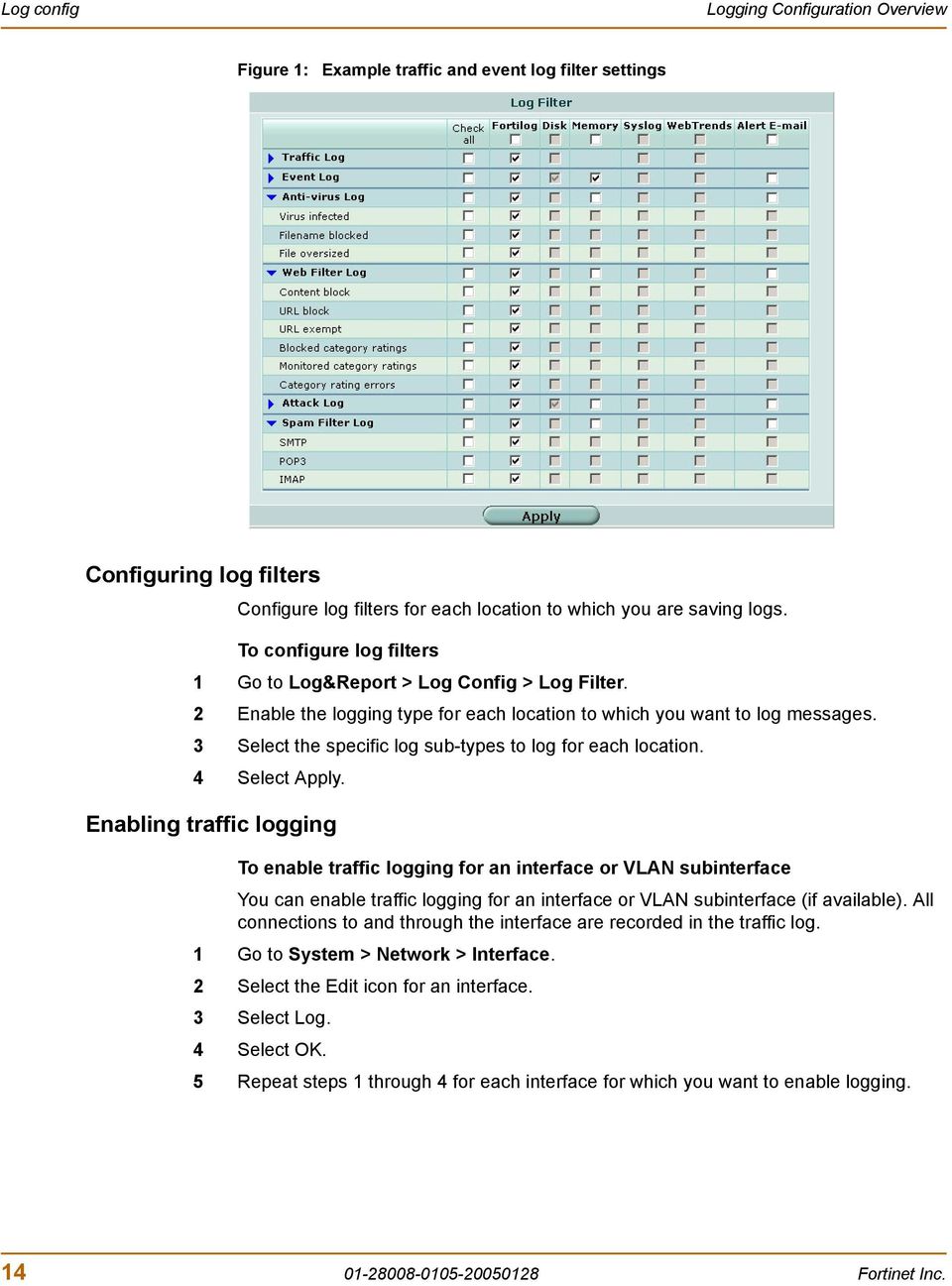
14 Log config Logging Configuration Overview Figure 1: Example traffic and event log filter settings Configuring log filters Configure log filters for each location to which you are saving logs. To configure log filters 1 Go to Log&Report > Log Config > Log Filter. 2 Enable the logging type for each location to which you want to log messages. 3 Select the specific log sub-types to log for each location. 4 Select Apply. Enabling traffic logging To enable traffic logging for an interface or VLAN subinterface You can enable traffic logging for an interface or VLAN subinterface (if available). All connections to and through the interface are recorded in the traffic log. 1 Go to System > Network > Interface. 2 Select the Edit icon for an interface. 3 Select Log. 4 Select OK. 5 Repeat steps 1 through 4 for each interface for which you want to enable logging Fortinet Inc.

15 Logging Configuration Overview Log access To enable traffic logging for a firewall policy You can enable traffic logging for a firewall policy. All connections accepted by the firewall policy are recorded in the traffic log. 1 Go to Firewall > Policy. 2 Select the Edit icon for a policy. 3 Select Log Traffic. 4 Select OK. Log access Disk log file access Log Access provides access to log messages saved to the FortiGate disk or to the memory buffer. Not all FortiGate units include a hard disk drive. Note: FortiGate units do not save some types of logs to memory. You can view these log messages with Log Access only if your FortiGate unit contains a hard disk drive. On its disk, the FortiGate unit saves log messages in files. To view log messages, you must first select the file to open. You can also delete a file, clear (remove the log messages from) a file, or download a file in either plain text or CSV format. You can view the log messages in a memory buffer simply by accessing the buffer. You cannot delete or download log messages from the memory buffer. You can view, navigate, and download log files saved to the FortiGate disk. Figure 2: Sample list of log files stored on the FortiGate disk To access log files on the FortiGate disk 1 Go to Log&Report > Log Access. 2 Select the log type you wish to access. 3 Select Disk from the Type list. 4 You can clear or delete, download, or view the log files by selecting the corresponding icon. When downloading a log file, you can save the log in plain text or CSV format. FortiGate Log Message Reference Guide

16 Log access Logging Configuration Overview To download log files from the FortiGate disk 1 Go to Log&Report > Log Access. 2 Select the log type you wish to access. 3 Select Disk from the Type list. 4 Select the Download icon for the file you wish to download. 5 Select Download file in normal or CSV format. 6 Select Open to view the log file or Save to save the log file to your computer. Viewing log messages You can view and navigate log messages saved to FortiGate hard disk drive or to the memory buffer. Figure 3: Viewing log messages To view log messages in the FortiGate memory buffer 1 Go to Log&Report > Log Access. 2 Select the log type you wish to view. 3 Select Memory from the Type list. The log messages are displayed. You can change the displayed columns or see the raw log messages, go to the previous or next log page, or search the log by selecting the corresponding icon. To view log messages in FortiGate disk drive files 1 Go to Log&Report > Log Access. 2 Select the log type you wish to view. 3 Select Disk from the Type list. The log files are displayed. 4 Select the View icon for the log file you want to open. The log messages are displayed. You can change the displayed columns or see the raw log messages, go to the previous or next log page, or search the log by selecting the corresponding icon Fortinet Inc.

17 Logging Configuration Overview Log access Choosing columns You can customize your log messages display using the Column Settings window. The column settings apply only when the formatted (not raw) display is selected. To change the columns in the log message display 1 While viewing log messages, select the Column Settings icon. Figure 4: Column settings for viewing log messages 2 To add fields, select them in the Available fields list and select the right arrow button. 3 To remove fields, select them in the Show these fields list and select the left arrow button. 4 To change the position of a column, select the field in the Show these fields list and then select Move Up or Move Down as necessary. 5 Select OK. Searching log messages Note: The Detailed Information column provides the entire raw log entry and is not needed unless the log contains information not available in any of the other, more specific columns. There are two ways to search log messages: a simple keyword search or an advanced search that enables you to use multiple keywords and specify a time range. To perform a simple keyword search 1 Display the log messages you want to search. For more information, see Viewing log messages on page In the Search field, type a keyword and select Go. The log message list shows only the logs containing the keyword. To perform an advanced search 1 Display the log messages you want to search. For more information, see Viewing log messages on page Select Advanced Search. FortiGate Log Message Reference Guide

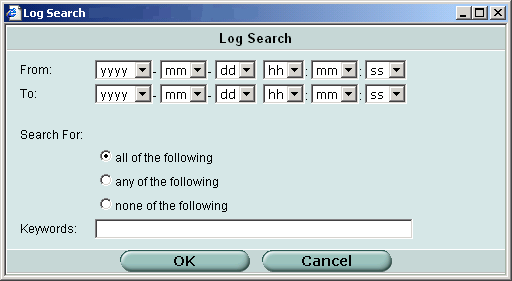
18 Log access Logging Configuration Overview Figure 5: Log search window 3 If you want to search for log messages in a particular date range, select the From and To dates. 4 Select one of the following options: all of the following any of the following none of the following The message must contain all of the keywords The message must contain at least one of the keywords The message must contain none of the keywords 5 In the Keywords field, type the keywords for the search. 6 Select OK. The log message list shows only the logs that meet your log search criteria Fortinet Inc.

19 FortiGate Log Message Reference Guide Version 2.80 MR8 Log formats FortiGate log messages have two parts: Log header Log body In the following example of an event log message, the log header is marked in bold :32:56 log_id= type=ips subtype=anomaly pri=critical attack_id= src= dst= src_port=2000 dst_port=21 interface=external src_int=n/a dst_int=n/a status=clear_session proto=6 service=ftp msg="anomaly: syn_fin[reference: ID ]" Log header The log header may contain the following information: date time log_id log_type subtype severity virtual_domain session_number Date Time Log ID (message ID) The year, month, and day when the event occurred in the format yyyy-mm-dd. The hour, minute, and second when the event occurred in the format hh:mm:ss. log_id= a ten digit number. The first two digits represent the log type and the following two digits represent the log subtype. The last 5 digits are the message ID, which you can use to search for message descriptions in this guide. Log type type= the section of the system where the event occurred. The log types are traffic, event, attack, antivirus, web filter, and spam filter. See Log types and sub-types on page 20. Subtype subtype= the subtype for each message. See Log types and sub-types on page 20. Severity pri= the severity level (priority) of the event. There are seven logging severity levels, from Information up to Emergency. See Logging severity levels on page 21. virtual_domain vd= the virtual domain in which the traffic was logged. session_number Traffic log messages only. SN= the session number referenced in a traffic log message. FortiGate Log Message Reference Guide

20 Log header Log formats Log types and sub-types FortiGate log messages are divided into the following types and sub-types which correspond to the settings you selected when configuring the Log Setting. Table 1: Log message types and sub-types Log type traffic (Traffic Log) event (Event Log) contentarchive (Content Archive) virus (Antivirus Log) webfilter (Web Filter Log) ids (Attack Log) filter (Spam Filter Log) Category Number Sub-type 00 allowed Policy allowed traffic 22 violation Policy violation traffic system System activity event 00 ipsec IPSec negotiation event 01 dhcp DHCP service event 02 ppp L2TP/PPTP/PPPoE service event 03 admin admin event 04 ha HA activity event 05 auth Firewall authentication event 06 pattern Pattern update event 07 chassis FortiGate-4000 and FortiGate-5000 series chassis event HTTP Virus infected 25 FTP FTP content meta-data 26 IMAP IMAP content meta-data 29 POP3 POP3 content meta-data 28 SMTP SMTP content meta-data infected Virus infected 11 filename Filename blocked 12 oversize File oversized content content block 14 urlblock URL block 15 urlexempt URL exempt 16 catblock Blocked category ratings; ; 17 Monitored category ratings 18 Category rating errors signature Attack signature 20 anomaly Attack anomaly SMTP 08 POP3 09 IMAP 10 Sub-type number Fortinet Inc.

21 Log formats Log header Logging severity levels The FortiGate unit logs all messages at and above the logging severity level you select. For example, if you select Error, the unit logs Error, Critical, Alert and Emergency level messages. Table 2 lists and describes the logging severity levels. Table 2: Logging severity levels Level name Emergency Alert Critical Error Warning Notification Information Description The system has become unusable. Immediate action is required. Alert level log messages include attack signature detections. Functionality is affected. Critical level log messages include virus detection, out of memory, out of range, and routing problem messages. An error condition exists and functionality is probably affected. Functionality might be affected. Warning level log messages include packet timer, and interface problem messages, limit messages, and major configuration change messages. Information about normal events. Notification level log messages include messages about minor configuration changes and HA events that require little or no action. General information about system operations. Information level log messages include messages about very minor configuration changes and other events that require little or no action. Log header format variations The log header format varies depending on the log location to which it is sent. For information about log locations, see Log setting options on page 11. Local disk or memory buffer log header format If you configure logging to the local disk or memory buffer, the log header format is similar to the following example: :23:46 log_id= type=event subtype=admin pri=information WebTrends log header format If you configure logging to a remote NetIQ WebTrends firewall reporting server, the log header format is similar to the following example: id=firewall time=" :01:01" fw=fgt pri=6 log_id= type=event subtype=admin Remote Syslog log header format If you configure logging to a remote Syslog server, you can enable or disable CSV format. FortiGate Log Message Reference Guide
22 Log body Log formats In CSV format, the log header format is similar to the following example: , time=14:01:01, device_id=fgt , pri=information, log_id= , type=event, subtype=admin In normal format, the log header format is similar to the following example: date= time=14:01:01 device_id=fgt pri=information log_id= type=event subtype=configure Log body Traffic log body The log body contains details about the event or activity, such as IP addresses and status information. Except for the traffic log, the log entries may also contain user messages at the end of the log body, as in the following example: user=admin ui=gui( ) action=switch_mode status=success msg="system has been changed to Transparent mode by user admin via GUI( )" With traffic logging enabled, the FortiGate unit records all the traffic to and through the FortiGate interfaces. For information on how to enable traffic logging, see Enabling traffic logging on page 14. An example traffic log body contains the following information: rule=<value_webtrend> policyid=<value_policyid> proto=<protocol> service=<network_service> status={accept deny} src=<ip_address> srcname={<ip_address> <domain_name>} dst=<ip_address> dstname={<ip_address> <domain_name>} src_int=<interface_name> dst_int=<interface_name> sent=<value_bytes> rcvd=<value_bytes> sent_pkt=<value_packets> rcvd_pkt=<value_packets> src_port=<port_num> dst_port=<port_num> vpn={<vpn_name> n/a} tran_ip=<ip_address> tran_port=<port_num> dir_disp={org replay} tran_disp={noop snat dnat} rule policyid proto service status src srcname dst dstname Same as policyid below. Required by WebTrends message format. The ID number of the firewall policy that applies to the session or packet. The protocol that applies to the session or packet. The IP network service that applies to the session or packet. The services displayed correspond to the services configured in the firewall policies. The status can be either deny or accept, depending on the applicable firewall policy. The source IP address. The source name or IP address. The destination IP address. The destination name or IP address Fortinet Inc.
23 Log formats Log body src_int dst_int sent rcvd sent_pkt rcvd_pkt src_port dst_port The interface through which the traffic comes in. For outgoing traffic originating from the firewall it will be unknown. The interface through which the traffic goes out. For incoming traffic to the firewall it will be unknown. The total number of bytes sent. The total number of bytes received. The total number of packets sent during the session. The total number of packets received during the session. The source port number of TCP and UDP traffic. The src_port is 0 (zero) for other types of traffic. The destination port number of TCP and UDP traffic. The dst_port is 0 (zero) for other types of traffic. vpn The name of the VPN tunnel used by the traffic. n/a is displayed if VPN is not applicable. tran_ip The translated IP in NAT mode. For transparent mode, it is tran_port The translated port number in NAT mode. For transparent mode, it is 0". dir_disp The packet is either org (original) or replay. tran_disp The packet is source NAT translated or destination NAT translated. For descriptions of traffic log messages, see Traffic log messages on page 27. Event log body Event logs record system activity, IPSec, DHCP, PPP, administration, high availability (HA) and firewall related events. Each event log message records the date and time of the event and a description of the event. The following example shows an event log message body: user=admin ui=gui( ) action=download status=success msg="logging file has been downloaded by user admin via GUI(GUI( ))" For descriptions of event log messages, see Event log messages on page 28. Content archive body Content archives record meta-data about the content for a particular protocol (HTTP, FTP, IMAP, POP3, and SMTP). Each content archive message records the date and time and a description of the content. HTTP An example HTTP content archive body contains the following information: <ContLogVersionNo>:<SessionNo>:<clientIP>-><serverIP>: <infectionstatus>:<requestsize>:<responsesize>:<httprequest> FortiGate Log Message Reference Guide
24 Log body Log formats FTP Antivirus log body An example FTP content archive body contains the following information: <ContLogVersionNo>:<SessionNo>:<clientIP><-><serverIP>: <infectionstatus>:<requestsize>:<responsesize>:<ftpcommand> SMTP, POP3, and IMAP An example content archive body contains the following information: <ContLogVersionNo>:<SessionNo>:<clientIP><-><serverIP>: <infectionstatus>:<sizesent>:<from/to>: <attachment(1=yes, 0=no)> For descriptions of content archive messages, see Content archive messages on page 73. Each virus log message records the date and time at which the virus was detected, the type of virus, and the source and destination IP addresses of the infected traffic. A virus log body contains the following information: src=<ip_address> dst=<ip_address> src_int=<interface_name> dst_int=<interface_name> service= {http smtp pop3 imap ftp} status={blocked passthrough} from=< _address> to=< _address> msg="<string>" For descriptions of virus log messages, see Antivirus log messages on page 63. Attack log body Attack logs record attacks detected by the FortiGate intrusion prevention and detection systems. Each attack log message records the date and time at which the attack was made, the type of attack, and the source and destination IP addresses of the attack. The following example shows an attack log message body: :13:17 ids-detec-alert: attack_id= src= dst= src_port=1066 dst_port=80 status=detected proto=006 service=http msg="web-misc. whisker HEAD with large datagram" For descriptions of attack log messages, see Attack log messages on page 64. Web filter log body Each web filter log message records the date and time at which content was blocked, a URL was blocked, or a URL was exempted, and the source and destination IP addresses of the HTTP traffic. A web filter log body contains the following information: Fortinet Inc.
25 Log formats Log body Spam filter log body src=<ip_address> dst=<ip_address> src_int=<interface_name> dst_int=<interface_name> service=http status={blocked passthrough} dstname=<domain_name> arg=<url_path> msg="<string>" For descriptions of web filter log messages, see Web filter log messages on page 64. Each spam filter log message records the date and time at which an IP address, address, or a banned word was blocked, and the source and destination IP addresses of the IMAP or POP3 traffic. A spam filter log body contains the following information: src=<ip_address> dst=<ip_address> src_int=<interface_name> dst_int=<interface_name> service= {http smtp pop3 imap ftp} status={blocked passthrough} from=< _address> to=< _addr> msg="<string>" For descriptions of spam filter log messages, see Spam filter log messages on page 67. FortiGate Log Message Reference Guide
26 Log body Log formats Fortinet Inc.
27 FortiGate Log Message Reference Guide Version 2.80 MR8 Log messages This chapter describes the following log messages. Traffic log messages Event log messages Antivirus log messages Attack log messages Web filter log messages Spam filter log messages Note: You can search for a specific message using the message ID, which is the last 5 digits of the log_id from the log message. For example, if you are looking for a message with log_id= , search for Traffic log messages Allowed The following traffic log messages are generated by policy allowed traffic. Message ID: Message: SN=<session_num> duration=<value_seconds> rule=<value_webtrend> policyid=<value_policyid> proto=<protocol> service=<network_service> status=accept src=<ip_address> srcname={<ip_address> <domain_name>} dst=<ip_address> dstname={<ip_address> <domain_name>} src_int=<interface_name> dst_int=<interface_name> sent=<value_bytes> rcvd=<value_bytes> sent_pkt=<value_packets> rcvd_pkt=<value_packets> src_port=<port_num> dst_port=<port_num> vpn={<vpn_name> n/a} tran_ip=<ip_address> tran_port=<port_num> dir_disp={org replay} tran_disp={noop snat dnat} Meaning: See Traffic log body on page 22 for a description of the traffic log message fields. FortiGate Log Message Reference Guide
28 Event log messages Log messages Violation The following traffic log messages are generated by policy violation traffic. Message ID: Message: SN=<session_num> duration=<value_seconds> rule=<value_webtrend> policyid=<value_policyid> proto=<protocol> service=<network_service> status=deny src=<ip_address> srcname={<ip_address> <domain_name>} dst=<ip_address> dstname={<ip_address> <domain_name>} src_int=<interface_name> dst_int=<interface_name> sent=<value_bytes> rcvd=<value_bytes> sent_pkt=<value_packets> rcvd_pkt=<value_packets> src_port=<port_num> dst_port=<port_num> vpn={<vpn_name> n/a} tran_ip=<ip_address> tran_port=<port_num> dir_disp={org replay} tran_disp={noop snat dnat} Meaning: See Traffic log body on page 22 for a description of the traffic log message fields. As required to resolve traffic violation. Event log messages System The following event log messages are generated by system activity events. Message ID: Severity: Information Message: gateway=<gateway_ip_address> interface={internal external dmz <other>... } status={up down} Meaning: Routing information has changed because the gateway is up/down Check gateway status. Message ID: Severity: Information Message: modem: unable to open modem device - check hardware Meaning: Problem contacting the modem. Verify modem connections and settings Fortinet Inc.
29 Log messages Event log messages Message ID: Severity: Information Message: modem: Redial limit exceeded... giving up Meaning: The FortiGate unit has attempted to redial the ISP from the modem and could not connect. Reset the modem to attempt to the connection. Message ID: Message: user=system ui=system action=<action> status=failure msg= Can't resolve the IP address of < _address>" Meaning: The domain name configured for an alert recipient cannot be resolved. Verify the addresses configured for alert s. Message ID: Message: Out of memory in <memory_sector> Meaning: The FortiGate flash memory is full in the specified sector. Delete logs stored to local disk, perform other maintenance to free memory space. Message IDL Message: Interface <interface_name> not found in <memory_sector> Meaning: The FortiGate unit cannot find the specified interface. Check configuration of the interface and check any physical connections. Message ID: Severity: Information Message: using Mobile IPv6 extensions Meaning: An interface uses Mobile IPv6 extensions. FortiGate Log Message Reference Guide
30 Event log messages Log messages Message ID: Message: MinRtrAdvInterval for <interface_name> must be between <start_range_seconds> and <end_range_seconds> Meaning: The minimum time allowed between sending unsolicited multicast router advertisements from the specified interface (using Mobile IPv6 extensions) must be configured within the specified range. Range is specified in seconds. Reconfigure router according to MinRtrAdvInterval. Message ID: Message: MinRtrAdvInterval must be between <start_range_seconds> and <end_range_seconds> for <interface_name> Meaning: The minimum time allowed between sending unsolicited multicast router advertisements from the specified interface must be configured within the specified range. Range is specified in seconds. Reconfigure router according to MinRtrAdvInterval. Message ID: Message: MaxRtrAdvInterval for <interface_name> must be between <start_range_seconds> and <end_range_seconds> Meaning: The maximum time allowed between sending unsolicited multicast router advertisements from the specified interface (using Mobile IPv6 extensions) must be configured within the specified range. Range is specified in seconds. Reconfigure router according to MaxRtrAdvInterval. Message ID: Message: MaxRtrAdvInterval must be between <start_range_seconds> and <end_range_seconds> for <interface_name> Meaning: The maximum time allowed between sending unsolicited multicast router advertisements from the specified interface must be configured within the specified range. Range is specified in seconds. Reconfigure router according to MaxRtrAdvInterval Fortinet Inc.
31 Log messages Event log messages Message ID: Message: AdvLinkMTU must be zero or between <start_range_bytes> and <end_range_bytes> for <interface_name> Meaning: The value to be placed in MTU options sent by the router must be either zero or between the specified range for the specified interface. A value of zero indicates that no MTU options are sent. Reconfigure router according to range. Message ID: Message: AdvLinkMTU must be zero or greater than <value_bytes> for <interface_name> Meaning: The value to be placed in MTU options sent by the router must be either zero or greater than the specified value for the specified interface. A value of zero indicates that no MTU options are sent. Reconfigure router according to range. Message ID: Message: AdvReachableTime must be less than <value> for <interface_name> Meaning: The value to be placed in the Reachable Time field in the Router Advertisement messages sent by the router must be less than the specified value for the specified interface. A value of zero means unspecified (by this router). Reconfigure router according to specified value. Message ID: Message: AdvCurHopLimit must not be greater than <value_hop_limit> for <interface_name> Meaning: The default value to be placed in the Cur Hop Limit field in the Router Advertisement messages sent by the router must not be greater than the specified value for the specified interface. Reconfigure router according to specified value. FortiGate Log Message Reference Guide
32 Event log messages Log messages Message ID: Message: AdvDefaultLifetime for <interface_name> must be zero or between <start_range_seconds> and <end_range_seconds> Meaning: The value to be placed in the Router Lifetime field of Router Advertisements sent from the interface, in seconds, must be either zero or between the specified range. A value of zero indicates that the router is not to be used as a default router. Reconfigure router according to specified range. Message ID: Message: HomeAgentLifetime must be between <value> and <value> for <interface_name> Meaning: HomeAgentLifetime in Router Advertisement packet is out of range. Reconfigure router according to specified range. Message ID: Message: AdvHomeAgentFlag must be set with HomeAgentInfo Meaning: AdvHomeAgentFlag HomeAgentLifetime in Router Advertisement packet must be set with HomeAgentInfo. As above. Message ID: Message: invalid prefix length for <string> Meaning: Prefix length is too long Adjust packet prefix length. Message ID: Message: AdvValidLifetime must be greater than AdvPreferredLifetime for <string> Meaning: The value to be placed in the Valid Lifetime in the Prefix Information option, in seconds, must be greater than the AdvPreferredLifetime. As above Fortinet Inc.
33 Log messages Event log messages Message ID: Message: can't create socket(af_inet6): <string> Meaning: The IPv6 router advertisement daemon failed to create an IPv6 socket. Message ID: Message: setsockopt(ipv6_pktinfo): <string> Meaning: The IPv6 router advertisement daemon failed to set IPV6_PKTINFO option. Message ID: Message: setsockopt(ipv6_checksum): <string> Meaning: The IPv6 router advertisement daemon failed to set IPV6_CHECKSUM option. Message ID: Message: setsockopt(ipv6_unicast_hops): <string> Meaning: The IPv6 router advertisement daemon failed to set IPV6_UNICAST_HOPS option. Message ID: Message: setsockopt(ipv6_multicast_hops): <string> Meaning: The IPv6 router advertisement daemon failed to set IPV6_MULTICAST_HOPS option. FortiGate Log Message Reference Guide
34 Event log messages Log messages Message ID: Message: setsockopt(ipv6_hoplimit): <string> Meaning: The IPv6 router advertisement daemon failed to set IPV6_HOPLIMIT option. Message ID: Message: setsockopt(icmpv6_filter): <string> Meaning: The IPv6 router advertisement daemon failed to set ICMPV6_FILTER option. Message ID: Severity: Information Message: radvd receive signal=<value_signal>\n Meaning: The IPv6 router advertisement daemon received the specified signal and is going to exit.. Message ID: Message: Can not create query to interface at <string>:<string>:<value>! Meaning: The IPv6 router advertisement daemon cannot create query to interface by using cmf_query_create(). Message ID: Message: Internal error in cmf_query_for_each()! Meaning: The IPv6 router advertisement daemon occurs an internal error when it uses cmf_query_for_each() Fortinet Inc.
35 Log messages Event log messages Message ID: Message: Interface <string>:<value> not found in the list! Meaning: The IPv6 router advertisement daemon failed to find a virtual interface by interface index. Message ID: Severity: Information Message: Interface <string>:<value> reloaded! Meaning: The IPv6 router advertisement daemon reloaded the specified interface. Message ID: Severity: Warning Message: received packet with no pkt_info! Meaning: The IPv6 router advertisement daemon received a packet with no pkt_info. Message ID: Severity: Warning Message: received icmpv6 packet with invalid length: <value_bytes> Meaning: The IPv6 router advertisement daemon received an ICMPv6 packet with invalid length. Message ID: Message: icmpv6 filter failed Meaning: The IPv6 router advertisement daemon received an unwanted type of ICMPv6 packet. FortiGate Log Message Reference Guide
36 Event log messages Log messages Message ID: Severity: Warning Message: received icmpv6 RA packet with invalid length: <value_bytes> Meaning: The IPv6 router advertisement daemon received an ICMPv6 RA packet with invalid length. Message ID: Severity: Warning Message: received icmpv6 RA packet with non-linklocal source address Meaning: The IPv6 router advertisement daemon received ICMPv6 RA packet with non-linklocal source address. Message ID: Severity: Warning Message: received icmpv6 RS packet with invalid length: <value_bytes> Meaning: The IPv6 router advertisement daemon received ICMPv6 RS packet with invalid length. Message ID: Severity: Warning Message: received icmpv6 RS/RA packet with invalid code: <value_code> Meaning: The IPv6 router advertisement daemon received ICMPv6 RS/RA packet with invalid code. Message ID: Severity: Warning Message: received RS or RA with invalid hoplimit <value_hops> from <interface_name> Meaning: The IPv6 router advertisement daemon received ICMPv6 RS/RA packet with wrong hoplimit Fortinet Inc.
37 Log messages Event log messages Message ID: Severity: Warning Message: our AdvCurHopLimit on <interface_name> doesn't agree with <interface_name> Meaning: The AdvCurHopLimit on the specified FortiGate interface does not agree with the value on the specified remote interface. A value of zero means unspecified (by this router). Configure the interfaces with the same AdvCurHopLimit value. Message ID: Severity: Warning Message: our AdvManagedFlag on <interface_name> doesn't agree with <interface_name> Meaning: The AdvManagedFlag value (True/False) on the specified FortiGate interface does not agree with the value on the specified remote interface. Configure the interfaces with the same AdvManagedFlag value. Message ID: Severity: Warning Message: our AdvOtherConfigFlag on <interface_name> doesn't agree with <interface_name> Meaning: The AdvOtherConfigFlag value (True/False) on the specified FortiGate interface does not agree with the value on the specified remote interface. Configure the interfaces with the same AdvOtherConfigFlag value. Message ID: Severity: Warning Message: our AdvReachableTime on <interface_name> doesn't agree with <interface_name> Meaning: The AdvReachableTime configured on the specified FortiGate interface does not agree with the value on the specified remote interface. A value of zero means unspecified (by this router). The value must be no greater than seconds (1 hour). Configure the interfaces with the same AdvReachableTime value. Message ID: Severity: Warning Message: our AdvRetransTimer on <interface_name> doesn't agree with <interface_name> Meaning: The AdvRetransTimer value on the specified FortiGate interface does not agree with the value on the specified remote interface. A value of zero means unspecified (by this router). Configure the interfaces with the same AdvRetransTimer value. FortiGate Log Message Reference Guide
38 Event log messages Log messages Message ID: Message: trailing garbage in RA on <interface_name> from <interface_name> Meaning: The IPv6 router advertisement daemon found extra data in an RA packet from the specified source. Message ID: Message: zero length option in RA on <interface_name> from <interface_name> Meaning: The IPv6 router advertisement daemon found an RA packet with no option data from the specified source. Message ID: Message: option length greater than total length in RA on <interface_name> from <interface_name> Meaning: The option length is greater than the total length in an RA packet from the specified source. Message ID: Severity: Warning Message: our AdvLinkMTU on <interface_name> doesn't agree with <interface_name> Meaning: The AdvLinkMTU value on the specified FortiGate interface does not agree with the specified remote interface. A value of zero indicates that no MTU options are sent. Configure the interfaces with the same AdvLinkMTU value. Message ID: Severity: Warning Message: our AdvValidLifetime on <interface_name> for <value> doesn't agree with <interface_name> Meaning: The AdvValidLifetime value on the specified FortiGate interface does not agree with the value on the specified remote interface. Configure the interfaces with the same AdvValidLifetime value Fortinet Inc.
39 Log messages Event log messages Message ID: Severity: Warning Message: our AdvPreferredLifetime on <interface_name> for <value> doesn't agree with <interface_name> Meaning: The AdvPreferredLifetime value on the specified FortiGate interface does not agree with the value on the specified remote interface. Configure the interfaces with the same AdvPreferredLifetime value. Message ID: Message: invalid option <value_option> in RA on <interface_name> from <interface_name> Meaning: The IPv6 router advertisement daemon found the specified invalid option in an RA packet from the specified source. Message ID: Severity: Information Message: radvd started\n. Meaning: The IPv6 router advertisement daemon is ready to serve. Message ID: Message: recvmsg: <string> Meaning: Recvmsg() in the IPv6 router advertisement daemon failed. Message ID: Message: received a bogus IPV6_HOPLIMIT from the kernel! len=<value_bytes>, data=<value> Meaning: The IPv6 router advertisement daemon received a packet with a wrong IPV6_HOPLIMIT. FortiGate Log Message Reference Guide
40 Event log messages Log messages Message ID: Message: received a bogus IPV6_PKTINFO from the kernel! len=<value_bytes>, index=<value_index> Meaning: The IPv6 router advertisement daemon received a packet with a wrong IPV6_PKTINFO. Message ID: Severity: Warning Message: problem checking all-routers membership on <interface_name> Meaning: The IPv6 router advertisement daemon failed to check whether we've joined the all-routers multicast group. Message ID: Severity: Warning Message: sendmsg: <string> Meaning: sendmsg () in the IPv6 router advertisement daemon failed. Message ID: Message: FortiGuard category is updated Meaning: FortiGuard category is updated. Message ID: Message: act=upload status=<status> file=<file_name> user=<user_name> server=<server_name> port=<port_number> Meaning: Status of file upload Fortinet Inc.
41 Log messages Event log messages Message ID: Severity: Variable Message: act=upload error=<string> file=<file_name> user=<user_name> server=<server_name> port=<port_number> Meaning: File upload error. Message ID: Message: Fortiguard license is expired Meaning: Fortiguard license is expired. Renew FortiGuard license. Message ID: Severity: Warning Message: version-<agent_version_num> is not supported Meaning: The specified version of the URL agent is not supported. Message ID: Severity: Warning Message: Other request - <request_type> than http is not supported Meaning: Only HTTP is supported. Message ID: Severity: Warning Message: Socket() failed: <string> Meaning: The system failed to create a socket or failed to create an HA socket. FortiGate Log Message Reference Guide
42 Event log messages Log messages Message ID: Severity: Warning Message: failed to create a <value>/udp socket to receive URL request Meaning: The system failed to create a UDP socket to receive URL requests. Message ID: Severity: Warning Message: failed to create a <value>/udp socket to relay URL request Meaning: The system failed to create a UDP socket to receive URL requests. Message ID: Severity: Warning Message: id=<user_group firewall_policy> status=failure msg= failed to find its AV protection profile Meaning: The specified user group or firewall policy could not find its protection profile. Message ID: Severity: Error Message: <string> failed to send rating result Meaning: The url filter has failed to send the rating result back to http proxy. The http proxy has crashed. Message ID: Message: The log disk is going to be full. Meaning: The log disk is almost out of space. Clean up the hard disk to create more space Fortinet Inc.
43 Log messages Event log messages Message ID: Message: service=<string> conserve=on total=<value> free=<value> entermargin=<value> exitmargin=<value> Meaning: Scan services entered conserve mode. Message ID: Message: service=<string> conserve=exit total=<value> free=<value> entermargin=<value> exitmargin=<value> Meaning: Scan services exited conserve mode. IPSec The following log messages are generated by IPSec negotiation events. Message ID: Message: Fortigate report: replay packet is detected, <ip_address_source> -><ip_address_dest>, seq=%ld Meaning: IPsec negotiation daemon has detected a replay packet from the specified source to the specified destination. Ensure replay packet is legitimate. Message ID: Message: loc_ip=<ip_address> loc_port=<port_num> rem_ip=<ip_address> rem_port=<port_num> out_if=<string> vpn_tunnel=<vpn_name> action=negotiate status={success failure} msg="<string>" Meaning: IPSec generic negotiation report. Message ID: Message: loc_ip=<ip_address> loc_port=<port_num> rem_ip=<ip_address> rem_port=<port_num> out_if=<string> vpn_tunnel=<vpn_name> status=negotiate_error msg="<string>" Meaning: IPsec negotiation error report. FortiGate Log Message Reference Guide
44 Event log messages Log messages Message ID: Message: loc_ip=<ip_address> loc_port=<port_num> rem_ip=<ip_address> rem_port=<port_num> out_if=<string> vpn_tunnel=<vpn_name> action=negotiate init=<string> mode={aggressive main} stage=<value_ipsec_stage> dir={inbound outbound} status={success failure} msg="<string>" Meaning: IPsec negotiation progress report. Message ID: Message: loc_ip=<ip_address> loc_port=<port_num> rem_ip=<ip_address> rem_port=<port_num> out_if=<string> vpn_tunnel=<vpn_name> status=packet_replay, spi=<value_index>-.8x, seqno=%u msg= <string>" Meaning: IPsec negotiation replay report. Message ID: Message: loc_ip=<ip_address> loc_port=<port_num> rem_ip=<ip_address> rem_port=<port_num> out_if=<string> vpn_tunnel=<vpn_name> action=install_sa, in_spi=<value_index>-.8x out_spi=<value_index>-.8x msg="<string>" Meaning: An SA has been negotiated and installed successfully. Message ID: Message: loc_ip=<ip_address> loc_port=<port_num> rem_ip=<ip_address> rem_port=<port_num> out_if=<string> vpn_tunnel=<vpn_name> action=delete_phase1_sa, spi=<string> msg="<string>" Meaning: Deleted IPSec phase1 SA Fortinet Inc.
45 Log messages Event log messages Message ID: Message: loc_ip=<ip_address> loc_port=<string> rem_ip=<ip_address> rem_port=<port_num> out_if=<string> vpn_tunnel=<vpn_name> action=delete_ipsec_sa, spi=<string> msg="delete ipsec sa" Meaning: Deleted IPsec SA. DHCP The following log message is generated by a DHCP service event. Message ID: Severity: Information Message: dhcp_msg={discover Offer Request Ack Release} dir={<sent> <received>} mac=<mac_address> ip=<ip_address> lease=<lease_time> msg={a client broadcasts a DHCPDISCOVER message Server responds with offer of configuration parameters Client requests IP address/configuration parameters Assigns IP address/configuration parameters to the client Client relinquishes the IP address and cancelling remaining lease} Meaning: DHCP requests and response log. Message ID: Severity: Error Message: No shared network for network <ip_address> (<ip_address>). Meaning: No shared network found. Message ID: Severity: Error Message: Address range<ip_address> to <ip_address>, netmask %s spans %s! Meaning: Address range spans multiple subnets. Message ID: Severity: Error Message: Address range %s to %s not on net %s/%s! Meaning: Address range does not belong to the net. FortiGate Log Message Reference Guide
46 Event log messages Log messages PPP The following log messages are generated by L2TP, PPTP, and PPPoE service events. Message ID: Severity: Variable Message: user=<user_name> local=<ip_address> remote=<ip_address> assigned=<ip_address> stat="<string>" msg="<string>" Meaning: Pppd log message. Message ID: Severity: Information Message: msg= MGR: Manager process started Meaning: Manager process of PPTPd has started. Message ID: Message: MGR: Couldn't create host socket Meaning: PPTPd manager failed to create a socket for receiving PPTP requests. Message ID: Severity: Warning Message: MGR: the limit of pptp number has been reached - no more clients can connect! Meaning: The maximum number of PPTP connections had been reached. Message ID: Severity: Warning Message: MGR: Error with manager select()! Meaning: PPTP server encountered an error during polling PPTP requests Fortinet Inc.
47 Log messages Event log messages Message ID: Severity: Warning Message: MGR: accept() failed Meaning: PPTP server encountered an error while accepting a PPTP request. One of the likely reasons is that the firewall has run out of resources. Message ID: Message: gateway_ip=<ip_address> assigned_ip=<ip_address> mtu=<value_bytes> Meaning: PPPoE status report. Message ID: Severity: Error Message: Can't execute <program_name>: <string>. Meaning: Pppd cannot execute the specified program. Message ID: Severity: Error Message: <string> Meaning: PPPd has received the specified wrong option. Message ID: Message: msg= pppd is started Meaning: The specified PPPd has been started.. FortiGate Log Message Reference Guide
48 Event log messages Log messages Message ID: Severity: Information Message: msg= pppd is exiting Meaning: PPPd is exiting.. Message ID: Message: vfid-<vdom_id> is bigger than the table-<value>\n Meaning: The returned ID of the virtual domain is invalid. Ensure the virtual domain of that name is configured in the FortiGate unit. Message ID: Severity: Information Message: pptp of domain-<domain_name> is not configured Meaning: PPTP for the specified domain is not configured. Ensure PPTP is configured with an IP address range and user group. Message ID: Severity: Warning Message: All IP address of pptp in domain-<domain_name> are assigned Meaning: There are no more available IP addresses for the specified domain. Reassign IP addresses or increase the range. Message ID: Severity: Warning Message: failed to expand pptp config list Meaning: There is not enough memory to expand the PPTP config list Fortinet Inc.
49 Log messages Event log messages Admin The following log messages are generated by administration events. Message ID: Severity: Information Message: user=lcd ui=lcd action=login status=success reason=none msg=\"login from LCD successfully\" Meaning: A user has logged into the system successfully from the LCD. Message ID: Severity: Information Message: user=lcd ui=lcd action=login status=failure reason=passwd_invalid msg=\"login from LCD failed\" Meaning: The specified user has failed to log in from the LCD because of an incorrect password. Ensure administrators and users have the correct passwords. Message ID: Severity: Information Message: user=<user_name> ui={gui CLI console LCD} action=login status=failure reason=<string> msg=\"user <user_name> login failed from {GUI CLI console LCD}" Meaning: A user has failed to log in. Ensure administrators and users have the correct login information. Message ID: Severity: Information Message: user=<user_name> ui={gui CLI console LCD} action=login status=success reason=none msg="user <user_name> login accepted from {GUI CLI console LCD}" Meaning: The specified user has logged in to the system successfully. FortiGate Log Message Reference Guide
50 Event log messages Log messages Message ID: Severity: Information Message: user=<user_name> ui={gui CLI console LCD} action=logout status=success reason=timeout msg="gui session timeout from <interface_name>" Meaning: The GUI session of the specified user has been dropped because of inactivity (timeout limit reached). Message ID: Severity: Information Message: user=<user_name> ui={gui CLI console LCD} action=login status=failure reason=<string> msg=\"user <user_name> login failed from {GUI CLI console LCD}" Meaning: The specified user has failed to log in after three attempts from either a network address or via a console connection. After five failed login attempts, the Fortinet device automatically terminates the connection. Ensure administrators and users have the correct login information. Message ID: Severity: Warning Message: user=lcd ui=lcd action=<action> status=success msg=\"system has been reset to factory default by user LCD via LCD\" Meaning: System has been reset to factory default by user LCD via the LCD. Message ID: Severity: Warning Message: user=lcd ui=lcd action=<action> status=success msg=\"system has been changed to transparent mode LCD via LCD\" Meaning: System has been changed to transparent mode by user LCD via the LCD. Message ID: Severity: Warning Message: user=lcd ui=lcd action=<action> status=success msg=\"system has been changed to NAT mode LCD via LCD\" Meaning: System has been changed to NAT mode by user LCD via the LCD Fortinet Inc.
51 Log messages Event log messages Message ID: Severity: Warning Message: user=<user_name> ui={gui CLI console LCD} action= {reboot shutdown reload backup factory_reset restore upgrade switch_mode download upload clear_mlog del_log update downgrade del_session bootup} status={success failure} msg="<action> by user <user_name> via GUI<ip_address>)" Meaning: The specified user has performed one of the following actions on the firewall via the GUI: reboot, shutdown, reload, backup, factory reset, restore (all types of configuration files), firmware upgrade, switch mode, download (all types of configuration files), upload, clear log in memory buffer, delete log, update virus or IPS signatures, downgrade firmware, delete session, or bootup. As required. Message ID: Message: user=<user_name> ui={gui CLI console LCD} msg="<string> by <string>" Meaning: The specified user has changed the configuration from the LCD. Message ID: Severity: Variable Message: user=<user_name> ui={gui CLI console LCD} module=<module_name> submodule=<submodule_name> msg="<user_name> made a change from {GUI CLI console LCD}: <string>" Meaning: The specified user has changed the configuration for the specified sub-module. Message ID: Message: <string> msg="fortigate update failed" Meaning: The FortiGate unit update has failed. Try the update again. FortiGate Log Message Reference Guide
52 Event log messages Log messages Message ID: Message: user=<user_name> ui={gui CLI console LCD} intf=<interface_name> msg=\"user <user_name> added a new interface from {GUI CLI console LCD}" Meaning: A new interface was added by the specified user.. Message ID: Message: user=<user_name> ui={gui CLI console LCD} intf={internal external dmz <other>...} field=ip old=<ip_address>:<ip_mask> new=<ip_address>:<ip_mask> msg="user <user_name> changed the setting of an interface from {GUI CLI console LCD}" user=<user_name> ui={gui CLI console LCD} intf={internal external dmz <other>...} field=access old={https PING HTTP SSH SNMP TELNET} new={https PING HTTP SSH SNMP TELNET} msg="user <user_name> changed the setting of an interface from {GUI CLI console LCD}" Meaning: The user changed the specified interface settings from old to new. None. Message ID: Message: user=<user_name> ui={gui CLI console LCD} intf=<interface_name> msg=\"user <user_name> deleted a interface from {GUI CLI console LCD}" Meaning: The user deleted the specified interface.. Message ID: Message: user=<user_name> ui={gui CLI console LCD} seq=<value_order> device={internal external dmz <other>... } distance=<value_hops> dst=<ip_address> status={up down} msg="user <user_name> added a new static routing entry from {GUI CLI console LCD}(<ip_address>) Meaning: The user added the specified static route entry Fortinet Inc.
53 Log messages Event log messages Message ID: Message: user=<user_name> ui={gui CLI console LCD} seq=<value_order> old_device={internal external dmz <other>... } old_distance=<value_hops> old_dst=<ip_address> old_status={up down} new_device={internal external dmz <other>... } new_distance=<value_hops> new_dst=<ip_address> new_status={up down} msg="user <user_name> changed the setting of a new static routing entry from {GUI CLI console LCD} Meaning: The user made the specified changes to the static route entry.. Message ID: Message: user=<user_name> ui={gui CLI console LCD} seq=<value_order> device={internal external dmz <other>... } distance=<value_hops> dst=<ip_address> status={up down} msg="user <user_name> deleted a static routing entry from {GUI CLI console LCD} Meaning: The user deleted the specified static route entry.. Message ID: Message: user=<user_name> ui={gui CLI console LCD} seq=<order_number> msg="user <user_name> added a new firewall policy from {GUI CLI console LCD}" Meaning: The user added a new firewall policy.. Message ID: Message: user=<user_name> ui={gui CLI console LCD} old_sintf=<interface_name> old_dintf=<interface_name> old_saddr=<ip_address> old_daddr=<ip_address> old_schd=<schedule_name> old_svr=<network_service> old_act=<string> old_nat=<string> old_log=<string> new_sintf=<interface_name> new_dintf=<interface_name> new_saddr=<ip_address> new_daddr=<ip_address> new_schd=<schedule_name> new_svr=<network_service> new_act=<string> new_nat=<string> new_log=<string> msg="user <user_name> changed a firewall policy from {GUI CLI console LCD}" Meaning: The user made the specified changes to a firewall policy.. FortiGate Log Message Reference Guide
54 Event log messages Log messages Message ID: Message: user=<user_name> ui={gui CLI console LCD} seq=<policy_id> sintf=<interface_name> dintf=<interface_name> saddr=<ip_address> daddr=<ip_address> schd=<schedule_name> svr=<network_service> act=<string> nat=<string> log=<string> msg="user <user_name> deleted a firewall policy from {GUI CLI console LCD}" Meaning: The user deleted a firewall policy.. Message ID: Message: user=<user_name> ui={gui CLI console LCD} name=<user_name> status={enable disable} msg="user <user_name> added a local user from {GUI CLI console LCD}" Meaning: The user added a new local user.. Message ID: Message: user=<user_name> ui={gui CLI console LCD} name=<user_name> old_status=<string> new_status=<string> passwd=<password> msg="user <user_name> changed a local user's setting from {GUI CLI console LCD}" Meaning: The user changed the specified settings for a local user.. Message ID: Message: user=<user_name> ui={gui CLI console LCD} name=<user_name> status=<string> msg="user <user_name> deleted a local user from {GUI CLI console LCD}" Meaning: The user deleted the specified local user from the system Fortinet Inc.
55 Log messages Event log messages Message ID: Message: user=<user_name> ui={gui CLI console LCD} name=<server_name> server=<server_address> msg="user <user_name> added a radius user from {GUI CLI console LCD}" Meaning: The user added a RADIUS server to the server list.. Message ID: Message: user=<user_name> ui={gui CLI console LCD} name=<user_name> old_server=<server_address> new_server=<server_address> secret=<server_secret> msg="user <user_name> changed a radius' setting user from {GUI CLI console LCD}" Meaning: The user made the specified changes to the RADIUS server entry.. Message ID: Message: user=<user_name> ui={gui CLI console LCD} name=<user_name> server=<server_address> msg=\"user <user_name> deleted a radius user from {GUI CLI console LCD}" Meaning: The user deleted the RADIUS server from the server list.. Message ID: Message: user=<user_name> ui={gui CLI console LCD} name=<server_name> server=<server_address> msg="user <user_name> added a ldap user from {GUI CLI console LCD}" Meaning: The user added a new LDAP server to the list.. FortiGate Log Message Reference Guide
56 Event log messages Log messages Message ID: Message: user=<user_name> ui={gui CLI console LCD} name=<user_name> old_server=<server_address> old_port=<port_num> old_cn=<value_cn> old_dn= <dn_name> new_server=<server_address> new_port=<port_num> new_cn=<value_cn> new_dn="<dn_name>" msg="user <user_name> changed a ldap user's setting from {GUI CLI console LCD}" Meaning: The user made the specified changes to an LDAP server entry.. Message ID: Message: user=<user_name> ui={gui CLI console LCD} name=<user_name> server=<server_address> msg= User <user_name> deleted a ldap user from {GUI CLI console LCD}" Meaning: The user deleted the LDAP server from the list.. Message ID: Message: user=<user_name> ui={gui CLI console LCD} action=reboot msg=\"user <user_name> rebooted the device from {GUI CLI console LCD}" user=<user_name> ui={gui CLI console LCD} action=shutdown msg=\"user <user_name> shut down the device from {GUI CLI console LCD}" Meaning: The user rebooted the FortiGate unit. The user shut down the FortiGate unit Fortinet Inc.
57 Log messages Event log messages Message ID: Message: user=<user_name> ui={gui CLI console LCD} action=factory-reset msg=\"user <user_name> reset to the factory settings from {GUI CLI console LCD}" user=<user_name> ui={gui CLI console LCD} action=format-disk msg=\"user <user_name> formatted the log disk from {GUI CLI console LCD}" user=<user_name> ui={gui CLI console LCD} action=restore-image msg=\"user <user_name> restored the image from {GUI CLI console LCD}" user=<user_name> ui={gui CLI console LCD} action=restoreconfiguration msg=\"user <user_name> restored the configuration from {GUI CLI console LCD}" user=<user_name> ui={gui CLI console LCD} action=import-certificate msg=\"user <user_name> imported the certificate from {GUI CLI console LCD}" user=<user_name> ui={gui CLI console LCD} action=restore-allconfiguration msg=\"user <user_name> restored all the configuration from {GUI CLI console LCD}" user=<user_name> ui={gui CLI console LCD} action=update msg=\"user <user_name> updated the firmware from {GUI CLI console LCD}" user=<user_name> ui={gui CLI console LCD} action=loaded-image msg=\"user <user_name> loaded an image from {GUI CLI console LCD}, the new image has an invalid RSA signature." user=<user_name> ui={gui CLI console LCD} action=loaded-image msg=\"user <user_name> loaded an image from {GUI CLI console LCD}, the new image does have a valid RSA signature with new public key." user=<user_name> ui={gui CLI console LCD} action=loaded-image msg=\"user <user_name> loaded an image from {GUI CLI console LCD}, the new image does have a valid RSA signature." user=<user_name> ui={gui CLI console LCD} action=loaded-image msg=\"user <user_name> loaded an image from {GUI CLI console LCD}, the new image does not have a valid RSA signature. user=<user_name> ui={gui CLI console LCD} action=loaded-image msg=\"user <user_name> loaded the image from {GUI CLI console LCD}, the new image has RSA signature with new key.\"" Meaning: The user performed a reset to factory default settings. The user formatted the local disk. The user restored the firmware image. The user restored a backed up configuration. The user imported a certificate. The user restored a complete configuration. The user updated the firmware. The user uploaded an image with an invalid RSA signature. The user uploaded an image with a valid RSA signature and new public key. The user uploaded an image with a valid RSA signature. The user uploaded an image that does not have a valid RSA signature. The user uploaded an image that contains a RSA signature with a new key.. FortiGate Log Message Reference Guide
58 Event log messages Log messages Message ID: Message: user=<user_name> ui={gui CLI console LCD} field=mode virtualdomain hostname ip-overlap auth-timeout detection-interval old_value=<value_ip_overlap> new_value=<value> msg="user <user_name> changed global setting from {GUI CLI console LCD}" Meaning: The user has changed the global setting specified in the field field.. Message ID: Severity: Variable Message: id=<id_value> msg=<message_string> Meaning: DHCPD log information.. Message ID: Message: user=<user_name> ui={gui CLI console LCD} action=backup msg="user <user_name> backed up the configuration from {GUI CLI console LCD}" Meaning: The user backed up the current configuration to a file.. Message ID: Message: user=<user_name> ui={gui CLI console LCD} action=loaded-image msg="user <user_name> loaded a wrong image from {GUI CLI console LCD}." Meaning: The user loaded the wrong image type.. Message ID: Message: user=<user_name> ui={gui CLI console LCD} upload={url-exempt-list url-block-list word-block-list} num=<value> msg="user <user_name> uploaded URL block list from {GUI CLI console LCD}" Meaning: The user has uploaded the new web filter list specified in the upload field Fortinet Inc.
59 Log messages Event log messages Message ID: Message: user=<none> ui=<none> action=<reboot> msg="system will reboot due to scheduled daily restart. Current time is <hour>:<minute>" Meaning: System restart.. HA The following log messages are generated by high availability activity. Message ID: Message: msg= HA group id changed to<value_ha_id>. HA slave became master HA move to standalone mode HA move to work status HA master became slave HA move to standby state Detected HA member dead Detected new joined HA member Meaning: As described in message. Message ID: Severity: Warning Message: ip=<ip_address> ha-prio=%d msg=<string> Meaning: HA monitor port report as described in message. Message ID: Message: msg= HA mode changed to standalone Meaning: HA mode changed to standalone. Message ID: Message: msg= HA mode changed to A-A Meaning: HA mode changed to Active-Active. FortiGate Log Message Reference Guide
60 Event log messages Log messages Message ID: Message: msg= HA mode changed to A-P Meaning: HA mode changed to Active-Passive. Message ID: Message: msg= HA mode changed to unknown Meaning: HA mode changed to unknown. Auth The following log messages are generated by firewall authentication events. Message ID: Severity: Warning Message: user=<user_name> service=<network_service> action=no status=failure reason=timeout src=<ip_address> srcname=n/a dst=<ip_address> dstname=n/a Meaning: The specified user has failed to get authenticated before timeout occurred. Ensure users and administrators have the correct login information and have access to the FortiGate unit. Message ID: Severity: Information Message: user=<user_name> service=<network_service> action=<action> status=success reason=none src=<ip_address> srcname=n/a dst=<ip_address> dstname=n/a Meaning: The specified user was authenticated successfully Fortinet Inc.
61 Log messages Event log messages Message ID: Severity: Warning Message: user=<user_name> service=<network_service> action=<action> status=failure reason=<string> src=<ip_address> srcname=n/a dst=<ip_address> dstname=n/a Meaning: The specified user failed to get authenticated because of the specified reason. Ensure users and administrators have the correct login information and have access to the FortiGate unit. Message ID: Severity: Notice Message: msg="fortigate updated successfully" Meaning: Administrator has successfully updated FortiGate antivirus database.. Message ID: Severity: Notice Message: msg="fortigate updated successfully" Meaning: Administrator has successfully updated FortiGate IDS database.. Chassis The following log messages are generated by FortiGate-4000 and FortiGate-5000 series chassis events. Message ID: Severity: Variable (Warning or Critical) Message: Chassis fan anomaly: Fan %d, %d RPM Chassis fan anomaly Meaning: The chassis fan is spinning at an RPM value outside of the operating range. Message ID: Severity: Variable (Warning or Critical) Message: Chassis temperature anomaly: T <celsius_integer> Celsius Chassis temperature anomaly Meaning: The chassis temperature is outside of the operating range. FortiGate Log Message Reference Guide
62 Event log messages Log messages Message ID: Severity: Variable (Warning or Critical) Message: Chassis voltage anomaly: <V3.3 V5 V12>, <voltage_integer> V Chassis voltage anomaly Meaning: The chassis voltage level is outside of the operating range. The FortiGate unit reads 3 voltage points: 3.3V, 5V, and 12V. Message ID: Severity: Variable (Warning or Critical) Message: Blade fan anomaly: Blade <blade_integer>, <rpm_integer> RPM Blade fan anomaly Meaning: The specified blade fan is spinning at an RPM value outside of the operating range. Message ID: Severity: Variable (Warning or Critical) Message: Blade temperature anomaly: Blade <blade_integer>, <celsius_integer> Celsius Blade temperature anomaly Meaning: The specified blade has reached the indicated temperature outside of the operating range. Message ID: Severity: Variable (Warning or Critical) Message: Blade voltage anomaly: Blade <blade_integer>, <voltage_integer> V Blade voltage anomaly Meaning: The specified blade is producing the indicated voltage outside of the operating range Fortinet Inc.
63 Log messages Antivirus log messages Message ID: Severity: Notice Message: chassisd failed to create the cmd pipe: mkfifo(chassis_cmd_pipe_name) %s chassisd failed to create the cmd pipe chassisd failed to open the cmd pipe: open(chassis_cmd_pipe_name) %s chassisd failed to open the cmd pipe chassisd failed to create the shared memory segment: shmget(chassis_status_shm_key) %s chassisd failed to create the shared memory segment chassisd failed to attach to the shared memory segment: shmat(chassis_status_shm_key) %s chassisd failed to attach to the shared memory segment Meaning: As indicated. Software errors may prevent proper system monitoring. Reboot the FortiGate unit. Antivirus log messages Infected The following log messages are generated by virus detections. Message ID: Severity: Warning Message: File <file name> is infected. Meaning: The specified file is infected with a virus detected by the FortiGate unit. Ensure virus is cleaned and alerts issued. FortiGate Log Message Reference Guide
64 Attack log messages Log messages Attack log messages Signature Anomaly The following log message is generated when an attack signature is found. Message ID: Severity: Alert Message: attack_id=<value_attack_id> src=<ip_address> dst=<ip_address> src_port=<port_num> dst_port=<port_num> interface=<interface_name> src_int=<interface_name> dst_int=<interface_name> status={clear_session detected dropped reset} proto=<protocol_num> service=<network_service> msg="<string>" Meaning: Attack signature message providing the source and destination addressing information.look up the attack ID in the Fortinet Attack Encyclopedia for more information about the signature. Get more information about the attack and the steps to take from the Fortinet Attack Encyclopedia in the FortiProtect Center. Analyze logs as required. The following log message is generated when an attack anomaly is detected. Message ID: Message: attack_id=<value_attack_id> src=<ip_address> dst=<ip_address> src_port=<port_num> dst_port=<port_num> interface=<interface_name> src_int=<interface_name> dst_int=<interface_name> status={clear_session detected dropped reset} proto=<protocol_num> service=<network_service> msg="<string>" Meaning: Attack anomaly message providing the source and destination addressing information. Look up the attack ID in the Fortinet Attack Encyclopedia for more information about the anomaly. Get more information about the attack and the steps to take from the Fortinet Attack Encyclopedia in the FortiProtect Center. Analyze logs as required. Web filter log messages Urlblock The following log message is generated when a Web page is blocked because it is on the Web filter URL block list Fortinet Inc.
65 Log messages Web filter log messages Message ID: Severity: Variable Message: src=<ip_address> dst=<ip_address> src_int=<interface_name> dst_int=<interface_name> service=<network_service> status=blocked msg="<string> Meaning: The specified URL was blocked because it is in the URL blacklist. Message ID: Severity: Notice Message: user=<user_id> src=<ip_address> srcport=<port_num> dst=<ip_address> dstport=<port_num> service=http hostname=<url> status=blocked msg="url is blocked because it is in URL block/pattern list Meaning: The specified URL was blocked because it is in the URL blacklist. Message ID: Severity: Info Message: user=<user_id> src=<ip_address> srcport=<port_num> dst=<ip_address> dstport=<port_num> service=http hostname=<url> status=passthrough msg="policy allows URLs when a rating error occurs Meaning: A rating error occurred and the policy allows URLs when a rating error occurs Message ID: Message: hostname=<url> msg="gethostbyname() failed: <hostname> Meaning: Cannot resolve the name of the FortiGuard server. Check settings. Message ID: Message: msg="calloc() failed: <hostname> Meaning: Insufficient resources. Delete logs to free some memory. FortiGate Log Message Reference Guide
66 Web filter log messages Log messages Message ID: Message: hostname=<url> msg="gethostbyname() failed: <hostname> Meaning: Cannot resolve the name of the FortiGuard server. Check settings. Message ID: Message: Category block is enabled but no rating server is enabled. Meaning: Category block is enabled but no rating server is enabled. Urlexempt The following log messages are generated when a Web page is passed through because it is on the Web filter URL exempt list. Message ID: Severity: Info Message: hostname: <url> is found in the local exempt list\n Meaning: The specified host/domain name was allowed because it is in the URL exempt list. Catblock The following log messages are generated when category blocking is enabled and Web pages are being filtered. Message ID: Severity: Information Message: hostname=<domain_name> ip=<ip_address> port=<port_num>, result=<string>, code=<value_rating_code>, msg=<string> Meaning: An error has occurred while retrieving a rating. The IP address and port number are those of the rating server. The message indicates what kind of error occurred Fortinet Inc.
67 Log messages Spam filter log messages Message ID: Severity: Information Message: src=<ip_address> dst=<ip_address> src_int=<interface_name> dst_int=<interface_name> service=http status=<string> profile=<prot_profile> cat=<category_num> cat_desc=<string> url= msg=<string> Meaning: A Web site was blocked by the Web category filtering service. The client and server addresses, the protection profile applied, and the category and URL that was blocked are listed in the log message. Message ID: Severity: Information Message: src=<ip_address> dst=<ip_address> src_int=<interface_name> dst_int=<interface_name> service=http status=<string> profile=<prot_profile> cat=<category_num> cat_desc=<string> url=<url> msg=<string> Meaning: A Web site was monitored by the Web category filtering service. The client and server addresses, the protection profile applied, and the category and URL that was monitored are listed in the log message. Spam filter log messages SMTP The following log messages are generated when messages in SMTP traffic are blocked by a component of the spam filter. Message ID: Message: src=<ip_address> dst=<ip_address> src_int=<interface_name> dst_int=<interface_name> service=smtp status=detected msg="from ip is in ip blacklist" Meaning: The message from the specified source was blocked because the source IP address is marked as spam by the IP address list. FortiGate Log Message Reference Guide
68 Spam filter log messages Log messages Message ID: Message: src=<ip_address> dst=<ip_address> src_int=<interface_name> dst_int=<interface_name> service=smtp status=detected msg="from ip is in dnsbl/ordbl" Meaning: The message from the specified source was blocked because the source IP address is on an DNSBL or an ORDBL. Message ID: Message: src=<ip_address> dst=<ip_address> src_int=<interface_name> dst_int=<interface_name> service=smtp status=detected msg="smtp helo/helo domain name DNS check failed." Meaning: The message from the specified source was blocked because the source domain name in the SMTP HELO command did not match the Domain Name Server. Message ID: Message: src=<ip_address> dst=<ip_address> src_int=<interface_name> dst_int=<interface_name> service=smtp status=detected msg="from address is in blacklist." Meaning: The message from the specified source was blocked because the source address is marked as spam by the address list. Message ID: Message: src=<ip_address> dst=<ip_address> src_int=<interface_name> dst_int=<interface_name> service=smtp status=detected msg="the contains banned header" Meaning: The message from the specified source was blocked because the MIME header contains a value marked as spam by the MIME headers list Fortinet Inc.
69 Log messages Spam filter log messages Message ID: Message: src=<ip_address> dst=<ip_address> src_int=<interface_name> dst_int=<interface_name> service=smtp status=detected msg="smtp helo/ehlo domain name DNS check failed." Meaning: The message from the specified source was blocked because the domain name of the reply-to or from address does not have an A or MX record on the DNS server. Message ID: Message: src=<ip_address> dst=<ip_address> src_int=<interface_name> dst_int=<interface_name> service=smtp status=detected msg="the contains banned word(s)." Meaning: The message from the specified source was blocked because it contains a word from the banned word list. POP3 The following log messages are generated when messages in POP3 traffic are blocked by a component of the spam filter. Message ID: Message: src=<ip_address> dst=<ip_address> src_int=<interface_name> dst_int=<interface_name> service=pop3 status=detected msg="from ip is in ip blacklist" Meaning: The message from the specified source was blocked because the source IP address is marked as spam by the IP address list. Message ID: Message: src=<ip_address> dst=<ip_address> src_int=<interface_name> dst_int=<interface_name> service=pop3 status=detected msg="from ip is in dnsbl/ordbl" Meaning: The message from the specified source was blocked because the source IP address is on an DNSBL or an ORDBL. FortiGate Log Message Reference Guide
70 Spam filter log messages Log messages Message ID: Message: src=<ip_address> dst=<ip_address> src_int=<interface_name> dst_int=<interface_name> service=pop3 status=detected msg="smtp helo/ehlo domain name DNS check failed." Meaning: The message from the specified source was blocked because the source domain name in the SMTP HELO command did not match the Domain Name Server. Message ID: Message: src=<ip_address> dst=<ip_address> src_int=<interface_name> dst_int=<interface_name> service=pop3 status=detected msg="from address is in blacklist." Meaning: The message from the specified source was blocked because the source address is marked as spam by the address list. Message ID: Message: src=<ip_address> dst=<ip_address> src_int=<interface_name> dst_int=<interface_name> service=pop3 status=detected msg="the contains banned header" Meaning: The message from the specified source was blocked because the MIME header contains a value marked as spam by the MIME headers list. Message ID: Message: src=<ip_address> dst=<ip_address> src_int=<interface_name> dst_int=<interface_name> service=pop3 status=detected msg="smtp helo/ehlo domain name DNS check failed." Meaning: The message from the specified source was blocked because the domain name of the reply-to or from address does not have an A or MX record on the DNS server Fortinet Inc.
71 Log messages Spam filter log messages Message ID: Message: src=<ip_address> dst=<ip_address> src_int=<interface_name> dst_int=<interface_name> service=pop3 status=detected msg="the contains banned word(s)." Meaning: The message from the specified source was blocked because it contains a word from the banned word list. IMAP The following log messages are generated when messages in IMAP traffic are blocked by a component of the spam filter. Message ID: Message: src=<ip_address> dst=<ip_address> src_int=<interface_name> dst_int=<interface_name> service=imap status=detected msg="from ip is in ip blacklist" Meaning: The message from the specified source was blocked because the source IP address is marked as spam by the IP address list. Message ID: Message: src=<ip_address> dst=<ip_address> src_int=<interface_name> dst_int=<interface_name> service=imap status=detected msg="from ip is in dnsbl/ordbl" Meaning: The message from the specified source was blocked because the source IP address is on an DNSBL or an ORDBL. Message ID: Message: src=<ip_address> dst=<ip_address> src_int=<interface_name> dst_int=<interface_name> service=imap status=detected msg="smtp helo/ehlo domain name DNS check failed." Meaning: The message from the specified source was blocked because the source domain name in the SMTP HELO command did not match the Domain Name Server. FortiGate Log Message Reference Guide
72 Spam filter log messages Log messages Message ID: Message: src=<ip_address> dst=<ip_address> src_int=<interface_name> dst_int=<interface_name> service=imap status=detected msg="from address is in blacklist." Meaning: The message from the specified source was blocked because the source address is marked as spam by the address list. Message ID: Message: src=<ip_address> dst=<ip_address> src_int=<interface_name> dst_int=<interface_name> service=imap status=detected msg="the contains banned header" Meaning: The message from the specified source was blocked because the MIME header contains a value marked as spam by the MIME headers list. Message ID: Message: src=<ip_address> dst=<ip_address> src_int=<interface_name> dst_int=<interface_name> service=imap status=detected msg="smtp helo/ehlo domain name DNS check failed." Meaning: The message from the specified source was blocked because the domain name of the reply-to or from address does not have an A or MX record on the DNS server. Message ID: Message: src=<ip_address> dst=<ip_address> src_int=<interface_name> dst_int=<interface_name> service=imap status=detected msg="the contains banned word(s)." Meaning: The message from the specified source was blocked because it contains a word from the banned word list Fortinet Inc.
73 Log messages Content archive messages Content archive messages The FortiGate unit archives content meta-data for web and traffic content. HTTP The following message is generated when archiving HTTP meta-data. Message ID: Severity: Information Message: <ContLogVersionNo>:<SessionNo>:<clientIP><-><serverIP>: <infectionstatus>:<requestsize>/<responsesize>:<httprequest> Meaning: None FTP The following message is generated when archiving FTP meta-data. Message ID: Severity: Information Message: <ContLogVersionNo>:<SessionNo>:<clientIP><-><serverIP>: <infectionstatus>:<requestsize>/<responsesize>:<ftpcommand> Meaning: None SMTP The following message is generated when archiving SMTP meta-data. Message ID: Severity: Information Message: <ContLogVersionNo>:<SessionNo>: <clientip><-><serverip>:<infectionstatus>: <SizeSent>:f/t=<from/to>:<attachment(1=yes, 0=no) Meaning: None FortiGate Log Message Reference Guide
74 Content archive messages Log messages POP3 The following message is generated when archiving POP3 meta-data. Message ID: Severity: Information Message: <ContLogVersionNo>:<SessionNo>: <clientip><-><serverip>:<infectionstatus>: <SizeSent>:f/t=<from/to>:<attachment(1=yes, 0=no) Meaning: None IMAP The following message is generated when archiving IMAP meta-data. Message ID: Severity: Information Message: <ContLogVersionNo>:<SessionNo>: <clientip><-><serverip>:<infectionstatus>: <SizeSent>:f/t=<from/to>:<attachment(1=yes, 0=no) Meaning: None Fortinet Inc.
75 FortiGate Log Message Reference Guide Version 2.80 MR8 Glossary Connection: A link between machines, applications, processes, and so on that can be logical, physical, or both. DMZ, Demilitarized Zone: Used to host Internet services without allowing unauthorized access to an internal (private) network. Typically, the DMZ contains servers accessible to Internet traffic, such as Web (HTTP) servers, FTP servers, SMTP ( ) servers and DNS servers. DMZ interface: The FortiGate interface that is connected to a DMZ network. DNS, Domain Name Service: A service that converts symbolic node names to IP addresses. Ethernet: A local-area network (LAN) architecture that uses a bus or star topology and supports data transfer rates of 10 Mbps. Ethernet is one of the most widely implemented LAN standards. A newer version of Ethernet, called 100 Base-T (or Fast Ethernet), supports data transfer rates of 100 Mbps. And the newest version, Gigabit Ethernet, supports data rates of 1 gigabit (1,000 megabits) per second. External interface: The FortiGate interface that is connected to the Internet. FTP, File transfer Protocol: An application and TCP/ IP protocol used to upload or download files. Gateway: A combination of hardware and software that links different networks. Gateways between TCP/ IP networks, for example, can link different subnetworks. HTTP, Hyper Text Transfer Protocol: The protocol used by the World Wide Web. HTTP defines how messages are formatted and transmitted, and what actions Web servers and browsers should take in response to various commands. HTTPS: The SSL protocol for transmitting private documents over the Internet using a Web browser. Internal interface: The FortiGate interface that is connected to an internal (private) network. Internet: A collection of networks connected together that span the entire globe using the NFSNET as their backbone. As a generic term, it refers to any collection of interdependent networks. ICMP, Internet Control Message Protocol: Part of the Internet Protocol (IP) that allows for the generation of error messages, test packets, and information messages relating to IP. This is the protocol used by the ping function when sending ICMP Echo Requests to a network host. IKE, Internet Key Exchange: A method of automatically exchanging authentication and encryption keys between two secure servers. IMAP, Internet Message Access Protocol: An Internet protocol that allows access to your from any IMAP compatible browser. With IMAP, your mail resides on the server. IP, Internet Protocol: The component of TCP/IP that handles routing. IP Address: An identifier for a computer or device on a TCP/IP network. An IP address is a 32-bit numeric address written as four numbers separated by periods. Each number can be zero to 255. L2TP, Layer Two (2) Tunneling Protocol: An extension to the PPTP protocol that enables ISPs to operate Virtual Private Networks (VPNs). L2TP merges PPTP from Microsoft and L2F from Cisco Systems. To create an L2TP VPN, your ISP s routers must support L2TP. IPSec, Internet Protocol Security: A set of protocols that support secure exchange of packets at the IP layer. IPSec is most often used to support VPNs. FortiGate Log Message Reference Guide
76 Glossary LAN, Local Area Network: A computer network that spans a relatively small area. Most LANs connect workstations and personal computers. Each computer on a LAN is able to access data and devices anywhere on the LAN. This means that many users can share data as well as physical resources such as printers. MAC address, Media Access Control address: A hardware address that uniquely identifies each node of a network. MIB, Management Information Base: A database of objects that can be monitored by an SNMP network manager. Modem: A device that converts digital signals into analog signals and back again for transmission over telephone lines. MTU, Maximum Transmission Unit: The largest physical packet size, measured in bytes, that a network can transmit. Any packets larger than the MTU are divided into smaller packets before being sent. Ideally, you want the MTU your network produces to be the same as the smallest MTU of all the networks between your machine and a message's final destination. If your messages are larger than one of the intervening MTUs, they get broken up (fragmented), which slows down transmission speeds. Netmask: Also called subnet mask. A set of rules for omitting parts of a complete IP address to reach a target destination without using a broadcast message. It can indicate a subnetwork portion of a larger network in TCP/IP. Sometimes referred to as an Address Mask. NTP, Network Time Protocol: Used to synchronize the time of a computer to an NTP server. NTP provides accuracies to within tens of milliseconds across the Internet relative to Coordinated Universal Time (UTC). Packet: A piece of a message transmitted over a packet-switching network. One of the key features of a packet is that it contains the destination address in addition to the data. In IP networks, packets are often called datagrams. Ping, Packet Internet Grouper: A utility used to determine whether a specific IP address is accessible. It works by sending a packet to the specified address and waiting for a reply. POP3, Post Office Protocol: A protocol used to transfer from a mail server to a mail client across the Internet. Most clients use POP. PPP, Point-to-Point Protocol: A TCP/IP protocol that provides host-to-network and router-to-router connections. PPTP, Point-to-Point Tunneling Protocol: A Windows-based technology for creating VPNs. PPTP is supported by Windows 98, 2000, and XP. To create a PPTP VPN, your ISP's routers must support PPTP. Port: In TCP/IP and UDP networks, a port is an endpoint to a logical connection. The port number identifies what type of port it is. For example, port 80 is used for HTTP traffic. Protocol: An agreed-upon format for transmitting data between two devices. The protocol determines the type of error checking to be used, the data compression method (if any), how the sending device indicates that it has finished sending a message, and how the receiving device indicates that it has received a message. RADIUS, Remote Authentication Dial-In User Service: An authentication and accounting system used by many Internet Service Providers (ISPs). When users dial into an ISP they enter a user name and password. This information is passed to a RADIUS server, which checks that the information is correct, and then authorizes access to the ISP system. Router: A device that connects LANs into an internal network and routes traffic between them. Routing: The process of determining a path to use to send data to its destination. Routing table: A list of valid paths through which data can be transmitted. Server: An application that answers requests from other devices (clients). Used as a generic term for any device that provides services to the rest of the network such as printing, high capacity storage, and network access. SMTP, Simple Mail Transfer Protocol: In TCP/IP networks, this is an application for providing mail delivery services. SNMP, Simple Network Management Protocol: A set of protocols for managing networks. SNMP works by sending messages to different parts of a network. SNMP-compliant devices, called agents, store data about themselves in Management Information Bases (MIBs) and return this data to the SNMP requesters Fortinet Inc.
77 Glossary SSH, Secure shell: A secure Telnet replacement that you can use to log into another computer over a network and run commands. SSH provides strong secure authentication and secure communications over insecure channels. Subnet: A portion of a network that shares a common address component. On TCP/IP networks, subnets are defined as all devices whose IP addresses have the same prefix. For example, all devices with IP addresses that start with would be part of the same subnet. Dividing a network into subnets is useful for both security and performance reasons. IP networks are divided using a subnet mask. Subnet Address: The part of the IP address that identifies the subnetwork. TCP, Transmission Control Protocol: One of the main protocols in TCP/IP networks. TCP guarantees delivery of data and also guarantees that packets will be delivered in the same order in which they were sent. UDP, User Datagram Protocol: A connectionless protocol that, like TCP, runs on top of IP networks. Unlike TCP, UDP provides very few error recovery services, offering instead a direct way to send and receive datagrams over an IP network. It is used primarily for broadcasting messages over a network. VPN, Virtual Private Network: A network that links private networks over the Internet. VPNs use encryption and other security mechanisms to ensure that only authorized users can access the network and that data cannot be intercepted. Virus: A computer program that attaches itself to other programs, spreading itself through computers or networks by this mechanism usually with harmful intent. Worm: A program or algorithm that replicates itself over a computer network, usually through , and performs malicious actions, such as using up the computer's resources and possibly shutting the system down. FortiGate Log Message Reference Guide
78 Glossary Fortinet Inc.
79 FortiGate Log Message Reference Guide Version 2.80 MR8 Index A access 15 accessing messages on the disk 15 admin event log messages 49 alert configuring 13 options 12 alert, logging severity level 21 allowed traffic log messages 27 anomaly attack log messages 64 antivirus log body format 24 sub-types 20 antivirus log messages 63 infected 63 attack log body format 24 sub-types 20 attack log messages 64 anomaly 64 signature 64 auth event log messages 60 B body antivirus log 24 attack log 24 event log 23 spam filter log 25 traffic log 22 web filter log 24 body, log format 22 C configuring alert 13 critical, logging severity level 21 customer service 9 D DHCP event log messages 45 disk log access 15 DMZ interface definition 75 document conventions 6 E alert configuring 13 options 12 filter sub-types 20 emergency, logging severity level 21 enabling traffic logging 14 error, logging severity level 21 Event 28 event log body format 23 messages 27 sub-types 20 event log messages 28 admin 49 auth 60 DHCP 45 HA 59 IPSec 43 PPP 46 system 28 F format local disk log header 21 log body 22 log header 19, 20 log messages 19 memory buffer log header 21 remote syslog log header 21 WebTrends log header 21 Fortinet customer service 9 H HA event log messages 59 header format 19, 20 HTTPS 75 FortiGate Log Message Reference Guide
80 Index I ICMP 75 ID log ID, message ID 19 ids log sub-types 20 IKE 75 IMAP 75 spam filter log messages 71 infected antivirus log messages 63 information, logging severity level 21 Internet key exchange 75 introduction 5 IPSec 75 IPSec event log messages 43 L L2TP 75 local disk log header format 21 local disk or memory buffer log header format 21 log access 15 disk 15 log body 22 log body format antivirus 24 attack 24 event 23 spam filter 25 traffic 22 web filter 24 log formats 19 log header format variations 21 log messages 27 log setting 11 options 11 log types and sub-types 20 logging configuring 11 event log 27 introduction 5 logging configuration overview 11 logging severity levels 21 M MAC address 76 memory buffer log header format 21 message ID 19, 27 messages antivirus log 63 attack log 64 event log 27, 28 format 19 log header format 19, 20 severity level 19, 21 spam filter log 67 traffic log 27 web filter log 64 MTU size definition 76 N notification, severity level 21 NTP 76 P POP3 76 spam filter log messages 69 PPP event log messages 46 PPTP 76 R RADIUS definition 76 remote syslog log header format 21 routing definition 76 routing table definition 76 S severity level log messages 19, 21 signature attack log messages 64 SMTP definition 76 spam filter log messages 67 SNMP definition 76 spam filter log 20 body format 25 Spam filter log messages IMAP 71 POP3 69 SMTP 67 spam filter log messages 67 SSH definition 77 SSL definition 75 subnet definition 77 subnet address definition Fortinet Inc.
81 Index sub-types 20 sub-types, log 20 syslog server log header format 21 system event log messages 28 T technical support 9 traffic log body format 22 enabling 14 sub-types 20 traffic log messages 27 allowed 27 violation 28 U urlblock web filter log messages 64 urlexempt web filter log messages 66 V variations, log header formats 21 viewing log messages 15 violation traffic log messages 28 virus log sub-types 20 W warning, logging severity level 21 web filter log body format 24 sub-types 20 web filter log messages 64 urlblock 64 urlexempt 66 WebTrends log header format 21 FortiGate Log Message Reference Guide
82 Index Fortinet Inc.
FortiGate IPS Guide. Intrusion Prevention System Guide. Version 1.0 30 November 2004 01-28007-0080-20041130
 FortiGate IPS Guide Intrusion Prevention System Guide Version 1.0 30 November 2004 01-28007-0080-20041130 Copyright 2004 Fortinet Inc. All rights reserved. No part of this publication including text, examples,
How To Configure The Fortigate Cluster Protocol In A Cluster Of Three (Fcfc) On A Microsoft Ipo (For A Powerpoint) On An Ipo 2.5 (For An Ipos 2.2.5)
 FortiGate High Availability Guide FortiGate High Availability Guide Document Version: 5 Publication Date: March 10, 2005 Description: This document describes FortiGate FortiOS v2.80 High Availability.
FortiGate High Availability Overview Technical Note
 FortiGate High Availability Overview Technical Note FortiGate High Availability Overview Technical Note Document Version: 2 Publication Date: 21 October, 2005 Description: This document provides an overview
FortiGate 200A. Administration Guide. FortiGate-200A Administration Guide Version 2.80 MR8 4 February 2005 01-28008-0072-20050204
 FortiGate 200A Administration Guide CONSOLE USB INTERNAL DMZ1 DMZ2 WAN1 WAN2 Esc Enter 1 2 3 4 A FortiGate-200A Administration Guide Version 2.80 MR8 4 February 2005 01-28008-0072-20050204 Copyright 2005
How To Log On A Fortigate Server On A Pc Or Macodeo.Com (For A Free Download) On A Microsoft Macodeode (For Free) On An Ipad Or Ipad (For Cheap) On Pc Or
 Logging and Reporting FortiOS Handbook v3 for FortiOS 4.0 MR3 FortiOS Handbook Logging and Reporting v3 24 January 2012 01-432-112804-20120124 Copyright 2012 Fortinet, Inc. All rights reserved. Contents
Firewall. FortiOS Handbook v3 for FortiOS 4.0 MR3
 Firewall FortiOS Handbook v3 for FortiOS 4.0 MR3 FortiOS Handbook Firewall v3 24 January 2012 01-432-148222-20120124 Copyright 2012 Fortinet, Inc. All rights reserved. Contents and terms are subject to
HA OVERVIEW. FortiGate FortiOS v3.0 MR5. www.fortinet.com
 HA OVERVIEW FortiGate FortiOS v3.0 MR5 www.fortinet.com FortiGate HA Overview FortiOS v3.0 MR5 1 October 2007 01-30005-0351-20071001 Copyright 2007 Fortinet, Inc. All rights reserved. No part of this publication
TECHNICAL NOTE. FortiGate Traffic Shaping Version 2.80. www.fortinet.com
 TECHNICAL NOTE FortiGate Traffic Shaping Version 2.80 www.fortinet.com FortiGate Traffic Shaping Technical Note Version 2.80 March 10, 2006 01-28000-0304-20060310 Copyright 2005 Fortinet, Inc. All rights
Feature Brief. FortiGate TM Multi-Threat Security System v3.00 MR5 Rev. 1.1 July 20, 2007
 Feature Brief FortiGate TM Multi-Threat Security System v3.00 MR5 Rev. 1.1 July 20, 2007 Revision History Revision Change Description 1.0 Initial Release. 1.1 Removed sectoin on Content Archive and AV
Firewall Log Format. Log ID is a Unique 12 characters code (c1c2c3c4c5c6c7c8c9c10c11c12) e.g. 0101011, 0102011
 Firewall Log Format Applicable Version: 10.00 onwards Overview Cyberoam provides extensive logging capabilities for traffic, system and network protection functions. Detailed log information and reports
FortiGate Multi-Threat Security Systems I Administration, Content Inspection and SSL VPN Course #201
 FortiGate Multi-Threat Security Systems I Administration, Content Inspection and SSL VPN Course #201 Course Overview Through this 2-day instructor-led classroom or online virtual training, participants
Protecting the Home Network (Firewall)
 Protecting the Home Network (Firewall) Basic Tab Setup Tab DHCP Tab Advanced Tab Options Tab Port Forwarding Tab Port Triggers Tab DMZ Host Tab Firewall Tab Event Log Tab Status Tab Software Tab Connection
How To Configure Fortigate For Free Software (For A Free Download) For A Password Protected Network (For Free) For An Ipad Or Ipad (For An Ipa) For Free (For Ipad) For Your Computer Or Ip
 USER GUIDE FortiGate FortiOS v3.0 MR5 User Authentication User Guide www.fortinet.com 05 October 2007 01-30005-0347-20071005 Copyright 2007 Fortinet, Inc. All rights reserved. No part of this publication
Chapter 9 Monitoring System Performance
 Chapter 9 Monitoring System Performance This chapter describes the full set of system monitoring features of your ProSafe Dual WAN Gigabit Firewall with SSL & IPsec VPN. You can be alerted to important
SonicOS 5.9 / 6.0.5 / 6.2 Log Events Reference Guide with Enhanced Logging
 SonicOS 5.9 / 6.0.5 / 6.2 Log Events Reference Guide with Enhanced Logging 1 Notes, Cautions, and Warnings NOTE: A NOTE indicates important information that helps you make better use of your system. CAUTION:
Chapter 4 Managing Your Network
 Chapter 4 Managing Your Network This chapter describes how to perform network management tasks with your ADSL2+ Modem Wireless Router. Backing Up, Restoring, or Erasing Your Settings The configuration
Configuration Information
 Configuration Information Email Security Gateway Version 7.7 This chapter describes some basic Email Security Gateway configuration settings, some of which can be set in the first-time Configuration Wizard.
Configuring Logging. Information About Logging CHAPTER
 52 CHAPTER This chapter describes how to configure and manage logs for the ASASM/ASASM and includes the following sections: Information About Logging, page 52-1 Licensing Requirements for Logging, page
Hillstone StoneOS User Manual Hillstone Unified Intelligence Firewall Installation Manual
 Hillstone StoneOS User Manual Hillstone Unified Intelligence Firewall Installation Manual www.hillstonenet.com Preface Conventions Content This document follows the conventions below: CLI Tip: provides
HP Load Balancing Module
 HP Load Balancing Module Load Balancing Configuration Guide Part number: 5998-2685 Document version: 6PW101-20120217 Legal and notice information Copyright 2012 Hewlett-Packard Development Company, L.P.
Technical Note. ISP Protection against BlackListing. FORTIMAIL Deployment for Outbound Spam Filtering. Rev 2.2
 Technical Note ISP Protection against BlackListing FORTIMAIL Deployment for Outbound Spam Filtering Rev 2.2 April 14, 2009 Table of Contents 1 Objective IP address protection... 3 1.1 Context... 3 1.2
USER GUIDE. FortiGate VLANs and VDOMs Version 3.0. www.fortinet.com
 USER GUIDE FortiGate VLANs and VDOMs Version 3.0 www.fortinet.com FortiGate VLANs and VDOMs User Guide Version 3.0 18 July 2006 01-30002-0091-20060718 Copyright 2006 Fortinet, Inc. All rights reserved.
Configuration Information
 This chapter describes some basic Email Security Gateway configuration settings, some of which can be set in the first-time Configuration Wizard. Other topics covered include Email Security interface navigation,
FortiOS Handbook - Load Balancing VERSION 5.2.2
 FortiOS Handbook - Load Balancing VERSION 5.2.2 FORTINET DOCUMENT LIBRARY http://docs.fortinet.com FORTINET VIDEO GUIDE http://video.fortinet.com FORTINET BLOG https://blog.fortinet.com CUSTOMER SERVICE
www.dynamicgroup.in [email protected] (91) 9025 66 55 66 FortiOS 5.2
 www.dynamicgroup.in [email protected] (91) 9025 66 55 66 FortiOS 5.2 The FortiGate Cookbook 5.2 October 3, 2014 Copyright 2014 Fortinet, Inc. All rights reserved. Fortinet, FortiGate, FortiCare and
QUESTION: 1 Which of the following are valid authentication user group types on a FortiGate unit? (Select all that apply.)
 1 Fortinet - FCNSA Fortinet Certified Network Security Administrator QUESTION: 1 Which of the following are valid authentication user group types on a FortiGate unit? (Select all that apply.) A. Firewall
UIP1868P User Interface Guide
 UIP1868P User Interface Guide (Firmware version 0.13.4 and later) V1.1 Monday, July 8, 2005 Table of Contents Opening the UIP1868P's Configuration Utility... 3 Connecting to Your Broadband Modem... 4 Setting
Funkwerk UTM Release Notes (english)
 Funkwerk UTM Release Notes (english) General Hints Please create a backup of your UTM system's configuration (Maintenance > Configuration > Manual Backup) before you start to install the software update.
Chapter 8 Router and Network Management
 Chapter 8 Router and Network Management This chapter describes how to use the network management features of your ProSafe Dual WAN Gigabit Firewall with SSL & IPsec VPN. These features can be found by
Barracuda Link Balancer
 Barracuda Networks Technical Documentation Barracuda Link Balancer Administrator s Guide Version 2.2 RECLAIM YOUR NETWORK Copyright Notice Copyright 2004-2011, Barracuda Networks www.barracuda.com v2.2-110503-01-0503
Please report errors or omissions in this or any Fortinet technical document to [email protected].
 The FortiGate Cookbook 5.0.7 (Expanded Version) Essential Recipes for Success with your FortiGate April 23, 2014 Copyright 2014 Fortinet, Inc. All rights reserved. Fortinet, FortiGate, FortiCare and FortiGuard,
USER GUIDE. FortiGate IPS User Guide Version 3.0 MR5. www.fortinet.com
 USER GUIDE FortiGate IPS User Guide Version 3.0 MR5 www.fortinet.com FortiGate IPS User Guide Version 3.0 MR5 July 24, 2007 01-30005-0080-20070724 Copyright 2007 Fortinet, Inc. All rights reserved. No
9236245 Issue 2EN. Nokia and Nokia Connecting People are registered trademarks of Nokia Corporation
 9236245 Issue 2EN Nokia and Nokia Connecting People are registered trademarks of Nokia Corporation Nokia 9300 Configuring connection settings Legal Notice Copyright Nokia 2005. All rights reserved. Reproduction,
SonicWALL PCI 1.1 Implementation Guide
 Compliance SonicWALL PCI 1.1 Implementation Guide A PCI Implementation Guide for SonicWALL SonicOS Standard In conjunction with ControlCase, LLC (PCI Council Approved Auditor) SonicWall SonicOS Standard
FortiOS Handbook - Getting Started VERSION 5.2.2
 FortiOS Handbook - Getting Started VERSION 5.2.2 FORTINET DOCUMENT LIBRARY http://docs.fortinet.com FORTINET VIDEO GUIDE http://video.fortinet.com FORTINET BLOG https://blog.fortinet.com CUSTOMER SERVICE
1 You will need the following items to get started:
 QUICKSTART GUIDE 1 Getting Started You will need the following items to get started: A desktop or laptop computer Two ethernet cables (one ethernet cable is shipped with the _ Blocker, and you must provide
INSTALL GUIDE. FortiGate-60 series and FortiGate-100A FortiOS 3.0 MR4. www.fortinet.com
 INSTALL GUIDE FortiGate-60 series and FortiGate-100A FortiOS 3.0 MR4 www.fortinet.com FortiGate-60 series and FortiGate-100A Install Guide FortiOS 3.0 MR4 31 August 2007 01-30004-0266-20070831 Copyright
WildFire Reporting. WildFire Administrator s Guide 55. Copyright 2007-2015 Palo Alto Networks
 WildFire Reporting When malware is discovered on your network, it is important to take quick action to prevent spread of the malware to other systems. To ensure immediate alerts to malware discovered on
Chapter 8 Monitoring and Logging
 Chapter 8 Monitoring and Logging This chapter describes the SSL VPN Concentrator status information, logging, alerting and reporting features. It describes: SSL VPN Concentrator Status Active Users Event
NETASQ MIGRATING FROM V8 TO V9
 UTM Firewall version 9 NETASQ MIGRATING FROM V8 TO V9 Document version: 1.1 Reference: naentno_migration-v8-to-v9 INTRODUCTION 3 Upgrading on a production site... 3 Compatibility... 3 Requirements... 4
Chapter 4 Firewall Protection and Content Filtering
 Chapter 4 Firewall Protection and Content Filtering The ProSafe VPN Firewall 50 provides you with Web content filtering options such as Block Sites and Keyword Blocking. Parents and network administrators
Firewall Defaults and Some Basic Rules
 Firewall Defaults and Some Basic Rules ProSecure UTM Quick Start Guide This quick start guide provides the firewall defaults and explains how to configure some basic firewall rules for the ProSecure Unified
Configuring Trend Micro Content Security
 9 CHAPTER This chapter describes how to configure the CSC SSM using the CSC Setup Wizard in ASDM and the CSC SSM GUI, and includes the following sections: Information About the CSC SSM, page 9-1 Licensing
Chapter 4 Security and Firewall Protection
 Chapter 4 Security and Firewall Protection This chapter describes how to use the Security features of the ProSafe Wireless ADSL Modem VPN Firewall Router to protect your network. These features can be
FortiOS Handbook Load Balancing for FortiOS 5.0
 FortiOS Handbook Load Balancing for FortiOS 5.0 FortiOS Handbook Load Balancing for FortiOS 5.0 November 6, 2012 01-500-99686-20121106 Copyright 2012 Fortinet, Inc. All rights reserved. Fortinet, FortiGate,
Load Balancing. FortiOS Handbook v3 for FortiOS 4.0 MR3
 Load Balancing FortiOS Handbook v3 for FortiOS 4.0 MR3 FortiOS Handbook Load Balancing v3 8 February 2012 01-431-99686-20120208 Copyright 2012 Fortinet, Inc. All rights reserved. Fortinet, FortiGate, and
FortiOS Handbook WAN Optimization, Web Cache, Explicit Proxy, and WCCP for FortiOS 5.0
 FortiOS Handbook WAN Optimization, Web Cache, Explicit Proxy, and WCCP for FortiOS 5.0 FortiOS Handbook WAN Optimization, Web Cache, Explicit Proxy, and WCCP for FortiOS 5.0 June 10, 2014 01-500-96996-20140610
Barracuda Link Balancer Administrator s Guide
 Barracuda Link Balancer Administrator s Guide Version 1.0 Barracuda Networks Inc. 3175 S. Winchester Blvd. Campbell, CA 95008 http://www.barracuda.com Copyright Notice Copyright 2008, Barracuda Networks
Vantage Report. User s Guide. www.zyxel.com. Version 3.0 10/2006 Edition 1
 Vantage Report User s Guide Version 3.0 10/2006 Edition 1 www.zyxel.com About This User's Guide About This User's Guide Intended Audience This manual is intended for people who want to configure the Vantage
High Availability. FortiOS Handbook v3 for FortiOS 4.0 MR3
 High Availability FortiOS Handbook v3 for FortiOS 4.0 MR3 FortiOS Handbook High Availability v3 2 May 2014 01-431-99686-20140502 Copyright 2014 Fortinet, Inc. All rights reserved. Fortinet, FortiGate,
vcloud Director User's Guide
 vcloud Director 5.5 This document supports the version of each product listed and supports all subsequent versions until the document is replaced by a new edition. To check for more recent editions of
Broadband Phone Gateway BPG510 Technical Users Guide
 Broadband Phone Gateway BPG510 Technical Users Guide (Firmware version 0.14.1 and later) Revision 1.0 2006, 8x8 Inc. Table of Contents About your Broadband Phone Gateway (BPG510)... 4 Opening the BPG510's
Configuring PA Firewalls for a Layer 3 Deployment
 Configuring PA Firewalls for a Layer 3 Deployment Configuring PAN Firewalls for a Layer 3 Deployment Configuration Guide January 2009 Introduction The following document provides detailed step-by-step
Network Defense Tools
 Network Defense Tools Prepared by Vanjara Ravikant Thakkarbhai Engineering College, Godhra-Tuwa +91-94291-77234 www.cebirds.in, www.facebook.com/cebirds [email protected] What is Firewall? A firewall
Configuring SSL VPN on the Cisco ISA500 Security Appliance
 Application Note Configuring SSL VPN on the Cisco ISA500 Security Appliance This application note describes how to configure SSL VPN on the Cisco ISA500 security appliance. This document includes these
GTA SSL Client & Browser Configuration
 GB-OS Version 6.1 GTA SSL Client & Browser Configuration SSL201203-02 Global Technology Associates 3505 Lake Lynda Drive Suite 109 Orlando, FL 32817 Tel: +1.407.380.0220 Fax. +1.407.380.6080 Email: [email protected]
Firewall Server 7.2. Release Notes. What's New in Firewall Server 7.2
 Firewall Server 7.2 Release Notes BorderWare Technologies is pleased to announce the release of version 7.2 of the Firewall Server. This release includes the following new features and improvements. What's
GTA SSO Auth. Single Sign-On Service. Tel: +1.407.380.0220 Fax. +1.407.380.6080 Email: [email protected] Web: www.gta.com
 GTA SSO Auth Single Sign-On Service SSOAuth200912-01 Global Technology Associates 3505 Lake Lynda Drive Suite 109 Orlando, FL 32817 Tel: +1.407.380.0220 Fax. +1.407.380.6080 Email: [email protected] Web: www.gta.com
7.1. Remote Access Connection
 7.1. Remote Access Connection When a client uses a dial up connection, it connects to the remote access server across the telephone system. Windows client and server operating systems use the Point to
TW100-BRV204 VPN Firewall Router
 TW100-BRV204 VPN Firewall Router Cable/DSL Internet Access 4-Port Switching Hub User's Guide Table of Contents CHAPTER 1 INTRODUCTION... 1 TW100-BRV204 Features... 1 Package Contents... 3 Physical Details...
Steps for Basic Configuration
 1. This guide describes how to use the Unified Threat Management appliance (UTM) Basic Setup Wizard to configure the UTM for connection to your network. It also describes how to register the UTM with NETGEAR.
A host-based firewall can be used in addition to a network-based firewall to provide multiple layers of protection.
 A firewall is a software- or hardware-based network security system that allows or denies network traffic according to a set of rules. Firewalls can be categorized by their location on the network: A network-based
PAN-OS Syslog Integration
 PAN-OS Syslog Integration Tech Note Revision M 2012, Palo Alto Networks, Inc. www.paloaltonetworks.com Contents Log Formats...3 TRAFFIC...3 Descriptions...3 Subtype Field...5 Action Field...6 Flags Field...6
Configuring Network Address Translation
 CHAPTER5 Configuring Network Address Translation The information in this chapter applies to both the ACE module and the ACE appliance unless otherwise noted. This chapter contains the following major sections
FortiGate Troubleshooting Guide
 FortiGate Troubleshooting Guide Fortinet Inc, 2006 Version 0.1 0-1 - Copyright 2006 Fortinet, Inc. All rights reserved. No part of this publication including text, examples, diagrams or illustrations may
Innominate mguard Version 6
 Innominate mguard Version 6 Configuration Examples mguard smart mguard PCI mguard blade mguard industrial RS EAGLE mguard mguard delta Innominate Security Technologies AG Albert-Einstein-Str. 14 12489
Broadband Router User s Manual
 Broadband Router User s Manual Table of Contents Chapter 1 Introduction...4 1.1 The Broadband Router......4 1.2 Physical Features of Broadband Router...4 1.3 Non-Physical Features of Broadband Router..
Configuration Example
 Configuration Example Set Up a Public Web Server Behind a Firebox Example configuration files created with WSM v11.10.1 Revised 7/21/2015 Use Case In this configuration example, an organization wants to
Virtual private network. Network security protocols VPN VPN. Instead of a dedicated data link Packets securely sent over a shared network Internet VPN
 Virtual private network Network security protocols COMP347 2006 Len Hamey Instead of a dedicated data link Packets securely sent over a shared network Internet VPN Public internet Security protocol encrypts
your Gateway Windows network installationguide 802.11b wireless series Router model WBR-100 Configuring Installing
 your Gateway Windows network installationguide 802.11b wireless series Router model WBR-100 Installing Configuring Contents 1 Introduction...................................................... 1 Features...........................................................
Multi-Homing Gateway. User s Manual
 Multi-Homing Gateway User s Manual Contents System 5 Admin Setting Date/Time Multiple Subnet Hack Alert Route Table DHCP DNS Proxy Dynamic DNS Language Permitted IPs Logout Software Update 8 12 21 22 33
SysPatrol - Server Security Monitor
 SysPatrol Server Security Monitor User Manual Version 2.2 Sep 2013 www.flexense.com www.syspatrol.com 1 Product Overview SysPatrol is a server security monitoring solution allowing one to monitor one or
FortiMail Email Filtering Course 221-v2.2 Course Overview
 FortiMail Email Filtering Course 221-v2.2 Course Overview FortiMail Email Filtering is a 2-day instructor-led course with comprehensive hands-on labs to provide you with the skills needed to design, configure,
LevelOne. User Manual. FBR-1430 VPN Broadband Router, 1W 4L V1.0
 LevelOne FBR-1430 VPN Broadband Router, 1W 4L User Manual V1.0 Table of Contents CHAPTER 1 INTRODUCTION... 1 VPN BROADBAND ROUTER FEATURES... 1 Internet Access Features... 1 Advanced Internet Functions...
PIX/ASA 7.x with Syslog Configuration Example
 PIX/ASA 7.x with Syslog Configuration Example Document ID: 63884 Introduction Prerequisites Requirements Components Used Conventions Basic Syslog Configure Basic Syslog using ASDM Send Syslog Messages
Multi-Homing Security Gateway
 Multi-Homing Security Gateway MH-5000 Quick Installation Guide 1 Before You Begin It s best to use a computer with an Ethernet adapter for configuring the MH-5000. The default IP address for the MH-5000
GlobalSCAPE DMZ Gateway, v1. User Guide
 GlobalSCAPE DMZ Gateway, v1 User Guide GlobalSCAPE, Inc. (GSB) Address: 4500 Lockhill-Selma Road, Suite 150 San Antonio, TX (USA) 78249 Sales: (210) 308-8267 Sales (Toll Free): (800) 290-5054 Technical
TW100-BRF114 Firewall Router. User's Guide. Cable/DSL Internet Access. 4-Port Switching Hub
 TW100-BRF114 Firewall Router Cable/DSL Internet Access 4-Port Switching Hub User's Guide Table of Contents CHAPTER 1 INTRODUCTION...1 TW100-BRF114 Features...1 Package Contents...3 Physical Details...
How To Program A Talkswitch Phone On A Cell Phone On An Ip Phone On Your Ip Phone (For A Sim Sim) On A Pc Or Ip Phone For A Sim Phone On Iphone Or Ipro (For An Ipro) On
 TALKSWITCH DOCUMENTATION ADDING IP PHONES TO TALKSWITCH RELEASE 6.50 CT.TS005.008104 ANSWERS WITH INTELLIGENCE COPYRIGHT INFORMATION Copyright 2011 Fortinet, Inc. All rights reserved. Fortinet, FortiGate,
Basic IPv6 WAN and LAN Configuration
 Basic IPv6 WAN and LAN Configuration This quick start guide provides basic IPv6 WAN and LAN configuration information for the ProSafe Wireless-N 8-Port Gigabit VPN Firewall FVS318N. For complete IPv6 configuration
USER GUIDE. FortiGate SSL VPN User Guide Version 3.0 MR5. www.fortinet.com
 USER GUIDE FortiGate SSL VPN User Guide Version 3.0 MR5 www.fortinet.com 11 September 2007 01-30005-0348-20070911 Copyright 2007 Fortinet, Inc. All rights reserved. No part of this publication including
Track 2 Workshop PacNOG 7 American Samoa. Firewalling and NAT
 Track 2 Workshop PacNOG 7 American Samoa Firewalling and NAT Core Concepts Host security vs Network security What is a firewall? What does it do? Where does one use it? At what level does it function?
Getting Started with Quarantine Manager
 Getting Started with Quarantine Manager Getting Started with Quarantine Manager The Quarantine Manager application enables the network administrator to quarantine devices to protect the network from attacks.
Data sent from Firewall Analyzer is normally not encrypted and hence is readable if intercepted.
 I don't have a firewall, proxy server, or Radius server. Can I still use this product? You can still use Firewall Analyzer to simulate firewall logs and see how reports will look like when real-time data
Integrated Traffic Monitoring
 61202880L1-29.1F November 2009 Configuration Guide This configuration guide describes integrated traffic monitoring (ITM) and its use on ADTRAN Operating System (AOS) products. Including an overview of
Configuring System Message Logging
 CHAPTER 1 This chapter describes how to configure system message logging on the Cisco 4700 Series Application Control Engine (ACE) appliance. Each ACE contains a number of log files that retain records
Packet Capture. Document Scope. SonicOS Enhanced Packet Capture
 Packet Capture Document Scope This solutions document describes how to configure and use the packet capture feature in SonicOS Enhanced. This document contains the following sections: Feature Overview
F-Secure Messaging Security Gateway. Deployment Guide
 F-Secure Messaging Security Gateway Deployment Guide TOC F-Secure Messaging Security Gateway Contents Chapter 1: Deploying F-Secure Messaging Security Gateway...3 1.1 The typical product deployment model...4
How To Industrial Networking
 How To Industrial Networking Prepared by: Matt Crites Product: Date: April 2014 Any RAM or SN 6xxx series router Legacy firmware 3.14/4.14 or lower Subject: This document provides a step by step procedure
1Fortinet. 2How Logtrust. Firewall technologies from Fortinet offer integrated, As your business grows and volumes of data increase,
 Fortinet 1Fortinet Firewall technologies from Fortinet offer integrated, high-performance protection against today s wide range of threats targeting applications, data and users. Fortinet s firewall technology
WAN Optimization, Web Cache, Explicit Proxy, and WCCP. FortiOS Handbook v3 for FortiOS 4.0 MR3
 WAN Optimization, Web Cache, Explicit Proxy, and WCCP FortiOS Handbook v3 for FortiOS 4.0 MR3 FortiOS Handbook WAN Optimization, Web Cache, Explicit Proxy, and WCCP v3 13 January 2012 01-433-96996-20120113
Configuring Symantec AntiVirus for Hitachi High-performance NAS Platform, powered by BlueArc
 Configuring Symantec AntiVirus for Hitachi High-performance NAS Platform, powered by BlueArc Configuring Symantec AntiVirus for Hitachi High-performance NAS Platform, powered by BlueArc The software described
About Firewall Protection
 1. This guide describes how to configure basic firewall rules in the UTM to protect your network. The firewall then can provide secure, encrypted communications between your local network and a remote
Monitoring the Firewall Services Module
 24 CHAPTER This chapter describes how to configure logging and SNMP for the FWSM. It also describes the contents of system log messages and the system log message format. This chapter does not provide
Firewall Defaults, Public Server Rule, and Secondary WAN IP Address
 Firewall Defaults, Public Server Rule, and Secondary WAN IP Address This quick start guide provides the firewall defaults and explains how to configure some basic firewall rules for the ProSafe Wireless-N
Unified Threat Management
 Unified Threat Management QUICK START GUIDE CR35iNG Appliance Document Version: PL QSG 35iNG/96000-10.04.5.0.007/250121014 DEFAULTS Default IP addresses Ethernet Port IP Address Zone A 172.16.16.16/255.255.255.0
BorderWare Firewall Server 7.1. Release Notes
 BorderWare Firewall Server 7.1 Release Notes BorderWare Technologies is pleased to announce the release of version 7.1 of the BorderWare Firewall Server. This release includes following new features and
Sophos for Microsoft SharePoint startup guide
 Sophos for Microsoft SharePoint startup guide Product version: 2.0 Document date: March 2011 Contents 1 About this guide...3 2 About Sophos for Microsoft SharePoint...3 3 System requirements...3 4 Planning
FortiMail Email Filtering Course 221-v2.0. Course Overview. Course Objectives
 FortiMail Email Filtering Course 221-v2.0 Course Overview FortiMail Email Filtering is a 2-day instructor-led course with comprehensive hands-on labs to provide you with the skills needed to configure,
NAS 272 Using Your NAS as a Syslog Server
 NAS 272 Using Your NAS as a Syslog Server Enable your NAS as a Syslog Server to centrally manage the logs from all network devices A S U S T O R C O L L E G E COURSE OBJECTIVES Upon completion of this