
Information on Home Schooling
|
|
|
- Mavis Harmon
- 9 years ago
- Views:
Transcription
1 Information on Home Schooling The pages that follow list state statutes governing certain aspects of home schooled students. Since the 1998 reauthorization of the Higher Education Act affects the eligibility of such students for Title IV aid, these state statutes may be of assistance to you in dealing with such students. It should be noted that this information was culled from numerous resources and may have been superseded by subsequent action of your State legislature or State Department of Education. As a result, while this information may prove useful as a starting point, you should check your state codes on this issue more thoroughly if you are faced with determining whether a home schooled student is eligible to receive Title IV aid without taking an Ability-to-Benefit test. Because home schooling has become increasingly popular in recent years, many states have associations that may serve as a resource to financial aid administrators. There are also national organizations, such as the National Homeschool Association ( and the American Homeschool Association ( which may be of assistance. Finally, the information that follows has been copyrighted and should not be reproduced for commercial use without the express permission of the original sources. F-1

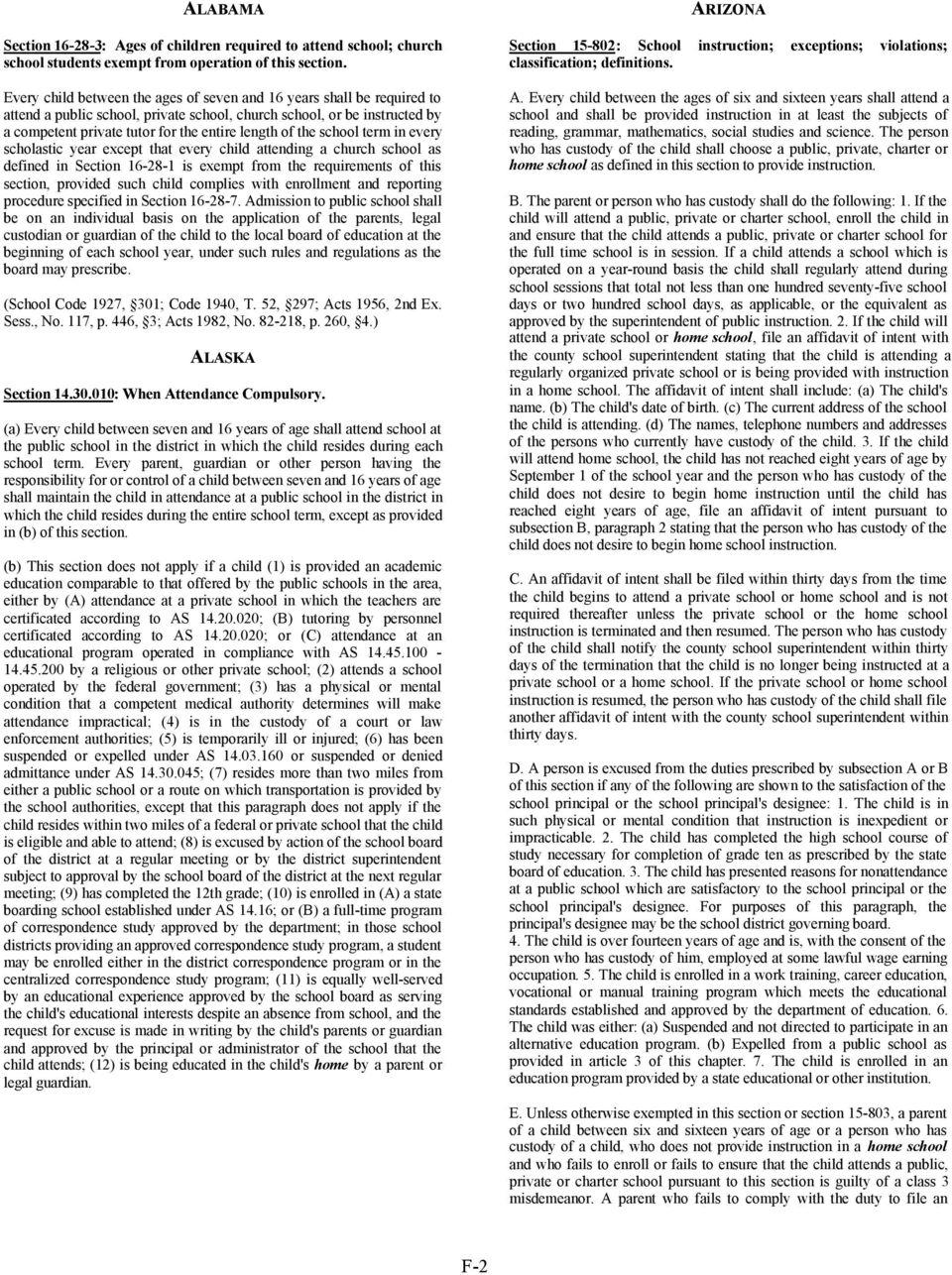
2 ALABAMA Section : Ages of children required to attend school; church school students exempt from operation of this section. Every child between the ages of seven and 16 years shall be required to attend a public school, private school, church school, or be instructed by a competent private tutor for the entire length of the school term in every scholastic year except that every child attending a church school as defined in Section is exempt from the requirements of this section, provided such child complies with enrollment and reporting procedure specified in Section Admission to public school shall be on an individual basis on the application of the parents, legal custodian or guardian of the child to the local board of education at the beginning of each school year, under such rules and regulations as the board may prescribe. (School Code 1927, 301; Code 1940, T. 52, 297; Acts 1956, 2nd Ex. Sess., No. 117, p. 446, 3; Acts 1982, No , p. 260, 4.) ALASKA Section : When Attendance Compulsory. (a) Every child between seven and 16 years of age shall attend school at the public school in the district in which the child resides during each school term. Every parent, guardian or other person having the responsibility for or control of a child between seven and 16 years of age shall maintain the child in attendance at a public school in the district in which the child resides during the entire school term, except as provided in (b) of this section. (b) This section does not apply if a child (1) is provided an academic education comparable to that offered by the public schools in the area, either by (A) attendance at a private school in which the teachers are certificated according to AS ; (B) tutoring by personnel certificated according to AS ; or (C) attendance at an educational program operated in compliance with AS by a religious or other private school; (2) attends a school operated by the federal government; (3) has a physical or mental condition that a competent medical authority determines will make attendance impractical; (4) is in the custody of a court or law enforcement authorities; (5) is temporarily ill or injured; (6) has been suspended or expelled under AS or suspended or denied admittance under AS ; (7) resides more than two miles from either a public school or a route on which transportation is provided by the school authorities, except that this paragraph does not apply if the child resides within two miles of a federal or private school that the child is eligible and able to attend; (8) is excused by action of the school board of the district at a regular meeting or by the district superintendent subject to approval by the school board of the district at the next regular meeting; (9) has completed the 12th grade; (10) is enrolled in (A) a state boarding school established under AS 14.16; or (B) a full-time program of correspondence study approved by the department; in those school districts providing an approved correspondence study program, a student may be enrolled either in the district correspondence program or in the centralized correspondence study program; (11) is equally well-served by an educational experience approved by the school board as serving the child's educational interests despite an absence from school, and the request for excuse is made in writing by the child's parents or guardian and approved by the principal or administrator of the school that the child attends; (12) is being educated in the child's home by a parent or legal guardian. ARIZONA Section : School instruction; exceptions; violations; classification; definitions. A. Every child between the ages of six and sixteen years shall attend a school and shall be provided instruction in at least the subjects of reading, grammar, mathematics, social studies and science. The person who has custody of the child shall choose a public, private, charter or home school as defined in this section to provide instruction. B. The parent or person who has custody shall do the following: 1. If the child will attend a public, private or charter school, enroll the child in and ensure that the child attends a public, private or charter school for the full time school is in session. If a child attends a school which is operated on a year-round basis the child shall regularly attend during school sessions that total not less than one hundred seventy-five school days or two hundred school days, as applicable, or the equivalent as approved by the superintendent of public instruction. 2. If the child will attend a private school or home school, file an affidavit of intent with the county school superintendent stating that the child is attending a regularly organized private school or is being provided with instruction in a home school. The affidavit of intent shall include: (a) The child's name. (b) The child's date of birth. (c) The current address of the school the child is attending. (d) The names, telephone numbers and addresses of the persons who currently have custody of the child. 3. If the child will attend home school, the child has not reached eight years of age by September 1 of the school year and the person who has custody of the child does not desire to begin home instruction until the child has reached eight years of age, file an affidavit of intent pursuant to subsection B, paragraph 2 stating that the person who has custody of the child does not desire to begin home school instruction. C. An affidavit of intent shall be filed within thirty days from the time the child begins to attend a private school or home school and is not required thereafter unless the private school or the home school instruction is terminated and then resumed. The person who has custody of the child shall notify the county school superintendent within thirty days of the termination that the child is no longer being instructed at a private school or a home school. If the private school or home school instruction is resumed, the person who has custody of the child shall file another affidavit of intent with the county school superintendent within thirty days. D. A person is excused from the duties prescribed by subsection A or B of this section if any of the following are shown to the satisfaction of the school principal or the school principal's designee: 1. The child is in such physical or mental condition that instruction is inexpedient or impracticable. 2. The child has completed the high school course of study necessary for completion of grade ten as prescribed by the state board of education. 3. The child has presented reasons for nonattendance at a public school which are satisfactory to the school principal or the school principal's designee. For purposes of this paragraph, the principal's designee may be the school district governing board. 4. The child is over fourteen years of age and is, with the consent of the person who has custody of him, employed at some lawful wage earning occupation. 5. The child is enrolled in a work training, career education, vocational or manual training program which meets the educational standards established and approved by the department of education. 6. The child was either: (a) Suspended and not directed to participate in an alternative education program. (b) Expelled from a public school as provided in article 3 of this chapter. 7. The child is enrolled in an education program provided by a state educational or other institution. E. Unless otherwise exempted in this section or section , a parent of a child between six and sixteen years of age or a person who has custody of a child, who does not provide instruction in a home school and who fails to enroll or fails to ensure that the child attends a public, private or charter school pursuant to this section is guilty of a class 3 misdemeanor. A parent who fails to comply with the duty to file an F-2
3 affidavit of intent to provide instruction in a home school is guilty of a petty offense. F. For the purposes of this section: 1. "Home school" means a school conducted primarily by the parent, guardian or other person who has custody of the child or instruction provided in the child's home. 2. "Private school" means a nonpublic institution, other than the child's home, where academic instruction is provided for at least the same number of days and hours each year as a public school. ARKANSAS Section : Home schooled students - Achievement tests - Enrollment or reenrollment in local schools. (a) Each student enrolled in a home school program who is considered to be at a grade level, or no more than two (2) years beyond the normal age for the appropriate grade, for which the state mandates normreferenced tests for public school students shall be tested using a nationally recognized achievement test selected by the State Board of Education. (b)(1)(a) The administration of the tests required of homes schooled students shall be by the directors of the education service cooperatives established under et seq., or as otherwise designated by the Department of Education. (B) For the purposes of this section, the superintendents of the Little Rock, North Little Rock, and Pulaski County school districts shall act in lieu of an education service cooperative director. (2) The directors of the education service cooperatives shall establish a common set of procedures, approved by the Director of the Department of Education, for the proper administration of the tests required by this section. (3) Such administration shall include purchasing the test materials, giving the tests, scoring and interpretation of the tests, and reporting test results. (c) The cost of testing required by this section shall be the responsibility of the Department of Education when the tests are administered by the directors of the education service cooperatives or other Department of Education designees. (d) Alternate testing procedures may be approved by the director of an education service cooperative after consultation with the parents of a home schooled student; provided, however, that any costs associated with an alternate testing procedure shall be the responsibility of the parents. (e)(1) Each local school district shall have authority to assess any home schooled student who enrolls or reenrolls in the district in order to determine proper educational placement. (2) The local school district shall utilize, among other means of assessment, the norm-referenced test approved by the State Board of Education to assess the student and shall determine placement in the appropriate grade level as indicated by the test results. (f) Any home schooled student who enrolls or reenrolls in a local school district must attend classes for at least nine (9) months immediately prior to graduation before the student can become eligible to receive a high school diploma from the district. History. Acts 1985 (1st Ex. Sess.), No. 40, 4; 1985 (1st Ex. Sess.), No. 42, 4; A.S.A. 1947, ; Acts 1995, No. 522, 2; 1997, No. 400, 3. Sections : CALIFORNIA The classes of children described in this article, shall be exempted by the proper school authorities from the requirements of attendance upon a public full-time day school Children who are being instructed in a private full-time day school by persons capable of teaching shall be exempted. Such school shall, except under the circumstances described in Section 30, be taught in the English language and shall offer instruction in the several branches of study required to be taught in the public schools of the state. The attendance of the pupils shall be kept by private school authorities in a register, and the record of attendance shall indicate clearly every absence of the pupil from school for a half day or more during each day that school is maintained during the year. Exemptions under this section shall be valid only after verification by the attendance supervisor of the district, or other person designated by the board of education, that the private school has complied with the provisions of Section requiring the annual filing by the owner or other head of a private school of an affidavit or statement of prescribed information with the Superintendent of Public Instruction. The verification required by this section shall not be construed as an evaluation, recognition, approval, or endorsement of any private school or course Children who are mentally gifted and who are being instructed in a private full-time day school by persons capable of teaching, where all or part of the courses of instruction required to be taught in the public schools of this state is taught in a foreign language with not less than 50 percent of the total daily instructional time taught in the English language, shall be exempted. The attendance of the pupils shall be kept pursuant to Section Children not attending a private, full-time, day school and who are being instructed in study and recitation for at least three hours a day for 175 days each calendar year by a private tutor or other person in the several branches of study required to be taught in the public schools of this state and in the English language shall be exempted. The tutor or other person shall hold a valid state credential for the grade taught. The instruction shall be offered between the hours of 8 o'clock a.m. and 4 o'clock p.m The governing board of any school district which has children holding work permits to work temporarily in the entertainment or allied industries who are exempted from attending public full-time day school under the provisions of this article, or a county superintendent of schools, may contract with any person, firm or corporation responsible for the education of any children, so employed or acting on behalf thereof, to provide eligibility lists and placement services for qualified teaching and other necessary personnel for the tutoring of such children while so employed. Such personnel shall not for these purposes be deemed public employees. The contract shall require the payment of all costs of the school district, or the county superintendent of schools in providing the lists or services (a) (1) Notwithstanding Section 48200, a pupil who holds a work permit to work for a period of not more than five consecutive days in the entertainment or allied industries shall be excused from school during the period that the pupil is working in the entertainment or allied industry for a maximum of up to five absences per school year. (2) Notwithstanding Section 48200, a pupil shall be excused from school in order to participate with a not-for-profit performing arts organization in a performance for a public school pupil audience for a maximum of up to five days per school year provided the pupil's parent or guardian provides a written note to the school authorities explaining the reason for the pupil's absence. (b) A pupil absent from school under this section shall be permitted to complete all assignments and tests missed during the absence that can be reasonably provided and, upon satisfactory completion, shall be given full credit therefor. The teacher of any class from which a pupil is absent shall determine, pursuant to the regulations of the governing board of the school district, or the county board of education, what assignments the pupil shall make up and in what period of time the pupil shall complete those assignments. The tests and assignments shall be reasonably equivalent to, but not necessarily identical to, the tests and assignments that the pupil missed during the absence. (c) A pupil absent pursuant to paragraph (1) of subdivision (a)shall receive instruction during the period of the absence from a studio teacher certified by the Labor Commissioner holding credentials as defined in Section of Title 8 of the California Code of Regulations. The instruction shall be offered between 7 a.m. and 4 p.m. for pupils in kindergarten and grades 1 to 6, inclusive, and between 7 a.m. and 7 p.m. for pupils in grades 7 to 12, inclusive. The school district or county superintendent of schools shall accept the work done F-3

4 by the pupil and the grades given to the pupil on that work and shall provide the pupil with credit for the instruction the pupil received from that teacher. (d) At the request of a pupil excused from school pursuant to paragraph (1) of subdivision (a), the pupil may be permitted to enroll in a work experience program of the school district and shall receive appropriate academic credit for that work experience.(e) This section shall apply to all pupils, whether a pupil is enrolled in regular classes or special education classes, a regional occupational program or center, or a program of independent study, or any other program of the school district or county superintendent of schools Children who hold permits to work shall be exempted, but such children shall be subject to compulsory attendance upon part-time classes Notwithstanding Section 48201, pupils between 12 and 18 years of age who enter an attendance area from another state within 10 schooldays before the end of the school term during which such entrance occurs are exempt for the remainder of the school term Notwithstanding any other provision of law, a child who will be 15 years old at the time a leave of absence is to begin may take a leave of absence from school for a period of up to one semester, if all of the following conditions are satisfied: (a) The school district governing board adopts a written policy to allow pupil leaves of absence consistent with this section. (b) The purpose of the leave is supervised travel, study, training, or work not available to the pupil under another education option. (c) A written agreement is entered into that is signed by the child's parent or guardian, the principal or administrative officer of the school which the child would otherwise attend, a classroom teacher familiar with the child's academic progress selected by the child, and the district supervisor of child welfare and attendance, and that provides for all of the following: (1) The purpose of the leave. (2) The length of time the child will be on leave. (3) A meeting between, or contact with, the child and a school official designated in the agreement at least once a month while the child is on leave. (4) A statement incorporating the provisions contained in subdivision (b). (d) The child shall be entitled to return to school at any time. No child who takes a leave of absence shall be penalized from completing his or her academic requirements within a time period equal to that of classmates who did not take a leave of absence, plus a period of time equal to the leave of absence. However, when a child reenrolls at any time other than the beginning of a semester, the school shall not be required to give makeup sessions during that semester for the classes that the child has missed. (e) A leave of absence may be extended for an additional semester upon approval by all parties to the written agreement and the local school attendance review board. (f) No leave of absence may be taken that would continue past the end of the school year in which the leave is taken. (g) If the pupil does not contact the designated school official as stipulated in the written agreement, the leave of absence shall be nullified. Any party to the written agreement may nullify the agreement for cause at any time. (h) No more than 1 percent of the pupils enrolled and in attendance at each school shall be permitted to take a leave of absence during each academic year. COLORADO Section : Home-based education - legislative declaration - definitions - guidelines. (1) The general assembly hereby declares that it is the primary right and obligation of the parent to choose the proper education and training for children under his care and supervision. It is recognized that homebased education is a legitimate alternative to classroom attendance for the instruction of children and that any regulation of non-public homebased educational programs should be sufficiently flexible to accommodate a variety of circumstances. The general assembly further declares that non-public home-based educational programs shall be subject only to minimum state controls which are currently applicable to other forms of non-public education. (2) As used in this section: (a) "Non-public home-based educational program" means the sequential program of instruction for the education of a child which takes place in a home, which is provided by the child's parent or by an adult relative of the child designated by the parent, and which is not under the supervision and control of a school district. This educational program is not intended to be and does not qualify as a private and nonprofit school. (b) Parent" includes a parent or guardian. (c) "Qualified person" means an individual who is selected by the parent of a child who is participating in a non-public home-based educational program to evaluate such child's progress and who is a teacher certified pursuant to article 60 of this title, a teacher who is employed by an independent or parochial school, a licensed psychologist, or a person with a graduate degree in education. (3) The following guidelines shall apply to a non-public home-based educational program: (a) A parent or an adult relative designated by a parent to provide instruction in a non-public home-based educational program shall not be subject to the requirements of the "Teacher Certification Act of 1975", article 60 of this title, nor to the provisions of article 61 of this title relating to teacher employment. (b) A child who is participating in a non-public home-based educational program shall not be subject to compulsory school attendance as provided in this article; except that any child who is habitually truant, as defined in section (3), at any time during the last six months that the child attended school before proposed enrollment in a non-public home-based educational program may not be enrolled in the program unless the child's parents first submit a written description of the curricula to be used in the program along with the written notification of establishment of the program required in paragraph (e) of subsection (2) of this section to the superintendent of the child's school district of residence. (c) A non-public home-based educational program shall include no less than one hundred seventy-two days of instruction, averaging four instructional contact hours per day. (d) A non-public home-based educational program shall include, but need not be limited to, communication skills of reading, writing, and speaking, mathematics, history, civics, literature, science, and regular courses of instruction in the constitution of the United States as provided in section (e) Any parent establishing a non-public home-based educational program shall provide written notification of the establishment of said program to the local school district of residence fourteen days prior to the establishment of said program and each year thereafter if the program is maintained. The parent in charge and in control of a non-public homebased educational program shall certify, in writing, only a statement containing the name, age, place of residence, and number of hours of attendance of each child enrolled in said program. (f) Each child participating in a non-public home-based educational program shall be evaluated when such child reaches grades three, five, seven, nine, and eleven. Each child shall be given a nationally standardized achievement test to evaluate the child's academic progress, or a qualified person shall evaluate the child's academic progress. The test or evaluation results, whichever is appropriate, shall be submitted to the local school district of residence or an independent or parochial school within the state of Colorado. If the test or evaluation results are submitted to an independent or parochial school, the name of such school shall be provided to the local school district of residence. The purpose of such tests or evaluations shall be to evaluate the educational progress of each child. (g) The records of each child participating in a non-public homebased educational program shall be maintained on a permanent basis by the parent in charge and in control of said program. The records shall include, but need not be limited to, attendance data, test and evaluation results, and immunization records, as required by sections , , and , C.R.S. Such records shall be produced to the local school district of residence upon fourteen days' written notice if the superintendent of said school district has probable cause to believe that said program is not in compliance with the guidelines established in this subsection (3). (4) Any child who has participated in a non-public home-based educational program and who subsequently enrolls in the public school F-4

5 system may be tested by the school district for the purpose of placing the child in the proper grade and shall then be placed at the grade level deemed most appropriate by the local school district of residence. (5) (a) (I) If test results submitted to the local school district of residence pursuant to the provisions of paragraph (f) of subsection (3) of this section show that a child participating in a non-public home-based educational program received a composite score on said test which was above the thirteenth percentile, such child shall continue to be exempt from the compulsory school attendance requirement of this article. If the child's composite score on said test is at or below the thirteenth percentile, the local school district of residence shall require the parents to place said child in a public or independent or parochial school until the next testing period; except that no action shall be taken until the child is given the opportunity to be retested using an alternate version of the same test or a different nationally standardized achievement test selected by the parent from a list of approved tests supplied by the state board. (II) If evaluation results submitted to the local school district of residence pursuant to the provisions of paragraph (f) of subsection (3) of this section show that the child is making sufficient academic progress according to the child's ability, the child will continue to be exempt from the compulsory school attendance requirement of this article. If the evaluation results show that the child is not making sufficient academic progress, the local school district of residence shall require the child's parents to place the child in a public or independent or parochial school until the next testing period. (b) If the child's test or evaluation results are submitted to an independent or parochial school, said school shall notify the local school district of residence if the composite score on said test was at or below the thirteenth percentile or if the evaluation results show that the child is not making sufficient academic progress. The local school district of residence shall then require the parents to proceed in the manner specified in paragraph (a) of this subsection (5). (6) (a) If a child is participating in a non-public home-based educational program but also attending his local school district of residence for a portion of the school day, the local school district of residence shall be entitled to count such child in accordance with the provisions of section (10) for purposes of determining pupil enrollment under the "Public School Finance Act of 1994", article 54 of this title. (b) For purposes of this subsection (6), a child who is participating in a non-public homebased educational program may participate on an equal basis in any extracurricular or interscholastic activity offered by a public school or offered by a private school, at the private school's discretion, as provided in section (c) No child participating in an extracurricular or interscholastic activity pursuant to paragraph (b) of this subsection (6) shall be considered attending the public school district where the child participates in such activity for purposes of determining pupil enrollment under paragraph (a) of this subsection (6). (d) As used in this subsection (6), "extracurricular or interscholastic activities" shall have the same meaning as "activity" as set forth in section (10). (e) If any fee is collected pursuant to this subsection (6) for participation in an activity, the fee shall be used to fund the particular activity for which it is charged and shall not be expended for any other purpose. Section : Duties of parents. CONNECTICUT All parents and those who have the care of children shall bring them up in some lawful and honest employment and instruct them or cause them to be instructed in reading, writing, spelling, English grammar, geography, arithmetic and United States history and in citizenship, including a study of the town, state and federal governments. Each parent or other person having control of a child seven years of age and over and under sixteen years of age shall cause such child to attend a public day school regularly during the hours and terms the public school in the district wherein such child resides is in session, or while the school is in session in which provision for the instruction of such child is made according to law, unless the parent or person having control of such child is able to show that the child is elsewhere receiving equivalent instruction in the studies taught in the public schools. (1949 Rev., S. 1445; 1959, P.A. 198, S. 1; P.A , S. 116; P.A , S. 8, 32.) History: 1959 act deleted requirement that private instruction be given during hours and terms of public school sessions; P.A substituted "seven years of age and over" for "over seven"; P.A deleted exception for employed children over fourteen years of age. See Sec re penalty for noncompliance with provisions of this section. Words "those who have the care of children" equivalent to parents or guardians. 59 C Statute to receive a liberal construction. 59 C State can compel school attendance but cannot compel public school attendance for those who choose to seek, and can find, equivalent elsewhere. 147 C Cited. 148 C. 238; 149 C Education made compulsory because it is so important. 172 C. 615, 647. Cited. 193 C. 93, Cited. 218 C. 1, 7. Cited. 228 C. 640, 641, 649. Cited. 34 CA 567, 572. Statute widely applied, no denial of equal protection. 29 CS 397. Cited. 36 CS 357, 358. Section a: Refusal of certain parents to consent to use of special education programs or services. The provisions of sections 10-76a to 10-76h, inclusive, shall not be construed to require any local, regional or state board of education to provide special education programs or services for any child whose parent or guardian has chosen to educate such child in a home or private school in accordance with the provisions of section and who refuses to consent to such programs or services. (P.A , S. 43, 46.) History: P.A effective July 1, Section b: Waiver provisions not applicable to equivalent instruction authority of parents. Notwithstanding any provision of the general statutes or public or special act granting the Commissioner of Education the authority to waive provisions of the general statutes, the Commissioner of Education shall not limit the authority of parents or guardians to provide for equivalent instruction pursuant to section (P.A , S. 44, 46.) History: P.A effective July 1, Section : Penalty. Each day's failure on the part of a person to comply with any provision of section shall be a distinct offense, punishable by a fine not exceeding twenty-five dollars. Said penalty shall not be incurred when it appears that the child is destitute of clothing suitable for attending school and the parent or person having control of such child is unable to provide such clothing. All offenses concerning the same child shall be charged in separate counts in one complaint. When a complaint contains more than one count, the court may give sentence on one or more counts and suspend sentence on the remaining counts. If, at the end of twelve weeks from the date of the sentence, it appears that the child concerned has attended school regularly during that time, judgment on such remaining counts shall not be executed. (1949 Rev., S. 1446; P.A , S. 117; P.A , S. 4, 6; , S. 19, 32.) History: P.A deleted provision excluding from penalty parents or those in charge of children whose mental or physical condition renders instruction inexpedient or impracticable; P.A increased the penalty for failure to comply with Sec from five dollars a week to twenty-five dollars a day; P.A changed effective date of P.A from July 1, 1990, to July 1, Cited. 193 C. 93, 101. Cited. 36 CS 357, 358. DELAWARE Section 2702: Compulsory attendance requirements; evaluation of readiness. F-5

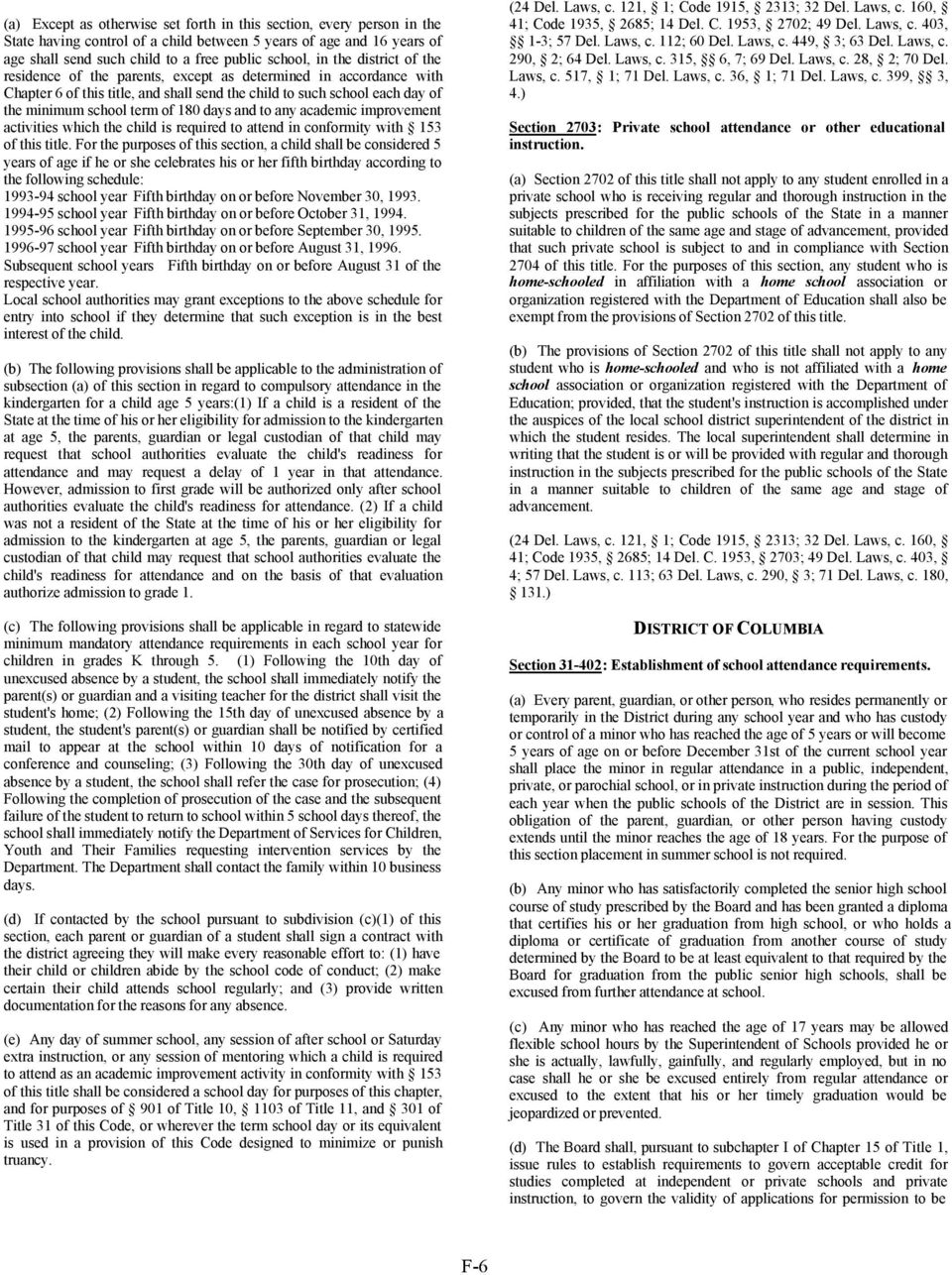
6 (a) Except as otherwise set forth in this section, every person in the State having control of a child between 5 years of age and 16 years of age shall send such child to a free public school, in the district of the residence of the parents, except as determined in accordance with Chapter 6 of this title, and shall send the child to such school each day of the minimum school term of 180 days and to any academic improvement activities which the child is required to attend in conformity with 153 of this title. For the purposes of this section, a child shall be considered 5 years of age if he or she celebrates his or her fifth birthday according to the following schedule: school year Fifth birthday on or before November 30, school year Fifth birthday on or before October 31, school year Fifth birthday on or before September 30, school year Fifth birthday on or before August 31, Subsequent school years Fifth birthday on or before August 31 of the respective year. Local school authorities may grant exceptions to the above schedule for entry into school if they determine that such exception is in the best interest of the child. (b) The following provisions shall be applicable to the administration of subsection (a) of this section in regard to compulsory attendance in the kindergarten for a child age 5 years:(1) If a child is a resident of the State at the time of his or her eligibility for admission to the kindergarten at age 5, the parents, guardian or legal custodian of that child may request that school authorities evaluate the child's readiness for attendance and may request a delay of 1 year in that attendance. However, admission to first grade will be authorized only after school authorities evaluate the child's readiness for attendance. (2) If a child was not a resident of the State at the time of his or her eligibility for admission to the kindergarten at age 5, the parents, guardian or legal custodian of that child may request that school authorities evaluate the child's readiness for attendance and on the basis of that evaluation authorize admission to grade 1. (c) The following provisions shall be applicable in regard to statewide minimum mandatory attendance requirements in each school year for children in grades K through 5. (1) Following the 10th day of unexcused absence by a student, the school shall immediately notify the parent(s) or guardian and a visiting teacher for the district shall visit the student's home; (2) Following the 15th day of unexcused absence by a student, the student's parent(s) or guardian shall be notified by certified mail to appear at the school within 10 days of notification for a conference and counseling; (3) Following the 30th day of unexcused absence by a student, the school shall refer the case for prosecution; (4) Following the completion of prosecution of the case and the subsequent failure of the student to return to school within 5 school days thereof, the school shall immediately notify the Department of Services for Children, Youth and Their Families requesting intervention services by the Department. The Department shall contact the family within 10 business days. (d) If contacted by the school pursuant to subdivision (c)(1) of this section, each parent or guardian of a student shall sign a contract with the district agreeing they will make every reasonable effort to: (1) have their child or children abide by the school code of conduct; (2) make certain their child attends school regularly; and (3) provide written documentation for the reasons for any absence. (e) Any day of summer school, any session of after school or Saturday extra instruction, or any session of mentoring which a child is required to attend as an academic improvement activity in conformity with 153 of this title shall be considered a school day for purposes of this chapter, and for purposes of 901 of Title 10, 1103 of Title 11, and 301 of Title 31 of this Code, or wherever the term school day or its equivalent is used in a provision of this Code designed to minimize or punish truancy. (24 Del. Laws, c. 121, 1; Code 1915, 2313; 32 Del. Laws, c. 160, 41; Code 1935, 2685; 14 Del. C. 1953, 2702; 49 Del. Laws, c. 403, 1-3; 57 Del. Laws, c. 112; 60 Del. Laws, c. 449, 3; 63 Del. Laws, c. 290, 2; 64 Del. Laws, c. 315, 6, 7; 69 Del. Laws, c. 28, 2; 70 Del. Laws, c. 517, 1; 71 Del. Laws, c. 36, 1; 71 Del. Laws, c. 399, 3, 4.) Section 2703: Private school attendance or other educational instruction. (a) Section 2702 of this title shall not apply to any student enrolled in a private school who is receiving regular and thorough instruction in the subjects prescribed for the public schools of the State in a manner suitable to children of the same age and stage of advancement, provided that such private school is subject to and in compliance with Section 2704 of this title. For the purposes of this section, any student who is home-schooled in affiliation with a home school association or organization registered with the Department of Education shall also be exempt from the provisions of Section 2702 of this title. (b) The provisions of Section 2702 of this title shall not apply to any student who is home-schooled and who is not affiliated with a home school association or organization registered with the Department of Education; provided, that the student's instruction is accomplished under the auspices of the local school district superintendent of the district in which the student resides. The local superintendent shall determine in writing that the student is or will be provided with regular and thorough instruction in the subjects prescribed for the public schools of the State in a manner suitable to children of the same age and stage of advancement. (24 Del. Laws, c. 121, 1; Code 1915, 2313; 32 Del. Laws, c. 160, 41; Code 1935, 2685; 14 Del. C. 1953, 2703; 49 Del. Laws, c. 403, 4; 57 Del. Laws, c. 113; 63 Del. Laws, c. 290, 3; 71 Del. Laws, c. 180, 131.) DISTRICT OF COLUMBIA Section : Establishment of school attendance requirements. (a) Every parent, guardian, or other person, who resides permanently or temporarily in the District during any school year and who has custody or control of a minor who has reached the age of 5 years or will become 5 years of age on or before December 31st of the current school year shall place the minor in regular attendance in a public, independent, private, or parochial school, or in private instruction during the period of each year when the public schools of the District are in session. This obligation of the parent, guardian, or other person having custody extends until the minor reaches the age of 18 years. For the purpose of this section placement in summer school is not required. (b) Any minor who has satisfactorily completed the senior high school course of study prescribed by the Board and has been granted a diploma that certifies his or her graduation from high school, or who holds a diploma or certificate of graduation from another course of study determined by the Board to be at least equivalent to that required by the Board for graduation from the public senior high schools, shall be excused from further attendance at school. (c) Any minor who has reached the age of 17 years may be allowed flexible school hours by the Superintendent of Schools provided he or she is actually, lawfully, gainfully, and regularly employed, but in no case shall he or she be excused entirely from regular attendance or excused to the extent that his or her timely graduation would be jeopardized or prevented. (d) The Board shall, pursuant to subchapter I of Chapter 15 of Title 1, issue rules to establish requirements to govern acceptable credit for studies completed at independent or private schools and private instruction, to govern the validity of applications for permission to be F-6
7 absent from school, to govern the selection and appointment of appropriate staff members to carry out the provisions of this chapter under the direction of the Superintendent of Schools, pursuant to Chapter 6 of Title 1, and in respect to other matters within the scope of authority of the Board that relates to this subchapter. (Feb. 4, 1925, 43 Stat. 806, ch. 140, Art. I, 1, 2; 1973 Ed., , ; renumbered as Art. II, 1 and amended, Mar. 8, 1991, D.C. Law 8-247, 2(a), 38 DCR 376.) FLORIDA Section : Home education programs. (1) Regular attendance as defined in Section may be achieved by attendance in a home education program as defined in Section The parent or guardian is not required to hold a valid regular Florida certificate to teach. (a) The parent or guardian shall notify the superintendent of schools of the county in which the parent or guardian resides of her or his intent to establish and maintain a home education program. The notice shall be in writing, signed by the parent or guardian, and shall include the names, addresses, and birthdates of all children who shall be enrolled as students in the home education program. The notice shall be filed in the superintendent's office within 30 days of the establishment of the home education program. A written notice of termination of the home education program shall be filed in the superintendent's office within 30 days of said termination. (b) The parent or guardian shall maintain a portfolio of records and materials. The portfolio shall consist of the following: 1. A log of educational activities which is made contemporaneously with the instruction and which designates by title any reading materials used. 2. Samples of any writings, worksheets, workbooks, or creative materials used or developed by the student. The portfolio shall be preserved by the parent or guardian for 2 years and shall be made available for inspection by the superintendent, or the superintendent's agent, upon 15 days' written notice. Nothing in this section shall require the superintendent to inspect the portfolio. (c) The parent or guardian shall provide for an annual educational evaluation in which is documented the pupil's demonstration of educational progress at a level commensurate with her or his ability. The parent or guardian shall select the method of evaluation and shall file a copy of the evaluation annually with the superintendent's office in the county in which the pupil resides. The annual educational evaluation shall consist of one of the following: 1. A teacher selected by the parent or guardian shall evaluate the pupil's educational progress upon review of the portfolio and discussion with the pupil. Such teacher shall hold a valid regular Florida certificate to teach academic subjects at the elementary or secondary level; 2. The pupil shall take any nationally normed student achievement test administered by a certified teacher; 3. The pupil shall take a state student assessment test used by the school district and administered by a certified teacher, at a location and under testing conditions approved by the school district; 4. The pupil shall be evaluated by an individual holding a valid, active license pursuant to the provisions of s (7) or (8); or 5. The pupil shall be evaluated with any other valid measurement tool as mutually agreed upon by the school superintendent of the district in which the pupil resides and the pupil's parent or guardian. (2) The school superintendent shall review and accept the results of the annual educational evaluation of the pupil in a home education program. If the pupil does not demonstrate educational progress at a level commensurate with her or his ability, the superintendent shall notify the parent or guardian, in writing, that such progress has not been achieved. The parent or guardian shall have 1 year from the date of receipt of the written notification to provide remedial instruction to the pupil. At the end of the 1-year probationary period, the pupil shall be reevaluated as specified in paragraph (1)(c). Continuation in a home education program shall be contingent upon the pupil demonstrating educational progress commensurate with her or his ability at the end of the probationary period. (3) A home education program shall be excluded from meeting the requirements of a school day as defined in s History.--ss. 2, 3, ch ; s. 1, ch ; s. 16, ch ; s. 11, ch ; s. 26, ch ; s. 19, ch ; s. 1258, ch ; s. 52, ch ; s. 20, ch ; s. 212, ch ; s. 4, ch Section GEORGIA (a) This subpart recognizes the existence of public schools, private schools, and home study programs as educational entities. (b) As used in this subpart, the term "private school" means an institution meeting the following criteria or requirements:(1) The primary purpose of the institution is to provide education or, if the primary purpose of the institution is religious in nature, the institution shall provide the basic academic educational program specified in paragraph (4) of this subsection; (2) The institution is privately controlled and operates on a continuing basis; (3) The institution provides instruction each 12 months for the equivalent of 180 school days of education with each school day consisting of at least four and one-half school hours; (4) The institution provides a basic academic educational program which includes, but is not limited to, reading, language arts, mathematics, social studies, and science; (5) Within 30 days after the beginning of each school year, it shall be the duty of the administrator of each private school to provide to the school superintendent of each local public school district which has residents enrolled in the private school a list of the name, age, and residence of each resident so enrolled. At the end of each school month, it shall be the duty of the administrator of each private school to notify the school superintendent of each local public school district of the name, age, and residence of each student residing in the public school district who enrolls or terminates enrollment at the private school during the immediately preceding school month. Such records shall indicate when attendance has been suspended and the grounds for such suspension. Enrollment records and reports shall not be used for any purpose except providing necessary enrollment information, except with the permission of the parent or guardian of a child, pursuant to the subpoena of a court of competent jurisdiction, or for certification of attendance by the Department of Public Safety for the purposes set forth in subsection (a.1) of Code Section ; and (6) Any building used by the institution for private school purposes meets all health and safety standards established under state law and local ordinances. (c) Parents or guardians may teach their children at home in a home study program which meets the following requirements: (1) The parent, parents, or guardian must submit within 30 days after the establishment of a home study program and by September 1 annually thereafter a declaration of intent to utilize a home study program to the superintendent of schools of the local school district in which the home study program is located; (2) The declaration shall include a list of the names and ages of the students who are enrolled in the home study program, the address where the home study program is located, and a statement of the 12 month period that is to be considered the school year for that home study program. Enrollment records and reports shall not be used for any purpose except providing necessary enrollment information, except with the permission of the parent or guardian of a child, pursuant to the subpoena of a court of competent jurisdiction, or for verification of attendance by the Department of Public Safety for the purposes set forth in subsection (a.1) of Code Section ; (3) Parents or guardians may teach only their own children in the home study program, provided the teaching parent or guardian possesses at least a high school diploma or a general educational development (GED)equivalency diploma, but the parents or guardians may employ a tutor who holds at least a baccalaureate college degree to teach such children; (4) The home study program shall provide a basic academic educational program which includes, but is not limited to, reading, F-7

8 language arts, mathematics, social studies, and science; (5) The home study program must provide instruction each 12 months to home study students equivalent to 180 school days of education with each school day consisting of at least four and one-half school hours unless the child is physically unable to comply with the rule provided for in this paragraph; (6) Attendance records for the home study program shall be kept and shall be submitted at the end of each month to the school superintendent of the local school district in which the home study program is located. Attendance records and reports shall not be used for any purpose except providing necessary attendance information, except with the permission of the parent or guardian of a child, pursuant to the subpoena of a court of competent jurisdiction, or for verification of attendance by the Department of Public Safety for the purposes set forth in subsection (a.1) of Code Section ; (7) Students in home study programs shall be subject to an appropriate nationally standardized testing program administered in consultation with a person trained in the administration and interpretation of norm reference tests to evaluate their educational progress at least every three years beginning at the end of the third grade and records of such tests and scores shall be retained but shall not be required to be submitted to public educational authorities; and(8) The home study program instructor shall write an annual progress assessment report which shall include the instructor's individualized assessment of the student's academic progress in each of the subject areas specified in paragraph (4) of this subsection, and such progress reports shall be retained by the parent, parents, or guardian of children in the home study program for a period of at least three years. (d) Any person who operates a private school without complying wit the requirements of subsection (b) of this Code section or any person who operates a home study program without complying with the requirements of subsection (c) of this Code section shall be guilty of a misdemeanor and, upon conviction thereof, shall be punished by a fine not to exceed $ (e) The State Board of Education shall devise, adopt, and make available to local school superintendents, who shall in turn make available to administrators of private schools and parents or guardians with children in home study programs, such printed forms and procedures as may be reasonably necessary to carry out efficiently the reporting provisions of this Code section, but such printed forms and procedures shall not be inconsistent with or exceed the requirements of this Code section. HAWAII Section 302A-1132: Attendance compulsory; exceptions. (a) Unless excluded from school or excepted from attendance, all children who will have arrived at the age of at least six years, and who will not have arrived at the age of eighteen years, by January 1 of any school year, shall attend either a public or private school for, and during, the school year, and any parent, guardian, or other person having the responsibility for, or care of, a child whose attendance at school is obligatory shall send the child to either a public or private school. Attendance at a public or private school shall not be compulsory in the following cases: (1) Where the child is physically or mentally unable to attend school (deafness and blindness excepted), of which fact the certificate of a duly licensed physician shall be sufficient evidence; (2) Where the child, who has reached the fifteenth anniversary of birth, is suitably employed and has been excused from school attendance by the superintendent or the superintendent's authorized representative, or by a family court judge; (3) Where, upon investigation by the family court, it has been shown that for any other reason the child may properly remain away from school; (4) Where the child has graduated from high school; (5) Where the child is enrolled in an appropriate alternative educational program as approved by the superintendent or the superintendent's authorized representative in accordance with the plans and policies of the department, or notification of intent to home school has been submitted to the principal of the public school that the child would otherwise be required to attend in accordance with department rules adopted to achieve this result; or (6) Where: (A) The child has attained the age of sixteen years; (B) The principal has determined that: (i) The child has engaged in behavior which is disruptive to other students, teachers, or staff; or (ii) The child's non-attendance is chronic and has become a significant factor that hinders the child's learning; and (C) The principal of the child's school, and the child's teacher or counselor, in consultation with the child and the child's parent, guardian, or other adult having legal responsibility for or care of the child, develops an alternative educational plan for the child. The alternative educational plan shall include a process that shall permit the child to resume school. The principal of the child's school shall file the plan made pursuant to subparagraph (C) with the child's school record. If the adult having legal responsibility for or care of the child disagrees with the plan, then the adult shall be responsible for obtaining appropriate educational services for the child. (b) Any employer who employs a child who is excused from school attendance in accordance with subsection (a)(2) shall notify the child's school within three days upon termination of the child's employment. [L 1996, c 89, pt of 2 and am c 162, 2] IDAHO Section : School Attendance Compulsory. The parent or guardian of any child resident in this state who has attained the age of seven (7) years at the time of the commencement of school in his district, but not the age of sixteen (16) years, shall cause the child to be instructed in subjects commonly and usually taught in the public schools of the state of Idaho. Unless the child is otherwise comparably instructed, the parent or guardian shall cause the child to attend a public, private or parochial school during a period in each year equal to that in which the public schools are in session; there to conform to the attendance policies and regulations established by the board of trustees, or other governing body operating the school attended. ILLINOIS Section 13-9: Children attending other schools or receiving private instruction. Sections to 13--8, inclusive, do not apply to children who attend private or parochial day schools or who are receiving equivalent educational training or instruction in the homes of their parents or guardians either by their parents or guardians or by private tutors provided by their parents or guardians. (Source: Laws 1961, p. 31.) INDIANA Section : Compulsory Attendance for Full Term; Duty of Parent. It is unlawful for a parent to fail, neglect or refuse to send his child to a public school for the full term as required under this chapter unless the child is being provided with instruction equivalent to that given in the public schools. This section does not apply during any period when the child is excused from attendance under this chapter. (Formerly: Acts 1973, P.L.218, SEC.1.) As amended by Acts 1978, P.L.2, SEC.2004; Acts 1979, P.L.87, SEC : Attendance requirements. IOWA Except as provided in section 299.2, the parent, guardian, or legal or actual custodian of a child who is of compulsory attendance age, shall F-8

9 cause the child to attend some public school, an accredited nonpublic school, or competent private instruction in accordance with the provisions of chapter 299A, during a school year, as defined under section The board of directors of a public school district or the governing body of an accredited nonpublic school shall set the number of days of required attendance for the schools under its control. The board of directors of a public or the governing body of an accredited nonpublic school may, by resolution, require attendance for the entire time when the schools are in session in any school year and adopt a policy or rules relating to the reasons considered to be valid or acceptable excuses for absence from school. Section 299.2: Exceptions. Section shall not apply to any child: 1. Who has completed the requirements for graduation in an accredited school or has obtained a high school equivalency diploma under chapter 259A. 2. Who is excused for sufficient reason by any court of record or judge. 3. While attending religious services or receiving religious instructions. 4. Who is attending a private college preparatory school accredited or probationally accredited under section , subsection Who has been excused under section Who is exempted under section Section 299A.3: Private instruction by nonlicensed person. A parent, guardian, or legal custodian of a child of compulsory attendance age providing competent private instruction to the child shall meet all of the following requirements: 1. Complete and send, in a timely manner, the report required under section to the school district of residence of the child. 2. Ensure that the child under the parent's, guardian's, or legal custodian's instruction is evaluated annually to determine whether the child is making adequate progress, as defined in section 299A Ensure that the results of the child's annual evaluation are reported to the school district of residence of the child and to the department of education by a date not later than June 30 of each year in which the child is under private instruction. KANSAS Section : Compulsory school attendance; exemptions. (a) Subject to the other provisions of this section, every parent or person acting as parent in the state of Kansas, who has control over or charge of any child who has reached the age of seven years and is under the age of 18 years and has not attained a high school diploma or a general educational development (GED) credential, shall require such child to attend continuously each school year (1) a public school for the duration of the school term provided for in K.S.A , and amendments thereto, or (2) a private, denominational or parochial school taught by a competent instructor for a period of time which is substantially equivalent to the period of time public school is maintained in the school district in which the private, denominational or parochial school is located. If the child is 16 or 17 years of age, the parent or person acting as parent, by written consent, or the court, pursuant to a court order, may allow the child to be exempt from the compulsory attendance requirements of this section. (b) If the child is 16 or 17 years of age, the child shall be exempt from the compulsory attendance requirements of this section if (1) the child is regularly enrolled in a program recognized by the local board of education as an approved alternative educational program, or (2) the child and the parent or person acting as parent attend a final counseling session conducted by the school during which a disclaimer to encourage the child to remain in school or to pursue educational alternatives is presented to and signed by the child and the parent or person acting as parent. The disclaimer shall include information regarding the academic skills that the child has not yet achieved, the difference in future earning power between a high school graduate and a high school drop out, and a listing of educational alternatives that are available for the child. (c) Any child who is under the age of seven years, but who is enrolled in school, is subject to the compulsory attendance requirements of this section. Any such child may be withdrawn from enrollment in school at any time by a parent or person acting as parent of the child and thereupon the child shall be exempt from the compulsory attendance requirements of this section until the child reaches the age of seven years or is re-enrolled in school. (d) Any child who is determined to be an exceptional child, except for an exceptional child who is determined to be a gifted child, under the provisions of the special education for exceptional children act is subject to the compulsory attendance requirements of such act and is exempt from the compulsory attendance requirements of this section. (e) No child attending public school in this state shall be required to participate in any activity which is contrary to the religious teachings of the child if a written statement signed by one of the parents or a person acting as parent of the child is filed with the proper authorities of the school attended requesting that the child not be required to participate in such activities and stating the reason for the request. (f) When a recognized church or religious denomination that objects to a regular public high school education provides, offers and teaches, either individually or in cooperation with another recognized church or religious denomination, a regularly supervised program of instruction, which is approved by the state board of education, for children of compulsory school attendance age who have successfully completed the eighth grade, participation in such a program of instruction by any such children whose parents or persons acting as parents are members of the sponsoring church or religious denomination shall be regarded as acceptable school attendance within the meaning of this act. Approval of such programs shall be granted by the state board of education, for twoyear periods, upon application from recognized churches and religious denominations, under the following conditions: (1) Each participating child shall be engaged, during each day on which attendance is legally required in the public schools in the school district in which the child resides, in at least five hours of learning activities appropriate to the adult occupation that the child is likely to assume in later years; (2) acceptable learning activities, for the purposes of this subsection, shall include parent (or person acting as parent) supervised projects in agriculture and homemaking, work-study programs in cooperation with local business and industry, and correspondence courses from schools accredited by the national home study council, recognized by the United States office of education as the competent accrediting agency for private home study schools; (3) at least 15 hours per week of classroom work under the supervision of an instructor shall be provided, at which time students shall be required to file written reports of the learning activities they have pursued since the time of the last class meeting, indicating the length of time spent on each one, and the instructor shall examine and evaluate such reports, approve plans for further learning activities, and provide necessary assignments and instruction; (4) regular attendance reports shall be filed as required by law, and students shall be reported as absent for each school day on which they have not completed the prescribed minimum of five hours of learning activities; (5) the instructor shall keep complete records concerning instruction provided, assignments made, and work pursued by the students, and these records shall be filed on the first day of each month with the state board of education and the board of education of the school district in which the child resides; (6) the instructor shall be capable of performing competently the functions entrusted thereto; (7) in applying for approval under this subsection a recognized church or religious denomination shall certify its objection to a regular public high school education and shall specify, in such detail as the state board of education may reasonably require, the program of instruction that it intends to provide and no such program shall be approved unless it fully complies with standards therefor which shall be specified by the state board of education; (8) if the sponsors of an instructional program approved F-9
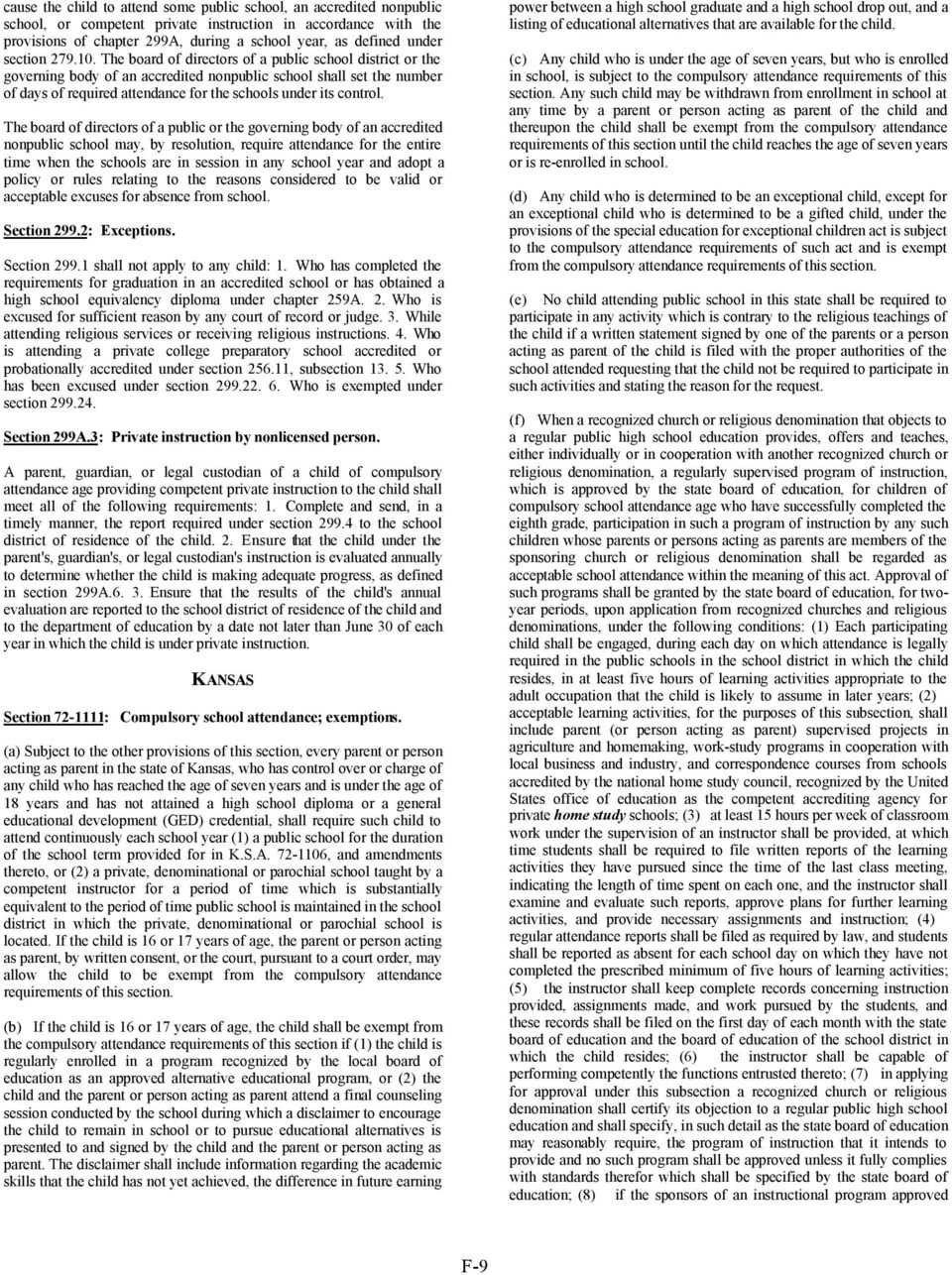
10 under this subsection fail to comply at any time with the provisions of this subsection, the state board of education shall rescind, after a written warning has been served and a period of three weeks allowed for compliance, approval of the programs, even though the two-year approval period has not elapsed, and thereupon children attending such program shall be admitted to a high school of the school district. (g) As used in this section, the terms "parent" and "person acting as parent" have the meanings respectively ascribed thereto in K.S.A , and amendments thereto. History: L. 1874, ch. 123, 1; L. 1903, ch. 423, 1; L. 1919, ch. 272, 1; L. 1923, ch. 182, 1; R.S. 1923, ; L. 1965, ch. 409, 1; L. 1968, ch. 356, 1; L. 1969, ch. 316, 1; L. 1976, ch. 310, 1; L. 1980, ch. 217, 3; L. 1984, ch. 263, 1; L. 1996, ch. 229, 121; L. 1997, ch. 157, 1; July 1. Section : Same; noncompliance; duties of boards of education, secretary of social and rehabilitation services, county and district attorneys; notification of absence to parents. (a) Each board of education shall designate one or more employees who shall report to the secretary of social and rehabilitation services, or a designee thereof, all cases of children who are less than 13 years of age and are not attending school as required by law, and to the appropriate county or district attorney, or a designee thereof, all cases of children who are 13 or more years of age but less than 18 years of age and are not attending school as required by law. The designation shall be made no later than September 1 of each school year and shall be certified no later than 10 days thereafter by the board of education to the secretary of social and rehabilitation services, or the designee thereof, to the county or district attorney, or the designee thereof, and to the commissioner of education. The commissioner of education shall compile and maintain a list of the designated employees of each board of education. (b)whenever a child is required by law to attend school, and the child is not enrolled in a public or nonpublic school, the child shall be considered to be not attending school as required by law and a report thereof shall be made in accordance with the provisions of subsection (a) by a designated employee of the board of education of the school district in which the child resides. The provisions of this subsection are subject to the provisions of subsection (d). (c) (1) Whenever a child is required by law to attend school and is enrolled in school, and the child is inexcusably absent therefrom on either three consecutive school days or five school days in any semester or seven school days in any school year, whichever of the foregoing occurs first, the child shall be considered to be not attending school as required by law. A child is inexcusably absent from school if the child is absent therefrom all or a significant part of a school day without a valid excuse acceptable to the school employee designated by the board of education to have responsibility for the school attendance of such child. (2) Each board of education shall adopt rules for determination of valid excuse for absence from school and for determination of what shall constitute a "significant part of a school day" for the purpose of this section. (3) Each board of education shall designate one or more employees, who shall each be responsible for determining the acceptability and validity of offered excuses for absence from school of specified children, so that a designee is responsible for making such determination for each child enrolled in school. (4) Whenever a determination is made in accordance with the provisions of this subsection that a child is not attending school as required by law, the designated employee who is responsible for such determination shall make a report thereof in accordance with the provisions of subsection (a). (5) The provisions of this subsection are subject to the provisions of subsection (d). (d) (1) Prior to making any report under this section that a child is not attending school as required by law, the designated employee of the board of education shall serve written notice thereof, by personal delivery or by first class mail, upon a parent or person acting as parent of the child. The notice shall inform the parent or person acting as parent that continued failure of the child to attend school without a valid excuse will result in a report being made to the secretary of social and rehabilitation services or to the county or district attorney. Upon failure, on the school day next succeeding personal delivery of the notice or within three school days after the notice was mailed, of attendance at school by the child or of an acceptable response, as determined by the designated employee, to the notice by a parent or person acting as parent of the child, the designated employee shall make a report thereof in accordance with the provisions of subsection (a). The designated employee shall submit with the report a certificate verifying the manner in which notice was provided to the parent or person acting as parent. (2) Whenever a law enforcement officer assumes temporary custody of a child who is found away from home or school without a valid excuse during the hours school is actually in session, and the law enforcement officer delivers the child to the school in which the child is enrolled or to a location designated by the school in which the child is enrolled to address truancy issues, the designated employee of the board of education shall serve notice thereof upon a parent or person acting as parent of the child. The notice may be oral or written and shall inform the parent or person acting as parent of the child that the child was absent from school without a valid excuse and was delivered to school by a law enforcement officer. (e) Whenever the secretary of social and rehabilitation services receives a report required under this section, the secretary shall investigate the matter. If, during the investigation, the secretary determines that the reported child is not attending school as required by law, the secretary shall institute proceedings under the code for care of children. If, during the investigation, the secretary determines that a criminal prosecution should be considered, the secretary shall make a report of the case to the appropriate law enforcement agency. (f) Whenever a county or district attorney receives a report required under this section, the county or district attorney shall investigate the matter. If, during the investigation, the county or district attorney determines that the reported child is not attending school as required by law, the county or district attorney shall prepare and file a petition alleging that the child is a child in need of care. If, during the investigation, the county or district attorney determines that a criminal prosecution is necessary, the county or district attorney shall commence the same. (g) As used in this section, "board of education" means the board of education of a school district or the governing authority of a nonpublic school. The provisions of this act shall apply to both public and nonpublic schools. History: L. 1969, ch. 316, 2; L. 1972, ch. 254, 1; L. 1973, ch. 279, 1; L. 1976, ch. 145, 231; L. 1982, ch. 182, 141; L. 1986, ch. 158, 3; L. 1989, ch. 215, 1; L. 1991, ch. 221, 1; L. 1995, ch. 29, 3;L. 1996, ch. 229, 122; L. 1997, ch. 157, 2; July 1. KENTUCKY Section : Parent or custodian to send child to school -- Age limits for compulsory attendance -- Notification and counseling prior to withdrawal. (1) Except as provided in KRS , each parent, guardian, or other person residing in the state and having in custody or charge any child who has entered the primary school program or any child between the ages of six (6) and sixteen (16) shall send the child to a regular public day school for the full term that the public school of the district in which the child resides is in session or to the public school that the board of education of the district makes provision for the child to attend. A child's age is between six (6) and sixteen (16) when the child has reached his sixth birthday and has not passed his sixteenth birthday. F-10
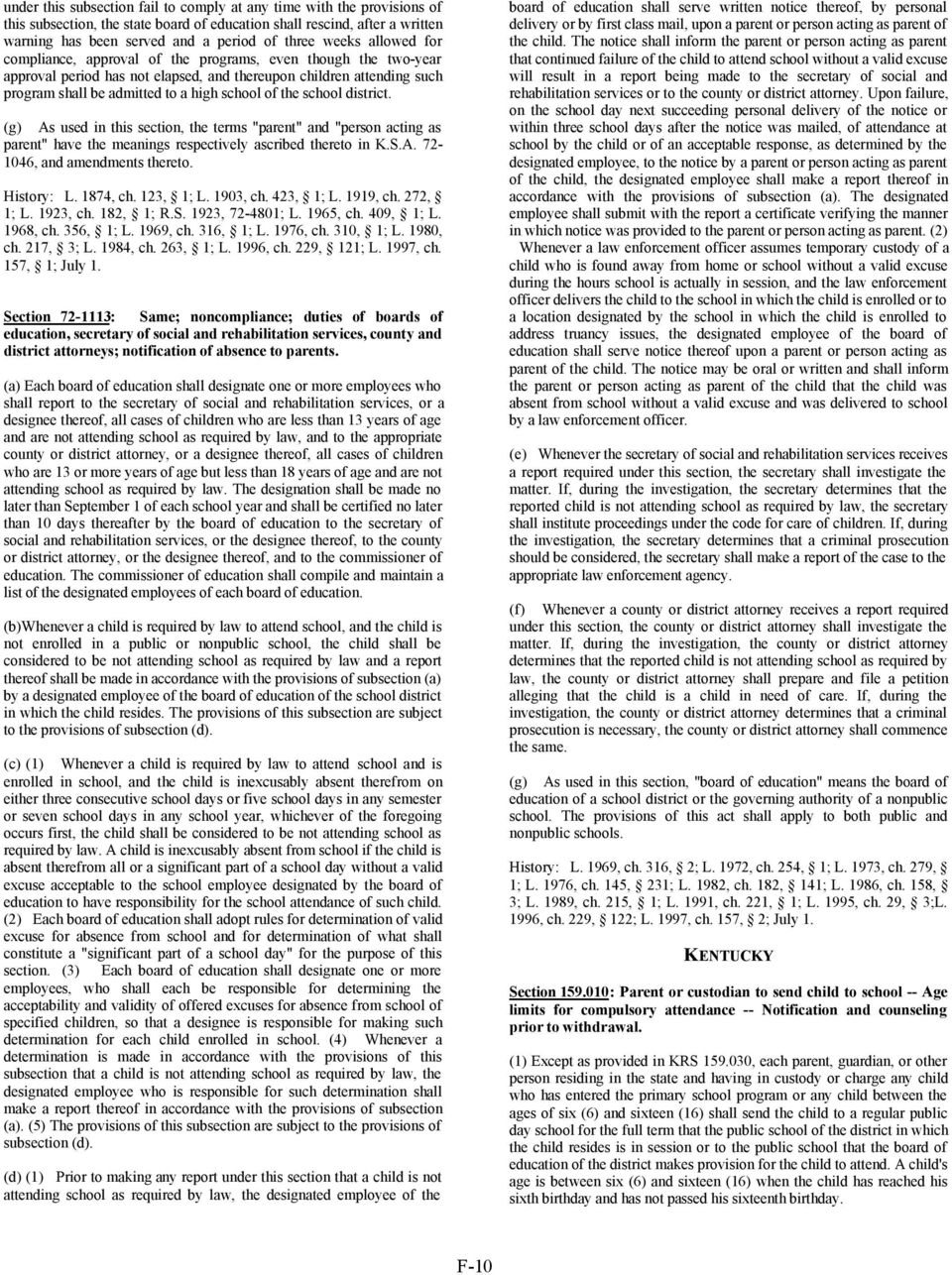
11 (2) An unmarried child between the ages of sixteen (16) and eighteen (18) who wishes to terminate his public or nonpublic education prior to graduating from high school shall do so only after a conference with the principal or his designee, and the principal shall request a conference with the parent, guardian, or other custodian. Written notification of withdrawal must be received from his parent, guardian, or other person residing in the state and having custody or charge of him. The parent(s) and child shall be required to attend a one (1) hour counseling session with a school counselor on potential problems of nongraduates. (3) A child's age is between sixteen (16) and eighteen (18) when the child has reached his sixteenth birthday and has not passed his eighteenth birthday. Written permission for withdrawal shall not be required after the child's eighteenth birthday. Every child actually resident in this state is subject to the laws relating to compulsory attendance, and neither he nor the person in charge of him shall be excused from the operation of those laws or the penalties under them on the ground that the child's residence is seasonable or that his parent is a resident of another state. Effective: July 15, 1998 History: Amended 1998 Ky. Acts ch. 611, sec. 1, effective July 15, Amended 1990 Ky. Acts ch. 476, Pt. I, sec. 29, effective July 13, Amended 1988 Ky. Acts ch. 312, sec. 1, effective July 15, Amended 1985 (1st Extra. Sess.) Ky. Acts ch. 10, sec. 42, effective October 18, Amended 1984 Ky. Acts ch. 74, sec. 1, effective July 13, Amended 1978 Ky. Acts ch. 136, sec. 3, effective July 1, Recodified 1942 Ky. Acts ch. 208, sec. 1, effective October 1, 1942, from Ky. Stat. secs , Tml Section : Exemptions from compulsory attendance. (1) The board of education of the district in which the child resides shall exempt from the requirement of attendance upon a regular public day school every child of compulsory school age: (a) Who is a graduate from an accredited or an approved four (4) year high school; or (b) Who is enrolled and in regular attendance in a private, parochial, or church regular day school. It shall be the duty of each private, parochial, or church regular day school to notify the local board of education of those students in attendance at the school. If a school declines, for any reason, to notify the local board of education of those students in attendance, it shall so notify each student's parent or legal guardian in writing, and it shall then be the duty of the parent or legal guardian to give proper notice to the local board of education; or (c) Who is less than seven (7) years old and is enrolled and in regular attendance in a private kindergarten-nursery school; or (d) Whose physical or mental condition prevents or renders inadvisable attendance at school or application to study; or (e) Who is enrolled and in regular attendance in private, parochial, or church school programs for exceptional children; or (f) Who is enrolled and in regular attendance in a state-supported program for exceptional children; (g) For purposes of this section, "church school" shall mean a school operated as a ministry of a local church, group of churches, denomination, or association of churches on a nonprofit basis. (2) Before granting an exemption under subsection (1)(d) of this section the Kentucky Board of Education shall require satisfactory evidence, in the form of a signed statement of a licensed physician, advanced registered nurse practitioner, psychologist, psychiatrist, or public health officer, that the condition of the child prevents or renders inadvisable attendance at school or application to study. On the basis of such evidence the board may exempt the child from compulsory attendance. Any child who is excused from school attendance more than six (6) months shall have two (2) signed statements from a combination of the following professional persons: a licensed physician, advanced registered nurse practitioner, psychologist, psychiatrist, and health officer. Exemptions of all children under the provisions of subsection (1)(d) of this section shall be reviewed annually with the evidence required being updated. (3) For any child who is excluded under the provisions of subsection (1)(d) of this section, home, hospital, institutional, or other regularly scheduled and suitable instruction meeting standards, rules and regulations of the Kentucky Board of Education shall be provided. Effective: July 15, 1998 Section : Attendance at private and parochial schools. Attendance at private and parochial schools shall be kept by the authorities of such schools in a register provided by the Kentucky Board of Education, and such school authorities shall make attendance and scholarship reports in the same manner as is required by law or by regulation of the Kentucky Board of Education of public school officials. Such schools shall at all times be open to inspection by directors of pupil personnel and officials of the Department of Education. Effective: July 15, 1996 History: Amended 1996 Ky. Acts ch. 362, sec. 6, effective July 15, Repealed and reenacted 1990 Ky. Acts ch. 476, Pt. V, sec. 410, effective July 13, Amended 1966 Ky. Acts ch. 89, sec Recodified 1942 Ky. Acts ch. 208, sec. 1, effective October 1, 1942, from Ky. Stat. sec No information is available. LOUISIANA MAINE Section 5022: Admission to regular program. 1. Placement. A student who has been receiving home-school instruction and who seeks admission to the regular school program must be placed in a grade commensurate with the level of the student's academic achievement. Placement must be guided by the following. A. Grade level placement is determined by the locally designated appropriate school staff, based upon but not limited to such factors as the student's completed curricula and record of achievement, conferencing with the student's parent or guardian and administration of tests, if determined necessary. [1995, c. 610, 1 (new).] B. The final grade level placement decision is based upon local school unit policy and procedures. That decision may be appealed to the school unit superintendent and, if desired, subsequently to the local school board, whose decision is final. [1995, c. 610, 1 (new).] 2. High school course credits and diploma eligibility. The following standards govern the awarding of course credits and a graduation diploma to a student receiving home-school instruction who seeks admission to the public high school. A. A student shall earn high school credits for satisfactory completion of courses in the public high school pursuant to section 5021, subsection 2, paragraph A. [1995, c. 610, 1 (new).] B. A student may earn credit for course work completed through home-school instruction if the principal determines both in advance and upon completion of the course that the course satisfies the requirements for awarding the credit. The principal may direct that the student undergo a test or tests to assist in making a determination relative to the awarding of credit. [1995, c. 610, 1 (new).] C. Requests for transfer credit for equivalent instruction completed at nonapproved private schools, at private schools that elect not to meet requirements under section 2901 or through other equivalent instruction programs must be evaluated on the merits of the documentation provided. The principal and guidance staff shall conduct these evaluations on request by the student or the student's parent or guardian. [1995, c. 610, 1 (new).] D. Awarding of a high school diploma by the local school is conditioned upon the student's demonstration of having satisfied all course credit or other requirements established by the local school board. The local F-11

12 board of directors may establish resident credit requirements as a precondition for the awarding of a local school unit diploma. [1995, c. 610, 1 (new).] Section 7-301: MARYLAND (a) (1) Except as otherwise provided in this section, each child who resides in this State and is 5 years old or older and under 16 shall attend a public school regularly during the entire school year unless the child is otherwise receiving regular, thorough instruction during the school year in the studies usually taught in the public schools to children of the same age. (2) In accordance with regulations of the State Board of Education, a child who resides in this State and is 5 years old may be exempted from mandatory school attendance for 1 year if the child's parent or guardian files a written request with the local school system asking that the child's attendance be delayed due to the child's level of maturity. (3) Except as provided in subsection (f) of this section or in regulations of the State Board of Education, each child who resides in this State shall attend a kindergarten program regularly during the school year prior to entering the first grade unless the child is otherwise receiving regular, thorough instruction in the skills and studies usually taught in a kindergarten program of a public school. (b) A county superintendent, school principal, or an individual authorized by the county superintendent or principal may excuse a student for a lawful absence. (c) Each person who has legal custody or care and control of a child who is 5 years old or older and under 16 shall see that the child attends school or receives instruction as required by this section. (d) (1) This section applies to any child who has a mental, emotional, or physical handicap. (2) This section does not apply to a child: (i) Whose mental, emotional, or physical condition makes his instruction detrimental to his progress; or (ii) Whose presence in school presents a danger of serious physical harm to others. (3) With the advice of the school principal, supervisor, pupil personnel supervisor, or visiting teacher and with the written recommendation of a licensed physician or a State Department of Education certified or licensed psychologist, the county superintendent may: (i) Make other appropriate provisions for the free education of any student excepted from attendance under paragraph (2) of this subsection; or (ii) Permit the parents or guardians of that student to withdraw him from public school, for as long as the attendance of the child in a public school would be detrimental to his progress or his presence in school would present a danger of serious physical harm to others. (4) If a child is withdrawn from a public school under this subsection, the county board shall make other appropriate provisions for the education of the child. (5)If an appropriate educational placement is not available immediately, the county board shall make interim provisions for the education of the child until an appropriate placement becomes available. (e) (1) Any person who induces or attempts to induce a child to absent himself unlawfully from school or employs or harbors any child who is absent unlawfully from school while school is in session is guilty of a misdemeanor and on conviction is subject to a fine not to exceed $500 or imprisonment not to exceed 30 days, or both. (2) Any person who has legal custody or care and control of a child who is 5 years old or older and under 16 who fails to see that the child attends school or receives instruction under this section is guilty of a misdemeanor and: (i) For a first conviction is subject to a fine not to exceed $50 per day of unlawful absence or imprisonment not to exceed 10 days, or both; and(ii)for a second or subsequent conviction is subject to a fine not to exceed $100 per day of unlawful absence or imprisonment not to exceed 30 days, or both. (3) As to any sentence imposed under this section, the court may suspend the fine or the prison sentence and establish terms and conditions which would promote the child's attendance. The suspension authority provided for in this subsection is in addition to and not in limitation of the suspension authority under Article 27, 641A of the Code. (f) A child may be exempted from attending kindergarten if a parent or guardian of the child files a written request with the local school system and verifies that the child is enrolled:(1)full time in a licensed child care center; (2) Full time in a registered family day care home; or (3) Part time in a Head Start 5 year old program. (g) Kindergarten programs are not subject to the requirements of 7-103(a) of this title relating to minimum days or hours of operation. MASSACHUSETTS Section 76-1: School attendance; requirements and exceptions. Section 1. Every child between the minimum and maximum ages established for school attendance by the board of education, except a child between fourteen and sixteen who meets the requirements for the completion of the sixth grade of the public school as established by said board and who holds a permit for employment in private domestic service or service on a farm, under section eighty-six of chapter one hundred and forty-nine, and is regularly employed thereunder for at least six hours per day, or a child between fourteen and sixteen who meets said requirements and has the written permission of the superintendent of schools of the town where he resides to engage in non-wage-earning employment at home, or a child over fourteen who holds a permit for employment in a cooperating employment, as provided in said section eighty-six, shall, subject to section fifteen, attend a public day school in said town, or some other day school approved by the school committee, during the number of days required by the board of education in each school year, unless the child attends school in another town, for said number of days, under sections six to twelve, inclusive, or attends an experimental school project established under an experimental school plan, as provided in section one G of chapter fifteen, but such attendance shall not be required of a child whose physical or mental condition is such as to render attendance inexpedient or impracticable subject to the provisions of section three of chapter seventy-one B or of a child granted an employment permit by the superintendent of schools when such superintendent determines that the welfare of such child will be better served through the granting of such permit, or of a child who is being otherwise instructed in a manner approved in advance by the superintendent or the school committee. The superintendent of schools may transfer to any specialized type of school on a full-time basis any child who possesses the educational qualifications enumerated in this section and in the opinion of the superintendent would be benefited by such transfer. The superintendent, or teachers in so far as authorized by him or by the school committee, may excuse cases of necessary absence for other causes not exceeding seven day sessions or fourteen half day sessions in any period of six months. Absences may also be permitted for religious education at such times as the school committee may establish; provided, that no public funds shall be appropriated or expended for such education or for transportation incidental thereto; and provided, further, that such time shall be no more than one hour each week. For the purposes of this section, school committees shall approve a private school when satisfied that the instruction in all the studies required by law equals in thoroughness and efficiency, and in the progress made therein, that in the public schools in the same town; but shall not withhold such approval on account of religious teaching, and, in order to protect children from the hazards of traffic and promote their safety, cities and towns may appropriate money for conveying pupils to and from any schools approved under this section. Except as herein provided, pupils who attend approved private schools of elementary and high school grades shall be entitled to the same rights and privileges as to transportation to and from school as are provided by law for pupils of public schools and shall not be denied such transportation because their attendance is in a school which is conducted under religious auspices or includes religious instruction in its curriculum. Each school committee shall provide transportation for any F-12
13 pupil attending such an approved private school within the boundaries of the school district, provided, however, that the distance between said pupil's residence and the private school said pupil attends exceeds two miles or such other minimum distance as may be established by the school committee for transportation of public school students. Any school committee which is required by law to transport any pupil attending an approved private school beyond the boundaries of the school district shall not be required to do so further than the distance from the residence of such pupil to the public school he is entitled to attend. The school committee of each town shall provide for and enforce the school attendance of all children actually residing therein in accordance herewith. The terms "permit for employment" and "employment permit", as used in this chapter, shall mean an employment permit referred to in section eighty-six of chapter one hundred and forty-nine. MICHIGAN Section : Compulsory attendance at public school; enrollment dates; exceptions. (1) Except as otherwise provided in this section, every parent, guardian, or other person in this state having control and charge of a child from the age of 6 to the child's sixteenth birthday shall send that child to a public school during the entire school year. The child's attendance shall be continuous and consecutive for the school year fixed by the school district in which the child is enrolled. In a school district that maintains school during the entire calendar year and in which the school year is divided into quarters, a child is not required to attend the public school more than 3 quarters in 1 calendar year, but a child shall not be absent for 2 or more consecutive quarters. (2) A child becoming 6 years of age before December 1 shall be enrolled on the first school day of the school year in which the child's sixth birthday occurs. A child becoming 6 years of age on or after December 1 shall be enrolled on the first school day of the school year following the school year in which the child's sixth birthday occurs. (3) A child is not required to attend a public school in any of the following cases: (a) The child is attending regularly and is being taught in a state approved nonpublic school, which teaches subjects comparable to those taught in the public schools to children of corresponding age and grade, as determined by the course of study for the public schools of the district within which the nonpublic school is located. (b) The child is less than 9 years of age and does not reside within 2-1/2 miles by the nearest traveled road of a public school. If transportation is furnished for pupils in the school district of the child's residence, this subdivision does not apply. (c) The child is age 12 or 13 and is in attendance at confirmation classes conducted for a period of 5 months or less. (d) The child is regularly enrolled in a public school while in attendance at religious instruction classes for not more than 2 class hours per week, off public school property during public school hours, upon written request of the parent, guardian, or person in loco parentis under rules promulgated by the state board. (e) The child has graduated from high school or has fulfilled all requirements for high school graduation. (f) The child is being educated at the child's home by his or her parent or legal guardian in an organized educational program in the subject areas of reading, spelling, mathematics, science, history, civics, literature, writing, and English grammar. (4) For a child being educated at the child's home by his or her parent or legal guardian, exemption from the requirement to attend public school may exist under either subsection (3)(a) or (3)(f), or both. History: 1976, Act 451, Imd. Eff. Jan. 13, 1977;--Am. 1995, Act 289, Eff. July 1, 1996;--Am. 1996, Act 339, Eff. July 1, 1996 MINNESOTA Section 120A.22: Compulsory instruction. Subdivision 1. Parental responsibility. The parent of a child is primarily responsible for assuring that the child acquires knowledge and skills that are essential for effective citizenship. Subdivision. 2. Applicability. This section and sections 120A.24; 120A.26; 120A.28; 120A.30; 120A.32; and 120A.34 apply only to a child required to receive instruction according to subdivision 5 and to instruction that is intended to fulfill that requirement. Subdivision. 3. Parent defined; residency determined. (a) In this section and sections 120A.24, 120A.26, and 120A.41, "parent" means a parent, guardian, or other person having legal custody of a child. (b) In sections 125A.03 to 125A.24 and 125A.65, "parent" means a parent, guardian, or other person having legal custody of a child under age 18. For an unmarried pupil age 18 or over, "parent" means the pupil unless a guardian or conservator has been appointed, in which case it means the guardian or conservator. (c) For purposes of sections 125A.03 to 125A.24 and 125A.65, the school district of residence for an unmarried pupil age 18 or over who is a parent under paragraph (b) and who is placed in a center for care and treatment, shall be the school district in which the pupil's biological or adoptive parent or designated guardian resides. (d) For a married pupil age 18 or over, the school district of residence is the school district in which the married pupil resides. Subdivision. 4. School defined. For the purpose of compulsory attendance, a "school" means a public school, as defined in section 120A.05, subdivisions 9, 11, 13, and 17, or a nonpublic school, church or religious organization, or home-school in which a child is provided instruction in compliance with this section and section 120A.24. Subdivision. 5. Ages and terms. (a) Every child between seven and 16 years of age must receive instruction. Every child under the age of seven who is enrolled in a half-day kindergarten, or a full-day kindergarten program on alternate days, or other kindergarten programs shall receive instruction. Except as provided in subdivision 6, a parent may withdraw a child under the age of seven from enrollment at any time. (b) A school district by annual board action may require children subject to this subdivision to receive instruction in summer school. A district that acts to require children to receive instruction in summer school shall establish at the time of its action the criteria for determining which children must receive instruction. Subdivision. 6. Children under seven. (a) Once a pupil under the age of seven is enrolled in kindergarten or a higher grade in a public school, the pupil is subject to the compulsory attendance provisions of this chapter and section 120A.34, unless the board of the district in which the pupil is enrolled has a policy that exempts children under seven from this subdivision. b) In a district in which children under seven are subject to compulsory attendance under this subdivision, paragraphs (c) to (e) apply. (c) A parent or guardian may withdraw the pupil from enrollment in the school for good cause by notifying the district. Good cause includes, but is not limited to, enrollment of the pupil in another school, as defined in subdivision 4, or the immaturity of the child. (d) When the pupil enrolls, the enrolling official must provide the parent or guardian who enrolls the pupil with a written explanation of the provisions of this subdivision. (e) A pupil under the age of seven who is withdrawn from enrollment in the public school under paragraph (c) is no longer subject to the compulsory attendance provisions of this chapter. (f) In a district that had adopted a policy to exempt children under seven from this subdivision, the district's chief attendance officer must keep the truancy enforcement authorities supplied with a copy of the board's current policy certified by the clerk of the board. Subdivision. 7. Education records. (a) A district from which a student is transferring must transmit the student's educational records, within ten business days of a request, to the district in which the student is F-13

14 enrolling. Districts must make reasonable efforts to determine the district in which a transferring student is next enrolling in order to comply with this subdivision. (b) A school district that transmits a student's educational records to another school district or other educational entity to which the student is transferring must include in the transmitted records information about disciplinary action taken as a result of any incident in which the student possessed or used a dangerous weapon. Subdivision. 8. Withdrawal from school. Any student between 16 and 18 years old who seeks to withdraw from school, and the student's parent or guardian must: (1) attend a meeting with school personnel to discuss the educational opportunities available to the student, including alternative educational opportunities; and (2) sign a written election to withdraw from school. Subdivision. 9. Curriculum. Instruction must be provided in at least the following subject areas: (1) basic communication skills including reading and writing, literature, and fine arts; (2) mathematics and science; (3) social studies including history, geography, and government; and (4) health and physical education. Instruction, textbooks, and materials must be in the English language. Another language may be used pursuant to sections 124D.59 to 124D.61. Subdivision. 10. Requirements for instructors. A person who is providing instruction to a child must meet at least one of the following requirements: (1) hold a valid Minnesota teaching license in the field and for the grade level taught; (2) be directly supervised by a person holding a valid Minnesota teaching license; (3) successfully complete a teacher competency examination; (4) provide instruction in a school that is accredited by an accrediting agency, recognized according to section 123B.445,or recognized by the commissioner; (5) hold a baccalaureate degree; or (6) be the parent of a child who is assessed according to the procedures in subdivision 11. Any person providing instruction in a public school must meet the requirements of clause (1). Subdivision. 11. Assessment of performance. (a) Each year the performance of every child who is not enrolled in a public school must be assessed using a nationally norm-referenced standardized achievement examination. The superintendent of the district in which the child receives instruction and the person in charge of the child's instruction must agree about the specific examination to be used and the administration and location of the examination. (b) To the extent the examination in paragraph (a) does not provide assessment in all of the subject areas in subdivision 9,the parent must assess the child's performance in the applicable subject area. This requirement applies only to a parent who provides instruction and does not meet the requirements of subdivision 10, clause (1), (2), or (3). (c) If the results of the assessments in paragraphs (a) and (b) indicate that the child's performance on the total battery score is at or below the 30th percentile or one grade level below the performance level for children of the same age, the parent must obtain additional evaluation of the child's abilities and performance for the purpose of determining whether the child has learning problems. (d) A child receiving instruction from a nonpublic school, person, or institution that is accredited by an accrediting agency, recognized according to section 123B.445, or recognized by the commissioner, is exempt from the requirements of this subdivision. Subdivision. 12. Legitimate exemptions. A parent, guardian, or other person having control of a child may apply to a school district to have the child excused from attendance for the whole or any part of the time school is in session during any school year. Application may be made to any member of the board, a truant officer, a principal, or the superintendent. The board of the district in which the child resides may approve the application upon the following being demonstrated to the satisfaction of that board: (1) that the child's bodily or mental condition is such as to prevent attendance at school or application to study for the period required; or (2) that for the school years through the child has already completed the studies ordinarily required in the 10th grade and that for the school years beginning with the school year the child has already completed the studies ordinarily required to graduate from high school; or (3) that it is the wish of the parent, guardian, or other person having control of the child, that the child attend for a period or periods not exceeding in the aggregate three hours in any week, a school for religious instruction conducted and maintained by some church, or association of churches, or any Sunday school association incorporated under the laws of this state, or any auxiliary thereof. This school for religious instruction must be conducted and maintained in a place other than a public school building, and it must not, in whole or in part, be conducted and maintained at public expense. However, a child may be absent from school on such days as the child attends upon instruction according to the ordinances of some church. Subdivision. 13. Issuing and reporting excuses. The clerk or any authorized officer of the board must issue and keep a record of such excuses, under such rules as the board may from time to time establish. HIST: Ex1959 c 71 art 1 s 10 subds 2,3; 1961 c 567 s 1; 1967 c 82 s 1; 1969 c 161 s 1,2; 1974 c 326 s 1; 1975 c 162 s 3; 1977 c 306 s 14; 1977 c 447 art 7 s 2,3; 1978 c 616 s 2; 1978 c 706 s 1; 1980 c 609 art 3 s 2; 1Sp1985 c 12 art 7 s 3; 1986 c 444; 1986 c 472 s 1-3; 1987 c 178 s 1,9; 1988 c 718 art 7 s 19,20; 1989 c 296 s 1,2; 1991 c 265 art 7 s 2; 1993 c 224 art 9 s 13,14; 1994 c 465 art 2 s 9,10; 1994 c 647 art 4 s 1; art 9 s 3; 1Sp1995 c 3 art 9 s 3,4; 1Sp1997 c 4 art 6 s 1-2; art 7 s 3; 1998 c 397 art 1 s 29-35,58; art 11 s 3; 1998 c 398 art 2 s 5; art 5 s 4; art 5 s 55 Copyright 1999 by the Office of Revisor of Statutes, State of Minnesota. MISSISSIPPI Section : Compulsory school attendance requirements generally; enforcement of law. This section shall be referred to as the "Mississippi Compulsory School Attendance Law." The following terms as used in this section are defined as follows: "Parent" means the father or mother to whom a child has been born, or the father or mother by whom a child has been legally adopted. "Guardian" means a guardian of the person of a child, other than a parent, who is legally appointed by a court of competent jurisdiction. "Custodian" means any person having the present care or custody of a child, other than a parent or guardian of the child. "School day" means not less than five (5) and not more than eight (8) hours of actual teaching in which both teachers and pupils are in regular attendance for scheduled schoolwork. "School" means any public school in this state or any nonpublic school in this state which is in session each school year for at least one hundred eighty (180) school days, except that the "nonpublic" school term shall be the number of days that each school shall require for promotion from grade to grade. "Compulsory-school-age child" means a child who has attained or will attain the age of six (6) years on or before September 1 of the calendar year and who has not attained the age of seventeen (17) years on or before September 1 of the calendar year. "School attendance officer" means a person employed by the State Department of Education pursuant to Section F-14

15 "Appropriate school official" means the superintendent of the school district or his designee or, in the case of a nonpublic school, the principal or the headmaster. "Nonpublic school" means an institution for the teaching of children, consisting of a physical plant, whether owned or leased, including a home, instructional staff members and students, and which is in session each school year. This definition shall include, but not be limited to, private, church, parochial and home instruction programs. A parent, guardian or custodian of a compulsory-school-age child in this state shall cause the child to enroll in and attend a public school or legitimate nonpublic school for the period of time that the child is of compulsory school age, except under the following circumstances: When a compulsory-school-age child is physically, mentally or emotionally incapable of attending school as determined by the appropriate school official based upon sufficient medical documentation. When a compulsory-school-age child is enrolled in and pursuing a course of special education, remedial education or education for handicapped or physically or mentally disadvantaged children. When a compulsory-school-age child is being educated in a legitimate home instruction program. The parent, guardian or custodian of a compulsory-school-age child described in this subsection, or the parent, guardian or custodian of a compulsory-school-age child attending any nonpublic school, or the appropriate school official for any or all children attending a nonpublic school shall complete a "certificate of enrollment" in order to facilitate the administration of this section. The form of the certificate of enrollment shall be prepared by the Office of Compulsory School Attendance Enforcement of the State Department of Education and shall be designed to obtain the following information only: The name, address, telephone number and date of birth of the compulsory-schoolage child; The name, address and telephone number of the parent, guardian or custodian of the compulsory-school-age child; A simple description of the type of education the compulsory-school-age child is receiving and, if the child is enrolled in a nonpublic school, the name and address of the school; and The signature of the parent, guardian or custodian of the compulsory-school-age child or, for any or all compulsory-school-age child or children attending a nonpublic school, the signature of the appropriate school official and the date signed. The certificate of enrollment shall be returned to the school attendance officer where the child resides on or before September 15 of each year. Any parent, guardian or custodian found by the school attendance officer to be in noncompliance with this section shall comply, after written notice of the noncompliance by the school attendance officer, with this subsection within ten (10) days after the notice or be in violation of this section. However, in the event the child has been enrolled in a public school within fifteen (15) calendar days after the first day of the school year as required in subsection (6), the parent or custodian may at a later date enroll the child in a legitimate nonpublic school or legitimate home instruction program and send the certificate of enrollment to the school attendance officer and be in compliance with this subsection. For the purposes of this subsection, a legitimate nonpublic school or legitimate home instruction program shall be those not operated or instituted for the purpose of avoiding or circumventing the compulsory attendance law. An "unlawful absence" is an absence during a school day by a compulsory-school-age child, which absence is not due to a valid excuse for temporary nonattendance. Days missed from school due to disciplinary suspension shall not be considered an "excused" absence under this section. This subsection shall not apply to children enrolled in a nonpublic school. Each of the following shall constitute a valid excuse for temporary nonattendance of a compulsory-school-age child enrolled in a public school, provided satisfactory evidence of the excuse is provided to the superintendent of the school district or his designee: An absence is excused when the absence results from the compulsory-school-age child's attendance at an authorized school activity with the prior approval of the superintendent of the school district or his designee. These activities may include field trips, athletic contests, student conventions, musical festivals and any similar activity. An absence is excused when the absence results from illness or injury which prevents the compulsory-school-age child from being physically able to attend school. An absence is excused when isolation of a compulsory-schoolage child is ordered by the county health officer, by the State Board of Health or appropriate school official. An absence is excused when it results from the death or serious illness of a member of the immediate family of a compulsory-school-age child. The immediate family members of a compulsory-school-age child shall include children, spouse, grandparents, parents, brothers and sisters, including stepbrothers and stepsisters. An absence is excused when it results from a medical or dental appointment of a compulsory-school-age child where an approval of the superintendent of the school district or his designee is gained before the absence, except in the case of emergency. An absence is excused when it results from the attendance of a compulsoryschool-age child at the proceedings of a court or an administrative tribunal if the child is a party to the action or under subpoena as a witness. An absence may be excused if the religion to which the compulsory-school-age child or the child's parents adheres, requires or suggests the observance of a religious event. The approval of the absence is within the discretion of the superintendent of the school district or his designee, but approval should be granted unless the religion's observance is of such duration as to interfere with the education of the child. An absence may be excused when it is demonstrated to the satisfaction of the superintendent of the school district or his designee that the purpose of the absence is to take advantage of a valid educational opportunity such as travel including vacations or other family travel. Approval of the absence must be gained from the superintendent of the school district or his designee before the absence, but the approval shall not be unreasonably withheld. An absence may be excused when it is demonstrated to the satisfaction of the superintendent of the school district or his designee that conditions are sufficient to warrant the compulsory-school-age child's nonattendance. However, no absences shall be excused by the school district superintendent or his designee when any student suspensions or expulsions circumvent the intent and spirit of the compulsory attendance law. Any parent, guardian or custodian of a compulsory-school-age child subject to this section who refuses or willfully fails to perform any of the duties imposed upon him or her under this section or who intentionally falsifies any information required to be contained in a certificate of enrollment, shall be guilty of contributing to the neglect of a child and, upon conviction, shall be punished in accordance with Section Upon prosecution of a parent, guardian or custodian of a compulsoryschool-age child for violation of this section, the presentation of evidence by the prosecutor that shows that the child has not been enrolled in school within eighteen (18) calendar days after the first day of the school year of the public school which the child is eligible to attend, or that the child has accumulated twelve (12) unlawful absences during the school year at the public school in which the child has been enrolled, shall establish a prima facie case that the child's parent, guardian or custodian is responsible for the absences and has refused or willfully failed to perform the duties imposed upon him or her under this section. However, no proceedings under this section shall be brought against a parent, guardian or custodian of a compulsory-school-age child unless the school attendance officer has contacted promptly the home of the child and has provided written notice to the parent, guardian or custodian of the requirement for the child's enrollment or attendance. If a compulsory-school-age child has not been enrolled in a school within fifteen (15) calendar days after the first day of the school year of the school which the child is eligible to attend or the child has F-15

16 accumulated five (5) unlawful absences during the school year of the public school in which the child is enrolled, the school district superintendent shall report, within two (2) school days or within five (5) calendar days, whichever is less, the absences to the school attendance officer. The State Department of Education shall prescribe a uniform method for schools to utilize in reporting the unlawful absences to the school attendance officer. The superintendent, or his designee, also shall report any student suspensions or student expulsions to the school attendance officer when they occur. When a school attendance officer has made all attempts to secure enrollment and/or attendance of a compulsory-school-age child and is unable to effect the enrollment and/or attendance, the attendance officer shall file a petition with the youth court under Section or shall file a petition in a court of competent jurisdiction as it pertains to parent or child. The youth court shall expedite a hearing to make an appropriate adjudication and a disposition to ensure compliance with the Compulsory School Attendance Law, and may order the child to enroll or reenroll in school. The superintendent of the school district to which the child is ordered may assign, in his discretion, the child to the alternative school program of the school established pursuant to Section The State Board of Education shall adopt rules and regulations for the purpose of reprimanding any school superintendents who fail to timely report unexcused absences under the provisions of this section. Notwithstanding any provision or implication herein to the contrary, it is not the intention of this section to impair the primary right and the obligation of the parent or parents, or person or persons in loco parentis to a child, to choose the proper education and training for such child, and nothing in this section shall ever be construed to grant, by implication or otherwise, to the State of Mississippi, any of its officers, agencies or subdivisions any right or authority to control, manage, supervise or make any suggestion as to the control, management or supervision of any private or parochial school or institution for the education or training of children, of any kind whatsoever that is not a public school according to the laws of this state; and this section shall never be construed so as to grant, by implication or otherwise, any right or authority to any state agency or other entity to control, manage, supervise, provide for or affect the operation, management, program, curriculum, admissions policy or discipline of any such school or home instruction program. Sources: Laws, 1977, ch. 483, 1; Laws 1982, Ex Sess, ch. 17, 21; Laws 1987, ch. 460, 1991, ch. 308, 1; Laws 1991, ch. 539, 2; Laws 1992, ch. 516, 1; Laws 1992, ch. 524, 8; Laws 1993, ch. 543, 3; Laws 1994, ch. 604, 1; Laws 1995, ch. 570, 1; Laws 1998, ch. 566, 6, eff from and after July 1, Alternative school program for compulsory-school-age students; transportation of students; expenses. MISSOURI Section : School attendance compulsory, who may be excused--nonattendance, penalty--home school, definition, requirements--school year defined--daily log, defense to prosecution. 1. Every parent, guardian or other person in this state having charge, control or custody of a child not enrolled in a public, private, Parochial, parish school or full-time equivalent attendance in a combination of such schools and between the ages of seven and sixteen years is responsible for enrolling the child in a program of academic instruction which complies with subsection 2 of this section. Any parent, guardian or other person who enrolls a child between the ages of five and seven years in a public school program of academic instruction shall cause such child to attend the academic program on a regular basis, according to this section. Nonattendance by such child shall cause such parent, guardian or other responsible person to be in violation of the provisions of section , except as provided by this section. A parent, guardian or other person in this state having charge, control, or custody of a child between the ages of seven and sixteen years of age shall cause the child to attend regularly some public, private, parochial, parish, home school or a combination of such schools not less than the entire school term of the school which the child attends; except that (1) A child who, to the satisfaction of the superintendent of public schools of the district in which he resides, or if there is no superintendent then the chief school officer, is determined to be mentally or physically incapacitated may be excused from attendance at school for the full time required, or any part thereof; (2) A child between fourteen and sixteen years of age may be excused from attendance at school for the full time required, or any part thereof, by the superintendent of public schools of the district, or if there is none then by a court of competent jurisdiction, when legal employment has been obtained by the child and found to be desirable, and after the parents or guardian of the child have been advised of the pending action; or (3) A child between five and seven years of age shall be excused from attendance at school if a parent, guardian or other person having charge, control or custody of the child makes a written request that the child be dropped from the school's rolls. 2. (1) As used in sections to , a "home school" is a school, whether incorporated or unincorporated, that: (a) Has as its primary purpose the provision of private or religious-based instruction; (b) Enrolls pupils between the ages of seven and sixteen years, of which no more than four are unrelated by affinity or consanguinity in the third degree; and (c) Does not charge or receive consideration in the form of tuition, fees, or other remuneration in a genuine and fair exchange for provision of instruction; (2) As evidence that a child is receiving regular instruction, the parent shall: (a) Maintain the following records: a. A plan book, diary, or other written record indicating subjects taught and activities engaged in; and b. A portfolio of samples of the child's academic work; and c. A record of evaluations of the child's academic progress; or d. Other written, or credible evidence equivalent to subparagraphs a., b. and c.; and (b) Offer at least one thousand hours of instruction, at least six hundred hours of which will be in reading, language arts, mathematics, social studies and science or academic courses that are related to the aforementioned subject areas and consonant with the pupil's age and ability. At least four hundred of the six hundred hours shall occur at the regular home school location. 3. Nothing in this section shall require a private, parochial, parish or home school to include in its curriculum any concept, topic, or practice in conflict with the school's religious doctrines or to exclude from its curriculum any concept, topic, or practice consistent with the school's religious doctrines. Any other provision of the law to the contrary notwithstanding, all departments or agencies of the state of Missouri shall be prohibited from dictating through rule, regulation or other device any statewide curriculum for private, parochial, parish or home schools. 4. A school year begins on the first day of July and ends on the thirtieth day of June following. 5. The production by a parent of a daily log showing that a home school has a course of instruction which satisfies the requirements of this section shall be a defense to any prosecution under this section and to any charge or action for educational neglect brought pursuant to chapter 210, RSMo. (L p , A.L H.B. 130, A.L S.B. 795, A.L S.B. 740, A.L S.B. 380) (Source: RSMo ) CROSS REFERENCE: Average daily attendance defined for apportionment of school money, RSMo (1995) This section, with section , establishes a property interest in certain education. State ex rel. Clint Yarber v. McHenry, 915 S.W.2d 325 (Mo.banc 1995). F-16
17 MONTANA Section Compulsory enrollment and excuses. (1) Except as provided in subsection (2), any parent, guardian, or other person who is responsible for the care of any child who is 7 years of age or older prior to the first day of school in any school fiscal year shall cause the child to be instructed in the program prescribed by the board of public education pursuant to until the later of the following dates: (a) the child's 16th birthday; (b) the date of completion of the work of the 8th grade. (2) A parent, guardian, or other person shall enroll the child in the school assigned by the trustees of the district within the first week of the school term or when he establishes residence in the district unless the child is: (a) enrolled in a school of another district or state under any of the tuition provisions of this title; (b) provided with supervised correspondence study or supervised home study under the transportation provisions of this title; (c) excused from compulsory school attendance upon a determination by a district judge that attendance is not in the best interest of the child; (d) excused by the board of trustees upon a determination that attendance by a child who has attained the age of 16 is not in the best interest of the child and the school; or (e) enrolled in a nonpublic or home school that complies with the provisions of For the purposes of this subsection (e), a home school is the instruction by a parent of his child, stepchild, or ward in his residence and a nonpublic school includes a parochial, church, religious, or private school. History: En by Sec. 116, Ch. 5, L. 1971; amd. Sec. 1, Ch. 389, L. 1971; amd. Sec. 3, Ch. 91, L. 1973; amd. Sec. 2, Ch. 137, L. 1975; R.C.M. 1947, ; amd. Sec. 1, Ch. 504, L. 1979; amd. Sec. 1, Ch. 355, L. 1983; amd. Sec. 1, Ch. 249, L Section : Compulsory attendance and excuses. (1) Except as provided in subsection (2), any parent, guardian, or other person who is responsible for the care of any child who is 7 years of age or older prior to the first day of school in any school fiscal year shall cause the child to attend the school in which he is enrolled for the school term and each school day therein prescribed by the trustees of the district until the later of the following dates: (a) the child's 16th birthday; (b) the date of completion of the work of the 8th grade. (2) The provisions of subsection (1) do not apply in the following cases: (a) The child has been excused under one of the conditions specified in (b) The child is absent because of illness, bereavement, or other reason prescribed by the policies of the trustees. (c) The child has been suspended or expelled under the provisions of History: En by Sec. 117, Ch. 5, L. 1971; amd. Sec. 8, Ch. 266, L. 1977; R.C.M. 1947, ; amd. Sec. 2, Ch. 504, L NEBRASKA Section : Compulsory education; attendance required. Except as provided in section , every person residing in a school district within the State of Nebraska who has legal or actual charge or control of any child who is not less than seven years of age and not more than sixteen years of age or who is younger than seven years of age and is enrolled in any public school shall cause such child to attend regularly the public, private, denominational, or parochial day schools which meet the requirements for legal operation prescribed in Chapter 79 each day that such schools are open and in session, except when excused by school authorities, unless such child has graduated from high school. Any person with legal or actual charge or control of a child younger than seven years of age who is enrolled in a public school may discontinue the enrollment of such child pursuant to the policy of the school board. All school boards shall adopt policies allowing discontinuation of the enrollment of students younger than seven years of age and specifying the procedures therefor. The school term shall be as provided in section NEVADA Sections : Attendance, Compulsory and Excused Attendance, Retention. NRS Attendance in public school required for child between 7 and 17 years of age; conditions for admission of child 6 years of age. [Effective until July 1, 1999.] NRS Attendance required for child between 7 and 17 years of age; minimum age required for kindergarten and first grade; waiver from attendance available for child 6 years of age; developmental screening test required of certain children to determine placement. [Effective July 1, 1999.] NRS Attendance excused if child has physical or mental condition that prevents or renders inadvisable his attendance or application to study; trustees to make available to child with disability free appropriate public education. NRS Attendance excused upon completion of 12 grades of elementary and high school. NRS Child receiving equivalent, approved instruction excused from attendance. NRS Attendance excused for distant residence from nearest school. NRS District court may permit child who has completed eighth grade to leave school. NRS Attendance excused if child 14 years of age or older must support himself or his parent. NRS Child between 14 and 17 years of age who has completed eighth grade excused from full-time attendance for employment or apprenticeship; written permit required. NRS Accounting of attendance and tardiness on report cards of pupils. NRS Minimum attendance required for promotion to next grade; information to parents concerning duty to comply with provisions governing attendance and truancy. NRS Retention of pupil in same grade: Requirements; limitation; exception for charter schools. NEW HAMPSHIRE Section 193-A: Home Education Definitions. I. "Child" means a child or children at least 6 years of age and under 16 years of age who is a resident of New Hampshire. II. "Nonpublic school" means a nonpublic school approved pursuant to rules adopted by the state board of education and administered by the department of education and which has agreed to administer the relevant provisions of this chapter. III. "Parent" means a parent, guardian, or person having legal custody of a child. IV. "Resident district" means the school district in which the child resides. Section 193-A:2: Program Established. There is established the home education program to be administered by the department of education. Section 193-A:3: Rulemaking. F-17
18 The state board of education shall adopt rules, pursuant to RSA 541-A, relative to administering the home education program. Section 193-A:5: Notification and Other Procedural Requirements. A parent may provide home education to a child or children at home, subject to the following requirements: I. Any parent commencing a home education program for a child, for a child who withdraws from a public school, or for a child who moves into a school district shall notify the commissioner of education, resident district superintendent, or principal of a nonpublic school of such within 30 days. Subject to the provisions of RSA 193-A:7, I, the commissioner of education shall acknowledge in writing that the parent shall be permitted to initiate a home education program for a child enrolled in a public or nonpublic school if the program meets the minimum definitional and educational requirements as provided in RSA 193-A:4, I and paragraph II of this section. II. Notification made by the parent pursuant to paragraph I shall include a list of the names, addresses, and birth dates of all children who are participating in the home education program and a list of the subjects to be taught each child in accordance with RSA 193-A:4, I. A description of such subjects shall also be provided which shall include: (a) The name of an established correspondence school used, if any; (b) The name of an established commercial curriculum provider used, if any; (c) A table of contents or other material which outlines the scope of and instructional sequence for each subject, or both; and (d) A list of textbooks or other instructional materials used. III. Written notice of termination of a home education program shall be filed by the parent with the commissioner of education, and, in addition, the resident district superintendent or nonpublic school principal within 15 days of said termination. IV. Subject to the provisions of RSA 193-A:7, I, the commissioner of education, resident district superintendent, or nonpublic school principal shall acknowledge receipt of notification within 21 days of such receipt. Section 193-A:6: Records; Evaluation. I. The parent shall maintain a portfolio of records and materials relative to the home education program. The portfolio shall consist of a log which designates by title the reading materials used, and also samples of writings, worksheets, workbooks, or creative materials used or developed by the child. Such portfolio shall be preserved by the parent for 2 years from the date of the ending of the instruction. II. The parent shall provide for an annual educational evaluation in which is documented the child's demonstration of educational progress at a level commensurate with the child's age and ability. The child shall be deemed to have successfully completed his annual evaluation upon meeting the requirements of any one of the following: (a) A certified teacher or a teacher currently teaching in a nonpublic school who is selected by the parent shall evaluate the child's educational progress upon review of the portfolio and discussion with the parent or child. The teacher shall submit a written evaluation to the commissioner of education, resident district superintendent, or nonpublic school principal; (b) The child shall take any national student achievement test, administered by a person who meets the qualifications established by the provider or publisher of the test. Composite results at or above the fortieth percentile on such tests shall be deemed reasonable academic proficiency. Such test results shall be reported to the commissioner of education, resident district superintendent, or nonpublic school principal; (c) The child shall take a state student assessment test used by the resident district. Composite results at or above the fortieth percentile on such state test shall be deemed reasonable academic proficiency. Such test results shall be reported to the commissioner of education, the resident district superintendent, or nonpublic school principal; or (d) The child shall be evaluated using any other valid measurement tool mutually agreed upon by the parent and the commissioner of education, resident district superintendent, or nonpublic school principal. The results shall be reported by the parent or the testing agency to such appropriate official. III. The commissioner of education, resident district superintendent, or nonpublic school principal shall review the results of the annual educational evaluation of the child in a home education program as provided in paragraph II. If the child does not demonstrate educational progress for age and ability at a level commensurate with his ability, the commissioner, superintendent, or principal shall notify the parent, in writing, that such progress has not been achieved. The parent shall have one year from the date of receipt of the written notification to provide remedial instruction to the child. At the end of the one-year probationary period, the child shall be reevaluated in a manner as provided in this section. Continuation in a home education program shall be contingent upon the child demonstrating at the end of the probationary period educational progress commensurate with his age and ability. The parent of a child who fails to demonstrate such progress at the end of the probationary period shall be notified by the commissioner that the parent is entitled to a hearing as provided in RSA 193-A:7, III and IV and that the program will be terminated absent a finding for continuation pursuant to such hearing. Upon a finding that the program should be terminated, the child shall be reported by the commissioner or nonpublic school principal to the appropriate resident district superintendent, who shall, if necessary, take appropriate action to ensure that compulsory attendance requirements are met. Section 193-A:7: Hearing; Notice and Procedure. I. Prior to the acknowledgment of notification as provided in RSA193- A:5, I, if the commissioner has written and substantiated information which strongly implies that a home education program will not meet the requirements of RSA 193-A:4, I and RSA 193-A:5, II and that, based on such information, the commissioner decides to withhold acknowledgment, he shall immediately schedule a due process hearing as provided in paragraph III. In order to be granted acknowledgment of notification by the commissioner, the parent at such hearing shall establish, and the hearing officer shall so find, that both the parent and the home education program will comply with RSA 193-A:4, I and RSA 193-A:5, II. II. After acknowledgment of notification as provided in RSA 193-A:5, I, if the commissioner has written and substantiated information which would justify an order of termination pursuant to paragraph IV, and, based upon said information he intends to seek termination of such program, he shall request a hearing as provided in paragraph III. III. A parent shall be entitled to a due process hearing pursuant to paragraphs I and II which shall be conducted by an impartial hearing officer appointed by the commissioner of education. Notice of such hearing shall be provided within 10 days of the request for such hearing, shall include a brief summary of the material facts, and shall be sent to each parent and each instructor of the child known to the commissioner. The hearing shall occur within 30 days of the date of such notice. Upon request, the hearing officer shall conduct the hearing at a location near the site of the home education program. IV. In order to terminate a program, the hearing officer shall find at the hearing at least one of the following: (a) The parent has failed to comply with the requirements of this chapter; or (b) The parent or the home education program has substantially failed to or cannot provide a child with the minimum course of study as required by RSA 193-A:4, I. Section 193-A:8: Order; Appeals. I. Subsequent to a hearing conducted in accordance with RSA 193-A:7, I or II, the hearing officer shall enter an order within 10 working days which shall order either the continuance or termination of the home education program under scrutiny. Such order shall take effect F-18

19 immediately. A copy shall be given to the appropriate superintendent of schools, who shall, if necessary, take appropriate action to ensure that compulsory attendance requirements are met. II. Following such order, the parent or the commissioner may appeal the decision of the hearing officer to a court of competent jurisdiction. Said notice of appeal shall be filed within 30 days of such decision by the hearing officer. Pending appeal, the home education program shall continue. Section 193-A:9: Liability Limited. The resident school district, the board of such district, and any employees of the resident school district associated with a child who is receiving home education in accordance with this chapter, are not liable in damages in a civil action for any injury, death or loss to person or property allegedly sustained by that child, his parent, or any other person as a result of the child's receipt of home education, including but not limited to, any liability allegedly based on the failure of the child to receive a free appropriate or adequate public education. Section 193-A:10: Home Education Advisory Council. I. There is established the home education advisory council comprising 12 members. Members of the council shall be appointed by the commissioner of education from persons named as follows: (a) Six members nominated by home educator associations organized within New Hampshire. (b) Two members nominated by the department of education. (c) One member nominated by the New Hampshire School Administrators Association. (d) One member nominated by the New Hampshire School Boards Association. (e) One member nominated by the New Hampshire School Principals Association. (f) One member nominated by the nonpublic school advisory council established by the board of education pursuant to RSA 21-N:9, II(f). II. The duties of the council and the terms of office of its members shall be prescribed in accordance with rules proposed by the commissioner of education and adopted by the state board of education pursuant to RSA 541-A. III. The chair of the council shall be elected by the council members from the home educator membership on the council. All vacancies on the council shall be filled in the same manner as that of the original appointment. NEW JERSEY Section 18A:38-25: Attendance required of children between six and 16; exceptions. Every parent, guardian or other person having custody and control of a child between the ages of six and 16 years shall cause such child regularly to attend the public schools of the district or a day school in which there is given instruction equivalent to that provided in the public schools for children of similar grades and attainments or to receive equivalent instruction elsewhere than at school. Section 18A:38-26: Days when attendance required; exceptions. Such regular attendance shall be during all the days and hours that the public schools are in session in the district, unless it is shown to the satisfaction of the board of education of the district that the mental condition of the child is such that he cannot benefit from instruction in the school or that the bodily condition of the child is such as to prevent his attendance at school, but nothing herein shall be construed as permitting the temporary or permanent exclusion from school by the board of education of any district of any child between the ages of five and 20, except as explicitly otherwise provided by law. NEW MEXICO Section : Home school; requirements. Any person operating or intending to operate a home school shall: A. notify the superintendent of schools of the school district in which the person is a resident of the establishment of a home school within thirty days of its establishment and notify the superintendent of schools of the school district on or before April 1 of each subsequent year of operation; B. maintain records of student attendance and disease immunization and furnish such records to the superintendent of schools of the school district; C. provide instruction by a person possessing at least a high school diploma or its equivalent; and D. test students annually to assess student achievement according to the statewide and local school district testing programs as determined by the state superintendent. The home school child shall take such achievement tests at a time and place and in a manner consistent with the procedures established by the state superintendent. NEW YORK Section 3204: Instruction required. 1. Place of instruction. A minor required to attend upon instruction by the provisions of part one of this article may attend at a public school or elsewhere. The requirements of this section shall apply to such a minor, irrespective of the place of instruction. 2. Quality and language of instruction; text-books. Instruction may be given only by a competent teacher. In the teaching of the subjects of instruction prescribed by this section, English shall be the language of instruction, and text-books used shall be written in English, except that for a period of three years, which period may be extended by the commissioner with respect to individual pupils, upon application therefor by the appropriate school authorities, to a period not in excess of six years, from the date of enrollment in school, pupils who, by reason of foreign birth or ancestry have limited English proficiency, shall be provided with instructional programs as specified in subdivision two-a of this section and the regulations of the commissioner. The purpose of providing such pupils with instruction shall be to enable them to develop academically while achieving competence in the English language. Instruction given to a minor elsewhere than at a public school shall be at least substantially equivalent to the instruction given to minors of like age and attainments at the public schools of the city or district where the minor resides. 2-a. Instructional programs for pupils of limited English proficiency. 1. Each school district which is receiving state funds for the education of pupils of limited English proficiency shall develop a comprehensive plan consistent with requirements as the commissioner may establish in regulations to meet the educational needs of such pupils. 2. The board of education of each school district receiving such funds shall provide a program of bilingual education or English as a second language for eligible pupils and may contract with a board of cooperative educational services or another school district to provide such program, provided that in a city having a population of one million or more, the community school boards shall provide such program in the schools within their jurisdiction. 3. Eligibility for such programs shall be based on the following criteria. A pupil who by reason of foreign birth or ancestry speaks a language other than English, and either understands and speaks little or no English, or who has been identified by any English language assessment instrument approved by the commissioner as a pupil of limited English proficiency, shall receive a program of bilingual education or English as a second language in accordance with standards F-19
20 established by the commissioner. A pupil s proficiency in the English language shall be measured annually by such language assessment instrument in order to determine further participation in bilingual education or English as a second language program in accordance with standards established by the commissioner, subject to the provisions of subdivision two of this section. The parent or guardian of a pupil designated as limited. English proficient shall be informed by the local school authorities of the pupil s placement in an instructional program. 4. Bilingual programs shall be designed to: (a) provide content instruction for children of limited English proficiency using the child s native language and English; (b) provide native language instruction; and (c) provide English as a second language instruction. 5. English as a second language program shall be designed to develop skills in listening, speaking, reading and writing the English language, and assist in the learning of content areas through monolingual instruction in English. 6. The commissioner shall establish, by regulation, standards for approved programs for pupils of limited English proficiency. 7. After a pupil is enrolled in a regular instructional program, he may receive additional instruction in his native language. 8. A school district which provides a program of bilingual education or English as a second language designed to meet the needs of pupils of limited English proficiency, shall be empowered to: (a) impart to pupils a knowledge of the history and culture associated with their native languages; (b) establish closer cooperation between the school and the home; (c) provide early childhood educational programs related to the purposes of this section and designed to improve the potential for profitable learning activities by children; (d) offer adult education programs related to the purposes of this section, particularly for parents of pupils with limited English proficiency; (e) provide programs designed for dropouts or potential dropouts having need of such programs; and (f) provide other activities deemed desirable to further the purposes of this section. 9. Any duly authorized local educational agency or agencies is hereby empowered to make application for any grant or grants in furtherance of this section under any public law enacted by the United States Congress. 2-b. Gifted instruction in schools. The governing board of any school district and any community school district is hereby empowered to determine the circumstances wherein instruction shall be given to meet the special needs of gifted pupils as provided in this chapter. 3. Courses of study. a. (1) The course of study for the first eight years of full time public day schools shall provide for instruction in at least the twelve common school branches of arithmetic, reading, spelling, writing, the English language, geography, United States history, civics, hygiene, physical training, the history of New York state and science. (2) The courses of study and of specialized training beyond the first eight years of full time public day schools shall provide for instruction in at least the English language and its use, in civics, hygiene, physical training, and American history including the principles of government proclaimed in the Declaration of Independence and established by the constitution of the United States. (3) The courses of study beyond the first eight years of full time public day schools may provide a program for a course in "communism and its methods and its destructive effects". b. For part time day schools. The course of study of a part time public day school shall include such subjects as will enlarge the civic and vocational intelligence and skill of the minors required to attend. c. For evening schools. In a public evening school instruction shall be given in at least speaking, reading, and writing English. d. For parental schools. In a parental school provision shall be made for vocational training and for instruction in other subjects appropriate to the minor s age and attainments. e. Changes in courses of study. The state education department shall have power to alter the subjects of instruction as prescribed in this section. 4. Length of school sessions. a. full time day school or class, except as otherwise prescribed, shall be in session for not less than one hundred ninety days each year, inclusive of legal holidays that occur during the term of said school and exclusive of Saturdays. b. A part time day school or class shall be in session each year for at least four hours of each week during which the full time day schools are in session. c. Evening schools shall be in session each year as follows: (1) In cities having a population of one hundred thousand or more, on at least one hundred nights; (2) In cities having a population of fifty thousand but less than one hundred thousand, on at least seventy-five nights; (3) In each other city, and in each school district where twenty or more persons from seventeen to twenty-one years of age are required to attend upon evening instruction, on at least fifty nights. 4-a. Special education. Every pupil, having been determined to be a "child with a handicapping condition" by a committee on the handicapped, shall be offered an opportunity to receive the benefits of an appropriate public education as prescribed in article eighty-nine of this chapter. 5. Subject to rules and regulations of the board of regents, a pupil may, consistent with the requirements of public education and public health, be excused from such study of health and hygiene as conflicts with the religion of his parents or guardian. Such conflict must be certified by a proper representative of their religion as defined by section two of the religious corporations law. NORTH CAROLINA Section 115C-563: Home Schools, Definitions. As used in this Part or Parts 1 and 2 of this section [Article]: (a) "Home school" means a nonpublic school in which one or more children of not more than two families or households receive academic instruction from parents or legal guardians, or a member of either household. (b) "Duly authorized representative of the State, means the Director, Division of Nonpublic Education, or his staff. Section 115C-564: Home Schools, Qualifications and requirements. A home school shall make the election to operate under the qualifications of either Part 1 or Part 2 of this Article and shall meet the requirements of the Part elected, except that any requirement related to safety and sanitation inspections shall be waived if the school operates in a private residence and except that testing requirements in G.S. 115C- 549 and G.S. 115C-557 shall be on an annual basis. The persons providing academic instruction in a home school shall hold at least a high school diploma or its equivalent. Section 115C-565: Home Schools, Requirements exclusive. No school which complies with this Part shall be subject to any other provision of law relating to education except requirements of law respecting immunization. Compulsory Attendance. Section 115C-378: Compulsory Attendance, Children required to attend. Every parent, guardian or other person in this State having charge or control of a child between the ages of seven and 16 years shall cause such child to attend school continuously for a period equal to the time which the public school to which the child is assigned shall be in session. Every parent, guardian, or other person in this State having charge or control of a child under age seven who is enrolled in a public school in grades kindergarten through two shall also cause such child to attend school continuously for a period equal to the time which the public school to which the child is assigned shall be in session unless the child has withdrawn from school. No person shall encourage, entice or counsel any such child to be unlawfully absent from school. The parent, guardian, or custodian of a child shall notify the school of the reason for each known absence of the child, in accordance with local school policy. The principal, superintendent, or teacher who is in charge of such school shall have the right to excuse a child temporarily from attendance on F-20

21 account of sickness or other unavoidable cause which does not constitute unlawful absence as defined by the State Board of Education. The term "school as used herein is defined to embrace all public schools and such nonpublic schools as have teachers and curricula that are approved by the State Board of Education. All nonpublic schools receiving and instructing children of a compulsory school age shall be required to keep such records of attendance and render such reports of the attendance of such children and maintain such minimum curriculum standards as are required of public schools; and attendance upon such schools, if the school refuses or neglects to keep such records or to render such reports, shall not be accepted in lieu of attendance upon the public school of the district to which the child shall be assigned: Provided, that instruction in a nonpublic school shall not be regarded as meeting the requirements of the law unless the courses of instruction run concurrently with the term of the public school in the district and extend for at least as long a term. The principal or his designee shall notify the parent, guardian, or custodian of his child s excessive absences after the child has accumulated three unexcused absences in a school year. After not more than six unexcused absences, the principal shall notify the parent, guardian, or custodian by mail that he may be in violation of the Compulsory Attendance Law and may be prosecuted if the absences cannot be justified under the established attendance policies of the State and local boards of education. Once the parents are notified, the school attendance counselor shall work with the child and his family to analyze the causes of the absences and determine steps, including adjustment of the school program or obtaining supplemental services, to eliminate the problem. The attendance counselor may request that a law-enforcement officer accompany him if he believes that a home visit is necessary. After 10 accumulated unexcused absences in a school year the principal shall review any report or investigation prepared under G.S. 115C-381 and shall confer with the student and his parent, guardian, or custodian if possible to determine whether the parent, guardian, or custodian has received notification pursuant to this section and made a good faith effort to comply with the law. If the principal determines that parent, guardian, or custodian has not, he shall notify the district attorney. If he determines that parent, guardian, or custodian has, he may file a complaint with the juvenile intake counselor under G.S. 7A-561 that the child is habitually absent from school without a valid excuse. Evidence that shows that the parents, guardian, or custodian were notified and that the child has accumulated 10 absences, which cannot be, justified under the established attendance policies of the local board shall establish a prima facie case that the child s parent, guardian, or custodian is responsible for the absences. NORTH DAKOTA Section : Compulsory attendance - Exceptions. The parent, guardian, or other person having control of a child required to attend school by the provisions of this chapter shall be excused by the school board from causing the child to attend school whenever it shall be shown to the satisfaction of the board, subject to appeal as provided by law, that one of the following reasons exists: 1. That the child is in attendance for the same length of time at a parochial or private school approved by the county superintendent of schools and the superintendent of public instruction. Except as provided in section , no such school shall be approved unless the teachers therein are legally certificated in the state of North Dakota in accordance with section and chapter 15-36, the subjects offered are in accordance with sections , , and , and such school is in compliance with all municipal and state health, fire, and safety laws. 2. That the child has acquired the branches of learning taught in the public schools and has completed high school. 3. That the child actually is necessary to the support of the child's family, which shall be a question of fact to be determined by the governing board of the district with the approval of the county superintendent of schools, and such determination shall be subject to review by the superintendent of public instruction on appeal. 4. That the child has been identified as handicapped pursuant to the procedure used by the superintendent of public instruction to identify a student as handicapped under subsection 3 of section and that the handicap renders attendance or participation in the regular or special education program inexpedient or impracticable. The determination that the handicap renders attendance or participation inexpedient or impracticable must be shown by a declaration of a multidisciplinary team which includes the director of special education of the special education unit of which the school district of residence is a member, the school superintendent of the child's district of residence, the child's classroom teacher, the child's physician, and the child's parent or guardian. 5. That the child, not including a child with developmental disabilities as defined by subsection 1 of section , is receiving home education in accordance with the provisions of this chapter. Section OHIO Notwithstanding division (D) of section and division (D) of section of the Revised Code, this section does not apply to any joint vocational or cooperative education school district or its superintendent. Every parent of any child of compulsory school age who is not employed under an age and schooling certificate must send such child to a school or a special education program that conforms to the minimum standards prescribed by the state board of education, for the full time the school or program attended is in session, which shall not be for less than thirty-two weeks per school year. Such attendance must begin within the first week of the school term or program or within one week of the date on which the child begins to reside in the district or within one week after his withdrawal from employment. For the purpose of operating a school or program on a trimester plan, "full time the school attended is in session," as used in this section means the two trimesters to which the child is assigned by the board of education. For the purpose of operating a school or program on a quarterly plan, "full time the school attended is in session," as used in this section, means the three quarters to which the child is assigned by the board of education. For the purpose of operating a school or program on a pentamester plan, "full time the school is in session," as used in this section, means the four pentamesters to which the child is assigned by the board of education. Excuses from future attendance at or past absence from school or a special education program may be granted for the causes, by the authorities, and under the following conditions: (A) The superintendent of the city or exempted village school district or the educational service center in which the child resides may excuse the child from attendance for any part of the remainder of the current school year upon satisfactory showing of either of the following facts: (1) That the child's bodily or mental condition does not permit attendance at school or a special education program during such period; this fact is certified in writing by a licensed physician or, in the case of a mental condition, by a licensed physician, a licensed psychologist, licensed school psychologist or a certificated school psychologist; and provision is made for appropriate instruction of the child, in accordance with Chapter of the Revised Code; (2) That the child is being F-21
22 instructed at home by a person qualified to teach the branches in which instruction is required, and such additional branches, as the advancement and needs of the child may, in the opinion of such superintendent, require. In each such case the issuing superintendent shall file in his office, with a copy of the excuse, papers showing how the inability of the child to attend school or a special education program or the qualifications of the person instructing the child at home were determined. All such excuses shall become void and subject to recall upon the removal of the disability of the child or the cessation of proper home instruction; and thereupon the child or the child's parents may be proceeded against after due notice whether such excuse be recalled or not. (B) The state board of education may adopt rules authorizing the superintendent of schools of the district in which the child resides to excuse a child over fourteen years of age from attendance for a future limited period for the purpose of performing necessary work directly and exclusively for the child's parents or legal guardians. All excuses provided for in divisions (A) and (B) of this section shall be in writing and shall show the reason for excusing the child. A copy thereof shall be sent to the person in charge of the child. (C) The board of education of the city or exempted village school district or the governing board of the educational service center in which a public school is located or the governing authorities of a private or parochial school may in the rules governing the discipline in such schools, prescribe the authority by which and the manner in which any child may be excused for absence from such school for good and sufficient reasons. The state board of education may by rule prescribe conditions governing the issuance of excuses, which shall be binding upon the authorities empowered to issue them. Section OKLAHOMA A. It shall be unlawful for a parent, guardian, or other person having custody of a child who is over the age of five (5) years, and under the age of eighteen (18) years, to neglect or refuse to cause or compel such child to attend and comply with the rules of some public, private or other school, unless other means of education are provided for the full term the schools of the district are in session or the child is excused as provided in this section. One-half (1/2) day of kindergarten shall be required of all children five (5) years of age or older unless the child is excused from kindergarten attendance as provided in this section. A child who is five (5) years of age shall be excused from kindergarten attendance until the next school year after the child is six (6) years of age if a parent, guardian, or other person having custody of the child notifies the superintendent of the district where the child is a resident by certified mail prior to enrollment in kindergarten, or at any time during the first school year that the child is required to attend kindergarten pursuant to this section, of election to withhold the child from kindergarten until the next school year after the child is six (6) years of age. A kindergarten program shall be directed toward developmentally appropriate objectives for such children. The program shall require that any teacher employed on and after January 1, 1993, to teach a kindergarten program within the public school system shall be certified in early childhood education. All teachers hired to teach a kindergarten program within the public school system prior to January 1, 1993, shall be required to obtain certification in early childhood education on or before the school year in order to continue to teach a kindergarten program. B. It shall be unlawful for any child who is over the age of sixteen (16) years and under the age of eighteen (18) years, and who has not finished four (4) years of high school work, to neglect or refuse to attend and comply with the rules of some public, private or other school, or receive an education by other means for the full term the schools of the district are in session. Provided, that this section shall not apply: 1. If any such child is prevented from attending school by reason of mental or physical disability, to be determined by the board of education of the district upon a certificate of the school physician or public health physician, or, if no such physician is available, a duly licensed and practicing physician; 2. If any such child is excused from attendance at school, due to an emergency, by the principal teacher of the school in which such child is enrolled, at the request of the parent, guardian, custodian or other person having control of such child; 3. If any such child who has attained his or her sixteenth birthday is excused from attending school by written, joint agreement between: a. the school administrator of the school district where the child attends school, and b. the parent, guardian or custodian of the child. Provided, further, that no child shall be excused from attending school by such joint agreement between a school administrator and the parent, guardian or custodian of the child unless and until it has been determined that such action is for the best interest of the child and/or the community, and that said child shall thereafter be under the supervision of the parent, guardian or custodian until the child has reached the age of eighteen (18) years; or 4. If any such child is excused pursuant to subsection C of this section. C. A school district shall excuse a student from attending school for the purpose of observing religious holy days if before the absence, the parent, guardian, or person having custody or control of the student submits a written request for the excused absence. The school district shall excuse a student pursuant to this subsection for the days on which the religious holy days are observed and for the days on which the student must travel to and from the site where the student will observe the holy days. D. It shall be the duty of the attendance officer to enforce the provisions of this section. Any parent, guardian, custodian, child or other person violating any of the provisions of this section, upon conviction, shall be guilty of a misdemeanor, and shall be punished by a fine of not less than Five Dollars ($5.00) nor more than Twenty-five Dollars ($25.00) for the first offense, not less than Ten Dollars ($10.00) nor more than Fifty Dollars ($50.00) for the second offense, and not less than Twenty-five Dollars ($25.00) nor more than One Hundred Dollars ($100.00) for each subsequent offense. Each day the child remains out of school after the oral and documented or written warning has been given to the parent, guardian, custodian, child or other person or the child has been ordered to school by the juvenile court may constitute a separate offense. At the trial of any person charged with violating the provisions of this section, the attendance records of the child or ward may be presented in court by any authorized employee of the school district. OREGON Section : Exemptions from compulsory school attendance. In the following cases, children shall not be required to attend public full-time schools: (1) Children being taught in a private or parochial school in the courses of study usually taught in grades 1 through 12 in the public schools and in attendance for a period equivalent to that required of children attending public schools in the school year. (2) Children proving to the satisfaction of the district school board that they have acquired equivalent knowledge to that acquired in the courses of study taught in grades 1 through 12 in the public schools. (3) Children being taught for a period equivalent to that required of children attending public schools by a parent or private teacher the courses of study usually taught in grades 1 through 12 in the public school. (4) Children excluded from attendance as provided by law. F-22
23 (5) The State Board of Education by rule shall establish procedures whereby, on a semiannual basis, an exemption from compulsory attendance may be granted to the parent or legal guardian of any child 16 or 17 years of age who is lawfully employed full-time, lawfully employed part-time and enrolled in school, or enrolled in a community college or other state-registered alternative education program. Such exemption also may be granted to any child who is an emancipated minor or who has initiated the procedure for emancipation under ORS 419B.550 to 419B.558. [Amended by 1965 c.100 s.276; 1967 c.67 s.8; 1971 c.494 s.1; 1973 c.728 s.1; 1985 c.579 s.1; 1989 c.619 s.1; 1993 c.546 s.138; 1995 c.769 s.2] PENNSYLVANIA Section : Home Education Program. a. The following words and phrases when used in this section shall have the meanings given to them in this subsection: Appropriate education shall mean a program consisting of instruction in the required subjects for the time required in this act and in which the student demonstrates sustained progress in the overall program. Hearing Examiner shall not be an officer, employee or agent of the Department of Education or of the school district or intermediate unit of residence of the child in the home education program. Home education program shall mean a program conducted, in compliance with this section, by the parent or guardian or such person having legal custody of the child or children. Supervisor shall mean the parent or guardian or such person having legal custody of the child or children who shall be responsible for the provision of instruction, provided that such person has a high school diploma or its equivalent. b. The requirements contained in sections 1511, ,1 except as provided for in this section, and section shall not apply to home education programs. A home education program shall not be considered a nonpublic school under the provisions of this act. 1.A notarized affidavit of the parent or guardian or other person having legal custody of the child or children, filed prior to the commencement of the home education program and annually thereafter on August 1 with the superintendent of the school district of residence and which sets forth: the name of the supervisor of the home education program who shall be responsible for the provision of instruction; the name and age of each child who shall participate in the home education program; the address and telephone number of the home education program site; that such subjects as required by law are offered in the English language, including an outline of proposed education objectives by subject area; evidence that the child has been immunized in accordance with the provisions of section 1303(a)3 and has received the health and medical services required for students of the child s age or grade level in Article XIV; and that the home education program shall comply with the provisions of this section and that the notarized affidavit shall be satisfactory evidence thereof. The required outline of proposed educational objectives shall not be utilized by the superintendent in determining if the home education program is out of compliance with this section and section The affidavit shall contain a certification to be signed by the supervisor that the supervisor, all adults living in the home and persons having legal custody of a child or children in a home education program have not been convicted of the criminal offenses enumerated in subsection (e) of section 1114 within five years immediately preceding the date of the affidavit. 2.In the event the home education program site is relocating to another school district within the Commonwealth during the course of the public school term or prior to the opening of the public school term in the fall, the supervisor of the home education program must apply, by registered mail, thirty (30) days prior to the relocation, to the superintendent of the district in which he or she currently resides, requesting a letter of transfer for the home education program to the district to which the home education program is relocating. The current superintendent of residence must issue the letter of transfer thirty (30) days after receipt of the registered mail request of the home education program supervisor. i. If the home education program is not in compliance with the provisions of this section, the superintendent of the current district of residence must inform the home education supervisor and the superintendent of the district to which the home education program is relocating the status of the home education program and the reason for the denial of the letter of transfer. ii. If the home education program is in hearing procedures, as contained in this section, the superintendent of the current district of residence must inform the home education supervisor, the assigned hearing examiner and the superintendent of the district to which the home education program is relocating the status of the home education program and the reason for the denial of the letter of transfer. 3. The letter of transfer, required by clause (2), must be filed by the supervisor of the home education program with the superintendent of the new district of residence. In the case of pending proceedings, the new district of residence superintendent shall continue the home education program until the appeal process is finalized. c. A child who is enrolled in a home education program and whose education is therefore under the direct supervision of his parent, guardian or other person having legal custody shall be deemed to have met the requirements of section if that home education program provides a minimum of one hundred eighty (180) days of instruction or nine hundred (900) hours of instruction per year at the elementary level, or nine hundred ninety (990) hours per year at the secondary level: 1.At the elementary school level, the following courses shall be taught: English, to include spelling, reading and writing; arithmetic; science; geography; history of the United States and Pennsylvania; civics; safety education, including regular and continuous instruction in the dangers and prevention of fires; health and physiology; physical education; music; and art. 2.At the secondary school level, the following courses shall be taught: English, to include language, literature, speech and composition; science; geography; social studies, to include civics, world history, history of the United States and Pennsylvania; mathematics, to include general mathematics, algebra and geometry; art; music; physical education; health; and safety education, including regular and continuous instruction in the dangers and prevention of fires. Such courses of study may include, at the discretion of the supervisor of the home education program, economics; biology; chemistry; foreign languages; trigonometry; or other age-appropriate courses as contained in Chapter 5 (Curriculum Requirements) of the State Board of Education. d. The following minimum courses in grades nine through twelve are established as a requirement for graduation in a home education program: 1.Four years of English. 2.Three years of mathematics. 3.Three years of science. 4.Three years of social studies. 5.Two years of arts and humanities. e. In order to demonstrate that appropriate education is occurring, the supervisor of the home education program shall provide and maintain on file the following documentation for each student enrolled in the home education program: 1.A portfolio of records and materials. The portfolio shall consist of a log, made contemporaneously with the instruction, which designates by title the reading materials used, samples of any writings, worksheets, workbooks or creative materials used or developed by the student and in grades three, five, and eight results of nationally normed standardized achievement tests in reading/language arts and mathematics or the results of Statewide tests administered in these grade levels. The department shall establish a list, with a minimum of five tests, of nationally normed standardized tests from which the supervisor of the home education program shall select a test to be administered if the supervisor does not choose the Statewide tests. At the discretion of the supervisor, the portfolio may include the results of nationally normed standardized achievement tests for other subject areas F-23
24 or grade levels. The supervisor shall insure that the nationally normed standardized tests or the Statewide tests shall not be administered by the child s parent or guardian. i. A teacher or administrator who evaluates a portfolio at the elementary level (grades kindergarten through six) shall have at least two years of experience in grading any of the following subjects: English, to include spelling, reading and writing; arithmetic; science; geography; history of the United States and Pennsylvania; and civics. ii. A teacher or administrator who evaluates a portfolio at the secondary level (grades seven through twelve) shall have at least two years of experience in grading any of the following subjects: English, to include language, literature, speech, reading and composition; science, to include biology, chemistry and physics; geography; social studies, to include economics, civics, world history, history of the United States and Pennsylvania; foreign language; and mathematics, to include general mathematics, algebra, trigonometry, calculus and geometry. iii. As used in this clause, the term grading shall mean evaluation of classwork, homework, quizzes, classwork-based tests and prepared tests related to classwork subject matter. 2.An annual written evaluation of the student s educational progress as determined by a licensed clinical or school psychologist or a teacher certified by the Commonwealth or by a nonpublic school teacher or administrator. Any such nonpublic teacher or administrator shall have at least two years of teaching experience in a Pennsylvania public or nonpublic school within the last ten years. Such nonpublic teacher or administrator shall have the required experience at the elementary level to evaluate elementary students or at the secondary level to evaluate secondary students. The certified teacher shall have experience at the elementary level to evaluate elementary students or at the secondary level to evaluate secondary students. The evaluation shall also be based on an interview of the child and a review of the portfolio required in clause (1) and shall certify whether or not an appropriate education is occurring. At the request of the supervisor, persons with other qualifications may conduct the evaluation with the prior consent of the district of residence superintendent. In no event shall the evaluator be the supervisor or their spouse. f. The school district of residence shall, at the request of the supervisor, lend to the home education program copies of the school district s planned courses, textbooks and other curriculum materials appropriate to the student s age and grade level. g. When documentation is required by this section to be submitted to the district of residence superintendent or the hearing examiner, the superintendent or the hearing examiner shall return, upon completion of his review, all such documentation to the supervisor of the home education program. The superintendent or hearing examiner may photocopy all or portions of the documentation for his files. h. Such documentation required by subsection (e)(1) and (2) shall be provided to the public school district of residence superintendent at the conclusion of each public school year. In addition, if the superintendent has a reasonable belief that, at any time during the school year, appropriate education may not be occurring in the home education program, he may, by certified mail, return receipt requested, require documentation pertaining to the portfolio of records and materials required by subsection (e)(1) to be submitted to the district within fifteen (15) days; and pertaining to subsection (e)(2) to be submitted to the district within thirty (30) days. If the tests as required in subsection (e)(1) have not been administered at the time of the receipt of the certified letter by the supervisor, the supervisor shall submit the other required documentation and shall submit the test results with the documentation at the conclusion of the school year. i. If the superintendent of the public school district determines, based on the documentation provided, at the end of or during the school year, that appropriate education is not taking place for the child in the home education program, the superintendent shall send a letter by certified mail, return receipt requested, to the supervisor of the home education program stating that in his opinion appropriate education is not taking place for the child in the home education program and shall return all documentation, specifying what aspect or aspects of the documentation are inadequate. j. Upon receipt of the certified letter required by subsection (i), the supervisor of the home education program shall have twenty (20) days to submit additional documentation demonstrating that appropriate education is taking place for the child in the home education program. If documentation is not submitted within that time, the home education program for the child shall be out of compliance with the requirements of this section and section 1327, and the student shall be promptly enrolled in the public school district of residence or a nonpublic school or a licensed private academic school. k. If the superintendent determines that the additional documentation submitted still does not demonstrate that appropriate education is taking place in the home education program, he shall so notify the supervisor of the home education program by certified mail, return receipt requested, and the board of school directors shall provide for a proper hearing by a duly qualified and impartial hearing examiner within (30) days. The examiner shall render a decision within fifteen (15) days of the hearing except that he may require the establishment of a remedial education plan mutually agreed to by the superintendent and supervisor of the home education program which shall continue the home education program. The decision of the examiner may be appealed by either the supervisor of the home education program or the superintendent to the Secretary of Education or Commonwealth Court. l. If the hearing examiner finds that the documentation does not indicate that appropriate education is taking place in the home education program, the home education program for the child shall be out of compliance with the requirements of this section and section 1327, and the student shall be promptly enrolled in the public school district of residence or a nonpublic school or a licensed private academic school. m. At such time as a child s home education program has been determined to be out of compliance with the provisions of this section and section 1327, the supervisor or spouse of the supervisor of the home education program shall not be eligible to supervise a home education program for that child, as provided for in (b)(1) of this section, for a period of twelve (12) months from the date of such determination. RHODE ISLAND Section : Attendance required Excuses for nonattendance. (a) Every child who has completed or will have completed six (6) years of life on or before December 31 of any school year and has not completed sixteen (16) years of life shall regularly attend some public day school during all the days and hours that the public schools are in session in the city or town wherein the child resides; and every person having under his or her control a child as above described in this section shall cause the child to attend school as required by the above stated provisions of this section, and for every neglect of this duty the person having control of the child shall be fined not exceeding fifty dollars ($50.00) for each day or part of a day that the child fails to attend school, and if the total of these days is more than thirty (30) school days during any school year, then the person shall, upon conviction, be imprisoned not exceeding six (6) months or shall be fined not more than five hundred dollars ($500) or both; provided, that if the person so charged shall prove that the child has attended for the required period of time a private day school approved by the commissioner of elementary and secondary education pursuant to (10), or a course of at-home instruction approved by the school committee of the town wherein the child resides, or that the physical or mental condition of the child was such as to render his or her attendance at school inexpedient or impracticable, or that the child was excluded from school by virtue of some general law or regulation, then attendance shall not be obligatory nor shall the penalty be incurred; but nothing in this section shall be construed to allow the absence or irregular attendance of any child who is enrolled as a member of any school, or of any child sent to school by F-24
25 the person having control of the child. Provided, however, that nothing in this section shall prohibit or limit cities or towns from enacting programs of early intervention and/or mediation in an effort to address the problems of students who are habitually late or absent from school. (b) Nothing in this section shall be deemed to limit or otherwise interfere with the rights of teachers and other school employees to collectively bargain pursuant to chapters 9.3 and 9.4 of title 28 or to allow any school committee to abrogate any agreement reached by collective bargaining. SOUTH CAROLINA Section : Home schooling programs. (A) Parents or guardians may teach their children at home if the instruction is approved by the district board of trustees of the district in which the children reside. A district board of trustees shall approve home schooling programs which meet the following standards: (1) the parent: (a) holds at least a high school diploma or the equivalent general educational development (GED) certificate and, beginning in the school year, attains a passing score on the basic skills examination developed pursuant to Section (b)(1) after the State Department of Education has validated the test for use with home schooling parents; or (b) has earned a baccalaureate degree; (2) the instructional day is at least four and one-half hours, excluding lunch and recesses, and the instructional year is at least one hundred eighty days; (3) the curriculum includes, but is not limited to, the basic instructional areas of reading, writing, mathematics, science, and social studies and in grades seven through twelve, composition and literature; (4) as evidence that a student is receiving regular instruction, the parent shall present a system for maintaining and maintain the following records for inspection upon reasonable notice by a representative of the school district: (a) a plan book, diary, or other written record indicating subjects taught and activities in which the student and parent engage; (b) a portfolio of samples of the student s academic work; and (c) a record of evaluations of the student s academic progress. A semiannual progress report including attendance records and individualized assessments of the student s academic progress in each of the basic instructional areas specified in item (3) must be submitted to the school district. (5) students must have access to library facilities; (6) students must participate in the annual statewide testing program and the Basic Skills Assessment Program approved by the State Board of Education for their appropriate grade level. The tests must be administered by a certified school district employee either with public school students or by special arrangement at the student s place of instruction, at the parent s option. The parent is responsible for paying the test administrator if the test is administered at the student s home; and (7) parents must agree in writing to hold the district, the district board of trustees and the district s employees harmless for any educational deficiencies of the student sustained as a result of home instruction. At any time the school district determines that the parent is not maintaining the home school program in keeping with the standards specified in this section the district board of trustees shall notify the parent to correct the deficiencies within thirty days. If the deficiencies are not corrected within thirty days, the district board of trustees may withdraw its approval. (B) The district board of trustees shall provide for an application process which elicits the information necessary for processing the home schooling request, including a description of the program, the texts and materials to be used, the methods of program evaluation, and the place of instruction. Parents must be notified in advance of the date, place, and time of the meeting at which the application is considered by the board and parents may be heard at the meeting. (C) Within the first fifteen instructional days of the public school year, students participating in home instruction and eligible for enrollment in the first grade of the public schools must be tested to determine their readiness for the first grade using the readiness instrument approved by the State Board of Education for public school students. If a student is determined to be not ready or is determined to lack the necessary emotional maturity, the parent must be advised by appropriate school district personnel whether a kindergarten or a first grade curriculum should be used for the child. Nothing in this section may be interpreted to conflict with a parent s right to exempt his child from kindergarten as provided in Section (A). (D) Should a student in a home schooling program score below the test requirements of the promotion standard prescribed for public school students by the State Board of Education for one year, the district board of trustees shall decide whether or not the student shall receive appropriate instructional placement in the public school, special services as a handicapped student, or home schooling with an instructional support system at parental expense. The right of a parent to enroll his child in a private or parochial school as provided in Section (A) is unaffected by this provision. (E) If a parent is denied permission to begin or continue home schooling by a district board of trustees, the decision of the district board of trustees may be appealed, within ten days, to the State Board of Education. Any appeal from the decision of the State Board of Education must be taken, within thirty days, to the family court. Section : Alternative home schooling requirements. In lieu of the requirements of Section , parents or guardians may teach their children at home if the instruction is conducted under the auspices of the South Carolina Association of Independent Home Schools. Bona fide membership and continuing compliance with the academic standards of South Carolina Association of Independent Home Schools exempts the home school from the further requirements of Section The State Department of Education shall conduct annually a review of the association standards to insure that requirements of the association, at a minimum, include: (a) a parent must hold at least a high school diploma or the equivalent general educational development (GED) certificate; (b) the instructional year is at least one hundred eighty days; and (c) the curriculum includes, but is not limited to, the basic instructional areas of reading, writing, mathematics, science, and social studies, and in grades seven through twelve, composition and literature. By January thirtieth of each year, the South Carolina Association of Independent Home Schools shall report the number and grade level of children home schooled through the association to the children s respective school districts. Section : Associations for home schools; requirements. In lieu of the requirements of Section or Section , parents or guardians may teach their children at home if the instruction is conducted under the auspices of an association for home schools which has no fewer than fifty members and meets the requirements of this section. Bona fide membership and continuing compliance with the academic standards of the associations exempts the home school from the further requirements of Section or Section The State Department of Education shall conduct annually a review of the association standards to ensure that requirements of the association, at a minimum, include: (a) a parent must hold at least a high school diploma or the equivalent general educational development (GED) certificate; (b) the instructional year is at least one hundred eighty days; (c) the curriculum includes, but is not limited to, the basic instructional areas of reading, writing, mathematics, science, and social studies, and in grades seven through twelve, composition and literature; and (d) educational records shall be maintained by the parent-teacher and include: (1) a plan book, diary, or other record indicating subjects taught and activities in which the student and parent-teacher engage; (2) a portfolio of samples of the student s academic work; and (3) a semiannual progress report including attendance records and individualized documentation of the student s academic progress in each of the basic instructional areas specified in item (c) above. By January thirtieth of each year, all associations shall report the number and grade level of children home F-25
26 schooled through the association to the children s respective school districts. SOUTH DAKOTA Section : Attendance excused by school board. Upon receipt of an application from the parent or guardian of the child for the reasons set forth in , school boards of all school districts shall excuse a child from school attendance in executive session using a case number. School boards of all school districts may excuse a child from public school attendance for the reasons set forth in and Section : Child excused if provided alternative instruction - Application - Investigation - Revocation - Restrictions - Testing. A child shall be excused from school attendance, pursuant to , because the child is otherwise provided with alternative instruction for an equivalent period of time, as in the public schools, in the basic skills of language arts and mathematics. The parent or guardian of the child shall identify in the application the place where the child will be instructed and any individual who will instruct the child. The individuals are not required to be certified. The secretary of the Department of Education and Cultural Affairs may investigate and determine whether the instruction is being provided. Failure to provide instruction is grounds for the school board, upon thirty days notice, to revoke the excuse from school attendance. The secretary of the Department of Education and Cultural Affairs may inspect the records of an alternative education program with fourteen days written notice if the secretary has probable cause to believe the program is not in compliance with this section. The records to be inspected are limited to attendance and evidence showing academic progress. No individual may instruct more than twenty-two children. All instructions shall be given so as to lead to a mastery of the English language. Children receiving alternative instruction who are in grades tested under the state testing program shall take a nationally standardized achievement test of the basic skills. The test may be the test provided by the state and used in the public school district where the child is instructed or another nationally standardized achievement test chosen by and provided at the expense of the child's parent, guardian, or school giving alternative instruction. The test may be monitored by the local school district where the child is instructed. Source: SDC 1939, (2); SL 1955, ch 41, ch 15, 2; 1971, ch 116, 2; 1975, ch 128, 170; 1977, ch 130; 1981, ch 141, 2; 1983, ch 131, 2; 1992, ch 128, 1; 1993, ch 136; 1996, ch 115. Section : Home schools. TENNESSEE (a) (1) A "home school" is a school conducted by parent(s) or legal guardian(s) for their own children. In the case of special needs courses, such as laboratory sciences, vocational education, special education, etc., premises approved by the local superintendent of education may be used. Public school facilities may be used by home school participants with the approval of the local superintendent, but this permissive authority shall not be construed to confer any right upon such participants to use public school facilities. If approved, such use shall be in accordance with rules established by the local board of education. (2) (A) Home schools which teach kindergarten (K) through grade twelve (12), where the parents are associated with an organization that conducts church-related schools, as defined by , which are supervised by such organization through the superintendent of such organization's department of education, and which administer standardized achievement tests at the same time such tests are given in their regular day schools, are exempt from the provisions of this section. (B) Parentteachers registered with such organization for conducting a home school for children in grades nine (9) through twelve (12) shall possess at least a high school diploma or GED, and shall have such grade nine (9) through twelve (12) students administered an annual standardized achievement test or the Sanders Model of value-added assessment, whichever is in use in that LEA and is sanctioned by the state board of education. (C) (i) Notwithstanding the provisions of subdivision (a)(2)(a), any parent desiring to conduct a home school covered by the provisions of this subdivision must register children who would be in grades nine (9) through twelve (12) with the local education agency which the child would otherwise attend. (ii) Any parent conducting a home school for children in grades nine (9) through twelve (12) under this subdivision (a)(2) must adhere to the same program of the Sanders Model of value-added assessment, or other standardized achievement testing in use in the local education agency which the child would otherwise attend. If the child fails, for two (2) consecutive years, to meet or surpass the average level of achievement in the Sanders Model of value-added assessment or other standardized achievement testing in use in the local education agency, the child shall be enrolled in the appropriate grade level of the local education agency or private or church-related school. (b) A parent-teacher conducting a home school must comply with the following requirements: (1) Notice to the local superintendent by August 1 before the commencement of each school year of the parent-teacher's intent to conduct a "home school" and, for the purpose of reporting only, submit the name, number, age and grade level of children involved, the location of the school, the curriculum to be offered and the proposed hours of instruction and the qualifications of the parent-teacher relative to subdivision (b)(4) or (b)(7). Information contained in such reports may be used only for record keeping and other purposes for which similar information on public school students may be used in accordance with guidelines, rules and regulations of the state board of education. If notice is not given by August 1, but is given by September 1, it may be submitted upon payment by the parent of a penalty of twenty dollars ($20.00) for each week or portion thereof by which notice is late. This penalty payment shall not exceed eighty dollars ($80.00) and shall be charged per family regardless of the number of children attending the home school. The superintendent has the discretionary authority to waive the September 1 deadline for good and sufficient reasons. The superintendent or the superintendent's designee shall ensure that attendance teachers are informed of parents' rights to conduct a home school pursuant to (c)(4), subsection (a) of this section, and upon employment of such persons and at the beginning of each school year; (2) Maintenance of attendance records, subject to inspection by the local superintendent, and submission of these records to the superintendent at the end of each school year; (3) Instruction for at least four (4) hours per day for the same number of instructional days as are required by state law for public schools; (4) Possession of a high school diploma or GED by the parent-teacher conducting classes in kindergarten (K) through grade eight (8); (5) (A) Administration by the commissioner of education, or the commissioner's designee, or by a professional testing service which is approved by the local education agency, to home school students of the same state board approved secure standardized tests required of public school students in grades five (5), seven (7) and nine (9); however, the test for grade nine (9) shall not be the high school proficiency test required by ; (B) (i) Tests administered by the commissioner or the commissioner's designee shall be at the same time tests are administered to public school students, and shall be administered in the public school which the home school student would otherwise be attending, or at whatever location students at such school are tested. Tests administered by the commissioner, or the commissioner's designee, shall be administered without charge. The parent-teacher may be present when the home school student is tested in grade five (5). Both parent-teacher and home school student shall be under the supervision of the test administrator; (ii) Tests administered by a professional testing service shall be administered within thirty (30) days of the date of the statewide test. Tests administered by a professional testing service shall be administered at the expense of the F-26
27 parent-teacher; (iii) All test results from either administration by the commissioner or the commissioner's designee, or by a professional testing service, shall be provided to the parent-teacher, the superintendent and the state board of education; (6) (A) Consultation between the superintendent and the parent-teacher if the home school student falls three (3) to six (6) months behind the home school student's appropriate grade level, based on the test required in subdivision (b)(5); (B) If a home school student falls six (6) to nine (9) months behind the home school student's appropriate grade level in the home school student's reading, language arts, mathematics or science test scores or such of these areas, regardless of the term used on the test, as are actually tested for the student's grade level, based on the tests required in subdivision (b)(5), the parent shall consult with a teacher licensed by the state board of education and having a certificate or endorsement in the grade level or course or subject matter in which consultation is sought. The parent and teacher shall design a remedial course to help the child obtain the child's appropriate grade level. The parent shall report the remedial course for the child to the local superintendent; (C) (i) If a home school student falls more than one (1) year behind the home school student's appropriate grade level in the home school student's comprehensive test score for two (2) consecutive tests based on the tests required in subdivision (b)(5) and if the child is not learning disabled in the opinion of a teacher licensed to teach at the child's grade level, the local superintendent of schools may require the parents to enroll the child in a public, private or church-related school, in accordance with this part, and the parents shall have all rights provided by law to respond to this requirement; (ii) If a test indicates that a home school student is one (1) year or more behind the home school student's appropriate grade level, the same test shall be administered to the child not more than one (1) year later, notwithstanding the required testing schedule in subdivision (b)(5)(a); (7) Possession of at least a baccalaureate degree awarded by a college or university accredited by an accrediting agency or association recognized by the state board of education, by a parentteacher conducting classes in grades nine (9) through twelve (12). A parent-teacher may request an exemption from this requirement from the department on a year-to-year basis; (8) Notification in writing to the local superintendent by a parent-teacher conducting classes in grades nine (9) through twelve (12) as to whether a college preparatory or general course of education will be taught to the home school student, and a description of the courses to be taught in each year; (A) If a college preparatory course is to be given, it must include those areas of study required for admission into public four-year colleges operated by the state; (B) If a general course is to be given, it must include those courses or areas of study required by the state board of education for graduation from public high schools; (9) Proof shall be submitted to the local superintendent that the home school student has been vaccinated as required by , and has received any other health services or examinations as may be required by law generally for children in Tennessee; (10) Submission by the home school student entering public schools to the evaluation test provided for in , if the local system requires such test, or the tests required by the state board of education for transfer students; and (11) In the event of the illness of a parent-teacher, or the inadequacy of the parent-teacher to teach a specific subject, a tutor, having the same qualifications which would be required of a parent-teacher teaching that grade level or course, may be employed by the parent-teacher. (c) A local education agency which has responsibility under this section on account of the conduct of home schools within its jurisdiction shall receive a state grant for accounting and record keeping expenses. The amount of this grant shall be set annually by the commissioner in an amount not to exceed one hundred dollars ($100) per home school student. The grant shall not be included in, or considered a part of, the Tennessee foundation program. [Acts 1985, ch. 398, 3; 1987, ch. 42, 2-5; 1987, ch. 308, 33; 1994, ch. 725, 1-3; 1995, ch. 534, 1; 1997, ch. 434, 4, 5.] TEXAS Section : Compulsory School Attendance. (a) A child who is required to attend school under this section shall attend school each school day for the entire period the program of instruction is provided. (b) Unless specifically exempted by Section , a child who is at least six years of age, or who is younger than six years of age and has previously been enrolled in first grade, and who has not yet reached the child's 18th birthday shall attend school. (c) On enrollment in prekindergarten or kindergarten, a child shall attend school. (d) Unless specifically exempted by Section , a student enrolled in a school district must attend an extended-year program for which the student is eligible that is provided by the district for students identified as likely not to be promoted to the next grade level or tutorial classes required by the district under Section Added by Acts 1995, 74th Leg., ch. 260, Sec. 1, eff. May 30, Amended by Acts 1997, 75th Leg., ch. 1019, Sec. 2, eff. Sept. 1, Section : Exemptions. (a) A child is exempt from the requirements of compulsory school attendance if the child: (1) attends a private or parochial school that includes in its course a study of good citizenship; (2) is eligible to participate in a school district's special education program under Section and cannot be appropriately served by the resident district; (3) has a physical or mental condition of a temporary and remediable nature that makes the child's attendance infeasible and holds a certificate from a qualified physician specifying the temporary condition, indicating the treatment prescribed to remedy the temporary condition, and covering the anticipated period of the child's absence from school for the purpose of receiving and recuperating from that remedial treatment; (4) is expelled in accordance with the requirements of law in a school district that does not participate in a mandatory juvenile justice alternative education program under Section ; (5) is at least 17 years of age and: (A) is attending a course of instruction to prepare for the high school equivalency examination, and: (i) has the permission of the child's parent or guardian to attend the course; (ii) is required by court order to attend the course; (iii) has established a residence separate and apart from the child's parent, guardian, or other person having lawful control of the child; or (iv) is homeless as defined by 42 U.S.C. Section 11302; or (B) has received a high school diploma or high school equivalency certificate; (6) is at least 16 years of age and is attending a course of instruction to prepare for the high school equivalency examination, if the child is recommended to take the course of instruction by a public agency that has supervision or custody of the child under a court order; (7) is enrolled in the Texas Academy of Mathematics and Science; (8) is enrolled in the Texas Academy of Leadership in the Humanities; or (9) is specifically exempted under another law. (b) This section does not relieve a school district in which a child eligible to participate in the district's special education program resides of its fiscal and administrative responsibilities under Subchapter A, Chapter 29, or of its responsibility to provide a free appropriate public education to a child with a disability. Added by Acts 1995, 74th Leg., ch. 260, Sec. 1, eff. May 30, Amended by Acts 1997, 75th Leg., ch. 1015, Sec. 1, eff. June 19, 1997; Acts 1997, 75th Leg., ch. 1019, Sec. 3, eff. Sept. 1, F-27
28 Section : Excused Absences. (a) A child required to attend school may be excused for temporary absence resulting from any cause acceptable to the teacher, principal, or superintendent of the school in which the child is enrolled. (b) A school district shall excuse a student from attending school for the purpose of observing religious holy days, including traveling for that purpose, if before the absence the parent, guardian, or person having custody or control of the student submits a written request for the excused absence. A school district shall excuse a student for temporary absence resulting from health care professionals if that student commences classes or returns to school on the same day of the appointment. A student whose absence is excused under this subsection may not be penalized for that absence and shall be counted as if the student attended school for purposes of calculating the average daily attendance of students in the school district. A student whose absence is excused under this subsection shall be allowed a reasonable time to make up school work missed on those days. If the student satisfactorily completes the school work, the day of absence shall be counted as a day of compulsory attendance. Added by Acts 1995, 74th Leg., ch. 260, Sec. 1, eff. May 30, UTAH Section 53A : Minors exempt from school attendance. (1) A school-age minor may be excused from attendance by the local board of education and a parent exempted from application of Subsections 53A (2) and (3) for any of the following reasons: (a) a minor over age 16 may receive a partial release from school to enter employment if the minor has completed the eighth grade. Minors excused under this subsection are required to attend part-time schooling or home schooling as prescribed by the board; or (b) on an annual basis, a minor may receive a full release from attending a public, regularly established private, or part-time school or class if: (i) the minor has already completed the work required for graduation from high school, or has demonstrated mastery of required skills and competencies in accordance with Subsection 53A (1); (ii) the minor is taught at home in the subjects prescribed by the State Board of Education in accordance with the law for the same length of time as minors are required by law to be taught in the district schools; (iii) the minor is in a physical or mental condition, certified by a competent physician if required by the district board, which renders attendance inexpedient and impracticable; (iv) proper influences and adequate opportunities for education are provided in connection with the minor's employment; or (v) the district superintendent has determined that a minor over the age of 16 is unable to profit from attendance at school because of inability or a continuing negative attitude toward school regulations and discipline. (2) In each case, evidence of reasons for granting an exemption must be sufficient to satisfy the local board. (3) Boards excusing minors from attendance shall issue a certificate stating that the minor is excused from attendance during the time specified on the certificate. Amended by Chapter 99, 1999 General Session VERMONT Section : Attendance by children of school age required. A person having the control of a child between the ages of seven and sixteen years shall cause the child to attend an approved public school, an approved or recognized independent school or a home study program for the full number of days for which that school is held, unless the child: (1) is mentally or physically unable so to attend; or (2) has completed the tenth grade; or (3) is excused by the superintendent or a majority of the school directors as provided in this chapter. (Amended 1965, No. 46, 1, eff. May 5, 1965; 1967, No. 55; 1981, No. 151 (Adj. Sess.), 2; 1987, No. 97, 2, eff. June 23, 1987; 1989, No. 44, 5, eff. June 1, 1990.) VIRGINIA Section : Declaration of policy; requirements for home instruction of children. A. When the requirements of this section have been satisfied, instruction of children by their parents is an acceptable alternative form of education under the policy of the Commonwealth of Virginia. Any parent of any child who will have reached the fifth birthday on or before September 30 of any school year and who has not passed the eighteenth birthday may elect to provide home instruction in lieu of school attendance if he (i) holds a baccalaureate degree in any subject from an accredited institution of higher education; or (ii) is a teacher of qualifications prescribed by the Board of Education; or (iii) has enrolled the child or children in a correspondence course approved by the Superintendent of Public Instruction; or (iv) provides a program of study or curriculum which, in the judgment of the division superintendent, includes the standards of learning objectives adopted by the Board of Education for language arts and mathematics and provides evidence that the parent is able to provide an adequate education for the child. B. Any parent who elects to provide home instruction in lieu of school attendance shall annually notify the division superintendent in August of his intention to so instruct the child and provide a description of the curriculum to be followed for the coming year and evidence of having met one of the criteria for providing home instruction as required by subsection A of this section. Effective July 1, 2000, parents electing to provide home instruction shall provide such annual notice no later than August 15. Any parent who moves into a school division or begins home instruction after the school year has begun shall notify the division superintendent of his intention to provide home instruction as soon as practicable and shall comply with the requirements of this section within thirty days of such notice. The division superintendent shall notify the Superintendent of Public Instruction of the number of students in the school division receiving home instruction. C. The parent who elects to provide home instruction shall provide the division superintendent by August 1 following the school year in which the child has received home instruction with either (i) evidence that the child has attained a composite score in or above the fourth stanine on a battery of achievement tests which have been approved by the Board of Education for use in the public schools or (ii) an evaluation or assessment which, in the judgment of the division superintendent, indicates that the child is achieving an adequate level of educational growth and progress. In the event that evidence of progress as required in this subsection is not provided by the parent, the home instruction program for that child may be placed on probation for one year. Parents shall file with the division superintendent evidence of their ability to provide an adequate education for their child in compliance with subsection A of this section and a remediation plan for the probationary year which indicates their program is designed to address any educational deficiency. Upon acceptance of such evidence and plan by the division superintendent, the home instruction may continue for one probationary year. If the remediation plan and evidence are not accepted or the required evidence of progress is not provided by August 1 following the probationary year, home instruction shall cease and the parent shall make other arrangements for the education of the child which comply with The requirements of subsection C shall not apply to children who are under the age of six as of September 30 of the school year. F-28
29 D. For purposes of this section, "parent" means the biological parent or adoptive parent, guardian or other person having control or charge of a child. Nothing in this section shall prohibit a pupil and his parents from obtaining an excuse from school attendance by reason of bona fide religious training or belief pursuant to B 1. E. Any party aggrieved by a decision of the division superintendent may appeal his decision within thirty days to an independent hearing officer. The independent hearing officer shall be chosen from the list maintained by the Executive Secretary of the Supreme Court for hearing appeals of the placements of children with disabilities. The costs of the hearing shall be apportioned among the parties by the hearing officer in a manner consistent with his findings. WASHINGTON Section 28A : Home-based instruction--duties of parents. Each parent whose child is receiving home-based instruction under RCW 28A (4) shall have the duty to: (1) File annually a signed declaration of intent that he or she is planning to cause his or her child to receive home-based instruction. the statement shall include the name and age of the child, shall specify whether a certificated person will be supervising the instruction, and shall be written in a format prescribed by the superintendent of public instruction. Each parent shall file the statement by September 15 of the school year or within two weeks of the beginning of any public school quarter, trimester, or semester with the superintendent of the public school district within which the parent resides or the district that accepts the transfer, and the student shall be deemed a transfer student of the nonresident district. Parents may apply for transfer under RCW 28A ; (2) Ensure that test scores or annual academic progress assessments and immunization records, together with any other records that are kept relating to the instructional and educational activities provided, are forwarded to any other public or private school to which the child transfers. At the time of a transfer to a public school, the superintendent of the local school district in which the child enrolls may require a standardized achievement test to be administered and shall have the authority to determine the appropriate grade and course level placement of the child after consultation with parents and review of the child's records; and (3) Ensure that a standardized achievement test approved by the state board of education is administered annually to the child by a qualified individual or that an annual assessment of the student's academic progress is written by a certificated person who is currently working in the field of education. The state board of education shall not require these children to meet the student learning goals, master the essential academic learning requirements, to take the assessments, or to obtain a certificate of mastery pursuant to RCW 28A The standardized test administered or the annual academic progress assessment written shall be made a part of the child's permanent records. If, as a result of the annual test or assessment, it is determined that the child is not making reasonable progress consistent with his or her age or stage of development, the parent shall make a good faith effort to remedy any deficiency. Failure of a parent to comply with the duties in this section shall be deemed a failure of such parent's child to attend school without valid justification under RCW 28A Parents who do comply with the duties set forth in this section shall be presumed to be providing homebased instruction as set forth in RCW 28A (4). [1995 c 52 1; 1993 c ; 1990 c ; 1985 c Formerly RCW 28A ] Section 8A : Home-based instruction--certain decisions responsibility of parent unless otherwise specified. The state hereby recognizes that parents who are causing their children to receive home-based instruction under RCW 28A (4) shall be subject only to those minimum state laws and regulations which are necessary to insure that a sufficient basic educational opportunity is provided to the children receiving such instruction. Therefore, all decisions relating to philosophy or doctrine, selection of books, teaching materials and curriculum, and methods, timing, and place in the provision or evaluation of home-based instruction shall be the responsibility of the parent except for matters specifically referred to in this chapter. [1990 c ; 1985 c Formerly RCW 28A ] WEST VIRGINIA Section : Commencement and termination of compulsory school attendance; exemptions. Compulsory school attendance shall begin with the school year in which the sixth birthday is reached prior to the first day of September of such year or upon enrolling in a publicly supported kindergarten program and continue to the sixteenth birthday. Exemption from the foregoing requirements of compulsory public school attendance shall be made on behalf of any child for the following causes or conditions, each such cause or condition being subject to confirmation by the attendance authority of the county: Exemption A. Instruction in a private, parochial or other approved school. -- Such instruction shall be in a school approved by the county board of education and for a time equal to the school term of the county for the year. In all such schools it shall be the duty of the principal or other person in control, upon the request of the county superintendent of schools, to furnish to the county board of education such information and records as may be required with respect to attendance, instruction and progress of pupils enrolled between the entrance age and sixteen years; Exemption B. Instruction in home or other approved place. (a) Such instruction shall be in the home of such child or children or at some other place approved by the county board of education and for a time equal to the school term of the county. If such request for home instruction is denied by the county board of education, good and reasonable justification for such denial must be furnished in writing to the applicant by the county board of education. The instruction in such cases shall be conducted by a person or persons who, in the judgment of the county superintendent and county board of education, are qualified to give instruction in subjects required to be taught in the free elementary schools of the state. It shall be the duty of the person or persons providing the instruction, upon request of the county superintendent, to furnish to the county board of education such information and records as may be required from time to time with respect to attendance, instruction and progress of pupils enrolled between the entrance age and sixteen years receiving such instruction. The state department of education shall develop guidelines for the home schooling of special education students including alternative assessment measures to assure that satisfactory academic progress is achieved. (b) Notwithstanding the provisions of subsection (a) of this Exemption B, the person or persons providing home instruction meet the requirements for Exemption B when the conditions of this subsection are met: Provided, That the county superintendent shall have the right to seek from the circuit court of the county an order denying the home instruction, which order may be granted upon a showing of clear and convincing evidence that the child will suffer educational neglect or that there are other compelling reasons to deny home instruction. (1) The person or persons providing home instruction present to the county F-29
30 superintendent or county board of education a notice of intent to provide home instruction and the name and address of any child of compulsory school age to be instructed: Provided, That if a child is enrolled in a public school, notice of intent to provide home instruction shall be given at least two weeks prior to withdrawing such child from public school; (2) The person or persons providing home instruction submit satisfactory evidence of: (i) A high school diploma or equivalent; and (ii) formal education at least four years higher than the most academically advanced child for whom the instruction will be provided; (3) The person or persons providing home instruction outline a plan of instruction for the ensuing school year; and (4) The person or persons providing home instruction shall annually obtain an academic assessment of the child for the previous school year. This shall be satisfied in one of the following ways: (i) Any child receiving home instruction annually takes a standardized test, to be administered at a public school in the county where the child resides, or administered by a licensed psychologist or other person authorized by the publisher of the test, or administered by a person authorized by the county superintendent or county board of education. The child shall be administered a test which has been normed by the test publisher on that child's age or grade group. In no event may the child's parent or legal guardian administer the test. Where a test is administered outside of a public school, the child's parent or legal guardian shall pay the cost of administering the test. The public school or other qualified person shall administer to children of compulsory school age the Comprehensive Test of Basic Skills, the California Achievement Test, the Stanford Achievement Test, or the Iowa Tests of Basic Skills, achievement and proficiency, or an individual standardized achievement test that is nationally normed and provides statistical results which test will be selected by the public school, or other person administering the test, in the subjects of language, reading, social studies, science and mathematics; and shall be administered under standardized conditions as set forth by the published instructions of the selected test. No test shall be administered if the publication date is more than ten years from the date of the administration of the test. Each child's test results shall be reported as a national percentile for each of the five subjects tested. Each child's test results shall be made available on or before the thirtieth day of June of the school year in which the test is to be administered to the person or persons providing home instruction, the child's parent or legal guardian and the county superintendent. Upon request of a duly authorized representative of the West Virginia department of education, each child's test results shall be furnished by the person or persons providing home instruction, or by the child's parent or legal guardian, to the state superintendent of schools. Upon notification of the mean of the child's test results for any single year has fallen below the fortieth percentile, the county board of education shall notify the parents or legal guardian of said child, in writing, of the services available to assist in the assessment of the child's eligibility for special education services: Provided, That the identification of a disability shall not preclude the continuation of home schooling. If the mean of the child's test results for any single year for language, reading, social studies, science and mathematics fall below the fortieth percentile on the selected tests, then the person or persons providing home instruction shall initiate a remedial program to foster achievement above that level and the student shall show improvement. If, after two calendar years, the mean of the child's test results fall below the fortieth percentile level, home instruction shall no longer satisfy the compulsory school attendance requirement exemption; or (ii) The county superintendent is provided with a written narrative indicating that a portfolio of samples of the child's work has been reviewed and that the child's academic progress for the year is in accordance with the child's abilities. This narrative shall be prepared by a certified teacher or other person mutually agreed upon by the parent or legal guardian and the county superintendent. It shall be submitted on or before the thirtieth day of June of the school year covered by the portfolio. The parent or legal guardian shall be responsible for payment of fees charged for the narrative; or (iii) Evidence of an alternative academic assessment of the child's proficiency mutually agreed upon by the parent or legal guardian and the county superintendent is submitted to the county superintendent by the thirtieth day of June of the school year being assessed. The parent or legal guardian shall be responsible for payment of fees charged for the assessment. The superintendent or a designee shall offer such assistance, including textbooks, other teaching materials and available resources, as may assist the person or persons providing home instruction subject to their availability. Any child receiving home instruction may, upon approval of the county board of education, exercise the option to attend any class offered by the county board of education as the person or persons providing home instruction may deem appropriate subject to normal registration and attendance requirements; Exemption C. Physical or mental incapacity. -- Physical or mental incapacity shall consist of incapacity for school attendance and the performance of school work. In all cases of prolonged absence from school due to incapacity of the child to attend, the written statement of a licensed physician or authorized school nurse shall be required under the provisions of this article: Provided, That in all cases incapacity shall be narrowly defined and in no case shall the provisions of this article allow for the exclusion of the mentally, physically, emotionally or behaviorally handicapped child otherwise entitled to a free appropriate education; Exemption D. Residence more than two miles from school or school bus route. -- The distance of residence from a school, or school bus route providing free transportation, shall be reckoned by the shortest practicable road or path, which contemplates travel through fields by right of permission from the landholders or their agents. It shall be the duty of the county board of education, subject to written consent of landholders, or their agents, to provide and maintain safe foot bridges across streams off the public highways where such are required for the safety and welfare of pupils whose mode of travel from home to school or to school bus route must necessarily be other than along the public highway in order for said road or path to be not over two miles from home to school or to school bus providing free transportation; Exemption E. Hazardous conditions. -- Conditions rendering school attendance impossible or hazardous to the life, health or safety of the child; Exemption F. High school graduation. -- Such exemption shall consist of regular graduation from a standard senior high school; Exemption G. Granting work permits. -- The county superintendent may, after due investigation, grant work permits to youths under sixteen years of age, subject to state and federal labor laws and regulations: Provided, That a work permit may not be granted on behalf of any youth who has not completed the eighth grade of school; Exemption H. Serious illness or death in the immediate family of the pupil. -- It is expected that the county attendance director will ascertain the facts in all cases of such absences about which information is inadequate and report same to the county superintendent of schools; Exemption I. Destitution in the home. -- Exemption based on a condition of extreme destitution in the home may be granted only upon the written recommendation of the county attendance director to the county superintendent following careful investigation of the case. A copy of the report confirming such condition and school exemption shall be placed with the county director of public assistance. This enactment contemplates every reasonable effort that may properly be taken on the part of both school and public assistance authorities for the relief of home conditions officially recognized as being so destitute as to deprive children of the privilege of school attendance. Exemption for this cause shall not be allowed when such destitution is relieved through public or private means; Exemption J. Church ordinances; observances of regular church ordinances. -- The county board of education may approve exemption for religious instruction upon written request of the person having legal or actual charge of a child or children: Provided, That such exemption shall be subject to the rules prescribed by the county superintendent and approved by the county board of education; F-30
31 Exemption K. Alternative private, parochial, church or religious school instruction. -- In lieu of the provisions of Exemption A hereinabove, exemption shall be made for any child attending any private school, parochial school, church school, school operated by a religious order, or other nonpublic school which elects to comply with the provisions of article twenty-eight, chapter eighteen of the code of West Virginia. The completion of the eighth grade shall not exempt any child under sixteen years of age from the compulsory attendance provision of this article: Provided, That there is a public high school or other public school of advanced grades or a school bus providing free transportation to any such school, the route of which is within two miles of the child's home by the shortest practicable route or path as hereinbefore specified under Exemption D of this section. Section a: Compulsory school attendance; public school entrance requirements; exceptions thereto. Notwithstanding the provisions of section one of this article, compulsory school attendance shall begin with the school year in which the sixth birthday is reached prior to September one of such year or upon enrolling in a publicly supported kindergarten program and continue to the sixteenth birthday or for as long as the student shall continue to be enrolled in a school system after the sixteenth birthday: Provided, That a child may be removed from such kindergarten program when the principal, teacher and parent or guardian concur that the best interest of the child would not be served by requiring further attendance: Provided, however, That the principal shall make the final determination with regard to compulsory school attendance in a publicly supported kindergarten program: Provided further, That the compulsory school attendance provision of this article shall be enforced against a person eighteen years of age or older for as long as the person continues to be enrolled in a school system, and shall not be enforced against the parent, guardian, or custodian of such person. Attendance at a state-approved or Montessori kindergarten, as provided for in section eighteen, article five of this chapter, shall be deemed school attendance for purposes of this section. Prior to entrance into the first grade in accordance with section five, article two of this chapter, each child must have either (1) successfully completed such publicly or privately supported, state-approved kindergarten program or Montessori kindergarten program, or (2) successfully completed an entrance test of basic readiness skills approved by the county in which the school is located: Provided, That such test be administered in lieu of kindergarten attendance only under extraordinary circumstances to be determined by the board. Notwithstanding the provisions of this section and of section five, article two of this chapter and section eighteen, article five of this chapter, a county board may provide for advanced entrance or placement under policies adopted by said board for any child who has demonstrated sufficient mental and physical competency for such entrance or placement. Nothing herein shall prevent a student from another state from enrolling in a public school in West Virginia in such grade as the student was enrolled at the school from which the student transferred. WISCONSIN Section (3g): Home-based private educational program. "Home-based private educational program" means a program of educational instruction provided to a child by the child's parent or guardian or by a person designated by the parent or guardian. An instructional program provided to more than one family unit does not constitute a home-based private educational program. Section (1): (1) An institution is a private school if its educational program meets all of the following criteria: Section (1)(a): (a) The primary purpose of the program is to provide private or religious-based education. Section (1)(b): (b) The program is privately controlled. Section (1)(c): (c) The program provides at least 875 hours of instruction each school year. Section (1)(d): (d) The program provides a sequentially progressive curriculum of fundamental instruction in reading, language arts, mathematics, social studies, science and health. This subsection does not require the program to include in its curriculum any concept, topic or practice in conflict with the program's religious doctrines or to exclude from its curriculum any concept, topic or practice consistent with the program's religious doctrines. Section (1)(e): (e) The program is not operated or instituted for the purpose of avoiding or circumventing the compulsory school attendance requirement under s (1) (a). Section (1)(f): (f) The pupils in the institution's educational program, in the ordinary course of events, return annually to the homes of their parents or guardians for not less than 2 months of summer vacation, or the institution is licensed as a child welfare agency under s (1). WYOMING Section : Compulsory Attendance, Definitions. (a) For the purposes of this article: (i) "Unexcused absence" means the absence, as defined in the policies of the local board of trustees, of any child required by this article to attend school when such absence is not excused to the satisfaction of the board of trustees by the parent, guardian, or other person having control of such child; (ii) "Habitual truant" means any child with five (5) or more unexcused absences in any one (1) school year; (iii) "Private school" is any nonpublic, elementary or secondary school providing a basic academic educational program for children and may include parochial and church or religious schools and home-based educational programs; (iv) "Parochial, church or religious school" is one operated under the auspices or control of a local church or religious congregation or a denomination established to promote and promulgate the commonly held religious doctrines of the group though it may also include basic academic subjects in its curriculum. Nothing contained in W.S (b), or grants to the state of Wyoming or any of its officers, agencies or subdivisions any right or authority to control, manage, supervise or make any suggestions as to the control, management or supervision of any parochial, church or religious school; (v) A home-based educational program means a program of educational instruction provided to a child by the child's parent or legal guardian or by a person designated by the parent or legal guardian. An instructional program provided to more than one (1) family unit does not constitute a home-based educational program; (vi) "Basic academic educational program" is one that provides a sequentially progressive curriculum of fundamental instruction in reading, writing, mathematics, civics, history, literature and science. These curriculum requirements do not require any private school or home-based educational program to include in its curriculum any concept, topic or practice in conflict with its religious doctrines or to exclude from its curriculum any concept, topic or practice consistent with its religious doctrines. Section (4): Instruction in a home-based private educational program that meets all of the criteria under s (1) may be substituted for attendance at a public or private school. F-31
32 Section : When attendance required; exemptions. (a) Every parent, guardian or other person having control or charge of any child who is a resident of this state and whose seventh birthday falls on or before September 15 of any year and who has not yet attained his sixteenth birthday or completed the eighth grade shall be required to send such child to, and such child shall be required to attend, a public or private school each year, during the entire time that the public schools shall be in session in the district in which the pupil resides; provided, that the board of trustees of each school district may exempt any child from the operation of this article when: (i) The board believes that compulsory attendance in school would be detrimental to the mental or physical health of such child or the other children in the school; provided, the board may designate at the expense of the district a medical doctor of its choice to guide it and support it in its decision; (ii) The board feels that compulsory school attendance might work undue hardship; or (iii) The child has been legally excluded from the regular schools pursuant to the provisions of W.S (b) A home-based educational program shall meet the requirements of a basic academic educational program pursuant to W.S (a)(vi). It shall be the responsibility of every person administering a home-based educational program to submit a curriculum to the local board of trustees each year showing that the program complies with the requirements of this subsection. Failure to submit a curriculum showing compliance is prima facie evidence that the home-based educational program does not meet the requirements of this article. F-32
Public School Code of 1949 (P.S. 1-101 & 27-2702)
 Public School Code of 1949 (P.S. 1-101 & 27-2702) 24 P.S. 13-1326 Definitions The term compulsory school age, as hereinafter used, shall mean the period of a child s life from the time the child s parents
***IMPORTANT INFORMATION***
 MEMORANDUM NO. 2010-174 TO: FROM: School District Superintendents School Principals Guidance Counselors Joe Simpson, Deputy Superintendent Administrative Division DATE: October 1, 2010 SUBJECT: Compulsory
Rules for Excuses from Compulsory Attendance for Home Education in Ohio Revised Code (enacted in 1989):
 Rules for Excuses from Compulsory Attendance for Home Education in Ohio Revised Code (enacted in 1989): 3321.04. Scope of parent's duty; excuses from attendance. Notwithstanding division (D) of section
NC General Statutes - Chapter 115C Article 26 1
 Article 26. Attendance. Part 1. Compulsory Attendance. 115C-378. Children required to attend. (a) Every parent, guardian or custodian in this State having charge or control of a child between the ages
COATESVILLE AREA SCHOOL DISTRICT
 No. 137 SECTION: PROGRAMS COATESVILLE AREA SCHOOL DISTRICT TITLE: HOME-SCHOOLING PROGRAM ADOPTED: October 24, 2001 REVISED: 137. HOME-SCHOOLING PROGRAM 1. Purpose SC 1327, 1327.1 The Board shall approve
Elementary and Secondary. Curriculum Extensions. Home Education
 Instruction 6173(a) Elementary and Secondary Curriculum Extensions Home Education In accordance with the requirements of Section 1327.1 of the Pennsylvania School Code, the Board of School Directors of
CHAPTER 65. ATTENDANCE OF PUPILS ARTICLE 1. COMPULSORY ATTENDANCE
 DISCLAIMER The South Carolina Legislative Council is offering access to the unannotated South Carolina Code of Laws on the Internet as a service to the public. The unannotated South Carolina Code on the
NEW CASTLE AREA SCHOOL DISTRICT
 No. 137 SECTION: PROGRAMS NEW CASTLE AREA SCHOOL DISTRICT TITLE: HOME EDUCATION PROGRAMS ADOPTED: September 15, 2004 REVISED: 137. HOME EDUCATION PROGRAMS 1. Authority SC 1327, 1327.1 2. Definitions The
WALLINGFORD- SWARTHMORE SCHOOL DISTRICT
 No. 137 WALLINGFORD- SWARTHMORE SCHOOL DISTRICT SECTION: TITLE: PROGRAMS HOME EDUCATION PROGRAMS ADOPTED: January 22, 2001 REVISED: October 27, 2014 137. HOME EDUCATION PROGRAMS 1. Authority SC 1327, 1327.1
School District of Hillsborough County Guide to
 School District of Hillsborough County Guide to Office of Home Education 2704 N. Highland Ave. Room 309 Tampa, FL 33602 Phone: (813) 609-6816 Fax: (813)609-6825 Email: [email protected] Website:
HOMESCHOOLING IN PENNSYLVANIA: A FACT SHEET
 HOMESCHOOLING IN PENNSYLVANIA: A FACT SHEET IMPORTANT: ELC's publications are intended to give you a general idea of the law. However, each situation is different. If, after reading our publications, you
Student Attendance Protocol
 Student Attendance Protocol I. Definitions for Attendance Protocol A. Tardy: A student is tardy when he/she arrives to school after the beginning of the official school day or is not in the assigned class
AN ACT CONCERNING VARIOUS REVISIONS AND ADDITIONS TO THE EDUCATION STATUTES.
 General Assembly Substitute Bill No. 5550 February Session, 2016 * HB05550ED 032116 * AN ACT CONCERNING VARIOUS REVISIONS AND ADDITIONS TO THE EDUCATION STATUTES. Be it enacted by the Senate and House
MOON AREA SCHOOL DISTRICT
 No. 137 SECTION: PROGRAMS MOON AREA SCHOOL DISTRICT TITLE: HOME SCHOOLING ADOPTED: November 11, 2013 REVISED: 137. HOME SCHOOLING 1. Guidelines Private Tutoring SC 1327 Title 22 Sec. 11.31 Pol. 116 Private
THE NEWARK PUBLIC SCHOOLS Newark, New Jersey POLICY
 THE NEWARK PUBLIC SCHOOLS Newark, New Jersey POLICY FILE CODE: 5113 (Page 1 of 6) ABSENCES AND EXCUSES In order for the Newark Public Schools to fulfill its responsibility for providing a thorough and
(e) Truant any child subject to compulsory attendance who during the school calendar year has more than five days of unexcused absences.
 Code: JB 160-5-1-.10 STUDENT ATTENDANCE. (1) DEFINITIONS. (a) Foster Care Student a student who is in a foster home or otherwise in the foster care system under the Division of Family and Children Services
THE SCHOOL DISTRICT OF PHILADELPHIA
 No. 204 SECTION: PUPILS THE SCHOOL DISTRICT OF PHILADELPHIA TITLE: ATTENDANCE ADOPTED: September 22, 2010 REVISED: 204. ATTENDANCE 1. Purpose SC 1301, 1326, 1327 Sec. 11.12, 11.13, 11.41, 12.1 Pol. 200
DATE LAST REVISED: 137-AR. HOME EDUCATION PROGRAMS
 No. 137-AR RADNOR TOWNSHIP SCHOOL DISTRICT ADMINISTRATIVE REGULATION DATE FIRST IMPLEMENTED: MAY 12, 2015 DATE LAST REVISED: 137-AR. HOME EDUCATION PROGRAMS Home education programs for students residing
Please note that this Act can also be viewed online on the Illinois General Assembly website at www.ilga.gov.
 Please note that this Act can also be viewed online on the Illinois General Assembly website at www.ilga.gov. SCHOOLS (105 ILCS 10/) Illinois School Student Records Act. (105 ILCS 10/1) (from Ch. 122,
COATESVILE AREA SCHOOL DISTRICT ATTENDANCE POLICY 2014/2015 SCHOOL YEAR
 COATESVILE AREA SCHOOL DISTRICT ATTENDANCE POLICY 2014/2015 SCHOOL YEAR I. Compulsory Attendance (Section 1326of the PA School Code) Section 1326 of the PA School Code, defines compulsory school age as
COMPULSORY SCHOOL ATTENDANCE ATTENDANCE POLICIES AND GRADES
 COMPULSORY SCHOOL ATTENDANCE ATTENDANCE POLICIES AND GRADES The sections of the Revised School Code that address this issue are contained in the Michigan Compiled Laws under MCL 380.1147, 380.1278a, 380.1278b,
West Fargo Public Schools Home Education Handbook. Guidelines And Procedures
 West Fargo Public Schools Home Education Handbook Guidelines And Procedures Revised 8/2008 1 Foreword Home education is one of several means by which parents can fulfill their responsibility for educating
CSBA Sample Board Policy
 CSBA Sample Board Policy Students BP 5113.1(a) CHRONIC ABSENCE AND TRUANCY Note: The following optional policy addresses both chronic absence, which refers to students missing an excessive number of school
NEBO SCHOOL DISTRICT BOARD OF EDUCATION POLICIES AND PROCEDURES
 NEBO SCHOOL DISTRICT BOARD OF EDUCATION POLICIES AND PROCEDURES J - Students Compulsory Education / Home School JDK DATED: November 12, 2014 SECTION: POLICY TITLE: FILE NO.: TABLE OF CONTENTS 1. PURPOSE
CHAPTER 145 SENATE BILL 1093 AN ACT
 Senate Engrossed State of Arizona Senate Fifty-second Legislature First Regular Session CHAPTER SENATE BILL AN ACT AMENDING SECTION -0.0, ARIZONA REVISED STATUTES, AS AMENDED BY LAWS, CHAPTER, SECTION
RELATIONS WITH HOME SCHOOLS REGULATION
 RELATIONS WITH HOME SCHOOLS REGULATION 1741-R Parents Responsibilities 1. Notification Parents or persons in parental relation to a student of compulsory school attendance age, who are residents in this
NC General Statutes - Chapter 90B 1
 Chapter 90B. Social Worker Certification and Licensure Act. 90B-1. Short title. This Chapter shall be known as the "Social Worker Certification and Licensure Act." (1983, c. 495, s. 1; 1999-313, s. 1.)
CLARK COUNTY SCHOOL DISTRICT REGULATION
 CLARK COUNTY SCHOOL DISTRICT REGULATION R-5113 ATTENDANCE ENFORCEMENT Attendance enforcement is a shared responsibility between the Clark County School District and the student s parent or legal guardian.
Who is eligible to provide home schooling in Virginia?
 Home School Frequently Asked Questions Revised September 2012 Note: This document was adapted from the frequently asked questions developed by the Virginia Department of Education. I want to home school
RULES OF THE STATE BOARD OF EDUCATION CHAPTER 0520-7-2 NON-PUBLIC SCHOOL APPROVAL PROCESS TABLE OF CONTENTS
 RULES OF THE STATE BOARD OF EDUCATION CHAPTER 0520-7-2 NON-PUBLIC SCHOOL APPROVAL PROCESS TABLE OF CONTENTS 0520-7-2-.01 Categories 0520-7-2-.05 Category IV: Exempted Schools 0520-7-2-.02 Category I: State
Public Act No. 15-108
 Public Act No. 15-108 AN ACT CONCERNING TEACHER CERTIFICATION REQUIREMENTS FOR SHORTAGE AREAS, INTERSTATE AGREEMENTS FOR TEACHER CERTIFICATION RECIPROCITY, MINORITY TEACHER RECRUITMENT AND RETENTION AND
Home Schooling Liaison Service. Table of Contents. Academic Assessment Report - Option 1 - Achievement Testing*
 Home Schooling Liaison Service Table of Contents Procedures for Home Education Ohio Home Education Notification Form Sample Curriculum and Texts Ohio State Board of Education - Academic Assessment Academic
N.J.A.C. 6A:15, BILINGUAL EDUCATION TABLE OF CONTENTS
 N.J.A.C. 6A:15, BILINGUAL EDUCATION TABLE OF CONTENTS SUBCHAPTER 1. GENERAL PROVISIONS 6A:15-1.1 General requirements 6A:15-1.2 Definitions 6A:15-1.3 Identification of eligible limited English proficient
MINNETONKA PUBLIC SCHOOLS. Policy #502 ATTENDANCE AND TRUANCY
 MINNETONKA PUBLIC SCHOOLS Policy #502 ATTENDANCE AND TRUANCY I. PHILOSOPHY AND PURPOSE The School Board believes that regular attendance in school and punctuality in being at school and in class on time
RULES OF THE STATE BOARD OF EDUCATION CHAPTER 0520-7-2 NON-PUBLIC SCHOOL APPROVAL PROCESS TABLE OF CONTENTS
 RULES OF THE STATE BOARD OF EDUCATION CHAPTER 0520-7-2 NON-PUBLIC SCHOOL APPROVAL PROCESS TABLE OF CONTENTS 0520-7-2-.01 Categories 0520-7-2-.05 Category IV: Exempted Schools 0520-7-2-.02 Category I: State
Theodore S. Sergi, Commissioner of Education
 Series 2001-2002 Circular Letter C-2 To: From: Superintendents of Schools Theodore S. Sergi, Commissioner of Education Date: August 6, 2001 Subject: Certificate of Compliance with the Law All Superintendents
N.J.A.C. 6A:17, EDUCATION FOR HOMELESS CHILDREN AND STUDENTS IN STATE FACILITIES TABLE OF CONTENTS
 N.J.A.C. 6A:17, EDUCATION FOR HOMELESS CHILDREN AND STUDENTS IN STATE FACILITIES TABLE OF CONTENTS SUBCHAPTER 1 6A:17-1.1 6A:17-1.2 GENERAL PROVISIONS Purpose Definitions SUBCHAPTER 2 6A:17-2.1 6A:17-2.2
OKALOOSA COUNTY SCHOOL DISTRICT INDEPENDENT EDUCATION INFORMATION PACKET
 OKALOOSA COUNTY SCHOOL DISTRICT INDEPENDENT EDUCATION INFORMATION PACKET Note to Parents/Guardian: This packet contains information we hope you will find helpful to establish your family s Home School
GENERAL ASSEMBLY OF NORTH CAROLINA SESSION 2015 HOUSE BILL 1080 RATIFIED BILL AN ACT TO ESTABLISH THE ACHIEVEMENT SCHOOL DISTRICT.
 GENERAL ASSEMBLY OF NORTH CAROLINA SESSION 2015 HOUSE BILL 1080 RATIFIED BILL AN ACT TO ESTABLISH THE ACHIEVEMENT SCHOOL DISTRICT. The General Assembly of North Carolina enacts: SECTION 1. Subchapter III
11 HB186/SCSFA/1 A BILL TO BE ENTITLED AN ACT
 SENATE SUBSTITUTE TO HB186 AS PASSED SENATE A BILL TO BE ENTITLED AN ACT 1 2 3 4 5 6 7 8 9 10 11 12 13 14 15 16 17 18 To amend Chapter 2 of Title 20 of the Official Code of Georgia Annotated, relating
ARTICLE 67-19 ACCREDITATION: PROCEDURES, STANDARDS, AND CRITERIA CHAPTER 67-19-01 ACCREDITATION: PROCEDURES, STANDARDS, AND CRITERIA
 ARTICLE 67-19 ACCREDITATION: PROCEDURES, STANDARDS, AND CRITERIA Chapter 67-19-01 Accreditation: Procedures, Standards, and Criteria 67-19-02 Waiver of Accreditation Standards or High School Unit Instructional
The Illinois Teacher Preparation Program (1)
 TITLE 23: EDUCATION AND CULTURAL RESOURCES SUBTITLE A: EDUCATION CHAPTER I: SUBCHAPTER b: PERSONNEL PART 25 CERTIFICATION SUBPART A: DEFINITIONS Section 25.10 Definition of Terms Used in This Part SUBPART
U.S. Department of Education. State Regulation of Private Schools
 U.S. Department of Education State Regulation of Private Schools State Regulation of Private Schools U.S. Department of Education Office of Innovation and Improvement Office of Non-Public Education 2009
NC General Statutes - Chapter 93 1
 93-1. Definitions; practice of law. (a) Chapter 93. Certified Public Accountants. Definitions. As used in this Chapter certain terms are defined as follows: (1) An "accountant" is a person engaged in the
BETHANY PUBLIC SCHOOLS: DISTRICT POLICY
 Pa g e 1o f 6 BETHANY PUBLIC SCHOOLS: DISTRICT POLICY ADMISSION, RESIDENCY, PLACEMENT, TRANSFER, AND WITHDRAWAL Admission: The following students shall be admitted to the District if they meet the age,
HOMESCHOOLING IN PENNSYLVANIA: A FACT SHEET
 HOMESCHOOLING IN PENNSYLVANIA: A FACT SHEET DOES PENNSYLVANIA ALLOW PARENTS TO TEACH THEIR CHILDREN AT HOME? Yes. Parents in Pennsylvania can teach their children at home. Pennsylvania's law on home education
WYOMING VALLEY WEST SCHOOL DISTRICT
 No. 204 WYOMING VALLEY WEST SCHOOL DISTRICT SECTION: TITLE: ADOPTED: REVISED: PUPILS ATTENDANCE 204. ATTENDANCE 1. Purpose The Board of Education requires that school aged pupils enrolled in the schools
RULES FOR THE ADMINISTRATION, CERTIFICATION AND OVERSIGHT OF COLORADO ONLINE PROGRAMS
 DEPARTMENT OF EDUCATION Colorado State Board of Education RULES FOR THE ADMINISTRATION, CERTIFICATION AND OVERSIGHT OF COLORADO ONLINE PROGRAMS 1 CCR 301-71 1.0 Statement of Basis and Purpose. These rules
E2SSB 6552 - H AMD 829 By Representative Stonier WITHDRAWN 03/12/2014
 -S.E AMH STON MCLA ESSB - H AMD By Representative Stonier WITHDRAWN 0// 1 Strike everything after the enacting clause and insert the following: "NEW SECTION. Sec. 1. The legislature recognizes that preparing
CHAPTER 15.1-02 SUPERINTENDENT OF PUBLIC INSTRUCTION
 CHAPTER 15.1-02 SUPERINTENDENT OF PUBLIC INSTRUCTION 15.1-02-01. Superintendent of public instruction - Qualifications. The qualified electors of this state shall elect a superintendent of public instruction
EDUCATOR LICENSURE CHAPTER 0520-02-03 RULES OF THE STATE BOARD OF EDUCATION CHAPTER 0520-02-03 EDUCATOR LICENSURE TABLE OF CONTENTS
 RULES OF THE STATE BOARD OF EDUCATION CHAPTER 0520-02-03 EDUCATOR LICENSURE TABLE OF CONTENTS 0520-02-03-.01 General Information and Regulations 0520-02-03-.07 Other Special Cases 0520-02-03-.02 Teacher
WHITTIER UNION HIGH SCHOOL DISTRICT Whittier, California
 Whittier, California BP 5113 CHILD WELFARE AND ATTENDANCE Board 3-7-63 Revised 5-12-2015 Renumbered 2-8-11 Attendance Accounting A systematic procedure for attendance accounting is to be established and
Rules Governing the North Carolina Legislative Tuition Grant Program
 Rules Governing the North Carolina Legislative Tuition Grant Program A Program of the State of North Carolina Administered by the State Education Assistance Authority 10 Alexander Drive, PO Box 13663 Research
64th Legislature AN ACT ESTABLISHING THE MONTANA SPECIAL NEEDS EDUCATION SAVINGS ACCOUNT PROGRAM;
 64th Legislature HB0322 AN ACT ESTABLISHING THE MONTANA SPECIAL NEEDS EDUCATION SAVINGS ACCOUNT PROGRAM; PROVIDING DEFINITIONS; ESTABLISHING REQUIREMENTS FOR ELIGIBILITY AND ALLOWABLE EXPENSES; PROVIDING
5.5 5.5 ATTENDANCE POLICY
 5.5 5.5 ATTENDANCE ATTENDANCE POLICY ALL COMPULSORY AGE STUDENTS ARE REQUIRED TO ATTEND SCHOOL EVERY DAY OF THE 180-DAY SCHOOL YEAR OR THE EQUIVALENT ON AN HOURLY BASIS PURSUANT TO THE STATE BOARD OF EDUCATION.
LEE COUNTY SCHOOL SYSTEM STUDENT ATTENDANCE PROTOCOL
 LEE COUNTY SCHOOL SYSTEM STUDENT ATTENDANCE PROTOCOL Lee County Student Attendance Protocol Table of Contents I. School System Procedures 2 II. Criminal Prosecution for Violation of School Attendance Law
BUCKS COUNTY DEPARTMENT OF HEALTH RULES AND REGULATIONS FOR CONDUCTING AND OPERATING FOOD FACILITIES
 BUCKS COUNTY DEPARTMENT OF HEALTH RULES AND REGULATIONS FOR CONDUCTING AND OPERATING FOOD FACILITIES EFFECTIVE DATE: October 1, 2014 BUCKS COUNTY DEPARTMENT OF HEALTH RULES AND REGULATIONS FOR CONDUCTING
GOVERNMENT OF THE VIRGIN ISLANDS VIRGIN ISLANDS BOARD OF EDUCATION V I B E
 GOVERNMENT OF THE VIRGIN ISLANDS VIRGIN ISLANDS BOARD OF EDUCATION V I B E Home Education Policy Approved by the 13th Elected Board of Education May 14, 1998 Revised by the 17 th Elected Board of Education
Home-Based Private Educational Program (Homeschooling) Frequently Asked Questions November 2013
 Home-Based Private Educational Program (Homeschooling) Frequently Asked Questions November 2013 Tony Evers, PhD, State Superintendent TOPICS I. General Information about Homeschooling... II. Homeschool
N.J.A.C. 6A:20, ADULT EDUCATION PROGRAMS TABLE OF CONTENTS
 N.J.A.C. 6A:20, ADULT EDUCATION PROGRAMS TABLE OF CONTENTS SUBCHAPTER 1. GENERAL PROVISIONS 6A:20-1.1 Purpose and function 6A:20-1.2 Definitions 6A:20-1.3 Age and out-of-school requirements 6A:20-1.4 Certification
PART 425 VOLUNTARY REGISTRATION AND RECOGNITION OF NONPUBLIC SCHOOLS
 ISBE 23 ILLINOIS ADMINISTRATIVE CODE TITLE 23: EDUCATION AND CULTURAL RESOURCES : EDUCATION CHAPTER I: STATE BOARD OF EDUCATION : NONPUBLIC ELEMENTARY AND SECONDARY SCHOOLS PART 425 VOLUNTARY REGISTRATION
Senate Bill No. 38 Committee on Transportation and Homeland Security
 Senate Bill No. 38 Committee on Transportation and Homeland Security CHAPTER... AN ACT relating to criminal records; creating the Records and Technology Division of the Department of Public Safety; enumerating
(2) For production of public records or hospital medical records. Where the subpoena commands any custodian of public records or any custodian of hosp
 Rule 45. Subpoena. (a) Form; Issuance. (1) Every subpoena shall state all of the following: a. The title of the action, the name of the court in which the action is pending, the number of the civil action,
How To Make Nursing A Nursing Program A Nursing Degree
 CHAPTER 2014-92 Committee Substitute for Committee Substitute for Senate Bill No. 1036 An act relating to nursing education programs; amending s. 464.003, F.S.; revising definitions; conforming a cross-reference;
High School Graduation Requirements
 High School Graduation Requirements Procedure No. 2410A A student graduating from a Longview high school shall receive a diploma indicating essential skills competency and exit outcomes proficiency. In
REGULATIONSPEQUANNOCK TOWNSHIP
 A. Definitions 2423R BILINGUAL AND ESL EDUCATION PROGRAM 2423R / PAGE 1 0F 11 M 1. "Bilingual education program" means a full-time program of instruction in all those courses or subjects which a child
CHAPTER 1 PRIVATE SCHOOL LICENSING FOR POST SECONDARY PROPRIETARY SCHOOLS
 CHAPTER 1 PRIVATE SCHOOL LICENSING FOR POST SECONDARY PROPRIETARY SCHOOLS Section 1. Purpose. The purposes of the rules are: (a) (b) agents, and to establish a procedure for the licensing of post secondary
NURSE PRACTICE ACT January 12, 1982
 NURSE PRACTICE ACT January 12, 1982 Act # 4666 Section 415 Title 3 Virgin Islands Code Subchapter IV Bill No. 14-0094 FOURTEENTH LEGISTLATURE OF THE VIRGIN ISLANDS OF THE UNITED STATES Regular Session
CHAPTER 30. Private School Registration / Licensing for Private Degree Granting Post-Secondary Education Institutions
 CHAPTER 30 Private School Registration / Licensing for Private Degree Granting Post-Secondary Education Institutions Section 1. Authority. These rules are promulgated pursuant to Wyo. Stat. 21-2-202(a)(i)
HOME INSTRUCTION. HOWARD COUNTY PUBLIC SCHOOL SYSTEM Student Services and Special Education Office of Pupil Personnel.
 HOME INSTRUCTION HOWARD COUNTY PUBLIC SCHOOL SYSTEM Student Services and Special Education Office of Pupil Personnel Revised 10/12 Home Instruction Philosophy The Howard County Public School System recognizes
Senate Bill No. 1665 CHAPTER 864
 Senate Bill No. 1665 CHAPTER 864 An act to amend Section 2060 of, and to add Section 2290.5 to, the Business and Professions Code, to amend Sections 1367 and 1375.1 of, and to add Sections 1374.13 and
LEGISLATURE OF NEBRASKA ONE HUNDRED FOURTH LEGISLATURE FIRST SESSION LEGISLATIVE BILL 16
 LB LB LEGISLATURE OF NEBRASKA ONE HUNDRED FOURTH LEGISLATURE FIRST SESSION LEGISLATIVE BILL Introduced by Krist, 0. Read first time January 0, Committee: Government, Military and Veterans Affairs A BILL
GRANDVIEW INDEPENDENT SCHOOL DISTRICT ENGLISH AS A SECOND LANGUAGE POLICY AND PROCEDURES
 GRANDVIEW INDEPENDENT SCHOOL DISTRICT ENGLISH AS A SECOND LANGUAGE POLICY AND PROCEDURES ESL PROGRAM GOAL and MISSION The goal of the English as a Second Language (ESL) program in Grandview ISD is to enable
INSTRUCTIONAL POLICIES POLICY 307 STUDENT PROGRESSION PLAN
 INSTRUCTIONAL POLICIES POLICY 307 STUDENT PROGRESSION PLAN Public school students in the Volusia County School District shall progress from kindergarten through grade 12 according to the student progression
POLICY 8030 GRADUATION REQUIREMENTS. I. Policy Statement
 GRADUATION REQUIREMENTS BOARD OF EDUCATION Effective: July 1, 2014 I. Policy Statement The Board of Education is committed to ensuring that each student in the Howard County Public School System meets
The Board of Supervisors of the County of Riverside ordain as follows:
 ORDINANCE NO. 558 (AS AMENDED THROUGH 558.13) AN ORDINANCE OF THE COUNTY OF RIVERSIDE AMENDING ORDINANCE NO. 558 TO AUTHORIZE TRADITIONAL AND REMOTE CALLER BINGO GAMES The Board of Supervisors of the County
Child Labor: Work Permit/Certificate Requirements
 Child Labor: Work Permit/Certificate Requirements Revised June 2013 To check whether there is pending legislative issues or recently enacted legislative changes for your state(s) please click here. To
SUBCHAPTER 3. SPECIAL EDUCATION NEW JERSEY ADMINISTRATIVE CODE TITLE 6A EDUCATION
 CHAPTER 14 SPECIAL EDUCATION NEW JERSEY ADMINISTRATIVE CODE TITLE 6A EDUCATION CHAPTER 14. AUTHORITY: SPECIAL EDUCATION N.J.S.A. 18A:4-15, 18A:7A-1 et seq., 18A:7B-1 et seq., 18A:7C-1 et seq., 18A:40-4,
The Independent Schools Regulations
 1 The Independent Schools Regulations being Chapter E-0.1 Reg 11 (consult the Table of Saskatchewan Regulations for effective date) as amended by Saskatchewan Regulations 78/2003 and 49/2012; and by the
Home School Information for the Santa Rosa County School District. Enrollment/Participation in a Home Education Program for all Grade Levels K-12
 Home School Information for the Santa Rosa County School District Enrollment/Participation in a Home Education Program for all Grade Levels K-12 NOTE: Beginning 2015-2016 School Year, all students enrolling
DEPARTMENT OF EDUCATION SUPERINTENDENT OF PUBLIC INSTRUCTION SCHOOL DISTRICT PUPIL ACCOUNTING FOR DISTRIBUTION OF STATE AID
 DEPARTMENT OF EDUCATION SUPERINTENDENT OF PUBLIC INSTRUCTION SCHOOL DISTRICT PUPIL ACCOUNTING FOR DISTRIBUTION OF STATE AID (By authority conferred on the superintendent of public instruction by sections
LEGISLATURE OF THE STATE OF IDAHO Sixty-third Legislature First Regular Session - 2015 IN THE SENATE SENATE BILL NO. 1026
 LEGISLATURE OF THE STATE OF IDAHO Sixty-third Legislature First Regular Session - 0 IN THE SENATE SENATE BILL NO. 0 BY JUDICIARY AND RULES COMMITTEE 0 0 0 0 AN ACT RELATING TO DRIVING UNDER THE INFLUENCE;
This section incorporates requirements found in Section 21-13 of the School Code. Preparation and Licensure Board
 5/21B-5 Licensure Powers of the State Board of Education This section incorporates the provisions of Sections 21-0.01 (certification powers and duties of ISBE) and 21-1c (exclusive certification authority)
How To Pass The Marriamandary Individual Tax Preparers Act
 SENATE BILL Q, C, Q lr CF HB By: Senators Conway, Colburn, Della, Garagiola, Lenett, and Pugh Pugh, and Haines Introduced and read first time: February, 00 Assigned to: Rules Re referred to: Education,
Home Schooling Notification
 STUDENTS Home Schooling Notification 09.111 AP.21 Please return the completed form to the Director of Pupil Personnel at the District s Central Office. This letter is to inform you that my child/children
Huntington Beach Union High School District Board Policies and Administrative Regulations
 Huntington Beach Union High School District Board Policies and Administrative Regulations Students AR 5112 Page 1 of 5 Attendance and Exceptions 1. Purpose and Scope To implement Board Policy 5112 and
STUDENT ATTENDANCE. General Requirements
 STUDENT ATTENDANCE General Requirements The New Hanover County Board of Education (Board) believes that regular and punctual attendance at school is imperative for educational success. Students are expected
6Gx13-5A-1.041. Attendance STUDENT ATTENDANCE--SPECIFIC RESPONSIBILITIES
 Attendance STUDENT ATTENDANCE--SPECIFIC RESPONSIBILITIES There are probably no factors more important to a student s progress in school than regular and punctual attendance. Miami-Dade County Public Schools
CHAPTER 2013-225. Committee Substitute for House Bill No. 7029
 CHAPTER 2013-225 Committee Substitute for House Bill No. 7029 An act relating to education; amending s. 1002.321, F.S.; requiring the Department of Education to develop an online catalog of digital learning
991. Creation of division of administrative law. 992. Applicability; exemptions; attorney fees; court costs
 LOUISIANA REVISED STATUTES, TITLE 49 CHAPTER 13-B. DIVISION OF ADMINISTRATIVE LAW PART A. ADMINISTRATIVE LAW 991. Creation of division of administrative law The division of administrative law, hereafter