
A Lightweight Framework for Universal Fragment Composition
|
|
|
- Edmund Page
- 9 years ago
- Views:
Transcription
1 A Lightweight Framework for Universal Fragment Composition with an application in the Semantic Web Dissertation zur Erlangung des akademischen Grades Doktoringenieur (Dr.-Ing.) vorgelegt an der Technischen Universität Dresden Fakultät Informatik eingereicht von MSc. Jakob Henriksson geboren am in Norrköping, Schweden Gutachter: Prof. Dr. rer. nat. habil. Uwe Aßmann (Technische Universität Dresden) Prof. Michael Schröder (Biotechnologisches Zentrum der TU Dresden) Prof. Welf Löwe (Växjö University, Schweden) Tag der Verteidigung: Dresden, den 19. Dezember 2008 Dresden, den 14. Oktober 2008

2 ii

3 Abstract Domain-specific languages (DSLs) are useful tools for coping with complexity in software development. DSLs provide developers with appropriate constructs for specifying and solving the problems they are faced with. While the exact definition of DSLs can vary, they can roughly be divided into two categories: embedded and non-embedded. Embedded DSLs (E-DSLs) are integrated into general-purpose host languages (e.g. Java), while non-embedded DSLs (NE-DSLs) are standalone languages with their own tooling (e.g. compilers or interpreters). NE-DSLs can for example be found on the Semantic Web where they are used for querying or describing shared domain models (ontologies). A common theme with DSLs is naturally their support of focused expressive power. However, in many cases they do not support non domain-specific component-oriented constructs that can be useful for developers. Such constructs are standard in general-purpose languages (procedures, methods, packages, libraries etc.). While E-DSLs have access to such constructs via their host languages, NE-DSLs do not have this opportunity. Instead, to support such notions, each of these languages have to be extended and their tooling updated accordingly. Such modifications can be costly and must be done individually for each language. A solution method for one language cannot easily be reused for another. There currently exist no appropriate technology for tackling this problem in a general manner. Apart from identifying the need for a general approach to address this issue, we extend existing composition technology to provide a language-inclusive solution. We build upon fragment-based composition techniques and make them applicable to arbitrary (context-free) languages. We call this process for the composition techniques universalization. The techniques are called fragment-based since their view of components reusable software units with interfaces are pieces of source code that conform to an underlying (context-free) language grammar. The universalization process is grammar-driven: given a base language grammar and a description of the compositional needs wrt. the composition techniques, an adapted grammar is created that corresponds to the specified needs. The result is thus an adapted grammar that forms the foundation for allowing to define and compose the desired fragments. We further build upon this grammar-driven universalization approach to allow developers to define the non domain-specific component-oriented constructs that are needed for NE-DSLs. Developers are able to define both what those constructs should be, and how they are to be interpreted (via composition). Thus, developers can effectively define language extensions and their semantics. This solution is presented in a framework that can be reused for different languages, even if their notion of components differ. To demonstrate the approach and show its applicability, we apply it to two Semantic Web related NE-DSLs that are in need of component-oriented constructs. We introduce modules to the rule-based Web query language Xcerpt and role models to the Web Ontology Language OWL. iii
4 iv

5 Acknowledgments First of all I would like to thank my supervisor Uwe Aßmann for inviting me to Dresden and for helping me along in the world of research. We have had much fun discussing fragment-based software composition and trying to fit in somewhere between the fields of traditional software engineering and the Semantic Web. I will not soon forget the early flights to Munich and our traditional Weißwürste und Bier breakfasts in preparation for project meetings. A big thanks to you Uwe, and the whole software technology group at TU Dresden, for having made me feel at home. I owe a great debt to Jan Małuszyński, whom I had the great pleasure to work with. Jan has been a great mentor to me, the kind of mentor all young researchers should have. Jan has taught me much of what I know about writing and preparing research talks. I would also like to thank Włodek Drabent for our joint work, and from whom I also learned much about paper writing and critical thinking. Having worked on this thesis topic in solitude would have been uninspiring and unrewarding. Jendrik Johannes was first a student of mine, and later a great friend and colleague. Jendrik has more than anyone been helpful during this work and I do not think it would have been done without him. Our software composition séances in the hidden cafés of Neustadt are fond memories. Steffen Zschaler has also been a fierce fragment composition proponent and has been of great value in forwarding this research. I ve also very much enjoyed working with Florian Heidenreich thank you for your support and friendship. Much of this research was carried out in the REWERSE project. I want to mention Tim Furche, whom it always was a great pleasure to meet and work with. We worked together on investigating modules for the rule-based query language Xcerpt. I think we had a great collaboration, and I appreciated it very much. I also want to mention Sacha Berger who was a key player in this work. I had the privilege of supervising Michael Pradel, whom I worked with in investigating modularization techniques for ontology languages. I greatly thank him for that joint work. I want to thank Ilie Savga, whom I shared an office with, and could share all thesis agony with. Thanks to Uwe, Ilie, Jendrik and Sven Karol for your invaluable comments on the written text. Any remaining errors and inconsistencies are naturally my own. Finally, but not lastly, I want to thank my family - Jan-Erik, Barbro, Jonatan, Andreas and Aron. They encouraged and supported me throughout this whole experience. During this time I also started my own family by marrying Christina Hade. Without her love and support this work would never have been completed. Jakob Henriksson Dresden, October 2008 This research has been co-funded by the European Commission and by the Swiss Federal Office for Education and Science within the 6th Framework Programme (FP) project REWERSE (No.: (cf. and the 7th FP project MOST (No.: , cf. v

6 vi

7 Publications This thesis is partially based on the following peer-reviewed publications: Jakob Henriksson and Florian Heidenreich and Steffen Zschaler and Jendrik Johannes and Uwe Aßmann. Extending Grammars and Metamodels for Reuse The Reuseware approach. Special issue on Language Engineering in IET Software Journal, Volume 2, Jakob Henriksson and Jendrik Johannes and Steffen Zschaler and Uwe Aßmann. Reuseware - Adding Modularity to Your Language of Choice. TOOLS EUROPE Objects, Models, Components, Patterns. Zurich, Switzerland, June Jakob Henriksson and Florian Heidenreich and Jendrik Johannes and Steffen Zschaler and Uwe Aßmann. How dark should a component black box be? The Reuseware Answer. Proceedings of the 12th International Workshop on Component-Oriented Programming (WCOP). Co-located with 21st European Conference on Object-Oriented Programming (ECOOP 07). Berlin, Germany, July Jakob Henriksson and Michael Pradel and Steffen Zschaler and Jeff Z. Pan. Ontology Design and Reuse with Ontological Roles. In Proceedings of the Second International Conference on Web Reasoning and Rule Systems (RR 08). Karlsruhe, Germany, October Uwe Aßmann and Sacha Berger and Franc ois Bry and Tim Furche and Jakob Henriksson and Jendrik Johannes. Modular Web Queries From Rules to Stores. In Proceedings of On the Move to Meaningful Internet Systems 2007: OTM 2007 Workshops, volume 4806/2007, pages , Lecture Notes in Computer Science. vii

8 viii

9 Contents I Overview 9 1 Introduction Problem: Component-based development for DSLs Thesis Contributions Composition Technology Evaluation 1: Modules for Xcerpt Evaluation 2: Role Models for Ontologies Thesis scope II Composition Framework 23 2 Universal Grammar-Based Modularization (U-GBM) Background Context-free grammars and languages Grammar-Based Modularization (GBM) Universal Grammar-Based Modularization Grammar adaptation for GBM Generic fragment language FL ABS Grammar types and safe slot applications General safeness conditions User-restricted slot applications Syntax-restricted slot applications Summary Universal Invasive Software Composition (U-ISC) Background Invasive Software Composition (ISC) Understanding composition: composition systems Universal Invasive Software Composition Grammar adaptation for ISC Aligned composition algebra Generic composition language for ISC Developing U-ISC based composition systems Component model specification language (CmSL) Component model generation from CmSL specifications Tooling REUSEWARE/AIR Examples: U-ISC based composition systems
10 2 CONTENTS Composition system for simple rule language Composition system for Java Summary A Appendices Embedded Invasive Software Composition (E-ISC) Taming Invasive Software Composition Domain appropriateness Domain-appropriate components Domain-appropriate composition statements Domain-appropriate composition operators Developing E-ISC based composition systems Extended component model specification language (CmSL + ) Development process Example: E-ISC based composition system Summary and Discussion A Appendices III Applications / Evaluation Query Components: Modules for Xcerpt Background: Web query language Xcerpt Use cases Modular Querying Encapsulating and reusing schema information Encapsulating and reusing data processing services Requirements and constructs for Modular Xcerpt Examples: Modular Xcerpt Ontology reasoning Web Music Library Composing Modular Xcerpt programs Refined module encapsulation Framework Evaluation: Composition System Related Work Summary A Appendices Ontology Components: Role Models for Ontologies Background Role Modeling Description Logics and OWL Role Modeling for Ontology Languages Ontology Modularization with Role Models Methodology Role Models vs. Base Ontologies Semantics of Ontological Role Modeling Formalization of Role-Based Ontologies Conjunctive Role Modeling Semantics Disjunctive Role Modeling Semantics Framework Evaluation: Composition System

11 CONTENTS Related Work Summary and Outlook A Appendices IV Summary Related Work Outlook Reusable language extensions Abstraction-specific composition contracts Conclusions 221

12 4 CONTENTS

13 List of Tables 2.1 An example string derivation sequence The SLOT-grammar Grammar for the generic fragment language FL ABS Definition of alternative slot construct Definition of slot construct with hard-coded type Dissection of the Mjølner fragment system Dissection of a reuse-grammar based composition system for RL Construct for general variation points in fragments The ISC-grammar The ISC composition operators and their usages Main methods available on core composition language objects The main part of the CmSL-grammar A ISC-reuse grammar for rule language RL Construct for defining modules for rule-based languages Construct for defining module interfaces Definition of constructs for importing and using modules A store consists of three sections: out, private and in Steimann s 15 role modeling properties Static vs. dynamic role properties
14 6 LIST OF TABLES

15 List of Figures 1.1 An example RDF graph Non-embedded DSLs are in need of non domain-specific abstractions Illustration of the three-staged advance over previous work Diagram of the two applications of our composition technology Adapting grammars to allow to define slots A syntax diagram demonstrating the grammar adaptation The composition process is a composition chain Composition systems A composition system for ISC Adapting grammars to restrict implicit fragment access Illustration of ISC s composition operators and their usages Composition system for COMPOST/J Illustration of two different traversal techniques of ASTs Composition language hierarchy, from GBM to ISC Illustration of generated classifiers for a core composition language Architectural overview of the REUSEWARE Composition Framework Composition system roles: developer and user Abstractions are collections of reusable entities Illustration of a complex composition operator Connection between a complex composition operator and a grammar Modular programs composes into equivalent non-modular programs Composition system development process Illustration of an abstract syntax tree transformation Refined composition system development process Web querying covers different activities Encapsulating data schemata improves reuse and maintainability Query program maintainability cost is reduced via modularization Query modules can encapsulate display/output schemata Data transformation tasks can be reused across query programs Illustration of Web query modules Result of a modular query program Modified result of modified query program Illustration of a simple role model A module extension can be divided into three levels of sophistication
16 8 LIST OF FIGURES 9.1 Aspects transform programs before execution Comparing DSL embedding with out approach

17 Part I Overview 9

18

19 There are substantial benefits to introducing a component approach even in cases where component markets or in-house component reuse is not yet foreseeable. Clemens Szyperski (Component Software, 2nd edition) 1 Introduction In the early 1980s, Tim Berners-Lee developed the first system of inter-linked hypertext documents, today better known as the World Wide Web the hugely successful network of information and services now part of our daily lives. With vast amounts of data available on the Web it is vital to employ computer systems and software to find, organize and display data for the benefit of the human user. The perhaps most visible such system today is the Web search engine, to many considered indispensable for finding information. An inherent drawback with any computerized system dealing with information is the system s lack of understanding of what the information actually means. Failing to understand the intended meaning of information often leads to the inability to properly process and present that information. On the Web, for example, software agents can only extract the syntactical structure of a Web page while a human quickly can capture the often subtle and deeper intended meaning of the content the semantics. Web pages are traditionally written for humans by humans, unfortunately leaving a semantic gap between the human users and software systems employed to help better process the available content. An initiative addressing this issue was published by Berners-Lee in an 1999 edition of Scientific American. 1 The article outlined a refined model for the Web where not only humans could read and understand the available information, but also machines. To signify the shift in importance from the information itself to the meaning and intention of the same, the term Semantic Web was coined. The Semantic Web is not a separate Web but an extension of the current one, in which information is given well-defined meaning, better enabling computers and people to work in cooperation. Tim Berners-Lee Since its conception, the Semantic Web has come to encompass many different ideas, research topics and technical solutions all devoted to promoting semantics on

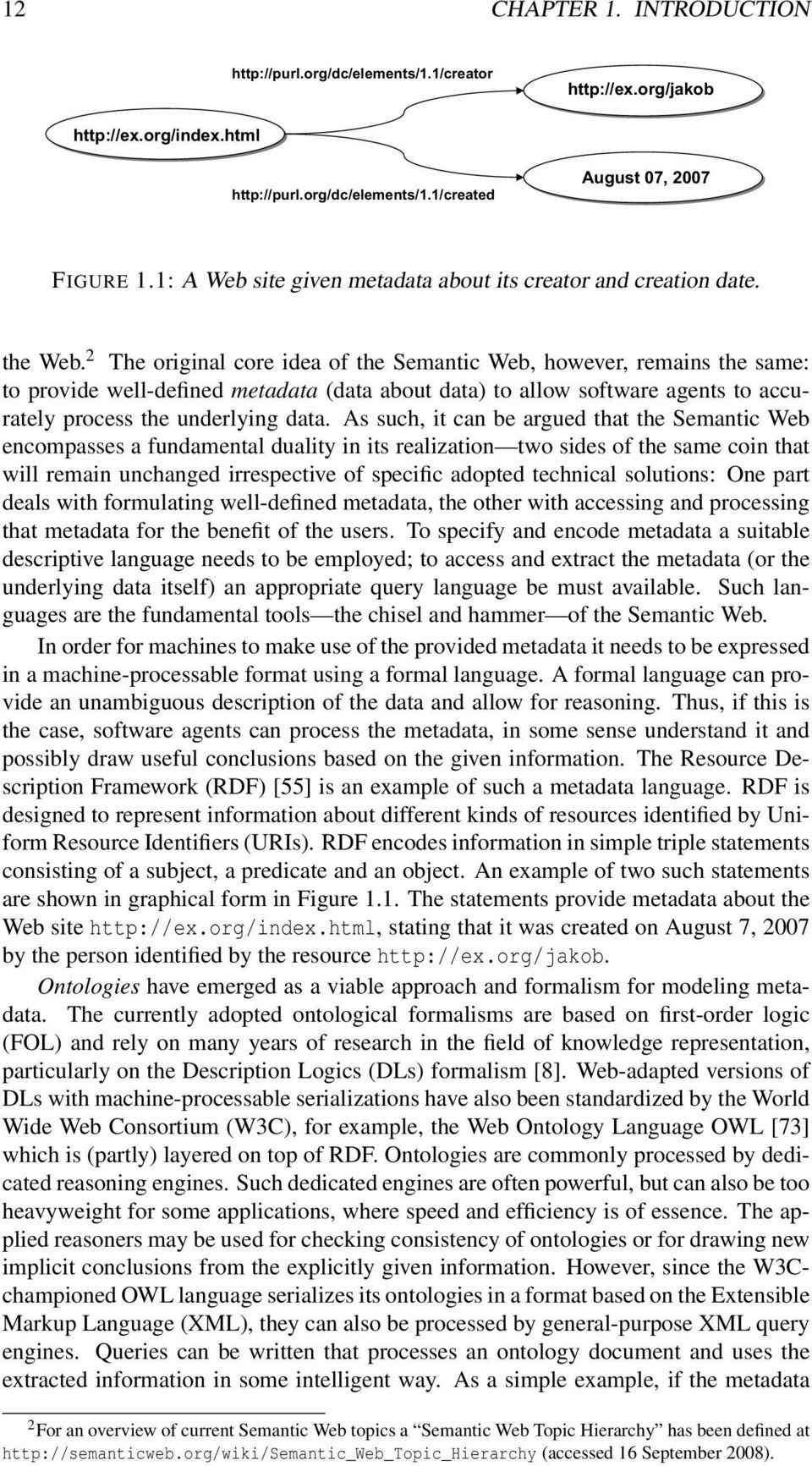
20 12 CHAPTER 1. INTRODUCTION August 07, 2007 FIGURE 1.1: A Web site given metadata about its creator and creation date. the Web. 2 The original core idea of the Semantic Web, however, remains the same: to provide well-defined metadata (data about data) to allow software agents to accurately process the underlying data. As such, it can be argued that the Semantic Web encompasses a fundamental duality in its realization two sides of the same coin that will remain unchanged irrespective of specific adopted technical solutions: One part deals with formulating well-defined metadata, the other with accessing and processing that metadata for the benefit of the users. To specify and encode metadata a suitable descriptive language needs to be employed; to access and extract the metadata (or the underlying data itself) an appropriate query language be must available. Such languages are the fundamental tools the chisel and hammer of the Semantic Web. In order for machines to make use of the provided metadata it needs to be expressed in a machine-processable format using a formal language. A formal language can provide an unambiguous description of the data and allow for reasoning. Thus, if this is the case, software agents can process the metadata, in some sense understand it and possibly draw useful conclusions based on the given information. The Resource Description Framework (RDF) [55] is an example of such a metadata language. RDF is designed to represent information about different kinds of resources identified by Uniform Resource Identifiers (URIs). RDF encodes information in simple triple statements consisting of a subject, a predicate and an object. An example of two such statements are shown in graphical form in Figure 1.1. The statements provide metadata about the Web site stating that it was created on August 7, 2007 by the person identified by the resource Ontologies have emerged as a viable approach and formalism for modeling metadata. The currently adopted ontological formalisms are based on first-order logic (FOL) and rely on many years of research in the field of knowledge representation, particularly on the Description Logics (DLs) formalism [8]. Web-adapted versions of DLs with machine-processable serializations have also been standardized by the World Wide Web Consortium (W3C), for example, the Web Ontology Language OWL [73] which is (partly) layered on top of RDF. Ontologies are commonly processed by dedicated reasoning engines. Such dedicated engines are often powerful, but can also be too heavyweight for some applications, where speed and efficiency is of essence. The applied reasoners may be used for checking consistency of ontologies or for drawing new implicit conclusions from the explicitly given information. However, since the W3Cchampioned OWL language serializes its ontologies in a format based on the Extensible Markup Language (XML), they can also be processed by general-purpose XML query engines. Queries can be written that processes an ontology document and uses the extracted information in some intelligent way. As a simple example, if the metadata 2 For an overview of current Semantic Web topics a Semantic Web Topic Hierarchy has been defined at (accessed 16 September 2008).
21 13 in Figure 1.1 was written in OWL, the OWL document could be queried by an XML query engine for the creator of the Web page and would return as the answer. For data intensive tasks, general-purpose (XML) query languages can be more efficient and hence be preferable over dedicated reasoner. So, while dedicated reasoners are better suited for complex reasoning tasks, general-purpose query languages can still provide some basic form of reasoning, and might be easier to use since they are already often deployed for accessing Web data (not metadata). Domain-specific languages Ontology and query languages can both be seen as examples of domain-specific languages (DSLs). DSLs are pervading many application areas and are often considered to be a great tool for helping to cope with complexity in software development. DSLs can help with respect to complexity by allowing to program, model, or specify certain software parts using succinct and domainappropriate language constructs. A complex Web application might as one part of its realization make use of an appropriate XML query language for data access and transformation, for example, XQuery [13]. Another popular DSL is LINQ (Language Integrated Querying) which allow query programmers to write database queries in C# programs, but using an intuitive syntax very similar to SQL (Structured Query Language) queries [14]. A domain-specific language is defined in [28] as: [A] programming language or executable specification language that offers, through appropriate notations and abstractions, expressive power focused on, and usually restricted to, a particular domain. van Deursen, Klint, Visser [28, p. 26] As the authors of [28] point out in their work, the key to the definition is the notion of focused expressive power. Thus, constructs and abstractions are provided specifically for formulating and solving problems related to the domain for which the language was developed. With such specialized constructs and appropriate domainrelated abstractions at hand, programmers can concisely express what they want and need. Even though DSLs can be a tool to help cope with software complexity, unfortunately, they also introduce a new level of complexity that is not always initially foreseen. The new complexity arises because the DSL specifications themselves may grow in size. For example, XML query or transformation programs can easily grow large and become hard to manage and maintain. As those specific parts of the larger software applications grow, there must be means in place to cope with that growth in order for DSLs to maintain their attractiveness. Admittedly, some DSL specifications will never grow in this fashion, but as explained, there are some that will. Domain-specific languages stand in direct contrast to general-purpose languages (GPLs), such as Java or UML. General-purpose languages differ from domain-specific ones in (at least) one interesting aspect: rich abstractions. First of all, general-purpose languages at least programming-oriented GPLs such as Java usually relate to some specific programming paradigm(s), they are declarative, imperative, procedural, objectoriented etc. Regardless of the paradigm choice, the languages do not beforehand assume the type of problems they will be used to model and address. Instead, within the context of their paradigms, they focus on more general constructs for structuring programs and ways of defining reusable units, for example: functions, methods, classes,
22 14 CHAPTER 1. INTRODUCTION Embedded DSLs (E-DSLs) Non-Embedded DSLs (NE-DSLs) Method, procedure, package, library etc. Provided via host language (e.g. Java, Ruby, Scala) Non-domain related abstractions? Embedment L1 L2 L3 Domain related abstractions L4 L5 L6 Legend: = Domain-specific language FIGURE 1.2: A host language provides non domain-specific abstraction constructs for an embedded DSL. This option is however not available for a non-embedded DSL. macros, templates, packages. The situation is however not the same for domainspecific languages, in fact, the opposite often holds. As domain-specific languages are developed to model specific kinds of problems and have focused expressive power they are not always pre-equipped with more general non domain-specific abstraction and reuse constructs in the way many general-purpose languages are. There are at least two reasons for this. The first reason is that language and tool development is difficult, and foremost costly; the inclusion of any additional constructs is a hard balance between the actual need and incurred cost of introducing them. The second reason is that domain-specific languages are commonly developed with the intention of being embedded in some general-purpose host language. The language is then referred to as an embedded domain-specific language (E-DSL) [47]. One of the motivations for embedding a domain-specific language is to reduce its development cost. The advantage of embedment is that both syntax and semantics from the host language can be reused for the domain-specific language. For example, as a way to provide semantics for the embedded language, a translation into the host language can be specified. In that case, thanks to the translational semantics, existing tooling for the general-purpose language may be reused. Often an explicit translation is not needed at all. Instead the flexible syntax of the host language is simply used to accomplish desirable statement forms that suffice for the purpose of the DSL. Host languages that are suitable for this kind of development are for example Ruby and Scala. 3 As an added benefit, the already existing abstraction and reuse constructs of the host language may be exploited, making it unnecessary to provide them in the domain-specific language in the first place (see left-hand side of Figure 1.2). This also holds for other useful language constructs, such as control-flow mechanisms (e.g. conditionals and loops). 3 See and respectively.
23 1.1. PROBLEM: COMPONENT-BASED DEVELOPMENT FOR DSLS 15 However, there also exist domain-specific languages not intended to be embedded into a host language. This can be the case if there is no obvious host language candidate, or because the DSL is intended to be used as a standalone language. We call such a language a non-embedded domain-specific language (NE-DSL). 4 In this case, new tooling has to be developed at the normal high cost. Thus, most investments are usually centered on the core focus of the language. For a query language, for example, the central query algorithms are prioritized; for an ontology language the reasoning mechanisms receive the attention. Thus, rich non domain-specific abstractions and reuse constructs are not always directly available and can be difficult to include in the language at low cost. 1.1 Problem: Component-based development for DSLs This situation a non-embedded domain-specific language without easily achievable reuse constructs corresponds to the top-right quadrant of Figure 1.2 and is part of the problem we address in this thesis. We will in the course of this thesis give examples of two (Semantic) Web related languages that fit this description and that are in need of such rich abstractions and reuse constructs. Component-based Development with DSLs In the above we have essentially already equalled the notions of abstraction and reusability. This is confirmed by Wegner who states that abstraction and reusability are two sides of the same coin ([93, p. 30] as cited in [60]). Krueger paraphrases Wegner explaining that every abstraction describes a related collection of reusable entities and that every related collection of reusable entities determines an abstraction [60]. From reusable entities the step to the general notion of components and component-oriented development is not far. Component-oriented development has played a major role in the traditional software engineering discipline [86]. Large software products benefit drastically in terms of robustness and maintainability if built from reusable, understandable and independently designed units. This is not only true in traditional software engineering, but is equally valid on the Semantic Web. Ontologies can often be large descriptions that need to be maintained and understood, just like any other software. As an example, the well-known Gene Ontology [88] describes approximately 25,000 terms and their relationships (as of January 2008). Furthermore, if large ontologies are not constructed from smaller components, reusability of already modeled parts is hampered. The same holds for Web query languages. Queries in traditional database settings, for example expressed in SQL, do not usually depend on the data-size and can therefore remain small and do not always have a direct need for modularization and reuse. The orthogonality of query size and data size is also true on the Web, but with an important difference. Queries on the Web often need to respect many different, and not seldom exotic, data schemata. This means that query programs cannot always make assumptions of exactly how data is represented according to which schema the data is modeled. Query developers wanting to develop robust query programs need to take this into consideration, often resulting in large and verbose query programs. 4 Martin Fowler makes the distinction between internal and external DSLs, roughly corresponding to E-DSLs and NE-DSLs [32]. NE-DSLs are also sometimes called standalone.
24 16 CHAPTER 1. INTRODUCTION An example of such a situation is the possibility to serialize the same OWL ontology in different ways. 5 The different ways OWL ontologies can be serialized should be respected by query programs working on the ontologies. Enabling the possibility to encapsulate part of a query program dealing with a particular data schema (serialization) becomes important. Encapsulation of this information allows for better maintainability, since modifications to query programs can be localized to independent components. Components and component-oriented development is not only needed for ontology and query languages on the Web. It can also be important for domain-specific languages in general, but as already argued it is especially pressing for languages not intended to be embedded in a general-purpose host language (see Figure 1.2). The number of such non-embedded languages developed for the Web is high, most likely because there is no obvious and appropriate host language into which to embed them. But it should be noted that such languages also exist in other areas, such as software modeling [39]. As a remark, many abstractions and reuse constructs that could be useful for programmers are not even available in many general-purpose languages, either because the designers did not want to integrate them, or because it is costly and difficult to do so. Examples of such constructs are roles [83], aspects [51, 52], mixin layers [80] and traits [79]. As mentioned, the development of domain-specific languages often have a different focus than general-purpose languages; the focus is on the essential primitives needed for modeling problems related to the domain in question. More general constructs are not usually, at least initially, taken into consideration. Such constructs are often not really essential to programmers at the early stages when the language takes its first staggering steps towards being truly productive. Nonetheless, when a domain-specific language has been developed and is being used by programmers to build larger software artifacts, needs for abstraction and reuse become inevitable. 1.2 Thesis Contributions The work presented in this thesis is a response to one of the challenges put forward in the European Network of Excellence REWERSE 6 : develop composition technology for query and ontology languages used on the Semantic Web. In addressing these issues we have developed composition technology applicable to a wide range of languages. But, in demonstrating the technology we have focused on two languages in particular. For querying we have focused on the language Xcerpt [77], the further development of which was another main objective of REWERSE. Xcerpt is also an interesting choice because of its declarative and rule-based nature (rules are considered an important paradigm on the Semantic Web), and because of its lack of an explicit control flow mechanism. For ontologies we have focused on the Web Ontology Language OWL [73]. This choice is quite natural since OWL is the main ontology language being used today and is standardized by W3C. In the following we give a brief summary of what will be described in more detail in subsequent chapters. We here try to focus on the conceptual advance presented in this thesis. 5 By serialize we here mean the encoding of the ontology in an XML format. 6 Reasoning on the Web with Rules and Semantics,
25 1.2. THESIS CONTRIBUTIONS Composition Technology Our developed composition technology builds upon previous work. BETA is an objectoriented programming language which first proposed the idea of grammar-based modularization (GBM) [63]. The technique is called grammar-based because the considered modules pieces of source code, called fragments are defined wrt. an underlying language grammar. Such fragments only have explicit interfaces. We will not just yet detail what these interfaces are and how they can be used, other than to say that the interfaces ways of integrating fragments into larger programs are always declared by their authors. To be precise, the grammar-based modularization capabilities are not integrated into the BETA language itself, but is rather part of its development environment: the Mjølner system. So, the Mjølner system realizes the said modularization technique for the BETA language. But in fact the technique is very general and, in principle, not restricted to only BETA. However, the Mjølner system does not provide a way for working with arbitrary languages. We develop a generative approach for extending language grammars such that the GBM techniques can be applied. We assume that the grammars are context-free. It is generative in the sense that based on some user input relating to the desired modularization possibilities, an extended grammar is generated which describes a language in which it is possible to define the required fragments. We call the technique universal grammar-based modularization (U-GBM). The technique is referred to as being universal since arbitrary languages can be addressed. We will always use the term universal, or the verb universalize, in this sense. So, while the Mjølner system is grammar-based and general in its conceptualization, we make the development of GBM-based systems grammar-driven and general in practice. Having this possibility to enable modularization separation of software artifacts into components for arbitrary languages is important. Especially when componentbased development has not initially been planned for. This is also acknowledged by Clemens Szyperski. Even though Szyperski s notion of components differs from that of GBM, his claim should still be valid [86]: There are substantial benefits to introducing a component approach even in cases where component markets or in-house component reuse is not yet foreseeable. Clemens Szyperski, Component Software [86, p. 139] Szyperski essentially says that a component approach is needed sooner or later. With universal GBM, a component approach can be introduced into arbitrary languages. Not necessarily at the time of language design, but even afterwards. Definition of components (hence a form of modularization) is supported in invasive software composition (ISC) [5] by a technique that is similar to the one in GBM, but where implicit interfaces are also considered. As in GBM, components in ISC are fragments. Implicit interfaces are points in fragments that are not declared by the fragments authors, but which still are accessible during the composition process. For this reason, ISC can simulate techniques such as aspect-oriented programming [51], which is traditionally completely reliant on the notion of implicit interfaces. As such, ISC is a more flexible and powerful approach than GBM. We leverage our universal extension of GBM to also cover ISC. First of all, this makes the development of ISC-based systems grammar-driven. As a consequence, we achieve universal invasive software composition (U-ISC). That is, we enable the possibility of applying ISC to arbitrary
26 18 CHAPTER 1. INTRODUCTION languages. Being able to generalize the technique to arbitrary languages in a grammardriven manner does not only make it easier to build ISC-based composition systems for new languages, but it also improves our understanding of the underlying techniques and how well they work for arbitrary languages. One of the interesting results from ISC is its distillation of two basic composition operators that are used to assemble fragments into useful programs. These operators are very general, that is, language independent, which is a basic requirement for a universal approach. However, Aßmann explains: [T]he basic operators are not expressive enough, since they are so general. [...] Software designers will not like designing with a minimal pattern language. Instead they will need languages with more domain-specific, tailored, and adequate composition operators. [...] And I believe that such languages will be the software construction languages of the future. Uwe Aßmann, Invasive Software Composition [5, p. 278] One of the root causes for this problem is that source code fragments, the module type of choice for both GBM and ISC, are inappropriate abstractions for most endusers and programmers. But the composition algebras of both these approaches can only work on the primitive level of transforming fragments, using the minimal pattern language. To address this problem we develop a technique which allow programmers to use more appropriate abstractions; abstractions that are related to the programming languages they use on a daily basis (for example, their DSLs). Such abstractions are specified in extensions of programmers languages, extensions tailored for the kind of component-based development they are in need of. Included in such extensions are the domain-specific, tailored, and adequate composition operators. But, unbeknownst to users of such an extended language, the extended programs that support the appropriate modularization constructs are composed into semantically equivalent programs of the underlying, non-extended, language. So, the programs written in an extended language are given a reduction semantics by referring to the underlying language. We call this approach embedded invasive software composition (E-ISC). The reason we call it embedded is because the reduction semantics is defined by a U-ISC based composition system. So, we exploit and build upon the previous work on U-GBM and U-ISC to reach this higher goal. Hence, the composition technology contribution of this thesis is a three-staged advance from previous work. This advance is illustrated in Figure 1.3. First, we universalize GBM to achieve universal GBM (U-GBM). Then, we build upon this to make ISC grammar-based, and, in the same sense, universal (U-ISC). Finally, due to the difficultness of working with fragments as first-class software artifacts, we define embedded ISC which allow end-users to work with more intuitive software units (E-ISC). This lays the foundation for addressing an important open issue, that is, how to enable component-based development for NE-DSLs. One immediate consequence of the above-mentioned reduction semantics is that the core expressiveness of the addressed language is never really extended. One great benefit of this is that existing tooling can be reused. We do not claim that the expressiveness of DSLs is at fault, rather their ability to support developers in defining and using reusable entities components. This is supported by another remark from
27 1.2. THESIS CONTRIBUTIONS 19 Composition Technology Advance Generalization Space of Existing composition approaches Space of Universalized composition approaches Embedded Invasive Software Composition (E-ISC) generalization Invasive Software Composition (ISC) universalization Universal Invasive Software Composition (U-ISC) generalization generalization Grammar-based Modularization (GBM) universalization Universal Grammar-based Modularization (U-GBM) Universalization FIGURE 1.3: We present a three-staged advance over previous work: universal grammar-based modularization, universal invasive software composition and embedded invasive software composition. Modules for Xcerpt Role models for ontologies Szyperski: instantiates [...] from a purely formal point of view, there is nothing that could be done with components that could not be done without them. Embedded Invasive Software Composition (E-ISC) Clemens Szyperski, Component Software [86, p. 10] The universal nature of our composition approach essentially means that we are defining a composition framework. The following are some benefits with our framework approach towards enabling component-oriented development and design for programming language in general, and domain-specific languages in particular: By providing a framework approach where the exact properties of the addressed language are not presumed, it is possible to augment any language that has a context-free grammar with new abstractions. Not only already existing and wellknown abstractions, but also new abstractions which will be found to be useful for existing or future domain-specific languages. A consequence of a strictly reductional semantics for extended language construct is that the approach allows for the possibility of introducing new abstractions for languages where associated tooling (compilers, interpreters etc.) are not available to be modified, as for example in proprietary systems. Here, new requirements for abstractions may arise for users of the language/system, but the organization/company holding rights to the tools are not planning to introduce the requirements. Our approach gives a solution to such problems by allowing independent augmentation of abstraction and reuse of a language, without having to modify the associated tooling.
28 generalization generalization Grammar-based Modularization (GBM) universalize Universal Grammar-based Modularization (U-GBM) Universalization 20 CHAPTER 1. INTRODUCTION Modules for Xcerpt Role models for ontologies instantiates Embedded Invasive Software Composition (E-ISC) FIGURE 1.4: To evaluate our composition framework we instantiate it twice for two different languages and abstraction concepts: modules for the query language Xcerpt, and role models for ontology languages. There might still be cases where developers of a language and its associated tools decide that a newly designed abstraction should be tightly integrated into the language and tools. For example, due to strict requirements on efficiency. As such an integration incurs costs in terms of time and money, it might be beneficial to prototype the concepts before actually performing the full integration. This prototyping could be done using our framework. We demonstrate the applicability of our framework by instantiating it twice, for two completely different languages and abstraction concepts (see Figure 1.4 for an illustration). These framework applications hence evaluate the framework, and are briefly mentioned below Evaluation 1: Modules for Xcerpt We demonstrate the usefulness of allowing Web query developers to program with modules, an arguably necessity on the Web. The particular language we address is the rule-based Web query and transformation language Xcerpt [77]. Modules are sets of related rules and can be defined using intuitive syntax. Moreover, since modules should be encapsulated to ensure proper separation of concern, module interfaces can also be defined. Apart from allowing to define reusable query components in form of modules, constructs are provided to import and deploy them. We give several examples of the usage of the introduced constructs, as well as explain their semantics. In practical terms the Xcerpt module system is realized through our composition technology Evaluation 2: Role Models for Ontologies We introduce and discuss a new reuse unit for ontologies role models. A role model is an abstraction unit that has previously been investigated in data, object-oriented and conceptual modeling (see, e.g. [83] and references therein). However, role modeling is lacking in current ontology languages, such as OWL [73]. We introduce the notion of role modeling into ontology languages and show how it can be used to modularize ontologies. We demonstrate the use of role models on a subset of OWL, but the approach is general and not limited to a particular ontology language. We demonstrate a composition system developed using our composition technology that is able to compose ontologies from role models.
29 1.3. THESIS SCOPE Thesis scope In the following we comment on what is covered in this thesis, and what is not: Language engineering. Despite the fact that this thesis is about languages, and extensions of languages, it is not a thesis on language engineering. There are many sub-disciplines of language engineering that are employed in this work, but most of them fail to receive any serious attention, for example, language development, parsing theory, parser generation and grammar composition. The only highlighted language engineering concept is context-free grammars (CFGs). This is the underlying formalism any considered language is assumed to be expressible in. (Concretely this would be done in EBNF [1] or a similar practical formalism.) Language extensions for adapting languages to the composition techniques of, first grammar-based modularization, and then invasive software composition, are described by referring to CFGs. For this reason, CFGs receive certain attention in Chapter 2. Ensuring valid compositions. When composing software, it is important to guarantee certain properties of the final result. We will guarantee that the composition result is a syntactically valid program wrt. some underlying language. We will not, however, guarantee that the composition result is also semantically valid. For example, we do not, during the composition process, check the semantics of the composition results. The reason we do not provide this second level of guarantee is because we are developing a general framework addressing arbitrary languages. Since semantics is very specific for each particular language, such details would have to be provided for each language, in addition to the grammar specifications. This level of language tailoring is currently not provided in our general solution and is out of the scope of this thesis. Composition framework evaluation. While it is our belief that the presented composition framework can be instantiated for many different languages, it is here mainly validated for two languages: the Web query language Xcerpt and the ontology language OWL. However, it should be noted that the languages apart from belonging to the set of languages we consider to be in need of modularization techniques are quite different from each other in terms of their structure and purpose. Also, because they are completely different languages, the developed types of components for the languages are of entirely different natures. These differences wrt. languages and component types for which the framework is validated should be regarded in its favor.
30 22 CHAPTER 1. INTRODUCTION
31 Part II Composition Framework 23
32
33 2 Universal Grammar-Based Modularization BETA is an object-oriented programming language, historically following the SIM- ULA tradition in the Scandinavian school of object-orientation [57, 63]. One of the interesting concepts of BETA is the support of a single abstraction construct: the pattern. However, rather than delving into the details of BETA as an object-oriented language, we shall focus on another aspect of it, namely its program text modularization technique. One of the side projects developed around BETA was the Mjølner BETA system. The Mjølner system provides a fragment system (or fragment language) aimed for modularization of BETA program text. Essentially, any snippet of BETA source code a fragment can be a module. By putting such fragments together, a complete and executable program can be constructed. By separating the BETA language with its pattern construct from the modularization of program texts as provided by the fragment language, a separation between programming in the small and programming in the large is achieved [27]. The technique used by the Mjølner fragment system is called grammar-based modularization (GBM) in the literature [58, 59, 63]. The technique was initially introduced under the name syntax-directed modularization [59]. The technique is grammarbased since the underlying language grammar dictates what are considered valid and deployable fragments for the modularization process. Some of the mentioned benefits for introducing this modularization technique to BETA were [63, Chapter 17]: Large programs are easier to understand, and edit, if split into a number of smaller, logically coherent, units. Development is also simplified if several people are working on the same project. Modules can be saved in a library and shared by several programs. Good modularization mechanisms will thus improve reusability of code as well as designs. It is good practice to split a module into interface modules and implementation modules. An interface module defines how a module can be used, and an im- 25
34 26 CHAPTER 2. UNIVERSAL GBM plementation module describes how a module is implemented. This makes it possible to prevent users of a module from seeing details about data representation and implementation of algorithms. Despite of BETA having been introduced in the early 80s, we are not aware of any other language or system supporting the same particular technique for program modularization (except for gbeta, which is a direct extension of the BETA language and developed within the same group [29]). The fact that BETA itself is considered a dead language does not help championing the particular modularization technique it was first, and practically alone, to provide. The fragment system provided in the Mjølner system is directly connected to the BETA language itself, in particular to its grammar fragments defined must conform to the BETA grammar. Nevertheless, the modularization approach, being based on the notion of grammars, is very general and in principle not restricted to the BETA language. This is indeed also mentioned by the developers of BETA [63, p. 256], but a concrete, practical and automatic technique for enabling the approach for an arbitrary language has, to the best of our knowledge, never been realized. Still, the generality of the modularization approach is intriguing. So, one interesting research question is how the grammar-based modularization technique of the Mjølner fragment system can be made available to arbitrary languages, not only in theory, but also in practice. That is, a method and a solution to the following scenario: Given a grammar G that specifies a language L, and a set of constructs in L that are considered useful modularization units, produce a grammar G+, derived from G, that specifies a language in which it is possible to write fragments (wrt. G) such that programs of L can be modularized. The Mjølner fragment system provides a tailored solution to the above scenario, addressing the BETA language, its grammar, and certain constructs of the language. In this chapter we generalize this solution. The main contributions of this chapter are: 1. We provide an understanding of how grammar-based modularization, in the style of the Mjølner fragment system, can be made available to arbitrary programming languages. 2. We provide a practical transformation technique for adapting grammars such that it is possible to concretely formulate, and thus program with, the considered fragments. 3. We discuss how the original grammar can be used to ensure safe assemblage of fragments. We also discuss how programmers can be more precise in controlling what is considered safe for their fragments. 4. We analyze the minimal requirements for a fragment language. That is, what is required from a language used to specify how fragments are put together into meaningful programs. By addressing arbitrary programming languages, we can achieve a universal grammar-based modularization approach (U-GBM). The goal is in particular to have a practical approach where specified grammars can be transformed, or adapted, in a general way to take advantage of GBM. The transformed grammars can be said to encode fragment systems, and realize the possibility of formulating concrete fragments. In this
35 2.1. BACKGROUND 27 sense we develop a framework for how the GBM approach can be realized for arbitrary languages. We use the term framework here in the sense of capturing a methodology, rather than a particular design. We will focus on languages that (syntactically) can be described by context-free grammars. Most programming languages can be described by such grammars. The investigations in this chapter are important because we will build upon them in subsequent chapters to provide more advanced and useful modularization and composition methods. This chapter is structured as follows. In Section 2.1 we provide required background knowledge relating to context-free grammars and GBM. In Section 2.2 we then describe how context-free grammars can be adapted such that they encode fragment systems. In Section 2.3 we discuss how fragment systems can guarantee safe modularization. Finally, in Section 2.4, we summarize the achievements of the chapter. 2.1 Background First we will recall the formalism of context-free grammars, since we will base our framework on it. Then, in Section 2.1.2, we look in more detail at the BETA Mjølner system and how its fragment system works Context-free grammars and languages The syntax of formal languages used in computer science, for example programming languages such as Java, are often specified in some grammar formalism. A grammar is a convenient way of specifying an infinite set of possible programs in a finite way. This essentially means that there is not an a priori set of programs that can be written in the language being specified. The Extended Backhus-Naur Form (EBNF) [1] is a format frequently used to specify grammars. For example, the syntax of a simple fictitious rule-based language RL RL for Rule Language can be specified by the EBNF statements in Example Example 2.1. (RL grammar) The following is an EBNF grammar for an example rule language. prgm stmt ::= stmt * ::= rule fact rule ::= head :- body. head ::= atom fact ::= atom. body ::= atom (, atom )* atom ::= predname ( term (, term )* ) term ::= const var num predname ::= STRING const var ::= STRING ::= CAP_STRING 1 In fact, our example language RL is very similar to the language Datalog.
36 28 CHAPTER 2. UNIVERSAL GBM prgm stmt rule head :- body. atom :- body. predname ( term ) :- body. animal( term ) :- body. animal( var ) :- body. animal(x) :- body. animal(x) :- atom. animal(x) :- predname ( term ). animal(x) :- tiger( term ). animal(x) :- tiger( var ). animal(x) :- tiger(x). TABLE 2.1: Derivation sequence from nonterminal prgm to the string in (2.1). num ::= NUM_STRING The first grammar rule states that a program (represented by prgm ) consists of an arbitrary number of statements ( stmt ). The second grammar rule states that a statement is either a rule statement or a fact statement. The third rule states that a rule statement consists of a head, followed by the word :-, followed by a body, and trailed by a dot (. ), and so on. In EBNF, an asterisk ( ) after a nonterminal n usually mean zero or more of n. A plus sign (+) means at least one, and a questions mark (?) zero or one. Hence, an RL program consists of zero or more statements. The traditional way of understand rules (here represented by rule ) is: If the body holds, then the head also holds. Facts are always true. The last four grammar rules define what predicate names, constant symbols, variables and numbers look like. They are defined by special tokens not further specified here, only to say that predicate names and constant symbols are character strings assumed to start with a lower-case letter, variables are capitalized character strings (first character must be upper-case), and numbers are strings of numerals. We shall use Example 2.1 as an example grammar throughout this chapter. The xyz parts of the specification are called nonterminal symbols. Each nonterminal xyz generates a set of strings over a finite alphabet Σ, using the grammar rules with xyz on the left-hand side as a starting point. Rule choices (separated by ) describe different ways of generating the strings. animal(x) :- tiger(x). (2.1) For example, the string in (2.1) stating that every tiger is an animal can be generated from the nonterminal prgm using the grammar rules. This is shown by the derivation sequence in Table 2.1.1, starting with the nonterminal prgm and ending with the string itself. Each step in the sequence is derived from the previous one by replacing one of the nonterminals with the right-hand side of its definition. 2 Other strings can be generated 2 This technique of matching a string with a grammar is also called top-down parsing in the literature [3].
37 2.1. BACKGROUND 29 in a similar fashion. The set of strings that can be derived from a carefully selected nonterminal of a grammar called the start symbol is called the language generated by the grammar. Formally, a context-free grammar (CFG) is a 4-tuple [56]: G = (N,Σ,P,S) where N a finite set of nonterminal symbols, sometimes called syntactic categories, Σ is a finite set of terminal symbols (disjoint from N), P a finite set of production rules N (N Σ) and S N the start symbol. Each production rule N (N Σ) can be used to rewrite N by (N Σ) (cf. example in Table 2.1.1). Any string in (N Σ) derivable from the start symbol S is called a sentential form. A sentential form that does not contain any nonterminal symbols is called a sentence (it only contains terminal symbols, that is, it is in Σ ). For example, all the steps in the derivation sequence in Table are sentential forms of the grammar in Example 2.1. Only the last step is a sentence of the same grammar (since it does not contain any nonterminal symbols). The start symbol S specified by a grammar G is of importance since it explicitly defines the valid units of the language generated by G, hence the valid units that can be specified by programmers. Sentences derived from S are sometimes called programs of the language. In Example 2.1 the nonterminal prgm is assumed to be the start symbol. Considering a CFG G = (N,Σ,P,S), a sentential form F 1 derives a sentential form F 2 in one derivation step if and only if F 1 = σ l Aσ r, F 2 = σ l A 1 A n σ r and A ::= A 1 A n P, where each σ i is some sequence of terminal symbols and A j are nonterminals. This is written as: F 1 1 G F 2 where the one (1) above the derivation arrow signifies that the sentential form F 2 is derived from F 1 in one step. If the sentential form F 1 derives F 2 in any number of derivation steps, then this is written: F 1 G F 2 The set of strings generated by a syntactic category n of a grammar G is called the language L G (n) of n (simply L(n) when it is clear which G is meant). This can be defined as: L G (n) = {x Σ n x} G The de facto semantics of a context-free grammar is given by the sentences it generates [4]. The set of all sentences of a grammar G is called the language L(G) generated by G and is defined as: L(G) = {x Σ S x} G Notice that L(G) L(S) where S is the start symbol of G. A language L is contextfree if there exists a context-free grammar that generates it. Intuitively, a context-free grammar G (of a programming language L) defines a (possibly infinite) set of sentences (programs) that conform to G. Most programming languages can syntactically be defined by context-free grammars, and in the following we only consider such languages.
38 30 CHAPTER 2. UNIVERSAL GBM Grammar-Based Modularization (GBM) The Mjølner system, for the purpose of the BETA programming language, proposed a grammar-based modularization technique [63]. The Mjølner fragment system, or fragment language, allows for the definition of BETA source code fragments as modules. To simplify the presentation we do not introduce the BETA language and its syntax, but instead exemplify the technique using our rule language RL defined in Example 2.1. We try to stay as close as possible to the terminology used in [63]. Modules, which here are equalled to fragments, are syntactical structures of the considered language and are called forms. Forms must belong to some syntactic category of the underlying grammar, and hence be derivable from some of its nonterminals. A form derived from nonterminal A is called an A-form. Forms can in principle be any sequence of terminal and nonterminal symbols of the considered grammar. Hence, forms are essentially sentential forms of a particular syntactic category of the grammar. The sentential form in (2.2) can be seen as a rule-form of the RL grammar with one num and one atom nonterminal (not yet derived to terminal symbols). bonus(x, num ) :- employee(x), atom. (2.2) To be able to refer to nonterminals in forms, they are given names. Nonterminals meant to be replaced by the fragment system are called slots and have the following syntax: 3 «SLOT T:A» (2.3) where T is the name of the slot and A is its syntactic category. The sentential form from (2.2) can thus be written as in (2.4), which contains a slot named value of syntactic category num and a slot named condition of syntactic category atom (when using nonterminals in slots we do away with the angle brackets). These slots describe where change can take place and are called slot declarations. bonus(x, «SLOT value:num») :- employee(x), «SLOT condition:atom». (2.4) When defining forms in the fragment system, they must be given a name and a syntactic category, and are then called fragment-forms. Following the style of [63], we use a graphical syntax for defining fragment-forms. The table in (2.5) demonstrates the graphical syntax (grayed table rows indicate meta information about forms, while white rows contain concrete forms). 4 F:A ff (2.5) In (2.5) F is the name of the fragment-form, A is its syntactic category and ff is the form (derivable from nonterminal A ). The Mjølner system also introduces the notion of fragment groups, which are sets of fragment-forms associated by a name using the 3 This syntax was originally chosen for its suitability wrt. the BETA language, and we use the same here. 4 There is also a textual syntax available in the Mjølner BETA system, but is not further discussed here.
39 2.1. BACKGROUND 31 name construct (illustrated below). A fragment group containing a single fragmentform, corresponding to (2.4), is shown in (2.6). name RuleGroup myrule:rule bonus(x, «SLOT value:num») :- employee(x), «SLOT condition:atom». (2.6) Complete programs are assembled by binding fragment-forms to declared slots. The origin construct can be used for this purpose. The origin construct takes the fragment group being operated on as an argument. The fragment-forms appearing in a fragment group with an origin construct are called slot applications. name Rules origin RuleGroup value:num 200 condition:atom efficient(x) (2.7) By matching the names of the fragment-forms in (2.7) (slot applications) with the slot names in the fragment group indicated by the origin construct (slot declarations), the fragment-form in (2.8) is constructed. myrule:rule bonus(x, 200) :- employee(x), efficient(x). (2.8) Notice that the form in (2.8) is a valid sentence of the RL language, stating that efficient employees receive a bonus of 200. As such it is a useful entity constructed from its smaller fragment parts. The above has demonstrated the main idea of the Mjølner fragment system, but using the simple RL language rather than BETA itself. All the features of the fragment system have not been discussed here, instead we direct the reader to [63, Chapter 17] for further details. The grammar-based modularization provided by the Mjølner fragment system is attractive because of its simplicity. All the variable points in fragment-forms are explicit via slot declarations, and hence clearly dictate where forms can be modified (but not how). A fragment-form with one slot allows for the variability dictated by the slot declaration. That is, any form of the same syntactic category as specified in the slot declaration can replace it. The technique also allow fragment-forms to separate between module interface and module implementation. The slot declarations are the interfaces, while the slot applications specify the implementations. Thus, the implementations can easily be varied by changing the slot applications. The main benefits of grammar-based modularization are thus: The underlying idea is simple and easy to understand for programmers. By being based on the notion of grammars the approach is very generic and can be applied to most programming languages. Since fragments only can be transformed via their declared slots, a kind of encapsulation is supported.
40 32 CHAPTER 2. UNIVERSAL GBM Slots allow for rich variability by not restricting the content of the fragments being bound. This allows for separation between fragment interfaces (slots) and their realizations (slot applications). Assembly of fragments is safe (controlled by syntactic categories in a declarative way). While the underlying idea is language independent, the Mjølner fragment system has its limitations due to its close connection to the BETA language: Slots can only be declared for a few carefully selected syntactic categories of the BETA grammar. This restriction is in place because the fragment system supports separate compilation of fragment-forms. Hence, fragment-forms containing slots can first be compiled and then later bound together in the compiled form. The benefit is that the target fragment does not have to be recompiled if a slot application is changed. Any limitations to the general approach are in place in the Mjølner fragment system to serve particular needs of the BETA language and its users. But it should be noted that supporting, for example, separate compilation of fragments can have far-reaching consequences. For example, special tools have to be implemented to handle the grammar-based modularization technique that is special to the Mjølner fragment system. 2.2 Universal Grammar-Based Modularization Our goal is to deploy the same grammar-based modularization technique as outlined in the previous section, but without the limitations connected to the Mjølner fragment system. In contrast, we pursue a lightweight approach. That is, we want to provide a methodology and technique for developing and generating lightweight fragment systems. Given a grammar and certain input regarding what kind of modularization should be supported (for example which fragment-forms should be definable), a grammarspecific fragment system can be generated allowing modularization of program text in the style of GBM. The approach is considered lightweight because: Separate compilation of fragment-forms is not supported. While less powerful, the benefit is that existing tooling does not have to be extended to handle compilation of fragment-forms and slots appearing in such forms. A consequence is that the lightweight approach is strictly static, in the sense that it can be seen as a front-end fragments must be assembled into valid programs of the underlying language before being compiled/interpreted. Since the fragment system is not involved when assembled programs are executed, existing tools (e.g. compilers and interpreters) can directly be reused. We expect the following benefits of a lightweight approach: Support for different languages does not in detail have to be programmed for each language s grammar. Instead, support for grammar-based modularization and programming with the slot concept can be given semi-automatically by appropriate transformations on the considered grammar, resulting in a grammarspecific fragment system.
41 2.2. UNIVERSAL GRAMMAR-BASED MODULARIZATION 33 Fragment system Fragment language (binding slots) Grammar-based modularization using slots G' "Reuse grammar" (defining reuse language) adapt grammar (via function!) G Base grammars (defining languages) FIGURE 2.1: Languages formally specified by a base grammar can be adapted to a reuse grammar, which generates a language that allows slots. Such a language is called a reuse language wrt. its base language. In line with the conceptual idea of grammar-based modularization, slot support can be given for any syntactic category of the considered grammar, and not for only a few selected ones as in the Mjølner system. L' Any context-free language can be supported. Thanks to a generative approach, new languages can more quickly be addressed and supported with fragment systems. This will enable us to learn more about the true usefulness of the approach, since we can do rapid prototyping and more easily experiment with different underlying languages. In the following section we will discuss how this lightweight support for grammarbased modularization can be made available for arbitrary languages Grammar adaptation for GBM In Section we briefly introduced context-free grammars as the standard formalism for describing the syntax of formal languages. We also mentioned EBNF as a practical language for specifying such grammars. This section describes how formally specified languages can be adapted, or extended, to be subject to grammar-based modularization. This idea is illustrated in Figure 2.1 were G is the base grammar (specifying a base language) under consideration and G its adaptation, called a reuse grammar (wrt. G), which generates a language in which it is possible to program with slots. Along with a fragment language (discussed in Section 2.2.2), such an adapted grammar essentially constitutes a lightweight fragment system supporting grammar-based modularization (see Figure 2.1). This is so because the reuse grammar describes what
42 34 CHAPTER 2. UNIVERSAL GBM valid fragments are and what their interfaces can be, while the fragment language can be used to describe how they should be assembled. We start by recalling, and formalizing, what are considered to be valid and wellformed units of deployment in such an approach fragments. First, we may define units that are not valid programs of the original language, but subsets thereof. For example, we might want to use atoms as basic building blocks (units) for a fragment system based on RL. So, while not valid programs wrt. their grammar, each such unit is a string derivable from some nonterminal of the grammar. For RL atoms, such a nonterminal would be atom. For a given grammar G, we will call such a unit a P G n -program (or simply P-program when referring more abstractly to such a unit). Definition 2.1. (Pn G -program) Given a CFG G, the strings P Σ derivable from nonterminal n N of G are called Pn G -programs. Notice that Pn G -programs, in formal language theory terms, are nothing other than strings belonging to the language generated by the nonterminal n of grammar G, that is, strings in L G (n). Keep in mind that P-programs are sentential forms that are also sentences. The string efficient(x) is an example of a Patom-program. RL Second, to allow for variability in fragments we may define P-programs that are incomplete within themselves via the concept of slots. Such slots effectively determine the possible variability for the P-programs. Formally, the slots are non-derived nonterminals. Definition 2.2. (F G n -program) Given a CFG G, the strings F (N Σ) derivable from nonterminal n N of G are called F G n -programs. That is, Fn G -programs as defined in Definition 2.2 are sentential forms of G, but derived from n N rather than the start symbol of G. The string p( var ) :- q(x), atom. is an example of a Frule RL -program. It is not a P-program since it contains nonterminals. Whenever it is clear what is meant we shall use the term fragment in a rather liberal fashion to mean P- or F-programs. That is, partial and possibly under-specified (via slots representing nonterminals) programs of some language (as defined in Definitions 2.1 and 2.2). We notice that regardless of a specific grammar (or, programming language specified by the grammar), P-programs and F-programs are the first-class entities in any grammar-based modularization system or environment. That is, they are the fragments being composed and transformed to construct software. 5 Grammar-based adaptation requirements In the following we briefly summarize the requirements on a lightweight adaptation of a base grammar to support grammarbased modularization. 1. P- and F-program specification. It must be possible for programmers to concretely define partial programs, that is P- and F-programs. This makes it possible to reuse and compose fragments, as defined in some fragment language (by a developer). (a) P-programs. It should be possible to restrict which kind of P-programs are allowed to be defined and worked with. That is, for which n N wrt. 5 We will discuss more on the relation between P- and F-programs in Section (p. 69).
43 2.2. UNIVERSAL GRAMMAR-BASED MODULARIZATION 35 a grammar G P n -programs may be defined (this choice also affects which F-programs may be defined). It should also be possible to leave this unrestricted, and hence allow P-programs to be defined for every nonterminal of a grammar. Dictating and clarifying such restrictions helps to control the flexibility of a specific fragment system. (b) F-programs. It must be possible to define explicit variation points in fragments slots. Note that sentential forms in formal language theory terms are abstract entities that never are specified by programmers in practice. But, being able to define F-programs essentially means the possibility of specifying and practically working with concrete sentential forms. This can be realized by introducing new language constructs for representing unresolved nonterminals in F-programs. 2. F-program access. It must be possible to address slots in fragments. This will be realized via name references. Addressing slots via names in conjunction with having new language constructs for representing them (see point 1b) enables the implementation of their access in a language-agnostic fashion. We shall address the above requirements by first describing how explicit variation points can be defined and accessed in F-programs, followed by how the definition of P-programs can be restricted. Defining and referencing slots Consider the sentential form of the RL grammar in (2.9), where var is a nonterminal not yet derived to terminal symbols. The nonterminal can be derived to any string representing a variable. animal(x) :- tiger( var ). (2.9) In a grammar-based modularization approach the nonterminal in the above represents a variable point. Slots are concrete constructs that help to simulate sentential forms, more precisely the nonterminals in sentential forms. Thus, we want to introduce the possibility to program with slots in fragments. To achieve this we extend the addressed language with a new construct the slot for the purpose of specifying the variable points. Introducing a new construct for the purpose of modularization avoids the need to overload any existing construct for new and different purposes. Also, it is easier to separate the names of slots from the names used in programs of the underlying language (seen as a clear benefit in, for example, BETA [63, Chapter 17]). Suppose we want to make the nonterminal var slotable in the RL rule language, such that we can either directly specify variables in fragments, or leave variables unspecified as named variation points (slots). For this we would introduce two nonterminals ( slot and ident ), assumed not to previously exist in the base grammar (hence the prime in their names), along with their definitions, which can be found in Table We will call the grammar in Table 2.2 the SLOT-grammar. 7 Slots are given names (via ident ), enclosed by the tokens «and», such that they can be referred to. This particular concrete syntax is inspired by the Mjølner fragment system, but could 6 In our realization we do not check the disjointness conditions on the grammars, but assume it to be true. 7 For the sake of completeness we could specify slot to be the start symbol of the SLOT-grammar.
44 36 CHAPTER 2. UNIVERSAL GBM slot ::= «ident» ident ::= STRING TABLE 2.2: The SLOT-grammar. be changed if something else is more suitable for a particular language (e.g. if that syntactic construct is already used for a different purpose). To enable the use of slots for a particular base language, we transform the production rules of the base language s grammar appropriately. We can allow (representatives of) non-derived nonterminals n to appear as slots in fragments by a set of grammar transformations via function: ψ : (CFG,n) CFG, where n is a nonterminal of the input CFG. For a given input base grammar G, and nonterminal n, ψ is defined by the following transformation steps, resulting in grammar G : 1. Union the SLOT-grammar with G. 8 This means: Union the two disjoint sets of nonterminals, (disjoint) terminal token symbols, (disjoint) production rules, but retain G s start symbol. 2. For each production rule in G defining nonterminal n ( n on the left-hand side), rename n to (previously non-existing nonterminal) n. We denote the original n nonterminal n 0 and strings generated by the original nonterminal n for n 0 -strings (or L(n 0 )). 3. Introduce the new unit production rule: n ::= n. 4. Introduce the new unit production rule: n ::= slot. Since the SLOT-grammar and G are disjoint wrt. their nonterminals, the only effect made by steps 1 3 is that the derivation of strings derivable by G from any nonterminal (of G) defined via n are one step longer when derived by G, via the additional unit production rule n ::= n. Theorem 2.1. (Safe slot extension) Given CFG G and nonterminal n defined in G, let ψ(g,n) = G. Then every string generated by G is also generated by G, that is, L(G) L(G ). Proof. Let G and G = ψ(g,n) be CFGs. All strings in L(G) are derived the same way wrt. G, save those derived via n, so we only have to concern ourselves with such strings. Let l L(G) be a string derived via n (indicated by having n within brackets over the derivation arrow): 1(n) γ 1 γ 2 G G G S l where S is the start symbol of G and γ 1,γ 2 some sentential forms. Now, assume the opposite of what we are trying to prove, that l L(G ). Looking at the definition of ψ which defines G we notice that we can just as well derive l with G using only a single extra step via n : 8 If ψ is applied to the same base grammar more than once, this step is only performed the first time.
45 Syntax diagram for nonterminal rule atom ":-" atom "." "," atom 2.2. UNIVERSAL GRAMMAR-BASED MODULARIZATION 37 G!(G,var) = G' SLOT-grammar!slot'" Syntax diagram for nonterminal!var": CAP_STRING!var'" Syntax diagram for nonterminal!var'": NOT DEFINED CAP_STRING Legend: = terminal (token) symbol = nonterminal symbol FIGURE 2.2: To make nonterminal var slotable, it is defined to be either a var (the original var ), or a slot ( slot ). S G γ 1 1(n) G 1(n γ ) 2 G γ 3 G The assumption we made was false, and hence l L(G ). l Transformation step 4 makes the n nonterminal not only derive n 0 -strings, but also n-slots: representatives for non-derived n 0 nonterminals. 9 Thus, if we let grammar G be the RL grammar from Example 2.1, and we apply ψ(g,var) = G, then the transformed grammar G also generates the string (2.10). The transformation is illustrated using a syntax diagram notation in Figure 2.2. animal(x) :- tiger( «myvarslot» ). (2.10) In this case, the above represents the sentential form where the slot «myvarslot» represents the nonterminal var from G that has not yet been derived. This is, however, a piece of code that can be parsed and worked with in practice. From the perspective of grammar-based modularization, the slot represents an explicit variation point. The variation point can be referred to via its name: myvarslot. While a slot must be given a name for identification, in contrast to the Mjølner fragment system we do not require the specification of a syntactic category with the slot declaration. We shall come back to this issue in Section 2.3. The grammar transformation via ψ enables programming with slots by explicitly introducing new constructs into the base grammar. The benefit of introducing new constructs for this purpose is that this can be done without much consideration of the particular base grammar. That is, the step can be automated. Furthermore, from a tooling perspective, the identification of slots is made simpler by having explicit constructs to represent them. 9 Multiple applications of ψ for different nonterminals can potentially cause parsing problems due to nondeterminism, but we do not further discuss this here. Rather we assume that such problems can be resolved, either automatically, or manually.
46 38 CHAPTER 2. UNIVERSAL GBM Controlling definable fragments To control end-users of a grammar-based modularization system, it should be possible to restrict which kind of fragments may actually be defined. That is, for which n N of grammar G F G n -programs may be defined. (We here see F-programs as generalizations of P-programs, so the same restrictions would hold for P-programs.) Consider yet again our example rule language grammar from Example 2.1. Say we want to be able to define programs, atoms and variables as fragments, but nothing else. This means that we want to be able to handle strings generated by the nonterminals prgm, atom and var, respectively. This can be accomplished by changing the start symbol of the grammar depending on which fragment type should be considered. For example, by specifying the start symbol to be atom, we have a grammar that can only generate atom-strings. For a given grammar G, declaring what kind of F-programs may be defined can be achieved by specifying a subset F N of the nonterminals N of G. We want to formalize how a context-free grammar describing some language can be adapted, or transformed, to be useable in a grammar-based modularization approach. That is, formalize the steps to enable the possibility of (i) defining fragments, (ii) defining explicit slots in fragments and (iii) restricting what kind of fragments may be defined. These issues have been addressed and discussed separately in the above, but here we formally define how these steps can be brought together. We recall that the SLOT-grammar defines the nonterminals slot and ident (assumed to be disjoint from any nonterminal set in any addressed grammar), and is reusable for any grammar adaptation. The SLOT-grammar, together with the application of the function ψ, and the specification of a subset of nonterminals from the base grammar to restrict the specifiable fragment types, essentially make up the adaptation. We call such an adapted grammar for a context-free reuse grammar, however, initially without considering the restriction of different fragment types. Definition 2.3. (Context-free reuse grammar) Let I slot = (N s,σ s,p s,s s ) be the SLOTgrammar, and G = (N,Σ,P,S) a base CFG to be adapted. Given a set N slot N of nonterminals representing constructs for which we want to be able to define slots, we apply the following steps: 1. Construct the grammar G = (N N s,σ Σ s,p P s,s), from the SLOTgrammar I slot and the base grammar G. 2. For pairwise different i 1,...,i n N slot, where N slot = n, apply: ψ(ψ(...ψ(g,i 1 )...,i n 1 ),i n ) = G Then, the grammar G is a context-free reuse grammar. Notice that the start symbol of the SLOT-grammar I slot is of no interest. Also notice that the reuse grammar has the start symbol S of G as its start symbol. But, because of our need to be able to handle several different fragment types, a grammar adaptation actually results in a family of grammars, where each family member only differs in the start symbol used. The size of the family generated from one particular base grammar is equal to the number of desired valid fragment types. Definition 2.4. (Context-free reuse grammar family) Let R = (N r,σ r,p r,s) be a contextfree reuse grammar as defined in Definition 2.3, and G = (N,Σ,P,S) the base CFG from which R was derived. Given a set N f rgmt N of desired fragment types, where
47 2.2. UNIVERSAL GRAMMAR-BASED MODULARIZATION 39 s 1,...,s n N f rgmt are pairwise different and N f rgmt = n, we define a context-free reuse grammar family as: G = {(N r,σ r,p r,s 1 ),...,(N r,σ r,p r,s n )} We can also write such a grammar family as: G = (N r,σ r,p r,{s 1,...,s n }). The appropriate grammar in a reuse grammar family is used to handle the appropriate fragment type. As such, a context-free reuse grammar family captures our full adaptation to a grammar-based modularization approach for a given base context-free grammar. Definition 2.4 is not a new or strange thing to a formal language theorist, since CFGs are sometimes defined in this way directly. And in practice we never have to generate a family of grammars since modern parsing libraries and systems (e.g. ANTLR [72]) allow to dynamically specify the start symbol when parsing a piece of source code. A context-free grammar G generates a (possibly infinite) set of strings L(G). An analogue set can be defined for a context-free reuse grammar family: a context-free grammar family G = {G 1,...,G n } generates a (possibly infinite) set of strings defined by L(G) = L(G 1 )... L(G n ). 10 A string in L(G) is called a wellformed sentence, or valid sentence, wrt. G. When there is no confusion we will refer to a reuse grammar family G simply as a reuse grammar G (that may have several start symbols). The reason we highlight the grammar family is that it formally captures from a grammar-based modularization and composition point of view what a grammar adaptation to GBM constitutes in our approach. We observe: If the reuse grammar G is derived from base grammar G, then G dictates the valid GBM components for L(G) both their valid structure and interfaces. Thus, G dictates both how valid modules look (strings of a certain form), but also how they may be accessed (specified using the slot construct). Example 2.2. (Business rules for small company) This example considers business rules for a small company, written in our rule language RL (grammar from Example 2.1). The company wants to be able to define reusable units that can be assembled in a fragment system. Suppose the following fragment is wanted to be defined, stating that employees, subject to an unspecified condition(s), receive a yet unspecified bonus: bonus(x, «value») :- employee(x), «condition». (2.11) The above fragment can be reused by binding the two slots. First, by providing a qualifying condition for receiving a bonus at all (slot condition), and then by binding the unspecified bonus value (slot value). For example, by binding the slot value with P num -program "200", and by binding the slot condition with P atom -program "efficient(x)". This would result in the rule: bonus(x, 200) :- employee(x), efficient(x). (2.12) The rule below could also be constructed from the one in (2.11), by binding the fragment "100" to slot value and the fragment "overtime(x,y), lg(y,50)" to slot 10 Remember that G 1,...,G n only differ in their start symbol.
48 40 CHAPTER 2. UNIVERSAL GBM condition: bonus(x, 100) :- employee(x), overtime(x,y), lg(y,50). (2.13) The binary predicate lg in (2.13) represents the larger than relationship. Notice that we are able to replace the single slot condition with two atoms since they appear as part of a list construct, namely, the body list of the rule [63, pp ]. Notice that the composed rules above are valid rules of the original grammar from Example 2.1. To adapt the grammar from Example 2.1 such that the above fragments can be defined, and appropriately transformed via slots, we create a contextfree reuse grammar according to Definitions As an example, we define: N slot = {num,atom} and N f rgmt = {prgm,num,atom}. 11 To generate the needed reuse grammar, we apply ψ two times (for each member of N slot ). The result is the grammar G = (N,Σ,P,S): prgm stmt ::= stmt * ::= rule fact rule ::= head :- body. head ::= atom fact ::= atom. body atom term atom ::= atom (, atom )* ::= predname ( term (, term )* ) ::= const var num ::= atom atom ::= slot num ::= num num :: slot slot ::= «ident» ident ::= STRING predname ::= STRING const ::= STRING var ::= CAP_STRING num ::= NUM_STRING The grammar G = (N,Σ,P,{prgm,num,atom}) is created from N f rgmt to complete the adaptation. To better demonstrate how this grammar encodes our intensions, we split it into a grammar family: G = {G 1 = (N,Σ,P, prgm),g 2 = (N,Σ,P,num),G 3 = (N,Σ,P,atom)} We give three examples of how the above fragments do (not) belong to the language generated by G : 1. F prgm -program "bonus(x, «value») :- employee(x), «condition»." can be generated from G 1 (occasionally skipping derivation steps indicated by the number above the derivation arrow): <prgm> 2 <rule> 1 <head> :- <body>. 2 1 <body>. bonus(x, <num>) :- <body>. 5 bonus(x, <slot >) :- <body>. bonus(x, «value») :- em- bonus(x, «value») :- <atom >, <slot >. ployee(x), «condition». 4 bonus(<var>, <term>) :- 2. From G 3 the P atom-program "efficient(x)" can be generated: 11 The potential relation between the sets N slot and N f rgmt is discussed in Section (p. 69).
49 2.2. UNIVERSAL GRAMMAR-BASED MODULARIZATION 41 intermediate fragment composed program v 1 v 2 v 3 v 4 v n f 1 f 2 f 3 f 4 f m * Legend: = fragment being configured = fragment used as value FIGURE 2.3: The composition process can be seen as a composition chain where each link in the chain binding fragments to slots contributes to the final result. <atom> 1 <atom > <predname>(<term>) efficient(<var>) efficient(x) 3. The P var -program "Z" cannot be specified and should produce an error in the fragment system. This is because none of the grammars in G can generate the string "Z". In the above we have described how a language, in particular its grammar, can be adapted such that it may be used for grammar-based modularization. This includes defining what appropriate fragments are and exactly where slots may appear in such fragments Generic fragment language FL ABS In a grammar-based modularization system, the combination of fragments into the final result often takes a number of composition steps, resulting in a composition chain (illustrated in Figure 2.3). Each such step is a slot application, that is, the binding of a slot with a fragment. The exact fragments being put together which slot applications to carry out must be specified by a developer using some formalism, or fragment language. Programs of the fragment language are called composition programs. By analyzing the specialized fragment language from the Mjølner fragment system, the following fundamental fragment language requirements can be identified: 1. Fragment declaration. It must be possible to define and declare fragments that should be used in the composition process. 2. Slot application. The language must support the basic fragment assembly technique: binding fragments to slots. That is, the notion of slot application must be available as a construct. 3. Result specification. It should be possible to specify which fragment is considered the result of the composition.
50 42 CHAPTER 2. UNIVERSAL GBM The above represents essential constructs for any fragment language for grammarbased modularization. The Mjølner fragment system itself has its own special way of supporting the above requirements. Fragment-forms define and declare fragments. Slot applications are specified using the origin construct and by using the same name for a fragment-form as the slot to which it is intended to be bound. Slot applications are thus specified implicitly using name convention (or merging of names during composition). Result specification is also done implicitly: there exists one fragment-form on which no other fragment-form depends, and this fragment-form makes up the result of the composition. This output fragment-form often contains boiler-plate code required to properly setup the BETA execution environment. In our framework approach we want to use a single fragment language irrespective of the underlying grammar. For such an approach to work, information that cannot be presupposed in the fragment language must instead be given in the composition programs. This includes which grammar (language) is being worked on and what kind of fragments are being declared. In the following our goal is to use the above identified fragment language construct requirements to define the foundations for a generic fragment language. The defined fragment language is generic in the sense that it does not care about the language used to write the actual fragments. The goal here is to define a simple language, using intuitive concrete syntax, which should be seen as a template or straw man for a more concrete realization and implementation. For this reason, we refer to the language as being abstract, and call it FL ABS. The superscript ABS of the language name symbolizes this. The fragment language can concretely be realized in any existing programming language, as long as it supports the same constructs as described in the abstract language. For example, it can be implemented as an API, or designed as a standalone language. Declaring a fragment of our example rule language RL (from Example 2.1) of syntactic category var can look like in (2.14). fragments (rl,var) myfrag = file:myvar.var. (2.14) The declaration in (2.14) associates the name myfrag with the fragment(s) in the file file:myvar.var. Notice how the type of the fragment is declared: both a grammar (rl) and a specific syntactic category (var) from that grammar is given. That is, the types of fragments in this fragment language are tuple types: grammar syntactic category. In practical terms this allows a system implementing the framework, where the fragment language is used, to know which grammar, and which start symbol, to use when parsing. The syntactic category used in (2.14) (var) must be supported by the assumed existing reuse grammar. Abstractly a slot application can be expressed as in (2.15), where F is the target fragment and F is the resulting fragment after binding value fragment f to the slot slot in F. F (slot, f ) F (2.15) Formally speaking, a slot application amounts to replacing a sequence of terminal symbols in F, that represent the slot, with the string f. The resulting string F may, or may not, belong to the language of the considered reuse grammar. Here we only concern ourselves with the actual string replacement, but in the next section we shall discuss what a safe slot application can be considered to be. Also, (2.15) can be seen as an expression that evaluates to the resulting string. That is, (2.15) evaluates to F, the result fragment.
51 2.2. UNIVERSAL GRAMMAR-BASED MODULARIZATION 43 prgm ::= stmt * stmt ::= fdecl bind print fdecl ::= fragments ( ident, ident ) ident = ref. bind ::= bind ident in ident with ident. print ::= print ident to file. ref ::= file inline inline ::= " text " ident ::= STRING file ::= LOCATION text ::= TEXT TABLE 2.3: Grammar for the generic fragment language FL ABS. Consider the fragment F in (2.16). Let us call fragment "200" for f and fragment "efficient(x)" for g. bonus(x, «value») :- employee(x), «condition». (2.16) Then the resulting fragment F of the abstract sequence of slot applications in (2.17) is as expected (cf. (2.12)). F (value, f ) F (condition,g) F (2.17) In this case the resulting string F is a valid RL rule. However, the slot application sequence in (2.17) results in an invalid RL statement if we change the value fragment g to "X", since this would create the string in (2.18). bonus(x, 200) :- employee(x), X. (2.18) We introduce this abstract notation because it can be convenient to use when explaining slot applications, and we will make use of it later. More concretely we can write slot applications (cf. (2.15)) as shown in (2.19), where slot is the name of a slot in F and f is a declared fragment. bind slot in F with f. (2.19) For specifying which fragment is considered the result of the composition program, the print construct can be used: print frag to file:out.prgm. (2.20) where frag is the resulting fragment and file:out.prgm the desired output file. The grammar of our generic fragment language FL ABS can be found in Table 2.3. The first production rule in the grammar in Table 2.3 says that composition programs consist of a sequence of statements. A statement is either a fragment declaration ( fdecl ),
52 44 CHAPTER 2. UNIVERSAL GBM 1 fragments (rl,rule) myrule = file:rprgm.rule. 2 fragments (rl,num) bonus = "200". 3 fragments (rl,atom) cond = "efficient(x)". 4 5 bind value in myrule with bonus. 6 bind condition in myrule with cond. 7 8 print myrule to file:outprgm.rule. LISTING 2.1: Simple composition program composing three fragments. a slot application ( bind ), or a print statement ( print ). Declarations reference fragments (defined by nonterminal ref ) either via a file location ( file ) or an inline fragment definition ( inline ). An inline fragment definition means that a string containing the fragment is specified (see Lines 2 3 in Listing 2.1). Example 2.3. (Simple composition program) We revisit the rule in (2.21) written in an extension of our rule language (referred to as rl). Let us assume it is located at file:rprgm.rule. bonus(x, «value») :- employee(x), «condition». (2.21) Assume we want to compose the program in (2.22). bonus(x, 200) :- employee(x), efficient(x). (2.22) The composition program in Listing 2.1 would achieve this. The first statement in Listing 2.1 declares the fragment in (2.21). The second and third statements define and declare two inline fragments. The two bind statements then realizes the simple composition. The above fragment language is able to declare fragments and put them together using sets of slot applications. It is generic by not making assumptions on the language used to define fragments. This genericity is achieved at the expense of forcing programmers to precisely declare which grammar is considered, as well as which syntactic categories are used. 2.3 Grammar types and safe slot applications When constructing software from smaller parts (components), it is important to be able to provide some kind of guarantees wrt. the correctness of the resulting software. There are two well-known levels of correctness that can be distinguished. We here briefly discuss them and their differences, particularly in the setting of grammar-based modularization. In this work we will mainly focus on the first. 1. Context-free syntactical correctness. The most basic kind of guarantee that we would like to provide when composing software fragments is that the resulting program is syntactically correct wrt. the underlying language. This means that
53 2.3. GRAMMAR TYPES AND SAFE SLOT APPLICATIONS 45 the resulting program belongs to the language L(G) generated by the base grammar G. If this is the case, not only do we have a possibly meaningful program, but the composed programs can also be used and understood by existing tools developed for the underlying language, such as editors, parsers, interpreters, compilers, reasoners, analyzers. 2. Context-sensitive syntactical correctness. Ideally, one would also be able to guarantee other properties of the composed program. For example, that it not only is syntactically correct, but that it also will compile (if it is to be compiled) or execute (if it is executable) as expected or without errors. Such properties have to do with the semantics of the program. It could for example be checked statically (without executing or interpreting the program) that a variable has been defined before it is used. Informing the programmer of such errors is clearly very helpful. In this work we consider the first case from above, context-free syntactical correctness. The second case is outside the scope of this work. Context-sensitive syntactical correctness is first of all very dependent on the particular language in which the fragments are written, which makes it hard to deal with in a generic manner. It is also difficult to make such guarantees during composition of fragments since it is not welldefined when the checks are to be performed (for certain fragment transformations they might not make sense). It can be checked when the composition is complete, but then it is difficult to know which exact composition step caused the error. In a grammar-based modularization system, software is constructed by composing source code fragments. In general we want to guarantee that the final composed program is a well-formed program of the underlying language. In particular we want to ensure that every single composition step is a safe and valid one. Not giving such guarantees would enable programmers to construct useless software. In our generic approach it is important that safeness guarantees can be handled, or formalized, independently of any particular language instantiating our framework. Or rather, we need a general understanding of how a base grammar can be used to construct the required safety conditions. We will define safeness guarantees wrt. the formalism on which our framework is based, namely, context-free grammars and the languages they generate General safeness conditions Before we give general safety conditions for compositions we look at a simple example. Example 2.4. (Syntactically correct compositions) Consider RL s grammar from Example 2.1 extended by allowing atoms to be slotable, and prgms, atoms and vars to be defined as fragments. Then the following fragment can be defined: «consequence» :- tiger(x). (2.23) Binding the slot named consequence with P var -program "Y" should render an error since the resulting program is not in the language generated by neither the base grammar, nor the reuse grammar. Thus (where reads composes into, and reads cannot be composed into ): «consequence» :- tiger(x). Y :- tiger(x). (2.24)
54 46 CHAPTER 2. UNIVERSAL GBM However, binding the same slot with the P atom -program "mammal(x)" should be allowed, since the resulting fragment would be in the language generated by the base grammar. That is: «consequence» :- tiger(x). mammal(x) :- tiger(x). (2.25) Notice that when only ensuring context-free syntactical correctness, the following would also be allowed: «consequence» :- tiger(x). mammal(y) :- tiger(x). (2.26) The resulting program is a syntactically well-formed sentence of the rule language, but it is not semantically sound since the variable used in the rule head does not appear in the rule body. Such semantical considerations could be specified in the static semantics of the language, but, as mentioned, we do not cover such safety conditions. Intuitively, for any composition result to be syntactically correct wrt. the base language (that is, to be a string generated by the base grammar), each fragment bound to a slot must belong to the set of strings generated by the nonterminal for which the slot is a representative. That is, there is a clear connection between slots simulating sentential forms and fragments replacing such slots. In a grammar-based modularization approach, context-free syntactical correctness of composition results can be guaranteed by referring to the underlying grammar. To clarify and formalize our intuition we introduce the notion of grammatical types, both for fragments and slots, which make up the formalism for our notion of safe compositions. Whenever we refer to the type of a fragment or a slot, we shall mean its grammatical type. Definition 2.5. (Grammatical types for fragments) Given a context-free grammar G = (N,Σ,P,S), a context-free reuse grammar G derived from G, and a fragment F, every nonterminal n N that F can be derived from (wrt. G ) is a grammatical type of F, and its set is denoted τ(f). τ(f) = {n N n G As can be noticed by Definition 2.5, a fragment can have several types. The reason we use the reuse grammar G, rather than base grammar G, for deriving F is that we also have to consider fragments with slots (not possible if we derive wrt. G). While G is used for deriving F in the definition, notice that only members of N (of G) are considered types, not the nonterminals of G. The SLOT-grammar nonterminal slot, for example, is never considered a grammatical type. When no reuse grammar is under consideration, then the same definition holds using the base grammar G as a condition for deriving fragments (see Example 2.5). Example 2.5. Consider the rule language RL s grammar from Example 2.1, call it G, and the following fragment F: F} tiger(sherekhan). (2.27) Then F has three grammatical types wrt. G, namely, τ(f) = {prgm,stmt,fact}. All these nonterminals of G can generate F (F is a program, a statement, and a fact).
55 2.3. GRAMMAR TYPES AND SAFE SLOT APPLICATIONS 47 Often a fragment will be declared a specific, single, type by a programmer. If the type set τ(f) for a fragment F is required, it can be computed using, for example, the CYK 12 algorithm [56]. Other more efficient algorithms could also be used, but we do not further investigate this here. Next we define grammatical types for slots. Definition 2.6. (Grammatical types for slots) Assume a context-free reuse grammar G = (N,Σ,P,{s 1,...,s p }) derived from the base grammar G = (N,Σ,P,S), a fragment F well-formed wrt. G, and a slot V in F. A nonterminal n N, generating a set of strings L(n), where each string in L(n) can replace V in F while keeping the result F in L(G ) is a grammatical type of V. That is, n N is a grammatical type of V, if: f L(n) : (F (V, f ) F ) L(G ) The set of all such nonterminals is called the grammatical types of V, and its set is denoted τ(v ): τ(v ) = {n N f L(n) : (F (V, f ) F ) L(G )} An example illustrates the definition. Example 2.6. Consider the rule language RL s grammar from Example 2.1, call it G, and its reuse extension G. Assume the following fragment F to be valid wrt. G : bonus(x, «value») :- employee(x). (2.28) Then the slot value has four grammatical types: τ(value) = {term, var, const, num}. Any string generated by these nonterminals can replace value while keeping F valid wrt. G (and in this case also G). This essentially means that the slot is dynamically typed by the base grammar; the appropriate type can be assumed for the slot depending on the exact type of an actual fragment being bound to it. A word of warning should be mentioned here. The fragment in (2.28) is assumed to belong to the language generated by G. However, for this particular fragment, the needed extension G can be derived from G by applying ψ in several different ways. Suppose the person creating the reuse grammar wanted to make variables slotable and performed ψ(g,var) = G. Fragment (2.28) can now be authored, but according to Definition 2.6 the slot is associated with several types and not only the expected type var. We shall come back to a discussion on this seeming conundrum later in this section. As mentioned, the composition of some software artifact can take a number of steps, where each step transforms the involved software entities is some particular way (see the composition chain in Figure 2.3). In our grammar-based modularization framework each such step is a slot application, for which we would like to have some guarantees of its correctness. Given a base grammar G and its reuse grammar G, our safety conditions should guarantee that: 12 Cocke-Younger-Kasami
56 48 CHAPTER 2. UNIVERSAL GBM S1 Each building block (each fragment used) should be a well-formed sentence wrt. G. S2 For each step i in a composition chain (see Figure 2.3), given that the fragment f i is a well-formed sentence wrt. G, fragment f i+1 is also a well-formed fragment wrt. G. S3 The last fragment in a composition process (chain), the composition result, must not only be a well-formed sentence wrt. reuse grammar G, but also a wellformed sentence wrt. its corresponding base grammar G. The first safety condition holds for a fragment F if F L(G ) where G is the context-free reuse grammar under consideration. We shall assume that this always holds for fragments. Below we will deal with ensuring that every fragment resulting from a slot application results in a valid sentence of the reuse language. Later we shall come back to the last safety condition. Definition 2.7. (General type safety) Let G be a context-free reuse grammar, F and f fragments valid wrt. G, and V a slot in F, then: F (V, f ) F if and only if τ(v ) τ( f ) /0 That is, the composition step (slot application) is safe if and only if the slot and the fragment replacing the slot have at least one common type. Notice that Definition 2.7 is a very general notion of a safe slot binding, which hardly would be used in practice. This since it is not easy (if possible at all) to calculate the set τ(v ). And even though the set τ( f ) can be calculated, it might not always be desirable. However, the condition intuitively formalizes a safe composition step, and we will make use of this definition in more restricted cases, where we do not have to calculate the type sets. In practical settings, we will do one of the following: 1. Execute F (V, f ) F and if F L(G ) where L(G ) is the reuse language, the composition step results in an error. 2. The type(s) of the slot V and the value fragment f slot can be declared, and in this case we can check the condition in Definition 2.7 (we shall see cases like this below). Example 2.7. (Slot application safety) Consider our rule language RL s grammar from Example 2.1, call it G, and its reuse extension G. Assume the fragment (2.29), call it F, is valid wrt. G. bonus(x, «value») :- employee(x). (2.29) The types for the slot value is τ(value) = {term,var,const,num}. Suppose we want to bind the slot value with the G -valid P-program "200", call it f : F (value, f ) F (2.30) The types of f are τ( f ) = {term,num}. Since τ( f ) τ(value) = {term,num} = /0 this composition step is safe. The result F is shown in (2.31). bonus(x, 200) :- employee(x). (2.31) Binding the same slot with P-program "efficient(x)", call it g, would result in an error. This is because τ(g) = {atom, head} τ(value) = /0.
57 2.3. GRAMMAR TYPES AND SAFE SLOT APPLICATIONS 49 The above has explained and demonstrated general composition safety, where the safety conditions are based on grammar types from the considered language grammar. The conditions are defined in terms of the standard semantics of context-free grammars, that is, the languages they generate. Every safe slot application keeps the result in the language generated by the considered reuse grammar. In this general setting slots are not explicitly associated with syntactic categories, rather implicitly via the contextfree grammar semantics. This is a difference from the approach taken by the Mjølner system where slots are always defined with a syntactic category (type). In Definition 2.6 we are strict in our definition of which nonterminals are considered types for slots. Only a nonterminal n whose every language member (that is, is in L(n)) may syntactically replace the slot is considered a type. So, if only a subset L(n) L(n) syntactically may replace the slot, n is not considered a type. The safety condition in Definition 2.7 is in this sense an over-approximation. This simply means that if the safety condition was to be checked statically, certain non-erroneous slot applications would be disallowed. We explain by an example. Example 2.8. Consider the RL fragment below: «fact». (2.32) The types of the slot fact are {head, atom}. However, the nonterminal body may also generate strings that could be bound to fact while retaining the result valid wrt. RL s grammar. But body is not considered a type of fact since body also generates strings that cannot replace fact while keeping the result valid wrt. RL s grammar. The string atom1(a), atom2(b) is an example. At times it can be desirable to give programmers more control over what is considered safe for their fragments. Consider, for example, the fragment from (2.28). From our intuitive understanding of the example it is clear that the author of that fragment does not intend for a variable to be bound to the slot value. Rather, the author clearly intends for a number (the bonus amount) to be bound to the slot. Nonetheless, the general typing conditions stated above would permit a variable to be bound to the slot. The reason for this is that the exact transformation of the base grammar via ψ is not considered by the safety condition. (For example, in this case, there is no difference between transforming the base grammar G by ψ(g,var) or ψ(g,term).) Instead, the safety condition so-far specified only ensures syntactical correctness throughout the composition process. We would hence like to enable fragment authors to be more precise in how they expect their fragments to be transformed during composition. This can essentially be done in two ways: 1. User-restricted slot applications. Allow fragment authors to associate a slot with an expected fragment type (syntactic category). 2. Syntax-restricted slot applications. Provide specific syntax for each nonterminal representative (slot type). In the first case the type of the slot is declared by the user, while in the second case the slot type is mandatory and implicitly chosen depending on the particular slot construct that is being used (in this case several different slot constructs might be available). We will consider both options below, followed by summary of their advantages and disadvantages.
58 50 CHAPTER 2. UNIVERSAL GBM slot ::= «ident (: ident (, ident )*)?» TABLE 2.4: Alternative slot construct with possibility to constrain slot applications User-restricted slot applications Giving fragment programmers the possibility to explicitly specify a desired type for a slot would give authors more control over how their fragments are used. Imagine that the fragment author would specialize the fragment from (2.28) into the one in (2.33). bonus(x, «value : num») :- employee(x). (2.33) The added information to the declared slot in (2.33) would restrict fragments transforming the slot value to belong to the syntactic category num. The safety condition as defined in Definition 2.7 still holds. Notice that in general a programmer could associate not only one, but several types with a slot. Example 2.9. Consider the rule language RL s grammar from Example 2.1, call it G, and its reuse extension G. Assume that the fragment (2.33), call it F, is valid wrt. G. The types for the slot value is, according to the specified type restriction, τ(value) = {num}. Suppose we want to bind the slot value with the G -valid P-program "200", call it f. The types of f are τ( f ) = {term,num}. Since τ(value) τ( f ) = {num} = /0, the composition step in (2.34) is safe. F (value, f ) F (2.34) Trying to bind value with P-program "X" on the other would be disallowed since τ(value) {term,var} = /0. One condition on such slot annotations is that the specified type(s) must be in the set of the slot s general types. Consider the fragment in (2.33). The explicitly specified type for the slot value must belong to the set {term,var,const,num}, the general types for value (see Definition 2.6). Definition 2.8. (Type annotated slots) A type annotated slot is a slot with an explicitly specified type. For a slot V, its annotated type is denoted τ(v ) and is subject to the condition: 13 τ(v ) τ(v ) Concretely allowing fragment programmers to restrict the types of slots can be achieved by redefining the slot nonterminal in the SLOT-grammar. This is done in Table 2.4, where the declaration of a specific type(s) is optional. The kind of restrictions discussed above can be extremely useful for programmers. However it is still possible to transform the RL grammar G by ψ(g,var) = G and restrict a slot by num as in (2.33). But, as long as Definition 2.8 is honored the restriction desired by the programmer is achieved. Still, as can be seen, there is somewhat 13 It makes sense to sharpen this restriction to: τ(v ) τ(v ) N slot where N slot is the set of nonterminals used to create the considered reuse grammar. This since the restriction should also respect the reuse grammar.
59 2.3. GRAMMAR TYPES AND SAFE SLOT APPLICATIONS 51 n-slot ::= «ident : #n#» TABLE 2.5: Special slot construct for a nonterminal n of some base grammar. of an anomaly wrt. the grammar transformation function ψ. This in particular since it seemed that the very purpose of ψ was to allow the definition of slots as representatives for very particular nonterminals of the base grammar. Instead, ψ has mainly been used to enable the definition of fragments containing slots, and not to ensure that only slots of particular syntactic categories may be defined. This impression of a gap appears because the safety conditions are defined in terms of the languages the grammars generate, and not how the initial base grammars are transformed. The benefit of such a lax coupling between ψ and the safety conditions is that the same construct the slot can syntactically be used for every slot without requiring one new language construct for every nonterminal representative (slot type) desired. However, it would also be possible to maintain the grammar transformation information in fragments by hard-coding the type in the syntax. Thus, for every n N for a grammar G on which we apply ψ(g,n), we can introduce a new construct to act as n-representatives in fragments. The type of the n-specific slot is then not (dynamically) given in fragments, but always assumed to be n Syntax-restricted slot applications Assume that a developer wants to make numbers in the RL rule language (denote its grammar G) variable via the explicit slot mechanism. The developer would then perform ψ(g,num) = G. The definition of ψ could be changed to instead of introducing the general slot construct discussed above, introduce a num-specific slot construct with a pre-defined type. We refer to this modified grammar transformation as ψ. As an example, consider the fragment in (2.35) where the slot value is assumed to be defined using the newly introduced num-slot construct. bonus(x, «value : #num#») :- employee(x). (2.35) Here #num# is assumed to be concrete syntax, part of the slot construct and not a user-defined type. Different syntax could be used if found to be more appropriate. The type τ(value) of the num-slot value is thus the set {num}, consistent with the modified ψ -transformation. Based on this example transformation it would not be possible to author a fragment with a slot that was intended to bind variables. A system enforcing the safety conditions would have to understand the relationship between syntax and types, but could then use the same typing condition as in Definition 2.7 to enforce them. Generating such n-slots could be achieved by introducing n-slot constructs for each n N for grammar G on which ψ (G,n) is performed. Hence, the slot construct in Table 2.5 is used for each n instead of the more general slot construct as defined in the SLOT-grammar (where n corresponds to the particular nonterminal being considered). Other than this the transformation as defined by ψ is the same. The slots introduced by ψ corresponds to the slots in the Mjølner system. Example Consider the RL grammar from Example 2.1, call it G, and its reuse extension ψ (G,num) = G. Then the following grammar rule will be in G :
60 52 CHAPTER 2. UNIVERSAL GBM num-slot ::= «ident : #num#» That is, the grammar rule from Table 2.5 has been instantiated for nonterminal num. Then the following fragment F is valid wrt. G. bonus(x, «value : #num#») :- employee(x). (2.36) The types for the slot value is now τ(value) = {num}. The single type num is associated with the slot because the fragment programmer has used the num-slot construct. This type exactly correlates with the grammar transformation ψ. The only fragments that can now be bound to the slot value are fragments having num as one of their types. Notice that having only performed the single transformation ψ (G,num) = G, we can only formulate slots of the kind in (2.36) (only the slot name can be changed). Summary The above has considered and discussed different levels of granularity wrt. how grammars are transformed into reuse grammars, and how the safety conditions deployed during composition of fragments relate to such reuse grammars. Using a single slot construct, even for different nonterminal representatives, gives flexibility to programmers as they do not need to specify syntactic categories with each slot declaration. The possibility of restricting slot applications using slot annotations is still left open as an option. However, if the exact grammar transformations via ψ are desirable to be reflected in fragments, then the more specific transformation function ψ can be deployed. The main difference is whether the safety conditions should be dictated by developers creating the reuse grammars statically or whether these conditions are more dynamic, in the sense that they are loosened from the reuse grammars and certain responsibility is left to fragment users and programmers. Regardless of the preferred approach, it should be stressed that the safety conditions are always formally defined wrt. the languages generated by the considered grammars: Any intermediate composition result must belong to the set of strings generated by the reuse grammar. BETA essentially uses syntax-restricted slot applications in its approach, but for a fixed and predefined set of nonterminals from the BETA grammar. Moreover, BETA s type restrictions are based on name matching between the specified syntactic categories of the fragment-forms and their slot applications. We instead define the restrictions wrt. the languages generated by the considered grammars. Safety conditions on composition results It is not only important to be able to guarantee certain form of the composition result at each subsequent step through the composition process, it is also important to have some guarantee on the form of the final composition result. We add the following to the safety requirement list. S3 The last fragment in a composition process (chain), the composition result, must not only be a well-formed sentence wrt. reuse grammar G, but also a wellformed sentence wrt. its corresponding base grammar G.
61 2.4. SUMMARY 53 See fragment f m in Figure 2.3 for an illustration. Being able to guarantee that the final composition result is a sentence of the underlying base grammar allow for existing tools to work with the result (compilers, interpreters etc.). If a composed fragment F is a sentence of the base grammar, we call F for bound. Definition 2.9. (Composition result safety) Let G be a base grammar, G a contextfree reuse grammar derived from G and F i a fragment well-formed wrt. G (during some step i of the composition process). If F i belongs to the language generated by G, then F i is said to be bound. That is, if: F i L(G) The interface of a bound fragment is exhausted. It should be noted that in general the exhaustion of a fragment can be the result of binding all its slots, or possibly by removing unbound slots (if allowed by the base grammar). 2.4 Summary Let us recap what we accomplished in this chapter. We started from the desire to develop a universal and lightweight approach to grammar-based modularization. That is, an approach able to address arbitrary languages, albeit with certain limitations compared to earlier approaches (e.g. no support for separate compilation of fragments, as in [63]). Grammar adaptations for GBM interfaces. We specified a simple method captured by the function ψ for how grammars can be adapted safely such that it is possible to author the kind of interfaces used in a grammar-based modularization approach: fragments configurable via slots. Lightweight fragment systems. We formalized the encoding of fragment systems in reuse grammar (families). That is, a reuse grammar dictates the kind of fragments that may be specified in the fragment system it encodes. Towards useable fragment systems we also described the minimal requirements for a generic fragment language, summarized in the exemplary language FL ABS. Safe composition. An important parts covered in this chapter was how imperative safety conditions can be given based on the base language specifications (grammars). The composition conditions ensure that the result after each composition step remains a well-formed fragment of the considered adapted grammar G, and that the final composition result is a well-formed fragment wrt. the base grammar G (where G is a reuse grammar derived from G). Alternative grammar adaptations. Concerning grammar adaptations and safeness of compositions wrt. such adapted grammars, we discussed two different approaches: 1. General grammar transformation (using a single slot construct) via ψ with two alternative options wrt. composition safety: (a) General safeness conditions. Implicit typing of slots. Slot applications must adhere to the conditions posed by the associated reuse grammar.
62 54 CHAPTER 2. UNIVERSAL GBM (b) User-restricted slot applications. Enables the possibility for programmers to explicitly restrict slot applications using slot annotations. 2. Specific grammar transformation via ψ using syntactic category specific slot constructs.
63 3 Universal Invasive Software Composition Invasive Software Composition (ISC) is a composition approach that composes software by transforming and adapting source code fragments, ISC s notion of components [5]. ISC is a static approach, meaning that composition never takes place at runtime. At its foundation, ISC has many commonalities with the modularization technique discussed in Chapter 2 grammar-based modularization (GBM). From a conceptual point of view, the most striking difference is that ISC generalized GBM by not only considering explicit fragment interfaces named locations in form of slots but also implicit interfaces. That is, in ISC a fragment may be transformed in places not intended, or explicitly declared, by its programmer. Such implicit access can be compared to aspect-oriented programming (AOP) approaches such as ASPECTJ [52]. The AOP community essentially calls this phenomenon for obliviousness [30] fragment programmers are oblivious to, not aware of, possible transformations of their programs (hopefully to their benefit). COMPOST [87], the demonstrator system of ISC, has showcased its composition techniques and abilities on Java (we will refer to this particular system as COMPOST/J). 1 Adding another language to COMPOST s repertoire is time-consuming since support for the considered language can only be achieved through a manual process. Manual and hand-coded language adaptations are attractive in the sense that they can be highly specialized for the addressed language, but at the same time they hinder a wider and faster adoption of the composition approach. Due to the strong similarities between ISC and GBM, it would be beneficial if the contributions of Chapter 2 could be further extended and applied to ISC. This means, to provide a methodology for how ISC can be made applicable to, and work with, arbitrary languages. This would mean that the effort spent implementing the techniques of ISC for a new language could greatly be reduced. We call such an approach for Universal ISC (U-ISC). The main contribution of this chapter is an extension of the GBM approach presented in Chapter 2. The extension adheres to the particulars of the more general and flexible composition approach taken by ISC. We believe several important things will 1 Work has partly also been carried out on bringing ISC to XML (here referred to as COMPOST/XML). 55
64 56 CHAPTER 3. UNIVERSAL ISC be achieved: 1. We can make ISC a truly grammar-based approach. This means that we can automize the process of adapting ISC to a new language (based on its grammar), rather than having to manually tailor the adaptation for each specific language (grammar, e.g. Java s). 2. By extending the universal approach to GBM from Chapter 2 to also include ISC, we can better understand the detailed relationship between the two approaches to composition. 3. By more conveniently being able to use ISC with different languages we will be in a better position to understand the limits and qualities of ISC as a composition approach, and hence be able to map out important research directions for the future. In the same way that generalizing GBM in Chapter 2 lost some of its systemspecific capabilities (e.g. separate compilation of fragments in the Mjølner system), generalizing ISC will require similar trade-offs from tailored solutions provided by COMPOST. For example, COMPOST/J can sometimes take advantage of Java s type system for finding errors in how fragments are assembled. We will not be able to achieve this because we are not tailoring a solution for Java. 2 However, the advantages gained by a more general approach allure, especially with how quickly ISC can be applied to arbitrary languages. This chapter is structured as follows. In Section 3.1 we introduce ISC in more detail and discuss the idea of composition systems. In Section 3.2 we universalize ISC and discuss its connection to universalized GBM. In Section 3.3 we discuss what is needed to concretely develop composition systems. In Section 3.4 we give an overview of REUSEWARE/AIR: the concrete tooling that is used to develop composition systems. In Section 3.5 we give examples of two composition systems, one for our rule language RL and one for a subset of Java. Finally, in Section 3.6, we summarize the achievements of the chapter. 3.1 Background Below we first give an introduction to ISC and then in Section we discuss basic requirements for composing software Invasive Software Composition (ISC) Invasive Software Composition (ISC) [5] is a static composition approach where pieces of source code (fragments) are transformed into usable programs, the composition results. The entities being composed are programs, or partial programs, of a particular language. Such entities are, in ISC terminology, called fragment boxes (or simply boxes). As an example, a box containing a Java method a Java method box is shown in Listing 3.1. This particular method (settimestamp()), when invoked, assigns the class variable time the current time value and prints an informative message 2 A more COMPOST-like approach could be achieved, by paying the price of a more manual adaptation.
65 3.1. BACKGROUND 57 1 public void settimestamp() { 2 this.time = new java.util.date().gettime(); 3 System.out.println("Time set at: " + this.time); 4 } LISTING 3.1: A Java method box defined by an assignment and a print statement. 1 public class Contract extends BankEntity { 2 // attributes... 3 // methods... 4 Contract() { } 5 } LISTING 3.2: A Java class box for a bank contract (attributes and methods not shown). to standard output. The method cannot be used by itself (e.g. compiled by a Java compiler), but composed into a larger program it can provide certain functionality and can be reused across different Java classes and programs. Not only method boxes may be defined and used, but also other kind of boxes that can be imagined to be useful: perhaps larger entities such as elaborate Java class boxes. Listing 3.2 shows a (potentially complex) Java class box with class name Contract (attributes and methods are intensionally left out). But also simpler boxes can be defined. As an example of a less elaborate box, Listing 3.3 shows a Java attribute box defining an attribute named time of primitive type long. The kind of boxes that may be defined is governed by an associated component model. We shall shortly return to the issue and importance of component models. In order for boxes to be reusable, there must be methods in place for adapting the environment, that is, the context where they will be reused. ISC boxes like any software components need composition interfaces that can be exploited during reuse adaptation. While many existing composition techniques mainly rely on only one kind of composition interface, ISC amalgamates two different kinds of interfaces: explicit and implicit interfaces. The possible implicit interfaces for boxes directly depend on the underlying language in which the boxes are defined. For example, if we consider the Java method box from Listing 3.1, we can imagine that it would be possible to insert another statement after the print statement. It is clear that this may not be intended by the author of the method box, but it is nonetheless possible. Hence, it is an implicit variation point of the box. Or why not insert debugging code, e.g. print statements, to be executed as soon as the method is entered and exited? In order to do this, we need to know something about the underlying language, for example that there are methods and that they contain statement lists. While this clearly is the case for Java, it might not be true for some other language. Hence, implicit interfaces directly depend on the underlying language in which boxes are written and capture how they can be adapted 1 public long time; LISTING 3.3: A Java attribute box defining an attribute named time, of type long.
66 58 CHAPTER 3. UNIVERSAL ISC 1 public class Contract extends genericsupertypesuperclass { 2 // attributes... 3 // methods... 4 Contract() { } 5 } LISTING 3.4: A Java contract class box with unspecified super-class (a hook in ISC). 1 public class CompositionProgram { 2 public static void main(string argv[]) { 3 // load a classbox, methodbox and an attributebox 4 ClassBox cbox = new ClassBox("Contract"); 5 MethodBox mbox = new MethodBox("setTimeStamp"); 6 AttributeBox abox = new AttributeBox("time"); 7 8 // bind super type hook 9 cbox.findgenericsuperclass("supertype").bind("carrentalentity"); 10 // extend class attribute list with attribute 11 cbox.findhook("contract.members").extend(abox); 12 // extend class method list with method 13 cbox.findhook("contract.members").extend(mbox); 14 } 15 } LISTING 3.5: Composition specification for composing a contract class with timestamping capabilities using ISC. during composition, even if this is not mentioned or intended by the box author. However, in ISC, boxes can also be adapted to new contexts using explicit interfaces, called (explicit) hooks in ISC lingo. The explicit interfaces of boxes make plain to their users which points can, or must, be modified before reuse. Explicit interfaces thus intensionally generalize boxes, such that they can be refined, or configured, for new and different purposes. For example, we might realize that the Java class in Listing 3.2 can be used for different kinds of contracts, not only bank contracts (e.g. car rental contracts). For this reason, we would like to specify the same contract class, but without having to, a priori, commit to a specific super-type entity. However, we want to signal users (or systems supporting the users) that there needs to be a super-class specified when the class is reused. Hence, we want to make the super-class an explicit hook, which is possible in ISC. To make super-classes recognizable as hooks in ISC, their names need to conform to the naming convention (or naming schema) for super-class hooks. In COMPOST/J this convention is generic + [hook name] + SuperClass. The super-class specified in Listing 3.4, for example, is a super-class hook with name Supertype. One of the results from work on ISC was the distillation of two simple, yet fundamental, composition operators for boxes: bind() and extend(). These two operators comply with the observation in software composition and reuse in general of two pivotal composition and reuse styles: parameterization and extension. Hence, these two operators correspond to composition phenomena observable in almost any language, and are as such very general. When executed, these composition operators work by transforming the abstract syntax trees (ASTs) of the fragment boxes they are applied to.
67 3.1. BACKGROUND 59 1 public class Contract extends CarRentalEntity { 2 // attributes... 3 public long time; 4 // methods... 5 Contract() { } 6 public void settimestamp() { 7 this.time = new java.util.date().gettime(); 8 System.out.println("Time set at: " + this.time); 9 } 10 } LISTING 3.6: Composed class for car rental contracts with time stamping functionality. As an example, we will use the above-mentioned Java fragments to compose a usable and compilable Java class. Imagine that we want to use the generic contract class (Listing 3.4) to model car rental contracts. Furthermore, we want to be able to time stamp such contracts. We could implement this functionality directly in the contract class, but separating the two also allows to reuse the time stamping functionality in other applications. To achieve this, the method box of Listing 3.4 can be modified for reuse using both its implicit and explicit interface. The Java program in Listing 3.5, the language of choice in COMPOST/J [5] for describing compositions, details the steps needed to achieve the result. 3 First the fragment boxes are declared such that they are accessible (Lines 4 6). On Line 9 the super-class is bound, on Line 11 the class member list is extended with the attribute box (Listing 3.3), and on Line 13 the same member list is extended with the time-stamping method (Listing 3.1). The result of this composition can be found in Listing 3.6. The resulting class now sub-classes CarRentalEntity, contains an attribute holding the time stamp and a method to set it. The above was a simple example not intended to show how to solve a problem not solvable by other designs or methods, but it demonstrated the use of both implicit and explicit interfaces, as well as the primitive operators bind() and extend(), which are the cornerstones of ISC Understanding composition: composition systems In order to compose software in any given composition approach, a composition system is required [5]. A composition system describes a particular compositional setting and is made up of three distinct parts: a composition language, a composition technique and a component model (see Figure 3.1). The composition language is used to specify exactly which components should be put together, and in what way. (In GBM, the composition language is called fragment language.) The composition language is thus used to write composition programs (e.g. programs like the one in Listing 3.5). The composition technique describes how components are joined, while the component model describes what kind of components may be defined (what they may look like) and how they are allowed to be accessed and transformed during composition (their interfaces). In general, different composition languages may exist and be used, but their existence is crucial since it must be possible for programmers to detail how reusable units are put together. A component model is essential to a composition system since it is the 3 Certain details of the specification have been left out for space and comprehensibility reasons.
68 Composition system 60 CHAPTER 3. UNIVERSAL ISC Composition language Composition technique Composition System Component model FIGURE 3.1: A composition system consists of a composition language, composition technique and a component model. main instrument for controlling and restricting compositions. The component model of an ISC composition system aimed for Java could, for example, state that it is only possible to define method and class boxes (controlling how components may look). Furthermore, the component model could dictate that only method names may be variable (controlling how components may be transformed, defining their interfaces). The exact restrictions posed by a component model often differs between composition systems, depending on their precise requirements. The composition technique details how reusable units are joined together. The composition technique of ISC essentially constitutes integrating source code fragments (boxes) into other boxes via source code transformations, using their interfaces. That is, replacing boxes variation points with other boxes (or fragments) used as values. The actual transformation of the code is performed by the provided basic composition operators bind() and extend(). The composition technique of ISC and the same holds for GBM is very general in the sense that it can be reused for many different composition systems. Figure 3.2 illustrates the main composition system parts for a generic composition system based on ISC. Decomposition of composition systems Here we describe two previously discussed composition systems and see how they can be described according to the three parts: component model, composition technique and composition language. The Mjølner fragment system is described in Table 3.1, while a previously discussed composition system based on RL is described in Table 3.2. Comparing ISC with grammar-based modularization As ISC and GBM are conceptually closely related techniques, it is worthwhile highlighting their differences and similarities. Unavoidably, certain comments relate to the main demonstrator systems of the techniques, COMPOST and the Mjølner system, respectively. Terminology. The units of deployment virtually the same: source code fragments of some underlying language are in GBM called fragment-forms, and in ISC fragment boxes. Furthermore, explicit variation points are called slots in GBM and hooks in ISC.
69 3.1. BACKGROUND 61 ISC composition system Composition language Composition technique Declare fragments and execute basic composition operators ISC Composition System Basic composition operators (algebra) transform fragments (source code) Fragments with hooks + Restrictions Component model FIGURE 3.2: A composition system for ISC has special requirements for the three parts of a general composition system (cf. Figure 3.1). The Mjølner fragment system Component model. The component model is similar to ISC s in the sense that fragments are considered as modules. The Mjølner fragment system imposes several restrictions in its component model: slots may only appear in certain places in fragments and be of certain carefully selected syntactic categories (ObjectDescriptor, Attributes, DoPart, and MainPart [29, p. 213]). As a consequence, only fragment-forms of the same selected syntactic categories may be defined as modules. Furthermore, only slots in fragment-forms may be transformed during composition, while the other parts are fully encapsulated. Also, the component model requires that the syntactic categories of slot applications and slot declarations are the same. Composition technique. The composition technique could be described as unifying slot declarations with slot applications via matching of names, and upon successful matching replacing the slots with the corresponding fragment-forms. Composition language. The composition language provides constructs for defining fragment-forms (seen using a graphical syntax in, for example, (2.5)). The binding of fragment-forms with slots is partly done using the origin construct, and partly specified implicitly based on the use of similar names for fragment-forms and slots. Some other constructs are provided for more detailed control of the composition process, but they are not further discussed here. TABLE 3.1: Dissection of the Mjølner fragment system.
70 62 CHAPTER 3. UNIVERSAL ISC Reuse grammar from Example 2.2 (p. 39) Component model. The component model is formalized by the reuse grammar family G. It describes how fragments may look, and the slot construct ( slot in the grammar) explains where the fragment interfaces may appear, and hence how fragments may be accessed. Furthermore, G constrains compositions since any intermediate composition results have to be well-formed sentences wrt. G. Composition technique. The composition technique is essentially the same as for the Mjølner fragment system: Slots are replaced by fragments treated as values. Composition language. The composition language could be the generic fragment language FL ABS from Section TABLE 3.2: Dissection of a reuse-grammar based composition system for RL. A further note on terminology: In Chapter 2 we used terms such as fragment language and fragment system. We did this to stay close to the terminology of the Mjølner system. In this chapter however, we will use the terms composition language and composition system, to stay close to the terminology of ISC. Explicit variation points. Slots are in GBM programmed using a special slot construct, while ISC (as realized in COMPOST) uses naming conventions on existing (thus, overloaded) constructs of the underlying language for marking hooks. These are however merely design choices made by the demonstrator systems and could be different. Implicit variation points. ISC allows for implicit access of fragment boxes. This is not possible in GBM which solely considers explicit slots. As implicit variation points by definition are not marked by programmers, the permitted implicit access points are in ISC dictated by a component model specialized for the addressed underlying language. Static vs. dynamic. GBM, as implemented in the Mjølner fragment system, allows for separate compilation of fragments. Thus, fragment-forms can in principle be bound at run-time. Since COMPOST/J overloads language constructs for marking slots, certain box types can also be compiled in COMPOST/J (those coinciding with Java s compilation units, e.g. class boxes). However, ISC does not provide means for binding fragments at run-time, or by composing at the level of Java byte-code. Hence, ISC does not provide for separate compilation of fragment boxes such that the composition semantics is maintained. Parameterization and extension. Both ISC and GBM support fragment parameterization using hooks and slots, respectively. ISC supports extension explicitly via its extend() composition operator. Although less obvious, GBM also supports extension. If allowed by the underlying language, a single slot can be extended with several fragment-forms (e.g. if the slot appears in a statement list, cf. Example 2.2). Once the slot is removed, however, that particular location cannot
71 3.2. UNIVERSAL INVASIVE SOFTWARE COMPOSITION 63 further be transformed. In ISC this is however possible using the fragment box s implicit interface. 3.2 Universal Invasive Software Composition In contrast to other composition techniques, ISC allows for more flexible component adaptations by supporting both explicit and implicit component interfaces. Aspectoriented programming with ASPECTJ [52], for example, is based on purely implicit interfaces. The Mjølner fragment system, as we have discussed, only supports explicit interfaces [63]. It is worth noting that an implicit interface only means that the reuse context is not declared, and should not be made equivalent to unrestricted component (fragment) access and transformation. The main drawback of the COMPOST realization of ISC is its manually specified component models. By this we here mean the manual programming of each supported fragment box type, and the manual declaration and specification of how they may be transformed. Manual specification of a component model in with way is a tedious task and makes it very cumbersome to develop composition systems for various languages. So, while ISC is a general technique applicable to many different languages, the main question is how to realize this genericity in a manageable fashion. That is, how can the adaptation to ISC for a given language be automated? The root cause as to why COMPOST requires manual specification of component models is that COMPOST is not grammar-driven. To address this problem and allow for ISC to be more widely usable we will leverage the grammar-based and automated adaptation techniques presented in Chapter 2 and extend it to also cover ISC. We will discuss these issues in the following section Grammar adaptation for ISC The goal in this section is to extend the formalization of the GBM concepts from Chapter 2 to also accommodate ISC. As the main divergence from GBM is ISC s use of implicit interfaces, we need to adapt and extend our approach accordingly. This goal is illustrated in Figure 3.3 where a reuse grammar can be adapted to an ISC-reuse grammar. The adaptation step constitutes annotating the reuse grammar with restrictions for how fragments of the reuse grammar can be transformed implicitly. Then, instead of only requiring a simple fragment language (cf. Figure 2.1) we will discuss an extended language also able to access implicit interfaces, subject to restrictions as specified by the grammar annotations. We do not need to extend the reuse grammar with additional syntactical constructs since implicit interfaces are never by definition marked in fragments. We would however like to be able to restrict how fragments can be transformed implicitly, as specified by composition programs. From a composition system perspective this can
72 64 CHAPTER 3. UNIVERSAL ISC Composition system Fragment language + Implicit access language Invasive Software Composition (dual interfaces) G'' "ISC-reuse grammar" (defining ISC-reuse language) adapt grammar (via function!) G' Reuse grammars (defining modular languages) FIGURE 3.3: Grammars adapted for GBM can be further adapted to ISC by also considering implicit interfaces. Such an adapted grammar is called an ISC-reuse grammar wrt. the reuse grammar. essentially be done in two ways: 1. Preemptive. Provide programmers (end-users) with a predefined set of constructs they may use to access fragments implicitly. Access of points in fragments not supported by such constructs is prevented, since means for doing so are not available. 2. Non-preemptive. Allow programmers (end-users) to access all locations in fragments in principle but declare restrictions that will be enforced on such accesses. The COMPOST/J system follows the first alternative. For example, COMPOST/J provides the <scope>.methodentry reference for implicitly accessing method entries in Java class boxes, where <scope> is a particular Java class and method name. Such a reference is just a declared name that is understood by the implementation of the composition system, somewhere linked to a manually written procedure that knows how to access such points in Java code. Other names exist for other implicit points (<scope>.imports, <scope>.superclass etc.). All other points in fragments are inaccessible in an implicit manner. By providing programmers with such a vocabulary, they have a language for talking and reasoning about the software entities in a meaningful way. Such capabilities are extremely useful to programmers, and are possible to provide when tailoring a composition system for a particular language. Again, this vocabulary simultaneously restricts programmers in what they can do, which is also the purpose. In a generic approach, not making assumptions of the underlying language, such useful vocabularies cannot be predefined (there might not be any methods, hence no
73 3.2. UNIVERSAL INVASIVE SOFTWARE COMPOSITION 65 vpoint ::= slot TABLE 3.3: Construct for general variation points in fragments. vpoint ::= slot slot ::= «ident» ident ::= STRING TABLE 3.4: The ISC-grammar. method entries). But without a meaningful vocabulary, we cannot know how to restrict implicit fragment access. Leaving it entirely unrestricted for example by allowing programmers to freely traverse fragments abstract syntax trees, or similar is not a viable solution since it leads to uncontrolled composition. As a result, we will follow a middle way between the two approaches. We will not presume the kind of implicit interfaces that are desirable for fragments of different languages, and hence not predefine any such restrictions. We will, however, allow developers of composition systems to dictate the kind of implicit interfaces that should be possible to specify on fragments for a particular system. This will be done by annotating the grammars that the fragments being composed conform to. The grammar annotations serve two different purposes, arguably equally important: 1. Conceptual. By annotating grammars as a means for restricting implicit fragment access we can formalize and explain the restrictions by referring to the formalism of context-free grammars. 2. Practical. For practical purposes we can make use of such grammar annotations for generating constructs for users of composition systems. The set of generated constructs appropriately limits the users in accessing fragments implicitly, in a similar way as is done in COMPOST/J. In the following we discuss the conceptual part, while the practical part is addressed in Section and Section 3.3. For the conceptual part we build upon our work from Chapter 2 where the extended base grammar the reuse grammar captures the component model of the base language, that is, describing how modules (fragments) look and are accessed. We will in the following refer to implicit interfaces simply as (implicit) variation points. As a variation point is a rather vague notion, simply meaning a point in a fragment that is part of its composition interface, we could say that slots are kinds of variation points. We do this by augmenting the previously defined SLOT-grammar with the nonterminal vpoint (assumed not to previously exist in any base grammar). Its definition can be found in Table 3.3. We call this extension of the SLOT-grammar for the ISC-grammar. The complete ISC-grammar is shown in Table 3.4. To mark a certain base language construct as a valid variation point we transform the corresponding base grammar nonterminal via function: ν : (CFG, n) CFG, where n is a nonterminal of the input CFG. To which nonterminals this function is
74 66 CHAPTER 3. UNIVERSAL ISC applied has to be specified by a developer. For a given input base grammar G, and nonterminal n, ν is defined by the following transformation steps, resulting in grammar G : 1. Union the ISC-grammar with G in the same way as for ψ (cf. Section 2.2.1) Introduce the new unit production rule: vpoint ::= n. Note that in G, after a single application of ν, nonterminal vpoint generates the same set of strings as n. Theorem 3.1. (Safe grammar annotation) Given CFG, say G, and nonterminal n defined in G, let ν(g,n) = G. Then G and G generate the same languages, that is, L(G) = L(G ). Proof. We need to show that (i) any string generated by G can also be generated by G, and (ii) that G does not generate any additional strings. To understand that (i) holds we simply need to recognize that no production rules from G are modified by ν. Hence the exact same derivation sequence used to derive a string l with G, S l, can G be used to derive l with G, S G l, where S is the start symbol of both G and G. To convince ourselves that (ii) holds we acknowledge that the only additional derivation rule in G, compared to G, is the one unit production rule defining vpoint. Under the assumption that vpoint is disjoint from the set of nonterminals N of G, it is not used by any of the original production rules from G, now in G. Hence, starting from S we cannot derive any strings with G that cannot be derived with G. Theorem 3.1 says that ν does not change the language generated by the input grammar. That is, ν is in a sense safe. This is the case since vpoint is assumed not to exist in the input grammar G, and the start symbol of G is not changed in G. This means that vpoint is never used in the derivation of any string starting from the start symbol in G. Hence, the introduction of the one unit production rule does not affect the generated language. So, what is really the point of its introduction? As mentioned, the intension of the grammar transformation function ν is to annotate grammars with information that can be used during composition to forbid certain fragment transformations. Thus, such annotations play a role for composition systems executing compositions, where users can be informed of forbidden, or unable to perform certain, fragment transformations. While restricting compositions is important, in practical terms the grammar annotations do not necessarily have to result in grammar transformations. It is nonetheless important that the considered composition system remembers the specified restrictions (annotations) and enforces them during composition. The reason we introduce these fragment access restrictions as grammar annotations is that we can then explain the full ISC interface semantics wrt. the semantics of context-free grammars. Intuitively, we explain it like this: in a transformed grammar G, the nonterminal vpoint generates a set of strings, and every string in this set, when appearing in a fragment valid wrt. G, can be considered part of the fragment s interface. Example 3.1. Consider the rule language RL s grammar from Example 2.1, call it G. Assume we want to say that atoms are accessible during composition as implicit 4 Note that if this has already been done for the grammar (during some other step), it is not repeated.
75 3.2. UNIVERSAL INVASIVE SOFTWARE COMPOSITION 67 variation points (that is, they are not marked in some special way in concrete fragments, but are still allowed to be modified during composition). So, we perform ν(g,atom) G. When composing fragments of G, the component model would allow us to use the implicit interfaces to perform the following transformation: bonus(x,10) :- employee(x). bonus(x,10) :- employee(x), friendly(x). (3.1) but not the following: employee(john). employee(john, 200). (3.2) The reason is that nonterminal num representing numbers is not annotated via the ISC-grammar in G, but nonterminal atom is. Hence, a user trying to perform the second transformation would get an error from the composition system, or simply be unable to do so. We recall that a reuse grammar family G from Chapter 2 formally describes the component model for the language of the original base grammar. We want to extend this formal description of the component model when moving to ISC. That is, we want to integrate the grammar annotations restricting implicit fragment access with the notion of reuse grammars. We call such an augmented reuse grammar an ISC-reuse grammar. Definition 3.1. (Context-free ISC-reuse grammar) Let G = (N,Σ,P,{s 1,...,s n }) be a reuse grammar, assumed to have used the ISC-grammar rather than the SLOTgrammar during its construction from the base grammar G = (N,Σ,P,S). Let I impl N be a set of nonterminals subject to annotations. Then we transform G by the following step: 1. For pairwise different j 1,..., j m I impl, where I impl = m, apply: ν(ν(...ν(g, j 1 )..., j m 1 ), j m ) = G Then, the grammar G is a context-free ISC-reuse grammar. The ISC-reuse grammar G captures and describes the full adaptation to ISC. It describes how fragments of the base language may look and how they may be accessed, both explicitly and implicitly. That is: If the ISC-reuse grammar G is derived from base grammar G, then G dictates the valid ISC components for L(G) both their valid structure and interfaces. That is, a ISC-reuse grammar G = (N,Σ,P,{s 1,...,s n }) created from a base grammar G captures the component model for L(G) and its composition system through the following observations: 1. The language L(G ) contains all valid fragments of L(G).
76 68 CHAPTER 3. UNIVERSAL ISC 2. The nonterminal vpoint N of G (coming from the ISC-grammar) generates all strings accessible in fragments of L(G), both explicitly and implicitly. That is, if s is a string representing a fragment valid wrt. G, then a substring t of s is accessible during composition, if and only if: t {x vpoint G Composing abstract syntax trees (ASTs) In Chapter 2 we were not very detailed on how fragments concretely were transformed, only assuming that strings representing fragments could be transformed by substituting substrings representing slots. ISC, however, traditionally does not manipulate strings, but composes fragments by transforming their abstract syntax trees (ASTs). We will in the following also assume that all composition takes place on fragments ASTs. Remember that the Mjølner system [63] supports separate compilation of fragments with slots, and hence handle slots in a particular way. In contrast, we support slot constructs by introducing them into the relevant grammars. This allows us to parse fragments including slots into ASTs. This can be done for any grammar. Also, parser generation tools such as ANTLR can generate parsers that construct ASTs as the result of parsing fragments. When transforming slots in fragments, we transform nodes in ASTs that correspond to slots. When we transform implicit variation points, we transform normal AST nodes, that is, nonslot nodes. We call such a non-slot node for a reference node. The types for slots was defined in Definition 2.6 (p. 47). The types for implicit variation points are slightly different, and in particular depend on the reference node and the chosen set I impl representing implicit variation points. Definition 3.2. (Grammatical types for implicit variation points) Let G be a ISCreuse grammar derived from base grammar G = (N,Σ,P,S) using the set I impl N for representing valid implicit variation points. Let F be a fragment valid wrt. G and IV P a reference node in the AST representing F. Then, the subtree with IV P as root node represents a substring s of F. Let τ + (IV P) represent the set: τ + (IV P) = {n N f L(n) : (F (s, f ) F ) L(G )} The type of IV P can then be defined as follows: x} τ(iv P) = τ + (IV P) I impl Notice that the definition of τ + (IV P) above is similar to the defined notion of types for slots (cf. Definition 2.6 (p. 47)). The above definition intuitively says the following. The type of an implicit variation point IV P is the intersection of two sets: 1. Grammar specific. The set I impl chosen as valid implicit interfaces for the entire ISC-reuse grammar. 2. Fragment specific. The types of the reference node. This is defined as the set of nonterminals N N such that for each n N : f L(n) : (F (IV P, f ) F ) L(G )
77 3.2. UNIVERSAL INVASIVE SOFTWARE COMPOSITION 69 Notice that Definition 3.2 ensures that the resultant fragment after an implicit composition step is valid wrt. the considered ISC-reuse grammar. Furthermore that the safety condition relates to the fragment being transformed and its grammar, rather than the precise structure of the fragment s AST. Example 3.2. (Implicit variation point safety) Let s build on Example 2.7, where the fragment in (3.3) was composed. bonus(x, 200) :- employee(x). (3.3) Assume that atoms are annotated to be variation points in the ISC-reuse grammar G hence I impl = {atom} and that we want to transform the fragment from (3.3) using its implicit interface. First remember that ISC composes fragments by transforming their abstract syntax trees (ASTs). Also remember that, in contrast to explicit slots, implicit variation points are not defined by names (we will discuss this in Section 3.2.3). Let the fragment F in (3.4) be the same one as in (3.3), but where we, for the sake of this example, have made the node in the fragment s AST we want to transform explicit, and refer to it using the name condition. bonus(x, 200) :- employee(x). (3.4) } {{ } condition The types for the implicit point condition is τ(condition) = {atom, head, body} I impl = {atom}. Suppose we want to extend the rule body via its implicit interface (here: condition) with the G -valid P-program g: "efficient(x)". The types of g are {atom, head, body}. Since τ(g) τ(condition) /0, this composition step is safe. The result F is shown in (3.5). bonus(x, 200) :- employee(x), efficient(x). (3.5) In contrast, assume we want to extend the body list of (3.4) with the (assumed) G -valid P-program "X", call it g, whose types are τ(g ) = {term,var}. Since τ(g ) τ(condition) = /0, the composition step is unsafe, and hence invalid. Related sets of nonterminals for component models A final note on constructing reuse grammars. In Chapter 2, when constructing reuse grammars, we chose a subset N slot N, and a subset N f rgmt N, wrt. a base grammar G = (N,Σ,P,S), as desirable slotable constructs and valid fragment types, respectively. In this chapter, when constructing ISC-reuse grammars, we chose a subset I impl N to represent accessible implicit variation points. All these sets are naturally closely related. As an example, consider the grammar of RL. If we defined N slot = {atom}, then it seems natural that we should also have atom N f rgmt : If we want to bind atoms to slots, we must be able to define atoms. Likewise, if we want to transform vars implicitly, for example to rename a variable, we would have var I impl, and also require var N f rgmt. In general, for the construction of a ISC-reuse grammar, we would have: N slot I impl = N f rgmt (3.6) The constraint in (3.6) is however only an intuitive and useful guideline, and not strictly enforced. We could also, for example, define N slot = {term},i impl = /0 and N f rgmt = {var}, which does not conform to (3.6). This would mean that we can declare
78 70 CHAPTER 3. UNIVERSAL ISC Interface Operator Usage Comment Explicit bind() Parameterization Slot application Implicit bind() Parameterization Replaces sub-fragments extend() Extension Extends list constructs TABLE 3.5: The ISC composition operators and their usages. slots where terms may appear, but we can only define fragments of syntactic category var. Note, however, that we will mainly rely on the constraint in (3.6) Aligned composition algebra When defining ISC in a grammar-driven fashion, and as an extension of GBM, it is useful to align the concepts and terminologies of their composition algebras. As can be seen in Example 3.2, ISC can transform fragments implicitly, as long as there is a way to reference the points in fragments that the composition algebra should operate on. It is the task of the composition language to support means of addressing implicit variation points in fragments. We will discuss this in Section In this section we instead study exactly how the composition algebra of ISC goes beyond the one of GBM. We recall that GBM supports parameterization of fragments through explicitly declared slots. Less obvious, but important to realize, is that GBM also supports extension. If the value fragment to be bound to a slot consists of a collection of fragments with valid types, then the target fragment is effectively extended. Hence, GBM supports both parameterization and extension, but only via explicit interfaces. In addition, each time an explicit interface is used, it is consumed and cannot be used again. Example 3.3. (Extension using slots) Consider the RL fragment below with a slot in the rule body: bonus(x, 200) :- employee(x), «condition». (3.7) Then the slot condition can be bound by the fragment set: to produce the fragment: overtime(x,y) gt(y,50) (3.8) bonus(x, 200) :- employee(x), overtime(x,y), gt(y,50). (3.9) The intuitive semantics behind slots is that they declare points in fragments that should be replaced, once, during composition. And this can be done using bind(), regardless if it is for simple parameterization or fragment extension. But in contrast to GBM, ISC has an explicit notion of extension via the extend() operator. However, as seen, there is never any need for the extend() operator to work on explicit interfaces. 5 5 If not for being able to extend fragments while leaving the slot operated on in place (as opposed to bind() which would remove it). But, as we regard this to be opposed to the understood semantics of slots, we disallow it. If a slot is desired to be left behind after a transformation, the value fragment may introduce a new slot.
79 Slot 3.2. UNIVERSAL INVASIVE SOFTWARE COMPOSITION 71 append prepend default operational modes bind() parameterizes parameterizes AST Node extend() extends Slot FIGURE 3.4: The operator bind() can work on both explicit and implicit interfaces for simple parameterization or fragment extension. The extend() operator only works on implicit interfaces for the purpose of extension. By recognizing that parameterization via bind() can be used for fragment extension, we shall assign a very particular meaning to ISC s extension operator: true extension extend() never replaces parts of fragments, but only always extends them. This means that extend() will only work on nodes of fragments ASTs. But bind() can also be used on fragments AST nodes, hence, working directly on their implicit interfaces. In this case, rather than replacing a slot in a fragment, a node in the fragment s AST is replaced. Such a replaced node in a fragment AST represents a sub-fragment. Again, this can be used both for simple parameterization and for fragment extension. Table 3.5 summarizes the ISC composition operators and their usages. By parameterization in Table 3.5 we mean the replacement of something in the target fragment (a slot or an AST node), and by extension we mean that nothing is replaced, but the target fragment is only extended. Example 3.4. (Using bind() on implicit interfaces) Consider the fragment below, where we use the name condition for the node in the fragment s AST corresponding to the second atom in the rule body: bonus(x, 200) :- employee(x), efficient(x). (3.10) } {{ } condition Then we can transform the fragment using bind() is a similar way as was done in Example 3.3 (cf. (3.9)). The only contribution of the extend() operator is to allow for extension of listlike constructs using implicit interfaces. That is, when we do not want to replace anything in the target fragment, but only extend it. These different possibilities for the bind() and extend() operators, that are at the heart of the ISC algebra, are visualized in Figure 3.4. As can be noticed in Figure 3.4, there are three different operational modes that extend() can operate in: append, prepend and default. The reason we need
80 72 CHAPTER 3. UNIVERSAL ISC them is the following. Both bind() and extend(), when working on implicit interfaces, operate wrt. some reference node in the considered fragment s AST. For this reason, when applying extend() on such a reference node which must be a node in a liststructure it is not clear if the value fragment should be inserted before or after the reference node. That is, if the value fragment should be appended or prepended. The operational modes append and prepend control this. The default operational mode tries to be smart ; it prepends if the reference node is the first node in the list-structure, and appends when the reference node is the last node. If the reference node is neither first, nor last, then the value fragment is appended (in the default mode). Example 3.5. (Extension using extend() on implicit interfaces) Consider the fragment below, where we use the name condition for the reference node in the fragment s AST corresponding to the second atom in the rule body: bonus(x, 200) :- employee(x), efficient(x). (3.11) } {{ } condition Let the following be composition statements in pseudo-code using the extend() operator, operating in prepend, append and default mode, respectively: prepend condition with "friendly(x)" (3.12) append condition with "friendly(x)" (3.13) extend condition with "friendly(x)" (3.14) Then each of the above composition statements would result in each of the following, respectively: bonus(x, 200) :- employee(x), friendly(x), efficient(x). (3.15) bonus(x, 200) :- employee(x), efficient(x), friendly(x). (3.16) bonus(x, 200) :- employee(x), efficient(x), friendly(x). (3.17) If the first atom in the rule body from (3.11) was selected as reference node instead of the second atom, then the composition statement in (3.14) (using the default extension mode) would result in: bonus(x, 200) :- friendly(x), employee(x), efficient(x). (3.18) This is because the default mode prepends when the first node in a list is used as the reference node. Recall that reference nodes are always required in fragments ASTs for implicit transformations. This causes a technical problem for empty list structures, for example, an empty method parameter list. In this case a reference node does not exist. This can however be solved in a concrete implementation by automatically generating special empty reference nodes.
81 3.2. UNIVERSAL INVASIVE SOFTWARE COMPOSITION Generic composition language for ISC In this section we discuss the requirements for a generic composition language for ISC. Notice that we used the term fragment language in Chapter 2, while we here use the more general term composition language (in line with the terminology of ISC). By generic we here mean a composition language that can be used regardless of the underlying component language. A component language is the language in which fragments are written (that is, a language generated by an ISC-reuse grammar). In Section we discussed the requirements for a generic fragment language for GBM called FL ABS (only dealing with explicit interfaces). The goal here is to extend those requirements and deliver an approach for realizing a generic composition language also able to handle the implicit interfaces of ISC. A good place to start is understanding what the composition language is in COM- POST/J. First recall that the component language in COMPOST/J is Java. Composition programs in COMPOST/J are also written in Java. So, does this mean that Java is the composition language in COMPOST/J? Nierstrasz explains in [66] that a composition language supports the technical requirements of a component-oriented development approach by shifting emphasis from programming and inheritance of classes to specification and composition of components. [66, p. 147] This means that the true composition language in COMPOST/J is not really Java itself, but rather the Java types and methods that allow for talking about, and composing, Java fragments. We recall Java types such as ClassBox, and methods such as createclassbox(). So, Java is more of a surrounding environment a platform where the true composition language in form of COMPOST-provided types and methods reside. This distinction is important to recognize, and we make it explicit with the two definitions below. Definition 3.3. (Core composition language) We call the composition language which provides the vocabulary for talking about the software entities being composed, and how they should be composed, for the core composition language. The core composition language can then be different from the language which enables the core composition language: Definition 3.4. (Host composition language) We call any composition language which facilitates a core composition language for a host composition language. The host language can provide useful constructs that are not essential to the core composition language, for example, control-flow mechanisms, exception handling and reuse abstractions (e.g. procedures). A core composition language and a host composition language can also be the same. This is the case if the core composition language constructs are first-class entities of the host composition language. This is the case in, for example, ASPECTJ [52]. However, in other cases, which is true for COMPOST/J, the two are clearly different. In COMPOST/J, the host composition language is Java, while the core composition language is a Java-based API for defining Java boxes and for talking about their interfaces (how this API is used can be seen in Listing 3.5). Based on this understanding, we now define two main properties of a generic composition language for ISC: LR1 Relation between core composition languages and component models. The core composition language for COMPOST/J is tightly integrated with the component model (illustrated in Figure 3.5). It predefines means for declaring the supported fragment types, knowledge that typically resides in the component model. For
82 Component model Composition technique Composition language 74 CHAPTER 3. UNIVERSAL ISC Host composition language Java Composition technique Compost/J Core composition language Java API Component model FIGURE 3.5: COMPOST/J uses a Java-based API as the core composition language and has a tight connection with its component model. example, the method createclassbox(string) exists for declaring Java class boxes. This is not bad in itself, the problem is rather connected to the fact that COMPOST/J s core composition language its provided API for working with Java boxes is fixed and manually specified. For our framework, there are essentially two options for a useable and generic composition language: 1. The host composition language natively provides possibilities to work with fragments and realizes the required ISC composition algebra, or 2. The host composition language is any general-purpose language, while the core composition language is generated in accordance with the specified component model for the particular component language. Neither of the above is the case in COMPOST/J. First, Java does not natively support working with our notion of fragments. Second, the COMPOST-provided API for working with Java fragments the core composition language is manually specified. So, support for a different component language must be manually specified in a similar way as for Java. The first option is arguably not realistic for ISC since no such language exists, and to define one is not an easy task. The second option is more feasible since many different general-purpose languages exist that can be used as host languages. What is required is a way to generate the core composition language, the required API that can be used together with the host composition language for the purpose of composing fragments. Such a generative approach could be said to realize a generic core composition language: The generation is parameterized by any given component language (actually, its grammar). LR2 Accessing implicit interfaces. If there exists no predefined core composition language, there also does not exist any predefined means of accessing implicit variation points in fragments. Remember that (explicit) slots are accessed via name references, but implicit variation points are by definition not named. A core composition language often provides convenient mechanisms to access certain points in fragments of the component language. For example, ASPECTJ provides simple means of accessing the entry and exit points of Java methods
83 3.2. UNIVERSAL INVASIVE SOFTWARE COMPOSITION 75 context context (a) Explicit traversal with implicit context. (b) Implicit traversal with explicit context. FIGURE 3.6: Two different traversal techniques of ASTs: explicit and implicit. (while the programmer has to specify exactly which methods should be considered). Without such predefined access points, the fragment programmers must context context have a better understanding of the component language structure (its grammar). Programmers must essentially traverse the abstract syntax trees (ASTs) of the fragments themselves, since no other means of access is provided for them. Predefined access points are not only attractive because of their convenience, but also because they effectively restrict how fragments may be accessed. That is, by assuming that there are no other means to access fragments implicitly. So, a generic composition language needs to provide the means to (at least partially) traverse the defined fragments ASTs, subject to restrictions posed by the relevant component model. In the following we focus on different ways of traversing fragments ASTs. To select specific nodes in an AST, there are, generally speaking, two main approaches: 1. Explicit traversal implicit context. The first possibility is to explicitly specify the path in the AST to reach the desired node. This is illustrated in Figure 3.6a where two nodes are selected via two different paths. Notice that by explicitly specifying the path to take to reach a particular node, the context that the node appears in is also known (implicitly). For example, consider the following RL rule: head(x) :- body(x). (3.19) If the selected nodes in Figure 3.6a correspond to the two variables (named X) in (3.19), then each of the expressions that select the nodes reveal if the selected node corresponds to the variable in the rule head, or the rule body. 2. Implicit traversal explicit context. Another possibility is to simply express what kind of nodes should be selected in the AST, without caring so much about the details of how they are reached. This is illustrated in Figure 3.6b where the same nodes are selected as in Figure 3.6a, but without
84 76 CHAPTER 3. UNIVERSAL ISC 1 <prgm> 2 <stmt> 3 <rule> 4 <head> 5 <atom> 6 <predname>bonus</predname> 7 <term><var>x</var></term> 8 <term><num>200</num></term> 9 </atom> 10 </head> 11 <body> 12 <atom> 13 <predname>employee</predname> 14 <term><var>x</var></term> 15 </atom> 16 </body> 17 </rule> 18 </stmt> 19 </prgm> LISTING 3.7: XML representation of the fragment in (3.20) with highlighted text for successful matching as specified in Listing 3.8, and italicizes text for matching as specified in Listing 3.9. giving explicit path expressions to those nodes. That is, the traversal of the AST is implicit. But in this case since no explicit path expressions were given to reach the nodes it is not immediately clear in which contexts the selected nodes appear. If we use the same example as above and assume that we have selected the two variables from (3.19), then we must explicitly query the context for each node to find out if we have selected the variable in the rule head or in the rule body (see Figure 3.6b). One of the tasks of the composition language in a generic ISC setting is to provide appropriate constructs for selecting nodes in fragments ASTs. Furthermore, the composition programs written in the composition language must adhere to any given component model that restricts the access to the fragments ASTs. Once the required (and permitted) AST nodes are selected, the ISC composition algebra can operate on those points to transform the fragments. In principle any suitable query language could be deployed to select the needed AST nodes Using Java as host composition language Concretely, we will take an approach similar to the one used in COMPOST/J, but which is more general. That is, we will use Java as the host composition language. As in COMPOST/J, the core composition language will be a Java library, a Java API. This is convenient since it makes it possible to vary the core composition language, while the host composition language remains the same. Being able to vary the core composition language is a basic requirement of our framework approach, where different composition systems work with different kinds of software entities, and hence require the appropriate terms for reasoning about them. However, in contrast to COMPOST/J, we do not provide a predefined set of APIs
85 3.2. UNIVERSAL INVASIVE SOFTWARE COMPOSITION 77 1 public void compositionprogram() 2 { 3 IPrgm program =... ; 4 program.accept(new RlVisitor() { 5 6 public boolean visit(iatom node) { 7 // transform node return true; 10 } 11 }); 12 } LISTING 3.8: Composition program selecting all atoms in a RL program. for particular base languages, for example, Java. We do not commit to any component language, and instead support a language-inclusive approach by being grammardriven. This means that we generate the required Java APIs the core composition languages based on certain specifications: component model specifications. By allowing component model specifications to dictate the core composition languages, we effectively restrict the composition programs written in those languages, which is one of the points of the component models in the first place. Notice that providing a core composition language as a Java API is similar to providing a DSL for composition for a particular component language. In this view, the core composition language is a DSL embedded in Java (the host language). How component models are specified and how the required Java APIs are generated is covered in Section 3.3. Here we instead focus on how the core composition languages, once they are generated, can be used for selecting the appropriate nodes in fragments ASTs, such that the ISC composition algebra can operate on them. That is, we focus on how implicit interfaces can be managed in a generic framework lacking predefined, and language-specific, fragment access operators. It should be noted that our technical realization is partially a consequence of choosing Java as the host composition language. A different host composition language would most likely result in a different solution, realized based on the constructs provided in that language. We shall in the following, for demonstration purposes, use the well-known XML serialization format to encode ASTs. The RL fragment in (3.20) can be represented by an AST, for example by the XML-based tree-structure in Listing 3.7, where each tag label (name enclosed by < and >) corresponds to a nonterminal of the RL language grammar (cf. Example 2.1). bonus(x, 200) :- employee(x). (3.20) In trying to make the selection of implicit variation points as easy as possible for developers, we will follow the second AST traversal possibility discussed above. That is, we assume an implicit traversal of ASTs and allow developers to specify certain criterion on which AST nodes should be selected. We illustrate with an example in Listing 3.8. The Java types IPrgm and IAtom used in Listing 3.8 belong to the core composition language (assumed to have been generated), and allow us to work with RL programs and atoms. The object program is assumed to contain the program in (3.20). To im-
86 78 CHAPTER 3. UNIVERSAL ISC plicitly traverse the fragment s AST (Listing 3.7) we pass a visitor object to the accept(visitor) method on the program object. The accept(visitor) method will automatically iterate through the AST of the fragment on which it is called. For each AST node which is allowed to be transformed, it will invoke a visit-method on the received visitor object, passing the visited sub-fragment as an argument (with the visited AST node as root node). This gives the programmer an opportunity to transform the fragment implicitly. The default and generated RlVisitor class provides some empty visit-methods that can be overridden to do something useful. They all have the following signature: public boolean visit([type] node) There exists one such method for each type ([Type]) that is supported by the underlying component model. If false is returned from the visit-method, the implicit traversal is aborted, but if true is returned, it is continued. Notice that there is a connection here to our previously introduced notion of grammar annotations in ISC-reuse grammars. We can override visit-methods for types that correspond to annotated nonterminals in the assumed ISC-reuse grammar. This is because the annotations indicate that such points in fragments may be transformed implicitly, and hence should be selectable. In the example in Listing 3.8, we assume that the types IPrgm and IAtom are supported by the component model (corresponding to RL s nonterminals prgm and atom ). This means that we can override the method with the specific signature: public boolean visit(iatom node) The overridden method in Listing 3.8 will be invoked for the nodes in the AST as indicated in Listing 3.7 (bold text indicates matching). That is, all the AST nodes that correspond to atoms are selected. To avoid having to define a new class where the appropriate methods are overridden, we have in Listing 3.8 made use of Java s ability to define anonymous instances, or classes. The code between Lines 4 11 in Listing 3.8 automatically creates, and instantiates, a new class that extends RlVisitor and contains the defined methods (here: visit(iatom)). Again, since we here override visit(iatom), we have a chance to transform atoms within the main fragment (represented by the program object). However, as mentioned, in such an implicit traversal approach, it can be necessary to explicitly query for the context of the selected nodes. For example, we might want to distinguish between the atom in the rule head and the atom in the rule body. This can be achieved as demonstrated by the program in Listing 3.9. Here we query for the context of the selected node using the incontextof([nodetype]) method. The method takes an AST node type as argument, which is here provided by the RlUtil class. The query in Listing 3.9 effectively checks if the selected atom is contained in the rule body. By querying for the context we can here avoid transforming the atom in the rule head. This refined selection is shown in Listing 3.7, where the bold and italicized text indicates selection. We prefer the implicit fragment traversal approach over the explicit traversal approach since: 1. It relieves the programmer of some details of the underlying language; focus can be directed to the interesting points from a composition perspective, instead of having to formulate full AST path expression.
87 3.2. UNIVERSAL INVASIVE SOFTWARE COMPOSITION 79 1 public void compositionprogram() 2 { 3 IPrgm program =... ; 4 program.accept(new RlVisitor() { 5 6 public boolean visit(iatom node) { 7 if (node.incontextof(rlutil.body)) { 8 // transform node return true; 11 } 12 } 13 }); 14 } LISTING 3.9: Composition program selecting all atoms in bodies of rules in a RL program. 2. The approach is more declarative in nature, and hence arguably easier to understand. 3. There is a clear connection between overridden visit-methods and grammar annotations; there is a clear connection between access of implicit points and the specified component model Querying contexts The following methods are currently supported for querying contexts of nodes: <node>.incontextof([nodetype]) Checks if the node operated on is in context of the node type passed as an argument. <node>.isfirst() Checks if the node operated on is the first member of a list. <node>.islast() Checks if the node operated on is the last member of a list. The isfirst() and islast() context queries can be used to find out if, for example, a selected RL atom is the first or last atom in a rule body Composition algebra and FL ABS support in core composition languages To actually transform fragments, a core composition language must support the underlying ISC composition algebra. That is, the composition algebra detailed in Section For our Java-based solution this means that the methods detailed in Table 3.6 should be provided for objects that correspond to valid fragments. The bind() and extend() (in its three modes) operators transform by value. This means that the value fragments being bound or extended are copies. We also provide the helper operator collect() that can be used to extend a collector fragment by reference. This means that if the collected fragments are transformed, this also affects the fragments
88 80 CHAPTER 3. UNIVERSAL ISC Operator Parameters Comment Explicit interface <frgmt>.bind(s,f) Slot name s, Binds f to slots named s in frgmt Value fragment f Implicit interface <frgmt>.bind(f) Value fragment f Replaces frgmt fragment with f <frgmt>.extend(f) Value fragment f Extends frgmt with f, using frgmt as reference node (default mode) <frgmt>.prepend(f) Value fragment f Extends frgmt with f, using frgmt as reference node (prepend mode) <frgmt>.append(f) Value fragment f Extends frgmt with f, using frgmt as reference node (append mode) Helpers <frgmt>.accept(v) Visitor v Applies visitor v on frgmt <frgmt>.collect(f) Fragment f Extends collector fragment frgmt with f <frgmt>.print(file) File file Prints content of <frgmt> to file TABLE 3.6: The main methods available on generated core composition language objects representing fragments. from which they were collected. We will see how this collector operator is used in Section 3.5 (Listing 3.19). Our generated core composition languages are supersets of the abstract fragment language FL ABS. The basic FL ABS constructs are supported in the following way: 1. Fragment declaration. The types provided by the core composition language API can be used to declare fragments (cf. IPrgm in Listing 3.8). 2. Slot application. The <frgmt>.bind(s,f) method enables slot applications. 3. Result specification. The <frgmt>.print(file) method enables result specifications Refining and enriching core composition languages As mentioned, it can be very useful for programmers to have predefined ways of accessing often reoccurring positions in fragments. A good example in Java is method entry and exit points. Staying with our RL language, the first and last position of rule bodies could be useful to refer to by name, simplifying adding preconditions and postconditions to rules. While we, as discussed, cannot predefine such convenient ways of accessing certain points in fragments, our Java-based solution enables an easy way to define such names for particular composition systems (e.g. for a composition system supporting RL). Example 3.6. Assume we want to add preconditions and postconditions to RL rules. In the first case this would involve prepending a condition atom to the considered rule body atom list, while in the second case the condition atom would be appended. This can be done in the particular places we want to accomplish this, but if we want to have the possibility of reusing such fragment accesses across composition programs, we can encapsulate it in a Java method. The Java method name then essentially becomes a
89 3.2. UNIVERSAL INVASIVE SOFTWARE COMPOSITION 81 1 public class RLLibrary { 2 public static RlVisitor precondition(final IAtom condition) { 3 return new RlVisitor() { 4 public boolean visit(iatom node) { 5 if (node.incontextof(rlutil.body) && node.isfirst()) { 6 // prepend condition 7 node.prepend(condition); 8 } 9 return true; 10 } 11 }; 12 } public static RlVisitor postcondition(final IAtom condition) { 15 return new RlVisitor() { 16 public boolean visit(iatom node) { 17 if (node.incontextof(rlutil.body) && node.islast()) { 18 // append condition 19 node.append(condition); 20 } 21 return true; 22 } 23 }; 24 } 25 } LISTING 3.10: Reusable AST visitors for RL fragments. The first method accesses the first atom of rule bodies (to add a precondition), and the second the last atom (to add a postcondition). term that can be used to talk about such fragment locations. In Listing 3.10 we define two such methods encapsulating pre- and postcondition access to RL rules. Such defined means of accessing RL fragments can be used as shown in Listing The composition program in Listing 3.11 defines three RL fragments, a program program and two atoms, precond and postcond. The program fragment is implicitly transformed using the defined fragment access methods from Listing Let us assume that the fragment program corresponds to the following fragment: p(x) :- q(x), r(x). (3.21) Further, that precond and postcond correspond to "pre(x)" and "post(x)", respectively. Then the program fragment would be the following after Listing 3.11 had executed: p(x) :- pre(x), q(x), r(x), post(x). (3.22) Other valuable fragment access points can be defined in a similar way as in Example 3.6, and for completely different component languages. The possibility to define commonly used fragment access methods for specific composition systems in reusable libraries essentially allows to refine and enrich core composition languages using the standard generic fragment access approach (cf. Listing 3.10). Notice that the implementation of the enriched fragment interfaces the
90 82 CHAPTER 3. UNIVERSAL ISC 1 public void compositionprogram() 2 { 3 IPrgm program =... ; 4 IAtom precond =... ; 5 IAtom postcond =... ; 6 7 program.accept(rllibrary.precondition(precond)); 8 program.accept(rllibrary.postcondition(postcond)); } LISTING 3.11: Composition program using predefined names defined in Listing Invasive software composition (referencing implicit interfaces) Fragment AST traversal technique builds on Component Invasive software composition (working on implicit interfaces) Grammar-based modularization (only explicit interfaces) bind() and extend() for implicit interfaces builds on Fragment language Models Legend: = respect (languages respect component models) FIGURE 3.7: Composition language hierarchy, from GBM to ISC. defined and reusable methods, e.g. precondition() in Listing 3.10 still have to respect the underlying component model. It is merely a means to achieve, in a generic framework, the predefined and convenient access methods often provided by specialized composition systems such as COMPOST/J or ASPECTJ. A basic requirement for all of this is naturally that the host composition language supports a notion of procedures or methods, which is often the case for general-purpose languages. Summary We here briefly summarize what was achieved above wrt. composition languages (see Figure 3.7). We started from an abstract representation of a basic fragment language used in grammar-based modularization approaches FL ABS. To also support the implicit interfaces of ISC we extended this basic language with the two additional operators bind() and extend() that work on implicit interfaces, corresponding to the missing parts of ISC s basic composition algebra. Regardless of the sophistication of the particular composition language, the component models restrict how compositions can be defined. The primitiveness of ISC s composition algebra is due to not considering how transformational points in fragments are actually accessed. The access of explicit variation points is not the concern of the programmer since names are used to refer to such points. The main challenge is to support ISC s implicit interfaces in a generic framework. What is needed is controlled transformation of fragment ASTs. We achieved this by providing a visitor-like pattern as a means to reference implicit points, but where the
91 3.3. DEVELOPING U-ISC BASED COMPOSITION SYSTEMS 83 usage of such patterns are controlled by the underlying component model. More examples of how composition systems can be specified and used are given in Section 3.3. Using a generative approach we can realize a two-faced composition language: Java is used as the host composition language, while core composition languages, specific to composition systems, are generated as Java APIs. Notice that our solution is based on using Java as the host composition language, and that this choice dictates the solution. Using a different host composition language can possibly result in a different, perhaps better, solution. A language such as Scala 6 supports visitor patterns as a primitive construct and the solution could possibly have been even simpler if Scala was used as the host composition language. This is, however, not further investigated here. 3.3 Developing U-ISC based composition systems In this section we describe more practical details of how to construct composition systems based on the already discussed notions. In Section we provide a concrete language, called CmSL, for specifying the fragment-based component models of component languages. Later we will give examples of its use Component model specification language (CmSL) The constructs of the language presented here directly correspond to the requirements of component model specification. That is, it provides the necessary constructs for dictating the structure of a reuse grammar G, starting from a base grammar G. Base grammar declaration. First we need to declare which base grammar is being considered. This is done using the extends construct: decl ::= extends ident as url. where the url nonterminal represents a URL and nonterminal ident a string. The first URL is used to specify the file containing the base grammar. The identification string gives us a name to refer to the grammar in subsequent statements. Finally, the second URL specifies the location where the transformed grammar should be stored. Slot declaration. It should be possible to specify nonterminals in a grammar that should have corresponding slot constructs. For this purpose we use the slotify construct: slotify ::= slotify nonterminal. where nonterminal represents a nonterminal in the base grammar. The slotify construct corresponds to the ψ function as discussed in Section We also recall that there is an alternative function ψ that creates type-specific slot constructs. Hence, we provide this function as a construct in our language as well: slotify* ::= slotify* nonterminal. 6
92 84 CHAPTER 3. UNIVERSAL ISC cmsl stmt ::= decl stmt * fragtypes ::= slotify slotify* comment TABLE 3.7: The main part of the CmSL-grammar. Fragment types. We also want to be able to dictate which fragment types are definable according to the component model. This is done using the fragtypes construct, using the following syntax: fragtypes ::= fragtypes { nonterminal (, nonterminal )* } where each nonterminal belongs to the base grammar. This construct does not affect or transform the base grammar, but is rather used by the framework implementation to restrict fragment definitions. Every nonterminal in the above is assumed to be preceded by an identifier followed by a dot (.). The identifier represents the base grammar as specified using the extends construct. This is only an implementation convention, see Listing 3.12 for an example (p. 88). The main part of the CmSL grammar is show in Table 3.7, using the above defined constructs. Notice that a CmSL specification is not required to specify any slots. As discussed, there is, in general, a difference between fragment types that are allowed to be defined, and fragment types that may be referenced implicitly during composition. In Chapter 2 we used a subset N f rgmt of the nonterminals of the base grammar for the former, and in this chapter annotations for the latter. Here, however, we use the fragtypes construct for both these purposes. That is, here we assume N f rgmt = I impl. The reason for this is related to the implementation, where we use the same core language Java types (e.g. IAtom), both for defining fragments (N f rgmt ) and for accessing fragments implicitly (I impl ). This is only a limitation in the current realization, and not a conceptual limitation. The real limitation in this case lies in the fact that one might want to allow definition of certain fragment types (e.g. to define fragment values for slots), but not allow implicit transformation of the same fragment types. That is, one would perhaps like to have, for some fragment type n: n N slot, n N f rgmt and n I impl, which currently is not possible Component model generation from CmSL specifications Based on a CmSL specification, a component model can be generated. Here we cover the essentials of what is generated. First, the required slot constructs are injected, according to ψ, into the appropriate places in the base grammar, as dictated by the slotify constructs. 7 Second, appropriate core composition language types are generated, based on what is specified using the fragtypes construct. The generated types have the following name convention: I + [Typename]. Assume that the following (partial) CmSL specification is given, where file:rl.gr is the location of the RL 7 In the remainder we will not use the ψ construct, but only the ψ construct.
93 3.4. TOOLING REUSEWARE/AIR 85 grammar: extends rl as file:rlx.gr... fragtypes { x.rule, x.atom } (3.23) Then the two types IRule and IAtom will be generated. In fact, these types are Java interfaces (hence the I). Their implementation classes are also be generated: IRuleImpl and IAtomImpl (perhaps unconventionally, the I stays in the name). The generated interfaces (types) subclass the generic interface IFragment, that defines methods corresponding to the ISC composition algebra from Table 3.6. The implementation types, named I + [Typename] + Impl, additionally implement a static load(string) method. This method can be used to load fragments. The load(string) method can be used in the following way: IRule stmt = IRuleImpl.load("p(X):- q(x).") As an aside, a fragment type (e.g. IRule) can not only represent a single fragment, but also a collection of fragments of the same type. A visitor class is generated that automatically can traverse fragments ASTs. The naming convention of this class is: [BaseLanguageName] + Visitor. For our rule language RL, this class would hence be named: RlVisitor. It should be mentioned that all generated interface types (fragment types) are equipped with an accept([visitor]) method with a suitable signature. For RL, the fragment types would have a method with signature accept(rlvisitor). The grammar specific visitor class implements a set of methods that can be overridden. One method is generated for each fragment type specified using fragtypes, and each method look as follows: public boolean visit(i[typename] node){ return true; } A visit-method returning true means that the visitation of the fragment AST should continue after the particular visit. Returning false aborts the visitation. Figure 3.8 exemplifies the set of generated classifiers for RL based on N f rgmt = {rule,atom}. The classifiers generated based on N f rgmt are shaded in grey. Two additional comments: (i) The generated type interfaces (e.g. IAtom) also demands a copy method for copying the content of fragments during composition. (ii) The visitor class (e.g. RlVisitor) also provides a constructor taking a fragment as an argument (not depicted in Figure 3.8). The fragment passed as the parameter to the constructor can be accessed using the method getparamfragment(). This constructor can be used for different purposes. How these constructs are used is demonstrated in Section 3.5. The class RlAlgebra in Figure 3.8 is generated to contain (Java) type information that is specific to the particular component language (in this case RL). The generic class Algebra implements the necessary composition algebra (promised by IFragment). 3.4 Tooling REUSEWARE/AIR In this section we give an overview of the involved tooling for developing the described composition systems. The techniques and ideas that have been described have been prototyped and implemented on top of the REUSEWARE Composition Framework
94 86 CHAPTER 3. UNIVERSAL ISC <<interface>> IFragment bind() extend() Algebra Generic classifiers (for all composition systems) RLVisitor <<interface>> IRLFragment RLAlgebra visit(irule) : boolean visit(iatom) : boolean accept(rlvisitor) <<interface>> IRule IRuleImpl Generated classifiers (for specific composition systems) copy() : IRule $ load(string) : IRule <<interface>> IAtom copy() : IAtom IAtomImpl $ load(string) : IAtom FIGURE 3.8: An illustration of the generated classifier hierarchy for a core composition language in a composition system. Classifiers in grey are specific to what fragment types are desired (here rule and atom from RL). The classifiers above the dotted line are reused for each composition system, while those below are generated specifically for a certain component language (here RL). (or simply REUSEWARE) developed in the Software Technology group at the Technical University of Dresden [49]. 8 REUSEWARE in turn is built on top of the Eclipse Modeling Framework (EMF). 9 EMF includes a modeling language (called Ecore) that can be used for describing languages as Ecore models. REUSEWARE provides functionality for transforming a simple form of language grammar specification into Ecore models. Having languages specified by Ecore models is helpful because all the tooling provided by EMF can be used to manipulate instantiations of such models. A valid instantiation of a language model is a program. These language models only describe the abstract syntax of languages. REUSEWARE also provides means to describe the concrete syntax of the languages by referring to these abstract syntax models. By employing the parser generator framework ANTLR 10, REUSEWARE can also generate parsers for the specified languages. These components of REUSEWARE are illustrated on the lower parts of Figure 3.9 (there called REUSEWARE/CORE), but are not further detailed here since they are not part of the contributions of this thesis (see [49] and for more details). The implementation contribution of this thesis is called REUSEWARE/AIR and is
95 3.4. TOOLING REUSEWARE/AIR 87 REUSEWARE/AIR Core composition language (Java API) Component model Java (host language) Composition algebra C m SL specification Extended Ecore model Concrete Syntax Parser Ecore model of grammar Grammar specification REUSEWARE/CORE FIGURE 3.9: Architectural overview of the REUSEWARE Composition Framework, including both REUSEWARE/CORE and REUSEWARE/AIR. REUSEWARE/CORE provides basic functionality for modeling languages, generating parsers and manipulating models (the Eclipse Modeling Framework is employed for this). REUSEWARE/AIR is developed on top of REUSEWARE/CORE and contains the prototypical implementation for the concepts discussed in this thesis.
96 88 CHAPTER 3. UNIVERSAL ISC 1 extends rl as file:rlx-grammar.gr. 2 3 % 1) slot constructs 4 5 % 1a) atoms should be slotable 6 slotify rl.atom. 7 8 % 1b) we want a type specific slot construct for numerals 9 slotify* rl.num % 2) component model restrictions: fragment types 12 fragtypes { rl.prgm, rl.stmt, rl.rule, rl.atom, rl.num, rl.predname } LISTING 3.12: CmSL program specifying a component model for rule language RL. implemented on top of the REUSEWARE Composition Framework, hence makes use of it. 11 The components of this contribution is shown in the upper part of Figure 3.9. They are the following: 1. Specification of the CmSL language for describing component models (cf. Section 3.3.1). The interpretation of CmSL specifications has also been realized using the REUSEWARE framework (via bootstrapping techniques), but its description is out of the scope of this presentation. 2. Creation of extended language models (based on existing REUSEWARE techniques, but augmented with some technical details for the purpose of REUSE- WARE/AIR). 3. Generation of core composition languages (cf. Section 3.3.2). That is, appropriate Java APIs are generated for working with fragments on the Java platform. 4. Implementation of required composition algebra. This involves both the primitive ISC algebra (based on the original implementation in REUSEWARE, but extended and adapted for the purpose of REUSEWARE/AIR), as well as the identified requirement of controlled implicit fragment transformations (cf. Section 3.2.3). 3.5 Examples: U-ISC based composition systems We here exemplify the development of two composition systems, one for RL and one for a simplified version of Java, here called Java Composition system for simple rule language Here we will look at an example dealing with the RL language grammar (see Example 2.1, p. 27). We will use the CmSL language presented above to specify a tailored component model for RL. The CmSL program in Listing 3.12 defines two slot constructs and a list of fragment types that are considered valid (and hence also which sub-fragments that can be accessed implicitly). The result of this grammar extension can be found in Table 3.8. For this example we will refer to this grammar and its component model, as specified in Listing 3.12, as G(RL). 11 The name Air is used in light of the desire to develop a lightweight composition framework.
97 3.5. EXAMPLES: U-ISC BASED COMPOSITION SYSTEMS 89 prgm stmt ::= stmt * ::= rule fact rule ::= head :- body. head ::= atom fact ::= atom. body atom term ::= atom (, atom )* ::= predname ( term (, term )* ) ::= const var num atom ::= atom slot slot ::= «ident (: ident )?» num ::= num num-slot num-slot ::= «ident : #num#» ident ::= STRING predname ::= STRING const ::= STRING var ::= CAP_STRING num ::= NUM_STRING TABLE 3.8: A ISC-reuse grammar for rule language RL. 1 bonus(x, <<bonus : #num#>>) :- 2 employee(x), 3 <<bonuscondition>>. 4 5 reducepay(x, <<minus : #num#>>) :- 6 employee(x), 7 <<reducecondition>>. 8 9 LISTING 3.13: Main paycheck program (file:main.rl). 1 employeee(x) :- marketing_employee(x). 2 employee(x) :- sales_employee(x). 3 4 bonuseligible(x) :- hardworking(x). 5 bonuseligible(x) :- efficient(x). 6 7 reprimand(x) :- lazy(x). 8 reprimand(x) :- showsuplate(x). LISTING 3.14: Rules for aligning company terminology (file:align.rl). The valid fragment types as specified in Listing 3.12 do not appear in the concrete grammar in Table 3.8. This information is instead used for generating the appropriate core composition language. That is, Java types that we will use in our composition programs. The fragments in Listings are all well-formed fragments wrt. G(RL), and describe a rule-based paycheck management system for a small fictitious company. Listing 3.13 contains some rules for deciding when employees receive bonuses or paycheck cuts. Since the company consists of several different and rather independent departments, Listing 3.14 provides rules for aligning the different terminologies used within the different departments. Listing 3.15 is a fact base detailing the sales department, while Listing 3.16 covers the marketing department. 1 sales_employee(steve). 2 sales_employee(marco). 3 hardworking(steve). 4 lazy(marco). LISTING 3.15: Database for sales department (file:sales.rl). 1 marketing_employee(john). 2 marketing_employee(sarah). 3 showsuplate(john). 4 efficient(sarah). LISTING 3.16: Database for marketing department (file:marketing.rl).
98 90 CHAPTER 3. UNIVERSAL ISC 1 public void compositionprogram() { 2 3 // load fragments 4 IPrgm program = IPrgmImpl.load("file:main.rl"); 5 IPrgm align = IPrgmImpl.load("file:align.rl"); 6 IPrgm sales = IPrgmImpl.load("file:sales.rl"); 7 IPrgm marketing = IPrgmImpl.load("file:marketing.rl"); 8 9 // explicit interface (with inline fragment specification) 10 program.bind("bonuscondition", IAtomImpl.load("bonuseligiable(X)")); 11 program.bind("reducecondition", IAtomImpl.load("reprimand(X)")); 12 program.bind("bonus", INumImpl.load("200")); 13 program.bind("minus", INumImpl.load("100")); // implicit interface 16 program.extend(align); 17 program.extend(sales); 18 program.extend(marketing); // result specification 21 program.print("file:paycheckprogram.dl"); 22 } LISTING 3.17: Composition program for a paycheck query program in RL. The different fragments can be maintained and modified independently of each other, and cover different concerns of the overall company structure. On payday the human resource (HR) department manager wants to find out where bonuses are due, and where pay cuts can be made. The program in Listing 3.17 accomplishes this task by composing the involved fragments into a usable query program. The final query program is constructed by binding the slots in Listing 3.13 with the appropriate values, as decided by the HR manager, and then extending the same fragment with the other fragments. The composition result can then be found in file:paycheckprogram.dl. The composition result can be used to issue the following query: bonus(x,y). That is, querying who gets a bonus, and how much. The result would be: {X = steve, Y = 200},{X = sarah, Y = 200} The query reducepay(x,y) would give the following result: {X = marco, Y = 100},{X = john, Y = 100} Notice that the composition program in Listing 3.17 adheres to the component model G(RL). A simple example of how we could misuse the component model would be to write the composition program in Listing First, G(RL) does not allow to define variables as fragments (Line 7, since nonterminal var was not mentioned during component model specification using the fragtypes construct). That is, the Java types IVar and IVarImpl are not generated and can therefore not be used. Second, even if we were allowed to define variables as fragments, the bind operation in Listing 3.18 is not valid since the type of any fragment bound to slot value must be of type num. A slightly more complicated example of a correct composition program is given in Listing There the program fragment is implicitly transformed by extending
99 3.5. EXAMPLES: U-ISC BASED COMPOSITION SYSTEMS 91 1 public void compositionprogram() { 2 3 // load fragments 4 IPrgm program = IPrgmImpl.load("file:main.rl"); 5 6 // bind fragments 7 program.bind("bonus", IVarImpl.load("X")); 8 } LISTING 3.18: Type-incorrect composition program. rules matching a specific condition with the additional body atom specified by the fragment advice. The condition is that the head predicate name is bonus (only one rule in our fragments matches this condition). To achieve this we first have to collect (extract) the rules that will be transformed. This is done between Lines The collected rules can then be transformed, and this is done between Lines This composition program in Listing 3.19 would transform the fragment program to start as in Listing 3.20 (notice that only the first rule is transformed implicitly). Notice that in Listing 3.19 we first collected the rules we wanted to transform using a certain pattern: 1. Construct an empty fragment that is sent as a parameter to the constructor of the involved visitor class (here: RlVisitor). We call this empty fragment for the collector fragment. If we want to nestle further into the original fragment (its AST), we can pass the collector fragment along by referring to it using the getparamfragment() method. 2. When the collector fragment is to be used, it can be retrieved within the anonymous instance using the getparamfragment() method. 3. Collect any sub-fragments of interest by using the method collect(). Consider what would happen if we had not used collect(), but instead extend(). The collection would have worked the same, but transforming the collected fragments would leave the original fragment, from which they were collected, unmodified. So in that case the composition result would be the same for Listing 3.17 and Listing When we want any transformations to affect the original source fragment we have to follow the above-described pattern. We shall find the need to use it again Composition system for Java In this section we discuss applying our composition techniques to a subset of the Java language. This subset allows to specify some simple Java-like constructs, such as defining classes, methods and attributes (we will refer to self-explanatory language constructs such as compilation unit, method, method name, statement, super type ). This language is presented for exemplary purposes and should only be considered as a toy language to demonstrate our composition technology. We call the language Java (javamm or jm in code). A CmSL component model specification can be found in Listing It specifies that super types can be substituted by slots, and that we are able to define familiar Java-like constructs (as discussed above), and hence also be able to transform them
100 92 CHAPTER 3. UNIVERSAL ISC 1 public void compositionprogram() { 2 // load and transform fragments (from Listing 3.17) // collect rules matching the specific condition 5 IRule rules = new IRuleImpl(); 6 program.accept(new RlVisitor(rules) { 7 public boolean visit(final IRule rule) { 8 rule.accept(new RlVisitor(getParamFragment()) { 9 public boolean visit(ipredname name) { 10 // query context 11 if (name.incontextof(rlutil.head)) { 12 // collect matching rules 13 if (name.tostring().equals("bonus")) { 14 getparamfragment().collect(rule); 15 } 16 } 17 return true; 18 } 19 }) ; 20 return true; 21 } 22 }); final IAtom advice = IAtomImpl.load("friendly(X)"); 25 rules.accept(new RlVisitor() { 26 public boolean visit(iatom node) { 27 if (node.incontextof(rlutil.body) && node.islast()) { 28 // append condition 29 node.append(advice); 30 } 31 return true; 32 } 33 }); // result specification 36 program.print("file:paycheckprogram.dl"); 37 } LISTING 3.19: Composition program using the implicit fragment interface to weave in an additional rule condition (represented by fragment advice) on rules matching a specific condition (having a particular head predicate). 1 bonus(x, 200) :- employee(x), bonuseligiable(x), friendly(x). 2 3 reducepay(x, 100) :- employee(x), reprimand(x) LISTING 3.20: Result from composition program in Listing 3.19.
101 3.5. EXAMPLES: U-ISC BASED COMPOSITION SYSTEMS 93 1 extends jm as file:rjavamm.gr. 2 3 % 1) super types should be slotable 4 slotify java.supertype. 5 6 % 2) component model restrictions: fragment types 7 fragtypes { jm.compilationunit, jm.method, jm.methodname, 8 jm.statement, jm.parameter, jm.modifier, jm.supertype } LISTING 3.21: CmSL program specifying a component model for a simplified Java language Java. 1 public compositionprogram() { 2 3 // load fragments 4 ICompilationUnit cu = ICompilationUnitImpl.load("file:Machine.java"); 5 6 // transform fragments 7 // explicit interface 8 cu.bind("supertype", ISupertypeImpl.load("ControlSystem")); 9 // implicit interface 10 JavaFrgmtLibrary.methodExitLogWithMethodName(cu, "set\\w*", "Set:"); JavaFrgmtLibrary.methodEntry(cu, JavaFrgmtLibrary.METHOD_VIS.PUBLIC, 13 IStatementImpl.load("System.out.println(\"public method\")")); cu.print("file:result.java"); 16 } LISTING 3.24: Composition program for Java fragments. The program makes use of the Java fragment composition library detailed in Listing 3.25 in Appendix 3.A. implicitly. We do not present the transformed grammar here, instead we focus on what we can do as a result of this specification. With a generated composition system based on Listing 3.21 we can write, for example, the simple class in Listing The class Machine defines a virtual machine holding a value (value). The value can be set and retrieved using defined public methods. The class also keeps track of the most recent value (oldvalue). From outside the class, the old value can only be retrieved, and not set, since the setter (setoldvalue()) is not declared to be public. The class also makes use of the possibility of leaving its super class unspecified using a slot named supertype. Suppose we want to compose a new class based on this class. Say we would like to parameterize the class by binding the super class slot with some value, and weave in some debugging code: some print statements giving informing as to which methods are executed. This can be accomplished using the composition program in Listing This composition program makes use of the generated core composition language resulting from the component model specification in Listing 3.21 (e.g. Java type ICompilationUnit). The composition program also makes use of a Java fragment composition library that has been written using the same generated core composition language. The fragment composition library can be found in Listing 3.25 in Appendix 3.A (p. 98). The composition program in Listing 3.24 does three main things:
102 94 CHAPTER 3. UNIVERSAL ISC 1 public class Machine 2 extends <<supertype>> { 3 4 private int value; 5 private int oldvalue; 6 7 Machine() { 8 value = 1; 9 } Machine(int v) { 12 value = v; 13 } public void setvalue(int v) { setoldvalue(value); 18 value = v; } public int getvalue() { return value; 25 } void setoldvalue() { 28 oldvalue = value; } public int getoldvalue() { return oldvalue; 35 } 36 } LISTING 3.22: Java class defining a machine with unspecified super class (file:machine.java). 1 public class Machine 2 extends ControlSystem { 3 4 private int value; 5 private int oldvalue; 6 7 Machine() { 8 value = 1; 9 } Machine(int v) { 12 value = v; 13 } public void setvalue(int v) { 16 System.out.println("public method"); 17 setoldvalue(value); 18 value = v; 19 System.out.println("Set: setvalue"); 20 } public int getvalue() { 23 System.out.println("public method"); 24 return value; 25 } void setoldvalue() { 28 oldvalue = value; 29 System.out.println("Set: setoldvalue"); 30 } public int getoldvalue() { 33 System.out.println("public method"); 34 return oldvalue; 35 } 36 } LISTING 3.23: Java class from Listing 3.22 with parameterized super class and logging code.
103 3.6. SUMMARY It binds the super type slot supertype with value ControlSystem (Line 8). 2. It adds a logging statement as the last statement in each method whose method name starts with set (Line 10). The output of such a log statement is the string Set: proceeded by the method name. 3. It adds a print statement as the first statement in each public method (Line 13). Exactly how the involved class is transformed using the generated core composition language is captured in the reusable Java fragment composition library (Listing 3.25 in Appendix 3.A). Notice the recurrence of the collect fragment pattern mentioned at the end of Section The result of the composition can be seen in Listing This example has demonstrated how a rather simple specification (Listing 3.21) can give rise to flexible means of transforming fragments of the underlying component language (here Java ). These transformations are done by relying on the underlying approach of invasive software composition, its composition algebra and controlled access of fragments (thanks to generation of a core composition language based on the component model specification). This example has just demonstrated some few possible transformations, others are surely possible. It can be noted that this example covered two interesting and useful means of weaving (à la aspect-oriented programming) value fragments (advices) into a core fragment: 1. The transformation on Line 10 in Listing 3.24 selects methods based on their names (must be prefixed by the string set ), and includes this information in the woven advice (here by including the method name in the log statement). That is, the advice is parameterized by the context where it is composed. 2. The transformation on Line 13 in Listing 3.24 uses a single non-modified advice (a print statement) in all locations in the core fragment (compilation unit cu) where the composition context matches (the method is declared to be public). As can be noted in the Java fragment composition library, the solution to the above compositions are solved a little differently. In the latter case, all the matching composition contexts can first be extracted using the collect fragment pattern. After this is done, the advice can be woven into the appropriate place. In the former case, however, all the matching composition contexts cannot be extracted as a first and separate step. This is because we need to use the context information for configuring the advice that is to be woven into the particular composition context. If we first collect, and then weave, the connection between the composition context and the advice is lost, or at least made more complicated. So, instead we deal with the advice immediately upon finding each matching composition context (cf. method methodentryexitlogwithmethodname/4 in Listing 3.25). 3.6 Summary Let us recap what we accomplished in this chapter. Our goal was to extend the grammardriven notions from Chapter 2 to also include the approach taken by ISC. That is, to go from specification of grammar-driven fragments systems to development of grammardriven invasive composition systems. We addressed the following issues:
104 96 CHAPTER 3. UNIVERSAL ISC Grammar adaptation for ISC interfaces. In contrast to GBM, ISC also considers implicit fragment interfaces. For this reason we extended the grammar adaptation from Chapter 2 with the function ν. Formally, the function ν is used to annotate nonterminals of base grammars to encode how fragments may implicitly be transformed. The resulting grammar is called an ISC-reuse grammar. ISC component models. These grammar adaptions are mainly discussed in the context of formally encoding the component models of the languages described by the grammars. Formally, the nonterminal vpoint (from the included and general ISC-grammar) in a ISC-reuse grammar generates all strings that may be transformed during composition. In this way is the component model semantics encoded in the ISC-reuse grammars. That is, a ISC-reuse grammar captures, formally, how fragments may be composed. Composition algebra: GBM vs. ISC. It is important to understand the relationships between the composition algebra provided in fragment systems based on GBM, and the algebra in composition systems based on ISC. We clarified this relationship and distilled exactly how the ISC composition algebra goes beyond the one provided for GBM. Composition languages. The main difficulty for a generic and grammar-driven ISC approach lies with the composition language. In particular, due to ISC s implicit interfaces. Ideally, support for implicit fragment access should directly be provided by the used composition language. However, such a suitable and generic composition language does not exist. To address this problem we enabled a usable and practical approach by generating core composition languages for each composition system, embedded in a reusable host composition language. In practical terms, Java is used as the host composition language, while each generated core composition language is a Java library. The core composition languages come with a set of constructs that can be used to compose fragments, using both their explicit and implicit interfaces. Most importantly, the core composition languages support the ISC composition algebra. Developing composition systems. To enable the development of composition systems in practice we provided the component model specification language CmSL. A CmSL specification can generate a core composition language that supports the precise compositions as declared in the CmSL specification. This means that the development of a component model dictates the possible composition programs that can be written using the corresponding (core) composition language. We demonstrated how composition systems can be developed and used by exemplifying one for the rule-based language RL, and one for a subset of Java called Java. In the introduction to this chapter we mused that by universalizing ISC we will be in a better position to understand the limits and qualities of ISC as a composition approach. The following are some of our observations and experiences: Working with ISC s fragments and composition algebra is rather primitive and does not always feel like the ideal way of producing and building software. This is probably even more true in our grammar-driven approach compared to the language-tailored approach taken by COMPOST. The reason for this is that the
105 3.6. SUMMARY 97 programmer (user of the composition system) needs to have a very good understanding of the grammar of the component language for accessing implicit variation points in fragments. We already mentioned that a generalized ISC approach will necessarily loose some of the benefits of the tailored solution provided by, for example, COM- POST/J. In COMPOST/J it is possible to constructs fragment boxes using a tailored Java-based API. This is demonstrated with the following example: 1 // define Java compilation unit box 2 CompilationUnitBox c; 3 JavaProgramFactory factory = c.getfactory(); 4 // transform: introduce a package declaration 5 c.findhook("imports"). 6 bind(factory. 7 createimport(factory.createpackagereference("java.io.file"))); Here we create a Java compilation unit and introduce a package import statement (using the ISC hook "imports"). In this case, Java s type system can verify part of the composition. For example, that the creation of the import statement works correctly (Line 7). It works correctly if createpackagereference() returns the type expected by createimport(). A similar approach to creating fragments is used in [12] and [94]. In our general approach we cannot create such detailed APIs, and hence not take advantage of Java s type system for validating the creation of fragments. To create the import statement fragment in our approach, we would do something like this: 1 IImportDeclaration decl = 2 IImportDeclarationImpl.load("import java.io.file"); 3... In this case, the construction of the fragment can only be validated when it is parsed. Hence, we do not provide fragment creation APIs. This is one of the benefits from COMPOST/J we give up to have a more general approach. However, from a practical viewpoint, this sacrifice does not seem very severe. Developers are unlikely to want to construct fragments using a API, rather than just specifying the fragments directly. What has helped when using our generated composition systems is the clarified understanding of the differences between GBM and ISC (which is based upon GBM) wrt. their composition algebras (cf. Section 3.2.2). This especially relates to understanding that extension can be achieved via the binding of slots. COMPOST provides predefined component models and fragment composition libraries. What is clear when generating composition systems is the added power given to developers: New languages can be addressed and developers are empowered by being able to develop and use their own fragment composition libraries (cf. Appendix 3.A). However, due to the grammar-driven nature of these composition systems, the composition libraries can be quite fragile. For example, if the grammar evolves or is modified, the composition system has to be regenerated which might affect the consistency of any developed composition libraries.
106 98 CHAPTER 3. UNIVERSAL ISC Even though working with U-ISC based composition systems can seem primitive, we will make use of their flexibility and generality in the next chapter, and show how we can make their deployment easier for end-users. 3.A Appendices In Section 3.A a fragment composition library for composing Java fragments can be found. The code makes use of the core composition language (Java API) generated from the component models specification in Listing 3.21 (these Java classes have the namespace org.reuseware.air.language.javamm). A composition program making use of this library can be found in Listing Source code for Java composition system 1 package javamm; 2 3 import java.util.regex.pattern; 4 import java.util.regex.patternsyntaxexception; 5 6 import org.reuseware.air.language.javamm.icompilationunit; 7 import org.reuseware.air.language.javamm.imethod; 8 import org.reuseware.air.language.javamm.imethodname; 9 import org.reuseware.air.language.javamm.imodifier; 10 import org.reuseware.air.language.javamm.istatement; 11 import org.reuseware.air.language.javamm.algebra.javammvisitor; 12 import org.reuseware.air.language.javamm.impl.imethodimpl; 13 import org.reuseware.air.language.javamm.impl.istatementimpl; public class JavaFrgmtLibrary { private enum METHOD_POS { ENTRY, EXIT } 18 public enum METHOD_VIS { PUBLIC, PRIVATE, PROTECTED } / 21 Method entry point cut 22 cu methodname advice 26 / 27 public static void methodentry(icompilationunit cu, String methodname, IStatement advice) { 28 methodentryexit(cu, methodname, advice, METHOD_POS.ENTRY); 29 } / 32 Method entry point cut 33 cu methodname advice 37 / 38 public static void methodentry(icompilationunit cu, METHOD_VIS visibility, IStatement advice) { 39 methodentryexit(cu, visibility, advice, METHOD_POS.ENTRY); 40 } 41 42
107 3.A. APPENDICES / 44 Method exit point cut 45 cu methodname advice 49 / 50 public static void methodexit(icompilationunit cu, String methodname, IStatement advice) { 51 methodentryexit(cu, methodname, advice, METHOD_POS.EXIT); 52 } / 55 Extract matching methods 56 cu pattern 59 / 60 private static IMethod extractmatchingmethods(icompilationunit cu, final String pattern) { // extract methods 63 IMethod matchingmethods = new IMethodImpl(); 64 cu.accept(new JavammVisitor(matchingMethods) { public boolean visit(final IMethod method) { 67 method.accept(new JavammVisitor(getParamFragment()) { public boolean visit(imethodname mn) { // check for pattern 72 if (matchname(pattern, mn.tostring())) { 73 // extract method 74 getparamfragment().collect(method); 75 } 76 return true; 77 } 78 }); 79 return true; 80 } 81 }); return matchingmethods; 84 } / 87 Extract public methods 88 cu methodname 91 / 92 private static IMethod extractmethodsbyvisibility(icompilationunit cu, final METHOD_VIS visibility) { // extract methods 95 IMethod matchingmethods = new IMethodImpl(); 96 cu.accept(new JavammVisitor(matchingMethods) { public boolean visit(final IMethod method) { 99 method.accept(new JavammVisitor(getParamFragment()) { public boolean visit(imodifier mod) {
108 100 CHAPTER 3. UNIVERSAL ISC if (visibility == METHOD_VIS.PUBLIC) { 104 if (mod.tostring().equals("public")) { 105 // extract method 106 getparamfragment().collect(method); 107 } 108 } 109 return true; 110 } 111 }); 112 return true; 113 } 114 }); return matchingmethods; 117 } / 121 Code for method entry and exit 122 cu methodname advice mode 127 / 128 private static void 129 methodentryexit(icompilationunit cu, final String methodname, 130 final IStatement advice, final METHOD_POS mode) { // get methods to transform 133 IMethod matchingmethods = 134 extractmatchingmethods(cu, methodname); // transform 137 methodentryexitadvice(matchingmethods, advice, mode); 138 } / 141 Method entry point cut with method name message 142 cu methodname 145 / 146 public static void methodentrylogwithmethodname(icompilationunit cu, String methodname, String msg) { 147 methodentryexitlogwithmethodname(cu, methodname, msg, METHOD_POS.ENTRY); 148 } / 151 Method exit point cut with method name message 152 cu methodname 155 / 156 public static void methodexitlogwithmethodname(icompilationunit cu, String methodname, String msg) { 157 methodentryexitlogwithmethodname(cu, methodname, msg, METHOD_POS.EXIT); 158 } / 161 Log message with method name parameterized (method entry/exit point cut)
109 3.A. APPENDICES cu methodnamepattern advice mode 167 / 168 private static void 169 methodentryexitlogwithmethodname(icompilationunit cu, 170 final String methodnamepattern, final String msg, final METHOD_POS mode) { // extract methods 173 cu.accept(new JavammVisitor() { public boolean visit(final IMethod method) { method.accept(new JavammVisitor() { public boolean visit(imethodname mn) { if (matchname(methodnamepattern, mn.tostring())) { 182 // construct advice 183 final IStatement advice = 184 IStatementImpl.load("System.out.println(\"" msg + " " mn.tostring() + "\")"); 187 // transform method 188 methodentryexitadvice(method, advice, mode); 189 } 190 return true; 191 } 192 }); 193 return true; 194 } 195 }); } / 200 Code for method entry and exit 201 cu methodname advice mode 206 / 207 private static void 208 methodentryexit(icompilationunit cu, METHOD_VIS visibility, 209 final IStatement advice, final METHOD_POS mode) { // get methods to transform 212 IMethod matchingmethods = 213 extractmethodsbyvisibility(cu, visibility); // transform 216 methodentryexitadvice(matchingmethods, advice, mode); 217 } / 220 Advice methods, depending on the mode parameter (ENTRY or EXIT) 221 methods
110 102 CHAPTER 3. UNIVERSAL ISC advice mode 225 / 226 private static void methodentryexitadvice(imethod methods, final IStatement advice, final METHOD_POS mode) { 227 // transform 228 methods.accept(new JavammVisitor() { public boolean visit(istatement stmt) { 231 // methodentry 232 if (mode == METHOD_POS.ENTRY) { 233 if (stmt.isfirst()) 234 stmt.prepend(advice); 235 } 236 // methodexit 237 else if (mode == METHOD_POS.EXIT) { 238 if (stmt.islast()) 239 stmt.append(advice); 240 } 241 return true; 242 } 243 }); 244 } / 247 Returns true if pattern matches name, false otherwise 248 pattern name 252 / 253 private static boolean matchname(string pattern, String name) { try { 256 if (Pattern.matches(pattern, name)) 257 return true; 258 } catch (PatternSyntaxException e) { 259 System.err.println("Incorrect pattern " pattern + " : " + e.getmessage()); 261 } 262 return false; 263 } } LISTING 3.25: Fragment composition library for composing Java fragments.
111 4 Embedded Invasive Software Composition In Chapters 2 and 3 we discussed existing generic modularization and composition techniques and showed how they can be universalized and applied to arbitrary formal languages. We demonstrated how (core) composition languages can be generated from component models specifications. These generated composition languages appropriately restricts the kind of components that may be defined, and effectively what kind of compositions that may be specified by programmers. In addition, the composition languages support the underlying ISC composition algebra. The composition algebra of ISC essentially boils down to the primitive composition operators bind() and extend(), corresponding to the general notions of software parameterization and extension, respectively. By supporting these two fundamental software composition techniques, and being based on principles that are language-agnostic, ISC is clearly a very general approach. A consequence of this generality is that the offered composition algebra can be nothing but primitive. The application of ISC s composition operators can be said to constitute low-level composition steps. For example, extending a Java class with a method box, or parameterizing a super-class. An example of this was given in Section (p. 91). Describing compositions on this lower level can be cumbersome and uninviting to programmers, since such low-level steps often fail to capture any larger meaning wrt. the overall composition. The realization of many software abstractions require a set of low-level composition steps to be executed as a unit in a high-level composition step. As demonstrated, this can partly be accomplished by building up fragment composition libraries collecting high-level composition steps in methods or procedures. Even though this is convenient, the overall construction and design of the final result must still be done on the lower level; the developer has to think and work on the level of fragments and ISC s low-level operators. Aßmann has the following to 103
112 104 CHAPTER 4. EMBEDDED ISC say about ISC s low-level operators: [T]he basic operators are not expressive enough, since they are so general. [...] Software designers will not like designing with a minimal pattern language. Instead they will need languages with more domain-specific, tailored, and adequate composition operators. [...] And I believe that such languages will be the software construction languages of the future. Uwe Aßmann, Invasive Software Composition [5, p. 278] The minimal pattern language referred to here is essentially ISC s basic composition operators. A good questions to ask is what domain-specific, tailored and adequate means in this context. The following is our interpretation of these terms: Domain-specific. Ideally there should be composition operators available that have relevance to, and a connection with, the component language in question. Using the primitive bind() and extend() operators, for example, for both Java and a rule-based language (e.g. RL), is not optimal. 1 Tailored. Different component languages can require different notions of fragments. That is, they may need different component types or abstractions. The composition language and approach can be considered tailored if it supports components and compositions that are suitable for the considered component language. Adequate. When it comes to supporting different component types that relate to a particular component language, the usage and composition of those components should correlate to their expected semantics. That is, the composition operators need to be adequate enough to handle the expected usage of such components. The main contribution of this chapter is a realization of the vision for ISC stated above. Thus, relieving software engineers of working with the minimal pattern language, here equaled to ISC s fundamental composition algebra, and instead finding a way of providing them with more appropriate composition operators that, in summary: 1. Have a close connection to the underlying component language. 2. Satisfy the particular compositional needs, using the appropriate abstractions. To achieve this we will leverage the stepwise ISC language adaptation from Chapters 2 and 3. A consequence of enabling the development of domain-specific, tailored, and adequate composition operators in general is that it will allow us to address an open problem in a quite general setting: the problem of how to extend DSLs with component-oriented constructs (new and useful abstractions). Addressing the problem based on the general composition capabilities of ISC gives us a broad platform to stand on, and does neither restrict languages to address, nor component types desired for different DSLs. Two applications that demonstrate this approach and provide such 1 We prefer the term domain-appropriate over domain-specific, because we argue that we need composition operators that are not necessarily specific to the domain of a language, but rather appropriate for the domain. This because composition operators should support abstractions (components), but many useful abstractions are not necessarily domain-specific.
113 4.1. TAMING INVASIVE SOFTWARE COMPOSITION 105 domain-specific and adequate composition operators are discussed in detail in Chapters 5 and 6. In this chapter we focus on the general motivation, methodology and connection to the composition technology of Chapters 2 and 3. This chapter is structured as follows. In Section 4.1 we briefly discuss what we consider to be problematic with ISC, and hint at a solution. In Section 4.2 we discuss what domain-appropriateness means, in particular wrt. components and composition statements. In Section 4.3 we detail how we can connect the general ISC composition operators with more domain-appropriate and intuitive constructs. In Section 4.4 we explain what is needed to develop composition systems with this notion of domainappropriateness. Section 4.5 presents an example of such a composition system. Finally, in Section 4.6, we summarize the achievements of the chapter, and discuss some remaining interesting issues. 4.1 Taming Invasive Software Composition By looking at a composition program for ISC (e.g. Listing 3.5, p. 58), it is clear that ISC is a metaprogramming approach. This means that ISC inherently assumes the users of composition systems to consider software artifacts (programs and fragments) as data to be transformed and operated on. There is no possibility for programmers advanced or beginners of avoiding this explicit metaprogramming. Metaprogramming, while powerful, is generally considered to be a difficult technique and has a high learning curve. Using metaprogramming techniques, programmers do not only have to know about the problem domain in which their programs will run, or the (hopefully) intuitive language constructs used to write those programs, but they also have to clearly understand the underlying structure of the language they are programming in. Not that metaprogramming cannot be useful, but it is clear that it adds complexity. In a sense, ISC abstracts from any particular underlying component language and treats them all very much the same. This is illustrated in Figure 4.1 by the abstraction curve up to the highest point. Even with a tailored core composition language, giving programmers the terms to define appropriate fragments, the natural connection to the component language is lost; ISC treats source code fragments and transforms them into desired results, all necessarily detailed by a programmer (by writing metaprograms). One of our objectives is to regain the closeness to the base language in which the composed fragments are written, and reduce the exposure to ISC s metaprogramming facilities. That is, in a sense to tame ISC by making it more usable, effective and attractive to end-users. Hence, allowing programmers (cf. Figure 4.1) to work with abstractions that are appropriate for the particular language in which the programmers write their code (this is illustrated by the downward part of the abstraction curve in Figure 4.1). If the language is a DSL, abstractions appropriate for the language also (should) make them appropriate for the domain. While ISC traditionally exposes every user to its bare bones, we will separate between the developer of a composition system, and the user of the same (cf. Figure 4.1). The developer has to understand the underpinnings of ISC, while the user can be restricted to only take advantage of the services provided by developed composition systems. Hence, the generality and flexibility of ISC can be exploited in the construction of composition systems, while the end-user experience is greatly simplified. The need for the general approach provided by ISC is not lessened by this separation of user roles, since a plethora of languages are still needed to be addressed, all of which should be catered for. Hence, the generality of ISC is needed on the developer level. However,
114 106 CHAPTER 4. EMBEDDED ISC Abstraction Invasive Software Composition Abstraction curve Base-language Specific Composition System Developer Composition System User (Programmer) FIGURE 4.1: It is important to distinguish two abstraction levels. One where primitive ISC concepts are handled directly by a composition system developer, and one where programmers can work with more domain-appropriate concepts and constructs. solving particular software engineering problems, like component-based development for DSLs, allow us to restrict how ISC is applied on the user level. 4.2 Domain appropriateness A crucial requirement for developing and specifying successful abstractions is domainappropriateness. That is, for an abstraction to be useful for, and adopted by, programmers, they must feel that the abstraction is related to their programming or development activities. Fragments in the way we have defined them certainly are abstractions since they can be configured for new reuse contexts. However, since the notion of fragments is universal and very general not domain-specific that abstraction is far from being domain-appropriate. Neither in the way fragments are defined, nor how they are composed using the available basic (low-level) composition operators. We believe that programmers and developers ultimately do not want to design with fragments as first-class entities. They rather want to develop with classes, libraries, procedures, modules or packages etc. That is, they want to use notions and concepts that are related to their work task, and that fit their vocabulary. Both BETA and COM- POST essentially force developers to work directly with fragments and does not explicitly provide any other form of (reuse) abstraction. However, it should be clear that all these mentioned abstraction forms can to a large degree be viewed as fragments, that is, pieces of source code specifying the abstraction (see Figure 4.2). In this sense the fragment serve as a universal representation for other more specific abstraction forms. We will take advantage of this observation to allow programmers to work with intuitive forms of reusable entities, call them abstractions or components, instead of working with fragments explicitly. For users to work with intuitive components they must be
115 4.2. DOMAIN APPROPRIATENESS 107 Module Package Mixin layer Rule Rule Module Class Class Rule Rule Module Class Rule Module Class Rule FIGURE 4.2: Many well-known abstractions are collections of smaller language constructs. able to: 1. Define components and describe their interfaces. 2. Make use of defined components by exploiting their interfaces. We will look at these different issues separately. First, in Section 4.2.1, we look at making fragments more intuitive and in Section we discuss what domainappropriate composition operators/statements could be Domain-appropriate components Most programming units can be seen as fragments of some sort. By unit we here mean some fundamental block of code that a programmer views as a coherent entity. For example, a Java class is a unit of deployment for a Java programmer. For other programming languages, these units can take different forms. In Chapter 2 we discussed how other kinds of units could be defined by adapting a grammar of a language. For example, we discussed how to allow to define single rules, atoms or even variables as deployable units for our example rule language RL. While such fragments in certain circumstances can be desirable to define, for many languages it is often more beneficial to define larger units of deployment. Such larger units could for example be modules (collections or rules for a rule-based language), packages (collections of modules) or mixin layers (collections of collaborating classes for object-oriented languages). See Figure 4.2 for an illustration. Such reusable entities, components, or abstractions, have an intuitive raison d être for programmers and developers. As can be seen, such larger entities are often collections of other smaller fragment types. In the case of modules for rule-based languages, modules collect sets of related rules. It is furthermore not only important to be able to define such entities, but to do so using some intuitive and informative syntax in order to, in a natural way, encode what is being defined. This can be achieved by extending the considered base language with the needed constructs for defining the reusable entities. In the following we will consider the rule-based language RL from Example 2.1 and the module component type. A module is here understood as a collection of related RL statements (rules). To provide an intuitive way of defining modules we could add the grammar snipped in Table 4.1 to the base grammar (assuming that module is a previously undefined nonterminal).
116 108 CHAPTER 4. EMBEDDED ISC module ::= MODULE const stmt * TABLE 4.1: Construct for defining modules for rule-based languages. 1 MODULE sales 2 3 employee(x) :- sales_employee(x). 4 5 sales_employee(steve). 6 sales_employee(marco). LISTING 4.1: Modules defining the employees in a sales department of a company. The two nonterminals that module is defined in terms of are assumed to already exist in the base grammar (which is the case for the RL grammar). The const nonterminal is here used to provide each module with an identifier (a string). For other base languages and other component types this construct with its syntax will look different, but can be defined in a similar way. Example 4.1. The rule language module in Listing 4.1 concerns the sales department of a small company. The module defines a set of employees that work in the department and contributes this information by stating that they are also employees in a more general sense. The syntax provided for defining modules, here essentially the keyword MODULE, gives intuitive understanding to programmers as to what they are defining. When defining reusable components it is often desirable to associate certain properties with them. An example of such a property is encapsulation. That is, to ensure certain separation between different components when they are composed together. What this means in a particular situation can differ depending on the base language and the desired component type. For our rule language and module concept it would be desirable to ensure that predicates from different modules do not match (or unify in logic-programming terminology). This essentially means that rules from different modules should not depend on each other. But for modules to be put together in a useful way when building larger applications it would also be desirable for programmers to be able to explicitly break this encapsulation. That is, to define how modules can communicate and be interfaced. In our running example this can be achieved by not only providing syntax for defining modules, but also to provide syntax for marking the rules that are part of modules interfaces. To achieve this we could add the grammar snippet in Table 4.2 to the base language grammar (in addition to the snippet from Table 4.1). iface-head head TABLE 4.2: Construct for defining module interfaces.
117 4.2. DOMAIN APPROPRIATENESS MODULE sales 2 employee(x) :- sales_employee(x). 4 5 sales_employee(steve). 6 sales_employee(marco). LISTING 4.2: The predicate employee/1 is marked as an interface of the module. The grammar rule above defines interface rule heads. To fully integrate this construct into the base grammar we need to make the construct defined by iface-head an appropriate alternative to normal rule heads (represented by nonterminal head ). Later in this chapter we will provide a language for doing exactly this. That is, making it easier to appropriately inject such grammar snippets into a base grammar. For the moment we can imagine that nonterminal iface-head is an additional choice option in the definition of the head nonterminal (see grammar in Example 2.1). Example 4.2. The rule language module in Listing 4.2 is the same as in Listing 4.1, but where the rule defining the employee/1 predicate is marked as an interface statement of the module. The additional syntax (@) is used to declare which rules can be accessed from the outside (that is, from other programs or modules). Thus, in this example all the employees from the sales department can be accessed via the first rule of the module. However, the two facts cannot be accessed directly from the outside, since they are not defined as part of the module interface. In the above we have focused on how simple grammar extensions can provide appropriate syntax for defining intuitive components. We have however not addressed how these additional constructs are handled when executed, that is, their semantics. We shall address these issues in the next section Domain-appropriate composition statements We would like to declare which modules we want to use that is, import modules and then be able to reference them in order to make use of the functionality they provide. Accessing modules functionalities or services must be done using their user-defined interfaces. Example 4.3. This example will demonstrate how we would like to use modules. Assume that the module in Listing 4.2 can be found at location file:sales.md. Then consider the program in Listing 4.3. The program in Listing 4.3 first imports the previously defined module using the IMPORT-AS construct. The construct takes two arguments: the location of the module and a user-given name (here: sales). The first rule of the program references this module by using the IN-MODULE construct. The IN-MODULE construct also takes two arguments: the name of an imported module and an atom within brackets. The IN-MODULE construct is thus provided to make use of the module-defined interfaces. The first rule only queries the employees of the sales department, while the second rule only queries the local employees (the only local employee here is john). Posing the query bonus(x,y) to the program in Listing 4.3 should give the following results:
118 110 CHAPTER 4. EMBEDDED ISC 1 IMPORT file:sales.md AS sales 2 3 bonus(x, 200) :- IN sales ( employee(x) ). 4 bonus(x, 100) :- employee(x). 5 6 employee(john). LISTING 4.3: A program importing and querying a module. import-as ::= IMPORT file AS predname in-module ::= IN predname ( atom ) file ::= LOCATION TABLE 4.3: Definition of constructs for importing and using modules. {X = steve, Y = 200}, {X = marco, Y = 200}, {X = john, Y = 100} The query sales_employee(x) should give no answers (or an error). The reason is that the queried predicate is not available, but is encapsulated in the referenced module. The query employee(x) would give the single answer: {X = john} since only the local employees are directly accessible. Using the modularization constructs as demonstrated in Examples 4.2 and 4.3 is not only helpful for programmers, but doing so is also intuitive. The program in Listing 4.3 can be authored by augmenting the base grammar with appropriate constructs. For example, by introducing the grammar snippet in Table 4.3. The predname and atom nonterminals are assumed to be defined in the base grammar, which they are for RL. The predname nonterminal is here chosen to represent the module name, but a different nonterminal could also be chosen as long as it generates the desired set of strings. Again, for proper integration the constructs defined in Table 4.3 need to be appropriately injected into the base grammar. For example, the IMPORT-AS construct should be a valid statement and the IN-MODULE construct must be a valid alternative to atom. 2 The realization of the semantics of the examples shown above can be achieved by composition. That is, the programs and modules can be composed together such that the intended semantics is maintained, for example, such that the intended module encapsulation is enforced. Charles W. Krueger describes abstractions by making a clear separation between the abstraction specification and its corresponding realization [60]. Using this vocabulary we understand that the constructs MODULE, IMPORT-AS and IN-MODULE provide 2 As a remark, such injections might make the language generated by the extended grammar unintentionally large. For example, due to the structure of the base grammar we might be allowed to use the IN-MODULE construct in the head of rules, something which is not intended. For a discussion, see Section 4.6.
119 4.3. DOMAIN-APPROPRIATE Complex COMPOSITION Composition OPERATORS Operators 111 Complex operator... f1 f2 fn Specialized composition operators 0..* 0..* bind() extend() Basic composition operators Legend: = fragment = composition operator FIGURE 4.3: A complex composition operator is defined in terms of the more basic operators bind() and extend() and can also contain internal fragments. means to specify the module abstraction, while its composition would constitute the corresponding realization. The exact realization technique is a design issue and can be very different for varying component types and base languages. There can also exist different realization techniques for the same language and component type. In the context of our composition framework, it is important to remember that the abstraction realization must be encoded in the base language. We recall that our framework dictates that the composition results must belong to the languages generated by the base grammars. Hence, an abstraction realization must be programmable using the base language itself. For example, the discussed module encapsulation must be encoded in instances of the RL language. This could for example be achieved by renaming predicate names, or by more fanciful inventions. In the following section we will discuss how to use ISC and our defined framework to make the connection between introduced abstraction specification constructs and implementation procedures for the abstraction realization. 4.3 Domain-appropriate composition operators The realization of an abstraction appropriate transformations to handle the component type and ensure certain properties such as encapsulation can often be a nontrivial task. However, the overall transformation task can often be broken up into a number of smaller tasks. These smaller transformation tasks, or composition steps, can be executed by ISC s basic composition operators bind() and extend(). Thus, the full realization of an abstraction can then be described by a set of collaborative calls to ISC s basic operators. We call such a set a complex composition operator, or just complex operator (see Figure 4.3 for an illustration). A complex operator is atomic and always assumed to be executed in its entirety, or not at all. It should also be noted that a complex operator does not only contain calls to ISC s basic operators, but can also contain internal fragments that are needed for the realization of the abstraction the operator is implementing (see fragments f 1,..., f n in Figure 4.3). An example of such an internal fragment could be a fragment containing
120 Complex Composition Operators 112 CHAPTER 4. EMBEDDED ISC explicit connection <in-module> ::= IN <predname> ( <atom> )... Specific Composition System Extended grammar: Legend: General Composition Framework IN-MODULE Complex operator... f1 f2 fn 0..* 0..* = fragment = composition operator bind() extend() FIGURE 4.4: A complex composition operator is connected to an active syntax construct in an extended grammar. an identifier (a name) which is used in some renaming scheme during composition (for example, for renaming predicate names for our above-discussed modules). In Section 4.2 we made the distinction between domain-appropriate components and domain-appropriate composition statements. It can be said that this overall domainappropriateness was achieved by adorning the base language with additional syntax for the purpose of component-based development. We can separate these syntactical adornments into the following two categories: 1. Passive syntax. This is syntax that is used by the programmer to define components or describe how they should be used. For our rule-based modules the MODULE (module interface) constructs are examples of passive syntax. 2. Active syntax. This is syntax that is used to deploy components and that takes an active part in the composition of those components. For our rule-based modules the IMPORT-AS and IN-MODULE constructs are examples of active syntax. The notion of active syntax is closely related to complex composition operators. The relation is that an active syntax construct (e.g. IMPORT-AS) delegates its work to a complex composition operator. Or seen the other way around, a complex composition operator implements an active syntax construct. The passive syntax constructs are not composition operators, but are used to guide the composition and hence play an equally important role. The relation between an active syntax construct and a complex composition operator has to be made explicit by a developer. This is done on the grammar level. For example, since the IN-MODULE construct defined above is an active syntax construct, it should be connected to some complex composition operator implementing its functionality. This is illustrated in Figure 4.4. A complex composition operator can use our introduced framework to implement the intended semantics of its corresponding active syntax construct. This allows the complex operator to make use of both explicit and implicit fragment interfaces in its implementation, and to use ISC s generic composition algebra. This essentially means that a complex composition operator is a special kind of composition program. The only difference being that this kind of composition program takes some external input,
121 Key phases: extension and composition 4.3. DOMAIN-APPROPRIATE COMPOSITION OPERATORS 113 Language level Instance level Extended language with domain-appropriate modularization constructs conforms to (1) extend (2) compose Legend: Base language with domain-specific constructs conforms to = DSL = program FIGURE 4.5: A language (in particular a DSL) can be (1) extended to provide for certain modularization constructs. By defining special composition programs in the style of ISC we can then (2) compose programs of the extended language into semantically equivalent programs of the non-extended language. in form of the fragments it is supposed to be working on. This external input directly relates to the definition of the active syntax construct that the complex operator is implementing. For example, the IN-MODULE construct from Table 4.3 would need to know the name of the referred module, as well as the atom querying the module, represented by nonterminals predname and atom, respectively. Since we are using Java as our host composition language, these special composition programs can be realized as Java methods. Considering our module extension to RL and an appropriately generated core composition language, the signature of a complex composition operator method implementing the IN-MODULE construct would be (possibly using a different name): public IAtom inmoduleoperator(ipredname name, IAtom atom) The parameter types directly correspond to the definition of the IN-MODULE construct. The fragment returned from a complex composition operator replaces the active syntax that invoked it. So, the return type must belong to the set of (grammatical) types of the location of the active syntax. In the above the return type is specified to be IAtom. This will be type correct since the IN-MODULE construct was defined as an alternative to atoms (represented by the core composition language type IAtom). Hence, an IAtom can replace an IN-MODULE. In Section 4.4 we will see how these complex operators can be defined in practice, and how they explicitly can be related to nonterminals in an extended grammar. Summary Let us recall our objectives and summarize the suggested approach. We are driven by two issues: 1. Address the important problem of finding a universal way of enabling componentbased development for DSLs. 2. Realize the vision for ISC of providing domain-specific, tailored and adequate composition operators for users of composition systems. We argued that the fragment is not the ideal abstraction. Instead we are aiming for more domain-appropriate abstractions. Such abstractions can arguably be achieved and
122 114 CHAPTER 4. EMBEDDED ISC allowed to be specified by appropriate language extensions (cf. Section 4.2). Hence, we propose to employ small language extensions to enable domain-appropriate and tailored composition opportunities, essentially to be able to define suitable component types ( abstraction specifications in the words of Krueger). Then, by exploiting the composition technology underlying ISC and our framework, we allow for the definition of adequate composition operators ( abstraction realizations in the words of Krueger) that composes programs of the extended language into semantically equivalent programs of the non-extended base language. This is illustrated in Figure 4.5. By doing this we can address both issues enumerated above. 4.4 Developing E-ISC based composition systems In the previous chapters and sections we have discussed quite independently several different issues: how to adapt a language to the basic ideas of ISC, how to write composition programs addressing both explicit and implicit interfaces, how to extend the language s grammar with domain-appropriate and component-oriented constructs, and finally how to define complex composition operators. In this section we intend to combine our solutions and explain how they can be brought together for developing a domain-appropriate composition system. First, in Section 4.4.1, we introduce an extension of the component model specification language CmSL. In Section we then describe the overall composition system development process. Finally, in Section 4.5, we give a concrete example where we develop a composition system for our example rule language RL Extended component model specification language (CmSL + ) This section describes an extension of the CmSL language from Section 3.3.1, called, CmSL +. The extended language, CmSL +, needs to be able to do three main things that was not possible with CmSL: 1. Define grammar snippets that correspond to the abstract syntax of required language extensions. The constructs defined in a language extension are intended to be used to specify the desired abstractions. 2. Define how the newly defined constructs relate to the base grammar. 3. Separate between active and passive syntax. Active syntax constructs are marked such that the resulting composition system knows when complex composition operators are to be executed. These requirements are addressed by the CmSL + constructs definition, injection and annotation, respectively. Thus, beyond the constructs in CmSL, the following are provided by CmSL + : Construct definition. It should be possible to define new domain-appropriate constructs, such that components and compositions can be specified in an intuitive way. Traditional EBNF-like grammar snippets can be defined using the definition construct: definition ::= nonterminal ::= nonterminal (, nonterminal )*.
123 4.4. DEVELOPING E-ISC BASED COMPOSITION SYSTEMS 115 where the first nonterminal is not previously defined in the base grammar, but where the nonterminals to the right of ::= (separated by,) might belong to the base grammar (if a nonterminal is not defined in the base grammar, it must be defined in the same specification). Notice that in the above we only consider abstract syntax. Concrete syntax is also possible to specify, but is here left out for simplicity reasons. 3 As in EBNF, the nonterminals to the right of ::= (separated by,) can also be annotated with cardinality restrictions (i.e. *, +, or?). We can also define choices: definition ::= nonterminal ::= nonterminal ( nonterminal )*. where all the nonterminals to the right of ::= (separated by ) have been defined by the definition construct, and are not annotated with cardinality restrictions. Construct injection. When defining new constructs, they need to be injected into the base language such that they can be used. By injection we here mean intrusive re-definition of base language constructs to make way for newly defined constructs. For this purpose, the injection construct is used: injection ::= nonterminal <> nonterminal. where the first nonterminal is defined using the definition construct introduced above, and the second nonterminal is defined in the base grammar. Using the injection construct makes the left-hand side nonterminal a valid alternative for the right-hand side (already defined) nonterminal. This injection is done in a similar way to how slots were introduced into grammars (cf. Section 2.2.1). Construct annotation. Nonterminals defining constructs that correspond to active syntax must be annotated using the annotation construct: annotation ::= nonterminal The nonterminal is assumed to have been defined using the definition construct described above. Annotating a nonterminal in this way lets the composition system know that a complex composition operator is to be executed when the annotated construct is used in composition programs or components. Fragment types. The fragtypes construct from the CmSL language is extended to not only allow nonterminals from the base grammar, but also nonterminals that are defined in the same specification (using the definition construct introduced above). The following are some additional notes about the above constructs, mainly related to the REUSEWARE and REUSEWARE/AIR realizations, but presented here to be able to provide concrete examples: Base language references. In the above, nonterminals that refer to the base grammar are preceded by a reference to the base grammar. For example: base.nonterminal 3 This is made possible by REUSEWARE (cf. Section 3.4).
124 116 CHAPTER 4. EMBEDDED ISC where base has been associated with the base grammar using the extends construct from CmSL. Abstract syntax role names. As mentioned, the definition construct is only used to specify abstract syntax. To make it easier to annotate abstract syntax specifications with concrete syntax, each nonterminal in a definition construct is preceded by a role name. This looks as follows: rolename:nonterminal or rolename:base.nonterminal depending on whether a newly defined nonterminal, or a base grammar nonterminal, is referenced, respectively. This is done to be compatible with the REUSEWARE tooling and framework on which these language extensions rely (cf. Section 3.4). This technique of separating abstract and concrete syntax using role names is detailed in [65, Chapter 3]. Automatically resolved locations. In component-based development, it is often the case that the basic units of discourse reside in separate files on the file system, or as URLs on the Web. Consider, for example, our RL modules. Intuitively, it is desirable to store each module definition in a separate file (cf. Listing 4.2). While defined separately, module definitions will be integrated into larger programs during deployment. We recall that modules should be encapsulated, and it is the task of the module import construct (IMPORT-AS) to achieve this. When using the IMPORT-AS construct, we want to refer to a location, rather than a module definition: IMPORT file:module.dl AS mod But the IMPORT-AS construct is active syntax and its semantics will be implemented by a complex composition operator. Since this complex operator will transform a module definition, it is appropriate that it receives a module definition as input, rather than the location of the module. As mentioned, in our realization, complex composition operators will be implemented as Java methods. An appropriate signature for a Java method implementing the active syntax construct IMPORT-AS would be: IStatement importas(imodule mod, IPredname name) where mod is the imported module definition, and name is the shorthand name for the module. Clearly, there is a gap between how a construct is to be used, and how it is to be implemented. To close this gap, and make the notion of a location transparent something automatically resolved by the system we allow nonterminals in definitions to be annotated to say that they represent constructs that actually will reside in separate files. This is exemplified below for the definition of the IMPORT-AS construct (defining nonterminal ImportAs): ImportAs = location:module ], name:rl.predname.
125 4.4. DEVELOPING E-ISC BASED COMPOSITION SYSTEMS 117 Base grammar D0 D5 Implement complex composition operators Adapt base grammar to ISC D1 D4 Generate component model Introduce domainappropriate syntax and constructs D2 Separate active from passive syntax D3 FIGURE 4.6: The process steps for developing a composition Requirement system for a particular language. Cycle Concretize required abstraction specification where Module is the Implement nonterminal complex defining module definitions. This will D4 R1automat- ically create a language composition construct operators which, syntactically, expect a location, rather than a module definition as one of its arguments. However, when calling the implementing composition operator method, this location is automatically resolved Generate core Decide on intuitive D3 into a composition fragment language of the appropriate type (Module, or IModule in the generated syntax corresponding R2 core composition (component model) language). Development to R1 Cycle Extended Component Models Extending a language for the purpose of componentbased development D2 in this Specify component model way can be seen as defining extended component models wrt. the component models as defined in Chapters Base grammar 2 3. These D1 extended component models do not only cover the primitive fragment interfaces from GBM and ISC, but captures higher-level types of interfaces. This especially holds true for passive syntax. That is, extended component model specifications may introduce (passive) syntax for defining component interfaces that are intuitive to understand for end-users (cf. interface construct for RL). Active syntax constructs certainly complements these interfaces by providing constructs for using them. We shall again see examples of this in Sections Development process Below we describe the complete process of developing a domain-appropriate composition system, or an embedded invasive software composition (E-ISC) system. We will demonstrate the process using our example rule language RL and augment it with the already discussed module component type.
126 118 CHAPTER 4. EMBEDDED ISC The illustration in Figure 4.6 shows the main steps required to develop a composition system that addresses a particular language. The main steps are: D0 Base grammar. Since the development process is grammar-driven, it always starts with a base grammar, specifying the language of interest. D1 Adapt the grammar to ISC. This step essentially involves specifying how fragments are allowed to look, by introducing slot constructs, and how they are allowed to be transformed by providing grammar annotations for certain nonterminals. This is done using the CmSL + language for component model specification (or the more basic CmSL language). D2 Introduce domain-appropriate syntax and constructs. This step involves introducing both passive and active syntax for the benefit of the programmer. These constructs should correspond to the language extension being considered. This is done using the CmSL + language. Furthermore, it should be specified how the newly defined constructs relate to the base language by using the injection construct from CmSL +. D3 Separate active from passive syntax. It is important to distinguish the two, since they play different roles during composition. Active syntax must be annotated using the annotation construct from CmSL +. D4 Generate component model. When the full component model has been specified in steps D1 D3, the component model can be generated. This will trigger the core composition language to be generated. D5 Implement complex composition operators. The extended constructs corresponding to active syntax must be given compositional semantics, which is done by implementing their corresponding complex composition operators. This can be done since the core composition language was generated in the previous step. To make things clearer we shall go through the above steps using the rule language RL as the base language and extend it with the concept of modules. 4.5 Example: E-ISC based composition system Here we go through the different development steps for our example rule language RL. D0 Base grammar. Our base grammar is RL s grammar. However, we here specify a variant which more closely resembles the grammar that is running in our demonstrator. We here only provide the abstract syntax, but the concrete syntax can be assumed to be the one used in all examples throughout Chapters 2 4. RL ::= Unit Unit ::= Program Program ::= Statement + Statement ::= Rule Fact Comment Rule ::= Head Body Fact ::= Head
127 4.5. EXAMPLE: E-ISC BASED COMPOSITION SYSTEM extends rl as file:rrl.gr. 2 3 % i) passive syntax 4 Module = modulename:rl.predname, modulestmt:rl.statement*. 5 Module <> rl.unit. 6 7 OutInterface = interface:rl.head. 8 OutInterface <> rl.head % ii) active syntax 11 ImportAs = modulelocation:module ], 12 modulename:rl.predname. 13 ImportAs <> rl.statement. 14 ImportAs InModule = modulename:rl.predname, interface:rl.atom. 17 InModule <> rl.atom. 18 InModule % iii) fragment types 21 fragtypes { rl.program, rl.statement, rl.rule, rl.head, rl.atom, rl.variable, 22 rl.predname, Module, OutInterface } LISTING 4.4: CmSL + specification for extending the rule language RL with constructs supporting the notion of a module. Head ::= Atom Body ::= Atom + Atom ::= Predname Term + Term ::= Variable Constant Num Predname ::= STRING Variable ::= CAP_STRING Constant ::= STRING Num ::= NUM_STRING Comment ::= STRING D1-3 Adapt base grammar to ISC, define domain-appropriate constructs and separate out active syntax. The CmSL + specification in Listing 4.4 extends the base grammar for the purpose of working with modules. The component model specification in Listing 4.4 achieves three things: i) It defines passive syntax for defining rule modules and their interfaces, ii) It defines active syntax for importing modules (IMPORT-AS) and for querying modules (IN-MODULE), and iii) It allows constructs corresponding to a set of nonterminals to be defined as fragments, as well as to be accessed implicitly during composition. The concrete syntax for the newly defined constructs is not given here, but can be assumed to be the one used in Section 4.2. The language extension specified above will allow to author programs such as can be found in Listings 4.2 and 4.3. D4 Generating component model. The next step is to generate the component model. This essentially involves generating the core composition language, as described
128 120 CHAPTER 4. EMBEDDED ISC 1 IMPORT file:sales.md AS sales 2 3 bonus(x, 200) :- 4 IN sales ( employee(x) ). 5 bonus(x, 100) :- employee(x). 6 7 employee(john). LISTING 4.5: Rule program importing a module. 1 MODULE sales 2 employee(x) :- 4 sales_employee(x). 5 6 sales_employee(steve). 7 sales_employee(marco). LISTING 4.6: Rule module at file:sales.md. in Section This will generate the appropriate Java types for implementing the complex composition operators corresponding to the active syntax constructs as defined in Listing 4.4. D5 Defining composition operators for active syntax constructs. The next step in the development process is to associate composition operators with the active syntax constructs introduced in the previous steps. We notice that there are two such constructs, defined by the nonterminals ImportAs and InModule. Hence, we must define composition operators for these constructs. They have the following signatures (method names can vary): IStatement IAtom importas(imodule mod, IPredname name) inmodule(ipredname mod, IAtom atom) Notice that the signature of each operator can be derived from the CmSL + specification in Listing 4.4. The definition constructs define the parameters, while the injection constructs define the return types. In general, the return type could be different from what is specified using the injection construct. For example, we could inject an active syntax construct as an alternative for RL s Term, but return a Var from the implementation method corresponding to the active syntax construct. What is important, however, is the following: Since the result of a composition operator replaces the active syntax that invoked it, this replacement must be valid wrt. the extended language. Hence, the safety conditions from Chapter 2 still apply. The definition of the operators can be found in Listing 4.8 in Appendix 4.A. Execution of composition In the following we look at how the above specified composition system is used and how the involved fragments are transformed. That is, we try to give an intuitive understanding of how the RL module system is realized, and how the defined composition operators work. Assume we have the programs shown in Listings 4.5 and 4.6. The program in Listing 4.5 is a program that imports the module in Listing 4.6. Intuitively, the programs in Listings 4.5 and 4.6 specify an abstraction. The goal of the composition is to define the abstraction realization. This abstraction realization should ensure properties associated with the abstraction. One such property is encapsulation. We choose to realize the encapsulation via renaming of predicate names: 1. Module encapsulation. This transformation scheme is used for atoms in modules that are not part of the module interface, that is, local atoms. The following string is added as a suffix to the predicate names of such atoms:
129 4.5. EXAMPLE: E-ISC BASED COMPOSITION SYSTEM <Module> 2 <stmt> 3 <rule> 4 <InterfaceOut> 5 <head> 6 <atom> 7 <const>employee</const> 8 <term><var>x</var></term> 9 </atom> 10 </head> 11 </InterfaceOut> 12 <body> 13 <atom> 14 <const> 15 sales_employee 16 </const> 17 <term><var>x</var></term> 18 </atom> 19 </body> 20 </rule> 21 </stmt> 22 <! snip > 23 </Module> 1 <Module> 2 <stmt> 3 <rule> 4 <head> 5 <atom> 6 <const> 7 employee_sales_out 8 </const> 9 <term><var>x</var></term> 10 </atom> 11 </head> 12 <body> 13 <atom> 14 <const> 15 sales_employee_sales_priv 16 </const> 17 <term><var>x</var></term> 18 </atom> 19 </body> 20 </rule> 21 </stmt> 22 <! snip > 23 </Module> FIGURE 4.7: Part of the AST of the fragment in Listing 4.5. The left-hand side before composition, the right-hand side after composition (to ensure encapsulation). _[module name]_priv 2. Module interfaces. This transformation scheme is used for atoms that are part of module interfaces. This holds both for the head atoms in statements proceeded by module interface construct, and for body atoms used with the IN-MODULE construct. The following string is added as suffix to the predicate names of such atoms: _[module name]_out The above renaming scheme is quite simple and could be replaced by a more involved method, but this suffices here. The renaming scheme is encoded in the composition operators that are used to define the composition. The importing program (Listing 4.5) can be seen as a composition program that is connected to composition operators via its use of active syntax constructs, which triggers the composition. As there are two active syntax constructs in the composition program, two composition operators will be executed. The first operator to be executed is the IMPORT-AS operator, which corresponds to the first operator specified in Listing 4.8. The operator receives two arguments, the definition of the module that is to be imported, and the shorthand name for the module. The module is then transformed using its implicit interface. Part of the transformation of the module s AST is shown in Figure 4.7. The left-hand side of Figure 4.7 shows the original AST, while the right-hand side shows the transformed AST. The transformed set of statements of the module are returned from the composition operator and replaces the IMPORT-AS construct of Listing 4.5. In the same manner, the call to the IN-MODULE operator in Listing 4.5 transforms the atom being passed
130 122 CHAPTER 4. EMBEDDED ISC 1 % module 2 employee_sales_out(x) :- sales_employee_sales_priv(x). 3 4 sales_employee_sales_priv(steve). 5 sales_employee_sales_priv(marco). 6 7 % main program 8 bonus(x, 200) :- employee_sales_out(x). 9 bonus(x, 100) :- employee(x) employee(john). LISTING 4.7: The result of composing the programs in Listings 4.5 and 4.6. to it according to the second operator in Listing 4.8 (p. 126), before replacing itself with the result from the operator. The composed result is shown in Listing 4.7 (with transformed statements in italics, and comments added for clarity). The rule program in Listing 4.7 valid wrt. the original RL grammar is thus the realization of the abstraction used in Listings 4.5 and 4.6. This realization is not intended to be seen or worked on by programmers directly, but represents the program that will be interpreted by the rule engine developed for the base language. Roles in composition systems. As we mentioned in the introduction of this chapter, we aimed to separate between a developer who has to understand the details of ISC, and a user who can take advantage of the benefits of ISC, without having to understand all the intricate details of fragments, their interfaces and primitive composition operators. This is the general goal of embedded ISC (E-ISC) systems. By specifying composition systems in CmSL + and implementing composition operators for active syntax constructs using a generated core composition language, exactly this can be achieved. The developer of the embedded composition system has to use CmSL + and write the composition operators (cf. Listing 4.8, p. 126). The user on the other hand can write program with intutive and appropriate syntax, programs like the ones in Listings 4.5 and Summary and Discussion Let us recap what was achieved and discussed in this chapter, as well as point to some open issues. 1. A remedy for the primitiveness of ISC. We recognized the primitiveness of ISC s composition operators and concluded that working on that level of detail is not optimal, or even desirable, for programmers. To address this situation, we also realized the need to separate between different user roles wrt. composition systems. We distinguish between composition system developers, and composition system users. This has the effect that users can employ ISC that is embedded in their normal languages. The embedded ISC provide intuitive abstraction constructs that the users only have to know how to use, not how they are realized using ISC. The developer on the other hand has to know how to realize the same abstraction constructs, that is, how to implement their semantics.
131 4.6. SUMMARY AND DISCUSSION Domain appropriateness. We identified the need to have a generic approach to working with fragments (in order not to exclude languages), but also to have the ability to connect this generic approach with language-tailored and more specific constructs suitable for certain languages. This led to the notion of extending a base language with two kinds of syntax: (a) Passive syntax this is syntax that is intended to make it more natural to define components and their interfaces, whatever this might mean for a particular language. (b) Active syntax this is syntax that correspond to composition operators, statements or expressions that appropriately transform components, that is, implement composition operator semantics (or component realization). 3. Complex composition operators. To bridge any domain-appropriate constructs that are introduced into a base language with the general composition approach provided by universal ISC, we introduced the concept of complex composition operators. Complex operators connect active syntax constructs with particular kinds of composition programs. Since active syntax constructs trigger the execution of complex operators, programs written in an extended language can be seen as composition programs by the framework. 4. Embedded invasive software composition. The overall achievement of this chapter was to introduce embedded invasive software composition (E-ISC). Using all the notions mentioned above, E-ISC makes it possible to abstract from the primitiveness of ISC and its universal notion of fragments. 5. Extended component model specification language CmSL +. We provided an extended component models specification language CmSL +. This language can be used to specify components models for embedded ISC systems. 6. Development process. We described the overall development process for creating embedded ISC systems. As a concluding remark, it can be said that most DSLs provide appropriate constructs for programming in the small [27]. That is, they provide constructs for developing the core parts of their programs. However, as discussed, many DSLs lack constructs for programming in the large, or at least language-appropriate constructs for doing so (if the DSLs is embedded, it has to use whatever is provided by the host language, which might not always be ideal). Nonetheless, such programming in the large constructs are often needed for organizing the smaller parts of a larger program in the appropriate way. Furthermore, it enables reuse of already specified program parts. With our embedded ISC approach it is possible to provide these programming in the large opportunities after the core language is already specified and developed. We are here mainly thinking of the non-embedded DSLs that do not even have the opportunity of reusing constructs from a host language. In these embedded ISC systems, ISC and its composition technique is used as a core component. In addition, with this approach we have in a sense acknowledged the vision of the need for more domainspecific, tailored and adequate composition operators [5, p. 278], and we exemplified how this insufficiency can be remedied.
132 124 CHAPTER 4. EMBEDDED ISC Discussion Below we discuss certain points of interest: 1. Unintended language extensions. Injecting new constructs into a base language can sometimes make the extension larger than was intended. As an example, consider our rule language example and its module extension. Suppose part of the RL grammar looks as follows: rule ::= head :- body. head ::= atom body ::= atom (, atom )* atom ::= predname ( term (, term )* ) Now, suppose we want the IN-MODULE construct from the module extension to be an alternative for atoms in rule bodies. If we inject IN-MODULE as an alternative for atom, we would get something like this: atom ::= atom in-module atom ::= predname ( term (, term )* ) However, this would also allow IN-MODULE constructs to appear in rule heads, which we do not want. Hence the extension is too large. A solution to avoiding this would be to modify the base grammar specification. We could modify the definition of the body nonterminal and introduce an explicit construct representing things in rule bodies, something like: body ::= body-part (, body-part )* body-part ::= atom Then we could say that in-module should be injected as an alternative for body-part s. We would get something like: head ::= atom body ::= body-part (, body-part )* body-part ::= atom in-module In this case, the IN-MODULE construct would only be allowed to appear in rule bodies, which is what we wanted. In rule heads, only atoms are allowed. As can be seen, it is important to be aware of how the specification of the base grammar affects any transformations done to it by component model specifications. This again shows how the approach really is grammar-driven: The specification of the base language grammar influences the construction and use of the resulting composition system. 2. Development process. In Section we described all the necessary steps in the process of developing an E-ISC based composition system. However, that description was based on a perfect development process, and not on the iterative process that is more likely to occur in real life. Based on our experiences in developing composition systems using our framework, the process illustrated in Figure 4.8 is closer to what a developer would encounter. This development process consists of two parts:
133 D4 Generate component model appropriate syntax and constructs D2 Separate active from passive syntax D SUMMARY AND DISCUSSION 125 Requirement Phase D4 Implement complex composition operators Concretize required abstraction specification R1 D3 Generate core composition language (component model) Development Cycle Decide on intuitive syntax corresponding to R1 R2 D2 Specify component model Specify base grammar D1 FIGURE 4.8: A refined development process consisting of a requirement phase and a development cycle. The requirement phase determines the desired abstraction specification, while the development cycle determines the realization of the same. (a) Requirement phase (R1 2). The requirement phase consists of deciding what the desired language abstraction is. That is, what the new abstraction is that should enable programmers to be more productive, better understand large specifications and reuse more of their code. In particular, how programmers should concretely specify that abstraction in the most intuitive way. (b) Development cycle (D1 4). The development cycle then determines how the abstraction specification should be realized. This first involves specifying the base grammar and the component model. Then the core composition language is generated, whereupon complex composition operators can be implemented. These steps form an iterative cycle. For example, a certain fragment type might not be definable, but is found out to be required for the implementation of a composition operator. Hence, the component model specification must be changed, and the core composition language regenerated. In some cases, the base grammar might have to be restructured. This cycle goes on until the abstraction realization corresponds to the abstract specification determined in the requirement phase. 3. Trade-off between syntax and composition operators. There can be a trade-off between intuitive abstraction specification syntax and how easy it is to realize the abstraction. That is, having a very intuitive extended language syntax might make the implementation of composition operators more complicated. And vice versa, a simpler implementation of the composition operators might require the extended syntax to be compromised with. Developers of E-ISC based composition systems should be aware of this trade-off. 4. Composing extension to base language. The framework is based on the fundamental idea that a program P+ written in an extended language L+ is trans-
134 126 CHAPTER 4. EMBEDDED ISC formed into an equivalent program P of the base language L (where L+ is an extension of L). But more importantly, that the properties associated with any components used in P+ are properly handled in P. One can question if this assumption and approach is a reasonable one. We argue that it indeed is a reasonable approach, and base this on two observations: (a) Charles W. Krueger explains in [60] that abstractions, among other things, can be seen from the perspective of a specification and a realization. The specification is the view of the programmer, that is, its use, while the realization is the implementation of the abstraction. In our case, components written in the extended language L+ are abstraction specifications, while the same components in L after composition are their respective realizations. (b) Clemens Szyperski explains in [86, p. 10] that: [...] from a purely formal point of view, there is nothing that could be done with components that could not be done without them. These two observations convince us that the extensions we are interested in extensions for abstraction specifications as explained in 4a do not need added expressiveness for their realization, due to the explanation in 4b. 4.A Appendices The complex composition operators used in the modular extension of RL can be found in Section 4.8. The constructs (active syntax) that prompt the execution of the operators are demonstrated in, for example, Listing 4.5. The IMPORT-AS construct corresponds to the method named importinterpreter, and the IN-MODULE construct corresponds to the method named inmoduleinterpreter. The code makes use of the core composition language (Java API) generated from the component models specification in Listing 4.4 (these Java classes have the namespace org.reuseware.air.language.rl). Composition operators for RL modules 1 package org.reuseware.air.language.rl.ops; 2 3 import java.util.hashtable; 4 5 import org.reuseware.air.algebra.fragment.fragmentsystem; 6 import org.reuseware.air.coconut.icomplexoperator; 7 import org.reuseware.air.coconut.reusewaircomposer; 8 import org.reuseware.air.language.rl.iatom; 9 import org.reuseware.air.language.rl.ihead; 10 import org.reuseware.air.language.rl.imodule; 11 import org.reuseware.air.language.rl.ioutinterface; 12 import org.reuseware.air.language.rl.ipredname; 13 import org.reuseware.air.language.rl.istatement; 14 import org.reuseware.air.language.rl.algebra.rlvisitor; 15 import org.reuseware.air.language.rl.impl.iheadimpl; 16 import org.reuseware.air.language.rl.impl.iprednameimpl; 17 import org.reuseware.air.language.rl.impl.istatementimpl; import de.tudresden.reuseware.language.rl.rlpackage; 20 import de.tudresden.reuseware.language.rrl.rrlpackage;
135 4.A. APPENDICES public class Composers implements IComplexOperator { // internal fragments 25 private static IPredname interfaceprivate; 26 private static IPredname interfaceout; 27 private static String sep = "_"; // communication information between operators 30 static Hashtable<String,String> names = new Hashtable<String,String>(); / 33 Required by IComplexOperator / 36 public void initialize() { FragmentSystem.getInstance().setGrammar("rrl"); 39 // clear names 40 names.clear(); 41 } public Composers() { FragmentSystem.getInstance().setGrammar("rrl"); interfaceprivate = IPrednameImpl.load("priv"); 48 interfaceout = IPrednameImpl.load("out"); 49 } / 52 IMPORT STATEMENT COMPOSER / 56 public static IStatement importstmt(imodule module, final IPredname name) { // 1) Extract module statements IStatement stmt = new IStatementImpl(); 61 module.accept(new RlVisitor(stmt) { public boolean visit(istatement node) { 64 getparamfragment().extend(node); 65 return true; 66 } / 69 For composer communication / 72 public boolean visit(ipredname node) { if (node.incontextof(rrlpackage.literals.module) && 75!node.inContextOf(RlPackage.Literals.STATEMENT)) { 76 / 77 Save the connection between the prefix name and 78 the name as defined by the module 79 / 80 if (!names.containskey(name.tostring())) 81 names.put(name.tostring(), node.tostring()); 82 }
136 128 CHAPTER 4. EMBEDDED ISC 83 return true; 84 } 85 }); // 2) Transform module statements // encapsulate 90 stmt.accept(new RlVisitor() { public boolean visit(ipredname node) { if (!node.incontextof(rrlpackage.literals.in_module) && 95!node.inContextOf(RrlPackage.Literals.IMPORT_AS)) { if (node.incontextof(rrlpackage.literals.out_interface)) { 98 IPredname pred = 99 IPrednameImpl.load(node.toString() + sep names.get(name.tostring()) + sep interfaceout.tostring()); 102 node.bind(pred); 103 } else { 104 IPredname pred = 105 IPrednameImpl.load(node.toString() + sep names.get(name.tostring()) + sep interfaceprivate.tostring()); 108 node.bind(pred); 109 } 110 } 111 return true; 112 } 113 }); // replace passive syntax 116 stmt.accept(new RlVisitor() { public boolean visit(ioutinterface node) { 119 IHead head = new IHeadImpl(); 120 node.accept(new RlVisitor(head) { public boolean visit(ihead node) { 123 getparamfragment().bind(node); 124 return true; 125 } 126 }); if (head.isloaded()) { 129 node.bind(head); 130 } 131 return true; 132 } 133 }); 134 return stmt; 135 } / 138 IN MODULE COMPOSER / 142 public static IAtom inmodule(final IPredname module, final IAtom atom) { atom.accept(new RlVisitor() {
137 4.A. APPENDICES public boolean visit(ipredname node) { 147 // check if we are given information from the Import operator 148 if (names.containskey(module.tostring())) 149 node.bind(iprednameimpl.load(node.tostring() + sep names.get(module.tostring()) + sep interfaceout.tostring())); 152 // default 153 else { 154 System.err.println("The module name " + module.tostring() + " has not been declared"); 155 node.bind(iprednameimpl.load(node.tostring() + "_err_" interfaceout.tostring())); 157 } 158 return true; 159 } 160 }); 161 return atom; 162 } 163 } LISTING 4.8: Composition operators specified to properly transform fragments during composition of rule modules.
138 130 CHAPTER 4. EMBEDDED ISC
139 Part III Applications / Evaluation 131
140
141 5 Query Components: Modules for Xcerpt [This chapter is closely based on [6], but extended with more detailed explanations, further developed examples, parameterized modules and specification of the composition system implementing the module system.] As the amount and diversity of data available on the Web is constantly increasing, querying this great abundance of information is becoming more and more important. In fact, it is becoming less important to possess certain knowledge, but more important to know how to acquire it know how to formulate a precise query to find the desired information. Query languages for different purposes are emerging in multitude. The survey in [10] mentions some existing query and transformation languages for Web and Semantic Web data, identifying 14 textual XML query languages and 24 for RDF [55] metadata. Yet, many of these languages provide very little support to cope with the dramatic increase in information size and diversity. Increasing information diversity data modeled according to standard, non-standard or exotic data schemata results in increase of query size and complexity, which can weigh down even experienced query programmers. It must be easy for users to partition (both conceptually and from an evaluation point of view) query programs and to make such partitioning flexible enough to allow for reuse in different contexts. This is not the case unless the query language provides some means to separate large and complex query programs into smaller, properly isolated, and reusable fragments modules. If we in addition provide usable interfaces to such modules, they allow for separation of concern of query programs via standard means of encapsulation. That is, we can hide the detail of how the modules are realized and instead have programmers rely on their interfaces. Modules and their interfaces allow to localize the effect of the introduction of additional data sources or query tasks in query programs. By localizing a query task and moulding it into a module we essentially create a query service that can be reused across query programs and applications. There are different kinds of services that can be useful to query programmers and Web applications. For example, one part of a Web application is often concerned with extracting data from a set of sources, such as a set of Web pages, and possibly syndicating that data into a common view and format. Based on this syndicated data some transformations could be done, or new implicit data could be derived. Finally, the resulting data set should be generated into an appropriate for- 133
142 134 CHAPTER 5. MODULES FOR XCERPT Extract/Syndicate Process Present Query activities RDF(1)! RDFS Reasoning: SubClassOf Microformat view Activity examples RDF(2)! RDFS Reasoning: InstanceOf RSS view Query programmer (Web) Database Amazon.com! Internal format Filter: Query internal format HTML: Table view Web pages Partial View Desired Format Data Processing Data Display GOAL Query program FIGURE 5.1: In general, querying covers certain activities, each for which reusable entities (modules) can be created. mat, for example, by being generated into HTML for display in a Web browser. These different activities, illustrated in Figure 5.1, have to do with different concerns of the overall query application realization, such as data extraction (Extract/Syndicate), data management (Process) and data generation (Present). Without the possibility of using modules, each of these concerns have to be coded into a monolithic query program. Not only does this hamper reuse, but such a program can be very hard to maintain since a change in some part invariably affects some other part. It is valuable to localize and encapsulate knowledge about queries to minimize the impact of changes. The main contribution of this chapter is Modular Xcerpt, a component-oriented extension of the rule-based query language Xcerpt [77]. The extension is focused on the module concept and allow programmers to define and deploy modules in their query programs. The contribution consists of two parts: 1. Composition framework validation. We show how the module extension to Xcerpt can be realized by instantiating the composition framework detailed in Chapters 2 4. The following issues are involved in this instantiation: (a) Embedded Invasive Software Composition. The module extension of Xcerpt is realized through Embedded ISC (E-ISC, cf. Chapter 4). This means that we leverage the ideas and techniques introduced in Chapters 2 4, and apply them for a particular language, Xcerpt. This gives us an opportunity to evaluate the composition framework. E-ISC allows to provide intuitive constructs for the purpose of a software composition approach. For Modular Xcerpt, this means intuitive constructs for defining and deploying modules. The benefit is that programmers already familiar with Xcerpt have little new to learn, which holds promise for fast adoption. (b) Abstraction realization via composition. We define a composition system for Modular Xcerpt. This includes defining the language extension, as well as defining the composition operators that implement the semantics of the
143 5.1. BACKGROUND: WEB QUERY LANGUAGE XCERPT 135 extension. That is, we use our composition framework to specify the realization of the module abstraction. Since the composition framework requires that programs of the extended language (Modular Xcerpt) are composed into equivalent programs of the base language (Xcerpt), we must explain how this composition is done. We introduce the notion of stores to ensure separation of modules in composed results, and hence to ensure a correct realization of the module abstraction. 2. Modular Web querying. We demonstration how Xcerpt can benefit from the module concept, both by partitioning query programs into logical reuse units, and as a consequence, by partitioning the execution of programs. This is demonstrated by several examples of how modules are defined, and how they are used in query programs. This chapter is organized around these contributions. Following a brief introduction to Xcerpt, in Section 5.2 we discuss the benefits of modules by considering different use-cases and query scenarios. In Section 5.3 we then introduce the constructs we need to realize the use-cases and similar cases. In Section 5.4 we present a set of examples involving modules. In Section 5.5 we discuss how separation of modules can be ensured in composition results by introducing the notion of stores. Section 5.6 then defines a concrete composition system that realizes the module extension to Xcerpt. Section 5.7 discusses related work and Section 5.8 concludes the chapter. 5.1 Background: Web query language Xcerpt Xcerpt is a rule-based language for querying semi-structured data, for example XML or RDF (which has an XML serialization). The language follows, or is closely related to, the Logic Programming (LP) paradigm (see, for example, [68] for an introduction to LP). There are many publications on Xcerpt (see, e.g., [21, 22, 77]). Here we recall the basic constructs needed to understand our module extension. An Xcerpt program consists of a finite set of Xcerpt rules. The rules of a program are used to define data, or to derive new data from existing data (i.e. the data being queried). In Xcerpt, two different kinds of rules are distinguished: construct rules and goal rules. Their syntax are given in Listings 5.1 and 5.2, respectively, where anything enclosed between angle brackets (< and >) will be explained later. We will simply refer to (Xcerpt) rules when we do not distinguish between the two kinds of rules. Construct rules are used to produce intermediate results while goal rules make up the output of programs. Rules have a head and optionally a body. Intuitively, rules are to be read: if body holds, then head holds. A rule lacking a body is interpreted as a fact, that is, the rule head always holds. 1 CONSTRUCT 2 <head> 3 FROM 4 <body> 5 END LISTING 5.1: A construct rule. 1 GOAL 2 <head> 3 FROM 4 <body> 5 END LISTING 5.2: A goal rule.
144 136 CHAPTER 5. MODULES FOR XCERPT 1 GOAL 2 authors [ all author [ var X ] ] 3 FROM 4 book [[ author [ var X ] ]] 5 END 6 7 CONSTRUCT 8 book [ title [ "White Mughals" ], author [ "William Dalrymple" ] ] 9 END CONSTRUCT 12 book [ title [ "Stanley" ], author [ "Tim Jeal" ] ] 13 END LISTING 5.3: The construct rules define data about books and their authors and the goal rule queries this data for authors. While Xcerpt works directly on XML data, it also has its own data format. Xcerpt data terms model XML data and there is a one-to-one correspondence between the two notions. While XML uses labeled tags, Xcerpt data terms use a square bracket notation. The data term book [ title [ "White Mughals" ] ], for example, corresponds to the <book><title>white Mughals</title></book> XML snippet. The data term syntax provides a more readable XML syntax to use in queries. Formally, the head of a rule is a construct term and the body is a query. A query is a set of query terms joined by some logical connective (e.g. or or and). Query terms are used for querying data terms and intuitively describe patterns of data terms. Query terms are used with a pattern matching technique to match data terms. 1 Query terms can be configured to take partialness and/or ordering of the underlying data terms into account during matching. Square brackets are used in query terms when order is of importance, otherwise curly brackets may be used. E.g. the query term a [ b [], c [] ] matches the data term a [ b [], c [] ] while the query term a [ c [], b [] ] does not. However, the query term a { c [], b [] } matches a [ b [], c [] ] since ordering is said to be of no importance in the query term. Partialness of a query term can be expressed by using double, instead of single, brackets (i.e. [[... ]] or {{... }}). Query terms may also contain logical variables (denoted by capitalized identifiers preceded by keyword var, for example, var X). If so, successful matching with data terms results in variable bindings used by rules for deriving new data terms. For example, matching the query term book [ title [ var X ] ] with the XML snippet above results in the variable binding {X / "White Mughals"}. Construct terms are essentially data terms with variables. The variable bindings produced by queries in the body of a rule can be applied to the construct term in the head of the rule in order to derive new data terms. In the rule head, construct terms including a variable can be prefixed with the keyword all to group the possible variable bindings around the specific variable. An example Xcerpt program relating to books is shown in Listing 5.3. The last two rules are facts and define two books, each with a title and an author. The first rule a goal rule defines the output of the program. It queries authors of books, and constructs a list of all found authors. The program in Listing 5.3 would result in the following data term as output: 1 This technique is called simulation unification, please consult [78] for details.
145 5.2. USE CASES MODULAR QUERYING GOAL 2 <head> 3 FROM 4 in { resource { "file:db.xml", "xml" }, 5 <query> 6 } 7 END LISTING 5.4: A program with a single rule querying an external resource. authors [ author [ "William Dalrymple" ], author [ "Tim Jeal" ] ] Both authors are in the answer because of the grouping construct (all) used in the construct term of the goal rule. Furthermore, the query in the goal rule matches the two facts by not considering the book titles since the partialness construct is used ([[... ]]). A rule can also query an external resource, for example, a Web page or an XML database stored as a file. An example in given in Listing 5.4 where the XML file file:db.xml is being queried by a not further detailed query (<query>). The construct term of the rule is also omitted (<head>). 5.2 Use cases Modular Querying We will now look at the details of two query scenarios where the encapsulation of query tasks in modules is helpful. The constructs needed to realize these studied query scenarios will be introduced in the next section. While we will be more precise about what we mean by an Xcerpt module in subsequent sections, we shall here simply assume that a module is the encapsulation of a query task with appropriate interfaces to make use of the service. The first scenario, presented in Section 5.2.1, deals mainly with encapsulation of schema information. That is, how localization of data schemata is helpful for managing query programs. For the second scenario in Section we discuss more generic query services that can be encapsulated as modules Encapsulating and reusing schema information The illustration in Figure 5.2 shows the three query activities mentioned above (Extract/Syndicate, Process and Present). This scenario mainly focuses on using modules for the purpose of simplified extraction of data and for presenting the result of a query (first and third activities). Any XML querying deals with data schemata at some level, but these two query activities are especially fragile since they deal with data structures and formats that are either i) dictated by a third-party, for example a Web page beyond the control of the query programmer, or ii) dictated by certain output devices or platforms, for example the rendering format of a mobile device. 1. Schema querying. Assume a set of query programs part of an online Web service/application that query a Web site for information. (It could also be a Web service providing XML-serialized output.) For sake of familiarity, let s assume it is the Amazon.com Web site ( With non-modular
146 I. Use-case 1: Overview figure 138 CHAPTER 5. MODULES FOR XCERPT Extract/Syndicate Process Present Amazon.com Data flow Desktop Browser Web page Borders B&N Cell Phone RSS Result... Query direction... Legend: = Xcerpt module = Active Xcerpt module FIGURE 5.2: The encapsulation of data schemata is beneficial since it allows for reuse and can localize the effect I. of Use-case schemata 1a: change. Overview figure II. Use-case 2: Overview figure Program 1 Result Program 2 Result Program 1 Program 2 Result Extract/Syndicate Process Present Result Amazon Query Amazon Query Data flow Amazon Query Ontology RDF/XML RDF(S) Reasoner RDF/XML Result Amazon.com Amazon.com Legend: = Query part = Unspecified query = Data flow = Output Legend: = Xcerpt module (a) Non-modular querying (b) Modular querying FIGURE 5.3: The cost ofii. maintaining Use-case query 1b: Overview programsfigure is reduced by encapsulating the details of how to access certain data (done in (b), but not in (a)). Platform 1 (Desktop) Platform 2 (Mobile) querying, the structure of the Amazon.com Web site has to be encoded in every Result Result program wishing to query the site. Should those queries fail due to a change in the structure of the Web site no filter (illustrated filter by graphics the zig-zagged line in Figure 5.3), every program querying the site has to be modified and fixed, which leads to costly and difficult maintenance. If instead the queries to Amazon.com could be localized to a reusable query component Data Query (module) we would benefit from reuse and easier maintenance. This is illustrated in Figure 5.3 (b) by having a single and reusable Legend: Amazon Query = Query component part = Data instead flow of having = Outputsuch queries encoded directly into each query program (as in Figure 5.3 (a)) 2. Schema provision. Not only is it beneficial to encapsulate how data is accessed, as was discussed above, but often the same data set has to be displayed differently due to technical issues such as display devices, or because of social factors such as the target audience etc. When displaying queried data in a Web browser on a
147 Amazon.com Amazon.com Legend: = Query part = Unspecified query = Data flow = Output 5.2. USE CASES MODULAR II. Use-case QUERYING 2b: Overview figure 139 Platform 1 (Desktop) Platform 2 (Mobile) Result Result no filter filter graphics Data Query Legend: = Query part = Data flow = Output FIGURE 5.4: Modules can be useful to encapsulate how certain data should be displayed. desktop computer, all of the data can possibly be displayed. However, when the same data should be displayed on a smaller device, for example a mobile phone, certain data, e.g. large graphics, might have to be filtered out. Being able to quickly and effortlessly switch between those output formats and styles, based on the same data query, can be very helpful. This can be achieved by specifying the different filtering mechanisms in separate provided query programs (can also be seen as modules), illustrated in Figure 5.4, and encapsulating the data query as a module (Data Query in Figure 5.4). The query scenarios discussed above have mainly been about separating and modularizing how data is either queried or presented as a final result. Thus: QR1 It must be possible to define and encapsulate modules thus localizing schemata information (both for querying and outputting) such that they can be reused across query programs. In both cases discussed above, either the input or the output data is fixed wrt. some external format that is not directly controllable or changeable by the query programmer. We can also consider more generic transformational query modules that are not connected to external data formats, but given certain input data, as dictated by the module programmer, they provide the services they implement as output. We shall consider the possible use of such modules in the following section Encapsulating and reusing data processing services Within a query program itself regardless of external data schemata certain transformations of intermediate results may be required. Certain such transformations can be likened to services and be generalized and usable in many different query applications. An example of such a transformation service is a simple ontology reasoning service. A common purpose of an ontology is to arrange the central concepts of a modeled domain in a taxonomy (class hierarchy) using subclass-of relationships. Ontology reasoners can then be employed to infer any implicit subclass-of relationships. A class hierarchy can be specified using a simple ontology language, for example RDF(S) [18]. Since RDF(S) ontologies have XML-serializations (RDF/XML), a query
148 Query direction Legend: = Xcerpt module = Active Xcerpt module II. Use-case 2: Overview figure 140 CHAPTER 5. MODULES FOR XCERPT Extract/Syndicate Process Present Data flow Ontology RDF/XML RDF(S) Reasoner RDF/XML Result Legend: = Xcerpt module FIGURE 5.5: Generic query tasks, such as a simple ontology reasoner (e.g. an RDF(S) document serialized in RDF/XML), can be valuable services that should be reusable across applications. program could access the explicit information contained in such an ontology document and compute the implicit subclass-of relationships [77, pp ]. Such computations can be formulated as a query task and be made into a module such that it can be reused across applications in need of that service. The input for the module (service) would be a list of explicit subclass-of relationships, and the output would be the same list but extended with any derived implicit subclass-of relationships. This query service idea is illustrated in Figure 5.5. Other such transformation services could be imagined. Thus, as a second query requirement, we have: QR2 It must be possible to define generic and reusable data transformation services that, given a certain input, provides the expected output. In the next section we shall discuss the language constructs needed for Xcerpt to support and realize the above-mentioned query scenarios wrt. modularization and reuse. 5.3 Requirements and constructs for Modular Xcerpt The previous section discussed how modular querying can be useful and how separating query tasks into reusable modules makes life easier for Web query programmers. The query language Xcerpt does not, however, at the time of writing, support a module concept. The only programming abstraction provided by Xcerpt is the rule. A rule can query an external resource or data constructed by another rule. An Xcerpt program is thus a set of rules with certain implicit dependencies. The programmer has the freedom of splitting the overall query task into any number of rules. During evaluation of a query program the same rule can be used several times and is in this sense reused for that particular query evaluation. Xcerpt does not, however, provide a way of reusing rules across programs. Nor does Xcerpt provide means to reuse larger query tasks (sets of collaborating and related rules). For reuse of rules or query tasks, we introduce the notion of Xcerpt modules.
149 5.3. REQUIREMENTS AND CONSTRUCTS FOR MODULAR XCERPT 141 Definition 5.1. (Xcerpt module (Informal)) An Xcerpt module is a set of rules that can be imported and reused across programs. A module defines interfaces dictating how the module may successfully be used. The interfaces are defined by adorning construct terms or queries of the module s rules. Adorned query terms are part of the required interface and adorned construct terms are part of the provided interface. Modules can contain both construct and goal rules, but construct terms of goal rules cannot be part of module interfaces since goal rules only result in program output. Definition 5.2. (Xcerpt module (Formal)) Let Q represent a query, C a construct term in a construct rule, and G a construct term in a goal rule. We denote C Q a construct rule, and G Q a goal rule. Then the following is an Xcerpt module consisting of n rules: Ĉ 1 Q 1,...,G k Q k,...,c n Q n where each C i or Q j adorned with a (hat) is part of the module interface. The following properties hold for a module: (i) No Q i or Q j will match any Ĉ k, and (ii) No Q i will match any C j or Ĉ k. That is, no rule in the module depends on a rule with an adorned construct term, and adorned queries can only match rules outside of the module. In general a module can have several input and output interfaces. A module with at most one input and one output interface at most one adorned query and one adorned construct term seems to be a particularly common and useful case. Most of our examples will have one output interface, and possibly one input interface. Below we define and discuss concrete constructs needed to define modules and for making use of them in programs. It should be noted that it is also possible for modules to make use of other modules, called module nesting. 1. Defining modules constructs for module programmers. Module programmers need constructs for defining sets of rules as modules and ways of declaring their interfaces. (a) Module definition. We can group sets of rules into modules and give such a set a mnemonic identifier using the module construct. module ::= MODULE module-id import * rule * The module-id construct is a simple string identifier, the import construct is defined below and the rule construct is the rule construct of Xcerpt. The import constructs inform us that a module can in turn import any number of other modules. The module construct is assumed, along with the program, to be a fundamental unit formulable by programmers. (b) Module interfaces. A module is considered to have a required interface if any of its rules are meant to query data produced by rules outside of the module. This can be allowed by adorning a top-level query with the public keyword. interface-in ::= public top-level-query
150 142 CHAPTER 5. MODULES FOR XCERPT The top-level-query construct is defined in Xcerpt and represents a query that is either a query contained directly in the rule body, or the top-most query term inside a complex query (conjunction or disjunction). Similarly, a module will require an provided interface if the data produced by the module is intended to be further processed. To achieve this, the public keyword may adorn a top-level construct term. interface-out ::= public top-level-construct-term The top-level-construct-term construct is again defined by Xcerpt, and is a construct term directly contained in a rule head. Both the interfacein and the interface-out constructs are assumed to be valid alternatives for the constructs they encompass. That is, where a top-level-query can be programmed, an interface-in construct can be placed. The equivalent holds for interface-out. Thus, a module programmer defines a set of rules, gives them a suitable name, and possibly defines the input and output interfaces of the module, all depending on the programmer s intension with the module. 2. Deploying modules constructs for module users. Module users need to be able to (a) declare which modules they want to use in a program, to (b) query those declared modules, and to (c) provide data to the same modules, if required. (a) Module import. We can import modules into other modules or programs. This is done using the IMPORT-AS construct, defined by: import ::= IMPORT module-ref AS alias-id The module-ref is the location or unique identifier of the module, while the alias-id is a string identifier. The alias-id can be used in the same program to refer to the declared module. The IMPORT-AS construct can be used before the rules of the module (or program) being defined. (b) Module querying. We can query the data produced by a module using the IN-MODULE construct: in-module ::= IN alias-id ( query ) The alias-id construct represents the precise module to query and the query represents the actual Xcerpt query. The query can only match against data produced by provided interfaces of the referred module. The IN-MODULE construct can be used where an Xcerpt query construct is allowed. (c) Module provision. We can feed, or provision, data to a module using the TO-MODULE construct: to-module ::= TO alias-id ( top-level-construct-term ) The alias-id construct represents the precise module to feed data into. The data produced by the TO-MODULE construct can only be matched by rules in the referred module that are part of its required interface, that is, rules with they keyword public used in its body. The TO-MODULE construct can be used where top-level-construct-terms are allowed. Below we present a simple example making use of the above introduced constructs, and briefly study the consequences in terms of module encapsulation.
151 5.3. REQUIREMENTS AND CONSTRUCTS FOR MODULAR XCERPT MODULE participants 2 IMPORT file:student.mx AS stud 3 4 CONSTRUCT 5 public 6 participants [ 7 all name [ var N ] 8 ] 9 FROM 10 IN stud ( 11 students [[ 12 name [ var N ] 13 ]] 14 ) 15 END LISTING 5.5: Module A: Participants module in file file:particip.mx. 1 MODULE student 2 3 CONSTRUCT 4 public students [ 5 name [ "John Rowlands" ], 6 name [ "Henry Stanley" ], 7 name [ "Edmund Morel" ], 8 name [ "Roger Casement" ] 9 ] 10 END CONSTRUCT 13 students [ 14 name [ "William Sheppard" ] ] 15 END LISTING 5.6: Module B: Student data module in file file:student.mx. 1 IMPORT file:particip.mx AS part 2 3 GOAL 4 results [ all name [ var Name ] ] 5 FROM 6 IN part ( 7 participants [[ 8 name [ var Name ] ]] 9 ) 10 END LISTING 5.7: Program P: The main query program. 1 results [ 2 name [ 3 "John Rowlands" ], 4 name [ 5 "Henry Stanley" ], 6 name [ 7 "Edmund Morel" ], 8 name [ 9 "Roger Casement" ] 10 ] LISTING 5.8: The result of executing the query program P. Example 5.1. (Simple Xcerpt modules and their usage) This example deals with two modules and a main program. Module A (Listing 5.5) imports module B (Listing 5.6) and is itself imported into the main program P (Listing 5.7). We thus have the following dependency between the modules and the program (where denotes the dependency relation): P A B Module B defines data about students, their names in particular. Some of the data is declared to be part of the module interface, namely, where the construct term is adorned with the public keyword. Module A imports module B and queries it for student names using the IN-MODULE construct. Furthermore, module A exports the matched names, but in a different format. Again, this is the case since the construct term is adorned with the public keyword. The result of executing the main query program P is shown in Listing 5.8 (in Xcerpt s internal data term format). The simple modules and query program in this example essentially passes the public data declared in module B into the main program P, via module A, as can be seen in the query result in Listing 5.8. Notice that the name "William Sheppard" is not part of the result since this data is not declared to be part of the interface of module B.
152 144 CHAPTER 5. MODULES FOR XCERPT 1 IMPORT file:student.mx AS stud 2 3 GOAL 4 access_allowed [] 5 FROM 6 IN stud ( 7 students [[ 8 name [ "William Sheppard" ] ]] 9 ) 10 END LISTING 5.9: Failing to query module B. 1 IMPORT file:student.mx AS stud 2 3 GOAL 4 intrusion_achieved [] 5 FROM 6 students [[ 7 name [ 8 "Roger Casement" ] 9 ]] 10 END LISTING 5.10: Failing to query module B. The programs in Listings 5.9 and 5.10 are constructed to test the encapsulation capabilities of the module system. Both the programs in Listings 5.9 and 5.10 return <error>no results</error> (empty results), but for different reasons. The program in Listing 5.9 correctly uses the IN-MODULE construct, but queries data that is not part of the interface of the imported module (cf. module in Listing 5.6). The program in Listing 5.10 queries data that is visible wrt. the imported module, but fails to actually query the imported module using the provided IN-MODULE construct. Hence, both queries return empty answers. 5.4 Examples: Modular Xcerpt This section contains two main Modular Xcerpt examples. The first deals with modules for ontology reasoning. The second deals with a small query application for presenting music album information in different ways Ontology reasoning In this section we show some Xcerpt modules that can be used for simple ontology reasoning. A common reasoning task is to derive implicit subclass-of relationships. The module in Listing 5.11 has been designed for this purpose, and is assumed to exist in file file:rdfssubclassof.rxcerpt. Given a set of explicit subclass-of relationships, it derives all the implicit ones. Note that this reasoning module calculates the transitive closure of some relationship and is in this sense general. However, to stay with the problem domain we use the special subclass-of relationship here. The actual calculation is of course done by Xcerpt, but what our module extension allows us to do is to define a set of reusable rules as a logical and reusable unit with interfaces. The module consists of four rules. Informally they say the following, in order of definition: 1. Data terms related via subclassof-deriv are passed as the module output (public), consumable by modules or programs using this module. 2. Every class is its own subclass.
153 5.4. EXAMPLES: MODULAR XCERPT MODULE subclassof 2 3 CONSTRUCT public output [ all subclassof [ var Sub, var Sup ] ] 4 FROM subclassof-deriv [ var Sub, var Sup ] 5 END 6 7 CONSTRUCT subclassof-deriv [ var Cls, var Cls ] 8 FROM or { declsubclassof [ var Z, var Cls ], 9 declsubclassof [ var Cls, var Z ] } 10 END CONSTRUCT subclassof-deriv [ var Sub, var Sup ] 13 FROM or { declsubclassof [ var Sub, var Sup ], 14 and { declsubclassof [ var Sub, var Z ], 15 subclassof-deriv [ var Z, var Sup ] 16 } 17 } 18 END CONSTRUCT declsubclassof [ var Sub, var Sup ] 21 FROM public input [[ subclassof [ var Sub, var Sup ] ]] 22 END LISTING 5.11: Xcerpt module for deriving implicit subclass-of relationships from explicitly given ones. The module is assumed to be defined in file file:rdfssubclassof.rxcerpt. 3. Derived subclass-of relationships are either: declared subclass-of relationships (declsubclassof), or (recursively) calculated as the transitive closure of the subclassof-deriv relationship, starting from a declared subclass-of relationship. 4. Subclass-of relationships given as input (public) are declared subclass-of relationships (declsubclassof). The program in Listing 5.12 imports the module defined in Listing 5.11 and consists of two rules that say the following (in order of definition): 1. Give as output of the program all subclasses of the class named "Vehicle". The imported module is queried (using IN) to get all the subclasses, including implicitly specified ones. 2. Query the OWL [73] file in file:data/vehicles.owl for explicitly declared subclass-of relationships, and give them as input to the imported reasoning module (using TO). Let us assume that the file file:data/vehicles.owl contains the OWL ontology specified in Listing By composing the program in Listing 5.12 and executing 2 This is not a standard OWL [73] serialization, but a simplified version. This is not only done for simplicity reasons, but due to limitations in the current Xcerpt prototype.
154 146 CHAPTER 5. MODULES FOR XCERPT 1 IMPORT file:rdfssubclassof.rxcerpt AS rdfs 2 3 GOAL vehicles [ all var Sub ] 4 FROM IN rdfs ( output [[ subclassof [ var Sub, "Vehicle" ] ]] ) 5 END 6 7 CONSTRUCT 8 TO rdfs ( input [ subclassof [ var Sub, var Sup ] ] ) 9 FROM 10 in { resource { "file:data/vehicles.owl", "xml" }, 11 owl {{ 12 class {{ attributes { id { var Sub } }, 13 subclassof {{ attributes { about { var Sup } } }} 14 }} 15 }} 16 } 17 END LISTING 5.12: Program making use of an Xcerpt module to calculate implicit subclass-of relationships. 1 <?xml version="1.0"?> 2 <owl> 3 <class id="vehicle" /> 4 <class id="twowheelers"> <subclassof about="vehicle" /> </class> 5 <class id="fourwheelers"> <subclassof about="vehicle" /> </class> 6 <class id="car"> <subclassof about="fourwheelers" /> </class> 7 <class id="truck"> <subclassof about="fourwheelers" /> </class> 8 <class id="motorcycle"> <subclassof about="twowheelers" /> </class> 9 <class id="harley"> <subclassof about="motorcycle" /> </class> 10 <class id="moped"> <subclassof about="twowheelers" /> </class> 11 </owl> LISTING 5.13: An OWL class hierarchy in a simplified serialization format.
155 5.4. EXAMPLES: MODULAR XCERPT MODULE owlschema 2 3 CONSTRUCT 4 public output [ all subclassof [ var Sub, var Sup ] ] 5 FROM 6 in { resource { << file >>, "xml" }, 7 owl {{ 8 class {{ attributes { id { var Sub } }, 9 subclassof {{ attributes { about { var Sup } } }} 10 }} 11 }} 12 } 13 END LISTING 5.14: Module querying a yet unspecified («file») external resource (OWL document) for subclass-of relationships. The module is assumed to exist in file file:owlflatsubclass.rxcerpt. the result, we obtain the following result, all subclasses of the class "Vehicle": vehicles [ "Vehicle", "Twowheelers", "Fourwheelers" "Truck", "Motorcycle", "Moped", "Harley" ] "Car", In the example above we showed how to reuse a simple ontology reasoning module. To make the module as general and reusable as possible, we did not include the OWL schema in the module. Instead we required the users of the module to first query the ontology document and then to push the needed information into the module using the TO-MODULE construct. Ideally, we would also be able to reuse the schema querying the OWL document. We could put the relevant rule(s) into a module and reuse that across programs. The problem with this is however that we would also have to include the external resource (i.e. the OWL file location) in the module. This is because Xcerpt does not provide for a means to separate the resource to query from the query itself (cf. Listing 5.12). Without a possibility to separate the two we would end up with a module with rather limited reusability, since it can only be used for querying one particular ontology. Even though we did not mention this as a requirement in Section 5.3, we will here show how this issue can be address by using the notion of a slot (cf. Chapter 2). Consider the module in Listing 5.14 (in file file:owlflatsubclass.rxcerpt). It contains a single rule querying an unspecified (<<file>>) external resource (presumed to be an OWL document) for subclass-of relationships. In this case, the schema information contained in the module is truly reusable. Making use of the module in Listing 5.14, we can now rewrite the program in Listing 5.12 to the one in Listing In Listing 5.15 we import the module in Listing 5.14 and parameterize (WITH) it with the particular file we want to reason on (here: "file:data/vehicles.owl"). The result from executing the program is the same as before. So, in this example, we make use of two general and reusable modules to achieve our goal. The modules contain query parts that otherwise would have had to be included in a monolithic program, without reusable entities. Let us continue to develop the current example. It can also be useful to query an OWL document for individuals (instances). The module in Listing 5.16 accomplishes this, and is assumed to exist in file file:owlindividuals.rxcerpt.
156 148 CHAPTER 5. MODULES FOR XCERPT 1 IMPORT file:rdfssubclassof.rxcerpt AS rdfs 2 IMPORT file:owlflatsubclass.rxcerpt AS owl 3 WITH (file => "file:data/vehicles.owl") 4 5 GOAL vehicles [ all var Sub ] 6 FROM IN rdfs ( output [[ subclassof [ var Sub, "Vehicle" ] ]] ) 7 END 8 9 CONSTRUCT TO rdfs ( input [ subclassof [ var Sub, var Sup ] ] ) 10 FROM IN owl ( output [[ subclassof [ var Sub, var Sup ] ]] ) 11 END LISTING 5.15: Further modularized program for finding all subclasses of Vehicle. 1 MODULE owlindividuals 2 3 CONSTRUCT 4 public output [ all individual [ var Name, var Type ] ] 5 FROM 6 in { resource { << file >>, "xml" }, 7 owl {{ 8 individual {{ attributes { id { var Name } }, 9 type {{ attributes { about { var Type } } }} 10 }} 11 }} 12 } 13 END LISTING 5.16: Module querying a yet unspecified («file») external resource (OWL document) for individuals. The module is assumed to exist in file file:owlindividuals.rxcerpt.
157 5.4. EXAMPLES: MODULAR XCERPT IMPORT file:rdfssubclassof.rxcerpt AS rdfs 2 IMPORT file:owlflatsubclass.rxcerpt AS owl 3 WITH (file => "file:data/vehicles-with-indiv.owl") 4 IMPORT file:owlindividuals.rxcerpt AS ind 5 WITH (file => "file:data/vehicles-with-indiv.owl") 6 7 GOAL result [ all instances [ var Name, var Sup ] ] 8 FROM and { IN ind ( output [[ individual [ var Name, var Type ] ]] ), 9 IN rdfs ( output [[ subclassof [ var Type, var Sup ] ]] ) } 10 END CONSTRUCT TO rdfs ( input [ subclassof [ var Sub, var Sup ] ] ) 13 FROM IN owl ( output [[ subclassof [ var Sub, var Sup ] ]] ) 14 END LISTING 5.17: Query program deriving types of declared instances. 1 <individual id="honda1500"> <type about="motorcycle" /> </individual> 2 <individual id="volvoxc90"> <type about="car" /> </individual> LISTING 5.18: Declaration of two OWL individuals: honda1500 and volvoxc90. We can now write a query program that makes use of three modules: 1) one for deriving implicit subclass-of relationships, 2) one that extracts declared subclass-of relationships, and 3) one that extracts instance declarations. The program in Listing 5.17 derives implicit class memberships for declared instances. The construct rule provides data for the subclass-of reasoning module. The goal rule queries the result of the reasoning module, as well as the module querying the instance declarations. Let us assume that the declarations in Listing 5.18 are added to the specification in Listing 5.13, assumed to exist in file file:data/vehicles-with-indiv.owl. Two individuals are declared: a motorcycle honda1500, and a car volvoxc90. Now, if we execute the composition result of Listing 5.17, we get the following result: result [ instances [ "honda1500", "Motorcycle" ], instances [ "honda1500", "Twowheelers" ], instances [ "honda1500", "Vehicle" ], instances [ "volvoxc90", "Car" ], instances [ "volvoxc90", "Fourwheelers" ], instances [ "volvoxc90", "Vehicle" ] ] That is, honda1500 is a motorcycle, a two-wheeler, and a vehicle, while volvoxc90 is a car, a four-wheeler, and a vehicle. In this section we looked at how data processing services (OWL reasoning) and schema encapsulation can be useful for query programmers. In the next section we give another example of benefits with modular queries, but relating to querying and publishing Web page data.
158 150 CHAPTER 5. MODULES FOR XCERPT Data Extract/Syndicate Process Present 1 2 Mobile Layout Desktop Layout 1 2 HtmlCreator Amazon.com Amazon 3 Stylesheet Creator 3 RssCreator RssLayout Legend: = Web page = module = Data flow # = module selection FIGURE 5.6: Illustration of query modules for extracting Web data, transforming it in different ways, and generating the results in different formats. 1 IMPORT file:import/amazon.rxcerpt AS Amazon 2 IMPORT file:html/layout/mobilelayout.rxcerpt AS Layout 3 IMPORT file:html/htmlcreator.rxcerpt AS Creator 4 5 GOAL out { resource {"file:result.html", "xml"}, var Data } 6 FROM IN Creator ( var Data ) 7 END 8 9 CONSTRUCT 10 TO Creator ( 11 creator [ title [ "Music Library" ], style [ "data/yellowstyle.css" ], 12 data [ var Data ] ] ) 13 FROM IN Layout ( var Data ) 14 END CONSTRUCT TO Layout ( input [ all var Cdinfo ] ) 17 FROM IN Amazon ( var Cdinfo -> cd [[ ]] ) 18 END CONSTRUCT TO Amazon ( var Data ) 21 FROM in { resource { "file:data/pixel_revolt.html", "xml" }, var Data } 22 END CONSTRUCT TO Amazon ( var Data ) 25 FROM in { resource { "file:data/the_letting_go.html", "xml" }, var Data } 26 END LISTING 5.19: Modular query program that queries HTML pages for music album information and displays the result according to modules Creator and Layout.
159 5.4. EXAMPLES: MODULAR XCERPT 151 FIGURE 5.7: Final output from the modular query program in Listing 5.19 (corresponding to path (1) in Figure 5.6). The display of the two music albums is in a format suitable for mobile devices Web Music Library The example presented in this section concerns a simple modular query application for extracting and presenting information about music. The query modules involved in the example are illustrated in Figure 5.6. There are modules for extracting information from Web pages (Amazon), modules for processing information (e.g. MobileLayout and RssLayout), as well as modules for presenting the final result data in some particular format (HtmlCreator and RssCreator). Each of the modules illustrated in Figure 5.6 can be found in Appendix 5.A. In this example we will create three different end results, essentially by substituting certain modules for others. Each result will present information extracted from the Web about music albums, but in different ways. More precisely, the following: 1. In HTML, but intended for devices will small displays (e.g. a mobile device). 2. In HTML, intended for normal desktop browsers (i.e. for a large screen). 3. An RSS 3 file with an item for each music album. The program for the first output (1) is shown in Listing The program imports the three modules Amazon, MobileLayout and HtmlCreator. Two Web pages are queried that correspond to two albums. The Web pages are assumed to be Amazon Web pages, but are in this example local and simplified versions (hence the file: protocol). The content of the pages are sent to the Amazon module for extraction of the Amazon-specific data into an internal format (common between certain modules). The Amazon module is then queried and the data is passed to the layout module (here: MobileLayout). Then the processed data is passed to the HtmlCreator module to create a HTML document. As a final step, the result of the program is constructed and directed to the file file:result.html. By first composing and executing the program in Listing 5.19, and then displaying the resulting file file:result.html in a Web browser, you would see something like Figure 5.7. This display format of the two albums is suitable for a smaller device, where the most important information is present. What if we want to achieve the second output (2) from above? By simply replacing some of the used modules, we can get a different result. Let s replace the MobileLayout module with the DesktopLayout module. This means changing Line 2 in Listing 5.19 into: IMPORT file:html/layout/desktoplayout.rxcerpt AS Layout 3 Real Simple Syndication. See, e.g.,
160 152 CHAPTER 5. MODULES FOR XCERPT 1 <rss> 2 <channel> 3 <title>music Library</title> 4 <item> 5 <title>john Vanderslice - Pixel Revolt</title> 6 <description>no description</description> 7 </item> 8 <item> 9 <title>bonnie Prince Billy - The Letting Go</title> 10 <description>no description</description> 11 </item> 12 </channel> 13 </rss> LISTING 5.20: RSS output file with music album information (corresponding to path (3) in Figure 5.6). If we re-compose the program, execute it again, and re-display the output file in the Web browser, we would see something like Figure 5.8. That is, the DesktopLayout module uses a different layout mechanisms and includes more information (such as album art), since this makes sense when displaying on a larger screen. To achieve the third output (3) option discussion above, we again do not have to change much. We can simply replace the second and third import statement from Listing 5.19 by the following (and rename the output file to file:result.rss): IMPORT file:rss/rsslayout.rxcerpt AS Layout IMPORT file:rss/rsscreator.rxcerpt AS Creator In this case, instead of generating a Web page displaying the album information, we end up with an RSS file as shown in Listing The resulting RSS file here does not contain very much information, but more interesting data could naturally be included. The interesting thing here is that by changing remarkably small amounts of code, essentially replacing some query modules for others, we can completely change the result and map it to our current needs. This is the power of modules in rule-based Web query languages. 5.5 Composing Modular Xcerpt programs Our goal is to realize the semantics of Modular Xcerpt programs (cf. Section 5.4) via composition. In Section 5.6 we develop a concrete composition system for this purpose, where we deploy the composition techniques presented in Chapters 2 4. The composition framework requires programs and modules of Modular Xcerpt to be composed into plain Xcerpt programs, while retaining the semantics of the original programs/modules. This enables the reuse the existing Xcerpt interpreter for Modular Xcerpt. Before we go into the details of composition systems, we present the composition strategy without discussing how it concretely is realized. In particular, we explain how module encapsulation can be retained in the composition result via the notion of stores. The purpose of the store is to ensure proper module encapsulation. A store can be likened to a virtual (XML) database associated with a unique identifier. Every module
161 5.5. COMPOSING MODULAR XCERPT PROGRAMS 153 FIGURE 5.8: Final output from the modular query program in Listing 5.19 using the DesktopLayout module instead of the MobileLayout module (corresponding to path (2) in Figure 5.6).
162 154 CHAPTER 5. MODULES FOR XCERPT Section out private in Data stored in the section Data part of the provided interface data to be queried using the IN-MODULE construct. Data for the internal use of the module not accessible from outside the module. Data injected using the TO-MODULE construct and used by the required rules of the module. TABLE 5.1: A store consists of three sections: out, private and in. is assumed to be associated with a store. A store is divided into three sections: out, private and in. See Table 5.1 for their explanations. In order for a module to be properly encapsulated, every data term internally constructed by the module (not part of the module s interface) should only be usable by other rules of the same module. If this is not the case then the encapsulation of the module is violated. Or, if rules within the module can query rules outside the module that do not intentionally provide data to the module, then encapsulation is also violated. By directing any data terms constructed into the suitable section of the considered module s store, proper separation, and hence encapsulation, can be ensured. The extended constructs (IMPORT-AS, IN-MODULE, TO-MODULE) that the module programmers make use of are responsible for directing rules to the correct section of the considered module s store. Module import. When importing a module using the IMPORT-AS construct, every top-level construct term and query term of each rule is directed to the appropriate section of the module s store. This is in general done by transforming each module rule in the following way: 1 CONSTRUCT 2 <head> 3 FROM 4 <body> 5 END 1 CONSTRUCT 2 <STORE: <head> > 3 FROM 4 <STORE: <body> > 5 END where each construct enclosed within < and > is as of yet unspecified. In general the <STORE: <term> > construct can be expanded to the following: store [ id [ <module-id> ], section [ <section> ], <term> ] where <module-id> is a string containing a unique identifier of the module (a URI or the location of the module), <section> a string indicating which section of the store is being referred to (out, private or in), and <term> is the construct term or query term considered. We refer to a term when it is irrelevant if we mean a construct or a query term. If the considered term is not part of the module interface, then the section used is private. If the term is a construct term adorned with the public keyword, and is hence part of the provided interface, then we use the out section of the store.
163 5.5. COMPOSING MODULAR XCERPT PROGRAMS 155 In the same manner, if we consider an adorned query, then we use the in section. The following is an example of a single rule with an adorned construct term: 1 CONSTRUCT 2 public data_out [ 3 var X 4 ] 5 FROM 6 data [ 7 var X 8 ] 9 END 1 CONSTRUCT 2 store [ id [ <module-id> ], 3 section [ "out" ], 4 data_out [ var X ] ] 5 FROM 6 store [ id [ <module-id> ], 7 section [ "private" ], 8 data [ var X ] ] 9 END Module querying. The IN-MODULE construct is provided for querying specific modules. Such queries are meant to query the data terms constructed by a module as part of its provided interface, and are hence referred to the out section of the referred module s store. The following transformation is done: 1 CONSTRUCT FROM 4 IN mod ( 5 <query> 6 ) 7 END 1 CONSTRUCT FROM 4 store [ id [ <module-id> ], 5 section [ "out" ], 6 <query> ] 7 END Module provision. The TO-MODULE construct can be used for providing data to be used by a module. For this data to be made available to the module, it needs to be directed to the in section of the module s store. This is done via the following transformation: 1 CONSTRUCT 2 TO mod ( 3 <construct term> 4 ) 5 FROM END 1 CONSTRUCT 2 store [ id [ <module-id> ], 3 section [ "in" ], 4 <construct term> ] 5 FROM END Example 5.2. (Simple module composition) The following example makes use of a simple identity module, that is, a module that simply returns the data terms it receives as input (Listing 5.22). The identity module could be implemented using a single rule, but we use two rules to show how the internal communication (between the two rules) is directed to the private section of the module s store. The program in Listing 5.21 makes use of the identity module by sending it some data, expecting to get the same output as result when querying the module. The result of the query program is, as expected: result [ "value" ] The query program and the module, written in the Modular Xcerpt language, are composed to the plain Xcerpt programs show in Listings 5.23 and 5.24, respectively. Notice that all the constructs belonging to the extended language, Modular Xcerpt, have been removed in the composed results. The programs in Listings 5.23 and 5.24 can be merged into a single program and executed by the Xcerpt interpreter to yield
164 156 CHAPTER 5. MODULES FOR XCERPT 1 IMPORT file:ident.mx AS ident 2 3 GOAL 4 result [ 5 var X 6 ] 7 FROM 8 IN ident ( ident_out [ var X ] ) 9 END CONSTRUCT 12 TO ident ( ident_in [ "value" ] ) 13 END LISTING 5.21: A query program using the identity module. 1 MODULE identity_module 2 3 CONSTRUCT 4 public ident_out [ var X ] 5 FROM 6 internal [ var X ] 7 END 8 9 CONSTRUCT 10 internal [ var X ] 11 FROM 12 public ident_in [ var X ] 13 END LISTING 5.22: An identity module at file:ident.mx. 1 GOAL 2 result [ 3 var X 4 ] 5 FROM 6 store [ 7 id [ "file:ident.mx" ], 8 section [ "out" ], 9 ident_out [ var X ] 10 ] 11 END CONSTRUCT 14 store [ 15 id [ "file:ident.mx" ], 16 section [ "in" ], 17 ident_in [ "value" ] 18 ] 19 END LISTING 5.23: Program in Listing 5.21 composed to Xcerpt. 1 CONSTRUCT 2 store [ id [ "file:ident.mx" ], 3 section [ "out" ], 4 ident_out [ var X ] ] 5 FROM 6 store [ id [ "file:ident.mx" ], 7 section [ "private" ], 8 internal [ var X ] ] 9 END CONSTRUCT 12 store [ id [ "file:ident.mx" ], 13 section [ "private" ], 14 internal [ var X ] ] 15 FROM 16 store [ id [ "file:ident.mx" ], 17 section [ "in" ], 18 ident_in [ var X ] ] 19 END LISTING 5.24: Module in Listing 5.22 composed to Xcerpt.
165 5.5. COMPOSING MODULAR XCERPT PROGRAMS 157 the expected result shown above. Thus, the composed and merged program is the realization of the abstractions used in Listings 5.21 and The realization ensures that modules are encapsulated using the concept of stores. Certain special cases are handled while composing modular query programs: 1. External resources. If a module queries an external resource, then the query is not transformed, since the query must match the format of that resource. 2. Complex queries. We remember that queries are not simply query terms, but sets of query terms joined by logical connectors, such as or or and. When transforming a conjunctive or disjunctive query, the transformations are done on the top-level of each involved query term. The following example illustrates the transformation: 1 CONSTRUCT FROM 4 or { 5 <qt1>, 6 and { <qt2>, 7 <qt3> } } 8 END 1 CONSTRUCT FROM 4 or { 5 <STORE: <qt1> >, 6 and { <STORE: <qt2> >, 7 <STORE: <qt3> > } } 8 END where <qt1>, <qt2> and <qt3> are query terms and <STORE:...> is the appropriate store specification. 3. Module nesting. It is possible for modules to import other modules, so-called module nesting. During the transformation of a module, encountered IN-MODULE and TO-MODULE constructs are transformed wrt. the modules they are referring to Refined module encapsulation The store concept described above ensures basic encapsulation capabilities for Modular Xcerpt and is attractive for its simplicity. However, there are certain situations where associating one store per module is not sufficient. Consider the situation where two modules (A,B) imports a third one (C) and both A and B injects data into the store associated with C. In such a case, after module C has processed the data, module A may receive data initially injected by module B. As such, modules A and B are not kept separate, which violates the encapsulation property of our module concept. A similar problem can also occur when the same module is imported more than once in the same program. This is not a limit of the store approach, but due to the assumption of the existence of one store per module. To address this problem, we can associate stores not with a module, but with a module import. This can be seen as instantiating a store for each module import with a unique identifier. In our simple example we would thus end up with the two stores C<#1> and C<#2> for module C, due to two imports of it. The #1 and #2 represents the unique identifiers generated for the purpose of the separation of the involved stores.
166 158 CHAPTER 5. MODULES FOR XCERPT 5.6 Framework Evaluation: Composition System In this section we specify a composition system for Modular Xcerpt by instantiating the framework described in Chapters 2 and 4. We recall the development process mentioned in Section and go through the same development steps below. D0 Base grammar. We first assume the existence of the grammar of the base language, in this case, Xcerpt s grammar. We do not present the complete grammar here, but provide the overall structure that is needed to understand the component model specification in the next step. Furthermore, we only specify the abstract syntax. XcerptUnit ::= XcerptProgram XcerptProgram ::= XcerptStatement + XcerptStatement ::= GoalRule ConstructRule GoalRule ::= GoalQueryRule GoalFact ConstructRule ::= ConstructQueryRule ConstructFact GoalQueryRule ::= ConstructTerm QueryTerm GoalFact ::= ConstructTerm ConstructQueryRule ::= ConstructTerm QueryTerm ConstructFact ::= ConstructTerm The above has defined the main Xcerpt constructs, namely, the different kinds of rules. Next we define construct terms: ConstructTerm ::= Identifier OutResource Variable StructuredCt OutResource ::= Resource Type ConstructTerm StructuredCt ::= Identifier ChildrenListCt ChildrenListCt ::= OrderedChildrenListCt UnorderedChildrenListCt OrderedChildrenListCt ::= ConstructTerm + UnorderedChildrenListCt ::= ConstructTerm + Variable ::= Name Identifier ::= STRING Name ::= STRING Resource ::= LOCATION Type ::= QUOTED_STRING Query terms can be joined by logical connectors, we only show this aspect here: QueryTerm ::=... ConditionQt ConditionQt ::= ConjunctionQt DisjunctionQt ConjunctionQt ::= QueryTerm + DisjunctionQt ::= QueryTerm + The remaining part of the Xcerpt grammar is not needed to understand the following description, nor, in fact, to write the required composition operators. Interested readers can find full specifications in, for example, [20]. The above is a simplification of those specifications, but enough to create useful examples and demonstrate proof-of-concept.
167 5.6. FRAMEWORK EVALUATION: COMPOSITION SYSTEM 159 D1 3 Adapt base grammar to ISC, define domain-appropriate constructs and separate out active syntax. The CmSL + specification in Listing 5.25 extends the Xcerpt base grammar for the purpose of working with modules. The extension introduces intuitive constructs for defining and deploying modules, in line with the constructs defined in Section 5.3. As can be seen, we introduce slots for three constructs, namely: QueryTerm, ConstructTerm and Resource. 4 The first two slot constructs are introduced to simplify the implementation of the composition operators, especially for handling encapsulation using stores (cf. Section 5.5). For example, a store can abstractly be defined as: store [ id [ <module-id> ], section [ <section> ], <term> ] The <module-id>, <section> and <term> parts are then replaced with appropriate values. In the implementation we will define the above abstract specification as a concrete internal fragment, and each of the unspecified parts as slots. Such an internal fragment will look something like: store [ id [ «id» ], section [ «section» ], «term» ] Such an internal fragment can then be used in the composition operator implementations to construct appropriate store terms. Slots help us to do this in an easy way. An example of how this is done is shown in Listing Slots for the Resource construct are introduced due to our desire to properly encapsulate schema information (cf. Listing 5.14). D4 Generating component model. Once the component model has been specified, it can be generated. This involves generating the core composition language a Java API for Xcerpt composition enabling us, for example, to define query terms using the Java type IQueryTerm. This also allows us to process query terms within other fragments, thus, to access them implicitly. The kind of fragments that will be available to a developer in this manner are the ones enumerated using the fragtypes construct in Listing Notice that all the passive syntax constructs are listed in the fragtypes statement. This is so because we need to work with them in order to compose them into constructs of the base language. D5 Defining composition operators for active syntax constructs. The next step in the development process is to associate composition operators with the active syntax constructs introduced in the previous step. We notice that there are four such constructs defined by the nonterminals ImportStatement, ImportWith, InModule and ToModule. Hence, we must define composition operators for these constructs. The operator implementations can be found in the appendix of this chapter. Here we look at one of them in detail, and leave the study of the others to the reader. The operator definition in Listing 5.26 corresponds to the IN-MODULE construct. Notice that the implementation method signature directly corresponds to the syntactical definition of the construct in the component model (cf. Listing 5.25). 4 Resources are Xcerpt s external resources. That is, the specifications of which files to query.
168 160 CHAPTER 5. MODULES FOR XCERPT 1 extends x as file:mxcerpt.gr. 2 3 % slots constructs 4 slotify x.queryterm. 5 slotify x.constructterm. 6 slotify x.resource. 7 8 % passive syntax 9 10 ModuleDefinition = modulename:x.name, modulestmt:x.xcerptstatement*. 11 ModuleDefinition <> x.xcerptprogram OutInterface = interface:x.constructterm. 14 OutInterface <> x.constructterm InInterface = interface:x.queryterm. 17 InInterface <> x.queryterm % active syntax % IMPORT <loc> AS <mod> 22 ImportStatement = modulelocation:moduledefinition ], 23 modulename:x.name. 24 ImportStatement <> x.xcerptstatement. 25 ImportStatement % IMPORT <loc> AS <mod> WITH ( <slot> => <value>,...) 28 ImportWith = modulelocation:moduledefinition ], 29 modulename:x.name, slot:x.name, value:x.resource. 30 ImportWith <> x.xcerptstatement. 31 ImportWith % IN <mod> ( <query> ) 34 InModule = modulename:x.name, interface:x.queryterm. 35 InModule <> x.queryterm. 36 InModule % TO <mod> ( <cterm> ) 39 ToModule = modulename:x.name, interface:x.constructterm. 40 ToModule <> x.constructterm. 41 ToModule fragtypes { x.name, x.xcerptstatement, x.queryterm, x.constructterm, x.resource, 44 OutInterface, InInterface, ModuleDefinition } LISTING 5.25: CmSL + specification for extending Xcerpt with a module concept.
169 5.7. RELATED WORK public static IQueryTerm inmodule(iname name, IQueryTerm queryterm) { 2 3 // use internal fragment 4 final IQueryTerm localqueryterm = 5 IQueryTermImpl.load("store [ id [ <<id>> ], section [ <<vis>> ], <<qterm>> ]"); 6 // check if we are given information from the Import operator 7 if (names.containskey(name.tostring())) { 8 // get the name of the module (using a Hashtable names ) 9 final String id = "\"" + names.get(name.tostring()) + "\""; 10 // construct the internal fragment 11 localqueryterm.bind("id", IQueryTermImpl.load(id)); 12 localqueryterm.bind("vis", IQueryTermImpl.load("visout[]")); 13 localqueryterm.bind("qterm", queryterm); 14 } else { 15 System.err.println("The module name " + name.tostring() + 16 " has not been declared"); 17 } 18 // return and replace queryterm with the local fragment 19 return localqueryterm; 20 } LISTING 5.26: Composition operator specified for the active syntax construct IN-MODULE. The implementation of this construct is quite simple. First, it defines an internal fragment of type QueryTerm, which looks like this: store [ id [ «id» ], section [ «vis» ], «qterm» ] This is the query term that finally will replace the call of the operator. As can be seen, the internal fragment defines three slots, such that it can be parameterized with the proper values. The id slot should be bound to the identifier of the referenced module. This is achieved by looking up the module identifier in the hash table names (not defined, only used, in Listing 5.26). This hash table contains all alias-identifier pairs for all imported modules (if the alias is not contained in the hash table, an error message is given). Once the module identifier has been found, the slot id is bound with it. Then the appropriate visibility is associated with the internal fragment, which corresponds to the appropriate store section (cf. Section 5.5). For the IN-MODULE construct this is always the out section. Notice that in this concrete implementation we use a term instead of a string to indicate the store section. For example, visout[], visin[] and vispriv[] instead of "out", "in", and "private", respectively. Finally, the slot qterm is bound with the query term operated on by the IN-MODULE construct (here queryterm which is passed as an argument to the operator). As a last step, the transformed internal fragment is returned to replace the location where the operator was invoked. 5.7 Related Work Though many rule languages for the Web fail to provide modules, this is not true for the two preeminent Web query languages, XSLT [24] and XQuery [13]. XSLT can be considered a rule language, however using precedence rather than union semantics
170 162 CHAPTER 5. MODULES FOR XCERPT for multiple applicable rules. Rule precedence is also the dominating issue for XSLT s module system which provides intricate mechanisms for determining the precedence of rules from different modules. Nevertheless, the resulting module system is considerably less powerful (no scoped import, limited parameterization: apply-imports) yet needs a more complex semantics than module-free XSLT, quite in contrast to our approach. It is worth mentioning that XQuery also provides a module system, however without parameterization, but as a function programming language requires explicit flow control in all cases. SPARQL [75], finally, the recently proposed RDF query language, has no concept of user defined program units (such as rules, functions, procedures, etc.) and thus no use for a module concept in the sense of our approach. However, rule-based extensions for SPARQL (in the spirit of Datalog) could certainly profit from the module system illustrated here using Xcerpt. The arguably most comprehensive treatment of modules in logic programming is presented in [19]. It is far more expressive than our approach but at the price of a complex semantics and several operations with, in our opinion, little practical use (such as module intersection or renaming). We believe that a single well-designed union operation with clear interfaces together with a strong reliance on views as a core feature of rule languages is not only easier to grasp but also easier to realize. 5.8 Summary In this chapter we have presented and discussed Modular Xcerpt, an extension of the Web query language Xcerpt with modules. We argue that one way of coping with the diversity of information on the (Semantic) Web is modular query authoring and execution. We have shown, through several examples, how modules can help query programmers in better understanding their programs (by separating out parts into selfsustainable units, that is, through support for separation of concern), while at the same time enable reuse of already developed functionality. The realization of the module concept was achieved through composition. We employed our composition framework with its techniques and methodology to achieve this goal. Xcerpt modules can be called components in the more traditional sense of the word; they have clearly defined interfaces, ensure separation of concern and can be composed. In particular, a module programmer does not have to know about ISC, or ever hear the term fragment, but can instead intuitively understand how to make use of this additional and convenient functionality by relying on more familiar notions such as modules, and their input and output. If the reader can be convinced that modules, as defined in this chapter, are useful tools for Web query developers whether for separation of concern, reuse, or both then it is interesting to consider the relatively small effort that went into enabling them. We deployed our presented composition framework, specified a component model and implemented the required composition operators. Being able to acquire an arguably important language feature by investing comparatively little is a powerful notion. There are several improvements that could be done to Modular Xcerpt. The seemingly most interesting enhancement would be to be able to statically check the usage of modules. That is, to be able to inform query programmers of incorrect module usage. We will discuss this further in Section 8.2.
171 5.A. APPENDICES A Appendices The first part of the appendix contains Xcerpt modules used in examples in this chapter. The second part contains the specification of the composition operators for the U-ISC based composition system that realizes the Xcerpt modules. Xcerpt modules The following contains Xcerpt modules used in examples in this chapter. The location of the module as used in the examples is also indicated. Amazon module: file:import/amazon.rxcerpt 1 MODULE Amazon 2 3 CONSTRUCT 4 public cd [ 5 artist [ var Artist ], 6 title [ var Title ], 7 coverlink [ var Coverlink ], 8 songs [ all song [ var Songtitle ] ] 9 ] 10 FROM 11 public html [ 12 head [[ ]], 13 body [[ 14 var Artist, br [], 15 var Title, br [], 16 img { 17 attributes { 18 src { var Coverlink } 19 } 20 }, 21 table [[ 22 tr [ th [[ ]] ], 23 tr[ 24 td [ var Songtitle ], 25 td [[ ]] 26 ] 27 ]] 28 ]] 29 ] 30 END MobileLayout: file:html/layout/mobilelayout.rxcerpt 1 MODULE MobileLayout 2 3 CONSTRUCT 4 public table [ 5 all tr [ td [ attributes { class { "artist" } }, var Artist ], 6 td [ var Title ] ] ] 7 FROM 8 public input [[ 9 cd [[ 10 artist [ var Artist ], 11 title [ var Title ]
172 164 CHAPTER 5. MODULES FOR XCERPT 12 ]] ]] 13 END DesktopLayout: file:html/layout/desktoplayout.rxcerpt 1 MODULE DesktopLayout 2 3 CONSTRUCT 4 public table [ 5 attributes { class { "maintable" } }, 6 all var Data 7 ] 8 FROM 9 reordereddata [[ dataset [[ var Data ]] ]] 10 END CONSTRUCT 13 reordereddata [ 14 all dataset [ 15 tr [ 16 attributes { 17 class { "heading" } 18 }, 19 td [ 20 attributes { 21 colspan { "2" } 22 }, 23 var Artist, ":", var Title 24 ] 25 ], 26 tr [ 27 attributes { 28 class {"value"} 29 }, 30 td [ 31 img[ 32 attributes { 33 src { var Coverlink }, 34 width { "250" }, 35 height { "250" } 36 } 37 ] 38 ], 39 td [ 40 table [ 41 attributes { 42 class { "SongTitles" } 43 }, 44 all tr [ 45 td [ var Song ] 46 ] 47 ] 48 ] 49 ] 50 ] 51 ] 52 FROM 53 public input [[ 54 cd [[ 55 artist [ var Artist ],
173 5.A. APPENDICES title [ var Title ], 57 coverlink [ var Coverlink ], 58 songs [[ song [ var Song ] ]] 59 ]] 60 ]] 61 END StylesheetCreator: file:html/style/stylesheet.rxcerpt 1 MODULE StyleSheet 2 3 CONSTRUCT 4 public link [ 5 attributes { 6 rel { "Stylesheet" }, 7 type { "text/css" }, 8 href { var Style } 9 } ] 10 FROM 11 public style [ var Style ] 12 END RssLayout: file:rss/rsslayout.rxcerpt 1 MODULE RssLayout 2 3 CONSTRUCT 4 public item [ 5 title [ var Artist, "-", var Title ], 6 description [ "No description" ] 7 ] 8 FROM 9 public input [[ 10 cd [[ 11 artist [ var Artist ], 12 title [ var Title ] 13 ]] ]] 14 END HtmlCreator: file:html/htmlcreator.rxcerpt 1 MODULE HtmlCreator 2 IMPORT file:html/style/stylesheet.rxcerpt AS StyleSheet 3 4 CONSTRUCT 5 public html [ 6 attributes { 7 xmlns { " }, 8 lang { "en" } 9 }, 10 head [ var Title, optional var Style ], 11 var Body 12 ] 13 FROM 14 or { 15 webpagedata [ var Title, var Body ],
174 166 CHAPTER 5. MODULES FOR XCERPT 16 style [ var Style ] 17 } 18 END CONSTRUCT 21 webpagedata [ var Title, var Body ] 22 FROM 23 public creator [[ 24 var Title -> title [[ ]], 25 var Body -> data [[ ]] 26 ]] 27 END CONSTRUCT 30 style [ var Style ] 31 FROM 32 IN StyleSheet ( var Style ) 33 END CONSTRUCT 36 TO StyleSheet ( var Data ) 37 FROM 38 public creator [[ var Data -> style [[ ]] ]] 39 END RssCreator: file:rss/rsscreator.rxcerpt 1 MODULE RssCreator 2 3 CONSTRUCT 4 public rss [ 5 channel [ var Title, all var Item ] 6 ] 7 FROM 8 rssdata [ var Title, var Item ] 9 END CONSTRUCT 12 rssdata [ var Title, var Item ] 13 FROM 14 public creator [[ 15 var Title -> title [[ ]], 16 data [ var Item ] 17 ]] 18 END Modular Xcerpt composition operators 1 package org.reuseware.air.language.xcerpt.ops; 2 3 import java.util.hashtable; 4 5 import org.reuseware.air.algebra.fragment.fragmentsystem; 6 import org.reuseware.air.coconut.icomplexoperator; 7 import org.reuseware.air.coconut.reusewaircomposer; 8 import org.reuseware.air.language.xcerpt.iconstructterm; 9 import org.reuseware.air.language.xcerpt.iininterface; 10 import org.reuseware.air.language.xcerpt.imoduledefinition;
175 5.A. APPENDICES import org.reuseware.air.language.xcerpt.iname; 12 import org.reuseware.air.language.xcerpt.ioutinterface; 13 import org.reuseware.air.language.xcerpt.iqueryterm; 14 import org.reuseware.air.language.xcerpt.iresource; 15 import org.reuseware.air.language.xcerpt.ixcerptstatement; 16 import org.reuseware.air.language.xcerpt.algebra.xcerptvisitor; 17 import org.reuseware.air.language.xcerpt.impl.iconstructtermimpl; 18 import org.reuseware.air.language.xcerpt.impl.iquerytermimpl; 19 import org.reuseware.air.language.xcerpt.impl.ixcerptstatementimpl; import de.tudresden.reuseware.language.rxcerpt.rxcerptpackage; 22 import de.tudresden.reuseware.language.xcerpt.xcerptpackage; public class Composers implements IComplexOperator { // communication information between operators 27 static Hashtable<String,String> names = new Hashtable<String,String>(); / 30 Required by IComplexOperator 31 / 32 public void initialize() { FragmentSystem.getInstance().setGrammar("rxcerpt"); 35 names.clear(); 36 } / 39 Constructor 40 / 41 public Composers() { 42 FragmentSystem.getInstance().setGrammar("rxcerpt"); 43 } / 46 ImportStatement Composer 47 / 49 public static IXcerptStatement importstatement(imoduledefinition module, final IName name) { / 52 1) Extract module statements / 55 IXcerptStatement stmt = new IXcerptStatementImpl(); 56 module.accept(new XcerptVisitor(stmt) { public boolean visit(ixcerptstatement node) { 59 getparamfragment().extend(node); 60 return true; 61 } / 64 For composer communication 65 / 66 public boolean visit(iname node) { if (node.incontextof(rxcerptpackage.literals.module_definition) && 69!node.inContextOf(XcerptPackage.Literals.XCERPT_STATEMENT)) { 70 / 71 Save the connection between the prefix name and
176 168 CHAPTER 5. MODULES FOR XCERPT 72 the name as defined by the module 73 / 74 if (!names.containskey(name.tostring())) 75 names.put(name.tostring(), node.tostring()); 76 } 77 return true; 78 } 79 }); / 82 2) Transform module statements (encapsulate) 83 / 84 stmt.accept(new XcerptVisitor() { / 87 Construct Terms 88 / 89 public boolean visit(iconstructterm node) { // 92 if (node.incontextof(rxcerptpackage.literals.in_module) 93 node.incontextof(rxcerptpackage.literals.to_module)) 94 return true; boolean istoplevel = 97 node.iscontainedin(xcerptpackage.literals.construct_query_rule) 98 node.iscontainedin(xcerptpackage.literals.construct_fact); if (istoplevel) { 101 final String id = "\"" + names.get(name.tostring()) + "\""; // use internal fragment 104 final IConstructTerm localconstructterm = 105 IConstructTermImpl.load("store [ id [ <<id>> ], section [ <<vis>> ], <<cterm>> ]"); // check if we are given information from the Import operator 108 if (names.containskey(name.tostring())) { 109 localconstructterm.bind("id", IConstructTermImpl.load(id)); 110 localconstructterm.bind("cterm", node); 111 // set visibility 112 if (node.incontextof(rxcerptpackage.literals.out_interface)) { 113 localconstructterm.bind("vis", IConstructTermImpl.load("visout[]")); 114 } else { 115 localconstructterm.bind("vis", IConstructTermImpl.load("vispriv[]")); 116 } 117 // replace 118 node.bind(localconstructterm); 119 } 120 } 121 return true; 122 } / 125 Query Terms 126 / 127 public boolean visit(iqueryterm node) { // handle different special cases 130 if (node.istype(xcerptpackage.literals.in_resource)) 131 return true; 132
177 5.A. APPENDICES if (node.incontextof(rxcerptpackage.literals.in_module)) 134 return true; boolean containedindisj = node.iscontainedin(xcerptpackage.literals.disjunction_qt); 137 boolean containedinconj = node.iscontainedin(xcerptpackage.literals.conjunction_qt); 138 boolean istoplevel = 139 node.iscontainedin(xcerptpackage.literals.construct_query_rule) 140 node.iscontainedin(xcerptpackage.literals.goal_query_rule); boolean isconjunction = node.istype(xcerptpackage.literals.conjunction_qt); 143 boolean isdisjunction = node.istype(xcerptpackage.literals.disjunction_qt); if ((containedindisj &&!isconjunction) 146 (containedinconj &&!isdisjunction) 147 (istoplevel &&!(isconjunction isdisjunction)) 148 (node.iscontainedin(rxcerptpackage.literals.in_interface))) 149 { // use internal fragment 152 final IQueryTerm localqueryterm = 153 IQueryTermImpl.load("store [ id [ <<id>> ], section [ <<vis>> ], <<qterm>> ]"); 154 final String id = "\"" + names.get(name.tostring()) + "\""; // check if we are given information from the Import operator 157 if (names.containskey(name.tostring())) { 158 localqueryterm.bind("id", IQueryTermImpl.load(id)); 159 localqueryterm.bind("qterm", node); 160 // set visibility 161 if (node.incontextof(rxcerptpackage.literals.in_interface)) { 162 localqueryterm.bind("vis", IQueryTermImpl.load("visin[]")); 163 } else { 164 localqueryterm.bind("vis", IQueryTermImpl.load("vispriv[]")); 165 } 166 // replace 167 node.bind(localqueryterm); 168 } 169 } 170 return true; 171 } 172 }); // replace passive syntax 175 stmt.accept(new XcerptVisitor() { public boolean visit(ioutinterface node) { 178 IConstructTerm cterm = new IConstructTermImpl(); 179 node.accept(new XcerptVisitor(cTerm) { public boolean visit(iconstructterm node) { 182 if (node.incontextof(rxcerptpackage.literals.out_interface)) 183 getparamfragment().bind(node); 184 return true; 185 } 186 }); if (cterm.isloaded()) 189 node.bind(cterm); return true;
178 170 CHAPTER 5. MODULES FOR XCERPT 192 } public boolean visit(iininterface node) { 195 IQueryTerm qterm = new IQueryTermImpl(); 196 node.accept(new XcerptVisitor(qTerm) { public boolean visit(iqueryterm node) { 199 if (node.incontextof(rxcerptpackage.literals.in_interface)) 200 getparamfragment().bind(node); 201 return true; 202 } 203 }); if (qterm.isloaded()) 206 node.bind(qterm); return true; 209 } 210 }); 211 // default 212 return stmt; 213 } / 216 ImportStatement Composer 217 / 219 public static IXcerptStatement importwith(imoduledefinition module, final IName name, 220 IName slot, IResource resource) 221 { 222 // do the standard import 223 IXcerptStatement stmt = importstatement(module, name); 224 // bind slot 225 stmt.bind(slot.tostring(), resource); return stmt; 228 } / 231 InModule Composer 232 / 234 public static IQueryTerm inmodule(iname name, IQueryTerm queryterm) { // use internal fragment 237 final IQueryTerm localqueryterm = 238 IQueryTermImpl. 239 load("store [ id [ <<id>> ], section [ <<vis>> ], <<qterm>> ]"); 240 final String id = "\"" + names.get(name.tostring()) + "\""; // check if we are given information from the Import operator 243 if (names.containskey(name.tostring())) { 244 localqueryterm.bind("id", IQueryTermImpl.load(id)); 245 localqueryterm.bind("vis", IQueryTermImpl.load("visout[]")); 246 localqueryterm.bind("qterm", queryterm); 247 } else { 248 System.err.println("The module name " + name.tostring() + " has not been declared"); 249 } 250 return localqueryterm; 251 }
179 5.A. APPENDICES / 254 ToModule Composer 255 / 257 public static IConstructTerm tomodule(iname name, IConstructTerm constructterm) { // use internal fragment 260 final IConstructTerm localconstructterm = 261 IConstructTermImpl. 262 load("store [ id [ <<id>> ], section [ <<vis>> ], <<cterm>> ]"); 263 final String id = "\"" + names.get(name.tostring()) + "\""; // check if we are given information from the Import operator 266 if (names.containskey(name.tostring())) { 267 localconstructterm.bind("id", IConstructTermImpl.load(id)); 268 localconstructterm.bind("vis", IConstructTermImpl.load("visin[]")); 269 localconstructterm.bind("cterm", constructterm); 270 } else { 271 System.err.println("The module name " + name.tostring() + " has not been declared"); 272 } 273 return localconstructterm; 274 } 275 }
180 172 CHAPTER 5. MODULES FOR XCERPT
181 In order for ontologies to have the maximum impact, they need to be widely shared. In order to minimize the intellectual effort involved in developing an ontology they need to be reused. In the best of all possible worlds they need to be composed. 6 Ontology Components: Role Models for Ontologies OWL Web Ontology Language Guide (2004) [This chapter is closely based on [41] and [74], with slight refinements and a concrete specification of a composition system for role models.] The term ontology originates from philosophy and describes the dealings with the nature of being. In the context of software/system engineering, the term is used to describe formalized vocabularies (terminologies), or to represent shared domain descriptions [35]. Ontologies are already deployed in the life sciences and the Semantic Web, but are expected to be deployed in many other areas in the near future for example, in software development. As the use of ontologies becomes commonplace, they will be constructed more frequently and also become more complex. To cope with this issue, modularization paradigms and reuse techniques must be defined for ontologies and supported by ontology languages. One issue that always must be tackled when dealing with modularization is the question of what constitutes a module; what are the appropriate units from which larger ontologies can be built? In this chapter we propose to use role models from conceptual modeling for this purpose, and show how they can be used to define ontological reuse units and enable modularization. In conceptual modeling it has long been known that there is a fundamental distinction between different kinds of concepts: some stand on their own (e.g. Person), while others depend on the existence of some other concept (e.g. Borrower, who must be related to the borrowed item). Making this distinction explicit is favored in the role modeling community (see e.g. [83, 84] and references therein), with successful applications, for example, in object-oriented programming [44]. In role modeling, concepts that can stand on their own are called natural types, while dependent concepts are called role types. Even though considered an important and fundamental conceptual differentiation, current ontology languages, such as OWL DL [73], do not support it (nor does the OWL 2 working draft [26]). The Description Logics (DLs) community providing much of the foundations for OWL DL is however aware of the differentiation and refers to role types as relationship-roles [8]. 1 The DL handbook even supports the 1 The DL community uses the term role for binary properties. To avoid confusion with conceptual roles 173
182 Child father Parent Person! Child father Parent (a) (b) appoints advises Appointer Advisor Advisee 174 CHAPTER 6. ROLE MODELS FOR ONTOLOGIES produces consumes Producer Product Consumer FIGURE 6.1: A simple role model describing three related role types and their relationships. idea for the ontology development process by encouraging its readers to distinguish independent concepts from relationship-roles. [8, p. 379] Distinguishing different kinds of concepts is not only important for a better understanding of the modeled domain, but also for ontology reuse. This second application of role types has to the best of our knowledge never been investigated by the ontology community. Related role types and their relationships form abstraction units that can be studied and defined on their own. Such abstraction units are traditionally called role models. As role models often transcend domains, they can be reused in different ontologies. Consider, for example, the simple role model in Figure 6.1. It describes the role types Producer, Product, and Consumer, and their relationships. This role model could be integrated in ontologies covering topics as different as foods, wines, consumer electronics, or car dealerships. For example, a consumer electronics company modeling their infrastructure and their business processes can (re)use the generic description captured in the role model in Figure 6.1. Role modeling can be seen as a design methodology, or process, allowing to break a larger description into smaller, reusable units the role models. But to successfully deploy design processes for reuse, the underlying languages must support them. To quote Kiczales et. al. [51]: Software design processes and programming languages exist in a mutually supporting relationship. Clearly programming languages can here be substituted with ontology languages. They go on to explain that the design processes allow to break a system down into smaller and smaller (reusable) units, and that a design process and a programming language work well together when the programming language provides abstraction and composition mechanisms that cleanly support the kinds of units the design process breaks the system into. [51] It would hence be advantageous from a reuse point of view if ontology languages supported the definition of role models and provided constructs for composing role models into complete ontologies. In this chapter we describe how ontology languages enabled with constructs for role modeling can provide for an important and little investigated reuse opportunity in form of role models. We also discuss the consequences of supporting the underlying role modeling semantics. The contribution of this chapter consists of two parts: 1. Role models as reuse units for ontology languages. Regarding modularization of ontologies we make the following contributions: (a) We demonstrate the viability of role models as ontological reuse units. (b) We propose a formalization for what role modeling means for current ontology languages. (c) We explain the consequences of introducing the semantics of role modeling into ontology languages. That is, the possible reasoning effects the (relationship-roles) we will instead use the term dl-role to refer to them.
183 6.1. BACKGROUND 175 ontology engineer has to be aware of. (d) We describe how the role modeling semantics can be realized by reducing role modeled ontologies into ontologies expressed in standard ontology languages. This enables the reuse of reasoning engines. 2. Composition framework validation. This work on ontology role modeling has been carried out in the light of the composition technology outlined in Chapters 2 4. We show how role modeling for ontology languages can be realized by instantiating our composition framework. That is, we demonstrate how component-based development for ontologies can be provided by embedded invasive software composition (E-ISC, and the underlying technologies on which it builds; see Chapter 4). This chapter is structured as follows. In Section 6.1 we first introduce role modeling as a modeling paradigm, and then briefly the ontology language OWL and its underlying logical formalism. In Section 6.2 we motivate the use of role models for ontology languages, both conceptually and via an example. In Section 6.3 we describe two different semantics for role modeling in ontology languages, and discuss their different characteristics. In Section 6.4 we develop a composition system for composing role models and role-based ontologies. In Section 6.5 we discuss related work, and finally in Section 6.6 we conclude the chapter. 6.1 Background This section gives background knowledge for the rest of the chapter. First, we introduce role modeling as it is known from conceptual and software modeling. Then, we discuss Description Logics, the formal underpinning of many current ontology languages Role Modeling In modeling, types (or concepts) abstract over sets of individuals. 2 Role modeling at its core argues for the existence of two inherently distinguishable abstractions: natural types and role types, a terminology first introduced by Sowa [81]. Intuitively, natural types describe the part of individuals that are essential to their identity while role types describe accidental or temporal relations to other individuals. A common example is the natural type Person and its associated role type Actor. In this case, a person is said to play the role of an actor. Along with being an actor comes, for example, giving performances led by stage managers and attending rehearsals led by directors. Hence, in the role of being an actor (instance of concept Actor) one stands in certain relations to individuals of other role types, such as StageManager and Director. Guarino defines natural types and role types using the notions of founded types and semantically rigid types [36]. A type is founded if all of its individuals have to be related to an individual of another type, where the relation is not part-of. For example, one could say that an actor necessarily has to be related to a director in order to be an actor. A type is semantically rigid if it contributes to the identity of its individuals. For instance, the name and date of birth of persons are part of their identity. This means 2 In object-oriented modeling, the terms class and object are used instead.
184 176 CHAPTER 6. ROLE MODELS FOR ONTOLOGIES # Property Comment S1. A role comes with its own properties Roles are types. and behavior. S2. Roles depend on relationships. A role is particularly meaningful in context of a relationship. S3. An object may play different roles simultaneously. Since roles are types, this means multiple classification. S4. An object may play the same role several times, simultaneously. S5. An object may acquire and abandon roles dynamically. S6. The sequence in which roles may be acquired and relinquished can be subject to restrictions. Each occurrence of an object in a role is associated with a different state. For example, a person can become a teaching assistant only after having been a student. S7. Objects of unrelated types can play the same role. S8. Roles can play roles. For example, a person can play the role of an employee, who in turn can play the role of a project leader. S9. A role can be transferred from one object to another. S10. The state of an object can be rolespecific. For example, the role of president can be transferred from one person to the next. The state of an object may vary depending on the role in which it is being addressed. S11. Features of an object can be rolespecific. Attributes and behavior of an object may be overloaded on a role-basis. S12. Roles restrict access. When addressed in a specific role, part of the object is invisible. S13. Different roles may share structure and behavior. Role definitions can inherit from each other. S14. An object and its roles share identity. An object and its roles are the same. S15. An object and its roles have different identities. An object and its roles are not the same (contradictory to 14). TABLE 6.1: Steimann s 15 role modeling properties.
185 6.1. BACKGROUND 177 Static Undecided Dynamic S1, S2, S3, S4, S7, S8, S12, S13 S10, S11, S14, S15 S5, S6, S9 TABLE 6.2: Static vs. dynamic role properties. that a human being cannot drop the type Person, but ceasing to be an instance of Actor is possible. Using these two notions, we can define natural types and role types: A natural type is non-founded and semantically rigid. A role type is founded and semantically non-rigid. Although the notion of roles seems intuitively clear, different definitions exist in the literature. Steimann summarizes repeated in Table 6.1 the fifteen most common characteristics the research community associates with roles in object-oriented and conceptual modeling [83]. One often recurring characteristic of roles is their dynamism, or connection to behavior (at least properties S5, S6, S9, possibly S10, S11). That is, that objects constantly change between the different roles they can play. This notion also comes through in the often used simile of modeled objects participating in a play, acting out their respective (dramatic) roles, and switching roles depending on the particular scene. Another set of commonly used properties focuses rather on what it means to play a role and if there are restrictions in doing so; but perhaps in particular which relations an object stands in with other objects when playing the particular role (at least properties S1, S2, S3, S4, S7, S8, S12, S13, possibly S14, S15). The separation of Steimann s role categorizations along this dimension dynamic vs. static is depicted in Table 6.2. As an ontology describes a static view of the world, those referring to dynamic aspects observable in software systems are not our focus. Among the remaining, we consider the S1, S2, S3 and S14 to be the most fundamental. This because they capture what roles are (S1), and that role types are inherently connected to relationships, which is, as we shall see, important for reuse (S2; S3 implies the possibility of multiple relationships). Finally, we consider S14 to be innate to the underlying notion of role playing an individual is the same when playing a role. Roles alone are beneficial to separate inherent and accidental characteristics of individuals. But, encapsulating several related roles into a role model is where role modeling truly becomes useful. Results from the object-oriented software community [42, 76] show that role models are interesting units of abstraction, for mainly two reasons: First, role models focus on one specific concern of a domain, and hence, help in separating concerns. Second, role models are often reusable across domain boundaries because they can describe relations between individuals on a more general (non domain-specific) level than natural types can. In this chapter we will focus on the second point, reuse of role models, and show how role models can serve as ontological reuse units. An often discussed question is the relation of natural types and role types. Intuitively, natural types are related to role types via the can play role relationship, but the question is what semantics to associate with it. We will here use the N R notation for the can play role relation, where N is a natural type and R a role type. Sowa originally proposed that role types are subtypes of natural types [82]. That is, we would
186 178 CHAPTER 6. ROLE MODELS FOR ONTOLOGIES use the subsumption relationship ( IS-A ) to explain, such that: N R R N where represents the IS-A relationship. This interpretation is quite intuitive and works remarkably well, but not in all situations as we discuss in Section An alternative way of representing roles are separate individuals that are attached to individuals of natural types in some way. However, this is inconsistent with role feature S14, since a role-playing individual would be split into at least two separate individuals. For a detailed discussion, the reader is referred to [83] Description Logics and OWL Description Logics (DLs) are a family of knowledge representation formalisms, where most members are sub-languages of first-order logics. DLs are used to capture the important concepts and relations (roles in DL parlance) between individuals of the modeled domain. We will refer to (binary) relations in DL as dl-roles to distinguish them from the conceptual role types. Concepts and dl-roles can be described by complex concept (resp. dl-role) descriptions using the construction operators available in the particular DL. The most widely used DL is the one underlying OWL DL [73]. To simplify the presentation, we do not cover datatypes here. An OWL DL interpretation is a tuple I = ( I, I ) where the individual domain I is a nonempty set of individuals, and I is an individual interpretation function that maps (i) each individual name o to an element o I I, (ii) each concept name A to a subset A I I, and (iii) each dl-role name RN to a binary relation RN I I I. Valid OWL DL concept descriptions are defined by the DL syntax: C ::= A C C D C D {o} R.C R.C mr mr The interpretation function I is extended to interpret I = I and I = /0. The concept ( ) is called owl:thing (owl:nothing) in OWL. The interpretation function can further be extended to give semantics to the remaining concept and dl-role descriptions (see [73] for details). An OWL DL ontology consists of a set of axioms, including concept axioms, dlrole axioms and individual axioms. 3 A DL knowledge base consists of a TBox, an RBox and an ABox. A TBox is a finite set of concept inclusion axioms of the form C D, where C,D are concept descriptions. An interpretation I satisfies C D if C I D I. An RBox is a finite set of dl-role axioms, such as dl-role inclusion axioms (R S). The kinds of dl-role axioms that can appear in an RBox depend on the expressiveness of the ontology language. An interpretation I satisfies R S if R I S I. An ABox is a finite set of individual axioms of the form a : C, called concept assertions, or a,b : R, called dl-role assertions. An interpretation I satisfies a : C if a I C I, and it satisfies a,b : R if a I,b I R I. Let C,D be concept descriptions, C is satisfiable wrt. a TBox T iff there exist an interpretation I of T such that C I /0; C subsumes D wrt. T iff for every interpretation I of T we have C I D I. A knowledge base Σ is consistent (inconsistent) iff there exists (does not exist) an interpretation I that satisfies all axioms in Σ. 3 Individual axioms are called facts in OWL.
187 6.1. BACKGROUND 179 Human-readable syntax Manchester OWL Syntax OWL has several syntaxes, but OWL ontologies are most commonly represented by XML serializations. Such serializations are machine readable, which is good for tooling and interoperability, but less appealing to end-users and ontology designers. Many end-users prefer to use the Manchester OWL syntax [46], which is more user friendly for non-logicians, and also supported by ontology editors such as Protégé. 4 In short, the Manchester syntax tries to minimize syntactic constructs that are difficult to enter or understand [46, p. 3]. For example, the conjunction (disjunction) of concepts C and D, rather than using the mathematical symbol ( ), can be written: C and D (C or D) Other concept constructors have similar intuitive English words that can be used. Ontology axioms can also be represented. The axiom defining concept C as a subconcept of D (C D) can be written: The more complex concept definition: Class: C SubClassOf D Student Person (= 1hasAge) (= 1hasGender) hasgender.{male, f emale} 5 stating that all students are persons, having only one age, a single gender which can only be male or female, can be written as: 1 Class: Student 2 SubClassOf: Person 3 and hasage exactly 1 4 and hasgender exactly 1 5 and hasgender only {male, female} There are other Manchester OWL constructs not detailed here, but they are intuitive to understand when seen in an example. More detail on the Manchester OWL syntax can be found in [46]. Modularization in OWL OWL is only equipped with, at best, rudimentary modularity constructs and support for component-based ontology development. OWL natively provides some facilities for reusing ontologies and ontology parts. First, a feature inherited from RDF [55] (upon which OWL is layered) is linking loosely referencing distributed Web content and other ontologies using URIs. Second, OWL provides an owl:imports construct which syntactically includes the complete referenced ontology into the importing ontology. The linking mechanism is convenient from a modeling perspective, but is semantically not well-defined there is no guarantee that the referenced ontology or Web content exists. Furthermore, the component (usually an ontology class) is small and often hard to detach from the surrounding ontology in a semantically well-defined way. Usually a full ontology import is required since it is unclear which other classes the referenced class depends on. The owl:imports construct can only handle complete ontologies and does not allow for partial reuse. Overall, OWL seems to be inflexible in the kind of reuse provided, especially regarding the granularity of components Here = is obviously the combination of and.
188 180 CHAPTER 6. ROLE MODELS FOR ONTOLOGIES 6.2 Role Modeling for Ontology Languages The main purpose of this section is to give an intuitive understanding of why role models are reusable entities and how they can be beneficial to ontology engineers. But before looking at an example of an ontological role model in Section 6.2.1, it is worthwhile asking the question if role modeling should be adopted for ontology languages irrespective of any reuse opportunities and benefits. The by far most common usage of ontologies today is capturing a shared understanding of information between people and software agents ( 70%), and to enable reuse of domain knowledge ( 56%) [23]. In both cases, ontological modeling in large parts constitutes modeling the real world; possibly arbitrary real world occurrences in the first case (information) and specific areas of the real world in the second (domains). Modeling the world is the process of capturing the essential concepts in a certain area of interest and describing how they relate to each other. As in this process the truth lies in the world [7], it seems reasonable that any ontology language should provide constructs that correspond to the observed real world phenomena. This is also supported by research on the design of adequate conceptual modeling languages [38]. Hence, it is a reasonable question to ask if this is the case for today s ontology languages, in particular, OWL. Investigating the most natural ways of expressing and talking about the world goes all the way back to formalizations of natural language, but more recently in the development of database models in the 60 s and 70 s. One data model perhaps not widely known is Bachman s role data model. He had the following to say about it ([9] as cited in [84]): The basic claim of the role model is that it more closely represents the real world than the network model or any other well known model. [...] It is a model where the person describing the data can say more about the data and thus provides a better understanding of that data [...] To have the ability to say more about the data seems to be valuable for today s ontology languages, since they are used to represent the real world. In conclusion: since today s role modeling ideas are based on Bachman s role data model, it seems worthwhile to attempt to join those ideas with today s ontology languages, in particular with OWL Ontology Modularization with Role Models We now give an example of an ontological role model and discuss the consequences of a role modeling approach to ontology design. Then, in Section 6.3, we discuss the semantics of such ontologies. The examples are written in Manchester OWL syntax [46], which has been extended for the purpose of defining and composing role models; the keywords of the extended constructs are underlined. Listing 6.1 shows an ontology that models a faculty, introducing main concepts such as Professor, FacultyMember, and PhDStudent. The faculty is managed by a board which is described in the role model in Listing 6.2. A board consists of board members that elect a chairman. 6 The chairman can appoint one of the members as secretary. The ontology in Listing 6.1 imports the board role model and can so use 6 A chairman is here a person designated to preside over a meeting.
189 6.2. ROLE MODELING FOR ONTOLOGY LANGUAGES Ontology: 2 ImportRoles: 3 Class: FacultyMember 4 CanPlay: BoardMember 5 Class: Professor 6 SubClassOf: FacultyMember 7 CanPlay: ChairMan 8 Class: PhDStudent 9 SubClassOf: FacultyMember 10 Individual: smith 11 Types: Professor, Chairman 12 Individual: mike 13 Types: PhDStudent, BoardMember LISTING 6.1: Role-based ontology. 1 RoleModel: 2 Role: BoardMember 3 Role: Chairman 4 SubClassOf: BoardMember and 5 electedby some BoardMember 6 Role: Secretary 7 SubClassOf: BoardMember 8 ObjectProperty: electedby 9 Domain: Chairman 10 Range: BoardMember 11 ObjectProperty: appointedby 12 Domain: Secretary 13 Range: Chairman LISTING 6.2: Role model. the concepts it defines. Concepts and properties defined in the role model are marked with to distinguish them from the concepts introduced in the base ontology. One might ask why the board is described in a role model. The reason is that boards have a recognizable structure with a typical set of relationships that hold between entities in that context, regardless of the particular underlying domain. It therefore makes sense to detach the description of the board from the faculty ontology. The ontology in Listing 6.1 is made up of standard DL constructs, save the ImportRoles and CanPlay constructs. The meaning of the ImportRoles construct is the obvious, making the role model available to the ontology. The CanPlay constructs are crucial since they define the relations between the base ontology and the role model. We refer to such connecting statements as bridge axioms. The role model in Listing 6.2 makes use of two additional constructs, RoleModel and Role that have the obvious meaning (defining a role model and a role, respectively). The URL of a RoleModel can be used to import it using the ImportRoles construct Methodology Role modeling provides a methodology for developing ontologies, a methodology that we claim encourages good design and supports reuse. The following are the intuitive development steps that we propose for constructing a role-based ontology: 1. Define base concepts. Define a base ontology that contains the main concepts of the modeled domain. These concepts correspond to natural types of the domain. That is, each concept in the base ontology should be semantically rigid and non-founded. In our example, an ontology modeler would start by defining basic concepts of a faculty, such as Professor and PhDStudent. Notice that, in a different universe of discourse, Professor may itself be a role type (for example, for an underlying natural type Person). 2. Identify role models. Identify accidental or temporal relationships that individuals, abstracted by the base concepts, may participate in. Then, identify the contexts that those relationships appear in and what concepts (role types) are involved. Such contexts should be described in separate role models to be integrated into the base ontology.
190 182 CHAPTER 6. ROLE MODELS FOR ONTOLOGIES (a) If a role model for the desired relationships already exists, it can be reused. (b) If no fitting role model exists, then define it. This involves capturing the important role types in the context and defining the relationships between them. There will exist relationships, since role types are by definition semantically non-rigid and founded. For instance, the board role model contains the role types Chairman and BoardMember, which are related by the electedby property. To ensure reusability of role models they have to be self-contained. In particular, each property defined in a role model must have its domain and range restricted to a role type from the same role model. This guarantees that each individual that participates in such a property actually belongs to a role type of the role model. 3. Define bridge axioms. Describe how the identified role models should be integrated into the base ontology by defining appropriate bridge axioms. A bridge axiom can bind a role type to a natural type, assert that an individual belongs to a certain role type, or assert two individuals to be connected via a property that is part of a role model. For example, we connect Professor and Chairman through a CanPlay axiom, and the individual smith is asserted to be a Chairman Role Models vs. Base Ontologies We argue that it is beneficial to separate role models from base ontologies during the ontology design process. In particular, following the above methodology brings the following advantages: Modularization during development: Base ontology development can focus on the main domain concepts and their hierarchical relations. Role models can be defined, and refined, without necessarily focusing on the domain concepts, because role models typically transcend domains. A role model focuses on a single context and important relationships holding between entities in this context. Reuse of role models: As role models concentrate on a single concern, reuse is more likely than with complete ontologies that intermingle different concerns. Role models constitute ontological modules. A base ontology can use role type names and property names of a role model, but not redefine them. Hence, a role model provides an interface, via the names of its role types and properties. The role-based ontology in Listing 6.3 demonstrates the reusability of the board role model from Listing 6.2. The role model is being deployed in a different setting, this time in an ontology modeling a company, instead of a university. Since the concern that is captured in the role model appears in both domains, it can be reused.
191 6.3. SEMANTICS OF ONTOLOGICAL ROLE MODELING Ontology: 2 ImportRoles: 3 Class: President 4 CanPlay: ChairMan 5 Class: VicePresident 6 CanPlay: Secretary 7 Class: CompanyAdvisor 8 CanPlay: BoardMember 9 Individual: donald 10 Types: President, Chairman 11 Individual: jane 12 Types: VicePresident, BoardMember LISTING 6.3: Role-based ontology reusing the role model from Listing Semantics of Ontological Role Modeling In Section we formalize ontological roles and role models. Then, in Sections and 6.3.3, we propose two possible semantics for the role modeling constructs used in the preceding section. The two semantics cover different aspects of role modeling and are realized by mapping role-based ontologies to different DL constructs Formalization of Role-Based Ontologies We formalize role-based ontologies in three parts, based on the methodology described in Section 6.2. A base ontology only contains natural types. Role models define role types and their relationships. We use bridge axioms to combine a base ontology with role models into a role-based ontology. Definition 6.1. (Base ontology) A base ontology is a finite set of axioms in some DL, capturing concepts that are assumed to correspond to natural types. A base ontology is assumed to capture concepts that provide semantic rigidity for individuals of the modeled domain. Naturally, any properties that inherently relate such concepts are also introduced, as are concrete individuals. We do not commit to a particular DL, since this definition is general enough to cover many DLs. Definition 6.2. (Ontological role model) An ontological role model is a TBox where each concept name is considered a role type. Each concept name must be related to another concept name in the role model, either via a dl-role, or by at least one axiom (e.g. a subsumption axiom). All dl-roles must be domain and range restricted to a type from the role model. The restriction of related concept names prevents role models from being divided into subparts with pairwise disjoint signatures. 7 If such a division is possible, the role model should be split into separate role models. Intuitively, this restriction ensures that a role model only describes one concern. Definition 6.3. (Role-based ontology) A role-based ontology O = (N,R,B) is a triple where N is a base ontology, R is a finite set of role models and B a finite 7 What related means is not formalized. We recognize this formalization as important future work, but here stay with the intuitive notion, as described.
192 184 CHAPTER 6. ROLE MODELS FOR ONTOLOGIES set of bridge axioms. The base ontology and the role models have pairwise disjoint signatures. The bridge axioms in B are of the form: 1. N R (terminological bridge axiom), or 2. R(a) or S(a,b) (assertional bridge axiom) where N is an arbitrary concept description, and a,b are individuals, in N, and where R is a concept name (role type), and S a dl-role, in one of the role models in R. The symbol reads can play and specifies that instances of a natural type can play a role of a certain role type. Assertional bridge axioms define individuals to belong to certain role types, or to be related to other individuals via some dl-role. To be able to reuse existing tools, most importantly, reasoners, we define the semantics of role-based ontologies via reduction to the underlying DL. Thus, the reduction algorithm unambiguously defines the semantics of role-based ontologies by referring to the already understood model-theoretic semantics of DLs Conjunctive Role Modeling Semantics The goal is to define a semantics for role-based ontologies that cover desirable properties of role modeling as a discipline. As a minimal requirement, the semantics should cover the Steimann criteria S1, S2, S3, and S14 described in Section More importantly, we need to account for the differentiation between natural and role types according to the distinction made by Guarino [36]. That is, natural types are semantically rigid, while role types are not, and do not provide identity for its instances. We will address this by acknowledging that individuals cannot only be instances of role types. This suggests that role types that are not explicitly related to some natural type should by definition be unsatisfiable (empty in all models of the ontology). In this case, unbound role types can conveniently be detected by deploying standard ontology reasoners. Relations between natural and role types should explicitly be modeled by ontology engineers using terminological bridge axioms (that is, using the CanPlay construct). The semantics of a role-based ontology O = (N,R,B) is here given by a transformation to an ontology O in the DL of N according to the following transformation: O = N R {R N N R B} B \ {N R N R B} {R R R N : N R B} As can be seen, the translation scheme consists of four steps: 1. Integration. The base ontology and the role models (with pairwise disjoint signatures) are combined. 2. Terminological bridge axioms. Here we use the semantics proposed by Sowa for realizing the relationship [82]. That is, if instances of a natural type N can play a role of a role type R, we specify R to be subsumed by N. 3. Assertional bridge axioms. All other bridge axioms are incorporated into O. That is, all the assertional bridge axioms.
193 6.3. SEMANTICS OF ONTOLOGICAL ROLE MODELING Ontology: 2 Class: FacultyMember 3 Class: Professor 4 SubClassOf: FacultyMember 5 Class: PhDStudent 6 SubClassOf: FacultyMember 7 Class: BoardMember 8 SubClassOf: FacultyMember 9 Class: Chairman 10 SubClassOf: BoardMember and 11 electedby some BoardMember 12 and Professor Class: Secretary 15 SubClassOf: BoardMember and 16 owl:nothing 17 ObjectProperty: electedby 18 Domain: Chairman 19 Range: BoardMember 20 ObjectProperty: appointedby 21 Domain: Secretary 22 Range: Chairman 23 Individual: smith 24 Types: Professor, Chairman 25 Individual: mike 26 Types: PhDStudent, BoardMember LISTING 6.4: language. Translation of a role-based ontology into the underlying ontology 4. Unbound role types. Role types that are not related to any natural type through subsume (owl:nothing in OWL), that is, they are unsatisfiable. We will illustrate the transformation using the example from Listings 6.1 and 6.2. Applying the transformation yields the ontology in Listing 6.4. This ontology only uses standard ontology constructs. It must be highlighted that the ontology in Listing 6.4 only captures the meaning of the ontology units from Listings 6.1 and 6.2. The ontology engineer is never expected to continue working on the compiled ontology. The abstractions gained through explicit role modeling are lost in the compilation step, making the resulting ontology more difficult to maintain. At the same time, because the compilation result is expressed in a standard DL, existing ontology reasoners can handle it directly. For instance, the role type Secretary is not bound to any natural type, and hence, defined as a subtype of owl:nothing ( ). To understand the consequences of this translation, let us consider two scenarios: 1. Assume an additional assertion, stating that mike is an instance of Secretary. As Secretary is unbound, and thus, unsatisfiable, the resulting ontology would be inconsistent. 2. Assume another role type relies on instances of Secretary. For instance, Chairman could be a subclass of the concept (assistedby some Secretary ). As there can be no instances of Secretary, Chairman would also become unsatisfiable. Obviously, our translation scheme for unbound role types helps in finding situations where role types are misused as natural types. The logical solution to repair our ontology for the two scenarios would be an additional bridge axiom FacultyMember Secretary. In this case, Secretary is no longer unsatisfiable and, as a consequence, the above illustrated inconsistencies do not occur. Finally, let us come back to the four crucial properties of Steimann from Section As we define roles as concepts that can be described by constructs of the underlying DL, we fulfill S1. The second property, S2, is also supported, since we require that the context of each role type is captured in its surrounding role model. The
194 186 CHAPTER 6. ROLE MODELS FOR ONTOLOGIES second kind of bridge axiom in Definition 6.3 can be used arbitrarily often, hence, allowing one individual to be an instance of multiple role types (S3). The last property (S14) is supported as we do not represent roles as additional individuals but combine them with natural types using subsumption. We refer to the above-described semantics as conjunctive role modeling semantics because a role type R played by different natural types N 1,...,N n is interpreted as a subtype of the conjunction of the natural types, that is, R N 1... N n. This follows immediately from defining using standard subsumption. While simple, this semantics does not come without problems from a role modeling perspective. We investigate this further in the next section Disjunctive Role Modeling Semantics Another arguably critical role modeling feature from Steimann s overview paper [83] is S7, repeated below: S7 Objects of unrelated types can play the same role. While Steimann claims that this property is not acknowledged by all authors, it is a rather intuitive and useful modeling notion. Imagine, for example, that we replace the class Professor, from Listing 6.1, with the two classes FullProfessor and Assistant- Professor. Imagine, furthermore, that they are declared to be disjoint (natural, since you cannot be both). Suppose we want to express that both kinds of professors can be chairmen in a board. Not only is this a natural thing to express, but doing so would also enable us to discuss the properties of a chairman (defined by Chairman ), regardless of which kind of professor it is. To do this, we would issue the following bridge axioms: FullPro f essor Chairman AssistantPro f essor Chairman While the above axioms are intuitive to understand and write, the conjunctive role modeling semantics, based on Sowa s original interpretation of, does not work as we perhaps would like. The reason is that the above gets interpreted as Chairman FullPro f essor AssistantPro f essor, which renders Chairman unsatisfiable. This is the case since the intersection of FullPro f essor and AssistantPro f essor is necessarily empty, since they are disjoint. In general, the conjunctive role modeling semantics can result in unexpected results when types that are not related via subsumption (e.g FullPro f essor and AssistantPro f essor in the above example) are related to the same role type via. To be able to address S7, we provide an alternative semantics by letting role types be subsumed by the union of all natural types they are bound to. For the above example, this results in Chairman FullPro f essor AssistantPro f essor, which in this case does not make Chairman unsatisfiable. We call this the disjunctive role modeling semantics and its formal realization is as follows: O = N R {R N 1... N n {N 1,...,N n } = {N N R B}} B \ {N R N R B} {R R R N : N R B} The above definition only diverge from the corresponding definition for conjunctive semantics in the translation of terminological bridge axioms. Therefore, disjunctive
195 6.4. FRAMEWORK EVALUATION: COMPOSITION SYSTEM Class: FullProfessor 3 SubClassOf: FacultyMember 4 Class: AssistantProfessor 5 SubClassOf: FacultyMember Class: Chairman 8 SubClassOf: BoardMember and 9 electedby some BoardMember and 10 (FullProfessor or AssistantProfessor) LISTING 6.5: Translation of a role-based ontology into the underlying ontology language using disjunctive role modeling semantics. semantics only differs from the conjunctive in cases where several natural types are bound to the same role type. In the case from the previous section with a single concept Professor bound to role type Chairman, both semantics are equivalent. In contrast, the two semantics give different results if both FullProfessor and AssistantProfessor are bound to the role type Chairman. While we obtain an inconsistency with the conjunctive semantics, disjunctive semantics allow for a consistent interpretation. The result is shown in Listing 6.5 (parts that are equal to Listing 6.4 are left out). The disjunctive role modeling semantics satisfies S7, as well as the previously discussed role modeling requirements. Being able to connect unrelated, possibly disjoint, natural types to the same role type can be valuable from a modeling perspective. However, fulfilling S7 turns out to have a drawback: In contrast to standard DLs, the disjunctive semantics is non-monotonic. A logic is monotonic if adding a new axiom never falsifies assertions that were true before adding the axiom. Theorem 6.1. Ontological role modeling under disjunctive semantics is non-monotonic. The reason for this is that adding assertional bridge axioms can redefine previous knowledge. Consider the following role-based ontology O = (N,R,B), with: N = {FullPro f essor AssistantPro f essor, FullPro f essor(smith), AssistantPro f essor( jones)} R = {Chairman = electedby some BoardMember } B = {FullPro f essor Chairman } Based on the disjunctive role modeling semantics we have O = Chairman ( jones). But adding the bridge axiom AssistantPro f essor Chairman to B, this is not the case anymore, that is, O = Chairman ( jones). As we have to retract knowledge when adding a bridge axiom, role modeling under the disjunctive semantics is nonmonotonic. 6.4 Framework Evaluation: Composition System In this section we specify a composition system for role modeling in Manchester OWL by instantiating the framework described in Chapters 2 and 4. We recall the devel-
196 188 CHAPTER 6. ROLE MODELS FOR ONTOLOGIES opment process defined in Section and go through the same development steps below. D0 Base grammar. We first assume the existence of the grammar of the base language, in this case, Manchester OWL s grammar. We do not present the complete grammar here, but provide the overall structure that is needed to understand the component model specification in the next step. We only specify the abstract syntax. Ontology ::= Identifier? OntologyStatement * OntologyStatement ::= ClassDescription ObjectProperty IndividualAssertion ClassDescription ::= NamedType Description * Description ::= SubClassOf EquivalentTo DisjointWith SubClassOf ::= ClassExpression EquivalentTo ::= ClassExpression DisjointWith ::= ClassExpression ClassExpression ::= AtomicExpression Conjunction Disjunction Existential Universal AtomicExpression ::= NamedType Conjunction ::= ClassExpression + Disjunction ::= ClassExpression + Existential ::= NamedProperty ClassExpression Universal ::= NamedProperty ClassExpression ObjectProperty ::= NamedProperty NamedType NamedType IndividualAssertion ::= NamedIndiv IndividualTypes? IndividualFacts? IndividualTypes ::= NamedType + IndividualFacts ::= IndividualFact + IndividualFact ::= NamedProperty NamedIndiv Identifier ::= STRING NamedType ::= STRING NamedProperty ::= STRING NamedIndiv ::= STRING The full Manchester OWL syntax defines some additional constructs, but these are not needed for our examples, or for understanding the following composition system definition. For more details on the Manchester OWL syntax, please consult [46]. D1 3 Adapt base grammar to ISC, define domain-appropriate constructs and separate out active syntax. The CmSL + specification in Listing 6.6 extends the Manchester OWL base grammar for the purpose of working with role modeling and role models. The extension introduces intuitive constructs for defining and deploying role models, in line with the constructs used in Section 6.2 (see in particular Listings 6.1 and 6.2). We only introduce one slot construct for NamedType. We will make use of this slot construct during the implementation of the composition operators. An example of this is shown in Listing 6.10.
197 6.4. FRAMEWORK EVALUATION: COMPOSITION SYSTEM extends o as file:rowlm.gr. 2 3 % slots 4 slotify o.namedtype. 5 6 % passive syntax 7 RoleModel = modelid:o.namedtype, stmts:rolestatement*. 8 RoleStatement = RoleDefinition RoleObjectProperty. 9 RoleDefinition = roleid:o.namedtype, descriptions:o.description*. 10 RoleObjectProperty = roleprop:o.objectproperty % active syntax 13 ImportRoles = rolemodel:rolemodel Location ]. 14 ImportRoles <> o.ontologystatement. 15 ImportRoles CanPlay = roleid:o.namedtype. 18 CanPlay <> o.description. 19 CanPlay fragtypes { o.ontology, o.ontologystatement, o.classdescription, 22 o.classexpression, o.objectproperty, o.description, o.namedtype, 23 RoleModel, RoleDefinition, CanPlay } LISTING 6.6: CmSL + specification for extending Manchester OWL with a notion of role models. D4 Generating component model. Once the component model has been specified, it can be generated. This involves generating the core composition language a Java API for Manchester OWL composition enabling us, for example, to define ontology statements using the Java type IOntologyStatement. The kind of fragments that will be available to a developer in this manner are the ones enumerated using the fragtypes construct in Listing 6.6. As an aside, it is perhaps interesting to note that an active syntax construct is listed in the fragtypes statement, namely, CanPlay. The reason for this is that the implementation of the composition operator for CanPlay needs to traverse the AST of the fragment being operated on. We discuss this issue further in Appendix 6.A, along with the definition of the composition operators (p. 194). D5 Defining composition operators for active syntax constructs. The next step in the development process is to associate composition operators with the active syntax constructs introduced in the previous step. We notice that there are two such constructs defined by the nonterminals ImportRoles and CanPlay. Hence, we must define composition operators for these constructs. The operator implementations can be found in the appendix of this chapter. Here we look at one of them in detail, and leave the study of the other to the reader. The operator definition in Listing 6.10 corresponds to the ImportRoles construct. Notice, yet again, that the active syntax construct s implementation method signature directly corresponds to its definition in the component model. The operator performs two main tasks: 1. Role types as classes. All role types in the imported role model are introduced as classes in the importing ontology. Each such role type is in
198 190 CHAPTER 6. ROLE MODELS FOR ONTOLOGIES 1 Ontology: file:base.owlm 2 ImportRoles: file:products.rowlm 3 4 Class: Computer 5 Class: Laptop 6 SubClassOf: Computer LISTING 6.7: Base ontology. 1 RoleModel: file:products.rowlm 2 Role: Product 3 Role: Warehouse 4 ObjectProperty: storedin 5 Domain: Product 6 Range: Warehouse LISTING 6.8: Role model. 1 Ontology: file:base.owlm 2 Class: Product 3 SubClassOf: owl:nothing 4 Class: Warehouse 5 SubClassOf: owl:nothing 6 ObjectProperty: storedin 7 Domain: Product 8 Range: Warehouse 9 Class: Computer 10 Class: Laptop 11 SubClassOf: Computer LISTING 6.9: Composed ontology. addition stated to subsume owl:nothing (as the default state, until some natural type is bound to it). An internal fragment is defined to accomplish this (Line 8). It looks like this: Class: «rolename» SubClassOf: owl:nothing When a role type is encountered in the imported role model, its name is bound to the slot rolename in the internal fragment (Line 15). In addition to creating a class for each role type, its existing definitions must be transferred (e.g. subclass-of declarations). This is done on Lines This whole task happens between Lines 6 and Transfer object properties. A role model does not only contain role type definitions, but also object properties relating the role types. These object properties must be made available in the resulting ontology and are hence transferred from the role model. This happens on Lines Notice that all the statements that are to be made available in the resulting ontology are collected into the stmts fragment (defined on Line 3). This collection of ontology statements is then returned as the result of the execution of the import operator (ImportRoles), and hence replace the call of the operator. To clarify, let us look at a simple example. The base ontology in Listing 6.7 imports the role model in Listing 6.8 The result after composing the ontology in Listing 6.7 according to the composition operator implementation for ImportRoles in Listing 6.10 is the ontology in Listing 6.9 (in plain Manchester syntax). The composed ontology is further transformed if CanPlay statements are specified. The operator implementation for CanPlay can be found in the appendix of this chapter.
199 6.4. FRAMEWORK EVALUATION: COMPOSITION SYSTEM public static IOntologyStatement importroles(irolemodel rolemodel) { 2 3 IOntologyStatement stmts = new IOntologyStatementImpl(); 4 rolemodel.accept(new OwlmVisitor(stmts) { 5 // introduce roles as classes 6 public boolean visit(iroledefinition role) { 7 // internal fragment 8 IOntologyStatement cls = IOntologyStatementImpl.load( 9 "Class: <<rolename>> SubClassOf: owl:nothing"); role.accept(new OwlmVisitor(cls) { 12 // bind role type name 13 public boolean visit(inamedtype name) { 14 if (name.iscontainedin(rowlmpackage.literals.role_definition)) 15 getparamfragment().bind("rolename", name); 16 return true; 17 } 18 // transfer class descriptions 19 public boolean visit(final IDescription desc) { 20 if (desc.iscontainedin(rowlmpackage.literals.role_definition)) { 21 ((IOntologyStatement)getParamFragment()).accept(new OwlmVisitor() { 22 public boolean visit(idescription d) { 23 // only extend once! 24 if (d.islast()) 25 d.prepend(desc); 26 return true; 27 } 28 }); 29 } 30 return true; 31 } 32 }); 33 // extend collector fragment with statement 34 getparamfragment().extend(cls); 35 return true; 36 } public boolean visit(iobjectproperty prop) { 39 // extend collector fragment with object property statement 40 getparamfragment().extend(prop); 41 return true; 42 } 43 }); 44 // return all statements 45 return stmts; 46 } LISTING 6.10: Composition operator specified for the active syntax construct ImportRoles that imports a role model into a base ontology.
200 192 CHAPTER 6. ROLE MODELS FOR ONTOLOGIES 6.5 Related Work Reuse is an important part in the ontology development process. A structured reuse opportunity is presented by upper-level ontologies (e.g. [67]). Upper-level ontologies typically describe generic concepts related to notions such as time, space, matter, and have a high reuse value since they span many different domains. Role models also span different domains, but their reuse usage is different from upper-level ontologies. In general, upper-level ontologies reside above the base ontology and reuse is accomplished by declaring a base concept B as a subclass of the upper-level concept U, that is, B U in DL syntax. Role models on the other hand reside below the base ontology and the reuse relationship is inverted from the upper-level one. That is, reuse is in general accomplished using axioms such as R B, where R is a role type from a role model. As such, role models are complementary to upper-level ontologies. The main incentive for upper-level ontologies is to achieve base ontology integration and reuse is a condition for its success. For role models, reuse is the incentive. Apart from the above comparison to the well-known idea of upper-level ontologies, our related work can in general be divided along two lines. First, the work can be aligned to other role modeling approaches. Then, it can also be compared to other approaches to ontology modularization. We make this separation below. Role Modeling for Ontologies The OntoClean methodology proposed by Guarino shares a number of ideas with our approach [37]. The paper describes common misuses of the subsumption concept, for instance, to represent part/whole relations, instantiations, or meta-level relationships, and proposes to identify them using meta-properties for ontological classes. The two basic meta-properties of a class are essence and rigidity. Properties of a class belong to its essence, if they must hold for an instance (in contrast, for example, to properties of a role type, which can hold). Rigidity means that the properties of the class must hold for all instances. Our approach relates to this work as essential and rigid classes correspond to natural types, while non-essential and non-rigid classes are role types. Based on the meta-properties, Guarino proposes to impose constraints on subsumption relationships, for instance, forbidding a rigid concept to be subsumed by a non-rigid concept. This constraint is enforced in our approach by translating the terminological bridging axiom into R C, where a non-rigid concept R is always subsumed by a rigid concept C. Furthermore, OntoClean claims that each ontology has a backbone taxonomy with its rigid classes and their subsumption relationships. Such a backbone taxonomy roughly corresponds to our base ontology that exclusively consists of natural types. The work in [85] proposes, similarly to us, to discriminate role concepts from basic concepts to overcome the gap between the recognition of different types of concepts and what is provided in standard ontology languages. The approach builds upon three notions: role concepts, equivalent to our role types, potential players, which roughly correspond to classes bound to a role type via a CanPlay relationship, and role-holder, that is, instances actually playing a role. The authors argue for two distinct type hierarchies and emphasize the relation of a role to its context. Furthermore, the paper describes compound roles that are built from primitive roles, realizing ideas that are similar to roles playing roles as in [83]. In contrast to our approach, the authors implement roles in their own ontology framework, including an ontology language and custom-built tools. 8 Instead, we propose to embed roles into existing languages using 8
201 6.6. SUMMARY AND OUTLOOK 193 syntactic extensions that can be translated into the underlying ontology language. Ontology Modularization Modularizing ontologies and finding appropriate ontology reuse units are becoming important issues. Since one of our motivations is modularization of ontologies, we here mention some works addressing these issues, most having a strong formal foundation. One work in this direction proposes a new import primitive: semantic import [70]. Semantic import differs from owl:imports (referred to as syntactic import) by allowing to import partial ontologies and by additionally enforcing the existence of any referred external ontologies and ontology elements by the notion of ontology spaces. The goal in this work is controlled partial reuse of ontologies; the reuse units are concepts, properties or individuals. The work in [25] defines a logical framework for modular integration of ontologies by allowing each ontology to define its local and external signature (that is, classes, properties etc.). The external signature is assumed to be defined in another ontology. Two distinct restrictions are defined on the usage of the external signatures. The first syntactically disallows certain axioms which are considered harmful, while the second restriction generalizes the first by taking semantical issues into consideration. The general goal, apart from a formal framework, is to allow safe merging of ontologies in a black-box manner. The authors of [34] describe a technique for automatic partitioning of ontologies into reusable modules, under certain safeness conditions on the ontology. One interesting requirement put on such modules is that it should describe a well-defined subject matter, that is, be self-contained from a modeling perspective. The first two mentioned approaches aim at reusing partial ontologies entities defined within ontologies, in some sense meaning rather than whole ontologies. Only the last approach seems to have an explicit desire for an ontology module to be a selfcontained description of some subject matter (albeit not necessarily user-defined, but automatically constructed by the partition algorithm). In contrast, role models for ontologies are not units extracted from existing contexts and ontologies, but are defined by a modeler for the very purpose of being reused and deployed in varying contexts. Role models are also reuse units more coarse-grained than classes, resulting in ontologies constructed from fewer and larger parts. Most importantly, a role model has an intuitive reason for being a reusable part, which we argue is an essential feature for any modularization units of a modeling language. 6.6 Summary and Outlook Ontologies are increasingly often applied in real-life scenarios, where they are used for modeling large knowledge domains. Perhaps the most prominent example to name here is the Gene Ontology [89] with its almost terms (as of January 2008). To successfully develop and maintain such large ontologies, powerful modularization and reuse techniques are required. In this chapter we have discussed the notion of roles as explicit modeling constructs. Roles have been discussed in the domain of conceptual modeling for some time, but never really utilized in ontology languages. We have shown how making roles explicit concepts instead of encoding them implicitly in dl-roles enables us to encapsulate role models and reuse them in different ontologies, even across domain boundaries. A role model in this context is an ontology consisting of role concepts and relationships between them. We have shown how to construct role-based ontologies from a base
202 194 CHAPTER 6. ROLE MODELS FOR ONTOLOGIES ontology, a role model and a set of bridging axioms relating natural concepts from the base ontology to role concepts from the role model via a CanPlay relationship. The semantics of this new relationship has been defined by translating role-based ontologies to equivalent ontologies in a standard DL. We have discussed two such semantics: conjunctive semantics and disjunctive semantics. The former is simpler, but does not allow individuals of disjoint natural concepts to play the same role, which may be counterintuitive to ontology designers. The latter semantics allow such situations, but at the cost of a non-monotonic logic. It is at this stage not possible to recommend one of the semantics as canonical they serve different purposes. We first need to study how role models are used and applied in practice to better understand which semantics is more intuitive to ontology engineers. Finally, we have instantiated our composition framework for providing an initial feel of using role models and role modeling for ontology design and construction. In conclusion, we suggest to integrate explicit role concepts with ontology languages, such as OWL, as they offer a unique reuse and modularization opportunity that goes beyond currently available mechanisms for ontology reuse. Role models form components; their role types define a component interface enabling to check correct usage of the component for example, every used role type must be assigned to some base concept. A notion of components that allows checking for correct usage is lacking in today s ontology languages. This gap can be closed by role modeling. Role modeling goes beyond upper-level ontology reuse, as it allows more specific ontologies to be reused and also allows reusing multiple role models within one ontology. Role models are, therefore, an important tool in every ontology designer s tool box. Steimann concludes his oft-cited article on roles with the following explanation and challenge [83]: The challenge of defining a suitable role concept is to integrate it into existing modelling frameworks causing as little redefinition as necessary, while capturing as much of its semantics as possible. Friedrich Steimann [83, p. 104] One can view the referred modeling framework as consisting of ontology languages, in particular OWL and its underlying DL formalism. We argue that our approach of having roles as first-class constructs, but without extending the underlying formalism, is an initial answer to Steimann s challenge for ontology languages. Of course, more work is needed. It would be advantageous to perform a larger case study of applying role models to re-factoring, modularizing, and partially reusing a large ontology. Role modeling should be supported by ontology modeling tools that can transform the role-based ontologies before applying reasoners. Furthermore, it will be interesting to study other applications of role models in ontologies for example, where ontologies are used for describing situations in an action calculus [62]. 6.A Appendices This appendix contains the specification of the composition operators for the U-ISC based composition system that realizes role modeling for Manchester OWL.
203 6.A. APPENDICES 195 Role modeling composition operators Below, the composition operators that correspond to the two active syntax constructs ImportRoles and CanPlay can be found. The code makes use of the core composition language (Java API) generated from the component models specification in Listing 6.6 (these Java classes have the namespace org.reuseware.air.language.owlm). Discussion active syntax constructs in fragtypes statement As promised, we will here briefly discuss the reasoning for including CanPlay in the fragtypes construct in the component model specification (cf. Listing 6.6). To best support end-users and ontology engineers, it is desirable to have an intuitive syntax for working with role models. When extending an underlying language, any additional syntactical constructs should blend well together with the syntax of the underlying language. The syntax that needs to be taken into consideration for this example is the syntax of Manchester OWL. The CanPlay construct binding role types to natural types was decided to be a kind of Manchester OWL description. Existing Manchester OWL descriptions include SubClassOf and EquivalentWith. This means that we can use CanPlay in the following manner: Class: NaturalType CanPlay: RoleType (6.1) That is, wherever we can have a SubClassOf construct, we can have a CanPlay construct. In addition, we decided that CanPlay should be an active syntax construct. This means that when a CanPlay construct is encountered during composition, its corresponding implementation method will be invoked on its arguments. The arguments in this case is the role type name to which the class should be bound (in (6.1) RoleType should be bound to NaturalType). What we actually want to do to properly realize the defined role-modeling semantics is to transform the imported role model where RoleType is defined (to define RoleType as subclass of NaturalType). And now comes the crux. In the implementation of CanPlay, the only real visible scope of the overall composing ontology (remember, composition is in progress) is the role type name (provided as an argument to the implementing method). But this operator needs to transform the composing ontology beyond this scope. How can this be dealt with? To get around this, we provide two additional methods that are defined, not on the normal fragment types (e.g. INamedType), but on the composition system specific algebra type (<Grammar>Algebra, cf. Section 3.3.2). In the case of Manchester OWL, the grammar name is assumed to be Owlm, so the Manchester OWL specific algebra type is named OwlmAlgebra. The two discussed methods defined on this type are: OwlmAlgebra.getContainer() OwlmAlgebra.getRoot() (6.2) However, the normal fragment types are subclasses of their corresponding algebra type, so the getcontainer() method from (6.2) can be used as follows: INamedType nt =... ICanPlay play = (ICanPlay)((OwlmAlgebra)nt).getContainer() (6.3) This gives the possibility to step outside of the current fragment scope. In (6.3) we went from a named type (here the name of a role type in a CanPlay construct) to the
204 196 CHAPTER 6. ROLE MODELS FOR ONTOLOGIES surrounding CanPlay construct. The reason we want to do this is to find out how to transform the composing ontology (in this case we eventually want to know the natural type that the role type is specified to be bound to, cf. the composition operator implementation below). However, it order to be able to do this, the surrounding construct type we are inspecting must be supported by the underlying component model. Hence, in our case, we were forced to specify CanPlay in the fragtypes construct in the component model specification. If this is done, we can do something like (6.3). The getroot() method inspects the top-most contextual construct essentially the root node of the current abstract syntax tree. Below follows the actual composition operator specifications. 1 package org.reuseware.air.language.owlm.ops; 2 3 import org.reuseware.air.algebra.fragment.fragmentsystem; 4 import org.reuseware.air.coconut.icomplexoperator; 5 import org.reuseware.air.coconut.reusewaircomposer; 6 import org.reuseware.air.language.owlm.iclassdescription; 7 import org.reuseware.air.language.owlm.iclassexpression; 8 import org.reuseware.air.language.owlm.idescription; 9 import org.reuseware.air.language.owlm.inamedtype; 10 import org.reuseware.air.language.owlm.iobjectproperty; 11 import org.reuseware.air.language.owlm.iontologystatement; 12 import org.reuseware.air.language.owlm.iroledefinition; 13 import org.reuseware.air.language.owlm.irolemodel; 14 import org.reuseware.air.language.owlm.algebra.iowlmfragment; 15 import org.reuseware.air.language.owlm.algebra.owlmalgebra; 16 import org.reuseware.air.language.owlm.algebra.owlmvisitor; 17 import org.reuseware.air.language.owlm.impl.iclassexpressionimpl; 18 import org.reuseware.air.language.owlm.impl.idescriptionimpl; 19 import org.reuseware.air.language.owlm.impl.inamedtypeimpl; 20 import org.reuseware.air.language.owlm.impl.iontologystatementimpl; import de.tudresden.reuseware.language.owlm.owlmpackage; 23 import de.tudresden.reuseware.language.rowlm.rowlmpackage; public class Composers implements IComplexOperator { / 28 Required by IComplexOperator / 31 public void initialize() { 32 FragmentSystem.getInstance().setGrammar("rowlm"); 33 } / 36 Constructor / 39 public Composers() { 40 FragmentSystem.getInstance().setGrammar("rowlm"); 41 } / 44 Methods corresponding to composers should be annotated with 45 the following e.g.: 46 of composer construct]") /
205 6.A. APPENDICES / 52 ImportStmt Composer / 56 public static IOntologyStatement importroles(irolemodel rolemodel) { IOntologyStatement stmts = new IOntologyStatementImpl(); 59 rolemodel.accept(new OwlmVisitor(stmts) { 60 // introduce roles as classes 61 public boolean visit(iroledefinition role) { 62 // internal fragment 63 IOntologyStatement cls = IOntologyStatementImpl.load( 64 "Class: <<rolename>> SubClassOf: owl:nothing"); role.accept(new OwlmVisitor(cls) { 67 // bind role type name 68 public boolean visit(inamedtype name) { 69 if (name.iscontainedin(rowlmpackage.literals.role_definition)) 70 getparamfragment().bind("rolename", name); 71 return true; 72 } 73 // transfer class descriptions 74 public boolean visit(final IDescription desc) { 75 if (desc.iscontainedin(rowlmpackage.literals.role_definition)) { 76 ((IOntologyStatement)getParamFragment()).accept(new OwlmVisitor() { 77 public boolean visit(idescription d) { 78 // only extend once! 79 if (d.islast()) 80 d.prepend(desc); 81 return true; 82 } 83 }); 84 } 85 return true; 86 } 87 }); 88 // extend collector fragment with statement 89 getparamfragment().extend(cls); 90 return true; 91 } public boolean visit(iobjectproperty prop) { 94 // extend collector fragment with object property statement 95 getparamfragment().extend(prop); 96 return true; 97 } 98 }); 99 // return all statements 100 return stmts; 101 } / 104 Plays Composer / 108 public static IDescription canplay(final INamedType namedtype) { // get the contexts 111 ICanPlay playcontainer =
206 198 CHAPTER 6. ROLE MODELS FOR ONTOLOGIES 112 (ICanPlay)((OwlmAlgebra)namedType).getContainer(); 113 IClassDescription clscontainer = 114 (IClassDescription)((OwlmAlgebra)playContainer).getContainer(); // natural type 117 INamedType naturaltype = new INamedTypeImpl(); 118 clscontainer.accept(new OwlmVisitor(naturalType) { public boolean visit(inamedtype clsname) { 121 if (clsname.iscontainedin(owlmpackage.literals.class_description)) { 122 getparamfragment().bind(clsname); 123 } 124 return true; 125 } 126 }); // make the natural type a superclass of the appropriate role type 129 // get the main ontology 130 IOwlmFragment ontology = ((OwlmAlgebra)namedType).getRoot(); ontology.accept(new OwlmVisitor(naturalType) { public boolean visit(final IClassDescription cls) { cls.accept(new OwlmVisitor(getParamFragment()) { public boolean visit(inamedtype clsname) { 139 if (clsname.iscontainedin(owlmpackage.literals.class_description)) { 140 if (clsname.tostring().equals(namedtype.tostring())) { 141 // found the role type definition 142 cls.accept(new OwlmVisitor(getParamFragment()) { 143 public boolean visit(iclassexpression atom) { 144 // check if there is already a disjunction 145 if (atom.iscontainedin(owlmpackage.literals.disjunction)) { 146 // only extend once! 147 if (atom.tostring().equals("owl:nothing")) { 148 atom.extend(iclassexpressionimpl.load( 149 getparamfragment().tostring())); 150 } 151 } 152 // if not we can create a disjunction 153 else if (atom.istype(owlmpackage.literals.atomic_expression)) { 154 if (atom.tostring().equals("owl:nothing")) 155 atom.bind(iclassexpressionimpl.load("( owl:nothing or " getparamfragment() + ")")); 157 } 158 return true; 159 } 160 }); 161 } 162 } 163 return true; 164 } 165 }); 166 return true; 167 } 168 }); 169 // return something logically benign 170 return IDescriptionImpl.load("SubClassOf: Top"); 171 } 172 }
207 Part IV Summary 199
208
209 7 Related Work This chapter discusses related work. The by far most related works are GBM as demonstrated in the Mjølner system [63], and ISC as realized by COMPOST [5]. Since we build upon and extend these works we do not further discuss them here. As explained, our approach is grammar-driven and relies on the existence of a base grammar. This is well in line with the declaration of the need of a more disciplined study of grammarbased software [54]: Grammarware. The authors of [54] call for a disciplined study of the role of grammars in engineering, or for the creation of an engineering discipline for grammarware. Grammars are defined in an inclusive manner and cover context-free grammars, algebraic signatures and regular tree and graph grammars. The focus is on grammars as structural descriptions. Hence, the de facto interpretation of context-free grammars as sets of strings is not seen as valuable in this context since it does not emphasize the grammar s role to serve as a structural description. Interpreting a context-free grammar as the set of all valid derivation trees, however, does preserve the grammatical structure and is preferred. Our approach is labeled meta-grammarware since it supports concrete grammar use cases by some means of metaprogramming. [54, p. 12]. Traditional meta-grammarware is a program generator that takes a possibly enriched grammar and produces an actual software component, e.g. a parser or a program transformer. Our deployment of the meta-grammarware concept is to take an enriched grammar (a base grammar and a component model specification) and produce a fragment-based composition system. While [54] enumerates different applications for grammar-based software, composition is not one of them. Nonetheless, our work clearly follows the spirit of grammarware. Metaprogramming and (syntactic) program transformations are wide and active research areas, covering many different methods and approaches. Below we highlight works that we deem closely related and interesting to mention for comparison reasons. 201
210 202 CHAPTER 7. RELATED WORK We divide the presentation into three different categories: Software transformation or generation techniques, Macro systems and Software composition approaches. Software transformation or generation techniques. There are several interesting works on extending host languages with DSLs (e.g. [12, 17, 45, 90]). The host languages are most often general-purpose languages, such as Java or Scala. There are several benefits to be gained from such an embedment approach. For example, reuse of existing functionality and constructs, existing language semantics can be exploited for the embedded language and existing infrastructure can be reused. The argument is that general-purpose languages already provide mechanisms for abstraction and modeling, while domain-specific languages offer dedicated constructs for expressing specific and domain-related notions. Thus, integrating an already rich host language with domain-specific constructs provides the required expressiveness and suitable syntax for the problem at hand. This stands in stark contrast to our original goal: extend nonembedded domain-specific languages, that lack more general constructs often found in general-purpose languages, with domain-appropriate (possibly non domain-specific) abstractions. Jakarta Tool Suite (JTS). JTS is a tool suite for implementing DSLs [12]. It consists of two main parts: Jak and Bali. Jak is an extensible superset of Java that supports metaprogramming. Bali is a tool for composing grammars. A JTS component consists of a Bali grammar file defining the syntax of a language or extension, and a set of Jak files that define the semantics of the extension as syntactic transformations. The Bali tool can generate a set of Java classes corresponding to a specified grammar, that is, the AST structure of the grammar. These classes are then manually sub-classed to provide the reduction semantics of the Bali-specified extension. Using a predefined set of tree-traversal methods, Jak can then traverse ASTs and perform needed transformations. There are no restrictions on how the ASTs may be transformed. In comparison to complex composition operators that define the semantics of our language extensions, we do not implement the semantics via subclassing, and we have a component model that defines restrictions on how ASTs can be traversed. As regards Jak, adding support for metaprogramming with a new language is a manual process. Constructs are supported for particular languages (mainly Java) to build ASTs that are deployed during metaprogramming (e.g. AST_Exp, AST_Stmt, AST_Class). In contrast, we do not provide such tailored constructs to build ASTs (see concluding remarks in Section 3.6, p. 95). ablej. The ablej [90] framework can be used for extending a given host language with domain-specific constructs. The work aims at a tightly integrated and final composed language where problems can be formulated and solved with constructs most suitable for the job. Several language extensions can be added to the host language and the idea is that programmers are able to select the required extensions and have them automatically integrated. The host and extension languages are specified as attribute grammars in the Silver framework [96]. These specifications allow for semantical analysis across the different involved languages. [90] uses Java as the host language. Programs of a composed language are compiled to plain Java before byte compilation is performed by native Java compilers.
211 203 METABORG. The work presented in [17] describes a method of integrating domain-specific languages in a host language. The approach is referred to as METABORG and integrates several other tools, for example, the Syntax Definition Formalism (SDF) [91] and Stratego/XT [92]. SDF is a formalism for specifying grammars, while Stratego/XT is a program transformation formalism. METABORG is based on the idea of extending a general-purpose host language with domain-specific constructs, and defining assimilations that describe how the extended constructs are mapped to the host language. The assimilation phase implements the introduced domain abstractions in terms of existing host language APIs, thus in a way bringing APIs to the language level. The assimilated code is guaranteed to syntactically fit the point of assimilation. It should be noted that the approach is not bound to a particular host language. The METABORG approach is powerful and useful for embedding DSLs in different host languages. METABORG itself is however a particular pattern of usage of other tools, in particular the mentioned SDF and Stratego/XT. In comparing to our work, Stratego/XT is of most interest and we discuss it below. Stratego/XT. Stratego/XT is a framework for implementing software transformation systems [92], used for example in [17] and [53]. Stratego consists of two parts: Stratego and XT. Stratego is the core of Stratego/XT and is a language for software transformation based on the paradigm of rewriting strategies. XT is a set of tools for generating parsers and pretty-printers etc. A Stratego specification is a set of term rewriting rules. Each rule, when matched on a certain input, produces the specified output. Stratego is very general and is a powerful language for transforming different kinds of formal texts into other formats. It is not limited to traditional executable programs. Stratego can for example be used to transform Java code into Java documentation (using Java s documentation annotations). The main divergence from our composition approach is the lack of a component model, or lack of transformational restrictions. We always employ a component model that restricts how entities may be transformed. From a transformational viewpoint, Stratego is a more general and powerful approach since it considers arbitrary transformations. Stratego/XT is not a component or composition approach. While the entities being transformed can be fragments, they are in no way components, and in particular lack any notion of interfaces. Template engines. A technique related to GBM is presented by template engines. One of the more prominent template engines today is STRINGTEMPLATE [71]. In STRINGTEMPLATE, a template specification can be seen as an output grammar. It is a logic-free specification of an output language. If the template is context-free, it generates a context-free language. A template can contain attributes and template applications. Attributes can in this sense be seen as slots, which can be varied depending on the data being bound to them. The main application area for STRINGTEMPLATE is code-generation and Web page generation. For example, STRINGTEMPLATE allows for a clean separation between a Web page view, and the data populating the page. Template engines such as STRINGTEMPLATE are however more than just documents with holes. STRINGTEMPLATE supports, for example, side effect-free expressions, template application to a list of data objects and nested template applications. There are some main differences between templates and GBM (or U-GBM). First, the ap-
212 204 CHAPTER 7. RELATED WORK plication areas are completely different and the approaches are developed for different purposes. Second, U-GBM is grammar-driven and founded on the existence of a base grammar that is adapted for composition. A template on the other hand is a manually specified output grammar for a specific language. Third, a template is usually an exemplar for an output, parameterized with particular data, and hence typically already contains many terminal symbols. A grammar used in GBM is a grammar in the more traditional sense, according to which some terminal strings are then later parsed. For a particular language (and its grammar), it seems reasonable that a template engine such as STRINGTEMPLATE could be used to achieve something similar to GBM, but somewhat awkwardly. Finally, template engines only consider explicit interfaces, while we move on from GBM to also consider implicit interfaces in the style of ISC. Some of the above-mentioned approaches (in particular [17]) could in principle be used to achieve similar results as we do in E-ISC based composition systems. However, they are general program transformation approaches, while we strive for a fragment-based composition approach (where fragments are components with interfaces). Macro systems. Macro systems are closely related to the approach presented in this thesis. In particular, E-ISC based language extensions can be seen as deploying a macro system. An overview of several macro systems and their properties is given in [15]. Macros allow to define new syntactical constructs that are transformed at precompile time. A macro application is replaced by its, possibly parameterized, definition. This process is called macro expansion. An example macro definition in Clojure is shown below: 1 (defmacro times [x y] (* x y)) Each location where the macro is called is replaced by the macro definition. For example, (times 2 3) will be replaced by the expression (* 2 3) before it is evaluated. One main difference between macros and functions is that function arguments are always evaluated before the function is called. This is however not the case with macros. 2 In the above example, the arguments 2 and 3 are not evaluated in the macro call. In a more complex macro definition, this can allow the macro to transform its arguments before returning an expression. Macros can roughly be divided into lexical and syntactical [15]. Lexical macros do not consider any underlying language, in particular any grammar, during expansion. A problem in this case is that the macro expansion might result in a syntactically illdefined program. A well-known example of such a macro system is the one available in the C programming language [50]. Syntactical marco systems on the other hand ensure that the result of a macro expansion is well-formed wrt. the underlying language, and from here on we only consider such macros. Macros define syntactic abstractions and operate on unevaluated code fragments, usually their AST representations. Hence, a macro accepts AST arguments and generates a new AST that replaces the macro invocation, at which point the evaluation/compilation of the program continues. One One should avoid using macros where functions can be used.
213 205 approach to syntactical macros is presented in [15] and is closely related to our approach. While some macro systems only allow, and guarantee syntactical safety for, macros in certain positions in programs, the authors of [15] state that: The ideal macro language would allow all nonterminals of the host language grammar to be extended with arbitrary new productions, defining new constructs that appear to the programmer as if they were part of the original language. Brabrand and Schwartzbach [15, p. 34] This goal is closely related to our work on E-ISC (cf. Chapter 4), both wrt. providing new constructs appearing to be part of the original language, and allowing to work on arbitrary positions in programs (hence, the reference to all nonterminals of the underlying language grammar). An example macro definition from [15] is the following: syntax <stmt> si (<expr E>) <stmt S> ::= { if (<E>) <S> } (7.1) where stmt and expr are nonterminals from the underlying language grammar. The syntax... ::= {... } part is the concrete syntax for defining macros. The above macro defines an alternative if-statement, called si. The definition says that the si-construct takes two arguments of types expr and stmt, and returns a code fragment of type stmt (indicated by <stmt> between syntax and si). What is interesting in comparison to our approach is that this syntactical macro definition, with its types, directly corresponds to an active syntax construct (cf. Section 4.3, p. 111), defined as follows: extends b as file:reuse.gr Si ::= ex:b.expr, st:b.stmt. Si <> b.stmt. Si (7.2) In our case we only define the abstract syntax of the construct, but the idea is the same. The macro definitions in [15] must start with a keyword (in this case si), while we do not impose such restrictions (as long as it is possible to generate a parser for the extended language). In the same way as (7.1), (7.2) defines a construct (Si) taking two arguments of types expr and stmt and returning a stmt (determined by the injection construct). Macros always correspond to active syntax. Hence, in our approach, Si is a composer. The approaches differ much more in how the newly defined constructs are interpreted. In (7.1) a fragment template of the base language is specified with holes (the if-statement). Once the macro body template has been instantiated using the passed arguments as values, the system has to check that the resulting fragment can be parsed into a valid stmt. An equivalent macro interpretation would look something
214 206 CHAPTER 7. RELATED WORK like this in our approach: public static IStmt interpretsi(iexpr ex, IStmt st){ IStmt stmtfrag = new IStmtImpl.load("if (<<e:expr>>)<<s:stmt>>"); stmtfrag.bind("e", ex); stmtfrag.bind("s", st); return stmtfrag; } (7.3) As can be seen in (7.3), the macro expansion in this case consists of a set of explicit bindings. In (7.1) the macro template instantiation is not type safe, but the marco system then guarantees that the AST returned is of type stmt (checked during parsing of the marco body before returning it). In (7.3) the parsing is done as a first step, while the bindings of the parameters are guaranteed to be safe. Clearly, the definitions in (7.2) and (7.3) are more verbose than the compact definition in (7.1). However, our approach has some benefits. One of them is that we have a programmable macro definition language. The bodies of macro definitions are in many approaches, including the one in [15], code templates (cf. (7.1)). At the other extreme, the macro system in Lisp allows arbitrary transformations [33]. It is clear that the expressiveness of the macro definition language is important. Our approach falls between these two extremes: code templates < REUSEWARE/AIR < arbitrary transformations The reason is that we always have an underlying component model. The component model specifies how the involved code fragments (their ASTs) may be transformed. By changing the component model, the expressiveness of the macro definition language is effectively changed. Hence, the macro definition language can be tailored depending on the needs of the system. In addition, we use Java as the language to write the macro definitions and as such do not give any termination guarantees as is done in [15] (the usefulness of which is questioned in [17, p. 380]). The system in [15] introduces metamorphisms for the purpose of allowing arbitrarily long macro parameter lists. In our approach this is also possible, on the macro syntax definition side, but currently not on the macro implementation side (this is however only a technical limitation in the current realization, and not a conceptual one). It should be added that we do not take static semantics of the macro expanded result into account, and neither does [15]. The approach in [15] needs to be implemented for each host language. In contrast, our approach is grammar-driven. With the help of the REUSEWARE framework, our approach can quickly integrate with different base languages. The work in [16] extends the work in [15] by allowing to easier work with different languages. Special parsing algorithms are developed for this purpose (called specificity parsing), while we rely on the existence of standard parsing libraries (such as ANTLR [72]). One important property of macro systems is that they are hygienic. A hygienic macro system guarantees not to cause collisions with existing symbol definitions (identifiers). If this is not guaranteed, unexpected and unwanted results can follow from macro expansions. This problem is usually solved by automatic renaming of symbol names used within macro definitions [12]. Our system does not provide such guarantees, since we do not currently see the need for them in our approach. The reason
215 207 why this is not directly needed is that we take a more metaprogramming approach where introduced identifiers (e.g. stmtfrag in (7.3)) reside in a different namespace from the actual fragments returned as results of macro expansions. In contrast, in e.g. [12, 15, 33] the macros are defined in a language closely related to the host language, and code in the macro definitions will end up at the locations of the macro invocations. That is, Lisp macros are defined in Lisp etc. We define, for example, Xcerpt macros in Java. Even if we composed Java fragments, the macro definitions would be specified on a meta-level. However, complications could arise from the use of internal fragments (cf. (7.3)). Hygienic guarantees must in this case be specified for each macro definition, or in a language-specific fragment composition library, since the general system does not know about identifiers in Java, or symbols in Lisp etc. Other works on macros exists, but are less relatable to our work. These include [11, 31, 94]. Maya, presented in [11], describes a powerful method for extending Java syntax and reinterpreting its syntactic constructs. This system goes beyond traditional macro systems by also allowing to reinterpret base constructs. While macro system have ideas in common with our approach, they are different in some fundamental ways. Our main aim is not merely to allow for the definition of new syntactic sugar. Instead, we aim to extend languages with constructs that can be used for component-based development, and specify their semantics using a controllable mechanism. This involves three issues not usually discussed in macro systems: 1. We allow for the definition of passive syntax, which can be used to define components (whatever they may be) and their interfaces. Traditional macros only define active syntax. 2. Extended language semantics is provided by the implementation of composition operators that correspond to active syntax. These composition operators are implemented in a controlled way, as dictated by a component model. This component model can quickly be changed, thus altering the implementation possibilities. Traditional macro systems have predefined constructs for specifying macro expansions, or it is left completely unrestricted. 3. For the realization of a component-oriented language extension, the overall extended language semantics can be realized by a set of collaborating composition operators. Macros are traditionally specified independently. Nonetheless, our composition framework can be used to realize a kind of macros, although not as conveniently as some existing macro systems. The reason for this is that the approaches have different goals. Software composition approaches. that relate to ours. Next we study software composition approaches Aspect-oriented techniques. Aspect-oriented programming (AOP) is a technique that increases modularization capabilities by allowing for the separation of different intermingled concerns [51]. A concern captures a particular part of the overall software realization. Such concerns can sometimes be sprinkled across the source code base, or intermingled with other concerns in the code. By separating out such concerns into cohesive units, they become understandable, maintainable and reusable. A concern formalized into an encapsulated unit is called an aspect. Common examples are aspects for logging and authentication. The
216 208 CHAPTER 7. RELATED WORK main demonstrator for AOP is the ASPECTJ system built for Java [2, 52, 61]. However, aspects are also investigated in other areas of software engineering, for example software modeling and product-line engineering (see e.g. [40]). However, we shall mainly relate to ASPECTJ in the following. An aspect is integrated into the base code through a process called weaving. The implementation of the weaving is called crosscutting, since the weaving cuts across multiple modules in a systematic way. There are two types of crosscutting: static and dynamic. Dynamic crosscutting weaves new behavior into the execution of a program, while static crosscutting modifies the static structure of the system. The perhaps most important concept in AOP is the join point model. The join point model specifies which points in a system are identifiable for modification. The join point model for ASPECTJ is predefined and exposes the most important join points for Java. Locations in programs not supported by the join point model are not accessible. Join points also carry contexts with them. For example, a call to a join point in a method has access to the caller object, target object and arguments of the method. ASPECTJ is tightly connected to Java and contains many powerful constructs to support AOP on that platform. Aßmann explains in [5] that ISC can be used to simulate AOP. ISC is a purely static technique that operates on the structure of source code. Hence, any crosscutting performed in a ISC-based system will be static. An example of a static crosscut is to weave an extra parameter into a method signature. However, many dynamic crosscuts can be simulated using static crosscutting. For example, we can alter the execution of a method by weaving in additional statements. Consider the following weaving: 1 void method(int x) { } weave into 1 void method(int x, int y) { 2 System.out.println("Msg: "); } Strictly speaking, the weaving of the statement above is dynamic (since it transforms the behavior). However, this weaving can be achieved statically by altering the code structure. In general you are ill advised to think about dynamic crosscuts as static, because it takes away from the abstraction that is provided by the aspect (not illustrated in the above example). Nonetheless, we can perform useful and interesting crosscuts using a static method such as ISC. With the universalization of ISC we make the following observations: In a grammar-driven approach we can quickly introduce aspect-oriented notions to different languages. Admittedly not to the level of detail at which a tailored system such as ASPECTJ operates. But enough concepts can be introduced (or simulated) to perform a feasibility study for an aspectoriented approach for a particular language. Through component model specifications we can quickly alter the assumed join point model. Hence, we can be allowed to more easily experiment with different restrictions on the considered join point model. The join point model is essentially defined by which implicit variation points are allowed. The actual selection of join points is done by traversing ASTs. Weaving is done by transforming ASTs using the ISC algebra.
217 209 We do not automatically have context information for join points as in AS- PECTJ. Instead the generic mechanisms provided in a U-ISC based composition system must be deployed to traverse the involved ASTs to retrieve the context information (this is demonstrated in Section 3.5.2, p. 91). Fragment composition libraries can be developed that make exposed join points easier to select for end-users. This is also demonstrated in Section 3.5.2, p. 91. In conclusion, the AOP capabilities of ISC have been universalized along with the universalization of ISC. This holds promise for interesting prototyping of aspect-oriented ideas for different languages. Syntactic units. Our notion of fragment components is comparable to the notion of syntactic units presented in [64]. Syntactic units are arranged in syntactic unit trees that can be likened to composition programs. In this approach, so-called extension spots can be defined as alternatives for any fragment of code derivable from a nonterminal. Compared to our approach, there is no formalization of language extensions which allows for tailored extension of a language (to only allow the desired amount of variability). Furthermore, only explicit variation points are considered. Syntactic unit trees are mainly envisioned to be used in product-line engineering. There are other software composition approaches that can be mentioned, for example Hyperspaces [69], CaesarJ [48], ObjectTeams/J [43] and others. However, many of these approaches are focused on separation of concern for object-oriented languages. We believe that at least a subset of such approaches can be realized using our composition technology. However, these approaches are not really related work as concerns our composition framework, hence we do not further comment on them here.
218 210 CHAPTER 7. RELATED WORK
219 8 Outlook In this chapter we discuss two possible extensions to our composition framework, and outline the initial investigations in these directions. First, in Section 8.1, we investigate the possibility of reusing component-oriented language extensions. Then, in Section 8.2, we discuss the possibilities of improving composition safety for specific composition systems. 8.1 Reusable language extensions We are interested in component-oriented language extensions for DSLs, or languages in general in need of modularization capabilities. Two examples that we have discussed in this thesis are modules for RL, and modules for Xcerpt (cf. Section 4.5 and Chapter 5, respectively). In this section we will discuss the possibility of reusing such common language extensions e.g. modules for different languages. Both these languages are rule-based in the style of logic-programming [68], and programs consist of sets of rules. As we have discussed, languages like these can benefit from support of reusable modules, which can also be defined as sets of rules. Simple modules for each of the languages are shown in Listings 8.1 and 8.2. Both modules are conceptually identical, but specified in their own languages. Both define two workers named steve and marco, and each module defines a rule stating that workers are employees. By studying the modules in Listings 8.1 and 8.2 and recalling our previous discussions about modules for rule-based languages we can draw the following basic conclusions about what is needed to define modules: MD1 Module Naming. Modules should be given names, or identifiers (sales is used for this in Listings 8.1 and 8.2). MD2 Module Definition. Modules collect sets of rules of the underlying language. In order to make use of the modules in Listings 8.1 and 8.2 we would need to import them: 211
220 212 CHAPTER 8. OUTLOOK 1 MODULE sales 2 3 employee(x) :- 4 worker(x) worker(steve). 8 worker(marco). LISTING 8.1: A RL module (file:sales.mrl). 1 MODULE sales 2 3 CONSTRUCT employee [ var X ] 4 FROM worker [ var X ] 5 END 6 7 CONSTRUCT worker [ "steve" ] END 8 CONSTRUCT worker [ "marco" ] END LISTING 8.2: An Xcerpt module (file:sales.mx). 1 IMPORT file:sales.mrl 2 3 bonus(x, 100) :- 4 employee(x). 5 LISTING 8.3: Importing a RL module. 1 IMPORT file:sales.mx 2 3 CONSTRUCT bonus [ var X, "100" ] 4 FROM employee [ var X ] 5 END LISTING 8.4: Importing an Xcerpt module. MI1 Module Import. It should be possible to import modules from programs or other modules. An example of how the modules in Listings 8.1 and 8.2 can be imported and used is shown in Listings 8.3 and 8.4. However, we recall that we have also been discussing important properties associated with modules, primarily encapsulation. Hence, we would like to refine our modules to the ones in Listings 8.5 and 8.6 (different syntax is used for the different modules, but their meaning is the same). Now, only the employees are accessible from the outside, and not the workers directly. Once we are able to encapsulate parts of modules, that is, define interfaces, we must be able to make use of those interfaces. For example, as shown in Listings 8.7 and 8.8, where the imported modules are appropriately queried. In addition, it might be necessary to provide data to a module for it to be able to perform its service (cf. Section 5.4, but not further discussed here). We add the following observations: MD3 Module Encapsulation. It should be possible to encapsulate parts of modules 1 MODULE sales 2 employee(x) :- 4 worker(x) worker(steve). 8 worker(marco). LISTING 8.5: An encapsulated RL module (file:sales2.mrl). 1 MODULE sales 2 3 CONSTRUCT public employee [ var X ] 4 FROM worker [ var X ] 5 END 6 7 CONSTRUCT worker [ "steve" ] END 8 CONSTRUCT worker [ "marco" ] END LISTING 8.6: An encapsulated Xcerpt module (file:sales2.mx).
221 8.1. REUSABLE LANGUAGE EXTENSIONS IMPORT file:sales2.mrl AS sales 2 3 bonus(x, 100) :- 4 IN sales ( employee(x) ). 5 LISTING 8.7: Importing and querying an encapsulated RL module. 1 IMPORT file:sales2.mx AS sales 2 3 CONSTRUCT bonus [ var X, "100" ] 4 FROM IN sales ( employee [ var X ] ) 5 END LISTING 8.8: Importing and querying an encapsulated Xcerpt module. Increased level of sophistication Module provision Module Encapsulation (MD3) (required interfaces) Module encapsulation Module Encapsulation (MD3) (provided interfaces) Basic module Module Naming (MD1) Module Definition (MD2) Module Provision (MI3) extends Module Querying (MI2) extends Module Import (MI1) FIGURE 8.1: We can separate the module concept for rule languages into three levels of sophistication: basic module, module encapsulation and module provision. by defining provided and required interfaces that define how the modules can be used. MI2 Module Querying. It should be possible to make use of provided module interfaces, hence to query modules appropriately. MI3 Module Provision. It should be possible to make use of required module interfaces, hence to provide module with data appropriately. By studying the above module requirements, and recognizing the module definition and deployment similarities between the two languages, we make two observations: (1) There are different levels of module sophistication that can be deployed, and hence different sophistication of the involved language extensions. (2) Due to the similarities of how modules are defined and used for RL and Xcerpt, the module extensions can be defined in an abstract manner and reused for both, and possibly other, languages. We will elaborate on these observations below: 1. Module sophistication levels. For the module concept we have discussed, we define three levels of module sophistication, illustrated in Figure 8.1: (a) Basic module (MD1 2, MI1). The most basic module concept is to have the possibility to collect a set of rules as a module (using some intuitive syntax), give the module a name or identifier, and be able to import that module from a program or another module.
222 214 CHAPTER 8. OUTLOOK 1 extends x as file:<reusegrammar>.gr. 2 3 % i) passive syntax 4 Module = modulename:x.<identifier>, modulestmt:x.<statement>*. 5 Module <> x.<unit>. 6 7 OutInterface = interface:x.<out-interface>. 8 OutInterface <> x.<out-interface> % ii) active syntax 11 ImportAs = modulelocation:module ], 12 modulename:x.<identifier>. 13 ImportAs 14 ImportAs <> x.<statement> InModule = modulename:x.<identifier>, interface:x.<reference>. 17 InModule 18 InModule <> x.<reference>. LISTING 8.9: Generic CmSL + specification defining modules. (b) Module encapsulation (MD1 3,MI1 2). Beyond simply being able to define modules as reusable units, we can consider the possibility of encapsulating them. The most basic requirement is to be able to define provided module interfaces, and means of making use of such interfaces. (c) Module provision (MD1 3, MI1 3). We can also allow to define required module interfaces, and enable constructs for providing the required data, depending on the particular module s functionality Reusing module extensions. An interesting question to consider is if our discussed module extensions themselves can be defined as components abstract extension components that can be reused across base languages. That is, if we can compose a module extension component with a base language, resulting in an augmented language with a module concept. Such abstract extension components could cover any of the module sophistication levels discussed above. We analyze the prospects of this idea by separating the problem into Krueger s distinction between abstraction specification and realization [60]: (a) Reusing abstraction specifications. To be able to specify the module abstraction we must define the suitable language extension. Consider the generalized CmSL + specification in Listing 8.9. Each underlined and italicized construct enclosed in < and > belongs to a metalanguage (or can be seen as slots in a concrete setting). This specification corresponds to the module encapsulation sophistication level (the fragtypes construct has intentionally been left out for sake of simplicity). Both RL and Xcerpt uses the exact same specification to achieve module encapsulation. By parametrizing the specification for a particular language (grammar), the proper component 1 We have defined module provision as a more sophisticated concept than module querying. This decision can be debated. In Xcerpt s case we mainly use modules without goal rules. Module provision only makes sense without module querying if the module in question contains at least one goal rule. To avoid goal rules in modules and for sake of simplicity, we have settled on this layering scheme here.
223 8.1. REUSABLE LANGUAGE EXTENSIONS public I<statement> simpleimport(imodule module) 2 { 3 I<statement> stmts = new I<statement>Impl(); 4 module.accept(new <basegrammar>visitor() { 5 public boolean visit(i<statement> stmt) { 6 // collect statements 7 getparamfragment().extend(stmt); 8 return true; 9 } 10 }); 11 return stmts; 12 } LISTING 8.10: Simple generic template for extracting statements from a module. model specification can be achieved. Let us do this for Xcerpt: basegrammar xcerpt reusegrammar rxcerpt identifier Name statement XceptStatement unit XcerptProgram out-interface ConstructTerm reference QueryTerm (8.1) Performing the bindings in (8.1) wrt. Listing 8.9 essentially say the following: (i) Our base language is Xcerpt; (ii) Use the Name construct from Xcerpt to represent module identifiers; (iii) Module statements are Xcerpt statements; (iv) Modules are on equal terms to Xcerpt programs; (v) Provided interfaces in modules will be defined on construct terms; and (vi) Query terms will be used when querying a module. By doing these substitutions, we will have a valid CmSL + component models specification for Modular Xcerpt (at the module encapsulation level). The basic module level is even simpler, while the module provision level only requires two additional grammar definitions. (b) Reusing abstraction realizations. But we also have to define the composition semantics for the parameterized CmSL + specifications. Hence, we need to write the composition operators. The question is if it is possible to write reusable composition semantics. In the same way as the abstraction specifications can have different levels of sophistication, so can the abstraction realizations. Essentially, the implementation of the abstraction realization should correspond to the used abstraction specification. In our approach, the required composition operators are implemented using generated core composition languages (Java APIs) and Java as the underlying platform. Since there are different core composition languages for RL and Xcerpt, we need a way to abstract from the particulars of the Java types provided by their APIs. This can for example be done by template programming. The generalized Java method in Listing 8.10 represents the implementation of the IMPORT construct for the basic module sophistication level. It extracts all the module statements and returns them. An actual con-
224 216 CHAPTER 8. OUTLOOK Summary crete implementation of the composition operator can be attained by using, for example, template engines such as STRINGTEMPLATE. 2 Some form of generic programming could also be used, but Java generics is not powerful enough to solve this particular example. 3 Other solutions are also possible. For example, having abstract base classes implementing the generic solutions, which can then be sub-classed to provide language-specific solutions. But, such investigations are left as future work. The higher the sophistication of the module abstraction specification, the more tightly connected the realization becomes to the underlying language. That is, the more complex the encapsulation requirements are, the more tailored the solution becomes to a particular language. These reusable language extensions can in an abstract way be likened to object-oriented software frameworks. In lightweight framework use, many default settings can be left in place. However, for more heavyweight deployment, more settings have to be tailored for the particular usage scenario. This observation mirrors the usage of a reusable module extension: the basic module level can be achieved by simple parameterization of generic artifacts (e.g. Listings 8.9 and 8.10), while the module provision level requires a more specialized deployment. We make the following concluding remarks: Language extensions that are aimed for abstraction specifications can be seen as components, and can hence be reused for different base languages. Generic component models, which include the abstraction specification structure (cf. Listing 8.9), can be parameterized by base languages (grammars) to achieve a particular component-oriented language extension. The implementation of the composition operators that realize the abstraction specification under consideration can be tightly connected to a particular base language, and is as such hard to get for free. However, for certain simple extensions, large parts of the implementation can be generated. Composing language extensions in this way can be seen as a special niche in the more general topic of language engineering or language composition. Investigating in more detail what component-oriented language extension components are seems to be an interesting research topic for the future. 8.2 Abstraction-specific composition contracts As mentioned in Chapter 2, our presented composition framework only guarantees context-free syntactical correctness. That is, every final composition result is guaranteed to be a valid instance of the considered base language. Hence, we do not support
225 8.2. ABSTRACTION-SPECIFIC COMPOSITION CONTRACTS MODULE books 2 3 CONTRACT ( Input: Books, Output: Titles, Typespec: file:contract.xts ) 4 5 CONSTRUCT public titles [ title [ var X ] ] 6 FROM internal {{ title [ var T ] }} 7 END 8 9 CONSTRUCT internal [ all title [ var T ] ] 10 FROM public books [ book [ title [ var T ], author [ var A ] ] ] 11 END LISTING 8.11: An Xcerpt module with a contract dictating its expected input data, and promised output data. context-sensitive syntactical correctness, that is, conditions specified in the static semantics of a language. Context-sensitive syntactical correctness is dependent on the particular language in which the fragments are written, which makes it hard to deal with in a generic manner. However, what if we would like to support such guarantees for a particular language and composition system? But, even if we want to take static semantics for a particular language into account, from a fragment composition perspective it is unclear when to perform the checks. This should ideally be done at every low-level composition step (e.g. when executing bind() or extend()). However, the considered static semantics might not be well-defined for every low-level composition step. Performing checks on the final composition result is still possible, but without adequate tracing mechanisms it is difficult to identify the origin of any errors. With the introduction of E-ISC (cf. Chapter 4) we enabled abstractions that do not have to be seen as fragments. An example of such an abstraction is the module for Xcerpt (cf. Chapter 5). If it is difficult to consider static semantics on the level of fragments, is it possible to define other kinds of safety guarantees on these new abstractions, e.g. Xcerpt modules? In other words, the question is if it possible to define additional composition conditions on abstractions defined in an E-ISC based approach on the level of extended languages semantics, rather than on the level of their transformations. We have investigated this for Xcerpt modules, and present the idea here. The idea is to use existing typing technology for Xcerpt to ensure the correct definition and deployment of Xcerpt modules. One such typing technology for Xcerpt is presented in [95]. The type checker XCERPTT is based on the theoretical work presented in [95]. 4 We here give a brief understanding on how this typing technology can be used. The reader is directed to [95] for more details on typing for Xcerpt. Let Q represent a query, C a construct term in a construct rule, and G a construct term in a goal rule. We denote C Q a construct rule, G Q a goal rule, and C in[r,q] a construct rule querying the external resource r. Assume we have a type specification T, an input type I of T and an output type O of T. Given the Xcerpt program: G 1 Q 1,...,C n in[r,q n ] (8.2) the type checker can associate the type I with the resource r, and the output type O with the construct term G 1 and check if the program is type correct. If the type checker 4
226 218 CHAPTER 8. OUTLOOK says that the program is type correct, then this means the following: if the input data is of type I, then the output is of type O. We can deploy this typing technology to improve Modular Xcerpt composition robustness. This is done by associating a contract with each module. This can look like in Listing 8.11, where the contract consists of a type specification (file:contract.xts), and an input and output type from the type specification. The type specification is an XML Schema or DTD (Document Type Definition) document (i.e. a description of the valid structure of XML documents). In the context of modules, the type specification is used to specify the structure of the expected module input and output data. The precise input and output types are specified in the contract (in Listing 8.11, Books and Titles, respectively). Notice that such a contract is specified on the level of the module, not on the individual low-level composition steps that realize the module concept. Hence, on the level of the extended language semantics, not on its compositional semantics. Given a module with a contract (cf. Listing 8.11), we can use type verification to check the correct definition and deployment of modules. This would be done in two steps: 1. Verify module wrt. its contract. Assume the module m to be (for sake of simplicity we assume that no goal rules are present in the module): Transform the module into: Ĉ 1 Q 1,...,C n Q n (8.3) G 1 Q 1,...,C n in[r,q n ] (8.4) where G 1 is the same construct term as C 1, and r is some dummy resource. Given the module m s contract type specification, the input type and output type, XCERPTT can now check type correctness of the program in (8.4) in the same way as for (8.2). If the type checker confirms type correctness for (8.4), we say that the module m (cf. (8.3)) is valid wrt. its contract. This means that: if the module input data is of the specified input type, then the module output data is of the specified output type. If the type checker does not confirm type correctness, there might be a problem with the module and the module developer could be informed. 2. Verify module usage. Let us assume that module m with associated contract (T,I,O) is valid wrt. its contract, where T is the type specification and I and O are the input and output types, respectively. Now, suppose we have the following program, where m(q 1 ) means that module m is being queried: G 1 m(q 1 ) (8.5) If we have a type specification T, and a type O of T for the output of (8.5), we can check the usage of the module by first transforming the program into: G 1 in[r,q 1 ] (8.6) If we then associate the type O of m s contract with resource r, and O with the result G 1, we can have the type checker verify the type correctness of the
227 8.2. ABSTRACTION-SPECIFIC COMPOSITION CONTRACTS 219 program in (8.6). A positive answer from the type checker would mean that the module usage in (8.5) is valid wrt. m. This says: under the assumption that the data provided to the module m is of input type I of the module s contract, the result of the composed program is of the expected type (O ). We can use the same method for checking module provisions (i.e. when data is provided to a module). If we do not have the type specification for (8.5), we can have the type checker infer the resulting type, which might give hints as to whether or not the module was used correctly. The above has described the basic idea of a method for providing and verifying interface contracts on the level of E-ISC specified abstractions (components). This can be contrasted to the inability of providing any meaningful context-sensitive safety conditions on the level of U-GBM based, or U-ISC based, fragments. Summary We make the following concluding remarks: It is important to be able to provide safety guarantees that go beyond context-free syntactical correctness. Being able to do so will improve composition robustness. It is not valuable to compose programs that cannot be executed or used as expected. Specifying deployment conditions on E-ISC based abstractions is a means to improve the quality of composition results in our framework. Contracts on components, as demonstrated in Listing 8.11, cannot only help in improving composition robustness, but can also be used to provide useful documentation for such components. For example, the contract in Listing 8.11 essentially explains how the module is expected to be used. One drawback with the example presented above is the assumption that there exists an external tool that can be deployed for checking the contracts. For other languages, this might not be the case. Some other languages might also have type systems, or other useful mechanisms, but not a stand-alone tool that can be deployed in this manner. More research should be conducted to investigate what other possibilities exists for improving composition robustness. Being able to provide improved guarantees on composition results is essential for the success for any composition approach.
228 220 CHAPTER 8. OUTLOOK
229 9 Conclusions We have in the course of this thesis presented a fragment-based composition framework, and two instantiations of the same. The composition framework does not commit to any particular underlying language, while the two instantiations pertain to declarative languages often found on the Semantic Web. The two addressed languages are the rule-based query language Xcerpt [77] and the DL-based ontology language OWL [73]. The framework itself builds upon previous work in the field of fragment-based composition, namely grammar-based modularization (GBM) [63] and invasive software composition (ISC) [5]. We have universalized these approaches, which means that we have investigated and described how they can be applied to arbitrary context-free languages, based on their grammars. Hence, our universalization results in a grammar-driven composition approach. The concrete result of this is first universal GBM (U-GBM), and then universal ISC (U-ISC) which builds upon and extends U-GBM. Then, on top of these generic techniques, we defined embedded ISC (E-ISC) as an approach for applying the composition technique for a particular category of domain-specific languages (DSLs), namely non-embedded DSLs (NE-DSLs). However, the approach is not limited to such languages. In summarizing the presented work, and putting it in perspective, we will relate it to two existing, popular and common software engineering disciplines and approaches: aspect-oriented programming (AOP) and DSL embedment techniques. However, we will not make a comparison on a technical level, but rather on a motivational level. In comparing with AOP techniques we will motivate and highlight the importance of the need to move from U-ISC to E-ISC. And in comparing with DSL embedment techniques we will distinguish our approach from other related approaches and see how we identify a previously largely unaddressed problem. 1. AOP techniques. AOP approaches, such as ASPECTJ, allow to weave in modularized code (the aspects) into a base program such that the overall system objective is realized. The aspects are typically written in an extended language (e.g. in ASPECTJ, which is an extension of Java). The actual weaving can take place on the source code level, byte code level, or binary code level. Whatever the choice, 221
230 222 CHAPTER 9. CONCLUSIONS Aspect abstraction available Aspect abstraction not available Aspect Aspect Code Woven Program Execution Platform Compiler (Weaver) FIGURE 9.1: Aspect systems can transform programs on different levels: source code, byte code, or binary code level. Regardless of the particular level of transformation, it is a transformed program that is being executed in the end. these are really technical details managed by the aspect system, or its compiler. In the end, it is a transformed program that is being executed. This is illustrated in Figure 9.1. Being aware of these transformations can be a good way of understanding what happens under the hood when using as aspect system. However, proponents of AOP techniques, in particular ASPECTJ, warn programmers from thinking in terms of the transformations (see e.g. [61, p. 42]). The reason for this is clear. The purpose of an aspect is to capture an abstraction. If programmers think in terms of how that abstraction is technically realized (e.g. how the call stack is modified), the abstraction is partly lost and no longer fulfills its purpose. Instead, aspect programmers are encouraged to think on the level of aspects in the language extension provided for them to think in the extended language semantics. In U-ISC there are no extended languages to think in terms of, hence no extended language semantics. There are only source code transformations to think about, in direct contrast to what we have learned from systems such as ASPECTJ. In this sense, there are no real abstractions. Fragments with slots, or boxes with hooks in COMPOST, can, as previously explained, be seen as abstractions. But we argue that such abstractions are not directly useful or desirable by programmers. Hence, there is clearly a need for an approach such as E-ISC to be layered on top of U-ISC. 2. DSL embedment techniques. There have been many approaches developed for embedding DSLs into more general-purpose host languages (GPLs), e.g. Java. Some of the approaches are [12, 17, 45, 90]. The motivation for such embedments is clear and such works are important for providing developers with better, more integrated and appropriate languages. The lack of appropriate and domainspecific syntax is a problem for a wide range of GPLs. Acknowledging this, some approaches do not commit to a particular host language (e.g. [17]). The core problem we are addressing closely mirrors the above-described problem, but is fundamentally different: We essentially aim at embedding non domain-specific abstractions into DSLs, in particular NE-DSLs. This differentiation is illustrated in Figure 9.2. We are, to the best of our knowledge, not aware of other approaches that clearly have identified this problem, in particular in a general setting. 1 Individual languages always evolve and are extended with new features, for example with new 1 An approach with a closely related goal is Hyperspace, but mainly aimed at augmenting GPLs with different kinds of concern separations, such as aspects, roles, views etc. [69].
231 223 Existing approaches Our approach Embedded DSL General-purpose language (GPL) Abstraction Non-embedded DSL (NE-DSL) language embedment General-purpose language (GPL) abstraction extension Non-embedded DSL (NE-DSL) FIGURE 9.2: There exist approaches for embedding DSLs in general-purpose languages. In contrast, we aim for extending DSLs with new abstractions. abilities for component-based development. For example, there is a current interest in modularization constructs for ontology languages (cf. Section 6.5, p. 192). However, this problem is always addressed in isolation for each individual language. Our goal is to provide a general method for achieving the same. In the same way that [17] does not commit to a particular host language for DSL embedment, we do not commit to a base language to be extended. We believe that this thesis has identified a previously unidentified and unaddressed problem: the need for a general method and technique for enabling new abstractions for a range of different languages. In this thesis we worked in recognition of the above-described issues. We have enabled the usage of ISC-based techniques that moves away from only having to consider fragment transformations. We demonstrated two component-oriented language extensions for two different DSLs, and showed how it is possible to allow for end-users to think and design in terms of the extended language semantics: 1. We provided modules for Xcerpt (cf. Chapter 5) where query programmers can work with modules and their provided and required interfaces. 2. We provided role models for (Manchester) OWL (cf. Chapter 6) where ontology designers can work with role models and their role type interfaces. For each of these extensions, their realization uses a well-designed union composition operator that respects the involved interfaces. For both cases, the involved components (modules and role models) are merged with the base programs, but where the merging is carefully defined in such a way that the interfaces are used and respected. From a technical viewpoint, the merging is achieved via composition. By using a composition technique that reduces programs of the extended language into programs of the base language, we are able to reuse existing tools for the extended languages. This is a very important benefit of our approach. Hence, it is assumed that users never work on composition results. The composition results are instead directly sent to the involved tools (compilers, interpreters, reasoners etc.). We believe that union composition operators are in particular applicable to the declarative languages we have addressed. If this is the case, there is promise for further
232 224 CHAPTER 9. CONCLUSIONS applications in the area of the Semantic Web, where declarative languages are prominent. We make the following concluding remarks: In contrast to program transformation techniques, a composition technique must have a well-defined component model. One of the most important ideas presented by U-ISC and E-ISC based techniques is the flexibility in how the underlying component model can be changed. Being able to quickly modify the component model allows for experimentation and prototyping. Hence, these techniques can be used to experiment with composition and abstraction ideas for different languages. Such opportunities should be further exploited in the future. Targeting the composition framework for such scenarios is an interesting way forward. A drawback with easily modifiable component models is that the approach can be considered fragile. Not only does the implementation of composition operators or fragment composition libraries already depend on a base language which might be subject to evolution, but also on the precise component model specification. Hence, developers must take care not to invalidate large code bases that have committed to a base language grammar and component model specification. This fragility property of the composition framework might hint at its suitability for experimentation, and not for stable composition system environments. We discussed a realistic composition system development process in Section 4.6 (p. 124). Our experience using our composition technology has taught us that most of the development time goes into the requirement phase. That is, much time is spent considering what abstraction is describable for a particular language. With this knowledge, it should be clear that the work going into trying to define reusable language extensions is indeed important future work. We discussed initial ideas in Section 8.1 (p. 211). It is clear that it is possible to develop more powerful component approaches for DSLs by committing to a particular base language. That is, tailored solutions are always more powerful. However, for such tailored solutions, there are costs involved, e.g. tool construction. We believe that a lightweight approach is often sufficient for increased programmer productivity. Such a lightweight approach, using our framework, can be achieved at minimal cost. A limitation of our approach is that we only consider context-free languages. This means that we do not give context-sensitive safety guarantees during composition. This makes it possible to compose programs that, even though syntactically valid, will not work as expected. Some errors that can give cause to unexpected problems can be easy to find, but there is currently no way of finding them and informing the user. However, there are some ideas to address this for E-ISC based compositions (see Section 8.2, p. 216). Some context-sensitive issues can be found by the underlying tools (e.g. an interpreter), but such errors will be found too late and it is hard to provide useful error messages to the users. Better error handling for fragment-based compositions is certainly an important future research task. In Section 2 we defined our safety conditions wrt. the languages that CFGs generate. This was quite a natural choice since this interpretation of CFGs is
233 225 the de facto standard. However, other approaches are certainly possible. One possibility is to instead define the safety conditions wrt. derivation trees. Such derivation trees retain the underlying grammar structure. This might lead to more practical approaches for statically calculating grammar types and verifying safety conditions. However, this has currently not been investigated. Different formalizations of the composition techniques could be valuable to have. This should be considered part of future work.
234 226 CHAPTER 9. CONCLUSIONS
235 Bibliography [1] Extended BNF. ISO Standard, 13 August Available at org/iso/en/cataloguedetailpage.cataloguedetail?csnumber= [2] The AspectJ Project, October Available at aspectj/. [3] A. V. Aho, R. Sethi, and J. D. Ullman. Compilers: Principles, Techniques, and Tools. Addison-Wesley, [4] A. V. Aho and J. D. Ullman. The Theory of Parsing, Translation, and Compiling. Prentice Hall Professional Technical Reference, [5] U. Aßmann. Invasive Software Composition. Springer-Verlag New York, Inc., Secaucus, NJ, USA, [6] U. Aßmann, S. Berger, F. Bry, T. Furche, J. Henriksson, and J. Johannes. Modular Web Queries From Rules to Stores. 3rd International Workshop On Scalable Semantic Web Knowledge Base Systems (SSWS 07). Vilamoura, Algarve, Portugal, Nov 27, 2007, 4806/2007: , [7] U. Aßmann, S. Zschaler, and G. Wagner. Ontologies, Meta-Models, and the Model-Driven Paradigm. Springer, [8] F. Baader, D. Calvanese, and D. McGuiness(et.al.), editors. The Description Logic Handbook. Cambridge University Press, [9] C. W. Bachman and M. Daya. The role concept in data models. In VLDB 1977: Proceedings of the third international conference on Very large data bases, pages VLDB Endowment, [10] J. Bailey, F. Bry, T. Furche, and S. Schaffert. Web and Semantic Web Query Languages: A Survey. Number 3564, pages Springer-Verlag, [11] J. Baker and W. C. Hsieh. Maya: multiple-dispatch syntax extension in Java. In PLDI 02: Proceedings of the ACM SIGPLAN 2002 Conference on Programming language design and implementation, pages , New York, NY, USA, ACM. [12] D. Batory, B. Lofaso, and Y. Smaragdakis. JTS: Tools for implementing domainspecific languages. In In Proceedings of the 5th International Conference on Software Reuse, pages IEEE, [13] S. Boag, D. Chamberlin, et al. XQuery 1.0: An XML Query Language. W3C Recommendation, 23 January Available at xquery/. 227
236 228 BIBLIOGRAPHY [14] D. Box and A. Hejlsberg. LINQ:.NET Language-Integrated Query, Available at Accessed 1 October [15] C. Brabrand and M. I. Schwartzbach. Growing Languages with Metamorphic Syntax Macros. In Proceedings ACM SIGPLAN Workshop on Partial Evaluation and Semantics-Based Program Manipulation, PEPM 02, pages ACM, [16] C. Brabrand and M. I. Schwartzbach. The metafront system: Safe and extensible parsing and transformation. Science of Computer Programming, 68(1):2 20, [17] M. Bravenboer and E. Visser. Concrete Syntax for Objects: Domain-Specific Language Embedding and Assimilation without Restrictions. In OOPSLA 04: Proceedings of the 19th annual ACM SIGPLAN conference on Object-oriented programming, systems, languages, and applications, pages , New York, NY, USA, ACM Press. [18] D. Brickley and R. Guha. RDF Vocabulary Description Language 1.0: RDF Schema. W3C Recommendation, 10 February Available at w3.org/tr/rdf-schema/. [19] A. Brogi, P. Mancarella, D. Pedreschi, and F. Turini. Modular logic programming. ACM Transactions on Programming Languages and Systems (TOPLAS), 16(4): , July [20] F. Bry, T. Furche, and S. Schaffert. Initial Draft of a Language Syntax. Technical Report IST506779/Munich/I4-D6/D/PU/a1, Institute for Informatics, University of Munich, [21] F. Bry and S. Schaffert. A Gentle Introduction into Xcerpt, a Rule-based Query and Transformation Language for XML. In Proceedings of International Workshop on Rule Markup Languages for Business Rules on the Semantic Web, Sardinia, Italy (14th June 2002), [22] F. Bry and S. Schaffert. The XML Query Language Xcerpt: Design Principles, Examples, and Semantics. In Revised Papers from the NODe 2002 Web and Database-Related Workshops on Web, Web-Services, and Database Systems, pages , London, UK, Springer-Verlag. [23] J. Cardoso. The Semantic Web Vision: Where Are We? Intelligent Systems, 22(5):84 88, [24] J. Clark. XSL transformations (XSLT). WWW Page, November Available at [25] B. Cuenca Grau, Y. Kazakov, I. Horrocks, and U. Sattler. A Logical Framework for Modular Integration of Ontologies. In Proceedings of the 20th International Joint Conference on Artificial Intelligence (IJCAI 2007), pages , [26] B. Cuenca-Grau and B. Motik. OWL 2 Web Ontology Language: Modeltheoretic semantics. W3C Working Draft, Available at org/tr/owl2-semantics/.
237 BIBLIOGRAPHY 229 [27] F. DeRemer and H. Kron. Programming-in-the large versus programming-in-thesmall. In Proceedings of the international conference on Reliable software, pages , New York, NY, USA, ACM. [28] A. Deursen, P. Klint, and J. Visser. Domain-specific languages: an annotated bibliography. ACM SIGPLAN Notices, 35(6):26 36, [29] E. Ernst. gbeta a Language with Virtual Attributes, Block Structure, and Propagating, Dynamic Inheritance. PhD thesis, Department of Computer Science, University of Aarhus, Århus, Denmark, [30] R. E. Filman and D. P. Friedman. Aspect-Oriented Programming is Quantification and Obliviousness. Technical Report 01.12, [31] M. Flatt. Composable and compilable macros you want it when? SIGPLAN Not., 37(9):72 83, [32] M. Fowler. MF Bliki: DomainSpecificLanguage. WWW Page, July Available at html. Accessed 2 July [33] P. Graham. On LISP: Advanced Techniques for Common LISP. Prentice-Hall, Inc., Upper Saddle River, NJ, USA, [34] B. C. Grau, B. Parsia, E. Sirin, and A. Kalyanpur. Modularity and Web Ontologies. In P. Doherty, J. Mylopoulos, and C. A. Welty, editors, Proceedings of KR2006: the 20th International Conference on Principles of Knowledge Representation and Reasoning, Lake District, UK, June 2 5, 2006, pages AAAI Press, [35] T. Gruber. What is an ontology? WWW Page, Available at http: //www-ksl.stanford.edu/kst/what-is-an-ontology.html. Accessed 28 September [36] N. Guarino. Concepts, attributes and arbitrary relations - Some linguistic and ontological criteria for structuring knowledge bases. Data and Knowledge Engineering, 8(3): , [37] N. Guarino and C. A. Welty. Evaluating ontological decisions with OntoClean. Communications of the ACM, 45(2):61 65, [38] G. Guizzardi. Ontological Foundations for Structural Conceptual Models. PhD thesis, Universiteit Twente, Netherlands, [39] F. Heidenreich, J. Henriksson, J. Johannes, and S. Zschaler. On Language- Independent Model Modularisation. Transactions on Aspect-Oriented Development, Special Issue on Aspects and MDE, To Appear. [40] F. Heidenreich, J. Johannes, and S. Zschaler. Aspect Orientation for Your Language of Choice. In In Proceedings of Workshop on Aspect-Oriented Modeling at MoDELS 2007, [41] J. Henriksson, M. Pradel, S. Zschaler, and J. Z. Pan. Ontology Design and Reuse with Conceptual Roles. In The Second International Conference on Web Reasoning and Rule Systems (RR 08) (to appear), Lecture Notes in Computer Science. Springer, 2008.
238 230 BIBLIOGRAPHY [42] S. Herrmann. Object Teams: Improving modularity for crosscutting collaborations. In In Proceedings of Net Object Days 2002, pages Springer, [43] S. Herrmann. Object Teams: Improving Modularity for Crosscutting Collaborations. In NODe 02: Revised Papers from the International Conference NetObjectDays on Objects, Components, Architectures, Services, and Applications for a Networked World, pages , London, UK, Springer-Verlag. [44] S. Herrmann. A Precise Model for Contextual Roles: The Programming Language ObjectTeams/Java. Applied Ontology, 2(2): , [45] C. Hofer, K. Ostermann, T. Rendel, and A. Moors. Polymorphic Embedding of DSLs. In To appear in Proceedings of the 7th International Conference on Generative Programming and Component Engineering (GPCE 08). ACM Press, [46] M. Horridge and P. F. Patel-Schneider. Manchester Syntax for OWL 1.1. In International Workshop OWL: Experiences and Directions (OWLED 08), [47] P. Hudak. Building domain-specific embedded languages. ACM Computing Surveys, 28(4es): , [48] M. M. Ivica Aracic, Vaidas Gasiunas and K. Ostermann. Overview of CaesarJ. In Transactions on Aspect-Oriented Software Development I., volume 3880, pages Springer, February [49] J. Johannes. Complex Composition Operators for Semantic Web Languages. Diploma Thesis, [50] B. W. Kernighan and D. M. Ritchie. The C Programming Language, 1st edition. Prentice Hall, [51] G. Kiczales, J. Lamping, A. Menhdhekar, C. Maeda, C. Lopes, J.-M. Loingtier, and J. Irwin. Aspect-Oriented Programming. In M. Akşit and S. Matsuoka, editors, Proceedings European Conference on Object-Oriented Programming, volume 1241, pages Springer-Verlag, Berlin, Heidelberg, and New York, [52] I. Kiselev. Aspect-Oriented Programming with AspectJ. Sams, Indianapolis, IN, USA, [53] P. Klint. A meta-environment for generating programming environments. ACM Transactions on Software Engineering Methodology, 2(2): , [54] P. Klint, R. Lämmel, and C. Verhoef. Toward an Engineering Discipline for Grammarware. ACM Transactions on Software Engineering Methodology, 14(3): , [55] G. Klyne and J. J. Carroll. Resource Description Framework (RDF): Concepts and Abstract Syntax. W3C Recommendation, 10 February Available at [56] D. C. Kozen. Automata and Computability. Springer-Verlag New York, Inc., Secaucus, NJ, USA, 1997.
239 BIBLIOGRAPHY 231 [57] B. B. Kristensen, O. L. Madsen, and B. M. ller Pedersen. The when, why and why not of the BETA programming language. In HOPL III: Proceedings of the third ACM SIGPLAN conference on History of programming languages, pages , New York, NY, USA, ACM. [58] B. B. Kristensen, O. L. Madsen, B. Møller-Pedersen, and K. Nygaard. Abstraction mechanisms in the BETA programming language. In POPL 83: Proceedings of the 10th ACM SIGACT-SIGPLAN symposium on Principles of programming languages, pages , New York, NY, USA, ACM. [59] B. B. Kristensen, O. L. Madsen, B. Møller-Pedersen, and K. Nygaard. Syntax Directed Program Modularization. In Interactive Computing Systems (ed. P. Degano, E.Sandewall), [60] C. W. Krueger. Software reuse. ACM Computing Surveys, 24(2): , [61] R. Laddad. AspectJ in Action: Practical Aspect-Oriented Programming. Manning Publications Co., Greenwich, CT, USA, [62] H. Liu, C. Lutz, M. Milicic, and F. Wolter. Reasoning about Actions using Description Logics with general TBoxes. In European Conference on Logics in Artificial Intelligence (JELIA 06), pages Springer, [63] O. L. Madsen, B. Møller-Pedersen, and K. Nygaard. Object-Oriented Programming in the BETA Programming Language. Addison-Wesley, June [64] M. Majkut and B. Franczyk. Generation of Implementations for the Model Driven Architecture with Syntactic Unit Trees. In Proceedings of 2nd OOPSLA Workshop on Generative Techniques in the context of Model Driven Architecture, October [65] B. Meyer. Introduction to the Theory of Programming Languages. Prentice-Hall, Inc., Upper Saddle River, NJ, USA, [66] O. Nierstrasz and T. D. Meijler. Requirements for a Composition Language. In ECOOP 94: Selected papers from the ECOOP 94 Workshop on Models and Languages for Coordination of Parallelism and Distribution, Object-Based Models and Languages for Concurrent Systems, pages , London, UK, Springer-Verlag. [67] I. Niles and A. Pease. Towards a standard upper ontology. In International conference on Formal Ontology in Information Systems (FOIS 01), pages 2 9. ACM, [68] U. Nilsson and J. Małuszyński. Logic, Programming, and PROLOG. John Wiley & Sons, Inc., New York, NY, USA, [69] H. Ossher and P. Tarr. Multi-dimensional separation of concerns and the hyperspace approach. In In Proceedings of the Symposium on Software Architectures and Component Technology: The State of the Art in Software Development. Kluwer, [70] J. Z. Pan, L. Serafini, and Y. Zhao. Semantic Import: An Approach for Partial Ontology Reuse. In Proc. of the ISWC2006 Workshop on Modular Ontologies (WoMO), 2006.
240 232 BIBLIOGRAPHY [71] T. Parr. Enforcing strict model-view separation in template engines. In WWW 04: Proceedings of the 13th international conference on World Wide Web, pages , New York, NY, USA, ACM. [72] T. Parr. ANTLR ANother Tool for Language Recognition Parser Generator. WWW Page, October Available at [73] P. F. Patel-Schneider, P. Hayes, and I. Horrocks. OWL web ontology language semantics and abstract syntax. W3C Recommendation, 10 February Available at [74] M. Pradel, J. Henriksson, and U. Aßmann. A Good Role Model for Ontologies: Collaborations. International Workshop on Semantic-Based Software Development. Co-located with OOPSLA 07, Montreal, Canada, Oct 22, 2007, [75] E. Prud hommeaux and A. Seaborne. SPARQL Query Language for RDF. Candidate recommendation, W3C, [76] T. Reenskaug, P. Wold, and O. Lehne. Working with Objects, The OOram Software Engineering Method. Manning Publications Co, [77] S. Schaffert. Xcerpt: A Rule-Based Query and Transformation Language for the Web. PhD thesis, Institute of Computer Science, LMU, Munich, [78] S. Schaffert, F. Bry, and T. Fuche. Simulation Unification. Technical Report IST506779/Munich/I4-D5/D/PU/a1, Institute for Informatics, University of Munich, [79] N. Schärli, S. Ducasse, O. Nierstrasz, and A. P. Black. Traits: Composable Units of Behaviour. In Proceedings of 17th European Conference on Object-Oriented Programming (ECOOP), Darmstadt, Germany, July 21-25, 2003, Lecture Notes in Computer Science, pages Springer, [80] Y. Smaragdakis and D. S. Batory. Mixin layers: an object-oriented implementation technique for refinements and collaboration-based designs. Software Engineering and Methodology, 11(2): , [81] J. Sowa. Conceptual structures: information processing in mind and machine. Addison-Wesley Longman Publishing Co., Inc., [82] J. Sowa. Using a lexicon of canonical graphs in a semantic interpreter, pages Cambridge University Press, New York, NY, USA, [83] F. Steimann. On the representation of roles in object-oriented and conceptual modelling. Data and Knowledge Engineering, 35(1):83 106, [84] F. Steimann. The role data model revisited. Applied Ontology, 2(2):89 103, [85] E. Sunagawa, K. Kozaki, Y. Kitamura, and R. Mizoguchi. Role Organization Model in Hozo. In International Conference on Managing Knowledge in a World of Networks (EKAW), pages Springer, [86] C. Szyperski. Component Software: Beyond Object-Oriented Programming. Addison-Wesley, NY, 1998.
241 BIBLIOGRAPHY 233 [87] The COMPOST Consortium. The COMPOST system. WWW Page. Available at [88] The Gene Ontology Consortium. The Gene Ontology. WWW Page. Available at [89] The Gene Ontology Consortium. Gene ontology: tool for the unification of biology. Nature Genetics, 25(1):25 29, May [90] E. Van Wyk, L. Krishnan, A. Schwerdfeger, and D. Bodin. Attribute Grammarbased Language Extensions for Java. In European Conference on Object Oriented Programming (ECOOP), Lecture Notes in Computer Science. Springer Verlag, July [91] E. Visser. Syntax Definition for Language Prototyping. PhD thesis, University of Amsterdam, September [92] E. Visser. Program Transformation with Stratego/XT: Rules, Strategies, Tools, and Systems in Stratego/XT 0.9. In Domain-Specific Program Generation, volume Volume 3016/2004, pages Springer Berlin / Heidelberg, [93] P. Wegner. Varieties of Reusability. In Proceedings of Workshop on Reusability in Programming, pages 30 44, September [94] D. Weise and R. Crew. Programmable syntax macros. In PLDI 93: Proceedings of the ACM SIGPLAN 1993 conference on Programming language design and implementation, pages , New York, NY, USA, ACM. [95] A. Wilk. Types for XML with Application to Xcerpt. PhD thesis, Linköping University, Sweden, [96] E. V. Wyk, D. Bodin, J. Gao, and L. Krishnan. Silver: an Extensible Attribute Grammar System. In Proceedings of LDTA 2007, 7th Workshop on Language Descriptions, Tools, and Analysis, 2007.
Managing Variability in Software Architectures 1 Felix Bachmann*
 Managing Variability in Software Architectures Felix Bachmann* Carnegie Bosch Institute Carnegie Mellon University Pittsburgh, Pa 523, USA [email protected] Len Bass Software Engineering Institute Carnegie
An Enterprise Modeling Framework for Banks using. Algebraic Graph Transformation
 An Enterprise Modeling Framework for Banks using Algebraic Graph Transformation vorgelegt von Diplom-Wirtschaftsinformatiker Christoph Brandt aus Berlin-Lichterfelde von der Fakultät IV - Elektrotechnik
25.1 Translational Frameworks (MDA with transformations)
 Literature TU Dresden Fakultät für Informatik Institut für Software- und Multimediatechnik 25. From Code Frameworks to Model-Driven Architecture (MDA) and Component-Based Software Development (CBSD) Prof.
Generating Aspect Code from UML Models
 Generating Aspect Code from UML Models Iris Groher Siemens AG, CT SE 2 Otto-Hahn-Ring 6 81739 Munich, Germany [email protected] Stefan Schulze Siemens AG, CT SE 2 Otto-Hahn-Ring 6 81739 Munich,
Programming Languages
 Programming Languages Programming languages bridge the gap between people and machines; for that matter, they also bridge the gap among people who would like to share algorithms in a way that immediately
Quotes from Object-Oriented Software Construction
 Quotes from Object-Oriented Software Construction Bertrand Meyer Prentice-Hall, 1988 Preface, p. xiv We study the object-oriented approach as a set of principles, methods and tools which can be instrumental
Visionet IT Modernization Empowering Change
 Visionet IT Modernization A Visionet Systems White Paper September 2009 Visionet Systems Inc. 3 Cedar Brook Dr. Cranbury, NJ 08512 Tel: 609 360-0501 Table of Contents 1 Executive Summary... 4 2 Introduction...
Chapter 1. Dr. Chris Irwin Davis Email: [email protected] Phone: (972) 883-3574 Office: ECSS 4.705. CS-4337 Organization of Programming Languages
 Chapter 1 CS-4337 Organization of Programming Languages Dr. Chris Irwin Davis Email: [email protected] Phone: (972) 883-3574 Office: ECSS 4.705 Chapter 1 Topics Reasons for Studying Concepts of Programming
A Multi-layered Domain-specific Language for Stencil Computations
 A Multi-layered Domain-specific Language for Stencil Computations Christian Schmitt, Frank Hannig, Jürgen Teich Hardware/Software Co-Design, University of Erlangen-Nuremberg Workshop ExaStencils 2014,
International Journal of Scientific & Engineering Research, Volume 4, Issue 11, November-2013 5 ISSN 2229-5518
 International Journal of Scientific & Engineering Research, Volume 4, Issue 11, November-2013 5 INTELLIGENT MULTIDIMENSIONAL DATABASE INTERFACE Mona Gharib Mohamed Reda Zahraa E. Mohamed Faculty of Science,
Semantic Object Language Whitepaper Jason Wells Semantic Research Inc.
 Semantic Object Language Whitepaper Jason Wells Semantic Research Inc. Abstract While UML is the accepted visual language for object-oriented system modeling, it lacks a common semantic foundation with
CHAPTER 1 INTRODUCTION
 1 CHAPTER 1 INTRODUCTION Exploration is a process of discovery. In the database exploration process, an analyst executes a sequence of transformations over a collection of data structures to discover useful
THE SEMANTIC WEB AND IT`S APPLICATIONS
 15-16 September 2011, BULGARIA 1 Proceedings of the International Conference on Information Technologies (InfoTech-2011) 15-16 September 2011, Bulgaria THE SEMANTIC WEB AND IT`S APPLICATIONS Dimitar Vuldzhev
Service Oriented Architecture
 Service Oriented Architecture Charlie Abela Department of Artificial Intelligence [email protected] Last Lecture Web Ontology Language Problems? CSA 3210 Service Oriented Architecture 2 Lecture Outline
Jairson Vitorino. PhD Thesis, CIn-UFPE February 2009. Supervisor: Prof. Jacques Robin. Ontologies Reasoning Components Agents Simulations
 CHROME: A Model-Driven Component- Based Rule Engine Jairson Vitorino PhD Thesis, CIn-UFPE February 2009 Supervisor: Prof. Jacques Robin Ontologies Reasoning Components Agents Simulations Contents 1. Context
Textual Modeling Languages
 Textual Modeling Languages Slides 4-31 and 38-40 of this lecture are reused from the Model Engineering course at TU Vienna with the kind permission of Prof. Gerti Kappel (head of the Business Informatics
A Semantic web approach for e-learning platforms
 A Semantic web approach for e-learning platforms Miguel B. Alves 1 1 Laboratório de Sistemas de Informação, ESTG-IPVC 4900-348 Viana do Castelo. [email protected] Abstract. When lecturers publish contents
Development of Tool Extensions with MOFLON
 Development of Tool Extensions with MOFLON Ingo Weisemöller, Felix Klar, and Andy Schürr Fachgebiet Echtzeitsysteme Technische Universität Darmstadt D-64283 Darmstadt, Germany {weisemoeller klar schuerr}@es.tu-darmstadt.de
Component visualization methods for large legacy software in C/C++
 Annales Mathematicae et Informaticae 44 (2015) pp. 23 33 http://ami.ektf.hu Component visualization methods for large legacy software in C/C++ Máté Cserép a, Dániel Krupp b a Eötvös Loránd University [email protected]
[Refer Slide Time: 05:10]
![[Refer Slide Time: 05:10]](/thumbs/29/13447118.jpg "[Refer Slide Time: 05:10]") Principles of Programming Languages Prof: S. Arun Kumar Department of Computer Science and Engineering Indian Institute of Technology Delhi Lecture no 7 Lecture Title: Syntactic Classes Welcome to lecture
Principles of Programming Languages Prof: S. Arun Kumar Department of Computer Science and Engineering Indian Institute of Technology Delhi Lecture no 7 Lecture Title: Syntactic Classes Welcome to lecture
Structure of Presentation. The Role of Programming in Informatics Curricula. Concepts of Informatics 2. Concepts of Informatics 1
 The Role of Programming in Informatics Curricula A. J. Cowling Department of Computer Science University of Sheffield Structure of Presentation Introduction The problem, and the key concepts. Dimensions
9 Research Questions Resolved
 217 9 Research Questions Resolved "All truths are easy to understand once they are discovered; the point is to discover them." Galileo Galilei. 9.1 Main Contributions In section 1.6 the thesis introduced
An Ontology-based e-learning System for Network Security
 An Ontology-based e-learning System for Network Security Yoshihito Takahashi, Tomomi Abiko, Eriko Negishi Sendai National College of Technology [email protected] Goichi Itabashi Graduate School
Automated Modeling of Legacy Systems Using the UML
 Automated Modeling of Legacy Systems Using the UML by Pan-Wei Ng Software Engineering Specialist Rational Software Singapore Poor documentation is one of the major challenges of supporting legacy systems;
Reusable Knowledge-based Components for Building Software. Applications: A Knowledge Modelling Approach
 Reusable Knowledge-based Components for Building Software Applications: A Knowledge Modelling Approach Martin Molina, Jose L. Sierra, Jose Cuena Department of Artificial Intelligence, Technical University
COCOVILA Compiler-Compiler for Visual Languages
 LDTA 2005 Preliminary Version COCOVILA Compiler-Compiler for Visual Languages Pavel Grigorenko, Ando Saabas and Enn Tyugu 1 Institute of Cybernetics, Tallinn University of Technology Akadeemia tee 21 12618
Design Patterns for Complex Event Processing
 Design Patterns for Complex Event Processing Adrian Paschke BioTec Center, Technical University Dresden, 01307 Dresden, Germany adrian.paschke AT biotec.tu-dresden.de ABSTRACT Currently engineering efficient
Information Technology for KM
 On the Relations between Structural Case-Based Reasoning and Ontology-based Knowledge Management Ralph Bergmann & Martin Schaaf University of Hildesheim Data- and Knowledge Management Group www.dwm.uni-hildesheim.de
estatistik.core: COLLECTING RAW DATA FROM ERP SYSTEMS
 WP. 2 ENGLISH ONLY UNITED NATIONS STATISTICAL COMMISSION and ECONOMIC COMMISSION FOR EUROPE CONFERENCE OF EUROPEAN STATISTICIANS Work Session on Statistical Data Editing (Bonn, Germany, 25-27 September
Object-Oriented Software Specification in Programming Language Design and Implementation
 Object-Oriented Software Specification in Programming Language Design and Implementation Barrett R. Bryant and Viswanathan Vaidyanathan Department of Computer and Information Sciences University of Alabama
Ontology and automatic code generation on modeling and simulation
 Ontology and automatic code generation on modeling and simulation Youcef Gheraibia Computing Department University Md Messadia Souk Ahras, 41000, Algeria [email protected] Abdelhabib Bourouis
Integration of Application Business Logic and Business Rules with DSL and AOP
 Integration of Application Business Logic and Business Rules with DSL and AOP Bogumiła Hnatkowska and Krzysztof Kasprzyk Wroclaw University of Technology, Wyb. Wyspianskiego 27 50-370 Wroclaw, Poland [email protected]
12 The Semantic Web and RDF
 MSc in Communication Sciences 2011-12 Program in Technologies for Human Communication Davide Eynard nternet Technology 12 The Semantic Web and RDF 2 n the previous episodes... A (video) summary: Michael
Questions? Assignment. Techniques for Gathering Requirements. Gathering and Analysing Requirements
 Questions? Assignment Why is proper project management important? What is goal of domain analysis? What is the difference between functional and non- functional requirements? Why is it important for requirements
LDIF - Linked Data Integration Framework
 LDIF - Linked Data Integration Framework Andreas Schultz 1, Andrea Matteini 2, Robert Isele 1, Christian Bizer 1, and Christian Becker 2 1. Web-based Systems Group, Freie Universität Berlin, Germany [email protected],
Introduction to Service Oriented Architectures (SOA)
 Introduction to Service Oriented Architectures (SOA) Responsible Institutions: ETHZ (Concept) ETHZ (Overall) ETHZ (Revision) http://www.eu-orchestra.org - Version from: 26.10.2007 1 Content 1. Introduction
FIPA agent based network distributed control system
 FIPA agent based network distributed control system V.Gyurjyan, D. Abbott, G. Heyes, E. Jastrzembski, C. Timmer, E. Wolin TJNAF, Newport News, VA 23606, USA A control system with the capabilities to combine
Ontology-Driven Software Development in the Context of the Semantic Web: An Example Scenario with Protégé/OWL
 Ontology-Driven Software Development in the Context of the Semantic Web: An Example Scenario with Protégé/OWL Holger Knublauch Stanford Medical Informatics, Stanford University, CA [email protected]
A Comparison of Service-oriented, Resource-oriented, and Object-oriented Architecture Styles
 A Comparison of Service-oriented, Resource-oriented, and Object-oriented Architecture Styles Jørgen Thelin Chief Scientist Cape Clear Software Inc. Abstract The three common software architecture styles
Design with Reuse. Building software from reusable components. Ian Sommerville 2000 Software Engineering, 6th edition. Chapter 14 Slide 1
 Design with Reuse Building software from reusable components. Ian Sommerville 2000 Software Engineering, 6th edition. Chapter 14 Slide 1 Objectives To explain the benefits of software reuse and some reuse
Appendix B Data Quality Dimensions
 Appendix B Data Quality Dimensions Purpose Dimensions of data quality are fundamental to understanding how to improve data. This appendix summarizes, in chronological order of publication, three foundational
Designing a Semantic Repository
 Designing a Semantic Repository Integrating architectures for reuse and integration Overview Cory Casanave Cory-c (at) modeldriven.org ModelDriven.org May 2007 The Semantic Metadata infrastructure will
Healthcare, transportation,
 Smart IT Argus456 Dreamstime.com From Data to Decisions: A Value Chain for Big Data H. Gilbert Miller and Peter Mork, Noblis Healthcare, transportation, finance, energy and resource conservation, environmental
Twelve Theses on Reactive Rules for the Web
 Twelve Theses on Reactive Rules for the Web François Bry and Michael Eckert University of Munich, Institute for Informatics Oettingenstr. 67, D-80538 München {bry, eckert}@pms.ifi.lmu.de http://www.pms.ifi.lmu.de
Security Issues for the Semantic Web
 Security Issues for the Semantic Web Dr. Bhavani Thuraisingham Program Director Data and Applications Security The National Science Foundation Arlington, VA On leave from The MITRE Corporation Bedford,
Functional Decomposition Top-Down Development
 Functional Decomposition Top-Down Development The top-down approach builds a system by stepwise refinement, starting with a definition of its abstract function. You start the process by expressing a topmost
Using Provenance to Improve Workflow Design
 Using Provenance to Improve Workflow Design Frederico T. de Oliveira, Leonardo Murta, Claudia Werner, Marta Mattoso COPPE/ Computer Science Department Federal University of Rio de Janeiro (UFRJ) {ftoliveira,
Semantic Transformation of Web Services
 Semantic Transformation of Web Services David Bell, Sergio de Cesare, and Mark Lycett Brunel University, Uxbridge, Middlesex UB8 3PH, United Kingdom {david.bell, sergio.decesare, mark.lycett}@brunel.ac.uk
Software Service Engineering Architect s Dream or Developer s Nightmare?
 Software Service Engineering Architect s Dream or Developer s Nightmare? Gregor Hohpe Google, 1600 Amphitheatre Parkway, Mountain View, CA 94043 [email protected] Abstract. Architectural principles such
Secure Semantic Web Service Using SAML
 Secure Semantic Web Service Using SAML JOO-YOUNG LEE and KI-YOUNG MOON Information Security Department Electronics and Telecommunications Research Institute 161 Gajeong-dong, Yuseong-gu, Daejeon KOREA
Unification of AOP and FOP in Model Driven Development
 Chapter 5 Unification of AOP and FOP in Model Driven Development I n this chapter, AOP and FOP have been explored to analyze the similar and different characteristics. The main objective is to justify
Lightweight Data Integration using the WebComposition Data Grid Service
 Lightweight Data Integration using the WebComposition Data Grid Service Ralph Sommermeier 1, Andreas Heil 2, Martin Gaedke 1 1 Chemnitz University of Technology, Faculty of Computer Science, Distributed
Software Factories: Assembling Applications with Patterns, Models, Frameworks, and Tools
 Software Factories: Assembling Applications with Patterns, Models, Frameworks, and Tools Jack Greenfield Keith Short WILEY Wiley Publishing, Inc. Preface Acknowledgments Foreword Parti Introduction to
ONTOLOGY FOR MOBILE PHONE OPERATING SYSTEMS
 ONTOLOGY FOR MOBILE PHONE OPERATING SYSTEMS Hasni Neji and Ridha Bouallegue Innov COM Lab, Higher School of Communications of Tunis, Sup Com University of Carthage, Tunis, Tunisia. Email: [email protected];
Comp 411 Principles of Programming Languages Lecture 34 Semantics of OO Languages. Corky Cartwright Swarat Chaudhuri November 30, 20111
 Comp 411 Principles of Programming Languages Lecture 34 Semantics of OO Languages Corky Cartwright Swarat Chaudhuri November 30, 20111 Overview I In OO languages, data values (except for designated non-oo
Ontology based Recruitment Process
 Ontology based Recruitment Process Malgorzata Mochol Radoslaw Oldakowski Institut für Informatik AG Netzbasierte Informationssysteme Freie Universität Berlin Takustr. 9, 14195 Berlin, Germany [email protected]
It s all around the domain ontologies - Ten benefits of a Subject-centric Information Architecture for the future of Social Networking
 It s all around the domain ontologies - Ten benefits of a Subject-centric Information Architecture for the future of Social Networking Lutz Maicher and Benjamin Bock, Topic Maps Lab at University of Leipzig,
Lesson 4 Web Service Interface Definition (Part I)
 Lesson 4 Web Service Interface Definition (Part I) Service Oriented Architectures Module 1 - Basic technologies Unit 3 WSDL Ernesto Damiani Università di Milano Interface Definition Languages (1) IDLs
Run-time Variability Issues in Software Product Lines
 Run-time Variability Issues in Software Product Lines Alexandre Bragança 1 and Ricardo J. Machado 2 1 Dep. I&D, I2S Informática Sistemas e Serviços SA, Porto, Portugal, [email protected] 2 Dep.
A Business Process Services Portal
 A Business Process Services Portal IBM Research Report RZ 3782 Cédric Favre 1, Zohar Feldman 3, Beat Gfeller 1, Thomas Gschwind 1, Jana Koehler 1, Jochen M. Küster 1, Oleksandr Maistrenko 1, Alexandru
Language Evaluation Criteria. Evaluation Criteria: Readability. Evaluation Criteria: Writability. ICOM 4036 Programming Languages
 ICOM 4036 Programming Languages Preliminaries Dr. Amirhossein Chinaei Dept. of Electrical & Computer Engineering UPRM Spring 2010 Language Evaluation Criteria Readability: the ease with which programs
ONTOLOGY-BASED MULTIMEDIA AUTHORING AND INTERFACING TOOLS 3 rd Hellenic Conference on Artificial Intelligence, Samos, Greece, 5-8 May 2004
 ONTOLOGY-BASED MULTIMEDIA AUTHORING AND INTERFACING TOOLS 3 rd Hellenic Conference on Artificial Intelligence, Samos, Greece, 5-8 May 2004 By Aristomenis Macris (e-mail: [email protected]), University of
An eclipse-based Feature Models toolchain
 An eclipse-based Feature Models toolchain Luca Gherardi, Davide Brugali Dept. of Information Technology and Mathematics Methods, University of Bergamo [email protected], [email protected] Abstract.
The best of both worlds
 Feature Open source strategies The best of both worlds Mixing open source and closed software can prove to be an effective and profitable corporate strategy. Philips is one company that has come to understand
Using Object And Object-Oriented Technologies for XML-native Database Systems
 Using Object And Object-Oriented Technologies for XML-native Database Systems David Toth and Michal Valenta David Toth and Michal Valenta Dept. of Computer Science and Engineering Dept. FEE, of Computer
Novel Data Extraction Language for Structured Log Analysis
 Novel Data Extraction Language for Structured Log Analysis P.W.D.C. Jayathilake 99X Technology, Sri Lanka. ABSTRACT This paper presents the implementation of a new log data extraction language. Theoretical
A HUMAN RESOURCE ONTOLOGY FOR RECRUITMENT PROCESS
 A HUMAN RESOURCE ONTOLOGY FOR RECRUITMENT PROCESS Ionela MANIU Lucian Blaga University Sibiu, Romania Faculty of Sciences [email protected] George MANIU Spiru Haret University Bucharest, Romania Faculty
Implementing reusable software components for SNOMED CT diagram and expression concept representations
 1028 e-health For Continuity of Care C. Lovis et al. (Eds.) 2014 European Federation for Medical Informatics and IOS Press. This article is published online with Open Access by IOS Press and distributed
Training Management System for Aircraft Engineering: indexing and retrieval of Corporate Learning Object
 Training Management System for Aircraft Engineering: indexing and retrieval of Corporate Learning Object Anne Monceaux 1, Joanna Guss 1 1 EADS-CCR, Centreda 1, 4 Avenue Didier Daurat 31700 Blagnac France
Object Oriented Design
 Object Oriented Design Kenneth M. Anderson Lecture 20 CSCI 5828: Foundations of Software Engineering OO Design 1 Object-Oriented Design Traditional procedural systems separate data and procedures, and
Model Driven Interoperability through Semantic Annotations using SoaML and ODM
 Model Driven Interoperability through Semantic Annotations using SoaML and ODM JiuCheng Xu*, ZhaoYang Bai*, Arne J.Berre*, Odd Christer Brovig** *SINTEF, Pb. 124 Blindern, NO-0314 Oslo, Norway (e-mail:
A Generic Transcoding Tool for Making Web Applications Adaptive
 A Generic Transcoding Tool for Making Applications Adaptive Zoltán Fiala 1, Geert-Jan Houben 2 1 Technische Universität Dresden Mommsenstr. 13, D-01062, Dresden, Germany [email protected]
Embedded Software Development with MPS
 Embedded Software Development with MPS Markus Voelter independent/itemis The Limitations of C and Modeling Tools Embedded software is usually implemented in C. The language is relatively close to the hardware,
The Ontology and Architecture for an Academic Social Network
 www.ijcsi.org 22 The Ontology and Architecture for an Academic Social Network Moharram Challenger Computer Engineering Department, Islamic Azad University Shabestar Branch, Shabestar, East Azerbaijan,
Distributed Database for Environmental Data Integration
 Distributed Database for Environmental Data Integration A. Amato', V. Di Lecce2, and V. Piuri 3 II Engineering Faculty of Politecnico di Bari - Italy 2 DIASS, Politecnico di Bari, Italy 3Dept Information
Using Feedback Tags and Sentiment Analysis to Generate Sharable Learning Resources
 Using Feedback Tags and Sentiment Analysis to Generate Sharable Learning Resources Investigating Automated Sentiment Analysis of Feedback Tags in a Programming Course Stephen Cummins, Liz Burd, Andrew
Dynamic Adaptability of Services in Enterprise JavaBeans Architecture
 1. Introduction Dynamic Adaptability of Services in Enterprise JavaBeans Architecture Zahi Jarir *, Pierre-Charles David **, Thomas Ledoux ** [email protected], {pcdavid, ledoux}@emn.fr (*) Faculté
Database Scheme Configuration for a Product Line of MPC-TOOLS
 Database Scheme Configuration for a Product Line of MPC-TOOLS Benjamin Klöpper, Tobias Rust, Bernhard Vedder, and Wilhelm Dangelmaier Heinz Nixdorf Institute, University of Paderborn, Fürstenallee 11,
Fraunhofer FOKUS. Fraunhofer Institute for Open Communication Systems Kaiserin-Augusta-Allee 31 10589 Berlin, Germany. www.fokus.fraunhofer.
 Fraunhofer Institute for Open Communication Systems Kaiserin-Augusta-Allee 31 10589 Berlin, Germany www.fokus.fraunhofer.de 1 Identification and Utilization of Components for a linked Open Data Platform
Fourth generation techniques (4GT)
 Fourth generation techniques (4GT) The term fourth generation techniques (4GT) encompasses a broad array of software tools that have one thing in common. Each enables the software engineer to specify some
Semantic Modeling with RDF. DBTech ExtWorkshop on Database Modeling and Semantic Modeling Lili Aunimo
 DBTech ExtWorkshop on Database Modeling and Semantic Modeling Lili Aunimo Expected Outcomes You will learn: Basic concepts related to ontologies Semantic model Semantic web Basic features of RDF and RDF
Introduction to Web Services
 Department of Computer Science Imperial College London CERN School of Computing (icsc), 2005 Geneva, Switzerland 1 Fundamental Concepts Architectures & escience example 2 Distributed Computing Technologies
Chapter 1: Introduction
 Chapter 1: Introduction Database System Concepts, 5th Ed. See www.db book.com for conditions on re use Chapter 1: Introduction Purpose of Database Systems View of Data Database Languages Relational Databases
A Scala DSL for Rete-based Runtime Verification
 A Scala DSL for Rete-based Runtime Verification Klaus Havelund Jet Propulsion Laboratory California Institute of Technology, California, USA Abstract. Runtime verification (RV) consists in part of checking
Oct 15, 2004 www.dcs.bbk.ac.uk/~gmagoulas/teaching.html 3. Internet : the vast collection of interconnected networks that all use the TCP/IP protocols
 E-Commerce Infrastructure II: the World Wide Web The Internet and the World Wide Web are two separate but related things Oct 15, 2004 www.dcs.bbk.ac.uk/~gmagoulas/teaching.html 1 Outline The Internet and
Introducing Formal Methods. Software Engineering and Formal Methods
 Introducing Formal Methods Formal Methods for Software Specification and Analysis: An Overview 1 Software Engineering and Formal Methods Every Software engineering methodology is based on a recommended
An Automated Workflow System Geared Towards Consumer Goods and Services Companies
 Proceedings of the 2014 International Conference on Industrial Engineering and Operations Management Bali, Indonesia, January 7 9, 2014 An Automated Workflow System Geared Towards Consumer Goods and Services
Chapter 13: Program Development and Programming Languages
 Understanding Computers Today and Tomorrow 12 th Edition Chapter 13: Program Development and Programming Languages Learning Objectives Understand the differences between structured programming, object-oriented
Organization of DSLE part. Overview of DSLE. Model driven software engineering. Engineering. Tooling. Topics:
 Organization of DSLE part Domain Specific Language Engineering Tooling Eclipse plus EMF Xtext, Xtend, Xpand, QVTo and ATL Prof.dr. Mark van den Brand GLT 2010/11 Topics: Meta-modeling Model transformations
Ontological Representations of Software Patterns
 Ontological Representations of Software Patterns Jean-Marc Rosengard and Marian F. Ursu University of London http://w2.syronex.com/jmr/ Abstract. This paper 1 is based on and advocates the trend in software