
Form 3: Income Analysis
|
|
|
- Kelly Powell
- 9 years ago
- Views:
Transcription
1 Form 3: Income Analysis OMB No.: Expiration Date: 9/30/2016 Note: The value in the column should equal the value in the column multiplied by the value in the column. If not, explain in the Comments/Explanatory Notes box. Refer to the Fiscal Year (FY) End Date selected in Form 1A of the application to provide the information in the column. Part 1: Patient Service Revenue Program Income 1. Medicaid 2. Medicare 3. Other Public 4. Private 5. Self Pay 6. Total (Lines 1-5) will autocalculate N/A Part 2: Other Income Other Federal, State, Local, and Other Income 7. Other Federal 8. State Government 9. Local Government 10. Private Grants/ Contracts 11. Contributions 12. Other 13. Applicant (Retained Earnings) 14. Total Other: (Lines 7-13) 1

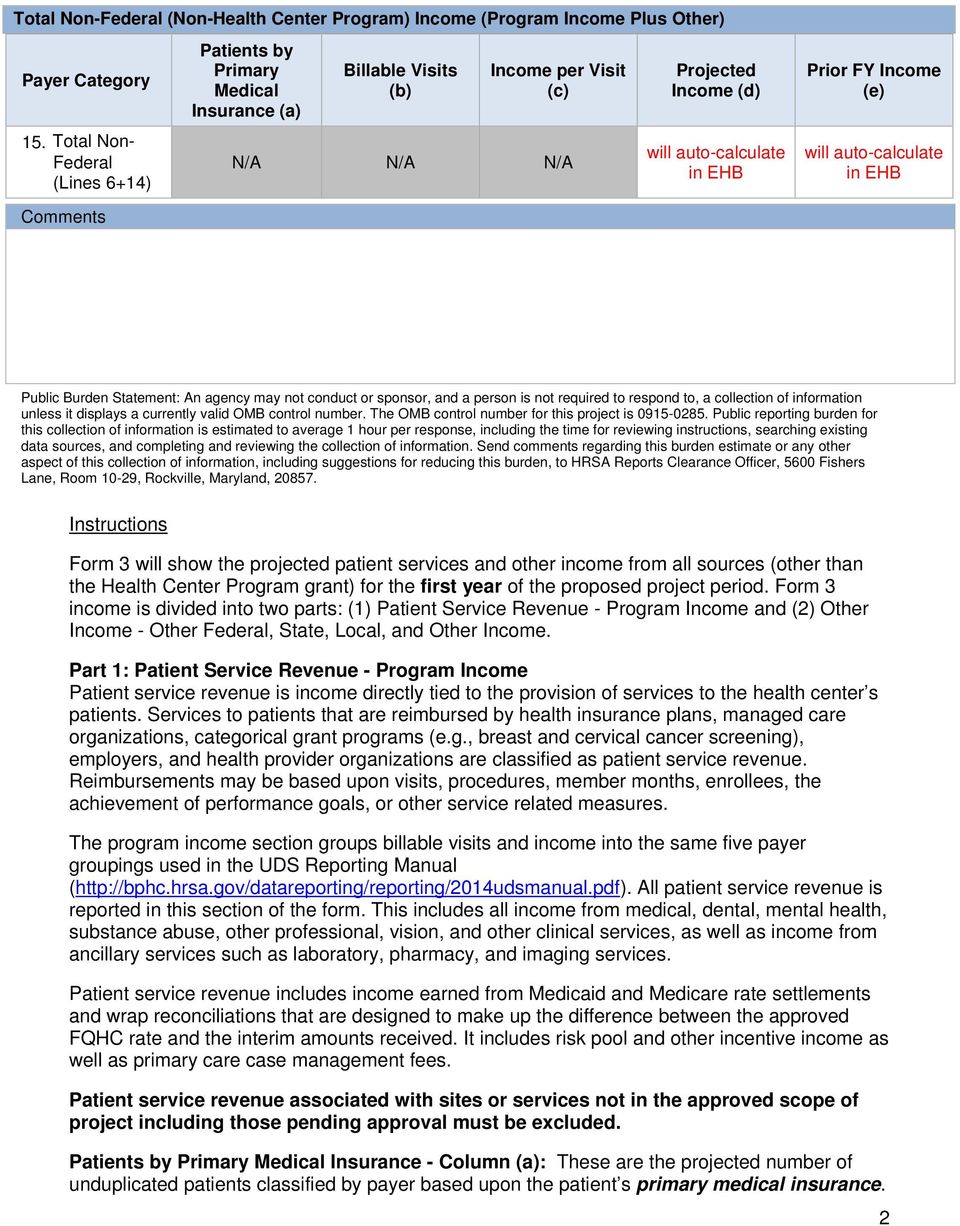
2 Total Non-Federal (Non-Health Center Program) Income (Program Income Plus Other) 15. Total Non- Federal (Lines 6+14) Comments Public Burden Statement: An agency may not conduct or sponsor, and a person is not required to respond to, a collection of information unless it displays a currently valid OMB control number. The OMB control number for this project is Public reporting burden for this collection of information is estimated to average 1 hour per response, including the time for reviewing instructions, searching existing data sources, and completing and reviewing the collection of information. Send comments regarding this burden estimate or any other aspect of this collection of information, including suggestions for reducing this burden, to HRSA Reports Clearance Officer, 5600 Fishers Lane, Room 10-29, Rockville, Maryland, Instructions Form 3 will show the projected patient services and other income from all sources (other than the Health Center Program grant) for the first year of the proposed project period. Form 3 income is divided into two parts: (1) Patient Service Revenue - Program Income and (2) Other Income - Other Federal, State, Local, and Other Income. Part 1: Patient Service Revenue - Program Income Patient service revenue is income directly tied to the provision of services to the health center s patients. Services to patients that are reimbursed by health insurance plans, managed care organizations, categorical grant programs (e.g., breast and cervical cancer screening), employers, and health provider organizations are classified as patient service revenue. Reimbursements may be based upon visits, procedures, member months, enrollees, the achievement of performance goals, or other service related measures. The program income section groups billable visits and income into the same five payer groupings used in the UDS Reporting Manual ( All patient service revenue is reported in this section of the form. This includes all income from medical, dental, mental health, substance abuse, other professional, vision, and other clinical services, as well as income from ancillary services such as laboratory, pharmacy, and imaging services. Patient service revenue includes income earned from Medicaid and Medicare rate settlements and wrap reconciliations that are designed to make up the difference between the approved FQHC rate and the interim amounts received. It includes risk pool and other incentive income as well as primary care case management fees. Patient service revenue associated with sites or services not in the approved scope of project including those pending approval must be excluded. Insurance - Column (a): These are the projected number of unduplicated patients classified by payer based upon the patient s primary medical insurance. 2
3 The primary insurance is the payer that is billed first. The patients are classified in the same way as found in the Manual, Table 4, lines This column should not include patients who are only seen for non-billable or enabling service visits. Examples for determining where to count patients include: A crossover patient with Medicare and Medicaid coverage is to be classified as a Medicare patient on line 2. A Medicaid patient with no dental coverage who is only seen for dental services is to be classified as a Medicaid patient on line 1 with a self-pay visit on line 5. - Column : These include all billable/reimbursable visits. There may be other exclusions or additions, which, if significant, should be noted in the Comment/Explanatory Notes box at the bottom of the form. Billable services related to laboratory, pharmacy, imaging, and other ancillary services are not to be included in this column (see ancillary instructions below). - Column : This value may be calculated by dividing projected income by billable visits. Income - Column (d): This is the projected accrued net revenue, including an allowance for bad debt from all patient services for each pay grouping in the first year of the proposed project period. : This is the income data from the most recent fiscal year, which will be either interim statement data or audit data. The fiscal year was specified because the interim data can eventually be compared to actual audit data. Payer Categories (Lines 1 5): There are five payer categories including Medicaid, Medicare, Other Public, Private, and Self-Pay, reflecting the five payer groupings used in UDS Table. The UDS Reporting Manual ( must be used to define each payer category. Visits are reported on the line of the primary payer (payer billed first). The income is classified by the payer groupings where the income is earned. When a single visit involves more than one payer, attribute that portion of the visit income to the payer group from which it is earned. In cases where there are deductibles and co-payments to be paid by the patient, that income is to be shown on the self-pay line. If the co-payment is to be paid by another payer, that income should be shown on the other payer s line. It is acceptable if the applicant cannot accurately associate the income to secondary and subsequent sources. All service income is to be classified by payer, including pharmacy and other ancillary service revenue. In the event the applicant does not normally classify the projected ancillary or other service revenue by payer category, the projected income is to be allocated by payer group using a reasonable allocation method, such as the proportion of medical visits or charges. The method used should be noted in the Comments/Explanatory Notes section at the bottom of the form. Medicaid Line 1): This includes income from FQHC cost reimbursement; capitated managed care; fee-for-service managed care; Early Periodic Screening, Diagnosis, and Treatment (EPSDT); Children s Health Insurance Program (CHIP); and other reimbursement arrangements administered either directly by the state agency or by a fiscal intermediary. It includes all projected income from managed care capitation, settlements from FQHC cost reimbursement reconciliations, wrap payments, incentives, and primary care case management income. Medicare (Line 2): This includes income from the FQHC cost reimbursement, capitated managed care, fee-for-service managed care, Medicare Advantage plans, and other 3

4 reimbursement arrangements administered either directly by Medicare or by a fiscal intermediary. It includes all projected income from managed care capitation, settlements from the FQHC cost reimbursement, risk pool distributions, performance incentives, and care management fee income from the ACA Medicare Demonstration Program. Other Public (Line 3): This includes income from Federal, State, or local government programs earned for providing services that is not reported elsewhere. A CHIP operated independently from the Medicaid program is an example of other public insurance. Other public also includes income from categorical grant programs when the grant income is earned by providing services. Examples of these include CDC s National Breast and Cervical Cancer Early Detection Program and the Title X Family Planning Program. Private (Line 4): This includes income from private insurance plans, managed care plans, insurance plans from the ACA marketplaces/exchanges, and other private contracts for service. This includes plans such as Blue Cross and Blue Shield, commercial insurance, managed care plans, self-insured employer plans, group contracts with unions and employers, service contracts with employers, and Veteran s Administration Community Based Outpatient Clinic (CBOC) contracts. Income from health benefit plans which are earned by government employees, veterans, retirees, and dependents, such as TRICARE, the federal employee health benefits program, state employee health insurance benefit programs, teacher health insurance, and similar plans are to be classified as private insurance. Private insurance is earned or paid for by the beneficiary and other public insurance is unearned or based upon meeting the plan s eligibility criteria. Self-Pay (Line 5): This includes income from patients, including full-pay self-pay and sliding fee patients, as well as the portion of the visit income for which an insured patient is personally responsible. Total (Line 6): This is the sum of lines 1-5. Part 2: Other Income Other Federal, State, Local, and Other Income This section includes all income other than the patient service revenue shown in Part 1 (exclusive of this Health Center Program grant request). It includes other federal, state, local, and other income. It is income that is earned but not directly tied to providing visits, procedures, or other specific services. Income is to be classified on the lines below based upon the source from whom the revenue is received. Income from services provided to non-health center patients (patients of an entity with which the health center is contracting) either in-house or under contract with another entity such as a hospital, nursing home or other health center is to be reported in Part 2: Other Income (see examples below). This would include income from inhouse retail pharmacy sales to individuals who are not patients of the health center. See Lines 9 and 10 for examples of services provided to non-health center patients (patients of an entity with which the health center is contracting). Other Federal (Line 7): This is income from federal grants where the applicant is the recipient of a Notice of Award from a federal agency. It does not include the Health Center Program grant request or federal funds awarded through intermediaries (see Line 9 below). It includes grants from federal sources such as the Centers for Disease Control (CDC), Housing and Urban Development (HUD), Centers for Medicaid and Medicare Services (CMS), and others. It includes Health and Human Service (DHHS) grants under the Ryan White Part C program, DHHS Capital Development grants, and others. The CMS Medicare and Medicaid EHR incentive program income is reported here in order to be consistent with the UDS Reporting Manual ( State Government (Line 8): This is income from state government grants, contracts, and programs, including uncompensated care grants; state indigent care income; emergency 4

5 preparedness grants; mortgage assistance; capital improvement grants; school health grants; Women, Infants, and Children (WIC); immunization grants; and similar awards. Local Government (Line 9): This is income from local government grants, contracts, and programs, including local indigent care income, community development block grants, capital improvement project grants, and similar awards. For example: (1) a health center that contracts with the local Department of Health to provide services to the Department s patients is to report all the income earned under this contract on this line, and (2) Ryan White Part A funds are federal funds awarded to municipalities who in turn make awards to provider organizations, so Ryan White Part A grants would be classified as income earned from a local government and be shown on this line. Private Grants/Contracts (Line 10): This is income from private sources such foundations, non-profit entities, hospitals, nursing homes, drug companies, employers, other health centers, and similar entities. For example, a health center operating a 340B pharmacy in part for its own patients and in part as a contractor to another health center is to report the pharmacy income for its own patients in Part 1 and the income from the contracted health center on this line. Contributions (Line 11): This is income from private entities and individual donors that may be the result of fund raising. Other (Line 12): This is incidental income not reported elsewhere and includes items such as interest income, patient record fees, vending machine income, dues, and rental income. Applicants typically have at least some other income to report on Line 12. Applicant (Retained Earnings) (Line 13): This is the amount of funds needed from the applicant s retained earnings or reserves in order to achieve a breakeven budget. Explain in the Comments/Explanatory notes section why applicant funds (retained earnings) are needed to achieve a breakeven budget. Amounts from non-federal sources, combined with the Health Center Program funds, should be adequate to support normal operations. Total Other (Line 14): This is the sum of lines Total Non-Federal (Line 15): This is the sum of Lines 6 and 14 and is the total non-federal (non-health Center Program) income. Note: In-kind donations are not included as income on Form 3. Applicants may discuss in-kind donations in the Support Requested section of the Project Narrative. Additionally, such donations may be included on the SF-424A (Section A: Budget Summary Non-Federal Resources under New or Revised Budget). 5

Hospital Financing Overview
 Texas Hospital Association 1108 Lavaca, Suite 700, Austin, TX, 78701-2180 www.tha.org Hospital Financing Overview Under federal law, hospitals are required to provide care to anyone who seeks it in their
California Primary Care Association 2012 New CFO Boot Camp
 California Primary Care Association 2012 New CFO Boot Camp Medi-Cal FQHC PPS, Medicare FQHC, and Other Revenue/Reimbursement Strategies for Health Centers Presented by: Michael B. Schnake, CPA, CGFM Presentation
Department of Mental Health
 332401 Forensic Services $4,319,519 $4,328,547 $4,371,610 $4,323,287 $3,089,969 $3,244,251 0.2% 1.0% -1.1% -28.5% 5.0% Section 335.10.10 of Am. Sub. H.B. 1 of the 128th G.A. (originally established by
MEDICARE PART B DRUGS. Action Needed to Reduce Financial Incentives to Prescribe 340B Drugs at Participating Hospitals
 United States Government Accountability Office Report to Congressional Requesters June 2015 MEDICARE PART B DRUGS Action Needed to Reduce Financial Incentives to Prescribe 340B Drugs at Participating Hospitals
How To Get A Medicaid Card
 MEDICAID care is reasonable, necessary, and provided in the most appropriate setting. The PROs are composed of groups of practicing physicians. To receive Medicare payments, a hospital must have an agreement
SBHC Pro-Forma Financial Statement Instruction Manual
 SBHC Pro-Forma Financial Statement Instruction Manual Overview The pro-forma financial statement is an integral component of any business plan. It represents a projection of revenue and expenses (or cash
Maryland Medicaid Program. Aaron Larrimore Medicaid Department of Health and Mental Hygiene May 15, 2012
 Maryland Medicaid Program Aaron Larrimore Medicaid Department of Health and Mental Hygiene May 15, 2012 1 Maryland Medicaid In Maryland, Medicaid is also called Medical Assistance or MA. MA is a joint
Florida Medicaid Recipients With Other Medical Insurances. April 2013
 Florida Medicaid Recipients With Other Medical Insurances April 2013 1 Section 1 The Basics 2 What is Third Party Liability? Third Party Liability (TPL) is the obligation of any entity other than Medicaid
410-165-0000 Basis and Purpose... 1 410-165-0020 Definitions... 2 410-165-0040 Application... 9 410-165-0060 Eligibility... 11
 Medicaid Electronic Health Record Incentive Program Administrative Rulebook Office of Health Information Technology Table of Contents Chapter 410, Division 165 Effective October 24, 2013 410-165-0000 Basis
Programs. Summary of State Programs and Laws Highlighted in Faces of Maryland s Newly Insured. Medical Assistance for Families (SB 6)
 Programs Summary of State Programs and Laws Highlighted in Faces of Maryland s Newly Insured Medical Assistance for Families (SB 6) Medical Assistance for Families provides full health care insurance to
COMMUNITY HEALTH CENTER GROWTH AND SUSTAINABILITY STATE PROFILES CONNECTICUT. Primary Care Need & Transformation 9
 COMMUNITY HEALTH CENTER GROWTH AND SUSTAINABILITY STATE PROFILES CONNECTICUT CONTENTS Overview 2 CHC Scale 3 CHC Financial Status 6 Primary Care Need & Transformation 9 Medicaid and Health Insurance Landscape
Date Completed: 3-5-02 RATIONALE
 MEDICARE SUPPLEMENT POLICY S.B. 748 (S-1) & 749 (S-1): FIRST ANALYSIS Senate Bill 748 (Substitute S-1 as passed by the Senate) Senate Bill 749 (Substitute S-1 as passed by the Senate) Sponsor: Senator
INTERNATIONAL MEDICAL ADMINISTRATORS, INC. (IMA)
 INTERNATIONAL MEDICAL ADMINISTRATORS, INC. (IMA) Important Notice: ACA s PCORI Fee and Self Insured Plans Under the Affordable Care Act (ACA), your group health plan is required to pay a Patient Centered
WEEK CHAPTER OBJECTIVES ASSIGNMENTS & TESTS 19-20 6A medical necessity as it ICD-9-CM Coding. relates to reporting diagnosis codes on claims.
 HEALTH INSURANCE & CODING Textbook: Understanding Health Insurance: A Guide to Billing and Reimbursement 11 th edition Website Activities: StudyWARE Online Practice Software linked to the book. SimClam:
Administrative Code. Title 23: Medicaid Part 306 Third Party Recovery
 Administrative Code Title 23: Medicaid Part 306 Third Party Recovery Table of Contents Title 23: Division of Medicaid... 1 Part 306: Third Party Recovery... 1 Part 306 Chapter 1: Third Party Recovery...
Medi-Pak Advantage: Frequently Asked Questions
 Medi-Pak Advantage: Frequently Asked Questions General Information: What Medicare Advantage product is Arkansas Blue Cross Blue Shield offering? Arkansas Blue Cross and Blue Shield has been approved by
Frequently asked Questions for Providers H1N1 Vaccine Administration
 Frequently asked Questions for Providers H1N1 Vaccine Administration What is the coverage policy for Empire BlueCross members regarding the H1N1 vaccination? Empire BlueCross will reimburse for the administration
The Medicare Drug Benefit (Part D)
 THE BASICS The Medicare Drug Benefit (Part D) The Medicare Prescription Drug, Improvement, and Modernization Act of 2003 (MMA) established a voluntary outpatient prescription drug benefit for Medicare
Rhode Island Annual Health Statement Supplement Instructions
 Rhode Island Annual Health Statement Supplement Instructions Office of the Health Insurance Commissioner 1511 Pontiac Ave, Building #69 first floor Cranston, RI 02920 (401) 462-9517 (401) 462-9645 (fax)
Maryland Medicaid Program: An Overview. Stacey Davis Planning Administration Department of Health and Mental Hygiene May 22, 2007
 Maryland Medicaid Program: An Overview Stacey Davis Planning Administration Department of Health and Mental Hygiene May 22, 2007 1 Maryland Medicaid In Maryland, Medicaid is also called Medical Assistance
Maryland Medicaid Program
 Maryland Medicaid Program Maryland s Pharmacy Discount Waiver Tuesday, November 19, 2002 Debbie I. Chang Deputy Secretary for Health Care Financing Maryland Department of Health and Mental Hygiene Overview
Possible Opportunities for Collaboration in Health Care Reform
 MEDICARE EXTENDERS Part B Payments to Indian Hospitals and Clinics. (Sec. 2902) Spends $200 million over 10 years. Section 630 of the Medicare Prescription Drug, Improvement, and Modernization Act of 2003
S c h o o l s I n s u r a n c e G r o u p Health Net Plan Comparison Fiscal Year 7/1/14-6/30/15
 S c h o o l s I n s u r a n c e G r o u p Health Net Plan Comparison Fiscal Year 7/1/14-6/30/15 This information sheet is for reference only. Please refer to Evidence of Coverage requirements, limitations
Will the ASP data submitted to CMS be releasable to the public?
 FAQ Results Please be advised that these FAQs were generated from a database that is updated frequently. For the most up-to-date information, please visit http://questions.cms.hhs.gov. Date: 2/24/2010
Quarterly Medicaid Statement of Expenditures For the Medical Assistance Program
 Quarterly Medicaid Statement of Expenditures For the Medical Assistance Program CMS 64 Summary Sheet Net Expenditures Reported In This Period (Sum of Items 6, 7 and 8 Less 9 and 10) I certify that: Certification
COMMUNITY HEALTH CENTER GROWTH AND SUSTAINABILITY STATE PROFILES NEW HAMPSHIRE. Primary Care Transformation 10
 COMMUNITY HEALTH CENTER GROWTH AND STAINABILITY STATE PROFILES NEW HAMPSHIRE CONTENTS Overview 2 CHC Scale 3 CHC Financial Status 6 Primary Care Need 9 Primary Care Transformation 10 Medicaid and Health
Affordable Care Act (ACA) Health Insurance Exchanges and Medicaid Expansion
 Affordable Care Act (ACA) Health Insurance Exchanges and Medicaid Expansion Table of Contents Expanded Coverage... 2 Health Insurance Exchanges... 3 Medicaid Expansion... 8 Novartis Pharmaceuticals Corporation
NJ FamilyCare B. Covered by Horizon NJ Health for spontaneous abortions/miscarriages. Abortions & Related Services
 NJ FamilyCare B BENEFIT Abortions & Related Services COVERAGE by Horizon NJ Health for spontaneous abortions/miscarriages. by Fee-for-Service for elective/induced abortions. Acupuncture Audiology (see
GROUP MEDICARE SUPPLEMENT PLANS. S5753_081213_GB03_MN Internal Approval 08/13/2013
 2014 GROUP MEDICARE SUPPLEMENT PLANS S5753_081213_GB03_MN Internal Approval 08/13/2013 CREATE A HEALTHIER ORGANIZATION. Your employees are your organization s most valuable asset. As they retire, you want
HB 686-FN-A - AS INTRODUCED. establishing a single payer health care system and making an appropriation therefor.
 0 SESSION -0 0/0 HOUSE BILL AN ACT -FN-A establishing a single payer health care system and making an appropriation therefor. SPONSORS: Rep. McNamara, Hills ; Rep. Suzanne Smith, Graf ; Rep. Moody, Rock
Medicare 101. Marketplace & Medicaid Transitions. Janice Meinert Kyle Fisher [email protected] March 2016
 Medicare 101 Marketplace & Medicaid Transitions Janice Meinert Kyle Fisher [email protected] March 2016 Medicare Basics Topics Eligibility and Enrollment Original Medicare vs Medicare Advantage Transitions
State of Alabama. Medicaid Dental Review
 State of Alabama Medicaid Dental Review October 2010 Executive Summary The Centers for Medicare & Medicaid Services (CMS) is committed to improving pediatric dental care in the Medicaid program reflecting
S c h o o l s I n s u r a n c e G r o u p Health Net Plan Comparison Fiscal Year 7/1/15-6/30/16
 S c h o o l s I n s u r a n c e G r o u p Health Net Plan Comparison Fiscal Year 7/1/15-6/30/16 This information sheet is for reference only. Please refer to Evidence of Coverage requirements, limitations
BLUE. Care. A classic, comprehensive health insurance plan for families and individuals who want more predictable health care costs.
 BLUE Care A classic, comprehensive health insurance plan for families and individuals who want more predictable health care costs. 2016 How it Works With this classic health insurance plan from Blue Cross
2006 Choosing a Medigap Policy:
 CENTERS FOR MEDICARE & MEDICAID SERVICES 2006 Choosing a Medigap Policy: A Guide to Health Insurance for People With Medicare This official government guide can help you Learn what a Medigap (Medicare
Health Care Reform Checklist: Provisions, Obstacles and Solutions
 Health Care Reform Checklist: Provisions, Obstacles and Solutions HEALTH CARE REFORM PROVISION: COVERAGE FOR CHILDREN UNTIL AGE 26 Summary of Benefit: Benefits are the same as those for other dependent
UNITED STATES OFFICE OF PERSONNEL MANAGEMENT
 UNITED STATES OFFICE OF PERSONNEL MANAGEMENT STATEMENT OF JONATHAN FOLEY DIRECTOR, PLANNING AND POLICY ANALYSIS U.S. OFFICE OF PERSONNEL MANAGEMENT before the SUBCOMMITTEE ON FEDERAL WORKFORCE, U.S. POSTAL
NAPH Summary of Proposed Medicare DSH Regulations
 NAPH Summary of Proposed Medicare DSH Regulations On Friday, April 26, the Centers for Medicare & Medicaid Services (CMS) released a proposed rule implementing the Medicare disproportionate share hospital
Analysis of the Costs and Impact of Universal Health Care Coverage Under a Single Payer Model for the State of Vermont
 Analysis of the Costs and Impact of Universal Health Care Coverage Under a Single Payer Model for the State of Vermont Prepared for: The Vermont HRSA State Planning Grant, Office of Vermont Health Access
ACP Analysis of the Essential Health Benefits Bulletin, Issued by the HHS Center for Consumer Information and Insurance Oversight (CCIIO)
 ACP Analysis of the Essential Health Benefits Bulletin, Issued by the HHS Center for Consumer Information and Insurance Oversight (CCIIO) Introduction and background: Summarizes the essential benefit package
Scope of Policy Ryan White Program Parts A, B, C
 Uniform Standard for Waiver of Core Medical Services Requirement for Grantees Under Parts, A, B, and C POLICY NUMBER 13-07 (Replaces Policy Notice 08-02) Scope of Policy Ryan White Program Parts A, B,
ACAP Guide to ACA Fees and Taxes for Health Insurers
 Introduction ACAP Guide to ACA Fees and Taxes for Health Insurers Since being signed into law in March of 2010, the Patient Protection and Affordable Care Act (ACA) has introduced a wide range of health
Reference Guide for UDS Data Reports Available to Grantees CY 2012
 Reference Guide for UDS Data Reports Available to Grantees CY 2012 Introduction: This Reference Guide is a companion document to the CY 2012 BPHC UDS data reports that are available to health centers through
NJ FamilyCare ABP. Covered by Horizon NJ Health for spontaneous abortions/miscarriages. Abortions & Related Services
 NJ FamilyCare ABP BENEFIT Abortions & Related Services COVERAGE by Horizon NJ Health for spontaneous abortions/miscarriages. by Fee-for-Service for elective/induced abortions. Acupuncture Audiology (see
THE BASICS OF RHC BILLING. Thursday, April 28, 2011 Presented by: Health Services Associates, Inc.
 THE BASICS OF RHC BILLING Thursday, April 28, 2011 Presented by: Health Services Associates, Inc. TABLE OF CONTENTS Commercial and Self Pay billing Define RHC Medicaid Specified Medicare RHC billing guidelines
How To Pass The Health Care Bill
 Timeline/Summary of Tax s in the Health Reform Laws Effective Date Retrospective to Enactment Health professionals State loan repayment tax relief. Excludes from gross income payments made under any State
8.2000: HOSPITAL PROVIDER FEE COLLECTION AND DISBURSEMENT
 DEPARTMENT OF HEALTH CARE POLICY AND FINANCING MEDICAL ASSISTANCE SECTION 8.2000 [Editor s Notes follow the text of the rules at the end of this CCR Document.] 8.2000: HOSPITAL PROVIDER FEE COLLECTION
GENERAL GOVERNMENT ADMINISTRATION EXECUTIVE RECORDS RETENTION AND DISPOSITION SCHEDULES (ERRDS) ERRDS, HEALTH POLICY COMMISSION
 TITLE 1 CHAPTER 18 PART 669 GENERAL GOVERNMENT ADMINISTRATION EXECUTIVE RECORDS RETENTION AND DISPOSITION SCHEDULES (ERRDS) ERRDS, HEALTH POLICY COMMISSION 1.18.669.1 ISSUING AGENCY: New Mexico Commission
Florida Memorial University s 2014-15 Student Insurance Plan. Frequently Asked Questions
 Florida Memorial University s 2014-15 Student Insurance Plan Frequently Asked Questions Did you know college students have several choices for health coverage? Did you know there is no special college
Household health care spending: comparing the Consumer Expenditure Survey and the National Health Expenditure Accounts Ann C.
 Household health care spending: comparing the Consumer Expenditure Survey and the National Health Expenditure Accounts Ann C. Foster Health care spending data produced by the Federal Government include
Health Reform and the AAP: What the New Law Means for Children and Pediatricians
 Health Reform and the AAP: What the New Law Means for Children and Pediatricians Throughout the health reform process, the American Academy of Pediatrics has focused on three fundamental priorities for
Why the Affordable Care Act Matters for Women: Health Insurance 101
 Why the Affordable Care Act Matters for Women: Health Insurance 101 APRIL 2014 Women are the health care decision makers in our country they make approximately 80 percent of the health care decisions in
NJ FamilyCare A. Covered by Horizon NJ Health for spontaneous abortions/miscarriages. Abortions & Related Services
 NJ FamilyCare A BENEFIT Abortions & Related Services COVERAGE by Horizon NJ Health for spontaneous abortions/miscarriages. by Fee-for-Service for elective/induced abortions. Acupuncture Audiology (see
Financing Plans: 2014-2017. Robin J. Lunge, Director of Health Care Reform Mark Larson, Commissioner, DVHA
 Financing Plans: 2014-2017 Robin J. Lunge, Director of Health Care Reform Mark Larson, Commissioner, DVHA Health Reform Goals Reduce health care costs and cost growth Assure that all Vermonters have access
 Prescription drugs are a critical component of health care. Because of the role of drugs in treating conditions, it is important that Medicare ensures that its beneficiaries have access to appropriate
2016 PHARMACY. Benefit Summary Book. RXSUMBK2016 www.fepblue.org
 2016 Benefit Summary Book RXSUMBK2016 www.fepblue.org REVIEW THIS SUMMARY BOOKLET TO LEARN HOW TO GET THE MOST FROM YOUR PRESCRIPTION BENEFIT. THIS INCLUDES INFORMATION ABOUT: n Your prescription drug
Small Employer Health Insurance Survey South Carolina State Planning Grant
 Small Employer Health Insurance Survey South Carolina State Planning Grant So that we can ensure our survey sample is geographically representative of the state, it is very important that you provide the
Julie Quinn, CPA. VP, Cost Reporting & Provider Education Health Services Associates Southeast Regional Office
 Julie Quinn, CPA VP, Cost Reporting & Provider Education Health Services Associates Southeast Regional Office Promoting Access to Health Care 2 East Main Street 54 Pheasant Ln Fremont, MI 49412 Ringgold,
[Document Identifier: CMS-10003, CMS-10467, CMS-1450(UB-04), CMS-1500(08-05)]
![[Document Identifier: CMS-10003, CMS-10467, CMS-1450(UB-04), CMS-1500(08-05)]](/thumbs/25/5286585.jpg "[Document Identifier: CMS-10003, CMS-10467, CMS-1450(UB-04), CMS-1500(08-05)]") This document is scheduled to be published in the Federal Register on 10/16/2015 and available online at http://federalregister.gov/a/2015-26390, and on FDsys.gov DEPARTMENT OF HEALTH AND HUMAN SERVICES
This document is scheduled to be published in the Federal Register on 10/16/2015 and available online at http://federalregister.gov/a/2015-26390, and on FDsys.gov DEPARTMENT OF HEALTH AND HUMAN SERVICES
Technical Note: Comparison of Methodologies between Total Health Care Expenditures and State Health Expenditure Accounts
 Center for Health Information and Analysis Technical Note: Comparison of Methodologies between Total Health Care Expenditures and State Health Expenditure Accounts October 2014 Executive Summary This
HEALTH & SAFETY CODE SUBTITLE F. POWERS AND DUTIES OF HOSPITALS CHAPTER 311. POWERS AND DUTIES OF HOSPITALS
 HEALTH & SAFETY CODE SUBTITLE F. POWERS AND DUTIES OF HOSPITALS CHAPTER 311. POWERS AND DUTIES OF HOSPITALS SUBCHAPTER C. HOSPITAL DATA REPORTING AND COLLECTION SYSTEM Sec. 311.031. DEFINITIONS. In this
Health Insurance Reform at a Glance Implementation Timeline
 Health Insurance Reform at a Glance Implementation Timeline 2010 Access to Insurance for Uninsured Americans with a Pre-Existing Condition. Provides uninsured Americans with pre-existing conditions access
Randall Chun, Legislative Analyst 651-296-8639 Updated: October 2007. MinnesotaCare
 INFORMATION BRIEF Research Department Minnesota House of Representatives 600 State Office Building St. Paul, MN 55155 Randall Chun, Legislative Analyst 651-296-8639 Updated: October 2007 MinnesotaCare
EXPECTED SOURCE OF PAYMENT Section 97265
 EXPECTED SOURCE OF PAYMENT Section 97265 The patient s expected source of payment, defined as the type of entity or organization which is expected to pay or did pay the greatest share of the patient s
Maryland Data as of July 2003. Mental Health and Substance Abuse Services in Medicaid and SCHIP in Maryland
 Mental Health and Substance Abuse Services in Medicaid and SCHIP in Maryland As of July 2003, 638,662 people were covered under Maryland's Medicaid/SCHIP programs. There were 525,080 enrolled in the Medicaid
Utah Data as of July 2003. Mental Health and Substance Abuse Services in Medicaid and SCHIP in Utah
 Mental Health and Substance Abuse Services in Medicaid and SCHIP in Utah As of July 2003, 196,600 people were covered under Utah s Medicaid/SCHIP programs. There were 157,322 enrolled in the Medicaid program,
Bureau of Primary Health Care. Reporting Instructions for Health Centers
 Bureau of Primary Health Care Reporting Instructions for Health Centers 1 Bureau of Primary Health Care Uniform Data System Reporting Instructions For use to submit Calendar Year 2015 UDS Data For help
The Alabama Children s s Health Insurance Program
 The Alabama Children s s Health Insurance Program National Health Policy Forum State Children s Health Insurance Program: Past, Present and Future July 21, 2006 Gayle Lees Sandlin, Director Bureau of Children
Department of Social Services. South Dakota Medicaid Division of Medical Services (MS)
 Department of Social Services South Dakota Medicaid Division of Medical Services (MS) Overview What is Medicaid? Who We Serve Services Provided Medicaid Budget South Dakota Medicaid: Medicaid is the nation
THE FISCAL YEAR 2015 BUDGET FOR MASSHEALTH AND HEALTH REFORM PROGRAMS
 THE FISCAL YEAR 2015 BUDGET FOR MASSHEALTH AND HEALTH REFORM PROGRAMS BUDGET BRIEF SEPTEMBER 2014 On July 10, 2014, Governor Deval Patrick signed the budget for fiscal year (FY) 2015, one week into the
Medicare Part B vs. Part D
 Medicare Part B vs. Part D 60889-R8-V1 (c) 2012 Amgen Inc. All rights reserved 2 This information is provided for your background education and is not intended to serve as guidance for specific coding,
What Federal Employees Need to Know About Their Health Insurance and Medicare
 What Federal Employees Need to Know About Their Health Insurance and Medicare Federal employees have been paying the Medicare Part A (hospital insurance) payroll tax since Jan. 1, 1983. That means all
Frequently Asked Questions: Electronic Health Records (EHR) Incentive Payment Program
 1. Where did the Electronic Health Records (EHR) Incentive Program originate? The American Recovery and Reinvestment Act (ARRA) was signed into law on February 17, 2009, and established a framework of