
September 2010 Report No
|
|
|
- Veronica Hall
- 9 years ago
- Views:
Transcription
1 John Keel, CPA State Auditor Selected Investment Practices at the Texas Treasury Safekeeping Trust Company, the Employees Retirement System, and the Texas A&M University System Report No

2 Selected Investment Practices at the Texas Treasury Safekeeping Trust Company, the Employees Retirement System, and the Texas A&M University System Overall Conclusion The Texas Treasury Safekeeping Trust Company (Texas Trust), the Employees Retirement System (ERS), and the Texas A&M University System (Texas A&M System) substantially had and adhered to policies, procedures, and controls that were consistent with applicable statutory requirements and best practices for the specific investment practices audited. While the extent of the controls over investment practices differed among the audited entities, overall, the controls that auditors tested at each entity operated effectively. However, all three entities have opportunities to strengthen certain controls. Specifically: Documentation. All three entities should improve the documentation of certain aspects of their initial due diligence for, and ongoing monitoring of, alternative investments and externally managed traditional investments. For example, all three entities should improve their documentation of reference checks of investment firms and their key professionals. The Texas Trust and ERS should improve their documentation of site visits and meetings. The Texas A&M System should improve its documentation of the rationale for investment decisions and its review of fees that alternative investments managers charge. The Texas Trust should improve its documentation of written procedures for ongoing monitoring. Investment Policies. The Texas A&M System should enhance certain provisions of its investment policy, implement additional controls to strengthen the independence of its oversight processes, and improve its documentation of noncompliance with Investment Practices Audited Initial due diligence for and ongoing monitoring of (1) alternative investments and (2) external managers of traditional investments. Compliance with key investment policies. Compliance with statutory and contractual requirements for securities lending programs. The Audited Entities Texas Trust The Texas Treasury Safekeeping Trust Company (Texas Trust) is a special purpose trust company that manages and invests certain state and local government funds. The Comptroller of Public Accounts is the single shareholder of, and is charged with managing, the Texas Trust. The funds invested include funds in the state treasury (Treasury Pool), local government investment pools (TexPool and TexPool Prime), tobacco settlement and other endowment funds, and various other portfolios managed for other state agencies. As of March 31, 2010, the Texas Trust had total investments of $51.4 billion. At the time of this audit, the Texas Trust had 19 direct investment employees and 1 compliance officer. ERS The Employees Retirement System (ERS) is authorized to provide retirement and related benefits for officers and employees of the State of Texas. ERS also administers a health care plan for employees and retirees (and their dependents) of state agencies and universities, junior and community colleges, and certain other entities. ERS is responsible for investing funds under its stewardship. As of March 31, 2010, ERS had total investments of $22.1 billion. At the time of this audit, ERS had 56 investment division employees. Texas A&M System The Texas A&M University System (Texas A&M System), through its Office of Treasury Services, centrally manages the endowments, operating, non-operating, and other funds belonging to the Texas A&M System or its member universities, state agencies, and health science center. As of March 31, 2010, the System Endowment Fund and the Cash Concentration Pool had combined total investments of $2.8 billion. At the time of this audit, the Texas A&M System had four direct investment employees. This audit was conducted in accordance with Texas Government Code, Section For more information regarding this report, please contact Verma Elliott, Audit Manager, or John Keel, State Auditor, at (512)
3 investment policies. The Texas Trust should improve its monitoring of compliance with certain key investment policy provisions. Securities Lending Policies. ERS and the Texas A&M System have securities lending programs; the Texas Trust suspended its securities lending program in October 2008, but it still has a contract with a securities lending agent through which it could resume securities lending. ERS s board-approved securities lending policy does not address certain statutory limitations on its securities lending program. In addition, ERS and the Texas A&M System (and the Texas Trust, if it reinstates its securities lending program) should consider incorporating certain best practice provisions directly into their formal securities lending policies. ERS also should improve its communication process for certain violations of its internally adopted securities lending policy. The contracts that ERS, the Texas A&M System, and the Texas Trust have with their securities lending agents addressed all or most best practice provisions (and, for ERS, all statutory limitations); however, opportunities exist for the Texas A&M System to strengthen certain contractual language. Auditors communicated other less significant issues separately in writing to management of the audited entities. Summary of Management s Responses The Texas Trust stated in its response that it has already adopted all of this audit report s recommendations. Responses from ERS and the Texas A&M System indicate that both entities substantially agreed with this audit report s recommendations. The full text of each entity s management s response is in Appendix 4 beginning on page 37. Summary of Objectives, Scope, and Methodology The objectives of this audit were to determine whether the Texas Trust, ERS, and the Texas A&M System: Have and adhere to policies, procedures, and related controls for initial due diligence and ongoing monitoring of alternative investments. Have and adhere to policies, procedures, and related controls for selection and ongoing monitoring of external managers of traditional investments. Have and adhere to controls to provide assurance of compliance with key investment policies, such as controls regarding allowable investments, limits on amounts invested in a specific investment type, trader limits, and tracking error limits. Have and adhere to processes and related controls over their securities lending programs to provide assurance of compliance with state law and key provisions of their contracts with their securities lending administrators. ii

4 The audit scope covered the Texas Trust, ERS, and the Texas A&M System policies, processes, and controls related to audited investment practices from fiscal year 2009 through the time that audit work began at each entity. The audit methodology included collecting information, conducting interviews with investment personnel, and reviewing entities policies and procedures. Auditors reviewed controls designed to ensure compliance with investment policies. Auditors tested controls and evaluated results against pre-established criteria to ensure that these controls operated effectively. Auditors also reviewed the reports issued in accordance with the American Institute of Certified Public Accountants Statement on Auditing Standards No. 70 (SAS 70) that the audited entities received from their custodian banks. Those custodian banks also served as the audited entities securities lending agents. The SAS 70 reports included information on the design and effectiveness of certain information technology internal controls related to investment custody and securities lending activities. Auditors reviewed those reports but did not identify any other relevant information technology controls at the audited entities that were significant to the audit objectives. iii

5 Contents Detailed Results Chapter 1 The Texas Trust, ERS, and the Texas A&M System Should Improve Documentation of Initial Due Diligence and Monitoring of Alternative Investments... 1 Chapter 2 The Texas Trust, ERS, and the Texas A&M System Should Improve Documentation of Initial Due Diligence and Monitoring of External Managers of Traditional Investments... 8 Chapter 3 The Texas A&M System and the Texas Trust Should Improve Specific Investment Policy Provisions or Aspects of Compliance Monitoring Chapter 4 The Texas Trust, ERS, and the Texas A&M System Should Enhance Their Securities Lending Policies, and ERS Should Enhance Its Reporting for Certain Policy Violations Appendices Appendix 1 Objectives, Scope, and Methodology Appendix 2 Background Information on Risks Unique to Alternative Investments and Issues Relevant to the Use of Placement Agents Appendix 3 Investment Comparison Table Appendix 4 Management s Responses... 37

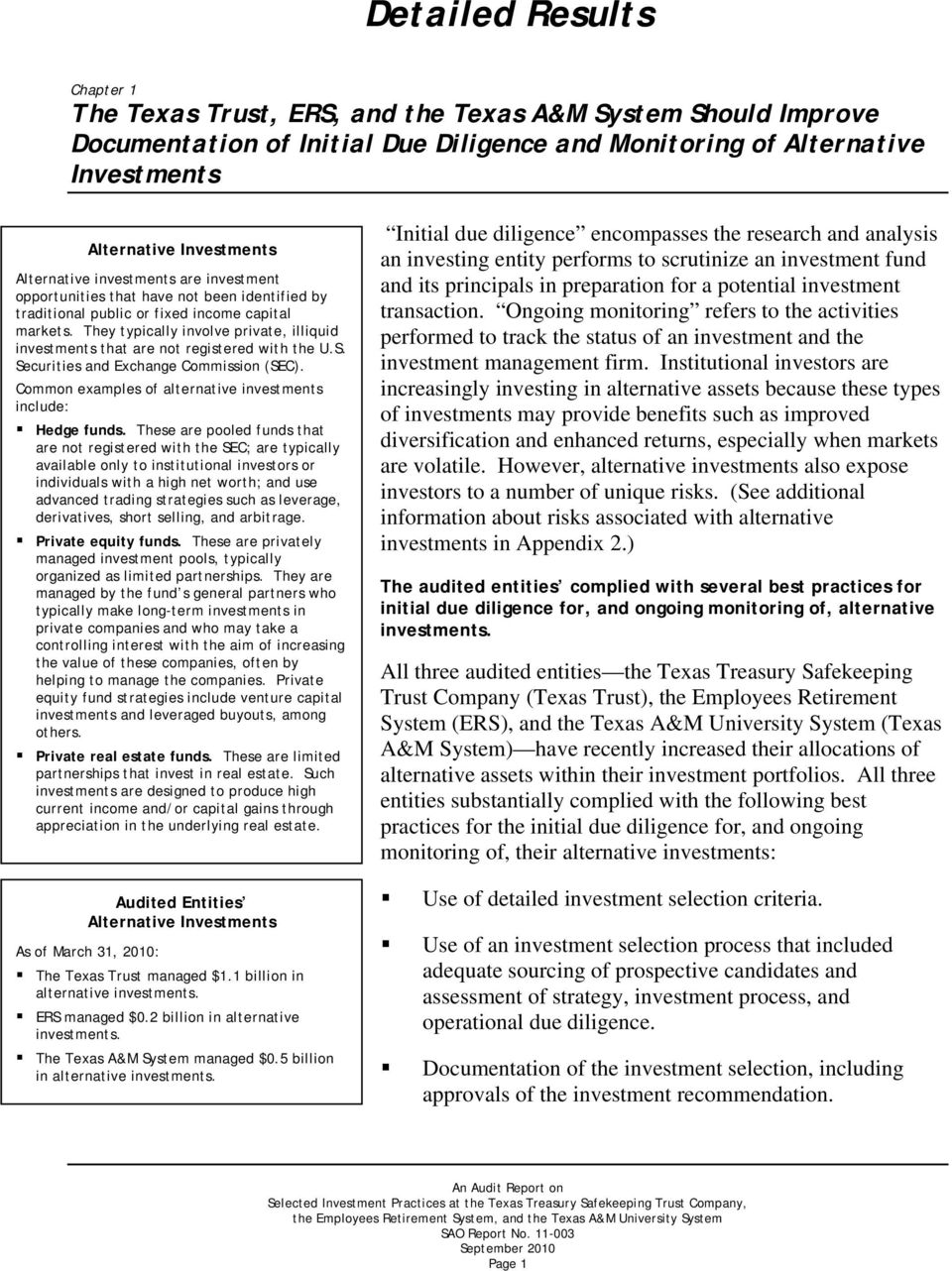
6 Detailed Results Chapter 1 The Texas Trust, ERS, and the Texas A&M System Should Improve Documentation of Initial Due Diligence and Monitoring of Alternative Investments Alternative Investments Alternative investments are investment opportunities that have not been identified by traditional public or fixed income capital markets. They typically involve private, illiquid investments that are not registered with the U.S. Securities and Exchange Commission (SEC). Common examples of alternative investments include: Hedge funds. These are pooled funds that are not registered with the SEC; are typically available only to institutional investors or individuals with a high net worth; and use advanced trading strategies such as leverage, derivatives, short selling, and arbitrage. Private equity funds. These are privately managed investment pools, typically organized as limited partnerships. They are managed by the fund s general partners who typically make long-term investments in private companies and who may take a controlling interest with the aim of increasing the value of these companies, often by helping to manage the companies. Private equity fund strategies include venture capital investments and leveraged buyouts, among others. Private real estate funds. These are limited partnerships that invest in real estate. Such investments are designed to produce high current income and/or capital gains through appreciation in the underlying real estate. Audited Entities Alternative Investments As of March 31, 2010: The Texas Trust managed $1.1 billion in alternative investments. ERS managed $0.2 billion in alternative investments. The Texas A&M System managed $0.5 billion in alternative investments. Initial due diligence encompasses the research and analysis an investing entity performs to scrutinize an investment fund and its principals in preparation for a potential investment transaction. Ongoing monitoring refers to the activities performed to track the status of an investment and the investment management firm. Institutional investors are increasingly investing in alternative assets because these types of investments may provide benefits such as improved diversification and enhanced returns, especially when markets are volatile. However, alternative investments also expose investors to a number of unique risks. (See additional information about risks associated with alternative investments in Appendix 2.) The audited entities complied with several best practices for initial due diligence for, and ongoing monitoring of, alternative investments. All three audited entities the Texas Treasury Safekeeping Trust Company (Texas Trust), the Employees Retirement System (ERS), and the Texas A&M University System (Texas A&M System) have recently increased their allocations of alternative assets within their investment portfolios. All three entities substantially complied with the following best practices for the initial due diligence for, and ongoing monitoring of, their alternative investments: Use of detailed investment selection criteria. Use of an investment selection process that included adequate sourcing of prospective candidates and assessment of strategy, investment process, and operational due diligence. Documentation of the investment selection, including approvals of the investment recommendation. Page 1
7 Use of adequate contract provisions that were subject to appropriate reviews and approvals. Ongoing monitoring of investment performance. Ongoing monitoring of the investment manager s changes in internal controls, systems, key personnel, financial stability, policies and procedures, and regulatory compliance. However, as discussed below, opportunities for improvement exist at all three audited entities. The Texas Trust should develop written procedures for ongoing monitoring of alternative investments. All three entities had established written procedures for initial due diligence for alternative investments. The Texas A&M System and ERS had written procedures for their ongoing monitoring processes, but the Texas Trust did not. The Texas Trust hedge fund and private equity managers provided auditors with documents they use to help guide ongoing monitoring activities, and other ongoing monitoring processes and responsibilities were addressed in the Texas Trust 2008 investment committee charter and in its funds investment policies. However, the Texas Trust has not yet finalized detailed, step-bystep, ongoing monitoring procedures similar to its written manager selection procedures. While the Texas Trust may be locked into an alternative investment fund for several years, ongoing monitoring is still critical to ensure that the investment fund continues to meet the Texas Trust s investment goals and performance expectations. The lack of thoroughly documented procedures increases the risk that staff may not perform processes consistently or document processes in accordance with management s expectations. The Texas A&M System should consistently document its investment decision rationale. All three entities generally documented their investment decisions in sufficient detail. However, for 4 (50 percent) of 8 funds tested (3 private equity funds and 1 private real estate fund), the Texas A&M System did not retain this documentation for its follow-up investments with existing alternative investments managers. The Texas A&M System did not receive additional reports from its investment consultant on these new funds and relied on the information it received for the funds in which it previously invested with the same managers. As a result, the Texas A&M System lacked documentation describing the Page 2

8 specific attributes of the new funds and a documented formal recommendation to invest in the new funds. As a result, there was no documented evidence that the Texas A&M System had selected the new funds based on satisfactory performance of the previous funds and a determination that the new funds were pursuing similar strategies. This creates a risk that the Texas A&M System might not have had enough information to support its decisions prior to making those investments. However, sufficient information was available regarding the funds management teams, as well as their front and back offices, because this information had been documented in the reports the Texas A&M System had received from the investment consultant when initial due diligence for the previous funds was conducted. Additionally, changes affecting the fund managers personnel and operations were documented through the Texas A&M System s ongoing monitoring of these previous funds. The Texas Trust and ERS should improve certain aspects of their site visits, meetings, and ongoing monitoring for alternative investments. Alternative investments typically involve private, non-regulated investment funds for which little public information is available. Therefore, it is important for investors to conduct site visits as part of initial due diligence to assess the capabilities of the fund s personnel, including the front office (the individuals who perform the fund s direct investment activities) and back office (the individuals and systems responsible for the fund s operational and administrative activities). Performing this process ensures that the investors have observed that they are investing in high quality investment funds that have developed adequate personnel and processes. The Texas A&M System adequately documented its initial due diligence site visits and its ongoing monitoring of important changes affecting the alternative investment firms for all investments tested. However, auditors noted the following opportunities for the Texas Trust and ERS to improve their processes or documentation: The Texas Trust did not conduct a pre-investment site visit for 1 (13 percent) of 8 alternative investment funds tested, as required by its endowment funds investment policy. The Texas Trust discussed the fund s operations in face-to-face meetings with the fund manager, but it elected not to travel to Asia to perform the site visit required by its endowment funds investment policy. ERS did not document its pre-investment evaluation of the fund manager s back office capabilities for 7 (88 percent) of 8 alternative investment funds tested. However, auditors identified evidence that ERS met with the funds back office personnel during the site visits for 4 (57 Page 3
9 percent) of the 7 funds for which it did not have such a written evaluation. All seven funds were private equity funds. ERS s private equity policies and procedures require ERS staff to evaluate the fund s organizational and administrative infrastructure to ensure that the fund has sufficient staffing including accounting and finance, information systems, administrative support, and other back office personnel as required to support the investment professionals success. However, in preparing its written investment recommendation, the ERS private equity group does not use a formal template that requires the write-up to specifically discuss the back office assessment. In contrast, ERS s real estate group uses a formal template to ensure that all key elements of the due diligence process, including its review of the back office capabilities, are addressed in the formal write-up prior to an investment being approved. ERS did not adequately document its ongoing monitoring of changes affecting the firm or its personnel for 4 (57 percent) of 7 funds tested. All funds tested were private equity funds. There is a significant difference in performance between top and average partnerships in private capital, and the best firms consistently perform better. Therefore, it is important to monitor any developments affecting key personnel because the success of these funds relies heavily on the skills of their management team. While ERS s private equity policies and procedures address the review of a fund s financial condition in detail, they do not address the need to document the ongoing monitoring of personnel changes, perform press searches, or periodically review Form ADV 1, when applicable. As a result, ERS did not consistently maintain the documentation for these activities. ERS private equity staff assert that topics such as staffing and personnel are routinely discussed during communications with fund managers. The audited entities should improve certain aspects of their reference checks and third-party background checks for alternative investments. The American Institute of Certified Public Accountants and investment industry sources recommend performing reference checks and third-party background checks on senior professionals of alternative investment funds. Reference checks could include contacts with others who have invested with 1 The Investment Advisers Act of 1940 requires entities that register as investment advisers to complete Form ADV and file it with the U.S. Securities and Exchange Commission (SEC). Form ADV consists of two parts. Part I, which is publicly available on the SEC s Web site, includes information about an adviser s business and disciplinary history. Part II includes information about an adviser s services, fees, and strategies, as well as the educational and business background of its personnel. Page 4

10 the fund manager, companies in which the fund manager has invested, service providers to the investment fund, and prior employers of key personnel of the investment fund. Third-party background checks typically include procedures to verify past employment and educational credentials, review public records for legal or criminal filings, and search for media coverage for key investment fund personnel. Performing procedures to verify the background, skill, and integrity of these individuals prior to making investments in their funds is important because of: The illiquid nature of alternative investments (for example, for private equity or real estate limited partnerships, investors might be locked into an investment for 8 to 10 years or more). The lack of transparency of investments made by alternative investment fund managers (for example, hedge fund managers might not be willing to provide the fund s investors with a list of specific investments in order to protect the proprietary details of their investment strategies). The complexity of such investments (for example, hedge funds often use sophisticated trading strategies). However, auditors identified the following: The Texas Trust did not retain documentation of reference checks for 4 (50 percent) of 8 funds tested. For 2 (50 percent) of the 4 Texas Trust funds lacking documentation, the Texas Trust investment consultants had performed the reference checks and were able to provide the documentation upon auditors request. The Texas A&M System did not retain documentation of reference checks for 3 (38 percent) of 8 funds tested. The Texas A&M System investment consultant asserted that it conducted reference checks for all three funds lacking documentation. The consultant provided auditors with a list of references contacted for the three funds, but the Texas A&M System had not obtained this documentation prior to investing in the funds. For all eight funds tested, ERS asserted that its staff did not retain documentation of press searches they conducted for the funds or for key personnel because the searches did not identify any negative information about the prospective investments. Neither ERS nor the Texas A&M System engaged a third party to conduct background checks, including criminal background searches, for any funds tested. Contracting for these checks might not be uniformly Page 5

11 included in the due diligence processes of other investors, but doing so is typically recommended as a best practice. The Texas A&M System should consistently retain documentation of its review of fees charged by investment managers for alternative investments. Entities should periodically examine fees paid to investment managers to determine whether the fees are consistent with service agreements and are reasonable. The Texas Trust reviewed the fees charged by all 15 funds tested, and ERS reviewed the fees charged by all 7 funds tested. However, the Texas A&M System did not retain documentation of its review of the fees charged by 4 (50 percent) of 8 funds tested (2 hedge funds, 1 natural resources fund, and 1 private real estate fund). The investment management fees associated with those four funds were not clearly identified on monthly investor-level statements received from fund managers. However, Texas A&M System management asserted that they reviewed the fees charged at the overall fund level and each fund s annual audit report, which provides assurance that management fees were properly charged to the fund. In the past, the Texas A&M System requested and received from one of those four funds the information it needed to review its share of the management fee allocations, but it did not continue to request such information from any of those four funds. Texas A&M System management indicated that they could request this type of information on an ongoing basis. Fee analysis for alternative investments is critical because annual manager fees for alternative investments are typically much higher than for traditional investments (fees are typically 1.0 percent to 2.0 percent of alternative investments, compared with 0.5 percent to 1.0 percent of traditional investments). In addition, managers of alternative investments usually receive a share of the fund s profits (15 percent to 20 percent or more) as an incentive to investment talent. Investing in a fund of funds (an investment fund that buys stakes in multiple underlying alternative investment funds to offer investors broader exposure to different alternative assets fund managers and strategies) also subjects the investor to additional layers of fees. As a result, an alternative investment manager must earn substantially higher returns before fees than a traditional investment manager in order to provide investors with the same net returns. Failure to document a review of fees may impair the investor s ability to demonstrate it has fully analyzed the fund s return, and it also may result in the failure to identify instances of noncompliance with the agreed-upon partnership terms. Page 6

12 Recommendations The Texas Trust should: Conduct all pre-investment site visits with fund managers, as required by its investment policy. Retain the documentation from its, or its consultants, performance of pre-investment reference checks. Establish formal, written procedures for ongoing monitoring of its alternative investments. ERS should: Retain the documentation of its assessment of the manager s back office capabilities for all pre-investment site visits with fund managers. Retain the documentation from its performance of pre-investment press searches for the investment fund or its key personnel. Add third-party background checks, which include criminal background searches, to its initial due diligence process. Enhance its policies and procedures for ongoing monitoring of alternative investments to include documenting its review of staffing/personnel changes, press searches, or updates to Form ADV. The Texas A&M System should: Retain documentation for the rationale for its decisions regarding followup investments with existing alternative investment managers. Retain the documentation from its, or its consultant s, performance of reference checks on potential investment funds. Add third-party background checks, which include criminal background searches, to its initial due diligence process. Retain documentation of its reviews of overall fund-level management fees charged. For further verification of fees charged against its share of the total fund, the Texas A&M System should also request from fund managers detailed fee information for funds that normally report their management fees only at the overall fund level. Page 7
13 Chapter 2 The Texas Trust, ERS, and the Texas A&M System Should Improve Documentation of Initial Due Diligence and Monitoring of External Managers of Traditional Investments External Managers External managers manage portfolios of traditional investments, including publicly traded equity and fixed income securities. The audited entities use external managers for one or more of the following: Separately managed accounts. All securities in the external manager s portfolio are owned directly by the investing entity and are held by each investing entity s custodian bank. The investing entity can require the external manager to adhere to specific investment guidelines. Commingled funds. The external manager pools and invests the funds of several institutional investors. Securities are owned by the overall fund, and each investor owns a pro rata share of the fund. The SEC does not oversee commingled funds. Mutual funds. Similar to commingled funds, the funds of multiple investors are pooled by the external manager. The investors own shares of the fund but do not own the individual securities. The public, as well as institutional investors, can invest in mutual funds, which are regulated by the SEC. Investment costs allocated to participants are typically higher for mutual funds than for commingled funds. As of March 31, 2010, the Texas Trust had $22.2 billion in externally managed traditional investments, ERS had $4.3 billion in externally advised traditional investments, and the Texas A&M System had $2.3 billion in externally managed traditional investments. The Texas Trust, ERS, and the Texas A&M System substantially complied with the following best practices for the initial due diligence for (that is, the initial selection), and ongoing monitoring of, external managers 2 of traditional investments: Use of detailed selection criteria that addressed the external manager s organization, personnel, investment philosophy, process, performance record, and fees. Use of a selection process that included adequate sourcing of prospective external managers and assessment of strategy, investment process, and operational due diligence. Examples included face-to-face meetings with an external manager s management team and site visits, quantitative analyses of an external manager s historical performance and risk, and reference checks of an external manager and its key professionals. Documentation of the selection of external managers, including approvals of the recommendation by the appropriate decision makers. Use of contracts with external managers that included adequate provisions that were subject to appropriate reviews and approvals. Ongoing monitoring of external managers investment performance against benchmarks and peer groups, as well as a review of investment policy compliance. Monitoring processes included regular meetings with an external manager s management team; periodic site visits; and periodic reviews of an external manager s communications, portfolio holdings, and management fees. 2 Unlike the Texas Trust and the Texas A&M System, ERS cannot delegate final investment decision making authority to external managers. ERS uses external managers only in an advisory capacity and retains the ability to make the final investment decision for all investment transactions. All references in this report to external managers in relation to ERS should be read as external advisors. Page 8
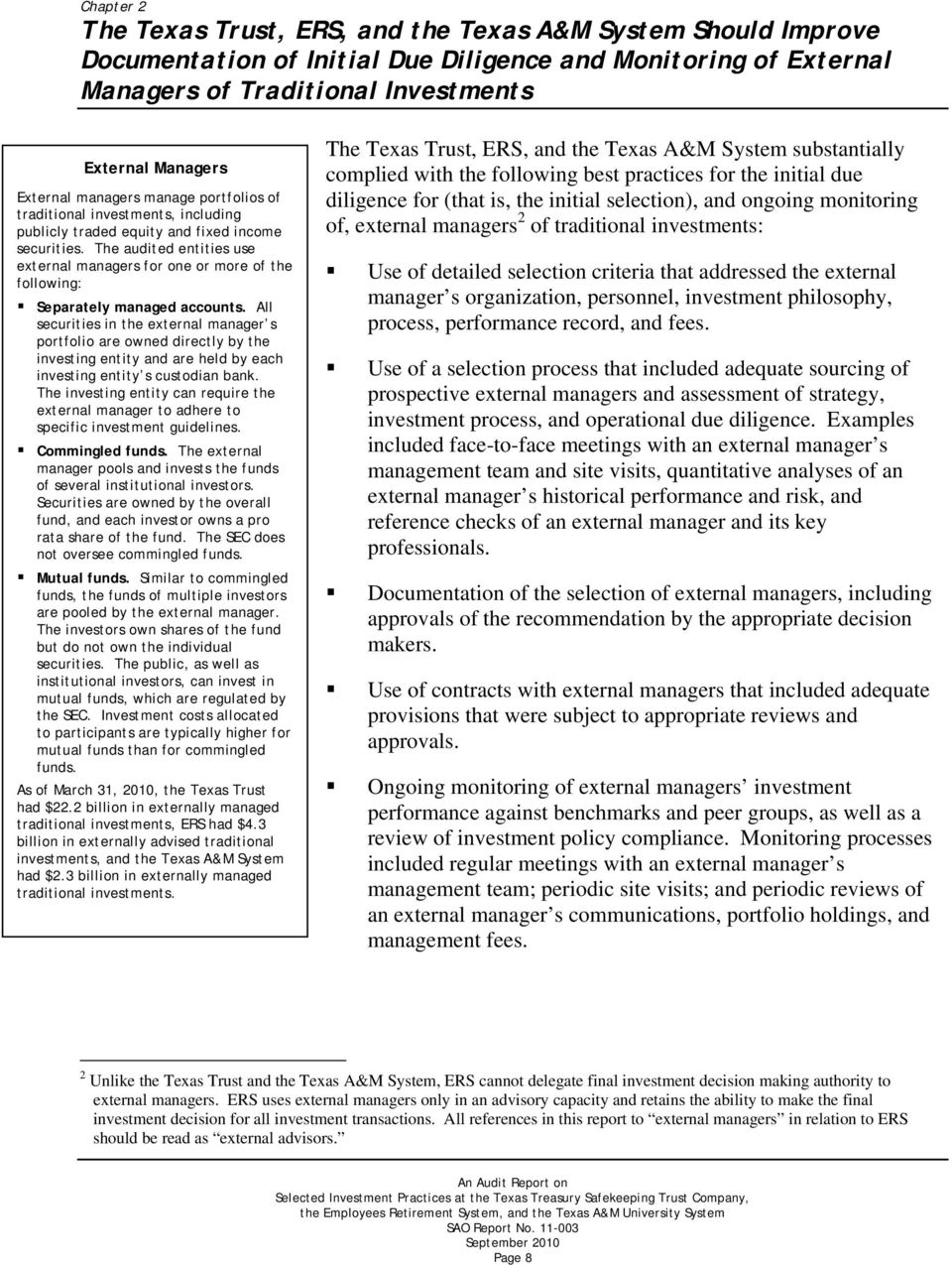
14 Ongoing monitoring of an external manager s changes in internal controls, systems, key personnel, financial stability, policies and procedures, and regulatory compliance. However, as discussed below, opportunities for improvement exist at all three audited entities. The Texas Trust should develop written procedures for ongoing monitoring of external managers. All three audited entities had adequate written procedures for their initial due diligence processes related to external managers. The Texas A&M System and ERS had procedures for their ongoing monitoring processes, but the Texas Trust did not. At its July 2009 meeting, the Comptroller of Public Accounts investment advisory board adopted policies for a new external manager selection process applicable to the Texas Trust (prior to that, the Texas Trust used a request for proposal process to select external managers). In addition, the Texas Trust has addressed certain ongoing monitoring processes and responsibilities (such as evaluation criteria for the quarterly performance monitoring of all external managers) in its: 2008 investment committee charter. Requirement that certain external managers annually affirm their compliance with relevant Texas Trust investment policies. Funds investment policies. However, the Texas Trust has not yet finalized detailed, step-by-step ongoing monitoring procedures similar to its external manager selection procedures. Ongoing monitoring is critical to ensure that the external manager continues to meet the Texas Trust s investment goals and performance expectations and continues to comply with the scope and terms of the delegation of management and investment of a portfolio. The lack of thoroughly documented procedures increases the risk that Texas Trust staff may not consistently perform or document processes in accordance with management s expectations (for example, as discussed in more detail on the next page, auditors noted that the level of detail was inconsistent in Texas Trust s documentation of its site visits with external managers). ERS should improve its document retention policy related to external managers. The Texas Trust and the Texas A&M System had documentation supporting their initial due diligence processes for all external managers tested. However, ERS did not have initial due diligence documentation for 1 (25 percent) of 4 external managers tested. ERS initially hired the external Page 9

15 manager in 1999, and the ERS retention policy requires ERS to maintain this information for only eight years. Because ERS is required to maintain board of trustees information for a longer period of time, auditors were able to test certain external manager selection controls using information presented to the ERS board of trustees. However, auditors could not determine whether the ERS selection process, site visits, investment team interviews, and reference checks were consistent with best practices. Retention of all initial due diligence documentation throughout the entire period during which an external manager performs services for ERS would ensure that the documentation is available during subsequent reviews of that external manager. The Texas A&M System and the Texas Trust should improve the documentation of their investment decision rationale related to external managers. ERS adequately documented the rationale for its selection of, including specific investment strategies for, all external managers tested. However, auditors identified opportunities for the Texas A&M System and the Texas Trust to improve their documentation. For 2 (33 percent) of 6 externally managed portfolios tested, the Texas A&M System did not retain documentation of the rationale for the specific investment strategy in which it invested. Those two portfolios, which were managed by different external managers, included a portfolio adhering to an international large cap equity strategy and a portfolio adhering to an international emerging markets equity strategy. However, in both cases, the Texas A&M System s documentation of its due diligence assessments related to each manager s international small cap equity strategy. 3 Texas A&M System management explained to auditors that, in both instances, the due diligence it performed for the small cap strategy provided management with sufficient comfort that each external manager s discipline and investment process also would be well suited for the large cap and emerging market strategies selected (for one manager, the Texas A&M System decided to invest in the manager s small cap and emerging market portfolios). Furthermore, the decision to invest in the large cap strategy was related to management s decision to terminate another large cap international equity portfolio manager whose performance for that strategy was unsatisfactory. Auditors observed evidence that management had compared the historical performance of the large cap portfolio of the incoming and terminated managers prior to selecting the new manager for this strategy. 3 The differences between these various portfolio strategies, all of which involved stock in non-u.s. companies, related to either (1) the total market value of the common stock of the companies included in the portfolio (the total market value of common stock of companies in the large cap investment population is considerably larger than that of the companies in the small cap investment population) or (2) the foreign countries included in the investment universe ( emerging market strategies involve investing in stocks in a set of countries that differs from the countries included in developed market strategies). Page 10
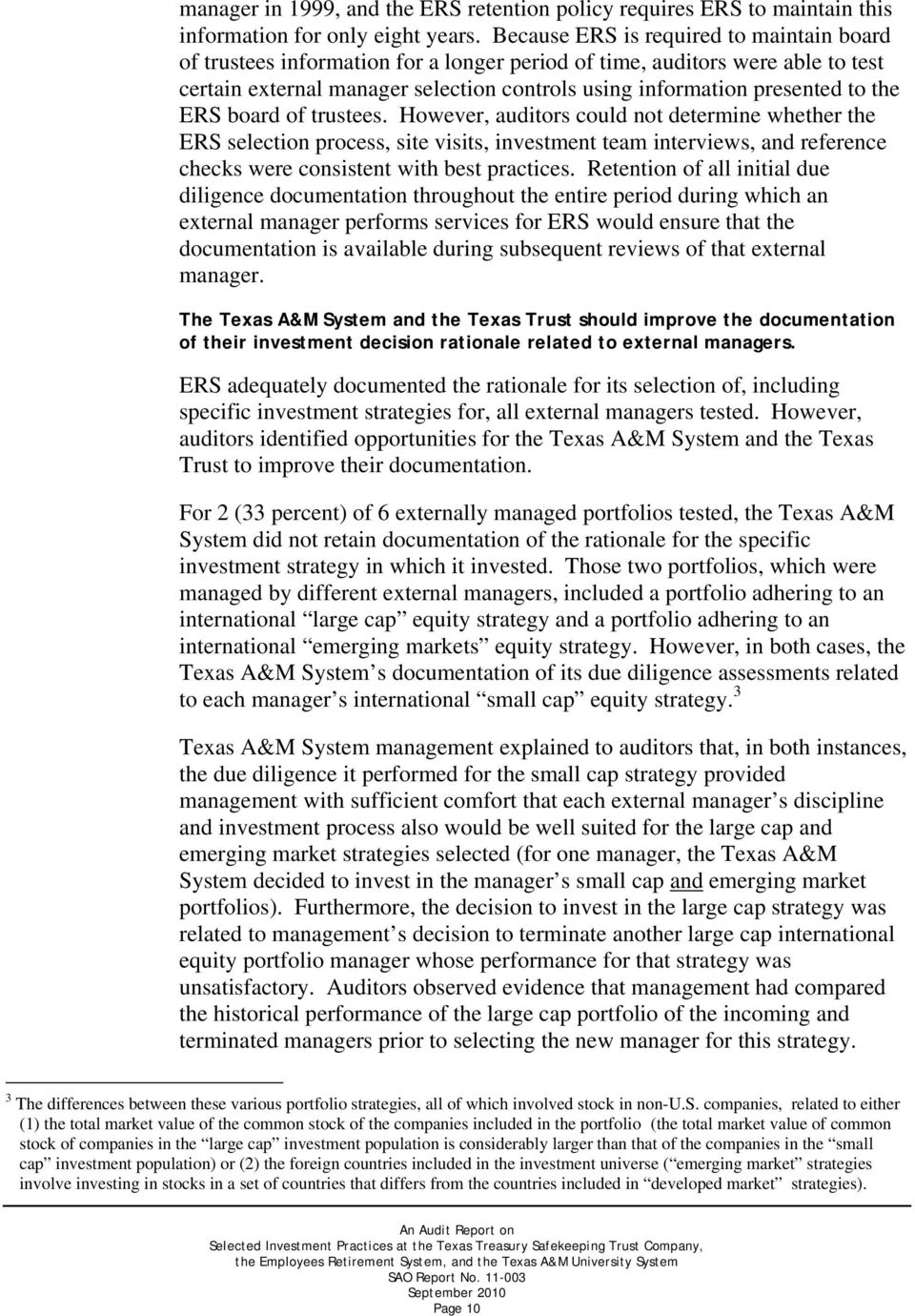
16 However, management also acknowledged that its decisions to invest in the international equity strategies other than small cap were not formally documented. The Texas Trust did not formally document its rationale for investing in 1 (14 percent) of 7 external managers tested. The external manager s exchangetraded fund 4 was selected as part of an investment portfolio rebalancing action to increase exposure to one of the target asset classes documented in the Texas Trust s endowment funds investment policy. Auditors reviewed the rebalancing plan attached to the investment committee minutes to identify evidence that the investment committee considered and approved the investment. However, the rationale for selecting this specific fund was not documented in those minutes. Management addressed this issue by adding a memo to the investment file in April 2010 (during this audit) to document the rationale for the decision. The memo clarifies that the investment committee took no exception to the use of this specific investment vehicle as a mechanism for rebalancing the portfolio. The Texas Trust was already invested in a different investment vehicle from the same external manager within the same asset class. The lack of documentation for the rationale behind investment decisions creates a risk that the investing entities might not have had enough information to support their decisions prior to making those investments. ERS and the Texas Trust should improve their documentation of site visits and meetings with external managers. The Texas A&M System retained documentation of its pre-investment site visits and ongoing monitoring meetings with the external managers tested. However, auditors identified opportunities for ERS and the Texas Trust to improve their documentation of such meetings. ERS did not retain detailed documentation of its pre-investment site visits for 2 (50 percent) of 4 external managers tested (1 of these 2 was the external manager discussed above for which ERS s document retention policy did not require retention of this information). Documentation of the site visits should have included a review of the external manager s information, investment personnel, investment management and research processes, investment philosophy, risk management, and operations. ERS board of trustees meeting minutes indicated that such visits had occurred, and other board of trustees meeting documents described factors that ERS staff would have considered during the due diligence process. However, because ERS did not document 4 The shares of an exchange-traded fund can be traded like a stock. Similar to an index fund, this type of fund comprises a collection of securities, such as stocks or bonds, whose performance is intended to replicate that of a particular index. Page 11

17 these visits, auditors could not verify the extent to which the actual procedures performed during these visits adhered to best practices and ERS policy. The Texas Trust did not perform ongoing monitoring site visits within its required time frame for 3 (30 percent) of 10 external managers tested. The endowment funds investment policy requires Texas Trust personnel or consultants to meet with a representative of each external manager in person and on site at least once every two years. (In comparison, the Texas A&M System requires annual due diligence meetings, and ERS requires two annual meetings, one at the external manager s office and the other at ERS.) The Texas Trust relied on its investment consultant to perform some of the required site visits, but it did not effectively track the investment consultant s site visits. While the Texas Trust recently implemented use of a site visit log in an Excel spreadsheet, the spreadsheet had not been updated to include the investment consultant s information. Additionally, for the seven external managers tested for which site visits were performed within the required time frame, the Texas Trust did not consistently maintain documentation of these visits. Its investment consultant performed site visits for two of these seven external managers, but the Texas Trust had to request documentation of the visits from the consultant in order to provide this information to auditors. For the other five external managers that Texas Trust personnel visited, documentation ranged from detailed notes to only an agenda or client presentation prepared by the external manager. These deficiencies increase the risk that the Texas Trust may fail to identify or document important changes in the external manager s investment process, internal controls, or key personnel. The audited entities should improve certain aspects of their reference checks for external managers. ERS did not retain evidence of its reference checks for any of the four external managers tested (including the external manager discussed above for which ERS s document retention policy did not require such information to be retained). Such checks might have included contacts with former clients, or reviews of the external managers Forms ADV to verify the external managers investment skill, performance record, and client servicing capability, and to inquire about any problems or concerns. ERS management asserted that at least two such reference checks would have been performed before selecting each external manager but that ERS maintained the documentation informally, outside the selection files, and did not retain it. As a result, auditors could not verify the extent to which those reference checks adhered to best practices and ERS policy or whether the information ERS staff obtained supported the resulting investment decisions. Page 12

18 The Texas Trust and the Texas A&M System reviewed Form ADV Part II, which includes information about the external manager s operations and personnel, but they did not systematically review Form ADV Part I, which includes required disclosures related to prior regulatory violations involving the external manager or key personnel. Best practices for ongoing monitoring recommend reviewing updates to Form ADV as part of (1) monitoring material changes in the external manager s organization, investment philosophy, and personnel and (2) identifying any legal or regulatory agency proceedings that may affect the external manager. While investors have to request Form ADV Part II directly from the external manager, Form ADV Part I is publicly available on the SEC s Web site at Not reviewing Form ADV Part I may increase the risk that investing entities fail to identify important disciplinary events involving an external manager. In addition, ERS did not have a process to notify investment staff of the receipt of updated Forms ADV. An ERS investment department administrative employee is responsible for receiving and filing Forms ADV submitted by external managers. Contract provisions require external managers to notify ERS of material changes in their operations. However, without formal internal procedures to notify the appropriate investment personnel when a revised Form ADV is received, ERS investment professionals responsible for monitoring external managers may be unaware of material changes to an external manager s Form ADV in instances in which an external manager failed to directly communicate this information to ERS. Recommendations The Texas Trust should: Establish formal, written procedures to provide clear and consistent guidelines for ongoing monitoring of external managers of traditional investments. Retain documentation of the rationale for all of its investment decisions to ensure that it can demonstrate that it had enough information to support its decisions prior to making those investments. Conduct and retain the documentation for all site visits and meetings with external managers, as part of its ongoing monitoring processes, in compliance with its internal policies and procedures. Enhance its monitoring procedures for external managers to ensure that it routinely reviews Form ADV Part I to identify any significant changes. Page 13
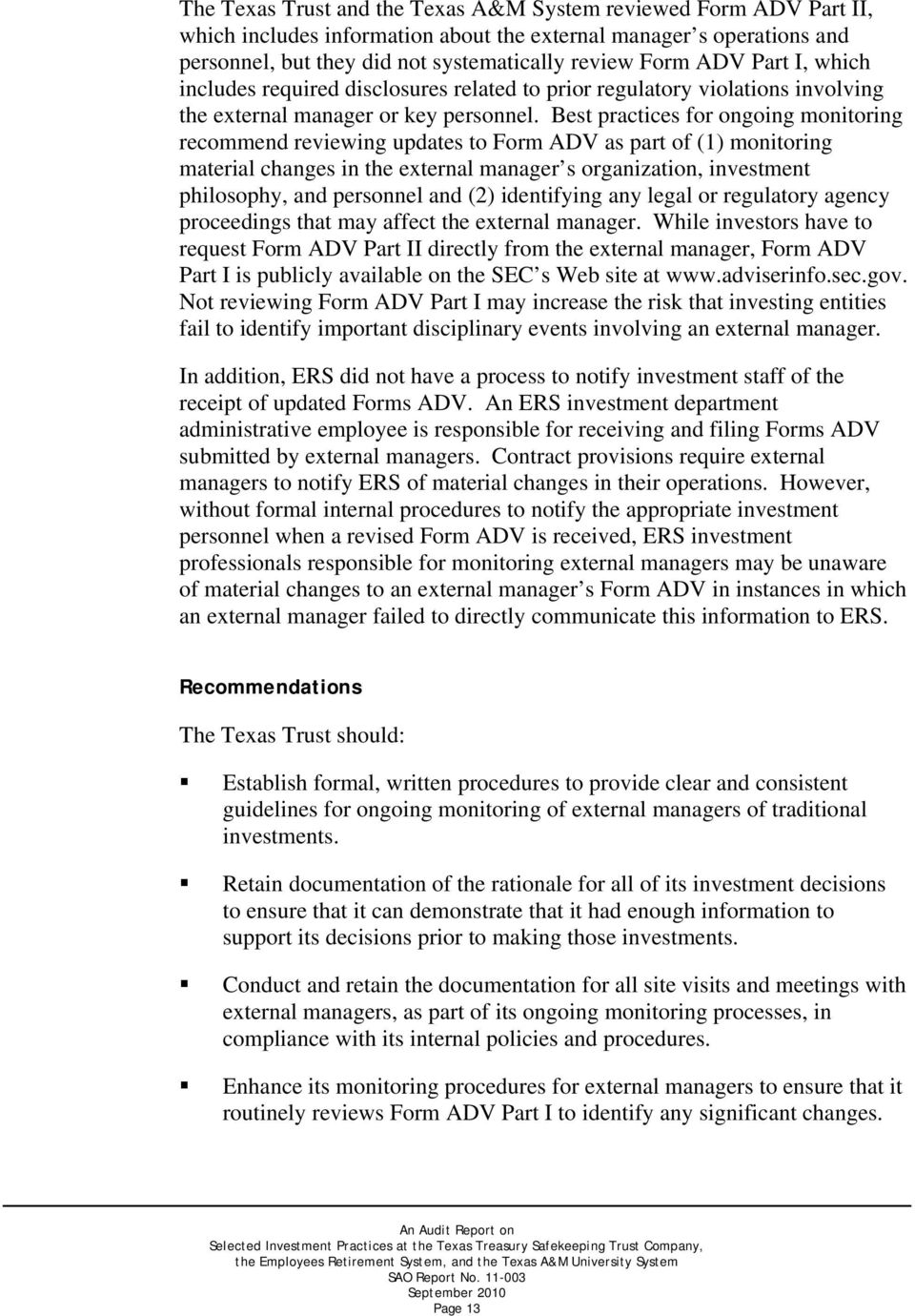
19 ERS should: Modify its document retention policy to require retention of its initial due diligence documentation for all current external managers, and it should retain all due diligence documentation in accordance with policy. Retain the documentation for its pre-investment reference checks of potential external managers. Enhance its procedures for internal distribution of updated Forms ADV to ensure that appropriate investment personnel are promptly made aware of significant new information about its external managers. The Texas A&M System should: Retain documentation of the rationale for all of its investment decisions to ensure that it can demonstrate that it had enough information to support its decisions prior to making those investments. Enhance its monitoring procedures for external managers to ensure that it routinely reviews Form ADV Part I to identify any significant changes. Page 14
20 Chapter 3 The Texas A&M System and the Texas Trust Should Improve Specific Investment Policy Provisions or Aspects of Compliance Monitoring Investment policies provide the details needed to define, implement, and manage investment strategies. Overall, all three audited entities had investment policies providing appropriate guidance for most investment operations. All three audited entities key investment policies addressed all or most of the following: A statement of purpose that articulates the rationale for the policy and describes investment objectives. Identification of roles and responsibilities of the key decision makers, including board members, key investment personnel, and external managers. A standard of care provision that describes the degree of prudence and caution that institutional investors are expected to meet to fulfill their fiduciary responsibilities. All three audited entities policies contained investment standards of care guidance using language commonly associated with prudent person or prudent investor standards. An asset allocation provision that describes the percentages allocated to each asset class in the investment portfolio based on the audited entities goals, risk tolerance, and investment horizon. This provision typically includes acceptable ranges and performance benchmarks that will be used to evaluate the performance of each asset class and of the total portfolio. A rebalancing provision that describes the procedures used to periodically conform the portfolio to the asset allocation strategy. Investment guidelines (for external and internal investment managers) that include, for example, a list of prohibited investments, limits on holdings of a single issuer, limits on holdings by industry, and minimum quality ratings of individual securities or a portfolio. Reporting and monitoring provisions that define the processes for evaluating results and monitoring compliance with the policy. Information on corporate governance that includes, for example, proxy voting provisions. A requirement for annual review of the investment policy. However, as discussed below, opportunities for improvement exist at the Texas A&M System and the Texas Trust. Page 15
21 The Texas A&M System should improve certain aspects of its investment policy provisions. The Texas A&M System s investment policy lacked provisions that (1) address the use of placement agents and (2) define the specific benchmarks used to assess the performance of its various investment portfolios and its investment funds in total. The investment policies of the Texas Trust and ERS included provisions addressing both of those subjects. The Texas A&M System s investment policy should address the use of placement agents. Placement agents are individuals or entities hired by alternative investment funds or external managers for the purpose of finding investors for the investment fund or manager. Issues involving the use of placement agents could result in the appearance that some hiring decisions made by public investment funds are not based solely on an assessment of which investment funds or managers are best for the public fund. (See additional information about placement agents in Appendix 2.) Although the Texas A&M System s investment consultant s manager evaluation process indicates that the consultant may use placement agents to source fund managers, the Texas A&M System s investment policy has no provisions requiring any disclosure of the use of, or payments to, placement agents. Many institutional investors have already added provisions to their investment policies related to the use of placement agents. The Texas Trust adopted a placement agent policy in September 2009, and ERS added a section on placement agents and political contributions to its investment policy in November Other large Texas investing entities have addressed in their investment or ethics policy the use of placement agents. Those policies help ensure transparency and accountability of the potential roles of placement agents in sourcing investment opportunities. Investment Benchmarks Investment benchmarks are standards against which decision makers compare the returns and risk of their investment portfolios. They are usually defined for individual investment portfolios (which might be internally or externally managed), specific asset classes, and an entity s total investment fund. The benchmarks should be tailored to the expected composition of each specific portfolio, asset class, and total investment fund. The Texas A&M System s investment policy should include a description of specific benchmarks and an overall total fund policy index. The investment policies of both the Texas Trust and ERS included detailed descriptions of the investment benchmarks that management would use to evaluate the performance of investments (see text box for information on investment benchmarks). However, the Texas A&M System s investment policy does not describe any specific benchmarks management will use to assess performance. Instead, its investment policy typically refers to a comparable index or an appropriate index, (the term index is essentially equivalent to benchmark in this context) Page 16
22 Calculating a Total Fund Index A total fund index, which is sometimes referred to as an investing entity s policy index, is commonly calculated as the applicable index returns for each asset class weighted by the investing entity s target asset allocation percentages. without formalizing the specific indices that the Texas A&M University System Board of Regents and management consider to be the best ones to use for each category of investment. Texas A&M System management indicated that comparison to the performance of a representative peer group is a primary component of its evaluation of individual external managers performance, but the investment policy also requires external managers to attempt to outperform their assigned benchmark. To accomplish this evaluation, the quarterly reports of the Texas A&M System s consultant compare benchmarks with the performance of individual external managers portfolios, as well as with the overall performance of each investment fund the System Endowment Fund (SEF) and Cash Concentration Pool (CCP). However, there is no direct link between the benchmarks in those quarterly reports and the Texas A&M University System Board of Regents approved investment policy. Furthermore, the investment policies of the Texas Trust and ERS each assess their total investment funds performance against expectations by specifying a total fund index (see text box for additional details); other investment funds also use a total fund index. The Texas A&M System previously used this method for both investment funds (the SEF and CCP) when its consultant reported what it referred to as each fund s balanced index. However, the Texas A&M System recently changed the methodology it uses to calculate the balanced index for the total SEF so that the asset class weightings are based on actual rather than target allocation percentages. The reason for this change was to provide what the consultant believed would be a more accurate representation of overall relative performance, especially while the SEF is in the early stages of its investments in private equity funds. The ability to meet a long-term target allocation percentage in private equity fund investments is limited because (1) a relatively long period of time is required for an investor to identify suitable private equity fund investments and (2) once an investor commits a specific investment amount to a private equity fund, several years might pass before the fund manager requires the investors to fully contribute the amounts they committed. The Texas Trust and ERS have addressed the issue of the lengthy time period to become fully invested in such illiquid asset classes by adopting a policy index in which target allocation percentages are phased in to achieve the long-term targets over a period of several years. Page 17
23 Computing Both a Policy Index and an Allocation Index Investing entities can differentiate the effects on performance when actual allocations deviate from targets and when actual returns deviate from index returns by computing both a policy index and an allocation index. By comparing the total return of the policy index to the return of the allocation index (both assume that the return for each asset class is exactly equal to the index return for that asset class), the effect on performance of deviations from target allocation percentages is isolated. By also comparing the return of the allocation index to the total fund s actual performance (both use the actual allocation percentages), the impact of the portfolio managers ability to outperform specific indices also can be isolated. The balanced index that the Texas A&M System now uses is similar to what is sometimes referred to as an allocation index, which is calculated as the applicable index returns for each asset class weighted by the investing entity s actual asset allocation percentages. However, comparing the SEF s actual total performance only to this balanced index does not permit management to identify how deviations from target allocation percentages affected overall fund performance. One method that investing entities can use to differentiate the effects on performance when actual allocations deviate from targets and when actual returns deviate from index returns is to compute both a policy index and an allocation index (see text box for additional details). The Texas A&M System and the Texas Trust should improve certain investment policy compliance monitoring processes. All three audited entities had controls to monitor compliance with their key investment policy provisions. Both the Texas Trust and ERS performed the compliance monitoring process internally, generally on a daily or transaction-level basis, with the help of automated tools that generate an exception report if a transaction or a portfolio violates an investment policy provision. Due to its more limited investment personnel resources, the Texas A&M System outsourced most of the compliance monitoring process to its investment consultant. Auditors identified opportunities for the Texas A&M System and the Texas Trust to improve certain compliance monitoring processes, which would help protect assets from loss and ensure that all investment transactions are consistent with management s expectations. Specifically: For some investment policy provisions, the Texas A&M System s consultant based its compliance reporting on the separately managed account fund managers responses to the consultant s quarterly compliance questionnaire. 5 The quarterly questionnaires ask the managers to assert whether or not they are in compliance with each relevant investment policy provision and to explain any instances of noncompliance. Neither the consultant nor Texas A&M System investment personnel routinely perform calculations to verify all of the managers compliance assertions. For some investment policy provisions, such as maximum portfolio exposure to any specific industry or limits on holding cash equivalent investments, information on detailed reports provided to the consultant by 5 Only the Texas A&M System s six separate account managers of traditional investments would be required to adhere to the Texas A&M System s policy restrictions. For the Texas A&M System s six commingled traditional investment funds, in which money from several investors is pooled and invested, the fund managers would not be obligated to adhere to each pool participant s unique investment policy. Page 18
24 the Texas A&M System s investment custodian would permit the consultant to easily observe whether a manager had accurately reported its compliance at each reporting date. However, to verify the fund managers assurances of compliance with other investment policy requirements, such as those related to the average credit quality or duration of a fixed income portfolio or the minimum credit rating of a purchased investment, the consultant would need to, but does not currently, perform detailed verification or calculations at the transaction or portfolio level. Best practices suggest that individuals who are independent of the portfolio management function should monitor the portfolio for compliance with established guidelines. Although the consultant performs ongoing due diligence of the Texas A&M System s investment managers, including monitoring each manager s investment performance and fees charged, its contract with the Texas A&M System does not require the consultant to recalculate each investment policy compliance measure. The Texas A&M System also discusses investment policy compliance with investment managers during its periodic due diligence meetings; however, this discussion alone would not necessarily identify all noncompliant transactions or instances of noncompliance at the portfolio level. Opportunities exist for the Texas Trust to improve the automated compliance monitoring system it uses to monitor policy compliance with its endowment funds policy. The automated compliance system for the endowment funds is a separate product provided as part of the contract with the Texas Trust s custodian for the funds. When new investment policy requirements are implemented or updated, the compliance officer programs rules into the system that set the parameters that will automatically generate an notification to specified Texas Trust employees notifying them of policy violations. The compliance officer must specifically select accounts (accounts generally are created for every alternative investment fund or external manager) that apply to each rule in order to allow rules to apply only to selected investment strategies. Auditors identified certain weaknesses in this area. Specifically: o For 1 of 35 rules reviewed in the automated compliance system, the programming did not ensure compliance with a key policy provision. The maximum allowable percentage ownership of the outstanding debt of an issuer was incorrectly set at 20 percent instead of 10 percent. After auditors identified this error, the compliance officer corrected and retested the rule. No violations were identified as a result of the error. o The Texas Trust did not have a formal process to ensure that all applicable accounts were correctly associated in a timely manner Page 19
25 with the appropriate rule in its automated compliance system. The compliance officer relies on investment committee discussions and his review of periodic investment reports to identify the need for account updates. Auditors identified nine accounts that should have been, but were not, associated with rules for a given strategy. Auditors also identified two accounts that were programmed in both the correct portfolio type (global equity emerging market) and incorrect portfolio type (global equity non-u.s. developed, which should exclude emerging market portfolios). As a result, the automated calculation of the total percentage of non-u.s.- developed equity investments would have been overstated by the amount of emerging market investments that were erroneously programmed to be included in that calculation. The incorrect mapping of accounts to rules may impair the system s ability to accurately identify policy violations. o The compliance officer did not have a designated backup person with required access and training to the compliance system for the endowment funds. However, the Texas Trust is developing a succession plan for the compliance officer to ensure a smooth transition in the event of that individual s departure. The Texas Trust typically uses the Bloomberg compliance system to monitor compliance with the Comptroller of Public Accounts investment policy for the Treasury Pool investments. Auditors tested a sample of key policy provisions and reviewed compensating controls for the provisions that were not automatically monitored by Bloomberg. For two of those investment policy provisions, segregation of duties was not adequate because compliance was monitored by investment trading staff instead of by the compliance officer. Inadequate segregation of duties increases the risk that investment trading personnel could override controls, causing violations to go undetected. The Texas A&M System should improve compliance, or documentation of the reasons for noncompliance, with allowable asset allocation ranges. The Texas A&M System did not comply with allowable asset allocation ranges established in its investment policy for the endowment fund and cash concentration pool portfolios in 4 (57 percent) of 7 quarters tested, and it did not formally document its explanations for this noncompliance. The investment policy requires the targets outlined in the policy to be adhered to within a specified allowed range for each asset class. Auditors tested all quarters from the quarter ending September 30, 2008, to the quarter ending March 31, Three of the four quarters in which the Texas A&M System did not comply with allowable asset allocation ranges Page 20
26 were in or before the quarter ending June 30, Management asserted that these three instances of noncompliance occurred because of market volatility during those quarters. Although the Texas A&M System s quarterly investment reports include a schedule that compares actual asset allocation to target asset allocation for each portfolio, management provided no evidence of discussions expressly waiving the policy limits. The Texas A&M System periodically rebalanced its portfolios, but it did not formally document the rationale for its periodic rebalancing actions. Its rebalancing spreadsheets also did not clearly document the disposition of the instances of noncompliance with allowable ranges, because they did not explain instances in which the asset allocation remained noncompliant after the Texas A&M System made planned transfers. However, the Texas A&M System formally amended its investment policy in July 2009 to widen allowable ranges to permit more flexibility in the portfolios. Recommendations The Texas A&M System should: Address the following in its investment policy: o The use of placement agents. o Specific benchmarks to be used to measure asset class and total fund performance. o A policy index benchmark measure for the SEF that is based on investment policy target asset allocation weights (which could include phased in targets for any illiquid investment type for which the long-term desired target cannot be immediately achieved), as a supplement to the balanced index measure currently used. Implement additional controls to strengthen its investment policy compliance monitoring process by independently verifying that its separate account external managers have complied with all specific investment policy limits. This could be accomplished by several methods, including contracting with its investment consultant to verify or calculate information provided by external managers related to policy limits, contracting with its custodian bank to compile and report all necessary information needed to verify compliance, or assigning internal personnel to verify compliance. Page 21
27 Enhance the documentation of the rationale supporting its periodic rebalancing actions, including documentation of the disposition of instances of noncompliance with allowable asset allocation ranges. The Texas Trust should: Periodically review rules and accounts set up in its automated compliance system for accuracy. Maintain segregation of duties for all compliance monitoring processes. Designate and train an individual to serve as a backup for its compliance officer. Page 22
28 Chapter 4 The Texas Trust, ERS, and the Texas A&M System Should Enhance Their Securities Lending Policies, and ERS Should Enhance Its Reporting for Certain Policy Violations All three audited entities have securities lending programs that substantially comply with best practices and have components to address key risks, including: Securities Lending Programs At the Audited Entities Through securities lending programs, institutional investors (lenders) transfer their securities to brokerdealers and other borrowers in exchange for collateral and a promise by the borrower to return the identical securities. The Texas Trust suspended its securities lending program in October As of August 31, 2008, the Texas Trust reported having $51.5 million in securities on loan and fiscal year 2008 net securities lending income of $0.24 million. As of March 2010, ERS reported having $1.4 billion in securities on loan and fiscal year 2010 net securities lending income of $2.7 million through that date. As of March 2010, the Texas A&M System reported having $97.9 million in securities on loan and fiscal year 2010 net securities lending income of $0.11 million through that date. Borrower restrictions and indemnification provisions to address borrower risk (or counterparty default risk), which is the risk that the borrower will default and be unable to return the securities when the agreement is terminated, resulting in a loss for the lender. Minimum requirements for collateral amounts, types, and quality, as well as frequency of marking to market to address collateral risk. Collateral can be cash, which is reinvested, or securities. Collateral risk is the risk that the collateral held for loaned securities will not be sufficient to protect the lender in the event of borrower default because the value of the collateral at the time of default is less than the value of the loaned securities. Cash reinvestment restrictions or definition of acceptable investment pools to address cash collateral reinvestment risk, which is the risk that the return on investments made with the cash collateral will not cover the rebate due to the borrower or that the investments will decline in value. Clear definition of the securities lending agent s responsibilities and review of audit reports issued in accordance with the American Institute of Certified Public Accountants Statement on Auditing Standards No. 70 (SAS 70 audit) that address securities lending operational risk, which is the risk that the securities lending agent does not administer the securities lending program as agreed. The securities lending agent usually obtains an independent SAS 70 audit of its procedures and controls on a periodic basis. A SAS 70 Type II report provides information about the effectiveness of the securities lending agent s internal controls, because that report includes the results of detailed testing of the controls over a minimum six-month period. Most of these best practice provisions are in the audited entities contracts with their securities lending agents but are not incorporated into the audited entities formal investment policies. The Texas Trust suspended its securities lending program in October Although the Texas Trust still has a contract with a securities lending agent, Page 23
29 management indicated that they did not plan to resume this program in the near future. ERS is the only audited entity with statutory limitations related to securities lending. Texas Government Code, Section , authorizes ERS s securities lending program and sets forth specific requirements for that program. While the audited entities securities lending programs substantially comply with best practices and have components to address key risks, auditors identified opportunities for improvement related to securities lending at all three audited entities. ERS should address certain statutory requirements in the formal securities lending policy approved by its board of trustees. The investment policy section on securities lending approved by ERS s board of trustees addressed the requirement in Texas Government Code, Section (b)(3), that the securities lending agent must fully indemnify ERS from losses resulting from borrower default. However, the formal investment policy did not incorporate the statutory provisions in Texas Government Code, Section (b)(4), which requires the custodian to maintain collateral in the form of cash or U.S. government securities in an amount that is not less than 100 percent of the market value. However, the statutory requirements related to the types and minimum amounts of collateral are addressed in ERS s internally adopted securities lending guidelines. In addition, all of these statutory requirements were in ERS s contract with its securities lending agent. Although addressing these statutory requirements in internal guidelines and in securities lending contract helps provide assurance of ERS s compliance with statute, formally incorporating all specific statutory restrictions in the investment policy for securities lending that is approved by the board of trustees would further ensure that none of these requirements will be overlooked in any subsequent contracts for securities lending. All three audited entities should address certain best practices in their investment policy provisions for securities lending. The Texas Trust and the Texas A&M System investment policies for securities lending did not include borrower credit quality restrictions, borrower concentration limits, indemnification provisions in the event of borrower default, required initial collateral levels (in excess of 100 percent, as is customary), frequency of marking to market of collateral and loaned securities, and a requirement that loans be terminable. With the exception of indemnification provisions in the event of borrower default, the investment policy approved by ERS s board of trustees did not explicitly address those best practice provisions. However, several of those provisions were addressed in ERS s internal fixed income procedures, which include an extensive section on securities lending oversight. All or most of these best practice provisions were included in the three audited entities contracts with their securities Page 24
30 lending agents. Addressing each of these best practices helps minimize the amount or likelihood of an investing entity s loss from its securities lending program. However, auditors noted that certain other Texas investing entities have board-adopted securities lending policies that are considerably more extensive than the requirements in the audited entities board-approved investment policies. Adding best practice provisions to the formal investment policies would provide greater assurance that they would not be omitted from any future contract with a securities lending agent. 6 The Texas A&M System should attempt to strengthen certain securities lending contract provisions. The securities lending contracts of ERS and the Texas Trust contain language that appears to help provide protection from loss by mandating that the securities lending agent (1) ensures the creditworthiness of borrowers and (2) indemnifies the lender from losses due to the borrower s failure to return the loaned securities or other act of borrower default. In contrast, such contractual provisions either do not exist or are not as clearly defined in the Texas A&M System s securities lending contract. For example, the Texas A&M System s contract specifies that the securities lending agent is responsible for selecting the borrowers and that it will provide the Texas A&M System from time to time with a list of borrowers (a list of approved borrowers was attached to the contract). However, the contract does not require the securities lending agent to reasonably ensure that a potential borrower is creditworthy. Auditors noted that the securities lending agent provided an updated list of approved borrowers on a monthly basis to the Texas A&M System as part of its monthly securities lending report, and Texas A&M System management asserted that they discussed that list with the securities lending agent during periodic due diligence meetings. In contrast, ERS s contract requires the securities lending agent to restrict borrowers to those that meet specified eligibility criteria. Its contract also requires the securities lending agent to make a reasoned, prudent determination that a potential borrower is creditworthy and to continually review that determination. The Texas Trust s contract requires, among other provisions, that the securities lending agent assess the creditworthiness of potential borrowers by obtaining and reviewing their audited or unaudited financial statements, whichever are more recent. 6 Unlike ERS, which has a separate securities lending collateral investment account, the Texas Trust and the Texas A&M System participate in pooled collateral arrangements. As a result, those two entities might not be able to negotiate all desired provisions in their securities lending contracts, and they might need to incorporate the suggested best practice provisions in their investment policies using more general language, rather than specific limitations. Page 25
31 The Texas A&M System s contract provisions also do not appear to provide sufficient protection for indemnification by the securities lending agent if a borrower defaults on a loan. Its contract s language does not explicitly state that the securities lending agent has an obligation to cover any deficit between the cost of replacing securities and the amount of available collateral. Instead, the contract indicates that the borrower will be liable for this amount. The contract also states that the securities lending agent would not be liable with respect to losses incurred by the Texas A&M System except to the extent that such losses result from the lending agent s negligence or willful misconduct in its administration of the program. The requirement for the Texas A&M System to prove negligence or willful misconduct might make it more difficult for the Texas A&M System to prevail against the securities lending agent in a lawsuit to recover securities lending losses due to borrower defaults. In contrast, ERS s contract includes provisions requiring the securities lending agent to fully indemnify ERS against a loss resulting from borrower default in its operation of a securities loan program (ERS is required by statute to obtain such protection, but the Texas Trust and the Texas A&M System are not). The Texas Trust s contract provides indemnification language specifying that the securities lending agent would be responsible for losses due to borrower default as a result of (1) the securities lending agent s failure to reasonably ascertain the creditworthiness of the borrower, (2) the securities lending agent s failure to demand adequate and appropriate collateral on a timely basis, or (3) Agent s failure otherwise to perform its duties and responsibilities under this agreement in accordance with the terms hereof or applicable law. Those provisions appear more favorable to ERS and the Texas Trust than the indemnification language in the Texas A&M System s contract. ERS should enhance its documentation and communication of instances of noncompliance with certain internal securities lending policies. Auditors tested compliance with securities lending programs only at ERS and the Texas A&M System because, as discussed above, the Texas Trust suspended its securities lending program in October The Texas A&M System s securities lending monitoring controls, which included a review of securities lending reports on a monthly basis, periodic due diligence meetings with the securities lending agent, and an annual review of the securities lending agent s SAS 70 report and Form ADV, were operating effectively. ERS s monitoring processes were robust and included (1) a review of customized daily reports generated by its securities lending agent to ensure daily compliance with cash collateral reinvestment guidelines and other provisions of the contract and (2) specific monthly review procedures. However, auditors identified the following opportunities for ERS to improve Page 26
32 its documentation and communication of instances of noncompliance with certain internal securities lending policies: For 9 (90 percent) of 10 days tested, auditors identified loans of securities that did not meet the daily collateral margin requirements of 100 percent. Securities lending procedures require ERS staff to the list of undercollateralized loans to the securities lending agent and retain the securities lending agent s response. However, for 6 (67 percent) of the 9 days for which undercollateralized loans existed at the end of the day, ERS could not provide auditors with documentation of the required e- mails to the securities lending agent. For all 10 days tested, the securities lending collateral pool held investments that caused ERS to exceed its 5 percent concentration limit on investments issued by a single issuer. Management provided auditors with evidence that this situation resulted from various factors affecting capital markets during that time period, including ERS s reduction in the overall size of its collateral pool after the investments were acquired and the difficulty in selling some of the securities that exceeded the concentration limit without incurring substantial losses. Management appears to have taken prudent actions to closely monitor those securities and the overall program risks given the market turmoil during that time. The periodic investment compliance reports presented to management and ERS s board of trustees routinely include a section devoted to ERS s securities lending program. However, none of those reports noted that the policy limit on issuer concentration had been exceeded or included a discussion of the underlying reasons for that situation and management s plan of action to address the issue. Recommendations ERS should: Enhance the securities lending policy approved by its board of trustees to address the statutory requirements related to acceptable collateral types and minimum collateral levels. Address in its formal securities lending policy expectations of adherence to other best practices provisions not specifically mandated by statute, such as borrower credit quality restrictions, borrower concentration limits, required initial collateral levels (if ERS expects that initial collateral levels should exceed the statutory minimum level of 100 percent), frequency of marking to market of collateral and loaned securities, and a requirement that loans be terminable. Page 27
33 Retain documentation demonstrating that it has followed up with the securities lending agent about any undercollateralized loans, and ensure that periodic investment compliance reports discuss all instances of noncompliance with any securities lending policy provisions. The Texas A&M System should: Address (at least in generalized terms) in its formal securities lending policy expectations of adherence to best practices provisions such as borrower credit quality restrictions, borrower concentration limits, indemnification provisions in the event of borrower default, required initial collateral levels in excess of 100 percent, frequency of marking to market of collateral and loaned securities, and a requirement that loans be terminable. Attempt to strengthen its securities lending contract provisions to require the securities lending agent to ensure the creditworthiness of borrowers and to clarify situations, other than negligence or willful misconduct, in which the securities lending agent must provide indemnification in the event of loss due to borrower default. If the Texas Trust elects to resume its securities lending program, it should address (at least in generalized terms) in its formal securities lending policy expectations of adherence to best practices provisions such as borrower credit quality restrictions, borrower concentration limits, indemnification provisions in the event of borrower default, required initial collateral levels in excess of 100 percent, frequency of marking to market of collateral and loaned securities, and a requirement that loans be terminable. Page 28
34 Appendices Appendix 1 Objectives, Scope, and Methodology Objectives The objectives of this audit were to determine whether the Texas Treasury Safekeeping Trust Company (Texas Trust), the Employees Retirement System (ERS), and the Texas A&M University System (Texas A&M System): Have and adhere to policies, procedures, and related controls for initial due diligence and ongoing monitoring of alternative investments. Have and adhere to policies, procedures, and related controls for selection and ongoing monitoring of external managers of traditional investments. Have and adhere to controls to provide assurance of compliance with key investment policies, such as controls regarding allowable investments, limits on amounts invested in a specific investment type, trader limits, and tracking error limits. Have and adhere to processes and related controls over their securities lending programs to provide assurance of compliance with state law and key provisions of their contracts with their securities lending administrators. Scope The scope of this audit covered the Texas Trust, ERS, and the Texas A&M System policies, processes, and controls related to audited investment practices from fiscal year 2009 through the time that audit work began at each entity. Audited investment practices included initial due diligence for, and ongoing monitoring of, alternative investments and external managers of traditional investments; compliance with key investment policies; and compliance with statutory and contractual requirements for securities lending programs. Compliance testing focused on the current status of the relevant controls. In some instances, initial due diligence practices were tested for investment transactions preceding fiscal year 2009 in order to include in the samples a sufficient number of transactions. Methodology The audit methodology included collecting information, conducting interviews with investment personnel, and reviewing the audited entities policies and procedures. Auditors reviewed the design of controls intended to Page 29
35 ensure compliance with investment policies. Auditors performed tests of controls and evaluated the results against pre-established criteria to ensure that these controls operated effectively. Information collected and reviewed included the following: Best practice guides such as: o Alternative Investments Audit Considerations, a Practice Aid for Auditors, American Institute of Certified Public Accountants, o Best Practices in Alternative Investing: Portfolio Construction, Greenwich Roundtable, o Principles and Best Practices for Hedge Fund Investors: Report of the Investors' Committee to the President's Working Group on Financial Markets (January 15, 2009). o Selection and On-Going Review of Investment Advisors for Non- Pension Fund Investment Portfolios, Government Finance Officers Association (GFOA) best practice, o Pension Investment Policies, GFOA best practice, o Investment Policy Checklist for Pension Fund Assets, GFOA Committee on Retirement and Benefits Administration, o Prudent Practices for Investment Stewards, Fiduciary360, o Risk Standards for Institutional Investment Managers and Institutional Investors, Risk Standards Working Group, o Securities Lending Programs for Non-Pension Fund Portfolios, GFOA Advisory, o Securities Lending: Your Questions Answered, International Securities Lending Association, o Defined Benefit Pension Plans: Plans Face Valuation and Other Challenges When Investing in Hedge Funds and Private Equity, U.S. Government Accountability Office, July 20, Interviews with investment and accounting personnel. Internal audit reports. Board and committee meeting agendas and minutes. Page 30
36 Approved investment policies, including securities lending policies. Written procedures for monitoring compliance with investment policies and securities lending programs. Written procedures for initial due diligence for, and ongoing monitoring of, alternative investments and external managers of traditional investments. Applicable statutory provisions. Contracts with consultants, advisors, external portfolio managers, investment custodians, and securities lending agents. American Institute of Certified Public Accountants Statement on Auditing Standards No. 70 reports for custodian banks and securities lending agents. Investment division organizational charts. Biographical information for board or investment advisory committee members, key investment personnel, and investment consultants key personnel. Due diligence records for the selection and monitoring of alternative investments and external managers selected for testing. Conflict of interest disclosure statements. Investment compliance reports. Various investment reports generated for internal and/or external users. Procedures and tests conducted included the following: Inquiries of entity personnel. Review of policies and procedures for selecting and monitoring alternative investments and external managers of traditional investments against best practices identified during planning. Test of a sample of alternative investment and external manager due diligence files for compliance with the identified controls over due diligence and ongoing monitoring. Review of investment policies against best practices for appropriateness and comprehensiveness. Page 31
37 Assessment of the investing entities controls to ensure compliance with selected key investment policy provisions. Test of a sample of policy compliance monitoring information for compliance with those controls. Review of securities lending policies against statutory requirements and best practices for appropriateness and comprehensiveness. Review of securities lending contracts against securities lending policies for consistency and appropriateness of terminology. Assessment of the investing entities controls to ensure compliance with selected key contract provisions. Test of a sample of securities lending data for compliance with contract controls. Criteria used included the following: Applicable statutory requirements, including the Texas Government Code, the Texas Education Code, and the Texas Property Code. Entity investment policy and operating policies and procedures. Contractual provisions. Best practice guides. Project Information Audit fieldwork was conducted from April 2010 through June We conducted this performance audit in accordance with generally accepted government auditing standards. Those standards require that we plan and perform the audit to obtain sufficient, appropriate evidence to provide a reasonable basis for our findings and conclusions based on our audit objectives. We believe that the evidence obtained provides a reasonable basis for our findings and conclusions based on our audit objectives. The following members of the State Auditor s staff performed the audit: Roger Ferris, CPA (Project Manager) Fabienne Robin, MBA (Assistant Project Manager) John Boyd, CIDA Page 32
38 Matthew Byrnes, CIDA Carl Ela Rachelle Wood, MBA, CISA Charles P. Dunlap, Jr., CPA (Quality Control Reviewer) Verma Elliott, CPA, CIA, CGAP, MBA (Audit Manager) Page 33
39 Appendix 2 Background Information on Risks Unique to Alternative Investments and Issues Relevant to the Use of Placement Agents Initial due diligence is particularly important for alternative investments due to certain risks associated with such investments. The procedures that investing entities use to perform initial due diligence and ongoing monitoring for alternative investments (such as hedge funds, private equity funds, and private real estate funds) are substantially similar to the procedures that these entities use to evaluate external managers of traditional investments (such as fixed income and equity portfolios). However, to ensure that they meet their fiduciary obligation to invest prudently, investing entities might place greater importance on initial due diligence for alternative investments, because alternative investments have additional complexity and higher risks than traditional investments. Examples of additional risks associated with alternative investments are: The limited availability of historical return data to assess historical performance. The difficulty in selecting valid benchmarks to measure performance. The illiquid nature of the investment due to the lack of ready trading markets. The existence of lock-up periods that obligate investors to commit capital for a minimum number of years. The lack of transparency and regulation (alternative investments are usually private investments that are not registered with the U.S. Securities and Exchange Commission). The use of leverage and other speculative techniques. Higher management fees. Disclosures related to the use of placement agents are important to ensure transparency and accountability of investment decisions. Entities that address the use of placement agents in their investment policies can help avoid the appearance that investment selection decisions were not based solely on an assessment of whether the selected investment fund or manager was best for the investing entity. Certain undesirable issues have been associated with the involvement of placement agents with public funds, including the following: Potentially excessive fees earned by some placement agents. Page 34
40 Solicitations on behalf of clients to a public fund by placement agents who had recently served on that public fund s governing board. Individuals who are affiliated with a public fund and who could affect the fund s investment contract decisions demanding that interested investment funds or managers make large payments to sham placement agents. This could give the appearance that kickbacks were made. Payments from placement agents of (or expectations that placement agents should make) campaign contributions to elected officials who serve as, or directly appoint, the board members of public funds who select the investment funds or managers (commonly referred to as pay to play ). Page 35
41 Appendix 3 Investment Comparison Table Table 1 compares selected investment information at the audited entities. Table 1 Investment Comparison by Audited Entity as of March 31, 2010 (in millions of dollars) a Texas Treasury Safekeeping Trust Company Texas A&M University System Investment Type Endowment Funds TexPool/ TexPool Prime Treasury Pool/ Other Total Texas Treasury Safekeeping Trust Company Employees Retirement System System Endowment Fund Cash Concentration Pool Total Texas A&M University System Alternative Assets: Hedge Funds $ 719 $ 0 $ 0 $ 719 $ 0 $ 122 $ 276 $ 398 Private Equity Private Real Estate Natural Resources/Other Subtotal Alternative Assets 1, , Unfunded Commitments b , External Managers of Traditional Investments: Separate Accounts , ,574 4, ,361 1,578 Commingled Funds 1, , Subtotal External Managers 1,944 20, ,213 4, ,818 2,281 Other Investments c ,077 28,077 17,548 d Total Investment Assets $ 3,071 $ 20,269 $ 28,077 $ 51,417 $ 22,050 $ 698 $ 2,095 $ 2,793 a Totals may not sum precisely due to rounding. b This represents amounts of capital committed by investing entities that remain to be drawn down by the private capital partnerships general partners. Once capital is committed, the fund s general partner usually draws down the money over a period of three to six years when it finds investment opportunities. The total investment assets amounts in this table exclude unfunded commitments. c Other investments are traditional investments (fixed income and equity) managed internally by entity investment staff. d Includes $692 million of Texas Employees Group Benefits Program investment assets. Sources: Information provided by the Texas Treasury Safekeeping Trust Company, the Employees Retirement System, and the Texas A&M University System. Page 36
42 Appendix 4 Management s Responses Page 37
43 Page 38
44 Page 39
45 Page 40
46 Page 41
47 Page 42
48 Page 43
49 Page 44
50 Page 45
51 Copies of this report have been distributed to the following: Legislative Audit Committee The Honorable David Dewhurst, Lieutenant Governor, Joint Chair The Honorable Joe Straus III, Speaker of the House, Joint Chair The Honorable Steve Ogden, Senate Finance Committee The Honorable Thomas Tommy Williams, Member, Texas Senate The Honorable Jim Pitts, House Appropriations Committee The Honorable Rene Oliveira, House Ways and Means Committee Office of the Governor The Honorable Rick Perry, Governor Employees Retirement System Members of the Board of Trustees Ms. Cydney Donnell, Chair Mr. Owen Whitworth, Vice-Chair Ms. Yolanda Yoly Griego Mr. I. Craig Hester Ms. Cheryl MacBride Mr. Donald Wood Ms. Ann S. Fuelberg, Executive Director Texas A&M University System Members of the Texas A&M University System Board of Regents Mr. Morris E. Foster, Chairman Mr. James P. Wilson, Vice Chairman Mr. Phil Adams Dr. Richard A. Box Mr. Cresencio Davila Mr. Lupe Fraga Mr. Bill Jones Mr. Jim Schwertner Mr. Gene Stallings Ms. Ida Clement Steen Dr. Michael D. McKinney, Chancellor Texas Treasury Safekeeping Trust Company The Honorable Susan Combs, Comptroller of Public Accounts Mr. Paul Ballard, Chief Executive Officer and Chief Investment Officer
52 This document is not copyrighted. Readers may make additional copies of this report as needed. In addition, most State Auditor s Office reports may be downloaded from our Web site: In compliance with the Americans with Disabilities Act, this document may also be requested in alternative formats. To do so, contact our report request line at (512) (Voice), (512) (FAX), RELAY-TX (TDD), or visit the Robert E. Johnson Building, 1501 North Congress Avenue, Suite 4.224, Austin, Texas The State Auditor s Office is an equal opportunity employer and does not discriminate on the basis of race, color, religion, sex, national origin, age, or disability in employment or in the provision of services, programs, or activities. To report waste, fraud, or abuse in state government call the SAO Hotline: TX-AUDIT.
J.H. ELLWOOD & ASSOCIATES, INC. 33 West Monroe, Suite 1850 Chicago, IL 60603 (312) 782-5432 www.ellwoodassociates.com.
 J.H. ELLWOOD & ASSOCIATES, INC. 33 West Monroe, Suite 1850 Chicago, IL 60603 (312) 782-5432 www.ellwoodassociates.com March 31, 2015 This brochure provides information about the qualifications and business
Prudent Practices for Investment Stewards
 Step 1: Organize Prudent Practices for Investment Stewards Practice 1.1 - The Investment Steward demonstrates an awareness of fiduciary duties and responsibilities. 1.1.1 The Investment Steward complies
DECEMBER 8, 2010 FINANCIAL MARKETS UPDATE. SEC Proposes Rules Exempting Certain Private Fund Advisers from Investment Adviser Registration.
 December 8, 2010 FINANCIAL MARKETS UPDATE SEC Proposes Rules Exempting Certain Private Fund Advisers from Investment Adviser Registration The Securities and Exchange Commission (the SEC ) has published
Renaissance Charitable Foundation Inc.
 Charitable Foundation Inc. Revised July 2008 I. Statement of Purpose The intent of this is to establish guidelines that will govern the investment activities of ( RCF ) and any Registered Investment Advisor
ENDOWMENT FUND. Investment Policy Statement
 ENDOWMENT FUND Investment Policy Statement Amended ) January 20, 2010 Amended January 19, 2012 Amended Table of Contents I. INTRODUCTION... 3 II. GENERAL INFORMATION... 3 III. INVESTMENT PLAN... 4 A. SPENDING
IPS RIA, LLC CRD No. 172840
 IPS RIA, LLC CRD No. 172840 ADVISORY CLIENT BROCHURE 10000 N. Central Expressway Suite 1100 Dallas, Texas 75231 O: 214.443.2400 F: 214-443.2424 FORM ADV PART 2A BROCHURE 1/26/2015 This brochure provides
Valuing and Reporting Plan Investments
 Valuing and Reporting Plan Investments PLAN ADVISORY Table of Contents Introduction 2 Your Responsibility for Reporting Plan Investments 3 Your Responsibility for Valuing Investments and Establishing
What is an Investment Adviser?
 What is an Investment Adviser? Legal Definition. Investment adviser is a legal term that appears in the Investment Advisers Act of 1940, the federal law that governs investment advisers. Generally, this
Danison & Associates, Inc. 2150 Tremont Center Columbus, Ohio 43221 (614)-487-6040 March 31, 2011
 Item 1 Cover Page Danison & Associates, Inc. 2150 Tremont Center Columbus, Ohio 43221 (614)-487-6040 March 31, 2011 This Brochure provides information about the qualifications and business practices of
NORTH CAROLINA DEPARTMENT OF STATE TREASURER INVESTMENT MANAGEMENT DIVISION. External Investment Manager and Vehicle Selection Policy and Procedures
 I. Background NORTH CAROLINA DEPARTMENT OF STATE TREASURER INVESTMENT MANAGEMENT DIVISION External Investment Manager and Vehicle Selection Policy and Procedures The North Carolina Retirement Systems include
Form ADV Part 2A Brochure March 30, 2015
 Item 1 Cover Page Form ADV Part 2A Brochure March 30, 2015 OneAmerica Securities, Inc. 433 North Capital Avenue Indianapolis, Indiana, 46204 Telephone: 877-285-3863, option 6# Website: www.oneamerica.com
Retirement Funding Advisors, Inc. 8031 M-15 Clarkston, MI 48348 248-620-8035
 Firm Brochure (Form ADV Part 2A) Retirement Funding Advisors, Inc. 8031 M-15 Clarkston, MI 48348 248-620-8035 May 31, 2011 This brochure provides information about the qualifications and business practices
INVESTMENT POLICY. Wharton County Junior College Endowment Fund PURPOSE
 Endowment Fund INVESTMENT POLICY PURPOSE This document is the official policy governing the investment practices of the Wharton County Junior College Endowment Fund (the WCJCEF or Endowment ). The policies
Sponsored By: ValMark Advisers, Inc. 130 Springside Drive, Suite 300 Akron, Ohio 44333-2431 www.valmarksecurities.com
 Wrap Fee Program Disclosure Document to be presented with ValMark Advisers, Inc. ADV Part 2A Sponsored By: ValMark Advisers, Inc. 130 Springside Drive, Suite 300 Akron, Ohio 44333-2431 www.valmarksecurities.com
Sponsored By: ValMark Advisers, Inc. 130 Springside Drive, Suite 300 Akron, Ohio 44333-2431 www.valmarksecurities.com
 ACCESS PLUS Wrap Fee Program Disclosure Document to be presented with ValMark Advisers, Inc. ADV Part 2A Sponsored By: ValMark Advisers, Inc. 130 Springside Drive, Suite 300 Akron, Ohio 44333-2431 www.valmarksecurities.com
1. research and make voting recommendations or, for matters for which Manulife Asset Management has so delegated, to make the voting determinations;
 Proxy Voting Policy Background Manulife Asset Management ( MAM or the Firm )* represents investment advisors registered in certain countries as appropriate to support the broader Manulife Asset Management
The Master Statement of Investment Policies and Objectives of The Lower Colorado River Authority Retirement Plan and Trust. Amended June 16, 2015
 The Master Statement of Investment Policies and Objectives of The Lower Colorado River Authority Retirement Plan and Trust Amended June 16, 2015 Introduction The Lower Colorado River Authority ( LCRA )
STATEMENT OF INVESTMENT POLICY, OBJECTVES AND GUIDELINES FOR THE MINERALS, METALS AND MATERIALS SOCIETY
 STATEMENT OF INVESTMENT POLICY, OBJECTVES AND GUIDELINES FOR THE MINERALS, METALS AND MATERIALS SOCIETY It is intended that this statement be reviewed and updated at least annually. Any change to the policy
Firm Brochure (Part 2A of Form ADV) The Asset Advisory Group, Inc.
 Firm Brochure (Part 2A of Form ADV) 9200 Montgomery Road Cincinnati, Ohio 45242 (513) 771-7222 (888) 234-7982 www.taaginc.com [email protected] This brochure provides information about the qualifications
Virginia College Savings Plan Statement of Investment Policy and Guidelines For. Virginia529 prepaid SM
 Virginia College Savings Plan Statement of Investment Policy and Guidelines For Virginia529 prepaid SM TABLE OF CONTENTS I. Purpose & Responsibilities... 1 II. Asset Allocation and Rebalancing... 2 III.
California State University, Fresno Foundation INVESTMENT POLICY STATEMENT
 INVESTMENT POLICY STATEMENT 1. Purposes of the Investment Policy Statement The purposes of this Investment Policy Statement for the management of the Foundation funds under management authority of the
Dartmouth College Endowment Investment Policy Statement Updated August 2013
 Introduction and Purpose of the Endowment This Investment Policy Statement ( IPS ) applies to the endowment of Dartmouth College (the College ), referred to throughout this document as the Total Return
PROXY VOTING POLICY PROCEDURE. Responsibility and Oversight
 PROXY VOTING BACKGROUND An investment adviser is required to adopt and implement policies and procedures that we believe are reasonably designed to ensure that proxies are voted in the best interest of
Investment Policy & Investment Guidelines. July 1, 2015
 Investment Policy & Investment Guidelines July 1, 2015 Investment Policy Statement Topics 1. 2. 3. 4. 5. 6. 7. 8. Investment Objectives Liquidity Responsibilities & Legal Asset Class Definitions Policy
Form ADV Part 2A Disclosure Brochure
 Form ADV Part 2A Disclosure Brochure Effective: June 1, 2015 This Disclosure Brochure provides information about the qualifications and business practices of Connecticut Wealth Management, LLC ( CTWM ).
Fiscal Fitness, LLC. A State of Wisconsin Registered Investment Adviser. Form ADV Part 2. April 29, 2014
 Fiscal Fitness, LLC A State of Wisconsin Registered Investment Adviser Form ADV Part 2 April 29, 2014 211 E. Verona Ave. #4 Verona, WI 53593 608-848-1133 www.fiscalfitnessmadison.com This brochure provides
International Research & Asset Management
 International Research & Asset Management 2301 Cedar Springs, Ste. 150 Dallas, TX 75201 214-754-0770 www.intlresearch.com Form ADV Part II A January 1, 2011 This Brochure provides information about the
Good Practice Checklist
 Investment Governance Good Practice Checklist Governance Structure 1. Existence of critical decision-making bodies e.g. Board of Directors, Investment Committee, In-House Investment Team, External Investment
MERCHANT NAVY OFFICERS PENSION FUND STATEMENT OF INVESTMENT PRINCIPLES
 MERCHANT NAVY OFFICERS PENSION FUND STATEMENT OF INVESTMENT PRINCIPLES Introduction The main purpose of the MNOPF is the provision of pensions for Officers in the British Merchant Navy on retirement at
GeoWealth Management, LLC. 444 N. Michigan Avenue, Suite 820 Chicago, IL 60611. March 2015
 FORM ADV PART 2A: Firm Brochure GeoWealth Management, LLC 444 N. Michigan Avenue, Suite 820 Chicago, IL 60611 March 2015 CRD 148222 This (the Brochure ) provides information about the qualifications and
Good morning Mr. Chairman and Members of the Committee. My name is Jack
 TESTIMONY OF JACK MARCO, CHAIRMAN OF THE MARCO CONSULTING GROUP, BEFORE THE SUBCOMMITTEE ON HEALTH, EMPLOYMENT, LABOR, and PENSIONS COMMITTEE ON EDUCATION AND LABOR OF THE U.S. HOUSE OF REPRESENTATIVES
Statement of Policy for the Risk Management Program
 Statement of Policy for the Risk Management Program I. Purpose The Illinois State Board of Investment (the Board ) has adopted this Statement of Policy for the Risk Management Program ( Risk Policy ) for
Part 2A of Form ADV: Firm Brochure
 Part 2A of Form ADV: Firm Brochure Item 1 Cover Page A. VL Capital Management LLC 55 West Church Street Orlando, FL 32801 Mailing Address: P.O. Box 1493 Orlando, FL 32802 Phone: (407) 412-6298 Effective
Endowment Policies, Guidelines, and Objectives
 Tower Foundation of San Jose State University Endowment Policies, Guidelines, and Objectives Purpose of the Endowment Policy Statement This statement is issued by the Finance and Investment Committee (the
FIDUCIARY RESPONSIBILITIES OF INVESTMENT COMMITTEES
 FOCUS TOPIC B R I E F FIDUCIARY RESPONSIBILITIES OF INVESTMENT COMMITTEES C H R I S T O P H E R M. M E Y E R, C FA / Managing Principal / Chief Investment Officer To avoid implementation shortfall and
CALIFORNIA PUBLIC EMPLOYEES RETIREMENT SYSTEM STATEMENT OF INVESTMENT POLICY FOR GLOBAL EQUITY. October 13, 2014
 CALIFORNIA PUBLIC EMPLOYEES RETIREMENT SYSTEM STATEMENT OF INVESTMENT POLICY FOR GLOBAL EQUITY October 13, 2014 This policy is effective immediately upon adoption and supersedes all previous Global Equity
How To Run A Financial Planning Firm
 Lamorinda Financial Planning, LLC Firm Brochure - Form ADV Part 2A This brochure provides information about the qualifications and business practices of Lamorinda Financial Planning, LLC. If you have any
Statement of Investment Policies and Goals. Saskatchewan Pension Plan Annuity Fund. As of January 1, 2015. APPROVED on this 9 th day of December, 2014
 Statement of Investment Policies and Goals Saskatchewan Pension Plan Annuity Fund As of January 1, 2015 APPROVED on this 9 th day of December, 2014 Tim Calibaba Chair on behalf of the Board of Trustees
Capital Advisory Group 442 W. Kennedy Blvd., Suite 380 Tampa, FL 33606 813 254 1070
 Capital Advisory Group 442 W. Kennedy Blvd., Suite 380 Tampa, FL 33606 813 254 1070 This brochure is required by law and provides information about the qualifications and business practices of Capital
PENSION BENEFIT GUARANTY CORPORATION INVESTMENT POLICY STATEMENT OCTOBER 2015
 PENSION BENEFIT GUARANTY CORPORATION INVESTMENT POLICY STATEMENT OCTOBER 2015 I. INTRODUCTION The Pension Benefit Guaranty Corporation ( PBGC or the Corporation ) is a federal corporation created by the
HOMETOWN Financial Planning and Asset Management
 Part 2A of Form ADV: Firm Brochure HOMETOWN Financial Planning and Asset Management Terry Nelson, CFP TM MS 1957 Lake Street Roseville, MN 55113 [email protected] www.hometownfp.com (651) 638-9428 Fax:
AMERICAN REGISTRY OF INTERNET NUMBERS INVESTMENT POLICY STATEMENT January 2014
 AMERICAN REGISTRY OF INTERNET NUMBERS INVESTMENT POLICY STATEMENT January 2014 Introduction This statement of investment policy has been adopted by the Board of Trustees of the American Registry of Internet
FANNIE MAE CORPORATE GOVERNANCE GUIDELINES
 FANNIE MAE CORPORATE GOVERNANCE GUIDELINES 1. The Roles and Responsibilities of the Board and Management On September 6, 2008, the Director of the Federal Housing Finance Authority, or FHFA, our safety
CFA Institute Contingency Reserves Investment Policy Effective 8 February 2012
 CFA Institute Contingency Reserves Investment Policy Effective 8 February 2012 Purpose This policy statement provides guidance to CFA Institute management and Board regarding the CFA Institute Reserves
A Primer for Investment Trustees (a summary)
 A Primer for Investment Trustees (a summary) Jeffrey V. Bailey, CFA, Jesse L. Phillips, CFA, and Thomas M. Richards, CFA Investment trustees oversee the investments and investment process for a variety
VERDE WEALTH GROUP, LLC
 VERDE WEALTH GROUP, LLC 2323 S. Shepherd Dr. Suite 845 Houston, TX 77019 www.verdewealthgroup.com This brochure provides information about the qualifications and business practices of Verde Wealth Group,
NET WORTH ADVISORY GROUP. Registered Investment Advisor
 NET WORTH ADVISORY GROUP Registered Investment Advisor Form ADV Part 2A Investment Advisor Brochure NET WORTH ADVISORY GROUP, LLC Form ADV Part 2A Investment Advisor Brochure Name of Registered Investment
Part 2A Appendix 1 of Form ADV Wrap Fee Program Brochure
 Part 2A Appendix 1 of Form ADV Wrap Fee Program Brochure D.A. Davidson & Co. 8 Third Street North Great Falls, MT 59401 406 727 4200 www.dadavidson.com May 16, 2016 This wrap fee program brochure provides
KMH Wealth Management, LLC PO Box 2549 101 S. Main St. Suite 300 Victoria, TX 77902 FORM ADV PART 2 BROCHURE
 KMH Wealth Management, LLC PO Box 2549 101 S. Main St. Suite 300 Victoria, TX 77902 361 573-4383 Fax 361 573-1168 www.kmhwealth.com [email protected] 3/19/2014 FORM ADV PART 2 BROCHURE This brochure provides
Additional information about MG Financial Group also is available on the SEC s website at www.adviserinfo.sec.gov.
 Item 1 Cover Page McCarthy Grittinger Financial Group, LLC 125 South 84 th Street, Suite 130 Milwaukee, WI 53214 (414) 475-1369 www.mgfin.com This brochure provides information about the qualifications
FIRM BROCHURE DATED: FEBRUARY 11, 2015 POSITIVE RETIREMENT OUTCOMES, LLC 116 MAIN STREET, SUITE 200 MEDWAY, MA 02053
 Item 1 Cover page FIRM BROCHURE DATED: FEBRUARY 11, 2015 POSITIVE RETIREMENT OUTCOMES, LLC 116 MAIN STREET, SUITE 200 MEDWAY, MA 02053 WWW.POSITIVERETIREMENTOUTCOMES.COM Contact: Brian D. Dillon, President
Form ADV Part 2A. Brochure Cover Page. Franklin Street Advisors, Inc. 801-39635
 Form ADV Part 2A Brochure Cover Page Franklin Street Advisors, Inc. 801-39635 1450 Raleigh Road Suite 300 Chapel Hill, NC 27517 Phone: (919)489-2600 Email: [email protected] Web: www.franklin-street.com
Request for Information. Northern York County Regional Police Pension Fund. Pension Fund Investment Consulting Services
 . York County, Pennsylvania Request for Information Northern York County Regional Police Pension Fund Pension Fund Investment Consulting Services September 12, 2014 York County, Pennsylvania Northern York
Harmonic Investment Advisors
 Item 1 Cover Page Harmonic Investment Advisors 1020 W. Main Ave Ste 480 Boise, ID 83702 P: 208-947-3345 F: 208-947-9039 Website: Harmonicadvisors.com This brochure provides information about the qualifications
Disclosure Brochure. April 24, 2015. Fiduciary Wealth Partners, LLC. Registered Investment Adviser
 Disclosure Brochure April 24, 2015 Fiduciary Wealth Partners, LLC Registered Investment Adviser 225 Franklin Street, 26 th Floor Boston, Massachusetts 02110 (617) 217-2700 www.fwp.partners This brochure
Part 2A of Form ADV: Firm Brochure
 Part 2A of Form ADV: Firm Brochure Item 1 Cover Page ADVISORY PROGRAM BROCHURE For CROWN CAPITAL MANAGEMENT LLC 15851 Dallas Parkway, Suite 600 Addison, TX 75001 (972) 272-2000 www.crowncm.com This brochure
HEWLETT-PACKARD COMPANY BOARD OF DIRECTORS AUDIT COMMITTEE CHARTER
 HEWLETT-PACKARD COMPANY BOARD OF DIRECTORS AUDIT COMMITTEE CHARTER I. Purpose and Authority The purpose of the Audit Committee (the Committee ) of the Board of Directors (the Board ) of Hewlett-Packard
STATEMENT OF POLICY AND INVESTMENT OBJECTIVES. The University of North Carolina at Pembroke Endowment Board. and
 STATEMENT OF POLICY AND INVESTMENT OBJECTIVES The University of North Carolina at Pembroke Endowment Board and The University of North Carolina at Pembroke Foundation, Inc. December 1, 2010 TABLE OF CONTENTS
Form ADV Part 2A Disclosure Brochure
 Form ADV Part 2A Disclosure Brochure Effective: February 3, 2014 This Disclosure Brochure provides information about the qualifications and business practices of Congress Capital Partners, LLP ( Congress
FSB Premier Wealth Management, Inc. 131 Tower Park Drive Suite 115. Waterloo, IA 50701 Phone: 800-747-9999. Fax: 319-291-8626. www.fsbfs.
 FSB Premier Wealth Management, Inc. 131 Tower Park Drive Suite 115 Waterloo, IA 50701 Phone: 800-747-9999 Fax: 319-291-8626 www.fsbfs.com This brochure provides information about the qualification and
Los Angeles County Employees Retirement Association Private Equity Objectives, Policies, and Procedures. Adopted: April 23, 1997
 Private Equity Objectives, Policies, and Procedures Adopted: April 23, 1997 Last Revised: February 10, 2016 Page 2 Table of Contents A. DOCUMENT PURPOSE 3 B. INVESTMENT OBJECTIVE AND STRATEGY 3 C. DEFINITIONS
CHARTER OF THE AUDIT COMMITTEE OF THE BOARD OF DIRECTORS OF LIVE NATION ENTERTAINMENT, INC.
 CHARTER OF THE AUDIT COMMITTEE OF THE BOARD OF DIRECTORS OF LIVE NATION ENTERTAINMENT, INC. This Charter identifies the purpose, membership, meeting requirements and committee responsibilities of the Audit
Manager Select Wrap Fee Brochure
 Manager Select Wrap Manager Fee Select Brochure Wrap Fee Brochure Wealth Management Services Manager Select Wrap Fee Brochure December 1, 2015 This brochure provides information about the qualifications
Koch Financial Partners, LLC
 Koch Financial Partners, LLC A State of Oregon Registered Investment Adviser Form ADV Part 2A March 17, 2015 205 SE Spokane St, Suite 368 Portland, OR 97202 503-505- 5868 www.kochfinancialpartners.com
Basic Policy for Employees Pension Insurance Benefit Adjustment Fund
 Basic Policy for Employees Pension Insurance Benefit Adjustment Fund (Established on October 1, 2015) In accordance with Article 112-4, Paragraph (1) of the Local Public Service Mutual Aid Association
The Procter & Gamble Company Board of Directors Audit Committee Charter
 The Procter & Gamble Company Board of Directors Audit Committee Charter I. Purposes. The Audit Committee (the Committee ) is appointed by the Board of Directors for the primary purposes of: A. Assisting
Ferguson-Johnson Wealth Management
 Firm Brochure (Part 2A of Form ADV) Item 1 Cover Page Ferguson-Johnson Wealth Management Investment Counseling & Wealth Management for Individuals & Institutions 51 Monroe St. Suite PE 25 Rockville, MD
LOCAL CHURCH ADDENDUM TO THE STATEMENT OF INVESTMENT GUIDELINES
 LOCAL CHURCH ADDENDUM TO THE STATEMENT OF INVESTMENT GUIDELINES The Investment Committee of the General Council on Finance and Administration Adopted by The General Council on Finance and Administration
Wise Planning, Inc. 1401 Tower Road, Winnetka, IL 60093 847-834-9473 www.wiseplanninginc.com March 10, 2016
 Item 1 Cover Page Wise Planning, Inc. 1401 Tower Road, Winnetka, IL 60093 847-834-9473 www.wiseplanninginc.com March 10, 2016 This Brochure provides information about the qualifications and business practices
FORM ADV PART 2A Brochure
 FORM ADV PART 2A Brochure HERITAGE WEALTH ADVISORS 901 EAST BYRD ST. WEST TOWER, SUITE 1300 RICHMOND, VA 23219 (804) 643-4080 WWW.HERITAGEWEALTH.NET Brochure updated MARCH 17, 2011 This brochure provides
THE UNIVERSITY OF TEXAS SYSTEM PERMANENT HEALTH FUND INVESTMENT POLICY STATEMENT
 THE UNIVERSITY OF TEXAS SYSTEM PERMANENT HEALTH FUND INVESTMENT POLICY STATEMENT Purpose The Permanent Health Fund (the PHF ), established by the Board of Regents of The University of Texas System (the
Schedule F of Registrant: SEC File Number: Date: Form ADV Continuation Sheet for Form ADV Part II SEI Investments Management 801-24593 7/15/10
 Schedule F of Registrant: SEC File Number: Date: Form ADV Continuation Sheet for Form ADV Part II SEI Investments Management 801-24593 7/15/10 Corporation (Do not use this Schedule as a continuation sheet
ADV Part 2A Firm Brochure
 ADV Part 2A Firm Brochure Alpha Asset Consulting LLC 191 University Boulevard #334 Denver, Colorado 80206 Phone: 303.321.3837 Fax: 303.484.6887 Email: [email protected] Website: www.alpha-llc.com Brochure
ADELL, HARRIMAN & CARPENTER, INC. Investment Management & Financial Counsel
 ADELL, HARRIMAN & CARPENTER, INC. Investment Management & Financial Counsel Part 2A of Form ADV The Brochure 2700 Post Oak Blvd., Suite 1200 Houston, TX 77056 (713) 621-1155 www.ahcinvest.com Updated:
Regulations of the University of North Texas System CHAPTER 08
 Regulations of the University of North Texas System CHAPTER 08 08.2000 INVESTMENT OF SYSTEM FUNDS Fiscal Management REGULATION STATEMENT This Regulation sets for the rules for the investment of all System
Item 1 Cover Page. J.B. Capital LLC 100 Great Meadow Road, Suite 502 Wethersfield, CT 06109 860-372-4800 http://www.johnsonbrunetti.
 Item 1 Cover Page J.B. Capital LLC 100 Great Meadow Road, Suite 502 Wethersfield, CT 06109 860-372-4800 http://www.johnsonbrunetti.com Date of Disclosure : April 2016 This disclosure brochure provides
Long Term Investment Pool (LTIP) Investment Policy Statement Level 1
 Long Term Investment Pool (LTIP) Level 1 CONTENTS I. OVERVIEW II. FINANCIAL GOALS OF THE LTIP III. INVESTMENT OBJECTIVES OF THE LTIP IV. INVESTMENT STRATEGIES OF THE LTIP V. PORTFOLIO REBALANCING VI. ASSET
Peters Wealth Management, LLC
 DISCLOSURE BROCHURE Peters Wealth Management, LLC CRD#172203 4000 Diamond Creek Court Carrollton, Texas 75010 Phone# 972-492-4920 http://peterswealthmanagement.com/ March 24, 2016 This brochure provides
Form ADV Part 2A Appendix 1
 Form ADV Part 2A Appendix 1 Wrap Fee Program Brochure Brown Advisory Securities, LLC 801-61427 901 South Bond Street Baltimore, MD 21231-3340 Phone: (410) 537-5400 Email: [email protected]
Item 2 Material Changes
 Item 1 Cover Page Prutzman Wealth Management, LLC dba Prutzman Wealth Management 201 W. Liberty Street, Suite 207 Reno, NV 89501 (800) 865-4202 www.prutzmanwm.com 8/31/2015 This Brochure provides information
Rockhaven Capital Management, LLC 132 Rock Haven Lane Pittsburgh, PA 15228 412-260- 7917 www.rockhavencapital.com 09/30/12
 Item 1 Cover Page Rockhaven Capital Management, LLC 132 Rock Haven Lane Pittsburgh, PA 15228 412-260- 7917 www.rockhavencapital.com 09/30/12 This Brochure provides information about the qualifications
1) Establishment of an internal investment management company, known as the University of Washington Investment Management Company (UWINCO);
 VII. STANDING COMMITTEES F 8 B. Finance and Asset Management Committee Amendment to the Statements of Investment Objectives and Policy for the Consolidated Endowment Fund, the Invested Funds, and Deferred
Questions to Ask Yourself
 Preparing for an SEC Exam Questions to Ask Yourself General 1. Have we appointed someone to serve as the primary contact with the SEC staff (often this is performed by the CCO)? 2. Is senior management
Investment Management for Non-Profit Organizations
 Investment Management for Non-Profit Organizations Bradley, Foster & Sargent has worked with non-profit organizations for many years managing their endowments and helping them achieve their mission, long
DISCLOSURE BROCHURE. McConnell Financial Advisors, LLC. Office Address: 312 W. Idaho St. Boise, ID 83702. Tel: 208-287-3725 Fax: 208-345-3511
 DISCLOSURE BROCHURE McConnell Financial Advisors, LLC Office Address: 312 W. Idaho St. Boise, ID 83702 Tel: 208-287-3725 Fax: 208-345-3511 [email protected] www.reneemcconnell.com This brochure