
Group Practice Formation in Illinois
|
|
|
- Mabel Carson
- 9 years ago
- Views:
Transcription
1 ROBBINS, SALOMON & PATT, LTD. Group Practice Formation in Illinois 25 E. Washington Suite 1000 Chicago, Illinois Phone (312) Fax (312) Chestnut Ave. Suite 101 Glenview, Illinois Phone (847) Fax (847)

2 GROUP PRACTICE FORMATION IN ILLINOIS ABOUT THE AUTHORS Andrés J. Gallegos, Esq., is a corporate and healthcare partner at Robbins, Salomon & Patt, Ltd. Mr. Gallegos serves as corporate counsel and advisor to a number of corporations and healthcare providers and provider groups throughout the United States. Mr. Gallegos regularly counsels healthcare clients on group formation, physician and professional employment matters, governance issues, shareholder matters, physician joint ventures, market expansion, Stark Law, Antikickback Statute, HIPAA and antitrust compliance, acquisitions, and billing and Medicare and Medicaid reimbursement matters. Mr. Gallegos can be reached at (312) or at [email protected]. Tracey A. Salinski, Esq., is a corporate and healthcare senior associate at Robbins, Salomon & Patt, Ltd. Ms. Salinski regularly advises and provides counsel to healthcare clients on physician and professional employment matters, governance issues, shareholder matters, physician joint ventures, Stark Law, Antikickback Statute and antitrust compliance and asset protection. Ms. Salinski can be reached at (312) or at [email protected]. Michael D. Schlesinger, Esq., is a corporate and healthcare partner at Robbins, Salomon & Patt, Ltd. Mr. Schlesinger represents individuals, companies, investors and financial institutions in a wide variety of transactions, including the organization, capital structure and financing of businesses; the acquisition, sale and merger of business entities; the source and structure of financing for the purchase and sale of real estate properties; resolution of internal disputes among business owners; the tactics and strategies employed in litigation matters; and planning for the transfer of business entities from one generation to the next, including estate planning and wealth transfer. Mr. Schlesinger can be reached at (312) or at [email protected] ROBBINS, SALOMON & PATT, LTD

3 Table of Contents Introduction C H A P T E R 1 S E L E C T I N G & C R E A T I N G A L E G A L S T R U C T U R E Stark Group Practice Requirements 1 Partnerships 3 Limited Liability Entities 5 Corporations 7 Comparison Table 10 C H A P T E R 2 R A I S I N G I N V E S T M E N T C A P I T A L Eligible Investors 12 Compliance with Federal & State Securities Laws 14 C H A P T E R 3 REGISTRATION REQUIREMENTS Employer Identification Number 16 Corporation Registration 17 Medicare 17 Medical Assistance Program 18 Controlled Substance Registration 18 Clinical Laboratory Improvement Amendments (CLIA) of 1988 Certification 19 Certificate of Need 19 Potentially Infectious Medical Waste 19 Department of Employment Security Registration 20 C H A P T E R 4 PROFESSIONAL LIABILITY, COMMERCIAL & OTHER INSURANCE i Professional Liability Insurance 21 Commercial Insurance 23 Directors & Officers Insurance 23 Property Insurance 24 Workers Compensation Insurance 24 C H A P T E R 5 GOVERNANCE ISSUES Internal Operating Agreement 26 Medical Staff By-Laws 27 Governing Body 29 Medical Director 29 CHAPTER 6 CREDENTIALING & PEER REVIEW Credentialing 32 Peer Review 33 CHAPTER 7 EMPLOYMENT & MATTERS BETWEEN EQUITY OWNERS Employment Agreements 35 Independent Contractor Agreements 38 More About Compensation 40 Restrictive Covenants 44 Employment Termination 45 Agreements Between Equity Owners 45 ABOUT ROBBINS, SALOMON & PATT, LTD. 47 APPENDIX A State & Federal Laws Affecting Illinois Employers 49 END NOTES ROBBINS, SALOMON & PATT, LTD

4 Introduction The purpose of this guide is to provide physicians with a practical overview of the legal and administrative requirements involved in establishing a for-profit group practice in Illinois, whether the group practice is a single or multi-specialty medical practice, or a healthcare clinic or facility, such as a ambulatory surgery center, diagnostic imaging center, sleep diagnostic center, pain center, end stage renal dialysis facility or immediate (urgent) care facility. The guide presents an overview of the legal structures available to establish a group practice, the process of obtaining investors, the registration requirements with various federal and state agencies, the need for insurance and the types available, governance issues, credentialing and peer review, and finally, employment matters, to include the need for employment and personal services agreements, the use of restrictive covenants and release agreements and an overview of the federal and state laws applicable to employers in the state of Illinois. Throughout the guide are brief references to the regulatory issues facing all group practices, namely, those set forth in the Physician Self Referral Act (commonly known as the "Stark Law"), 42 U.S.C. 1395nn; the Illinois equivalent, the Healthcare Worker Referral Act, 225 ILCS 47/1, et seq.; and the Antikickback Statute ( Antitkickback Statute ) 42 U.S.C. 1320a-7b(b). Those statutes must be analyzed in detail as physicians look to structure a group practice and as the practice develops and contracts with other practitioners, providers and hospitals. The applications of these statutes and the regulations promulgated under them, as well as their application to a specific structure of single or multiple-specialty group medical practice, healthcare clinic or facility are beyond the scope of this practical guide s purpose. The application and impact of the laws and regulations referenced can vary widely based upon specific facts and circumstances involved. Moreover, given the evolving nature of laws, regulations, and administrative requirements and their interpretation, judicially, administratively and by non-governmental parties, such as insurance companies and third party administrators, consultation with legal counsel is advisable before entering into business or legal relationships that implicate federal or state health care laws. Accordingly, the guide is not intended as legal, tax, accounting or insurance advice for a particular transaction nor is the guide a substitute for consultation with professional advisers on the matters discussed herein. The authors would like to thank our litigation, tax and healthcare law partners for their review of this guide and their input. And a special thanks to our research clerks for their assistance. We hope you find this guide helpful. ROBBINS, SALOMON & PATT, LTD. JANUARY ROBBINS, SALOMON & PATT, LTD
5 Chapter 1 Selecting & Creating A Legal Structure Liability Protection, Tax Treatment and Ease of Administration are Key Considerations T here are various ways to structure a business entity to operate a group practice - - by two or more physicians pooling their individual resources, by an existing practice acquiring the stock, membership or partnership interests or assets of another existing practice, or by the merger of two or more practices into one single entity. Determining the legal form the group practice will adopt requires an understanding of the alternatives available. If it is anticipated that the group s physicians will refer Medicare or Medicaid patients to the group for the provision of "designated health services" ( DHS ) an understanding of the requirements of a group practice under the Stark Law is also required. 1 Stark s Group Practice Requirements If the group s physicians intend to refer Medicare or Medicaid patients to the members of the group for the provision of DHS, falling within the Stark Law s group practice definition allows the group to compensate its physicians for ancillary services provided within the practice setting and to implement profit-sharing or productivity compensation formulas. A group practice under the Stark Law must: consist of a single legal entity primarily formed for being a physician group, have at least two physicians -- whether employees or direct or indirect owners -- as group members (independent contractors and leased employees do not count) furnish through the group at least 75% of total patient care services of the group practice member physicians, billed under a group billing 1

6 number, and the amounts received must be treated as receipts of the group; distribute the group s overhead expenses and income according to methods that are determined before the receipt of payment for services (but may be adjusted for productivity bonuses and profit sharing, which are further discussed in Chapter 7), be a unified business, must have centralized decision-making, consolidated billing, accounting and financial reporting not base compensation on volume and value of referrals by the physicians (except pursuant to special rules for productivity bonuses and profit sharing), and group members must personally conduct at least 75% of the physicianpatient encounters of the group practice (measured on a per capita basis) 2 If there will be no continued referrals of Medicare and Medicaid patients for the provision of DHS, then the group practice does not need to meet the group practice definition under the Stark Law. However, compliance with the Antikickback Statute and the Illinois Healthcare Worker Referral Act is still required. 3 Available Legal Structures Selection of the practice s legal structure under which it will conduct business is critical. Liability insulation, tax treatment, and ease and E N T I T Y O P T I O N S Partnerships Limited Liability Entities Corporations convenience of formation and administration are the three most important factors to consider. Of those three factors, liability insulation is perhaps the most paramount factor for physicians. We should point out that none of the structure options will shield an owner against liability for acts of his, her or its own negligence or malpractice, but as we discuss below, most will protect an owner from personal liability for acts or omissions of others. In Illinois, physicians can choose from a general partnership, limited partnership, limited liability partnership, limited liability company, series limited liability company, or a professional service or medical corporation. These structures, their appropriateness for a group practice and their basic characteristics, are discussed next. 2

7 Partnerships GENERAL PARTNERSHIP 4 A general partnership is formed when two or more persons or other legal entities associate for the purpose of operating a business and sharing profits. Liability Protection. Owners (partners) share in the profits and losses of the partnership s business, and are personally liable for all debts and obligations of the partnership, to include liability for the acts or omissions of other partners, agents or employees of the partnership. In this regard, the partners are jointly and severally liable for the partnership s obligations, meaning that each physician partner can be required to pay the entire amount of damages, regardless of their proportionate ownership or fault. Tax Considerations. The partnership structure provides for flow-through taxation to its partners, which means that earnings of a partnership are taxed only once at the owner level, on the owner s income tax return. The partnership itself pays no tax on the partnership s earnings. Administrative/Legal Formalities. No filing is required by the Illinois Secretary of State to form a general partnership. The general partnership may, however, file a Statement of Authority with the Illinois Secretary of State to place the public on notice as to the scope and authority of each of the partners with respect to the partnership s business and property. It is advisable for partners to execute a partnership agreement to govern the operation of the business and the relationship between the partners. If a partnership agreement is not established, or if the agreement is silent on a specific issue, the partnership is governed by the provisions of the Uniform Partnership Act. There are no mandatory administrative formalities that a general partnership must comply with. Other Considerations. Though a general partnership has no formal requirements, unlimited liability of the partners makes the partnership the least desirable of all structures to establish a group practice. The partners assets are most vulnerable to a judgment in excess of malpractice insurance coverage by the use of this organizational structure. LIMITED PARTNERSHIP 5 The limited partnership is similar to the general partnership in many ways. However, one major difference is that a limited partner is generally not personally liable for partnership obligations. Every limited partnership must have at least one general partner and one limited partner. Liability Protection. A principal advantage of a limited partnership over a general partnership is that limited partners of a limited partnership are not liable for partnership obligations. Instead, a limited partner s liability for partnership 3

8 obligations is limited to the amount of the limited partner s capital contribution. In order to obtain the benefit of limited liability, with few exceptions regarding major decisions of the limited partnership, the limited partner may not participate in the management and control of the limited partnership group practice. Failure of a limited partner to refrain from participating in the management and control of the limited partnership can result in the limited partner being deemed to be a general partner of the limited partnership and, thus, being subject to unlimited personal liability. 6 Whereas a limited partner of a limited partnership is not personally liable for the partnership s obligations, a general partner of a limited partnership is personally liable for the liabilities and obligations of the limited partnership. General partners seeking to eliminate personal liability can cause the limited partnership to be reorganized as a limited liability limited partnership under the Uniform Partnership Act (1997) or can organize a corporate or other limited liability entity to be the general partner of the limited partnership. Tax Considerations. Same as those for a general partnership. Administrative/Legal Formalities. To organize a limited partnership, a Certificate of Limited Partnership must be filed with the Illinois Secretary of State. As with a general partnership, it is advisable for partners to execute a limited partnership agreement to govern the operation of the limited partnership s business and the relationship between the partners. If a limited partnership agreement is not in place, or if the agreement is silent on a specific issue, the provisions of the Revised Limited Partnership Act control. There are a few administrative formalities that a limited partnership must adhere to on an ongoing basis, including recordkeeping, such as maintaining a complete and accurate list of all partners, their addresses, the type and agreed value of their contributions to the limited partnership, dates that the partners joined the limited partnership, inter alia. In addition, limited partnerships must also file with the Office of the Secretary of State certificates of amendment to the Certificate of Limited Partnership within 30 days of the admission of a new general partner, the withdrawal of a general partner, or a change in the name or address of the registered agent; and within 90 days after the end of the limited partnership s fiscal year if there has been a material change in the contributions of partners. Other Considerations. Given the fact that limited partners of a limited partnership are effectively precluded from engaging in the management of a group practice structured as a limited partnership, few medical professionals are likely to accept the notion of conducting a practice organized as a limited partnership. Something to Consider... Partnerships should be avoided as legal structures for group practices given their lack of liability protection for partners. In certain circumstances partnerships 4

9 may be appropriate as legal structures for ownership of medical equipment, office buildings or other real estate. Limited Liability Entities LIMITED LIABILITY PARTNERSHIP ( LLP ) 7 Illinois law provides for the creation of an LLP. The LLP is a variation on the basic general partnership model that has evolved mainly in response to partners exposure to personal liability for partnership obligations. The LLP resembles a general partnership in all respects except for the allocation of liability. Liability Protection. In an LLP, each partner is protected from personal liability arising from negligence, malpractice or improper conduct of other partners, agents or employees of the partnership, but not from the partner s own actions of negligence, malpractice or improper conduct. Unlike a limited partnership, each partner may freely engage in the control or management of the group practice without incurring additional liability exposure. Tax Considerations. Same as those for a general partnership. Administrative/Legal Formalities. An LLP is formed by filing a Statement of Qualification with the Illinois Secretary of State. As with the other partnerships, it is advisable for partners to execute a partnership agreement to govern the operation of the business and the relationship between the partners. If a partnership agreement is not established, or if the agreement is silent on a specific issue, the provisions of the Uniform Partnership Act control. There are a few administrative formalities that an LLP must adhere to on an ongoing basis, including the annual filing of a renewal statement with the Illinois Secretary of State's office. Other Considerations. Of all of the available forms of partnership, an LLP has been used as the legal entity of choice for a number of group practices. LIMITED LIABILITY COMPANY ( LLC ) 8 The LLC is a hybrid business organization, which combines the tax advantages of a partnership with the personal liability protection of a corporation. An LLC may have one or more members. Liability Protection. An LLC offers members a high degree of protection against personal liability. Like shareholders of a corporation, a member is not personally liable for the debts, obligations or liabilities of the company or for the acts or omissions of other members, agents or employees of the company, solely by virtue of being a member of the company. The liability of members for the LLC s 5

10 contract obligations are limited only to the assets contributed to the LLC. Each physician remains liable, however, for that member s malpractice. Tax Considerations. The LLC affords its members the benefit of being taxed on the LLC s profits and losses in the same manner as a partnership. Thus, the earnings of an LLC are taxed only once at the member level, on the member s income tax return. The LLC s members are subject to self-employment tax, which can be avoided if the members incorporate and use a Professional Corporation or Medical Corporation taxed as an S Corporation, or organize and use a limited partnership to hold their membership interests in the LLC. Alternatively, the LLC members may opt to have the LLC itself taxed as an S Corporation. In which case, only one class of membership interests can be issued (which may have different voting rights) and all other S Corporation requirements (as discussed below) must be followed. Administrative/Legal Formalities. An LLC is created by filing Articles of Organization with the Illinois Secretary of State. An operating agreement, which governs the internal operations of the LLC, should be prepared. If an operating agreement is not established, or if the operating agreement is silent on a specific issue, the provisions of the Limited Liability Company Act control. There are a few administrative formalities that a LLC must adhere to on an ongoing basis, including recordkeeping, such as maintaining a complete list of each member, their contributions, the agreed value of their contribution, the dates each became a member, and the LLC's tax returns for the three most recent years. In addition, the LLC must file an annual report with the Illinois Secretary of State s office. Other Considerations. The LLC structure affords the greatest flexibility among all other entity choices in terms of management structure, operations and allocation of profit and loss. Profit interests can be separated from voting interests and an LLC may make distributions to members in disproportionate amounts without losing favorable tax treatment (unless an S Corporation election is made for the LLC). SERIES LIMITED LIABILITY COMPANY A variance of an LLC, the Series LLC permits its members to separate certain identifiable sections or series of the entire LLC from one another, without jeopardizing limited liability protection or pass-through tax treatment. Liability Protection. By separating assets into series, the debts, liabilities and obligations that relate to a particular series are enforceable against the assets of that series only. Moreover, a series is not liable for the debts, liabilities or obligations of the Series LLC. Each series is a separate and distinct legal entity and may have a distinct business purpose from each of the other series and the Series LLC. Tax Considerations. A Series LLC provides the identical tax treatment as an LLC as discussed above. However, for ease of administration, although a Series LLC may be structured into different series for liability purposes, all of the series can elect to be taxed as a single taxpayer. 6
11 Administrative/Legal Formalities. A Series LLC is created by filing Articles of Organization with the Illinois Secretary of State. The Articles of Organization must disclose the liability limitations of the series. A separate certificate of designation must be filed for each series. The operating agreement explicitly must create and govern the entity as a Series LLC and should include provisions regarding the limited liability of each series, and the organizational and procedural rules for each of the series (such as ownership, management and voting rights). Separate and distinct records must be maintained for each series. Assets associated with each series must be held and accounted for separately from the other assets of the Series LLC, and any other series therein. Other Considerations. A Series LLC may elect to be treated as a single business for purposes of qualifying to do business in Illinois and in other states. In which case, the Series LLC may qualify as a single supplier under Medicare and thereby utilize one billing number for all series. Like the LLC, the Series LLC structure affords great flexibility in terms of management structure, operations and allocation of profit and loss. Management responsibility may be divided among those members associated with a specific series. Voting rights for each series may be divided among specific members or managers, and the types of issues that can be voted on and the groupings or classes of certain voting parties can be structured as the founding members desire. Likewise, members and managers may be allocated profit and loss for a single series or for all series in proportions not directly correlated to their respective ownership percentages (unless an S Corporation election is made). Corporations PROFESSIONAL SERVICE/MEDICAL CORPORATION In the event a physician group chooses to set up a group practice as a corporation, Illinois law requires that such corporation do business as a medical corporation ( S.C. ) 9 or as a Professional Service Corporation ( P.C. ) 10. The S.C. and P.C. may be structured, for tax purposes, as either a C Corporation or an S Corporation. PROFESSIONAL SERVICE CORPORATION (P.C.) A P.C. is a corporation, which may have one or more shareholders each of whom is licensed to perform the same professional services and is incorporated to perform one specific type of professional service or services ancillary thereto. All of the P.C. s directors, officers, employees and agents (except ancillary personnel) must be licensed by the Illinois Department of Financial & Professional Regulation. Shareholders may hold their shares individually or as an entity qualified under the Medical Corporation Act. 7

12 Liability Protection. A P.C. offers shareholders a high degree of protection against liability. A shareholder is generally not personally liable for the debts, obligations or liabilities of the corporation. The liability of a shareholder is generally limited only to the amount of assets contributed to the corporation. A physician shareholder remains liable, however, for his, her or its own actions of negligence, malpractice or improper conduct and for such actions of individuals working under the direct supervision and control of that shareholder. Tax Considerations. The P.C. may elect to be taxed as a C Corporation or S Corporation. If taxed as a C Corporation, the P.C. must file its own income tax returns and pay tax on its earnings. 11 The corporation may take deductions for certain business expenses, such as physician s compensation, but not for the distribution of dividends to its shareholders. Each shareholder is taxed on any dividend distribution paid from the corporation. This is known as doubletaxation. If an S Corporation election is made, the shareholders have elected to have the corporation taxed as a partnership. Unlike the C Corporation, an S Corporation avoids double taxation. Earnings flow-through to the shareholders, who pay taxes on corporate profits on their individual income tax returns. Accordingly, the corporation itself does not pay tax on its profits. An S Corporation may only have one class of stock with identical distribution and liquidation rights, though it can issue both voting and non-voting stock. Also, an S Corporation is subject to other requirements including a limitation on the number of allowable shareholders (75) and the types of permissible shareholders and all distributions must be proportionately equal to stock ownership. Administrative/Legal Formalities. A P.C. is created by filing Articles of Incorporation with the Illinois Secretary of State and recording the Articles of Incorporation in the county in which the corporation s registered office will be located. Once the Illinois Secretary of State accepts the Articles of Incorporation, the corporation must then obtain a certificate of registration with the Division of Professional Regulation of the Illinois Department of Financial and Professional Regulation. The corporation must also adopt written bylaws, which govern the internal operation of the corporation. The bylaws typically do not govern the relationship between shareholders. Therefore, it is advisable that a shareholders agreement be adopted governing the rights and responsibilities of shareholders. In addition, managing a corporation on a day-to-day basis requires compliance with corporate formalities, such as conducting regularly-scheduled board meetings, preparing accurate minutes of meetings, providing formal notice of meetings; and electing directors. A corporate bank account must also be established. Other Considerations. A distinct advantage of the corporate structure is the existence of a vast body of common law interpreting the Professional Service Corporation Act. Given that, group practices and their professional advisors can readily predict the application of various laws to a number of scenarios that a practice may confront. 8
13 Something to Consider... Professional Corporations taxed as C corporations require careful tax planning as they risk the recharacterization of compensation paid to its physician shareholders based on income to the Corporation from sources such as equipment, non-shareholder physicians and staff, laboratory services, pharmaceuticals, etc Pediatric Surgical Associates v. Commissioner of Internal Revenue, 81 T.C.M. (CCH) 1474 (recharacterizing compensation not directly generated by the shareholder physicians as dividends, nondeductible by the corporation under the Internal Revenues Code Section 162(a)(1)). MEDICAL CORPORATION (S.C.) An S.C. is a corporation whose shareholders are all licensed under the Medical Practice Act of 1987 and is organized for the purpose of practicing medicine. All of the S.C. s directors, officers and physician employees must also be licensed under the Medical Practice Act of Liability Protection. An S.C affords its shareholders the same degree of protection from personal liability as a P.C. Tax Considerations. Same as those as a P.C., the S.C. may elect to be taxed as a C Corporation or as an S Corporation. Administrative/Legal Formalities. Generally, the same as those of a P.C. Other Considerations. Like the P.C., there is a vast body of common law interpreting the Medical Corporation Act and the Illinois Business Corporation Act. The S.C. may have its registration revoked or suspended if the license to practice medicine of any shareholder, director, officer or employee is suspended or revoked and the S.C. does not promptly remove or discharge that individual. Something to Consider... Once the legal structure is established, to avoid personal liability, contracts entered into for the benefit of a group practice must be entered into in the legal name of the group practice and not an individual physician. For instance, the proper signature block in a contract entered into for the benefit of a practice should be: Aurora Medical Associates, Ltd., by John Doe, M.D., its President, instead of simply John Doe, M.D. Many physicians mistakenly execute contracts for the benefit of their group practice in their own individual name and thereby become personally liable for the contract s obligations. 9
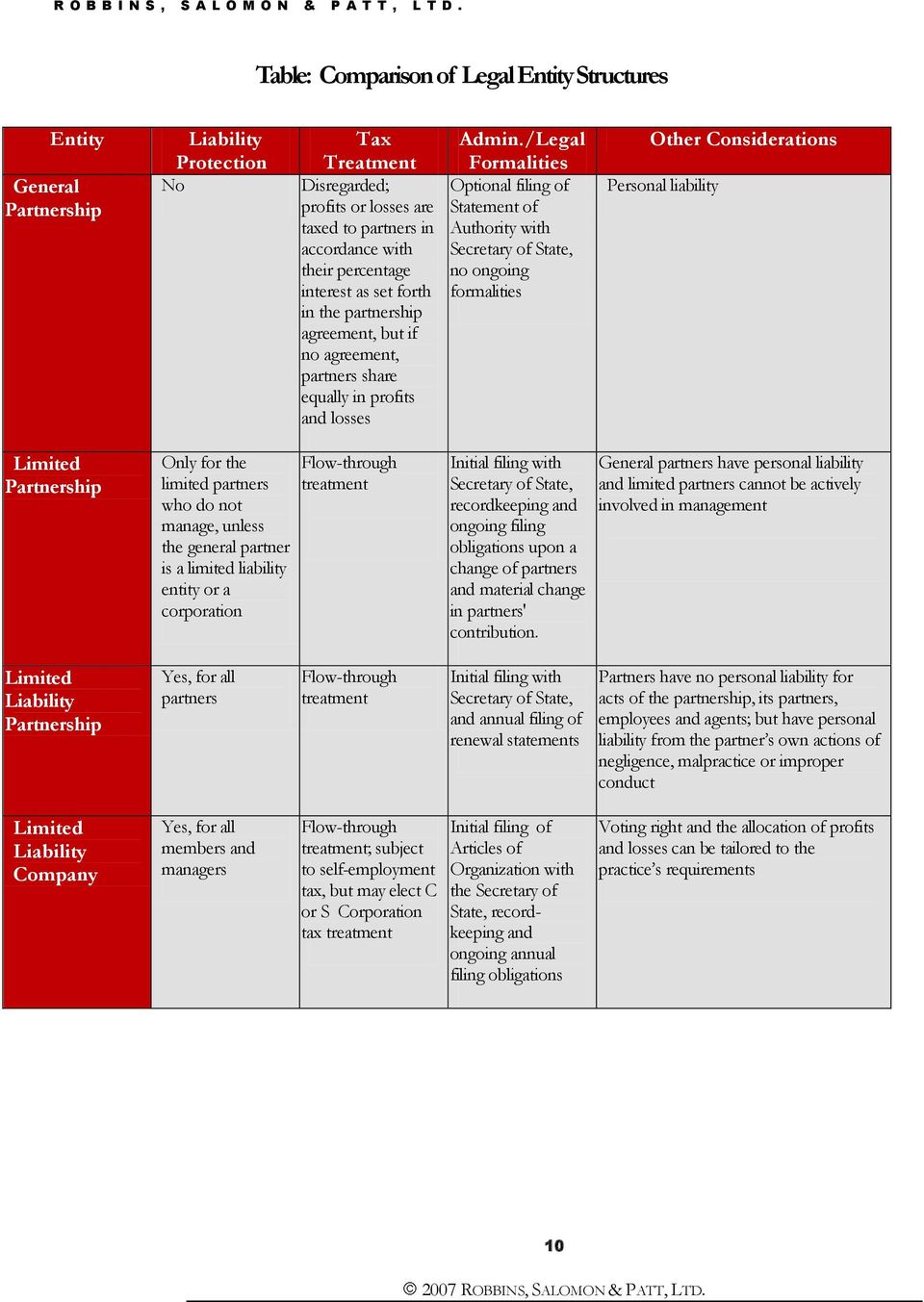
14 Table: Comparison of Legal Entity Structures Entity General Partnership Liability Protection No Tax Treatment Disregarded; profits or losses are taxed to partners in accordance with their percentage interest as set forth in the partnership agreement, but if no agreement, partners share equally in profits and losses Admin./Legal Formalities Optional filing of Statement of Authority with Secretary of State, no ongoing formalities Other Considerations Personal liability Limited Partnership Only for the limited partners who do not manage, unless the general partner is a limited liability entity or a corporation Flow-through treatment Initial filing with Secretary of State, recordkeeping and ongoing filing obligations upon a change of partners and material change in partners' contribution. General partners have personal liability and limited partners cannot be actively involved in management Limited Liability Partnership Yes, for all partners Flow-through treatment Initial filing with Secretary of State, and annual filing of renewal statements Partners have no personal liability for acts of the partnership, its partners, employees and agents; but have personal liability from the partner s own actions of negligence, malpractice or improper conduct Limited Liability Company Yes, for all members and managers Flow-through treatment; subject to self-employment tax, but may elect C or S Corporation tax treatment Initial filing of Articles of Organization with the Secretary of State, recordkeeping and ongoing annual filing obligations Voting right and the allocation of profits and losses can be tailored to the practice s requirements 10
15 Entity Series Limited Liability Company Table: Comparison of Legal Entity Structures (Continued) Liability Protection Yes, for all members and managers Tax Treatment Flow-through treatment; may elect C Corporation tax treatment, which then results in double taxation Admin./Legal Formalities Initial filing of Articles of Organization with the Secretary of State, significant recordkeeping obligations for each series Other Considerations Voting rights & the allocation of profits & losses can be tailored to the practice s requirements Professional Services Corporation Yes, for all shareholders May be taxed as(i) C corporation, resulting in double taxation; or (ii) S Corporation, resulting in flowthrough tax treatment Extensive; Initial filing of Articles of Incorporation with Secretary of State, Certificate of Registration with the Division of Professional Regulation of the Illinois Department of Financial & Professional Regulation; shareholder & Board of Directors resolutions & minutes required for special meeting & annual meetings If S Corporation election is made, limited to one class of stock with identical preferences, but voting & non-voting shares may be issued; & no more than 75 eligible shareholders. Allocation of profits & losses must be in relationship to ownership interest. All shareholders, directors, officers, employees & agents (except ancillary personnel) must be licensed by the Illinois Department of Financial & Professional Regulation. Medical Corporation Yes, for all shareholders May be taxed as (i) C corporation, resulting in double taxation, or (ii) S Corporation, resulting in flowthrough tax treatment Extensive; Initial filing of Articles of Incorporation with Illinois Secretary of State, Certificate of Registration with the Division of Professional Regulation of the Illinois Department of Financial & Professional Regulation; shareholder & Board of Directors resolutions & minutes required for special meeting & annual meetings If S Corporation election is made, limited to one class of stock with identical preferences, but voting & non-voting shares may be issued; & no more than 75 eligible shareholders. Allocation of profits & losses must be in relationship to ownership interests. All shareholders, directors, officers and physician employees must be licensed under the Medical Practice Act of

16 Chapter 2 Raising Investment Capital Selecting Physicians & Other Investors to Join the Group Practice D eterming with whom to join forces takes a considerable amount of strategic planning and due diligence. What can a potential partner bring to the table? What doors can be opened as a result of affiliating with a particular physician or group? What critical services can now be provided? What efficiencies can be achieved? How can the physician help the group realize its business objectives? Ultimately, the decision to accept a physician or other investor as a member of a group practice is based upon certain self-defined objective and subjective criteria. However, who can participate as an equity member of a group practice is dictated in large part by Illinois law. And both Illinois and federal law dictate how, when and to whom an offering to join a group practice as an investor may be made. Eligible Investors MEDICAL PRACTICE PHYSICIANS & CHIROPRACTORS Illinois law requires that only individuals licensed under the Medical Practice Act of 1987 may practice medicine in all of its branches in this state. 12 Only individuals licensed under the Medical Practice Act of 1987 may own, operate and maintain in Illinois an establishment for the study, diagnosis and treatment of human ailments and injury, whether physical or mental, and to promote medical, surgical and scientific research and knowledge. 13 Moreover, the law prohibits physicians from sharing fees, commissions, rebates or other forms of compensation for any professional services not actually and personally rendered, with anyone other than physicians with whom the (licensed) physician practices in a partnership, limited liability entity or corporation. 14 As a result, Illinois prohibits passive physician investors in a medical practice. Therefore, all physician investors must provide an actual service, whether as an independent contractor, employee, officer or director of the group practice. 12

17 Accordingly, only those who meet the following licensing requirements may participate as equity members of a medical practice, regardless of whether the practice is structured as a partnership, a limited liability entity or a corporation: any physician or a chiropractic physician licensed in Illinois to treat human ailments without the use of drugs and without operative surgery; provided that: the physician or chiropractor provides services to the group practice pursuant to a written employment or services agreement. Something to Consider... Regardless of entity choice for a medical practice," all equity owners and officers, directors and employees (except ancillary employees) must be Illinois medical professionals duly licensed under the Medical Practice Act of 1987, 15 or entities registered as a medical corporation under the Medical Corporation Act 16 or a professional service corporation under the Professional Service Corporation Act. 17 CLINICS & FACILITIES-NO RESTRICTIONS Illinois does not restrict ownership of certain healthcare clinics and facilities to licensed physicians. Ambulatory surgery centers, diagnostic imaging centers, sleep diagnostic centers, end stage renal dialysis facilities, pain centers and immediate (urgent) care facilities, can be owned, in whole or in part by persons who are not Illinois licensed physicians or chiropractic physicians. However, the rendering of patient care and services in those clinics and facilities must be done by Illinois licensed medical professionals. Something to Consider... The fee splitting prohibition does not extend to employees of a group practice who provide ancillary (administrative and support) services or are licensed and provide services under the supervision of a licensed physician. And, the splitting of fees between physicians for professional services concurrently rendered to a patient is permissible, provided the patient has full knowledge of the fee splitting, and provided the division is made in proportion to the services performed and responsibility assumed by each. 13
18 Compliance with Federal & State Securities Laws The offering of an investment opportunity in an existing or to be formed group practice is subject to federal and state securities laws. Under both the federal and state securities laws, unless the security and the proposed transaction can meet one or more statutory exemptions to registration, all securities must be registered prior to being offered. EXEMPTIONS FROM REGISTRATION Generally, under Illinois law, if the offer or sale of a limited partnership interest, limited liability entity membership interest or corporate stock is not provided to more than 35 eligible investors and no commission or other remuneration is paid on account of the sale, or if commissions are paid, the securities are not offered or sold in Illinois by means of general advertising or general solicitation, then registration of the securities is not required. 18 Under federal law, registration exemptions for securities are available for limited, private offerings provided the offering meets certain conditions as to the amount being raised, the number of purchasers, the type (sophistication) of purchasers and the solicitation means. 19 Rules promulgated under the Securities Act of 1933, Regulation D, provides as follows: Rule 506 provides an exemption for limited offers and sales without regard to the dollar amount of the offering, Rule 505 offerings may not exceed $5 million in any 12-month period, and Rule 504 offerings may not exceed $1 million in any 12-month period. Although exemptions from registration exist, nothing exempts a group practice from the anti-fraud provisions of the federal and Illinois securities laws. Full and complete disclosure is the key to a group practice meeting its legal requirements, and the use of an offering memorandum is essential. OFFERING MEMORANDUM An offering or private placement memorandum distributed to potential eligible investors -- should identify and disclose the material terms and conditions of the offering, including, but not limited to: summary of the offering risk factors (which may include lack of operating history, regulatory environment, dependence on key personnel, risk of capitated contracts, exposure to professional liability, reliance on certain third-party payers, etc.) terms of the offering use of the net proceeds capitalization 14

19 return on investment overview of the group practice s business plan, discussing its business focus, management, personnel, strategy, facilities, conflicts, employment agreements, etc. legal and governance structure, to include copies of all governance documents disclosure of any conflicts federal and state tax considerations impact of the Stark Law, the Antikickback Statute and the Illinois Healthcare Worker Referral Act on the group practice With the private placement memorandum in hand, eligible investors can make informed decisions regarding their participation in the group practice. Something to Consider... The Antikickback Statute s Investments in Group Practices safe harbor protects payments made to a group physician investing in his or her group practice as a return on an investment interest, such as a dividend or interest income, provided the group practice meets the definition of a "group practice under the Stark Law. 15
20 Chapter 3 Registration Requirements State and Federal Registration Requirements A fter forming the legal structure for the group practice, there are a number of different federal and state registration requirements that must be met before the practice may become operational. Employer Identification Number The Internal Revenue Service (IRS) uses an Employer Identification Number (EIN) to keep track of a partnership, limited liability entity or corporation, whether or not it has employees. To obtain an EIN, IRS Form SS-4, Application for Employer Identification Number, must be filed with the IRS by: Telephone: Call the IRS Business & Specialty Tax Line, (800) during standard business hours. Mail the completed form to the EIN Operation, Internal Revenue Service, Cincinnati, Ohio within 5 days of the call. Online: File electronically on the IRS Website: Fax: Download form SS-4 from the IRS website: Fax the completed form to the Cincinnati IRS Center at (859) Mail: Download form SS-4 from the IRS website: Legal counsel for the practice may also file the EIN In Illinois, the entity s EIN is used for state employment tax purposes. 16

21 Corporation Registration A group practice organized as a corporation for the purpose of practicing medicine must register with the Division of Professional Regulation ( DPR ) of the Illinois Department of Financial and Professional Regulation. Registration is mandated under the Medical Corporation Act. 20 A group practice organized as a limited liability entity or any type of partnership for the purpose of practicing medicine is presently not required to register with the DPR. Legal counsel is able to prepare and file the application for registration, otherwise, a registration application can be obtained from the DPR website at Mail the original application along with the filed Articles of Incorporation and $50 registration fee to the Illinois Department of Financial and Professional Regulation, Division of Professional Regulation, P.O. Box 7007, Springfield, Illinois Something to Consider... The failure to properly register as a medical corporation has been used as a sword by parties to attempt to void otherwise legally binding contracts with medical practices. See Chatham Foot Specialists, PC v. Health-care Services Corp. d/b/a Blue Cross Blue Shield of Illinois, 219 Ill.2d 366 (2005) Medicare covered services. Most group practices and their physician employees will elect to participate in the Medicare program. A group practice may determine that all of its physician employees will participate in the Medicare program as a single supplier. In that case, the group practice and its physicians must enroll in the Medicare program to be eligible to receive Medicare payment for To enroll, a physician or the group practice s legal counsel must submit to a Medicare carrier CMS Form 855I, Application for Individual Healthcare Practitioner. A group practice must submit to a Medicare carrier CMS Form 855B, Application for Healthcare Suppliers that will Bill Medicare. Once enrolled, individual physicians must join their group practice for Medicare participation by submitting to a Medicare carrier CMS Form 855R, Individual Reassignment of Benefits. 17
22 Enrollment forms can be obtained on the Centers for Medicare & Medicaid Services website at 01_overview.asp. The Medicare carrier servicing Illinois is Wisconsin Physician Services, Inc. Its customer service department may be reached at (866) , and more information can be found on its website at Medical Assistance Program The Illinois Department of Healthcare and Family Services administers the Illinois Medical Assistance Program (Medicaid). Group practices may require their physician employees who enroll in the program to designate the group practice as an alternate payee. To enroll, a physician must submit a Provider Enrollment Application, Form HFS 2243, to Illinois Department of Healthcare and Family Services, Provider Participation Unit, P.O. Box 19114, Springfield, Illinois To designate the group practice as an alternate payee, both the physician and the group practice must jointly submit a Hospital, Professional School or Group Practice as Alternate Payee application, Form HFS Enrollment forms can be obtained on the Illinois Department of Healthcare and Family Services website at The department may be reached at or Controlled Substance Registration located. A state controlled substance registration is required of all Illinois licensed physicians who prescribe or dispense any controlled substance within the state of Illinois. Registration with the DPR is a prerequisite to a Federal controlled substance registration. A separate application is required for each practice location where controlled substance is stored or State registration forms may be obtained from the DPR s website at The DPR may be reached at (217) Federal controlled substance registration information can be obtained from the U.S. Drug Enforcement Agency, 230 South Dearborn, Suite 1200, Chicago, Illinois 60604, telephone (312)
23 Clinical Laboratory Improvement Amendments (CLIA) of 1988 Certification CLIA requires all entities that perform even one test, including waived test on materials derived from the human body for the purpose of providing information for the diagnosis, prevention or treatment of any disease or impairment of, or the assessment of the health of, human beings to meet certain Federal requirements. 21 If an entity performs tests for these purposes, it is considered under CLIA to be a laboratory and must register with the CLIA program. Application forms, including Form CMS-116, CLIA Application for Certification, may be obtained from the Centers for Medicare & Medicaid Services website, Applications must be submitted to the Illinois Department of Public Health, Division of Health Care Facilities & Programs 525 W. Jefferson St., Fourth Floor, Springfield, Illinois The Division may be reached at (217) Certificate of Need Licensed and state-operated hospitals, long-term care facilities, dialysis centers, ambulatory surgery centers, and alternative health care delivery models are subject to the Illinois Certificate of Need Program. 22 The Illinois Health Facilities Planning Board issues permits ( Certificate of Need ) for construction or modification projects proposed by or on behalf of healthcare facilities, and for approving transactions for the acquisition of major medical equipment. 23 To obtain a Certificate of Need, applicants must justify that a proposed project is needed as well as financially and economically feasible. Additional information may be found at the Illinois Health Facilities Planning Board website, or by contacting the Board at (217) Potentially Infectious Medical Waste All persons who generate, transport, treat, store or dispose of potentially infectious medical waste (PIMW) are subject to the requirements which may include obtaining permits and prohibitions contained in the Illinois Environmental Protection Act
24 Group practices, as generators of PIMW, are subject to the segregation and labeling requirements of Illinois Environmental Protection Act regulations. In addition, if a group practice stores, transfers or treats PIMW, permits issued by the Illinois Environmental Protection Agency are required. For additional information, contact the PIMW Coordinator at the Illinois Environmental Protection Agency; Bureau of Land #33, 1021 North Grand Avenue East, P.O. Box 19276; Springfield, Illinois , or call (217) PIMW regulations can be found at regulations/#pimw. Department of Employment Security Registration The Illinois Unemployment Insurance Act requires every entity, which will serve as an employer, to register with the Illinois Department of Employment Security (IDES) within 30 days of start-up. 25 A group practice may register by filing with IDES a completed Form UI-1, Report to Determine Liability Under the Illinois Unemployment Insurance Act. Employers can also register electronically through the Illinois TaxNet website Employers become liable for paying contributions through their taxable payroll as soon as they have paid $1,500 in wages in a single calendar quarter, or employed one or more persons for at least part of the day in each of 20 weeks in a given calendar year. All employers are required to post the following posters conspicuously in each employment location: Notice to Workers about Unemployment Insurance Benefits (IDES) Illinois Minimum Wage poster Equal Employment Opportunity is the Law Your Rights Under the Family and Medical Leave Act Job Safety and Health Protection Notice: Employee Polygraph Connection Act Notice to Workers with Disabilities Migrant and Seasonal Agricultural Worker Protection Act (MSPA) Your Rights Under the USERRA (Uniformed Services Employment and Reemployment Rights Act) Notice to Employers and Employees Workers' Compensation Notice Posters may be obtained directly from IDES. For more information, contact IDES at (312) or (217) , or visit their web site at 20
25 Chapter 4 Professional Liability, Commercial & Other Insurance An Absolute Necessity I n August 2005, Illinois enacted medical malpractice reform that limits the amount a jury can award for personal pain and suffering to $500,000 from physicians and $1,000,000 for hospital judgments. 26 This reform was vitally needed to address, in part, the medical liability crisis facing Illinois. Illinois healthcare providers still face staggering premium rates that have, unfortunately, forced many physicians in specialties such as neurosurgery, orthopedics, anesthesiology, general surgery and obstetrics/gynecology to either leave the state or to abandon performing high-risk procedures. Although professional liability insurance is expensive, it is still a vital necessity for individual physicians and their group practices. As important to group practices, however, is commercial liability insurance to protect the practice and its owners from claims related to its roles as landlords and employers. Professional Liability Insurance OCCURRENCE VERSUS CLAIMS MADE POLICIES Policies can be written as occurrence or claims-made coverage. Occurrence coverage covers the insured for incidents occurring during the period of time when the insurance is maintained. Provided the insurance policy is paid up and in effect at the time a negligent act or omission occurs, the policy will provide coverage. Upon the termination of the policy, or if the policy lapses, the insured will still be covered for claims brought after the policy period, as long as the claims relate to incidents occurring during the period of coverage. 21
26 Claims-made protection is liability insurance that provides coverage for claims relating to incidents occurring during the policy period only if such claims are brought during the policy period or notice of the prospective claim was provided to the insurance carrier during the policy period. Insurance coverage typically ceases with the termination of the claims-made policy, although certain policies provide grace periods, typically 30 to 60 days after the insurance policy has terminated, to permit the insured to submit and cover claims after the end of the coverage period. Without a grace period, most claims made on or after the policy termination date are not covered. REPORTING ENDORSEMENT ( TAIL COVERAGE ) To extend insurance coverage of a claims-made policy with its current insurer, tail coverage is available. Tail coverage will extend the period of time coverage is provided for claims arising out of events that occurred while the original, claimsmade insurance policy was in effect. Tail coverage fills the gaps that may occur between the effective dates of separate policies. Tail coverage premiums are expensive. They are typically 150% to 250% (or higher) of the annual premium of a claims-made policy. COVERAGE AMOUNTS In Illinois, there are no statutory minimum requirements for the amount of professional liability insurance coverage a physician must have. Policies are written in Illinois with limits of: o $ 500,000 per occurrence/$1,500,000 aggregate o $1,000,000 per occurrence/$3,000,000 aggregate o $2,000,000 per occurrence/$4,000,000 aggregate With $1,000,000 per occurrence/$3,000,000 aggregate being the most common. GROUP POLICIES A group practice typically requires a policy specific to the group, which will provide coverage for all of its physician owners and physician employees for malpractice claims arising out of the scope of their employment. In contrast, for a sole practitioner coverage for the entity is typically automatically included under the physician's individual professional liability policy. 22
27 Commercial Insurance COMMERCIAL AND GENERAL LIABILITY INSURANCE Large group practices typically obtain comprehensive general liability insurance. Comprehensive general liability insurance (also known as general liability insurance ) provides broad, comprehensive insurance coverage and generally applies to all business activities of the insured (except for specialized activities such as malpractice, business risk, workers compensation and automobile insurance). General liability insurance provides standardized coverage to include insurance for accidental injury or property damage to a third party resulting from the operations performed by the insured on its premises, accidental injury or property damage that may result from the ownership or operation of the insured s premises itself, and insurance for claims arising from incidental contracts entered into by the insured. Small and mid-sized group practices may obtain a business owners policy ( BOP ). A BOP bundles protection from all major property and liability risks in one package (except for specialized activities such as malpractice, workers compensation and automobile insurance). BOP coverage includes property insurance for buildings and contents, business interruption insurance and liability protection. Directors & Officers Insurance Directors and officers of a group practice structured as a corporation or limited liability entity are charged with fiduciary duties to the corporation or entity in connection with the performance of their duties. Illinois law allows a professional services corporation, medical corporation or limited liability entity to indemnify its directors and officers from claims by third parties when they act in their corporate capacity. A directors and officers insurance policy (commonly referred to as a D & O Policy ) provides coverage for a corporation or limited liability entity to satisfy its indemnification obligations, or provides coverage for the directors and officers themselves if there is no indemnification undertaken by the corporation or limited liability entity. This type of policy provides coverage, not only for losses incurred by the insured in connection with any litigation claims, but also for the cost of defense incurred by the insured. 23
28 Property Insurance Property insurance covers losses arising from damage to real or personal property owned by the insured. Generally, these policies are written to insure against named perils. Thus, if the insured property was destroyed or damaged by the risks specifically named in the policy, coverage would be available. Typical perils named include: fire, lightning, windstorm, hail, explosions, riots, and civil commotion, plus damage caused by automobiles. In addition, optional coverage is generally available to insure against floods, earthquakes, building collapse and glass breakage. Minimum coverage amounts for property insurance will generally be dictated by the owner of the property of the practice location, or by lenders if the practice will acquire its practice location. Workers Compensation Insurance Illinois law requires employers to provide workers' compensation coverage for their employees. 27 Sole proprietors, business partners, and members of limited liability companies may exempt themselves from this requirement. 28 Employers may either buy insurance or obtain permission from the Illinois Workers Compensation Commission to self-insure. By law, Illinois employers are required to purchase workers compensation insurance, post a conspicuous notice in each workplace that lists the insurance carrier and explains workers rights, keep written records of work-related injuries and report to the commission accidents involving more than three workdays lost. In addition, employers may not retaliate, harass or discriminate against any employee who exercises their right under the law, and not charge the employee for any insurance premium the employer is obligated to pay. If an employer knowingly and willfully fails to obtain insurance, it may be fined up to $500 for every day of noncompliance, with a maximum fine of $10,000. Corporate officers can be held personally liable if the company fails to pay the penalty. 29 In addition, corporate officers who are found to have negligently failed to obtain insurance are guilty of a Class A misdemeanor; if they are found to have knowingly failed to obtain insurance, they are guilty of a Class 4 felony. 24
29 An employer that knowingly fails to obtain insurance loses its protections under the Workers' Compensation Act. An employee who is injured during the time the employer was uninsured may sue the employer in civil court, where benefits are unlimited. In addition, during the trial the burden will be upon the employer to prove it was not negligent. For more information visit the Illinois Workers Compensation Commission web site, 25
30 Chapter 5 Governance Issues Addressing the Internal Requirements of a Group Practice G roup practices must adopt rules, policies and implement procedures to guide the internal relationship between the group practice and its equity owners. Rules, policies and procedures must also be adopted to guide the relationship between the group practice and the medical staff, not all of whom may be equity owners of the practice. Internal Operating Agreement Regardless of the legal structure for the group practice -- partnership, limited liability entity or corporation a written agreement must be in place to address the internal governance and operational issues. If a partnership is formed, the written agreement takes the form of the partnership agreement. In a limited liability entity, the written agreement takes the form of an operating agreement. In a corporation, the bylaws, often coupled with a shareholders agreement, govern the internal relationship between shareholders and the corporation. If there is no written agreement to govern the internal relationship between the equity owners and the group practice (or if the written agreement is silent as to a particular issue) the law applicable to the respective legal structure serves as the default provisions for the relationship or particular issue. In many instances, those default provisions can lead to undesirable results. WHAT SHOULD IT ADDRESS? The internal operating agreement should address: appointment of the initial, and election of subsequent, directors or managing partners or managers appointment and responsibilities of officers 26
31 meeting and voting requirements for directors, partners, members and shareholders initial and future capital contribution requirements distribution of available cash and allocations of profits and losses compensation structure allocation of expenses rights and/or restrictions of partners, members or shareholders to transfer or sell their respective equity interests, or their rights to acquire additional equity (these issues are discussed in further detail in the next chapter) dispute resolution procedures withdrawal of partners, members or shareholders dissolution events WHEN SHOULD IT BE DEVELOPED? Under no circumstance should the internal operating agreement be created after the organization is operational, or worse yet, when there is a dispute between the partners, members or shareholders. It is prudent to develop these agreements on the onset of the entity being organized and before it first becomes operational. In fact, most eligible investors or their representatives will insist upon reviewing these internal governance agreements as a condition and prerequisite to making an investment and determining to join the group practice. What's more, it is fairly typical for certain provisions of the written agreement to be negotiated between the group practice and its prospective investors. Medical Staff Bylaws The establishment of medical staff bylaws is essential for group practices as they look to obtain national accreditation and certification, participate in Medicare and Medicaid, or limit legal exposure from claims of medical staff appointees, applicants and patients. Medical staff bylaws are separate and distinct from the group practice's (entity) bylaws. Medical staff bylaws define the relationship between the medical staff and the entity. 27
32 WHY ARE THEY NEEDED? Increasingly, healthcare facilities other than hospitals such as ambulatory surgery centers, diagnostic imaging centers, dialysis centers, urgent care centers, pain centers, sleep diagnostic centers, and multi-specialty groups -- are obtaining accreditation and certification through national organizations like the Joint Commission on Accreditation of Healthcare Organizations (JCAHO), National Committee for Quality Assurance (NCQA), and Accreditation Association for Ambulatory Health Care (AAAHC), to name a few. Accreditation and certification with those organizations often facilitates obtaining employer and third-party payer contracts by demonstrating the facility meets certain national standards for performance and safety. Internal governance is an area of measure for those organizations, and their accreditation standards and certification requirements generally require facilities to establish bylaws setting forth the relationship between the governing body and its medical staff. 30 Medicare and Medicaid conditions of participation often require certain facilities, in addition to hospitals such as end-stage renal disease facilities and ambulatory surgery centers -- to have a formal governing body with medical staff bylaws as a condition of participation and to receive Medicare and Medicaid payments. In addition, group practices, as employers, are generally held to a legal duty to ensure that only competent and qualified physicians are granted privileges to its medical staff and to ensure patient safety. Most group practices prudently adopt medical staff bylaws to help adhere to those duties and thereby mitigate legal exposure for claims from rejected applicants to the medical staff, terminated medical staff members, and patients, for negligent hiring. WHAT SHOULD THEY ADDRESS? Medical staff bylaws should include policies and procedures relating to: establishment of a governing board or body (discussed further below) scope and authority of the governing board (including the right to limit the number of staff members) officers (positions and duties) categories of privileges (temporary, emergency, consulting, associates, courtesy and active) initial and renewal credentialing rules (setting forth the minimum qualification requirements) (discussed further in Chapter 6) responsibilities of the medical staff (patient care and administrative) review, investigation and disciplinary procedures 28
33 suspension and termination procedures immunity and privileges for the governing body dispute resolution procedures In preparing medical staff bylaws, the group practice should refer to applicable Medicare conditions of participation as they typically contain specific requirements for inclusion in the medical staff bylaws of a group, clinic or facility. Governing Body The governing body of a medical staff has ultimate authority in ensuring patient safety, the delivery of quality care, and is ultimately responsible for the medical staff (and the medical staff is accountable to the governing body). This body is separate and distinct from the group practice's management committee or its board of directors, although there may be a commonality of members. Depending upon the size of the group practice, the governing body generally consists of 3 to 7 members. The governing body is led by a chief of staff or chief executive officer, who is a member of the active medical staff. The chief of staff is responsible for adopting, implementing and enforcing the medical staff bylaws, credentialing physicians, implementation of sanctions, establishing policies, procedures and protocols for medical staff personnel, and is responsible for ensuring the medical staff s compliance with applicable laws, regulations and standards. The chief of staff also functions as the liaison between the medical staff (and other professional staff) and the governing body. Medical Director The medical director is a member of the active medical staff and is generally responsible to ensure the medical quality of patient services and for coordinating all of the group practice s medical activities. DUTIES The medical director s specific duties typically include: directing and managing physicians and professional staff establishing and monitoring utilization review, risk management and quality control procedures for patient services approving policies and procedures for physicians and professional staff scheduling physicians 29
34 ensuring that all physicians and professional staff comply with all applicable state and federal laws and regulations negotiating and/or approving contracts relating to the group, its physicians or patients MEDICAL DIRECTOR STARK LAW REQUIREMENTS If the group s physicians intend to refer Medicare or Medicaid patients to the members of the group for the provision of DHS, the relationship between the group practice and the medical director must be structured to comply with the Stark Law s personal services safe harbor. Which means the agreement between the group practice and the medical director must: be in writing, be signed by the parties to the agreement, and specify the services covered by the agreement; cover all of the services to be furnished by the physician under the arrangement, cover aggregate services that do not exceed those that are reasonable and necessary for the legitimate purposes of the arrangement, be for a term of at least one year, provide for compensation to be set in advance, not to exceed "fair market value," and (except in the case of a permissible physician incentive plan) not be determined by the volume or value of any referrals or other business generated between the parties; and not involve counseling or promotion of a business arrangement or other activity that violates any state or federal law, such as the federal Antikickback Statute. 31 What constitutes fair market value? Under the Stark Law, an hourly payment for the medical director s personal services is considered to be "fair market value" if the payment is established using either of the following two methodologies: the hourly rate is less than or equal to the average hourly rate for emergency room physician services in the relevant physician market, provided there are at least three hospitals providing emergency room services in the market; or the hourly rate is determined by averaging the 50th percentile national compensation level for physicians with the same physician specialty (or if the specialty is not identified in the survey, for general practice) in at least four specified national surveys and dividing by 2,000 hours
35 If the group s physicians do not intend to refer Medicare or Medicaid patients to the members of the group for the provision of DHS, the relationship between the group practice and the medical director must still comply with the Antikickback Statute and the Illinois Healthcare Worker Referral Act. Something to Consider... Physicians are often requested to serve as medical directors for third-party facilities. Most physicians accept medical director positions in those facilities, mistakenly, under their own name. Group practices should be sensitive to this issue as it may create unintended legal exposure for the group and the physician. Typically, professional liability insurance only covers a physician member of a group practice for services rendered within the scope of his or her employment. If medical directorships are accepted by the physician, individually, outside of the group practice, there may be no insurance coverage for such services. Physicians and group practices are wise to have the group practice enter into a services agreement with the third-party facility, whereby they agree to make available the desired physician to serve as medical director. That way, insurance coverage will likely be available. Fees generated through the engagement can be passed through the group practice, but allocated directly to the physician rendering the service. 31
36 Chapter 6 Credentialing & Peer Review Ensuring Suitability & Fitness Q uality is the key to an effective medical staff. It starts with the credentialing process upon initial hire, and continues throughout a physician s tenure with the group practice thru periodic performance evaluations, peer review and recredentialing. Credentialing Credentialing is the manner by which a group practice performs its due diligence relating to a physician s suitability for joining its medical staff. It is the process of determining a physician s qualifications and validating them. Illinois law requires healthcare entities to establish policies and procedures on credentialing and credentials verification. 33 CRITERIA In establishing credentialing policy, the criteria must be reasonable, clear and understandable, and should be applied consistently and fairly. Commonly recognized professional criteria include: current licensure ability to document relevant education ability to document minimum amount of training or experience board certification or certification eligibility eligibility for Medicare or Medicaid program participation 32
37 ability to attain and maintain privileges at affiliated hospitals ability to document current competence geographic accessibility/proximity of home or office ability to meet on-call commitments professional liability insurance (history and the ability to obtain and maintain coverage at a reasonable rate) good reputation in character, including mental and emotional stability physical health status ability to work harmoniously with others sufficiently to convince the governing body that all patients treated by the physician will receive quality care and that the practice can operate in an orderly fashion CREDENTIALING FORMS The Illinois Department of Public Health has created uniform forms for the purpose of credentialing, recredentialing and for updating a physician's information and data. 34 Although the use of uniform forms are mandatory, the group practice is not required to request all of the information and data identified on the forms, and nothing prevents the group practice from obtaining additional information not identified on the forms. TIMING & CONFIDENTIALITY Verification of a physician s credentials data must be accomplished in a timely fashion. The group practice must complete the process of credentialing or recredentialing the physician within 60 days after the submission of all credentials data and completion of verification of the credentials data. 35 Certain of the requested information on the uniform forms is designated as "confidential information," such as professional licenses, state and federal controlled substances licenses, malpractice insurance face sheet or declaration of insurance, current CLIA certificate, current W-9 s and professional diplomas. That information may not be disclosed to third parties not involved in the credentialing or recredentialing process without written consent of the physician. The group practice must recredential all of its physicians at once in a single credentialing cycle not more than every 3 years. The Department of Public Health sets forth the specific schedules when recredentialing may not occur in a given year (as it coincides with the Department s licensing of physicians)
38 Peer Review Review of a medical staff member applicant or appointee is not without its risks. The potential exists for claims of antitrust, defamation, discrimination and other claims from adversely affected physicians. Given that, a group practice should adopt policies and procedure that provides the practice and its reviewers immunity from such potential claims. IMMUNITY In Illinois, there are no state immunity statutes protecting group practices and their governing body in their credentialing and peer review activities. Statutory immunity in Illinois for those activities only runs to professional associations under the Medical Practices Act of 1997, hospitals under the Hospital Licensing Act, 37 and long-term care facilities under the Long-Term Care Peer Review and Quality Assessment and Assurance Protection Act. 38 However, group practices and their governing bodies (and those who provide information to the practice in furtherance of a physician s review) can attain immunity under the federal Healthcare Quality Improvement Act of 1986 (HQIA). 39 The HQIA provides immunity from damages for professional review actions taken by a professional review body. HQIA REQUIREMENTS To attain immunity under HQIA, all of the standards under the act must be met. Those standards include, among others, the implementation of fair hearing policies and procedures, providing for strict written notice requirements to a physician of a proposed adverse action 40 and if a hearing is timely requested, further written notice relating to the hearing. 41 In addition, the action must be taken by the governing body: in the reasonable belief that the action was taken in furtherance of quality healthcare after reasonable effort to obtain the facts of the matter after adequate notice and hearing procedures are afforded to the physician, or if not provided, after such other procedures are afforded to the physician as are fair to the physician under the circumstances; and in the reasonable belief that the action was warranted by the facts known after the exercise of such reasonable effort to obtain facts
39 Chapter 7 Employment & Matters Between Equity Owners Hiring, Complying with Applicable Law, Employment Termination & Issues Between Equity Owners A ssembling a competent workforce requires a significant amount of investment of time and money. Not only must a group practice comply with the Stark Law, the Antikickback Statute, HIPAA, the Illinois Healthcare Worker Referral Act, and the antitrust statutes and regulations, they must also comply with a multitude of federal and state employment laws. While a discussion of those specific healthcare regulations and general employment laws are beyond the scope of this guide, Appendix A sets forth a general summary of the federal and state employment laws to which every employer (whether or not a group practice) must adhere. Employers can help protect their investment by having clearly drafted employment agreements for each employee, which contain reasonable restrictive covenants and requirements for release upon termination. Employers can further protect their investment by having agreements in place with their physician equity owners that define what occurs to an equity owner s interests upon employment termination, voluntary withdrawal, death, disability and other defined events. Employment Agreements NECESSITY FOR WRITTEN AGREEMENTS Although Illinois adheres to the "at will" employment doctrine, group practices are well advised to have written employment agreements in place with all professional and nonprofessional employees. By entering into a written employment agreement that contains specific terms and conditions under which an employee may be terminated, an employer alters the "at will" relationship. 35
40 What a written employment agreement provides (if properly drafted) however, is great clarity as to the scope of duties, licensing and privilege requirements, compensation and benefits, termination triggering events, termination rights, severance and posttermination restrictive covenants. Without a written employment agreement in place, employers run the risk of employees alleging the existence of an oral agreement with respect to a disputed term favoring the employee, and ancillary documents, like an employment handbook serving as the terms and conditions of employment. In addition, the Antikickback Statute and the Stark Law require the use of written employment agreements to establish a bonafide employment relationship. 43 Additional Stark Law requirements are discussed below. ESSENTIAL TERMS At a minimum, an employment agreement for a physician should include provisions relating to: Services The Stark Law requires that the services be identifiable. Specifically what medical services shall the physician render? Where will they be performed? What are the requirements, if any, for the physician to perform or assist in the performance of administrative services for the practice? What role will the physician play in the billing process? These provisions should also include a power of attorney in favor of the practice, allowing the practice to open mail containing payments that is addressed to the physician. Required Hours Typically hours are referenced as "as required," but this provision should also address fixed holidays and on-call requirements. Employment Term How long will the employment term be? Given the significant investment to recruit and train physicians, employers certainly want to retain the services of those physicians for a lengthy period of time. However, it is best to address the term of employment as a limited initial term (18 months months). The benefit of an initial limited term is that it allows the employer to assess the relationship during this limited period of time. Compensation These provisions typically sets forth the physician's base salary, bonus terms and conditions, and may also include compensation upon becoming disabled and compensation upon termination. The Stark Law requires that the compensation be consistent with the fair market value of the services and not take into account the volume or value of referrals. In addition, the compensation must be commercially reasonable even if no referrals were made. Additional compensation issues are discussed in the More about Compensation section of this chapter. 36
41 Benefits & Vacation Will the practice pay for professional liability insurance premiums, medical journals, dues for medical societies or specialty organizations, medical license fee, disability insurance, medical insurance, dental insurance, continuing medical education fees, to include travel and lodging; group life insurance, key man insurance, or relocation expenses? With respect to vacation time, how many days and how often? Profit Sharing Will the physician be entitled to participate in the practice's profit-sharing plan? If so under what terms and conditions? The amount of the group s profits paid to a physician cannot directly relate to the volume or value of referrals. Performance Reviews Who will provide them? How often? Termination These provisions should address, specifically, the triggering events for termination with "cause," which typically include: loss of license, suspension or exclusion from Medicare, the practice s inability to secure professional liability insurance on the physician, if the physician imminently endangers the safety of patients, violation of the Medical Practice Act of 1987, conviction of a felony or crime or moral turpitude under state or federal law (including the entrance of the "no contest" plea), and termination upon permanent disability. The termination provisions should also address termination "without cause." Specifically, how much prior written notice is required by either party to terminate the agreement without cause? Also addressed within these provisions are liquidated damages, if any, if the physician fails to give adequate notice. Compensation (severance) upon termination should also be addressed and those provisions should identify what compensation, if any, the physician shall be entitled to upon termination for cause under any of the specified triggering events, and upon termination without cause. Additionally, these provision should address the physician s requirement to execute a release (or mutual release) upon termination of the employment agreement as consideration for the severance payments. "Tail coverage should also be addressed within this section. Will it be required upon termination? If so, who shall be obligated to pay for it? Finally, within the termination provisions, the ownership and status of patient records and the conditions under which the physician should contact the patients with respect to his or her termination should be addressed. Under the Stark Law, the agreement may be terminated before the end of a one year term, provided a new agreement for the provision of the same items or services is not entered into during the balance of that year. Agreements made for 37
42 less than one year can be renewed repeatedly if the terms of the arrangement and the compensation does not change for the same items or services. 44 Equity Participation Will the physician be eligible to become a shareholder or member of the practice? If so, under what conditions and under what terms? Confidentiality & Restrictive Covenants Confidentiality provisions should address restrictions upon the physician from disclosing proprietary and confidential information of the practice both during employment and post-termination. In addition, to the extent there will be a posttermination restrictive covenant precluding the physician from competing against the practice or soliciting for hire employees of the practice, those provision should be addressed here. (A more detailed discussion of restrictive covenants is set forth below). Independent Contractor Agreements NECESSITY FOR WRITTEN AGREEMENT (ALSO) Just as important as having written agreements for employees, group practices should also have written (personal services) agreements with their independent contractor physicians and other support personnel. Why? To satisfy requirements under the Antikickback Statute and the Stark Law Avoid having the independent contractor being deemed an employee by the Internal Revenue Service, subjecting the group practice to payroll taxes and potential claims of unemployment and workers compensation claims Help minimize disputes between the group practice and the independent contractor over essential terms concerning the engagement ANTIKICKBACK STATUTE & STARK LAW REQUIREMENTS To fall within the Antikickback Statute s personal services safe harbor and the Stark Law's personal services arrangement safe harbor, the following standards must be met: the agreement must be set out in writing, signed by the parties and cover all of services that will be provided by the independent contractor to the group practice; if it is intended for the independent contractor to provide services on a periodic, sporadic or part-time basis, rather than a full-time basis, the agreement must specify exactly the schedule of such intervals, their precise length, and the exact charge for such intervals; 38
43 the term of the agreement must be for at least one year, the compensation paid to the independent contractor over the term of the agreement is set in advance, does not exceed fair market value in an arms-length transaction, and (except for physician incentive plans) is not determined in a manner that takes into account the volume or value of the referrals or business otherwise generated between parties; the services performed under the agreement do not involve the counseling or promotion of activity that violates state or federal law; and the aggregate services contracted for do not exceed those that are reasonably necessary to accomplish the commercially reasonable business purpose of the services. 45 ESSENTIAL TERMS The written agreement for the independent contractor should have, generally, the same essential terms as discussed above with respect to employment agreements, except for benefits & vacation, profit sharing, and equity participation (which as an independent contractor, he or she would not typically be entitled to participate in or be eligible for). In fact, the agreement should clearly state that the independent contractor, by virtue of that status, has no right to participate in, and shall have no claim to, any of the benefits reserved for employees of the group practice. The language of the agreement should be explicitly clear that the legal relationship is one of principal and agent and not employee and employer. Even more important is the conduct of the group practice with respect to the independent contractor. The group practice must not exert control over the independent contractor or else it risks having the independent contractor deemed as an employee. IRS 20 FACTOR TEST The Internal Revenue Service has consistently used a 20 factor test to determine whether an individual is an employee of an entity. The ultimate determination is predicated on the "degree of control" exerted over the individual. In a healthcare setting, some of the factors used by the IRS to determine the degree of control include whether the: physician must comply with the [hospital s] instructions regarding the performance of the services physician s services are integrated into the [hospital s] operations physician must render the services personally hospital hires, supervises and pays for the physician's support staff 39
44 physician must work in accordance with a set schedule [hospital] sets the priorities and sequences that the physician must work in accordance with physician s compensation is fixed, without reference to fees collected by the institution for services rendered to patient, and physician is reimbursed for business and/or travel and other expenses incurred during the term of the engagement 46 Something to Consider... Physician groups should be mindful to ensure an employee or independent contractor is not an excluded provider under Medicare or Medicaid by checking the OIG list of excluded individuals and entities at Employers are subject to civil monetary penalties for hiring or contracting with excluded providers if it knew or should have known of the exclusion. Physician groups have a duty to periodically check the list during the term of an employee s or independent contractor s services. More About Compensation ALTERNATIVES & REGULATORY REQUIREMENTS Determining how to compensate the group s physicians is a challenge. Total compensation usually entails a base salary, benefits, perks and incentive compensation. BASE COMPENSATION METHODS No one compensation model fits all. There are a number of different methods by which to compensate physicians in a group practice -- fixed salary, fixed salary plus incentives, and a variety of productivity based compensation. Each has its advantages and challenges. Which method is best is dependent upon the goals of the group practice and the payer mix. Fixed Salary Under this method, each physician is paid a fixed amount, without adjustments to reflect individual productivity or group productivity. Amounts may vary between members of the group to account for different factors like tenure, contributions to the management of the practice, experience level and specialty. This model works best in a fee-for-service environment. 40
45 Easy To Administer Advantages Changes In Payer Mix Have Little Effect Challenges Unmotivating; Provides Little To No Individual Incentive Places Great Emphasis On The Group Practice To Manage Costs Financial Predictability Salary Plus Bonus Or Incentives Under this method, each physician is provided a target salary, and is paid a base amount as fixed salary equal to a percentage of the target salary (typically, the base salary can range from 60% to 80% of the target salary). The balance of the target salary can be earned upon attaining certain productivity goals (in a fee-for-service environment) gross fee for service charges, encounter numbers, number of diagnostic tests ordered, etc. - and upon reaching certain performance measures (in a capitation environment) efficiency, patient satisfaction, on-call requirements, utilization of services, costeffectiveness, training, etc. Advantages Stability By Payment Of Base Salary Acknowledges Individual Contribution Challenges Requires agreed-upon benchmarks for physician performance standards May Be Administratively Difficult To Track Incentive Components And Administer Places Some Degree Of Financial Risk Upon The Individual Physician Productivity Based Compensation In a productivity-driven arrangement, physician compensation correlates directly to the volume of patients treated or services performed. Physician productivity can be measured in any combination of factors, including net revenues produced for the practice, patient encounters, hours worked, or relative value scales. It is the most commonly used compensation method by group practices. 41
46 Advantages Acknowledges Individual Contribution Rewards Clinical Productivity & Efficiency Provides Periodic Feedback Allowing Physicians To Adjust Performance Challenges May Be Administratively Difficult To Track Revenue And Expenses For Each Physician Requires Determination As To How To Allocate Expenses Fairly Requires Periodic Individual Feedback & Reporting Places Some Degree Of Financial Risk Upon The Individual Physician IN-OFFICE ANCILLARY SERVICES & INCENTIVE COMPENSATION Group practices that meet the group practice definition (as set forth in Chapter 1 of this guide) can compensate their physicians for in-office ancillary services, and provide incentive compensation in the form of productivity bonuses and profit sharing. In-Office Ancillary Services The Stark Law permits group practice physicians to receive compensation from inoffice ancillary services if they satisfy certain conditions under the Stark Law, namely, who will perform the services, where the serves will be rendered, and who can bill for the services. 47 Who Can Furnish The Services? The referring physician, A physician who is a member of the group practice, 48 or Someone supervised by the referring physician or another physician who is a member of the group practice. Where Must The Services Be Furnished? Same building (but not necessarily the same space or part of the building) where the referring physician or his or her group practice maintains an office (subject to alternative minimum hourly service requirements per week for the referring physician and the referring physician s group practice) 42
47 Or A centralized building used by the group for the provision of some or all of its clinical laboratory services or designated health services (other than clinical laboratory services). Who Can Bill For The Services? The physician performing or supervising the service, The group practice of the physician performing or supervising the service (under the group s billing number), An entity wholly owned by the performing or supervising physician or his or her group practice (under the entity s or group s billing number), or An independent third-party billing company as agent of the group practice or wholly owned entity (under the physician s, group s or wholly owned entity s billing number, subject to the billing arrangement meeting certain conditions). 49 PROFIT SHARING Physician groups may pay their physicians a share of the group s profits, subject to the requirements of the Stark Law. The overall profits the entire profits paid by Medicare or Medicaid for DHS, or profits paid by Medicare or Medicaid for DHS to any component of the group practice consisting of at least 5 physicians -- must be divided in a reasonable and verifiable manner that is not directly related to the volume or value of the physician s referrals of DHS. 50 Profits can be divided between the group practice s physicians based on their investment in the group, the number of hours worked, seniority in the group and by factoring in the complexity of work. All of those methods are deemed reasonable under the Stark Law. Supporting documentation as to how the division of profits was arrived at must be maintained. The share of overall profits will not be deemed to relate directly to volume or value of referrals if one of the following conditions is met: the profits are divided per capita, revenues derived from DHS are distributed based on the distribution of the group practice's revenues attributed to services that are not DHS payable by any federal health care program or private payer; or revenues derived from DHS constitute less than 5% of the group practice s total revenues, and the share of those revenues allocated to each physician in the group practice constitutes 5% or less of his or her total compensation from the group
48 Productivity Bonus A group practice may also provide its physicians a productivity bonus, subject to the requirements of the Stark Law. A productivity bonus for personally performed services (including services "incident to" personally performed services) must be calculated in a reasonable and verifiable manner that is not directly related to the volume or value of the physician s referrals of DHS. 52 Supporting documentation as to how the productivity bonus was arrived at must be maintained The bonus will not be deemed to relate to the volume or value of referrals of DHS if the following is met: the bonus is based on the physician's total patient encounters or relative values units; the bonus is based on the allocation of the physician s compensation attributable to services that are not DHS payable by any federal health care program or private payer; or revenue derived from DHS are less than 5% of the group practice s total revenues allocated to each physician in the group practice constitutes 5% or less of his or her total compensation from the group practice. 53 Restrictive Covenants Like other employers, group practices desire to impose restrictive covenants upon their physicians employees in order to protect their business interests -- profitability, patient and referral base and trade secrets -- from a departing physician employee. As a matter of public policy, Illinois courts do not favor restrictive covenants -- noncompetition provisions -- as they are viewed as limiting an employee's right to earn a living and economic competition. As a result, they are enforceable under certain limited circumstances. For a restrictive covenant to be enforceable, the restrictions must be deemed reasonable in both time and geographic scope, and must be necessary to protect a legitimate business interest of the employer. 54 Many practices restrict their physician employees from competing against them for a period ranging between 1 to 3 years, and use a mileage radius that is at least 5 to 10 miles from any office location where the physician employee has seen the practice s patients. However, what will be deemed "reasonable" in the eyes of the court will depend upon the specific facts and circumstances. One final note, the Stark Law prohibits the use of restrictive covenants in the recruitment context where a hospital is providing funding to recruit a physician into a designated geographic practice area. 55 Meaning, a group practice that employs a physician with the financial assistance of a hospital cannot require the physician employee to sign an employment agreement containing a covenant not to compete. 44
49 Employment Termination As discussed previously, Illinois is an "at will" employment state. Accordingly, employees may be terminated at any time, for any legal reason. However, if the employee is subject to an employment agreement, when terminating an employee the group practice should adhere to the termination provisions of that employee's employment agreement and provide the required notice as set forth in the employment agreement if the reason for termination requires that notice be given. The group practice should also strongly consider obtaining a release from the terminated employee. The purpose of the release is to avoid the employee asserting costly claims against the employer subsequent to his or her termination, regardless of whether the claim may have any merit. The release is often structured as a mutual release whereby the group practice releases the employee of any and all claims that it may have against a physician employee and vice versa. If the terminated employee is over 40 years old, additional legal requirements apply to the mutual release. Therefore, it is critical that the practice consult with its legal counsel prior to any termination. Agreements Between Equity Owners To avoid potentially costly and protracted disputes between equity owners of a group practice, equity owners should upon formation of the group practice, establish a written agreement between themselves and the group practice regarding: equity, restrictions of the transfer of the group practice s disposition of the physician s equity upon the occurrence of certain defined events like death, disability, termination, consolidation, merger, etc restrictions on transfer of equity physician s right to sell or transfer his or her equity equity valuation methods purchase price and payment terms of a physician s equity 45
50 use of special funds or life insurance to acquire a physician s equity dilution or anti-dilution upon admission of a new equity owner special voting requirements All subsequent physicians who become equity owners should be required to sign a counterpart of that agreement as a condition to joining the group practice. If no written agreement exists between equity owners, or if one exists, but is silent as to a particular issue, the law governing the legal structure under which the group practice operates shall dictate what occurs in the event of an equity owner s departure, and that law will also fill in the gaps of a particular issue not addressed. Careful tax planning is required when developing agreements between equity owners as there may be an opportunity to structure a departing equity owner s post-termination compensation or equity redemption as tax deferred compensation. *** 46
51 ABOUT ROBBINS, SALOMON & PATT, LTD. F or over 30 years, Robbins, Salomon & Patt, Ltd. ( RSP ) has been a fixture in the Chicago legal community, serving the legal needs of clients throughout the Midwest, in a broad spectrum of businesses and professions. HEALTHCARE LAW PRACTICE ADVISING HEALTHCARE PROFESSIONALS IN THE LEGAL ASPECTS OF THE BUSINESS OF MEDICINE Our talented healthcare attorneys and litigators assist healthcare professionals throughout the Midwest navigate through and succeed in the increasingly regulatory and ever-changing healthcare environment. Our attorneys have great breadth and depth of experience protecting, and providing innovative, yet practical solutions to issues facing, healthcare professionals. Our healthcare clients include physicians and physician groups, dentists and dental groups, practice management companies, independent physician associations, independent dialysis facilities, ambulatory surgery centers, diagnostic imaging centers, durable medical equipment companies, urgent care centers, home health agencies and other professional healthcare providers and suppliers. Our healthcare attorneys serve as the functional equivalent of "in-house counsel" to a great number of our corporate healthcare clients. RSP represents healthcare professionals in a broad array of business and regulatory matters, litigation and in administrative hearings. We have significant experience in advising clients in all aspects of their professional evolution and operations, including: practice formation, recruitment and employment issues, equipment and real estate leasing and acquisitions, daily operations and practice management issues, joint ventures, licensing and disciplinary issues, malpractice defense, managed care issues, billing, Medicare and Medicaid reimbursement issues, sales, mergers and acquisitions; market expansion, antitrust matters, and state and federal regulatory compliance issues, including Stark Law, Antikickback Statute and HIPAA. 47
52 For more information about our healthcare law practice, or to request a speaker on any of the topics addressed in this guide, please contact any one of the following: Andrés J. Gallegos (312) [email protected] Michael J. Hriljac (Of Counsel) (312) [email protected] Tracey A. Salinski (312) [email protected] Michael D. Schlesinger (312) [email protected] Tracy E. Stevenson (Litigation) (312) [email protected] Alan J. Wolf (312) [email protected] ROBBINS, SALOMON & PATT, LTD. Appellate Advocacy Business Planning Commodity Futures & Securities Commercial Transactions E-Commerce Employee Benefits & Employment Law Environmental Law Estate, Financial Planning & Probate Financial Institutions Healthcare Law Insolvency, Creditors Rights & Business Reorganization International Business Law Litigation-Business Related, Personal Injury & Wrongful Death Municipal Law Real Estate Taxation 48
53 APPENDIX A State & Federal Employment Laws Affecting Illinois Employers STATE EMPLOYMENT LAWS Illinois Child Labor Law 56 Regulates the employment of children and applies to all private-sector employees, regardless of size. Permits persons ages 14 and 15 to work in non-hazardous occupations (with restrictions), and requires a 30-minute meal period be provided if the child works more than five hours. Prohibits persons aged 16 and 17 from working in hazardous occupations. Health Care Workers Background Check Act 57 Requires criminal background checks by employers of certain non-licensed health care workers providing direct patient care. Applicants may be conditionally hired for up to 90 days awaiting the results of the background check. Employers are required to conduct non-fingerprint criminal background checks by the Illinois State Police. Subject to waivers from the Illinois Department of Public Health, persons convicted of specified felonies are ineligible for hire or continued employment in direct patient care positions. Illinois Clean Indoor Air Act 58 Prohibits smoking in public places (including places of work) except in designated areas. Illinois Drug-Free Workplace Act 59 Requires employers with 25 or more employees and with state contracts or grants of $5,000 or more to establish a drug free workplace policy. Illinois Human Rights Act 60 Prohibits discrimination in employment on the basis of race, gender, pregnancy, color, arrest record, religion, military status, age, marital status, national origin, ancestry, citizenship status, physical or mental handicap, sexual harassment or military service. Applies to Illinois employers with 15 or more employees working during 20 or more weeks in the calendar year or in the year preceding the violation. However, the handicap and sexual harassment provisions apply to employers with one or more employees. 49
54 Nursing Mothers In The Workplace Act 61 Requires employers with 5 or more employees to provide reasonable unpaid break time each day and a private room or location (other than restroom) to an employee who needs to express breast milk. One Day Of Rest In Seven Act 62 Requires all private employers, regardless of size, to provide each employee with at least one full day (24-hour consecutive hours) of rest in each calendar week. Employees scheduled to work seven and one-half consecutive hours or more of work a day must also be given an uninterrupted 20 minute meal period; which is to begin no later than 5 and one-half hours after the start of shift. Personnel Record Review Act 63 Requires employers, with 5 or more employees, who maintain employee personnel files to permit employees to inspect their personnel files at least twice a year, upon written request. Terminated employees may request to review their personnel files up to one year after termination. The employer must comply with the request within seven workdays. Copies must be provided upon request, at a reasonable cost. Personnel Records must include all documents which have been, or are intended to be used in determining the employee's qualifications for employment, promotion, transfer, additional compensation, discharge or other disciplinary action. The employer is prohibited from using in a judicial or quasi-judicial proceeding, any information that has not been provided to the employee upon a valid request. With certain exceptions, the employer is prohibited from disclosing disciplinary reports, letter of reprimand, or other disciplinary action to a third-party, without written notice to the employee. Personal Responsibility And Work Opportunity Act 64 Requires all employers, regardless of size, to report to the Illinois Department of Employment Security new employee information (including name, address, social security number, employer's name address and FEIN) within 20 days of their first day of work. Right To Privacy In The Workplace Act 65 Prohibits any employer, regardless of size, from discriminating based upon an employee's use of a lawful product off the employer's premises and outside of normal working hours. The Act also prohibits an employer from inquiring, orally or in writing, if an applicant or employee has ever filed a claim for workers compensation benefits, or from asking previous employers about an applicant's workers' compensation history. Time Off For Voting 66 Requires all employers, regardless of size, to grant a request for unpaid time off to vote in general or special elections (including primaries) during time the polls are open. 50
55 Time Off For Jury Duty 67 Requires all employers, regardless of size, to provide employees time off in accordance with a summons for either petit or grand jury service, even if employee is working night shift and jury duty occurs in daytime hours. Does not require payment for time off for non-exempt (hourly) employees. Minimum Wage Law 68 Applies to all employers employing at least one or more persons on some day during any calendar year. In July 2007, the minimum wage will increase to $7.50 per hour and up to $8.25 per hour by Illinois Wage Payment And Collection Act 69 Regulates the payment of wages, final compensation, vacation pay, earned bonuses, commissions, and other employee benefits. Applies to all Illinois employers regardless of size. Provides restrictions related to deductions from wages or final compensation. Illinois Workers' Compensation Act 70 Applies to all employees with an annual payroll of $1,000 or more, regardless of size. Requires employers to provide compensation for accidental injuries or illnesses and death arising out of and in the course of employment. Employers must either carry workers' compensation insurance or provide evidence of financial ability to be self-insured. School Visitation Right Act 71 Applies to all employers with at least 50 employees. Requires employees who have been employed on at least a part-time basis for at least six consecutive months to receive up to eight total hours of unpaid time off during any school year to attend school conferences or classroom activities related to the employee's child, which cannot otherwise be scheduled during nonwork hours. The employee may take no more than four hours on any given day. No time off need be provided unless the employee has exhausted all accrued vacation leave, personal leave, or any other leave, other than sick and disability leave. 51
56 FEDERAL EMPLOYMENT LAWS Age Discrimination In Employment Act 72 Applies to employers employing 20 or more employees. Protects persons over age 40 from discrimination on the basis of age in any terms and conditions of employment. Americans With Disabilities Act 73 Applies to employers employing 15 or more employees. Prohibits employment discrimination against a qualified individual with a disability in application, hiring, advancing, training, compensation, and other terms and conditions of employment. Also requires an employer to provide a reasonable accommodation to an otherwise qualified individual with a disability which will enable that individual to perform the essential functions of the position. Bankruptcy Act 74 Prohibits employers from refusing to hire applicants solely because he or she has filed for bankruptcy. Consolidated Omnibus Benefits Reconciliation Act (COBRA) Applies to employers employing 20 or more employees. Refers to the health continuation coverage provisions in ERISA and the Internal Revenue Code; requires employers to offer qualified beneficiaries continuation of coverage under the employer's group health plan after a certain "qualifying event" which would otherwise result in loss of coverage. Drug-Free Workplace Act 75 Requires employers with federal contracts of $100,000 or more to establish a policy statement and drug-free awareness program. Employee Polygraph Protection Act 76 Restricts all employers, regardless of size, in the use of lie detector tests for applicants and employees. Employee Retirement Income Security Act (ERISA) Governs retirement and employer-provided benefits. Equal Pay Act 77 Prohibits any employer, regardless of size, from discriminating on the basis of sex by paying persons of one sex less than the wage paid to persons of the opposite sex in the same establishment "for equal work on jobs the performance of which requires equal skill, effort, and responsibility and which are performed under similar working conditions." 52
57 Executive Order Applies to employers with 50 or more employees and federal contracts of $50,000 or more. Requires eligible employers to have a written Affirmative Action Plan regarding the utilization of minorities and females in the work force. Fair Credit Reporting Act 78 Imposes notice requirements on employers who obtain and use credit information in screening applicants. Family Medical Leave Act 79 Requires employers with 50 or more employees to provide eligible employees up to a total of 12 weeks of job-protected unpaid leave during any 12 month period for the birth or adoption of a child, serious health condition of the employee, their spouse, child or parent. Employees must have worked for at least 12 months for an employer (which need not be consecutive months) and for at least 1,250 hours during the last 12 months prior to leave. Health Insurance Portability And Accountability Act (HIPAA) 80 Applies to any group health plan having 2 or more participants. Provides comprehensive limits on preexisting condition exclusions on employer group health plans and provides continuous coverage of health benefits when an employee transfers from one employer to another employer. Immigration Reform And Control Act 81 Requires all employers to verify that employees are either U.S. citizens or otherwise authorized to work in the United States. Occupational Safety And Health Act 82 (OSHA) Applies to all employers. Requires employers to comply with certain federal safety and health standards applicable to their industry. Medical practices are considered healthcare facilities for purposes of OSHA, and medical practices are required to comply with OSHA s standard for Blood-borne Pathogens Standard and Enforcement Procedures for the Occupational Exposure to Blood-borne Pathogens, and other safety and health standards, all of which can be found on OSHA s web site: 53
58 Pregnancy Discrimination Act 83 Applies to employers employing 15 or more employees. Prohibits termination or refusal to hire or promote a woman solely because she is pregnant; bars mandatory leave for pregnant women arbitrarily set at a certain time in their pregnancy and not based on their individual inability to work; protects reinstatement rights of women on leave for pregnancy-related reasons; requires employers to treat pregnancy and childbirth the same way they treat other causes of disabilities under benefit plans; and requires employer-provided health insurance to cover expenses for pregnancyrelated conditions on the same basis as costs for other medical conditions. Title VII of the Civil Rights Act of Applies to employers employing 15 or more employees. An amendment to the Civil Rights Act, which prohibits all forms of discrimination on the basis of race, color, sex, religion, or national origin. Employers employing 100 or more employees (50 or more if a government contractor) must file an EEO-1 form annually. Uniformed Services Employment and Reemployment Rights Act 85 (USERRA) Applies to all employers. Protects military reservists from discrimination of any kind related to their military service. Worker Adjustment Retraining and Notification Act 86 (WARN) Requires employers employing 100 or more employees, excluding "part-time" employees, to provide at least 60-days advance written notice prior to a plant closing or mass layoff affecting at least 50 or more full-time employees. END NOTES *** 1 42 C.F.R (designated health services includes: clinical laboratory tests, physical and occupational therapy, speech language pathology services; radiology services, including MRI, CT and ultrasound services; durable medical equipment and supplies, parenteral and enteral nutrients, equipment and supplies; prosthetics, orthotics and prosthetic devices; home health services and supplies, outpatient script and drugs and impatience and outpatient hospital services) 2 42 C.F.R (a)-(h) ILCS 47/1 et seq. (subject to a limited demonstrated need exception, the statute precludes patient referrals by a healthcare worker to an entity outside of the healthcare worker's office or group practice in which the healthcare worker is an investor unless the healthcare worker directly provides health services within the entity and will be personally involved with the provision of services to the referred patient) 4 Uniform Partnership Act (1997), 805 ILCS 206/100, et seq. 5 Revised Limited Partnership Act, 805 ILCS 210/100, et seq. 6 Some of the safe harbors identifying conduct that does not constitute control under the Act (Sec. 303(b)) includes: being a contractor for an agent or employee of the limited partnership or of a general partner; being an officer, director or shareholder of a general partner which is a corporation; consulting with and advising a general partner with respect to the business of the limited partnership; requesting or attending a meeting of partners; proposing, or approving or disapproving by voting or otherwise, the incurrence of indebtedness by the limited partnership, the sale of all or substantially all of the limited partnership assets; or the admission or removal of a general or limited partner 54
59 7 Uniform Partnership Act (1997) 805 ILCS 206/1001, et seq. 8 Limited Liability Company Act, 805 ILCS 180/1-1, et seq. 9 Medical Corporation Act, 805 ILCS 15/1, et seq. 10 Professional Service Corporation Act, 805 ILCS 10/1, et seq. 11 I.R.C. 11(a), (b)(1); 15% of the first $50,000; 25% over $50,000 through $75,000; 34% over $75,000 through$10,000,000; and 35% over $10,000, Medical Practice Act of 1987, 225 ILCS 60/3 13 Medical Corporation Act, 805 ILCS 15/2 14 Medical Practice Act of 1987, 225 ILCS 60/22(A)(14) 15 Id., 225 ILCS 60/1, et seq. 16 Medical Corporation Act, 805 ILCS 15/1, et seq. 17 Professional Service Corporation Act, 805 ILCS 10/1, et seq. 18 Illinois Securities Law of 1953, 815 ILCS 5/4(g) 19 Securities Act of 1933, Regulation D, Rules ILCS 15/1, et seq C.F.R The Health Facilities Planning Act, 20 ILCS 3960/1, et seq. 23 Review thresholds (as of July 2005): Capital Expenditures, $7,167,063; Major Medical Equipment, $6,573,026; Health & Fitness Center Construction or Modification, $3,267, ILCS 5/1 et seq.; 35 Ill. Adm. Code Part 1420, et seq ILCS 405/100, et seq. (applies to every employing unit employing one or more individuals). 26 Senate Bill Workers' Compensation Act, 820 ILCS 305/1, et seq ILCS 305/1(a)3. 29 Id., 305/4(d) 30 JCAHO accreditation and certification program requirements can be obtained at NCQA and AAAHC accreditation and certification program requirements can be obtained at and respectively C.F.R (d) C.F.R The specified national surveys include Sullivan, Cotter, & Associates, Inc. - Physician Compensation and Productivity Survey,Hay Group - Physician Salary Survey Report, Medical Group Management Association - Physician Compensation and Productivity Survey, ECS Watson Wyatt - Hospital and Health Care Management Compensation Report and William M. Mercer - Integrated Health Networks Compensation Survey 33 Health Care Professionals Credentials Data Collection Act, 410 ILCS 517/1, et seq.; Ill. Admin. Code, Part , et seq. 34 Copies of the forms may be obtained at 35 Ill. Admin. Code, Part Id., ILCS 85/1, et seq ILCS 55/1, et seq U.S.C , et seq. 40 Id., 11112(b)(1) (stating the reason, physician s right to request a hearing, a time limit for requesting a hearing (not less than 30 days), and a summary of the physician s rights in the hearing) 41 Id., 11112(b)(2) (stating the date, place and time of the hearing, and the witnesses, if any, expected to testify against the physician) 42 Id., 11112(a) U.S.C. 3121(d)(2); 42 C.F.R (c) C.F.R (l) 45 Id., Internal Revenue Service Coordinated Issue Paper on Employee Status of Hospital-Based Physicians, March 26, C.F.R (b) 48 Id., (stating that independent contractors and leased employees do not count as group members) 49 Id., (b) 50 Id., (i) 55
60 51 42 C.F.R (i)(2) 52 Id., (i)(1) 53 Id., 42 C.F.R (i)(1) 54 Danville Polyclinic, Ltd. v. Dethmers, 260 Ill.App.3d 108, 631 N.E.2d 842 (4 th Dist. 1994) C.F.R (e) ILCS 205/22, et seq. 57 P.A ILCS 80/1, et seq ILCS 580/1, et seq ILCS 5/1-101 to 5/ ILCS 260/1, et seq ILCS 140/1, et seq ILCS 40/0.01, et seq ILCS 405/ ILCS 55/1, et seq ILCS 5/17-1, et seq ILCS 305/4.1, et seq ILCS 105/1, et seq ILCS 115/1, et seq ILCS 305/1, et seq ILCS 147/1, et seq U.S.C. 621, et seq U.S.C et seq U.S.C. 525, et. seq USCA 701, et. seq U.S.C. 2001, et seq U.S.C. 206(d) U.S.C. 1681b USCA 2601, et. seq. 80 P.L U.S.C 1324 (a)(1)(a)-(b) U.S.C. 657, et. seq C.F.R , et seq U.S.C. 2000e, et. seq U.S.C.A. 4301, et seq U.S.C. 2101, et seq. *** 56
Business Organization\Tax Structure
 Business Organization\Tax Structure One of the first decisions a new business owner faces is choosing a structure for the business. Businesses range in size and complexity, from someone who is self-employed
BSM Connection elearning Course
 BSM Connection elearning Course Basics of Medical Practice Finance: Part 1 2009, BSM Consulting All rights reserved. Table of Contents OVERVIEW... 1 FORMS OF DOING BUSINESS... 1 BUSINESS FORMATS AT A GLANCE...
Business Organization\Tax Structure
 Business Organization\Tax Structure Kansas Secretary of State s Office Business Services Division First Floor, Memorial Hall 120 S.W. 10th Avenue Topeka, KS 66612-1594 Phone: (785) 296-4564 Fax: (785)
A Guide to LLCs. Forming a Limited Liability Company
 A Guide to LLCs Forming a Limited Liability Company Advantages of Forming an LLC Real Estate Investments and LLCs Operating and Maintaining an LLC Comparing LLCs to Other Business Structures Table of Contents
SHOULD MY BUSINESS BE AN S CORPORATION OR A LIMITED LIABILITY COMPANY?
 SHOULD MY BUSINESS BE AN S CORPORATION OR A LIMITED LIABILITY COMPANY? 2015 Keith J. Kanouse One Boca Place, Suite 324 Atrium 2255 Glades Road Boca Raton, Florida 33431 Telephone: (561) 451-8090 Fax: (561)
FORMALIZING YOUR FIRM: LLC VERSUS S CORPORATION VERSUS C CORPORATION
 FORMALIZING YOUR FIRM: LLC VERSUS S CORPORATION VERSUS C CORPORATION by Stephanie L. Chandler 1 and Lisa S. Miller 2, Jackson Walker L.L.P. As we work with entrepreneurs in setting up the structures for
SAALFELD GRIGGS DENTAL INDUSTRY TEAM WHITE PAPER: CHOICE OF ENTITY FOR DENTISTS
 SAALFELD GRIGGS DENTAL INDUSTRY TEAM WHITE PAPER: CHOICE OF ENTITY FOR DENTISTS BY Th AMY GEERHART & DAVID MYERS I. Introduction Dentists may operate their practices through several forms of entities,
DESCRIPTION OF THE PLAN
 DESCRIPTION OF THE PLAN PURPOSE 1. What is the purpose of the Plan? The purpose of the Plan is to provide eligible record owners of common stock of the Company with a simple and convenient means of investing
Corporations: FAQ's. Is my Corporate Name Available?
 Is my Corporate Name Available? Corporations: FAQ's Money Matters Tax Service will perform a non-binding name check for name availability within the state of incorporation. We perform the name check at
Issues Relating To Organizational Forms And Taxation. U.S.A. NEW YORK Alston & Bird LLP
 Issues Relating To Organizational Forms And Taxation U.S.A. NEW YORK Alston & Bird LLP CONTACT INFORMATION Stephanie Denkowicz/ William Ruehl/ Edward Tanenbaum Alston & Bird LLP 90 Park Avenue New York,
CHOICE OF BUSINESS ENTITY
 CHOICE OF BUSINESS ENTITY Presented by James M. Jimenez, Esq. Pacific Business Law Group A Professional Corporation 1601 Cloverfield Boulevard Suite 200 South Tower Santa Monica, California 90401 July
ADDENDUM TO AGREEMENT BETWEEN CHIROPRACTIC CARE OF MINNESOTA, INC. AND PROVIDER
 ADDENDUM TO AGREEMENT BETWEEN CHIROPRACTIC CARE OF MINNESOTA, INC. AND PROVIDER This HealthPartners Workers Compensation Addendum (the Addendum ), dated as of the date set forth on the signature page (the
Agreement for Professional Emergency Services. professional emergency and related services provided at (hospital name) Hospital be
 Agreement for Professional Emergency Services This Agreement, made and effective on (effective date) by and between (name of hospital) Hospital, Inc., located at (address of hospital), (city, state and
The General Assembly of the Commonwealth of Pennsylvania hereby enacts as follows: CHAPTER 1 PRELIMINARY PROVISIONS
 PROFESSIONAL EMPLOYER ORGANIZATION ACT Act of Jul. 5, 2012, P.L. 946, No. 102 An Act Cl. 77 Providing for professional employer organizations. TABLE OF CONTENTS Chapter 1. Section 101. Section 102. Section
Choosing the Right Entity for Maximum Tax Benefits for Your Construction Company
 Choosing the Right Entity for Maximum Tax Benefits for Your Construction Company Timely re-evaluation of choice of entity will enhance the shareholder value of your contractor client By Theran J. Welsh
ORGANIZING YOUR COMPANY
 ORGANIZING YOUR COMPANY Filmmakers frequently establish a company to produce and own their movie. While there is no legal requirement to do so, there may be some benefit to operating under the auspices
FRISSE & BREWSTER LAW OFFICES
 FRISSE & BREWSTER LAW OFFICES ADVANTAGES AND DISADVANTAGES OF VARIOUS BUSINESS ENTITIES SOLE PROPRIETORSHIP A sole proprietorship is simple to establish and operate; little ongoing documentation is needed.
The Business Organization: Choosing an Entity
 The Business Organization: Choosing an Entity The subject matter is divided into two sections: 1. Section A shows direct comparison of different types of organizational structures. 2. Section B details
The Advantages and Disadvantages of Forming a Florida Limited Liability Company (LLC) Versus a Florida Corporation. by Karen J.
 The Advantages and Disadvantages of Forming a Florida Limited Liability Company (LLC) Versus a Florida Corporation by Karen J. Orlin This Note outlines advantages and disadvantages of forming a new business
How To Write A Partnership In Wyo.
 The Choice is Yours Sole Proprietorship General Partnership Limited Partnership Corporation Close Corporation Limited Liability Company Close Limited Liability Supplement Statutory Trust Limited Liability
Negotiating Your Employment Agreement: A Physician s Checklist
 Negotiating Your Employment Agreement: A Physician s Checklist By Steven A. Eisenberg([email protected]) and Emily Williams ([email protected]) You found your ideal practice setting the perfect
The sole proprietor is free to make any decision he or she wishes to concerning the business. The major disadvantage is
 Chapter 11 Corporate Governance & Business Organizations An entrepreneur is one who initiates and assumes the financial risks of a new enterprise and undertakes to provide or control its management. One
MEMORANDUM ON LIMITED LIABILITY COMPANIES IN THE UNITED STATES
 MEMORANDUM ON LIMITED LIABILITY COMPANIES IN THE UNITED STATES This memorandum describes certain general characteristics of limited liability companies in the U.S. which we have found to be of interest
[LOGO] ROGERS COMMUNICATIONS INC. DIVIDEND REINVESTMENT PLAN. November 1, 2010
![[LOGO] ROGERS COMMUNICATIONS INC. DIVIDEND REINVESTMENT PLAN. November 1, 2010](/thumbs/30/14484201.jpg "[LOGO] ROGERS COMMUNICATIONS INC. DIVIDEND REINVESTMENT PLAN. November 1, 2010") [LOGO] ROGERS COMMUNICATIONS INC. DIVIDEND REINVESTMENT PLAN November 1, 2010 Rogers Communications Inc. Dividend Reinvestment Plan Table of Contents SUMMARY... 3 DEFINITIONS... 4 ELIGIBILITY... 6 ENROLLMENT...
[LOGO] ROGERS COMMUNICATIONS INC. DIVIDEND REINVESTMENT PLAN November 1, 2010 Rogers Communications Inc. Dividend Reinvestment Plan Table of Contents SUMMARY... 3 DEFINITIONS... 4 ELIGIBILITY... 6 ENROLLMENT...
On-Site Medical Clinic Guidelines
 On-Site Medical Clinic Guidelines Amy Gordon, Partner Daniel Gottlieb, Partner Dale Van Demark, Partner July 24, 2013 www.mwe.com Boston Brussels Chicago Düsseldorf Frankfurt Houston London Los Angeles
Considerations in the Health Care Company Tax Status Conversion from C Corporation to Pass-Through Entity
 Health Care Forensic Analysis Insights Considerations in the Health Care Company Tax Status Conversion from C Corporation to Pass-Through Entity Robert F. Reilly, CPA For a variety of economic and taxation
INVESTMENT ADVISORY AGREEMENT
 The undersigned client ( I ) agrees to engage WealthStrategies Financial Advisors, LLC ( you ) as advisor for the Account(s) custodied with FOLIOfn Investments, Inc. ( Account(s) ) upon the following terms
2:4 Letter to client regarding choice between LLC and S corporation
 2:4 Letter to client regarding choice between LLC and S corporation Dear [Client]: I understand that you are interested in creating a new business entity for a [type of business] business. This letter
SAMPLE INSURANCE BROKER SERVICE AGREEMENT
 SAMPLE INSURANCE BROKER SERVICE AGREEMENT (For Use By Insurance Brokers in Preparing Service Agreements for Clients Whose 401(k) Plans Are Funded by John Hancock Group Annuity Contracts or, With Respect
AGREEMENT BETWEEN THE UNIVERSITY OF TEXAS HEALTH SCIENCE CENTER AT SAN ANTONIO and PROJECT ARCHITECT for A PROJECT OF LIMITED SIZE OR SCOPE
 AGREEMENT BETWEEN THE UNIVERSITY OF TEXAS HEALTH SCIENCE CENTER AT SAN ANTONIO and PROJECT ARCHITECT for A PROJECT OF LIMITED SIZE OR SCOPE This Agreement is made as of, 20 (the Effective Date ), by and
THE BASICS OF CHOOSING A BUSINESS ENTITY
 Handout provided courtesy of WHAT IS LIABILITY? 1. Contract Liability THE BASICS OF CHOOSING A BUSINESS ENTITY Colin T. Cameron * Katz Ahern Herdman & MacGillivray PC 1.1. Contract: an agreement between
The ABCs of Entity Choice By Thomas A. Brumgardt
 Legal Basics Part 4 in a series The ABCs of Entity Choice By Thomas A. Brumgardt Every lawyer needs to know the basics of advising clients on choice of entity. Even if you do not regularly practice in
M E M O R A N D U M LIMITED LIABILITY: KNOW THE LIMITS
 M E M O R A N D U M TO: The Members or Managers FROM: Terri L. Giampetroni Legal Strategies, P.C. You have chosen to do business through the use of a Michigan limited liability company. Your company provides
DETERMINING THE BUSINESS ENTITY BEST FOR YOUR BUSINESS
 DETERMINING THE BUSINESS ENTITY BEST FOR YOUR BUSINESS 2015 Keith J. Kanouse One Boca Place, Suite 324 Atrium 2255 Glades Road Boca Raton, Florida 33431 Telephone: (561) 451-8090 Fax: (561) 451-8089 E-mail:
INVESTMENT ADVISORY AGREEMENT
 INVESTMENT ADVISORY AGREEMENT This Investment Advisory Agreement is entered into by and between CONFLUENCE INVESTMENT MANAGEMENT LLC, a Delaware limited liability company ( Adviser ), and the undersigned
A Guide to Crowdfunding for Companies Seeking to Raise Capital
 A Guide to Crowdfunding for Companies Seeking to Raise Capital A publication of the Securities Law Practice mefiifmp=kfwbo LLP June 2012 On April 5, 2012, President Obama signed into law the Jumpstart
Choice of Entity: Corporation or Limited Liability Company?
 March 2014 Choice of Entity: Corporation or Limited Liability Company? By Gianfranco A. Pietrafesa* Attorney at Law There are many different types of business entities, including corporations, general
MAXIM INTEGRATED PRODUCTS, INC. 2008 EMPLOYEE STOCK PURCHASE PLAN
 MAXIM INTEGRATED PRODUCTS, INC. 2008 EMPLOYEE STOCK PURCHASE PLAN (As amended) 1 The Company wishes to attract employees to the Company, its Subsidiaries and Affiliates and to induce employees to remain
HOUSE BILL No. 2087. By Committee on Insurance 1-26. AN ACT enacting the Kansas professional employer organization licensing
 Session of 00 HOUSE BILL No. 0 By Committee on Insurance - 0 0 AN ACT enacting the Kansas professional employer organization licensing act. Be it enacted by the Legislature of the State of Kansas: Section.
INSIDER TRADING POLICY
 INSIDER TRADING POLICY NOVEMBER 2014 2 INSIDER TRADING POLICY NOVEMBER 2014 This Policy provides guidelines for directors, officers, executives, employees and consultants (collectively, WSP Team Members
GUIDE TO SELECTING YOUR SMALL BUSINESS LEGAL STRUCTURE
 GUIDE TO SELECTING YOUR SMALL BUSINESS LEGAL STRUCTURE To make your business #CPAPOWERED, call today and let s get started. 2015 American Institute of CPAs. All rights reserved. 15607-312 One important
GUIDE TO SELECTING YOUR SMALL BUSINESS LEGAL STRUCTURE. To make your business #CPAPOWERED, call today and let s get started.
 GUIDE TO SELECTING YOUR SMALL BUSINESS LEGAL STRUCTURE To make your business #CPAPOWERED, call today and let s get started. One important consideration when starting your business is determining the best
DISCRETIONARY INVESTMENT ADVISORY AGREEMENT
 DISCRETIONARY INVESTMENT ADVISORY AGREEMENT AGREEMENT, made this day of, 20 between the undersigned party, (hereinafter referred to as the Client ), and Walkner Condon Financial Advisors LLC, a registered
DEPARTMENT OF HEALTH CARE FINANCE
 DEPARTMENT OF HEALTH CARE FINANCE Dear Provider: Enclosed is the District of Columbia Medicaid provider enrollment application solely used for providers, who request to be considered for the Adult Substance
Health Care Compliance Association 888-580-8373 www.hcca-info.org
 Volume Twelve Number Five Published Monthly Meet Miaja Cassidy Director of Healthcare Compliance at Target page 14 Feature Focus: Managing security risks in business associate relationships page 32 Earn
Incorporating Your Business
 CorpNet s Guide to: Incorporating Your Business TM www.corpnet.com Congratulations! You have decided to start your own business. That is a courageous step and one that can lead to rewards that no job can
FREQUENTLY ASKED QUESTIONS ABOUT BLOCK TRADE REPORTING REQUIREMENTS
 FREQUENTLY ASKED QUESTIONS ABOUT BLOCK TRADE REPORTING REQUIREMENTS Block Trades and Distributions What is a block trade? Many people use the term block trade colloquially. Technically, a block trade is
Highmark Blue Shield Provider Information Management P.O. Box 898842 Camp Hill, PA 17089-8842
 Dear Health Care Professional: The enclosed forms are provided to process your request for an Assignment Account number with Highmark Blue Shield. An Assignment Account is Highmark Blue Shield s term for
INVESTMENT ADVISORY AGREEMENT
 INVESTMENT ADVISORY AGREEMENT This Agreement is between the undersigned individual or entity ( Client ) and Van Meter Associates, LLC ( Adviser ). The parties agree as follows: 1. Appointment of Manager.
A Guide to Incorporating Your Business
 A Guide to Incorporating Your Business Forming a C or S Corporation Advantages of Incorporating Operating and Maintaining a Corporation Comparing C Corps., S Corps. and LLCs Table of Contents INTRODUCTION....................................................
Attachment C. AGREEMENT between the County Department of. Social Services, (referred to in this Agreement as "the Social Services
 Attachment C AGREEMENT BETWEEN A SOCIAL SERVICES DISTRICT AND AN ASSISTED LIVING PROGRAM AGREEMENT between the County Department of Social Services, (referred to in this Agreement as "the Social Services
PROSPECTUS. Aflac Incorporated Worldwide Headquarters 1932 Wynnton Road Columbus, Georgia 31999 1.800.227.4756-706.596.3589
 PROSPECTUS Aflac Incorporated Worldwide Headquarters 1932 Wynnton Road Columbus, Georgia 31999 1.800.227.4756-706.596.3589 AFL Stock Plan A Direct Stock Purchase and Dividend Reinvestment Plan We are offering
An Overview of the Common Interest Community Association Act (CICAA) By, Lara A. Anderson, Attorney at Law Fullett Rosenlund Anderson PC
 An Overview of the Common Interest Community Association Act (CICAA) By, Lara A. Anderson, Attorney at Law Fullett Rosenlund Anderson PC On July 29, 2010, the Illinois Common Interest Community Act 1 (
S Corporation C Corporation Partnership. Company (LLC)
 Description An LLC can only be formed by making appropriate filing with the state (see below). Owners are called members and the LLC may be managed by the members, similar to a partnership, or by managers
BASIC LEGAL CONSIDERATIONS WHEN STARTING YOUR OWN BUSINESS
 BASIC LEGAL CONSIDERATIONS WHEN STARTING YOUR OWN BUSINESS By: Susan A. Keller, Esq. Edwards & Angell, LLP Starting your own business can be very exciting, for it allows you the opportunity to shape a
Washington Scene. Safe Harbor Rules issued for Medicare/Medicaid antikickback law
 Washington Scene KATHLEEN A. MICHELS, RN, JD Director of Federal Government Affairs AANA Federal Government Affairs Office Washington, DC Safe Harbor Rules issued for Medicare/Medicaid antikickback law
WITNESSETH: 2.1 NAME (Print Provider Name)
 AGREEMENT between OKLAHOMA HEALTH CARE AUTHORITY and CERTIFIED NURSE MIDWIFE WITNESSETH: Based upon the following recitals, the Oklahoma Health Care Authority (OHCA hereafter) and (PROVIDER hereafter)
LLC Operating Agreement With Corporate Structure (Delaware)
 LLC Operating Agreement With Corporate Structure (Delaware) Document 1080B www.leaplaw.com Access to this document and the LeapLaw web site is provided with the understanding that neither LeapLaw Inc.
SAMPLE DURABLE POWER OF ATTORNEY. John Doe
 This document was prepared by: John Doe 100 Main Street Austin, Texas 80201 Return To: John Doe 555 Simple Street Austin, Texas 80201 DURABLE POWER OF ATTORNEY OF John Doe NOTICE: THE POWERS GRANTED BY
Computershare Trust Company BYDSsm Buy Direct Stock
 Computershare Trust Company BYDSsm Buy Direct Stock All correspondence and inquiries concerning the Program should be directed to: Computershare Trust Company P.O. Box A3309 Chicago, Illinois 60690-3309
Christopher Davis Maryland Institute College of Art January 17, 2014
 Mind Your Business Miles & Stockbridge P.C. Christopher Davis Maryland Institute College of Art January 17, 2014 Firm Overview Miles & Stockbridge P.C. is a full-service law firm that represents businesses
CHRISTUS PHYSICIAN GROUP STANDARD TERMS AND CONDITIONS APPLICABLE TO ALL EMPLOYMENT AGREEMENTS
 CHRISTUS PHYSICIAN GROUP STANDARD TERMS AND CONDITIONS APPLICABLE TO ALL EMPLOYMENT AGREEMENTS The following Standard Terms and Conditions ( STC s ), as posted on the following site (the STC Site ): http://christusphysiciancareers.org
INVESTMENT ADVISORY AGREEMENT
 INVESTMENT ADVISORY AGREEMENT This AGREEMENT, made this day of,2005 between (hereinafter referred to as the [Client(s)], and TCS Financial Services, Inc., a Registered Investment Adviser, whose mailing
COMPREHENSIVE REMOTE ACCESS AGREEMENT FOR PRIVATE MEDICAL PRACTICES OR NURSING HOMES
 COMPREHENSIVE REMOTE ACCESS AGREEMENT FOR PRIVATE MEDICAL PRACTICES OR NURSING HOMES THIS COMPREHENSIVE REMOTE ACCESS AGREEMENT ("Agreement") between MAIN LINE HEALTH, INC. ("MLH") in its own capacity
Nonprofit Board Members and Senior Management:
 Nonprofit Board Members and Senior Management: The Office of Attorney General recognizes the vital service that you provide to your community through your work as a board member or senior manager of a
CHOICE OF ENTITY CONSIDERATIONS. A Basic Guide to Entrepreneurs. October 9, 2012
 CHOICE OF ENTITY CONSIDERATIONS A Basic Guide to Entrepreneurs October 9, 2012 Bill Osterbrock, Of Counsel Baker Donelson [email protected] 404-589-3418 Iliana Malinov, Tax Manager HLB Gross
Discretionary Investment Management Agreement Vulcan Investments LLC 2100SouthBridge Pkwy Suite 650, Birmingham AL, 35209 1. Scope of Engagement a)
 Discretionary Investment Management Agreement This investment management agreement (the Agreement ) is, made this day of, 20 Between the undersigned party, Client(s) whose mailing address is. (Hereinafter
Company DBA: Company Legal Name: Company Federal EIN: Company State Unemployment ID Number:
 ChoicePay PAYROLL Service Agreement Company DBA: Company Legal Name: Company Federal EIN: Company State Unemployment ID Number: Company is A: Sole Proprietorship Limited Partnership General Partnership
Title 19, Part 3, Chapter 14: Managed Care Plan Network Adequacy. Requirements for Health Carriers and Participating Providers
 Title 19, Part 3, Chapter 14: Managed Care Plan Network Adequacy Table of Contents Rule 14.01. Rule 14.02. Rule 14.03. Rule 14.04. Rule 14.05. Rule 14.06. Rule 14.07. Rule 14.08. Rule 14.09. Rule 14.10.
Section A: Company Information Employer tax ID no. (required) City County State ZIP code
 Employer Enrollment Application For 20-100 Anthem Balanced Funding California Insurance plans offered by Anthem Blue Cross Life and Health Insurance Company (Anthem). You, the employer, must complete this
Choice of Entity: Corporation or Limited Liability Company?
 September 2012 Choice of Entity: Corporation or Limited Liability Company? By Gianfranco A. Pietrafesa* Attorney at Law There are many different types of business entities, including corporations, general
OASIS PETROLEUM INC. SHORT-SWING TRADING AND REPORTING POLICY (Adopted as of May 17, 2010)
 OASIS PETROLEUM INC. SHORT-SWING TRADING AND REPORTING POLICY (Adopted as of May 17, 2010) This Short Swing Trading and Reporting Policy (this Policy ) provides guidelines to each director and Section
CHAPTER 59A-23 WORKERS COMPENSATION MANAGED CARE ARRANGEMENTS 59A-23.001 Scope. 59A-23.002 Definitions. 59A-23.003 Authorization Procedures.
 CHAPTER 59A-23 WORKERS COMPENSATION MANAGED CARE ARRANGEMENTS 59A-23.001 Scope. 59A-23.002 Definitions. 59A-23.003 Authorization Procedures. 59A-23.004 Quality Assurance. 59A-23.005 Medical Records and
211 CMR: DIVISION OF INSURANCE 211 CMR 52.00: MANAGED CARE CONSUMER PROTECTIONS AND ACCREDITATION OF CARRIERS
 211 CMR: DIVISION OF INSURANCE 211 CMR 52.00: MANAGED CARE CONSUMER PROTECTIONS AND ACCREDITATION OF CARRIERS Section 52.01: Authority 52.02: Applicability 52.03: Definitions 52.04: Accreditation of Carriers
Keystone Financial Planning, Inc.
 Keystone Financial Planning, Inc. 7261 Engle Road Suite 308 Middleburg Heights, Ohio 44130 Telephone: 440.234.6323 Facsimile: 440.234.6844 Website: www.keystonefin.com February 10, 2014 FORM ADV PART 2
Part 5. Tax Credits for Qualified Business Investments. 105-163.010. (Repealed effective for investments made on or after January 1, 2013)
 Part 5. Tax Credits for Qualified Business Investments. 105-163.010. (Repealed effective for investments made on or after January 1, 2013) Definitions. The following definitions apply in this Part: (1)
Plunder Design Terms and Conditions
 Plunder Design Terms and Conditions (for website enrollement) E-SIGN, the Electronic Signatures in Global and National Commerce Act (15 U.S.C. 7001, et seq.), requires that you consent to entering into
BCBSM MENTAL HEALTH AND SUBSTANCE ABUSE MANAGED CARE PROGRAM
 BCBSM MENTAL HEALTH AND SUBSTANCE ABUSE MANAGED CARE PROGRAM Professional Provider Participation Agreement This agreement (Agreement) is between Blue Cross Blue Shield of Michigan (BCBSM), and the provider
Nevada enacts Commerce Tax effective July 1, 2015
 from State and Local Tax Services Nevada enacts Commerce Tax effective July 1, 2015 June 10, 2015 In brief Signed on June 10, 2015, and effective July 1, 2015, S.B. 483 imposes an annual commerce tax on
FirstCarolinaCare Insurance Company Business Associate Agreement
 FirstCarolinaCare Insurance Company Business Associate Agreement THIS BUSINESS ASSOCIATE AGREEMENT ("Agreement"), is made and entered into as of, 20 (the "Effective Date") between FirstCarolinaCare Insurance
AdvantageTrust Program Participation Agreement Group Purchasing Organization Affiliation Certificate ( GPOAC ) Phone Number: Email: Phone Number:
 Doc: AT-PA-2/2012-2-28 AdvantageTrust Program Participation Agreement Group Purchasing Organization Affiliation Certificate ( GPOAC ) Participant Legal Name: d/b/a: Address: City, ST ZIP: Effective Date:
STATE OF OHIO DEPARTMENT OF COMMERCE DIVISION OF FINANCIAL INSTITUTIONS "An Equal Opportunity Employer and Service Provider"
 STATE OF OHIO DEPARTMENT OF COMMERCE DIVISION OF FINANCIAL INSTITUTIONS "An Equal Opportunity Employer and Service Provider" APPLICATION FOR AUTHORITY TO CONVERT A NATIONAL BANK, SAVINGS ASSOCIATION, OR
Beginner s Guide to Business Entities
 Beginner s Guide to Business Entities by NEIL PATEL on MARCH 31, 2010 One of the most important early decisions an entrepreneur must make in connection with his or her venture is the choice of entity.
A partnership having one or more general partners and one or more limited partners.
 1. Definition A business association of two or more persons to conduct a business unless formed under any other statute. A partnership having one or more general partners and one or more limited partners.
Step by Step Guide. Where Do I Start? What ownership structure choices do I have?
 DCEO Small Business Assistance Begin Here Step by Step Guide This guide will inform you of various legal requirements and direct you to additional resources. If you have any questions contact the Business
12 LC 33 4535 A BILL TO BE ENTITLED AN ACT
 Senate Bill 418 By: Senators Orrock of the 36th, Henson of the 41st, Tate of the 38th, Fort of the 39th, Davis of the 22nd and others A BILL TO BE ENTITLED AN ACT 1 2 3 4 5 6 7 8 9 To amend Title 33 of
SAMPLE MODEL LANGUAGE FOR EDWARD JONES TRUST COMPANY FOR THE USE OF LEGAL COUNSEL ONLY
 SAMPLE MODEL LANGUAGE FOR EDWARD JONES TRUST COMPANY FOR THE USE OF LEGAL COUNSEL ONLY This sample model language is provided for the reference of the drafting attorney as an educational and informational
INVESTMENT ADVISORY AGREEMENT
 INVESTMENT ADVISORY AGREEMENT THIS INVESTMENT ADVISORY AGREEMENT is made on the Effective Date identified below by and between the investment advisors affiliated with BCG Securities, Inc. ( Advisor ),
Structuring Your Business
 Structuring Your Business Overview of Guide This guide is designed to provide basic information on some of the legal and practical issues to consider when setting up a business and applies only to New
Command Center, Inc. CORPORATE GOVERNANCE GUIDELINES
 Command Center, Inc. CORPORATE GOVERNANCE GUIDELINES These (the Guidelines ) have been adopted by the Board of Directors of Command Center, Inc., to assist the Board and its committees in the exercise
PROCUREMENT POLICY FOR INVESTMENT CONSULTANTS
 PROCUREMENT POLICY FOR INVESTMENT CONSULTANTS Purpose The Board of Trustees ( Board or Trustees ) of the Public School Teachers Pension and Retirement Fund of Chicago ( CTPF or the Fund ) establishes the