
FATCA Q & A REPORTING AND WITHHOLDING
|
|
|
- Trevor Walters
- 9 years ago
- Views:
Transcription
1 FATCA Q & A REPORTING AND WITHHOLDING Issue 1 Luxembourg, June 26th, 2015

2 Important This Q&A document was prepared by ALFI's implementation working groups for the U.S. Foreign Account Tax Compliance Act (FATCA) to deal specifically with reporting issues in the context of FATCA. It should be read in conjunction with a first FATCA Q&A prepared by ALFI on the implementation of FATCA in the context of Luxembourg domiciled investment funds, which you may download from the website of ALFI. The Q&A does not aim to address all existing cases. The working groups comprise representatives of asset managers, management companies, securities service providers, audit firms, law firms, the Luxembourg Pension Funds Association and document and information management firms. ALFI hopes that this document will serve its members as a reference document when implementing FATCA. It represents the view of a group of market participants and is not binding for the Luxembourg Tax Authorities or the national regulator. The Q&A has been submitted to and discussed with them, but it has not been validated by anyone. The document does not diminish the responsibility of management companies or investment companies to comply with national law or regulation. It must not be relied upon as advice and is provided without any warranty of any kind and neither ALFI nor its members who contributed to this document accept any liability whatsoever for any action taken in reliance upon it. The answers are not necessarily definitive and they might not be suitable for every circumstance. The document may be amended without prior notice to incorporate new material and to amend previously published material where the working group considers it appropriate. ALFI will publish amended copies of this document to its members, showing marked-up changes from the immediately preceding copy. ALFI's members are welcome to submit a question to the working group, who will review it and consider whether to respond to it in a future copy of this document. Please send your questions to [email protected]. We will acknowledge receipt of each question but we regret that we may be unable to reply individually to each one. The working groups have deliberately decided to issue this Q&A document ahead of the publication of the Luxembourg FATCA draft law in order to facilitate the work of all stakeholders engaged in reporting under FATCA. As such, users of this Q&A document are advised to supplement this document with the legal texts (law, decree and / or circulars) once published. This document will be up-dated as deemed appropriate and if the need arises. ALFI 2015 ALFI Q & A Reporting and Withholding, Issue 1 Page 2/33

3 ALFI 2015 Key documents: The following documents are important references for the implementation of FATCA: H.R (111th): Hiring Incentives to Restore Employment Act of 18 March 2010 IRS Notice IRS Notice IRS Notice IRS announcement IRS Regulation : Regulations Relating to Information Reporting by Foreign Financial Institutions and Withholding on Certain Payments to Foreign Financial Institutions and Other Foreign Entities IRS Notice IRS Notice IRS REG , REG , TD 9657 and TD 9658 of 6 March 2014 IRS FATCAXML-v1.1 - Main schema for FATCA reporting Luxembourg Draft circular ECHA n 2 Luxembourg Draft circular ECHA n 3 A list of model intergovernmental agreements (IGAs) and signed bilateral agreements is available on the website of the U.S. Treasury (FATCA resource centre): The IRS also provides a dedicated website offering guidance for the implementation of FATCA: ALFI Q & A Reporting and Withholding, Issue 1 Page 3/33
4 Index Definitions ) Introductory note ) FATCA Reporting work stream i) Context and timeline ii) Functional requirements of reporting iii) Reporting organization and relations in the fund industry iv) Legal and operational responsibilities v) Technical requirements of reporting ) FATCA Withholding work stream i) FATCA withholding tax obligations for Luxembourg based funds based on Luxembourg IGA ii) Potential impact of tax transparency on Luxembourg funds iii) Risk of direct FATCA withholding tax charge at the level of the fund iv) Risk of indirect withholding tax charge at the level of the fund ALFI Q & A Reporting and Withholding, Issue 1 Page 4/33

5 Definitions Account holder Active Non- Financial Foreign Entity (NFFE) The term account holder means the person listed or identified as the holder of a Financial Account by the Financial Institution that maintains the account. A person, other than a Financial Institution, holding a Financial Account for the benefit or account of another person as agent, custodian, nominee, signatory, investment advisor, or intermediary, is not treated as holding the account, and such other person is treated as holding the account. The term Active NFFE means any NFFE which meets any of the following criteria: a) Less than 50 per cent of the NFFE s gross income for the preceding calendar year or other appropriate reporting period is passive income and less than 50 per cent of the assets held by the NFFE during the preceding calendar year or other appropriate reporting period are assets that produce or are held for the production of passive income; b) The stock of the NFFE is regularly traded on an established securities market or the NFFE is a Related Entity of an Entity the stock of which is regularly traded on an established securities market; c) The NFFE is organized in a U.S. Territory and all of the owners of the payee are bona fide residents of that U.S. Territory; d) The NFFE is a government (other than the U.S. government), a political subdivision of such government (which, for the avoidance of doubt, includes a state, province, county, or municipality), or a public body performing a function of such government or a political subdivision thereof, a government of a U.S. Territory, an international organization, a non-u.s. central bank of issue, or an Entity wholly owned by one or more of the foregoing; e) Substantially all of the activities of the NFFE consist of holding (in whole or in part) the outstanding stock of, or providing financing and services to, one or more subsidiaries that engage in trades or businesses other than the business of a Financial Institution, except that an NFFE shall not qualify for this status if the NFFE functions (or holds itself out) as an investment fund, such as a private equity fund, venture capital fund, leveraged buyout fund, or any investment vehicle whose purpose is to acquire or fund companies and then hold interests in those companies as capital assets for investment purposes; f) The NFFE is not yet operating a business and has no prior operating history, but is investing capital into assets with the intent to operate a business other than that of a Financial Institution, provided that the NFFE shall not qualify for this exception after the date that is 24 months after the date of the initial organization of the NFFE; g) The NFFE was not a Financial Institution in the past five years, and is in the process of liquidating its assets or is reorganizing with the intent to continue or recommence operations in a business other than that of a Financial Institution; h) The NFFE primarily engages in financing and hedging transactions with, or for, Related Entities that are not Financial Institutions, and does not provide financing or hedging services to any Entity that is not a Related Entity, provided that the group of any such Related Entities is primarily engaged in a business other than that of a Financial Institution; i) The NFFE is an excepted NFFE as described in relevant U.S. Treasury Regulations (This category includes essentially certain retirement funds); or j) The NFFE meets all of the following requirements: i. It is established and operated in its jurisdiction of residence exclusively for religious, charitable, scientific, artistic, cultural, athletic, or educational purposes; or it is established and operated in its jurisdiction of residence and it is a professional organization, business league, chamber of commerce, labor organization, agricultural or horticultural organization, civic league or an organization operated exclusively for the promotion of social welfare; ii. It is exempt from income tax in its jurisdiction of residence; ALFI Q & A Reporting and Withholding, Issue 1 Page 5/33

6 iii. It has no shareholders or members who have a proprietary or beneficial interest in its income or assets; iv. The applicable laws of the NFFE s jurisdiction of residence or the NFFE s formation documents do not permit any income or assets of the NFFE to be distributed to, or applied for the benefit of, a private person or non-charitable Entity other than pursuant to the conduct of the NFFE s charitable activities, or as payment of reasonable compensation for services rendered, or as payment representing the fair market value of property which the NFFE has purchased; and v. The applicable laws of the NFFE s jurisdiction of residence or the NFFE s formation documents require that, upon the NFFE s liquidation or dissolution, all of its assets be distributed to a governmental entity or other non-profit organization, or escheat to the government of the NFFE s jurisdiction of residence or any political subdivision thereof. ACD Administration des Contributions Directes; the Luxembourg Tax Authority. Bearer shares Beneficial owner Chapter 4 status Investment funds are subject to the Law of 28 July 2014 on Depositary the immobilization of bearer shares and units. As such, they must have appointed a Depositary for the immobilization of bearer shares which can be any Luxembourg professional as set out in article 2 of the above Law (amending article 42 of the Law of 10 August 1915 on Commercial Companies). This professional does not necessarily have to be an existing service provider of the fund. This term should not be confused with the depositor or the depositary of the fund. The term beneficial owner means the person who is the owner of the income and who beneficially owns that income for tax purposes. The term Chapter 4 status means the status of a person or entity which is identified in line with the Chapter 4 / FATCA Regulations. Most common Chapter 4 or FATCA statuses are: 1) a person's status as a U.S. person 2) a Specified U.S. Person 3) an individual that is a foreign person 4) a participating FFI 5) a (certified or registered) deemed-compliant FFI 6) a restricted distributor 7) an exempt beneficial owner 8) a non-participating FFI 9) a territory financial institution 10) an excepted NFFE 11) a passive NFFE 12) an active NFFE 13) a Non-Reporting FFI under IGA Model 1 14) a Reporting FFI under IGA Model 1. Custodial account The term custodial account means an account (other than an Insurance Contract or Annuity Contract) for the benefit of another person that holds any financial instrument or contract held for investment (including, but not limited to, a share or stock in a corporation, a note, bond, debenture or other evidence of indebtedness, a currency or commodity transaction, a credit default swap, a swap based upon a non-financial index, a notional principal contract, an insurance or annuity contract, and any option or other derivative instrument). ALFI Q & A Reporting and Withholding, Issue 1 Page 6/33

7 Custodial Institution The term Custodial Institution means any entity that holds, as a substantial portion of its business, financial assets for the account of others. An entity holds financial assets for the account of others as a substantial portion of its business if the entity s gross income attributable to the holding of financial assets and related financial services equals or exceeds 20 per cent of the entity s gross income during the shorter of: i. the three-year period that ends on December 31 (or the final day of a noncalendar year accounting period) prior to the year in which the determination is being made; or ii. the period during which the entity has been in existence. Declarer In the context of the reporting file to be sent to the ACD, the term declarer means the Reporting Financial Institution for which the reporting is sent to the ACD. In a fund context, it thus means an investment fund (or a sub-fund as the case maybe) that has the status of a Reporting Financial Institution. The Declarer must have a GIIN. The declarer will need to communicate its Luxembourg matricule, a number that is issued by the CCSS, as its personal identification number to the ACD. Where the declarer has not been allocated any such matricule by the CCSS, it must respond by N/A in the appropriate data field. Deemed-compliant FFI The term deemed-compliant FFI means, Under the IRS Regulations: 1) A registered deemed-compliant FFI 2) A certified deemed-compliant FFI 3) An owner-documented FFI 4) A QI branch of a U.S. financial institution that is a reporting FFI under IGA Model Under the Luxembourg IGA (concerning investments funds): 1) Sponsored Investment Entity and Sponsored Controlled Foreign Corporation 2) Sponsored, Closely Held Investment Vehicle 3) Investment Advisors and Investment Managers 4) Collective Investment Vehicles 5) Restricted Fund Depositor In the context of the reporting file to be sent to the ACD, the term depositor means the entity that is technically depositing the reporting files to the ACD on behalf of Reporting Financial Institutions. It can be a natural person or a legal person. In this context, the depositor will typically be a Luxembourg based entity with whom the investment fund has contracted the service of a depositor, such as a depositary bank, a transfer agent or a management company. Although nothing prevents the declarer and the depositor from being one and the same entity, this situation is unlikely to happen for investment funds. The depositor will need to communicate its Luxembourg matricule, a number that is issued by the CCSS, as its personal identification number to the ACD. In the absence of any such matricule, a depositor would first apply a request of the number to ACD. Depositors which are not Luxembourg-based entities will need to approach the ACD and obtain a personal identifier allocated by the ACD. ALFI Q & A Reporting and Withholding, Issue 1 Page 7/33
8 Depository account Depository Institution Documentary Evidence The term depository account means a commercial, checking, savings, time or thrift account, or an account that is evidenced by a certificate of deposit, thrift certificate, investment certificate, certificate of indebtedness or other similar instrument maintained by a Financial Institution in the ordinary course of a banking or similar business. A Depository Account also includes an amount held by an insurance company pursuant to a guaranteed investment contract or similar agreement to pay or credit interest thereon. The term Depository Institution means any Entity that accepts deposits in the ordinary course of a banking or similar business. This term should not be confused with the Depositor in the context of the reporting. The term documentary evidence means documents, other than a withholding certificate or written statement that a withholding agent is permitted to rely upon to determine Chapter 4 status of a person. For purposes of this Annex I, acceptable documentary evidence includes any of the following: 1. A certificate of residence issued by an authorized government body (for example, a government or agency thereof, or a municipality) of the jurisdiction in which the payee claims to be a resident. 2. With respect to an individual, any valid identification issued by an authorized government body (for example, a government or agency thereof, or a municipality), that includes the individual s name and is typically used for identification purposes. 3. With respect to an Entity, any official documentation issued by an authorized government body (for example, a government or agency thereof, or a municipality) that includes the name of the Entity and either the address of its principal office in the jurisdiction (or U.S. Territory) in which it claims to be a resident or the jurisdiction (or U.S. Territory) in which the Entity was incorporated or organized. 4. With respect to a Financial Account maintained in a jurisdiction with anti-money laundering rules that have been approved by the IRS in connection with a QI agreement (as described in relevant U.S. Treasury Regulations), any of the documents, other than a Form W-8 or W-9, referenced in the jurisdiction s attachment to the QI agreement for identifying individuals or Entities. 5. Any financial statement, third-party credit report, bankruptcy filing, or U.S. Securities and Exchange Commission report. The Luxembourg attachment to the QI agreement provides that Luxembourg QIs are allowed to use the following specific documentary evidence to comply with their documentation obligations For natural persons: 1. Passport 2. National Identity card, or 3. Driving license 4. E.U. residence permit issued by a government that is a member of the European Union 5. Identity card for foreigners issued to nationals of non E.U. countries issued by a government that is a member of the European Union ALFI Q & A Reporting and Withholding, Issue 1 Page 8/33
9 For legal persons: 1. Copies of the certificate of corporation, articles of association, or other organizational documents, or 2. Copies of extracts from public registers. Effective date of the FFI agreement Electronically Searchable Information Entity Entity account Exempt Beneficial Owner The term effective date of the FFI agreement means the date on which the IRS issues a GIIN to the participating FFI. For participating FFIs that receive a GIIN on or before June 30, 2014, the effective date of the FFI agreement is June 30, The term electronically searchable information means information that an FFI maintains in its tax reporting files, customer master files, or similar files, and that is stored in the form of an electronic database against which standard queries in programming languages, such as Structured Query Language, may be used. Information, data, or files are not electronically searchable merely because they are stored in an image retrieval system (such as portable document format (.pdf) or scanned documents). The term entity means a legal person or a legal arrangement such as a trust. The term entity account means an account held by one or more entities. The following Entities shall be treated as Exempt Beneficial Owners: 1) Exempt Beneficial Owners other than Funds. a. Governmental Entity b. International Organization c. Central Bank 2) Funds that Qualify as Exempt Beneficial Owners a. Treaty-Qualified Retirement Fund b. Broad Participation Retirement Fund c. Narrow Participation Retirement Fund d. Pension Fund of an Exempt Beneficial Owner e. Investment Entity Wholly Owned by Exempt Beneficial Owners Under the Luxembourg IGA, with respect to funds: 3) SEPCAVs 4) ASSEPs 5) Pension funds subject to the supervision of the Commissariat aux Assurances 6) Investment Entity Wholly Owned by Exempt Beneficial Owners Financial Institution (FI) Foreign Financial Institution (FFI) FFI agreement The term Financial Institution means a Custodial Institution, a Depository Institution, an Investment Entity, or a Specified Insurance Company. The term FFI or foreign financial institution means, with respect to any entity that is not resident in a country that has in effect a Model 1 IGA or Model 2 IGA, any financial institution that is a foreign entity. With respect to any entity that is resident in a country that has in effect a Model 1 IGA or Model 2 IGA, an FFI is any entity that is treated as a Financial Institution pursuant to such Model 1 IGA or Model 2 IGA. The term FFI agreement means an agreement pursuant to procedures prescribed by IRS. An FFI agreement includes: 1) A Qualified Intermediary agreement, a withholding partnership agreement, a withholding trust agreement that is entered into by an FFI (other than an FFI that ALFI Q & A Reporting and Withholding, Issue 1 Page 9/33
10 is a registered deemed-compliant FFI or a reporting Model 1 FFI) and that has an effective date or renewal date on or after June 30, ) A Qualified Intermediary agreement that is entered into by a foreign branch of a U.S. financial institution (other than a branch that is a reporting Model 1 FFI) and that has an effective date or renewal date on or after June 30, GIIN (Global Intermediary Identification Number) IGA (Intergovernmental agreement) Individual account Investment Entity The term GIIN or Global Intermediary Identification Number means the number that is assigned to a participating FFI or registered deemed-compliant FFI or a reporting Model 1 FFI for purposes of identifying such entity to withholding agents. All GIINs will appear on the IRS FFI list. An agreement or arrangement between the United States of America or the U.S. Treasury and a foreign government or one or more agencies to implement FATCA. At this stage two models of the IGA have been developed: Model 1 and Model 2 (see below for more details). The term individual account means an account held by one or more individuals. The term Investment Entity means any entity that primarily conducts as a business (or is managed by an entity that conducts as a business) one or more of the following activities or operations for or on behalf of a customer: 1) trading in money market instruments (cheques, bills, certificates of deposit, derivatives, etc.); foreign exchange; exchange, interest rate and index instruments; transferable securities; or commodity futures trading; 2) individual and collective portfolio management; or 3) otherwise investing, administering, or managing funds or money on behalf of other persons. This term shall be interpreted in a manner consistent with similar language set forth in the definition of financial institution in the Financial Action Task Force Recommendations. IRS FFI list Model 1 IGA Model 2 IGA NFFE Non-Participating Financial Institution The term IRS FFI list means the list published by the IRS in its website ( that contains the names and GIINs for all participating FFIs, registered deemed-compliant FFIs, and reporting Model 1 FFIs. Such a list will regularly be updated. The term Model 1 IGA means an agreement between the United States and a foreign government or one or more agencies thereof to implement FATCA through reporting by financial institutions to such foreign government or agency thereof, followed by automatic exchange of the reported information with the IRS. The IRS will publish a list identifying all countries that are treated as having in effect a Model 1 IGA. The term Model 2 IGA means an agreement between the United States and a foreign government or one or more agencies thereof to facilitate the implementation of FATCA through reporting by financial institutions directly to the IRS in accordance with the requirements of an FFI agreement, supplemented by the exchange of information between such foreign government or agency thereof and the IRS. The IRS will publish a list identifying all countries that are treated as having in effect a Model 2 IGA. An NFFE means any Non-U.S. Entity that is not an FFI as defined in relevant U.S. Treasury Regulations or is an Entity as described in the Annex I to Model 1 or Model 2 agreement, and also includes any Non-U.S. Entity that is established in Luxembourg or another Partner Jurisdiction and that is not a Financial Institution. The term Non-Participating Financial Institution means an FI, which is neither a Participating FFI, nor a Deemed Compliant FFI, nor an Exempt Beneficial Owner. The definition includes a Luxembourg Financial Institution or other Partner Jurisdiction Financial Institution treated as a Non-participating Financial Institution pursuant to subparagraph 2(b) of Article 5 of the Luxembourg IGA or the ALFI Q & A Reporting and Withholding, Issue 1 Page 10/33

11 corresponding provision in an agreement between the United States and a Partner Jurisdiction. Pursuant to subparagraph 2(b) of Article 5 of the Luxembourg IGA, a Non-participating Financial Institution is a Financial Institution that has not solved its non-compliance within a period of 18 months after notification of significant noncompliance is first provided. Non-Reporting Financial Institution Non-U.S. account Passive NFFE FATCA Partner Participating FFI The term Non-Reporting Financial Institution means any Financial Institution, or other Entity resident in a FATCA Partner jurisdiction that is described in Annex II as a Non-Reporting Financial Institution or that otherwise qualifies as a deemedcompliant FFI or an exempt beneficial owner under relevant U.S. Treasury Regulations in effect on the date of signature of the relevant Intergovernmental Agreement. The term non-u.s. account means an account that is not a U.S. account and that does not have an account holder that is a non-participating FFI or recalcitrant account holder. A Passive NFFE means any NFFE that is not (i) an Active NFFE, or (ii) a withholding foreign partnership or withholding foreign trust pursuant to relevant U.S. Treasury Regulations. The term FATCA Partner means a country that has signed an Intergovernmental Agreement with the government of the U.S. The term Participating FFI means a Financial Institution that has agreed to comply with the requirements of an FFI Agreement, including a Financial Institution described in a Model 2 IGA that has agreed to comply with the requirements of an FFI Agreement. The term Participating FFI also includes a qualified intermediary branch of a Reporting U.S. Financial Institution, unless such branch is a Reporting Model 1 FFI. Pre-existing account The term pre-existing account, for individuals, means a financial account as of June 30th The term pre-existing account, for entities, means an entity financial account that exists as of the day its custodian decides to apply the new classification procedures that include the entity account classification rules as described in this document. The date may be later than June 30th 2014 but cannot be later as December 31 st Pre-existing entity account Recalcitrant Account holder The term pre-existing entity account means a pre-existing account held by one or more entities. Under the IRS regulations, the term recalcitrant account holder means any holder of a financial account maintained by an FFI if 1) such account holder is not an FFI (or presumed to be an FFI), 2) the account does not meet the requirements of the exception to U.S. account status for depositary accounts with a balance of 50,000 U.S.D or less and the account does not qualify for any other exceptions from the documentation requirements, 3) the account holder fails a. to comply with FFI requests for documentation or information that is required for determining the status of such account as a US account or other than a US account or b. the account holder fails to provide a valid Form W-9 upon request from the FFI or fails to provide a correct name and TIN combination upon request from the FFI when the FFI has received notice from the IRS indicating that the name and TIN combination reported by the FFI for the account holder is incorrect c. if foreign law would (but for a waiver) prevent reporting by the FFI (or branch or division thereof) with respect to such account the account holder (or substantial U.S. owner of an account holder that is a U.S. ALFI Q & A Reporting and Withholding, Issue 1 Page 11/33
12 owned foreign entity) fails to provide a valid and effective waiver to permit such reporting; or 4) The account holder provides the documentation to establish its status as a passive NFFE (other than a WP or WT) but fails to provide the information regarding its owners In Luxembourg, the account referred to in point b. and c. should in principle be treated as US reportable accounts Registered Deemed-compliant FFI Under the IRS Regulations, the term registered deemed-compliant FFI, means an FFI registers with the IRS to declare its status, and includes: 1) Local FFIs 2) Non-reporting members of participating FFI groups 3) Qualified collective investment vehicles 4) Restricted funds 5) Qualified credit card issuers 6) Sponsored investment entities and controlled foreign corporations. Under the Luxembourg IGA, there are not registered deemed compliant statuses, all deemed compliant status are non-reporting and therefore do not need to register with the IRS. Reporting Financial Institution The term Reporting Financial Institution means a Reporting FATCA Partner Financial Institution or a Reporting U.S. Financial Institution, as the context requires. In the context of the Luxembourg IGA and these Q&A means a Reporting Luxembourg Financial Institution ( Luxembourg FI ). Reporting FATCA Partner Financial Institution Sponsored FFI The term Reporting FATCA Partner Financial Institution means any Financial Institution of a Partner jurisdiction that is not a Non-Reporting Financial Institution. The term sponsored FFI means any entity that qualify as 1) sponsored investment entities, or 2) sponsored controlled foreign corporations, or 3) sponsored, closely held investment vehicles. Specified Insurance Company The term Specified Insurance Company means any Entity that is an insurance company (or the holding company of an insurance company) that issues, or is obligated to make payments with respect to, a Cash Value Insurance Contract or an Annuity Contract. Specified US person The term Specified U.S. Person means a U.S. Person, other than: 1) a corporation the stock of which is regularly traded on one or more established securities markets; 2) any corporation that is a member of the same expanded affiliated group as a corporation described in clause (1) above; 3) the United States or any wholly owned agency or instrumentality thereof; 4) any State of the United States, any U.S. Territory, any political subdivision of any of the foregoing, or any wholly owned agency or instrumentality of any one or more of the foregoing; 5) any organization exempt from taxation under section 501(a) of the U.S. Internal Revenue Code or an individual retirement plan as defined in section 7701(a)(37) of the U.S. Internal Revenue Code; 6) any bank as defined in section 581 of the U.S. Internal Revenue Code; 7) any real estate investment trust as defined in section 856 of the U.S. Internal Revenue Code; ALFI Q & A Reporting and Withholding, Issue 1 Page 12/33

13 8) any regulated investment company as defined in section 851 of the U.S. Internal Revenue Code or any entity registered with the U.S. Securities and Exchange Commission under the Investment Company Act of 1940 (15 U.S.C 80a-64); 9) any common trust fund as defined in section 584(a) of the U.S. Internal Revenue Code; 10) any trust that is exempt from tax under section 664(c) of the U.S. Internal Revenue Code or that is described in section 4947(a)(1) of the U.S. Internal Revenue Code; 11) a dealer in securities, commodities, or derivative financial instruments (including notional principal contracts, futures, forwards, and options) that is registered as such under the laws of the United States or any State; or 12) a broker as defined in section 6045(c) of the U.S. Internal Revenue Code Sponsoring entity TIN U.S. Reportable Reporting account The term sponsoring entity means an entity that registers with the IRS and agrees to perform the due diligence, withholding, and reporting obligations of one or more sponsored entities. The term TIN means the tax identifying number assigned to a person. The term US Reportable Account means a Financial Account maintained by a FI and held by one or more Specified U.S. Persons or by a Non-U.S. Entity with one or more Controlling Persons that is a Specified U.S. Person. Notwithstanding the foregoing, an account shall not be treated as a U.S. Reportable Account if such account is not identified as a U.S. Reportable Account after application of the due diligence procedures in Annex I. U.S. indicia for The term U.S. indicia means the ensemble of items used to identify the Account Individuals accounts Holder as a U.S. citizen or resident; 1) Unambiguous indication of a U.S. place of birth; 2) Current U.S. mailing or residence address (including a U.S. post office box); 3) Current U.S. telephone number; 4) Standing instructions to transfer funds to an account maintained in the United States; 5) Currently effective power of attorney or signatory authority granted to a person with a U.S. address; or 6) An in-care-of or hold mail address that is the sole address the Reporting Financial Institution has on file for the Account Holder. In the case of a Preexisting Individual Account that is a Lower Value Account, an in-care-of address outside the United States or hold mail address shall not be treated as U.S. indicia. U.S. withholding agent The term U.S. withholding agent means a withholding agent that is either a U.S. person or a U.S. branch of a participating FFI or registered deemed-compliant FFI that is treated as a U.S. person. U.S. Source Withholdable payment Withholding The term U.S. Source Withholdable Payment means any payment of interest (including any original issue discount), dividends, rents, salaries, wages, premiums, annuities, compensations, remunerations, emoluments, and other fixed or determinable annual or periodical gains, profits, and income, if such payment is from sources within the United States. Notwithstanding the foregoing, a U.S. Source Withholdable Payment does not include any payment that is not treated as a withholdable payment in relevant U.S. Treasury Regulations. The term withholding means the deduction and remittance of tax at the applicable rate from a payment. ALFI Q & A Reporting and Withholding, Issue 1 Page 13/33

14 Withholding agent The term withholding agent means any person, U.S. or foreign, in whatever capacity acting, that has the control, receipt, custody, disposal, or payment of a withholdable payment or foreign pass thru payment. ALFI Q & A Reporting and Withholding, Issue 1 Page 14/33

15 1) Introductory note The scope of this document is taking considerations of reporting aspects related to the Luxembourg IGA in the context of Foreign Account Tax Compliance Act ( FATCA ). The scope considers the yearly reportable figures to ACD as well as the respective obligations of the involved parties (e.g. Management Company, Board of Directors, other parties being involved, such as Transfer Agent). Reporting for entities domiciled in jurisdictions other than Luxembourg is out of scope of this document. OECD upcoming Common Reporting Standards is out of scope of the current ALFI FATCA Reporting Q&A (this document). 2) FATCA Reporting work stream i) Context and timeline Q.1 Which entity is reporting? The Luxembourg draft circular mentions that the ACD requests a report from each FI that is registered on the IRS portal (hereinafter defined as a Reporting FI ). Entities that need to report include: Luxembourg Reporting Financial Institutions, Sponsoring Entity that is sponsoring on behalf of a Luxembourg Sponsored FI that needs to report. The Reporting Entity that is reporting must have obtained a GIIN. In case of a Sponsoring Entity, the Sponsoring Entity will need to have obtained a GIIN as well as the Sponsored Entity as further detailed hereafter in section iii) Reporting organization and relations in the fund industry, Q.1 If the sponsoring entity identifies any U.S. Reportable Accounts with respect to the Financial Institution, the sponsoring entity registers the Financial Institution pursuant to applicable registration requirements on or before the later of December 31, 2015 and the date that is 90 days after such a U.S. Reportable Account is first identified. In case of sponsoring, the requirements are further detailed in section iii) Reporting organization and relations in the fund industry. Q1 How does sponsoring work for the reporting? Q.2 How to consider reporting for funds administered in Luxembourg and domiciled in other jurisdictions? These entities are out of scope of ALFI s analysis and should be covered by their home domicile jurisdictions. Q.3: What are the reporting timelines? The IGA specifies that the ACD needs to report to the IRS at the latest at the end of the ninth month following the reporting year-end. The reporting to ACD is required no later than 30 June. ALFI Q & A Reporting and Withholding, Issue 1 Page 15/33

16 Q.4: Are there companies specialized in the reporting to the Administration des Contributions Directes? With regard to the channels proposed to be used by the ACD: Cetrel S.A. is supporting the SOFiE reporting channel, Fundsquare is supporting the E-FILE reporting channel. Q.5: What are the communication methods? If more than one, what is the preferred method? According to the ACD: the Luxembourg tax authorities will accept, for the purpose of the electronic transmission of the reportable information to the Luxembourg tax authorities, two different transmission channels, namely SOFiE and E-FILE. The Luxembourg authorities have requested these providers to also offer an online processing tool for Financial Institutions with a limited volume of reportable information. The ACD has not foreseen any direct reporting with the ACD. Q.6 Does the Administration des Contributions Directes have a helpdesk re. FATCA reporting? The ACD can be contacted at the «Bureau de la retenue d'impôt sur les intérêts» de l Administration des contributions directes (5, rue de Hollerich, L-2982 Luxembourg. Phone: [email protected]). Additional information can also be found on Q.7 In addition to electronic filing, is there a need for paper filing? Paper filing is not planned. For low volumes, the reporting channel providers may offer a user interface for manual input as mentioned under Q.5 above. Q.8 Is there a need to file a blank report in case no reportable account is identified? A report will need to be sent to ACD for any registered reporting FI. The Luxembourg reporting requires that the Reporting FI enriches a file <ZeroReporting> in the Luxembourg XML file. ALFI Q & A Reporting and Withholding, Issue 1 Page 16/33
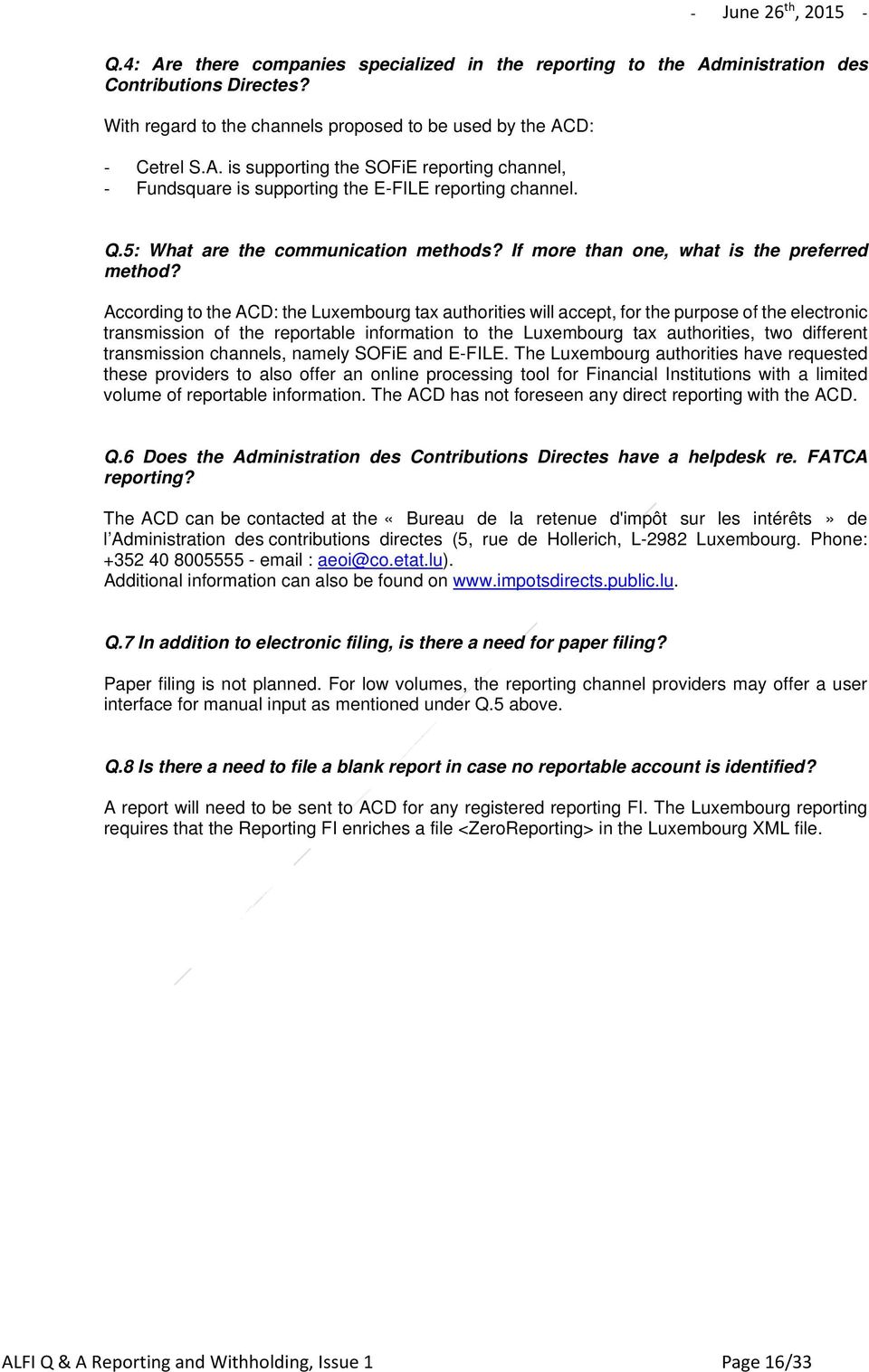
17 ii) Functional requirements of reporting Q.1 How is the Luxembourg reporting file structured? The reporting file has a specific local structure with the inclusion of principles of the IRS file. The file is structured as detailed hereafter: Figure: Structure of the ACD reporting files (extract of the ACD Circular ECHA n 3) The structure includes: Level 1: root of the ACD reporting file Level 2: refers to the aim of the reporting file. The value will refer to FATCA. In case the ACD uses the same reporting principles for other regulations, the attribute may then refer to the other regulations (e.g. CRS or DAC2) Level 3: is composed of: Unique Reference ID of the file (structure to be consulted in ACD Circular ECHA n 3 section 3.2), Identification of the Depositor (i.e. entity that technically sends the files with contact details only for ACD / not sent to IRS), Identification of the Declarer (which usually will also be the reporting FI with contact details only for ACD / not sent to IRS), GIIN of the declarer, Report content with the reporting period, a specific field in case of Zero report and the section that will be used for transmission to the IRS. The latest section is based on principles of the FATCA v1.1 schema of the IRS. The depositor and declarer contact details aim for ACD to be able to contact the entities in case of an issue or additional information required by ACD. ALFI Q & A Reporting and Withholding, Issue 1 Page 17/33
18 Q.2 How can correction be made on reports? Four files type exist, depending on the type of corrections: FATCA 1: initial reporting file. Does only contain new information. FATCA 2: contains only corrections sent after request by US authorities (i.e. IRS), FATCA 3: cancellation of data already sent, FATCA 4: contains only correction made at the initiative of the declarer. Q.3 How to handle a status change of an investment fund? In case of change of classification of an investment fund from a non-reporting to a reporting status, then the reported items included in the report should start from the 1 st of January of the effective year of the change of circumstances or the change of classification. Q.4 How to handle reporting in case of identification of change of circumstances within the 90 days before end of reporting period? With proof at end of year: once the situation is cured within the 90 days period (and if this is a true change) the account has to be considered as a non-reportable account unless the account holder is a US person or an NPFFI. Without proof at end of year: continue curing process until end of 90 days period and do not report on the current period. At the end of 90 days period, if the curing tasks are not finalized, the account becomes reportable. The account becomes reportable at the moment of the validation of the change of classification. You may also wish to refer to ALFI General Q&A on FATCA, section (7) Change in circumstances, page 67 for additional information on the implications of a change in circumstances. Q.5 In terms of delegation of reporting tasks, should there be any incorrect reporting provided to the ACD, who will be contacted by the ACD? Should an error be detected by the ACD, the ACD will contact the persons mentioned in the contact details sections of the Declarer and of the Depositor. Q.6 In the case of TA accounts opened in the name of CSD (Clearstream or Euroclear) with the current TA of the fund, legally the CSD (being paying agent) is bound to the identification process of the underlying and ultimate beneficiary. As such, is the CSD in charge of reporting accordingly to the ACD for those accounts? The CSD will need to be identified and documented as a shareholder in the register. As FFI the CSD should satisfy its own reporting obligations. In case of intermediaries, it is key to understand who holds the custodial accounts. Only entities holding custodial accounts should be in a position to report. Please refer to the FATCA Q&A of ALFI (Issue 2 published on May 6th, 2014) which may be downloaded from ALFI s website for further details on distribution channels Section 2 FATCA status and Registration requirements under Annex II, - b) Non-reporting FIs (4) Distribution Channels 1.g) for different Types of CSDs / ICSDs. ALFI Q & A Reporting and Withholding, Issue 1 Page 18/33
19 Q.7 How to consider the reporting requirements in case the nominee name is completed by the sub-nominee, distributor or final investor (ex. "nominee - distributor 1")? It depends on who has the custodial account. Only reportable custodial accounts should be reported. Please refer to the FATCA Q&A of ALFI (Issue 2 published on May 6 th, 2014) which may be downloaded from ALFI s website for further details on distribution channels Section 2 FATCA status and Registration requirements under Annex II, - b) Non-reporting FIs (4) Distribution Channels. Q.8 How do you report bearer shares that are in circulation or under custody in a safe? It is expected that the Luxembourg FATCA law will specifically deal with the treatment of bearer shares in the context of FATCA. Q.9 How to handle Dormant accounts in the reporting? If a Dormant account has a position in an investment fund and if it is classified as a Reportable account because US indicia have been identified, in this case it should be reported. Like for other accounts, the timeframe for preexisting accounts should be considered in the same way for dormant accounts (e.g. 1 or 2 years depending on the account type). Q.10 Which data need to be reported for FY 2014? With respect to: i. each Specified US Person holding a US Reportable Account; and ii. each Specified US Person being a Controlling Person of a Passive NFFE holding a Financial Account, Reporting Luxembourg Financial Institutions shall report: Name; Address; US TIN or date of birth (where applicable); Account number or functional equivalent; Name and GIIN of the Reporting Luxembourg Financial Institution; Account balance or value at year-end (or as of the date before closure if the account was closed in the course of the year). Reporting obligations apply with respects to 2014 to any new account starting on or after 1 July For pre-existing accounts, if classification is finalized as of 31 December 2014, then reporting obligations apply. For pre-existing accounts, if classification is not finalized as of 31 December 2014, the account does not need to be included in reporting ALFI Q & A Reporting and Withholding, Issue 1 Page 19/33
20 Q.11 Which data need to be reported for FY 2015 and following? With respect to: i. each Specified US Person holding a US Reportable Account; and ii. each Specified US Person being a Controlling Person of a Passive NFFE holding a Financial Account, Reporting Luxembourg Financial Institutions (in the scope of this document, the investment fund) shall report the same information as 2014 plus the following: Total gross amount that the fund distributes on the reportable account (also considered as dividends under FATCA); Total gross amount of interest paid by the funds (i.e. Microfinance funds issuing notes); Total gross proceeds from the sale or redemption of shares (directly from the shareholder register as described in IGA Article 2, subparagraph 2(a)(7)). With respect to each Non-Participating Financial Institution, Luxembourg Reporting Financial Institutions shall report the name of the NPFFI and the aggregated amount of payments. Reporting obligations apply with respects to 2015 to any new account starting on or after 1 st July For pre-existing accounts, if classification is finalized as of 31 December 2015, then reporting obligations apply. For pre-existing accounts, if classification is not finalized as of 31 December 2015, the account does not need to be included in reporting Q.12 Which data need to be reported for FY 2016? As of FY 2016, the same rules as FY 2015 will apply. Based on current information, this is the same for the following years. Reporting of Passthru Payments and the Passthru Payment Percentage may be further detailed. Please note that investment positions held indirectly via nominees may follow a different approach for the reporting. Q.13 How to aggregate amounts? For account positions under a same GIIN: As long the shareholder holds still shares at year-end, only the aggregated value of the shares held at year end are reported as value at year-end. If within a same GIIN, a shareholder holds shares in multiple classes, only the remaining position is to be considered as value at year-end, even if the investor redeemed of some shares classes within the year. In case the shareholder redeems from all its share classes within the same year, the value to be reported is the last value of the position that can be extracted (i.e. day before or value of the redemption by considering gross proceeds). ALFI Q & A Reporting and Withholding, Issue 1 Page 20/33
21 For transactions: There is a difference for transactions of reportable US-Person: o Split between interests, dividends and gross proceeds; For transactions of NPFFI: o Full aggregation of all payments made. Aggregation is based on the payments made from the fund to the investor. Subscriptions are not in the scope of the aggregation. When aggregating the accounts of multiple currencies (e.g. multiple share classes), it is required to use a published foreign exchange rate. The source of publication is not imposed. The foreign exchange rules used for the account valuation of the investment funds and used for fund publications could be used for the reporting. Q.14 Which date should be considered (e.g. trade date vs. settlement date)? The date when the investor becomes a shareholder should be considered for reporting date. Q.15 In case of merger between 2 sub-funds, what are the processes to follow to prepare the next FATCA reporting? In case of merger between 2 sub-funds, the new sub-fund which results from the merger, if it is a reporting FI, will need to comply with the reporting requirements as of the day of the merger. If the entity is a reporting FI and classified at Umbrella level, in this case, the merger of the 2 subfunds (from the same Umbrella) does not impact the reporting. Q.16 How to handle migrations of funds between 2 TAs? In case of migration of funds between two Transfer Agents, the full history of the reporting year will need to be considered by the fund when performing the reporting. Q.17 How to handle migrations of funds (from active fund into an empty structure)? In case of a migration from an active fund into an empty structure, the reporting will need to be performed under each GIIN number (if the entities do not have the same GIIN number). This could be at sub-fund or umbrella fund level. Q.18 How to handle liquidation of SICAVs and the liquidation period? Reporting needs to be performed under the GIIN number of the funds. If it is a reporting FI, reporting may continue until the fund is fully liquidated. The liquidator may define the best approach to perform the last reporting. The liquidator may also modify the Point of Contact on the IRS portal. After full liquidation of the company and closing of the company number at the Trade and Companies Register, the IRS registration should be cancelled. The final reporting will still need to be performed to the IRS at the next reporting date for the year the entity has been closed. Unless another entity has been appointed, deregistration and last reporting is performed by the liquidator. The approach is similar whether the fund is a SICAV or an FCP. ALFI Q & A Reporting and Withholding, Issue 1 Page 21/33
22 Q.19 For the reporting of account balance or value, for valuation purposes, how to handle assets denominated in a foreign currency? Reporting can be performed in any currency. When aggregating the accounts of multiple currencies, it is required to use a published foreign exchange rate. The source of publication is not imposed. The foreign exchange rules used for the account valuation of the investment funds and used for fund publications could be used for the reporting. iii) Reporting organization and relations in the fund industry Q.1 How does sponsoring work for the reporting? Only in case a US reportable account (including NPFFI accounts for reporting in 2015 and 2016) is identified by the Sponsoring Entity (in a Luxembourg domiciled Sponsored Entity): - Until 31 December 2015, the sponsor reports for the sponsored entity under its own GIIN if the Sponsored Entity did not receive its GIIN at the year end of the reporting. As of 2016, the sponsor reports for the Sponsored Entity under the GIIN of the Sponsored Entity. - No reporting by the Sponsoring Entity on behalf of the Sponsored Investment Entity is required if no U.S. Reportable accounts and no Nonparticipating FFIs are identified. - Should the Sponsoring Entity identify any U.S. Reportable Accounts, the Sponsoring Entity must register the Sponsored Investment Entity with the IRS, to obtain the GIIN dedicated to the Sponsored Investment Entity, before 01 January 2016 (or after this date if such identification takes place after 31 December 2015). At the time the present document is produced, the IRS is not yet ready to allow for such registration and to assign a GIIN for Sponsored Entities. The ensuing annual reporting would be undertaken by the Sponsoring Entity using the Sponsored Investment Entity s GIIN for the calendar year 2015 and for each following year. Should the U.S. Reportable Account in the Sponsored Investment Entity be identified already in 2014, then the Sponsoring Entity may have to report such accounts under the GIIN of the Sponsoring Entity for the reporting period of Should the Sponsoring Entity identify accounts of Nonparticipating FFIs of the Sponsored Investment Entity then the IGA does not mention the need for a registration of the Sponsored Investment Entity. But as the Sponsoring Entity agreed, according to the Annex II of the Model 1 IGA, to perform all due diligence, withholding, reporting and other requirements that the Sponsored Investment Entity would have been required to perform if it were a Reporting FI, the Sponsoring Entity may have to report the Nonparticipating FFI accounts under its own GIIN. - A Sponsoring Entity is not required to file a nil return. Note that if a Sponsoring Entity is also a Reporting FI, it may of course need to file a nil return under its Reporting FI GIIN. Q.2 Is it possible to delegate reporting tasks? The delegation of tasks to third parties is allowed, subjects to conditions and limits set out in the IGA entered into between Luxembourg and the U.S., as well as the Luxembourg Law on the Financial Sector (e.g. may include requirements of the CSSF circulars on outsourcing).. Nevertheless, the work is delivered on behalf of the Reporting FI. The GIIN to be used in the reports is the GIIN of the investment fund that delegates the work to a third party. Please note that only operational tasks can be outsourced and delegated, but not the ultimate legal responsibility. The reporting FI that will be mentioned in the file needs to be detailed in the section related to the Declarer. The entity that performs the reporting will provide its identification information in the section related to the Depositor. ALFI Q & A Reporting and Withholding, Issue 1 Page 22/33
23 Both sections, Declarer and Depositor, are only used by the ACD in case of questions. These fields will not be sent to the IRS. Q.3 Where are the information to be reported for reporting FIs that are part of the fund industry? Like for any reporting FI domiciled and registered in Luxembourg, reporting needs to be performed to the ACD. Q.4 What is the role of the TA? The Transfer Agent is a Service provider to the fund. As the TA usually performs investors due diligence and monitors the client positions, the TA is often in the (operational) capacity and could prepare the reports for the funds. Nevertheless, these tasks are performed on behalf of the legal responsible governing body (for investment funds in form of a FCP it is the Management Company, for investment funds in the form of a SICAV it is the Board of Directors). Should the TA file the reports with the ACD, it is performed under an agreement between the TA and the legally responsible entity. In this case, the TA will be mentioned as the Depositor of the reporting file. Q.5 What is the role of the investment fund depositary? Within the reporting, the depositary will assist in the determination of the total value of the investment fund that will support the determination of the value per share. As a result, the depositary may intervene in the determination of the value per account. Q.6 What is the role of the Management Company? The Management Company may assist the investment fund in the execution of its reporting tasks. Unless the Management Company is the sponsor of the investment fund or is acting on behalf the investment fund in the form of a FCP, in which case the Management Company has the ultimate legal responsibility, or has been appointed by the Board of Directors to ensure compliance with FATCA obligations (for investment funds in the form of a SICAV), it does not have a defined role determined by the tax authorities with regards to the reporting to the ACD. The role of the Management Company is further to perform the respective review and in case of outsourcing operational tasks, perform as well the outsourcing controlling on FATCA as per defined outsourcing agreement. Q.7 What is the role of the distributor? Depending on the organization of the distribution channels, please refer to the FATCA Q&A of ALFI (Issue 2 published on May 6th, 2014) which may be downloaded from ALFI s website for further details on distribution channels Section 2 FATCA status and Registration requirements under Annex II, - b) Non-reporting FIs (4) Distribution Channels. Q.8 What is the role of a nominee? Depending on the organization of the distribution channels, please refer to the FATCA Q&A of ALFI (Issue 2 published on May 6th, 2014) which may be downloaded from ALFI s website for further details on distribution channels Section 2 FATCA status and Registration requirements under Annex II, - b) Non-reporting FIs (4) Distribution Channels. ALFI Q & A Reporting and Withholding, Issue 1 Page 23/33
24 Q.9 What is the role of a sponsoring entity? If the sponsored entity holds accounts that need to be reported, the sponsoring entity will perform the reporting on behalf of the sponsored entity. In certain cases, an FI can be Non-reporting if another entity will agree to be its sponsor and take on FATCA withholding and reporting responsibilities on its behalf. A sponsoring entity is not liable for any failure to comply with the obligations placed upon the sponsored entity unless it is a withholding agent that is separately liable for a failure to withhold or report with respect to a payment made to the sponsored FI. In cases where the sponsoring entity is a withholding agent that is separately liable, then the sponsored FI remains jointly liable with the sponsoring entity. Q.10 Is the ACD accepting that reporting be provided by the mandated TA or have they to be provided by the responsible entity (e.g. Management Company)? As long as the ACD receives the information, it will treat it accordingly. It is allowed to delegate operational work to a third party. The GIIN to be used is always the GIIN from the Reporting Entity of which the report refers to. However, in case of queries by the ACD, these will be addressed to the persons mentioned in the contact details section for both the Depositor and Declarer as provided in the reporting file. iv) Legal and operational responsibilities Q.1 What are the responsibilities on a wrong reporting? In case of wrong reporting, the report should be corrected. Timeframe and penalties may be defined by law. The ultimate FATCA legal responsibility always lies with: - For all legal forms of corporate fund types like SICAV, SICAF, SICAR, etc., the Board of Directors, - For an FCP, the Management Company, - For a Management Company, the Management Company itself, - For a Sponsored Entity, the Sponsored Entity itself, - For a case where the Sponsoring Entity is a withholding agent that is separately liable, the Sponsored Entity remains jointly liable with the Sponsoring Entity. Under the final regulations, an FFI remains liable for its withholding and reporting obligations under chapter 4 even if a sponsoring entity performs these responsibilities on behalf of such FFI. In response to comments, these temporary regulations modify the final regulations to clarify that a sponsoring entity will not be jointly and separately liable for the sponsored FFI s obligations unless the sponsoring entity is also a withholding agent that is separately liable for such obligations. Although facing a situation of giving a declaration, the Point of Contact cannot be pushed taking over a formal or even legal liability. In case of operational delegation of work to a third party (not linked to work performed in the case of a sponsoring relationship), the ultimate responsibility stays with the Reporting Entity. The main operational responsibilities are then defined in the outsourcing agreement or in the operating memorandum. Q.2 What are the consequences of a wrong reporting? Timeframe for correction and penalties may be defined by law, decree or a circular. Ultimate consequences could also be defined by a first court decision. Processes of correction are part of the list of available FATCA files (1, 2, 3 and 4). ALFI Q & A Reporting and Withholding, Issue 1 Page 24/33
25 Q.3 Who is responsible for the accuracy of the data provided to the Administration des Contributions Directes? The ultimate legal and operational responsibility remains with the reporting FI. Q.4 In case a Luxembourg service provider administers funds domiciled in other jurisdictions, to whom is the service provider responsible in regards to the services provided to the foreign funds? If a Luxembourg service provider provides services to a fund domiciled outside Luxembourg, the services may need to comply with the requirements detailed in the jurisdiction of the fund (outside Luxembourg). v) Technical requirements of reporting Q.1 Will the 1099 reporting (US Payers) be communicated through the same channel? Or will the 1099 reporting be substituted by the FATCA Administration des Contributions Directes reporting? Chapter 3 and chapter 4 reporting requirements should not be mixed. Potential 1099 reporting is only applicable to financial institutions that are qualified intermediaries (typically banks). Q.2 How / where can the file format be obtained? Detailed information of the reporting file are included in Luxembourg circular ECHA n 3. The circular may be revised from time to time. Q.3 Will the Administration des Contributions Directes acknowledge the file receipt? The ACD will acknowledge good reception of the files. Confirmation of acceptation or rejection is sent to the report Depositor. Q.4 Is a test environment available? The ACD makes a test platform available to future depositors. The data sent on the test platform should not contain nominative data. A difference is made between test files and production files based on the naming convention of the XML file. Q.5 Can data sent to the ACD be consulted? Such action is not yet defined and may be subject to restrictions related to data confidentiality. ALFI Q & A Reporting and Withholding, Issue 1 Page 25/33
26 3) FATCA Withholding work stream i) FATCA withholding tax obligations for Luxembourg based funds based on Luxembourg IGA Q1: What type of income/ proceeds can be subject to FATCA withholding tax under the IGA? Under article 4 of the IGA only US source withholdable payments are subject to FATCA withholding to the extent they are paid to Non-Participating FFI (NPFFI). US source withholdable payments are included in the definition section of the IGA and includes any payment of interest (including any original issue discount), dividends, rents, salaries, wages, premiums, annuities, compensations, remunerations, emoluments, and other fixed or determinable annual or periodical gains, profits, and income, if such payment is from sources within the United States. Such payment also needs to be treated as a withholdable payment in relevant U.S. Treasury Regulations. Q.2: Are dividend distributions/ redemptions paid by Luxembourg investment funds considered as withholdable payments under the IGA? Generally, the payment of distributions or redemption proceeds (as well as potential interest payments) made by a Luxembourg investment fund to its investors cannot be considered as withholdable payment under the IGA, as it is not paid from sources within the United States, but from sources within Luxembourg. Such payments should consequently not be subject to FATCA withholding. Specific rules may need to be addressed if the Luxembourg fund is considered as a tax transparent entity under US rules or Luxembourg rules (see section ii) below). Q.3: What is a Passthru Payment (PP)? Is it applicable under the IGA? The Final and Temporary Treasury Regulations consider the potential inclusion of Passthru Payments in (h). The idea was to include in the list of withholdable payments income indirectly derived (through foreign entities) from US source. Implementation is postponed to January 1 st 2017 at the earliest. Under the IGA context, this concept should not be implemented but could be replaced by other anti-abuse provisions. Article 6.2 of the Luxembourg IGA includes the following comments The Parties are committed to work together, along with Partner Jurisdictions, to develop a practical and effective alternative approach to achieve the policy objectives of foreign Passthru payment and gross proceeds withholding that minimizes burden. ALFI Q & A Reporting and Withholding, Issue 1 Page 26/33
27 Q.4: Are Luxembourg investment funds considered as US paying agents under the Luxembourg IGA Under the Luxembourg IGA (article 4.1.d), only certain categories of FFI that are acting as US withholding agents will have primary FATCA withholding responsibilities towards the IRS, i.e.: qualified intermediaries (QI) that have elected to assume primary withholding responsibility under chapter 3, withholding foreign partnerships that have elected to act as a withholding foreign partnership (for purposes of both sections 1441 and 1471), withholding foreign trust that have elected to act as a withholding foreign partnership (for purposes of both sections 1441 and Generally, Luxembourg investment funds do not qualify for any of those US statuses, meaning they will have no direct FATCA withholding responsibility towards the IRS. To be noted that under Article 4.1.e of the IGA, Luxembourg investment funds being FFI, they are required to provide the upstream US withholding agent with information (withholding statements, W8 forms) allowing the correct application of chapter 4 (FATCA) withholding tax on US withholdable payments. According to the IGA, a Reporting Luxembourg Financial Institution that makes a payment of, or acts as an intermediary with respect to, a U.S. Source Withholdable Payment to any Nonparticipating Financial Institution, the Reporting Luxembourg Financial Institution provides to any immediate payor of such U.S. Source Withholdable Payment the information required for withholding and reporting to occur with respect to such payment. However, because Luxembourg investment funds will generally not pay US source income to their investors, this provision should not apply. Specific rules may need to be addressed if the Luxembourg fund is considered as a tax transparent entity under US rules or Luxembourg rules (see section ii) below). Q5: Under which circumstances an entity will be NPFFI under US tax regulations Under IRS regulations, the term nonparticipating FFI (NPFFI) means an FFI other than a participating FFI (PFFI), a deemed-compliant FFI or an exempt beneficial owner. However, a withholding agent must treat a payee as an NPFFI if: the withholding agent can reliably associate the payment with a withholding certificate (i.e., Forms W-8) identifying the payee as an NPFFI, the withholding agent knows or has reason to know that the payee is an NPFFI, the withholding agent is required to treat the payee as an NPFFI under the presumption rules [ (d)(8)(i)]. Because Luxembourg investment funds are located in an IGA jurisdiction, this definition should not be applied by their US withholding agents (see Q6). ALFI Q & A Reporting and Withholding, Issue 1 Page 27/33
28 Q6: Under which circumstances an entity will be considered as NPFFI under a model 1 IGA The status of NPFFI is defined in the IGA as: a non-luxembourg and non IGA country entity that is defined as NPFFI under US regulations, a Luxembourg or partner country entity defined as NPFFI under the IGA, Based on the IGA, a Luxembourg reporting FI shall not be subject to the withholding applicable to NPFFI unless such Reporting Luxembourg FI is treated by the IRS as a NPFFI in application of subparagraph 2(b) of Article 5 of the IGA. In article 5.2 of the IGA, a Luxembourg FFI will be classified as NPFFI only in case of significant noncompliance with its FATCA obligations This can only be the result of a specific procedure where: Significant non-compliance related to registration or reporting was identified by the IRS or the Luxembourg tax authorities and notified to the Luxembourg FFI, Luxembourg authorities apply Luxembourg law to address the non-compliance of the FFI, The Luxembourg FFI does not resolve the significant non-compliance within 18 months of the notification, After this 18 months period and based on the information provided by the Luxembourg tax authorities, the IRS will classify the Luxembourg reporting FI as NPFFI. It is not known if a list of such NPFFI will be issued by the IRS. Q7: Will investors qualifying as NPFFI be subject to FATCA withholding from the Luxembourg investment fund in which they invest? Except as provided for in the specific case of transparent funds (as outlined in the following section ii) Potential impact of tax transparence on Luxembourg funds ) and based on the above, Luxembourg investment funds will never apply FATCA withholding on distributions, redemption proceeds and interest payments made to their investors, even if they qualify as NPFFI, as these do not qualify as US source income. ALFI Q & A Reporting and Withholding, Issue 1 Page 28/33
29 ii) Potential impact of tax transparency on Luxembourg funds Q1: under which situation is a Luxembourg Fund considered as tax transparent under US rules? Under US tax rules and US tax treaties, US withholding tax (chapter 3 withholding) is applicable to the beneficial owner of US source payments where FATCA withholding under the IGA is applicable to US withholdable payments made to NPFFI, independently of the fact that the NPFFI is the beneficial owner of the payment under US tax rules. As a consequence, custodians and US withholding agents of Luxembourg investment funds will need to identify both chapter 4 (FATCA) and chapter 3 (US / treaty rules) status of the Luxembourg investment funds. The identification of potential withholding tax liability under chapter 3 and chapter 4 will generally be made through the information included in the W8 forms to be delivered by the Luxembourg fund to its custodian. The chapter 4 (FATCA) status of a Luxembourg fund is determined at fund level, and US tax transparency rules should have no direct impact on this status. This is due to the fact that the US tax status of disregarded entity is not recognized in an IGA situation: the fund will be recognized as the payee of US source income for chapter 4 purposes. The chapter 3 (US / treaty rules) status is determined at beneficial owner level. A Luxembourg investment fund will not always be recognized as the beneficial owner of the US source income it receives. Based on US tax rules, foreign partnerships or disregarded entities are not the beneficial owners of the US source income they received. The beneficial owners of income paid to a foreign partnership are generally the partners in the partnership, provided that the partner is not itself a partnership, foreign simple or grantor trust, nominee or other agent. If Luxembourg tax rules also consider the fund as tax transparent, investors into the fund will be considered receiving directly US source income through the fund. Q2: What type of Luxembourg investment fund is always recognized as the beneficial owner of US source income under US tax rules? When a Luxembourg investment fund established as a SICAV takes the form of a Société Anonyme (public limited company) it is always considered as a corporation per se and consequently as the beneficial owner of the income derived from US sources. Q3: What type of Luxembourg investment fund is not always considered as the beneficial owner of US source income under US tax rules? Other legal forms of funds such as FCP, SARL, SCA, SCS (common limited partnerships or sociétés en commandite simple) or SCSp (special limited partnerships or sociétés en commandite spéciale) may opt for a classification as corporation or partnership (or will be subject to default rules). If they are classified as a partnership for US tax purposes they will not be considered as the beneficial owner of the US source income they receive from their custodian. If such entities are partnership for US purposes but are considered as opaque for Luxembourg purposes, they will be classified as Hybrid entity for the application of US tax rules meaning the Fund will be the payee of the income and a FFI for FATCA purposes but the beneficial owners of the US source income will be the investors under US tax rules. ALFI Q & A Reporting and Withholding, Issue 1 Page 29/33
30 The circular LIR 14/4 issued by the Luxembourg tax authorities on January 9th, 2015, is specifically dealing with the Luxembourg tax treatment of transparent funds such as SCS or SCSp. A classification for US rules as partnership with a single investor may lead the fund to be classified as a disregarded entity under US tax rules, meaning any income is deemed paid directly to the investor as if the fund did not exist. Here again the Luxembourg fund will be considered as payee and FFI of US source income under FATCA rules, but the US source income is deemed paid directly to the single investor who will be the beneficial owner of the US source income under US tax law Q4: What is the impact of a fund being considered as tax transparent in Luxembourg? FCP, SCS and SCSp are generally viewed as tax transparent in Luxembourg. This will however not modify the fact that the fund is an FFI under the IGA. If such vehicles are also considered as partnership under US tax rules, the investors into the fund will be the beneficial owners and will potentially gain access to treaty benefits with the USA, meaning that the Fund is deemed paying directly US source income to the investors. Otherwise the fund will be considered as a reverse hybrid under US tax rules (non-transparent in USA, transparent in Luxembourg) ALFI Q & A Reporting and Withholding, Issue 1 Page 30/33
31 Q5: What are the impact of US classification in term of documentation? US classification of the Fund under US rules Status: Chapter 4 Documentation Chapter 4 Fund Status Chapter 3 Forms Chapter 3 Corporation per se: SA, Corporation under default rules: sarl, SCA FFI W-8 BEN-E Fund is beneficial owner W-8 BEN-E of Fund Partnership (non Disregarded Entities) FFI W-8 IMY / withholding statements Partners are beneficial owners (transparency) W-8 BEN/ BEN E or W9 of investors / Withholding statements Disregarded Entity (in IGA country) FFI W-8 BEN-E Fund Disregarded : owner is beneficial owner W-8 BEN/ BEN E or W9 of investors withholding statements Q6: what is the potential impact of tax transparency on Luxembourg Investment Funds? When paying US source income, custodians/ US paying agents will need to determine the FATCA status of the fund as well as the tax status of the investors into the Fund if the Fund is tax transparent. Custodian/ US paying agent may need to check the US classification/ election of the fund to identify if the fund is opaque and effectively the beneficial owner of US source income or if it is transparent and investors are the beneficial owners of US income for application of chapter 3 withholding taxes. If the fund receiving US source income and acting as an FFI is considered as tax transparent under US tax rules, it will be required under the IGA to pass the information related to the investors (i.e. direct or indirect beneficial owners) to the Custodian/ US paying agent. Failing to do so, US source income otherwise not subject to FATCA or chapter 3 withholding may suffer a 30% US withholding tax. ALFI Q & A Reporting and Withholding, Issue 1 Page 31/33
32 iii) Risk of direct FATCA withholding tax charge at the level of the fund. Q1: under which circumstances will a Luxembourg fund be considered as a NPFFI subject to chapter 4 withholding? As stated above, the Luxembourg Fund will be considered a NPFFI under the IGA and will consequently be subject to FATCA withholding tax by its custodian/ US withholding agent only in case article 5.2 of the IGA is applicable. Under this article, a Luxembourg FFI will be classified as NPFFI only in case of significant noncompliance with its FATCA obligations. Q2: What type of document should be made available to the custodian in order to avoid NPFFI status? If the Fund is not transparent under US tax rules, providing a form W-8BEN-E (or an approved local self-certification under the IGA) should be sufficient in order to assess the chapter 4 status of the Fund. If the Fund is transparent under US tax rules, providing a form W-8IMY and withholding statements/ forms related to the investors may be required. Q3: What is the timing for providing documentation to the custodian under the IGA? The required forms must have been provided well in advance before the end of 2014, knowing that FATCA withholding may apply as from January 1 st 2015 in an IGA situation. Q4: Is a FATCA withholding tax suffered by a Luxembourg fund recoverable? Luxembourg funds should claim a refund if they suffer a FATCA withholding without having received a notification from the Luxembourg tax authorities that the fund has lost its reporting model 1 FI/ non reporting FI status. Q5: what are the specific risks associated with tax transparency rules? For funds that are considered tax transparent both in Luxembourg and in the US, investors into the Fund can potentially gain access to US tax treaties. It will be very important for such funds to register (if required) and to justify the FATCA status to their custodian/ US Paying agent. If not FATCA withholding will potentially apply and investors will lose the advantages associated with treaty benefits. ALFI Q & A Reporting and Withholding, Issue 1 Page 32/33
33 iv) Risk of indirect withholding tax charge at the level of the fund Q1: How can the situation of investors impact withholding at the level of the fund In case the fund is tax transparent under US tax rules, custodians / US paying agents will require information on the tax situation of investors that may impact withholding tax applicable on US source income made to the Fund. This will be the case for instance if one investor becomes a NPFFI: A fund being a Reporting model 1 FI or a Non-reporting FI is normally not subject to FATCA withholding but will not get access to reduced treaty rates (chapter 3 withholding). If the fund is tax transparent, it will be required to inform its paying agent regarding the FATCA status of its investors. The fund will be subject to FATCA withholding on the share of US source income attributable to investors being NPFFI despite the fact that the fund itself is FATCA compliant, such a withholding tax will impact the NAV of the fund and potentially all investors into the fund. If the fund benefited from a Non-reporting status such as Collective Investment Vehicle, this status may be lost in case an investor will become NPPFI. If this is the case, FATCA withholding will apply on the share of income of all investors into the fund. Q2: what are the specific risks associated with fund of fund/ master-feeder structures? Fund managers should pay attention to the FATCA status of the funds they acquire. It may happen that the target fund in a fund of fund structure has a NPFFI status under chapter 4 regulation. In this case, the fund of fund may suffer indirect withholding due to the status of the target fund if the target fund is invested in US assets. It s recommended that the administrator of the fund of fund ask for a confirmation of the status of the target funds (W-8BEN-E form) to prevent suffering an indirect withholding tax. ALFI Q & A Reporting and Withholding, Issue 1 Page 33/33
FATCA Q & A Issue 12 Luxembourg, April 15thMay 6th, 2014
 Q & A Issue 12 Luxembourg, April 15thMay 6 th, 2014 Important This Q&A document was prepared by ALFI's implementation working groups for the U.S. Foreign Account Tax Compliance Act (). The working groups
Guidance for companies, trusts and partnerships on completing a self-certification form
 Guidance for companies, trusts and partnerships on completing a self-certification form In order to combat tax evasion by both individuals and businesses, the UK and many other countries have entered into
Foreign Account Tax Compliance Act (FATCA) Entity Questionnaire
 SIPP ISA Dealing Junior ISA Foreign Account Tax Compliance Act (FATCA) Entity Questionnaire This form must be completed by all new entities (customers who are not individuals) as part of our account opening
FATCA FAQs: Frequently asked questions on the Foreign Account Tax Compliance
 www.pwc.com/us/fatca July 2011 FATCA FAQs: Frequently asked questions on the Foreign Account Tax Compliance Act 1. What is FATCA? FATCA is an acronym for The Foreign Account Tax Compliance Act (FATCA)
US FATCA FAQ and Glossary of FATCA terms
 US FATCA FAQ and Glossary of FATCA terms These FAQs are intended to aid you in your understanding how FATCA affects your relationship with UBS. This is not intended as tax advice. If you are uncertain
The Following pages contain an example of a form that could be used to collect data from entities in relation to the CRS.
 February 2016 Guidance for Financial Institutions Requesting the Form The Following pages contain an example of a form that could be used to collect data from entities in relation to the CRS. This form
Foreign Account Tax Compliance Act FATCA Onboarding Requirements for Payees U.S. Financial Institutions
 Paris New York London Rome Milan Casablanca Dubai Amsterdam Brussels Hong Kong Singapore Foreign Account Tax Compliance Act FATCA Onboarding Requirements for Payees U.S. Financial Institutions June 13,
This notice provides guidance to foreign financial institutions (FFIs) entering into
 Part III Administrative, Procedural, and Miscellaneous FFI agreement for Participating FFI and Reporting Model 2 FFI Notice 2013-69 SECTION I. Purpose. This notice provides guidance to foreign financial
Entity Self-Certification
 Entity Self-Certification Tax regulations 1 require us to collect certain information about each investor s tax residency and tax classifications. In certain circumstances (including if we do not receive
Foreign Account Tax Compliance Act (FATCA) Frequently Asked Questions
 Foreign Account Tax Compliance Act (FATCA) Frequently Asked Questions For Momentum Retail (excluding Momentum Wealth International) General FATCA questions 1. What is FATCA? FATCA is the acronym for the
Implementation of The International Tax Compliance (United States of America) Regulations 2013. Guidance Notes
 Implementation of The International Tax Compliance (United States of America) Regulations 2013 Guidance Notes 14 August 2013 1 Guidance Contents 1. Background 1.1 The purpose of these Guidance notes 1.2
3. The term Financial Institution means a Custodial Institution, a Depository Institution, an Investment Entity, or a Specified Insurance Company.
 Common Reporting Standard ( CRS ) Defined Terms Extracted from The Tax Information Authority (International Tax Compliance) (Common Reporting Standard) Regulations 2015 of the Cayman Islands. A. Reporting
UPDATED INFORMATION ON USE OF FORM W-8IMY (REVISION DATE FEBRUARY 2006) BEFORE JANUARY 1, 2015
 UPDATED INFORMATION ON USE OF FORM W-8IMY (REVISION DATE FEBRUARY 2006) BEFORE JANUARY 1, 2015 This Form W-8IMY (revision date April 2014) reflects the changes made in the Foreign Account Tax Compliance
How To Comply With The Foreign Account Tax Compliance Act
 PRESENTATION ON THE FOREIGN ACCOUNT TAX COMPLIANCE ACT (FATCA) FOR CONSULTATIONS WITH THE INDUSTRY Prepared for the Meeting with ECCU Non-Bank Financial Institutions February 2014 EASTERN CARIBBEAN CENTRAL
The Foreign Account Tax Compliance Act (FATCA)
 The Foreign Account Tax Compliance Act (FATCA) I. OVERVIEW A. What is FATCA? FATCA, as it is colloquially known, refers to Chapter 4 of the US Internal Revenue Code, which was enacted by the Hiring Incentives
Version 3.0 (29.07.2014) Table of Contents
 Guidelines for the implementation of the FATCA Agreement and the FATCA Regulations in Malta issued in terms of Article 96(2) of the Income Tax Act (Chapter 123 of the Laws of Malta) Version 3.0 (29.07.2014)
Simplified Instructions for Completing a Form W-8BEN-E
 Simplified Instructions for Completing a Form W-8BEN-E For Non-Financial Institutions Only Updated April 2015 Circular 230 Disclaimer: Any tax advice contained in this communication is not intended or
Agreement between the United States of America and the Kingdom of the Netherlands to Improve International Tax Compliance and to Implement FATCA
 Agreement between the United States of America and the Kingdom of the Netherlands to Improve International Tax Compliance and to Implement FATCA Whereas, the United States of America and the Kingdom of
How To Apply To Fataca
 The Foreign Account Tax Compliance Act (FATCA) Applying FATCA to Funds and other Collective Investment Vehicles Jonathan Sambur Partner + 1 202 263-3256 [email protected] February 2013 Mayer Brown
Agreement Between the United States of America and the Kingdom of Spain to Improve International Tax Compliance and to Implement FATCA
 Agreement Between the United States of America and the Kingdom of Spain to Improve International Tax Compliance and to Implement FATCA Whereas, the United States of America and the Kingdom of Spain (each,
TAXATION (INTERNATIONAL TAX COMPLIANCE) (JERSEY) REGULATIONS 2014 DRAFT GUIDANCE NOTES. RELEASE DATE: 9 Sept 2015
 TAXATION (INTERNATIONAL TAX COMPLIANCE) (JERSEY) REGULATIONS 2014 DRAFT GUIDANCE NOTES RELEASE DATE: 9 Sept 2015 Note : The Draft Guidance Notes have been further revised in response to requests from interested
WEBER METALS, INC. Vendor Application Form (Foreign)
 WEBER METALS, INC. Vendor Application Form (Foreign) Company Name Address (if different from W-8) Street: City County Zip Code Country Phone # Fax # (Opt.) Contact Information Contact Email Tax ID Number
TAXATION (INTERNATIONAL TAX COMPLIANCE) (CROWN DEPENDENCY [CD]) REGULATIONS 2014 GUIDANCE NOTES. RELEASE DATE: 1 April 2014
![TAXATION (INTERNATIONAL TAX COMPLIANCE) (CROWN DEPENDENCY [CD]) REGULATIONS 2014 GUIDANCE NOTES. RELEASE DATE: 1 April 2014](/thumbs/30/14089573.jpg "TAXATION (INTERNATIONAL TAX COMPLIANCE) (CROWN DEPENDENCY [CD]) REGULATIONS 2014 GUIDANCE NOTES. RELEASE DATE: 1 April 2014") TAXATION (INTERNATIONAL TAX COMPLIANCE) (CROWN DEPENDENCY [CD]) REGULATIONS 2014 GUIDANCE NOTES RELEASE DATE: 1 April 2014 Note : These draft Guidance Notes dated 1 April 2014 have been revised to reflect
TAXATION (INTERNATIONAL TAX COMPLIANCE) (CROWN DEPENDENCY [CD]) REGULATIONS 2014 GUIDANCE NOTES RELEASE DATE: 1 April 2014 Note : These draft Guidance Notes dated 1 April 2014 have been revised to reflect
Key Aspects of the FATCA Regime
 TAX CLIENT PUBLICATION May 2012... Key Aspects of the FATCA Regime... The US withholding and information reporting regime under the Foreign Account Tax Compliance Act of 2010 ( FATCA ), 1 when implemented,
Whereas, the Government of the Republic of Poland is supportive of the underlying policy goal of FATCA to improve tax compliance;
 Agreement between the Government of the Republic of Poland and the Government of the United States of America to Improve International Tax Compliance and to Implement FATCA Whereas, the Government of the
IRAS e-tax Guide. Compliance Requirements of the Singapore-US Intergovernmental Agreement on Foreign Account Tax Compliance Act
 IRAS e-tax Guide Compliance Requirements of the Singapore-US Intergovernmental Agreement on Foreign Account Tax Compliance Act Published by Inland Revenue Authority of Singapore Published on 17 Mar 2015
Agreement Between Switzerland and the United States of America for Cooperation to Facilitate the Implementation of FATCA
 Agreement Between Switzerland and the United States of America for Cooperation to Facilitate the Implementation of FATCA Whereas, Switzerland and the United States of America ( United States, each, a Party
IRS Issues Final FATCA Regulations
 IRS Issues Final FATCA Regulations The United States Internal Revenue Service (IRS) has issued long-awaited final regulations (the Final Regulations) under the Foreign Account Tax Compliance Act (FATCA).
Foreign Account Tax Compliance Act (FATCA)
 Foreign Account Tax Compliance Act (FATCA) Introduction As a global financial services organisation, it is necessary for Standard Bank to comply with the laws and regulations of many different authorities,
Foreign Account Tax Compliance Act (FATCA) Intergovernmental Agreement Model 1 Latest Updates and Requirements
 Foreign Account Tax Compliance Act (FATCA) Intergovernmental Agreement Model 1 Latest Updates and Requirements - Regulatory Timeline - Overview of Requirements - Registration Process Naidira Alemova-Goeres
Agreement 1 Between Switzerland and the United States of America for Cooperation to Facilitate the Implementation of FATCA
 Agreement 1 Between Switzerland and the United States of America for Cooperation to Facilitate the Implementation of FATCA Whereas, Switzerland and the United States of America ( United States, each, a
Sight FATCA. line of. Frequently asked questions. table of contents. November 2, 2012
 line of Sight FATCA Frequently asked questions FOR INSTITUTIONAL INVESTORS table of contents November 2, 2012 PART I PROPOSED REGULATIONS and IRS Announcement OVERVIEW 1. What is the objective of the Foreign
Instructions for the Requester of Forms W 8BEN, W 8BEN E, W 8ECI, W 8EXP, and W 8IMY (Rev. July 2014)
 Instructions for the Requester of Forms W 8BEN, W 8BEN E, W 8ECI, W 8EXP, and W 8IMY (Rev. July 2014) Section references are to the Internal Revenue Code unless otherwise noted. Future developments. For
SIGHT FATCA. line of FREQUENTLY ASKED QUESTIONS FOR FUND MANAGERS TABLE OF CONTENTS. July 2012 OVERVIEW... 2
 line of SIGHT FATCA FREQUENTLY ASKED QUESTIONS FOR FUND MANAGERS TABLE OF CONTENTS July 2012 OVERVIEW... 2 NORTHERN TRUST S ROLES AND RESPONSIBILITIES... 7 PREVENTING FATCA WITHHOLDING... 8 A PARTICIPATING
FATCA Final Regulations: Definitions List
 FATCA Final Regulations: Definitions List By Craig Cohen Chapter 4 of the Internal Revenue Code and the Treasury regulations thereunder commonly known as the Foreign Account Tax Compliance Act, or FATCA
Foreign Account Tax Compliance Act (FATCA)
 Foreign Account Tax Compliance Act (FATCA) FATCA REGISTRATION GUIDANCE NOTES Issued by Inland Revenue, New Zealand 30 July 2014 Version 1.4 [Note: These Guidance Notes replace version 1.3, dated 13 January
The Foreign Account Tax. Sharing Agreements (TISAs) to improve tax compliance. Questions and Answers
 The Foreign ccount Tax Compliance ct (FTC) and other Tax Information Sharing greements (TISs) to improve tax compliance uestions and nswers This document provides you with an overview of the FTC and the
[Mutual Legal Assistance (Tax Matters) Act, 2003 (as amended)] British Virgin Islands RELEASE DATE: [ ] JULY 2014
![[Mutual Legal Assistance (Tax Matters) Act, 2003 (as amended)] British Virgin Islands RELEASE DATE: [ ] JULY 2014](/thumbs/28/12564948.jpg "[Mutual Legal Assistance (Tax Matters) Act, 2003 (as amended)] British Virgin Islands RELEASE DATE: [ ] JULY 2014") This document is a DRAFT of the proposed Guidance Notes for the US and UK FATCA Agreements with the Government of the British Virgin Islands and at this stage it is for discussion purposes ONLY! [Mutual
This document is a DRAFT of the proposed Guidance Notes for the US and UK FATCA Agreements with the Government of the British Virgin Islands and at this stage it is for discussion purposes ONLY! [Mutual
Foreign Account Tax Compliance Act ( FATCA )
 May 2011 Foreign Account Tax Compliance Act ( FATCA ) www.steptoe.com Table of Contents Overview Definition of Foreign Financial Institution ( FFI ) FFI Agreement with IRS Preexisting Individual Accounts
Frequently Asked Questions (FAQ) FATCA
 Frequently Asked Questions (FAQ) FATCA Table of Contents General... 3 What is FATCA?... 3 What is the purpose of FATCA?... 3 When does FATCA begin?... 3 Who is impacted by FATCA?... 3 What information
GUIDANCE NOTES ON THE IMPLEMENTATION OF FATCA IN IRELAND
 GUIDANCE NOTES ON THE IMPLEMENTATION OF FATCA IN IRELAND While every effort is made to ensure that the information given in this guide is accurate, it is not a legal document. Responsibility cannot be
Supplement No. 1 published with Extraordinary Gazette No. 80 dated 16 th October, 2015. THE TAX INFORMATION AUTHORITY LAW (2014 REVISION)
 CAYMAN ISLANDS Supplement No. 1 published with Extraordinary Gazette No. 80 dated 16 th October, 2015. THE TAX INFORMATION AUTHORITY LAW (2014 REVISION) THE TAX INFORMATION AUTHORITY (INTERNATIONAL TAX
Investment Funds Application Form
 Before you sign this form you must read an up-to-date version of the Key Investor Information Document(s) where applicable for each fund in which you want to invest. These documents can be found on www.standardlifes.com
Now, therefore, the Parties have agreed as follows: ARTICLE 1. Definitions
 AGREEMENT BETWEEN THE GOVERNMENT OF THE UNITED STATES OF AMERICA AND THE GOVERNMENT OF THE UNITED KINGDOM OF GREAT BRITAIN AND NORTHERN IRELAND TO IMPROVE INTERNATIONAL TAX COMPLIANCE AND TO IMPLEMENT
FATCA Frequently Asked Questions
 FATCA Frequently Asked Questions FATCA overview 1. What is FATCA? 2. What is the impact of FATCA? 3. How do I know if I am affected? 4. When will the FATCA legislation become effective? 5. Is HSBC the
SAINT CHRISTOPHER AND NEVIS. No. of 2015 A BILL FOR
 No. of 2015. Foreign Account Tax Compliance Saint Christopher (United States of America) and Nevis. (Implementation and Enforcement of Inter-Governmental Agreement) Bill, 2015. SAINT CHRISTOPHER AND NEVIS
The International Tax Authority. Version 2.0
 The International Tax Authority GUIDANCE NOTES ON THE INTERNATIONAL TAX COMPLIANCE REQUIREMENTS OF THE LEGISLATION IMPLEMENTING THE INTERGOVERNMENTAL AGREEMENTS BETWEEN THE BRITISH VIRGIN ISLANDS AND THE
Analysis of FATCA Regulations for Foreign Financial Institutions
 Analysis of FATCA Regulations for Foreign Financial Institutions Withholding, Information Reporting February 2014 kpmg.com FATCA - Regulations on information reporting by foreign financial institutions;
FATCA AND NEW ZEALAND LAW FIRMS
 This Practice Briefing does not constitute legal advice INTRODUCTION The FATCA agreement between New Zealand and United States is directed at reducing tax evasion by US taxpayers. New Zealand law firms
THE INTERNATIONAL TAX COMPLIANCE (UNITED STATES OF AMERICA AND UNITED KINGDOM) REGULATIONS 2014 ISLE OF MAN GUIDANCE NOTES
 THE INTERNATIONAL TAX COMPLIANCE (UNITED STATES OF AMERICA AND UNITED KINGDOM) RELEASE DATE: 15 December 2014 These Guidance Notes follow previous issues that were drafted by Guernsey, the Isle of Man
and the Common Reporting Standard (CRS) issued in terms of Article 96(2) of the Income Tax Act (Chapter 123 of the Laws of Malta) Version 1.
 Guidelines for the implementation of the EU Council Directive 2014/107/EU of 9 December 2014 amending Directive 2011/16/EU as regards mandatory automatic exchange of information in the field of taxation
The Impact of FATCA on U.S. and Non-U.S. Private Equity & Hedge Funds Closing the distance
 The Impact of FATCA on U.S. and Non-U.S. Private Equity & Hedge Funds Closing the distance Global Financial Services Industry Overview The Foreign Account Tax Compliance Act ( FATCA ) regime signifies
Foreign Account Tax Compliance Act
 www.pwc.co.za Foreign Account Tax Compliance Act 7t h March 2012 An overview The Foreign Account Tax Compliance Act provisions which were included in the Hiring Incentives to Restore Employment ( HIRE
Foreign Account Tax Compliance Act (FATCA)
 Foreign Account Tax Compliance Act (FATCA) GUIDANCE NOTES: APPLICATION OF FATCA TO COLLECTIVE INVESTMENT VEHICLES Issued by Inland Revenue, New Zealand 30 July 2014 Version 1.0 Please direct all comments
GUIDANCE NOTES ON THE IMPLEMENTATION OF FATCA IN IRELAND
 GUIDANCE NOTES ON THE IMPLEMENTATION OF FATCA IN IRELAND While every effort is made to ensure that the information given in this guide is accurate, it is not a legal document. Responsibility cannot be
IRS releases updated QI agreement providing guidance for QIs under FATCA and Chapter 3
 IRS releases updated QI agreement providing guidance for QIs under FATCA and Chapter 3 July 3, 2014 In brief On June 27, 2014, the Internal Revenue Service (IRS) released Revenue Procedure 2014-39 which
FATCA The Foreign Account Tax Compliance Act
 FATCA The Foreign Account Tax Compliance Act July 2012 July 2012 Table of Contents 1. Classification 2 2. Due Diligence 7 3. Withholding Payments 14 4. Reporting 21 What You Need to Take Away From This
Foreign Account Tax Compliance Act (FATCA)
 Foreign Account Tax Compliance Act (FATCA) U.S. REPORTABLE ACCOUNTS GUIDANCE NOTES Issued by Inland Revenue, New Zealand 30 July 2014 Version 1.0 Please direct all comments and correspondence to [email protected]
FATCA for Multinational Companies
 FATCA for Multinational Companies Alan J. Schwartz February 27, 2015 www.mwe.com Boston Brussels Chicago Düsseldorf Frankfurt Houston London Los Angeles Miami Milan Munich New York Orange County Paris
Flash News. Why should non-financial entities care about FATCA?
 www.pwc.lu/fatca Flash News Why should non-financial entities care about FATCA? Published in Kluwer - ACE Comptabilité, fiscalité, audit, droit des affaires au Luxembourg, 2014/6 17 July 2014 In 2010,
Automatic Exchange of Financial Account Information. Guidance Notes. 14 September 2015
 Automatic Exchange of Financial Account Information Guidance Notes 14 September 2015 USERS SHOULD READ THE SECTION PURPOSE AND STATUS OF THIS GUIDANCE BEFORE PROCEEDING TO THE GUIDANCE MATERIAL AEIM Ref
Private Banking. Foreign Account Tax Compliance Act (FATCA) Entity Classification Guide
 Private Banking Foreign Account Tax Compliance Act (FATCA) Entity Classification Guide Foreign Account Tax Compliance Act (FATCA) Entity Classification Guide August, 2014 Disclaimer This document is not
FP Brown Shipley Investment Company
 FP Brown Shipley Investment Company ISA Transfer Application Form For completion by the introducing intermediary (if applicable) Advised Investment* Non-advised Investment* *Please tick as appropriate
Flash News Luxembourg Financial Institutions:
 www.pwc.lu/fatca Flash News FATCA in Luxembourg: official guidelines published 10 August 2015 The law adopting the US-Luxembourg Intergovernmental Agreement (the IGA) under the terms of which the US Foreign
Foreign Account Tax Compliance Act (FATCA)
 February 13, 2014 Spanish Chinese Russian Foreign Account Tax Compliance Act (FATCA) Introduction to FATCA and IGAs The Foreign Account Tax Compliance Act (FATCA) is a US law enacted in 2010 as part of
IRS regulations The Foreign Account Tax Compliance Act (FATCA) and its impact on the US foreign withholding tax and reporting system
 IRS regulations The Foreign Account Tax Compliance Act (FATCA) and its impact on the US foreign withholding tax and reporting system What is FATCA? The Foreign Account Tax Compliance Act (FATCA) is a new
FOREIGN ACCOUNT TAX COMPLIANCE ACT (FATCA)
 CUSTOMERFREQUENTLY ASKED QUESTIONS What exactly is FATCA? FATCA is rapidly becoming the global model for combating offshore tax evasion and promoting transparency. FATCA is an acronym for the United States
Completing the identification form for Australian regulated trusts and trustees (including self-managed super funds) FAQS
 Instruction sheet Completing the identification form for Australian regulated trusts and trustees (including self-managed super funds) Identification and Verification All clients applying for a new policy
FATCA and Insurance. Ninth Annual International Insurance Training Program
 Ninth Annual International Insurance Training Program FATCA and Insurance Stewart Kasner, Baker & McKenzie LLP, Miami Lyubomir Georgiev, Baker & McKenzie Zurich Four Points by Sheraton Zurich, Switzerland
FATCA Regulations Training Session #3
 Transaction Services July 2013 FATCA Regulations Training Session #3 Update on Changes to New Account Due Diligence Based on Final Regulations Debbie Mercer-Miller Director and U.S. Securities Country
Application Procedure for Business Account
 Complete the Business Account application form Application Procedure for Business Account What you need to bring OCBC Business Account application form Private Limited Partnership / Limited Liability Sole
US Taxpayers Participating in Non US Retirement Plans: When is There an FBAR or FATCA Reporting Obligation?
 February 29, 2012 Authors: Anubhav Gogna and David W. Powell If you have questions, please contact your regular Groom attorney or any of the attorneys listed below: Anubhav Gogna [email protected] (202)
FATCA Self-Certification for legal entity clients: Supporting document for plausibility checks (V1.0)
 FATCA Self-Certification for legal entity clients: Supporting document for plausibility checks (V1.0) June 2015 This Credit Suisse supporting document is designed to provide you with further assistance
CRS-related FAQs. (August 2015) SECTION I: GENERAL REPORTING REQUIREMENTS. 1. Reporting balance or value. Question
 CRS-related FAQs (August 2015) SECTION I: GENERAL REPORTING REQUIREMENTS 1. Reporting balance or value What balance or value of an Equity Interest should be reported where the value is not otherwise frequently
SUB-FUNDS OF LDI SOLUTIONS PLUS PLC
 FOR UK OCCUPATIONAL PENSION SCHEME INVESTORS ONLY. ACCOUNT OPENING FORM FOR THE FOLLOWING FUNDS: IIFIG BONDS PLUS FUND, IIFIG BONDS PLUS 400 FUND, IIFIG LOAN FUND, IIFIG BROAD OPPORTUNITIES BOND FUND,
How To Bring An Account To An Account At Ancbc Bank
 Complete the Business Account application form Application Procedure for Business Account What you need to bring OCBC Business Account application form Private Limited Partnership / Limited Liability Sole
Cayman Islands Financial Account Reporting for Investment Funds What Must Be Done, By When?
 ealert November 2014 Cayman Islands Financial Account Reporting for Investment Funds What Must Be Done, By When? The Cayman Islands currently has in place an intergovernmental agreement (IGA) with each
Foreign Account Tax Compliance Act ( FATCA )
 Chio Lim Audit Tax Advisory Tax Update Foreign Account Tax Compliance Act ( FATCA ) 2 May 2014 Contacts: Cindy Lim Partner, International Tax Division T +65 6594 7852 [email protected] Chow Khen
Guide to completing W-8BEN-E entity US tax forms
 Guide to completing W-8BEN-E entity US tax forms Applicable to Companies, Trusts, Self-Managed Superannuation Funds and Deceased Estates Macquarie Wrap 1 macquarie.com Contents 1 General information 01
David Weisner. Carolina Caballero. Today s Speakers. U.S. Tax Counsel for Asia Pacific. Citi
 1 2 Understanding FATCA David Weisner, U.S. Tax Counsel for Asia Pacific, Citi Carolina Caballero, Product Risk and Regulatory Strategy Manager, Clearing and FI Payments, Citi Treasury and Trade Solutions
How does the recent FATCA guidance affect asset managers?
 from Asset Management How does the recent FATCA guidance affect asset managers? April 10, 2014 In brief On February 20, 2014, the US Department of the Treasury (Treasury) and the Internal Revenue Service
BURT, STAPLES & MANER, LLP SUITE 850 1250 EYE STREET, NW WASHINGTON, DC 20005-3922 PHONE (202)783-1500 - FACSIMILE (202)783-1523 www.bsmlegal.
 BURT, STAPLES & MANER, LLP SUITE 850 1250 EYE STREET, NW WASHINGTON, DC 20005-3922 PHONE (202)783-1500 - FACSIMILE (202)783-1523 www.bsmlegal.com TO: FROM: RE: Distribution Burt, Staples & Maner, LLP Final
AIFMD means Directive 2011/61/EU of the European Parliament and of the Council of 8 June 2011 on Alternative Investment Fund Managers, as amended.
 Glossary Accounting Period means the annual accounting period for the Company ending on 31 December in each calendar year. The first annual accounting period will end on 31 December 2015. Acts means the
Withholding of Tax on Nonresident Aliens and Foreign Entities
 Department of the Treasury Internal Revenue Service Publication 515 Cat. No. 15019L Withholding of Tax on Nonresident Aliens and Foreign Entities For use in 2013 Contents What's New... 1 Reminders... 2
What s News in Tax Analysis That Matters from Washington National Tax
 What s News in Tax Analysis That Matters from Washington National Tax FATCA and Foreign Leasing Companies The Foreign Account Tax Compliance Act ( FATCA ) imposes withholding and reporting requirements
FATCA Regs Come Up Short For P&C Insurance Industry
 Portfolio Media. Inc. 860 Broadway, 6th Floor New York, NY 10003 www.law360.com Phone: +1 646 783 7100 Fax: +1 646 783 7161 [email protected] FATCA Regs Come Up Short For P&C Insurance Industry
Private Equity Alert
 March 1, 2013 Private Equity Alert Final FATCA Regulations Released Impact on Private Investment Funds On January 17, 2013, the US Treasury and the IRS released final regulations under the Foreign Account
F.A.T.C.A. in a Nutshell: Questions and Answers to Tickle the Fancy of a Compliance Officer 1 By Fabien Gaglio and Stanley C.
 F.A.T.C.A. in a Nutshell: Questions and Answers to Tickle the Fancy of a Compliance Officer 1 By Fabien Gaglio and Stanley C. Ruchelman The following F.A.Q. provides a general overview of the Foreign Account