
Texas Taxes Overview and Glossary
|
|
|
- Tamsin Walsh
- 10 years ago
- Views:
Transcription
1 FACTS AT A GLANCE Texas Taxes Overview and Glossary Texas Legislative Council January

2 Texas Taxes Overview and Glossary Compiled by Koren Sherrill Research Division Texas Legislative Council Published by the Texas Legislative Council Austin, Texas Lieutenant Governor Rick Perry, Chairman Speaker James E. Pete Laney, Vice Chairman Robert I. Kelly, Executive Director January 1999

3 Copies of this publication have been distributed in compliance with the State Depository Law and are available for public use through the Texas State Publications Depository Program at the Texas State Library and other state depository libraries. An online version of this publication can be found at

4 Table of Contents Introduction... 1 I. An Overview of Texas Taxes... 3 How do state taxes compare with other state revenue?... 3 What are the major state taxes and how much do they bring in?... 3 Who pays Texas taxes?... 5 Who or what governs the state tax system?... 7 By how much have state tax receipts grown in the past few years?... 7 What is a fee and how does it differ from a tax?... 8 What are dedicated taxes and how do they differ from other taxes?... 9 II. Helpful Publications III. Glossary of Texas Taxes and Related Terms Tables 1. State Tax Receipts, Fiscal Year State Taxes and Measures of Economic Activity, Fiscal Years Dedication Status of Major State Taxes iii

5 Introduction The purpose of this fact brief is to provide an overview and glossary of Texas taxes. The first section contains a discussion of the four main Texas taxes and tables showing state tax receipts. It also provides information on the relative shares of 1998 taxes paid by businesses and final consumers. The second section is a reference list of useful publications about Texas taxes, other state revenue, state expenditures, and special fiscal studies. The third section consists of a glossary that contains definitions of taxes and concepts related to taxes. 1

6 2

7 I. An Overview of Texas Taxes How do state taxes compare with other state revenue? State taxes comprise about 50 percent of state operating revenue. Other major sources of state revenue for general government operating purposes are federal receipts, fees and licenses, and net lottery proceeds. In fiscal year 1998, these sources, along with miscellaneous other revenue, brought in $44.5 billion. State taxes: Federal money: Fees and licenses: Net lottery proceeds: Other revenue: Total: $22.6 billion 12.6 billion 4.1 billion 1.6 billion 3.6 billion $44.5 billion The percent of state revenue represented by each of these revenue sources is: State taxes: Federal money: Fees and licenses: Net lottery proceeds: Other revenue: Total: 51 percent 28 percent 9 percent 4 percent 8 percent 100 percent What are the major state taxes and how much do they bring in? Texas has four major state taxes: the sales tax, the motor vehicle taxes, the motor fuels taxes, and the franchise tax. Together, these four taxes generated a total of $19 billion in fiscal year This was about 85 percent of the $22.6 billion in total state tax receipts in that year. Sales tax: Motor vehicle taxes: Motor fuels taxes: Franchise tax: Other state taxes: Total: $12.4 billion 2.2 billion 2.5 billion 1.9 billion 3.6 billion $22.6 billion $19 BILLION 3
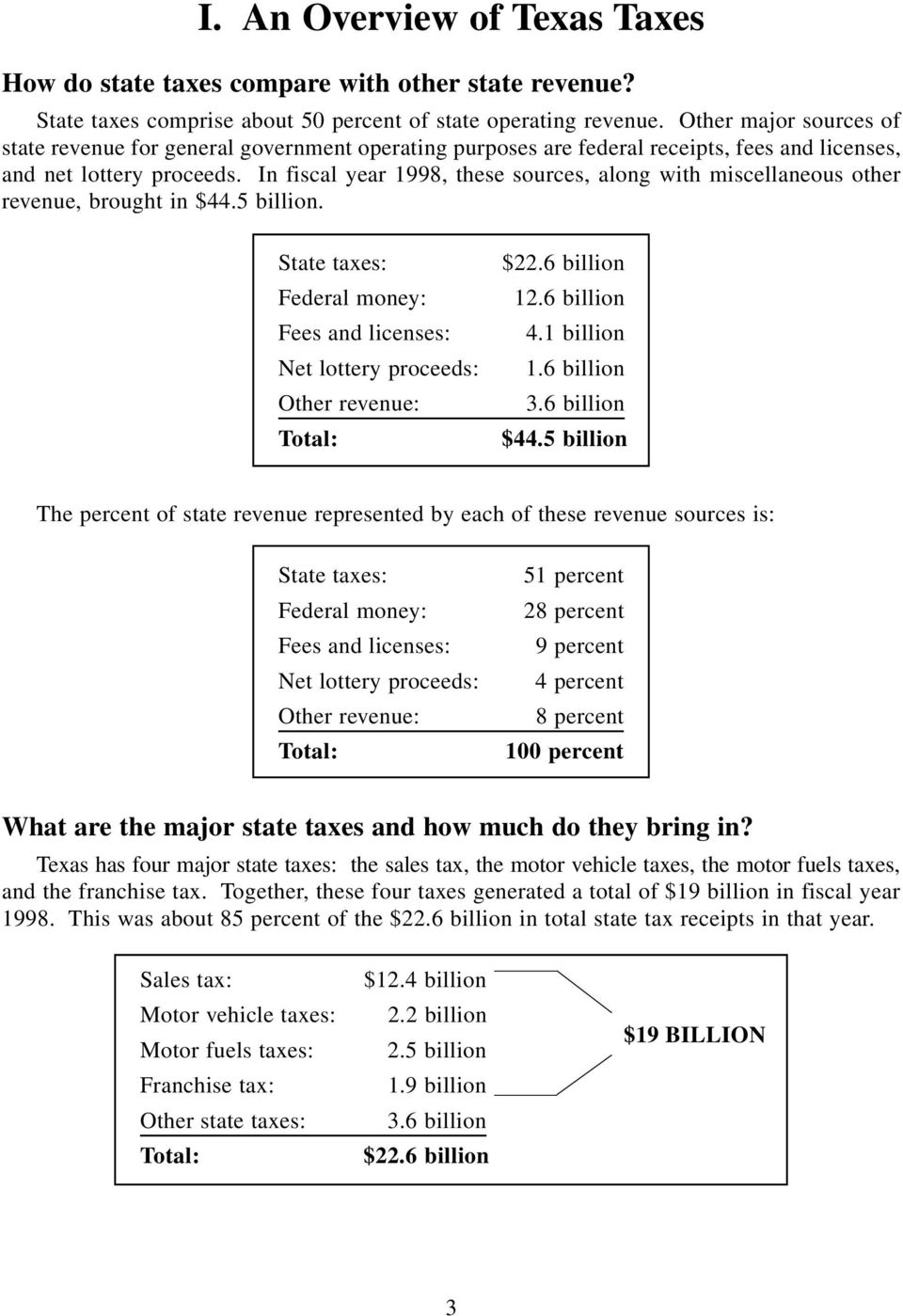
8 The percent of state taxes represented by each of the above is: Sales tax: Motor vehicle taxes: Motor fuels taxes: Franchise tax: Other state taxes: Total: 55 percent 10 percent 11 percent 9 percent 15 percent 100 percent 85 PERCENT Sales tax: The workhorse of state taxes is the sales tax, which accounts for a little over half of all state tax receipts. The correct name for this tax is the limited sales, excise, and use tax, but most people call it the sales tax, the state sales tax, or the general state sales tax. The state sales tax rate is 6.25 percent. As a general rule, the sales tax is applied to the retail sale of tangible personal property and many services. Local taxing units may impose local sales taxes of up to two percent. The sales tax is not charged on numerous goods and services, including food for home consumption, goods purchased for resale, residential gas and electricity, prescription drugs, newspapers and magazine subscriptions, automotive repair, and professional services. These items are either specifically exempted from the sales tax or excluded from allowable taxable items. Motor vehicle taxes: The motor vehicle sales tax is 6.25 percent of the purchase price of the vehicle, and it is applied to the sale of both new and used motor vehicles. All vehicles, including automobiles, pickup trucks, and heavy trucks, that use Texas roads and highways are subject to the motor vehicle sales tax. However, trucks that are licensed as interstate carriers are exempt from the tax. The state tax on interstate motor carriers was repealed effective September 1, The state motor vehicle rental tax is 10 percent of gross rental receipts for rentals of 30 days or less, and 6.25 percent for rentals of 31 to 180 days. Rentals of longer than 180 days are classified as leases and the lessor is taxed under the motor vehicle sales tax. Motor fuels taxes: Motor fuels taxes are Texas second largest source of tax revenue. For state tax purposes, motor fuels are defined to be gasoline, diesel fuel, and liquefied gas. The state tax on gasoline and diesel fuel is 20 cents per gallon, and the state tax on liquefied gas is 15 cents per gallon. The tax on gasoline brings in much more money than the tax on diesel fuel or liquefied gas. In fiscal year 1998, gasoline tax receipts were about $2 billion, which represented 80 percent of total motor fuels tax receipts. Franchise tax: The corporate franchise tax is the state s major business tax. The tax is levied on corporations, savings and loan associations, and limited liability companies doing business in Texas. Other state taxes: As shown in the following table, other state taxes brought in $3.6 billion in fiscal year 1998, which represented about 15 percent of total state taxes. 4
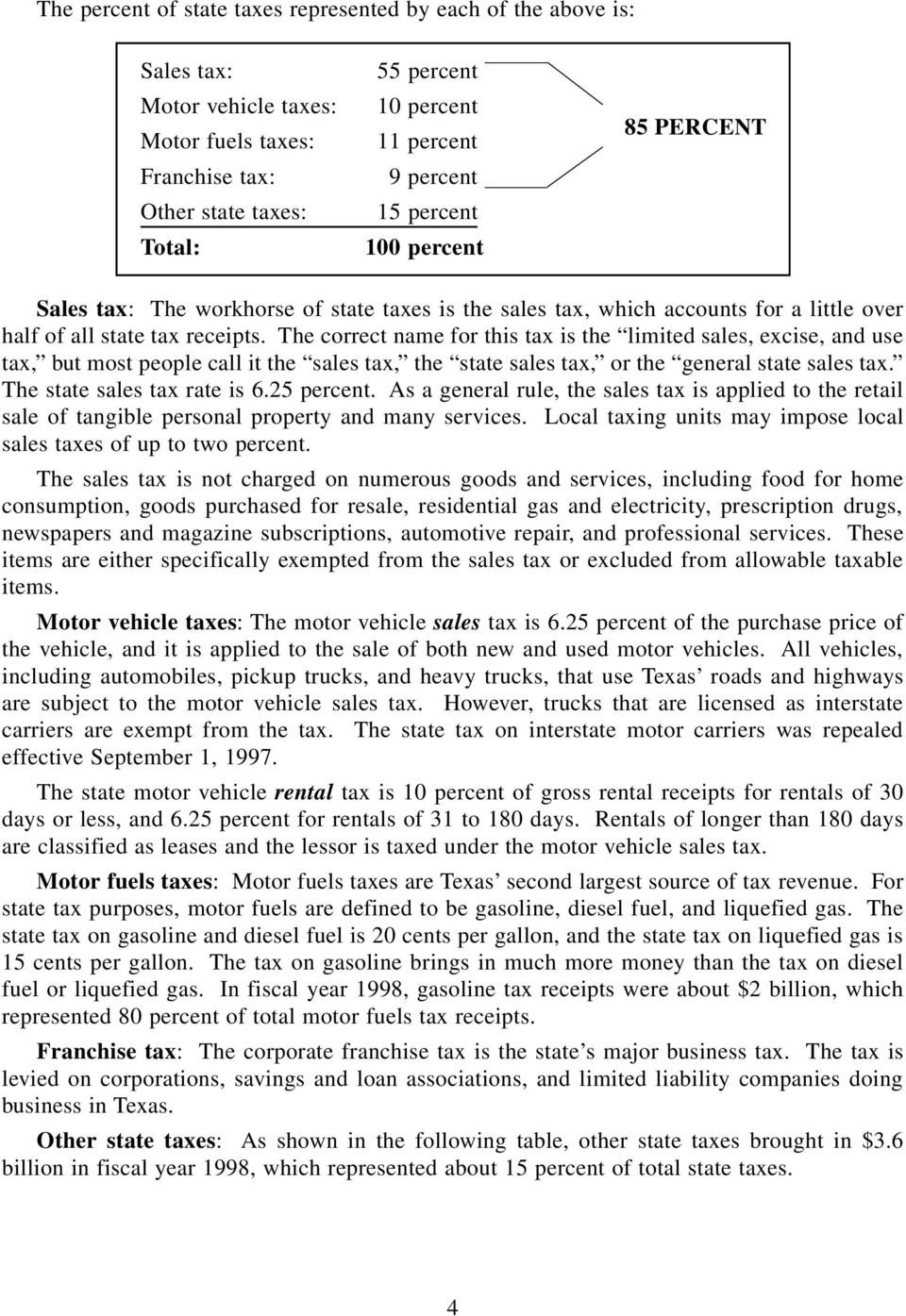
9 Name of tax Amount collected, 1998 Alcoholic beverage taxes Attorney (occupation) tax Boat sales tax Cement tax Coin-operated machine tax Hotel occupancy tax Inheritance tax Insurance taxes Manufactured housing tax Natural gas production tax Oil and gas well service tax Oil production tax Sulphur production tax Tobacco taxes Utility taxes Other (bingo, boxing, illegal drugs) $456.0 million 9.9 million 41.6 million 6.3 million 6.6 million million million million 37.0 million million 8.5 million million 3.3 million million million 1.4 million The glossary contains additional information about each of these taxes. Who pays Texas taxes? In fiscal year 1998, taxes on business brought in about one-third of tax revenue, while taxes on consumption brought in about two-thirds. However, it can be argued that all business taxes are ultimately borne by the final consumer, since businesses include taxes in their costs, which are in turn factored into their prices. It is important to note that the numbers below show state taxes paid by businesses and individuals. They do not include state fees, licenses, and permits. Business taxes: Excise taxes: Gross receipts taxes: Other business taxes: Severance taxes: Consumption taxes: Inheritance taxes: Total: $ 7.4 billion (32.7 percent) $ 3.5 billion $ 1.0 billion $ 2.0 billion $ 0.9 billion $14.9 billion (65.9 percent) $ 0.3 billion (1.4 percent) $ 22.6 billion (100 percent) A listing of the taxes comprising the above categories is provided in Table 1. 5

10 Table 1 State Tax Receipts*, Fiscal Year 1998 Fiscal 1998 Receipts (million $) As Percent of State Taxes Direct Business Taxes 1 Excise Taxes Alcoholic beverages taxes $ % Cement tax % Controlled substances tax % Motor fuels taxes 2, % Tobacco taxes % Total $ 3, % Gross Receipts Taxes Bingo rental tax $ % Boxing admission tax % Insurance taxes % Oil & gas well service tax % Utility taxes % Total $ % Other Business Taxes Attorney tax $ % Coin-operated machine tax % Franchise tax 1, % Manufactured housing sales tax % Total $ 1, % Severance Taxes Gas production tax $ % Oil production taxes % Sulphur production tax % Total $ % Total, Direct Business Taxes $ 7, % Consumption Taxes 2 Boat & boat motor tax $ % Hotel occupancy taxes % Motor vehicle sales & rental taxes 2, % Sales tax 12, % Total, Consumption Taxes $ 14, % Inheritance Taxes Total, Inheritance Taxes $ % Grand Total, All Taxes $ 22, % *Totals were calculated before rounding. 6
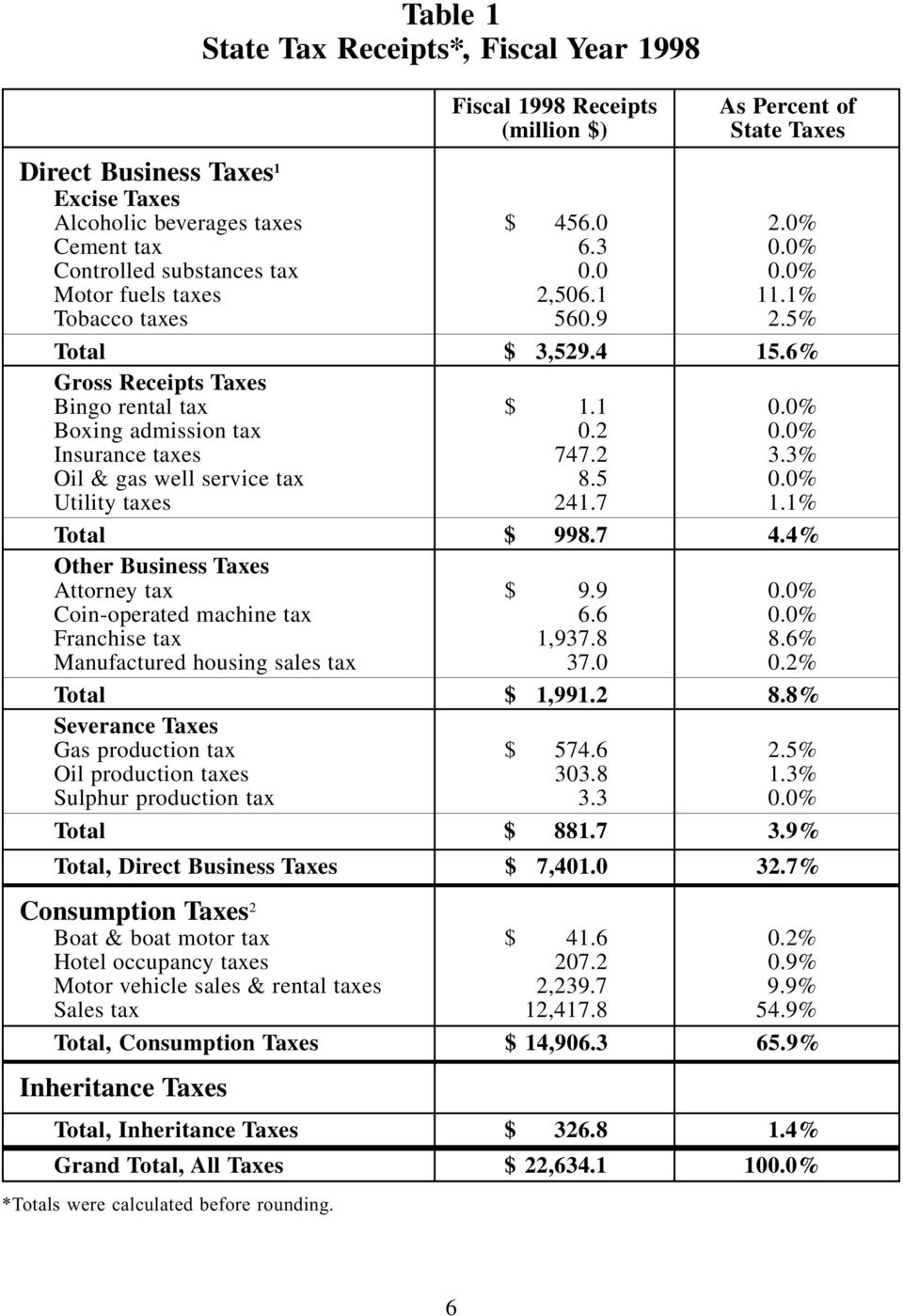
11 1 The oil and gas production taxes are also gross receipts taxes, while the sulphur production tax is in the nature of an excise tax. Almost all the excise taxes shown are per unit taxes. (The exception is the mixed alcoholic beverage tax. The other five alcoholic beverage taxes are per unit taxes.) The purpose of this classification of business taxes by tax type is admittedly somewhat arbitrary. Its purpose is to show broad types of business taxes and their relative contributions to total state taxes. 2 Consumption taxes are taxes paid by the final consumer. Both individuals and businesses pay consumption taxes. Source: Amounts for individual taxes are from the Comptroller of Public Accounts, Texas 1998 Annual Cash Report. Who or what governs the state tax system? The state tax system is governed by the Texas Constitution, the Tax Code, and the tax administrative rules in the Texas Administrative Code. The comptroller, as the state s chief fiscal officer, collects taxes. The comptroller adopts administrative rules governing various aspects of tax collections and audits taxpayers to be sure that state taxes are collected and remitted in accordance with state law. The comptroller allocates the revenue to various state funds and accounts. (Several other agencies that collect some of the smaller taxes also publish rules governing their collection.) The constitution, the Tax Code, and the administrative code are available on the Internet. The constitution and the Tax Code are available on the State of Texas Government Information website: < and < statutes/txtoc.html>; the administrative code is available on the secretary of state s website: < especially < index.html>. The comptroller and the Legislative Budget Board also publish various reports about state taxes and other revenue. These reports are listed in the section titled Helpful Publications. By how much have state tax receipts grown in the past few years? State tax receipts have grown steadily with the growth in Texas population and economic activity. Since 1990, state tax receipts have increased by 66 percent, population has increased by 16 percent, and economic activity as measured by gross state product has increased by 53 percent. Table 2 shows Texas tax revenues, population, employment, and gross state product for each of the last three fiscal years. Tax receipts, as well as gross state product, have shown healthy increases in the last two years. These increases in tax receipts have been due primarily to economic growth, rather than to tax rate increases or tax base expansions. As shown in the table, fiscal year 1998 sales and motor vehicle tax receipts were up sharply over fiscal year Sales tax receipts grew by nearly 10 percent over fiscal year 1997, while motor vehicle tax receipts grew by 11 percent. Both rates of growth exceeded the growth in population (1.5 percent), employment (3.8 percent), and gross state product (8.1 percent). 7
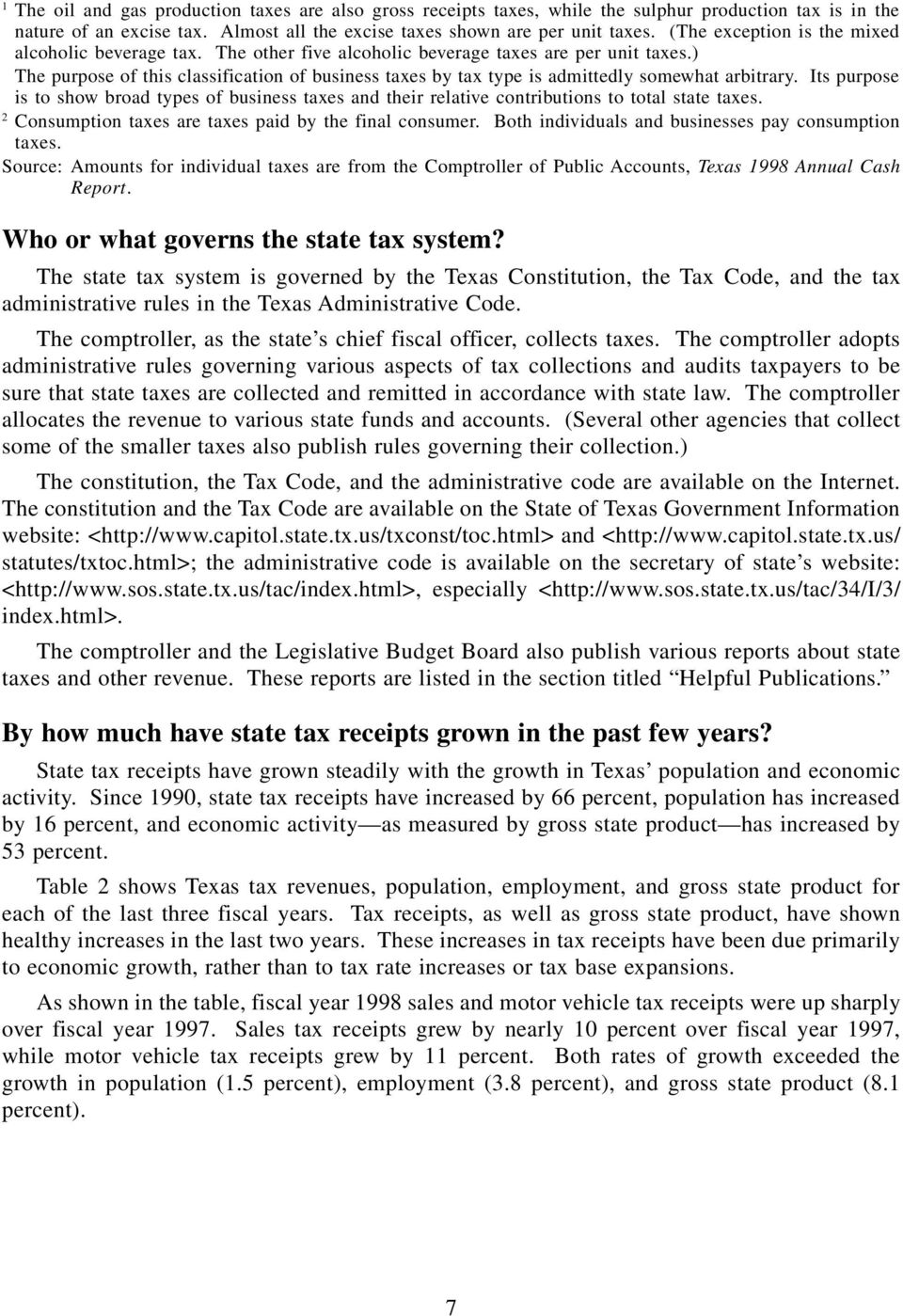
12 Table 2 State Taxes and Measures of Economic Activity* Fiscal Years Fiscal Year Tax Receipts Percent Change State taxes (million dollars) Sales tax $10,756 $11,303 $12, % 9.9% Motor fuels taxes 2,321 2,383 2, % 5.2% Motor vehicle taxes 1,938 2,016 2, % 11.1% Franchise tax 1,639 1,797 1, % 7.9% Other taxes 3,109 3,689 3, % -4.2% Total state taxes $19,763 $21,188 $22, % 6.8% Total state taxes, Per capita $1,033 $1,090 $1, % 5.2% Population (millions) % 1.5% Nonfarm employment (millions) % 3.8% Gross state product (million dollars) $542,173 $586,105 $624, % 6.6% Gross state product, Per capita $28,344 $30,150 $31, % 5.0% *Totals were calculated before rounding. Sources: Tax amounts are from data in the Comptroller of Public Accounts, Annual Cash Reports, various years. Gross state product data are from the Comptroller s Fall 1998 Economic Forecast. Nonfarm employment was calculated from monthly data of the Texas Workforce Commission. Population data were calculated from estimates of the State Data Center, Texas A&M University. In addition to being the state s fiscal officer and chief accountant, the comptroller is also the state s chief economic forecaster and revenue estimator. Prior to the beginning of each legislative session, the comptroller estimates available state revenue, including taxes, fees, and other revenue, for the current fiscal year and each year of the upcoming biennium. These estimates are published as the Biennial Revenue Estimate (the BRE ) and delivered to each member of the legislature in January. The BRE contains the outlook for Texas taxes and other state revenue through fiscal year What is a fee and how does it differ from a tax? A fee is a charge for the privilege of using a service, engaging in an activity, or practicing a profession. The general idea behind a fee is to charge the users the costs of providing the service or regulating the activity or profession. By law, the primary purpose of a fee must be regulation. A tax, on the other hand, is enacted for the primary purpose of raising revenue for a public purpose. The amount of a fee is often a fixed amount, or flat charge. For example, the fee for a noncommercial driver s license for a person age 18 and over is a fixed charge of $24. However, a fee may be graduated to reflect different costs at different levels of activity. The 8

13 horse racetrack application fee is an example of a graduated fee. In addition, a fee may be based on a percentage of gross receipts, such as the equalization surcharge fee and the telecommunications utility/commercial mobile service provider assessment fee. All state fees, like state taxes, have statutory authorizations. They are collected by various state agencies and credited to the appropriate fund and account. Most people pay one or more state fees at some time or another. These familiar fees include driver s license fees, motor vehicle registration fees, motor vehicle inspection fees, hunting and fishing license fees, and state park entrance fees. What are dedicated taxes and how do they differ from other taxes? Many of the state taxes and fees may be classified as either dedicated or nondedicated revenue. Dedicated revenue is revenue set aside by the constitution or state law for a particular purpose or entity. In most cases, this means that dedicated revenue may not be used for any other purpose. Examples of constitutionally dedicated taxes are motor fuels taxes and occupation taxes. The constitution dedicates one-fourth of motor fuels taxes and one-fourth of occupation taxes to public schools. It also dedicates three-fourths of motor fuels taxes to public roadways. Changing a constitutional dedication would require approval of the voters in a statewide election. One example of a statutory revenue dedication, as opposed to constitutional revenue dedication, is the one-half of one percent of state hotel occupancy taxes dedicated to tourism promotion activities of the Texas Department of Economic Development. Another example of statutorially dedicated revenue is lottery revenue, which is dedicated to public education after payment of expenses and winnings. The legislature can change statutory dedications. Other revenue, while not specifically dedicated, is restricted to particular purposes. Federal funds are restricted revenue. Nondedicated revenue is revenue that is not earmarked for a particular purpose and is available for general state spending. The legislature may appropriate nondedicated revenue to a variety of purposes and agencies. The main nondedicated revenues are sales taxes ($12.4 billion), motor vehicle taxes ($2.2 billion), and the franchise tax ($1.9 billion). (The figures in parentheses are fiscal year 1998 revenues.) Approximately 88 percent $19.8 billion of the $22.6 billion in state taxes collected in fiscal year 1998 was not dedicated or otherwise restricted. Of the $2.8 billion in dedicated or restricted tax revenue, approximately one-third went to public education, approximately two-thirds went to highways, and less than one percent went to other uses. The dedication status of major taxes is shown in Table 3. The comptroller, as the state s accountant, keeps track of state revenue dedications. Dedicated revenue is credited to the funds and accounts specified in state law, while nondedicated revenue is generally credited to the state s general revenue fund. 9

14 Table 3 Dedication Status of Major State Taxes Allocation for Fiscal Year 1998* Dedications Nondedicated general Public revenue education Highways Other Tax Alcoholic beverage taxes 86% 14% (a) Bingo rental tax 100% Boat sales tax 95% 5% (b) Boxing admission tax 100% Controlled substances tax 100% Franchise tax 100% Hotel occupancy taxes 92% 8% (c) Inheritance taxes 100% Insurance taxes Insurance companies maintenance taxes Workers Compensation Commission 100% Research and Oversight Council 100% (d) on Workers Compensation Department of Insurance 100% (e) Insurance companies premium taxes 100% Manufacturing housing sales tax 100% Motor fuels taxes 1% 25% 74% Motor vehicle taxes 100% Occupation taxes Attorney tax 75% 25% Cement tax 75% 25% Coin-operated machine taxes 75% 25% Oil and gas well service tax 75% 25% Oil, gas, and sulphur production taxes 75% 25% Sales tax 99% <1% (f) <1% (f) Tobacco taxes 100% Utility taxes Gas, electric, water utility tax (also an 75% 25% occupation tax) Gas utility tax 100% Public utility tax 100% NOTES * Percentages are provided to give the reader a general idea of how revenues are distributed. They may not be exact. (a) Each city and county gets percent of the mixed beverage tax collections from that city or county. The 14 percent figure shown is the city/county share as a percent of total alcoholic beverage receipts. It was calculated from fiscal 1998 collections. (b) Both the county tax assessor-collector and the Department of Parks and Wildlife get to retain five percent of the boat taxes they collect. 10

15 (c) State hotel tax revenues equal to a one-half percent rate are dedicated to the tourism promotion activities of the Texas Department of Economic Development. This works out to be about eight percent of total collections. (d) These taxes are dedicated to the Research and Oversight Council on Workers Compensation to cover administrative expenses. (e) These taxes are dedicated to the Texas Department of Insurance to cover administrative expenses. (f) Revenues from the sales tax on motor vehicle lubricants are dedicated to highways, while up to $32 million in sporting goods sales tax revenue is dedicated to parks and recreation. Sources: Various statutory authorizations and Comptroller of Public Accounts, Manual of Accounts. 11

16 12

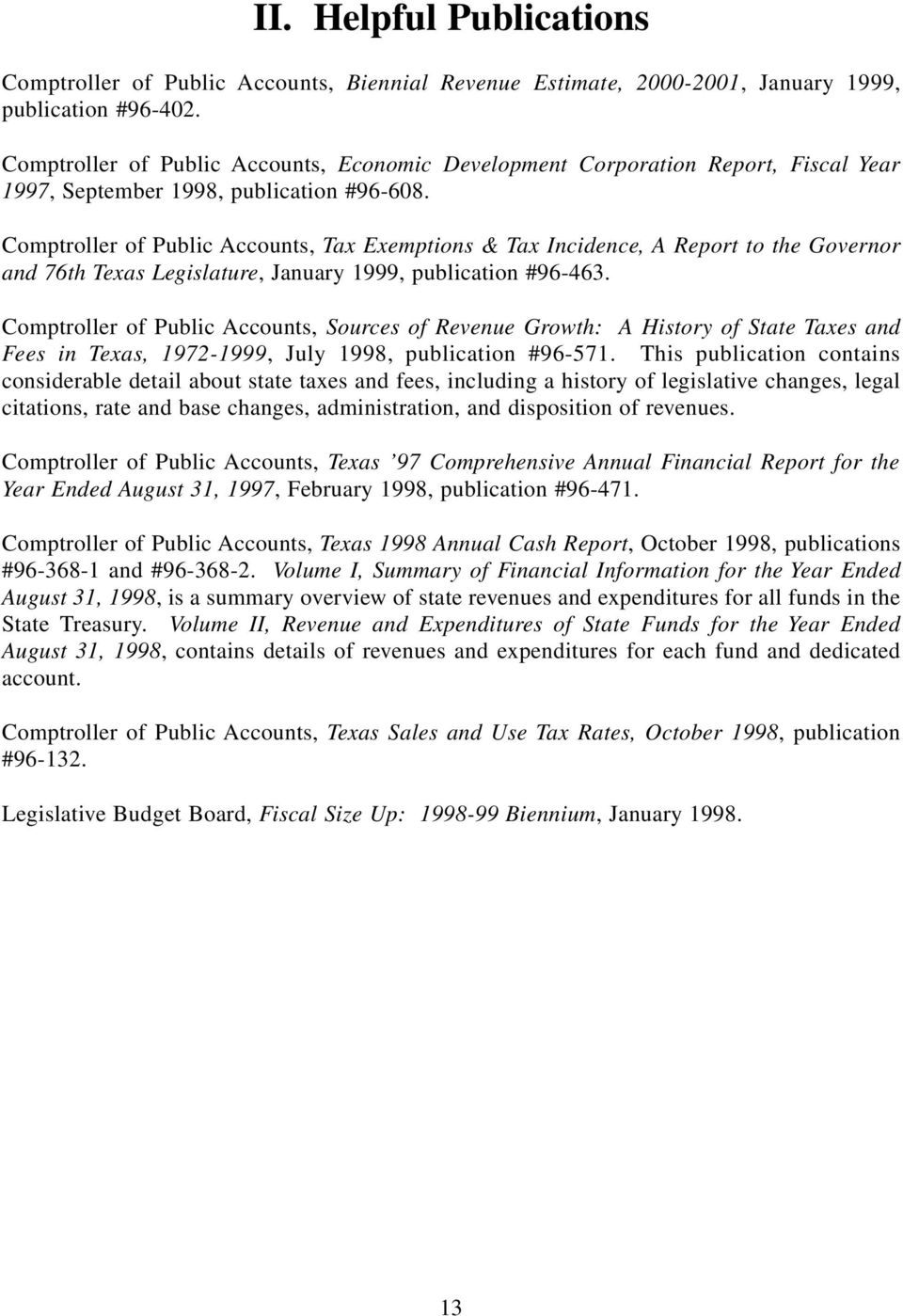
17 II. Helpful Publications Comptroller of Public Accounts, Biennial Revenue Estimate, , January 1999, publication # Comptroller of Public Accounts, Economic Development Corporation Report, Fiscal Year 1997, September 1998, publication # Comptroller of Public Accounts, Tax Exemptions & Tax Incidence, A Report to the Governor and 76th Texas Legislature, January 1999, publication # Comptroller of Public Accounts, Sources of Revenue Growth: A History of State Taxes and Fees in Texas, , July 1998, publication # This publication contains considerable detail about state taxes and fees, including a history of legislative changes, legal citations, rate and base changes, administration, and disposition of revenues. Comptroller of Public Accounts, Texas 97 Comprehensive Annual Financial Report for the Year Ended August 31, 1997, February 1998, publication # Comptroller of Public Accounts, Texas 1998 Annual Cash Report, October 1998, publications # and # Volume I, Summary of Financial Information for the Year Ended August 31, 1998, is a summary overview of state revenues and expenditures for all funds in the State Treasury. Volume II, Revenue and Expenditures of State Funds for the Year Ended August 31, 1998, contains details of revenues and expenditures for each fund and dedicated account. Comptroller of Public Accounts, Texas Sales and Use Tax Rates, October 1998, publication # Legislative Budget Board, Fiscal Size Up: Biennium, January
18 14

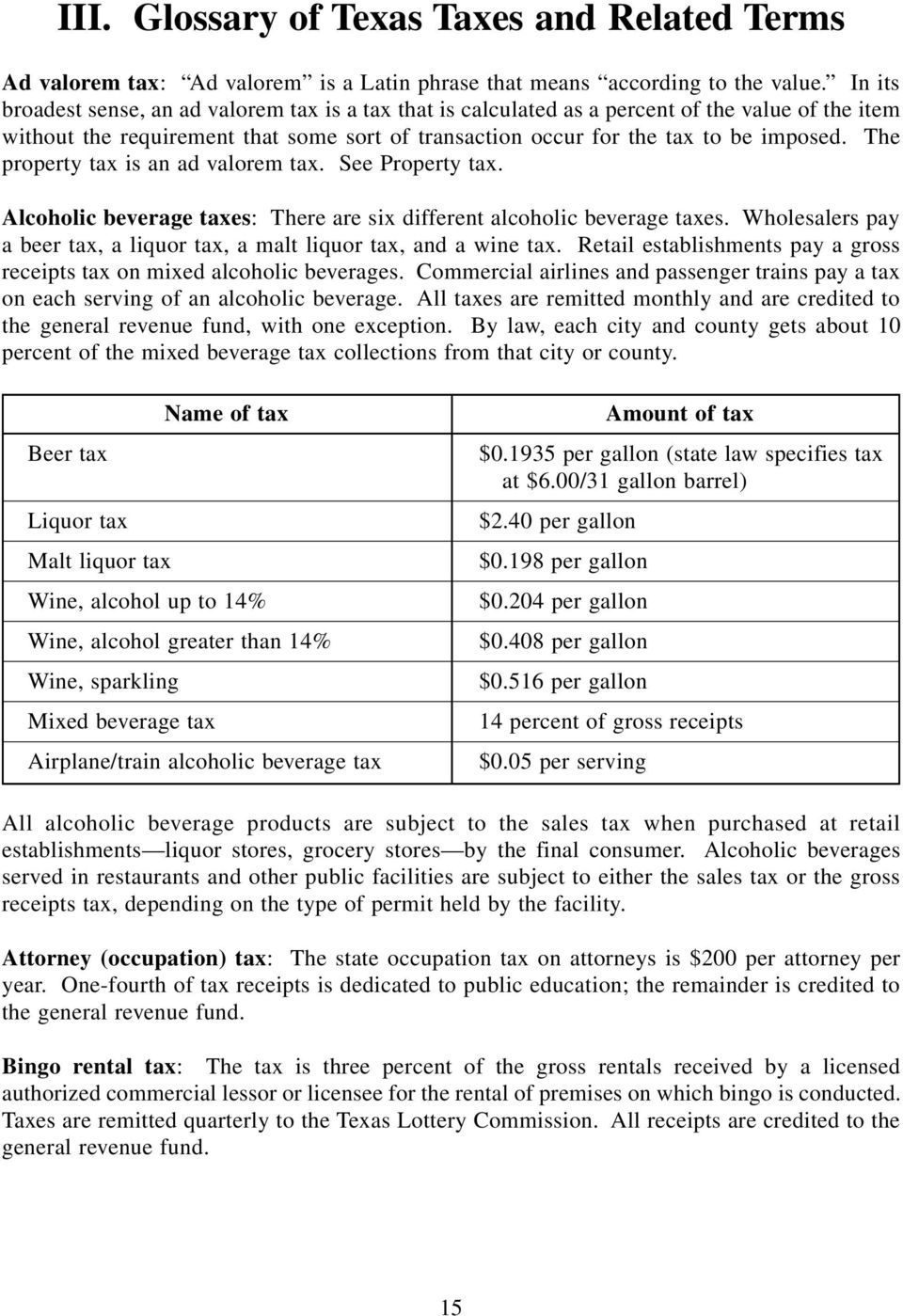
19 III. Glossary of Texas Taxes and Related Terms Ad valorem tax: Ad valorem is a Latin phrase that means according to the value. In its broadest sense, an ad valorem tax is a tax that is calculated as a percent of the value of the item without the requirement that some sort of transaction occur for the tax to be imposed. The property tax is an ad valorem tax. See Property tax. Alcoholic beverage taxes: There are six different alcoholic beverage taxes. Wholesalers pay a beer tax, a liquor tax, a malt liquor tax, and a wine tax. Retail establishments pay a gross receipts tax on mixed alcoholic beverages. Commercial airlines and passenger trains pay a tax on each serving of an alcoholic beverage. All taxes are remitted monthly and are credited to the general revenue fund, with one exception. By law, each city and county gets about 10 percent of the mixed beverage tax collections from that city or county. Name of tax Beer tax Liquor tax Malt liquor tax Wine, alcohol up to 14% Wine, alcohol greater than 14% Wine, sparkling Mixed beverage tax Airplane/train alcoholic beverage tax Amount of tax $ per gallon (state law specifies tax at $6.00/31 gallon barrel) $2.40 per gallon $0.198 per gallon $0.204 per gallon $0.408 per gallon $0.516 per gallon 14 percent of gross receipts $0.05 per serving All alcoholic beverage products are subject to the sales tax when purchased at retail establishments liquor stores, grocery stores by the final consumer. Alcoholic beverages served in restaurants and other public facilities are subject to either the sales tax or the gross receipts tax, depending on the type of permit held by the facility. Attorney (occupation) tax: The state occupation tax on attorneys is $200 per attorney per year. One-fourth of tax receipts is dedicated to public education; the remainder is credited to the general revenue fund. Bingo rental tax: The tax is three percent of the gross rentals received by a licensed authorized commercial lessor or licensee for the rental of premises on which bingo is conducted. Taxes are remitted quarterly to the Texas Lottery Commission. All receipts are credited to the general revenue fund. 15
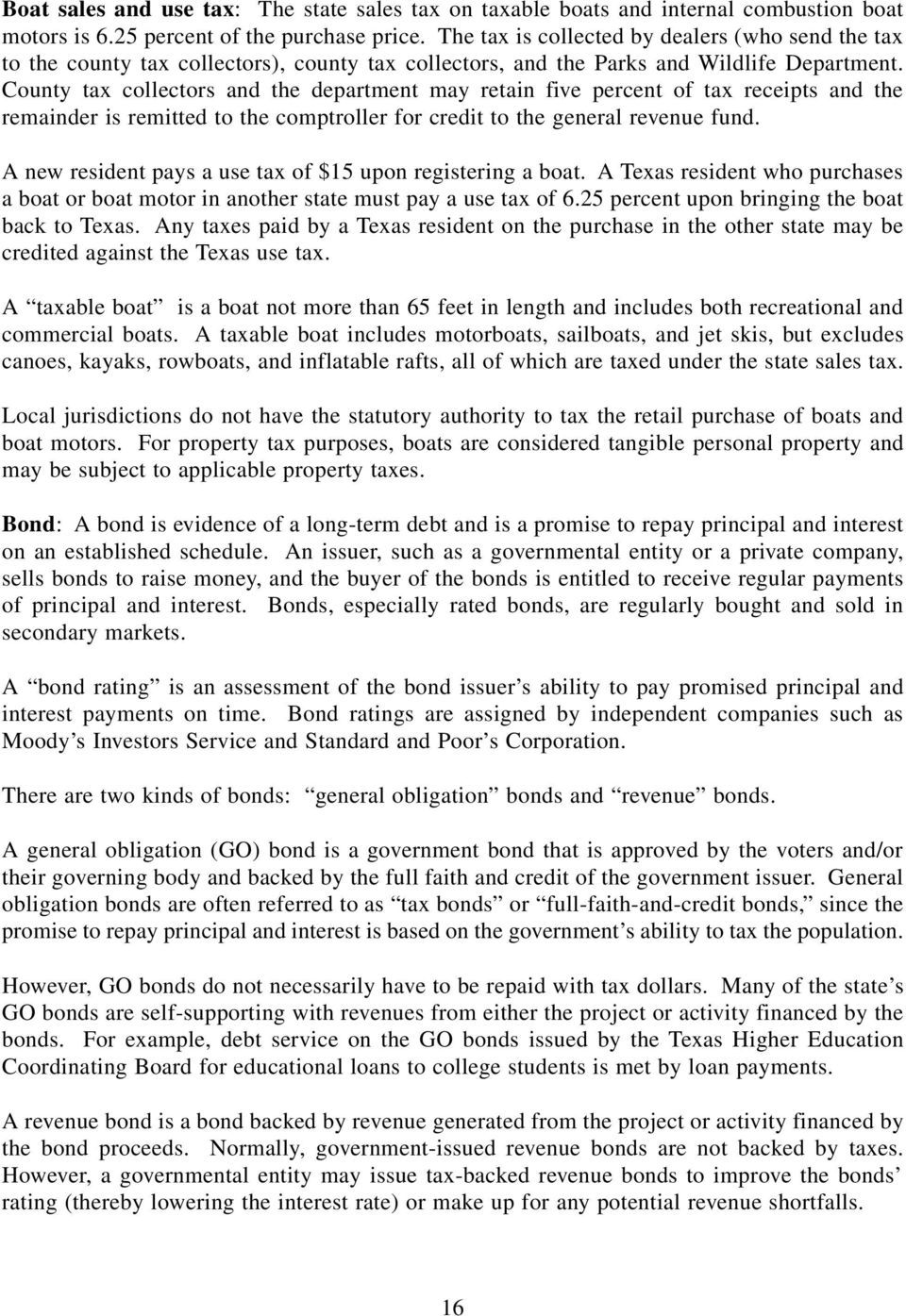
20 Boat sales and use tax: The state sales tax on taxable boats and internal combustion boat motors is 6.25 percent of the purchase price. The tax is collected by dealers (who send the tax to the county tax collectors), county tax collectors, and the Parks and Wildlife Department. County tax collectors and the department may retain five percent of tax receipts and the remainder is remitted to the comptroller for credit to the general revenue fund. A new resident pays a use tax of $15 upon registering a boat. A Texas resident who purchases a boat or boat motor in another state must pay a use tax of 6.25 percent upon bringing the boat back to Texas. Any taxes paid by a Texas resident on the purchase in the other state may be credited against the Texas use tax. A taxable boat is a boat not more than 65 feet in length and includes both recreational and commercial boats. A taxable boat includes motorboats, sailboats, and jet skis, but excludes canoes, kayaks, rowboats, and inflatable rafts, all of which are taxed under the state sales tax. Local jurisdictions do not have the statutory authority to tax the retail purchase of boats and boat motors. For property tax purposes, boats are considered tangible personal property and may be subject to applicable property taxes. Bond: A bond is evidence of a long-term debt and is a promise to repay principal and interest on an established schedule. An issuer, such as a governmental entity or a private company, sells bonds to raise money, and the buyer of the bonds is entitled to receive regular payments of principal and interest. Bonds, especially rated bonds, are regularly bought and sold in secondary markets. A bond rating is an assessment of the bond issuer s ability to pay promised principal and interest payments on time. Bond ratings are assigned by independent companies such as Moody s Investors Service and Standard and Poor s Corporation. There are two kinds of bonds: general obligation bonds and revenue bonds. A general obligation (GO) bond is a government bond that is approved by the voters and/or their governing body and backed by the full faith and credit of the government issuer. General obligation bonds are often referred to as tax bonds or full-faith-and-credit bonds, since the promise to repay principal and interest is based on the government s ability to tax the population. However, GO bonds do not necessarily have to be repaid with tax dollars. Many of the state s GO bonds are self-supporting with revenues from either the project or activity financed by the bonds. For example, debt service on the GO bonds issued by the Texas Higher Education Coordinating Board for educational loans to college students is met by loan payments. A revenue bond is a bond backed by revenue generated from the project or activity financed by the bond proceeds. Normally, government-issued revenue bonds are not backed by taxes. However, a governmental entity may issue tax-backed revenue bonds to improve the bonds rating (thereby lowering the interest rate) or make up for any potential revenue shortfalls. 16
21 Boxing admissions tax: The tax is three percent of the gross receipts of admission fees to boxing matches, contests, exhibitions, and elimination tournaments. The tax is paid by boxing promoters and is due within 72 hours after the event. The tax is collected by the Texas Department of Licensing and Regulation. All receipts are credited to the general revenue fund. Business activity tax, business tax: A business activity tax or business tax is any tax generally paid by a business. Examples of business taxes are corporate franchise taxes, gross receipts taxes, value-added taxes, and severance taxes. Businesses also pay income taxes, property taxes, and sales taxes, but these are not necessarily limited to businesses. Texas does not have a broad-based business activity tax or business tax. However, Texas businesses pay various specialized taxes and fees. For example, insurance companies pay gross receipts taxes on premiums, oil and gas companies pay severance taxes on the value of oil and gas produced, utilities pay gross receipts taxes, and corporations pay franchise taxes on taxable assets and earned surplus. In terms of annual revenue, the franchise tax is Texas main business tax. Businesses also pay various fees, such as filing fees, professional fees, permit fees, and natural resources fees. Capital gains tax: A capital gains tax is a tax on the profit realized when an asset, investment, or security is sold for a higher price than its purchase price. Texas does not have a capital gains tax. Cash report: The annual cash report is published by the comptroller every November. It provides detailed information about revenue, expenditures, and balances for funds held in the state treasury for the prior fiscal year. All data are presented on a cash basis. Cash basis reporting means revenue and expenditures are reported when actually received or expended, respectively. See Comprehensive Annual Financial Report. Cement tax: A cement tax is a tax on the manufacturer, producer, or importer of cement that is sold or used within Texas. Cement manufacturers, producers, and importers remit monthly to the comptroller. The tax rate is $ for each 100 pounds of cement or fraction thereof. One-fourth of the revenue is dedicated to public education and three-fourths is credited to the general revenue fund. Coin-operated machine tax: The state tax on coin-operated machines is $60 per year. Machine owners pay the tax annually. This tax generally applies to music, video, and other amusement machines. Coin-operated machines such as telephones, pay toilets, food vending machines, and insurance policy vending machines are exempt. One-fourth of the net revenue is dedicated to public education and three-fourths is credited to the general revenue fund. Comprehensive Annual Financial Report (CAFR): This report is published by the comptroller every February. It provides financial information for all state funds, including those held outside the state treasury, for the prior fiscal year. The CAFR reports on an accrual basis. Accrual basis reporting means that revenue and expenditures are recognized when they are owed or incurred, irrespective of whether the money has been received or paid. The CAFR also provides some statistical and economic information. See Cash report. 17
22 Consumption tax: A consumption tax is a tax that is imposed when a good or service is sold to the final consumer. Texas consumption taxes are the state sales tax, motor vehicle sales and rental taxes, boat sales tax, and hotel occupancy tax. Together, these combined taxes make up about two-thirds of all Texas tax revenue. Controlled substances tax: This tax is imposed on dealers who purchase, acquire, import, manufacture, or produce controlled substances, including marihuana, heroin, and cocaine. The tax varies by drug and by weight. The tax is collected by the comptroller and credited to the general revenue fund. The purchase or manufacture of controlled substances is exempt from the tax if the activity is authorized by law. This means that pharmaceutical companies, hospitals, physicians, pharmacists, and persons in possession of prescription drugs are exempt from the tax to the extent that their activities are authorized by law. County sales tax: See Local sales taxes. Dedicated revenue: Dedicated revenue is revenue set aside by law for a particular purpose or entity. Double taxation: The phrase double taxation refers to a situation in which the same tax is imposed on the same person or piece of property twice by the same taxing entity for the same purpose. A commonly cited example of double taxation at the federal level is the double taxation of corporate profits once as income to the corporation and second as income to the individual when corporate profits are distributed as dividends to stockholders. Some would argue that this example does not fit the legal definition of double taxation. One widely cited example of double taxation at the local level does not fit the legal definition of double taxation. This example concerns the taxation of municipal property, once by the municipality to fund services for municipal residents, and again by the county to fund similar services for county residents who reside outside the municipality. Neither the Texas Constitution nor the Tax Code expressly addresses double taxation. The constitution requires taxation to be equal and uniform. Excise tax: An excise tax is fairly broad. As defined in Black s Law Dictionary, it is a tax imposed on the performance of an act, such as the manufacture, sale, or use of goods, the engaging in an occupation, the enjoyment of a privilege, or the transfer of property. Both the franchise and sales taxes fit this definition of excise tax. In current usage, the term has been extended to include various license fees and practically every internal revenue tax, such as alcohol, tobacco, and motor fuels excise taxes. Texas imposes alcohol, tobacco, and motor fuels taxes. 18
23 Excise taxes are sometimes called per unit taxes in popular usage. See Per unit tax. Fee: A fee is a compulsory charge for the privilege of using a service or practicing a profession. Its primary purpose is regulation. A fee is intended to recover all or part of the cost of providing the service or regulating the profession. As such, it is often called a user fee since the user pays the fee. The media occasionally refer to gasoline taxes as user fees or user taxes since both the federal and state taxes are included in the price of a gallon of gasoline. The user the vehicle s owner or operator pays with every gasoline purchase for the privilege of using the public roads. Franchise tax: The corporate franchise tax, the state s major business tax, is a tax for the privilege of doing business as a corporation in Texas. It is an annual tax on the assets and earned surplus of corporations, banks, savings and loans, and limited liability companies doing business in Texas. Technically, the tax is $2.50 per $1,000 of taxable capital plus the amount by which a tax of 4.5 percent on earned surplus exceeds the tax on capital. Earned surplus is equivalent to federal taxable income with certain adjustments, including adding compensation paid to certain corporate officers. In effect, it is two alternative taxes, with the corporation paying the higher of the two. Tax receipts are remitted to the comptroller annually and credited to the general revenue fund. Fund: A fund is a fiscal and accounting entity with a set of accounts that records cash and other financial resources. The state s fiscal structure consists of numerous funds, including the general fund, special revenue funds, debt service funds, and other funds. Gas production tax: The tax is 7.5 percent of the market value of natural gas produced in the state. The tax is collected by producers and remitted monthly to the comptroller. One-fourth of tax receipts is dedicated to public education; the remainder is credited to the general revenue fund. General fund: The general fund is the principal operating fund used to account for most of the state s general activities. It consists of the general revenue fund (Fund 1) and various accounts whose funds are dedicated to certain uses. One often hears references to GR, GR nondedicated, and GR dedicated. GR stands for general revenue, GR nondedicated generally refers to the general revenue fund, while GR dedicated usually refers to the dedicated accounts in the general fund. The general revenue fund receives revenue from the sales tax, the motor vehicle sales and rental taxes, the franchise tax, insurance premium taxes, and various other taxes and fees. These funds are nondedicated funds and may be used for general government operations. The general revenue fund also receives dedicated pass-through money for allocation to dedicated accounts and funds. 19
24 General revenue consolidation refers to the consolidation of numerous funds into the general fund. The legislature began the process of funds consolidation in Some of the funds that existed at that time lost their dedication and became part of the general revenue fund; others retained their dedication and became dedicated accounts within the general fund. The constitutional funds, such as the state highway fund and the available school fund, are not part of the general fund. These are considered special revenue funds. Gross receipts tax: A gross receipts tax is a tax on business receipts. The tax base is total business receipts, while the tax rate is the percentage applied to the base. Texas does not have a broad-based gross receipts tax. However, the state insurance taxes, utility taxes, and the oil and gas production taxes are forms of gross receipts taxes. Gross state product: Gross state product is a measure of the total value of goods and services produced in Texas in one year. It is the state counterpart of gross domestic product (GDP), a measure of the total value of goods and services produced in the U.S. in one year. Hotel occupancy tax: The state hotel occupancy tax is six percent of the room rate for rentals of less than 30 days in hotels, motels, bed and breakfasts, or any other establishment offering sleeping accommodations to the general public. The tax is applied to rooms renting for at least $2 per day. The tax is collected by establishment operators and remitted to the comptroller monthly or quarterly. Operators may retain one percent of taxes due for collection costs if they remit on time. Tax revenue equal to a one-half percent rate is dedicated for tourism promotion; the rest is credited to the general revenue fund. Cities and some counties may also impose a hotel occupancy tax under certain conditions. Illegal drug tax: See Controlled substances tax. Income tax: An income tax is a tax on the incomes of businesses and individuals. Texas does not have a personal income tax. The Texas Constitution requires voter approval of any personal income tax law before it can take effect. The corporate franchise tax is a tax on income. See Franchise tax. Inheritance tax: The state inheritance tax is equal to the amount of the federal credit and is imposed on the transfer at death of the property of every resident and nonresident who owns property in the state. The tax is paid by the estate within nine months after death; tax receipts are credited to the general revenue fund. Insurance taxes: Nearly all Texas insurance taxes are gross receipts taxes levied on insurance companies gross insurance premiums. Some are called insurance maintenance taxes. In terms of state revenue, the most important of the insurance taxes are those known as insurance premium taxes. The insurance premium tax rates for the various kinds of premiums (e.g., life, health, and accident; fire and casualty) are based on the relative amounts of companies Texas investments. 20
25 Insurance premium taxes represented nearly 90 percent of the $747.2 million in total insurance company taxes collected in fiscal year These taxes are remitted semiannually by the insurance companies to the comptroller and credited to the general revenue fund. Interest and sinking fund (I&S) tax: An I&S tax is a property tax levied to raise revenue to pay principal and interest on debt. Interstate motor carrier sales and use tax: This tax was a 6.25 percent sales tax on the purchase price of interstate motor carriers prorated by the percentage of total miles driven on Texas highways by a taxpayer s carriers in the year prior to purchase. It was enacted in 1981 and repealed effective September 1, The most this tax generated in a year was $22.4 million in fiscal year Local sales taxes: State law authorizes cities, counties, transit authorities, and special districts, such as hospital districts, crime control districts, and development districts, to adopt a sales tax if the tax is first approved by a majority of the affected voters at an election held for that purpose. The law allows different maximum sales tax rates for different types of taxing units. In general, the local sales tax covers the same tangible personal property and services as the state tax with few exceptions. State law forbids the adoption of local sales taxes if the combined rates exceed two percent, but provides exceptions to the two percent rule for three counties that contain small areas where the combined local rate exceeds two percent. The colloquial expression for this situation is cap buster. These exceptions occur where a city adopts a sales tax and a small part of the city is in a neighboring county that also has a sales tax. However, no businesses selling taxable items are located in any of these excepted areas. In one county, the area is completely uninhabited, in another it is underwater, and in the third it is occupied by a cemetery. The local sales tax does not apply to sales of motor vehicles, boats and boat motors, or manufactured housing. The state taxes on these items are governed by different laws. Retailers remit sales tax collections, including both state and local taxes, to the comptroller. The comptroller retains two percent of local taxes for administrative expenses and remits the rest to local jurisdictions. In fiscal year 1998, the comptroller remitted approximately $3.2 billion in local sales tax collections. About two-thirds of this amount went to cities. Local Taxing Unit Cities Counties Transit authorities Special districts Fiscal 1998 Sales Taxes $2,154 million 196 million 831 million 64 million 21
26 Maintenance and operations (M&O) tax: An M&O tax is a property tax levied by a taxing unit to raise revenue for annual operating needs. Manufactured housing sales tax: The state sales tax on new manufactured housing is five percent of 65 percent of the manufacturer s selling price to retailers or other persons. The tax is collected by manufacturers and remitted monthly to the comptroller. Tax receipts are credited to the general revenue fund. Local jurisdictions do not have the statutory authority to impose a sales tax on manufactured housing. However, manufactured housing is considered tangible personal property and is subject to property taxes. Motor fuels taxes: The state tax on gasoline and diesel fuel is 20 cents per gallon. The tax is levied on the first sale, distribution, or use of gasoline and diesel fuel and is remitted to the comptroller by gasoline distributors, diesel fuel suppliers, and interstate truckers. By law, the amount of the tax is included in the price paid by the final consumer. The law also allows transit companies to pay a 19 cents per gallon tax on gasoline and a 19.5 cents per gallon tax on diesel fuel. Distributors and suppliers may retain the tax on two percent of the taxable gallons of fuel sold to cover tax collection expenses. The state also imposes a 15 cents per gallon tax on liquefied gas. In most cases, the tax on liquefied gas is paid by purchasing a tax decal based on vehicle weight and estimated mileage driven in Texas. The constitution dedicates 25 percent of motor fuels tax receipts to public education and 75 percent to highways after collection expenses and refunds. Generally, distributors and suppliers remit monthly and truckers remit quarterly. State law allows the comptroller to retain one percent of tax collections for enforcement purposes. Motor vehicle taxes: There is a state tax on motor vehicle sales and a state tax on motor vehicle rentals. All receipts from both taxes are credited to the general revenue fund. The motor vehicle sales and use tax is 6.25 percent of the actual purchase price of both new and used vehicles. Generally, motor vehicle dealers collect the tax and remit it to the county tax assessor-collector with the vehicle registration information, and the tax assessor-collector remits the funds to the comptroller. Motor vehicle dealers who finance vehicle sales remit taxes directly to the comptroller. An individual who purchases a used vehicle from a private party declares the amount paid for the vehicle when registering the transaction with the county tax assessor-collector and pays 6.25 percent of the declared price to the tax assessor-collector. New residents pay a tax of $15 per vehicle. A Texas resident who purchases a motor vehicle in another state must pay a use tax of 6.25 percent upon bringing the vehicle back to Texas for use on public highways. Both taxes are paid when the individual registers the vehicle with the county tax assessor-collector. However, any taxes paid by a Texas resident on the purchase in the other state may be credited against the Texas use tax. The Texas resident use tax requirement also affects military personnel who are Texas residents and who purchase motor vehicles tax-free in Europe or any other location. Military personnel whose home of record is Texas must pay a use tax of 6.25 percent of the purchase price of the 22
27 vehicle when registering the vehicle in Texas. If they purchase the motor vehicle in another state and pay motor vehicle sales taxes in that state, they may credit those taxes against the Texas use tax. Interstate motor carriers are exempt from motor vehicle sales taxes. Local jurisdictions do not have the statutory authority to tax motor vehicle purchases. However, for property tax purposes, motor vehicles are considered personal property and may be subject to property taxes. Generally, commercial vehicles are subject to property taxes; private vehicles are exempt unless the jurisdiction takes action to tax them. The motor vehicle rental tax is 10 percent of gross receipts of rentals of 30 days or less and 6.25 percent on rentals of 31 to 180 days. Rentals of longer than 180 days are classified as leases and the lessor is taxed under the motor vehicle sales tax. Rental establishments collect the tax and remit to the comptroller in accordance with the schedule for retailers who collect sales taxes. See Sales tax. Rental establishments do not pay the motor vehicle sales tax when they purchase vehicles for use as rental vehicles. The rental tax is in lieu of the sales tax. However, the rental tax earned by a vehicle must be sufficient to satisfy the amount of sales tax that would have been paid had the vehicle not been registered as a rental vehicle. If rental tax revenue on a vehicle is not sufficient to cover this liability, the rental establishment must make up the difference when the vehicle is retired from rental service. In special circumstances, local jurisdictions may impose a tax, in increments of one-eighth of one percent, of up to five percent on rentals of 30 days or less. Municipal sales tax: See Local sales taxes. Nondedicated revenue: Nondedicated revenue is revenue in the state s general revenue fund that is not dedicated by law to a particular function or agency. Nondedicated revenue makes up the operating portion of the state s budget. Occupation tax: An occupation tax is a tax imposed on a person who carries on a business or commercial activity. State occupation taxes include the cement production tax, the attorney tax, the gas, electric, and water utility tax, the oil, gas, and sulphur production taxes, the oil well services tax, and the coin-operated machine tax. The only practical significance of the occupation tax designation is the constitutional dedication of one-fourth of occupation tax receipts to public education. Oil production tax: The tax is 4.6 percent of the value of crude oil produced in the state. The tax is collected by producers and remitted monthly to the comptroller. One-fourth of tax receipts is dedicated to public education; the remainder is credited to the general revenue fund. Personal property: State law defines personal property as property that is not real property. See Tangible personal property and Real property. 23
28 Per unit tax: A per unit tax is a tax imposed on each defined, measured quantity or unit of a taxable item. The unit of measurement for taxation is defined in the enabling legislation. Motor fuels taxes are per unit taxes, since the tax is a flat rate imposed on each gallon of fuel. Other examples of per unit taxes are the tobacco taxes, several of the alcoholic beverage taxes, the cement tax, and the sulphur production tax. Progressive taxation: See Tax equity. Property tax: The property tax is an annual tax that is levied by local taxing units on real and personal property. The constitution prohibits the imposition of a state property tax. It consists of a tax rate that is applied to the taxable value of each parcel of taxable property. The taxable value is determined by the appraisal district. The tax rate is set annually by the governing body of each taxing unit prior to the fiscal year in which the taxes are due. The property tax rate consists of an M&O tax rate and an I&S tax rate. (See maintenance and operations tax and interest and sinking fund tax.) Districts do not levy an I&S tax unless they have outstanding debt. The sum of the taxable values of all parcels in a jurisdiction is called the property tax base. The total tax rate applied to the tax base equals the property tax levy. Property tax levy: The property tax levy is the total amount of money to be raised from a property tax. The levy divided by the tax base equals the tax rate. For example, assume a city needs to raise $10 million through property taxes for its annual budget. If the tax base of the city is $2.4 billion, then the tax rate would need to be about 42 cents per hundred dollars of value ($10 million/$2.4 billion= , which is cents per hundred dollars of value). In the 1997 tax year, a total of 3,523 local jurisdictions that levied property taxes reported a combined levy of over $17.6 billion in property taxes. Local Taxing Unit Property Tax Year 1997 School districts $10.4 billion (1,036 districts) Cities 2.8 billion (1,001 cities) Counties 2.7 billion (254 counties) Special districts 1.8 billion (1,232 districts) Proportional taxation: See Tax equity. Real property: State law defines real property to mean land, buildings and other improvements to land, mines, quarries, minerals in place, and standing timber. 24
29 Regressive taxation: See Tax equity. Sales tax: The state sales tax whose proper name is the limited sales, excise, and use tax is a tax on the sale of tangible personal property and taxable services. The state sales tax rate is 6.25 percent. Cities, counties, transit authorities, and special purpose districts may impose a local sales and use tax with certain restrictions. See Local sales taxes. Retailers collect all state and local sales taxes at the point of sale and remit to the comptroller monthly, quarterly, or annually, depending on the amount of taxable sales. Retailers who owe less than $500 for a calendar month or $1,500 for a calendar quarter may remit quarterly; those who owe $1,000 or less may file annually. Retailers who pay the taxes on time may retain one-half of one percent of the tax due. Prepayers may retain an additional 1.25 percent of the tax due. Almost all state sales tax receipts over 99 percent are credited to the general revenue fund. By law, sales taxes on motor lubricants are dedicated to highways, and up to $32 million of state sales taxes on sporting goods are dedicated to parks and recreation. In fiscal year 1998, these dedications amounted to $57 million, or about one-half of one percent of the total state sales tax receipts of $12.4 billion. Severance tax: A severance tax is a tax on resources as they are severed, or removed, from their natural state. Texas imposes severance taxes on natural gas, oil, and sulphur. Local jurisdictions do not have the authority to impose severance taxes. State treasury: The state treasury was abolished as a separate entity in a state election in 1995 and its duties were transferred to the comptroller effective September 1, Sulphur production tax: The tax is $1.03 per long ton of sulphur produced in the state. The tax is collected by producers and remitted monthly to the comptroller. One-fourth of tax receipts is dedicated to public education; the remainder is credited to the general revenue fund. Tangible personal property: State law defines tangible personal property as property that can be seen, weighed, measured, felt, or otherwise perceived by the senses. Examples of tangible personal property are vehicles, airplanes, boats, manufactured housing, business inventory, furniture and fixtures, and personal effects. Tangible personal property is subject to property taxes unless specifically exempted by law. Personal effects and personal household furnishings not used for the production of income are examples of tangible personal property that is exempt from property taxes. Tax: A tax is a compulsory contribution exacted by government to generate revenue for a public purpose. Tax equity: Tax equity relates to the distribution of the burden of taxation among various income groups. The concept may be applied to individual taxes or to the entire system of taxes. 25
30 The terms progressive tax, regressive tax, and proportional tax have both common and legal definitions. Popular definitions are those often used by the media and the general public. Popular definitions tend to focus on taxes paid as percentages of incomes. Legal definitions are from Black s Law Dictionary; these focus on the tax rate. Progressive tax: Popular definition: A tax is progressive if it consumes a larger percentage of the income of higher-income taxpayers than of lower-income taxpayers. Black s definition: A type of graduated tax which applies higher tax rates as the income of the taxpayer increases. The federal income tax is an example of a progressive tax. Proportional tax: Popular definition: A tax is proportional if it consumes the same percentage of income of all income groups. Black s definition: A tax is proportional when the proportion paid by each taxpayer bears the same ratio to the amount to be raised that the value of his/her property bears to the total taxable value. In other words, a tax is proportional if the percentage of the tax paid by each taxpayer is equal to the percentage of the taxpayer s property to the taxable property as a whole. Another example of proportional tax is a special tax that is apportioned according to the benefits received. A flat rate income tax is a widely cited example of a proportional tax. Regressive tax: Popular definition: A tax is regressive if the tax consumes a larger percentage of income of lower-income individuals than of higher-income individuals. Black s definition: A tax levied at rates which increase less rapidly than the increase of the tax base, thus bearing more heavily on poorer taxpayers. This means that the average rate falls as income increases. Some widely cited examples of regressive taxes are sales taxes, excise taxes, motor fuels taxes, property taxes, and value-added taxes. Tax incidence: The incidence of a tax is a measure of the relative share of total tax revenue paid by various groups. It is important to differentiate between initial incidence and final incidence. The initial incidence of a tax is usually prescribed in the enabling legislation, which specifies who must actually pay the tax. Final incidence is a measure of who ultimately pays the tax, since many business taxes are ultimately shifted to consumers. Taxing unit: A taxing unit is a political unit of the state that is created pursuant to state law and is authorized to impose sales taxes and/or property taxes. Taxing units include counties, incorporated cities and towns, school districts, and special purpose districts or authorities, such as junior college districts, health services districts, hospital districts, emergency medical services districts, crime control districts, development districts, improvement districts, library districts, and utility districts. 26
31 Tobacco taxes: The tobacco taxes are the cigarette tax and the cigar and tobacco products tax. Tobacco products are snuff, chewing tobacco, and pipe tobacco. Tobacco taxes are collected by wholesale distributors and remitted monthly to the comptroller for deposit into the general revenue fund. Cigarette taxes represent about 90 percent of tobacco taxes. The Texas cigarette tax is 41 cents per standard pack. Cigarettes, cigars, and tobacco products are subject to the sales tax when purchased at retail by the final consumer. Use tax: A use tax is a tax imposed on taxable items that are not subject to the state sales tax at the point of sale. This tax generally is imposed to discourage people from going out-of-state to purchase goods without paying state sales taxes. The Texas use tax is 6.25 percent of the purchase price of taxable items purchased out-of-state and brought into the state for use in the state by Texas residents or businesses having a presence in Texas. User fees: See Fee. Utility taxes: The state utility taxes are the public utility tax, the gas utility pipeline tax, and the gas, electric, and water utility tax. All are gross receipts taxes; i.e., they are percentages applied to the annual gross receipts of the companies. The gas, electric, and water utility tax receipts generate about 90 percent of all utility taxes. All public utility and gas utility tax receipts, along with three-fourths of the gas, electric and water utility tax receipts, are credited to the general revenue fund. One-fourth of the gas, electric, and water utility tax receipts is dedicated to public education. The public utility tax is due annually; the other two are due quarterly. Value-added tax: A value-added tax is a tax on the increase in the value of the product at each stage of the production process. Basically, the amount of value added is equal to the value of the finished product minus the costs of raw materials. Texas does not have a value-added tax. 27
State, Local Tax Structure Base State, Local Tax Structure, the State of Ohio
 , Structure Base, Structure, the of Income / LLC; S-Corporation; General es $150, plus 0.26% on excess receipts over $1.0 million. All out-of-state sales are exempt NOTE: The following organizations are
State and Local Taxation of the Electric Industry in Texas
 State and Local Taxation of the Electric Industry in Texas December 2014 The Association of Electric Companies of Texas, Inc. (AECT) is a trade organization of electric companies in Texas. Organized in
Course Objectives. What are Property Taxes? 2/14/2012. Tax Settlements
 2/14/2012 Tax Settlements Presented by: Local Government Services 1 Course Objectives To enhance your understanding of how to read and record the information contained on your tax settlement sheets To
Q UANTITATIVE E CONOMICS & S TATISTICS AUGUST 25, 2005. Virginia Taxes Paid by Manufacturers
 Q UANTITATIVE E CONOMICS & S TATISTICS AUGUST 25, 2005 Virginia Taxes Paid by Manufacturers $16 $14 $12 $10 $8 $6 $12.5 $12.2 $10.7 $10.8 $4 $2 $0 19992000200120022003 Introduction This study provides
Motor Vehicle Sales, Use and Rental Tax
 Motor Vehicle Sales, Use and Rental Tax Susan Combs, Texas Comptroller of Public Accounts March 2009 A 6.25 percent sales tax is imposed on the retail sales price (less trade-in allowance) of motor vehicles
A JOINT RESOLUTION BE IT RESOLVED BY THE LEGISLATURE OF THE STATE OF TEXAS. Section 5, Article VII, Texas Constitution, is amended to read as follows:
 By: H.J.R. No. A JOINT RESOLUTION proposing a constitutional amendment relating to establishing the Texas Great Classroom Fund as a sequestered fund, funded by an Education Flat Tax, a Reformed Franchise
Glossary of Assessment Terms:
 Glossary of Assessment Terms: Abatement A reduction or elimination of a tax or charge imposed by a governmental unit, applicable to property tax bills, motor vehicle excise taxes, fees, charges, and special
SAN FRANCISCO S NEW GROSS RECEIPTS TAX AND BUSINESS REGISTRATION FEES
 SAN FRANCISCO S NEW GROSS RECEIPTS TAX AND BUSINESS REGISTRATION FEES This summary provides basic information regarding San Francisco Business and Tax Regulations Code ( Code ), Article 12-A-1, Gross Receipts
Budget Introduction Proposed Budget
 Budget Introduction Proposed Budget INTRO - 1 INTRO - 2 Summary of the Budget and Accounting Structure The City of Beverly Hills uses the same basis for budgeting as for accounting. Governmental fund financial
Ohio s state and local taxes: The dwindling business share
 POLICY MATTERS OHIO 2912 EUCLID AVENUE CLEVELAND, OHIO, 44115 TEL: 216/931-9922 FAX: 216/931-9924 WWW.POLICYMATTERSOHIO.ORG Ohio s state and local taxes: The dwindling business share Compared to individuals,
Texas Tax Information for Retail Sellers of Electricity
 Texas Tax Information for Retail Sellers of Electricity Susan Combs, Texas Comptroller of Public Accounts JANUARY 2012 Gross receipts taxes are paid by the electric retailer; sales taxes are paid by the
Primer Highway Trust Fund. Federal Highway Administration Office of Policy Development
 Primer Highway Trust Fund Federal Highway Administration Office of Policy Development November 1998 Highway Trust Fund Primer Summary This Highway Trust Fund Primer is designed to provide basic information
Tax Rates and Tax Burdens Washington Metropolitan Area
 Government of the District of Columbia Vincent C. Gray Mayor Natwar M. Gandhi Chief Financial Officer Tax Rates and Tax Burdens Washington Metropolitan Area Including: Washington, DC Maryland Virginia
Montana Legislative Fiscal Division. September 19, 2000. Prepared by Greg DeWitt, Senior Fiscal Analyst
 Montana Legislative Fiscal Division Highway State Special Revenue Account: Working Capital Update September 19, 2000 Prepared by Greg DeWitt, Senior Fiscal Analyst Highway State Special Revenue Account:
TAX COMPARISON 2014-2015
 TAX COMPARISON 01-015 Between Caroline City of Fredericksburg King George Stafford Prepared by of Spotsylvania Department of Economic Development & Tourism 9019 Old Battlefield Boulevard, Suite 10 Spotsylvania,
SENATE BILL No. 372 page 2
 SENATE BILL No. 372 AN ACT relating to sales taxation; concerning the sourcing of mobile telecommunications services; amending K.S.A. 2001 Supp. 79-3603 and repealing the existing section; also repealing
Transportation Funds Forecast. February 2013. Transportation Funds Forecast. Released March 1, 2013. February 2013 Forecast Executive Summary
 Transportation Funds Forecast The purpose of this document is to serve as the official guide to the Minnesota Department of Transportation (MnDOT) forecast for the six transportation funds: Highway User
Instructions for City of Colorado Springs Sales and/or Use Tax Returns
 Instructions for City of Colorado Springs Sales and/or Use Tax Returns Return MUST be filed even if there is NO tax due Make check payable to the City of Colorado Springs Retain returns and supporting
Annual Report FY 2014. Courtney M. Kay-Decker Director
 Annual Report FY 2014 Courtney M. Kay-Decker Director TABLE of CONTENTS Department of Revenue Organizational Chart... 2 Department Mission, Vision, and Guiding Principles... 3 Department Core Functions...
A JOINT RESOLUTION OF THE SENATE AND THE HOUSE OF REPRESENTATIVES OF THE STATE OF MONTANA REVISING THE OFFICIAL
 SJ00.0 SENATE JOINT RESOLUTION NO. INTRODUCED BY B. TUTVEDT A JOINT RESOLUTION OF THE SENATE AND THE HOUSE OF REPRESENTATIVES OF THE STATE OF MONTANA REVISING THE OFFICIAL ESTIMATE OF THE STATE'S GENERAL
NORTH CAROLINA GENERAL ASSEMBLY LEGISLATIVE FISCAL NOTE
 NORTH CAROLINA GENERAL ASSEMBLY LEGISLATIVE FISCAL NOTE BILL NUMBER: SHORT TITLE: SPONSOR(S): House Bill 1429 (House Finance Committee Substitute, as amended) Financial Responsibility Act Representatives
AN OVERVIEW OF FUNDING SOURCES
 AN OVERVIEW OF FUNDING SOURCES Property Tax Background & Definition: Ad valorem property taxes are levied based on a percentage of the fair market value of real property. Since Fiscal Year 1979, following
A motion by Kentucky to adopt a rule relating to the Definition of Sales Price
 A motion by Kentucky to adopt a rule relating to the Definition of Sales Price Rule 327.7 Sales Price Definition A. The purpose of this section of the sales price definition rule is to clarify which taxes
Sales and Use Taxes: Texas
 Jay M. Chadha, Fulbright & Jaworski LLP A Q&A guide to sales and use tax law in Texas. This Q&A addresses key areas of sales and use tax law such as tax scope, multi-state transactions and collecting taxes
GUAM CODE ANNOTATED TITLE 11 FINANCE & TAXATION UPDATED THROUGH P.L. 32-235 ( JANUARY 2, 2015)
 GUAM CODE ANNOTATED TITLE 11 FINANCE & TAXATION UPDATED THROUGH P.L. 32-235 ( JANUARY 2, 2015) TABLE OF CONTENTS TITLE 11 FINANCE & TAXATION DIVISION 1 DEPARTMENT OF REVENUE AND TAXATION Chapter 1. Administration.
Adjusted Factor-Based Nexus Thresholds Announced, Other Matters Discussed
 January 2013 California FTB Contacting Nonfilers The California Franchise Tax Board (FTB) is contacting more than 1 million people who did not file a 2011 state income tax return. The deadline to file
Individual income tax
 International Tax Puerto Rico Tax Alert 12 June 2015 Tax reform enacted Contacts Francisco A. Castillo [email protected] Ricardo Villate [email protected] Michelle Corretjer [email protected]
Understanding Mississippi Property Taxes
 Understanding Mississippi Property Taxes The Mississippi Association of Supervisors with the Center for Governmental Training and Technology Mississippi Property Tax Primer Property tax revenues are a
Heavy Equipment Dealers Special Inventory
 Susan Combs Texas Comptroller of Public Accounts Heavy Equipment Dealers Special Inventory Instructions for Filing Forms and Paying Property Taxes January 2014 By publishing this manual, the Texas Comptroller
166 tax.ohio.gov. Property Tax Tangible Personal Property. Taxpayer Taxpayers who own and use tangible personal property in business in Ohio.
 Taxpayer Taxpayers who own and use tangible personal property in business in Ohio. Tax Base The tax is applied to tangible personal property used in business in Ohio (machinery, equipment, inventories).
LEGISLATIVE REVENUE OFFICE H-197 State Capitol Building Salem, Oregon 97310-1347 http://www.leg.state.or.us/comm/lrohome.htm
 STATE OF OREGON LEGISLATIVE REVENUE OFFICE H-197 State Capitol Building Salem, Oregon 97310-1347 http://www.leg.state.or.us/comm/lrohome.htm Research Report (503) 986-1266 Research Report #6-99 The New
ARKANSAS STARTING A NEW BUSINESS. An Educational Brochure for Arkansas Taxpayers
 ARKANSAS STARTING A NEW BUSINESS An Educational Brochure for Arkansas Taxpayers Department of Finance and Administration P. O. Box 1272 Little Rock, AR 72203 TABLE OF CONTENTS Page SALES & USE TAX... 1
For more information, please contact the Treasury Management Division at (501) 371-4567.
 If you are considering a move to Little Rock or have been a resident for a short time, you may have questions about Little Rock s tax rates. The following information includes a summary of various state
Michigan Business Tax Frequently Asked Questions
 NOTICE: The MBT was amended by 145 PA 2007 on December 1, 2007. Act 145 imposes an annual surcharge to taxpayers' MBT liability, as well as makes other changes. Some of the FAQs below have revised answers
2015 NEVADA TAX REFORMS. Commerce Tax, Modified Business Tax, Business License Fee
 Joshua J. Hicks Attorney at Law 775.622.9450 tel 775.622.9554 fax [email protected] 2015 NEVADA TAX REFORMS Commerce Tax, Modified Business Tax, Business License Fee Current as of June 10, 2015 A. Commerce
Exempt Organizations: Sales and Purchases
 Exempt Organizations: Sales and Purchases Susan Combs, Texas Comptroller of Public Accounts DECEMBER 2010 Organizations that have applied for and received a letter of exemption from sales tax don t have
Guide to Metropolitan Taxes for 2014
 Guide to Metropolitan Taxes for 2014 Metropolitan Taxes, Special Ward Taxes and National Taxes Month Metropolitan Taxes Special Ward Taxes National Taxes April May Automobile tax, mine tax Light motor
WITHOUT OIL AND GAS, WHICH PROVIDES DIRECT, HIGH-PAYING EMPLOYMENT AS WELL AS POWERFUL IMPACTS FROM PURCHASES AND ROYALTY PAYMENTS, THERE MIGHT BE
 txoga.org WITHOUT OIL AND GAS, WHICH PROVIDES DIRECT, HIGH-PAYING EMPLOYMENT AS WELL AS POWERFUL IMPACTS FROM PURCHASES AND ROYALTY PAYMENTS, THERE MIGHT BE LITTLE TO DIFFERENTIATE THE TEXAS ECONOMY FROM
CHAPTER 20 COUNTY PERMISSIVE MOTOR VEHICLE LICENSE TAX
 CHAPTER 20 COUNTY PERMISSIVE MOTOR VEHICLE LICENSE TAX Latest Revision March, 2013 20.01 INTRODUCTION In 1967 the General Assembly granted counties the authority to enact a permissive motor vehicle license
Oklahoma Ad Valorem. 1 of 14. Central Valuation by Oklahoma Tax Commission: All Public Service Corporations (multiple county impact)
 Oklahoma Ad Valorem - Founded Before Statehood And Codified in the 1907 Populist Constitution And Current Laws - Township Assessors in 1894 - County Assessor System Set Up in 1911 - Tax Commission Oversight
ENGROSSED HOUSE By: Deutschendorf of the House. ( revenue and taxation amending 68 O.S., Section. 1352 definitions - Sales Tax Code effective
 ENGROSSED HOUSE BILL NO. 2736 By: Deutschendorf of the House and Robinson of the Senate ( revenue and taxation amending 68 O.S., Section 1352 definitions - Sales Tax Code effective date emergency ) BE
Nevada enacts Commerce Tax effective July 1, 2015
 from State and Local Tax Services Nevada enacts Commerce Tax effective July 1, 2015 June 10, 2015 In brief Signed on June 10, 2015, and effective July 1, 2015, S.B. 483 imposes an annual commerce tax on
An Informational Paper
 MAJOR STATE TAX CHANGES ENACTED IN 1961 An Informational Paper THE ADVISORY COMMISSION ON INTERGOVERNMENTAL RELATIONS WASHINGTON 25, D. C.: February 1962 MAJOR STATE TAX CHANGES ENACTED I N 1961 State
150-303-405 (Rev. 6-09)
 A Brief History of Oregon Property Taxation 150-303-405-1 (Rev. 6-09) 150-303-405 (Rev. 6-09) To understand the current structure of Oregon s property tax system, it is helpful to view the system in a
Transportation Funds Forecast
 Transportation Funds Forecast February 2015 Released March 2, 2015 February 2015 Forecast Executive Summary Revenues up 14 million in Highway User Tax Distribution (HUTD) Fund in FY 2014-15 The February
Executive Summary. 204 N. First St., Suite C PO Box 7 Silverton, OR 97381 www.ocpp.org 503-873-1201 fax 503-873-1947
 Executive Summary 204 N. First St., Suite C PO Box 7 Silverton, OR 97381 www.ocpp.org 503-873-1201 fax 503-873-1947 On Whose Backs? Tax Distribution, Income Inequality, and Plans for Raising Revenue By
State Property Tax Credits (School Levy, First Dollar, and Lottery and Gaming Credits)
 State Property Tax Credits (School Levy, First Dollar, and Lottery and Gaming Credits) Informational Paper 21 Wisconsin Legislative Fiscal Bureau January, 2013 Wisconsin Legislative Fiscal Bureau January,
OVERVIEW OF ARIZONA STATE PROPERTY TAX SYSTEM IN MARICOPA COUNTY
 Maricopa County Department of Finance Prepared: 10/22/13 OVERVIEW OF ARIZONA STATE PROPERTY TAX SYSTEM IN MARICOPA COUNTY The following Overview of the Arizona State Property Tax System was prepared by
The Shares of Indiana Taxes Paid by Businesses and Individuals: An Update for 2006
 The s of Indiana Taxes Paid by es and Individuals: An Update for 2006 Larry DeBoer Department of Agricultural Economics Purdue University October 2007 Summary The s of Indiana Taxes Paid by es and Individuals:
Sales Tax Guidelines: How Kansas Motor Vehicle Dealers and Leasing Companies Should Charge Sales Tax on Leases
 JOAN WAGNON, SECRETARY DEPARTMENT OF REVENUE POLICY AND RESEARCH MARK PARKINSON, GOVERNOR DEPARTMENT OF REVENUE POLICY AND RESEARCH Sales Tax Guidelines: How Kansas Motor Vehicle Dealers and Leasing Companies
TAX RELIEF AMENDMENT IMPLEMENTATION LIMIT ON GROWTH OF CERTAIN STATE APPROPRIATIONS
 TAX RELIEF AMENDMENT IMPLEMENTATION LIMIT ON GROWTH OF CERTAIN STATE APPROPRIATIONS Legal References Article VIII, Sec. 22(a), Texas Constitution, approved by the voters in November 1978, states that:
GUIDE TO OHIO S SCHOOL DISTRICT INCOME TAX Prepared by THE OHIO DEPARTMENT OF TAXATION JUNE 2013 TABLE OF CONTENTS
 Gui det oohi o s SchoolDi st r i ct I ncometax Updat edjune2013 GUIDE TO OHIO S SCHOOL DISTRICT INCOME TAX Prepared by THE OHIO DEPARTMENT OF TAXATION JUNE 2013 TABLE OF CONTENTS General Filing On the
How To Tax Virginia
 Virginia's General Fund Taxes About 90 percent of Virginia's general fund taxes (excluding Lottery and ABC profits) come from the following three sources: - individual income taxes; - sales and use taxes;
ST-1 Instructions. General Information
 Illinois Department of Revenue ST-1 Instructions Who must file Form ST-1? You must file Form ST-1, Sales and Use Tax and E911 Surcharge Return, if you are making retail sales of any of the following in
Tax Reform in Texas: Was it the Perfect Storm? Karey Barton Principal
 Tax Reform in Texas: Was it the Perfect Storm? Karey Barton Principal December 15, 2008 Agenda The background: What was the emphasis driving tax reform? How did the process work? The basics: Who is subject
[Business and Tax Regulations Code Enact Gross Receipts Tax and Phase Out Payroll Expense Tax]
![[Business and Tax Regulations Code Enact Gross Receipts Tax and Phase Out Payroll Expense Tax]](/thumbs/27/9549983.jpg "[Business and Tax Regulations Code Enact Gross Receipts Tax and Phase Out Payroll Expense Tax]") FILE NO. MOTION NO. 1 [Business and Tax Regulations Code Enact Gross Receipts Tax and Phase Out Payroll Expense Tax] Motion ordering submitted to the voters an: "Ordinance amending the Business and Tax
FILE NO. MOTION NO. 1 [Business and Tax Regulations Code Enact Gross Receipts Tax and Phase Out Payroll Expense Tax] Motion ordering submitted to the voters an: "Ordinance amending the Business and Tax
Table of Contents 2016-17 Biennial Budget Revenue, Department of
 Table of Contents 2016-17 Biennial Budget Revenue, Department of Agency Profile Revenue, Department of... 1 Tax System Management... 3 Debt Collection... 6 Minnesota Department of Revenue www.revenue.state.mn.us
Tax Rates. For personal income tax purposes, for tax years beginning after 2014, the tax rates are as follows:
 October 2014 District of Columbia Reduced Tax Rates, Single Sales Factor, Other Changes Adopted Permanent District of Columbia budget legislation makes numerous significant changes to the corporation franchise
CHAPTER 57-34 TELECOMMUNICATIONS CARRIERS TAXATION
 CHAPTER 57-34 TELECOMMUNICATIONS CARRIERS TAXATION 57-34-01. Definitions. The definitions in this section may not be construed to subject a telecommunications carrier or telecommunications service to the
CHAPTER 241 TAXATION OF BANKS AND OTHER FINANCIAL CORPORATIONS
 TAXATION OF BANKS AND OTHER FINANCIAL CORPORATIONS 241-1 CHAPTER 241 TAXATION OF BANKS AND OTHER FINANCIAL CORPORATIONS Section 241-1 Definitions 241-1.5 Time of application of tax and other provisions
Your base jurisdiction is determined by your answers to the following questions:
 INTRODUCTION WHAT IS IFTA? The International Fuel Tax Agreement (IFTA) is an agreement between jurisdictions to simplify the reporting of motor fuel taxes. Under this agreement, a quarterly fuel use tax
Part 5. Tax Credits for Qualified Business Investments. 105-163.010. (Repealed effective for investments made on or after January 1, 2013)
 Part 5. Tax Credits for Qualified Business Investments. 105-163.010. (Repealed effective for investments made on or after January 1, 2013) Definitions. The following definitions apply in this Part: (1)
Property FAQs. Where do I pay my property tax? Generally speaking, property taxes are paid to local Tax Collectors where the property is located.
 The following is intended to provide general information concerning a frequently asked question about taxes administered by the Mississippi Tax Commission. It is an informal interpretation of the tax law
TAX NEWSLETTER. February 2012
 TAX NEWSLETTER February 2012 RECORDING YOUR BUSINESS AUTOMOBILE EXPENSES PRESCRIBED AUTOMOBILE AMOUNTS FOR 2012 EMPLOYEE LOANS CRA SIMPLIFIED RATES FOR MOVING EXPENSES INCURRED IN 2011 CRA PUTS END TO
State of Rhode Island and Providence Plantations Rhode Island Department of Revenue Division of Taxation. Public Notice of Proposed Rule-Making
 State of Rhode Island and Providence Plantations Rhode Island Department of Revenue Division of Taxation Public Notice of Proposed Rule-Making Pursuant to the provisions of 42-35-3(a)(1) of the General
SALES AND USE TAX TECHNICAL BULLETINS SECTION 18
 SECTION 18 - CERTAIN GOVERNMENTAL ENTITIES - THE STATE, COUNTIES, CITIES AND OTHER POLITICAL SUBDIVISIONS 18-1 PURCHASES AND SALES BY AND DONATIONS TO GOVERNMENTAL ENTITIES A. Purchases By Governmental
General fund revenues expected to show moderate growth over the forecast horizon
 A-13 REVENUE FORECAST The Commonwealth's total revenue consists of two types of resources: the general fund and nongeneral funds. About half of state revenues are "nongeneral funds," or funds earmarked
Tax Commission. #14 motor vehicles. (Selling, Leasing & Renting) An Educational Guide to Sales Tax in the State of Idaho
 Tax Commission Idaho #14 motor vehicles (Selling, Leasing & Renting) An Educational Guide to Sales Tax in the State of Idaho This brochure is intended to help motor vehicle dealers, leasing companies,
North Carolina Tax Law Update. Presented by The NC Department of Revenue 2013
 North Carolina Tax Law Update Presented by The NC Department of Revenue 2013 Tax Simplification and Reduction Act House Bill 998 (S.L. 2013-316) reduces individual income and business tax rates. To help
Eligible Personal Property Exemptions for Assessors
 Eligible Personal Property Exemptions for Assessors In December of 2012 Governor Snyder signed into law Public Acts 397 through 403 and 406 through 408 of 2012. These Public Acts significantly changed
Virginia Department of Taxation Business Registration Form
 Form R-1 Virginia Department of Taxation Business Registration Form It s faster and easier to register your business online at www.tax.virginia.gov. If you prefer to register by paper, please read the
162 Washington Avenue, Albany, NY 12231
 Local Law Filing New York State Department of State 162 Washington Avenue, Albany, NY 12231 County of Tioga Local Law No. 5 of the Year 1997. A Local Law increasing the rate of taxes on sales and uses
Instructions for 2013 Form 4A-1: Wisconsin Apportionment Data for Single Factor Formulas
 Instructions for 2013 Form 4A-1: Wisconsin Apportionment Data for Single Factor Formulas Purpose of Form 4A-1 Corporations, partnerships, tax-option (S) corporations and nonresident estates, trusts, and
ST. CHRISTOPHER AND NEVIS VALUE ADDED TAX REGISTRATION GUIDE
 ST. CHRISTOPHER AND NEVIS VALUE ADDED TAX REGISTRATION GUIDE Contents PURPOSE... 3 St. Kitts and Nevis Value Added Tax (VAT)... 3 Who is required to register?... 4 Who is a taxable person?... 5 What is
CHAPTER XII DOUBLE ENTRY ACCOUNTING SYSTEM
 12-1 CHAPTER XII DOUBLE ENTRY ACCOUNTING SYSTEM SECTION A - ACCOUNTING BASIS The accounting basis for recording transactions will vary according to the purpose for which each fund is established. Generally,
Florida Senate - 2011 SB 980
 By Senator Bennett 1 2 3 4 5 6 7 8 9 10 11 12 13 14 15 16 17 18 19 20 21 22 23 24 25 26 27 28 29 A bill to be entitled An act relating to convention development taxes; amending s. 212.0305, F.S.; making
105-228.4: Recodified as 58-6-7 by Session Laws 1995, c. 360, s. 1(c).
 Article 8B. Taxes Upon Insurance Companies. 105-228.3. Definitions. The following definitions apply in this Article: (1) Article 65 corporation. - A corporation subject to Article 65 of Chapter 58 of the
General Transitional Rules for the Re-implementation of the Provincial Sales Tax Provincial Sales Tax Act
 Provincial Sales Tax (PST) Notice Notice 2012-010 Issued: October 15, 2012 Revised: February 18, 2013 General Transitional Rules for the Re-implementation of the Provincial Sales Tax Provincial Sales Tax
F L O R I D A H O U S E O F R E P R E S E N T A T I V E S HBXX 2016
 1 2 3 4 5 6 7 8 9 10 11 12 13 14 15 16 17 18 19 20 21 22 23 24 25 26 A bill to be entitled An act relating to aviation fuel taxes; amending s. 206.9825, F.S.; revising eligibility criteria for wholesalers
Section 1: Georgia Sales and Use Tax Principles Presented by Ned A. Lenhart, CMI, CPA
 Page 1 of 9 Section 1: Georgia Sales and Use Tax Principles Presented by Ned A. Lenhart, CMI, CPA The objective of this section is to introduce and review some of the foundational components of Georgia
CHAPTER 2014-254. Committee Substitute for Committee Substitute for House Bill No. 1445
 CHAPTER 2014-254 Committee Substitute for Committee Substitute for House Bill No. 1445 An act relating to the Citrus County Hospital Board, Citrus County; amending chapter 2011-256, Laws of Florida; authorizing
CITY OF COLEMAN, TEXAS FINANCIAL STATEMENTS AND INDEPENDENT AUDITOR'S REPORT SEPTEMBER 30, 2014
 CITY OF COLEMAN, TEXAS FINANCIAL STATEMENTS AND INDEPENDENT AUDITOR'S REPORT SEPTEMBER 30, 2014 Becky Roberts, CPA 104 Pine Street, Suite 610 Abilene, Texas 79601 325-665-5239 [email protected]