
2013 Energy Efficiency Annual Report
|
|
|
- Eunice Warner
- 10 years ago
- Views:
Transcription
1 BURLINGTON ELECTRIC DEPARTMENT 2013 Energy Efficiency Annual Report Burlington Electric Department 585 Pine Street Burlington, VT Phone Fax
2 Table of Contents 1 Introduction & Summary Overview of EEU Services Results Non Resource Acquisition Business Services Overview Business New Construction Business Existing Facilities Residential Service Overview Residential New Construction Existing Homes Retail Products Thermal Energy and Process Fuels Activity Appendix Definition and End Notes Design Review Guide... 67
3 List of Tables Table 1: All Business & Residential DSM History* Table 2: All Business DSM History Table 3: All Residential DSM History Table 4: EEU Business & Residential - Total Resource Benefits Table 5: EEU Business & Residential - Summary Table 6: EEU Business & Residential - End Use Summary Table 7: Non-Resource Acquisition Table 8: EEU Business - Total Resource Benefits Table 9: EEU Business - Summary Table 10: EEU Business - End-Use Summary Table 11: EEU Business New Construction - Total Resource Benefits Table 12: EEU Business New Construction - Summary Table 13: EEU Business New Construction - End Use Summary Table 14: EEU Business Existing Facilities - Total Resource Benefits Table 15: EEU Business Existing Facilities - Summary Table 16: EEU Business Existing Facilities - End Use Summary Table 17: EEU Residential - Total Resource Benefits Table 18: EEU Residential - Summary Table 19: EEU Residential - End Use Summary Table 20: EEU Residential New Construction - Total Resource Benefits Table 21: EEU Residential New Construction - Summary Table 22: EEU Residential New Construction - End Use Summary Table 23: EEU Residential Existing Homes - Total Resource Benefits Table 24: EEU Residential Existing Homes - Summary Table 25: EEU Residential Existing Homes - End Use Summary Table 26: EEU Efficient Products - Total Resource Benefits Table 27: EEU Efficient Products - Summary Table 28: EEU Efficient Products - End Use Summary Table 29: Thermal Energy and Process Fuels Activity Table 30: Summary Report Table Template Table 31: End Use Report Table Template... 65
4 List of Figures Figure 1: Impact of DSM on Total City Energy Use... 3

5 1 Introduction & Summary 2013 Highlights & Overview The Burlington Electric Department (BED) is pleased to submit the following report to the Burlington Electric Commission, the Vermont Public Service Board and the Vermont Department of Public Service, summarizing the implementation of energy efficiency programs in the City of Burlington for the year BED remains committed to offering its customers high quality and affordable energy services and a secure, environmentally sound supply of electricity into the future. Energy efficiency continues to play a major role in achieving this goal, and is the cornerstone of the BED resource acquisition strategy that is described in its 2012 Integrated Resource Plan. Energy efficiency has been clearly shown to be Vermont s least expensive future energy supply resource over time, and is every day a greater environmental imperative. The Burlington Electric Department is owned by all the citizens of Burlington, who have been unequivocally clear that the option for future supply that they prefer above all others is the pursuit of additional cost-effective energy efficiency. Burlington voters in 1990 approved an 11.3 million dollar bond to fund energy efficiency programs that supported successful program activities through Since 2003, BED customers (like all other Vermont electric customers) pay a small monthly charge that supports these Energy Efficiency Utility programs. When these funding sources are considered along with customers direct investment, almost $45 million has been invested in energy efficiency efforts sponsored by BED over the last 24 years. This is comprised of about $21.2 million spent by BED on all of its energy efficiency efforts during that period, combined with another $23.5 million in matching expenditures by its customers. The willingness to invest their private funds in these investments is a testament to the value that BED customers place on these services. 1

6 As Figure 1 indicates, the overall effect has been dramatic. Annual electricity consumption in 2013 was about 5.3% lower than in 1989 (it was 5.3% lower than 1989 in 2012, 4.7% lower in 2011 and 2% greater in 2010 and 2009). During the same 2013 period, statewide use of electricity increased by 9%. It is important to recognize that population growth was similar for Burlington and the state (8% v. 11% respectively), but statewide job growth was greater than Burlington s (17% v. 5%) which can explain some portion of the variance. However, the consistent delivery of affordable energy efficiency services has helped to meet the needs of a growing local economy over the last 24 years with less electricity than was used then! As a result, energy efficiency investments save Burlington consumers about $10 million of retail electric costs annually. Energy efficiency expenditures are made almost entirely locally, typically in the form of professional services, skilled trades employment, and equipment purchases. Not only is the value of the City s building and energy-using equipment improved, but locallyretained dollars are multiplied many times over by subsequent consumer spending. Absent these energy efficiency expenditures, these funds would have gone toward the purchase of electricity and enhanced infrastructure to satisfy increased demands on the City s electrical system. Most of these dollars would have been exported out of state, and many out of the country. Energy Efficiency is a win-win situation for the city of Burlington through increased local economic activity, and through the avoidance of increasingly costly electricity purchases, their associated infrastructure growth and capital expenses, and their environmental impacts. 2

7 Figure 1: Impact of DSM on Total City Electricity Sales Impact of energy efficiency programs Gigawatt-hours BED's efficiency programs have helped to keep Burlington's electricity use below 1989 levels During 2013 alone, BED saved 7,006 Megawatt hours (MWh) of energy from efficiency measures installed, which will result in 82,273 MWh of savings over the useful life of the installed measures (2013 measures have a weighted average lifetime of 12 years). This is equivalent to providing energy to about 1,350 average Burlington residential customers for 12 years. During 2013, total BED program spending was $1,989,886 and participating customers spent an additional $1, of their own to fund energy efficiency investments in their homes and businesses. Harder to quantify, but of increasing importance to the ratepayers of Burlington are the environmental impacts avoided by decreasing the need for electricity. Thanks to the energy savings (7,006 MWh) generated by energy efficiency programs in 2013 alone, Burlington will have avoided the release of about 45,745 tons of carbon dioxide (CO2). Considering the difficult economic conditions that customers have been experiencing over the past several years, BED is encouraged that it met 95% of savings projections in BED projected 7,334 MWh savings and achieved 7,006 MWh. BED s projected budget for 2013 was $2,059,624 and $1,989,886 was spent, about 3% less than projected. 3

8 BED s cost for saved energy was slightly higher than projections. BED estimated it would spend $280 per annualized MWh saved, and instead spent $284 per annualized MWh. BED s administrative costs as a percentage of total program costs remained consistent with historical performance; about 15% of the budget was used to defray program operation costs. 85% was spent on direct technical assistance and incentives to customers. Annual fluctuations in any energy efficiency program s performance depend on a variety of human and business cycle dimensions that are hard to quantify and even harder to predict with precision. The decision to move forward with an energy efficiency project is ultimately the individual customer s. Customers consider a wide variety of factors in their decision-making process, including their perceptions of local and national economic conditions and trends, their availability of funds and competing interests for the use of those funds, fluctuations in their business functions and volumes, and the opinion of off-site consultants and decision makers. The decision to move forward with an energy efficiency project is ultimately the individual customer s. Given the small size of BED s system, the loss of only a few new construction projects can have a dramatic impact on its annual budgets and savings estimates. Year-to-year fluctuations in program results reflect the relative unpredictability of energy efficiency program timing, and support the notion that annual projections are no more than carefully-crafted estimates. In the long run, the performance of BED's energy efficiency programs continues to meet the expectations laid out in BED s Integrated Resource Plan of 2012 and prior planning documents dating back more than 20 years. This report includes coverage of BED s program activities related to the fourteenth year of operation of the State's and the nation's first Energy Efficiency Utility (EEU). Statewide energy efficiency programs are today operated by the non-profit service provider Efficiency Vermont (EVt). Thanks to a long history of successful program implementation, BED serves as the City s own EEU and delivers the majority of these programs within the City of Burlington, continuing to build on its past success in helping Burlington s consumer-owners achieve energy efficient electric use. 4
9 Since the inception of the EEU concept in 2000, BED has shared planning and program design work with EVt. This relationship has helped to shape a seamless and transparent set of programs to the mutual benefit of both organizations and Vermont ratepayers. BED and EVt annually update a detailed coordination plan that seeks to maximize the benefits of synergism to both organizations. The marketing and outreach power of Efficiency Vermont over the past fourteen years has helped to heighten the awareness of energy efficiency and building performance issues among all Vermonters, including Burlingtonians. BED recognizes that much of its success comes from effective working relationships not only with EVt, but also with its partners Vermont Gas Systems (VGS) and the Champlain Valley Weatherization Service (CVWS). A very cooperative relationship with the VGS has helped to develop a complete suite of thermal energy efficiency measures available to Burlington customers, and VGS s willingness to work with BED to promote electrical energy efficiency programs to its natural gas customers has been a noteworthy strength of its joint energy efficiency program offerings. BED looks forward to continuing this partnership in 2013 and beyond. CVWS continues to successfully and cooperatively provide a comprehensive set of energy efficiency services to their customer base. BED and VGS will continue to work with CVWS in the coming years to gain more program participation from the always-challenging private landlord rental market, which comprises a large percentage of low-income housing in the Burlington area. As part of BED s EEU responsibilities since 2010, the PSB has directed BED to offer technical assistance and incentives for weatherization improvements for BED customers that heat with oil, propane gas and wood (unregulated heating fuels). The program funds come from BED s direct participation in the ISO-NE Forward Capacity Market and a portion of the statewide RGGI auction funds (FCM /RGGI). Based on Vermont statute, these funds are limited to energy efficiency projects. 5

10 BED also continues to perform substantial analysis of energy efficiency and demand response impacts on its system as part of the BED Integrated Resource planning and reporting process. BED updates all of its energy efficiency and demand response planning assumptions on a 3-year basis. BED is responsible for reacting with appropriate program design modifications to the changing market conditions that impact customers decisions about undertaking energy efficiency upgrades Program Development Outlook As BED reflects on the past several years and looks to 2014 and beyond, there are a number of factors that inform BED s estimate that yield rates will be declining in coming years. The largest factor is due to increasing efficiency baselines. Baselines, a term used to describe a state of energy efficient construction required by law, are increasing, due to more stringent state energy codes and federal appliance and lighting standards. This results in declining increments of potential savings to pursue through advanced technology upgrades driven by program activities. BED estimates that higher incentives will be necessary in 2014, and beyond, to encourage higher levels of overall participation and deeper savings per project. BED will continue to test all program design assumptions and pursue all strategies to make programs as cost-effective, and as easy to participate in, as possible. As a result of changing market conditions, BED performed a great deal of planning and preparation in 2011 and 2012 that allowed BED to launch several efforts in earnest in 2013 including: the Property Assessed Clean Energy (PACE) loan program for owneroccupied residential buildings, on-bill financing for eligible electric energy efficiency measures for commercial customers, the Energy Engage web-presentment portal so customers can view their 15-minute data, and BED s collaboration with UVM on the Energy Minder peer exchange behavior study. For a number of years BED has investigated financing options for customers to help them more easily participate in our energy efficiency programs and comprehensively 6
11 treat their energy footprint, including electric energy efficiency, fossil-fuel based weatherization, and the installation of renewable generation. BED has heard from its customers that, while they appreciate the technical assistance and cash incentives from BED to make electrical efficiency improvements, up-front capital is not always available to move forward with recommended efficiency projects. BED has tackled a portion of this problem with an On-Bill financing (OBF) service for business customers to make electric energy efficiency upgrades. A $1 million dollar grant to BED from the U.S. Department of Commerce Economic Development Agency to start a revolving loan fund was made available with the assistance of Senator Sanders and his staff. OBF gives BED s business customers the option to finance electric energy efficiency improvements, and repay the loan on the electric bill. Many smaller and medium sized commercial customers historically have struggled to participate in "rebate-style" programs that require their own investment. OBF is structured so that monthly repayment amounts are less than the anticipated energy savings from the project. This provides the participant with immediate positive cash flow that persists over the lifetime of the improvement. The repayments populate the "revolving fund" that ensures sustainability of the program into the indefinite future. The PACE program for residential customers is finally available. Since 2009, BED collaborated with Vermont Energy Investment Corporation (VEIC) and a coalition of energy efficiency advocates statewide to launch the PACE program allowing customers to finance eligible all-fuels energy efficiency and renewable energy projects and repay the loans through their property tax bills. For a number of administrative, financial and political reasons, PACE was delayed throughout most of the Vermont, and, for that matter, nationwide. The statutory rules governing Vermont s PACE opportunity today have limited the program to owner-occupied residential buildings with a $30,000 project maximum and very strict underwriting guidelines. As approved by the PSB, BED can use a portion of its FCM /RGGI dollars (up to $175,000) to offer the PACE option to eligible residential customers that use unregulated fuels for space heating, and that meet PACE underwriting criteria. 7
12 BED is also pleased that it identified an additional (non-eeu) funding source that allows PACE-eligible customers to pursue eligible renewable energy and efficiency projects. With this in place, PACE is a program that can address all of our customers energy upgrade issues in one comprehensive financing program. BED offers the repayment of the PACE loans on the BED electric bill, much in the same way as is done for the OBF commercial program. BED is also pleased to see a continually growing amount of photo-voltaic (PV) systems in Burlington. This technology helps to alleviate the summer peak issues. Currently, there is about 1,400 KW of installed PV capacity through net-metering, standard offer or direct purchase power agreements. There are currently thirty-seven customers taking advantage of BED s solar rider tariff that was approved by the PSB in November As part of BED s advanced metering infrastructure (AMI), smart grid project, BED launched its customer energy education web presentment software (Energy Engage) during the early summer of This software includes dashboards that present energy usage details and energy efficiency- related technical advice and efficiency program opportunities to customers. More information about Energy Engage is available starting on page 36. BED is excited to explore the extensive possibilities for enhanced interaction with its customers and the potential benefits and capabilities Smart Grid technology like Energy Engage will bring them. Energy Minder (EM) was also launched in BED has been working with UVM s Engineering School on a consumer behavior study enabled by the advanced meter deployment. Energy Minder is a three-year collaboration between UVM and BED to integrate a social networking tool with BED s meter data management and web presentment systems. The goal of this experimental program is to evaluate the utility of energy efficiency-based software in which energy efficiency results modeling and feedback to participants are derived from interactions (questions and answers) among participants within a web-based social network, without the intervention of expert advice, such as would be typical in most information-based energy efficiency programs. 8
13 Social networks are known to be an important driver of behavior change. The advent of tools for social networking has shown some impact on behavior, but much of their use to date has been limited to leisure activities, and has not been extensively evaluated as a means of meeting energy efficiency goals. Energy Minder will test the hypothesis that a web-based social network can assist electricity consumers in identifying relationships between energy consumption and information exchanged within the network, modifying their behavior in order to save energy, and then sharing their results with their network counterparts. Long lasting energy efficiency benefits enabled by smart-grid investments are largely speculative at this early stage, but are clearly worth exploration and continued trial. A video that explains the Energy Minder project is available on the BED website: The remaining pages on this report provide details on BED s delivery of the following EEU services in 2013: Business New Construction Business Existing Facilities Residential New Construction Existing Homes Efficient Products Thermal Energy and Process Fuels (Residential and Commercial) 9

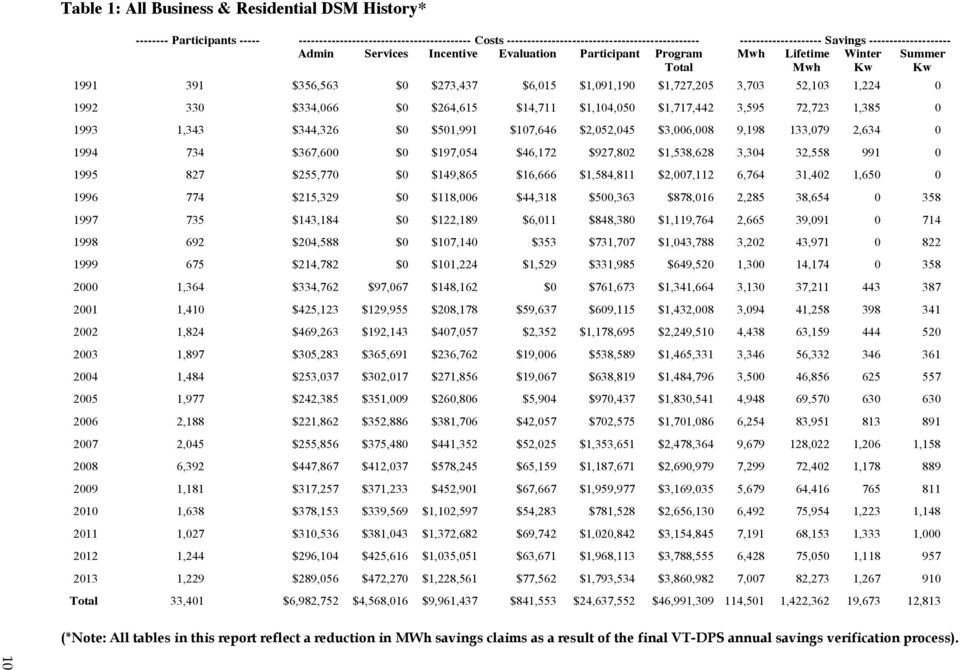
14 Table 1: All Business & Residential DSM History* Participants Costs Savings Admin Services Incentive Evaluation Participant Program Mwh Lifetime Winter Summer Total Mwh Kw Kw $356,563 $0 $273,437 $6,015 $1,091,190 $1,727,205 3,703 52,103 1, $334,066 $0 $264,615 $14,711 $1,104,050 $1,717,442 3,595 72,723 1, ,343 $344,326 $0 $501,991 $107,646 $2,052,045 $3,006,008 9, ,079 2, $367,600 $0 $197,054 $46,172 $927,802 $1,538,628 3,304 32, $255,770 $0 $149,865 $16,666 $1,584,811 $2,007,112 6,764 31,402 1, $215,329 $0 $118,006 $44,318 $500,363 $878,016 2,285 38, $143,184 $0 $122,189 $6,011 $848,380 $1,119,764 2,665 39, $204,588 $0 $107,140 $353 $731,707 $1,043,788 3,202 43, $214,782 $0 $101,224 $1,529 $331,985 $649,520 1,300 14, ,364 $334,762 $97,067 $148,162 $0 $761,673 $1,341,664 3,130 37, ,410 $425,123 $129,955 $208,178 $59,637 $609,115 $1,432,008 3,094 41, ,824 $469,263 $192,143 $407,057 $2,352 $1,178,695 $2,249,510 4,438 63, ,897 $305,283 $365,691 $236,762 $19,006 $538,589 $1,465,331 3,346 56, ,484 $253,037 $302,017 $271,856 $19,067 $638,819 $1,484,796 3,500 46, ,977 $242,385 $351,009 $260,806 $5,904 $970,437 $1,830,541 4,948 69, ,188 $221,862 $352,886 $381,706 $42,057 $702,575 $1,701,086 6,254 83, ,045 $255,856 $375,480 $441,352 $52,025 $1,353,651 $2,478,364 9, ,022 1,206 1, ,392 $447,867 $412,037 $578,245 $65,159 $1,187,671 $2,690,979 7,299 72,402 1, ,181 $317,257 $371,233 $452,901 $67,667 $1,959,977 $3,169,035 5,679 64, ,638 $378,153 $339,569 $1,102,597 $54,283 $781,528 $2,656,130 6,492 75,954 1,223 1, ,027 $310,536 $381,043 $1,372,682 $69,742 $1,020,842 $3,154,845 7,191 68,153 1,333 1, ,244 $296,104 $425,616 $1,035,051 $63,671 $1,968,113 $3,788,555 6,428 75,050 1, ,229 $289,056 $472,270 $1,228,561 $77,562 $1,793,534 $3,860,982 7,007 82,273 1, Total 33,401 $6,982,752 $4,568,016 $9,961,437 $841,553 $24,637,552 $46,991, ,501 1,422,362 19,673 12,813 (*Note: All tables in this report reflect a reduction in MWh savings claims as a result of the final VT-DPS annual savings verification process). 10
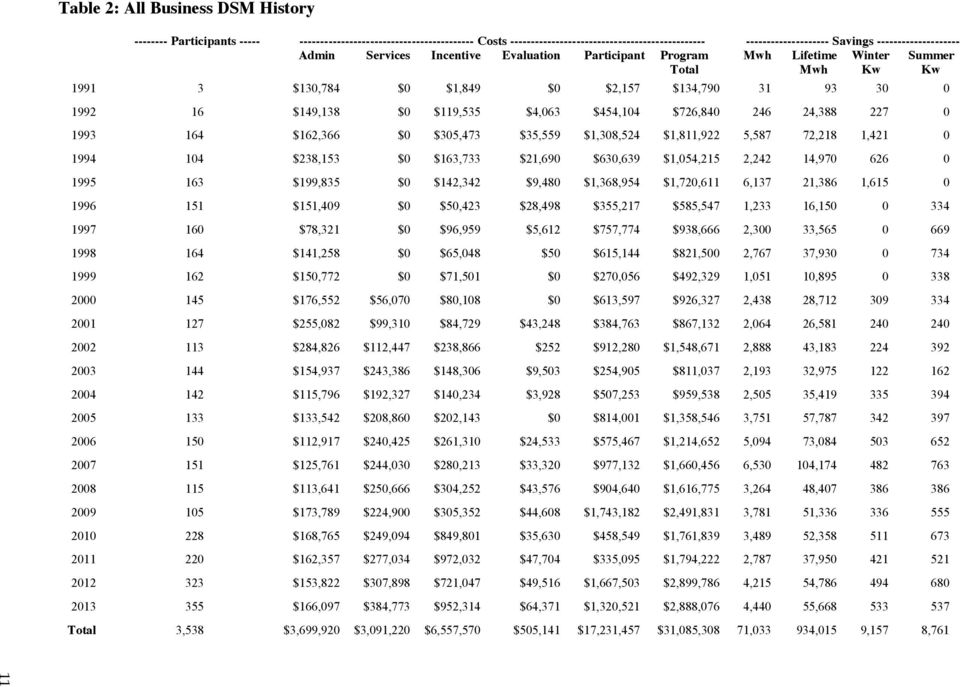
15 Table 2: All Business DSM History Participants Costs Savings Admin Services Incentive Evaluation Participant Program Mwh Lifetime Winter Summer Total Mwh Kw Kw $130,784 $0 $1,849 $0 $2,157 $134, $149,138 $0 $119,535 $4,063 $454,104 $726, , $162,366 $0 $305,473 $35,559 $1,308,524 $1,811,922 5,587 72,218 1, $238,153 $0 $163,733 $21,690 $630,639 $1,054,215 2,242 14, $199,835 $0 $142,342 $9,480 $1,368,954 $1,720,611 6,137 21,386 1, $151,409 $0 $50,423 $28,498 $355,217 $585,547 1,233 16, $78,321 $0 $96,959 $5,612 $757,774 $938,666 2,300 33, $141,258 $0 $65,048 $50 $615,144 $821,500 2,767 37, $150,772 $0 $71,501 $0 $270,056 $492,329 1,051 10, $176,552 $56,070 $80,108 $0 $613,597 $926,327 2,438 28, $255,082 $99,310 $84,729 $43,248 $384,763 $867,132 2,064 26, $284,826 $112,447 $238,866 $252 $912,280 $1,548,671 2,888 43, $154,937 $243,386 $148,306 $9,503 $254,905 $811,037 2,193 32, $115,796 $192,327 $140,234 $3,928 $507,253 $959,538 2,505 35, $133,542 $208,860 $202,143 $0 $814,001 $1,358,546 3,751 57, $112,917 $240,425 $261,310 $24,533 $575,467 $1,214,652 5,094 73, $125,761 $244,030 $280,213 $33,320 $977,132 $1,660,456 6, , $113,641 $250,666 $304,252 $43,576 $904,640 $1,616,775 3,264 48, $173,789 $224,900 $305,352 $44,608 $1,743,182 $2,491,831 3,781 51, $168,765 $249,094 $849,801 $35,630 $458,549 $1,761,839 3,489 52, $162,357 $277,034 $972,032 $47,704 $335,095 $1,794,222 2,787 37, $153,822 $307,898 $721,047 $49,516 $1,667,503 $2,899,786 4,215 54, $166,097 $384,773 $952,314 $64,371 $1,320,521 $2,888,076 4,440 55, Total 3,538 $3,699,920 $3,091,220 $6,557,570 $505,141 $17,231,457 $31,085,308 71, ,015 9,157 8,761 11
16 Table 3: All Residential DSM History Participants Costs Savings Admin Services Incentive Evaluation Participant Program Mwh Lifetime Winter Summer Total Mwh Kw Kw $225,779 $0 $271,588 $6,015 $1,089,033 $1,592,415 3,672 52,010 1, $184,928 $0 $145,080 $10,648 $649,946 $990,602 3,349 48,335 1, ,179 $181,960 $0 $196,518 $72,087 $743,521 $1,194,086 3,611 60,861 1, $129,447 $0 $33,321 $24,482 $297,163 $484,413 1,062 17, $55,935 $0 $7,523 $7,186 $215,857 $286, , $63,920 $0 $67,583 $15,820 $145,146 $292,469 1,052 22, $64,863 $0 $25,230 $399 $90,606 $181, , $63,330 $0 $42,092 $303 $116,563 $222, , $64,010 $0 $29,723 $1,529 $61,929 $157, , ,219 $158,210 $40,997 $68,054 $0 $148,076 $415, , ,283 $170,041 $30,645 $123,449 $16,389 $224,352 $564,876 1,030 14, ,711 $184,437 $79,696 $168,191 $2,100 $266,415 $700,839 1,550 19, ,753 $150,346 $122,305 $88,456 $9,503 $283,684 $654,294 1,153 23, ,342 $137,241 $109,690 $131,622 $15,139 $131,566 $525, , ,844 $108,843 $142,149 $58,663 $5,904 $156,436 $471,995 1,197 11, ,038 $108,945 $112,461 $120,396 $17,524 $127,108 $486,434 1,160 10, ,894 $130,095 $131,450 $161,139 $18,705 $376,519 $817,908 3,149 23, ,277 $334,226 $161,371 $273,993 $21,583 $283,031 $1,074,204 4,035 23, ,076 $143,468 $146,333 $147,549 $23,059 $216,795 $677,204 1,898 13, ,410 $209,388 $90,475 $252,796 $18,653 $322,979 $894,291 3,003 23, $148,179 $104,009 $400,650 $22,038 $685,747 $1,360,623 4,404 30, $142,282 $117,718 $314,004 $14,155 $300,610 $888,769 2,213 20, $122,959 $87,496 $276,247 $13,191 $473,013 $972,906 2,567 26, Total 29,863 $3,282,832 $1,476,795 $3,403,867 $336,412 $7,406,095 $15,906,001 43, ,347 10,516 4,052 12

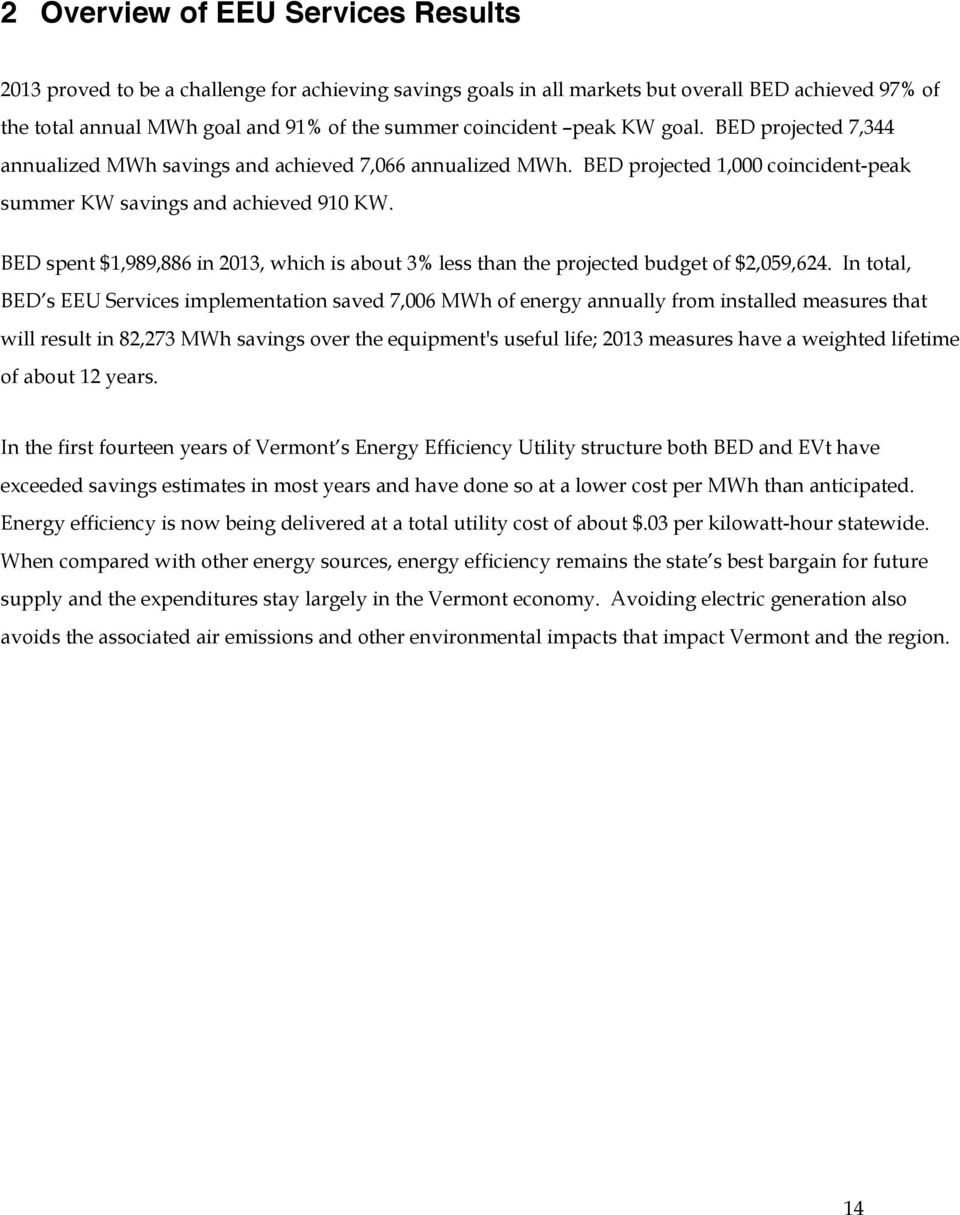
17 2 Overview of EEU Services Results 2013 proved to be a challenge for achieving savings goals in all markets but overall BED achieved 97% of the total annual MWh goal and 91% of the summer coincident peak KW goal. BED projected 7,344 annualized MWh savings and achieved 7,066 annualized MWh. BED projected 1,000 coincident-peak summer KW savings and achieved 910 KW. BED spent $1,989,886 in 2013, which is about 3% less than the projected budget of $2,059,624. In total, BED s EEU Services implementation saved 7,006 MWh of energy annually from installed measures that will result in 82,273 MWh savings over the equipment's useful life; 2013 measures have a weighted lifetime of about 12 years. In the first fourteen years of Vermont s Energy Efficiency Utility structure both BED and EVt have exceeded savings estimates in most years and have done so at a lower cost per MWh than anticipated. Energy efficiency is now being delivered at a total utility cost of about $.03 per kilowatt-hour statewide. When compared with other energy sources, energy efficiency remains the state s best bargain for future supply and the expenditures stay largely in the Vermont economy. Avoiding electric generation also avoids the associated air emissions and other environmental impacts that impact Vermont and the region. 14
18 Table 4: EEU Business & Residential - Total Resource Benefits Avoided costs of Electricity $8,974, Fossil Fuel Savings ($162,267.99) Water Savings $163, TRB Total $8,975, Annualized Lifetime Meter MWh 7,026 79,466 Generation MWh 7,006 82,273 Meter Demand Kw 4,050 43,021 Generation Peak Summer Kw ,370 Generation Peak Winter Kw 1,267 14,571 Water Savings 1,465 19,684 Fuel Increase -2,088-11,953 O+M Savings $408,746 $3,666,360 14

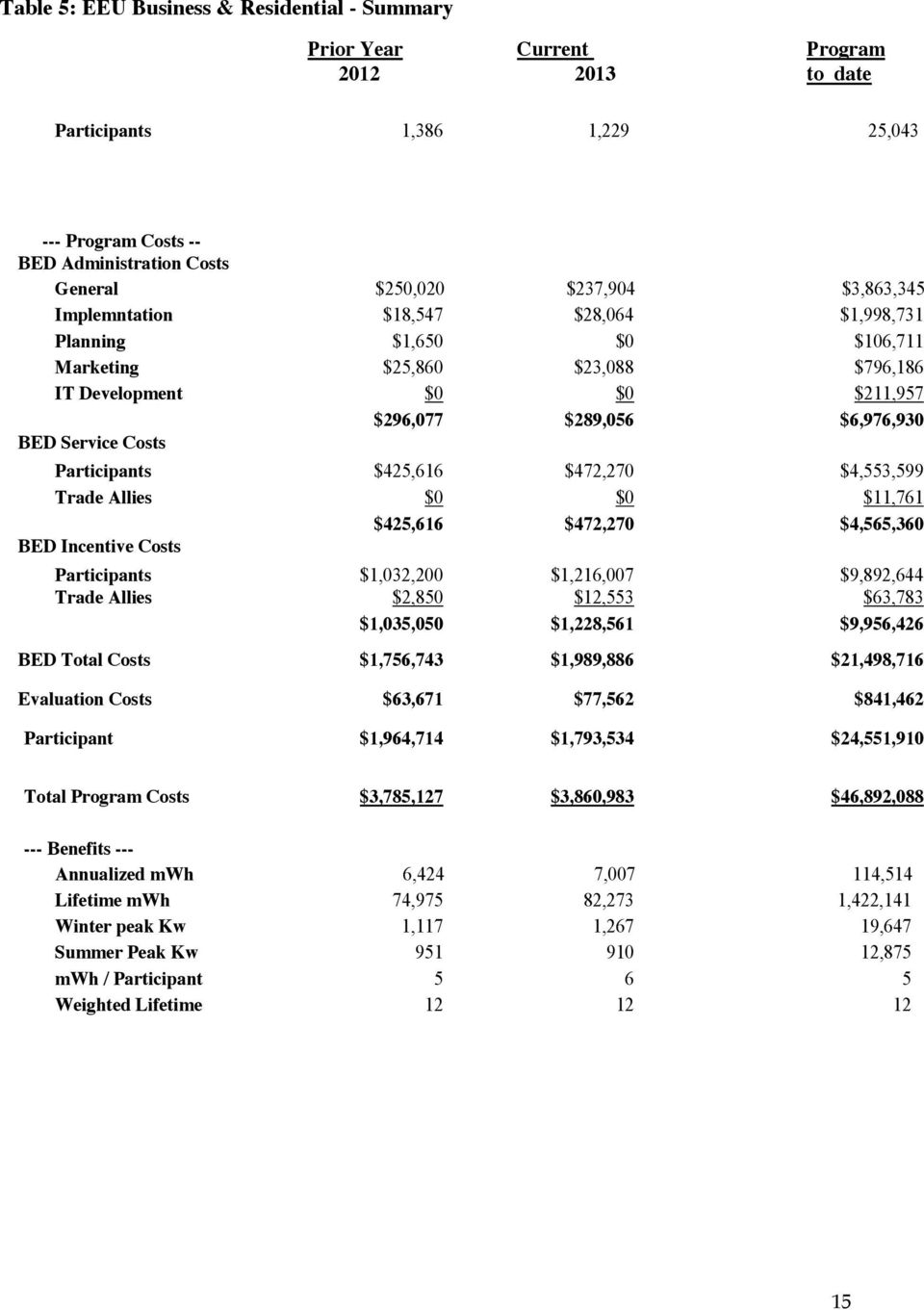
19 Table 5: EEU Business & Residential - Summary Prior Year Current Program to date Participants 1,386 1,229 25, Program Costs -- BED Administration Costs General $250,020 $237,904 $3,863,345 Implemntation $18,547 $28,064 $1,998,731 Planning $1,650 $0 $106,711 Marketing $25,860 $23,088 $796,186 IT Development $0 $0 $211,957 BED Service Costs $296,077 $289,056 $6,976,930 Participants $425,616 $472,270 $4,553,599 Trade Allies $0 $0 $11,761 BED Incentive Costs $425,616 $472,270 $4,565,360 Participants $1,032,200 $1,216,007 $9,892,644 Trade Allies $2,850 $12,553 $63,783 $1,035,050 $1,228,561 $9,956,426 BED Total Costs $1,756,743 $1,989,886 $21,498,716 Evaluation Costs $63,671 $77,562 $841,462 Participant $1,964,714 $1,793,534 $24,551,910 Total Program Costs $3,785,127 $3,860,983 $46,892, Benefits --- Annualized mwh 6,424 7, ,514 Lifetime mwh 74,975 82,273 1,422,141 Winter peak Kw 1,117 1,267 19,647 Summer Peak Kw ,875 mwh / Participant Weighted Lifetime
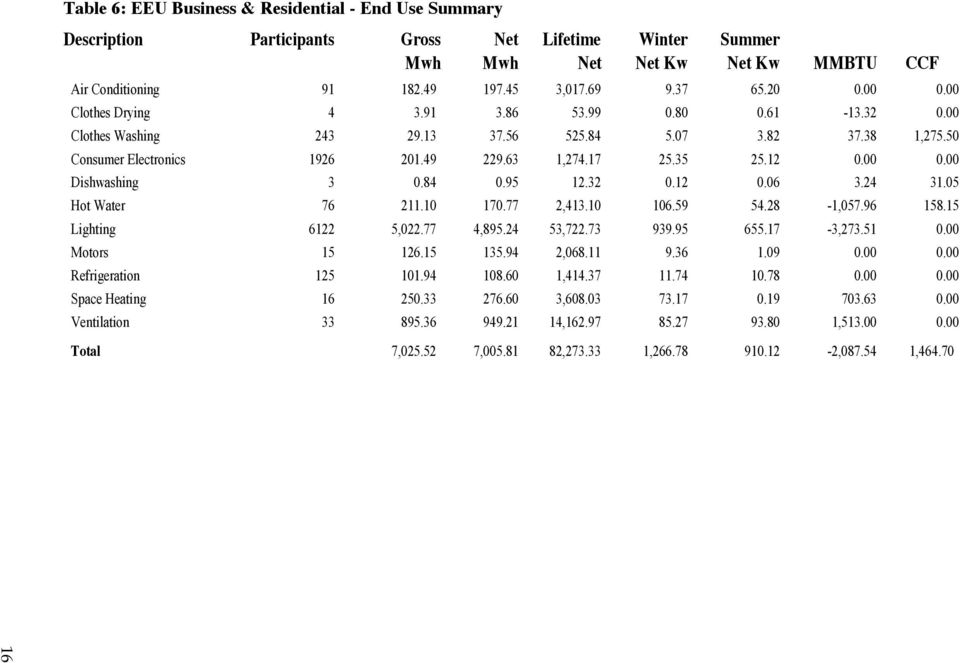
20 Table 6: EEU Business & Residential - End Use Summary Description Participants Gross Net Lifetime Winter Summer Mwh Mwh Net Net Kw Net Kw MMBTU CCF Air Conditioning , Clothes Drying Clothes Washing , Consumer Electronics , Dishwashing Hot Water , , Lighting , , , , Motors , Refrigeration , Space Heating , Ventilation , , Total 7, , , , , ,
21 2.1 Non Resource Acquisition The following section highlights BED s Non Resource Acquisition (NRA) activities for NRA activities are those that do not directly achieve immediate energy savings but are essential to the operation and administration of BED s EEU services and to the longterm success of future efficiency savings and innovation. The NRA categories were developed collaboratively with the DPS and EVT as part of the Demand Resource Plan Process and approved by the Public Service Board. BED s NRA activities include: education, smart grid and AMI, applied research and development, planning and reporting, evaluation, policy and public affairs, information technology and general administration. Education- This category captures BED s work throughout the year on general energy efficiency education that is geared toward building awareness that leads customers to take action to reduce energy use through efficiency or conservation. BED provides education to builders and contractors, real estate professionals, K-12 students and teachers, college and universities and the general public. Advanced Metering Infrastructure (AMI) - Smart Grid- Advanced metering infrastructure (AMI), smart grid and a new realm of potential customer energy use empowerment tools are being deployed in most of Vermont. BED is excited to explore the extensive possibilities for enhanced interaction with its customers and the potential benefits and capabilities AMI technology will bring them. Applied Research and Development- This work includes BED s collaboration with EVt and other entities on applied research and development activities designed to optimize the creation of cost- effective solutions to meeting BED s long- term resource acquisition goals. 17
22 The main focus of applied R&D is in the following three areas: Field- testing new implementation strategies such as social networking Technology demonstrations Research of emerging technologies and innovative efficiency implementation strategies Planning and Reporting- To help keep the Vermont Public Service Board, the Department of Public Service, and other stakeholders, informed about BED s EEU activities, BED submits monthly, quarterly, and annual reports and an annual plan to the Board and DPS. Evaluation- Determining the accuracy of BED s savings claims, evaluation is a critical aspect of BED s responsibilities as an EEU to Burlington rate payers. There are several evaluation activities that BED participates in to help BED continually improve savings quantification methods. Policy and Public Affairs- This NRA activity captures BED s participation in discussions about energy efficiency and EEU related issues that typically occur throughout the year with regulators and other stakeholders. Information Technology (IT)- BED s on-going IT initiative mainly consists of continuing the support of and improvement to the DSM database system for the collection and processing of project data and program information critical to tracking, reporting and planning functions. There is a fairly regular need to alter measure savings characterization, existing tools or add new tools and functionality to the system which helps us to better understand and respond to changes in the Burlington marketplace. Administration- This NRA category captures BED s annual activities and costs for the overall management of EEU programs not specific to the individual programs and includes: general staff meetings, coordination of program implementation across all program functions and managing and monitoring overall performance and spending. 18
23 Table 7: Non-Resource Acquisition Program Year to Date Costs Annual Budget % of Annual Budget Education and Training $40,205 $38, % Smart Grid and AMI $10,868 $62,957 17% Applied R & D $7,431 $14,664 51% Planning and Reporting $42,510 $36, % Evaluation $28,766 $29,876 96% Policy and Public Affairs $14,106 $15,584 91% Information Technology $27,182 $25, % General Administration $24,501 $23, % Total $195,568 $248,513 79% 19
24 2.2 Business Services Overview This section of the report contains information on BED's Business EEU Services: Business New Construction and Business Existing Facilities (Market Opportunities & Retrofit). Overall, 2013 results in business services exceeded savings projections. BED projected 4,153 megawatt-hour (MWh) savings while achieving actual annual energy savings of 4,440 MWh, 7% over projections. BED s cost to deliver EEU business services in 2013 was $1,503,184, below the budgeted amount of $1,642,317 by 8%. It is often difficult to forecast savings and expenses in the C&I sector in Burlington. This is due to the potential for completion of a few large unexpected projects by one or two customers, dramatically exceeding projections and budgets. On the other hand, savings goals may just as unpredictably be missed due to delays or cancellations of planned significant projects. As we enter 2014, commercial lighting technologies continue to improve. Higher quality LED products are becoming more widely available and cost-effective lighting control systems are also emerging. BED will continue to advance the new and exciting benefits of these technologies. BED hosted several meetings in 2013 for our customers to see the technology up close and to talk with vendors and manufacturers. These efforts paid off in 2013 with several installed projects and more planned in BED will also continue to partner with EVt on a study which is evaluating the operating efficiency of different roof-top heating and cooling units (RTU s). RTU s are a very common method for heating, cooling and ventilating commercial buildings. The purpose of the study is to understand more fully how effectively these packaged units are performing in typical installations. If problems are found with the units, they are repaired, and then performance evaluated once more. Finally, the equipment will be upgraded with several types of advanced controls, with additional logging to determine the level of improved efficiency. It is felt that RTUs in the 5 ton to 30 ton range are an important untapped area for more focused energy efficiency measures. 20
25 BED will also continue field testing continuous building monitoring tools to help determine the implementation costs and the potential for preserving savings and/or finding further savings opportunities. The long term goal is to ensure that buildings continue to operate in an energy efficient mode long after the final building functional testing is completed and the installation contractors have departed. Tools that help to ensure the persistence of the energy savings over the life of equipment is well worth exploring. It is not uncommon to find larger commercial buildings that suffer from energy performance issues that could have been quickly resolved if the building had the correct automated processes in place to monitor energy usage trends, equipment failures or operator errors made to the energy management system. Often building operators, in an attempt to address occupant comfort issues negatively and needlessly impact the systems energy efficiency performance. The correct set-up and monitoring of the building energy management system and provision of the appropriate feedback mechanisms to the building operators could help to optimize the balance between occupant comfort and energy performance. BED is currently working with four customers who have deployed monitoring and feedback platforms. The basic concept is to monitor and present energy data from selected electrical meters, or building energy management systems, to help facility managers more promptly and accurately look at energy usage and trends. Key features include: benchmarking, load shedding, monthly energy analysis, real-time energy alerts and alarms. The potential is to help reduce simultaneous energy demand and to find low-cost or no-cost opportunities to shed usage in areas using excessive electricity, and to monitor the usage over time to ensure that energy savings stay in place. 21
26 Table 8: EEU Business - Total Resource Benefits Avoided costs of Electricity $5,221, Fossil Fuel Savings $52, Water Savings $0.00 TRB Total $5,273, Annualized Lifetime Meter MWh 4,078 51,289 Generation MWh 4,439 55,667 Meter Demand Kw 1,080 13,024 Generation Peak Summer Kw 537 6,535 Generation Peak Winter Kw 533 6,621 Water Savings 0 0 Fuel Increase -72 5,210 O+M Savings $272,744 $2,574,132 22
27 Table 9: EEU Business - Summary Prior Year Current Program to date Participants , Program Costs -- BED Administration Costs General $122,413 $125,207 $1,997,235 Implemntation $13,880 $25,297 $1,259,856 Planning $834 $0 $62,003 Marketing $16,695 $15,592 $265,519 IT Development $0 $0 $110,564 BED Service Costs $153,822 $166,097 $3,695,177 Participants $307,899 $384,773 $3,082,264 Trade Allies $0 $0 $6,780 BED Incentive Costs $307,899 $384,773 $3,089,044 Participants $719,997 $940,360 $6,694,745 Trade Allies $1,050 $11,953 $30,661 $721,047 $952,314 $6,725,406 BED Total Costs $1,182,767 $1,503,184 $13,509,627 Evaluation Costs $49,516 $64,371 $503,767 Participant $1,664,103 $1,320,521 $16,250,242 Total Program Costs $2,896,386 $2,888,076 $30,263, Benefits --- Annualized mwh 4,211 4,440 71,045 Lifetime mwh 54,711 55, ,794 Winter peak Kw ,131 Summer Peak Kw ,723 mwh / Participant Weighted Lifetime
28 Table 10: EEU Business - End-Use Summary Description Participants Gross Net Lifetime Winter Summer Mwh Mwh Net Net Kw Net Kw MMBTU CCF Air Conditioning , Lighting , , , , Motors , Refrigeration Space Heating , Ventilation , , Total 4, , ,
29 2.2.1 Business New Construction Program Description This service helps commercial and industrial builders and developers incorporate the most energy efficient products and systems possible when building or renovating. It is designed to help customers exceed the City of Burlington's required Guidelines for Energy Efficient Construction (which adopted the statewide CBES energy code as of January 1, 2007). By working directly and early in the process with designers and owners, BED assists in the choice of energy efficient systems and construction techniques that meet business and energy needs. The program offers financial incentives for the installation of cost effective efficiency measures. Eligible participants gain technical assistance, verification services and financial incentives to help with efficient equipment costs. BED's Business New Construction service addresses all energy (especially electricity) consuming equipment, components or practices, including motors, lighting, heating, ventilation, airconditioning (HVAC) and control packages. Natural gas is almost universally available in Burlington. To insure comprehensiveness in building and system designs, BED coordinates with Vermont Gas Systems (VGS) on all projects. The two utilities notify each other when projects are identified or when major changes are considered by the developers or the design teams. This partnership is mutually beneficial to both organizations and the ratepayers. BED maximizes the adoption of energy efficient systems and techniques through proactive outreach and recruitment. As both an electric distribution utility and a municipal department with a role in the City s design review process, BED is in a unique position to identify new construction and major renovation before significant design efforts begin. BED coordinates this effort with other city agencies including the city s Planning & Zoning Department and its Department of Public Works. See the Design Review Guide (Attachment A) for an example of our coordinated efforts. 25
30 BED continues to support enforcement and provide administration of the Guidelines for Energy Efficient Construction for the City of Burlington, VT (adopted CBES), the energy code for all new construction and renovation in the City. The benefits of the Business New Construction program have evolved into an important facet of the city s economic development efforts. Because BED is involved in the very earliest stages of project development, the benefits of energy efficiency are packaged along with other attractive elements that entice businesses to locate facilities in the city, enhancing employment growth and economic development in Burlington. Project Highlights The annualized megawatt-hour (MWh) savings for 2013 were 629, about 43% higher than the projection of 439 MWh. Total BED program costs were $204,996, 32% less than the budgeted amount of $302, saw an improvement in the economy and subsequent new construction permits. UVM s Redstone Lofts Apartment complex (147,000 square feet) was the largest completed project in 2013 followed by FAHC s Clinical Research Center relocation. Variance Discussion Customers make business decisions independent of BED s program budgeting efforts, and we fully anticipate that year to year efforts will be lumpy, and show dramatic swings in performance. Long-term average results are a better indicator of what can be expected on an annual basis than any given year s data. Both Business and Residential New Construction programs have outpaced savings projections to date. These projections were made by BED in 2011during a period of very uncertain economic conditions. Program Changes For 2014, BED will continue to advance the building energy model approach option for new construction projects. In order to best estimate the energy efficiency potential of 26
31 a project, building energy modeling software is used to compare the energy performance of a building that just meets CBES to a model of the final building design. The energy savings claimed for a project is a result of comparing the two building model runs along with final inspections of the buildings. This approach assumes that the efficient model correctly knows the occupancy rates, hours of operation, set-points for temperature, lighting control schedules and plug-loads from various equipment. BED will also continue to utilize a tiered incentive approach for larger projects that pays part of the incentive at project completion and then the remaining incentives after about one year of comparing actual billing history data to the energy efficient model. It often takes about a year for larger commercial buildings to be fully occupied, equipped and debugged of any performance issues. This approach will allow for more accurate savings claims and ensure that the building operator is encouraged to optimize the performance of the building. 27
32 Table 11: EEU Business New Construction - Total Resource Benefits Avoided costs of Electricity $999, Fossil Fuel Savings ($51,829.40) Water Savings $0.00 TRB Total $947, Annualized Lifetime Meter MWh 558 7,713 Generation MWh 629 8,696 Meter Demand Kw 269 3,566 Generation Peak Summer Kw 122 1,781 Generation Peak Winter Kw 97 1,300 Water Savings 0 0 Fuel Increase ,551 O+M Savings $0 $0 28
33 Table 12: EEU Business New Construction - Summary Prior Year Current Program to date Participants Program Costs -- BED Administration Costs General $42,635 $40,974 $358,721 Implemntation $0 $0 $126,485 Planning $205 $0 $15,847 Marketing $8,906 $8,874 $165,347 IT Development $0 $0 $41,038 BED Service Costs $51,746 $49,848 $707,438 Participants $44,906 $47,320 $866,233 Trade Allies $0 $0 $0 BED Incentive Costs $44,906 $47,320 $866,233 Participants $148,724 $107,828 $1,169,214 Trade Allies $0 $0 $336 $148,724 $107,828 $1,169,550 BED Total Costs $245,377 $204,996 $2,743,221 Evaluation Costs $0 $0 $34,579 Participant $487,397 $145,797 $3,852,384 Total Program Costs $732,774 $350,793 $6,630, Benefits --- Annualized mwh ,471 Lifetime mwh 8,989 8, ,373 Winter peak Kw ,193 Summer Peak Kw ,912 mwh / Participant Weighted Lifetime
34 Table 13: EEU Business New Construction - End Use Summary Description Participants Gross Net Lifetime Winter Summer Mwh Mwh Net Net Kw Net Kw MMBTU CCF Air Conditioning , Lighting , Space Heating Ventilation Total ,
35 2.2.2 Business Existing Facilities (Market Opportunities & Retrofit Services) Program Description Business Existing Facilities, Market Opportunity Service (MOP) targets naturallyoccurring equipment changeovers to secure energy savings in the equipment replacement market. Targeted equipment includes lighting, heating, ventilation, cooling, water heating, refrigeration, motors and drives, controls and industrial process applications. This program offers prescriptive and custom tracks, with technical assistance and financial incentives that encourage the adoption of cost effective, high efficiency alternatives to standard efficiency equipment. BED and EVt offer prescriptive incentives (fixed incentives for specific eligible measures) for building lighting, refrigeration economizers and controls, motors, unitary HVAC equipment and dual enthalpy economizers for unitary HVAC units. BED and EVt also participate jointly in the Northeast Energy Efficiency Partnership to further the market transformation of motors, lighting and HVAC equipment. Incentives for aboveaverage energy efficient equipment are supplied to wholesalers, contractors, and customers at the time of equipment replacement. Non-prescriptive cost-effective measures or combinations of measures are eligible for custom incentives. Custom incentives are designed to capture as many potential lost opportunity resources as possible, while maximizing program delivery resources. BED staff and trade allies serving Burlington (including: equipment vendors, manufacturers, suppliers, contractors, architects and engineers) market the program to potential participants. As natural gas is the predominant heating fuel in Burlington, BED works closely with Vermont Gas Systems (VGS) to encourage a comprehensive approach to energy savings. BED and VGS staff is committed to bringing appropriate projects to each other s 31
36 attention. This partnership is mutually beneficial to both organizations and our mutual ratepayers. Business Existing Facilities, Retrofit Service offers energy efficiency services that have been provided by BED staff for over two decades. Building retrofit entails BED staff and/or trade allies examining customer buildings and systems to identify energy efficiency opportunities for the customer. When promising projects are identified, BED staff prepares analyses for the customer showing the costs and benefits of potential energy efficiency measures. This service is offered to all business customers from the smallest retail store to the largest commercial and industrial facility. Given BED s long history of delivering this service, the program has reached a high level of maturity and customer acceptance. Facility managers have learned to rely on the program benefits and the technical assistance offered by BED staff. Program Highlights The annualized megawatt-hour (MWh) savings for 2013 were 3,811, about 3% higher than the projection of 3,714 MWh. Total BED program costs were $1,298,188, 3% under the budgeted amount of $1,340,000. The Business Existing Facilities 2013 End-Use Activity table shows diversity in the end use savings but lighting and controls was once again the leader. Commercial lighting measures are strongly coincident with summer loads and thus provide significant avoided peak energy costs to BED. BED projected 515 coincident-peak KW savings and achieved 415 coincident-peak KW, 81% of the 2013 goal. Variance Discussion Overall, the Business Existing Facilities services performed well in As close to 75% of all kwh sales are to the commercial class these is an important market to work effectively with. Strategies that encourage these customers to pursue energy efficiency improvements are crucial to helping BED meet savings projections in the years to come. 32
37 Table 14: EEU Business Existing Facilities - Total Resource Benefits Avoided costs of Electricity $4,221, Fossil Fuel Savings $103, Water Savings $0.00 TRB Total $4,325, Annualized Lifetime Meter MWh 3,520 43,577 Generation MWh 3,811 46,972 Meter Demand Kw 811 9,457 Generation Peak Summer Kw 415 4,754 Generation Peak Winter Kw 436 5,321 Water Savings 0 0 Fuel Increase 266 9,761 O+M Savings $272,744 $2,574,132 33
38 Table 15: EEU Business Existing Facilities - Summary Prior Year Current Program to date Participants , Program Costs -- BED Administration Costs General $79,777 $84,233 $1,638,515 Implemntation $13,880 $25,297 $1,133,371 Planning $629 $0 $46,156 Marketing $7,790 $6,719 $100,172 IT Development $0 $0 $69,526 BED Service Costs $102,076 $116,249 $2,987,739 Participants $262,992 $337,453 $2,216,031 Trade Allies $0 $0 $6,780 BED Incentive Costs $262,992 $337,453 $2,222,811 Participants $571,273 $832,532 $5,525,532 Trade Allies $1,050 $11,953 $30,325 $572,323 $844,486 $5,555,857 BED Total Costs $937,391 $1,298,188 $10,766,406 Evaluation Costs $49,516 $64,371 $469,188 Participant $1,176,706 $1,174,724 $12,397,858 Total Program Costs $2,163,613 $2,537,283 $23,633, Benefits --- Annualized mwh 3,589 3,811 56,574 Lifetime mwh 45,722 46, ,421 Winter peak Kw ,938 Summer Peak Kw ,811 mwh / Participant Weighted Lifetime
39 Table 16: EEU Business Existing Facilities - End Use Summary Description Participants Gross Net Lifetime Winter Summer Mwh Mwh Net Net Kw Net Kw MMBTU CCF Air Conditioning , Lighting 981 2, , , , Motors , Refrigeration Space Heating , Ventilation , , Total 3, , ,
40 2.3 Residential Service Overview This section of the report contains information on BED's Residential EEU Services: Residential New Construction, Existing Homes, Efficient Retail Products and Thermal Energy and Process Fuels services. In 2013, BED projected 3,191 annualized MWh residential savings while achieving annual energy savings of 2,567 MWh or 80% of the projected goal. BED s cost to deliver residential services in 2013 was $486,702 which was 16% over budget for the year s projected spending of $417,307. As BED explains in more detail in each program below, there are a number of factors that influence year to year budgets and savings projections in Burlington s residential markets. The residential class presents particular challenges as about 60% of BED s residential customers are renters and about 85% of these customers pay their electric and natural gas heating bills directly. Rental apartments are typically smaller with fewer appliances and lighting opportunities. BED also turns over about 35% of residential accounts each year due to the high percentage of students. About 85% of residential buildings use natural gas for space heating and domestic hot water. BED s residential consumption is about 24% less than the average Vermont residential customer, 34% less than the average New England residential customer and 55% less than the national average. BED will continue to test all program design assumptions and pursue all strategies to make programs as cost-effective as possible. BED is now able to offer a PACE financing service which we hope will encourage some customers to take a more comprehensive approach to improving the energy performance of their buildings. The energy consumption information, and guidance, that is now available through BED s smart grid web presentment tool (Energy Engage) may also help encourage more customers to take steps to reduce usage. 36
41 This software includes dashboards that present energy usage details and energy efficiency- related technical advice and efficiency program opportunities to customers. EEU funds were not used for Energy Engage but BED believes that it provides a potential platform to launch other energy efficiency offerings from. Pictured below are examples of the types of information that our customers now have access to: 37
42 38
43 Table 17: EEU Residential - Total Resource Benefits Avoided costs of Electricity $3,752, Fossil Fuel Savings ($214,323.04) Water Savings $163, TRB Total $3,702, Annualized Lifetime Meter MWh 2,948 28,176 Generation MWh 2,567 26,606 Meter Demand Kw 2,970 29,997 Generation Peak Summer Kw 373 3,835 Generation Peak Winter Kw 734 7,949 Water Savings 1,465 19,684 Fuel Increase -2,016-17,163 O+M Savings $136,003 $1,092,228 39
44 Table 18: EEU Residential - Summary Prior Year Current Program to date Participants 1, , Program Costs -- BED Administration Costs General $127,607 $112,696 $1,866,110 Implemntation $4,668 $2,766 $738,875 Planning $815 $0 $44,709 Marketing $9,164 $7,496 $530,668 IT Development $0 $0 $101,393 BED Service Costs $142,254 $122,959 $3,281,753 Participants $117,717 $87,496 $1,471,335 Trade Allies $0 $0 $4,981 BED Incentive Costs $117,717 $87,496 $1,476,316 Participants $312,203 $275,647 $3,197,898 Trade Allies $1,800 $600 $33,121 $314,003 $276,247 $3,231,020 BED Total Costs $573,975 $486,702 $7,989,089 Evaluation Costs $14,155 $13,191 $337,695 Participant $300,611 $473,013 $8,301,668 Total Program Costs $888,741 $972,906 $16,628, Benefits --- Annualized mwh 2,213 2,567 43,469 Lifetime mwh 20,264 26, ,347 Winter peak Kw ,516 Summer Peak Kw ,152 mwh / Participant Weighted Lifetime
45 Table 19: EEU Residential - End Use Summary Description Participants Gross Net Lifetime Winter Summer Mwh Mwh Net Net Kw Net Kw MMBTU CCF Air Conditioning Clothes Drying Clothes Washing , Consumer Electronics , Dishwashing Hot Water , , Lighting , , , , Refrigeration Space Heating Ventilation Total 2, , , , ,
46 2.3.1 Residential New Construction Program Description This service aims to improve the efficiency of all new homes, and buildings undergoing substantial renovation. This includes single-family homes, multi-family homes and lowincome multi-family projects. It addresses all major end uses: space heating, water heating, central cooling (if applicable), ventilation, major appliances and lighting for high use areas. Residential New Construction (RNC) encourages builders and consumers to build to the Vermont Energy Star Home standard. This standard specifies that homes meet the Energy Star performance standard (representing over 20% savings in heating, cooling and hot water consumption relative to the Vermont Residential Building Energy Standard (RBES). The Vermont Energy Star Homes (VESH) standard is promoted to developers, architects, builders, building supply centers, equipment suppliers and consumers through a combination of marketing, technical assistance to builders, provision of energy ratings, and a package of incentives for efficient lighting fixtures, major appliances and ventilation equipment. EVt and Vermont Gas Systems continue to do great work promoting VESH which has had direct benefits to BED. As most of the trade allies mentioned above build inside and outside of Burlington it has been helpful to have a joint program with identical participation requirements. BED uses several additional methods to encourage participation in this sometimes difficult to influence market. These include: BED staff attends local monthly Technical Review meetings where all new construction and virtually all substantial renovation projects are introduced to the Burlington Planning and Zoning Department staff as part of the City s local project approval process. At these meetings BED explains the RNC program to the permit applicant and gives them program literature. BED then forwards the project information to Vermont 42
47 Wise Energy Services to follow-up with the customer. For larger multi-family projects BED staff (in partnership with Vermont Gas Systems) work directly with the property owner. BED receives monthly Development Case Load updates from the Department of Planning and Zoning that track the progress of each of the development projects in Burlington. New and revised electric service and line extension applications help us track smaller renovation projects that may have bypassed the City s permit approval process. All ability to serve letters from BED include information about energy efficiency services. BED receives a weekly electronic report from the Department of Public Works- Building Inspection Division (DPW) listing all trades permits issued. The Burlington DPW refers projects to BED to help them ensure compliance with RBES (and CBES) and to assess opportunities for exceeding requirements. DPW requires a compliance memo from BED Energy Services before issuing the building permit. Program Highlights In 2013, the savings came from a mix of small multi-family projects and single-family major gut rehabilitation projects. Both market rate and affordable multi-family projects comprise the vast majority of housing development in Burlington. The single-family new construction market is constrained due to limited open land. Variance Discussion The RNC service achieved 40 MWh in annualized electricity savings for the year which was 21%higher than the projected 33 MWh goal. At $106,789, spending was 19% higher than the projected spending of $90,
48 As BED has reported in previous Annual Reports, RNC is a difficult market to predict year to year as it only takes a few projects in Burlington to adjust savings projections and budgets dramatically was a very strong year due to savings from three large multi-family affordable housing projects. There are currently 46 units enrolled in the program that should be completed in 2014 resulting in another strong year. Program Changes In 2014, BED, EVT and VGS will continue to assist the residential market with exceeding RBES and will also promote low-load and net-zero building practices. BED s residential new construction market is dominated by multi-family structures and most of the single-family work is with gut-rehabilitation projects so we will continue to develop strategies to work effectively with both of these markets. 44
49 Table 20: EEU Residential New Construction - Total Resource Benefits Avoided costs of Electricity $171, Fossil Fuel Savings $160, Water Savings $7, TRB Total $339, Annualized Lifetime Meter MWh Generation MWh Meter Demand Kw Generation Peak Summer Kw Generation Peak Winter Kw 6 86 Water Savings Fuel Increase ,543 O+M Savings $312 $2,429 45
50 Table 21: EEU Residential New Construction - Summary Prior Year Current Program to date Participants Program Costs -- BED Administration Costs General $26,753 $30,693 $236,934 Implemntation $0 $0 $96,638 Planning $132 $0 $11,195 Marketing $3,442 $3,218 $83,543 IT Development $0 $0 $34,241 BED Service Costs $30,327 $33,911 $462,550 Participants $32,457 $32,819 $472,968 Trade Allies $0 $0 $2,700 BED Incentive Costs $32,457 $32,819 $475,668 Participants $49,863 $40,059 $353,392 Trade Allies $0 $0 $2 $49,863 $40,059 $353,394 BED Total Costs $112,646 $106,789 $1,291,612 Evaluation Costs $3,048 $2,845 $46,163 Participant $35,821 ($540) $272,085 Total Program Costs $151,515 $109,094 $1,609, Benefits --- Annualized mwh ,229 Lifetime mwh 3, ,064 Winter peak Kw Summer Peak Kw mwh / Participant Weighted Lifetime
51 Table 22: EEU Residential New Construction - End Use Summary Description Participants Gross Net Lifetime Winter Summer Mwh Mwh Net Net Kw Net Kw MMBTU CCF Air Conditioning Clothes Drying Clothes Washing Dishwashing Lighting Refrigeration Space Heating Total
52 2.3.2 Existing Homes Program Description This service aims to improve the efficiency of all existing residential buildings including low-income single family, market-rate single-family and all multi-family projects (market-rate and low-income). BED offers the same existing homes service as Efficiency Vermont (EVt) and also works closely with Vermont Gas Systems (VGS) and the Champlain Valley Weatherization Service (CVWS) on many of its projects. Low-income buildings are addressed by a partnership with the state s Low-income Weatherization Assistance Program (WAP). This partnership provides electric efficiency measures (including fuel switching of electric hot water and electric space heating) to Burlington s low-income electricity consumers. Electrical efficiency measures are delivered to income-eligible electric customers at the time they receive thermal shell, space heating and water heating improvements from CVWS. This service also works closely with high usage households for energy efficiency improvements that can significantly reduce their energy bills. On-site energy audits, customer education, appliance meter loans, technical assistance, project management and cash incentives are all part of this service. In some cases, the high usage is driven by electric domestic hot water and\or electric resistance space heating. Electric space heat and domestic hot water have been rapidly decreasing markets in Burlington but the opportunity to convert to natural gas is available to the owners of some of these housing units, providing significant energy and cost savings. BED and EVt continued collaboration working with the private (market-rate) rental housing market (customers not eligible for low-income energy services) to increase both participation and the depth of savings per participant. Traditionally, renters (60% of Burlington s residential customers are renters) have not been strong participants and the same holds true for property-owners where the tenants pay the energy bills directly which is the case in about 85% of Burlington s dwellings. 48
53 The Rental Properties Owners service offers free tank wraps (electric tanks only), pipe insulation, water saving devices, enhanced rebates for the early retirement of eligible refrigerators, incentives for improving mechanical ventilation along with up to fifteen free screw-in CFL s per apartment. This service provides savings directly to the tenant but also water savings, and potentially maintenance savings via ventilation fans to the property owner. This service allows us the opportunity to develop long-lasting relationships with property-owners to help identify further savings from refrigeration replacements, common area lighting and laundry equipment improvements, weatherization and ventilation. BED continues to offer a robust energy education service for customers that includes onsite energy audits, lending of appliance meters and custom billing history analysis. BED also continues to provide energy efficiency information in a variety of forums. BED staff also visited several classrooms in the Burlington School District to discuss energy efficiency with faculty and schoolchildren. Program Highlights In 2013, 74 fuel switch projects were completed. 70 electric hot water tanks were switched to natural gas, 4 dwelling replaced electric heat with natural gas space heating equipment and 3 electric clothes dryers were switched to natural gas units. 13 customers and their contractors took advantage of rebates for ENERGY STAR furnaces with ECM fans and 5 more customers took advantage of incentives for ENERGY STAR central AC systems. 35 refrigerators were retired early and replaced with ENERGY STAR models, 2,990 CFL s were provided and 45 automatically controlled ENERGY STAR bathroom exhaust fan systems were installed. BED offers incentives to the contractor and the building owner to install this equipment. Vermont Gas Systems offers additional incentives to install high efficiency space and water heating equipment along with thermal shell upgrades. 49
54 Variance Discussion The Existing Homes service achieved 314 MWh in annualized electricity savings for the year, about 23% less than the projected 409 MWh. At $158,564 spending was 4% above BED s projected spending of $152,307. It is worth noting that electric resistance space and water heating are disappearing markets (helped by many years of technical assistance incentives from BED to fuel switch to natural gas) in Burlington along with the savings from screw-in CFL s as the Federal energy standards take effect. In 2013, these measures accounted for about 87% of the total savings. BED will continue to work with its partners to explore technologies and services that leverage as much cost-effective total resource benefit as possible in an increasingly challenging market. BED will continue with the market-rate rental housing campaign as about 60% of BED s residential customers live in rental housing and about 85% pay their electric and heating costs directly. Over 90% of BED s residential rental customers use natural gas for space heating and domestic hot water. We will continue to leverage common area energy savings, building water savings, ice dam and moisture damage solutions for propertyowners as part of the service to help develop long-term relationships with building owners. BED will also continue working with UVM s office of off-campus services. BED and VGS conducted energy workshops for students, staff and faculty living off-campus in 2011, 2012 and 2013 and they will be offered again in
55 Table 23: EEU Residential Existing Homes - Total Resource Benefits Avoided costs of Electricity $820, Fossil Fuel Savings ($156,196.06) Water Savings $13, TRB Total $677, Annualized Lifetime Meter MWh 352 4,695 Generation MWh 314 4,276 Meter Demand Kw 508 6,788 Generation Peak Summer Kw Generation Peak Winter Kw 169 2,338 Water Savings 164 1,510 Fuel Increase ,742 O+M Savings $4,180 $31,061 51
56 Table 24: EEU Residential Existing Homes - Summary Prior Year Current Program to date Participants , Program Costs -- BED Administration Costs General $60,547 $38,332 $1,221,349 Implemntation $4,668 $2,766 $551,981 Planning $697 $0 $19,067 Marketing $2,029 $1,869 $309,322 IT Development $0 $0 $45,049 BED Service Costs $67,940 $42,967 $2,146,768 Participants $85,196 $52,435 $675,078 Trade Allies $0 $0 $0 BED Incentive Costs $85,196 $52,435 $675,078 Participants $79,173 $62,563 $1,587,748 Trade Allies $1,800 $600 $33,093 $80,973 $63,163 $1,620,842 BED Total Costs $234,109 $158,564 $4,442,688 Evaluation Costs $5,180 $4,814 $199,697 Participant $47,746 $73,384 $4,924,891 Total Program Costs $287,036 $236,762 $9,567, Benefits --- Annualized mwh ,560 Lifetime mwh 2,895 4, ,703 Winter peak Kw ,741 Summer Peak Kw mwh / Participant Weighted Lifetime
57 Table 25: EEU Residential Existing Homes - End Use Summary Description Participants Gross Net Lifetime Winter Summer Mwh Mwh Net Net Kw Net Kw MMBTU CCF Air Conditioning Clothes Drying Clothes Washing Hot Water , , Lighting , Refrigeration Space Heating Ventilation Total ,
58 2.3.3 Retail Products Program Description The Efficient Products (EP) service aims to increase sales of ENERGY STAR qualified lighting products, compact fluorescent (CFL) screw-in bulbs, CFL hardwired fixtures, LED lighting products and ENERGY STAR appliances such as clothes washers, refrigerators, freezers, and ceiling fans with CFL or LED lights, room air conditioners, dehumidifiers and a number of consumer electronics. This is accomplished primarily through sales at retail stores with on-site and mail-in consumer rebates, but also by arranging retailer buy-downs and manufacturer mark-downs. EP also promotes advanced power strips for home entertainment centers and controls for computers internal power supplies. These incentives are intended to entice consumers by lowering the cost of efficient products. EP uses a variety of marketing and promotion efforts in addition to its prominently displayed in-store rebate coupons including a catalog, and an on-line purchase web site in order to build consumer awareness and participation in the program. Program Highlights In 2013 alone, BED customers purchased 60,210 CFL and LED bulbs, 189 CFL or LED lighting fixtures, 169 ENERGY STAR clothes washers, 69 ENERGY STAR refrigerators and freezers, 49 ENERGY STAR dehumidifiers, 372 internal power supply units, 69 ultra-efficient LCD computers monitors and 956 efficient televisions. Variance Discussion Savings of 2,213 annualized MWh was under the projection of 2,749 annualized MWh for 2013 by 20%. Annual expenditures were $221,349 which is about 26% higher than the projected budget of $175,000. BED believes that the large disparity in savings and costs from year to year in this program can be attributed to a number of factors including: economic conditions for 54
59 customers, the high percentage of renters (60%) in Burlington where specialty bulb and appliance opportunities are more limited and the decrease in savings claims for CFL measures due to gross to net adjustments in the Technical Resource Manual calculations. Program Changes 2014 will see a continued focus on promoting specialty bulbs, rapidly developing LED products and appliances that are the most efficient within the ENERGY STAR rating. These products include: refrigerators, clothes washers, dehumidifiers, pool pumps and consumer electronics will also see the continued promotion of high efficiency circulator pumps. The program will also continue to research the viability of air source heat pump water heaters and clothes dryers. 55
60 Table 26: EEU Efficient Products - Total Resource Benefits Avoided costs of Electricity $2,760, Fossil Fuel Savings ($218,127.81) Water Savings $142, TRB Total $2,684, Annualized Lifetime Meter MWh 2,557 22,974 Generation MWh 2,213 21,785 Meter Demand Kw 2,410 22,239 Generation Peak Summer Kw 279 2,265 Generation Peak Winter Kw 559 5,525 Water Savings 1,230 17,219 Fuel Increase -1,657-18,964 O+M Savings $131,511 $1,058,738 56
61 Table 27: EEU Efficient Products - Summary Prior Year Current Program to date Participants , Program Costs -- BED Administration Costs General $40,307 $43,672 $407,826 Implemntation $0 $0 $90,256 Planning ($13) $0 $14,447 Marketing $3,694 $2,410 $137,802 IT Development $0 $0 $22,103 BED Service Costs $43,988 $46,081 $672,435 Participants $65 $2,243 $323,289 Trade Allies $0 $0 $2,281 BED Incentive Costs $65 $2,243 $325,570 Participants $183,168 $173,025 $1,256,758 Trade Allies $0 $0 $26 $183,168 $173,025 $1,256,784 BED Total Costs $227,220 $221,349 $2,254,789 Evaluation Costs $5,927 $5,532 $91,835 Participant $217,043 $400,169 $3,104,692 Total Program Costs $450,190 $627,050 $5,451, Benefits --- Annualized mwh 1,746 2,213 21,680 Lifetime mwh 13,431 21, ,580 Winter peak Kw ,472 Summer Peak Kw ,963 mwh / Participant Weighted Lifetime
62 Table 28: EEU Efficient Products - End Use Summary Description Participants Gross Net Lifetime Winter Summer Mwh Mwh Net Net Kw Net Kw MMBTU CCF Air Conditioning Clothes Washing , Consumer Electronics , Lighting , , , , Refrigeration Total 2, , , , ,
63 3 Thermal Energy and Process Fuels Activity (Residential and Commercial) Program Description The PSB has charged the EEU s with providing thermal shell and heating system energy efficiency services to customers who use unregulated fossil fuel for their heating energy needs. This service is funded by revenues from the ISO-NE Forward Capacity Market (FCM) and Regional Greenhouse Gas Initiative (RGGI) auction proceeds. BED and EVT established a working partnership in early 2009 that serves BED s TEPF customers. BED customers have access to the same services and incentives as those customers in the rest of the state including: Home Performance with ENERGY STAR- The EEU s collaborate to deliver TEPF savings to residential customers through a network of Building Performance Institute (BPI) certified contractors installing comprehensive home energy thermal improvements. The unregulated fossil fuel residential market is relatively small in Burlington due to the high saturation of natural gas (over 85% of residential buildings use natural gas for space heating and domestic hot water) but there are streets and neighborhoods that Vermont Gas Systems does not serve mostly due to rock ledge issues. Replacement of Commercial Heating Systems BED customers are eligible for the same incentives as EVT customers for the installation of oil and propane boilers and furnaces in commercial buildings up to 10,000 square feet at time of replacement. BED and EVT share the same rebate form which helps to inform all contractors and distributors that this is a statewide offer. BED estimates that this is a very small market within Burlington as over 95% of commercial buildings are served by natural gas. Commercial Building Performance- Technical assistance and incentives to assist small businesses property owners in improving the insulation and comfort of their buildings. Energy audits and improvements are performed by a participating Building Performance Institute (BPI) certified contractor. 59
64 Program Highlights There were two residential completions in 2013 with total savings of 34 MMBTU s. The projects consisted of two condominiums. Since the program began in 2009, there have been 23 projects completed in Burlington with total savings of 652 MMBTU s. The program continues to be widely promoted by BED and EVt through a variety of channels. Variance Discussion The limited unregulated fossil fuel market, as well as the housing characteristics of the potential unregulated fuels market, has presented challenges in attracting participants. BED s current best estimate is that there are about 500 to 700 homes in the TEPF market. The market is made up of homes that are predominately located in the more affluent Burlington neighborhoods where the properties have been relatively well maintained and updated over the years. The City of Burlington s energy efficiency code (established in 1991) for new construction and renovation may also be a contributing factor in relatively higher levels of existing energy efficiency. There is a limited-potential condominium market (about 250 units heated mostly by LP-gas) but it too presents challenges as about 35% of the units are rentals. As noted earlier, the rental property owner, who does not typically pay the energy bill and will not benefit from the energy savings, will need to participate or at least approve participation in any program offering. Condominium associations present other challenges in terms of bylaws and other restrictions regarding allowed building improvements. There are also common area issues that can require greater levels of communication outreach and project management. For example, one of the complexes that we are focused on consists of seventy-six (76) units in nineteen (19) separate buildings (picture below) and only one unit per building has an attic access hatch. The energy audits have shown that attic 60
65 bypass air sealing and added insulation will produce the greatest energy savings for these units, so access is critical. As BED reported in the 2014 EEU Annual Plan, we began exploring different approaches in 2012 to increasing condominium participation and decided that a specific project management approach, similar to VGS s work in South Burlington with Shelter Analytics, was worth pursuing. Shelter has been working with BED in 2013 on a variety of tasks including marketing, outreach, community workshops and contractor pricing. This focused approach has created promising activity. As of the end of March 2014, sixty-two (62) energy audits have been completed (25% of the two complexes) and customer reports delivered that explain the savings, incentives and the PACE loan option. To date, six projects have been completed. The outreach goal is to get full buildings to participate with the messaging that individual owners will realize greater energy savings (and comfort improvements) if the entire building is done at once and that the installation costs will also be less per unit. We also message to the condominium association members that this work can reduce moisture and ice dam damage to common roofs which can be a significant cost issue as 61
66 pictured below. The roofs do not last as long and there can be costly water intrusion into the living spaces. Through this work with Shelter over the past year BED has been able to establish more accurate project costs and savings estimates for the condominium units which helped to inform the accuracy of the recent DRP budget and savings recommendations for BED s estimates show that the savings per unit are less than what is typically possible from a single-family home as the units are smaller and attached. Also, the total program unit cost is higher than what was estimated in the first DRP as there is a great deal of project management time required with the condominium associations to gain approval to perform the work. There is also difficulty with predicating the actual annual customer participation rates as about 30-35% of the units are rentals. BED will learn a great deal more about its TEPF condominium efforts over the performance period which will help to more accurately inform the next DRP process and potentially better align BED TEPF budgets with the available market. 62
67 Table 29: Thermal Energy and Process Fuels Activity Period Costs for TEPF Savings Residential Commercial Total Year to Date Costs $42,542 $1,521 $44,063 Annual Budget $84,190 $35,931 $120,121 % of Annual Budget 51% 4% 37% Energy Savings Results MMBTU Year to Date MMBTU Annual Goal % of MMBTU Annual Goal 7% 0% 5% Progress Towards MMBTU 3-Year Goals MMBTU Cumulative to Date Year MMBTU Goal 1, ,932 % of 3-Year MMBTU Goal 15% 13% 14% TEPF NON-RESOURCE ACQUISITION Year to Date Costs Annual Budget % of Annual Budget Education and Training $6,199 $6, % Applied Research and Development $200 $500 40% Planning and Reporting $3,221 $4,300 75% Evaluation $534 $750 71% Policy and Public Affairs $616 $1,000 62% Information Technology $802 $1,000 80% General Administration $5,853 $6,775 86% PACE Pilot $200 $165,000 0% $17,625 $185,325 10% 63
68 4 Appendix 4.1 Definition and End Notes Tables 30 and 31 are templates to help explain the appropriate footnotes for each program and summary table throughout this report. Table 30: Summary Report Table Template Participants Prior Year (4) Current Year 2013 Projected Year 2013 Projected Year 2013 Program To Date (1) (2) (3) Program Costs BED Administration Costs (9) General (10) Implementation (11) Planning (12) Marketing (13) IT Development (14) BED Service Costs (15) Service to Participants (16) Service to Trade Allies (17) BED Incentive Costs (18) Participants (19) Trade Allies (20) BED Total Costs (8) Evaluation Costs (23) Participant Costs (21) Total Program Costs (26) Benefits Annualized MWh (27) Lifetime MWh (28) Winter Peak KW (29) Summer Peak KW (30) MWh/Participant (31) Weighted Lifetime (32) 64
69 Table 31: End Use Report Table Template Description Gross Net Lifetime Winter Summer Participants MWh MWh MWh Net KW Net KW MMBTU CCF (33) (35) (36) (34) (37) (38) (39) (40) Footnotes for the report table templates: (1) Verified activity for the current reporting year. For savings this figure will be the estimated savings for measures actually implemented and verified for the current report period. Savings should be reported in MWH, at generation and net of all approved adjustment factors, except as otherwise noted. (2) Estimated portion of the three-year savings and costs projected for the current report year. This footnote should identify the source of the projections. Projections for categories footnoted (4) to (7), (21) to (26) and (28) to (32) will be provided if available. (3) Program to date activity. For participation [(4) to (7)], the program to date column should count each customer (premise) only once, regardless of participation in previous years. The executive summary should count each customer (premise) only once, even if a customer was served by more than one program. (4) Number of customers with verified installations during the current report period. Customer is defined as a unique premise as defined by the utility, with one exception. For master-metered, multifamily buildings, customer is defined as a dwelling unit. (8) Total costs incurred by Burlington Electric Department during the current report period. All costs in nominal dollars, (9) + (15) + (18). (9) Subtotal of all administrative costs detailed in the categories below, (10) + (11) + (12) + (13) + (14). (10) Costs include general management, budgeting, financial management and legal costs directly associated with program implementation (such as contract review). (11) Implementation management and administrative costs include costs related to business development and customer service, data management, and other program administrative costs directly related to implementation. (12) Costs related to program design and planning, program screening and other similar functions. (13) Costs related to marketing and outreach. (14) IT development and maintenance costs do not need to be broken out by program, i.e., this category may be filled in only on the executive summary page. (15) Subtotal reflecting total implementation costs, (16) + (17). (16) Costs related to conducting audits or analyses, preparing the package of efficiency measures, contract management and post project follow up. (17) Costs related to educational or other support services provided to entities other than individual program participants, such as trade allies, manufacturers, wholesalers, builders, and architects. (18) Subtotal reflecting total incentive costs, (19) + (20). (19) Direct payments made to participants to defray the costs of specific efficiency measures. If a program employs a shared savings mechanism or loan system, this category should include the utility share of the measure and carrying costs projected over the payment period, net of all projected participant payments. (20) Incentives paid to manufacturers, wholesalers, builders, or other stakeholders. (21) Total costs incurred by participants related to BED activities during the current report period. This category includes the participant contribution to the capital costs of installed measures and to specific DSMrelated services, such as technical assistance or energy ratings. 65
70 (23) Evaluation costs, excluding tracking and reporting expenditures. (24) Total program costs, (8) + (21) + (22) + (23). (26) Total expenditures associated with the delivery of direct services to participants and trade allies, including all BED, participant and third party costs. (27) Annualized MWH savings at generation and net of all approved adjustment factors (e.g., free riders, spill over) for measures installed and verified during the current report period. (28) The lifetime estimated MWH savings for measures installed and verified during the current reporting year, at generation and net of all approved factors. (Estimated annualized savings times the life of the measure). (29) Estimated impact of measures at time of winter system peak, at generation, net of adjustment factors. (30) Estimated impact of measures at time of summer system peak, at generation, net of adjustment factors. (31) Annualized MWH savings per participant, net at generation, i.e., (27) / (4). (32) Average lifetime, in years, of measures in the program weighted by savings, i.e., (28)/(27). (33) Number of customers with verified installations of measures within the end use, utility grouping. (34) The total annualized MWH saved, at generation, net of adjustment factors, should add up to the savings reported in the line item footnoted as (27). (35) The total lifetime MWH saved, at generation, net of adjustment factors, should add up to the savings reported in the line item footnoted as (28). (36) The total annualized MWH saved, gross at the customer meter. (37) The total winter coincident KW, at generation, net of adjustment factors, should add up to the savings reported in the line item footnoted as (29). (38) The total summer coincident KW, at generation, net of adjustment factors, should add up to the savings reported in the line item footnoted as (30). (39) Total MMBtu estimated to be saved (positive) or used (negative) for alternative fuels as a result of measures installed in the end use. (40) Total water saved (CCF) (positive) or used (negative) due to measures installed in the end use. 66
71 4.2 Design Review Guide 67
72 68
Report on 2012 Energy Efficiency Utility Program Revenues and Expenditures Pursuant to 30 V.S.A. 209
 Report on 2012 Energy Efficiency Utility Program Revenues and Expenditures Pursuant to 30 V.S.A. 209 by the Vermont Public Service Board April 14, 2014 In accordance with 30 V.S.A. 209, the Public Service
Effective Marketing and Outreach Strategies for Multifamily Energy Efficiency Programs May 2014
 Effective Marketing and Outreach Strategies for Multifamily Energy Efficiency Programs May 2014 Marketing and Outreach Challenges for Multifamily Housing As with any customer energy efficiency program,
Customer Energy Solutions
 Customer Energy Solutions Program Progress Report 2013-2014 1 Customer Energy Solutions The Customer Energy Solutions team is committed to providing the best service to our customers and our community.
Massachusetts Saving Electricity:
 Commonwealth of Massachusetts Massachusetts Saving Electricity: A Summary of the Performance of Electric Efficiency Programs Funded by Ratepayers Between 2003 and 2005 Executive Office of Energy and Environmental
Connecticut Energy Efficiency Fund Home Performance Program Application (Tier II)
 9111 05-10 Connecticut Energy Efficiency Fund Home Performance Program Application (Tier II) This application is for energy efficiency retrofit proposals for existing residential unit(s). The application
Pilot Program Description: Building EMIS
 Pilot Program Description: Introduction Over time building systems do not operate as efficiently as they once did, using more energy than they should in order to satisfy occupant comfort and lighting requirements.
Energizing Indiana Commercial and Industrial Prescriptive Incentive Program
 Duke Energy Indiana Smart $aver Incentive Program 2012 Program Expansion Energizing Indiana Commercial and Industrial Prescriptive Incentive Program 2012 Program Introduction Overview of New Energy Efficiency
NEW COMMERCIAL Rates. Understanding the. Commercial Customers
 Understanding the NEW COMMERCIAL Rates The Austin City Council increased Austin Energy s base rates, which pay for operations and maintenance, for the first time in 18 years. The new rates, which amount
SMUD CUSTOMER PROGRAMS AND SERVICES. Ed Hamzawi Implementation Supervisor Energy Efficiency Programs May, 2010
 SMUD CUSTOMER PROGRAMS AND SERVICES Ed Hamzawi Implementation Supervisor Energy Efficiency Programs May, 2010 1 Customer Programs & Services 1. Vision and Background 2. Energy Efficiency Programs 3. Solar/PV
Investor- Public Federal Coop- Total
 12. VERMONT (1999 Utility Statistics from www.eia.doe.gov) Population: 613,090 Net Summer Capability (MW) 992 Electricity Consumption (MWh) 5,637,619 Investor- Public Federal Coop- Total Owned erative
Alternatives for the Residential Energy Consumption Baseline
 Alternatives for the Residential Energy Consumption Baseline Executive Summary. Should the baseline for energy consumption in the Northeast Neighborhoods development area be changed from the current citywide
PENNSYLVANIA GREEN ENERGY LOAN FUND
 PENNSYLVANIA GREEN ENERGY LOAN FUND Procedures Manual for Quantifying Energy Savings A. Introduction A building project applying for a GELF energy loan must demonstrate that it will result in a 25% reduction
EarthCents (DSM) Program Summary
 EarthCents (DSM) Program Summary Renewable Energy EarthCents Programs Solar Water Heating This program is available to residential customers for the installation of a qualifying solar thermal water heater.
Clean State Energy Actions 2011 Update. colorado
 Energy Efficiency Building Energy Codes Utility Demand-Side-Management Energy Savings Targets/Energy Efficiency Resource Standards Residential: 2003 IECC, required in jurisdictions with a building code
Energy Efficiency and Automated Demand Response Program Integration: Time for a Paradigm Shift
 Energy Efficiency and Automated Demand Response Program Integration: Time for a Paradigm Shift Christine Riker and Kitty Wang, Energy Solutions Fred Yoo, Pacific Gas and Electric Company ABSTRACT The practice
Energy Efficiency Operations & Maintenance Plan August 25, 2010
 Energy Efficiency Operations & Maintenance Plan August 25, 2010 Table of Contents Introduction... 3 Repair, Maintain and Operate Existing Equipment Efficiently... 3 Citywide Requirements Contract... 4
Utility Energy Efficiency Developments in the States and DC. Laura Furrey, JD, PE ACEEE March 2010
 Utility Energy Efficiency Developments in the States and DC Laura Furrey, JD, PE ACEEE March 2010 1 The American Council for an Energy Efficient Economy (ACEEE) Non-governmental organization (NGO) dedicated
Southern California Gas Company 2010-12 Programs and Rebates
 Southern California Gas Company 2010-12 Programs and Rebates This information is provided solely for informational purposes. Although Southern California Gas Company (SoCalGas ) has used reasonable efforts
Energy Performance Benchmarking Report For:
 Energy Performance Benchmarking Report For: Example NJ Office Building 100 Efficient Way Secaucus, New Jersey 07094 Prepared by: TRC Energy Services, NJCEP C&I Marketing Manager Report Generated May 20,
2015 Demand Side Management Energy Efficiency Programs
 2015 Demand Side Management Energy Efficiency Programs 2015 Commercial and Industrial Energy Efficiency Programs Custom Natural Gas and Electric Incentive Prescriptive Natural Gas and Electric Incentive
The Economic Impacts of Reducing. Natural Gas and Electricity Use in Ontario
 The Economic Impacts of Reducing Natural Gas and Electricity Use in Ontario Prepared for Blue Green Canada July 2013 Table of Contents Executive Summary... i Key Findings... i Introduction...1 Secondary
Texas Electric Choice Act Energy Efficiency Program Overview
 Texas Electric Choice Act Energy Efficiency Program Overview Air Quality 2005 Energy Leadership & Emissions Reduction Conference November 9, 2005 Dallas, Texas Texas Electric Choice Act All Texas investor-owned
Small Business Energy Advantage Northeast Utilities (CL&P, WMEC)
 Program Synopsis The Program (SBEA) provides conservation and load management turnkey services and incentives for cost-effective custom measures installed by small (
1.) Would it be possible to receive an extension of at least 2 weeks for the proposal due date?
 Questions & Answers for Request for Proposal Software Solutions for Home and Building Performance: Program Management, Comprehensive Energy Assessment, and Home Energy Scoring July 18, 2013 Questions from
Switching Energy Providers and PECO Smart Ideas. March 23, 2011
 Switching Energy Providers and PECO Smart Ideas March 23, 2011 Agenda Market Changes Taking Advantage of Competition PECO Smart Ideas for your home Questions Market Changes Utility Functions Before deregulation,
Energy Audits. Good energy management begins with an energy audit
 Energy Audits Good energy management begins with an energy audit Effective management of energy-consuming systems can lead to significant cost and energy savings as well as increased comfort, lower maintenance
SAVING ENERGY AND MONEY: HOW TO START, EXPAND, OR REFINE MOU PROGRAMS
 SAVING ENERGY AND MONEY: HOW TO START, EXPAND, OR REFINE MOU PROGRAMS A Guide to Best Practices for Energy Efficiency in Locally Governed Electric Services Areas in the State February 21, 2012 AGENDA Project
FIRST ANNOUNCEMENT AND CALL FOR ABSTRACTS. 7th International Conference on Energy Efficiency in Domestic Appliances and Lighting (EEDAL 13)
 FIRST ANNOUNCEMENT AND CALL FOR ABSTRACTS 7th International Conference on Energy Efficiency in Domestic Appliances and Lighting (EEDAL 13) 11-13 September 2013 Coimbra, Portugal Introduction Citizens and
Smart Ideas(R) Energy Efficiency Program for ComEd Customers
 October 2015 CUBFacts Smart Ideas(R) Energy Efficiency Program for ComEd Customers **New Appliance and Smart Thermostat Rebates Available!** Discounts on Energy Efficient Lighting You can receive instant
Engineering Department. Public Works Division. August 14th, 2014
 Corporate Energy Conservation and Demand Management Plan 201,) C000ui Ontaria,Canada "Ontario's Feel Good Town' Engineering Department Public Works Division August 14th, 2014 Corporate Energy Conservation
Solar Power Frequently Asked Questions
 General information about solar power 1. How do I get solar power? Solar Power Frequently Asked Questions Many companies install solar power systems including some electricity retailers. It is worth comparing
Energy Efficiency Improvements in New & Existing Homes
 Energy Efficiency Improvements in New & Existing Homes Matthew Phillips Residential Energy Efficiency Program [email protected] Austin Energy awarded: & Sustained Excellence Award 2007-2009
NATURAL GAS IN COMMERCIAL BUILDINGS
 OCTOBER 2012 TECHNOLOGY NATURAL GAS IN COMMERCIAL BUILDINGS Discussion Questions: 1. If natural gas promises lower operating costs, lower emissions, and greater efficiency over utility grid delivered electricity,
2014/15-2016/17 ELECTRICITY EFFICIENCY PLAN
 2014/15-2016/17 ELECTRICITY EFFICIENCY PLAN PLAN OVERVIEW Prepared for the New Brunswick Department of Energy and Mines with the assistance of Dunsky Energy Consulting July 2014 This page intentionally
Energy Benchmarking Report for Lakeside Middle School. Millville, NJ
 Energy Benchmarking Report for Lakeside Middle School Millville, NJ (for the period: June 1, 2008 through May 31, 2009) Prepared by: Background & Findings: The New Jersey Clean Energy Program (NJCEP) developed
Corporate Energy Conservation and Demand Management Plan 2014. Engineering Department. Public Works Division
 Engineering Department Public Works Division August 14 th, 2014 Table of Contents 1.0 Current State of Corporate Energy Management... 3 1.1 Energy Data Management... 3 1.2 Energy Supply Management... 3
FINAL REPORT: PHASE 2 EVALUATION OF THE EFFICIENCY VERMONT RESIDENTIAL PROGRAMS
 FINAL REPORT: PHASE 2 EVALUATION OF THE EFFICIENCY VERMONT RESIDENTIAL PROGRAMS Prepared for Vermont Department of Public Service Montpelier, Vermont Prepared by KEMA, Inc. Burlington, MA December 2005
Programs for Energy Savings at Hospitals
 Clean Energy Finance and Investment Authority Programs for Energy Savings at Hospitals Andy Brydges Director, Institutional Programs November 2013 CEFIA is Connecticut s Green Bank transitioning programs
Examples of State Tax Credits and Incentive Programs for Renewable Energy Projects and Energy Efficiency Improvements
 TN TVA - Generation Partners Program i Performance-based incentive Tennessee Valley Authority (TVA) and participating power distributors of TVA power offer a production-based incentive program to Valley
Short-Term Energy Outlook Supplement: Summer 2013 Outlook for Residential Electric Bills
 Short-Term Energy Outlook Supplement: Summer 2013 Outlook for Residential Electric Bills June 2013 Independent Statistics & Analysis www.eia.gov U.S. Department of Energy Washington, DC 20585 This report
ENERGY STAR OVERVIEW OF 2005 ACHIEVEMENTS
 ENERGY STAR OVERVIEW OF 2005 ACHIEVEMENTS HOME PERFORMANCE WITH ENERGY STAR A COST-EFFECTIVE STRATEGY FOR IMPROVING EFFICIENCY IN EXISTING HOMES BRINGING ENERGY EFFICIENCY TO HOMES AND BUSINESS State Energy
Overview of State and Local Green Building Incentives Tri-state Area (New York, New Jersey and Connecticut)
 Overview of State and Local Green Building Incentives Tri-state Area (New York, New Jersey and Connecticut) States, local governments and utility companies offer various financial incentives to promote
Marin Clean Energy. Multifamily Sector Program Implementation Plan
 Marin Clean Energy Multifamily Sector Program Implementation Plan DRAFT Issued for Public Comment July 17, 2015 CONTENTS INTRODUCTION... 1 MARKET CHARACTERIZATION... 1 Energy Consumption... 1 Building
Fiscal Year 2011 Resource Plan
 Salt River Project Fiscal Year 2011 Resource Plan Page 1 Last summer SRP hosted three resource planning workshops for a diverse group of stakeholders and customers to explain the planning process, discuss
Building Energy Management: Using Data as a Tool
 Building Energy Management: Using Data as a Tool Issue Brief Melissa Donnelly Program Analyst, Institute for Building Efficiency, Johnson Controls October 2012 1 http://www.energystar. gov/index.cfm?c=comm_
THE COMED RESIDENTIAL REAL-TIME PRICING PROGRAM GUIDE TO REAL-TIME PRICING
 THE COMED RESIDENTIAL REAL-TIME PRICING PROGRAM GUIDE TO REAL-TIME PRICING 2014-2015 COMED RESIDENTIAL REAL-TIME PRICING PROGRAM GUIDE TO REAL-TIME PRICING CONTENTS ComEd Residential Real-Time Pricing
Process and Impact Evaluation of Roseville Electric s Residential New Construction, HVAC Retrofit and Commercial Custom Rebate Programs: FY2007/08
 Process and Impact Evaluation of Roseville Electric s Residential New Construction, HVAC Retrofit and Commercial Custom Rebate Programs: FY2007/08 Submitted to: Roseville Electric February 27, 2009 Final
PG&E and Renewable Energy. Chuck Hornbrook Senior Manager Solar and Customer Generation
 PG&E and Renewable Energy Chuck Hornbrook Senior Manager Solar and Customer Generation PG&E and our Business What we do: Deliver safe, reliable, and environmentally responsible gas and electricity to approximately
Smart Ideas for Your Business. Energy Saving Opportunities for Hospitals
 Smart Ideas for Your Business Energy Saving Opportunities for Hospitals Where Are Your Energy Dollars Going? 21% of hospitals do not measure/monitor energy performance Only 23% have a designated energy
Clean State Energy Actions 2011 Update. north carolina. Energy efficiency included in North Carolina s REPS
 Energy Efficiency Building Energy Codes Utility Demand-Side-Management Utility Rate Realignment Energy Savings Targets/Energy Efficiency Resource Standards 2009 North Carolina Energy Conservation Code
Energy Performance Certificate
 Energy Performance Certificate 0 Raleigh Drive CULLOMPTON EX15 1FZ Dwelling type: Date of assessment: Date of certificate: Reference number: Type of assessment: Total floor area: Semi detached house 09
ELECTRICAL ENERGY REDUCTION IN REFRIGERATION AND AIR CONDITIONING Ken Landymore, Director of Operations, Smartcool Systems Inc.
 ELECTRICAL ENERGY REDUCTION IN REFRIGERATION AND AIR CONDITIONING Ken Landymore, Director of Operations, Smartcool Systems Inc. 1. INTRODUCTION In the coming decades, actions to limit greenhouse gas emissions
TAMPA ELECTRIC COMPANY UNDOCKETED: SOLAR ENERGY IN FLORIDA STAFF S REQUEST FOR COMMENTS INTRODUCTION PAGE 1 OF 1 FILED: JUNE 23, 2015.
 INTRODUCTION PAGE 1 OF 1 Introduction Solar power is an important part of Florida s energy future and can provide a number of benefits to Florida and its citizens by generating power without emissions
Energizing Florida s Cities with Solar. Florida Redevelopment Association Annual Conference
 Energizing Florida s Cities with Solar Florida Redevelopment Association Annual Conference October 29, 2009 Colleen McCann Kettles FlaSEREF Established by the Florida Solar Energy Industries Association
Domestic energy consumption in Barnet has reduced but remains higher than the British average:
 HOME ENERGY EFFICIENCY ACT (HECA) RETURN LB BARNET 31ST MARCH 2013 The following report sets out the energy conservation actions being or proposed to be taken by London Borough of Barnet that it considers
Solar Panel Property Tax Abatement Property Tax Abatement for PV Equipment Expenditures Amount: Amount: Maximum
 Solar Panel Property Tax Abatement Allows NYC building owners to deduct solar electric generating systems from property tax. Amount: Systems placed between August 8, 2008 and December 31, 2010 are eligible
CO 2 Emissions from Electricity Generation and Imports in the Regional Greenhouse Gas Initiative: 2010 Monitoring Report
 CO 2 Emissions from Electricity Generation and Imports in the Regional Greenhouse Gas Initiative: 2010 Monitoring Report August 6, 2012 1 This report was prepared on behalf of the states participating
Green Building Incentives in New York, New Jersey and Connecticut
 Green Building Incentives in New York, New Jersey and Connecticut By Yuanshu Deng and Jared Eigerman Goulston & Storrs October 2009 The reduction of greenhouse gas emissions to mitigate climate change
BGE Smart Energy Savers Program Energy Efficiency and Demand Response Programs December 4, 2012 USEA Global Workshop On Clean Energy Development
 BGE Smart Energy Savers Program Energy Efficiency and Demand Response Programs December 4, 2012 USEA Global Workshop On Clean Energy Development Ruth C. Kiselewich, Director Demand Side Management Programs
Fact Sheet Statewide Residential Programs (2013-2014) March 2013
 Fact Sheet Statewide Residential Programs (2013-2014) March 2013 This comprehensive Plan is the state s first integrated framework of goals and strategies for saving energy, covering government, utility,
Using Less Energy: Nova Scotia s Electricity Efficiency and Conservation Plan
 Using Less Energy: Nova Scotia s Electricity Efficiency and Conservation Plan April 2014 Contents Summary...1 Introduction...2 Objectives of the Plan...3 Plan of Action...5 The Benefits of Energy Efficiency...
NECAQ Sustainability Program The Business Case
 NECAQ Sustainability Program The Business Case Key messages Energy efficiency is a fundamental element in the progression towards a future low-carbon economy. Actions to increase energy efficiency can
It Pays. To Save Energy FPO. Guide to Xcel Energy rebates, incentives and programs for residential customers in Minnesota
 It Pays To Save Energy Guide to Xcel Energy rebates, incentives and programs for residential customers in Minnesota FPO 10% Cert no. SW-COC-1865 xcelenergy.com 2012 Xcel Energy Inc. Xcel Energy is a registered
Upgrades to MLGW s My Account trigger temporary password change. LED signs tout open for business while saving money and energy.
 Energy Edge A NEWSLETTER FOR MEMPHIS LIGHT, GAS AND WATER DIVISION GENERAL POWER CUSTOMERS MAY 2010 Test your business energy efficiency smarts! Smart business means efficient business, and energy is one
Clean Energy Jobs Plan
 Clean Energy Jobs Plan Introduction When I was governor, California was the world leader in renewable energy and it led the nation in efficiency standards. Our programs saved California consumers billions
LADWP GREEN POWER PROGRAM
 LADWP GREEN POWER PROGRAM INTRODUCTION The Los Angeles Department of Water and Power (DWP), as the power provider for the City of Los Angeles, is offering its customers a comprehensive green power program
Sizing the potential of behavioral energy-efficiency initiatives in the US residential market
 Electric Power/Natural Gas (Americas) Sizing the potential of behavioral energy-efficiency initiatives in the US residential market November 2013 David Frankel Stefan Heck Humayun Tai Sizing the potential
Innovative Funding Options for Energy Efficiency Initiatives
 Innovative Funding Options for Energy Efficiency Initiatives A Constellation Whitepaper January 2013 Innovative Funding Options For Energy Efficiency Initiatives Greg Fox, Director of Business Development
The Smart Grid: Utility Master Energy & Sustainability Planning
 The Smart Grid: Utility Master Energy & Sustainability Planning Gene Rodrigues Director, Customer Energy Efficiency & Solar Southern California Edison CMAA Long Beach, CA May 5, 2011 About Southern California
WAYS TO SAVE ENERGY AND MONEY
 WAYS TO SAVE ENERGY AND MONEY RESIDENTIAL PROGRAMS SRP offers a variety of programs and rebates to help customers save energy, save money and increase the comfort of their homes. Program eligibility requirements
Energy Efficiency Finance in Pennsylvania
 Energy Efficiency Finance in Pennsylvania Summary: Propel increases in non-utility delivered demand-side energy efficiency by providing education, access and funding for innovative energy efficiency finance
Serenbe Green Geothermal Solutions with Bosch Thermotechnology
 Serenbe Green Geothermal Solutions with Bosch Thermotechnology Geothermal Heating and Cooling boschheatingandcooling.com C1 Residential Geothermal Heat Pumps The Bosch Complete Solution The Serenbe Community,
Understanding Your Colorado XCEL Energy Electric Bill April, 2015 Reed Consulting Services 1. INTRODUCTION
 Sustainable Energy Technology Simplified Understanding Your Colorado XCEL Energy Electric Bill April, 2015 Reed Consulting Services 1. INTRODUCTION Most Utility bills are painfully hard to read, whether
Department of Community Services and Development (CSD) Low-Income Weatherization Program (LIWP)
 Department of Community Services and Development (CSD) Low-Income Weatherization Program (LIWP) Funded from the State of California s Greenhouse Gas Reduc7on Fund California Climate Investments CSD Overview