
ASIC S CORPORATE PLAN TO
|
|
|
- Claribel Lambert
- 10 years ago
- Views:
Transcription
1 ASIC S CORPORATE PLAN TO Focus
2

3 Contents Chairman s message 2 Our long-term challenges and strategic priorities 4 Our long-term challenges detecting and understanding the risk drivers 6 Responding to our long-term challenges 9 A free market-based system and investor and financial consumer protection 10 Digital disruption 18 Providing efficient and accessible registers 26 Evaluating our performance 27 Strengthening our capabilities 28 Budget 28 People 28 Process and technology 29 Culture and governance 30 Risk management and audit 30 Endnotes 31 Structural change 20 Financial innovation-driven complexity 22 Globalisation 24 ASIC s Corporate Plan to covers the periods to , as required under s35(1)(b) of the Public Governance, Performance and Accountability Act ASIC S CORPORATE PLAN TO

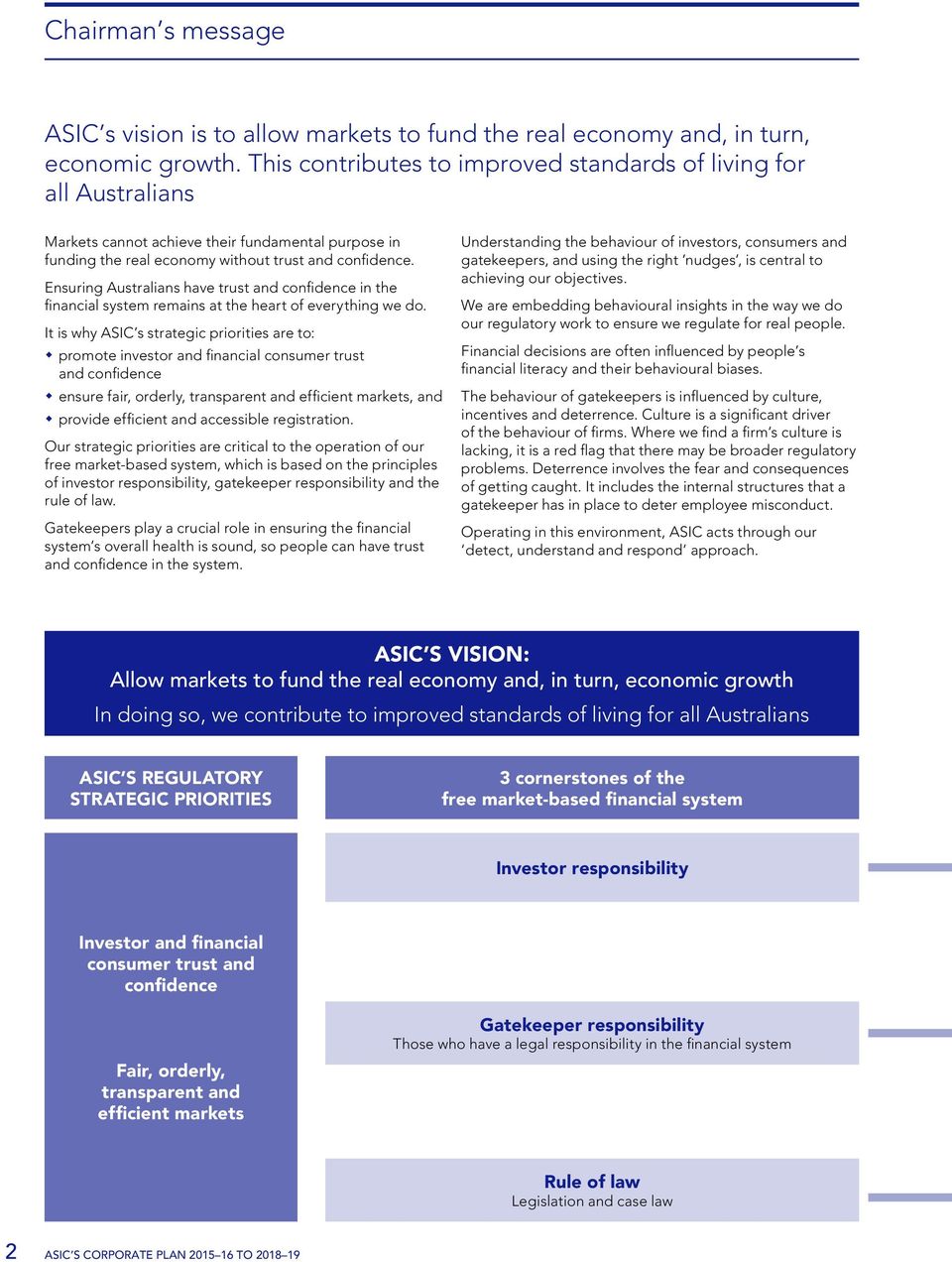
4 Chairman s message ASIC s vision is to allow markets to fund the real economy and, in turn, economic growth. This contributes to improved standards of living for all Australians Markets cannot achieve their fundamental purpose in funding the real economy without trust and confidence. Ensuring Australians have trust and confidence in the financial system remains at the heart of everything we do. It is why ASIC s strategic priorities are to: promote investor and financial consumer trust and confidence ensure fair, orderly, transparent and efficient markets, and provide efficient and accessible registration. Our strategic priorities are critical to the operation of our free market-based system, which is based on the principles of investor responsibility, gatekeeper responsibility and the rule of law. Gatekeepers play a crucial role in ensuring the financial system s overall health is sound, so people can have trust and confidence in the system. Understanding the behaviour of investors, consumers and gatekeepers, and using the right nudges, is central to achieving our objectives. We are embedding behavioural insights in the way we do our regulatory work to ensure we regulate for real people. Financial decisions are often influenced by people s financial literacy and their behavioural biases. The behaviour of gatekeepers is influenced by culture, incentives and deterrence. Culture is a significant driver of the behaviour of firms. Where we find a firm s culture is lacking, it is a red flag that there may be broader regulatory problems. Deterrence involves the fear and consequences of getting caught. It includes the internal structures that a gatekeeper has in place to deter employee misconduct. Operating in this environment, ASIC acts through our detect, understand and respond approach. ASIC S VISION: Allow markets to fund the real economy and, in turn, economic growth In doing so, we contribute to improved standards of living for all Australians ASIC S REGULATORY STRATEGIC PRIORITIES 3 cornerstones of the free market-based financial system Investor responsibility Investor and financial consumer trust and confidence Fair, orderly, transparent and efficient markets Gatekeeper responsibility Those who have a legal responsibility in the financial system Rule of law Legislation and case law 2 ASIC S CORPORATE PLAN TO
5 We detect wrongdoing through surveillance, breach reports, reports from the public and whistleblowers. We continually scan our environment to identify, assess and manage risks. Our Emerging Risk Committee identifies emerging issues that are on, or over, the horizon or on the edges of our regulatory perimeter. We analyse intelligence to assess risks early, including through data matching and analytics. We respond to wrongdoing or the risk of wrongdoing using a number of tools, including education, guidance, surveillance, enforcement and policy advice to Government. To further strengthen our capabilities, we look forward to the Government s response to the Financial System Inquiry this year, and support the Government s focus on markets, including reform to the client money and financial market licensing regimes. We also welcome the Government s capability review of ASIC. Those we regulate should focus on creating a customercentric culture to prioritise the long-term best interests of investors and financial consumers. This, in turn, will ensure all Australians can have trust and confidence in our financial system over the long term. We achieve the best risk resilience in the financial system that we can with the resources we have. This corporate plan covers the period from to It communicates our current thoughts on how our long-term strategic priorities and challenges are shaping our strategy and responses over this period. This corporate plan identifies a number of key ASIC focuses in where we see particular concerns that flow from the long-term challenges we face. We may identify new or additional measures to deal with our challenges in coming years as the environment changes. Importantly, our corporate plan covers how we will evaluate our performance over time as an integrated corporate, markets, financial services and consumer credit regulator, as well as our capabilities to meet future regulatory challenges. Greg Medcraft Chairman Human behaviour drivers ASIC s role in creating the right nudge ASIC S APPROACH Financial literacy Knowledge, skills, attitudes Education Including MoneySmart Behavioural biases Culture Mindset of firms Incentives Remuneration structures Deterrence The risk and impact of getting caught Guidance Surveillance Enforcement Detect Understand Respond Policy advice ASIC S CORPORATE PLAN TO

6 Our long-term challenges and strategic priorities As Australia s integrated corporate, markets, financial services and consumer credit regulator, we contribute to Australia s economic reputation and wellbeing Our challenges We see our long-term challenges that shape our outlook and strategy for the next four years as: balancing a free market-based system with investor and financial consumer protection, with a focus on ensuring the culture and conduct of financial system participants emphasises the interests of their customers first digital disruption to existing business models and channels structural change in our financial system through growth of market-based financing, which is largely driven by growth in superannuation financial innovation-driven complexity in products and markets, and the impact of globalisation on financial markets and products. Our strategic priorities We respond to these long-term challenges by focussing on our strategic priorities. 1 These are to: promote investor and financial consumer trust and confidence ensure fair, orderly, transparent and efficient markets, and provide efficient and accessible registration. These priorities reflect our mandate and purposes under the Australian Securities and Investments Commission Act Consistent with the principles the regulatory system is based on, we work to achieve the best level of financial system risk resilience we can with the resources we have. We cannot eliminate market risk. We also cannot prevent all wrongdoing or ensure compensation for investors who lose money as a result of misconduct. Consistent with our objective of ensuring efficient markets, we will keep cutting red tape where it is safe to do so for example, by providing waivers from the law where we assess it is warranted and by removing redundant forms and processes that provide little regulatory benefit. 4 ASIC S CORPORATE PLAN TO

7 ACHIEVING OUR STRATEGIC PRIORITIES To achieve our strategic priorities over the period covered by this corporate plan, we will use our detect, understand and respond approach where there is wrongdoing or the risk of wrongdoing in the market. ASIC is a law enforcement agency. A big part of what we do is holding gatekeepers to account we identify and deal with those who break the law. We typically use around 70% of our regulatory resources on surveillance and enforcement. Detect We detect wrongdoing through: surveillance gatekeeper breach reports industry whistleblowers complaints and reports from the public, and data matching and analytics. We focus on the areas that pose the greatest risk to investors, financial consumers, and the markets we regulate. We adopt a risk-based approach to surveillance so our actions are targeted and proportionate. In this way, we aim to allocate our resources efficiently to achieve our strategic priorities over the longer term. Understand We analyse intelligence to assess risks early and, where appropriate, respond quickly. Respond We respond to wrongdoing or the risk of wrongdoing by: disrupting harmful behaviour taking timely enforcement action engaging with industry and stakeholders educating investors and financial consumers providing guidance to those we regulate, and providing Government with policy advice. We communicate the actions we take to our stakeholders. We evaluate our performance and learn from our previous experience. We continue to improve our practices and develop better ways of doing things. We leverage the knowledge of our stakeholders to better understand market issues. ASIC S CORPORATE PLAN TO

8 Our long-term challenges detecting and understanding the risk drivers We respond to our long-term challenges by detecting and understanding the drivers of risks to investors, financial consumers, and the markets we regulate A free market-based system and investor and financial consumer protection Global and Australian economy Overall, global economic growth prospects are moderate at 3.3% for 2015, while growth outlooks are uneven with China (6.8%) and the United States (2.5%) outperforming the Eurozone (1.5%) and Japan (0.8%). 2 The Australian economy is growing at a below-trend pace of 2.3% over the year to March Inflation remains subdued at 1.5% over the year to June These factors have contributed to a historically low cash rate. The Australian housing market has been supported by low interest rates (2.0% as at 30 June ) and strong investor involvement. Domestic housing finance continues to grow particularly for investment purposes, with 52% of the value of new loans being provided for investor housing in June 2015, consistently increasing from 36% in June 2009 following the 2008 global financial crisis. 6 Australian equity market turnover grew strongly through to $5.25 billion per day, increasing by 13.6% from Culture and conduct Gatekeeper culture is a driver of conduct in the financial system. Poor culture, resulting in lack of transparency and chronic under-pricing of risk, has been noted as one of the causes of the 2008 global financial crisis and remains a risk. 8 Culture is a gatekeeper s underlying mindset and influences the behaviour of individuals within an organisation, the responsibilities and actions of senior management, and the incentives and systems they put in place. For example, risk management systems often influence compliance and reinforce good, or bad, corporate behaviour. Where culture, incentive structures and systems are poor or misaligned, the conduct of gatekeepers we regulate can conflict with customers interests and can lead to unfair outcomes. A positive culture and corresponding conduct is central to investor and financial consumer trust and confidence, market integrity and growth. Consumer sentiment, decision making and financial literacy Consumers have remained relatively cautious since the 2008 global financial crisis and many believe economic issues are the big problem facing Australia. 9 In line with the cautious sentiment since the global financial crisis, consumers are more disposed to saving and paying down debt, with a shift towards investing in real estate since June Investor responsibility is a cornerstone of our financial system. Even so, the ability to make informed financial choices can be influenced by a range of factors, including life stages, sales practices, social circumstances and vulnerabilities. The behaviour of investors and financial consumers is driven by their financial literacy including their knowledge, skills and attitudes and behavioural biases. There are varying levels of financial literacy across the Australian population. We have concerns about gaps in some areas, especially understanding of investment concepts, such as risk-return and diversification, and decreasing rates of feeling well-informed when making financial decisions. 11 Behavioural biases influence consumers in everyday decisions including financial decisions. Investors and consumers are influenced by personal preferences, beliefs and decision-making shortcuts. These can all have significant effects in financial and credit markets, where the complexity, risk, uncertainty and long-term nature of financial products can accentuate these behavioural biases. Regulators around the world are realising the impact of these factors and biases, and taking them into account when assessing risks. We are using behavioural insights to help us be a more effective regulator. Efficient markets We are committed to reducing unnecessary red tape on businesses and individuals. We use our waiver powers to help make the law work better for businesses where there is a net regulatory benefit, and to streamline our processes to make it easier for business to interact with us and meet their obligations. We pursue initiatives to lower compliance costs for business. Since September 2013, we have cut red tape for business by around $400 million, a big contribution to the Government s annual red tape reduction target. 6 ASIC S CORPORATE PLAN TO
9 Digital disruption Industry and regulators have a common interest in seeing innovation that fosters investor and financial consumer trust and confidence. Global investment in financial technology (fintech) ventures tripled to US$12.2 billion in 2014, from US$4 billion in Financial innovation provides both opportunities and risks. New digital strategies continue to challenge traditional business models, disrupting financial services and markets and changing how they interact with investors and consumers across a range of platforms and devices. We have developed an Innovation Hub to foster digital innovation and help innovators navigate our regulatory system. This will in turn deliver potential benefits to investors, consumers and markets. We will do what we can to help fintech start-ups take advantage of the opportunities on offer, provided it does not compromise investor and financial consumer trust and confidence. Technological change has also increased the risks of cyber attacks. The number, sophistication and complexity of cyber attacks have increased markedly in recent years and are expected to accelerate in the future. 13 In 2013, cyber attacks affected five million Australians at an estimated cost of $1.06 billion. 14 The estimated annual cost of cyber attacks to the global economy is more than US$400 billion. 15 Financial services Digital innovation offers investors and consumers more ways to interact. We are a nation of rapid adopters of technology in 2014, almost 15 million Australians had a home internet connection and 12.5 million people accessed the internet via their mobile. 16 This has contributed to the growth of online and mobile banking and finance across all age and income groups. Innovations are also making electronic payments more convenient a recent example is the rise of contactless cards in Australia. Digital platforms that enable crowd-sourced equity funding, marketplace lending between investors, consumers and businesses seeking finance, advice ( roboadvice ) and digital currencies, have grown and are testing regulatory boundaries. Marketing efforts are being customised through interactive data innovations like calculators and product comparison tools, especially with increased use of big data and social media mining. In the future, we may see further developments in individually-tailored insurance as insurers increasingly have access to data and technology that allows them to price risk in a highly individualised way. We may also see developments in exchanges using decentralised ledgers through blockchain technology. This technology forms the basis of many digital currencies, providing a public ledger of transactions executed. It has the potential to affect delivery of financial market and services settlement. Financial markets Digital innovation is now also embedded in all aspects of financial markets through high-frequency trading, new trading platforms, and the use of vendors to provide technology-based market functions. Structural change There has been a global shift towards market-based financing. In Australia, the size and growth of the super sector is contributing to this change. Funds management, superannuation and retirement income The Australian funds management industry reached $2.6 trillion in total assets in June 2015 driven by super, including self-managed super funds. 17 Super remains a major source of capital now $1.93 trillion 18, with around 30% of this held in self-managed super funds 19 boosting national savings, increasing the depth and liquidity of financial markets, and compelling the participation of nearly all Australians in financial markets. The movement of savings from the banking sector to the super sector continues to propel growth in capital markets, including increased market-based financing. However, a lack of strong price-based competition in the super system is leading to higher costs and sub-optimal outcomes for members. 20 This along with other factors, such as low member engagement, may lead to Australians being financially under-prepared for retirement due to the inadequacy of their retirement income. ASIC S CORPORATE PLAN TO
10 Our long-term challenges detecting and understanding the risk drivers (continued) Financial advice Good quality financial advice can be important for people to both plan ahead for retirement and assess suitable retirement income options. This is increasingly important as Australia s population ages with those aged 65 and over projected to increase from 15% of the population in 2015 to 22% by In March 2015, ASIC launched a mandatory national register of financial advisers to provide consumers with information about advisers and help them in their selection of an adviser. The register also ensures, for the first time, that both ASIC and the financial advice industry can track advisers as they move within the industry. As at 30 June 2015, the register listed around 22,500 financial advisers who provide personal advice to consumers. Funds management is increasingly being bundled with other financial services under the wealth management umbrella. The big four banks, who have significant funds management operations, have increased their share of the wealth and advice sectors over the past few years. The move towards vertical integration along the financial product distribution chain may pose risks to investors and consumers around the independence and appropriateness of financial advice. It can make conflicts of interest worse and heighten the risk of inappropriate in-house products being sold to consumers. Financial innovation-driven complexity Product complexity Complex financial products are available to investors and consumers, but can be misunderstood or mis-sold. 22 There have been increases in the number of investors in hybrid products and exchange traded options in recent years. 23 Financial services is a particularly rich environment for investor and consumer decision biases. There is a growing body of research that suggests that, when faced with uncertainty, people often misjudge probabilities and risk. While this is acute for complex products, research shows consumers can lack understanding of even ubiquitous products like home insurance. 24 Cognitive overload, over confidence and other biases can lead people to make poor financial decisions, which can have significant long term consequences. Globalisation A key opportunity presented by globalisation is allowing the free flow of capital across world markets. Australian companies increasingly rely on global markets to raise capital. In the March quarter of 2015, 45% of Australian listed equities were held by foreign investors. 25 Over the past decade, the proportion of non-financial corporate debt issued offshore has risen strongly to 75% as at June The total level of Australian investment abroad reached $2.1 trillion in the March quarter of 2015, split almost equally between equity and debt investments. This represents a 23% increase from the level a year before. 27 Competition and innovation continues to intensify in almost every segment of the Australian financial market, affecting existing models for capital raising, secondary trading, and the management of risk through important developments in post-trade infrastructure. An important driver of these developments has been greater cross-border activity, competition and integration. Offshore global providers are increasing opportunities for the Australian market, targeting important areas like over-the-counter markets, futures trading and clearing and settlement. For example, we continue to see increased platform trading of over-the-counter derivatives. At the same time, globalisation can significantly increase operational complexity and cost, requiring those operating in a number of jurisdictions to have separate licences and to meet different standards of conduct. Misconduct across borders, such as the manipulation of financial benchmarks, undermines market integrity and stability. Recent developments in international financial regulation, such as over-the-counter derivatives reforms, can also reinforce market fragmentation if not implemented correctly. Market complexity The growing complexity and financialisation of markets continues to aid innovation and increase efficiency, changing how financial markets interact, including with investors. This has increased trading options for investors through, for example, dark pools and alternative exchanges. 8 ASIC S CORPORATE PLAN TO

11 Responding to our long-term challenges We aim to achieve our strategic priorities by responding to challenges we face in coming years In responding to the challenges we face in coming years, we will work to achieve the best risk resilience that we can with the resources we have. This corporate plan outlines how we will respond to our long-term challenges, and how we will evaluate our performance in achieving our strategic priorities. From to , we will continue to use our detect, understand and respond approach. This includes: undertaking surveillance to detect possible wrongdoing, including proactive risk-based surveillance in high-risk areas that we believe will have the greatest impact on markets, and applying insights from behavioural economics to understand if product design or sales and advice models are taking advantage of biases and affecting trust and confidence. Where we detect issues, we will take action. For further information, see page 5. We have also identified the risks flowing from the long term challenges we face that we believe will be of particular concern in and warrant our attention now. These are in the areas of gatekeeper conduct, cyber attacks, poor financial advice, misalignment of retail product design and distribution with consumer understanding, and cross-border businesses, services and transactions. While not all of these risks we have identified may crystallise, we have planned how we will use our resources and powers to respond to the risks in to achieve our strategic priorities. There are some drivers of risks that we cannot influence, and risks that we cannot address within current regulatory settings. ASIC S CORPORATE PLAN TO

12 A free market-based system and investor and financial consumer protection to response We will meet the long-term challenge of balancing a free market-based system and investor and financial consumer protection in the next four years We will focus on: responding to poor gatekeeper culture and conduct where appropriate, taking enforcement or other regulatory action drawing on behavioural economics, and analysing data on how people make choices to understand consumer and market problems and pick the right responses to deal with them improving financial literacy through: implementing the National Financial Literacy Strategy priorities, including educating the next generation through the formal education system, and developing further initiatives providing Australians with access to free and impartial information, tools and resources through ASIC s MoneySmart website to support their decision-making targeting financial literacy strategies to vulnerable people, and pursuing deregulatory initiatives, including sunsetting legislative instruments to further streamline the regulatory system focus gatekeeper conduct In , we have identified particular risks around poor gatekeeper culture and conduct in the following areas: responsible entities lenders markets, and directors, auditors and insolvency practitioners. Culture and incentives are key drivers of the behaviour of the gatekeepers in our system. Our attention to these areas in the coming year will ensure we achieve the right balance of investor and consumer protection in our free market based system. 10 ASIC S CORPORATE PLAN TO

13 focus on gatekeeper conduct: Responsible entities Gatekeeper culture and incentives that result in conduct that fails to treat customers fairly undermine trust and confidence in the financial system. This can lead to significant loss, particularly of retirement savings in the managed funds sector In , we will focus on poor gatekeeper culture and conduct of fund managers to prevent wrongdoing. Poor gatekeeper culture and incentives, including weak compliance systems, can result in investor losses. This can have a negative effect on investors and consumers, particularly with retirement savings at risk. Culture can be hard to change, with significant time needed to embed new behaviours. However, many gatekeepers are starting to turn their attention to improving culture. Many businesses have a solid culture and, for those who fall short, we will work to help them create the right culture, including sharing with boards and management when our surveillance identifies cultural problems. Remuneration, incentives, performance management and promotions can act as motivators and reinforce behaviour. They should be linked to a firm s values at all levels, and should act as a mechanism to reward good behaviours and penalise poor conduct. Action in We will incorporate culture and incentives more explicitly into our risk-based surveillance reviews, use the findings to better understand how culture and incentives are driving conduct among gatekeepers, and communicate to those we regulate where we see problems. We will specifically target areas where poor practices may increase the potential for misconduct and the risks to trust and confidence. These areas include: reward and incentive structures, including promotions recruitment and training policy whistleblowing policy conflicts of interest nature and level of complaints and complaints handling remediation policy and procedures, and corporate governance frameworks to support customer centric culture for example, board oversight over product approval processes. We will also monitor innovations and new financial products and services so they are developed with customers interests in mind. This is a fundamental aspect of having a customer focussed culture. ASIC S CORPORATE PLAN TO

14 A free market-based system and investor and financial consumer protection (continued) Key activities Detect Surveillance Risk management review risk management arrangements in the managed funds sector, including conflict management, liquidity and leverage Responsible entities review risk-profiled responsible entities with a focus on opaque and complex structures, liquidity, mandate compliance and custody Identify inappropriate conduct by assessing breach reports and reports of misconduct and deciding whether we need to act further we expect licensees to report breaches promptly so we can rectify problems with individual entities quickly and effectively Respond Enforcement Where appropriate, take enforcement action, accept enforceable undertakings or issue infringement notices where we identify wrongdoing Stakeholder engagement Facilitate emerging business models, while maintaining protections for investors and consumers in innovative products and services, including digital platforms that enable marketplace funding Policy advice Assess limitations on financial services licensing for responsible managers and responsible officers, especially in the context of the licensees-for-hire business model Performance indicators Surveillance Number of failures to comply with conduct obligations identified and addressed Improvements in individual responsible entities, including risk management arrangements, in response to identified areas of improvement for example, case studies of changes to systems, processes or procedures Published regulatory guidance for risk management arrangements of responsible entities Enforcement Successful enforcement or other action including enforceable undertakings and infringement notices Stakeholder engagement Streamlined licensing for fintech start-ups Financial literacy messages delivered about innovative products and services Policy advice Identification of policy issues and law reform options 12 ASIC S CORPORATE PLAN TO

15 focus on gatekeeper conduct: Lenders Lenders may fail to lend responsibly in current economic conditions. This may lead to borrowers over-extending themselves when taking out loans We will focus on conduct by lenders in to promote responsible lending practices and work to reduce the sale of inappropriate products. It is critical that lenders do not put borrowers into unsuitable loans that could lead to them experiencing substantial financial hardship, now or over the longer term. Irresponsible lending could be facilitated by conditions like: low interest rates significant house price growth strong lending competition high household debt to income ratios, and significant growth in investment housing lending. These conditions could see a rise in the number of borrowers with unsustainable debt, particularly if interest rates increase, unemployment rises or house prices fall. Action in To ensure responsible lending, we will monitor lenders compliance with responsible lending obligations, and also work to reduce the sale of inappropriate lending products. Key activities Detect Surveillance Interest only loans review current market practices Finance broker compliance review large finance brokers compliance with responsible lending and general conduct obligations Margin lenders review lending policies Reduce the sale of inappropriate products, targeting: payday lending, including compliance with recently introduced interest rate caps consumer leases Respond Enforcement Where appropriate, take enforcement action, accept enforceable undertakings or issue infringement notices where we identify wrongdoing for example, failures to comply with responsible lending and general conduct obligations Education Promote messages to people about how to borrow responsibly and manage debt Performance indicators Surveillance Number of failures to comply with responsible lending and general conduct obligations identified and addressed Improvements by individual lenders in response to identified areas of improvement for example, case studies of changes to systems, processes or procedures Published reports on surveillance outcomes to articulate lender standards and expectations, and industry commitment to address ASIC concerns obtained Enforcement Successful enforcement or other regulatory action including enforceable undertakings and infringement notices Education Production, delivery and promotion of financial literacy resources and tools to help people compare different types of borrowing and how much they can afford to borrow ASIC S CORPORATE PLAN TO

16 A free market-based system and investor and financial consumer protection (continued) focus on gatekeeper conduct: Markets Culture and incentives that drive poor market conduct (including in wholesale markets) can threaten market integrity. This can lead to compromised outcomes for firms and markets, with flow-through impacts on retail markets In , we will focus on poor gatekeeper conduct in markets to prevent wrongdoing. Incentive structures, such as remuneration and rewards, can influence conduct either good conduct, which is reinforced by good culture, or bad conduct, which threatens investor and consumer trust and confidence. For market operators and participants, conflicts of interest arising from remuneration can affect market integrity and investor outcomes. Financial benchmark and foreign exchange manipulation, in Australia and overseas, has raised particular concerns about culture and conduct in wholesale markets threatening market integrity. Poor management of confidential information can result in market-sensitive information being compromised, or market misconduct such as continuous disclosure breaches, insider trading or market manipulation. Action in We will incorporate culture and incentives more explicitly into our risk-based surveillance reviews, use the findings to better understand how culture and incentives are driving conduct, and communicate to the markets we regulate where we see problems with their culture, incentives and conduct. We will specifically target market operators and participants to identify where weak compliance systems and poor practices may lead to misconduct. We will: identify poor practices and systems in managing conduct risk the risk of inappropriate or unlawful behaviour by management and employees by issuers, brokers and investment banks focus on business models, transactions and activities that pose a high conduct risk for example, merger and acquisition and fundraising transactions that may be high risk (such as backdoor listings or where there are substantial overseas assets or management) and business models based on intangibles act to improve standards and behaviour in handling confidential information by issuers, brokers and investment banks, and handling conflicts of interest by investment banks, with a particular focus on analysts, and focus on conduct risk in wholesale markets, such as the manipulation of financial market benchmarks and the practices of investment banks. 14 ASIC S CORPORATE PLAN TO

17 Key activities Detect Surveillance Confidential information review market practices on confidential information Conduct risk calculator benchmark ways investment banks manage conduct risk and identify potential gaps Wholesale market conduct risk do proactive surveillance of benchmark manipulation through bank bill issuance/trading and benchmark submitters ASX market assessment assess ASX standards and administration of securities listing function Merger and acquisition and fundraising transactions review certain transactions that pose a high conduct risk, targeting: backdoor listings substantial overseas assets or management business models based on intangibles Identify inappropriate conduct by assessing breach reports and reports of misconduct and deciding whether we need to act further we expect licensees to report breaches promptly so we can rectify problems with individual entities quickly and effectively Respond Enforcement Where appropriate, take enforcement action, accept enforceable undertakings or issue infringement notices where we identify wrongdoing Performance indicators Surveillance Number of failures to comply with conduct obligations identified and addressed Improvements in individual market practices in response to identified areas of improvement for example, case studies of changes to systems, processes or procedures Improved disclosures for individual transactions in response to identified areas of improvement Published report of ASX standards and administration of securities listing function to drive behavioural and structural changes and set future development standards Industry messages delivered to stakeholders, including market intermediaries, to articulate standards and expectations on handling confidential information and managing conduct risk, and obtain industry commitment to address ASIC concerns Enforcement Successful enforcement or other action including enforceable undertakings and infringement notices ASIC S CORPORATE PLAN TO

18 A free market-based system and investor and financial consumer protection (continued) focus on gatekeeper conduct: Directors, auditors and insolvency practitioners Poor conduct by gatekeepers, such as directors, auditors and insolvency practitioners, or their failure to identify and report inappropriate conduct of principals, continues to jeopardise market integrity and investor outcomes We will focus on conduct by gatekeepers such as directors, auditors and insolvency practitioners in to ensure the financial system is sound, so investors have trust and confidence in our markets and markets are fair, orderly, transparent and efficient. Gatekeepers are often responsible for ensuring financial information and disclosures are reported correctly to the market, investors and creditors. A misinformed market can lead to investors making inappropriate investment decisions and disorderly markets. Poor conduct by gatekeepers including inadequate management of conflicts of interest arising from remuneration and related-party transactions, a lack of competence, and the misuse of role for improper gain can result in significant investor and creditor loss. Action in We will seek to improve the quality of information provided to investors and the market, including through enhancing audit quality, financial reporting and other disclosures. We will take action against gatekeepers who do not keep markets, investors and creditors properly informed. We will focus on ensuring gatekeeper competence and independence, and aim to prevent improper gain. 16 ASIC S CORPORATE PLAN TO

19 Key activities Detect Surveillance Key financial and transaction information review corporate transaction documents lodged with ASIC and, in some instances, sales disclosures to investors in connection with fundraising Disclosures in financial reports review financial reports of listed and other public interest entities Audit quality review audit firm business models to ensure appropriate experience and expertise is applied to increasingly complex clients and businesses, financial reporting judgments and audit approaches Insolvency practitioners review high-risk insolvency practitioners focussing on independence (including pre insolvency advisers), competence and improper gain (including remuneration) Lodgement compliance review systemic non compliance by insolvency practitioners with statutory lodgement obligations Identify inappropriate conduct by assessing reports of misconduct and deciding whether we need to act further we expect gatekeepers to report issues promptly so we can rectify problems with individual entities quickly and effectively Respond Enforcement Where appropriate, take enforcement action or accept enforceable undertakings where we identify wrongdoing for example, action against directors, auditors and liquidators where their competence or independence is significantly compromised, or where they have misused their position for improper financial gain Performance indicators Surveillance Number of failures to comply with conduct obligations identified and addressed Improvements in individual entities in response to identified areas of improvement for example, case studies of changes to systems, processes or procedures Published audit inspection report to articulate standards and expectations and drive domestic and international action plans for largest audit firms Improved disclosures made for individual prospectuses, related party notices of meeting, schemes and bids in response to identified areas of improvement Enforcement Successful enforcement or other regulatory action including enforceable undertakings and deregistering and suspending individuals ASIC S CORPORATE PLAN TO

20 Digital disruption to response We will meet the long-term challenge of digital disruption in the period to We will focus on: promoting cyber resilience identifying potential cyber attacks in markets through real-time market monitoring ensuring compliance with licensing obligations, including the need for adequate technological resources and risk management arrangements, and disclosure obligations where appropriate, taking enforcement or other regulatory action fostering our Innovation Hub to help innovators navigate our regulatory system, and keeping abreast of market developments through our Digital Finance Advisory Committee focus cyber attacks The increasing incidence, complexity and reach of cyber attacks can undermine businesses and destabilise our markets, eroding investor and financial consumer trust and confidence in the financial system and the wider economy In response to the long-term challenge of digital disruption to business models and channels, we will highlight the importance of cyber resilience in the coming year to promote trust and confidence in the financial system and market integrity. Cyber threats are increasingly diverse and sometimes unforeseeable. With evolution of technology and global interconnectedness, this risk is constantly changing. Cyber attacks are considered a systemic risk to the financial system, especially attacks on essential or critical services like banking and payments services, or financial market infrastructure. It is not possible for businesses or individuals to protect themselves against every cyber threat. However, we encourage firms and markets to improve their cyber resilience, particularly where exposure to a cyber attack may impact on individuals or market integrity. 28 Action in To promote cyber resilience, we will: improve awareness of cyber resilience, and increase the profile of the issues incorporate cyber resilience in our surveillance, particularly for those we regulate that provide critical services such as financial market infrastructure coordinate and engage with other Government departments to identify cyber risks and build cyber resilience, and continue to monitor market developments. 18 ASIC S CORPORATE PLAN TO

21 Key activities Detect Surveillance Identify practices to deal with cyber threats and technological advances through our Markets Cyber Risk Taskforce Distribute ASIC s cyber resilience calculator results to participating investment banks for private selfassessment and peer benchmarking as appropriate Review financial market infrastructure to focus on governance and outsourcing Data matching and analytics Identify potential cyber attacks in markets through real-time market monitoring for example, detecting anomalous trading patterns that may be the result of a cyber attack Respond Enforcement Where appropriate, take enforcement action, accept enforceable undertakings or issue infringement notices where we identify wrongdoing for example, deal with cases where companies and issuers disclosure provides insufficient information on cyber threats Performance indicators Surveillance Industry messages delivered to stakeholders to increase awareness of and promote good cyber practices Improvements by individual investment banks in response to identified areas of improvement for example, case studies of changes to systems, processes or procedures Published cyber assessment report to articulate standards and expectations of financial market infrastructure Data matching and analytics Number of potential cyber attacks identified and addressed Enforcement Successful enforcement or other regulatory action including enforceable undertakings, infringement notices or improved disclosures ASIC S CORPORATE PLAN TO
22 Structural change to response As structural change in our financial system driven by growth in superannuation will continue in the future, we will meet this long term challenge in this period We will focus on: proactive and reactive surveillance in the funds management sector, including responsible entities and super fund trustees on a risk-profiled basis where appropriate, taking enforcement or other regulatory action enabling people to check adviser credentials responding to poor financial advice affecting retirement savings where appropriate, taking enforcement or other regulatory action, and improving remediation where consumers suffer loss focus poor financial advice Conflicts of interest and variable competence continue to result in poor advice that is not in clients best interests. This may lead to significant investor and financial consumer loss In , we see structural change heightening the importance of quality financial advice, and will focus our attention in this area and on enhancing the professionalism of financial advisers to meet the long-term challenge. Accessible and reliable advice is of increasing importance, especially with increased assets in super. Funds under advice reached $474 billion in 2014, increasing from $390 billion in However, structural changes can also magnify the risk of retirement losses if advice is not of sufficient quality. The quality of financial advice continues to be adversely affected by planners conflicts of interest or poor competence. This can lead to some people being encouraged or advised to make financial decisions not in their best interests, resulting in losses they cannot afford. Vertical integration in the wealth industry can contribute to conflicts of interest and low investor confidence. We have seen poor advice in large institutions and in smaller firms for example, in life insurance advice practices 30 and through the mis-selling of financial products to investors and consumers. Action in To improve the quality of financial advice, we will act to: address conflicted advice, misaligned incentives and inadequate risk management, particularly in large, vertically-integrated institutions remove or deal with bad apple advisers take other regulatory action where advice is not in a client s best interests or gives priority to an adviser s interests, and enhance financial advisers professionalism and ethical standards. 20 ASIC S CORPORATE PLAN TO
23 Key activities Detect Surveillance Review advice in large, vertically-integrated institutions, including how the largest banks deal with bad apple advisers Identify inappropriate conduct by assessing breach reports and reports of misconduct and deciding whether we need to act further we expect licensees to report breaches promptly so we can rectify problems with individual entities quickly and effectively Respond Enforcement Where appropriate, take enforcement action, accept enforceable undertakings or issue infringement notices where we identify wrongdoing for example, where we identify deficient advice (including poor quality life insurance advice) or poor licensee conduct Education Promote the Financial Advisers Register Guidance Develop guidance about remediation where consumers suffer loss Policy advice Work with Treasury to improve the adviser professionalism and ethical standards, including training Performance indicators Surveillance Number of failures to comply with advice conduct obligations identified and addressed Improvements in individual entities in response to identified areas of improvement for example, case studies of changes to systems, processes or procedures Where appropriate, published reports on surveillance outcomes to articulate standards and expectations, increased industry understanding of the impact of conflicts of interest and industry commitment to address ASIC concerns obtained Enforcement Successful enforcement or other regulatory action including enforceable undertakings, infringement notices, licence cancellations and adviser bannings Education People enabled to check adviser credentials, and helped to choose an adviser for example, knowing what questions to ask Guidance Published proposed regulatory guidance on remediation Policy advice Participation in roundtables and meetings to identify policy issues and law reform options ASIC S CORPORATE PLAN TO
24 Financial innovation-driven complexity to response In this period, we will respond to the long-term challenge posed by increasing financial innovationdriven complexity in products and markets We will focus on: surveillance on complex products, services and distribution models that pose the highest risks to investors and financial consumers where appropriate, taking enforcement or other regulatory action drawing on behavioural economics, and analysing data on how people make choices to understand consumer and market problems and pick the right responses to deal with them acting to improve financial literacy real-time monitoring of our financial markets where appropriate, taking enforcement or other regulatory action, and providing policy advice to Government on the detailed implementation of any law reforms arising from its response to the Financial System Inquiry focus misalignment of retail product design and distribution with consumer understanding There is a misalignment between how retail products are designed, disclosed and marketed, with investor and financial consumer understanding. This misalignment continues to disadvantage retail investors and financial consumers In , we will particularly focus on the misalignment in retail product design and distribution with consumer understanding to respond to this long-term challenge and promote trust and confidence. A consumer s lack of knowledge, vulnerabilities or behavioural biases can affect the way that they make financial decisions. The design and marketing of financial products, combined with their complexity, can exacerbate consumer biases. Conflicts of interest or misrepresentation can limit a consumer s ability to make informed financial decisions. Misleading or deceptive disclosure, advertising or marketing continues to create unrealistic expectations that can lead to poor decisions. This can result in inappropriate products being sold to investors and consumers and can undermine competition. This can also erode trust and confidence in the financial system. Complex products may be misunderstood or mis-sold to investors. 31 For example, there has been significant growth in retail hybrid investors in recent years with hybrid security issuance increasing sharply in Australia to a record high of $14.5 billion in However, the product complexity and design of hybrid securities, including difficult to-price risks, and behavioural biases, can impair consumer understanding and decision-making. 33 Technical innovations and product developments can facilitate the delivery of appropriate products and services to investors and consumers. Even so, while products like retail over-the-counter derivatives have been made more accessible by electronic trading platforms and web-based marketing, they can be a complex and risky retail investment. The interests of investors and consumers must be at the heart of new financial product and service developments, including those initiated by fintech start up businesses. Action in To ensure that investors and consumers are less likely to be disadvantaged as a result of complex products, services and distribution models, we will work to: improve their financial literacy through the National Financial Literacy Strategy, including by enhancing and promoting ASIC s MoneySmart website and embedding financial literacy in the Australian curriculum reduce the sale of inappropriate products, particularly to vulnerable consumers, such as remote Indigenous communities drive behavioural change with product providers when retail product design, disclosure and marketing may be misaligned with peoples interests, and review industry practices that may exploit behavioural biases. 22 ASIC S CORPORATE PLAN TO
25 Key activities Detect Surveillance Reduce the sale of inappropriate products, targeting: retail over-the-counter derivatives add-on insurance products in the car finance industry We also intend to reduce the sale of inappropriate products targeting payday lending and consumer leases see page 13. Complex products, targeting hybrid securities Identify inappropriate conduct by assessing breach reports and reports of misconduct and deciding whether we need to act further we expect licensees to report breaches promptly so we can rectify problems with individual entities quickly and effectively Data matching and analytics Draw on behavioural economics, and collect data on how people make choices to understand consumer and market problems and pick the right responses to deal with them for example, understanding biases that affect financial advice decisions or how consumers use credit cards Respond Enforcement Where appropriate, take enforcement action, accept enforceable undertakings or issue infringement notices where we identify wrongdoing for example, stop the sale of inappropriate financial products to Indigenous communities Education Act to improve financial literacy through: implementing the National Financial Literacy Strategy priorities, including educating the next generation through the formal education system providing Australians with access to free and impartial information, tools and resources through ASIC s MoneySmart website to support their decision making targeting financial literacy strategies to vulnerable people Performance indicators Surveillance Number of failures to comply with conduct obligations identified and addressed Improvements in individual entities, or improved disclosures made, in response to identified areas of improvement for example, case studies of changes to systems, processes or procedures Where appropriate, published reports on surveillance outcomes to articulate standards and expectations, and industry commitment to address ASIC concerns obtained Data matching and analytics Existing practices that may encourage investor and financial consumer disengagement with products identified, and proposals to increase engagement levels and reduce the potential for providers to take advantage of disengagement developed Enforcement Successful enforcement or other regulatory action including enforceable undertakings and infringement notices Education Production, delivery and promotion of financial resources and tools, including: ASIC s MoneySmart website and related tools and resources for example, ASIC s MoneySmart teaching resources resources to support vocational education and training Women s Money Toolkit tailored resources for Indigenous consumers Number of unique visitors to ASIC s MoneySmart website, and proportion who took subsequent action on their finances ASIC S CORPORATE PLAN TO
26 Globalisation to response Over the next four years to 2019, the long-term challenges raised by globalisation will continue to hold our attention We will meet this challenge by: influencing international policy, actively participating in international co-operation and standard setting pursuing bilateral and multilateral arrangements with our counterparts to reduce regulatory burdens for cross border activity and build capacity where appropriate, taking cross-border enforcement or other regulatory action, and analysing intelligence on innovative businesses, services and transactions in global markets focus cross-border businesses, services and transactions Cross-border developments are resulting in more fragmentation across businesses, services and transactions. This may compromise market integrity and the outcomes for investors and financial consumers In , we will particularly focus on the risks posed by globalisation, which is driving greater fragmentation across businesses, services and transactions. Resilient capital markets through market-based financing and cyber resilience are fundamental to driving economic growth. Encouraging further cross-border businesses, services and transactions, as well as further integration of international markets, will deliver significant economic benefits to Australian markets, providers, investors and consumers. This will enable Australian businesses to avoid substantial compliance costs, compete better, and will increase market efficiency. Our work with other Australian and international regulators to implement G20 commitments to reform our over-thecounter derivatives markets, develop the Asia Region Funds Passport and support substituted compliance allows us to take action for the longer term benefit of Australians. This work promotes cross-capital flows into Australia and gives market participants and end users access to international markets. At the same time, increased globalisation and crossborder developments mean greater fragmentation across businesses, services and transactions, potentially compromising market integrity and the outcomes for investors and consumers. Challenges include: slow and uneven implementation of international regulatory standards, which could lead to inconsistent or lower standards in some jurisdictions it might also add complexity for Australian market participants accessing international markets risks to Australian investors from emerging market issuers entities listed in Australia that have substantial assets or management offshore in emerging markets, and increased trading options for investors through dark pools, alternative exchanges and international trading facilities, which may result in regulatory arbitrage and risks to investors. Action in To promote cross-border developments and integration to drive economic growth while minimising the risks, we will focus on: international co-operation and standard setting, including implementing international standards like over the-counter derivatives reforms recognition of Australia s regulatory regime by international authorities to facilitate substituted compliance supporting leadership roles in the International Organization of Securities Commissions (IOSCO) and other international organisations to build resilient capital markets, and addressing new and innovative businesses, services and transactions in global markets to harvest opportunities and mitigate risks. 24 ASIC S CORPORATE PLAN TO
27 Key activities Detect Surveillance Review corporate transaction documents like prospectuses, especially those from emerging market issuers Data matching and analytics Analyse intelligence on innovative businesses, services and transactions in global markets this includes through regular market and industry discussions with European Union, North American and Asian regulators on developments, drivers and risks in Australian capital markets and financial market infrastructure Respond Policy advice Develop and implement international market policy, including through: international leadership for example, continued contribution to IOSCO implementation of the G20 over-the-counter derivatives reforms development of regional and global standards in the funds management sector through continued development and implementation of the Asia Region Funds Passport supporting international standards in the Asia Pacific region through capacity building, and reducing regulatory burdens for cross border activity through bilateral and multilateral engagement Enforcement Where appropriate, take enforcement action, accept enforceable undertakings or issue infringement notices where we identify wrongdoing for example, manipulation of certain financial benchmarks Performance indicators Surveillance Disclosure improvements by individual issuers in response to identified areas of improvement Data matching and analytics Participated in forums with northern hemisphere and regional jurisdictions to harvest innovative businesses, services and transactions in global markets, while mitigating risks Policy advice International policy initiatives progressed, with milestones achieved Bilateral and multilateral engagements established, with satisfactory progress made on finalising international cooperation arrangements Enforcement Successful enforcement or other regulatory action including enforceable undertakings and infringement notices ASIC S CORPORATE PLAN TO
28 Providing efficient and accessible registers ASIC s registry business the companies register, business names register and other corporate and professional registers forms a critical part of Australia s economic infrastructure and is essential to the operation of our economy In the period covered by this corporate plan, we will continue to transform our registry business including digitising our services to provide efficient and accessible registers and make it easier to do business in Australia. Digitising our services provides a more contemporary service for customers, consistent with the Government s digital economy agenda. We will continue to provide a valuable service to Australians as we respond to their enquiries through our Customer Contact Centre and website We are also helping Government to implement its small business reforms package, streamlining business registration via a single online registration service, including business name and company registration. In May 2015, the Government announced a competitive tender process to test the market on the capacity of a private sector operator to upgrade and operate the ASIC registry. This work is underway and we are providing support to the Government. 26 ASIC S CORPORATE PLAN TO
29 Evaluating our performance We are committed to evaluating our performance We have a performance evaluation framework, which shows how we will measure our performance, over the periods covered in this corporate plan, in achieving our priorities and purposes based on: outcomes indicators of perceived and actual behaviours that demonstrate trust and confidence in the financial system, and activities what we do using our regulatory tools. A sample of key indicators and activities is outlined in the framework below these are in addition to the specific performance indicators identified in this corporate plan. In measuring our performance in our annual performance statement, we may use case studies and tailored initiative impact assessments. We will also rely on our periodic stakeholder surveys to consider perceptions of trust and confidence. We expect to conduct our next stakeholder survey in , and will consider further how we can use social media and other data analytics to track our outcomes more frequently. In the future, consistent with the Government s expectations and their desired level of sector resilience, we may look to set additional sector-specific metric targets both short and longer term outcomes. This is consistent with our approach to performance reporting against our Portfolio Budget Statements. We will continue to evaluate performance against the ASIC Service Charter, which covers our most common interactions with stakeholders and sets performance targets for each. Our Service Charter measures reflect our resourcing capacity in our registry and regulatory businesses, and our commitment to online customer service. We will also specifically evaluate our performance in minimising regulatory burden as part of the Government s deregulation agenda. The Regulator Performance Framework mandates measures in communication, risk based and proportionate approaches, transparency, reducing regulatory burden and continuous improvement. Objectives Sectoral outcomes Investor and financial consumer trust and confidence Fair, orderly, transparent and efficient markets Indicators of perceived and actual behaviours, including: Financial literacy Good conduct Efficient markets ASIC stakeholder survey data with sector-specific results External survey data for example, ANZ Survey of Adult Financial Literacy in Australia Published ASIC reports on surveillance and data review findings ASIC stakeholder survey with sector-specific results External survey data Published ASIC reports on surveillance and data review findings ASIC stakeholder survey with sectorspecific results External survey data Published ASIC reports on surveillance and data review findings ASIC outcomes Specific levels of ASIC activity, including: Number of unique visitors to ASIC s MoneySmart website, and proportion who took subsequent action on their finances Number of financial literacy resources produced and delivered Case studies and tailored initiative impact assessments Number of surveillances completed % misconduct reports resolved resulting in changes to systems, processes or procedures, or corrective disclosures made Number of investigations and criminal and civil litigations and administrative actions completed % successful criminal and civil litigation Number of enforceable undertakings accepted Number of new or revised regulatory guides published Case studies and tailored initiative impact assessments Number of relief applications received and approved Total dollar value of net benefit of deregulatory measures Case studies and tailored initiative impact assessments ASIC S CORPORATE PLAN TO
30 Strengthening our capabilities Budget Our departmental appropriation is around $312 million, which is expected to decrease slightly over time, to around $310 million by In , our budget is approximately $337 million, including revenue from independent sources and capital funding. Each year, we adjust our resource allocation to reflect funding available, and our statutory mandate and purposes. For example, the following charts indicate the proportion of our operating expenditure we expect to allocate to: achieving our priorities, and the tools to achieve these priorities Forward estimate Forward estimate Forward estimate ($000s) ($000s) ($000s) ($000s) Operating expenditure funded by: $311,630 $305,588 $307,544 $309,913 Departmental appropriation $311,630 $305,588 $307,544 $309,913 Revenue from independent sources $2,319 $4,524 $4,532 $4,532 Capital funding $23,130 $23,789 $22,490 $24,041 Total budgeted resources $337,079 $333,901 $334,566 $338,486 19% Registry 42% Markets 39% Investors and Financial Consumers 19% Registry 5% Licensing and professional registration 4% Education 3% Guidance 2% Policy advice 6% Engagement with industry stakeholders 42% Enforcement 19% Surveillance Where possible, we will seek to recover the cost of regulation from the people that cause the need for it. For example, we will often seek to recover the costs of our investigation where there has been successful court action. 34 We continue to advocate for an industry funding model to provide us with greater stability and certainty of funding, and to ensure we are adequately resourced to achieve our priorities. The Financial System Inquiry recommended the Government pursue this funding model for ASIC, and the Government released a consultation paper on 28 August 2015 seeking stakeholder views on introducing this model for our regulatory activities. People Our talented and dedicated staff (of around 1,600 full time equivalent positions) work at ASIC for good reason. Our staff are highly qualified and experienced. Their expertise spans a range of disciplines commerce, finance, law, economics, policy, information technology, and accounting and their experience helps us achieve our priorities and purposes. We also have a dedicated team responsible for embedding behavioural insights of investors and gatekeepers in our work. We invest in strengthening our long-term capabilities through our people, and will continue to do so over the next four years. 28 ASIC S CORPORATE PLAN TO
31 We have undertaken a workforce planning review to determine the capabilities we will need over the longer term to meet our objectives. We build our people s skills through our learning frameworks focussed on activities like regulatory practice, investigation, accounting and auditing, and legal and our continuous professional development programs. We will also establish a data analyst professional network to enhance expertise in data analytics in We invest in recruiting and developing high-potential talent to contribute to our organisational capability. Our talent framework and development activities include formal learning and development programs and experience-based learning. We value diversity in our people and recognise its strengths in increasing our effectiveness. This is embedded in ASIC s Diversity Council, a governing body set up in 2014 to improve diversity outcomes across ASIC. In addition, we remain committed to securing a broader ability to attract and retain staff beyond the constraints of the Public Service Act This will provide us with greater flexibility and agility over the longer term. The Financial System Inquiry supported this proposal in its final report. Process and technology ASIC s Technology Governance Board manages our technology priorities and investments, as well as the technology components of new policy proposals. We are committed to the Government s Digital Transformation Agenda to improve government service delivery. We will work with other Government agencies to deliver initiatives, including the new business account and improving access to information. We are enabling the digital transformation of our internal processes. We are transforming our regulatory business so we can work more effectively. This includes a plan to improve our capabilities and processes and deliver smarter data and better tools. It will span the period covered by our corporate plan. We are cementing a common approach through consistent terminology and processes, applying best practice and continuous learning, optimising data collection, digitising the data we hold and better sharing information. This will allow us to do more with the resources we have, using innovative ways to target and streamline our work. Our risk-based approach also means we allocate resources to conduct we think poses the most risk. We are focussed on improving the way we capture, share and use data. We capture data through our emerging and strategic risk analysis process and consultative specialist and stakeholder committees. This helps us to assess intelligence and identify and analyse immediate and forward-looking risks to respond to emerging issues. We are also enhancing the way we capture data, streamlining processes through online data portals, our Market Analysis and Intelligence system and digital data capture for example, of over-thecounter derivative trades. To fully realise the potential of the increasing digitisation of data and the speed of our access to information, we are introducing a single workflow management system to make us more effective in delivering better information sharing and problem solving and improve our ability to work flexibly. In addition, we are finding new ways to interrogate data to better target our actions. We have increased capabilities in data analytics tools, leveraging technology to deliver deregulatory and efficiency benefits, for example: implementing our Flexible Advanced Surveillance Technology program our near-complete four year technology improvement program is allowing us to better detect market misconduct and target our actions through real-time market surveillance technologies, supporting our investigations and enforcement activity through analysis of amounts of data from multiple sources, and providing market entities with ways to help them comply with the law, and promoting the internal transition to digital processes, including digitising the unclaimed monies processes and the digital data capture of managed investment scheme and financial adviser forms and lodgements. ASIC S CORPORATE PLAN TO
32 Strengthening our capabilities (continued) Culture and governance Our values accountability, professionalism and teamwork guide us to work collaboratively to achieve our priorities. Our values provide staff with a shared understanding of what we do and why we do it. Our values underpin everything we do. They guide the way we work, the way we make decisions and how we interact with each other. They define what our stakeholders and customers can expect when they deal with us. We are an independent Commonwealth government body, set up under the Australian Securities and Investments Commission Act We operate under the direction of five full-time Commissioners appointed by the Governor- General on the nomination of the Treasurer. We are accountable to the Commonwealth Parliament, and to our responsible Ministers for our actions the Treasurer, the Assistant Treasurer, the Parliamentary Secretary to the Treasurer, as well as the Minister for Small Business. The Parliamentary Joint Committee on Corporations and Financial Services provides parliamentary oversight of ASIC. We also appear before other parliamentary committees and inquiries as required. Our strategic risks are those that can pose a threat to us achieving our priorities. Our operational risks including threats to information technology, data management and financial position (for example, limits in attracting specialist staff) can impact on delivery of the business activities that support our priorities. Our Risk Committee ensures management of these risks and escalates significant risks to our Commission. Our Emerging Risk Committee analyses emerging risks that are on, or over, the horizon or on the edges of our regulatory perimeter. Our risk management framework is complemented by a robust fraud control plan and business continuity management including pandemic response and disaster recovery. Our Audit Committee reviews whether ASIC management has a current and sound enterprise risk management framework in place, together with procedures for managing our business and financial risks. Our Audit, Assurance and Compliance area supports the Audit Committee and reviews independently the effectiveness of our risk management framework. Risk management and audit Our risk management framework is consistent with the Commonwealth Risk Management Policy. We recognise everyone at ASIC has a role to play in managing risk. We scan our environment to identify, evaluate and manage risks as part of our risk framework. We share intelligence with other regulators domestic and international to inform this framework. 30 ASIC S CORPORATE PLAN TO
33 Endnotes 1 ASIC s resourcing includes departmental appropriation for the Superannuation Complaints Tribunal (SCT) and the Companies Auditors and Liquidators Board (CALDB). The SCT is an independent dispute resolution body dealing primarily with superannuation-related complaints. The CALDB is an independent expert disciplinary tribunal considering applications for the cancellation or suspension of the registration of auditors or liquidators. 2 International Monetary Fund, World Economic Outlook Update, July Australian Bureau of Statistics, Cat Australian national accounts, March Australian Bureau of Statistics, Cat Consumer price index, June Reserve Bank of Australia, Statistical table F01, 6 Australian Bureau of Statistics, Cat Housing finance Australia, June ASIC, Equity market data, accessed 1 August ASIC, The importance of culture to improving conduct within the financial industry, speech by Commissioner Greg Tanzer to the Thomson Reuters Third Australian Regulatory Summit, Sydney, 27 May In April 2015, 49% of survey respondents cited economic and financial issues. Press release by Roy Morgan Research, Economic issues still biggest problems facing Australia (49%) but terrorism/wars/security issues (27%) and economic issues (27%) are equally biggest problems facing the world, released 28 April Westpac, Melbourne Institute, Survey of consumer sentiment, June ANZ, ANZ Survey of Adult Financial Literacy in Australia, May 2015, and ASIC Report 436 Australian financial attitudes and behaviour tracker: Wave 2 (REP 436), June Accenture, The future of fintech and banking: Digitally disrupted or reimagined?, March 2015, 13 Australian Cyber Security Centre, Threat report 2015, released July Symantec, 2013 Norton report: Total cost of cybercrime in Australia amounts to AU $1.06 billion, media release, 16 October Centre for Strategic and International Studies, Net losses: Estimating the global cost of cybercrime Economic impact of cybercrime II report, McAfee, June 2014, p Australian Communications and Media Authority, Communications report Australian Bureau of Statistics, Cat Managed funds, Australia, June This figure is the unconsolidated assets of superannuation funds as at 30 June Australian Bureau of Statistics, Cat Managed funds, Australia, June Figures as at 30 June Australian Prudential Regulation Authority, Quarterly superannuation performance, June 2015 (issued 20 August 2015). 20 Financial System Inquiry Final Report, November 2014, pp Calculated using figures in the 2015 Intergenerational report: Australia in 2055, published March 2015, p. 12. Both the 2015 and 2055 figures are projections of the likely proportion of the population aged 65 and over, based on Australian Bureau of Statistics, Cat and Treasury projections. 22 See ASIC Report 384 Regulating complex products (REP 384), January Investment Trends, Oct 2014 investor product needs report, released January See ASIC Report 416 Insuring your home: Consumers experiences buying home insurance (REP 416), October Australian Bureau of Statistics, Cat Australian National Accounts: Finance and Wealth, March Reserve Bank of Australia, Statistical table F01, 27 Australian Bureau of Statistics, Cat Balance of payments and international investment position, March See ASIC Report 429 Cyber resilience: Health check (REP 429), March Money Management, Top 100 Dealer Groups Survey, 2012 and See ASIC Report 413 Review of retail life insurance advice (REP 413), October See ASIC Report 384 Regulating complex products (REP 384), January Reserve Bank of Australia, Statement on Monetary Policy, May 2014 (Graph 4.9, p. 46) and February 2015 (p. 56). 33 See ASIC Report 427 Investing in hybrid securities: Explanations based on behavioural economics (REP 427), March See ASIC Information Sheet 204 Recovery of investigation expenses and costs. ASIC S CORPORATE PLAN TO
34
35
36 Australian Securities and Investments Commission ISSN (Print) ISSN (Online) August 2015
ASIC S STRATEGIC OUTLOOK
 ASIC S STRATEGIC OUTLOOK Contents Chairman s message 1 Our strategic context 2 Detecting and understanding risk drivers 4 Responding to key risks in 2014 15 7 Conduct 8 Innovation-driven complexity 10
Governance, Risk & Compliance Management. Julian Hunn, Operations Manager Professional Standards
 Governance, Risk & Compliance Management Julian Hunn, Operations Manager Professional Standards Session Plan GRC Governance, Risk & Compliance Management What is corporate governance? Directors duties
Hedge funds: Improving disclosure
 REGULATORY GUIDE 240 Hedge funds: Improving disclosure October 2013 About this guide This guide is for those involved in the issue and sale of hedge funds. It sets out our guidance for improved disclosure
Over-the-counter contracts for difference: Improving disclosure for retail investors
 REGULATORY GUIDE 227 Over-the-counter contracts for difference: Improving disclosure for retail investors August 2011 About this guide This guide is for those involved with the issue, sale or advertising
Objectives and Principles of Securities Regulation
 Objectives and Principles of Securities Regulation International Organization of Securities Commissions June 2010 CONTENTS Page Foreword and Executive Summary 3 A Principles Relating to the Regulator 4
Investing in unlisted property schemes?
 Investing in unlisted property schemes? Independent guide for investors about unlisted property schemes This guide is for you, whether you re an experienced investor or just starting out. Key tips from
15 April 2016 Committee Secretary Senate Economics References Committee PO Box 6100 Parliament House Canberra ACT 2600
 15 April 2016 Committee Secretary Senate Economics References Committee PO Box 6100 Parliament House Canberra ACT 2600 By email: [email protected] Dear Dr Dermody Re: Scrutiny of Advice Life Insurance
REPORT 59 Equity release products
 REPORT 59 Equity release products November 2005 Executive summary In the last year Australia has seen the rapid development of a range of equity release products, where consumers can obtain current financial
COMMISSION STAFF WORKING PAPER EXECUTIVE SUMMARY OF THE IMPACT ASSESSMENT. Accompanying the document. Proposal for a
 EUROPEAN COMMISSION Brussels, XXX SEC(2011) 1227 COMMISSION STAFF WORKING PAPER EXECUTIVE SUMMARY OF THE IMPACT ASSESSMENT Accompanying the document Proposal for a DIRECTIVE OF THE EUROPEAN PARLIAMENT
MLC MasterKey Unit Trust Product Disclosure Statement (PDS)
 MLC MasterKey Unit Trust Product Disclosure Statement (PDS) Preparation date 1 July 2014 Issued by MLC Investments Limited (MLC) ABN 30 002 641 661 AFSL 230705 This information is general and doesn t take
INVESTMENT MANAGEMENT RISK ASSESSMENT: MARKETING AND SELLING PRACTICES
 INVESTMENT MANAGEMENT RISK ASSESSMENT: MARKETING AND SELLING PRACTICES A REPORT OF THE TECHNICAL COMMITTEE OF THE INTERNATIONAL ORGANIZATION OF SECURITIES COMMISSIONS SEPTEMBER 2003 INVESTMENT MANAGEMENT
Australian Charities and Not-for-profits Commission: Regulatory Approach Statement
 Australian Charities and Not-for-profits Commission: Regulatory Approach Statement This statement sets out the regulatory approach of the Australian Charities and Not-for-profits Commission (ACNC). It
Speech Speech by SFST at Hong Kong Investment Funds Association 9th Annual Conference (English only) Friday, October 30, 2015
 Speech Speech by SFST at Hong Kong Investment Funds Association 9th Annual Conference (English only) Friday, October 30, 2015 Following is the speech by the Secretary for Financial Services and the Treasury,
Financial services mis-selling: regulation and redress
 Report by the Comptroller and Auditor General Financial Conduct Authority and Financial Ombudsman Service Financial services mis-selling: regulation and redress HC 851 SESSION 2015-16 24 FEBRUARY 2016
PRINCIPLES FOR PERIODIC DISCLOSURE BY LISTED ENTITIES
 PRINCIPLES FOR PERIODIC DISCLOSURE BY LISTED ENTITIES Final Report TECHNICAL COMMITTEE OF THE INTERNATIONAL ORGANIZATION OF SECURITIES COMMISSIONS FEBRUARY 2010 CONTENTS Chapter Page 1 Introduction 3 Uses
Compensation and insurance arrangements for AFS licensees
 REGULATORY GUIDE 126 Compensation and insurance arrangements for AFS licensees March 2008 About this guide This guide is for Australian financial services (AFS) licensees and representatives, their advisers
Facilitating debt raising
 REGULATORY GUIDE 213 Facilitating debt raising May 2012 About this guide This guide is for listed entities, their advisers and investors involved in offers of quoted corporate bonds or convertible notes.
Re: FEE responds to the public consultation on the Small Business Act
 DG Enterprise and Industry, Unit D.4 SME Policy development and Small Business Act Sent via e-mail: [email protected] 16 December 2014 Re: FEE responds to the public consultation on the Small Business
A Guide to Corporate Governance for QFC Authorised Firms
 A Guide to Corporate Governance for QFC Authorised Firms January 2012 Disclaimer The goal of the Qatar Financial Centre Regulatory Authority ( Regulatory Authority ) in producing this document is to provide
Financial Services Guide
 Financial Services Guide Phillip Capital Limited AFSL No. 246827 - ABN 14 002 918 247 Phillip Capital Trading Pty Ltd AFSL No. 246796 - ABN 68 066 066 911 (together Phillip Capital ) Purpose of the Financial
Senate Economics Legislation Committee ANSWERS TO QUESTIONS ON NOTICE
 Department/Agency: ASIC Question: AET 146-156 Topic: Regulations for CFD and FX customers Reference: Written - 6 March 2015 Senator: Dastyari, Sam Question: 2012 Treasury Discussion Paper Handling and
Review of interest-only home loans
 REPORT 445 Review of interest-only home loans August 2015 About this report This report is for holders of Australian credit licences (credit licensees) and highlights the importance of responsible lending
Regulation of Social Housing in Scotland. Our Framework
 Regulation of Social Housing in Scotland Our Framework Contents Chair s Foreword 2 1. The Scottish Housing Regulator 3 2. How we regulate 6 3. Monitoring the Scottish Social Housing Charter 15 4. The
Morningstar Core Equities Portfolio
 Morningstar Core Equities Portfolio Managed Portfolio Disclosure Document for members dated 29/02/2016. The Portfolio Manager is Morningstar Australasia Pty Limited (ABN 95 090 665 544, AFSL 240892). Issued
FAIR TRADING (FEES) AMENDMENT REGULATION (No. 1) 2002
 Queensland Regulatory Impact Statement for SL No. 311 Fair Trading Act 1978 FAIR TRADING (FEES) AMENDMENT REGULATION (No. 1) 1. TITLE 2. BACKGROUND The Office of Fair Trading administers a number of Acts
GUIDANCE NOTE FOR ADVISING ON SMSFS
 GUIDANCE NOTE FOR ADVISING ON SMSFS GUIDANCE FOR CPA AUSTRALIA PUBLIC PRACTITIONERS FINANCIAL ADVISORY SERVICES Continuing growth in the number of self-managed superannuation funds (SMSFs) illustrate the
SUBMISSION TO THE INQUIRY INTO THE SCRUTINY OF FINANCIAL ADVICE
 SUBMISSION TO THE INQUIRY INTO THE SCRUTINY OF FINANCIAL ADVICE 1 Contents 1 Executive Summary... 3 2 Overview of ANZ... 5 3 Introduction... 5 4 Current level of consumer protection... 7 4.1 Key Regulatory
Loan Capital Formation Strategy of Companies I.D. Anikina*
 Abstract Loan Capital Formation Strategy of Companies I.D. Anikina* Defines of principles, goals, objectives, stages and factors of loan capital companies. Analyzed the main methods of forming loan capital
Over-the-counter contracts for difference: Improving disclosure for retail investors
 REGULATION IMPACT STATEMENT Over-the-counter contracts for difference: Improving disclosure for retail investors August 2011 About this Regulation Impact Statement This Regulation Impact Statement (RIS)
For personal use only
 17 August 2015 Lodged to the ASX Online The Manager Company Announcements Office ASX Limited Level 6, 20 Bridge Street Sydney NSW 2000 Strategy Update Dear shareholders and investors The mortgage sector
Consumer Action Law Centre Policy and Campaigns Plan 2015-16
 Consumer Action Law Centre Policy and Campaigns Plan 2015-16 Consumer Action Law Centre is an independent, not-for profit consumer organisation based in Melbourne. We work to advance fairness in consumer
services system Reports Act 1988 (Cth) Australia has a sophisticated and stable banking and financial services system.
 FINANCIAL SERVICES Australia has a sophisticated and stable banking and financial services system Australia has a sophisticated and stable banking and financial services system. The banking system is prudentially
GETTING IT RIGHT FOR CONSUMERS
 GETTING IT RIGHT FOR CONSUMERS SECTION 1: OPENING Getting it right for consumers is something we all probably subscribe to but what does it mean for a Central Bank, particularly one with a statutory responsibility
Investing in infrastructure?
 Investing in infrastructure? Independent guide for investors about infrastructure investments This guide is for you, whether you re an experienced investor or just starting out. Key tips from ASIC about
DRAFT. Corporate Governance Principles for Caribbean Countries
 DRAFT Corporate Governance Principles for Caribbean Countries Corporate Governance Principles for Caribbean Countries Preamble The Core principles are aimed at improving the legal, institutional and regulatory
Future of Financial Advice: Best interests duty and related obligations
 REGULATION IMPACT STATEMENT Future of Financial Advice: Best interests duty and related obligations December 2012 About this Regulation Impact Statement This Regulation Impact Statement (RIS) addresses
FINANCIAL SERVICES GUIDE
 FINANCIAL SERVICES GUIDE VERSION 3.1 15 th September 2015 1 of 10 Table of Contents 1. Issue Date... 3 2. Purpose and Contents of this FSG... 3 3. Name of Service Provider and Contact Details... 3 4. Australian
MISSION VALUES. The guide has been printed by:
 www.cudgc.sk.ca MISSION We instill public confidence in Saskatchewan credit unions by guaranteeing deposits. As the primary prudential and solvency regulator, we promote responsible governance by credit
Investing in mortgage schemes?
 Investing in mortgage schemes? Independent guide for investors about unlisted mortgage schemes This guide is for you, whether you re an experienced investor or just starting out. Key tips from ASIC about
Senate inquiry into digital currency Submission by the Australian Securities and Investments Commission
 Senate inquiry into digital currency Submission by the Australian Securities and Investments Commission December 2014 Contents A Executive summary... 3 B Overview of ASIC s role and responsibilities...
Financial Services Guide. Westpac Financial Planning
 Financial Services Guide Westpac Financial Planning Table of contents 1. The value of this Financial Services Guide... 1 2. About the Westpac Group... 1 3. Financial Planning with Westpac... 1 4. What
New Zealand Institute of Chartered Accountants
 New Zealand Institute of Chartered Accountants FAES Issued 11/09 Amended 07/13 ENGAGEMENT STANDARD FINANCIAL ADVISORY ENGAGEMENTS Issued by the Board of the New Zealand Institute of Chartered Accountants
GUIDANCE NOTE FOR DEPOSIT-TAKERS. Operational Risk Management. March 2012
 GUIDANCE NOTE FOR DEPOSIT-TAKERS Operational Risk Management March 2012 Version 1.0 Contents Page No 1 Introduction 2 2 Overview 3 Operational risk - fundamental principles and governance 3 Fundamental
THE SMSF ESSENTIALS GUIDE. The ultimate starter guide to setting up, running and effectively using a Self Managed Superannaution Fund
 THE SMSF ESSENTIALS GUIDE The ultimate starter guide to setting up, running and effectively using a Self Managed Superannaution Fund DISCLAIMER The purpose of this e-book is to provide information and
Understanding Financial Consolidation
 Keynote Address Roger W. Ferguson, Jr. Understanding Financial Consolidation I t is my pleasure to speak with you today, and I thank Bill McDonough and the Federal Reserve Bank of New York for inviting
In accordance with Listing Rule 12.10, Computershare Limited attaches its updated Share Trading Policy.
 MARKET ANNOUNCEMENT Computershare Limited ABN 71 005 485 825 Yarra Falls, 452 Johnston Street Abbotsford Victoria 3067 Australia PO Box 103 Abbotsford Victoria 3067 Australia Telephone 61 3 9415 5000 Facsimile
Corporate Governance Statement
 Corporate Governance Statement The Board of Directors of APN Outdoor Group Limited (APO) is responsible for the overall corporate governance of APO, including establishing the corporate governance framework
COMPLIANCE FRAMEWORK AND REPORTING GUIDELINES
 COMPLIANCE FRAMEWORK AND REPORTING GUIDELINES DRAFT FOR CONSULTATION June 2015 38 Cavenagh Street DARWIN NT 0800 Postal Address GPO Box 915 DARWIN NT 0801 Email: [email protected] Website:
AMP Capital Investors Limited ABN 59 001 777 591 AFSL 232497. AMP Capital Derivatives Risk Statement
 AMP Capital Investors Limited ABN 59 001 777 591 AFSL 232497 AMP Capital Derivatives Risk Statement April 2015 Table of Contents 1. Responsible party... 3 2. Objective of the DRS... 3 3. Definition of
Risks and uncertainties
 Risks and uncertainties Our risk management approach We have a well-established risk management methodology which we use throughout the business to allow us to identify and manage the principal risks that
Council of Financial Regulators: Review of Financial Market Infrastructure Regulation
 1 December 2011 Manager, Financial Markets Unit Corporations and Capital Markets Division The Treasury Langton Crescent PARKES ACT 2600 By email: [email protected] Dear Treasury Council of
Exchange Rate - Codes of Best Market Practice and Shared Global Principles 1
 30 March 2015 Global Preamble: Codes of Best Market Practice and Shared Global Principles 1 The wholesale foreign exchange (FX) market is a global market used by banks and other institutions, as well as
SPG 223 Fraud Risk Management. June 2015
 SPG 223 Fraud Risk Management June 2015 Disclaimer and copyright This prudential practice guide is not legal advice and users are encouraged to obtain professional advice about the application of any legislation
GUIDANCE FOR MANAGING THIRD-PARTY RISK
 GUIDANCE FOR MANAGING THIRD-PARTY RISK Introduction An institution s board of directors and senior management are ultimately responsible for managing activities conducted through third-party relationships,
EURIBOR - CODE OF OBLIGATIONS OF PANEL BANKS
 D2725D-2013 EURIBOR - CODE OF OBLIGATIONS OF PANEL BANKS Version: 1 October 2013 1. Objectives The European Money Markets Institute EMMI previously known as Euribor-EBF, as Administrator for the Euribor
NOTICE 158 OF 2014 FINANCIAL SERVICES BOARD REGISTRAR OF LONG-TERM INSURANCE AND SHORT-TERM INSURANCE
 STAATSKOERANT, 19 DESEMBER 2014 No. 38357 3 BOARD NOTICE NOTICE 158 OF 2014 FINANCIAL SERVICES BOARD REGISTRAR OF LONG-TERM INSURANCE AND SHORT-TERM INSURANCE LONG-TERM INSURANCE ACT, 1998 (ACT NO. 52
Capital Market Integration and Stock Exchange Consolidation in the Asia-Pacific
 Joint Statement Asian Shadow Financial Regulatory Committee and Australia-New Zealand Shadow Financial Regulatory Committee Queenstown, New Zealand 6 April, 2011 * Capital Market Integration and Stock
FSA Retail Conduct Risk Outlook 2012
 March 2012 FSA Retail Conduct Risk Outlook 2012 Summary The FSA has published its Retail Conduct Risk Outlook (RCRO) for 2012. The RCRO sets out the FSA s assessment of the 15 most significant retail conduct
Financial Services and Credit Guide
 Financial Services and Credit Guide Aon Hewitt Limited ABN 13 091 225 642 Australian Financial Services Licence 239183 Australian Credit Licence 239183 Version 5 1 October 2014 Table of contents Introduction
JUMP TO. 1. Risks of superannuation 3. 2. How we invest your money 5. Russell iq Super Employer Division General Division 1 July 2015
 Russell iq Super Employer Division General Division 1 July 2015 JUMP TO 1. Risks of superannuation 3 2. How we invest your money 5 The information in this document provides additional information to the
Memorandum by the Association of Investment Companies (AIC)
 Memorandum by the Association of Investment Companies (AIC) FSA proposals fail to maintain standards for UK stock markets: The broader implications of its review of the investment entity rules 1. The AIC
OCC 98-3 OCC BULLETIN
 To: Chief Executive Officers and Chief Information Officers of all National Banks, General Managers of Federal Branches and Agencies, Deputy Comptrollers, Department and Division Heads, and Examining Personnel
Principal risks and uncertainties
 Principal risks and uncertainties Our risk management approach We have a well-established risk management methodology which we use throughout the business to allow us to identify and manage the principal
BOARD OF GOVERNORS FEDERAL RESERVE SYSTEM
 BOARD OF GOVERNORS OF THE FEDERAL RESERVE SYSTEM WASHINGTON, D.C. 20551 DIVISION OF BANKING SUPERVISION AND REGULATION DIVISION OF CONSUMER AND COMMUNITY AFFAIRS SR 12-17 CA 12-14 December 17, 2012 TO
OECD GUIDELINES FOR PENSION FUND GOVERNANCE
 OECD GUIDELINES FOR PENSION FUND GOVERNANCE These Guidelines were approved by the Working Party on Private Pensions on 5 June 2009. OECD GUIDELINES FOR PENSION FUND GOVERNANCE 1 I. GOVERNANCE STRUCTURE
Annual Insurance Council of Australia Conference
 A S I C Australian Securities & Investments Commission Annual Insurance Council of Australia Conference An address by Jillian Segal, Deputy Chair, ASIC, to the Insurance Council of Australia Conference",
CROSS-BORDER ACCESS PLATFORM. Mainland Investors. International Investors. Equity. Commodities FIC. Mainland Products. International Products
 1 OVERVIEW Hong Kong is entering a new phase as a leading international financial centre. The scale and depth of the world s interaction with Mainland China s markets and investors are being transformed
Compensation and insurance arrangements for AFS licensees
 REGULATORY GUIDE 126 Compensation and insurance arrangements for AFS licensees October 2009 About this guide This guide is for Australian financial services (AFS) licensees and representatives, their advisers
Vanguard High Growth Index Fund
 Product Disclosure Statement 28 August 2013 Vanguard High Growth Index Fund This Product Disclosure Statement (PDS) is issued by Vanguard Investments Australia Ltd ABN 72 072 881 086 AFSL 227 263 (Vanguard,
Superannuation funds and alternative asset investment: issues for policy makers
 Superannuation funds and alternative asset investment: issues for policy makers As Australia s pool of superannuation assets continues to grow rapidly, many funds are allocating a growing share of their
DECLARATION ON STRENGTHENING THE FINANCIAL SYSTEM LONDON SUMMIT, 2 APRIL 2009
 DECLARATION ON STRENGTHENING THE FINANCIAL SYSTEM LONDON SUMMIT, 2 APRIL 2009 We, the Leaders of the G20, have taken, and will continue to take, action to strengthen regulation and supervision in line
The risks and benefits of shares
 Course 3 The risks and benefits of shares Topic 1: The risks of shares... 3 The risks of shares... 3 The risk of capital loss... 3 Volatility risk... 4 The risk of poor quality advice... 4 Time for your
ASIC Report 413 - Review of retail life insurance advice. published October 2014
 Background ASIC Report 413 - Review of retail life insurance advice published October 2014 ASIC has conducted a review of the distribution of life insurance by advisers providing personal advice to retail
Importance of Credit Rating
 Importance of Credit Rating A credit rating estimates ability to repay debt. A credit rating is a formal assessment of a corporation, autonomous governments, individuals, conglomerates or even a country.
Statement of Principles
 Statement of Principles Bank Registration and Supervision Prudential Supervision Department Document Issued: 2 TABLE OF CONTENTS Subject Page A. INTRODUCTION... 3 B. PURPOSES OF BANK REGISTRATION AND SUPERVISION...