
Neighbourhood Planning Guidance Note 12 Best practice community engagement techniques
|
|
|
- Lambert Black
- 9 years ago
- Views:
Transcription
1 Neighbourhood Planning Guidance Note 12 Best practice community engagement April Revised January 2014
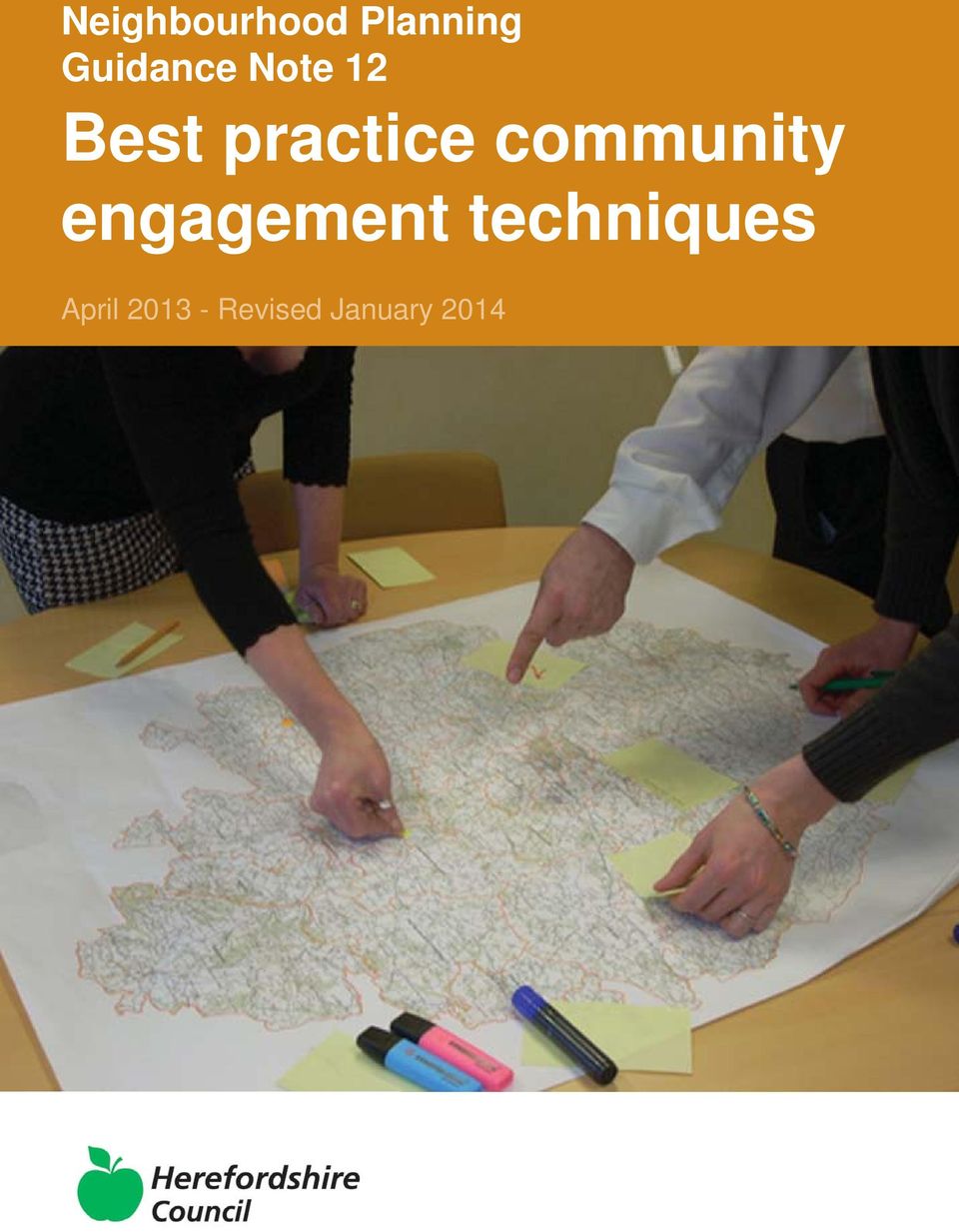
2 Community engagement is the active participation of local residents and community groups in the decisions that affect their lives. This guidance note explains the benefi ts and principles for effective community communication, plus a range of consultation methods that can be used for engagement. This document is copyright of Herefordshire Council, please contact the Neighbourhood Planning team if you wish to reuse it in whole or part.
3 Introduction For the purpose of this guidance it is important to outline an understanding of the terms community and engagement. Community refers to a group of people that share a common place (for example, your village, your parish(es) or within your Neighbourhood Area); a common interest (for example, an interest in the environment, sport and health and social care); or a common identity (normally demographic characteristics for example, age). There are also individuals and groups with common needs. Engagement refers to a range of interactions which are suitable for all parties involved. It could range from simple information giving through to supporting community activity. As appendix 1 shows, it spans a range of activities. Benefits of community engagement Well run community engagement will bring extensive benefi ts to the progression of your Neighbourhood Development Plan and will encourage the involvement of local residents, groups, businesses, developers and a number of agencies. Benefi ts of meaningful, two way community engagement include: Trust it builds trust between the parish council(s), local people, developers and service providers. Opportunity to infl uence it gives communities the opportunity to infl uence decisions that will affect them. Knowledge of local issues - it enables both the parish council(s), Ward Members and the local community to reach a better understanding of the issues and needs which could be addressed within your plan. Removing barriers it removes physical, language or social barriers to communities getting access to information or voicing needs or opinions. Community understanding it helps your community to understand the neighbourhood planning process and the progress of your plan. Satisfaction it increases the satisfaction with the progress of the plan and the community s ability to shape that future environment. A sense of ownership it supports community spirit and encourages the local people to take control of their own neighbourhoods, which will increase the chances of a successful outcome. However, some people involved in community engagement have highlighted potential drawbacks. For example, well run community engagement can be very resource intensive in both time and money. It can also be diffi cult to manage the different views of the respondents. Importance of recording your community engagement Consultation will form a very important part of your Neighbourhood Development Plan. Your plan should be a community led document and greater community involvement will assist the progress of your plan through the process and importantly the referendum. A consultation statement will be required as part of the submission of your Neighbourhood Development Plan. The statement will need to outline the range of consultations which have been undertaken and how the development of your plan has responded to the comments received. Separate guidance is available entitled Writing a consultation statement - guidance note 14. Principles for effective community engagement The following principles for effective community engagement provide a useful starting point for making consultation work. Make it: Timely Inclusive Community focussed Interactive Effective Matter

4 Well publicised Well facilitated Open, fair and subject to evaluation Cost effective Flexible Feedback results Good community engagement can help create individuals that are active and engaged and who are resourceful, gifted and creative. Likewise, good community engagement can help parishes to be seen by the community who readily and enthusiastically responded to their local communities desire for collaboration. Reaching all sectors of the community Neighbourhood planning should be fully inclusive within the community. Everyone should be given an equal right to have their views heard and respected. Good community engagement can build new relationships and links, and reinforce existing ones. Therefore, some thought should be given to the best way to reach wider groups and remove barriers to those who are traditionally under-represented in your parish issues and meetings. This will include those with differing views and those who often do not get their voices heard such as younger people, people living in remote rural areas or those whose fi rst language may not be English. Do not just contact those people who you know or who you think will agree with your views. Make sure that the whole community is aware of your intention to develop a Neighbourhood Development Plan. Ensure that you are realistic about how and when you can engage people. Consultations make considerable demands on both the organisers and the participants. Many people within your area will have busy lives which makes attendance at meetings diffi cult. Consider the timing of consultations to ensure the widest range of people can be involved. Identify opportunities to connect with other events within the area; this will save resources and time on your part and ensure you reach a wider audience. Appropriate communication Communication can be divided into the direct and indirect. Direct method means face-to-face, letters, or telephone conversations with individuals. Indirect methods could include leafl ets, advertising, radio programmes, articles in newspapers and press reports. These are indirect because they do not involve any direct contact between the person giving the message and the person receiving it. The infl uence of indirect communications is always harder to quantify and may rest as much in a change of general atmosphere as in its specifi c infl uence on individuals. Some members of the community may feel apprehensive about being involved in large public meetings and expressing their views in a public arena, especially if they do not have a great deal of experience in that style of meeting. Open Space meetings would allow the participants to create their own agenda and discussions in a less formal setting than a public meeting. Essentially people write down or suggest issues at the start of the meeting and then form smaller groups with people of similar concerns, to talk about the opportunities and way forward. Participants are given the opportunity to move between discussion groups and take part in as many or as few as they feel comfortable with. To organise an open space meeting you need to: Send an open invitation to your community, that explains the purpose of the meeting Arrange the meeting chairs into a circle Provide a bulletin board for participants to raise issues and offer suggestions Provide breakout spaces where participants can move freely between discussion/topic groups The outcomes from the meeting can then be collated and fed back to the whole group. See appendix 2, a community technique method matrix, which will help you think about various

5 consultation methods, and determine which one is the best method to use at each stage when producing your plan. It is essential that the content of your Neighbourhood Development Plan represents the views of the wider community, not just those of the project group. In developing your plan there should be a two-way fl ow of information between the project group and the wider community. A range of consultation methods that could be used are highlighted below: Public meetings - A public meeting is open to all, offering an opportunity for people to raise issues and ask questions, and be given answers that can be heard by others in the room. Public meetings are a good way to fl oat ideas and explore possible proposals before they are formalised. A good experience of a meeting can encourage people to become more involved in an engagement process. It is also an excellent way to communicate with large numbers of people. Roadshows and public exhibitions - Use the idea that a picture is worth a thousand words to convey information. These can be combined with other events and taken out to where people already are, such as school events or summer fayres. This reduces the need to attract people to specifi c events. They can appeal to groups, such as young people, who may not respond to document or meeting-based methods. Exhibitions can be used to gather immediate reactions from those who attend. Surveys and questionnaires - The single most widely used engagement method. Used to collect quantitative answers from which, if the participants are representative, wider public opinion can be deduced. They can also be very useful for gauging public reactions to ideas and proposals, or understanding what people think about facilities or services. They can be used to gather information from a large number of people. They are also useful for establishing information that can be re-tested to see if results change over time. Designing a questionnaire can be challenging and time-consuming. Questions need to be framed in a manner which is easily understood, covers all possible options and avoids leading the respondent. To assist you with this process see Guidance Note 29 Creating a questionnaire. Once you have drafted your questionnaire it is a good idea to test it on others before you make it public. The Neighbourhood Planning team will also be able to give feedback on your drafts. Consider the following when designing a questionnaire: Information required and how it will be used; Target participants; Questions; Test to ensure effectiveness; Delivery method(s); Collation, analysis and publication of results; Thanks and feedback to respondents. Local Workshops - Always by invitation and are designed to enable people to work actively and collaboratively on an issue or task. Although, they may begin with background briefi ngs or presentations, but they are not about providing information or asking questions. Workshops usually run for at least half a day. Workshops can encourage joint working and problem solving, and help to build a sense of ownership of the results. Newsletters/parish magazines - One of the cheapest and most effective methods of keeping people informed. Using a newsletter or parish magazine in isolation, however, should not be regarded as engagement. They are a useful complement to other forms of engagement, and can be a good way to signpost meetings or workshops and report the results of such methods. Newsletters should be kept short and sharp and the style should be lively. It is a good idea to feature pictures of key people, with their agreement, to make them seem less faceless. Open days and drop in sessions - A way of reaching out to the community and seeking informal contact. They can be used to publicise later engagement and can fi t into peoples personal timetables. Participants can be given additional information to take away with them. They gives people the opportunity to make
6 personal contacts and have individual questions answered. Web-based processes - In the last few years web-based engagement processes have begun to be more widely used i.e. parish council websites, Facebook, Twitter, Neighbourhood Planning specifi c website. They offer a number of advantages: people can participate without having to travel to meetings, it saves paper, enables people to focus on the issues that particularly interest them, and work well for people who feel intimidated by speaking in public. Online methods can be used as stand-alone processes or in parallel to or integrated with offl ine engagement methods. Consultation documents - A well written document allows the consulters to set out in detail the whole of a situation and ask specifi c questions. A document can be used to explain complexity and provide background information. Document-based consultation is safe and predictable, and avoids some of the risks of face-to-face processes. Web-based processes allow comments on documents and responses to questions to be displayed in full. The web-based process enables participants to navigate directly to the parts of the document that interest them. Focus groups - Groups of 6-12 people carefully selected to be representative of a designated part of the population. Focus groups are qualitative processes which are good for deepening the understanding of how people think and feel about issues. The advantage of this method is members can be carefully recruited to fi t specifi c roles. Focus groups can obtain opinions from people who would not respond to other methods because they are not comfortable with writing or because of other constraints. Interviews - Can involve intensive, face-toface meetings, telephone conversations or street corner encounters. This is a good way to obtain information from an individual. It s relative informality and spontaneity can help to uncover issues and ideas which can then be fed into more formal large-scale consultations. Questions can be asked to get a sense of the local context, particular issues and the sort of engagement methods that might be most appropriate. Planning for Real - Is an eye catching, hands-on method which is used to sort out what needs to be done to improve your neighbourhood. It involves a large 3D model or large scale map of the community. The model is used at open meetings to suit the needs of the community. Participants place suggestions for the community on cards or fl ags which are then placed at appropriate points on the model. Benefi ts of this method are: it s visual impact, its informality, participants can contribute anonymously and all ages can contribute. Place checks/reconnaissance trips - Place audits involve a group of local people in a direct inspection of their Neighbourhood Area. Reconnaissance trips are the same but involve mixed teams of local people and technical experts. They are used to familiarise everyone with the physical environment and key issues in the area and to review progress at intervals. A route is carefully planned to include key local features and issues. The route may be walked or use buses or other forms of transport. It may include visits to buildings or facilities. Usually a team leader will direct the group and determine the pace. The group make notes, sketches, take photos and talk informally to people in their own setting. Citizens panels - Panels of local people are convened to allow regular testing of their opinion on local issues. They overcome the problem of having to recruit for each separate exercise. The composition of panels can be made representative of the population whose views are required i.e. your community. The response rate from panels is usually high, and the panels can also be used to disseminate information. Community fairs - Provide a fun occasion that will draw a crowd of all ages and backgrounds. It then provides an opportunity to inform and engage the people within a community at one event. They can create interest from media groups and lead to increased coverage of the issue. The main value of community fairs is for organisations who want to show a different face to the public, such as the police. Community fairs tend to work best if a number of organisations in the community get together to run them. Leaflets and posters - An effective method of publicising or conveying simple messages regarding a larger consultation or one of the methods already highlighted.

7 Consultation Do s and Dont s Do have a plan; don t rely on ad hoc meetings; Do draft your consultation strategy early; Do allow everyone to have their say and feel involved; Do think how it is best to reach everyone within your community including those who live and work in the area and local landowners; Do refi ne; amend; test the questions; Do invite others to offer advice; for example third parties/stakeholders; Useful community engagement web resources Eden Project: How to plan your own neighbourhood php/2011/09/how-to-plan-your-own-neighbourhood/ Developing your comprehensive community engagement strategy Involving People: A practical guide pdf Do have a method for collecting, collating and displaying all responses transparently; Do have a method for acknowledging responses and telling people how their responses have been acted upon; Do keep excellent records; Don t just talk to those who are friendly or who share your views; Don t get into arguments on the substance. Review consultation successes Consultation within your community should not be a one-off event. Ensure that people continue to be involved in the process by sharing consultation responses and views with them. Remember to review the method you have used and refl ect on which elements worked well and where there are gaps. Are there any sections of the community who did not engage and were there reasons why. Share your experiences with other parishes and help build a shared knowledge of and good practice.

8 Appendix 1 Increasing level of community engagement > > The Five Levels of Locality Engagement Informing Consulting Involving Collaborating Empowering Providing information to localities to enable them to understand problems, alternatives, opportunities and solutions. Obtaining locality feedback to inform decision making. Obtaining feedback on formal proposals. Working directly with the locality to ensure that issues, concerns and aspirations are understood and considered. Working in partnership with localities on all aspects of decision making including development of options and identifying preferred solutions. Placing final decision making in the hands of the locality. The intention is to Keep the locality informed. Keep the locality informed, listen to their views and provide feedback on how their input influenced decision making. Engage with the locality to ensure that concerns and aspirations are reflected in decisions and service delivery. We will provide feedback to the locality on how their input influenced decision making. Look to the locality for advice and innovation to find solutions. We will incorporate locality contributions to the maximum extent. Facilitate localities to take responsibility for designing and delivering services themselves. Techniques Brochures, websites, news releases and newsletters to raise awareness. For example: njjjjjjjj Council Tax information leaflet, council website, Facebook or Twitter. Annual surveys, questionnaires, focus groups, telephone, postal or face to face (interview) surveys, using social media, , website, SMS mobile or Facebook surveys. User panels e.g. Planning for Real area forums, public meetings, citizens panel, local member / councillor surgeries or network meetings. Community needs analysis, focus groups or service user forums. User led commissioning e.g. delegated budgeting, community asset transfer or direct service delivery. 10

9 Appendix 2 Neighbourhood planning methods matrix Neighbourhood planning phase: Method: Getting started - awareness raising Establish steering group Evidence gathering Developing plan issue to vision Writing policies First draft plan Final plan Referendum Adoption Implementation and monitoring Notes: Public Meeting Questionnaire Newsletter/ Parish Magazine Parish or Village Website Page Consultation Documents Street/Fete Stall Leaflets Posters Exhibition Door Knocking Planning for real Study Tour Social Media: Facebook/Twitter/ You Tube/Blogs Workshop instructions: - Identify preferred methods to use in each phase and record on matrix. - Place coloured dots within squares, indicating priorities as follows: = Favourite, = Useful, = Limited. - Try to reach consensus within group but if not possible record majority view. Ask facilitators if you are not sure about the nature of methods listed.

10 Neighbourhood Planning guidance notes available: Deciding to produce a Neighbourhood Development Plan 1. Which is the right tool for your parish 2. What is a Neighbourhood Development Plan 3. Getting started 4. A guide to procedures 5. Funding Plan Production 6. Developing a Vision and Objectives 7. Generating options 8. Writing planning policies 9. Environmental Assessment 10. Evidence base and information requirements 11. Implementation and Monitoring Statutory consultees 14. Writing a consultation statement 15. Planning and other legislation 16. Web enabling your plan 17. Using OS based mapping 18. Glossary of planning terms Topics 19. Water issues in Herefordshire 20. Guide to settlement boundaries 21. Guide to site assessment and choosing allocation sites 22. Affordable housing 23. Conservation issues 24. Recreational areas 25. Renewable energy 26. Transport issues 27. Community Infrastructure Levy Additional Guidance 28. Setting up a steering group 29. Creating a questionnaire 30. Community facilities 31. Conformity with the Local Plan (Core Strategy) 32. Examinations of Neighbourhood Development Plans 33. Guide to Neighbourhood Development Plan Referendums

Neighbourhood Planning Guidance Note 20 Guide to settlement boundaries
 Neighbourhood Planning Guidance Note 20 Guide to settlement boundaries April 2013 - Revised January 2014 Settlement boundaries are a well utilised planning tool for guiding, controlling and identifying
Equal Partners Strategy Summary
 Equal Partners Strategy Summary Informing Consulting Listening Involving Empowering For further information please contact: Sue Eato, Associate Director of Service User and Carer Involvement [email protected]
Consultation and Engagement Strategy
 Consultation and Engagement Strategy Contents: 1. Introduction 2 2. Purpose 3 3. Aims and Objectives 4 4. Key principles 5 5. Delivery of the Strategy 6 6. Action Plan 2011-12 7 Appendix 1 Understanding
Community engagement: Developing a strategy
 Community engagement: Developing a strategy Some questions to help with planning... This guidance outlines some important things to consider when planning a community engagement strategy for your project
2013/2014 Business & Community Engagement Plan
 2013/2014 Business & Community Engagement Plan Bringing business and community together Introduction This Business and Community Engagement Plan (BCEP) highlights the ways in which HiB and its stakeholders
Transition matters. A resource about starting school for early childhood educators and school staff
 Transition matters A resource about starting school for early childhood educators and school staff About this resource Transition matters is all about supporting children throughout one of the most important
Planning & Building Standards. Draft Customer Engagement Strategy August 2015
 Draft Customer Engagement Strategy August 2015 1. Introduction 1. Who are our customers? 2. What is engagement? 2. Consulting with our customers 7. Communicating with our customers 9. Planning information
A Human Resource Capacity Tool for First Nations // planning for treaty
 A Human Resource Capacity Tool for First Nations // planning for treaty table of contents Introduction //...3 Tools //... 9 HR Planning Timeline... 9 Stage 1 Where are we now?...11 Stage 2 Where do we
Statement of Community Involvement
 Hull Local Plan Statement of Community Involvement Adopted 23 September 2013 1. Introduction 1.1 This is Hull City Council s Statement of Community Involvement (SCI) it describes how we will carry out
Communication Plan. for the. ATLANTIC AREA 2007-2013 Transnational Cooperation Programme
 Communication Plan for the ATLANTIC AREA 2007-2013 Transnational Cooperation Programme Prepared by the Managing Authority 18 January 2008 Index 0. Introduction... 2 1. Communication Strategy... 2 1.1
Guide to marketing. www.glasgow.ac.uk/corporatecommunications. University of Glasgow Corporate Communications 3 The Square Glasgow G12 8QQ
 Guide to marketing www.glasgow.ac.uk/corporatecommunications University of Glasgow Corporate Communications 3 The Square Glasgow G12 8QQ 0141 330 4919 2 Introduction One of the easiest mistakes to make
Saskatoon North Partnership for Growth (P4G) Draft Communications and Engagement Strategy
 Saskatoon North Partnership for Growth (P4G) Draft Communications and Engagement Strategy Introduction This Communications and Engagement Strategy (Strategy) sets the communications and engagement framework
CHANGE MANAGEMENT PLAN
 Appendix 10 Blaby District Council Housing Stock Transfer CHANGE MANAGEMENT PLAN 1 Change Management Plan Introduction As part of the decision making process to pursue transfer, the Blaby District Council
Appendix 1: Performance Management Guidance
 Appendix 1: Performance Management Guidance The approach to Performance Management as outlined in the Strategy is to be rolled out principally by Heads of Service as part of mainstream service management.
Welsh Government. Practice Guide. Realising the potential of pre-application discussions
 Welsh Government Practice Guide Realising the potential of pre-application discussions May 2012 Digital ISBN 978 0 7504 7623 2 Crown Copyright 2012 WG 15424 (2) Table of contents 1 Introduction...3 Background...3
Northern Ireland Environment Agency Corporate Social Responsibility
 Northern Ireland Environment Agency Corporate Social Responsibility September 2011 Introduction This document has been prepared by the Northern Ireland Environment Agency (NIEA) in line with general NICS
INTEGRATED PLANNING AND REPORTING
 Government of Western Australia Department of Local Government INTEGRATED PLANNING AND REPORTING Framework and Guidelines Integrated Planning and Reporting Framework and Guidelines p1. Contents Foreword
Putting on an exhibition about your research
 Real Life Methods Part of the ESRC National Centre for Research Methods Toolkit #02 Putting on an exhibition about your research Hazel Burke, Real Life Methods, University of Manchester July 2008 About
Statement of Community Involvement (SCI) March 2016
 Statement of Community Involvement (SCI) Contents Section Page No. 1.0 What is a Statement of Community Involvement?... 1 2.0 Who can get involved in the planning process?... 3 3.0 Empowering disadvantaged
Global Pre-intermediate CEF descriptors
 Global Pre-intermediate Listening A2 Unit Page I can understand what is said clearly, slowly and directly to me in simple everyday conversation; it is possible to make me understand, if the speaker can
Recruiting for Diversity
 GUIDE Creating and sustaining patient and family advisory councils Recruiting for Diversity Let s make our health system healthier WHO IS HEALTH QUALITY ONTARIO Health Quality Ontario is the provincial
Marketing, Recruitment and Admissions. Marketing Strategy 2013-2015
 Marketing, Recruitment and Admissions Marketing Strategy 2013-2015 November 2013 The Marketing Strategy is created cooperatively by the Department s marketing managers and exists to advance the University
Marketing strategy & marketing plan
 Marketing strategy & marketing plan What is a marketing strategy and why is it important? Put simply, marketing is everything that your organisation does to get potential customers, funders and beneficiaries
Evaluating Participation. A guide and toolkit for health and social care practitioners
 Evaluating Participation A guide and toolkit for health and social care practitioners September 2013 This publication was developed by Gary McGrow, Social Researcher, the Scottish Health Council, in partnership
Holding Effective Performance Meetings and One-to-Ones
 Section 01 Section 03: Holding Effective Performance Meetings and One-to-Ones 1 Talking about Performance Discussing performance and providing feedback is not easy but it is important to the continued
Preparing a Green Wedge Management Plan
 Preparing a Green Wedge Management Plan Planning Practice Note 31 JUNE 2015 This practice note provides a guide for the preparation of Green Wedge Management Plans and sets out the general requirements
Communication and Engagement Strategy 2014 2017. Final Version 30 th June 2014
 Communication and Engagement Strategy 2014 2017 Final Version 30 th June 2014 Contents Introduction 4 Strategic Objectives and Role of Communications 6 Communications now and by 2017 7 Communications and
WORK PLACEMENTS IN LOND N
 WORK PLACEMENTS IN LOND N Introduction to Work Experience in London Programme Work Experience in Secretarial and Administration Sectors Work Experience in Information Technology (IT) Work Experience in
Mental Health and Wellbeing Statement
 Mental Health and Wellbeing Statement The promotion of good mental health is a University-wide concern. In a learning environment there are many opportunities for developing positive wellbeing, and there
Local and Community Development Programme
 UPDATED TO REFLECT NEW FRAMEWORK MAY2011 Local and Community Development Programme A step by step guide to Strategic Planning for LCDP Step One - Reflection on the principles of the programme and the horizontal
Patient Participation Group Report 2015
 Patient Participation Group Report 2015 Pangbourne Patient Participation Group Annual Report for the Practice website The PPG The Pangbourne Patient Participation Group (PPG) was set up in 2010 and had
2.2 STAKEHOLDER AND COMMUNICATION PLAN
 EXCELLENCE THROUGH PATIENT AND FAMILY CENTRED CARE BAY OF PLENTY DISTRICT HEALTH BOARD 2.2 STAKEHOLDER AND COMMUNICATION PLAN 2.2 STAKEHOLDER AND COMMUNICATION PLAN Averil Boon RN, Grad Cert HInf, PG DipN
Ottawa Charter. Toolkit and Implementation Planning Guide
 Ottawa Charter Toolkit and Implementation Planning Guide Information required to support the Health Promotion Plan Introduction Priority Groups. Health Goal The aim of NCSP/BSA. Regional Community Profile
Leisure and Tourism. Madame Tussauds brings you
 Madame Tussauds brings you Leisure and Tourism An exciting resource to support the learning and teaching of Travel and Tourism and Applied Leisure and Tourism for Key Stages 4 and 5, Levels 1, 2, 3 Welcome
Appendix H3 Public Outreach
 Appendix H3 Public Outreach H3.1 Public Outreach Components There are a variety of components that will be needed in development of a comprehensive outreach campaign for the SMMP. Components will include:
Safety Excellence Matrix
 Safety Excellence Matrix 1 = Performance just meets minimum standards 2 = Performance is satisfactory got the basics 3 = Performance is good going beyond the norm 4 = Performance is very good best practice
Queensland Government Human Services Quality Framework. Quality Pathway Kit for Service Providers
 Queensland Government Human Services Quality Framework Quality Pathway Kit for Service Providers July 2015 Introduction The Human Services Quality Framework (HSQF) The Human Services Quality Framework
Volunteer Managers National Occupational Standards
 Volunteer Managers National Occupational Standards Contents 00 Forward 00 Section 1 Introduction 00 Who are these standards for? 00 Why should you use them? 00 How can you use them? 00 What s in a Standard?
November 2014 March 2015
 November 2014 March 2015 April 2015 1 Executive Summary & Acknowledgements Background Aims Objectives National context Local context - Trafford School Nurse Service Methodology Project Outline Firs Primary
Quality Standard Customer Service Complaints Handling
 Quality Standard Customer Service Complaints Handling Version 1 Date:- 2 nd December 2010 Page 1 Contents INTRODUCTION 4 OVERVIEW OF THE COMPLAINTS STANDARD 5 FRAMEWORK 6 MANDATORY SECTIONS 7 SECTION 1
Site Assessment for Neighbourhood Plans: A toolkit for neighbourhood planners
 Site Assessment for Neighbourhood Plans: A toolkit for neighbourhood planners Action the COI Table Of Contents Introduction... 3 Benefit of carrying out a site assessment... 4 How to carry out a site assessment
National Occupational Standards. Compliance
 National Occupational Standards Compliance NOTES ABOUT NATIONAL OCCUPATIONAL STANDARDS What are National Occupational Standards, and why should you use them? National Occupational Standards (NOS) are statements
A Guide to Promoting your Project
 Contents 1. Introduction 2. Why Promotion? 3. Channels Traditional Media i. Television ii. Radio iii. Print Digital Media 4. Planning Assigning Roles i. Coordinating ii. Speaking iii. Writing iv. Photographer
HOW TO GENERATE PUBLICITY FOR YOUR NATIONAL SCIENCE WEEK EVENT
 HOW TO GENERATE PUBLICITY FOR YOUR NATIONAL SCIENCE WEEK EVENT INTRODUCTION This guide has been developed to help you to promote your National Science Week event. If you have already run a National Science
How To Manage The Council
 Mole Valley District Council Corporate Communications Strategy 2002-2005 CONTENTS Content Section 1: Introduction Section 2: Stakeholders Section 3: Objectives Section 4: Targets Section 5: Principles
COMMUNITY ENGAGEMENT PLAN
 COMMUNITY ENGAGEMENT PLAN APRIL 2013 to MARCH 2015 Background The Council is committed to working closely with the public as part of fulfilling its community engagement role. Community engagement includes
Market Research: Friend or Foe to Christian Charities?
 Market Research: Friend or Foe to Christian Charities? by Redina Kolaneci Senior Fundraising & Stewardship Consultant McConkey Johnston international UK If you are ignorant of yourself, in addition to
Customer Service. 1 Good Practice Guide
 Customer Service 1 Good Practice Guide Contents Photography by OzShots Foreword 3 The application of this guide to employees in the public service 4 Core principles of customer service 4 Leading and modelling
Continuous. Improvement. Review Kit. for planning and responsible authorities February 2006. A Victorian Government Initiative
 Continuous Improvement Review Kit for planning and responsible authorities February 2006 A Victorian Government Initiative Published by the Victorian Government Department of Sustainability and Environment
Quality Assessment Framework Core Service Objectives
 Quality Assessment Framework Core Service Objectives NIHE Supporting People Contents C1.1 Assessment and Support Planning...3 C1.2 Security, Health and Safety..11 C1.3 Safeguarding and Protection from
January 2016. Communications Manager: Information for Candidates
 January 2016 Communications Manager: Information for Candidates Thank you for expressing interest in the role of Communications Manager. We have compiled this information pack to tell you more about The
Middlesbrough Manager Competency Framework. Behaviours Business Skills Middlesbrough Manager
 Middlesbrough Manager Competency Framework + = Behaviours Business Skills Middlesbrough Manager Middlesbrough Manager Competency Framework Background Middlesbrough Council is going through significant
Suite Overview...2. Glossary...8. Functional Map.11. List of Standards..15. Youth Work Standards 16. Signposting to other Standards...
 LSI YW00 Youth Work National Occupational Standards Introduction Youth Work National Occupational Standards Introduction Contents: Suite Overview...2 Glossary......8 Functional Map.11 List of Standards..15
Guidance on the Operation of Staff-Student Liaison Committees
 Guidance on the Operation of Staff-Student Liaison Committees September 2012 Guidance on the Operation of Staff-Student Liaison Committees 1. Introduction The Code of Practice on Student Representation
HOW TO GENERATE PUBLICITY FOR YOUR NATIONAL SKILLS WEEK EVENT
 HOW TO GENERATE PUBLICITY FOR YOUR NATIONAL SKILLS WEEK EVENT INTRODUCTION This guide has been developed to help you to promote your National Skills Week event. It provides a range of ideas, even taking
VPQ Level 6 Business, Management and Enterprise
 VPQ Level 6 Business, Management and Enterprise VPQ Level 6 Certificate in Business, Management and Enterprise The VPQ Level 6 Certificate in Business, Management and Enterprise is a 30 credit qualification.
Grant Writers Guide. for Community Groups. Finding a Grant
 Grant Writers Guide for Community Groups This booklet contains valuable information about the process of writing a grant. It is hoped that reading through this booklet will give you some useful information,
Guildford borough Local Plan Local Development Scheme 2015
 Guildford borough Local Plan Local Development Scheme 2015 Summary The Local Development Scheme (LDS) is the timetable and project plan for the new Guildford borough Local Plan. The LDS explains what documents
LSE Knowledge Skills and Behaviours Framework for managers and leaders Guidelines
 LSE Knowledge Skills and Behaviours Framework for managers and leaders Guidelines Contents Introduction 2 A guide to the KSB framework 3 LSE Leadership and Management: 3 Behaviours LSE Leadership and Management:
Communications Strategy
 Communications Communications July 2013 Version 1.1 1 Communications River Clyde Homes Vision Our vision is to provide quality, affordable homes, in neighbourhoods we can be proud of and to deliver excellent
People Strategy 2013/17
 D a t a L a b e l : P U B L I C West Lothian Council People Strategy 2013/17 Contents 1 Overview 2 2 Council Priorities 8 3 Strategy Outcomes 10 1 Engaging and motivating our employees 13 2 Recognised
upport uy in ccountable ndependent epresentative impact ower and influence Measuring the impact and success of your youth voice vehicle
 Measuring the impact and success of your youth voice vehicle epresentative ccountable ndependent upport uy in impact ower and influence A guide for staff, councillors and young people involved in youth
Helen Featherstone, Visitor Studies Group and University of the West of England, Bristol
 AUDIENCE RESEARCH AS A STRATEGIC MANAGEMENT TOOL Sofie Davis, Natural History Museum Helen Featherstone, Visitor Studies Group and University of the West of England, Bristol Acknowledgements: The authors
Transparent Chennai. Best Practice Documentation June 2010. Researched and Documented By. OneWorld Foundation India
 1 Transparent Chennai Best Practice Documentation June 2010 Researched and Documented By OneWorld Foundation India 2 Contents Executive Summary... 3 Background... 4 Objective... 4 Working Design... 4 Data
SCHOOL DISTRICT COMMUNICATION GUIDELINES
 SECTION E: COMMUNICATION SCHOOL DISTRICT COMMUNICATION GUIDELINES INDIVIDUAL TRUSTEE SCHOOL STAFF MEMBER PARENT SCHOOL COUNCIL TEACHER PRINCIPAL AREA SUPERINTENDENT CHIEF SUPERINTENDENT BOARD OF TRUSTEES
Strategic plan. Outline
 Strategic plan Outline 1 Introduction Our vision Our role Our mandate 2 About us Our governance Our structure 3 Context Our development Camden 4 Resources Funding Partners 5 Operating model How we will
Research and information management strategy 2015-18. Using research and managing information to ensure delivery of the Commission s objectives
 Research and information management strategy 2015-18 Using research and managing information to ensure delivery of the Commission s objectives 1 1. Introduction This strategy sets out a range of research
How councils work: an improvement series for councillors and officers. Managing performance: are you getting it right?
 How councils work: an improvement series for councillors and officers Managing performance: are you getting it right? Prepared for the Accounts Commission October 2012 The Accounts Commission The Accounts
Responding to a Planning Application
 Responding to a Planning Application A guide by Diana Cairns of Planning Democracy How will I hear about a new planning application? You may hear about a new planning application in a number of ways, for
CHILDREN AND ADULTS SERVICE RESEARCH APPROVAL GROUP
 DURHAM COUNTY COUNCIL CHILDREN AND ADULTS SERVICE RESEARCH APPROVAL GROUP INFORMATION PACK Children and Adults Service Version 4 October 2015 Children and Adults Service Research Approval Group Page 1
CUSTOMER SERVICE EXCELLENCE
 CUSTOMER SERVICE EXCELLENCE STANDARD 2 Table of Contents The starting point 4 Criterion 1 Customer Insight 5 1.1 Customer Identification 5 1.2 Engagement and Consultation 6 1.3 Customer Satisfaction 7
CIVIL SERVICE COMMISSION. RECRUITMENT PRINCIPLES: review. Consolidation of previous changes and proposed amendments to the explanatory text
 CIVIL SERVICE COMMISSION RECRUITMENT PRINCIPLES: review Consolidation of previous changes and proposed amendments to the explanatory text Issue 1. The drafting of the Recruitment Principles explanatory
PERARES PROJECT EVALUATIONS
 PERARES PROJECT EVALUATIONS The checklist and survey forms in the following pages are proposed for use in 2012 2014 by Perares partners in evaluation of projects they undertake within Perares or independently
AER reference: 52454; D14/54321 ACCC_09/14_865
 Commonwealth of Australia 2014 This work is copyright. In addition to any use permitted under the Copyright Act 1968, all material contained within this work is provided under a Creative Commons Attribution
Logan City Council. Strategic Planning and Performance Management Framework
 Logan City Council Strategic Planning and Performance Management Framework 1 Table of contents 1. Overview 3 a) Purpose 3 b) Key Features 3 2. Context 4 a) National Framework for Sustainability 4 b) Elements
Key Performance Indicator (KPI) Guide
 Key Performance Indicator (KPI) Guide Measuring performance against the NSW Disability Services Standards Version 1.0 Key Performance Indicator (KPI) Guide, Measuring performance against the NSW Disability
To liaise with other MSS departments and lead on the creative direction for their projects.
 Job Title: Location: Reports to: Creative Services Manager MS National Centre, London Head of Marketing and Brand Introduction to MS Society The MS Society is the UK s leading MS charity. Since 1953, we
Case study: developing an internal communications and engagement strategy
 Case study: developing an internal communications and engagement strategy Writing an internal communications and engagement strategy that works isn t easy, but essential if you re going to focus on achieving
Chapter 1: Health & Safety Management Systems (SMS) Leadership and Organisational Safety Culture
 Chapter 1: Health & Safety Management Systems (SMS) Leadership and Organisational Safety Culture 3 29 Safety Matters! A Guide to Health & Safety at Work Chapter outline Leadership and Organisational Safety
Step By Step Guide: Reaching the Equalities Standard
 Step By Step Guide: Reaching the Equalities Standard with Indicators of Cultural Competency Published July 2015 By Russell Thomas and Berkeley Wilde Contents Page Introduction 3 The Equality, Diversity
Non-Emergency Patient Transport Services. Public Consultation Report
 Non-Emergency Patient Transport Services Public Consultation Report 1 Contents 1. Introduction... 3 2. Background... 3 2.1. What are non-emergency patient transport services... 3 2.2. Local The picture
How to Write a Marketing Plan
 How to Write a Marketing Plan This article highlights what we believe to be many of the key points that we need to consider when developing a marketing plan. It combines marketing theory, practical tools
Careers and the world of work: roles and responsibilities
 Careers and the world of work: roles and responsibilities Careers and the world of work: roles and responsibilities Audience Headteachers, principals, governing bodies, management committees, careers and