
Nurse practitioners in primary care
|
|
|
- Ferdinand Manning
- 9 years ago
- Views:
Transcription
1 Family Practice Vol. 17, No. 6 Oxford University Press 2000 Printed in Great Britain Nurse practitioners in primary care Maxine Offredy and Joy Townsend Offredy M, Townsend J. Nurse practitioners in primary care. Family Practice 2000; 17: Objectives. Recent policy emphasizing the role of primary care has increased the workload of general practitioners (GPs) while simultaneously placing nurse practitioners (NPs) as key providers in the delivery of health care. There is need to examine the latter s work practices. The purpose of this article is to explore the role and practice of NPs in general practice. Methods. Design: Thirty-six semi-structured interviews with GPs, NPs, receptionists and patients were analysed. Setting: Four general practices in south-east England. Main outcome measures: Data from semi-structured interviews relating to allocation, prescribing and referral practices of NPs in primary care. Results. These include the differences in presenting problems of patients seen by GPs and NPs, prescribing and referral practice and legal issues of the nurse practitioner. A wide range of practice is reported. Conclusion. This study highlights the variation in how patients are allocated for NP consultation and in NP autonomy, prescribing and referral, which raises issues for clinical governance of protocols and risk management. Keywords. General practice, nurse practitioners, patient allocation, variations in practice. Introduction Over the last 15 years there has been a shift in health care management to one in which nurses have taken on some roles previously undertaken by doctors 1,2 and support workers have taken over some nursing roles. 3 This has occurred in the UK, 4,5 the USA 6,7 and Australia 8 11, driven by efforts to reduce cost and by increased specialization, advances in technology and reallocation of care functions from secondary to primary settings. These forces have contributed to new models of care delivery and a restructuring of the health workforce in the UK. 4,12,13 The 1990 contract for general practitioners (GPs) 14 in the UK, with its emphasis on health promotion, resulted in increases in the employment of practice nurses and in their workload. 2,15 As the trends are accelerating it would seem important to understand their implications and how decisions regarding patient consultation, prescribing and secondary referral are made. Current literature mostly relates to the USA, some of which has suggested wide scope for substitute doctors. 16,17 There have been two UK studies of pilot projects by management consultants. One concluded that the greatest potential for nurse practitioners (NPs) lay in primary Received 7 January 2000; Accepted 17 July Faculty of Health and Human Sciences, University of Hertfordshire, Hatfield, Hertfordshire AL10 9AB, UK. care to manage a comprehensive caseload with GPs. 18 The other concluded that NPs provided better access and reduced waiting times and that their better provision of information was appreciated by patients. 19 Both emphasized that the pilot projects, which had much effort focused on them, were probably not typical. Neither study included NPs working in an integrated way in primary care or addressed the issues of delineation of roles, or criteria for allocation, prescribing or referral. This article provides some evidence on current working practices and forms part of an ongoing research programme into decision making by NPs in primary care. Methods Four general practices in urban and inner city areas in south-east England, including single-handed and group practices, were contacted and agreed to take part in the study. As there is no national database of qualified NPs, they and the general practices were selected by snowball sampling, a form of convenience (non-probabilistic) sampling in which participants assist in finding the next subject. Steps were taken to reduce sample bias and to make the small sample purposive by (i) including subjects from a variety of employment settings (different practice sizes and demographic areas); and (ii) including both experienced and less experienced NPs (broadly defined as those with 2 years experience and those with 564

2 Nurse practitioners in primary care years experience, respectively); and (iii) including only NPs who had completed the Royal College of Nursing UK nurse practitioner degree programme and were currently engaged in primary health care. Semi-structured in-depth interviews took place with four GPs, four receptionists, four NPs, three patients from each practice who consulted with the NP on the same day as the interview and three who consulted with each GP, making a total of 36 interviews. The authors devised four semi-structured interview schedules based on pilot interviews with a previous set of GPs and NPs, and were subject to independent review. Recorded interviews, which were conducted by the researcher (M.O.), lasted about 1 hour. Respondent validation of the transcripts was obtained from the GPs, NPs and receptionists. Their comments were of an explanatory nature and did not alter the substance of their responses. The transcripts were systematically analysed and coded by the researcher using the NUDIST qualitative data analysis programme. The interview data were coded into broad categories relating to the interview questions, and finer sub-categories. The NUDIST programme was used to record and store the original source of the text, thus allowing a tracking system to be maintained. As an external check, the data were independently categorized by another independent reviewer not involved in the research, but familiar with the process of category generation. The proportion of agreement obtained using Cohen s kappa, 20 corrected for chance, was 0.75, indicating a high overall level of agreement between the two raters. Broad categories including structure, process and outcome were subdivided; for example, process included the category organization of work which was further subdivided into the NP s role in the surgery, work patterns of NPs and prescribing patterns. Where appropriate the same categories were used for the perspective of the other study participants, including arrangements about patient allocation, prescribing and referral. Each NP, receptionist, GP and patient was asked how the role of the NP was made known in the surgery. The views of participants highlighted in the tables are representative of responses from the four practices. Results Practice structure The practice populations ranged between 4000 and 8000 patients. Each had a trained NP, between one and five GPs, four or more receptionists, practice nurses, health visitors and district nurses. Practice data and NP roles are summarized in Table 1. Patient allocation In practice 1, the NP reported that patients learned of her role through open access surgeries held each TABLE 1 Summary of nurse practitioners roles Question Practice 1 Practice 2 Practice 3 Practice 4 Practice profile Location urban urban inner city inner city Fundholding? no yes yes fundholding Population Number of GPs Patient allocation by receptionist according by receptionist according GP triage; receptionist list; patients without appointment; to list of criteria to list of criteria; patient choice set protocols; patient choice patient choice Prescribing agreed protocols; GP signs NP holds prescription pad; GP sees patients pre-signed prescription pad; without seeing patient no protocols; pharmacist protocols may dispense without GP s signature GP s assessment of significant would have gone under leaves GP free for complex definitely reduced; effect on GP without NP care GP appointment times workload lengthened from 8 to 10 minutes Problems seen by NP all except for new all all, especially gynaecology minor illnesses, disease medication management using protocols Referral by NP none gynaecology, dermatology none (but recommends) gynaecology, dermatology No. of patients per NP session Level of NP autonomy medium high low high GP legal concerns concern GPs accept responsibilities serious concerns aware of problems

3 566 Family Practice an international journal TABLE 2 Allocation of patients to nurse practitioner or general practitioner I tell patients the nurse practitioner can do everything except sign prescriptions. (receptionist 2) [I] choose to see the female general practitioner or the nurse practitioner. (patient 1) There s no differentiation except for new medicine. (GP1) The receptionist makes the decision. (patient 3) anything that comes through the door: sore throats, chest pain, backache. (NP2) Patients are told on posters and practice leaflets that the surgery has a nurse practitioner for minor illness and disease management using set protocols. (GP3) morning by a GP or herself; surgery consultations with her via receptionist triage; and through her daily 1 hour telephone consultations with patients needing advice, also triaged via the receptionist. In two other practices patients were informed of the NP s role by leaflets displayed on the surgery noticeboard (NP2 and NP3), and the NP in the fourth surgery educated the receptionists about the role of nurse practitioners, including a list of what nurse practitioners can do (NP4). GPs in practices 1 and 4 confirmed that the receptionists tended to educate patients about the NP s role. GP2 was not sure how the NP s role was made known in the surgery and GP3 no longer had insight into the system (because) it has been running for so long. GP4 provided a clear explanation of how the NP s role was made known in the surgery: Patients are told that we employ a nurse practitioner who is not just a usual nurse, she s more qualified and she can deal with a lot of medical conditions and give them information and treatment for those conditions and start investigations and counsel them. So they are told that by the receptionists. We have it on posters, we have it on practice leaflets and the patients who do not have an appointment are first offered an appointment with the nurse practitioner which reinforces what we do. Receptionists in each practice reported that they allocated patients to the NP. Receptionists in practice 1 allocated patients flexibly depending on the patient s presenting problem and on the availability of the GP or NP. The receptionist in practice 2 told patients that the NP can do everything except sign prescriptions. In practice 3, the receptionist was unsure about sending patients to the NP, although there was a list of relevant conditions that could be seen and reported: I used to send patients to the nurse practitioner but the doctor stopped that. Now it s only if the patients ask to see her that I book her. She s not seeing as many as she would like. In these three practices, patients either told the receptionist the reason for their visit to the surgery or were asked the reason. Surgery 4 had a policy that all patients without appointments were referred to the NP without triage. In practices 1 and 2, both GPs and NPs reported no practice policy to allocate specific patients to the NP with the exception of patients requiring new medication (GP1). Patient allocation in practice 3 depended on the decision of the GP and receptionists on duty that day. The GP preferred to diagnose patients and refer appropriate ones to the NP. In some cases patients were able to self-select the practitioner according to their illness, and all could elect to see a doctor although this might incur delay. Patients perspectives Different patients reported that which practitioner they consulted depended on their own decision and that of the receptionist, the GP or the NP. In some cases patients reported that they were able to select the appropriate practitioner according to their illness as indicated by a list of criteria. Some reported that they wished to see only a doctor irrespective of the seriousness of their complaint, others that they wished to see a female doctor or NP. Some elderly patients in all four practices expressed concern that the receptionists enquired about their condition, although appeared to accept this as normal practice. The longer time spent with the NP as compared with a consultation by the GP was commented on by some patients, for example mothers with young children, patients with social problems and those with chronic diseases. Longer consultation time by NPs and its concomitant cost has recently been highlighted. 21 A significant minority of patients was familiar with the role of the NP. These patients included the above groups. The majority of patients reported a high level of satisfaction with the service they received. However, confusion arose with some patients in practice 1 as the NP was employed on a half-time basis as an NP and the other half of her time was spent as a practice nurse. Confusion also arose with receptionists in allocating appropriate task according to the nurse s status on particular days. The disadvantage of choosing an NP consultation from the patients perspective was the lack of prescribing rights which sometimes resulted in a slightly longer wait while the NP sought the GP s signature for prescription
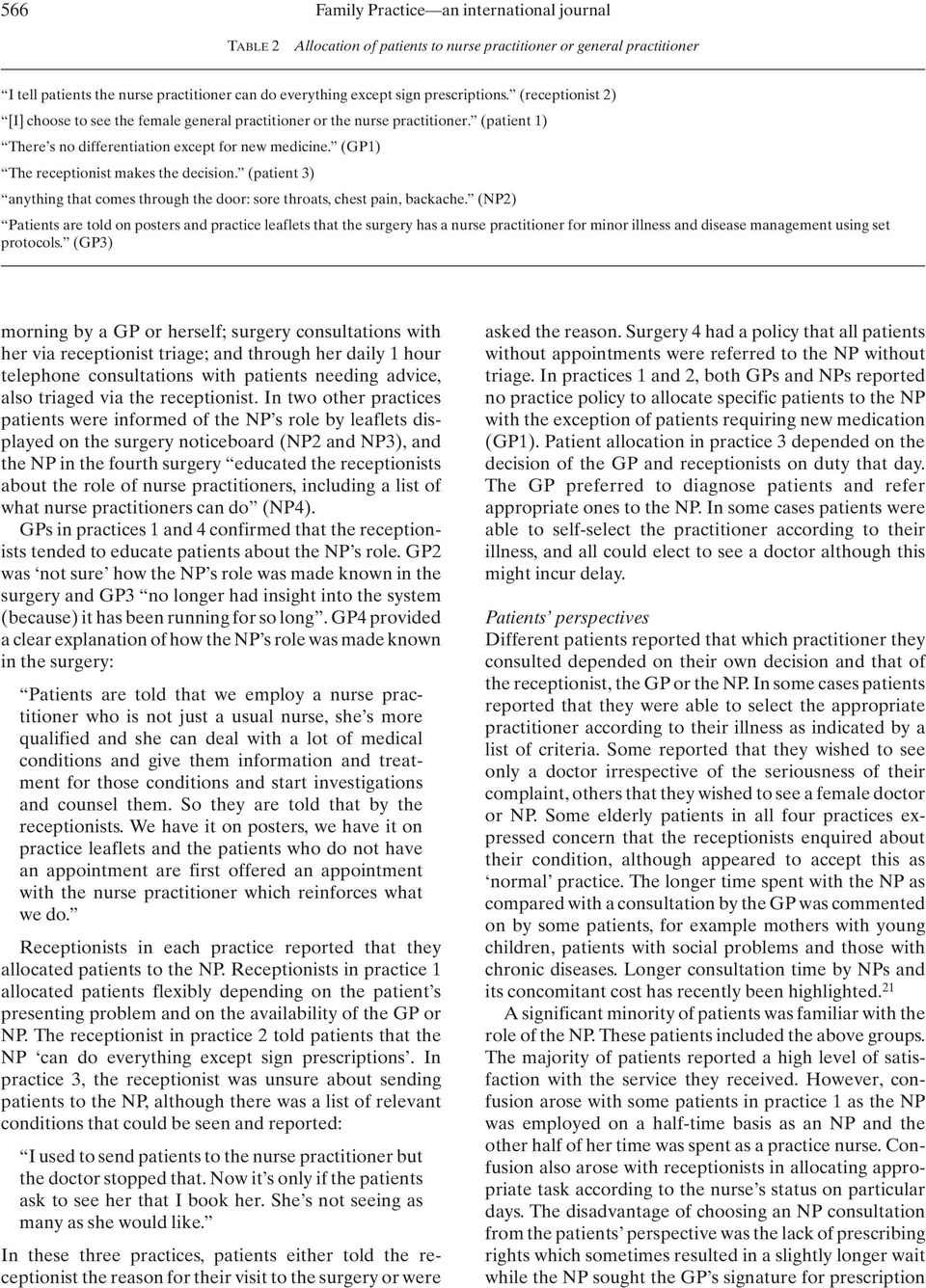
4 Nurse practitioners in primary care 567 TABLE 3 Patients perspectives I prefer to see the nurse practitioner because there is time [for her] to explain things to me and I feel I can ask her questions about other problems. (patient 10) I go to the nurse practitioner with my female problems and the GP for other things. (patient 15) They are just as good as each other and you don t have to wait 2 weeks to see the nurse practitioner. (patient 7) I see whoever the receptionist put me down to see. (patient 20). She s very good with my little boy and he also likes her. That s very important when you re trying to get a reluctant child to go to the doctor. (patient 4) (not the case in practice 4). Table 3 highlights some of the views expressed by patients in the four practices. Prescribing Each practice had a different procedure for NPs prescribing. NP1 had agreed protocols for medication with the GP in which the NP selected the medication and wrote the prescription, which the GP signed without seeing the patient. In contrast, NP2, although also provided with prescription pads by the GP for initiating and changing drug treatment, which the GPs signed without seeing the patient, had no protocols in use. Also, if a GP was not on the premises, as was frequently the case between 11 a.m. and 2 p.m. daily, and a patient required a repeat prescription, the NP wrote the repeat prescription for the patient to take to the community pharmacist for dispensing without a doctor s signature. At a later point during the community pharmacist s daily visit to the surgery, the patient s prescription would be brought back to the surgery for the required signature. The prescribing procedure of NP3 depended upon the GP on duty. She would tell the GP her diagnosis and opinion on the treatment required. The GP might then sign the prescription form without seeing the patient, or have a quick look at the patient (NP3). The NP reported that the senior partner (not interviewed) would often not accept the NP s suggestions, particularly if antibiotics were recommended and would request that the patient made a further appointment with him. NP3 was not given prescription pads and, although she had established her own protocols, the lead partner had not agreed them except for the clinical treatment and management of patients attending asthma and diabetes clinics which were nurse-led. NP4 reported a high degree of freedom to make clinical and management decisions about medication. She wrote her own protocols, which were linked to the practice formulary and approved by the GP. She had a supply of pre-signed prescription pads, and was free to initiate, change and terminate medication. She undertook home visits and was able to make decisions about medications and prescribe there. In summary, all four GPs signed for drug treatment prescribed by the NP in some situations without seeing the patient. The exception was one senior partner (not interviewed). Although protocols were in use in some cases, not all had the approval of the GP and in one practice no protocols were in use. GP workload All the GPs reported a significant reduction in their workload as a result of employing the NP. The effect was in the reduction of routine work described by GPs as routine management of chronic cases (GP3), upper respiratory tract infections especially in winter months (all GPs) and screening procedures (GP1). GP1 said the effect was significant although there had not been an audit and that 80% of my work could be done by the nurse practitioner. GP2 said that in a typical inner city practice it is very difficult to recruit doctors and I find myself left with a practice of 5000 without any help whatsoever and if we didn t have our nurse practitioner we would probably have gone under. GP4 noted that the reduction in routine cases meant that his concentration was sometimes intense because of the complexity of some cases seen. Some routine cases break up the intensity and pressure, but you can t have it both ways (GP4). Some views on the reduction in GP workload are provided in Table 4. Differences in problems seen by GP and NP When asked what the differences were in problems seen by GPs and those seen by NPs, GP2 thought it difficult to say because if a patient wants to see the GP, they should be allowed to do so, whereas NP2 identified the types of patient problems seen as anything that comes through the door I see the whole practice population. This was also implicit in the fact that she sometimes worked as a locum GP. All the GPs were clear about the types of case they would prefer to see; some views are highlighted by quotations in Table 5. Referral Referrals to outside agencies, such as hospital consultants (including gynaecologists and dermatologists) or social services were made by the NPs in practices 2 and 4. One hospital consultant refused to accept patients referred by NPs (NP2), as a result of which the

5 568 Family Practice an international journal TABLE 4 Reduction in general practitioners workload We wouldn t be able to do [daily 1 hour telephone consultations] and wouldn t be willing to, so that must take a load off us. (GP1) If we didn t have our nurse practitioner we would probably have gone under. (GP2) The workload of the female doctor has been halved. (NP3) The general practitioner was able to go from 8 minute to 10 minute appointments and was able to take an extra half day each week to pursue personal development. (NP4) I see less routine cases now. (GPs 1, 2, 3, 4) TABLE 5 Problems/conditions general practitioners preferred to see I would prefer to see diabetes, hypertensives, psychologically related problems. I don t have a particular fondness for female problems. (GP1) anything complicated or anything that is not getting better despite the nurse practitioner s intervention, or anything potentially serious like persistent headache. (GP2) anything that falls outside the strictly defined parameters that nurse practitioners can see or anything she s not happy with. (GP3) cardiovascular cases with multiple pathologies with multiple drugs; asthmatics who are not being controlled for any reason. (GP4) TABLE 6 Legal issues The nurse practitoner might see a patient and I would sign the medical certificate it says that I examined you today... some rationalize... that we have seen that person today as a practice. Whether that s legally sound I m not sure. (GP1) Anything any employee in the surgery does is ultimately our responsibility. (GP2) On many occasions when she [the nurse practitoner] doesn t consult with me... how the hell can I be legally responsible for it? (GP3) Yes I know the arguments. I know and trust my nurse practitioner. (GP4) practice changed to a hospital trust that would accept NP referrals. NP2 felt that she had a high level of autonomy as a result of the trusting relationship she enjoyed with all the GPs and the practice as a whole. In contrast, NP3 had a low level of autonomy because of a difficult relationship with the senior partner and some receptionists. This NP was not allowed to refer to outside agencies. NP4 enjoyed the highest degree of autonomy of work, including referral. Numbers of patients seen per session There was variation in the number of patients seen per session. NP2 and NP4 were employed as full-time NPs, and saw and patients per session, respectively. The other two NPs were part-time, also working as practice nurses, and saw relatively few patients for consultations. NP1 saw up to 20 patients in the open access session and received up to 10 calls in the telephone consultation hour. NP3, who experienced difficulties about patient allocation, saw only 4 10 patients per session (Table 1). Three of the NPs held clinic sessions for patients with asthma and diabetes, and the fourth NP saw these patients as part of the general surgery. All NPs reported using current research-based treatment for patients. NP3 was the only NP to report dissatisfaction with her role and under-utilization of her skills. The other three NPs reported general satisfaction with their role but were aware of an increasing workload initiated both by the GPs and the receptionists. Concern was expressed about the lack of consensus within the healthcare field as to a national definition of the role of the NP. Ambiguity surrounds expectations of the NP s role, leading to constant need for education of patients by the receptionists and NPs. This issue is currently being addressed by the nurses regulatory body. 22 Legal issues relating to NP prescription of medication All the GPs were aware of legal issues concerning employment of NPs. Some examples are given in Table 6. In addition to being part of the GP medical protection, all the NPs had indemnity insurance from the Royal College of Nursing. Discussion There was no clear overall definition for patient allocation to NP consultation. Although each practice had its own procedures, these were not clearly defined either. In three practices (1, 2 and 4), the work was organized largely around the GP s activities or on a similar basis to the GP s work, including open access sessions with NP4 working essentially as a GP substitute.

6 The allocation of patients to the NP depended largely on the receptionist and recall of NP task lists; where NPs were also employed as practice nurses, receptionists experienced some difficulty in differentiating the roles, and the NPs tended to run the two roles together. Mainly NPs saw patients for minor illnesses and chronic disease management. Delegation or substitution of the GP s work to the NP was defined largely by the GP with the NP responding to the opportunity to shift the boundaries. Some patients stated a preference to see either the female doctor or the NP. Other patients preferred to see the GP irrespective of the nature of their complaint. The longer time spent by NPs with patients had advantages from the point of view of the patient and NP, although the implications for cost-effectiveness need further consideration. 21 Even in this small convenience sample a wide variation in practice was evident. There were clear differences in policy about prescribing arrangements and referrals. The need to identify the drugs that would be prescribed were NPs prescribers, and to compare these with the existing nurse formulary, has been recognized and is currently being addressed by the government. Conclusion This small convenience sample has highlighted a number of issues about the roles of NPs, some of which fall outside the remit of this paper. These include the effect of the independent function of the NP on the standard of service to patients within the practice, and directly relate to current government policy on clinical governance to guarantee consistency of quality of service to patients and to make local health services responsive to patients needs. 23 They also involve issues of evidence-based practice, clinical risk management, the use of protocols and patient participation in service delivery. The study highlights the variation in clinical freedom and autonomy of the NP at a practice level and raises issues of the relationship between doctors and NPs and efficient use of primary care funds. Acknowledgements Thanks are due to the GPs, NPs, patients and receptionists who participated in this study. Nurse practitioners in primary care 569 References 1 Stilwell B, Greenfield S, Drury VWM, Hull FM. A nurse practitioner in general practice: working styles and pattern of consultations. J R Coll Gen Pract 1987; 37: Hibble A. Practice nurse workload before and after the introduction of the 1990 contract for general practitioners. Br Med J 1995; 45: Offredy M. Personal narratives of young people working in a caring environment. Vocat Asp Educ 1995; 47: English T. Medicine in the 1990s needs a team approach. Br Med J 1997; 314: Dowling S, Martin R, Skidmore P, Doyal L, Cameron A, Lloyd S. Nurses taking on junior doctors work: a confusion of accountability. Br Med J 1994; 312: Mundinger MO. Advanced-practice medicine good medicine for physicians? N Engl J Med 1994; 330: Mezey MD, McGivern DO (eds). Nurses, Nurse Practitioners: Evolution to Advanced Practice. New York: Springer, Mahnken J, Nesbitt P, Keyzer D. The Rural Nurse Practitioner: a Pilot Project to Develop an Alternative Model of Practice. Warrnambool: Deakin University, New South Wales Health Department. Nurse Practitioner Project: Stage 3. Final Report of the Steering Committee. Sydney: New South Wales Department of Health, New South Wales Health Department. Nurse Practitioner Services in New South Wales. Sydney: New South Wales Department of Health, Offredy M. Advanced nursing practice: the case of nurse practitioners in three Australian states. J Adv Nur 2000; 31: Moss F, McNicol M. Alternative models of organisation are needed. Br Med J 1995; 310: Department of Health. Choice and Opportunity: Delivering the Future. London: The Stationery Office, Department of Health and the Welsh Office. General Practice in the National Health Service. A New Contract. London: HMSO, Fitzmaurice DA, Hobbs FDR, Murray ET. Primary care anticoagulant clinic management using computerized decision support and near patient International Normalized Ratio (INR) testing: routine data from a practice nurse-led clinic. Fam Pract 1998; 15: Ekwo E, Daniels M, Oliver D, Fethke C. The physician assistant in rural primary care practices. Med Care 1979; 8: Rabin DL, Spector KK. Delegation potential of primary care visits by physicians assistants, Medex and Primex. Med Care 1980; 18: Touche Ross. Evaluation of Nurse Practitioner Pilot Projects: Summary Report. London: Touche Ross, Coopers and Lybrand. Nurse Practitioner Evaluation Project: Final Report. London: Coopers and Lybrand, Cohen J. A coefficient of agreement for nominal scales. Ed Psych Meas 1960; 20: Venning P, Durie A, Roland M, Roberts C, Leese B. Randomised controlled trial comparing cost effectiveness of general practitioners and nurse practitioners in primary care. Br Med J 2000; 320: United Kingdom Central Council for Nursing, Midwifery and Health Visiting. Protecting the Public Through Professional Standards. London: UKCC, Department of Health. First Class Service: Quality in the New NHS. London: The Stationery Office, 1998.

Time to Act Urgent Care and A&E: the patient perspective
 Time to Act Urgent Care and A&E: the patient perspective May 2015 Executive Summary The NHS aims to put patients at the centre of everything that it does. Indeed, the NHS Constitution provides rights to
Harness Care Cooperative Ltd Quality primary care services provided through local cooperation Company registration: 06584450
 Harness Care Cooperative Ltd Quality primary care services provided through local cooperation Company registration: 06584450 Job Description Job title: Nurse Practitioner /Lead Nurse ACCOUNTIBILITY The
PRESCRIBING OF NHS MEDICATION RECOMMENDED DURING OR AFTER A PRIVATE EPISODE OF CARE
 East Surrey CCG Guildford & Waverley CCG North West Surrey CCG Surrey Downs CCG Surrey Heath CCG PRESCRIBING OF NHS MEDICATION RECOMMENDED DURING OR AFTER A PRIVATE EPISODE OF CARE Version: 2.2 Name of
Improving Urgent and Emergency care through better use of pharmacists. Introduction. Recommendations. Shaping pharmacy for the future
 Improving Urgent and Emergency care through better use of pharmacists The Royal Pharmaceutical Society (RPS) believes that pharmacists are an underutilised resource in the delivery of better urgent and
Summary of Malago Surgery Patient Satisfaction Survey
 Summary of Malago Surgery Patient Satisfaction Survey Introduction Malago Surgery conducted a Patient Satisfaction Survey during February and March 2013. Questionnaires were made available to all patients
Clinical governance for public health professionals
 Journal of Public Health Medicine Vol. 21, No. 4, pp. 430 434 Printed in Great Britain Clinical governance for public health professionals J. A. G. Paris and K. M. McKeown Summary This paper examines the
echat: Screening & intervening for mental health & lifestyle issues
 echat: Screening & intervening for mental health & lifestyle issues Felicity Goodyear-Smith Professor & Academic Head Dept of General Practice & Primary Health Care Faculty of Medicine & Health Science
Nurse Practitioner Frequently Asked Questions
 HEALTH SERVICES Nurse Practitioner Frequently Asked Questions The Frequently Asked Questions (FAQs) have been designed to increase awareness and understanding of the Nurse Practitioner role within the
Dr s Birch Phipps and Shaw and Griffiths would like to thank all the patients who completed the satisfaction survey during November 2011
 PATIENT SATISFACTION SURVEY 2011 Dr s Birch Phipps and Shaw and Griffiths would like to thank all the patients who completed the satisfaction survey during November 2011 We appreciate your time in commenting
PLAN DO STUDY ACT. Survey Report / Action Plan to be discussed and noted during meeting
 PATIENT SURVEY ACTION PLAN Practice: The Phoenix Practice 2013/14 Patient Survey Objective: 1. Welcome back the Patient Participation Group / New Members 2 Patient Survey Questionnaire 3 Patients' priorities
Sleaford Medical Group Local Patient Participation Report 2012/13
 A description of the profile of the members of the PPG Sleaford Medical Group Local Patient Participation Report 2012/13 There are currently 33 patient members of the Sleaford Medical Group (SMG) Patient
LISTER MEDICAL CENTRE
 LISTER MEDICAL CENTRE TITLE OF POST: NURSE PRACTITIONER : GENERAL PRACTICE SALARY : TBC HOURS OF EMPLOYMENT : TBC APPOINTMENT : Permanent contract RESPONSIBLE TO: PARTNERS ACCOUNTABLE TO: PARTNERS JOB
Bristol, North Somerset, Somerset and South Gloucestershire Area Team 2014/15 Patient Participation Enhanced Service
 Bristol, North Somerset, Somerset and South Gloucestershire Area Team 2014/15 Patient Participation Enhanced Service Practice Name: St George Health Centre Practice Code: L81062 Signed on behalf of practice:
Defining the boundaries between NHS and Private Healthcare
 West Midlands Strategic Commissioning Group Commissioning Policy (WM/13) Defining the boundaries between NHS and Private Healthcare Version 1 April 2010 1. Definitions Private patients are patients who
Quality Report. Boultham Park Road Lincoln LN6 7SS Tel: 01522 874444 Website: www.boulthamparkmedicalpractice.co.uk
 Boultham Park Medical Centre Quality Report Boultham Park Road Lincoln LN6 7SS Tel: 01522 874444 Website: www.boulthamparkmedicalpractice.co.uk Date of inspection visit: 07 May 2014 Date of publication:
Questions often asked by patients and answers from the Randolph Surgery
 Questions often asked by patients and answers from the Randolph Surgery 1. Why does the Randolph Surgery insist that everyone over 40 (or anyone who requires prescribed medication under 40) has a comprehensive
Consultation: Two proposals for registered nurse prescribing
 Consultation: Two proposals for registered nurse prescribing Submission Form Please read and refer to the consultation document Two proposals for registered nurse prescribing available on the Nursing Council
A case study of the nurse practitioner consultation in primary care: communication processes and social interactions
 A case study of the nurse practitioner consultation in primary care: communication processes and social interactions Julian Barratt Senior Lecturer in Adult Nursing Background to the study Over the past
Service Specification Template Department of Health, updated June 2015
 Service Specification Template Department of Health, updated June 2015 Service Specification No. : 2 Service: Commissioner Lead: Provider Lead: Period: Anti-coagulation monitoring Date of Review: 31 st
Commissioning Policy (EMSCGP005V2) Defining the boundaries between NHS and Private Healthcare
 Commissioning Policy (EMSCGP005V2) Defining the boundaries between NHS and Private Healthcare Although Primary Care Trusts (PCTs) and East Midlands Specialised Commissioning Group (EMSCG) were abolished
Big Chat 4. Strategy into action. NHS Southport and Formby CCG
 Big Chat 4 Strategy into action NHS Southport and Formby CCG Royal Clifton Hotel, Southport, 19 November 2014 Contents What is the Big Chat? 3 About Big Chat 4 4 How the event worked 4 Presentations 5
We are the regulator: Our job is to check whether hospitals, care homes and care services are meeting essential standards.
 Inspection Report We are the regulator: Our job is to check whether hospitals, care homes and care services are meeting essential standards. Royal Free Hospital Urgent Care Centre Royal Free Hospital,
A step by step introduction to setting up and running a successful nurse-led clinic in practice
 A step by step introduction to setting up and running a successful nurse-led clinic in practice Alison Pottle Nurse Consultant in Cardiology Royal Brompton and Harefield NHS Foundation Trust Harefield
Australian Safety and Quality Framework for Health Care
 Activities for the HEALTHCARE TEAM Australian Safety and Quality Framework for Health Care Putting the Framework into action: Getting started Contents Principle: Consumer centred Areas for action: 1.2
PATIENT INFORMATION SHEET
 PATIENT INFORMATION SHEET Surgical and large bore pleural procedures in Malignant pleural Mesothelioma And Radiotherapy Trial (SMART trial) Stoke Mandeville Hospital Mandeville Road Aylesbury Buckinghamshire
Patient satisfaction with out-of-hours services; how do GP co-operatives compare with deputizing and practice-based arrangements?
 Journal of Public Health Medicine Vol. 22, No. 2, pp. 149 154 Printed in Great Britain Patient satisfaction with out-of-hours services; how do GP co-operatives compare with deputizing and practice-based
National Assembly for Wales: Health and Social Care Committee
 2 Ashtree Court, Woodsy Close Cardiff Gate Business Park Cardiff CF23 8RW Tel: 029 2073 0310 [email protected] www.rpharms.com 18 th October 2011 Submission to: Call for Evidence: Response from: National
The Menzies-Nous Australian Health Survey 2012
 The Menzies-Nous Australian Health Survey 2012 Report 23 October 2012 Bold ideas Engaging people Influential, enduring solutions This page is intentionally blank. Nous Group n o usgro u p. c o m. a u i
Job Description Receptionist Administrator
 New Court Surgery Malvern Job Description Receptionist Administrator Job title: Reports to: Accountable to: Receptionist and Administrator Deputy Practice Manager (1 st line), Practice Manager General
A guide to prostate cancer clinical trials
 1 A guide to prostate cancer clinical trials In this fact sheet: What is a clinical trial? Why are trials done? What are trials looking into at the moment? How are clinical trials done? Should I take part
10. Nurses and doctors
 10. Nurses and doctors 10.1 Community nurse (includes district nursing sister, district nurse) 10.2 Nurse (mental health) 10.3 Health visitor 10.4 Nurse specialist (community) 10.5 Clinical support worker
NORTON MEDICAL CENTRE PATIENT SURVEY OF NEW APPOINTMENT SYSTEM
 NORTON MEDICAL CENTRE PATIENT SURVEY OF NEW APPOINTMENT SYSTEM SUMMARY Responses were from both male and female patients from across the age spectrum. NB: Not all patients responded to the demographic
Evaluation of a Primary Care Dermatology Service: final report
 Evaluation of a Primary Care Dermatology Service: final report Report for the National Co-ordinating Centre for NHS Service Delivery and Organisation R&D (NCCSDO) December 2005 prepared by Chris Salisbury*
1-In the past 12 months, how many times have you seen a doctor at your Surgery?
 DR RABIE & PARTNERS KIDSGROVE MEDICAL CENTRE SURVEY AND VIRTUAL PPG REPORT FOR 2014 to 2015 At the beginning of March 2015, we conducted our yearly patient survey, both in house and via the virtual PPG
Cambridgeshire Community Services NHS Trust
 Cambridgeshire Community Services NHS Trust RYV Minor Injuries Unit services Quality Report Doddington Hospital Princess of Wales Hospital North Cambridgeshire Hospital Tel: 01480 308222 Website: www.cambscommunityservices.nhs.uk
Helen Peake-Godin MN RN University of Southern Maine College of Science, Technology, and Health School of Nursing
 Helen Peake-Godin MN RN University of Southern Maine College of Science, Technology, and Health School of Nursing History of Sagamore Village Health Center Brief Overview The Sagamore Health Center, developed
VICTORIA STREET MEDICAL GROUP 7 VICTORIA STREET ABERDEEN AB10 1QW. Tel: 01224 641930 Fax: 01224 656915
 VICTORIA STREET MEDICAL GROUP 7 VICTORIA STREET ABERDEEN AB10 1QW Tel: 01224 641930 Fax: 01224 656915 The Practice We are Victoria Street Medical Group, 7 Victoria Street, Aberdeen, Tel (01224) 641930,
Improving Emergency Care in England
 Improving Emergency Care in England REPORT BY THE COMPTROLLER AND AUDITOR GENERAL HC 1075 Session 2003-2004: 13 October 2004 LONDON: The Stationery Office 11.25 Ordered by the House of Commons to be printed
GLOUCESTERSHIRE HOSPITALS NHS FOUNDATION TRUST
 GLOUCESTERSHIRE HOSPITALS NHS FOUNDATION TRUST MEDICINES MANAGEMENT STRATEGY 2006/07 ANNUAL REPORT 1. Aim An annual report on the Trust s Medicines Management Strategy is part of the requirements for Standards
Drs Beales, Crowley, Strachan & Navamani North Road Surgery, 77 North Road, Kew, Richmond, TW9 4HQ www.northroadsurgery.nhs.uk
 24th March 2013 Drs Beales, Crowley, Strachan & Navamani North Road Surgery, 77 North Road, Kew, Richmond, TW9 4HQ www.northroadsurgery.nhs.uk Introduction North Road Surgery This report summarises the
Information for you Abortion care
 Information for you Abortion care Published in February 2012 This information is for you if you are considering having an abortion. It tells you: how you can access abortion services the care you can expect
Ministry of Social Development: Changes to the case management of sickness and invalids beneficiaries
 Ministry of Social Development: Changes to the case management of sickness and invalids beneficiaries This is the report of a performance audit we carried out under section 16 of the Public Audit Act 2001
Patient Information Leaflet: Part 1 select-d
 Patient Information Leaflet: Part 1 select-d Anticoagulation Therapy in SELECTeD Cancer Patients at Risk of Recurrence of Venous Thromboembolism Introduction This
Kingsway Medical Centre Kingsway, Billingham, Cleveland, TS23 2LS
 Kingsway Medical Centre Kingsway, Billingham, Cleveland, TS23 2LS Appointments & Emergencies Tel : 01642 553738 For Results & General Enquiries : Tel : 01642 554967 Please visit our surgery website for
Stour Access System: a new way to manage GP appointments Better for GPs, better for patients, better all-round
 12:56 Page 1 Stour Access System: a new way to manage GP appointments Better for GPs, better for patients, better all-round Take control of your time, improve the flow of patients, improve access and whats
BriefingPaper. Towards faster treatment: reducing attendance and waits at emergency departments ACCESS TO HEALTH CARE OCTOBER 2005
 ACCESS TO HEALTH CARE OCTOBER 2005 BriefingPaper Towards faster treatment: reducing attendance and waits at emergency departments Key messages based on a literature review which investigated the organisational
THIS HEALTH CENTRE IS EQUIPPED FOR DISABLED PERSONS ACCESS PRACTICE TEAM
 THIS HEALTH CENTRE IS EQUIPPED FOR DISABLED PERSONS ACCESS PRACTICE TEAM General Practitioner General Practitioner General Practitioner Practice Nurse: Practice Manager: Secretary: Reception Staff: Health
The Practice Nurse is accountable to the Managing Medical Principal for clinical issues and Practice Manager for non-clinical issues.
 Job Description Nurse Overview The Practice Nurse is a multi-skilled practitioner who, as part of a team, contributes to the provision of high-quality health care in the general practice setting. Her/his
Branksomewood Healthcare Centre Branksomewood Road Fleet GU51 4JX. Patient Reference Group Practice Report 2012-2013
 Branksomewood Healthcare Centre Branksomewood Road Fleet GU51 4JX Patient Reference Group Practice Report 2012-2013 The Patient Reference Group (PRG) at Branksomewood Healthcare Centre provides an opportunity
A Guide to Patient Services. Cedars-Sinai Health Associates
 A Guide to Patient Services Cedars-Sinai Health Associates Welcome Welcome to Cedars-Sinai Health Associates. We appreciate the trust you have placed in us by joining our dedicated network of independent-practice
We are the regulator: Our job is to check whether hospitals, care homes and care services are meeting essential standards.
 Inspection Report We are the regulator: Our job is to check whether hospitals, care homes and care services are meeting essential standards. Eastham Walk In Centre Eastham Clinic, Eastham Rake, Eastham,
JOB DESCRIPTION NURSE PRACTITIONER
 JOB DESCRIPTION NURSE PRACTITIONER TITLE OF POST: NURSE PRACTITIONER : GENERAL PRACTICE /OUT OF HOURS SALARY : To be negotiated HOURS OF EMPLOYMENT: To be agreed APPOINTMENT: Permanent contract RESPONSIBLE
Position Statement on Physician Assistants
 Position Statement on Physician Assistants Team-based models of medical care that are characterised by responsiveness to local needs, mutual reliance and flexibility have always been a part of rural and
Notting Hill Medical Centre
 Removal of Patients The surgery has the right to remove a patient from our list for any of the following reasons: We consider that the relationship between you and the Practice is in danger of breaking
Criteria Led Discharge
 Criteria Led Discharge Everything you need to know, but may never have asked about criteria led discharge from hospital Liz Lees Consultant Nurse & Clinical Academic Doctoral Research Fellow The University
The practice of medicine comprises prevention, diagnosis and treatment of disease.
 English for Medical Students aktualizované texty o systému zdravotnictví ve Velké Británii MUDr Sylva Dolenská Lesson 16 Hospital Care The practice of medicine comprises prevention, diagnosis and treatment
Nurse Led Open Clinic for Minor Ailments. Kathryn Corner Practice Manager and Oonagh Potts Nurse Practitioner. The Crescent Surgery
 Nurse Led Open Clinic for Minor Ailments Kathryn Corner Practice Manager and Oonagh Potts Nurse Practitioner The Crescent Surgery Background In response to our Patient Satisfaction Survey in 2013-14 the
The practice looked at the following factors that make up the groups which are a representation of the wider patient population:
 HILLSIDE PRACTICE Local Patient Participation Report, April 2011 to March 2012 Background information Hillside Patient Forum is a practice patient group which has been in existence since soon after the
Consultation: Two proposals for registered nurse prescribing
 Consultation: Two proposals for registered nurse prescribing Submission Form Please read and refer to the consultation document Two proposals for registered nurse prescribing available on the Nursing Council
DR RABIE & PARTNERS KIDSGROVE MEDICAL CENTRE. SURVEY AND VIRTUAL PPG REPORT FOR 2013 to 2014
 DR RABIE & PARTNERS KIDSGROVE MEDICAL CENTRE SURVEY AND VIRTUAL PPG REPORT FOR 2013 to 2014 At the beginning of March 2014, we conducted our yearly patient survey, both in house and via the virtual PPG
Report on. Tudor House Surgery & Rectory Road Surgery now known as
 Report on Tudor House Surgery & Rectory Road Surgery now known as July 2014 1 Introduction Healthwatch Wokingham Borough is one of 152 local Healthwatch organisations that were established throughout England
IMPROVING DENTAL CARE AND ORAL HEALTH A CALL TO ACTION. February 2014 Gateway reference: 01173
 1 IMPROVING DENTAL CARE AND ORAL HEALTH A CALL TO ACTION February 2014 Gateway reference: 01173 2 Background NHS dental services are provided in primary care and community settings, and in hospitals for
BMJcareers. Informing Choices
 : The Need for Career Advice in Medical Training How should the support provided to doctors and medical students to help them make career decisions during their training be improved? Experience elsewhere
Prime Minister s Challenge Fund (PMCF): Improving Access to General Practice. Innovation Showcase Series Using Technology to Improve Access
 Prime Minister s Challenge Fund (PMCF): Improving Access to General Practice Innovation Showcase Series Using Technology to Improve Access February 2015: Showcase Two About PMCF In October 2013, the Prime
Perceptions of Adding Nurse Practitioners to Primary Care Teams
 Quality in Primary Care (2015) 23 (2): 122-126 2015 Insight Medical Publishing Group Short Communication Interprofessional Research Article Collaboration: Co-workers' Perceptions of Adding Nurse Practitioners
Implementing Home Blood Pressure Monitoring In Your Practice A Practical Guide
 Implementing Home Blood Pressure Monitoring In Your Practice A Practical Guide Home blood pressure monitoring offers a useful tool for the management of blood pressure, for both patients and healthcare
Department of Health/ Royal College of General Practitioners. Implementing a scheme for General Practitioners with Special Interests
 Department of Health/ Royal College of General Practitioners Implementing a scheme for General Practitioners with Special Interests April 2002 Foreword Improved access and consistently high quality services
A - DASH 15 Forest Lane Shenley, Nr Radlett Hertfordshire WD7 9HQ 01923 427 288 [email protected]
 A-DASH is commissioned by the Joint Commissioning Group for Young People s Substance Misuse, a sub group of Hertfordshire Children s Trust Partnership. The service is based within Hertfordshire Partnership
Inquiry into teenage pregnancy. The Royal College of Nursing
 Inquiry into teenage pregnancy The Royal College of Nursing The Royal College of Nursing welcomes the opportunity to contribute to the Health and Sport Committee s inquiry into teenage pregnancy in Scotland.
Interface between NHS and private treatment Guidance from the Ethics Department February 2004
 Interface between NHS and private treatment Guidance from the Ethics Department February 2004 Summary General principles Issues for consultants Issues for general practitioners Advertising Summary Although
THE TUDOR SURGERY PATIENT PARTICIPATION REPORT & SURVEY 2013/2014. The Tudor Surgery PRG Report 2013/14-1 -
 THE TUDOR SURGERY PATIENT PARTICIPATION REPORT & SURVEY 2013/2014 The Tudor Surgery PRG Report 2013/14-1 - CONTENTS Background 3 Areas of priority for 2013/14 4 2013/14 - Patient survey process 4 2013/14
Observational studies on homeopathy
 Observational studies on homeopathy To healthcare providers, patients and clinicians, what matters most is not necessarily how well a treatment performs under the artificially controlled conditions on
Whistleblowing case studies
 Whistleblowing case studies With friends like these... Food for thought Local hero Jumping the gun Safety first Contents With friends like these... With friends like these... 1 Food for thought 2 Local
Defining the Boundaries Between NHS and Private Healthcare
 Defining the Boundaries Between NHS and Private Healthcare Policy: COM 30 Document Version Control Version 0.1 Draft Pilot version 08/07/09 Version 1.0 Ratified 07/09/09 Version Version Version Version
HSF Assist Providing support and advice when it is most needed
 HSF Assist Providing support and advice when it is most needed Welcome to your new HSF Assist service - part of your health cash plan cover. HSF Assist provides you with unlimited access to a variety of
LATHOM HOUSE SURGERY. Records Online Access. Online Electronic Medical Record Viewing Patient Information Leaflet
 LATHOM HOUSE SURGERY Records Online Access Online Electronic Medical Record Viewing Patient Information Leaflet 1 Introduction : This practice is piloting a project that allows you to view your medical
EVALUATION OF THE IMPLEMENTATION OF THE PROSTATE CANCER SPECIALIST NURSE ROLE
 EVALUATION OF THE IMPLEMENTATION OF THE PROSTATE CANCER SPECIALIST NURSE ROLE Julie Sykes, 1 Patsy Yates, 2 Danette Langbecker 2 1. Prostate Cancer Foundation of Australia 2. Queensland University of Technology,
Submission by the Irish Pharmacy Union to the Department of Health on the Scope for Private Health Insurance to incorporate Additional Primary Care
 Submission by the Irish Pharmacy Union to the Department of Health on the Scope for Private Health Insurance to incorporate Additional Primary Care Services January 2015 1 IPU Submission to the Department
Understanding the role
 Section 1 Understanding the role SECTION 1 Understanding the role 1. Overview To address structural pressures on the health system and to better meet changing health care needs of the population, the National