
Report to Shareholders
|
|
|
- Ginger Hunt
- 9 years ago
- Views:
Transcription
1 Report to Shareholders Royal Bank of Canada first quarter results All amounts are in Canadian dollars and are based on our unaudited Interim Condensed Consolidated Financial Statements for the quarter ended, and related notes prepared in accordance with International Financial Reporting Standards (IFRS), unless otherwise noted. TORONTO, March 1, Royal Bank of Canada (RY on TSX and NYSE) today reported net income of $1,855 million for the first quarter ended,. Net income from continuing operations was $1,876 million, up $267 million or 17% from last quarter. These strong results were driven by record earnings in Canadian Banking reflecting solid business growth, higher earnings in Capital Markets and continued strength in Insurance and Wealth Management. RBC had an outstanding start to the year, earning over $1.8 billion in the first quarter of. These results demonstrate the strength of our disciplined growth strategy and diversified business model which drive the earnings power of this organization. This morning, we announced a $.03 or 6% increase in our quarterly dividend, said Gord Nixon, RBC President and CEO. Looking ahead through, we believe that we are very well positioned to continue extending our lead in Canada and building client relationships in select U.S. and international markets, while maintaining our strong capital position and strict risk and cost discipline. Continuing operations: Q1 compared to Q4 Net income of $1,876 million (up 17% from $1,609 million) Diluted earnings per share (EPS) of $1.23 (up $.18 from $1.05) Return on common equity (ROE) of 20.0% (up from 17.5%) Tier 1 capital ratio of 12.2% Announced a $.03, or 6%, increase to our quarterly dividend Continuing operations: Q1 compared to Q1 Net income of $1,876 million (down 6% from $1,996 million) Diluted EPS of $1.23 (down $.08 from $1.31) ROE of 20.0% (down from 24.4%) Table of contents 1 First quarter highlights 2 Management s Discussion and Analysis 2 Caution regarding forward-looking statements 2 Overview 2 About Royal Bank of Canada 3 Selected financial and other highlights 4 Economic, market and regulatory review and outlook 4 Financial performance 8 Business segment results 8 How we measure and report our business segments 9 Non-GAAP measures 9 Canadian Banking 10 Wealth Management 11 Insurance 12 International Banking 13 Capital Markets 14 Corporate Support 15 Quarterly results and trend analysis 16 Results by geographic segment 17 Financial condition 17 Condensed balance sheets 18 Off-balance sheet arrangements 20 Risk management 20 Credit risk 23 Credit quality performance 25 Market risk 27 Liquidity and funding management 28 Capital management 30 Additional financial information 30 Exposures to selected financial instruments 32 Accounting and control matters 33 Related party transactions 36 Interim Condensed Consolidated Financial Statements (unaudited) 39 Notes to the Interim Condensed Consolidated Financial Statements (unaudited) 96 Shareholder information
2 2 Royal Bank of Canada First Quarter Management s Discussion and Analysis Management s Discussion and Analysis (MD&A) is provided to enable a reader to assess our results of operations and financial condition for the three-month period ended or as at,, compared to the three-month periods ended, and October 31,. This MD&A should be read in conjunction with our unaudited Interim Condensed Consolidated Financial Statements for the quarter ended, (unaudited Interim Condensed Consolidated Financial Statements) and related notes and our Annual Report to Shareholders ( Annual Report). This MD&A is dated February 29,. All amounts are in Canadian dollars and are based on financial statements prepared in accordance with International Financial Reporting Standards (IFRS), unless otherwise noted. Additional information about us, including our Annual Information Form, is available free of charge on our website at rbc.com/ investorrelations, on the Canadian Securities Administrators website at sedar.com and on the EDGAR section of the United States Securities and Exchange Commission s (SEC) website at sec.gov. Caution regarding forward-looking statements From time to time, we make written or oral forward-looking statements within the meaning of certain securities laws, including the safe harbour provisions of the United States Private Securities Litigation Reform Act of 1995 and any applicable Canadian securities legislation. We may make forward-looking statements in this Q1 Report to Shareholders, in other filings with Canadian regulators or the SEC, in reports to shareholders and in other communications. Forward-looking statements in this document include, but are not limited to, statements relating to our financial performance objectives, our vision and strategic goals, the Economic, market and regulatory review and outlook for Canadian, U.S., European and global economies, the outlook and priorities for each of our business segments, and the risk environment including our liquidity and funding management. The forward-looking information contained in this document is presented for the purpose of assisting the holders of our securities and financial analysts in understanding our financial position and results of operations as at and for the periods ended on the dates presented and our vision and strategic goals and financial performance objectives, and may not be appropriate for other purposes. Forward-looking statements are typically identified by words such as believe, expect, foresee, forecast, anticipate, intend, estimate, goal, plan and project and similar expressions of future or conditional verbs such as will, may, should, could or would. By their very nature, forward-looking statements require us to make assumptions and are subject to inherent risks and uncertainties, which give rise to the possibility that our predictions, forecasts, projections, expectations or conclusions will not prove to be accurate, that our assumptions may not be correct and that our financial performance objectives, vision and strategic goals will not be achieved. We caution readers not to place undue reliance on these statements as a number of risk factors could cause our actual results to differ materially from the expectations expressed in such forward-looking statements. These factors many of which are beyond our control and the effects of which can be difficult to predict include: credit, market, operational, and liquidity and funding risks, and other risks discussed in the Risk management section of our Annual Report and in our Q1 Report to Shareholders; general business, economic and financial market conditions in Canada, the United States and certain other countries in which we conduct business, including the effects of the European sovereign debt crisis and the lowering of the U.S. long-term sovereign credit rating by Standard & Poor s; changes in accounting standards, policies and estimates, including changes in our estimates of provisions, allowances and valuations; the effects of changes in government fiscal, monetary and other policies; changes to and new interpretations of risk-based capital and liquidity guidelines; the impact of changes in laws and regulations, including relating to the payments system in Canada, consumer protection measures and the Dodd-Frank Wall Street Reform and Consumer Protection Act and the regulations issued and to be issued thereunder; the effects of competition in the markets in which we operate; our ability to attract and retain employees; judicial or regulatory judgments and legal proceedings; the accuracy and completeness of information concerning our clients and counterparties; our ability to successfully execute our strategies and to complete and integrate strategic acquisitions and joint ventures successfully; development and integration of our distribution networks; and the impact of environmental issues. We caution that the foregoing list of risk factors is not exhaustive and other factors could also adversely affect our results. When relying on our forward-looking statements to make decisions with respect to us, investors and others should carefully consider the foregoing factors and other uncertainties and potential events. Except as required by law, we do not undertake to update any forwardlooking statement, whether written or oral, that may be made from time to time by us or on our behalf. Additional information about these and other factors can be found in the Risk management and Overview of other risks sections of our Annual Report and in the Risk management section of our Q1 Report to Shareholders. Information contained in or otherwise accessible through the websites mentioned does not form part of this report. All references in this report to websites are inactive textual references and are for your information only. Overview About Royal Bank of Canada Royal Bank of Canada (RY on TSX and NYSE) and its subsidiaries operate under the master brand name RBC. We are Canada s largest bank as measured by assets and market capitalization, and among the largest banks in the world, based on market capitalization. We are one of North America s leading diversified financial services companies, and provide personal and commercial banking, wealth management services, insurance, corporate and investment banking and transaction processing services on a global basis. We employ approximately 74,000 full- and part-time employees who serve close to 16 million personal, business, public sector and institutional clients through offices in Canada, the U.S. and 51 other countries. For more information, please visit rbc.com.
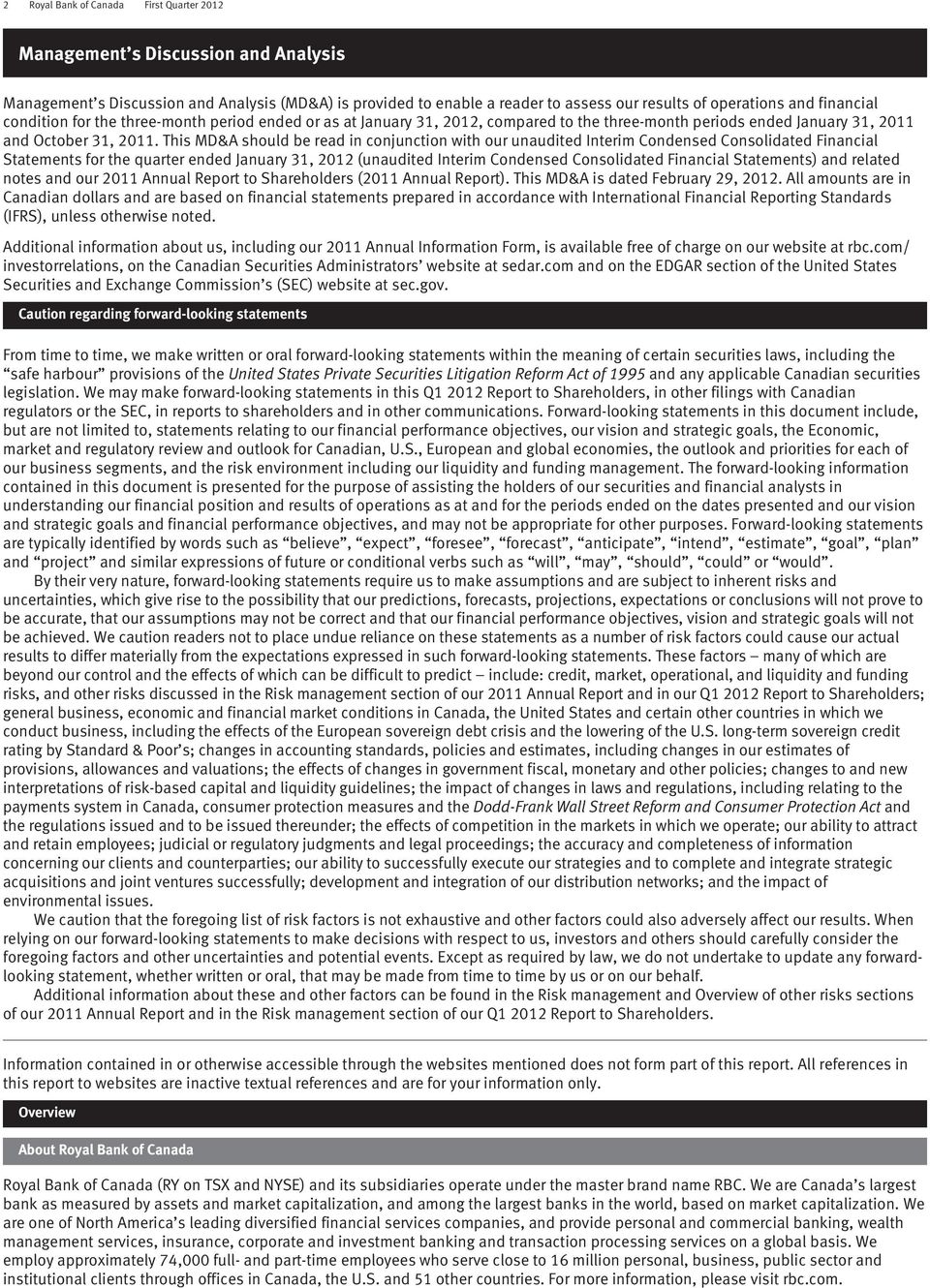
3 Royal Bank of Canada First Quarter 3 Selected financial and other highlights As at or for the three months ended Change, vs. (C$ millions, except per share, number of and percentage amounts) October 31 October 31 Continuing operations Total revenue $ 7,574 $ 6,692 $ 7,218 $ 882 $ 356 Provision for credit losses (PCL) (9) 3 Insurance policyholder benefits, claims and acquisition expense (PBCAE) 1, Non-interest expense 3,671 3,530 3, Net income before income taxes 2,425 2,019 2, (293) Net income from continuing operations 1,876 1,609 1, (120) Net loss from discontinued operations (21) (38) (48) Net income $ 1,855 $ 1,571 $ 1,948 $ 284 $ (93) Segments net income from continuing operations Canadian Banking $ 994 $ 948 $ 933 $ 46 $ 61 Wealth Management (25) Insurance (10) 54 International Banking (44) Capital Markets (189) Corporate Support (86) 23 Net income from continuing operations $ 1,876 $ 1,609 $ 1,996 $ 267 $ (120) Selected information Earnings per share (EPS) basic $ 1.23 $ 1.03 $ 1.30 $ 0.20 $ (0.07) diluted $ 1.21 $ 1.02 $ 1.27 $ 0.19 $ (0.06) Return on common equity (ROE) (1), (2) 19.7% 17.1% 23.7% 260bps (400)bps Return on risk capital (RORC) (1), (2) 27.5% 24.2% 37.5% 330bps (1,000)bps Selected information from continuing operations Earnings per share (EPS) basic $ 1.24 $ 1.06 $ 1.34 $ 0.18 $ (0.10) diluted $ 1.23 $ 1.05 $ 1.31 $ 0.18 $ (0.08) Return on common equity (ROE) (1), (2) 20.0% 17.5% 24.4% 250bps (440)bps Return on risk capital (RORC) (1), (2) 29.3% 26.3% 43.1% 300bps (1,380)bps PCL on impaired loans as a % of average net loans and acceptances.29%.31%.31% (2)bps (2)bps Gross impaired loans (GIL) as a % of loans and acceptances.62%.64%.69% (2)bps (7)bps Capital ratios and multiples (3) Tier 1 capital ratio 12.2% 13.3% 13.2% (110)bps (100)bps Total capital ratio 14.5% 15.3% 15.3% (80)bps (80)bps Assets-to-capital multiple 16.6X 16.1X 16.5X n.m. n.m. Tier 1 common ratio (2) 9.6% 10.6% 9.9% (100)bps (30)bps Selected balance sheet and other information Total assets $ 815,016 $ 793,833 $ 761,972 $ 21,183 $ 53,044 Securities 165, , ,705 (1,836) (37,519) Loans (net of allowance for loan losses) 363, , ,633 12,158 20,014 Derivative related assets 103,341 99,650 73,461 3,691 29,880 Deposits 502, , ,194 12,355 16,852 Average common equity (1) 35,600 34,400 31,000 1,200 4,600 Average risk capital (1) 25,500 24,300 19,600 1,200 5,900 Risk-weighted assets (RWA) 285, , ,009 17,728 29,499 Assets under management (AUM) 316, , ,100 7,600 8,200 Assets under administration (AUA) RBC 709, , ,200 10,100 (1,300) RBC Dexia IS (4) 2,709,800 2,744,400 2,881,200 (34,600) (171,400) Common share information Shares outstanding (000s) average basic 1,439,252 1,437,023 1,424,094 2,229 15,158 average diluted 1,467,527 1,465,927 1,473,955 1,600 (6,428) end of period 1,440,857 1,438,376 1,425,901 2,481 14,956 Dividends declared per share $.54 $.54 $.50 $ $ 0.04 Dividend yield (5) 4.4% 4.5% 3.7% (10)bps 70bps Common share price (RY on TSX) close, end of period $ $ $ $ 3.75 $ (1.31) Market capitalization (TSX) 75,458 69,934 76,542 5,524 (1,084) Business information from continuing operations (number of) Employees (full-time equivalent) (FTE) 68,337 68,480 68,371 (143) (34) Bank branches 1,345 1,338 1, Automated teller machines (ATMs) 4,704 4,626 4, Period average US$ equivalent of C$1.00 (6) $.987 $.992 $.992 $ (.005) $ (.005) Period-end US$ equivalent of C$1.00 $.997 $ $.999 $ (.006) $ (.002) (1) Average amounts are calculated using methods intended to approximate the average of the daily balances for the period. This includes ROE, RORC, Average common equity, and Average risk capital. For further details, refer to the How we measure and report our business segments section. (2) These measures may not have a standardized meaning under GAAP and may not be comparable to similar measures disclosed by other financial institutions. For further details, refer to the How we measure and report our business segments section and Key performance and non-gaap measures section of our Annual Report. (3) Comparative amounts were determined under Canadian GAAP. (4) Represents the total AUA of the joint venture, of which we have a 50% ownership interest, reported on a one-month lag. (5) Defined as dividends per common share divided by the average of the high and low share price in the relevant period. (6) Average amounts are calculated using month-end spot rates for the period.

4 4 Royal Bank of Canada First Quarter Economic, market and regulatory review and outlook data as at February 29, Canada The Canadian economy slowed in the fourth calendar quarter of, to an estimated growth rate of 1.5%, driven by moderating business spending and exports, reflecting global economic uncertainty. The unemployment rate increased to 7.6% in January as labour markets slowed after prior periods of higher than expected employment growth. We expect improved economic growth in of 2.3%, slightly lower than our previously forecasted estimate of 2.5%. Improved growth is expected to be driven by stronger U.S. activity and higher business investment as the global economy stabilizes. Given high consumer debt ratios, we expect home equity product volume growth to moderate partly offset by higher wholesale loan growth reflecting increased business spending. Due to continued global economic uncertainty, we now expect future interest rate increases to be delayed until early 2013, which will put further pressure on net interest margins. United States The U.S. economy grew in the fourth calendar quarter of at a rate of 2.8%, reflecting inventory rebuilding and slightly higher consumer spending. Continued growth is expected in at a rate of 2.4%, although at a lower rate than our previously forecasted estimate of 2.5%. Moderate growth is expected to be mainly driven by higher business investment reflecting the low interest rate environment. Concerns relating to the negative economic impact from market uncertainty and sovereign debt issues remain heightened. As a result, the Federal Reserve announced a new commitment to extend interest rates at historically low levels until the latter half of Europe The Eurozone economy contracted in the fourth calendar quarter of, declining at an estimated rate of -.3% as sovereign debt concerns continued to weaken consumer and business spending. Overall for, we expect contraction to continue in at a rate of -.1%, weaker than our previously forecasted growth estimate of 0.9%. Contraction is expected in the first half of calendar with moderate economic growth returning in the second half driven by increased business activity. Concerns remain heightened relating to the economic impact of government fiscal austerity plans. Interest rates decreased further to 1.0% in early and are expected to remain low for the remainder of in order to provide additional economic stimulus. Financial markets Global capital markets remained fragile in the first fiscal quarter as client uncertainty over the global economy remained heightened. Market conditions improved slightly, mainly in fixed income, reflecting tightening credit spreads, lower market volatility and improved client volumes. Equity markets improved moderately during the latter part of the quarter mainly reflecting improved corporate earnings. Funding costs for financial institutions remained under pressure although coordinated efforts by global central banks to provide additional liquidity eased global funding concerns and improved market conditions. Loan growth, mainly in wholesale, is expected to increase driven by the low interest rate environment while origination activity is expected to moderate reflecting lower issuance volumes, particularly in debt. Regulatory environment We continue to respond to global regulatory developments such as capital and liquidity requirements under the Basel Committee on Banking Supervision global standards (Basel III), Over-the-Counter Derivatives reform, new consumer protection measures and specific financial reforms such as the Dodd-Frank Wall Street Reform and Consumer Protection Act. We continue to monitor these and other developments and are working to ensure business impacts, if any, are minimized. For further details on risk factors resulting from global regulatory developments which may affect our business and financial results, refer to the Overview of other risks section of our Annual Report. For further details on our framework and activities to manage risks, refer to the Risk management and Capital management sections of our Annual Report. Financial performance Adoption of IFRS Our unaudited Interim Condensed Consolidated Financial Statements have been prepared in accordance with International Financial Reporting Standards (IFRS) as issued by the International Accounting Standards Board (IASB) and are presented in compliance with International Accounting Standard (IAS) 34, Interim Financial Reporting. The unaudited Interim Condensed Consolidated Financial Statements for the period ended or as at, reflect our first set of financial statements prepared under IFRS and include corresponding comparative IFRS financial information for the three-month periods ended, and October 31,. For further details on the impacts of the adoption of IFRS including the description of accounting policies selected, refer to the Accounting and control matters section, Note 2, 3 and 19 to our unaudited Interim Condensed Consolidated Financial Statements, and the Adoption of International Financial Reporting Standards section in our Annual Report. Overview Q1 vs. Q1 We reported net income of $1,855 million, down $93 million or 5% from a year ago. Diluted earnings per share (EPS) of $1.21 decreased $.06 and return on common equity (ROE) of 19.7% decreased 400 basis points (bps). Our Tier 1 capital ratio was 12.2% down 100 bps from last year. For further details on our Tier 1 capital ratio, refer to the Capital management section. Q1 vs. Q4 Net income increased $284 million or 18% from the prior quarter. Diluted EPS increased $.19 and ROE was up 260 bps from last quarter.

5 Royal Bank of Canada First Quarter 5 Continuing operations Q1 vs. Q1 and Q4 Net income from continuing operations was $1,876 million, down $120 million or 6% from a year ago. Diluted EPS from continuing operations of $1.23 decreased $.08 and ROE from continuing operations was 20.0%, down 440 bps from the prior year. Strong business growth and improved credit quality across most businesses in Canadian Banking, higher earnings in Insurance reflecting net gains on investments and business growth and a lower effective tax rate were more than offset by solid but lower earnings in Capital Markets compared to record earnings last year. Lower results in International Banking reflecting the continuing unfavourable economic conditions in the Caribbean and lower transaction volumes in Wealth Management reflecting continued investor uncertainty also contributed to the decrease. Compared to the prior quarter, net income from continuing operations was up $267 million, or 17%, largely due to significantly higher fixed income trading revenue in Capital Markets reflecting improved market conditions compared to the challenging market conditions of last quarter, and solid volume growth across most businesses in Canadian Banking. Improved results in Wealth Management, and International Banking, reflecting lower provision for credit losses (PCL) in our Caribbean banking business, also contributed to the increase. The increase was partially offset by slightly lower earnings in Insurance due to higher claims costs and lower U.K. annuity reinsurance earnings. Canadian Banking net income was $994 million, up $61 million or 7% from last year, reflecting strong volume growth across most businesses, improved credit quality as well as a lower effective tax rate. These factors were partially offset by spread compression and higher costs in support of business growth. Compared to the prior quarter, net income was up $46 million or 5% mainly due to solid volume growth across most businesses, as well as a lower effective tax rate and seasonally lower marketing costs. Non-interest expense decreased despite strong volume growth, as a result of our ongoing focus on cost management. Wealth Management net income was $188 million, down $25 million or 12% from last year, mainly due to lower transaction volumes reflecting continued investor uncertainty and higher costs in support of business growth. These factors were partially offset by higher average fee-based client assets. Compared to the prior quarter, net income was up $9 million or 5%, relatively flat given the continued market and investor uncertainty in the early part of the quarter. Insurance net income was $190 million, up $54 million or 40% from last year, mainly due to net investment gains as compared to net losses last year. The impact of a new U.K. annuity reinsurance contract and lower claims costs in disability and home and auto products also contributed to the increase. These factors were partially offset by higher claims costs in reinsurance products and unfavourable life policyholder experience. Compared to the prior quarter, net income was down $10 million or 5% mainly due to higher claims costs in reinsurance and home and auto products, and a lower impact this quarter from the U.K. annuity reinsurance contracts. These factors were partially offset by favourable actuarial adjustments and higher net investment gains this quarter. International Banking net income was $24 million, down $44 million or 65% from last year, mainly driven by lower results in Caribbean banking reflecting spread compression and higher staff costs. These factors were partially offset by lower PCL in Caribbean banking. In addition, the prior year included a partial reversal of litigation provisions in Caribbean banking that favourably impacted results in that year. Compared to the prior quarter, net income was up $14 million, primarily due to lower PCL and lower costs in Caribbean banking. These factors were partially offset by taxes paid on intercompany transfers in Caribbean banking and lower earnings at RBC Dexia. In addition, the prior quarter included favourable net stamp tax and accounting adjustments in Caribbean banking. Capital Markets net income was $448 million, down $189 million or 30% from last year, mainly due to lower trading results and decreased debt and equity origination compared to record earnings last year. Trading revenue in the prior year also reflected gains related to MBIA Inc. (MBIA) and a consolidated special purpose entity (SPE) from which we exited all of the third party transactions during the current quarter. Compared to the prior quarter, net income was up $294 million driven by significantly higher fixed income trading results. Solid growth in debt and equity origination and loan syndication fees also contributed to the increase. Our fixed income trading business benefitted from improved market conditions as compared to the challenging market conditions of last quarter. Last quarter, trading results also reflected a loss related to a consolidated SPE from which we exited all of the third party transactions during the current quarter. Corporate Support net income was $32 million largely due to our asset/liability management activities undertaken by Corporate Treasury reflecting earnings from positioning for changes in interest rates, partially offset by an unfavourable tax adjustment. Discontinued operations Q1 vs. Q1 Net loss from discontinued operations was $21 million compared to a net loss of $48 million a year ago, largely due to lower PCL in our U.S. commercial real estate and builder finance portfolios reflecting stabilizing asset quality. Q1 vs. Q4 Net loss from discontinued operations improved from a net loss of $38 million in the previous quarter, largely due to gains on certain securities compared to a loss in the previous quarter and lower professional fees and marketing costs, partially offset by higher PCL. Balance sheet adjustments related to discontinued operations are made prospectively from the date of classification as discontinued operations. The classification of our U.S. retail banking operations as discontinued operations was reflected beginning in the third quarter ending July 31,. The sale of Liberty Life Insurance Company announced in October 2010 was reflected as discontinued operations from the Transition date as at November 1, Assets and liabilities of discontinued operations related to the announced sale of our U.S. regional retail banking operations were $26,324 million (October 31, $27,152 million) and $19,488 million (October 31, $20,076 million) respectively. These items are presented as assets or liabilities of discontinued operations in our unaudited Interim Condensed Consolidated Balance Sheets. Assets and liabilities of discontinued operations related to Liberty Life as at, were $nil (, $5,555 million; October 31, $nil) and $nil (, $4,822 million; October 31, $nil) respectively.

6 6 Royal Bank of Canada First Quarter Estimated impact of foreign currency translation on our consolidated financial results Our foreign currency-denominated results are impacted by exchange rate fluctuations. Revenue, PCL, insurance policyholder benefits, claims and acquisitions expense (PBCAE), non-interest expense and net income denominated in foreign currency are translated at the average rate of exchange for the period. For the three month periods ended Q1 vs. Q1 and Q1 vs. Q4, the estimated impact of foreign currency translations on key income statement items was minimal. Changes in the relevant average exchange rates that impact our business are shown in the following table: (Average foreign currency equivalent of C$ 1.00) (1) For the three months ended October 31 U.S. dollar British pound Euro (1) Average amounts are calculated using month-end spot rates for the period. Certain of our business segment results are impacted by fluctuations in the exchange rates in the previous table. For further details, refer to the Business segment results section. Results from continuing operations The following provides a discussion of our reported results from continuing operations. Total revenue (C$ millions) For the three months ended October 31 (1) Interest income $5,171 $5,216 $5,250 Interest expense 2,168 2,259 2,455 Net interest income 3,003 2,957 2,795 Investments (1) 1,283 1,333 1,295 Insurance (1) 1,550 1, Trading 396 (219) 721 Banking (1) Underwriting and other advisory Other (1) Non-interest income $4,571 $3,735 $4,423 Total revenue $7,574 $6,692 $7,218 Additional information Total trading revenue Net interest income $ 388 $ 386 $ 283 Non-interest income 396 (219) 721 Total trading revenue $ 784 $ 167 $1,004 Total trading revenue by product Interest rate and credit $ 536 $ (6) $ 705 Equities Foreign exchange and commodities Total trading revenue $ 784 $ 167 $1,004 Trading revenue (teb) by product Interest rate and credit $ 536 $ (6) $ 705 Equities Foreign exchange and commodities Total trading revenue (teb) $ 905 $ 251 $1,148 Trading revenue (teb) by product Capital Markets Interest rate and credit $ 495 $ (36) $ 656 Equities Foreign exchange and commodities Total Capital Markets trading revenue (teb) $ 847 $ 213 $1,092 (1) Refer to the Financial Performance section of our Annual Report for the definition of these categories. Q1 vs. Q1 Total revenue increased $356 million or 5% from last year. Net interest income increased $208 million or 7%, mainly due to higher trading-related net interest income reflecting higher structured products positions and higher dividend income. Volume growth across most businesses in Canadian Banking also contributed to the increase. These factors were partially offset by spread compression in our banking businesses.

7 Royal Bank of Canada First Quarter 7 Investment-related revenue decreased $12 million or 1%, mainly due to lower transaction volumes reflecting continued investor uncertainty and lower fees in our infrastructure finance businesses in Capital Markets. These factors were partially offset by higher average fee-based client assets including the impact of the full quarter of revenue from our BlueBay acquisition. Insurance revenue increased $725 million, mainly due to the change in fair value of investments backing our policyholder liabilities, which was largely offset in PBCAE. Net investment gains as compared to net losses in the prior year, the impact of a new U.K. annuity reinsurance contract and volume growth in European life products also contributed to the increase. Trading revenue in Non-interest income decreased $325 million or 45%. Total trading revenue, which comprises trading-related revenue recorded in Net interest income and Non-interest income, was $784 million, down $220 million or 22%, mainly due to lower fixed income and equity trading revenue. Fixed income trading revenue was lower as the prior year included gains related to MBIA of $102 million ($49 million after-tax and compensation adjustments) mainly due to the termination of credit default swaps insured by MBIA, and the prior year also included a gain related to a consolidated SPE from which we exited all of the third party transactions during the current quarter. Banking revenue decreased $13 million or 1%, mainly reflecting lower foreign exchange revenue as the prior year included a few large transactions in International Banking, partially offset by higher service fees and higher credit card transaction volumes in the current year. Underwriting and other advisory revenue decreased $201 million, primarily reflecting lower origination activity across all geographies as compared to the robust issuance activity in the prior year. Other revenue decreased $26 million or 15%, mainly due to changes in the fair value of certain derivatives used to economically hedge our funding activities, partially offset by gains on certain available-for-sales (AFS) securities. Q1 vs. Q4 Total revenue increased $882 million, mainly due to significantly higher fixed income trading revenue reflecting tightening credit spreads and improved client volumes in the U.S. and Europe. Additionally, the prior quarter also included a loss on a consolidated SPE from which we exited all third party transactions during the current quarter. Higher insurance revenue reflecting the change in fair value of investments backing our policyholder liabilities, largely offset in PBCAE, as well as volume growth across most insurance businesses also contributed to the increase. Volume growth across most Canadian banking businesses, including seasonally higher credit card transactions also favourably impacted our results. These factors were partially offset by losses on credit default swaps used to economically hedge our corporate loan portfolio in Capital Markets and the change in fair value of certain derivatives used to economically hedge our funding activities in Corporate Support. Provision for credit losses Q1 vs. Q1 Total PCL of $267 million was relatively flat from the prior year as lower PCL in our credit card, Canadian business lending and Caribbean retail portfolios was offset by PCL in our corporate portfolio in Capital Markets as compared to recoveries in the prior year. Q1 vs. Q4 Total PCL decreased $9 million or 3% from the prior quarter, largely reflecting lower PCL in our Caribbean wholesale and retail portfolios. These factors were partially offset by higher PCL in our corporate portfolio in Capital Markets and Canadian residential mortgage and secured personal lending portfolios. Insurance policyholder benefits, claims and acquisition expense For the three months ended,, PBCAE increased $644 million from a year ago, and increased $344 million or 40% from the prior quarter. For further details, refer to the Insurance section. Non-interest expense For the three months ended October 31 (C$ millions) Salaries $1,060 $1,060 $ 999 Variable compensation ,045 Benefits and retention compensation Stock-based compensation Human resources $2,329 $2,032 $2,417 Other expenses 1,342 1,498 1,252 Non-interest expense $3,671 $3,530 $3,669 Q1 vs. Q1 Non-interest expense was flat compared to the prior year as lower variable compensation reflecting lower trading results in Capital Markets and cost reductions from our cost management programs were mostly offset by higher costs in support of business growth including increased staff and benefits costs, higher infrastructure costs, and the impact of the full quarter of non-interest expense from our BlueBay acquisition. Q1 vs. Q4 Non interest expense increased $141 million or 4%, mainly due to higher variable compensation resulting from improved trading results in Capital Markets and increased benefits costs. These factors were partially offset by lower professional fees, a decrease in sundry losses, seasonally lower marketing costs in Canadian Banking and cost reductions from our cost management programs.
8 8 Royal Bank of Canada First Quarter Income taxes For the three months ended October 31 (C$ millions, except percentage amounts) Net income before income taxes from continuing operations $ 2,425 $ 2,019 $ 2,718 Income taxes Effective income tax rate from continuing operations (1) 22.6% 20.3% 26.6% (1) Income taxes as a percentage of net income before income taxes. Q1 vs. Q1 Income tax expense decreased $173 million or 24% from a year ago due to lower earnings before income taxes. The effective income tax rate of 22.6%, decreased 4.0% from the prior year, mainly due to a reduction in statutory Canadian corporate income tax rates, and lower earnings in higher tax jurisdictions. Q1 vs. Q4 Income tax expense increased $139 million or 34% from the prior quarter due to higher earnings before income tax. The effective income tax rate of 22.6% increased 2.3% from the prior quarter, as a reduction in statutory Canadian corporate income tax rates was more than offset by net favourable tax adjustments in the previous quarter. Business segment results How we measure and report our business segments The key methodologies and assumptions used in our management reporting framework remain unchanged from October 31,, except as noted below. These are periodically reviewed by management to ensure they remain valid. For further details, refer to the How we measure and report our business segments section of our Annual Report. Q1 Effective the first quarter of, we prospectively revised our capital allocation methodology to further align our allocation processes with evolving increased regulatory capital requirements. The revised methodology replaced the pro-rata allocation of unallocated capital that was used in and the impacts are being phased-in over fiscal in anticipation of our requirement to report under Basel III requirements in The revised methodology resulted in a reduction in attributed capital for Canadian Banking and an increase in attributed capital for Capital Markets. Return on common equity and Return on risk capital We measure and evaluate the performance of our consolidated operations and each business segment using a number of financial metrics such as net income, ROE and return on risk capital (RORC). We use ROE and RORC, at both the consolidated and business segment levels, as measures of return on total capital invested in our business. The business segment ROE and RORC measures are viewed as useful measures for supporting investment and resource allocation decisions because they adjust for certain items that may affect comparability between business segments and certain competitors. RORC does not have a standardized meaning under GAAP and may not be comparable to similar measures disclosed by other financial institutions. For further details, refer to the Key performance and non-gaap measures section of our Annual Report. The following table provides a summary of our ROE and RORC calculations: (C$ millions, except percentage amounts) (1) Canadian Banking Wealth Management Insurance For the three months ended October 31 International Banking Capital Markets Corporate Support Total Total Total Net income available to common shareholders from continuing operations $ 975 $ 179 $ 187 $ 16 $ 428 $ 2 $ 1,787 $ 1,519 $ 1,905 Net income available to common shareholders from discontinued operations (21) (38) (48) Net income available to common shareholders $ 1,766 $ 1,481 $ 1,857 Average risk capital from continuing operations (2) $ 8,450 $ 1,350 $ 1,400 $ 1,250 $ 10,400 $ 1,400 $ 24,250 $ 22,900 $ 17,550 add: Goodwill and intangible capital 2,150 3, ,950 1, ,700 9,750 8,900 Under attribution of capital Average common equity from discontinued operations 1,250 1,400 3,650 Total average common equity (3) $ 10,600 $ 5,150 $ 1,550 $ 3,200 $ 11,450 $ 2,400 $ 35,600 $ 34,400 $ 31,000 ROE from continuing operations 36.6% 13.8% 48.5% 2.0% 14.9% n.m. 20.0% 17.5% 24.4% ROE 19.7% 17.1% 23.7% RORC from continuing operations 45.8% 51.9% 53.1% 5.1% 16.4% n.m. 29.3% 26.3% 43.1% RORC 27.5% 24.2% 37.5% (1) Average risk capital, Goodwill and intangible capital, and Average common equity represent rounded figures. ROE and RORC are based on actual balances before rounding. These are calculated using methods intended to approximate the average of the daily balances for the period. (2) Average risk capital includes Credit, Market (trading and non-trading), Operational and Business and fixed assets, and Insurance risk capital. For further details, refer to the Capital management section. (3) The amounts for the segments are referred to as attributed capital. n.m. not meaningful

9 Royal Bank of Canada First Quarter 9 Non-GAAP measures Economic profit on a continuing operations basis Economic profit is net income from continuing operations excluding the after-tax effect of amortization of other intangibles less a capital charge for use of attributed capital. It measures the return generated by our businesses in excess of our cost of capital, thus enabling users to identify relative contributions by each segment to shareholder value. Economic profit is a non-gaap measure and does not have a standardized meaning under GAAP and may not be comparable to similar measures disclosed by other financial institutions. The capital charge includes a charge for common equity and preferred shares. We prospectively revised our cost of equity in the first quarter of to 9.5% from 10% in. The following table provides a summary of our Economic profit on a continuing basis: (C$ millions) Canadian Banking Wealth Management Insurance For the three months ended, International Banking Capital Markets October 31 Corporate Support Total Total Total Net income from continuing operations $ 994 $ 188 $ 190 $ 24 $ 448 $ 32 $ 1,876 $ 1,609 $ 1,996 add: Non-controlling interests (2) 1 (24) (25) (25) (26) After-tax effect of amortization of other intangibles Cash net income $ 994 $ 203 $ 190 $ 34 $ 450 $ 9 $ 1,880 $ 1,615 $ 1,999 less: Capital charge Economic profit from continuing operations $ 719 $ 70 $ 150 $ (48) $ 153 $ (46) $ 998 $ 723 $ 1,252 Canadian Banking (C$ millions, except number of and percentage amounts and as otherwise noted) As at or for the three months ended October 31 Net interest income $ 2,064 $ 2,036 $ 1,991 Non-interest income Total revenue 2,885 2,851 2,802 PCL Non-interest expense 1,294 1,303 1,237 Net income before income taxes 1,348 1,314 1,293 Net income Revenue by business Personal Financial Services 1,575 1,571 1,552 Business Financial Services Cards and Payment Solutions Selected average balances and other information ROE 36.6% 33.3% 43.7% RORC 45.8% 41.5% 57.7% NIM (1) 2.75% 2.75% 2.80% Efficiency ratio 44.9% 45.7% 44.1% Operating leverage (1.6)% n.a. n.a. Effective income tax rate 26.3% 27.9% 27.8% Average total earning assets (2) 298, , ,400 Average loans and acceptances (2) 300, , ,500 Average deposits 225, , ,200 AUA $ 161,500 $ 158,000 $ 154,600 PCL on impaired loans as a % of average net loans and acceptances 0.32% 0.31% 0.38% (1) NIM is calculated as Net interest income divided by Average total earning assets. (2) Average total earnings assets and average loans and acceptances include average securitized residential mortgages and credit card loans for the three months ended, of $42.2 billion and $3.9 billion, respectively (October 31, $41.5 billion and $3.9 billion;, $40 billion and $2 billion). Q1 vs. Q1 Net income increased $61 million or 7% compared to the prior year, reflecting strong volume growth across most businesses, improved credit quality as well as a lower effective tax rate. These factors were partially offset by spread compression and higher costs in support of business growth. Total revenue increased $83 million or 3% from the previous year. Personal Financial Services revenue increased $23 million or 1%, reflecting strong volume growth in personal deposits, home equity products and personal loans, largely offset by lower spreads on deposits and loans and lower brokerage volumes. Business Financial Services revenue increased $38 million or 6%, reflecting strong volume growth in business deposits and loans, partially offset by lower spreads on deposits and loans. Cards and Payment Solutions revenue increased $22 million or 4%, primarily reflecting higher credit card transaction volumes and improved credit card spreads as a result of a lower level of promotional pricing. These factors were largely offset by lower loan balances.
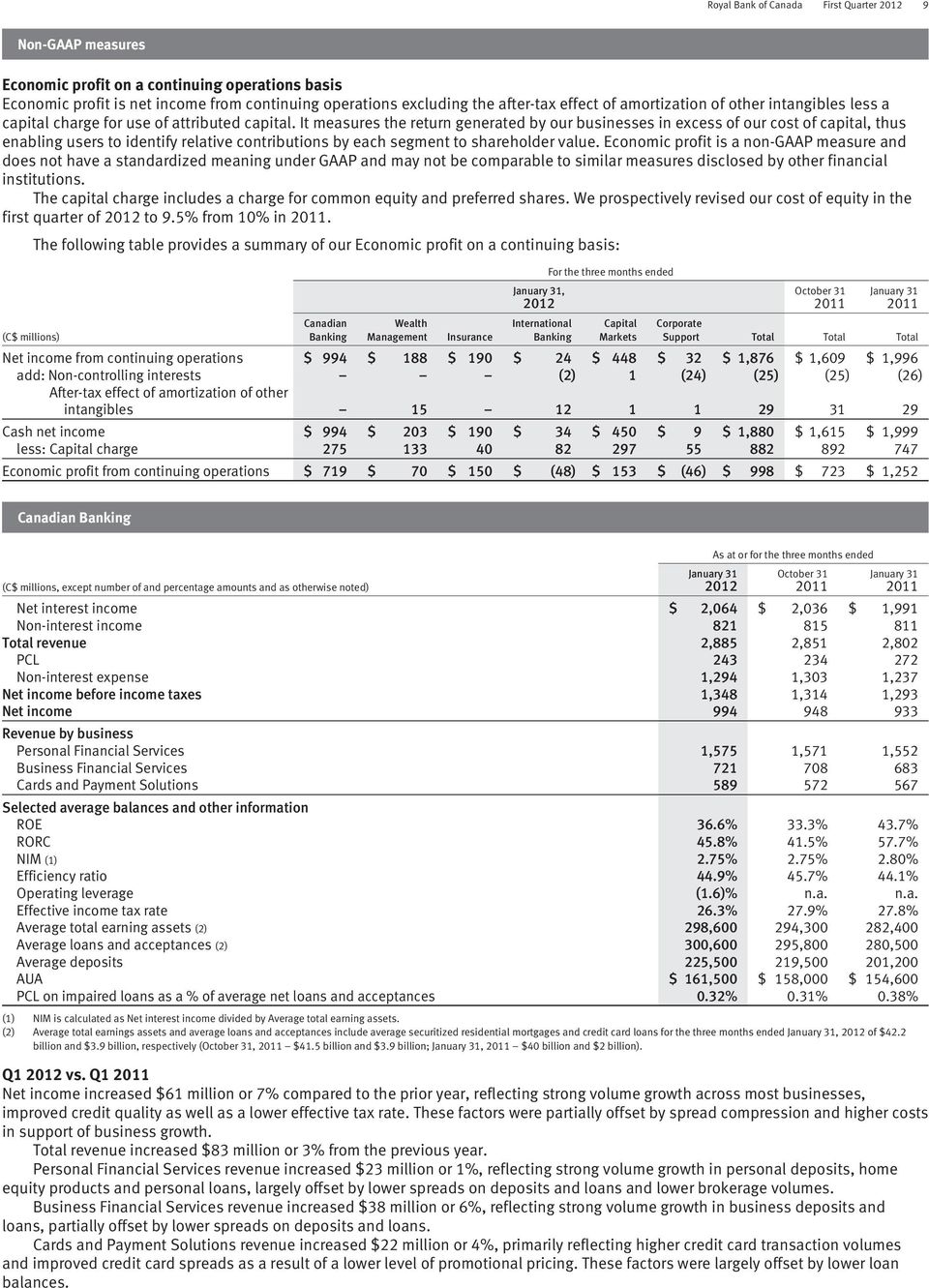
10 10 Royal Bank of Canada First Quarter Net interest margin decreased by 5 bps mainly due to spread compression reflecting the continuing low interest rate environment. PCL decreased $29 million or 11%, mainly due to lower PCL in our credit card portfolio driven by fewer bankruptcies and lower PCL in our business lending portfolio. For further details, refer to the Credit quality performance section. Non-interest expense increased $57 million or 5%, mainly due to an increase in performance-related compensation and higher costs in support of business growth. These factors were partially offset by our ongoing focus on cost management. Q1 vs. Q4 Net income increased $46 million or 5% from the prior quarter, mainly due to solid volume growth across most businesses, as well as a lower effective tax rate and seasonally lower marketing costs. Total revenue increased $34 million or 1%, primarily reflecting solid volume growth across most business, including seasonally higher credit card transactions. Net interest margin remained relatively flat compared to last quarter as a favourable shift in product mix was offset by the impact of the continued low interest rate environment. PCL increased $9 million or 4%, mainly due to higher PCL in our residential mortgages and secured personal lending portfolio, partially offset by lower PCL in our business lending portfolio. Non-interest expense decreased $9 million or 1%, despite strong volume growth, primarily reflecting seasonally lower marketing costs and our ongoing focus on cost management, largely offset by an increase in performance-related compensation. Wealth Management (C$ millions, except number of and percentage amounts and as otherwise noted) As at or for the three months ended October 31 Net interest income $ 102 $ 96 $ 90 Non-interest income Fee-based revenue Transactional and other revenue Total revenue $ 1,188 $ 1,151 $ 1,185 Non-interest expense Net income before income taxes $ 249 $ 258 $ 301 Net income $ 188 $ 179 $ 213 Revenue by business Canadian Wealth Management $ 422 $ 426 $ 433 U.S. & International Wealth Management U.S. & International Wealth Management (US$ millions) Global Asset Management (1) Selected average balances and other information ROE 13.8% 12.7% 19.5% RORC 51.9% 47.9% 82.9% Pre-tax margin (2) 21.0% 22.4% 25.4% Number of advisors (3) 4,220 4,281 4,237 AUA Total $ 534,200 $ 527,200 $ 543,000 U.S. & International Wealth Management 318, , ,300 U.S. & International Wealth Management (US$ millions) 317, , ,800 AUM 313, , ,200 Average AUA 531, , ,500 Average AUM 311, , ,600 (1) Includes BlueBay results which are reported on a one-month lag. (2) Pre-tax margin is defined as net income before income taxes divided by total revenue. (3) Represents client-facing advisors across all our wealth management businesses. Q1 vs. Q1 Net income decreased $25 million or 12% from a year ago mainly due to lower transaction volumes reflecting continued investor uncertainty and higher costs in support of business growth. These factors were partially offset by higher average fee-based client assets. Canadian Wealth Management revenue decreased $11 million or 3%, mainly due to lower transaction volumes, largely offset by higher average fee-based client assets resulting from capital appreciation and net sales. U.S. & International Wealth Management revenue decreased $33 million or 6%. In U.S. dollars, revenue decreased $36 million or 7%, mainly due to lower transaction volumes. Global Asset Management revenue increased $47 million or 20%, reflecting higher average fee-based client assets including the impact of the full quarter of revenue from our BlueBay acquisition. Non-interest expense increased $55 million or 6%, primarily due to higher costs in support of business growth including the impact of the full quarter of non-interest expense from our BlueBay acquisition. Q1 vs. Q4 Net income increased $9 million or 5%, relatively flat as compared to the prior quarter given the continued market and investor uncertainty in the early part of the quarter.

11 Royal Bank of Canada First Quarter 11 Total revenue increased $37 million or 3%, mainly due to the increase in fair value of our U.S. stock-based compensation plan. Non-interest expense increased $46 million or 5%, mainly due to the increase in fair value of our U.S. stock-based compensation plan liability, and the prior quarter also included a favourable accounting adjustment related to our deferred compensation liability. Insurance (C$ millions, except number of and percentage amounts and as otherwise noted) As at or for the three months ended October 31 Non-interest income Net earned premiums $ 957 $ 897 $ 881 Investment income (1) (116) Fee income Total revenue 1,550 1, Insurance policyholder benefits and claims (1) 1, Insurance policyholder acquisition expense Non-interest expense Net income before income taxes $ 210 $ 219 $ 136 Net income $ 190 $ 200 $ 136 Revenue by business Canadian Insurance $ 1,054 $ 757 $ 392 International and Other Insurance $ 496 $ 458 $ 433 Selected average balances and other information ROE 48.5% 40.3% 40.5% RORC 53.1% 43.3% 45.7% Premiums and deposits (2) $ 1,232 $ 1,205 $ 1,147 Assets from segregated funds Liabilities from segregated funds Fair value changes on investments backing policyholder liabilities (1) (243) (1) Investment income can experience volatility arising from fluctuation in the fair value of Fair Value Through Profit or Loss (FVTPL) assets. The investments which support actuarial liabilities are predominantly fixed income assets designated as FVTPL. Consequently changes in the fair values of these assets are recorded in investment income in the consolidated statements of income and are largely offset by changes in the fair value of the actuarial liabilities, the impact of which is reflected in insurance policyholder benefits and claims. (2) Premiums and deposits include premiums on risk-based insurance and annuity products, and individual and group segregated fund deposits, consistent with insurance industry practices. Q1 vs. Q1 Net income increased $54 million or 40%, mainly due to net investment gains as compared to net losses last year. The impact of a new U.K. annuity reinsurance contract of $17 million and lower claims costs in disability and home and auto products also contributed to the increase. These factors were partially offset by higher claims costs in reinsurance products and unfavourable life policyholder experience. Total revenue increased $725 million or 88% compared to last year. Canadian Insurance revenue increased $662 million, mainly due to the change in fair value of investments backing our policyholder liabilities, which was largely offset in PBCAE. Net investment gains as compared to net losses last year also contributed to the increase. International and Other Insurance revenue increased $63 million or 15%, mainly due to the impact of a new U.K. annuity reinsurance contract and volume growth in European life products. PBCAE increased $644 million, mainly due to the change in fair value of investments as noted above. The increase also reflected higher costs due to volume growth including the new U.K. annuity reinsurance contract and higher claims costs in reinsurance products, which were partially offset by lower claims costs in disability and home and auto products. Non-interest expense increased $7 million or 6%, mainly due to higher staff levels in support of business growth. Q1 vs. Q4 Net income decreased $10 million or 5%, mainly due to higher claims costs in reinsurance and home and auto products, and a lower impact this quarter from the new U.K. annuity reinsurance contract as compared to the $26 million impact last quarter. These factors were partially offset by favourable actuarial adjustments and higher net investment gains this quarter. Total revenue increased $335 million or 28%, mainly due to the change in fair value of investments backing our policyholder liabilities, largely offset in PBCAE. Volume growth across most products also contributed to the increase. PBCAE increased $344 million or 40%, mainly due to the change in fair value of investments as noted above. Volume growth across most products and higher claims costs in reinsurance and home and auto products also contributed to the increase. These factors were partially offset by favourable actuarial adjustments reflecting management actions and assumption changes. Non-interest expense was flat as higher staff costs were offset by lower marketing costs.

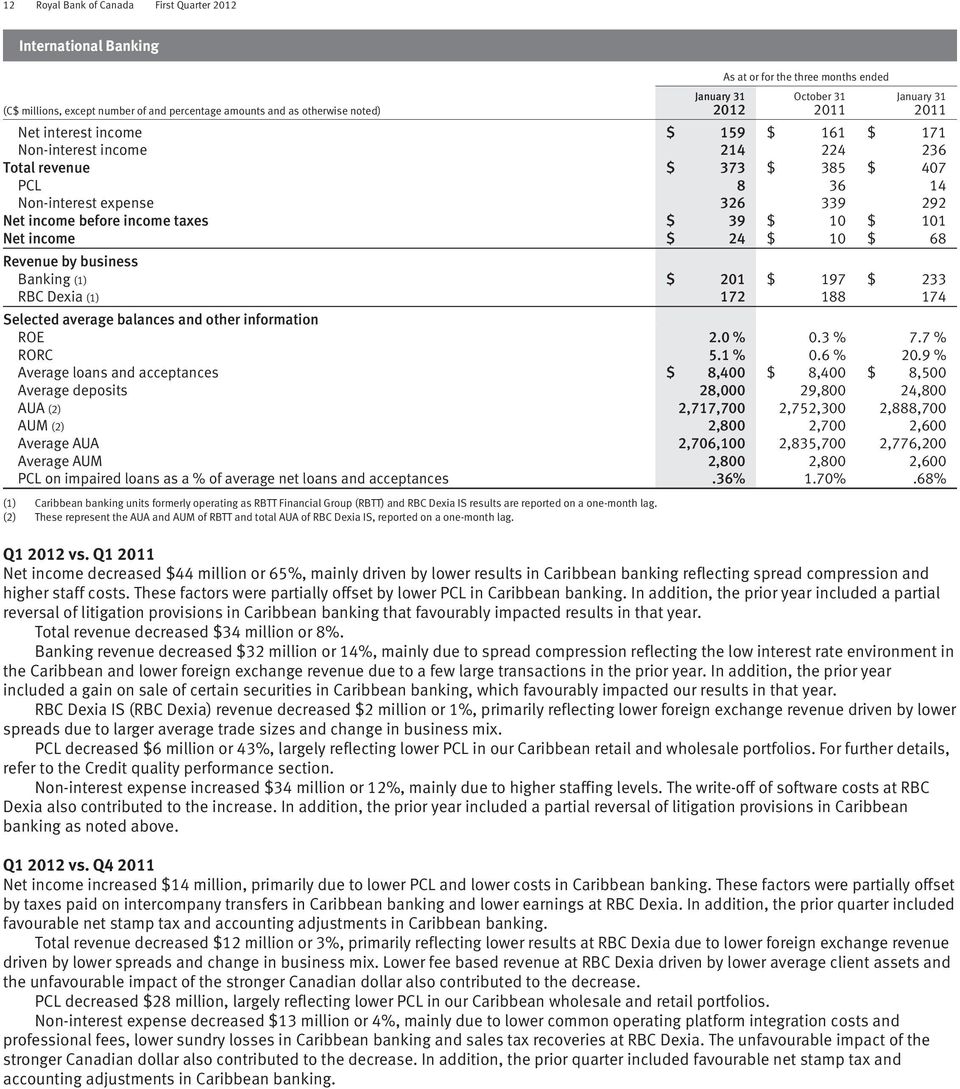
12 12 Royal Bank of Canada First Quarter International Banking (C$ millions, except number of and percentage amounts and as otherwise noted) As at or for the three months ended October 31 Net interest income $ 159 $ 161 $ 171 Non-interest income Total revenue $ 373 $ 385 $ 407 PCL Non-interest expense Net income before income taxes $ 39 $ 10 $ 101 Net income $ 24 $ 10 $ 68 Revenue by business Banking (1) $ 201 $ 197 $ 233 RBC Dexia (1) Selected average balances and other information ROE 2.0 % 0.3 % 7.7 % RORC 5.1 % 0.6 % 20.9 % Average loans and acceptances $ 8,400 $ 8,400 $ 8,500 Average deposits 28,000 29,800 24,800 AUA (2) 2,717,700 2,752,300 2,888,700 AUM (2) 2,800 2,700 2,600 Average AUA 2,706,100 2,835,700 2,776,200 Average AUM 2,800 2,800 2,600 PCL on impaired loans as a % of average net loans and acceptances.36% 1.70%.68% (1) Caribbean banking units formerly operating as RBTT Financial Group (RBTT) and RBC Dexia IS results are reported on a one-month lag. (2) These represent the AUA and AUM of RBTT and total AUA of RBC Dexia IS, reported on a one-month lag. Q1 vs. Q1 Net income decreased $44 million or 65%, mainly driven by lower results in Caribbean banking reflecting spread compression and higher staff costs. These factors were partially offset by lower PCL in Caribbean banking. In addition, the prior year included a partial reversal of litigation provisions in Caribbean banking that favourably impacted results in that year. Total revenue decreased $34 million or 8%. Banking revenue decreased $32 million or 14%, mainly due to spread compression reflecting the low interest rate environment in the Caribbean and lower foreign exchange revenue due to a few large transactions in the prior year. In addition, the prior year included a gain on sale of certain securities in Caribbean banking, which favourably impacted our results in that year. RBC Dexia IS (RBC Dexia) revenue decreased $2 million or 1%, primarily reflecting lower foreign exchange revenue driven by lower spreads due to larger average trade sizes and change in business mix. PCL decreased $6 million or 43%, largely reflecting lower PCL in our Caribbean retail and wholesale portfolios. For further details, refer to the Credit quality performance section. Non-interest expense increased $34 million or 12%, mainly due to higher staffing levels. The write-off of software costs at RBC Dexia also contributed to the increase. In addition, the prior year included a partial reversal of litigation provisions in Caribbean banking as noted above. Q1 vs. Q4 Net income increased $14 million, primarily due to lower PCL and lower costs in Caribbean banking. These factors were partially offset by taxes paid on intercompany transfers in Caribbean banking and lower earnings at RBC Dexia. In addition, the prior quarter included favourable net stamp tax and accounting adjustments in Caribbean banking. Total revenue decreased $12 million or 3%, primarily reflecting lower results at RBC Dexia due to lower foreign exchange revenue driven by lower spreads and change in business mix. Lower fee based revenue at RBC Dexia driven by lower average client assets and the unfavourable impact of the stronger Canadian dollar also contributed to the decrease. PCL decreased $28 million, largely reflecting lower PCL in our Caribbean wholesale and retail portfolios. Non-interest expense decreased $13 million or 4%, mainly due to lower common operating platform integration costs and professional fees, lower sundry losses in Caribbean banking and sales tax recoveries at RBC Dexia. The unfavourable impact of the stronger Canadian dollar also contributed to the decrease. In addition, the prior quarter included favourable net stamp tax and accounting adjustments in Caribbean banking.
13 Royal Bank of Canada First Quarter 13 Capital Markets (C$ millions, except percentage amounts) As at or for the three months ended October 31 Net interest income (1) $ 764 $ 702 $ 655 Non-interest income ,396 Total revenue (1) $ 1,616 $ 1,042 $ 2,051 PCL 17 5 (25) Non-interest expense ,121 Net income before income taxes $ 621 $ 199 $ 955 Net income $ 448 $ 154 $ 637 Revenue by business Global Markets 1, ,303 Corporate and Investment Banking Other (40) (113) 36 Selected average balance sheet information ROE 14.9% 5.8% 30.7% RORC 16.4% 6.5% 35.1% Average trading securities $ 120,600 $ 136,500 $ 137,500 Average loans and acceptances 45,200 42,600 38,600 Average deposits 130, , ,000 PCL on impaired loans as a % of average net loans and acceptances 0.15% 0.05% (0.26)% For the three months ended Q1, vs. Q4, Q1, vs. Q1 Estimated impact of US, British pound and Euro translation on key income statement items Increase (decrease): Total revenue (pre-tax) $ (10) $ 10 Non-interest expense (pre-tax) 5 Net income (5) Percentage change in average US$ equivalent of C$1.00 (1)% (1)% Percentage change in average British pound equivalent of C$1.00 1% 0% Percentage change in average Euro equivalent of C$1.00 5% 1% (1) Taxable equivalent basis (teb) The teb adjustment for the three months ended, was $121 million (October 31, $85 million;, $144 million). For further discussion, refer to the How we measure and report our business segments section of our Annual Report. Q1 vs. Q1 Net income decreased $189 million or 30%, mainly due to lower trading results and decreased debt and equity origination compared to record earnings last year. Trading revenue in the prior year also reflected gains related to MBIA and a consolidated SPE from which we exited all of the third party transactions during the current quarter. Total revenue decreased $435 million or 21%. Global Markets revenue decreased $213 million or 16%, mainly due to lower fixed income and equity trading revenue compared to the strong activity levels in the prior year. Fixed income trading revenue decreased as the prior year included a gain related to MBIA of $102 million ($49 million after-tax and compensation adjustments) mainly due to the termination of credit default swaps insured by MBIA. Decreased equity trading revenue across most geographies, and lower debt and equity origination, primarily in Canada and the U.S. also contributed to the decline as the prior year reflected strong levels of new issue activity. Corporate and Investment Banking revenue decreased $146 million or 21%, primarily reflecting lower origination activity across all geographies as compared to the robust issuance activity in the prior year. This was partially offset by higher lending revenue, primarily in the U.S., driven by volume growth. Other loss of $40 million compared to revenue of $36 million last year mainly due to lower fixed income trading revenue as the prior year reflected a gain largely related to a consolidated SPE from which we exited all of the third party transactions during the current quarter. Lower losses on certain legacy portfolios partially offset the decrease. During the current quarter, PCL of $17 million mainly reflected a loss on a single account in our corporate portfolio as compared to a recovery of $25 million in the prior year, mainly comprised of a recovery on a single account. For further details, refer to the Credit quality performance section. Non-interest expense decreased $143 million or 13%, largely due to decreased variable compensation on lower results. Q1 vs. Q4 Net income increased $294 million driven by significantly higher fixed income trading results. Solid growth in debt and equity origination and loan syndication fees also contributed to the increase. Our fixed income trading business benefitted from improved market conditions as compared to the challenging market conditions of last quarter. Last quarter, trading results also reflected a loss related to a consolidated SPE from which we exited all of the third party transactions during the current quarter. Total revenue increased $574 million or 55%, largely due to significantly higher fixed income trading revenue reflecting tightening credit spreads and improved client volumes mainly in the U.S. and Europe. Solid growth in origination, largely in equity in the U.S., and loan syndication fees across most geographies also contributed to the increase. Higher revenue also reflected a loss in the prior quarter of $105 million ($77 million after-tax and compensation adjustments) related to a consolidated SPE as noted above. These factors were partially offset by losses on credit default swaps used to economically hedge our corporate loan portfolio and decreased merger and acquisition (M&A) activity mainly in Europe. PCL increased $12 million primarily reflecting a loss on a single account in our corporate portfolio. Non-interest expense increased $140 million or 17%, mainly due to higher variable compensation on improved results.

14 14 Royal Bank of Canada First Quarter Corporate Support (C$ millions) As at or for the three months ended October 31 Net interest (loss) (1) $ (86) $ (38) $ (112) Non-interest income Total revenue (1) $ (38) $ 48 $ (52) PCL (1) 1 3 Non-interest expense Net (loss) income before income taxes $ (42) $ 19 $ (68) Net income (2) $ 32 $ 118 $ 9 (1) Teb adjusted. (2) Net income reflects income attributable to both shareholders and NCI. Net income attributable to NCI for the three months ended, was $24 million (October 31, $23 million;, $22 million). Due to the nature of activities and consolidated adjustments reported in this segment, we believe that a comparative period analysis is not relevant. The following identifies material items affecting the reported results in each period. Net interest loss and income taxes (recoveries) in each quarter in Corporate Support include the deduction of the teb adjustments related to the gross-up of income from Canadian taxable corporate dividends recorded in Capital Markets. The amount deducted from net interest income (loss) was offset by an equivalent increase in income taxes (recoveries). The teb amount for the three months ended, was $121 million as compared to $85 million in the prior quarter and $144 million in the prior year. For further discussion, refer to the How we measure and report our business segments section of our Annual Report to Shareholders. In addition to teb impacts noted above, the following identifies the other material items affecting the reported results in each quarter. Q1 Net income was $32 million largely due to our asset/liability management activities undertaken by Corporate Treasury reflecting earnings from positioning for changes in interest rates, partially offset by an unfavourable tax adjustment. Q4 Net income was $118 million largely due to our asset/liability management activities undertaken by Corporate Treasury reflecting earnings from positioning for changes in interest rates, gains of $26 million ($19 million after-tax) related to the change in the fair value of certain derivatives used to economically hedge our funding activities, gains related to the fair value adjustments of RBC debt and net favourable income tax adjustments. These factors were partially offset by losses of $15 million after-tax attributed to an investment accounted for under the equity method. Q1 Net income was $9 million largely due to our asset/liability management activities undertaken by Corporate Treasury reflecting earnings from positioning for changes in interest rates, partially offset by an unfavourable tax adjustment.

15 Royal Bank of Canada First Quarter 15 Quarterly results and trend analysis Our quarterly earnings, revenue and expenses are impacted by a number of trends and recurring factors, which include seasonality, general economic and market conditions, and fluctuations in foreign exchange rates. The following table summarizes our results for the last eight quarters (the period): 2010 IFRS IFRS CGAAP (C$ millions, except for percentage amounts) Q1 Q4 Q3 Q2 Q1 Q4 Q3 Q2 Continuing operations Net interest income $ 3,003 $ 2,957 $ 2,889 $ 2,716 $ 2,795 $ 2,610 $ 2,588 $ 2,528 Non-interest income 4,571 3,735 4,008 4,115 4,423 4,168 3,562 3,853 Total revenue $ 7,574 $ 6,692 $ 6,897 $ 6,831 $ 7,218 $ 6,778 $ 6,150 $ 6,381 PCL PBCAE 1, , , Non-interest expense 3,671 3,530 3,417 3,551 3,669 3,582 3,146 3,344 Net income before income taxes $ 2,425 $ 2,019 $ 2,079 $ 2,164 $ 2,718 $ 1,866 $ 1,749 $ 1,982 Income taxes Net income from continuing operations $ 1,876 $ 1,609 $ 1,683 $ 1,682 $ 1,996 $ 1,399 $ 1,405 $ 1,444 Non-controlling interest in net income of subsidiaries n.a. n.a. n.a. n.a. n.a. $ 27 $ 26 $ 23 Net income from continuing operations CGAAP n.a. n.a. n.a. n.a. n.a. $ 1,372 $ 1,379 $ 1,421 Net loss from discontinued operations $ (21) $ (38) $ (389) $ (51) $ (48) $ (251) $ (103) $ (92) Net income (1) $ 1,855 $ 1,571 $ 1,294 $ 1,631 $ 1,948 $ 1,121 $ 1,276 $ 1,329 EPS basic $ 1.23 $ 1.03 $.84 $ 1.08 $ 1.30 $.74 $.85 $.89 diluted $ 1.21 $ 1.02 $.83 $ 1.06 $ 1.27 $.74 $.84 $.88 EPS from continuing operations basic $ 1.24 $ 1.06 $ 1.11 $ 1.12 $ 1.34 $.92 $.93 $.96 diluted $ 1.23 $ 1.05 $ 1.10 $ 1.10 $ 1.31 $.91 $.92 $.95 Segment net income (loss) from continuing operations Canadian Banking $ 994 $ 948 $ 888 $ 895 $ 933 $ 765 $ 766 $ 736 Wealth Management Insurance International Banking (7) Capital Markets Corporate Support (15) 9 (58) 43 (64) Net income from continuing operations $ 1,876 $ 1,609 $ 1,683 $ 1,682 $ 1,996 $ 1,372 $ 1,379 $ 1,421 Net income total $ 1,855 $ 1,571 $ 1,294 $ 1,631 $ 1,948 $ 1,121 $ 1,276 $ 1,329 Effective income tax rate 22.6% 20.3% 19.0% 22.3% 26.6% 25.0% 19.7% 27.1% Period average US$ equivalent of C$1.00 $.987 $.992 $ $ $.992 $.963 $.957 $.973 (1) Net income from continuing operations reflects income attributable to both shareholders and NCI. Net income under IFRS is apportioned between our shareholders and NCI after the effects of all continuing and discontinued operations have been presented. In the third quarter of we recorded a net loss from discontinued operations of $389 million due to the announced sale of our U.S. regional retail banking operations which included the loss on sale of $310 million and a net operating loss of $79 million. Refer to Discontinued operations in the Financial performance section for further details. In the first quarter of we recorded a gain of $102 million ($49 million after-tax and compensation adjustments) due to a legal settlement with MBIA on the termination of our direct monoline insurance protection with them. In the fourth quarter of 2010 we recorded a loss of $116 million relating to the sale of Liberty Life. Certain market and credit related items adversely affected our results, mainly in the third quarter of Fluctuations in the Canadian dollar relative to other foreign currencies have affected our consolidated results over the period. Continuing operations Trend analysis Economic conditions have moderately improved over the period, although capital market conditions remained uncertain reflecting concerns over the global economy and continued European sovereign debt concerns. Net income in and current quarter was up over 2010 with solid performance over the period reflecting solid volume growth in Canadian Banking, improved results in Insurance and lower PCL. Results in Capital Markets fluctuated over the period due to market volatility. Results in Wealth Management have been impacted by capital market conditions and investor uncertainty over the past eight quarters. Revenue generally trended up over the period but experienced some fluctuations. Trading revenue generally moderated from the strong performance in the first quarter of and fluctuated due to market conditions, with solid results experienced in the first quarter of as a result of tightening credit spreads and improved client volumes mainly in the U.S. and Europe. Revenue also fluctuated due to the change in fair value of investment backing our policyholder liabilities in Insurance, largely offset in PBCAE. Solid volume growth in Canadian Banking, growth in our investment banking businesses and higher revenue in Wealth Management due to higher average-fee based client assets contributed to the increase in revenue over the period. Net interest income generally trended up over the period although it was unfavourably impacted by spread compression in our banking and wealth management businesses as a result of the continuing low interest rate environment.

16 16 Royal Bank of Canada First Quarter PCL generally decreased over the period, reflecting continued stabilizing asset quality. PBCAE has been subject to quarterly fluctuations. Generally over the period there have been movements in the fair value of investments backing our policyholder liabilities, largely offset in revenue, which can cause volatility quarter to quarter, higher costs due to volume growth, actuarial liability adjustments and generally lower claims costs during the period. Non-interest expense has generally trended upward mainly due to increased costs in support of business growth as well as overall higher variable compensation in Capital Markets and Wealth Management driven by higher revenue. Pension expense, primarily in Canadian Banking, decreased under IFRS. For further details on employee benefits costs refer to Note 3 to our unaudited Interim Condensed Consolidated Financial Statements. Our effective income tax rate has generally fluctuated over the period, reflecting a varying portion of income being reported by our subsidiaries operating in jurisdictions with differing income tax rates, a fluctuating level of income from tax-advantaged sources (Canadian taxable corporate dividends), and tax adjustments. The reduction in statutory Canadian corporate income tax rates over the period has generally lowered our effective income tax rate. Results by geographic segment (1) (C$ millions) Canada U.S. Other International Total Canada U.S. For the three months ended October 31 Other International Total Canada U.S. Other International Total revenue $5,185 $1,096 $ 1,293 $7,574 $4,728 $788 $ 1,176 $6,692 $4,619 $1,269 $ 1,330 $7,218 Net income from continuing operations $1,493 $ 174 $ 209 $1,876 $1,394 $ 64 $ 151 $1,609 $1,388 $ 229 $ 379 $1,996 Net loss from discontinued operations (21) (21) (38) (38) (48) (48) Net income total $1,493 $ 153 $ 209 $1,855 $1,394 $ 26 $ 151 $1,571 $1,388 $ 181 $ 379 $1,948 (1) For geographic reporting, our segments are grouped into Canada, U.S. and Other International. For further details, refer to Note 28 to our Annual Consolidated Financial Statements. Continuing operations Q1 vs. Q1 Net income in Canada was up $105 million, or 8% from the prior year. The increase was largely due to strong volume growth in Canadian Banking and net investment gains in Insurance as compared to losses in the prior year. Lower PCL and a lower effective tax rate in Canadian Banking also contributed to the increase. These factors were partially offset by lower trading results in our fixed income businesses, lower origination and M&A activity and increased costs in support of business growth. U.S. net income was down $28 million, or 15%, from the prior year, largely due to lower trading results, decreased origination and lower transaction volumes in Wealth Management. Lower recovery of credit losses as compared to the prior year also contributed to the decrease. These factors were partially offset by a decrease in fair value of our U.S. stock-based compensation plan liability and a favourable accounting adjustment related to our deferred compensation liability. Other International net income decreased $170 million, or 45% from the previous year primarily due to lower trading results and lower origination activity. In addition, the prior year included a gain related to MBIA, which favourably impacted the results in that year. Higher costs in support of business growth and higher PCL also contributed to the decrease. Q1 vs. Q4 Net income in Canada was up $99 million, or 7%, from last quarter, mainly driven by significantly higher fixed income trading results, solid volume growth across most businesses in Canadian Banking, as well as a lower effective tax rate and seasonally lower marketing costs. These factors were partially offset by continued spread compression in Canadian Banking and higher PCL. U.S. net income increased by $127 million from last quarter, largely due to significantly higher fixed income trading revenue reflecting tightening credit spreads and improved client volumes, and solid growth in our origination business. Lower PCL also contributed to the increase. These factors were partially offset by an increase in the fair value of our U.S. stock-based compensation plan liability. Other International net income increased $58 million, or 38%, from last quarter, mainly due to significantly higher fixed income trading results and lower common operating platform integration costs and professional fees in International Banking. Lower PCL as compared to last quarter also contributed to the increase. These factors were partially offset by a lower impact this quarter from the new U.K. annuity reinsurance contracts and lower earnings at RBC Dexia IS. U.S. net loss from discontinued operations Q1 vs. Q1 Net loss from discontinued operations was $21 million compared to a net loss of $48 million a year ago, largely due to lower PCL in our U.S. commercial real estate and builder finance portfolios reflecting stabilizing asset quality. Q1 vs. Q4 Net loss from discontinued operations improved from a net loss of $38 million in the previous quarter, largely due to gains on certain securities in the current quarter compared to a loss in the previous quarter and lower professional fees and marketing costs, partially offset by higher PCL. Total

17 Royal Bank of Canada First Quarter 17 Financial condition Condensed balance sheets (1) (C$ millions) As at October 31 Assets Cash and due from banks $ 12,005 $ 12,428 $ 7,888 Interest-bearing deposits with banks 11,135 12,181 11,342 Securities 165, , ,705 Assets purchased under reverse repurchase agreements and securities borrowed 96,212 84,947 79,259 Loans Retail loans 287, , ,792 Wholesale loans 78,448 68,711 71,625 Allowance for loan losses (1,965) (1,967) (2,784) Investments for account of segregated fund holders Other Derivatives 103,341 99,650 73,461 Assets of discontinued operations (2) 26,324 27,152 5,555 Other 36,823 38,644 37,852 Total assets $ 815,016 $ 793,833 $ 761,972 Liabilities Deposits $ 502,046 $ 489,691 $ 485,194 Insurance and investment contracts for account of segregated fund holders Other Derivatives 106, ,522 76,789 Liabilities of discontinued operations (2) 19,488 20,076 4,822 Other 134, , ,705 Subordinated debentures 8,744 8,749 9,035 Trust capital securities ,635 Total liabilities 772, , ,457 Equity attributable to shareholders 40,972 39,702 36,462 Non-controlling interests 1,758 1,761 2,053 Total equity 42,730 41,463 38,515 Total liabilities and equity $ 815,016 $ 793,833 $ 761,972 (1) Foreign currency-denominated assets and liabilities are translated to Canadian dollars. For further details, refer to Note 2 of the unaudited Interim Condensed Consolidated Financial Statements. (2) Balance sheet adjustments related to discontinued operations are made prospectively from the date of classification as discontinued operations. The classification of our U.S. retail banking operations as discontinued operations was reflected beginning in the third quarter ending July 31,. The sale of Liberty Life Insurance Company announced in October 2010 was reflected as discontinued operations from the Transition date as at November 1, Q1 vs. Q1 Total assets were up $53 billion or 7% from the previous year. Securities were down $38 billion or 19% compared to the prior year, primarily due to a reduction in our corporate and government debt instruments as part of our management of market and interest rate risk. Securities related to our U.S. retail banking operations which are now classified as discontinued operations were $6 billion as at, and were reflected in the Securities balance. As at,, these securities are reflected in Assets of discontinued operations. Assets purchased under reverse repurchase agreements (reverse repos) and securities borrowed increased $17 billion or 21%, mainly attributable to new business activity and higher client activity in certain businesses. Loans were up $19 billion or 6%, predominantly due to solid volume growth in Canadian home equity products and growth in wholesale loans. Loans related to our U.S. retail banking operations which are now classified as discontinued operations were $19 billion as at, and were reflected in the Loans balance. As at,, these loans are reflected in Assets of discontinued operations. Derivative assets were up $30 billion or 41%, mainly attributable to higher fair values on interest rate swaps due to a declining rate environment. This increase was partially offset by higher netting amounts reflecting the increased interest rate swap asset and liability positions with a central clearing counterparty. Total liabilities were up $49 billion or 7% from the previous year. Deposits increased $17 billion or 3%, mainly reflecting an increase in fixed term deposits due to an increase in our internal funding requirements, to support our loan growth and demand for our high-yield savings and other product offerings in our retail business. Deposits related to our U.S. retail banking operations which are now classified as discontinued operations were $19 billion as at, and were reflected in the Deposits balance. As at,, these deposits were reflected as Liabilities of discontinued operations. Derivative liabilities were up $30 billion or 39%, mainly attributable to higher fair values on interest rate swaps, offset by increased positions with a central clearing counterparty. Other liabilities decreased $12 billion or 8%, mainly resulting from a decrease in obligations related to securities sold short as part of our management of market risk. This was partly offset by an increase in repurchase agreements partly due to increased volume and higher market activity. Total equity increased $4 billion or 11%, largely reflecting earnings, net of dividends.

18 18 Royal Bank of Canada First Quarter Q1 vs. Q4 Total assets increased $21 billion or 3% from the prior quarter largely due to higher loan balances and assets purchased under reverse repurchase agreements (reverse repos) due to the reasons noted above. Higher derivative assets mainly attributable to higher fair values of interest rate swaps due to a declining rate environment, partially offset by increased positions with a central clearing counterparty and lower fair values on foreign exchange forward contracts and equity derivatives due to improved market stability also contributed to the increase. These factors were partially offset by a decrease in our securities largely due to the reasons noted above. Total liabilities increased $20 billion or 3% from the prior quarter largely due to higher deposits due to the reasons noted above. Higher derivative liabilities mainly attributable to higher fair values on interest rate swaps and cross currency interest rate swaps, partially offset by increased positions with a central counterparty also contributed to the increase. Off-balance sheet arrangements In the normal course of business, we engage in a variety of financial transactions that, for accounting purposes, are not recorded on our Consolidated Balance Sheets. Off-balance sheet transactions are generally undertaken for risk, capital and funding management purposes which benefit us and our clients. These include transactions with SPEs and may include issuance of guarantees and give rise to, among other risks, varying degrees of market, credit, liquidity and funding risk, which are discussed in the Risk management section. We use SPEs to securitize our financial assets as well as assist our clients in securitizing their financial assets. These entities are not operating entities, typically have no employees, and may or may not be recorded on our balance sheets. Securitizations of our financial assets Securitization can be used as a cost-effective fund raising technique compared to the relative cost of issuing unsecured wholesale debt. We periodically securitize our credit card receivables, residential and commercial mortgage loans and participate in bond securitization activities primarily to diversify our funding sources, enhance our liquidity position and for capital purposes. We also securitize residential and commercial mortgage loans for sales and trading activities. Refer to Note 19C and 19D to our Interim Condensed Consolidated Financial Statements for a complete description of our securitization activities, our involvement with the transferred assets, and related risk by major product types. We securitize our credit card receivables through an SPE, on a revolving basis, which we are required to consolidate under IFRS. As a result, the assets and liabilities of the SPE are recognized on our Consolidated Balance Sheets. We also securitize residential mortgage loans under the National Housing Act MBS program (NHA MBS program) and sell them primarily to Canada Housing Trust (CHT), a government sponsored SPE, under the Canada Mortgage Bond (CMB) program. We do not control this SPE, and therefore do not consolidate it. We do not hold any significant interest in the SPE and therefore it is not included in the unconsolidated SPE table below. The securitized residential mortgages loans transferred to the SPE do not meet the derecognition requirements under IFRS and hence have been recognized on our Consolidated Balance Sheets and accounted for as secured borrowings. We also sell securitized residential mortgage loans to third party investors through the Canadian social housing program. Securitized Canadian social housing mortgages, commercial mortgage loans, and our bond securitization transactions continue to be derecognized under IFRS as we have no continuing involvement in the transferred assets. We did not securitize Canadian social housing mortgages, commercial mortgages, or bond participation certificates during the quarter. Involvement with unconsolidated Special Purpose Entities In the normal course of business, we engage in a variety of financial transactions with SPEs to support our customers financing and investing needs, including securitization of client financial assets, creation of investment products, and other types of structured financing. The following table summarizes SPEs in which we have significant financial interests, but have not been consolidated. (C$ millions) Total assets Maximum exposure (1) Total assets (2) As at October 31 Maximum exposure (1), (2) Total assets Maximum exposure (1) Unconsolidated SPEs Multi-seller conduits (3) $ 25,623 $ 25,992 $ 24,271 $ 24,614 $ 21,816 $ 22,111 Structured finance SPEs 5,288 1,541 4,988 1,340 5,196 1,550 Investment funds 1,196 1,023 1,374 1,125 1,451 1,076 Credit investment product SPEs Third-party securitization vehicles 3, , Other (4) $ 36,406 $ 29,483 $ 32,218 $ 27,370 $ 29,154 $ 24,796 (1) The maximum exposure to loss resulting from significant financial interests in these SPEs consists mostly of investments, loans, liquidity and credit enhancement facilities and fair value of derivatives. The maximum exposure to loss may exceed the total assets in the multi-seller conduits, as our liquidity facilities may sometimes be extended for up to 102% of the total value of the assets in the conduits. (2) Total assets and maximum exposure to loss corresponds to disclosures provided in Note 19C to our unaudited Interim Condensed Consolidated Financial Statements. (3) Represents multi-seller conduits that we administer. (4) Primarily includes various entities, such as tax credit funds, and mutual and pooled funds that we sponsor. We have the ability to use credit mitigation tools such as third party guarantees, credit default swaps, and collateral to mitigate risks assumed through securitization and re-securitization exposures. The process in place to monitor the credit quality of our
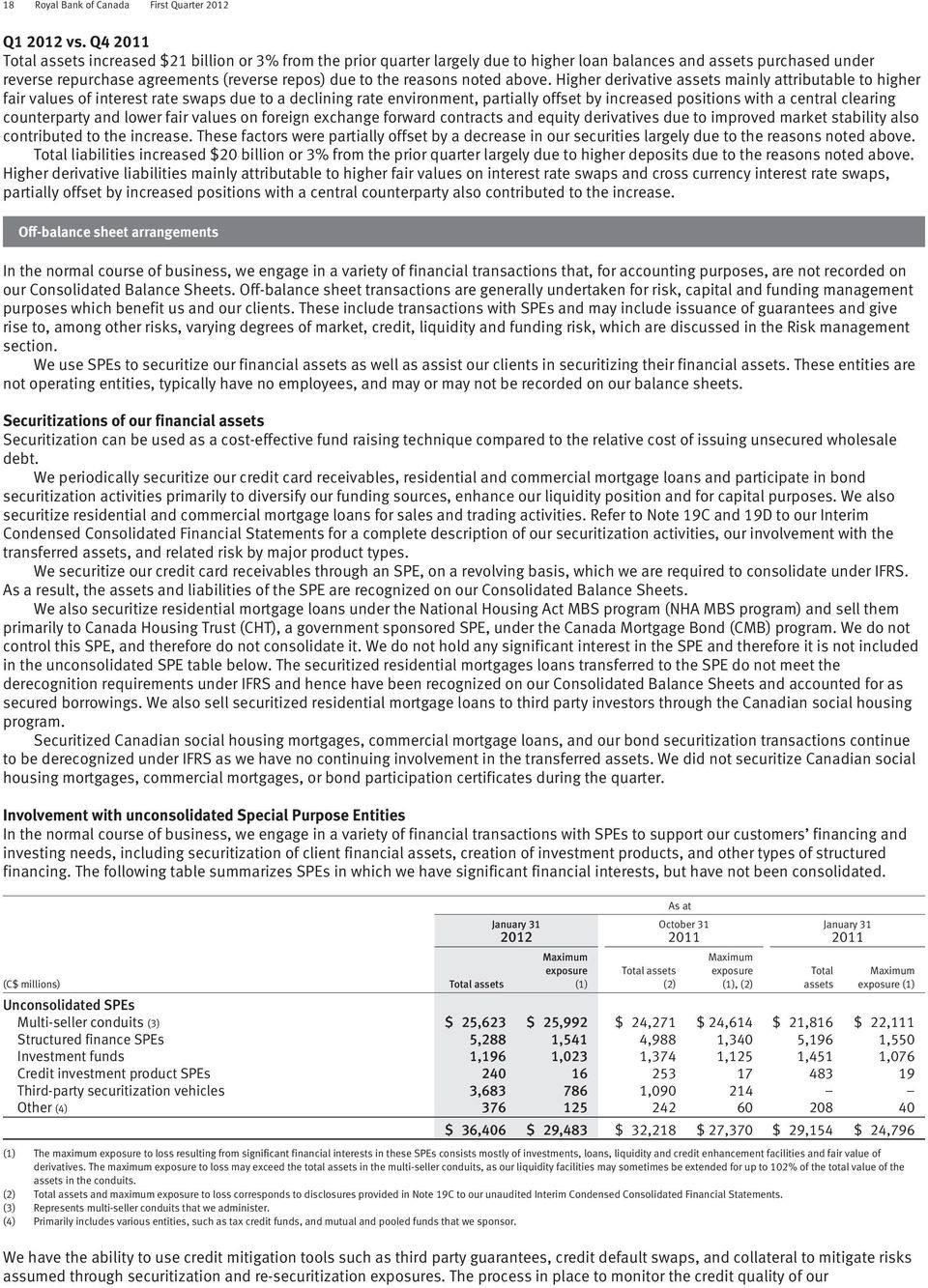
19 Royal Bank of Canada First Quarter 19 securitization and re-securitization exposures involves reviewing the performance data of the underlying assets. We affirm our ratings each quarter and formally confirm or assign a new rating at least annually. For further details on our activities to manage risks, refer to the Risk management section. Approximately 84% of assets in unconsolidated SPE s in which we have significant financial interests were internally rated A or above, compared to 88% in the prior year and 91% in the prior quarter. For multi-seller conduits, 99% of assets were internally rated A or above compared to 97% in the prior year and 99% in the prior quarter. All transactions funded by the unconsolidated multi-seller conduits are internally rated using a rating system which is largely consistent with that of the external rating agencies. The assets in unconsolidated SPEs as at, have varying maturities and a remaining expected weighted average life of approximately 3.9 years. RBC-administered multi-seller conduits We administer multi-seller conduits which are used primarily for the securitization of our clients financial assets. There are no assetbacked securities in the Canadian multi-seller conduits and $1.7 billion in our U.S. multi-seller conduits. We are exposed to credit risk as a result of the backstop liquidity facilities and partial credit enhancements provided to the multiseller conduits. Our backstop liquidity and credit enhancement facilities are explained in Note 6 and 31 to our Annual Consolidated Financial Statements and Note 19C to our Interim Condensed Consolidated Financial Statements. As at,, the notional amount of backstop liquidity facilities we provide totalled $26.1 billion, an increase of $3.9 billion or 17% from the prior year and an increase of $1.4 billion or 6% from the prior quarter. Total loans extended to the multi-seller conduits under the backstop liquidity facilities amounted to $1.4 billion, a decrease of $45 million from the prior year and an increase of $6 million from the prior quarter due primarily to exchange rate fluctuations. The partial credit enhancement facilities we provide totalled $2.5 billion, an increase of $291 million from the prior year and an increase of $135 million from the prior quarter. The increase in the amount of backstop liquidity facilities and partial credit enhancement facilities provided to the multi-seller conduits compared to the prior year and prior quarter primarily reflects improved business conditions during the period which has led to a slight expansion of the outstanding securitized assets of the multi-seller conduits. Multiple independent debt rating agencies review all of the transactions in the multi-seller conduits. Transactions financed in our U.S. multi-seller conduits are reviewed by Moody s Investors Service (Moody s), Standard & Poor s (S&P) and Fitch Ratings (Fitch). Transactions in our Canadian multi-seller conduits are also reviewed by Dominion Bond Rating Services (DBRS). Each applicable rating agency also reviews ongoing transaction performance on a monthly basis and may publish reports detailing portfolio and program information related to the conduits. As at,, the total asset-backed commercial paper (ABCP) issued by the conduits amounted to $16.8 billion, an increase of $1.7 billion or 12% since the prior year and an increase $487 million, or 3% from the prior quarter. The rating agencies that rate the ABCP rated 66% of the total amount issued within the top ratings category and the remaining amount in the second highest ratings category compared with 67% in the prior year and 68% in the prior quarter. The increase in the amount of ABCP issued by the multi-seller conduits compared to the prior year and prior quarter is primarily due to increased client usage. We sometimes purchase ABCPs issued by the multi-seller conduits in our capacity as a placement agent in order to facilitate overall program liquidity. The fair value of our inventory was $5 million, a decrease of $29 million from the prior year and $105 million from the prior quarter. The fluctuations in inventory held reflects normal trading activity. This inventory is classified as Securities Trading on our Consolidated Balance Sheets. Structured finance SPEs We invest in U.S. auction rate securities (ARS) of entities which fund their long-term investments in student loans by issuing shortterm senior and subordinated notes. As at,, the total assets of the unconsolidated ARS SPEs in which we have significant investments were $4.9 billion (October 31, $4.9 billion). Our maximum exposure to loss in these ARS SPEs as at, was $1.3 billion (October 31, $1.3 billion). As at,, approximately 69% of these investments were AAA rated. Investment funds We enter into fee-based equity derivative transactions with third parties including mutual funds, unit investment trusts and other investment funds. These transactions provide their investors with the desired exposure to the referenced funds, and we economically hedge our exposure from these derivatives by investing in those third party managed referenced funds. The decrease in the total assets of these funds and our maximum exposure to loss relative to the prior quarter and prior year reflect the negative performance of the reference funds and redemptions of capital by RBC and third-party investors of the funds. Third-party securitization vehicles We hold significant interests in certain unconsolidated third-party securitization vehicles, which are SPEs. We, as well as other financial institutions, are obligated to provide funding up to our maximum commitment level and are exposed to credit losses on the underlying assets after various credit enhancements. The increases in the total assets of these funds and our maximum exposure to loss relative to the prior quarter and prior year reflect new investments made during and the first quarter of. Credit investment product SPEs and Others We use SPEs to create customized credit products to meet investors specific requirements and we manage assets in mutual and pooled funds and created tax credit funds. Refer to Note 19C to our Interim Condensed Consolidated Financial Statements for more detail on these SPEs.
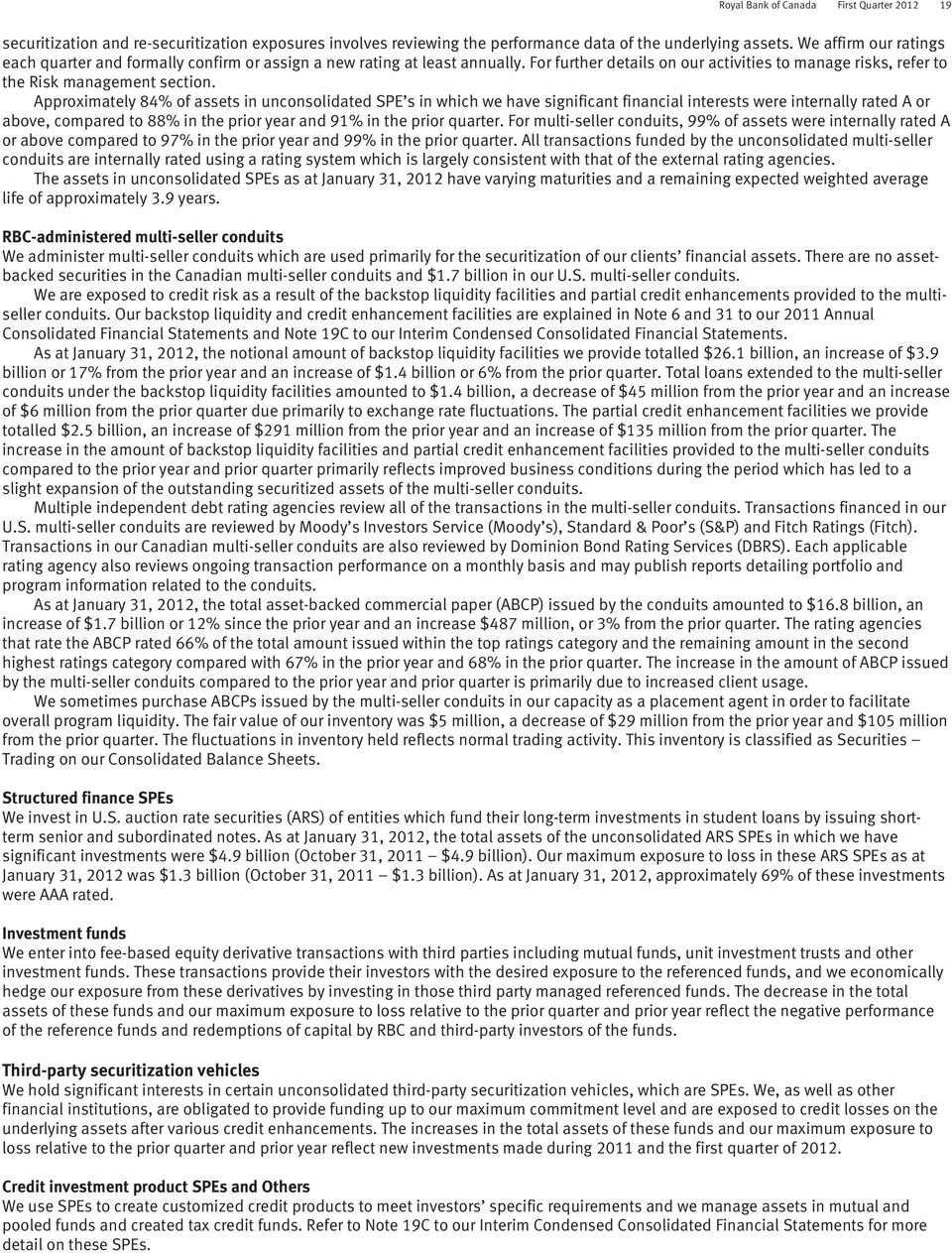
20 20 Royal Bank of Canada First Quarter Guarantees Our maximum potential amount of future payments in relation to our guarantee products as at, amounted to $72.6 billion compared to $69 billion in the prior year and $70.8 billion in the prior quarter. The increase compared to the prior year relates primarily to higher backstop liquidity facilities. For further details on Guarantees, refer to Note 15 to our Interim Condensed Consolidated Financial Statements. Risk management Credit risk Gross (excluding allowance for loan losses) credit risk exposure by portfolio and sector consolidated basis (C$ millions) Lending-related and other Loans and acceptances Outstanding Undrawn commitments Other As at Repo-style transactions Trading-related Over-thecounter derivatives (1) Total exposure (2) October 31 Total exposure (2) Residential mortgages $ 191,758 $ 25 $ 8 $191,791 $ 190,325 Personal (3) 86,437 67, , ,590 Credit cards 12,971 25,031 38,002 40,230 Small business (4) 2,448 3, ,186 6,691 Retail $ 293,614 $ 95,872 $ 94 $ $ $ 389,580 $397,836 Business (4) Agriculture $ 5,127 $ 657 $ 29 $ $ 18 $ 5,831 $ 5,644 Automotive 3,616 2, ,760 6,400 Consumer goods 5,770 3, ,666 9,800 Energy 7,265 13,704 2,552 2,017 25,538 25,058 Non-bank financial services 2,184 6,106 10, ,243 6, , ,857 Forest products ,427 1,333 Industrial products 3,963 2, ,452 6,800 Mining & metals 967 2, ,072 3,922 Real estate & related 21,300 4,035 1, ,932 24,602 Technology & media 3,482 3, ,019 7,263 Transportation and environment 5,248 2, ,320 9,040 Other 22,183 7,071 6,989 11,447 4,203 51,893 54,490 Sovereign (4) 3,807 3,738 30,978 14,681 8,941 62,145 55,997 Bank (4) 1, ,842 85,189 31, , ,003 Wholesale $ 87,238 $ 53,163 $ 108,983 $ 225,560 $ 56,370 $ 531,314 $ 487,209 Total exposure $ 380,852 $ 149,035 $ 109,077 $ 225,560 $ 56,370 $ 920,894 $ 885,045 (1) Credit equivalent amount after factoring in master netting agreements. Derivative exposure is measured at fair value. (2) Gross credit risk exposure is before allowance for loan losses and represents consolidated (combined continuing and discontinued) operations. Exposure under Basel II asset classes of qualifying revolving retail and other retail are largely included within Personal and Credit cards, while home equity lines of credit are included in Personal. (3) Home equity lines of credit reported primarily in Canadian Banking comprised $42 billion or 48%, of our outstanding personal loan portfolio as at, (October 31, $41 billion or 48%). More than 95% of home equity lines of credit (October 31, 95%) are secured by a first lien on real estate. Of the clients that have home equity lines of credit, less than 7% (October 31, 7%), pay the scheduled interest payment only. (4) Refer to Note 4 of our Annual Consolidated Financial Statements for the definition of these terms. Gross credit risk exposure is calculated based on the definitions provided under the Basel II framework. Under this method, risk exposure is calculated before taking into account any collateral and inclusive of an estimate of potential future changes to that credit exposure. Gross credit risk is categorized into Lending-related and other, and Trading-related. Q1 vs. Q4 Total gross credit risk exposure increased $36 billion, or 4% from the prior quarter, reflecting an increase in the wholesale portfolio, partially offset by a decrease in the retail portfolio. Wholesale exposure increased $44 billion, or 9%, reflecting increases largely in repo-style transactions and other exposures. Repo-style transactions increased $35 billion, largely in non-bank financial services and bank, attributable to new business activity and higher client activity in certain businesses. Other exposure increased $9 billion largely due to higher guarantees and securities related exposures. Undrawn commitments increased $2 billion with the largest increase in the technology & media, real estate and related and industrial products sectors, partially offset by a decrease in the energy sector. Wholesale loans and acceptances outstanding was flat with increases largely in the real estate & related and other sectors, offset by decreases in the non-bank financial services, bank and sovereign sectors. The loan utilization of 40% decreased 1% from the prior quarter. Retail exposure decreased $8 billion, or 2%, largely driven by the implementation of updated risk parameters for undrawn commitments reflecting recent credit experience in the first quarter of. The use of guarantees and collateral represents an integral part of our credit risk mitigation in our retail portfolio. Insured mortgages accounted for 41% of our residential mortgage portfolio as of, as compared to 42% the prior quarter. Secured personal lending represented 56% of personal loans outstanding as of,, unchanged from the prior quarter.

21 Royal Bank of Canada First Quarter 21 Gross (excluding allowance for loan losses) credit risk exposure by geography (C$ millions) Lending related and other Loans and acceptances Outstanding Undrawn commitments Other As at Trading related Repo-style transactions Over-thecounter derivatives (1) Total exposure (2) October 31 Total exposure (2) Canada $ 326,203 $ 116,817 $ 41,014 $ 64,455 $ 10,858 $ 559,347 $561,269 USA 33,564 23,154 23,563 72,589 12, , ,324 Europe 8,140 6,968 27,536 72,767 26, , ,212 Other International 12,945 2,096 16,964 15,749 6,326 54,080 47,240 Total exposure (3) $ 380,852 $ 149,035 $ 109,077 $ 225,560 $ 56,370 $ 920,894 $ 885,045 (1) Credit equivalent amount after factoring in master netting agreements. Derivative exposure is measured at fair value. (2) Gross credit risk exposure is before allowance for loan losses and represents consolidated (combined continuing and discontinued) operations. Exposure under Basel II asset classes of qualifying revolving retail and other retail are largely included within Personal and Credit cards, while home equity lines of credit are included in Personal. (3) Geographic profile is based on country of residence of the borrower. Q1 vs. Q4 The geographic mix of our gross credit risk did not change significantly from the prior quarter with Canada, U.S., Europe and Other international reflecting 61%, 18%, 15% and 6% of our exposure respectively. Growth in our gross credit risk exposure reflected higher exposure in the U.S., Europe and Other international of $18 billion, $13 billion and $7 billion respectively. Growth in Europe was largely driven by higher levels of repo-style transactions. Growth in the U.S. was driven by growth across all exposure types, largely repo-style transactions and undrawn commitments. Growth in Other international was largely driven by higher levels of repo-style transactions. Exposure in Canada decreased $2 billion as increases in repo-style transactions and other exposures were more than offset by a decrease in undrawn commitments related to updated risk parameters as discussed above. European exposure (C$ millions) Loans and Acceptances Outstanding Undrawn commitments (1) Securities (2) As at Other Letters of credit and guarantees Repo-style transactions Over-the counter derivatives (3) Total European exposure October 31 Total European exposure Gross exposure to Europe $ 8,140 $ 6,968 $ 18,237 $ 9,299 $ 72,767 $ 26,780 $142,191 $ 129,212 Less: Collateral held against repo style transactions 71,353 71,353 58,379 Potential future credit exposure add-on amount 14,664 14,664 18,329 Undrawn commitments 6,968 9,299 16,267 15,616 Gross drawn exposure to Europe (4) $ 8,140 $ $ 18,237 $ $ 1,414 $ 12,116 $ 39,907 $ 36,888 Less: Collateral applied against derivatives 7,879 7,879 5,461 Add: Trading securities 9,127 9,127 11,826 Net exposure to Europe (5) $ 8,140 $ $ 27,364 $ $ 1,414 $ 4,237 $ 41,155 $ 43,253 (1) Comprised of undrawn commitments of $5,163 million to corporate entities, $1,743 million to financial entities and $62 million to sovereign entities. On a country basis, exposure is comprised of $3.1 billion to U.K., $1.3 billion to France, $492 million to Germany, $198 million to Ireland, $80 million to Spain and $17 million to Italy. Of the undrawn commitments, over 90% are to investment grade entities. (2) Securities include $9 billion of AFS securities (October 31, $10 billion), $9 billion of trading securities (October 31, $12 billion) and $9 billion of deposits (October 31, $10 billion). (3) Derivative exposures are measured at fair value. (4) Based on our interpretation of gross funded exposures as reported by certain U.S. banks, which excludes undrawn commitments, potential future credit exposure amount and collateral. (5) Excludes $0.6 billion (October 31, $1.5 billion) of exposures to supra-national agencies. Q1 vs. Q4 As noted above, our gross credit risk exposure is calculated based on the definitions provided under the Basel II framework whereby risk exposure is calculated before taking into account any collateral and inclusive of an estimate of potential future changes to that credit exposure. On that basis, our total European exposure as at, was $142 billion. Our gross drawn exposure to Europe was $40 billion, after taking into account collateral held against repo-style transactions of $71 billion, undrawn commitments for loans and letters of credit of $16 billion and potential future credit exposure to OTC derivatives of $15 billion. Our net exposure to Europe was $41 billion, after taking into account $8 billion of collateral (primarily cash) we hold against OTC derivatives and the addition of trading securities of $9 billion held in our trading book, as these are addressed through market risk. Our net exposure to Europe also reflects $0.6 billion of mitigation through credit default swaps, which are largely used to hedge single name exposure and market risk. This net exposure also includes our proportionate share of RBC Dexia IS exposures.
22 22 Royal Bank of Canada First Quarter Net European exposure (1) (C$ millions) Loans outstanding Securities (2) As at October 31 Repo-style transactions Over-the-counter derivatives (3) Total Total U.K. $ 5,194 $ 6,989 $ 1,039 $ 1,926 $ 15,148 $ 15,339 Germany 139 5, ,434 6,918 France 124 3, ,383 4,189 Total U.K., Germany, France $ 5,457 $ 16,311 $ 1,276 $ 2,921 $ 25,965 $ 26,446 Greece $ $ 14 $ $ $ 14 $ 13 Ireland Italy Portugal Spain Total Peripheral $ 567 $ 436 $ 6 $ 236 $ 1,245 $ 1,439 Luxembourg 206 1, ,956 2,086 Netherlands 337 3, ,804 3,789 Norway 244 1,018 1, Sweden 2, ,346 2,260 Switzerland 779 1, ,531 2,787 Other ,046 3,525 Total Other Europe $ 2,116 $ 10,617 $ 132 $ 1,080 $ 13,945 $ 15,368 Total exposure to Europe (4), (5) $ 8,140 $ 27,364 $ 1,414 $ 4,237 $ 41,155 $ 43,253 (1) All numbers presented reflect our proportionate share of RBC Dexia IS exposures. (2) Securities include $9 billion of AFS securities (October 31, $10 billion), $9 billion of trading securities (October 31, $12 billion) and $9 billion of deposits (October 31, $10 billion). (3) Derivative exposure is measured at fair value. (4) Excludes $0.6 billion (October 31, $1.5 billion) of exposures to supra-national agencies. (5) Geographic profile is based on country of risk, which reflects our assessment of the geographic risk associated with a given exposure. Typically, this is the residence of the borrower. Q1 vs. Q4 Total net credit risk exposure decreased $2 billion, or 5% from the prior quarter, primarily reflecting a decrease in trading securities and in deposits; partially offset by increases in outstanding loans, repo-style transactions and OTC derivatives. With respect to country exposure, our net exposure to larger European countries, including the U.K., Germany and France, represents 63% of our net European exposure and primarily relates to our Capital Markets and Wealth Management businesses, particularly fixed income, treasury services, derivatives, and corporate and individual lending. These are client-driven businesses where we transact with a range of European financial institutions, corporations and individuals. In addition, we engage in primary dealer activities in a number of jurisdictions, including the U.K., Germany and France, where we participate in auctions of government debt and act as a market maker and provide liquidity to clients. Our exposure to European banks is generally short-term in nature and may be additionally supported by collateral agreements. Our net exposure to Greece, Ireland, Italy, Spain and Portugal remained minimal with total outstanding exposure of $1 billion as at,, which was down $194 million compared to the prior quarter. This exposure is predominantly investment grade, with limited direct sovereign exposure. Our largest net exposure to other European countries primarily includes the Netherlands, Switzerland, Sweden, Luxembourg and Norway, with no other country representing greater than 2% of total net European exposure. Loans outstanding of $8 billion are largely to investment grade entities including large multinationals, with the majority of these corporate loans in the U.K. Our European corporate loan book is run on a global basis and the underwriting standards for this loan book reflect the same conservative approach to the use of our balance sheet as we have applied in both Canada and the U.S. The portfolio quality of this loan book remains sound; with a provision of $23 million this quarter entirely related to one account in the transportation and environment sector in the U.K. The PCL on impaired loans as a percentage of average net loans and acceptances ratio and GIL ratio of this loan book were 1.20% and 0.89%, respectively. Securities consist of AFS securities of $9 billion largely reflecting our holdings of Organisation of Economic Co-operation and Development (OECD) securities for regulatory requirements and liquidity management and our trading securities related to both client market making activities and our funding and liquidity management needs. Deposits primarily include deposits with central banks or financial institutions, and also include deposits related to our Wealth Management business in the Channel Islands. All of our trading securities are marked to market on a daily basis. Repo-style transactions of $1 billion are primarily collateralized funding transactions which facilitate client activities. We manage our exposure by actively managing the collateral at the client level, which includes daily monitoring of the fair value of the collateral received and, as necessary, requesting additional collateral to ensure such transactions remain adequately over-collateralized. The degree of over-collateralization is determined by the underlying collateral, which is dominated by cash and government securities. In addition, we actively monitor the collateral for excess concentrations and change the collateral we hold as required. As a market-maker we also provide clients over-the-counter derivatives products, such as interest rate, foreign exchange and other derivative products, in order to provide liquidity and to facilitate the transfer and hedging of risk. In this capacity, we typically act as principal and are consequently required to commit capital to provide execution. To manage counterparty credit risk, we use collateral and master netting agreements, which provide us with the right to a single net settlement of all financial obligations in the event of default. Our counterparties on these transactions include well-rated financial institutions, with the vast majority domiciled in the U.K., Germany and France. Over 90% of the collateral for these transactions is in the form of cash. Our net mark to market
23 Royal Bank of Canada First Quarter 23 exposure to Europe is $4 billion, primarily made up of exposure to the U.K., Germany and France, where we conduct business with highly rated banks, sovereigns and large corporations. Net European exposure by client type (C$ millions) U.K. Germany France As at October 31 Total U.K., Germany, France Greece Ireland Italy Portugal Spain Total Peripheral Other Europe Total Europe Total Europe Financials $ 8,460 $ 4,036 $ 2,941 $ 15,437 $ $ 158 $ 79 $ 9 $ 322 $ 568 $ 9,763 $ 25,768 $ 27,256 Sovereign 1,374 1, , ,536 5,962 7,150 Corporate 5, , ,646 9,425 8,847 Total (1) $ 15,148 $ 6,434 $ 4,383 $ 25,965 $ 14 $ 354 $ 176 $ 13 $ 688 $ 1,245 $ 13,945 $ 41,155 $ 43,253 (1) Geographic profile is based on country of risk, which reflects our assessment of the geographic risk associated with a given exposure. Typically, this is the residence of the borrower. Our net exposure to Financials decreased approximately $1 billion with decreases largely in Germany and the U.K., partially offset by an increase in France. Our net exposure to Sovereign also decreased $1 billion with decreases largely in France and Other Europe. Credit quality performance continuing basis Provision for (recovery of) credit losses For the three months ended (C$ millions) October 31 Canadian Banking $ 243 $ 234 $ 272 International Banking Capital Markets 17 5 (25) Corporate Support and Other (1) (1) 1 3 Canada (2) Residential mortgages $ 11 $ 4 $ 12 Personal Credit cards Small business Retail Wholesale PCL on impaired loans United States (2) Retail 1 Wholesale (2) 14 (21) PCL on impaired loans (2) 15 (21) Other International (2) Retail Wholesale PCL on impaired loans Total PCL on impaired loans PCL on loans not yet identified as impaired (1) 2 Total PCL $ 267 $ 276 $ 264 Individually assessed (16) Collectively assessed Total PCL $ 267 $ 276 $ 264 (1) PCL in Corporate Support primarily comprises of PCL for loans not yet identified as impaired from continuing operations. For further information, refer to the How we measure and report our business segments section of our Annual Report. (2) Geographic information is based on residence of borrower. Q1 vs. Q1 Total PCL of $267 million increased $3 million or 1% from a year ago. PCL in Canadian Banking decreased $29 million or 11%, mainly due to lower PCL in our credit card portfolio driven by fewer bankruptcies and lower PCL in our business lending portfolio reflecting fewer new impaired loans. PCL in International Banking decreased $6 million or 43%, largely reflecting lower PCL in our Caribbean retail and Caribbean wholesale portfolios. During the current quarter, PCL in Capital Markets of $17 million mainly reflected a loss on a single account in our corporate portfolio in the transportation and environment sector as compared to a recovery of $25 million in the prior year, mainly comprised of a recovery on a single account. Q1 vs. Q4 Total PCL decreased $9 million or 3% from last quarter. PCL in Canadian Banking increased $9 million or 4%, mainly due to higher PCL in our residential mortgages and secured personal lending portfolio, partially offset by lower PCL in our business lending portfolio reflecting lower write-offs. PCL in International Banking decreased $28 million, largely reflecting lower PCL in our Caribbean wholesale and Caribbean retail portfolios. PCL in Capital Markets increased $12 million for the reasons noted above.
24 24 Royal Bank of Canada First Quarter Gross impaired loans (C$ millions) As at October 31 (1) Canadian Banking $1,294 $1,270 $1,410 International Banking ,272 Capital Markets Corporate Support and Other Canada Retail $ 828 $ 795 $ 831 Wholesale United States Retail Wholesale ,511 Other International Retail Wholesale Total GIL $2,323 $2,327 $ 3,936 (1) The classification of our U.S. retail banking operations as discontinued operations was reflected beginning in the quarter ending July 31,. Q1 vs. Q1 Total gross impaired loans (GIL) decreased $1,613 million or 41% from a year ago. GIL in Canadian Banking decreased $116 million or 8%, mainly due to lower impaired loans in our business lending portfolio. GIL in International Banking decreased $1,472 million or 65%, mainly as a result of our U.S. retail banking operations being classified as discontinued operations. GIL in Capital Markets decreased $11 million or 5%, primarily due to lower impaired loans in the industrial and forest products sector, mostly offset by a single impaired loan as noted above in the PCL section. Q1 vs. Q4 Total GIL decreased $4 million as compared to the prior quarter. GIL in Canadian Banking increased $24 million or 2%, mainly due to higher impaired loans in our residential mortgages and secured personal lending portfolio. GIL in International Banking increased $16 million or 2%, largely due to higher impaired loans in our Caribbean retail portfolio. GIL in Capital Markets decreased $37 million or 14%, largely due to lower impaired loans in our energy and non-bank financial services sectors. Allowance for credit losses (C$ millions) As at October 31 (1) Allowance for impaired loans Canada $ 325 $ 329 $ 377 United States Other International Total allowance for impaired loans Allowance for impaired loans Retail Wholesale Total allowance for impaired loans Allowance for loans not yet identified as impaired 1,451 1,453 2,015 Total ACL $2,056 $2,058 $2,886 Individually assessed Collectively assessed 1,803 1,806 2,544 Total ACL $2,056 $2,058 $2,886 (1) The classification of our U.S. retail banking operations as discontinued operations was reflected beginning in the quarter ending July 31,. Q1 vs. Q1 Total allowance for credit losses (ACL) decreased $830 million or 29% from a year ago, due to a $266 million decrease in the allowance for impaired loans and a $564 million decrease in the allowance for loans not yet identified as impaired. The decrease mainly reflects the classification of our U.S. retail banking operations as discontinued operations. Q1 vs. Q4 Total ACL decreased slightly from the prior quarter reflecting the same factors as previously discussed in the PCL section.
25 Royal Bank of Canada First Quarter 25 Market risk In July 2009, the Basel Committee on Banking Supervision announced an amendment to the current market risk framework, which is effective in the first quarter of. In accordance with the Market Risk Amendment (MRA), a stressed VaR regulatory capital requirement was introduced this quarter. Stressed VaR is calculated using the same methodology as the regular trading VaR except that the historical data used in the stressed VaR calculation is taken from a one-year observation period of significant market volatility. Currently we use a historical window from September 2008 to August 2009, reflecting the volatility of the financial crisis. Regular trading VaR is based on the most recent two-year observation period. For further details related to our approach to the management of trading market risk, refer to pages of our Annual Report. The following table shows VaR and stressed VaR for trading activities under the internal models-based approach, for which we have been granted approval by OSFI. Regulatory capital for market risk is allocated based on VaR and stressed VaR only for those activities that have approval to use the internal models based approach. The table also shows the diversification effect, which is calculated as the difference between the VaR and the sum of the separate risk factor VaR values. VaR for credit valuation adjustments and for products that are not considered part of the trading book are not captured under the internal models-based approach. Internal models-based approach, October 31,, For the three For the three For the three As at months ended As at months ended As at months ended (C$ millions) Jan. 31 Average High Low Oct. 31 Average Jan. 31 Average Equity $ 4 $ 6 $ 11 $ 4 $ 4 $ 9 $ 20 $ 17 Foreign exchange Commodities Interest rate Credit specific Diversification (15) (20) (25) (16) (23) (26) (39) (36) VaR $ 20 $ 21 $ 26 $ 17 $ 26 $ 29 $ 37 $ 38 Stressed VaR $ 32 $ 38 $ 45 $ 31 n.a. n.a. n.a. n.a. Internal models-based approach Q1 vs. Q1 Average VaR of $21 million decreased by $17 million compared to a year ago, largely due to the decrease in interest rate risk, equity risk and credit specific risk. The decrease in interest rate risk and equity risk was mainly driven by the ongoing risk reduction activities and the runoff of the historical scenarios from late 2008 from the VaR model. The decrease in credit specific risk was due to a change of methodology used to capture single name credit spread risk during the current quarter. Stressed VaR, which includes the historical scenarios from late 2008, averaged $38 million. Q1 vs. Q4 Average VaR decreased by $8 million, primarily due to the ongoing interest rate and equity trading risk reduction activities. The decrease was also driven by the decrease of credit specific risk driven by the adoption of a new methodology used to capture single name credit spread risk this quarter. Management VaR In addition, for management purposes we calculate VaR for all of our trading positions, including those under the standardized approach for capital as prescribed by OSFI. Products subject to the standardized approach for regulatory capital that are captured under Management VaR include Agency and non-agency mortgage-backed securities, Bank-owned life insurance (BOLI), certain commodity positions and certain structured equity and interest rate derivatives. VaR for these positions, and the diversification effects with the rest of the portfolio, can be subject to additional limitations and may not be calculated using the same techniques applied to positions under the internal models-based approach for regulatory capital purposes. Management VaR, therefore, includes all of our trading activities, regardless of capital treatment. It is being disclosed to ensure alignment between external disclosure and internal management measures that incorporate all trading activities.
26 26 Royal Bank of Canada First Quarter As is the case for the internal models-based approach, VaR for credit valuation adjustments and for products that are not considered part of the trading book are not captured under the Management VaR., October 31,, For the three For the three For the three As at months ended As at months ended As at months ended (C$ millions) Jan. 31 Average High Low Oct. 31 Average Jan. 31 Average Equity $ 9 $ 10 $ 21 $ 5 $ 7 $ 11 $ 11 $ 12 Foreign exchange Commodities Interest rate Credit specific Diversification (21) (20) (36) (21) (22) (26) (31) (30) VaR $ 37 $ 40 $ 46 $ 33 $ 44 $ 47 $ 60 $ 60 Stressed VaR $ 55 $ 64 $ 77 $ 54 n.a. n.a. n.a. n.a. Q1 vs. Q1 Average Management VaR of $40 million decreased by $20 million from the prior year largely due to the decrease in interest rate risk driven by the ongoing risk reduction activities and the impact of the runoff of the historical scenarios from late 2008 from the VaR model. Credit specific risk was down due to the change of methodology used to capture single name credit spread risk implemented in the current quarter. Management stressed VaR was $55 million at the end of the quarter, which was at the low end of the range mainly due to the risk reduction activities as noted above. Q1 vs. Q4 Average Management VaR was down $7 million, mainly driven by the ongoing risk reduction activities. The decrease was also due to the change of methodology used to capture single name credit spread risk implemented this quarter. Trading revenue and VaR (1), (C$ millions) Jan- Apr- Jul- Oct- Jan- Daily Trading Revenue Global trading VAR (Internal Models-Based Approach) Global trading VaR (Management) (1) Trading revenue on a teb excluding revenue related to consolidated VIEs. During the quarter, there were five days with net trading loss, with no loss exceeding VaR. The largest loss occurred on November 17,, totaling $12 million. This was mainly driven by wider credit spreads, lower equity prices and the movement in interest rates. The largest gain occurred on November 30,, totaling $63 million. This was primarily driven by month-end credit valuation adjustments, including tighter counterparty credit spreads, a widening in our credit spread and other credit-related gains. This was also due to a favourable foreign exchange impact and movements in interest rates. Incremental risk charge Effective in the first quarter of, as part of the revisions to the Basel framework, is a market risk capital requirement based on the incremental risk charge (IRC). The IRC is a supplemental market risk capital charge that is meant to capture the credit rating migration and default risk of the held for trading positions. We calculate the IRC for all cash and credit derivative positions that attract modelsbased regulatory capital including sovereign issuers. The implementation of the IRC increased risk weighted assets and reduced capital ratios in the quarter. For further details refer to the Capital management section.
27 Royal Bank of Canada First Quarter 27 Market risk measures Non-trading banking activities The following table provides the potential before-tax impact of an immediate and sustained 100 basis point increase or decrease in interest rates on net interest income and economic value of equity of our non-trading portfolio, assuming that no further hedging is undertaken. These measures are based upon assumptions made by senior management and validated by empirical research. All interest rate risk measures are based upon interest rate exposures at a specific time and continuously change as a result of business activities and our risk management actions. During the first quarter of, our interest rate risk exposure was well within our target level. (C$ millions) Canadian dollar impact Economic value of equity risk Net interest income risk (2) U.S. dollar impact (1) Total Canadian dollar impact U.S. dollar impact (1) Total Economic value of equity risk October 31 Net interest income risk (2) Economic value of equity risk Net interest income risk Before-tax impact of: 100bp increase in rates $ (412) $ 29 $ (383) $ 276 $ 55 $ 331 $ (454) $ 307 $ (394) $ bp decrease in rates 371 (20) $ 351 (159) (14) $ (173) 412 (161) 309 (147) (1) Represents the impact on the non-trading portfolios held in our U.S. banking operations, including both continuing and discontinued operations. (2) Represents the 12-month Net interest income exposure to an instantaneous and sustained shift in interest rates. Liquidity and funding management There have been no material changes to our liquidity and funding management framework from that described in our Annual Report. We continue to monitor and, as appropriate, modify our risk practices to align with local regulatory developments and to position ourselves for the prospective Basel III regulatory liquidity standards planned for implementation between 2015 and Core deposits, consisting of our own statistically derived estimates of the highly stable portions of all of our relational personal, commercial and institutional balances (demand, notice and fixed-term) together with wholesale funds maturing beyond one year, since last reported as at October 31,, have increased by approximately 3% due to growth in relational deposits and represent 62% compared to 63% of our total deposits as reported at October 31,. Credit ratings Our ability to access unsecured funding markets and to engage in certain collateralized business activities on a cost-effective basis is primarily dependent upon maintaining competitive credit ratings. A lowering of our credit rating may have potentially adverse consequences for our funding capacity or access to the capital markets, may also affect our ability, and the cost, to enter into normal course derivative or hedging transactions and may require us to post additional collateral under certain contracts. On February 15, our long-term ratings were placed under review for possible downgrade by Moody s. Moody s also reaffirmed our short-term ratings. During its review Moody s will focus on gaining a better understanding of our capital markets business, our growth plans for the business and impact of increased regulatory requirements. Otherwise, our ratings and outlooks remain unchanged from December 1,. The following table presents our major credit ratings and outlooks as at February 29,. As at February 29, (1) Short- Senior long- Outlook Moody s P-1 Aa1 under review Standard & Poor s A-1+ AA- stable Fitch Ratings F1+ AA stable Dominion Bond Rating Services R-1(high) AA stable (1) Credit ratings are not recommendations to purchase, sell or hold a financial obligation inasmuch as they do not comment on market price or suitability for a particular investor. Ratings are determined by the rating agencies based on criteria established from time to time by them, and are subject to revision or withdrawal at any time by the rating organization. Contractual obligations In the normal course of business, we enter into contracts that give rise to commitments of future minimum payments that affect our liquidity. Depending on the nature of these commitments, the obligation may be recorded on- or off-balance sheet. The following table provides a summary of our future contractual funding commitments. October 31 (C$ millions) (1), (2) Within 1 year 1 to 3 years 3 to 5 years Over 5 years Total Total Total Unsecured long-term funding $ 17,391 $ 22,956 $ 19,202 $ 6,391 $ 65,940 $ 60,858 $ 55,433 Secured long-term funding 4,251 16,193 10,351 5,468 36,263 37,218 38,723 Covered bonds 2, ,485 3,667 9,669 9,979 7,942 Subordinated debentures ,498 8,828 8,878 9,124 $ 24,494 $ 40,144 $ 32,038 $ 24,024 $ 120,700 $ 116,933 $ 111,222 (1) The amounts presented above exclude accrued interest except for the category Within 1 year. (2) Obligations under leases are only disclosed on an annual basis.
28 28 Royal Bank of Canada First Quarter Capital management The following provides a discussion on our regulatory capital, risk-weighted assets (RWA) and capital ratios on a consolidated basis. Regulatory capital, risk-weighted assets (RWA) and capital ratios (C$ millions, except percentage and multiple amounts) IFRS Canadian GAAP As at October 31 Capital Tier 1 capital $ 34,727 $ 35,713 $ 33,801 Total capital 41,462 41,021 39,064 Risk-weighted assets Credit risk $ 211,604 $ 205,182 $ 191,223 Market risk 33,549 21,346 25,542 Operational risk 40,355 40,283 39,244 Transitional adjustment prescribed by OSFI (1) 969 Total risk-weighted assets $ 285,508 $ 267,780 $ 256,009 Capital ratios and multiples Tier 1 capital ratio 12.2% 13.3% 13.2% Total capital ratio 14.5% 15.3% 15.3% Assets-to-capital multiple (2) 16.6X 16.1X 16.5X Gross-adjusted assets ($ billions) (2) Tier 1 common ratio (3) 9.6% 10.6% 9.9% (1) Transitional adjustment as prescribed by OFSI Capital Adequacy Requirements guideline Section 1.7. (2) As part of the IFRS transition, for Assets-to-capital multiple (ACM ) calculation, the Gross-adjusted assets (GAA) excludes mortgages sec uritized through the CMHC program up to and including March 31, 2010 as approved by OSFI. (3) Tier 1 common ratio does not have a standardized meaning under GAAP and may not be comparable to similar measures disclosed by other financial institutions. For further details, refer to the Key performance and non-gaap measures section of our Annual Report. Our capital position remained strong during the quarter with capital ratios well above OSFI regulatory targets. Changes in regulatory capital Commencing the first quarter of fiscal, OSFI implemented changes to market risk framework as outlined in the Basel Committee on Banking Supervision (BCBS), Revisions to the Basel II market risk framework (July 2009). OSFI also implemented capital requirements for securitization transactions as outlined in the BCBS Enhancements to the Basel II framework (July 2009). These regulatory capital changes, commonly referred to as Basel 2.5, contributed to higher RWA and lower capital ratios in the quarter. Also effective the first quarter of fiscal was the application of the Basel II 50% Tier 1 and 50% Tier 2 capital deduction for investments in insurance entities that have been held since prior to January 1, As a Basel II transition measure, OSFI delayed the implementation of this rule change until fiscal and had allowed banks to deduct investments in insurance from Tier 2 capital only prior to this change. Regulatory capital approach for securitization exposures For our securitization exposures, we use an internal assessment approach (IAA) for exposures related to our asset-backed commercial paper (ABCP) business and for other securitization exposures, we use a combination of approaches including a ratings-based approach and the standardized approach. While our IAA rating methodologies are based in large part on criteria that are published by External Credit Assessment Institutions (ECAIs) such as Standard & Poor s (S&P) and therefore are similar to the methodologies used by these institutions, they are not identical. Our ratings process includes the comparison of the available credit enhancement in a securitization structure to a stressed level of projected losses. The stress level used is determined by the desired risk profile of the transaction. As a result, we stress the cash flows of a given transaction at a higher level in order to achieve a higher rating. Conversely, transactions that only pass lower stress levels achieve lower ratings. Most of the other securitization exposures (non-abcp) carry external ratings and we use the lower of our own rating or the lowest external rating for determining the proper capital allocation for these positions. We periodically compare our own ratings to the ECAIs ratings to ensure that the ratings provided by ECAIs are reasonable. Group risk management (GRM) has responsibility for providing risk assessments for capital purposes in respect of all our banking book exposures. GRM is independent of the business originating the securitization exposures and performs its own analysis, sometimes in conjunction with but always independent of the applicable business. GRM has developed asset class specific criteria guidelines which provide the rating methodologies for each asset class. The guidelines are reviewed periodically and are subject to the ratings replication process mandated by pillar I of Basel II rules. Q1 vs. Q1 As at,, our Tier 1 capital ratio was 12.2% and our Total capital ratio was 14.5%. Our Tier 1 capital ratio was down 100 bps from last year largely due to higher RWA, partially offset by an increase in Tier 1 capital. RWA increased $29.5 billion largely due to growth in wholesale and retail exposures, the impact of Basel 2.5 implementation and a change in credit risk parameters used in the Advanced Internal Rating Based (AIRB) approach to credit risk partially offset by reduction in trading exposures.
29 Royal Bank of Canada First Quarter 29 Tier 1 capital was up $0.9 billion largely due to internal capital generation, partially offset by the application of the Basel II regulatory capital treatment of investments in insurance entities to a 50% Tier 1 and 50% Tier 2 capital deduction, the redemption of innovative Tier 1 capital instruments in and the phase-in of the Tier 1 capital impact of the transition to IFRS. Total capital ratio was down 80 bps mainly due to the factors noted above with the exception of the change in the regulatory treatment for investment in insurance entities which did not impact the Total capital ratio. As at,, our Assets-to-capital multiple was 16.6 times compared to 16.5 times a year ago largely due to higher gross adjusted assets (GAA) including the impact of IFRS, partially offset by higher Total capital. Q1 vs. Q4 Our Tier 1 capital ratio was down 110 bps from last quarter due to higher RWA, and lower Tier 1 capital. RWA increased $17.7 billion largely due to the impact of Basel 2.5 implementation and a change in credit risk parameters used in the AIRB approach to credit risk. Tier 1 capital was down $1.0 billion due to the application of the Basel II regulatory capital treatment of investments in insurance entities to a 50% Tier 1 and 50% Tier 2 capital deduction and the phase-in of the Tier 1 capital impact of the transition to IFRS partially offset by internal capital generation. Our Total capital ratio was down 80 bps for the factors noted above with the exception of the change in the regulatory treatment for investment in insurance entities which had no impact on the Total capital ratio. Our Assets-to-capital multiple was 16.6 times compared to 16.1 times last quarter due to higher GAA including the impact of IFRS, partially offset by higher Total capital. Selected capital management activity (C$ millions, except number of shares) For the three months ended, Number of shares (000s) Amount Tier 1 Common shares issued Dividend reinvestment plan (DRIP) (1) 1,329 $59 Stock option exercised (2) 1, (1) Our DRIP was funded through treasury shares for the three months ended,. (2) Amounts include cash received for stock options exercised during the period and the fair value adjustments to stock options. Selected share data (1) (C$ millions, except number of shares) As at, Number of shares (000s) Amount Common shares outstanding 1,440,857 $14,113 First preferred shares outstanding Non-cumulative Series W (2) 12, Non-cumulative Series AA 12, Non-cumulative Series AB 12, Non-cumulative Series AC 8, Non-cumulative Series AD 10, Non-cumulative Series AE 10, Non-cumulative Series AF 8, Non-cumulative Series AG 10, Non-cumulative Series AH 8, Non-cumulative Series AJ (3) 16, Non-cumulative Series AL (3) 12, Non-cumulative Series AN (3) 9, Non-cumulative Series AP (3) 11, Non-cumulative Series AR (3) 14, Non-cumulative Series AT (3) 11, Non-cumulative Series AV (3) 16, Non-cumulative Series AX (3) 13, Treasury shares preferred 4 Treasury shares common Stock options Outstanding 14,421 Exercisable 8,557 Dividends Common 778 Preferred 64 (1) For further details about our capital management activity, refer to Note 11 to our unaudited Interim Condensed Consolidated Financial Statements. (2) Effective February 24, 2010 we have the right to convert into common shares at our option, subject to certain restrictions. (3) Dividend rate will reset every five years. As at February 24,, the number of outstanding common shares and stock options was 1,442,058,961 and 14,371,505, respectively. As at February 24,, the number of Treasury shares preferred and Treasury shares common was 13,635 and 535,110, respectively.
30 30 Royal Bank of Canada First Quarter Attributed capital (C$ millions) For the three months ended October 31 Credit risk $ 8,750 $ 8,350 $ 7,300 Market risk (trading and non-trading) 3,850 3,250 3,000 Operational risk 3,650 3,300 3,600 Business and fixed asset risk 2,600 2,350 2,450 Insurance risk Regulatory capital allocation 4,950 5, Risk capital $ 24,250 $ 22,900 $ 17,550 Goodwill and intangibles 9,700 9,750 8,900 Attributed capital $ 33,950 $ 32,650 $ 26,450 Under attribution of capital Average common equity from discontinued operations 1,250 1,400 3,650 Average common equity $ 35,600 $ 34,400 $ 31,000 Effective the first quarter of, we prospectively revised our capital allocation methodology to further align our allocation processes with evolving increased regulatory capital requirements. For further details, refer to the How we measure and report our business segments section. The following provides a discussion of our attributed capital from continuing operations. Q1 vs. Q1 Attributed capital increased $7.5 billion, largely due to a higher allocation of capital to align with regulatory capital requirements, higher Trading market risk due to changes in the market risk framework, higher Credit risk largely due to business growth and higher Goodwill & Intangibles due to the acquisition of BlueBay Asset Management Ltd. in the last year. Q1 vs. Q4 Attributed capital increased $1.3 billion mainly due to an increase in Trading market risk from changes in the market risk framework, higher Credit risk largely due to business growth and higher Operational risk largely due to an increase in revenue. Additional financial information Exposures to selected financial instruments Exposure to U.S. subprime and Alt-A Residential Mortgage-backed securities (RMBS), and Collateralized Debt Obligations (CDOs) and mortgages Certain activities and transactions we enter into expose us to the risk of default of U.S. subprime and Alt-A residential mortgages. Our net exposures to U.S. subprime and Alt-A represent.2% of our total assets as at, unchanged from the prior year. Q1 vs. Q1 Of our total holdings of residential mortgage-backed securities (RMBS), holdings with a fair value of $275 million (Q1 $466 million), may be exposed to U.S. subprime risk. U.S. subprime RMBS exposures were previously hedged with credit default swaps insured by MBIA. The decrease in our U.S. subprime RMBS exposure of $191 million compared to last year was primarily due to the sale of securities. Of this potential exposure, over 26% of our related holdings are rated A and above, compared to over 38% in the prior year; the decrease was mainly due to the sale of securities. As at,, U.S. subprime RMBS holdings rated AAA, comprised 2% of total U.S. subprime RMBS holdings compared with 6% in the prior year. Exposure to U.S. subprime loans of $157 million as at,, represented.02% of total assets. Of our total holdings of RMBS, holdings with a fair value of $287 million, may be exposed to U.S. Alt-A risk. U.S. Alt-A exposures decreased $120 million from the prior year mainly due to the sale of our holdings during. Less than 43% of these RMBS were issued during 2006 and onwards, similar to prior year. Our exposure to U.S. Alt-A loans was $655 million as at,, representing.1% of total assets. Of our total holdings of CDOs, holdings of $16 million may be exposed to U.S. subprime or Alt-A risk. Our exposure reflects a decrease of $6 million from the prior year, net of hedging. The fair value of our Corporate CDOs, net of hedging of $2.3 billion as at,, was $2.3 billion unchanged from the first quarter of.
31 Royal Bank of Canada First Quarter 31 Net exposure to U.S. subprime and Alt-A through RMBS, CDOs and mortgages (C$ millions) Subprime RMBS As at, Alt-A RMBS CDOs that may contain subprime or Alt-A Fair value of securities before hedging $ 275 $ 287 $ 16 $ 578 Fair value of securities net of hedging by rating AAA $ 5 $ 26 $ AA A BBB Below BBB Total $ 275 $ 287 $ 16 $ 578 Fair value of securities net of hedging by vintage 2003 (or before) $ 15 $ 4 $ and greater Total $ 275 $ 287 $ 16 $ 578 Amortized cost of subprime/alt-a mortgages (whole loans) $ 157 $ 655 $ $ 812 Total subprime and Alt-A exposures, net of hedging $ 432 $ 942 $ 16 $ 1,390 Sensitivities of fair value of securities, net of hedging, to changes in assumptions: 100bp increase in credit spread $ (6) $ (6) 100bp increase in interest rates (2) (3) 20% increase in default rates (8) (2) 25% decrease in pre-payment rates (5) (4) Total Off-balance sheet arrangements For our off-balance sheet arrangements including multi-seller conduits, structured investment vehicles and other variable interest entities as at,, refer to the Off-balance sheet arrangements section. Leveraged finance Leveraged finance comprises infrastructure finance, essential services and other types of finance. It excludes investment grade financing and non-investment grade financing where there is no private equity sponsor involvement. Our total commitments, combined funded and unfunded, as at, were $7,004 million which was.9% of our total assets. Commercial mortgage-backed securities disclosure The fair value of our total direct holdings of commercial mortgage-backed securities was $215 million as at,. Assets and liabilities measured at fair value There were significant transfers in or out of levels 1, 2 or 3 in the current quarter, as classified by the fair value hierarchy set out in IFRS 7, Financial Instruments Disclosures. For further details, refer to Note 4 to our unaudited Interim Condensed Consolidated Financial Statements. As at, (C$ millions, except percentage amounts) Fair value (1) Level 1 (1) Level 2 (1) Level 3 (1) Total Financial assets Securities at FVTPL $123,565 45% 54% 1% 100% Available-for-sale 41,124 17% 64% 19% 100% Loans Wholesale 4,543 0% 84% 16% 100% Derivatives 130,156 1% 98% 1% 100% Other assets % 27% 0% 100% Financial liabilities Deposits $ 71,218 0% 90% 10% 100% Derivatives 132,863 1% 97% 2% 100% (1) Fair value of assets and liabilities as a percentage of total assets and liabilities measured at fair value on a recurring basis for categories presented in the table above and does not reflect the impact of netting.
32 32 Royal Bank of Canada First Quarter Accounting and control matters Critical accounting policies and estimates Our unaudited interim Condensed Consolidated Financial Statements have been prepared in accordance with IFRS as issued by the IASB. We have adopted IFRS effective November 1, and the date of our transition is November 1, Previously, our Consolidated Financial Statements were prepared under Canadian generally accepted accounting principles (Canadian GAAP). The significant accounting policies are described in Note 2 to our unaudited interim Condensed Consolidated Financial Statements. The following summarizes our critical accounting policies and estimates. Fair value of financial instruments Financial instruments classified or designated as at FVPTL and AFS are measured at fair value, defined as the amount at which the financial instrument could be exchanged in an arm s-length transaction between knowledgeable and willing parties under no compulsion to act. The best evidence of fair value of a financial instrument is quoted prices in the most advantageous active market for that instrument, or in the absence of an active market, based on quoted prices for instruments with similar characteristics and risk profiles. The determination of fair value for actively traded financial instruments, including derivative instruments, that have quoted market prices or readily observable model input parameters requires minimal subjectivity. Management s judgment is required when the observable market prices do not exist, and in determining the value of over-the-counter derivatives using either industry standard or internally developed valuation models. Management is also responsible for establishing our valuation methodologies and policies which address the use and calculation of valuation adjustments. On an ongoing basis, management reviews our valuation methodologies and the calculation of valuation adjustments, including liquidity adjustment for financial instruments with inactive markets and adjustment for the credit risk of our derivative portfolios, to ensure that they remain appropriate. Management s oversight in the valuation process also includes ensuring all significant financial valuation models are strictly controlled and regularly recalibrated and vetted to provide an independent perspective. At each reporting date or more frequently when conditions warrant, we evaluate our AFS securities to determine whether there is any objective evidence of impairment, such as a significant or prolonged decline in the fair value of the security below its cost or when an adverse effect on future cash flows from the security can be reliably estimated. If an AFS security is impaired, the cumulative unrealized losses previously recognized in Other components of equity are recognized directly in income under Non-interest income. For further information on the fair value and impairment assessment of our financial instruments, refer to Note 2 and Note 4 to our unaudited interim Condensed Consolidated Financial Statements. Securitization We periodically securitize loans or packaged mortgage-backed securities (MBS) to special purpose entities (SPEs) or trusts that issue securities to investors. When we transfer substantially all of the risk and rewards of the transferred assets or when we neither retain nor transfer substantially all risks and rewards of ownership of a financial asset but control over the asset is relinquished, the assets are derecognized. Otherwise, the securitizations are accounted for as secured financing transactions in our Consolidated Balance Sheets. Management s judgment is applied in determining whether we have transferred or retained substantially all risk and rewards of ownership of the transferred financial asset. Most of our securitization activities do not qualify for derecognition; as a result, we continue to record the associated transferred assets on our Consolidated Balance Sheets and no gains or losses are recognized for these securitization activities. Otherwise, a gain or loss is recognized on securitization by comparing the carrying amount of the transferred asset with its fair value at the date of the transfer. Allowance for credit losses We maintain allowance for credit losses relating to on-balance sheet exposures, such as loans and acceptances, and off-balance sheet items such as letters of credit, guarantees and unfunded commitments, at levels that management considers appropriate to cover credit related losses incurred as at the balance sheet date. Allowances are determined individually for loans that are individually significant, and collectively for loans that are not individually significant and loans which are significant but for which there is no objective evidence of impairment, using current and historical credit information in both quantitative and qualitative assessments. The process inherently requires the use of certain assumptions and judgments including: (i) assessing the impaired status and risk ratings of loans; (ii) estimating cash flows and collateral values; (iii) developing default and loss rates based on historical and industry data; (iv) adjusting loss rates and risk parameters based on the relevance of historical data given changes in credit strategies, processes and policies; (v) assessing the current credit quality of the portfolio based on credit quality trends in relation to impairments, write-offs and recoveries, portfolio characteristics and composition; and (vi) determining the current position in the economic and credit cycles. Changes in these assumptions or using other inputs can materially affect the allowance level and thereby our net income. Additional information on our policy and approach on assessment of allowance for credit losses and write-off of loans is included in Note 2 to our unaudited interim Condensed Consolidated Financial Statements. Special Purpose Entities A special purpose entity is defined as an entity created to accomplish a narrow and well-defined objective with limited decisionmaking powers and pre-established or limited activities. We consolidate an SPE if an assessment of the relevant factors indicates that we control the SPE including the following: (i) whether the activities of the SPE are conducted on our behalf according to our specific business needs so that we obtain benefits from the SPE s operation; (ii) whether we have the decision-making powers to obtain a majority of the benefits; (iii) whether we will obtain the majority of the benefits of the activities of the SPE; and (iv) whether we retain the majority of the residual ownership risks related to the assets or SPEs in order to obtain the benefits from its activities. Management s judgment is required to determine whether an SPE is required to be consolidated.
33 Royal Bank of Canada First Quarter 33 Goodwill and other intangible assets We allocate goodwill to groups of cash-generating units (CGUs). Goodwill is not amortized and is tested for impairment on an annual basis, or more frequently if there are indications that impairment may have occurred, by comparing the recoverable amount of a CGU with its carrying value. A CGU s recoverable amount is the higher of its fair value less cost to sell and the present value of the expected future cash flows (value in use). Management s judgment is applied in estimating the recoverable amount of our CGUs, including the determination of future cash flows and discount rate, and the terminal growth rate for the CGUs. The carrying value of a CGU comprises the carrying amount of its net assets, including goodwill. When the carrying value of a CGU exceeds the recoverable amount, the impairment loss is allocated first to reduce the carrying amount of any goodwill allocated to the CGU and then to the other assets of the CGU pro rata based on the carrying amount of each asset. Any impairment charge is recognized in income in the period it is identified. Subsequent reversals of goodwill impairment are prohibited. Other intangibles with a finite life are amortized on a straight-line basis over their estimated useful lives, generally not exceeding 20 years. They are also tested for impairment by comparing their carrying values to their recoverable amounts. We do not have any intangibles with indefinite lives. If an impairment is subsequently reversed, the carrying amount of the asset is revised to the lower of the asset s recoverable amount and the carrying amount that would have been determined (net of amortization) had there been no prior impairment. Employee benefits We sponsor a number of benefit plans to eligible employees, including registered pension plans, supplemental pension plans, and health, dental, disability and life insurance plans. The pension plans provide benefits based on years of service, contributions and average earnings at retirement. The calculation of benefit expenses and obligations depends on various assumptions such as discount rates, expected rates of return on assets, healthcare cost trend rates, projected salary increases, retirement age, and mortality and termination rates. The discount rate assumption is determined using a yield curve of AA corporate debt securities. All other assumptions are determined by management and are reviewed by the actuaries. Actual experience that differs from the actuarial assumptions will affect the amounts of benefits obligations and expenses that we recognize. Income Taxes We are subject to income tax laws in various jurisdictions where we operate, and the complex tax laws are potentially subject to different interpretations by us and the relevant taxation authority. Management s judgment is applied in the interpretation of the relevant tax laws and in estimating of the provision for current and deferred income taxes. A deferred tax asset or liability is determined for each temporary difference based on the tax rates that are expected to be in effect in the period that the asset is realized or the liability is settled. Where the temporary differences will not reverse in the foreseeable future, no deferred tax amount is recognized. On a quarterly basis, we review whether it is probable that the benefits associated with our deferred tax assets will be realized, using both positive and negative evidence. Disclosure controls and procedures As at,, management evaluated, under the supervision of and with the participation of the President and Chief Executive Officer and the Chief Administrative Officer and Chief Financial Officer, the effectiveness of our disclosure controls and procedures as defined under the rules adopted by the U.S. Securities and Exchange Commission. Based on that evaluation, the President and Chief Executive Officer and the Chief Administrative Officer and Chief Financial Officer concluded that our disclosure controls and procedures were effective as at,. Internal control over financial reporting No changes were made in our internal control over financial reporting during the quarter ended,, that have materially affected, or are reasonably likely to materially affect, our internal control over financial reporting. Related party transactions Our policies and procedures for related party transactions have not changed materially from October 31,. For further information, refer to Note 27 to our Annual Consolidated Financial Statements.
34 34 Royal Bank of Canada First Quarter Interim Condensed Consolidated Financial Statements (unaudited) Condensed Consolidated Balance Sheets (unaudited) (C$ millions) October 31 November Assets Cash and due from banks $ 12,005 $ 12,428 $ 7,888 $ 8,763 Interest-bearing deposits with banks 11,135 12,181 11,342 13,252 Securities (Note 5) Trading 123, , , ,839 Available-for-sale 41,621 38,894 52,362 49, , , , ,083 Assets purchased under reverse repurchase agreements and securities borrowed 96,212 84,947 79,259 72,698 Loans Retail 287, , , ,927 Wholesale 78,448 68,711 71,625 71, , , , ,254 Allowance for loan losses (Note 6) (1,965) (1,967) (2,784) (2,867) 363, , , ,387 Investments for account of segregated fund holders Other Customers liability under acceptances 7,980 7,689 7,499 7,371 Derivatives (Note 7) 103,341 99,650 73, ,109 Premises and equipment, net 2,614 2,490 2,582 2,501 Goodwill 7,608 7,610 7,705 6,553 Other intangibles 2,124 2,115 2,093 1,925 Assets of discontinued operations (Note 8) 26,324 27,152 5,555 5,723 Investments in associates Prepaid pension benefit cost Other assets 16,042 18,287 17,587 20, , , , ,932 Total assets $ 815,016 $ 793,833 $ 761,972 $ 765,372 Liabilities Deposits (Note 9) Personal $ 172,104 $ 166,030 $ 161,633 $ 161,693 Business and government 308, , , ,575 Bank 21,676 19,657 22,385 24, , , , ,411 Insurance and investment contracts for account of segregated fund holders Other Acceptances 7,980 7,689 7,499 7,371 Obligations related to securities sold short 37,358 44,284 56,440 46,597 Obligations related to assets sold under repurchase agreements and securities loaned 53,562 42,735 47,226 36,006 Derivatives (Note 7) 106, ,522 76, ,077 Insurance claims and policy benefit liabilities 7,681 7,119 6,740 6,867 Liabilities of discontinued operations (Note 8) 19,488 20,076 4,822 5,012 Accrued pension and other post-employment benefit expense 1,609 1,639 1,580 1,576 Other liabilities 25,812 28,652 26,220 28, , , , ,926 Subordinated debentures 8,744 8,749 9,035 7,676 Trust capital securities ,635 1,627 Total liabilities $ 772,286 $ 752,370 $ 723,457 $ 727,897 Equity attributable to shareholders Preferred shares 4,813 4,813 4,813 4,813 Common shares (shares issued 1,440,856,913, 1,438,376,317, 1,425,900,642 and 1,424,921,817) (Note 11) 14,113 14,010 13,419 13,378 Treasury shares preferred (shares held (3,793), 6,341, 59,702 and 86,400) (2) (2) common (shares held (295,128), (146,075), 1,304,867 and 1,719,092) 15 8 (59) (81) Retained earnings 21,364 20,381 18,415 17,287 Other components of equity (124) (14) 40,972 39,702 36,462 35,381 Non-controlling interests 1,758 1,761 2,053 2,094 Total equity 42,730 41,463 38,515 37,475 Total liabilities and equity $ 815,016 $ 793,833 $ 761,972 $ 765,372 The accompanying notes are an integral part of these Interim Condensed Consolidated Financial Statements.
35 Royal Bank of Canada First Quarter 35 Condensed Consolidated Statements of Income (unaudited) (C$ millions) For the three months ended October 31 Interest income Loans $ 3,907 $ 3,874 $ 3,889 Securities 1,031 1,124 1,162 Assets purchased under reverse repurchase agreements and securities borrowed Deposits with banks ,171 5,216 5,250 Interest expense Deposits 1,544 1,527 1,682 Other liabilities Subordinated debentures ,168 2,259 2,455 Net interest income 3,003 2,957 2,795 Non-interest income Insurance premiums, investment and fee income 1,550 1, Trading revenue (Note 12) 396 (219) 721 Investment management and custodial fees Mutual fund revenue Securities brokerage commissions Service charges Underwriting and other advisory fees Foreign exchange revenue, other than trading Card service revenue Credit fees Securitization revenue (1) (1) Net gain (loss) on available-for-sale securities (Note 5) 15 (2) (16) Share of profit in associates 10 (12) Other Non-interest income 4,571 3,735 4,423 Total revenue 7,574 6,692 7,218 Provision for credit losses (Note 6) Insurance policyholder benefits, claims and acquisition expense 1, Non-interest expense Human resources 2,329 2,032 2,417 Equipment Occupancy Communications Professional fees Outsourced item processing Amortization of other intangibles Other ,671 3,530 3,669 Income before income taxes from continuing operations 2,425 2,019 2,718 Income taxes (Note 13) Net income from continuing operations 1,876 1,609 1,996 Net loss from discontinued operations (Note 8) (21) (38) (48) Net income $ 1,855 $ 1,571 $ 1,948 Net income attributable to: Shareholders $ 1,830 $ 1,546 $ 1,922 Non-controlling interests $ 1,855 $ 1,571 $ 1,948 Basic earnings per share (in dollars) (Note 14) $ 1.23 $ 1.03 $ 1.30 Basic earnings per share from continuing operations (in dollars) $ 1.24 $ 1.06 $ 1.34 Basic loss per share from discontinued operations (in dollars) $ (0.01) $ (0.03) $ (0.04) Diluted earnings per share (in dollars) (Note 14) $ 1.21 $ 1.02 $ 1.27 Diluted earnings per share from continuing operations (in dollars) $ 1.23 $ 1.05 $ 1.31 Diluted loss per share from discontinued operations (in dollars) $ (0.02) $ (0.03) $ (0.04) Dividends per common share (in dollars) $ 0.54 $ 0.54 $ 0.50 The accompanying notes are an integral part of these Interim Condensed Consolidated Financial Statements.
36 36 Royal Bank of Canada First Quarter Condensed Consolidated Statements of Comprehensive Income (unaudited) (C$ millions) For the three months ended October 31 Net income $ 1,855 $ 1,571 $ 1,948 Other comprehensive income, net of taxes (Note 13) Net change in unrealized gains (losses) on available-for-sale securities Net unrealized gains (losses) on available-for-sale securities 57 (52) (198) Reclassification of net (gains) losses on available-for-sale securities to income (14) (2) (54) (165) Foreign currency translation adjustments Unrealized foreign currency translation gains (losses) 51 1,132 (496) Net foreign currency translation (losses) gains from hedging activities (3) (647) 484 Reclassification of losses (gains) on foreign currency translation to income 1 (1) (12) Net change in cash flow hedges Net gains on derivatives designated as cash flow hedges Reclassification of losses on derivatives designated as cash flow hedges to income Other comprehensive income (loss), net of taxes (110) Total comprehensive income $ 2,033 $ 2,190 $ 1,838 Total comprehensive income attributable to: Shareholders $ 2,007 $ 2,164 $ 1,813 Non-controlling interests $ 2,033 $ 2,190 $ 1,838 The accompanying notes are an integral part of these Interim Condensed Consolidated Financial Statements.
37 Royal Bank of Canada First Quarter 37 Condensed Consolidated Statements of Changes in Equity (unaudited) Other components of equity (C$ millions) Preferred shares Common shares Treasury shares - preferred Treasury shares - common Retained earnings Available-for-sale securities Foreign currency translation Cash flow hedges Total Non-controlling interests Total equity Balance at November 1, 2010 $ 4,813 $13,378 $ (2) $ (81) $ 17,287 $ 277 $ (20) $ (271) $ 35,381 $ 2,094 $ 37,475 Changes in equity Issues of share capital Sales of treasury shares 30 1,152 1,182 1,182 Purchases of treasury shares (30) (1,130) (1,160) (1,160) Share-based compensation awards (14) (14) (14) Dividends (778) (778) (46) (824) Other (2) (2) (23) (25) Net change in non-controlling interests arising on acquisitions, disposals and capital issuances 3 3 Net income 1,922 1, ,948 Other components of equity Net change in unrealized gains (losses) on available-for-sale securities (166) (166) (166) Foreign currency translation adjustments (12) (12) (1) (13) Net change in cash flow hedges Balance at, $ 4,813 $13,419 $ (2) $ (59) $ 18,415 $ 111 $ (32) $ (203) $ 36,462 $ 2,053 $ 38,515 Balance at October 31, $ 4,813 $14,010 $ $ 8 $ 20,381 $ 259 $ 71 $ 160 $ 39,702 $ 1,761 $ 41,463 Changes in equity Issues of share capital Sales of treasury shares 29 1,795 1,824 1,824 Purchases of treasury shares (29) (1,788) (1,817) (1,817) Share-based compensation awards (1) (1) (1) Dividends (842) (842) (46) (888) Other (4) (4) Net change in non-controlling interests arising on acquisitions, disposals and capital issuances Net income 1,830 1, ,855 Other components of equity Net change in unrealized gains (losses) on available-for-sale securities Foreign currency translation adjustments Net change in cash flow hedges Balance at, $ 4,813 $14,113 $ $ 15 $ 21,364 $ 302 $ 119 $ 246 $ 40,972 $ 1,758 $ 42,730 The accompanying notes are an integral part of these Interim Condensed Consolidated Financial Statements.
38 38 Royal Bank of Canada First Quarter Condensed Consolidated Statements of Cash Flows (unaudited) (C$ millions) For the three months ended October 31 Cash flows from operating activities Net income $ 1,855 $ 1,571 $ 1,948 Adjustments for non-cash items and others Provision for credit losses Depreciation Deferred income taxes 178 (300) 47 Amortization of other intangibles Loss on sale of premises and equipment Gain on securitizations (7) (4) (6) Gain on available-for-sale securities (50) (41) (66) Writedown of available-for-sale securities Share of profit in associates (9) 13 (1) Adjustments for net changes in operating assets and liabilities Insurance claims and policy benefit liabilities 562 (252) (307) Net change in accrued interest receivable and payable (429) 277 (363) Current income taxes (814) Derivative assets (3,694) (14,470) 32,628 Derivative liabilities 6,241 13,025 (31,286) Trading securities 4,079 16,643 (20,823) Proceeds from securitizations Change in loans, net of securitizations (11,808) (11,711) (3,132) Change in assets purchased under reverse repurchase agreements and securities borrowed (11,265) (8,047) (6,561) Change in deposits 11,877 6,391 6,783 Change in obligations related to assets sold under repurchase agreements and securities loaned 10,781 5,562 11,220 Change in obligations related to securities sold short (6,926) (6,282) 9,843 Net change in brokers and dealers receivable and payable 883 (1,451) 410 Other (1,115) (4) 245 Net cash from operating activities 1,228 1,964 2,246 Cash flows from investing activities Change in interest-bearing deposits with banks 1,046 (633) 1,910 Proceeds from sale of available-for-sale securities 1,856 2,565 2,676 Proceeds from maturity of available-for-sale securities 11,990 10,494 6,572 Proceeds from maturity of held-to-maturity securities Purchases of available-for-sale securities (15,169) (11,470) (12,422) Purchases of held-to-maturity securities (155) (54) (807) Net acquisitions of premises and equipment and other intangibles (371) (443) (321) Net cash used in acquisitions (1,300) Net cash (used in) from investing activities (672) 547 (3,689) Cash flows from financing activities Issue of subordinated debentures 1,500 Repayment of subordinated debentures (4) Issue of common shares Sales of treasury shares 1,824 1,800 1,182 Purchase of treasury shares (1,817) (1,731) (1,160) Dividends paid (783) (784) (776) Dividends/distributions paid to non-controlling interests (46) (46) Change in short-term borrowings of subsidiaries (13) 34 (134) Net cash (used in) from financing activities (791) (668) 602 Effect of exchange rate changes on cash resources (44) Net change in cash resources (184) 2,120 (885) Cash resources at beginning of period 15,144 13,024 8,765 Cash resources at end of period (1) $ 14,960 $ 15,144 $ 7,880 Cash and due from banks $ 12,005 $ 12,428 $ 7,888 Cash and due from banks included in Assets of discontinued operations 2,955 2,716 (8) Cash resources at end of period (1) $ 14,960 $ 15,144 $ 7,880 Net cash from operating activities include: Amount of interest paid $ 2,599 $ 1,883 $ 2,887 Amount of interest received 5,184 5,120 5,327 Amount of dividend received Amount of income taxes paid 1, The accompanying notes are an integral part of these Interim Condensed Consolidated Financial Statements. (1) We are required to maintain balances with central banks and other regulatory authorities. The total balances were $2,074 million as at, (October 31, $1,716 million;, $2,035 million).
39 Royal Bank of Canada First Quarter 39 Note 1 General information Royal Bank of Canada and its subsidiaries operate under the master brand name RBC. We provide diversified financial services including personal and commercial banking, wealth management, insurance, corporate and investment banking and transaction processing on a global basis. Refer to Note 16 for further details on our business segments. The parent bank, Royal Bank of Canada, is a Schedule I Bank under the Bank Act (Canada) incorporated and domiciled in Canada. Our corporate headquarters are located at Royal Bank Plaza, 200 Bay Street, Toronto, Ontario, Canada and our head office is located at 1 Place Ville-Marie, Montreal, Quebec, Canada. We are listed on the Toronto Stock Exchange (TSX) and New York Stock Exchange (NYSE) with the ticker symbol RY. Our unaudited Interim Condensed Consolidated Financial Statements (Consolidated Financial Statements) have been prepared in accordance with International Financial Reporting Standards (IFRS) as issued by the International Accounting Standards Board (IASB) and are presented in compliance with International Accounting Standard (IAS) 34, Interim Financial Reporting. The accompanying Consolidated Financial Statements are stated in Canadian dollars and have been prepared in accordance with all IFRS issued and outstanding as at,. These financial statements are condensed because they do not include all of the information required by the IASB for our Annual Consolidated Financial Statements. These are our first Consolidated Financial Statements prepared in accordance with IFRS. Previously, our Consolidated Financial Statements were prepared under Canadian generally accepted accounting principles (Canadian GAAP). IFRS 1, First-time Adoption of International Reporting Standards (IFRS 1), has been applied. The accounting policies set out below were consistently applied to all periods presented, including our Consolidated Balance Sheets as at November 1, 2010 (the Transition date) for the purpose of transition to IFRS as required by IFRS 1. The main differences between our IFRS and Canadian GAAP accounting policies, relevant exceptions and exemptions, and reconciliations on how our transition to IFRS from Canadian GAAP has affected our assets, liabilities, equity, comprehensive income and cash flows are included in Note 3. On February 29,, the Board of Directors authorized the financial statements for issue. Note 2 Summary of significant accounting policies The significant accounting policies used in the preparation of these financial statements are summarized below. General Basis of consolidation Our Consolidated Financial Statements include the assets and liabilities and results of operations of the parent company, Royal Bank of Canada, and its subsidiaries including certain Special Purpose Entities (SPEs), after elimination of intercompany transactions and balances. Continuing operations As described in Note 8, during the second quarter in, we completed the sale of Liberty Life Insurance Company (Liberty Life), our U.S. life insurance business and during the third quarter in, we announced the sale of substantially all of our U.S. regional retail banking operations. The sale of Liberty Life is reflected as discontinued operations on our Consolidated Balance Sheets and Consolidated Statements of Income for all periods presented. The sale of our U.S. regional retail operations and other assets are reflected as discontinued operations on our Consolidated Balance Sheets beginning in the third quarter of and in our Consolidated Statements of Income for all periods presented. Non-current assets held for sale and discontinued operations Non-current assets (and disposal groups) are classified as held for sale if their carrying amounts will be recovered principally through a sale transaction rather than through continuing use. This condition is satisfied when the asset is available for immediate sale in its present condition, management is committed to the sale, and it is highly probable to occur within 1 year. Non-current assets (and disposal groups) classified as held for sale are measured at the lower of their previous carrying amount and fair value less costs to sell and are presented separately from other non-current assets on our Consolidated Balance Sheets. A disposal group is classified as a discontinued operation if it meets the following conditions: (a) it is a component that can be distinguished operationally and financially from the rest of our operations, and (b) it represents either a separate major line of business or is part of a single co-ordinated plan to dispose of a separate major line of business or geographical area of operations. Disposal groups classified as discontinued operations are presented separately from our continuing operations in our Consolidated Statements of Income. Subsidiaries and SPEs Subsidiaries are those entities over which we have control, where control is defined as the power to govern the financial and operating policies so as to obtain benefits from the entity s activities. We consolidate our subsidiaries from the date control is transferred to us, and cease consolidation when they are no longer controlled by us. We also consolidate SPEs that are controlled by us. These include SPEs that are sponsored for various reasons, including those which were formed to allow clients to invest in alternative assets, for asset securitization transactions, and for buying and selling credit protection. In assessing whether we have control over an SPE, we consider the following factors: (a) whether the activities of the SPE are conducted according to our specific business needs so that we obtain the benefits from the SPE s operations, (b) whether we have the decision-making powers to obtain majority of the benefits, (c) whether we will obtain the majority of the benefits of the activities of the SPE, and (d) whether we retain the majority of the residual ownership risks related to the assets or SPE in order to obtain the benefits from its activities. The exercise of judgment is required in determining control based on these factors. We consolidate an SPE if, based on an assessment of the relevant factors and management s judgment, we determine that we control the SPE.
40 40 Royal Bank of Canada First Quarter Note 2 Summary of significant accounting policies (continued) Non-controlling interests in subsidiaries and SPEs that we consolidate are shown on our Consolidated Balance Sheets as a separate component of equity which is distinct from our shareholders equity. The net income attributable to non-controlling interests is separately disclosed on the face of the Consolidated Statements of Income. Investments in associates The equity method is used to account for investments in associated corporations and limited partnerships over which we have significant influence. Under the equity method of accounting, investments are initially recorded at cost, and the carrying amount is increased or decreased to recognize our share of the investee s net profit or loss (including net profit or loss recognized directly in equity) subsequent to the date of acquisition. Interests in joint ventures The proportionate consolidation method is used to account for our interests in jointly controlled entities, whereby our pro rata share of assets, liabilities, income and expenses is consolidated. Use of estimates and assumptions In preparing our Consolidated Financial Statements, management is required to make subjective estimates and assumptions that affect the reported amount of assets, liabilities, net income and related disclosures. Estimates made by management are based on historical experience and other assumptions that are believed to be reasonable. Key sources of estimation uncertainty include; the allowance for credit losses, determination of fair value of financial instruments, litigation provisions, insurance claims and policy benefit liabilities, pensions and other post-employment benefits, carrying value of goodwill and finite-life intangible assets, deferred revenue under the credit card customer loyalty reward program, income taxes, consolidation of SPEs and derecognition of financial assets. Accordingly, actual results may differ from these and other estimates thereby impacting our future Consolidated Financial Statements. Refer to the relevant accounting policies in this Note for details on our use of estimates and assumptions. Critical judgments In preparation of these Consolidated Financial Statements, management is required to make critical judgments that affect the carrying amounts of certain assets and liabilities, and the reported amounts of revenues and expenses recorded during the period. Critical judgments have been made in the following areas: SPEs, securities impairment, fair value of financial instruments, securitization, the allowance for credit losses, employee benefits, income taxes, and goodwill. Refer to the relevant accounting policies in this Note for details on our critical judgments. Financial instruments Recognition and measurement Securities Securities are classified at inception, based on management s intention, as at fair value through profit or loss (FVTPL), available-for-sale (AFS) or held-to-maturity. Certain debt securities with fixed or determinable payments and which are not quoted in an active market may be classified as loans and receivables. Trading securities include securities purchased for sale in the near term which are classified as at FVTPL by nature and securities designated as at FVTPL under the fair value option. Obligations to deliver trading securities sold but not yet purchased are recorded as liabilities and carried at fair value. Realized and unrealized gains and losses on these securities are recorded as Trading revenue in Non-interest income. Dividends and interest income accruing on Trading securities are recorded in Interest income. Interest and dividends accrued on interest-bearing and equity securities sold short are recorded in Interest expense. AFS securities include: (i) securities which may be sold in response to or in anticipation of changes in interest rates and resulting prepayment risk, changes in foreign currency risk, changes in funding sources or terms, or to meet liquidity needs; and (ii) loan substitute securities which are client financings that have been structured as after-tax investments rather than conventional loans in order to provide the clients with a borrowing rate advantage. AFS securities are measured at fair value. Unrealized gains and losses arising from changes in fair value are included in Other components of equity. Changes in foreign exchange rates for AFS equity securities are recognized in Other components of equity, while changes in foreign exchange rates for AFS debt securities are recognized in Foreign exchange revenue, other than trading in Non-interest income. When the security is sold the cumulative gain or loss recorded in Other components of equity is included as Net gain (loss) on AFS securities in Non-interest income. Purchase premiums or discounts on AFS debt securities are amortized over the life of the security using the effective interest method and are recognized in Net interest income. At each reporting date, and more frequently when conditions warrant, we evaluate our AFS securities to determine whether there is any objective evidence of impairment. Such evidence includes a significant or prolonged decline in the fair value of the investment below its cost, or when an adverse effect on future cash flows from the asset or group of assets can be reliably estimated. Significant judgment is required in assessing whether certain events or circumstances constitute objective evidence of impairment, including whether a significant or prolonged decline in fair value constitutes an impairment and the estimation and timing of future cash flows. If an AFS security is impaired, the cumulative unrealized loss previously recognized in Other components of equity is removed from equity and recognized in Net gain (loss) on AFS securities under Non interest income. This amount is determined as the difference between the amortized cost and current fair value of the security less any impairment loss previously recognized. Subsequent to impairment, further declines in fair value are recorded in Non-interest income, while increases in fair value are recognized in Other components of equity until sold. For AFS debt securities, reversal of previously recognized impairment losses is recognized in our Consolidated Statements of Income if the recovery is objectively related to a specific event occurring after recognition of the impairment loss. Held-to-maturity securities are debt securities where we have the intention and the ability to hold the investment until its maturity date. These securities are initially recorded at fair value and are subsequently measured at amortized cost using the effective interest
41 Royal Bank of Canada First Quarter 41 method, less any impairment losses which we assess using the same impairment model as for loans. Interest income and amortization of premiums and discounts on debt securities are recorded in Net interest income. We hold a nominal amount of held-to-maturity securities. All held-to-maturity securities have been included with AFS securities on our Consolidated Balance Sheets. We account for all of our securities using settlement date accounting and changes in fair value between the trade date and settlement date are reflected in income for securities classified or designated as at FVTPL, and changes in the fair value of AFS securities between the trade and settlement dates are recorded in Other comprehensive income (OCI) except for changes in foreign exchange rates on debt securities, which are recorded in Non-interest income. Fair value option A financial instrument can be designated as at FVTPL (the fair value option) on its initial recognition even if the financial instrument was not acquired or incurred principally for the purpose of selling or repurchasing it in the near term. An instrument that is designated as at FVTPL by way of this fair value option must have a reliably measurable fair value and satisfy one of the following criteria: (i) it eliminates or significantly reduces a measurement or recognition inconsistency that would otherwise arise from measuring assets or liabilities, or recognizing gains and losses on them on a different basis; (ii) it belongs to a group of financial assets or financial liabilities or both that are managed, evaluated, and reported to senior management on a fair value basis in accordance with our risk management strategy, and we can demonstrate that significant financial risks are eliminated or significantly reduced or (iii) there is an embedded derivative in the financial or non-financial host contract and the derivative is not closely related to the host contract. Financial instruments designated as at FVTPL are recorded at fair value and any unrealized gain or loss arising due to changes in fair value is included in Trading revenue or Other. These instruments cannot be reclassified out of the FVTPL category while they are held or issued. To determine the fair value adjustments on our debt designated as at FVTPL, we calculate the present value of the instruments based on the contractual cash flows over the term of the arrangement by using our effective funding rate at the beginning and end of the period with the change in present value recorded in Trading revenue or Other. Determination of fair value The fair value of a financial instrument is the amount at which the financial instrument could be exchanged in an arm s-length transaction between knowledgeable and willing parties under no compulsion to act. Fair values of identical instruments traded in active markets are determined by reference to last quoted prices in the most advantageous active market for that instrument. In the absence of an active market, we determine fair values based on quoted prices for instruments with similar characteristics and risk profiles. Fair values of financial instruments not traded in active markets are determined using information from pricing services or valuation models that require the use of inputs. Valuation model inputs are either observable or unobservable. We look primarily to external, readily observable market inputs, when available. Observable inputs to valuation models for financial instruments include certain prices and rates for shorter dated G7 (Canada, U.S., U.K., Italy, France, Germany and Japan) and non-g7 interest-rate-yield curves, currency rates and price and rate volatilities. Unobservable inputs include certain prices and rates for longer dated G7 and non-g7 interest-rate-yield curves, prepayment rates, credit spreads, probability of defaults, recovery rates, equity volatility and correlations of probability of defaults or baskets of common stock. In some circumstances, we may adjust model values to reflect the valuation uncertainty (model and parameter valuation adjustments) in order to determine fair value based on the assumptions that market participants would use in pricing the financial instrument. The majority of our financial instruments classified as at FVTPL (other than derivatives) and as AFS comprise actively traded debt and equity securities and are carried at fair value based on available quoted prices. All of our derivative transactions are accounted for on a fair value basis. Fair values of exchange-traded derivatives are based on last exchange prices. Over-the-counter derivatives are valued using either industry standard or internally developed valuation models. Valuation model inputs are either observable or unobservable. For some securities that are not quoted in an active market, we may record valuation adjustments for liquidity when we believe that the amount realized on sale may be less than the estimated fair value due to insufficient liquidity in the market over a reasonable amount of time. We also include valuation adjustments calculated when market prices are not observable due to insufficient trading volume or a lack of recent trades in an inactive market. We also make valuation adjustments for the credit risk of our derivative portfolios in order to arrive at their fair values. These adjustments take into account our own creditworthiness and that of our counterparties, the current and potential future mark-to-market of the transactions, and the effects of credit mitigants such as master netting agreements and collateral agreements. Credit valuation adjustments are frequently updated due to the changes in derivative values and counterparty performance risk. Changes to credit valuation adjustments are recorded in current-period income. For financial liabilities, including deposits designated as at FVTPL, fair values are based on present value of the instruments contractual cash flows discounted at the appropriate market interest rates. Appropriate market interest rates comprise observable benchmark interest rates and credit spreads which are either observable or unobservable. We have documented our internal policies that detail our processes for determining fair value, including the methodologies used in establishing our valuation adjustments. These methodologies are consistently applied and periodically reviewed by Finance and Group Risk Management. Significant judgment is required where we apply unobservable inputs in valuation models and in application of valuation adjustments. A breakdown of fair values of financial instruments measured on the basis of quoted market prices in active markets (Level 1), valuation techniques reflecting market observable inputs (Level 2), and valuation techniques reflecting significant non-market-observable inputs (Level 3) is provided in Note 4. A discussion of the aspects of valuation that require the most significant judgments, including changes in our fair value hierarchy, developing our reasonably possible alternative assumptions, and unrealized gains and losses on AFS securities is included in Note 4 and Note 5.
42 42 Royal Bank of Canada First Quarter Note 2 Summary of significant accounting policies (continued) Transaction costs Transaction costs are expensed as incurred for financial instruments classified or designated as at FVTPL. For other financial instruments, transaction costs are capitalized on initial recognition. For financial assets and financial liabilities measured at amortized cost, capitalized transaction costs are amortized through Net income over the estimated life of the instrument using the effective interest method. For AFS financial assets measured at fair value that do not have fixed or determinable payments and no fixed maturity, capitalized transaction costs are recognized in Net income when the asset is derecognized or becomes impaired. Assets purchased under reverse repurchase agreements and sold under repurchase agreements We purchase securities under agreements to resell (reverse repurchase agreement) and take possession of these securities. Reverse repurchase agreements are treated as collateralized lending transactions whereby we monitor the market value of the securities purchased and additional collateral is obtained when appropriate. We have the right to liquidate the collateral held in the event of counterparty default. We also sell securities under agreements to repurchase (repurchase agreements), which are treated as collateralized borrowing transactions. The securities received under reverse repurchase agreements and securities delivered under repurchase agreements are not recognized on, or derecognized from, our Consolidated Balance Sheets, respectively, unless the risks and rewards of ownership are obtained or relinquished. Reverse repurchase agreements and repurchase agreements are carried on our Consolidated Balance Sheets at the amounts at which the securities were initially acquired or sold plus accrued interest, except when they are designated as at FVTPL and are recorded at fair value. Interest earned on reverse repurchase agreements is included in Interest income, and interest incurred on repurchase agreements is included in Interest expense in our Consolidated Statements of Income. Changes in fair value for reverse repurchase agreements and repurchase agreements designated as at FVTPL are included in Trading revenue or Other in Non interest income. Securitizations Our various securitization activities generally consist of the transfer of financial assets such as loans or packaged mortgage-backed securities (MBS) to independent SPEs or trusts that issue securities to investors. We apply the policies for basis of consolidation and derecognition, respectively, in determining whether the respective SPE should be consolidated and whether the transferred assets qualify for derecognition in full or in part. The assets are derecognized from our Consolidated Balance Sheets when we transfer substantially all of the risks and rewards of the transferred assets. When we retain control over substantially all of the risks and rewards of the transferred assets, the transferred assets are not derecognized from our Consolidated Balance Sheets and are accounted for as secured financing transactions. When we neither retain nor transfer substantially all risks and rewards of ownership of a financial asset, we derecognize the financial asset if control over the asset is relinquished. Significant judgment is applied in determining whether we have transferred or retained substantially all of the risks and rewards of ownership of the transferred financial asset. The rights and obligations retained in the transfer, such as servicing assets and liabilities, are recognized separately as assets and liabilities, as appropriate. We remove a financial liability from our Consolidated Balance Sheets when our obligation specified in the contract expires, or is discharged or cancelled. We recognize the difference between the carrying amount of a financial liability transferred and the consideration paid in our Consolidated Statements of Income. Acceptances Acceptances are short term negotiable instruments issued by our clients to third parties which we guarantee. The potential liability under acceptances is reported in Other Acceptances on our Consolidated Balance Sheets. The recourse against our clients in the case of a call on these commitments is reported as a corresponding asset of the same amount in Other Customers liability under acceptances. Fees earned are reported in Non-interest income. Derivatives Derivatives are primarily used in sales and trading activities. Derivatives are also used to manage our exposure to interest, currency, credit and other market risks. The most frequently used derivative products are interest rate swaps, interest rate futures, forward rate agreements, interest rate options, foreign exchange forward contracts, currency swaps, foreign currency futures, foreign currency options, equity swaps and credit derivatives. All derivative instruments are recorded on our Consolidated Balance Sheets at fair value, including those derivatives that are embedded in financial or non-financial contracts and are not closely related to the host contracts. When derivatives are embedded in other financial instruments or host contracts, such combinations are known as hybrid instruments with the effect that some of the cash flows of a hybrid instrument vary in a way similar to a stand-alone derivative. If the host contract is not carried at fair value with changes in fair value reported in our Consolidated Statements of Income, the embedded derivative is generally required to be separated from the host contract and accounted for separately at FVTPL if the economic characteristics and risks of the embedded derivative are not closely related to those of the host contract. All embedded derivatives are presented on a combined basis with the host contracts although they are separated for measurement purposes when conditions requiring separation are met. When derivatives are used in sales and trading activities, the realized and unrealized gains and losses on these derivatives are recognized in Trading revenue in Non interest income. Derivatives with a positive fair value are reported as Derivative assets and derivatives with a negative fair value are reported as Derivative liabilities. In accordance with our policy for offsetting financial assets and financial liabilities, as outlined below, the net fair value of certain derivative assets and liabilities are reported as an asset or liability, as appropriate. Market and credit valuation adjustments, and premiums paid are also included in Derivative assets, while premiums received are shown in Derivative liabilities.
43 Royal Bank of Canada First Quarter 43 When derivatives are used to manage our own exposures, we determine for each derivative whether hedge accounting can be applied, as discussed in the Hedge accounting section below. Hedge accounting We use derivatives and non-derivatives in our hedging strategies to manage our exposure to interest rate, currency, credit and other market risks. Where hedge accounting can be applied, a hedge relationship is designated and documented at inception to detail the particular risk management objective and the strategy for undertaking the hedge transaction. The documentation identifies the specific asset, liability or anticipated cash flows being hedged, the risk that is being hedged, the type of hedging instrument used and how effectiveness will be assessed. We assess, both at the inception of the hedge and on an ongoing basis, whether the hedging instruments have been highly effective in offsetting changes in the fair value or cash flows of the hedged items. A hedge is regarded as highly effective only if the following criteria are met: (i) at inception of the hedge and throughout its life, the hedge is expected to be highly effective in achieving offsetting changes in fair value or cash flows attributable to the hedged risk, and (ii) actual results of the hedge are within a pre-determined range. In the case of hedging a forecast transaction, the transaction must have a high probability of occurring and must present an exposure to variations in cash flows that could ultimately affect the reported net profit or loss. Hedge accounting is discontinued prospectively when it is determined that the hedging instrument is no longer effective as a hedge, the hedging instrument is terminated or sold, upon the sale or early termination of the hedged item, or when the forecast transaction is no longer deemed highly probable. Refer to Note 7 for the fair value of derivatives and non-derivative instruments categorized by their hedging relationships, as well as derivatives that are not designated in hedging relationships. Fair value hedges In a fair value hedging relationship, the carrying value of the hedged item is adjusted for changes in fair value attributable to the hedged risk and recognized in Non interest income. Changes in fair value of the hedged item, to the extent that the hedging relationship is effective, are offset by changes in the fair value of the hedging derivative, which are also recognized in Non interest income. When hedge accounting is discontinued, the carrying value of the hedged item is no longer adjusted and the cumulative fair value adjustments to the carrying value of the hedged items are amortized to Net income over the remaining life of the hedged items. We predominantly use interest rate swaps to hedge our exposure to the changes in a fixed interest rate instrument s fair value caused by changes in interest rates. Cash flow hedges In a cash flow hedging relationship, the effective portion of the change in the fair value of the hedging derivative, net of taxes, is recognized in OCI while the ineffective portion is recognized in Non interest income. When hedge accounting is discontinued, the cumulative amounts previously recognized in Other components of equity are reclassified to Net interest income during the periods when the variability in the cash flows of the hedged item affects Net interest income. Gains and losses on derivatives are reclassified immediately to Net income when the hedged item is sold or terminated early. We predominantly use interest rate swaps to hedge the variability in cash flows related to a variable-rate asset or liability. Net investment hedges In hedging a foreign currency exposure of a net investment in a foreign operation, the effective portion of foreign exchange gains and losses on the hedging instruments, net of applicable taxes, is recognized in OCI and the ineffective portion is recognized in Non interest income. The amounts, or a portion thereof, previously recognized in Other components of equity are recognized in Net income on the disposal, or partial disposal, of the foreign operation. We use foreign exchange contracts and foreign currency-denominated liabilities to manage our foreign currency exposures to net investments in foreign operations having a functional currency other than the Canadian dollar. Loans Loans are non-derivative financial assets with fixed or determinable payments that are not quoted in an active market and which are not classified as AFS. Loans are initially recognized at fair value. When the loan is issued at a market rate, fair value is represented by the cash advanced to the borrower plus direct and incremental costs. Loans are subsequently measured at amortized cost using the effective interest method less impairment, unless we intend to sell them in the near future upon origination or they have been designated as at FVTPL, in which case they are carried at fair value. We assess at each balance sheet date whether there is objective evidence that the loans are impaired. Evidence of impairment may include indications that the borrower is experiencing significant financial difficulty, probability of bankruptcy or other financial reorganization, as well as measurable decrease in the estimated future cash flows evidenced by the adverse changes in the payments status of the borrower or economic conditions that correlate with defaults. Whenever a payment is 90 days past due, loans other than credit card balances and loans guaranteed or insured by a Canadian government (Federal or Provincial) or a Canadian government agency (collectively, Canadian government) are classified as impaired unless they are fully secured and collection efforts are reasonably expected to result in repayment of debt within 180 days of the loans becoming past due. Credit card balances are written off when a payment is 180 days in arrears. Loans guaranteed by a Canadian government are classified as impaired when the loan is contractually 365 days in arrears. Assets acquired in respect of problem loans are recorded at their fair value less costs to sell. Fair value is determined based on either current market value where available or discounted cash flows. Any excess of the carrying value of the loan over the recorded fair value of the assets acquired is recognized by a charge to Impairment losses on loans and other off-balance sheet items. Interest on loans is included in Interest income Loans and is recognized on an accrual basis. Fees that relate to activities such as originating, restructuring or renegotiating loans are deferred and recognized as Interest income over the expected term of such loans using the effective interest method. Where there is reasonable expectation that a loan will result, commitment and standby fees are also recognized as interest income over the expected term of the resulting loans using the effective interest method. Otherwise, such fees are recorded as other liabilities and amortized into non-interest income over the commitment or standby period.
44 44 Royal Bank of Canada First Quarter Note 2 Summary of significant accounting policies (continued) Allowance for credit losses An allowance for credit losses is established if there is objective evidence that we will be unable to collect all amounts due on our loans portfolio according to the original contractual terms or the equivalent value. This portfolio includes on-balance sheet exposures, such as loans and acceptances, and off-balance sheet items such as letters of credit, guarantees and unfunded commitments. The allowance is increased by the impairment losses recognized and decreased by the amount of write-offs, net of recoveries. The allowance for credit losses for on-balance sheet items is included as a reduction to assets, and the allowance relating to off-balance sheet items is included in Other liabilities. We assess whether objective evidence of impairment exists individually for loans that are individually significant and collectively for loans that are not individually significant. If we determine that no objective evidence of impairment exists for an individually assessed loan, whether significant or not, the loan is included in a group of loans with similar credit risk characteristics and collectively assessed for impairment. Loans that are individually assessed for impairment and for which an impairment loss is recognized are not included in a collective assessment of impairment. Individually assessed loans Loans which are individually significant are assessed individually for objective indicators of impairment. A loan is considered impaired when management determines that it will not be able to collect all amounts due according to the original contractual terms or the equivalent value. Credit exposures of individually significant loans are evaluated based on factors including the borrower s overall financial condition, resources and payment record, and where applicable, the realizable value of any collateral. If there is evidence of impairment leading to an impairment loss, then the amount of the loss is determined as the difference between the carrying amount of the loan, including accrued interest, and the estimated recoverable amount. The estimated recoverable amount is measured as the present value of expected future cash flows discounted at the loan s original effective interest rate, including cash flows that may result from the realization of collateral less costs to sell. Significant judgment is required in assessing evidence of impairment, and once a loan is determined to be impaired, the timing and amount of future cash flows related to the loan and collateral. The carrying amount of the loan is reduced by the use of an allowance account and the amount of the loss is recognized in Provision for credit losses in our Consolidated Statements of Income. Following impairment, interest income is recognised on the unwinding of the discount from the initial recognition of impairment. Collectively assessed loans Loans which are not individually significant, or which are individually assessed and not determined to be impaired, are collectively assessed for impairment. For the purposes of a collective evaluation of impairment, loans are grouped on the basis of similar risk characteristics, taking into account loan type, industry, geographic location, collateral type, past due status and other relevant factors. The collective impairment allowance is determined by reviewing factors including: (i) historical loss experience in portfolios of similar credit risk characteristics, and (ii) management s judgment on the level of impairment losses based on historical experience relative to the actual level as reported at the balance sheet date, taking into consideration the current portfolio credit quality trends, business and economic and credit conditions, the impact of policy and process changes, and other supporting factors. Future cash flows for a group of loans are collectively evaluated for impairment on the basis of the contractual cash flows of the assets in the group and historical loss experience for assets with credit risk characteristics similar to those in the group. Historical loss experience is adjusted based on current observable data to reflect the effects of current conditions that did not affect the period on which the historical loss experience is based and to remove the effects of conditions in the historical period that do not currently exist. The methodology and assumptions used for estimating future cash flows are reviewed regularly to reduce any differences between loss estimates and actual loss experience. Significant judgment is required in assessing historical loss experience and its relationship to current portfolios (including delinquency, loan balances, and credit scores) and current business, economic and credit conditions (including industry specific performance, unemployment and country risks). Allowances from collective assessment of impairment are recognized as an offset to the aggregated loan position and as Provision for credit losses. Write off of loans Loans and the related impairment allowance accounts are written off, either partially or in full, when there is no realistic prospect of recovery. Where loans are secured, they are generally written off after receipt of any proceeds from the realization of the collateral. In circumstances where the net realizable value of any collateral has been determined and there is no reasonable expectation of further recovery, write off may be earlier. For credit cards, the balances and related allowances are written off when payment is 180 days in arrears. Personal loans are generally written off at 150 days past due. Guarantees Financial guarantee contracts are contracts that contingently require us to make specified payments (in cash, other assets, our own shares or provision of services) to reimburse the holder for a loss it incurs because a specified debtor fails to make payment when due in accordance with the original or modified terms of a debt instrument. Liabilities are recognized on our Consolidated Balance Sheets at the inception of a guarantee for the fair value of the obligation undertaken in issuing the guarantee. Financial guarantees are subsequently remeasured at the higher of (a) the amount initially recognized and (b) our best estimate of the present value of the expenditure required to settle the present obligation at the end of the reporting period. If the financial guarantee meets the definition of a derivative, it is measured at fair value at each balance sheet date and reported under Derivatives on our Consolidated Balance Sheets.
45 Royal Bank of Canada First Quarter 45 Offsetting financial assets and financial liabilities Financial assets and financial liabilities are presented net when we have a legally enforceable right to set off the recognized amounts and intend to either settle on a net basis or to realize the asset and settle the liability simultaneously. Insurance Premiums from long-duration contracts, primarily life insurance, are recognized when due in Non-interest income Insurance premiums, investment and fee income. Premiums from short-duration contracts, primarily property and casualty, and fees for administrative services are recognized in Insurance premiums, investment and fee income over the related contract period. Unearned premiums of the short-duration contracts, representing the unexpired portion of premiums, are reported in Other liabilities. Investments made by our insurance operations are classified as AFS or loans and receivables, except for investments supporting the policy benefit liabilities on life and health insurance contracts and a portion of property and casualty contracts. These are designated as at FVTPL with changes in fair value reported in Insurance premiums, investment and fee income. Insurance claims and policy benefit liabilities represent current claims and estimates for future insurance policy benefits. Liabilities for life insurance contracts are determined using the Canadian Asset Liability Method (CALM), which incorporates assumptions for mortality, morbidity, policy lapses and surrenders, investment yields, policy dividends, operating and policy maintenance expenses, and provisions for adverse deviation. These assumptions are reviewed at least annually and updated in response to actual experience and market conditions. Liabilities for property and casualty insurance represent estimated provisions for reported and unreported claims. Liabilities for life and property and casualty insurance are included in Insurance claims and policy benefit liabilities. Changes in Insurance claims and policy benefit liabilities are included in the Insurance policyholder benefits, claims and acquisition expense in our Consolidated Statements of Income in the period in which the estimates changed. Premiums ceded for reinsurance and reinsurance recoveries on policyholder benefits and claims incurred are reported in income and expense as appropriate. Reinsurance recoverables, which relate to paid benefits and unpaid claims, are included in Other assets. Acquisition costs for new insurance business consist of commissions, premium taxes, certain underwriting costs and other costs that vary with the acquisition of new business. Deferred acquisition costs for life insurance products are implicitly recognized in insurance claims and policy benefit liabilities by CALM. For property and casualty insurance, these costs are classified as Other assets and amortized over the policy term. Segregated funds are lines of business in which we issue an insurance contract where the benefit amount is directly linked to the market value of the investments held in the underlying fund. The contractual arrangement is such that the underlying segregated fund assets are registered in our name but the segregated fund policyholders bear the risks and rewards of the funds investment performance. Liabilities for these contracts are calculated based on contractual obligations using actuarial assumptions and are at least equivalent to the surrender or transfer value calculated by reference to the value of the relevant underlying funds or indices. Segregated funds assets and liabilities are separately presented on our Consolidated Balance Sheets. Fee income from segregated funds includes management fees, mortality, policy, administration and surrender charges. We provide minimum death benefit and maturity value guarantees on segregated funds. The liability associated with these minimum guarantees is recorded in Insurance claims and policy benefit liabilities. Liability adequacy tests are performed for all insurance contract portfolios at each balance sheet date to ensure the adequacy of insurance contract liabilities. Current best estimates of future contractual cash flows, claims handling and administration costs, and investment returns from the assets backing the liabilities are taken into account in the tests. When the test results indicate that there is a deficiency in liabilities, the deficiency is charged immediately to our Consolidated Statements of Income by writing down the deferred acquisition costs in Other assets and/or increasing Insurance claims and policy benefit liabilities. Employee benefits Pensions and other post employment benefits We offer a number of benefit plans which provide pension and other benefits to eligible employees. These plans include registered defined benefit pension plans, supplemental pension plans, defined contribution plans and health, dental, disability and life insurance plans. Investments held by the pension funds primarily comprise equity and fixed income securities and are valued at fair value. Defined benefit pension costs and the present value of accrued pension and other post employment benefit obligations are calculated by the plans actuaries using the Projected Unit Credit Method. Our defined benefit pension expense, which is included in Non interest expense Human resources, consists of the cost of employee pension benefits for the current year s service, interest cost on the liability, and expected return on plan assets. Actuarial gains and losses are recognized in profit or loss using the deferral (corridor) approach. Past service costs are charged immediately to income to the extent that the benefits have vested, and are otherwise recognised on a straight-line basis over the average period until the benefits vest. Gains and losses on curtailment or settlement of defined benefit plans are recognized in income when the curtailment or settlement occurs. For each defined benefit plan, we recognize the present value of our defined benefit obligations less the fair value of the plan, together with adjustments for any unrecognized actuarial gains and losses and unrecognized past service costs, as a defined benefit liability reported in Accrued pension and other post-employment benefits on our Consolidated Balance Sheets. For plans where the defined benefit liability is negative (i.e. defined benefit asset), the amount is reported as an asset in Prepaid pension benefit cost. The measurement of the asset is limited to the lower of (a) the defined benefit asset and (b) the sum of actuarial losses and past service costs not yet recognized, and the present value of any refunds from the plan or reductions in the future contributions to the plan. The calculation of defined benefit expenses and obligations depends on various assumptions such as discount rates, expected rates of return on assets, healthcare cost trend rates, projected salary increases, retirement age, and mortality and termination rates. The discount rate assumption is determined using a yield curve of AA corporate debt securities. All other assumptions are determined by management, applying significant judgment, and are reviewed by actuaries. Due to the long-term nature of these plans, such estimates and assumptions are subject to significant uncertainty. Actual experience that differs from the actuarial assumptions will affect the amounts of benefits obligations and expenses that we recognize.
46 46 Royal Bank of Canada First Quarter Note 2 Summary of significant accounting policies (continued) Our contribution to defined contribution plans are expensed when employees have rendered services in exchange for such contributions, generally in the year of contribution. Defined contribution plan expense is included in Non interest expense Human resources. Share based compensation We offer share based compensation plans to certain key employees and to our non-employee directors. To account for stock options granted to employees, compensation expense is recognized over the applicable vesting period with a corresponding increase in equity. Fair value is determined by using option valuation models, which take into account the exercise price of the option, the current share price, the risk free interest rate, the expected volatility of the share price over the life of the option and other relevant factors. When the options are exercised, the exercise price proceeds together with the amount initially recorded in equity are credited to common shares. Our other compensation plans include performance deferred share plans and deferred share unit plans for key employees (the Plans). The Plans are settled in cash. The obligations for the Plans are accrued over their vesting periods. For share-settled awards, our accrued obligations are based on the fair value of our common shares at the date of grant. For cash-settled awards, our accrued obligations are adjusted to their fair value at each balance sheet date. Changes in our obligations under the Plans, net of related hedges, are recorded as Non interest expense Human resources in our Consolidated Statements of Income with a corresponding increase in Other liabilities or Share-based compensation awards in Retained earnings on our Consolidated Balance Sheets. The compensation cost attributable to options and awards, granted to employees who are eligible to retire or will become eligible to retire during the vesting period, is recognized immediately if the employee is eligible to retire on the grant date or over the period between the grant date and the date the employee becomes eligible to retire. Our contributions to the employee savings and share ownership plans are expensed as incurred. Income taxes Income tax comprises current tax and deferred tax and is recognized in our Consolidated Statements of Income except to the extent that it relates to items recognized directly in equity, in which case it is recognized in equity. Current income tax payable on profits is recognized as an expense based on the applicable tax laws in each jurisdiction in the period in which profits arise, calculated using tax rates enacted or substantively enacted by the balance sheet date. Deferred tax is recognized on temporary differences between the carrying amounts of assets and liabilities for accounting purposes compared with tax purposes. A deferred income tax asset or liability is determined for each temporary difference, except for earnings related to our foreign operations and associates and interests in joint ventures and associates where the temporary differences will not reverse in the foreseeable future and we have the ability to control the timing of reversal. Deferred tax assets and liabilities are determined based on the tax rates that are expected to be in effect in the period that the asset is realized or the liability is settled, based on tax rates and tax laws that have been enacted or substantially enacted at the balance sheet date. Both current and deferred tax assets and liabilities are offset when they are levied by the same taxation authority on either the same taxable entity or different taxable entities within the same tax reporting group (which intends to settle on a net basis), and when there is a legal right to offset. Our Consolidated Statements of Income include items that are non-taxable or non-deductible for income tax purposes and, accordingly, caused the income tax provision to be different from what it would be if based on statutory rates. Deferred income taxes accumulated as a result of temporary differences and tax loss carryfowards are included in Other assets and Other liabilities. On a quarterly basis, we review our deferred income tax assets to determine whether it is probable that the benefits associated with these assets will be realized; this review involves evaluating both positive and negative evidence. We are subject to income tax laws in various jurisdictions where we operate, and the complex tax laws are potentially subject to different interpretations by us and the relevant taxation authority. Significant judgment is required in the interpretation of the relevant tax laws and in estimating the provision for current and deferred income taxes due to uncertainty in timing of taxable income and in the design and ability to implement tax planning strategies. Business combinations, goodwill and other intangibles All business combinations are accounted for using the acquisition method. Identifiable intangible assets are recognized separately from goodwill and included in Other intangibles. Goodwill represents the excess of the price paid for the business acquired over the fair value of the net identifiable assets acquired on the date of acquisition. Goodwill is allocated to cash-generating units or groups of cash-generating units (CGUs) for the purpose of impairment testing, which is undertaken at the lowest level at which goodwill is monitored for internal management purposes. Impairment testing is performed annually as at August 1, or more frequently if there are indications that impairment may have occurred, by comparing the recoverable amount of a CGU with its carrying amount. The recoverable amount of a CGU is the higher of its fair value less cost to sell, and its value in use. Value in use is the present value of the expected future cash flows from a CGU. Significant judgment is required in estimating the fair value and value in use of our CGUs, including the determination of future cash flows (uncertainty in timing and amount), discount rates (based on CGU-specific risks) and terminal growth rates. CGU-specific risks include country risk, business/ operational risk, geographic risk (including political risk, devaluation risk, and government regulation), currency risk, and price risk (including product pricing risk and inflation). The carrying amount of a CGU includes the carrying amount of assets and goodwill allocated to the CGU. If the recoverable amount is less than the carrying value, the impairment loss is allocated first to reduce the carrying amount of any goodwill allocated to the CGU and then to the other assets of the CGU pro rata based on the carrying amount of each asset. Any impairment loss is charged to income in the period in which the impairment is identified. Goodwill is stated at cost less accumulated impairment losses. Subsequent reversals of goodwill impairment are prohibited.
47 Royal Bank of Canada First Quarter 47 Upon disposal of a portion of a CGU, the carrying amount of goodwill relating to the portion of CGU sold is included in the determination of gains or losses on disposal. The carrying amount is determined based on the relative fair value of the disposed portion to the total CGU. Intangible assets are recognized separately from goodwill when they are separable or arise from contractual or other legal rights, and their fair value can be measured reliably. Intangible assets with a finite life are amortized on a straight-line basis over their estimated useful lives, generally not exceeding 20 years, and are assessed for indicators of impairment at each reporting period. If there is an indication that a finite life intangible asset may be impaired, an impairment test is performed by comparing the asset s carrying amount to its recoverable amount. If any impairment is subsequently reversed, the carrying amount of the asset is revised to the lower of the asset s recoverable amount and the carrying amount that would have been determined (net of amortization) had there been no prior impairment. Significant judgment is required in estimating the useful lives and recoverable amounts of our intangible assets, and assessing whether certain events or circumstances constitute objective evidence of impairment. Other Translation of foreign currencies Monetary assets and liabilities denominated in foreign currencies are translated into Canadian dollars at rates prevailing at the balance sheet date. Foreign exchange gains and losses resulting from the translation and settlement of these items are recognized in Non-interest income in the Consolidated Statements of Income. Non-monetary assets and liabilities that are measured at historical cost are translated into Canadian dollars at historical rates. Non-monetary financial assets classified as AFS securities, such as equity instruments, that are measured at fair value are translated into Canadian dollars at rates prevailing at the balance sheet date, and the resulting foreign exchange gains and losses are recorded in Other components of equity until the asset is sold or becomes impaired. Assets and liabilities of our foreign operations with functional currencies other than the Canadian dollars are translated into Canadian dollar at rates prevailing at the balance sheet date, and income and expenses of these foreign operations are translated at average rates of exchange for the reporting period. Unrealized gains or losses arising as a result of the translation of our foreign operations along with the effective portion of related hedges are reported in Other components of equity on an after-tax basis. Upon disposal or partial disposal of a foreign operation, an appropriate portion of the accumulated net translation gains or losses is included in Non-interest income. Premises and equipment Premises and equipment includes land, buildings, leasehold improvements, computer equipment, furniture, fixtures and other equipment, and are stated at cost less accumulated depreciation and accumulated impairment losses. Depreciation is recorded principally on a straight line basis over the estimated useful lives of the assets, which are 25 to 50 years for buildings, 3 to 10 years for computer equipment, and 7 to 10 years for furniture, fixtures and other equipment. The amortization period for leasehold improvements is the lesser of the useful life of the leasehold improvements or the lease term plus the first renewal period, if reasonably assured of renewal, up to a maximum of 10 years. Land is not depreciated. Gains and losses on disposal are recorded in Non interest income. Premises and equipment are assessed for indicators of impairment at each reporting period. If there is an indication that an asset may be impaired, an impairment test is performed by comparing the asset s carrying amount to its recoverable amount. An impairment charge is recorded to the extent the recoverable amount of an asset, which is the higher of fair value less costs to sell and value in use, is less than its carrying amount. Value in use is the present value of the future cash flows expected to be derived from the asset. After the recognition of impairment of an asset, the depreciation charge is adjusted in future periods to reflect the asset s revised carrying amount. If an impairment is later reversed, the carrying amount of the asset is revised to the lower of the asset s recoverable amount and the carrying amount that would have been determined (net of depreciation) had there been no prior impairment loss. The depreciation charge in future periods is adjusted to reflect the revised carrying amount. Provisions Provisions are liabilities of uncertain timing or amount. Provisions are recognized when we have a present legal or constructive obligation as a result of past event, it is probable that an outflow of resources will be required to settle the obligation and a reliable estimate can be made of the amount of the obligation. Provisions are reflected under Other liabilities on our Consolidated Balance Sheets. When some or all of the economic benefits required to settle a provision are expected to be recovered from a third party, such as an insurer, a separate asset is recognized if it is virtually certain that reimbursement will be received. Interest, commissions and fees Interest Interest is recognized in Interest income and Interest expense in the Consolidated Statements of Income for all interest bearing financial instruments using the effective interest method. Commission and fee income Fees and commissions related to the acquisition of loans or securities are included in determination of their effective interest rate. However, if the financial instrument is carried at FVTPL, any associated fees are recognized in income when the instrument is initially recognized, provided there are no significant unobservable inputs used in determining fair value, in which case the fees are included as part of the cost of the instrument. Portfolio management and other management advisory and service fees are recognized based on the applicable service contracts. Fees related to provision of services including asset management, wealth management, financial planning and custody services that cover a specified service period, are recognized over the period the service is provided. Fees such as underwriting fees and brokerage fees that are related to the provision of specific transaction type services are recognized when the service has been completed.
48 48 Royal Bank of Canada First Quarter Note 2 Summary of significant accounting policies (continued) Dividend income Dividend income is recognised when the right to receive payment is established. This is the ex-dividend date for listed equity securities, and usually the date when shareholders have approved the dividend for unlisted equity securities. Leasing A lease is an agreement whereby the lessor conveys to the lessee the right to use an asset for an agreed upon period of time in return for a payment or series of payments. A finance lease is a lease that transfers substantially all the risks and rewards incidental to ownership of the leased asset to the lessee, where title may or may not eventually be transferred. An operating lease is a lease other than a finance lease. Operating leases When we are the lessee in an operating lease, we record rental payments on a straight-line basis over the lease term in Non-interest expense. Finance leases When we are the lessee in a finance lease, we initially record both the leased asset and the related lease obligation on our Consolidated Balance Sheets at an amount equal to the fair value of the leased asset or, if lower, the present value of the minimum lease payments, each determined at the date of inception of the lease. Initial direct costs directly attributed to the lease are recognized as an asset under the finance lease. Earnings per share Earnings per share is computed by dividing Net income available to common shareholders by the weighted average number of common shares outstanding for the period, net of treasury shares. Net income available to common shareholders is determined after deducting dividend entitlements of preferred shareholders, any gain (loss) on redemption of preferred shares net of related income taxes and the net income attributable to non-controlling interests. Diluted earnings per share reflects the potential dilution that could occur if additional common shares are assumed to be issued under securities or contracts that entitle their holders to obtain common shares in the future, to the extent such entitlement is not subject to unresolved contingencies. For contracts that may be settled in cash or in common shares at our option, diluted earnings per share is calculated based on the assumption that such contracts will be settled in shares. Income and expenses associated with these types of contracts are excluded from the Net income available to common shareholders, and the additional number of shares that would be issued is included in the diluted earnings per share calculation. These contracts include our convertible Preferred Shares and Trust Capital Securities. For stock options whose exercise price is less than the average market price of our common shares, they are assumed to be exercised and the proceeds are used to repurchase common shares at the average market price for the period. The incremental number of common shares issued under stock options and repurchased from proceeds is included in the calculation of diluted earnings per share. Share capital We classify a financial instrument that we issue as a financial asset, financial liability or an equity instrument in accordance with the substance of the contractual arrangement. Our common shares held by us are classified as treasury shares in equity and accounted for at weighted average cost. Upon the sale of treasury shares, the difference between the sale proceeds and the cost of the shares is recognized in Retained earnings. Financial instruments issued by us are classified as equity instruments when there is no contractual obligation to transfer cash or other financial assets. Incremental costs directly attributable to the issue of equity instruments are included in equity as a deduction from the proceeds, net of tax. Financial instruments that will be settled by a variable number of our common shares upon their conversion by the holders as well as the related accrued distributions are classified as liabilities on our Consolidated Balance Sheets. Dividends and yield distributions on these instruments are classified as Interest expense in our Consolidated Statements of Income. Future accounting changes We are currently assessing the impact of adopting the following standards on our consolidated financial statements: IFRS 9 Financial Instruments (IFRS 9) In November 2009, the IASB issued IFRS 9 as part of their plan to replace IAS 39, Financial Instruments: Recognition and Measurement (IAS 39). IFRS 9 requires financial assets, including hybrid contracts, to be measured at either fair value or amortized cost, on the basis of the entity s business model for managing the financial asset and the contractual cash flow characteristics of the financial asset. A financial asset that is held by an entity for the purpose of collecting contractual cash flows on specified dates per contractual terms should be measured at amortized cost. All other financial assets should be measured at fair value. When the entity changes its business model, which is expected to be an infrequent occurrence, it is required to reclassify the affected financial assets prospectively. For equity instruments, management has an option on initial recognition to irrevocably designate on an instrument by instrument basis to present the changes in their fair value directly in equity. There is no subsequent recycling of fair value gains and losses from equity to our Consolidated Statements of Income; however, dividends from such equity investments will continue to be recognized in profit or loss. In October 2010, the IASB added to IFRS 9 the requirements for classification and measurement of financial liabilities previously included in IAS 39. IFRS 9 also eliminated the exception from fair value measurement for derivative liabilities that are linked to and must be settled by delivery of an unquoted equity instrument, and require the changes in own credit risk for financial liabilities designated as at FVTPL to be reported in other comprehensive income. In December, the IASB amended the effective date of IFRS 9 to annual periods beginning on or after January 1, Accordingly, IFRS 9 will be effective for us on November 1, 2015.
49 Royal Bank of Canada First Quarter 49 IAS 1 Presentation of Financial Statements (IAS 1) In June 2010, the IASB issued amendments to IAS 1 regarding the presentation of OCI. The amendments will be effective for us on November 1,. IAS 12 Income Taxes (IAS 12) In December 2010, the IASB issued amendments to IAS 12 regarding deferred tax and the recovery of underlying assets. The amendments will be effective for us on November 1,. Consolidation and disclosure standards In May, the IASB issued IFRS 10, Consolidated Financial Statements (IFRS 10), IFRS 11, Joint Arrangements (IFRS 11), and IFRS 12, Disclosure of Interests in Other Entities (IFRS 12). IFRS 10 replaces the consolidation requirements in SIC-12 Consolidation Special Purpose Entities and amends IAS 27 Consolidated and Separate Financial Statements. IFRS 10 builds on existing principles by identifying the concept of control as the determining factor in whether an entity should be included within the consolidated financial statements of the parent company and establishes principles for the presentation and preparation of consolidated financial statements when an entity controls one or more other entities. IFRS 11 focuses on the classification of joint arrangements based on the rights and obligations of the arrangement, rather than its legal form, and addresses reporting inconsistencies by requiring a single method (equity method) to account for interests in joint ventures. IFRS 12 is a new and comprehensive standard on disclosure requirements for all forms of interests in other entities, including subsidiaries, joint arrangements, associates and unconsolidated structured entities. As a consequence of these new IFRSs, the IASB also issued amended and retitled IAS 27, Separate Financial Statements and IAS 28 Investments in Associates and Joint Ventures. The new requirements are effective for us on November 1, IFRS 13 Fair Value Measurement (IFRS 13) In May, the IASB issued IFRS 13, which defines fair value and sets out a framework for measuring fair value in a single IFRS. IFRS 13 also requires disclosures about fair value measurements for non-financial assets. The measurement and disclosure requirements of IFRS 13 apply when another IFRS requires or permits the item to be measured at fair value with limited exceptions. IFRS 13 will be effective for us on November 1, IAS 19 Employee Benefits (IAS 19) In June, the IASB issued amendments to IAS 19 regarding the recognition and measurement of defined benefit pension expense and termination benefits, including the elimination of the deferral and amortization of net actuarial gains or losses, and to the disclosures for all employee benefits. The amendments will be effective for us on November 1, IFRS 7 Financial Instruments: Disclosures (IFRS 7) In December, the IASB issued amendments to IFRS 7 regarding disclosure of offsetting financial assets and financial liabilities. The amendments are intended to help investors and other users to better assess the effect or potential effect of offsetting arrangements on a company s financial position. The amendments will be effective for us on November 1, IAS 32 Financial Instruments: Presentation (IAS 32) In December, the IASB issued amendments to IAS 32 which clarify the existing requirements for offsetting financial assets and financial liabilities. The amendments will be effective for us on November 1, Note 3 First time adoption of IFRS Transition to IFRS The Canadian Accounting Standards Board (AcSB) has replaced Canadian GAAP with IFRS for all publically accountable enterprises for interim and annual financial statements relating to annual periods beginning on or after January 1,. We have adopted IFRS effective November 1, and the date of transition is November 1, Our accounting policies presented in Note 2 have been applied in preparing the Consolidated Financial Statements for the three months ended,, the comparative information for the period ended,, the year ended October 31, and the opening IFRS financial statements as at November 1, In our transition from Canadian GAAP to IFRS, we followed the provisions of IFRS 1. The effects of transition to IFRS were recognized directly through retained earnings, or another category of equity, where appropriate as presented in this note. References below in parentheses (Ref. x) refers to the corresponding columns in our reconciliations of our Consolidated Balance Sheets, Consolidated Statements of Income (Loss), and Consolidated Statements of Comprehensive Income between Canadian GAAP and IFRS, presented below. Principal exemptions under IFRS 1 IFRS 1 provides guidance to first-time adopters of IFRS on how to account for items on transition to IFRS. Generally, IFRS 1 requires an entity to apply IFRS retrospectively upon transition. It also offers some exemptions and requires certain exceptions from retrospective application. Our first-time adoption decisions regarding the exemptions are discussed below. Other exemptions available under IFRS 1, which are not discussed here, are either not material or not relevant to our business. Mandatory exceptions Derecognition The derecognition requirements of IAS 39 have been applied prospectively to transactions occurring on or after January 1, Hedge accounting Hedge accounting has been applied from the Transition date only to hedging relationships that satisfy the hedge accounting criteria in IAS 39, as described in Note 2, at that date.
50 50 Royal Bank of Canada First Quarter Note 3 First time adoption of IFRS (continued) Estimates Estimates made in accordance with IFRS at the Transition date are consistent with estimates previously made under Canadian GAAP. Optional exemptions Designation of previously recognized financial instruments. (Ref. 1) On adoption of IFRS, an entity is required to retrospectively apply IAS 39, and classify their financial instruments as of the date that the financial instrument was originally acquired. Alternatively, an entity is permitted to designate a previously recognized financial asset or financial liability as a financial asset or financial liability at FVTPL or a financial asset as AFS at the Transition date. Differences between the fair value and carrying value are recorded in opening Retained earnings. We have applied this election and designated the following financial assets and financial liabilities at transition. Financial instrument designation changes from previous Canadian GAAP Fair value at Transition date Classification as previously reported Carrying value as previously reported Financial assets designated as available-for-sale $ 7,297 Held-for-trading $ 7,297 Financial assets designated as available-for-sale 3,232 Held-for-trading using fair value option 3,232 Financial assets designated as available-for-sale 564 Loans and receivables 629 Financial liabilities designated at fair value through profit or loss 128 Non-trading liabilities 138 Employee benefits (Ref. 2) IFRS 1 provides the option to recognize cumulative actuarial gains and losses on employee benefit plans that are deferred under Canadian GAAP in opening Retained earnings at the Transition date. We have elected this option for all our employee defined pension benefit plans and other post-retirement benefits plans at the Transition date which results in a decrease to our opening Retained earnings of $1.36 billion. Our cumulative actuarial gains and losses is the sum of our unrecognized net actuarial loss, transitional (asset) obligation and prior service cost. Cumulative foreign currency translation differences (Ref. 3) IFRS 1 provides the option to reset the cumulative foreign currency translation gains and losses recorded in equity related to foreign subsidiaries to zero at Transition date. We have elected this option and reset all the cumulative foreign currency translation gains and losses which arose from translation of our foreign operations to zero at the Transition date, with the impact recognized as a decrease to our opening Retained earnings of $1.66 billion. Business combinations IFRS 1 provides the option to apply IFRS 3, Business Combinations (IFRS 3), from any date up to and including the Transition date. Applying IFRS 3 from a date prior to the Transition date would require restatement of all business combinations that occurred between that date and the Transition date. We have elected to apply IFRS 3 prospectively from the Transition date; accordingly, business combinations completed prior to the Transition date have not been restated. This election has no impact on our opening Retained earnings. Insurance contracts IFRS 1 provides the option to apply the transitional provisions in IFRS 4, Insurance Contracts (IFRS 4), which restricts changes in accounting policies for insurance contracts, including changes made by a first-time adopter of IFRS. We have elected to apply the transitional provisions in IFRS 4 which allow us to follow our previous Canadian GAAP accounting policies with respect to our insurance related activities. This election has no impact on our opening Retained earnings.
51 Royal Bank of Canada First Quarter 51 Impact on transition to IFRS A summary of the material differences that are applicable to us is presented below. Item Canadian GAAP IFRS Impact on Transition Ref. 4 Goodwill IAS 36, Impairment of Assets Ref. 5 Ref. 6 Goodwill is allocated to reporting units (RUs) that are expected to benefit from the synergies of the business combination from which it arose. A RU is defined as an identified operating segment or one level below an identified operating segment. We had eight RUs under Canadian GAAP. For impairment testing purposes, goodwill is assessed first by comparing a RU s carrying amount to its fair value. If the carrying value of a RU exceeds its fair value, the fair value of the RU s goodwill is imputed by determining the fair value of the assets and liabilities of the RU and allocating the residual fair value to goodwill. An impairment loss is recorded to the extent that the carrying value of a RU s goodwill exceeds its imputed fair value. There is no reversal of an impairment loss. Securitization (Derecognition) IAS 39 Derecognition of financial assets is primarily based on the legal form of the transaction and an analysis of whether the seller retains control of the assets and whether the assets are legally isolated from the seller and its creditors, even in the event of a bankruptcy. Goodwill is allocated to cash generating units or groups of cash generating units (CGUs) that are expected to benefit from the synergies of the business combination from which it arose. We have 10 CGUs under IFRS. Goodwill is impaired when the carrying value of a CGU exceeds its recoverable amount. Impairment cannot be reversed. An impairment test must be performed as at the date of transition to IFRS. Derecognition is based on transfer of risks and rewards; control is only considered when substantially all risks and rewards have been neither transferred nor retained. Consolidation of Specific Purpose Entities IAS 27, Consolidated and Separate Financial Statements Standing Interpretations Committee (SIC)-12, Consolidation Special Purpose Entities Consolidation is based on a controlling financial interest model. For variable interest entities (VIEs), consolidation is assessed based on an analysis of economic risks and rewards, and is consolidated by the party that absorbs a majority of the entity s expected losses or has the right to receive a majority of the expected residual returns. Special Purpose Entities (SPEs) created to accomplish a narrow and well-defined objective are consolidated based on a control model, which is broader than the concepts applied under Canadian GAAP. Control encompasses both decision making ability and the economic consequence of those abilities (i.e. benefits and risks). IFRS does not have a concept of VIEs. Our goodwill allocation under Canadian GAAP, which was presented in Note 10 to our Annual Consolidated Financial Statements, was realigned to the new CGUs we have identified. Our International Banking reporting unit resides in two CGUs, U.S. Banking and Caribbean Banking. Our Global Asset Management reporting unit also resides in two CGUs: Canadian Wealth Management and Global Asset Management. We performed our impairment test as at the Transition date on the basis of the CGUs identified. Our cash flow models calculated recoverable amounts using discount rates ranging from 9.5% to 11.5%, with ending terminal growth rates from 3.0% to 4.0%. The results indicated that the goodwill of our U.S. Banking CGU was impaired and accordingly was written down to zero. This reduced our opening Retained earnings by $1.26 billion. Most assets transferred in our securitization transactions do not qualify for derecognition. As a result, the assets and associated liabilities are recognized on our Consolidated Balance Sheets. The gains previously recognized under Canadian GAAP were recorded as a transition adjustment which decreased our opening Retained earnings by $415 million. Although this policy change significantly impacts our opening IFRS balance sheets and reduces our opening Retained earnings, we will recognize the net income generated by the assets over their remaining lives. Certain entities which we previously did not consolidate are consolidated and others which we consolidated have been deconsolidated. The associated assets and liabilities were adjusted on our Consolidated Balance Sheets and the profits (losses) previously recognized or unrecognized were included as a transition adjustment which decreased our opening Retained earnings by $226 million.
52 52 Royal Bank of Canada First Quarter Note 3 First time adoption of IFRS (continued) Item Canadian GAAP IFRS Impact on Transition Ref. 7 Insurance contracts IFRS 4 Ref. 8 Financial statements of an insurance company must exclude the assets, liabilities, revenues and expenses of segregated funds, but include the fee income earned and the cost of any guarantees or other contract holder benefits borne by the insurer from the administration of those accounts. Life and health insurance providers are required to net reinsurance premiums, reinsurance paid claims and reinsurance recoverable against the premium incomes, paid claims and actuarial liabilities. Investments held in segregated funds are recognized as assets of the insurance company as they are legally owned and are kept in a separate account. The insurance company also has a liability to the policy holders to sell the underlying assets and repay the policyholders when they redeem the segregated accounts. Insurers should not offset reinsurance assets against the related insurance liabilities, and similarly, should not offset income/expense from reinsurance against the expense/income from related insurance contracts. Discontinued Operations IFRS 5, Non-current Assets Held-for-Sale and Discontinued Operations The results of discontinued operations are reported as a separate component of income or loss for both current and prior periods. The assets and liabilities of a disposal group classified as held for sale or that has been sold, are presented separately in the asset and liability sections, respectively, of the balance sheet for the current and all comparative periods. Restatement of prior period balance sheets as a result of discontinued operations is not permitted. Balance sheet adjustments related to discontinued operations are made prospectively from the date of classification as discontinued operations. The results of discontinued operations are reported as a separate component of income or loss for both current and all comparative periods. Investments held in segregated funds, which were not recognized under Canadian GAAP, are recorded on our Consolidated Balance Sheets with a corresponding liability to the policy holders. Reinsurance recoverable and the related policy benefit liabilities, which were offset under Canadian GAAP, are presented separately as assets and liabilities, respectively, on our Consolidated Balance Sheets. These policy changes affect the presentation of assets and liabilities on our Consolidated Balance Sheets but do not impact our opening Retained earnings. To reconcile our IFRS Consolidated Balance Sheets to Canadian GAAP as at, and November 1, 2010, we reversed the impact of discontinued operations related to the sale of our US regional retail operations announced during the third quarter of for which prior period results were adjusted in accordance with Canadian GAAP at the time of the announcement. Under IFRS, the classification of our U.S. regional retail operations and other assets as discontinued operations is reflected on our Consolidated Balance Sheets beginning in the quarter ending July 31,. The sale of Liberty Life Insurance Company announced in October 2010 and reflected as discontinued operations for Canadian GAAP beginning in Q4, is reflected as discontinued operations under IFRS from the Transition date.
53 Royal Bank of Canada First Quarter 53 Item Canadian GAAP IFRS Impact on Transition Ref. Hedging and Other 9 IAS 39 In a qualifying hedge relationship, all or a portion of a recognized asset or liability can be designated as the hedged item. A portion of the hedged item is defined as either (a) a percentage of the entire recognized asset or liability, (b) all or a percentage of one or more selected cash flows, or (c) an embedded derivative that is not accounted for separately. A portion of the cash flows of a financial asset or liability can be designated as the hedged item only if the selected cash flows are less than the total cash flows of the asset or liability. For liabilities whose effective interest rate is below the benchmark interest rate, we are not permitted to select benchmark-based cash flows as the hedged item because these cash flows would be greater than the total cash flows of the liability. Hedge accounting has been applied only to hedging relationships that satisfy the hedge accounting criteria in IAS 39 at the Transition date. Certain cash flow hedges which qualify for hedge accounting under Canadian GAAP do not qualify under IFRS because the hedged items are portions of deposit liabilities whose cash flows are below the benchmark interest rate. The amounts accumulated in equity relating to these hedges have been reduced to zero with the impact recognized as a reduction to our opening Retained earnings of approximately $350 million. Although this policy change significantly impacts our opening IFRS balance sheet and reduces our opening Retained earnings, the amortization of losses previously deferred in OCI will no longer be recognized in net income in future periods.
54 54 Royal Bank of Canada First Quarter Note 3 First time adoption of IFRS (continued) The tables below show the reconciliations from Canadian GAAP to IFRS for our Consolidated Balance Sheets as at October 31,,, and November 1, 2010, and our Consolidated Statements of Income, Comprehensive Income, and Cash Flows for the year ended October 31, and for the three months ended,. Reconciliation of Canadian GAAP and IFRS Consolidated Balance Sheet and Equity as at October 31, Canadian GAAP Classification of financial instruments (Ref. 1) IFRS 1 Elections Employee benefits (Ref. 2) Cumulative translation differences (Ref. 3) Goodwill (Ref. 4) Securitization (Derecognition) (Ref. 5) Other Accounting Policy Differences Special purpose entities (Ref. 6) Insurance contracts (Ref. 7) Hedging and other (Ref. 9) Assets Cash and due from banks $ 13,247 $ $ $ $ $ $ (66) $ $ (753) $ (819) $ 12,428 Interest-bearing deposits with banks 12,181 12,181 Securities Trading 145,274 (4,713) (12,644) 211 (17,146) 128,128 Available-for-sale 34,284 4,686 (830) ,610 38, ,558 (27) (13,474) (12,536) 167,022 Assets purchased under reverse repurchase agreements and securities borrowed 84,947 84,947 Loans Retail 228,484 53,751 2,658 (148) 56, ,745 Wholesale 69,758 (28) (1,019) (1,047) 68, ,242 (28) 53,751 1,639 (148) 55, ,456 Allowance for loan losses (1,958) 44 (53) (9) (1,967) 296, ,751 1,639 (201) 55, ,489 Investments for account of segregated fund holders n.a Other Customers liability under acceptances 7,689 7,689 Derivatives 100, (395) (363) 99,650 Premises and equipment, net 2,490 2,490 Goodwill 7, (115) (93) 7,610 Other intangibles 2,115 2,115 Assets of discontinued operations 27,143 (2) ,152 Investment in associates 189 (47) (47) 142 Prepaid pension benefit cost 1,697 (1,386) (1,386) 311 Other assets 16, ,078 1,841 18,287 Total assets $751,702 $ (12) $ (973) $ $ 22 $ 40,362 $2,055 $ 568 $ 109 $42,131 $793,833 Liabilities Deposits Personal $166,030 $ $ $ $ $ $ $ $ $ $166,030 Business and government 258,494 44,348 1,176 (14) 45, ,004 Bank 19,657 19, ,181 44,348 1,176 (14) 45, ,691 Insurance and investment contracts for account of segregated fund holders n.a Other Acceptances 7,689 7,689 Obligations related to securities sold short 44,284 44,284 Obligations related to assets sold under repurchase agreements and securities loaned 46,188 (3,453) (3,453) 42,735 Derivatives 101,437 (915) (915) 100,522 Insurance claims and policy benefit liabilities 6, ,119 Liabilities of discontinued operations 20, ,076 Accrued pension and other postemployment benefit expense 1, ,639 Other liabilities 28,049 (6) 86 (34) 778 (491) , ,124 (1) 194 (34) (3,590) (491) (3,408) 252,716 Subordinated debentures 7,749 1,000 1,000 8,749 Trust capital securities Total liabilities $708,054 $ (1) $ 194 $ $ (34) $ 40,758 $2,579 $ 568 $ 252 $44,316 $752,370 Non-controlling interest in subsidiaries 1,941 n.a. Equity attributable to shareholders Preferred shares 4,813 4,813 Common shares 14,017 (7) (7) 14,010 Treasury shares preferred common 8 8 Retained earnings 24,494 (6) (1,167) (1,632) (34) (396) (310) (568) (4,113) 20,381 Other components of equity (1,625) (5) 1, (34) 432 2, ,707 (11) (1,167) 56 (396) (344) (143) (2,005) 39,702 Non-controlling interests n.a. (180) (180) 1,761 Total equity n.a. (11) (1,167) 56 (396) (524) (143) (2,185) 41,463 Total liabilities and equity $751,702 $ (12) $ (973) $ $ 22 $ 40,362 $2,055 $ 568 $ 109 $42,131 $793,833 Total impact IFRS
55 Royal Bank of Canada First Quarter 55 Reconciliation of Canadian GAAP and IFRS Consolidated Balance Sheets and Equity as at, Canadian GAAP Classification of financial instruments (Ref. 1) IFRS 1 Elections Employee benefits (Ref. 2) Cumulative translation differences (Ref. 3) Goodwill (Ref. 4) Securitization (Derecognition) (Ref. 5) Other Accounting Policy Differences Special purpose entities (Ref. 6) Insurance contracts (Ref. 7) Discontinued operations (Ref. 8) Hedging and other (Ref. 9) Assets Cash and due from banks $ 7,674 $ $ $ $ $ $ (53) $ $ 537 $ (270) $ 214 $ 7,888 Interest-bearing deposits with banks 11,342 11,342 Securities Trading 165,946 (3,592) (12,863) (15,603) 150,343 Available-for-sale 40,561 4, ,495 5, ,801 52, , (12,187) 2,234 5, (3,802) 202,705 Assets purchased under reverse repurchase agreements and securities borrowed 79, ,259 Loans Retail 216,618 50,670 1,012 6,623 (131) 58, ,792 Wholesale 60,752 (723) (801) 12,397 10,873 71, ,370 (723) 50, ,020 (131) 69, ,417 Allowance for loan losses (1,993) 175 (914) (52) (791) (2,784) 275,377 (548) 50, ,106 (183) 68, ,633 Investments for account of segregated fund holders n.a. 299 (22) Other Customers liability under acceptances 7, ,499 Derivatives 73,563 (118) (32) 48 (102) 73,461 Premises and equipment, net 2, ,582 Goodwill 7,820 (1,378) 1,378 (115) (115) 7,705 Other intangibles 1, ,093 Assets of discontinued operations 33,331 (27,776) (27,776) 5,555 Investment in associates 174 (40) (40) 134 Prepaid pension benefit cost 1,905 (1,654) 1 (1,653) 252 Other assets 12, (121) 954 1,653 1,768 5,044 17,587 Total assets $721,110 $ (4) $ (1,196) $ $(1,238) $ 38,535 $2,240 $ 1,253 $ $ 1,272 $ 40,862 $761,972 Liabilities Deposits Personal $151,619 $ $ $ $ $ $ $ $ 10,014 $ $ 10,014 $161,633 Business and government 245,113 45,585 2,577 7, , ,176 Bank 22, (105) , ,017 45,585 2,577 18,102 (87) 66, ,194 Insurance and investment contracts for account of segregated fund holders n.a. 299 (22) Other Acceptances 7, ,499 Obligations related to securities sold short 56,440 56,440 Obligations related to assets sold under repurchase agreements and securities loaned 53,352 (6,501) 375 (6,126) 47,226 Derivatives 77,357 (576) 6 2 (568) 76,789 Insurance claims and policy benefit liabilities 6, (368) 584 6,740 Liabilities of discontinued operations 23,781 (18,959) (18,959) 4,822 Accrued pension and other post-employment benefit expense 1, ,580 Other liabilities 24,945 (29) 4 (1) 704 (1,823) ,555 1,275 26, ,002 (29) 105 (1) (6,373) (1,817) 954 (18,080) 1,555 (23,686) 227,316 Subordinated debentures 8, ,035 Trust capital securities ,635 Total liabilities 678,795 (29) 105 (1) 39,212 2,654 1,253 1,468 44, ,457 Non-controlling interest in subsidiaries 2,250 n.a. Equity attributable to shareholders Preferred shares 4,813 4,813 Common shares 13,419 13,419 Treasury shares preferred (2) (2) common (59) (59) Retained earnings 23,988 (40) (1,304) (1,664) (1,261) (457) (192) (655) (5,573) 18,415 Other components of equity (2,094) , (220) (32) 466 1,970 (124) 40, (1,301) 1 (1,238) (677) (224) (189) (3,603) 36,462 Non-controlling interests n.a. (190) (7) (197) 2,053 Total equity n.a. 25 (1,301) 1 (1,238) (677) (414) (196) (3,800) 38,515 Total liabilities and equity $721,110 $ (4) $ (1,196) $ $(1,238) $ 38,535 $2,240 $ 1,253 $ $ 1,272 $ 40,862 $761,972 Total impact IFRS
56 56 Royal Bank of Canada First Quarter Note 3 First time adoption of IFRS (continued) Reconciliation of Canadian GAAP and IFRS Consolidated Balance Sheet and Equity as at November 1, 2010 Canadian GAAP Classification of financial instruments (Ref. 1) IFRS 1 Elections Cumulative Employee translation benefits differences (Ref. 2) (Ref. 3) Securitization Goodwill (Derecognition) (Ref. 4) (Ref. 5) Other Accounting Policy Differences Special purpose entities (Ref. 6) Insurance contracts (Ref. 7) Discontinued operations (Ref. 8) Hedging and Other (Ref. 9) Assets Cash and due from banks $ 8,440 $ $ $ $ $ $ (30) $ $ 888 $ (535) $ 323 $ 8,763 Interest-bearing deposits with banks 13,254 (2) (2) 13,252 Securities Trading 144,925 (3,274) (12,550) (1) (15,086) 129,839 Available-for-sale 38,594 3, , ,650 49, , (11,733) 1,436 5, (4,436) 179,083 Assets purchased under reverse repurchase agreements and securities borrowed 72,698 72,698 Loans Retail 214,937 48,311 1,920 6,892 (133) 56, ,927 Wholesale 60,107 (775) (793) 12,789 (1) 11,220 71, ,044 (775) 48,311 1,127 19,681 (134) 68, ,254 Allowance for loan losses (2,038) 179 (958) (50) (829) (2,867) 273,006 (596) 48,311 1,127 18,723 (184) 67, ,387 Investments for account of segregated fund holders n.a. 279 (22) Other Customers liability under acceptances 7,371 7,371 Derivatives 106,155 (24) (90) 68 (46) 106,109 Premises and equipment, net 2, ,501 Goodwill 6,660 (1,404) 1,404 (107) (107) 6,553 Other intangibles 1, (1) 215 1,925 Assets of discontinued operations 34,364 (28,641) (28,641) 5,723 Investment in associates 171 (40) (40) 131 Prepaid pension benefit cost 1,992 (1,740) 14 (1,726) 266 Other assets 14,727 (19) (22) 977 1,804 2,153 5,626 20,353 Total assets $726,206 $ (94) $(1,266) $ $ (1,261) $ 36,670 $ 2,421 $1,256 $ $ 1,440 $ 39,166 $765,372 Liabilities Deposits Personal $151,347 $ $ $ $ $ $ $ $ 10,346 $ $ 10, ,693 Business and government 239,233 42,820 2,568 7,964 (10) 53, ,575 Bank 23, , ,561 42,820 2,568 18,472 (10) 63, ,411 Insurance and investment contracts for account of segregated fund holders n.a. 279 (22) Other Acceptances 7,371 7,371 Obligations related to securities sold short 46,597 46,597 Obligations related to assets sold under repurchase agreements and securities loaned 41,207 (5,577) 376 (5,201) 36,006 Derivatives 108,908 (843) 10 2 (831) 108,077 Insurance claims and policy benefit liabilities 6, (381) (2) 594 6,867 Liabilities of discontinued operations 24,454 (19,442) (19,442) 5,012 Accrued pension and other postemployment benefit expense 1, ,576 Other liabilities 26,743 (40) 758 (1,642) 995 1,606 1,677 28, ,030 (40) 98 (5,662) (1,632) 977 (18,450) 1,605 (23,104) 239,926 Subordinated debentures 6, ,676 Trust capital securities ,627 Total liabilities 684,999 (40) 98 37,158 2,831 1,256 1,595 42, ,897 Non-controlling interest in subsidiaries 2,256 n.a. Equity attributable to shareholders Preferred shares 4,813 4,813 Common shares 13,378 13,378 Treasury shares preferred (2) (2) common (81) (81) Retained earnings 22,942 (57) (1,364) (1,664) (1,261) (415) (226) (668) (5,655) 17,287 Other components of equity (2,099) 3 1,664 (73) (29) 520 2,085 (14) 38,951 (54) (1,364) (1,261) (488) (255) (148) (3,570) 35,381 Non-controlling interests n.a. (155) (7) (162) 2,094 Total equity n.a. $ (54) $(1,364) $ $ (1,261) $ (488) $ (410) $ $ $ (155) $ (3,732) $ 37,475 Total liabilities and equity $726,206 $ (94) $(1,266) $ $ (1,261) $ 36,670 $ 2,421 $1,256 $ $ 1,440 $ 39,166 $765,372 Total impact IFRS
57 Royal Bank of Canada First Quarter 57 Reconciliation of Canadian GAAP and IFRS Consolidated Statement of Income for the year ended October 31, C$ million Canadian GAAP Classification of financial instruments (Ref. 1) IFRS 1 Elections Employee benefits (Ref. 2) Cumulative translation differences (Ref. 3) Other Accounting Policy Differences Securitization (Derecognition) (Ref. 5) Special purpose entities (Ref. 6) Hedging and Other (Ref. 9) Interest income Loans $12,975 $ 10 $ $ $ 1,847 $ 335 $ 69 $2,261 $15,236 Securities 5,118 (5) (359) (10) 6 (368) 4,750 Assets purchased under reverse repurchase agreements and securities borrowed Deposits with banks , , ,893 20,813 Interest expense Deposits 5,242 1, (225) 1,092 6,334 Other liabilities 2,725 (54) 52 (2) 2,723 Subordinated debentures (2) ,320 1, (227) 1,136 9,456 Net interest income 10, ,357 Non-interest income Insurance premiums, investment and fee income 4,479 (1) (4) (5) 4,474 Mutual fund revenue 1,977 (2) (2) 1,975 Trading revenue (58) (95) (1) (145) 655 Investment management and custodial fees 1,998 1 (1) 1 1 1,999 Securities brokerage commissions 1, ,331 Service charges 1,324 (1) (1) 1,323 Underwriting and other advisory fees 1,489 (4) (4) 1,485 Foreign exchange revenue, other than trading 683 (1) Card service revenue (15) Credit fees Securitization revenue 797 (416) (382) 1 (797) Net gain on available-for-sale securities (2) 1 (24) (24) 104 Share of profit in associates (13) 6 (7) (7) Other 473 (3) (63) Non-interest income 16,830 7 (1) 1 (218) (238) (100) (549) 16,281 Total revenue 27, (1) 1 27 (33) ,638 Provision for credit losses 975 (4) ,133 Insurance policyholder benefits, claims and acquisition expense 3,360 (2) (2) 3,358 Non-interest expense Human resources 8,958 (337) 40 (297) 8,661 Equipment 1,011 (1) (1) 1,010 Occupancy 1,027 (1) (1) 1,026 Communications Professional fees (9) Outsourced item processing 268 (2) (2) 266 Amortization of other intangibles Other 1,281 (3) (4) ,285 14,453 (3) (337) 7 (6) 53 (286) 14,167 Income before income taxes 8, (111) ,980 Income taxes 1,888 (5) 91 3 (25) ,010 Net income before non-controlling interest 6,754 n.a. Non-controlling interest in net income of subsidiaries 104 n.a. Net income from continuing operations 6, (86) ,970 Net loss from discontinued operations (1,798) 19 1,253 1,272 (526) Net income $ 4,852 $ 43 $ 245 $ 1 $ 17 $ (86) $ 1,268 $1,488 $ 6,444 Net income attributed to: Shareholders n.a. $ 6,343 Non-controlling interests n.a. 101 Net income $ 4,852 $ 6,444 Total impact IFRS
58 58 Royal Bank of Canada First Quarter Note 3 First time adoption of IFRS (continued) Reconciliation of Canadian GAAP and IFRS Consolidated Statement of Income for the three months ended, C$ million Canadian GAAP Classification of financial instruments (Ref. 1) IFRS 1 Elections Employee benefits (Ref. 2) Cumulative translation differences (Ref. 3) Other Accounting Policy Differences Securitization (Derecognition) (Ref. 5) Special purpose entities (Ref. 6) Hedging and Other (Ref. 9) Interest income Loans $3,308 $ 1 $ $ $ 470 $ 88 $ 22 $ 581 $3,889 Securities 1,267 (1) (99) (6) 1 (105) 1,162 Assets purchased under reverse repurchase agreements and securities borrowed Deposits with banks , ,250 Interest expense Deposits 1, (64) 279 1,682 Other liabilities 676 (19) 13 (6) 670 Subordinated debentures (1) , (65) 284 2,455 Net interest income 2, ,795 Non-interest income Insurance premiums, investment and fee income 826 (1) (1) 825 Mutual fund revenue Trading revenue (55) 39 1 (14) 721 Investment management and custodial fees Securities brokerage commissions Service charges 328 (1) (1) 327 Underwriting and other advisory fees Foreign exchange revenue, other than trading Card service revenue Credit fees Securitization revenue 185 (107) (78) (185) Net loss on available-for-sale securities (11) 2 (5) (2) (5) (16) Share of profit in associates Other (6) Non-interest income 4, (111) 28 2 (72) 4,423 Total revenue 7, (54) ,218 Provision for credit losses Insurance policyholder benefits, claims and acquisition expense Non-interest expense Human resources 2,482 (78) 13 (65) 2,417 Equipment Occupancy 242 (2) (2) 240 Communications 162 (1) (1) 161 Professional fees Outsourced item processing 67 (1) (1) 66 Amortization of other intangibles Other 263 (2) (1) ,724 (2) (78) 25 (55) 3,669 Income before income taxes 2, (54) ,718 Income taxes (11) Net income before non-controlling interest 1,927 n.a. Non-controlling interest in net income of subsidiaries 29 n.a. Net income from continuing operations 1, (43) ,996 Net loss from discontinued operations (59) (48) Net income $1,839 $ 17 $ 58 $ 2 $ (43) $ 39 $ 7 $ 80 $1,948 Net income attributed to: Shareholders n.a. $1,922 Non-controlling interests n.a. 26 Net income $1,839 $1,948 Total impact IFRS
59 Royal Bank of Canada First Quarter 59 Reconciliation of Canadian GAAP and IFRS Consolidated statement of comprehensive income for the year ended October 31, Canadian GAAP Reclassifications Available-forsale securities Accounting Policy Differences Derivative designated as cash flow hedges Currency translation adjustments Other IFRS Comprehensive income Net income $ 4,852 $ $ $ $ $ 1,592 $ 6,444 Other comprehensive income, net of taxes Net change in unrealized gains (losses) on available-for-sale securities Net unrealized (losses) gains on available-for-sale securities (128) 98 (30) Reclassification of (gains) losses on available-for-sale securities to income (7) (135) (17) Foreign currency translation adjustments Unrealized foreign currency translation gains (losses) (695) 70 (625) Net foreign currency translation (losses) gains from hedging activities 725 (8) 717 Reclassification of losses (gains) on foreign currency translation to income (8) 7 (1) Net change in cash flow hedges Net gains (losses) on derivatives designated as cash flow hedges 309 (11) 298 Reclassification of losses (gains) on derivatives designated as cash flow hedges to income 278 (146) (146) (11) 430 Other comprehensive income (loss), net of taxes 474 (119) 98 (11) Total comprehensive income $ 5,326 $ (119) $ 98 $ (11) $ 62 $ 1,592 $ 6,948 Total comprehensive income attributable to: Shareholders n.a. $ 6,847 Non-controlling interests n.a. 101 $ 5,326 $ 6,948
60 60 Royal Bank of Canada First Quarter Note 3 First time adoption of IFRS (continued) Reconciliation of Canadian GAAP and IFRS Consolidated statement of comprehensive income for the three months ended, Canadian GAAP Reclassifications Available -for-sale securities Accounting Policy Differences Derivative designated as cash flow hedges Currency translation adjustments Other IFRS Comprehensive income Net income $ 1,839 $ $ $ $ $ 109 $ 1,948 Other comprehensive income, net of taxes Net change in unrealized gains (losses) on available-for-sale securities Net unrealized (losses) gains on available-for-sale securities (93) (105) (198) Reclassification of (gains) losses on available-for-sale securities to income (75) 15 (105) (165) Foreign currency translation adjustments Unrealized foreign currency translation gains (losses) (520) 24 (496) Net foreign currency translation (losses) gains from hedging activities 492 (8) 484 Reclassification of losses (gains) on foreign currency translation to income (6) 6 (34) 6 16 (12) Net change in cash flow hedges Net gains (losses) on derivatives designated as cash flow hedges 45 (3) 42 Reclassification of losses (gains) on derivatives designated as cash flow hedges to income 69 (44) (44) (3) 67 Other comprehensive income (loss), net of taxes 5 (23) (105) (3) 16 (110) Total comprehensive income $ 1,844 $ (23) $ (105) $ (3) $ 16 $ 109 $ 1,838 Total comprehensive income attributable to: Shareholders n.a. $ 1,813 Non-controlling interests n.a. 25 $ 1,844 $ 1,838 Significant adjustments to the statements of cash flows On transition to IFRS, the following lines have been reclassified in the Consolidated Statements of Cash Flows from investing activities to operating activities: Change in loans, net of securitizations; Proceeds from securitizations; and Change in assets purchased under reverse repurchase agreements and securities borrowed. Additionally, the following lines have been reclassified from financing activities to operating activities: Change in deposits; Change in obligations related to assets sold under repurchase agreements and securities loaned; and Change in obligations related to securities sold short. The effects of these reclassifications on our net cash from (used in) operating, investing, and financing activities are presented in the table below: Reconciliation of Canadian GAAP and IFRS - Consolidated statement of cash flows for the three-months ended, Canadian GAAP Three months ended, Reclassification adjustments Other transition impacts Net cash (used in) from operating activities $ (15,860) $ 15,723 $ 2,383 $ 2,246 Net cash (used in) investing activities (11,891) 10,352 (2,150) (3,689) Net cash from financing activities 26,671 (26,075) Effect of exchange rate changes on cash resources (47) 3 (44) Net change in cash resources (1,127) 242 (885) Cash resources at beginning of period (1) 9,330 (565) 8,765 Cash resources at end of period $ 8,203 $ $ (323) $ 7,880 (1) Cash resources represent our total Cash and due from banks relating to continuing operations, as presented on our Consolidated Balance Sheets, and Cash and due from banks relating to discontinued operations. IFRS
61 Royal Bank of Canada First Quarter 61 Reconciliation of Canadian GAAP and IFRS Consolidated Statement of Cash Flows for the year ended October 31, Canadian GAAP Year ended October 31, Reclassification adjustments Other transition impacts Net cash from operating activities $ 10,338 $ (9,475) $ 3,099 $ 3,962 Net cash (used in) from investing activities (32,936) 41,823 (3,395) 5,492 Net cash from (used in) financing activities 29,174 (32,348) 23 (3,151) Effect of exchange rate changes on cash resources Net change in cash resources 6,633 (254) 6,379 Cash resources at beginning of year (1) 9,330 (565) 8,765 Cash resources at end of year $ 15,963 $ $ (819) $ 15,144 (1) Cash resources represent our total Cash and due from banks relating to continuing operations, as presented on our Consolidated Balance Sheets, and Cash and due from banks relating to discontinued operations. IFRS Note 4 Fair value of financial instruments Carrying value and fair value of selected financial instruments The following tables provide a comparison of the carrying and fair values for each classification of financial instruments. Financial instruments required to be classified as at FVTPL by nature As at, Carrying value and fair value of Carrying value Fair value Financial instruments designated as at FVTPL under the fair value option Availablefor-sale instruments measured at fair value Loans and receivables and non-trading liabilities Loans and receivables and non-trading liabilities Held-to-maturity investments measured at amortized cost Total carrying amount Total fair value Financial assets Securities Trading $ 113,230 $ 10,335 $ $ $ $ $ 123,565 $ 123,565 Available-for-sale 41, ,621 41,621 Total securities 113,230 10,335 41, , ,186 Assets purchased under reverse repurchase agreements and securities borrowed 68,538 27,674 27,674 96,212 96,212 Loans Retail 285, , , ,573 Wholesale 319 4,224 73,106 71,673 77,649 76,216 Total loans 319 4, , , , ,789 Other Derivatives 103, , ,341 Other assets ,908 16,908 17,426 17,426 Financial liabilities Deposits Personal $ $ 5,127 $ $ 166,977 $ 167,360 $ $ 172,104 $ 172,487 Business and government (1) 59, , , , ,585 Bank (2) 6,747 14,929 14,929 21,676 21,676 Total deposits 71, , , , ,748 Other Obligations related to securities sold short 37,358 37,358 37,358 Obligations related to assets sold under repurchase agreements and securities loaned 46,169 7,393 7,393 53,562 53,562 Derivatives (3) 106, , ,763 Other liabilities ,293 31,293 31,386 31,386 Subordinated debentures 115 8,629 8,453 8,744 8,568 Trust capital securities
62 62 Royal Bank of Canada First Quarter Note 4 Fair value of financial instruments (continued) Financial instruments required to be classified as at FVTPL by nature As at October 31, Carrying value and fair value of Carrying value Fair value Financial instruments designated as at FVTPL under the fair value option Availablefor-sale instruments measured at fair value Loans and receivables and non-trading liabilities Loans and receivables and non-trading liabilities Held-to-maturity investments measured at amortized cost Total carrying amount Total fair value Financial assets Securities Trading $ 117,986 $ 10,142 $ $ $ $ $128,128 $128,128 Available-for-sale 38, ,894 38,894 Total securities 117,986 10,142 38, , ,022 Assets purchased under reverse repurchase agreements and securities borrowed 63,870 21,077 21,077 84,947 84,947 Loans Retail 283, , , ,277 Wholesale 139 2,853 64,911 63,216 67,903 66,208 Total loans 139 2, , , , ,485 Other Derivatives 99,650 99,650 99,650 Other assets ,394 19,394 19,910 19,910 Financial liabilities Deposits Personal $ $ 3,615 $ $ 162,415 $ 162,949 $ $166,030 $166,564 Business and government (1) 57, , , , ,405 Bank (2) 7,873 11,784 11,784 19,657 19,657 Total deposits 69, , , , ,626 Other Obligations related to securities sold short 44,284 44,284 44,284 Obligations related to assets sold under repurchase agreements and securities loaned 35,442 7,293 7,293 42,735 42,735 Derivatives (3) 100, , ,522 Other liabilities ,720 32,720 32,800 32,800 Subordinated debentures 111 8,638 8,514 8,749 8,625 Trust capital securities
63 Royal Bank of Canada First Quarter 63 Financial instruments required to be classified as at FVTPL by nature As at, Carrying value and fair value of Carrying value Fair value Financial instruments designated as at FVTPL under the fair value option Availablefor-sale instruments measured at fair value Loans and receivables and non-trading liabilities Loans and receivables and non-trading liabilities Held-to-maturity investments measured at amortized cost Total carrying amount Total fair value Financial assets Securities Trading $ 140,583 $ 9,760 $ $ $ $ $ 150,343 $ 150,343 Available-for-sale 50,905 1,457 52,362 52,362 Total securities 140,583 9,760 50,905 1, , ,705 Assets purchased under reverse repurchase agreements and securities borrowed 52,266 26,993 26,993 79,259 79,259 Loans Retail 273, , , ,550 Wholesale 2,277 68,094 64,682 70,371 66,959 Total loans 2, , , , ,509 Other Derivatives 73,461 73,461 73,461 Other assets ,884 16,789 17,208 17,113 Financial liabilities Deposits Personal $ $ 3,190 $ $ 158,443 $ 158,890 $ $ 161,633 $ 162,080 Business and government (1) 53, , , , ,974 Bank (2) 10,220 12,165 12,165 22,385 22,385 Total deposits 67, , , , ,439 Other Obligations related to securities sold short 56,440 56,440 56,440 Obligations related to assets sold under repurchase agreements and securities loaned 30,263 16,963 16,963 47,226 47,226 Derivatives (3) 76,789 76,789 76,789 Other liabilities (206) ,017 30,025 29,940 29,948 Subordinated debentures 116 8,919 8,859 9,035 8,975 Trust capital securities 1,635 1,722 1,635 1,722
64 64 Royal Bank of Canada First Quarter Note 4 Fair value of financial instruments (continued) Financial instruments required to be classified as at FVTPL by nature November 1, 2010 Carrying value and fair value of Carrying value Fair value Financial instruments designated as at FVTPL under the fair value option Available-for-sale instruments measured at fair value Loans and receivables and non-trading liabilities Loans and receivables and non-trading liabilities Held-to-maturity investments measured at amortized cost Total carrying amount Financial assets Securities Trading $ 120,322 $ 9,517 $ $ $ $ $129,839 $129,839 Available-for-sale 48, ,244 49,244 Total securities 120,322 9,517 48, , ,083 Assets purchased under reverse repurchase agreements and securities borrowed 51,713 20,985 20,985 72,698 72,698 Loans Retail 270, , , ,950 Wholesale 2,899 67,118 65,647 70,017 68,546 Total loans 2, , , , ,496 Other Derivatives 106, , ,109 Other assets ,984 18,984 19,280 19,280 Financial liabilities Deposits Personal $ $ 3,237 $ $ 158,456 $159,255 $ $161,693 $162,492 Business and government (1) 62, , , , ,743 Bank (2) 9,479 14,664 14,664 24,143 24,143 Total deposits 75, , , , ,378 Other Obligations related to securities sold short 46,597 46,597 46,597 Obligations related to assets sold under repurchase agreements and securities loaned 25,695 10,311 10,311 36,006 36,006 Derivatives (3) 108, , ,077 Other liabilities (509) ,756 32,435 32,374 32,053 Subordinated debentures 119 7,557 7,522 7,676 7,641 Trust capital securities 1,627 1,734 1,627 1,734 (1) Business and government includes deposits from regulated deposit-taking institutions other than regulated banks. (2) Bank refers to regulated banks. (3) Includes stable value contracts for $320 million (October 31, $283 million;, $164 million; November 1, 2010 $170 million ) of bank-owned life insurance (BOLI) policies and a nominal amount (October 31, $1 million;, a nominal amount; November 1, 2010 $2 million ) of 401(k) plans. Total fair value The following tables present information on loans and receivables designated as at FVTPL, the maximum exposure to credit risk, the extent to which the risk is mitigated by credit derivatives and similar instruments, and changes in the fair value of these assets. Loans and receivables designated as at FVTPL Carrying amount of loans and receivables designated as at FVTPL Maximum exposure to credit risk Change in fair value for the period attributable to changes in credit risk As at, Cumulative change in fair value since initial recognition attributable to changes in credit risk Extent to which credit derivatives or similar instruments mitigate credit risk Change in fair value of credit derivatives or similar instruments for the period Cumulative change in fair value of credit derivatives or similar instruments (1) Interest-bearing deposits with banks $ 6,457 $ 6,457 $ $ $ $ $ Assets purchased under reverse repurchase agreements and securities borrowed 68,538 68,538 Loans Wholesale 4,224 4,224 1 (12) 287 (1) 2 Other Assets Total $79,358 $79,358 $ 1 $ (12) $ 287 $ (1) $ 2
65 Royal Bank of Canada First Quarter 65 Loans and receivables designated as at FVTPL Carrying amount of loans and receivables designated as at FVTPL Maximum exposure to credit risk Change in fair value for the period attributable to changes in credit risk As at October 31, Cumulative change in fair value since initial recognition attributable to changes in credit risk Extent to which credit derivatives or similar instruments mitigate credit risk Change in fair value of credit derivatives or similar instruments for the period Cumulative change in fair value of credit derivatives or similar instruments (1) Interest-bearing deposits with banks $ 6,387 $ 6,387 $ $ $ $ $ Assets purchased under reverse repurchase agreements and securities borrowed 63,870 63,870 Loans Wholesale 2,853 2,853 (15) (15) Other assets Total $ 73,287 $ 73,287 $ (15) $ (15) $ 300 $ 3 $ 3 Loans and receivables designated as at FVTPL Carrying amount of loans and receivables designated as at FVTPL Maximum exposure to credit risk Change in fair value for the period attributable to changes in credit risk As at, Cumulative change in fair value since initial recognition attributable to changes in credit risk Extent to which credit derivatives or similar instruments mitigate credit risk Change in fair value of credit derivatives or similar instruments for the period Cumulative change in fair value of credit derivatives or similar instruments (1) Interest-bearing deposits with banks $ 5,320 $ 5,320 $ $ $ $ $ Assets purchased under reverse repurchase agreements and securities borrowed 52,266 52,266 Loans Wholesale 2,277 2, Total $ 59,863 $ 59,863 $ 2 $ 2 $ 336 $ 1 $ 1 Loans and receivables designated as at FVTPL Carrying amount of loans and receivables designated as at FVTPL Maximum exposure to credit risk Change in fair value for the year attributable to changes in credit risk As at November 1, 2010 Cumulative change in fair value since initial recognition attributable to changes in credit risk Extent to which credit derivatives or similar instruments mitigate credit risk Change in fair value of credit derivatives or similar instruments for the period Cumulative change in fair value of credit derivatives or similar instruments (1) Interest-bearing deposits with banks $ 6,193 $ 6,193 n.a. n.a. $ n.a. n.a. Assets purchased under reverse repurchase agreements and securities borrowed 51,713 51,713 n.a. n.a. n.a. n.a. Loans Wholesale 2,899 2,899 n.a. n.a. 346 n.a. n.a. Total $ 60,805 $ 60,805 $ $ $ 346 $ $ (1) The cumulative change is measured from the later of November 1, 2010, or the initial recognition of the credit derivative or similar instruments. n.a. not applicable. The following tables present the changes in the fair value of our financial liabilities designated as at FVTPL as well as their contractual maturity and carrying amounts. Liabilities designated as at FVTPL Contractual maturity amount As at, Carrying value Difference between carrying value and contractual maturity amount Changes in fair value since November 1, attributable to changes in RBC credit spread Cumulative change in fair value attributable to changes in RBC credit spread (1) Term deposits Personal $ 5,164 $ 5,127 $ (37) $ (2) $ (16) Business and government (2) 59,323 59, (6) (51) Bank (3) 6,747 6,747 Total term deposits $ 71,234 $ 71,218 $ (16) $ (8) $ (67) Obligations related to assets sold under repurchase agreements and securities loaned 46,170 46,169 (1) Other liabilities 9 9 Subordinated debentures (17) (7) Total $ 117,545 $117,511 $ (34) $ (8) $ (74)
66 66 Royal Bank of Canada First Quarter Note 4 Fair value of financial instruments (continued) Liabilities designated as at FVTPL Contractual maturity amount As at October 31, Carrying value Difference between carrying value and contractual maturity amount Changes in fair value since November 1, 2010 attributable to changes in RBC credit spread Cumulative change in fair value attributable to changes in RBC credit spread (1) Term deposits Personal $ 3,598 $ 3,615 $ 17 $ (14) $ (14) Business and government (2) 57,733 57,562 (171) (45) (45) Bank (3) 7,873 7,873 Total term deposits $ 69,204 $ 69,050 $ (154) $ (59) $ (59) Obligations related to assets sold under repurchase agreements and securities loaned 35,444 35,442 (2) Other liabilities Subordinated debentures (17) (7) (7) Total $ 104,788 $104,615 $ (173) $ (66) $ (66) Liabilities designated as at FVTPL Contractual maturity amount As at, Carrying value Difference between carrying value and contractual maturity amount Changes in fair value since November 1, 2010 attributable to changes in RBC credit spread Cumulative change in fair value attributable to changes in RBC credit spread (1) Term deposits Personal $ 3,152 $ 3,190 $ 38 $ (1) $ (1) Business and government (2) 53,933 53,802 (132) (25) (25) Bank (3) 10,220 10,220 Total term deposits $ 67,305 $ 67,212 $ (94) $ (26) $ (26) Obligations related to assets sold under repurchase agreements and securities loaned 30,264 30,263 (1) Other liabilities Subordinated debentures (6) 4 4 Total $ 97,820 $ 97,720 $ (101) $ (22) $ (22) Liabilities designated as at FVTPL Contractual maturity amount As at November 1, 2010 Carrying value Difference between carrying value and contractual maturity amount Changes in fair value since November 1, 2010 attributable to changes in RBC credit spread Cumulative change in fair value attributable to changes in RBC credit spread (1) Term deposits Personal $ 3,300 $ 3,237 $ (63) n.a. n.a. Business and government (2) 62,966 62,880 (86) n.a. n.a. Bank (3) 9,479 9,479 n.a. n.a. Total term deposits $ 75,745 $ 75,596 $ (149) n.a. n.a. Obligations related to assets sold under repurchase agreements and securities loaned 25,697 25,695 (2) n.a. n.a. Other liabilities n.a. n.a. Subordinated debentures (8) n.a. n.a. Total $ 101,696 $101,537 $ (159) n.a. n.a. (1) The cumulative change is measured from the later of November 1, 2010, or the initial recognition of the liabilities designated as at FVTPL. (2) Business and government includes deposits from regulated deposit-taking institutions other than regulated banks. (3) Bank refers to regulated banks. n.a. not applicable. Fair value of assets and liabilities classified using the fair value hierarchy The following table presents the financial instruments measured at fair value classified by the fair value hierarchy set out in IFRS 7 Financial Instruments: Disclosures. IFRS 7 requires that all financial instruments measured at fair value be categorized into one of three hierarchy levels, as described below, for disclosure purposes. Each level is based on the transparency of the inputs used to measure the fair values of assets and liabilities: Level 1 inputs are unadjusted quoted prices of identical instruments in active markets. Level 2 inputs other than quoted prices included in Level 1 that are observable for the asset or liability, either directly or indirectly. Level 3 one or more significant inputs used in a valuation technique are unobservable in determining fair values of the instruments.
67 Royal Bank of Canada First Quarter 67 Determination of fair value and the resulting hierarchy requires the use of observable market data whenever available. The classification of a financial instrument in the hierarchy is based upon the lowest level of input that is significant to the measurement of fair value. As at, As at October 31, Total Assets/ Fair value measurements using (1) gross fair Netting liabilities Fair value measurements using (1) Level 1 Level 2 Level 3 value adjustments (2) at fair value Level 1 Level 2 Level 3 Total gross fair value Netting adjustments (2) Assets/ liabilities at fair value Financial assets Interest bearing deposits with banks $ $ 6,457 $ $ 6,457 $ $ 6,457 $ $ 6,387 $ $ 6,387 $ $ 6,387 Securities Trading Canadian government debt (3) Federal 8,171 9,200 17,371 17,371 8,165 9,267 $ 17,432 17,432 Provincial and municipal 8, ,354 8,354 6, ,933 6,933 U.S. state, municipal and agencies debt (3) 4,260 13, ,266 18,266 2,270 17, ,551 19,551 Other OECD government debt (4) 4,144 9,410 13,554 13,554 6,204 11, ,105 18,105 Mortgage-backed securities (3) Asset-backed securities CDOs (5) Non-CDO securities Corporate debt and other debt 2,761 22, ,545 25,545 1,126 24, ,028 26,028 Equities 36,349 2, ,114 39,114 35,406 2, ,374 38,374 55,685 66,749 1, , ,565 53,171 73,194 1, , ,128 Available-for-sale (6) Canadian government debt (3) Federal ,357 11,209 11,209 1,058 8,473 9,531 9,531 Provincial and municipal 1,228 1,228 1,228 1,561 1,561 1,561 U.S. state, municipal and agencies debt (3) 25 2,393 2,084 4,502 4, ,083 2,305 4,507 4,507 Other OECD government debt (4) 5,834 2,861 8,695 8,695 4,017 3,016 7,033 7,033 Mortgage-backed securities (3) Asset-backed securities CDOs 2,161 2,161 2,161 1,932 1,932 1,932 Non-CDO securities 190 1,117 1,307 1, ,059 1,381 1,381 Corporate debt and other debt 8,659 1,467 10,126 10,126 9,080 1,478 10,558 10,558 Equities ,334 1, ,393 1,393 Loan substitute securities ,064 26,209 7,851 41,124 41,124 5,539 25,068 7,821 38,428 38,428 Assets purchased under reverse repurchase agreements and securities borrowed 68,538 68,538 68,538 63,870 63,870 63,870 Loans 3, ,543 4,543 2, ,992 2,992 Other Derivatives Interest rate contracts 7 99, , , , ,820 85,820 Foreign exchange contracts 24, ,670 24,670 27, ,149 27,149 Credit derivatives Other contracts 1,147 3, ,206 5,206 1,671 4, ,228 6,228 Valuation adjustments determined on a pooled basis (47) (263) (287) (597) (597) (48) (248) (451) (747) (747) Total gross derivatives 1, ,030 1, , ,156 1, ,447 1, , ,090 Netting adjustments (2) (26,815) (26,815) (19,440) (19,440) Total derivatives 1, ,030 1, ,156 (26,815) 103,341 1, ,447 1, ,090 (19,440) 99,650 Other assets $64,235 $299,933 $10,733 $374,901 $ (26,815) $348,086 $60,678 $287,571 $11,162 $359,411 $ (19,440) $339,971 Financial Liabilities Deposits Personal $ $ 146 $ 4,981 $ 5,127 $ $ 5,127 $ $ $ 3,615 $ 3,615 $ $ 3,615 Business and government 57,056 2,288 59,344 59,344 54,127 3,435 57,562 57,562 Bank 6,747 6,747 6,747 7,873 7,873 7,873 Other Obligations related to securities sold short 24,382 12,976 37,358 37,358 31,416 12,868 44,284 44,284 Obligations related to assets sold under repurchase agreements and securities loaned 46,169 46,169 46,169 35,442 35,442 35,442 Derivatives Interest rate contracts 2 91, ,773 92, , ,117 79,117 Foreign exchange contracts 31, ,685 31,685 30, ,016 31,016 Credit derivatives Other contracts 1,077 5,266 1,524 7,867 7,867 1,824 5,149 1,496 8,469 8,469 Total gross derivatives 1, ,048 2, , ,863 1, ,658 2, , ,435 Netting adjustments (2) (26,100) (26,100) (18,913) (18,913) Total derivatives 1, ,048 2, ,863 (26,100) 106,763 1, ,658 2, ,435 (18,913) 100,522 Other liabilities Subordinated debentures $25,461 $252,151 $10,204 $287,816 $ (26,100) $261,716 $33,242 $224,980 $10,180 $268,402 $ (18,913) $249,489
68 68 Royal Bank of Canada First Quarter Note 4 Fair value of financial instruments (continued) As at, As at November 1,2010 Total Assets/ Fair value measurements using (1) gross fair Netting liabilities Fair value measurements using Level 1 Level 2 Level 3 value adjustments (2) at fair value Level 1 Level 2 Level 3 Total gross fair value Netting adjustments (2) Assets/ liabilities at fair value Financial assets Interest bearing deposits with banks $ $ 5,320 $ $ 5,320 $ 5,320 $ $ 6,193 $ $ 6,193 $ $ 6,193 Securities Trading Canadian government debt (3) Federal 7,075 10,956 18,031 18,031 16, ,988 16,988 Provincial and municipal 6,454 6,454 6,454 7, ,248 7,248 U.S. state, municipal and agencies debt (3) 2,455 16, ,220 19,220 12, ,394 12,394 Other OECD government debt (4) 10,399 10,473 20,872 20,872 17, ,941 17,941 Mortgage-backed securities (3) ,020 1, Asset-backed securities CDOs (5) 2,149 2,149 2,149 2,460 2,460 2,460 Non-CDO securities Corporate debt and other debt 89 33,358 1,316 34,763 34, ,732 1,482 33,244 33,244 Equities 43,725 2, ,933 46,933 35, ,373 38,361 38,361 63,743 82,479 4, , ,343 35,797 86,668 7, , ,839 Available-for-sale (6) Canadian government debt (3) Federal 2,589 13,700 16,289 16,289 16,274 16,274 16,274 Provincial and municipal 1,448 1,448 1,448 1,536 1,536 1,536 U.S. state, municipal and agencies debt (3) 990 1,914 2,199 5,103 5,103 3,246 2,404 5,650 5,650 Other OECD government debt (4) 3,960 3,478 7,438 7,438 1,451 3,629 5,080 5,080 Mortgage-backed securities (3) 1, ,442 1,442 1,545 1,545 1,545 Asset-backed securities CDOs Non-CDO securities 1,855 1,406 3,261 3,261 1,956 1,325 3,281 3,281 Corporate debt and other debt 10,278 3,516 13,794 13, ,950 2,634 12,945 12,945 Equities ,071 1,663 1, ,265 1,568 1,568 Loan substitute securities ,186 34,187 8,520 50,893 50,893 1,976 36,958 9,397 48,331 48,331 Assets purchased under reverse repurchase agreements and securities borrowed 52,266 52,266 52,266 51,713 51,713 51,713 Loans 1, ,277 2,277 2, ,899 2,899 Other Derivatives Interest rate contracts 47, ,446 48, , ,516 67,516 Foreign exchange contracts 23, ,556 23,556 29, ,721 29,721 Credit derivatives ,924 1,924 Other contracts 2,118 2,312 2,740 7,170 7,170 1,960 2,192 3,735 7,887 7,887 Valuation adjustments determined on a pooled basis (28) (223) (383) (634) (634) (1) (202) (482) (685) (685) Total gross derivatives 2,090 73,804 3,517 79,411 79,411 1,962 99,308 5, , ,363 Netting adjustments (2) (5,950) (5,950) (254) (254) Total derivatives 2,090 73,804 3,517 79,411 (5,950) 73,461 1,962 99,308 5, ,363 (254) 106,109 Other assets $74,343 $249,833 $16,658 $340,834 $ (5,950) $334,884 $40,021 $283,157 $22,456 $345,634 $ (254) $345,380 Financial Liabilities Deposits Personal $ $ $ 3,190 $ 3,190 $ 3,190 $ $ $ 3,237 $ 3,237 $ $ 3,237 Business and government 50,309 3,493 53,802 53,802 59,500 3,380 62,880 62,880 Bank 10,220 10,220 10,220 9,479 9,479 9,479 Other Obligations related to securities sold short 36,340 20,100 56,440 56,440 14,780 31, ,597 46,597 Obligations related to assets sold under repurchase agreements and securities loaned 30,263 30,263 30,263 25,695 25,695 25,695 Derivatives Interest rate contracts 43, ,285 44, , ,256 61,256 Foreign exchange contracts 28, ,573 28,573 34, ,994 34,994 Credit derivatives , ,720 1,720 Other contracts 1,016 3,802 4,206 9,024 9,024 1,203 3,743 5,415 10,361 10,361 Total gross derivatives 1,016 76,788 5,025 82,829 82,829 1, ,662 6, , ,331 Netting adjustments (2) (6,040) (6,040) (254) (254) Total derivatives 1,016 76,788 5,025 82,829 (6,040) 76,789 1, ,662 6, ,331 (254) 108,077 Other liabilities (77) (77) (77) (382) (382) (382) Subordinated debentures $37,356 $187,680 $11, ,783 $ (6,040) $230,743 $15,984 $226,913 $13,059 $255,956 $ (254) $255,702 (1) Certain government bonds of $479 million reported in Trading and AFS Canadian government debt Federal and U.S. state, municipal and agencies debt, and $138 million included in Obligations related to securities sold short were classified as Level 2 as at,, whereas they were classified as Level 1 as at October 31,. In addition, certain government bonds of $179 million reported in Trading Canadian government debt Federal and U.S. state, municipal and agencies debt, and $802 million included in Obligations related to securities sold short were classified as Level 1 as at, as opposed to Level 2 as at October 31,. For year ended October 31,, Level 1 balances of the Trading securities, the AFS securities and the Obligations related to securities sold short liabilities increased and the corresponding Level 2 balances decreased due to a change in levelling for highly liquid G7 issued debt as their fair values are based on unadjusted quoted prices in active markets for the identical bonds. As at,, the Level 1 asset balances of these bonds, which are included in Canadian government debt Federal, U.S. state, municipal and agencies debt and Other OECD government debt of the Trading and AFS securities, totalled $27.5 billion, representing the transfer-in amount and position changes during the period. (2) Refer to Offsetting financial assets and financial liabilities section in Note 2. (3) As at,, residential and commercial MBS included in Trading securities were $7,893 million and $49 million (October 31, $7,190 million and $43 million;, $4,763 million and $45 million; November 1, 2010 $5,110 million and $96 million), respectively, and in AFS securities, $1,290 million and $52 million (October 31, $740 million and $54 million;, $3,203 million and $113 million; November 1, 2010 $3,531 million and $152 million), respectively. (4) OECD stands for Organisation for Economic Co-operation and Development. (5) CDOs stand for Collateralized Debt Obligations. (6) Excludes $14 million and $483 million of AFS and held-to-maturity securities (October 31, $5 million and $461 million;, $12 million and $1,457 million; November 1, 2010 $257 million and $656 million), respectively, that are carried at cost.
69 Royal Bank of Canada First Quarter 69 Changes to fair value measurement for instruments categorized in Level 3 The following table presents the changes in fair value measurements included in Level 3 of the fair value hierarchy. In the tables below, transfers in and out of Level 3 are assumed to occur at the end of the period. For an asset or a liability that transfers into Level 3 during the period, the entire change in fair value for the period is excluded from the Total realized/unrealized gains (losses) included in earnings column of the reconciliation, whereas for transfers out of Level 3 during the period, the entire change in fair value for the period is included in the same column of the reconciliation. Fair value November 1, Total realized/ unrealized gains (losses) included in earnings Total unrealized gains (losses) included in other comprehensive income (1) For the three months ended, Purchases of assets/ issuances of liabilities Sales of assets/ settlements of liabilities and others (2) Transfers into Level 3 (3) Transfers out of Level 3 (4) Fair value, Changes in unrealized gains (losses) included earnings for assets and liabilities for the period ended, for positions still held Assets Securities Trading Canadian government debt Federal $ $ $ $ $ $ $ $ $ Provincial and municipal 4 1 (2) 3 U.S. state, municipal and agencies debt 86 (6) 1 54 (55) (42) 38 (3) Other OECD government debt 47 (47) Mortgage-backed securities 45 (2) (2) 1 42 (2) Asset-backed securities CDOs (223) 150 (2) Non-CDO securities (682) 19 (10) 102 Corporate debt and other debt (2) 161 (422) 50 (42) Equities 352 (48) 3 2 (9) 1 (9) 292 (15) $ 1,763 $ (17) $ 4 $ 855 $ (1,395) $ 70 $ (149) $ 1,131 $ (10) Available-for-sale U.S. state, municipal and agencies debt $ 2,305 $ (2) $ 13 $ $ (125) $ $ (107) $ 2,084 n.a. Other OECD government debt n.a. Mortgage-backed securities (10) 177 n.a. Asset-backed securities CDOs 1, ,161 n.a. Non-CDO securities 1,059 (3) 69 (8) 1,117 n.a. Corporate debt and other debt 1, (120) 1,467 n.a. Equities 863 (5) (21) 17 (4) (5) 845 n.a. $ 7,821 $ (10) $ 24 $ 190 $ (62) $ $ (112) $ 7,851 $ Loans Wholesale $ 563 $ (36) $ 1 $ 218 $ (14) $ $ $ 732 $ (35) Other Derivatives, net of derivative related liabilities (5) (1,936) (16) (9) (58) (1,717) (97) $ 8,211 $ (79) $ 20 $ 1,205 $ (1,202) $ 70 $ (228) $ 7,997 $ (142) Liabilities Deposits Personal $ (3,615) $ (105) $ (27) $ (1,275) $ 41 $ $ $ (4,981) $ (102) Business and government (3,435) (15) (5) (132) 570 (324) 1,053 (2,288) (7) Bank Other Obligations related to securities sold short Other liabilities (68) (17) 1 (84) (12) Subordinated debentures (111) (1) (3) (115) (1) $ (7,229) $ (138) $ (35) $ (1,407) $ 612 $ (324) $ 1,053 $ (7,468) $ (122)
70 70 Royal Bank of Canada First Quarter Note 4 Fair value of financial instruments (continued) Fair value August 1, Total realized/ unrealized gains (losses) included in earnings Total unrealized gains (losses) included in other comprehensive income (1) For the three months ended October 31, Purchases of assets/ issuances of liabilities Sales of assets/ settlements of liabilities and others (2) Transfers into Level 3 (3) Transfers out of Level 3 (4) Fair value October 31, Changes in unrealized gains (losses) included earnings for assets and liabilities for the period ended October 31, for positions still held Assets Securities Trading Canadian government debt Federal $ $ $ $ $ $ $ $ $ Provincial and municipal 5 1 (1) (1) 4 U.S. state, municipal and agencies debt 128 (1) (124) 4 (106) 86 Other OECD government debt 50 (3) 47 Mortgage-backed securities 146 (2) (853) 7 (41) 45 Asset-backed securities CDOs 2,154 (28) 91 (1,846) 371 Non-CDO securities (1,042) 42 (108) 138 Corporate debt and other debt 1,454 (104) (700) 8 (67) 720 (110) Equities 363 (17) 16 3 (22) 14 (5) 352 (16) $ 4,685 $ (152) $ 130 $ 1,944 $ (4,591) $ 75 $ (328) $ 1,763 $ (126) Available-for-sale U.S. state, municipal and agencies debt $ 2,738 $ (1) $ 116 $ 14 $ (38) $ $ (524) $ 2,305 $ Other OECD government debt Mortgage-backed securities 75 1 (1) (21) 184 (54) 184 Asset-backed securities CDOs 191 (55) 1,796 1,932 Non-CDO securities 1,076 (3) (58) 1,059 Corporate debt and other debt 1,359 (1) (423) 25 (16) 1,478 Equities 847 (8) (10) $ 6,286 $ (12) $ 162 $ 519 $ 1,246 $ 214 $ (594) $ 7,821 $ Loans Wholesale $ 405 $ 3 $ 17 $ 139 $ (1) $ $ $ 563 $ 2 Other Derivatives, net of derivative related liabilities (5) (1,420) (194) (48) (12) (239) (11) (12) (1,936) 14 $ 9,956 $ (355) $ 261 $ 2,590 $ (3,585) $ 278 $ (934) $ 8,211 $ (110) Liabilities Deposits Personal $(3,271) $ 183 $ (89) $ (904) $ 466 $ $ $ (3,615) $ 146 Business and government (3,449) 85 (99) (292) 321 (1) (3,435) 34 Bank Other Obligations related to securities sold short (6) 6 Other liabilities 11 (68) (11) (68) (68) Subordinated debentures (119) 12 (4) (111) 12 $(6,828) $ 212 $ (192) $(1,202) $ 793 $ $ (12) $ (7,229) $ 124
71 Royal Bank of Canada First Quarter 71 Fair value November 1, 2010 Total realized/ unrealized gains (losses) included in earnings (6) Total unrealized gains (losses) included in other comprehensive income (1),(6) For the three months ended, Purchases of assets/ issuances of liabilities Sales of assets/ settlements of liabilities and others (2) Transfers into Level 3 (3) Transfers out of Level 3 (4) Fair value, Changes in unrealized gains (losses) included earnings for assets and liabilities for the period ended, for positions still held Assets Securities Trading Canadian government debt Federal $ 14 $ $ $ $ (10) $ $ (4) $ $ Provincial and municipal 5 (5) U.S. state, municipal and agencies debt 41 (1) (17) Other OECD government debt 42 (42) Mortgage-backed securities 416 (40) (10) 1,184 (529) (946) 75 (3) Asset-backed securities CDOs 2,460 (29) (44) 20 (258) 2,149 (30) Non-CDO securities 541 (2) (7) 1,079 (1,013) (489) 109 (1) Corporate debt and other debt 1, (10) 297 (303) 58 (262) 1, Equities 2, (41) 455 (2,512) 343 (5) $ 7,374 $ 51 $ (113) $ 3,035 $ (2,130) $ 164 $(4,260) $ 4,121 $ 15 Available-for-sale U.S. state, municipal and agencies debt $ 2,404 $ 3 $ (44) $ 1 $ (165) $ $ $ 2,199 n.a. Other OECD government debt n.a. Mortgage-backed securities 1,545 (1) 8 4 (133) (1,310) 113 n.a. Asset-backed securities CDOs (11) 215 n.a. Non-CDO securities 1, (73) 158 (56) 1,406 n.a. Corporate debt and other debt 2,634 (87) ,516 n.a. Equities 1,265 (9) (22) 41 (150) (54) 1,071 n.a. $ 9,397 $ (7) $ (91) $ 460 $ 23 $ 158 $(1,420) $ 8,520 $ Loans Wholesale $ 592 $ (4) $ (10) $ 32 $ (195) $ 85 $ $ 500 $ 22 Other Derivatives, net of derivative related liabilities (5) (1,372) (22) (44) (38) (100) (1,508) 52 $ 15,991 $ 65 $ (171) $ 3,505 $ (2,346) $ 369 $(5,780) $11,633 $ 89 Liabilities Deposits Personal $ (3,237) $ (111) $ 55 $ (706) $ 809 $ $ $ (3,190) $ (72) Business and government (3,380) (715) 443 (3,493) 57 Bank Other Obligations related to securities sold short (240) (5) Other liabilities (8) (2) (340) Subordinated debentures (119) (2) 5 (116) (1) $ (6,594) $ 34 $ 105 $(1,423) $ 970 $ $ 186 $ (6,722) $ 12 (1) Includes the foreign currency translation gains or losses arising on consolidation of foreign subsidiaries relating to the Level 3 instruments, where applicable. The unrealized losses on AFS securities were $23 million for the three months ended, (three months ended October 31, losses of $41 million; three months ended, gains of $71 million), excluding the translation gains or losses. (2) Other includes amortization of premiums or discounts recognized in net income. (3) During the three months ended,, we have total assets and liabilities of $70 million and $324 million, respectively, transferred into Level 3. Transfers over $20 million (significant transfers) includes Corporate debt and other debt of $50 million, and Business and government deposits of $324 million. For the three months ended October 31,, $278 million of assets were transferred in to Level 3. Significant transfers were: (a) for our Trading securities, asset-backed securities (ABS) of $42 million; and (b ) AFS securities of $184 million consisting of U.S. non-agency MBS and Corporate debt and other debt of $25 million. For the three months ended,, $369 million of assets were transferred in to Level 3 and significant transfers were: (a) AFS securities of $158 million consisting of uninsured student loans; (b) U.S. municipal bonds and Corporate debt and other debt of $164 million for Trading securities; (c) Wholesale loans of $85 million and Derivatives of $38 million consisting of credit default swaps. (4) During the three months ended,, there were transfers of $228 million of assets and $ 1,053 million of liabilities from Level 3 to Level 2 due to increased price transparency and market activity and shorter maturity terms. Significant transfers due to increase price transparency includes $42 million of agency MBS reported in U.S. state, municipal and agencies debt, $47 million of Other OECD government debt, $42 million of floating-rate notes and corporate bonds included in Corporate debt and other debt, and $107 million of Tender option bonds (TOBs) included in AFS U.S. state, municipal and agencies debt. Significant transfers of the liabilities due to shorter maturity terms include: $1,053 million of Business and government deposits, and $33 million of Derivatives consisting primarily of commodity derivatives. For three months ended October 31,, significant transfers from Level 3 to Level 2 include: (a) certain U.S. non-agency MBS reported in Mortgage-backed securities of $41 million and $54 million for Trading and AFS securities, respectively, and Non-CDO securities of $108 million related to credit card ABS of Trading securities; (b) TOBs included in U.S. state, municipal and agencies debt of $524 million and $106 million for AFS and Trading securities, respectively; and (c) Corporate debt and other debt of $67 million. For the three months ended,, significant transfers from Level 3 to Level 2 include: (a) Mortgage Backed Securities of $946 million and $1,310 million in Trading and AFS securities, respectively and Trading Non-CDO securities of $489 million due primarily to the classification of non-agency residential MBS to Level 2; (b) certain hedge funds investments redeemable at their net asset values (NAVs), contained in Trading Equities, of $2,512 million; (c) Other OECD government debt of $42 million and Corporate debt and other debt of $262 million for Trading securities; (d) Non-CDO securities of $56 million and Equities of $54 million for AFS securities; and (e) Derivatives of $100 million related to commodity derivatives and credit derivatives. (5) Net derivatives as at, included derivative assets of $1,019 million (October 31, $1,015 million;, $3,517 million) and derivative liabilities of $2,736 million (October 31, $2,951 million;, $5,025 million). (6) Includes $(22) million in earnings and $38 million in OCI related to our U.S. regional banking operations.
72 72 Royal Bank of Canada First Quarter Note 4 Fair value of financial instruments (continued) Positive and negative fair value movement of Level 3 financial instruments from using reasonably possible alternative assumptions A financial instrument is classified as Level 3 in the fair value hierarchy if one or more of its unobservable inputs may significantly affect the measurement of the fair value. In preparing the financial statements, appropriate levels for these unobservable input parameters are chosen so that they are consistent with prevailing market evidence or management judgment. Due to the unobservable nature of the prices or rates, there may be uncertainty about valuation of these Level 3 financial instruments. The following table summarizes the impact to fair values of Level 3 financial instruments using reasonably possible alternative assumptions. This sensitivity disclosure is intended to illustrate the potential impact of the relative uncertainty in the fair value of Level 3 financial instruments. In reporting the sensitivities below, we have considered offsetting balances in instances when: (i) the move in valuation factor caused an equal positive and negative fair value movement, (ii) both offsetting instruments are in Level 3, and (iii) when exposures are managed and reported on a net basis. With respect to overall sensitivity, it is unlikely in practice that all reasonably possible alternative assumptions would be simultaneously realized. Level 3 fair value As at, As at October 31, Positive fair value movement from using reasonably possible alternatives Negative fair value movement from using reasonably possible alternatives Level 3 fair value Positive fair value movement from using reasonably possible alternatives Negative fair value movement from using reasonably possible alternatives Securities (1) Trading U.S. state, municipal and agencies debt $ 38 $ $ $ 86 Mortgage-backed securities Asset-backed securities (5) (3) Corporate debt and other debt (22) (17) Equities Available-for-sale U.S. state, municipal and agencies debt 2, (45) 2, (60) Mortgage-backed securities (3) (3) Asset-backed securities 3, (70) 2, (68) Corporate debt and other debt 1, (11) 1, (11) Equities (13) (2) Loans (15) (11) Derivatives 1, (135) 1, (151) Total $ 10,730 $ 257 $ (319) $ 11,111 $ 293 $ (326) Deposits (7,269) 67 (68) (7,050) 61 (59) Derivatives (2,736) 193 (166) (2,951) 208 (178) Other, other liabilities and subordinated debentures (199) 1 (1) (179) 1 (1) Total $ (10,204) $ 261 $ (235) $ (10,180) $ 270 $ (238) Level 3 fair value As at, As at November 1, 2010 Positive fair value movement from using reasonably possible alternatives Negative fair value movement from using reasonably possible alternatives Level 3 fair value Positive fair value movement from using reasonably possible alternatives Negative fair value movement from using reasonably possible alternatives Securities (1) Trading U.S. state, municipal and agencies debt $ 129 $ 1 $ (1) $ 41 Mortgage-backed securities 75 1 (1) (33) Asset-backed securities 2, (37) 3, (31) Corporate debt and other debt 1, (22) 1, (21) Equities (1) 2,373 Available-for-sale U.S. state, municipal and agencies debt 2, (56) 2, (67) Mortgage-backed securities (1) 1, (92) Asset-backed securities 1, (57) 1, (56) Corporate debt and other debt 3, (55) 2, (31) Equities 1,071 (6) 1,265 Loans (11) (2) Derivatives 3, (75) 5, (170) Total $ 16,658 $ 270 $ (323) $ 22,395 $ 443 $ (503) Deposits (6,683) 51 (39) (6,617) 10 (10) Derivatives (5,025) 142 (137) (6,465) 81 (87) Other, other liabilities and subordinated debentures (39) 1 (1) 23 Total $ (11,747) $ 194 $ (177) $ (13,059) $ 91 $ (97) (1) Excludes Trading securities Canadian government debt and Other OECD government debt as their Level 3 balances were not material for the periods.
73 Royal Bank of Canada First Quarter 73 Sensitivity results As at,, the effects of applying other reasonably possible alternative assumptions to the Level 3 asset positions would be an increase of $257 million and a reduction of $319 million in fair value, of which $91 million and $142 million would be recorded in Other components of equity, and to the Level 3 liability positions a decrease of $261 million and an increase of $235 million in fair value. The reduction in both positive and negative fair value movement in certain Derivative related assets were caused by the termination of credit derivative transactions. Level 3 valuation inputs and approaches of developing reasonably possible alternative assumptions The following is a summary of the unobservable inputs of the Level 3 instruments and our approach to develop reasonably possible alternative assumptions used to determine sensitivity: In our Trading and AFS portfolios, MBS (subprime, Alt-A and prime), ABS (Collateralized Loan Obligations, CDOs), Corporate debt and other debt (corporate bonds and loans, floating-rate notes, non-oecd countries government debt), U.S. state, municipal and agency debt (TOB) and Loans (corporate bonds and loans) are valued using prices from pricing services. These securities were classified as Level 3 due to a lack of market observable pricing. The positive and negative sensitivities are determined based on plus or minus one standard deviation of the input prices if sufficient number of prices is received, or using high and low vendor prices as reasonably possible alternative assumptions. Fair value of certain municipal and student loan auction-rate securities (ARS) in the AFS portfolio is determined by the discounted cash flow valuation technique. Cash flows of the underlying ARS assets are forecasted based on unobservable parameters such as defaults, prepayments and delinquencies, and are discounted using a market observable interest rate and an unobservable discount margin. In calculating the sensitivity of these ARS, we decreased the discount margin between 0.2% and 1.2% and increased the discount margin between 0.5% and 2.0%, depending on the specific reasonable range of fair value uncertainty for each particular financial instrument s market. Our Level 3 Trading Equities consist of hedge fund units with certain redemption restrictions. Since we cannot redeem these hedge funds at NAV within a certain period after the period end, the NAVs of the funds and the corresponding equity derivatives in the Derivatives (Liability) referencing to the NAVs are not considered observable. The NAVs of the AFS private equities are also unobservable due to the few recent market transactions to support their values. We have not applied another reasonably possible alternative assumption to these private equities positions as the NAVs are provided by the fund managers. This approach also applies to our hedge fund and equity derivatives. Our Level 3 Derivative assets and liabilities consist of CDO-referenced derivatives, commodity derivatives, structured-interest-rate derivatives, hedge fund swaps and BOLI. Inputs for CDOs are based on credit default correlation. Commodity derivatives inputs are contract prices and prices for certain long term contracts in which prices are not observable. For our commodity derivatives sensitivity, we applied one standard deviation to the commodity prices. Interest rate swaps and options were classified as Level 3 if their terms exceed certain observable periods or contain unique features, respectively. The sensitivity for interest rate swaps, cross currency swaps and options is derived using a combination of model and parameter uncertainty valuation adjustments. For BOLI, the unobservable inputs include default rates, prepayment rates and severity and housing price index. For sensitivity, the range of values was determined as reasonably possible alternative assumptions by adjusting these parameters by 10% and the housing price index by one standard deviation. The sensitivity for the derivative credit valuation adjustment was calculated using a combination of increasing the relative credit spread by 0.05%, and an amount for model uncertainty. Deposits are composed of equity-linked and interest-rate-linked structured notes, as well as promissory notes with significant unobservable spreads and limited market activities. For equity-linked and interest-rate-linked structured notes, model parameters include volatility rate, dividend rate, correlation and foreign currency rate. The model parameters are adjusted by plus or minus one standard deviation and the interest rate curves by certain basis points to derive the sensitivities. Note 5 Securities The following table presents the gross unrealized gains and losses on AFS securities (1), (2). Amortized cost As at, October 31, Gross unrealized gains Gross unrealized losses Fair value Amortized cost Gross unrealized gains Gross unrealized losses Canadian government debt Federal $ 10,757 $ 616 $ (4) $ 11,369 $ 9,172 $ 492 $ (1) $ 9,663 Provincial and municipal 1, ,228 1, (1) 1,561 U.S. state, municipal and agencies debt (3) 4, (173) 4,501 4, (172) 4,507 Other OECD government debt 8, (58) 8,744 7, (33) 7,084 Mortgage-backed securities (21) (23) 310 Asset-backed securities CDOs 2, (15) 2,161 1,941 4 (14) 1,931 Non-CDO securities 1,422 7 (122) 1,307 1,488 5 (111) 1,382 Corporate debt and other debt 10, (126) 10,401 10, (105) 10,836 Equities 1, (25) 1,347 1, (27) 1,398 Loan substitute securities $ 41,205 $ 960 $ (544) $ 41,621 $ 38,535 $ 846 $ (487) $ 38,894 Fair value
74 74 Royal Bank of Canada First Quarter Note 5 Securities (continued) Amortized cost As at, November 1, 2010 Gross unrealized gains Gross unrealized losses Fair value Amortized cost Gross unrealized gains Gross unrealized losses Canadian government debt Federal $ 16,171 $ 234 $ (36) $ 16,369 $ 15,871 $ 436 $ (1) $ 16,306 Provincial and municipal 1, (1) 1,448 1, (1) 1,536 U.S. state, municipal and agencies debt (3) 5, (76) 5,102 5, (75) 5,650 Other OECD government debt 7, (18) 7,442 5, (8) 5,084 Mortgage-backed securities 1, (48) 1,442 1, (69) 1,545 Asset-backed securities CDOs (13) (17) 224 Non-CDO securities 3, (89) 3,261 3, (167) 3,281 Corporate debt and other debt 15, (214) 15,169 13, (233) 13,567 Equities 1, (32) 1,674 1, (23) 1,823 Loan substitute securities $ 52,155 $ 734 $ (527) $ 52,362 $ 48,811 $ 1,027 $ (594) $ 49,244 (1) Includes $483 million held-to-maturity securities at, ( October 31, $461 million,, $1,457 million, November 1, 2010 $656 million). (2) The majority of the MBS are residential. Amortized cost, gross unrealized gains, gross unrealized losses and fair value related to commercial MBS are $50 million, $2 million, $nil and $52 million as at,, respectively (October 31, $52 million, $2 million, $nil, and $54 million,, $110 million, $3 million, $nil, and $113 million, November 1, 2010 $148 million, $4 million, $nil, and $152 million). (3) Includes securities issued by non-u.s. agencies backed by government issued assets, and MBS and ABS issued by U.S. government agencies. Fair value Realized gains and losses on available-for-sale securities (1) For the three months ended October 31 Realized gains $ 38 $ 31 $ 68 Realized losses and writedowns (17) (25) (89) Net gains (losses) on available-for-sale securities $ 21 $ 6 $ (21) (1) The following related to our insurance operations are included in the Insurance premiums, investment and fee income line in our Consolidated Statements of Income: Realized gains three months ended, $6 million (three months ended October 31, $8 million; three months ended, $9 million). Realized losses and writedowns three months ended, $nil (three months ended October 31, $nil; three months ended, $(14) million). AFS securities are assessed for objective indicators of impairment at each reporting date and more frequently when conditions warrant. Our impairment review is primarily based on the factors described in Note 2. Depending on the nature of the securities under review we apply specific methodology to assess whether it is probable that the amortized cost of the security would be recovered. As at,, our gross unrealized losses on AFS securities were $544 million (October 31, $487 million,, $527 million, November 1, 2010 $594 million). When assessing impairment for debt instruments we primarily considered counterparty ratings and security-specific factors, including collateral, external ratings, subordination and other market factors. For complex debt instruments including U.S. non-agency MBS, ABS and other structured products, we also use cash flow projection models which incorporate actual and projected cash flows for each security using a number of assumptions and inputs that are based on security specific factors. The inputs and assumptions used such as default, prepayment and recovery rates are based on current market data. For U.S. non-agency MBS, recovery rates are largely dependent upon forecasted property prices which were assessed at the municipal level and provided by a third-party vendor. In addition, we also consider the transaction structure and credit enhancement for the structured securities. If the model predicts that it is probable that we will not be able to recover the entire principal and interest amount, we do a further review of the security in order to assess whether a loss would ultimately be realized. With respect to debt securities where, based on management s judgment, it was not probable that all the principal and interest would be recovered, the securities are deemed impaired and are written down to their fair value. As equity securities do not have contractual cash flows, they are assessed differently than debt securities. For equity securities with unrealized losses, we assess whether there is any objective evidence that suggests that the security is impaired. The factors we consider include the length of time and extent the fair value has been below the cost and the financial condition and near term prospects of the issuer. We conduct further analysis for securities where the fair value had been below cost for greater than twelve months. Equity securities which have an unrealized loss for a prolonged period of time or the unrealized loss is significant, were deemed to be impaired and were written down to their fair value. The total amortized cost of the AFS portfolio increased by $2.7 billion during the three months ended,. The increase largely reflects purchases of Other OECD government debt and Canadian government guaranteed debt. Compared to,, the total amortized cost decreased by $11 billion mainly reflecting AFS securities held by our U.S. regional retail banking operations which were reclassified to discontinued operations during the year, as well as the sales and maturities of certain Canadian government guaranteed debt. This decrease was partially offset by purchases of short-term OECD government debt as well as certain CDOs which were reclassified from FVTPL to AFS. Gross unrealized gains increased by $114 million or 13% to $960 million during the three months ended, and $226 million or 31% compared to,, mainly reflecting an increase in the fair values for Canadian government guaranteed debt primarily due to the impact of decreasing interest rates. Gross unrealized losses increased by $57 million or 12% to $544 million during the three months ended, mainly reflecting a decrease in the fair values for Other OECD Government debt and Corporate debt and other debt due to widening of credit spreads for securities issued by European entities. Compared to the prior year, gross unrealized losses increased by $17 million or 3%, mainly reflecting a decrease in the fair values for Other OECD government debt and U.S. ARS due to widening of credit spreads. This increase was partially offset by AFS securities held by our U.S. regional retail banking operations which were reclassified to discontinued operations.
75 Royal Bank of Canada First Quarter 75 Management believes that the unrealized losses on the above-mentioned securities as at,, are not associated with objective evidence of impairment. Held-to-maturity securities Held-to-maturity securities stated at amortized costs are subject to periodic impairment review and are classified as impaired when, in management s opinion, there is no longer reasonable assurance of the timely collection of the full amount of principal and interest. The impairment review of held-to-maturity securities is primarily based on the impairment model for loans as described in Note 2. Management is of the view that there is no impairment on held-to-maturity investments as at,. Net gain (loss) on available-for-sale securities When we determine that a security is impaired, the cumulative unrealized loss in Other components of equity is classified as Net gain (loss) on available-for-sale securities in Non-interest income. During the three months ended,, $21 million of net gains (losses) on AFS were recognized in Non-interest income (October 31, $6 million,, $(21) million). The net gains in the current period largely reflect gains of $32 million primarily due to sales and capital distributions from certain private equities, as well as sales of certain Canadian government securities and quoted equities. These gains were partially offset by losses of $11 million primarily on securities that were deemed impaired such as certain U.S. ARS and private equities. This compares to realized gains on sale for the three months ended October 31, of $26 million and, of $57 million which were partially offset by impairment losses for three months ended October 31, of $20 million and, of $78 million. Included in the net gains is $6 million of gains mainly on the sale of Canadian government securities relating to our insurance operations which has been reflected in the Insurance premiums, investment and fee income line in our Consolidated Statements of Income (October 31, $8 million,, $(5) million). Reclassification of financial instruments The following table provides information regarding certain securities that we reclassified in prior reporting periods: Financial assets Total carrying value and fair value As at and for the three-months ended, October 31, (2) Change in fair value during the period (1) Interest income/gains (losses) recognized in net income during the period Total carrying value and fair value Change in fair value during the period (1) Interest income/gains (losses) recognized in net income during the period FVTPL reclassified to available-for-sale CDOs $ 1,755 $ 6 $ 16 $ 1,738 $ (4) $ 5 Mortgage-backed securities 30 (1) 1 31 $ 1,785 $ 5 $ 17 $ 1,769 $ (4) $ 5 (1) This change represents the fair value gain or loss that would have been recognized in profit or loss had the assets not been reclassified. (2) On October 31, we reclassified $1,872 million from FVTPL to AFS for certain CDOs and U.S. non-agency MBS. On November 1,, we reclassified $255 million FVTPL to AFS for certain CDOs and U.S. non-agency MBS as these securities meet the definition of loans and receivables and we no longer have the intention to sell the portfolio in the near term. The following table provides the information regarding the reclassification. Financial assets Total carrying value and fair value as at reclassification Changes in fair value recognized in net income prior to reclassification Changes in fair value recognized in net income during the period Effective interest rate at reclassification Estimated cash flows expected to be recovered at reclassification Total carrying value and fair value at, Changes in fair value after reclassification Interest income/gains (losses) recognized in net income after reclassification (1) CDOs $ 208 $ $ 4.9% $ 244 $ 209 $ 4 $ 3 Mortgage-backed securities % (1) 2 $ 255 $ $ $ 305 $ 254 $ 3 $ 5 (1) The balance excludes the impact of foreign exchange gains or losses.
76 76 Royal Bank of Canada First Quarter Note 6 Allowance for credit losses and impaired loans Balance at beginning of period For the three months ended, Provision for credit losses Write-offs Recoveries Unwind of discount Exchange rate changes/ other Balance at end of period Retail Residential mortgages $ 112 $ 9 $ (3) $ $ (9) $ 3 $ 112 Personal (120) 20 (4) (1) 563 Credit cards (129) Small business 75 8 (8) 2 (1) 76 1, (260) 47 (13) 1 1,166 Wholesale Business (1) (45) 11 (9) (1) 766 Bank (2) (45) 11 (9) (1) 799 Total allowance for loan losses 1, (305) 58 (22) 1,965 Allowance for off-balance sheet and other items (3) Total allowance for credit losses $ 2,058 $ 267 $ (305) $ 58 $ (22) $ $ 2,056 Balance at beginning of period For the three months ended October 31, Provision for credit losses Write-offs Recoveries Unwind of discount Exchange rate changes/ other Balance at end of period Retail Residential mortgages $ 111 $ 9 $ (6) $ $ (7) $ 5 $ 112 Personal (134) 19 (3) Credit cards (126) Small business 77 6 (10) , (276) 46 (10) 10 1,159 Wholesale Business (1) (69) 10 (8) Bank (2) (69) 10 (8) Total allowance for loan losses 1, (345) 56 (18) 14 1,967 Allowance for off-balance sheet and other items (3) Total allowance for credit losses $ 2,075 $ 276 $ (345) $ 56 $ (18) $ 14 $ 2,058 Balance at beginning of period For the three months ended, Provision for credit losses (5) Write-offs Recoveries Unwind of discount Exchange rate changes/ other Balance at end of period Retail Residential mortgages $ 154 $ 29 $ (12) $ 1 $ (8) $ 9 $ 173 Personal (160) 22 (3) (50) 846 Credit cards (141) 23 (1) 434 Small business 78 9 (12) , (325) 48 (11) (42) 1,530 Wholesale Business (1) 1, (162) 34 (9) 18 1,220 Sovereign (4) 9 (9) Bank (2) , (171) 34 (9) 18 1,254 Total allowance for loan losses 2, (496) 82 (20) (24) 2,784 Allowance for off-balance sheet and other items (3) Total allowance for credit losses $ 2,966 $ 375 $ (496) $ 82 $ (20) $ (21) $ 2,886 (1) Includes $4 million of provisions related to loans extended under liquidity facilities drawn on by RBC-administered multi-seller asset-backed commercial paper conduit programs as at, (October 31, $4 million,, $2 million, November 1, 2010 $2 million). (2) Bank refers primarily to regulated deposit-taking institutions and securities firms. (3) The allowance for off-balance sheet and other items is reported separately under Other liabilities. (4) Sovereign refers to all central governments and agencies, central banks, as well as other qualifying public sector entities and multilateral development banks. (5) Includes $111 million related to our U.S. regional banking operations.
77 Royal Bank of Canada First Quarter 77 Allowance for credit losses by measurement process Allowance, beginning of period For the three months ended, Provision for credit losses Write-offs Recoveries Unwind of discount Exchange rate changes/ other Allowance, end of period Individually assessed $ 252 $ 20 $ (26) $ 7 $ (3) $ 3 $ 253 Collectively assessed 1, (279) 51 (19) (3) 1,803 Total $ 2,058 $ 267 $ (305) $ 58 $ (22) $ $ 2,056 Allowance, beginning of period For the three months ended October 31, Provision for credit losses Write-offs Recoveries Unwind of discount Exchange rate changes/ other Allowance, end of period Individually assessed $ 253 $ 28 $ (39) $ 5 $ (3) $ 8 $ 252 Collectively assessed 1, (306) 51 (15) 6 1,806 Total $ 2,075 $ 276 $ (345) $ 56 $ (18) $ 14 $ 2,058 Allowance, beginning of period For the three months ended, Provision for credit losses Write-offs Recoveries Unwind of discount Exchange rate changes/ other Allowance, end of period Individually assessed $ 415 $ 55 $ (151) $ 29 $ (2) $ (4) $ 342 Collectively assessed 2, (345) 53 (18) (17) 2,544 Total $ 2,966 $ 375 $ (496) $ 82 $ (20) $ (21) $ 2,886 Loans past due but not impaired 1-29 days As at, October 31, days 90 days and greater Total 1-29 days days 90 days and greater Retail $3,176 $1,433 $ 488 $5,097 $3,180 $1,416 $ 525 $5,121 Wholesale Total $3,698 $1,692 $ 488 $5,878 $3,597 $1,657 $ 525 $5,779 Total 1-29 days As at, November 1, days 90 days and greater Total 1-29 days days 90 days and greater Retail $3,624 $1,670 $ 669 $5,963 $3,582 $1,706 $ 635 $5,923 Wholesale 1, ,745 1, ,694 Total $4,826 $2,208 $ 674 $7,708 $4,779 $2,191 $ 647 $7,617 Total Gross carrying value of loans individually determined to be impaired (1) October 31 As at November Wholesale Business (2) $ 869 $ 907 $ 1,929 $ 2,233 Sovereign (3) 1 9 Bank (4) Total $ 904 $ 940 $ 1,963 $ 2,276 (1) Average balance of gross individually assessed impaired loans for the period was $922 million (October 31, $917 million;, $2,120 million). (2) Includes gross and net balances of individually assessed impaired loans of $52 million (October 31, $53 million;, $56 million; November 1, 2010 $57 million) and $49 million (October 31, $49 million;, $54 million; November 1, 2010 $55 million), respectively, related to loans extended under liquidity facilities drawn on by RBC-administered multi-seller asset-backed commercial paper conduit programs. (3) Sovereign refers to all central governments and agencies, central banks, as well as other qualifying public sector entities and multilateral development banks. (4) Bank refers primarily to regulated deposit-taking institutions and securities firms.
78 78 Royal Bank of Canada First Quarter Note 7 Derivative financial instruments and hedging activities The following table presents the fair values of the derivative and non-derivative instruments categorized by their hedging relationships, as well as derivatives that are not designated in hedging relationships. As at, As at October 31, Designated as hedging instruments in hedging relationships Cash flow hedges Fair value hedges Net investment hedges Not designated in a hedging relationship (1) Designated as hedging instruments in hedging relationships Cash flow hedges Fair value hedges Net investment hedges Not designated in a hedging relationship (1) Assets Derivative instruments $1,135 $2,242 $ 99 $ 99,865 $1,089 $2,271 $ 85 $ 96,205 Liabilities Derivative instruments ,445 1, ,955 Non-derivative instruments 17,230 17,211 As at, As at November 1, 2010 Designated as hedging instruments in hedging relationships Cash flow hedges Fair value hedges Net investment hedges Not designated in a hedging relationship (1) Designated as hedging instruments in hedging relationships Cash flow hedges Fair value hedges Net investment hedges Not designated in a hedging relationship (1) Assets Derivative instruments $ 636 $1,298 $ 230 $ 71,297 $ 505 $2,047 $ 360 $ 103,197 Liabilities Derivative instruments 1, , ,023 Non-derivative instruments 9,717 8,732 (1) Derivative liabilities include stable value contracts for $320 million (October 31, $283 million;, $164 million; November 1, 2010 $170 million) of BOLI policies and a nominal amount (October 31, $1 million;, a nominal amount; November 1, 2010 $2 million) of 401(k) plans.
79 Royal Bank of Canada First Quarter 79 Results of hedge activities recorded in Net income and Other comprehensive income Net gains (losses) included in Non-interest income For the three months ended, October 31,, Net gains (losses) included in Net interest income After-tax unrealized gains (losses) included in OCI Net gains (losses) included in Non-interest income Net gains (losses) included in Net interest income After-tax unrealized gains (losses) included in OCI Net gains (losses) included in Non-interest income Net gains (losses) included in Net interest income After-tax unrealized gains (losses) included in OCI Fair value hedges Gains (losses) on hedging instruments $ 135 n.a. n.a. $ 380 n.a. n.a. $ (532) n.a. n.a. Gains (losses) on hedged items attributable to the hedged risk (122) n.a. n.a. (360) n.a. n.a. 525 n.a. n.a. Ineffective portion 13 n.a. n.a. 20 n.a. n.a. (7) n.a. n.a. Cash flow hedges Ineffective portion 3 n.a. n.a. 8 n.a. n.a. 5 n.a. n.a. Effective portion n.a. n.a. 67 n.a. n.a. 142 n.a. n.a. 42 Reclassified to income during the period (1) n.a. (27) n.a. n.a. (46) n.a. n.a. (34) n.a. Net investment hedges Ineffective portion n.a. n.a. n.a. n.a. 3 n.a. n.a. Foreign currency (losses) gains n.a. n.a. 51 n.a. n.a. 1,132 n.a. n.a. (496) Gains (losses) from hedges n.a. n.a. (3) n.a. n.a. (647) n.a. n.a. 484 $ 16 $ (27) $ 115 $ 28 $ (46) $ 627 $ 1 $ (34) $ 30 (1) After-tax losses of $19 million were reclassified from Other components of equity to income for the three months ended, (three months ended October 31, losses of $47 million; three months ended, losses of $25 million). n.a. not applicable Fair value of derivative instruments by term to maturity Less than 1 year, 1to 5 years Over 5 years Total Less than 1 year October 31, 1to 5 years Over 5 years Total Derivative assets (1) $ 17,570 $ 33,711 $ 52,060 $ 103,341 $ 20,711 $ 34,035 $ 44,904 $ 99,650 Derivative liabilities (2) 19,260 37,103 50, ,763 20,943 35,899 43, ,522 Less than 1 year, November 1, to 5 years Over 5 years Total Less than 1 year 1to 5 years Over 5 years Total Derivative assets (1) $ 18,626 $ 27,067 $ 27,768 $ 73,461 $ 22,191 $ 38,411 $ 45,507 $ 106,109 Derivative liabilities (2) 20,174 28,858 27,757 76,789 23,558 40,019 44, ,077 (1) Includes market and credit valuation adjustments that are determined on an instrument-specific basis. (2) Includes stable value contracts for $320 million (October 31, $283 million;, $164 million; November 1,2010 $170 million) of BOLI policies and a nominal amount (October 31, $1 million;, a nominal amount; November 1, 2010 $2 million) of 401(k) plans. Note 8 Significant acquisition and disposition Dispositions International banking On June 20,, we reached a definitive agreement to sell our U.S. regional retail banking operations to the PNC Financial Services Group, Inc. (PNC). Our current estimate of the sale price is approximately US$3.6 billion. We will receive cash as consideration. Our estimated loss on sale of $300 million after taxes is recorded in Net loss from discontinued operations in our Consolidated Statements of Income. The sale, which is subject to customary closing conditions, including regulatory approval, is expected to close in March. The loss on disposition will be finalized when the transaction closes. The sale also includes standard post closing representations and warranties for a transaction of this nature, including in respect of compliance with laws and extension of credits. We could be required to indemnify PNC for losses incurred due to a breach of these representations and warranties. We have also classified certain of our U.S. regional banking assets as discontinued operations because we have committed to selling them within a year. The assets are not material to our International Banking segment. The results of the operations sold to PNC and the assets we have committed to sell have been reflected as discontinued operations on our Consolidated Balance Sheets beginning in the third quarter of and in our Consolidated Statements of Income for all period presented. Selected financial information for these operations are set out in the table below.
80 80 Royal Bank of Canada First Quarter Note 8 Significant acquisition and disposition (continued) Insurance On April 29,, we completed the sale of Liberty Life, our U.S. life insurance business, to Athene Holding Ltd. The loss on sale after taxes was $104 million. The results of operations of Liberty Life sold to Athene Holding Ltd. have been presented in our Condensed Consolidated Financial Statements as discontinued operations for periods presented. Select financial information is set out in the tables below. U.S. regional retail operations and other assets Liberty Life Total As at October 31 November October 31 November October 31 November Total Assets (1) Securities $ 4,364 $ 5,253 $ $ $ $ $ 4,501 $ 4,612 $ 4,364 $ 5,253 $ 4,501 $ 4,612 Loans 16,318 16, ,318 16, Other (2) 5,642 5, ,642 5, $ 26,324 $ 27,152 $ $ $ $ $ 5,555 $ 5,723 $ 26,324 $ 27,152 $ 5,555 $ 5,723 Total Liabilities Deposits $ 17,992 $ 18,470 $ $ $ $ $ $ $ 17,992 $ 18,470 $ $ Insurance claims and policy benefit liabilities 4,678 4,858 4,678 4,858 Other 1,496 1, ,496 1, $ 19,488 $ 20,076 $ $ $ $ $ 4,822 $ 5,012 $ 19,488 $ 20,076 $ 4,822 $ 5,012 (1) Total other U.S. regional banking assets are nominal (2) Includes deferred tax assets of $1,049 million (October 31, $1,029 million). U.S. regional retail operations and other assets Liberty Life Total For the three months ended October 31 October 31 October 31 Net interest income $ 154 $ 160 $ 189 $ $ $ $ 154 $ 160 $ 189 Non interest income 58 (10) (10) 120 Total Revenue Provision for credit losses Insurance policyholder benefits, claims and actuarial expenses Non-interest expense Goodwill impairment charge Net (loss) income before income taxes (56) (64) (96) 11 (56) (64) (85) Net (loss) income (28) (44) (55) 7 (28) (44) (48) Gain on sale Net (loss) gain from discontinued operations U.S. regional retail banking operations sold to PNC (11) (16) (38) (11) (16) (38) Other U.S. regional banking assets (10) (22) (17) (10) (22) (17) Liberty Life sold to Athene Holding Ltd. 7 7 Total $ (21) $ (38) $ (55) $ $ $ 7 $ (21) $ (38) $ (48) U.S. regional retail operations and other assets Liberty Life Total For the three months ended October 31 October 31 October 31 Net cash (used in) from operating activities $ (666) $ 116 $ 314 $ $ $ (11) $ (666) $ 116 $ 303 Net cash from (used in) investing activities 904 1,192 (616) ,192 (615) Net cash (used in) from financing activities (13) 37 (35) (13) 37 (35) Effect of exchange rate changes on cash and due from banks (14) (14) Net change in cash and due from banks 239 1,387 (351) (10) 239 1,387 (361) Cash and due from banks at beginning of period 2,716 1, ,716 1, Cash and due from banks at end of period $ 2,955 $ 2,716 $ 537 $ $ $ (8) $ 2,955 $ 2,716 $ 529
81 Royal Bank of Canada First Quarter 81 Acquisition Wealth management On December 17, 2010, we completed the acquisition of BlueBay Asset Management plc (BlueBay), a London based publicly-traded asset management company specializing in fixed income investing with approximately $39.1 billion of assets under management on the date of acquisition. Details of the final purchase price allocation are in the following table. We report the results of BlueBay in our Wealth Management segment, on a one-month lag basis. Blue Bay Asset Management Acquisition date December 17, 2010 Percentage of shares acquired 100% Purchase consideration in the currency of the transaction Total cash payment of 955 million Purchase consideration in Canadian dollar equivalent $1,503 Fair value of tangible assets acquired $409 Fair value of liabilities assumed (1) (286) Fair value of identifiable net assets acquired 123 Customer lists and relationship (2) 280 Goodwill 1,100 Total purchase consideration $1,503 (1) Includes deferred tax liabilities of $79 million related to the intangible assets acquired. (2) Customer lists and relationships are amortized on a straight-line basis over an estimated average useful life of 12 years. Note 9 Deposits The following table details our deposit liabilities: As at, As at October 31, Demand (1) Notice (2) Term (3) Total Demand (1) Notice (2) Term (3) Total Personal $ 99,486 $ 12,721 $ 59,897 $172,104 $ 96,233 $ 11,938 $ 57,859 $ 166,030 Business and government 114,120 1, , , ,838 1, , ,004 Bank 4, ,083 21,676 4, ,501 19,657 $218,176 $ 14,361 $269,509 $502,046 $ 214,210 $ 13,664 $ 261,817 $ 489,691 Non-interest-bearing (4) Canada $ 53,460 $ 155 $ $ 53,615 $ 51,227 $ 86 $ $ 51,313 United States 1, ,033 1, ,166 Europe (5) 4,734 4,734 5, ,010 Other International 3, ,788 2, ,033 Interest-bearing (4) Canada 126,602 9, , , ,536 9, , ,016 United States 3, ,315 46,398 3, ,230 44,386 Europe (5) 21, ,455 33,048 20, ,913 33,848 Other International 4,211 2,894 8,980 16,085 4,416 2,984 8,519 15,919 $218,176 $ 14,361 $269,509 $502,046 $ 214,210 $ 13,664 $ 261,817 $ 489,691 As at, As at November 1, 2010 Demand (1) Notice (2) Term (3) Total Demand (1) Notice (2) Term (3) Total Personal $ 87,171 $ 12,869 $ 61,593 $ 161,633 $ 85,774 $ 12,206 $ 63,713 $ 161,693 Business and government 111,395 2, , , ,583 2, , ,575 Bank 3, ,696 22,385 3, ,525 24,143 $ 202,238 $ 15,264 $ 267,692 $ 485,194 $ 199,964 $ 14,611 $ 263,836 $ 478,411 Non-interest-bearing (4) Canada $ 46,028 $ 166 $ $ 46,194 $ 44,341 $ 87 $ $ 44,428 United States 4, ,237 4, ,988 Europe (5) 1, , Other International 2, ,922 3, ,472 Interest-bearing (4) Canada 112,809 8, , , ,354 7, , ,094 United States 8,882 3,793 44,359 57,034 8,527 2,996 51,563 63,086 Europe (5) 22, ,858 44,204 24, ,026 46,103 Other International 4,199 2,850 9,226 16,275 4,267 2,928 9,069 16,264 $ 202,238 $ 15,264 $ 267,692 $ 485,194 $ 199,964 $ 14,611 $ 263,836 $ 478,411 (1) Deposits payable on demand include all deposits for which we do not have the right to notice of withdrawal. These deposits include both savings and chequing accounts. (2) Deposits payable after notice include all deposits for which we can legally require notice of withdrawal. These deposits are primarily savings accounts. (3) Term deposits include deposits payable on a fixed date. These deposits include term deposits, guaranteed investment certificates and similar instruments. As at,, the balance of term deposits also include senior deposit notes we have issued to provide long-term funding of $108 billion (October 31, $103.9 billion,, $98.4 billion and November 1, 2010 $94.5 billion). (4) The geographical splits of the deposits are based on the point of origin of the deposits and where the revenue is recognized. (5) Europe includes the United Kingdom, Switzerland and the Channel Islands.
82 82 Royal Bank of Canada First Quarter Note 9 Deposits (continued) The following tables present the contractual maturities of our demand, notice and term deposit liabilities. Deposits maturity (1) As at, As at October 31, Demand Notice Term Total Demand Notice Term Total Within 1 year: less than 3 months $ 218,176 $ 14,361 $ 78,736 $ 311,273 $ 214,212 $ 13,663 $ 67,312 $ 295,187 3 to 6 months 18,358 18,358 27,982 27,982 6 to 12 months 32,770 32,770 26,552 26,552 1 to 2 years 51,673 51,673 50,403 50,403 2 to 3 years 27,750 27,750 28,605 28,605 3 to 4 years 21,806 21,806 21,300 21,300 4 to 5 years 20,978 20,978 21,198 21,198 Over 5 years 17,438 17,438 18,464 18,464 $ 218,176 $ 14,361 $ 269,509 $ 502,046 $ 214,212 $ 13,663 $ 261,816 $ 489,691 As at, As at November 1, 2010 Demand Notice Term Total Demand Notice Term Total Within 1 year: less than 3 months $ 202,238 $ 15,264 $ 74,879 $ 292,381 $ 199,964 $ 14,611 $ 64,287 $ 278,862 3 to 6 months 21,939 21,939 28,047 28,047 6 to 12 months 40,235 40,235 41,248 41,248 1 to 2 years 44,402 44,402 37,165 37,165 2 to 3 years 30,736 30,736 34,986 34,986 3 to 4 years 19,074 19,074 23,849 23,849 4 to 5 years 18,914 18,914 16,942 16,942 Over 5 years 17,513 17,513 17,312 17,312 $ 202,238 $ 15,264 $ 267,692 $ 485,194 $ 199,964 $ 14,611 $ 263,836 $ 478,411 (1) The aggregate amount of term deposits in denomination of $100,000 or more as at, was $232 billion (October 31, $227 billion;, $230 billion; November 1, 2010 $227 billion). Note 10 Employee Benefits Pension and other post-employment benefits We offer a number of defined benefits and defined contribution plans which provide pension and post-employment benefits to eligible employees. Expenses for these benefit plans are presented in the following table. For the three months ended Pension plans (1) Other post-employment plans (1) October 31 October 31 Service cost $ 56 $ 50 $ 52 $ 4 $ 5 $ 6 Interest cost Expected return on plan assets (122) (125) (116) Defined benefit pension expense Defined contribution pension expense $ 66 $ 51 $ 67 $ 23 $ 23 $ 25 (1) Cumulative actuarial gains and losses for these plans as at November 1, 2010 were recognized in Retained Earnings on transition to IFRS. See Note 3 for details. Note 11 Significant capital and funding transactions The following table shows the common shares issued during the stated periods: For the three months ended, October 31,, Number of shares (000s) Amount Number of shares (000s) Amount Number of shares (000s) Dividend reinvestment plan (1) 1,329 $ 59 1,131 $ 56 $ Stock options exercised (2) 1, Employee savings and share ownership plans (3) ,481 $ 103 1,619 $ $ 41 (1) Our dividend reinvestment plan (DRIP) is funded through either open market share purchases or shares issued from treasury. During the three months ended, and October 31,, we funded our DRIP through treasury shares. During the three months ended,, we funded our DRIP through open market share purchases. (2) Amounts include cash received for stock options exercised during the period and the fair value adjustment to stock options. (3) During the three months ended, and October 31,, we funded our employee savings and share ownership plans through open market share purchases. During the three months ended,, we funded our employees saving and share ownership plans through treasury shares. Amount
83 Royal Bank of Canada First Quarter 83 Note 12 Revenue from trading and selected non-trading financial instruments Total trading revenue arising on financial instruments classified as at FVTPL includes both trading-related net interest income and trading revenue reported in Non-interest income. Net interest income arises from interest income and dividends recognized on trading assets and liabilities. For the three months ended October 31 Net interest income $ 388 $ 386 $ 283 Non-interest income (expense) 396 (219) 721 Total $ 784 $ 167 $ 1,004 By product line Interest rate and credit $ 536 $ (6) $ 705 Equities Foreign exchange and commodities Total $ 784 $ 167 $ 1,004 Financial Instruments classified as at FVTPL Non-interest Income includes a $500 million increase in fair values of our financial assets classified as at FVTPL for the three months ended, (three months ended October 31, decreased by $501 million; three months ended, increased by $627 million). Financial instruments designated as at FVTPL The net gain (loss) on financial assets and financial liabilities designated as at FVTPL for the three months ended, was $217 million (three months ended October 31, $448 million; three months ended, $(102) million). Other categories of financial instruments The following were recognized in income during the year: For the three months ended October 31 Net losses arising from financial instruments measured at amortized costs $ (2) $ (1) $ Net interest income calculated using the effective interest method, excluding interest on financial instruments classified or designated as at FVTPL 2,615 2,571 2,512 Net fee income which does not form an integral part of the effective interest rate of financial assets and liabilities Net fee income arising from trust and other fiduciary activities 1,577 1,621 1,780 Total $ 5,094 $ 5,090 $ 5,194 Note 13 Income taxes Recoverability of Deferred Tax Asset On a quarterly basis, we review our deferred tax asset, which is included in Other assets on our Consolidated Balance Sheets, to determine whether it probable that the benefits associated with this asset will be realized; this review involves evaluating both positive and negative evidence. Our deferred tax asset represents temporary differences between the financial reporting and tax bases of certain of our assets and liabilities in addition to the tax benefit of net operating loss carry-forwards. Our review regarding the realizability of our deferred tax asset as at, included an assessment of the tax benefit associated with our U.S. regional banking operation, which we have entered into an agreement to sell (refer to Note 8). We concluded that there is sufficient positive evidence to overcome the negative evidence that the deferred tax asset associated with our U.S. regional banking operations is realizable. Overall, we believe that, based on all available evidence, it is probable that the consolidated deferred income tax assets will be realized through a combination of future reversals of temporary differences and taxable income. Income taxes on components of other comprehensive income The income tax expense or benefit allocated to each component of Other comprehensive income and changes in equity is presented in the following table: For the three months ended October 31 Income taxes (recoveries) in Consolidated Statements of Comprehensive Income and Changes in Equity Other comprehensive income Net unrealized gains (losses) on available-for-sale securities $ 15 $ 2 $ (71) Reclassification of (gains) losses on available-for-sale securities to income (7) 4 21 Net foreign currency translation gains (losses), net of hedging activities 13 (250) 200 Net unrealized gains (losses) on derivatives designated as cash flow hedges Reclassification of losses (gains) on derivatives designated as cash flow hedges to income 8 (1) 9 Total income (recoveries) taxes $ 52 $ (171) $ 173
84 84 Royal Bank of Canada First Quarter Note 14 Earnings per share For the three months ended October 31 Basic earnings per share Net income $ 1,855 $ 1,571 $ 1,948 Net loss from discontinued operations (21) (38) (48) Net income from continuing operations 1,876 1,609 1,996 Preferred share dividends (64) (65) (65) Net income attributable to non-controlling interests (25) (25) (26) Net income available to common shareholders from continuing operations $ 1,787 $ 1,519 $ 1,905 Weighted average number of common shares (in thousands) 1,439,252 1,437,023 1,424,094 Basic earnings (loss) per share Continuing operations (in dollars) $ 1.24 $ 1.06 $ 1.34 Discontinued operation (in dollars) (0.01) (0.03) (0.04) Total (in dollars) $ 1.23 $ 1.03 $ 1.30 Diluted earnings (loss) per share Net income available to common shareholders from continuing operations $ 1,787 $ 1,519 $ 1,905 Dilutive impact of exchangeable shares Net income from continuing operations available to common shareholders including dilutive impact of exchangeable shares $ 1,800 $ 1,532 $ 1,928 Net loss from discontinued operations available to common shareholders $ (21) $ (38) $ (48) Weighted average number of common shares (in thousands) 1,439,252 1,437,023 1,424,094 Stock options (1) 1,620 1,818 3,526 Issuable under other stock-based compensation plans ,259 Exchangeable shares (2) 26,129 26,308 45,076 Average number of diluted common shares (in thousands) 1,467,527 1,465,927 1,473,955 Diluted earnings per share Continuing operations (in dollars) $ 1.23 $ 1.05 $ 1.31 Discontinued operation (in dollars) (0.02) (0.03) (0.04) Total (in dollars) $ 1.21 $ 1.02 $ 1.27 (1) The dilutive effect of stock options was calculated using the treasury stock method. When the exercise price of options outstanding is greater than the average market price of our common shares, the options are excluded from the calculation of diluted earnings per share. The following amount were excluded from the calculations of diluted earnings per share: for, 7,680,583 average outstanding options with an exercise price of $53.95; for October 31, 4,052,267 average outstanding options with an exercise price of $55.05 and for, 4,075,235 average outstanding options with an exercise price of $ (2) Included in exchangeable shares are preferred shares, trust capital securities and exchangeable shares issued on the acquisition of Phillips, Hager & North Investment Management Ltd. (PH&N) in The PH&N exchangeable shares were replaced with 6.4 million RBC common shares on May 2,, the third anniversary of the closing date of the acquisition. Note 15 Guarantees and commitments Guarantees The maximum potential amount of future payments represents the maximum risk of loss if there was a total default by the guaranteed parties, without consideration of possible recoveries under recourse provisions, insurance policies or from collateral held or pledged. As the carrying value of the financial guarantees is not indicative of the maximum potential amount of future payments, we continue to consider financial guarantees as off-balance sheet credit instruments. The table below summarizes significant guarantees we have provided to third parties. As at, October 31,, November 1, 2010 Maximum potential amount of future payments Carrying amount Maximum potential amount of future payments Carrying amount Maximum potential amount of future payments Carrying amount Maximum potential amount of future payments Credit derivatives and written put options (1) $ 7,502 $ 339 $ 8,705 $ 295 $ 8,810 $ 217 $11,604 $ 365 Backstop liquidity facilities (2), (3) 25, , , , Stable value products (4) 18, , , , Financial standby letters of credit and performance guarantees (3) 17, , , , Credit enhancements (3) 3, , , , Mortgage loans sold with recourse (1) The carrying amount is included in Derivatives on our Consolidated Balance Sheets. The notional amount of the contract approximates the maximum potential amount of future payments. (2) In prior years, certain RBC-administered multi-seller asset-backed commercial paper conduit programs drew down certain of our backstop liquidity facilities. As at,, these loans totalled $1.4 billion (October 31, $1.4 billion;, $1.5 billion; November 1, 2010 $1.5 billion) before the allowance for loan losses of $4 million (October 31, $4 million;, $2 million; November 1, 2010 $2 million) and are included in Wholesale loans Business on our Consolidated Balance Sheets. (3) The carrying amounts are included in Other liabilities on our Consolidated Balance Sheets. (4) The notional amount of the contract approximates the maximum potential amount of future payments. The maximum potential amount of future payments comprise $7.9 billion (October 31, $7.8 billion;, $7.7 billion; November 1, 2010 $7.8 billion) for BOLI policies and $10.5 billion (October 31, $10.7 billion;, $11.4 billion; November 1, 2010 $11.8 billion) for U.S. Employee Retirement Income Security Act of 1974 (ERISA)-governed pension plans such as 401(k) plans. During the period, we recorded unrealized losses of approximately $35 million (three months ended October 31, $36 million; three months ended, unrealized gains of $3 million) in connection with the BOLI policies stable value contracts. Almost all of the unrealized losses, mostly related to changes in cash flow projections and discount rates, were related to one contract that was restructured to remove the economic consequences of an early surrender of the BOLI policy and establish a fixed derivative maturity date. Carrying amount
85 Royal Bank of Canada First Quarter 85 In addition to the above guarantees, we transact substantially all of our securities lending activities in which we act as an agent for the owners of securities through our joint venture, RBC Dexia Investor Services (RBC Dexia IS). As at,, RBC Dexia IS securities lending indemnifications totalled $59.5 billion (October 31, $52.6 billion;, $55.3 billion; November 1, 2010 $52.1 billion); we are exposed to 50% of this amount. Pledged assets In the ordinary course of business, we pledge assets with terms and conditions that are usual and customary to our regular lending, borrowing and trading activities recorded on our Consolidated Balance Sheets. The following are examples of our general terms and conditions on pledged assets: The risks and rewards of the pledged assets reside with the pledgor. The pledged asset is returned to the pledgor when the necessary conditions have been satisfied. The right of the pledgee to sell or re-pledge the asset is dependent on the specific agreement under which the collateral is pledged. If there is no default, the pledgee must return the comparable asset to the pledgor upon satisfaction of the obligation. We are also required to provide intraday pledges to the Bank of Canada when we use the Large Value Transfer System (LVTS), which is a real-time electronic wire transfer system that continuously processes all Canadian dollar large-value or time-critical payments throughout the day. The pledged assets earmarked for LVTS activities are normally released back to us at the end of the settlement cycle each day. Therefore, the pledged assets amount is not included in the table below. For the three months ended,, we had on average $3.4 billion (October 31, $4.0 billion;, $3.1 billion) of assets pledged intraday to the Bank of Canada on a daily basis. There are infrequent occasions where we are required to take an overnight advance from the Bank of Canada to cover a settlement requirement, in which case an equivalent value of the pledged assets would be used to secure the advance. There were no overnight advances taken on,, October 31,,, and November 1, Details of assets pledged against liabilities are shown in the following tables: As at October 31 November Cash and due from banks $ 882 $ 865 $ 876 $ 506 Interest-bearing deposits with banks 12,603 6,340 4,917 6,092 Loans 17,400 18,642 14,359 16,087 Securities (1) 51,666 60,509 66,798 61,513 Assets purchased under reverse repurchase agreements 56,553 52,032 55,556 42,846 Other assets ,264 $ 139,285 $ 138,476 $ 142,589 $ 128,308 As at October 31 November Assets pledged to: Foreign governments and central banks $ 2,512 $ 2,376 $ 2,274 $ 2,332 Clearing systems, payment systems and depositories (1) 12,586 19,846 14,249 18,641 Assets pledged in relation to: Securities borrowing and lending 54,801 39,941 43,017 31,359 Obligations related to securities sold under repurchase agreements 37,363 44,545 57,465 47,786 Derivative transactions 16,814 16,620 13,249 15,232 Credit card securitization 3,930 3,930 2,333 3,265 Covered bonds 10,494 10,513 8,543 8,557 Other ,459 1,136 $ 139,285 $ 138,476 $ 142,589 $ 128,308 (1) Comparative amounts presented have been revised from those previously reported. Collateral In the ordinary course of business, we enter into collateral agreements with terms and conditions that are usual and customary to our regular lending and borrowing activities recorded on our Consolidated Balance Sheets. Examples of our general terms and conditions on collateral assets that we may sell, pledge or re-pledge are listed in the pledged assets section above. As at,, the approximate fair value of collateral accepted that may be sold or re-pledged by us was $157 billion (October 31, $137.3 billion;, $125 billion; November 1, 2010 $123 billion). This collateral was received in connection with reverse repurchase agreements, securities borrowing and loans, and derivative transactions. Of this amount, $79.5 billion (October 31, $64.4 billion;, $46.3 billion; November 1, 2010 $50.9 billion) has been sold or re-pledged, generally as collateral under repurchase agreements or to cover short sales. Litigation We are a defendant in a number of actions alleging that certain of our practices and actions were improper. The lawsuits involve a variety of complex issues and the timing of their resolution is varied and uncertain. While management believes that we will ultimately be successful in resolving these lawsuits without material financial impact to the Bank, this is an area of significant judgment and potential liability resulting from these lawsuits could be material to our results of operations in any particular period.
86 86 Royal Bank of Canada First Quarter Note 15 Guarantees and commitments (continued) As previously reported, Royal Bank of Canada is a defendant in a lawsuit relating to our role in transactions involving investments made by a number of Wisconsin school districts in certain collateral debt obligations. These transactions were also the subject of a regulatory investigation. Despite reaching a settlement with the Securities and Exchange Commission (SEC), which was paid to the school districts through a Fair Fund, the lawsuit continues and we continue to vigorously defend ourselves. It is not possible to predict the ultimate outcome of these proceedings or the timing of their resolution; however, management believes the ultimate resolution of these proceedings will not have a material adverse effect on our consolidated financial position or results of operations. Management reviews the status of the above proceedings on an ongoing basis and will exercise its judgment in resolving them in such manner as management believes to be in the Bank s best interest. We will continue to defend ourselves vigorously in these matters. Various other legal proceedings are pending that challenge certain of our other practices or actions. We consider that the aggregate liability resulting from these other proceedings will not be material to our consolidated financial statements. Note 16 Results by business segment Quarterly earnings Canadian Banking Wealth Management For the three months ended, Insurance International Banking Capital Markets (3) Corporate Support (3) Net interest income (1), (2) $ 2,064 $ 102 $ $ 159 $ 764 $ (86) $ 3,003 Non-interest income 821 1,086 1, ,571 Total revenue 2,885 1,188 1, ,616 (38) 7,574 Provision for credit losses (1) 267 Insurance policyholder benefits, claims and acquisition expense 1,211 1,211 Non-interest expense 1, ,671 Net income (loss) before income taxes 1, (42) 2,425 Income taxes (recoveries) (74) 549 Net income from continuing operations ,876 Net income from discontinued operations (21) Net income $ 1,855 Non-interest expense includes: Depreciation and amortization $ 44 $ 31 $ 4 $ 32 $ 7 $ 112 $ 230 Total assets from continuing operations $309,800 $ 23,600 $11,800 $ 24,200 $403,300 $ 16,000 $ 788,700 Total assets from operations that are now discontinued 26,300 Total assets $ 815,000 Total liabilities from continuing operations $308,700 $ 23,600 $11,800 $ 24,300 $403,200 $(18,800) $ 752,800 Total liabilities from operations that are now discontinued 19,500 Total liabilities $ 772,300 Total Canadian Banking Wealth Management For the three months ended October 31, Insurance International Banking Capital Markets (3) Corporate Support (3) Net interest income (1), (2) $ 2,036 $ 96 $ $ 161 $ 702 $ (38) $ 2,957 Non-interest income 815 1,055 1, ,735 Total revenue 2,851 1,151 1, , ,692 Provision for credit losses Insurance policyholder benefits, claims and acquisition expense Non-interest expense 1, ,530 Net income (loss) before income taxes 1, ,019 Income taxes (recoveries) (99) 410 Net income from continuing operations ,609 Net income from discontinued operations (38) Net income $ 1,571 Non-interest expense includes: Depreciation and amortization $ 45 $ 35 $ 5 $ 25 $ 6 $ 112 $ 228 Total assets from continuing operations $307,000 $ 23,700 $11,100 $ 26,200 $384,000 $ 14,600 $766,600 Total assets from operations that are now discontinued 27,200 Total assets $793,800 Total liabilities from continuing operations $305,700 $ 23,800 $11,100 $ 26,300 $384,300 $(18,900) $732,300 Total liabilities from operations that are now discontinued 20,100 Total liabilities $752,400 Total
87 Royal Bank of Canada First Quarter 87 Canadian Banking Wealth Management For the three months ended, Insurance International Banking Capital Markets (3) Corporate Support (3) Net interest income (1), (2) $ 1,991 $ 90 $ $ 171 $ 655 $ (112) $ 2,795 Non-interest income 811 1, , ,423 Total revenue 2,802 1, ,051 (52) 7,218 Provision for credit losses (25) Insurance policyholder benefits, claims and acquisition expense Non-interest expense 1, , ,669 Net income (loss) before income taxes 1, (68) 2,718 Income taxes (recoveries) (77) 722 Net income from continuing operations $ 1,996 Net income from discontinued operations (48) Net income $ 1,948 Non-interest expense includes: Depreciation and amortization $ 43 $ 27 $ 6 $ 24 $ 6 $ 98 $ 204 Total assets from continuing operations $293,000 $ 22,500 $10,500 $ 26,300 $358,200 $ 17,200 $727,700 Total assets from operations that are now discontinued 34,300 Total assets $762,000 Total liabilities from continuing operations $291,700 $ 22,300 $10,600 $ 26,200 $358,500 $(19,800) $689,500 Total liabilities from operations that are now discontinued 34,000 Total liabilities $723,500 (1) Inter-segment revenue and share of profits in associates are not material. (2) Interest revenue is reported net of interest expense as management relies primarily on net interest income as a performance measure. (3) Taxable equivalent basis (Teb). Teb adjustments gross up Net interest income from certain tax-advantaged sources (Canadian taxable corporate dividends) to their effective tax equivalent value with the corresponding offset recorded in the provision for income taxes. Total Composition of business segments For management purposes, we are organized into five business segments, as outlined below, based on the products and services offered. Canadian Banking comprises our domestic personal and business banking operations and certain retail investment businesses. Wealth Management serves affluent and high net worth clients in Canada, the U.S., Europe, Asia and Latin America with a full suite of investment, trust and other wealth management solutions. We also provide asset management products and services directly, through other Royal Bank of Canada distribution channels and through third-party distributors, to institutional and individual clients. Insurance comprises Canadian and International & Other. In Canada, we offer our products and services through our growing proprietary channels including retail insurance branches, call centers, and our career sales force as well as through independent insurance advisors and travel agencies. Outside North America, we operate in reinsurance market globally. International Banking comprises Banking and our joint venture, RBC Dexia IS. Banking includes our banking businesses in the Caribbean, which offer a range of financial products and services to individuals, business clients and public institutions in their respective markets. Following the announced sale of our U.S. regional retail banking operations, we classified a significant majority of our U.S. regional retail banking operations as discontinued operations. However, we have maintained certain of our cross border banking platform that serves the needs of Canadian clients across the U.S. The results of these activities are included in International Banking in continuing operations. RBC Dexia IS offers an integrated suite of products to institutional investors worldwide. Capital Markets comprises our global wholesale banking businesses providing corporate, public sector and institutional clients with a wide range of products and services. In North America we offer a full suite of products and service capabilities. Outside of North America, we have a select but diversified set of global capabilities, which includes origination and distribution, structuring and trading, and corporate and investment banking. All other enterprise level activities that are not allocated to these five business segments, such as enterprise funding, securitizations, net charges associated with unattributed capital, and consolidation adjustments, including the elimination of the Taxable equivalent basis (Teb) gross-up amounts, are included in Corporate Support. Teb adjustments gross up Net interest income from certain tax-advantaged sources (Canadian taxable corporate dividends) to their effective tax equivalent value with the corresponding offset recorded in the provision for income taxes. Management believes that these adjustments are necessary for Capital Markets to reflect how it is managed. The use of the Teb adjustments enhances the comparability of revenue across our taxable and tax-advantaged sources. Our use of Teb adjustments may not be comparable to similarly adjusted amounts at other financial institutions. The Teb adjustment for the period ended, was $(121) million (three months ended October 31, $(85) million; three months ended, $(144) million). Management reporting framework Our management reporting framework is intended to measure the performance of each business segment as if it were a stand alone business and reflects the way our business segments are managed. This approach is intended to ensure that our business segments results reflect all relevant revenue and expenses associated with the conduct of their businesses. Management regularly monitors these segments results for the purpose of making decisions about resource allocation and performance assessment. These items do not impact our consolidated results. The expenses in each business segment may include costs or services directly incurred or provided on their behalf at the enterprise level. For other costs not directly attributable to one of our business segments, we use a management reporting framework that uses assumptions, estimates and methodologies for allocating overhead costs and indirect expenses to our business segments and that assists in the attribution of capital and the transfer pricing of funds to our business segments in a manner that fairly and consistently measures and aligns the economic costs with the underlying benefits and risks of that specific business segment. Activities and business conducted between our business segments are generally at market rates. All other enterprise level activities that are not allocated to our four business segments are reported under Corporate Support. Our assumptions and methodologies used in our management reporting framework are periodically reviewed by management to ensure they remain valid. The capital attribution methodologies involve a number of assumptions and estimates that are revised periodically.
88 88 Royal Bank of Canada First Quarter Note 17 Capital management Regulatory capital and capital ratios The Office of the Superintendent of Financial Institutions (OSFI) formally establishes risk-based capital targets for deposit-taking institutions in Canada. These targets are currently a Tier 1 capital ratio of greater than or equal to 7% and a Total capital ratio of greater than or equal to 10%. In addition to the Tier 1 and Total capital ratios, Canadian banks are required to ensure that their assets-to-capital multiple, which is calculated by dividing Gross adjusted assets by Total capital, does not exceed a maximum level prescribed by OSFI. Our assets-to-capital multiple remains below the maximum prescribed by OSFI. Impact of adoption of IFRS Regulatory capital reporting under IFRS commenced with our conversion to IFRS on November 1,. Per OSFI s Capital Adequacy Guidelines, financial institutions may elect a phase-in of the impact of the conversion to IFRS on their regulatory capital reporting. We made use of this election and are phasing-in the IFRS conversion impact over a five quarter period beginning this quarter. The phase-in amount is recognized on a straight-line basis, and has reduced the IFRS conversion impact on our Tier 1 capital by $1.8 billion in this quarter, from $2.2 billion to $444 million. Determined based on IFRS Canadian GAAP October 31 Capital Tier 1 capital $ 34,727 $ 35,713 $ 33,801 Total capital 41,462 41,021 39,064 Risk-weighted assets Credit risk $ 211,604 $ 205,182 $ 191,223 Market risk 33,549 21,346 25,542 Operational risk 40,355 40,283 39,244 Transitional adjustment prescribed by OSFI (1) 969 Total risk-weighted assets $ 285,508 $ 267,780 $ 256,009 Capital ratios and multiples Tier 1 capital 12.2% 13.3% 13.2% Total capital 14.5% 15.3% 15.3% Assets-to-capital multiple (2) 16.6X 16.1X 16.5X (1) Under Basel II transitional guidance, OSFI requires the minimum risk-based capital to be no less than 90% of the capital requirements as calculated under Basel I standards. If the capital requirement is less than 90%, a transitional adjustment to Risk-weighted assets must be applied as prescribed by the OSFI Capital Adequacy Requirements guideline Section 1.7. (2) As part of the IFRS transition, for the Assets-to-capital multiple calculation, the Gross adjusted assets exclude mortgages securitized through the CMHC program up to and including March 31, 2010 as approved by OSFI. Note 18 Subsequent events On February 8,, our consolidated credit card trust (the Trust ) issued US $500 million one-month LIBOR plus 0.70% Credit Card Receivables- Backed Senior Floating Rate Notes and $24 million 4.068% Credit Card Receivables-Backed Subordinated Notes (the Series -1 Notes ). On the same day the Trust issued US $450 million 1.77% Credit Card Receivables-Backed Senior Fixed Rate Notes and $21 million 4.068% Credit Card Receivables-Backed Subordinated Notes (the Series -2 Notes ). The senior notes were sold to third-party investors and the subordinated notes were retained by us. Note 19 Additional disclosures under IFRS Additional disclosures As these interim Condensed Consolidated Financial Statements are our first financial statements prepared under IFRS, the following IFRS annual disclosures, that were not included in our most recent annual financial statements prepared in accordance with Canadian GAAP and would otherwise only be reported by us in our Annual Report, have been included in these financial statements for the comparative annual period ended October 31,. Certain information and footnote disclosures were omitted or condensed where such information is not considered material to the understanding of our interim Condensed Consolidated Financial Statements.
89 Royal Bank of Canada First Quarter 89 A: Securities Carrying value of securities The following table presents the financial instruments that we held at the end of the period, measured at carrying value: Within 3 months 3 months to 1 year Term to maturity (2) 1 to 5 years Over 5 years to 10 years Over 10 years With no specific maturity October 31, Total Trading account (1) Canadian government debt $ 1,902 $ 8,000 $ 8,768 $ 1,569 $ 4,126 $ $ 24,365 U.S. government debt 313 5,594 4,659 1,485 7,500 19,551 Other OECD government debt (3) 2,109 5,144 5,333 3,957 1,562 18,105 Mortgage-backed securities (4) Asset-backed securities (4) ,289 Corporate debt and other debt (4) Bankers acceptances Certificates of deposit ,348 Other 2,175 4,876 10,369 1,873 3,493 1,025 23,811 Equities 38,374 38,374 7,244 24,922 30,000 9,167 17,396 39, ,128 Available-for-sale securities (1) Canadian government debt Federal Amortized cost , ,040 Fair value , ,531 Yield (5) 0.5% 4.3% 3.1% 2.6% 4.1% 3.0% Provincial and municipal Amortized cost , ,537 Fair value , ,561 Yield (5) 4.9% 3.6% 2.6% 5.4% 4.9% 3.1% U.S. state, municipal and agencies debt Amortized cost ,499 4,669 Fair value ,334 4,507 Yield (5) 1.1% 1.7% 1.3% 5.9% 2.0% 1.9% Other OECD government debt (3) Amortized cost 4,006 1,108 1, ,040 Fair value 4,005 1,105 1, ,033 Yield (5).2% 1.8% 1.8% 3.7% 1.0% Mortgage-backed securities (5) Amortized cost Fair value Yield (5) 4.6% 4.2% 2.6% 2.9% Asset-backed securities Amortized cost ,588 1,413 3,429 Fair value ,576 1,309 3,313 Yield (5) 2.0% 5.1% 0.8% 0.7% 1.6% 1.2% Corporate debt and other debt Amortized cost 5,793 1,917 2, ,604 Fair value 5,803 1,920 2, ,558 Yield (5) 2.2% 2.1% 2.0% 5.9% 4.8% 2.3% Equities Cost 1,219 1,219 Fair value 1,398 1,398 Loan substitute Cost Fair value Yield (5) 3.7% 3.7% Amortized cost 10,572 3,548 12,961 2,892 6,607 1,494 38,074 Fair value 10,582 3,558 13,411 2,883 6,315 1,684 38,433 Held-to-maturity securities (1) Amortized cost Fair value Total carrying value of securities (1) $10,711 $ 3,615 $13,604 $ 2,964 $ 6,316 $ 1,684 $ 38,894 (1) Trading securities and AFS securities are recorded at fair value. Held-to-maturity securities are recorded at amortized cost. (2) Actual maturities may differ from contractual maturities shown above since borrowers may have the right to prepay obligations with or without prepayment penalties. (3) OECD stands for Organization for Economic Co-operation and Development. (4) Includes CDOs which are presented as Asset-backed securities CDOs in the table entitled Fair value of assets and liabilities classified using the fair value hierarchy in Note 4. (5) The weighted average yield is derived using the contractual interest rate and the carrying value at the end of the period for the respective securities.
90 90 Royal Bank of Canada First Quarter Note 19 Additional disclosures under IFRS (continued) B: Loans Loan maturity and rate sensitivity Under 1 year (2), (3) Maturity term (1) 1to5 years October 31, Over 5 years Total Floating Fixed Rate Rate sensitivity Non-ratesensitive Retail $ 122,634 $ 149,075 $ 13,036 $ 284,745 $ 176,319 $ 104,276 $ 4,150 $ 284,745 Wholesale 35,783 24,043 8,885 68,711 40,185 27,247 1,279 68,711 Total loans 158, ,118 21, , , ,523 5, ,456 Allowance for loan losses (1,967) (1,967) Total loans net of allowance for loan losses $ 158,417 $ 173,118 $ 21,921 $ 351,489 $ 216,504 $ 131,523 $ 5,429 $ 351,489 (1) Generally, based on the earlier of contractual repricing or maturity date. (2) Included in Wholesale are loans totalling $1.4 billion to SPEs administered by us. All of the loans reprice monthly or quarterly. (3) Includes variable rate loans that can be repriced at the clients discretion without penalty. C: Special purpose entities Consolidated special purpose entities The following table presents the assets and liabilities of consolidated special purpose entities recorded on our Consolidated Balance Sheets. Total October 31, Credit card securitization vehicle (1) Structured finance Credit investment product SPEs Investment funds Other (1) Total Consolidated assets (2), (3) Cash $ $ 28 $ $ 2 $ 6 $ 36 Securities Trading and Available-for-sale 3, ,019 Loans Retail and Wholesale ,597 2,886 Other assets $ 11 $ 4,029 $ 75 $ 254 $ 2,648 $ 7,017 Consolidated liabilities Deposit $ 3,747 $ 216 $ 99 $ $ $ 4,062 Other liabilities (4) 41 3, ,383 Non-controlling interests 1,863 1,863 $ 3,788 $ 3,470 $ 99 $ $ 1,951 $ 9,308 (1) We transferred credit card receivables to a securitization vehicle and mortgages to RBC Capital Trust and RBC Covered Bond Guarantor Limited Partnership (Guarantor LP). These transferred assets were not derecognized from our Consolidated Balance Sheets and the consideration received was recorded as liabilities to the SPEs, as we retain control over substantially all of the risks and rewards of the transferred assets. Upon consolidation of the SPEs, only the notes and the innovative capital instruments issued to the third-party investors are reported in the above table. (2) As at October 31,, our compensation vehicles held $29 million of our common shares, which are reported as Treasury shares and this amount represents the total assets of these vehicles. The obligation to provide our common shares to employees is recorded as an increase to Retained earnings as the expense for the corresponding stock-based compensation plan is recognized. (3) Investors have recourse only to the assets of the related consolidated special purpose entities and do not have recourse to our general assets unless we breach our contractual obligations relating to those special purpose entities, provide liquidity facilities or credit enhancement facilities to, or enter into derivative transactions with, the special purpose entities. In the ordinary course of business, the assets of each consolidated special purpose entity can generally only be used to settle the obligations of the special purpose entity. Upon the occurrence of certain credit events, the assets of Guarantor LP, which are mortgages, will be used to settle the covered bonds issued by RBC. The loan provided by us to Guarantor LP to purchase the mortgages is eliminated upon consolidation. (4) Other liabilities generally represent notes issued by the special purpose entities. We also hold significant interests in certain SPEs that we do not consolidate but in respect of which, we have recorded on our Consolidated Balance Sheets assets and liabilities arising from our transactions and involvement with these SPEs. This information is set forth in the table below. In addition, we may be a sponsor of certain SPEs in which we have interests. In determining whether we are a sponsor of an SPE, we consider both qualitative and quantitative factors, including the purpose and nature of the special purpose entity, our continuing involvement in the SPE and whether we hold subordinated interests in the SPE. This table also includes SPEs that we sponsor.
91 Royal Bank of Canada First Quarter 91 Unconsolidated special purpose entities Multi-seller conduits (1) Structured finance Credit investment product SPEs (2) October 31, Investment funds Third-party securitization vehicles Other (3) Total Total assets of unconsolidated special purpose entities $24,271 $ 4,988 $ 508 $ 1,374 $ 1,090 $137,358 $169,589 On-balance sheet assets Securities Trading and Available-for-sale 111 1, ,331 Loans Retail and Wholesale 1,413 1,413 Other assets ,078 Total $ 1,524 $ 870 $ $ 1,090 $ $ 338 $ 3,822 On-balance sheet liabilities Other liabilities Total $ 190 $ $ $ $ $ 36 $ 226 Maximum exposure to loss (4) $24,614 $ 1,340 $ 17 $ 1,125 $ 214 $ 60 $ 27,370 (1) Total assets represent maximum assets that may have to be purchased by the conduits under purchase commitments outstanding as at October 31,. Actual assets held by these conduits as at October 31,, were $16.3 billion. (2) Excluded from this table are trading securities that we have transferred to these special purpose entities as collateral for the funded notes issued by the special purpose entities as at October 31,. The transfers do not result in de-recognition; as a result, these assets remain on our Consolidated Balance Sheets and are accounted for as secured borrowings. See subsequent discussion on credit investment products. (3) Includes tax credit funds and mutual funds that we sponsor which are described in our Other significant vehicles discussion. (4) The maximum exposure to loss resulting from our significant interests in these SPEs consists mostly of investments, loans, fair value of derivatives, liquidity and credit enhancement facilities. The maximum exposure to loss of the multi-seller conduits is higher than the on-balance sheet assets primarily by the notional amounts of the liquidity and credit enhancement facilities. Refer to Note 15 for the amounts of the liquidity and credit enhancement facilities. Credit card securitization vehicle We securitize a portion of our credit card receivables through an SPE on a revolving basis. The SPE is financed through the issuance of senior and subordinated notes collateralized by the underlying credit card receivables. The senior notes are issued to third-party investors and the subordinated notes are owned by us. The third-party investors have recourse only to the transferred assets. We continue to service the credit card receivables sold to the SPE and perform an administrative role for the SPE. We also provide first-loss protection to the SPE through our ownership of all the subordinated notes issued by the SPE and our interest in the excess spread (residual net interest income after all trust expenses) which is subordinated to the SPE s obligations to the ABS noteholders. Additionally, we may own some senior notes as investments or for market-making activities; we retain a cash reserve account of the SPE from time to time; we provide subordinated loans to the SPE to pay upfront expenses; and we act as counterparty to interest rate and cross currency swap agreements which hedge the SPE s interest rate and currency risk exposure. We consolidate the SPE because we have the decision making powers to obtain the majority of the benefits of the SPE and are exposed to the majority of the residual ownership risks. Structured finance U.S. ARS SPEs We purchased U.S. ARS from certain SPEs (U.S. ARS SPEs) which fund their long-term investments in student loans by issuing short-term senior and subordinated notes. We are subject to losses on these U.S. ARS SPEs if defaults are experienced on the underlying student loans; however, the principal and accrued interest on the student loans is generally guaranteed by U.S. government agencies. We act as auction remarketing agent for some of these entities but have no legal obligation to purchase the notes issued by these entities in the auction process. We do not consolidate those U.S. ARS SPEs where we do not have decision making power to obtain the majority of the benefits of the SPE. We have significant interests in these entities through our note holdings. ARS TOB programs We also sold ARS into TOB programs, where each program consists of a credit enhancement (CE) trust and a TOB trust. Each ARS sold to the TOB program is supported by a letter of credit and liquidity facility issued by us, which requires us to extend funding if there are any credit losses on the ARS. The CE trust certificate is deposited into a TOB trust which provides the financing of the purchase of the underlying security through the issuance of floating-rate certificates to short-term investors and a residual certificate to a single third-party investor. Both the CE and the TOB trusts are SPEs. We are the remarketing agent for the floating-rate certificates and we provide liquidity facilities to each of the ARS TOB programs to purchase any floating-rate certificates that have been tendered but not successfully remarketed. We receive market-based fees for acting as the remarketing agent and providing the letters of credit and liquidity facilities. We consolidate these ARS TOB programs as we control the CE trust and are exposed to the majority of the residual ownership risks of the underlying ARS through our provision of the credit enhancement and the liquidity facility. Non-ARS TOB programs We utilize the TOB funding vehicle to finance other non-ars assets within our Capital Markets platform. The structure of other non-ars TOB programs that we are involved with is similar to the structure of the ARS TOB programs described above. However, in certain non-ars TOB programs, we also purchase the residual certificates issued by these TOB vehicles which exposes us to credit risk of the underlying bonds as well as interest rate risk of the structure. Where we own the residual certificate, the assets transferred into the TOB vehicle continue to be recorded on our Consolidated Balance Sheets as we have not transferred substantially all of the risks and rewards of ownership. We consolidate programs in which we are the holder of the residual certificate as we have the decision making power to obtain the majority of the benefits of the SPEs and are exposed to the majority of the residual ownership risks. In certain other non-ars TOB programs, the residual certificates are held by third-parties and we do not provide credit enhancement of the underlying assets but only provide liquidity facilities on the floating-rate certificates; therefore, we do not consolidate these programs. The assets transferred into these programs are derecognized from our Consolidated Balance Sheets.
92 92 Royal Bank of Canada First Quarter Note 19 Additional disclosures under IFRS (continued) Credit investment products We use SPEs to generally transform credit derivatives into cash instruments, to distribute credit risk and to create customized credit products to meet investors specific requirements. We enter into derivative contracts, including credit derivatives, to purchase protection from these SPEs (credit protection) and convert various risk factors such as yield, currency or credit risk of underlying assets to meet the needs of the investors. We may transfer assets to these SPEs as collateral for notes issued; however, these assets continue to be recorded on our Consolidated Balance Sheets as we have not transferred substantially all of the risks and rewards of ownership. These SPEs issue funded notes. In certain instances, we invest in the funded notes issued by these SPEs. Some of the SPEs also issue unfunded notes in the form of senior credit derivatives or funding commitments and we may be an investor of these unfunded notes. The investors of the funded notes are not exposed to the credit or market risks of the collateral assets as we are required to repurchase the assets at their par value. The unfunded notes are in a senior position to the funded notes. The investors in these funded and unfunded notes are exposed to credit risk as a result of the credit protection provided by the SPEs, subject to their level of seniority. In our role as derivative counterparty to the SPEs, we also assume the associated counterparty credit risk of the SPEs. Currently, we act as sole arranger and swap provider for certain SPEs and, in some cases, act as the paying and issuing agent as well. Other independent third parties fulfill the remainder of the functions required for such a product. We consolidate those credit investment product SPEs in which we have the decision making power to obtain the majority of the benefits of the SPE. Investment funds We enter into fee-based equity derivative transactions with third parties including mutual funds, unit investment trusts and other investment funds. These transactions provide their investors with the desired exposure to the reference funds, and we economically hedge our exposure from these derivatives by investing in those third-party managed reference funds. We also act as custodian or administrator for several funds. Our investments in reference funds may expose us to the market risk of the underlying investments. We may also be exposed to counterparty risk due to the equity derivative transactions. We do not consolidate these third-party managed reference funds as we do not have power to direct their investing activities. We also enter into certain fee-based equity derivative transactions similar to those described above except that our investments in the reference funds are held by an intermediate limited partnership entity (intermediate entity), a SPE subsidiary. We consolidate the intermediate entity because we have the decision making power to obtain the majority of the benefits of the SPE and are exposed to a majority of the residual ownership risk. Multi-seller conduits We administer five multi-seller ABCP conduit programs (multi-seller conduits) two in Canada and three in the U.S. These conduits primarily purchase financial assets from clients and finance those purchases by issuing ABCP. We do not maintain any ownership or retained interests in the multi-seller conduits that we administer and have no rights to, or control of, their assets. As the administrative agent, we earn a residual fee for providing services such as coordinating funding activities, transaction structuring, documentation, execution and monitoring of transactions. The ABCP issued by each multi-seller conduit is in the conduit s own name with recourse to the financial assets owned by each multi-seller conduit, and is non-recourse to us except through our participation in liquidity and/or credit enhancement facilities. We may purchase ABCP issued by our multi-seller conduits from time to time in our capacity as placement agent in order to facilitate the overall program liquidity. We provide transaction-specific and program-wide liquidity facilities to the multi-seller conduits. In addition, we provide program-wide credit enhancement to the multi-seller conduits which obligate us to purchase assets or advance funds in the event the multi-seller conduit does not otherwise have funds from other sources, such as from the liquidity facilities, to settle maturing ABCP. In some cases, we or another third party may provide transaction-specific credit enhancement which can take various forms. We receive market-based fees for providing these liquidity and credit facilities. Each transaction is structured with transaction-specific first loss protection provided by the third-party seller. This enhancement can take various forms, including but not limited to overcollateralization, excess spread, subordinated classes of financial assets, guarantees or letters of credit. The amount of this enhancement varies but is generally sized to cover a multiple of loss experience. An unrelated third party (expected loss investor) absorbs credit losses, up to a maximum contractual amount, that may occur in the future on the assets in the multi-seller conduits before the multi-seller conduits debt holders and us. In return for assuming this multi-seller conduit first-loss position, each multi-seller conduit pays the expected loss investor a return commensurate with its risk position. The expected loss investor has substantive power to direct the majority of the activities which significantly impact the conduit s economic performance, including initial selection and approval of the asset purchase commitments and liquidity facilities, approval of renewal and amendment of these transactions and facilities, sale or transfer of assets, ongoing monitoring of asset performance, and mitigation of credit losses. We do not consolidate these multi-seller conduits as we do not have the decision-making power to obtain the majority of the benefits of the SPE. Third-party securitization vehicles We hold significant interests in certain third-party securitization vehicles which are SPEs. We, as well as other financial institutions, are obligated to provide funding up to our maximum commitment level and are exposed to credit losses on the underlying assets after various credit enhancements. Enhancement can take various forms, including but not limited to overcollateralization, excess spread, subordinated classes of financial assets, guarantees or letters of credit. The amount of this enhancement varies but is generally sized to cover a multiple of loss experience. We do not consolidate these entities as we do not have the decision making power to obtain the majority of the benefits of these SPEs and are not exposed to a majority of the residual ownership risks. Other Funding vehicles RBC Capital Trust (Trust), RBC Capital Trust II (Trust II), RBC Subordinated Notes Trust (Trust III) and Guarantor LP were created to issue innovative capital instruments, subordinated notes or covered bonds. With the proceeds, we issued senior deposit notes to Trust II and Trust III and transferred our mortgages to the Trust and Guarantor LP. These mortgages were not derecognised from our Consolidated Balance Sheets and the transfers are accounted for as secured financing transactions as we retain control over substantially all of the risks and rewards of the transferred assets. We consolidate the trusts and Guarantor LP as, through our roles as trustee, administrative agent and equity investor, we have the decision making power to retain the majority of the benefits of the trusts and Guarantor LP. Upon consolidation of the SPEs, all the intercompany balances are eliminated except for the notes and innovative capital instruments issued to the third-party investors.
93 Royal Bank of Canada First Quarter 93 Tax credit funds We created certain funds to pass through tax credits received from underlying low-income housing or historic rehabilitation real estate projects to third parties (tax credit funds). We are sponsors of the tax credit funds as a result of our responsibility to manage the funds, arrange the financing, and perform the administrative duties of these tax credit funds. We do not consolidate the tax credit funds as the investors in these funds have the decision making power to select the underlying investments and are exposed to the majority of the residual ownership and tax risks of the funds. Mutual and pooled funds We are also sponsors of our mutual and pooled funds as a result of our ability to influence the investment decisions of the mutual funds and our continuing involvement in the administration of these funds. We consolidated certain mutual and pooled funds in which we have direct investment or seed capital representing greater than 50% of the fund units such that we have the decision making power to obtain the majority of the benefits of the fund and are exposed to a majority of the residual ownership risk. Compensation trusts We use compensation trusts, which primarily hold our own common shares, to economically hedge our obligation to certain employees under some of our share-based compensation programs. We consolidate these trusts because we have the decision making power to obtain the majority of the benefits of the trusts and are exposed to the majority of the residual ownership risks. D: Securitizations We periodically securitize our credit card receivables, residential and commercial mortgage loans and participate in bond securitization activities primarily to diversify our funding sources, enhance our liquidity position and for capital purposes. We also securitize residential and commercial mortgage loans for sales and trading activities. We securitize portions of our credit card receivables through an SPE, on a revolving basis, which we are required to consolidate under IFRS. As a result, the securitized credit card receivables and debt issued by the trust are being recognized on our Consolidated Balance Sheets. Refer to section C in this note for further details on the SPE. We securitize insured Canadian residential mortgage loans through the creation of MBS pools under the National Housing Act MBS (NHA MBS) program. All loans securitized under the NHA MBS program are insured by the Canadian government or a third-party insurer. We require the borrower to pay the insurance for mortgages for which the loan amount is greater than 80% of the original appraised value of the property (loan-to-value ratio (LTV)). For mortgage loans with a LTV ratio less than 80% and securitized under this program we are required to insure at our own expense. Under the NHA-MBS program, we are responsible for making all payments due on our issued MBS, regardless of whether we collect the necessary funds from the mortgagor or the insurer. When the borrower defaults on the mortgage payment, we submit a claim to the insurer if the amount recovered from the collection or foreclosure process is lower than the sum of the mortgage principal balance, accrued interest and collection costs on the outstanding loan. The insurance claim process is managed by the insurance provider in accordance with the insurer s policies and covers the entire unpaid loan balance plus interest generally up to 12 months, selling costs and other eligible expenses. If an insurance claim is denied, a loss is recognized in Provision for credit losses in our Consolidated Statements of Income. For the year ended October 31,, the amount recorded as a loss is not material to our Consolidated Financial Statements and no significant losses were incurred due to legal action arising from a mortgage default. We sell NHA MBS primarily to a government-sponsored SPE under the Canada Mortgage Bond (CMB) program. The SPE periodically issues CMB, which are guaranteed by the government, and sells them to third-party investors. Proceeds of the CMB issuances are used by the SPE to purchase the MBS pools from eligible MBS issuers who participate in the issuance of a particular CMB series. Our continuing involvement includes servicing the underlying mortgages we have securitized ourselves or through an independent servicer. We also act as counterparty in interest rate swap agreements where we pay the SPE the interest due to CMB investors and receive the interest on the underlying MBS. As part of the swap, we are also required to create a principal reinvestment account of any principal payments received on the mortgage loans to meet the repayment obligation upon maturity of the CMB. We reinvest the collected principal payments in trust permitted investments as outlined in the swap. We are required to determine first whether an SPE should be consolidated and then determine whether the transfer meet the derecognition requirements. We determined that we are not required to consolidate the SPE as we do not have decision making power to obtain the majority of the benefits of the SPE. We also determined that all of the MBS transferred to the SPE fail derecognition as we have not transferred substantially all of the risks and rewards of ownership. As a result, these transferred MBS are classified as mortgage loans and recognized on our Consolidated Balance Sheets. The cash received for these transferred MBS is treated as a secured borrowing and a corresponding liability recorded in Deposits on our Consolidated Balance Sheets. The following table provides information on the carrying amount of the transferred assets that fail derecognition, and their associated liabilities. October 31, Canadian residential mortgage loans Carrying amount of transferred assets that fail derecognition $ 45,506 Carrying amount of associated liability (1) 45,478 Fair value of the transferred assets $ 46,840 Fair value of the associated liabilities 46,984 Fair value of the net position $ (144) (1) Third-party CMB investors have legal recourse only to the transferred assets, and do not have recourse to our general assets. We also sell securitized residential mortgage loans to third-party investors through the Canadian social housing program. We determined that the transferred assets under the social housing program meet derecognition requirements under IFRS as we have transferred substantially all the risk and rewards of ownership and we do not have continuing involvement on the transferred assets.
94 94 Royal Bank of Canada First Quarter Note 19 Additional disclosures under IFRS (continued) During we sold $213 million of Canadian Social Housing mortgages to third-party investors. We did not securitize commercial mortgages or participate in bond securitization activities during the year. E: Employee benefits Pension and other post-employment benefits The following table present financial information related to all of our material pension and other post-employment plans worldwide, including executive retirement arrangement. For the year ended October 31, Pension plans (1) Other post-employment plans Change in fair value of plan assets Opening fair value of plan assets $ 7,901 $ 12 Expected return on plan assets 493 Actuarial gain (loss) (250) Company contributions Plan participant contributions 36 9 Benefits paid (377) (66) Other 33 Change in foreign currency exchange rate (12) Closing fair value of plan assets $ 8,012 $ 1 Change in benefit obligation Opening benefit obligation $ 7,833 $ 1,404 Current service cost Interest cost Plan participant contributions 36 9 Actuarial (gain) loss Benefits paid (377) (66) Other 53 Change in foreign currency exchange rate (15) (2) Closing benefit obligation $ 8,252 $ 1,452 As at October 31, Pension plans (1) Other post-employment plans Funded status Excess of benefit obligation over plan assets $ (240) $ (1,451) Unrecognized net actuarial loss Unrecognized transitional (asset) obligation Unrecognized prior service cost Prepaid asset (accrued liability) as at October 31 $ 111 $ (1,439) Amounts recognized in our Consolidated Balance Sheets consist of: Prepaid pension benefit cost $ 311 $ Accrued pension and other post-employment benefit expense (200) (1,439) Net amount recognized as at October 31 $ 111 $ (1,439) (1) For pension plans with funding deficits, the benefit obligations and fair value of plan assets totalled $7,164 million and $6,784 million, respectively. The following table provides a breakdown of the defined benefit obligation into amounts arising from plans that are wholly unfunded and amounts arising from plans that are wholly or partly funded. Funded Status of Benefit Obligations As at October 31, Pension plans Other post-employment plans Benefit obligations Unfunded $ $ (1,439) Wholly or partly funded (8,252) $ (8,252) $ (1,439)
95 Royal Bank of Canada First Quarter 95 F: Income taxes Significant components of deferred tax assets and liabilities Net Asset October 31, Net deferred tax asset/(liability) Allowance for credit losses $ 374 Deferred compensation 878 Business realignment charges 26 Tax loss carryforwards 34 Deferred income 251 Other components of equity available-for-sale securities 173 Other components of equity derivatives designated as cash flow hedges (3) Other 17 Premises and equipment (193) Deferred expense (65) Pension and post-employment related 316 Intangibles (180) $ 1,628 Comprising Deferred tax assets $ 1,894 Deferred tax liabilities (266) $ 1,628 As at October 31,, tax losses and tax credits of $213 million available to be offset against potential tax adjustments or future taxable income were not recognized as deferred tax assets. This amount includes unused tax losses of $58 million and $149 million, which expire in two to four years and after four years respectively, and $6 million of tax credits that will expire after four years. As at October 31, there were no deductible temporary differences for which a deferred tax asset was not recognized. The amount of temporary differences associated with investments in subsidiaries, branches and associates and interests in joint ventures for which deferred tax liabilities have not been recognized was $10 billion as at October 31,.
96 96 Royal Bank of Canada First Quarter Shareholder information Corporate headquarters Street address: Royal Bank of Canada 200 Bay Street Toronto, Ontario M5J 2J5 Canada Tel: Fax: Mailing address: P.O. Box 1 Royal Bank Plaza Toronto, Ontario M5J 2J5 Canada website: rbc.com Transfer Agent and Registrar Main Agent: Computershare Trust Company of Canada 1500 University Street Suite 700 Montreal, Quebec H3A 3S8 Canada Tel: (Canada and the U.S.) or (International) Fax: website: computershare.com\rbc Co-Transfer Agent (U.S.): Computershare Trust Company, N.A. 250 Royall Street Canton, Massachusetts U.S.A. Co-Transfer Agent (U. K.): Computershare Investor Services PLC Securities Services Registrars P.O. Box 82, The Pavilions, Bridgwater Road, Bristol BS99 7NH U.K. Stock exchange listings (Symbol: RY) Common shares are listed on: Canada Toronto Stock Exchange (TSX) U.S. New York Stock Exchange (NYSE) Switzerland Swiss Exchange (SIX) All preferred shares are listed on the TSX. Valuation Day price For capital gains purposes, the Valuation Day (December 22, 1971) cost base for our common shares is $7.38 per share. This amount has been adjusted to reflect the two-for- one share split of March 1981 and the two-forone share split of February The one-for- one share dividends paid in October 2000 and April 2006 did not affect the Valuation Day value for our common shares. Shareholder contacts For dividend information, change in share registration or address, lost stock certificates, tax forms, estate transfers or dividend reinvestment, please contact: Computershare Trust Company of Canada 100 University Avenue, 9th Floor Toronto, Ontario M5J 2Y1 Canada Tel: (Canada and the U.S.) or (International) Fax: (Canada and the U.S.) or (International) [email protected] For other shareholder inquiries, please contact: Shareholder Relations Royal Bank of Canada 200 Bay Street 9th Floor, South Tower Toronto, Ontario M5J 2J5 Canada Tel: Fax: Financial analysts, portfolio managers, institutional investors For financial information inquiries, please contact: Investor Relations Royal Bank of Canada 200 Bay Street 4th Floor, North Tower Toronto, Ontario M5J 2W7 Canada Tel: Fax: or visit our website at rbc.com/investorrelations Direct deposit service Shareholders in Canada and the U.S. may have their RBC common share dividends deposited directly to their bank account by electronic funds transfer. To arrange for this service, please contact our Transfer Agent and Registrar, Computershare Trust Company of Canada. Dividend dates for Subject to approval by the Board of Directors Ex-dividend dates Eligible dividend designation For purposes of the enhanced dividend tax credit rules contained in the Income Tax Act (Canada) and any corresponding provincial and territorial tax legislation, all dividends (and deemed dividends) paid by us to Canadian residents on our common and preferred shares after December 31, 2005, are designated as eligible dividends. Unless stated otherwise, all dividends (and deemed dividends) paid by us hereafter are designated as eligible dividends for the purposes of such rules. Quarterly earnings release dates First quarter March 1 Second quarter May 24 Third quarter August 30 Fourth quarter November 29 Record dates Payment dates Common and preferred January 24 January 26 February 24 shares series W, AA, AB, AC, AD, AE, AF, AG, AH, AJ, AL, AN, AP, AR, AT, AV and AX April 23 July 24 October 23 April 25 July 26 October 25 May 24 August 24 November 23 Information contained in or otherwise accessible through the websites mentioned in this report to shareholders does not form a part of this report. All references to websites are inactive textual references and are for your information only. Trademarks used in this report include the LION & GLOBE Symbol, ROYAL BANK OF CANADA, RBC, RBC CAPITAL TRUST and RBC SUBORDINATED NOTES TRUST which are trademarks of Royal Bank of Canada used by Royal Bank of Canada and/or by its subsidiaries under license. RBC Dexia IS and affiliated Dexia companies are licensed users of the RBC trademark (02/)
TD Bank Group Provides Supplementary Disclosures Related to Fiscal 2011 IFRS Results and Segment Change
 TD Bank Group Provides Supplementary Disclosures Related to Fiscal IFRS Results and Segment Change TORONTO (January 26, 202) TD Bank Group (TD or the Bank) (TSX and NYSE: TD) today released a supplemental
Press release. National Bank releases its results for the second quarter of 2009. the SECOND quarter of 2009 (1) :
 Press release SECOND quarter 2009 National Bank releases its results for the second quarter of 2009 The financial information in this press release is based on the unaudited interim consolidated financial
Morgan Stanley Reports Third Quarter 2015:
 Media Relations: Michele Davis 212-761-9621 Investor Relations: Kathleen McCabe 212-761-4469 Morgan Stanley Reports Third Quarter 2015: Net Revenues of $7.8 Billion and Earnings per Diluted Share of $0.48
For the period ended July 31, 2005. Third Quarter. I am pleased to present BMO Financial Group s Third Quarter 2005 Report to Shareholders.
 For the period ended July 31, 2005 Third Quarter I am pleased to present BMO Financial Group s Third Quarter 2005 Report to Shareholders. Tony Comper President and Chief Executive Officer August 23, 2005
Morgan Stanley Reports Fourth Quarter and Full Year 2015:
 Media Relations: Michele Davis 212-761-9621 Investor Relations: Kathleen McCabe 212-761-4469 Morgan Stanley Reports Fourth Quarter and Full Year 2015: Fourth Quarter Net Revenues of $7.7 Billion and Earnings
Morgan Stanley Reports First Quarter 2015:
 Media Relations: Michele Davis 212-761-9621 Investor Relations: Kathleen McCabe 212-761-4469 Morgan Stanley Reports First Quarter 2015: Net Revenues of $9.9 Billion and Earnings per Diluted Share from
Frequently Asked Questions Q3 2006
 Frequently Asked Questions Q3 2006 1. Were there any unusual or one-time items in your Q3 results? CIBC s reported diluted earnings per share (EPS) for the third quarter were $1.86. Our EPS was increased
Supplementary Financial Information
 Supplementary Financial Information For the period ended April 30, 2016 For further information, please contact: John Ferren, Senior Vice-President, Corporate CFO and Investor Relations (416) 980-2088
Colleen Johnston Group Head Finance & CFO TD Bank Financial Group. Citi Financial Services Conference
 Colleen Johnston Group Head Finance & CFO TD Bank Financial Group Citi Financial Services Conference January 28, 2009 Caution regarding forward-looking statements From time to time, the Bank makes written
GOLDMAN SACHS REPORTS EARNINGS PER COMMON SHARE OF $17.07 FOR 2014
 The Goldman Sachs Group, Inc. 200 West Street New York, New York 10282 GOLDMAN SACHS REPORTS EARNINGS PER COMMON SHARE OF $17.07 FOR 2014 FOURTH QUARTER EARNINGS PER COMMON SHARE WERE $4.38 NEW YORK, January
MORGAN STANLEY Financial Supplement - 4Q 2015 Table of Contents
 Page # MORGAN STANLEY Financial Supplement - 4Q 2015 Table of Contents 1. Quarterly Consolidated Financial Summary 2. Quarterly Consolidated Income Statement Information 3. Quarterly Consolidated Financial
BALANCE SHEET HIGHLIGHTS
 Home Capital Reports Q1 Earnings: Diluted Earnings per Share of $0.92; adjusted diluted earnings per share of $0.96 Dividend of $0.24 per common share. Toronto, May 4, 2016 - Home Capital today reported
Q2 2014 SHAREHOLDERS REPORT SUN LIFE FINANCIAL INC. For the period ended June 30, 2014. sunlife.com
 Q2 2014 SHAREHOLDERS REPORT SUN LIFE FINANCIAL INC. For the period ended June 30, 2014 sunlife.com CANADIAN RESIDENTS PARTICIPATING IN THE SHARE ACCOUNT Shareholders holding shares in the Canadian Share
Morgan Stanley Reports First Quarter 2016:
 Media Relations: Michele Davis 212-761-9621 Investor Relations: Kathleen McCabe 212-761-4469 Morgan Stanley Reports First Quarter 2016: Net Revenues of $7.8 Billion and Earnings per Diluted Share of $0.55
Morgan Stanley - Current Net Income and Statements of Performance
 Media Relations: Michele Davis 212-761-9621 Investor Relations: Kathleen McCabe 212-761-4469 Morgan Stanley Reports Second Quarter 2015: Net Revenues of $9.7 Billion and Earnings per Diluted Share of $0.85
Management s Discussion and Analysis
 Management s Discussion and Analysis of Financial Conditions and Results of Operations For the quarter and six months ended June 30, 2012 All figures in US dollars This Interim Management s Discussion
NEWS RELEASE FOR IMMEDIATE RELEASE
 NEWS RELEASE FOR IMMEDIATE RELEASE Readers are referred to the sections entitled Forward looking Statements and Non IFRS Financial Measures at the end of this release. The Corporation s financial results
Citizens Financial Group, Inc. Reports First Quarter Net Income of $223 Million Diluted EPS of $0.41 up 8% vs. 1Q15
 Reports First Quarter Net Income of $223 Million Diluted EPS of $0.41 up 8% vs. 1Q15 Positive operating leverage of 3% on a year-over-year Adjusted basis* Good traction continues on strategic growth and
CorpBanca Announces First Quarter 2011 Financial Results and Conference Call on Tuesday, May 17, 2011
 CorpBanca Announces First Quarter 2011 Financial Results and Conference Call on Tuesday, May 17, 2011 Santiago, Chile, CORPBANCA (NYSE: BCA), a Chilean financial institution offering a wide variety of
Quarterly Financial Supplement - 1Q 2016
 Quarterly Financial Supplement - 1Q 2016 Page # Consolidated Financial Summary... 1 Consolidated Income Statement Information... 2 Consolidated Financial Information and Statistical Data... 3 Consolidated
Morgan Stanley Reports Fourth Quarter and Full Year 2014:
 Media Relations: Michele Davis 212-761-9621 Investor Relations: Kathleen McCabe 212-761-4469 Morgan Stanley Reports Fourth Quarter and Full Year 2014: Subsequent to the release of Morgan Stanley s fourth
GOLDMAN SACHS REPORTS FIRST QUARTER EARNINGS PER COMMON SHARE OF $5.94 AND INCREASES THE QUARTERLY DIVIDEND TO $0.65 PER COMMON SHARE
 The Goldman Sachs Group, Inc. 200 West Street New York, New York 10282 GOLDMAN SACHS REPORTS FIRST QUARTER EARNINGS PER COMMON SHARE OF $5.94 AND INCREASES THE QUARTERLY DIVIDEND TO $0.65 PER COMMON SHARE
Annual Highlights. Book value per common share increased by 5% during the year to $171.03.
 The Goldman Sachs Group, Inc. 200 West Street New York, New York 10282 GOLDMAN SACHS REPORTS EARNINGS PER COMMON SHARE OF $12.14 FOR 2015; RMBS WORKING GROUP SETTLEMENT (1) REDUCED EARNINGS PER COMMON
American International Group, Inc.
 Financial Supplement Fourth Quarter 2013 All financial information in this document is unaudited. This report should be read in conjunction with AIG s Annual Report on Form 10-K for the year ended December
Brookfield financial Review q2 2010
 Brookfield financial Review q2 2010 Overview Operating cash flow and gains totalled $327 million in the second quarter or $0.53 per share compared to $294 million in the prior year. This brings operating
HSBC BANK CANADA FIRST QUARTER 2014 RESULTS
 7 May 2014 HSBC BANK CANADA FIRST QUARTER 2014 RESULTS Profit before income tax expense for the quarter ended 2014 was C$233m, a decrease of 13.4% compared with the same period in and broadly unchanged
2015 Fourth Quarter Earnings. January 28, 2016
 2015 Fourth Quarter Earnings January 28, 2016 Safe Harbor Statement Forward-Looking Statements Information in this presentation contains forward-looking statements. Any statements about our expectations,
GOLDMAN SACHS REPORTS SECOND QUARTER EARNINGS PER COMMON SHARE OF $3.72. Highlights
 The Goldman Sachs Group, Inc. 200 West Street New York, New York 10282 GOLDMAN SACHS REPORTS SECOND QUARTER EARNINGS PER COMMON SHARE OF $3.72 NEW YORK, July 19, 2016 - The Goldman Sachs Group, Inc. (NYSE:
GOLDMAN SACHS REPORTS FIRST QUARTER EARNINGS PER COMMON SHARE OF $4.02
 The Goldman Sachs Group, Inc. 200 West Street New York, New York 10282 GOLDMAN SACHS REPORTS FIRST QUARTER EARNINGS PER COMMON SHARE OF $4.02 NEW YORK, April 17, 2014 - The Goldman Sachs Group, Inc. (NYSE:
COLUMBUS, Georgia July 24, 2012 Aflac Incorporated today reported its second quarter results.
 News Release FOR IMMEDIATE RELEASE AFLAC INCORPORATED ANNOUNCES SECOND QUARTER RESULTS, RAISES AFLAC JAPAN SALES OUTLOOK, AFFIRMS 2012 AND 2013 OPERATING EPS TARGETS, DECLARES THIRD QUARTER CASH DIVIDEND
SAGICOR FINANCIAL CORPORATION
 Interim Financial Statements Nine-months ended September 30, 2015 FINANCIAL RESULTS FOR THE CHAIRMAN S REVIEW The Sagicor Group recorded net income from continuing operations of US $60.4 million for the
GOLDMAN SACHS REPORTS FIRST QUARTER EARNINGS PER COMMON SHARE OF $2.68
 The Goldman Sachs Group, Inc. 200 West Street New York, New York 10282 GOLDMAN SACHS REPORTS FIRST QUARTER EARNINGS PER COMMON SHARE OF $2.68 NEW YORK, April 19, 2016 - The Goldman Sachs Group, Inc. (NYSE:
Morgan Stanley Reports Full-Year and Fourth Quarter 2010:
 Media Relations: Jeanmarie McFadden 212-761-2433 Investor Relations: Celeste Mellet Brown 212-761-3896 Morgan Stanley Reports Full-Year and Fourth Quarter 2010: Full-Year Net Revenues of $31.6 Billion
TORSTAR CORPORATION REPORTS SECOND QUARTER RESULTS
 PRESS RELEASE TORSTAR CORPORATION REPORTS SECOND QUARTER RESULTS TORONTO, ONTARIO (Marketwired July 30, 2014) Torstar Corporation (TSX:TS.B) today reported financial results for the second quarter ended
GOLDMAN SACHS REPORTS THIRD QUARTER EARNINGS PER COMMON SHARE OF $2.90
 The Goldman Sachs Group, Inc. 200 West Street New York, New York 10282 GOLDMAN SACHS REPORTS THIRD QUARTER EARNINGS PER COMMON SHARE OF $2.90 NEW YORK, October 15, 2015 - The Goldman Sachs Group, Inc.
Investor Presentation Acquisition of General Electric s Transportation Finance Business
 Investor Presentation Acquisition of General Electric s Transportation Finance Business September 10, 2015 September 10, 2015 0 Forward Looking Statements & Non-GAAP Measures Caution Regarding Forward-Looking
Always earning the right to be our clients first choice
 RB C Always earning the right to be our clients first choice ROYAL BANK OF CANADA ANNUAL REPORT 2013 Royal Bank of Canada (RY on TSX and NYSE) is Canada s largest bank as measured by assets and market
Strategic Update. James P. Gorman, Chairman and Chief Executive Officer. January 20, 2015
 Strategic Update James P. Gorman, Chairman and Chief Executive Officer January 20, 2015 Notice The information provided herein may include certain non-gaap financial measures. The reconciliation of such
dividends - Results From Q1, 2015
 PRESS RELEASE For more information contact: Gerald Shencavitz EVP and Chief Financial Officer (207) 288-3314 FOR IMMEDIATE RELEASE Bar Harbor Bankshares Reports First Quarter Earnings BAR HARBOR, Maine
State Bank Financial Corporation Reports Fourth Quarter and Full Year 2015 Financial Results
 Investor Relations Contact: Jeremy Lucas 404.239.8626 / [email protected] Fourth Quarter 2015 Highlights State Bank Financial Corporation Reports Fourth Quarter and Full Year 2015 Financial Results
CITIGROUP REPORTS FOURTH QUARTER 2011 NET INCOME OF $1.2 BILLION OR $0.38 PER SHARE 1, COMPARED TO $1.3 BILLION OR $0.43 IN FOURTH QUARTER 2010
 On February 9, 2012, Citi announced an adjustment to its fourth quarter and full year 2011 financial results to reflect an additional $209 million of after-tax ($275 million pre-tax) charges to increase
Embedded Value 2014 Report
 Embedded Value 2014 Report Manulife Financial Corporation Page 1 of 13 Background: Consistent with our objective of providing useful information to investors about our Company, and as noted in our 2014
Ally Financial Reports Full Year and Fourth Quarter 2015 Financial Results
 Ally Financial Reports Full Year and Fourth Quarter 2015 Financial Results Full Year 2015 Financial Highlights Net income of $1.3 billion, up 12% compared to $1.2 billion Adjusted EPS of $2.00, up 19%
GOLDMAN SACHS REPORTS THIRD QUARTER LOSS PER COMMON SHARE OF $0.84
 The Goldman Sachs Group, Inc. 200 West Street New York, New York 10282 GOLDMAN SACHS REPORTS THIRD QUARTER LOSS PER COMMON SHARE OF $0.84 NEW YORK, October 18, 2011 - The Goldman Sachs Group, Inc. (NYSE:
Sun Life Financial Reports First Quarter 2015 Results
 Sun Life Financial Reports First Quarter 2015 Results TORONTO - (May 5, 2015) - Sun Life Financial Inc. (TSX: SLF) (NYSE: SLF) The information contained in this document concerning the first quarter of
FOR IMMEDIATE RELEASE
 FOR IMMEDIATE RELEASE FirstMerit Corporation Analysts: Thomas O Malley/Investor Relations Officer Phone: 330.384.7109 Media Contact: Robert Townsend/Media Relations Officer Phone: 330.384.7075 FirstMerit
THE GOLDMAN SACHS GROUP, INC. (Exact name of registrant as specified in its charter)
 UNITED STATES SECURITIES AND EXCHANGE COMMISSION Washington, D.C. 20549 FORM 8-K CURRENT REPORT Pursuant to Section 13 or 15(d) of the Securities Exchange Act of 1934 Date of Report (Date of earliest event
BNY Mellon Third Quarter 2015 Financial Highlights
 BNY Mellon Third Quarter 205 Financial Highlights October 20, 205 Cautionary Statement A number of statements in our presentations, the accompanying slides and the responses to your questions are forward-looking
CITI REPORTS FIRST QUARTER INCOME OF $5.01 BILLION, EPS OF $1.01 RECORD REVENUES OF $25.5 BILLION, UP 15% INTERNATIONAL REVENUES UP 18%
 CITI REPORTS FIRST QUARTER INCOME OF $5.01 BILLION, EPS OF $1.01 RECORD REVENUES OF $25.5 BILLION, UP 15% INTERNATIONAL REVENUES UP 18% RECORD REVENUES AND NET INCOME IN MARKETS & BANKING AND WEALTH MANAGEMENT
ACE Limited Bärengasse 32 CH-8001 Zurich Switzerland
 ACE Limited Bärengasse 32 CH-8001 Zurich Switzerland acegroup.com @ACEGroup NEWS RELEASE ACE Reports First Quarter Operating Income of $745 Million or $2.25 per Share, P&C Combined Ratio of 88.4% and Operating
Frankfurt am Main 27 April 2010. Deutsche Bank reports first quarter 2010 net income of EUR 1.8 billion
 Release Frankfurt am Main 27 April 2010 Deutsche Bank reports first quarter 2010 net income of EUR 1.8 billion Net revenues of EUR 9.0 billion, up 24% Second best quarterly income before income taxes of
RAYMOND JAMES FINANCIAL REPORTS RECORD REVENUES AND EARNINGS FOR THE FISCAL 4TH QUARTER AND FISCAL YEAR 2014
 October 29, FOR IMMEDIATE RELEASE Media Contact: Steve Hollister, 727.567.2824 Investor Contact: Paul Shoukry, 727.567.5133 raymondjames.com/media RAYMOND JAMES FINANCIAL REPORTS RECORD REVENUES AND EARNINGS
Manulife Investor Day 2015 Delivering Results and Preparing for the Future
 C$ unless otherwise stated TSX/NYSE/PSE: MFC SEHK:945 Manulife Investor Day 2015 Delivering Results and Preparing for the Future New supplemental disclosures introduced to reflect Manulife s strategic
Making progress towards our objectives
 Making progress towards our objectives Scotiabank Financials Summit 2013 Donald A. Guloien President and Chief Executive Officer September 5, 2013 Caution regarding forward-looking statements This presentation
How To Make Money From A Bank Loan
 NEWS RELEASE FOR FURTHER INFORMATION: WEBSITE: www.bnccorp.com TIMOTHY J. FRANZ, CEO TELEPHONE: (612) 305-2213 DANIEL COLLINS, CFO TELEPHONE: (612) 305-2210 BNCCORP, INC. REPORTS THIRD QUARTER NET INCOME
The Empire Life Insurance Company
 The Empire Life Insurance Company Condensed Interim Consolidated Financial Statements For the six months ended June 30, 2015 Unaudited Issue Date: August 7, 2015 DRAFT NOTICE OF NO AUDITOR REVIEW OF CONDENSED
American International Group, Inc.
 Financial Supplement First Quarter 2012 This report should be read in conjunction with AIG s Report on Form 10-Q for the quarter ended March 31, 2012 filed with the Securities and Exchange Commission.
Goldman Sachs U.S. Financial Services Conference 2012
 Goldman Sachs U.S. Financial Services Conference 2012 Steven A. Kandarian Chairman, President & Chief Executive Officer December 4, 2012 Cautionary Statement on Forward Looking Statements and Non-GAAP
THIRD QUARTER 2004 QUARTERLY REPORT FOR THE PERIOD ENDED JULY 31, 2004
 THIRD QUARTER 2004 QUARTERLY REPORT FOR THE PERIOD ENDED JULY 31, 2004 Report to shareholders Laurentian Bank of Canada reports net income of $13.7 million for the third quarter of 2004 SUMMARY RESULTS
Condensed Consolidated Interim Financial Statements Q4 2014. aegon.com
 Condensed Consolidated Interim Financial Statements Q4 2014 aegon.com The Hague, February 19, 2015 Table of contents Condensed consolidated income statement 2 Condensed consolidated statement of comprehensive
FOR IMMEDIATE RELEASE
 FOR IMMEDIATE RELEASE BMO FINANCIAL GROUP FINISHES 2002 WITH A STRONG FOURTH QUARTER Personal and Business Banking Net Income Rises by 32 Per Cent for the Quarter and 22 Per Cent for the Year Highlights
SUB: STANDARD CHARTERED PLC (THE "COMPANY") STOCK EXCHANGE ANNOUNCEMENT
 April 26, 2016 To, Ms. D'souza AVP, Listing Department National Stock Exchange of India Exchange Plaza Bandra Complex Bandra (East) 400 001 Limited SUB: STANDARD CHARTERED PLC (THE "COMPANY") STOCK EXCHANGE
METLIFE ANNOUNCES FIRST QUARTER 2015 RESULTS
 1095 Avenue of the Americas New York, NY 10036 Contacts: For Media: John Calagna (212) 578-6252 For Investors: Edward Spehar (212) 578-7888 METLIFE ANNOUNCES FIRST QUARTER 2015 RESULTS NEW YORK, May 6,
GOLDMAN SACHS REPORTS SECOND QUARTER EARNINGS PER COMMON SHARE OF $1.98; LITIGATION PROVISIONS REDUCED EARNINGS PER COMMON SHARE BY $2.
 The Goldman Sachs Group, Inc. 200 West Street New York, New York 10282 GOLDMAN SACHS REPORTS SECOND QUARTER EARNINGS PER COMMON SHARE OF $1.98; LITIGATION PROVISIONS REDUCED EARNINGS PER COMMON SHARE BY
News Release. new.chubb.com @Chubb. Chubb Limited Bärengasse 32 CH-8001 Zurich Switzerland
 Chubb Limited Bärengasse 32 CH-8001 Zurich Switzerland new.chubb.com @Chubb News Release Chubb Limited Reports Legacy ACE Operating Income of $780 Million for the Fourth Quarter and $3.2 Billion for the
VALIDUS ANNOUNCES 2015 FULL YEAR NET INCOME OF $374.9 MILLION 2015 NET OPERATING RETURN ON AVERAGE EQUITY OF 11.3%
 VALIDUS ANNOUNCES 2015 FULL YEAR NET INCOME OF $374.9 MILLION 2015 NET OPERATING RETURN ON AVERAGE EQUITY OF 11.3% BOOK VALUE PER DILUTED COMMON SHARE OF $42.33 AT DECEMBER 31, 2015 Pembroke, Bermuda,
ACE Limited Bärengasse 32 CH-8001 Zurich Switzerland
 ACE Limited Bärengasse 32 CH-8001 Zurich Switzerland acegroup.com @ACEGroup NEWS RELEASE ACE Reports Second Quarter Operating Income of $788 Million or $2.40 per Share, P&C Combined Ratio of 87.7% and
ADP REPORTS FOURTH QUARTER AND FISCAL 2011 RESULTS; PROVIDES FISCAL 2012 GUIDANCE
 FOR IMMEDIATE RELEASE ADP REPORTS FOURTH QUARTER AND FISCAL 2011 RESULTS; PROVIDES FISCAL 2012 GUIDANCE For the Year, Revenues Rise 11%, 6% Organic; EPS from Continuing Operations up 6% (excluding certain
Aastra Technologies Limited First Quarter ended March 31, 2003
 Aastra Technologies Limited First Quarter ended March 31, 2003 AASTRA TECHNOLOGIES LIMITED MESSAGE TO OUR SHAREHOLDERS First Quarter ended March 31, 2003 To our Shareholders: Aastra Technologies Limited
People s United Financial, Inc. (Exact name of registrant as specified in its charter)
 UNITED STATES SECURITIES AND EXCHANGE COMMISSION Washington, D.C. 20549 FORM 8-K CURRENT REPORT Pursuant to Section 13 or 15(d) of the Securities Exchange Act of 1934 Date of Report (Date of earliest event
Monster Worldwide Reports Third Quarter 2015 Results
 Monster Worldwide Reports Third Quarter 2015 Results Third Quarter Financial Highlights: o Company Exceeds Expectations on All Profitability Metrics For the 5th Consecutive Quarter Adjusted EBITDA Including
Frankfurt am Main 26 April 2015. Deutsche Bank reports first quarter 2015 net income of EUR 559 million
 Release Frankfurt am Main 26 April 2015 Deutsche Bank reports first quarter 2015 net income of EUR 559 million Group results Income before income taxes (IBIT) of EUR 1.5 billion, a decrease of 12% from
FOURTH QUARTER NET INCOME INCREASES 12% TO A RECORD $5.32 BILLION FOURTH QUARTER EPS OF $1.02, UP 12% REVENUES INCREASE 9% TO $21.
 FOURTH QUARTER NET INCOME INCREASES 12% TO A RECORD $5.32 BILLION FOURTH QUARTER EPS OF $1.02, UP 12% REVENUES INCREASE 9% TO $21.9 BILLION CITIGROUP 2004 NET INCOME OF $17.0 BILLION, EPS OF $3.26 REVENUES
SLM CORPORATION SUPPLEMENTAL FINANCIAL INFORMATION FIRST QUARTER 2006 (Dollars in millions, except per share amounts, unless otherwise stated)
 SLM CORPORATION SUPPLEMENTAL FINANCIAL INFORMATION FIRST QUARTER 2006 (Dollars in millions, except per share amounts, unless otherwise stated) The following supplemental information should be read in connection
Diluted EPS of. $0.94 and. return on. were lower. modestly
 PRIMERICA REPORTS SECOND QUARTER 2015 RESULTS 14% growth in life insurance policies issued 9% growth in Investment and Savings Products saless 5% increase in life insurance licensed representatives to
Laurentian Bank reports net income of $20.6 million for the first quarter of 2007
 FIRST QUARTER 2007 QUARTERLY REPORT FOR THE PERIOD ENDED JANUARY 31, 2007 REPORT TO SHAREHOLDERS Laurentian Bank reports net income of $20.6 million for the first quarter of 2007 SUMMARY RESULTS Laurentian
Thomas A. Bessant, Jr. (817) 335-1100
 Additional Information: Thomas A. Bessant, Jr. (817) 335-1100 For Immediate Release ********************************************************************************** CASH AMERICA FIRST QUARTER NET INCOME
ROTCE 1 14% Net payout LTM 3,4 52% Overhead ratio 1 59% Common equity Tier 1 1,2 11.0% Firmwide Balance Sheet CCB
 270 Park Avenue, New York, NY 10017-2070 NYSE symbol: JPM www.jpmorganchase.com News release: IMMEDIATE RELEASE JPMORGAN CHASE REPORTS SECOND-QUARTER 2015 NET INCOME OF $6.3 BILLION, OR $1.54 PER SHARE,
Ally Financial Inc. Auto Securitization - Corporate Overview
 Ally Financial Inc. Auto Securitization - Corporate Overview 3Q 2015 Contact Ally Investor Relations at (866) 710-4623 or [email protected] Forward-Looking Statements and Additional Information
Royal Bank of Canada. Annual Report
 Royal Bank of Canada 2010 Annual Report Vision Values Strategic goals Always earning the right to be our clients first choice Excellent service to clients and each other Working together to succeed Personal
Thomas A. Bessant, Jr. (817) 335-1100
 Additional Information: Thomas A. Bessant, Jr. (817) 335-1100 For Immediate Release ********************************************************************************** CASH AMERICA FIRST QUARTER NET INCOME