
PeopleSoft FSCM 9.2: Financial Gateway
|
|
|
- Gwen Blair
- 9 years ago
- Views:
Transcription
1 PeopleSoft FSCM 9.2: Financial Gateway July 2013
2 PeopleSoft FSCM 9.2: Financial Gateway CDSKU fscm92pbr1_r03_hosted-doc Trademark Notice Oracle and Java are registered trademarks of Oracle and/or its affiliates. Other names may be trademarks of their respective owners. Intel and Intel Xeon are trademarks or registered trademarks of Intel Corporation. All SPARC trademarks are used under license and are trademarks or registered trademarks of SPARC International, Inc. AMD, Opteron, the AMD logo, and the AMD Opteron logo are trademarks or registered trademarks of Advanced Micro Devices. UNIX is a registered trademark of The Open Group. License Restrictions Warranty/Consequential Damages Disclaimer This software and related documentation are provided under a license agreement containing restrictions on use and disclosure and are protected by intellectual property laws. Except as expressly permitted in your license agreement or allowed by law, you may not use, copy, reproduce, translate, broadcast, modify, license, transmit, distribute, exhibit, perform, publish, or display any part, in any form, or by any means. Reverse engineering, disassembly, or decompilation of this software, unless required by law for interoperability, is prohibited. Warranty Disclaimer The information contained herein is subject to change without notice and is not warranted to be error-free. If you find any errors, please report them to us in writing. Restricted Rights Notice If this is software or related documentation that is delivered to the U.S. Government or anyone licensing it on behalf of the U.S. Government, the following notice is applicable: U.S. GOVERNMENT END USERS: Oracle programs, including any operating system, integrated software, any programs installed on the hardware, and/or documentation, delivered to U.S. Government end users are "commercial computer software" pursuant to the applicable Federal Acquisition Regulation and agency-specific supplemental regulations. As such, use, duplication, disclosure, modification, and adaptation of the programs, including any operating system, integrated software, any programs installed on the hardware, and/or documentation, shall be subject to license terms and license restrictions applicable to the programs. No other rights are granted to the U.S. Government. Hazardous Applications Notice This software or hardware is developed for general use in a variety of information management applications. It is not developed or intended for use in any inherently dangerous applications, including applications that may create a risk of personal injury. If you use this software or hardware in dangerous applications, then you shall be responsible to take all appropriate fail-safe, backup, redundancy, and other measures to ensure its safe use. Oracle Corporation and its affiliates disclaim any liability for any damages caused by use of this software or hardware in dangerous applications.

3 Third Party Content, Products, and Services Disclaimer This software or hardware and documentation may provide access to or information on content, products, and services from third parties. Oracle Corporation and its affiliates are not responsible for and expressly disclaim all warranties of any kind with respect to third-party content, products, and services. Oracle Corporation and its affiliates will not be responsible for any loss, costs, or damages incurred due to your access to or use of third-party content, products, or services. Alpha and Beta Draft Documentation Notice If this document is in preproduction status: This documentation is in preproduction status and is intended for demonstration and preliminary use only. It may not be specific to the hardware on which you are using the software. Oracle Corporation and its affiliates are not responsible for and expressly disclaim all warranties of any kind with respect to this documentation and will not be responsible for any loss, costs, or damages incurred due to the use of this documentation.

4

5 Contents Preface...ix Understanding the PeopleSoft Online Help and PeopleBooks... ix PeopleSoft Hosted Documentation... ix Locally Installed Help... ix Downloadable PeopleBook PDF Files...ix Common Help Documentation...ix Field and Control Definitions... x Typographical Conventions... x ISO Country and Currency Codes... xi Region and Industry Identifiers... xi Access to Oracle Support...xii Documentation Accessibility...xii Using and Managing the PeopleSoft Online Help...xii PeopleSoft FSCM Related Links... xii Contact Us... xiii Follow Us...xiii Chapter 1: Getting Started with PeopleSoft Financial Gateway Financial Gateway Business Processes PeopleSoft Financial Gateway Integrations...15 PeopleSoft Financial Gateway Implementation Chapter 2: Defining Financial Gateway Integration Options...17 Understanding the Financial Gateway Integration Process...17 Registering a Source Application with Financial Gateway...19 Page Used to Register Source Applications with Financial Gateway Understanding the Registration Process...19 Source Registration Page Chapter 3: Setting Up Electronic Banking Using Financial Gateway Understanding Electronic Banking Setting Up Common Components for Bank Statement, Payment, and Payment Acknowledgment Processing...35 Pages Used to Set Up Common Components for Bank Statement, Payment, and Payment Acknowledgment Processing...36 Components Common to Bank Statement, Payment, and Payment Acknowledgment Processing Understanding the Layout Catalog Understanding Code Mapping Understanding File Encryption Layout Catalog Page Code Mappings Page...51 Event Code Definition Page...52 Setting Up PeopleSoft Integration Broker for Bank Statements, Payments, and Payment Acknowledgements Pages Used to Set Up PeopleSoft Integration Broker Defining Integration Broker Settings for Payments...57 Defining Integration Broker Settings for Bank Statements and Payment Acknowledgments...59 Setting Up Bank Statement Processing Pages Used Exclusively for Setting Up Bank Statement Processing v

6 Contents Components Used to Set Up Bank Statement Processing Defining Bank Statement Balance Codes Defining Transaction Codes Setting Up Payment Processing...66 Pages Used Exclusively for Setting Up Payment Processing...67 Payment Grouping Rules Page Bank Integration Layouts Page Creating Payment Layouts External Command Page...74 Setting Up Payment Acknowledgment Processing Reviewing Event Log Information Page Used to Review Event Log Information...76 Review Event Log Page...76 Using a Communications Partner for Electronic Banking Using Remittance Advice in Financial Gateway Pages Used to Send Remittance Advice...78 Remittance Advice Attributes Page Advance Payment Notification Page Resend Notification Page Chapter 4: Setting Up Payment Security...83 Understanding Payment Security...83 Activating Payment Security Page Used to Activate Payment Security Security Options Page Creating Payment Security Rules Page Used to Create Payment Security Rules Security Rules Page...87 Assigning Payment Security Rules...87 Pages Used to Assign Payment Security Rules Security Role Assignment Page and Security User Assignment Page Chapter 5: Processing Bank Statements in Financial Gateway...89 Understanding Statement Updates...89 Technical Overview of Bank Statement Data Transmittal...89 Prerequisites Common Elements Used in Processing Bank Statements in Financial Gateway...90 Importing Bank Statements Pages Used to Import Bank Statements...91 Import Bank Statements Page Reviewing Bank Statement Files...94 Pages Used to Review Bank Statement Files Review Bank Statement Files Page Chapter 6: Working with Payments in Financial Gateway Understanding the Payment Process in Financial Gateway Importing Payments and Payment Cancellations as Flat Files from Third-Party Applications Page Used to Import Payment and Payment Cancellation Flat Files Understanding Importing Payments and Payment Cancellations as Flat Files from ThirdParty Applications Import Payment Flat Files Page Reviewing the Results of the Payment Load Process Pages Used to Review the Results of the Payment Load Process Review Payment Requests Page vi

7 Contents Reviewing and Changing Payments in Financial Gateway Pages Used to Review Payments in Financial Gateway Understanding Payment Status Changes in Financial Gateway Review Payments - Payments Page Payment Preferences Page Review Payment Details Page Override Payment Status Page Dispatching Payments in Financial Gateway Pages Used to Dispatch Payments Payment Dispatch Page Reviewing Payment Files Pages Used to Review Payment Files Payment Files Page Override Payment File Status Page Importing Bank Acknowledgments Pages Used to Import Bank Acknowledgments Understanding Acknowledgments Import Acknowledgement Files Page Review Payments - Acknowledgement Files Page Chapter 7: Defining SEPA Requirements and Transactions Understanding SEPA SEPA Glossary SEPA BIC Requirements SEPA Credit Transfer and Direct Debit Initiation SEPA Credit Transfer SEPA Direct Debit SEPA Payment Cancellations and Reversals Using the EBICS Protocol with SEPA Payments Pages Used to Implement EBICS EBICS Information Page EBICS Item List Page Entering and Managing Direct Debit Mandates Pages Used to Enter and Manage Direct Debit Mandates Print Direct Debit Mandate Form Page Direct Debit Mandate for Counterparties Page Direct Debit Mandate for Customers Page Amending a Direct Debit Mandate Approve Direct Debit Mandates Page Cancel Direct Debit Mandates Page Cancel Unused Mandates Page Integrating with PeopleSoft Global Payroll Appendix A: Financial Gateway Reports Financial Gateway Reports: A to Z vii

8 Contents viii
9 Preface Understanding the PeopleSoft Online Help and PeopleBooks The PeopleSoft Online Help is a website that enables you to view all help content for PeopleSoft Applications and PeopleTools. The help provides standard navigation and full-text searching, as well as context-sensitive online help for PeopleSoft users. PeopleSoft Hosted Documentation You access the PeopleSoft Online Help on Oracle s PeopleSoft Hosted Documentation website, which enables you to access the full help website and context-sensitive help directly from an Oracle hosted server. The hosted documentation is updated on a regular schedule, ensuring that you have access to the most current documentation. This reduces the need to view separate documentation posts for application maintenance on My Oracle Support, because that documentation is now incorporated into the hosted website content. The Hosted Documentation website is available in English only. Locally Installed Help If your organization has firewall restrictions that prevent you from using the Hosted Documentation website, you can install the PeopleSoft Online Help locally. If you install the help locally, you have more control over which documents users can access and you can include links to your organization s custom documentation on help pages. In addition, if you locally install the PeopleSoft Online Help, you can use any search engine for fulltext searching. Your installation documentation includes instructions about how to set up Oracle Secure Enterprise Search for full-text searching. See PeopleTools 8.53 Installation for your database platform, Installing PeopleSoft Online Help. If you do not use Secure Enterprise Search, see the documentation for your chosen search engine. Note: Before users can access the search engine on a locally installed help website, you must enable the Search portlet and link. Click the Help link on any page in the PeopleSoft Online Help for instructions. Downloadable PeopleBook PDF Files You can access downloadable PDF versions of the help content in the traditional PeopleBook format. The content in the PeopleBook PDFs is the same as the content in the PeopleSoft Online Help, but it has a different structure and it does not include the interactive navigation features that are available in the online help. Common Help Documentation Common help documentation contains information that applies to multiple applications. The two main types of common help are: Application Fundamentals ix
10 Preface Using PeopleSoft Applications Most product lines provide a set of application fundamentals help topics that discuss essential information about the setup and design of your system. This information applies to many or all applications in the PeopleSoft product line. Whether you are implementing a single application, some combination of applications within the product line, or the entire product line, you should be familiar with the contents of the appropriate application fundamentals help. They provide the starting points for fundamental implementation tasks. In addition, the PeopleTools: PeopleSoft Applications User's Guide introduces you to the various elements of the PeopleSoft Pure Internet Architecture. It also explains how to use the navigational hierarchy, components, and pages to perform basic functions as you navigate through the system. While your application or implementation may differ, the topics in this user s guide provide general information about using PeopleSoft Applications. Field and Control Definitions PeopleSoft documentation includes definitions for most fields and controls that appear on application pages. These definitions describe how to use a field or control, where populated values come from, the effects of selecting certain values, and so on. If a field or control is not defined, then it either requires no additional explanation or is documented in a common elements section earlier in the documentation. For example, the Date field rarely requires additional explanation and may not be defined in the documentation for some pages. Typographical Conventions The following table describes the typographical conventions that are used in the online help. Typographical Convention Description Bold Highlights PeopleCode function names, business function names, event names, system function names, method names, language constructs, and PeopleCode reserved words that must be included literally in the function call. Italics Highlights field values, emphasis, and PeopleSoft or other book-length publication titles. In PeopleCode syntax, italic items are placeholders for arguments that your program must supply. Italics also highlight references to words or letters, as in the following example: Enter the letter O. x Key+Key Indicates a key combination action. For example, a plus sign ( +) between keys means that you must hold down the first key while you press the second key. For Alt+W, hold down the Alt key while you press the W key. Monospace font Highlights a PeopleCode program or other code example.... (ellipses) Indicate that the preceding item or series can be repeated any number of times in PeopleCode syntax.

11 Preface Typographical Convention Description { } (curly braces) Indicate a choice between two options in PeopleCode syntax. Options are separated by a pipe ( ). [ ] (square brackets) Indicate optional items in PeopleCode syntax. & (ampersand) When placed before a parameter in PeopleCode syntax, an ampersand indicates that the parameter is an already instantiated object. Ampersands also precede all PeopleCode variables. This continuation character has been inserted at the end of a line of code that has been wrapped at the page margin. The code should be viewed or entered as a single, continuous line of code without the continuation character. ISO Country and Currency Codes PeopleSoft Online Help topics use International Organization for Standardization (ISO) country and currency codes to identify country-specific information and monetary amounts. ISO country codes may appear as country identifiers, and ISO currency codes may appear as currency identifiers in your PeopleSoft documentation. Reference to an ISO country code in your documentation does not imply that your application includes every ISO country code. The following example is a country-specific heading: "(FRA) Hiring an Employee." The PeopleSoft Currency Code table (CURRENCY_CD_TBL) contains sample currency code data. The Currency Code table is based on ISO Standard 4217, "Codes for the representation of currencies," and also relies on ISO country codes in the Country table (COUNTRY_TBL). The navigation to the pages where you maintain currency code and country information depends on which PeopleSoft applications you are using. To access the pages for maintaining the Currency Code and Country tables, consult the online help for your applications for more information. Region and Industry Identifiers Information that applies only to a specific region or industry is preceded by a standard identifier in parentheses. This identifier typically appears at the beginning of a section heading, but it may also appear at the beginning of a note or other text. Example of a region-specific heading: "(Latin America) Setting Up Depreciation" Region Identifiers Regions are identified by the region name. The following region identifiers may appear in the PeopleSoft Online Help: Asia Pacific Europe Latin America xi

12 Preface North America Industry Identifiers Industries are identified by the industry name or by an abbreviation for that industry. The following industry identifiers may appear in the PeopleSoft Online Help: USF (U.S. Federal) E&G (Education and Government) Access to Oracle Support Oracle customers have access to electronic support through My Oracle Support. For information, visit or visit lookup?ctx=acc&id=trs if you are hearing impaired. Documentation Accessibility For information about Oracle's commitment to accessibility, visit the Oracle Accessibility Program website at Using and Managing the PeopleSoft Online Help Click the Help link in the universal navigation header of any page in the PeopleSoft Online Help to see information on the following topics: What s new in the PeopleSoft Online Help. PeopleSoft Online Help acessibility. Accessing, navigating, and searching the PeopleSoft Online Help. Managing a locally installed PeopleSoft Online Help website. PeopleSoft FSCM Related Links Financial and Supply Chain Management information for Secure Enterprise Search (SES) can be found in PeopleSoft Application Fundamentals documentation. For application specific information, see the "Understanding Search Pages within Components (PeopleSoft FSCM 9.2: Application Fundamentals)" topic. My Oracle Support PeopleSoft Information Portal on Oracle.com PeopleSoft Training from Oracle University PeopleSoft Video Feature Overviews on YouTube xii

13 Preface Contact Us Send us your suggestions Please include release numbers for the PeopleTools and applications that you are using. Follow Us Get the latest PeopleSoft updates on Facebook. Follow PeopleSoft on xiii
14

15 Chapter 1 Getting Started with PeopleSoft Financial Gateway Financial Gateway Business Processes PeopleSoft Financial Gateway provides the following business processes: Payment processing. Bank statement processing. Payment acknowledgment processing. We cover these business processes in the business process topics of this documentation. PeopleSoft Financial Gateway Integrations PeopleSoft Financial Gateway integrates with the following PeopleSoft applications: Cash Management Deal Management Accounts Receivable Accounts Payable esettlements Expenses Global Payroll We cover integration considerations for both PeopleSoft applications and third-party applications in the implementation topics of this documentation. Supplemental information about third-party application integrations is located on Oracle's My Oracle Support Web site. PeopleSoft Financial Gateway Implementation Financial Gateway is a component of PeopleSoft Cash Management. The setup tasks for Financial Gateway are included among the components that you must set up for PeopleSoft Cash Management. 15

16 Getting Started with PeopleSoft Financial Gateway Chapter 1 In the planning phase of your implementation, take advantage of all Oracle sources of information, including the installation guides and troubleshooting information. Oracle customers have access to electronic support through My Oracle Support. For information, visit or visit lookup?ctx=acc&id=trs if you are hearing impaired. In addition, refer to the product documentation for the following: PeopleTools: PeopleSoft Setup Manager PeopleTools: PeopleSoft Component Interfaces PeopleSoft Cash Management Related Links "Establishing Cash Management Options (PeopleSoft FSCM 9.2: Cash Management)" 16
17 Chapter 2 Defining Financial Gateway Integration Options Understanding the Financial Gateway Integration Process Source applications can easily integrate with Financial Gateway to take advantage of its payment processing functionality. Financial Gateway is delivered with Cash Management and can integrate with: Treasury Management (Cash Management and Deal Management) Receivables Payables (Pay Cycle Manager) esettlements Expenses (through Payables/Pay Cycle Manager) Global Payroll Third-party applications For integrating with third-party applications, users can take advantage of the robust integration functionality of Financial Gateway that provides the options of using flat files, component interfaces, or PeopleSoft Integration Broker to bring payments into the system. These are the integration methods for integrating with Financial Gateway: Application Class Application classes are the most efficient method for integrating data between Financial Gateway and other PeopleSoft source applications sharing the same database. This method employs a set of objects that use message structures as parameters, and it initiates Financial Gateway processing. See the product documentation for PeopleTools: PeopleCode API Reference. Integration Broker (IB) Integration Broker can be used for non-peoplesoft source applications that are capable of generating XML-based messages. For non-peoplesoft source applications, the payment message structure is the same as those that are used with application classes, but Financial Gateway processes them differently. Because third-party source applications cannot call application classes, Integration Broker is used. Third-party source systems publish messages to the Integration Broker that are then routed to subscription PeopleCode. These subscription events call the same application classes that are used in the application class method. Both an application class call from a PeopleSoft source application and the execution of subscription code by a message in the Integration Broker carry out the same logic that is used to pass the message structure to Financial Gateway and trigger processing logic. 17

18 Defining Financial Gateway Integration Options Chapter 2 The PAYMENT_REQUEST service operation is sent from the third-party application and calls the Payment Load Application Engine process (PMT_LOAD) that loads payments into the Financial Gateway system. The REQUEST_PAYMENT_STATUS service operation is sent from the third-party applications to request the status of a payment from Financial Gateway. The PAYMENT_CANCEL service operation is sent from the third-party application to cancel payments and sends a message asynchronously where supported. The CANCEL_PAYMENT service operation sends a message synchronously. The PAYMENT_RESPONSE service operation is sent from Financial Gateway to the third-party application in response to any of the messages described previously. The PAYMENT_RESPONSE_OUT_ASYNC service operation is sent asynchronously from Financial Gateway to the third-party application in response to a payment status request. The PAYMENT_ACKNOWLEDGE message is used to load acknowledgement files received from the non-peoplesoft source application. The PAYMENT_ACKNOWLEDGE_FILE service operation is used to load acknowledgement files received from the non-peoplesoft source application via Integration Broker node. The acknowledgment message is published to the Integration Broker and routed to the source application. The node name of the source application may need to be captured to specifically route messages; however, a generic publish can also be used if more than one source application exists. In such cases, all involved source applications receive every acknowledgment. Hence, the file communication method depends on the connector that is used in the Integration Broker. Each service operation has an operation type associated to it that makes it either synchronous or asynchronous. See the product documentation for PeopleTools: PeopleSoft Integration Broker. Flat File For third-party source applications that are unable to create XML messages, Financial Gateway provides the Import Flat File component, which loads flat files in either predefined, comma-separated value (CSV), or fixed length field formats. Component Interface Component interfaces are another alternative method for sending payments to Financial Gateway from third-party source applications that lack the ability to create XML messages. This method enables the user to write custom programs using Java or C and send payments to Financial Gateway without using flat files. PeopleSoft provides a component interface to populate payment request staging tables and submit a PAYMENT_REQUEST IP message that calls the PaymentHandler application class to process the request. See the product documentation for PeopleTools: PeopleSoft Component Interfaces. Related Links Understanding the Payment Process in Financial Gateway 18

19 Chapter 2 Defining Financial Gateway Integration Options Registering a Source Application with Financial Gateway This topic provides an overview of the registration process and discusses how to register source applications that are to be integrated with Financial Gateway. Page Used to Register Source Applications with Financial Gateway Page Name Definition Name Navigation Usage Source Registration PMT_REGISTRATION Financial Gateway, Administration, Source Registration Register a source application by defining the high-level information that is needed to process payments using Financial Gateway. Understanding the Registration Process To establish integration, you must first register the source applications with Financial Gateway. The registration process defines the methods and data structures that are employed to send payments from source applications to Financial Gateway and payment acknowledgments from Financial Gateway back to the source applications. Registration also defines information to be included with the payment message that is used for validating the payment, creating a unique payment ID, and determining the status of the payment during the settlement process. Integration with PeopleSoft applications is accomplished using a delivered set of integration modules. Source Registration Page Use the Source Registration page (PMT_REGISTRATION) to register a source application by defining the high-level information that is needed to process payments using Financial Gateway. 19
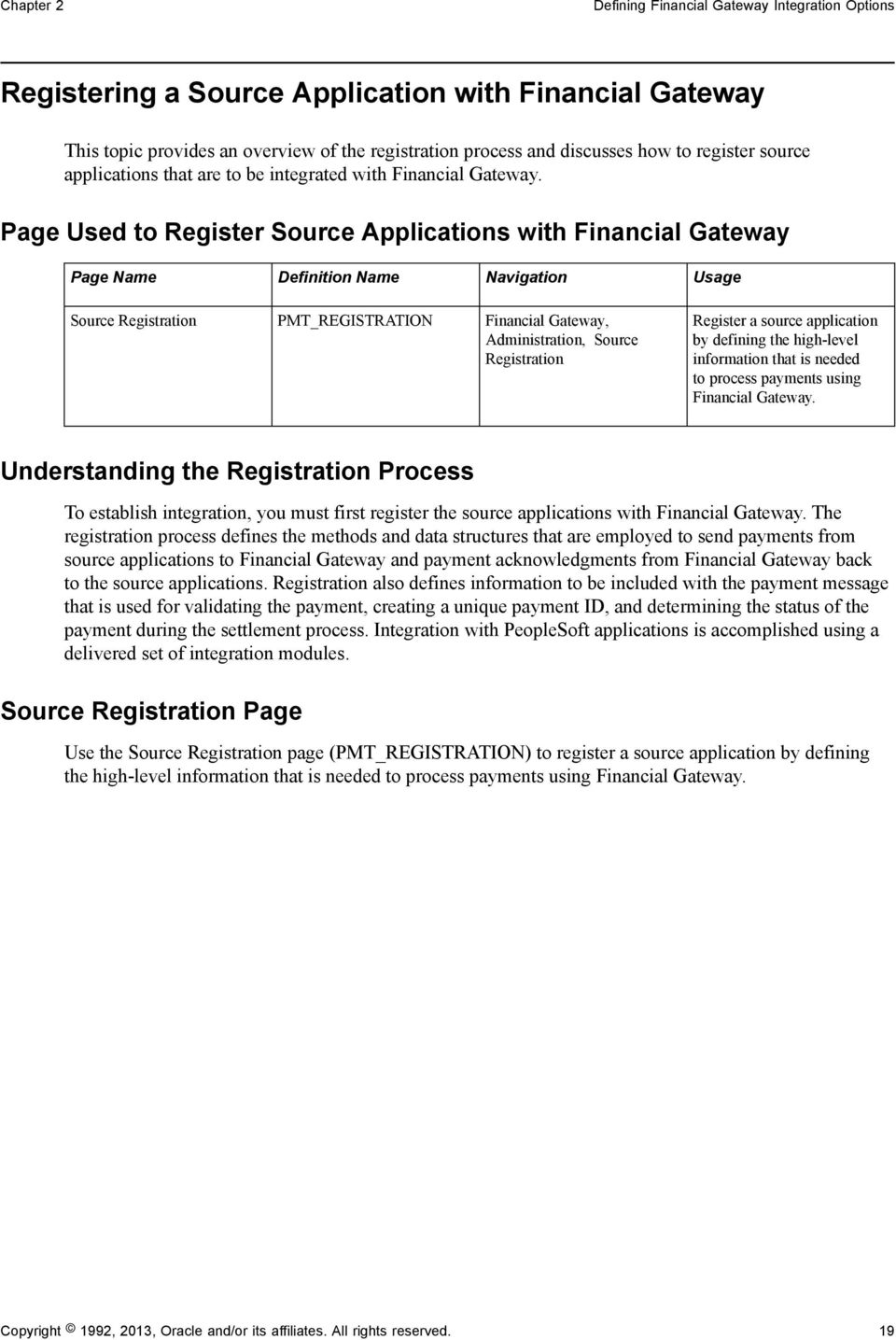
20 Defining Financial Gateway Integration Options Chapter 2 Navigation Financial Gateway, Administration, Source Registration Image: Source Registration page with Financials source system (1 of 2) This example illustrates the fields and controls on the Source Registration page with Financials source system (1 of 2). You can find definitions for the fields and controls later on this page. 20
21 Chapter 2 Defining Financial Gateway Integration Options Image: Source Registration page with Financials source system (2 of 2) This example illustrates the fields and controls on the Source Registration page with Financials source system (2 of 2). You can find definitions for the fields and controls later on this page. Integration Details The Integration Details field values are preconfigured for integration between Financial Gateway and other PeopleSoft applications. Changes should only be made for registering third-party applications. Inbound Integration Type and Outbound Integration Type Choose from the following options: Application Class: Select to perform integrations by calling application classes. If this value is selected, then a root package, path, and class ID are required. Integration Broker: Select to use Integration Broker to pass data between the source application and Financial Gateway. If this option is selected, you must enable the service operation used to pass the data. For example, for integration with Global Payroll, you must enable the service operation PAYMENT_RESPONSE_OUT_ASYNC to pass the data. See the product documentation for PeopleTools: PeopleSoft Integration Broker. 21
22 Defining Financial Gateway Integration Options Chapter 2 Note: The asynchronous response message PMT_ RESPONSE will be published only when the Outbound Integration Type is Integration Broker. Flat File: Select this option for making or canceling payments in predefined, comma-separated value (.csv) file format or a fixed-length field format from a third-party application. If this option is selected, a directory must be specified in the File Path field. None: Select if payment acknowledgment functionality is not enabled. This option is available only for outbound integration. Component Interface: Select this option for using a component interface to load transactions into Financial Gateway. This option is available only for inbound integration. Inbound Node Select the integration node to use if the External Publish check box is selected. Root Package ID Enter an application-class, package name. This field appears only if Application Class is selected as an outbound integration type. This value is delivered for integration with other PeopleSoft source applications. Path This field appears only if Application Class is selected as an outbound integration type. This value is delivered for integration with other PeopleSoft source applications. Application Class ID This field appears only if Application Class is selected as an outbound integration type. This value is delivered for integration with other PeopleSoft source applications. Node Name Select a node to be used for communication between the source application and Financial Gateway using the Integration Broker. This field appears only if Integration Broker is selected as an outbound integration type. External Source Select to enable the Execute Edit functionality that provides an additional level of data validation when you are importing payments from third-party applications. External Publish Select to send the PAYMENT_REQUEST message from the source application to Financial Gateway using an Integration Broker node. This field is available only if Application Class is selected as the inbound integration type. See Defining Integration Broker Settings for Payments. See Understanding the Payment Process in Financial Gateway. 22
23 Chapter 2 Defining Financial Gateway Integration Options Financial Sanctions Validation Select to require financial sanctions validation of payees for payments from this source application before they can be loaded into Financial Gateway. See "Understanding the Financial Sanctions Service (PeopleSoft FSCM 9.2: Banks Setup and Processing)". Dispatch on Load Click to enable lights-out processing for payment dispatch in Financial Gateway. If the Dispatch on Load check box is selected, the system schedules payment dispatch for each PMT_ MSG_ID upon payment load. Note: PeopleSoft Global Payroll sends multiple PMT_MSG_ IDs in a payroll run, so selecting this option will create multiple payment files. If Global Payroll does not want to generate multiple files, deselect this check box and dispatch payment separately. Send Load Response Errors Only Select to receive errors only during the Payment Load process. The default is to receive all response messages. This option is available only when Integration Broker is selected in the Outbound Integration Type field. Send Remittance Advice Select to indicate that Financial Gateway will send a remittance notification based on the entered Report Definition ID and Remittance ID as sender's address for each source system. This functionality is currently available only for PeopleSoft Financials source applications. See Understanding Electronic Banking. Report Definition ID (report definition identification) Enter the remittance advice report ID. Report ID (report identification) Enter the address of the sender of the remittance advice report. Status Integration Details The Status Integration Details group box enables you to select the number and types of payment statuses for determining the progress or state of each payment that is sent to a bank from a source application through Financial Gateway. This group box does not appear if None is selected as the outbound integration type. Select from the following choices: Canceled: Identifies a payment that has been canceled. This status can be sent only in response to a request to cancel a payment by a source application. Error: An error message can be generated and returned during any phase of the processing. If Financial Gateway cannot resolve the error, then the error message is returned to the source system to identify that the payment will not be executed without source application rework. An error message could be returned before a loaded status. Error messages consist of an error code and a description. 23
24 Defining Financial Gateway Integration Options Chapter 2 Flagged for Hold: The payment is being held from further processing until a manager or other approving authority gives approval to process it further. Awaiting Dispatch: The status after the payment is successfully persisted in the Financial Gateway database. A unique ID is generated in Financial Gateway and is returned to the source application with this status. In Process: Payment is currently in the process of being sent to the bank by the Dispatch Payment Application Engine. Dispatched to Bank: Payment has been sent to bank. When a payment progresses to this status, it can no longer be canceled. Received by Bank: Payment has been received by bank and is being processed. Paid: Payment has been settled. Payment Numbering Properties Payment ID Prefix Designate an alphanumeric prefix to use to identify the source application of the payment. Last Payment Number Represents the payment identification number of the last payment that was sent by the source application. This value is automatically updated as payments are sent to Financial Gateway. Drill Back Details This functionality defines how the user can drill back to the source application to view details of a payment in Financial Gateway. Note: Drill back functionality is currently available only in PeopleSoft Financials source applications. The Drill to Source Transaction field defaults to None for Global Payroll. Drill to Source Transaction Choose a method for drilling back to the source application to view transaction details. Select from the following values: Component: Use to drill back to a selected PeopleSoft source component using PeopleTools Transfer functionality. Using this method enables users to drill back to the source application using links on the Review Payment page and the Dispatch Payments page for users who have security access to the destination page. DoModal Component: Also used to drill back to a selected PeopleSoft source component. When you select this option, a shared work record is populated that contains the Financial Gateway ID of the transaction. This shared work record is used with the DoModal component call. Using this method, users can click a return button in Financial Gateway to drill back to the page of origin in the 24
25 Chapter 2 Defining Financial Gateway Integration Options source application, providing they have security access to the source application page. External URL: This option enables the user to specify an external URL to view detailed transaction information that is contained outside of the PeopleSoft system. This method launches a new browser and passes the Financial Gateway transaction ID and the key information that is specified in the Source Key Information grid as a parameter in the URL to the desired destination. None: Select this option to disable the inquiry component and the drill-to-source-application functionality. Menu Name Enter a valid PeopleTools object menu name. This field appears only if Component or DoModal Component is selected in the Drill to Source Transaction field. Component Name Enter a valid PeopleTools object component. This field appears only if Component or DoModal Component is selected in the Drill to Source Transaction field. Open in New Window Select to view transaction details in another Web browser when drilling back into a source application. This option is available only if External URL or Component is selected in the Drill to Source Transaction field. Source System Key Information Specify the metadata that are used by Financial Gateway to retrieve payment information from the source application. The retrieved payment data can be selected for display in Financial Gateway on the Review Payment Requests page and the Review Payment Details page. These field values are delivered preconfigured for PeopleSoft source applications. Source Fieldname Select a field from the source application that contains payment data to be displayed in Financial Gateway. Destination Field Select the field in the Payment Gateway records that stores the corresponding information found in the source field that is listed in the Source Fieldname field. Include in URL Select to include the field within the URL that is generated to pass control back to the source system. This provides the source system with navigation to the appropriate page and the appropriate content. Field Label ID Enter a label that is used to display the destination field. Display in Payment Details Select to display field values on the Review Payment Requests page and Review Payment Details page. Seq (sequence) Enter numbers that specify the order in which the fields are displayed on the Payment Details page. 25
26
27 Chapter 3 Setting Up Electronic Banking Using Financial Gateway Understanding Electronic Banking Financial Gateway provides the layouts and functionality needed to process electronic payments and load electronic bank statements and payment acknowledgments. You can also edit and expand the delivered functionality to suit your organization's needs. You will probably want to implement both the bank statement import and payment dispatch functionality; however, you can implement just one or the other. When the payment processing is implemented, users can implement payment acknowledgment functionality as well. This topic discusses the delivered functionality and configuration instructions. You can import a variety of bank formatted files by using: A file transfer protocol (FTP) file server. PeopleSoft Integration Broker. Hypertext transfer protocol (HTTP) using a uniform resource locator (URL). See "External Accounts - Payment Methods Page (PeopleSoft FSCM 9.2: Banks Setup and Processing)". Transformation Architecture Transformation programs (or Transforms) are application classes, PeopleSoft Application Engine (AE) programs, and BI Publisher templates that contain logic to convert source data into new output layouts. Transforms use Integration Point (IP) messages either as the source data or the transform output, depending on the direction. By using an AE for transformations, any PeopleTools technology, such as PeopleCode, Rowsets, File Layout Object, and XSLT, can be used to facilitate the creation of output layouts. Using these tools, you can create new layouts and maintain them in the standard PeopleSoft Application Designer environment. After you create a transformation program, you can register the program in the Layout Catalog for use in the processes. For bank statement processing, the transformation program processes the bank statement as the data source. The formatting logic of the transformation AE or application class then converts the data into the BANK_STATEMENT_LOAD_VERSION_2 or BANK_ACCT_ANALYSIS_LOAD IP message that is then loaded into the system. Payment Transformation programs do the opposite by processing the data that are contained in the PAYMENT_DISPATCH IP message into a new payment layout. The Payment Acknowledgment Transformation Application Engine program processes the inbound data from the bank into the PAYMENT_ACKNOWLEDGE message. 27
28 Setting Up Electronic Banking Using Financial Gateway Chapter 3 Note: The delivered transformations, though developed to industry standards, are designed to be customized to meet the specific requirements of individual financial institutions. See the product documentation for PeopleTools: PeopleSoft Integration Broker. Bank Statement Import Infrastructure This diagram illustrates the Bank Statement Import process in which a bank's bank statement data file is imported and transformed appropriately by a corresponding transformation program, which contains all the formatting data to stage the files for the Bank Statement Load Process. This load process picks up and 28
29 Chapter 3 Setting Up Electronic Banking Using Financial Gateway transfers the data to the PeopleSoft application tables and makes it available for viewing and editing on the various bank statement pages. Image: Bank Statement Import process flow from bank to PeopleSoft application Bank Statement Import process flow from bank to PeopleSoft application The Bank Statement Import process involves the following steps: 1. A bank administrator enters information pertaining to a bank statement data file. This initiates the File Import Application Engine process (IMPORT_FILES), which functions as an interface or shell to define the necessary commands for the system to import bank statements. 29
30 Setting Up Electronic Banking Using Financial Gateway Chapter 3 2. The File Import Application Engine reads the file's layout definition data (which is stored in the Layout Catalog) and calls the appropriate transformation process that corresponds to the file layout. 3. Each transformation Application Engine or application class handler has corresponding application classes that, combined with the balance and transaction codes (defined on the Balance Code and Transaction Code pages) and code mapping information (defined on the Code Mappings page), contain all of the required formatting logic to stage the data. Using the appropriate IP message, the transformation Application Engine loads the data into the staging tables. 4. After the data are loaded into the staging tables, the Bank Statement Load Application Engine process (TR_BSP_LOAD) transfers the data from the staging tables to the application tables. This process also checks for duplicate entries and verifies that the data will load into the application tables properly. When the data are in the application tables, they are available for viewing and editing on the various bank statement pages. Using the Import Bank Statements page, you can configure the File Import Application Engine process to manage various import methods. The functionality can load data from a flat file or transmit file data from an FTP or HTTP server by using PeopleSoft Integration Broker. If you decide to import the bank statement data by using FTP or HTTP, you must also set up the standard and bank statement importspecific settings for Integration Broker. After you define the Integration Broker settings, you can select the Use Integration Broker check box under Advanced Options on the Import Bank Statements page to send the bank statement to other processes after it has been loaded. See Defining Integration Broker Settings for Bank Statements and Payment Acknowledgments. 30
31 Chapter 3 Setting Up Electronic Banking Using Financial Gateway Bank Payment Infrastructure This diagram illustrates the Payment Dispatch process, which provides the functionality to generate payment files in a variety of layouts and securely transmit them to the financial institution or place the files in a directory for another system to transmit. Image: Dispatch Payment file generation and transmission process flow Payment dispatch process The Payment Dispatch process provides a flexible infrastructure that enables the user to define a variety of payment layouts, and encryption algorithms that are compatible with the financial institution. It also provides a structure that enables you to easily create new layouts or modify existing ones. When you dispatch settlements for processing, you activate the Dispatch Payments Application Engine process (PMT_DISPATCH). This process uses metadata that are defined at the bank setup level, the payment dispatch IP message (PAYMENT_DISPATCH), and payment layout transformation Application Engine programs to create formatted payment files. This overall process is called the Payment Dispatch process. The Payment Dispatch process brings together all the payment file processing features to: 1. Gather the bank setup metadata, such as bank integration information, payment method, payment layout, bank communication and encryption information, and payment grouping rules. 2. Generate the PAYMENT_DISPATCH IP message. The outbound Payment Dispatch IP is used as a data source for the transformation process. File layouts are created from the data that are contained within this message. 3. Transform the Payment Dispatch IP to the appropriate PeopleSoft Financials, global, payment layout or Oracle Payments layout that the bank can receive in its raw form and use to settle payments. 31
32 Setting Up Electronic Banking Using Financial Gateway Chapter 3 Payment layouts have an associated Application Engine program, application class, or BI Publisher template that generates a formatted file. 4. Encrypt data by using PeopleTools security encryption. 5. Transmit the final formatted file, by publishing it to PeopleSoft Integration Broker functionality, or writing to a file and calling an external command to transmit the file. The PAYMENT_DISPATCH IP message is a structure to facilitate publishing payments. The supported payment methods are Automated Clearing House (ACH), Electronic Funds Transfer (EFT), direct debits (DD), and wire transfers (WIR). The IP message contains a superset of all information that is needed to settle multiple payment types on a global scale. This information includes representative parties, such as the payment originator, bank of origin, destination, destination bank, and the various settlement identification information that is required in different countries. The IP message can be received directly by the financial institution for processing in its raw format, with no transformation work required. Conversely, the IP message can be processed by a transformation program that transforms the IP message into an industry-standard, payment file layout. The system uses the PAYMENT_DISPATCH IP as the data source for file transformation programs BI Publisher templates, Application Engine, or application classes to format payment output files. You set up the transformation program in the Layout Catalog. There you specify layout information, such as the BI Publisher template, transformation Application Engine, or application class that contains the logic to generate the layout, layout-specific parameters, and supported payment methods. Note: You can configure transformation Application Engine programs to use a combination of PeopleCode, file layouts, application classes, and XSLT to format files. Prenotifications A payment prenotification (prenote) is a zero-dollar, payment file sent to a debtor's bank to test if payments can be made to a creditor through that bank account. Financial Gateway processes prenotes similar to other payment files. Although prenotes can be sent using various payment methods, they are most often used as a prelude to ACH payment processing. ACH prenotes: Are zero-dollar, payment files. Can be sent alone or included among payments from the same debtor to different creditors. Have the transaction entry code of "28," signifying a prenotification of payment. EFT layouts are also used for transmitting direct debit prenotes in Financial Gateway. You must select the Supports Prenotes check box in the Bank Integration Layout Component to enable Financial Gateway to transmit prenotes. (Banking, Administer Bank Integration, Bank Integration Layout) See "Selecting EFT Layouts (PeopleSoft FSCM 9.2: Receivables)". Bank Payment Acknowledgments Infrastructure The infrastructure of the payment acknowledgments functionality is similar, though less complex, to the bank statement import infrastructure. This diagram illustrates the transmission of four types of payment 32
33 Chapter 3 Setting Up Electronic Banking Using Financial Gateway acknowledgement data from a bank that received the payments from the PeopleSoft Dispatch Payments program to the PeopleSoft application that sent that payments. Image: Payment acknowledgment import process flow from receiving bank to PeopleSoft applications Payment acknowledgment import process flow from receiving bank to PeopleSoft applications The Payment Acknowledgment Import process involves the following steps: 1. The File Import Application Engine process (IMPORT_FILES) downloads the payment acknowledgment into the system. Four types of acknowledgement are possible. The first acknowledgment file acknowledgement is sent after the payment file has been received and has passed basic bank validation involving checking for required fields and valid bank ID numbers. After the file has passed bank validation, and before actual settlement of the payment contents, an acknowledgement is generated to confirm whether the file is valid to continue processing or is in error. The second acknowledgement payment acknowledgement is sent after the actual payment has been processed by a clearing network or settlement process. The second acknowledgement can take the form of either a paid confirmation or an error message. Depending on the type of payment, a bank reference to the transaction, such as a federal reference number, may be included. 33
34 Setting Up Electronic Banking Using Financial Gateway Chapter 3 A third type of acknowledgment notifies the sender of payment errors that resulted in a failed processing attempt. The fourth type of acknowledgment notifies the sender of prenotification errors. A prenotification is a file sent to the debtor's bank to test if payments may be made to a creditor through the debtor's bank account. 2. The Payment Acknowledgment Import Application Engine reads the file's layout definition data (which is stored in the Layout Catalog) and calls the transformation program application class or the Payment Acknowledgment Transformation Application Engine (PMT_ACK_EIP) to convert it into a PAYMENT_ACKNOWLEDGE message and load the data into the application tables. 3. Payments and payment files in the Financial Gateway system are updated in accordance with the contents of the acknowledgements. If the source systems are set up to handle payment status updates, then the payments and payment files are also updated in the source systems as well. Tracking the status of prenotes between a debtor's bank account and a particular creditor is the responsibility of the source system. Financial Gateway does not track prenote status. 4. Users access the Review Acknowledgment Files page to view a listing of the payment acknowledgment files. Methods of Bank Communications You can use various methods of communications to send payments to banks and receive bank statements and payment acknowledgements. Certain setup tasks are required based on the method that you use. You can send payments that are outbound from Financial Gateway using: File Server Financial Gateway sends the payment files to a specified directory on a file server. The bank uses a third-party communications tool kit to transfer the payment files from the server to the bank. Integration Broker Financial Gateway sends the payment files to an Integration Broker node, which communicates with the bank using a specified connector FTP, AS2, or HTTP. You can import bank statements and payment acknowledgements from a bank using: File Server The bank uses third-party communications tool kit to transfer the bank statement or payment acknowledgement files to a specified directory on a file server. Financial Gateway uses the IMPORT_FILES Application Engine processes to import them into the system. Integration Broker The bank sends the bank statement or payment acknowledgement files to an Integration Broker node, which communicates with the Financial Gateway using a specified connector FTP, AS2, or HTTP. Use this table as a guide to determine the application page that you must set up to transmit a particular file type. 34
35 Chapter 3 Setting Up Electronic Banking Using Financial Gateway File Type Transmission Method Application Page Payment File Server Bank Integration Layout Payment Integration Broker Bank Integration Layout Bank Statement File Server Import Bank Statements (Import Type: File) Bank Statement Integration Broker using FTP connector Import Bank Statements (Import Type: FTP) Bank Statement Integration Broker using connector other than FTP Bank Integration Layout Payment Acknowledgment File Server Import Acknowledgement Files (Import Type: File) Payment Acknowledgment Integration Broker using FTP connector Import Acknowledgement Files (Import Type: FTP) Payment Acknowledgment Integration Broker using connector other than FTP Bank Integration Layout Setting Up Common Components for Bank Statement, Payment, and Payment Acknowledgment Processing To define event code notification, use the Enter Event Code Definition component (TR_EVENT_CD_DEF_GBL). This section discusses how to set up components that are used to: Import bank statements. Dispatch payments. Import payment acknowledgements. 35
36 Setting Up Electronic Banking Using Financial Gateway Chapter 3 Pages Used to Set Up Common Components for Bank Statement, Payment, and Payment Acknowledgment Processing Page Name Definition Name Navigation Usage Layout Catalog PMT_FORMAT_CATLOG Banking, Administer Bank Integration, Layout Catalog Create new or modify existing bank statement, payment, and payment acknowledgment layouts by defining transformation processing details, payment methods, parameters, and properties. Allowed format properties PMT_FORMAT_VALUES Banking, Administer Banking, Select the type of list option Layout Catalog, click to apply as the allowed format Allowed Values link. property. Code Mappings TR_CODE_MAPPINGS Banking, Administer Bank Integration, Code Mappings Define input and output values for mappings of a selected code map group. Event Code Definition TR_EVENT_CD_DEF_PG Set Up Financials/Supply Chain, Product Related, Treasury, Enter Event Code Definition Enter codes for system events, and define actions for the system to perform when they occur. Encryption Profile ENCRYPTION_PRFL PeopleTools, Security, Encryption, Encryption Profile Define encryption standards to be used to protect data when communicating with banks. Determine algorithms and store public and private keys that are used in encryption. Components Common to Bank Statement, Payment, and Payment Acknowledgment Processing These application pages are common to setting up the three electronic banking processes: Layout Catalog The Layout Catalog is a repository of information that is used for establishing how data should be formatted when processing bank statements, payments, and payment acknowledgements. Code Mappings For Bank Statement Import processing, you map external bank codes to their internal PeopleSoft equivalents to ensure efficient statement processing. For Dispatch Payment processing, the Code Mappings page is used to associate PeopleSoft input code values with external bank output code values. 36 (Optional) Event Code Definition
37 Chapter 3 Setting Up Electronic Banking Using Financial Gateway You can setup events that can occur during Bank Statement Import and Dispatch Payment processing so that interested parties will be notified by of those events. (Optional) Encryption Profile You can use encryption algorithms to secure statement and payment files that are sent between your organization and your bank. Understanding the Layout Catalog The Layout Catalog is the central repository for information regarding all supported bank payment, payment acknowledgment, and bank statement layouts. After a layout is added to this component, it is available for use within the system. The component contains all the information about a layout such as the transformation Application Engine program or application class that contains the logic to process the layout that the system needs at setup and runtime. This component can be configured to meet each bank's specific formatting needs. Note: PeopleSoft also provides additional miscellaneous layouts in the layout catalog that are used for importing various kinds of data. See Layout Catalog Page. Delivered Payment Layouts You can view these layouts by accessing the Layout Catalog page (Banking, Administer Bank Integration, Layout Catalog, Layout Catalog). PeopleSoft delivers these bank payment layouts: Layout ID Layout Name Supported Payment Method 820 EDI 820 payment layout Wire Transfer (WIR) 820 ACH EDI 820 payment layout for ACH Automated Clearing House (ACH) Direct Debit (DD) CCD NACHA CCD payment layout ACH DD CCD+ NACHA CCD+ payment layout ACH DD CTX NACHA CTX payment layout ACH DD DEU_INTL German International EFT Electronic Funds Transfer (EFT) (Used with BI Publisher template) 37
38 Setting Up Electronic Banking Using Financial Gateway Chapter 3 Layout ID Layout Name Supported Payment Method DEU_DOM German Domestic Payments WIR (Used with BI Publisher template) DIRDEB Edifact version 96A payment layout DD ESP_EFT Spanish EFT payment EFT (Used with BI Publisher template) FRA_EFT French EFT payment format. EFT (Used with BI Publisher template) FUNDTRNFR Funds Transfer WIR IAT NACHA IAT payment format ACH DD ISO_CT_03 ISO Credit Transfer V3, Pain.001. ACH EFT This layout is used for generic credit WIR transfers. ISO_DD_02 ISO Direct Debit Pain DD This layout is used for generic direct debits. ISOV2 ISO Credit Transfer V2, Pain.001. ACH EFT This layout is used for generic credit WIR transfers. ISOV2_DD ISO Direct Debit Pain DD This layout is used for generic direct debits. JPN_ZENGIN Japanese Zengin Format EFT (Used with BI Publisher template) MT101 SWIFT MT101 payment layout WIR EFT 38
39 Chapter 3 Setting Up Electronic Banking Using Financial Gateway Layout ID Layout Name Supported Payment Method MT103 SWIFT MT103 payment layout WIR EFT MT103 BULK Multi 103 payment layout WIR EFT NLD_INTL Netherlands International EFT EFT (Used with BI Publisher template) PAYMENTEIP PeopleSoft XML layout, PAYMENT_ DISPATCH IP Message ACH DD WIR EFT PAYMUL Edifact Version 96A payment layout EFT CORECRDTRN ISO Payment Initiation WIR PPD NACHA PPD Payment Format ACH DD SEPA_CT SEPA Credit Transfer, Pain ACH EFT WIR SEPA_CT_03 SEPA Credit Transfer V3, Pain Adheres to Rulebook version 4.0. ACH EFT WIR SEPA_DD SEPA Direct Debit, Pain DD SEPA_DD_02 SEPA Direct Debit V2, Pain DD Adheres to Rulebook version 4.0. STPCREDTRN ISO STP Credit Transfer WIR Delivered system-defined payment layout properties: 39
40 Setting Up Electronic Banking Using Financial Gateway Chapter 3 Layout ID Layout Name Description ISO_CNCL ISO Payment Cancellation Layout This layout is defined with document type Payment Cancellation and is used to send payment cancellation request to the bank. It is associated with corresponding payment layout through layout property. ISO_RVSL ISO Payment Reversal This layout is defined with document type Payment Reversal and is used to send payment reversal request to the bank. It is associated with corresponding payment layout through layout property. ISO_RVS_2 ISO Payment Reversal This layout is defined with document type Payment Reversal and is used to send payment reversal request to the bank. It is associated with corresponding payment layout through layout property. SEPA_RVSL Payment Reversal This layout is defined with document type Payment Reversal and is used to send payment reversal request to the bank. It is associated with corresponding payment layout through layout property. SEPA_RVS_2 Payment Reversal - Pain This layout is defined with document type Payment Reversal and is used to send payment reversal request to the bank. It is associated with corresponding payment layout through layout property. Delivered Bank Statement Layouts You can view these layouts by accessing the Layout Catalog page (Banking, Administer Bank Integration, Layout Catalog, Layout Catalog). PeopleSoft delivers these bank statement layouts: 40 Layout ID Layout Name Document Type BAI2 BAI2 bank statement layout Bank Statement EDI822 EDI 822 account analysis Bank Statement FINSTA FINSTA bank statement layout Bank Statement PSBD1 PeopleSoft Business Document version 1 Bank Statement
41 Chapter 3 Setting Up Electronic Banking Using Financial Gateway Layout ID Layout Name Document Type PSBD2 PeopleSoft Business Document version 2 Bank Statement (for PeopleSoft FMS 8.8 and later - see note) MT940 SWIFT MT940 bank statement layout Bank Statement MT942 SWIFT MT942 bank statement layout Bank Statement Note: You can import bank-statement, data files using the PSBD2 layout if you have Cash Management 8.8 or a later version installed and are using a third-party communication toolkit that has the capability of processing files in XML format. Sample files that can be used as guidelines for transforming bank statement date files into the PSBD2 layout can be found on Oracle's My Oracle Support website. Delivered Bank Payment Acknowledgment Layouts You can view these layouts by accessing the Layout Catalog page (Banking, Administer Bank Integration, Layout Catalog, Layout Catalog). PeopleSoft delivers these Payment Acknowledgment layouts: Layout ID Layout Name Document Type ACHNOC ACH Notification of Change Payment Return (notification that the payment contains errors) ACHRETURN NACHA acknowledgment Payment Return (payment or prenotification error statement of changes to be made before payments can be processed) BANSTA Edifact Version 96A Acknowledgment layout Payment Acknowledgment Edifact Version 96A Acknowledgment layout Payment Acknowledgment EDI997/824 EDI X12 997/824 Payment Acknowledgment (payment validated and payment complete) EDI 827 EDI Functional return layout Functional Return (payment error statement of changes to be made before payment is allowed) PMTACKEIP PeopleSoft Acknowledgment layout Payment Acknowledgment PMTINITACK ISO payment status XML Payment Acknowledgment CONTRL (bank payment acknowledgment) (bank payment file acknowledgment) 41
42 Setting Up Electronic Banking Using Financial Gateway Chapter 3 Layout ID Layout Name Document Type PMT_STATV2 ISO payment status V2, Pain Payment Acknowledgment PMT_STATV3 ISO payment status V3, Pain Payment Acknowledgment PAYREQEIP Inbound Payment Request PeopleSoft Inbound Payment layout in CSV or fixed-length, flat-file format. Delivered Miscellaneous Layouts You can view these layouts by accessing the Layout Catalog page (Banking, Administer Bank Integration, Layout Catalog, Layout Catalog). PeopleSoft delivers these additional layouts: Layout ID Layout Name Document Purpose POOL Pool Import Importing investment pool data in Cash Management STOCK Stock Import Importing stock quotes for Deal Management. SEC_MARKET Security Values Importing security market values OFAC OFAC sanctions list Importing list of Specially Designated Nationals (SDN) EU EU sanctions list Importing European Union SDN list SDN_LOAD Enterprise sanctions list Importing SDN list from within an enterprise SECURITY Security Definition Import Importing the security definition. See PeopleSoft FSCM 9.2: Banks Setup and Processing. See "Maintaining Pool Positions (PeopleSoft FSCM 9.2: Cash Management)". See "Maintaining Equities (PeopleSoft FSCM 9.2: Deal Management)". Related Links "Importing Security Definitions and Market Values (PeopleSoft FSCM 9.2: Deal Management)" 42
43 Chapter 3 Setting Up Electronic Banking Using Financial Gateway Understanding Code Mapping Code Mappings enable you to define the mappings between external system codes with their equivalent internal PeopleSoft codes. For example, PeopleSoft stores 03 account types as checking accounts, and the required code for the EDI 820 bank statement layout is DA for deposit account. Code mappings are used to map these hard-coded field values to each other so that the transformation program component can use them. This allows a single transformation program to be used across multiple banks even though the program may need different code mappings. Code mappings are most useful for fields that may change for every bank. Bank statement processing uses mappings for three fields: bank statement codes, reconciliation or "recon" codes, and statement activity types. For example, a bank identifies certain miscellaneous fees with the numeric code 564. If you define it as a Bank Fee, you can assign the input value of 564 to the output value of BKFEE. Other banks may use a different value to identify bank fee. See "Defining Statement Activities (PeopleSoft FSCM 9.2: Banks Setup and Processing)". There are three levels to the code mapping data-structure hierarchy: Code Map Group: The highest level, this is a container for all the fields for a given code map set. For instance, a code map group could represent all the code mappings for a particular bank. Code Map Header: The second level, this represents a particular field for which the transformation Application Engine obtains the code map. Code Map Items: The items contain all the possible input and output values for a particular field or header. To access Code Mappings defined in the database, use an application class entitled CodeMapper within the transformation program. Class CodeMapper To access Code Mappings, which is defined in the database, use an application class entitled CodeMapper within the transformation program. This table provides the details of the CodeMapper Application Class (Package - TR_CODE_MAPPING.Utilities). Note: The CodeMapper application class should only be accessed by advanced users to customize their layouts or create a new layout program. Method Description public The constructor for this class. CodeMapper() public String getdefault(string groupid, String fieldname) Obtains the default value for a code map field based on the group ID and field name. 43
44 Setting Up Electronic Banking Using Financial Gateway Chapter 3 Method Description public String Obtains an input value based on the group ID, field name, and output value that are passed into the method. getinput(string groupid, String fieldname, String outputval) public String getoutput(string groupid, String fieldname, String inputval) initializerowset(string groupid) Obtains an output value based on the group ID, field name, and input value that are passed into the method. Initializes the rowset that is used by the component. In essence, this method will obtain all the possible mappings for the given group ID. This minimizes the number of trips to the database and in turn decreases the amount of time to search for a value. This method must be called prior to any of the previous methods being called. The following code sample illustrates how to use the CodeMapper class within PeopleCode: /* Import the code mapping class into the people code where it is to be called */ import TR_CODE_MAPPING:Utilities:CodeMapper; /* Initialize the object (this initiates the constructor for the class */ &omapper = create CodeMapper(); /* Initializes the object to contain the data for the given Group */ &omapper.initializerowset(&strgroupid); /* Obtain the output value for the given Group ID, the field called "BANK_STMT_CODE" and the value in &strinput */ &stroutput = &omapper.getoutput(&strgroupid, "BANK_STMT_CODE", &strinput); Understanding File Encryption The files that are sent to and received from your bank during the Dispatch Payment and Bank Statement processes can be encrypted and decrypted. This functionality is provided by the PeopleSoft Encryption Technology (PET), which supports several industry standard encryption formats that are used by a large number of banks. To enable encryption and decryption, you need to create encryption profiles in PeopleTools. For complete instructions on setup and configuration, see PeopleTools: Security Administration. The general steps for setting up an encryption profile are: 1. Consult your bank to determine a common algorithm to use. Most likely, your bank will support either the PGP, SMIME, or PKCS#7 format. 2. Install the required toolkit to produce the encryption format. PGP requires a software developer kit to be purchased from the PGP Corporation. PKCS#7 requires OpenSSL. Some OpenSSL files are delivered with PeopleTools. Installation instructions can be found in PeopleTools: Security Administration. 3. Load public and private keys into the PeopleTools PET Keyset store. 44
45 Chapter 3 Setting Up Electronic Banking Using Financial Gateway PGP, SMIME, and PKCS7 require a key pair to be generated. PGP functionality requires a secondary utility called PGP Mail to help facilitate managing and creating keys. OpenSSL provides a command line where X509 key pairs can be generated. In either case, you will need to exchange public keys with your bank and load the banks public keys into the keystore. Note: Installing PGP Mail may cause encryption errors if you install it on the same machine as the PeopleSoft Process Scheduler and the PGP SDK. Also, OpenSSL provides some documentation on their Web site to help with the preceding setup task. See The PKCS#7 keys should not be self-signed certificates. They must be signed by a real Certification Authority (CA), such as VeriSign or your bank, or signed by a CA that you created with OpenSSL. Layout Catalog Page Use the Layout Catalog page (PMT_FORMAT_CATLOG) to create new or modify existing bank statement, payment, and payment acknowledgment layouts by defining transformation processing details, payment methods, parameters, and properties. 45
46 Setting Up Electronic Banking Using Financial Gateway Chapter 3 Navigation Banking, Administer Bank Integration, Layout Catalog Image: Layout Catalog page (1 of 2) This example illustrates the fields and controls on the Layout Catalog page (1 of 2). You can find definitions for the fields and controls later on this page. Image: Layout Catalog page (2 of 2) This example illustrates the fields and controls on the Layout Catalog page (2 of 2). You can find definitions for the fields and controls later on this page. Define the file layouts, output type, and integration options that a particular bank supports. The catalog stores information about the layout, the program name containing the logic to generate or process the layout, and additional required setup or processing parameters that the layout requires. 46
47 Chapter 3 Setting Up Electronic Banking Using Financial Gateway If the bank does not support any of the delivered layouts or has a modified version of a delivered layout, you can create a new layout or edit a delivered layout. After a new or modified layout is added to the Layout Catalog, it is available for use in the system. If you are adding new layouts or editing existing layouts for an organization's payment processing requirements, you must first create the new layout before you can continue this setup procedure. Follow the procedures to create a new layout that are outlined in the sections Defining Payment Grouping Rules, Defining Code Mappings for Banks Statements, Payments, and Payment Acknowledgments, and Creating Payment Layouts. Then add the new layout to the Layout Catalog. See Understanding the Layout Catalog. See Code Mappings Page. See Creating Payment Layouts. Layout Details Transformation Program Type Select the method used to create or process a file layout. The options are: AE Transform: Select to perform transformations by calling an Application Engine. Application Class: Select to perform transformations by calling application classes. If selected, then a Root Package, Path, and Class ID are required. BI Publisher: Select to generate payment files using a BI Publisher template. This option is used to support the five international payment layouts delivered by the Oracle Payments product. See Understanding the Layout Catalog. For payments, this transformation program will process the PAYMENT_DISPATCH IP into a payment file layout. For bank statements, this transformation will process a bankstatement file layout into the BANK_STATEMENT_LOAD or BANK_ACCT_ANALYSIS_LOAD IP. Report Name Select the BI Publisher report name used to generate the payment file. This field appears only if BI Publisher is selected in the Transformation Program Type field. Source Document Name Select the source document used to map the PAYMENT_ DISPATCH IP to the BI Publisher template. The source is a message object with the name IBY_PPIOUT_1_0. This field appears only if BI Publisher is selected in the Transformation Program Type field. 47
48 Setting Up Electronic Banking Using Financial Gateway Chapter 3 Root Package ID Enter an application class package name. This field appears only if Application Class is selected as the transformation type. This value is delivered for integration with other PeopleSoft source applications. Qualified Package/Class Path This field appears only if Application Class is selected as the transformation type. This value is delivered for integration with other PeopleSoft source applications. Application Class ID This field appears only if Application Class is selected as an outbound integration type. This value is delivered for integration with other PeopleSoft source applications. Result Message Name This field is used during communication with the Integration Broker. It is the name of the message that publishes the file layouts to the Integration Broker. For example, many of the payment layouts are delivered with the PMT_FLAT_FILE message. This means that the file layout will be published into the Integration Broker under the message name PMT_FLAT _FILE. In the message monitor, you will see instances of the PMT_FLAT_FILE message. This value can be changed to any unstructured message to help distinguish different layouts in the Integration Broker and control the communication properties for a message. When communicating with a bank's FTP server, for example, you may want files to be sent to different directories. For example, if you use the EDI 820 layout for wires and the CCD+ layout for ACH payments with the same bank, you may want to create a new message called PMT_CCD_FILE and set it as the Result Message Name for the CCD+ layout. In the Integration Broker, you can then assign communication properties to the PMT_ FLAT_FILE and then assign different communication properties to the PMT_CCD_FILE. If both layouts were communicated under the same message name, you could only specify one set of communication properties or one directory in this case. For payment acknowledgments, the required message is PAYMENT_ACKNOWLEDGE. For bank statements, this field displays the name of the output IP message from the transformation program. For all delivered bank statement layouts except EDI 822, the IP message is BANK_STATEMENT_LOAD_VERSION_2. Bank statement layout EDI 822 uses the IP message BANK_ACCT_ ANALYSIS_LOAD. 48 Grouping Rule This field appears only for payment layouts. Specify a payment grouping rule for the layout. Only one grouping rule can be applied to a payment layout. Default Max Payment Per File Enter the maximum number of payments allowed in a payment file of this type.
49 Chapter 3 Setting Up Electronic Banking Using Financial Gateway This field appears only for payment layouts. Default Max Payment Per File Enter the maximum number of payments allowed in a payment file of this type. This field appears only for payment layouts. Supported Payment Methods This group box appears only for payment layouts and is used for defining the specific payment methods that are supported by the payment layout. Select a layout payment method. Values are: Automated Clearing House Direct Debit Electronic Funds Transfer Wire Transfer See the payment layout table for a list of delivered layouts and their corresponding payment methods. See Understanding the Layout Catalog. Layout Properties Layout Properties are information that is needed by a transformation program to successfully create and process a layout. A layout property can be anything, but generally is either a data value that is needed by a layout that is not captured in the system or a processing flag that is needed by a transformation program. These properties are defined at design time, bound with values at setup time, and available to the transformation program at runtime. The values for these defined properties are captured at setup time for every bank. For example, the layout property SENDER_ID, which is used by the EDI 820 payment layout, identifies the ID of the party that is sending the file. No field is defined in Financial Gateway to store this value, yet this layout requires the property at runtime. Adding SENDER_ID to the layout properties allows this value to be set up for every bank. At runtime, this value is available to the transformation program to be included in the 820 layout. Property Code Displays the name of the layout field. Important! If you specify a default, file-extension value for the FILEEXT property code, you must enter a period before the file extension. For example, you enter.txt, not TXT. Type Specify the property code data type: Date, Number, String, Time, or Yes/No. Property Level This determines where the property will be set up: bank, account, or system level. For payment layouts, this also determines where in the PAYMENT_DISPATCH IP this value is available to the transform program. System and bank level properties are 49
50 Setting Up Electronic Banking Using Financial Gateway Chapter 3 available in the PMT_HEADER_PROP record. Account level properties are available in the PMT_BATCH_PROP record. For payment files, the layout property values are included in the PAYMENT_DISPATCH IP for use in transformation programs at runtime. The records PMT_HEADER_PROP and PMT_BATCH_PROP contain these values. If you are creating a new transformation program and need to capture some setup information, such as company TAXID, a layout property would be added to the Layout Catalog. It would be set up at bank of account level. You can then use this information in the PAYMENT_DISPATCH message of the transformation program. Required Select to indicate that this property code is required. Read Only Select to make this property code a display-only value. This type is good for system settings that need to be captured, but do not vary by bank. Max Length (maximum length) Enter the maximum character length. At setup time, the entered value is validated to ensure that it is not longer than the maximum length and is the type specified (for example, string, number, yes/no, and so on). Click the Allowed Values icon to access the Allowable Format Properties page (PMT_FORMAT_VALUES), where you can select the type of list option to apply as the allowed format property. Select one of these list options: All Code Map Groups A code map group defines the mapping between external bank codes with their equivalent internal PeopleSoft codes for both bank statement and bank payment processing. List of Values This list limits the choice of allowable values for a property code. For example, the PAYREQEIP layout limits the FILETYPE property values to either a CSV or FIXED format. 50 Default Value Enter a property-code, default value. You can override this value when defining integration layouts for a bank or account. Sequence Enter sequence numbers to prioritize the property codes. Properties with lower numbers will be displayed first at setup time. During the transformation process, the system processes property codes from the lowest to the highest value.
51 Chapter 3 Setting Up Electronic Banking Using Financial Gateway Code Mappings Page Use the Code Mappings page (TR_CODE_MAPPINGS) to define input and output values for mappings of a selected code map group. Navigation Banking, Administer Bank Integration, Code Mappings Image: Code Mappings page This example illustrates the fields and controls on the Code Mappings page. You can find definitions for the fields and controls later on this page. This page enables you to define the mapping between external bank codes with their equivalent internal PeopleSoft codes for both bank statement and bank payment processing. Bank statement processing uses mappings for three fields: Bank Statement Codes, Reconciliation Codes, and Statement Activity Types. For example, a financial organization identifies certain miscellaneous fees with the numeric code 564. If you define a statement activity type of Bank Fee (BNKFEE), you can assign the input value of 564 to the output value of BNKFEE. Copy Click to create a new mapping group based on the parameters of the current, code map group. Mapping Name Enter a mapping name. Default Value Enter a default value for the specific map. The system uses this defined default value if it cannot match the existing mapping input value and you do not select the Return Input if No Match check box. 51
52 Setting Up Electronic Banking Using Financial Gateway Chapter 3 Return Input if No Match Select to indicate that the system should use the input value as the map-to value if the system cannot match the existing mapping-input value with a defined input value. Field Values Enter the Input Values and the corresponding Output Values to which they are to be mapped. For bank statement processing, the Input Values are the external bank codes, and the Output Values are the PeopleSoft codes. For bank payments, the Input Values are the PeopleSoft codes, and the Output Values are the external bank codes. Event Code Definition Page Use the Event Code Definition page (TR_EVENT_CD_DEF_PG) to enter codes for system events, and define actions for the system to perform when they occur. Navigation Set Up Financials/Supply Chain, Product Related, Treasury, Enter Event Code Definition Image: Event Code Definition page This example illustrates the fields and controls on the Event Code Definition page. You can find definitions for the fields and controls later on this page. 52 Notify Flag Select for the system to send an or workflow message to the specified party if this event occurs. Recipient Type Select Person if the message recipient is a specific employee. Select Role if the message recipients should include all users in a specific role, such as a manager. Notify Template Select the message text template. Notify To This field is dependent on the selected Person/Role field value. If you select Person, enter the address of the person to notify. If you select Role, enter the role name.
53 Chapter 3 Setting Up Electronic Banking Using Financial Gateway Note: To enable this notification functionality, you must setup and configure the PeopleTools Simple Mail Transfer Protocol (SMTP) functionality. See the product documentation for PeopleTools: Workflow Technology. Setting Up PeopleSoft Integration Broker for Bank Statements, Payments, and Payment Acknowledgements PeopleSoft Integration Broker is delivered with many integration points to send and receive data with a third-party system. These integration points are implemented using service operations. PeopleSoft delivers the service operations in PeopleSoft Integration Broker with a default status of Inactive. You must activate each service operation before attempting to send or receive data from a third-party source. The service operations for PeopleSoft Cash Management s Financial Gateway include: Service Operation Description Direction and Type Handlers BANK STATEMENT FILE Receives non-xml or unstructured bank statements into the Financial Gateway. Inbound ProcessFile Sends request from the third-party source to Financial Gateway to cancel a payment. Sends message synchronously. Inbound Receives payments into the Financial Gateway. Inbound REQUEST PAYMENT STATUS Sends request from the thirdparty source for the status of a payment ID. The Financial Gateway responds with the payment status. Inbound PAYMENT_RESPONSE_ OUT_ASYNC Financial Gateway sends a response message asynchronously for the incoming payment request. Outbound CANCEL PAYMENT LOAD PAYMENT Asynchronous REQUESTHDLR Synchronous REQUESTHDLR Synchronous REQUESTHDLR Synchronous (none) Asynchronous Note: The PMT_RESPONSE message is published only when the Outbound Integration Type is Integration Broker on the Source Registration page. 53
54 Setting Up Electronic Banking Using Financial Gateway Chapter 3 Service Operation Description Direction and Type Handlers PMT_ACKNOWLEDGE Sends a payment acknowledgement status that the payment was received. Outbound (none) PAYMENT ACKNOWLEDGE FILE Sends an unstructured acknowledgement from PeopleSoft that the payment was received. Inbound PAYMENT CANCEL Sends request from the third-party source to Financial Gateway to cancel a payment. Sends message asynchronously. Inbound Sends a payment status request from the source asynchronously. Inbound Sends a payment message from the Financial Gateway using a flat file structure. Outbound PAYMENT_REQUEST PMT FLAT FILE PMT FLAT FILE INBOUND Asynchronous ProcessFile Asynchronous ProcessCancel Asynchronous ProcessPayments Asynchronous (none) Asynchronous Sends a payment message to Inbound the Financial Gateway using a Asynchronous flat file structure. ProcessFile Setting Up Service Operations To activate a service operation, complete the following steps in PeopleSoft Integration Broker: 1. Activate the service operation. On the General tab of the Service Operations component, select the Active check box for the applicable service operation version. If the desired version is not the default version for the service operation, the default version must also be activated. 2. For asynchronous service operations only, verify the queue is running. On the General tab of the Service Operations component, select the View Queue link at the bottom of the page. On the Queue Definitions page, verify the Queue Status field has a value of Run. 3. Activate the service operation handlers. Note: This step does not apply to all service operations. On the Handlers tab of the Service Operations component, select the value of Active in the Status field for all needed handlers. 54 For inbound asynchronous service operations, activate the OnNotify handler. For inbound synchronous service operations, activate the OnRequest handler. If you are using chunking on an outbound service operation, activate the OnRoute handler.
55 Chapter 3 Setting Up Electronic Banking Using Financial Gateway 4. Activate the service operation routings. On the Routings tab of the Service Operations component, activate a routing definition for each node that will send or receive data. To activate a routing, select the check box next to the routing definition and click the Activate Selected Routings button. Activate an inbound routing to receive data into PeopleSoft Financial Gateway. Activate an outbound routing for sending data to a third-party system or another PeopleSoft product. Activate a local routing for sending data using an effective-dated outbound service operation. Activate a local routing to receive inbound flat files. You must activate at least one routing if the data are being sent in an XML format. You can skip this step if a batch publish rule is set up to post to a flat file only. 5. Verify the routing definition parameters. On the Routings page of the Service Operations component, select the link attached to the routing definition name. This link accesses the Routing Definitions component. Select the Parameters tab and complete the following steps: Confirm the external alias name in the External Alias field for the routing is correct. When sending or receiving data, the Integration Broker determines which routing to use by referring to the external alias name, not the routing name. Add or verify the transform programs on this routing definition. A routing definition defines the sending and receiving nodes for a transaction and specifies any inbound and outbound transformations to invoke. A transform program is a type of PeopleSoft Application Engine program that can convert data from one format to another; for example, from XML to a flat file. Use a transform program when one node sends a request or response message with a data structure different from the structure required by the other node. Many predefined routings are delivered with transform programs. You must decide, based on your unique situation, to change, remove, and add transform programs. For example, some delivered transform programs convert data to the EDI format, if you are not using EDI then you will want to use a different routing definition or remove that transform program from the routing definition. 6. Verify the node from the routing is active. Go to the Node Definitions page and verify the Active Node check box has been selected for any sender or receiver nodes used in the routings that you activated on your Service Operations - Routings page. Financial Gateway communicates with the third-party bank using an Integration Broker node with a specified connector. The Integration Broker contains a set of communication connectors that will provide connectivity with most banks. The most common connectors used are the FTP, FTPs, AS2, HTTP, HTTPS, FILE, and JMS. 7. For an outbound service operation, verify the node or routing is connected to the correct network. 8. For inbound service operations using a flat file, define the inbound file rule and run control parameters: 55
56 Setting Up Electronic Banking Using Financial Gateway Chapter 3 For X.12 formatted EDI files, use the Inbound File Loader Rules page and the Inbound File Processing run control under the Integration Broker menu. For PeopleSoft formatted files, use the File Inbound page and the Inbound File run control under the Enterprise Components menu. Note: For complete information on the setup and use of service operations, see PeopleTools: PeopleSoft Integration Broker for your PeopleTools release. Pages Used to Set Up PeopleSoft Integration Broker Page Name Definition Name Navigation Usage Service Operations - General IB_SERVICE PeopleTools, Integration Broker, Integration Setup, Service Operations, General Define and activate a service operation. Service Operations - Handlers IB_SERVICEHDLR PeopleTools, Integration Broker, Integration Setup, Service Operations, Handlers Activate one or more service operation handlers. Service Operations - Routings IB_SERVICERTNGS PeopleTools, Integration Broker, Integration Setup, Service Operations, Routings Define and activate routing definitions on the service operation. Queue Definitions PeopleTools, Integration Activate the queue used by Broker, Integration the service operation. Setup, Service Operations, General. Select the View Queue or Add New Queue link. PeopleTools, Integration Broker, Integration Setup, Queues, Queue Definitions PeopleTools, Integration Broker, Integration Setup, Service Operations, Routings. Select the Details link. PeopleTools, Integration Broker, Integration Setup, Routings, Parameters Routings - Parameters Node Definitions 56 IB_QUEUEDEFN IB_ROUTINGDEFNDOC IB_NODE PeopleTools, Integration Broker, Integration Setup, Nodes, Node Definitions Verify the external service alias names used by this routing. Activate node used by the service operation.
57 Chapter 3 Setting Up Electronic Banking Using Financial Gateway Page Name Definition Name Navigation Usage Nodes - Connectors IB_NODECONN PeopleTools, Integration Broker, Integration Setup, Nodes, Connectors For an outbound service operation, verify the node is connected to the correct network. Full Data Publish Rules EO_MSGPUBFULL Enterprise Components, Integration Definitions, Full Data Publish Rules Activate the full data publish rule for the service operations using the full data publish rules. Batch Publish Rules EO_MSGPUBATCH Enterprise Components, Activate the batch publish Integration Definitions, Batch rule for the service operations Publish Rules using the batch publish utility. File Inbound EO_FILE_INBOUND Enterprise Components, Integration Definitions, Inbound File Rule Define the parameters to receive inbound flat files from third-party systems. See the product documentation for PeopleTools: PeopleSoft Integration Broker and PeopleTools: PeopleSoft Integration Broker Administration. Defining Integration Broker Settings for Payments Use the Node Definitions page (IB_NODE) to activate node used by the service operation. 57
58 Setting Up Electronic Banking Using Financial Gateway Chapter 3 Navigation PeopleTools, Integration Broker, Integration Setup, Nodes, Node Definitions Image: Node Definitions page This example illustrates the fields and controls on the Node Definitions page. Payment files can be sent to the Integration Broker for communication with your bank. The Integration Broker contains a set of communication connectors that will provide connectivity with most banks. The most common connectors used are the FTP, FTPs, AS2, HTTP, HTTPS, FILE, and JMS. The Bank Integration Layouts component enables you to specify an output type for payment files. If you select Integration Broker, then a node must be entered. At runtime, the payment will be asynchronously published to this node in the Integration Broker. Integration Broker then provides the communication functionality. Before you begin enabling Integration Broker service operations, you must set up the basic Integration Broker settings, such as Gateway, and application server with service operations enabled, domain active, channels active, messages active, and so on. Define the settings to process payment files through PeopleSoft Integration Broker using an output-type service operation. 1. Create a node definition that represents the bank on the Node Definitions page. 2. Activate a corresponding outbound, asynchronous service operation routing for the node definition on the Service Operations - Routings page. 58
59 Chapter 3 Setting Up Electronic Banking Using Financial Gateway PeopleSoft delivers the PMT_FLAT_FILE service operation for the delivered layouts. Both the layouts and the corresponding service operation are configured to be published to the Integration Broker. To implement payment processing functionality, select the PMT_FLAT_FILE service operation. 3. Complete the Nodes - Connectors page. Define connector properties information at the node or node transaction level on the Connectors page. Integration Broker comes with a variety of connectors that can be used. The primary connector for use with banks is the FTPTARGET connector. This enables you to send files using FTP and FTPs to your bank. If you use Integration Broker with the FTP connector ID FTPTARGET and leave the FILENAME parameter blank, the PMT_DISPATCH process will override this property and generate a unique filename for each message using the Bank Integration Layout properties FILENAME and FILEEXT to generate this value. Some banks, however, require all files to be sent under the same filename. Therefore, define the connector property FILENAME with a value to ensure that all files are delivered to the bank with the same filename. Note: You can configure your Integration Broker node to use an AS2 connector. See the product documentation for PeopleTools: PeopleSoft Integration Broker and PeopleTools: PeopleSoft Integration Broker Administration. Defining Integration Broker Settings for Bank Statements and Payment Acknowledgments Use the Integration Broker - Connectors page (IB_NODECONN) to for an outbound service operation, verify the node is connected to the correct network. 59
60 Setting Up Electronic Banking Using Financial Gateway Chapter 3 Navigation PeopleTools, Integration Broker, Integration Setup, Nodes, Connectors Image: Integration Broker - Connectors page This example illustrates the fields and controls on the Integration Broker - Connectors page. You can find definitions for the fields and controls later on this page. Note: This section describes how to set up an Integration Broker node for importing bank statement files and payment acknowledgment files from an FTP server. Files can also be imported from a bank using a file server a method that neither employs Integration Broker nor requires setting up an Integration Broker node. To set up an Integration Broker node for importing files from an FTP server: 1. Create a new node, name it, and enter a description for the node. Leave the default values for all the other fields. 2. On the Connectors page, select FTPTARGET in the Connector ID field. The appropriate properties for the FTP Target connector are displayed. 3. Enter the appropriate property values: FTPS 60 A yes (Y) or no (N) value. Determines whether the target FTP server requires a secured FTP connection or not.
61 Chapter 3 Setting Up Electronic Banking Using Financial Gateway HOSTNAME The host name of the FTP server. For example, for the URL ftp:// the host name would be www. hostname.com. METHOD The FTP method that is being used. Enter either PUT or GET. The system will always use GET when importing a bank statement regardless of which value is entered in this field. PASSWORD The password that corresponds to the USERNAME value to access the FTP server. This value must be encrypted. To obtain an encrypted version of the password, use the Password Encryption Utility at the bottom of the page. TYPE The type of files that are to be transferred ASCII or BINARY. USERNAME The user name that is used to access the FTP server. Send Uncompressed A yes (Y) or no (N) value. Determines whether to send files compressed or not. Note: The system uses values that are defined on the Bank Statement Import page to automatically override two node connector properties, DIRECTORY and FILENAME. Note: You can configure your Integration Broker node to use an AS2 connector. See the product documentation for PeopleTools: PeopleSoft Integration Broker and PeopleTools: PeopleSoft Integration Broker Administration. Setting Up Bank Statement Processing This section describes the components that you use for setting up the Bank Statement Import process and discusses how to: Define balance codes. Define transaction codes. Pages Used Exclusively for Setting Up Bank Statement Processing Page Name Definition Name Navigation Usage Balance Codes BSP_BAL_CODES Banking, Administer Bank Statements, Bank Statement Codes Define bank statement code information. Also select three favorite statement codes for display in online inquiry pages. 61
62 Setting Up Electronic Banking Using Financial Gateway Chapter 3 Page Name Definition Name Navigation Usage Transaction Codes BSP_TXN_CODES Banking, Administer Bank Statements, Bank Statement Codes, Transaction Codes Define bank statement, transaction code information, such as activity type and payment method. Components Used to Set Up Bank Statement Processing Use these application pages to set up the Bank Statement Import process. Balance Codes Define codes that are used for bank statement balances. See Defining Bank Statement Balance Codes. Transaction Codes Define codes that are used for bank statement transaction information. See Defining Transaction Codes. Code Mappings Define the mappings between external system codes with their equivalent internal PeopleSoft codes. See Code Mappings Page. Layout Catalog See Layout Catalog Page. (Optional) Event Code Definition See Event Code Definition Page. Node Definition (required only if you are using Integration Broker) See Setting Up PeopleSoft Integration Broker for Bank Statements, Payments, and Payment Acknowledgements. (Optional) Encryption Profile See Understanding File Encryption. Note: If you create new layouts or modify existing ones for an organization's bank-statement-processing requirements, you must add them to the Layout Catalog. Defining Bank Statement Balance Codes Use the Balance Codes page (BSP_BAL_CODES) to define bank statement code information. Also select three favorite statement codes for display in online inquiry pages. 62
63 Chapter 3 Setting Up Electronic Banking Using Financial Gateway Navigation Banking, Administer Bank Statements, Bank Statement Codes Image: Bank Statement Codes - Balance Codes page This example illustrates the fields and controls on the Bank Statement Codes - Balance Codes page. You can find definitions for the fields and controls later on this page. Assign balance codes to each balance line and determine how the reconciliation process manages them. Assign a balance code to each balance entry that is received electronically or entered manually. Statement Code Enter a three-digit statement code that is to be defined. Type Code Indicate whether the code is a Status or Summary code. CR/DB (credit/debit) Indicate whether the code is a CR (credit) or DB (debit), or select NA (not applicable) if this categorization does not apply. Display Balance Select to indicate that the balance is a favorite balance. The system automatically displays the favorite balances on certain pages, such as the Bank Balance Inquiry page. You can select no more than three bank balances, however, you can change these selections at any time. Defining Transaction Codes Use the Bank Statement Codes - Transaction Codes page (BSP_TXN_CODES) to define bank-statement, transaction-code information, such as activity type and payment method. 63
64 Setting Up Electronic Banking Using Financial Gateway Chapter 3 Navigation Banking, Administer Bank Statements, Bank Statement Codes, Transaction Codes Image: Bank Statement Codes - Transaction Codes page This example illustrates the fields and controls on the Bank Statement Codes - Transaction Codes page. You can find definitions for the fields and controls later on this page. The system assigns transaction codes to each bank-statement-transaction line during electronic load or manual entry. The transaction code determines how reconciliation processes the specific line item. Trans Code (transaction code) 64 Identifies the type of transaction in a bank statement. Select from: Automated Clearing House Bank Adjustments Bill of Exchange - Disburse Bill of Order - Disburse Check Deposits Direct Debit Direct Debit - Disburse Drafts Electronic Funds Transfer Fee Expense Funding Receipt General Transaction
65 Chapter 3 Setting Up Electronic Banking Using Financial Gateway Interest Expense Manual Check Miscellaneous Transaction Payment Stop Pay (stop payment) Trade Receipt Voided Payment Wire - Disbursement Wire - Incoming Activity Select a bank-statement activity type. Payment Method Identifies the payment method that is specified for a transaction code. Select from: ACH: Automatic clearing house. Check Cust Draft: Customer draft. Direct Debit EFT: Electronic funds transfer. EFT Drafts: Electronic funds transfer drafts. Giro-EFT: Giro-electronic funds transfer. Giro-Manual Giro-manual. LC: Letter of credit. Manual: Manual check. Wire: Wire transfer. Vndr Draft: Vendor draft. Wire: Wire disbursement. Related Links "Defining Statement Activities (PeopleSoft FSCM 9.2: Banks Setup and Processing)" 65
66 Setting Up Electronic Banking Using Financial Gateway Chapter 3 Setting Up Payment Processing To define external commands, use the External Command component (PMT_EXT_COMM_CMP_GBL). This section lists the pages and functionality that are involved in Financial Gateway electronic banking payment processing: Payment Grouping Rules Definitions of rules that determine what payments can be grouped together in the same file. See Payment Grouping Rules Page. Layout Catalog See Layout Catalog Page. Code Mappings See Code Mappings Page. (Optional) Event Code Definition See Event Code Definition Page. Node Definition (required only if you are using Integration Broker to transmit payment files) See Setting Up PeopleSoft Integration Broker for Bank Statements, Payments, and Payment Acknowledgements. (Optional) Encryption Profile See Understanding File Encryption. (Optional) External Commands Captures the setup information that is needed to call third-party toolkits to provide encryption and communication of payment files. External commands can be used when you are transmitting payment files using FTP. See External Command Page. Bank Integration Layouts This component is the main setup component where file layouts, output type, and integration options are associated with a bank. See Bank Integration Layouts Page. External Accounts - Payment Methods - Electronic Layouts Captures how each account's payment method is settled and in what layout. Payments can be settled through the Financial Gateway Dispatch Payments or Payables' Pay Cycle Manager. 66
67 Chapter 3 Setting Up Electronic Banking Using Financial Gateway See "External Accounts - Payment Methods Page (PeopleSoft FSCM 9.2: Banks Setup and Processing)". How you set up the payment processing functionality depends on the implementation. Because each organization or bank has differing payment layout requirements, delivering all possible layout variations to suit all needs would be exceedingly difficult. If you use the delivered functionality and do not need to make any modifications or changes, you have fewer setup tasks. If you are creating new layouts or editing existing layouts for an organization's payment processing requirements, you need to first create the payment layout and all its supporting functionality. Specifically, you need to define payment grouping rules and code mappings, and you must also create the file layout objects and formatting logic for new (or modified) payment layouts. Note: If you create new layouts or modify existing ones for an organization's payment processing requirements, you must add them to the Layout Catalog. Pages Used Exclusively for Setting Up Payment Processing Page Name Definition Name Navigation Usage Payment Grouping Rules PMT_CHUNK_DEFN Banking, Administer Bank Integration, Payment Grouping Rules Define fields to include for a specified payment grouping rule. Bank Integration Layouts BANK_INTEGRATION Banking, Administer Bank Integration, Bank Integration Layout Define layouts and transformation programs for a specific bank. External Accounts - Payment Methods PYMNT_BANK Banking, Bank Accounts, External Accounts, Payment Methods Define the payment methods that are supported for an account, payment processing options, and EFT file attributes. For each account, you can enter multiple payment methods. External Command PMT_EXT_COMM_PG Banking, Administer Bank Integration, External Command Optional if output type is file. This is the external command to carry out after the file is output. Define command line information to carry out an external toolkit. This enables you to integrate with third-party toolkits (such as security and communications toolkits) and define command parameters that call executable files, batch files, and command-line functions. 67
68 Setting Up Electronic Banking Using Financial Gateway Chapter 3 Payment Grouping Rules Page Use the Payment Grouping Rules page (PMT_CHUNK_DEFN) to define fields to include for a specified payment grouping rule. Navigation Banking, Administer Bank Integration, Payment Grouping Rules Image: Payment Grouping Rules page This example illustrates the fields and controls on the Payment Grouping Rules page. Each payment layout specification defines rules for grouping payments into the file. Grouping rules determine how payments are grouped together into payment files. Certain layouts require a different file for every payment, and other layouts require a separate file for each different business date in a file. For example, the SWIFT MT103 payment layout requires that only one payment exist in a file; therefore, the associated grouping rule is SINGLEPAYMENT. Other layouts have different rules. For example, CCD+ files can contain payments from multiple accounts and multiple processing dates, so the grouping rule is BANK, and payments for this bank can be included in the same file. For layouts requiring payments to be processed on the same day, you can use the BANKDATE file grouping rule. You can change file grouping rules to accommodate a layout with a specific bank's requirement. To define a file grouping rule, enter the fields to group for a payment type. 68
69 Chapter 3 Setting Up Electronic Banking Using Financial Gateway There are essentially three layers of filtering that determines how payments are grouped together: 1. Initially the system groups all payments by bank code, setid, payment layout, and payment method. This level of filtering is hard coded in the system and cannot be changed or overwritten. 2. Next, the payment file grouping rules, entered in the top grid, further define how the payments are grouped together, thus determining how many payment files are ultimately created during the payment load process. 3. Finally, the payment batch grouping rules define how payments within a file are grouped together. PeopleSoft delivers the following grouping rules: Payment File Grouping Rule Description BANK All payments from a bank. BANKACCOUNT All payments from a specified bank account. BANKACCOUNTDATE All payments from a bank account and on a payment date. BANKDATE All payments from a bank and on a payment date. SINGLEPAYMENT One payment per file. Payment Batch Grouping Rules This set of fields adds an additional level of filtering that further defines how payment lines and payments are grouped together in a file. Because some payment layouts have additional requirements, this feature allows users to further define the logic for grouping payments. An example is the payment layout using ISO XML messages (credit transfer initiation and STP credit transfer). After the payments have been grouped together in a file based on the file grouping rules, they can be further grouped by fields such as business unit, source system, currency code, payment date, and payment ID. The maximum number of additional grouping fields is ten. Bank Integration Layouts Page Use the Bank Integration Layouts page (BANK_INTEGRATION) to define layouts and transformation programs for a specific bank. 69
70 Setting Up Electronic Banking Using Financial Gateway Chapter 3 Navigation Banking, Administer Bank Integration, Bank Integration Layout Image: Bank Integration Layouts page This example illustrates the fields and controls on the Bank Integration Layouts page. You can find definitions for the fields and controls later on this page. Layout Select a layout from the Layout Catalog to enable for this bank. Values that are defined for the layout automatically populate the Layout Properties region. View Layout Details Click to access the Layout Catalog page and view details of the payment layout. File Output Type 70 Integration Broker Select to publish the layout as an IP message to the Integration Broker. File Select to send the layout to a file. Requires that the FILENAME, FILEEXT, and FILEPATH layout properties be defined. EBICS Select to indicate this layout follows EBICS protocol requirements.
71 Chapter 3 Setting Up Electronic Banking Using Financial Gateway For more information about using the EBICS protocol for SEPA payments, see Understanding SEPA. Bank Node The node to which the Integration Broker Node message will be published. Required if Message output type is selected. External Command ID (optional) An option that is active only if the output layout type is File. This is the external command to carry out after the file is sent. External commands are a way to carry out a third-party communication or security toolkit. They enable the output FILEPATH and FILENAME to be passed to a third-party application to initiate additional processing. Layout Options Encryption Profile (optional) Select an encryption profile to apply to this payment layout's data before sending to a message or file. The profile must be one that was designed to encrypt or digitally sign files. Use the Encryption Profile page (ENCRYPTION_PRFL) ( PeopleTools, Security, Encryption, Encryption Profile) to define encryption standards to be used to protect data when communicating with banks and determine algorithms and store public and private keys that are used in encryption. See the product documentation for PeopleTools: Security Administration. Supports Acknowledgments Select to enable functionality for receiving files containing payment acknowledgment messages from the specified bank. When payments are dispatched for this bank and layout, they will be set to a status of "Dispatched to Bank." Once a payment acknowledgement is received from the bank, the status to set to "Paid." Supports Prenotes Select to enable the functionality for creating and processing zero-dollar, prenotification payment files using this layout. See Understanding the Payment Process in Financial Gateway. Supported Payment Methods This group box displays payment methods that are supported by this layout. Layout Properties A payment layout can have a number of layout properties. Three layout properties are available, however, that all payment layouts contain. This table provides examples of how to set up each of them. 71
72 Setting Up Electronic Banking Using Financial Gateway Chapter 3 Field Description FILENAME Determines the filename when data are sent to a file or published into the Integration Broker. You can leave this property blank and the default will be BANKNAME + FILEID, or you can override and create your own naming convention. For example: BANKNAME_%FILEID%_ %yyyymmdd_hhmmss% At runtime the FILEID (%FILEID%) and Date bind variables will be bound to create a filename of: BANKNAME_ _ _ The date bind value is flexible and can be altered to change the date format. Refer to the PeopleTools PeopleCode documentation on the DateTimeToLocalizedString function, specifically the pattern formats available. For another example: BANKNAME_%FILEID%_ %ddmmyyyy_hhmmss% At runtime equals: BANKNAME _ _ _ FILEEXT File extension to add to the filename. Do not include a dot (.) in this field; the system will automatically add one between FILENAME and FILEEXT. FILEPATH The output directory to which the files are written. If this field is left blank, the system will send it to the default Process Scheduler file output location. Use this option only when layouts have an output type of File. The value must end in a back slash or forward slash (\ or /), depending on your operating system. For example, using Windows, "c:\temp" is invalid; it must be "c:\temp\". Creating Payment Layouts To create a new payment layout: 1. Work with the organization or financial institution and develop the requirements for the payment layout. If a usable file layout object is delivered by PeopleSoft, analyze the gap between the delivered file layout object and the layout requirements. 2. Define a new file layout object. 72
73 Chapter 3 Setting Up Electronic Banking Using Financial Gateway You can save a delivered file layout object with another file name and then edit it, or you can create a new file layout object. 3. Implement the formatting logic. PeopleSoft delivers the formatting logic in application classes that are included in the TR_FORMAT Payment package. Use the delivered application classes, extending the logic of an existing class (or extend from the BaseFormatter application class) so as to take advantage of the delivered logic. For example, suppose that you want to create a new CDDFormatter file layout object that includes PeopleSoft-delivered logic and also enters a value in an optional field, Individual ID, in the entry detail record for tracing purposes. To do this, use the following code for the application class NewCCDFormatter: import TR_FORMAT:Payment:CCDFormatter; class NewCCDFormatter extends CCDFormatter method populateentrydetail (&rec as Record); end-class /* constructor */ method NewCCDFormatter %Super = create CCDFormatter (); end-method /* override parent method here */ method populateentrydetail /+ &rec as Record +/ %Super.populateEntryDetail (&rec); Local &myindividualidval; /* add logic to get your &myindividualidval here */ &rec.ach_individual_id.value = &myindividualidval; end-method; 4. You can either create an Application Engine to call the new formatter class or specify in the layout to use the new formatter class. If choosing the Application Engine approach, write a wrapper Application Engine to invoke the new formatter class and pass in your File Layout object name. To do this, you can copy an application class invoker Application Engine, changing the payment formatter name (such as CCDFormatter) to the new payment layout name, and changing the file layout object name to the new file layout object name. 5. Define a new Layout Catalog entry. In addition to any parameters that you must define for this new Layout Catalog entry, define a transformation program name to the wrapper Application Engine or the new formatter class that you created in step To use the new layout, set up a bank account payment method (on the Banking, Administer Bank Integration, External Accounts, Payment Method page). Related Links "External Accounts - Payment Methods Page (PeopleSoft FSCM 9.2: Banks Setup and Processing)" 73
74 Setting Up Electronic Banking Using Financial Gateway Chapter 3 External Command Page Use the External Command page (PMT_EXT_COMM_PG) to define command line information to carry out an external toolkit. Optional if output type is File. This is the external command to carry out after the file is output. This enables you to integrate with third-party toolkits (such as security and communications toolkits) and define command parameters that call executable files, batch files, and command-line functions. Navigation Banking, Administer Bank Integration, External Command Image: External Command page This example illustrates the fields and controls on the External Command page. You can find definitions for the fields and controls later on this page. Optional if output type is file. This is the external command to execute after the file is created. External commands are a way to execute a third-party communication or security toolkit. They allow the output Filepath and Filename to be passed to a third party to initiate additional processing. Process Type Select a value: Asynchronous: If selected, the calling process runs the external command, then immediately continues to the next step, without waiting for the external command to complete processing. The benefit of this method is faster processing speed. The disadvantage is that status or error messages generally cannot be relayed to the calling program; however, many external processing programs do not have the functionality to relay error messages to a calling program. 74 Synchronous: If selected, the calling program waits for each step of the called (external) process to finish before beginning the next step.
75 Chapter 3 Setting Up Electronic Banking Using Financial Gateway The benefit of this method is comprehensive processing. Status or error messages can be sent to the calling program. The disadvantage is the slower processing time. Command Line Enter the actual command line code for the system to perform at runtime. External commands can contain two bind variables, %FILENAME% and %FILEPATH%. At system runtime, these bind variables are bonded with the location of the output file for the external command to process. Setting Up Payment Acknowledgment Processing This section lists the pages and functionality that are used to process payment acknowledgments in Financial Gateway: Code Mappings See Code Mappings Page. Layout Catalog See Layout Catalog Page. (Optional) Event Code Definition See Event Code Definition Page. Node Definition (required only if you are using Integration Broker) See Setting Up PeopleSoft Integration Broker for Bank Statements, Payments, and Payment Acknowledgements. (Optional) Encryption Profile See Understanding File Encryption. Reviewing Event Log Information This topic discusses how to review event log information. 75
76 Setting Up Electronic Banking Using Financial Gateway Chapter 3 Page Used to Review Event Log Information Page Name Definition Name Navigation Usage Review Event Log TR_EVENT_LOG_INQ Set Up Financials/Supply Chain, Product Related, Treasury, Review Event Log Search and review system event information. Review Event Log Page Use the Review Event Log page (TR_EVENT_LOG_INQ) to search and review system event information. Navigation Set Up Financials/Supply Chain, Product Related, Treasury, Review Event Log Image: Review Event Log page This example illustrates the fields and controls on the Review Event Log page. You can find definitions for the fields and controls later on this page. Enter the search parameters and click Search. Results appear in the Review Event Details grid. Search Criteria Search Name 76 Select a name that will display specifically selected search criteria. You can set up the search criteria in many different ways and assign a name to create a template of search criteria
77 Chapter 3 Setting Up Electronic Banking Using Financial Gateway that you can reuse, eliminating the need to set up the criteria again. Search Click to search for event logs that match your search criteria. You can click this button before or after you have saved the search criteria. Save Search Criteria Select the criteria to refine your search for specific event logs. You must select at least one of the search criteria fields. Once you have defined the search criteria click the Save Search Criteria link to access the Save Search As page, where you assign a name to the search criteria you are saving. Click the Save button on this page to save the search criteria under the assigned name. You can now select the assigned search criteria name in the Search Name field to re-display these search criteria. Delete Search Criteria Select the name of the search criteria that you want to delete in the Search Name field and click this link to delete this specific search criteria template. Using a Communications Partner for Electronic Banking To establish the integration between Financial Gateway banking functionality and financial institutions, refer to the installation and implementation materials that the chosen bank's communications provider provides. PeopleSoft provides the following set of IP messages that enable data to pass between PeopleSoft applications and a communications partner: BANK_STATEMENT_LOAD_VERSION_2: Used for inbound or outbound previous and same-day bank statements. BANK_ACCT_ANALYSIS_LOAD: Used for inbound and outbound fee analysis. PAYMENT_DISPATCH: Used for outbound payment information. PAYMENT_ACKNOWLEDGE: Used for inbound bank payment acknowledgments. Note: You and the bank's third-party communications partner are responsible for complying with the PeopleSoft inbound and outbound IP message formats, and for ensuring data encryption, security, and communication between the organization and its banks. PeopleSoft is not responsible for this aspect of the implementation. In addition, the performance time to retrieve and submit bank statement information is limited by the bank communication partner's software. PeopleSoft is responsible only for the performance time of the generation and receipt of the publish/subscribe Application Messaging. See the product documentation for PeopleTools: PeopleSoft Integration Broker and PeopleTools: PeopleSoft Integration Broker Administration. 77
78 Setting Up Electronic Banking Using Financial Gateway Chapter 3 Using Remittance Advice in Financial Gateway Financial Gateway enables users to send remittance advice for direct debit and EFT requests to an assigned customer contact. Both Cash Management and Deal Management leverage Financial Gateway to settle Treasury payments and can utilize remittance advice functionality. Remittance Advice functionality in Financial Gateway is based off of the Payment Detail Entry table (PMT_DETAIL_TBL) and additional remittance advice attributes entered on the Remittance Advice Attributes page. The remittance notification process generates reports using BI Publisher's bursting feature to send an message. If a vendor or customer requires a change to the notification template, the user must add the new template in the Report Definition ID field on the Source Registration page and also add it to the Bursting page in BI Publisher. See Registering a Source Application with Financial Gateway. See the product documentation for PeopleTools: BI Publisher for PeopleSoft. Pages Used to Send Remittance Advice Page Name Definition Name Navigation Usage Source Registration PMT_REGISTRATION Financial Gateway, Administration, Source Registration Enable remittance advice functionality for each source application. Remittance Advice Attributes PMT_ADVISE_ATTR Banking, Bank Create the remittance Accounts, Settlement notification report definition. Instructions, Beneficiary Bank. Click the Remittance Advice Attributes link. Cash Management, Fees and Transfers, Enter Transfer Templates, Destination. Click the Remittance Advice Attributes link. Cash Management, Fees and Transfers, EFT Request, Destination. Click the Remittance Advice Attributes link. Advance Payment Notification 78 ADVANCE_NOTICE Financial Gateway, Process Payments, Advance Payment Notification, Advance Payment Notification Send remittance advice for SEPA direct debit collections.
79 Chapter 3 Setting Up Electronic Banking Using Financial Gateway Page Name Definition Name Navigation Usage Resend Notification RESEND_NOTICE Financial Gateway, Process Payments, Resend Advice Notification, Resend Notification Resend advice notification. Remittance Advice Attributes Page Use the Remittance Advice Attributes page (PMT_ADVISE_ATTR) to create the remittance notification report definition. Navigation Banking, Bank Accounts, Settlement Instructions, Beneficiary Bank. Click the Remittance Advice Attributes link. Cash Management, Fees and Transfers, Enter Transfer Templates, Destination. Click the Remittance Advice Attributes link. Cash Management, Fees and Transfers, EFT Request, Destination. Click the Remittance Advice Attributes link. Enter the remittance destination address, an optional second address, the remittance report name, template ID, and language preference for the XML report. See "Beneficiary Bank Page (PeopleSoft FSCM 9.2: Banks Setup and Processing)". Related Links "Enter Transfer Templates - Destination Page (PeopleSoft FSCM 9.2: Cash Management)" "EFT Request - Destination Page (PeopleSoft FSCM 9.2: Cash Management)" Advance Payment Notification Page Use the Advance Payment Notification page (ADVANCE_NOTICE) to send remittance advice for SEPA direct debit collections. 79
80 Setting Up Electronic Banking Using Financial Gateway Chapter 3 Navigation Financial Gateway, Process Payments, Advance Payment Notification, Advance Payment Notification Image: Advance Payment Notification page This example illustrates the fields and controls on the Advance Payment Notification page. Advance payment notifications are sent for future collections to satisfy the SEPA requirement to send prior notification of intended collection instructions to the bank. You can choose to send the notification on a specific date or a specified number of days in advance of payment. Processing instructions are sent to the ADV_NOTICE Application Engine program. Resend Notification Page Use the Resend Notification page (RESEND_NOTICE) to resend advice notification. 80
81 Chapter 3 Setting Up Electronic Banking Using Financial Gateway Navigation Financial Gateway, Process Payments, Resend Advice Notification, Resend Notification Image: Resend Notification page This example illustrates the fields and controls on the Resend Notification page. You can find definitions for the fields and controls later on this page. Enter the parameters and click Run. 81
82
83 Chapter 4 Setting Up Payment Security Understanding Payment Security Because payments contain sensitive information, access to them should be restricted so that users can access only the payments that are needed to fulfill their job function. For example, a user whose job is to process payments for Payables should have access to only those payments that are associated with the Payables application. To address this issue, the Financial Gateway system enables an administrator to specify which types of payments users can view or process. On all payment search pages, the payment security functionality limits the list of prompt values for secured fields to only those that meet the defined security-rule criteria. The prompt values are determined based on the rule definitions that are assigned to a given user or role. The setup involves an administrator enabling the functionality and creating security rules that define what payments can be accessed. Next, the administrator assigns rules to user IDs or roles so that when users attempt to query payments, only those payments that comply with their assigned rules appear. Payment inquiries, whether online or in a report, filter out payments that are based on the requesting user and the criteria that are specified for them based on their user ID or their role. This diagram defines the steps and related application pages that are necessary for setting up payment security. The Security Options page, where payment security is enabled and a user ID or role is designated. You then select the Security Rules page, where you establish rules based on the previously selected security options. Once the security rules are established, you move to either the Payment Security User Assignment page, if user ID was selected on the Security Options page, where the security rules 83
84 Setting Up Payment Security Chapter 4 are assigned to a user ID, or to the Payment Security Role Assignment page, if role was selected on the Security Options page, where the security rules are assigned by role. Image: Application page flow for setting up and defining payment security rules by user ID or role Steps and related application pages that are necessary for setting up payment security Activating Payment Security To define security user assignments, use the Security User Assignment component (PMT_SEC_USER_GBL). To define payment security rules, use the Payment Security Rules component (PMT_SEC_RULE_GBL). This section discusses how to enable payment security. 84
85 Chapter 4 Setting Up Payment Security Page Used to Activate Payment Security Page Name Definition Name Navigation Usage Security Options PMT_SEC_OPTIONS Financial Gateway, Security, Security Options Activate payment security based on user or role and enable payment fields. Security Options Page Use the Security Options page (PMT_SEC_OPTIONS) to activate payment security based on user or role and enable payment fields. Navigation Financial Gateway, Security, Security Options Image: Security Options page This example illustrates the fields and controls on the Security Options page. You can find definitions for the fields and controls later on this page. Enable Payment Security The options are: 85
86 Setting Up Payment Security Chapter 4 On: Select to activate payment security. When payment security is activated, payment security options can be used to more narrowly define aspects of payment security. Off: Select to disable payment security. Doing so allows users that have access to the payment review and processing pages to access all payment information in the Financial Gateway. Apply Rules Based On If payment security is enabled, determine whether the security rules are enforced based on the user identity or role. This is a system-wide option and is not based on business unit or setid. In addition, it is not possible to base security on a combination of role and user; you must base it on role or identity. Secured Fields Lists the fields on which you want to base your system's payment security. For example, by enabling the BANK_ACCT _KEY field, you can then define a user's access to payment information based on specific bank accounts (on the Security Rules page), limiting them to payment information for only those accounts. Fields not enabled on this page will not be available for selection in the Field Name field of the Security Rules page. The options are: BANK_ACCT_KEY: Bank Account to which the payments are being sent. BANK_CD: Bank code BUSINESS_UNIT: Business unit. CREATED_BY_USER: User that created the payment. FROM_BNK_ACCT_NUM: The originating bank account. FROM_BNK_ID_NBR: The originating bank's ID number. PMT_SOURCE: Payment Source application from which the payment originated. Creating Payment Security Rules The section discusses how to define security rules. 86
87 Chapter 4 Setting Up Payment Security Page Used to Create Payment Security Rules Page Name Definition Name Navigation Usage Security Rules PMT_SEC_RULE Financial Gateway, Security, Define payment security rules Security Rule, Security Rules that can be assigned to users or roles. Security Rules Page Use the Security Rules page (PMT_SEC_RULE) to define payment security rules that can be assigned to users or roles. Navigation Financial Gateway, Security, Security Rule, Security Rules Image: Security Rules page This example illustrates the fields and controls on the Security Rules page. You can find definitions for the fields and controls later on this page. Use the Sequence, Field Name, Operation, Value, Operator, and Open and Close fields to create rules that specifically define which payments are accessible to the roles or users to which the rules are assigned. Use the open and close columns fields for parentheses around SQL statements. Test Rule Click to run a test on the validity of the rule's logic. Assigning Payment Security Rules This topic discusses how to assign security rules. Pages Used to Assign Payment Security Rules Page Name Definition Name Navigation Usage Security Role Assignment PMT_SEC_ROLE Financial Gateway, Security, Security Role Assignment Assign payment security rules to a role. 87
88 Setting Up Payment Security Chapter 4 Page Name Definition Name Navigation Usage Security User Assignment PMT_SEC_USER Financial Gateway, Security, Security User Assignment Assign payment security rules to a user. Security Role Assignment Page and Security User Assignment Page Use the Security Role Assignment page (PMT_SEC_ROLE) to assign payment security rules to a role. Navigation Financial Gateway, Security, Security Role Assignment Use the Security User Assignment page (PMT_SEC_USER) to assign payment security rules to a user. Navigation Financial Gateway, Security, Security User Assignment Image: Security User Assignment page This example illustrates the fields and controls on the Security User Assignment page. You can find definitions for the fields and controls later on this page. Use this page to assign rules that define the payments to which the user will have access. 88
89 Chapter 5 Processing Bank Statements in Financial Gateway Understanding Statement Updates The loading of bank statement information is an integral part of the reconciliation, bank statement accounting, and cash position processes. The system processes previous-day statements that it uses for reconciliation and accounting, current-day statements for cash position worksheets, and account analysis statements for bank fee analysis. PeopleSoft enables you to enter bank statement information in one of three ways. The first method to enter bank statement information is to import a bank statement. Using one of the many PeopleSoft-supported bank statement formats, the statement can be imported using: The file system in conjunction with the files name and path to it. A file transfer protocol (FTP) file server. A hypertext transfer protocol (HTTP) using a uniform resource locator (URL). The second method, used if you receive only hardcopy statements from a bank, requires you to manually enter the statement information online using the following entry pages: Enter Bank Balances Enter Bank Statements Enter Internal Bank Balances Same Day Bank Statement The third method of entering bank statement data is to integrate with a bank or bank communications partner by using PeopleSoft Integration Broker. See the product documentation for PeopleTools: PeopleSoft Integration Broker. Related Links Setting Up Common Components for Bank Statement, Payment, and Payment Acknowledgment Processing Technical Overview of Bank Statement Data Transmittal When you import bank statements, the data are transmitted to the PeopleSoft system, which automatically loads the data to the production tables. To import data, you run the File Import Application Engine process (IMPORT_FILES) from the Import Bank Statements page; this automatically loads bank statements from a file. You specify information 89
90 Processing Bank Statements in Financial Gateway Chapter 5 that the system needs to retrieve the files, such as file location, layout, and type, and run the process. The process obtains the file contents, converts the content to a PeopleSoft standard layout, and loads the data into staging tables. After the files are loaded into the staging tables, the Treasury Bank Statement Load Application Engine process (TR_BSP_LOAD) copies the information from the staging tables into the production tables. It also determines whether a statement is a duplicate statement. Information for duplicate statements appears on the PeopleTools Process Monitor Process List (PMN_PRCSLIST) and Message Log (PMN_BAT_MSGLOG) pages. Note: The system considers previous day statements as duplicates if a statement already exists with the same bank ID, bank account, and as of date. Prerequisites Prior to importing bank statements, you must perform the following tasks, as required by the particular bank integration: 1. Define bank statement codes. 2. Define transaction codes. 3. Define code mappings. 4. Review delivered bank statement layouts. 5. (Optional) Define event notification. 6. Define bank node and encryption profile settings in PeopleSoft Integration Broker. 7. Define bank integration layouts. Common Elements Used in Processing Bank Statements in Financial Gateway Request Number Displays the unique identification number for each request row. The system automatically numbers this field when you add multiple request rows to a run control ID. This number does not determine processing order. Statement Type Select from the following options: Current Day Previous Day Statement Analysis The system places the imported file contents into specific database tables for the statement type that you select. For example, if you select Current Day, the system retrieves currentday statement information and stores it on the current day tables. 90
91 Chapter 5 Processing Bank Statements in Financial Gateway If you select Statement Analysis, the system loads a list of fees that were charged. This provides the ability to compare the fees charged by the bank to what was defined in the system, as well as to compare them with the fees charged by other banks. View Layout Details Click to access the Layout Catalog page, and view detailed processing information about the selected layout. Importing Bank Statements This topic discusses how to import bank statements. Pages Used to Import Bank Statements Page Name Definition Name Navigation Usage Import Bank Statements BSP_IMPORT Banking, Bank Statements, Import Bank Statements Import bank statements (for example, BAI2 statements) into the Bank Statement staging tables. Define file import information and run the File Import Application Engine process (IMPORT_ FILES). This process imports any file from any bank if the statement type complies with the accepted layouts You also use this page to transmit bank statement data to JD Edwards General Ledger, if that integration is enabled. Bank Node Details BSP_IMPORT_BNKNODE Click View Bank Node Details on the Import Bank Statements page. Review bank node property details. Layout Catalog PMT_FORMAT_CATLOG Click View Layout Details on the Import Bank Statements page. View details of the layout that you are importing. Related Links Understanding Electronic Banking Import Bank Statements Page Use the Import Bank Statements page (BSP_IMPORT) to import bank statements (for example, BAI2 statements) into the Bank Statement staging tables. 91
92 Processing Bank Statements in Financial Gateway Chapter 5 Define file import information and run the File Import Application Engine process (IMPORT_FILES). This process imports any file from any bank if the statement type complies with the accepted layouts Navigation Banking, Bank Statements, Import Bank Statements Image: Import Bank Statements page This example illustrates the fields and controls on the Import Bank Statements page. You can find definitions for the fields and controls later on this page. Parameters 92 Request Number Enter a number for this request. This is a required field. Import Type Select the method to import the bank statement data. Options are: FTP: Select if you are importing the file by using file transfer protocol, and enter a bank node through which to transfer the data. File: Select if you are importing a file, and complete the File Path and File Name fields. HTTP: Select if you are importing a file using a URL that is included as part of the node configuration. No file path or file name is required. Bank Node Enter the bank node to use to transfer the data. This field appears only if FTP or HTTP is selected as the Import Type. View Bank Node Details Click to access the Bank Node Details page (BSP_IMPORT_ BNKNODE) and review property details of the selected node.
93 Chapter 5 Processing Bank Statements in Financial Gateway This link appears only if FTP or HTTP is selected as the Import Type. File Path Enter the complete file path location. To select files by using the Select File button, the file path must have a trailing backslash ( \). You can also search for files of a specific type by entering an asterisk and the extension suffix. For example, to search all files with a.bai suffix enter: \*.BAI File Selection Help Click to view help information about specifying file paths and file names. File Name Select the specific file to import. If you want to import multiple files based on extension, leave this field blank. Statement Type Select one of these values for the type of statement that you want to import: Previous Day Current Day Statement Analysis Layout Select the file layout of the bank statement file being imported. View Layout Details Click this link to access the details of the selected layout on the Layout Catalog page. Advanced Options Encryption Profile Select an encryption profile to decrypt bank statements. Encryption profiles contain both encryption and decryption information. Use Integration Broker Select to lay out the files and publish the formatted document to PeopleSoft Integration Broker. Integration Broker then processes the formatted file accordingly. You select this option if you want to use the bank statement information as a trigger to Integration Broker to perform other processes, or to integrate with other systems. See the product documentation for PeopleTools: PeopleSoft Integration Broker. 93
94 Processing Bank Statements in Financial Gateway Chapter 5 Note: You must select this option to integrate bank statement data with JD Edwards General Ledger. See "Integrating PeopleSoft Treasury with JD Edwards General Accounting (PeopleSoft FSCM 9.2: Cash Management)". See JD Edwards Application Integrations with PeopleSoft Applications Post Process File Action Post Process File Directory Select what action, if any, to perform on the bank statement files after the data has been processed. The options are: Copy: Copy the file to the directory that is entered in the Post Process File Directory field. Delete: Delete the file after the data in it is processed. Move: Move the file to the directory that is entered in the Post Process File Directory field. None: Take no action. Enter a file path to the directory to which the file will be moved or copied if either option is selected as the post process file action. Layout Properties Click the Allowed Values icon to access the Allowed Values page and select the values that you want to use for this layout. You select list values or code map values on the Layout Properties section of the Layout Catalog. Value Property codes and values appear by default from values that are defined on the selected layout ID. If you configure unique code mappings for a layout (on the Code Mappings page), you need to modify the displayed CODE _MAP_GROUP value with the appropriate unique map value. See Code Mappings Page. Note: If you are importing multiple files for a single run control ID, you must add requests (by using the Add button) for each file that is being requested. Do not enter a file name, run the import process, then edit the file name and run the import process again. Doing this can result in duplicate-statement-loading errors. Reviewing Bank Statement Files This topic discusses how to review bank statement files. 94
95 Chapter 5 Processing Bank Statements in Financial Gateway The Review Bank Statement Files page enables you to review the imported bank statement files. You can see whether the system successfully loads a file. And if a file does is not load successfully, use the View Bank Statement File Log page to determine exactly where the system encounters a file loading error. Important! Any user with access to these pages can view the file details. Restrict user access by using PeopleTools Security functionality. See the product documentation for PeopleTools: Security Administration. Pages Used to Review Bank Statement Files Page Name Definition Name Navigation Usage Review Bank Statement Files BSP_FILE_INQUIRY Banking, Bank Statements, Review Bank Statement Files Review summary and detail information about the import status of bank files. View Bank Statement File Log BSP_FILE_INFO Click View Event Log on the Review Bank Statement Files page. View summary information of system events that were logged for a specific bank statement file. View Bank Statement File BSP_FILEDATA_SP Click View File on the Review Bank Statement Files page. View the bank statement file that is transmitted from the bank. Review Bank Statement Files Page Use the Review Bank Statement Files page (BSP_FILE_INQUIRY) to review summary and detail information about the import status of bank files. Navigation Banking, Bank Statements, Review Bank Statement Files Image: Review Bank Statement Files page This example illustrates the fields and controls on the Review Bank Statement Files page. You can find definitions for the fields and controls later on this page. Enter the search parameters and click Search. 95
96 Processing Bank Statements in Financial Gateway File Status 96 Chapter 5 Options are: Error: Appears if the file is not successfully loaded. A red square also appears next to the file name. You must correct the error and then reimport the file. Formatting: Appears if the system is still transforming the file to a PeopleSoft-readable layout. Reading: Appears if the system is still reading the file data before loading the data to the staging tables. Staged: Appears if the system has loaded the transformed data to the staging tables. A green circle also appears next to the file name. Warning: Appears if the file is loaded with errors. A yellow, inverted triangle also appears next to the file name. View Files Click to review bank-statement file transmittal information. View File Detail Click to review event log information for a bank statement file.
97 Chapter 6 Working with Payments in Financial Gateway Understanding the Payment Process in Financial Gateway This diagram illustrates the steps involved in payment and payment acknowledgment processing using Financial Gateway. PeopleSoft Treasury Management, PeopleSoft Receivables, PeopleSoft Payables, PeopleSoft Global Payroll, and certain third-party applications import payment requests to the Financial Gateway system, where users can review the payment requests and load any payment exceptions on the Payment Load Exceptions page (see Reviewing the Results of the Payment Load Process). Financial Gateway users review the payments and payment details and the Financial Gateway system dispatches the 97
98 Working with Payments in Financial Gateway Chapter 6 payments to the bank, which in turn reviews and sends acknowledgement of the receipt and contents of the payment files to the Financial Gateway system. Image: Financial Gateway System process flow for transmitting system source payment data to the bank and receiving bank acknowledgements Steps involved in payment and payment acknowledgment processing using Financial Gateway In the diagram above, the payment path is represented by the arrows with the dash/dot lines. The payment acknowledgment file path is represented by the arrows with the continuous dotted lines. 1. Payments are loaded into Financial Gateway from: 98 PeopleSoft source applications using the delivered integration, which involves the application class component.
99 Chapter 6 Working with Payments in Financial Gateway See Understanding the Financial Gateway Integration Process. Third-party applications using a component interface. Third-party applications using Integration Broker. Third-party applications sending payments in flat-file format using the Import Payment Flat Files page. SQL staging tables using the Import Staged Payments page. Users can use a variety of technologies to insert the data into the SQL staging tables. Regardless of the method used to import payments, the Payment Load Application Engine (PMT_LOAD) process loads payments from source applications into Financial Gateway. If the payments originated from a source application for which financial sanctions validation is required, the system compares the Name and Address fields from the To Account on the payment against the Financial Sanctions list. If a potential match is found, the payment status changes to Flagged for Hold. Note: The financial sanctions validation service is enabled at the source application level by selecting Require Payee Validation on the Source Registration page. See Source Registration Page. 2. You can view results of the payment load process on the Review Payment Request page. Details of errors that are encountered during the payment load process can be viewed on the Payment Load Exceptions page. 3. When the payments are in the Financial Gateway tables, you can review them using the Review Payment pages. Here payments can be approved for or held from further processing. Payments flagged by the financial-sanctions, data search are designated as a "Potential Sanction Violation" on the Payment Notes page. Administrators can perform a manual search of the financial sanctions data to verify the accuracy of the held payment, after which they can either cancel the payment or clear the flag on the payment thereby changing the status to "Awaiting Dispatch." See Reviewing Payment Files. 4. After the optional review process, payments are sent to the bank as payment files using the Dispatch Payment Application Engine. This process can be run manually from the Dispatch Payments page or set up to run automatically using the Schedule Payment Dispatch page. 5. You can obtain a variety of information using the Payment Files page. 6. Depending on the bank and whether your system is set up appropriately, you can download files acknowledging that the payment was received, processed, and completed, or that the payment file contained errors that must be corrected. Importing payment acknowledgment files can also be set up to run automatically using the Integration Broker. After the acknowledgment files have been downloaded, they can be reviewed for pertinent information. 7. If the payment files were imported using flat files, you can import a flat file for payment cancellation and cancel a payment file using the layout file, PAYCANEIP. See Understanding Electronic Banking. 99
100 Working with Payments in Financial Gateway Chapter 6 See Understanding the Financial Gateway Integration Process. Integration Points This table lists the integration points that are used in the payment process. Integration Point Purpose Method of Integration PAYMENT_REQUEST Sends a Payment Status request from the source asynchronously. Used by all source applications that can integrate with Financial Gateway. PAYMENT_STATUS_REQUEST Used to request the status of payments. Used by all source applications that can integrate with Financial Gateway. Message uses the payment ID as defined by the source application or Financial Gateway depending on how it is defined on the Source Registration page. PAYMENT_RESPONSE Used to send the status of payments one-way from Financial Gateway to the source application. Can be used by Cash Management, Receivables, Payables, Global Payroll, and third-party source applications that use Integration Broker to integrate with Financial Gateway. Message uses the payment ID and payment sequence number as defined by the source application or Financial Gateway depending on how it is defined on the Source Registration page. PAYMENT_CANCEL Used by Financial Gateway to cancel payments in the source application. Can be used by Cash Management, Receivables, Payables, Global Payroll, and third-party source applications that use Integration Broker to integrate with Financial Gateway. Also used when associated with the PAYCANEIP layout to import a flat file for payment cancellation and to perform the cancel action. payment. PMT_ACKNOWLEDGE 100 Used by the bank to send payment acknowledgement status to Financial Gateway. Used by all source applications that can integrate with Financial Gateway. Message uses the payment ID and payment sequence number as defined by the source application or Financial Gateway depending on how it is defined on the Source Registration page.
101 Chapter 6 Working with Payments in Financial Gateway Integration with Global Payroll This diagram illustrates the steps involved in payment and payment acknowledgment processing using Financial Gateway to process Global Payroll transactions: Image: Global Payroll to Financial Gateway process flow for SEPA Credit Transfer (SEPA_CT) Steps involved in payment and payment acknowledgment processing using Financial Gateway to process Global Payroll transactions Financial Gateway receives a message from Global Payroll, and Financial Gateway then formats the SEPA XML file to send to the bank. The SEPA Credit Transfer (SEPA_CT layout, Pain ) is the only payment format supported from Global Payroll through Financial Gateway. After the bank sends a payment acknowledgement status to Financial Gateway, Financial Gateway sends the payment response message to Global Payroll. If Financial Gateway returns an error status for a payment, Global Payroll can change the Error status to Canceled to indicate that no further processing will occur. See Integrating with PeopleSoft Global Payroll. ACH Prenotes and Returns An ACH prenote is a zero-dollar, payment sent to a debtor's bank to test if payments may be made to a creditor's bank account. If no response is sent back to the debtor, within a reasonable amount of time, it is assumed that payments can be made. If an ACH Return file is received from the creditor's bank, it will contain information that the prenote had errors that must be corrected before the creditor will accept payments from the debtor. The creditor should send a new, corrected prenote. Financial Gateway processes prenotes similar to other ACH payments. However, tracking the status of prenotes between a debtor's bank account and a particular creditor is the responsibility of the source system. This diagram illustrates the steps involved in the ACH prenote process in which the source system, such as PeopleSoft Payables or Receivables, sends a zero-dollar payment file (prenote) as a test to the Financial Gateway system. The Financial Gateway system dispatches the prenote file to the debtor's Financial 101
102 Working with Payments in Financial Gateway Chapter 6 Institution. Financial Institution sends acknowledgement that can be imported into the Financial Gateway system. The Financial Gateway system then sends this acknowledgement of payment status to the source system. Image: Payment status acknowledgement process flow Steps involved in the ACH prenote process in which the source system, such as PeopleSoft Payables or Receivables, sends a zero-dollar payment file (prenote) as a test to the Financial Gateway system These steps correspond to the prenotification process illustrated in the above diagram: 1. The source system sends a prenote request to Financial Gateway. 2. Financial Gateway imports the prenote and creates a payment file. 3. The payment file is dispatched to the bank using the Dispatch Payment Application Engine. 4. Financial Institution sends an acknowledgement file. 5. Financial Gateway imports the acknowledgment files. 6. Financial Gateway transmits the payment status based on acknowledgment file back to the source system. The source system updates the status of the prenote. If the prenote was rejected, the source system can make the changes and resend another prenote. Note: For prenotes, Financial Gateway only tracks the status of the payment transaction. Financial Gateway does not track the status of a prenote for a customer or vendor. That is the responsibility of the source system. Payment Statuses This table lists the various statuses that a payment can have as it moves through the Financial Gateway payment process: 102
103 Chapter 6 Working with Payments in Financial Gateway Payments Status Details Canceled Payment was canceled in Financial Gateway. Can be resent from source application. Note: Global Payroll uses the Canceled status to indicate that no further processing will occur in Financial Gateway. Error An error was encountered when Financial Gateway attempted to process the payment. Details of the error can be viewed on the Payment Load Exceptions page. Flagged for Hold Payment is being held for review and cannot be dispatched. Awaiting Dispatch Payment is loaded into Financial Gateway. If selected, the payment will be dispatched to the bank the next time the Dispatch Payment Application Engine is run. In Process The Dispatch Payment Application Engine is processing the payment. Dispatched to Bank The payment has been sent to the bank by the Dispatch Payment Application Engine. Received by Bank The bank has received the payment and has sent an acknowledgment. Paid The bank has received the payment, processed it, and sent a payment acknowledgment file back to Financial Gateway. Pending Cancellation When the Accounts Payable subsystem sends a transaction to Financial Gateway, the payment status will be Awaiting Dispatch. Financial Gateway will dispatch this transaction and set the payment status to Paid. If Account Payable wants to cancel this transaction, the Accounts Payable subsystem uses the Payables Payment Cancellation process to cancel this transaction and set the payment status to Pending Cancellation in Financial Gateway. Cancelled with Message Once the status is changed to Pending Cancellation in Financial Gateway, Financial Gateway will execute the Payment Cancellation process for this Accounts Payable transaction and set the payment status to Cancelled with Message. Financial Gateway will send cancellation message in compliance with SEPA to the bank. 103
104 Working with Payments in Financial Gateway Chapter 6 Payments Status Details Pending Reversal Similarly when the Accounts Receivable subsystem sends a transaction to Financial Gateway, the payment status will be Awaiting Dispatch. Financial Gateway will dispatch this transaction to the bank and set the payment status is set to Paid in Accounts Receivable. If the Accounts Receivable subsystem reverses this transaction, it sets the payment status to Pending Reversal in Financial Gateway. Reversed with Message Using the Payment Dispatch process, Financial Gateway will execute the Reversal Process for this transaction, generate a reversal message in compliance with SEPA to the bank and set the payment status to Reversed with Message. Note: When a layout is not set up to support acknowledgements, the payment status is set to paid when the payment is dispatched. Related Links Understanding the Financial Gateway Integration Process Importing Payments and Payment Cancellations as Flat Files from Third-Party Applications This topic presents an overview and discusses how to import payment and payment cancellation flat files from third-party applications. Note: This section provides information that is necessary for importing payments and payment cancellations into Financial Gateway from third-party applications only in flat file format. Page Used to Import Payment and Payment Cancellation Flat Files Page Name Definition Name Navigation Usage Import Payment Flat Files BSP_IMPORT Financial Gateway, Import Payments, Import Payment Flat Files Download payments and payment cancellations as flat files from third-party applications into Financial Gateway. Related Links Understanding the Payment Process in Financial Gateway 104
105 Chapter 6 Working with Payments in Financial Gateway Understanding Importing Payments and Payment Cancellations as Flat Files from Third-Party Applications You can load third-party cancel payments into Financial Gateway by using the Import Payment Flat Files component functionality. When you load canceled payments from a third-party flat file into Financial Gateway, the payment status in Financial Gateway is Pending Cancellation. Once the cancel file is loaded, using the PMT_DISP_BT process, Financial Gateway executes the Payment Cancellations process, generates a cancellation message in compliance with SEPA, and sets the payment status to Cancelled with Message. Import Payment Flat Files Page Use the Import Payment Flat Files page (BSP_IMPORT) to download payments and payment cancellations as flat files from third-party applications into Financial Gateway. Navigation Financial Gateway, Import Payments, Import Payment Flat Files Image: Import Payment Flat Files page This example illustrates the fields and controls on the Import Payment Flat Files page. You can find definitions for the fields and controls later on this page. Parameters Import Type Select from the following options: FTP: Select if you are importing the file by using file transfer protocol, and enter a bank node through which to transfer the data. File: Select if you are importing a file, and complete the File Path and File Name fields. HTTP: Select if you are importing an XML file using a URL that is included as part of the node configuration. No file path or file name is required. 105
106 Working with Payments in Financial Gateway Chapter 6 Bank Node Enter the bank node that was used to transfer the data. This field appears only if FTP or HTTP is selected as the import type. View Bank Node Details Click to access the Bank Node Details page and review property details of the selected node. This link appears only if FTP or HTTP is selected as the import type. File Path Enter the complete file path location. To select files by using the Select File button, you must include a trailing backslash (\) in the file path. You can you can also load all files in a given directory by using the *.* notation or search for files of a specific type by entering an asterisk and the extension suffix. For example, to search all files with a.txt suffix, enter: \*.txt File Selection Help Click to view help information about specifying file paths and file names. File Name Select the specific file to import. If you want to import multiple files based on extension, leave this field blank. Layout Select: PAYREQEIP As the layout that is used to request a payment file. PAYCANEIP As the layout used to request a payment cancellation. View Layout Details Click this link to access the details of the selected layout catalog on the Layout Catalog page. See "Define Layout Properties Page (PeopleSoft FSCM 9.2: Banks Setup and Processing)". Advanced Options Encryption Profile Select an encryption profile to decrypt bank statements. Encryption profiles contain both encryption and decryption information. Use Integration Broker Select to format the files and publish the formatted document to PeopleSoft Integration Broker. Integration Broker then processes the formatted file accordingly. You select this option if you want to use the bank statement information as a trigger to Integration Broker, as an indication to perform other processes, or to integrate with other systems. 106
107 Chapter 6 Working with Payments in Financial Gateway Post Process File Action Select what action, if any, to perform on bank statement files after the data has been processed. The options are: Post Process File Directory Copy: Copy the file to the directory that is entered in the Post Precess File Directory field. Delete: Delete the file after the data in it is processed. Move: Move the file to the directory that is entered in the Post Precess File Directory field. None: Take no action. Enter a file path to the directory to which the file will be moved or copied if either option is selected as the post process file action. Layout Properties Value Specify the type of flat file to be imported. Enter: CSV: For comma-separated values. Fixed: For fixed-length field values. Reviewing the Results of the Payment Load Process The Payment Load Application Engine (PAYMENT_LOAD) process loads payments from source applications into Financial Gateway, regardless of the method that is used to import payments. This topic covers how to review payment requests. Pages Used to Review the Results of the Payment Load Process Page Name Definition Name Navigation Usage Review Payment Requests PMT_REQUEST_LOG Financial Gateway, Import Payments, Review Payment Requests Review payment requests that were downloaded from source applications. This page is used primarily as an administration page to view payment requests residing in the staging tables. Payment Load Exceptions PMT_EXCEPTION_LOG Click the View Payment Load Exceptions icon on the Review Payment Requests page. View details of problems that occurred during attempts to load payment requests from source applications. 107
108 Working with Payments in Financial Gateway Chapter 6 Review Payment Requests Page Use the Review Payment Requests page (PMT_REQUEST_LOG) to review payment requests that were downloaded from source applications. This page is used primarily as an administration page to view payment requests residing in the staging tables. Navigation Financial Gateway, Import Payments, Review Payment Requests Image: Review Payment Requests page This example illustrates the fields and controls on the Review Payment Requests page. Use this page to view a listing and the status of payment requests that were made from source applications. The fields that appear in the Payments group section are source-specific key fields that were specified on the Source Registration page to appear here. Related Links ge0bf214a544bf14c_ef90c_10e0791cc9f 5302 Reviewing and Changing Payments in Financial Gateway This section presents an overview and discusses how to: 108
109 Chapter 6 Working with Payments in Financial Gateway Review payments. Configure the payments page. Review payment details. Change payment status. Pages Used to Review Payments in Financial Gateway Page Name Definition Name Navigation Usage Payments PMT_INQUIRY Financial Gateway, Review Payments, Payments Inquire on payments that were received by Financial Gateway from source applications. Payment Preferences PMT_PREFERENCE Click the Edit User Preferences link on the Payments page. Define the search criteria and information to be displayed on the Payments page. Save Search As PMT_SEARCH Click the Save Search link on the Payments page. Define and save a transaction query using predefined search criteria for future use. Delete Saved Search PMT_SRCH_DEL Click Delete Search on the Payments page. Delete a defined set of transaction search criteria. Payment Notes PMT_NOTES Click the Payment Notes icon for a specific payment in the grid on Payment Information tab of the Payments page. View events and add comments regarding a particular transaction. This is useful for such things as describing reason transactions that are in hold status. Notes that you add here appear in the Events for Current Payment grid at the bottom of the page and are also replicated in the Events grid of the Review Payment Details page. Review Payment Details PMT_LIFE_CYCLE_INQ Click the Review Payment Details icon on the Payments page, the Dispatch Payments page, or the Payment File Data page. View a payment's details and progress through the payment life cycle, and drill down to application pages that are related to payment events. Override Payment Status PMT_STAT_OVR Financial Gateway, Administration, Override Payment Status Change the status of payments. Understanding Payment Status Changes in Financial Gateway Financial Gateway has an option to change the payment status to different values using the Override Payment Status component. This component enables you to change the payment status values for accounts payable, accounts receivable, and third-party transactions. 109
110 Working with Payments in Financial Gateway Chapter 6 See Override Payment Status Page. Review Payments - Payments Page Use the Review Payments - Payments page (PMT_INQUIRY) to inquire on payments that were received by Financial Gateway from source applications. 110
111 Chapter 6 Working with Payments in Financial Gateway Navigation Financial Gateway, Review Payments, Payments Image: Review Payments - Payments page (1 of 2) This example illustrates the fields and controls on the Review Payments - Payments page (1 of 2). You can find definitions for the fields and controls later on this page. Image: Review Payments - Payments page (2 of 2) This example illustrates the fields and controls on the Review Payments - Payments page (2 of 2). You can find definitions for the fields and controls later on this page. Edit User Preferences Click to access the Payment Preferences page, which you use to define the search criteria and information that are displayed on the Payments page. 111
112 Working with Payments in Financial Gateway Chapter 6 Note: Edit User Preferences link appears in the upper far right corner of the page. Search Fields Use these fields to narrow your search for specific payments, or leave them blank to view all payments that were sent to Financial Gateway. Note: If Financial Gateway security is enabled, users will see only the payments that meet their access criteria based on the specified security rules. See PeopleSoft FSCM 9.2: Financial Gateway. Saved Searches Displays a list of previously saved search criteria (if any). Save Search Click to access the Save Search As page to save the search parameters for future inquiries. Payment Analytics This group box provides a graphic representation of the criteria that are listed in the Select a Chart field. Use the Payment Preferences page to enable this functionality as well as to define the default chart to be displayed. The chart can display: Total Payments by Method: A graph of the total number of payments by payment method for the current date. Payments on Hold by Source: A graph of the total number of payments that were put on hold, grouped by source applications. Payment Aging: A graph of the total number of payments within Financial Gateway that were sent within the last five days. Payments by Bank: A graph of all payments by bank for the current day. Payments in Error: A graph of all payments within Financial Gateway that contain erroneous data. Payments Awaiting Response: A graph of all payments within Financial Gateway that have been sent to the bank, but have not yet been acknowledged. Note: The chart may not display data properly if a large amount of data is selected. Because of size constraints within the page, the labels will be truncated. Payment Totals This group box displays the number of payments that were sent to Financial Gateway grouped by currency type. If more than one type of currency is displayed, the total for each currency appears as a link. Clicking a link regenerates the rows in the Review Payments grid to display only transactions belonging to that specific currency type. 112
113 Chapter 6 Working with Payments in Financial Gateway Payments Payment Information Select Use this box to select transactions: With a status of Awaiting Dispatch to be held for approval. After you have selected transactions, click the Flag for Hold button to assign a hold status to the selected transactions. With a status of Hold to be cleared for further processing. After you have selected transactions, click the Clear Flag button to clear the hold status on the selected transactions, freeing them for further processing. Indicates that the transaction is on hold status pending further approval. Source ID The unique identifier that is assigned to the transaction by the source application. Transaction ID The unique identifier that is assigned to the transaction by Financial Gateway. Settlement ID nomenclature is defined on the Source Registration page. Click the Payment Notes icon to access the Payment Notes page, which you use to add and view comments about the specified transaction. Click the Transfer to Source icon to access the source application to view detailed information about the specified transaction. Click the Dispatch Payment icon to access the Dispatch Payment run control page to manually send the payment to the bank. Click the Review Payment Details icon to access the Review Payment Details page to view the payment progress, events, and detailed information on the transaction. Click the View Payment File icon to access the Payment Files page to view payment file, transmittal information. Bank Details Cutoff Time and Cutoff Date Payments arriving by this time and date are processed by the bank that day. Payments arriving afterwards are processed on the next business day. Payment Preferences Page Use the Payment Preferences page (PMT_PREFERENCE) to define the search criteria and information to be displayed on the Payments page. 113
114 Working with Payments in Financial Gateway Chapter 6 Navigation Click the Edit User Preferences link on the Review Payments - Payments page. Image: Payment Preferences page This example illustrates the fields and controls on the Payment Preferences page. You can find definitions for the fields and controls later on this page. Use this page to define search criteria for the Payments page. 114 Default Saved Search Select a previously defined set of search criteria to be designated as the default search settings on the Payments page. Execute Search on Load Select to automatically query the database for the data matching the default search criteria for the current day. Display Totals Select to display the number of payments that were sent to Financial Gateway categorized by currency or by bank depending on which radio button you select.
115 Chapter 6 Working with Payments in Financial Gateway Review Payment Details Page Use the Review Payment Details page (PMT_LIFE_CYCLE_INQ) to view a payment's details and progress through the payment life cycle, and drill down to application pages that are related to payment events. 115
116 Working with Payments in Financial Gateway Chapter 6 Navigation Click the Review Payment Details icon on the Review Payments - Payments page, the Dispatch Payments page, or the Payment File Data page. Image: Review Payment Details page (1 of 2) This example illustrates the fields and controls on the Review Payment Details page (1 of 2). 116
117 Chapter 6 Working with Payments in Financial Gateway Image: Review Payment Details page (2 of 2) This example illustrates the fields and controls on the Review Payment Details page (2 of 2). This page provides a graphical representation of the current payment's progress through the payment life cycle. The icons at the top of the page Awaiting Dispatch, Dispatched to Bank, Acknowledged by Bank, Payment Processed, and Payment Completed change from black and white to color as each specific event occurs, and they become enabled buttons that act as links to application pages that are related to the payment and the event. Click a button to access the associated page and view the indicated lifecycle information. Awaiting Dispatch The transaction is ready to be dispatched to bank. Click to access the Dispatch Payments page. Dispatched to Bank The transaction has been dispatched to the bank. Click to access the Dispatch page to view more details about when and how this transaction was dispatched, and the payment file that was created and dispatched. Acknowledged by Bank The acknowledgement of payment has been received from the bank and downloaded to your system. Click to view the downloaded acknowledgement file. Payment Completed The bank has paid the transaction. Click to view the paid file and acknowledgement. 117
118 Working with Payments in Financial Gateway Chapter 6 Override Payment Status Page Use the Override Payment Status page (PMT_STAT_OVR) to change the status of payments. Navigation Financial Gateway, Administration, Override Payment Status Image: Override Payment Status page This example illustrates the fields and controls on the Override Payment Status page. Note: Access to this page and the ability to change the payment status is limited to users assigned to the administrator role. The options for changing the status of a payment are limited and depend on the current status of the payment. This table lists the options that are available for each payment status. Current Status Available Status Options Canceled Awaiting Dispatch Error Canceled Paid Awaiting Dispatch 118 Flagged for Hold Canceled Awaiting Dispatch Canceled
119 Chapter 6 Working with Payments in Financial Gateway Current Status Available Status Options In Process Can be changed to Awaiting Dispatch if the payment is still in the queue, and the Dispatch Payment Application Engine process has not been run. This may occur if Process Scheduler was set to run at a later time. Dispatched to Bank Error Paid Acknowledged by Bank Error Paid Paid Error Awaiting Dispatch For Accounts Payable transactions: Error Pending Cancellation Paid For Accounts Payable transactions: Pending Cancellation Cancellation with Message Error For Accounts Receivable transactions: Error Reversal with Message Paid For Accounts Receivable transactions: Pending Reversal Reversed with Message Error Note: For prenotes, Financial Gateway only tracks the status of the actual transaction. Financial Gateway does not track the status of a prenote for a customer or vendor. That is the responsibility of the source system. Dispatching Payments in Financial Gateway This topic covers how to dispatch payments. You dispatch payments in Financial Gateway by running the Payment Dispatch Application Engine process (PMT_DISPATCH). You can run this process manually or schedule it to run at a specified time using PeopleSoft Process Scheduler. See the product documentation for PeopleTools: PeopleSoft Process Scheduler. When the Dispatch on Load check box is selected on the Source Registration page, the payment dispatch process is executed for each message ID upon payment load. 119
120 Working with Payments in Financial Gateway Chapter 6 Pages Used to Dispatch Payments Page Name Definition Name Navigation Usage Schedule Payment Dispatch PMT_BATCH_DISPATCH Financial Gateway, Process Use PeopleSoft Process Payments, Schedule Payment Scheduler to automate the Dispatch payment dispatch process by scheduling the Dispatch Payment process to run in batch mode as the payments arrive in Financial Gateway. Use the Parameter fields to define the payment batches. Payment Dispatch PMT_INQUIRY Financial Gateway, Process Payments, Payment Dispatch Manually send selected payments to a bank from Financial Gateway. Payment Preferences PMT_PREFERENCE Click the Edit User Preferences link on the Dispatch Payments page. Modify functionality and define how data are displayed on the Dispatch Payments page. Addenda PMT_ADDENDA_SP Click the Addenda Information icon on the Payment Dispatch page. Add instructional information that will appear in the actual payment file for a specified payment. Payment Dispatch Results PMT_DISP_RESULT Financial Gateway, Process Payments, Payment Dispatch View details of a particular payment dispatch. Click the Results button in the Dispatch Results grid. Payment Dispatch Page Use the Payment Dispatch page (PMT_INQUIRY) to manually send selected payments to a bank from Financial Gateway. 120
121 Chapter 6 Working with Payments in Financial Gateway Navigation Financial Gateway, Process Payments, Payment Dispatch Image: Payment Dispatch page (1 of 2) This example illustrates the fields and controls on the Payment Dispatch page (1 of 2). You can find definitions for the fields and controls later on this page. Image: Payment Dispatch page (2 of 2) This example illustrates the fields and controls on the Payment Dispatch page (2 of 2). You can find definitions for the fields and controls later on this page. 121
122 Working with Payments in Financial Gateway Edit User Preferences Chapter 6 Click to access the Payment Preferences page, which you use to define how certain elements of the Dispatch Payments page are displayed and function. Search Fields Use these fields to query the tables in Financial Gateway for specific payment transactions. Payment Totals Displays the number of payments and the monetary total for each currency type. Payments Select Select the payments to be dispatched or flagged for hold. This field is unavailable for entry for payments that have already been dispatched Dispatch Click to send selected payments to the banks. Flagged for Hold Click to hold selected payments for further review and approval. Payments Selected Displays the number of payment rows that have been selected for dispatching or placing on hold. Flagged for Clear Click to remove the hold on selected payments. Click the Payment Notes icon to access the Payment Notes page, which you use to add and view comments about the specified transaction. Comments added here appear only online within the Financial Gateway system including the event log for the particular payment. Click the Addenda Information icon to access the Addenda page, which you use to add additional instructions for the specified payment. Instructions here will appear within the actual payment file. Click the Transfer to Source icon to access the source application to view detailed information about the specified transaction. Click the Review Payment Details icon to access the Review Payment Details page to view the payment progress, events, and detailed information on the transaction. See Review Payment Details Page. Review Payment File Click to access the Review Payment Files page to review payment file transmittal information. See Payment Files Page. 122
123 Chapter 6 Working with Payments in Financial Gateway Bank Details Tab Cutoff Time and Cutoff Date Payments arriving by this time and date are processed by the bank that day. Payments arriving afterwards are processed on the next business day. Manually Dispatching a Payment To manually dispatch a payment: 1. Select a payment. 2. Click the Dispatch button. 3. If prompted, confirm that you are an authorized user by typing your system sign-in password on the Verify Identity page. The system displays a message stating that the Payment Dispatch Application Engine is scheduled to process the payment. If the process is successful, a payment file is created. Dispatch Results This grid provides a view of payment dispatch processes. Refresh Click to update the grid and view the results of more recent dispatch processes. Results Click to access the Payment Dispatch Results page and view details of a particular payment dispatch. Reviewing Payment Files The Review Bank Payment Files pages enable you to review the status of the transmitted payment files. You can see whether the system successfully transmitted a file. And if a file was not successfully transferred, use the Payment File Events page to determine exactly where the system encountered a file transmittal error. Important! Any user with access to these pages can view the file details. Restrict user access to these pages by using PeopleTools Security functionality. Note: The Process Monitor message log will not provide the cause of an error that occurred as the result of a payment dispatch process involving BI Publisher template layouts. In such cases, you must inspect the content of the payment file for the cause of the error by accessing the Payment File Data page. See Understanding the Layout Catalog. See the product documentation for PeopleTools: Security Administration. This section discusses how to: Review payment files. 123
124 Working with Payments in Financial Gateway Chapter 6 Change payment file status Pages Used to Review Payment Files Page Name Definition Name Navigation Usage Payment Files PMT_FILE_DEFN Click the Review Review payment file Payment Files link on the transmittal information. Payment Dispatch page. Financial Gateway, Review Payments, Payment Files Payment File Details PMT_FILE_DETAILS Click the File ID link for a specific payment file. View summary information about the payments that are included in the specified payment file. Payment File Events PMT_FILE_EVENT Click the View Event Log icon on the Review Payment Files page. View summary information of system events that occurred to the payment file during transmittal. Colored icons indicate the transmittal status of the file. A green circle indicates that the file was successfully transmitted; a red square indicates that the file was not successfully transmitted. Payment File Data PMT_FILEDATA_SP Click View File on the Review Payment Files page.. Financial Gateway, Administration, Override Payment File Status Change the status of a payment file. Override Payment File Status PMT_FILE_DEFN View detailed payment file data that were transmitted to the bank. This page cannot be edited. Payment Files Page Use the Payment Files page (PMT_FILE_DEFN) to review payment file transmittal information. 124
125 Chapter 6 Working with Payments in Financial Gateway Navigation Click the Review Payment Files link on the Payment Dispatch page. Financial Gateway, Review Payments, Payment Files Image: Payment Files page This example illustrates the fields and controls on the Payment Files page. You can find definitions for the fields and controls later on this page. Enter the search parameters and click Search. File Status Options are: (None) Complete: Indicates that the payment process is complete. 125
126 Working with Payments in Financial Gateway Payment File Contents Chapter 6 Canceled: Indicates that the settlement is canceled (or voided) by a user. You generally see this status displayed for files with a clerical error, such as an incorrectly entered amount. When you cancel files, the system resets the file's payments back to their original Loaded state on the Dispatch Payments page, where they can again be selected and dispatched. Error: Indicates that the payment dispatch process failed. A red square also appears next to the file name. You can either cancel the payment file or recreate it. In Process: Indicates that the system is still transforming the file. Received: Indicates that the payment file was received by bank. Sent: Indicates that the payment file was sent to bank. Click this link (located in the Payment File ID column) to access the Payment File Data page, and review all payments that are included in this payment file. Appears only if the payment has an error status. After making the corrections, click the Recreate File icon to recreate the selected payment file. See Understanding Electronic Banking. Click the Cancel File icon to cancel a selected payment file and reset its payments. This conditional field appears only if the payment has an error status. Click the View Event Log icon to access the Payment File Events page (PMT_FILE_EVENT) and view summary event log information. Click the View File icon to access the Payment File Data page (PMT_FILEDATA_SP), and view payment file data that are transmitted to the bank. The system encrypts stored payment file data. Dispatch Payments Click to access the Dispatch Payments page, and select payments for electronic transmittal to a financial institution. See Payment Dispatch Page. Process Monitor 126 Click to access the Process List page, and review processing results for the Payment Dispatch Application Engine process ( PMT_DISPATCH).
127 Chapter 6 Working with Payments in Financial Gateway Override Payment File Status Page Use the Override Payment File Status page (PMT_FILE_DEFN) to change the status of a payment file. Navigation Financial Gateway, Administration, Override Payment File Status Image: Override Payment File Status page This example illustrates the fields and controls on the Override Payment File Status page. You can find definitions for the fields and controls later on this page. Note: Access to this page and the ability to change the payment file status is limited to users who are assigned to the administrator role. The options for changing the status of a payment file are limited and depend on the current status of the payment file. This table lists the options that are available for each payment file status. Current Status Available Status Canceled No change allowed. Complete Error Complete with Errors Complete Error Error Complete Canceled 127
128 Working with Payments in Financial Gateway Chapter 6 Current Status Available Status In Process No change allowed. Received by Bank Complete Error Sent to Bank Complete Error Importing Bank Acknowledgments This section discusses how to: Import payment acknowledgement files. View payment acknowledgement files. Pages Used to Import Bank Acknowledgments Page Name Definition Name Navigation Usage Import Acknowledgment Files BSP_IMPORT Financial Gateway, Process Payments, Import Acknowledgment Files Import bank payment acknowledgments (or payment error messages) into the application tables. Acknowledgment Files PMT_FILE_ACK_DEFN Financial Gateway, Review Payments, Acknowledgment Files View a listing of imported payment acknowledgement files. Acknowledgment File Contents PMT_FILE_ACK_DTL Click the Ack File ID link for a specific file. View the details of a specific payment acknowledgment file. Understanding Acknowledgments Acknowledgment files are imported from financial institutions into Financial Gateway. They contain data that are used to: Verify the receipt of a payment. Acknowledge that a payment was processed successfully. Notify the sender of problems with a payment. PeopleSoft provides a variety of layouts designed specifically importing this type of payment data. 128
129 Chapter 6 Working with Payments in Financial Gateway Import Acknowledgement Files Page Use the Import Acknowledgment Files page (BSP_IMPORT) to import bank payment acknowledgments (or payment error messages) into the application tables. Navigation Financial Gateway, Process Payments, Import Acknowledgment Files Image: Import Acknowledgement Files page This example illustrates the fields and controls on the Import Acknowledgement Files page. You can find definitions for the fields and controls later on this page. Parameters Import Type Select a method for importing the acknowledgment files. The options are: File: Select if you are importing a file, and complete the File Path and File Name fields. FTP: Select if you are importing the file by using file transfer protocol, and enter a bank node through which to transfer the data. HTTP: Select if you are importing an XML file using a URL that is included as part of the node configuration. No file path or file name is required. Bank Node Enter the node that will be used to relay the payment acknowledgment files from the bank to your system. This field appears only if FTP or HTTP is selected as the import type. View Bank Node Details Click to access the Bank Node Details page and review property details of the selected node. This field appears only if FTP or HTTP is selected as the import type. 129
130 Working with Payments in Financial Gateway File Path Chapter 6 Enter the complete file path location. To select files using the Select File button, the file path must have a trailing backslash ( \). You can also search for files of a specific type by entering an asterisk and the extension suffix. For example, to search all files with an.xxx suffix, enter: \*.XXX Note: Be sure that the application server and the Process Scheduler have access to the directory where the file(s) are stored. File Selection Help Click to view help information about specifying file paths and file names. File Name Select the specific file to import. If you want to import multiple files based on extension, leave this field blank. Layout ID Select an acknowledgment file layout. View Layout Details Click to access the Layout Catalog page to view details of the acknowledgment file layout. Advanced Options Encryption Profile Select an encryption profile to decrypt payment acknowledgments. Encryption profiles contain both encryption and decryption information. Use Integration Broker Select to format the files and publish the formatted document to PeopleSoft Integration Broker. Integration Broker then processes the formatted file accordingly. You select this option if you want to use the payment acknowledgment information to trigger Integration Broker to perform other processes or integrate with other systems. Post Process File Action 130 Select what action, if any, is to be performed on the payment acknowledgment files after the data has been processed. The options are: Copy: Copy the file to the directory that is entered in the Post Precess File Directory field. Delete: Delete the file after the data in it is processed. Move: Move the file to the directory that is entered in the Post Precess File Directory field. None: Take no action.
131 Chapter 6 Working with Payments in Financial Gateway Post Process File Directory Enter a file path to the directory to which the file will be moved or copied if either option is selected as the post process file action. Layout Properties Value Property codes and values appear by default from values that are defined on the selected layout ID. If you configure unique code mappings for a layout (on the Code Mappings page) you need to modify the displayed CODE_ MAP_GROUP value with the appropriate unique map value. See Code Mappings Page. Note: If you are importing multiple files for a single run control ID, you must add requests (by using the Add button) for each file that is being requested. Do not enter a file name; run the import process, and then edit the file name and run the import process again. Doing this can result in duplicate acknowledgment loading errors. Review Payments - Acknowledgement Files Page Use the Review Payments - Acknowledgment Files page (PMT_FILE_ACK_DEFN) to view a listing of imported payment acknowledgement files. Navigation Financial Gateway, Review Payments, Acknowledgment Files Image: Review Payments - Acknowledgement Files page This example illustrates the fields and controls on the Review Payments - Acknowledgement Files page. You can find definitions for the fields and controls later on this page. Enter the search parameters and click the Search button. 131
132 Working with Payments in Financial Gateway Chapter 6 File ID Click to view the contents of the payment acknowledgement file. File Status Options are: Complete: Indicates that the Bank Acknowledgment Import process is complete. Error: Indicates that the Bank Acknowledgment Import process failed. A red square also appears next to the file name. You can either cancel the payment file or recreate it. Click the View Event Log icon to access the Payment File Events page, and view summary event log information. Click the View File icon to access the Payment File Data page, and view payment file data that are transmitted from the bank. The system encrypts stored payment acknowledgment files. Dispatch Payments 132 Click to access the Payment Dispatch page to search for, and dispatch, payments.
133 Chapter 7 Defining SEPA Requirements and Transactions Understanding SEPA The European Commission (EC), and the European Central Bank (ECB) working with the Eurosystem, created the Single Euro Payments Area (SEPA). The Eurosystem is supported by the European Payments Council (EPC), which is charged with bringing together the European payments industry. SEPA enables citizens, companies, and other economic actors to make and receive payments in euros (EUR) between and within national boundaries in Europe with the same basic conditions, rights, and obligations, regardless of their location. Oracle's PeopleSoft applies SEPA rules and standards to these specific areas of functionality: The enforcement of SEPA rules and standards that apply to the storage and use of BIC, which is assigned by the Society for Worldwide Interbank Financial Telecommunication (SWIFT) and same as Swift Code along with International Bank Identifier Number (IBAN) in the system. The application of SEPA rules and standards to the initiation and processing of SEPA credit transfers used for single, bulk, and repetitive payments. The application of SEPA rules and standards to the initiation and processing of SEPA direct debits. SEPA Glossary Basic Bank Account Number (BBAN) The identifier used by financial institutions in individual countries as part of a National Account Numbering Scheme(s) which uniquely identifies an account of a customer at a financial institution. This is also known as the Domestic Bank Account Number. Bank Identifier Code (BIC) An 8 or 11 character ISO code assigned by the Society for Worldwide Interbank Financial Telecommunication (SWIFT), which is used to identify a financial institution in financial transactions. It is based on ISO Note: In Oracle's PeopleSoft applications, BIC is entered in the DFI ID qualifier field when the DFI qualifier value is set at 02. Creditor ISO definition: The party to which an amount of money is due. For example, the seller of goods or services or a collection agency. 133
134 Defining SEPA Requirements and Transactions Chapter 7 Creditor Agent ISO definition: The financial institution servicing an account for the creditor. Debtor ISO definition: Party that owes an amount of money to the ( Ultimate) Creditor. For example, the debtor could be the party ordering the services or goods, shared service centers, the buyer of services or goods. 134 Debtor Agent ISO definition: The financial institution servicing an account for the debtor. Direct Debit A request for payment of an amount to be collected from the debtor's bank account by an originator (the creditor). DFI Qualifier (depository financial institution qualifier) and DFI ID (depository financial institution identification) DFI qualifier indicates the format the number of characters and numerics that is used in the bank's DFI ID, which identifies a bank. If you use intermediary routings, this bank represents the final bank into which funds are transferred. Each type has a specific number of digits that you can enter: Transit Number: Enter exactly nine numerics, plus check digit calculation. Swift ID: Enter 8 or 11 characters; positions 5 and 6 must be a valid two-character country code. CHIPS ID: Enter three or four numerics for a CHIPS ID ( CHIPS Participant ID). CHIPS UID (CHIPS universal identification number): Enter six numerics for a CHIPS UID. Canadian Bank Branch/ Institute: No validation. Mutually Defined: No validation. BIC: If the DFI qualifier is 02, enter the BIC code which is assigned by SWIFT. EBICS Protocol The EBICS (Electronic Banking Internet Communication Standard) protocol is SEPA compliant and can transmit new ISO standard messages in XML format. The system issues SEPA Credit Transfer payment files. Forwarding Agent ISO definition: The financial institution that receives the instruction from the initiating party and forwards it to the next agent in the payment chain for execution. The forwarding agent could be the same as debtor agent or it could be different, such as the debtor's bank or the concentration bank. Initiating Party ISO definition: The party initiating the payment. This can either be the debtor or the party that initiates the payment on behalf of the debtor. Intermediary Bank ISO definition: The agent between the debtor agent and creditor agent, such a correspondent bank.
135 Chapter 7 Defining SEPA Requirements and Transactions International Bank Identifier Number (IBAN) A bank account number that is assigned according to international ISO standards, and uniquely identifies a bank account in cross-border financial transactions between European and other international countries. International Standards Organization (ISO) A worldwide federation of National Standards Bodies. ISO (International Standards Organization 20022) A Universal Financial Industry message scheme (UNIFI) that was prepared by Technical Committee ISO TC68 Financial Services and defines various financial messages that are used by the global financial services community. SEPA messages are based on this standard. ISODateTime (International Standards Organization Date Time) The date and time within a particular calendar year represented by YYYY-MM-DDThh :mm :ss, which is based on ISO Mandate An authorization and expression of consent given by the debtor to the creditor, which enables the creditor to initiate collections by debiting the specified debtor's bank account and enables the debtor's bank to comply with these instructions in accordance with the SEPA Rulebook. Single Euro Payments Area (SEPA) Enables citizens, companies, and other economic actors to make and receive payments in euros (EUR) between and within national boundaries in Europe with the same basic conditions, rights, and obligations, regardless of their location. Society for Worldwide Interbank Financial Telecommunication (SWIFT) A cooperative owned by the financial services industry, which operates a financial messaging network through which financial services companies can exchange messages. Ultimate Creditor ISO definition: The ultimate party to which an amount of money is due. The ultimate creditor could be the same as creditor or it could be different, such as the seller. Ultimate Debtor ISO definition: The ultimate party that owes an amount of money to the (ultimate) creditor, such as the buyer of services or goods. SEPA BIC Requirements SEPA usage rules require the use of BIC, which is assigned by SWIFT, and IBAN (International Bank Identifier Number) to identify the banks and bank accounts of the creditor and debtor in all euro crossborder payments. It is imperative that the IBAN and BIC codes are correct to avoid repair fees that the bank charges due to processing errors. In addition, the validation of the IBAN and BIC codes avoids delays in processing payments and collections due to the time-consuming correction of these errors. IBAN also makes it easier to validate foreign account numbers. The IBAN format is an internationally agreed upon standard that is defined in ISO Depending on how the IBAN is formatted for a country, the IBAN can be manually entered or the system will display the code after a user enters the first two check digits of the code. 135
136 Defining SEPA Requirements and Transactions Chapter 7 The BIC value is defined when you select 02 as the DFI Qualifier (Depository Financial Institution Qualifier), which is set up for SWIFT/BIC. Once you select 02 for the qualifier, you can enter the BIC code in the DFI ID field, which can be 8 or 11 characters, where positions 5 and 6 must be a valid twocharacter country code. The DFI Qualifier and DFI ID fields and the IBAN fields appear on these PeopleSoft application pages: Cash Management, Fees and Transfers, Enter Transfer Template, Destination page. Note: The DFI Qualifier, DFI ID, and IBAN fields only appear for EFT transfer templates. See "Enter Transfer Templates - Destination Page (PeopleSoft FSCM 9.2: Cash Management)". Cash Management, Fees and Transfers, EFT Request, Destination page. See "Enter Transfer Templates - Destination Page (PeopleSoft FSCM 9.2: Cash Management)". Banking, Bank Accounts, Settlement Instructions, Beneficiary Bank page See "Defining Settlement Instructions (PeopleSoft FSCM 9.2: Banks Setup and Processing)". Vendors, Vendor Information, Add/Update, Vendor, Location, click the Payables link to access the Payables Options page, open the Vendor Bank Account Options section. Customers, Customer Information, MICR Information, Customer Bank page. See "MICR Information - Customer Bank Page (PeopleSoft FSCM 9.2: Order to Cash Common Information)". Employee Self-Service, Travel and Expenses, Review/Edit Profile, Bank Accounts page, click the Bank icon, Pay to Bank Accounts page; or Travel and Expenses, Manage Employee Information, Update Profile, Bank Accounts, click the Bank icon, Pay to Bank Accounts page. See "Maintaining Employee Bank Account Data (PeopleSoft FSCM 9.2: Expenses)". esettlements, Supplier Information, Review Supplier Details, Create a New Supplier, Locations, Add a New Location or Maintain Locations, and click the Update Bank Information link in the Payment Terms and Remitting Options group box on the Maintain Locations page. See "Understanding Bank Setup (PeopleSoft FSCM 9.2: Banks Setup and Processing)". See "Defining External Account Information (PeopleSoft FSCM 9.2: Banks Setup and Processing)". SEPA Credit Transfer and Direct Debit Initiation To initiate a SEPA Credit Transfer or SEPA Direct Debit, PeopleSoft Financial Gateway delivers predefined payment layouts in the Layout Catalog. 136 Credit transfer initiation layouts for SEPA include these: SEPA_CT (SEPA Credit Transfer, Pain ) SEPA_CT_03 (SEPA Credit Transfer V3, Pain ; adheres to Rulebook 6.0) Direct debit initiation layouts for SEPA include these:
137 Chapter 7 Defining SEPA Requirements and Transactions SEPA_DD (SEPA Direct Debit, Pain ) SEPA_DD_02 (SEPA Direct Debit V2, Pain ; adheres to Rulebook 6.0) PeopleSoft Financial Gateway also delivers predefined ISO payment formats in the Layout Catalog. ISO layouts are generic layouts, which are used for credit transfers and direct debits that are not related to SEPA. Generic credit transfer initiation layouts include these: ISOV2 (ISO Credit Transfer V2, Pain ) ISO_CT_03 (ISO Credit Transfer V3, Pain ) Generic direct debit initiation layouts include these: ISOV2_DD (ISO Direct Debit, Pain ) ISO_DD_02 (ISO Direct Debit, Pain ) For a complete list of delivered payment layouts, including SEPA, ISO, and miscellaneous formats: See Understanding the Layout Catalog. These SEPA layouts dispatch payments electronically as XML messages from PeopleSoft Financial Gateway using the Credit Transfer Initiation Message or the Customer Direct Debit Initiation Message. The PeopleSoft payment methods ACH (Automated Clearing House), WIR (Treasury Wire), and EFT (Electronic File Transfer) support the SEPA credit transfer layouts and the direct debit payment method supports the SEPA direct debit layouts. To enable PeopleSoft Financial Gateway to perform SEPA credit transfers and direct debits, you must access the Bank Integration Layouts page and associate each layout with an existing bank. Once the layouts are set up for a selected bank, they can be used with any bank accounts associated with that bank. You must access one or more external bank accounts that you want to set up to perform SEPA credit transfers or direct debits and attach the layouts to the bank account. For example, you might access the Collections page of a bank account associated with a French bank, select Direct Debit as the Payment Method, and select SEPA_DD as the payment layout. This is also 137
138 Defining SEPA Requirements and Transactions Chapter 7 where you indicate that you want to dispatch the direct debit transaction electronically using PeopleSoft Financial Gateway. Image: Layout Process Flow Process flow for payment layouts Using InterAct to Initiate Payments Through SWIFTNet If you use InterAct to send payments through SWIFTNet, you have the option to generate an envelope around selected ISO and SEPA messages. The envelope is provided as a layout property, and the layout property indicates whether the InterAct version is required or not. The Financial Gateway system creates a message header envelope in addition to the existing message body upon payment dispatch for these layouts: Credit Transfer messages: ISOV2, ISO_CT_03, SEPA_CT, and SEPA_CT_03 Direct Debit messages: ISOV2_DD, ISO_DD_02, SEPA_DD, and SEPA_DD_02 SEPA Credit Transfer SEPA schemes, rules, and standards enable the providers of payment services to offer credit transfer services throughout SEPA for single, bulk, and repetitive payments. The standards for the scheme facilitate payment initiation, processing, and reconciliation based on straight-through processing. The scheme permits the end-to-end carrying of remittance data on a structured and unstructured basis appropriate to the nature of payment. The SEPA credit transfer scheme defines a common set of rules and processes for credit transfers denominated in the euro currency. The scheme defines a common service level and a time frame under which financial institutions participating in the scheme must, at a minimum, conduct SEPA credit transfers. To enable a SEPA credit transfer to occur, PeopleSoft does this: 138
139 Chapter 7 Defining SEPA Requirements and Transactions Predefines SEPA credit transfer layouts, which adhere to ISO credit transfer standards and are in compliance with SEPA rules. Provides the functionality to initiate an input message with SEPA compliant information to PeopleSoft Financial Gateway. Provides the functionality to accept the SEPA format for rejecting and returning a message and store the format in PeopleSoft Financial Gateway. SEPA credit transfers begin with the initiation of SEPA credit transfer payments by the payment originator. To transfer the funds, the payment originator instructs the bank in which the originator holds a bank account to move the funds to the account of the beneficiary. The originator's bank then processes the SEPA credit transfer payment instruction according to the SEPA credit transfer scheme and transfers the funds using clearing and settlement mechanisms to the beneficiary's bank. The beneficiary's bank then credits the account of the beneficiary. The initiation process of the funds transfer typically affects PeopleSoft Payables, because payments are most often triggered by the purchase of goods and services. However, this process may also be initiated from PeopleSoft Cash Management if funds are transferred between accounts or payments that are made to a Treasury counterparty or from a third-party application. The XML message, which is sent by the payment originator to the bank, contains all of the relevant information related to the payment instruction. Based on SEPA, the bank and customer can agree on how to transfer payment instructions and in which format. However, the banks will typically follow the EPC recommendation. Image: SEPA Credit Transfer Message Structure Message structure for a SEPA Credit Transfer SEPA Direct Debit The SEPA direct debit instrument is designed to act as a local collection instrument for SEPA regions that transcend national borders. SEPA implementation guidelines for direct debits are based on the adoption of the ISO or UNIFI standard. A SEPA direct debit pulls funds from the debtors bank account into the creditors bank account. The pull is based on a direct debit mandate provided by the debtor to the creditor. 139
140 Defining SEPA Requirements and Transactions Chapter 7 A mandate is a form given by the debtor to the creditor that authorizes the creditor to initiate collections on a debt. The mandate allows a debit from the debtor's specified account and enables the debtor's bank to comply with the instructions in accordance with the SEPA Rulebook. The collections are separate transactions from the underlying contract on which they are based. The underlying contract is agreed on between the creditor and the debtor. PeopleSoft Financial Gateway enables the creditor to print the mandate form with a reference number assigned by the system. Image: Mandate process flow Process flow for using mandates The debtor can be a Treasury counterparty or a customer. After the debtor completes and signs the mandate form, the debtor must return the completed mandate to the creditor. The creditor must enter the mandate information from the paper form in PeopleSoft Financial Gateway on the Direct Debit for Counterparties page if the debtor is a Treasury counterparty, or on the Direct Debit Mandate for Customers page if the debtor is a customer. The mandate must be signed by the debtor. The debtor can amend the mandate form by informing the creditor of any necessary changes and state the reason for the amendment. The creditor selects a reason code on the amendment section of the form, which appears when the creditor makes the change and saves the change to the form in the system. 140
141 Chapter 7 Defining SEPA Requirements and Transactions You can amend an approved mandate. Once you have amended the mandate, it must be approved again. Each mandate line must be approved. If you amend a mandate before it is approved, then two lines must be approved the original line and the amended line. You set up these pages to assist in performing SEPA direct debits: Transfer Template page: Identify the SEPA Direct Debit layout where the payment method is Direct Debit, select an external account that supports direct debit, and fill in the mandate information. EFT Transfer page: Select the SEPA Direct Debit Transfer Template, or you can identify payment method as Direct Debit and an external account that supports direct debit collection, and fill in the mandate information. Treasury Counterparties page: View direct debit mandates and their status. The initiating party sends the Customer Direct Debit Initiation message to the forwarding agent or creditor agent using PeopleSoft Financial Gateway. The message requests a single or bulk collection of funds from one or more of the debtor's accounts for a creditor. A prenotification of the collection must be issued fourteen days before initiating the direct debit. Image: SEPA Direct Debit Message Structure Message structure for a SEPA Direct Debit SEPA direct debits can be initiated from PeopleSoft Receivables or by creating an EFT request in PeopleSoft Cash Management, which treats direct debits as collection items. Both products must identify the SEPA direct debit layout and euro (EUR) as the currency, and capture the BIC/IBAN and mandate information. SEPA Payment Cancellations and Reversals PeopleSoft predefines layouts in the system to handle cancellations and reversals for SEPA credit transfers and direct debits. SEPA layouts: SEPA_RVSL (Payment Reversal, Pain ) 141
142 Defining SEPA Requirements and Transactions Chapter 7 SEPA_RVS_2 (Payment Reversal, Pain ) ISO layouts: (generic) ISO_CNCL (ISO Payment Cancellation Layout) ISO_RVSL (ISO Payment Reversal, Pain ) ISO_RVS_2 (ISO Payment Reversal, Pain ) See Understanding the Layout Catalog. These layouts are used to cancel or reverse payment messages electronically as XML messages from PeopleSoft Financial Gateway. These layout properties will be attached to the existing SEPA layouts to help identify the layouts to use for cancellation or reversal messages electronically as XML messages from PeopleSoft Financial Gateway. In PeopleSoft Payables, you can cancel a SEPA cash transfer payment and reverse the cancellation. However, in PeopleSoft Receivables, you can reverse a SEPA direct debit, but you cannot cancel it. Users can define their own reason codes and reasons for payment cancellation and reversals. Image: PeopleSoft Payables and Receivables Cancellation and Reversal Statuses Statuses for AP and AR payment cancellations and reversals You must run the Payment Cancellation process to send the cancellation message to the bank, which will change the current status to Cancelled with Message for PeopleSoft Payables SEPA cash transfer transactions. You must run the Payment Reversal process, which will change the current status to Reversed with Message for PeopleSoft Receivables SEPA direct debit transactions. SEPA Payment Cancellation and SEPA Payment Reversal messages can be sent for payments received from third-party systems into Financial Gateway. 142
143 Chapter 7 Defining SEPA Requirements and Transactions SEPA Credit Transfer Cancellation Typically, when a SEPA cash transfer payment transaction is received by the bank and there are problems with the transactions, you use the PeopleSoft Payables cancellation process to cancel the payment. The PaymentCancellationRequest message is sent by the initiating party or any agent to the next party in the payment chain. It is used to request the cancellation of a previously sent instruction. SEPA Direct Debit Reversal You perform a SEPA direct debit reversal in PeopleSoft Receivables the same way you perform a non-sepa direct debit reversal. You can cancel a direct debit with a status of Paid, which transmits a reversal to PeopleSoft Financial Gateway. This action ends the life cycle of a direct debit in PeopleSoft Receivables and you cannot change it back again. However, when a direct debit is canceled in Receivables, this reopens the item and the item can then be processed through the Direct Debit system again and generate a new direct debit, which can eventually be paid through PeopleSoft Financial Gateway. The Direct Debit Customer Payment Reversal message is sent by the initiating party to the next party in the payment chain. It is used to reverse a payment that was previously executed. The message is exchanged between a non-financial institution customer and an agent to reverse a CustomerDirectDebitInitiation message that has been settled. The result will be a credit on the debtor's account. Payment Status Report PeopleSoft predefines layouts in the Layout Catalog for the document type Payment Acknowledge. This layout will be used to import the Payment Status report XML file that is sent by the bank. The file that will be imported is an acknowledgement file sent by the bank adhering to ISO XML standards. PMT_STATV2 (ISO payment status V2, Pain ) PMT_STATV3 (ISO payment status V3, Pain ) See Understanding the Layout Catalog. The PaymentStatusReport message is exchanged between an agent and a non-financial institution customer to provide status information on instructions previously sent. Its usage is governed by a bilateral agreement between the agent and the non-financial institution customer. The PaymentStatusReport message provides information about the status (rejection or acceptance) of the initiation of a SEPA credit transfer, a SEPA direct debit, or other customer instructions, such as a SEPA payment cancellation or reversal request. The Acknowledgement Files page in PeopleSoft Financial Gateway enables the user to select the bank, bank account, the PMT_STATV2 and PMT_STATV3 layouts, specific transaction ID, Payment file ID, and a date range to view this PaymentStatusReport message. Using the EBICS Protocol with SEPA Payments PeopleSoft Financial Gateway supports the use of EBICS to send SEPA files to the bank. You must specify EBICS attributes on your bank integration layouts. See the documentation for the Bank Integration Layouts page. 143
144 Defining SEPA Requirements and Transactions Chapter 7 EBICS implementation includes two main areas: key management and initialization, and file transmission. These EBICS messages (versions H003 and H004) are supported for key management and initialization. They are constructed by the delivered EBICS code and are not predefined messages in Integration Broker: 1. INI (Initial transmit public key) 2. PUB (Transmit public key) 3. HIA (Initial transmit public key) 4. HCA (Transmit public key) 5. HPB (Download bank s public keys) The following diagram illustrates EBICS in a PeopleSoft system: Image: EBICS implementation in a PeopleSoft system Users can initialize and manage their keys and bank public keys through the EBICS Information setup page, and leverage the EBICS protocol for payment file upload through Financial Gateway Payment Dispatch. Specifications PeopleSoft Financial Gateway provides the following functionality for EBICS version 2.4.2: Supports EBICS XML messages, based on these schemas: 144 ebics_keymgmt_request.xsd
145 Chapter 7 Defining SEPA Requirements and Transactions ebics_keymgmt_response.xsd ebics_orders.xsd ebics_request.xsd ebics_response.xsd ebics_types.xsd xmldsig-core-schema.xsd Supports ZIP compression of order data. Encrypts order data (E002). Provides BASE64 coding of order data. Provides segmentation of order data. Adds an electronic signature for the order data (A005). Identifies and authenticates the signature (X002). Offers key management. Supports EBICS upload transactions. Integrating Your PeopleSoft System with EBICS EBICS depends on HTTPS over TLS which must be fully functional on PeopleTools. Your PeopleSoft system administrator and PeopleSoft application developer must do the following to integrate EBICS with your PeopleSoft system: 1. Establish application server settings where the EBICS gateway will be set up. 2. Use PeopleSoft Integration Broker s local gateway as the default gateway or create a new one. 3. Obtain and import the EBICS certification files from the SSL certification authority (CA), Entrust. 4. Modify Web server environment and Integration Gateway properties files. 5. Add Integration Broker node and routing definitions for EBICS under service operation EBICS_SERVICE_OPR. All transaction messages sent though Integration Broker to the bank are synchronous messages. In order to troubleshoot a transactional issue between the Peoplesoft system and EBICS, you need to turn on logging for the SAMPLE_ROUTING routing definition. EBICS return codes are defined in the message catalog as shown in this table: 145
146 Defining SEPA Requirements and Transactions 146 Chapter 7 Message Number Return Code Short Description Long Description EBICS transaction OK No technical errors occurred during processing of the EBICS request Segment number not reached The total number of segments transmitted during transaction initialization was not reached Authentication signature error Verification of the authentication signature was not successful Message not EBICS conformant The syntax of the received message does not conform with EBICS specifications Internal EBICS error An internal error occurred during processing of the EBICS request Bank key invalid The public bank key that is available to the subscriber is invalid The transmitted HostID is unknown The transmitted HostID is unknown on the bank's side The bank system does not support the requested order size Upload or download of an order file of improper size The partner ID of the ES file is not identical to the partner ID of the submitter. On verifying the submitted signatures a partner ID was found in the document UserSignatureData that is not identical to the subscriber's partner ID in the request header The algorithm version of the bank-technical keys is not supported by the financial institution The algorithm version of the bank-technical keys is not supported by the financial institution The key length of the bank technical key is not supported by the financial institution Ask the financial institution for information on permitted key lengths, regenerate key
147 Chapter 7 Defining SEPA Requirements and Transactions Message Number Return Code Short Description Long Description Certificate is not valid because it has expired Reject of the Request is mandatory if X509 v3 is supported. The user state remains unchanged Certificate is not valid because it is not yet in effect Reject of the Request is mandatory if X509 v3 is supported. The user state remains unchanged The key or certificate sent is the same as the signature key/ certificate the key or certificate sent is the same as the signature key/ certificate Bank response message signature verify fail EBICS Invalid User or User State Either the initiating party is not known to the bank system or the subscriber state that is stored in the bank of the initiating party is inadmissible with regard to the order type EBICS Invalid Order Data Format The transferred order data does not correspond with the specified format EBICS Key Manager Unsupported Version Encryption The algorithm version of the encryption key is not supported by the financial institution (order types HIA, HSA, and HCA) EBICS Key Manager Unsupported Version Authentication The algorithm version of the authentication key is not supported by the financial institution (order types HIA, HSA, and HCA) EBICS Key Manager Key Length Error Authentication The key length of the authentication key is not supported by the financial institution (order types HIA, HSA, HCS, and HCA) 147
148 Defining SEPA Requirements and Transactions 148 Chapter 7 Message Number Return Code Short Description Long Description EBICS Key Manager Key Length Error Encryption The key length of the encryption key is not supported by the financial institution (order types HIA, HSA, HCS, and HCA) EBICS User Unknown The initiating party is not known to the bank system EBICS Invalid User State The subscriber state of the initiating party that is stored in the bank system is inadmissible with regard to the order type EBICS Suspected Message Replay A message replay has been identified (Nonce/Timestamp pair doubled) or the difference of clock time between client and server exceeds the ( parametrisable) tolerance limit EBICS Signature Verification Failed Verification of the ES has failed In the case of asynchronously implemented orders, the error can occur during preliminary verification EBICS Duplicate Signature The signatory has already signed the order on hand XML invalid according to EBICS XML schema XML validation with EBICS schema failed or XML not well-formed Message Content The received message Semantically not Compliant to complies syntactically EBICS EBICS XML schema, but not semantically to the EBICS guidelines, e.g. IZV upload with UZHNN requires NumSegments = EBICS Order Type Invalid The order type is unknown or not approved for use with EBICS
149 Chapter 7 Defining SEPA Requirements and Transactions Message Number Return Code Short Description Long Description EBICS Order Type not Supported The selected order type is optional with EBICS and is not supported by the financial institution EBICS Authorization Order Type Failed The subscriber is not entitled to submit orders of the selected order type The specified order attribute is For example, order attribute not compatible with the order "UZHNN" for an order with in the bank system order attribute "DZHNN", order attribute "DZHNN" for an order with order attribute "UZHNN" or "OZHNN" Transaction ID Invalid The supplied transaction ID is invalid Transaction Cancelled The transaction was cancelled at the server s end since recovery of the transaction is not supported or is no longer possible due to the recovery counter being too high Synchronisation Necessary Recovery of the transaction requires synchronisation between the customer system and the bank system EBICS Recovery not Supported The bank system does not support Recovery Segment Number Exceeded The total segment number from transaction initialization was exceeded, i.e. the was set to false when the last segment was transmitted Segment Size Exceeded The specified size of an upload order data segment has been exceeded EBICS Only X509 Support With respect to certificates, the bank system only supports the evaluation of X509 data 149
150 Defining SEPA Requirements and Transactions Chapter 7 Message Number Return Code Short Description Long Description EBICS X509 UNKNOWN CERTIFICATE AUTHORITY The chain cannot be verified due to an unknown certificate authority (CA) Pages Used to Implement EBICS Page Name Definition Name Navigation Usage EBICS Information EBICS_INFO Banking, Administer Bank Integration, EBICS, EBICS Information, EBICS Information Initialize and manage user keys and bank public keys. EBICS Item List EBICS_ITEM_LIST Banking, Administer Bank Integration, EBICS, EBICS Item List, EBICS Item List Manage the EBICS information item list. EBICS Information Page Use the EBICS Information page (EBICS_INFO) to initialize and manage keys and bank public keys. 150
151 Chapter 7 Defining SEPA Requirements and Transactions Navigation Banking, Administer Bank Integration, EBICS, EBICS Information, EBICS Information Image: EBICS Information page This example illustrates the fields and controls on the EBICS Information page. You can find definitions for the fields and controls later on this page. EBICS ID Enter an EBICS ID. Host ID Enter the Host ID. Partner ID Enter the Partner ID. User ID Enter the User ID. Target Node Select a target node. The lookup prompt shows the target nodes that have the routing attached to service operation EBICS_ SERVICE_ORP. Country Code Select a country code. Connect Status Displays the connection status. Version Select H003 or H004 to indicate which EBICS standard version is supported for this EBICS ID. User Keys Keystore File Displays the name of the keystore file in the database. 151
152 Defining SEPA Requirements and Transactions Chapter 7 Upload Key Store Click this button to upload the key store file attachment. The selected file will be upload to database as a key store file. This process does not check the file type. Initialization Click this button to initialize a key for a new EBICS ID. Available only after the key store file has been successfully uploaded when setting up a new EBICS ID. Enter the key store password on the Load Key Store page and click the OK button. The process check the Upload Key Store file against the entered password. If the key store file is the correct type, the process checks out the public keys from key store file. Based on the number and type of the public keys, the system then populates the Load CERT List page, which contains these fields: Signature Key Password Authentication Key Password Encrypt Key Password Select an action check box Update Signature Key or Update AU and Encrypt Keys. Click the OK button to communicate the password to the bank, and save the successfully initialized keys to database. If any of the three keys is lost from the key store file, the related field and the Action check boxes are unavailable. Change Keys Click this button to change keys for an existing EBICS ID. Get Bank Keys Click this button to send the HPB (download bank s public keys) message to the bank to get bank keys for X002 and E002. Owned Keys grid Displays user-owned keys. Bank Keys The Bank Keys grid shows the public bank keys, including an alias name, effective date, and active status. EBICS Item List Page Use the EBICS Item List page (EBICS_ITEM_LIST) to manage the EBICS information item list. 152
153 Chapter 7 Defining SEPA Requirements and Transactions Navigation Banking, Administer Bank Integration, EBICS, EBICS Item List, EBICS Item List Image: EBICS List Item page This example illustrates the fields and controls on the EBICS List Item page. Entering and Managing Direct Debit Mandates This section discusses how to: Print a direct debit mandate form. Enter and update a direct debit mandate for Treasury counterparties. Enter and update a direct debit mandate for customers. Approve a direct debit mandate. Cancel an individual direct debit mandate. Cancel unused mandates. Pages Used to Enter and Manage Direct Debit Mandates Page Name Definition Name Navigation Usage Mandate Sequence Number PMT_SEQ_NUM_SEC Set Up Financials/Supply Chain, Business Unit Related, General Ledger, General Ledger Definition, Definition Identify the sequence type (mandate ID and reference number), beginning sequence number, maximum length and last auto-assigned number to apply to a mandate form. Click the Mandate Sequence Number link. Print Direct Debit Mandate Form RUN_PRT_MANDATE Financial Gateway, Maintain Mandate, Print Mandate Form, Print Direct Debit Mandate Form Print the mandate paper form that must be completed by a debtor for a creditor. Direct Debit Mandate for Counterparties PMT_MANDATE_DTL Financial Gateway, Maintain Mandate, Mandate for Counterparties, Direct Debit Mandate for Counterparties Enter and update direct debit mandate information. Direct Debit Mandate for Customers PMT_MANDATE_DTL Financial Gateway, Maintain Mandate, Mandate for Customers, Direct Debit Mandate for Customers Enter and update direct debit mandate information for customers. 153
154 Defining SEPA Requirements and Transactions Chapter 7 Page Name Definition Name Navigation Usage Mandate Attachments PMT_MAN_ATTACH_SEC Click the Attachments link on Add attachments to a direct the Direct Debit Mandate for debit mandate. Counterparties or Direct Debit Mandate for Customers pages. Approve Direct Debit Mandates PMT_APPR_MANDATE Financial Gateway, Maintain Mandate, Approve Mandate, Approve Direct Debit Mandates Approve direct debit mandates. Cancel Direct Debit Mandates PMT_CAN_MANDATE Financial Gateway, Maintain Cancel individual direct debit Mandate, Mandate for mandates. Customers, Cancel Individual Mandate, Cancel Direct Debit Mandates Cancel Unused Mandates Financial Gateway, Maintain Mandate, Mandate for Customers, Cancel Unused Mandates, Cancel Unused Mandates PMT_CANCEL_MANDATE Cancel unused mandates. Print Direct Debit Mandate Form Page Use the Print Direct Debit Mandate Form page (RUN_PRT_MANDATE) to print the mandate paper form that must be completed by a debtor for a creditor. 154
155 Chapter 7 Defining SEPA Requirements and Transactions Navigation Financial Gateway, Maintain Mandate, Print Mandate Form, Print Direct Debit Mandate Form Image: Print Direct Debit Mandate Form page This example illustrates the fields and controls on the Print Direct Debit Mandate Form page. You can find definitions for the fields and controls later on this page. You can print a blank mandate form to send to the creditor to complete, or you can print a copy of a mandate that contains the form details that you entered for a Treasury counterparty or customer. Creditor Company Select the company that issues the mandate to the debtor to complete. The creditor must provide a pre-numbered SEPA direct debit mandate either in a paper form or the pre-numbered blank form can be sent electronically to the debtor to complete. The creditor prints the SEPA Direct Debit Mandates on a paper form with a pre-numbered mandate reference number. The system stores the last number used and automatically generates the next number. Note: Not all output types are supported for printing the form. Only the PDF output format is supported. On the Process Scheduler Request page, select PDF to print mandate forms. Direct Debit Mandate for Counterparties Page Use the Direct Debit Mandate for Counterparties page (PMT_MANDATE_DTL) to enter and update direct debit mandate information. 155
156 Defining SEPA Requirements and Transactions Chapter 7 Navigation Financial Gateway, Maintain Mandate, Mandate for Counterparties, Direct Debit Mandate for Counterparties Image: Direct Debit Mandate for Counterparties page (1 of 2) This example illustrates the fields and controls on the Direct Debit Mandate for Counterparties page (1 of 2). Image: Direct Debit Mandate for Counterparties page (2 of 2) This example illustrates the fields and controls on the Direct Debit Mandate for Counterparties page (2 of 2). Mandate ID 156 When you add a mandate and select a business unit, the next mandate ID is automatically generated based on the General Ledger business unit applied to this mandate. The Mandate ID appears on the form when the form is created or printed. This ID
157 Chapter 7 Defining SEPA Requirements and Transactions is used to track the mandate in the system and is automatically sequenced each time the mandate is modified or changed. See "General Ledger Definition - Definition Page (PeopleSoft FSCM 9.2: General Ledger)". Contract and Contract Description Enter the contract number associated with this mandate. Mandate Status Default value when you add a new mandate to the system is Issued. This is a read-only field. If you cancel this mandate, this value changes to Cancelled. Mandate Type Default read-only value is Paper. Signed By Enter the name of the debtor who signed this direct debit mandate. This is a required field. Signed At Enter the city or town in which the creditor signed this direct debit mandate. This is a required field. Signed On Select the date on which this direct debit mandate form was signed. This is a required field. Mandate Scroll Area Effective Date Select the date from which the information entered on this mandate is effective. Approval Status The default value for a new mandate is Pending For Approval. This is a read-only field. Once the mandate is approved, this value changes to Approved. Sequence The default value of a new mandate is 1. Change this sequence number if you have added more than one mandate for a the same effective date. Mandate Reference # (mandate reference number) Enter the reference number provided on the mandate paper form signed by debtor. This is a required field. Creditor Company This section identifies the name and location of the creditor involved in the SEPA direct debit transaction. Creditor's Name This name is derived from the business unit that you selected for this mandate. 157
158 Defining SEPA Requirements and Transactions Chapter 7 It is a read-only field. Creditor's Identifier The default value for this field is derived from the value that you entered on the GL Business Unit ID Numbers page. This value consists of : The ISO country code (2 characters). The check digit (2 characters). The creditor's business code (3 characters). The national identifier (up to 28 characters). This is a read-only field. Important! Make sure that the number that you enter for this field in the business unit is correct, because the system does not verify the accuracy of the number. See "Maintain Mandate Sequence Number Page (PeopleSoft FSCM 9.2: General Ledger)". Payment Type Select one of these payment types: Recurrence Payment A payment that will be repeated more than once for a period of time. One-Off Payment A one-time payment. Country Select the country code that represents the country in which this creditor is located. Address 1, Address 2, Address 3, City, County, State, and Postal Enter the address information for this creditor. Name of Debtor This section identifies the name and location of the debtor involved in the SEPA direct debt transaction. In this case the debtor is a Treasury counterparty. Debtor Type Default value is Treasury Counterparty, which is read-only. You must set up a counterparty before you can enter mandate information. See "Defining Counterparty Information (PeopleSoft FSCM 9.2: Banks Setup and Processing)". Counterparty 158 Select the associated counterparty.
159 Chapter 7 Defining SEPA Requirements and Transactions Debtor's Identifier Enter the identifier associated with this debtor. For business users, enter any code in this field that you want to have quoted by your bank. Debtor Party Enter the name of the party that owes an amount of money to the creditor. This can be the debtor or identify a party on whose behalf the debtor proposes to make the payment. This is a required field. DFI ID (depository financial institution identification) Enter the DFI ID (BIC) code for this debtor. All of the SWIFT validations for BIC are executed upon entering this code. This is a required field for SEPA direct debits. IBAN (International Bank Identifier Enter the IBAN for this debtor in the IBAN field. Number) This is a required field for SEPA direct debits. See SEPA Glossary. Attachments Click the attachment link to access the Mandate Attachments page where you can click the Add Attachments button to add documents to this form. This feature is primarily used to enable the creditor to attach a scanned image of the Direct Debit Mandate paper form to the online mandate. Save Click to save the page. Direct Debit Mandate for Customers Page Use the Direct Debit Mandate for Customers page (PMT_MANDATE_DTL) to enter and update direct debit mandate information for customers. Navigation Financial Gateway, Maintain Mandate, Mandate for Customers, Direct Debit Mandate for Customers 159
160 Defining SEPA Requirements and Transactions Chapter 7 See #EnteringandUpdatingaDirectDebitMandateforTreasuryCounterparties-637eed. Image: Direct Debit Mandate for Customers page (1 of 2) This example illustrates the fields and controls on the Direct Debit Mandate for Customers page (1 of 2). Image: Direct Debit Mandate for Customers page (2 of 2) This example illustrates the fields and controls on the Direct Debit Mandate for Customers page (2 of 2). You can find definitions for the fields and controls later on this page. Most of the fields that appear on the Direct Debit Mandate for Customers page are identical to the fields on the Direct Debit for Mandate for Counterparties page with these exceptions: Name of Debtor 160 Debtor Type Displays Customer as the read-only default value. Customer ID Select the customer ID for this debtor.
161 Chapter 7 Defining SEPA Requirements and Transactions MICR ID (magnetic ink character recognition) Select the MICR ID for this debtor customer or search for and enter a new MICR ID for this customer. You must enter a MICR ID for this customer so that the DFI ID and IBAN values will display on the page. Debtor Party Enter the debtor party. This is a required field. This is the name of the party that owes an amount of money to the creditor. This can be the debtor or identify a party on whose behalf the debtor proposes to make the payment. DFI ID (depository financial institution identification) and IBAN (International Bank Identifier Number) Displays the DFI ID and IBAN values based on the values entered for the MICR ID associated with this customer (debtor). This fields are read-only and are not available for entry for a customer. Amending a Direct Debit Mandate Use the Mandate Amendment Details section of the Direct Debit Mandate for Customers (or Counterparties) page to amend an approved or pending approval mandate form. Image: Example of Mandate Amendment Details on the Direct Debit Mandate page This example illustrates the Mandate Amendment Details on the Direct Debit Mandate page. To amend a mandate form, you must add a new row when you click the Add icon in the Mandate Scroll area. You can change the effective date to a future date or change the sequence number if you have more than one amendment for the same date. Reason Code Enter a reason code that represents the reason for amending the mandate. Reason codes are set up in Set Up Financials/Supply Chain, Common Definitions, Codes and Auto Numbering, Reason Codes. User ID The user id of the user who amends the mandate appears in this field. Signed On Select the date on which this mandate amendment was created. The default date is the system date. Signed At Enter the city (location) where the amendment was signed. Original Creditor ID (original creditor identifier) Displays the Creditor ID of the original creditor who issued the mandate and entered the mandate information. This value only appears if it was included in the amendment. 161
162 Defining SEPA Requirements and Transactions Chapter 7 Original IBAN Displays the creditor's original IBAN number. This value only appears if it was included in the amendment. Original BIC Displays the creditor's original BIC/SWIFT DFI ID code. This value only appears if it was included in the amendment. Original Mandate Ref # (original mandate reference number) Displays the original mandate reference number. Value only appears if mandate reference number is updated in the amendment. Approve Direct Debit Mandates Page Use the Approve Direct Debit Mandates page (PMT_APPR_MANDATE) to approve direct debit mandates. Navigation Financial Gateway, Maintain Mandate, Approve Mandate, Approve Direct Debit Mandates, Image: Approve Direct Debit Mandates page This example illustrates the fields and controls on the Approve Direct Debit Mandates page. You can find definitions for the fields and controls later on this page. Creditor's Company From and Creditor's Company To Select the creditor's company in the From field. The company you selected also appears in the To field. If the company has more than one or a series of offices or branches, select the last company that you want to include in the search. The system will search through all creditor companies that have mandates associated with them based on the selected search criteria, if you leave these fields blank. Date From and Date To 162 Select a single date or a date range that includes the mandates that you want to have approved. The system will search through all mandate dates that fall within the selected search criteria if you leave these fields blank.
163 Chapter 7 Defining SEPA Requirements and Transactions Mandate ID From and Mandate ID To Enter a single mandate ID or a range of mandate ID values. If you leave these fields blank, the system will list all mandate ID values that fall within the selected search criteria. Mandate Reference Number From and Mandate Reference Number To Select a single mandate reference number for which to search or select a range of reference numbers. The system searches for and lists the mandates based on your selection. You can leave this field blank and the system will search for and list all mandate reference numbers based on any other selected search criteria. Search Click button to search for and display mandates that match the selected search criteria in the Approval Details group box. Approve Select the mandates in the Approve Mandate grid that you want to approve and click this button. The Approval Status values in for the mandates that were selected for approval changes to Approved after you click the Approve button. Cancel Direct Debit Mandates Page Use the Cancel Direct Debit Mandates page (PMT_CAN_MANDATE) to cancel individual direct debit mandates. Navigation Financial Gateway, Maintain Mandate, Mandate for Customers, Cancel Individual Mandate, Cancel Direct Debit Mandates Image: Cancel Individual Mandates page This example illustrates the fields and controls on the Cancel Individual Mandates page. You can find definitions for the fields and controls later on this page. 163
164 Defining SEPA Requirements and Transactions Chapter 7 Search Enter one or more values in the search criteria fields and click this button to search and list the mandates based on the selected criteria. Cancellation Remarks Enter the reason for the cancellation or any additional remarks. Cancel Click this button to cancel the selected mandates. Canceling a mandate updates the Mandate Status field to Cancelled for each mandate that was canceled. Cancel Unused Mandates Page Use the Cancel Unused Mandates page (PMT_CANCEL_MANDATE) to cancel unused mandates. Navigation Financial Gateway, Maintain Mandate, Mandate for Customers, Cancel Unused Mandates, Cancel Unused Mandates Image: Cancel Unused Mandates page This example illustrates the fields and controls on the Cancel Unused Mandates page. You can find definitions for the fields and controls later on this page. Based on SEPA usage rules, if the creditor does not present a collection under a given valid mandate for a period of 36 months, the creditor must cancel the mandate. The creditor is no longer allowed to initiate collections based on this canceled mandate. The PMT_CANCEL process is used to cancel all unused mandates associated with the selected creditor. You can print a list of mandates that need to be canceled. You can also undo the cancellation of mandates executed by this process. 164 Language Select the language of the mandate that you want to cancel. English is the default language, which you can override. Creditor Company Select the creditor company associated with any unused mandates. Date Select the date on which you are canceling the mandates. This date is used as the basis for calculating the 36-month period, which is used to check for unused mandates eligible for cancellation.
165 Chapter 7 Defining SEPA Requirements and Transactions Process Process Instance Select one of these processes: Cancel Unused Mandate and Print Print Unused Mandate Undo Cancel Select or enter the process instance number of an unused mandate that you have already canceled when you select Undo Cancel for the Process value. Integrating with PeopleSoft Global Payroll The PeopleSoft Global Payroll product is now integrated with PeopleSoft Cash Management to enable each country affected by SEPA regulations to comply with SEPA credit transfer requirements. While the PeopleSoft Global Payroll Core banking process prepares all the payment data, Financial Gateway provides this functionality: Formats the payment data based on Global Payroll Country setup. Produces the SEPA payment file. Sends the payment files to and receives responses from the banks. Sends acknowledgements back to Global Payroll. The SEPA Credit Transfer layout (SEPA_CT, pain ) is the only payment format currently supported from Global Payroll through Financial Gateway. See PeopleSoft Financial Gateway Integrations. Setting Up Global Payroll for SEPA Processing The delivered SEPA framework for HCM is an addition to the existing banking features in PeopleSoft Global Payroll Core and PeopleSoft Global Payroll Country Extensions for European countries. You must set up core and country extensions to prepare all the payment data for SEPA processing through Financial Gateway. For detailed information,see the product documentation for PeopleSoft HCM: Global Payroll 1. Set up Global Payroll banking. Bank data from Global Payroll must match the bank information defined in Financial Gateway. Bank ID as well as IBAN and BIC have to be identical on both HCM and FMS instances for a given bank and bank account. You must also set the default currency to euro (EUR) in both systems. 2. Set up IBAN and BIC for Global Payroll banking for each country. Populate the IBAN Country Setup page Set Up HRMS, Common Definitions, Banking, IBAN Country Setup for each country for which you want to process SEPA payments. 3. Enter a valid IBAN number for each employee in Global Payroll who will receive SEPA payments. Employees can add this information on the Personal Bank Accounts - Add Account Details page. 165
166 Defining SEPA Requirements and Transactions Chapter 7 4. Define banking at the country level in Global Payroll. This involves these two steps: Define how the system populates the Global Payroll SEPA payment (GP_PAYMENT_FG) record for each country on the Banking Country Setup page (Set Up HRMS, Product Related, Global Payroll & Absence Mgmt, Banking, Banking Country Setup). Set up and order country-specific SQL statements to populate the GP_PAYMENT_FG record according to your specific business process on he Banking Preparation Definition page (Set Up HRMS, Product Related, Global Payroll & Absence Mgmt, Banking, Banking Preparation Definition). Setting Up Financial Gateway for Global Payroll SEPA Payments To support payment transfer from Global Payroll through Financial Gateway, you must set up banking in Financials, map banks and accounts to the SEPA_CT payment layout, and register Global Payroll as a third-party source. In addition, you must associate Global Payroll with Integration Broker to pass the data and subscribe to the asynchronous, outbound service operation (PAYMENT_RESPONSE_OUT_ASYNC) to handle requests sent from Global Payroll. 1. Define banks and branches for payroll payments processing in PeopleSoft Financials. Bank data from Financial Gateway must match the bank information defined in Global Payroll. Bank ID as well as IBAN and BIC have to be identical on both HCM and Financials instances for a given bank and bank account. You must set the default currency to euro (EUR) in both systems. See "Defining General Bank Setup (PeopleSoft FSCM 9.2: Banks Setup and Processing)". 2. Set up external bank accounts to be used by Global Payroll. 166
167 Chapter 7 Defining SEPA Requirements and Transactions The GP check box on the External Accounts page (PeopleSoft FSCM 9.2: Banks Setup and Processing) (Banking, Bank Accounts, External Accounts, External Accounts) designates an account for use by Global Payroll for a SEPA credit transfer (SEPA_CT). Image: External Accounts page designated for Global Payroll This example illustrates the fields and controls on the External Accounts page designated for Global Payroll. You can find definitions for the fields and controls later on this page. Account data, including bank account number, from Financial Gateway must match the accounts defined in Global Payroll. IBAN and BIC have to be identical on both HCM and FMS instances for a given bank and account. See "Defining External Account Information (PeopleSoft FSCM 9.2: Banks Setup and Processing)". 3. Associate the SEPA_CT layout with the banks and bank accounts. Before the SEPA_CT layout can be associated with external bank accounts, it must be set up for a selected bank on the Bank Integration Layouts page (Banking, Administer, Bank Integration, Bank Integration Layouts). Then you access one or more external bank accounts that you want to set up to perform SEPA credit transfers and attach the layout to the bank account. You also have to set up the payment method to dispatch the credit transfer transaction electronically using PeopleSoft Financial Gateway. See "Defining External Account Information (PeopleSoft FSCM 9.2: Banks Setup and Processing)". 4. Define a subsystem or transaction source to identify Global Payroll as the originator of the payment. Although the GP source system is registered as system data, you assign attributes including payment status and payment numbering properties on the Source Registration page (Financial Gateway, 167
168 Defining SEPA Requirements and Transactions Chapter 7 Administration, Source Registration). For integration with Global Payroll, Integration Broker is selected to pass data between the source application and Financial Gateway. Image: Source Registration page for Global Payroll This example illustrates the fields and controls on the Source Registration page for Global Payroll. You can find definitions for the fields and controls later on this page. Note: Financial Gateway delivers the GP source system with an additional override payment status option. On the Override Payment File Status page (Financial Gateway, Administration, Override Payment File Status), you can override erroneous payments with an Error status to mark them as Canceled so there is closure on the business process for that payment. 168
169 Chapter 7 Defining SEPA Requirements and Transactions See Registering a Source Application with Financial Gateway. See Override Payment File Status Page. 5. (Optional) Set up load error responses. You can choose an option on the Source Registration page to receive errors only during the Payment Load process. The default is to receive all response messages. See Registering a Source Application with Financial Gateway. 6. Enable the service operation PAYMENT_RESPONSE_OUT_ASYNC in Integration Broker to pass the data between Global Payroll and Financial Gateway. See Setting Up PeopleSoft Integration Broker for Bank Statements, Payments, and Payment Acknowledgements. See the product documentation for PeopleTools: PeopleSoft Integration Broker. 169
170
171 Appendix A Financial Gateway Reports Financial Gateway Reports: A to Z This table lists the BI Publisher reports provided with Financial Gateway, sorted alphanumerically by report ID. Report ID and Report Name Description Navigation Run Control Page FGX1000 View a list of payments in the system based on userspecified criteria. Financial Gateway, Reports, Payment Activity RUN_FG1000 View all payments that have been sent to the bank and are in error. Financial Gateway, Reports, Payment Exceptions RUN_FG1001 View a list of payments that have been sent to the bank but remain unpaid after a specified number of days. Financial Gateway, Reports, Stale Payments RUN_FG1002 View a list of payments in Financial Gateway, Reports, the system categorized by Payment Method Summary payment method. This report also provides the total number of payments per payment method. RUN_FG1003 View a list of all payments that are greater than or equal to a specified amount. RUN_FG1004 Payment Activity FGX1001 Payment Exceptions FGX1002 Stale Payments FGX1003 Payment Method Summary FGX1004 High Value Payments Financial Gateway, Reports, High Value Payments 171
172
PeopleSoft HCM 9.2: Human Resources Manage Employee Reviews
 PeopleSoft HCM 9.2: Human Resources Manage Employee Reviews March 2013 PeopleSoft HCM 9.2: Human Resources Manage Employee Reviews CDSKU hcm92pbr0 Copyright 1988-2013, Oracle and/or its affiliates. All
PeopleSoft FSCM 9.2: Contracts for Government Contracting
 PeopleSoft FSCM 9.2: Contracts for Government Contracting March 2013 PeopleSoft FSCM 9.2: Contracts for Government Contracting CDSKU fscm92pbr0 Trademark Notice Oracle and Java are registered trademarks
PeopleSoft 9.2: Events and Notifications Framework
 PeopleSoft 9.2: Events and Notifications Framework March 2013 PeopleSoft 9.2: Events and Notifications Framework CDSKU elm92pbr0 Copyright 1992-2013, Oracle and/or its affiliates. All rights reserved.
PeopleSoft FSCM 9.2: Mobile Inventory Management
 PeopleSoft FSCM 9.2: Mobile Inventory Management July 2013 PeopleSoft FSCM 9.2: Mobile Inventory Management CDSKU fscm92pbr1_r03_hosted-doc Trademark Notice Oracle and Java are registered trademarks of
PeopleSoft HCM 9.2: Human Resources Manage Professional Compliance
 PeopleSoft HCM 9.2: Human Resources Manage Professional Compliance March 2013 PeopleSoft HCM 9.2: Human Resources Manage Professional Compliance CDSKU hcm92pbr0 Copyright 1988-2013, Oracle and/or its affiliates.
PeopleSoft CRM 9.2: Business Object Management
 PeopleSoft CRM 9.2: Business Object Management June 2013 PeopleSoft CRM 9.2: Business Object Management CDSKU crm92pbr0 Copyright 2001, 2013, Oracle and/or its affiliates. All rights reserved. Trademark
PeopleSoft FSCM 9.2: Supply Chain Management Common Information
 PeopleSoft FSCM 9.2: Supply Chain Management Common Information July 2013 PeopleSoft FSCM 9.2: Supply Chain Management Common Information CDSKU fscm92pbr1_r03_hosted-doc Trademark Notice Oracle and Java
PeopleSoft CRM 9.2: Integrated FieldService
 PeopleSoft CRM 9.2: Integrated FieldService June 2013 PeopleSoft CRM 9.2: Integrated FieldService CDSKU crm92pbr0 Copyright 2001, 2013, Oracle and/or its affiliates. All rights reserved. Trademark Notice
PeopleSoft CRM 9.2: Services Foundation
 PeopleSoft CRM 9.2: Services Foundation June 2013 PeopleSoft CRM 9.2: Services Foundation CDSKU crm92pbr0 Copyright 2001, 2013, Oracle and/or its affiliates. All rights reserved. Trademark Notice Oracle
PeopleSoft HCM 9.2: Human Resources Manage Positions
 PeopleSoft HCM 9.2: Human Resources Manage Positions March 2013 PeopleSoft HCM 9.2: Human Resources Manage Positions CDSKU hcm92pbr0 Copyright 1988-2013, Oracle and/or its affiliates. All rights reserved.
PeopleSoft FSCM 9.2: Asset Lifecycle Management Fundamentals
 PeopleSoft FSCM 9.2: Asset Lifecycle Management Fundamentals March 2013 PeopleSoft FSCM 9.2: Asset Lifecycle Management Fundamentals CDSKU fscm92pbr0 Copyright 1992-2013, Oracle and/or its affiliates.
PeopleSoft FSCM 9.2: Real Estate Management
 PeopleSoft FSCM 9.2: Real Estate Management March 2013 PeopleSoft FSCM 9.2: Real Estate Management CDSKU fscm92pbr0 Copyright 1992-2013, Oracle and/or its affiliates. All rights reserved. Trademark Notice
PeopleSoft CRM 9.2: Event Management
 PeopleSoft CRM 9.2: Event Management June 2013 PeopleSoft CRM 9.2: Event Management CDSKU crm92pbr0 Copyright 2001, 2013, Oracle and/or its affiliates. All rights reserved. Trademark Notice Oracle and
PeopleSoft HCM 9.2: Payroll Interface
 PeopleSoft HCM 9.2: Payroll Interface March 2013 PeopleSoft HCM 9.2: Payroll Interface CDSKU hcm92pbr0 Copyright 1988-2013, Oracle and/or its affiliates. All rights reserved. Trademark Notice Oracle and
PeopleSoft HCM 9.2: Human Resources Manage Commitment Accounting
 PeopleSoft HCM 9.2: Human Resources Manage Commitment Accounting March 2013 PeopleSoft HCM 9.2: Human Resources Manage Commitment Accounting CDSKU hcm92pbr0 Trademark Notice Oracle and Java are registered
PeopleSoft CRM 9.2: Sales
 PeopleSoft CRM 9.2: Sales June 2013 PeopleSoft CRM 9.2: Sales CDSKU crm92pbr0 Copyright 2001, 2013, Oracle and/or its affiliates. All rights reserved. Trademark Notice Oracle and Java are registered trademarks
PeopleSoft HCM 9.2: Human Resources Manage Profiles
 PeopleSoft HCM 9.2: Human Resources Manage Profiles March 2013 PeopleSoft HCM 9.2: Human Resources Manage Profiles CDSKU hcm92pbr0 Trademark Notice Oracle and Java are registered trademarks of Oracle and/or
PeopleTools 8.55: Reporting Web Services
 PeopleTools 8.55: Reporting Web Services December 2015 PeopleTools 8.55: Reporting Web Services CDSKU pt855pbr0_r02 Copyright 1988, 2015, Oracle and/or its affiliates. All rights reserved. License Restrictions
PeopleSoft FSCM 9.2: Cash Management
 PeopleSoft FSCM 9.2: Cash Management July 2013 PeopleSoft FSCM 9.2: Cash Management CDSKU fscm92pbr1_r03_hosted-doc Trademark Notice Oracle and Java are registered trademarks of Oracle and/or its affiliates.
PeopleSoft FSCM 9.2: Cash Management
 PeopleSoft FSCM 9.2: Cash Management March 2013 PeopleSoft FSCM 9.2: Cash Management CDSKU fscm92pbr0 Copyright 1992-2013, Oracle and/or its affiliates. All rights reserved. Trademark Notice Oracle and
PeopleSoft Enterprise FSCM 9.1 Mobile Inventory Management Hardware and Software Requirements
 PeopleSoft Enterprise FSCM 9.1 Mobile Inventory Management Hardware and Software Requirements FEBRUARY 2011 PeopleSoft Enterprise FSCM 9.1 Mobile Inventory Hardware and Software Requirements SKU ifscm91hwsw_021011
PeopleSoft HCM 9.2: Stock Administration
 PeopleSoft HCM 9.2: Stock Administration March 2013 PeopleSoft HCM 9.2: Stock Administration CDSKU hcm92pbr0 Trademark Notice Oracle and Java are registered trademarks of Oracle and/or its affiliates.
PeopleSoft FSCM 9.2: Risk Management
 PeopleSoft FSCM 9.2: Risk Management July 2013 PeopleSoft FSCM 9.2: Risk Management CDSKU fscm92pbr1_r03_hosted-doc Copyright 1992, 2013, Oracle and/or its affiliates. All rights reserved. Trademark Notice
PeopleSoft HCM 9.2: eperformance
 PeopleSoft HCM 9.2: eperformance March 2013 PeopleSoft HCM 9.2: eperformance CDSKU hcm92pbr0 Trademark Notice Oracle and Java are registered trademarks of Oracle and/or its affiliates. Other names may
PeopleSoft HR 9.1 PeopleBook: Administer Compensation
 PeopleSoft HR 9.1 PeopleBook: Administer Compensation March 2012 PeopleSoft HR 9.1 PeopleBook: Administer Compensation SKU hcm91fp2hhac-b0312 Copyright 1988, 2012, Oracle and/or its affiliates. All rights
PeopleSoft 9.2: Staffing Front Office
 PeopleSoft 9.2: Staffing Front Office March 2013 PeopleSoft 9.2: Staffing Front Office CDSKU fscm92pbr0 Copyright 1992-2013, Oracle and/or its affiliates. All rights reserved. Trademark Notice Oracle and
PeopleSoft HCM 9.2: Administer Company Cars
 PeopleSoft HCM 9.2: Administer Company Cars March 2013 PeopleSoft HCM 9.2: Administer Company Cars CDSKU hcm92pbr0 Copyright 1988-2013, Oracle and/or its affiliates. All rights reserved. Trademark Notice
PeopleSoft HCM 9.2: Human Resources Track Global Assignments
 PeopleSoft HCM 9.2: Human Resources Track Global Assignments March 2013 PeopleSoft HCM 9.2: Human Resources Track Global Assignments CDSKU hcm92pbr0 Copyright 1988-2013, Oracle and/or its affiliates. All
Oracle Cloud E37404-05
 Oracle Cloud Known Issues for Oracle Business Intelligence Cloud Service E37404-05 November 2015 Describes information about known software issues and their workarounds for this release of Oracle Business
PeopleSoft Candidate Gateway 9.1 PeopleBook
 PeopleSoft Candidate Gateway 9.1 PeopleBook March 2012 PeopleSoft Candidate Gateway 9.1 PeopleBook SKU hcm91fp2hert-b0312 Copyright 1988, 2012, Oracle and/or its affiliates. All rights reserved. Trademark
Oracle Cloud. Creating a Business Intelligence Cloud Extract 11.1.1.10.1 E59934 01
 Oracle Cloud Creating a Business Intelligence Cloud Extract 11.1.1.10.1 E59934 01 June 2015 Oracle Cloud Creating a Business Intelligence Cloud Extract, 11.1.1.10.1 E59934 01 Copyright 2014, 2015, Oracle
Oracle Cloud E66330-01
 Oracle Cloud Known Issues for Oracle Data Visualization Cloud Service E66330-01 November 2015 Describes information about known software issues and their workarounds for this release of Oracle Data Visualization
PeopleSoft HCM 9.2: Human Resources Administer Training
 PeopleSoft HCM 9.2: Human Resources Administer Training March 2013 PeopleSoft HCM 9.2: Human Resources Administer Training CDSKU hcm92pbr0 Trademark Notice Oracle and Java are registered trademarks of
PeopleSoft FSCM 9.2: Banks Setup and Processing
 PeopleSoft FSCM 9.2: Banks Setup and Processing July 2013 PeopleSoft FSCM 9.2: Banks Setup and Processing CDSKU fscm92pbr1_r03_hosted-doc Trademark Notice Oracle and Java are registered trademarks of Oracle
PeopleSoft FSCM 9.2: Cash Management
 PeopleSoft FSCM 9.2: Cash Management March 2014 PeopleSoft FSCM 9.2: Cash Management CDSKU fscm92pbr3 Copyright 1992, 2014, Oracle and/or its affiliates. All rights reserved. Trademark Notice Oracle and
JD Edwards EnterpriseOne Tools. 1 Understanding JD Edwards EnterpriseOne Business Intelligence Integration. 1.1 Oracle Business Intelligence
 JD Edwards EnterpriseOne Tools Embedded Business Intelligence for JD Edwards EnterpriseOne Release 8.98 Update 4 E21426-02 March 2011 This document provides instructions for using Form Design Aid to create
PeopleSoft Enterprise Campus Solutions 9.0 Enrollment Web Services
 PeopleSoft Enterprise Campus Solutions 9.0 Enrollment Web Services DEVELOPER'S GUIDE July 2011 ORACLE PROPRIETARY AND C ONFIDENTIAL P AGE 1 OF 26 Enrollment Web Services Developer s Guide for PeopleSoft
PeopleSoft Customer Relationship Management 9.1 Hardware and Software Requirements Guide
 PeopleSoft Customer Relationship Management 9.1 Hardware and Software Requirements Guide June 2012 PeopleSoft Customer Relationship Management 9.1 Hardware and Software Requirements Guide SKU crm91hwsw
PeopleSoft Enterprise Supply Chain Management 9.1 Common Information PeopleBook
 PeopleSoft Enterprise Supply Chain Management 9.1 Common Information PeopleBook November 2009 PeopleSoft Enterprise Supply Chain Management 9.1 Common Information PeopleBook SKU fscm91pbr0 Copyright 1992,
IBM WebSphere Portal Reference Guide Release 9.2
 [1]JD Edwards EnterpriseOne IBM WebSphere Portal Reference Guide Release 9.2 E53620-03 March 2016 Describes how to use this guide to supplement the use of the IBM WebSphere Portal with Oracle JD Edwards
PeopleSoft FSCM 9.2: Supply Chain Management Integration
 PeopleSoft FSCM 9.2: Supply Chain Management Integration July 2013 PeopleSoft FSCM 9.2: Supply Chain Management Integration CDSKU fscm92pbr1_r03_hosted-doc Trademark Notice Oracle and Java are registered
PeopleSoft HCM 9.2: Human Resources Monitor Health and Safety
 PeopleSoft HCM 9.2: Human Resources Monitor Health and Safety March 2013 PeopleSoft HCM 9.2: Human Resources Monitor Health and Safety CDSKU hcm92pbr0 Trademark Notice Oracle and Java are registered trademarks
How To Create Employee Review Documents In Peoplesoft
 PeopleSoft HR 9.1 PeopleBook: Manage Employee Reviews March 2012 PeopleSoft HR 9.1 PeopleBook: Manage Employee Reviews SKU hcm91fp2herv-b0312 Copyright 1988, 2012, Oracle and/or its affiliates. All rights
PeopleSoft Application Management Plug-in 12.1.0.1 for Oracle Enterprise Manager 12c Implementation Guide
 PeopleSoft Application Management Plug-in 12.1.0.1 for Oracle Enterprise Manager 12c Implementation Guide February 2013 PeopleSoft Application Management Plug-in 12.1.0.1 for Oracle Enterprise Manager
PeopleSoft Enterprise Human Resources 9.1 PeopleBook: Administer Compensation
 PeopleSoft Enterprise Human Resources 9.1 PeopleBook: Administer Compensation November 2010 PeopleSoft Enterprise Human Resources 9.1 PeopleBook: Administer Compensation SKU hrms91hhac-b1110 Copyright
Oracle Virtual Desktop Client for ipad. User Guide for Version 1.0
 Oracle Virtual Desktop Client for ipad User Guide for Version 1.0 Oracle Virtual Desktop Client for ipad: User Guide for Version 1.0 Published June 2011 Abstract Part Number: E23350-01 This manual describes
Application Interface Services Server for Mobile Enterprise Applications Configuration Guide Tools Release 9.2
 [1]JD Edwards EnterpriseOne Application Interface Services Server for Mobile Enterprise Applications Configuration Guide Tools Release 9.2 E61545-01 October 2015 Describes the configuration of the Application
NetFlow Collection and Processing Cartridge Pack User Guide Release 6.0
 [1]Oracle Communications Offline Mediation Controller NetFlow Collection and Processing Cartridge Pack User Guide Release 6.0 E39478-01 June 2015 Oracle Communications Offline Mediation Controller NetFlow
Oracle Enterprise Manager
 Oracle Enterprise Manager System Monitoring Plug-in Installation Guide for Microsoft Active Directory Release 12.1.0.1.0 E28548-04 February 2014 Microsoft Active Directory, which is included with Microsoft
Oracle Retail MICROS Stores2 Functional Document Sales - Reasons Release 1.34. September 2015
 Oracle Retail MICROS Stores2 Functional Document Sales - Reasons Release 1.34 September 2015 Oracle Retail MICROS Stores2 Functional Document, Sales - Reasons, Release 1.34 Copyright 2015, Oracle and/or
Oracle Fusion Middleware
 Oracle Fusion Middleware Getting Started with Oracle Business Intelligence Publisher 11g Release 1 (11.1.1) E28374-02 September 2013 Welcome to Getting Started with Oracle Business Intelligence Publisher.
PeopleSoft Financials/Supply Chain Management 9.1 FP2 Hardware and Software Requirements
 PeopleSoft Financials/Supply Chain Management 9.1 FP2 Hardware and Software Requirements November 2013 PeopleSoft Financials/Supply Chain Management 9.1 FP2 Hardware and Software Requirements SKU fscm91hwsw_fp2_112013
Integrating Oracle Sales Cloud, Release 9 with JD Edwards EnterpriseOne release 9.1 Implementation Guide
 December 2014 Integrating Oracle Sales Cloud, Release 9 with JD Edwards EnterpriseOne release 9.1 Implementation Guide Doc version 1.0 Copyright 2005, 2014 Oracle and/or its affiliates. All rights reserved.
PeopleSoft FSCM 9.2: Electronic Data Interchange
 PeopleSoft FSCM 9.2: Electronic Data Interchange March 2013 PeopleSoft FSCM 9.2: Electronic Data Interchange CDSKU fscm92pbr0 Copyright 1992-2013, Oracle and/or its affiliates. All rights reserved. Trademark
PeopleSoft CRM for Online Marketing 9.2
 PeopleSoft CRM for Online Marketing 9.2 June 2013 PeopleSoft CRM for Online Marketing 9.2 CDSKU crm92pbr0 Copyright 2001, 2013, Oracle and/or its affiliates. All rights reserved. Trademark Notice Oracle
Siebel Application Deployment Manager Guide. Siebel Innovation Pack 2013 Version 8.1/8.2 September 2013
 Siebel Application Deployment Manager Guide Siebel Innovation Pack 2013 Version 8.1/8.2 September 2013 Copyright 2005, 2013 Oracle and/or its affiliates. All rights reserved. This software and related
Oracle Retail MICROS Stores2 Functional Document Tax Free - Manual Receipt Number Assignment Release 1.35. September 2015
 Oracle Retail MICROS Stores2 Functional Document Tax Free - Manual Receipt Number Assignment Release 1.35 September 2015 Oracle Retail MICROS Stores2 Functional Document Tax Free - Manual Receipt Number
PeopleSoft HR 9.1 PeopleBook: Manage Variable Compensation
 PeopleSoft HR 9.1 PeopleBook: Manage Variable Compensation March 2012 PeopleSoft HR 9.1 PeopleBook: Manage Variable Compensation SKU hcm91fp2hhvc-b0312 Copyright 1988, 2012, Oracle and/or its affiliates.
About Contract Management
 Contract Management System Architecture Data Sheet June 2015 About Contract Management Oracle Primavera Contract Management is a multi-user, multi-project Web-based application that manages all aspects
Oracle Cloud E66791-05
 Oracle Cloud Using Oracle Managed File Transfer Cloud Service 16.2.5 E66791-05 June 2016 Oracle Managed File Transfer (MFT) is a standards-based, endto-end managed file gateway. Security is maintained
http://support.oracle.com/
 Contract Management System Architecture Data Sheet October 2012 Legal Notices Copyright 1997, 2012, Oracle and/or its affiliates. All rights reserved. Oracle and Java are registered trademarks of Oracle
Oracle Banking Current Accounts and Savings Accounts
 Oracle Banking Current Accounts and Savings Accounts Functional Overview Release 2.2.0.0.0 E51323-01 December 2013 Oracle Banking Current Accounts and Savings Accounts Functional Overview, Release 2.2.0.0.0
Oracle Enterprise Manager
 Oracle Enterprise Manager System Monitoring Plug-in Installation Guide for Microsoft Internet Information Services Release 12.1.0.2.0 E28547-05 February 2014 This document provides a brief description
Oracle Fusion Middleware. 1 Oracle Identity Management Templates
 Oracle Fusion Middleware Domain Reference for Oracle Identity and Access Management 11g Release 2 (11.1.2) E35961-01 July 2012 This chapter describes the WebLogic domain and extension templates that are
PeopleTools 8.53: Change Assistant and Update Manager
 PeopleTools 8.53: Change Assistant and Update Manager February 2013 PeopleTools 8.53: Change Assistant and Update Manager CDSKU pt853pbr0 Copyright 1988, 2013, Oracle and/or its affiliates. All rights
Rental Management Implementation Guide Release 9.1
 [1]JD Edwards EnterpriseOne Applications Rental Management Implementation Guide Release 9.1 E55294-09 May 2016 Describes the Rental Management module, and discusses how to set up and use the module to
PeopleSoft Enterprise CRM 9.1 Marketing Applications PeopleBook
 PeopleSoft Enterprise CRM 9.1 Marketing Applications PeopleBook October 2009 PeopleSoft Enterprise CRM 9.1 Marketing Applications PeopleBook SKU crm91pbr0 Copyright 2001, 2009, Oracle and/or its affiliates.
Reviewing Employee History
 COPYRIGHT & TRADEMARKS Copyright 1998, 2009, Oracle and/or its affiliates. All rights reserved. Oracle is a registered trademark of Oracle Corporation and/or its affiliates. Other names may be trademarks
PeopleSoft Financials/Supply Chain Management 9.2 Hardware/Software Requirements Installation (through update Image 5)
 PeopleSoft Financials/Supply Chain Management 9.2 Hardware/Software Requirements Installation (through update Image 5) March 2014 PeopleSoft Financials/Supply Chain Management 9.2 Hardware/Software Requirements
Introduction to Virtual Datacenter
 Oracle Enterprise Manager Ops Center Configuring a Virtual Datacenter 12c Release 1 (12.1.1.0.0) E27347-01 June 2012 This guide provides an end-to-end example for how to use Oracle Enterprise Manager Ops
JD Edwards EnterpriseOne Applications
 JD Edwards EnterpriseOne Applications Customer Relationship Management Fundamentals Implementation Guide Release 9.1 E15092-03 November 2012 JD Edwards EnterpriseOne Applications Customer Relationship
Oracle Agile Product Lifecycle Management for Process
 Oracle Agile Product Lifecycle Management for Process Document Reference Library User Guide Release 6.1.0.1 E27854-01 March 2012 Oracle Agile Product Lifecycle Management for Process Document Reference
Oracle Communications Network Charging and Control. Release: 4.4
 Oracle Communications Network Charging and Control SMS Email Interface Release: 4.4 June 2011 Copyright Copyright 2011, Oracle and/or its affiliates. All rights reserved. This software and related documentation
Oracle Fusion Transactional Business Intelligence 11.1.1.8.0
 Oracle Fusion Transactional Business Intelligence 11.1.1.8.0 Payroll Payroll Run Results Real Time Subject Area November 2014 Contents Payroll Payroll Run Results Real Time... 3 Description... 3 This subject
Oracle Sales Cloud Reporting and Analytics Overview. Release 13.2 Part Number E51666-02 January 2014
 Oracle Sales Cloud Reporting and Analytics Overview Release 13.2 Part Number E51666-02 January 2014 Copyright 2005, 2014 Oracle and/or its affiliates. All rights reserved. This software and related documentation
Oracle Virtual Desktop Client. Release Notes for Version 3.0
 Oracle Virtual Desktop Client Release s for Version 3.0 Oracle Virtual Desktop Client: Release s for Version 3.0 Published August 2011 Abstract Part Number: E23537-01 This manual provides information about
Oracle Communications Network Charging and Control. Session Initiation Protocol (SIP) Protocol Implementation Conformance Statement Release 5.0.
 Oracle Communications Network Charging and Control Session Initiation Protocol (SIP) Protocol Implementation Conformance Statement Release 5.0.2 July 2014 Copyright Copyright 2014, Oracle and/or its affiliates.
Oracle Virtual Desktop Client for Android. Release Notes for Release 1.2
 Oracle Virtual Desktop Client for Android Release Notes for Release 1.2 E35974-01 February 2013 Oracle Virtual Desktop Client for Android: Release Notes for Release 1.2 Copyright 2013, Oracle and/or its
COPYRIGHT & TRADEMARKS
 COPYRIGHT & TRADEMARKS Copyright 1998, 2009, Oracle and/or its affiliates. All rights reserved. Oracle is a registered trademark of Oracle Corporation and/or its affiliates. Other names may be trademarks
Oracle Retail MICROS Stores2 Functional Document General - License Control Release 1.37.1. September 2015
 Oracle Retail MICROS Stores2 Functional Document General - License Control Release 1.37.1 September 2015 Oracle Retail MICROS Stores2 Functional Document General - License Control, Release 1.37.1 Copyright
Reference Process Models User's Guide for Oracle Application Integration Architecture Foundation Pack 11g Release 1 (11.1.1.9.0)
 [1]Oracle Fusion Middleware Reference Process Models User's Guide for Oracle Application Integration Architecture Foundation Pack 11g Release 1 (11.1.1.9.0) E17368-09 December 2014 Describes the modeling
Oracle Field Service Cloud SmartCollaboration Administration Panel. Release 4.5
 Oracle Field Service Cloud SmartCollaboration Administration Panel Release 4.5 Copyright 2015 Oracle and/or its affiliates. All rights reserved. Part Number E62377-02. This software and related documentation
Siebel Social Media Guide. Siebel Innovation Pack 2013 Version 8.1/8.2 September 2013
 Siebel Social Media Guide Siebel Innovation Pack 2013 Version 8.1/8.2 September 2013 Copyright 2005, 2013 Oracle and/or its affiliates. All rights reserved. This software and related documentation are
Siebel Correspondence, Proposals, and Presentations Guide. Siebel Innovation Pack 2013 Version 8.1/8.2 September 2013
 Siebel Correspondence, Proposals, and Presentations Guide Siebel Innovation Pack 2013 Version 8.1/8.2 September 2013 Copyright 2005, 2013 Oracle and/or its affiliates. All rights reserved. This software
Oracle Banking Digital Experience
 Oracle Banking Digital Experience Merchant Payments User Manual Release 16.1.0.0.0 Part No. E71761-01 March 2016 Merchant Payments User Manual March 2016 Oracle Financial Services Software Limited Oracle
Oracle Retail Customer Engagement Cloud Service (Relate) Release Notes Release 11.4. March 2015
 Oracle Retail Customer Engagement Cloud Service (Relate) Release Notes Release 11.4 March 2015 Oracle Retail Customer Engagement Cloud Service (Relate), Release Notes, Release 11.4 Copyright 2015, Oracle
Pre-Installation Instructions
 Agile Product Lifecycle Management PLM Mobile Release Notes Release 2.0 E49504-02 October 2014 These Release Notes provide technical information about Oracle Product Lifecycle Management (PLM) Mobile 2.0.
Siebel Business Process Framework: Workflow Guide. Siebel Innovation Pack 2013 Version 8.1/8.2 September 2013
 Siebel Business Process Framework: Workflow Guide Siebel Innovation Pack 2013 Version 8.1/8.2 September 2013 Copyright 2005, 2013 Oracle and/or its affiliates. All rights reserved. This software and related
P R O V I S I O N I N G O R A C L E H Y P E R I O N F I N A N C I A L M A N A G E M E N T
 O R A C L E H Y P E R I O N F I N A N C I A L M A N A G E M E N T, F U S I O N E D I T I O N R E L E A S E 1 1. 1. 1.x P R O V I S I O N I N G O R A C L E H Y P E R I O N F I N A N C I A L M A N A G E
Customer Relationship Management for Support Implementation Guide Release 9.2
 [1]JD Edwards EnterpriseOne Applications Customer Relationship Management for Support Implementation Guide Release 9.2 E63927-01 October 2015 Describes CRM Support module, and discusses how to capture
Oracle CRM On Demand Connected Mobile Sales Administration Guide. Version 1.0.3 March 2012
 Oracle CRM On Demand Connected Mobile Sales Administration Guide March 2012 Copyright 2005, 2012 Oracle and/or its affiliates. All rights reserved. This software and related documentation are provided
JD Edwards World. Database Audit Manager Release A9.3 E21957-02
 JD Edwards World Database Audit Manager Release A9.3 E21957-02 April 2013 JD Edwards World Database Audit Manager, Release A9.3 E21957-02 Copyright 2013, Oracle and/or its affiliates. All rights reserved.
Oracle Enterprise Manager. Introduction to the Oracle Virtual Networking Plug-in. Requirements. Supported Versions
 Oracle Enterprise Manager System Monitoring Plug-in Installation Guide for Oracle Virtual Networking Release 12.1.0.2.0 E40873-02 October 2013 This document describes how to install and use the System
Oracle Enterprise Manager Ops Center. Introduction. Tuning Monitoring Rules and Policies 12c Release 1 (12.1.1.0.0)
 Oracle Enterprise Manager Ops Center Tuning Monitoring Rules and Policies 12c Release 1 (12.1.1.0.0) E27340-01 August 2012 This guide provides an end-to-end example for how to use Oracle Enterprise Manager
Agile Product Lifecycle Management for Process
 Document Reference Library User Guide Release 6.0.0.3.0 Part No. E18528-01 September 2010 Copyrights and Trademarks Agile Product Lifecycle Management for Process, Release 6.0.0.3.0 E18528-01 Copyright
PeopleSoft HR 9.1 PeopleBook: Administer Salary Packaging
 PeopleSoft HR 9.1 PeopleBook: Administer Salary Packaging March 2012 PeopleSoft HR 9.1 PeopleBook: Administer Salary Packaging SKU hcm91fp2hhsp-b0312 Copyright 1988, 2012, Oracle and/or its affiliates.
PeopleSoft CRM for Higher Education 9.2
 PeopleSoft CRM for Higher Education 9.2 June 2013 PeopleSoft CRM for Higher Education 9.2 CDSKU crm92pbr0 Copyright 2001, 2013, Oracle and/or its affiliates. All rights reserved. Trademark Notice Oracle
Oracle FLEXCUBE Direct Banking Release 12.0.1.0.0 Help Desk User Manual. Part No. E52306-01
 Oracle FLEXCUBE Direct Banking Release 12.0.1.0.0 Help Desk User Manual Part No. E52306-01 Help Desk User Manual Table of Contents 1. Transaction Host Integration Matrix... 3 2. Introduction... 4 3. Advance
Note : It may be possible to run Test or Development instances on 32-bit systems with less memory.
 Oracle Enterprise Data Quality Customer Data Services Pack Installation Guide Release 11g R1 (11.1.1.7) E40736-01 October 2013 1 Installation This guide explains how to install Oracle Enterprise Data Quality
Oracle Cloud E54561-04
 Oracle Cloud Known Issues for Trial and Paid Subscriptions Release 15.3 E54561-04 August 2015 Documentation for Oracle Cloud administrators that lists the known issues related to subscription of Oracle