
How To Pass A Law That Will Help The Nonprofit Sector In Texas
|
|
|
- Barnaby West
- 5 years ago
- Views:
Transcription
1 DEVELOPMENTS AFFECTING NONPROFITS IN THE 2013 TEXAS LEGISLATURE RICHARD W. MEYER Attorney at Law and Public Policy Advisor Texas Association of Nonprofit Organizations Austin, Texas State Bar of Texas 11 th ANNUAL GOVERNANCE OF NONPROFIT ORGANIZATIONS August 22-23, 2013 Austin CHAPTER 1
2

3 RICHARD W. MEYER Attorney at Law P. O. Box Austin, Texas (512) Richard W. Meyer is an attorney practicing in Austin, Texas, with 30 years experience with nonprofit organizations and statewide associations. His background is in business ventures and investments, state government agency operations and contracting, legislative analysis and general corporate/business/real estate practice. As the public policy advisor and past board chair for the Texas Association of Nonprofit Organizations (TANO), he monitors pending legislation involving the interests of nonprofit entities in the Texas Legislature and U.S. Congress and is the Texas liaison to the National Council of Nonprofits (NCN) in Washington, D.C. Rick serves as counsel for large nonprofit enterprises that contract with government entities for goods and services, and he advises boards on regulatory, legislative and compliance matters. He represented state agencies in federal courts across the nation while with the Law Enforcement Division of the Texas Attorney General s Office ( ) and served as a special prosecutor and investigator of nonprofit organization misconduct. Always involved in cultural and historic preservation efforts, he was counsel for the Texas Historical Commission ( ), was the first counsel for the State Preservation Board (which restored and enlarged the State Capitol), was the first counsel for the highly-successful Texas Main Street Program, was a founder of Preservation Texas (a statewide advocacy organization), and served as chair of the Austin City Historic Landmark Commission for six years and vice chair of the Austin Downtown Commission. He has founded and served on the boards of numerous nonprofit and faithbased organizations, has lectured and written articles for nonprofit managers and for legal and accounting continuing education seminars, and was an advisor in the M.B.A. program at St. Edward s University of Austin for graduate student consulting projects. He practiced in Los Angeles from 1975 to Rick is a graduate of The University of Texas School of Architecture (1970) and the School of Law (1974), and is a lifelong supporter of UT Austin including active participation in the Texas Exes, Chancellor s Council, Friar Society, various fundraising initiatives, Friends of the University PAC and annual legislative lobbying day. He is licensed in Texas and California, serves as an arbitrator, and is a Texas registered lobbyist. PRESENTATIONS (Partial List): Public Policy Update: Nonprofit Organizations, for State Use Program Association, New York, N.Y., June 25, 2013, one hour 30 th Annual Nonprofit Organizations Institute, for The University of Texas School of Law/Conference of Southwest Foundations, January 16, 2013, seminar presiding officer, four hours; seminar planning committee Public Policy, Regulatory and Legislative Issues on the Horizon, for State Bar of Texas, Governance of Nonprofit Organizations CLE Course, Austin, Texas, August 23, 2012, 50 minutes 29 th Annual Nonprofit Organizations Institute, for The University of Texas School of Law / Conference of Southwest Foundations, January 19, 2012, seminar moderator/presiding officer, four hours; seminar planning committee member since 2007 What Policies Does My Organization Need?, for State Bar of Texas, Governance of Nonprofit Organizations CLE Course, Austin, Texas, August 18, 2011, 50 minutes Legislative Update 2011, for Nonprofit Texas 2011 Seminar, Texas Association of Nonprofit Organizations - Constant Contact, Houston, Texas, June 22, 2011, 45 minutes Legislative and Regulatory Surprises Coming Our Way, for Planned Giving Council of Texas, Austin, Texas, August 23, 2010, 75 minutes

4 Public Policy, Legal and Regulatory Issues Facing Nonprofit Organizations, for the Texas Association of Museums annual conference, College Station, Texas, March 18, 2010, 90 minutes Public Policy and Nonprofits: Emerging Issues, for the Governor s Nonprofit Leadership Conference, December 9, 2009, Dallas, Texas, 90 minutes Federal and State Public Policy, Legislative and Regulatory Issues Affecting Nonprofit Organizations, for the Texas Society of Certified Public Accountants conference, May 18, 2009, Dallas, Texas, one hour 26 th Annual Nonprofit Organizations Institute, Public Policy, Legislative and Regulatory Issues Affecting Nonprofit Organizations, for The University of Texas School of Law/Conference of Southwest Foundations, January 16, 2009, Austin, Texas, one hour Public Policy and Legislative Issues Affecting Nonprofit Organizations, for State Use Programs Association Conference, Las Vegas, Nevada, February 12, 2009, two hours Influencing Public Policy Through Advocacy, for Nonprofit Leadership Management Institute at Austin Community College, January 24, 2009, two hours Transforming a Nonprofit to Social Enterprise: Legal and Public Policy Issues, for OneStar Foundation and Nonprofit Resource Center Workshop, August 22, 2008, San Antonio, Texas, one hour 25 th Annual Nonprofit Organizations Institute, January 17-18, 2008, for The University of Texas School of Law and Conference of Southwest Foundations, seminar and continuing education, served as presiding officer/moderator, four hours State and Federal Regulatory Issues Affecting Nonprofits, December 14, 2007, for 17 th Annual NPRC Legal & Accounting Institute, continuing education for attorneys, CPAs and nonprofit managers, San Antonio, Texas, one hour Understanding the Nonprofit Sector, September 29, 2007, for Nonprofit Leadership and Management Institute, Austin Community College, 90 minutes Federal and State Government Pressures on Nonprofit Entities: Accountability, Transparency and Improved Corporate Governance, February 14, 2007, at Austin Community College for attorney continuing education series for Austin Bar Association and Texas Association of Nonprofit Organizations, 90 minutes
5 TABLE OF CONTENTS I. INTRODUCTION... 1 II. BILLS AND ISSUES IN THE 2013 TEXAS LEGISLATURE AFFECTING NONPROFITS... 1 A Regular Legislative Session... 1 B. Texas Issues to Watch... 2 III. SECTION 501(C)(4) ORGANIZATIONS GET SPECIAL SCRUTINY... 3 A. Advocacy Activities of 501(c)(4) Organizations... 3 B. Property Owner Associations... 3 IV. ISSUES THAT NEVER GO AWAY AND PROSPECTS FOR THE 2015 LEGISLATIVE SESSION... 4 V. LESSONS LEARNED... 5 APPENDIX 1: Resources and Information... 5 APPENDIX 2: TANO Summary of Issues Affecting Nonprofit Organizations, 2013 Legislative Session... 7 APPENDIX 3: National Council of Nonprofits 2013 Public Policy Agenda and PILOTS Summary i

6

7 DEVELOPMENTS AFFECTING NONPROFITS IN THE 2013 TEXAS LEGISLATURE I. INTRODUCTION Nonprofit organizations, large and small, play an important role in public life and are a significant force in the economy. With the growth of the nonprofit sector, government officials, regulators and elected officials increasingly thrust the activities of nonprofits into the public arena. Leaders and stakeholders in the nonprofit sector must identify issues that affect their welfare and sustainability and be prepared to take stands as opportunities or challenges are presented. A number of participants in the state legislative process, including this writer, labor to identify, articulate and protect the interests of the Texas nonprofit sector before the Texas Legislature and regulatory agencies. Among them is the Texas Association of Nonprofit Organizations (TANO), which draws on its board, members, staff and stakeholders to monitor, analyze and take non-partisan positions on a range of issues that affect nonprofit organizations. On the national level, TANO is the state affiliate of the National Council of Nonprofits. TANO s representative participates in a monthly telephone conference meeting with Council of Nonprofits Washington staff and public policy coordinators from the various state affiliates where a wide range of developments is discussed. The Texas Legislature ended its 83rd Regular Session on May 27, 2013, and numerous bills were presented as listed here that directly or indirectly affect the interests of nonprofit organizations. The attached TANO summary lists bills and issues that should be of concern to leaders in the nonprofit sector in Texas. Almost 6,000 bills were filed, 1,436 were passed and sent to the Governor, and the Governor vetoed 26. The state s budget, education, infrastructure and growth challenges occupied most of the legislators attention during the 140-day Regular Session. HB refers to a House Bill, and SB refers to a Senate Bill. Bills that passed are underlined in bold or are marked as PASSED and are effective September 1, 2013 unless otherwise noted. This summary references only the issues and content of the 83 rd Regular Session bills included and does not reflect a tracking of appropriations bill deliberations or state funding requested or received relating to issues, parties or organizations discussed. The text of any bill, its legislative history and endof-session status can be reviewed at Texas Legislature Online, or other sources (see Appendix I, Resources and Information). 1 II. BILLS AND ISSUES IN THE 2013 TEXAS LEGISLATURE AFFECTING NONPROFITS A Regular Legislative Session The Texas Legislature ended its 83 rd Regular Session on May 27, and numerous bills were presented that deserve attention. Overall, this session presented more opportunities than threats or challenges to the interests of the Texas nonprofit sector. There were no amendments to the Texas Nonprofit Corporation Law, which appears in Chapter 22, TEXAS BUSINESS ORGANIZATIONS CODE. No new nonprofit board governance requirements were passed, and regulation of charitable fundraising activities was not expanded (bingo, charity auctions, poker runs, fishing tournaments). Legislators devoted attention to limiting the liability of volunteers, persons and entities engaging in social assistance programs or disaster relief efforts. Attempts to extend public agency open meetings and open records laws to nonprofit entities did not surface. Proposals requiring more organizations to conduct criminal background checks or employment-eligibility verifications did not pass. There was no overt conflict between the small business lobby and nonprofit enterprises over the perceived competitive advantage nonprofits get from their tax-exempt status. Texas followed the lead of other states with legislative proposals reflecting evolving trends: Passage of SB 849 permitting the establishment of benefit corporations that declare a social benefit to society as part of its stated purposes at incorporation Filing of legislation permitting the incorporation of L3C entities, low-profit limited liability corporations (HB 2622, did not pass) Creation of the Texas Nonprofit Council in SB 993 to establish a formal liaison with state agencies to identify issues of concern to nonprofits Proposed mandatory community service by university students as a condition of graduation (HB 22, did not pass) Proposed bills to give more flexibility to groups operating farmers markets, community gardens, health-focused corner stores in food deserts by legislation waiving certain existing regulatory provisions (see summary) Passage of HB 746 enacting the Uniform Emergency Volunteer Health Practitioners Act, which simplifies the certification of licensed healthcare professionals who go to another state under a declared emergency to offer services to relief organizations or government response agencies (new Chapter 115, TEXAS OCCUPATIONS CODE)
8 Overall, it was a legislative session where opportunities outweighed challenges and threats. The general regulatory environment for nonprofit entities in Texas remains relatively light when compared to other states. B. Texas Issues to Watch Some bills and issues deserve special attention. Even those bills that did not pass are worth noting because a large percentage of them may reappear in the next legislative session. It is said that a good idea won t go away but the same applies equally to a bad idea! In every session, there are clusters of proposed bills that reflect the public s heightened interest in certain causes. The Texas Nonprofit Council, created in SB 993, offers huge potential to strengthen the position of the nonprofit sector relative to state agencies. Already, entire agencies exist and are devoted to the affairs of specific sectors or groups: education, finance, veterans, agri-business, licensed professionals, transportation and scores more. No specific agency in state government is directed to the interests of nonprofit entities. The Texas Nonprofit Council is now established within state government to continue the past four years work of a task force of nonprofit leaders and state agency officials. This legislation is recognition of the important role of the nonprofit sector in the economic and public fabric of the state. The 14- member council is to make recommendations to improve contracting and collaboration relationships between state agencies and community-based and faith-based organizations, and to prepare a biennial report to the legislature in December of even-numbered years. Legislators devoted attention to breaks for volunteers and relief efforts. Legislators recognized the important role of volunteers, first-responders, and ad hoc relief groups in assisting people and communities in disasters or with pressing social needs. A group of bills sought to make it easier for certain licensed persons to assist with disaster relief, allow social service facilities to escape strict permitting in certain situations, or give legal immunity to persons and facilities where socially beneficial work is conducted by volunteers. The public is familiar with the role and resources of federal response and relief agencies (FEMA) and the state s emergency preparedness agencies (Texas Division of Emergency Management and Texas Guard). Nonprofit charities like the American Red Cross and Salvation Army are large well-established organizations with formalized relief operations and trained staff and volunteers. But what of a local group that undertakes hands-on care for abandoned or homeless minors? Or a church facility that provides food and overnight accommodations for the needy? Licensed medical personnel who rush to the scene of an emergency or cross state lines to help others? Or local volunteer fire fighters who respond to dangerous emergencies, often without proper training or the best equipment? The natural reaction of legislators would be to respond to these issues and situations by molding the law to promote useful and well-intentioned volunteer efforts. But proposed legislation can mean waiving certain licensing requirements for medical personnel as with SB 61; exempting volunteer fire fighters from certain training requirements (SB 766); or limiting the legal liability of persons or groups who assist with relief efforts (HB 2319). The Governor signed SB 1267, which limits the liability of persons assisting in state agency firefighting efforts. Quasi-governmental entities are often hard to describe and evolve in unexpected forms. A nonprofit entity created to support a state agency or program, or closely attached to a state agency, will likely become the subject of regulatory scrutiny at some point. The Cancer Prevention and Research Institute of Texas (CPRIT) garnered its own bill, SB 895, which demonstrates that a separately chartered nonprofit organization that exists solely to support a public entity like CPRIT is, at the end of a controversy, often deemed to be a quasi-governmental entity and thereby becomes subject to the open meetings/open records laws that must be observed by government agencies. Legislators and critics have difficulty appreciating that, as with for-profit entities, receipt of public funding through arms-length contracting or grant funding does not necessarily convert private nonprofit organizations into government instrumentalities. Veteran-related issues and veterans organizations received particular attention and respect in the 2013 legislative session. Dozens of wellintentioned bills sought to increase benefits and opportunities to returning veterans, service-disabled veterans, veteran families, veteran-owned businesses, nonprofit veteran support organizations, and allied groups. Legislators sought ways for veterans to receive quicker access to state benefits, entry to licensed professions and industries, state procurement preference programs and other services. HB 194 admits disabled-veteran owned businesses to the state s Historically Underutilized Business (HUB) preferred contracting program (Chapter 2161, TEXAS GOV. CODE), while SB 10 (did not pass) would have admitted veteran-operated entities to the State Use purchasing program (Chapter 122, TEXAS HUMAN RES. CODE). The political food chain at the Texas Capitol during the legislative session is not kind to the meek or unprepared. Leaders from the nonprofit sector have 2

9 traditionally been too unorganized, discrete and passive to speak effectively for their stakeholders and for ordinary people in local communities who seek to go about doing work for the public good without excessive government regulation, legal liability or special attention. III. SECTION 501(C)(4) ORGANIZATIONS GET SPECIAL SCRUTINY A. Advocacy Activities of 501(c)(4) Organizations Washington IRS controversies regarding Section 501(c)(4) nonprofits parallel the attention given to the SB 346 debates in the legislature. The dramatic and troubling revelations exposing possible misconduct by the Internal Revenue Service (IRS) in considering applicants for Section 501(c)(4) tax exemption warrant a closer look at SB 346, vetoed by the Governor amidst debate and criticism surrounding this issue. A Texas House committee hearing on April 24 regarding SB 346 exposed the ongoing discussions over permissible advocacy activities of a few Section 501(c)(4) nonprofit organizations and their receipt of substantial contributions that some say are directed primarily to political activity. SB 346 essentially would have treated 501(c)(4) organizations as political committees under Texas campaign reporting laws if they acted as such under this standard: making one or more political expenditures that total $25,000 during a calendar year. If a group is determined to fall within SB 346 and thereby has to report as a political committee, the nonprofit would be required to observe the detailed requirements of the Texas Election Code not a simple process and one with stout legal liability if violated. SB 346 provisions would be triggered if the donors/members or the recipient nonprofit organization(s) have reason to know that their payment may be used to make political contributions or political expenditures or may be commingled with other funds used to make political contributions or political expenditures. Finally, SB 346 would have required the nonprofit to disclose any donor whose contributions exceed $1,000 during the reporting period a bit of a shock to nonprofit managers who are accustomed to the current laws and practices that generally do not require public disclosure of donor names or lists. The Texas debate over SB 346 mirrored ongoing inquiries and investigations on the national level that has involved hearings before U.S. Congress, criminal investigations and considerable debate regarding IRS oversight of tax-exempt groups that engage in advocacy. Expect the entire exempt organizations scheme under Section 501(c) to be examined in the future by legislators in Washington and Austin. The SB 346 proponents have made it clear they are strictly observing the advocacy rights specified in the U.S. Supreme Court s 2010 Citizens United case by merely requiring public disclosure of the Texas nonprofits funding activities and political expenditures while avoiding outright restrictions on fundraising, advocacy activities or political expenditures. Transparency is the goal, the Senate and House sponsors emphasized. There are varying estimates of the total amount of nonprofits funds spent on direct advocacy by a range of nonprofit groups in the last Texas election cycle, but all agree it is not small and is growing. As a footnote, some of the SB 346 language reappeared in another ethics reform bill late in the session, SB 219, which also passed both houses but also fell victim to the Governor s veto pen. B. Property Owner Associations Property owner associations (POAs) again took the heat from critics. Controversy and criticism of one group often spills over and affects the interests of others. This is a valid concern, as yet another legislative session featured bills, hearings and unpleasant media coverage regarding the operations of the thousands of Texas property owner associations (POAs), also called home owner associations (HOAs), and condominium owner associations (COAs). Hundreds of thousands of Texans pay monthly fees to these nonprofit community associations as a condition of their ownership of a residential property. The POAs are not IRS Section 501(c)(3) charitable nonprofits but are organized under the same Texas Nonprofit Corporation Law as charities but with different IRS tax-exempt status, usually Section 501(c)(4). The Austin Business Journal reports that there are 25,000 or more such nonprofit associations in Texas, directly affecting as many as 5 million Texas residents. This network of nonprofits and their managers is represented nationally by the Community Associations Institute. The CAI monitors legislation and regulatory developments in all states, and seeks to retain the associations right to collect monthly owner assessments in a timely manner and to increase the flexibility of associations to operate and borrow money within federal and state regulations. The CAI reports that ten states currently have licensing or professional requirements for association managers (Texas has none). There were a score of POA-specific bills pending in this legislative session, with many others affecting COAs and timeshare associations. Of most concern was HB 3803 (did not pass), which was the subject of a lively hearing on April 8 before the House Business and Industry Committee. This bill and others were the result of many complaints from property owners about 3

10 the community governance by POAs, arbitrary regulations, rising monthly fees, unaccountability of POA boards and their hired administrators, cases of actual theft and fraud, and a lack of legal recourse to resolve disputes. Many large POAs cover thousands of residential units and perform quasi-governmental functions such as neighborhood maintenance, refuse collection, recreation facilities, traffic control and issues related directly to the residential units themselves. Most serious is the legal power of an association to foreclose on a residential unit when a lien for unpaid assessments has been properly filed and perfected. HB 3803 drew attention in that it originally proposed new regulatory governance by POA boards beyond that found in the Texas Nonprofit Corporation Law; specifics regarding members access to books and records of boards and management companies hired by them; mandatory insurance and fidelity bonding related to the service of volunteer board members; direct regulatory oversight of POAs by the Texas Attorney General s Office; AG-imposed civil penalties up to $20,000 against individual wrongdoers (up to $250,000 in some instances); and new city and county registration and regulation of POAs. The bill did not advance past the House committee deliberations. The scale of nonprofit POA operations in Texas and their direct effect on the lives of so many citizens means these issues will remain active. As is often the case, the role of well-intentioned volunteers who serve on the boards and committees of POAs is drawn into question, and burdensome or threatening government regulations will likely discourage their participation. Controversies regarding charitable nonprofits often boil down to issues of governance best practices, transparency, accountability, compliance with the law, and sound fiscal management of the funds of others. It s no different with the thousands of local owners associations operating in Texas. These POAs and COAs are the first cousins of nonprofit charitable organizations. If some or all of HB 3803-type proposals are adopted and become mandatory for Texas POAs, it is not unreasonable to speculate that this could be a template also to regulate all Texas nonprofit organizations in the future. The problems identified by POA residents and critics might beg for a legislative solution, and these discussions could have unintended consequences for Section 501(c)(3) organizations in Texas. IV. ISSUES THAT NEVER GO AWAY AND PROSPECTS FOR THE 2015 LEGISLATIVE SESSION Tax exemptions for nonprofits were not seriously challenged this session. However, SB 140 represented a trend nationwide to initiate periodic topto-bottom reviews of the tax structure of state government and, in particular, to question any tax credit, preference, incentive, exemption or other tax benefit conferred under state law. This approach not only impacts the state tax laws relating to private interests, industry and business groups, but it also puts into question the tax exemptions traditionally enjoyed by nonprofit charitable organizations. In Texas, the exemptions are from property taxes, sales and use taxes, and the business (franchise) tax. Under this legislative analysis, all tax exemptions are viewed as a cost to state government in that they represent tax revenues not received but that may be available to tap in times of tight government budgets. Charitable tax exemptions are seen as the same, and some critics are unhappy with the cost of these lost revenues that are not collected from tax-exempt entities and their properties. This challenge to nonprofits is not speculative and is being played out now in the U.S. Congress, where the individual taxpayer charitable deduction is constantly under attack and is likely to be trimmed to some degree in the near future. This same scenario could unfold in Texas. SB 140 was the subject of a debate in the Senate Finance Committee and considerable media coverage, and bill sponsors promised that these issues will not go away. Property tax exemptions available to nonprofit entities are found generally in Section 11.18, et seq., TEXAS TAX CODE. As before, a dozen or more amendment bills were presented in this legislative session (see Appendix 2 summary). Over time, there have been so many exemptions expressly written into that the original property tax exemption policy expressed is becoming muddled and bottom-heavy with numerous specific and local exemptions. At some point this issue will generate a thorough review and legislative reform proposals. PILOT means payments-in-lieu-of-taxes and reflects a growing trend by state and local governments nationwide to impose various kinds of taxes, assessments and user fees on properties owned by taxexempt charitable organizations without calling them taxes. The end result would be to tax the assets of taxexempt entities, an illogical result (nonprofit advocates argue) because it directly diminishes the resources and the public benefit provided by charitable organizations. In the 2011 session, Texas legislators filed numerous bills to clarify which tax-exempt properties or owners were to be free of locally-imposed PILOT fees, such as the Houston area drainage fees that raised such vocal opposition from charities, private schools, faith-based organizations and universities. There was very little PILOT activity in the 2013 legislative session, unlike what is being seen in other states. 4

11 A National Council of Nonprofits summary of current PILOT developments in other states appears at the end of Appendix 3. Enhancing criminal penalties for crimes against nonprofit entities has been the subject of legislation in earlier years. Charitable organizations now enjoy status as a specially-protected class in Section 31.03(f), TEXAS PENAL CODE. Again this year, HB 412 (did not pass) proposed that a person falsely representing himself as a representative soliciting a charitable donation could be subjected to a sentencing penalty enhanced to the next higher category of offense. Medicaid expansion in Texas with state funding to implement the federal Affordable Care Act was the subject of several bills but met with disfavor from the governor and legislative majority. Charitable organizations that provide medical-related services or operate charitable health care institutions will continue to be pressed financially until this issue is resolved. V. LESSONS LEARNED *Many legislative and regulatory proposals have unintended consequences for nonprofit organizations. Legislators and their staffs are generally uninformed about the operations and real interests of nonprofits. *Most reform proposals mean more reporting, compliance and governance time and administrative expense for nonprofits. Nonprofits are judged harshly if administrative/operations expenses consume too large a percentage of their total budget. *Volunteer board members and other good people must not be discouraged by lengthy, confusing or threatening governmental regulations that make service risky. Criminal penalties attached to reform legislation scare away informed and qualified leaders who otherwise might have served on a board. *One size does not fit all. Many reform proposals are intended to cure missteps by large nonprofits or national associations. But reforms often land hard on good people doing good work in local communities across America. *The burgeoning social enterprise sector is comprised of innovators and risk-takers who are investing in new ideas, new markets, and new forms of nonprofit operations based on a hybrid business model. These leaders should be given breathing room by government regulations. *Complex governmental regulations will discourage start-ups and the efforts of good people with good ideas. True, there may be redundancies and duplications of nonprofit efforts in any community, but every successful and acclaimed nonprofit organization probably started with one person with one idea and it grew and grew and now serves the common good. All our efforts should be to that end. APPENDIX 1 Resources and Information Texas Association of Nonprofit Organizations Texas Legislature Online National Council of Nonprofits The Urban Institute Texas C-Bar Board Source Council on Foundations Nonprofit Risk Management Center Independent Sector Internal Revenue Service Richard W. Meyer, All Rights Reserved 5
12

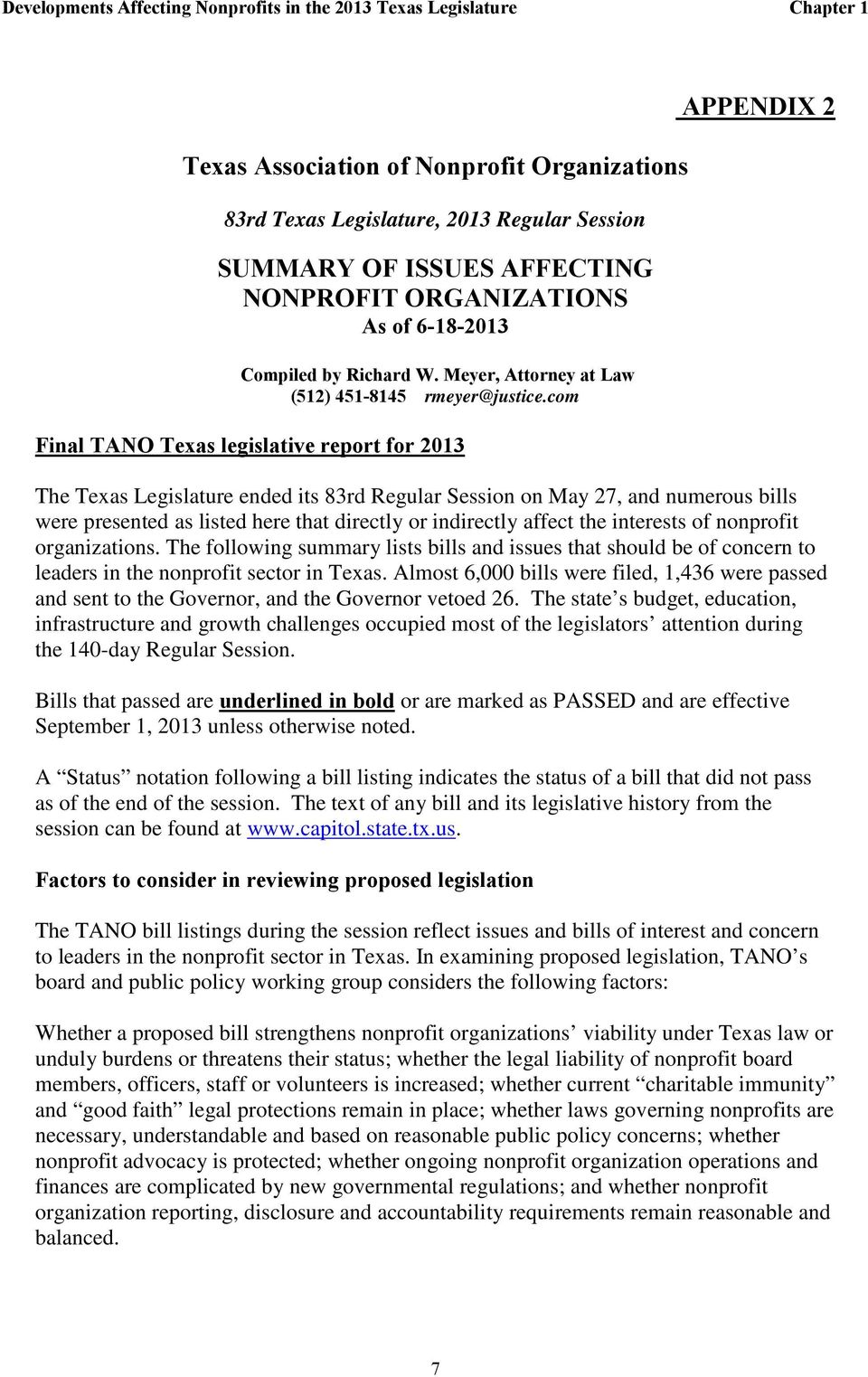
13 Texas Association of Nonprofit Organizations 83rd Texas Legislature, 2013 Regular Session SUMMARY OF ISSUES AFFECTING NONPROFIT ORGANIZATIONS As of Compiled by Richard W. Meyer, Attorney at Law (512) Final TANO Texas legislative report for 2013 APPENDIX 2 The Texas Legislature ended its 83rd Regular Session on May 27, and numerous bills were presented as listed here that directly or indirectly affect the interests of nonprofit organizations. The following summary lists bills and issues that should be of concern to leaders in the nonprofit sector in Texas. Almost 6,000 bills were filed, 1,436 were passed and sent to the Governor, and the Governor vetoed 26. The state s budget, education, infrastructure and growth challenges occupied most of the legislators attention during the 140-day Regular Session. Bills that passed are underlined in bold or are marked as PASSED and are effective September 1, 2013 unless otherwise noted. A Status notation following a bill listing indicates the status of a bill that did not pass as of the end of the session. The text of any bill and its legislative history from the session can be found at Factors to consider in reviewing proposed legislation The TANO bill listings during the session reflect issues and bills of interest and concern to leaders in the nonprofit sector in Texas. In examining proposed legislation, TANO s board and public policy working group considers the following factors: Whether a proposed bill strengthens nonprofit organizations viability under Texas law or unduly burdens or threatens their status; whether the legal liability of nonprofit board members, officers, staff or volunteers is increased; whether current charitable immunity and good faith legal protections remain in place; whether laws governing nonprofits are necessary, understandable and based on reasonable public policy concerns; whether nonprofit advocacy is protected; whether ongoing nonprofit organization operations and finances are complicated by new governmental regulations; and whether nonprofit organization reporting, disclosure and accountability requirements remain reasonable and balanced. 7
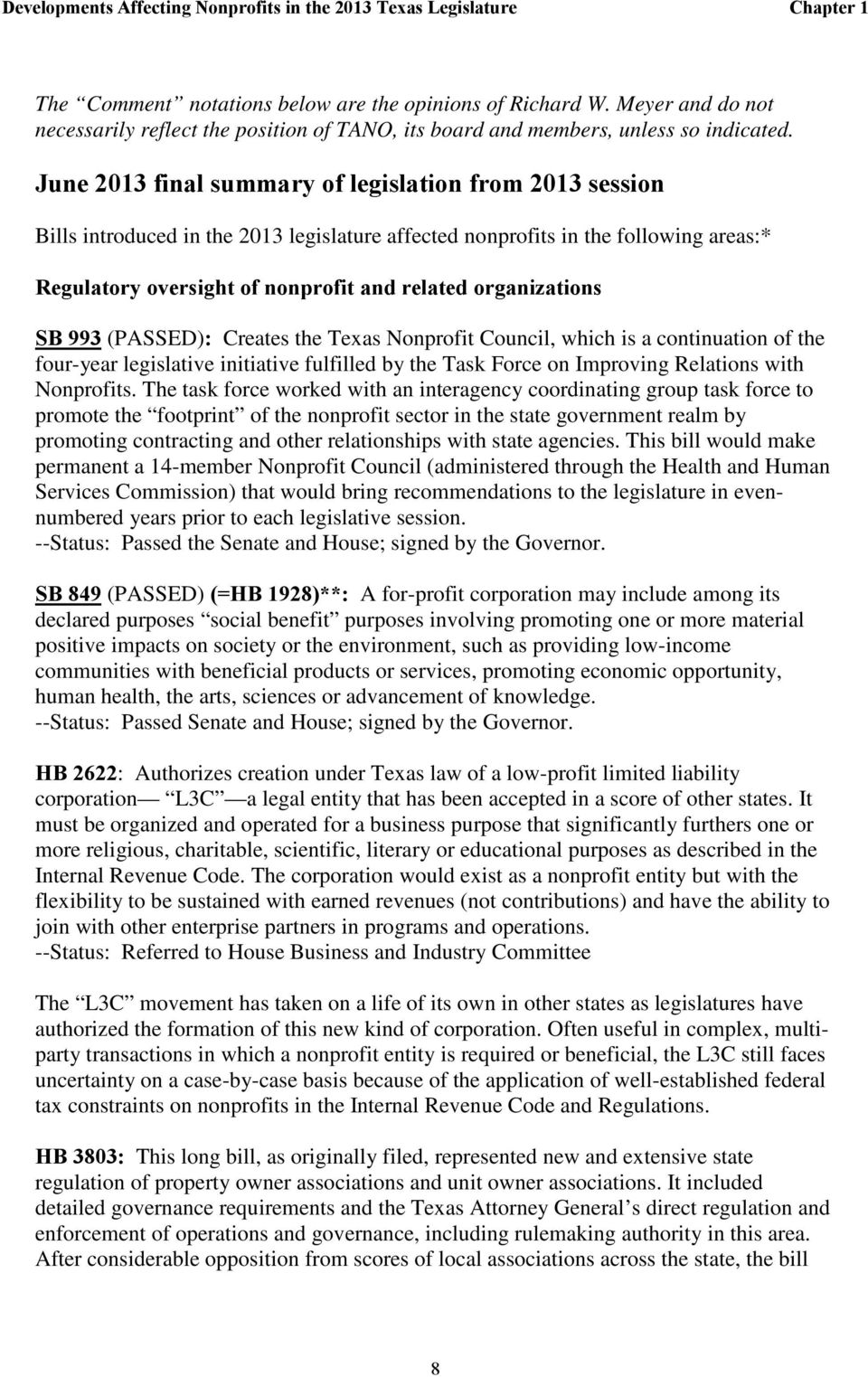
14 The Comment notations below are the opinions of Richard W. Meyer and do not necessarily reflect the position of TANO, its board and members, unless so indicated. June 2013 final summary of legislation from 2013 session Bills introduced in the 2013 legislature affected nonprofits in the following areas:* Regulatory oversight of nonprofit and related organizations SB 993 (PASSED): Creates the Texas Nonprofit Council, which is a continuation of the four-year legislative initiative fulfilled by the Task Force on Improving Relations with Nonprofits. The task force worked with an interagency coordinating group task force to promote the footprint of the nonprofit sector in the state government realm by promoting contracting and other relationships with state agencies. This bill would make permanent a 14-member Nonprofit Council (administered through the Health and Human Services Commission) that would bring recommendations to the legislature in evennumbered years prior to each legislative session. --Status: Passed the Senate and House; signed by the Governor. SB 849 (PASSED) (=HB 1928)**: A for-profit corporation may include among its declared purposes social benefit purposes involving promoting one or more material positive impacts on society or the environment, such as providing low-income communities with beneficial products or services, promoting economic opportunity, human health, the arts, sciences or advancement of knowledge. --Status: Passed Senate and House; signed by the Governor. HB 2622: Authorizes creation under Texas law of a low-profit limited liability corporation L3C a legal entity that has been accepted in a score of other states. It must be organized and operated for a business purpose that significantly furthers one or more religious, charitable, scientific, literary or educational purposes as described in the Internal Revenue Code. The corporation would exist as a nonprofit entity but with the flexibility to be sustained with earned revenues (not contributions) and have the ability to join with other enterprise partners in programs and operations. --Status: Referred to House Business and Industry Committee The L3C movement has taken on a life of its own in other states as legislatures have authorized the formation of this new kind of corporation. Often useful in complex, multiparty transactions in which a nonprofit entity is required or beneficial, the L3C still faces uncertainty on a case-by-case basis because of the application of well-established federal tax constraints on nonprofits in the Internal Revenue Code and Regulations. HB 3803: This long bill, as originally filed, represented new and extensive state regulation of property owner associations and unit owner associations. It included detailed governance requirements and the Texas Attorney General s direct regulation and enforcement of operations and governance, including rulemaking authority in this area. After considerable opposition from scores of local associations across the state, the bill 8
15 was trimmed; CSHB 3803 later carried only requirements relating to mandatory fidelity bonds or fidelity insurance for unit owner associations with 20 or more units. --Status: Reported from the House Business and Industry Committee Comment: Although they are not Section 501(c)(3) nonprofits, the HOAs and POAs in Texas co-exist with charitable organizations in the legal realm of the Texas Nonprofit Corporation Law. They are highly organized, some are very large (almost quasigovernmental entities), and they are sensitive to proposed increased regulatory oversight of their operations and governance. Although HB 3803 was trimmed down by the committee and never received a House vote, similar regulatory schemes could be proposed for 501(c)(3) organizations in the future. HB 412: Permits a court to enhance (increase) the criminal sentencing period of a person convicted of deceptively holding himself out as a representative of a charitable organization as part of the commission of a crime. Listing nonprofit charities as a protected class in the criminal laws is intended to discourage wrongdoers from using and abusing charitable causes as part of criminal activity. --Status: Referred to House Criminal Jurisprudence Committee SB 1372 (PASSED) (=HB 2944): Enacts similar regulatory oversight laws regarding the boards of timeshare property associations. --Status: Passed Senate and House; signed by the Governor Limits on legal liability; changes to charitable immunity under Chapter 84, Civil Practices and Remedies Code SB 1267 (PASSED) (=HB 2751): Limits the liability of persons assisting state agency firefighting efforts. --Status: Passed Senate and House; signed by the Governor SB 338 (=HB 444): Would add licensed social workers to the list of professions specifically granted Chapter 84 legal immunity while performing voluntary services. --Status: Passed Senate; voted favorably from House Committee on Judiciary and Civil Jurisprudence SB 1050: Would add licensed marriage and family counselors to this list. --Status: Referred to the Senate State Affairs Committee Comment: These Chapter 84 immunity bills benefit the nonprofit sector because volunteers and managers of nonprofits are then shielded from personal legal and financial liability if the organization complies with the law s requirements. The following five bills, however, take a different approach and extend certain legal immunity from liability based on the status of the parties or the type of charitable conduct undertaken and thereby inadvertently blur the clear purpose of the Chapter 84 protections. 9

16 HB 1652: Limits the legal liability of the owner of land leased or used by a cooperative group as a community garden if the required notification signage is posted. --Status: Left pending in the House Judiciary and Civil Jurisprudence Committee HB 3385: Limits the liability for agri-tourism activities when a person participates in educational or recreational activities on agricultural land. --Status: Passed the House; referred to Senate State Affairs Committee HB 3476: Limits the liability of a sports organization, as defined. --Status: Passed the House; referred to Senate State Affairs Committee HB 2319: A church providing an overnight or homeless shelter to children would be immune from civil legal liability. --Status: Reported favorably from the House committee; awaiting House vote HB 332: Grants immunity from legal liability to persons donating volunteer services to the Texas Parks and Wildlife Department for acts relating to operating a department vehicle or motor-driven equipment. --Status: Passed House; left pending in Senate State Affairs Committee Nonprofit board, officer, employee and volunteer issues SB 61 (PASSED): Permits issuance of a military limited volunteer license to military physicians licensed in other states who perform voluntary services for the indigent without pay. --Status: Passed by Senate and House; signed by the Governor HB 746 (PASSED): This bill would enact the Uniform Emergency Volunteer Health Practitioners Act, which is intended to simplify the certification of licensed healthcare professionals who go to a state under a declared emergency, where they are not licensed, to offer services to relief organizations or government response agencies. --Status: Passed House and Senate; signed by the Governor. HB 1491 (PASSED) (=SB 1130): Suspends certain dentists from full licensure requirements if performing volunteer services. --Status: Passed the House and Senate; signed by the Governor SB 766: Exempts volunteer firefighters from meeting certain state and local government certification requirements. --Status: Passed the Senate; reported favorably from the House Licensing and Administrative Procedures Committee SB 1324: Exempts from certain licensing laws the volunteer safety groups supporting religious organizations and facilities. HB 2535 exempts from licensure security personnel volunteering for a religious organization. --Status: Referred to Senate Criminal Justice Committee 10

17 Comment: The bills listed above reflect a new trend in that they suspend ordinary licensing and certification requirements for volunteers or in certain situations. While it is beneficial for legislation to encourage volunteerism at every level, is the public good properly protected by suspending the formal qualifications of certain volunteers? HB 2811: Regulates volunteer programs in the Texas Department of Criminal Justice institutions. --Status: Passed the House; referred to Senate Criminal Justice Committee HB 676 & HB 1730: Requires use of the E-Verify system to clear the employment eligibility of the employees of all state contractors/vendors. --Status: Referred to House State Affairs Committee HB 954: Requires an employer or entity receiving any public subsidy funding from the state for economic development or job creation to use the E-Verify system to confirm work eligibility of employees. See also HB Status: Referred to House State Affairs Committee HB 22: Requires undergraduate students at Texas higher education institutions to perform 20 hours of volunteer service time as a requirement to graduate. Each college or university would be responsible for identifying eligible nonprofit organizations or causes and to manage record keeping to verify the student s service. --Status: Pending in the House Higher Education Committee Comment: TANO publicly expressed concern regarding this bill and whether mandatory volunteerism actually fosters a culture of genuine civic involvement and heart-felt personal service. It can take on the appearance of community service mandates that are common in court post-conviction probation or parole sentencing. Making this service a requirement for graduation would entail ongoing record keeping duties by the recipient charitable organization in alliance with the higher education institutions involved. The nonprofits receiving these services would become the keepers and reporters of the students compliance in what essentially would be a required course for graduation. Also unresolved is the selection of approved nonprofit agencies and whether unpopular or controversial causes could be banned as eligible for service hours. Open meetings / open records issues SB 895 (PASSED): Extends full public access to the books and records of a nonprofit entity supporting the Cancer Prevention and Research Institute of Texas program (CPRIT). --Status: Passed the Senate and House; signed by the Governor Comment: SB 895 demonstrates that a separately chartered nonprofit organization that exists solely to support a public entity usually at the end of a controversy is deemed to 11
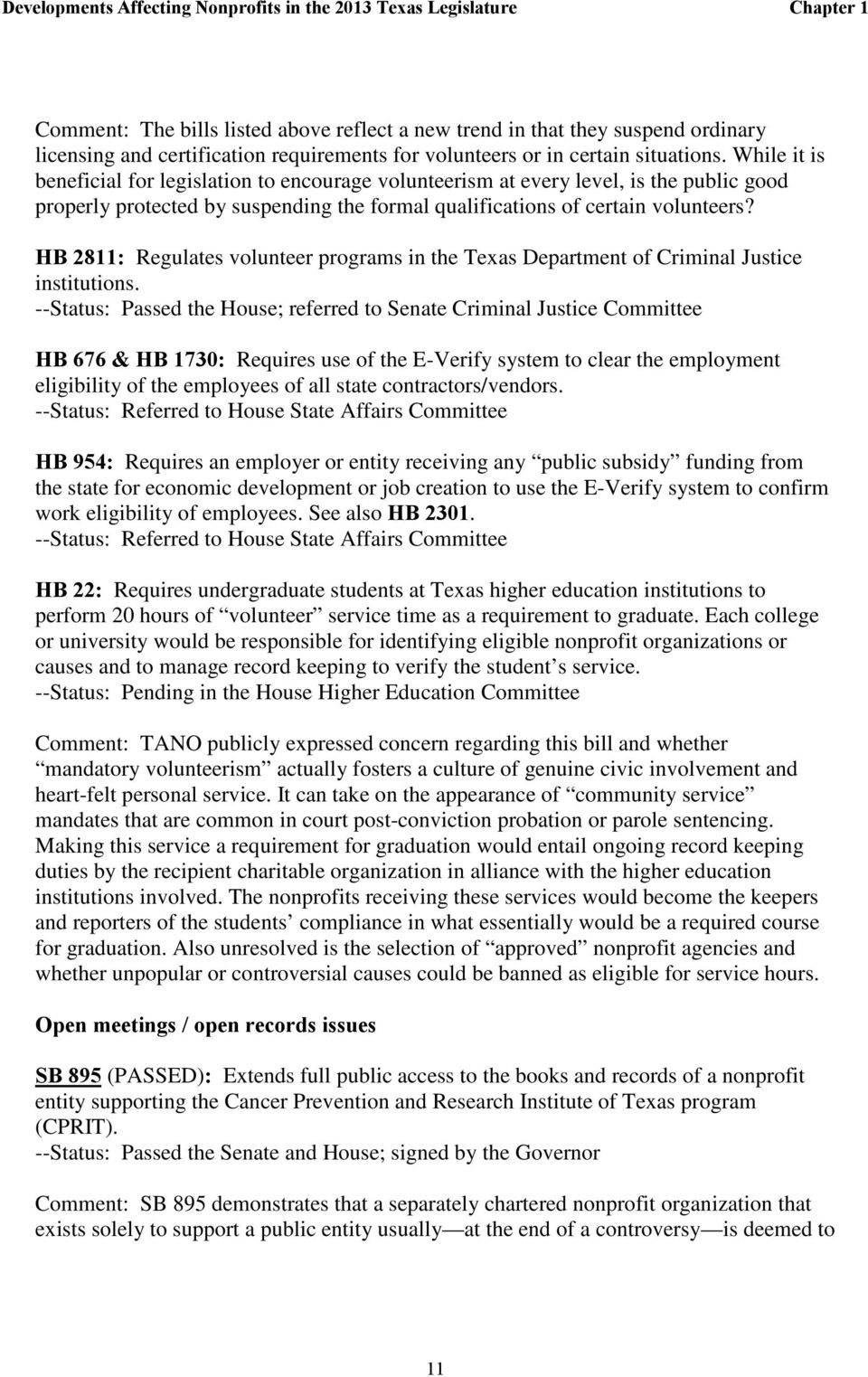
18 be a quasi-governmental entity and thereby subject to the open meetings/open records laws that must be observed by government agencies. HB 1933: The official books and records of condominium associations would be available without restriction to any owner/member or its designee. --Status: Action pending in the House Business and Industry Committee Amendments to the Texas Nonprofit Corporation Law, Chapter 22, Business Organizations Code No bills have been filed that directly affect the Texas Nonprofit Corporation Law, unlike the activity seen in previous legislative sessions. Any change to this law would affect some or all of the nonprofit organizations organized under Texas law. Fundraising activities of nonprofit organizations HB 394 (PASSED) (=SB 282): Amends bingo prize restrictions. --Status: Passed House and Senate; signed by the Governor Comment: Often what does not appear is of importance. Unlike past sessions, the current session has not seen the filing of numerous bills to further regulate (or liberalize) the state laws and rules relating to bingo, high-dollar charity auctions, casino night parties, raffles, poker runs, fishing tournaments and similar fundraising activities and charitable solicitations. The questionable charitable purpose of those donated goods collection boxes that are multiplying in shopping area parking lots resulted in new laws in As a practical matter, what goes on across the state with these kinds of promotions is hard to quantify. State agencies charged with monitoring and enforcing existing laws (the State Comptroller, Office of the Attorney General and others) often enter the scene when harm has already been done or legal boundaries have been exceeded. Most states have fairly comprehensive registration or licensing of charitable organizations and formalized regulation of charitable solicitations from the public. Texas is among a dozen or so states that have a very light regulatory environment for charitable solicitations. Exemptions from taxes now extended to nonprofit entities SB 140 (=HB 3045): The State Comptroller would develop a review schedule of state and local tax preferences and exemptions that reduce government tax revenues to determine if the cost of the preference fulfills its purpose, and recommend its continuation or end. Each tax preference enacted by the legislature after 2014 would be given a six-year shelf life, when it would then expire unless reauthorized. SJR 12: Would authorize a statewide vote on a constitutional amendment to implement SB 140 on a permanent basis. --Status: SB 140 pending in the Senate Finance Committee. 12
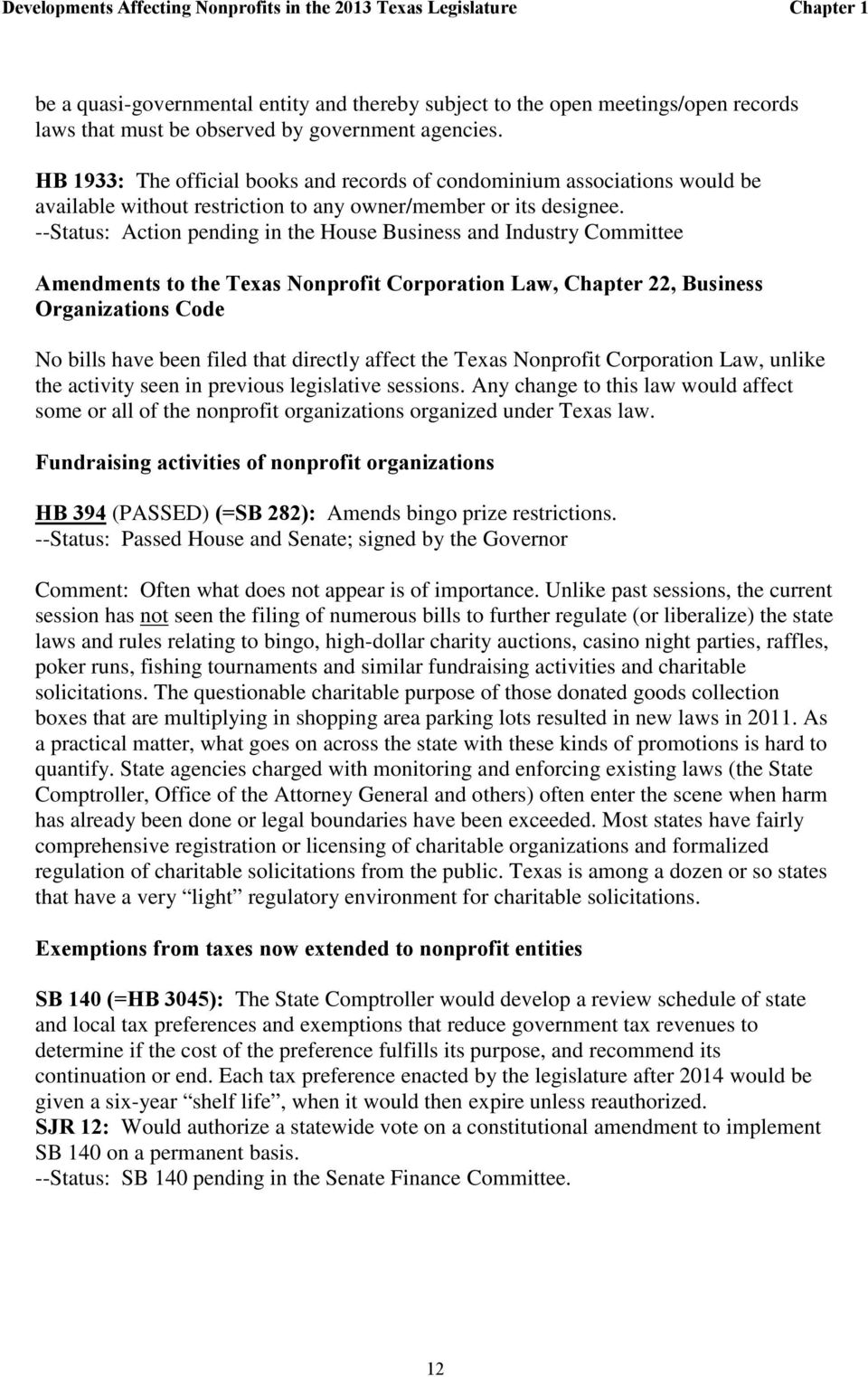
19 SB 106: The Texas Sunset Advisory Commission would periodically undertake a reexamination ( sunset ) of all ad valorem tax exemptions, including the property exemptions enjoyed by charitable organizations. --Status: Referred to Senate Finance Subcommittee See also HB 537, similar to SB 106. HB 1556: A select state commission would undertake an ongoing scheduled review of every state or local tax preference, exemption, preference, credit or other benefit to determine if it is justified, with every such tax provision being reviewed once every ten years. Any new tax preference enacted would have only a ten-year life cycle and would be subject to legislative renewal. --Status: Referred to House Ways and Means Committee HB 440: Would require a religious organization to file with its local appraisal district a public annual report of its real estate that holds a property tax exemption, list the current use of the property and any income derived from each parcel. --Status: Referred to House Ways and Means Committee SB 193 (PASSED): Certain property used to provide low-income housing is exempt from property tax. --Status: Passed Senate and House; signed by the Governor. HB 294 (PASSED): Tax exemption for property devoted to housing for the homeless. --Status: Passed House and Senate; signed by the Governor. HB 1459: Property leased to a charitable organization that would qualify for property tax exemption (if the organization owned the property) would be exempt from property taxes if the rent charged for the property on an annual basis is not more than five percent of the property s market value and the property is reasonably necessary for the operations of the organization. --Status: Referred to House Ways and Means Committee HB 1360 (=SB 1455): Property leased to a tax-exempt school could be exempt from property taxes if the lessee s rental rate reflects a reduced amount equal to the benefit of the property tax exemption to the lessor. --Status: Passed House; pending in Senate Finance Committee SB 1131 (=SJR 44): Property leased to a school would be exempt from property tax if the annual rental on the property does not exceed one percent of the property s market value and the school owns the facility or building on the property. --Status: Referred to Senate Finance Subcommittee HB 3767: Property is exempt from property taxes if owned by a charitable organization that uses the property in growing or maintaining trees for public beautification. --Status: Referred to the House Ways and Means Committee 13

20 HB 2599: Property owned by a political organization (as defined under Texas Election Code, Chapter 172) would be exempt from property taxes. --Status: Referred to House Ways and Means Committee Comment: The property tax exemptions available to nonprofit organizations in Texas are found generally in Section et seq. of the Texas Tax Code. Therefore, any proposed bill amending Section and related parts is to be watched. However, over time there have been numerous exemptions expressly written into the code (as reflected in the above proposed bills), so that the original property tax exemption policy expressed in Section is becoming bottom-heavy with all the exceptions and is difficult to read and understand. At some point, this general issue will deserve a thoughtful review and possible legislative attention. HB 697 (PASSED): Exempts from state sales tax food items sold by a sports booster club as part of its fundraising support of school programs at public events, and also exempts school spirit merchandise offered as part of recognized school activities or programs. --Status: Passed the House and Senate; signed by the Governor HB 2941: Provides a sales tax exemption for property related to qualified research. --Status: Pending in the House Economic and Small Business Development Committee HB 3767: Provides a sales tax exemption for materials used in tree planting in public areas. --Status: Referred to House Ways and Means Committee PILOT fees imposed on property of nonprofits HB 1168: Property constituting a dedicated cemetery would be exempt from public agency drainage assessments or fees. --Status: Awaits House vote Comment: PILOT means payments-in-lieu-of-taxes and reflects a growing trend by state and local governments nationwide to impose various kinds of taxes, assessments and user fees on properties owned by tax-exempt charitable organizations without calling them taxes. There was very little anti-pilot activity in this legislative session. Public advocacy / Ethics Commission (lobbying) issues SB 346 (VETOED): Seeks to regulate the claimed improper political activities and expenditures by certain Section 501(c)(4) nonprofit organizations by classifying them as political committees under the Texas Election Code; would require them to file disclosure reports regarding any donor exceeding $1,000 if the organization had $25,000 or more in such political contributions or expenditures in a calendar year. --Status: Passed Senate; passed House; vetoed by the Governor 14

21 Comment: See the notice on SB 346 at the top of this summary. The Governor also vetoed a related bill, SB 219, which at one time carried language similar to SB 346. HB 905: Forbids former legislators from lobbying for two years, except if lobbying for nonprofit organizations, disabilities groups and low-income advocacy groups, and if acting without compensation. --Status: Referred to House Elections Committee SB 1254: Extends the same lobbying restriction to former state agency executive heads. --Status: Action pending in the Senate State Affairs Committee SCR 2: Urges the Texas Legislature to advance an amendment to the U.S. Constitution to reverse the U.S. Supreme Court s decision in Citizens United v. Federal Election Commission, which removed many prior restrictions on the advocacy activities and fundraising of corporations, unions, political committees and nonprofit organizations that advance a particular cause or issue. --Status: Referred to Senate State Affairs Committee Volunteer food preparation for sale by organizations; farmers market food regulation HB 970 (PASSED): Expands the new health regulations from the 2011 session and definitions of cottage food products produced by individuals in a home or other location for direct sale to consumers; prohibits local governments from enacting land use regulations to limit such activity in a home. --Status: Passed House and Senate; signed by the Governor HB 1382 (PASSED): The public health services would have no authority to regulate or license food samples offered at a farmers market or related cooking demonstrations offering samples although current sanitary standards are preserved. --Status: Passed the House and Senate; signed by the Governor HB 1392 (PASSED): The state health department must provide a definitive answer within 30 days to a request for a determination whether a proposed food preparation or sale activity falls within food inspection or licensing regulations. --Status: Passed the House and Senate; signed by the Governor HB 910: This bill addresses a health department s temporary food establishment permit that could be granted to a farmer, vendor or other food preparer selling products at a local farmers market. This proposal follows efforts in the 2011 legislative session to clarify the line between formal commercial food product permitting versus occasional permitexempt sales by volunteer and charitable groups and individuals. --Status: Reported favorably from House Public Health Committee 15
22 HB 1393: The kinds of food preparation or sales operations conducted in a home (defined in the bill) are clarified with reference to existing state health department inspection laws. --Status: Reported favorably from the House Agriculture and Livestock Committee HB 2113: Regulates cottage food products by prohibiting use of an ingredient not intended for human consumption, such as an edible decoration. --Status: Referred to House Public Health Committee Comment: The bills listed above reflect a re-heating of the 2011 session s home baker debates and the controversies and hostile public reaction to state health department s proposed regulations issued in While these may seem to be obscure issues about innocent and well-intentioned, home-based foodies versus overbearing government regulators, nonprofit organizations are pulled into the mix. The real concern is the level at which state and local health officials should regulate, monitor, inspect or license homeproduced foods (whether for incidental sale or fundraising efforts), food-related activities at the ever-popular local farmers markets, raw dairy product sales, large-attendance gatherings with volunteered foods, inspection and licensing (or not) of church kitchens, and a host of real world activities that occur every day in every community. These farmto-table bills were the subject of a lively discussion on April 10 before the House Agriculture and Livestock Committee, with local health authorities and inspectors taking a hard line based on their concern over public safety from unregulated food products. Other Bills SB 403 (=HB 1221): A healthy corner store could be established and operated by a community development agency in a qualified food desert, receive loans and funding through existing community development financial institutions (CDFIs) and participate in SNAP and WIC food programs. See also HB Status: SB 403 reported favorably from Senate Government Organizations Committee; on Senate intent calendar HB 1362: Expands the existing loanstar loan fund that promotes beneficial financing terms for energy efficient systems for charitable organizations and houses of worship. --Status: Referred to House Energy Resources Committee HB 2189: The return of an attempt to modify the English common law rule against perpetuities, following an attempt to repeal it in the 2011 session. --Status: Action pending in the House Judiciary and Civil Jurisprudence Subcommittee HB 371: Makes qualified nonprofit corporations eligible to receive ownership of remainder right-of-way properties determined by TXDOT to be unusable for its purposes. --Status: Action pending in House Land and Resource Management Committee SCR 12 (PASSED): Designates pecan pie as the Official Pie of Texas. --Status: Passed the Senate and House; signed by the Governor 16
23 Comment: The Senate debate on this resolution produced differences of opinion whether a pecan pie containing chocolate ingredients (chocolate chips or popular brownie pecan pie recipe variations) disqualifies the dish as true and official pecan pie. HCR 36 (PASSED): Designates February 16 of each year as Homemade Pie Day in Texas. --Status: Passed the House and Senate; signed by the Governor *Above list does not include bills introduced relating to the following: Nonprofit hospitals, health care or health plans; credit unions; electric or agricultural cooperatives; private and charter schools and colleges; and quasi-public nonprofit entities. This summary does not track the state budget, legislative appropriations or riders, or other legislative funding related to the bills and issues included. **Many bills have an identical companion bill in the other house bearing a different bill number. Access bills, background information and current status at Texas Legislature Online: Lessons Learned *Many legislative and regulatory proposals have unintended consequences for nonprofit organizations. Legislators and their staffs are generally uninformed about the operations and real interests of nonprofits. *Most reform proposals mean more reporting, compliance and governance time and administrative expense for nonprofits. Nonprofits are judged harshly if administrative/operations expenses consume too large a percentage of their total budget. *Volunteer board members and other good people must not be discouraged by lengthy, confusing or threatening governmental regulations that make service risky. Criminal penalties attached to reform legislation scare away informed and qualified leaders who otherwise might have served on a board. *One size does not fit all. Many reform proposals are intended to cure missteps by large nonprofits or national associations. But reforms often land hard on good people doing good work in local communities across America. *The burgeoning social enterprise sector is composed of innovators and risktakers who are investing in new ideas, new markets and new forms of nonprofit operations based on a hybrid business model. These leaders should be given breathing room by government regulators. 17
24 *Complex governmental regulations will discourage start-ups and the efforts of good people with good ideas. True, there may be redundancies and duplications of nonprofit efforts in any community, but every successful and acclaimed nonprofit organization probably started with one person with one idea and it grew and grew and now serves the common good. All our efforts should be to that end. Resources to be Informed and Involved Texas Issues: Statewide voice for nonprofit organizations, Austin State website to track legislation, statutes and agency rules Resources for assisting community organizations State agency for volunteerism and service opportunities National Issues: National Council of Nonprofits, Washington, D.C. Independent Sector, Washington, D.C. Independent Sector s response to Congressional proposals National Association of State Charity Officials, the regulators National coalition of volunteer disaster relief agencies The Chronicle of Philanthropy, current news The Urban Institute, research studies and statistics Advocacy Rights and Lobbying by Nonprofits: Center for Lobbying in the Public Interest Alliance for Justice Social Entrepreneurship: Social Enterprise Alliance promotes innovative nonprofits Duke University, source materials for social enterprise issues Background on B-corps and L3C entities 18
25 NATIONAL COUNCIL OF NON PROFITS National voice. State focus. Local impact. APPENDIX Public Policy Agenda I. Tax Policy: Empowering Community Solutions through Non profits Charitable nonprofit organizations throughout the United States are dedicated to the public good; their work improves lives, strengthens communities and the economy, and lightens the burdens of government, taxpayers, and society as a whole. Consistent tax policies at the federal, state, and local levels are critical to the success of nonprofits in pioneering and implementing solutions to community problems and aspirations. The National Council of Non profits is committed to preserving the tax-exempt status of organizations contributing to the well-being of their communities and strengthening and expanding incentives for individuals to give their time and money to the organizations whose missions they support. In practice, this commitment means: A. Supporting existing, enhanced, and new tax and other incentives at the federal, state, and local levels that encourage individuals to volunteer their time and contribute money to the missions of nonprofits and opposing caps or limits on charitable giving incentives. B. Opposing the imposition of fees, payments in lieu of taxes (PILOTs}, and taxes on tax-exempt nonprofit organizations. C. Maintaining and- where appropriate- expanding nonprofit exemptions from state and local property, sales, and use taxes. II. Budget & Spending: Addressing Community Needs Budget and spending decisions by governments affect all Americans, and in this time of economic hardship these decisions have immediate and serious consequences for the people nonprofits serve and the communities in which they operate. Nonprofits work in every community, whether caring for returning soldiers, educating children, rebuilding cities, training the workforce, nursing the sick, supporting our elders, elevating the arts, mentoring our youth, protecting natural resources, nurturing our souls, and much more. As front-line providers of services and as organizations grounded in their communities, nonprofits have a stake in the strength and well-being of the economy and of governments at all levels. The National Council of Non profits opposes arbitrary and across-the-board budget cuts at any level of government and will work to inform policymakers of the impact of budget proposals on communities. The National Council of Nonprofits supports programs that promote volunteering activities that mutually benefit individuals and the people served through nonprofits, but opposes proposals to condition receipt of government-provided benefits on requirements that individuals volunteer at nonprofit organizations, a policy known as "mandatory volunteerism," that impose increased costs, burdens, and liabilities on nonprofits by an influx of coerced individuals. The National Council of Nonprofits encourages all non profits to be meaningful participants in the state budget process. It will, as a network, engage actively in debates regarding comprehensive budget and tax reforms, encouraging solutions that improve transparency in the budget process, and supporting proposals that promote fiscal stability and growth, while ensuring that the work of non profits on behalf of the people they serve is sustained New York Avenue, NW, Suite Washington, DC COPYRIGHT 2012 NATIONAL COUNCIL OF NONPROFITS. ALL RIGHTS RESERVED. 19
26 Ill. The Economy: Strengthening Communities through Job Creation and Economic Development Nonprofit organizations are integrally involved in the economies of their communities, their states, and the country. Non profits employ more than 13 million individuals nationally, pay over $500 billion in wages annually, and contribute more than five percent to the Gross Domestic Product of the United States. Nonprofits collectively employ more Americans than the construction, finance, and insurance industries combined. In many states, nonprofit employment exceeds ten percent of the workforce and represents one of the top two or three industries. As proven job creators, non profits can and should participate in the development of job growth policies at the state and local levels. The National Council of Nonprofits strongly endorses policies that promote job creation in all sectors of the economy, and insists that incentives apply equally to nonprofit employers. As they do for for-profit employers, governments have a responsibility to collect and disseminate nonprofit employment and economic data that identify the impact of nonprofit organizations in their jurisdictions. IV. Public-Private Partnership: Improving Collaboration for the Public Good Nonprofit organizations share a commitment with governments to improving lives and communities throughout the country. The National Council of Nonprofits is dedicated to improving government-nonprofit contracting systems, and to strengthening the public-private partnership at all levels through collaboration and direct engagement. Specifically, the National Council of Nonprofits supports: Federal A. Reforms to government-nonprofit contracting processes that streamline policies and procedures to avoid duplication and waste, develop standardized definitions for contracting and grant language, and ensure that payments to nonprofit organizations for actual and indirect costs from the federal government through state and local governments are applied consistently, fairly, and in a timely manner. B. Adoption of reforms that help make the federal government a more productive partner with nonprofit organizations by establishing (1) better communication with the federal government, (2) better coordination of policies and practices within government, and (3) enhanced research and data sharing by government. C. Full funding for the Nonprofit Capacity Building Program and the Strengthening Communities Fund and reforms that expand the availability and range of trainings to address the needs of rural as well as urban communities. State A Creation of a senior Executive Branch Liaison to the Nonprofit Sector, such as a full cabinet-level official, special advisory council, or as a senior advisor in the Governor's Office, and/or in the office of the State's primary nonprofit regulator and other cabinet-level departments with the goal of ensuring collaboration between government and charitable nonprofits. B. The commitment of governments and nonprofit providers to collaborate in streamlining and reforming the existing dysfunctional contracting systems that deprive individuals of the services they need, deny taxpayers the full value of the programs they fund, and prevent nonprofit organizations from achieving their full impact. C. Creation of bi-partisan Nonprofit Caucuses in State Legislatures to serve as resources for information on the nonprofit sector through which lawmakers can work together on legislative and regulatory issues impacting charitable nonprofits and the people they serve in their states and tap ideas and solutions tested in the real world by organizations dedicated to serving their communities. Copyright 2012 National Council of Nonprofits
27 V. Advocacy Rights: Promoting Civic Engagement The nonprofit sector is vital for democracy to be successful; the rights of the people to gather through nonprofits to speak freely about public policies must be preserved. From before the time our nation was formed through today, individuals have assembled in groups to advocate for the advancement of the issues and concerns of their times. As safe havens for people to gather to amplify their collective voices, non profits have a duty to stand up and speak out for the public good and promote a more just and equitable society. Non profits often provide a voice for those individuals and groups who are unable to speak for themselves. Likewise, non profits share the responsibility to promote greater engagement of the citizenry, open elections, and open government. The National Council of Nonprofits works to create a culture in support of nonprofit advocacy and to maintain the advocacy rights of nonprofit organizations in the following ways that promote, support, and protect nonprofit advocacy: A. Opposing restrictions on the advocacy rights of non profits. B. Promoting advocacy as a core component of the mission of non profits to address problems and have impacts in their communities. C. Correcting misperceptions and clarifying lobbying laws and regulations to empower nonprofits to advocate fully and freely within the law. D. Leveling the playing field by supporting changes to the financial thresholds for nonprofit advocacy and lobbying activities. E. Ensuring the integrity of charitable non profits by supporting the tax-law ban on electioneering and partisan political activities. VI. Public Accountability: Ensuring Public Trust The nonprofit community recognizes that mission-driven nonprofits can be successful only by earning and maintaining public trust through appropriate transparency, which can be guided by reasonable regulation that recognizes the unique role of these organizations in communities. For these reasons, the National Council of Nonprofits supports reasonable and non-burdensome regulations and policies that already make the nonprofit community the most transparent sector of the U.S. economy. An appropriate balance must be struck that recognizes and respects the independent activities of nonprofits as public-spirited yet still private organizations. The National Council of Non profits also supports: Federal A. Maintaining the proper balance between protecting and informing the public and preventing excessive and disruptive regulatory burdens that hinder the missions of non profits. B. Adequate funding for quality education, transparent oversight, and fair enforcement of nonprofit organizations by the IRS. C. Maintaining state primacy in the regulation and enforcement of consumer protections related to nonprofit organizations. Copyright 2012 National Council of Nonprofits
28 State A. Adequate funding for quality education, transparent oversight, and fair enforcement activities of state regulators charged with promoting nonprofit compliance and protecting the public. B. Setting reasonable thresholds for mandatory audits of nonprofit finances. C. Developing uniform and cost-free or inexpensive registration requirements for non profits that engage in fund raising in more than one state. D. Retaining tax law provisions as the sole regulation of nonprofit employee compensation. E. Recognizing that, as in the case of for-profit businesses, receipt of public funding through armslength transactions involving contracts or grants does not convert private independent nonprofit organizations into governmental instrumentalities. The National Council of Nonprofits rejects any presumption or suggestion that most nonprofit organizations are "quasi-governmental," or "government-sponsored," entities that require additional levels of scrutiny not applied equally to for-profit organizations, and opposes proposals that fail to acknowledge nonprofit accountability, independence, and effectiveness. From a public policy standpoint, this means: 1. Opposing the imposition of ineffective and unnecessary board governance mandates or restrictions. 2. Clarifying that the applications of state and local open meeting laws are limited to governmental entities and do not apply to private non profits or for-profit organizations. 3. Ensuring that any consideration of the application of public records laws to individual organizations, whether nonprofit or for-profit businesses, balances the legitimate need of the public to know about the expenditure of public funds with the burden of compliance and the need to maintain confidentiality of certain kinds of records. 4. Demanding that any attempt to set compensation, training, disclosures, governance requirements, or other conditions on nonprofit organizations must be applied equally to for-profit entities. Copyright 2012 National Council of Nonprofits I 4 22
29 Developments Affecting Nonprofits in the 2013 Texas Legislature Chapter 1 PILOTs (Payments in Lieu of Taxes) Payments in lieu of Taxes (PILOTs) US: A new report from the Lincoln Institute of Land Policy has confirmed that demanding payments in lieu of taxes (PILOTs) from non profits fails to provide the budget solutions that municipalities need. According to the report, such payments account for an average of only 0.13 percent of the general revenue where they are collected. "PILOTs will never be a panacea for cash-strapped governments - they simply do not generate enough revenue," the report said. Up to 80 percent of the 117 municipalities implementing some form of PILOT since 2000 are in the Northeast, according to the study. Hartford, Conneoticut In July 2012, citing the efforts by Boston and Providence leaders to extract large cash payments from nonprofit organizations, the Mayor of Hartford, Connecticut sent letters to 49 of the largest nonprofits seeking payments in lieu of taxes (PILOTs) to help close the city's budget deficit. New London, Connecticut: In October 2012, Mayor asked local colleges and hospitals to increase their existing voluntary payments in lieu of taxes to the city. The request came within a month of the rejection by residents of a 7.5 percent tax hike, and was accompanied by praise for the non profits. "They do contribute significantly." acknowledged the Mayor in recognizing that nonprofits are economic engines, bring in visitors to the region who patronize local businesses, and provide volunteers for projects around the Cjty. Maine: Legislators rejected an amendment that would have imposed a two-year, two percent tax on nonprofits with $500,000 in assets and annual gross receipts of $200,000. However, the goal of the proposal to levy taxes on certain non profits remains intact and has been inserted in the state's biennial budget as a study. The measure would create a task force to review the feasibility of imposing taxes, fees, or payments in lieu of taxes (PILOTs) on certain nonprofit organizations, with the goal of generating approximately $100 million in revenue annually. A representative of the Maine Association of Non profits would be one of four stakeholders serving on the task force. Baltimore, Maryland: In her State of the City Address, Baltimore Mayor Stephanie Rawlings-Blake announced her intention to extend to the "broader nonprofit community" agreements to make payments in lieu of taxes (PILOTs) that are in effect with some tax-exempt entities, such as Johns Hopkins University, through Belmont, Massachusetts: Belmont leaders sent letters requesting a total of $530,000 in PILOTs from the town's 38 nonprofits. Boston, Massachusetts: Despite a state law that exempts charitable nonprofits from property taxes, Boston's nonprofits have contributed $9.4 million in PILOTs to the city since July 2011, after the city mailed simulated tax bills to charitable organizations that own property worth more than $15 million. Eighteen nonprofits, including the New England Aquarium, the Museum of Science, and Suffolk University, refused to give any cash to the government, noting that they already provide various benefits to the city. Haverhill, Massachusetts: After considering a proposal to require some nonprofits to make payments in lieu of taxes (PILOTs) worth 25 percent of their non-existent property taxes, the Haverhill, MA City Council's Administration and Finance Committee voted against the payments from non profits. The Committee Chairman says the decision was made at a meeting attended by 20 people, many from nonprofits in the city. However, the City Council recently called on as many as 32 non profits to make contributions to the City by Oct 31. The measure would not apply to educational, religious, or government organizations but would seek payments from many organizations that work with low-income children, pregnant women, elderly and disabled individuals, veterans, ar;d other under-served populations Jamaica Plain, Massachusetts: Jamaica Plain officials may directly impose on nonprofits Boston-like PILOTs that are worth 25 percent of their would be property tax bills. Lowell, Massachusetts: In March 2012, the City Council voted 7.() to seek home-rule power from the Massachusetts Legislature enabling it to charge some tax-exempt property owners 25 percent of the equivalent residential property tax bill. Churches and governmental entities would be exempt The measure was pushed by the Lowell City Manager, who is also chair of the Massachusetts Municipal Association's fiscal policy committee. Pittsfield, Massachusetts: A Pittsfield committee tasked with studying the feasibility of a Boston-like PILOTs scheme for the City has decided against the plan due to concerns about the impact it would have on the "additional safety net of services" that committee members discovered many local nonprofits provide. Pittsfield officials say the plan is not compatible with the city's non profits. Instead, a City Councilor is suggesting sending nonprofits letters that acknowledge their contributions and invite dialogue about other types of collaborations. Weymouth, Massachusetts: In July 2012, Weymouth leaders planned to create a task force to consider what some local non profits should be expected to pay in PILOTs. New Jersey: In April 2012, State and City officials in New Jersey began calling for the creation of a task force to examine how best to collect PILOTs from nonprofits. Downe Township, New Jersey: Not all PILOTs come from nonprofits; Downe is asking state leaders to restore and make permanent the state's PILOT funding to recoup lost tax -revenues due to large "Open Space" designations in their community that benefit all in New Jersey, not just Downe residents. The Township had been one of the four largest recipients of funds from PILOTs before 2010, receiving $380,000 from the state. Lawrence Township, New Jersey: The City is again asking local non profits to pay 25 percent of the property taxes they would otherwise be required to pay if their property were not exempt from taxation under state law. The township put out a similar request for payments in lieu of taxes (PILOTs) last August. Only three non profits are currently in PILOT agreements with the City. Red Bank, New Jersey: In January 2012, the mayor asked state legislators to back a bill that would charge non profits payments in lieu of taxes (PILOTs) for purchasing any additional land that is currently on the tax rolls. New York City, New York: A group of business and labor leaders known as the Partnership for New York City recently released a 69-page "NYC Jobs Blueprint" recommending that the City, among many other things, re-examine $1.8 billion in nonprofit tax exemptions and review whether nonprofits should be making payments in lieu of property taxes. North Carolina: A provision included in a North Carolina bill would create a commission tasked with studying the feasibility of levying PILOTs. The committee would focus on payments from state properties, but the scope of the study could be expanded to include PILOT proposals for non profits. Reading. Pennsylvania: In June 2012, the Mayor of Reading devised a new plan to get non profits to contribute more to help fill the city's budget holes. After sending letters to local non profits requesting voluntary payments in lieu of taxes (PILOTs) in April, the Mayor began asking nonprofits to perform a sort of service in lieu of taxes. The City asked as many as 240 organizations to participate in 100 cleanups or to adopt blocks or parks to keep clean. A hospital in Reading agreed to provide $408,500 annually in health-related services in lieu of taxes (SILOTs) to the Wyomissing Area School District The agreement was reportedly meant to end the city's accusations that the hospital does not deserve tax exemptions on certain properties. Pittsburgh, Pennsylvania: The City continues to work with a group of 41 different non profits known as the Pittsburgh Public Service Fund (PPSF) to reach an agreement on how much these non profits should pay in PILOTs. The 41 members of PPSF include the University of Pittsburgh, Carnegie Mellon University, High mark, the Jewish Healthcare Foundation, and Trinity Episcopal Cathedral. Previous agreements for voluntary contributions from nonprofits to the City expired on December 31 of Pennsylvania fiscal overseers voted to order Pittsburgh to establish a task force to develop a process to get nonprofit organizations to make payments in lieu of taxes (PILOTs) to help fill city budget gaps. The Intergovernmental Cooperation Authority (ICA) voted to require the city to create the task force by the end of 2012, draw candidates from city residents and representatives of a broad cross-section of interests, and report back to the ICA board meeting scheduled for June Since then, the Mayor of Pittsburgh, under the direction of the city's appointed financial advisor, has begun creating a task force for PILOTs. The Mayor is also suing the University of Pittsburgh Medical Center (UPMC), seeking to invalidate the nonprofit's property and payroll tax exemptions. The chairman of the task force that the City appointed to examine PILOTs criticized the tax fight, saying, "The lawsuit that was filed... has certainly dramatically complicated the discussion... The spirit of openness and collaboration has been wounded:" Scranton, Pennsylvania: Optimistic officials in Scranton, Pennsylvania have prepared a 2013 budget that assumes $1.3 million in PILOTs from local non profits- six times as much as the City had received as of October. The City's recovery plan also proposes increasing that amount to $1.95 million in revenue from PILOTs in 2014 and $2.4 million in Because the City must replace any of the budgeted revenue it is unable to raise through PILOTs, Scranton leaders have already set aside $1.3 million in a contingency fund. Meanwhile, the Scranton City Council has been taken to task by the local newspaper for threatening to oppose all zoning variance waivers by non profits on the grounds that tax-exempt nonprofits are not paying taxes. Expressing opposition to the Council's "blind opposition to any zoning variance sought by any nonprofit entity," the Scranton Times-Tribune called it "an unconstitutional and self-destructive response" to the tax exemption issue. Providence, Rhode Island: In March 2012, Mayor of Providence Angel backed a bill that would allow the city to charge certain nonprofits 25 percent of the property taxes they would pay if they were not tax exempt. Making special exceptions for nonprofit hospitals, the Mayor has also said that these organizations may be given a deal in which they are allowed to take over government-provided services instead of making payments to the city. After repeated prodding and threats from local officials, Brown University announced that it will pay the city of Providence $31.5 million over the next eleven years. Memphis, Tennessee: In July 2012, the Alliance for Nonprofit Excellence challenged the Memphis, Tennessee City Council to stop its uninformed rush to judgment on demanding payments in lieu of taxes (PILOTs) from charitable non profits and to sit down together to address the many problems the city faces. "No one in government should feel embarrassed about asking non profits to help in new or expanded ways," wrote Nancy McGee of the Alliance. "At the same time," she added, "no local nonprofit organizations should feel in any way compelled, as has been the case in cities like Boston and Pittsburgh, to divert essential and needed resources away from their missions of improving life in Memphis." The City Council voted to commence the dialogue, and the progress was promising. At a that December, several nonprofit leaders, including Nancy McGee of the Alliance, shared updated information about the poor results of PILOT demands elsewhere in the country involving non profits, and provided research on how cities and states have lost billions by handing out unsuccessful business tax breaks. The bottom line is that Memphis is unlikely to impose PILOT demands on tax-exempt nonprofits unless. and until, the City solves the problem of granting tax-abatement incentives for businesses that don't live up to expectations and treats fairly the non profits with which it contracts. Madison, Wisconsin: A Madison, Wisconsin task force established in March of 2012 to investigate the feasibility of a Boston-like PILOTs program was unable to reach an agreement on a plan and has recommended that any PILOTs program the City may consider must also include a cost-benefit analysis that addresses the ability of non profits to make the payments. Several members of the task force expressed concern that imposing new costs on charitable nonprofits could come at the expense of the clients they serve. Racine, Wisconsin: In November 2012, as many as 182 local churches and other nonprofit property owners received letters from the Mayor of Racine, Wisconsin requesting contributions to the City. The City's letters, which were met with no response, asked nonprofits to effectively ignore the state law granting them a property tax exemption and instead pay money to the City by November 1 for the 2013 budget /30/2013
30
Real Estate Law L E G I S L A T I V E U P D A T E 2 0 1 3
 L E G I S L A T I V E U P D A T E 2 0 1 3 Real Estate Law BY RICHARD L. SPENCER AND RICHARD A. CROW THIS ARTICLE IS DRAWN FROM THE FINAL REPORT OF THE REAL ESTATE LEGISLATIVE AFFAIRS COMMITTEE OF THE REAL
How To Pass The Marriamandary Individual Tax Preparers Act
 SENATE BILL Q, C, Q lr CF HB By: Senators Conway, Colburn, Della, Garagiola, Lenett, and Pugh Pugh, and Haines Introduced and read first time: February, 00 Assigned to: Rules Re referred to: Education,
How To Be A Good Fundraiser
 A Legal Checklist for Not-for-Profit Organizations This 10-point checklist is written to help busy charitable organizations stay on top of today s regulatory compliance requirements. For further information,
NEVADA DEPARTMENT OF JUSTICE Office of the Attorney General A GUIDE TO NON-PROFITS. Catherine Cortez Masto, Attorney General
 NEVADA DEPARTMENT OF JUSTICE Office of the Attorney General A GUIDE TO NON-PROFITS Catherine Cortez Masto, Attorney General INTRODUCTION Directors of Nevada nonprofit corporations are responsible for management
RESPONSIBILITIES OF DIRECTORS AND OFFICERS OF CALIFORNIA NONPROFIT PUBLIC BENEFIT CORPORATIONS
 RESPONSIBILITIES OF DIRECTORS AND OFFICERS OF CALIFORNIA NONPROFIT PUBLIC BENEFIT CORPORATIONS William C. Staley Attorney www.staleylaw.com 818 936-3490 Los Angeles June 16, 2005 RESPONSIBILITIES OF DIRECTORS
NC General Statutes - Chapter 93B 1
 Chapter 93B. Occupational Licensing Boards. 93B-1. Definitions. As used in this Chapter: "License" means any license (other than a privilege license), certificate, or other evidence of qualification which
Nebraska Loan Broker Act Chapter 45, Article 1, Section f 45-189 to 45-193
 45-189 Loan brokers; legislative findings. The Legislature finds that: Nebraska Loan Broker Act Chapter 45, Article 1, Section f 45-189 to 45-193 (1) Many professional groups are presently licensed or
RECENT LEGISLATIVE CHANGES TO THE FLORIDA SOLICITATION OF CONTRIBUTIONS ACT INCREASE THE OVERSIGHT AND COMPLIANCE OBLIGATIONS OF FLORIDA CHARITIES
 RECENT LEGISLATIVE CHANGES TO THE FLORIDA SOLICITATION OF CONTRIBUTIONS ACT INCREASE THE OVERSIGHT AND COMPLIANCE OBLIGATIONS OF FLORIDA CHARITIES July 15, 2014 By Michael J. Wilson Shareholder, Board
Public Act No. 15-15
 Public Act No. 15-15 AN ACT AMENDING THE CODE OF ETHICS FOR LOBBYISTS TO REDEFINE "EXPENDITURE" AND RAISE THE THRESHOLD FOR LOBBYIST REGISTRATION. Be it enacted by the Senate and House of Representatives
Section Council Scope Notes Revised September 2006
 Section Council Scope Notes Revised September 2006 Administrative Law To inform and advise the members of the bar who practice in the field on current developments in administrative law. To provide a forum
SENATE BILL 1486 AN ACT
 Senate Engrossed State of Arizona Senate Forty-fifth Legislature First Regular Session 0 SENATE BILL AN ACT AMENDING SECTION -, ARIZONA REVISED STATUTES, AS AMENDED BY LAWS 00, CHAPTER, SECTION ; AMENDING
2001 SUPPLEMENT ATTORNEY GENERAL'S GUIDE FOR CHARITIES
 BILL LOCKYER Attorney General State of California DEPARTMENT OF JUSTICE 1300 I STREET, SUITE 1130 SACRAMENTO, CA 95814 Telephone: (916)445-2021 Facsimile: (916)444-3651 2001 SUPPLEMENT ATTORNEY GENERAL'S
Governor Cuomo Signs New York Non-Profit Revitalization Act of 2013
 Governor Cuomo Signs New York Non-Profit Revitalization Act of 2013 On Thursday, December 19, Governor Cuomo signed the New York Non-Profit Revitalization Act of 2013 which aims to reduce burdens on the
West s Annotated MISSISSIPPI CODE
 West s Annotated MISSISSIPPI CODE Using the Classification and Numbering System of the Mississippi Code of 1972 Title 73 Professions and Vocations 2002 Cumulative Annual Pocket Part Chapter 60 HOME INSPECTORS
REFERENCE TITLE: accountancy board; certified public accountants HB 2218. Introduced by Representative Thorpe AN ACT
 REFERENCE TITLE: accountancy board; certified public accountants State of Arizona House of Representatives Fifty-second Legislature First Regular Session HB Introduced by Representative Thorpe AN ACT AMENDING
nonprofit alert AUTHORS: Lisa M. Hix [email protected] 202.344.4793 Susan E. Golden [email protected] 212.370.6254
 nonprofit alert August 2013 AUTHORS: Lisa M. Hix [email protected] 202.344.4793 Susan E. Golden [email protected] 212.370.6254 Kristalyn J. Loson [email protected] 202.344.4522 Jeffrey S. Tenenbaum
THE NONPROFITS REVITALIZATION ACT OF 2013 REQUIRES MANY CHANGES FOR NEW YORK NONPROFIT ORGANIZATIONS
 March 28, 2014 THE NONPROFITS REVITALIZATION ACT OF 2013 REQUIRES MANY CHANGES FOR NEW YORK NONPROFIT ORGANIZATIONS OVERVIEW The Nonprofits Revitalization Act of 2013, signed into law by Governor Andrew
Political Committee and Political Fund Handbook Last Revised 7/2/2015
 Minnesota Campaign Finance and Public Disclosure Board www.cfboard.state.mn.us (651) 539-1180 (800) 657-3889 Political Committee and Political Fund Handbook Last Revised 7/2/2015 Welcome... 3 Starting
The Committee of Seventy s 2015 INTEGRITY AGENDA PHILADELPHIA CITY COUNCIL
 The Committee of Seventy s 2015 INTEGRITY AGENDA PHILADELPHIA CITY COUNCIL City Council At-Large Candidate Dan Tinney The Committee of Seventy is asking you and the other declared candidates for Philadelphia
August 2014 Report No. 14-705
 John Keel, CPA State Auditor A Report on Executive Compensation at State Agencies Report No. 14-705 A Report on Executive Compensation at State Agencies Overall Conclusion The decisions of state agencies
Municipal Lobbying Ordinance
 Municipal Lobbying Ordinance Los Angeles Municipal Code Section 48.01 et seq. Prepared by City Ethics Commission CEC Los Angeles 00 North Spring Street, 4 th Floor Los Angeles, CA 9001 (13) 978-1960 TTY
Application for Charitable Organization Property Tax Exemption
 Application for Charitable Organization Property Tax Exemption Property Tax Appraisal District s Name Phone (area code and number) Address, City, State, ZIP Code This document must be filed with the appropriate
LOBBYING REGISTRATION AND REPORTING IN COLORADO Davis Graham & Stubbs LLP Joel Benson and Erik Estrada 1
 Last Updated: January 2010 LOBBYING REGISTRATION AND REPORTING IN COLORADO Davis Graham & Stubbs LLP Joel Benson and Erik Estrada 1 Table of Contents 1. Federal Registration and Reporting 2. Colorado Registration
CONDOMINIUM LIVING IN FLORIDA. Department of Business and Professional Regulation Division of Florida Condominiums, Timeshares, and Mobile Homes
 CONDOMINIUM LIVING IN FLORIDA Department of Business and Professional Regulation Division of Florida Condominiums, Timeshares, and Mobile Homes Northwood Centre 1940 North Monroe Street Tallahassee, Florida
June 10, 2010. 2010 Legislative Amendments to the Indiana Code Relating to First Lien Mortgage Act (the Act )
 June 10, 2010 2010 Legislative Amendments to the Indiana Code Relating to First Lien Mortgage Act (the Act ) Effective July 1, 2010 (except as otherwise indicated) Questions, Answers, and Administrative
Exempt Organizations: Sales and Purchases
 Exempt Organizations: Sales and Purchases Susan Combs, Texas Comptroller of Public Accounts DECEMBER 2010 Organizations that have applied for and received a letter of exemption from sales tax don t have
Mortgage Laws and Regulations-Georgia. Introduction. LegalEase was asked to review and summarize any legislation since January of 2007
 Mortgage Laws and Regulations-Georgia Introduction 23400 Michigan Avenue, Suite 101 Dearborn, MI 48124 Tel: 1-(866) 534-6177 (toll-free) Fax: 1-(734) 943-6051 Email: [email protected] www.legaleasesolutions.com
OCCUPATIONS CODE TITLE 8. REGULATION OF ENVIRONMENTAL AND INDUSTRIAL TRADES CHAPTER 1303. RESIDENTIAL SERVICE COMPANIES. As Revised and in Effect on
 OCCUPATIONS CODE TITLE 8. REGULATION OF ENVIRONMENTAL AND INDUSTRIAL TRADES CHAPTER 1303. RESIDENTIAL SERVICE COMPANIES As Revised and in Effect on September 1, 2009 Texas Real Estate Commission P.O. Box
FAQs on 501(c)(4) Social Welfare Organizations
 May 20, 2013 FAQs on 501(c)(4) Social Welfare Organizations What are 501(c)(4) social welfare organizations? Section 501(c)(4) social welfare organizations are tax-exempt organizations that have as their
ESSB 5034 - H AMD TO APP COMM AMD (H-2378.4/13) 388 By Representative Taylor FAILED 04/12/2013
 0-S.E AMH TAYL GAVC 0 ESSB 0 - H AMD TO APP COMM AMD (H-./) By Representative Taylor FAILED 0// 1 On page 1, after line, insert the following: "NEW SECTION. Sec.. (1) The legislature finds that Washington
Providing Disaster Relief
 Providing Disaster Relief As New York City s nonprofit sector mobilizes in response to Hurricane Sandy Lawyers Alliance is ready to assist. With over 10 years of disaster relief experience Lawyers Alliance
SUBCHAPTER XI. GENERAL POLICE REGULATIONS.
 SUBCHAPTER XI. GENERAL POLICE REGULATIONS. Article 37. Lotteries, Gaming, Bingo and Raffles. Part 2. Bingo and Raffles. 14-309.5. Bingo. (a) The purpose of the conduct of bingo is to insure a maximum availability
CHAPTER 2014-254. Committee Substitute for Committee Substitute for House Bill No. 1445
 CHAPTER 2014-254 Committee Substitute for Committee Substitute for House Bill No. 1445 An act relating to the Citrus County Hospital Board, Citrus County; amending chapter 2011-256, Laws of Florida; authorizing
PROP. 41 (June, 2014): VETERANS HOUSING AND HOMELESS PREVENTION BOND ACT
 Board of Directors Policy Committee: Home Ownership Housing Committee (Information only) Level of Government Committee: Legislative Committee (Information Only) May 2, 2014 PROP. 41 (June, 2014): VETERANS
Texas Security Freeze Law
 Texas Security Freeze Law BUSINESS & COMMERCE CODE CHAPTER 20. REGULATION OF CONSUMER CREDIT REPORTING AGENCIES 20.01. DEFINITIONS. In this chapter: (1) "Adverse action" includes: (A) the denial of, increase
Frequently Asked Questions for Professional Solicitors and Professional Fundraising Counsels
 Who needs to register? Frequently Asked Questions for Professional Solicitors and Professional Fundraising Counsels Professional Solicitors and Professional Fundraising Counsels must register. A Professional
Prepared By: The Professional Staff of the Committee on Banking and Insurance REVISED:
 BILL: SB 80 The Florida Senate BILL ANALYSIS AND FISCAL IMPACT STATEMENT (This document is based on the provisions contained in the legislation as of the latest date listed below.) Prepared By: The Professional
HOUSE BILL No. 2087. By Committee on Insurance 1-26. AN ACT enacting the Kansas professional employer organization licensing
 Session of 00 HOUSE BILL No. 0 By Committee on Insurance - 0 0 AN ACT enacting the Kansas professional employer organization licensing act. Be it enacted by the Legislature of the State of Kansas: Section.
The Committee of Seventy s 2015 INTEGRITY AGENDA PHILADELPHIA CITY COUNCIL
 The Committee of Seventy s 2015 INTEGRITY AGENDA PHILADELPHIA CITY COUNCIL The Committee of Seventy is asking you and the other declared candidates for Philadelphia City Council to commit to the attached
Easements: Protection without Ownership Using Easements to protect properties that are not for sale
 Easements: Protection without Ownership Using Easements to protect properties that are not for sale A preservation organization doesn t have to acquire real estate to gain control over its future. Preservation
Public Act No. 15-162
 Public Act No. 15-162 AN ACT CONCERNING A STUDENT LOAN BILL OF RIGHTS. Be it enacted by the Senate and House of Representatives in General Assembly convened: Section 1. (NEW) (Effective October 1, 2015)
Appendix A - Charter of the Academic and Student Affairs Committee
 ATTACHMENT 2 Appendix A - Charter of the Academic and Student Affairs Committee A. Purpose. The Academic and Student Affairs Committee shall be well informed about, provide strategic direction and oversight,
BILL ANALYSIS. Senate Research Center S.B. 20 By: Nelson Finance 3/9/2015 As Filed
 BILL ANALYSIS Senate Research Center S.B. 20 By: Nelson Finance 3/9/2015 As Filed AUTHOR'S / SPONSOR'S STATEMENT OF INTENT The purpose of this bill is to reform state agency contracting by clarifying accountability,
Introduction to Tax-Exempt Status
 State of California Franchise Tax Board Introduction to Tax-Exempt Status Some organizations that may apply for exemption status Business Leagues Cemeteries Chambers of Commerce Charitable Organizations
TASA Summary of House Interim Charges Related to Public Education 84th Legislative Session November 2015
 TASA Summary of House Interim Charges Related to Public Education 84th Legislative Session November 2015 House Public Education Committee Examine the effectiveness and efficiency of the Cost of Education
Regular Session, 2008. ACT No. 858. To amend and reenact R.S. 9:3573.1, 3573.2(A), 3573.3(1), (8), (9) and (10), 3573.4,
 Regular Session, 0 SENATE BILL NO. ACT No. BY SENATOR MARIONNEAUX 0 AN ACT To amend and reenact R.S. :.,.(A),.(), (), () and (0),.,.(A)(),.0(C),.(B) and (C),.(B) and (C), and., and to repeal R.S. :.(),.,
CHAPTER 331. C.45:2D-1 Short title. 1. This act shall be known and may be cited as the "Alcohol and Drug Counselor Licensing and Certification Act.
 CHAPTER 331 AN ACT to license and certify alcohol and drug counselors, creating an Alcohol and Drug Counselor Committee, revising various parts of the statutory law. BE IT ENACTED by the Senate and General
SUMMARY: This rule implements provisions of the National Defense Authorization
 Billing Code: 8025-01 SMALL BUSINESS ADMINISTRATION 13 CFR Part 121 RIN: 3245-AG59 Advisory Small Business Size Decisions AGENCY: Small Business Administration. ACTION: Final rule. SUMMARY: This rule implements
APPENDIX E. Summary of the Texas Physician Assistant Licensing Act. University of Texas Southwestern Medical Center June 2001
 APPENDIX E Summary of the Texas Physician Assistant Licensing Act * Roderick S. Hooker, PhD University of Texas Southwestern Medical Center June 2001 Prepared for: The University of Texas Health Sciences
$&71R SENATE BILL NO. 1105 (SUBSTITUTE FOR SENATE BILL 812 BY SENATOR SCHEDLER)
 Regular Session, 2001 $&71R SENATE BILL NO. 1105 (SUBSTITUTE FOR SENATE BILL 812 BY SENATOR SCHEDLER) BY SENATOR SCHEDLER AN ACT To enact Part XXV of Chapter 1 of Title 22 of the Louisiana Revised Statutes
DELAWARE STATE SENATE 147th GENERAL ASSEMBLY SENATE SUBSTITUTE NO. 1 FOR SENATE BILL NO. 38
 SPONSOR: Sen. Peterson & Rep. Hudson Sen. Sokola DELAWARE STATE SENATE 147th GENERAL ASSEMBLY SENATE SUBSTITUTE NO. 1 FOR SENATE BILL NO. 38 AN ACT TO AMEND TITLE 24 CHAPTER 40 OF THE DELAWARE CODE RELATING
Commonwealth of Pennsylvania
 Commonwealth of Pennsylvania Sunrise Evaluation Report This questionnaire is designed to obtain information, which will assist the Department of State in evaluating the need for regulation of an occupation
ADMINISTRATIVE POLICY SECTION: CORPORATE COMPLIANCE Revised Date: 2/26/15 TITLE: FALSE CLAIMS ACT & WHISTLEBLOWER PROVISIONS
 Corporate Compliance Plan AD-819-0 Reporting of Compliance Concerns & Non-retaliation AD-807-0 Compliance Training Policy CFC ADMINISTRATIVE POLICY AD-819-1 SECTION: CORPORATE COMPLIANCE Revised Date:
Starting a Nonprofit in Central Texas: A Resource Guide
 Starting a Nonprofit in Central Texas: A Resource Guide Start up Questionnaire The Nonprofit Sector in Central Texas Step by step instructions for incorporating and start up Frequently asked questions
National Network of Fiscal Sponsors. Guidelines for Comprehensive Fiscal Sponsorship
 Introduction National Network of Fiscal Sponsors Guidelines for Comprehensive Fiscal Sponsorship Fiscal sponsorship has evolved as an effective and efficient mechanism for starting new nonprofits, seeding
Chapter V: Special Rules for Establishing and Operating a Super PAC that is a Nonconnected Committee
 Chapter V: Special Rules for Establishing and Operating a Super PAC that is a Nonconnected Committee The Connection Strategies for Creating and Operating 501(c)(3)s, 501(c)(4)s and Political Organizations
Rules and Regulations: A primer on formal rulemaking processes and procedures in Colorado
 Rules and Regulations: A primer on formal rulemaking processes and procedures in Colorado October 2012 George Lyford Page 1 of 9 Rulemaking the formal process of passing, or promulgating regulations is
HEALTH & SAFETY CODE SUBTITLE F. POWERS AND DUTIES OF HOSPITALS CHAPTER 311. POWERS AND DUTIES OF HOSPITALS
 HEALTH & SAFETY CODE SUBTITLE F. POWERS AND DUTIES OF HOSPITALS CHAPTER 311. POWERS AND DUTIES OF HOSPITALS SUBCHAPTER C. HOSPITAL DATA REPORTING AND COLLECTION SYSTEM Sec. 311.031. DEFINITIONS. In this
What Cities Need to Know to Administer Municipal Hotel Occupancy Taxes
 What Cities Need to Know to Administer Municipal Hotel Occupancy Taxes Abridged Version Texas Hotel & Lodging Association REVISED FALL 2011 Table of Contents EDITOR S NOTE 3 AUTHORIZED ENTITIES 3 COLLECTING
Sub. H.B. 9 * 126th General Assembly (As Reported by H. Civil and Commercial Law)
 Aida S. Montano Bill Analysis Legislative Service Commission Sub. H.B. 9 * 126th General Assembly (As Reported by H. Civil and Commercial Law) Reps. Oelslager, Flowers, Buehrer, White, Trakas BILL SUMMARY
HOUSTON LAWYER REFERRAL SERVICE, INC. RULES OF MEMBERSHIP
 HOUSTON LAWYER REFERRAL SERVICE, INC. RULES OF MEMBERSHIP The Houston Lawyer Referral Service, Inc. (HLRS) is a non-profit corporation sponsored by the Houston Bar Association, Houston Young Lawyers Association,
NEW YORK STATE DEPARTMENT OF LAW. Charities Bureau
 NEW YORK STATE DEPARTMENT OF LAW Charities Bureau RIGHT FROM THE START RESPONSIBILITIES OF DIRECTORS AND OFFICERS OF NOT-FOR-PROFIT CORPORATIONS ATTORNEY GENERAL ANDREW M. CUOMO STATE OF NEW YORK DEPARTMENT
EXHIBIT 1 GUIDELINES FOR CAPITAL FUNDING REQUESTS FOR NOT-FOR-PROFIT ORGANIZATIONS
 EXHIBIT 1 GUIDELINES FOR CAPITAL FUNDING REQUESTS FOR NOT-FOR-PROFIT ORGANIZATIONS THE CITY OF NEW YORK GUIDELINES FOR CAPITAL FUNDING REQUESTS FOR NOT-FOR-PROFIT ORGANIZATIONS FISCAL YEAR 2016 INTRODUCTION
PROCUREMENT POLICY FOR INVESTMENT CONSULTANTS
 PROCUREMENT POLICY FOR INVESTMENT CONSULTANTS Purpose The Board of Trustees ( Board or Trustees ) of the Public School Teachers Pension and Retirement Fund of Chicago ( CTPF or the Fund ) establishes the
A Basic Guide to Corporate Philanthropy
 A Basic Guide to Corporate Philanthropy Stephanie L. Petit November 2009 A business has reached a point where it wants to give back. It s had a year better than it expected in this economy, and it knows
58-13-1. Title. This chapter is known as the "Health Care Providers Immunity from Liability Act."
 58-13-1. Title. This chapter is known as the "Health Care Providers Immunity from Liability Act." Enacted by Chapter 253, 1996 General Session 58-13-2. Emergency care rendered by licensee. (1) A person
WASHINGTON LAWS, 1987
 ensure compliance with this chapter and the treatment standard authorized by this chapter. A methadone treatment center shall not have a caseload in excess of three hundred fifty persons. The caseload
TASA Summary of Education Related Senate Interim Charges. 80 th Legislature
 TASA Summary of Education Related Senate Interim Charges 80 th Legislature Education Study the effectiveness of public school programs serving special education students, including autistic students. Specifically,
NC General Statutes - Chapter 93 1
 93-1. Definitions; practice of law. (a) Chapter 93. Certified Public Accountants. Definitions. As used in this Chapter certain terms are defined as follows: (1) An "accountant" is a person engaged in the
SENATE BILL REPORT SB 5321
 SENATE BILL REPORT As of February 10, 2015 Title: An act relating to registration of persons providing debt settlement services. Brief Description: Concerning registration of persons providing debt settlement
The Ethics Act. A Code of Conduct for Public Servants. W. Va. Code 6B-1-1 et seq
 The Ethics Act A Code of Conduct for Public Servants W. Va. Code 6B-1-1 et seq WV Ethics Commission 210 Brooks Street, Ste 300 Charleston WV 25301 (304) 558-0664 fax (304) 558-2169 Toll Free (866-558-0664
LOBBYIST REGISTRATION FORM
 OFFICE OF THE CLERK AND RECORDER CITY CLERK DEPARTMENT 201 W. Colfax Ave. Dept 101 Denver, Colorado 80202 [email protected] LOBBYIST REGISTRATION FORM CHECK ONE: I am: New registration: INDIVIDUAL
Knowing the Rules for Nonprofit Lobbying
 Knowing the Rules for Nonprofit Lobbying Please note that the information in this section comes from The Nonprofit Lobbying Guide by Bob Smucker (second edition, 1999) and the Internal Revenue Service
HOUSTON LAWYER REFERRAL SERVICE, INC. APPLICATION FOR MEMBERSHIP
 HOUSTON LAWYER REFERRAL SERVICE, INC. APPLICATION FOR MEMBERSHIP The Houston Lawyer Referral Service, Inc. (HLRS) is a non-profit corporation sponsored by the Houston Bar Association, Houston Young Lawyers
TITLE 39 HEALTH AND SAFETY CHAPTER 71
 TITLE 39 HEALTH AND SAFETY CHAPTER 71 39-7101 SHORT TITLE. 39-7102 LEGISLATIVE FINDINGS AND PURPOSES. 39-7103 DEFINITIONS. 39-7104 MILITARY DIVISION --POWERS AND DUTIES. 39-7105 LOCAL EMERGENCY RESPONSE
Rider Comparison Packet. 2014-15 General Appropriations Bill
 Rider Comparison Packet Conference Committee on Bill 1 2014-15 General Appropriations Bill Article IX - General Provisions Prepared by the Legislative Budget Board Staff 4/22/2013 ARTICLE IX - GENERAL
CHAPTER 43-53 MARRIAGE AND FAMILY THERAPY PRACTICE
 CHAPTER 43-53 MARRIAGE AND FAMILY THERAPY PRACTICE 43-53-01. Definitions. As used in this chapter, unless the context otherwise requires: 1. "Advertise" includes the issuing or causing to be distributed