
ARMENIA PHARMACEUTICAL COUNTRY PROFILE
|
|
|
- Loraine Davis
- 10 years ago
- Views:
Transcription
1 ARMENIA PHARMACEUTICAL COUNTRY PROFILE i

2 ii

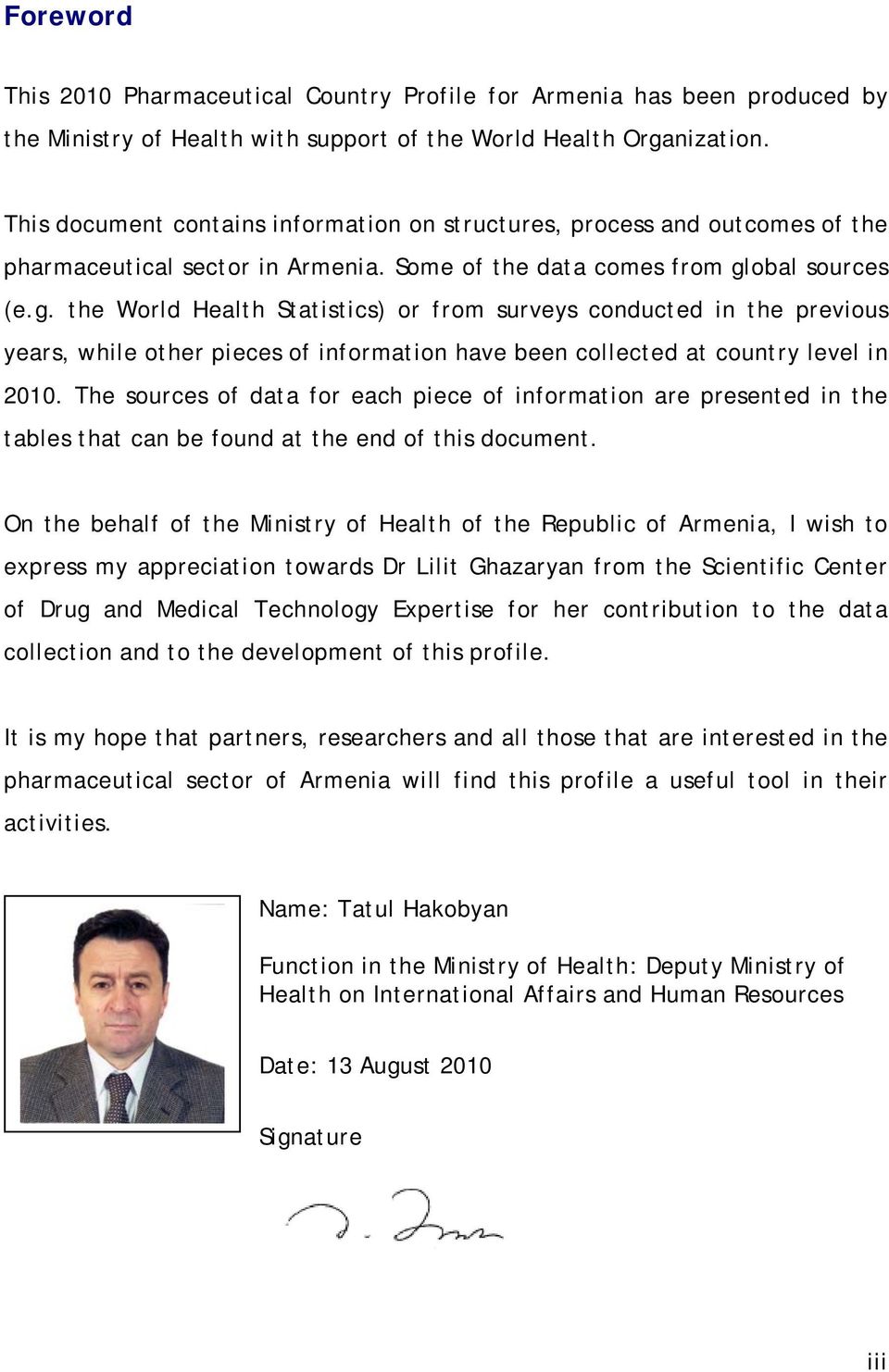
3 Foreword This 2010 Pharmaceutical Country Profile for Armenia has been produced by the Ministry of Health with support of the World Health Organization. This document contains information on structures, process and outcomes of the pharmaceutical sector in Armenia. Some of the data comes from global sources (e.g. the World Health Statistics) or from surveys conducted in the previous years, while other pieces of information have been collected at country level in The sources of data for each piece of information are presented in the tables that can be found at the end of this document. On the behalf of the Ministry of Health of the Republic of Armenia, I wish to express my appreciation towards Dr Lilit Ghazaryan from the Scientific Center of Drug and Medical Technology Expertise for her contribution to the data collection and to the development of this profile. It is my hope that partners, researchers and all those that are interested in the pharmaceutical sector of Armenia will find this profile a useful tool in their activities. Name: Tatul Hakobyan Function in the Ministry of Health: Deputy Ministry of Health on International Affairs and Human Resources Date: 13 August 2010 Signature iii
4 Table of content Foreword... iii Table of content... iv Introduction... v Section 1 - Health and Demographic Data... 1 Section 2 - Health Services... 3 Section 3 - Policy Issues... 7 Section 4 - Regulation...10 Section 5 - Medicines Financing...14 Section 6 - Pharmaceutical procurement and distribution in the public sector...17 Section 7 - Selection and rational use of medicines...17 Section 7 - Selection and rational use of medicines...18 Section 8 - Household data/access...20 References...21 ANNEX...26 Section 1 Health and Demographic data...28 Section 2 Health Services...31 Section 3 Policy issues...34 Section 4 Regulation...37 Section 5 Medicines Financing...44 Section 6 Pharm.procurement and distribution...48 Section 7 Selection and rational use...51 Section 8 Household data/access...55 iv

5 Introduction This Pharmaceutical Country Profile provides data on structures, processes and outcomes of the pharmaceutical sector of Armenia. The aim is to put together existing information and to make all relevant information on the pharmaceuticals sector available to the public in a user-friendly format. In 2010, country profiles similar to this one have been developed for 13 pilot countries. During 2011, the World Health Organization plans to support all WHO Member States to develop similar country profiles. The information is categorized in 8 sections, namely: (1) Health and Demographic data, (2) Health Services, (3) Policy Issues, (4) Regulation, (5) Medicines Financing, (6) Supply of Pharmaceuticals, (7) Rational Use of Medicines, and (8) Household Surveys. The indicators have been divided into two categories, namely "core" (most important) and "supplementary" (useful if available). The narrative profile is based only on the core indicators; while the tables in the annexes present all indicators. For each piece of information, we have tried to indicate the year and source of the data; these are used to build the references in the profile and are also indicated in the tables. If key national documents are available on-line, links are provided to the source documents so that the user can easily access these documents The selection of indicators for the profiles has involved all technical units working in the Essential Medicines Department of the World Health Organization as well as experts from WHO Regional and Country Offices, Harvard Medical School, Oswaldo Cruz Foundation (known as Fiocruz), University of Utrecht, the Austrian Federal Institute for Health Care and representatives from 13 pilot countries. Data collection in the pilot countries was conducted using a user-friendly electronic questionnaire that included a comprehensive glossary. Countries were requested not to conduct any v

6 additional surveys, but only to enter the results from previous surveys and to provide information available at the central level. To facilitate the work of national counterparts, the questionnaires were pre-filled using all data available at WHO HQ before being sent out to countries. A coordinator was nominated for each of the 13 pilot countries. The coordinator for Armenia was Dr Lilit Ghazaryan. The completed questionnaires were then used to produce the country profiles. In order to do this in a structured and efficient manner, a text template was developed. Member states took part in the development of the profile and, once the final product was ready, an officer from the Ministry of Health certified the quality of the information and gave formal permission to publish the profile on the web site of WHO. This profile will be regularly updated by country teams. If you have any suggestions on corrections to make please send them to Dr Lilit Ghazaryan, [email protected], Scientific Center of Drug and Medical Technology Expertise, N 1-15 Moskoyyan Str, Yeravan. vi

7 Section 1 - Health and Demographic Data This section gives an overview of the demographics and health status of Armenia. 1.1 Demographics and Socioeconomic Indicators The total population of Armenia in 2008 was 3,238,000 with an annual population growth rate of 0.2%. The annual GDP growth rate is 6.8%. The GNI per capita is US$ 3,350 [1] [2]. 1.2 Mortality and Causes of Death The life expectancy at birth for men is 66 years and for women is 73 years. The infant mortality rate is 22/1,000 live births. For children under the age of 5, the mortality rate is 24/1,000 live births. The maternal mortality rate is 76/100,000 live births [3]. The top 10 diseases causing mortality in Armenia are: 1. Diseases of the circulatory system (cardiovascular) 2. Neoplasm s 3. Diseases of respiratory system 4. Diseases of the digestive system 5. Endocrine system diseases, digestive disturbance, disturbance of metabolism and immunity 6. Accidents, poisonings, injuries 7. Symptoms, signs and abnormal clinical and laboratory findings, not elsewhere classified 8. Diseases of the genitourinary system 9. Certain infections and parasitic diseases 10. Certain conditions originating in the perinatal period 1
![The infant mortality rate is 22/1,000 live births. For children under the age of 5, the mortality rate is 24/1,000 live births. The maternal mortality rate is 76/100,000 live births [3].](/docs-images/42/1786814/images/page_7.jpg "The top 10 diseases causing mortality in Armenia are: 1. Diseases of the circulatory system (cardiovascular) 2. Neoplasm s 3. Diseases of respiratory system 4. Diseases of the digestive system 5.")
8 The top 10 diseases causing morbidity in Armenia are: 1. Diseases of respiratory system 2. Diseases of the circulatory system (cardiovascular) 3. Diseases of the digestive system 4. Diseases of the genitourinary system 5. Diseases of the eye and adnexa 6. Endocrine system diseases, digestive disturbance, disturbance of metabolism and immunity 7. Mental and behavioral disorders 8. Certain infections and parasitic diseases 9. Diseases of nervous system 10. Injury, poisoning and certain other consequences of external causes [4]. 2

9 Section 2 - Health Services This section provides information regarding health expenditure and human resources in Armenia. The contribution of the public and private sector to overall health expenditure is shown and the specific information on pharmaceutical expenditure is also presented. Data on human resources for health and for the pharmaceutical sector is provided as well. 2.1 Health Expenditures In Armenia, the total annual expenditure on health (THE) in 2008 was AMD 136,919 million (Dram) (US$ 435 million). The total health expenditure is 3.8 % of the GDP. The total annual expenditure on health per capita was AMD 45,609 (US$ 145). The government annual expenditure 1 on health accounts for 43.7 % of the total expenditure on health, with a total per capita public expenditure on health of AMD 19,940 (US$ 64). The government annual expenditure on health represents 7.6% of the total government budget. The private health expenditure covers the remaining 56.3% of the total health expenditure. The whole population (100 %) has access to primary health care centres, but payments have to be made at the point of delivery. The total pharmaceutical expenditure (TPE) in Armenia in 2008 was AMD 23,103 million (US$ 75.5 million). The total pharmaceutical expenditure per capita was AMD 7,030 (US$ 23). The pharmaceutical expenditure accounts for 0.63 % of the GDP and makes up % of the total health expenditure (figure 1). 1 By government expenditure it is meant all expenditure from public sources, like central government, local government, insurance funds and parastatal companies. This follows the definition provided by WHO National Health Accounts. 3
10 Public expenditure on pharmaceuticals represents % of the total expenditure on pharmaceuticals (figure 2). The total public expenditure on pharmaceuticals per capita was AMD 1,372 (US$ 4.5). FIGURE 1: Share of Total Pharmaceutical Expenditure as percentage of the Total Health Expenditure in Armenia in % TPE Other Source: NHA, % FIGURE 2: Share of public and private sector to Total Pharmaceutical Expenditure in Armenia in % Public sector Private sector Source: NHA, % 4

11 The total private expenditure on pharmaceuticals is AMD 18,986 million (US$ 62). The market share of generic pharmaceuticals [branded and INN] by value is unknown, but 80% of the registered medicinal products are generics. The annual growth rate of the market is equally unknown, but the annual growth rate of imported medicines value is 28.3% [5]. 2.2 Health Personnel The health workforce is described in the table below and in figure 3. Licensed pharmacists (all sectors) /10,000 [6] Pharmacists in the public sector /10,000 [4] Pharmaceutical technicians and assistants (all Unknown sectors) Physicians (all sectors) 36.7/10,000 Nursing and midwifery personnel (all sectors) 48.8/10,000 [3] Figure 3: The density of the Health Workforce in Armenia Nursing and midwifery personnel Physicians Pharmacists / 10,000 population 2 No data is available at country level on the total number of pharmacists in the country. It is possible that the density of pharmacists is higher than the one reported here and calculated using data from the Global Health Atlas. This is because there are 1,560 licensed pharmacies and outlets in the country and the total number of pharmacists who graduated from is 962 and therefore the total number of pharmacists may be higher than the 163 reported in the Global Health Atlas. 5

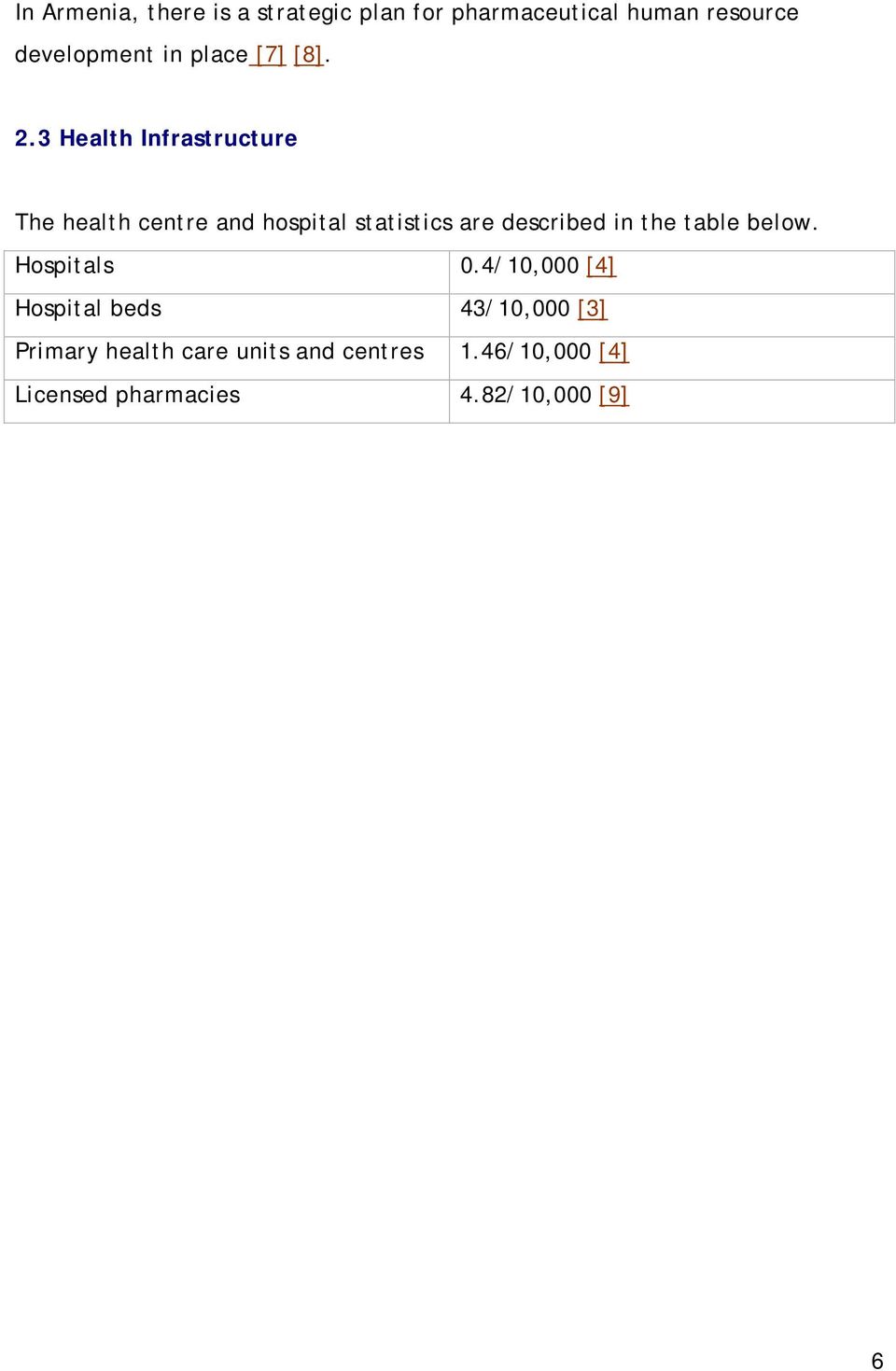
12 In Armenia, there is a strategic plan for pharmaceutical human resource development in place [7] [8]. 2.3 Health Infrastructure The health centre and hospital statistics are described in the table below. Hospitals 0.4/10,000 [4] Hospital beds 43/10,000 [3] Primary health care units and centres 1.46/10,000 [4] Licensed pharmacies 4.82/10,000 [9] 6
13 Section 3 - Policy Issues This section addresses the main structure of the pharmaceutical policy in Armenia. Information about the capacity for manufacturing medicines and regulations regarding patents is also provided. 3.1 Policy Framework In Armenia, a National Health Policy (NHP) exists. It was updated in An official National Medicines Policy document exists in Armenia. It was updated in 2006 [10]. In fact the NMP is part of the NHP. Issues related to pharmaceuticals are also addressed in the "National Security Strategy of the Republic of Armenia". The NMP and group of policies cover: Selection of essential medicines Medicines financing Medicines pricing Procurement Distribution Regulation Pharmacovigilance, Rational use of medicines Human resource development Research Monitoring and evaluation Traditional Medicine [10] [11] 7
![It was updated in 2006. An official National Medicines Policy document exists in Armenia. It was updated in 2006 [10]. In fact the NMP is part of the NHP.](/docs-images/42/1786814/images/page_13.jpg "Issues related to pharmaceuticals are also addressed in the \"National Security Strategy of the Republic of Armenia\".")
14 A NMP implementation plan does not exist [10]. Access to essential medicines/technologies as part of the fulfillment of the right to health, is recognized in the national legislation, "Law on Medicines of Republic of Armenia" [12]. There are official written guidelines on medicines donations [10]. The pharmaceutical policy implementation is not being regularly monitored/assessed. There is national good governance policy in Armenia. It is multisectoral. The Civil Service Council is responsible for it [13]. There is no policy in place to manage and sanction conflict of interest issues in pharmaceutical affairs. There is no a formal code of conduct for public officials. According to the Law on Human Rights defender, there is a whistle-blowing mechanism allowing individuals to raise a concern about wrongdoing occurring in the pharmaceutical sector of Armenia [14] [15]. 3.2 Intellectual Property Laws and Medicines Armenia is a member of the World Trade Organization. The country has a patent law and the national Legislation has been modified to implement the TRIPS Agreement. Armenia is eligible for the transitional period to Current laws contain (TRIPS) flexibilities and safeguards. The following (TRIPS) flexibilities and safeguards are present in the national law: Compulsory licensing provisions that can be applied for reasons of public health Bolar exceptions Parallel importing provisions [10] 8
![There are official written guidelines on medicines donations [10]. The pharmaceutical policy implementation is not being regularly monitored/assessed.](/docs-images/42/1786814/images/page_14.jpg "There is national good governance policy in Armenia. It is multisectoral. The Civil Service Council is responsible for it [13].")
15 The country is engaged in initiatives to strengthen capacity to manage and apply intellectual property rights to contribute to innovation and promote public health [16]. There are no legal provisions for data exclusivity for pharmaceuticals. Legal provisions exist for patent extension [17]. There are no laws for linkage between patent status and marketing authorization. 3.3 Manufacturing There are 14 licensed pharmaceutical manufacturers in Armenia [9]. Armenia has the capacity for: The Research and Development for discovering new active substances The production of pharmaceutical starting materials (APIs) The production of formulations from pharmaceutical starting material The repackaging of finished dosage form [10]. The percentage of market share by value of pharmaceuticals produced by domestic manufacturers is 8 % [18]. 9
![There are no laws for linkage between patent status and marketing authorization. 3.3 Manufacturing There are 14 licensed pharmaceutical manufacturers in Armenia [9].](/docs-images/42/1786814/images/page_15.jpg "Armenia has the capacity for: The Research and Development for discovering new active substances The production of pharmaceutical starting materials (APIs) The production of formulations from")
16 Section 4 - Regulation This section covers a broad range of pharmaceutical regulatory policy, institutions and practices in Armenia 4.1 Regulatory Framework In Armenia, there are legal provisions establishing the powers and responsibilities of the Medicines Regulatory Authority (MRA). The MRA is a scientific centre of drug and medical technology expertise under the Ministry of Health. The MRA has its own website and the URL address is The MRA is involved in harmonization/collaboration initiatives with the WHO, CIS (Commonwealth of Independent States, formerly the URSS) and EDQM (European Directorate for the Quality of Medicines and Health Care). An assessment of the medicines regulatory system has been conducted in the last five year [10]. 4.2 Marketing Authorization In Armenia, there are legal provisions requiring a marketing authorization (registration) for all pharmaceutical products on the market [10]. Explicit and publicly available criteria exist for assessing applications for marketing authorization of pharmaceutical products [19] [20]. In 2007, the number of pharmaceutical products registered in Armenia was 3,900 [10]. Legal provisions require the MRA to make the list of registered pharmaceutical products publicly available regularly [19] and this register is updated every month. The updated list is available on the web [21]. Medicines are registered by their INN (International Non-proprietary Names) or Brand name + INN [10]. Legal provisions require a fee to be paid for Medicines Market Authorization (registration) based on applications [19]. 10
17 4.3 Regulatory Inspection In Armenia, legal provisions exist allowing for appointment of government pharmaceutical inspectors [22]. The Regulatory Authority has 4 inspectors [23]. Legal provisions exist permitting inspectors to inspect premises where pharmaceutical activities are performed [10]. Legal provisions exist requiring inspection to be performed. Inspection is a pre-requisite for licensing facilities. Inspection requirements are the same for public and private facilities [22]. 4.4 Import Control Legal provisions exist requiring authorization to import medicines. Laws exist that allow the sampling of imported products for testing. Legal provisions exist requiring importation of medicines through authorized ports of entry. Regulations or laws exist to allow for inspection of imported pharmaceutical products at the authorized port of entry [24]. 4.5 Licensing In Armenia, legal provisions exist requiring manufacturers to be licensed [10]. Legal provisions exist requiring manufacturers to comply with Good Manufacturing Practices (GMP), but the latter are not published by the government [25]. GMP requirements are similar to EU GMP which are currently being translated. Legal provisions exist requiring importers, wholesalers and distributers to be licensed [10]. Legal provisions do not exist requiring wholesalers and distributors to comply with Good Distributing Practices. The GDP requirements are not published by the government. There are not legal provisions requiring pharmacists to be registered, but there are provisions requiring private and public pharmacies to be licensed [22]. National Good Pharmacy Practice Guidelines are not published by the government. 11
![Inspection is a pre-requisite for licensing facilities. Inspection requirements are the same for public and private facilities [22]. 4.](/docs-images/42/1786814/images/page_17.jpg "4 Import Control Legal provisions exist requiring authorization to import medicines. Laws exist that allow the sampling of imported products for testing.")
18 4.6 Market Control and Quality Control In Armenia, legal provisions exist for controlling the pharmaceutical market [12] [22] and a laboratory exists for Quality Control testing [23]. Samples are collected by government inspectors for post-marketing surveillance testing [10]. In the past 2 years, 18 samples were taken for quality control testing. Of the samples tested, 7 failed to meet the quality standards. The results are not publicly available [9] [23]. 4.7 Medicines Advertising and Promotion In Armenia, there are legal provisions to control the promotion and/or advertising of prescription medicines. The Ministry of Health is responsible for regulating promotion and/or advertising of medicines. Legal provisions prohibit direct advertising of prescription medicines to the public. Legal provisions require a pre-approval for medicines advertisements and promotional materials. Guidelines and Regulations exist for advertising and promotion of nonprescription medicines. There is no national code of conduct concerning advertising and promotion of medicines by marketing authorization holders [10]. 4.8 Clinical Trials In Armenia, legal provisions exist requiring authorization for conducting Clinical Trials by the MRA. Laws require the agreement by an ethics committee of the Clinical Trials to be performed. Registration of the clinical trials into international/national/regional registry is required by law [26]. 12
![Of the samples tested, 7 failed to meet the quality standards. The results are not publicly available [9] [23]. 4.](/docs-images/42/1786814/images/page_18.jpg "7 Medicines Advertising and Promotion In Armenia, there are legal provisions to control the promotion and/or advertising of prescription medicines.")
19 4.9 Controlled Medicines Armenia is signatory to the: - Single Convention on Narcotic Drugs, Protocol amending the Single Convention on Narcotic Drugs, Convention on Psychotropic Substances United Nations Convention against the Illicit Traffic in Narcotic Drugs and Psychotropic Substances, 1988 [27]. Laws exist for the control of narcotic and psychotropic substances, and precursors [10]. The annual consumption of Morphine is 1.42 mg/capita [27] Pharmacovigilance In Armenia, there are legal provisions in the Medicines Act that provide for pharmacovigilance activities as part of the MRA mandate. Legal provisions exist requiring the Marketing Authorization holder to continuously monitor the safety of their products and report to the MRA. Laws about monitoring Adverse Drug Reactions (ADR) exist in Armenia [12]. A national Pharmacovigilance centre linked to the MRA exists in Armenia and it has 3 full-time staff members. The centre has published at least one analysis report in the previous two years and it also publishes an ADR bulletin regularly. An official standardized form for reporting ADRs exists in Armenia. A national ADR database also exists. In the past 2 years, 141 ADR reports were sent to the WHO database in Uppsala. ADRs are monitored in at least one public health program [23]. 13
![Laws exist for the control of narcotic and psychotropic substances, and precursors [10]. The annual consumption of Morphine is 1.42 mg/capita [27]. 4.](/docs-images/42/1786814/images/page_19.jpg "10 Pharmacovigilance In Armenia, there are legal provisions in the Medicines Act that provide for pharmacovigilance activities as part of the MRA mandate.")
20 Section 5 - Medicines Financing In this section, information is provided on the structure of user fees for medicines and on the existence of public programmes providing free medicines. Policies and regulations in place that affect the prices of medicines (e.g. price control and taxes) are presented. 5.1 Medicines Coverage and Exemptions In Armenia, there are Public Programmes in Armenia providing free medicines to: Patients who cannot afford them Children under 5 Pregnant women Elderly persons No No No Public programmes exists providing free medicines for: All diseases Any non-communicable diseases Malaria Tuberculosis Sexually transmitted diseases HIV/AIDS EPI Vaccines for children (expanded programme of immunization) No No No [10] [28] [29]. 14
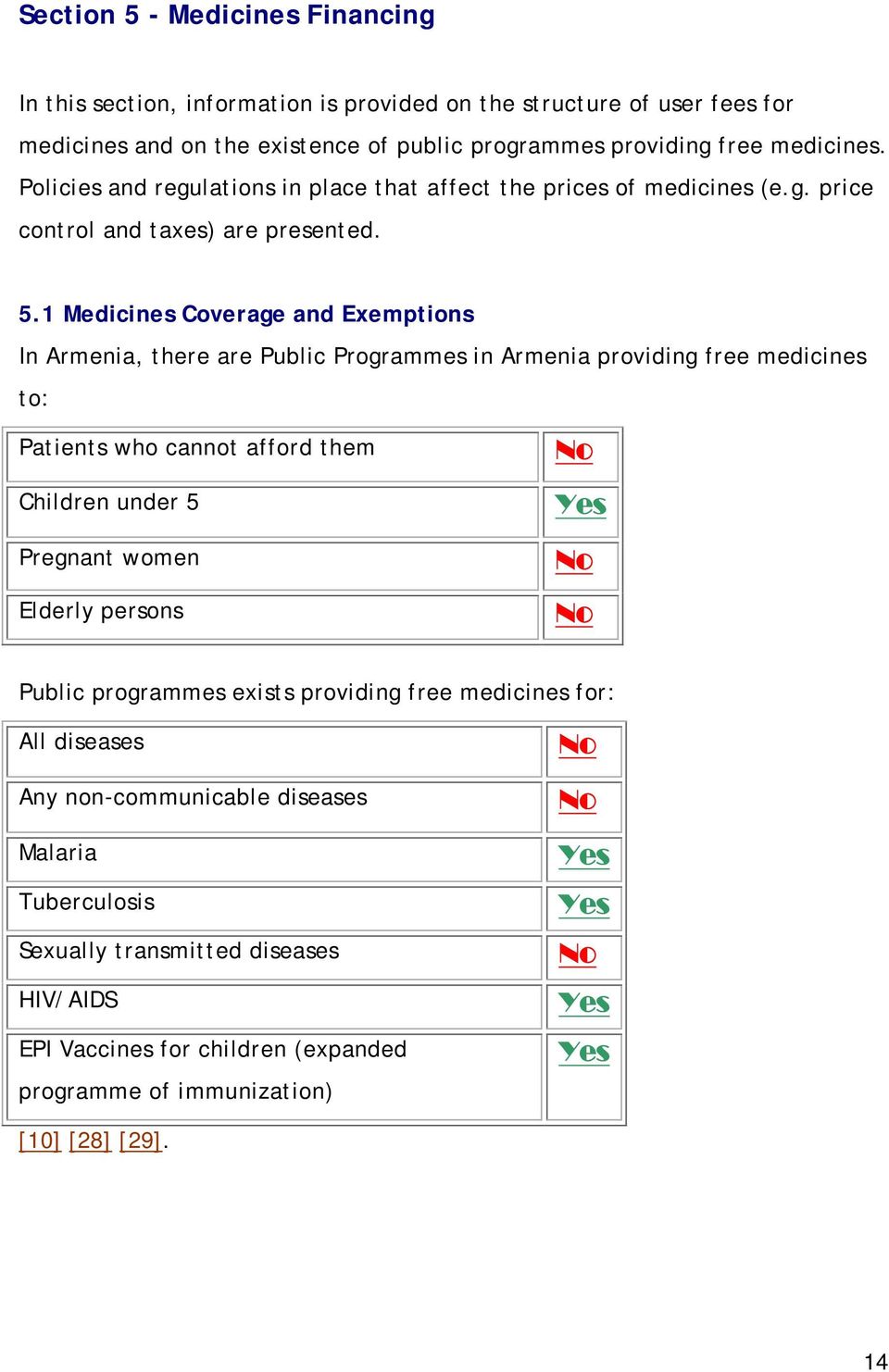
21 The following medicines are also provided for free in Armenia: Antipsychotics, antineoplastic and narcotics, ant diabetics, antiepileptics, anticoagulants after valve prosthetics, colchicines, cyclosporine, erythropoietin, micofenolat mofetil and analogs. In Armenia, there is a public health service, public health insurance, social insurance or other sickness fund provides at least partial medicines coverage. It provides coverage for medicines that are on the Essential Medicines List (EML) for inpatients and outpatients. In 1999 the Basic Benefits Package was established. Based on a set of criteria, it defines vulnerable and special segments of the population that are eligible to receive medicines. Private health insurance schemes provide medicines coverage [30]. 5.2 Patients Fees and Copayments In the health system of Armenia, at the point of delivery, there are copayments/fee requirements for consultations and medicines. Revenue from fees or from the sale of medicines is not used to pay the salaries or supplement the income of public health personnel in the same facility. According to the Government Decree, for some of the defined population groups, the government is obligated to provide partial subsidies (e.g. people with third degree disabilities) [10] [28] [31]. 5.3 Pricing Regulation for the Private Sector (not including the non-profit voluntary sector) In Armenia, there are no legal or regulatory provisions affecting pricing of medicines. The government does not run an active national medicines price monitoring system for retail prices. Regulations exist mandating that retail medicine price information should be publicly accessible [32]. 15
22 5.4 Prices, Availability and Affordability of Key Medicines In 2001, a WHO/HAI pricing survey was conducted in Armenia. Only private sector pharmacies have been surveyed in the country. Prices of medicines have been compared to international reference prices 3 and expressed as a ratio of the international price (e.g. a price ratio of 2 would mean that the price is two times the international reference price). Since prices have been collected for a basket of medicines, the median price ratio has been selected to represent the situation in the country. Private patient prices were above international reference prices: the Median Price Ratio for originators was 10.4 and for generics Affordability of medicines is measured in terms of number of days of wage necessary to purchase treatment for a condition. The wage is the one of the lowest paid government worker. In the private sector of Armenia, it would take 2 days of wage to purchase treatment with co-trimoxazole for a child respiratory infection using generic medicines and 2.2 days using originators ( 5.5 Duties and Taxes on Pharmaceuticals (Market) There are no duties on imported raw materials nor on imported finished products. On the other hand, there is however a 20% VAT on medicinal products [33]. 3 The International reference price is the median of prices offered by international suppliers (both for profit and not profit) as report by MHS International Price Indicator Guide ( For more information on the methodology WHO/HAI pricing survey, you can download a free copy of the manual at 16
23 Section 6 - Pharmaceutical procurement and distribution in the public sector This section provides a short overview on the procurement and distribution of pharmaceuticals in the public sector of Armenia. 6.1 Public Sector Procurement The public sector procurement in Armenia is centralized and decentralized. The public sector procurement is centralized under the responsibility of a procurement agency which is a government agency that procures all public goods [34] [35].The state procurement agency organizes procurement for medicines determined by the MoH and carries out tenders for the individual health facilities. The medicines are also purchased by health facilities and reimbursed by the MoH [36]. The public sector tender bids are publicly available and public sector awards are publicly available. Procurements are based on prequalification of suppliers [37]. 6.2 Public Sector Distribution The government supply system department in Armenia has a Central Medical Store at a National Level; the store is called Humanitarian Aid Center [9]. There are no public warehouses in the secondary tier of the public sector distribution. There are no national guidelines on Good Distribution Practices (GDP). There is not a licensing authority that issues GDP licenses. A list of GDP certified wholesalers does not exist and a list of GDP certified distributors does not exist in the public sector. 6.3 Private Sector Distribution Legal provisions exist for licensing wholesalers and distributors in the private sector of Armenia. A list of GDP certified wholesalers and distributors do not exist in the private sector. 17
24 Section 7 - Selection and rational use of medicines This section presents the structures and policies that are in place in Armenia for selection of essential medicines and promotion of rational drug use. 7.1 National Structures National Standard Treatment Guidelines (STGs) for the most common illnesses have been produced/endorsed by the MoH in Armenia. The national STGs were updated in They cover primary care, secondary care and paediatric conditions. A National Essential Medicines List (EML) exists in Armenia and it has been updated in There are 293 of medicines on the EML. There is a written process for selecting medicines on the EML. The EML is publicly available [10] [38] % of the public health facilities have a copy of the STGs [39]. A public or independently funded national medicines information centre provides information on medicines to prescribers, dispensers and consumers [10]. Public education campaigns on rational medicine use topics have been conducted in the last two years [23]. No surveys on rational use of medicines have been conducted in the previous two years. There is no national programme or committee to monitor and promote rational use of medicines. A written National Strategy to contain antimicrobial resistance does not exist. 7.2 Prescribing In Armenia, there are legal provisions to govern the licensing and prescribing practices of prescribers [40]. Legal provisions exist to restrict dispensing by prescribers [12]. Regulations require hospitals to organize/develop Drug and Therapeutics Committees (DTCs) [10]. The core medical training curriculum includes components on 18
25 The concept of EML Use of STGS Pharmacovigilance Problem based pharmacotherapy [41] [9] Mandatory continuing education that includes pharmaceutical issues is required for doctors, nurses and paramedical staff [10] [25]. Prescribing by INN name is not obligatory in the public and private sector. 7.3 Dispensing Legal provisions in Armenia exist to govern dispensing practices of pharmaceutical personnel. The core pharmacist training curriculum includes components on The concept of EML Use of STGs Drug information Clinical Pharmacy Medicine Supply Management [41] [9] Mandatory continuing education that includes pharmaceutical issues is required for pharmacists. Substitution of generic equivalents at the point of dispensing in public and private sector facilities is allowed. Antibiotics are sold over-thecounter without a prescription. Injectable medicines are sold over-the-counter without a prescription [10]. 19
26 Section 8 - Household data/access This section provides information about household surveys held in the past in Armenia regarding actual access to medicines by normal and poor households. In 2006 a household survey was conducted in Armenia for the 'Armenia: Health System Performance Assessment 2009', but the indicators are different from the Country Profiles Household Survey Indicators [30]. 20
27 References [1] National statistics data, Total population. Yerevan, Statistical Yearbook of Armenia, National Statistical Service of the Republic of Armenia, Available at: [2] Country data, Armenia. Washington, the World Bank, Available at: [3] World Health Statistics. Geneva, World Health Organization, Available through the Global Health Observatory: [4] 'Health and health care of Armenia' annual statistical report. Yerevan, MoH of Armenia; National Institute of Health, Available at: [5] National health accounts: country information Armenia. Geneva, World Health Organization, Available at: [6] Global health atlas. Geneva, World Health Organization, Available at: [7] Strategy for higher education reforms, 21 November 2003, #46 Government protocol, Yereavan, Available at (Armenian only): [8] Government program for Available at: [9] National institute of health. Republic of Armenia, Ministry of Health. Available at: [10] Country pharmaceutical situations. Fact book on WHO Level I indicators Geneva, World Health Organization, [11] National security strategy of the Republic of Armenia. Yerevan, National Security Council, Available at: [12] Law on medicines of Republic of Armenia. Yerevan, the Law of the Republic of Armenia, Available at: 21
28 [13] Law on civil service. Yerevan, the Law of the Republic of Armenia, Available at: (Civil Service Council, [14] Law on Human Rights defender. Yerevan, the Law of the Republic of Armenia, Available at: [15] Ombudsman. Yerevan, RA Human Rights Defender. Available at: [16] National Health Policy document (National Medicines Policy article) draft 2006 [17] Law on inventions, utility models and industrial designs. Yerevan, Intellectual Property Agency of the Republic of Armenia, Available at: [18] Armenian pharmaceutical industry handbook. USAID, UNPI, ADA, Available at: [19] RA Government decree N 347. Yerevan, Scientific centre of drug and medical technology expertise, Available at (Armenian only): [20] RA HM Order N 123-N. Yerevan, Scientific centre of drug and medical technology expertise, Available at (Armenian only): [21] List of registered drugs in Armenia. Yerevan, Scientific centre of drug and medical technology expertise, Available at: pdf, [22] Law on licensing of Republic of Armenia. Yerevan, the Law of the Republic of Armenia, Available at: 22
29 [23] Scientific Centre of Drug and Medical Technology Expertise (MRA). Yerevan. Available at: (the annual report of the MRA is available at: tvutun%20%20eng% pdf, [24] RA Government decree N 581. Yerevan, Scientific centre of drug and medical technology expertise, Available at (Armenian only): [25] RA Government decree N 867. Yerevan, Scientific centre of drug and medical technology expertise, Available at (Armenian only): [26] RA Government decree N 63. Yerevan, Scientific centre of drug and medical technology expertise, Available at (Armenian only): [27] Report of the International Narcotics Control. Vienna, International Narcotics Control Board, Available at: [28] RA Government decree N 1717-N. Yerevan, Scientific centre of drug and medical technology expertise, Available at (Armenian only): [29] Law on HIV diseases prevention, 1997, Available at (Armenian only): [30] Armenia Health System Performance Assessment. Yerevan, Ministry of Health of Armenia, Available at: data/assets/pdf_file/0020/103385/e92994.pdf, [31] RA HM Order N 123-N. Yerevan, Scientific centre of drug and medical technology expertise, Available at (Armenian and Russian only):
30 [32] Law on consumer right protection, 2001, Available at (Armenian and Russian only): [33] Amendment on law on VTA AL 126. Yerevan, the Law of the Republic of Armenia, Available at: [34] Government decree 1904-N, 2002, Available at (Armenian only): [35] Law on procurements. Yerevan, the Law of the Republic of Armenia, Available at: [36] Hakobyan T, Nazaretyan M, Makarova T, Aristakesyan M, Margaryants H, Nolte E. Armenia: Health system review. Health Systems in Transition, 2006; 8(6): Available at: data/assets/pdf_file/0004/96430/e89732.pdf, [37] The procurement system in the Republic of Armenia. Yerevan, Ministry of Finance. Available at: [38] Essential medicines list. Yerevan, Scientific centre of drug and medical technology expertise, Available at: ial%20list.doc, [39] Options for improving the supply and use of medicines for primary health care in Armenia- MSF/USAID Available at:
31 [40] RA HM Order N 100-N. Yerevan, Scientific centre of drug and medical technology expertise, Available at (Armenian only): [41] Medical University, Available at: and National Institute of Health. Available at:
32 Armenia Pharmaceutical Country Profile ANNEX Survey Data 26
33 Respondent to the questionnaire: Lilit Ghazaryan
34 Section 1 Health and Demographic data 1.01 Demographic and Socioeconomic Indicators Core Questions Population, total (,000) 3, World Health Statistics Population growth rate (Annual %) World Bank, Population GDP growth (Annual %) World Bank GNI per capita (US$ current exchange rate) 3, World Bank Comments Supplementary questions Population < 15 years (% of total population) Population > 60 years (% of total population) Urban population (% of total population) Fertility rate, total (Births per woman) Population living with less than $1/day (international PPP) (%) Population living below nationally defined poverty line (%) Income share held by lowest 20% of the population (% of national income) Adult literacy rate, 15+ years (% of total population) 1.02 Mortality and Causes of Death Core questions Life expectancy at birth for men (Years) Life expectancy at birth for women (Years) Infant mortality rate, between birth and age 1 (/1,000 live births) Under 5 mortality rate (/1,000 live births) According to the National Statistics data the total population size is 3,238,000 at the end of World Health Statistics World Health Statistics World Health Statistics World Health Statistics World Health Statistics Options for Improving the Supply and use of Medicines for Primary Health Care in Armenia - MSF/USAID World Bank World Health Statistics World Health Statistics World Health Statistics World Health Statistics World Health Statistics Maternal mortality ratio World Health 28
35 (/100,000 live births) Statistics Please provide a list of top Diseases of the diseases causing mortality circulatory system (cardiovascular) 2. Neoplasm s 3. Diseases of respiratory system 4. Diseases of the digestive system 5. Endocrine system diseases, digestive disturbance, disturbance of metabolism and immunity 6. Accidents, poisonings, injuries 7. Symptoms, signs and abnormal clinical and laboratory findings, not elsewhere classified 8. Diseases of the genitourinary system 9. Certain infections and para 10. Certain conditions originating in the perinatal period Please provide a list of top 10 diseases causing morbidity 1. Diseases of respiratory system 2. Diseases of the circulatory system (cardiovascular) 3. Diseases of the digestive system 4. Diseases of the genitourinary system 5. Diseases of the eye and adnexa 6. Endocrine system diseases, digestive disturbance, disturbance of metabolism and immunity 7. Mental and behavioral disorders 8. Certain infections and parasitic diseases 9. Diseases of nervous system 10. Injury, poisoning and certain other consequences of 2008 Health and Health Care of Armenia, Annual Statistical Report 2008 Health and Health Care of Armenia, Annual Statistical Report 29
36 Supplementary questions Adult mortality rate for both sexes between 15 and 60 years (/1,000 population) Neonatal mortality rate (/1,000 live births) Age-standardized mortality rate by non-communicable diseases ( /100,000 population) Age-standardized mortality rate by cardiovascular diseases (/100,000 population) Age-standardized mortality rate by cancer ( /100,000 population) Mortality rate for HIV/AIDS (/100,000 population) Mortality rate for tuberculosis (/100,000 population) Mortality rate for Malaria (/100,000 population) external causes World Health Statistics World Health Statistics 1, World Health Statistics World Health Statistics World Health Statistics World Health Statistics World Health Statistics World Health Statistics 30
37 Section 2 Health Services 2.01 Health Expenditures Core Questions Total annual expenditure on health (millions US$ average exchange rate) Total annual expenditure on health (millions NCU) Total health expenditure as % of Gross Domestic Product Total annual expenditure on health per capita (US$ average exchange rate) Total annual expenditure on health per capita (NCU) General government annual expenditure on health (millions US$ average exchange rate) General government annual expenditure on health (millions NCU) Government annual expenditure on health as percentage of total government budget (% of total government budget) Government annual expenditure on health as % of total expenditure on health (% of total expenditure on health) Annual per capita government expenditure on health (US$ average exchange rate) Annual per capita government expenditure on health (NCU) Private health expenditure as % of total health expenditure (% of total expenditure on health) Total pharmaceutical expenditure (millions US$ current exchange rate) Total pharmaceutical expenditure (millions NCU) Total pharmaceutical expenditure per capita (US$ current exchange rate) Total pharmaceutical expenditure per capita (NCU) Pharmaceutical expenditure as a % of GDP (% of GDP) Calculated from the NHA 136, National Health Accounts National Health Accounts National Health Accounts 45, Calculated from the NHA Calculated from the NHA 59, National Health Accounts National Health Accounts National Health Accounts National Health Accounts 19, Calculated from the NHA National Health Accounts Calculated from the NHA 23, National Health Accounts Calculated from the NHA 7, Calculated from the NHA Calculated from the NHA Pharmaceutical expenditure as a % Calculated from the 31
38 of Health Expenditure (% of total health expenditure) Total public expenditure on pharmaceuticals (millions US$ current exchange rate) Total public expenditure on pharmaceuticals (millions NCU) Share of public expenditure on pharmaceuticals as percentage of total expenditure on pharmaceuticals (%) Total public expenditure on pharmaceuticals per capita (US$ current exchange rate) Total public expenditure on pharmaceuticals per capita (NCU) Total private expenditure on pharmaceuticals (million US$ current exchange rate) Total private expenditure on pharmaceuticals (millions NCU) Comments Supplementary Questions Social security expenditure as % of government expenditure on health (% of government expenditure on health) Private out-of-pocket expenditure as % of private health expenditure (% of private expenditure on health) Premiums for private prepaid health plans as % of total private health expenditure (% of private expenditure on health) Comments NHA Calculated from the NHA 4, National Health Accounts Calculated from the NHA Calculated from the NHA 1, Calculated from the NHA Calculated from the NHA 18, National Health Accounts The market share of generic pharmaceuticals is Not Available. 80% of registered medicinal products are generics. The Annual growth rate of pharmaceuticals is NA. The annual growth rate of imported medicines is 28.3% National Health Accounts National Health Accounts National Health Accounts Primary Health Care - 100% of population; number of hospital cases in 2008 is 237, Health Personnel and Infrastructure Core Questions Total number of pharmacists licensed/registered to practice in your country Global Health Atlas Total number of pharmacists working in the public sector Health and Health Care of Armenia Annual Statistical Report Total number of pharmaceutical NA
39 technicians and assistants A strategic plan for pharmaceutical human resource development is in place in your country? 2007 Strategy for higher education reforms Total number of physicians 11, World Health Statistics Total number of nursing and midwifery personnel 14, World Health Statistics Total number of hospitals Health and Health Care of Armenia Annual Statistical Report Total number of hospitals bed 13, World Health Statistics Total number of primary health care units and centres Health and Health Care of Armenia Annual Statistical Report Total number of licensed pharmacies 1, MoH RA Comments The total number of pharmacists licensed/registered to practice can not be 163, because there are 1560 licensed pharmacies and outlets in the country, and total number of pharmacists who graduated from is 962 Supplementary Questions Starting annual salary for a newly registered pharmacist in the public sector - NCU Total number of pharmacists who graduated (first degree) in the past 2 years in your country Are there accreditation requirements for pharmacy schools? Is the Pharmacy Curriculum regularly reviewed? 60, Individual Report Health and Health Care of Armenia Annual Statistical Report 2010 Ministry of Education and MoH, government decree # Medical University 33
40 Section 3 Policy issues 3.01 Policy Framework Core Questions National Health Policy exists. If yes, please write year of the most recent document in the "year" field and attach document or provide URL below* National Medicines Policy official document exists. If yes, please write the year of the most recent document in the "year" field and attach document or provide URL below* Group of policies addressing pharmaceuticals exist. Please attach document or provide URL below * National Medicines Policy covers the following components: Selection of Essential Medicines Medicines Financing Medicines Pricing Medicines Procurement Medicines Distribution Medicines Regulation Pharmacovigilance Rational Use of Medicines Human Resource Development Research Monitoring and Evaluation Traditional Medicine National medicines policy implementation plan exists. Access to essential medicines/technologies as part of the fulfillment of the right to health, recognized in the constitution or national legislation? There are official written guidelines on medicines donations. Is pharmaceutical policy implementation being regularly monitored/assessed? Is there a national good governance policy? 2006 WHO Level I 2006 WHO Level I 2007 National Security Strategy of the Republic of Armenia No 2007 WHO Level I 1998 Law on Medicines of RA 2007 WHO Level I 2001 Law on Civil Servicehttp://www. parliament.am/legis 34
41 Multisectoral 2001 lation.php?sel=sho w&id=1268&lang= eng For the pharmaceutical sector No Which agencies are responsible? A policy is in place to manage and sanction conflict of interest issues in pharmaceutical affairs. There is a formal code of conduct for public officials. Is there a whistle-blowing mechanism allowing individuals to raise a concern about wrongdoing occurring in the pharmaceutical sector of your country (ombudsman)? Please describe: Comments Civil Service Council Law on Human Rights Defender. According to Law on Human rights defender D=1457&lang=eng The National Health Policy Document is a draft. The NMP is a part of this document 3.02 Intellectual Property Laws and Medicines Core Questions Country is a member of the World Trade Organization 2007 WHO Level I Legal provisions provide for granting of Patents on pharmaceuticals National Legislation has been modified to implement the TRIPS Agreement Current laws contain (TRIPS) flexibilities and safeguards Country is eligible for the transitional period to 2016 Which of the following (TRIPS) flexibilities and safeguards are present in the national law? Compulsory licensing provisions that can be applied for reasons of public health 2007 WHO Level I 2007 WHO Level I 2007 WHO Level I 2007 WHO Level I 2007 WHO Level I Bolar exception 2007 WHO Level I Are parallel importing provisions present in the national law? The country is engaged in initiatives to strengthen capacity to manage and apply intellectual property rights 2007 WHO Level I 2006 National Health Policy (draft) 35
42 to contribute to innovation and promote public health Are there legal provisions for data exclusivity for pharmaceuticals Legal provisions exist for patent extension Legal provisions exist for linkage between patent status and marketing authorization 3.03 Manufacturing Core Questions Number of licensed pharmaceutical manufacturers in the country Country has manufacturing capacity for: R&D to discover new active substances Production of pharmaceutical starting materials (APIs) Production of formulations from pharmaceutical starting material Repackaging of finished dosage forms Percentage of market share by value produced by domestic manufacturers (%) Supplementary Questions Percentage of market share by volume produced by domestic manufacturers (%) Number of multinational pharmaceutical companies manufacturing medicines locally Number of manufacturers that are GMP certified Comments 2008 Law on Inventions, Utility Models and Industrial designs MoH 2007 WHO Level I Armenian Pharmaceutical Industry Handbook NA MRA MRA GMP Certification procedure is in the stage of adoption 36
43 Section 4 Regulation 4.01 Regulatory Framework Core Questions Are there legal provisions establishing the powers and responsibilities of the medicines regulatory authority? Part of MOH Semi autonomous agency Other (specify) 2007 WHO Level I No No Scientific Center of Drug and Medical Technology Expertise under MoH The MRA has its own website 2007 WHO Level I - If yes, please provide MRA Web site address (URL) The MRA is involved in harmonization/ collaboration initiatives - If yes, please specify WHO, EDQM, CIS An assessment of the medicines regulatory system has been conducted in the last five years. Supplementary Questions Formal code of conduct exists for staff involved in medicines regulation Medicines Regulatory Authority gets funds from regular budget of the government. Medicines Regulatory Authority is funded from fees for services provided. Medicines Regulatory Authority receives funds/support from other sources - If yes, please specify Grants Revenues derived from regulatory activities are kept with the regulatory authority The Regulatory Authority is using a computerized information management system to store and retrieve information on registration, inspections, etc Marketing Authorization (Registration) 2007 WHO Level I 2007 WHO Level I 2007 WHO Level I No 2007 WHO Level I 2007 WHO Level I 2007 WHO Level I 2001 Government Decree # WHO Level I 37
44 Core Questions Legal provisions require a marketing authorization (registration) for all pharmaceutical products on the market Explicit and publicly available criteria exist for assessing applications for marketing authorization of pharmaceutical products Number of pharmaceutical products registered in your country Legal provisions require the MRA to make publicly available the registered pharmaceutical with defined periodicity - If yes, how frequently updated Monthly - If yes, please provide updated list or URL * Medicines are registered by their INN (International Non-proprietary Names) or Brand name + INN Legal provisions require paying a fee for Medicines Market Authorization (registration) applications Supplementary Questions Legal provisions require marketing authorization holders to provide information about variations to the existing marketing authorization Legal provisions require to publish the Summary Product Characteristics (SPCs) of the medicines registered Legal provisions require the establishment of an expert committee involved in the marketing authorization process Certificate for Pharmaceutical Products in accordance with the WHO Certification scheme is required as part of the marketing authorization application Legal provision require declaration of potential conflict of interests for the experts involved in the assessment and decision-making for registration Legal provisions allow applicants to appeal against MRAs decisions Registration fee - the amount per application for pharmaceutical product containing New Chemical Entity,NCE (US$) 2007 WHO Level I 1998/ / Law on Medicines, Government Decree #347, MoH order #123-N 3, WHO Level I 1998 Law on Medicines &langid= WHO Level I 2001 Government Decree # Law on Medicines, Government Decree # MoH order #123-N 2007 WHO Level I 2007 WHO Level I 1998 Law on Medicines 4, Government Decree #347 38
45 Registration fee - the Amount per application for a multisource pharmaceutical product (US$) Time limit for the assessment of a marketing authorization application (Months) Comments 4.03 Regulatory Inspection Core Questions Legal provisions exist allowing for appointment of government pharmaceutical inspectors Does the Regulatory Authority have inspectors? If yes, how many? 4 Legal provisions exist permitting inspectors to inspect premises where pharmaceutical activities are performed Legal provisions exist requiring inspection to be performed Inspection is a pre-requisite for licensing of facilities Inspection requirements are the same for public and private facilities 4.04 Import Control Core Questions Legal provisions exist requiring authorization to import medicines Legal provisions exist allowing the sampling of imported products for testing Legal provisions exist requiring importation of medicines through authorized ports of entry Legal provisions exist allowing inspection of imported pharmaceutical products at the authorized port of entry 4.05 Licensing Core Questions Legal provisions exist requiring manufacturers to be licensed If yes please provide documents below. Please attach document or provide URL below * 1, Government Decree # Government Decree #347 MRA staff must fill the declaration according to internal rules. MoH order requires members of the Pharm committee giving a final recommendation to the MoH not to be a firm representatives Law on Licensing 2010 MRA 2007 WHO Level I 2001 Law on Licensing 2001 Law on Licensing 2001 Law on Licensing 2001 Government Decree # Government Decree # Government Decree # Government Decree # WHO Level I 39
46 Legal provisions exist requiring manufacturers to comply with Good manufacturing Practices (GMP) GMP requirements are published by the government. If yes, please provide reference or URL below * Legal provisions exist requiring importers to be licensed Legal provisions exist requiring wholesalers and distributors to be licensed Legal provisions exist requiring wholesalers and distributors to comply with Good Distributing Practices National Good Distribution Practice requirements are published by the government Legal provisions exist requiring pharmacists to be registered Legal provisions exists requiring private pharmacies to be licensed Legal provision exist requiring public pharmacies to be licensed National Good Pharmacy Practice Guidelines are published by the government Comments Supplementary Questions Legal provisions require the publication of different categories of all pharmaceutical facilities licensed 4.06 Market Control and Quality Control Core Questions Legal Provisions for controlling the pharmaceutical market exist Does a laboratory exist in the country for Quality Control testing? Samples are collected by government inspectors for undertaking post-marketing surveillance testing How many Quality Control samples were taken for testing in the past two years? What is the total number of samples tested in the previous two years that failed to meet quality standards? 2002 Government Decree # WHO Level I 2007 WHO Level I 2001 Law on Licensing 2001 Law on Licensing GMP requirements are similar to the EU GMP which are at a translation stage Law on Licensing 1998/ MRA Law on Medicines/ Licensing 2007 WHO Level I MRA and MoH MRA and MoH 40
47 Results of quality testing in past two years are publicly available 4.07 Medicines Advertising and Promotion Core Questions Legal provisions exist to control the promotion and/or advertising of prescription medicines 2007 WHO Level I Who is responsible for regulating, promotion and/or advertising of medicines? Please describe: Legal provisions prohibit direct advertising of prescription medicines to the public Legal provisions require a preapproval for medicines advertisements and promotional materials Guidelines/Regulations exist for advertising and promotion of nonprescription medicines A national code of conduct exists concerning advertising and promotion of medicines by marketing authorization holders and is publicly available 4.08 Clinical trials Core Questions Legal provisions exist requiring authorization for conducting Clinical Trials by the MRA Legal provisions exist requiring the agreement by an ethics committee/ institutional review board of the Clinical Trials to be performed Legal provisions exist requiring registration of the clinical trials into international/national/regional registry Supplementary Questions Legal provisions exist for GMP compliance of investigational products Legal provisions require sponsor, investigator to comply with Good Clinical Practices (GCP) National GCP regulations are published by the Government. Legal provisions permit inspection of facilities where clinical trials are performed 4.09 Controlled Medicines Ministry of Health 2007 WHO Level I 2007 WHO Level I 2007 WHO Level I 2002 Government Decree # Government Decree # Government Decree # Government Decree #63 41
48 Core Questions The country is a signatory to conventions Single Convention on Narcotic Drugs, 1961 The 1972 Protocol amending the Single Convention on Narcotic Drugs, 1961 Convention on Psychotropic Substances 1971 United Nations Convention against the Illicit Traffic in Narcotic Drugs and Psychotropic Substances, 1988 Laws for the control of narcotic and psychotropic substances, and precursors exist, If yes, please attach below * Annual consumption of Morphine (mg/capita) Comments Supplementary Questions The laws and regulations for the control of narcotic and psychotropic substances, and precursors has been reviewed by a WHO International Expert or Partner Organization to assess the balance between the prevention of abuse and access for medical need If yes, year of review. Please attach a copy of the review or provide link to it if available on the web * Annual consumption of Fentanyl (mg/capita) Annual consumption of Pethidine (mg/capita) Annual consumption of Oxycodone (mg/capita) Annual consumption of Hydrocodone (mg/capita) Annual consumption of Phenobarbital (mg/capita) 2009 International Narcotics Control Board 2009 International Narcotics Control Board 2009 International Narcotics Control Board 2009 International Narcotics Control Board 2007 WHO Level I International Narcotics Control Board The calculations are based on a total population size of 3,238, Report International Narcotics Control Board International Narcotics Control Board International Narcotics Control Board International Narcotics Control Board International Narcotics Control Board 42
49 Annual consumption of Methadone (mg/capita) 4.10 Pharmacovigilance Core Questions There are legal provision in the Medicines Act that provides for pharmacovigilance activities as part of the MRA mandate Legal provisions exist requiring the Marketing Authorization holder to continuously monitor the safety of their products and report to the MRA Legal provisions about monitoring Adverse Drug Reactions (ADR) exist in your country A national Pharmacovigilance centre linked to the MRA exists in your country If a national pharmacovigilance centre exists in your country, how many staff does it employ full-time If a national pharmacovigilance center exists in your country, an analysis report has been published in the previous two years. If a national pharmacovigilance center exists in your country, it publishes an ADR bulletin An official standardized form for reporting ADRs is used in your country. A national Adverse Drug Reactions database exists in your country. Are ADR reports set to the WHO database in Uppsala? If yes, number of reports sent in the past two years ADRs are monitored in at least one public health program (for example TB, HIV, AIDS)? Supplementary Questions How many ADR reports are in the database? How many reports have been submitted in the past two years? International Narcotics Control Board 1998 Law on Medicines 1998 Law on Medicines 1998 Law on Medicines 2010 MRA MRA 2010 MRA 2010 MRA 2010 MRA 2010 MRA 2010 MRA MRA 2010 MRA MRA MRA Feedback is provided to reporters 2010 MRA The ADR database is computerized 2010 MRA Medications errors (MEs) are 2010 MRA 43
50 reported. How many MEs are there in the ADRs database? There is a risk management plan presented as part of product dossier submitted for Marketing Authorization? In the past two years, who has reported ADRs? Doctors MRA MRA 2010 MRA Nurses Pharmacists Consumers Pharmaceutical Companies Was there any regulatory decision based on local PV data in the last 2 years? Are there training courses in Pharmacovigilance? If yes, how many people have been trained in the past two years? What is the percentage of preventable ADRs in the database for the past two years (%)? Comments No No 2010 MRA annual report MRA The ADRs report is based on local data only. Section 5 Medicines Financing 5.01 Medicines Coverage and Exemptions Core Questions If a public programme providing free medicines exists, medicines are available free-of-charge for: Patients who cannot afford them No 2007 WHO Level I Children under WHO Level I Pregnant women No 2007 WHO Level I Elderly persons No 2007 WHO Level I Please describe/explain your yes answers for questions above If a public programme providing some/all medicines free exists, the following types of medicines are free All medicines for all conditions Any non-communicable diseases Government decree N 2006 No No Malaria medicines 2007 WHO Level I Tuberculosis medicines 2007 WHO Level I 44
51 Sexually transmitted diseases medicines No HIV/AIDS medicines 1997 Law on HIV disease prevention EPI vaccines 2007 WHO Level I If others, please specify Antipsychotics, antineoplastics and narcotics, antidiabetics, antiepileptics, anticuagulants after valve prosthetics, colchicine, ciclosporin, erythropoietin, micofenolat mofetil and analogs. Does a public health service, public health insurance, social insurance or other sickness fund provides at least partial medicines coverage Does it provide coverage for medicines that are on the EML for inpatients Does it provide coverage for medicines that are on the EML for outpatients Does it provide at least partial medicines coverage for inpatients Does it provide at least partial medicines coverage for outpatients Please describe/explain your answers for questions above Do private health insurance schemes provide any medicines coverage? If yes, is it required to provide at least partial coverage for medicines that are on the EML? 5.02 Patients Fees and Copayments Core Questions In your health system, at the point of delivery, are there any copayment/fee requirements for consultations In your health system, at the point of delivery, are there any copayment/fee requirements for medicines Is revenue from fees or from the sale of medicines used to pay the salaries or supplement the income of public health personnel in the same facility 2009 Armenia Health System Performance Assessment. Government decree #1717-N- 2006, MoH order #74-N-2005 In 1999 the Basic Benefits Package was established. Based on a set of criteria, it defines vulnerable and special segments of the population that are eligible to receive medicines Armenia Health System Performance Assessment 2009 Unknown 2007 WHO Level I 2005 Government decree #1717-N- 2006, MoH order #74-N-2005 No 2007 WHO Level I 45
52 Please describe the patient fees and copayments system According to the Government Decree, for some of the defined population groups, the government is obligated to provide partial subsidies (e.g. people with third degree disabilities) Pricing Regulation for the Private Sector Core Questions Are there legal or regulatory provisions affecting pricing of medicines Government runs an active national medicines price monitoring system for retail prices Regulations exists mandating that retail medicine price information should be publicly accessible Comments 2001 Law on consumer rights protection It needs to be clarified, what does it mean publicly available, national legislation required to give such information in pharmacy. 46
53 5.04 Prices, Availability and Affordability Core Questions Please state if a medicines price survey using the WHO/HAI methodology has been conducted in the past 5 years in your country. No Basket of key medicines Price Affordability Days wages of the lowest paid govt worker for standard treatment with co-trimoxazole for a child respiratory infection Median Price Ratio Number of days' wages 5.05 Price Components and Affordability Core Questions Please state if a survey of medicines price components has been conducted in the past 5 years in your country. If yes, please indicate the year of the survey and use the results to fill in the questions below 5.06 Duties and Taxes on Pharmaceuticals (Market) Core Questions There are duties on imported active pharmaceutical ingredients (APIs) There are duties on imported finished products VAT (value-added tax) or any other tax on pharmaceuticals - If yes, please specify categories of pharmaceuticals on which the taxes are applied Supplementary Questions Amount of duties on imported active pharmaceutical ingredients, APIs (%) Amount of duties on imported finished products (%) Amount of VAT on pharmaceutical products (%) Orig. LPG Orig. LPG Private patient Amendment on law on value added tax AL 126 Medicinal products Amendment on law on value added tax AL
54 Section 6 Pharm.procurement and distribution 6.01 Public Sector Procurement Core Questions Public sector procurement is 2006 Armenia Health System Review Decentralized No Centralized and decentralized Please describe SPA organizes procurement for medicines determined by the MoH and carries out tenders for the individual health facilities. The medicines are also purchased by health facilities and reimbursed by the MoH. If public sector procurement is wholly or partially centralized, it is under the responsibility of a procurement agency which is: Part of MoH Semi-Autonomous Autonomous A government procurement Agency which procures all public goods Public sector tenders bids documents are publicly available Public sector awards are publicly available Procurements are based on prequalification of suppliers If yes, please describe how it works Supplementary Questions Is there a written public sector procurement policy?. If yes, please write the year of approval in the "year" field. Are there provisions giving priority in public procurement to goods produced by local manufacturers? The key functions of the procurement unit and those of the tender committee are clearly separated A process exists to ensure the quality of products procured If yes, the quality assurance process includes pre-qualification of products and suppliers If yes, explicit criteria and procedures exist for pre-qualification of suppliers No No No 2002/ 2004 Government decree 1904-N Law on procurements 2010 State procurement agency 2010 State procurement agency 2010 State procurement agency State procurement agency State procurement agency 2007 WHO Level I 2004 Law on procurement 48
55 If yes, a list of pre-qualified suppliers and products is publicly available List of samples tested during the procurement process and results of quality testing is available Which of the following tender methods are used in public sector procurement: National competitive tenders International competitive tenders Direct purchasing Comments 6.02 Public Sector Distribution Core Indicators The government supply system department has a Central Medical Store at National Level Number of public warehouses in the secondary tier of public distribution (State/Regional/Provincial) There are national guidelines on Good Distribution Practices (GDP) There is a licensing authority that issues GDP licenses List of GDP certified warehouses in the public sector exists List of GDP certified distributors in the public sector exists Comments Supplementary Questions Which of the following processes at the Central Medical Store is in place Forecasting of order quantities Requisition/Stock orders Preparation of picking/packing slips Reports of stock on hand Reports of outstanding order lines Expiry dates management Batch tracking Reports of products out of stock Percentage of selected medicines with at least one stock out in the past year (%) 2010 MRA No 2007 WHO Level I There is a law on procurements: State procurement agency MoH The MoH has a CMS which is called Humanitarian Aid Center MoH and Government Decree # 799-N 2010 NA Routine Procedure exists to track the 2010 MoH 49
56 expiry dates of medicines The Public Central Medical Store is GDP certified by a licensing authority The Public Central Medical Store is ISO certified The second tier public warehouses are GDP certified by a licensing authority The second tier public warehouses are ISO certified 6.03 Private Sector Distribution Core Questions Legal provisions exist for licensing wholesalers in the private sector Legal provisions exist for licensing distributors in the private sector List of GDP certified wholesalers in the private sector exists List of GDP certified distributors in the private sector exists No No 50
57 Section 7 Selection and rational use 7.01 National Structures Core Questions National Standard Treatment Guidelines (STGs) for most common illnesses are produced/endorsed by the MoH. If yes, please insert year of last update of STGs in the "year" field and attach document or provide URL below* If yes, STG's are applied to Primary care. Please use the "year" field to write the year of last update of primary care STGs. If yes, STG's are applied to Secondary (hospitals). Please use the "year" field to write the year of last update of secondary care STGs. If yes, STG's are applied to Paediatric conditions. Please use the "year" field to write the year of last update of paediatric condition STGs. National essential medicines list (EML) exists. If yes, please write year of last update of EML in the "year" field and attach document or provide URL below. If yes, number of medicines on the EML If yes, there is a written process for selecting medicines on the EML If yes, the EML is publicly available 2006 WHO Level I 2006 WHO Level I 2001 WHO Level I 2006 WHO Level I 2007 WHO Level I 293 % of public health facilities with copy of EML (mean)- Survey data % of public health facilities with copy of STGs (mean)- Survey data A public or independently funded national medicines information centre provides information on medicines to prescribers, dispensers and consumers NA Options for Improving the Supply and Use of Medicines for Primary Health Care in Armenia MSF/USAID WHO Level I 51
58 Public education campaigns on rational medicine use topics have been conducted in the previous two years A survey on rational use of medicines has been conducted in the previous two years A national programme or committee (involving government, civil society, and professional bodies) exists to monitor and promote rational use of medicines A written National Strategy exists to contain antimicrobial resistance. Supplementary Questions The EML includes formulations specific for children There are explicit documented criteria for selection of medicines in the EML There is a formal committee or other equivalent structure for the selection of products on the national EML If yes, provide the official documentation establishing the committee * If yes, conflict of interest declarations are required from members of national EML committee 2010 MRA 2007 WHO Level I MoH order # National medicines formulary exists 2010 MRA Is there a funded national intersectoral task force to coordinate the promotion of appropriate use of antimicrobials and prevention of spread of infection? A national reference laboratory/or any other institution has responsibility for coordinating epidemiological surveillance of antimicrobial resistance 7.02 Prescribing Core Questions Legal provisions exist to govern the licensing and prescribing practices of prescribers Legal provisions exist to restrict dispensing by prescribers Regulations require hospitals to organize/develop Drug and Therapeutics Committees (DTCs) MRA No 2007 WHO Level I 2002 Government decree # Law on Medicines 2007 WHO Level I 52
59 The core medical training curriculum includes components on: Concept of EML Use fo STGs Pharmacovigilance Problem based pharmacotherapy The core nursing training curriculum includes components on: Concept of EML - Use of STGs - Pharmacovigilance - The core training curriculum for paramedical staff includes components on: Concept of EML - Use of STGs - Pharmacovigilance - Mandatory continuing education that includes pharmaceutical issues is required for Doctors Mandatory continuing education that includes pharmaceutical issues is required for Nurses Mandatory continuing education that includes pharmaceutical issues is required for Paramedical staff Prescribing by INN name is obligatory in: Private sector 2010 Medical University. National Institute of Health 2007 WHO Level I 2002 Government decree # WHO Level I No Public sector No Average number of medicines prescribed per patient contact in public health facilities (mean) % of medicines prescribed in outpatient public health care facilities that are in the national EML (mean) % of medicines in outpatient public health care facilities that are prescribed by INN name (mean) % of patients in outpatient public health care facilities receiving antibiotics (mean) % of patients in outpatient public health care facilities receiving injections (mean)
60 % of prescribed drugs dispensed to patients (mean) % of medicines adequately labelled in public health facilities (mean) Supplementary Questions A professional association code of conduct exists governing professional behaviour of doctors A professional association code of conduct exists governing professional behaviour of nurses Diarrhoea in children treated with ORS (%) 7.03 Dispensing Core Questions Legal provisions exist to govern dispensing practices of pharmaceutical personnel The basic pharmacist training curriculum includes components on: Concept of EML Use fo STGs Drug Information Clinical pharmacology Medicines supply management Mandatory continuing education tat includes rational use of medicines is required for pharmacists Substitution of generic equivalents at the point of dispensing in public sector facilities is allowed Substitution of generic equivalents at the point of dispensing in private sector facilities is allowed Antibiotics are sold over-the-counter without a prescription Injectable medicines are sold overthe-counter without a prescription Supplementary Questions A professional association code of conduct exists governing professional behaviour of pharmacists - - Unknown 2010 Unknown Options for Improving the Supply and Use of Medicines for Primary Health Care in Armenia MSF/USAID MoH order # Medical University 2007 WHO Level I WHO Level I 2007 WHO Level I Are the following categories of staff 2007 WHO Level I 54
61 prescribing prescription-only medicines at primary care level in the public sector? Doctors Nurses Pharmacists No No Section 8 Household data/access 8.01 Data from Household Surveys Core Questions What household surveys have been undertaken in the past 5 years to assess access to medicines? According to the AHSP Assessment, a household survey was conducted in 2006, but the requested data are not included: data/assets/pdf_file/0020/ /E92994.pdf. 55
SAUDI ARABIA PHARMACEUTICAL COUNTRY PROFILE
 SAUDI ARABIA PHARMACEUTICAL COUNTRY PROFILE Saudi Arabia Pharmaceutical Country Profile Published by the Saudi Food and Drug Authority in collaboration with the World Health Organization 2012 Any part
Netherlands PHARMACEUTICAL COUNTRY PROFILE
 Netherlands PHARMACEUTICAL COUNTRY PROFILE Netherlands Pharmaceutical Country Profile Published by Ministry of Health, Welfare and Sports in collaboration with the World Health Organization August 2011
SAINT LUCIA PHARMACEUTICAL COUNTRY PROFILE
 SAINT LUCIA PHARMACEUTICAL COUNTRY PROFILE SAINT LUCIA Pharmaceutical Country Profile Published by the Ministry of Health, Wellness, Human Services and Gender Relations in collaboration with the Pan American
Framework for rapid assessment of the pharmaceutical sector in a given country
 Framework for rapid assessment of the pharmaceutical sector in a given country Prepared for Flagship Course (Health) Glossary: EU GLP GMP HIF IMS INN MOH NGO OEBIG OECD OTC PER R&D Rx TRIPS VAT WHO European
EGYPT PHARMACEUTICAL COUNTRY PROFILE
 EGYPT PHARMACEUTICAL COUNTRY PROFILE Egypt Pharmaceutical Country Profile Published by the Ministry of Health Egypt in collaboration with the World Health Organization July 2011 Any part of this document
Access to affordable essential medicines 1
 35 Access to affordable essential medicines 1 Target 8e In cooperation with pharmaceutical companies, provide access to affordable essential drugs in developing countries. Target 8e of the Millennium Development
French pharmaceutical system Focus on pricing and reimbursement
 Couverture French pharmaceutical system Focus on pricing and reimbursement DDGOS date Sophie DELCROIX-LOPES CNAMTS Conflict of interest disclosure 2 The author declares that she has no competing interests.
PHILIPPINES PHARMACEUTICAL COUNTRY PROFILE
 PHILIPPINES PHARMACEUTICAL COUNTRY PROFILE Philippines Pharmaceutical Country Profile Published by the Ministry of Health in collaboration with the World Health Organization Any part of this document may
THEME: PROMOTING GOOD PRACTICES IN DRUG POLICY DEVELOPMENT AND IMPLEMENTATION
 Page 1 AFRICAN UNION UNION AFRICAINE UNIÃO AFRICANA Addis Ababa, ETHIOPIA P. O. Box 3243 Telephone 251-11-5517 700 Fax 251-11-5517 844 website: www. africa-union.org 5 th SESSION OF THE AU CONFERENCE OF
Snapshot Report on Russia s Healthcare Infrastructure Industry
 Snapshot Report on Russia s Healthcare Infrastructure Industry According to UK Trade & Investment report, Russia will spend US$ 15bn in next 2 years to modernize its healthcare system. (Source: UK Trade
The Healthy Michigan Plan Handbook
 The Healthy Michigan Plan Handbook Introduction The Healthy Michigan Plan is a health care program through the Michigan Department of Community Health (MDCH). The Healthy Michigan Plan provides health
3. Financing. 3.1 Section summary. 3.2 Health expenditure
 3. Financing 3.1 Section summary Malaysia s public health system is financed mainly through general revenue and taxation collected by the federal government, while the private sector is funded through
The objectives of the Sri Lankan National Medicinal Drug Policy are
 NATIONAL MEDICINAL DRUG POLICY FOR SRI LANKA Preamble Sri Lanka had a partly written Drug Policy from the 1960s. It was written as elements of a policy, beginning from selection of drugs for the government
REGULATORY OVERVIEW DISTRIBUTION OF PHARMACEUTICAL PRODUCTS
 REGULATORY FRAMEWORK Our products are subject to regulatory controls governing pharmaceutical products and medical appliances and equipment. Thus we are subject to regulation and oversight by different
Comparison of Healthcare Systems in Selected Economies Part I
 APPENDIX D COMPARISON WITH OVERSEAS ECONOMIES HEALTHCARE FINANCING ARRANGEMENTS Table D.1 Comparison of Healthcare Systems in Selected Economies Part I Predominant funding source Hong Kong Australia Canada
The Healthy Michigan Plan Handbook
 The Healthy Michigan Plan Handbook Introduction The Healthy Michigan Plan is a health care program through the Michigan Department of Community Health (MDCH). Eligibility for this program will be determined
Türkiye İlaç ve Tıbbi Cihaz Kurumu
 w w w. t i t c k. g o v. t r TURKISH MEDICINES AND MEDICAL DEVICES AGENCY Gulsen ONER, Pharm. M.Sc. Melda KECIK, Pharm. M.Sc. WHO Technical Briefing Seminar, November 2014 OUTLINE I. About Turkey II. About
NATIONAL HEALTH ACCOUNTS:
 THE REPUBLIC OF UGANDA MINISTRY OF HEALTH NATIONAL HEALTH ACCOUNTS: KEY MESSAGES (FY2010/11 & 2011/12) NATIIONAL HEALTH ACCOUNTS: KEY MESSAGES Introduction The overall purpose of the National Health Accounts
THEME: PROMOTING GOOD PRACTICES IN DRUG POLICY DEVELOPMENT AND IMPLEMENTATION
 Page 1 AFRICAN UNION UNION AFRICAINE UNIÃO AFRICANA Addis Ababa, ETHIOPIA P. O. Box 3243 Telephone 251-11-5517 700 Fax 251-11-5517 844 website: www. africa-union.org 5 th SESSION OF THE AU CONFERENCE OF
WHO Medicines Strategy. Countries at the core 2004 2007. World Health Organization
 WHO Medicines Strategy Countries at the core 2004 2007 World Health Organization Expanding access to essential medicines Scaling up access to essential medicines especially for HIV/AIDS, tuberculosis and
HOSPITAL SUBSECTOR ANALYSIS
 HOSPITAL SUBSECTOR ANALYSIS Fourth Health Sector Development Project (RRP MON 41243) A. Introduction 1. The health status of the people of Mongolia has generally improved over the years, and significant
Introduction 2. 1. The Role of Pharmacy Within a NHS Trust 3. 2. Pharmacy Staff 4. 3. Pharmacy Facilities 5. 4. Pharmacy and Resources 6
 Index Index Section Page Introduction 2 1. The Role of Pharmacy Within a NHS Trust 3 2. Pharmacy Staff 4 3. Pharmacy Facilities 5 4. Pharmacy and Resources 6 5. Prescription Charges 7 6. Communication
EU DIRECTIVE ON GOOD CLINICAL PRACTICE IN CLINICAL TRIALS DH & MHRA BRIEFING NOTE
 EU DIRECTIVE ON GOOD CLINICAL PRACTICE IN CLINICAL TRIALS DH & MHRA BRIEFING NOTE Purpose 1. The Clinical Trials Directive 2001/20/EC heralds certain additional responsibilities for the Medicines and Healthcare
National Certificate in Pharmacy (Technician) (Level 5) with strands in Community, and Hospital Level 5
 NZQF NQ Ref 0423 Version 7 Page 1 of 8 National Certificate in Pharmacy (Technician) (Level 5) with strands in Community, and Hospital Level 5 Credits 131 or 139 This qualification has been reviewed. The
IN-NETWORK MEMBER PAYS. Out-of-Pocket Maximum (Includes a combination of deductible, copayments and coinsurance for health and pharmacy services)
 HMO-OA-CNT-30-45-500-500D-13 HMO Open Access Contract Year Plan Benefit Summary This is a brief summary of benefits. Refer to your Membership Agreement for complete details on benefits, conditions, limitations
Zambia UK Health Workforce Alliance & Zambia Ministry of Health Conference
 Zambia UK Health Workforce Alliance & Zambia Ministry of Health Conference CURRENT HEALTH BILLS/ACTS & RESTRUCTURING OF THE ZAMBIAN HEALTH SERVICE WITHIN MINISTRIES Maynard Theatre, The Kings Fund, 11
SADC GUIDELINES ON IMPORT AND EXPORT PROCEDURES FOR PHARMACEUTICAL PRODUCTS
 SADC GUIDELINES ON IMPORT AND EXPORT PROCEDURES FOR PHARMACEUTICAL PRODUCTS June 2006 1 INTRODUCTION Public health concerns demand that the manufacture of pharmaceutical products and their subsequent handling
Islamic Republic of Afghanistan Ministry of Public Health. Contents. Health Financing Policy 2012 2020
 Islamic Republic of Afghanistan Ministry of Public Health Contents Health Financing Policy 2012 2020 Table of Content 1. Introduction 1 1.1 Brief County Profile 1 1.2 Health Status Data 1 1.3 Sources
DRUG SAFETY AND HUMAN RESOURCES SUBSECTORS ANALYSIS
 Additional Financing of Fourth Health Sector Development Project (RRP MON 41243) DRUG SAFETY AND HUMAN RESOURCES SUBSECTORS ANALYSIS I. Drug Safety Subsector A. Drug Safety Issues 1. Lack of coordination.
Household health care spending: comparing the Consumer Expenditure Survey and the National Health Expenditure Accounts Ann C.
 Household health care spending: comparing the Consumer Expenditure Survey and the National Health Expenditure Accounts Ann C. Foster Health care spending data produced by the Federal Government include
The Kenya National Drug Policy
 The Kenya National Drug Policy Table of Contents The Kenya National Drug Policy...1 FOREWORD...1 ABBREVIATIONS...1 1. GOAL AND OBJECTIVES OF THE NATIONAL DRUG POLICY...2 1.1. The Goal of the National
Guidelines for Governments on Preventing the Illegal Sale of Internationally Controlled Substances through the Internet
 INTERNATIONAL NARCOTICS CONTROL BOARD Guidelines for Governments on Preventing the Illegal Sale of Internationally Controlled Substances through the Internet UNITED NATIONS INTERNATIONAL NARCOTICS CONTROL
Disability Allowance Application
 Disability Allowance Application CLIENT NUMBER If you need help with this form call us on % 0800 559 009. Who can get Disability Allowance? Please read this before you start Name If you, or a family member,
SIXTY-SEVENTH WORLD HEALTH ASSEMBLY. Agenda item 12.3 24 May 2014. Hepatitis
 SIXTY-SEVENTH WORLD HEALTH ASSEMBLY WHA67.6 Agenda item 12.3 24 May 2014 Hepatitis The Sixty-seventh World Health Assembly, Having considered the report on hepatitis; 1 Reaffirming resolution WHA63.18,
S P E C I A L I S T A N D M A S T E R S T U D I E S
 University Ss, Cyril and Methodius Skopje FACULTY OF PHARMACY S P E C I A L I S T A N D M A S T E R S T U D I E S Healthcare management and pharmacoeconomics Skopje, 2007 STUDY PLAN -Specialist Studies-
INTERNATIONAL PRICE COMPARISON: THE CYPRIOT EXAMPLE. Athos Tsinontides Health Insurance Organisation
 INTERNATIONAL PRICE COMPARISON: THE CYPRIOT EXAMPLE Athos Tsinontides Health Insurance Organisation CYPRUS CYPRUS Kypros Demographics Population (2004): Gross Domestic Product (GDP): Total Health Expenditure
Evidence-Based Practice for Public Health Identified Knowledge Domains of Public Health
 1 Biostatistics Statistical Methods & Theory Evidence-Based Practice for Public Health Identified Knowledge Domains of Public Health General Public Health Epidemiology Risk Assessment Population-Based
Conducting Clinical Trials in Turkey
 Conducting Clinical Trials in Turkey A Resource for Sponsors Prepared by: Ömer Sadun Okyaltırık Pharm-Olam Turkey Country & Clinical Operations Manager Yamin Mo Khan Pharm-Olam International, Executive
Introduction. Plan sponsors include employers, unions, trust funds, associations and government agencies, and are also referred to as payors.
 Maintaining the Affordability of the Prescription Drug Benefit: How Managed Care Organizations Secure Price Concessions from Pharmaceutical Manufacturers Introduction The purpose of this paper is to explain
Resources for the Prevention and Treatment of Substance Use Disorders
 Resources for the Prevention and Treatment of Substance Use Disorders Table of Contents Age-standardized DALYs, alcohol and drug use disorders, per 100 000 Age-standardized death rates, alcohol and drug
SOUTH-WEST EUROPE 21
 21 SOUTH-WEST EUROPE SOUTH-WEST EUROPE Croatia, Cyprus, Greece, Italy, Malta, Portugal, Slovenia, Spain Access to medicines and medical devices in Mediterranean EU Member States As members of the EU, all
Federal Ministry of Education and Research
 Federal Ministry of Education and Research Announcement Regulations for funding of products for the prevention, diagnosis and treatment of neglected and poverty-related diseases 1 Funding purpose Poor
52ND LEGISLATURE - STATE OF NEW MEXICO - FIRST SESSION, 2015
 SENATE JUDICIARY COMMITTEE SUBSTITUTE FOR SENATE BILL ND LEGISLATURE - STATE OF NEW MEXICO - FIRST SESSION, AN ACT RELATING TO MANAGED HEALTH CARE; AMENDING AND ENACTING SECTIONS OF THE NEW MEXICO INSURANCE
Risk Management Plan (RMP) Guidance (Draft)
 Pharmaceutical and Food Safety Bureau, Ministry of Health, Labour and Welfare Translated by Pharmaceuticals and Medical Devices Agency Pharmaceutical and Food Safety Bureau, Ministry of Health, Labour
Healthcare, Regulatory and Reimbursement Landscape - Australia
 Brochure More information from http://www.researchandmarkets.com/reports/2207850/ Healthcare, Regulatory and Reimbursement Landscape - Australia Description: Healthcare, Regulatory and Reimbursement Landscape
Health Net Life Insurance Company California Farm Bureau Members Health Insurance Plans Major Medical Expense Coverage Outline of Coverage
 Health Net Life Insurance Company California Farm Bureau Members Health Insurance Plans Major Medical Expense Coverage Outline of Coverage Read Your Certificate Carefully This outline of coverage provides
COUNTRY REPORT: CAMBODIA Sophal Oum, MD, MTH, DrPH, Deputy Director-General for Health
 COUNTRY REPORT: CAMBODIA Sophal Oum, MD, MTH, DrPH, Deputy Director-General for Health I. ESTABLISHED PROFESSIONAL QUALIFICATIONS IN HEALTH, 2003 Sector Medical Service, Nursing, First Aid Medical Service
Healthy Michigan MEMBER HANDBOOK
 Healthy Michigan MEMBER HANDBOOK 2014 The new name for Healthy 1 TABLE OF CONTENTS WELCOME TO HARBOR HEALTH PLAN.... 2 Who Is Harbor Health Plan?...3 How Do I Reach Member Services?...3 Is There A Website?....
HOUSE OF REPRESENTATIVES STAFF ANALYSIS REFERENCE ACTION ANALYST STAFF DIRECTOR
 HOUSE OF REPRESENTATIVES STAFF ANALYSIS BILL #: HB 371 CS Cancer Drug Donation Program SPONSOR(S): Harrell TIED BILLS: IDEN./SIM. BILLS: SB 1310 REFERENCE ACTION ANALYST STAFF DIRECTOR 1) Health Care General
Guide to The Notification System for Exempt Medicinal Products
 Guide to The Notification System for Exempt Medicinal Products AUT-G0090-1 10 JULY 2014 This guide does not purport to be an interpretation of law and/or regulations and is for guidance purposes only.
Prescription Drug Coverage for Medicare Beneficiaries: A Summary of the Medicare Prescription Drug, Improvement, and Modernization Act of 2003
 Prescription Drug Coverage for Medicare Beneficiaries: A Summary of the Medicare Prescription Drug, Improvement, and Modernization Act of 2003 Prepared by Health Policy Alternatives, Inc. for The Henry
NCDs POLICY BRIEF - INDIA
 Age group Age group NCDs POLICY BRIEF - INDIA February 2011 The World Bank, South Asia Human Development, Health Nutrition, and Population NON-COMMUNICABLE DISEASES (NCDS) 1 INDIA S NEXT MAJOR HEALTH CHALLENGE
Commissioning fact sheet for clinical commissioning groups
 Commissioning fact sheet for clinical groups July 2012 This fact sheet sets out the services to be commissioned by clinical groups (CCGs) from April 2013. It also sets out the complementary services to
UnitedHealthcare Choice Plus. UnitedHealthcare Insurance Company. Certificate of Coverage
 UnitedHealthcare Choice Plus UnitedHealthcare Insurance Company Certificate of Coverage For the Health Savings Account (HSA) Plan 7PD of Educators Benefit Services, Inc. Enrolling Group Number: 717578
Formulary Management
 Formulary Management Formulary management is an integrated patient care process which enables physicians, pharmacists and other health care professionals to work together to promote clinically sound, cost-effective
UnitedHealthcare Choice Plus. UnitedHealthcare Insurance Company. Certificate of Coverage
 UnitedHealthcare Choice Plus UnitedHealthcare Insurance Company Certificate of Coverage For the Plan 7EG of Educators Benefit Services, Inc. Enrolling Group Number: 717578 Effective Date: January 1, 2012
ALABAMA BOARD OF NURSING ADMINISTRATIVE CODE CHAPTER 610-X-5 ADVANCED PRACTICE NURSING COLLABORATIVE PRACTICE TABLE OF CONTENTS
 ALABAMA BOARD OF NURSING ADMINISTRATIVE CODE CHAPTER 610-X-5 ADVANCED PRACTICE NURSING COLLABORATIVE PRACTICE TABLE OF CONTENTS 610-X-5-.01 610-X-5-.02 610-X-5-.03 610-X-5-.04 610-X-5-.05 610-X-5-.06 610-X-5-.07
Understanding Alberta s Drug Schedules
 Understanding Alberta s Drug Schedules Preface In May 2002, the provincial drug schedules to the Pharmaceutical Profession Act were amended. In April 2007, the Alberta Regulation 66/2007 to the Pharmacy
Global burden of mental disorders and the need for a comprehensive, coordinated response from health and social sectors at the country level
 EXECUTIVE BOARD EB130/9 130th session 1 December 2011 Provisional agenda item 6.2 Global burden of mental disorders and the need for a comprehensive, coordinated response from health and social sectors
ITEM FOR ESTABLISHMENT SUBCOMMITTEE OF FINANCE COMMITTEE
 For discussion on 8 June 2011 EC(2011-12)2 ITEM FOR ESTABLISHMENT SUBCOMMITTEE OF FINANCE COMMITTEE HEAD 37 DEPARTMENT OF HEALTH Subhead 000 Operational expenses Members are invited to recommend to Finance
HEALTH TRANSITION AND ECONOMIC GROWTH IN SRI LANKA LESSONS OF THE PAST AND EMERGING ISSUES
 HEALTH TRANSITION AND ECONOMIC GROWTH IN SRI LANKA LESSONS OF THE PAST AND EMERGING ISSUES Dr. Godfrey Gunatilleke, Sri Lanka How the Presentation is Organized An Overview of the Health Transition in Sri
Single Payer Systems: Equity in Access to Care
 Single Payer Systems: Equity in Access to Care Lynn A. Blewett University of Minnesota, School of Public Health The True Workings of Single Payer Systems: Lessons or Warnings for U.S. Reform Journal of
Lifetime Maximum Applies to all expenses; Part A and Part B expenses cross accumulate to the lifetime maximum
 This is a summary of benefits for your Joint Trusteed Health and Welfare Medicare Supplement (Part A & B) plan. Medicare Part D prescription drug plan deductibles, out-of-pocket maximums, copays and annual
EXPERT REVIEW PANEL PROCEDURE: ADDITIONAL SUPPORT TO PROCUREMENT AGENCIES UNDER EXCEPTIONAL CIRCUMSTANCES
 EXPERT REVIEW PANEL PROCEDURE: ADDITIONAL SUPPORT TO PROCUREMENT AGENCIES UNDER EXCEPTIONAL CIRCUMSTANCES Introduction The WHO Prequalification of Medicines Programme (PQP) was established to provide UN
The European Neighbourhood Policy (ENP) and health
 INFORMAL BACKGROUND DOCUMENT The European Neighbourhood Policy (ENP) and health General The European Neighbourhood Policy (ENP) was developed in 2004, with the objective of avoiding the emergence of new
Informational Series. Community TM. Glossary of Health Insurance & Medical Terminology. (855) 624-6463 HealthOptions.
 Informational Series Glossary of Health Insurance & Medical Terminology How to use this glossary This glossary has many commonly used terms, but isn t a full list. These glossary terms and definitions
Agency # 070.00 REGULATION 9 PHARMACEUTICAL CARE/PATIENT COUNSELING
 Agency # 070.00 REGULATION 9 PHARMACEUTICAL CARE/PATIENT COUNSELING 09-00: PATIENT COUNSELING 09-00-0001--PATIENT INFORMATION, DRUG USE EVALUATION, AND PATIENT COUNSELING The intent of this regulation
$500 member / $1,000 family Self- Referred. Does not apply to emergency room, emergency transportation, or acupuncture services.
 Blue Choice New England Plan 2 MIT Choice Coverage Period: on or after 01/01/2015 Summary of Benefits and Coverage: What this Plan Covers & What it Costs Coverage for: Individual, Ind.+Spouse, Ind.+Child(ren)
THE ORGANISATION AND FINANCING OF HEALTH CARE SYSTEM IN LATVIA
 THE ORGANISATION AND FINANCING OF HEALTH CARE SYSTEM IN LATVIA Eriks Mikitis Ministry of Health of the Republic of Latvia Department of Health Care Director General facts, financial resources Ministry
PharmaCare is BC s public drug insurance program that assists BC residents in paying for eligible prescription drugs and designated medical supplies.
 PHARMANET AND PHARMACARE DATA DICTIONARY Date Range: September 1, 1995 to present date, data is provided by calendar year Data Source: BC Ministry of Health Description The PharmaNet system is an online,
United States Fire Insurance Company: International Technological University Coverage Period: beginning on or after 9/7/2014
 or after 9/7/2014 Summary of Benefits and Coverage: What this Plan Covers & What it Costs Coverage for: Individual Plan Type: PPO This is only a summary. If you want more detail about your coverage and
Mapping of Health Care Providers in Ireland to the Provider Classification (ICHA HP) within the System of Health Accounts.
 Mapping of Health Care Providers in Ireland to the Provider Classification (ICHA HP) within the System of Health Accounts December 2015 Mapping of the Health Care Providers in Ireland to the SHA Provider
DEPARTMENT OF LICENSING AND REGULATORY AFFAIRS DIRECTOR S OFFICE PHARMACY PROGRAM FOR UTILIZATION OF UNUSED PRESCRIPTION DRUGS
 DEPARTMENT OF LICENSING AND REGULATORY AFFAIRS DIRECTOR S OFFICE PHARMACY PROGRAM FOR UTILIZATION OF UNUSED PRESCRIPTION DRUGS (By authority conferred on the director of the department of licensing and
UGANDA HEALTH CARE SYSTEM
 UGANDA HEALTH CARE SYSTEM Community and Home based Rehabilitation Course Julius Kamwesiga KI May 2011 Objectives 1. Define a Health System 2. Describe how Ugandan Health care System is organized 3. Outline
Official Journal of the European Union. (Acts whose publication is obligatory)
 27.12.2006 L 378/1 I (Acts whose publication is obligatory) REGULATION (EC) No 1901/2006 OF THE EUROPEAN PARLIAMT AND OF THE COUNCIL of 12 December 2006 on medicinal products for paediatric use and amending
PROPOSED US MEDICARE RULING FOR USE OF DRUG CLAIMS INFORMATION FOR OUTCOMES RESEARCH, PROGRAM ANALYSIS & REPORTING AND PUBLIC FUNCTIONS
 PROPOSED US MEDICARE RULING FOR USE OF DRUG CLAIMS INFORMATION FOR OUTCOMES RESEARCH, PROGRAM ANALYSIS & REPORTING AND PUBLIC FUNCTIONS The information listed below is Sections B of the proposed ruling
WHEREAS updates are required to the Compensation Plan for Pharmacy Services;
 M.O. 23/2014 WHEREAS the Minister of Health is authorized pursuant to section 16 of the Regional Health Authorities Act to provide or arrange for the provision of health services in any area of Alberta
Draft guidance for registered pharmacies preparing unlicensed medicines
 Draft guidance for registered pharmacies preparing unlicensed medicines January 2014 1 The General Pharmaceutical Council is the regulator for pharmacists, pharmacy technicians and registered pharmacies
Goal 1: Eradicate extreme poverty and hunger. 1. Proportion of population below $1 (PPP) per day a
 Annex II Revised Millennium Development Goal monitoring framework, including new targets and indicators, as recommended by the Inter-Agency and Expert Group on Millennium Development Goal Indicators At
Strengthening of palliative care as a component of integrated treatment throughout the life course
 EXECUTIVE BOARD EB134/28 134th session 20 December 2013 Provisional agenda item 9.4 Strengthening of palliative care as a component of integrated treatment throughout the life course Report by the Secretariat
SADC PHARMACEUTICAL PROGRAMME SADC PHARMACEUTICAL BUSINESS PLAN 2007-2013
 SADC PHARMACEUTICAL PROGRAMME SADC PHARMACEUTICAL BUSINESS PLAN 2007-2013 SADC SECRETARIAT 27 TH JUNE 2007 ACRONYMS AIDS : Acquired Immunodeficiency Syndrome Antiretroviral ARV : Antiretroviral cgmp :
DRUG REPOSITORY PROGRAM
 OHIO STATE BOARD OF PHARMACY 77 S. High Street, Room 1702; Columbus, OH 43215-6126 Tel: 614-466-4143 Email: [email protected] DRUG REPOSITORY PROGRAM ORC - Ohio Revised Code OAC - Ohio Administrative
Strengthening Policies on the Harmful Use of Alcohol, Gender-Based Violence and Infectious Disease
 Strengthening Policies on the Harmful Use of Alcohol, Gender-Based Violence and Infectious Disease A joint UNDP, WHO, IOGT, & FORUT initiative Dudley Tarlton [email protected] SVRI Forum, September
The Patient Protection and Affordable Care Act. Implementation Timeline
 The Patient Protection and Affordable Care Act Implementation Timeline 2009 Credit to Encourage Investment in New Therapies: A two year temporary credit subject to an overall cap of $1 billion to encourage
PHARMACY TECHNICIAN. Program Length: 46 weeks (11.5 months) Monday thru Friday- 9:00am. 1:00pm / 6:00pm-10:00 pm (20 hours per week)
 Program Objective/Description: PHARMACY TECHNICIAN The Pharmacy Technician program provides instruction in how to assist the pharmacist in the packing and distribution of medication. Graduates can find
GENERIC DRUG UTILIZATION IN
 Department of Health and Human Services OFFICE OF INSPECTOR GENERAL GENERIC DRUG UTILIZATION IN THE MEDICARE PART D PROGRAM Daniel R. Levinson Inspector General November 2007 OEI-05-07-00130 Office of
California PCP Selected* Not Applicable
 PLAN FEATURES Deductible (per calendar ) Member Coinsurance * Not Applicable ** Not Applicable Copay Maximum (per calendar ) $3,000 per Individual $6,000 per Family All member copays accumulate toward
Boston College Student Blue PPO Plan Coverage Period: 2015-2016
 Boston College Student Blue PPO Plan Coverage Period: 2015-2016 Summary of Benefits and Coverage: What this Plan Covers & What it Costs Coverage for: Individual and Family Plan Type: PPO This is only a
This glossary provides simple and straightforward definitions of key terms that are part of the health reform law.
 This glossary provides simple and straightforward definitions of key terms that are part of the health reform law. A Affordable Care Act Also known as the ACA. A law that creates new options for people
REGULATION OF HEALTH STANDARDS IN SPORTS ACTIVITIES AND THE FIGHT AGAINST DOPING
 Not official translation CONI -Ufficio Documentazione e Informazione LAW N. 376 OF 14 DECEMBER 2000 REGULATION OF HEALTH STANDARDS IN SPORTS ACTIVITIES AND THE FIGHT AGAINST DOPING Section 1 - Health standards
PPO Hospital Care I DRAFT 18973
 This is only a summary. If you want more detail about your coverage and costs, you can get the complete terms in the policy or plan document at www.ibx.com or by calling 1-800-ASK-BLUE. Important Questions
DESCRIPTIONS OF HEALTH CARE SYSTEMS: GERMANY AND THE NETHERLANDS
 DESCRIPTIONS OF HEALTH CARE SYSTEMS: GERMANY AND THE NETHERLANDS The German Health Care System Reinhard Busse, M.D. M.P.H. Professor of Health Care Management Berlin University of Technology & Charité