
Table of Contents 2 KEY DATES -2-
|
|
|
- Roxanne Jade Howard
- 10 years ago
- Views:
Transcription
1 1 Table of Contents 1 WELCOME BY PROF DENNIS BUCHANAN, COURSE DIRECTOR -1-2 KEY DATES -2-3 HEALTH AND WELFARE 3.1 STUDENT SUPPORT FACILITIES 3.2 STUDENT COUNSELLING SERVICE AND SUPPORT OFFICER 3.3 GRADUATE SCHOOL & PROFESSIONAL SKILLS DEVELOPMENT 3.4 SPORTS GENERAL INFORMATION 4.1 MAINTENANCE 4.2 ADMINISTRATIVE STAFF 4.3 SECURITY 4.4 INTERNAL AND EXTERNAL MAIL 4.5 PHOTOCOPYING 4.6 FAX 4.7 STUDENT LOCKERS 4.8 LIBRARIES 4.9 IMPERIAL COLLEGE UNION 5 COURSE MODULE DESCRIPTION 5.1 ACCREDITATION 5.2 MODULE SUMMARY AUTUMN TERM SPRING TERM 6 AUTUMN TERM COURSE MODULES 6.1 MANAGEMENT AND BUSINESS MODULE ACCOUNTING CASH FLOW MODELLING 6.2 FOUNDATION MATHEMATICS ECONOMICS AND SCIENCE GROUP 6.3 QUANTITATIVE FINANCE MODULE MATHEMATICS FOR FINANCE 6.4 PETROLEUM AND MINERAL GEOSICENCE MODULES MINERAL DEPOSITS STUDIES PETROLEUM ENGINEERING PETROLEUM GEOLOGY 6.5 LANGUAGE MODULE SPANISH 6.6 QUANTITATIVE FINANCE MODULE INVESTMENT AND PORTFOLIO MANAGEMENT 6.7 PROJECT EVALUATION MODULE EXTRACTIVE METALLURGY

2 2 7 SPRING TERM COURSE MODULE 7.1 MANAGEMENT AND BUSINESS MODULES MANAGEMENT OF PROJECTS, MARKETS & SUPPLIES 7.2 PROJECT EVALUATION MODULES METALS AND ENERGY PROJECT APPRAISAL AND FINANCE MINERALS ENGINEERING RESOURCE EVALUATION 7.3 MANAGEMENT AND BUSINESS MODULE STRATEGIC MANAGEMENT 7.4 QUANTITATIVE FINANCE MODULE ASSET PRICING AND DERIVATIVES PLAGIARISM COURSE ASSESSMENT AND EXAMINATIONS COURSE TIMETABLE EXCURSIONS 11.1 WESSEX 11.2 SOUTH AFRICA DISSERTATIONS ADDITIONAL COLLEGE WEBSITE LINKS ANNEX
3 - 1-1 Welcome The programme you are starting has the following key aims: produce graduates equipped to pursue careers in the technical and financial appraisal of natural energy and mineral resource projects and develop an understanding of how this knowledge may be applied in practice; offer traditional minerals related training directly applicable to a career in the minerals industry for graduates with geology and minerals engineering undergraduate degrees; introduce key technical and geological concepts relevant to petroleum projects; enhance career opportunities in the financial services and petroleum industries for graduates of all backgrounds; provide the basis for an understanding of quantitative finance, accounting and strategic management within the context of technical principles that apply specifically to mineral and energy projects; respond to the importance of the City of London as a global centre for mining and energy finance by providing knowledge of corporate finance (acquisitions and mergers), the equity markets, debt finance, metals markets and associated derivative markets; provide training in financial modelling, financial engineering and in the techniques of risk modelling; enhance entrepreneurial skills; provide the skills needed to undertake independent research projects both in industry and in the university environment. In order to achieve these deliverables we will need virtually a full 12 months ending only with the submission of your dissertations in mid September. This is quite different from most undergraduate degrees where the formal academic year is usually not more than about half this period. You will need to remain focused for the full period of the programme and the successful completion of the degree is dependent on meeting minimum standards of performance in all elements of the examination modules, course work and dissertation. This Handbook is designed to provide a roadmap for you to help ensure that you successful complete the programme. Prof Dennis Buchanan Course Director
4 - 2-2 Key dates Date Information 30 th September 2013 Start of Autumn term 9 th December 2013 Business school examination week 13 th December 2013 Last day of Autumn term 13 th January 2014 Start of Spring term 13 th January 2014 Examination week 7-10th February 2014 Wessex Basin Excursion 28th March 2014 Last day of Spring Term 28 th March 27th April 2014 Easter break 28 th April 2014 Start of Summer term 28 th April 2014 Examination Fortnight 9 th May 2014 Dissertation briefing 9 th May 2014 Proposed dissertation topics sent to course director 10th 24 th May 2014 South Africa Excursion 17th June 2014 Submission of excursion report 20th June 2014 Excursion reports reviewed with external examiner 23 rd June 2014 Dissertation proposals to be submitted to course director 27th June 2014 Oral presentation of dissertation to external examiner 27th June 2014 End of summer term 5 th September 2014 Deadline for dissertation submission Mid-November 2014 Results released

5 - 3-3 Health and Welfare 3.1 Student support facilities The information below and additional information can be found on the imperial website: www3.imperial.ac.uk/students Student/College Tutors All students have access to a team of College Tutors who are available for confidential consultation on any academic and personal issues. Further information can be found at or you can them at [email protected] Chaplaincy Centre The Chaplaincy Multi-faith Centre supports the religious life and spirituality of students and staff, encouraging good interfaith relations, and welfare support. Chaplains come from a range of faiths. They also offer non-religious meditation and will help people explore the personal meanings, values and practice of their studies and research. The Centre is at 11 Prince s Garden s, South Kensington Campus, SW7 1NA Tel: , Disabilities advisory service The Disability Advisory Service offers confidential advice and support to students with a disability, specific learning difficulty, enduring health or mental health condition. Each department has a Departmental Disability Liaison Officer who students can approach for advice within their department. Disability Advisory Centre, Level 5, Sherfield Building, Tel: , [email protected] and Students who require extra time in examinations because of dyslexia or a specific learning difficulty [SpLD] may need to be re-assessed if they cannot provide an appropriate diagnostic report. Contact the Disability Advisory Service for further advice. Appropriate evidence must be presented before the first examination, which will be week of 9 th December International Student support Activities, trips, events, support and assistance for all Imperial students from outside the UK, including immigration advice and student visa extension service. The International Student Support team are located on level 3, Sherfield Building just outside the Student Hub. Tel: or [email protected] website: Health Centre At the Health Centre, Doctors and Nurses will provide general medical care. Help is available for stress, study difficulties, pregnancy counselling and health promotion tel: or /6. Website: London Nightline Confidential telephone helpline offering listening, support and information to students in London during term time, from to Tel: , [email protected], online at or call using Skype Muslim Prayer Room The Prayer room is located at (basement) 9 Princes Gardens, London, SW7 1NA. For further information please e- mail: [email protected]

6 Student Counselling Service The Student Counselling Service is free and confidential. It is available to any student who would like to talk confidentially about any personal issue, e.g. study difficulties, loneliness, anxiety, depression, relationship issues, and bereavement. The Service is based on the South Kensington campus, on the 4th floor, Sherfield Building. For further information see To arrange an appointment; Tel: or Graduate School & Professional Skills Development The Graduate School exists in order to enhance and enrich your experience at Imperial and to provide a forum outside of your Master s programme in which to develop your skills, mix with students from across all disciplines and improve your professional impact. Your Master s programme will provide you with high quality, discipline specific training but the Graduate School also wants to ensure you receive professional training to help you develop the skills needed both in your academic studies and in obtaining and progressing in your future career. Some of these key skills are covered within individual Master s courses but the Graduate School also provides training in the form of e-learning tools and the professional development skills programme of MasterClasses. MasterClasses can be found at: As part of the college teaching experience we encourage students to provide feedback and the following Collegewide surveys, PG SOLE (lecturer/module), Student Experience Survey (SES) & the Postgraduate Taught Student Experience (PTES) give you a regular opportunity to make your voice heard. You will be notified by when a specific survey is taking place and encouraged to participate. Please note that all these surveys are anonymous and the more students that take part the more representative the results. 3.4 Sports Ethos, Imperial s flagship sports centre, boasts excellent facilities including: 80-station fitness gym Personal training Sport performance coaching 25m deck-level swimming pool exercise studio five-badminton court sports hall two squash courts strength and conditioning suite sauna, steam room and spa climbing wall sports therapy treatments café Imperial Students have free use of the pool, sauna, steam room and spa and gym (following an initial 30 one-off fitness orientation fee). You will be charged a small fee for all other activities. Example prices: badminton 8 per court per hour squash 8 per court per 45mins table tennis 6 per table per hour exercise class 3.50 each or 25 for 10 basketball/ 5-a-side football/ netball/ cricket nets/ volleyball/ handball per hour per booking

7 - 5-4 General Information This section outlines some basic DO S and DON TS, which are mostly common sense. We want the Department to be an informal and friendly place, without long sets of rules, but would ask you to take note of the following points so that everyone can continue to enjoy the department s facilities in the most pleasant and productive way. Fire doors; please make sure that all fire doors are always shut after you and do not wedge them open. 4.1 Maintenance Please try to look after the tables and chairs and other furniture. If these are damaged, or breakages occur, please let Jason Hoadley ([email protected]) know as soon as possible so that we can put matters right. It is also helpful if you let us know of any other maintenance problems as a whole - for example, lights that don t work properly, windows that don t shut. 4.2 Administrative Staff In respect of administrative matters concerning the course please contact either Samantha Symmonds, Postgraduate Research Office Manager ([email protected]) or Amanda Allotey, Postgraduate Research Office Administrator ([email protected]). If you have a query with any aspect of the Business School element of the course please contact Jason Murray ([email protected]) Please notify Samantha Symmonds ([email protected]) if you are ill and unable to attend lectures, this is a College requirement. If you are away for more than a week you should obtain a doctor s certificate and bring this to the administrator. 4.3 Security All students will be issued with a College Identity Card shortly after Registration. This is a necessary feature of your life in College as it acts as your Students Union membership card, allowing you access to the all the sports and union facilities, as well as a security pass allowing you access to appropriate parts of the College and a Library Card. Any loss must be reported to Security. Please be particularly vigilant about your own security and that of your belongings. Please remember to keep any valuables locked up and never leave your belongings unattended. 4.4 Internal and External Mail The College Security Officers deliver and collect mail twice a day. Any MSc mail will be given to the course administrator who will contact you by for collection. Outgoing internal College mail should be put in the Internal Mail Only tray in Reception (G.22). Outgoing external mail should be taken direct to the Post Office. 4.5 Photocopying There are five photocopiers in the Department. Three are located in 2.43 (including a colour copier). Also available in room 2.43 are comb-binding facilities, a laminating machine, staplers and guillotines. The department also offers ON-LINE photocopying facilities in room 2.43 (please contact Carl Jurczuk if you wish to use the photocopiers ON- LINE). Photocopy cards can be bought from Carl Jurczuk in Room Copier cards are rechargeable, but a 2.00 deposit is required for each card purchased.
8 Fax You can send personal faxes at a charge from Reception of the Royal School of Mines (room G.22) or from the Union. 4.7 Student Lockers Lockers are located on the lower ground floor in the RSM Building. If you wish to use one of these lockers then you should find one that is vacant, add a label with your name to the front and use your own padlock to secure. Please note all padlocks are removed at the end of each academic year and contents discarded. 4.8 Libraries Imperial College London and Science Museum Libraries, Queen s Lawn. The College s Central Library has information on all subjects taught by the College. It contains a wide range of material on Earth Science, Engineering, Medicine as well as Business. Recreational reading matter, newspapers and magazines, CDs and DVDs are also available for you to use. The Science Museum Library is located on Level 3 and specialises in the History of Science and Technology and the public understanding of science. Within the Central Library you will find printers/copiers/scanners (B&W and colour). The Central Library is open 24 hours (Except - closed every Friday Saturday and during major holiday periods (Christmas and Easter)). The majority of the Earth Science collection is located on Level 4, including a large map collection and the print journals. Most of the Engineering and the Business and Finance collections are located on level 5. You can find material by using the search box on the library s homepage: The Library also provides access to thousands of electronic journals and books, as well as hundreds of databases containing journal literature and other publications. More information about these is available on the library homepage and on the ESE subject page: Most electronic resources can be accessed off campus, information on how to do this is also available on the library website: Please forward any enquiries or requests regarding the Library and its resources to the ESE subject librarian:
9 Imperial College Union Members of the union can use our facilities in Beit Quad. The Union s offices, bars and advice service are housed here, and most importantly this is the place to get your Union Card. Aside from all the administrative work that the Union undertakes on the 2 nd and Mezzanine level, the building also houses all a range of bars. With our ground floor dedicated to Metric and Five Six Eight we aim to cater to a wide range of tastes and preferences for both food and drink. For further information regarding the Imperial College Union please see the website: The Union also offers a free and confidential advice service, which is based in the Union Offices on the mezzanine level. There are brochures and contact information on matters including housing, academic questions, money advice, employment rights, consumer rights, international students issues, legal and also personal safety, sexual health, alcohol and drug issues. The Union Advisor, Nigel Cooke, is located in the The Advice Centre Floor 2M, Beit Quad (Tel: ). He provides free and confidential advice on the following areas: academic appeals, housing, employment, international student issues, consumer rights, complaints and personal safety.

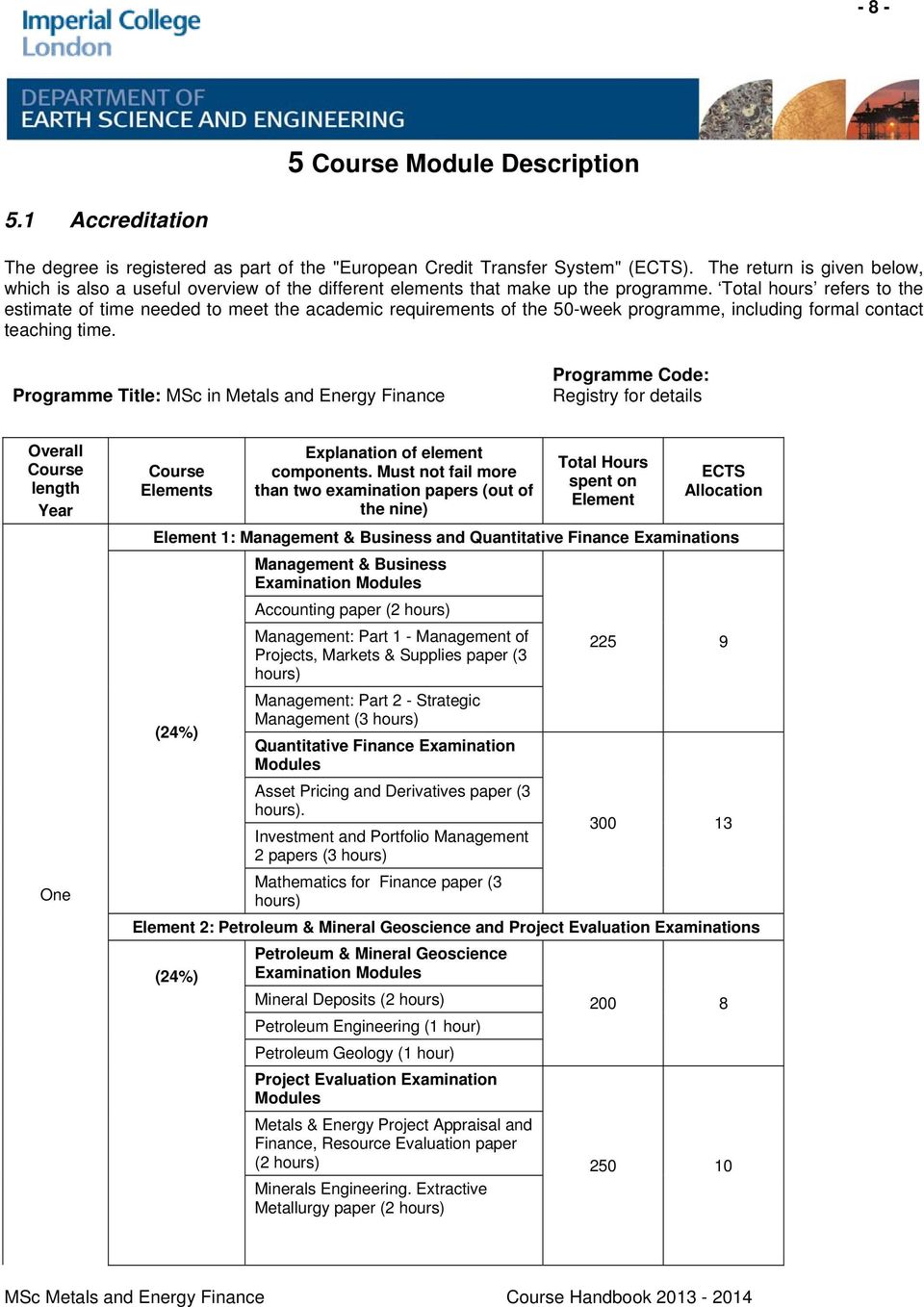
10 - 8-5 Course Module Description 5.1 Accreditation The degree is registered as part of the "European Credit Transfer System" (ECTS). The return is given below, which is also a useful overview of the different elements that make up the programme. Total hours refers to the estimate of time needed to meet the academic requirements of the 50-week programme, including formal contact teaching time. Programme Title: MSc in Metals and Energy Finance Programme Code: Registry for details Overall Course length Year One Course Elements Explanation of element components. Must not fail more than two examination papers (out of the nine) Total Hours spent on Element ECTS Allocation Element 1: Management & Business and Quantitative Finance Examinations (24%) Management & Business Examination Modules Accounting paper (2 hours) Management: Part 1 - Management of Projects, Markets & Supplies paper (3 hours) Management: Part 2 - Strategic Management (3 hours) Quantitative Finance Examination Modules Asset Pricing and Derivatives paper (3 hours). Investment and Portfolio Management 2 papers (3 hours) Mathematics for Finance paper (3 hours) Element 2: Petroleum & Mineral Geoscience and Project Evaluation Examinations (24%) Petroleum & Mineral Geoscience Examination Modules Mineral Deposits (2 hours) Petroleum Engineering (1 hour) Petroleum Geology (1 hour) Project Evaluation Examination Modules Metals & Energy Project Appraisal and Finance, Resource Evaluation paper (2 hours) Minerals Engineering. Extractive Metallurgy paper (2 hours)
11 - 9 - Element 3: Dissertation, Supplementary Mathematics, Language and Excursions Language or Maths Module Choice of Spanish, French or Italian. Assessment through a Viva voce, coursework and test or supplementary mathematics Excursion to Wessex and South Africa Course Work Module (52%) Field exposure to petroleum systems and active energy and metal operations. Write-up presented in two extended reports Dissertation Independent research undertaken over 10 weeks during the summer Total Module Summary Autumn term Accounting Cash Flow Modelling Foundation Mathematics Mathematics for Finance Mineral Deposits Studies Petroleum Engineering Petroleum Geology Language Option (if applicable) Investment and Portfolio Management Extractive Metallurgy Spring term Management of Projects, Markets and Supplies Metals and Energy Project Appraisal and Finance Minerals Engineering Resource Evaluation Strategic Management Asset Pricing and Derivatives

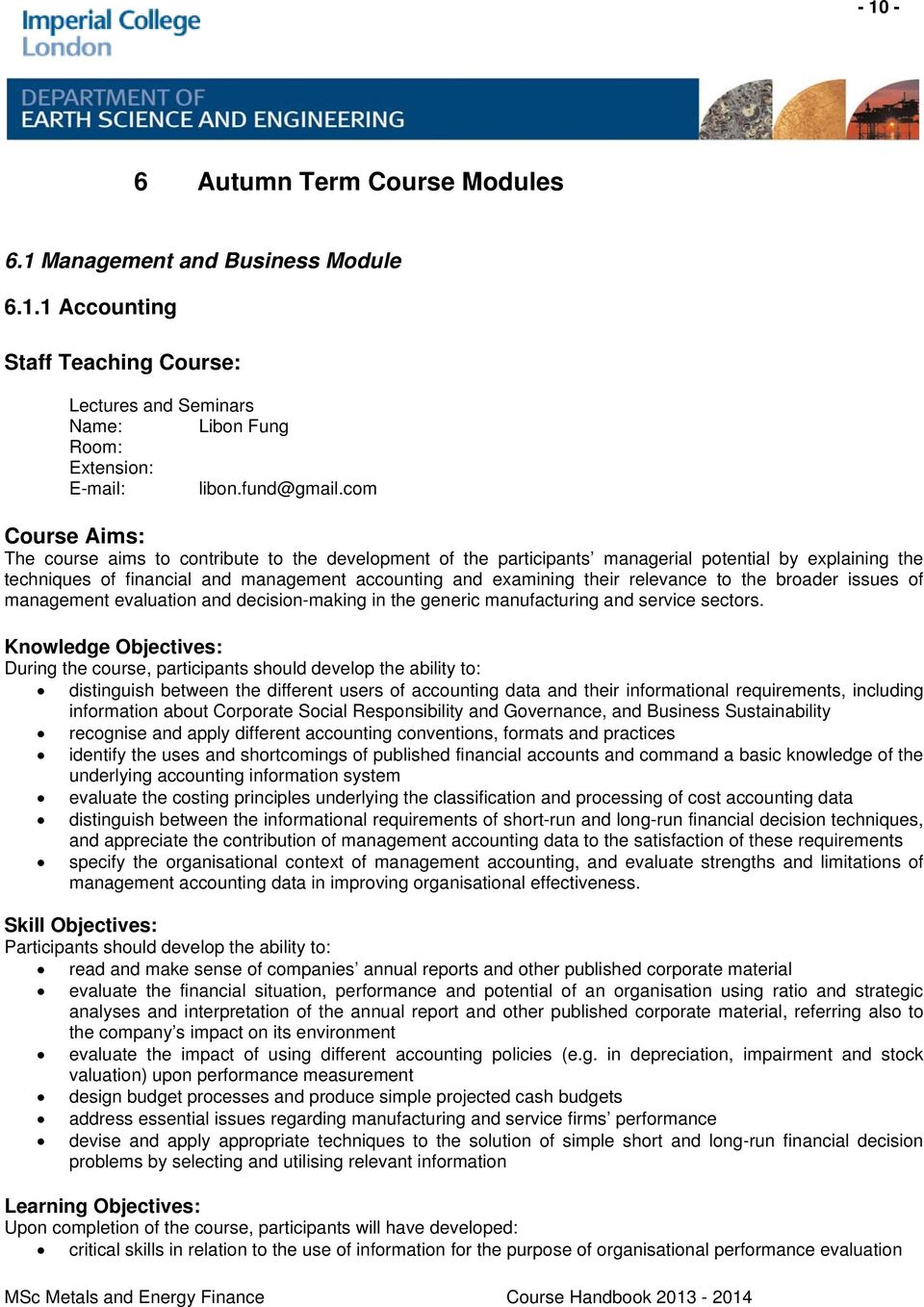
12 Autumn Term Course Modules 6.1 Management and Business Module Accounting Staff Teaching Course: Lectures and Seminars Name: Libon Fung Room: Extension: Course Aims: The course aims to contribute to the development of the participants managerial potential by explaining the techniques of financial and management accounting and examining their relevance to the broader issues of management evaluation and decision-making in the generic manufacturing and service sectors. Knowledge Objectives: During the course, participants should develop the ability to: distinguish between the different users of accounting data and their informational requirements, including information about Corporate Social Responsibility and Governance, and Business Sustainability recognise and apply different accounting conventions, formats and practices identify the uses and shortcomings of published financial accounts and command a basic knowledge of the underlying accounting information system evaluate the costing principles underlying the classification and processing of cost accounting data distinguish between the informational requirements of short-run and long-run financial decision techniques, and appreciate the contribution of management accounting data to the satisfaction of these requirements specify the organisational context of management accounting, and evaluate strengths and limitations of management accounting data in improving organisational effectiveness. Skill Objectives: Participants should develop the ability to: read and make sense of companies annual reports and other published corporate material evaluate the financial situation, performance and potential of an organisation using ratio and strategic analyses and interpretation of the annual report and other published corporate material, referring also to the company s impact on its environment evaluate the impact of using different accounting policies (e.g. in depreciation, impairment and stock valuation) upon performance measurement design budget processes and produce simple projected cash budgets address essential issues regarding manufacturing and service firms performance devise and apply appropriate techniques to the solution of simple short and long-run financial decision problems by selecting and utilising relevant information Learning Objectives: Upon completion of the course, participants will have developed: critical skills in relation to the use of information for the purpose of organisational performance evaluation
13 the ability to participate in managerial decision processes where accounting based information may be an important input the ability to comprehend any Finance course in future studies Structure: The course consists of five bi-weekly blocks, each structured in areas: pre-lecture study (students own time), two two-hourlectures, post-lecture activities (students own time); seven one-hour support classes (weeks 5-11). Teaching Methods All students should have completed the Accounting Primer course before starting. Thereafter, the course is based upon pre-lecture study, lectures, support classes, course notes, group studying and further reading. Participants will be encouraged to use computers in practising their acquired skills and to work in groups. Key texts: The textbook is offered as part of a two part package, i.e. textbook and web card that enables access to the companion website. Please, see the link below: Examination: Group Report (30%) Two hour unseen examination (70%). The questions will test both computational and analytical understanding of the course material. Examination as part of the Management and Business Module

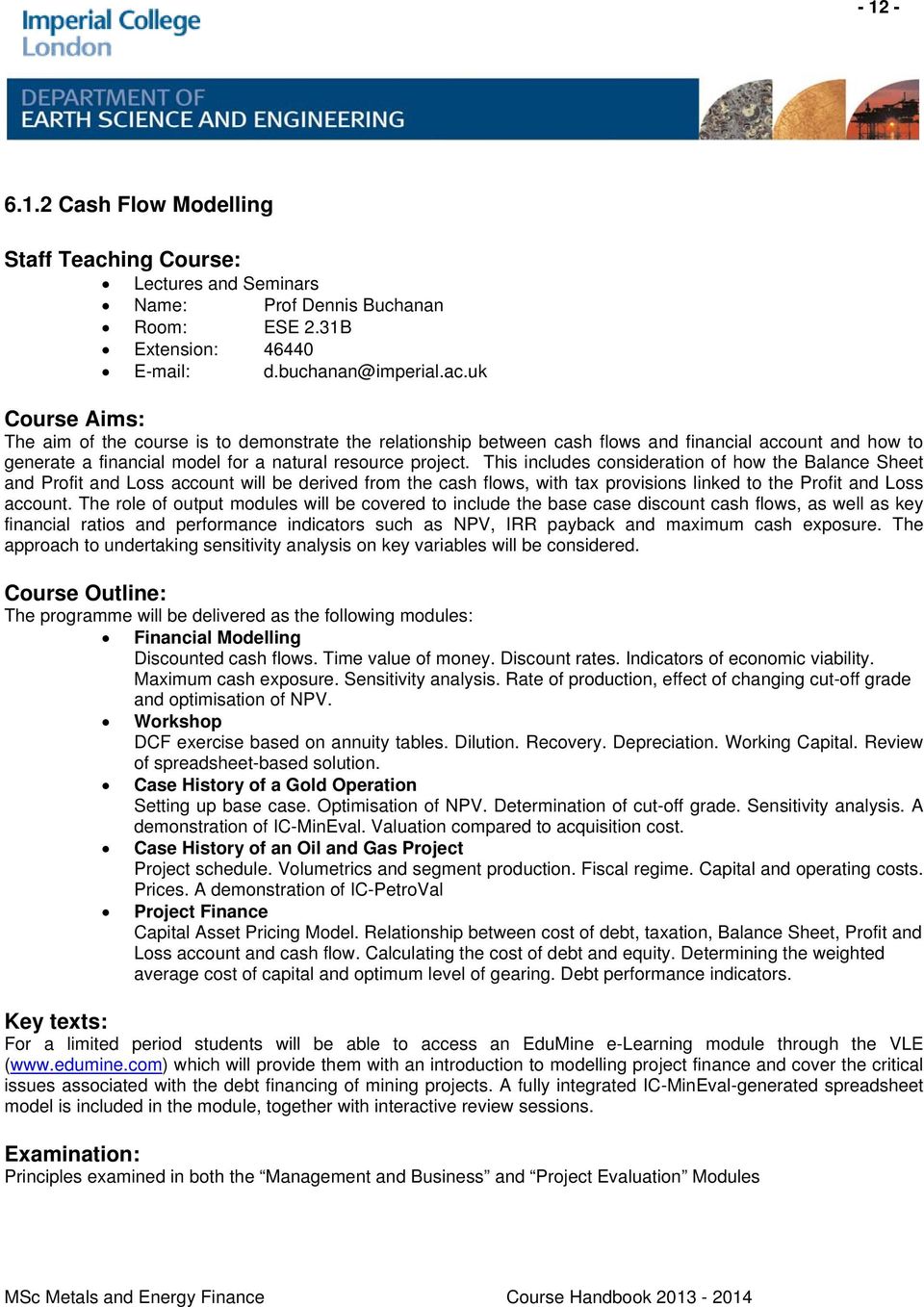
14 Cash Flow Modelling Staff Teaching Course: Lectures and Seminars Name: Prof Dennis Buchanan Room: ESE 2.31B Extension: Course Aims: The aim of the course is to demonstrate the relationship between cash flows and financial account and how to generate a financial model for a natural resource project. This includes consideration of how the Balance Sheet and Profit and Loss account will be derived from the cash flows, with tax provisions linked to the Profit and Loss account. The role of output modules will be covered to include the base case discount cash flows, as well as key financial ratios and performance indicators such as NPV, IRR payback and maximum cash exposure. The approach to undertaking sensitivity analysis on key variables will be considered. Course Outline: The programme will be delivered as the following modules: Financial Modelling Discounted cash flows. Time value of money. Discount rates. Indicators of economic viability. Maximum cash exposure. Sensitivity analysis. Rate of production, effect of changing cut-off grade and optimisation of NPV. Workshop DCF exercise based on annuity tables. Dilution. Recovery. Depreciation. Working Capital. Review of spreadsheet-based solution. Case History of a Gold Operation Setting up base case. Optimisation of NPV. Determination of cut-off grade. Sensitivity analysis. A demonstration of IC-MinEval. Valuation compared to acquisition cost. Case History of an Oil and Gas Project Project schedule. Volumetrics and segment production. Fiscal regime. Capital and operating costs. Prices. A demonstration of IC-PetroVal Project Finance Capital Asset Pricing Model. Relationship between cost of debt, taxation, Balance Sheet, Profit and Loss account and cash flow. Calculating the cost of debt and equity. Determining the weighted average cost of capital and optimum level of gearing. Debt performance indicators. Key texts: For a limited period students will be able to access an EduMine e-learning module through the VLE ( which will provide them with an introduction to modelling project finance and cover the critical issues associated with the debt financing of mining projects. A fully integrated IC-MinEval-generated spreadsheet model is included in the module, together with interactive review sessions. Examination: Principles examined in both the Management and Business and Project Evaluation Modules
15 Foundation Mathematics Economics and Science Group Staff Teaching Course: Department of Earth Science and Engineering Seminars Name: Room: Extension: Course Aims: To provide basic support to students who do not have graduate level mathematics.

16 Quantitative Finance Module Mathematics for Finance Staff Teaching Course: Lectures and seminars Name: Worrawat Sritrakul Room: Extension: Course Aims: To introduce students to the mathematical techniques used in asset pricing, optimal portfolio allocation, and risk management. Course Outline: Probability Theory: Probability spaces, Events, Random variables, Conditional distributions, Expectations, Independence. Arbitrage Theory in Finance: Hedging in complete and incomplete markets, Arbitrage, State prices, Risk-neutral valuation, Pricing in dynamically complete markets Discrete Time Processes: Trees and filtrations, Law of iterated expectations, Markov processes, Martingales Continuous Time Finance: Brownian motion, Ito s lemma, Stochastic differential equations, Black- Scholes partial differential equation Key texts: Cerny, A. (2004) Mathematical Techniques in Finance: Tools for Incomplete Markets, Princeton University Press. For web resources, see Supplementary reading: Anton, H. (2000). Elementary Linear Algebra (8th edn). JohnWiley & Sons. Binmore, K. and Davies, J. (2001). Calculus: Concepts and Methods. Cambridge University Press. Mood, A. M., Graybill, F. A. and Boes, D. C. (1974). Introduction to the Theory of Statistics (3rd edn). McGraw-Hill Series in Probability and Statistics. McGraw-Hill. Examination: Three-hour closed book exam.

17 Petroleum and Mineral Geoscience Modules Mineral Deposits Studies Staff Teaching Course: Department of Earth Science and Engineering Lectures and Seminars Name: Dr Carol Halsall Room: Extension: Course Aims: To provide an overview of the geological setting of minerals and metals which provide the focus for the mining industry Course Outline: Plate tectonic setting of mineral deposits and their classification. Role of fluids in the formation of base and precious metal deposits. Primary magmatic ore deposits. Sedimentary ore deposits including coal petrography. Industrial minerals. Mineral exploration Key texts: Mineral resources, economics and the environment, Kesler, S.E, MacMillan (1994) Ore geology & industrial minerals, Evans, A.M. (3rd edition) Blackwell (1993) Ore deposit models, Vols 1 and 2, Roberts, R.G. & Sheahan, P.A. (eds) Sheahan, P.A. & Cherry, M.E. (eds), Geoscience Canada Reprint Series 3 & 6 (1988) Resources of the earth: origin, use, and environmental impact (3rd Edn), Craig, J.R., Vaughan, D.J. & Skinner, B.J, Prentice Hall (2001) An introduction to ore-forming processes, Robb, L. Blackwell Examination: Two-hour closed book examination as part of the Petroleum and Mineral Geoscience module.

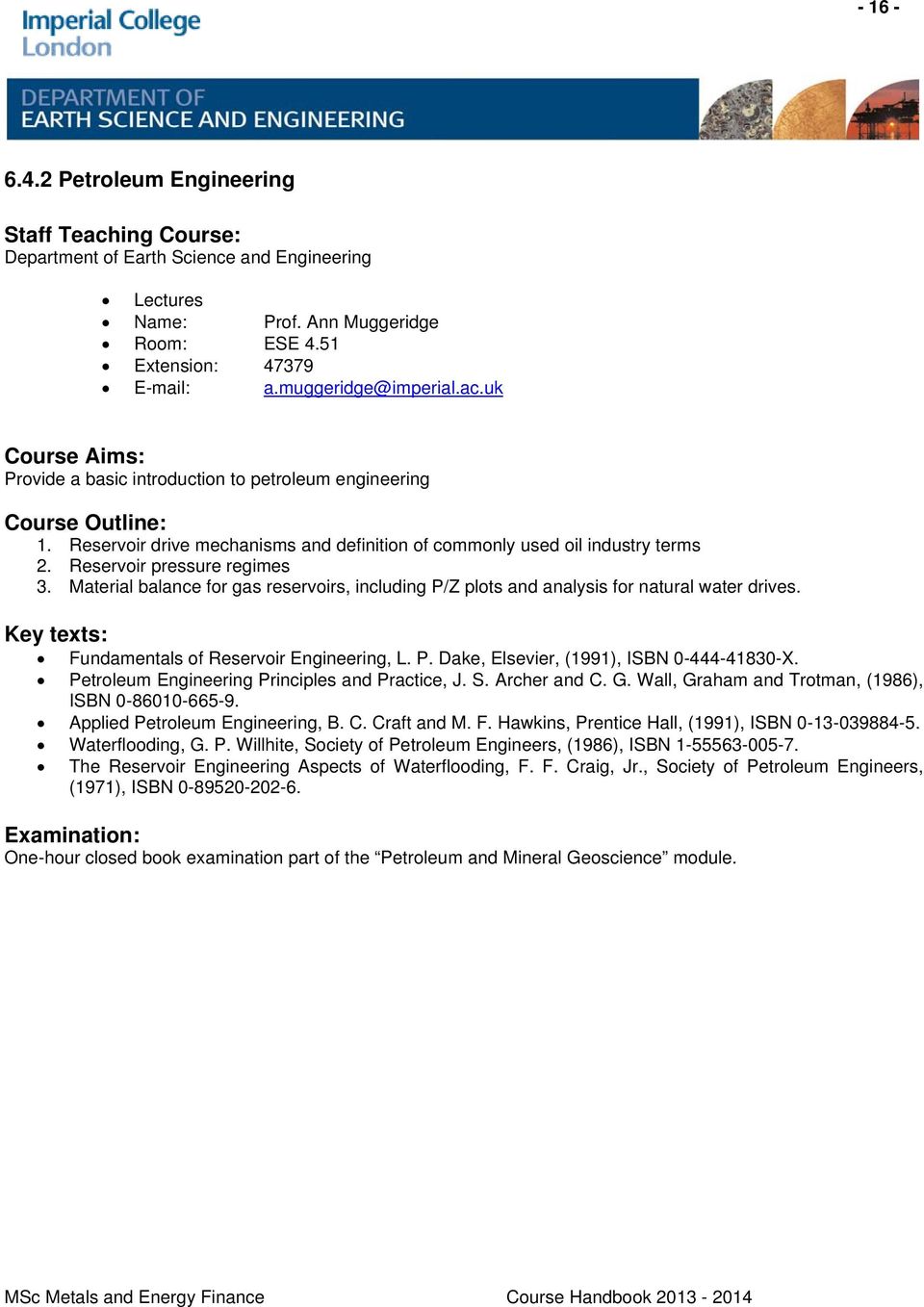
18 Petroleum Engineering Staff Teaching Course: Department of Earth Science and Engineering Lectures Name: Prof. Ann Muggeridge Room: ESE 4.51 Extension: Course Aims: Provide a basic introduction to petroleum engineering Course Outline: 1. Reservoir drive mechanisms and definition of commonly used oil industry terms 2. Reservoir pressure regimes 3. Material balance for gas reservoirs, including P/Z plots and analysis for natural water drives. Key texts: Fundamentals of Reservoir Engineering, L. P. Dake, Elsevier, (1991), ISBN X. Petroleum Engineering Principles and Practice, J. S. Archer and C. G. Wall, Graham and Trotman, (1986), ISBN Applied Petroleum Engineering, B. C. Craft and M. F. Hawkins, Prentice Hall, (1991), ISBN Waterflooding, G. P. Willhite, Society of Petroleum Engineers, (1986), ISBN The Reservoir Engineering Aspects of Waterflooding, F. F. Craig, Jr., Society of Petroleum Engineers, (1971), ISBN Examination: One-hour closed book examination part of the Petroleum and Mineral Geoscience module.
19 Petroleum Geology Development Geology and Reservoir Modelling Staff Teaching Course: Department of Earth Science and Engineering Lectures and Seminars Name: Dr Mike Ala Room: Extension: Course Aims: Provide an introduction to Petroleum geology. Course Outline: To be provided. Key texts: Gluyas, J. and Swarbrick, R.E., Petroleum Geoscience. Blackwell Science, Oxford, 376 pp. Selley, R.C., Elements of Petroleum Geology. 2nd Ed., Academic Press, London, 470 pp. Stoneley, R., An Introduction to Petroleum Exploration for Non-Geologists. Oxford University Press, Oxford, 119 pp. Examination: One-hour closed book examination part of the Petroleum and Mineral Geoscience module

20 Language Module Spanish Engineering Group Staff Teaching Course: Department of Humanities Seminars Name: Ms Iria Gonzalez-Beccerra Room: Sherfield Extension: Course Aims: Develop a basic proficiency in the use of Spanish in a professional context.

21 Quantitative Finance Module Investments and Portfolio Management Staff Teaching Course: Tanaka Business School with MSc Finance Lectures and Seminars Name: Dr Robert Kosowski Room: BS 278 Extension: Course Aims: This course provides students with a critical understanding of important portfolio management techniques used for investments and portfolio management by hedge funds, asset managers, investment banks and other financial institutions. One of the strengths of the course is that it is accompanied by case studies and realistic practical examples that students are asked to solve each week using Matlab. Moreover the course covers pricing and predictability of a large range of asset classes including equities, bonds, foreign exchange, commodities and hedge funds. Students who have completed the course should be able to implement trading strategies and portfolio construction methods in a wide range of assets including Course Outline: The course covers static portfolio theory, market efficiency, factor models, return predictability, tactical and strategic asset allocation, term structure of interest rates, carry trades, covered interest rate parity, spot-futures theorem and stock selection. Portfolio performance measurement and the determinants of information ratio are discussed in the context of mutual funds and hedge funds. Case studies include the asset allocation example of Harvard Management Company. This course closely follows Bodie, Kane and Markus to build a thorough foundation in portfolio management. Key texts: Bodie, Kane and Markus (2008, 8 th International Edition) Investments, McGraw-Hill Examination: Coursework (15%) Three-hour closed book exam (85%)
22 Project Evaluation Module Extractive Metallurgy Staff Teaching Course: Department of Earth Science and Engineering Lectures and Seminars Name: Prof. Jan Cilliers Room: ESE G.28 Extension: Course Aims: The course aims to introduce mineral processing from a financial perspective, covering the processes, as well as the value added, and how this can be maximised. It also aims to introduce risk minimisation using hedging instruments. Course Outline: The course will cover aspects of metals markets, and the workings of the LME, bullion trading and introduce concepts of hedging using forwards, futures and options. The course will introduce comminution, gravity separation, flotation and solid-liquid separation. An introduction to pyro- and hydrometallurgical process will be included. Aspects of waste treatment and sustainability will be covered. The course will then focus on mineral economics, discussing first the financial relationship between the mineral processing and metal production stages and how this can be optimised. This will be expanded to include waste treatment and sustainability. Objectives At the end of the course, students are expected: 1. To have gained familiarity with the equipment, principles and techniques used to separate minerals from their ores. 2. To have a grasp of mining sustainability concepts 3. To understand the economic relationship between mineral processing and metal production, and its optimisation 4. To be able to explain the workings of the LME, the bullion market and various financial instruments used for hedging Key texts: Mineral Processing Technology (Wills) Options, Futures and other Derivatives (Hull) Examination: Part of the Project Evaluation two-hour closed book examination
23 Management & Business Module 7 Spring Term Course Modules Management of Projects, Markets and Supplies Staff Teaching Course: Lectures and Seminars Name: Prof Dennis Buchanan Room: ESE 12.31B Extension: [email protected] Course Aims: The aim of the course is to address the increasing requirement by natural resource companies to communicate complex technical issues to outside organisations as part of environmental impact enquiries and applications for exploration and mining permits. The approach to implementing a monitoring programme and compliance with environmental law and audits will also be covered to provide an understanding of how risk can be assessed. The course is deliberately schedule towards the end of the lecturing programme; It is specifically designed to provide cross-links between what could otherwise be a "silo" structure to the taught part of the MSc degree. The MPMS module brings together a range of different components delivered in the separate teaching modules covered over the previous five months with the aim of demonstrating interrelationships. Course Outline: The programme will be delivered as the following modules: Environmental Law Corporate environmental management and liability. Contaminated land, environmental assessment and land use planning. Environmental audits Environmental Review Site visits. Impact assessment. Baseline conditions, impacts and mitigation. Management and monitoring. Closure. Permitting and planning enquiries Role of public relations. Communication skills. Greenhouse Gas Economy Carbon dioxide trading. Value creation in the petroleum industry and the oil and gas markets..global metals and minerals value creation in mineral projects. Corporate finance and the securities market. Real option valuation Unconventional Petroleum Examination: Three-hour examination as part of the Management and Business Module
24 Project Evaluation Modules Metals and Energy Project Appraisal and Finance Staff Teaching Course: Lectures and Seminars Name: Prof Dennis Buchanan with contributions from industry Room: ESE 4.21 Extension: Course Aims: The aim of the course is to provide a comprehensive guide to understanding the main factors involved in securing the financial support for mining projects through equity, debt, or entering into a joint venture. This involves addressing the underlying technical principles, applying these to mineral projects and demonstrating how these influence the financial modelling. Particular attention will be given to the treatment of key independent variables, such as grade and metal price, dependent variables, such as grade-tonnage relationships, and the way these influence the rate of mining, associated operating and capital costs, and the optimisation of the NPV of a project. These will be compared with the corresponding factors involved in the evaluation of oil and gas projects. Course Outline: The programme will be delivered as the following modules: Life Cycle of mineral projects with their corresponding Drivers. Value creation model. The role of deal flow and relationship to value destruction. Stages of planning and Execution. Optimisation of NPV based on the time value of money, the choice of cutoff grade on reserve block models and the impact of operating and capital costs arising from economies of scale. Feasibility Studies Role of a pre-feasibility study. Scope of a full technical feasibility study. Role in raising equity. Role in securing debt finance. Independent reviews. Resource Estimation Sampling practice and principles of uncertainty. Spatial control of sampling and concepts of geological continuity. Grade and volume estimates. Determination of optimum sampling density. Block modelling. Cut-off grades and ore body modelling. Grade tonnage analysis. Reserve and resource definitions. Mine Planning Mining block model creation. Pit design and optimisation. Use of Micromine software. Relationship between costs and scale of mining. Mining dilution and recovery. Sampling on the scale of mining. Proven and probable categories in operating mines. Metal reconciliation from in situ resource estimation to metal produced. Operating Costs Contract mining. Organisational structure. Mining schedule. Fixed and variable costs (power, labour and consumables). Analysis of Risk and Uncertainty Treatment of multivariant systems. Application to Monte Carlo simulation techniques. Tax and Company Structure Tax models. Taxation agreements. Carry forward provisions. EPT. Royalties. Depreciation allowances. Management accounts and audits. Scenario Analysis. Workshop sessions.
25 o Base Metal project. Negotiating an off-take agreement and linked finance for a project that produces a polymetallic concentrate. o Diamonds o Coal Real Option Analysis The use of financial models in real option analysis in mining projects. Global Standards for reporting Reserves and Resources in the Minerals Industry: Comparisons with the Petroleum Industry. 1 Relationship between probabilistic reservoir estimation techniques and simulation technology is used to determine the underlying key relationship between "Total Petroleum-initially-in-place or "Original Oil in Place", "Optimum Recovery" " and "Estimated Ultimate Recovery" and "Decline Rates" with financial modelling. Analogues in the minerals field - concepts of cut-off grade and grade-tonnage relationships. Global Standards for reporting Reserves and Resources in the Minerals Industry: Comparisons with the Petroleum Industry. 2 Review of energy projects such as coal, uranium and oil sands which are essentially mining projects and can be accommodated within the Minerals Reserve Code. Approach by petroleum companies which report normalised NPV10 numbers to the SEC based on 1P reserves (proven only). Consideration of this convention useful for comparing companies but may be less helpful in providing the basis of share price valuations. Consideration of proven and probable reserves and weighting given in the valuation of mineral projects to mineralisation classified as a resource. Examination: Part of the Project Evaluation two-hour closed book examination.
26 Minerals Engineering Staff Teaching Course: Department of Earth Science and Engineering Lectures Name: Prof Sevket Durucan Room: ESE 1.36 Extension: Course Aims: This course aims to introduce the general principles of minerals extraction, mine planning and design. Factors affecting the choice of a mining method and design, equipment used and supporting operations are discussed. A general overview of environmental impacts associated with minerals extraction is presented. Energy from solid fossil fuels and carbon mitigation technologies introduced. Course Outline: 1 Introduction to mining engineering: the choice between surface and underground mining. Design considerations such as rock mechanics, geological features, engineering design factors and geology/geometry. 2 Surface mining: surface mine design, surface mining operations such as drilling and blasting, excavation and loading, transportation, storage and reclamation. 3 Surface mining methods: strip mining, terrace mining, open pit mining, dredging. Equipment used and designed. 4 Underground mining: underground mine design, mining operations such as drilling, explosives, loading and haulage, hoisting, drainage. 5 Underground mining methods: open stopping, room and pillar mining, sublevel stopping, shrinkage stopping, cut-and-fill mining, sublevel caving, block caving, long wall mining. 6 Mine planning and design: Computer applications in mine design 7 Mine ventilation and methane drainage. Energy from coalmine methane, abandoned mines methane, coalbed methane and enhanced coalbed methane. 8 Environmental impacts of mining, environmental monitoring. 9 Solid fossil fuel power generation, carbon dioxide capture and storage. Key texts: Hartman, H.L.(ed.), Introductory mining engineering, Wiley, Hustrulid, W.A., Underground mining methods handbook., SME, Pfleider, E.P., Surface mining., SME, SME Mining Engineering Handbook=, Two volumes. SME, 1992 McPherson, M.J., Subsurface ventilation and environmental engineering. Chapman & Hall, 1993 Examination: Part of the Project Evaluation two-hour closed book examination
27 Resource Evaluation Staff Teaching Course: Department of Earth Science and Engineering Lectures and Seminars Name: Dr Anna Korre Room: ESE 1.41 Extension: Course Aims: This course aims to introduce students to the principles of minerals resource evaluation starting with the basic principles of sampling and geological interpretation and particularly focusing on the modern computer assisted resource and reserve estimation methods. The lectures are supported by series of computer tutorials using the ISATIS geostatistical software package. Course Outline: 1. Basic statistics of sample data, bias detection, assessment of sample variance from duplicate analysis, calibration experiments and models (Gy s formulae). 2. Geological interpretation and conventional resource estimation methods. 3. Geostatistical principles. (spatial correlation, regionalised variables, the variogram, models of anisotropy and variogram modelling, estimating the grades of individual blocks from the variogram) 4. Kriging (ordinary, indicator kriging, cross-validation) 5. Assessment of dilution (sample variance block variance, defining a drill grid) 6. Resource categorisation (error variance and confidence interval calculation) 7. Principles of geostatistical simulation. Key texts: Armstrong M., Basic geostatistics for the mining industry. Leuven. Chiles, J.-P. and Delfiner, P., Geostatistics: modelling spatial uncertainty. Wiley series in probability and statistics, John Wiley and Sons. Inc., USA Company, Amsterdam, The Netherlands. Deutsch, C.V. and A.G. Journel GSLIB: Geostatistical Software Library and User s Guide. Oxford University Press Inc. Gy P., The sampling of particulate materials: theory and practise. Elsevier, The Netherlands. Isaaks, E. H. and Srivastava, R. M., An Introduction to Applied Geostatistics. Oxford University Press, New York, USA. Journel, A. G. and Huijbregts, C. J., Mining Geostatistics. Academic Press, London, UK. Wellmer, F.-W., Statistical Evaluations in Exploration for Mineral Deposits. Springer-Verlag New York Inc. Goovaerts P., Geostatistics for natural resources evaluation. Oxford University Press, Inc. Examination: Part of the Project Evaluation two-hour closed book examination which includes coursework assessment.
28 Management & Business Module Strategic Management Staff Teaching Course: Lectures and Seminars Name: Prof Dennis Buchanan Room: ESE 1.37 Extension: Course Aims: The course aims to identify the investment opportunities that are being offered across the whole spectrum of the mining cycle by relating this to the various funding options in the progression from exploration through evaluation, pre-production development, development and finally into production. The programme is integrated with the Funding Options for Mineral Projects course offered by the Imperial College Centre for Professional Development and will be delivered through a series of syndicate and role-playing exercises aimed at enhancing inter-disciplinary communication skills. The programme will be based on case histories of platinum-group metal projects and will be supported by contributions by external experts from industry and financial services sector. Course Outline: The programme will be delivered as the following modules: Funding Options for Juniors with Exploration Assets. Briefing. Role of private placements and venture capital. Strategic value gained by securing a joint venture partner. Criteria needed for an IPO. Applicable valuation methods including comparable transactions and appraised value. Geological setting of PGE deposits. PGE supply and demand including fuel cell technology and petroleum refining. Syndicate Exercise. Geological and technical background to PGE projects. Formulation of exercise objectives. Funding Options for Juniors with Projects Ready for Evaluation Drilling Briefing. Aim admission process. Role of the NOMAD and Competent Person s report. Role of the Joint Venture. Valuation and use of Inferred Resources. Asset diversity. Presentation of Projects to Potential Investors. Separate presentation of bids by teams (to be video recorded). Announcement and justification of decision. Briefing. Formulation of a Joint Venture agreement. Consideration of vend-in conditions and link to valuation. Defining deliverables and the role of the feasibility study. Claw-back agreements. Funding Options at the Pre-development Phase Briefing. Role of the full technical feasibility study. Technical constraints on downstream smelting and refining of PGE. Role of Debt Finance. Analysis of Accounts. Criteria needed to secure Project Finance and limited recourse debt. Relationship between equity and debt in enhancing shareholder value. Right issues. Financial Engineering. Hedging. Permitting. Syndicate Exercise. Formulation of optimum gearing for the development of a PGE projects. Funding Options at the Development Phase Acquisition using structured debt. Use of exchange listed convertible bonds. Use of structured corporate loans. Analysis of Accounts. Negotiation of Capital Structure. Monitored role-playing exercise between groups acting as an investment bank, a major mining company and technical consultants. Examination: Three-hour examination as part of the Management and Business Module.
29 Quantitative Finance Module Asset Pricing and Derivatives Staff Teaching Course: Lectures and Seminars Name: Worrawat Sritrakul Room: Extension: Course Aims: This course develops and applies the techniques learnt in Investments and Portfolio Management to the pricing of a range of financial derivatives and to the determination interest rates at different maturities. Course Outline: Determination of Forward and Future Prices. Options: Mechanics of Option Markets Options: Trading Strategies. Martingale Measure Black-Scholes-Merton Model Volatility Smiles Swaps Interest Rates Derivatives Credit Derivatives Key texts: John Hull (2006) Options, Futures, and Other Derivatives, Pearson Prentice Hall, Sixth Edition. (You will be provided with a copy of this book during Induction Week) Examination: Coursework (20%) 3-hour closed book exam (80%)
30 Plagiarism The action or practice of plagiarizing: the wrongful appropriation or purloining and publication as one s own, of ideas, or the expression of ideas, of another. (Simpson & Weiner 1989) It is a tenet of scholarship that one does not plagiarize. In a university, the definition quoted above needs some qualification: publication is taken to mean all forms of presentation including project reports, dissertations, theses etc. An idea will include observation of facts, opinions, conclusions etc. Adherence to a few simple rules will avoid plagiarism. If, in a piece of work, you wish to include an idea, which was first pronounced by someone else, then there are two choices. - Rewrite the idea in your own words and follow it by a short reference to a bibliography (or list of references). - Quote the original words within quotation marks and follow it by a reference. Illustrations can cause problems. - If you redraw a diagram etc, which is substantially the same as that published by someone else then it should be referenced as after Bloggs If you include a photocopy of an illustration, it must be referenced from Bloggs In both cases the full reference must be included in the bibliography (or List of References). If you wish to include an idea from a colleague in your report then you should reference it as, for example Jones, personal communication The accepted format for references (e.g. journal articles) is: Simpson, J.A & Weiner, E.S.C. 1989, Oxford English Dictionary (second Edition), Clarendon Press, Oxford. Downloading from the web without acknowledgement is an instance of plagiarism. The University of London regards plagiarism as an examination offence and has strict procedures for dealing with it. All suspected cases will be reported to the College Registry. Minor cases may be referred to the Board of Examiners for consideration. All other cases will be referred to the University and may be heard by a panel of senior members of staff from outside the College. The penalties for plagiarism, and allowing plagiarisation of your own work, can include: - reduced or zero marks for that piece of work or for the whole course module. - a re-submission of the work after a specified time (typically two years) in the case of projects and dissertations. - exclusions from future examinations of the University. - Degrees already awarded may be withdrawn. In order to ensure that all assessed work is free of plagiarism it will need to be submitted in digital form on request. Excursion reports and dissertations must be submitted with a CD with a digital copy of the text of the whole report as presented in the hard copy, as well as a version that excludes figures and tables (this should be submitted by to the course administrator). You should not provide the text of your excursion report or dissertation required for the plagiarism scan as a pdf file. We require this as a Word document because a PDF is not a primary digital file. To be very clear; all figures and tables should be removed to ensure all we get is free text.
31 Your submitted work will be scanned by College-approved plagiarism detection software. College has adopted the guidelines as recommended by Joint Information Systems Committee (JISC) and the Business School and has for some time now undertaken routine scanning of dissertations for evidence of plagiarism. A threshold of 5% or more of text shown to have been derived from the Internet without the source having been indicated will be considered as an indication of potential plagiarism. Once loaded, the system will also pick up significant matches between separate reports from the same assignment. Particular attention will be paid to cases of reports with matches of over 30% or those under 30% with significant matches to one source (e.g. >10%). Further information regarding college policy on plagiarism can be found:
32 Course Assessment and Examinations Evaluation Guidelines Master s students are required to pass every element of their course with an aggregate mark of at least 50%, to ensure compliancy with ECTS 1. Achieve an aggregate score of 50% across each of the following two examination elements: Management and Business and Quantitative Finance Element: consisting of the following five examinations (six separate examination papers): a) Accounting b) Part 1 - Management of Projects, Markets and Supplies and Part 2 Strategic Management. c) Investment and Portfolio Management. d) Mathematics for Finance. e) Asset Pricing and Derivatives. Petroleum and Mineral Geoscience and Project Evaluation Element: consisting of the following four examinations (five separate examination papers): a. Mineral Deposits b. Petroleum Geology c. Petroleum Engineering d. Minerals Engineering - Extractive Metallurgy: Five questions, three questions to be answered. e. Section A Metals and Energy Project Appraisal and Finance. Three questions. Section B Resource Evaluation. Two Questions. Section C Mining Engineering. Two questions. Four questions to be answered, at least one from each Section. 2. Not fail more than two examinations out of the nine examinations, (Petroleum Geology and Petroleum Engineering will be treated as a single examination and Management Part 1 and Part 2 also will be treated as a single examination). No mark below 40% is accepted as a condoned failing mark. 50% is the minimum pass mark. The Board retains the option to change the weighting from time to time of the course work component included in the relevant examination papers depending on the proportion of course work completed for any component of the course. 3. Achieve 50% in the dissertation, language, supplementary maths and excursion element. The Wessex and South Africa excursion reports are weighted approximately 20:80 between the Wessex and South Africa excursion reports respectively. The language option is pass/fail only and must be passed in order to pass the element. The supplementary maths is assessed as part of the examinations. If you are deemed to have failed the MSc after the Examiners meeting in October then you can re-sit all or some of the examinations (as decided by the examinations board) but only in the next academic year (at the times fixed by the examinations committee). These examination times for the academic year 2013/2014 will be communicated to you. Failure in a re-sit examination is final. ICT ensure that all taught postgraduate students, on departing from the College, are given clear guidelines on how to keep in contact through their College address to receive information on the time and dates of re-sit examinations. It should in any event be self-evident that where re-sit examinations are expected, that candidates need to be proactive rather than expecting the course Director to chase a candidate using personal s. Provided a candidate stays on the College s outlook system, they will also be given access to any relevant the BlackBoard courses to establish any changes in syllabus.
33 Marking Scheme Pass: 50% to 59.9% in all elements; Merit: 60% to 69.9% in all elements; Distinction: 70% or better in all elements. Where appropriate, a Board of Examiners may award a result of Merit where a candidate has achieved an aggregate mark of 60% or greater across the programme as a whole AND has obtained a mark of 60% or greater in each element with the exception of one element AND has obtained a mark of 50% or greater in this latter element. Where appropriate, a Board of Examiners may award a result of Distinction where a candidate has achieved an aggregate mark of 70% or greater across the programme as a whole AND has obtained a mark of 70% or greater in each element with the exception of one element AND has obtained a mark of 60% or greater in this latter element. For further details see the College s Regulations for the Examination of Taught Master's, Postgraduate Diploma and Postgraduate Certificate Programmes Investments and Portfolio Management and Mathematics for Finance, are written at the end of the Autumn term. Accounting and Mineral Deposit Studies examinations are written at the start of the Spring Term. The Asset Pricing and Derivatives paper is written at the end of the Spring term. The rest of the papers are written at the start of the summer term. The course Director is permitted to provide provisional/indicative grades for your December, January and May examinations when they are available as follows: A = 70% or more B = 60-69% C = 50-59% D = 40 49% E = 30 39% F = less than 30% Note: Marks D E or F are all fail marks. You will also be informed of your overall examination performance as provisional/ indicative grades after the Board of Examiners meeting held in the last week of the summer term. College regulations dictate that the course Director is not permitted to inform you of your % marks. Instead, the University, upon completion of the programme, will send you these marks. The course Director would plan to convene the final Board of Examiners meeting in mid November given that the dissertations all have to be double marked and then reviewed by the external examiner, but the exact date depends on the availability of the external examiner. It takes a finite amount of time to then compile the results in the format required by Registry. Furthermore there are a large number of MSc courses in Imperial College, all making their returns to Registry about the same time. Normally it takes about two weeks to process the results of the MSc M&E Finance degree, which are then released around mid November. It is not possible to provide an informal confirmation of results.
34 Please also note that under College regulations "A candidate re-entering any part of the examination will normally only be credited with a bare pass mark if successful." The whole issue of the graduation ceremony is between you and the College but generally takes place in May each year. The issuing of degree and diploma certificates is between the student and Registry. If formal confirmation of the award of the degree is required prior to the issuing of certificates then again Registry will be able to help. The College has procedures in place for the consideration of requests from students for special examination arrangements due to physical, learning or other disabilities. If you believe you may require a form of special arrangements for your examinations this year, you should contact the course Director as soon as possible. All such requests must be made with clear supporting medical information, and submitted to your Department so that they may be passed to the Registry at least six weeks before your first examination (except in the case of accidental injury or acute illness, when the application should be submitted as soon as possible after the event). For further information please speak to the course Director, visit the Special Exam Arrangements website ( or ask the College Disabilities Officer for advice: (
35 Course Timetable This will be available on the dedicated BlackBoard course: Access is through the website
36 Excursions 11.1 Wessex As part of the petroleum geosciences course a weekend excursion to the Wessex Basin will be arranged during the Spring Term. You will then be required to generate a 3,000 word report (about 10 pages of double spaced text), illustrated with your own field sketches and photographs, outlining the tectono-stratigraphic evolution of the Wessex Basin and its impact on the development of the petroleum system (source rock, seals, reservoirs, migration, trapping and timing) in the area. The following guidelines are useful: The report should not be simply a description of what was observed at the sites visited. Place your observations in their regional context, beginning with the inception of the basin in the Permo- Triassic: - What were the environmental conditions in the Permo-Triassic? - How extensive was the area of sedimentation? - What controlled the development of this particular sedimentary environment? Describe the formations you saw, beginning with the oldest, in terms of their age, lithology, grain size, fossil content and environment of deposition. Emphasise the dynamic nature of the depositional processes in terms of transgressions and regressions. Place each formation in its petroleum system context and discuss its function in this regard. Quote numbers e.g. porosity, permeability and organic content. Briefly describe the geological structures you saw and the regional tectonic events e.g. the Tertiary inversion - that affected the basin. Discuss the role of these structures/tectonic events on hydrocarbon occurrence. Extra marks will be earned for: Analysis of the hydrocarbon prospects of pre- and post inversion structures. Comparison of the similarities/differences between the Wessex Basin and the North Sea: - Is the Wessex basin a suitable analogue for the North Sea? Comment on SPE reserve guidelines. Comment on PetroVal Volumetric inputs. Evidence of cross references to the Petroleum Geology and Petroleum Engineering modules by Dr Mike Ala and Prof Ann Muggeridge. Marks will be awarded as follows: Layout and Editorial 10% Structure 10% Illustrations 15% Note Book 15% Description of localities visited 30% o Formations o Depositional processes o Structures Synthesis 20% The total will count 20% towards the Excursion Report element that is reported separately.
37 South Africa An excursion of at least ten days to a region of active mining, downstream metal and mineral processing and energy development will be arranged for the third and fourth weeks of the Summer term. The excursion is a key component of your degree programme as it provides first-hand experience of all aspects of the extraction industry. It also reinforces the practical application of the theoretical material covered in the first two terms. The preparation of the May excursion report marks the transition from the taught phase of the course to a focus on independent effort, which includes the dissertation. While the report must be derived from material arising directly from the excursion, you may (and should) rely on relevant background covered during the autumn and spring teaching terms. The approach used in the preparation of the excursion report has direct application to all probable future career paths for MSc Metals and Energy Finance graduates. The external examiner will expect the editorial standards, technical accuracy and financial insights to start approaching those required of any professional report. In many cases analysis comments are potentially commercially sensitive, so a reminder that the excursion report should remain a confidential document not to be released to third parties. The quality of the excursion report is also considered separately by the Board of Examiners and is taken to be an important measure of overall academic ability and probable future competence. The actual mark achieved is incorporated into your Excursion Report grade and will be worth 80% of the total. If the Board is required to exercise discretion, considerable weight is normally given to the standard achieved in the excursion report. Please be aware that the assessment of the report works to a very tight timetable. The deadline for submission to Samantha is 4.00pm on Tuesday 17th June 2014 Departmental guidelines require that I impose a penalty of percentage points (not 5% of the grade awarded) per day for late submission in order to be fair to candidates submitting on time. You need to plan your timing carefully to ensure that you maintain balance while not running out of time. Every year individuals significantly underestimate the time that is needed to compile the large amount of information that they were exposed to on an excursion into a coherent and self-contained report. The external examiner will be reviewing the excursion reports with you individually and privately on Friday 20 th June This provides you with an opportunity to demonstrate to the external examiner your fundamental understanding of the practical aspects of the metals and energy industry. The excursion report should be submitted as a spiral-bound hard copy, digital version on CD plus a digital version with pictures removed sent by to the course administrator Samantha Symmonds. This will be scanned with suitable software as outlined in the Plagiarism section of this Course Handbook. Evidence that text has been directly downloaded from company, analyst or other websites without clearly identifying the source in quotations and indicating the url could be treated as plagiarism. This also applies to material taken from the company presentations provided during the excursion. I am now obliged to notify any breach of this rule to the Registrar and, if demonstrated to have occurred, could result in any mark allocated to the excursion report not being accepted. If the level of plagiarism is excessive the Registrar may decide to take the matter further. These guidelines will be the same for the dissertations. Marks will be awarded as follows: Layout and Editorial 10% Structure 10% Illustrations 15% Note Book 15% Description of projects and operations visited 30% Theme 20%
38 Dissertations You will probably find in a few years time that the dissertation and the approach you are required to follow will have represented the most useful part of the course when it came to career development. The ability to identify new opportunities, formulate a suitable study, plan its implementation, locate relevant information, compile this into a coherent format and derive from that fresh insights as to the potential of the opportunity tends to result in professional and business success. You need to start considering possible topics from the start. A good approach is to select an area of the formal programme that you feel you would like to know more about. It is vital that you take ownership of the task. Even if you do arrange a secondment with an outside organisation during the summer, they are not going to hand a suitable topic to you on a plate. The guidelines outlined below must be considered in conjunction with the briefing to be provided by Library staff early in the summer term on Library requirements, format and editorial standards. Dissertations are routinely rejected simply because of shoddy presentation. A significant proportion of the grade is determined from the writeup presented to the examiners. A badly written dissertation may well be rejected regardless of the way a topic is handled. Simple things like writing in the passive voice is implicit but students still get confused. Certainly the use of the first person pronoun will require extensive re-editing. Do not under estimate the time an effort needed to remove, say, five grammar and spelling errors per page down to an acceptable five for the whole dissertation. In a recent case where the former was the case the examiner refused to read beyond the first chapter. A common mistake arises with the chapter headings, fourth-order headings (eg Binomial Trees) is too great a level of segmentation. You are going to end up with one-paragraph sections. The dissertation should not go beyond thirdorder headings. Also the convention is numeric, not alpha-numeric (eg 6) a), etc). These should then be linked to pagination. Following library guidelines will add 25 percentage points regardless of the quality of your research. Being able to write a literate report will be significantly career enhancing for you. A short outline of your proposed dissertation topic should be prepared and sent to the course Director by by Friday 9 th May This should include the title of the thesis and a statement of the objectives of the study and the likely source of information. Oral presentations will given to the course Director on Monday 23 rd June 2014 and to the external examiner during the course of Friday 27 th June We require his formal approval of the dissertation topics. This will obviously require some careful preparation by you. You will each be allocated 20 minutes (10 minutes for a formal presentation and 10 minutes for us to clarify any issues). The purpose is to ensure that we understand exactly what you intend working on. The role of the external examiner is not to provide supervision but to ensure that the final dissertation is an acceptable topic for the relevant degree option. You will need to send an to the course Director by 8.00 am on Monday 23 rd June 2014 with an attached word document with the final version of the summary of the proposed project with the items outlined as the deliverable from Friday 9 th May The presentation to the Director on Monday 23 rd should be accompanied by a power point presentation. An approved version of this will be passed on to the external examiner. If the external examiner is not in receipt of this summary by the evening of Thursday 26 th June he may decline to meet with you the following day as he needs time to review the material. Your final presentation to him MUST be supported by a Power Point presentation consisting of at least five slides but no more than 10. Copies will be loaded onto my laptop and retained for the record. In past students who have attempted to ignore these guidelines and enter into an informal dialogue with the external examiner, have been told politely but very firmly that this was not acceptable and have been asked to make way for the next person. This was a lost opportunity for them that cannot be recovered. There will be no second opportunity to meet the external examiner. Every year students attempted to arrange alternative dates for
39 the review of the excursion and presentation of the dissertation arguing that they had made prior travel arrangements. Please therefore make a note now of the dates. The external examiner has a very full professional agenda and will simply not be available for alternative dates. The need to attend interviews is certainly not going to be an acceptable reason for not making the time to be available during the final week of the summer term. In general though students obviously welcome the opportunity of receiving focused comment on potentially good projects and understand perfectly well why putting in the effort to generate a professional and technically literate presentation is clearly to their advantage. The dissertation will be judged on your ability to undertake an independent research project. While academic staff have a responsibility to provide supervision, this is not a process that involves step-by-step coaching. On the contrary there will be regular reviews during the summer in which you will need to demonstrate that you have a clear understanding of where the research is heading. There is obviously considerable intellectual satisfaction when the project comes together and this provides the key training objective of the dissertation and the degree. Our graduates are able focus their energy in professionally productive ways. As a supplementary to the guidelines on plagiarism, common sense should be applied to distinguishing between a students seeking advice with regard to their project as opposed to asking someone to write it for them. We had a case last year where a student actually attempted to commission someone to write the work for him. Needless to say action was taken and the consequences can be very serious indeed. In order to ensure that the course Director is able to monitor progress with your dissertations, as indicated above, the Course Director will be undertaking two formal reviews during the summer. These are not optional and the deliverables are outlined below. We will need from you for mid-july an outline of the status of work completed with specific reference to Revisions to Original Proposal, Sources of Information Used, Development of the Quantitative Finance Components, Progress in Meeting Key Targets, Likely Conclusions and Time-line for Completion. This outline should not be more than two pages in length. Clearly the objective of this exercise is to identify any projects that are running out of momentum. In most cases though suggestions would expect for those areas that you should focus on in order to enhance the quality of final product. The second review will follow the same format and the course Director will require your submission by the third week in August. This should comprise a skeleton of your Introduction Conclusions chapters as well as the proposed chapter headings. I would expect this note to be about 10 pages long. You must also send through a digital copy of the Excel-spreadsheet financial model that you have developed. The financial modelling represents the quantitative finance components of the dissertation and forms an essential part of the deliverable for the degree. A dissertation based on a qualitative review will not be acceptable. The objective of the second review is to help ensure that the final submission has a coherent and logical focus. In the past where this session has generated an effective dialogue the student has probably been able to achieve a significant enhancement in the final grade awarded over that which they might otherwise have achieved. While students should expect feedback on their dissertations, there are, as outlined above, three formal stages when this happens: The initial presentation to the external examiner The first progress report The second with the financial models. There is a clear audit trail there and in general students realise that it was clearly to their own advantage to comply fully with the process. Not only do they get feedback, the quality of the submissions is reflected in the grade awarded.
40 The final mark sheets are based on the excursion report model but include comments by the second marker where reconciliation of marks awarded is needed and then confirmation approvals are noted by the external. These comments are directed to the Board of Examiners to help with their deliberations and not formulated as part of the process of supervision. There is therefore little educational advantage to the student in having sight of theses comments and they are in any event confidential to the Board. Assessment will based as follows: Layout and Editorial 10% Structure 10% Illustrations 15% Performance in undertaking an independent research project presentation and progress reports 15% Performance in undertaking an independent research project final version 30% Quantitative modelling 20% The grade awarded for work linked to presentations and progress reports forms a small part of the overall mark (15%). The key role for this element is make sure there is an audit to compare initial concepts and progress reports with what is actually delivered and of course to provide a framework for formal feed-back. A short citation is given in the mark sheet that incorporates what the examiners consider to be the key elements of the dissertation. Should you want a copy this can be forward to you once the final results have been released by Registry. You are required to hand in one hardbound copy of your dissertation and one spiral-bound each with a CD holding digital versions of spreadsheets and dissertation. You must also submit a text file with no pictures by e- mail to the course administrator Samantha Symmonds. The reason why we need two copies is to allow simultaneously double marking and get a copy to the external examiner. Two copies allow us to do this. The hardbound copy goes to the library and the extra copy then stays with the department to be made available to the next generation of MSc students. Where you have been back-engineering actual projects there is the obviously danger that your results might not support those which has been released to the market. You would be surprised how quickly a company can respond in this type of situation and if you elect to work directly with a sponsor, an embargo may be placed on your dissertation. Where you are exploring sensitive issues you should therefore put in a disclaimer in the preface to your dissertation based along the following lines: "This study is based on an analogue of the xxxx project with variables derived from information in the public domain. The base case assumptions should not be considered as accurate or representative of the actual xxx project. The objective of the study is to test the application of quantitative financial models applied to the base case as part of the academic requirements of the MSc. The results generated should not therefore be considered as an indication of the real value or actual potential of the project." The deadline for the submission of the dissertation is 4.00 pm Friday 5 September Any delay in submission attracts a 5% penalty points/day. The arithmetic is very simple. A student handing in a dissertation midmorning on the following Monday will have had an extra two days to finalise editing over the weekend and will have a -10% penalty imposed. If handed in after 4.00 pm on the Monday it will be -15%, etc. There is no oral defence of the dissertation. You will have no further course commitments once your hardcopy dissertation is handed in on Friday 5 September. If the guidelines are followed, the study that is presented should provide the basis for an objective assessment by the examiners.
41 To provide some context, compliance with the academic guidelines for the preparation of the dissertations allows me to compare initial concepts and progress reports with what is actually delivered. While the dissertation is an independent piece of research, if there is a significant mis-match between initial concepts and the actual report then the dissertation will be rejected. It will nevertheless be subject to JISC scanning for evidence of plagiarism. The examiners will also check carefully for inconsistencies between the status reports of work in progress and the final dissertation. Clearly it follows from the above that the progress reports are part of the assessment process. Feedback that is provided is part of the supervision. If on review of the examination version the sponsor has concerns about material covered entering the public domain then we can at your request embargo the whole study (permanently if necessary). You should be aware therefore that when working with sponsors there is a risk that you may not be able to showcase your dissertations at, say, job interviews. You need to consider the balance of possible career advantage working on a topic that is suggested by a sponsor, compared to generating a self-contained study that you can freely distribute in following your own career aspirations. There is no correlation between grade awarded for a dissertation and whether or not this was based on working with a sponsor. Students on the course who are recent graduates with little experience do sometimes arrange internships to boost a CV. The tasks set by the host may have nothing to do with the proposed dissertation topic. The student will then feel under pressure to meet the demands of an internship to the detriment of their dissertations. The consequence, all too often, is that while the underlying concepts behind the dissertation have been good, the dissertation ends up being thrown together. Apart from being poorly edited and missing key elements such as an abstract, the whole integrity of the study is compromised. While it is your future and you will do what you feel is best, the advice by the course Director is that you must be assertive with your managers in taking time off for your dissertation. The worst they can do is terminate the internship and withdraw an offer of employment. If they were to do so, given the importance to your future in presenting a good dissertation, you should ask yourself if you really wanted to work for such an organisation.
42 Additional College Website links 13.1 MSc Metals & Energy Finance Course information College Registry Careers Service Health & Safety Information Including occupation health requirements,vaccinations, use of equipment and training etc Imperial Study Guide/Imperial Study Guide for Master s Students College Our Principles Welfare and pastoral care/support Registry English Language Support Welfare & Advice College Policies Academic and Examination Regulations: Employment during studies es/student%20employment%20during%20studies.pdf Religious obligations in assessments The College s Regulations for Students: Mitigation / extenuating circumstances policy and procedures: Complaints and Appeals procedures: Academic integrity: es/examination%20and%20assessment%20academic%20integrity.pdf Cheating offences policy and procedures:
43 Annex Annex 1: Planning and Writing Reports and Dissertations Annex 2: Examination papers Annex 3: Imperial College Business School Code of Ethical Conduct Annex 4: Updates
Programme Specification for the MSc in Metals and Energy Finance
 Programme Specification for the MSc in Metals and Energy Finance PLEASE NOTE. This specification provides a concise summary of the main features of the programme and the learning outcomes that a typical
Investment and Wealth Management
 Programme Specification (Master s Level) MSc Investment and Wealth Management This document provides a definitive record of the main features of the programme and the learning outcomes that a typical student
Programme Specification (Master s Level) Executive MBA
 Programme Specification (Master s Level) This document provides a definitive record of the main features of the programme and the learning outcomes that a typical student may reasonably be expected to
Finance & Accounting
 Programme Specification (Master s Level) MSc Finance & Accounting This document provides a definitive record of the main features of the programme and the learning outcomes that a typical student may reasonably
BS0822 ACCOUNTING FOR ELECTRICAL ENGINEERING & ISE
 BS0822 ACCOUNTING FOR ELECTRICAL ENGINEERING & ISE COURSE TUTOR Name: Room: E-mail: Libon Fung 177 - Imperial College Business School [email protected] COURSE OUTLINE Aims The course aims to contribute
MSc International Health Management
 Programme Specification (Master s Level) This document provides a definitive record of the main features of the programme and the learning outcomes that a typical student may reasonably be expected to
Management. Imperial College Business School. Total Credits ECTS: 90 CATS: 180. 2 nd cycle. Veronica Russell Teaching & Quality Manager
 MSc Management This document provides a definitive record of the main features of the programme and the learning outcomes that a typical student may reasonably be expected to achieve and demonstrate if
MSc Strategic Marketing
 Programme Specification (Master s Level) This document provides a definitive record of the main features of the programme and the learning outcomes that a typical student may reasonably be expected to
1. Awarding Institution: Imperial College London. 2. Teaching Institution: Imperial College London
 Programme Specification for the MSc in Mathematics and Finance PLEASE NOTE. This specification provides a concise summary of the main features of the programme and the learning outcomes that a typical
Henley Business School at Univ of Reading
 MSc in Financial Engineering (full-time) For students entering in 2013/4 Awarding Institution: Teaching Institution: Relevant QAA subject Benchmarking group(s): Faculty: Programme length: Date of specification:
ROYAL HOLLOWAY University of London PROGRAMME SPECIFICATION
 ROYAL HOLLOWAY University of London PROGRAMME SPECIFICATION This document describes the Master of Science, Postgraduate Diploma and Postgraduate Certificate in Entrepreneurship. This specification is valid
Programme name Civil Engineering, Civil Engineering with Industrial Placement
 PROGRAMME SPECIFICATION KEY FACTS Programme name Civil Engineering, Civil Engineering with Industrial Placement Award BEng (Hons) School School of Mathematics, Computer Science and Engineering Department
ROYAL HOLLOWAY University of London PROGRAMME SPECIFICATION
 ROYAL HOLLOWAY University of London PROGRAMME SPECIFICATION This document describes the Masters in Business Administration programme, Postgraduate Diploma and Postgraduate Certificate in International
Programme Specification for the Master of Public Health (MPH)
 PLEASE NOTE. Programme Specification for the (MPH) This specification provides a concise summary of the main features of the programme and the learning outcomes that a typical student might reasonably
Programme Specification for the MSc in Computing Science
 Programme Specification for the MSc in Computing Science PLEASE NOTE. This specification provides a concise summary of the main features of the programme and the learning outcomes that a typical student
ROYAL HOLLOWAY University of London PROGRAMME SPECIFICATION
 ROYAL HOLLOWAY University of London PROGRAMME SPECIFICATION This document describes the Masters in Business Administration programme, Postgraduate Diploma and Postgraduate Certificate in International
Programme Specification for MSc Applied Sports Performance Analysis
 PROGRAMME SPECIFICATION Postgraduate Courses Programme Specification for MSc Applied 1. Awarding institution/body University of Worcester 2. Teaching institution University of Worcester 3. Programme accredited
Henley Business School at Univ of Reading
 MSc in Financial Risk Management For students entering Part 1 in 2011/2 Awarding Institution: Teaching Institution: Relevant QAA subject Benchmarking group(s): Faculty: Programme length: Date of specification:
EC824. Financial Economics and Asset Pricing 2013/14
 EC824 Financial Economics and Asset Pricing 2013/14 SCHOOL OF ECONOMICS EC824 Financial Economics and Asset Pricing Staff Module convenor Office Keynes B1.02 Dr Katsuyuki Shibayama Email [email protected]
Programme name Mathematical Science with Computer Science Mathematical Science with Computer Science with Placement
 PROGRAMME SPECIFICATION KEY FACTS Programme name Mathematical Science with Computer Science Mathematical Science with Computer Science with Placement Award BSc (Hons) School School of Mathematics, Computer
PROGRAMME SPECIFICATION MA/MSc Psychology of Education and the MA Education (Psychology)
 PROGRAMME SPECIFICATION MA/MSc Psychology of Education and the MA Education (Psychology) Awarding Institution: Institute of Education, University of London Teaching Institution: Institute of Education,
Teaching Institutions: Institute of Education, University of London
 PROGRAMME SPECIFICATION MA Higher and Professional Education Awarding body: Institute of Education, University of London Teaching Institutions: Institute of Education, University of London Name of final
FINS 3635 OPTIONS, FUTURES AND RISK MANAGEMENT TECHNIQUES
 Australian School of Business School of Banking and Finance FINS 3635 OPTIONS, FUTURES AND RISK MANAGEMENT TECHNIQUES Course Outline Semester 1, 2014 Part A: Course-Specific Information Part B: Key Policies,
Relevant QAA subject Benchmarking group(s): Master's degrees in business and management, 2007 Henley Business School at Univ of Reading
 MSc in Entrepreneurship and Management (full-time) For students entering in 2014/5 Awarding Institution: University of Reading Teaching Institution: University of Reading Relevant QAA subject Benchmarking
ACCT5910 BUSINESS ANALYSIS AND VALUATION
 Business School School of Accounting ACCT5910 BUSINESS ANALYSIS AND VALUATION Course Outline Semester 1, 2015 Part A: Course-Specific Information Part B: Key Policies, Student Responsibilities and Support
MSc Financial Risk and Investment Analysis
 School of Business, Management and Economics Department of Business and Management MSc Financial Risk and Investment Analysis Course Handbook 2013/14 2013 Entry Table of Contents School of Business, Management
Programme Specification for the MSc in Computing (<Specialism>)
 Programme Specification for the MSc in Computing () include: Artificial Intelligence; Computational Management Science; Distributed Systems; Software Engineering and Visual Information
ROYAL HOLLOWAY University of London PROGRAMME SPECIFICATION
 ROYAL HOLLOWAY University of London PROGRAMME SPECIFICATION This document describes the Master of Science Degree programme, Postgraduate Diploma and Postgraduate Certificate in International Human Resource
Henley Business School at Univ of Reading. Postgraduate Pre-Experience Board of Studies
 MSc in Corporate Finance For students entering in 2012/3 Awarding Institution: Teaching Institution: Relevant QAA subject Benchmarking group(s): Faculty: Programme length: Date of specification: Programme
Henley Business School at Univ of Reading. Post-Experience Postgraduate Programmes
 MBA (full-time) For students entering in 2014/5 Awarding Institution: Teaching Institution: Relevant QAA subject Benchmarking group(s): Faculty: Programme length: Date of specification: Programme Director:
Henley Business School at Univ of Reading. Henley Business School Board of Studies for
 BSc Finance and Business Management For students entering Part 1 in 2014/5 Awarding Institution: Teaching Institution: Relevant QAA subject Benchmarking group(s): Faculty: Programme length: Date of specification:
PROGRAMME SPECIFICATION
 PROGRAMME SPECIFICATION 1 Awarding Institution Newcastle University 2 Teaching Institution Newcastle University 3 Final Award MSc / Postgraduate Diploma 4 Programme Title Sustainable Chemical Engineering
BSc International Business and Finance For students entering Part 1 in 2015/6. Henley Business School at Univ of Reading
 BSc International Business and Finance For students entering Part 1 in 2015/6 Awarding Institution: Teaching Institution: Relevant QAA subject Benchmarking group(s): Faculty: Programme length: Date of
Post-graduate Programmes in Construction. Chartered Institute of Building; Royal Institution of Chartered Surveyors
 MSc Construction Management (full-time) For students entering in 2014/5 Awarding Institution: Teaching Institution: Relevant QAA subject Benchmarking group(s): Faculty: Programme length: Date of specification:
ACCT5949 Managing Agile Organisations
 Business School School of Accounting ACCT5949 Managing Agile Organisations Course Outline Semester 1, 2015 Part A: Course-Specific Information Part B: Key Policies, Student Responsibilities and Support
ACST829 CAPITAL BUDGETING AND FINANCIAL MODELLING. Semester 1, 2011. Department of Applied Finance and Actuarial Studies
 ACST829 CAPITAL BUDGETING AND FINANCIAL MODELLING Semester 1, 2011 Department of Applied Finance and Actuarial Studies MACQUARIE UNIVERSITY FACULTY OF BUSINESS AND ECONOMICS UNIT OUTLINE Study Period:
Awarding Institution: Institute of Education, University of London. Teaching Institutions: Institute of Education, University of London
 PROGRAMME SPECIFICATION MA Teaching English to Speakers of Other Languages (TESOL) Awarding Institution: Institute of Education, University of London Teaching Institutions: Institute of Education, University
How To Complete An Rics Postgraduate Diploma In Project Management
 RICS Postgraduate Diploma in Project Management For students entering in: March 2011 Awarding Institution: Teaching Institution: Royal Institution of Chartered Surveyors College of Estate Management Date
Henley Business School. Henley Business School at Univ of Reading. Henley Business School Board of Studies for
 BA Accounting and Business For students entering Part 1 in 2014/5 Awarding Institution: Teaching Institution: Relevant QAA subject Benchmarking group(s): Faculty: Programme length: Date of specification:
School (Netherlands); Molde University College (Norway); ICN (France) Full-time; part-time (approved but not operational)
 University of Westminster MSc in Supply Chain Logistics and Management Programme Specification Course Record Information Name and level of final & intermediate Awards Awarding Body Location of Delivery
ROYAL HOLLOWAY University of London PROGRAMME SPECIFICATION
 ROYAL HOLLOWAY University of London PROGRAMME SPECIFICATION This document describes the Master of Science, Postgraduate Diploma and Postgraduate Certificate in Business Information Systems. The specification
PROGRAMME SPECIFICATION COURSE TITLE: MSc Advanced Accounting
 PROGRAMME SPECIFICATION COURSE TITLE: MSc Advanced Accounting PLEASE NOTE. This specification provides a concise summary of the main features of the course and the learning outcomes that a typical student
Financial Accounting Business Management (B2)
 Financial Accounting Business Management (B2) My name is Marco Mongiello and I am your tutor for Accounting. My aim is to make your learning experience effective and enjoyable, i.e. I will make every effort
Henley Business School. Henley Business School at Univ of Reading. Henley Business School Board of Studies for
 BA Accounting and Business For students entering Part 1 in 2012/3 Awarding Institution: Teaching Institution: Relevant QAA subject Benchmarking group(s): Faculty: Programme length: Date of specification:
QAA Subject Benchmarking Group: Business and Management (2007)
 MSc in Facilities Management (for External Students) For students entering in 2012 Awarding Institution: The University of Reading Teaching Institution: The College of Estate Management QAA Subject Benchmarking
Programme Specification for the MSc Surgical Technology
 Programme Specification for the MSc Surgical Technology PLEASE NOTE. This specification provides a concise summary of the main features of the programme and the learning outcomes that a typical student
Programme Specification. MSc Children s Nursing (Pre-Registration) Valid from: September 2014 Faculty of Health and Life Sciences
 Programme Specification MSc Children s (Pre-Registration) Valid from: September 2014 Faculty of Health and Life Sciences SECTION 1: GENERAL INFORMATION Awarding body: Teaching institution and location:
Henley Business School at Univ of Reading. Postgraduate Pre-Experience Board of Studies
 MSc in Accounting and Financial Management For students entering in 2012/3 Awarding Institution: Teaching Institution: Relevant QAA subject Benchmarking group(s): Faculty: Programme length: Date of specification:
Programme name Mathematical Science with Computer Science Mathematical Science with Computer Science with Placement
 PROGRAMME SPECIFICATION KEY FACTS Programme name Mathematical Science with Computer Science Mathematical Science with Computer Science with Placement Award MMath School School of Mathematics, Computer
UNIVERSITY OF BRADFORD School of Management Programme/programme title: Master of Science in Strategic Marketing
 UNIVERSITY OF BRADFORD School of Management Programme/programme title: Master of Science in Strategic Marketing Awarding and teaching institution: Final and interim awards: Programme title: Programme approved/
Awarding Institution: Institute of Education, University of London. Teaching Institutions: Institute of Education, University of London
 PROGRAMME SPECIFICATION MSc Psychology of Education Awarding Institution: Institute of Education, University of London Teaching Institutions: Institute of Education, University of London Details of accreditation
ROYAL HOLLOWAY University of London PROGRAMME SPECIFICATION
 ROYAL HOLLOWAY University of London PROGRAMME SPECIFICATION This document describes the Master of Science, Master of Science with a Year in Industry, Postgraduate Diploma, and Postgraduate Certificate
IAM Level 6. Diploma in Business and Administrative Management. Qualification handbook. 2011 edition
 IAM Level 6 Diploma in Business and Administrative Management Qualification handbook 2011 edition Published by the IAM IAM 2011 Registered charity number 254807 Published 2011 All rights reserved. This
continue to advance their Manufacturing Management knowledge and understanding, and develop new skills to a high level;
 PROGRAMME SPECIFICATION COURSE TITLES: PgD Manufacturing Management MSc Manufacturing Management PgC Engineering (Exit award only) PLEASE NOTE: This specification provides a concise summary of the main
Programme Specification. MSc Accounting. Valid from: September 2014 Faculty of Business
 Programme Specification MSc Accounting Valid from: September 2014 Faculty of Business 1 SECTION 1: GENERAL INFORMATION Awarding body: Teaching institution and location: Final award: Programme title: Interim
Henley Business School at Univ of Reading. Henley Business School Board of Studies for
 BSc in Accounting and Finance For students entering Part 1 in 2014/5 Awarding Institution: Teaching Institution: Relevant QAA subject Benchmarking group(s): Faculty: Programme length: Date of specification:
ROYAL HOLLOWAY University of London PROGRAMME SPECIFICATION
 ROYAL HOLLOWAY University of London PROGRAMME SPECIFICATION This document describes the Masters Degree programme, Postgraduate Diploma and Certificate in International Accounting. This specification is
PROGRAMME SPECIFICATION
 PROGRAMME SPECIFICATION 1 Awarding Institution Newcastle University 2 Teaching Institution Newcastle University 3 Final Award MSc 4 Programme Title Operations and Supply Chain Management 5 UCAS/Programme
Strategic Planning and Investment MSc
 Strategic Planning and Investment MSc Programme Handbook 2013 2014 Newcastle University Business School: Postgraduate Handbook 2013 2014 Summary of programme commitments The University s Student Charter
Programme Specification. MRes Developmental Psychology. Valid from: September 2012 Faculty of Health & Life Sciences
 Programme Specification MRes Developmental Psychology Valid from: September 2012 Faculty of Health & Life Sciences SECTION 1: GENERAL INFORMATION Awarding body: Teaching institution and location: Final
Arts, Humanities and Social Science Faculty
 MA in Public Policy (full-time) For students entering in 2014/5 Awarding Institution: Teaching Institution: Relevant QAA subject Benchmarking group(s): Faculty: Programme length: Date of specification:
MBA/PGDip/PGCert in Construction and Real Estate N/A For students entering in 2009
 MBA/PGDip/PGCert in Construction and Real Estate N/A For students entering in 2009 UCAS Code: Awarding Institution: The University of Reading Teaching Institution: College of Estate Management Faculty:
Course outline. Code: ACC610 Title: Strategic Management Accounting
 Course outline Code: ACC610 Title: Strategic Management Accounting Faculty of Arts and Business School of Business Teaching Session: Semester 1 Year: 2016 Course Coordinator: Dr Monte Wynder Office: K2.08
UNDERGRADUATE PROGRAMME HANDBOOK
 UNDERGRADUATE PROGRAMME HANDBOOK 2013 2014 ECONOMICS BSc (Econ) Banking and Finance (N300) BSc (Econ) Banking and Finance with a European Language (French) (N3R9) / (German) (N3R2) / (Spanish) (N3R4) BSc
University of Cambridge: Programme Specifications
 University of Cambridge: Programme Specifications Every effort has been made to ensure the accuracy of the information contained in this programme specification. At the time of publication, the programme
MEng Engineering Management
 MEng Engineering Management PROGRAMME SPECIFICATION COURSE TITLES: MEng Engineering Management with DPP (6614) BEng Hons Engineering Management with DPP (Exit Award) AB Engineering Management with or without
PROGRAMME SPECIFICATION
 PROGRAMME SPECIFICATION 1 Awarding Institution Newcastle University 2 Teaching Institution Newcastle University 3 Final Award Pg Diploma or MSc 4 Programme Title Healthcare Management 5 Programme Code
MSc Finance & Business Analytics Programme Design. Academic Year 2014-15
 MSc Finance & Business Analytics Programme Design Academic Year 2014-15 MSc Finance & Business Analytics The MSc Financial Management programme is divided into three distinct sections: The first semester
Henley Business School at Univ of Reading. Chartered Institute of Management Accounting (CIMA) Certificate Level (C01 to C05)
 MSc Accounting and International Management (full-time) For students entering in 2015/6 Awarding Institution: Teaching Institution: Relevant QAA subject Benchmarking group(s): Faculty: Programme length:
Participants Teachers and other education professionals concerned with mathematics education from all phases of schooling.
 PROGRAMME SPECIFICATION MA Mathematics Education Awarding Institution: University College London Teaching Institution: UCL Institute of Education Name of final award MA Master of Arts (MA) in Mathematics
PROGRAMME SPECIFICATION
 PROGRAMME SPECIFICATION PROGRAMME SPECIFICATION Programme title: Final award (BSc, MA etc): (where stopping off points exist they should be detailed here and defined later in the document) Cohort(s) to
Programme Specification for the Master of Public Health (MPH)
 Programme Specification for the Master of Public Health (MPH) PLEASE NOTE. This specification provides a concise summary of the main features of the programme and the learning outcomes that a typical student
MBA in Construction and Real Estate. Date of specification: September 2011-12
 MBA in Construction and Real Estate UCAS Code: N/A For continuing students entering in: September 2011 Awarding Institution: The University of Reading Teaching Institution: College of Estate Management
DEGREE PROGRAMME SPECIFICATION
 UNIVERSITY OF NEWCASTLE UPON TYNE DEGREE PROGRAMME SPECIFICATION 1. Awarding Institution: University of Newcastle upon Tyne 2. Teaching 1.Awarding Institution: Institution: University University of Newcastle
PROGRAMME SPECIFICATION
 PROGRAMME SPECIFICATION 1 Awarding Institution Newcastle University 2 Teaching Institution Newcastle University 3 Final Award Master of Science (MSc) 4 Programme Title Advanced Computer Science 5 Programme
Programme name Engineering with Management and Entrepreneurship
 PROGRAMME SPECIFICATION KEY FACTS Programme name Engineering with Management and Entrepreneurship Award BEng (Hons) School School of Mathematics Computer Science and Engineering Department or equivalent
PROGRAMME SPECIFICATION MSc Developmental and Educational Psychology. Teaching Institutions: UCL Institute of Education
 PROGRAMME SPECIFICATION MSc Developmental and Educational Psychology Awarding body: University College London Teaching Institutions: UCL Institute of Education Name of final award: Master of Science (MSc)
PROGRAMME SPECIFICATION
 PROGRAMME SPECIFICATION 1 Awarding Institution Newcastle University 2 Teaching Institution Newcastle University 3 Final Award MSc 4 Programme Title MSc International Spatial Planning 5 Programme Code 5177
College of Life and Natural Sciences PROGRAMME HANDBOOK. for. BSc (Hons) Psychological Studies
 College of Life and Natural Sciences PROGRAMME HANDBOOK for BSc (Hons) Psychological Studies 2014-2015 CONTENTS Introduction...1 The First week and beyond...2 Textbook and pre-reading... 2 Structure of
PROGRAMME SPECIFICATION
 PROGRAMME SPECIFICATION Master of in Control and Automation Awarding institution Teaching institution UCAS Code JACS Code Programme Duration Language of Programme Subject benchmark statement Programme
ECON828 International Investment and Risk. Semester 1, 2010. Department of Economics
 ECON828 International Investment and Risk Semester 1, 2010 Department of Economics MACQUARIE UNIVERSITY FACULTY OF Business and Economics UNIT OUTLINE Year and Semester: First semester, 2010 Unit convenor:
Programme Specification PG Cert/ PG Dip/ MA Integrative Counselling
 Programme Specification PG Cert/ PG Dip/ MA Integrative Counselling 1. Awarding institution/body University of Worcester 2. Teaching institution The Iron Mill Institute, Exeter PCI College, Dublin 3. Programme
MSc Financial Risk Management
 MSc Financial Risk Management Awarding Institution: The University of Reading Teaching Institution: The University of Reading Faculty of Economic and Social Sciences Programme length: 10 months (41 weeks
Awarding Institution: Institute of Education, University of London. Teaching Institutions: Institute of Education, University of London
 PROGRAMME SPECIFICATION MA Education and Technology Awarding Institution: Institute of Education, University of London Teaching Institutions: Institute of Education, University of London Name of final
RESEARCH DEGREES BY EXAMINATION AND DISSERTATION COURSE REGULATIONS 2001-2002
 TITLES OF RESEARCH DEGREES Research degrees (PhD, MPhil, MA/MSc by Research) normally take the title of the academic department in which they are studied. The following departments have received approval
ROYAL HOLLOWAY University of London PROGRAMME SPECIFICATION
 ROYAL HOLLOWAY University of London PROGRAMME SPECIFICATION This document describes the Doctorate in Clinical Psychology. This specification is valid for new entrants and current students from September
Programme name Investment and Financial Risk Management. Cass Business School Department or equivalent UG Programme (Cass Business School)
 PROGRAMME SPECIFICATION KEY FACTS Programme name Investment and Financial Risk Management Award BSc (Hons) School Cass Business School Department or equivalent UG Programme (Cass Business School) UCAS
Teaching institution: Institute of Education, University of London
 PROGRAMME SPECIFICATION MA Geography in Education Awarding body: Institute of Education, University of London Teaching institution: Institute of Education, University of London Name of the final award:
Date of specification: January 2005
 1 MSc Real Estate Appraisal (Flexible Masters Programme) Awarding Institution: Teaching Institution: Faculty of Economic and Social Sciences Programme Director: Board of Studies: Accreditation: The University
PROGRAMME SPECIFICATION MSc in Child Development. Awarding body: University College London. Teaching Institution: UCL Institute of Education
 PROGRAMME SPECIFICATION MSc in Child Development Awarding body: University College London Teaching Institution: UCL Institute of Education Details of accreditation by a professional/statutory body The