
Franklin Municipal Securities Trust
|
|
|
- Godwin Wilkerson
- 9 years ago
- Views:
Transcription
1 OCTOBER 1, 2011 The SEC has not approved or disapproved these securities or passed upon the adequacy of this prospectus. Any representation to the contrary is a criminal offense. Class A Class B Class C Advisor Class Franklin California High Yield Municipal Fund FCAMX FBCAX FCAHX FVCAX Franklin Tennessee Municipal Bond Fund FRTIX PROSPECTUS Franklin Municipal Securities Trust

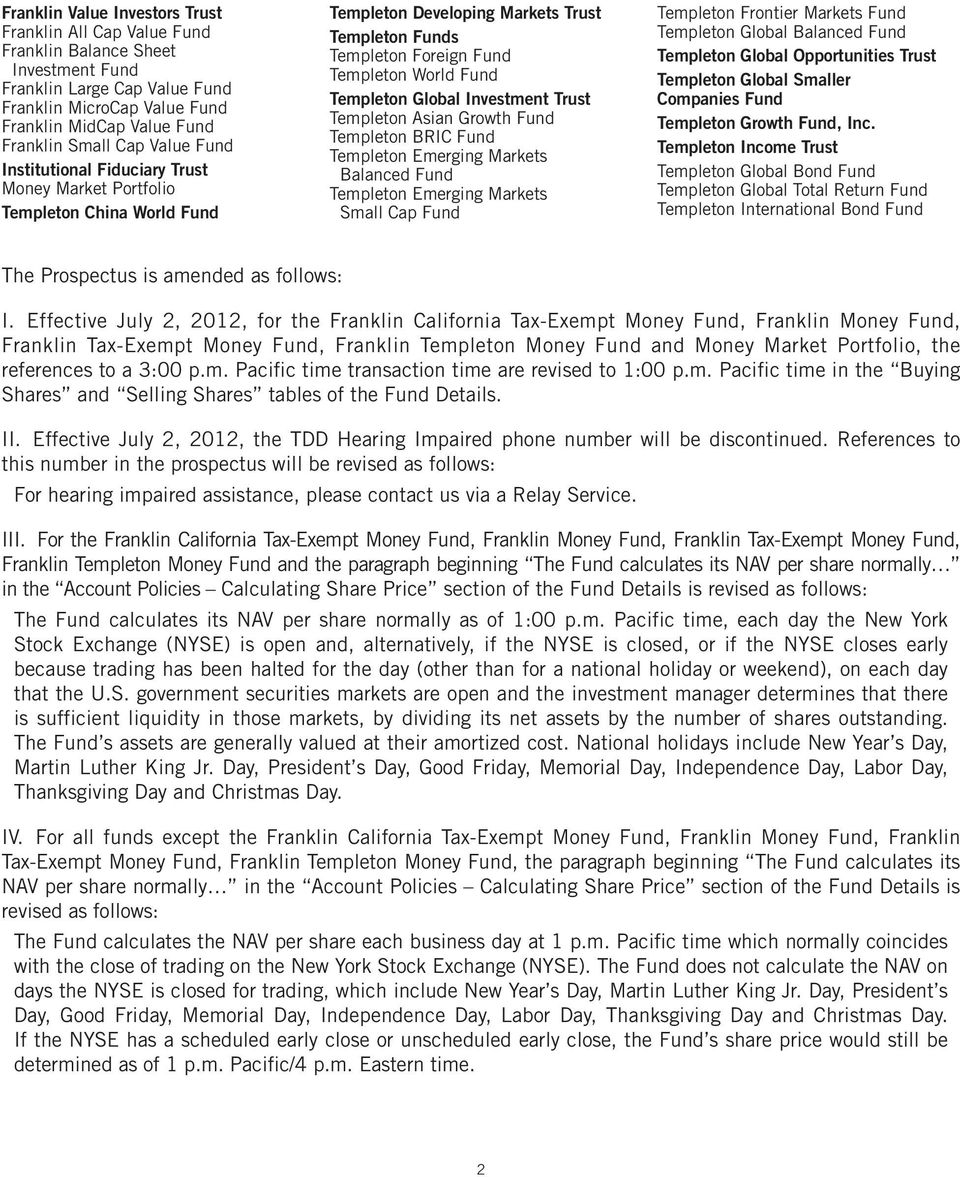
2 GOF P-3 06/ SUPPLEMENT DATED JUNE 6, 2012 TO THE CURRENTLY EFFECTIVE PROSPECTUS OF EACH OF THE LISTED FUNDS Franklin California Tax-Free Income Fund Franklin California Tax-Free Trust Franklin California Insured Tax-Free Income Fund Franklin California Intermediate-Term Tax-Free Income Fund Franklin California Tax-Exempt Money Fund Franklin Custodian Funds Franklin DynaTech Fund Franklin Income Fund Franklin U.S. Government Securities Fund Franklin Utilities Fund Franklin Growth Fund Franklin Federal Tax-Free Income Fund Franklin Global Trust Franklin Global Real Estate Fund Franklin International Smaller Cap Growth Fund Franklin International Growth Fund Franklin Large Cap Equity Fund Franklin Gold and Precious Metals Fund Franklin High Income Trust Franklin High Income Fund Franklin Investors Securities Trust Franklin Adjustable U.S. Government Securities Fund Franklin Balanced Fund Franklin Convertible Securities Fund Franklin Equity Income Fund Franklin Floating Rate Daily Access Fund Franklin Limited Maturity U.S. Government Securities Fund Franklin Low Duration Total Return Fund Franklin Real Return Fund Franklin Total Return Fund Franklin Managed Trust Franklin Rising Dividends Fund Franklin Money Fund Franklin Municipal Securities Trust Franklin California High Yield Municipal Fund Franklin Tennessee Municipal Bond Fund Franklin Mutual Recovery Fund Franklin Mutual Series Funds Mutual Beacon Fund Mutual European Fund Mutual Financial Services Fund Mutual Global Discovery Fund Mutual International Fund Mutual Quest Fund Mutual Shares Fund Franklin New York Tax-Free Income Fund Franklin New York Tax-Free Trust Franklin New York Intermediate-Term Tax-Free Income Fund Franklin Real Estate Securities Trust Franklin Real Estate Securities Fund Franklin Strategic Mortgage Portfolio Franklin Strategic Series Franklin Biotechnology Discovery Fund Franklin Flex Cap Growth Fund Franklin Focused Core Equity Fund Franklin Growth Opportunities Fund Franklin Natural Resources Fund Franklin Small Cap Growth Fund Franklin Small-Mid Cap Growth Fund Franklin Strategic Income Fund Franklin Tax-Exempt Money Fund Franklin Tax-Free Trust Franklin Alabama Tax-Free Income Fund Franklin Arizona Tax-Free Income Fund Franklin Colorado Tax-Free Income Fund Franklin Connecticut Tax-Free Income Fund Franklin Double Tax-Free Income Fund Franklin Federal Intermediate-Term Tax-Free Income Fund Franklin Federal Limited-Term Tax-Free Income Fund Franklin Florida Tax-Free Income Fund Franklin Georgia Tax-Free Income Fund Franklin High Yield Tax-Free Income Fund Franklin Insured Tax-Free Income Fund Franklin Kentucky Tax-Free Income Fund Franklin Louisiana Tax-Free Income Fund Franklin Maryland Tax-Free Income Fund Franklin Massachusetts Tax-Free Income Fund Franklin Michigan Tax-Free Income Fund Franklin Minnesota Tax-Free Income Fund Franklin Missouri Tax-Free Income Fund Franklin New Jersey Tax-Free Income Fund Franklin North Carolina Tax-Free Income Fund Franklin Ohio Tax-Free Income Fund Franklin Oregon Tax-Free Income Fund Franklin Pennsylvania Tax-Free Income Fund Franklin Virginia Tax-Free Income Fund Franklin Templeton Fund Allocator Series Franklin Templeton Conservative Allocation Fund Franklin Templeton Corefolio Allocation Fund Franklin Templeton Founding Funds Allocation Fund Franklin Templeton Growth Allocation Fund Franklin Templeton Moderate Allocation Fund Franklin Templeton 2015 Retirement Target Fund Franklin Templeton 2025 Retirement Target Fund Franklin Templeton 2035 Retirement Target Fund Franklin Templeton 2045 Retirement Target Fund Franklin Templeton Multi-Asset Real Return Fund Franklin Templeton Global Trust Franklin Templeton Hard Currency Fund Franklin Templeton International Trust Franklin India Growth Fund Franklin Templeton Global Allocation Fund Franklin World Perspectives Fund Templeton Foreign Smaller Companies Fund Franklin Templeton Money Fund Trust Franklin Templeton Money Fund 1

3 Franklin Value Investors Trust Franklin All Cap Value Fund Franklin Balance Sheet Investment Fund Franklin Large Cap Value Fund Franklin MicroCap Value Fund Franklin MidCap Value Fund Franklin Small Cap Value Fund Institutional Fiduciary Trust Money Market Portfolio Templeton China World Fund Templeton Developing Markets Trust Templeton Funds Templeton Foreign Fund Templeton World Fund Templeton Global Investment Trust Templeton Asian Growth Fund Templeton BRIC Fund Templeton Emerging Markets Balanced Fund Templeton Emerging Markets Small Cap Fund Templeton Frontier Markets Fund Templeton Global Balanced Fund Templeton Global Opportunities Trust Templeton Global Smaller Companies Fund Templeton Growth Fund, Inc. Templeton Income Trust Templeton Global Bond Fund Templeton Global Total Return Fund Templeton International Bond Fund The Prospectus is amended as follows: I. Effective July 2, 2012, for the Franklin California Tax-Exempt Money Fund, Franklin Money Fund, Franklin Tax-Exempt Money Fund, Franklin Templeton Money Fund and Money Market Portfolio, the references to a 3:00 p.m. Pacific time transaction time are revised to 1:00 p.m. Pacific time in the Buying Shares and Selling Shares tables of the Fund Details. II. Effective July 2, 2012, the TDD Hearing Impaired phone number will be discontinued. References to this number in the prospectus will be revised as follows: For hearing impaired assistance, please contact us via a Relay Service. III. For the Franklin California Tax-Exempt Money Fund, Franklin Money Fund, Franklin Tax-Exempt Money Fund, Franklin Templeton Money Fund and the paragraph beginning The Fund calculates its NAV per share normally in the Account Policies Calculating Share Price section of the Fund Details is revised as follows: The Fund calculates its NAV per share normally as of 1:00 p.m. Pacific time, each day the New York Stock Exchange (NYSE) is open and, alternatively, if the NYSE is closed, or if the NYSE closes early because trading has been halted for the day (other than for a national holiday or weekend), on each day that the U.S. government securities markets are open and the investment manager determines that there is sufficient liquidity in those markets, by dividing its net assets by the number of shares outstanding. The Fund s assets are generally valued at their amortized cost. National holidays include New Year s Day, Martin Luther King Jr. Day, President s Day, Good Friday, Memorial Day, Independence Day, Labor Day, Thanksgiving Day and Christmas Day. IV. For all funds except the Franklin California Tax-Exempt Money Fund, Franklin Money Fund, Franklin Tax-Exempt Money Fund, Franklin Templeton Money Fund, the paragraph beginning The Fund calculates its NAV per share normally in the Account Policies Calculating Share Price section of the Fund Details is revised as follows: The Fund calculates the NAV per share each business day at 1 p.m. Pacific time which normally coincides with the close of trading on the New York Stock Exchange (NYSE). The Fund does not calculate the NAV on days the NYSE is closed for trading, which include New Year s Day, Martin Luther King Jr. Day, President s Day, Good Friday, Memorial Day, Independence Day, Labor Day, Thanksgiving Day and Christmas Day. If the NYSE has a scheduled early close or unscheduled early close, the Fund s share price would still be determined as of 1 p.m. Pacific/4 p.m. Eastern time. 2
4 V. Effective on or about September 14, 2012, for the Franklin California Tax-Exempt Money Fund, Franklin Money Fund, Franklin Tax-Exempt Money Fund, Franklin Templeton Money Fund and Money Market Portfolio the paragraph beginning with Most Franklin Templeton funds impose in the Selling Shares Contingent Deferred Sales Charge (CDSC) section of the Fund Details is revised as follows: Most Franklin Templeton funds impose a 1% or 0.75% CDSC on certain investments of Class A shares sold within 18 months of purchase. While the Fund generally does not have a CDSC, it will impose one if you sell shares exchanged into the Fund from another Franklin Templeton fund and those shares would have been assessed a CDSC in the other fund. VI. Effective May 1, 2012, the following has been added to the Management section of the Fund Details for the Franklin International Growth Fund, Franklin Large Cap Equity Fund, Franklin Convertible Securities Fund, Franklin Equity Income Fund, Franklin Low Duration Total Return Fund, Franklin Biotechnology Discovery Fund, Franklin Focused Core Equity Fund, Franklin India Growth Fund, Franklin All Cap Value Fund, Franklin Large Cap Value Fund, Franklin MidCap Value Fund, Templeton World Fund, Templeton BRIC Fund, Templeton Emerging Markets Small Cap Fund, Templeton Frontier Markets Fund, Templeton Growth Fund, Inc., Templeton Global Total Return Fund and Templeton International Bond Fund: Special Servicing Agreement The Fund is an underlying investment fund of one or more funds of Franklin Templeton Fund Allocator Series Funds (the Allocator Funds ) and has entered into a Special Servicing Agreement with the Allocator Funds and certain service providers of the Fund and the Allocator Funds, pursuant to which the Fund may pay a portion of the Allocator Funds expenses, including transfer agency and shareholder servicing costs, to the extent such payments are less than the amount of the benefits realized or expected to be realized by the Fund from the investment in the Fund by the Allocator Funds. VII. For Funds that offer Advisor Class or Class Z shares, the first two bullets under in the Your Account Qualified Investors Advisor Class [or Class Z] section of the Fund Details are replaced with the following: Advisory Fee Programs. Shares acquired by an investor (in connection with) a comprehensive fee or other advisory fee arrangement between the investor and a registered broker-dealer or investment adviser, trust company or bank (referred to as the Sponsor ) in which the investor pays that Sponsor a fee for investment advisory services and the Sponsor or a broker-dealer through whom the shares are acquired has an agreement with Distributors authorizing the sale of Fund shares. No minimum initial investment. VIII. Effective on or about September 14, 2012, for all funds except the Franklin California Tax-Exempt Money Fund, Franklin Money Fund, Franklin Tax-Exempt Money Fund and Franklin Templeton Money Fund, the paragraph beginning with Any CDSC will continue to be calculated in the Exchanging Shares Exchange Privilege section of the Fund Details is revised as follows: Any CDSC will continue to be calculated from the date of your initial investment and will not be charged at the time of the exchange. The purchase price for determining a CDSC on exchanged shares will be the price you paid for the original shares. IX. The paragraph beginning In considering an investor s trading patterns in the Exchanging Shares Frequent Trading Policy section of the Fund Details is revised as follows: In considering an investor s trading patterns, the Fund may consider, among other factors, the investor s trading history both directly and, if known, through financial intermediaries, in the Fund, in other Franklin Templeton funds, in non-franklin Templeton mutual funds, or in accounts under common control or 3

5 ownership (see, for example, Investment by asset allocators in the SAI). The transfer agent may also reject any purchase or redemption request, whether or not it represents part of any ongoing trading pattern, if the Fund investment manager or transfer agent reasonably concludes that the amount of the requested transaction may disrupt or otherwise interfere with the efficient management of the Fund s portfolio. In determining what actions should be taken, the Fund s transfer agent may consider a variety of factors, including the potential impact of such remedial actions on the Fund and its shareholders. If the Fund is a fund of funds, the Fund s transfer agent may take into account the impact of the trading activity and of any proposed remedial action on both the Fund and the underlying funds in which the Fund invests. X. The following replaces the second paragraph of the Selling Shares Selling Shares in Writing section of the Fund Details: We also may require a signature guarantee when we receive instructions from an agent, not the registered owners; when you want to send your proceeds to a bank account that was added or changed on your account within the last 15 days and the bank and fund accounts have at least one common owner; or when we believe it would protect the Fund against potential claims based on the instructions received. XI. The following is added to the SELLING SHARES table of the Selling Shares section as a third paragraph under By Electronic Funds Transfer (ACH) in the Selling Shares table of the Fund Details: If the bank and Fund accounts have at least one common owner and the bank account was added or changed within the last 15 days, you may be required to provide written instructions signed by all fund account owners, with a signature guarantee for each fund account owner. XII. The paragraph beginning If you believe there are cumulative quantity discount in the Choosing a Share Class Sales Charge Reductions and Waivers section of the Fund Details is replaced with the following: If you believe there are cumulative quantity discount eligible shares that can be combined with your current purchase to achieve a sales charge breakpoint (for example, shares held in a different brokerdealer s brokerage account or with a bank or an investment advisor), it is your responsibility to specifically identify those shares to your financial advisor at the time of your purchase (including at the time of any future purchase). It may be necessary for you to provide your financial advisor with information and records (including account statements) of all relevant accounts invested in the Franklin Templeton Funds. If you have not designated a financial advisor associated with your Franklin Templeton fund shares, it is your responsibility to specifically identify any cumulative quantity discount eligible shares to the Fund s transfer agent at the time of any purchase. Please keep this supplement for future reference. 4

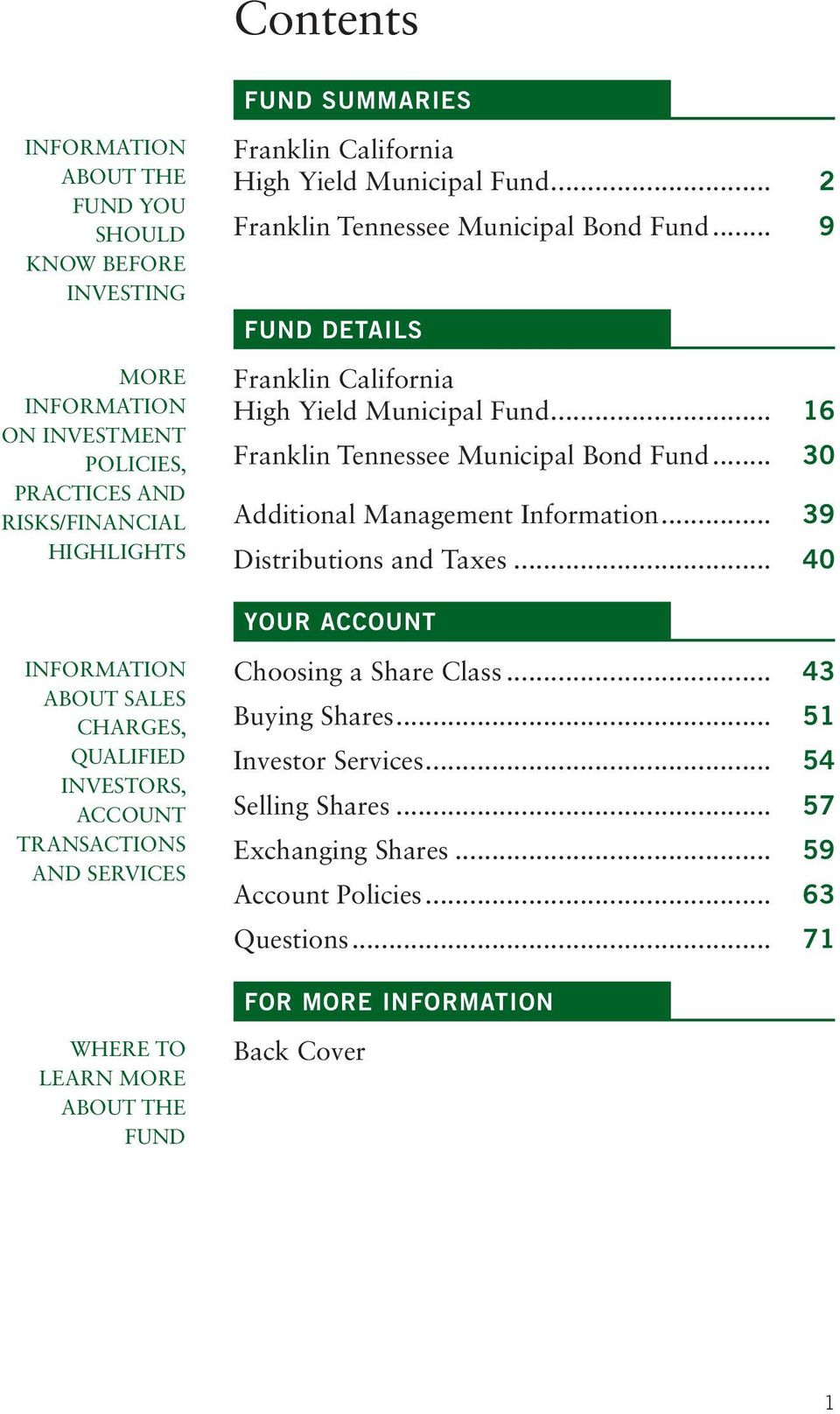
6 Contents FUND SUMMARIES INFORMATION ABOUT THE FUND YOU SHOULD KNOW BEFORE INVESTING MORE INFORMATION ON INVESTMENT POLICIES, PRACTICES AND RISKS/FINANCIAL HIGHLIGHTS Franklin California High Yield Municipal Fund... 2 Franklin Tennessee Municipal Bond Fund... 9 FUND DETAILS Franklin California High Yield Municipal Fund Franklin Tennessee Municipal Bond Fund Additional Management Information Distributions and Taxes YOUR ACCOUNT INFORMATION ABOUT SALES CHARGES, QUALIFIED INVESTORS, ACCOUNT TRANSACTIONS AND SERVICES Choosing a Share Class Buying Shares Investor Services Selling Shares Exchanging Shares Account Policies Questions FOR MORE INFORMATION WHERE TO LEARN MORE ABOUT THE FUND Back Cover 1
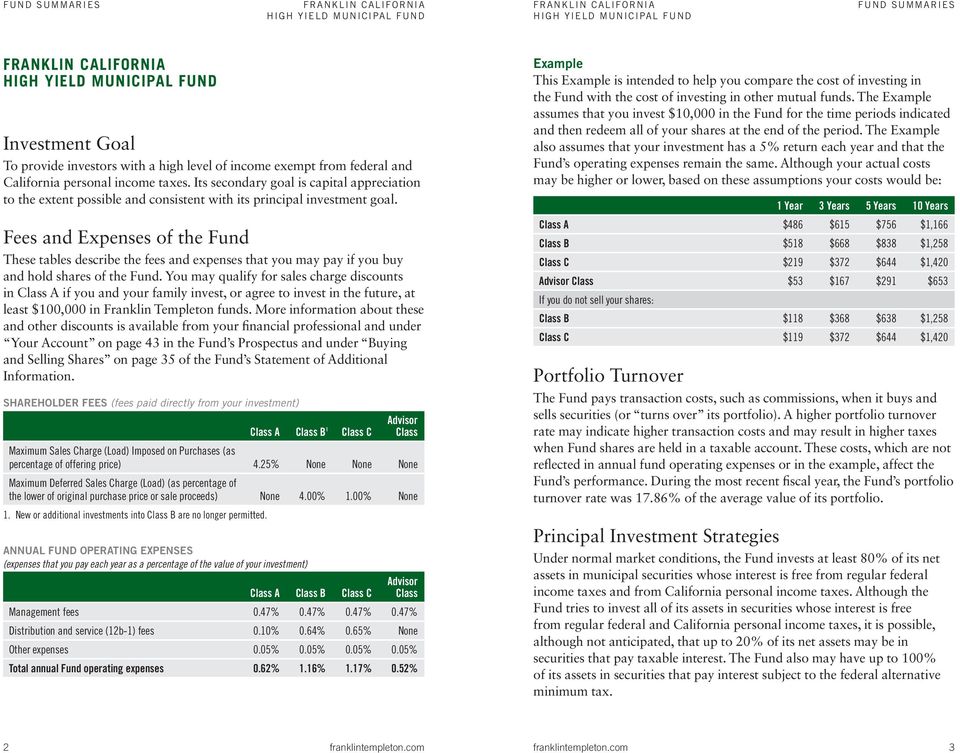
7 FUND SUMMARIES FUND SUMMARIES Investment Goal To provide investors with a high level of income exempt from federal and California personal income taxes. Its secondary goal is capital appreciation to the extent possible and consistent with its principal investment goal. Fees and Expenses of the Fund These tables describe the fees and expenses that you may pay if you buy and hold shares of the Fund. You may qualify for sales charge discounts in Class A if you and your family invest, or agree to invest in the future, at least $100,000 in Franklin Templeton funds. More information about these and other discounts is available from your financial professional and under Your Account on page 43 in the Fund s Prospectus and under Buying and Selling Shares on page 35 of the Fund s Statement of Additional Information. SHAREHOLDER FEES (fees paid directly from your investment) Class A Class B 1 Class C Advisor Class Maximum Sales Charge (Load) Imposed on Purchases (as percentage of offering price) 4.25% None None None Maximum Deferred Sales Charge (Load) (as percentage of the lower of original purchase price or sale proceeds) None 4.00% 1.00% None 1. New or additional investments into Class B are no longer permitted. ANNUAL FUND OPERATING EXPENSES (expenses that you pay each year as a percentage of the value of your investment) Class A Class B Class C Advisor Class Management fees 0.47% 0.47% 0.47% 0.47% Distribution and service (12b-1) fees 0.10% 0.64% 0.65% None Other expenses 0.05% 0.05% 0.05% 0.05% Total annual Fund operating expenses 0.62% 1.16% 1.17% 0.52% Example This Example is intended to help you compare the cost of investing in the Fund with the cost of investing in other mutual funds. The Example assumes that you invest $10,000 in the Fund for the time periods indicated and then redeem all of your shares at the end of the period. The Example also assumes that your investment has a 5% return each year and that the Fund s operating expenses remain the same. Although your actual costs may be higher or lower, based on these assumptions your costs would be: 1 Year 3 Years 5 Years 10 Years Class A $486 $615 $756 $1,166 Class B $518 $668 $838 $1,258 Class C $219 $372 $644 $1,420 Advisor Class $53 $167 $291 $653 If you do not sell your shares: Class B $118 $368 $638 $1,258 Class C $119 $372 $644 $1,420 Portfolio Turnover The Fund pays transaction costs, such as commissions, when it buys and sells securities (or turns over its portfolio). A higher portfolio turnover rate may indicate higher transaction costs and may result in higher taxes when Fund shares are held in a taxable account. These costs, which are not reflected in annual fund operating expenses or in the example, affect the Fund s performance. During the most recent fiscal year, the Fund s portfolio turnover rate was 17.86% of the average value of its portfolio. Principal Investment Strategies Under normal market conditions, the Fund invests at least 80% of its net assets in municipal securities whose interest is free from regular federal income taxes and from California personal income taxes. Although the Fund tries to invest all of its assets in securities whose interest is free from regular federal and California personal income taxes, it is possible, although not anticipated, that up to 20% of its net assets may be in securities that pay taxable interest. The Fund also may have up to 100% of its assets in securities that pay interest subject to the federal alternative minimum tax. 2 3
8 FUND SUMMARIES FUND SUMMARIES The Fund may invest in municipal securities rated in any rating category by U.S. nationally recognized rating services, including securities rated below investment grade (or comparable unrated or short-term rated securities). The Fund also may invest up to 35% of its total assets in municipal securities issued by U.S. territories. Although the investment manager will search for investments across a large number of municipal securities that finance different types of projects, from time to time, based on economic conditions, the Fund may have significant positions in municipal securities that finance similar types of projects. The investment manager selects securities that it believes will provide the best balance between risk and return within the Fund s range of allowable investments and typically uses a buy and hold strategy. This means it generally holds securities in the Fund s portfolio for income purposes, rather than trading securities for capital gains, although the investment manager may sell a security at any time if it believes it could help the Fund meet its goal. The investment manager may consider existing market conditions, the availability of lower-rated securities, and whether the difference in yields between higher- and lower-rated securities justifies the higher risk of lowerrated securities when selecting securities for the Fund s portfolio. Thus, there may be times when the Fund has a majority of its investments in securities that are considered investment grade. Principal Risks You could lose money by investing in the Fund. Mutual fund shares are not deposits or obligations of, or guaranteed or endorsed by, any bank, and are not insured by the Federal Deposit Insurance Corporation, the Federal Reserve Board, or any other agency of the U.S. government. Interest Rate When interest rates rise, debt security prices generally fall. The opposite is also generally true: debt security prices rise when interest rates fall. In general, securities with longer maturities are more sensitive to these interest rate changes. Market The market value of securities owned by the Fund will go up and down, sometimes rapidly or unpredictably. A security s market value may be reduced by market activity or other results of supply and demand unrelated to the issuer. This is a basic risk associated with all securities. When there are more sellers than buyers, prices tend to fall. Likewise, when there are more buyers than sellers, prices tend to rise. Credit An issuer of debt securities may fail to make interest payments and repay principal when due, in whole or in part. Changes in an issuer s financial strength or in a security s credit rating may affect a security s value. A change in the credit rating of any one or more of the municipal bond insurers that insure securities in the Fund s portfolio may affect the value of the securities they insure, the Fund s share price and Fund performance. The Fund might also be adversely impacted by the inability of an insurer to meet its insurance obligations. High-Yield Debt Securities Issuers of lower-rated or high-yield debt securities are not as strong financially as those issuing higher credit quality debt securities. These issuers are more likely to encounter financial difficulties and are more vulnerable to changes in the relevant economy, such as a recession or a sustained period of rising interest rates, that could affect their ability to make interest and principal payments when due. The prices of high-yield debt securities generally fluctuate more than those of higher credit quality. High-yield debt securities are generally more illiquid (harder to sell) and harder to value. California and U.S. Territories Because the Fund invests predominantly in California municipal securities, events in California are likely to affect the Fund s investments and its performance. These events may include economic or political policy changes, tax base erosion, state constitutional limits on tax increases, budget deficits and other financial difficulties, and changes in the credit ratings assigned to municipal issuers of California. As with California municipal securities, events in any of the territories where the Fund is invested may affect the Fund s investments and its performance. Focus The Fund may invest more than 25% of its assets in municipal securities that finance similar types of projects, such as hospitals, higher education, housing, industrial development, and transportation or pollution control. A change that affects one project, such as proposed legislation on the financing of the project, a shortage of the materials needed for the project, or a declining need for the project, would likely affect all similar projects, thereby increasing market risk. Tax-Exempt Securities While the Fund endeavors to purchase only bona fide tax-exempt securities, there are risks that: (a) a security issued as tax- 4 5

9 FUND SUMMARIES FUND SUMMARIES exempt may be reclassified as taxable by the Internal Revenue Service or a state tax authority, and/or (b) future legislative, administrative or court actions could adversely impact the qualification of income from a taxexempt security as tax-free. Such reclassifications or actions could cause interest from a security to become taxable, possible retroactively, subjecting you to increased tax liability. CLASS A ANNUAL TOTAL RETURNS 40% 30% 20% 28.24% Income Because the Fund can only distribute what it earns, the Fund s distributions to shareholders may decline when prevailing interest rates fall or when the Fund experiences defaults on debt securities it holds. Prepayment Prepayment risk occurs when a debt security can be repaid in whole or in part prior to the security s maturity and the Fund must reinvest the proceeds it receives, during periods of declining interest rates, in securities that pay a lower rate of interest. 10% 0% -10% -20% 5.41% % % % % 6.30% Year -1.64% % % 2010 Management The Fund is subject to management risk because it is an actively managed investment portfolio. The Fund s investment manager applies investment techniques and risk analyses in making investment decisions for the Fund, but there can be no guarantee that these decisions will produce the desired results. Performance The following bar chart and table provide some indication of the risks of investing in the Fund. The bar chart shows changes in the Fund s performance from year to year for Class A shares. The table shows how the Fund s average annual returns for 1 year, 5 years, 10 years or since inception, as applicable, compared with those of a broad measure of market performance. The Fund s past performance (before and after taxes) is not necessarily an indication of how the Fund will perform in the future. You can obtain updated performance information at franklintempleton. com or by calling (800) DIAL BEN/ Sales charges are not reflected in the bar chart, and if those charges were included, returns would be less than those shown. Best Quarter: Q % Worst Quarter: Q % As of June 30, 2011, the Fund s year-to-date return was 4.20% for Class A. AVERAGE ANNUAL TOTAL RETURNS (figures reflect sales charges) For the periods ended December 31, Year 5 Years 10 Years Franklin California High Yield Municipal Fund - Class A Return Before Taxes 0.51% 1.52% 3.90% Return After Taxes on Distributions 0.51% 1.52% 3.90% Return After Taxes on Distributions and Sale of Fund Shares 2.24% 2.03% 4.10% Franklin California High Yield Municipal Fund - Class B 0.36% 1.51% 3.90% 1 Franklin California High Yield Municipal Fund - Class C 3.34% 1.85% 3.79% Franklin California High Yield Municipal Fund - Advisor Class 5.04% 2.50% 4.40% Barclays Capital Municipal Bond Index (index reflects no deduction for fees, expenses or taxes) 2.38% 4.09% 4.83% 1. Since inception February 1, Historical performance for Advisor Class shares prior to their inception is based on the performance of Class A shares. Advisor Class performance has been adjusted to reflect differences in sales charges between classes. The after-tax returns are calculated using the historical highest individual federal marginal income tax rates and do not reflect the impact of state and local taxes. Actual after-tax returns depend on an investor s tax situation 6 7

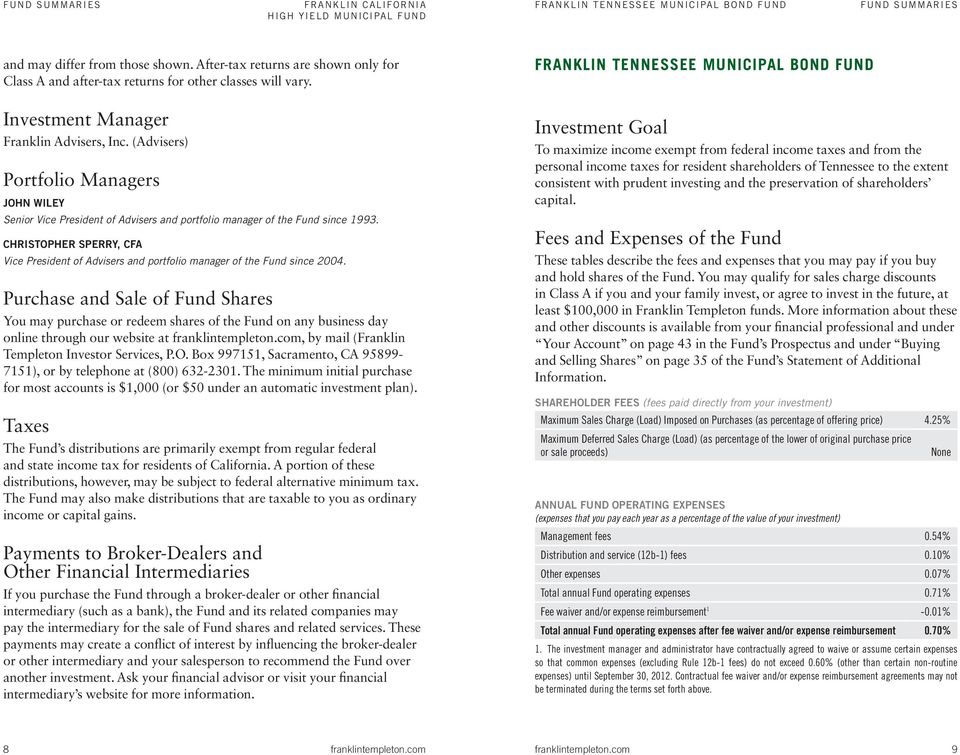
10 FUND SUMMARIES FRANKLIN TENNESSEE MUNICIPAL BOND FUND FUND SUMMARIES and may differ from those shown. After-tax returns are shown only for Class A and after-tax returns for other classes will vary. Investment Manager Franklin Advisers, Inc. (Advisers) Portfolio Managers JOHN WILEY Senior Vice President of Advisers and portfolio manager of the Fund since CHRISTOPHER SPERRY, CFA Vice President of Advisers and portfolio manager of the Fund since Purchase and Sale of Fund Shares You may purchase or redeem shares of the Fund on any business day online through our website at, by mail (Franklin Templeton Investor Services, P.O. Box , Sacramento, CA ), or by telephone at (800) The minimum initial purchase for most accounts is $1,000 (or $50 under an automatic investment plan). Taxes The Fund s distributions are primarily exempt from regular federal and state income tax for residents of California. A portion of these distributions, however, may be subject to federal alternative minimum tax. The Fund may also make distributions that are taxable to you as ordinary income or capital gains. Payments to Broker-Dealers and Other Financial Intermediaries If you purchase the Fund through a broker-dealer or other financial intermediary (such as a bank), the Fund and its related companies may pay the intermediary for the sale of Fund shares and related services. These payments may create a conflict of interest by influencing the broker-dealer or other intermediary and your salesperson to recommend the Fund over another investment. Ask your financial advisor or visit your financial intermediary s website for more information. FRANKLIN TENNESSEE MUNICIPAL BOND FUND Investment Goal To maximize income exempt from federal income taxes and from the personal income taxes for resident shareholders of Tennessee to the extent consistent with prudent investing and the preservation of shareholders capital. Fees and Expenses of the Fund These tables describe the fees and expenses that you may pay if you buy and hold shares of the Fund. You may qualify for sales charge discounts in Class A if you and your family invest, or agree to invest in the future, at least $100,000 in Franklin Templeton funds. More information about these and other discounts is available from your financial professional and under Your Account on page 43 in the Fund s Prospectus and under Buying and Selling Shares on page 35 of the Fund s Statement of Additional Information. SHAREHOLDER FEES (fees paid directly from your investment) Maximum Sales Charge (Load) Imposed on Purchases (as percentage of offering price) 4.25% Maximum Deferred Sales Charge (Load) (as percentage of the lower of original purchase price or sale proceeds) None ANNUAL FUND OPERATING EXPENSES (expenses that you pay each year as a percentage of the value of your investment) Management fees 0.54% Distribution and service (12b-1) fees 0.10% Other expenses 0.07% Total annual Fund operating expenses 0.71% Fee waiver and/or expense reimbursement % Total annual Fund operating expenses after fee waiver and/or expense reimbursement 0.70% 1. The investment manager and administrator have contractually agreed to waive or assume certain expenses so that common expenses (excluding Rule 12b-1 fees) do not exceed 0.60% (other than certain non-routine expenses) until September 30, Contractual fee waiver and/or expense reimbursement agreements may not be terminated during the terms set forth above. 8 9
11 FUND SUMMARIES FRANKLIN TENNESSEE MUNICIPAL BOND FUND FRANKLIN TENNESSEE MUNICIPAL BOND FUND FUND SUMMARIES Example This Example is intended to help you compare the cost of investing in the Fund with the cost of investing in other mutual funds. The Example assumes that you invest $10,000 in the Fund for the time periods indicated and then redeem all of your shares at the end of the period. The Example also assumes that your investment has a 5% return each year and that the Fund s operating expenses remain the same. The Example reflects adjustments made to the Fund s operating expenses due to the fee waiver and/or expense reimbursement by the investment manager and/or administrator for the 1 Year numbers only. Although your actual costs may be higher or lower, based on these assumptions your costs would be: Portfolio Turnover 1 Year 3 Years 5 Years 10 Years $493 $641 $802 $1,269 The Fund pays transaction costs, such as commissions, when it buys and sells securities (or turns over its portfolio). A higher portfolio turnover rate may indicate higher transaction costs and may result in higher taxes when Fund shares are held in a taxable account. These costs, which are not reflected in annual fund operating expenses or in the example, affect the Fund s performance. During the most recent fiscal year, the Fund s portfolio turnover rate was 14.28% of the average value of its portfolio. Principal Investment Strategies Under normal market conditions, the Fund invests at least 80% of its net assets in investment grade municipal securities whose interest is free from regular federal income taxes and from Tennessee personal income taxes. Although the Fund tries to invest all of its assets in securities whose interest is free from regular federal and Tennessee personal income taxes, it is possible, although not anticipated, that up to 20% of its net assets may be invested in securities that pay taxable interest. The Fund also may have up to 100% of its assets in securities that pay interest subject to the federal alternative minimum tax. The Fund only buys municipal securities rated, at the time of purchase, in one of the top four ratings categories by one or more U.S. nationally recognized rating services (or comparable unrated or short-term rated securities). The Fund may invest up to 35% of its assets in municipal securities issued by U.S. territories. Although the investment manager will search for investments across a large number of municipal securities that finance different types of projects, from time to time, based on economic conditions, the Fund may have significant positions in municipal securities that finance similar types of projects. The investment manager selects securities that it believes will provide the best balance between risk and return within the Fund s range of allowable investments and typically uses a buy and hold strategy. This means it generally holds securities in the Fund s portfolio for income purposes, rather than trading securities for capital gains, although the investment manager may sell a security at any time if it believes it could help the Fund meet its goal. Principal Risks You could lose money by investing in the Fund. Mutual fund shares are not deposits or obligations of, or guaranteed or endorsed by, any bank, and are not insured by the Federal Deposit Insurance Corporation, the Federal Reserve Board, or any other agency of the U.S. government. Interest Rate When interest rates rise, debt security prices generally fall. The opposite is also generally true: debt security prices rise when interest rates fall. In general, securities with longer maturities are more sensitive to these interest rate changes. Market The market value of securities owned by the Fund will go up and down, sometimes rapidly or unpredictably. A security s market value may be reduced by market activity or other results of supply and demand unrelated to the issuer. This is a basic risk associated with all securities. When there are more sellers than buyers, prices tend to fall. Likewise, when there are more buyers than sellers, prices tend to rise. Credit An issuer of debt securities may fail to make interest payments and repay principal when due, in whole or in part. Changes in an issuer s financial strength or in a security s credit rating may affect a security s value. A change in the credit rating of any one or more of the municipal bond insurers that insure securities in the Fund s portfolio may affect the value of the securities they insure, the Fund s share price and Fund performance

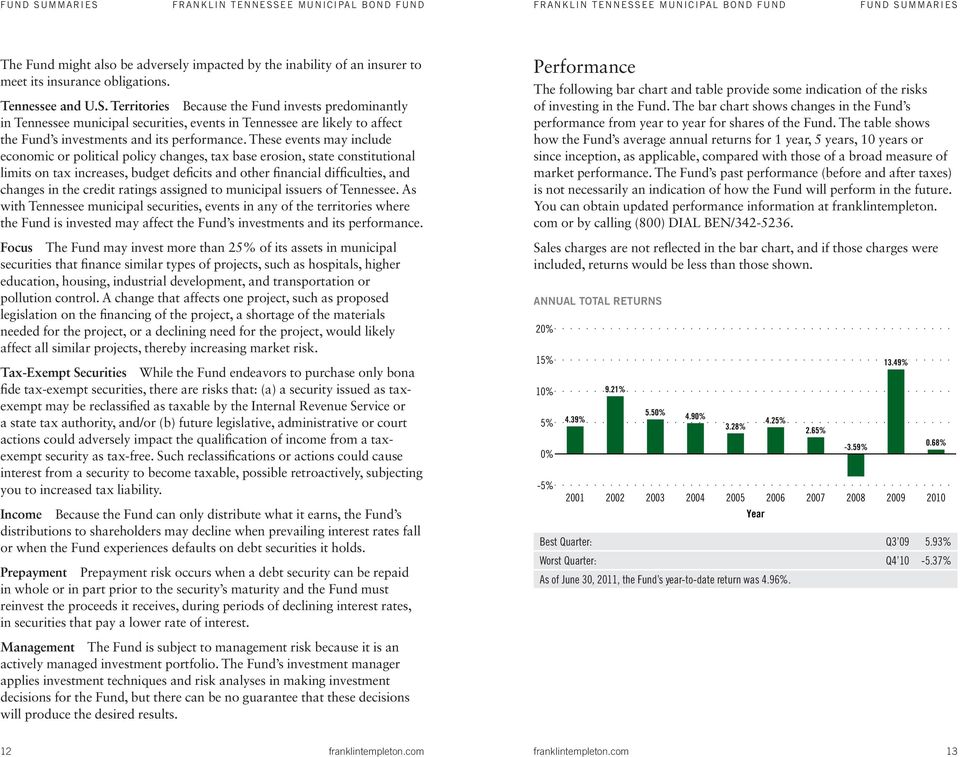
12 FUND SUMMARIES FRANKLIN TENNESSEE MUNICIPAL BOND FUND FRANKLIN TENNESSEE MUNICIPAL BOND FUND FUND SUMMARIES The Fund might also be adversely impacted by the inability of an insurer to meet its insurance obligations. Tennessee and U.S. Territories Because the Fund invests predominantly in Tennessee municipal securities, events in Tennessee are likely to affect the Fund s investments and its performance. These events may include economic or political policy changes, tax base erosion, state constitutional limits on tax increases, budget deficits and other financial difficulties, and changes in the credit ratings assigned to municipal issuers of Tennessee. As with Tennessee municipal securities, events in any of the territories where the Fund is invested may affect the Fund s investments and its performance. Focus The Fund may invest more than 25% of its assets in municipal securities that finance similar types of projects, such as hospitals, higher education, housing, industrial development, and transportation or pollution control. A change that affects one project, such as proposed legislation on the financing of the project, a shortage of the materials needed for the project, or a declining need for the project, would likely affect all similar projects, thereby increasing market risk. Tax-Exempt Securities While the Fund endeavors to purchase only bona fide tax-exempt securities, there are risks that: (a) a security issued as taxexempt may be reclassified as taxable by the Internal Revenue Service or a state tax authority, and/or (b) future legislative, administrative or court actions could adversely impact the qualification of income from a taxexempt security as tax-free. Such reclassifications or actions could cause interest from a security to become taxable, possible retroactively, subjecting you to increased tax liability. Income Because the Fund can only distribute what it earns, the Fund s distributions to shareholders may decline when prevailing interest rates fall or when the Fund experiences defaults on debt securities it holds. Prepayment Prepayment risk occurs when a debt security can be repaid in whole or in part prior to the security s maturity and the Fund must reinvest the proceeds it receives, during periods of declining interest rates, in securities that pay a lower rate of interest. Performance The following bar chart and table provide some indication of the risks of investing in the Fund. The bar chart shows changes in the Fund s performance from year to year for shares of the Fund. The table shows how the Fund s average annual returns for 1 year, 5 years, 10 years or since inception, as applicable, compared with those of a broad measure of market performance. The Fund s past performance (before and after taxes) is not necessarily an indication of how the Fund will perform in the future. You can obtain updated performance information at franklintempleton. com or by calling (800) DIAL BEN/ Sales charges are not reflected in the bar chart, and if those charges were included, returns would be less than those shown. ANNUAL TOTAL RETURNS 20% 15% 10% 5% 0% -5% 4.39% % % % % -3.59% 13.49% Best Quarter: Q % Worst Quarter: Q % As of June 30, 2011, the Fund s year-to-date return was 4.96%. 4.25% Year 2.65% % 2010 Management The Fund is subject to management risk because it is an actively managed investment portfolio. The Fund s investment manager applies investment techniques and risk analyses in making investment decisions for the Fund, but there can be no guarantee that these decisions will produce the desired results
13 FUND SUMMARIES FRANKLIN TENNESSEE MUNICIPAL BOND FUND FRANKLIN TENNESSEE MUNICIPAL BOND FUND FUND SUMMARIES AVERAGE ANNUAL TOTAL RETURNS (figures reflect sales charges) For the periods ended December 31, Year 5 Years 10 Years Franklin Tennessee Municipal Bond Fund Return Before Taxes -3.62% 2.45% 3.93% Return After Taxes on Distributions -3.62% 2.45% 3.93% Return After Taxes on Distributions and Sale of Fund Shares -1.03% 2.68% 3.99% Barclays Capital Municipal Bond Index (index reflects no deduction for fees, expenses or taxes) 2.38% 4.09% 4.83% Payments to Broker-Dealers and Other Financial Intermediaries If you purchase the Fund through a broker-dealer or other financial intermediary (such as a bank), the Fund and its related companies may pay the intermediary for the sale of Fund shares and related services. These payments may create a conflict of interest by influencing the broker-dealer or other intermediary and your salesperson to recommend the Fund over another investment. Ask your financial advisor or visit your financial intermediary s website for more information. The after-tax returns are calculated using the historical highest individual federal marginal income tax rates and do not reflect the impact of state and local taxes. Actual after-tax returns depend on an investor s tax situation and may differ from those shown. Investment Manager Franklin Advisers, Inc. (Advisers) Portfolio Managers FRANCISCO RIVERA Vice President of Advisers and portfolio manager of the Fund since JOHN WILEY Senior Vice President of Advisers and portfolio manager of the Fund since Purchase and Sale of Fund Shares You may purchase or redeem shares of the Fund on any business day online through our website at, by mail (Franklin Templeton Investor Services, P.O. Box , Sacramento, CA ), or by telephone at (800) The minimum initial purchase for most accounts is $1,000 (or $50 under an automatic investment plan). Taxes The Fund s distributions are primarily exempt from regular federal and state income tax for residents of Tennessee. A portion of these distributions, however, may be subject to federal alternative minimum tax. The Fund may also make distributions that are taxable to you as ordinary income or capital gains

14 FUND DETAILS FUND DETAILS Investment Goal The Fund s principal investment goal is to provide investors with a high level of income exempt from federal and California personal income taxes. Its secondary goal is capital appreciation to the extent possible and consistent with its principal investment goal. Principal Investment Policies and Practices Under normal market conditions, the Fund invests at least 80% of its net assets in municipal securities whose interest is free from regular federal income taxes and from California personal income taxes. Although the Fund tries to invest all of its assets in securities whose interest is free from regular federal and California personal income taxes, it is possible, although not anticipated, that up to 20% of its net assets may be in securities that pay taxable interest. The Fund also may have up to 100% of its assets in securities that pay interest subject to the federal alternative minimum tax. The Fund may invest in municipal securities rated in any rating category by U.S. nationally recognized rating services, including securities rated below investment grade (or comparable unrated or short-term rated securities). Municipal securities are issued by state and local governments, their agencies and authorities, as well as by the District of Columbia and U.S. territories and possessions, to borrow money for various public and private projects. Municipal securities pay a fixed, floating or variable rate of interest, and require that the amount borrowed (principal) be repaid at maturity. The Fund also may invest in municipal lease obligations, which generally are issued to finance the purchase of public property. The property is leased to a state or local government and the lease payments are used to pay the interest on the obligations. These differ from other municipal securities because the money to make the lease payments must be set aside each year or the lease can be cancelled without penalty. If this happens, investors who own the obligations may not be paid. The Fund may also invest in municipal securities that are issued on a when-issued or delayeddelivery basis. The Fund may invest in insured municipal securities, which are covered by insurance policies that guarantee the timely payment of principal and interest. The Fund generally purchases bonds that have insurance in place so it does not pay insurance premiums directly. The premium costs, however, are reflected in a lower yield and/or higher price for the insured bond. When beneficial, the Fund may purchase insurance for an uninsured bond directly from a qualified municipal bond insurer, in which case the Fund pays the insurance premium directly to the insurance company. The Fund also may invest up to 35% of its total assets in municipal securities issued by U.S. territories. Although the investment manager will search for investments across a large number of municipal securities that finance different types of projects, from time to time, based on economic conditions, the Fund may have significant positions in municipal securities that finance similar types of projects. The investment manager selects securities that it believes will provide the best balance between risk and return within the Fund s range of allowable investments and typically uses a buy and hold strategy. This means it holds securities in the Fund s portfolio for income purposes, rather than trading securities for capital gains, although the investment manager may sell a security at any time if it believes it could help the Fund meet its goal. The investment manager also may consider the cost of insurance when selecting securities for the Fund. The investment manager may consider existing market conditions, the availability of lower-rated securities, and whether the difference in yields between higher and lower-rated securities justifies the higher risk of lowerrated securities when selecting securities for the Fund s portfolio. Thus, there may be times when the Fund has a majority of its investments in securities that are considered investment grade. It is important to note that insurance does not guarantee the market value of an insured security, or the Fund s share price or distributions, and shares of the Fund are not insured. Temporary Investments When the investment manager believes market or economic conditions are unusual or unfavorable for investors, the investment manager may 16 17

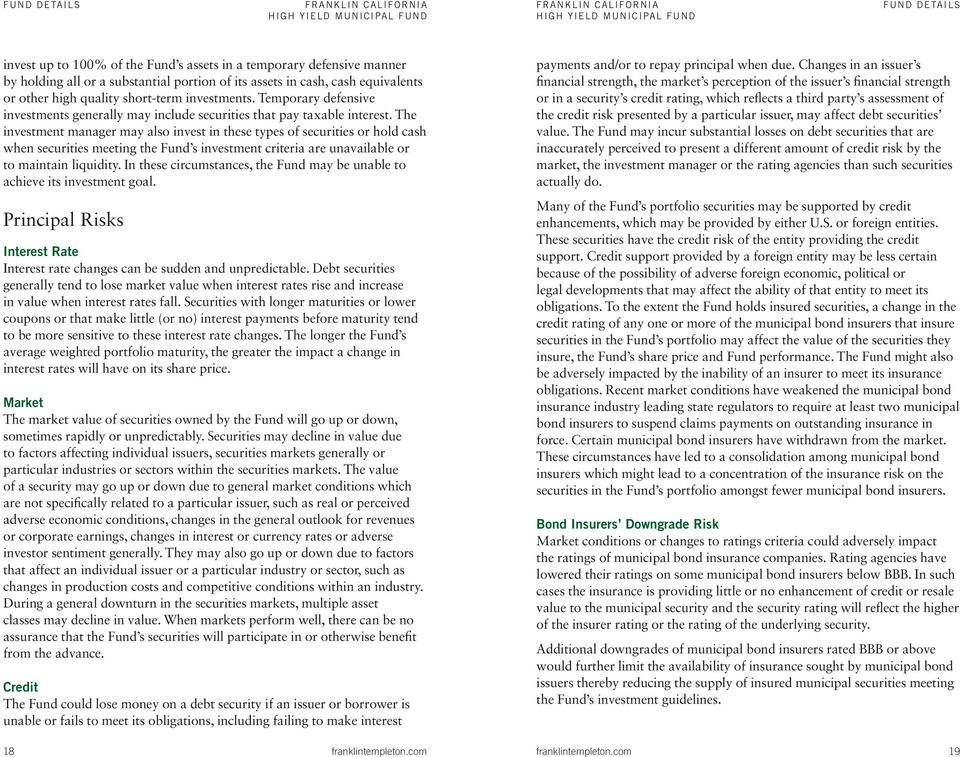
15 FUND DETAILS FUND DETAILS invest up to 100% of the Fund s assets in a temporary defensive manner by holding all or a substantial portion of its assets in cash, cash equivalents or other high quality short-term investments. Temporary defensive investments generally may include securities that pay taxable interest. The investment manager may also invest in these types of securities or hold cash when securities meeting the Fund s investment criteria are unavailable or to maintain liquidity. In these circumstances, the Fund may be unable to achieve its investment goal. Principal Risks Interest Rate Interest rate changes can be sudden and unpredictable. Debt securities generally tend to lose market value when interest rates rise and increase in value when interest rates fall. Securities with longer maturities or lower coupons or that make little (or no) interest payments before maturity tend to be more sensitive to these interest rate changes. The longer the Fund s average weighted portfolio maturity, the greater the impact a change in interest rates will have on its share price. Market The market value of securities owned by the Fund will go up or down, sometimes rapidly or unpredictably. Securities may decline in value due to factors affecting individual issuers, securities markets generally or particular industries or sectors within the securities markets. The value of a security may go up or down due to general market conditions which are not specifically related to a particular issuer, such as real or perceived adverse economic conditions, changes in the general outlook for revenues or corporate earnings, changes in interest or currency rates or adverse investor sentiment generally. They may also go up or down due to factors that affect an individual issuer or a particular industry or sector, such as changes in production costs and competitive conditions within an industry. During a general downturn in the securities markets, multiple asset classes may decline in value. When markets perform well, there can be no assurance that the Fund s securities will participate in or otherwise benefit from the advance. Credit The Fund could lose money on a debt security if an issuer or borrower is unable or fails to meet its obligations, including failing to make interest payments and/or to repay principal when due. Changes in an issuer s financial strength, the market s perception of the issuer s financial strength or in a security s credit rating, which reflects a third party s assessment of the credit risk presented by a particular issuer, may affect debt securities value. The Fund may incur substantial losses on debt securities that are inaccurately perceived to present a different amount of credit risk by the market, the investment manager or the rating agencies than such securities actually do. Many of the Fund s portfolio securities may be supported by credit enhancements, which may be provided by either U.S. or foreign entities. These securities have the credit risk of the entity providing the credit support. Credit support provided by a foreign entity may be less certain because of the possibility of adverse foreign economic, political or legal developments that may affect the ability of that entity to meet its obligations. To the extent the Fund holds insured securities, a change in the credit rating of any one or more of the municipal bond insurers that insure securities in the Fund s portfolio may affect the value of the securities they insure, the Fund s share price and Fund performance. The Fund might also be adversely impacted by the inability of an insurer to meet its insurance obligations. Recent market conditions have weakened the municipal bond insurance industry leading state regulators to require at least two municipal bond insurers to suspend claims payments on outstanding insurance in force. Certain municipal bond insurers have withdrawn from the market. These circumstances have led to a consolidation among municipal bond insurers which might lead to a concentration of the insurance risk on the securities in the Fund s portfolio amongst fewer municipal bond insurers. Bond Insurers Downgrade Risk Market conditions or changes to ratings criteria could adversely impact the ratings of municipal bond insurance companies. Rating agencies have lowered their ratings on some municipal bond insurers below BBB. In such cases the insurance is providing little or no enhancement of credit or resale value to the municipal security and the security rating will reflect the higher of the insurer rating or the rating of the underlying security. Additional downgrades of municipal bond insurers rated BBB or above would further limit the availability of insurance sought by municipal bond issuers thereby reducing the supply of insured municipal securities meeting the Fund s investment guidelines
16 FUND DETAILS FUND DETAILS High-Yield Debt Securities High-yield debt securities (including loans) and unrated securities of similar credit quality ( high-yield debt instruments ) involve greater risk of a complete loss of the Fund s investment, or delays of interest and principal payments than higher-quality debt securities. Issuers of high-yield debt instruments are not as strong financially as those issuing securities of higher credit quality. High-yield debt instruments are generally considered predominately speculative by the applicable rating agencies as these issuers are more likely to encounter financial difficulties and are more vulnerable to changes in the relevant economy, such as a recession or a sustained period of rising interest rates, that could affect their ability to make interest and principal payments when due. If an issuer stops making interest and/or principal payments, payments on the securities may never resume. These instruments may be worthless and the Fund could lose its entire investment. The prices of high-yield debt instruments fluctuate more than higherquality securities. Prices are especially sensitive to developments affecting the issuer and to changes in the ratings assigned by rating agencies. In addition, the entire high-yield debt market can experience sudden and sharp price swings due to changes in economic conditions, stock market activity, large sustained sales by major investors, a high-profile default, or other factors. High-yield debt instruments are generally less liquid than higher-quality securities and do not trade frequently. When they do trade, their prices may be significantly higher or lower than expected. At times, it may be difficult to sell these securities promptly at an acceptable price, which may limit the Fund s ability to sell securities in response to specific economic events or to meet redemption requests. As a result, high-yield debt instruments generally pose greater illiquidity and valuation risks. Substantial declines in the prices of high-yield debt instruments can dramatically increase the yield of such bonds or loans. The decline in market prices generally reflects an expectation that the issuer(s) may be at greater risk of defaulting on the obligation to pay interest and principal when due. Therefore, substantial increases in yield may reflect a greater risk by the Fund of losing some or part of its investment rather than any increase in income that the debt security or loan may pay to the Fund on its investment. California and U.S. Territories Investment in the Fund may involve more risk than an investment in a fund that does not focus on securities of a single state. Because the Fund invests predominantly in California municipal securities, events in California are likely to affect the Fund s investments and its performance. These events may include economic or political policy changes, man-made or natural disasters, tax base erosion, state constitutional limits on tax increases, budget deficits and other financial difficulties, and changes in the credit ratings assigned to California s municipal issuers. A negative change in any one of these or other areas could affect the ability of California municipal issuers to meet their obligations. Certain municipal issuers in California have experienced severe financial difficulties. Since 2008, the state s economy and fiscal condition have deteriorated significantly, resulting in large budget deficits. The state s economy has deteriorated as a result of the state s housing crisis and the national economic slowdown. Foreclosures have increased, home prices have dropped and retail sales have been particularly hard hit. After several years of job losses and an increasing unemployment rate, the state is now showing year-over-year job gains, although growth is still sluggish. As of June 2011, the year-over-year increase was 56,800 jobs, or 1.41%. The unemployment rate is still high at 11.8% as of June 2011, which is down from 12.4% a year earlier. Personal income taxes, the state s largest and one of its most volatile revenue sources, have dropped precipitously in response to job layoffs but are now seeing growth. In May 2011, the governor released his updated fiscal year 2012 budget proposal. The May Revision estimated that the state s budget deficit for fiscal years 2011 and 2012 has been reduced to $9.6 billion from $26.6 billion as outlined in January The net reduction came from a combination of budget solutions adopted by the governor and legislature in March 2011 and an improved revenue forecast for 2011 and 2012 netted against several spending increases. The legislature passed a budget in mid-june which the governor promptly vetoed. The governor then worked with the legislature to craft a budget that the legislature passed and the governor signed prior to the start of the 2012 fiscal year. The approved budget closes the gap using a mix of spending cuts, increased assumptions for state revenue improvement and some spending shifts and deferrals. Spending cuts make up the bulk of the gap-closing measures with cuts to education and social services providing 20 21

17 FUND DETAILS FUND DETAILS the largest cuts. The budget also relies on the assumption of a significant increase in state revenues. Recognizing that there could be risks to these assumptions, the budget includes a trigger mechanism whereby if certain revenue growth has not materialized by December 15, 2011, then the state s finance director can trigger certain mid-year cuts also outlined in the budget. However, should the cuts not equal the under-performing revenue, there is no other mechanism, either in the budget or elsewhere in state law, that would trigger mid-year action. There is also some uncertainty over the legality of some of the budget-closing measures related to the end of redevelopment which we expect will be litigated through As of August 2011, the state was rated A1, stable by Moody s Investors Service (Moody s); A-, stable by Standard & Poor s (S&P ); and A-, stable by Fitch. As with California municipal securities, events in any of the U.S. territories where the Fund is invested may also affect the Fund s investments and its performance. Focus The Fund may invest more than 25% of its assets in municipal securities that finance similar types of projects, such as hospitals, higher education, housing, industrial development, and transportation or pollution control. A change that affects one project, such as proposed legislation on the financing of the project, a shortage of the materials needed for the project, or a declining need for the project, would likely affect all similar projects, thereby increasing market risk. Tax-Exempt Securities While the Fund endeavors to purchase only bona fide tax-exempt securities, there are risks that: (a) a security issued as tax-exempt may be reclassified as taxable by the Internal Revenue Service or a state tax authority, and/or (b) future legislative, administrative or court actions could adversely impact the qualification of income from a tax-exempt security as tax-free. Such reclassifications or actions could cause interest from a security to become taxable, possibly retroactively, subjecting you to increased tax liability. In addition, such reclassifications or actions could cause the value of a security, and therefore, the value of the Fund s shares, to decline. Income Because the Fund can only distribute what it earns, the Fund s distributions to shareholders may decline when prevailing interest rates fall or when the Fund experiences defaults on debt securities it holds. The Fund s income generally declines during periods of falling interest rates because the Fund must reinvest the proceeds it receives from existing investments (upon their maturity, prepayment, amortization, call, or buy-back) at a lower rate of interest or return. Inflation risk The market price of debt securities generally falls as inflation increases because the purchasing power of the future income and repaid principal is expected to be worth less when received by the Fund. Debt securities that pay a fixed rather than variable interest rate are especially vulnerable to inflation risk because variable-rate debt securities may be able to participate, over the long term, in rising interest rates which have historically corresponded with long-term inflationary trends. Prepayment Debt securities are subject to prepayment risk when the issuer can call the security, or repay principal, in whole or in part, prior to the security s maturity. When the Fund reinvests the prepayments of principal it receives, it may receive a rate of interest that is lower than the rate on the existing security, potentially lowering the Fund s income, yield and its distributions to shareholders. Securities subject to prepayment may offer less potential for gains during a declining interest rate environment and have greater price volatility. Prepayment risk is greater in periods of falling interest rates. When-Issued and Delayed Delivery Transactions Municipal securities may be issued on a when-issued or delayed delivery basis, where payment and delivery take place at a future date beyond the normal settlement date. Because the market price of the security may fluctuate during the time before payment and delivery, the Fund assumes the risk that the value of the security at delivery may be more or less than the purchase price. Municipal Lease Obligations Municipal lease obligations differ from other municipal securities because the relevant legislative body must appropriate the money each year to make the lease payments. If the money is not appropriated, the lease can be 22 23

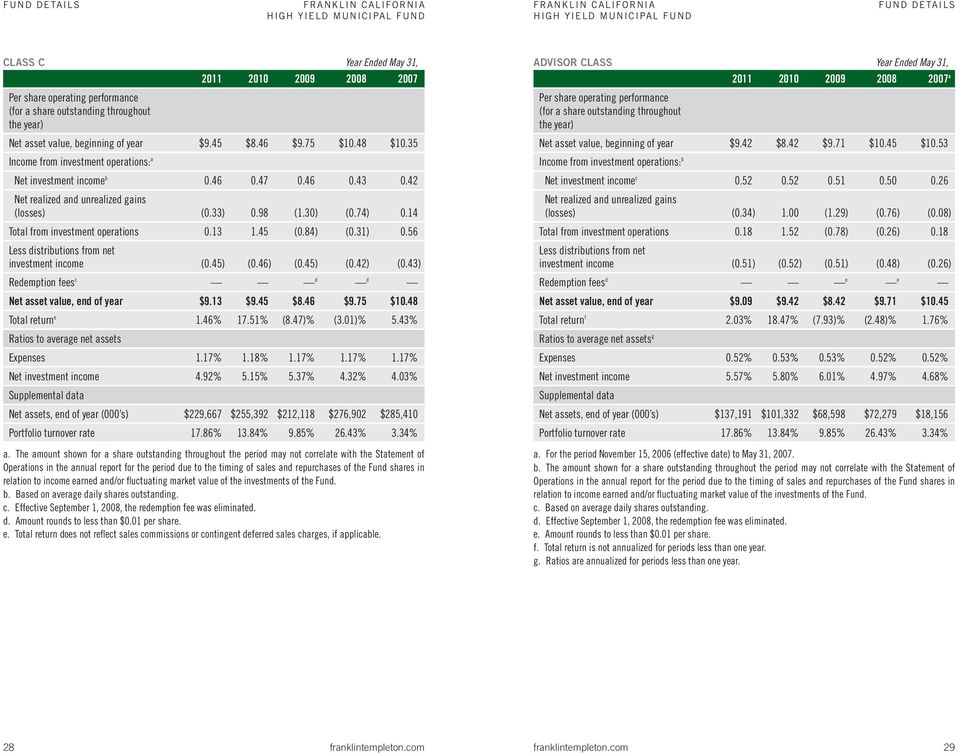
18 FUND DETAILS FUND DETAILS cancelled without penalty and investors who own the lease obligations may not be paid. Unrated Debt Securities The Fund is also subject to risks when investing in securities or issuers for which credit ratings have not been published or only short-term ratings are available. Unrated or short-term rated debt securities determined by the investment manager to be of comparable quality to rated securities which the Fund may purchase may pay a higher interest rate than such rated debt securities and be subject to a greater risk of illiquidity or price changes. Less public information is typically available about unrated securities or issuers. Management The Fund is actively managed and could experience losses if the investment manager s judgment about markets, interest rates or the attractiveness, relative values, liquidity, or potential appreciation of particular investments made for the Fund s portfolio prove to be incorrect. There can be no guarantee that these techniques or the investment manager s investment decisions will produce the desired results. Additionally, legislative, regulatory, or tax developments may affect the investment techniques available to the investment manager in connection with managing the Fund and may also adversely affect the ability of the Fund to achieve its investment goal. More detailed information about the Fund, its policies and risks and about municipal securities held by the Fund can be found in the Fund s Statement of Additional Information (SAI). A description of the Fund s policies and procedures regarding the release of portfolio holdings information is also available in the Fund s SAI. Portfolio holdings information can be viewed online at. Management Franklin Advisers, Inc. (Advisers), One Franklin Parkway, San Mateo, CA , is the Fund s investment manager. Together, Advisers and its affiliates manage, as of August 31, 2011, over $716 billion in assets, and have been in the investment management business since The Fund is managed by a team of dedicated professionals focused on investments in tax-free municipal securities. The portfolio managers of the team are as follows: JOHN WILEY Senior Vice President of Advisers Mr. Wiley has been a lead portfolio manager of the Fund since He joined Franklin Templeton Investments in CHRISTOPHER SPERRY, CFA Vice President of Advisers Mr. Sperry has been a lead portfolio manager of the Fund since He joined Franklin Templeton Investments in CFA and Chartered Financial Analyst are trademarks owned by CFA Institute. The portfolio managers of the Fund have equal authority over all aspects of the Fund s investment portfolio, including, but not limited to, purchases and sales of individual securities, portfolio risk assessment, and the management of daily cash balances in accordance with anticipated management requirements. The degree to which each portfolio manager may perform these functions, and the nature of these functions, may change from time to time. The Fund s SAI provides additional information about portfolio manager compensation, other accounts that they manage and their ownership of Fund shares. The Fund pays Advisers a fee for managing the Fund s assets. For the fiscal year ended May 31, 2011, the Fund paid 0.47% of its average net assets to the manager for its services. A discussion regarding the basis for the board of trustees approving the investment management contract of the Fund is available in the Fund s annual report to shareholders for the fiscal year ended May 31. Financial Highlights The Financial Highlights present the Fund s financial performance for the past five years or since its inception. Certain information reflects financial results for a single Fund share. The total returns represent the rate that an investor would have earned or lost on an investment in the Fund assuming reinvestment of dividends and capital gains. This information has been audited by PricewaterhouseCoopers LLP, whose report, along with the Fund s financial statements, are included in the annual report, which is available upon request

19 FUND DETAILS FUND DETAILS CLASS A Year Ended May 31, Per share operating performance (for a share outstanding throughout the year) Net asset value, beginning of year $9.40 $8.42 $9.70 $10.44 $10.31 Income from investment operations: a Net investment income b Net realized and unrealized gains (losses) (0.33) 0.98 (1.29) (0.76) 0.13 Total from investment operations (0.78) (0.27) 0.61 Less distributions from net investment income (0.50) (0.51) (0.50) (0.47) (0.48) Redemption fees c d d Net asset value, end of year $9.07 $9.40 $8.42 $9.70 $10.44 Total return e 1.93% 18.11% (7.91)% (2.58)% 6.03% Ratios to average net assets Expenses 0.62% 0.63% 0.63% 0.62% 0.62% Net investment income 5.47% 5.70% 5.91% 4.87% 4.58% Supplemental data Net assets, end of year (000 s) $979,093 $1,090,015 $945,110 $1,204,191 $1,329,255 Portfolio turnover rate 17.86% 13.84% 9.85% 26.43% 3.34% a. The amount shown for a share outstanding throughout the period may not correlate with the Statement of Operations in the annual report for the period due to the timing of sales and repurchases of the Fund shares in relation to income earned and/or fluctuating market value of the investments of the Fund. b. Based on average daily shares outstanding. c. Effective September 1, 2008, the redemption fee was eliminated. d. Amount rounds to less than $0.01 per share. e. Total return does not reflect sales commissions or contingent deferred sales charges, if applicable. CLASS B Year Ended May 31, Per share operating performance (for a share outstanding throughout the year) Net asset value, beginning of year $9.46 $8.46 $9.75 $10.49 $10.36 Income from investment operations: a Net investment income b Net realized and unrealized gains (losses) (0.33) 1.00 (1.30) (0.75) 0.14 Total from investment operations (0.84) (0.32) 0.56 Less distributions from net investment income (0.46) (0.46) (0.45) (0.42) (0.43) Redemption fees c d d Net asset value, end of year $9.13 $9.46 $8.46 $9.75 $10.49 Total return e 1.38% 17.64% (8.47)% (3.10)% 5.43% Ratios to average net assets Expenses 1.16% 1.17% 1.17% 1.17% 1.17% Net investment income 4.93% 5.16% 5.37% 4.32% 4.03% Supplemental data Net assets, end of year (000 s) $4,156 $7,591 $12,743 $22,308 $27,246 Portfolio turnover rate 17.86% 13.84% 9.85% 26.43% 3.34% a. The amount shown for a share outstanding throughout the period may not correlate with the Statement of Operations in the annual report for the period due to the timing of sales and repurchases of the Fund shares in relation to income earned and/or fluctuating market value of the investments of the Fund. b. Based on average daily shares outstanding. c. Effective September 1, 2008, the redemption fee was eliminated. d. Amount rounds to less than $0.01 per share. e. Total return does not reflect sales commissions or contingent deferred sales charges, if applicable

20 FUND DETAILS FUND DETAILS CLASS C Year Ended May 31, Per share operating performance (for a share outstanding throughout the year) Net asset value, beginning of year $9.45 $8.46 $9.75 $10.48 $10.35 Income from investment operations: a Net investment income b Net realized and unrealized gains (losses) (0.33) 0.98 (1.30) (0.74) 0.14 Total from investment operations (0.84) (0.31) 0.56 Less distributions from net investment income (0.45) (0.46) (0.45) (0.42) (0.43) Redemption fees c d d Net asset value, end of year $9.13 $9.45 $8.46 $9.75 $10.48 Total return e 1.46% 17.51% (8.47)% (3.01)% 5.43% Ratios to average net assets Expenses 1.17% 1.18% 1.17% 1.17% 1.17% Net investment income 4.92% 5.15% 5.37% 4.32% 4.03% Supplemental data Net assets, end of year (000 s) $229,667 $255,392 $212,118 $276,902 $285,410 Portfolio turnover rate 17.86% 13.84% 9.85% 26.43% 3.34% a. The amount shown for a share outstanding throughout the period may not correlate with the Statement of Operations in the annual report for the period due to the timing of sales and repurchases of the Fund shares in relation to income earned and/or fluctuating market value of the investments of the Fund. b. Based on average daily shares outstanding. c. Effective September 1, 2008, the redemption fee was eliminated. d. Amount rounds to less than $0.01 per share. e. Total return does not reflect sales commissions or contingent deferred sales charges, if applicable. ADVISOR CLASS Year Ended May 31, a Per share operating performance (for a share outstanding throughout the year) Net asset value, beginning of year $9.42 $8.42 $9.71 $10.45 $10.53 Income from investment operations: b Net investment income c Net realized and unrealized gains (losses) (0.34) 1.00 (1.29) (0.76) (0.08) Total from investment operations (0.78) (0.26) 0.18 Less distributions from net investment income (0.51) (0.52) (0.51) (0.48) (0.26) Redemption fees d e e Net asset value, end of year $9.09 $9.42 $8.42 $9.71 $10.45 Total return f 2.03% 18.47% (7.93)% (2.48)% 1.76% Ratios to average net assets g Expenses 0.52% 0.53% 0.53% 0.52% 0.52% Net investment income 5.57% 5.80% 6.01% 4.97% 4.68% Supplemental data Net assets, end of year (000 s) $137,191 $101,332 $68,598 $72,279 $18,156 Portfolio turnover rate 17.86% 13.84% 9.85% 26.43% 3.34% a. For the period November 15, 2006 (effective date) to May 31, b. The amount shown for a share outstanding throughout the period may not correlate with the Statement of Operations in the annual report for the period due to the timing of sales and repurchases of the Fund shares in relation to income earned and/or fluctuating market value of the investments of the Fund. c. Based on average daily shares outstanding. d. Effective September 1, 2008, the redemption fee was eliminated. e. Amount rounds to less than $0.01 per share. f. Total return is not annualized for periods less than one year. g. Ratios are annualized for periods less than one year
21 FUND DETAILS FRANKLIN TENNESSEE MUNICIPAL BOND FUND FRANKLIN TENNESSEE MUNICIPAL BOND FUND FUND DETAILS FRANKLIN TENNESSEE MUNICIPAL BOND FUND Investment Goal The Fund s investment goal is to maximize income exempt from federal income taxes and from the personal income taxes for resident shareholders of Tennessee to the extent consistent with prudent investing and the preservation of shareholders capital. Principal Investment Policies and Practices Under normal market conditions, the Fund invests at least 80% of its net assets in investment grade municipal securities whose interest is free from regular federal income taxes and from Tennessee personal income taxes. Although the Fund tries to invest all of its assets in securities whose interest is free from regular federal and Tennessee personal income taxes, it is possible, although not anticipated, that up to 20% of its net assets may be invested in securities that pay taxable interest. The Fund also may have up to 100% of its assets in securities that pay interest subject to the federal alternative minimum tax. The Fund only buys municipal securities rated in the top four ratings categories by one or more U.S. nationally recognized rating services (or comparable unrated or short-term rated securities). This limitation generally is applied at the time of purchase and a downgrade of a particular security below one of the top four ratings categories will not automatically cause the Fund to sell the security. The investment manager will, however, take such downgrade into account when analyzing the portfolio. Municipal securities are issued by state and local governments, their agencies and authorities, as well as by the District of Columbia and U.S. territories and possessions, to borrow money for various public and private projects. Municipal securities pay a fixed, floating or variable rate of interest, and require that the amount borrowed (principal) be repaid at maturity. The Fund may invest in insured municipal securities, which are covered by insurance policies that guarantee the timely payment of principal and interest. The Fund generally purchases bonds that have insurance in place so it does not pay insurance premiums directly. The premium costs, however, are reflected in a lower yield and/or higher price for the insured bond. When beneficial, the Fund may purchase insurance for an uninsured bond directly from a qualified municipal bond insurer, in which case the Fund pays the insurance premium directly to the insurance company. The Fund also may invest in municipal lease obligations, which generally are issued to finance the purchase of public property. The property is leased to a state or local government and the lease payments are used to pay the interest on the obligations. These differ from other municipal securities because the money to make the lease payments must be set aside each year or the lease can be cancelled without penalty. If this happens, investors who own the obligations may not be paid. The Fund may also invest in municipal securities that are issued on a when-issued or delayeddelivery basis. The Fund also may invest up to 35% of its total assets in municipal securities issued by U.S. territories. Although the investment manager will search for investments across a large number of municipal securities that finance different types of projects, from time to time, based on economic conditions, the Fund may have significant positions in municipal securities that finance similar types of projects. The investment manager selects securities that it believes will provide the best balance between risk and return within the Fund s range of allowable investments and typically uses a buy and hold strategy. This means it holds securities in the Fund s portfolio for income purposes, rather than trading securities for capital gains, although the investment manager may sell a security at any time if it believes it could help the Fund meet its goal. The investment manager also may consider the cost of insurance when selecting securities for the Fund. It is important to note that insurance does not guarantee the market value of an insured security, or the Fund s share price or distributions, and shares of the Fund are not insured. Temporary Investments When the investment manager believes market or economic conditions are unusual or unfavorable for investors, the investment manager may invest up to 100% of the Fund s assets in a temporary defensive manner by holding all or a substantial portion of its assets in cash, cash equivalents or other high quality short-term investments. Temporary defensive investments generally may include securities that pay taxable interest. The investment manager may also invest in these types of securities or hold cash 30 31
22 FUND DETAILS FRANKLIN TENNESSEE MUNICIPAL BOND FUND FRANKLIN TENNESSEE MUNICIPAL BOND FUND FUND DETAILS when securities meeting the Fund s investment criteria are unavailable or to maintain liquidity. In these circumstances, the Fund may be unable to achieve its investment goal. Principal Risks Interest Rate Interest rate changes can be sudden and unpredictable. Debt securities generally tend to lose market value when interest rates rise and increase in value when interest rates fall. Securities with longer maturities or lower coupons or that make little (or no) interest payments before maturity tend to be more sensitive to these interest rate changes. The longer the Fund s average weighted portfolio maturity, the greater the impact a change in interest rates will have on its share price. Market The market value of securities owned by the Fund will go up or down, sometimes rapidly or unpredictably. Securities may decline in value due to factors affecting individual issuers, securities markets generally or particular industries or sectors within the securities markets. The value of a security may go up or down due to general market conditions which are not specifically related to a particular issuer, such as real or perceived adverse economic conditions, changes in the general outlook for revenues or corporate earnings, changes in interest or currency rates or adverse investor sentiment generally. They may also go up or down due to factors that affect an individual issuer or a particular industry or sector, such as changes in production costs and competitive conditions within an industry. During a general downturn in the securities markets, multiple asset classes may decline in value. When markets perform well, there can be no assurance that the Fund s securities will participate in or otherwise benefit from the advance. Credit The Fund could lose money on a debt security if an issuer or borrower is unable or fails to meet its obligations, including failing to make interest payments and/or to repay principal when due. Changes in an issuer s financial strength, the market s perception of the issuer s financial strength or in a security s credit rating, which reflects a third party s assessment of the credit risk presented by a particular issuer, may affect debt securities value. The Fund may incur substantial losses on debt securities that are inaccurately perceived to present a different amount of credit risk by the market, the investment manager or the rating agencies than such securities actually do. Many of the Fund s portfolio securities may be supported by credit enhancements, which may be provided by either U.S. or foreign entities. These securities have the credit risk of the entity providing the credit support. Credit support provided by a foreign entity may be less certain because of the possibility of adverse foreign economic, political or legal developments that may affect the ability of that entity to meet its obligations. To the extent the Fund holds insured securities, a change in the credit rating of any one or more of the municipal bond insurers that insure securities in the Fund s portfolio may affect the value of the securities they insure, the Fund s share price and Fund performance. The Fund might also be adversely impacted by the inability of an insurer to meet its insurance obligations. Recent market conditions have weakened the municipal bond insurance industry leading state regulators to require at least two municipal bond insurers to suspend claims payments on outstanding insurance in force. Certain municipal bond insurers have withdrawn from the market. These circumstances have led to a consolidation among municipal bond insurers which might lead to a concentration of the insurance risk on the securities in the Fund s portfolio amongst fewer municipal bond insurers. Tennessee and U.S. Territories Because the Fund invests predominantly in Tennessee municipal securities, events in Tennessee are likely to affect the Fund s investments and its performance. These events may include economic or political policy changes, tax base erosion, state constitutional limits on tax increases, budget deficits and other financial difficulties, and changes in the credit ratings assigned to Tennessee s municipal issuers. Tennessee s economy and finances may be especially vulnerable to changes in the performance of the financial services sector, which historically has been volatile. A negative change in any one of these or other areas could affect the ability of Tennessee s municipal issuers to meet their obligations. It is important to remember that economic, budget and other conditions within Tennessee are unpredictable and can change at any time. An investment in the Fund may involve more risk than an investment in a fund that does not invest predominantly in securities of a single state
23 FUND DETAILS FRANKLIN TENNESSEE MUNICIPAL BOND FUND FRANKLIN TENNESSEE MUNICIPAL BOND FUND FUND DETAILS As with Tennessee municipal securities, events in any of the territories where the Fund is invested may affect the Fund s investments and its performance. Focus The Fund may invest more than 25% of its assets in municipal securities that finance similar types of projects, such as hospitals, higher education, housing, industrial development, and transportation or pollution control. A change that affects one project, such as proposed legislation on the financing of the project, a shortage of the materials needed for the project, or a declining need for the project, would likely affect all similar projects, thereby increasing market risk. Tax-Exempt Securities While the Fund endeavors to purchase only bona fide tax-exempt securities, there are risks that: (a) a security issued as tax-exempt may be reclassified as taxable by the Internal Revenue Service or a state tax authority, and/or (b) future legislative, administrative or court actions could adversely impact the qualification of income from a tax-exempt security as tax-free. Such reclassifications or actions could cause interest from a security to become taxable, possibly retroactively, subjecting you to increased tax liability. In addition, such reclassifications or actions could cause the value of a security, and therefore, the value of the Fund s shares, to decline. Income Because the Fund can only distribute what it earns, the Fund s distributions to shareholders may decline when prevailing interest rates fall or when the Fund experiences defaults on debt securities it holds. The Fund s income generally declines during periods of falling interest rates because the Fund must reinvest the proceeds it receives from existing investments (upon their maturity, prepayment, amortization, call, or buy-back) at a lower rate of interest or return. Inflation risk The market price of debt securities generally falls as inflation increases because the purchasing power of the future income and repaid principal is expected to be worth less when received by the Fund. Debt securities that pay a fixed rather than variable interest rate are especially vulnerable to inflation risk because variable-rate debt securities may be able to participate, over the long term, in rising interest rates which have historically corresponded with long-term inflationary trends. Prepayment Debt securities are subject to prepayment risk when the issuer can call the security, or repay principal, in whole or in part, prior to the security s maturity. When the Fund reinvests the prepayments of principal it receives, it may receive a rate of interest that is lower than the rate on the existing security, potentially lowering the Fund s income, yield and its distributions to shareholders. Securities subject to prepayment may offer less potential for gains during a declining interest rate environment and have greater price volatility. Prepayment risk is greater in periods of falling interest rates. When-Issued and Delayed Delivery Transactions Municipal securities may be issued on a when-issued or delayed delivery basis, where payment and delivery take place at a future date beyond the normal settlement date. Because the market price of the security may fluctuate during the time before payment and delivery, the Fund assumes the risk that the value of the security at delivery may be more or less than the purchase price. Municipal Lease Obligations Municipal lease obligations differ from other municipal securities because the relevant legislative body must appropriate the money each year to make the lease payments. If the money is not appropriated, the lease can be cancelled without penalty and investors who own the lease obligations may not be paid. Unrated Debt Securities The Fund is also subject to risks when investing in securities or issuers for which credit ratings have not been published or only short-term ratings are available. Unrated or short-term rated debt securities determined by the investment manager to be of comparable quality to rated securities which the Fund may purchase may pay a higher interest rate than such rated debt securities and be subject to a greater risk of illiquidity or price changes. Less public information is typically available about unrated securities or issuers
24 FUND DETAILS FRANKLIN TENNESSEE MUNICIPAL BOND FUND FRANKLIN TENNESSEE MUNICIPAL BOND FUND FUND DETAILS Management The Fund is actively managed and could experience losses if the investment manager s judgment about markets, interest rates or the attractiveness, relative values, liquidity, or potential appreciation of particular investments made for the Fund s portfolio prove to be incorrect. There can be no guarantee that these techniques or the investment manager s investment decisions will produce the desired results. Additionally, legislative, regulatory, or tax developments may affect the investment techniques available to the investment manager in connection with managing the Fund and may also adversely affect the ability of the Fund to achieve its investment goal. More detailed information about the Fund, its policies and risks and about municipal securities held by the Fund can be found in the Fund s Statement of Additional Information (SAI). A description of the Fund s policies and procedures regarding the release of portfolio holdings information is also available in the Fund s SAI. Portfolio holdings information can be viewed online at. Management Franklin Advisers, Inc. (Advisers), One Franklin Parkway, San Mateo, CA , is the Fund s investment manager. Together, Advisers and its affiliates manage, as of August 31, 2011, over $716 billion in assets, and have been in the investment management business since The Fund is managed by a team of dedicated professionals focused on investments in tax-free municipal securities. The portfolio managers of the team are as follows: FRANCISCO RIVERA Vice President of Advisers Mr. Rivera has been a lead portfolio manager of the Fund since He has primary responsibility for the investments of the Fund. He has final authority over all aspects of the Fund s investment portfolio, including but not limited to, purchases and sales of individual securities, portfolio risk assessment, and the management of daily cash balances in accordance with anticipated management requirements. The degree to which he may perform these functions, and the nature of these functions, may change from time to time. He joined Franklin Templeton Investments in JOHN WILEY Senior Vice President of Advisers Mr. Wiley has been a portfolio manager of the Fund since 1994, providing research and advice on the purchases and sales of individual securities, and portfolio risk assessment. He joined Franklin Templeton Investments in The Fund s SAI provides additional information about portfolio manager compensation, other accounts that they manage and their ownership of Fund shares. The Fund pays Advisers a fee for managing the Fund s assets. Advisers and the Fund s administrator have agreed to waive or limit their respective fees and to assume as their own certain expenses otherwise payable by the Fund so that common expenses (i.e., a combination of investment management fees, administration fees, and other expenses, but excluding the Rule 12b-1 fees) do not exceed 0.60% (other than certain non-routine expenses or costs, including those relating to litigation, indemnification, reorganizations and liquidations) until September 30, The management fees before and after such waivers for the fiscal year ended May 31, 2011, were 0.54% and 0.53%, respectively. A discussion regarding the basis for the board of trustees approving the investment management contract of the Fund is available in the Fund s annual report to shareholders for the fiscal year ended May 31. Financial Highlights The Financial Highlights present the Fund s financial performance for the past five years or since its inception. Certain information reflects financial results for a single Fund share. The total returns represent the rate that an investor would have earned or lost on an investment in the Fund assuming reinvestment of dividends and capital gains. This information has been audited by PricewaterhouseCoopers LLP, whose report, along with the Fund s financial statements, are included in the annual report, which is available upon request
25 FUND DETAILS FRANKLIN TENNESSEE MUNICIPAL BOND FUND FUND DETAILS CLASS A Year Ended May 31, Per share operating performance (for a share outstanding throughout the year) Net asset value, beginning of year $11.35 $10.99 $11.04 $11.18 $11.18 Income from investment operations: a Net investment income b Net realized and unrealized gains (losses) (0.16) 0.35 (0.04) (0.14) c Total from investment operations Less distributions from net investment income (0.44) (0.44) (0.46) (0.45) (0.46) Redemption fees d c c Net asset value, end of year $11.19 $11.35 $10.99 $11.04 $11.18 Total return e 2.59% 7.44% 3.90% 2.80% 4.15% Ratios to average net assets Expenses before waiver and payments by affiliates 0.71% 0.72% 0.74% 0.75% 0.75% Expenses net of waiver and payments by affiliates 0.70% 0.70% 0.70% 0.70% 0.70% Net investment income 3.96% 3.99% 4.25% 4.08% 4.06% Supplemental data Net assets, end of year (000 s) $270,041 $287,007 $225,895 $199,415 $167,215 Portfolio turnover rate 14.28% 10.63% 11.12% 11.48% 10.25% Additional Management Information In 2003 and 2004, multiple lawsuits were filed against Franklin Resources, Inc., and certain of its investment advisor subsidiaries, among other defendants, alleging violations of federal securities and state laws and seeking, among other relief, monetary damages, restitution, removal of fund trustees, directors, investment managers, administrators and distributors, rescission of management contracts and 12b-1 plans, and/or attorneys fees and costs. Specifically, the lawsuits claim breach of duty with respect to alleged arrangements to permit market timing and/or late trading activity, or breach of duty with respect to the valuation of the portfolio securities of certain Templeton funds managed by Franklin Resources, Inc. subsidiaries, allegedly resulting in market timing activity. The lawsuits are styled as class actions, or derivative actions on behalf of either the named funds or Franklin Resources, Inc., and have been consolidated for pretrial purposes, along with hundreds of other similar lawsuits against other mutual fund companies. All of the Franklin Templeton Investments mutual funds and the independent trustees to those funds that were named in the litigation have since been dismissed as defendants. Franklin Resources, Inc. previously disclosed these private lawsuits in its regulatory filings and on its public website. Any material updates regarding these matters will be disclosed in Franklin Resources, Inc. s Form 10-Q or Form 10-K filings with the U.S. Securities and Exchange Commission. a. The amount shown for a share outstanding throughout the period may not correlate with the Statement of Operations in the annual report for the period due to the timing of sales and repurchases of the Fund shares in relation to income earned and/or fluctuating market value of the investments of the Fund. b. Based on average daily shares outstanding. c. Amount rounds to less than $0.01 per share. d. Effective September 1, 2008, the redemption fee was eliminated. e. Total return does not reflect sales commissions or contingent deferred sales charges, if applicable
26 FUND DETAILS FUND DETAILS Distributions and Taxes The information is provided with respect to each Fund (hereafter the Fund ). Income and Capital Gain Distributions As a regulated investment company, the Fund generally pays no federal income tax on the income and gains it distributes to you. The Fund intends to declare income dividends from its net investment income each day that its net asset value (NAV) is calculated and pay them monthly. Your account begins to receive dividends on the day after the Fund receives your investment and continues to receive dividends through the day it receives a request to sell your shares. Capital gains, if any, may be paid at least annually. The amount of any distribution will vary, and there is no guarantee the Fund will pay either income dividends or capital gain distributions. Your income dividends and capital gain distributions will be automatically reinvested in additional shares at net asset value unless you elect to receive them in cash. Annual statements. After the close of each calendar year, you will receive a statement from the Fund that shows the federal income tax treatment of the distributions you received during the prior calendar year. If the Fund finds it necessary to reclassify income after it issues your tax statement, the Fund will send you a revised statement. Distributions declared in December to shareholders of record in such month and paid in January are treated as if they were paid in December. Additional tax information about the Fund s distributions is available at. Avoid buying a dividend At the time you purchase your Fund shares, the Fund s net asset value may reflect undistributed taxable income, undistributed capital gains, or net unrealized appreciation in the value of the portfolio securities held by the Fund. For taxable investors, a subsequent distribution to you of such amounts, although constituting a return of your investment, would be taxable. Buying shares in the Fund just before it declares a distribution of taxable income or capital gains is sometimes known as buying a dividend. Tax Considerations The Fund s distributions are primarily exempt from regular federal income tax. Distributions from the California High Yield Fund are also generally exempt from state income tax for residents of California. Distributions from the Tennessee Fund are also generally exempt from the Tennessee stock and bond income tax for residents of Tennessee. A portion of these distributions, however, may be subject to federal alternative minimum tax. The Fund may also make distributions that are taxable to you as ordinary income or capital gains. This is the case whether you reinvest your distributions in additional Fund shares or receive them in cash. Exempt-interest dividends. Most Fund distributions will consist of exempt-interest dividends that are exempt from regular federal income tax. A portion of these distributions from private activity bond interest may be subject to the federal alternative minimum tax (AMT). Exemptinterest dividends are taken into account when determining the taxable portion of your social security or railroad retirement benefits. Exemptinterest dividends from California municipal securities (California High Yield Fund) are also generally exempt from California state personal income tax. Exempt-interest dividends from Tennessee municipal securities (Tennessee Fund) are also generally exempt from the Tennessee stock and bond income tax. Because of these tax exemptions, a tax-free fund may not be a suitable investment for retirement plans or other taxexempt investors. Capital gains. Fund distributions of capital gains are generally subject to federal and state income tax. Fund distributions of short-term capital gains are subject to tax at ordinary rates. For federal income tax purposes, Fund distributions of long-term capital gains are taxable at the reduced long-term capital gains rates no matter how long you have owned your Fund shares. For individuals in the 10% and 15% tax brackets, the long-term capital gains tax rate is 0%. For individuals in higher tax brackets, the long-term capital gains rate is 15%. These reduced rates are presently scheduled to sunset on December 31, Taxable income dividends. The Fund may invest a portion of its assets in securities that pay income that is not tax-exempt. Distributions from this income, if any, are generally subject to federal and state income tax at ordinary rates. The Fund expects that none of its distributions will be qualified dividends subject to reduced rates of tax to individuals. A return-of-capital distribution is generally not taxable but will reduce the cost basis of your shares, and will result in a higher capital gain or a lower capital loss when you later sell your shares. Reclassification Risk. The Internal Revenue Service (IRS) has announced that holders of tax-exempt bonds such as the Fund have certain risks if the bonds were issued in connection with abusive transactions, refinancing 40 41
27 FUND DETAILS YOUR ACCOUNT irregularities, or the misuse of proceeds from the bond offering. While the Fund endeavors to purchase only bona fide tax-exempt bonds, there is a risk that a bond may be reclassified by the IRS as a taxable bond creating taxable income for the Fund and its shareholders. In this case, the Fund might be required to send to you and file with the IRS information returns for prior calendar years reclassifying some of its exempt-interest dividends as taxable dividends. Sales of Fund shares. When you sell your shares in the Fund, or exchange them for shares of a different Franklin Templeton fund, you will generally realize a taxable capital gain or loss for federal and state income tax purposes. If you have owned your Fund shares for more than one year, any net long-term capital gains will qualify for the reduced rates of federal income taxation on long-term capital gains. An exchange of your shares in one class of the Fund for shares of another class of the same Fund is not taxable and no gain or loss will be reported on the transaction. Backup withholding. If you do not provide the Fund your taxpayer identification number and certain required certifications you may be subject to federal backup withholding at 28% on any Fund distributions, including exempt-interest dividends, and proceeds from the sale of your Fund shares. State backup withholding may also apply. Non-U.S. investors. Non-U.S. investors may be subject to U.S. withholding tax at 30% or a lower treaty rate on Fund dividends of ordinary income. Non-U.S. investors may be subject to U.S. estate tax on the value of their shares. They are subject to special U.S. tax certification requirements to avoid backup withholding, claim any exemptions from withholding and claim any treaty benefits. Exemptions from U.S. withholding tax are provided for exempt-interest dividends, capital gain dividends paid by the Fund from long-term capital gains and, with respect to taxable years of the Fund that begin before January 1, 2012 (sunset date), interest-related dividends paid by the Fund from its qualified net interest income from U.S. sources and short-term capital gain dividends. Other tax information. This discussion of Distributions and Taxes is for general information only and is not tax advice. You should consult your own tax advisor regarding your particular circumstances, and about any federal, state, local and foreign tax consequences before making an investment in the Fund. Additional information about the tax consequences of investing in the Fund may be found in the Statement of Additional Information. YOUR ACCOUNT The board of trustees has approved the termination of offering Class B shares. Existing shareholders of Class B shares may continue as Class B shareholders, continue to reinvest dividends into Class B shares and exchange their Class B shares for Class B shares of other Franklin Templeton funds as permitted by the current exchange privileges. New or additional investments into Class B are not permitted. For Class B shares outstanding on February 28, 2005 and Class B shares acquired upon reinvestment of dividends, all Class B share attributes, including the associated Rule 12b-1 fee, contingent deferred sales charge and conversion features, will continue. Choosing a Share Class Each class of the California High Yield Fund has its own sales charge and expense structure, allowing you to choose the class that best meets your situation. Your investment representative can help you decide. The Tennessee Fund only offers Class A shares. Investors may purchase Class C shares only for Fund accounts on which they have appointed an investment representative (financial advisor) of record. Investors who have not appointed an investment representative (financial advisor) to existing Class C share Fund accounts, may not make additional purchases to those accounts but may exchange their shares to a Franklin Templeton fund that offers Class C shares. Dividend and capital gain distributions may continue to be reinvested in existing Class B or Class C share Fund accounts. Class A Class C Advisor Class Initial sales charge of 4.25% or less Deferred sales charge of 0.75% on purchases of $1 million or more sold within 18 months Lower annual expenses than Class C due to lower distribution fees No initial sales charge See Qualified Investors - Advisor Class below Deferred sales charge of 1% on shares you sell within 12 months Higher annual expenses than Class A due to higher distribution fees 42 43
28 YOUR ACCOUNT YOUR ACCOUNT Class A, B & C SALES CHARGES - Class A when you invest this amount the sales charge makes up this % of the offering price 1 which equals this % of your net investment 1 Under $100, $100,000 but under $250, $250,000 but under $500, $500,000 but under $1 million The dollar amount of the sales charge is the difference between the offering price of the shares purchased (which factors in the applicable sales charge in this table) and the net asset value of those shares. Since the offering price is calculated to two decimal places using standard rounding criteria, the number of shares purchased and the dollar amount of the sales charge as a percentage of the offering price and of your net investment may be higher or lower depending on whether there was a downward or upward rounding. Sales Charge Reductions and Waivers Quantity discounts. We offer two ways for you to combine your current purchase of Class A Fund shares with other existing Franklin Templeton fund share holdings that might enable you to qualify for a lower sales charge with your current purchase. You can qualify for a lower sales charge when you reach certain sales charge breakpoints. This quantity discount information is also available free of charge at /retail/ jsp_cm/fund_perf/pub/quantity_discount.jsp. This web page can also be reached at by clicking the Funds tab and then choosing Quantity Discounts. 1. Cumulative quantity discount - lets you combine certain existing holdings of Franklin Templeton fund shares - referred to as cumulative quantity discount eligible shares - with your current purchase of Class A shares to determine if you qualify for a sales charge breakpoint. Cumulative quantity discount eligible shares are Franklin Templeton fund shares registered to (or held by a financial intermediary for): You, individually; Your spouse or domestic partner, as recognized by applicable state law, and your children under the age of 21 (each a Family Member ); You jointly with one or more Family Members; You jointly with another person(s) who is (are) not Family Members if that other person has not included the value of the shares as cumulative quantity discount eligible shares for purposes of that person s separate investments in Franklin Templeton fund shares; A 529 college savings plan over which you or a Family Member has investment discretion and control; Any entity over which you or a Family Member has (have) individual or shared authority, as principal, has investment discretion and control (for example, an UGMA/UTMA account for a child on which you or a Family Member is the custodian, a trust on which you or a Family Member is the trustee, a business account [not to include retirement plans] for your solely owned business [or the solely owned business of a Family Member] on which you or a Family Member is the authorized signer); A trust established by you or a Family Member as grantor. If you believe there are cumulative quantity discount eligible shares that can be combined with your current purchase to achieve a sales charge breakpoint (for example, shares held in a different broker-dealer s brokerage account or with a bank or an investment advisor), it is your responsibility to specifically identify those shares to your financial advisor at the time of your purchase (including at the time of any future purchase). If you have not designated a financial advisor associated with your Franklin Templeton fund shares, it is your responsibility to specifically identify any cumulative quantity discount eligible shares to the Fund s transfer agent at the time of any purchase. If there are cumulative quantity discount eligible shares that would qualify for combining with your current purchase and you do not tell your financial advisor or the Franklin Templeton funds transfer agent at the time of any purchase, you may not receive the benefit of a reduced sales charge that might otherwise be available since your financial advisor and the Fund generally will not have that information. The value of cumulative quantity discount eligible shares equals the cost or current value of those shares, whichever is higher. The current value of shares is determined by multiplying the number of shares by their highest current public offering price. It is your responsibility to retain any records necessary to substantiate historical share costs because neither your current financial advisor nor the Franklin Templeton funds may have or maintain this information
29 YOUR ACCOUNT YOUR ACCOUNT 2. Letter of intent (LOI) - expresses your intent to buy a stated dollar amount of cumulative quantity discount eligible shares (as defined in the Cumulative quantity discount section above) over a 13-month period and lets you receive the same sales charge as if all shares had been purchased at one time. We will reserve 5% of your total intended purchase in Class A shares registered in your name until you fulfill your LOI to cover any additional sales charge that may apply if you do not buy the amount stated in your LOI. It is your responsibility to tell your financial advisor when you believe you have fulfilled your LOI with sufficient cumulative quantity discount eligible shares. If you have not designated a financial advisor associated with your Franklin Templeton fund shares, it is your responsibility to tell the Fund s transfer agent when you believe you have fulfilled your LOI with sufficient cumulative quantity discount eligible shares. Please refer to the SAI for more LOI details. To sign up for these programs, complete the appropriate section of your account application. Franklin Templeton funds include all of the U.S. registered mutual funds of Franklin Templeton Investments and the Franklin Mutual Recovery Fund. They do not include the funds in the Franklin Templeton Variable Insurance Products Trust. Sales charge waivers. Class A shares may be purchased without an initial sales charge or contingent deferred sales charge (CDSC) by certain investors or for certain payments. If you would like information about available sales charge waivers, call your investment representative or call Shareholder Services at (800) A list of available sales charge waivers also may be found in the SAI. Investments of $1 Million or More If you invest $1 million or more, either as a lump sum or through our cumulative quantity discount or letter of intent programs, you can buy Class A shares without an initial sales charge. However, there is a 0.75% CDSC on any shares you sell within 18 months of purchase. The way we calculate the CDSC is the same for each class (please see Contingent Deferred Sales Charge (CDSC) - Class A, B & C ). Distribution and Service (12b-1) Fees Class A has a distribution plan, sometimes known as a Rule 12b-1 plan, that allows the Fund to pay distribution fees of up to 0.15% per year (although each Fund is currently only reimbursing up to 0.10%) to those who sell and distribute Class A shares and provide other services to shareholders. Because these fees are paid out of Class A s assets on an ongoing basis, over time these fees will increase the cost of your investment and may cost you more than paying other types of sales charges. SALES CHARGES - Class B - California High Yield Fund this % is deducted from if you sell your shares within this many years after buying them your proceeds as a CDSC 1 Year 4 2 Years 4 3 Years 3 4 Years 3 5 Years 2 6 Years 1 7 Years 0 There is a CDSC if you sell your shares within six years, as described in the table above. The way we calculate the CDSC is the same for each class (please see Contingent Deferred Sales Charge (CDSC) - Class A, B & C ). After eight years, your Class B shares automatically convert to Class A shares, lowering your annual expenses from that time on. Distribution and Service (12b-1) Fees Class B has a distribution plan, sometimes known as a Rule 12b-1 plan, that allows the Fund to pay distribution and other fees of up to 0.65% per year for the sale of Class B shares and for services provided to shareholders. Because these fees are paid out of Class B s assets on an ongoing basis, over time these fees will increase the cost of your investment and may cost you more than paying other types of sales charges. SALES CHARGES - Class C - California High Yield Fund With Class C shares, there is no initial sales charge. We place any investment of $1 million or more in Class A shares, since Class A s annual expenses are lower. CDSC There is a 1% CDSC on any Class C shares you sell within 12 months of purchase. The way we calculate the CDSC is the same for each class (please see Contingent Deferred Sales Charge (CDSC) - Class A, B & C )
30 YOUR ACCOUNT YOUR ACCOUNT Distribution and Service (12b-1) Fees Class C has a distribution plan, sometimes known as a Rule 12b-1 plan, that allows the Fund to pay distribution and other fees of up to 0.65% per year for the sale of Class C shares and for services provided to shareholders. Because these fees are paid out of Class C s assets on an ongoing basis, over time these fees will increase the cost of your investment and may cost you more than paying other types of sales charges. Contingent Deferred Sales Charge (CDSC) - Class A, B & C The CDSC for each class is based on the current value of the shares being sold or their net asset value when purchased, whichever is less. There is no CDSC on shares you acquire by reinvesting your dividends or capital gain distributions. To keep your CDSC as low as possible, each time you place a request to sell shares we will first sell any shares in your account that are not subject to a CDSC. If there are not enough of these to meet your request, we will sell the shares in the order they were purchased. We will use this same method if you exchange your shares into another Franklin Templeton fund (please see Exchanging Shares ). The holding period for the CDSC begins on the day you buy your shares. Your shares will age one month on that same date the next month and each following month. For example, if you buy shares on the 18th of the month, they will age one month on the 18th day of the next month and each following month. Reinstatement Privilege If you sell shares of a Franklin Templeton fund that were held indirectly for your benefit in an account with your investment representative s firm or your bank s trust department or that were registered to you directly by the Fund s transfer agent (or, to an affiliated custodian or trustee of the Fund s transfer agent), you may reinvest all or a portion of the proceeds from that sale within 90 days of the sale without an initial sales charge. This Reinstatement Privilege does not apply to: (i) a purchase of Fund shares made through a regularly scheduled automatic investment plan such as a purchase by a regularly scheduled payroll deduction or transfer from a bank account, or (ii) a purchase of Fund shares with proceeds from the sale of Franklin Templeton fund shares that were held indirectly through a non- Franklin Templeton individual or employer sponsored IRA. In order to take advantage of this Reinstatement Privilege, you must inform your investment representative or the Fund s transfer agent of this privilege at the time of your investment. The proceeds from the earlier sale must also be invested within the same share class as that of the sold shares, except proceeds will be reinvested in Class A shares if the proceeds are from the sale of (i) Class B (or Class B1) shares; or (ii) Class C (or Class C1) shares or Class R shares if at the time of investment you have not appointed an investment representative (financial advisor) of record for the Fund account(s) in which the purchased shares will be held. Proceeds from the earlier sale of Class Z shares may also be invested in Class A shares under this Reinstatement Privilege. If you paid a CDSC when you sold your Class A, A1, C or C1 shares, Franklin Templeton Distributors, Inc. (Distributors) will credit back to you the CDSC paid on the amount you are reinvesting within 90 days of the sale by adding it to the amount of your reinvestment (for example, if you are reinvesting $10,000 within 90 days of an earlier $10,000 sale on which you paid a $100 CDSC, the amount of your reinvestment will equal $10,100). The new shares issued with your reinvestment WILL BE subject to any otherwise applicable CDSC. If, however, you (except Employer Sponsored Retirement Plans) paid a CDSC when you sold (1) Class B (or Class B1) shares; or (2) Class C (or Class C1) shares held at the time of sale in a Franklin Templeton fund account without an investment representative (financial advisor) appointed by you and invest the proceeds from that sale in Class A shares within 90 days of the sale, you will not be credited with any CDSC paid at the time of sale. In this case, the new Class A shares issued with your reinvestment WILL NOT BE subject to any otherwise applicable CDSC. Proceeds immediately placed in a Franklin Templeton Bank Certificate of Deposit (CD) also may be reinvested without an initial sales charge if you reinvest them within 90 days from the date the CD matures, including any rollover. This privilege does not apply to shares you buy and sell under our exchange program. Shares purchased with the proceeds from a money fund may be subject to a sales charge. Qualified Investors - Advisor Class - California High Yield Fund The following investors or investments may qualify to buy Advisor Class shares of the Fund: 48 49
31 YOUR ACCOUNT YOUR ACCOUNT Shares acquired by a financial intermediary that has entered into an agreement with Distributors authorizing the sale of Fund shares, in connection with its mutual fund trading platform, that the intermediary holds, directly or indirectly, on behalf of a beneficial owner who has entered into a comprehensive fee or other advisory fee arrangement with any broker-dealer, trust company, registered investment advisor (RIA), or investment advisor with assets under management in excess of $100 million that is exempt from federal registration, that is not an affiliate or associated person of the financial intermediary. Minimum initial investment: $50,000 for individual or multiple clients. Shares acquired by a financial intermediary that the intermediary holds on behalf of a beneficial owner who has entered into a comprehensive fee or other advisory fee arrangement with the financial intermediary or an affiliate or associated person of the financial intermediary, provided the financial intermediary has entered into an agreement with Distributors authorizing the sale of Fund shares. No minimum initial investment. Governments, municipalities, and tax-exempt entities that meet the requirements for qualification under section 501 of the Internal Revenue Code when purchasing direct from the Fund. Minimum initial investment: $1 million in Advisor Class or Class Z shares of any Franklin Templeton fund. Current and former officers, trustees, directors, full-time employees (and, in each case, their family members) of both Franklin Templeton Investments and Franklin Templeton Funds, consistent with our thencurrent policies. Minimum initial investment: $100 ($50 for accounts with an automatic investment plan). Assets held in accounts managed by a subsidiary of Franklin Resources, Inc.: (1) under an advisory agreement (including sub-advisory agreements); and/or (2) as trustee of an inter vivos or testamentary trust. Assets held in accounts managed by a state or federally regulated trust company or bank (Trust Company) either as discretionary trustee of an inter vivos or testamentary trust or as investment manager under an advisory agreement (including sub-advisory) or other agreement that grants the Trust Company investment discretion over those assets (Trust Company Managed Assets) if (i) the aggregate value of Trust Company Managed Assets invested in Franklin Templeton funds at the time of purchase equals at least $1 million; and (ii) the purchased shares are registered directly to the Trust Company in its corporate capacity (not as trustee of an individual trust) and held solely as Trust Company Managed Assets. An individual or entity associated with a current customer of Franklin Templeton Institutional, LLC (FTI, LLC) if approved by FTI, LLC in consultation with its customer. Unaffiliated U.S. registered mutual funds, including those that operate as fund of funds. Minimum initial investment: $1 million in Advisor Class or Class Z shares of any Franklin Templeton fund. Assets held in accounts under the recommendation of an investment consultant provided that (1) assets are held with a firm unaffiliated with the investment consultant s firm; (2) the investment consultant is under a retainer or other similar fee arrangement with its clients; (3) the client is not an individual; and (4) a subsidiary of Franklin Resources, Inc. approves the investment. Buying Shares MINIMUM INVESTMENTS - CLASS A & C Initial Regular accounts $1,000 Automatic investment plans $50 UGMA/UTMA accounts $100 Broker-dealer sponsored wrap account programs no minimum Current and former full-time employees, officers, trustees and directors of Franklin Templeton entities, and their family members $100 Please note that you may only buy shares of a fund eligible for sale in your state or jurisdiction. Certain Franklin Templeton funds, like the California High Yield Fund, offer multiple share classes not offered by the Tennessee Fund. Please note that for selling or exchanging your shares, or for other purposes, the Tennessee Fund s shares are considered Class A shares
32 YOUR ACCOUNT YOUR ACCOUNT Account Application If you are opening a new account, please complete and sign the enclosed account application. For the California High Yield Fund, make sure you indicate the share class you have chosen. If you do not indicate a class, we will place your purchase in Class A shares. To save time, you can sign up now for services you may want on your account by completing the appropriate sections of the application (see Investor Services ). For example, if you would like to link one of your bank accounts to your Fund account so that you may use electronic funds transfer to and from your bank account to buy and sell shares, please complete the bank information section of the application. We will keep your bank information on file for future purchases and redemptions. We do not accept cash, credit card convenience checks, non-bank money orders or travelers checks as forms of payment to purchase shares. Franklin Templeton Investor Services P.O. Box , Sacramento, CA Call toll-free: (800) (Monday through Friday 5:30 a.m. to 5:00 p.m., Pacific time) or visit us online 24 hours a day, 7 days a week, at BUYING SHARES Through your investment representative By Phone/Online (Up to $100,000 per shareholder per day) (800) Note: (1) certain account types are not available for online account access and (2) the amount may be higher for members of Franklin Templeton VIP Services. Please see Franklin Templeton VIP Services under Investor Services for more information regarding eligibility. By Mail By Wire (800) or (650) collect By Exchange Opening an account Contact your investment representative If you have another Franklin Templeton fund account with your bank account information on file, you may open a new identically registered account by phone. At this time, a new account may not be opened online. To make a same day investment, your phone order must be received and accepted by us by 1:00 p.m. Pacific time or the close of the New York Stock Exchange, whichever is earlier. Make your check payable to the Fund. Mail the check and your signed application to Investor Services. Call to receive a wire control number and wire instructions. Wire the funds and mail your signed application to Investor Services. Please include the wire control number or your new account number on the application. To make a same day wire investment, the wired funds must be received and accepted by us by 1:00 p.m. Pacific time or the close of the New York Stock Exchange, whichever is earlier. Call Shareholder Services at (800) , or send signed written instructions. You also may place an online exchange order. The automated telephone system cannot be used to open a new account. (Please see Exchanging Shares for more information on exchanges.) Adding to an account Contact your investment representative Before requesting a telephone or online purchase into an existing account, please make sure we have your bank account information on file. If we do not have this information, you will need to send written instructions with your bank s name and address and a voided check or savings account deposit slip. If the bank and Fund accounts do not have at least one common owner, your written request must be signed by all fund and bank account owners, and each individual must have his or her signature guaranteed. To make a same day investment, your phone or online order must be received and accepted by us by 1:00 p.m. Pacific time or the close of the New York Stock Exchange, whichever is earlier. Make your check payable to the Fund. Include your account number on the check. Fill out the deposit slip from your account statement. If you do not have a slip, include a note with your name, the Fund name, and your account number. Mail the check and deposit slip or note to Investor Services. Call to receive a wire control number and wire instructions. To make a same day wire investment, the wired funds must be received and accepted by us by 1:00 p.m. Pacific time or the close of the New York Stock Exchange, whichever is earlier. Call Shareholder Services at (800) , or send signed written instructions. You also may place an online exchange order. (Please see Exchanging Shares for more information on exchanges.) 52 53
33 YOUR ACCOUNT YOUR ACCOUNT Investor Services Automatic Investment Plan This plan offers a convenient way for you to invest in the Fund by automatically transferring money from your checking or savings account each month to buy shares. To sign up, visit us online at franklintempleton. com or complete the appropriate section of your account application and mail it to Investor Services. If you are opening a new account, please include your minimum initial investment with your application. Automated Telephone System Our automated system offers around-the-clock access to information about your account or any Franklin Templeton fund. This service is available by dialing any of the following numbers from a touch-tone phone: Shareholder Services (800) Advisor Services (800) Distribution Options You may reinvest distributions you receive from the Fund in an existing account in the same share class* of the Fund or another Franklin Templeton fund. Initial sales charges and CDSCs will not apply to reinvested distributions. You also can have your distributions deposited in a bank account, or mailed by check. Deposits to a bank account may be made by electronic funds transfer. *Class B and C shareholders may reinvest their distributions in Class A shares of any Franklin Templeton money fund. Advisor Class shareholders may reinvest in Advisor Class or Class A shares of another Franklin Templeton fund. To reinvest your distributions in Advisor Class shares of another Franklin Templeton fund, you must be a current shareholder in Advisor Class or otherwise qualify to buy that fund s Advisor Class shares. If you received a distribution and chose to return it to purchase additional shares in Class A shares of another Franklin Templeton fund, you will not be charged an initial sales charge if you invest the distribution within 90 days of the distribution date. Please indicate on your application the distribution option you have chosen, otherwise we will reinvest your distributions in the same share class of the Fund. Telephone/Online Privileges You will automatically receive telephone/online privileges when you open your account, allowing you to obtain or view your account information, and conduct a number of transactions by phone or online, including: buy, sell, or exchange shares of most funds; use electronic funds transfer to buy or sell shares of most funds; change your address; and, add or change account services (including distribution options, systematic withdrawal plans and automatic investment plans). To view your account information or request online transactions, you will first need to register for these services at the shareholder section of our website at. You will be asked to accept the terms of an online agreement(s) and establish a password for online services. If you are registered for online services, you may enroll online in Franklin Templeton s electronic delivery program for your shareholder documents. This will allow you to receive electronic delivery (through our website) of most funds prospectuses, annual/semiannual reports to shareholders, and proxy statements, as well as your account(s) statements and trade confirmations, and discontinue receiving your paper copies through the U.S. mail. Using our shareholder website means you are consenting to sending and receiving personal financial information over the Internet, so you should be sure you are comfortable with the risks. As long as we follow reasonable security procedures and act on instructions we reasonably believe are genuine, we will not be responsible for any losses that may occur from unauthorized requests. We will request passwords or other information, and also may record calls. To help safeguard your account, keep your password confidential, and verify the accuracy of your confirmation statements immediately after you receive them. Contact us immediately if you believe someone has obtained unauthorized access to your account or password. For transactions done over the Internet, we recommend the use of an Internet browser with 128-bit encryption. Certain methods of contacting us (such as by phone or by Internet) may be unavailable or delayed during periods of unusual market activity. Of course, you can decline telephone buy, sell, or exchange privileges on your account application, or choose not to register for online privileges. If you have telephone/online privileges on your account and want to discontinue them, please contact us for instructions. You may reinstate these privileges at any time in writing, including online registration with respect to online privileges
34 YOUR ACCOUNT YOUR ACCOUNT Note: We discourage you from including confidential or sensitive information in any Internet communication to us. If you do choose to send (encrypted or not) to us over the Internet, you are accepting the associated risks of lack of confidentiality. Systematic Withdrawal Plan This plan allows you to automatically sell your shares and receive regular payments from your account. A CDSC may apply to withdrawals that exceed certain amounts. Certain terms and minimums apply. To sign up, visit us online at or complete the appropriate section of your application. Franklin Templeton VIP Services You may be eligible for Franklin Templeton VIP Services if you are currently eligible for the $250,000 sales charge breakpoint based solely on shares registered directly with the Franklin Templeton funds transfer agent and excluding shares held indirectly through brokerage accounts. Franklin Templeton VIP Services shareholders enjoy enhanced service and transaction capabilities. Please contact Shareholder Services at (800) for additional information on this program. Selling Shares You can sell your shares at any time. Please keep in mind that a contingent deferred sales charge (CDSC) may apply. Selling Shares in Writing Generally, requests to sell $100,000 or less can be made over the phone, online, or with a simple letter. Sometimes, however, to protect you and the Fund we will need written instructions signed by all registered owners, with a signature guarantee for each owner, if: you are selling more than $100,000 worth of shares you want your proceeds paid to someone who is not a registered owner you want to send your proceeds somewhere other than the address of record, or preauthorized bank or brokerage firm account We also may require a signature guarantee on instructions we receive from an agent, not the registered owners, or when we believe it would protect the Fund against potential claims based on the instructions received. The amount may be higher for members of Franklin Templeton VIP Services. Please see Franklin Templeton VIP Services above for more information regarding eligibility. A signature guarantee helps protect your account against fraud. You can obtain a signature guarantee at most banks and securities dealers. A notary public CANNOT provide a signature guarantee. Selling Recently Purchased Shares If you sell shares recently purchased, we may delay sending you the proceeds until your check, draft or wire/electronic funds transfer has cleared, which may take seven business days. Redemption Proceeds Your redemption check will be sent within seven days after we receive your request in proper form. We are not able to receive or pay out cash in the form of currency
35 YOUR ACCOUNT YOUR ACCOUNT SELLING SHARES To sell some or all of your shares Through your investment representative Contact your investment representative By Mail Send written instructions and endorsed share certificates (if you hold share certificates) to Investor Services. Corporate, partnership or trust accounts may need to send additional documents. Specify the Fund, the account number and the dollar value or number of shares you wish to sell. If you own both Class A and B shares, also specify the class of shares, otherwise we will sell your Class A shares first. Be sure to include all necessary signatures and any additional documents, as well as signature guarantees if required. A check will be mailed to the name(s) and address on the account, or otherwise according to your written instructions. By Phone/Online (800) As long as your transaction is for $100,000 or less, you do not hold share certificates and you have not changed your address by phone or online within the last 15 days, you can sell your shares by phone or online. The amount may be higher for members of Franklin Templeton VIP Services. Please see Franklin Templeton VIP Services above for more information regarding eligibility. A check will be mailed to the name(s) and address on the account, or a pre-authorized secondary address. Written instructions, with a signature guarantee, are required to send the check to another address or to make it payable to another person. By Electronic Funds Transfer (ACH) You can call, write, or visit us online to have redemption proceeds sent to a bank account. See the policies at left for selling shares by mail, phone, or online. Before requesting to have redemption proceeds sent to a bank account, please make sure we have your bank account information on file. If we do not have this information, you will need to send written instructions with your bank s name and a voided check or savings account deposit slip. If the bank and Fund accounts do not have at least one common owner, you must provide written instructions signed by all fund and bank account owners, and each individual must have his or her signature guaranteed. If we receive your request in proper form by 1:00 p.m. Pacific time, proceeds sent by ACH generally will be available within two to three business days. By Exchange Obtain a current prospectus for the fund you are considering. Prospectuses are available online at. Call Shareholder Services at the number below or send signed written instructions. You also may place an exchange order online. See the policies at left for selling shares by mail, phone, or online. If you hold share certificates, you will need to return them to the Fund before your exchange can be processed. Franklin Templeton Investor Services P.O. Box , Sacramento, CA Call toll-free: (800) (Monday through Friday 5:30 a.m. to 5:00 p.m., Pacific time) or visit us online 24 hours a day, 7 days a week, at Exchanging Shares Exchange Privilege Class A, B & C You can exchange shares between most Franklin Templeton funds within the same class,* generally without paying any additional sales charges. If you exchange shares from a money fund and those shares were not charged a sales charge previously, however, a sales charge may apply. *Class Z shareholders of Franklin Mutual Series Funds may exchange into Class A without any sales charge. Advisor Class shareholders of another Franklin Templeton fund also may exchange into Class A without any sales charge. Advisor Class shareholders who exchange their shares for Class A shares and later decide they would like to exchange into another fund that offers Advisor Class may do so. Any CDSC will continue to be calculated from the date of your initial investment and will not be charged at the time of the exchange. The purchase price for determining a CDSC on exchanged shares will be the price you paid for the original shares. If you exchange shares subject to a CDSC into a Class A money fund, the time your shares are held in the money fund will not count towards the CDSC holding period. If you exchange your Class B shares for the same class of shares of another Franklin Templeton fund, the time your shares are held in that fund will count towards the eight-year period for automatic conversion to Class A shares. Advisor Class You can exchange your Advisor Class shares for Advisor Class shares of other Franklin Templeton funds. You also may exchange your Advisor Class shares for Class A shares of a fund that does not currently offer an Advisor Class (without any sales charge)* or for Class Z shares of Franklin Mutual Series Funds. *If you exchange into Class A shares and you later decide you would like to exchange into a fund that offers an Advisor Class, you may exchange your Class A shares for Advisor Class shares if you are a current shareholder in Advisor Class or you otherwise qualify to buy the fund s Advisor Class shares. All Classes The remainder of the Exchanging Shares section applies to all classes. Generally exchanges may only be made between identically registered accounts, unless you send written instructions with a signature guarantee. An exchange is really two transactions: a sale of one fund and the purchase of another. In general, the same policies that apply to purchases and sales also apply to exchanges, including minimum investment amounts (except 58 59
36 YOUR ACCOUNT YOUR ACCOUNT exchanges of an entire account balance). Exchanges also generally have the same tax consequences as ordinary sales and purchases. Rejected exchanges. If the Fund rejects an exchange request involving the sale of Fund shares, the rejected exchange request will also mean rejection of the request to purchase shares of another fund with the proceeds of the sale. Of course, you may generally redeem shares of the Fund at any time. Exchanges through financial intermediaries. If you are investing indirectly in the Fund through a financial intermediary such as a broker-dealer, a bank, an insurance company separate account, an investment advisor, an administrator or trustee of an IRS-recognized tax-deferred savings plan such as a 401(k) retirement plan and a 529 college savings plan that maintains a master account (an Omnibus Account) with the Fund for trading on behalf of its customers, different exchange and/or transfer limit guidelines and restrictions may apply. The financial intermediary through whom you are investing may choose to adopt different trading restrictions designed to discourage short-term or excessive trading. Consult with your financial intermediary (or, in the case of a 401(k) retirement plan, your plan sponsor) to determine what trading restrictions, including exchange/ transfer limitations, may be applicable to you. Fund exchange privilege changes/waiver. The Fund may terminate or modify (temporarily or permanently) this exchange privilege in the future. You will receive 60 days notice of any material changes, unless otherwise provided by law. Other funds exchange privileges. If there is a conflict between the exchange privileges of two funds involved in an exchange transaction, the stricter policy will apply to the transaction. Other Franklin Templeton funds may have different exchange restrictions. Check each fund s prospectus for details. Frequent Trading Policy The Fund s board of trustees has adopted the following policies and procedures with respect to frequent trading in Fund shares (Frequent Trading Policy). The Fund does not intend to accommodate short-term or frequent purchases and redemptions of Fund shares that may be detrimental to the Fund. For example, this type of trading activity could interfere with the efficient management of the Fund s portfolio or materially increase the Fund s transaction costs, administrative costs or taxes. Through its transfer agent, the Fund performs ongoing monitoring of shareholder trading in shares of the Fund and other Franklin Templeton funds in order to try and identify shareholder trading patterns that suggest an ongoing short-term trading strategy. If shareholder trading patterns identified by the transfer agent through monitoring or from other information regarding the shareholder s trading activity in non-franklin Templeton funds leads the transfer agent to reasonably conclude that such trading may be detrimental to the Fund as described in this Frequent Trading Policy, the transfer agent, on behalf of the Fund, may temporarily or permanently bar future purchases into the Fund or, alternatively, may limit the amount, number or frequency of any future purchases and/or the method by which you may request future purchases and redemptions (including purchases and/or redemptions by an exchange or transfer between the Fund and any other mutual fund). In considering an investor s trading patterns, the Fund may consider, among other factors, the investor s trading history both directly and, if known, through financial intermediaries, in the Fund, in other Franklin Templeton funds, in non-franklin Templeton mutual funds, or in accounts under common control or ownership (see, for example, Investment by asset allocators of the Buying and Selling Shares section in the SAI). The transfer agent may also reject any purchase or redemption request, whether or not it represents part of any ongoing trading pattern, if the Fund s investment manager or transfer agent reasonably concludes that the amount of the requested transaction may disrupt or otherwise interfere with the efficient management of the Fund s portfolio. Frequent trading through financial intermediaries. You are an investor subject to this Frequent Trading Policy whether you are a direct shareholder of the Fund or you are investing indirectly in the Fund through a financial intermediary, such as a broker-dealer, bank, trust company, insurance company product such as an annuity contract, investment advisor, or an administrator or trustee of an IRS-recognized taxdeferred savings plan such as a 401(k) retirement plan and a 529 college savings plan. Some financial intermediaries maintain master accounts with the Fund on behalf of their customers ( omnibus accounts ). The Fund has entered into information sharing agreements with these financial intermediaries, which permit the Fund to obtain, upon request, information about the trading activity of the intermediary s customers that invest in the Fund. If the Fund s transfer agent identifies omnibus account level trading 60 61
37 YOUR ACCOUNT YOUR ACCOUNT patterns that have the potential to be detrimental to the Fund, the transfer agent may, in its sole discretion, request from the financial intermediary information concerning the trading activity of its customers. Based upon its review of the information, if the transfer agent determines that the trading activity of any customer may be detrimental to the Fund, it may, in its sole discretion, request the financial intermediary to restrict or limit further trading in the Fund by that customer. There can be no assurance that the transfer agent s monitoring of omnibus account level trading patterns will enable it to identify all short-term trading by a financial intermediary s customers. Revocation of trades. While the Fund reserves the right to reject any purchase order for any reason, the Fund may also revoke executed purchase orders that the transfer agent reasonably concludes in its sole discretion may have been contrary to the objectives of the Fund s Frequent Trading Policy. Account Policies Calculating Share Price Class A, B & C When you buy shares, you pay the offering price for the shares. The offering price is determined by dividing the NAV per share by an amount equal to 1 minus the sales charge applicable to the purchase (expressed in decimals), calculated to two decimal places using standard rounding criteria. The number of Fund shares you will be issued will equal the amount invested divided by the applicable offering price for those shares, calculated to three decimal places using standard rounding criteria. For example, if the NAV per share is $10.25 and the applicable sales charge for the purchase is 5.75%, the offering price would be calculated as follows: divided by 1.00 minus [10.25/0.9425] equals , which, when rounded to two decimal points, equals The offering price per share would be $ When you sell shares, you receive the NAV minus any applicable CDSC. All Classes The value of a mutual fund is determined by deducting the fund s liabilities from the total assets of the portfolio. The NAV per share is determined by dividing the total net asset value of each fund s share class by the applicable number of shares outstanding per share class. The Fund calculates the NAV per share each business day at the close of trading on the New York Stock Exchange (NYSE) (normally 1:00 p.m. Pacific time). The Fund does not calculate the NAV on days the NYSE is closed for trading, which include New Year s Day, Martin Luther King Jr. Day, President s Day, Good Friday, Memorial Day, Independence Day, Labor Day, Thanksgiving Day and Christmas Day. When determining its NAV, the Fund values cash and receivables at their realizable amounts, and records interest as accrued and dividends on the ex-dividend date. The Fund generally utilizes two independent pricing services to assist in determining a current market value for each security. If market quotations are readily available for portfolio securities listed on a securities exchange, the Fund values those securities at the last quoted sale price or the official closing price of the day, respectively, or, if there is no reported sale, within the range of the most recent quoted bid and ask prices. The Fund values over-the-counter portfolio securities within the range of the most recent bid and ask prices. If portfolio securities trade 62 63
38 YOUR ACCOUNT YOUR ACCOUNT both in the over-the-counter market and on a stock exchange, the Fund values them according to the broadest and most representative market. Requests to buy and sell shares are processed at the NAV next calculated after we or an approved financial intermediary receive your request in proper form. Generally, trading in corporate bonds, U.S. government securities and money market instruments is substantially completed each day at various times before the close of the NYSE. The value of these securities used in computing the NAV is determined as of such times. Occasionally, events affecting the values of these securities may occur between the times at which they are determined and the close of the NYSE that will not be reflected in the computation of the NAV. The Fund relies on third-party pricing vendors to monitor for events materially affecting the value of these securities during this period. If an event occurs, the third-party pricing vendors will provide revised values to the Fund. Fair Valuation Individual Securities The Fund has procedures, approved by the board of trustees, to determine the fair value of individual securities and other assets for which market prices are not readily available (such as certain restricted or unlisted securities and private placements) or which may not be reliably priced (such as in the case of trade suspensions or halts, price movement limits set by certain foreign markets, and thinly traded or illiquid securities). Some methods for valuing these securities may include: fundamental analysis (earnings multiple, etc.), matrix pricing, discounts from market prices of similar securities, or discounts applied due to the nature and duration of restrictions on the disposition of the securities. The board of trustees oversees the application of fair value pricing procedures. The application of fair value pricing procedures represents a good faith determination based upon specifically applied procedures. There can be no assurance that the Fund could obtain the fair value assigned to a security if it were able to sell the security at approximately the time at which the Fund determines its NAV per share. Security Valuation Municipal Securities Matrix Pricing (Fair Valuation) Municipal securities generally trade in the over-the-counter market rather than on a securities exchange. The Fund s pricing services use valuation models or matrix pricing to determine current value. In general, they use information with respect to comparable bond and note transactions, quotations from bond dealers or by reference to other securities that are considered comparable in such characteristics as rating, interest rate and maturity date. Matrix pricing is considered a form of fair value pricing. Accounts with Low Balances If your account has been open for more than one year and its value falls below $500 ($50 for employee and UGMA/UTMA accounts), we will mail you a notice asking you to bring the account back up to its applicable minimum investment amount. If you choose not to do so within 30 days, we will close your account and mail the proceeds to the address of record. You will not be charged a CDSC if your account is closed for this reason. This policy does not apply to: (1) certain brokercontrolled accounts established through the National Securities Clearing Corporation s Networking system; (2) accounts in Class B and Class A accounts established pursuant to a conversion from Class B; (3) taxdeferred retirement plan accounts; (4) active automatic investment plan accounts; (5) broker-dealer sponsored separately managed accounts (wrap accounts); (6) accounts held through a 529 college savings program; and, (7) Coverdell Education Savings Plan accounts. Statements, Reports and Prospectuses You will receive quarterly account statements that show all your account transactions during the quarter. You also will receive written notification after each transaction affecting your account (except for distributions and transactions made through automatic investment or withdrawal programs, which will be reported on your quarterly statement). You also will receive the Fund s financial reports every six months as well as an annual updated prospectus. To reduce Fund expenses, we try to identify related shareholders in a household and send only one copy of the financial reports and prospectus. This process, called householding, will continue indefinitely unless you instruct us otherwise. If you prefer not to have these documents householded, please call us at (800) At any time you may view current prospectuses and financial reports on our website. If you choose, you may receive your statements, financial reports and prospectuses through electronic delivery (please see Investor Services - Telephone/Online Privileges )
39 YOUR ACCOUNT YOUR ACCOUNT Investment Representative Account Access If there is a dealer or other investment representative of record on your account, he or she will be able to obtain your account information, conduct transactions for your account, and also will receive copies of all notifications and statements and other information about your account directly from the Fund. Street or Nominee Accounts You may transfer your shares from the street or nominee name account of one dealer to another, as long as both dealers have an agreement with Distributors. We will process the transfer after we receive authorization in proper form from your delivering securities dealer. Joint Accounts Unless you specify a different registration, shares issued to two or more owners are registered as joint tenants with rights of survivorship (shown as Jt Ten on your account statement). To make any ownership changes to jointly owned shares, or to sever a joint tenancy in jointly owned shares, all owners must agree in writing. Joint Account Risk with Telephone/Online Privileges You will automatically receive telephone/online privileges when you open your account. If your account has more than one registered owner, telephone/online privileges allow the Fund to accept online registration for online services (including electronic delivery of shareholder documents) and transaction instructions online or by telephone from only one registered owner. This means that any one registered owner on your account, acting alone and without the consent of any other registered owner, may give the Fund instructions by telephone, online or in writing (subject to any limitations in telephone or online privileges) to: Exchange shares from a jointly registered Fund account requiring all registered owner signatures into an identically registered money fund account that only requires one registered owner s signature to redeem shares; Redeem Fund shares and direct the redemption proceeds to a bank account that may or may not be owned by you and, if owned by you jointly with someone else, only requires one person to withdraw funds by check or otherwise; Add/Change the bank account to which Fund share redemption proceeds may be sent, which bank account may not be owned by you; Purchase Fund shares by debiting a bank account that may be owned by you; and Add/Change the bank account that may be debited for Fund share purchases, which new account may be owned by you. If you do NOT want another registered owner on your account to be able to issue these kinds of instructions to the Fund without your consent, you must instruct the Fund to deny/terminate online privileges and the ability to issue such instructions by telephone so that these types of instructions will only be accepted in writing signed by all account owners. This decision will apply to any other fund into which you may exchange your jointly owned Fund shares. Any later decision to permit these types of instructions by telephone and/or online will need to be given to the Fund in a written instruction signed by all registered owners. Additional Policies Please note that the Fund maintains additional policies and reserves certain rights, including: The Fund may restrict, reject or cancel any purchase orders, including an exchange request. The Fund may modify, suspend, or terminate telephone/online privileges at any time. The Fund may make material changes to or discontinue the exchange privilege on 60 days notice or as otherwise provided by law. The Fund may stop offering shares completely or may offer shares only on a limited basis, for a period of time or permanently. Normally, redemptions are processed by the next business day, but may take up to seven days to be processed if making immediate payment would adversely affect the Fund. In unusual circumstances, we may temporarily suspend redemptions or postpone the payment of proceeds, as allowed by federal securities laws. For redemptions over a certain amount, the Fund may pay redemption proceeds in securities or other assets rather than cash if the investment 66 67
40 YOUR ACCOUNT YOUR ACCOUNT manager determines it is in the best interest of the Fund, consistent with applicable law. You may only buy shares of a fund (including the purchase side of an exchange) eligible for sale in your state or jurisdiction. To permit investors to obtain the current price, dealers are responsible for transmitting all orders to the Fund promptly. Dealer Compensation Class A, B & C Qualifying dealers who sell Fund shares may receive sales commissions and other payments. These are paid by Distributors from sales charges received from purchasing or redeeming shareholders, from distribution and service (12b-1) fees from the Fund and from Distributors other financial resources. Dealers may also receive shareholder servicing fees for servicing investors who indirectly hold Franklin Templeton fund shares through dealer-maintained brokerage accounts as more fully described under Shareholder servicing and transfer agent of the Management and Other Services section in the SAI. These fees are paid by the Fund s transfer agent from payments it receives under its agreement with the Fund. If any dealer commissions are paid in connection with a purchase which is subsequently rejected or results in any trading restriction placed on the purchaser as a result of a determination by the Fund s investment manager or transfer agent that the purchase may be connected with trading activity that may be detrimental to the Fund as described in the Fund s Frequent Trading Policy, the dealer shall, upon demand, refund such commissions to Distributors. Class A Class B Class C Commission (%) Investment under $100, $100,000 but under $250, $250,000 but under $500, $500,000 but under $1 million 1.60 $1 million or more up to b-1 fee to dealer Commission includes advance of the first year s 0.15% 12b-1 service fee. Distributors may pay a prepaid commission. 2. For purchases at NAV where Distributors paid a prepaid commission, dealers may start to receive the 12b-1 fee in the 13th month after purchase. For purchases at NAV where Distributors did not pay a prepaid commission, dealers may start to receive the 12b-1 fee at the time of purchase. 3. After eight years, Class B shares convert to Class A shares and dealers may then receive the 12b-1 fee applicable to Class A. 4. Dealers may be eligible to receive up to 0.15% at the time of purchase and may be eligible to receive 0.65% starting in the 13th month. During the first 12 months, the full 12b-1 fee will be paid to Distributors to partially offset the commission and the prepaid service fee paid at the time of purchase. For purchases at NAV where Distributors did not pay a prepaid commission, dealers may start to receive the 12b-1 fee at the time of purchase. Other dealer and financial intermediary compensation. Distributors may make payments (a portion of which may be reimbursable under the terms of the Fund s Rule 12b-1 distribution plans) to certain dealers who have sold shares of the Franklin Templeton mutual funds. In the case of any one dealer, marketing support payments will not exceed the sum of 0.08% of that dealer s current year s total sales of Franklin Templeton mutual funds, and 0.05% (or 0.03%) of the total assets of equity (or fixed income) funds attributable to that dealer, on an annual basis. Marketing support payments made to organizations located outside the U.S., with respect to investments in the Fund by non-u.s. persons, may exceed this limitation. Distributors makes these payments in connection with the qualifying dealers efforts to educate financial advisors about the Franklin Templeton funds. Any current year sales to, or assets held on behalf of, Employer Sponsored Retirement Plans for which payment is made to a financial intermediary pursuant to the following paragraph will be excluded from the calculation of marketing support payments pursuant to this paragraph. Distributors and/or its affiliates may also make payments (a portion of which may be reimbursable under the terms of the Fund s Rule 12b-1 distribution plans) to certain financial intermediaries in connection with their activities that are intended to assist in the sale of shares of the Franklin Templeton mutual funds, directly or indirectly, to certain 68 69
41 YOUR ACCOUNT YOUR ACCOUNT Employer Sponsored Retirement Plans. In the case of any one financial intermediary, such payments will not exceed 0.10% of the total assets of Franklin Templeton mutual funds held, directly or indirectly, by such Employer Sponsored Retirement Plans, on an annual basis. A number of factors will be considered in determining these payments, including the qualifying dealer or financial intermediary s sales, assets and redemption rates, the nature and quality of any servicing provided by the financial intermediary, and the quality of the dealer or financial intermediary s relationship with Distributors. Distributors will, on an annual basis, determine the advisability of continuing these payments. These payments may be in addition to any shareholder servicing fees paid by the Fund s transfer agent from payments it receives under its agreement with the Fund. To the extent permitted by SEC and Financial Industry Regulatory Authority rules and other applicable laws and regulations, Distributors may pay or allow other promotional incentives or payments to dealers. Sale of Fund shares, as well as shares of other funds in Franklin Templeton Investments, is not considered a factor in the selection of broker-dealers to execute the Fund s portfolio transactions. Accordingly, the allocation of portfolio transactions for execution by broker-dealers that sell Fund shares is not considered marketing support payments to such broker-dealers. Questions If you have any questions about the Fund or your account, you can write to us at P.O. Box , Sacramento, CA You also can call us at one of the following numbers. For your protection and to help ensure we provide you with quality service, all calls may be monitored or recorded. Department Name Telephone Number Hours (Pacific time, Monday through Friday) Shareholder Services (800) :30 a.m. to 5:00 p.m. Fund Information (800) DIAL BEN (800) :30 a.m. to 5:00 p.m. Retirement Services (800) :30 a.m. to 5:00 p.m. Advisor Services (800) :30 a.m. to 5:00 p.m. TDD (hearing impaired) (800) :30 a.m. to 5:00 p.m. Automated Telephone System (800) (800) (800) (around-the-clock access) You can find further details in the SAI about the payments made by Distributors and the services provided by your financial advisor. Your financial advisor may charge you additional fees or commissions other than those disclosed in this prospectus. You should ask your financial advisor for information about any payments it receives from Distributors and any services it provides, as well as about fees and/or commissions it charges
42 This page intentionally left blank This page intentionally left blank 72 73
43 This page intentionally left blank This page intentionally left blank 74 75
44 This page intentionally left blank FRANKLIN TEMPLETON FUNDS Literature Request. To receive a summary prospectus and/or prospectus, please call us at (800) DIAL BEN/ or visit. Investors should carefully consider a fund s investment goals, risks, charges and expenses before investing. The prospectus contains this and other information. Please carefully read a prospectus before investing. VALUE Franklin All Cap Value Fund Franklin Balance Sheet Investment Fund Franklin Large Cap Value Fund Franklin MicroCap Value Fund 1 Franklin MidCap Value Fund Franklin Small Cap Value Fund Mutual Beacon Fund Mutual Quest Fund Mutual Recovery Fund 2 Mutual Shares Fund BLEND Franklin Focused Core Equity Fund Franklin Large Cap Equity Fund Franklin Rising Dividends Fund GROWTH Franklin DynaTech Fund Franklin Flex Cap Growth Fund Franklin Growth Fund Franklin Growth Opportunities Fund Franklin Small Cap Growth Fund Franklin Small-Mid Cap Growth Fund SECTOR Franklin Biotechnology Discovery Fund Franklin Global Real Estate Fund Franklin Gold & Precious Metals Fund Franklin Natural Resources Fund Franklin Real Estate Securities Fund Franklin Utilities Fund Mutual Financial Services Fund GLOBAL Franklin World Perspectives Fund Mutual Global Discovery Fund Templeton Global Opportunities Trust Templeton Global Smaller Companies Fund Templeton Growth Fund Templeton World Fund INTERNATIONAL Franklin India Growth Fund Franklin International Growth Fund Franklin International Small Cap Growth Fund Mutual European Fund Mutual International Fund Templeton Asian Growth Fund Templeton BRIC Fund Templeton China World Fund Templeton Developing Markets Trust Templeton Emerging Markets Small Cap Fund Templeton Foreign Fund Templeton Foreign Smaller Companies Fund Templeton Frontier Markets Fund HYBRID Franklin Balanced Fund Franklin Convertible Securities Fund Franklin Equity Income Fund Franklin Income Fund Templeton Global Balanced Fund 3 ASSET ALLOCATION Franklin Templeton Corefolio Allocation Fund Franklin Templeton Founding Funds Allocation Fund Franklin Templeton Conservative Allocation Fund Franklin Templeton Growth Allocation Fund Franklin Templeton Moderate Allocation Fund Franklin Templeton 2015 Retirement Target Fund Franklin Templeton 2025 Retirement Target Fund Franklin Templeton 2035 Retirement Target Fund Franklin Templeton 2045 Retirement Target Fund FIXED INCOME Franklin Adjustable U.S. Government Securities Fund 4 Franklin Floating Rate Daily Access Fund Franklin High Income Fund Franklin Limited Maturity U.S. Government Securities Fund 4 Franklin Low Duration Total Return Fund Franklin Real Return Fund Franklin Strategic Income Fund Franklin Strategic Mortgage Portfolio Franklin Templeton Hard Currency Fund Franklin Total Return Fund Franklin U.S. Government Securities Fund 4 Templeton Global Bond Fund Templeton Global Total Return Fund Templeton International Bond Fund TAX-FREE INCOME 5 National Double Tax-Free Income Fund Federal Tax-Free Income Fund High Yield Tax-Free Income Fund Insured Tax-Free Income Fund 6 Limited-/Intermediate-Term California Intermediate-Term Tax-Free Income Fund Federal Intermediate-Term Tax-Free Income Fund Federal Limited-Term Tax-Free Income Fund New York Intermediate-Term Tax-Free Income Fund State-Specifi c Alabama Arizona California (4 funds) Colorado Connecticut Florida Georgia Kentucky Louisiana Maryland Massachusetts Michigan Minnesota Missouri New Jersey New York (2 funds) North Carolina Ohio Oregon Pennsylvania Tennessee Virginia INSURANCE FUNDS Franklin Templeton Variable Insurance Products Trust 7 1. The fund is closed to new investors. Existing shareholders and select retirement plans can continue adding to their accounts. 2. The fund is a continuously offered, closed-end fund. Shares may be purchased daily; there is no daily redemption. However, each quarter, pending board approval, the fund will authorize the repurchase of 5%-25% of the outstanding number of shares. Investors may tender all or a portion of their shares during the tender period. 3. Effective 7/1/11, Templeton Income Fund changed its name to Templeton Global Balanced Fund. Additionally, the fund changed its goal and pricing structure. Under normal circumstances, the fund will invest: at least 25% of its assets in fixed income senior securities and at least 25% of its assets in equity securities; at least 40% of its assets in non-u.s. investments; and, in issuers located in at least three different countries (including the U.S.). 4. An investment in the fund is neither insured nor guaranteed by the U.S. government or by any other entity or institution. 5. For investors subject to the alternative minimum tax, a small portion of fund dividends may be taxable. Distributions of capital gains are generally taxable. 6. The fund invests primarily in insured municipal securities. 7. The funds of the Franklin Templeton Variable Insurance Products Trust are generally available only through insurance company variable contracts. 76 NOT PART OF THE PROSPECTUS 07/11
45 FOR MORE INFORMATION You can learn more about the Fund in the following documents: Annual/Semiannual Report to Shareholders Includes a discussion of recent market conditions and Fund strategies that significantly affected Fund performance during its last fiscal year, financial statements, detailed performance information, portfolio holdings and, in the annual report only, the independent registered public accounting firm s report. Statement of Additional Information (SAI) Contains more information about the Fund, its investments and policies. It is incorporated by reference (is legally a part of this prospectus). For a free copy of the current annual/semiannual report or the SAI, please contact your investment representative or call us at the number below. You also can view the current annual/semiannual report and the SAI online through. You also can obtain information about the Fund by visiting the SEC s Public Reference Room in Washington, DC (phone (202) ) or the EDGAR Database on the SEC s Internet site at You can obtain copies of this information, after paying a duplicating fee, by writing to the SEC s Public Reference Section, Washington, DC or by electronic request at the following address: [email protected]. One Franklin Parkway, San Mateo, CA (800) DIAL BEN / TDD/Hearing Impaired (800) Investment Company Act file # Franklin Templeton Investments. All rights reserved MUN P 10/11
Franklin Tennessee Municipal Bond Fund
 OCTOBER 1, 2011 Before you invest, you may want to review the Fund s prospectus, which contains more information about the Fund and its risks. You can find the Fund s prospectus, statement of additional
Templeton Global Balanced Fund
 JULY 1, 2011 as amended September 27, 2011 The SEC has not approved or disapproved these securities or passed upon the adequacy of this prospectus. Any representation to the contrary is a criminal offense.
Franklin Federal Tax-Free Income Fund
 Prospectus September 1, 2015 Franklin Federal Tax-Free Income Fund The U.S. Securities and Exchange Commission (SEC) has not approved or disapproved these securities or passed upon the adequacy of this
EAGLE CAPITAL APPRECIATION FUND EAGLE SERIES TRUST Eagle Investment Grade Bond Fund
 EAGLE CAPITAL APPRECIATION FUND EAGLE SERIES TRUST Eagle Investment Grade Bond Fund SUPPLEMENT DATED JUNE 26, 2015, TO THE PROSPECTUS AND SUMMARY PROSPECTUS DATED MARCH 1, 2015, AS SUPPLEMENTED APRIL 9,
RBC Money Market Funds Prospectus
 RBC Money Market Funds Prospectus November 25, 2015 Prime Money Market Fund RBC Institutional Class 1: RBC Institutional Class 2: RBC Select Class: RBC Reserve Class: RBC Investor Class: TPNXX TKIXX TKSXX
ALLOCATION STRATEGIES A, C, & I SHARES PROSPECTUS August 1, 2015
 ALLOCATION STRATEGIES A, C, & I SHARES PROSPECTUS August 1, 2015 Investment Adviser: RidgeWorth Investments A Shares C Shares I Shares Aggressive Growth Allocation Strategy SLAAX CLVLX CVMGX Conservative
Class / Ticker Symbol Fund Name Class A Class C Class C1 Class I
 Mutual Funds Prospectus August 31, 2011 Nuveen Municipal Bond Funds Dependable, tax-free income because it s not what you earn, it s what you keep. Class / Ticker Symbol Fund Name Class A Class C Class
City National Rochdale Municipal High Income Fund a series of City National Rochdale Funds
 City National Rochdale Municipal High Income Fund a series of City National Rochdale Funds SUMMARY PROSPECTUS DATED JANUARY 31, 2016 Class: Servicing Class Class N Ticker: (CNRMX) (CNRNX) Before you invest,
BOND FUNDS L SHARES. October 1, 2004
 BOND FUNDS A SHARES L SHARES October 1, 2004 CLASSIC INSTITUTIONAL U.S. GOVERNMENT SECURITIES SUPER SHORT INCOME PLUS FUND FLORIDA TAX-EXEMPT BOND FUND GEORGIA TAX-EXEMPT BOND FUND HIGH INCOME FUND INVESTMENT
Fund Name Class A Class B Class C Class I. Nuveen Arizona Municipal Bond Fund FAZTX FAZBX FAZCX NMARX
 Mutual Funds Prospectus September 30, 2011 Nuveen Municipal Bond Funds Dependable, tax-free income because it s not what you earn, it s what you keep. Class / Ticker Symbol Fund Name Class A Class B Class
Fund Name Class A Class B Class C Class I
 Mutual Funds Prospectus August 31, 2011 Nuveen Municipal Bond Funds Dependable, tax-free income because it s not what you earn, it s what you keep. Class / Ticker Symbol Fund Name Class A Class B Class
BBIF Government Securities Fund BBIF Tax-Exempt Fund. Shareholders should retain this Supplement for future reference.
 BBIF Government Securities Fund BBIF Tax-Exempt Fund Supplement dated April 22, 2016 to the Prospectus, Summary Prospectuses and Statement of Additional Information of the Funds, dated January 4, 2016
Lord Abbett High Yield Municipal Bond Fund
 SUMMARY PROSPECTUS Lord Abbett High Yield Municipal Bond Fund FEBRUARY 1, 2016 CLASS/TICKER CLASS A... HYMAX CLASS C... HYMCX CLASS I... HYMIX CLASS B... HYMBX CLASS F... HYMFX CLASS P... HYMPX Before
SUMMARY PROSPECTUS. BlackRock Liquidity Funds Select Shares California Money Fund Select: BCBXX FEBRUARY 29, 2016
 FEBRUARY 29, 2016 SUMMARY PROSPECTUS BlackRock Liquidity Funds Select Shares California Money Fund Select: BCBXX Before you invest, you may want to review the Fund s prospectus, which contains more information
Federated New York Municipal Income Fund
 Summary Prospectus October 31, 2015 Share Class A B Ticker NYIFX NYIBX Federated New York Municipal Income Fund A Portfolio of Federated Municipal Securities Income Trust Before you invest, you may want
City National Rochdale Intermediate Fixed Income Fund a series of City National Rochdale Funds
 City National Rochdale Intermediate Fixed Income Fund a series of City National Rochdale Funds SUMMARY PROSPECTUS DATED JANUARY 31, 2015, AS SUPPLEMENTED MAY 1, 2015 Class: Class N Institutional Class
SUMMARY PROSPECTUS. TCW High Yield Bond Fund FEBRUARY 29 I SHARE: TGHYX N SHARE: TGHNX
 TCW High Yield Bond Fund I SHARE: TGHYX N SHARE: TGHNX 20 6 FEBRUARY 29 SUMMARY PROSPECTUS Before you invest, you may want to review the Fund s Prospectus which contain more information about the Fund
Franklin Strategic Series
 SEPTEMBER 1, 2004 The SEC has not approved or disapproved these securities or passed upon the adequacy of this prospectus. Any representation to the contrary is a criminal offense. PROSPECTUS CLASS A,
T. Rowe Price Target Retirement 2030 Fund Advisor Class
 T. Rowe Price Target Retirement 2030 Fund Advisor Class Supplement to Summary Prospectus Dated October 1, 2015 Effective February 1, 2016, the T. Rowe Price Mid-Cap Index Fund and the T. Rowe Price Small-Cap
Daily Income Fund Retail Class Shares ( Retail Shares )
 Daily Income Fund Retail Class Shares ( Retail Shares ) Money Market Portfolio Ticker Symbol: DRTXX U.S. Treasury Portfolio No Ticker Symbol U.S. Government Portfolio Ticker Symbol: DREXX Municipal Portfolio
Federated Municipal Obligations Fund
 Summary Prospectus June 2, 2015 Share Class Cash Series Ticker MFSXX Federated Municipal Obligations Fund A Portfolio of Money Market Obligations Trust Before you invest, you may want to review the Fund
ALPINE HIGH YIELD MANAGED DURATION MUNICIPAL FUND, A SERIES OF ALPINE INCOME TRUST
 ALPINE HIGH YIELD MANAGED DURATION MUNICIPAL FUND, A SERIES OF ALPINE INCOME TRUST SUPPLEMENT DATED APRIL 4, 2016 TO THE SUMMARY PROSPECTUS DATED FEBRUARY 29, 2016 The following replaces the fee table
City National Rochdale High Yield Bond Fund a series of City National Rochdale Funds
 City National Rochdale High Yield Bond Fund a series of City National Rochdale Funds SUMMARY PROSPECTUS DATED JANUARY 31, 2015, AS SUPPLEMENTED MAY 1, 2015 Class: Institutional Class Servicing Class Class
Brown Advisory Strategic Bond Fund Class/Ticker: Institutional Shares / (Not Available for Sale)
 Summary Prospectus October 30, 2015 Brown Advisory Strategic Bond Fund Class/Ticker: Institutional Shares / (Not Available for Sale) Before you invest, you may want to review the Fund s Prospectus, which
EP Asia Small Companies Fund EP Latin America Fund EP China Fund Each a series of Investment Managers Series Trust
 EP Asia Small Companies Fund EP Latin America Fund EP China Fund Each a series of Investment Managers Series Trust Supplement dated June 30, 2015, to the Summary Prospectus dated March 5, 2015, and the
John Hancock Bond Trust. John Hancock Focused High Yield Fund (the fund )
 John Hancock Bond Trust John Hancock Focused High Yield Fund (the fund ) Supplement dated June 24, 2016 to the current Summary Prospectus, as may be supplemented The following information supplements and
Catalyst/Princeton Floating Rate Income Fund Class A: CFRAX Class C: CFRCX Class I: CFRIX SUMMARY PROSPECTUS NOVEMBER 1, 2015
 Catalyst/Princeton Floating Rate Income Fund Class A: CFRAX Class C: CFRCX Class I: CFRIX SUMMARY PROSPECTUS NOVEMBER 1, 2015 Before you invest, you may want to review the Fund s complete prospectus, which
WST ASSET MANAGER U.S. EQUITY FUND
 Prospectus December 18, 2015 WST ASSET MANAGER U.S. EQUITY FUND Investor Shares (Ticker Symbol: WSTEX) Institutional Shares (Ticker Symbol: WSTIX) WST ASSET MANAGER U.S. BOND FUND Investor Shares (Ticker
Nuveen Intelligent Risk Conservative Allocation Fund will be liquidated after the close of business on June 24, 2016.
 NUVEEN INTELLIGENT RISK CONSERVATIVE ALLOCATION FUND SUPPLEMENT DATED APRIL 18, 2016 TO THE SUMMARY PROSPECTUS DATED DECEMBER 31, 2015 Nuveen Intelligent Risk Conservative Allocation Fund will be liquidated
Federated U.S. Treasury Cash Reserves
 Prospectus June 30, 2016 Share Class Ticker Institutional UTIXX Service TISXX The information contained herein relates to all classes of the Fund s Shares, as listed above, unless otherwise noted. Federated
SPDR Nuveen S&P High Yield Municipal Bond ETF
 SPDR Nuveen S&P High Yield Municipal Bond ETF Summary Prospectus-October 31, 2015 HYMB (NYSE Ticker) Before you invest in the SPDR Nuveen S&P High Yield Municipal Bond ETF (the Fund ), you may want to
Templeton Institutional Funds
 Prospectus May 1, 2016 Templeton Institutional Funds The U.S. Securities and Exchange Commission (SEC) has not approved or disapproved these securities or passed upon the adequacy of this prospectus. Any
General Money Market Funds
 General Money Market Funds Prospectus April 1, 2014 Class A General Money Market Fund, Inc. (GMMXX) General Government Securities Money Market Fund (GGSXX) General Treasury Prime Money Market Fund (GTAXX)
BRANDES. Brandes Core Plus Fixed Income Fund Class A BCPAX Class E BCPEX Class I BCPIX. Brandes Credit Focus Yield Fund Class A BCFAX Class I BCFIX
 BRANDES Brandes Core Plus Fixed Income Fund Class A BCPAX Class E BCPEX Class I BCPIX Brandes Credit Focus Yield Fund Class A BCFAX Class I BCFIX Prospectus January 30, 2015 The U.S. Securities and Exchange
Lord Abbett High Yield Fund
 SUMMARY PROSPECTUS Lord Abbett High Yield Fund APRIL 1, 2015 CLASS/TICKER CLASS A... LHYAX CLASS I... LAHYX CLASS R4... TBD CLASS B... LHYBX CLASS P... LHYPX CLASS R5... TBD CLASS C... LHYCX CLASS R2...
Emerging Markets Bond Fund Emerging Markets Corporate Bond Fund Emerging Markets Local Currency Bond Fund International Bond Fund
 PROSPECTUS PREMX TRECX PRELX RPIBX T. Rowe Price Emerging Markets Bond Fund Emerging Markets Corporate Bond Fund Emerging Markets Local Currency Bond Fund International Bond Fund May 1, 2016 A choice of
DFA INVESTMENT DIMENSIONS GROUP INC.
 PROSPECTUS February 28, 2015 Please carefully read the important information it contains before investing. DFA INVESTMENT DIMENSIONS GROUP INC. DFA ONE-YEAR FIXED INCOME PORTFOLIO Ticker: DFIHX DFA TWO-YEAR
SPDR S&P 400 Mid Cap Value ETF
 SPDR S&P 400 Mid Cap Value ETF Summary Prospectus-October 31, 2015 Before you invest in the SPDR S&P 400 Mid Cap Value ETF (the Fund ), you may want to review the Fund's prospectus and statement of additional
Managed Account Series BlackRock U.S. Mortgage Portfolio (the Fund )
 Minimum Initial Investment Minimum Additional Investment Managed Account Series BlackRock U.S. Mortgage Portfolio (the Fund ) Supplement dated August 28, 2015 to the Summary Prospectus of the Fund This
SPDR Wells Fargo Preferred Stock ETF
 SPDR Wells Fargo Preferred Stock ETF Summary Prospectus-October 31, 2015 PSK (NYSE Ticker) Before you invest in the SPDR Wells Fargo Preferred Stock ETF (the Fund ), you may want to review the Fund's prospectus
UBS RMA Money Market Portfolio U.S. Government Portfolio Tax-Free Fund California Municipal Money Fund New York Municipal Money Fund
 Money Market Funds Prospectus and SAI Supplement UBS RMA Money Market Portfolio U.S. Government Portfolio Tax-Free Fund California Municipal Money Fund New York Municipal Money Fund Supplement to the Prospectus
TD ASSET MANAGEMENT USA FUNDS INC. TDAM U.S. Equity Shareholder Yield Fund. TDAM U.S. Large Cap Core Equity Fund
 TD ASSET MANAGEMENT USA FUNDS INC. TDAM U.S. Equity Shareholder Yield Fund TDAM U.S. Large Cap Core Equity Fund TDAM Global Equity Shareholder Yield Fund TDAM Global All Cap Fund TDAM U.S. Small-Mid Cap
Seix Total Return Bond Fund
 Summary Prospectus Seix Total Return Bond Fund AUGUST 1, 2015 (AS REVISED FEBRUARY 1, 2016) Class / Ticker Symbol A / CBPSX R / SCBLX I / SAMFX IS / SAMZX Before you invest, you may want to review the
Daily Income Fund Retail Class Shares ( Retail Shares )
 Daily Income Fund Retail Class Shares ( Retail Shares ) Money Market Portfolio Ticker Symbol: DRTXX U.S. Treasury Portfolio No Ticker Symbol U.S. Government Portfolio Ticker Symbol: DREXX Municipal Portfolio
Summary Prospectus Supplement dated January 12, 2016. Invesco Equity and Income Fund
 VK-EQI SUM SUP-1 011216 Summary Prospectus Supplement dated January 12, 2016 The purpose of this mailing is to provide you with changes to the current Summary Prospectuses for A, B, C, R, Y, R5 and R6
INVESTMENT OBJECTIVE The Fund s investment objective is to generate current income consistent with preservation of capital.
 SUMMARY PROSPECTUS January 31, 2013 AllianceBernstein Global Bond Fund Ticker: Class A ANAGX; Class B ANABX; Class C ANACX; Advisor Class ANAYX; Class R ANARX; Class K ANAKX; Class I ANAIX Before you invest,
Bond Fund of the TIAA-CREF Life Funds
 Summary Prospectus MAY 1, 2015 Bond Fund of the TIAA-CREF Life Funds Ticker: TLBDX Before you invest, you may want to review the Fund s prospectus, which contains more information about the Fund and its
GNMA Fund PRGMX. T. Rowe Price SUMMARY PROSPECTUS
 SUMMARY PROSPECTUS PRGMX October 1, 2015 T. Rowe Price GNMA Fund A bond fund seeking income and high overall credit quality through investments in mortgage-backed securities issued by the Government National
Balanced Fund RPBAX. T. Rowe Price SUMMARY PROSPECTUS
 SUMMARY PROSPECTUS RPBAX May 1, 2016 T. Rowe Price Balanced Fund A fund seeking capital growth and current income through a portfolio of approximately 65% stocks and 35% fixed income securities. Before
Retirement Balanced Fund
 SUMMARY PROSPECTUS TRRIX October 1, 2015 T. Rowe Price Retirement Balanced Fund A fund designed for retired investors seeking capital growth and income through investments in a combination of T. Rowe Price
JPMORGAN VALUE OPPORTUNITIES FUND, INC. JPMORGAN TRUST II JPMorgan Large Cap Value Fund (All Share Classes)
 JPMORGAN VALUE OPPORTUNITIES FUND, INC. JPMORGAN TRUST II JPMorgan Large Cap Value Fund (All Share Classes) Supplement dated October 15, 2013 to the Summary Prospectuses dated November 1, 2012, as supplemented
J.P. MORGAN SPECIALTY FUNDS. JPMorgan U.S. Real Estate Fund (All Share Classes) (a series of JPMorgan Trust II)
 J.P. MORGAN SPECIALTY FUNDS JPMorgan U.S. Real Estate Fund (All Share Classes) (a series of JPMorgan Trust II) Supplement dated November 12, 2013 to the Prospectus and Summary Prospectus dated May 1, 2013,
Summary Prospectus September 28, 2015 PNC S&P 500 Index Fund Class A PIIAX Class C PPICX Class I PSXIX Class R4 PSPEX Class R5 PSFFX
 Summary Prospectus September 28, 2015 PNC S&P 500 Index Fund Class A PIIAX Class C PPICX Class I PSXIX Class R4 PSPEX Class R5 PSFFX Before you invest, you may want to review the Fund s Prospectus, which
UBS RMA Money Market Portfolio U.S. Government Portfolio Tax-Free Fund California Municipal Money Fund New York Municipal Money Fund
 Money Market Funds Prospectus UBS RMA Money Market Portfolio U.S. Government Portfolio Tax-Free Fund California Municipal Money Fund New York Municipal Money Fund Prospectus August 28, 2015 Ticker symbols:
PRMDX MDXBX TMDXX. T. Rowe Price. Maryland Short-Term Tax-Free Bond Fund Maryland Tax-Free Bond Fund Maryland Tax-Free Money Fund PROSPECTUS
 PROSPECTUS PRMDX MDXBX TMDXX T. Rowe Price Maryland Short-Term Tax-Free Bond Fund Maryland Tax-Free Bond Fund Maryland Tax-Free Money Fund July 1, 2016 A short-term bond fund, longer-term bond fund, and
Dow Jones Target Date Funds
 Wells Fargo Advantage Funds July 1, 2015 Dow Jones Target Date Funds Prospectus Classes A, B, C Target Today Fund Class A STWRX, Class B WFOKX, Class C WFODX Target 2010 Fund Class A STNRX, Class B SPTBX,
OAKTREE HIGH YIELD BOND FUND
 OAKTREE HIGH YIELD BOND FUND Institutional Class OHYIX Advisor Class OHYDX Before you invest, you may want to review the Fund s prospectus, which contains more information about the Fund and its risks.
Federated Quality Bond Fund II
 Summary Prospectus April 30, 2015 Share Class Primary Federated Quality Bond Fund II A Portfolio of Federated Insurance Series Before you invest, you may want to review the Fund s Prospectus, which contains
Leader Short-Term Bond Fund. Leader Total Return Fund
 Leader Short-Term Bond Fund Institutional Shares: Investor Shares: Class A Shares: Class C Shares: LCCIX LCCMX LCAMX LCMCX Leader Total Return Fund Institutional Shares: Investor Shares: Class A Shares:
Government Money Market Fund Summary
 Government Money Market Fund Summary Class/Ticker: Institutional Class - GVIXX Summary Prospectus July 1, 2015 Link to Prospectus Link to SAI Before you invest, you may want to review the Fund's prospectus,
Janus Investment Fund
 October 26, 2012 Class A Shares Ticker Class C Shares Ticker Class S Shares Ticker Class I Shares Ticker Class N Shares Ticker Class R Shares Ticker Class T Shares Ticker Fixed Income Janus Flexible Bond
Nuveen NWQ Global Equity Income Fund
 Nuveen NWQ Global Equity Income Fund Summary Prospectus October 30, 2015, as supplemented June 1, 2016 Ticker: Class A NQGAX, Class C NQGCX, Class I NQGIX This summary prospectus is designed to provide
May 1, 2015 as amended June 1, 2015
 INSTITUTIONAL INVESTOR May 1, 2015 as amended June 1, 2015 DATE TARGET FUNDS MyDestination 2005 Fund MyDestination 2015 Fund MyDestination 2025 Fund MyDestination 2035 Fund MyDestination 2045 Fund MyDestination
Pioneer Funds. Supplement to the Summary Prospectuses, as in effect and as may be amended from time to time, for: May 1, 2015
 Pioneer Funds May 1, 2015 Supplement to the Summary Prospectuses, as in effect and as may be amended from time to time, for: Fund Pioneer Absolute Return Bond Fund Pioneer AMT-Free Municipal Fund Pioneer
Federated Max-Cap Index Fund
 Summary Prospectus December 31, 2015 Share Class C R Institutional Service Ticker MXCCX FMXKX FISPX FMXSX Federated Max-Cap Index Fund A Portfolio of Federated Index Trust Before you invest, you may want
GOLDMAN SACHS VARIABLE INSURANCE TRUST
 GOLDMAN SACHS VARIABLE INSURANCE TRUST Institutional and Service Shares of the Goldman Sachs Money Market Fund (the Fund ) Supplement dated July 29, 2015 to the Prospectuses and Summary Prospectuses, each
(expenses that you pay each year as a percentage of the value of your investment)
 July 31, 2015 SUMMARY PROSPECTUS SAAT Core Market Strategy Allocation Fund (SKTAX) Class A Before you invest, you may want to review the Fund s prospectus, which contains information about the Fund and
BLACKROCK FUNDS SM BlackRock Emerging Markets Long/Short Equity Fund (the Fund )
 BLACKROCK FUNDS SM BlackRock Emerging Markets Long/Short Equity Fund (the Fund ) Supplement dated May 6, 2016 to the Fund s Summary Prospectus and Prospectus, each dated November 27, 2015 Effective immediately,
FREE MARKET U.S. EQUITY FUND FREE MARKET INTERNATIONAL EQUITY FUND FREE MARKET FIXED INCOME FUND of THE RBB FUND, INC. PROSPECTUS.
 FREE MARKET U.S. EQUITY FUND FREE MARKET INTERNATIONAL EQUITY FUND FREE MARKET FIXED INCOME FUND of THE RBB FUND, INC. PROSPECTUS December 31, 2014 Investment Adviser: MATSON MONEY, INC. 5955 Deerfield
Federated High Income Bond Fund II
 Summary Prospectus April 30, 2016 Share Class Primary Federated High Income Bond Fund II A Portfolio of Federated Insurance Series Before you invest, you may want to review the Fund s Prospectus, which
Vanguard Municipal Bond Funds Prospectus
 Vanguard Municipal Bond Funds Prospectus February 24, 2012 Investor Shares & Admiral Shares Vanguard Tax-Exempt Money Market Fund Investor Shares (VMSXX) Vanguard Short-Term Tax-Exempt Fund Investor Shares
New York Tax-Free Bond Fund New York Tax-Free Money Fund
 PROSPECTUS PRNYX NYTXX T. Rowe Price New York Tax-Free Bond Fund New York Tax-Free Money Fund July 1, 2015 A longer-term bond fund and a money fund seeking income exempt from federal, New York state, and
General Money Market Funds
 D.A. Davidson & Co. member SIPC General Money Market Funds Class B Shares General Money Market Fund, Inc. (GMBXX) General Government Securities Money Market Fund (GSBXX) General Treasury Prime Money Market
Morgan Stanley Institutional Fund Trust
 INVESTMENT MANAGEMENT Morgan Stanley Institutional Fund Trust U.S. Equity Portfolios U.S. Mid Cap Value Portfolio U.S. Small Cap Value Portfolio Value Portfolio Prospectus Share Class and Ticker Symbol
Federated Government Cash Series
 Summary Prospectus July 31, 2014 Ticker CTGXX Federated Government Cash Series A Portfolio of Cash Trust Series, Inc. Before you invest, you may want to review the Fund s Prospectus, which contains more