
Early Intervention Specialists
|
|
|
- Elmer Wright
- 9 years ago
- Views:
Transcription
1 certification for Early Intervention Specialists january 2012 Massachusetts Department of Public Health Early Intervention Services
2

3 certification for Early Intervention Specialists january 2012 Massachusetts Department of Public Health Early Intervention Services

4

5 Updates Please note this edition of the manual includes the following clarifications: Pg. 125 The Cover Sheet and work sample must address at least one of the following: Appropriate positioning Mobility support Assistive technology Pgs. 141 and 148 Your submission must include: 1) A completed cover sheet. 2) A printed first page, home page, or abstract that includes the title, date and publisher of research. 3) A progress note documenting how research was used by Applicant to approach or modify practice with a family. Pgs. 151 and 163 Application Deadline Notification of Assignment on or about January 1 February 1 April 1 May 1 July 1 August 1 October 1 November 1 Certification Office MA Department of Public Health 250 Washington Street, 5th floor Boston, MA 02108

6

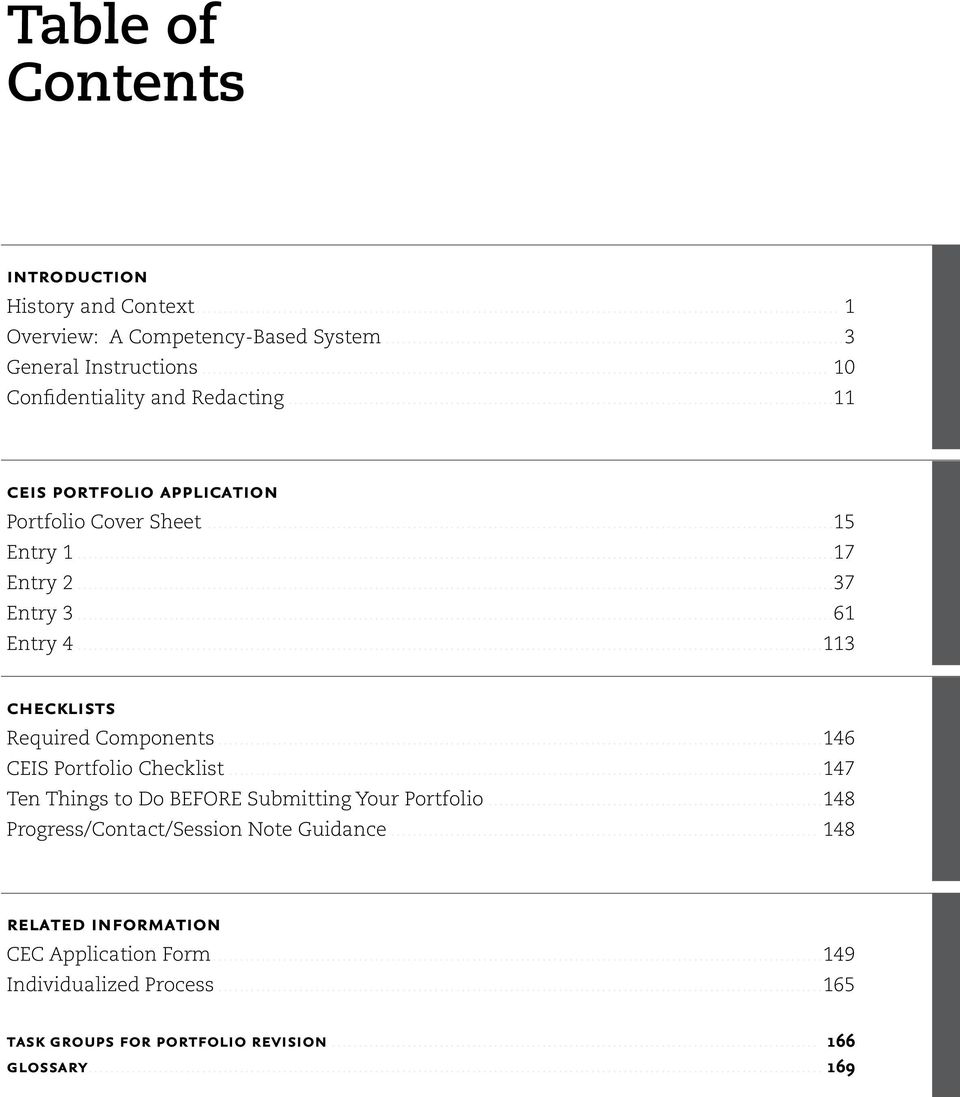
7 Table of Contents introduction History and Context... 1 Overview: A Competency-Based System...3 General Instructions Confidentiality and Redacting...11 ceis portfolio application Portfolio Cover Sheet...15 Entry Entry Entry Entry checklists Required Components CEIS Portfolio Checklist Ten Things to Do BEFORE Submitting Your Portfolio Progress/Contact/Session Note Guidance related information CEC Application Form Individualized Process task groups for portfolio revision glossary
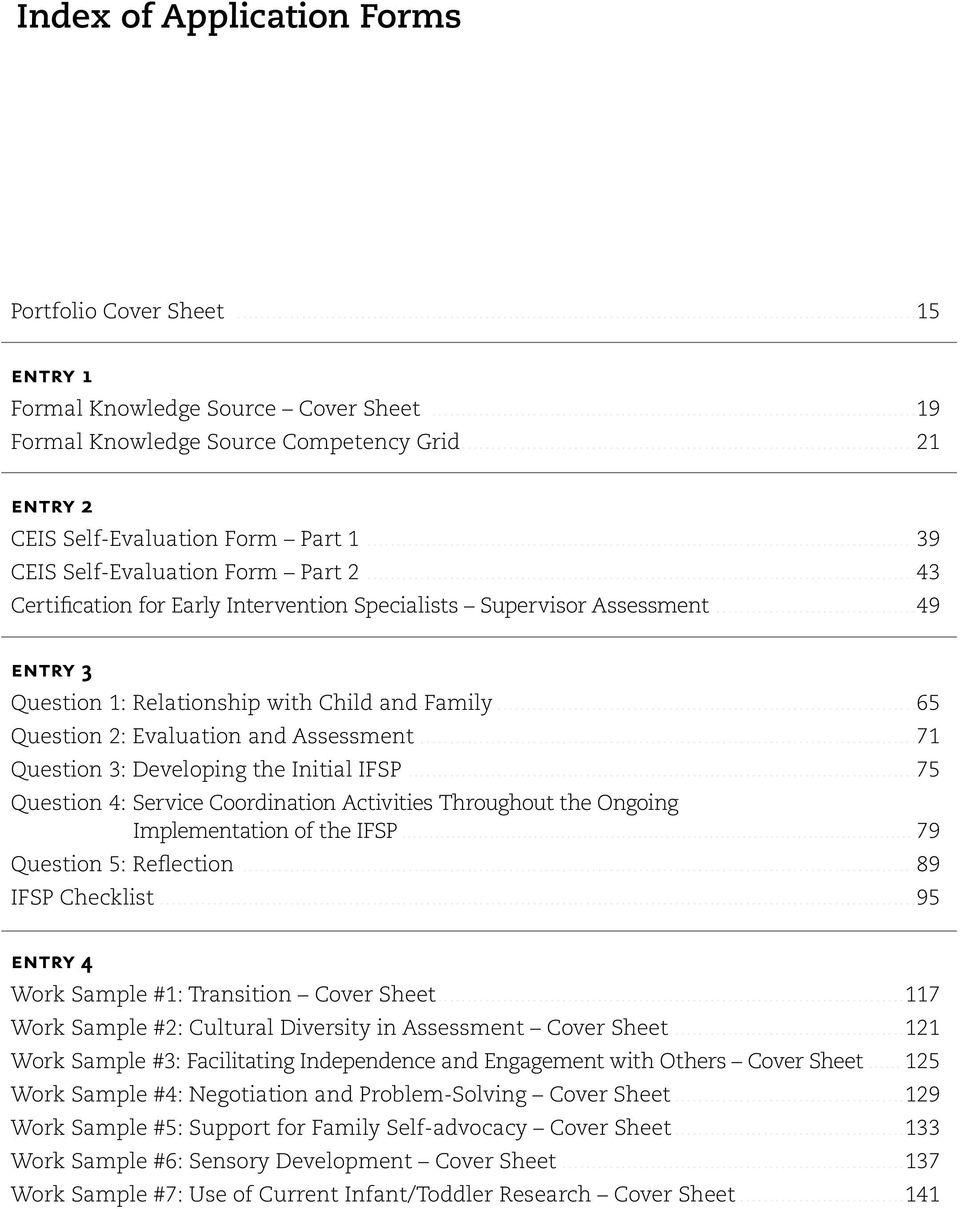
8 Index of Application Forms Portfolio Cover Sheet...15 entry 1 Formal Knowledge Source Cover Sheet...19 Formal Knowledge Source Competency Grid...21 entry 2 CEIS Self-Evaluation Form Part CEIS Self-Evaluation Form Part Certification for Early Intervention Specialists Supervisor Assessment...49 entry 3 Question 1: Relationship with Child and Family...65 Question 2: Evaluation and Assessment...71 Question 3: Developing the Initial IFSP...75 Question 4: Service Coordination Activities Throughout the Ongoing Implementation of the IFSP Question 5: Reflection...89 IFSP Checklist...95 entry 4 Work Sample #1: Transition Cover Sheet Work Sample #2: Cultural Diversity in Assessment Cover Sheet Work Sample #3: Facilitating Independence and Engagement with Others Cover Sheet Work Sample #4: Negotiation and Problem-Solving Cover Sheet Work Sample #5: Support for Family Self-advocacy Cover Sheet Work Sample #6: Sensory Development Cover Sheet Work Sample #7: Use of Current Infant/Toddler Research Cover Sheet...141
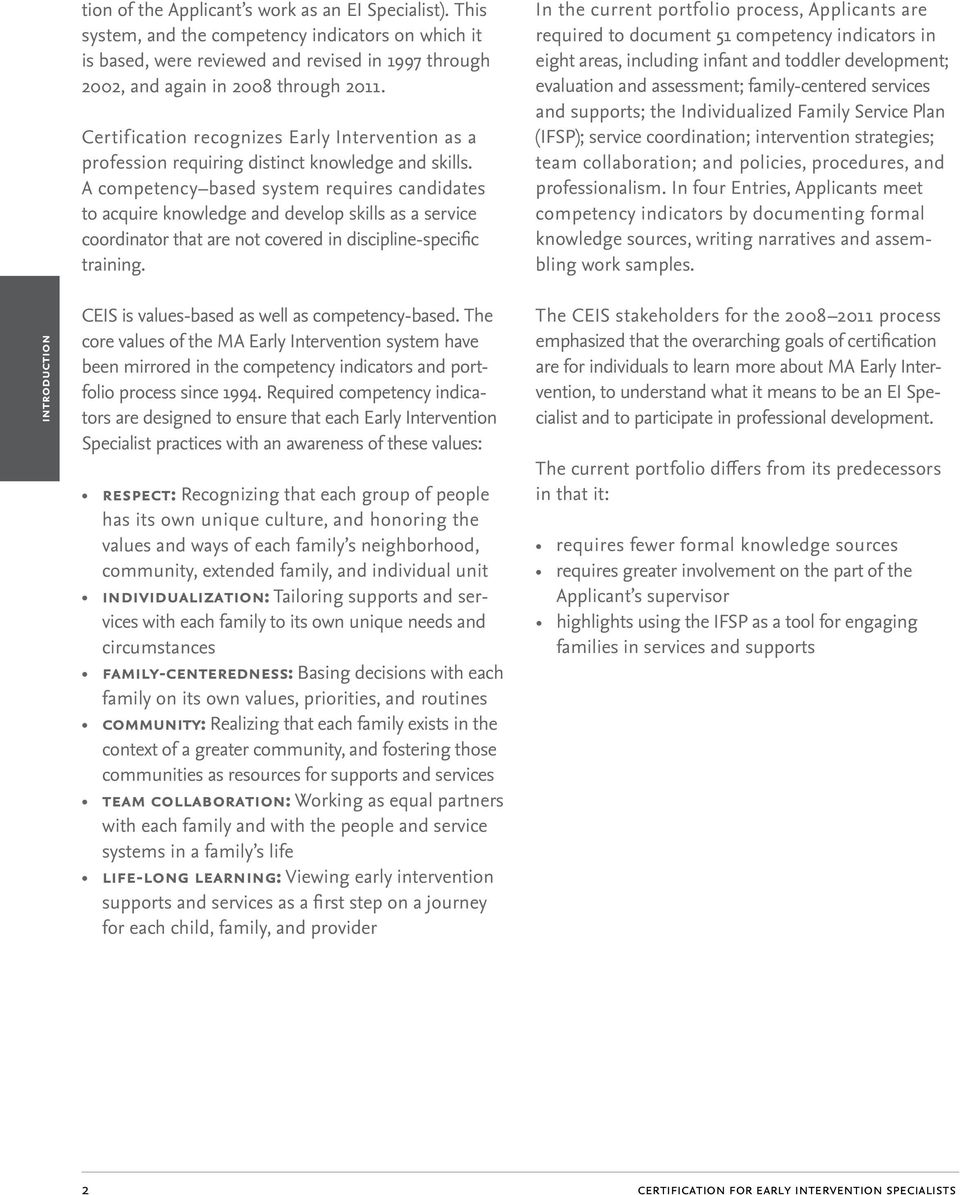
9 Introduction History and Context The Department of Public Health (DPH) is the lead agency for implementing Early Intervention in Massachusetts, under federal Part C of the Individuals with Disabilities Education Act (IDEA). IDEA charges participating states with providing evaluation/assessment, Individualized Family Service Plans (IFSPs), service coordination and transition services to all eligible families. This federal law also requires that states participating in Part C maintain an infrastructure that monitors and supports an effective service system. One component of the legislation is a Comprehensive System for Personnel Development (CSPD), which describes a state s responsibility to ensure the quality of personnel providing supports and services to families. january 2012 MA Department of Public Health Assurance of quality of personnel is also required by the Operational Standards of MA Early Intervention: Full certification is granted through the Department of Public Health after satisfactory completion of the EI certification process. Application must be completed by the end of 3 years of employment for those working 20 hours or more per week at one or more MDPH-certified EI program(s). Those working fewer than 20 hours per week are also encouraged to apply for full certification. (MA Operational Standards, V.A.c.) Since 1994, DPH has maintained a process for full certification of Early Intervention Specialists (CEIS) through portfolio assessment (a written compila- 1

10 tion of the Applicant s work as an EI Specialist). This system, and the competency indicators on which it is based, were reviewed and revised in 1997 through 2002, and again in 2008 through Certification recognizes Early Intervention as a profession requiring distinct knowledge and skills. A competency based system requires candidates to acquire knowledge and develop skills as a service coordinator that are not covered in discipline-specific training. In the current portfolio process, Applicants are required to document 51 competency indicators in eight areas, including infant and toddler development; evaluation and assessment; family-centered services and supports; the Individualized Family Service Plan (IFSP); service coordination; intervention strategies; team collaboration; and policies, procedures, and professionalism. In four Entries, Applicants meet competency indicators by documenting formal knowledge sources, writing narratives and assembling work samples. introduction CEIS is values-based as well as competency-based. The core values of the MA Early Intervention system have been mirrored in the competency indicators and portfolio process since Required competency indicators are designed to ensure that each Early Intervention Specialist practices with an awareness of these values: respect: Recognizing that each group of people has its own unique culture, and honoring the values and ways of each family s neighborhood, community, extended family, and individual unit individualization: Tailoring supports and services with each family to its own unique needs and circumstances family-centeredness: Basing decisions with each family on its own values, priorities, and routines community: Realizing that each family exists in the context of a greater community, and fostering those communities as resources for supports and services team collaboration: Working as equal partners with each family and with the people and service systems in a family s life life-long learning: Viewing early intervention supports and services as a first step on a journey for each child, family, and provider The CEIS stakeholders for the process emphasized that the overarching goals of certification are for individuals to learn more about MA Early Intervention, to understand what it means to be an EI Specialist and to participate in professional development. The current portfolio differs from its predecessors in that it: requires fewer formal knowledge sources requires greater involvement on the part of the Applicant s supervisor highlights using the IFSP as a tool for engaging families in services and supports 2 certification for early intervention specialists
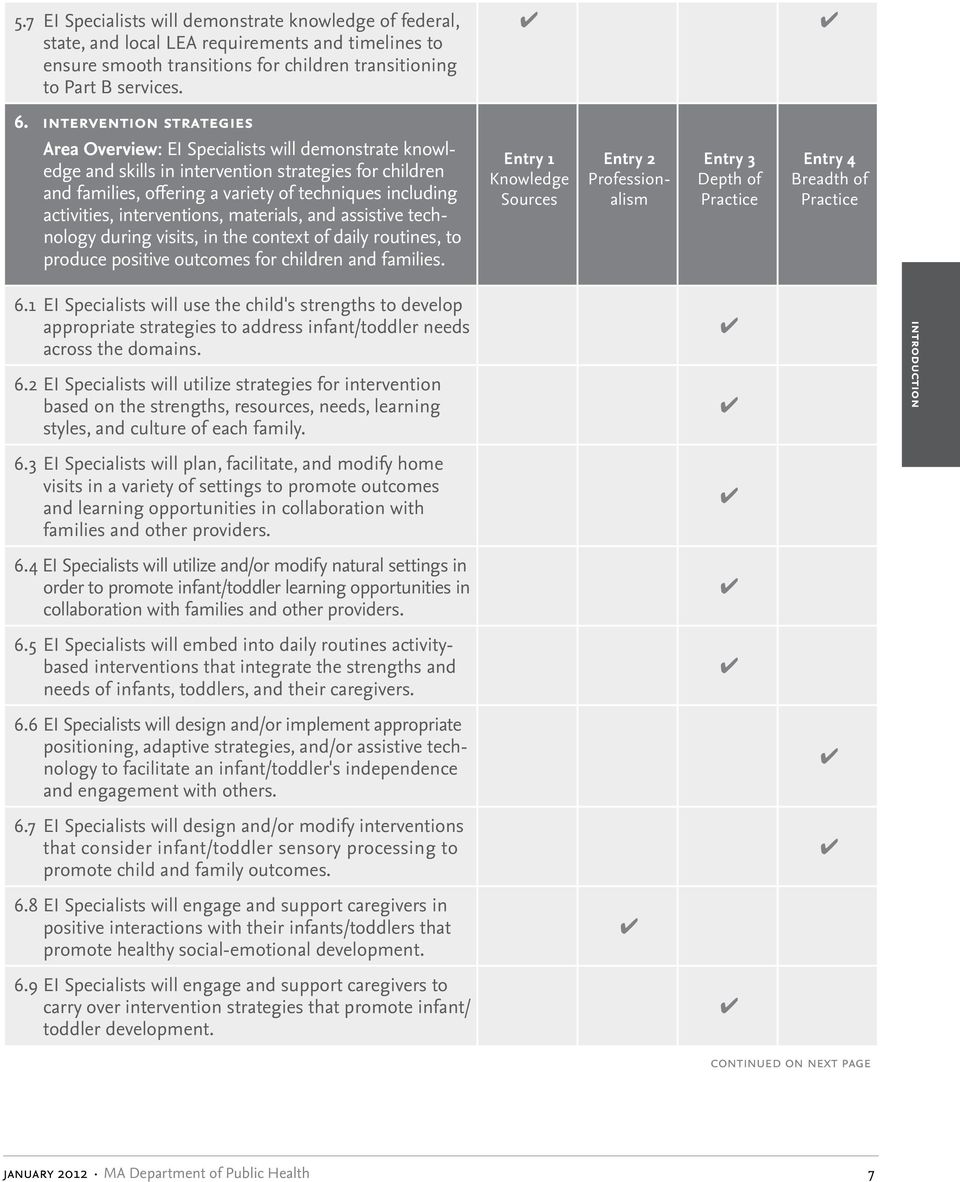
11 Overview: A Competency-Based System The Early Intervention Specialist certification process begins with a Self-Evaluation of the Applicant s knowledge and skills gained through formal learning experiences (including classroom settings, topicspecific mentorship, distance learning, conferences and workshops) and through work experiences, including daily practice with children and families and interactions with colleagues and supervisors. Each competency indicator requires submission of either a formal knowledge source or a work sample; one competency indicator requires both. The following grid provides information on each competency area, each competency indicator, and the Entry in which the competency indicator is documented. 1. infant and toddler development Area Overview: EI Specialists will demonstrate knowledge and skills to support each child s development in the following domains: social emotional/interaction, cognition, gross motor, perceptual/fine motor, communication, and self care. This should include knowledge of common developmental disabilities and risk factors, as well as their effect on early development and child/caregiver interactions. Entry 1 Knowledge Sources Entry 2 Professionalism Entry 3 Depth of Practice Entry 4 Breadth of Practice introduction 1.1 EI Specialists will demonstrate knowledge of typical and atypical infant and early childhood development, including major theories; domains and their interconnection; sequences; ranges; and variability. 1.2 EI Specialists will demonstrate knowledge of current research findings on brain development and identify factors that influence early brain development and learning. 1.3 EI Specialists will demonstrate knowledge of common factors impacting and influencing child development, including environment, culture, family, and caregiver relationships. 1.4 EI Specialists will demonstrate knowledge of origins and characteristics of developmental disabilities and disorders as well as their impact on early development and child/caregiver interactions. 1.5 EI Specialists will demonstrate knowledge of the impact of biological risk factors, including but not limited to prematurity, and other medical conditions, on child development and child/caregiver interactions. continued on next page january 2012 MA Department of Public Health 3

12 1.6 EI Specialists will demonstrate knowledge of how trauma and other sources of family and environmental stress influence early development and child/caregiver interactions. 1.7 EI Specialists will identify how children learn through play within and across developmental domains, based on individual learning styles and temperament. 1.8 EI Specialists will identify how children learn through relationships, and demonstrate knowledge of a relationship-based approach to interventions and outcomes. introduction 2. evaluation and assessment Area Overview: EI Specialists will demonstrate knowledge and skills in a range of eligibility evaluation and ongoing assessment strategies, and appropriate instruments to determine strengths, needs, and services supported by the IFSP. Entry 1 Knowledge Sources Entry 2 Professionalism Entry 3 Depth of Practice Entry 4 Breadth of Practice 2.1 EI Specialists will facilitate pre-evaluation planning with the family. 2.2 EI Specialists will collect, interpret, synthesize, and report relevant information related to eligibility evaluation and ongoing assessment. 2.3 EI Specialists will demonstrate knowledge and skill in relation to a range of evaluation and assessment procedures in determining eligibility, such as standardized evaluation, criterion-referenced assessment, family assessment tools, and child/caregiver and peer interactions. 2.4 EI Specialists will demonstrate the ability to interpret and discuss the results of evaluations and assessments by communicating effectively with families, both orally and in writing. 2.5 EI Specialists will individualize and adapt evaluation and assessment procedures, meeting and respecting the needs of the child, the culture of the family, and the variety of contexts of the child's daily life. 2.6 EI Specialists will collaborate with families and other team members to identify current levels of functioning, strengths, and needs of the infant/toddler throughout the IFSP process. continued on next page 4 certification for early intervention specialists
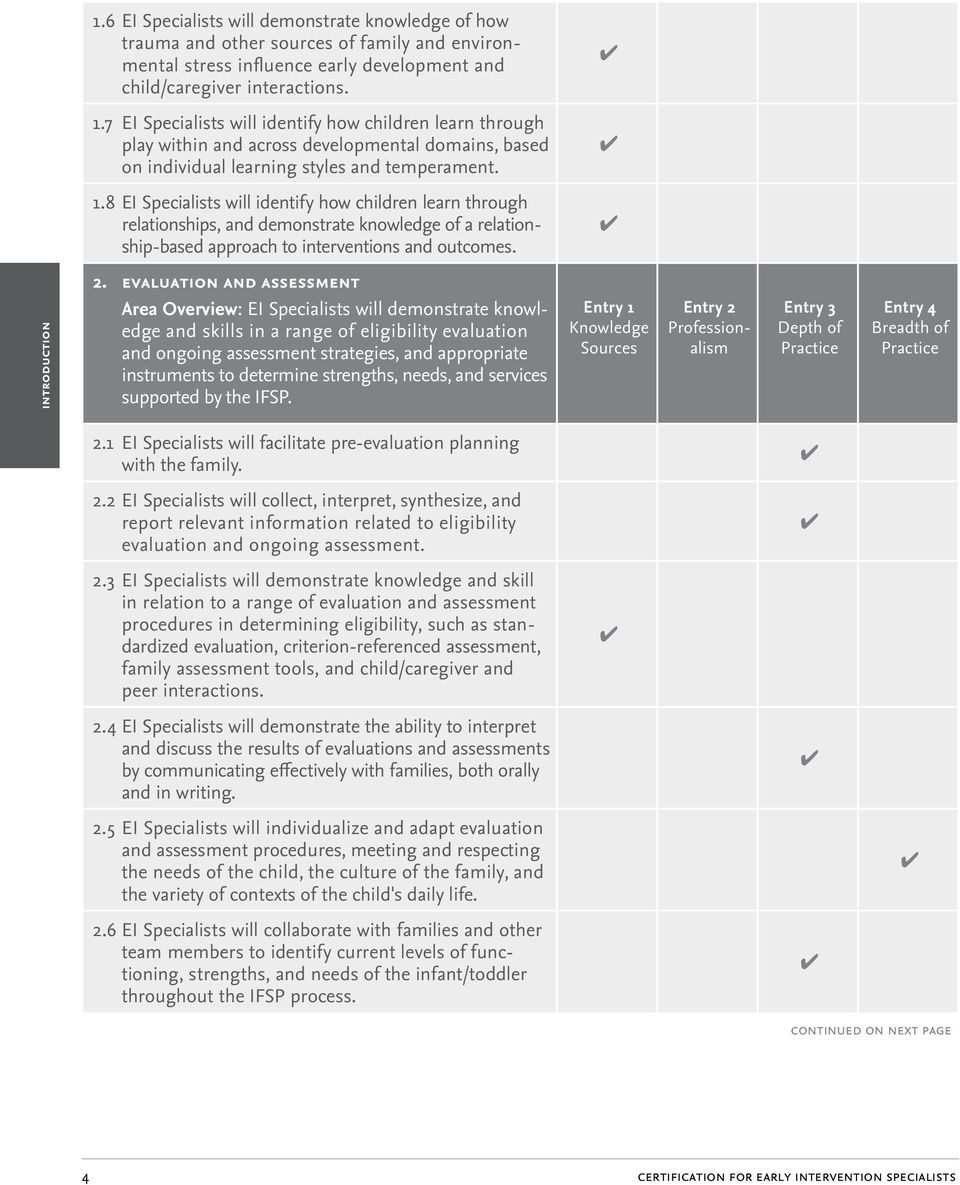
13 3. family centered services and supports Area Overview: EI Specialists will demonstrate the knowledge and skills necessary to implement familycentered services and to establish and maintain trusting relationships, so that decisions made with each family are based on a family s own unique values, culture, priorities, and routines, in order to engage families in the IFSP process and individualize supports and services. Entry 1 Knowledge Sources Entry 2 Professionalism Entry 3 Depth of Practice Entry 4 Breadth of Practice 3.1 EI Specialists will demonstrate understanding of the strengths and resources that the family contributes to the well-being of their child and family. 3.2 EI Specialists will demonstrate an understanding of, and the ability to apply, family-centered practices. 3.3 EI Specialists will demonstrate understanding and respect for the culture of each family. introduction 3.4 EI Specialists will share complete and unbiased information with families that enables them to make informed decisions regarding services, supports, and techniques. 3.5 EI Specialists will support families to access opportunities for family support, family networking, and involvement within and beyond the Early Intervention system. 3.6 EI Specialists will demonstrate an understanding of family dynamics and the impact on a family of having a child with a developmental delay or disability. 4. individualized family service plan (ifsp) Area Overview: EI Specialists will collaborate with families throughout the IFSP process, reflecting appropriate knowledge of federal and state components and requirements, procedural safeguards, and family rights throughout the family s participation in EI services. Entry 1 Knowledge Sources Entry 2 Professionalism Entry 3 Depth of Practice Entry 4 Breadth of Practice 4.1 EI Specialists will demonstrate knowledge of federal and state components and requirements throughout the IFSP process, including procedural safeguards. 4.2 EI Specialists will effectively explain the IFSP purpose and facilitate the process in order to promote family understanding and participation in the collaborative process. continued on next page january 2012 MA Department of Public Health 5

14 4.3 EI Specialists will gather information from the family and key collaborators in order to reflect the child and family's unique strengths, needs, and priorities in developing the IFSP. 4.4 EI Specialists will demonstrate the ability to generate functional/measurable outcomes and strategies and to plan services that will be embedded in the family s natural routines. 4.5 EI Specialists will adhere to appropriate IFSP timelines, and requirements for notification and informed consent in the ongoing reviews and transition planning. introduction 5. service coordination Area Overview: EI Specialists will demonstrate knowledge and skills in coordinating Early Intervention and community services for children and families, including supporting the family in developing self-advocacy skills and planning for transitions. Entry 1 Knowledge Sources Entry 2 Professionalism Entry 3 Depth of Practice Entry 4 Breadth of Practice 5.1 EI Specialists will monitor and coordinate the delivery of EI services by engaging in ongoing dialogue with the family to effectively revise, update, and utilize the IFSP. 5.2 EI Specialists will use effective oral and written communication and problem-solving strategies to coordinate individualized EI services and community supports for each child and family. 5.3 EI Specialists will ensure that health information (including medical, nutrition, and feeding) is current and reflected in the ongoing planning and coordinating of IFSP services. 5.4 EI Specialists will demonstrate knowledge of and ability to network with public and private providers in order to assist the family in accessing a variety of individualized services and resources, including but not limited to financial, specialty service, health, social, and developmental services and resources. 5.5 EI Specialists will support families in acquiring the knowledge and tools needed to enhance their capacity for self-advocacy. 5.6 EI Specialists will facilitate the development of a comprehensive transition plan, including the Transition Planning Conference, to promote smooth transitions for all families exiting Early Intervention. continued on next page 6 certification for early intervention specialists

15 5.7 EI Specialists will demonstrate knowledge of federal, state, and local LEA requirements and timelines to ensure smooth transitions for children transitioning to Part B services. 6. intervention strategies Area Overview: EI Specialists will demonstrate knowledge and skills in intervention strategies for children and families, offering a variety of techniques including activities, interventions, materials, and assistive technology during visits, in the context of daily routines, to produce positive outcomes for children and families. Entry 1 Knowledge Sources Entry 2 Professionalism Entry 3 Depth of Practice Entry 4 Breadth of Practice 6.1 EI Specialists will use the child's strengths to develop appropriate strategies to address infant/toddler needs across the domains. 6.2 EI Specialists will utilize strategies for intervention based on the strengths, resources, needs, learning styles, and culture of each family. 6.3 EI Specialists will plan, facilitate, and modify home visits in a variety of settings to promote outcomes and learning opportunities in collaboration with families and other providers. 6.4 EI Specialists will utilize and/or modify natural settings in order to promote infant/toddler learning opportunities in collaboration with families and other providers. 6.5 EI Specialists will embed into daily routines activitybased interventions that integrate the strengths and needs of infants, toddlers, and their caregivers. 6.6 EI Specialists will design and/or implement appropriate positioning, adaptive strategies, and/or assistive technology to facilitate an infant/toddler's independence and engagement with others. 6.7 EI Specialists will design and/or modify interventions that consider infant/toddler sensory processing to promote child and family outcomes. 6.8 EI Specialists will engage and support caregivers in positive interactions with their infants/toddlers that promote healthy social-emotional development. 6.9 EI Specialists will engage and support caregivers to carry over intervention strategies that promote infant/ toddler development. introduction continued on next page january 2012 MA Department of Public Health 7
16 7. team collaboration Area Overview: EI Specialists will demonstrate knowledge and skills in working with families and other professionals using a collaborative model, so that they can provide information and methods from their own discipline to team members and evaluate the IFSP in partnership with the family and other team members. Entry 1 Knowledge Sources Entry 2 Professionalism Entry 3 Depth of Practice Entry 4 Breadth of Practice 7.1 EI Specialists will demonstrate an understanding of the roles, functions, and dynamics of teams within Early Intervention. introduction 7.2 EI Specialists will serve as a resource to the child and family's team regarding information and strategies specific to his/her discipline and experience. 7.3 EI Specialists will recognize and respond to differences of opinions and recommendations within the child and family's team and use problem-solving skills to develop the IFSP and to plan ongoing services and collaboration. 7.4 EI Specialists will be able to explain the functions of various disciplines to families and key collaborators. 7.5 EI Specialists will regularly communicate with team members and other key collaborators to evaluate the effectiveness of services for the child and family. 8. policies, procedures, and professionalism Area Overview: EI Specialists will: Demonstrate knowledge of relevant federal and state legislation, regulations, standards, and policies so that they can provide appropriate information to families and safeguard confidentiality Demonstrate professional conduct and leadership skills with colleagues, children and families, and community partners, including participation in lifelong learning and awareness of infant/toddler research Entry 1 Knowledge Sources Entry 2 Professionalism Entry 3 Depth of Practice Entry 4 Breadth of Practice 8.1 EI Specialists will demonstrate a basic knowledge of relevant federal and state legislation, regulations and policies that impact services and supports to children and families (including IDEA, FERPA, Massachusetts EI Operational Standards, and state eligibility criteria). 8.2 EI Specialists will participate in opportunities for continued training and education for the purpose of ensuring personal and professional growth. continued on next page 8 certification for early intervention specialists

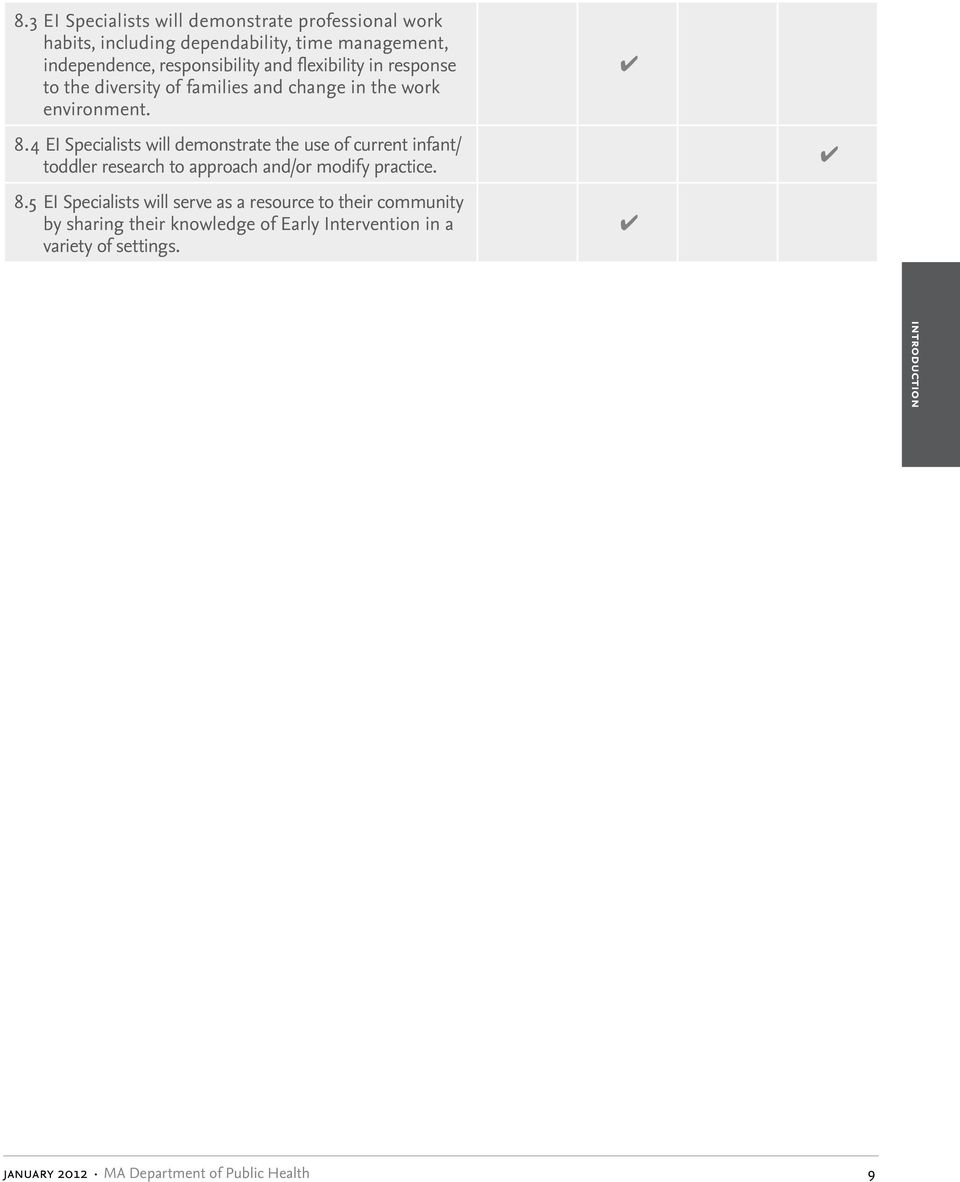
17 8.3 EI Specialists will demonstrate professional work habits, including dependability, time management, independence, responsibility and flexibility in response to the diversity of families and change in the work environment. 8.4 EI Specialists will demonstrate the use of current infant/ toddler research to approach and/or modify practice. 8.5 EI Specialists will serve as a resource to their community by sharing their knowledge of Early Intervention in a variety of settings. introduction january 2012 MA Department of Public Health 9
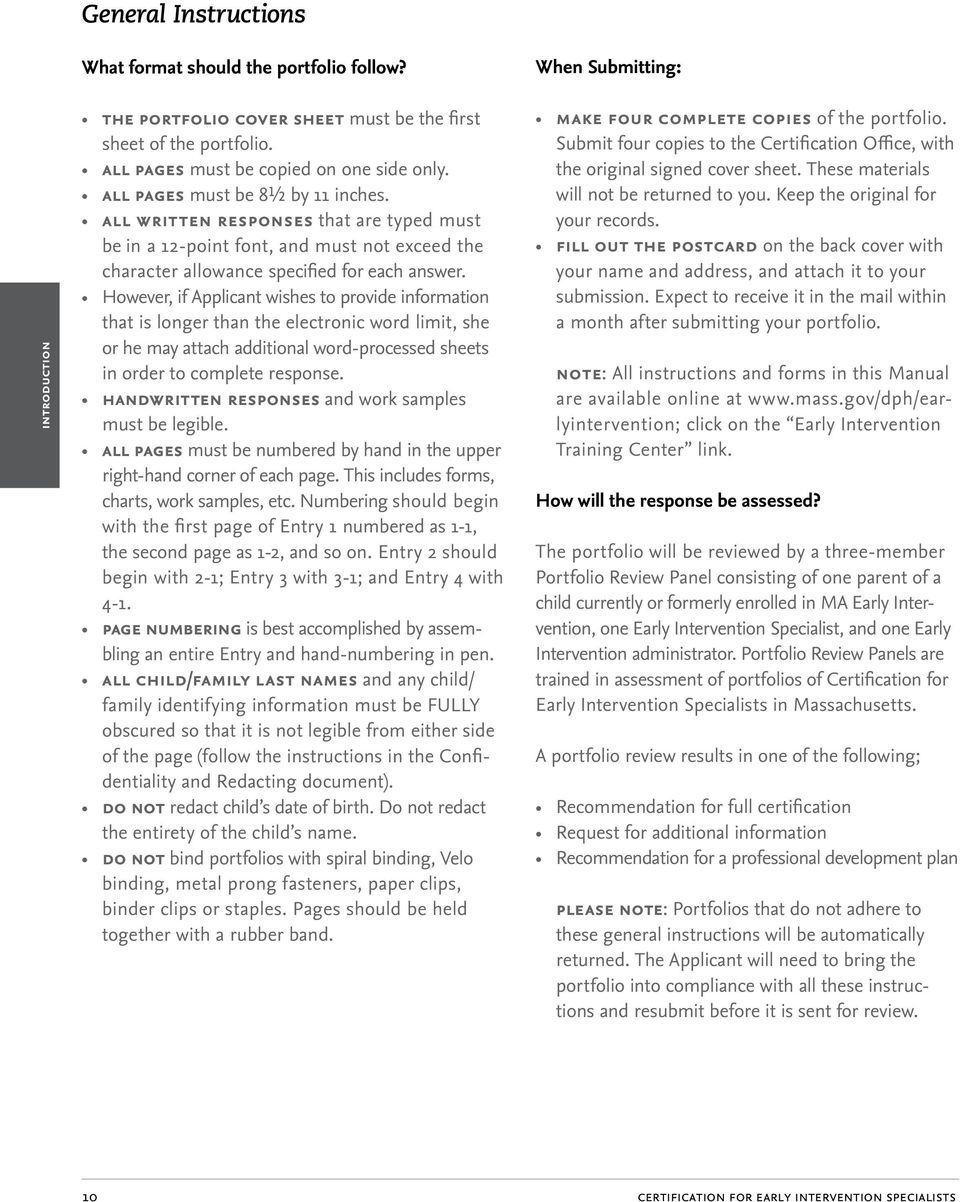
18 General Instructions What format should the portfolio follow? When Submitting: introduction the portfolio cover sheet must be the first sheet of the portfolio. all pages must be copied on one side only. all pages must be 8½ by 11 inches. all written responses that are typed must be in a 12-point font, and must not exceed the character allowance specified for each answer. However, if Applicant wishes to provide information that is longer than the electronic word limit, she or he may attach additional word-processed sheets in order to complete response. handwritten responses and work samples must be legible. all pages must be numbered by hand in the upper right-hand corner of each page. This includes forms, charts, work samples, etc. Numbering should begin with the first page of Entry 1 numbered as 1-1, the second page as 1-2, and so on. Entry 2 should begin with 2-1; Entry 3 with 3-1; and Entry 4 with 4-1. page numbering is best accomplished by assembling an entire Entry and hand-numbering in pen. all child/family last names and any child/ family identifying information must be FULLY obscured so that it is not legible from either side of the page (follow the instructions in the Confidentiality and Redacting document). do not redact child s date of birth. Do not redact the entirety of the child s name. do not bind portfolios with spiral binding, Velo binding, metal prong fasteners, paper clips, binder clips or staples. Pages should be held together with a rubber band. make four complete copies of the portfolio. Submit four copies to the Certification Office, with the original signed cover sheet. These materials will not be returned to you. Keep the original for your records. fill out the postcard on the back cover with your name and address, and attach it to your submission. Expect to receive it in the mail within a month after submitting your portfolio. note: All instructions and forms in this Manual are available online at click on the Early Intervention Training Center link. How will the response be assessed? The portfolio will be reviewed by a three-member Portfolio Review Panel consisting of one parent of a child currently or formerly enrolled in MA Early Intervention, one Early Intervention Specialist, and one Early Intervention administrator. Portfolio Review Panels are trained in assessment of portfolios of Certification for Early Intervention Specialists in Massachusetts. A portfolio review results in one of the following; Recommendation for full certification Request for additional information Recommendation for a professional development plan please note: Portfolios that do not adhere to these general instructions will be automatically returned. The Applicant will need to bring the portfolio into compliance with all these instructions and resubmit before it is sent for review. 10 certification for early intervention specialists
19 Confidentiality and Redacting Confidentiality of materials containing personally identifiable information about children and families is important and central to full compliance with the Family Education Rights and Privacy Act (FERPA), Part C of IDEA, and the Massachusetts Early Intervention Operational Standards. In order to ensure complete confidentiality of material submitted, all identifying information should be redacted (removed). To be confidential, Applicants must redact any and all of the following: Last names of children and families, or first names if they are identifying because of their uniqueness (provide at least a first name, pseudonym, or initial) Addresses Phone numbers Program record numbers Department of Public Health identification numbers Program identification numbers Any other identification numbers introduction do not redact child s date of birth. To completely remove the identifying information, use White-Out, permanent ink markers, or any of the various covering tapes. Once you have covered all identifying information, you must make a copy of the page. The copying process is required to make sure that the identifying information does not remain readable either from the front or the back of the page. Each Applicant is responsible for removal of any identifying material. Portfolios that contain personally identifiable information will be returned to the Applicant. january 2012 MA Department of Public Health 11

20 introduction 12 certification for early intervention specialists

21 CEIS Portfolio Application january 2012 MA Department of Public Health 13
22 application 14 certification for early intervention specialists
23 Portfolio Cover Sheet portfolio cover sheet Date Name Home Address Home Phone Program Name (s) Work Phone application Fax Number I hereby certify that this portfolio accurately represents my work and that the attached are copies of official transcripts and Early Intervention Training Center certificates issued to me. Applicant Signature Date january 2012 MA Department of Public Health 15
24 application entry 1 16 certification for early intervention specialists
25 Entry 1: Summary Documentation of Knowledge Sources purpose Documents formal knowledge sources within competency areas 1 5 and 7 8, for any competency indicator requiring knowledge source documentation What is the purpose of the entry? This entry documents the Applicant s formal learning experiences that address 16 of the competency indicators in competency areas 1 through 8, except for Area 6, Intervention Strategies. task Complete coursework, mentorships, and other professional development opportunities that meet knowledge source criteria prior to completion of portfolio Obtain copies of all official transcripts. (Documentation for competency indicators may include either transcripts or workshop certificates) Obtain certificates issued by the MA EI Training Center to verify completion of training with assigned competency indicators Complete grid: MA Early Intervention Specialist Competencies for Formal Knowledge Source Documentation evidence Cover Sheet for Formal Knowledge Source Documentation Formal Knowledge Source Competency Grid Copies of all official undergraduate and graduate transcripts Certificates issued by the Early Intervention Training Center (see p. 149 for instructions to apply to convert non-eitc trainings to a certificate issued by MA EITC) what the review panel will be looking for Completed documentation of formal knowledge sources for: 1.1; 1.2; 1.3; 1.4; 1.5; 1.6; 1.7; 1.8; 2.3; 3.6; 4.1; 5.4; 5.7; 7.1; 8.1; 8.2 Early Intervention Specialists gain formal knowledge in a variety of ways about the theories and research that underlie appropriate practice with young children and their families. Formal knowledge is acquired through learning experiences including classroom instruction, topic-specific mentorships, distance learning, conferences and workshops. What does the Applicant need to do? 1. Determine what knowledge sources you have met through coursework (both undergraduate and graduate), training, mentorship, and attendance at specialized workshops. 2. With your supervisor, as part of your Self-Evaluation Part 1, plan to attend additional professional development experiences that will meet the competency indicators you need. 3. Obtain official documentation for each educational opportunity. 4. Attend Building a Community I and II. 5. Complete online Transition Training: Connecting the Dots: Early Childhood Transition. Register by going to and clicking on the link to Early Intervention Training Center (5.7). 6. Complete online History of Early Intervention in Massachusetts training. Register by going to www. mass.gov/dph/earlyintervention, and clicking on the link to Early Intervention Training Center (8.1). application entry 1 january 2012 MA Department of Public Health 17
26 application entry 1 Prior to Completion of Your Portfolio Document each completed educational experience as follows: a. coursework: Include all graduate and undergraduate transcripts (copies of official transcripts). You may cite up to three courses if you feel they help address a competency indicator. b. workshops, trainings, conferences: 1. For those offered by the EI Training Center, copies of the EI Training certificates. 2. For those with Competency Education Credits (CECs) assigned by the EI Training Center, copies of the certificates issued by the EI Training Center. 3. For professional conferences, individual training, mentorships, or distance learning that have not been assigned CECs, submit an application for Competency Education Credits as an individual. CEC application information is available in this manual, p. 149, or at www. mass.gov/dph/earlyintervention; click on the link to Early Intervention Training Center. 4. Complete the Cover Sheet for Formal Knowledge Source Documentation. 5. Complete the Formal Knowledge Source Competency Grid. If using a course on your transcript, list the course number. Attach a course description and/or syllabus for courses cited. If no course description or syllabus is available, provide a detailed description in your own words of how a course or up to three courses address the competency indicator (100 word maximum). Notes: For competency indicator 1.2, evidence must be within 10 years of the submission of the portfolio. CEC applications must be submitted to the EI Training Center, which upon approval will issue a certificate that can be included in the portfolio. How should the evidence be organized? Evidence should be organized in the following order: 1. Signed Cover Sheet for Formal Knowledge Source Documentation 2. Formal Knowledge Source Competency Grid 3. Copies of official transcripts and supporting documentation for college courses (e.g., course descriptions or syllabi, if available) 4. Copies of certificates issued by the EI Training Center Note: Number all pages in the upper right hand corner of each page. The first page of Entry 1 should be numbered 1-1, the second page 1-2, and so on. How will the response be assessed? The Knowledge Source Entry is assessed by the Portfolio Review Panel based on the following: Is it there? Is it complete? Documentation of appropriate formal knowledge sources for each of the 16 indicators will constitute a successful entry. It is the applicant s responsibility to collect, organize, and number the material accordingly. Any missing or incomplete documentation will result in either a request for additional information or the recommendation of a professional development plan for the applicant. CEC applications cannot be submitted as part of the portfolio, because the only evidence accepted in Entry 1 is a course documented on a transcript or an EITC certificate. 18 certification for early intervention specialists
27 Entry 1: Formal Knowledge Source Cover Sheet entry 1 formal knowledge source cover sheet Applicant Name I have attached the Formal Knowledge Source Competency Grid for Certification for Early Intervention Specialist. For each competency indicator that requires one, I have documented a knowledge source listing the type of course or offering, a brief description if appropriate, and the page number on which the supporting documentation can be found. Attached documentation consists of: Graduate and undergraduate college transcripts, and supporting documentation as needed Certificates issued by the Early Intervention Training Center I hereby certify that the attached accurately represents my work, and that the attached are copies of official transcripts and Early Intervention Training Center certificates issued to me. Applicant Signature Date continued on next page application entry 1 january 2012 MA Department of Public Health 19
28 application entry 1 20 certification for early intervention specialists
29 Entry 1: Formal Knowledge Source Competency Grid entry 1 formal knowledge source competency grid Competency Indicator 1.1 EI Specialists will demonstrate knowledge of typical and atypical infant and early childhood development, including major theories, domains and their interconnection; sequences; ranges; and variability. Type of Documentation (Check) College Transcript EI Training Center Certificate Name of Offering/ Brief Description Name of college course or workshop Attach a course description and/or syllabus for course cited, and refer to it here. If no course description or syllabus is available, provide a detailed description in your own words of how a course or up to three courses address this competency indicator (660 character max). Page # of Material Attached application entry EI Specialists will demonstrate knowledge of current research findings on brain development and identify factors that influence early brain development and learning. College Transcript EI Training Center Certificate Name of college course or workshop Attach a course description and/or syllabus for course cited, and refer to it here. If no course description or syllabus is available, provide a detailed description in your own words of how a course or up to three courses address this competency indicator (660 character max). january 2012 MA Department of Public Health 21
30 application entry 1 22 certification for early intervention specialists
31 entry 1: formal knowledge source competency grid cont d Competency Indicator Type of Documentation (Check) Name of Offering/ Brief Description Page # of Material Attached 1.3 EI Specialists will demonstrate knowledge of common factors impacting and influencing child development, including environment, culture, family, and caregiver relationships. College Transcript EI Training Center Certificate Name of college course or workshop Attach a course description and/or syllabus for course cited, and refer to it here. If no course description or syllabus is available, provide a detailed description in your own words of how a course or up to three courses address this competency indicator (660 character max). 1.4 EI Specialists will demonstrate knowledge of origins and characteristics of developmental disabilities and disorders as well as their impact on early development and child/caregiver interactions. College Transcript EI Training Center Certificate Name of college course or workshop Attach a course description and/or syllabus for course cited, and refer to it here. If no course description or syllabus is available, provide a detailed description in your own words of how a course or up to three courses address this competency indicator (660 character max). application entry 1 january 2012 MA Department of Public Health 23
32 application entry 1 24 certification for early intervention specialists
33 entry 1: formal knowledge source competency grid cont d Competency Indicator Type of Documentation (Check) Name of Offering/ Brief Description Page # of Material Attached 1.5 EI Specialists will demonstrate knowledge of the impact of biological risk factors, including but not limited to prematurity and other medical conditions, on child development and child/ caregiver interactions. College Transcript EI Training Center Certificate Name of college course or workshop Attach a course description and/or syllabus for course cited, and refer to it here. If no course description or syllabus is available, provide a detailed description in your own words of how a course or up to three courses address this competency indicator (660 character max). 1.6 EI Specialists will demonstrate knowledge of how trauma and other sources of family and environmental stress influence early development and child/caregiver interactions. College Transcript EI Training Center Certificate Name of college course or workshop Attach a course description and/or syllabus for course cited, and refer to it here. If no course description or syllabus is available, provide a detailed description in your own words of how a course or up to three courses address this competency indicator (660 character max). application entry 1 january 2012 MA Department of Public Health 25
34 application entry 1 26 certification for early intervention specialists
35 entry 1: formal knowledge source competency grid cont d Competency Indicator Type of Documentation (Check) Name of Offering/ Brief Description Page # of Material Attached 1.7 EI Specialists will identify how children learn through play within and across developmental domains, based on individual learning styles and temperament. College Transcript EI Training Center Certificate Name of college course or workshop Attach a course description and/or syllabus for course cited, and refer to it here. If no course description or syllabus is available, provide a detailed description in your own words of how a course or up to three courses address this competency indicator (660 character max). 1.8 EI Specialists will identify how children learn through relationships, and demonstrate knowledge of a relationship-based approach to interventions and outcomes. College Transcript EI Training Center Certificate Name of college course or workshop Attach a course description and/or syllabus for course cited, and refer to it here. If no course description or syllabus is available, provide a detailed description in your own words of how a course or up to three courses address this competency indicator (660 character max). application entry 1 january 2012 MA Department of Public Health 27
36 application entry 1 28 certification for early intervention specialists
37 entry 1: formal knowledge source competency grid cont d Competency Indicator Type of Documentation (Check) area 2: evaluation and assessment 2.3 EI Specialists will demonstrate knowledge and skill in relation to a range of evaluation and assessment procedures in determining eligibility, such as standardized evaluation, criterion-referenced assessment, family assessment tools, and child/caregiver and peer interactions. College Transcript EI Training Center Certificate Name of Offering/ Brief Description Name of college course or workshop Attach a course description and/or syllabus for course cited, and refer to it here. If no course description or syllabus is available, provide a detailed description in your own words of how a course or up to three courses address this competency indicator (660 character max). Page # of Material Attached area 3. family centered services and supports 3.6 EI Specialists will demonstrate an understanding of family dynamics and the impact on a family of having a child with a developmental delay or disability. College Transcript EI Training Center Certificate Name of college course or workshop Attach a course description and/or syllabus for course cited, and refer to it here. If no course description or syllabus is available, provide a detailed description in your own words of how a course or up to three courses address this competency indicator (660 character max). application entry 1 january 2012 MA Department of Public Health 29
38 application entry 1 30 certification for early intervention specialists
39 entry 1: formal knowledge source competency grid cont d Competency Indicator Type of Documentation (Check) area 4. individualized family service plan (ifsp) 4.1 EI Specialists will demonstrate knowledge of federal and state components and requirements throughout the IFSP process, including procedural safeguards. College Transcript EI Training Center Certificate Name of Offering/ Brief Description Name of college course or workshop Attach a course description and/or syllabus for course cited, and refer to it here. If no course description or syllabus is available, provide a detailed description in your own words of how a course or up to three courses address this competency indicator (660 character max). Page # of Material Attached area 5. service coordination 5.4 EI Specialists will demonstrate knowledge of and ability to network with public and private providers in order to assist the family in accessing a variety of individualized services and resources, including but not limited to financial, specialty service, health, social, and developmental services and resources. College Transcript EI Training Center Certificate Name of college course or workshop Attach a course description and/or syllabus for course cited, and refer to it here. If no course description or syllabus is available, provide a detailed description in your own words of how a course or up to three courses address this competency indicator (660 character max). application entry 1 january 2012 MA Department of Public Health 31
40 application entry 1 32 certification for early intervention specialists
41 entry 1: formal knowledge source competency grid cont d Competency Indicator Type of Documentation (Check) Name of Offering/ Brief Description Page # of Material Attached 5.7 EI Specialists will demonstrate knowledge of federal, state, and local LEA requirements and timelines to ensure smooth transitions for children transitioning to Part B services. College Transcript EI Training Center Certificate Name of college course or workshop Attach a course description and/or syllabus for course cited, and refer to it here. If no course description or syllabus is available, provide a detailed description in your own words of how a course or up to three courses address this competency indicator (660 character max). area 7. team collaboration 7.1 EI Specialists will demonstrate an understanding of the roles, functions, and dynamics of teams within Early Intervention. College Transcript EI Training Center Certificate Name of college course or workshop Attach a course description and/or syllabus for course cited, and refer to it here. If no course description or syllabus is available, provide a detailed description in your own words of how a course or up to three courses address this competency indicator (660 character max). application entry 1 january 2012 MA Department of Public Health 33
42 application entry 1 34 certification for early intervention specialists
43 entry 1: formal knowledge source competency grid cont d Competency Indicator Type of Documentation (Check) area 8. policies, procedures, and professionalism 8.1 EI Specialists will demonstrate a basic knowledge of relevant federal and state legislation, regulations and policies that impact services and supports to children and families (including IDEA, FERPA, Massachusetts EI Operational Standards, and state eligibility criteria). College Transcript EI Training Center Certificate Name of Offering/ Brief Description Name of college course or workshop Attach a course description and/or syllabus for course cited, and refer to it here. If no course description or syllabus is available, provide a detailed description in your own words of how a course or up to three courses address this competency indicator (660 character max). Page # of Material Attached 8.2 EI Specialists will participate in opportunities for continued training and education for the purpose of ensuring personal and professional growth. College Transcript EI Training Center Certificate Name of college course or workshop Attach a course description and/or syllabus for course cited, and refer to it here. If no course description or syllabus is available, provide a detailed description in your own words of how a course or up to three courses address this competency indicator (660 character max). application entry 1 january 2012 MA Department of Public Health 35
44 application entry 2 36 certification for early intervention specialists
45 Entry 2: Summary Documentation of Professionalism purpose Documents the Applicant s: Self-Evaluation of her/his professional development experiences as an Early Intervention Specialist Relationship-based skills with families and team members task Complete Self-Evaluation Part 1 in collaboration with supervisor within first year of employment Complete Self-Evaluation Part 2 just prior to submitting portfolio Obtain supervisor and program director signatures on both Part 1 and Part 2 Obtain completed Supervisor Assessment form with signatures evidence Self Evaluation, Parts 1 and 2 Completed Supervisor Assessment form with signatures what the review panel will be looking for Evidence of competency indicators: 3.3; 6.8; 7.2; 7.4; 7.5; 8.3; 8.5 Entry 2: Instructions What is the purpose of this entry? In this entry, the Applicant demonstrates pursuit of life-long learning and development as an Early Intervention Specialist. The Applicant identifies areas of strength and plans professional development opportunities. The Applicant s supervisor documents activities related to working with families and being a member of a team. What does the Applicant need to do? 1. With supervisor, assess strengths and professional development plans as a Massachusetts Early Intervention Specialist by completing Part 1 and 2 of the Self-Evaluation form. Complete Part 1 within the first year of employment. Complete Part 2 after a minimum of one year of supervised practice. 2. As part of ongoing supervision, obtain a completed Supervisor Assessment. How should the evidence be organized? Evidence should be organized in the following order: 1. Parts 1 and 2 of the CEIS Self-Evaluation form (both must be signed and dated by Applicant, Supervisor and Program Director). 2. Completed and signed Supervisor Assessment form (must be signed and dated by Applicant, Supervisor and Program Director). Note: In accordance with General Instructions, number all pages in the upper right hand corner of each page. The first page of Entry 2 should be numbered 2-1, the second page 2-2, and so on. How will the response be assessed? The Professionalism Entry is assessed by the Portfolio Review Panel based on the following: application entry 2 january 2012 MA Department of Public Health 37
46 a) whether all questions of the Self-Evaluation (Parts 1 and 2) have been satisfactorily completed b) whether the Supervisor Assessment documents: 1) the Applicant s work with respect to dependability and responsibility; time management; and flexibility in response to changes in the work environment 2) the Applicant s ability to demonstrate skill and knowledge in relation to the following competency indicators: 3.3, 6.8, 7.2, 7.4, 7.5, 8.3, and 8.5 (Narrative Questions 1 4) CEIS Self-Evaluation Form Part 1 and 2 application entry 2 introduction The Self-Evaluation is an opportunity for the Applicant to examine strengths as an Early Intervention Specialist in relation to the competency areas that provide the standard for Early Intervention Specialist certification. The eight competency areas are structured around the Applicant s role as a service coordinator and direct service provider. Part 1 of the Self-Evaluation allows the Applicant to identify areas of strength and to plan professional development opportunities. Part 2 allows the Applicant to describe professional development experiences and reflect on how knowledge and skills have expanded during the first three years as an Early Intervention Specialist. (The Applicant may complete Part 2 after a minimum of one year of supervised practice.) and are to be completed by the Applicant as part of supervision at the Early Intervention program. Please retain completed Self-Evaluation for portfolio records, as the Applicant will be required to: Refer to Part 1 in order to complete Part 2 for the portfolio Include both Parts 1 and 2 in the portfolio Self-Evaluation questions below will be discussed at the introductory workshop Building a Community, 38 certification for early intervention specialists
47 Entry 2: CEIS Self-Evaluation Form Part 1 entry 2 ceis self-evaluation form part 1 1. Briefly describe the strengths and abilities you have brought to your position in Early Intervention (3,300 character max). application entry 2 continued on next page january 2012 MA Department of Public Health 39
48 application entry 2 40 certification for early intervention specialists
49 entry 2: ceis self-evaluation form part 1 cont d 2. Describe your current goals for professional development, including at least two topics about which you would like to know more, and your strategies for achieving those goals (3,300 character max). application entry 2 signatures Applicant (Signature) Date Supervisor Program Director (Print Name) (Signature) Date (Print Name) (Signature) Date january 2012 MA Department of Public Health 41
50 application entry 2 42 certification for early intervention specialists
51 Entry 2: CEIS Self-Evaluation Form Part 2 entry 2 ceis self-evaluation form part 2 Reflecting on your answers to Part 1 of the CEIS Self-Evaluation, please answer the questions below: 1. How have you made progress toward meeting the professional goals outlined in Question 2 of Part 1 of your Self-Evaluation, with regard to working with children and families in EI? (3,300 character max) application entry 2 continued on next page january 2012 MA Department of Public Health 43
52 application entry 2 44 certification for early intervention specialists
53 entry 2: ceis self-evaluation form part 2 cont d 2. Describe other specific professional development opportunities in which you have participated as a learner since you completed Part 1 of the Self-Evaluation (3,300 character max). application entry 2 continued on next page january 2012 MA Department of Public Health 45
54 application entry 2 46 certification for early intervention specialists
55 entry 2: ceis self-evaluation form part 2 cont d 3. What have you learned about yourself in working with children and families in Early Intervention? (3,300 character max) application entry 2 signatures Applicant (Signature) Date Supervisor Program Director (Print Name) (Signature) Date (Print Name) (Signature) Date january 2012 MA Department of Public Health 47
56 application entry 2 48 certification for early intervention specialists
57 Entry 2: Certification for Early Intervention Specialists Supervisor Assessment entry 2 certification for early intervention specialists supervisor assessment Applicant Name EI Program Supervisor Name Supervisor Job Title Supervisor Telephone Supervisor Complete the checkboxes below regarding the Applicant s work habits, and provide examples. Where examples are requested throughout the assessment, provide very specific examples of times when the Applicant demonstrated the requested knowledge or skills. Dependability and Responsibility Meets agency standards (checkbox) Examples: Provide specific example of the Applicant s work that demonstrates dependability and responsibility (e.g., attends required staff meetings; is consistently available to team members throughout the IFSP process) (2,000 character max): application entry 2 continued on next page january 2012 MA Department of Public Health 49
58 application entry 2 50 certification for early intervention specialists
59 entry 2: certification for early intervention specialists supervisor assessment cont d Meets agency standards (checkbox) Examples: Time Management Provide specific example of the Applicant s work that demonstrates time management (e.g., completes required documentation in a timely manner; manages work schedule to meet all obligations) (2,000 character max): continued on next page application entry 2 january 2012 MA Department of Public Health 51
60 application entry 2 52 certification for early intervention specialists
61 entry 2: certification for early intervention specialists supervisor assessment cont d Meets agency standards (checkbox) Examples: Flexibility in Response to Changes in the Work Environment Provide specific example of the Applicant s work that demonstrates flexibility in response to changes in work environment (e.g., responds appropriately to changes in families situations, including medical and mental health status; adapts to changes in job requirements) (1,575 character max): Narrative Questions Give one or more specific examples of the ways in which the Applicant has demonstrated understanding and respect for the diverse cultures of the families with whom he or she works (1,675 character max). (Culture in this case is broadly defined to include family beliefs, practices, and routines, such as those involving food, the use of household objects, childrearing practices, etc.) application entry 2 continued on next page january 2012 MA Department of Public Health 53
62 application entry 2 54 certification for early intervention specialists
63 entry 2: certification for early intervention specialists supervisor assessment cont d 2. Give one or more specific examples of the Applicant s activities to serve as a resource to: a) An IFSP team for one child and family of which she or he is a part (2,000 character max): b) Other Early Intervention staff at your program, staff at other MA Early Intervention programs, or the broader early childhood community in which your Early Intervention program is located (2,000 character max): application entry 2 continued on next page january 2012 MA Department of Public Health 55
64 application entry 2 56 certification for early intervention specialists
65 entry 2: certification for early intervention specialists supervisor assessment cont d 3. Give one or more specific examples of ways in which the Applicant engages and supports caregivers in positive interactions with their infants and toddlers that promote healthy social-emotional development. This should include how the Applicant shares information and strategies (2,000 character max). 4. Give one or more specific examples of the Applicant s activities to: a) Appropriately access team members of other disciplines, and explain their roles to families and key collaborators (1,900 character max): Guidance: Key collaborators include, but are not limited to, health providers and staff from the Department of Children and Families (DCF); the Department of Developmental Services (DDS); Early Education and Care (EEC); and the Local Education Agency (LEA). application entry 2 continued on next page january 2012 MA Department of Public Health 57
66 application entry 2 58 certification for early intervention specialists
67 entry 2: certification for early intervention specialists supervisor assessment cont d b) Evaluate IFSP outcomes by communicating with team members and key collaborators (2,000 character max): signatures Applicant (Signature) Date application entry 2 Supervisor Program Director (Print Name) (Signature) Date (Print Name) (Signature) Date january 2012 MA Department of Public Health 59
68 application entry 3 60 certification for early intervention specialists
69 Entry 3: Summary IFSP: Documentation of Depth of Practice purpose Documents the depth of the Applicant s skill and experience as a service coordinator in the Massachusetts Early Intervention System task Select one child and his/her family with whom the Applicant has worked for at least six months as a service coordinator that: highlights challenges presented to the Applicant as an Early Intervention Specialist demonstrates how the Applicant collaborated with the family and other community/specialty providers through the IFSP process includes IFSPs that have been developed by, and reflect the ongoing work of, the Applicant For that child and family: Compile at least one but no more than three complete IFSPs Provide a narrative response to Entry 3 Questions 1 through 5, referring to relevant IFSP pages where requested Complete one IFSP Checklist Gather additional work samples evidence One complete IFSP (inclusive of all required components). This may include no more than three IFSPs reflecting the child and family s involvement in Early Intervention. Narrative addressing five question areas IFSP Checklist for one IFSP submitted Question 4 additional work samples what the review panel will be looking for Evidence of competency indicators: 2.1; 2.2; 2.4; 2.6; 3.1; 3.2; 3.4; 4.2; 4.3; 4.4; 4.5; 5.1; 5.2; 5.3; 6.1; 6.2; 6.3; 6.4; 6.5; 6.9 application entry 3 Entry 3: Instructions The Individualized Family Service Plan (IFSP): Documentation of Depth of Practice what is the purpose of the entry? Written responses to questions, the IFSP, two supporting work samples, and an IFSP Checklist will provide evidence of the Applicant s ability to form partnerships with families, gather information, demonstrate understanding of the eligibility determination process, provide ongoing assessment through the IFSP process, and coordinate services. what does the applicant need to do? 1. Select one child and family with whom you are working or have worked to feature in the response. The family selected should highlight the challenges presented to the Applicant as an Early Intervention Specialist and demonstrate the ways in which he or she collaborated with the family and other providers throughout the IFSP process. 2. Submit written responses to five questions that discuss your relationship with the child and family; january 2012 MA Department of Public Health 61
70 application entry 3 your knowledge and skills in a range of eligibility evaluation and ongoing assessment strategies; your activities to support the family in the development of the IFSP; your utilization of the IFSP to engage in ongoing dialogue with the family; your experiences coordinating the services of the IFSP; and your reflection on how your experience with this family has influenced your approach to engaging families in Early Intervention. 3. Submit at least one but no more than three complete IFSPs that you developed with the family, reflecting the child and family s involvement in Early Intervention over time. 4. Submit two additional work samples for Question 4: Work Sample #1 and Work Sample #2. 5. Submit an Entry 3 IFSP Checklist for one IFSP submitted. how should the evidence be organized? The evidence is organized through responses to questions, two supporting work samples, one complete IFSP work sample, and one IFSP Checklist. Content Instructions: These materials must reflect the actual work of the Applicant with a child and family. These materials should conform to the specifications detailed below: 1. Complete the written response to questions 1 5 as outlined in Entry 3 Narrative Questions. Be sure that each section of the written response addresses all of the topics and questions listed. Your written response must relate specifically to the child and family you have selected. 2. IFSP work sample: Submit at least one (but no more than three) complete IFSPs developed with the family, reflecting the child and family s involvement in Early Intervention over time. Submit each IFSP separately, in the following order: Order of components of each IFSP: Cover sheet Family page Developmental profile Outcomes and strategies Service delivery plan Transition plan All review pages for the IFSP(s) submitted Signature page 3. Additional supporting work samples: Submit two additional work samples reflecting the Applicant s work with the family featured in Entry 3. Work samples may not be duplicated. 4. Entry 3 IFSP Checklist: For each line, either check the check if complete box, or if not complete, provide comments under Comments if not complete. Answer all questions on the General Comments page. how should the evidence be formatted? Materials must meet the following requirements: The written response must be typewritten in 12 point font. Progress Notes must include the following components: date, service type, duration and content of contact, and the legible signature and discipline of the staff person signing the note. (MA EI Operational Standards, 2006, p. 61) NOTE: The content of the progress note must give sufficient detail to reflect the functional/measurable outcomes and strategies of the submitted IFSP. Number all pages in the upper right hand corner of each page. The first page of Entry 3 should be numbered 3-1, the second page 3-2, and so on. Order of documents for Entry 3: 1. Answer to Narrative Questions Question 4 Additional Work Samples #1 and #2, following responses to all of Narrative Question 4 3. Answers to Narrative Question 5 4. IFSP work sample 5. IFSP Checklist how will the response be assessed? Entry 3 is an integrated performance task that will be reviewed holistically, with attention to all 62 certification for early intervention specialists
71 sections, including narrative questions, the IFSP, the IFSP Checklist, and additional work samples. Reviewers do not expect a one-to-one correspondence between submissions and the competency indicators, so Applicants are not required to address every aspect of the competency indicators as written. The response will be assessed based on the Applicant s knowledge of the IFSP process; whether the additional work samples address the topic areas assigned; whether the IFSP Checklist documents knowledge of the components of the IFSP; whether the Applicant documents her or his understanding of the importance of IFSP timelines and requirements; and the completeness of the narrative responses addressing the five question areas below. Relationship with child and family: Responses to this question must document how the choice of this family illustrates depth of practice, the Applicant s role within the EI team, the evolution of the relationship with this family, and the main challenge in meeting the needs of this family. Evaluation and Assessment: Responses to this question must document knowledge and skills in a range of eligibility evaluation and ongoing assessment strategies to determine strengths, needs and services supported by the IFSP. This question also addresses how the Applicant gathers information, prepares families for eligibility evaluations or ongoing assessments, interprets assessment results, and incorporates results into the IFSP. Developing the IFSP: Responses to this question must document how the Applicant collaborated with and supported the family in the development of the IFSP. Responses must also reflect knowledge of federal and state components and requirements, procedural safeguards, and family rights during participation in EI services. Service coordination throughout the IFSP: Responses to this question must document how the Applicant utilized the IFSP as a vehicle to engage in ongoing dialogue with the family while implementing the IFSP. Reflection on the Applicant s work with the child and family: Responses to this question must document how the Applicant s experience with this family has influenced her or his approach to engaging families in Early Intervention. how to choose a child and family to highlight in entry 3 In Entry 3, the Applicant must choose a child and family for whom she or he has served as a service coordinator and for whom there is at least one IFSP of six months duration, throughout which the Applicant was the service coordinator. Some other thoughts for the Applicant to consider in selecting one child and family include the following. Consider: A child and family for whom you have provided services that you have learned from, or that has challenged you to advance your skills as a service coordinator A child and family who required individualization of your approach to providing service A child and family from whom you learned the most about being an Early Intervention Specialist. Your final choice should be based on the child and family that you feel provides the best example of your work as an Early Intervention Specialist in your responses to the narrative questions in Entry 3. application entry 3 january 2012 MA Department of Public Health 63
72 application entry 3 64 certification for early intervention specialists
73 Entry 3, Question 1: Relationship with Child and Family entry 3 question 1: relationship with child and family Describe your relationship with this child and family, addressing the following items: 1a. How does your choice of this family illustrate the depth of your practice? (What is unique about this child and family? What changes did you make in your practice? What did you learn from working with this family?) (2,000 character max) application entry 3 continued on next page january 2012 MA Department of Public Health 65
74 application entry 3 66 certification for early intervention specialists
75 entry 3, question 1: relationship with child and family cont d 1b. Briefly describe your own role within the EI team, and identify the members of the EI program team working with this child and family throughout their EI experience (2,000 character max). 1c. How did you get to know this family? How did your relationship evolve and change throughout this family s EI experience? (2,000 character max) application entry 3 continued on next page january 2012 MA Department of Public Health 67
76 application entry 3 68 certification for early intervention specialists
77 entry 3, question 1: relationship with child and family cont d 1d. Describe the main challenge you encountered in meeting the needs of this child and family (2,000 character max). application entry 3 january 2012 MA Department of Public Health 69
78 application entry 3 70 certification for early intervention specialists
79 Entry 3, Question 2: Evaluation and Assessment The response to this question will document knowledge and skills related to the eligibility determination process, including eligibility criteria, and preparing the family for an eligibility determination process or ongoing assessment. The question also addresses how the Applicant shares information gathered through the eligibility process. Guidance: The term evaluation refers to an eligibility evaluation. The term assessment refers to any other assessment of the child and family, including, but not limited to, administration of a supplemental tool, observation of the child, and gathering information from caregivers. entry 3 question 2: evaluation and assessment 2a. Describe this child s eligibility determination process, including the composition of the team and your participation, if any. Describe how you prepared the family for this process, any subsequent eligibility determination, or ongoing assessment (2,000 character max). application entry 3 continued on next page january 2012 MA Department of Public Health 71
80 application entry 3 72 certification for early intervention specialists
81 entry 3, question 2: evaluation and assessment cont d 2b. Describe how you shared the information gathered through the eligibility process with this family. Provide a specific example of what information you shared with this family. Give an example of how you evaluated what the family understood about this information (2,000 character max). 2c. Describe how this child meets the Massachusetts Early Intervention eligibility criteria (2,000 character max). application entry 3 january 2012 MA Department of Public Health 73
82 application entry 3 74 certification for early intervention specialists
83 Entry 3, Question 3: Developing the Initial IFSP The response to this question will document how the Applicant collaborated with and supported the family in the development of the IFSP; ensured the family s understanding of the IFSP process; and gathered information regarding the family s strengths, concerns, priorities and resources. Guidances: Team members include families and all involved staff from the EIP. Key collaborators include, but are not limited to, health providers and staff from the Department of Children and Families (DCF), the Department of Developmental Services (DDS), Early Education and Care (EEC), and the Local Education Agency (LEA). entry 3 question 3: developing the initial ifsp 3a. Describe your activities to ensure that this family understood and participated in the IFSP process. How did you evaluate the family s understanding of the process? (2,000 character max) application entry 3 continued on next page january 2012 MA Department of Public Health 75
84 application entry 3 76 certification for early intervention specialists
85 entry 3, question 3: developing the initial ifsp cont d 3b. Describe your activities to support IFSP development by gathering information regarding this child and family s strengths, concerns, priorities and resources from the family, other team members and key collaborators. Provide specifics about the information you gathered (2,000 character max). application entry 3 january 2012 MA Department of Public Health 77
86 application entry 3 78 certification for early intervention specialists
87 Entry 3, Question 4: Service Coordination Activities Throughout the Ongoing Implementation of the IFSP The response to this question will document how the Applicant utilized the IFSP as a vehicle to engage in ongoing dialogue with the family while implementing the IFSP. Guidances: To embed strategies in daily routines means they are individualized and match the interests and routines of each child and family. Carryover may include activities or strategies that the family can use in daily routines or ongoing activities that service providers employ to ensure that outcomes and strategies are addressed. Procedural safeguards are defined as The policies and procedures established to ensure providers inform families of their rights to written notice, use of native language, informed consent, records, confidentiality, and options for the impartial timely resolution of disputes associated with the provision of early intervention services. (Early Intervention Operational Standards, Revised 2006, Section II, p.11) entry 3 question 4: service coordination activities throughout the ongoing implementation of the ifsp 4a. Describe what you did as service coordinator to engage this family over time to review, update, and modify the IFSP (2,000 character max). application entry 3 Cite below one specific page in a submitted IFSP where you document the dialogue or discussion you had with this family to review, update, or modify the IFSP. Portfolio page #: continued on next page january 2012 MA Department of Public Health 79
88 application entry 3 80 certification for early intervention specialists
89 entry 3, question 4: service coordination activities throughout the ongoing implementation of the ifsp cont d 4B. Describe how you linked services to functional/measurable outcomes and strategies, embedding interventions in this family s natural routines (2,000 character max). Cite below one specific page in a submitted IFSP where you documented a functional/measurable outcome. Portfolio page #: Attach one progress note that shows how you collaborated with this family to meet the functional/ measurable outcome highlighted on this IFSP page. Label this progress note Work Sample #1. application entry 3 continued on next page january 2012 MA Department of Public Health 81
90 application entry 3 82 certification for early intervention specialists
91 entry 3, question 4: service coordination activities throughout the ongoing implementation of the ifsp cont d 4c. Describe how you used this child and family s strengths, resources, concerns, priorities and learning styles to develop appropriate strategies and promote carryover of strategies within family daily routines (2,000 character max). Cite below one specific page in a submitted IFSP where you documented your support for this family to carry over strategies. Portfolio page #: Attach one progress note that shows your activities to support the carryover of strategies highlighted on this IFSP page. Label this progress note Work Sample #2. (NOTE: Do not use the same progress note used for Work Sample #1 in Question 4B.) application entry 3 continued on next page january 2012 MA Department of Public Health 83
92 application entry 3 84 certification for early intervention specialists
93 entry 3, question 4: service coordination activities throughout the ongoing implementation of the ifsp cont d 4d. Describe how you supported this child and family in natural settings to promote IFSP outcomes and strategies that support infant-toddler learning opportunities. Give specific examples of your activities with this family (2,000 character max). 4e. Describe how you helped this family access and coordinate health and other community resources, being specific about resources shared. (This may include correspondence with the pediatrician, review of current diet and/or immunizations, or provision of information about public benefits.) (2,000 character max) application entry 3 continued on next page january 2012 MA Department of Public Health 85
94 application entry 3 86 certification for early intervention specialists
95 entry 3, question 4: service coordination activities throughout the ongoing implementation of the ifsp cont d 4f. Describe how and when you provided this family with the Family Rights document, and how you explained the purpose of procedural safeguards throughout your ongoing service coordination with this family (2,000 character max). application entry 3 january 2012 MA Department of Public Health 87
96 application entry 3 88 certification for early intervention specialists
97 Entry 3, Question 5: Reflection entry 3 question 5: reflection The response to this question will document how your experience with this family has influenced your approach to engaging families in Early Intervention. 5a. What did you learn from this experience about engaging families in the IFSP development process? (3,300 character max) application entry 3 continued on next page january 2012 MA Department of Public Health 89
98 application entry 3 90 certification for early intervention specialists
99 entry 3, question 5: reflection cont d 5b. How did you grow working with this family? What worked well? (3,300 character max) application entry 3 continued on next page january 2012 MA Department of Public Health 91
100 application entry 3 92 certification for early intervention specialists
101 entry 3, question 5: reflection cont d 5c. What would you have done differently? How might you change your practice as an Early Intervention Specialist in the future? (3,300 character max) application entry 3 january 2012 MA Department of Public Health 93
102 application entry 3 94 certification for early intervention specialists
103 Entry 3: IFSP Checklist Instructions: Complete the checklist for one complete IFSP that highlights your Entry 3 child and family. Any components that are missing or incomplete must be addressed in the comments section. The General Comments section below includes both your reflections on the IFSP you submitted and responses to three questions about IFSP requirements. Guidance: IFSPs must have been developed by and reflect the ongoing work of the Applicant. The Applicant must have been service coordinator for at least six months of the IFSP. entry 3 ifsp checklist Name of Applicant Dates of IFSP used for this checklist Date of Referral to EI Date of initial IFSP Meeting IFSP contains the following: Initial IFSP meeting held within 45 days of referral Check if complete Comments if not complete (660 character max) application entry 3 Applicant is listed on the cover sheet as the service coordinator continued on next page january 2012 MA Department of Public Health 95
104 application entry 3 96 certification for early intervention specialists
105 entry 3: ifsp checklist cont d IFSP contains the following: Family s perception of their strengths, concerns, priorities and resources Check if complete Comments if not complete (660 character max) Other services and community resources that will be involved with the child and family Child s strengths and areas of concern application entry 3 continued on next page january 2012 MA Department of Public Health 97
106 application entry 3 98 certification for early intervention specialists
107 entry 3: ifsp checklist cont d IFSP contains the following: Complete Developmental Profile (all domains). This should include current health information (medical, nutrition and feeding) Check if complete Comments if not complete (660 character max) Vision and Hearing status is documented Child and family outcomes that the family wants to achieve are present application entry 3 continued on next page january 2012 MA Department of Public Health 99
108 application entry certification for early intervention specialists
109 entry 3: ifsp checklist cont d IFSP contains the following: Strategies to meet the family s desired outcomes are present Check if complete Comments if not complete (660 character max) Service delivery page lists start dates, type of service, location, frequency, duration, service provider and discipline, and end dates People identified by the family to participate in the delivery of services application entry 3 continued on next page january 2012 MA Department of Public Health 101
110 application entry certification for early intervention specialists
111 entry 3: ifsp checklist cont d IFSP contains the following: Statement of how collaboration with individuals in these settings will occur Check if complete Comments if not complete (660 character max) Justification if services are not provided in natural settings, and a plan to move toward natural settings Each early intervention service has a start date on or following the IFSP meeting date application entry 3 continued on next page january 2012 MA Department of Public Health 103
112 application entry certification for early intervention specialists
113 entry 3: ifsp checklist cont d IFSP contains the following: For a child > 30 months or before, as appropriate: Transition plan with step-by-step activities for the child and family to transition from the EI system. The plan includes the 5 points of transition: review of options; educational opportunities for the family regarding the transition process; support networks available; identification of information to be sent to LEA/community providers; and a specific plan for the transition to the next setting Check if complete Comments if not complete (660 character max) Written documentation that the invitation to the Transition Planning Conference with family and LEA has been sent application entry 3 Parent/caregiver signature stating that the parent participated in the development of the IFSP, was informed of the family s rights, and consents to services continued on next page january 2012 MA Department of Public Health 105
114 application entry certification for early intervention specialists
115 entry 3: ifsp checklist cont d IFSP contains the following: Review Page is completed for an IFSP, at least at six months to reflect progress, changes in outcomes, and services Check if complete Comments if not complete (660 character max) General Comments (each response is 2,000 character maximum): 1. Is there anything reflected in the IFSP that was not addressed in your narrative? application entry 3 continued on next page january 2012 MA Department of Public Health 107
116 application entry certification for early intervention specialists
117 entry 3: ifsp checklist cont d 2. Provide a narrative response to the following: a. What is your understanding of the requirement that all IFSP services are to be provided within 30 days of parental consent? Why is this important? Was this requirement met with your Entry 3 family? If not, why not? b. What is your understanding of the requirement that parental consent be obtained prior to the release of any part of the IFSP that contains personal identifiers? Why is this important? Was this requirement met with your Entry 3 family? If not, why not? application entry 3 continued on next page january 2012 MA Department of Public Health 109
118 application entry certification for early intervention specialists
119 entry 3: ifsp checklist cont d c. What is your understanding of the requirement that written prior notice is to be given to the family for initial and subsequent IFSP meetings? Why is this important? Was this requirement met with your Entry 3 family? If not, why not? application entry 3 january 2012 MA Department of Public Health 111
120 application entry certification for early intervention specialists
121 Entry 4: Summary Documentation of Breadth of Practice purpose Documents the breadth of the Applicant s ability to support and provide services to children and families with a variety of needs and in a variety of situations task Work with children and families with a variety of backgrounds and cultures, and a range of needs and disabilities. Culture is broadly defined as ethnicity, background, language or family culture. Select appropriate work samples that illustrate Applicant s work addressing the issues in Work Samples #1 through #7. Complete Entry 4 Cover Sheet for each of seven supporting work samples, discussing how working with that child and family shows the breadth of the Applicant s skill and experience. Entry 4: Instructions Documentation of Breadth of Practice Note: Entry 4 must include at least five different children; two children may be used twice if the Applicant chooses. The child and family highlighted in Entry 3 may not be used in Entry 4. No work sample may be used more than once. evidence IFSPs, progress notes, or other work samples Entry 4 Cover Sheet for each work sample what the review panel will be looking for Evidence of: 2.5; 3.5; 5.5; 5.6; 5.7; 6.6; 6.7; 7.3; 8.4 application entry 4 what is the purpose of the entry? Through supporting work samples, this entry provides evidence of the breadth of the Applicant s skills in the following areas: transition; cultural diversity in assessment; facilitating independence and engagement with others; negotiation and problem-solving; support for family self-advocacy; sensory development; and use of current infant/toddler research. what does the applicant need to do? a. Begin by selecting at least five families who meet the criteria below. The Applicant will need to select: 1) One child and family for whom you served as service coordinator and for whom your work sample is a complete Transition Plan demonstrating your planning activities to ensure a smooth and successful transition to early childhood special education. This may include special education or related services under Part B and services under Section 504. Attach a complete Transition Plan of the IFSP documenting that appropriate timelines were met and that the Transition Planning conference took place. january 2012 MA Department of Public Health 113
122 application entry 4 2) One child and family for whom your work sample demonstrates your activities to ensure that eligibility evaluation or ongoing assessment procedures are individualized and adapted to meet the cultural needs of the child and family. In addition to language and ethnicity, culture in this work sample is defined broadly to include family beliefs, practices and routines, such as those involving food, use of household items, childrearing practices, etc. 3) One child and family for whom your work sample demonstrates that you have provided adaptive strategies to facilitate an infant or toddler s independence and engagement with others. This could include any one of the following: Appropriate positioning Mobility support Assistive technology 4) One child and family for whom your work sample demonstrates how you recognize and respond to differences of opinion or recommendations within the child and family s team, and use problem-solving skills to develop the IFSP and to plan ongoing services and collaboration. 5) One child and family for whom your work sample demonstrates how you supported the family in acquiring the knowledge and tools to enhance their capacity for self-advocacy. 6) One child and family for whom your work sample demonstrates how you designed and modified interventions to address sensory development and/or learning issues. 7) One child and family for whom your work sample illustrates your use of current infant/ toddler research, and how you used it to approach or modify your practice. Applicant must document that the research cited has been published, issued, or attended within five years of submission of portfolio. Work sample must include a printed first page, home page, or abstract showing the title, date and publisher. b. Select work samples that reflect your work with the children and families you have chosen to feature. These work samples will represent your skill and experience in working with children and families from a variety of backgrounds. These work samples may include direct work or consultation you have provided either on an ongoing or on a one-timeonly basis. The supporting work samples can be IFSPs, progress notes, checklists, team meeting notes or other materials that document the variety of practices in the field. (Note: If using a page from an IFSP as a work sample, Applicant is not required to include the entire IFSP.) c. For each work sample, complete an Entry 4 Cover Sheet that provides a rationale for selecting the child and family featured and explains the accompanying work sample. Provide the child s age and reason for eligibility in Early Intervention. d. Number all pages in the upper right hand corner of each page. The first page of Entry 4 should be numbered 4-1, the second page 4-2, and so on. Note: Supporting work samples must comply with Federal Regulations and State Standards with regard to the required components of the IFSP and progress notes. 114 certification for early intervention specialists
123 Progress Notes must include the following components: date, service type, duration and content of contact, and the legible signature and discipline of the staff person signing the note. See Progress/Contact/Session Note Guidance, p The content of the progress note must give sufficient detail to document the required skills and activities for which it is submitted. how should the applicant organize the evidence? Evidence should be organized as follows: Each completed Cover Sheet should be followed immediately by the work sample. Work samples may include, but are not limited to: progress notes; IFSPs or complete components of an IFSP; consultation notes; and correspondence. If a full IFSP is used, highlight the component that documents the required skills and activities for which it is submitted. Each work sample may include no more than three documents. how will the response be assessed? The Breadth of Practice Entry is assessed by the Portfolio Review Panel based on the following: application entry 4 Does the documentation address the Applicant s activities with this specific child and family? Do the Cover Sheet and the work sample address the required skills and activities? january 2012 MA Department of Public Health 115
124 application entry certification for early intervention specialists
125 Entry 4, Work Sample #1: Transition Cover Sheet Entry 4 must include at least five different children; two children may be used twice if the Applicant chooses. The child and family highlighted in Entry 3 may not be used in Entry 4. No work sample may be used more than once. Complete the Cover Sheet by responding to the questions below in a few sentences. Provide the child s age and reason for eligibility in Early Intervention. For one child and family for whom you served as service coordinator, submit a Cover Sheet and a complete transition plan as your work sample, demonstrating your planning activities to ensure a smooth and successful transition to early childhood special education. Guidance: A complete transition plan should include all pages for that plan. Note that the child highlighted in this work sample must have been referred to Part B. entry 4 work sample #1: transition cover sheet Applicant Name 1. How did choosing this child and family help you document your skills and experience related to transition planning? (2,000 character max) application entry 4 continued on next page january 2012 MA Department of Public Health 117
126 application entry certification for early intervention specialists
127 entry 4, work sample #1: transition cover sheet cont d 2. Discuss how this work sample demonstrates the strategies and activities you engaged in with this child and family to address transition (2,000 character max). application entry 4 january 2012 MA Department of Public Health 119
128 application entry certification for early intervention specialists
129 Entry 4, Work Sample #2: Cultural Diversity in Assessment Cover Sheet Entry 4 must include at least five different children; two children may be used twice if the Applicant chooses. The child and family highlighted in Entry 3 may not be used in Entry 4. No work sample may be used more than once. Complete the Cover Sheet by responding to the questions below in a few sentences. Provide the child s age and reason for eligibility in Early Intervention. For one child and family, submit a Cover Sheet and a work sample that demonstrate your activities to ensure that evaluation and assessment procedures are individualized and adapted to meet the needs of the child and family from a cultural perspective. In addition to language and ethnicity, culture in this work sample is defined broadly to include family beliefs, practices and routines, such as those involving food, use of household items, childrearing practices, etc. Guidance: This work sample can include either an eligibility evaluation or an ongoing assessment. Ongoing assessment may include activities such as interviews and observations. entry 4 work sample #2: cultural diversity in assessment cover sheet Applicant Name 1. How did choosing this child and family help you document your skills and experience related to cultural diversity in assessment? (2,000 character max) application entry 4 continued on next page january 2012 MA Department of Public Health 121
130 application entry certification for early intervention specialists
131 entry 4, work sample #2: cultural diversity in assessment cover sheet cont d 2. Discuss how this work sample demonstrates the strategies and activities you engaged in with this child and family to ensure that evaluation and assessment procedures are individualized and adapted to meet the cultural perspective of the child and family (2,000 character max). application entry 4 january 2012 MA Department of Public Health 123
132 application entry certification for early intervention specialists
133 Entry 4, Work Sample #3: Facilitating Independence and Engagement with Others Cover Sheet Entry 4 must include at least five different children; two children may be used twice if the Applicant chooses. The child and family highlighted in Entry 3 may not be used in Entry 4. No work sample may be used more than once. Complete the Cover Sheet by responding to the questions below in a few sentences. Provide the child s age and reason for eligibility in Early Intervention. For one child and family, submit a Cover Sheet and a work sample demonstrating that you have developed and/or implemented strategies to facilitate an infant or toddler s independence and engagement with others. The Cover Sheet and work sample must address at least one of the following: Appropriate positioning Mobility support Assistive technology Guidances: Be sure your work sample and Cover Sheet address your intervention strategies that enhance the child s independence and engagement with others. Assistive technology is defined in the Individuals with Disabilities Act (IDEA) Part C regulations as: Assistive technology device means any item, piece of equipment or product system, whether acquired commercially off the shelf, modified, or customized, that is used to increase, maintain, or improve the functional capabilities of an infant or toddler with a disability. The term does not include a medical device that is surgically implanted, including a cochlear implant, or the optimization (e.g., mapping), maintenance, or replacement of that device. application entry 4 january 2012 MA Department of Public Health 125
134 application entry certification for early intervention specialists
135 entry 4 work sample #3: facilitating independence and engagement with others cover sheet Applicant Name 1. How did choosing this child and family help you document your skills and experience related to facilitating independence and engagement with others? (2,000 character max) 2. Discuss how this work sample demonstrates the strategies and activities you engaged in with this child and family to facilitate the child s independence and engagement with others (2,000 character max). application entry 4 january 2012 MA Department of Public Health 127
136 application entry certification for early intervention specialists
137 Entry 4, Work Sample #4: Negotiation and Problem-Solving Cover Sheet Entry 4 must include at least five different children; two children may be used twice if the Applicant chooses. The child and family highlighted in Entry 3 may not be used in Entry 4. No work sample may be used more than once. Complete the Cover Sheet by responding to the questions below in a few sentences. Provide the child s age and reason for eligibility in Early Intervention. For one child and family, submit a Cover Sheet and a work sample that demonstrates how you recognize and respond to differences of opinion or recommendations within the child and family s team, and use problem-solving skills to develop the IFSP and to plan ongoing services and collaboration. Guidance: The team includes the family and the EI staff providing services. Your work sample may include: a progress note, an IFSP Review Page, sections of the Transition Plan, a consultation sheet, or correspondence with team members, including the family. entry 4 work sample #4: negotiation and problem-solving cover sheet Applicant Name 1. How did choosing this child and family help you document your skills and experience related to negotiation and problem-solving? (2,000 character max) application entry 4 continued on next page january 2012 MA Department of Public Health 129
138 application entry certification for early intervention specialists
139 entry 4, work sample #4: negotiation and problem-solving cover sheet cont d 2. Discuss how this work sample demonstrates the strategies and activities you engaged in with this child and family that show your problem-solving skills within the team (2,000 character max). application entry 4 january 2012 MA Department of Public Health 131
140 application entry certification for early intervention specialists
141 Entry 4, Work Sample #5: Support for Family Self-advocacy Cover Sheet Entry 4 must include at least five different children; two children may be used twice if the Applicant chooses. The child and family highlighted in Entry 3 may not be used in Entry 4. No work sample may be used more than once. Complete the Cover Sheet by responding to the questions below in a few sentences. Provide the child s age and reason for eligibility in Early Intervention. For one child and family, submit a Cover Sheet and a work sample that demonstrates how you supported the family in acquiring the knowledge and tools to enhance their capacity for self-advocacy. Guidance: Support for family self-advocacy is broadly defined to include a range of interactions with families. These may include coaching opportunities, activities addressing family support and networking, and discussions to facilitate family growth. entry 4 work sample #5: support for family self-advocacy cover sheet Applicant Name 1. How did choosing this child and family help you document your skills and experience related to family self-advocacy? (2,000 character max) application entry 4 continued on next page january 2012 MA Department of Public Health 133
142 application entry certification for early intervention specialists
143 entry 4, work sample #5: support for family self-advocacy cover sheet cont d 2. Discuss how this work sample demonstrates the strategies and activities you engaged in with this child and family to support self-advocacy (2,000 character max). application entry 4 january 2012 MA Department of Public Health 135
144 application entry certification for early intervention specialists
145 Entry 4, Work Sample #6: Sensory Development Cover Sheet Entry 4 must include at least five different children; two children may be used twice if the Applicant chooses. The child and family highlighted in Entry 3 may not be used in Entry 4. No work sample may be used more than once. Complete the Cover Sheet by responding to the questions below in a few sentences. Provide the child s age and reason for eligibility in Early Intervention. For one child and family, submit a Cover Sheet and a work sample that demonstrates how you designed and/or modified interventions to address sensory and learning issues. Guidance: Sensory development and learning are broadly defined to include a range of infant and toddler activities through which children use their senses to learn, grow, and understand their world. entry 4 work sample #6: sensory development cover sheet Applicant Name 1. How did choosing this child and family help you document your skills and experience related to sensory and learning issues? (2,000 character max) application entry 4 continued on next page january 2012 MA Department of Public Health 137
146 application entry certification for early intervention specialists
147 entry 4, work sample #6: sensory development cover sheet cont d 2. Discuss how this work sample demonstrates the strategies and activities you engaged in with this child and family to address sensory and learning issues (2,000 character max). application entry 4 january 2012 MA Department of Public Health 139
148 application entry certification for early intervention specialists
149 Entry 4, Work Sample #7: Use of Current Infant/Toddler Research Cover Sheet Entry 4 must include at least five different children; two children may be used twice if the Applicant chooses. The child and family highlighted in Entry 3 may not be used in Entry 4. No work sample may be used more than once. Complete the Cover Sheet by responding to the questions below in a few sentences. Provide the child s age and reason for eligibility in Early Intervention. For one child and family, describe your use of current infant/toddler research and how you used it to approach or modify your practice. Use the Cover Sheet to describe the application of the research to your work with this child and family and any details that are not addressed in the work sample. Guidance: Current infant/toddler research includes journals, online research, non-required EITC offerings, and conferences. The Applicant must document that the research cited has been published, issued, or attended within five years of submission of portfolio. Your submission must include: 1) A completed cover sheet. 2) A printed first page, home page, or abstract that includes the title, date and publisher of research. 3) A progress note documenting how research was used by Applicant to approach or modify practice with a family. entry 4 work sample #7: use of current infant/toddler research cover sheet Applicant Name 1. How did choosing this child and family help document your skills and experience using current infant-toddler research in your ongoing practice? (2,000 character max) application entry 4 continued on next page january 2012 MA Department of Public Health 141
150 application entry certification for early intervention specialists
151 entry 4, work sample #7: use of current infant/toddler research cover sheet cont d 2. Describe how you used the selected research to approach and modify your work with this child and family (2,000 character max). application entry 4 january 2012 MA Department of Public Health 143
152 application 144 certification for early intervention specialists
153 Checklists january 2012 MA Department of Public Health 145
154 Required Components Entry 1: Cover Sheet for Formal Knowledge Source Documentation Completed Formal Knowledge Source Competency Grid, with page numbers of evidence Copies of official undergraduate and graduate transcripts Certificates issued by the Early Intervention Training Center Entry 2: Completed and signed Self-Evaluation, Parts 1 and 2 Completed and signed Supervisor Assessment Entry 3: Narrative answers to questions 1 through 5, with highlighted IFSP pages and work samples #1 and #2 One complete IFSP developed by the Applicant with the family. This may include up to three IFSPs reflecting the child and family s involvement in Early Intervention Completed IFSP checklist for one submitted IFSP checklists Entry 4: IFSPs, Progress Notes, or other work samples for at least five children and their families. Two children may be used twice if the Applicant chooses. The child and family highlighted in Entry 3 may not be used in Entry 4. No work sample may be used more than once. Entry 4 Cover Sheet for each Entry 4 work sample, #1 through #7 146 certification for early intervention specialists
155 CEIS Portfolio Checklist Before submission of portfolio, the Applicant must: Check that all signatures are present wherever required Include the Portfolio Cover Sheet as the first page of your packet Ensure that each sheet is 8½ by 11 inches in size Check that each sheet has information on one side only Number all pages as detailed in the General Instructions Include all required forms with related work samples, in this order: Portfolio Cover Sheet Entry 1: Formal Knowledge Source Cover Sheet Entry 1: Formal Knowledge Source Competency Grid Entry 2: Self-Evaluation (Parts 1 and 2) Entry 2: Supervisor Assessment Entry 3: Narrative Answers to Questions 1 5 Entry 3: IFSP Checklist Entry 4: Work Sample Cover Sheets 1 7 Ensure that all confidential material is fully redacted according to the instructions in Confidentiality and Redacting, p.11 Submit four copies Keep the original for your records Fill out the postcard on the back cover with your name and address, and place on top of your packet. Expect to receive it in the mail within a month after submitting your portfolio. checklists Address your packet to: Early Intervention Certification Coordinator MA Department of Public Health 250 Washington Street, 5th Floor Boston, MA january 2012 MA Department of Public Health 147
156 Ten Things to Do BEFORE Submitting Your Portfolio 1. Keep a clean original of your portfolio for your own files. 2. Number the pages exactly as required on p. 10 of this manual. Every page is to be numbered in the upper right hand corner. Entry 1, for example, would be numbered 1-1, 1-2, 1-3, and so on, starting with the required cover sheet. 3. Double-check that you have followed the instructions for each entry before copying and submitting. 4. Check that each page of each copy is clear and legible dark enough to be read and readable at the margins. 5. Make sure your original and all copies are exactly the same as each other, including page order, page numbering, redacting, work samples, and so on. 6. In Entry 1, make sure your evidence is either an official college transcript (original or copy) OR a certificate from the Early Intervention Training Center. No other transcripts or certificates will be accepted. 7. On your Entry 1 Formal Knowledge Source Grid, make sure the column Page # of Material Attached (far right column) is filled in for each competency indicator. 8. In Entry 2, make sure both parts of the Self- Evaluation and the Supervisor Assessment have appropriate Signatures and Dates. 9. In Entry 3, clearly label your two additional work samples as Work Sample #1 and Work Sample # In Entry 4 Work Sample #7, be sure you have documented that research cited has been published, issued, or attended within five years of date of submission of portfolio. Your submission must include: A completed cover sheet. A printed first page, home page, or abstract that includes the title, date and publisher of research. A progress note documenting how research was used by Applicant to approach or modify practice with a family. Progress/Contact/Session Note Guidance checklists The purpose of notes is to document what occurred during face-to-face or telephone contacts with children and their families. The content of notes should relate to outcomes and strategies within a child s IFSP. Notes must conform to the following requirements: Personally identifiable information is redacted (e.g., last name, address). Notes are signed and dated. Notes are legible (a typed copy of the progress note, along with a copy of the handwritten note, should be provided if the note is not legible). Families have a right to review records, including notes. Notes are written with respect. Notes identify where or how the face-to-face or telephone contact took place. Other providers of services and supports who participated in the face-to-face or telephone contact are identified. The content of the note gives sufficient detail to document the requirement for which it is submitted. In addition: Notes may identify the types of activities a caregiver or the service provider will accomplish before the next visit. An agenda for the next meeting with a child and family may be added to the note. Notes use clear language, avoiding symbols and jargon. 148 certification for early intervention specialists
157 Related Information CEC Application Form Instructions for Individuals Applying For CECS This form is also available electronically at click on Early Intervention Training Center. 1. general information Professional development experiences eligible for CECs must: Include content that reflects one or more of the Massachusetts Early Intervention Specialist competency indicators Be based on the core values of the Massachusetts Early Intervention system, which include respect, family centeredness, individualization, community, lifelong learning, and team collaboration Individuals may apply for CEC approval for eligible workshops and conferences they attended that did not previously have CECs assigned to them. There is no time limit and the application can be submitted any time after attending the event. There is no fee associated with this application process. 2. professional development opportunities that are eligible for cecs Individuals may apply for CECs for the following types of training: Single Workshops in which two or more participants meet with one or more instructors in a january 2012 MA Department of Public Health 149
158 single session, or in a series of individual or group professional development experiences. Examples include program in-services, new employee orientation series, and topical mentorships. Conferences in which a variety of workshops is offered within a specific time period. Typically, multiple instructors contribute to the training in a conference. Examples include the annual conference of a professional organization; the conference of the Massachusetts Early Intervention Consortium; and the Great Beginnings conference. Distance Learning in which the majority of the participant s work is done independently with little or no face-to-face contact with the instructor or fellow participants. To be considered eligible for competency indicators, the workshop s sponsoring organization or institution must require participants to set up an individual account with the organization and to pre-register for enrollment. Examples include training presented through on-line training modules, webinars, video conferences, and so on. CECs are not assigned to individuals for: Credit-bearing programs, either secondary or higher education High school equivalency courses Program staff or committee meetings Regular supervision with supervisor Reading on-line articles Reviewing on-line modules for which there is no registration requirement Review of PowerPoint printouts of on-line offerings and associated materials completed by others or in a group (participants must register and complete the offering individually) 3. application requirements and process A. The Early Intervention Specialist submitting an individual CEC application is responsible for providing as much written documentation of the professional development experience as possible. Proof of attendance for workshops or certificates of completion for distance learning must be included with the application. Written documentation may include conference materials, brochures, handouts, learning outcomes, agendas, outlines and presenter information. Be sure the materials you provide contain specific evidence of the content for each competency indicator you have requested. B. Complete the CEC application in its entirety, including the location of supporting evidence for the requested competency indicators. Remember to retain a copy of the complete application package for your records. C. Upon receipt of the completed application package, the CEC Review Panel will review the materials for consideration of CEC assignment. The Review Panel may request additional information before making a determination. related information 150 certification for early intervention specialists
159 4. application timelines A panel of parents, Early Intervention Specialists or administrators, and Early Intervention Training Center staff review applications on the following schedule: Application Deadline January 1 February 1 April 1 May 1 July 1 August 1 Notification of Assignment on or about October 1 November 1 6. to apply Please send your complete application package, including one original and three copies of all application materials to: Certification Office MA Department of Public Health 250 Washington Street, 5th floor Boston, MA There is no fee associated with this application process. 5. training hours and number of competency indicators addressed A minimum of 1.5 hours of instructional time is required for a single competency indicator. Multiple indicators can be addressed in the same training, with the requirement of a minimum of 1 hour per competency indicator, as indicated in the following table: Length of Workshop # of Competency Indicators Less than 1.5 hours hours 1 2 hours 2 3 hours 3 4 hours 4 related information january 2012 MA Department of Public Health 151
160 related information 152 certification for early intervention specialists
161 CEC Application Form * Application Form for Individuals Applying For CECS This form is also available electronically at click on Early Intervention Training Center. cec application form Section 1: Application Cover Page (Required for All Applicants) a. applicant information Applicant Name Agency Name (if applicable) Address City and State Zip Code Telephone Fax b. application type Single Workshop Conference Number of workshops (Complete application for each workshop) Distance Learning continued on next page related information * This form is not to be included as part of the portfolio submission. january 2012 MA Department of Public Health 153
162 related information 154 certification for early intervention specialists
163 cec application form cont d A certificate of completion or equivalent must be submitted with all applications. c. title of offering d. training site (city and state) e. date of offering f. presenters g. number of instructional hours (indicate field experience hours if applicable) h. competency indicators to be addressed List competency indicators and note where the supporting evidence is located: Competency Indicators Requested Location of Evidence in your Application I certify that all of the information provided with this application is accurate and complete. Signature Date continued on next page related information january 2012 MA Department of Public Health 155
164 related information 156 certification for early intervention specialists
165 cec application form cont d SECTION 2: Training Information (Required for All Applicants) a. abstract/overview (1,000 character max) b. participant learning outcomes List the expected outcomes for participants, being as clear and specific as possible. Include information about the specific knowledge and skills addressed (1,000 character max). continued on next page related information january 2012 MA Department of Public Health 157
166 related information 158 certification for early intervention specialists
167 cec application form cont d c. methodology Check all that apply. Small group interactive discussion Large group lecture format/didactic presentation Video Role play Hands-on, experiential On-line discussion Project/assignments (attach detail) Structured field experience (attach description; may not exceed 15% of total instructional hours): Other, please describe below (1,000 character max): d. evaluation Briefly describe how this Professional Development experience influenced your work as an Early Intervention Specialist (1,000 character max). continued on next page related information january 2012 MA Department of Public Health 159
168 related information 160 certification for early intervention specialists
169 cec application form cont d e. required attachments and information Single Workshop/Distance Learning/Conference Applications Training Outline and Materials (Check all that apply): Handouts Slides/Overheads Bibliography/Resource List Other Be sure to include any PowerPoint or presentation materials and indicate where the key concepts and content are covered in this training. Be clear about how the competency indicators were addressed. Include books, journal articles, videos, internet resources, brochures, and other resources in the bibliography/ resource list as applicable. Agenda Instructor Information/ Training Organizer Proof of Attendance Include timeframe of instructional activities Attach brochure or information about who offered the training Certificate of completion or attendance must be attached SECTION 3: Training Hours and Number of Competency Indicators Allowed A minimum of 1.5 hours of instructional time is required for a single competency indicator. Multiple indicators can be addressed in the same training, with the requirement of a minimum of 1 hour per competency indicator, as indicated in the chart below: Length of Workshop Less than 1.5 hours 0 # of Competency Indicators 1.5 hours 1 2 hours 2 3 hours 3 4 hours 4 And so on continued on next page related information january 2012 MA Department of Public Health 161
170 related information 162 certification for early intervention specialists
171 cec application form cont d SECTION 4: Application Timelines A panel of parents, Early Intervention Specialists or administrators, and Early Intervention Training Center staff review applications on the following schedule: Application Deadline Notification of Assignment on or about January 1 February 1 April 1 May 1 July 1 August 1 October 1 November 1 Send one original and three copies of your completed application package to: Certification Office MA Department of Public Health 250 Washington Street, 5th floor Boston, MA There is no fee associated with this application process. related information january 2012 MA Department of Public Health 163
172 related information 164 certification for early intervention specialists
173 Individualized Process The individualized process was developed for the following purposes: To allow the Department to review the experience and education of Applicants with long-term experience in the Massachusetts EI system To allow the Department to consider through a panel review process whether an Applicant may use his/her long-term experience or EI certification in another state to demonstrate an understanding of the core values and competency areas of the Massachusetts EI system To allow an Applicant to revise his/her portfolio submission date if the Applicant is unable to meet the original portfolio submission date due to unforeseen circumstances Individualized process requests should be made at least three months before the Applicant s portfolio submission date (the portfolio submission date is three years after date of hire, no later than the last day of the month of hire). The individualized process is not designed to be used when a due date is imminent or past. Applicants are required to apply formally for the individualized process by contacting the Certification Office. All Applicants will be required to submit a letter to the Certification Coordinator, signed by the Applicant and the supervisor, describing the circumstances surrounding the request, and requesting a specific new due date. Include the following information: entry 1: Competency indicators that the Applicant is unable to document at present entry 2: Progress on completing the Self-Evaluation and the Supervisor Assessment entry 3: Progress on selecting a child and family to highlight, writing a narrative, and gathering work samples entry 4: Progress on selecting children and families for the seven Entry 4 work samples All information will be reviewed by the Department of Public Health Early Intervention Services, and Applicants will be informed of the response to their request in a timely manner. Send Application Materials to: Early Intervention Certification Coordinator MA Department of Public Health 250 Washington St., 5th floor Boston, MA related information january 2012 MA Department of Public Health 165
174 Task Groups for Portfolio Revision Competency Review Work Groups Brenda Allair Early Intervention Parent Leadership Project Zulmira Allcock Associates for Human Services Taunton Area Early Intervention Program Claire Brady MA Department of Early Education and Care Susan Breen MA Department of Public Health Jen Brennan Early Intervention Training Center Pat Cameron MA Department of Early Education and Care Jada Carlson Early Intervention Parent Leadership Project Katie Cochran South Bay Mental Health Center, Inc. Karen Collins Project BEAM Early Intervention Center Mary Dennehy-Colorusso MA Department of Public Health Lynne Deschamps MA Department of Public Health Sucheta Doshi MA Department of Public Health Patti Fougere MA Department of Public Health Rena Ginsberg Professional Center for Child Development Suzanne Gottlieb MA Department of Public Health Jen Greco Thom Pentucket EIP Darla Gundler MA Department of Public Health Dawn Gutro Thom Marlborough Early Intervention Program Rose Ihedigbo MSPCC Holyoke EIP Betsy Leutz Connected Beginnings related information 166 certification for early intervention specialists
175 Karin Lifter Northeastern University Sharon Martens Riverside Needham Early Intervention Program Kris Martone-Levine Early Intervention Family Member, Criterion Stoneham Early Intervention Program Satu Mehta Early Intervention Training Center Holly Newman MA Department of Public Health Jean Nigro MA Department of Public Health Tracy Osbahr MA Department of Public Health Patricia Hall Pellegrino Pediatric Development Center Faith Piaggi Bombardier Early Intervention Parent Leadership Project Janet Price Early Intervention Training Center Barbara Prindle-Eaton Cape & Islands Early Childhood Intervention Program Pam Roux MA Department Early Education and Care Kelley St. Clair EI Family Member, Criterion Heritage Early Intervention Program Priscilla Samuel MA Department of Public Health Eunice Shishmanian Northeastern University Dorrine Sneed MA Department of Public Health Bette Surette Early Intervention Family Member, Lipton Early Intervention Program Dorie Wolf Thom Anne Sullivan Early Intervention Program James Young Thom Child and Family Services Corey Zimmerman MA Department of Early Education and Care Libby Zimmerman Connected Beginnings related information january 2012 MA Department of Public Health 167
176 CEIS Stakeholder Group Zulmira Allcock Associates for Human Services Taunton Area Early Intervention Program Susan Breen MA Department of Public Health Dan Couet Kennedy-Donovan Center, Inc. Kellyann Coyne Early Intervention Family Member Patti Fougere MA Department of Public Health Jean Nigro MA Department of Public Health Jennifer O Leary Early Intervention Family Member Patricia Hall Pellegrino Pediatric Development Center Barbara Prindle-Eaton Cape & Islands Early Childhood Intervention Program Leslie Siciliano Professional Center for Child Development James Gleason Shriver Center, UMass Medical Center Rena Ginsberg Professional Center for Child Development Dawn Gutro Thom Marlborough Early Intervention Program Kris Martone-Levine Early Intervention Family Member Holly Newman MA Department of Public Health related information 168 certification for early intervention specialists
177 Glossary Note: MA Early Intervention Operational Standards can be found at look under Related Links Assessment: The ongoing procedures used by appropriately qualified personnel throughout the child s eligibility to identify (1) the child s unique strengths and needs; and (2) the resources, priorities, and concerns of the family and the supports and services necessary to enhance the family s capacity to meet the developmental needs of the child. Eligibility evaluations (see definition below) may take place as part of an assessment. When evaluation and assessment take place simultaneously, both eligibility and the strengths and needs of the child are determined by a multidisciplinary team. This event is referred to as an eligibility evaluation and assessment. Breadth of Practice: The ability to support and provide services to children and families with a variety of characteristics and in a range of situations. Competency: Knowledge or skill required in the performance of a job. Competency Indicator: One of a set of 51 indicators of knowledge, skill or experience that must be demonstrated in the CEIS portfolio. Complete IFSP: See MA Operational Standards, Section VII., A.-I. Culture: Culture is defined broadly to include, in addition to language and ethnicity, family beliefs, practices, and routines, such as those involving food, the use of household items, childrearing practices, and so on. Depth of Practice: The ability to function as a service coordinator, form partnerships with families, gather information, participate in or explain an eligibility evaluation, engage the family through the IFSP process, and provide ongoing IFSP services. Eligibility Evaluation: An activity to determine a child s initial or continuing eligibility for Early Intervention Services. Functional/Measurable Outcome: Functional Outcomes, identified on the IFSP, are measurable and derived from the family s strengths, concerns and priorities. They are developed to provide flexible services to enhance a child s performance in daily activities and relationships, and are determined by families based on what they would like to accomplish for their child and family while participating in Early Intervention. Additional outcomes can be generated at any time throughout the IFSP process. Key Collaborators: Key collaborators include, but are not limited to, health providers and staff from the Department of Children and Families (DCF), the Department of Developmental Services (DDS), Early Education and Care (EEC), and the Local Education Agency (LEA). Knowledge Source: Knowledge of theories and research underlying appropriate practice with young children and their families that is obtained through formal learning experiences including classroom settings, topic-specific mentorships, distance learning, conferences and workshops. Natural Settings: Settings that are typical for children similar in age of all abilities. related information january 2012 MA Department of Public Health 169
178 Procedural Safeguards/Family Rights: The policies and procedures established to ensure providers inform families of their rights to written notice, use of native language, informed consent, records, confidentiality, and options for the impartial timely resolution of disputes associated with the provision of early intervention services. Progress Note: See guidance on page 148. Professional Development Opportunity: Professional training, including classroom settings, topic-specific mentorships, distance learning, conferences, workshops, and in-service training. Strategies: The specific activities that support the family s capacity to meet the desired outcomes throughout the child and family s typical daily routine. Team, Multidisciplinary: A team consisting of two or more certified Early Intervention Specialists of different disciplines. Team, IFSP: See MA Operational Standards; Section VII, B., Work Sample: Evidence that reflects the Applicant s day-to-day practice. Evidence may include progress notes, checklists, team-meeting notes, IFSPs and other materials that document particular activities. related information 170 certification for early intervention specialists
179
180 Dear, The Certification Office received your CEIS application and portfolio on (date). certification office
181 Return Postcard Please fill in your name and address on the postcard below. Stamp the postcard, detach from this cover, and put on top of your portfolio packet. Call if you do not receive the postcard within one month of submitting your portfolio. thank you! Certification Office Division of Perinatal, Early Childhood and Special Health Needs Massachusetts Department of Public Health 250 Washington St., 5th floor Boston, MA stamp here to
182 Massachusetts Department of Public Health Early Intervention Services
How to Apply for Mississippi Early Intervention Unit Approval
 How to Apply for Mississippi Early Intervention Unit Approval Application Packet for Trainers & Sponsors This packet must be completed by event coordinators working for Early Intervention units to be credited
GUIDANCE Early Intervention Specialist. (with Infant Toddler Family Specialist Credential Manual)
 GUIDANCE Early Intervention Specialist (with Infant Toddler Family Specialist Credential Manual) INTRODUCTION The Early Intervention Specialist category in the Birth to Three Personnel Standards was designed
WV Birth to Three. Comprehensive System of Personnel Development CORE COMPETENCIES FOR EARLY INTERVENTION AND SERVICE COORDINATION SPECIALISTS
 WV Birth to Three Comprehensive System of Personnel Development CORE COMPETENCIES FOR EARLY INTERVENTION AND SERVICE COORDINATION SPECIALISTS April, 2003 Revised May, 2008 Acknowledgments The WV Birth
Education Specialist. Early Childhood Certificate
 Education Specialist Early Childhood Certificate California State University, Chico VOLUME IV Table of Contents Standards for Early Childhood Special Education Certificate Standard 1: Typical and Atypical
13. Competency/Outcome: Students will learn to serve as an advocate on behalf of young children and their families. (ESPB Standard 50037.8.
 Recommended Course Title: Introduction to Early Childhood Education Recommended Course Number: 210/310 1. Competency/Outcome: Students will compare and contrast the major existing theories that influence
Competencies for Early Childhood Professionals Area II: Understanding Child Growth and Development
 Competencies for Early Childhood Professionals Area II: Understanding Child Growth and Development Rationale: Child development is the foundation upon which early childhood practice is based. Because the
WV e-learning 2013-2014. Early Childhood Classroom Assistant Teacher. Requirements for Authorization
 WV e-learning 2013-2014 Early Childhood Classroom Assistant Teacher Requirements for Authorization Early Childhood Classroom Assistant Teacher - Permanent Authorization 2 Early Childhood Classroom Assistant
INDIVIDUALIZED FAMILY SERVICE PLAN
 INDIVIDUALIZED FAMILY SERVICE PLAN Introduction [34 CFR 303.20] The Individualized Family Service Plan (IFSP) is the written agreement between the family and the local tiny-k program that documents a plan
Early Childhood Education- Distance Prior Learning Assessment Recognition (PLAR) - Comprehensive. Course Descriptions 2012 Program
 School of Academics, Applied Arts and Tourism Early Childhood Education- Distance Prior Learning Assessment Recognition (PLAR) - Comprehensive Course Descriptions 2012 Program EE1290 Positive Behaviour
Millersville University School Psychology Student Portfolio. This is most current information. Please check with faculty for updates.
 1 Millersville University School Psychology Student Portfolio This is most current information. Please check with faculty for updates. 1 2 Portfolio Process The School Psychology Certification Program
Irving B. Harris Infant Mental Health Certificate Program
 Irving B. Harris Infant Mental Health Certificate Program If you are an experienced infant/ family specialist or mental health professional who wants to prepare yourself to support the emotional health
SCHOOL NUTRITION ASSOCIATION INTERNSHIP PROGRAM. Goals & Objectives of School Nutrition Specialist Internship Program
 SCHOOL NUTRITION ASSOCIATION INTERNSHIP PROGRAM The goal of the School Nutrition Association (SNA) Internship is to provide students with the training and opportunities to pursue a career in the dynamic
Common Core Content Early Childhood Educator. Entry Through Bachelor s Level
 Common Core Content Early Childhood Educator Entry Through Bachelor s Level Prepared by Higher Education Early Childhood Task Force May 2002 Revised April, 2011 COMMON CORE CONTENT and COMPETENCIES for
EXCEPTIONAL NEEDS SPECIALIST
 IMPORTANT NOTICE TO CANDIDATES: The assessment information in this document is aligned with NBPTS Exceptional Needs Standards, Second Edition (for teachers of students ages birth 21+). If you applied for
BOK Course Title Course Description Access to Children
 ECE Online Courses Course Number BOK Course Title Course Description Access to Children 18CI1001 TI Educational Technology This course encompasses effectively analyzing, designing, Must videotape a developing,
Admissions Requirements
 Special Education Dickinson Hall, Rooms 300F, 304 (501) 569-3124, (501) 569-8710, (501) 569-8922 Master of Education in Special Education The Master of Education in Special Education (SPED) prepares candidates
Florida Department of Education Curriculum Framework. 25-2011 Preschool Teachers, Except Special Education
 Florida Department of Education Curriculum Framework 2013 2014 Program Title: Career Cluster: Early Childhood Education Associate Degree Education and Training CIP Number 1413121003 Program Type Standard
Child Development and Family Studies
 Early Childhood Education (Formerly Early Childhood Education and Human Development) Program Description This program offers comprehensive study of child development, strategies for child guidance, techniques
MASTER OF ARTS IN TEACHING INTERDISCIPLINARY EARLY CHILDHOOD EDUCATION CERTIFICATION. Birth - Primary 16 KAR 9:080 16 KAR 5:050
 MASTER OF ARTS IN TEACHING INTERDISCIPLINARY EARLY CHILDHOOD EDUCATION CERTIFICATION Birth - Primary 16 AR 9:080 16 AR 5:050 Graduate Catalog: http://www.gradschool.eku.edu/gradcatalog/gc_07_08.php September
Child and Family Rights/Procedural Safeguards
 Child and Family Rights/Procedural Safeguards First Steps Early Intervention Program Mississippi State Department of Health Revised 03-06-15 Table of Contents Contents Page Number Introduction 3 Section
How To Get Credit For Prior Learning/Work Experience In Early Childhood Education
 Handbook For Credit for Prior Learning/Work Experience Early Childhood Education Associate Degree Approved April 12, 2012 Table of Contents Page number Explanation of the process 3-4 Am I a Good Candidate
Pennsylvania Core Knowledge Competencies for Early Childhood & School-Age Professionals
 Pennsylvania Core Knowledge Competencies for Early Childhood & School-Age Professionals Office of Child Development and Early Learning Pennsylvania Department of Education and Department of Public Welfare
CCEI Online College Credit Eligible CDA Certificate Family Child Care Program Syllabus
 CCEI Online College Credit Eligible CDA Certificate Family Child Care Program Syllabus Settings: Family Care Program Code: 1103-CDA Program Length: 151 Hours IACET CEU Value: 15.1 CEUs Program Start Date:
Eastgate Early Childhood & Family Center
 Eastgate Early Childhood & Family Center A seven member Board governs the Stark County Board of Developmental Disabilities: Robert Milliken, President Richard Hoffman, Vice President Carlene Harmon, Secretary
Information by Assessment
 Information by Assessment Prepared by Pearson for submission under contract with the National Board for Professional Teaching Standards CTRC_elec_01 Contents This document is a reference guide for candidates
EARLY CHILDHOOD EDUCATION
 EARLY CHILDHOOD EDUCATION This program focuses on the theory and practice of learning and teaching children from birth to age eight; the basic principles of education and development psychology; the art
Standards for Certification in Early Childhood Education [26.110-26.270]
![Standards for Certification in Early Childhood Education [26.110-26.270]](/thumbs/24/3436110.jpg "Standards for Certification in Early Childhood Education [26.110-26.270]") I.B. SPECIFIC TEACHING FIELDS Standards for Certification in Early Childhood Education [26.110-26.270] STANDARD 1 Curriculum The competent early childhood teacher understands and demonstrates the central
I.B. SPECIFIC TEACHING FIELDS Standards for Certification in Early Childhood Education [26.110-26.270] STANDARD 1 Curriculum The competent early childhood teacher understands and demonstrates the central
TExES Special Education Supplemental (163) Test at a Glance
 TExES Special Education Supplemental (163) Test at a Glance See the test preparation manual for complete information about the test along with sample questions, study tips and preparation resources. Test
Child Development and Family Studies
 Early Childhood Education (Formerly Early Childhood Education and Human Development) Program Description This program offers comprehensive study of child development, strategies for child guidance, techniques
Portfolio Guidelines: Practicum Year Northeastern University's CAGS Program in School Psychology* Revised May 2014
 Portfolio Guidelines: Practicum Year Northeastern University's CAGS Program in School Psychology* Revised May 2014 Introduction: Definition and Purposes of the Portfolio All students are required to create
SPECIALTY CERTIFICATION IN REHABILITATION PSYCHOLOGY AMERICAN BOARD OF REHABILITATION PSYCHOLOGY CERTIFICATION PROCESS MANUAL
 SPECIALTY CERTIFICATION IN REHABILITATION PSYCHOLOGY AMERICAN BOARD OF REHABILITATION PSYCHOLOGY CERTIFICATION PROCESS MANUAL The American Board of Rehabilitation Psychology (ABRP) was incorporated in
WV Birth to Three Training and Technical Assistance
 WV Birth to Three Training and Technical Assistance The WV Birth to Three Training and Technical Assistance System offers the following training and technical assistance opportunities regionally. All required
Chapter 6: Assessment for Service Planning
 Chapter 6: Assessment for Service Planning... 1 Completing the Assessment for Service Planning... 1 Service Coordinator Responsibilities... 2 Responsibilities of Other Early Intervention Service Providers...
EDUC 4004 Internship and Seminar: Birth Kindergarten Course Syllabus: Spring 2016
 1 Catawba College Department of Teacher Education Birth to Kindergarten Preparing Teachers as Reflective Practitioners EDUC 4004 Internship and Seminar: Birth Kindergarten Course Syllabus: Spring 2016
EARLY LEARNING OCCUPATIONAL THERAPIST (New position)
 Edmonton Catholic Schools is now accepting applications for the position of (10 mth) EARLY LEARNING OCCUPATIONAL THERAPIST (New position) Edmonton Catholic Schools is a large urban school district whose
DEPARTMENT OF EDUCATION SCHOOL PSYCHOLOGY PROGRAM
 DEPARTMENT OF EDUCATION SCHOOL PSYCHOLOGY PROGRAM PRACTICUM 2015-2016 The Practicum To the Student: This handbook is intended to address some initial questions you may have regarding field placements.
Side-by-side Comparison of Early Intervention and Preschool Special Education
 NM Part C Early Intervention Procedures - Appendix A. Side-by-side Comparison of Early Intervention and Preschool Special Education The following is a side-by-side comparison of: Early intervention services
INDIVIDUAL FAMILY SERVICE PLAN (IFSP)
 INDIVIDUAL FAMILY SERVICE PLAN (IFSP) Check here if this is an Interim IFSP Resident District: IFSP Meeting Date: IDENTIFYING INFORMATION MARSS ID #: Gender: M F Date of Birth: / / School: Providing District
ICC Recommended. Guidelines for Speech & Language Pathology Assistants Roles & Responsibilities in Early Intervention
 ICC Recommended Guidelines for Speech & Language Pathology Assistants Roles & Responsibilities in Early Intervention FEBRUARY 2013 Guidelines for the Speech Language-Pathology Assistants (SLPA) Duties
N.D. Hopkins Scholarship Application Administered by the Dallas Builders Association 2015 Spring Semester
 N.D. Hopkins Scholarship Application Administered by the Dallas Builders Association 2015 Spring Semester Application RECEIPT Deadline: Monday, January 5, 2015 N.D. Hopkins was an Honored Life Director
National University School of Education Special Education Internship Handbook September 2015
 National University School of Education Special Education Internship Handbook September 2015 THE MISSION OF THE SCHOOL OF EDUCATION is to prepare educators as lifelong learners, reflective practitioners,
Special Education Doctoral Student Handbook
 Special Education Doctoral Student Handbook Department of Teacher Education College of Professional Education This Doctoral Handbook does not constitute a contract between current or prospective students
Transition to Early Childhood Special Education A Guide for Parents of Children with Disabilities Who Are Turning Three
 Transition to Early Childhood Special Education A Guide for Parents of Children with Disabilities Who Are Turning Three Originally developed: (1995) Bridging Early Services, Transition Taskforce, Kansas
RESPIRATORY THERAPY PROGRAM
 TEXAS SOUTHERN UNIVERSITY COLLEGE OF PHARMACY & HEALTH SCIENCES DEPARTMENT OF HEALTH SCIENCES RESPIRATORY THERAPY PROGRAM Application for Spring 2016 Admission - Deadline NOVEMBER 30, 2015 (Applications
A GUIDEG EDUCATION FOR CHILDREN SPECIAL PRESCHOOL TRANSITIONING FROM EARLY INTERVENTION
 A GUIDEG TO PRESCHOOL SPECIAL EDUCATION FOR CHILDREN TRANSITIONING FROM EARLY INTERVENTION 2013 1 Early Childhood Direction Center c/o Women & Children s Hospital of Buffalo 219 Bryant Street Buffalo,
On Track: All Aboard for Developmental Progress
 Maryland s Early Care & Education Developmental Screening Program FAQs for Early Care & Education Providers What is developmental screening? Developmental screening is a brief method completed by a parent
16 KAR 2:040. Interdisciplinary early childhood education, birth to primary.
 16 KAR 2:040. Interdisciplinary early childhood education, birth to primary. 1 RELATES TO: KRS 157.3175, 161.020, 161.030 STATUTORY AUTHORITY: KRS 161.028, 161.030 NECESSITY, FUNCTION, AND CONFORMITY:
The W.K. Kellogg Foundation Fellowship in Health Research
 FELLOWSHIP PROGRAM Candidate Instruction Sheet National Medical Fellowships, Inc. has established a fellowship program to create a cadre of health researchers with a focus in one of our areas: health policy,
Rating Readiness Tool (RRT) and Request for On-Site Observation and Rating Review
 Readiness Tool (RRT) and Request On-Site Observation and Review Revised June, 05 Nebraska Step Up to Quality 0 Centennial Mall South, 6th Floor PO Box 94987 Lincoln, NE 68509-4987 Purpose The Step Up to
Standards for School Psychologists
 Standards for School Psychologists School Psychology in Education Psychology provides an important knowledge and disciplinary base for educational procedures. School psychologists are a primary source
Preparing for the Vice-Principal Selection Process
 Preparing for the Vice-Principal Selection Process 2014-15 Education Centre Aurora, 60 Wellington Street West, Aurora, Ontario, L4G 3H2 MESSAGE FROM THE DIRECTOR Dear Colleagues: Congratulations on aspiring
MASTER OF ARTS IN LEARNING DISABILITIES WITH LDTC CERTIFICATION ELIGIBILITY. New Jersey City University 2039 Kennedy Boulevard Jersey City, NJ 07305
 MASTER OF ARTS IN LEARNING DISABILITIES WITH LDTC CERTIFICATION ELIGIBILITY New Jersey City University 2039 Kennedy Boulevard Jersey City, NJ 07305 Master of Arts in Learning Disabilities with Learning
2015-16 Rubric for Evaluating Colorado s Specialized Service Professionals: Physical Therapists
 2015-16 Rubric for Evaluating Colorado s Specialized Service Professionals: Physical Therapists Definition of an Effective Physical Therapist Effective school physical therapists are vital members of the
Department of Family and Support Services City of Chicago EARLY CHILDHOOD DEVELOPMENTAL SCREENING PROCESS
 Department of Family and Support Services City of Chicago EARLY CHILDHOOD DEVELOPMENTAL SCREENING PROCESS I. POLICY: SCREENING FOR DEVELOPMENTAL, SENSORY, AND BEHAVIORAL CONCERNS The Standards Children,
A Guide to Effective Consultation with Settings Serving Infants, Toddlers, and their Families
 A Guide to Effective Consultation with Settings Serving Infants, Toddlers, and their Families Core Knowledge, Competencies, and Dispositions Sponsored by: U.S. Department of Health and Human Services Administration
UIC University of Illinois at Chicago Department of Special Education
 UIC University of Illinois at Chicago Department of Special Education ADMISSIONS PACKET For students seeking the LBS II Certification Option in Special Education, Project SET: Seamless Effective Transition
Child Development. Child Development. Associate Degrees. Contact Information. Full-Time Faculty. Associate in Arts Degrees
 Child Associate Degrees The Child program explores the social/emotional, cognitive/language, and physical/motor growth and development skills of children from conception through adolescence. Students take
Clinical Psychology M.A. Program Department of Psychological Science Ball State University Application Instructions and Information
 Clinical Psychology M.A. Program Department of Psychological Science Ball State University Application Instructions and Information This packet contains forms and instructions for applying to the Clinical
Rubric for Evaluating North Carolina s School-Based Occupational Therapists
 Rubric for Evaluating North Carolina s School-Based Occupational Therapists Standard 1: School-based therapists demonstrate leadership, advocacy, and collaborative and ethical Element a. Leadership. School-based
Supporting Families in Transition between Early Intervention and School Age Programs
 Supporting Families in Transition between Early Intervention and School Age Programs by Cheryl Johnson, Special Education Unit, Colorado Department of Education The transitions between early intervention
Early Childhood Education / Course Outcomes
 Early Childhood Education / Course Outcomes Development in Early Childhood CCED102 1. To understand the stages of development from pre- natal to 7/8 years of age in order to have appropriate and reasonable
Master of Science Education Capstone Experience Handbook Thesis/Project
 Master of Science Education Capstone Experience Handbook Thesis/Project Revised 11/6/2012 Contents INTRODUCTION: WHAT IS A CAPSTONE EXPERIENCE?... 3 Capstone Experience Options... 3 Which Option is Right
TRANSITION Tool Kit for Service Coordinators
 TRANSITION Tool Kit for Service Coordinators Tool Kit Items: 1. Process Quick Guide 2. Process Diagram 3. IFSP Plan Guidance for Use 4. IFSP Plan Form A 5. IFSP Plan Form B 6. Parent Form: Written Notification
ENL1813S. munications I. (PLAR) Prior Learning Assessment & Recognition Student Resource Guide. www.algonquincollege.com/plar
 ENL1813S munications I (PLAR) Prior Learning Assessment & Recognition Student Resource Guide www.algonquincollege.com/plar Table of Contents Introduction... 4 Exemptions... 4 Step1: Awareness (What is
Standards for the School Nurse [23.120]
![Standards for the School Nurse [23.120]](/thumbs/25/4559478.jpg "Standards for the School Nurse [23.120]") Standards for the School Nurse [23.120] STANDARD 1 Content Knowledge The certificated school nurse understands and practices within a framework of professional nursing and education to provide a coordinated
Standards for the School Nurse [23.120] STANDARD 1 Content Knowledge The certificated school nurse understands and practices within a framework of professional nursing and education to provide a coordinated
Lake Washington Institute of Technology PHYSICAL THERAPIST ASSISTANT AAS Application and Forms-Fall 2015
 Lake Washington Institute of Technology PHYSICAL THERAPIST ASSISTANT AAS Application and Forms-Fall 2015 This document contains the application form for the Physical Therapist Assistant AAS program. It
Courses in College of Education SPECIAL EDUCATION COURSES (480, 489)
 Courses in College of Education SPECIAL EDUCATION COURSES (480, 489) The expectations for graduate level Special Education enrollment is consistent with UW-Whitewater s guidelines and requires additional
How to Map the Test Competencies and Skills to Courses Taken
 How to Map the Test Competencies s to Courses Taken Description of the Tests The Florida educator certification tests are composed of multiple-choice questions, some also include constructed-response assignments.
Early Childhood Education
 260 Early Childhood Education Early Childhood Education The Early Childhood Education Degree Program at Santa Barbara City College centers around the continuing experience of supervised teaching, combined
Chapter 8: IFSP Implementation and Review
 Chapter 8: IFSP Implementation and Review... 1 Flow Chart for No Shows for Service Visits... 6 IFSP Reviews... 11 Annual IFSP... 17 Transition... 26 Discharge and Determination of Child Progress at Exit...
Early Intervention For children ages 0-3 years
 Early Intervention For children ages 0-3 years IDEA 2004 AND CHILDREN WHO ARE DEAF OR HARD OF HEARING Early intervention, serving children from birth to age 3, is required by law. Public law 94-142 was
Here s what you get when you take the CDA course at the Georgia Training Institute at Sheltering Arms:
 CDA benefits to participants Cost $1,200 Here s what you get when you take the CDA course at the Georgia Training Institute at Sheltering Arms: 120 hours of CDA specific training Materials and individualized
National University School of Education. Special Education Internship Handbook January 2014
 National University School of Education Special Education Internship Handbook January 2014 THE CONCEPTUAL FRAMEWORK FOR THE SCHOOL OF EDUCATION is to prepare educators as lifelong learners, reflective
Early Childhood Education
 Degree: Certificates: Early Childhood A.A. - Early Childhood A.A. - Liberal Studies for Elementary Teachers (see Social Science) Infant Specialist Master Teacher Site Supervisor Teacher School Age Specialist
2015-16 Rubric for Evaluating Colorado s Specialized Service Professionals: Occupational Therapists
 2015-16 Rubric for Evaluating Colorado s Specialized Service Professionals: Occupational Therapists Definition of an Effective Occupational Therapist Effective occupational therapists are vital members
School Psychology Program Goals, Objectives, & Competencies
 RUTGERS SCHOOL PSYCHOLOGY PROGRAM PRACTICUM HANDBOOK Introduction School Psychology is a general practice and health service provider specialty of professional psychology that is concerned with the science
Putting the Head Start Parent, Family, and Community Engagement Framework to Work in Your Program: Integrating Strategies for Program Progress (ISPP)
 Putting the Head Start Parent, Family, and Community Engagement Framework to Work in Your Program: Integrating Strategies for Program Progress (ISPP) This document was prepared under Grant #90HC0003 for
Baby Watch Early Intervention (EI) Specialist I Levels 1, 2, 3 Requirements
 Baby Watch Early Intervention (EI) Specialist I Levels 1, 2, 3 Educational prerequisites: High school diploma or Graduate Equivalency Diploma (GED) plus post-secondary school training, such as a Child
Checklist for the Professional Service License Application (out-of-state)
 Checklist for the Professional Service License Application (out-of-state) Before you mail this application, be certain that you have completed the following: I have enclosed official transcripts showing
PRIORITY REVIEW GIVEN TO THOSE WHO SUBMIT APPLICATIONS BY JANUARY 5, 2009. (EI AND LD ONLY.)
 SPECIAL EDUCATION Emotionally Impaired/Learning Disabled/Deaf Education Master of Arts Application Deadlines: EMOTIONALLY IMPAIRED FEBRUARY 15. LEARNING DISABLED FEBRUARY 15. DEAF EDUCATION FEBRUARY 15.
DELAWARE COMPETENCIES for EARLY CHILDHOOD PROFESSIONALS
 DELAWARE COMPETENCIES for EARLY CHILDHOOD PROFESSIONALS INTRODUCTION Delaware Department of Education in collaboration with Delaware Higher Education and the Delaware early childhood community have developed
MASTER OF ARTS In Special Education WITH LDTC ENDORSEMENT ELIGIBILITY. New Jersey City University 2039 Kennedy Boulevard Jersey City, NJ 07305
 MASTER OF ARTS In Special Education WITH LDTC ENDORSEMENT ELIGIBILITY New Jersey City University 2039 Kennedy Boulevard Jersey City, NJ 07305 Revised 10/20/2008; 5/14/2009; 7/20/2009 Master of Arts in