
MasterCard. PayPass Mag Stripe, Acquirer Implementation Requirements
|
|
|
- Georgia Norton
- 10 years ago
- Views:
Transcription
1 MasterCard PayPass Mag Stripe, Acquirer Implementation Requirements

2

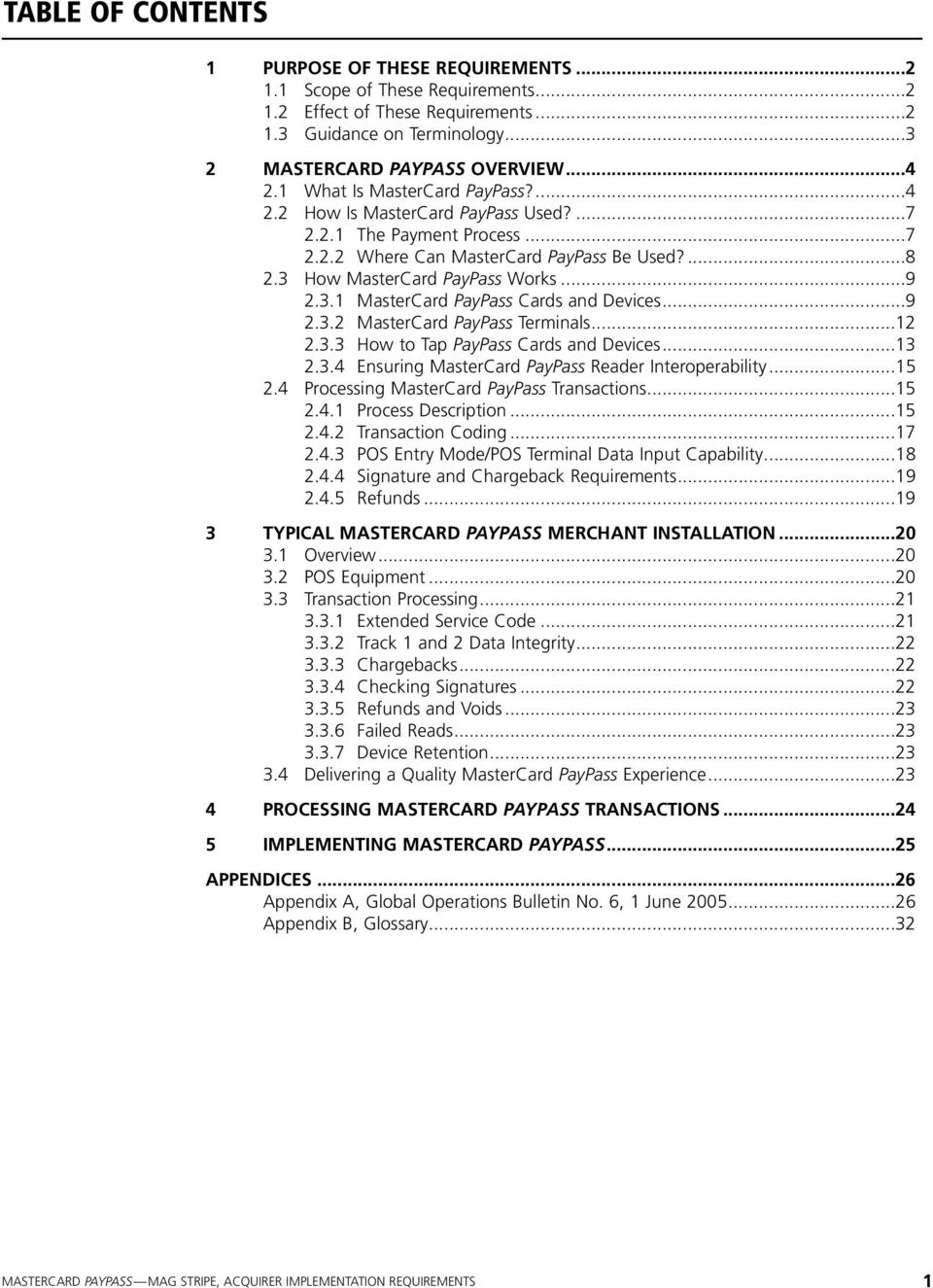
3 TABLE OF CONTENTS 1 PURPOSE OF THESE REQUIREMENTS Scope of These Requirements Effect of These Requirements Guidance on Terminology MASTERCARD PAYPASS OVERVIEW What Is MasterCard PayPass? How Is MasterCard PayPass Used? The Payment Process Where Can MasterCard PayPass Be Used? How MasterCard PayPass Works MasterCard PayPass Cards and Devices MasterCard PayPass Terminals How to Tap PayPass Cards and Devices Ensuring MasterCard PayPass Reader Interoperability Processing MasterCard PayPass Transactions Process Description Transaction Coding POS Entry Mode/POS Terminal Data Input Capability Signature and Chargeback Requirements Refunds TYPICAL MASTERCARD PAYPASS MERCHANT INSTALLATION Overview POS Equipment Transaction Processing Extended Service Code Track 1 and 2 Data Integrity Chargebacks Checking Signatures Refunds and Voids Failed Reads Device Retention Delivering a Quality MasterCard PayPass Experience PROCESSING MASTERCARD PAYPASS TRANSACTIONS IMPLEMENTING MASTERCARD PAYPASS...25 APPENDICES...26 Appendix A, Global Operations Bulletin No. 6, 1 June Appendix B, Glossary...32 MASTERCARD PAYPASS MAG STRIPE, ACQUIRER IMPLEMENTATION REQUIREMENTS 1
4 1.PURPOSE OF THESE REQUIREMENTS The purpose of this document is to help MasterCard acquirers implement MasterCard s PayPass program. PayPass enables consumers to either tap their PayPass card or device on PayPass-enabled terminals or use the PayPass card s traditional magnetic stripe at all other MasterCard locations. These requirements will: Help acquirers to understand, implement, and support PayPass card or device acceptance. Explain the differences between PayPass cards or devices and traditional magnetic stripe cards. Help plan and implement a successful project to realize these benefits. 1.1 Scope of These Requirements These requirements are limited to the implementation of MasterCard PayPass Mag Stripe. This is the version of PayPass intended for use where transactions are predominantly authorized online, such as in North America. It does not describe how to implement other MasterCard chip applications or M/Chip functions. It describes the incremental changes required to enable merchants point-of-sale (POS) systems to accept PayPass transactions. These requirements should be used during the implementation phase of enabling PayPass processing, after the decision to support MasterCard PayPass transactions has been made. For those acquirers that provide equipment and support to merchants, detailed requirements for merchant implementation can be found in the MasterCard PayPass Merchant Implementation Requirements. 1.2 Effect of These Requirements These requirements are intended to provide general guidance to help MasterCard acquirers accept PayPass contactless transactions. The responsibility for the content and execution of any implementation will remain with the acquirer. To the extent permitted by law, neither MasterCard International nor any of its affiliates, employees, or offices shall be liable to any recipient of these requirements, or any other third party for any loss, damages (including direct, special, punitive, exemplary, incidental, or consequential damages), or costs (including attorneys fees) which arise out of, or are related to, these requirements. The foregoing limitation of liability shall apply to any claim or cause of action under law or equity whatsoever, including contract, warranty, strict liability, or negligence, even if MasterCard has been notified of the possibility of such damages or claim. Where these requirements refer to the availability of services and/or documentation from MasterCard, the terms on which such services or documentation are made available shall be specified by MasterCard as and when such services or documentation are requested. 2 MASTERCARD PAYPASS MAG STRIPE, ACQUIRER IMPLEMENTATION REQUIREMENTS
5 These requirements must be kept strictly confidential and must not be disclosed to any third party save to such of your employees as are required to have access to the same in the performance of their duties. Save as above, these requirements may not be duplicated, published, or disclosed in whole or part without the written permission of MasterCard International Incorporated. 1.3 Guidance on Terminology Due to the legacy of the plastic card industry and the fact that the first PayPass-compliant form factor is card based, the term card is used frequently throughout. However, the contactless nature of PayPass permits non-card form factors. These are referred to as PayPass devices. The functionality of both PayPass cards and devices is driven by the chip inside and is independent of the form factor in which the chip resides, therefore the default reference for the consumer token in this document is either PayPass card or PayPass card or device. Where there are specific requirements or considerations resulting from the form factor, then this will be clear from the use of the reference device. All other terms are detailed in Appendix B, Glossary. MASTERCARD PAYPASS MAG STRIPE, ACQUIRER IMPLEMENTATION REQUIREMENTS 3
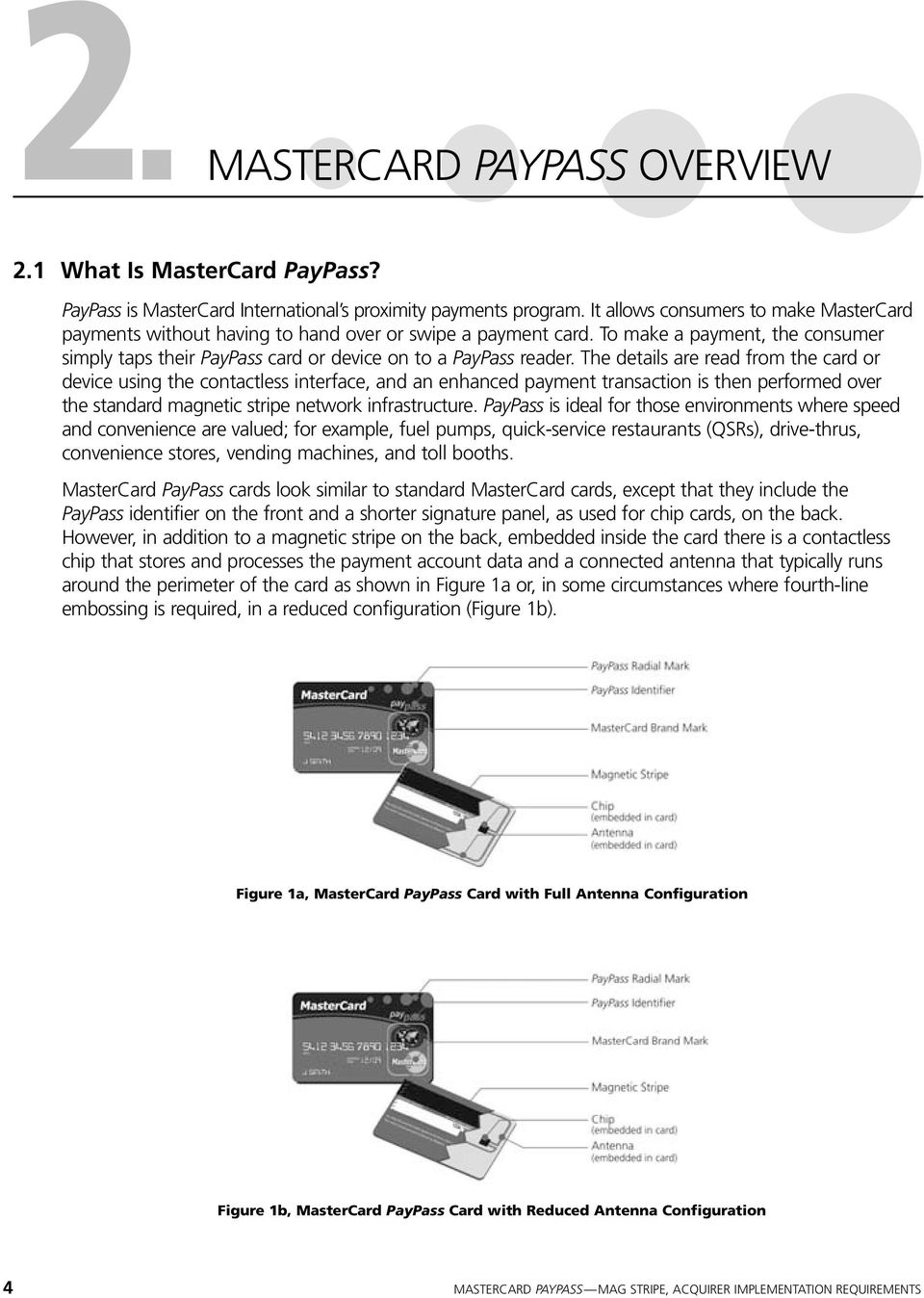
6 2.MASTERCARD PAYPASS OVERVIEW 2.1 What Is MasterCard PayPass? PayPass is MasterCard International s proximity payments program. It allows consumers to make MasterCard payments without having to hand over or swipe a payment card. To make a payment, the consumer simply taps their PayPass card or device on to a PayPass reader. The details are read from the card or device using the contactless interface, and an enhanced payment transaction is then performed over the standard magnetic stripe network infrastructure. PayPass is ideal for those environments where speed and convenience are valued; for example, fuel pumps, quick-service restaurants (QSRs), drive-thrus, convenience stores, vending machines, and toll booths. MasterCard PayPass cards look similar to standard MasterCard cards, except that they include the PayPass identifier on the front and a shorter signature panel, as used for chip cards, on the back. However, in addition to a magnetic stripe on the back, embedded inside the card there is a contactless chip that stores and processes the payment account data and a connected antenna that typically runs around the perimeter of the card as shown in Figure 1a or, in some circumstances where fourth-line embossing is required, in a reduced configuration (Figure 1b). Figure 1a, MasterCard PayPass Card with Full Antenna Configuration Figure 1b, MasterCard PayPass Card with Reduced Antenna Configuration 4 MASTERCARD PAYPASS MAG STRIPE, ACQUIRER IMPLEMENTATION REQUIREMENTS
7 PayPass devices are available in a variety of forms, from the traditional card introduced above to smallersized 2D and 3D key fobs. In fact, PayPass devices have the potential to be a wide range of shapes and sizes. The design choice resides with the financial institution issuing the device to the consumer. While the external shape and size can vary, the internal workings of all PayPass devices are similar. Each device contains a chip that stores and processes account data along with an antenna that is used to transmit data through the air to the PayPass reader, and from the reader to the card or device. The antenna is connected to the chip and, typically, runs near the inside perimeter of the card or device. PayPass devices (2D and 3D fobs) typically make use of the same chip and application software as PayPass cards, but with the chip and antenna contained in a different housing. PayPass devices conduct MasterCard PayPass transactions in the same way as PayPass cards. To make a payment, a PayPass device is tapped on a PayPass reader in the same way a PayPass card would be. PayPass readers do not need to be changed to accept PayPass device-initiated transactions. Examples of two potential PayPass device designs, a 2D fob and 3D fob, are illustrated below: Figure 2, MasterCard PayPass 2D Fob Figure 3, MasterCard PayPass 3D Fob MASTERCARD PAYPASS MAG STRIPE, ACQUIRER IMPLEMENTATION REQUIREMENTS 5

8 2. MASTERCARD PAYPASS OVERVIEW MasterCard PayPass consumers simply tap their card or device on the PayPass reader (read starts typically within 1.5 inches or 4 cm). The PayPass landing zone, where consumers should tap their card or device, is clearly indicated by the PayPass landing zone identifier, an example of which is shown in Figure 7. Figure 4, MasterCard PayPass Device Presentation MasterCard PayPass readers include an antenna and connected electronics that allow a PayPass card or device to be read. These readers may be integrated within a payment terminal or stand alone. MasterCard PayPass capable POS terminals therefore may support acceptance of both traditional magnetic stripe and PayPass, or PayPass-only transactions. Examples of both types are shown below. Combined Magnetic Stripe Terminal and PayPass Reader (with PIN pad and electronic signature capture display) PayPass-only Reader Used to provide PayPass and magnetic stripe acceptance at POS Used to provide PayPassonly acceptance at POS Figure 5, MasterCard PayPass POS Equipment 6 MASTERCARD PAYPASS MAG STRIPE, ACQUIRER IMPLEMENTATION REQUIREMENTS

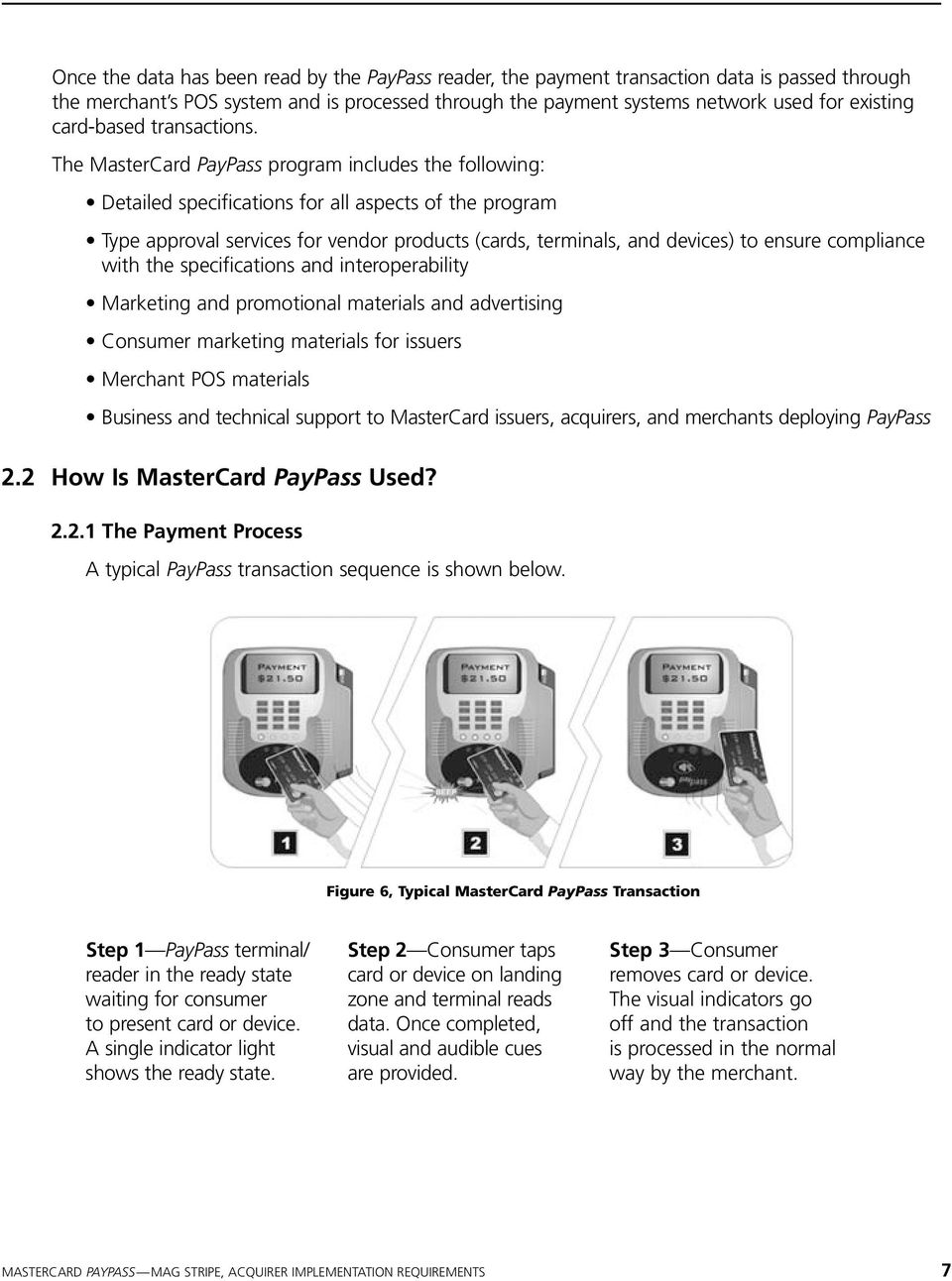
9 Once the data has been read by the PayPass reader, the payment transaction data is passed through the merchant s POS system and is processed through the payment systems network used for existing card-based transactions. The MasterCard PayPass program includes the following: Detailed specifications for all aspects of the program Type approval services for vendor products (cards, terminals, and devices) to ensure compliance with the specifications and interoperability Marketing and promotional materials and advertising Consumer marketing materials for issuers Merchant POS materials Business and technical support to MasterCard issuers, acquirers, and merchants deploying PayPass 2.2 How Is MasterCard PayPass Used? The Payment Process A typical PayPass transaction sequence is shown below. Figure 6, Typical MasterCard PayPass Transaction Step 1 PayPass terminal/ reader in the ready state waiting for consumer to present card or device. A single indicator light shows the ready state. Step 2 Consumer taps card or device on landing zone and terminal reads data. Once completed, visual and audible cues are provided. Step 3 Consumer removes card or device. The visual indicators go off and the transaction is processed in the normal way by the merchant. MASTERCARD PAYPASS MAG STRIPE, ACQUIRER IMPLEMENTATION REQUIREMENTS 7
10 2. MASTERCARD PAYPASS OVERVIEW All PayPass terminals must identify where a customer must tap their PayPass card or device to achieve a successful read; this identified area is referred to as the landing zone. Figure 7, Example of a MasterCard PayPass Landing Zone Identifier The landing zone must be a clearly distinguishable area on the terminal. To ensure a consistent approach of identifying the landing zone, the contactless symbol must be placed in the center of the landing zone in a position on the terminal that indicates the strongest part of the radio frequency signal that the terminal generates, referred to as the operating volume, to read the PayPass card or device. If space permits, MasterCard PayPass and other scheme branding may also be placed on the landing zone as long as branding rules are maintained and the contactless symbol is not obscured in any way and continues to indicate the center of the landing zone. If space on the landing zone does not permit scheme branding to be included, then this should be placed in such a way as not to detract the customer from identifying the contactless symbol and the landing zone. MasterCard PayPass terminal product approval uses the contactless symbol during testing to identify the landing zone and test that the center of the contactless symbol is positioned directly over the strongest part of the operating volume Where Can MasterCard PayPass Be Used? The MasterCard PayPass contactless functionality can be used at any merchant location that has installed PayPass terminals. The merchant segments where PayPass is expected to be most attractive include: QSRs/Fast Food Restaurants (MCC 5814) Movie Theaters (MCC 7832) Parking Lots (MCC 7523) Convenience Stores/Vending Machines (MCC 5499) Drug Stores/Pharmacies (MCC 5912) Gas Stations/Petroleum (pay-at-the-pump and in-store) (MCC 5541) Video Rental Stores (MCC 7841) Bookstores (MCC 5942) Music Stores (MCC 5735) Newsstands (MCC 5994) Grocery Stores/Supermarkets (MCC 5411) Dry Cleaners (MCC 7216) 8 MASTERCARD PAYPASS MAG STRIPE, ACQUIRER IMPLEMENTATION REQUIREMENTS

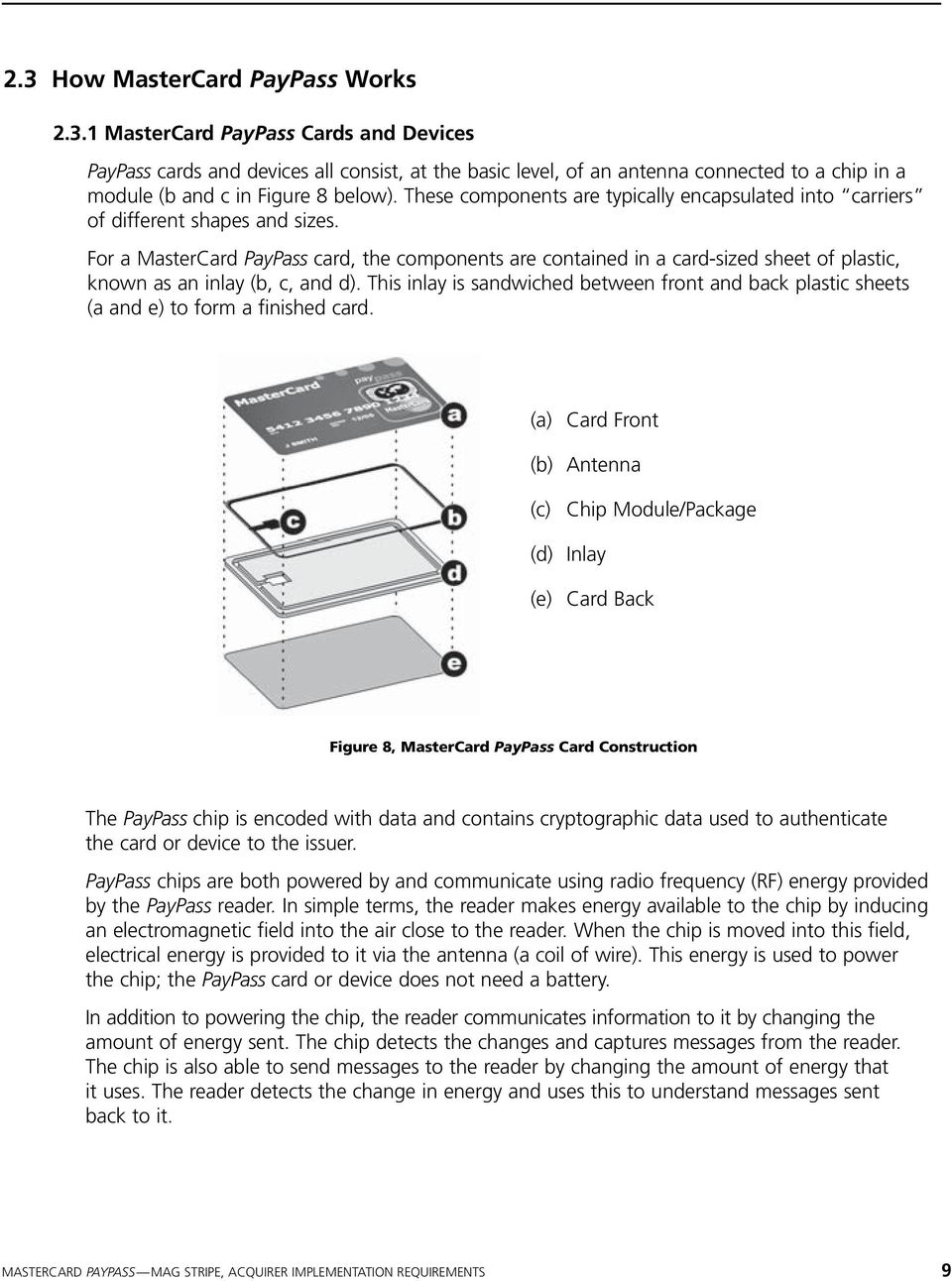
11 2.3 How MasterCard PayPass Works MasterCard PayPass Cards and Devices PayPass cards and devices all consist, at the basic level, of an antenna connected to a chip in a module (b and c in Figure 8 below). These components are typically encapsulated into carriers of different shapes and sizes. For a MasterCard PayPass card, the components are contained in a card-sized sheet of plastic, known as an inlay (b, c, and d). This inlay is sandwiched between front and back plastic sheets (a and e) to form a finished card. (a) Card Front (b) Antenna (c) Chip Module/Package (d) Inlay (e) Card Back Figure 8, MasterCard PayPass Card Construction The PayPass chip is encoded with data and contains cryptographic data used to authenticate the card or device to the issuer. PayPass chips are both powered by and communicate using radio frequency (RF) energy provided by the PayPass reader. In simple terms, the reader makes energy available to the chip by inducing an electromagnetic field into the air close to the reader. When the chip is moved into this field, electrical energy is provided to it via the antenna (a coil of wire). This energy is used to power the chip; the PayPass card or device does not need a battery. In addition to powering the chip, the reader communicates information to it by changing the amount of energy sent. The chip detects the changes and captures messages from the reader. The chip is also able to send messages to the reader by changing the amount of energy that it uses. The reader detects the change in energy and uses this to understand messages sent back to it. MASTERCARD PAYPASS MAG STRIPE, ACQUIRER IMPLEMENTATION REQUIREMENTS 9
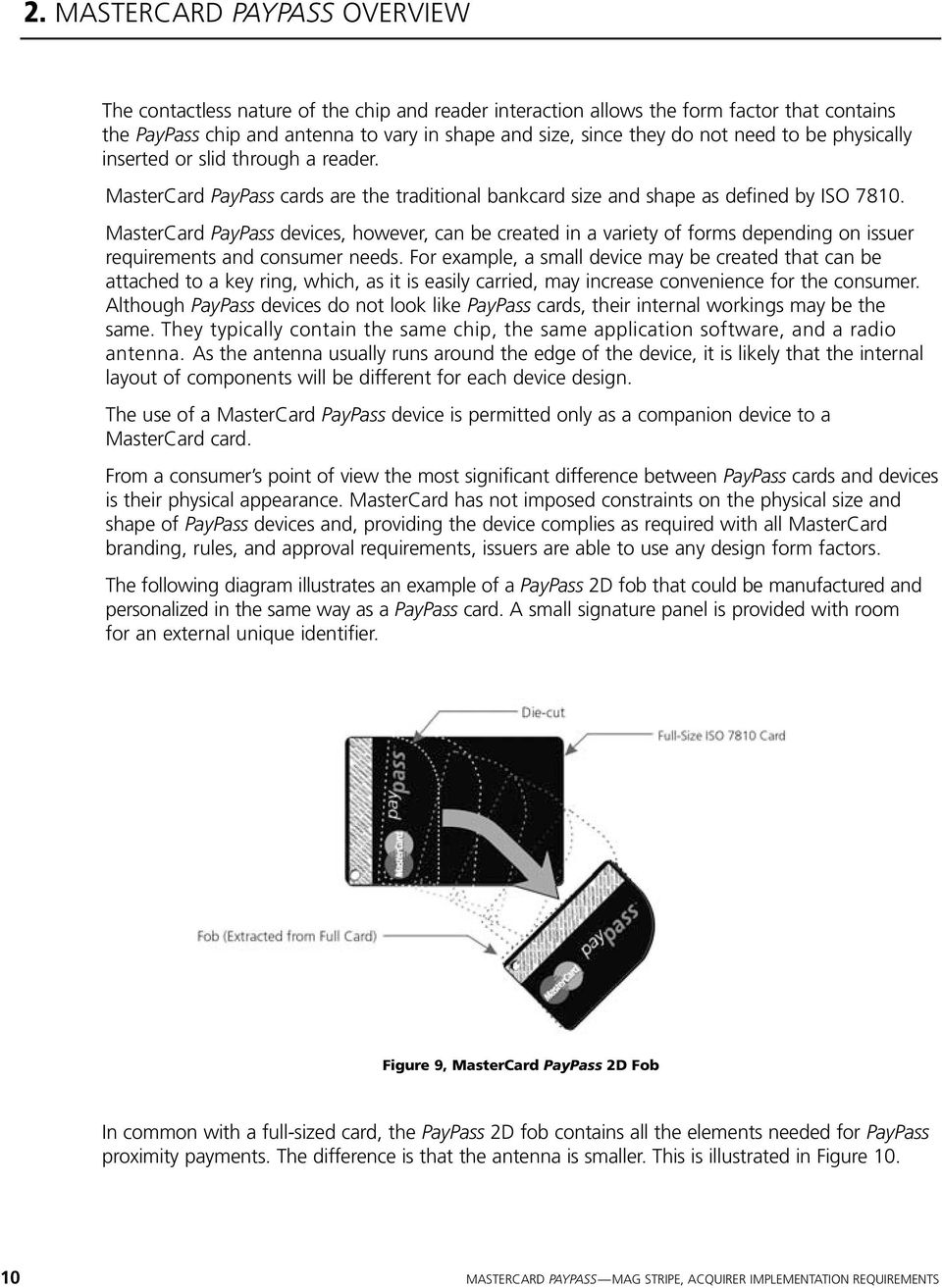
12 2. MASTERCARD PAYPASS OVERVIEW The contactless nature of the chip and reader interaction allows the form factor that contains the PayPass chip and antenna to vary in shape and size, since they do not need to be physically inserted or slid through a reader. MasterCard PayPass cards are the traditional bankcard size and shape as defined by ISO MasterCard PayPass devices, however, can be created in a variety of forms depending on issuer requirements and consumer needs. For example, a small device may be created that can be attached to a key ring, which, as it is easily carried, may increase convenience for the consumer. Although PayPass devices do not look like PayPass cards, their internal workings may be the same. They typically contain the same chip, the same application software, and a radio antenna. As the antenna usually runs around the edge of the device, it is likely that the internal layout of components will be different for each device design. The use of a MasterCard PayPass device is permitted only as a companion device to a MasterCard card. From a consumer s point of view the most significant difference between PayPass cards and devices is their physical appearance. MasterCard has not imposed constraints on the physical size and shape of PayPass devices and, providing the device complies as required with all MasterCard branding, rules, and approval requirements, issuers are able to use any design form factors. The following diagram illustrates an example of a PayPass 2D fob that could be manufactured and personalized in the same way as a PayPass card. A small signature panel is provided with room for an external unique identifier. Figure 9, MasterCard PayPass 2D Fob In common with a full-sized card, the PayPass 2D fob contains all the elements needed for PayPass proximity payments. The difference is that the antenna is smaller. This is illustrated in Figure MASTERCARD PAYPASS MAG STRIPE, ACQUIRER IMPLEMENTATION REQUIREMENTS
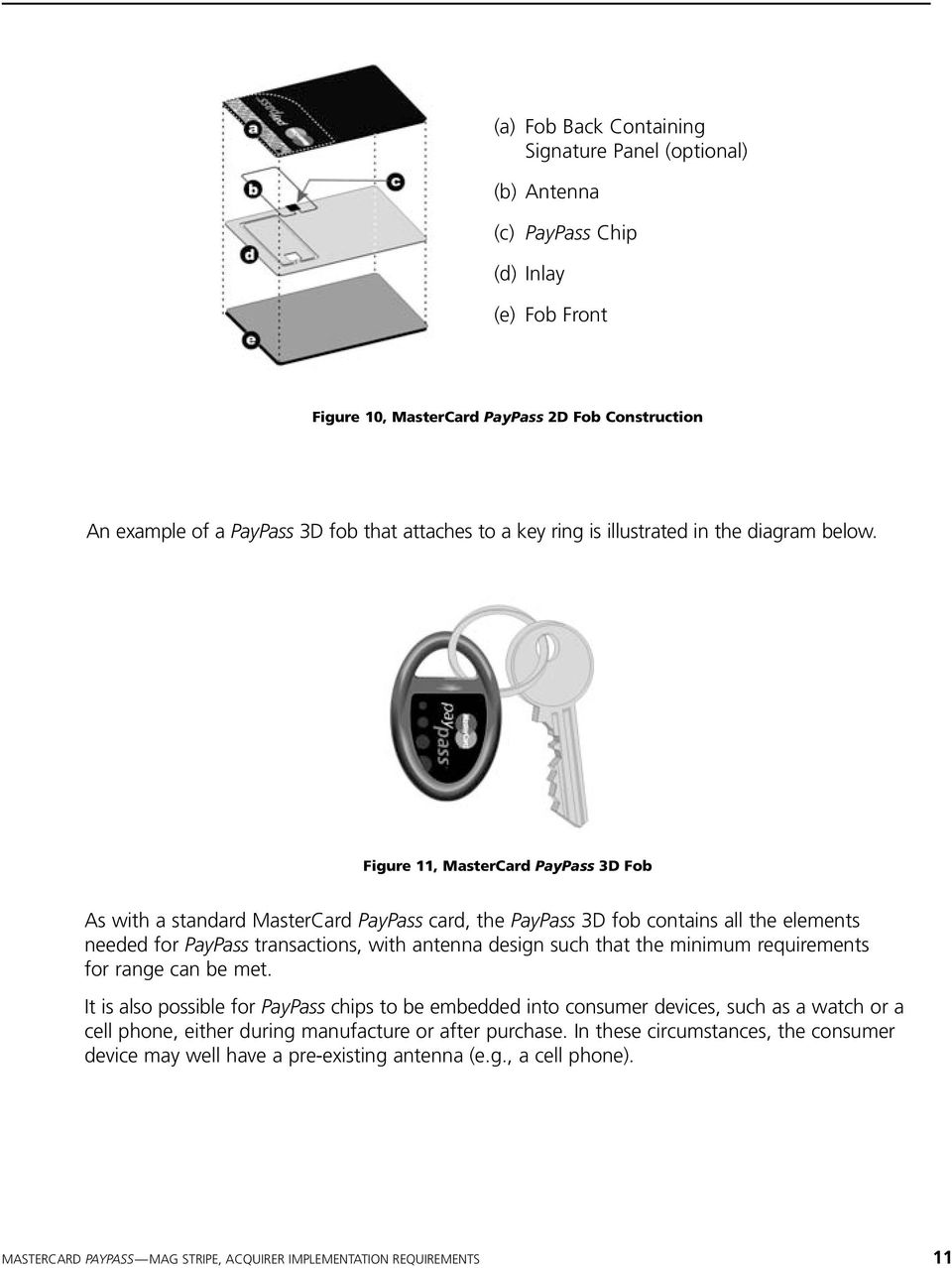
13 (a) Fob Back Containing Signature Panel (optional) (b) Antenna (c) PayPass Chip (d) Inlay (e) Fob Front Figure 10, MasterCard PayPass 2D Fob Construction An example of a PayPass 3D fob that attaches to a key ring is illustrated in the diagram below. Figure 11, MasterCard PayPass 3D Fob As with a standard MasterCard PayPass card, the PayPass 3D fob contains all the elements needed for PayPass transactions, with antenna design such that the minimum requirements for range can be met. It is also possible for PayPass chips to be embedded into consumer devices, such as a watch or a cell phone, either during manufacture or after purchase. In these circumstances, the consumer device may well have a pre-existing antenna (e.g., a cell phone). MASTERCARD PAYPASS MAG STRIPE, ACQUIRER IMPLEMENTATION REQUIREMENTS 11
14 2. MASTERCARD PAYPASS OVERVIEW MasterCard PayPass Terminals Information communicated by the PayPass chip is taken by a PayPass reader, formatted appropriately, and then processed through the merchant s existing POS systems for authorization, clearing, and settlement. All MasterCard PayPass terminals utilize a common user interface to provide a consistent consumer and merchant experience. This ensures that consumers and merchants always know what to expect at the POS when using PayPass. This is a key element in making PayPass The Simpler Way to Pay. Audiovisual cues are used to guide consumers through a PayPass transaction, as follows: 1) Ready State The PayPass terminal is in the ready state when a single indicator light shows. This indicates that the PayPass reader is ready to accept a PayPass card or device. 2) Reading The PayPass reader detects that a MasterCard PayPass card or device is present and reads the data required for processing the transaction. PayPass reading range is typically 1.5 inches (4 cm). 3) Completion State Once the PayPass card or device has been read (this typically takes 0.2 seconds), the terminal will display a sequence of visual indicators, and a sound cue, usually a number of beeps, is heard. Once all visual indicators are lit, they will stay on for approximately 0.3 seconds, during which the sound cue can also be heard. This indicates that the consumer can remove the PayPass card or device. 4) Final End State or Error Soon after the PayPass chip is read, the terminal returns to the ready state, waiting for the appearance of a new PayPass card or device. In some cases, the PayPass reader may fail to read the card or device (e.g., if it is not PayPass capable or if more than one PayPass card or device is detected). In this case, neither visual nor audible cues will operate and the PayPass terminal will remain in the ready state. Figure 12, Typical MasterCard PayPass Terminal Audiovisual Sequence 12 MASTERCARD PAYPASS MAG STRIPE, ACQUIRER IMPLEMENTATION REQUIREMENTS

15 While the reader indicates a successful read using visual and audible cues, it is important to remember that a successful read is only the first step in a payment transaction. The PayPass visual and audible cues do not indicate that the transaction has been authorized, just that the PayPass read process is complete and the consumer can remove their card or device from the reader. The authorization is indicated by the POS equipment in the same manner as for all MasterCard-based transactions How to Tap PayPass Cards and Devices In order for PayPass cards and devices to be read, they must be presented to the PayPass terminal in the correct manner as shown in Figure 13 (a and b) below. This is where the card or device is in the center of the landing zone and is close to being flat against the universal contactless symbol shown in Figure 13(c). a) Correct almost-flat presentation for PayPass card b) Correct presentation (keys and other contactless devices held away from the terminal) for PayPass fob c) Universal contactless symbol Figure 13, Correct Presentations of PayPass Cards and Devices MASTERCARD PAYPASS MAG STRIPE, ACQUIRER IMPLEMENTATION REQUIREMENTS 13

16 2. MASTERCARD PAYPASS OVERVIEW Presenting a PayPass card or device on edge to the landing zone (Figure 14 [a and b]), as if cutting it with a knife, or with other PayPass cards or devices or other non-paypass contactless cards or devices at the same time (Figure 14[c]) is incorrect; only the PayPass card or device to be used should be presented. a) Incorrect on-edge card presentation b) Incorrect on-edge device presentation c) Incorrect presentation: only the PayPass card or device to be used should be presented, e.g., a wallet/purse with multiple cards should not be presented. Figure 14, Incorrect Presentations of PayPass Cards and Devices If a PayPass card or device is attached to a bunch of keys, other metallic objects, or other contactless devices as shown in Figure 15, these should all be kept away from the terminal, typically in the palm of the user s hand. If keys or other contactless devices are presented to the PayPass terminal they may interfere with the reading of the device being presented. Incorrect presentation: other metallic objects or other contactless devices should all be kept away from the terminal, typically in the palm of the user s hand. Figure 15, Incorrect Presentation of Other Object or Contactless Device The likelihood of a terminal read error will be greatly diminished if the guidelines above are followed. 14 MASTERCARD PAYPASS MAG STRIPE, ACQUIRER IMPLEMENTATION REQUIREMENTS

17 2.3.4 Ensuring MasterCard PayPass Interoperability PayPass cards, devices, readers, and terminals are manufactured by multiple vendors. To ensure that all PayPass cards and devices work with all PayPass readers, MasterCard provides detailed specifications and requires vendors to submit products for type approval testing before deploying these into the marketplace. The MasterCard PayPass specifications are based on international standards for contactless chip cards, namely the ISO/IEC standard. The detailed MasterCard PayPass specifications, available to licensees, can be obtained by sending an request to 2.4 Processing MasterCard PayPass Transactions Process Description Once a card or device has been read, the authorization message is transmitted to the acquirer in the same way as a traditional magnetic stripe transaction. While no new data protocols are necessary, it is important to note the following aspects of MasterCard PayPass transaction processing: Transaction Authorization and Clearing These process flows are the same as for magnetic stripe transactions or M/Chip transactions. Transaction Coding PayPass is designed to have minimal impact on merchants and acquirers existing systems. Merchants do, however, need to ensure that their acquirer has up-to-date information on PayPass terminal capability, that PayPass transactions are coded correctly, and that the acquirer has completed end-to-end testing with MasterCard CIS to ensure data element compliance with credit, signature debit, and PIN debit transactions. (More detail on transaction coding is provided in Section 2.4.2, Transaction Coding.) Existing Payment Program Rules PayPass improves the process for reading the payment account data and can be used with different payment products. However, it is important to remember that the rules applying to these underlying payment programs must still be observed. Therefore, if the underlying payment program requires that the consumer sign a receipt or enter a PIN, then all participants in the payment process must comply with these requirements. MASTERCARD PAYPASS MAG STRIPE, ACQUIRER IMPLEMENTATION REQUIREMENTS 15
18 2. MASTERCARD PAYPASS OVERVIEW A typical PayPass transaction is shown in the sequence below: 1 Transaction amount sent to PayPass-enabled consumer-facing terminal (CFT) a from the electronic cash register (ECR) b. The CFT a is connected to the ECR via a cable c so that dual amount entry is not required. 2i 2ii 2iii Consumer presents device to CFT. PayPass reader reads data from the PayPass device in 0.2 seconds. PayPass device is removed. 3 If required, consumer enters PIN for online verification. This is submitted as part of the online authorization process detailed next. 4 Online authorization of the transaction is obtained (via high-speed connection such as a DSL modem) from the payment acquirer d. 5 When required, a receipt is printed 5i and a consumer signature is physically 5ii or electronically captured 5iii. Figure 16, Typical MasterCard PayPass Transaction Including Authorization REQUIREMENT MasterCard PayPass transactions must be processed online to realize full risk management capabilities. 16 MASTERCARD PAYPASS MAG STRIPE, ACQUIRER IMPLEMENTATION REQUIREMENTS

19 MasterCard PayPass transactions are passed from the merchant to the payment account issuer via the merchant acquirer in the normal way, consistent with the rules for the underlying payment program. The only difference is that the transaction is coded to indicate a PayPass-read transaction using the correct POS entry mode and Terminal Data Input Capability values in the relevant data elements within the various MasterCard network messages. These values are used by the MasterCard payment account issuer to identify and differentiate PayPass-read transactions from magnetic stripe read transactions and to allow appropriate risk management decisions to be made Transaction Coding It is important from a risk management and information management perspective that MasterCard PayPass transactions and PayPass terminal capability can be identified from transaction data. Issuers, acquirers, merchants, and MasterCard require information on the entry mode for each transaction and the POS terminal capability to: Identify and prevent fraud at the merchant. Monitor usage of cards, devices, and terminals. Track terminal PayPass capability. Measure return on investment in enabling cards or devices and POS terminals. Manage chargeback processing. To facilitate the above, the POS system must include new values in certain existing data elements in the authorization and clearing records. The appropriate Banknet and GCMS messages must be populated with the corresponding POS entry mode. It is also important to indicate whether the POS is PayPass-enabled or not (regardless of how a transaction is initiated). REQUIREMENT Correct coding and processing of MasterCard PayPass transactions and terminal capability are mandatory for all PayPass authorization and clearing messages. MASTERCARD PAYPASS MAG STRIPE, ACQUIRER IMPLEMENTATION REQUIREMENTS 17
20 2. MASTERCARD PAYPASS OVERVIEW POS Entry Mode/POS Terminal Data Input Capability Merchant POS systems must provide the information needed by acquirers to populate data elements that indicate a PayPass transaction. Merchants must ensure that: POS equipment communicates the POS entry mode (contactless, swiped, or keyed) to their acquirer. Acquirers must ensure that: Merchants are fully aware of the capabilities of each terminal, particularly those that are enabled to accept PayPass cards or devices. They correctly code and pass the Banknet and GCMS messages to indicate the correct POS entry mode (contactless, swiped, or keyed). They correctly code transactions to indicate that a terminal is able to accept PayPass cards or devices. This is normally done by the acquirer managing a list of terminal capabilities against the terminal identification number. PayPass issuers must ensure that: Their systems can correctly receive and process the messages containing the POS entry mode (DE 22) and POS Terminal Device Data Input Capability (DE 61) data elements and make appropriate authorization decisions. More Information Details of the above requirements can be found in Section 6 of the MasterCard PayPass Product Guide (available by sending an to [email protected]) and in the appendices of these requirements as noted: Appendix A, Data Element Values for MasterCard PayPass, Global Operations Bulletin No. 6, 1 June 2005, pp MASTERCARD PAYPASS MAG STRIPE, ACQUIRER IMPLEMENTATION REQUIREMENTS

21 2.4.4 Signature and Chargeback Requirements The rules governing PayPass-read payment transactions are dictated by the rules of the payment product (credit, debit, etc.) referenced by the account number on the PayPass card or device, and the rules governing acceptance in the merchant location where the transaction occurs. While the fundamentals of a transaction remain the same, the physical characteristics of PayPass devices may introduce some differences in the overall payment process for example, when making a purchase, a PayPass card or device remains in the possession of the consumer throughout the transaction, and the device itself may not have a signature panel, making signature verification challenging. These variations have been accommodated by changes to the rules governing the underlying payment product. A signature is not required and a receipt is optional for a transaction equal to or less than the equivalent of US $25 undertaken using a PayPass card or device. PIN may be required for debit. A properly identified PayPass transaction (magnetic stripe-read or M/Chip-read), equal to or less than the equivalent of US $25, is protected against chargebacks under the following reason codes: Message Reason Code Description 4801 Requested Transaction Data Not Received 4802 Requested/Required Information Illegible or Missing 4837 No Cardholder Authorization NOTE For Quick Payment Service (QPS) registered merchants who accept PayPass, the QPS program supersedes the PayPass rules. For more information on the QPS program, please refer to the QPS Manual Refunds The processes associated with MasterCard PayPass transactions are identical to those for traditional magnetic stripe card read transactions. Therefore, if a consumer is entitled to a refund or if a transaction needs to be voided, existing processes apply. One of the requirements for refunds is that the originating card or device be used at the time of the refund. This requirement is unchanged; the PayPass card or device should be used to process refunds. Merchants must ensure that the consumer refund service area is suitably equipped with PayPass terminals. MASTERCARD PAYPASS MAG STRIPE, ACQUIRER IMPLEMENTATION REQUIREMENTS 19
22 3. TYPICAL MASTERCARD PAYPASS MERCHANT INSTALLATION 3.1 Overview MasterCard PayPass has been designed to limit the impact on existing acceptance processes and equipment as far as possible. However, to achieve the desired benefits of using the PayPass technology, the merchant should consider a number of factors in how to implement it. This section outlines a typical merchant installation as an illustration of the key hardware components that will be needed, and then discusses key aspects of the payment transaction that may require different processing from what might have been implemented for traditional magnetic stripe read transactions. In reading the following subsections, it should be remembered that PayPass is basically an alternative to magnetic stripe read in transferring payment account details from consumer to merchant. All the underlying payment account acceptance rules remain unchanged. This means that the merchant should expect to see all of MasterCard s payment programs using PayPass technology and will need to follow the program rules pertaining to these programs in processing PayPass transactions. 3.2 POS Equipment A typical merchant installation involves integrating a MasterCard PayPass capable terminal into the POS environment, as shown below: Figure 17, A Typical MasterCard PayPass Enabled POS PayPass Terminal For merchants that currently accept payment cards, implementing PayPass involves adding PayPass terminals or readers to existing POS equipment, such as ECRs and magnetic stripe terminals. Merchants may consider replacing existing POS terminals with new ones that have integrated PayPass support, or installing new POS equipment configured to support PayPass. For merchants that do not currently accept payment cards, implementing PayPass involves installing new PayPass-enabled POS equipment. MasterCard recommends use of POS terminals with integrated PayPass support. 20 MASTERCARD PAYPASS MAG STRIPE, ACQUIRER IMPLEMENTATION REQUIREMENTS
23 Connecting a PayPass reader to an existing magnetic stripe terminal using any form of dynamic magnetic stripe or magnetic induction coupling to the existing magnetic strip reader is not permitted by MasterCard. High-Speed Connection The benefits of MasterCard PayPass are maximized when used with high-speed authorization lines such as DSL, V-SAT, leased lines, cable modems, and other high-speed connections. As such, PayPass merchant telecom lines must support a transaction (authorization) time of less than 4 seconds. ECR If the merchant is using a separate ECR and POS terminal, then connecting these is required. This integration eliminates the need for dual-amount entry by the clerk and is a key time-saver in the PayPass transaction process. Fast Receipt Printer While no changes to the ECR may be required, a high-speed receipt printer is highly recommended, one that typically prints a receipt in less than 2 seconds; a key advantage of PayPass lies in speed and convenience, and a slow receipt printer adds to the overall transaction time. REQUIREMENTS The automatic communication of the purchase amount to the POS terminal is required. This eliminates the need for dual entry. High-speed authorization connections (e.g., broadband or DSL) are required to ensure merchants and consumers realize the optimal speed benefits of PayPass at the POS. PayPass merchant telecom lines should support an authorization time of less than 4 seconds. Separate PayPass readers/coupling devices must have a physical cable connection to any existing POS terminal. Magnetic induction coupling is not permitted. RECOMMENDATION The use of high-speed receipt printers is highly recommended; a key advantage of PayPass lies in its speed and convenience and a slow receipt printer adds to the overall transaction time for the merchant and consumer. 3.3 Transaction Processing Extended Service Code MasterCard PayPass card or device issuers may choose to use extended service code values in the PayPass chip different from those typically used for magnetic stripe cards. For this reason acquirers must ensure that: Their processing systems support extended service codes. All merchant POS solutions allow the use of extended service codes. MASTERCARD PAYPASS MAG STRIPE, ACQUIRER IMPLEMENTATION REQUIREMENTS 21
24 3. TYPICAL MASTERCARD PAYPASS MERCHANT INSTALLATION NOTE Test cards or devices provided by MasterCard will check that cards or devices with specific extended service codes are processed correctly, but it is the merchant s and acquirer s responsibility to ensure full compliance with this requirement in accordance with MasterCard rules Track 1 and 2 Data Integrity Some existing POS systems collect Track 1 data, truncate it, and process it as Track 2; however, PayPass Track 1 and 2 data may be different. For this reason, merchants and acquirers must make sure that Track 1 data is processed as Track 1 and Track 2 data is processed as Track 2. If data from one track is presented as the other, this may cause the transaction to be rejected by the consumer s card issuer Chargebacks PayPass provides a new, faster, and more convenient entry mechanism for account details than that offered by traditional cards. Although the entry mode is new, transaction liability remains the same as for the underlying payment account when the payment is made with a magnetic stripe. A properly identified PayPass transaction (magnetic stripe-read or M/Chip-read), equal to or less than the equivalent of US $25, is protected against chargebacks under the following reason codes: Message Reason Code Description 4801 Requested Transaction Data Not Received 4802 Requested/Required Information Illegible or Missing 4837 No Cardholder Authorization For QPS registered merchants who accept PayPass, the QPS program supersedes the PayPass rules. For more information on the QPS program, please refer to the QPS Manual Checking Signatures While the fundamentals of a transaction remain the same, the physical characteristics of PayPass devices may introduce some differences in the overall payment process for example, when making a purchase, a PayPass card or device remains in the possession of the consumer throughout the transaction, and the device itself may not have a signature panel, making signature verification challenging. These variations have been accommodated by changes to the rules governing the underlying payment product. A signature is not required and a receipt is optional for a transaction equal to or less than the equivalent of US $25 undertaken using a PayPass card or device. PIN may be required for debit. If the consumer disputes a transaction needing a signature, the merchant is required to provide evidence that the accountholder performed the transaction. This requires that the merchant obtain a signature at the time of the transaction. MasterCard recommends that merchants retain evidence of consumer signatures in the normal way for all transactions that require them. 22 MASTERCARD PAYPASS MAG STRIPE, ACQUIRER IMPLEMENTATION REQUIREMENTS
25 3.3.5 Refunds and Voids The processes associated with payments are the same for MasterCard PayPass transactions as they are for traditional card transactions. Therefore, if a consumer is entitled to a refund or if a transaction needs to be voided, existing processes apply. One of the requirements for refunds is that the originating card be used at the time of the refund. This is the same for PayPass cards and devices. The PayPass card or device should be used to process refunds. Merchants must ensure that the refund consumer service area is suitably equipped with PayPass terminals Failed Reads As described in Section 2.3.2, at the end of a PayPass card or device read process, the MasterCard PayPass reader returns to the ready state approximately one second after a PayPass card or device has been read. In this state, the reader is waiting for the introduction of a new card or device. There are some instances when the reader may fail to read the card or device correctly. In these cases, the green lights do not light, the beep does not sound, and the reader remains in the ready state. A failed read can occur when: The consumer taps a card or device on the reader that is not PayPass enabled. The consumer taps more than one PayPass card or device on the reader at the same time. It is important to note that reading the PayPass card or device is the first step in a transaction, and that a green light and a beep do not indicate an authorized transaction. If appropriate, consumer verification (signature/pin) still has to be obtained by the merchant, the transaction still has to be submitted for authorization, and a response (either accept or decline) returned by the issuer Device Retention For traditional magnetic stripe cards that tend to be handed to the merchant to swipe, authorization messages returned by the issuer can instruct merchants to retain the consumer s card when there is a problem with the account. MasterCard PayPass cards and devices operate under the same rules for accounts as existing cards, which means authorization messages for issuers will still occur. Since the consumer remains in control of the PayPass card or device throughout the transaction, the opportunity for merchants to pick up or capture these cards or devices will be limited. Issuers are aware that the chances of a PayPass card or device being captured are low and are considering not using the capture card authorization response for transactions from PayPass cards and devices. 3.4 Delivering a Quality MasterCard PayPass Experience The requirements and recommendations identified in Sections 3.1 to 3.3 are key to delivering what MasterCard calls a quality MasterCard PayPass experience, namely, one where all elements of the payment process have been optimized for simplicity and speed. By making all MasterCard PayPass transactions a quality experience for all merchants and card or device users, the conversion of transactions from cash to card will be accelerated. MASTERCARD PAYPASS MAG STRIPE, ACQUIRER IMPLEMENTATION REQUIREMENTS 23
26 4.PROCESSING MASTERCARD PAYPASS TRANSACTIONS This section describes the payment processing requirements specific to MasterCard PayPass Mag Stripe transactions. A PayPass transaction is processed in the same way as a regular magnetic stripe transaction. The only difference is that it must be coded to indicate that it was tapped, as opposed to swiped or keyed, and to indicate if the POS was PayPass-enabled or not (regardless of how the transaction was initiated). Figure 18, MasterCard PayPass Payment Processing 1. MasterCard PayPass capable terminal reads PayPass card or device data and sends it for authorization. Data includes indication that transaction was tapped, swiped, or keyed. 2. High-speed authorization system transmits authorization request to the acquirer. 3. If not provided in the authorization message to the acquirer, the acquirer determines if the POS is PayPass enabled, for example using a terminal master file. 4. Acquirer codes the POS entry mode and terminal capability elements of the appropriate MasterCard authorization message as specified by MasterCard, using information from the terminal systems and the terminal master file. For PayPass transactions, the data will reflect that it was supplied by a terminal that is PayPass enabled and that the data was communicated via the terminal s contactless interface. The transaction is then transmitted to the card issuer via MasterCard s authorization network. 5. A similar process to 3 and 4 above occurs for the clearing request to MasterCard s systems. This data includes an indication of the transaction s POS entry mode (DE 22) and terminal capability (DE 61). The following MasterCard Global Operations Bulletin describes the coding requirements: No 6, 1 June MASTERCARD PAYPASS MAG STRIPE, ACQUIRER IMPLEMENTATION REQUIREMENTS
27 5.IMPLEMENTING MASTERCARD PAYPASS This section offers advice and guidance on implementing MasterCard PayPass. It explains what changes are needed to acquirers card payment processing/acquiring systems and processes in order to accept PayPass. MasterCard PayPass is designed to make use of existing authorization and clearing message formats in order to minimize the changes needed to be made by an acquirer. In order to support PayPass transaction processing, as described in Section 4, acquirers must typically complete the following: Register merchant, if eligible, in the MasterCard QPS program if they are not already registered. (The QPS program exists in a limited number of markets, including the U.S. and Canada, and is open to select merchant categories.) NOTE Not all merchant categories are eligible to join the QPS program but they can still support PayPass. Upgrade the merchant authorization connection to high-speed lines, if one is not already installed. Update records to reflect the extended terminal capability to indicate that the terminal can accept PayPass transactions. This record will be a reference point for acquirers to submit accurate values in the authorization and clearing messages. Support the requirement to populate the POS entry mode identifier by supplying entry mode information from POS terminal/ecr to processing systems. How this is achieved is up to the acquirer. Code the POS entry mode and POS Card Data Terminal Input Capability in the authorization and clearing records that are transmitted to MasterCard. Fully test the implementation to ensure that PayPass transactions are processed correctly. Update transaction reporting capabilities, including reports provided to merchants, to specifically identify PayPass transactions. Educate merchants on identifying PayPass cards and devices, especially on the fact that some devices may not have a traditional signature panel. Complete all necessary testing to gain MasterCard approval for each merchant implementation as defined in the current MasterCard PayPass Approval Processes for Acquirer and Merchant Implementations. MASTERCARD PAYPASS MAG STRIPE, ACQUIRER IMPLEMENTATION REQUIREMENTS 25
28 APPENDICES Appendix A, Global Operations Bulletin No. 6, 1 June MASTERCARD PAYPASS MAG STRIPE, ACQUIRER IMPLEMENTATION REQUIREMENTS
29 MASTERCARD PAYPASS MAG STRIPE, ACQUIRER IMPLEMENTATION REQUIREMENTS 27
30 APPENDICES Appendix A, Global Operations Bulletin No. 6, 1 June 2005 continued 28 MASTERCARD PAYPASS MAG STRIPE, ACQUIRER IMPLEMENTATION REQUIREMENTS
31 MASTERCARD PAYPASS MAG STRIPE, ACQUIRER IMPLEMENTATION REQUIREMENTS 29
32 APPENDICES Appendix A, Global Operations Bulletin No. 6, 1 June 2005 continued 30 MASTERCARD PAYPASS MAG STRIPE, ACQUIRER IMPLEMENTATION REQUIREMENTS
33 MASTERCARD PAYPASS MAG STRIPE, ACQUIRER IMPLEMENTATION REQUIREMENTS 31
34 APPENDICES Appendix B, Glossary Term 2D Device 2D Fob 3D Device 3D Fob 3DES Account Number Acquirer Antenna Application File Locator (AFL) Application Identifier (AID) Description This term is used to describe the physical characteristics of the device such that, as per traditional ISO 7810 cards, the length and breadth of the device are significantly greater than its thickness. The thickness is uniform across the device and is similar to ISO 7810 cards (e.g., a PayPass 2D fob device). A 2D PayPass device that is manufactured in the form of a traditional card (ISO 7810) but ends up as a different size and shape. Typically, a PayPass 2D fob will be either die-cut from a full-size card after personalization or a score is made in the card plastic such that it can be snapped out by the consumer after fulfillment. This term is used to describe the physical characteristics of the device such that, unlike traditional cards, the thickness of the device is noticeable and of similar magnitude to its other dimensions (e.g., a PayPass 3D fob device). A 3D PayPass device. Triple DES Cryptographic Algorithm. An enhanced cryptographic algorithm, based on the DES Cryptographic Algorithm, adopted by the National Bureau of Standards for Data Security. The 16-digit identifier of a credit or debit card. Member of MasterCard International involved in signing and servicing merchants that accept MasterCard. Coil of wire through which RF energy is provided. Identifies the records available to the application and the reference to their location in files in the chip card s memory. Identifier of an application in the chip card, coded in hexadecimal. 32 MASTERCARD PAYPASS MAG STRIPE, ACQUIRER IMPLEMENTATION REQUIREMENTS
35 Term Application Interchange Profile (AIP) Application Transaction Counter (ATC) Authorization Broadband Card Card Authentication Method (CAM) Card or Device Holder Card Verification Code 1 (CVC1) Card Verification Code 2 (CVC2) Card Verification Code 3 (CVC3) Certification Chargeback Clearing Description Indicator of the capabilities of the chip card to support specific functions. A mechanism for tracking the transactions done using a specific account; used to prevent fraudulent use or cloning of a card or device. The process of confirming that a payment account is valid and is approved. A network connection with capacity to send and receive large amounts of data relatively quickly (vs. dial-up). Plastic form factor compliant with ISO 7810 that contains a payment application coded on a magnetic stripe. Method used to verify that a card or device is genuinely the one issued to the consumer. See Consumer. A code contained in a card s magnetic stripe data that verifies a specific card is physically present at the POS; used to reduce the risk of counterfeiting fraud. Value generated by the issuer and printed on a signature panel on the back of the card; implemented for manual (visual) use during MOTO and e-commerce transactions. Value used in place of CVC1 in the Discretionary Data field of the Track 1 and 2 data for MasterCard PayPass transactions; usually a dynamic cryptogram generated by the card or device, but may be a static cryptogram. The process of confirming that a card, device, reader, terminal, or software application is approved for use. A transaction disputed by the consumer or issuer that is represented back to the merchant. The process of remitting a sales draft for settlement. MASTERCARD PAYPASS MAG STRIPE, ACQUIRER IMPLEMENTATION REQUIREMENTS 33
36 APPENDICES Appendix B, Glossary continued Term Companion Card Compute Cryptographic Checksum (CCC) Consumer Consumer Verification Method (CVM) Contactless Chip Data Element 22 Data Element 61 Electronic Cash Register (ECR) Embedded Device File Control Information (FCI) Floor Limit Form Factor Description An ISO-compliant MasterCard card with which a companion PayPass device shares a single MasterCard account relationship between the issuer and the consumer. Card/device command supported for PayPass Mag Stripe transactions; returns the CVC3 value for the transaction. The payment accountholder to whom the PayPass card or device is issued. Method used to verify the identity of the payment accountholder. The RF chip found inside a PayPass card or device; when connected to an antenna, it permits card or device transactions without swiping the magnetic stripe. The portion of a MasterCard authorization message that denotes how the account number was read/entered into the POS device (e.g., magnetic stripe read, key entered, read via a PayPass reader). The portion of a MasterCard authorization message that denotes the various capabilities of a POS terminal (e.g., equipped with mag stripe reader, smart card reader, etc.). Cash register that is integrated with payment acceptance tools and/or order system. A PayPass device that is manufactured to be contained in a consumer device such as a watch or a cell phone. The string of data bytes available in response to a SELECT command. The preset amount under which a transaction does not require online authorization. The physical characteristics of a device, including its size and shape. 34 MASTERCARD PAYPASS MAG STRIPE, ACQUIRER IMPLEMENTATION REQUIREMENTS
37 Term Help Desk Implementation Plan Integrated Circuit Card (ICC) International Standards Organization (ISO) Issuer Kiosks Linked Card Magnetic Stripe (Mag Stripe) Magnetic Stripe Reader (MSR) Member Merchant PayPass Application PayPass Card Description A call center dedicated to assisting users with a technology (e.g., a merchant help desk might provide information to merchants when they experience difficulty with a terminal). A plan that maps the implementation of a project and all the steps required to achieve this. The ISO/IEC term for a chip card/device or a smart card. An international organization that sets standards for technology to assure that products are interoperable from one country to the next. Member of MasterCard International that issues MasterCard payment accounts to their consumers. Locations where consumers interact with or without the oversight of a clerk or merchant staff person. See Companion Card. Reference to a conventional (ISO/IEC 7810) magnetic stripe as defined and used by the MasterCard network. The part that physically reads the data encoded on a card s magnetic stripe. Financial institution registered as a member of MasterCard and involved in issuing or acquiring activity. An organization accepting cards or devices as a payment instrument. Has a relationship with an acquirer. The software that executes on a PayPass chip. A proximity device containing a PayPass chip and application that has the characteristics of the traditional bankcard form factor, as specified in ISO MASTERCARD PAYPASS MAG STRIPE, ACQUIRER IMPLEMENTATION REQUIREMENTS 35
38 APPENDICES Appendix B, Glossary continued Term PayPass Card (or Device) PayPass Chip PayPass Coupling Device (PCD) PayPass Payment System Environment (PPSE) Personal Identification Number (PIN) PIN Pad Point of Sale (POS) Primary Account Number (PAN) Processing Options Data Object List (PDOL) Proximity Coupling Device (PCD) Proximity Device Quick Payment Service (QPS) Description Card (or device) provided by an issuer containing a contactless chip that uses RF, supplied via an antenna, to run a PayPass application configured for a consumer. The integrated circuit chip contained within a PayPass card or device that executes the PayPass application. The PayPass reader utilizes an inductive coupling, energizing RF field to both power the PayPass card or device and control data exchange when modulated. PCDs typically have an operating range of less than 4 inches and may form part of a merchant terminal. The list of contactless applications, indicated through their AID, available on a PayPass card. A number used by an issuer to authenticate a consumer (a type of CVM). A numeric keypad into which a consumer can type a PIN. The point where a consumer pays for merchandise; may encompass a cash register, card or device terminal, PayPass reader, etc. See Account Number. List of data objects that the terminal should provide to the card or device. The PayPass reader or terminal. A consumer device that can be read from a distance (within a specified range) without physical contact. PayPass cards and devices are proximity devices. A MasterCard program that allows approved merchants in certain merchant category codes to accept transactions under US $25 without a consumer signature. 36 MASTERCARD PAYPASS MAG STRIPE, ACQUIRER IMPLEMENTATION REQUIREMENTS
39 Term Quick-Service Restaurant (QSR) Radio Frequency (RF) Read Reader Serial/RS232 Port Settlement Stand-alone Terminal Static CVC3 Terminal Transaction Unpredictable Number (UN) USB Connections Vendor Description A restaurant where consumers are served food quickly, either via drive-thru or at a counter. A technology that allows two devices to communicate via radio waves. The act of a MasterCard terminal communicating with a MasterCard card or device and receiving consumer payment data; this may be via the magnetic stripe swipe process or from a PayPass RF interaction. Refers to the terminal component that communicates with the PayPass card or device to receive the required information and transmit it to the POS payment application. A physical hardware interface on a PC, ECR, terminal, or other electronic device used to connect peripheral devices. The process by which an issuer pays an acquirer for transactions made by its consumers. Terminal that is not integrated with a cash register. A CVC3 value calculated using a CVC1 algorithm, but using different input data to generate a value that differs from CVC1. Term often used to refer to a POS device. A payment for goods or services. A number generated by the PayPass reader that cannot be calculated or predicted in advance. A physical hardware interface on a PC, ECR, terminal, or other electronic device used to connect peripheral devices. A company that sells terminals or other goods or services. MASTERCARD PAYPASS MAG STRIPE, ACQUIRER IMPLEMENTATION REQUIREMENTS 37
40
41
42 For questions PayPass 17 v MasterCard International Incorporated
Information about this New Guide
 Information about this New Guide New Guide This PayPass POS Host/Payment Software Implementation Guide, dated September 2007, is an entirely new guide. Contents This guide helps point-of-sale (POS) host/payment
MasterCard. Terminal Implementation Requirements. PayPass
 MasterCard Terminal Implementation Requirements PayPass TABLE OF CONTENTS 1 PURPOSE OF THESE REQUIREMENTS... 3 1.1 Scope of These Requirements... 3 1.2 Useful information and Getting Help... 4 1.3 Effect
PayPass M/Chip Requirements. 10 April 2014
 PayPass M/Chip Requirements 10 April 2014 Notices Following are policies pertaining to proprietary rights, trademarks, translations, and details about the availability of additional information online.
MasterCard PayPass. M/Chip, Acquirer Implementation Requirements. v.1-a4 6/06
 MasterCard PayPass M/Chip, Acquirer Implementation Requirements v.1-a4 6/06 TABLE OF CONTENTS 1 USING THESE REQUIREMENTS...4 1.1 Purpose...4 1.2 Scope...4 1.3 Audience...5 1.4 Overview...5 1.5 Language
PayPass - M/Chip Requirements. 5 December 2011
 PayPass - M/Chip Requirements 5 December 2011 Notices Proprietary Rights The information contained in this document is proprietary and confidential to MasterCard International Incorporated, one or more
What Merchants Need to Know About EMV
 Effective November 1, 2014 1. What is EMV? EMV is the global standard for card present payment processing technology and it s coming to the U.S. EMV uses an embedded chip in the card that holds all the
EMV and Restaurants: What you need to know. Mike English. October 2014. Executive Director, Product Development Heartland Payment Systems
 October 2014 EMV and Restaurants: What you need to know Mike English Executive Director, Product Development Heartland Payment Systems 2014 Heartland Payment Systems, Inc. All trademarks, service marks
EMV Frequently Asked Questions for Merchants May, 2014
 EMV Frequently Asked Questions for Merchants May, 2014 Copyright 2014 Vantiv All rights reserved. Disclaimer The information in this document is offered on an as is basis, without warranty of any kind,
EMV : Frequently Asked Questions for Merchants
 EMV : Frequently Asked Questions for Merchants The information in this document is offered on an as is basis, without warranty of any kind, either expressed, implied or statutory, including but not limited
HOW TO OPTIMIZE THE CONSUMER CONTACTLESS EXPERIENCE? THE PERFECT TAP
 HOW TO OPTIMIZE THE CONSUMER CONTACTLESS EXPERIENCE? THE PERFECT TAP CONTACTLESS PAYMENTS COULD BE 50-60% FASTER THAN PAYING WITH CASH.* By accepting contactless payments, merchants open the door to the
American Express Contactless Payments
 PRODUCT CAPABILITY GUIDE American Express Contactless Payments American Express Contactless Payments Help Enable Increased Convenience For Card Members At The Point Of Sale American Express contactless
EMV FAQs. Contact us at: [email protected]. Visit us online: VancoPayments.com
 EMV FAQs Contact us at: [email protected] Visit us online: VancoPayments.com What are the benefits of EMV cards to merchants and consumers? What is EMV? The acronym EMV stands for an organization formed
EMV and Small Merchants:
 September 2014 EMV and Small Merchants: What you need to know Mike English Executive Director, Product Development Heartland Payment Systems 2014 Heartland Payment Systems, Inc. All trademarks, service
JCB Terminal Requirements
 Version 1.0 April, 2008 2008 JCB International Co., Ltd. All rights reserved. All rights regarding this documentation are reserved by JCB Co., Ltd. ( JCB ). This documentation contains confidential and
EMV in Hotels Observations and Considerations
 EMV in Hotels Observations and Considerations Just in: EMV in the Mail Customer Education: Credit Card companies have already started customer training for the new smart cards. 1 Questions to be Answered
EMV and Chip Cards Key Information On What This Is, How It Works and What It Means
 EMV and Chip Cards Key Information On What This Is, How It Works and What It Means Document Purpose This document is intended to provide information about the concepts behind and the processes involved
$2.9 trillion PAYPASS TOOLKIT FOR MERCHANTS ACCEPTING PAYPASS
 MasterCard PayPass and Maestro PayPass PAYPASS TOOLKIT FOR MERCHANTS $2.9 trillion THE GLOBAL ADDRESSABLE MARKET FOR CONTACTLESS PAYMENTS, INCLUDING MOBILE, IS USD 2.9 TRILLION. * ACCEPTING PAYPASS By
Euronet s Contactless Solution
 Serving millions of people worldwide with electronic payment convenience. Euronet s Contactless Solution Fast, Secure and Convenient Transactions with No Swiping, PIN or Signature Copyright 2011 Euronet
1.9 billion. Contactless Toolkit for Merchants ACCEPTING CONTACTLESS. MasterCard and Maestro Contactless
 MasterCard and Maestro Contactless Contactless Toolkit for Merchants 1.9 billion AN ESTIMATED 1.9 billion CARDS WILL BE USED FOR CONTACTLESS PAYMENTS GLOBALLY IN 2018. * ACCEPTING CONTACTLESS By choosing
M/Chip Functional Architecture for Debit and Credit
 M/Chip Functional Architecture for Debit and Credit Christian Delporte, Vice President, Chip Centre of Excellence, New Products Engineering Suggested routing: Authorization, Chargeback, Chip Technology,
Visa Recommended Practices for EMV Chip Implementation in the U.S.
 CHIP ADVISORY #20, UPDATED JULY 11, 2012 Visa Recommended Practices for EMV Chip Implementation in the U.S. Summary As issuers, acquirers, merchants, processors and vendors plan and begin programs to adopt
A Guide to EMV Version 1.0 May 2011
 Table of Contents TABLE OF CONTENTS... 2 LIST OF FIGURES... 4 1 INTRODUCTION... 5 1.1 Purpose... 5 1.2 References... 5 2 BACKGROUND... 6 2.1 What is EMV... 6 2.2 Why EMV... 7 3 THE HISTORY OF EMV... 8
Heartland Secure. By: Michael English. A Heartland Payment Systems White Paper 2014. Executive Director, Product Development
 A Heartland Payment Systems White Paper 2014 Heartland Secure. By: Michael English Executive Director, Product Development 2014 Heartland Payment Systems. All trademarks, service marks and trade names
RF-Enabled Applications and Technology: Comparing and Contrasting RFID and RF-Enabled Smart Cards
 RF-Enabled Applications and Technology: Comparing and Contrasting RFID and RF-Enabled Smart Cards January 2007 Developed by: Smart Card Alliance Identity Council RF-Enabled Applications and Technology:
U.S. Bank. U.S. Bank Chip Card FAQs for Program Administrators. In this guide you will find: Explaining Chip Card Technology (EMV)
 U.S. Bank U.S. Bank Chip Card FAQs for Program Administrators Here are some frequently asked questions Program Administrators have about the replacement of U.S. Bank commercial cards with new chip-enabled
MasterCard Contactless Reader v3.0. INTRODUCTION TO MASTERCARD CONTACTLESS READER v3.0
 MasterCard Contactless Reader v3.0 INTRODUCTION TO MASTERCARD CONTACTLESS READER v3.0 Introduction to MasterCard Contactless Reader v3.0 Contents 1. Introduction...2 2. Background...3 2.1 Reader Applications...3
Mobile Near-Field Communications (NFC) Payments
 Mobile Near-Field Communications (NFC) Payments OCTOBER 2013 GENERAL INFORMATION American Express continues to develop its infrastructure and capabilities to support growing market interest in mobile payments
A Guide to EMV. Version 1.0 May 2011. Copyright 2011 EMVCo, LLC. All rights reserved.
 A Guide to EMV Version 1.0 May 2011 Objective Provide an overview of the EMV specifications and processes What is EMV? Why EMV? Position EMV in the context of the wider payments industry Define the role
Clark Brands Payment Methods Manual. First Data Locations
 Clark Brands Payment Methods Manual First Data Locations Table of Contents Introduction... 3 Valid Card Types... 3 Authorization Numbers, Merchant ID Numbers and Request for Copy Fax Numbers... 4 Other
Visa Tips for Restaurant Staff
 Visa Tips for Restaurant Staff Helpful Information and Best Practices for Handling Visa Transactions For U.S. Only When it comes to restaurants, most customers are looking for the same basic things...
Chip Card (EMV ) CAL-Card FAQs
 U.S. Bank Chip Card (EMV ) CAL-Card FAQs Below are answers to some frequently asked questions about the migration to U.S. Bank chipenabled CAL-Cards. This guide can help ensure that you are prepared for
The Comprehensive, Yet Concise Guide to Credit Card Processing
 The Comprehensive, Yet Concise Guide to Credit Card Processing Written by David Rodwell CreditCardProcessing.net Terms of Use This ebook was created to provide educational information regarding payment
EMV Chip and PIN. Improving the Security of Federal Financial Transactions. Ian W. Macoy, AAP August 17, 2015
 EMV Chip and PIN Improving the Security of Federal Financial Transactions Ian W. Macoy, AAP August 17, 2015 Agenda 1. Executive Order 13681 2. What Is EMV? 3. Federal Agency Payment Card Acceptance Environment
Fundamentals of EMV. Guy Berg Senior Managing Consultant MasterCard Advisors [email protected] 914.325.8111
 Fundamentals of EMV Guy Berg Senior Managing Consultant MasterCard Advisors [email protected] 914.325.8111 EMV Fundamentals Transaction Processing Comparison Magnetic Stripe vs. EMV Transaction Security
Fiscal Service EMV Education Series EMV-Compliant Point-of-Sale Card Acceptance for Federal Agencies. Fiscal Service / Vantiv July 27, 2015
 Fiscal Service EMV Education Series EMV-Compliant Point-of-Sale Card Acceptance for Federal Agencies Fiscal Service / Vantiv July 27, 2015 Disclaimer: This communication, including any content herein and/or
Payments Industry Glossary
 Payments Industry Glossary 2012 First Data Corporation. All trademarks, service marks and trade names referenced in this material are the property of their respective owners. A ACH: Automated Clearing
Mitigating Fraud Risk Through Card Data Verification
 Risk Management Best Practices 11 September 2014 Mitigating Fraud Risk Through Card Data Verification AP, Canada, CEMEA, LAC, U.S. Issuers, Processors With a number of cardholder payment options (e.g.,
THE FIVE Ws OF EMV BY DAVE EWALD GLOBAL EMV CONSULTANT AND MANAGER DATACARD GROUP
 THE FIVE Ws OF EMV BY DAVE EWALD GLOBAL EMV CONSULTANT AND MANAGER DATACARD GROUP WHERE IS THE U.S. PAYMENT CARD INDUSTRY NOW? WHERE IS IT GOING? Today, payment and identification cards of all types (credit
Mobile MasterCard PayPass Testing and Approval Guide. December 2009 - Version 2.0
 Mobile MasterCard PayPass Testing and Approval Guide December 2009 - Version 2.0 Proprietary Rights Trademarks The information contained in this document is proprietary and confidential to MasterCard International
Chargeback Reason Code List - U.S.
 AL Airline Transaction Dispute AP Automatic Payment AW Altered Amount CA Cash Advance Dispute CD Credit Posted as Card Sale CR Cancelled Reservation This chargeback occurs because of a dispute on an Airline
THE ROAD TO U.S. EMV MIGRATION Information and Strategies to Help Your Institution Make the Change
 THE ROAD TO U.S. EMV MIGRATION Information and Strategies to Help Your Institution Make the Change Advancements in technological capabilities, along with increasing levels of counterfeit fraud, led the
Retrieval & Chargeback Best Practices
 Retrieval & Chargeback Best Practices A Merchant User s Guide to Help Manage Disputes Version Three November, 2010 www.firstdata.com THIS PAGE INTENTIONALLY LEFT BLANK. Developed by: First Data Payment
The Canadian Migration to EMV. Prepared By:
 The Canadian Migration to EMV Prepared By: December 1993 Everyone But The USA Is Migrating The international schemes decided Smart Cards are the way forward Europay, MasterCard & Visa International Produced
Mobile MasterCard PayPass UI Application Requirements. February 2013 - Version 1.4
 Mobile MasterCard PayPass UI Application Requirements February 2013 - Version 1.4 Proprietary Rights The information contained in this document is proprietary and confidential to MasterCard International
Redwood Merchant Services. Merchant Processing Terminology
 ACH - Automated Clearing House for member banks to process electronic payments or withdrawals. (Credits or debits to a bank account) through the Federal Reserve Bank. Acquiring Bank - Licensed Visa/MasterCard
How To Protect A Smart Card From Being Hacked
 Chip Terms Explained A Guide to Smart Card Terminology Contents 1 AAC Application Authentication Cryptogram AID Application Identifier Applet ARQC Authorization Request Cryptogram ARPC Authorization Response
EMV: A to Z (Terms and Definitions)
 EMV: A to Z (Terms and Definitions) First Data participates in many industry forums, including the EMV Migration Forum (EMF). The EMF is a cross-industry body focused on supporting an alignment of the
How To Understand The Law Of Credit Card Usage
 Glossary Note: All definitions listed in this section are also available in the Course Glossary. You can access the course Glossary online by clicking the Glossary link in the Materials section of the
The Future is Contactless
 Contactless Implementation and Benefits The Future is Contactless One of the most exciting new applications to be launched in the payment world is contactless payment. The technology is already available
FUTURE PROOF TERMINAL QUICK REFERENCE GUIDE. Review this Quick Reference Guide to. learn how to run a sale, settle your batch
 QUICK REFERENCE GUIDE FUTURE PROOF TERMINAL Review this Quick Reference Guide to learn how to run a sale, settle your batch and troubleshoot terminal responses. INDUSTRY Retail and Restaurant APPLICATION
Apple Pay. Frequently Asked Questions UK Launch
 Apple Pay Frequently Asked Questions UK Launch Version 1.0 2015 First Data Corporation. All Rights Reserved. All trademarks, service marks and trade names referenced in this material are the property of
CREDIT CARD PROCESSING GLOSSARY OF TERMS
 CREDIT CARD PROCESSING GLOSSARY OF TERMS 3DES A highly secure encryption system that encrypts data 3 times, using 3 64-bit keys, for an overall encryption key length of 192 bits. Also called triple DES.
PROTECT YOUR BUSINESS FROM LOSSES WHILE ACCEPTING CREDIT CARDS
 PROTECT YOUR BUSINESS FROM LOSSES WHILE ACCEPTING CREDIT CARDS TABLE OF CONTENTS Introduction...1 Preventing Fraud in a Card-Present Environment...2 How to Reduce Chargebacks in a Card-Present Environment...4
Acceptance to Minimize Fraud
 Best Practices for Credit Card Acceptance to Minimize Fraud By implementing best practices in credit card processing, you decrease the likelihood of fraudulent transactions and chargebacks. In general,
Card payment processing for your business
 Card payment processing for your business Easy, reliable and secure solutions Easy We make things simple for you and your customers. Reliable We re always there for your business when you need us. Secure
How To Choose Moneris
 Card payment processing for your business Easy, reliable and secure solutions Easy We make things simple for you and your customers. Reliable We re always there for your business when you need us. Secure
The EMV Readiness. Collis America. Guy Berg President, Collis America [email protected] +1 651 925 5411
 The EMV Readiness Collis America Guy Berg President, Collis America [email protected] +1 651 925 5411 1 Collis Solutions & Markets Finance Consultancy Card Payments SEPA Financial Risk Mgmt Test Tools
Cost-management strategies. Your guide to accepting card payments cost-effectively
 Cost-management strategies Your guide to accepting card payments cost-effectively Table of Contents Guidance from Wells Fargo Merchant Services...3 The secret to better interchange rates...4 Why interchange
Using Your Terminal for UnionPay Cards (05/15)
 Using Your Terminal for UnionPay Cards (05/15) Contents IMPORTANT: READ FIRST... 2 UnionPay overview... 3 How to identify UnionPay cards... 4 Card entry and card verification methods... 5 Processing UnionPay
Credit/Debit Card Processing Requirements and Best Practices. Adele Honeyman Oregon State Treasury Training Specialist
 Credit/Debit Card Processing Requirements and Best Practices Adele Honeyman Oregon State Treasury Training Specialist 1 What? What do I need to know about excepting credit cards? Who s involved, how it
What Issuers Need to Know Top 25 Questions on EMV Chip Cards and Personalization
 Frequently Asked Questions What Issuers Need to Know Top 25 Questions on EMV Chip Cards and Personalization Issuers across the United States are beginning to embark in the planning and execution phase
Your Reference Guide to EMV Integration: Understanding the Liability Shift
 Your Reference Guide to EMV Integration: Understanding the Liability Shift UNDERSTANDING EMV EMVCo was formed in February 1999 by Europay, MasterCard and Visa to establish and maintain global interoperability
Visa Easy Payment Service. Merchant Best Practices
 Visa Easy Payment Service Merchant Best Practices Table of Contents Make Payment Processing Faster While Increasing Sales........................1 Visa Easy Payment Service..................................................
Smart Cards for Payment Systems
 White Paper Smart Cards for Payment Systems An Introductory Paper describing how Thales e-security can help banks migrate to Smart Card Technology Background In this paper: Background 1 The Solution 2
Guide for retailers: Accepting contactless and higher value contactless payments
 Guide for retailers: Accepting contactless and higher value contactless payments Contents 1 Introduction 3 1.1 Who should read this document? 3 1.2 What is contactless technology? 3 1.3 Contactless devices
VISA EASY PAYMENT SERVICE MERCHANT BEST PRACTICES
 VISA EASY PAYMENT SERVICE MERCHANT BEST PRACTICES VISA EASY PAYMENT SERVICE MERCHANT BEST PRACTICES Table of Contents Make Payment Processing Faster While Increasing Sales........................1 Visa
Consumer FAQs. 1. Who is behind the BuySafe initiative? 2. Why should I use a PIN? 3. Do all transactions need a PIN?
 Consumer FAQs 1. Who is behind the BuySafe initiative? The Industry Security Initiative (ISI)/BuySafe initiative comprises representatives of ten Australian financial institutions including all of the
Payments Transformation - EMV comes to the US
 Accenture Payment Services Payments Transformation - EMV comes to the US In 1993 Visa, MasterCard and Europay (EMV) came together and formed EMVCo 1 to tackle the global challenge of combatting fraudulent
Card Technology Choices for U.S. Issuers An EMV White Paper
 Card Technology Choices for U.S. Issuers An EMV White Paper This white paper is written with the aim of educating Issuers in the United States on the various technology choices that they have to consider
FAQ Credit Card (PIN & PAY)
 FAQ Credit Card (PIN & PAY) Communication 1. When would communication go out to customers on the implementation? We are in the midst of preparing notification/letter to Cardhoder on the implementation
Apple Pay. Frequently Asked Questions UK
 Apple Pay Frequently Asked Questions UK Version 1.0 (July 2015) First Data Merchant Solutions is a trading name of First Data Europe Limited, a private limited company incorporated in England (company
Frequently asked questions - Visa paywave
 Frequently asked questions - Visa paywave What is Visa paywave? Visa paywave is a new contactless method of payment - the latest evolution in Visa payments. It is a simple, secure and quick payment method
FOR A BARRIER-FREE PAYMENT PROCESSING SOLUTION
 FOR A BARRIER-FREE PAYMENT PROCESSING SOLUTION MAKE THE SWITCH TO MONEXgroup ecommerce I Mobile I Wireless I Integrated I Countertop Solutions IN-STORE ON-THE-GO ONLINE Accept secure debit and credit card
EMV and Restaurants What you need to know! November 19, 2014
 EMV and Restaurants What you need to know! Mike English Executive Director of Product Development Kristi Kuehn Sr. Director, Compliance November 9, 204 Agenda EMV overview Timelines Chip Card Liability
What is EMV? What is different?
 U.S. consumers are receiving new debit and credit cards with embedded chip technology that better stores and protects cardholder information. These new chip cards are part of the new card standard, Europay,
welcome to liber8:payment
 liber8:payment welcome to liber8:payment Our self-service kiosks free up staff time and improve the overall patron experience. liber8:payment further enhances these benefits by providing the convenience
Appendix. Data Tables
 Appendix Data Tables Index of Tables Part 1: In-Store Payment Preferences...167 1.1 What payment products do you have?...167 1.2 How often do you use the following payment methods for purchases in stores?...167
EMV EMV TABLE OF CONTENTS
 2 TABLE OF CONTENTS Intro... 2 Are You Ready?... 3 What Is?... 4 Why?... 5 What Does Mean To Your Business?... 6 Checklist... 8 3 U.S. Merchants 60% are expected to convert to -enabled devices by 2015.
Integrated EFTPOS User Guide
 business Integrated EFTPOS User Guide www.bendigobank.com.au Table of contents Keypad layout....3 Debit card purchase...4 Credit and charge card purchase...5 Processing a tip (restaurants only)...6 Pre-authorisation
Credit Card Processing Overview
 CardControl 3.0 Credit Card Processing Overview Overview Credit card processing is a very complex and important system for anyone that sells goods. This guide will hopefully help educate and inform new
Leo (for any device) User Guide. 1. Important information to protect your business
 User Guide 1. Important information to protect your business The following steps should be followed at all times to protect you and your customers from fraud. You must ensure that the software application
Guide to Data Field Encryption
 Guide to Data Field Encryption Contents Introduction 2 Common Concepts and Glossary 3 Encryption 3 Data Field Encryption 3 Cryptography 3 Keys and Key Management 5 Secure Cryptographic Device 7 Considerations
Dates VISA MasterCard Discover American Express. support EMV. International ATM liability shift 2
 Network Updates Summer 2013 We are committed to working closely with you on achieving your business goals. As a part of this commitment, we carefully monitor Network changes and summarize them for your
Ti ps. Merchant. for Credit Card Transactions. Processing Tips CARD ONE INTERNATIONAL INC
 Merchant Processing Tips Ti ps for Credit Card Transactions CARD ONE INTERNATIONAL INC Card One International Inc - Merchant Processing Tips for Card Transactions Page 1 of 11 Merchant Processing Tips
EFTPOS Merchant Facilities Quick Reference Guide
 EFTPOS Merchant Facilities Quick Reference Guide How to Use this Guide This handy Quick Reference Guide has been designed to give you step-by-step, easy-to-follow instructions on how to correctly use your
OpenEdge Research & Development Group April 2015
 2015: Security, Merchant Readiness & the Coming Liability Shift OpenEdge Research & Development Group April 2015 [email protected] openedgepay.com 2015: Security, Merchant Table of Contents The
GLOSSARY OF MOST COMMONLY USED TERMS IN THE MERCHANT SERVICES INDUSTRY
 GLOSSARY OF MOST COMMONLY USED TERMS IN THE MERCHANT SERVICES INDUSTRY Acquiring Bank The bank or financial institution that accepts credit and/or debit card payments for products or services on behalf
GLOBAL MOBILE PAYMENT TRANSACTION VALUE IS PREDICTED TO REACH USD 721 BILLION BY 2017. 1. MasterCard M/Chip Mobile Solution
 INTRODUCING M/Chip Mobile SIMPLIFYING THE DEPLOYMENT OF SECURE ELEMENT MOBILE PAYMENTS OCTOBER 2015 GLOBAL MOBILE PAYMENT TRANSACTION VALUE IS PREDICTED TO REACH USD 721 BILLION BY 2017. 1 Research into
The following information was prepared to assist you in understanding potential Electronic Value Transfer terminology.
 ELECTRONIC VALUE TRANSFER CONTRACT (EVT) GLOSSARY OF TERMS The following information was prepared to assist you in understanding potential terminology. Term Description ACH Automated Clearing House is
UPCOMING SCHEME CHANGES
 UPCOMING SCHEME CHANGES MERCHANTS/PARTNERS/ISO COPY Payvision Ref: Payvision-Upcoming Scheme Changes (v1.0)-march 2016 1 Rights of use: COMPLYING WITH ALL APPLICABLE COPYRIGHT LAWS IS THE RESPONSABILITY
THE APPEAL FOR CONTACTLESS PAYMENT 3 AVAILABLE CONTACTLESS TECHNOLOGIES 3 USING ISO 14443 BASED TECHNOLOGY FOR PAYMENT 4
 CONTACTLESS THE APPEAL FOR CONTACTLESS 3 AVAILABLE CONTACTLESS TECHNOLOGIES 3 USING ISO 14443 BASED TECHNOLOGY FOR 4 DESIGNING AN EMV LIKE CONTACTLESS SYSTEM 5 INGENICO, LEADER IN CONTACTLESS TECHNOLOGY
ACQUIRER OR ACQUIRING BANK A financial institution (often a bank) where a merchant has an account to process transactions and card payments
 A TO Z JARGON BUSTER A ACQUIRER OR ACQUIRING BANK A financial institution (often a bank) where a merchant has an account to process transactions and card payments ATM Automated Teller Machine. Unattended,
E M V I M P L E M E N TAT I O N T O O L S F O R S U C C E S S, P C I & S E C U R I T Y. February 2014
 E M V I M P L E M E N TAT I O N T O O L S F O R S U C C E S S, P C I & S E C U R I T Y February 2014 A G E N D A EMV Overview EMV Industry Announcements EMV Transaction Differences, What to Expect Solution
What is Interchange. How Complex is Interchange?
 What is Interchange The foundation of the entire Bankcard Processing industry s cost structure. Interchange is the wholesale price, charged by Card Issuing Bank, for Authorization and Settlement of a credit