
The Comprehensive Instructional Program Review Report
|
|
|
- Antony Hutchinson
- 9 years ago
- Views:
Transcription
1 The Comprehensive Instructional Program Review Report 1. College: Berkeley City College Discipline, Department or Program: Physics (including astronomy) Date: November 5, 2015 Members of the Comprehensive Instructional Program Review Team: Barbara Des Rochers, Francisco Monsalve Santa, Pieter de Haan Members of the Validation Team: Barbara Des Rochers, Francisco Monsalve Santa, Siraj Omar 2. Narrative Description of the Discipline, Department or Program: Goals of the Physics Department The most important goal of the science department, in which physics is one of the disciplines, is to provide students with the knowledge and skills they will need in order to perform successfully in the next stage of their careers, whether that stage involves transfer to a 4-year institution, entering a professional program of study such as nursing, or entering the workplace in a specialized field such as biotechnology. Another important goal is to build stepping stones to science in order to make careers in science accessible to students who have little or no background in science and math but who have been excited by the news and the potential of interesting jobs in engineering, geography, biotechnology and other science related fields. A third goal of the science department is to provide the community with informative courses to enhance their understanding and appreciation of the world of science; these include seminar-style courses taught by local scientists and scientific laboratories and a monthly science seminar series. A full time faculty was hired this Fall Semester Prior to this time, physics was taught by adjunct faculty. Due to the lack of a dedicated laboratory, Physics 4A, 4B and 3A, 3B were not offered prior to Fall Courses Offered in the Physics Department: The Physics Department offers transfer level courses Physics 4A & 4B for Engineering and Physics majors and Physics 3A and 3B for Medicine and Biological Science majors. Physics 10 and Astronomy 10 are for non-majors in need of a physical science class without a lab to meet IGETC requirements. Goals of Students enrolled in Physics Courses: Students enrolled in Physics 4A and 4B are planning to transfer to 4- year colleges or universities in Engineering and Physics. Students enrolled in Physics 3A and 3B are either planning to transfer to 4-year colleges or universities to major in a biological science or they are completing requirements enter professional schools related to medicine, pharmacy, veterinary science, optometry, nursing and other allied health fields. Please list your degrees and/or certificates. Can any of these degrees and/or certificates be completed through Distance Education (50% or more of the course online)? Which degree or certificate? AS-T in Physics should be available to students starting spring The Science department at BCC does not plan to offer distance education classes. 1

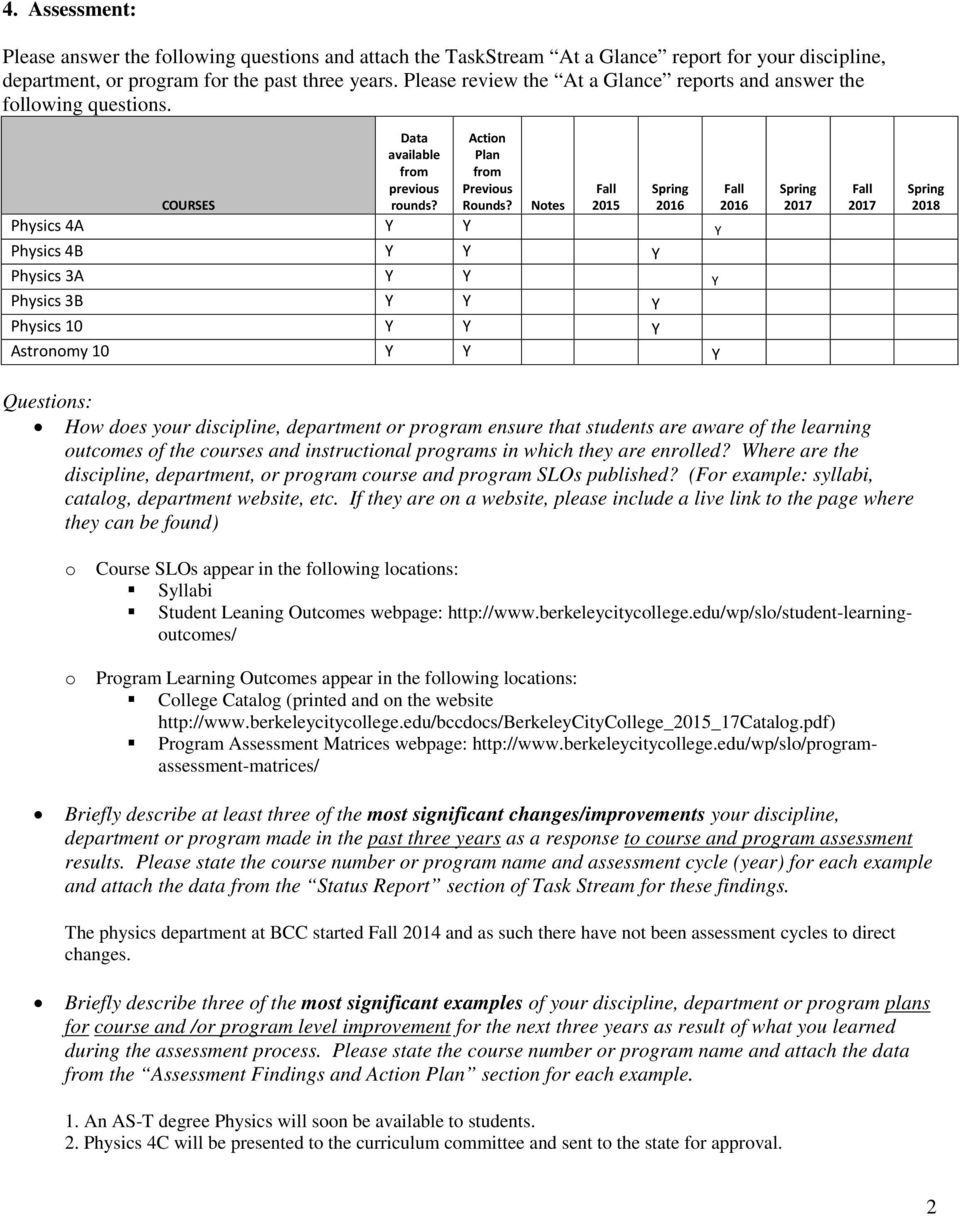
2 4. Assessment: Please answer the following questions and attach the TaskStream At a Glance report for your discipline, department, or program for the past three years. Please review the At a Glance reports and answer the following questions. COURSES Data available from previous rounds? Action Plan from Previous Rounds? Notes Fall 2015 Spring 2016 Fall 2016 Physics 4A Y Y Y Physics 4B Y Y Y Physics 3A Y Y Y Physics 3B Y Y Y Physics 10 Y Y Y Astronomy 10 Y Y Y Spring 2017 Fall 2017 Spring 2018 Questions: How does your discipline, department or program ensure that students are aware of the learning outcomes of the courses and instructional programs in which they are enrolled? Where are the discipline, department, or program course and program SLOs published? (For example: syllabi, catalog, department website, etc. If they are on a website, please include a live link to the page where they can be found) o o Course SLOs appear in the following locations: Syllabi Student Leaning Outcomes webpage: Program Learning Outcomes appear in the following locations: College Catalog (printed and on the website Program Assessment Matrices webpage: Briefly describe at least three of the most significant changes/improvements your discipline, department or program made in the past three years as a response to course and program assessment results. Please state the course number or program name and assessment cycle (year) for each example and attach the data from the Status Report section of Task Stream for these findings. The physics department at BCC started Fall 2014 and as such there have not been assessment cycles to direct changes. Briefly describe three of the most significant examples of your discipline, department or program plans for course and /or program level improvement for the next three years as result of what you learned during the assessment process. Please state the course number or program name and attach the data from the Assessment Findings and Action Plan section for each example. 1. An AS-T degree Physics will soon be available to students. 2. Physics 4C will be presented to the curriculum committee and sent to the state for approval. 2
3 Describe how assessment results for Distance Education courses and/or programs compare to the results for the corresponding face-to-face classes. Not Applicable. The Science Department does not offer online courses. Describe assessment results for courses with multiple sections. Are there similar results in each section? Not Applicable. Describe your discipline, department or program participation in assessment of institutional level outcomes (ILOs). 5. Instruction: Assessment has not been done at this time. However, the following ILOs would be met in the course of completing courses in physics: communication, critical thinking, computational skills, information competency Describe effective and innovative strategies used by faculty to involve students in the learning process. 1. Homework Assignments 2. Laboratory experiments 3. Exams How has new technology been used by the discipline, department or program to improve student learning? Students have access to free online resources such as Google Apps (includes Excel) and Mathematica. How does the discipline, department or program maintain the integrity and consistency of academic standards with all methods of delivery, including face to face, hybrid, and Distance Education courses? We only offer face-to-face courses in the physics department. Academic standards are delineated in class syllabi and actively reinforced in lecture and lab courses. With the exception of Physics 10 and Astronomy 10, physics courses offered at BCC have a laboratory component that affords faculty 4 extra contact hours/wk with students. How do you ensure that Distance Education classes have the same level of rigor as the corresponding face-to-face classes? Not Applicable. The Science Department does not offer DE courses. Briefly discuss the enrollment trends of your discipline, department or program. Include the following: o Overall enrollment trends in the past three years Course & number Course Name F12 S13 F13 S14 F14 S15 Mean Physics 4A General Physics w/ Calculus Physics 4B General Physics w/ Calculus Physics 3A General Physics Physics 3B General Physics Physics 10 Introduction to Physics Astron. 10 Descriptive Astronomy Not offered = --- o An explanation of student demand (or lack thereof) for specific courses. N/A 3

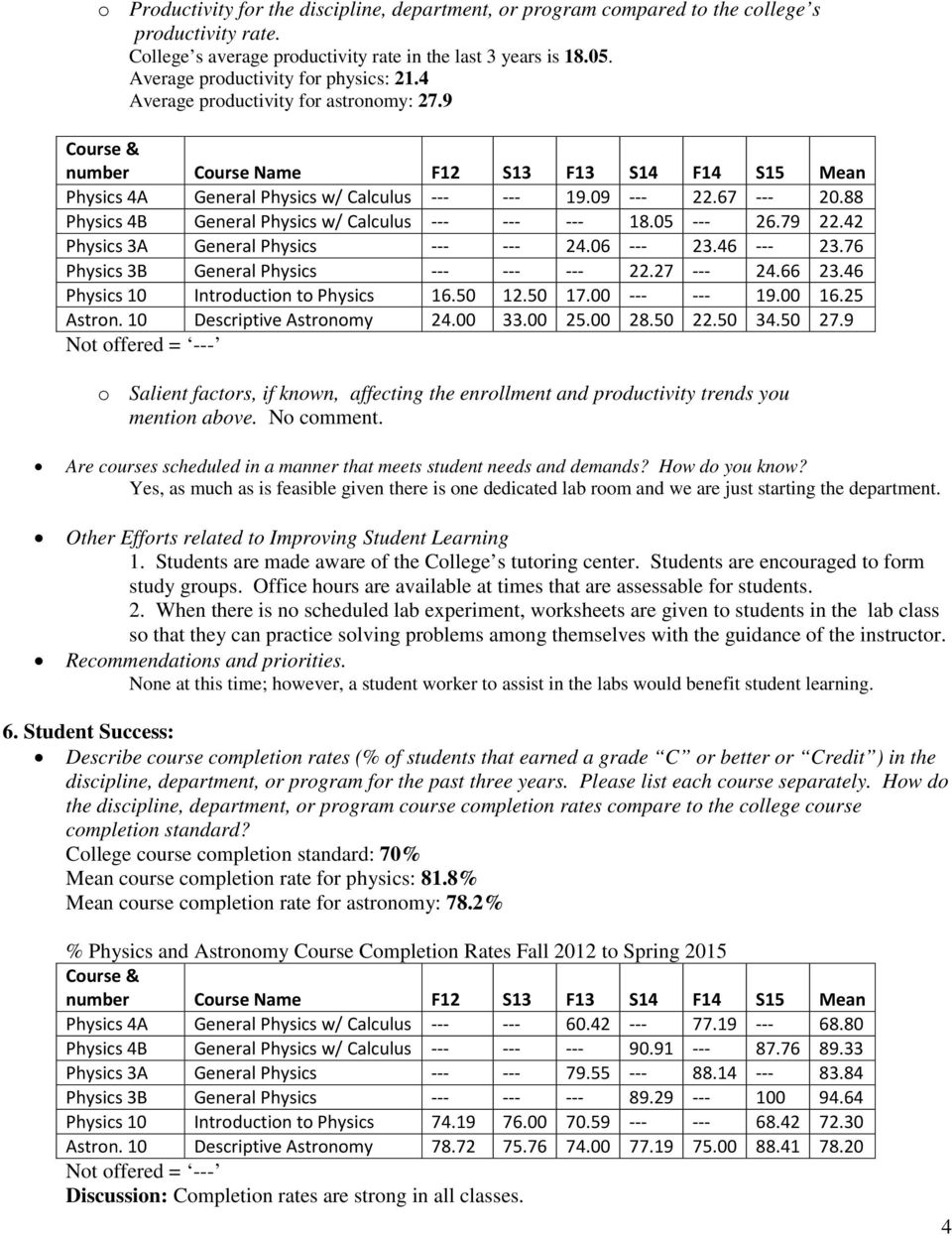
4 o Productivity for the discipline, department, or program compared to the college s productivity rate. College s average productivity rate in the last 3 years is Average productivity for physics: 21.4 Average productivity for astronomy: 27.9 Course & number Course Name F12 S13 F13 S14 F14 S15 Mean Physics 4A General Physics w/ Calculus Physics 4B General Physics w/ Calculus Physics 3A General Physics Physics 3B General Physics Physics 10 Introduction to Physics Astron. 10 Descriptive Astronomy Not offered = --- o Salient factors, if known, affecting the enrollment and productivity trends you mention above. No comment. Are courses scheduled in a manner that meets student needs and demands? How do you know? Yes, as much as is feasible given there is one dedicated lab room and we are just starting the department. Other Efforts related to Improving Student Learning 1. Students are made aware of the College s tutoring center. Students are encouraged to form study groups. Office hours are available at times that are assessable for students. 2. When there is no scheduled lab experiment, worksheets are given to students in the lab class so that they can practice solving problems among themselves with the guidance of the instructor. Recommendations and priorities. None at this time; however, a student worker to assist in the labs would benefit student learning. 6. Student Success: Describe course completion rates (% of students that earned a grade C or better or Credit ) in the discipline, department, or program for the past three years. Please list each course separately. How do the discipline, department, or program course completion rates compare to the college course completion standard? College course completion standard: 70% Mean course completion rate for physics: 81.8% Mean course completion rate for astronomy: 78.2% % Physics and Astronomy Course Completion Rates Fall 2012 to Spring 2015 Course & number Course Name F12 S13 F13 S14 F14 S15 Mean Physics 4A General Physics w/ Calculus Physics 4B General Physics w/ Calculus Physics 3A General Physics Physics 3B General Physics Physics 10 Introduction to Physics Astron. 10 Descriptive Astronomy Not offered = --- Discussion: Completion rates are strong in all classes. 4
5 4. Course Success Rate by Course and Ethnicity: Describe course completion rates in the department for Distance Education courses (100% online) for the past three years. Please list each course separately. How do the department s Distance Education course completion rates compare to the college course completion standard? Not Applicable. The Science Department does not offer online courses. Describe course completion rates in the department for Hybrid courses for the past three years. Please list each course separately. How do the department s Hybrid course completion rates compare to the college course completion standard? Not Applicable. The Science Department does not offer Hybrid courses at this time. Are there differences in course completion rates between face to face and Distance Education/hybrid courses? If so, how does the discipline, department or program deal with this situation? Not Applicable. The Science Department does not offer online or Hybrid courses. Describe the discipline, department, or program retention rates (After the first census, the percent of students earning any grade but a W in a course or series of courses) for the past three years. How does the discipline, department, or program retention rate compare to the college retention standard? College retention standard: 70% Physics mean retention rate: 85.4%; Astronomy mean retention rate: 84.8% % Retention Rates for Physics and Astronomy Course & number Course Name F12 S13 F13 S14 F14 S15 Mean Physics 4A General Physics w/ Calculus Physics 4B General Physics w/ Calculus Physics 3A General Physics Physics 3B General Physics Physics 10 Introduction to Physics Astron. 10 Descriptive Astronomy Not offered = --- Discussion: Retention rates are strong and well above the average for the college. % Success Rates by Course and Ethnicity Course & number Course Name Am. Ind. Alaskan Native Asian Black/ African Amer. Filipino Hispanic Pacific Islander While Non Hispanic Physics 4A General Physics w/ Calculus Physics 4B General Physics w/ Calculus Physics 3A General Physics Physics 3B General Physics Physics 10 Introduction to Physics Astron. 10 Descriptive Astronomy Discussion: Black/African American students had less retention rates, however, number of students enrolled is too low in the transfer level classes, e.g. Physics 4A (1), Physics 3A (6). 5

6 What has the discipline, department, or program done to improve course completion and retention rates? What is planned for the next three years? 1. Physics participates in the Science Informational Days at the start of each semester to inspire students to enter the fields of engineering and physics. During these events, each discipline within the sciences, certificates and degrees are explained and informational pamphlets provided. 2. Support Student Clubs: Engineering/Science was established recently by students to allow all those interested to come together and share experiences and serve as a support group. The students are working on projects such as solar energy and are planning to compete in local competitions with students from other colleges. 3. Offered two seminar series that present students with the latest areas of scientific endeavor. A Noontime Seminar Series emphasizes careers in STEM fields (e.g. medicine, engineering, environmental science, physics and computer systems) with guest speakers from local research and industry laboratories, and an Evening Seminar Series that emphasizes recent developments in science and medicine, including breakthroughs in stem cell biology and regenerative medicine. 4. Connected with local high school faculty in an effort to develop more effective pathways for students interested in STEM fields. Additional Future Plans for the science department 1. Science Saturdays aimed at high school students interested in STEM fields. Presently in the planning stage, the idea is to engage high school students in activities that will give them the idea of the types of pathways in science they can pursue. A combination of activities and mini lectures that cover a breadth of science fields will be offered. This will be funded by the East Bay Career Pathways Consortium (referred to as the Career Pathways Trust, CPT). 2. Connect with the Physics high school teachers. 3. Friday Science Assist afternoons aimed at high school students taking science classes. Presently in the planning stage, the idea is to have high school students work directly with BCC students on homework problems and other matters to improve the retention of prospective science students in high schools. This will be funded by. Career Pathways Trust, CPT. Which has the discipline, department, or program done to improve the number of degrees and certificates awarded? Include the number of degrees and certificates awarded by year, for the past three years. What is planned for the next three years? Not applicable at this time. 7. Human, Technological, and Physical Resources (including equipment and facilities): Describe your current level of staff, including full-time and part-time faculty, classified staff, and other categories of employment. Full-time faculty headcount: 1 Part-time faculty headcount: 0.5 (physics 10 is offered 1x/yr) Total FTEF faculty for the discipline, department, or program: 1.01 Full-time/part-time faculty ratio: 0.49 Describe your current utilization of facilities and equipment. 6

7 Physics classes use 1 laboratory rooms exclusively: Room 518 The physics department uses assorted equipment depending on the topic including force tables, pendulum apparatus, frictionless tracks, equipment and materials to test thermal expansion, function generators, oscilloscopes, power supplies, resistors, capacitors, optics kits, LEDs, hydrogen lamp, along with other items. What are your key staffing needs for the next three years? Why? Please provide evidence to support your request such as assessment data, student success data, enrollment data, and/or other factors. Student workers for each laboratory section will be needed to assist with set up, assisting students during lab and assist with tutoring. SPECIFIC NEEDS FOR PHYSICS Student workers: 15 hrs/wk x 35 wks (525 total 13.25/hr = $6,956/yr Sick Leave: 30 hrs work/1 hr sick leave = 525/30 = 17.5 x = $232 Approximate Total monies based on above/yr: $7,188 What are your key technological needs for the next three years? Why? Please provide evidence to support your request such as assessment data, student success data, enrollment data, and/or other factors.. Wireless printer for the laboratory: $500 What are your key facilities needs for the next three years? Why? Please provide evidence to support your request such as assessment data, student success data, enrollment data, and/or other factors. Office/Tutoring Space: The science faculty and staff could use an extra room for both office space and tutoring space. As the lab rooms are filled with classes the faculty can no longer make use of these rooms during their office hours. 8. Community, Institutional, and Professional Engagement and Partnerships: Discuss how faculty and staff have engaged in institutional efforts such as committees, presentations, and departmental activities. Please list the committees that full-time faculty participate in. Full time Physics Instructor is recently hired and is concentrating on lecture and lab preparations. The instructor participates in helping with Science Seminar Series and Science Budget Committee both are committees within the department. Discuss how faculty and staff have engaged in community activities, partnerships and/or collaborations. The science faculty and staff meet with members of the Science Advisory Board which is composed of local industry CEOs and scientists, local academic and clinical lab research scientists and technicians and members of the community. Discuss how adjunct faculty members are included in departmental training, discussions, and decision-making. At present one adjunct teaches Physics 10 one semester each year. This adjunct is not available at this college to participate in activities. 7
8 Professional Development: Please describe the professional development needs of your discipline or department. Include specifics such as training in the use of classroom technology, use of online resources, instructional methods, cultural sensitivity, faculty mentoring, etc. N/A 10. Discipline, Department or Program Goals and Activities: Briefly describe and discuss the discipline, department or program goals and activities for the next three years, including the rationale for setting these goals. NOTE: Progress in attaining these goals will be assessed in subsequent years through annual program updates (APUs). Goal 1. Curriculum: Develop AS-T in Physics and Physics 4C for Engineers and Physics Majors Activities and Rationale: Both the AS-T in Physics and Physics 4C will allow students to transfer with undergraduate work in the major completed. Goal 2. Assessment: Start Assessment for all physics classes Activities and Rationale: An assessment for physics classes will allow the faculty to improve the delivery of the material and offer support materials. Goal 3. Instruction: Work on generating funds to purchase new laboratory experimental materials. Activities and Rationale: There will be a need to purchase equipment and supplies for physics classes. Goal 4. Student Success: Assist student Science Clubs and participate in the department s science activities Activities and Rationale: Activities will support student success and increase enthusiasm for the STEM fields. Goal 5. Professional Development, Community, Institutional and Professional Engagement and Partnerships: Continue with Advisory Board Meetings, Science Budget Committee, Activities and Rationale: Advisory Board Meetings helps to keep the Science Department offerings up to date. 8

9 Appendix A College: Berkeley City College Discipline, Department or Program: Biology Contact Person: Francisco Monsalve Santa Date: 11/01/2015 Comprehensive Instructional Program Review Prioritized Resource Requests Summary Resource Category Description Priority Ranking (1 5, etc.) Human Resources: Faculty Human Resources: Classified Estimated Cost Justification (page # in the program review narrative report) Human Resources: Student Workers Technology Equipment Student workers and Instructional Aides in Lab Classes Printer for Physics Lab Room Mathematica and Matlab Small Equipment Items for Physics 4C as well as 4A and 4B Student workers and instructional aides are critical to assure student success in the laboratory classes and to ensure the safety of students K Printer will allow instructor to print out data and results for each group to analyze increase student understanding and success 5.0K One- time expenditure of software. Increase student success K Assorted equipment items will be needed for Physics 4C. Supplies Materials and Supplies 1K Each bench top of students will need small kits composed of assorted materials that often need replacement each year due to loss and damage. 9

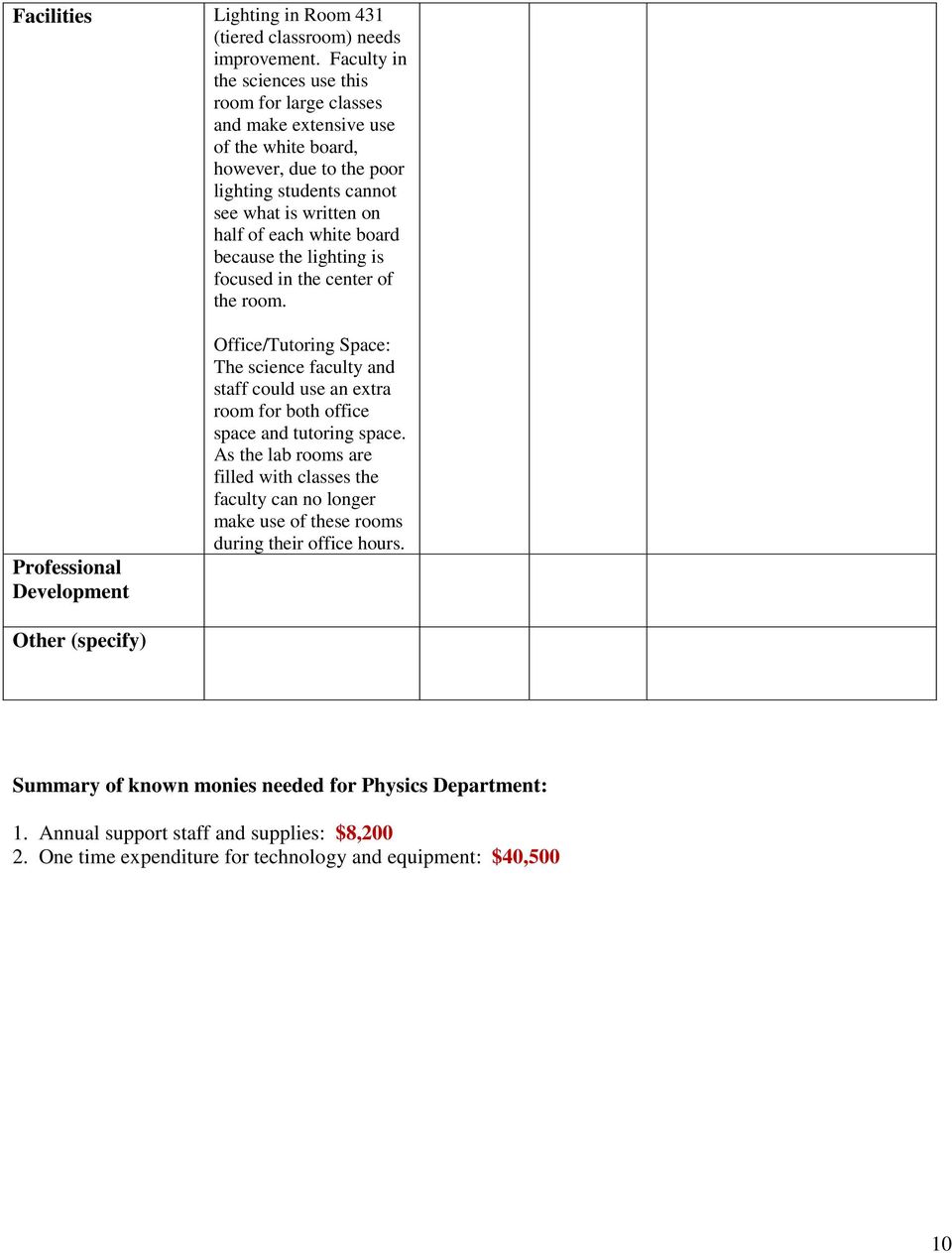
10 Facilities Lighting in Room 431 (tiered classroom) needs improvement. Faculty in the sciences use this room for large classes and make extensive use of the white board, however, due to the poor lighting students cannot see what is written on half of each white board because the lighting is focused in the center of the room. Professional Development Office/Tutoring Space: The science faculty and staff could use an extra room for both office space and tutoring space. As the lab rooms are filled with classes the faculty can no longer make use of these rooms during their office hours. Other (specify) Summary of known monies needed for Physics Department: 1. Annual support staff and supplies: $8, One time expenditure for technology and equipment: $40,500 10
11 Appendix B PCCD Program Review Alignment of Goals Template College: BCC Discipline, Department or Program: Biology Contact Person: Barbara Des Rochers, Francisco Monsalve Date: November 1, 2015 Discipline, Department or Program Goal Goal 1. Curriculum: Develop AS-T in Physics and Physics 4C for Engineers and Physics Majors College Goal BCC Goal 1. Increase Equitable Access BCC Goal 2. Improve Equitable Success PCCD Goal and Institutional Objective Strategic Goals A: Advance Student Access, Equity, and Success Institutional Objectives A.1 Student Access: Increase enrollment for programs and course offerings in the essential areas of basic skills/esol, CTE and transfer to achieve the District target of 20, 609 RES FTES. Goal 2. Assessment: Start Assessment for all physics classe Goal 3. Instruction: Work on generating funds to purchase new laboratory experimental materials. Goal 4. Student Success: Assist student Science Clubs and participate in the department s science activities A.2 Student Success: Using the total data as a baseline, increase students participation in SSSP eligible activities by at least 50%, with specific emphasis on expanding orientations, assessments, academic advising and student educational plans. A.3 Student Success: Fully implement an Early Alert process for all students. A.4 Student Equity: Address the achievement gap through fully 11
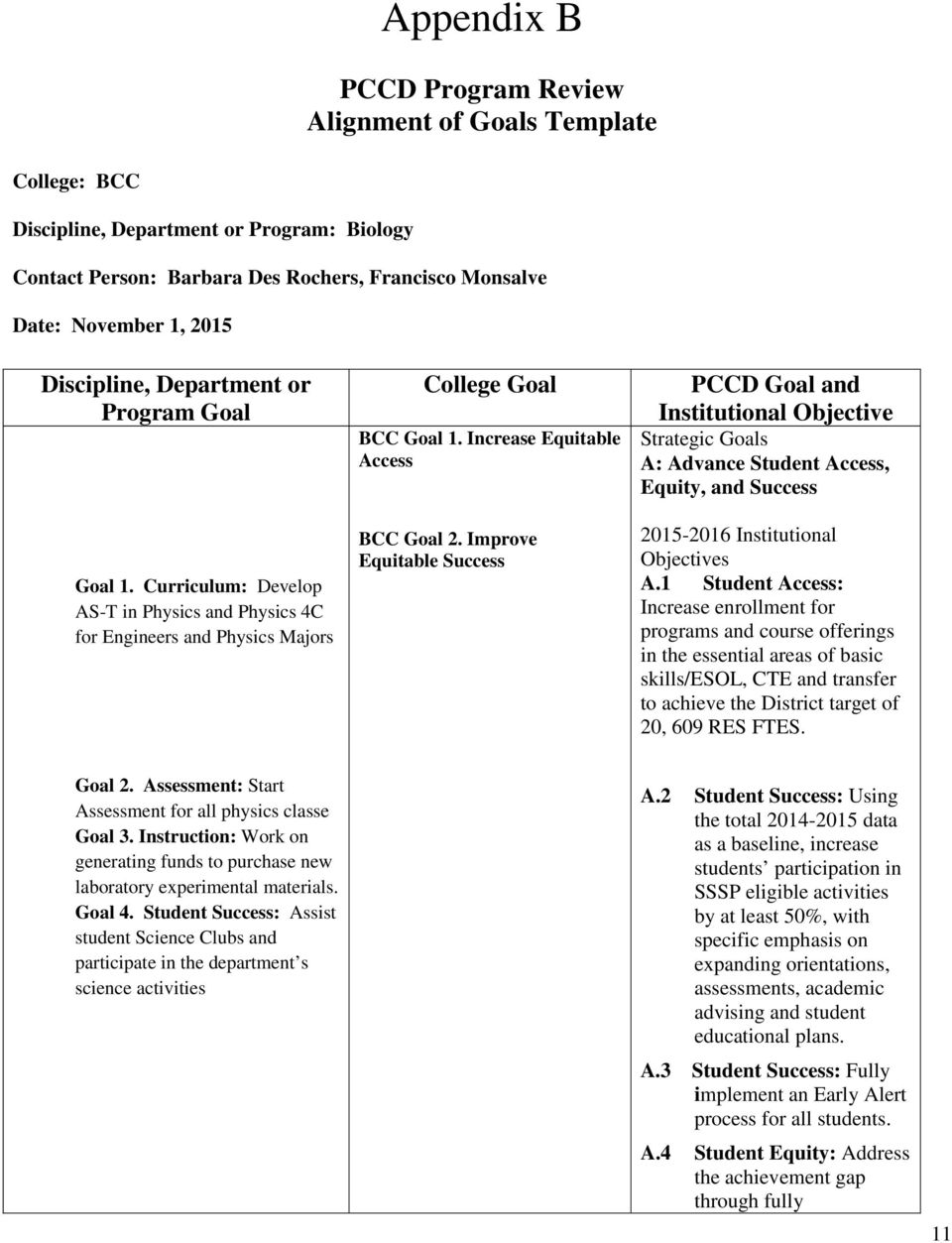
12 Goal 5. Professional Development, Community, Institutional and Professional Engagement and Partnerships: Continue with Advisory Board Meetings, Science Budget Committee, BCC Goal 3. Increase the number of new partners and enhance and leverage resources with existing partners. BCC Goal 4. Reduce education and achievement gap through building and implementing programs of distinction through SSSP, Equity, BSI and other college-wide plans. implementing the student success and equity plans at each campus. A.5 Student Success: Using data as a baseline, increase student engagement in activities such as student governance, student life activities, student leadership development, service learning programs, learning communities and student employment. Strategic Goals: B: Engage and Leverage Partners Institutional Objectives: B.1 Partnerships: Develop a District-wide database that represents our current strategic partnerships and relationships, both locally and abroad. Identify the individual responsible for this objective by October 1, B.2. Partnerships: Expand and document domestic and international partnerships with K-12 institutions, community based organizations, four-year institutions, local government, and regional industries and businesses. Strategic Goals: C: Build Programs of Distinction Institutional Objectives: C.1 Student Success: Develop a District-wide first year experience/student success program (such as 12

13 4. BCC Goal 5. Resolve the 2 ACCJC Recommendations and BCC s self-identified Actionable Improvement Plans Peralta Scholars). C.2 Student Success: Develop and fully implement an innovative student success program at each college that feeds into the District-wide first year experience/student success program. Strategic Goals: D: Strengthen Accountability, Innovation and Collaboration Institutional Objectives: D.1 Service Leadership: Provide professional development opportunities for faculty, staff and administrators that lead to better service to our students and colleagues and community partners. D.2 Institutional Leadership and Governance: Evaluate and update policies and administrative procedures, the overall PCCD organizational structure, and functional responsibilities within the District. D.3. Institutional Effectiveness: Evaluate and update the PBIM participatory governance structure and the Budget Allocation Model (BAM). D.4. Global Planning: Develop a Total Cost of Ownership (TCO) plan that includes agreed upon standards, estimates costs for facilities operations and maintenance, costs 13

14 for technology acquisition, repair and replacement cycles, custodial and stationary engineering services for all existing buildings and potential new facilities. 5. BCC Goal 6. Increase BCC additional and alternative funding sources through materializing BAM, funding raising, non-res tuition, grants, etc. Strategic Goals: E: Develop and Manage Resources to Advance Our Mission Institutional Objectives: E.1 FTES/FTEF Target: Achieve the District target FTES/FTEF within budget. E.2 Budget to Improve Student Success: Increase alternative funding sources including, but not limited to, the Peralta Colleges Foundation, non-res tuition (with a particular focus on recruiting international students), grants, etc. E.3 Fiscal Oversight: Prudently manage all fiscal resources; general fund, bonds, benefits, OPEB), other long-term liabilities; Resolve all outstanding audit findings. E.4 Support Quality Instruction: Increase investments in materials, equipment, and teaching and learning resources to enhance student learning outcomes. 14

15 Appendix C Program Review Validation Form and Signature Page College: Discipline, Department or Program: Part I. Overall Assessment of the Program Review Report Review Criteria Comments: Explanation if the box is not checked 1. The narrative information is complete and all elements of the program review are addressed. 2. The analysis of data is thorough. 3. Conclusions and recommendations are wellsubstantiated and relate to the analysis of the data. 4. Discipline, department or program planning goals are articulated in the report. The goals address noted areas of concern. 5. The resource requests are connected to the discipline, department or program planning goals and are aligned to the college goals. 15
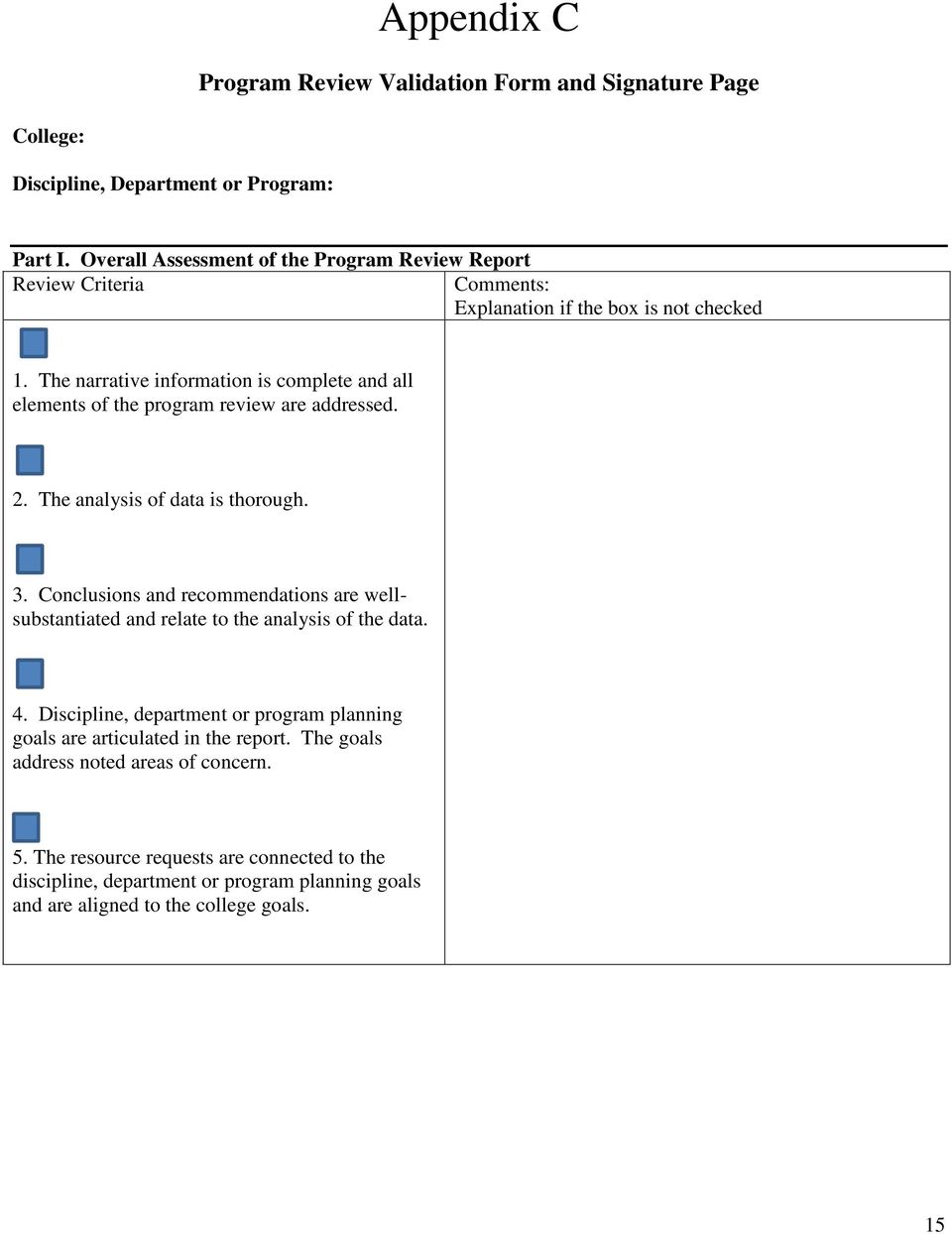
16 Part II. Choose one of the Ratings Below and Follow the Instructions. Rating 1. Accepted. 2. Conditionally Accepted. 3. Not Accepted. Instructions 1. Complete the signatures below and submit to the Vice President of Instruction. 2. Provide commentary that indicates areas in the report that require improvement and return the report to the discipline, department or program chair with a timeline for resubmission to the validation chair. 3. Provide commentary that indicates areas in the report that require improvement and return the report to the discipline, department or program chair with instructions to revise. Notify the Dean and Vice President of Instruction of the non-accepted status. Part III. Signatures Validation Team Chair Print Name Signature Date Discipline, Department or Program Chair Print Name Signature Date Received by Vice President of Instruction Print Name Signature Date 16

Peralta Community College District
 Peralta Community College District Berkeley City College College of Alameda Laney College Merritt College Counseling Program Review Handbook Fall 2015 Version 3. i ii Table of Contents Purpose and Goals
The Instructional (Academic Affairs) Program Review Narrative Report
 The Instructional (Academic Affairs) Program Review Narrative Report 1. College: Laney College Discipline, Department or Program: Counseling Discipline Date: 11/13/12 (Due by November 13, 2012) Members
ACCREDITING COMMISSION FOR COMMUNITY AND JUNIOR COLLEGES
 ACCREDITING COMMISSION FOR COMMUNITY AND JUNIOR COLLEGES COLLEGE STATUS REPORT ON STUDENT LEARNING OUTCOMES IMPLEMENTATION INSTRUCTIONS Colleges are asked to use this report form in completing their College
Peralta Community College District Annual Program Update Template 2014-2015 DISTRICT-WIDE DATA by Subject/Discipline Fall Semesters
 Peralta Community College District Annual Program Update Template 2014-2015 DISTRICT-WIDE DATA by Subject/Discipline Fall Semesters I. Overview BI Download: 10/24/2014 Dept. Chair: Williams Subject/Discipline:
Chapter Three: Challenges and Opportunities
 Chapter Three: Challenges and Opportunities The preparation of Orange County Community College s Periodic Review Report occurs at a time when the College and New York State are experiencing an economic
1. In your department: 2. In your department: 3. Your department: Page 2. nmlkj nmlkj nmlkj nmlkj. nmlkj nmlkj nmlkj nmlkj. nmlkj nmlkj nmlkj nmlkj
 Your college or university has been selected to be part of a national survey of calculus instruction across the United States. This research project is conducted by the Mathematical Association of America.
PERALTA COMMUNITY COLLEGE DISTRICT. Laney College Instructional Program Review Narrative Report 2011-2013 CIS Department
 PERALTA COMMUNITY COLLEGE DISTRICT Laney College Instructional Program Review Narrative Report 2011-2013 CIS Department 1. College: Laney Discipline, Department or Program: Computer Information Systems
The Instructional Program Review Narrative Report
 The Instructional Program Review Narrative Report 1. College: MERRITT COLLEGE Discipline, Department or Program: ADMINISTRATION OF JUSTICE Date: 10/9/12 Members of the Instructional Program Review Team:
Chaffey College Program Review Three Year Review 2011
 PROGRAM OVERVIEW Program Title: Geology Chaffey College Program Review Three Year Review 2011 Program Code: 1914 - GEOLOGY AND EARTH SCIENCE Review Type: Instructional Does this review contain any career
Comprehensive Program Review Report (Narrative) College of the Sequoias
 Program Review - Child Development Comprehensive Program Review Report (Narrative) College of the Sequoias Program Review - Child Development Prepared by: San Dee Hodges, Rebecca Griffith, Gwenette Aytman
UNIVERSITY OF HAWAI I AT MĀNOA POSITION DESCRIPTION DEAN, COLLEGE OF NATURAL SCIENCES ~~~~~~~~~~~~~~~~~~~~~
 UNIVERSITY OF HAWAI I AT MĀNOA POSITION DESCRIPTION DEAN, COLLEGE OF NATURAL SCIENCES ~~~~~~~~~~~~~~~~~~~~~ Position No: 0089197 Title of Position: Dean Reports to: Vice Chancellor for Academic Affairs,
Guidelines for Preparing New Graduate Program Proposals
 Guidelines for Preparing New Graduate Program Proposals The New Programs and Program Review Committee of the Graduate Council recommends that the originators of proposals for new graduate programs follow
Guidelines for Massachusetts Early Educator Preparation Programs Participating in the Early Childhood Educator Scholarships Program.
 Guidelines for Massachusetts Early Educator Preparation Programs Participating in the Early Childhood Educator Scholarships Program Background The Departments of Higher Education and Early Education and
San Diego Continuing Education. Student Equity Plan 2014-2017
 Student Equity Plan 2014-2017 November 6, 2014 2 EXECUTIVE SUMMARY (SDCE) provides adult education for the San Diego Community College District. SDCE is the largest, separately accredited continuing education
Criminal Justice Department Portfolio Assessment/Program Review 2014/15
 1 Criminal Justice Department Portfolio Assessment/Program Review 2014/15 Criminal Justice Department Mission The mission of the Criminal Justice Department is to enhance community safety by providing
Part III. Self-Study Report Template
 Part 3 Ministry Of Education And Higher Education Directorate General of Higher Education Part III Self-Study Report Template LABE SELF-STUDY QUESTIONNAIRE http://www.labe.org.lb General Instructions Introduction
Educational Master Plan 2010-2015 Goals WORKING DRAFT
 Educational Master Plan 2010-2015 Goals WORKING DRAFT 1. PROVIDE SUPPORT TO ENSURE STUDENT RECRUITMENT, RETENTION AND SUCCESS. 1.1. Develop a policy to optimize student opportunity and access linked to
Lakeland Community College Campus Completion Plan
 Lakeland Community College Campus Plan Narrative Overview Lakeland Community College opened its doors in 1967 as the first college in Ohio established by a vote of local citizens committed to providing
PROPOSAL FOR A MINOR IN DEVELOPMENTAL PSYCHOLOGY. Submitted by the Department of Psychology Linda H. Slowik, Chair. Prepared by
 PROPOSAL FOR A MINOR IN DEVELOPMENTAL PSYCHOLOGY Submitted by the Department of Psychology Linda H. Slowik, Chair Prepared by Libby Balter Blume, Director Developmental Psychology Program And Linda H.
Pittsburg State University Distance Education Plan, 2013-15
 Pittsburg State University Distance Education Plan, 2013-15 Pittsburg State University (PSU) continues to be successful in offering distance-delivered educational programs. Out of the various modes that
El Camino College Industry and Technology Division Engineering Technology Department Program Review Spring 2009 Conducted by: Eric Carlson
 El Camino College Industry and Technology Division Engineering Technology Department Program Review Spring 2009 Conducted by: Eric Carlson I. Overview A. Description of Program B. Status of Previous Recommendations
DRAFT 2015-2018. Berkeley City College (BCC) Technology Plan. Three-Year Plan (2015-2018)
 2015-2018 Berkeley City College (BCC) Technology Plan DRAFT Three-Year Plan (2015-2018) Created by the Berkeley City College (BCC) Technology Planning Committee Table of Contents I. Berkeley City College
Substantive Change Proposal
 Substantive Change Proposal Addition of New Programs: Certificates of Achievement in Project Management and Public Management Folsom Lake College 10 College Parkway Folsom, CA 95630 Los Rios Community
PROPOSAL TO IMPLEMENT A NEW ACADEMIC PROGRAM (Major, Minor, Master s, Dual Degree, or Certificate)
 PROPOSAL TO IMPLEMENT A NEW ACADEMIC PROGRAM (Major, Minor, Master s, Dual Degree, or Certificate) New academic programs must be approved by the AAC/Grad Council, Faculty Plenary, VPAA, Board of Trustees,
M. CRITERIA FOR FACULTY EVALUATION
 faculty evaluation/1 M. CRITERIA FOR FACULTY EVALUATION 1. General Criteria: The professional lives of college faculty members traditionally have been characterized by expectations in the broad categories
Increasing Competitiveness of First Generation Community College Students Pursuing a STEM Degree
 Increasing Competitiveness of First Generation Community College Students Pursuing a STEM Degree Virginia Estrella, B.S. MESA Program Director Santa Barbara City College Consuelo Gonzalez, B.S MESA Program
Bakersfield College Program Review Annual Update
 Bakersfield College Program Review Annual Update I. Program Information: Program Name: Counseling and Advising Department Program Type: Instructional Non Instructional Program Mission Statement: Academic
UNIT PLAN PART A Program/Pathway Update
 UNIT PLAN PART A Program/Pathway Update Program/Pathway: Date: November 1, 2013 Our Mission: Los Angeles Harbor College fosters learning through comprehensive programs that meet the educational needs of
ACCOUNTING PROGRAM Academic Program Review 2000-2001
 ACCOUNTING PROGRAM Academic Program Review 2000-2001 The Office of Instruction The Office of Institutional Planning, Research, and Assessment ACCOUNTING PROGRAM Academic Program Review 2000-2001 Committee
Distance Education Strategic Plan
 Distance Education Strategic Plan 2012-2013 Academic Year Background In 2008, Cañada s Technology Advisory Committee was formed. Their mission included a goal to utilize technology to improve teaching
Texas A&M University-Kingsville. College of Graduate Studies. Graduate Council. Doctoral Program Review Instrument
 Texas A&M University-Kingsville College of Graduate Studies Graduate Council Doctoral Program Review Instrument Texas A&M University-Kingsville College of Graduate Studies Doctoral Program Review Instrument
Undergraduate Degree Map for Completion in Four Years
 Page 1 of 5 Undergraduate Degree Map for Completion in Four Years College: College of Science, Engineering & Technology Department: Physics & Astronomy Name of Program: PHYSICS EDUCATION Degree Designation:
students to complete their degree online. During the preliminary stage of included Art, Business, Computer Science, English, Government, History, and
 Texas Woman s University College of Arts and Sciences Bachelor of General Studies Program Undergraduate Program Review May 2012 I. PROGRAM REVIEW AND MISSION A. History Texas Woman s University has a proud
Salt Lake Community College ASSOCIATE DEAN (AD) MODEL PROCEDURES
 PURPOSE: Salt Lake Community College values and endorses strong and effective academic leadership, and first tier academic leadership, Associate Deans (ADs), are the foundation for strong and effective
PROGRAM REVIEW REPORT TEMPLATE
 PROGRAM REVIEW REPORT TEMPLATE Seventh Edition Note: The following pages constitute the template for all Program Review Reports. Do not change the order or the wording of any items and respond where indicated.
PROCEDURES Doctoral Academic Program Review California State University, Stanislaus
 PROCEDURES Doctoral Academic Program Review California State University, Stanislaus Self Study Elements for Academic Program Review for Doctoral Programs Program Improvement from Last Academic Program
Undergraduate Degree Map for Completion in Four Years
 Page 1 of 5 Undergraduate Degree Map for Completion in Four Years College: College of Science, Engineering & Technology Department: Physics & Astronomy Name of Program: PHYSICS EDUCATION Degree Designation:
Cerritos College Associate Degree Nursing Program
 Cerritos College Associate Degree Nursing Program The California Board of Registered Nursing 2010-2011 Annual School Report reflected that 61% of nursing programs in California are Associate Degree programs.
Staff Analysis Checklist Request to Offer a New Degree Program. Board of Governors, State University System of Florida
 Staff Analysis Checklist Request to Offer a New Degree Program Board of Governors, State University System of Florida University Submitting Proposal Initial Review Date Proposed Implementation Term Last
Psychology Program Review 2006-2007
 Psychology Program Review 2006-2007 Spring 2007 Prepared By: Dr. Rick Brown Dr. Michael A. Hurtado Dr. Andrew Kim Carolyn Perry PSYCHOLOGY PROGRAM REVIEW COMMITTEE MEMBERS 2006-2007 FACULTY: Dr. Rick Brown
Program Planning and Assessment (PPA) for Services, Offices & Non-Instructional Programs. Comprehensive Review, Annual Review & Action Plan
 Program Planning and Assessment (PPA) for Services, Offices & Non-Instructional Programs Comprehensive Review, Annual Review & Action Plan Spring 2015 The purpose of Program Planning and Assessment at
Berkeley City College Student Equity Plan
 Berkeley City College Student Equity Plan January 1, 2015 2 Executive Summary Diversity and equity efforts are important because they are fundamental to quality and excellence. Moreover, diversity is more
The University of Arizona
 The University of Arizona FORMAT AND GUIDELINES FOR GRADUATE CERTIFICATE APPROVAL Directions: 1. Provide information regarding the proposed graduate certificate in the format requested on the attached
CALIFORNIA STATE UNIVERSITY EAST BAY COMMITTEE ON ACADEMIC PLANNING AND REVIEW. Committee on Academic Program Review
 CALIFORNIA STATE UNIVERSITY EAST BAY COMMITTEE ON ACADEMIC PLANNING AND REVIEW Designation Code: 06-07 CAPR 12 Date Submitted: May 10, 2007 TO: FROM: SUBJECT: PURPOSE: ACTION REQUESTED: Academic Senate
M.S. in Computational Finance and Risk Management University of Washington Seattle
 May 2011 M.S. in Computational Finance and Risk Management University of Washington Seattle Introduction University of Washington (UW) proposes to offer a Master of Science in Computational Finance and
Last Review: Outcome: Next Review:
 SITE VISIT REPORT , Program Type: Purpose of Visit: Date of Visit: Master's I. GENERAL INFORMATION Nursing Education Unit
Lake Sumter State College
 The Florida College System 2014-2015 Annual Equity Update Report Executive Summary Submitted by Lake Sumter State College Prepared by Christyne B. Hamilton, Equity Officer [email protected] 352-365-3592
Template for Departmental Report for Northwest Commission on Colleges and Universities Self Study (The most critical information is in Italic)
 Template for Departmental Report for Northwest Commission on Colleges and Universities Self Study (The most critical information is in Italic) Standard One: Mission and Goals, Planning and Effectiveness
PROGRAM REVIEW UPDATE 2015-2016
 Program: Nutrition and Health Division: BSBA Date: October 2 nd, 2015 Writer(s): Marsha Vernoga SLO/SAO Point-Person: Marsha Vernoga PROGRAM REVIEW UPDATE 2015-2016 Audience: Deans, Vice Presidents of
Academic Program Review Handbook
 Handbook Continuously Improving Programs and Student Learning Revised July 2014 Original Issue: December 6, 2010 Approved: Derry Connolly, President Current Issue: July 3, 2014 Effective: July 3, 2014
FAYETTEVILLE STATE UNIVERSITY FAYETTEVILLE, NORTH CAROLINA FACULTY SENATE
 FAYETTEVILLE STATE UNIVERSITY FAYETTEVILLE, NORTH CAROLINA FACULTY SENATE ACADEMIC AFFAIRS COMMITTEE PROPOSAL PRESENTATION COVER SHEET (Proposal from College of Arts and Sciences) I. Proposal: Notification
Dean: Erin Vines, Faculty Member: Mary Gumlia 12/14/2009
 SOLANO COMMUNITY COLLEGE PROGRAM REVIEW COUNSELING COURSES Dean: Erin Vines, Faculty Member: Mary Gumlia 12/14/2009 Introduction The mission of the Solano College Counseling Division is to provide services,
EXECUTIVE SUMMARY. List all of the program s learning outcomes: (regardless of whether or not they are being assessed this year)
 STUDENT LEARNING ASSESSMENT REPORT SUBMITTED BY: C.KOPAC AND M. VENZKE DATE: JUNE 26, 2014 REVISED JANUARY 2015 TO MEET UAC RECOMMENDATIONS SEE BELOW- HEADING HIGHLIGHTED IN GREY BRIEFLY DESCRIBE WHERE
Feasibility Study. Narrative 1. DESCRIPTION OF THE PROGRAM
 Feasibility Study Program name and degree level: Master Degree in Mathematical Science. Department/College: Mathematics, College of Arts and Sciences. Proposed implementation date: Fall, 2008 Narrative
Strategic Planning & Budget Council Human Resources Sub-Group. Human Resources Staffing Master Plan
 Strategic Planning & Budget Council Human Resources Sub-Group Human Resources Staffing Master Plan April 2008 INTRODUCTION AND PURPOSE The Strategic Planning and Budget Committee is the District s planning
BOARD OF REGENTS EDUCATION AND STUDENT AFFAIRS COMMITTEE 7 STATE OF IOWA APRIL 22-23, 2015
 STATE OF IOWA APRIL 22-23, 2015 Contact: Diana Gonzalez REQUEST FOR NEW PROGRAMS AT THE UNIVERSITY OF IOWA: BACHELOR OF ARTS AND BACHELOR OF SCIENCE PROGRAMS IN PUBLIC HEALTH Action Requested: Consider
FY 2009 Master s Degrees Programs at Predominantly Black Institutions Abstracts
 FY 2009 Master s Degrees Programs at Predominantly Black Institutions Abstracts PR Award Number P382D090001 Long Island University Director's Name: Dr. Edward Donahue New York Phone Number: (718) 488-1664
UNIT PLAN PART A Program/Pathway Update
 UNIT PLAN PART A Program/Pathway Update Program/Pathway: Health Sciences-Nursing Date: November 8, 2012 Our Mission: Los Angeles Harbor College fosters learning through comprehensive programs that meet
FLORIDA A&M UNIVERSITY COLLEGE OF EDUCATION STRATEGIC PLAN 2010-2020
 FLORIDA A&M UNIVERSITY COLLEGE OF EDUCATION STRATEGIC PLAN 2010-2020 JUNE 2010 INTRODUCTION Mission Statement The College of Education stands as the cornerstone of Florida A&M University. With the University
Maryland Program for Excellence in Leadership (MPEL)
 THE DEPARTMENT OF EDUCATION LEADERSHIP, HIGHER EDUCATION AND INTERNATIONAL EDUCATION, UNIVERSITY OF MARYLAND, COLLEGE PARK FROSTBURG STATE UNIVERSITY, COLLEGE OF EDUCATION THE UNIVERSITY SYSTEM OF MARYLAND
IHE Masters of School Administration Performance Report
 IHE Masters of School Administration Performance Report High Point University 2007-2008 Overview of Masters of School Administration Program The Master of Education (M.Ed) in Educational Leadership prepares