
Solving a New Mathematical Model for a Periodic Vehicle Routing Problem by Particle Swarm Optimization
|
|
|
- Kelley Francis
- 9 years ago
- Views:
Transcription
1 Transportation Research Institute Iran University of Science and Technology Ministry of Science, Research and Technology Transportation Research Journal 1 (2012) TRANSPORTATION RESEARCH JOURNAL Solving a New Mathematical Model for a Periodic Vehicle Routing Problem by Particle Swarm Optimization Reza Tavakkoli Moghaddam a*, Amir Mohmmad Zohrevand b, Kousha Rafiee c a. Professor, Faculty of Industrial Engineering, University of Tehran, Tehran, Iran. b. M.Sc. Grad., Faculty of Industrial Engineering, University of Tehran, Tehran, Iran. c. Ph.D. Student, Faculty of Industrial Engineering, University of Houston, Houston, TX, USA Received: 5 February Accepted: 25 June 2012 ABSTRACT This paper presents a new mathematical model for a periodic vehicle routing problem (PVRP) considering several assumptions that minimizes vehicle travel costs. We incorporate four problems in periodic planning, namely a capacitated vehicle routing problem (CVRP), a vehicle routing problem with time windows (VRPTW), a vehicle routing problem with simultaneous pickup and delivery (VRPSPD), and a vehicle routing problem with split service (VRPSS). As it is a unified model, we impose its computational complexity and are notable to solve such a hard problem by any optimization software in a reasonably computational time, especially for large-sized problems. Thus, we propose a meta-heuristic method based on particle swarm optimization (PSO). A number of instances are solved by this proposed PSO. Finally, the related results are illustrated and discussed. Keywords: Periodic Vehicle Routing Problem, Capacitated VRP, VRP with Time Windows, VRP with Split Service, Particle Swarm Optimization 1- Introduction The vehicle routing problem (VRP) is a generic problem to specify a homogeneous set of vehicles and routes, in which each vehicle starts from a depot and traverses along a route in order to serve a set of customers with known geographical locations, and then finish its tour at the same depot. The service may involve delivering goods, picking up packages, and the like. The basic VRP consists of a single depot, a fleet of vehicles located at the depot, a set of customers who receive goods from the depot, and the objective of a basic VRP minimizing the total collection/delivery routing cost subject to the maximum working time and maximum capacity constraints on the vehicles (Christofides et al., 1979). However, many gaps may exist between the basic VRP and real applications; for example, the number of depots, customer requirements with multiple pickups, delivery, type of vehicles with different travel times, travel costs and capacity, time windows restrictions, and route restrictions for vehicles. Toth and Vigo (2002) studied comprehensive details on VRPs consisting of its variants, formulation, and solution methods. The most prevalent researches in VRPs are the capacitated vehicle routing problem (CVRP) considering the total demand on a route that should not exceed the capacity of the vehicle, and the VRP Corresponding Author's Tel: Transportation Research Journal, Vol. 2, No. 1, 2012 / 77 [email protected]
2 with time windows (VRPTW) (Laporte and Semet, 2002; Cordeau et al., 2002). Norouzi et al. (2011) presented a new mathematical model for an open vehicle routing problem (OVRP) with competitive time windows in which distributors intend to service customers earlier than rivals in order to gain the maximum sales. They proposed a multi-objective particle swarm optimization (MOPSO) algorithm and compared their results with those of a wellknown multi-objective evolutionary algorithm, namely NSGA-II. In addition, some attempts have been made to extend vehicle routing models (e.g., VRP with multiple pickups and delivery locations) (Salesbergh and Sol, 1995; Savelsbergh and Sol, 1998; Hasle, 2003). Another extension is the VRP with simultaneous pickup and delivery (VRPSPD), in which customers need the delivery of goods and the pickup of goods from them simultaneously. A comprehensive model of a dynamic VRP can be found in Psaraftis (1998) and Psaraftis (1995). Another variant is that the customer can be served by more than one vehicle however, in the classical VRP, each node must be served by only one vehicle. In many practical cases, it is possible that the customers at each node are served by several vehicles that transit from that node. In other words, a service can be divided between several vehicles, known as VRP with the same split service (VRPSS) (Tavakkoli-Moghadam et al., 2007). Wang and Wang (2009) proposed a new twophase heuristic method in order to solve vehicle routing problems with backhauls considering the travel speed of vehicles in time dependent. They first used traditional heuristic methods, and then the obtained solution was improved by a reactive tabu search. Tavakkoli-Moghaddam et al. (2006) considered a VRP with backhauls, in which a set of costumers is divided in two subsets, namely line haul and backhaul costumers. Due to NP-hardness of this problem, they proposed a memetic algorithm embedded with different local search algorithms in order to obtain good solutions. In some distribution systems, customers may be served several times within a certain time-period, and planning is not just for a day, rather there is periodic planning for a time horizon. Each customer has some feasible schedules of delivery days. This problem is well known as a periodic vehicle routing problem (PVRP). In other words, the PVRP extends the basic VRP to a planning time horizon of several days (Beltrami and Bodin, 1974; Christofides and Beasley, 1984; Russell and Igo, 1979). It attempts to specify an optimal schedule of customer s deliveries. Hence, one has to choose the visit days for each customer and to solve the VRP for each day. Based on the above discussion, we propose a comprehensive model for the PVRP incorporated with several assumptions that were considered separately in the previous studies. We incorporate the CVRP, VRPTW, VRPSPD, and VRPSS in periodic planning. As this is a unified model, we impose its computational complexity and cannot be solved by any optimization software, even for small problems. Thus, we devise a developed metaheuristic method based on particle swarm optimization (PSO). This paper is organized as follows. First, we discuss an introduction to the problem and a literature review about research background. In Section 2, we define the mathematical formulation, and then we present the proposed method based on PSO in order solve the given problem in Section 3. In Section 4, we show the computational results. Eventually, Section 5 concludes the result of this paper and suggests further direction in future. 2- Model formulations The presented model can be defined as follows. Let G = (V, A)be a graph where V = {v 0, v 1,,v n } and A = {(v i,v j ) v i,v j V,ij} area set of arc sand a set of nodes, respectively. There are two matrices corresponding to A for travel cost (c ij ) and travel time (t ij ). Vertexv 0 represents a depot and remaining vertices are related to n customers. Each customer has a set of allowable visiting schedules denoted by H i = {S i1,, S ih } and visiting schedule S defined by S = {l 1,, l T }; where l d denotes the demand of the customer on day d (e.g., l d = 0 means that the customer is not served on day d) and T presents a set of days in the period. The notations are given below (Goel and Gruhn, 2008; Angelelli and Speranza, 2002). 78/ Transportation Research Journal, Vol. 2, No. 1, 2012

3 2-1-Notations and variables Total number of customers Total number of vehicles Total number of period days Travel cost alongarc, Travel time alongarc, Service time for customer Pick up quantity for customer in the th day of period Delivery quantity for customer in the th day of period Capacity of vehicle Time windows for vehicle to serveall customers Lower bound of time windows for customer Upper bound of time windows for customer 1 if day is inschedule 0 other wise 2-2-Decision variables 1 if schedule chosen for customer 0 other wise Number of pick updem and sof customer served by vehicle in day Number of delivery demands of customer served by vehicle in day Starting service time of customer by vehicle in day 1 if vehicle serves customer immediately after customer in day 0 otherwise 1 if vehicle serves customer in day 0 otherwise Load of vehicle while traversing arc, in day 2-3-Mathematical model min s. t.. ; 1,1,1 (2) ; 1 1,1,1 (3). ; 1,1,1 (4) ; 1,1 (5) (1) Transportation Research Journal, Vol. 2, No. 1, 2012 /79

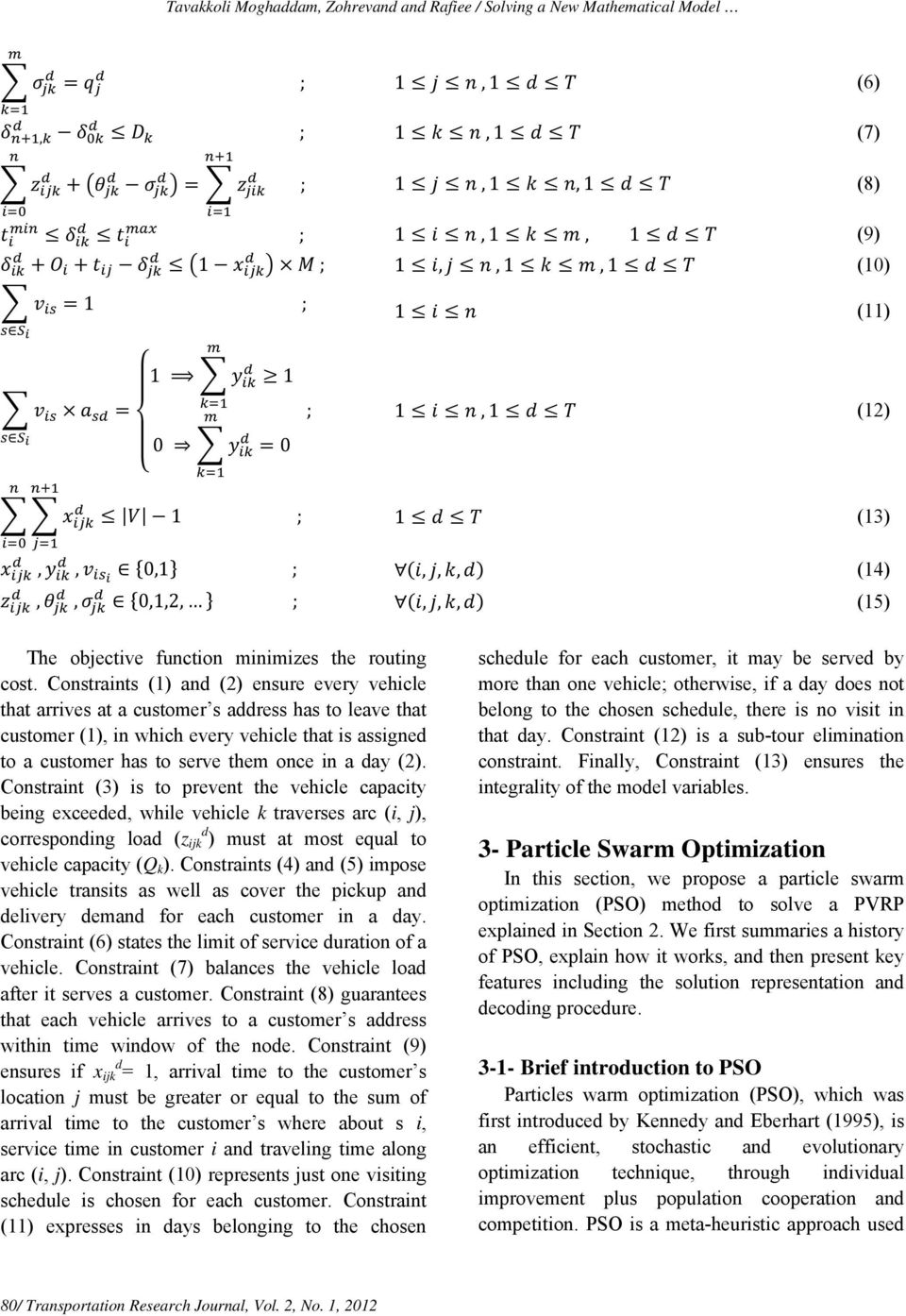
4 , ; 1,1 (6) ; 1,1 (7) ; 1,1,1 (8) ; 1,1, 1 (9) 1 ; 1,,1,1 (10) 1 ; 1 (11) ; 1,1 (12) 1 ; 1 (13),, 0,1 ;,,, (14),, 0,1,2, ;,,, (15) The objective function minimizes the routing cost. Constraints (1) and (2) ensure every vehicle that arrives at a customer s address has to leave that customer (1), in which every vehicle that is assigned to a customer has to serve them once in a day (2). Constraint (3) is to prevent the vehicle capacity being exceeded, while vehicle k traverses arc (i, j), corresponding load (z ijk d ) must at most equal to vehicle capacity (Q k ). Constraints (4) and (5) impose vehicle transits as well as cover the pickup and delivery demand for each customer in a day. Constraint (6) states the limit of service duration of a vehicle. Constraint (7) balances the vehicle load after it serves a customer. Constraint (8) guarantees that each vehicle arrives to a customer s address within time window of the node. Constraint (9) ensures if x ijk d = 1, arrival time to the customer s location j must be greater or equal to the sum of arrival time to the customer s where about s i, service time in customer i and traveling time along arc (i, j). Constraint (10) represents just one visiting schedule is chosen for each customer. Constraint (11) expresses in days belonging to the chosen schedule for each customer, it may be served by more than one vehicle; otherwise, if a day does not belong to the chosen schedule, there is no visit in that day. Constraint (12) is a sub-tour elimination constraint. Finally, Constraint (13) ensures the integrality of the model variables. 3- Particle Swarm Optimization In this section, we propose a particle swarm optimization (PSO) method to solve a PVRP explained in Section 2. We first summaries a history of PSO, explain how it works, and then present key features including the solution representation and decoding procedure Brief introduction to PSO Particles warm optimization (PSO), which was first introduced by Kennedy and Eberhart (1995), is an efficient, stochastic and evolutionary optimization technique, through individual improvement plus population cooperation and competition. PSO is a meta-heuristic approach used 80/ Transportation Research Journal, Vol. 2, No. 1, 2012
5 for solving hard global optimization problems and some deals look like genetic algorithms. Both of them have the same specifications, such as initial randomly generated populations (or swarms), fitness functions to evaluate the individual and population, updating population and random searching techniques to find the optimum. However, PSO does not have genetic operators. The biological inspiration is based on social behavior of bird flocking or fish schooling. In these populations, a leader guides the movement of the whole swarm. PSO is a population based search method that uses movements of particles in the swarm as a searching method. In PSO, we serve a swarm including H particles as a search indicator for a particular problem s solution. A particle s position ( ) that consists of L dimensions is as agent of problem solution. Each particle has a velocity vector ( ), which exhibits the particle s ability to search for solutions. In each iteration of this algorithm, the particles move from one point to another based on their velocity. PSO also incorporates local and global search abilities. In the basic version of PSO, movement of each swarm is based on the leader and its own knowledge. The particle s personal best position ( ) and the global best position ( ) are always updated and saved. The particle s personal best position is specified as the solution, which gives the best objective function among solutions that have been visited by the particle up to now. If a particle is located in a new position that has the best objective function that has been reached by the particle (i.e., Z ( )<Z( )), the personal best position is replaced by this new position. The global best position indicates a solution that gives the best objective function among positions that have been visited by all particles in the swarm. If a particle is located in a new position that has the best objective function reached by the whole particles (i.e., Z( )<Z( )), the global best position is replaced by this new position. In each iteration, the particle velocity is updated using three terms: namely current velocity, personal best position, and global best position. The current velocity obliges the particle to move in the same direction of the last iteration. The first term is calculated by multiplying the current velocity and an inertia weight (w). The personal best position absorbs the particle and forces it to move back toward ( ). The second term is calculated by multiplying the difference of the personal best position ( ) and the current position ( ), a random number () and acceleration constant for the personal best (. The global best position also attracts all particles to move back toward itself. The last term is calculated by multiplying the difference between the global best position ( ) and the current position ( ), a random number () and acceleration constant for the global best (. In order to randomize the particle s movement, random numbers are synthesized in the velocity updating formula. Thus, two different particles with the same current positions, personal best positions and global best positions may shift to different positions by iterating the algorithm twice. In PSO, we have to limit the space of the particle movement, i.e. the confined bound for the position value of the particle dimension is [, ]. This limitation ensures that the solution does not get divergence. Thereupon, the velocity of a particle, which moves beyond the boundary which is set at zero and its position value, gets the minimum or maximum value (Ai and Kachitvichyanukul, 2009). Marinakis et al. (2010) implement a hybrid PSO to handle VRP effectively. Their main contribution was to show that applying particle swarm optimization in hybrid synthesis with other meta-heuristics increases both quality and computational efficiency of the VRP solution, remarkably. After that Miranakis and Miranaki (2010) propose another hybrid GA-PSO called HybGENPSO. A PSO algorithm for OVRP is presented by Mirhassani and Abolghasemi (2011). Recently, Norouzi et al., (2011) applied a novel particle swarm algorithm to solve multi-objective, competitive open vehicle routing problems. Tavakkoli-Moghaddam et al., (2010) proposed the improved particle swarm optimization (IPSO) algorithm to solve a VRP considering a balance of goods based on the vehicles capacity. To the best of our knowledge, this is the first application of PSO to the PVRP. Transportation Research Journal, Vol. 2, No. 1, 2012 /81

6 3-2- Proposed PSO algorithm We propose a new version of PSO that has an additional term than the classic version. It considers the local best position ( ) in the velocity updating formula. The local best is the position with the best objective function among some neighbor particles. The PSO algorithm to solve the PVRP is presented below. In Step 1, particles are generated. In Steps 2 and 3, the corresponding fitness function to particle position is calculated. The global, local and personal bests are updated in Steps 4 to 6. The particle velocity and subsequently its position are updated in Step 7. Finally, in Step 8, the stopping or repeating criterion is controlled Notations Iteration index 1,, Dimension index 1,, Particle index 1,, Inertia weight in the iteration Velocity at dimension of particle in iteration Ω Position at dimension of particlein iteration Personal best position of particleat dimension Global best position at dimension Local best position of particle at dimension Uniform random number in the interval0, 1 Acceleration constant for the personal best position Acceleration constant for the local best position Acceleration constant for the global best position Minimum position value Maximum position value Fitness function of position Now, we use the PSO framework for the given PVRPs. Our proposed algorithm is a discrete one. Therefore, all mathematical operators in the above PSO algorithm are redefined. The idea to solve discrete problems with PSO comes from Clerc (2000). When the algorithm is being executed, all solutions are checked for feasibility. It only continues with feasible solutions; however, infeasible solutions must be changed to feasible solutions immediately. All symbols, operators and velocities are redefined as follows Velocity In this PSO algorithm, the velocity (v) is a set of numerical pairs. The number of numerical pairs in the velocity indicates the velocity size Velocity plus velocity The result of the summation of two velocities is a new velocity, which is a union of the selected velocities, and eliminates repetitive numerical pairs. For example, let 1,2, 3,2 and 3,1, 3,2, then 1,2, 3,1, 3, Velocity minus velocity The result of the subtraction between two velocities is a new velocity, which includes only non-repetitive numerical pairs. For illustration, let 1,2, 3,2 and 3,1, 3,2,, then 1,2, 3, Position plus velocity The result of summation, a velocity to a position, is a new position. This is a mutation on bits of the position based on corresponding numerical pairs of the velocity. When it is done, the position is checked for feasibility, and may need a corrective mutation to satisfy feasibility constraint. For an illustration, see Eq. (16) and 1,2, then 1 1 (16) Position minus position The result of the subtraction between two positions is a velocity. The resulting velocity is gained according to those different bits of two positions. 82/ Transportation Research Journal, Vol. 2, No. 1, 2012

7 3-3 Solution representation The key element of implementing PSO for the PVRP is how to define a solution representation for vehicle routes. The following proposed representation includes two parts referring to binary variables and integers. In the following, we describe how to decode this solution to vehicle routes, as shown in Figure Generate I particles as a swarm, initialize particle I with random position in the range,, set velocity 0, and personal best for i=1,, I, and t=1. 2. For i=1,, I, decode to a set of lot sizes. 3. For i=1,, I, compute fitness value. 4. Update p best: if, set for i=1,, I. 5. Update g best: if, set for i=1,, I. 6. Update l best: compare the personal best position among K neighbors of particle i, set the personal best position with the best fitness value to. 7. Update the velocity and position of each particle: 1 1 (17) 1 Ω (18) 1 1 (19) if 1, then 1 and 1 0 (20) if 1, then 1 and 1 0 (21) 8. Check improvement of p best in each 100 iteration 9. If t=t, stop; otherwise, set t=t+1 and go to Step 2. Figure 1. Proposed PSO algorithm for the integrated PVRP Table 1. PSO constant parameters Parameter Value Number of iterations in each replication T=1000 Number of particles in a swarm L=100 Number of neighbors for each particle K=10 Acceleration constant for global best position =0.5 Acceleration constant for local best position =0.5 Acceleration constant for personal best position =1 First inertia weight Last inertia weight 1=0.8 =0.2 Transportation Research Journal, Vol. 2, No. 1, 2012 /83
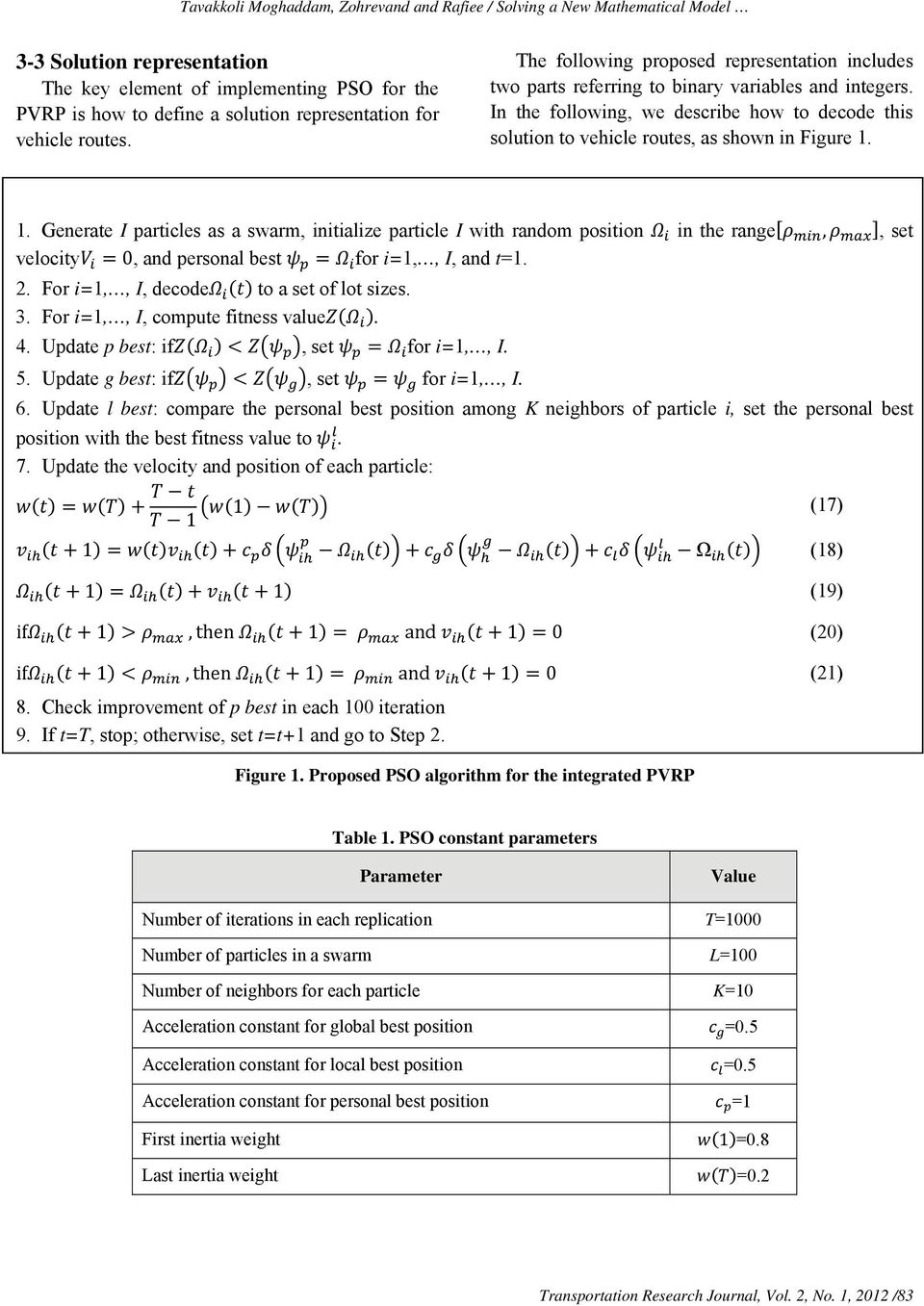
8 4- Computational Results Since there are no computational results in the previous literature of the PVRP that incorporated all given complexities, we have to randomly generate a number of test problems to evaluate our integrated PVRP model. In this section, we present the computational results in two parts. The first part is related to a small sized problem solved by the GAMS software and our proposed PSO algorithm. Then, compare them with each other. In the second part, a medium sized problem is used to test our presented model. Because of dignity of the problem size, we are capable of using the PSO algorithm only. The PSO algorithm is coded by using C++ language on a PC with Intel Core 2 Duo 2.5 GHz CPU, and 4GB RAM. This algorithm runs 10 times for each instance. The fixed parameters of PSO are indicated by preliminary experiments to find out which parameter setting behaves best. There are two stopping rules, namely 1) the maximum iteration number and 2) the less improvement in p best after every 100 iteration. Table 1 summarizes these parameters. The stopping rule is based on the maximum iteration. In addition, for simplicity, we assume that all vehicle fleets are heterogeneous with the same capacity (i.e., Q=100) and time window (i.e., D=500). The required data related with costumers, such as quantity of demand in each period, location of each costumer, distance between each pair of costumers and time horizon to visit each costumer, are gathered from a well-known test problem that can be found at A set of 16 random instances is generated for the small sized integrated PVRP. Problem Table 2. Comparison of optimal solution and the PSO algorithm results for small sized instances No. of vehicles No. of days No. of costumers Optimal solution Best cost Worst cost PSO solution Mean cost Deviation (%) Mean time (s) < < / Transportation Research Journal, Vol. 2, No. 1, 2012
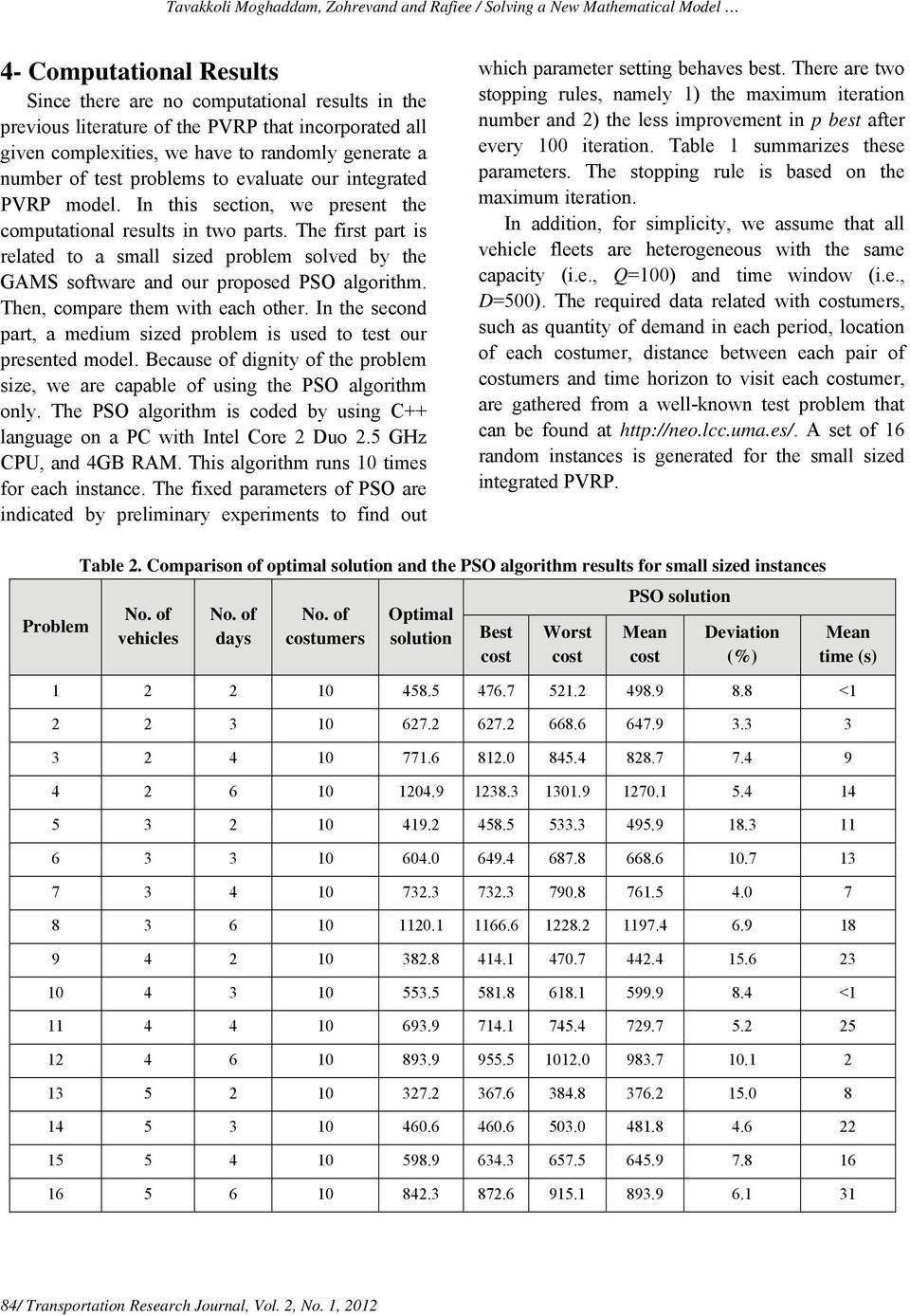
9 Problem No. of vehicles Table 3. PSO algorithm results for medium-sized instances No. of No. of PSO solution days costumers Best cost Worst cost Mean cost Mean time(s) Transportation Research Journal, Vol. 2, No. 1, 2012 /85
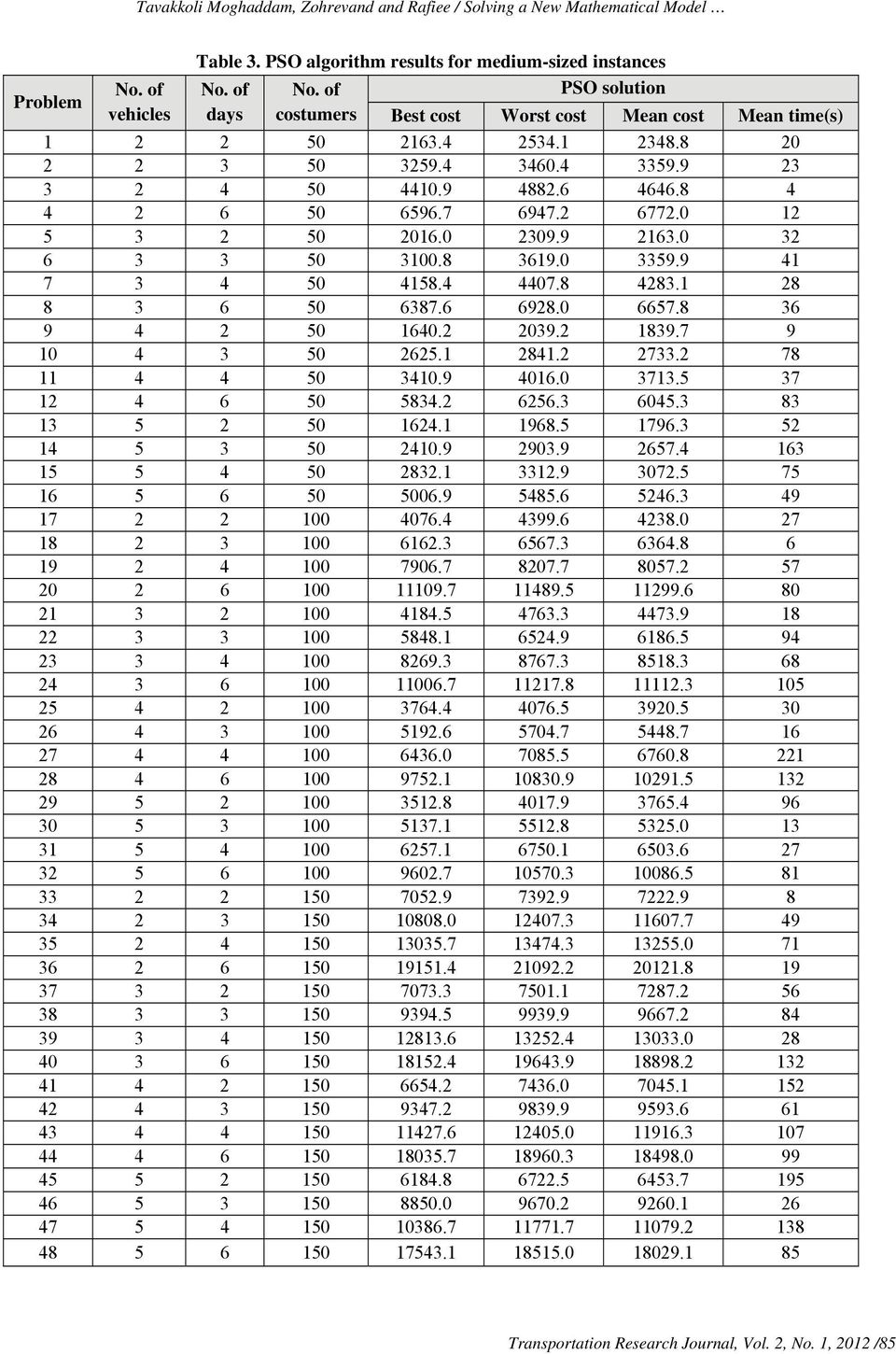
10 Table 2 shows parameters of random instances and the related results of the PSO algorithm and optimal solution obtained by the GAMS software. This set is generated by the combination of members to the set number of vehicles = {2, 3, 4, 5}, number of days = {2,3,4,6}, and number of customers = {10}. Moreover, Table 3 illustrates the features of 48 random instances, and the related results of the proposed PSO algorithm for medium sized problems consisting of all feasible combinations of members to set the number of vehicles = {2,3,4,5}, number of days = {2,3,4,6}, and number of customers = {50,100,150}. To get a more reliable evaluation of the proposed algorithm, we compare the optimal solution with the mean cost of our proposed PSO algorithm in small sized instances, and the variance of the best and worst costs divided into the mean cost in medium sized instances. We use two types of the deviation factor that their formulas are shown by: Deviation MeanPSO OptimalSolution OptimalSolution 100% Deviation WorstPSO BestPSO 100% MeanPSO (22) (23) 5- Conclusion Many real routing problems hold their own complexities that are not regarded in the previous models. In this study, we have presented an integrated periodic vehicle routing problem (PVRP) that is able to meet various practical requirements. It incorporates the popular models of the PVRP. Moreover, it combines many additions of the previous models, which have never been considered simultaneously. This paper has presented a specific kind of the CPVRP containing the split service, in which the demand of each customer can be divided between several vehicles. This problem can take place in a transportation system when a number of vehicles have to be passed by a node or customer. Furthermore, it would be possible that the order in some nodes would be greater than the maximum capacity in the fleet. This paper has aimed to maximize the utilization of the fleet s capacity. Therefore, several vehicles could fulfill the demand of some customers. The presented model can find optimal routes with the minimum cost of fleet. The computational results prove that the PSO algorithm has solved the proposed integrated PVRP model effectively. However, it was not the best one and it would improve by optimizing the PSO parameters and programming implementation. These further efforts improve the solution quality and computational time. In addition, further research should be conducted to extend the model for highconstrained real-life problems. References Ai, T. J. and Kachitvichyanukul, V. (2009) "A particle swarm optimization for the vehicle routing problem with simultaneous pickup and delivery", Computers & Operations Research, Vol. 36, No. 5, pp Angelelli, E. and Speranza, M. G. (2002) "The vehicle routing problem with intermediate facilities", European Journal of Operational Research, Vol. 137, pp Beltrami, E. and Bodin, L. (1974) "Networks and vehicle routing for municipal waste collection", Networks, Vol. 4, No. 1, pp Christofides, N. and Beasley, J. (1984) "The period routing problem", Networks, Vol. 14, No. 2, pp Christofides, N., Mingozzi, A. and Toth, P. (1979) "The vehicle routing problem", In: Christofides, N., Mingozzi, A., Toth, P., Sandi, C., (Eds.), Combinatorial optimization. Chicester: John Wiley, pp Clerc, M., (2000) "Discrete particle swarm optimization illustrated by the traveling salesman problem", Available on: Cordeau, J. F., Desaulniers, G., Desrosiers, J., Solomon, M. and Soumis, F. (2002) "VRP with time windows", In: Toth, P., Vigo, D. (Eds.), The vehicle routing problem. SIAM Monographs on Discrete Mathematics and Applications, Philadelphia, pp / Transportation Research Journal, Vol. 2, No. 1, 2012

11 Goel, A. and Gruhn, V. (2208) "A general vehicle routing problem", European Journal of Operational Research, Vol. 191, No. 3, pp Hasle, G. (2003) "Heuristics for rich VRP models", Presented at the Seminar at GERAD, Montreal, Canada. Kennedy, J. and Eberhart, R. (1995) "Particle swarm optimization", Proceedings of the IEEE International Conference on Neural Networks, Vol. 4, pp Laporte, G. and Semet, F. (2002) "Classical heuristics for the capacitated VRP", In: Toth, P., Vigo, D. (Eds.), The vehicle routing problem, SIAM Monographs on Discrete Mathematics and Applications, Philadelphia, pp Marinakis, Y. and Miranaki, M. (2010) "A hybrid genetic - particle swarm optimization algorithm for the vehicle routing problem", Expert Systems with Applications, Vol. 37, pp Marinakis, Y., Miranaki, M. and Dounias, G. (2010) "A hybrid particle swarm optimization algorithm for the vehicle routing problem", Engineering Application of Artificial Intelligence, Vol. 23, pp Mirhassani, S.A. and Abolghasemi, N. (2011) "A particle swarm optimization algorithm for open vehicle routing problem", Expert Systems with Applications, Vol. 38, pp Norouzi, N., Tavakkoli Moghaddam, R., Ghazanfari, M., Alinaghian, M. and Salamatbakhsh, A. R. (2011) "A new multi-objective competitive open vehicle routing problem solved by particle swarm optimization", Networks and Spatial Economics, Accepted for publication, DOI: /s Psaraftis, H. (1988) "Dynamic vehicle routing problems", In: Golden, B., Assad, A. (Eds.), Vehicle routing: Methods and studies. North-Holland, Amsterdam, pp Psaraftis, H. (1979) "Dynamic vehicle routing: Status and prospects", Annals of Operations Research, Vol. 61, pp Russell, R. and Igo, W. (1979) "An assignment routing problem", Networks, Vol. 9, No. 1, pp Savelsbergh, M., and Sol, M. (1995) "The general pickup and delivery problem", Transportation Science, Vol. 29, No. 1, pp Savelsbergh, M. and Sol, M. (1998) "DRIVE: dynamic routing of independent vehicles", Operations Research, Vol. 46, pp Tavakkoli Moghaddam, R., Safaei, N., Kah, M.M.O. and Rabbani, M. (2007) "A new capacitated vehicle routing problem with split service for minimizing fleet cost by simulated annealing", J. of the Franklin Institute, Vol. 344, pp Tavakkoli Moghaddam, R., Saremi, A.R. and Ziaee, M.S. (2006) "A memetic algorithm for a vehicle routing problem with backhauls", Applied Mathematics and Computation, Vol. 181, No. 2, pp Tavakkoli Moghaddam, R., Norouzi, N., Salamatbakhsh, A. and Alinaghian, M. (2011) "A vehicle routing problem considering a balance of goods based on the vehicles capacity by improved particle swarm optimization", J. of Transportation Research, Accepted for publication, (in Farsi). Toth, P. and Vigo, D., (Eds.) (2002) "The vehicle routing problem", Philadelphia, PA: SIAM. Wang, Z. and Wang, Z. (2009) "A novel two-phase heuristic method for vehicle routing problem with backhauls", Computers & Mathematics with Applications, Vol. 57, Nos , pp Transportation Research Journal, Vol. 2, No. 1, 2012 /87
Two objective functions for a real life Split Delivery Vehicle Routing Problem
 International Conference on Industrial Engineering and Systems Management IESM 2011 May 25 - May 27 METZ - FRANCE Two objective functions for a real life Split Delivery Vehicle Routing Problem Marc Uldry
Solving the Vehicle Routing Problem with Multiple Trips by Adaptive Memory Programming
 Solving the Vehicle Routing Problem with Multiple Trips by Adaptive Memory Programming Alfredo Olivera and Omar Viera Universidad de la República Montevideo, Uruguay ICIL 05, Montevideo, Uruguay, February
An Efficient Algorithm for Solving a Stochastic Location-Routing Problem
 Journal of mathematics and computer Science 12 (214) 27 38 An Efficient Algorithm for Solving a Stochastic LocationRouting Problem H.A. HassanPour a, M. MosadeghKhah a, M. Zareei 1 a Department of Industrial
Branch-and-Price Approach to the Vehicle Routing Problem with Time Windows
 TECHNISCHE UNIVERSITEIT EINDHOVEN Branch-and-Price Approach to the Vehicle Routing Problem with Time Windows Lloyd A. Fasting May 2014 Supervisors: dr. M. Firat dr.ir. M.A.A. Boon J. van Twist MSc. Contents
Un algorithme génétique hybride à gestion adaptative de diversité pour le problème de tournées de véhicules et ses variantes
 Un algorithme génétique hybride à gestion adaptative de diversité pour le problème de tournées de véhicules et ses variantes Thibaut VIDAL LOSI et CIRRELT Université de Technologie de Troyes et Université
A Novel Binary Particle Swarm Optimization
 Proceedings of the 5th Mediterranean Conference on T33- A Novel Binary Particle Swarm Optimization Motaba Ahmadieh Khanesar, Member, IEEE, Mohammad Teshnehlab and Mahdi Aliyari Shoorehdeli K. N. Toosi
A Genetic Algorithm Approach for Solving a Flexible Job Shop Scheduling Problem
 A Genetic Algorithm Approach for Solving a Flexible Job Shop Scheduling Problem Sayedmohammadreza Vaghefinezhad 1, Kuan Yew Wong 2 1 Department of Manufacturing & Industrial Engineering, Faculty of Mechanical
Cost Models for Vehicle Routing Problems. 8850 Stanford Boulevard, Suite 260 R. H. Smith School of Business
 0-7695-1435-9/02 $17.00 (c) 2002 IEEE 1 Cost Models for Vehicle Routing Problems John Sniezek Lawerence Bodin RouteSmart Technologies Decision and Information Technologies 8850 Stanford Boulevard, Suite
VEHICLE ROUTING AND SCHEDULING PROBLEMS: A CASE STUDY OF FOOD DISTRIBUTION IN GREATER BANGKOK. Kuladej Panapinun and Peerayuth Charnsethikul.
 1 VEHICLE ROUTING AND SCHEDULING PROBLEMS: A CASE STUDY OF FOOD DISTRIBUTION IN GREATER BANGKOK By Kuladej Panapinun and Peerayuth Charnsethikul Abstract Vehicle routing problem (VRP) and its extension
Waste Collection Vehicle Routing Problem Considering Similarity Pattern of Trashcan
 International Journal of Applied Operational Research Vol. 3, o. 3, pp. 105-111, Summer 2013 Journal homepage: www.ijorlu.ir Waste Collection Vehicle Routing Problem Considering Similarity Pattern of Trashcan
Software Framework for Vehicle Routing Problem with Hybrid Metaheuristic Algorithms
 Software Framework for Vehicle Routing Problem with Hybrid Metaheuristic Algorithms S.MASROM 1, A.M. NASIR 2 Malaysia Institute of Transport (MITRANS) Faculty of Computer and Mathematical Science Universiti
A Library of Vehicle Routing Problems
 A Library of Vehicle Routing Problems Tim Pigden and Optrak Distribution Software Ltd. [email protected] Graham Kendall and The University of Nottingham Malaysia Campus Jalan Broga, 43500 Semenyih
Adaptive Memory Programming for the Vehicle Routing Problem with Multiple Trips
 Adaptive Memory Programming for the Vehicle Routing Problem with Multiple Trips Alfredo Olivera, Omar Viera Instituto de Computación, Facultad de Ingeniería, Universidad de la República, Herrera y Reissig
XOR-based artificial bee colony algorithm for binary optimization
 Turkish Journal of Electrical Engineering & Computer Sciences http:// journals. tubitak. gov. tr/ elektrik/ Research Article Turk J Elec Eng & Comp Sci (2013) 21: 2307 2328 c TÜBİTAK doi:10.3906/elk-1203-104
CLOUD DATABASE ROUTE SCHEDULING USING COMBANATION OF PARTICLE SWARM OPTIMIZATION AND GENETIC ALGORITHM
 CLOUD DATABASE ROUTE SCHEDULING USING COMBANATION OF PARTICLE SWARM OPTIMIZATION AND GENETIC ALGORITHM *Shabnam Ghasemi 1 and Mohammad Kalantari 2 1 Deparment of Computer Engineering, Islamic Azad University,
Research Paper Business Analytics. Applications for the Vehicle Routing Problem. Jelmer Blok
 Research Paper Business Analytics Applications for the Vehicle Routing Problem Jelmer Blok Applications for the Vehicle Routing Problem Jelmer Blok Research Paper Vrije Universiteit Amsterdam Faculteit
BMOA: Binary Magnetic Optimization Algorithm
 International Journal of Machine Learning and Computing Vol. 2 No. 3 June 22 BMOA: Binary Magnetic Optimization Algorithm SeyedAli Mirjalili and Siti Zaiton Mohd Hashim Abstract Recently the behavior of
A New Quantitative Behavioral Model for Financial Prediction
 2011 3rd International Conference on Information and Financial Engineering IPEDR vol.12 (2011) (2011) IACSIT Press, Singapore A New Quantitative Behavioral Model for Financial Prediction Thimmaraya Ramesh
Fifty Years of Vehicle Routing
 Fifty Years of Vehicle Routing by Gilbert Laporte Canada Research Chair in Distribution Management HEC Montréal Vehicle Routing Problem Depot m (or at most m) identical vehicles based at the depot n customers
An ACO Approach to Solve a Variant of TSP
 An ACO Approach to Solve a Variant of TSP Bharat V. Chawda, Nitesh M. Sureja Abstract This study is an investigation on the application of Ant Colony Optimization to a variant of TSP. This paper presents
A Scatter Search Algorithm for the Split Delivery Vehicle Routing Problem
 A Scatter Search Algorithm for the Split Delivery Vehicle Routing Problem Campos,V., Corberán, A., Mota, E. Dep. Estadística i Investigació Operativa. Universitat de València. Spain Corresponding author:
A Reference Point Method to Triple-Objective Assignment of Supporting Services in a Healthcare Institution. Bartosz Sawik
 Decision Making in Manufacturing and Services Vol. 4 2010 No. 1 2 pp. 37 46 A Reference Point Method to Triple-Objective Assignment of Supporting Services in a Healthcare Institution Bartosz Sawik Abstract.
A Set-Partitioning-Based Model for the Stochastic Vehicle Routing Problem
 A Set-Partitioning-Based Model for the Stochastic Vehicle Routing Problem Clara Novoa Department of Engineering and Technology Texas State University 601 University Drive San Marcos, TX 78666 [email protected]
International Journal of Software and Web Sciences (IJSWS) www.iasir.net
 International Association of Scientific Innovation and Research (IASIR) (An Association Unifying the Sciences, Engineering, and Applied Research) ISSN (Print): 2279-0063 ISSN (Online): 2279-0071 International
Modeling and Solving the Capacitated Vehicle Routing Problem on Trees
 in The Vehicle Routing Problem: Latest Advances and New Challenges Modeling and Solving the Capacitated Vehicle Routing Problem on Trees Bala Chandran 1 and S. Raghavan 2 1 Department of Industrial Engineering
STUDY OF PROJECT SCHEDULING AND RESOURCE ALLOCATION USING ANT COLONY OPTIMIZATION 1
 STUDY OF PROJECT SCHEDULING AND RESOURCE ALLOCATION USING ANT COLONY OPTIMIZATION 1 Prajakta Joglekar, 2 Pallavi Jaiswal, 3 Vandana Jagtap Maharashtra Institute of Technology, Pune Email: 1 [email protected],
Chapter 1. Introduction
 Chapter 1 Introduction Intermodal freight transportation describes the movement of goods in standardized loading units (e.g., containers) by at least two transportation modes (rail, maritime, and road)
New Exact Solution Approaches for the Split Delivery Vehicle Routing Problem
 New Exact Solution Approaches for the Split Delivery Vehicle Routing Problem Gizem Ozbaygin, Oya Karasan and Hande Yaman Department of Industrial Engineering, Bilkent University, Ankara, Turkey ozbaygin,
Web Service Selection using Particle Swarm Optimization and Genetic Algorithms
 Web Service Selection using Particle Swarm Optimization and Genetic Algorithms Simone A. Ludwig Department of Computer Science North Dakota State University Fargo, ND, USA [email protected] Thomas
Metaheuristics in Vehicle Routing
 Metaheuristics in Vehicle Routing Michel Gendreau CIRRELT and MAGI École Polytechnique de Montréal Vilamoura, Portugal, 4-6 February 2012 Presentation outline 1) Vehicle Routing Problems 2) Metaheuristics
MODELING RICH AND DYNAMIC VEHICLE ROUTING PROBLEMS IN HEURISTICLAB
 MODELING RICH AND DYNAMIC VEHICLE ROUTING PROBLEMS IN HEURISTICLAB Stefan Vonolfen (a), Michael Affenzeller (b), Stefan Wagner (c) (a) (b) (c) Upper Austria University of Applied Sciences, Campus Hagenberg
A Binary Model on the Basis of Imperialist Competitive Algorithm in Order to Solve the Problem of Knapsack 1-0
 212 International Conference on System Engineering and Modeling (ICSEM 212) IPCSIT vol. 34 (212) (212) IACSIT Press, Singapore A Binary Model on the Basis of Imperialist Competitive Algorithm in Order
Revenue Management for Transportation Problems
 Revenue Management for Transportation Problems Francesca Guerriero Giovanna Miglionico Filomena Olivito Department of Electronic Informatics and Systems, University of Calabria Via P. Bucci, 87036 Rende
An Improved ACO Algorithm for Multicast Routing
 An Improved ACO Algorithm for Multicast Routing Ziqiang Wang and Dexian Zhang School of Information Science and Engineering, Henan University of Technology, Zheng Zhou 450052,China [email protected]
Minimization of Transportation Cost in Courier Service Industry
 ISS (Online) : 2319-8753 ISS (Print) : 2347-6710 International Journal of Innovative Research in Science, Engineering and Technology Volume 3, Special Issue 3, March 2014 2014 International Conference
A cluster-based optimization approach for the multi-depot heterogeneous fleet vehicle routing problem with time windows
 European Journal of Operational Research 176 (2007) 1478 1507 Discrete Optimization A cluster-based optimization approach for the multi-depot heterogeneous fleet vehicle routing problem with time windows
A Weighted-Sum Mixed Integer Program for Bi-Objective Dynamic Portfolio Optimization
 AUTOMATYKA 2009 Tom 3 Zeszyt 2 Bartosz Sawik* A Weighted-Sum Mixed Integer Program for Bi-Objective Dynamic Portfolio Optimization. Introduction The optimal security selection is a classical portfolio
14.10.2014. Overview. Swarms in nature. Fish, birds, ants, termites, Introduction to swarm intelligence principles Particle Swarm Optimization (PSO)
 Overview Kyrre Glette kyrrehg@ifi INF3490 Swarm Intelligence Particle Swarm Optimization Introduction to swarm intelligence principles Particle Swarm Optimization (PSO) 3 Swarms in nature Fish, birds,
On the Impact of Real-Time Information on. Field Service Scheduling. Ioannis Petrakis, Christian Hass, Martin Bichler 1
 On the Impact of Real-Time Information on Field Service Scheduling Ioannis Petrakis, Christian Hass, Martin Bichler 1 Department of Informatics, TU München, Germany Mobile phone operators need to plan
Strategic Planning and Vehicle Routing Algorithm for Newspaper Delivery Problem: Case study of Morning Newspaper, Bangkok, Thailand
 Strategic Planning and Vehicle Routing Algorithm for Newspaper Delivery Problem: Case study of Morning Newspaper, Bangkok, Thailand Arunya Boonkleaw, Nanthi Sutharnnarunai, PhD., Rawinkhan Srinon, PhD.
The VRP with Time Windows
 The VRP with Time Windows J.-F. Cordeau École des Hautes Études Commerciales, Montréal [email protected] Guy Desaulniers Département de mathématiques et génie industriel École Polytechnique de Montréal,
Heuristic and exact algorithms for vehicle routing problems. Stefan Ropke
 Heuristic and exact algorithms for vehicle routing problems Stefan Ropke December 2005 Preface This Ph.D. thesis has been prepared at the Department of Computer Science at the University of Copenhagen
Scheduling and Routing Milk from Farm to Processors by a Cooperative
 Journal of Agribusiness 22,2(Fall 2004):93S106 2004 Agricultural Economics Association of Georgia Scheduling and Routing Milk from Farm to Processors by a Cooperative Peerapon Prasertsri and Richard L.
Optimising Patient Transportation in Hospitals
 Optimising Patient Transportation in Hospitals Thomas Hanne 1 Fraunhofer Institute for Industrial Mathematics (ITWM), Fraunhofer-Platz 1, 67663 Kaiserslautern, Germany, [email protected] 1 Introduction
HYBRID GENETIC ALGORITHMS FOR SCHEDULING ADVERTISEMENTS ON A WEB PAGE
 HYBRID GENETIC ALGORITHMS FOR SCHEDULING ADVERTISEMENTS ON A WEB PAGE Subodha Kumar University of Washington [email protected] Varghese S. Jacob University of Texas at Dallas [email protected]
SOLVING INVENTORY ROUTING PROBLEMS USING LOCATION BASED HEURISTICS
 OPERATIONS RESEARCH AND DECISIONS No. 2 2014 DOI: 10.5277/ord140204 Paweł HANCZAR 1 SOLVING INVENTORY ROTING PROBLEMS SING LOCATION BASED HERISTICS Inventory routing problems (IRPs) occur where vendor
Dynamic Generation of Test Cases with Metaheuristics
 Dynamic Generation of Test Cases with Metaheuristics Laura Lanzarini, Juan Pablo La Battaglia III-LIDI (Institute of Research in Computer Science LIDI) Faculty of Computer Sciences. National University
Stochastic Ship Fleet Routing with Inventory Limits YU YU
 Stochastic Ship Fleet Routing with Inventory Limits YU YU Doctor of Philosophy University of Edinburgh 2009 Declaration I declare that this thesis was composed by myself and that the work contained therein
Optimal Scheduling for Dependent Details Processing Using MS Excel Solver
 BULGARIAN ACADEMY OF SCIENCES CYBERNETICS AND INFORMATION TECHNOLOGIES Volume 8, No 2 Sofia 2008 Optimal Scheduling for Dependent Details Processing Using MS Excel Solver Daniela Borissova Institute of
A Multi-Objective Performance Evaluation in Grid Task Scheduling using Evolutionary Algorithms
 A Multi-Objective Performance Evaluation in Grid Task Scheduling using Evolutionary Algorithms MIGUEL CAMELO, YEZID DONOSO, HAROLD CASTRO Systems and Computer Engineering Department Universidad de los
An ant colony optimization for single-machine weighted tardiness scheduling with sequence-dependent setups
 Proceedings of the 6th WSEAS International Conference on Simulation, Modelling and Optimization, Lisbon, Portugal, September 22-24, 2006 19 An ant colony optimization for single-machine weighted tardiness
The Multi-Depot Vehicle Routing Problem with Inter-Depot Routes
 The Multi-Depot Vehicle Routing Problem with Inter-Depot Routes Benoit Crevier, Jean-François Cordeau and Gilbert Laporte Canada Research Chair in Distribution Management HEC Montréal 3000 chemin de la
Research on the Performance Optimization of Hadoop in Big Data Environment
 Vol.8, No.5 (015), pp.93-304 http://dx.doi.org/10.1457/idta.015.8.5.6 Research on the Performance Optimization of Hadoop in Big Data Environment Jia Min-Zheng Department of Information Engineering, Beiing
INTERNATIONAL JOURNAL OF COMPUTER ENGINEERING & TECHNOLOGY (IJCET)
 INTERNATIONAL JOURNAL OF COMPUTER ENGINEERING & TECHNOLOGY (IJCET) International Journal of Computer Engineering and Technology (IJCET), ISSN 0976 6367(Print), ISSN 0976 6367(Print) ISSN 0976 6375(Online)
Ant colony optimization techniques for the vehicle routing problem
 Advanced Engineering Informatics 18 (2004) 41 48 www.elsevier.com/locate/aei Ant colony optimization techniques for the vehicle routing problem John E. Bell a, *, Patrick R. McMullen b a Department of
Production Scheduling for Dispatching Ready Mixed Concrete Trucks Using Bee Colony Optimization
 American J. of Engineering and Applied Sciences 3 (1): 7-14, 2010 ISSN 1941-7020 2010 Science Publications Production Scheduling for Dispatching Ready Mixed Concrete Trucks Using Bee Colony Optimization
Vehicle Routing and Scheduling. Martin Savelsbergh The Logistics Institute Georgia Institute of Technology
 Vehicle Routing and Scheduling Martin Savelsbergh The Logistics Institute Georgia Institute of Technology Vehicle Routing and Scheduling Part I: Basic Models and Algorithms Introduction Freight routing
Solving Capacitated Vehicle Routing Problem by Using Heuristic Approaches: A Case Study
 Journal of Modern Science and Technology Vol. 3. No. 1. March 2015 Issue. Pp.135-146 Solving Capacitated Vehicle Routing Problem by Using Heuristic Approaches: A Case Study * Mohibul Islam, **Sajal Ghosh
Online vehicle routing and scheduling with continuous vehicle tracking
 Online vehicle routing and scheduling with continuous vehicle tracking Jean Respen, Nicolas Zufferey, Jean-Yves Potvin To cite this version: Jean Respen, Nicolas Zufferey, Jean-Yves Potvin. Online vehicle
Biogeography Based Optimization (BBO) Approach for Sensor Selection in Aircraft Engine
 Biogeography Based Optimization (BBO) Approach for Sensor Selection in Aircraft Engine V.Hymavathi, B.Abdul Rahim, Fahimuddin.Shaik P.G Scholar, (M.Tech), Department of Electronics and Communication Engineering,
A genetic algorithm for resource allocation in construction projects
 Creative Construction Conference 2015 A genetic algorithm for resource allocation in construction projects Sofia Kaiafa, Athanasios P. Chassiakos* Sofia Kaiafa, Dept. of Civil Engineering, University of
Solving the Vehicle Routing Problem with Genetic Algorithms
 Solving the Vehicle Routing Problem with Genetic Algorithms Áslaug Sóley Bjarnadóttir April 2004 Informatics and Mathematical Modelling, IMM Technical University of Denmark, DTU Printed by IMM, DTU 3 Preface
Projects - Neural and Evolutionary Computing
 Projects - Neural and Evolutionary Computing 2014-2015 I. Application oriented topics 1. Task scheduling in distributed systems. The aim is to assign a set of (independent or correlated) tasks to some
A MIXED INTEGER PROGRAMMING FOR A VEHICLE ROUTING PROBLEM WITH TIME WINDOWS: A CASE STUDY OF A THAI SEASONING COMPANY. Abstract
 A MIXED INTEGER PROGRAMMING FOR A VEHICLE ROUTING PROBLEM WITH TIME WINDOWS: A CASE STUDY OF A THAI SEASONING COMPANY Supanat Suwansusamran 1 and Pornthipa Ongunaru 2 Department of Agro-Industrial Technology,
A Brief Study of the Nurse Scheduling Problem (NSP)
 A Brief Study of the Nurse Scheduling Problem (NSP) Lizzy Augustine, Morgan Faer, Andreas Kavountzis, Reema Patel Submitted Tuesday December 15, 2009 0. Introduction and Background Our interest in the
Management of Software Projects with GAs
 MIC05: The Sixth Metaheuristics International Conference 1152-1 Management of Software Projects with GAs Enrique Alba J. Francisco Chicano Departamento de Lenguajes y Ciencias de la Computación, Universidad
ACO Based Dynamic Resource Scheduling for Improving Cloud Performance
 ACO Based Dynamic Resource Scheduling for Improving Cloud Performance Priyanka Mod 1, Prof. Mayank Bhatt 2 Computer Science Engineering Rishiraj Institute of Technology 1 Computer Science Engineering Rishiraj
Load balancing in a heterogeneous computer system by self-organizing Kohonen network
 Bull. Nov. Comp. Center, Comp. Science, 25 (2006), 69 74 c 2006 NCC Publisher Load balancing in a heterogeneous computer system by self-organizing Kohonen network Mikhail S. Tarkov, Yakov S. Bezrukov Abstract.
Optimization of PID parameters with an improved simplex PSO
 Li et al. Journal of Inequalities and Applications (2015) 2015:325 DOI 10.1186/s13660-015-0785-2 R E S E A R C H Open Access Optimization of PID parameters with an improved simplex PSO Ji-min Li 1, Yeong-Cheng
A savings-based randomized heuristic for the heterogeneous fixed fleet vehicle routing problem with multi-trips
 Journal of Applied Operational Research (2014) 6(2), 69 81 Tadbir Operational Research Group Ltd. All rights reserved. www.tadbir.ca ISSN 1735-8523 (Print), ISSN 1927-0089 (Online) A savings-based randomized
Optimal PID Controller Design for AVR System
 Tamkang Journal of Science and Engineering, Vol. 2, No. 3, pp. 259 270 (2009) 259 Optimal PID Controller Design for AVR System Ching-Chang Wong*, Shih-An Li and Hou-Yi Wang Department of Electrical Engineering,
Real-Time Multi-Vehicle Truckload Pick-Up and Delivery Problems
 Real-Time Multi-Vehicle Truckload Pick-Up and Delivery Problems Jian Yang Patrick Jaillet Hani Mahmassani Department of Industrial and Manufacturing Engineering New Jersey Institute of Technology, Newark,
Offline sorting buffers on Line
 Offline sorting buffers on Line Rohit Khandekar 1 and Vinayaka Pandit 2 1 University of Waterloo, ON, Canada. email: [email protected] 2 IBM India Research Lab, New Delhi. email: [email protected]
Dynamic Task Scheduling with Load Balancing using Hybrid Particle Swarm Optimization
 Int. J. Open Problems Compt. Math., Vol. 2, No. 3, September 2009 ISSN 1998-6262; Copyright ICSRS Publication, 2009 www.i-csrs.org Dynamic Task Scheduling with Load Balancing using Hybrid Particle Swarm
Real-Life Vehicle Routing with Non-Standard Constraints
 , July 3-5, 203, London, U.K. Real-Life Vehicle Routing with n-standard Constraints W. L. Lee Abstract Real-life vehicle routing problems comprise of a number of complexities that are not considered by
A Study of Crossover Operators for Genetic Algorithm and Proposal of a New Crossover Operator to Solve Open Shop Scheduling Problem
 American Journal of Industrial and Business Management, 2016, 6, 774-789 Published Online June 2016 in SciRes. http://www.scirp.org/journal/ajibm http://dx.doi.org/10.4236/ajibm.2016.66071 A Study of Crossover
Influences of Communication Disruptions on Decentralized Routing in Transport Logistics
 Influences of Communication Disruptions on Decentralized Routing in Transport Logistics Bernd Scholz-Reiter, Christian Zabel BIBA Bremer Institut für Produktion und Logistik GmbH University of Bremen Hochschulring
HYBRID ACO-IWD OPTIMIZATION ALGORITHM FOR MINIMIZING WEIGHTED FLOWTIME IN CLOUD-BASED PARAMETER SWEEP EXPERIMENTS
 HYBRID ACO-IWD OPTIMIZATION ALGORITHM FOR MINIMIZING WEIGHTED FLOWTIME IN CLOUD-BASED PARAMETER SWEEP EXPERIMENTS R. Angel Preethima 1, Margret Johnson 2 1 Student, Computer Science and Engineering, Karunya
The Trip Scheduling Problem
 The Trip Scheduling Problem Claudia Archetti Department of Quantitative Methods, University of Brescia Contrada Santa Chiara 50, 25122 Brescia, Italy Martin Savelsbergh School of Industrial and Systems