
Journal: The International. Year: 2015
|
|
|
- Mervyn Welch
- 9 years ago
- Views:
Transcription
1 Journal: Professional Development: The International Journal of Continuing Social Work Education Article Title: Restore Rundberg: Developingg an Asset Inventory Author(s): Kyle A Pitzer Volume and Issue Number: Vol.18 Special Edition Manuscript ID: Page Number: 20 Year: 2015 Professional Development: The International Journal of Continuing Social Work Education is a refereed journal concerned with publishing scholarly and relevant articles on continuing education, professional development, and training in the field of social welfare. The aims of the journal are too advance the science of professional development and continuing social work education, to foster understanding among educators, practitioners, and researchers, and to promote discussion that represents a broad spectrum of interests in the field. The opinions expressed in this journal are solely those of the contributors and doo not necessarily reflect the policy positions of The University of Texas at Austin s School of Social Work or its Center for Social and Behavioral Research. Professional Development: The International Journal of Continuing Social Work Education is published two times a year (Spring and Winter) by the Center for Social and Behavioral Research at 1923 San Jacinto, D35000 Austin, TX Our website at containss additional information regarding submission of publications and subscriptions. Copyright by The University of Texas at Austin ss School of Social Work s Center for Social and Behavioral Research. All rights reserved. Printed in the U.S.A. ISSN: Restore Rundberg: Developing ann Asset Inventory URL:

2 Restore Rundberg: Developing an Asset Inventory Kyle A Pitzer Introduction The Restore Rundberg Project was designed to address crime and revitalize the neighborhoods within the Rundberg area. As a component of this project, an asset inventory was created to document the resources, services, programs, and initiatives currently present in the community. It has been suggested that every community, no matter the circumstances, is home to resources and assets that can be leveraged to impact community transformation (Kretzmann & McKnight, 1993; Flora & Flora, 2013). Employing an asset-based approach in community revitalization has also been cited as more effective, based on evidence that meaningful community change more typically occurs when community members are invested in the process (Kretzmann & McKnight, 1993). According to the authors, in order to catalyze this investment, resources within the community must be identified and mobilized. The internal emphasis of the asset-based approach is not meant to dismiss the importance of outside resources. It only provides a more defined and prepared framework in which to pursue and utilize external support Moving forward from this rationale, this paper presents the methods of information collection, describes the final product, and discusses the next steps for using the asset inventory as a component of the community revitalization goals. Information Collection The process of developing the asset inventory was two-pronged. The two approaches were reviewing relevant documents and conducting personal interviews. The first step in this case was the document study. Reviewing existing documents ensured that the work already done by the community was not duplicated. When working on this type of project, it is important to value and affirm the work that is already taking place within the community For the Rundberg area, some resources had already been surveyed and documented within neighborhood plans and directories housed by non-profit organizations. The neighborhood plans are official documents adopted by the city and developed in collaboration with community residents. Because the community played a major role in the development of the plans, they contained many community-based organizations, government departments, and built infrastructure that the community viewed as assets. These plans are also important because they serve as the foundation for all of the current work being done within the community. The majority of the content found in the asset inventory was collected in this way. Following the document study, personal interviews were conducted to fill in gaps and collect additional resources that might not have been revealed through the document study. This could have been because they were not present or because they simply were not mentioned when the neighborhood plans were developed. Interviewees were primarily volunteers or were recommended by other community members. Announcements were made through the monthly neighborhood meetings requesting individuals who were interested in contributing to the asset inventory and several residents came forward. The interviews were informal in that they did not follow a specific design. Interviewees were simply asked about components of their communities that they viewed as assets such as voluntary associations, government entities, nonprofit organizations, and businesses. It was a frequent occurrence that discussion regarding one asset would lead to open questions about its connection to other facets of the community, subsequently revealing even more resources. Through this process, many assets were recorded that were not discovered through the document study. Discussing the inventory with residents Kyle Pitzer is at The University of Texas at Austin 20
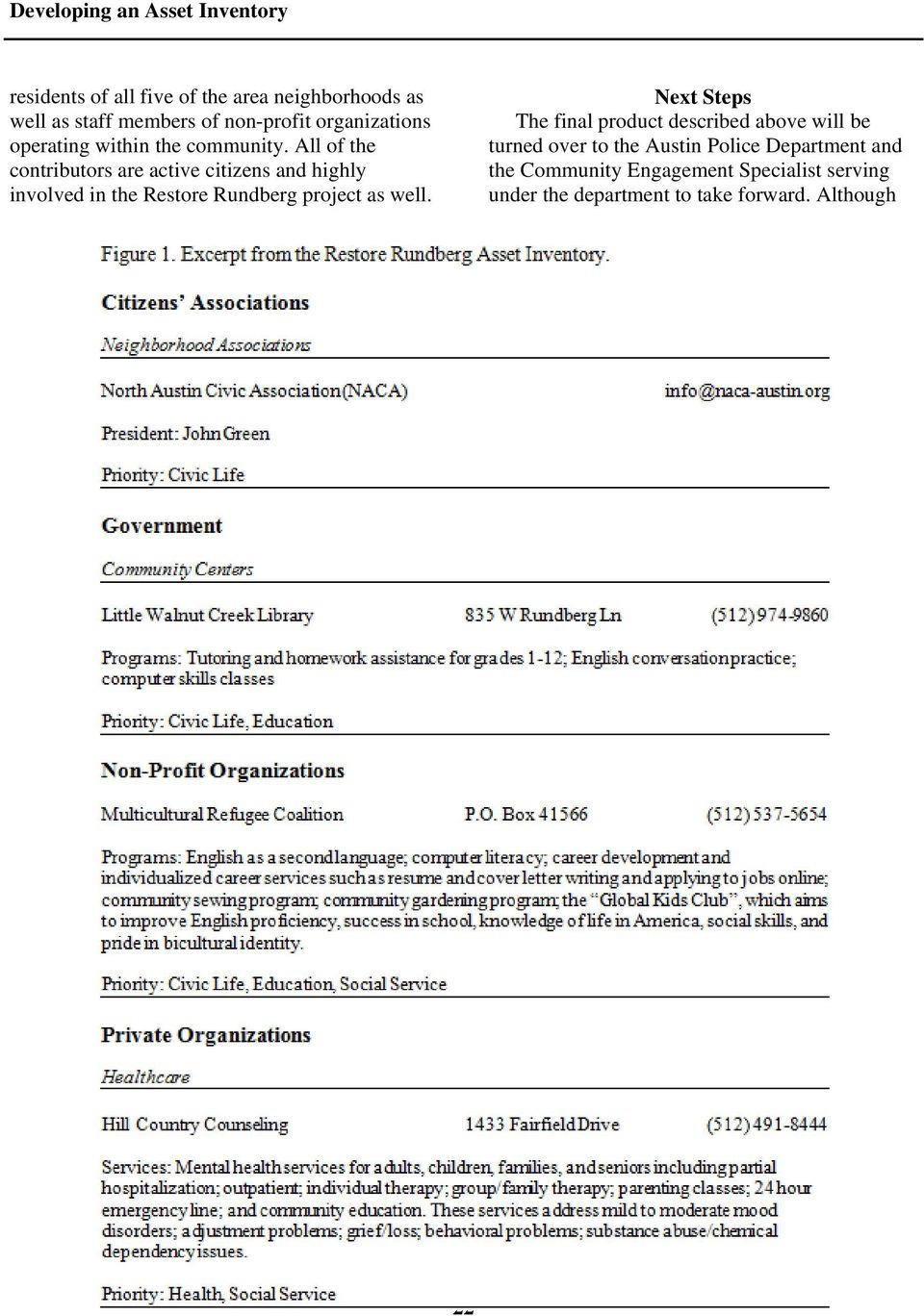
3 Professional Development: The International Journal of Continuing Social Work Education also led to the detection of activities that were being conducted at different locations within the community that may not be readily apparent to those who do not participate. The formatting possibilities for the asset inventory and the kinds of information stakeholders wanted to be available was also briefly discussed. Through both methods of information collection, numerous resources were identified and recorded. The identification and addition of assets will be ongoing, but the initial information collected was enough to begin developing the inventory and disseminating it to stakeholders. The following section describes the initial process of reviewing and organizing the assets and putting them into a format that could be easily disseminated. The Asset Inventory The assets identified through the information collection process were initially documented using Microsoft Excel and included basic information such as address, phone number, type of asset, and priority. Many of the assets had contact information, aside from those identified as natural or infrastructural assets, such as parks, a creek, and transportation networks. The types of assets delineated were citizens associations, government organizations, non-profit organizations, and private organizations, based on Kretzmann and McKnight s (1993) model for asset-based community development. Through initial interviews with stakeholders, it was decided that individual skills and talents would not be included, but may be added later. It was also determined that rather than combining all of the institutions into one category, they would be divided based on their status as public, private, or non-profit. Additionally, eight priority areas emerged through both the document study and the interviews. The priority areas included public safety, civic life, education, health, environment, economy, social service, and transportation. Many of these were explicitly mentioned in the neighborhood plans and others were added based on feedback from stakeholders. The first step performed in developing an expanded version of the asset inventory was to create an example of the final product in order to ensure that it made sense to the stakeholders that would be using it. The asset inventory example contained 10 assets spanning type and priority area. Each asset was placed in the appropriate category based on type and contained contact and program or service information where applicable. This document was brought to a community meeting and presented to the Rundberg Revitalization team, which is a team made up of stakeholders in the community that are behind much of the revitalization efforts currently taking place. Community residents who are not part of the revitalization team are also welcome at these meetings. Those who were in attendance were able to review the example as well. In addition to reviewing the example at the meeting, a sign-up sheet for receiving an electronic copy of the example and the spreadsheet containing all of the identified assets was passed around the meeting. Finally these documents were posted to Basecamp, an online internet-based project management tool. Most of the active stakeholders from various organizations and neighborhoods within the area maintain a presence on Basecamp and were able to review the documents and provide feedback regarding the format and content. With the feedback provided by community members, the final product was developed. The asset inventory contained 136 assets across the 4 tiers of agency and 8 priority areas mentioned above. Furthermore, each tier contained subcategories such as Faith Groups and Neighborhood Associations for citizens associations, Schools and Community Centers for government organizations, and Healthcare and Businesses for private organizations. An excerpt of the asset inventory can be reviewed in Figure 1. Over the course of developing the inventory, 11 community members were directly involved through the provision of information regarding community assets or feedback about the format and types of information that would be disseminated through the inventory. These contributors included 21

4 Developing an Asset Inventory residents of all five of the area neighborhoods as well as staff members of non-profit organizations operating within the community. All of the contributors are active citizens and highly involved in the Restore Rundberg project as well. Next Steps The final product described above will be turned over to the Austin Police Department and the Community Engagement Specialist serving under the department to take forward. Although 22
5 Professional Development: The International Journal of Continuing Social Work Education 136 assets may seem like an abundance of resources, it is likely that there are many more that still exist and that will be developed as the project moves forward. By integrating this inventory into the work done by the Community Engagement Specialist, it will ensure that the inventory is maintained and kept current as the community revitalization efforts yield outcomes and more resources are identified or generated. The natural next step from the development of the asset inventory is to utilize the inventory in the community revitalization initiatives. In order to test the inventory, it could be piloted in the design and implementation of small projects around the community that align with the identified priority areas. In doing this, those utilizing the inventory can identify gaps in the information that is available or add new information such as contact persons for specific assets to make the inventory more useful. In addition to developing the inventory further, those conducting these types of small projects will build skills and networks that will strengthen the revitalization efforts. For example, the community could have an interest in preventing litter on one of the main thoroughfares in the community based on the environment priority area. To prevent littering, community members may hope to leverage resources found in the inventory to have public trashcans installed on the road. Within the inventory, there are many resources that could serve as means to this end. The inventory contains government departments that could provide the trashcans, non-profit organizations that could sponsor neighborhood beautification, and many community-based associations that might take up such community improvement projects. Through completing projects such as this, the value of the inventory can be gauged and it can be improved upon with additional necessary information. served as the impetus for developing the asset inventory and based on the outcome, it is evident that there are many resources available to the Rundberg community that can be utilized in the revitalization efforts. The process and product was stakeholder driven, with community residents and staff members of community-based organizations determining the information that should be available through the asset inventory and exactly how it would be presented. There is also clear path forward in using the asset inventory to affect community change. By incorporating it into the implementation of the project, the inventory will remain a useful tool for the community and will continue to grow as the project moves forward and new assets are generated and secured. References Flora, C. & Flora, J. (2013). Rural communities: Legacy and change (4th ed.). Boulder, CO: Westview. Kretzmann, J. P., & McKnight, J.L. (1993). Building communities from the inside out: A path toward finding and mobilizing a community s assets. Evanston, IL: Kretzmann & McKnight. Conclusion As mentioned above, taking an asset-based approach to community revitalization has been suggested as more efficacious than a needs-based approach (Kretzmann & McKnight, 1993). This 23

Understanding the Asset-based Approach to Community Development
 Understanding the Asset-based Approach to Community Development Julie Wilke 2/9/06 CRP 381: Participatory Methods 1 Executive Summary In recent years, Asset-based Community Development (ABCD) has caught
Miami Northwestern Senior High School ~ STUDENT GUIDE FOR COMMUNITY SERVICE PROJECTS ~
 Miami Northwestern Senior High School ~ STUDENT GUIDE FOR COMMUNITY SERVICE PROJECTS ~ Purpose The purpose of this guide is to help you as you plan and implement your required community service project.
Hand, Head and Heart Exercise
 Asset Based Community Development Asset-Based Community Development/Asset Mapping Texas Healthy Start Alliance March 7, 2014 Copyright 2014 H. Daniels Duncan, Faculty Member ABCD Institute Hand, Head and
An Assessment of Capacity Building in Washington State
 An Assessment of Capacity Building in Washington State The Nonprofit Ecosystem Framework Executive Summary prepared by The Giving Practice A consulting service of Philanthropy Northwest February 2012 About
How Community Advisory Boards Can Assist the Work of the Justice System
 How Community Advisory Boards Can Assist the Work of the Justice System Community engagement is an essential component of a well-functioning justice system. By strategically engaging the public, justice
Supporting research & program evaluation, education & professional development and knowledge exchange in public health. Focus group Oct.
 Supporting research & program evaluation, education & professional development and knowledge exchange in public health Focus group Oct. 5, 2010 Thank you To you for travelling and joining us at the planning
Identifying, Mapping and Mobilizing Our Assets
 Identifying, Mapping and Mobilizing Our Assets Assets, often of untold value, lie within the citizens of our communities, within the groups we form, within our larger organizations, within our land and
The Canadian Code for Volunteer Involvement: An Audit Tool
 The Canadian Code for Volunteer Involvement: An Audit Tool Acknowledgments Volunteer Canada gratefully acknowledges the author, Liz Weaver, for her work on the original document Volunteer Management Audit:
Coordinated Plan Update and Funding for Transit
 Capital Area Regional Transit Coordination Committee Coordinated Plan Update and Funding for Transit December 2011 Regional Transit Coordination Committee (RTCC) RTCC Covers 10 County CAPCOG Region Addresses
Search Prospectus Chief Marketing Officer
 Search Prospectus Chief Marketing Officer Southwestern University announces the search for a Chief Marketing Officer Southwestern University (SU), a distinctive, residential, undergraduate liberal arts
Table of Contents Introduction Overview of Asset Mapping The Asset Mapping Process Appendix Resources
 Table of Contents Introduction Overview of Asset Mapping Purpose Values and Goals of Asset Mapping Understand Community Assets Skills Needed Why do an Asset Map The Asset Mapping Process Identify and involve
Future Model. FREQUENTLY ASKED QUESTIONS Recommended Model for Future Education in Nutrition and Dietetics July, 2015
 FREQUENTLY ASKED QUESTIONS Recommended Model for Future Education in Nutrition and Dietetics July, 2015 In February 2015, ACEND released the Rationale Document, which included recommendations for the future
Emergency Support Function (ESF) #14 Long-Term Community Recovery
 Emergency Support Function (ESF) #14 Long-Term Community Recovery Primary Department(s): St. Louis County Police Department, Office of Emergency Management Support Department(s): St. Louis County Housing
Addressing HIT Worker Shortages Through Operational Excellence in Workforce Planning
 Addressing HIT Worker Shortages Through Operational Excellence in Workforce Planning Allen Kriete Vice President, Healthcare Services; TEKsystems Sanja Licina Senior Director, Talent Intelligence and Consulting;
LOUISVILLE S BLUEPRINT
 PHASE ONE: MOVING LOUISVILLE TO ACTION ANTHONY D. SMITH GREG FISCHER Our Blueprint is dedicated to the late Dr. J. Blaine Hudson, who helped lead this work. Dr. Hudson committed his life to scholarship
Chapter 2. Developing a Marketing and Promotion Plan
 Chapter 2 Developing a Marketing and Promotion Plan 11 2. DEVELOPING A MARKETING AND PROMOTION PLAN In This Section This section covers how to lay the groundwork for implementing your approach to marketing
2015 ASHP STRATEGIC PLAN
 2015 ASHP STRATEGIC PLAN ASHP Vision ASHP s vision is that medication use will be optimal, safe, and effective for all people all of the time. ASHP Mission The mission of pharmacists is to help people
The Wisdom Project: Stories from the Field that Inform Leaders. Wendy Harrison, Brenda Hubley, Alison McLaughlin, Kass Rafih, and Darren Sander
 The Wisdom Project: Stories from the Field that Inform Leaders Wendy Harrison, Brenda Hubley, Alison McLaughlin, Kass Rafih, and Darren Sander INTRODUCTION Today s leaders are tasked with affecting meaningful,
Community/School Partnerships: A National Survey
 Community/School Partnerships: A National Survey February 2007 About DeHavilland Associates DeHavilland Associates is a consulting and communications firm that helps its corporate, nonprofit, and association
gangs and drugs and homelessness, of vacant and abandoned land and buildings. They are images of needy and problematic and deficient neighborhoods
 Introduction to "Building Communities from the Inside Out: A Path Toward Finding and Mobilizing a Community's Assets," by John P. Kretzmann and John L. McKnight. This copyright material may be reprinted
Community Development 101. Chris Clamp December 4, 2009 Mel King Institute Boston, MA
 Community Development 101 Chris Clamp December 4, 2009 Mel King Institute Boston, MA SECTION 1: WHAT IS COMMUNITY DEVELOPMENT? 2 Community Development Web chart exercise on flip chart paper to develop
2013 2015 Strategic Business Plan
 2013 2015 Strategic Business Plan 2012 Board of Directors Adopted February 2013 Executive Summary The (NSPA) is a nonprofit, membership association that advances the collective impact of scholarship providers
ACTION PLAN FOR LITHUANIAN PARTICIPATION IN THE INTERNATIONAL INITIATIVE OPEN GOVERNMENT PARTNERSHIP
 OFFICE OF THE GOVERNMENT OF THE REPUBLIC OF LITHUANIA ACTION PLAN FOR LITHUANIAN PARTICIPATION IN THE INTERNATIONAL INITIATIVE OPEN GOVERNMENT PARTNERSHIP April 2014 Vilnius 1 INTRODUCTION Significance
The University of Texas at San Antonio. Business Affairs 2016 STRATEGIC PLAN 2007-2016 December 2007
 The University of Texas at San Antonio Business Affairs 2016 STRATEGIC PLAN 2007-2016 December 2007 Table of Contents Page 1. Introduction... 3 2. Business Affairs Mission, Vision and Core Values 3 3.
Sarasota County Schools: Successful Transition from ANGEL to Blackboard Learn
 Sarasota County Schools: Successful Transition from ANGEL to Blackboard Learn Sarasota County Schools: Transition from ANGEL to Blackboard Sarasota County Schools in Florida, like many ANGEL districts,
Whole Community Concept Integration into National Disaster Preparedness Training Center University of Hawaii
 Whole Community Concept Integration into National Disaster Preparedness Training Center University of Hawaii Established in 2007 under H.R. 1, Implementing Recommendations of the 9/11 Commission Act of
How To Complete A Community Service Project
 Defining Community Service Community service projects are well-planned, organized, and voluntary efforts designed to address a specific need in the community. Well-conceived projects provide students with
3. The first stage public consultation conducted from March to June 2008 aimed at consulting the public on
 EXECUTIVE SUMMARY The Government published the Healthcare Reform Consultation Document Your Health, Your Life (the Consultation Document ) on 13 March 2008 to initiate the public consultation on healthcare
Opportunities & Challenges for Children with Complex Health Care Needs in Medicaid & CHIP Cindy Mann
 Opportunities & Challenges for Children with Complex Health Care Needs in Medicaid & CHIP Cindy Mann Designing Systems that Work for Children with Complex Health Care Needs Lucile Packard Foundation for
Volunteer Management. Capacity in America s. Charities and Congregations
 Volunteer Management Capacity in America s Charities and Congregations A BRIEFING REPORT February 2004 The Urban Institute Citation: Urban Institute. 2004. Volunteer Management Capacity in America s Charities
State of Education in Virginia - Policies, Resources and Funding
 Educate. Advocate. Lead. 2015 16 ISSUES AND SOLUTIONS for Career and Technical Education in Virginia Educators and business representatives from across Virginia, along with 10 organizations representing
Developing a Targeted Resume as an Experienced Professional. Office of Career Services
 Developing a Targeted Resume as an Experienced Professional Office of Career Services Housekeeping Notes Join the audio portion that works for you: Use Phone audio select I will call in from the drop-down
Journal of Healthcare Management
 ARTICLE SUBMISSION GUIDELINES Journal of Healthcare Management JHM does not publish advertisements, announcements, promotional articles/advertorials, or outside editorials. We highly recommend consulting
Professional Learning Courses 2013-2014
 Professional Learning Courses 2013-2014 2012 Page Our Professional Learning Courses We offer a range of flexible, vibrant and effective monthly courses located at 7651 Tecumseh Road E. In addition to our
Unit # 5, Part 2 The Duties and Responsibilities of Citizenship
 Unit # 5, Part 2 The Duties and Responsibilities of Citizenship A Citizen s Legal Duties Each of us belongs to many communities: - neighborhood - town, city - school - church - state - country As community
Cybersecurity Framework: Current Status and Next Steps
 Cybersecurity Framework: Current Status and Next Steps Federal Advisory Committee on Insurance November 6, 2014 Adam Sedgewick Senior IT Policy Advisor [email protected] National Institute of Standards
Internship Guide. Get Started
 Internship Guide This guide provides a roadmap for any company, no matter the size of the business or the industry. Whether you re just getting started or already have an internship program that you want
San Joaquin Valley Health Fund
 Center for Health Program Management San Joaquin Valley Health Fund 2015 Funding Opportunity The San Joaquin Valley Health Fund is a program managed by the Center for Health Program Management with funding
PERFORMANCE MANAGEMENT ROADMAP
 PERFORMANCE MANAGEMENT ROADMAP Building a high-performance culture PERFORMANCE MANAGEMENT ROADMAP a The Partnership for Public Service is a nonpartisan, nonprofit organization that works to revitalize
Audit of the Test of Design of Entity-Level Controls
 Audit of the Test of Design of Entity-Level Controls Canadian Grain Commission Audit & Evaluation Services Final Report March 2012 Canadian Grain Commission 0 Entity Level Controls 2011 Table of Contents
DEVELOPING AN EFFECTIVE INTERNAL AUDIT TECHNOLOGY STRATEGY
 DEVELOPING AN EFFECTIVE INTERNAL AUDIT TECHNOLOGY STRATEGY SEPTEMBER 2012 DISCLAIMER Copyright 2012 by The Institute of Internal Auditors (IIA) located at 247 Maitland Ave., Altamonte Springs, Fla., 32701,
Local and Community Development Programme
 UPDATED TO REFLECT NEW FRAMEWORK MAY2011 Local and Community Development Programme A step by step guide to Strategic Planning for LCDP Step One - Reflection on the principles of the programme and the horizontal
Executive Summary: Navigant Research Leaderboard Report: Smart City Suppliers
 RESEARCH REPORT Executive Summary: Navigant Research Leaderboard Report: Assessment of Strategy and Execution for 16 NOTE: This document is a free excerpt of a larger report. If you are interested in purchasing
Structure and Function
 Structure and Function OKLAHOMA State SSA Director Mr. Ben Brown, Deputy Commissioner Oklahoma Department of Mental Health and Substance Abuse Services P.O. Box 53277 Oklahoma City, OK 73152-3277 Phone:
Community Partnerships Strategic Plan
 Community Partnerships Strategic Plan Vision The Office of Community Partnerships (OCP), an office in the Chancellor s division of the University of North Carolina Wilmington (UNCW) will become a national
Library Services for Immigrants A Report on Current Practices G-1112
 Library Services for Immigrants A Report on Current Practices G-1112 Table of Contents Introduction... 1 Partnerships... 1 Collections... 2 Information Services... 3 Programs and Events... 3 Outreach...
SERVE Philadelphia 2013-2014 AmeriCorps VISTA Information and Application
 SERVE Philadelphia 2013-2014 AmeriCorps VISTA Information and Application Philadelphia Mayor Michael A. Nutter s Office of Civic Engagement and Volunteer Service is accepting applications for 12 full time
A descriptive analysis of state-supported formative assessment initiatives in New York and Vermont
 ISSUES& ANSWERS REL 2012 No. 112 At Education Development Center, Inc. A descriptive analysis of state-supported formative assessment initiatives in New York and Vermont ISSUES& ANSWERS REL 2012 No. 112
The Intersection of Talent Management and Engagement
 The Intersection of Talent Management and Engagement By Elissa Tucker and Rachele Williams, APQC for the May 2011 issue of workspan The typical organization today views talent management as three building
How To Run An Indiana Campus Compact
 Indiana Campus Compact 2015-2020 Strategic Plan INCREASING INDIANA HIGHER EDUCATION S COLLECTIVE IMPACT ON COMMUNITIES Communities Campuses Preparing college students to advance the public good in their
Podcast Interview Transcript
 Beyond the Manuscript 47 Sarena D. Seifer, Margo Michaels, and Amanda Tanner In each volume of Progress in Community Health Partnerships: Research, Education, and Action, PCHP editors select one article
Rationale and Course Descriptions. for a
 Rationale and Course Descriptions for a Doctor of Philosophy (PhD) in Social Work and Social Development at the Graduate School of Social Work Addis Ababa University November 2007 0 PhD Program in Social
Utica College Performance Review Form for LEADERSHIP
 Utica College Performance Review Form for LEADERSHIP EMPLOYEE NAME: DEPARTMENT: HIRE DATE: / / SUPERVISOR*: JOB TITLE: REVIEW PERIOD: *Supervisor is the person delivering the review From To INSTRUCTIONS
TABLE OF CONTENTS. Accreditation and Educational Outcomes 1. Curriculum of the Post-Master s DNP Program 1-2. Program of Study 2-3
 DNP 2015 2016 TABLE OF CONTENTS Accreditation and Educational Outcomes 1 Curriculum of the Post-Master s DNP Program 1-2 Program of Study 2-3 Course Descriptions for Core Courses 4-6 The E-Portfolio 6-7
Global Headquarters: 5 Speen Street Framingham, MA 01701 USA P.508.872.8200 F.508.935.4015 www.idc.com
 Global Headquarters: 5 Speen Street Framingham, MA 01701 USA P.508.872.8200 F.508.935.4015 www.idc.com E X C E R P T I D C M a r k e t S c a p e : U. S. B u s i n e s s C o n s u l t i n g S e r v i c
Task: Findings Potential Initiatives for Review
 Appendix B. Task: Findings Potential Initiatives for Review Prepared by: Chabin Concepts Team Audrey Taylor 2809 Cohasset Road, Ste 5 Chico, CA 9597 800.676.8455 [email protected] April 2005 Findings
Chapter 4 STRATEGIC GOALS AND OBJECTIVES
 Chapter 4 STRATEGIC GOALS AND OBJECTIVES PRINCIPLES OF A COMPREHENSIVE, BALANCED STRATEGY This urban-based Substance Abuse Strategy (the Strategy) is built on the premise that no single approach can end
OUR MISSION. The mission of the USC Rossier School of Education is to improve learning in urban education locally, nationally and globally.
 STRATEGIC PLAN 2012-2017 OUR MISSION The mission of the USC Rossier School of Education is to improve learning in urban education locally, nationally and globally. Urban education takes place within many
DRAFT. Denver Plan 2014. Every Child Succeeds
 Denver Plan 2014 Every Child Succeeds 100 80 Introduction Every child takes that first step into their first day of school with butterflies and talent, potential and dreams. It s the day that the door
The Baltimore County Public Schools 2015-2019 Technology Plan
 2015-2019 Technology Plan Prepared by: The Department of Information Technology Plan Origination Date: March 2014 Plan Updated April 2015 Version 2.0 The guiding document of Baltimore County Public Schools
HR Field Guide: 5 Tips To Effective Succession Planning
 HR Field Guide: 5 Tips To Effective Succession Planning May 2010 Succession planning systems identify, prepare, and track high potential employees for promotion and advancement. This fi eld guide will
National Public Health Performance Standards Program Frequently Asked Questions
 National Public Health Performance Standards Program Frequently Asked Questions What is the National Public Health Performance Standards Program (NPHPSP)? The NPHPSP is a partnership initiative of national
ALIGNING THE PIECES. National Cost Benchmarks for Nonprofit Strategic Plans and Business Plans. Kyle Crawford. Copyright 2011 The Forbes Funds
 ALIGNING THE PIECES National Cost Benchmarks for Nonprofit Strategic Plans and Business Plans Kyle Crawford Copyright 2011 The Forbes Funds INTRODUCTION With a strong advocacy partnership of more than
NEW PROGRAM PROPOSAL: AAS IN INDUSTRIAL MAINTENANCE TECHNOLOGY Agenda Item I-3c BIG SANDY COMMUNITY AND TECHNICAL COLLEGE September 18, 2015
 NEW PROGRAM PROPOSAL: ACTION AAS IN INDUSTRIAL MAINTENANCE TECHNOLOGY Agenda Item I-3c BIG SANDY COMMUNITY AND TECHNICAL COLLEGE September 18, 2015 Recommendation That the Board of Regents approve an Associate
Texas Nursing: Our Future Depends on It
 Texas Nursing: Our Future Depends on It A Strategic Plan for the State of Texas To Meet Nursing Workforce Needs of 2013 Attachment A Detailed Action Plan Developed by: Addressing Nursing Education Capacity
Request for Consulting Services For the Preparation of an International Marketing Strategy EXECUTIVE SUMMARY
 Request for Consulting Services For the Preparation of an International Marketing Strategy EXECUTIVE SUMMARY The City of Abbotsford, Economic Development Department, is seeking a consultant to develop
Managing HR on a Global Scale
 Survey Highlights Managing on a Global Scale Findings From Hewitt s 2009 Global Study What does it mean to be a global organization? As companies large small continue to exp their global footprint, the
APQC s Levels of Knowledge Management Maturity
 APQC s Levels of Knowledge Management Maturity By Cindy Hubert and Darcy Lemons This article provides an overview of APQC s Levels of Knowledge Management Maturity, which are designed to be used in conjunction
DRAFT * Statewide Strategic Plan for Science * DRAFT DRAFT * For Board of Regents Discussion * DRAFT. Mission
 Preamble The Statewide Strategic Plan for Science serves as a planning and implementation guide to support newly adopted P-12 science learning standards. The strategic plan begins with mission and vision
Grant Guidelines. 4. Is this the best possible use of Citi Foundation funds given other opportunities before us?
 Grant Guidelines The mission of the Citi Foundation is to promote economic progress and create measurable impact in lowincome communities around the world. We invest in efforts that increase financial